
EXCHANGE: COMEX
CONTRACT: OCTOBER 2026 COMEX 100 GOLD FUTURES
SETTLEMENT: 4,131.800000000 USD
INTENT DATE: 10/08/2026 DELIVERY DATE: 10/12/2026
FIRM ORG FIRM NAME ISSUED STOPPED
099 H DEUTSCHE BANK AG 79
152 C DORMAN TRADING, LLC 1
363 H WELLS FARGO SECURITI 37
365 C MAREX CAPITAL MARKET 40
661 C JP MORGAN SECURITIES 197 80
686 C STONEX FINANCIAL INC 1
737 C ADVANTAGE FUTURES 14
905 C ADM 5 3
991 H CME 53
TOTAL: 255 255
MONTH TO DATE: 12,329
GOLD: NUMBER OF NOTICES FILED FOR OCT./2026: 255 CONTRACTs NOTICES FOR 25,500 OZ or 0.7931 TONNES
total notices so far: 12,329 contracts FOR 1,232,900 OZ OR 38.348 TONNES
SILVER NOTICES: 358 NOTICE(S) FILED FOR 1.790 MILLION OZ /
total number of notices filed so far this month : 3125 CONTRACTS (NOTICES) for 15.625 million oz
GLD
SHANGHAI CLOSED UP 1.89 PTS OR 0.05%
HANG SENG CLOSED UP 336.74 PTS OR 1.42%
Nikkei CLOSED UP 101.89 PTS OR 0.05%
//Australia’s all ordinaries CLOSED UP 0.30%
//Chinese yuan (ONSHORE) CLOSED UP AT 6.6933
/ OFFSHORE CLOSED UP AT 6.6945 Oil DOWN TO 90.52 dollars per barrel for WTI and BRENT DOWN TO 103.06 Stocks in Europe OPENED ALL GREEN
ONSHORE USA/ YUAN// WITH YUAN TRADING 6.6933 (STARTING TODAY) OFFSHORE YUAN TRADING UP TO 6.6945 ONSHORE YUAN TRADING ABOVE LEVEL // OFF SHORE AND UP ON THE DOLLAR)// / AND THUS STRONGER/OFF SHORE YUAN TRADING UP AGAINST US DOLLAR/ AND THUS STRONGER
XXXXXXXXXXXXXXXXXXXXXXXXXXXXXXXXXXXXX
| Gold | Ounces |
| Withdrawals from Dealers Inventory in oz | nil |
| Withdrawals from Customer Inventory in oz | 1 ENTRIES i) BRINKS: 64.302 OZ (2 kilobars) total withdrawal: 64.302 oz |
| Deposit to theDealerInventory in oz | 0 ENTRIES |
| Deposits to the Customer Inventory, in oz | DEPOSITS/CUSTOMER//gold 0 ENTRIES xxxxxxxxxxxxxxxx |
| No of oz served (contracts) today | 255 CONTRACTS 25,500 OZ 0.7931 TONNES OF GOLD |
| No of oz to be served (notices) | 82 Contracts 8200 OZ 0.2550 TONNES |
| Total monthly oz gold served (contracts) so far this month | 12,329 notices 1,232,900 OZ 38.348 TONNES |
| Total accumulative withdrawals of gold from the Dealers inventory this month | NIL oz |
| Total accumulative withdrawal of gold from the Customer inventory this month |
dealer deposits: 0
xxxxxxxxxxxxxxxxxxx
DEPOSITS:
ENTRIES: 0
xxxxxxxxxxxxxxxxxx
comex withdrawal
1 ENTRIES
i) BRINKS: 64.302 OZ
(2 kilobars)
total withdrawal: 64.302 oz
adjustments: 2
DEALER TO CUSTOMER ACC’T
a) Brinks: 6,269.445 oz
b) Manfra 1416.745 oz
COMEX IS DRAINING GOLD
chaos inside the comex
THE FRONT MONTH OF OCT OI STANDS AT 337 CONTRACTS HAVING A GAIN OF 37 CONTRACTS.
YESTERDAY WE HAD 1,220,900 OZ ( 37.975 TONNES) OF GOLD STANDING FOR DELIVERY: TODAY: 1,241,100 OZ OR 38.603 TONNES FOR A GAIN OF 20,200 OZ (0.6283 TONNES) OR 202 CONTRACTS UNDERWENT A QUEUE JUMP FOR 20,200 OZ (.6283TONNES) AS THEY SEEK PHYSICAL GOLD ON THIS SIDE OF THE POND.
NOVEMBER LOST 82 CONTRACTS FALLING TO 4015
DECEMBER, THE LARGEST DELIVERY MONTH IN THE CALENDAR, ITS OI FALLS BY 2298 CONTRACTS DOWN TO 321.112.
.
We had 255 contracts filed for today representing 22,500 oz
Today, 0 notice(s) were issued from J.P.Morgan dealer and 197 notices issued from their client or customer account. The total of all issuance by all participants equate to 255 contract(s) of which 0 notices were stopped (received) by j.P. Morgan dealer and 80 notice(s) was (were) stopped (received) by J.P.Morgan//customer account
To calculate the INITIAL total number of gold ounces standing for OCT /2026. contract month, we take the total number of notices filed so far for the month (12,329) to which we add the difference between the open interest for the front month of OCT (337 CONTRACTS) minus the number of notices served upon today 255 x 100 oz per contract) equals 1,241,100 OZ OR(38.603 Tonnes of gold) to which we add our first exchange for risk in Oct totalling 836 contracts for 83,600 oz or 2.600 tonnes. Thus Oct standing for gold advances hugely to 41.202 tonnes
THUS: INITIAL total number of gold ounces standing for OCT. /2026. contract month,we take the total number of notices filed so far for the month (12,329) to which we add the difference between the open interest for the front month of OCT(337) contracts minus the number of notices served upon today 255 x 100 oz per contract) equals 1,241,100 OZ OR(38.603 Tonnes of gold) plus our first exchange for risk totalling 836 contracts//83600 oz//2.600 tonnes//standing advances to 41.202 tonnes
new total of gold standing in OCT becomes 41.202 TONNES//
TOTAL COMEX GOLD STANDING FOR OCT.: 41.202 TONNES WHICH IS NOW VERY STRONG FOR THIS NON ACTIVE DELIVERY MONTH OF OCT./
THURSDAY VOLUME: 165,568 POOR
COMEX GOLD INVENTORIES/CLASSIFICATION
NEW PLEDGED GOLD:
241,794.285 oz NOW PLEDGED /HSBC 5.94 TONNES
204,937.290 OZ PLEDGED MANFRA 3.08 TONNES
83,657.582 PLEDGED JPMorgan no 1 1.690 tonnes
265,999.054, oz JPM No 2
1,152,376.639 oz pledged Brinks/
Manfra: 33,758.550 oz
Delaware: 193.721 oz
International Delaware:: 11,188.542 oz
total pledged gold: 1,721,684.952 oz 53.55 tonnes pledged gold lowers
total inventories in gold declining rapidly
total pledged gold: 1,721,684.952 tonnes oz 53.55 tonnes
TOTAL OF ALL GOLD ELIGIBLE AND REGISTERED GOLD 23,477,528.707oz//
TOTAL REGISTERED GOLD 15,067,141.026 tonnes (468.65 tonnes)
TOTAL OF ALL ELIGIBLE GOLD 8,410,387.681 oz.
REGISTERED GOLD THAT CAN BE SERVED UPON 13,345,457oz ((REG GOLD- PLEDGED GOLD)=
415.090 Tonnes //
total inventories in gold declining rapidly
SILVER COMEX
OCT DELIVERY MONTH
OCT 9
| Silver | Ounces |
| Withdrawals from Dealers Inventory | NIL oz |
| Withdrawals from Customer Inventory | 4 entries i) Out of Asahi 244,132.600 oz. ii) Out of Brinks: 310,098.090 oz iii) Out of CNT 24,876.07 oz iv) Out of JPMorgan: 1,398,866.200 oz total withdrawal: 1,857,972. 960oz |
| Deposits to the Dealer Inventory | 1 ENTRY i) Into CNT dealer: 598,436.300 oz total deposit: 598,436.300 oz |
| Deposits to the Customer Inventory | ENTRIES: 0 |
| No of oz served today (contracts) | 358 CONTRACT(S) ( 1.790 MILLION OZ) |
| No of oz to be served (notices) | 365 Contracts (1.825 MILLION oz) |
| Total monthly oz silver served (contracts) | 3125 contracts 15.625 MILLIONoz |
| Total accumulative withdrawal of silver from the Dealers inventory this month | NIL oz |
| Total accumulative withdrawal of silver from the Customer inventory this month |
DEPOSITS INTO DEALER ACCOUNTS
ENTRY:1
i) Into CNT dealer: 598,436.300 oz
total deposit: 598,436.300 oz
DEPOSIT ENTRIES/CUSTOMER ACCOUNT
0 ENTRIES:
xxxxxxxxxxxxxxxxxxxxxxxxx
withdrawals:
4 entries
4 entries
i) Out of Asahi 244,132.600 oz.
ii) Out of Brinks: 310,098.090 oz
iii) Out of CNT 24,876.07 oz
iv) Out of JPMorgan: 1,398,866.200 oz
total withdrawal: 1,857,972. 960oz
adjustments :
0
xxxxxxxxxxxxxx
TOTAL REGISTERED SILVER: 102.813 MILLION OZ//.TOTAL REG + ELIGIBLE. 331.808 Million oz
registered silver dropping in numbers
CALCULATIONS FOR THE NEW STANDING FOR SILVER FOR OCT
FRONT MONTH: SILVER OPEN INTEREST CONTRACTS: 723 FOR A LOSS OF 333 CONTRACTS.
THURSDAY WE HAD 17.465 MILLION OZ STAND: TODAY: 17.450 MILLION OZ FOR A LOSS OF 0.015 MILLION OZ OR 15,000 OZ (3 CONTRACTS). THUS A SMALL EXCHANGE FOR PHYSICAL TRANSFER TO LONDON WHERE THEY WILL TAKE DELIVERY OVER ON THE LONDON SIDE OF THE POND. SEEMS TO BE A LACK OF SILVER OVER HERE ON THIS SIDE.
NOVEMBER GAINED 272 CONTRACTS UP TO AN OI OF 2021
DECEMBER GAINED 281 CONTRACTS DOWN TO AN OI OF 83,517
TOTAL NUMBER OF NOTICES FILED FOR TODAY: 358 or 1.790 MILLION oz
CONFIRMED volume THURSDAY; 56,553 // poor/
AND NOW OCT. DELIVERIES:
To calculate the number of silver ounces that will stand for delivery in OCT. we take the total number of notices filed for the month so far at 3125 X5,000 oz = 15.625 MILLION oz.
Then we take the difference between the front month of OCT. and the number of notices filed for today x 5000 to give us our standing
Thus the standings for silver for the OCT 2026 contract month: (3125 )Notices served so far) x 5000 oz + OI for the front month of OCT (723) minus number of notices served upon today ( 358 x 5000 oz) equals silver standing for the OCT .contract month equating to 17.450 MILLION OZ to which we add silver’s TWO exchange for risk for 450 contracts (2.25 million oz).. total standing reduces to 19.700 million oz//. ( a very strong delivery month)
We must also keep in mind that there is considerable silver standing in London coming from our longs
There are ONLY 102.813 million oz of registered silver
JPMorgan as a percentage of total silver: 126.833/331.808 million: 38.06%
The record level of silver open interest is 234,787 contracts set on April 21./2017 with the price on that day at $18.42.
The previous record was 224,540 contracts with the price at that time of $20.44.
BOTH GLD AND SLV ARE MASSIVE FRAUD
XXXXXXXXXXXXXXXXXXXXXXXXXXXXXXXXXXXXXXXXXXX
OCT 9//2026/WITH GOLD UP $60.00 /HUGE CHANGES IN GOLD AT THE GLD: A WITHDRAWAL OF 4.562 TONNES OF GOLD OUT OF THE GLD//: //:/INVENTORY RESTS AT 1055.411 TONNES
OCT 8//2026/WITH GOLD UP $16.85 /HUGE CHANGES IN GOLD AT THE GLD: A DEPOSIT OF 3.703 TONNES OF GOLD INTO THE GLD//: //:/INVENTORY RESTS AT 1059.873 TONNES
OCT 7//2026/WITH GOLD DOWN $46.70 /NO CHANGES IN GOLD AT THE GLD:: //:/INVENTORY RESTS AT 1056.27 TONNES
OCT 6//2026/WITH GOLD UP $30.60 /HUGE CHANGES IN GOLD AT THE GLD:: A DEPOSIT OF 0.754 TONNES OF GOLD INTO THE GLD// //:/INVENTORY RESTS AT 1056.27 TONNES
OCT 5//2026/WITH GOLD DOWN $2.20 /HUGE CHANGES IN GOLD AT THE GLD:: A WITHDRAWAL OF 0.854 TONNES OF GOLD INTO THE GLD// //:/INVENTORY RESTS AT 1055.696 TONNES
OCT 2//2026/WITH GOLD DOWN $43.00 /HUGE CHANGES IN GOLD AT THE GLD:: A DEPOSIT OF 0.854 TONNES OF GOLD INTO THE GLD// //:/INVENTORY RESTS AT 1056.55 TONNES
OCT 1//2026/WITH GOLD UP $19.55 /HUGE CHANGES IN GOLD AT THE GLD:: A WITHDRAWAL OF 1.711 TONNES OF GOLD OUT OF THE GLD// //:/INVENTORY RESTS AT 1055.696 TONNES
SEPT 30//2026/WITH GOLD UP $7.80 /HUGE CHANGES IN GOLD AT THE GLD:: A DEPOSIT OF 2.847 TONNES OF GOLD INTO THE GLD// //:/INVENTORY RESTS AT 1057.407 TONNES
SEPT 29//2026/WITH GOLD UP $11.75 /NO CHANGES IN GOLD AT THE GLD //:/INVENTORY RESTS AT 1054.56 TONNES
SEPT 28//2026/WITH GOLD DOWN $150.20 /NO CHANGES IN GOLD AT THE GLD //:/INVENTORY RESTS AT 1054.56 TONNES
SEPT 25//2026/WITH GOLD DOWN $150.20 /NO CHANGES IN GOLD AT THE GLD //:/INVENTORY RESTS AT 1054.56 TONNES
SEPT 24//2026/WITH GOLD DOWN $18.70 /HUGE CHANGES IN GOLD AT THE GLD A DEPOSIT OF 1.43 TONNES OF GOLD INTO THE GLD://:/INVENTORY RESTS AT 1056.84 TONNES
SEPT 23//2026/WITH GOLD DOWN $58.00 /HUGE CHANGES IN GOLD AT THE GLD://:/INVENTORY RESTS AT 1055.41 TONNES
SEPT 22//2026/WITH GOLD DOWN $6.30 /HUGE CHANGES IN GOLD AT THE GLD://A DEPOSIT OF 0.31 TONNES OF GOLD INTO THE GLD/:/INVENTORY RESTS AT 1055.41 TONNES
SEPT 21//2026/WITH GOLD DOWN $41.20 /HUGE CHANGES IN GOLD AT THE GLD://A DEPOSIT OF 2.26 TONNES OF GOLD INTO THE GLD/:/INVENTORY RESTS AT 1055.10 TONNES
SEPT 18//2026/WITH GOLD UP $26.45 /HUGE CHANGES IN GOLD AT THE GLD://A DEPOSIT OF 0.85 TONNES OF GOLD INTO THE GLD/:/INVENTORY RESTS AT 1052.84 TONNES
SEPT 17//2026/WITH GOLD UP $14.05 /HUGE CHANGES IN GOLD AT THE GLD://A DEPOSIT OF 1.71 TONNES OF GOLD INOT THE GLD/:/INVENTORY RESTS AT 1051.99 TONNES
SEPT 16//2026/WITH GOLD UP $53.40 /HUGE CHANGES IN GOLD AT THE GLD://A DEPOSIT OF 2.86 TONNES OF GOLD INOT THE GLD/:/INVENTORY RESTS AT 1050.28 TONNES
SEPT 15//2026/WITH GOLD DOWN $19.45 /NO CHANGES IN GOLD AT THE GLD://A WITHDRAWAL OF 0.353 TONNES OF GOLD FROM THE GLD/:/INVENTORY RESTS AT 1047.420 TONNES
SEPT 14//2026/WITH GOLD DOWN $54.50 /SMALL CHANGES IN GOLD AT THE GLD://A WITHDRAWAL OF 0.353 TONNES OF GOLD FROM THE GLD/:/INVENTORY RESTS AT 1047.420 TONNES
SEPT 11//2026/WITH GOLD UP $1.05 /SMALL CHANGES IN GOLD AT THE GLD://A WITHDRAWAL OF 0.353 TONNES OF GOLD FROM THE GLD/:/INVENTORY RESTS AT 1050.277 TONNES
/SEPT 10//2026/WITH GOLD UP $50.60 /NO CHANGES IN GOLD AT THE GLD://:/INVENTORY RESTS AT 1050.63 TONNES
SEPT 9//2026/WITH GOLD UP $20.40 /HUGE CHANGES IN GOLD AT THE GLD:A WITHDRAWAL OF 1.43 TONNES OF GOLD OUT OF THE GLD/ ////:/INVENTORY RESTS AT 1050.63 TONNES
SEPT 8//2026/WITH GOLD DOWN $34.20 /HUGE CHANGES IN GOLD AT THE GLD:A WITHDRAWAL OF 1.42 TONNES OF GOLD OUT OF THE GLD/ ////:/INVENTORY RESTS AT 1052.06 TONNES
SEPT 4//2026/WITH GOLD DOWN $63.50 /HUGE CHANGES IN GOLD AT THE GLD:A WITHDRAWAL OF 3.14 TONNES OF GOLD OUT OF THE GLD/ ////:/INVENTORY RESTS AT 1053.48 TONNES
SEPT 3//2026/WITH GOLD UP $141.55 /HUGE CHANGES IN GOLD AT THE GLD:A DEPOSIT OF 9.98 TONNES OF GOLD INTO THE GLD/ ////:/INVENTORY RESTS AT 1056.62 TONNES
SEPT 2//2026/WITH GOLD UP $19.25 /HUGE CHANGES IN GOLD AT THE GLD:A DEPOSIT OF 4.28 TONNES OF GOLD INTO THE GLD/ ////:/INVENTORY RESTS AT 1046.64 TONNES
SEPT 1//2026/WITH GOLD DOWN $80.25 /NO CHANGES IN GOLD AT THE GLD:// ////:/INVENTORY RESTS AT 1042.36 TONNES
GLD INVENTORY: 1055.411 TONNES, TONIGHTS TOTAL GOLD INVENTORY
SILVER
OCT 9 WITH SILVER UP $0.62 : :SMALL CHANGES A DEPOSIT OF 948,000 OZ INTO THE SLV// // :INVENTORY RESTS AT 493.226 MILLION OZ
OCT 8 WITH SILVER DOWN $0.74 : :SMALL CHANGES IN INVENTORY AT THE SLV:A WITHDRAWAL OF 532,000 OZ FROM THE SLV// // :INVENTORY RESTS AT 492.278 MILLION OZ
OCT 7 WITH SILVER DOWN $1.36 : :SMALL CHANGES IN INVENTORY AT THE SLV:A WITHDRAWAL OF 451,000 OZ FROM THE SLV// // :INVENTORY RESTS AT 492.910 MILLION OZ
OCT 6 WITH SILVER UP $0.31 : :NO CHANGES IN INVENTORY AT THE SLV: // :INVENTORY RESTS AT 493.361 MILLION OZ
OCT 5 WITH SILVER UP $0.87 : :NO CHANGES IN INVENTORY AT THE SLV: // :INVENTORY RESTS AT 493.361 MILLION OZ
OCT 2 WITH SILVER DOWN $0.74 : :NO CHANGES IN INVENTORY AT THE SLV: // :INVENTORY RESTS AT 493.578 MILLION OZ
OCT 1 WITH SILVER UP $0.57 : :HUGE CHANGES IN INVENTORY AT THE SLV: A WITHDRAWAL OF 1.400 MILLION OZ OUT OF THE SLV// :INVENTORY RESTS AT 493.578 MILLION OZ
SEPT 30 WITH SILVER DOWN $0.55 : :HUGE CHANGES IN INVENTORY AT THE SLV: A DEPOSIT OF 994,000 OZ INTO THE SLV// :INVENTORY RESTS AT 494.978 MILLION OZ
SEPT 29 WITH SILVER DOWN $0.58 : :SMALL CHANGES IN INVENTORY AT THE SLV: A WITHDRAWAL OF 566,000 OZ FROM THE SLV// :INVENTORY RESTS AT 493.984 MILLION OZ
SEPT 28 WITH SILVER DOWN $2.91 : :SMALL CHANGES IN INVENTORY AT THE SLV: A DEPOSIT OF 0.542 MILLION OZ FROM THE SLV// :INVENTORY RESTS AT 494.436 MILLION OZ
SEPT 25 WITH SILVER DOWN $2.91 : :SMALL CHANGES IN INVENTORY AT THE SLV: A DEPOSIT OF 0.542 MILLION OZ FROM THE SLV// :INVENTORY RESTS AT 494.436 MILLION OZ
SEPT 24 WITH SILVER DOWN $0.96 : :HUGE CHANGES IN INVENTORY AT THE SLV: A WITHDRAWAL OF 0.813 MILLION OZ FROM THE SLV// :INVENTORY RESTS AT 493.533 MILLION OZ
SEPT 23 WITH SILVER UP $1.58 : :HUGE CHANGES IN INVENTORY AT THE SLV: A WITHDRAWAL OF 1.716 MILLION OZ FROM THE SLV// :INVENTORY RESTS AT 494.346 MILLION OZ
SEPT 22 WITH SILVER UP $0.10 : :NO CHANGES IN INVENTORY AT THE SLV: :INVENTORY RESTS AT 496.062 MILLION OZ
SEPT 21 WITH SILVER UP $1.04 : :HUGE CHANGES IN INVENTORY AT THE SLV: :INVENTORY RESTS AT 489.558 MILLION OZ
SEPT 18 WITH SILVER UP $1.04 : :NO CHANGES IN INVENTORY AT THE SLV: :INVENTORY RESTS AT 489.558 MILLION OZ
SEPT 17 WITH SILVER UP $1.10 : :HUGE CHANGES IN INVENTORY AT THE SLV: A WITHDRAWAL OF 1.265 MILLION OZ FROM THE SLV/ :INVENTORY RESTS AT 489.558 MILLION OZ
SEPT 16 WITH SILVER UP $0.95 : :HUGE CHANGES IN INVENTORY AT THE SLV: A WITHDRAWAL OF 813,000 OZ FROM THE SLV/ :INVENTORY RESTS AT 490.823 MILLION OZ
SEPT 15 WITH SILVER DOWN $0.16 : :HUGE CHANGES IN INVENTORY AT THE SLV: A WITHDRAWAL OF 813,000 OZ FROM THE SLV/ :INVENTORY RESTS AT 491.636 MILLION OZ
SEPT 14 WITH SILVER DOWN $0.91 : :NO CHANGES IN INVENTORY AT THE SLV:/ :INVENTORY RESTS AT 492.449 MILLION OZ
SEPT 11 WITH SILVER DOWN $3.50 : :NO CHANGES IN INVENTORY AT THE SLV:/ :INVENTORY RESTS AT 492.449 MILLION OZ
SEPT 10 WITH SILVER DOWN $3.50 : :NO CHANGES IN INVENTORY AT THE SLV:// / :INVENTORY RESTS AT 493.171 MILLION OZ
SEPT 9 WITH SILVER UP $0.56 : :NO CHANGES IN INVENTORY AT THE SLV:// / :INVENTORY RESTS AT 493.171 MILLION OZ
SEPT 8 WITH SILVER UP $0.31 : :HUGE CHANGES IN INVENTORY AT THE SLV:/ A DEPOSIT OF 0.632 MILLION OZ INTO THE SLV// / :INVENTORY RESTS AT 493.171 MILLION OZ
SEPT 4 WITH SILVER UP $2.20 : :NO CHANGES IN INVENTORY AT THE SLV:/// / :INVENTORY RESTS AT 492.539 MILLION OZ
SEPT 3 WITH SILVER UP $2.20 : :HUGE CHANGES IN INVENTORY AT THE SLV:A WITHDRAWAL OF 1.293 MILLION OZ FROM THE SLV//// / :INVENTORY RESTS AT 492.539 MILLION OZ
SEPT2 WITH SILVER UP $0.15 : :NO CHANGES IN INVENTORY AT THE SLV:// / :INVENTORY RESTS AT 493.832 MILLION OZ
SEPT1 WITH SILVER DOWN $1.43 : :NO CHANGES IN INVENTORY AT THE SLV:// / :INVENTORY RESTS AT 493.832 MILLION OZ
CLOSING INVENTORY 493.226 MILLION OZ OF SILVER
GOLD COMMENTARIES:
1.PETER SCHIFF//JOHN RUBINO//RAVEN
RAVEN….
Judy Shelton, Scott Bessent And The Coming Gold Revaluation
The Treasury Secretary just brought one of America’s most prominent gold advocates into his inner circle.
| Quoth the RavenOct 9 |  |
If you were looking for evidence that the United States was seriously considering revaluing its gold reserves, or potentially moving toward some form of gold-linked monetary system, the appointment of Judy Shelton to advise Treasury Secretary Scott Bessent is almost exactly what you would expect to see.
News this morning reports that Shelton, a longtime advocate of monetary reform and former Trump nominee to the Federal Reserve Board, has joined Treasury as a counselor to Bessent. Her responsibilities reportedly include advising on currency policy and evaluating financial conditions in China.

For anybody familiar with Shelton’s views on gold, or the increasingly precarious fiscal position of the United States, I think this deserves considerably more attention than your typical Washington personnel announcement.
Shelton has spent years questioning the monetary system we’ve built since abandoning gold convertibility, advocating for a more stable dollar and proposing ways to bring gold back into government finance.
And now she’s advising the man responsible for managing nearly $40 trillion in federal debt.
About a week ago, I wrote an article exploring what would happen if the United States decided to revalue its enormous gold reserves, which are still officially carried on the government’s books at the absurd price of $42.22 per ounce. I explained how a revaluation could potentially create trillions of dollars in new Treasury financing capacity and, taken to an extreme, fundamentally alter the relationship between the dollar, gold and the national debt.

At the time, it was a thought experiment. One I thought was worth taking seriously, but a thought experiment nonetheless. Now, barely a week later, we have one of the country’s most recognizable proponents of gold-linked monetary reform sitting inside the Treasury Department.
I don’t think that means a gold revaluation is imminent. But I do think it makes the possibility a hell of a lot more interesting. And if you’ve been following my writing about the bond market, the unsustainability of our national debt and the eventual limits of the fiat monetary system, you can probably see why this appointment has my attention.
Shelton hasn’t been subtle about her views. She has proposed issuing 50-year Treasury bonds redeemable in gold at maturity, which she calls Treasury Trust Bonds. Rather than immediately restoring a traditional gold standard, the idea would be to introduce a government security linked to a predetermined quantity of gold, potentially giving investors more confidence in the long-term purchasing power of their investment.
Shelton has argued that investors might accept lower interest rates in exchange for that protection, potentially reducing Treasury borrowing costs. She’s also discussed gold-linked stablecoins and the possibility of other countries issuing similar instruments.
So now we have a Treasury Secretary overseeing a government whose borrowing requirements are becoming increasingly difficult to manage. We have a bond market that I believe is eventually going to force Washington into some very uncomfortable decisions. And now we have a new Treasury adviser who has spent years proposing that the United States use its gold reserves to strengthen confidence in its currency and sovereign debt.
You can call that a coincidence. I have a hard time believing it is.
Shelton’s specific proposal isn’t exactly the same as the gold revaluation mechanism I discussed last week. One involves issuing new debt with a gold redemption feature. The other involves changing the official accounting value of existing gold reserves and potentially monetizing that increase through the Federal Reserve.
But both ideas begin with the same realization: the United States possesses an enormous monetary asset that has been largely absent from the modern dollar system, despite remaining on the government’s balance sheet.

And both suggest that gold could once again become a central part of American monetary policy.
Consider the numbers I laid out last week. The United States holds approximately 261.5 million ounces of gold, yet Treasury continues to value those reserves at just $42.22 per ounce. That leaves the government’s official gold holdings valued at approximately $11 billion, even though their market value is well north of $1 trillion.
At an official valuation of $5,000 per ounce, those reserves would be worth roughly $1.3 trillion. At $10,000, approximately $2.6 trillion. And at an admittedly outrageous $155,000 per ounce, the total would exceed $40 trillion, roughly comparable to the entire national debt.
I’m not predicting $155,000 gold. The point of that extreme example was to illustrate just how powerful the revaluation mechanism could theoretically become.
Treasury already has a system for issuing gold certificates to the Federal Reserve in exchange for credits to its account. If Congress changed the statutory valuation, that mechanism could potentially provide vastly more financing capacity.
Of course, none of this magically creates new wealth. If Treasury actually used trillions of newly created dollars to retire government debt, the consequences could eventually show up in inflation, dollar purchasing power, asset prices and interest rates.
But it would give Washington an entirely different set of financial tools to work with, which is where Shelton’s arrival becomes interesting.

Whether we’re talking about gold-backed Treasury securities, a formal revaluation of America’s reserves or some broader effort to restore gold’s monetary role, the underlying motivation is essentially the same. Washington needs to find ways to restore confidence in its financial obligations without indefinitely relying on expanding debt issuance and Federal Reserve intervention.
I’ve argued repeatedly that the bond market is eventually going to force this issue. The United States cannot assume global investors will absorb unlimited quantities of Treasury debt at politically convenient interest rates forever. At some point, the cost of servicing that debt becomes its own source of financial instability.
And when that happens, policymakers are going to start considering ideas that would have sounded completely ridiculous a decade ago.
Revaluing gold is one of them. Issuing gold-convertible Treasury bonds is another. And introducing some form of gold-linked currency, perhaps through new Treasury instruments or private-sector payment systems, could eventually be another.
A gold-linked bond wouldn’t automatically restore dollar convertibility or establish a new gold standard. But the fact that somebody who has spent years advocating these ideas is now advising the Treasury Secretary should make investors reconsider how far outside the mainstream they really are.

There’s also an international angle here that I find fascinating.
China has continued accumulating gold while competing with the United States for economic and financial influence. Shelton’s reported focus on China is particularly interesting in that context, especially given her previous arguments that America should use its enormous gold holdings to reinforce the dollar’s international standing.
 |
Source: Scottsdale Mint
If Washington formally elevated gold’s monetary importance, whether through revaluation, gold-linked debt or some new financial instrument, the implications could extend far beyond the Treasury market.
Central banks and sovereign investors around the world would suddenly have to reconsider the relationship between their gold reserves, their dollar holdings and their exposure to U.S. government debt.
It could represent the beginning of an entirely different conversation about what actually backs the world’s reserve currency.
For decades, the financial establishment has treated gold as a monetary relic, even as central banks continued accumulating it and governments retained enormous reserves. Meanwhile, we’ve built an increasingly leveraged financial system around the assumption that government debt can expand indefinitely and central banks will always be there to manage the consequences.
I’ve never believed that arrangement could last forever. Now, with debt-service costs becoming increasingly burdensome and the bond market showing signs of strain, we may be approaching a period when Washington is forced to confront the limitations of that system.
Shelton’s appointment doesn’t prove a monetary reset is coming. But personnel decisions tell you which ideas policymakers want represented in the room.
And if Treasury were beginning to seriously explore a greater role for gold in the American monetary system, bringing Judy Shelton into the building would make an extraordinary amount of sense.
I suspect the conversation about gold’s role in the dollar system is only beginning.
I wouldn’t be surprised if gold revaluation, gold-linked Treasury securities or some other form of monetary reform eventually becomes a serious policy discussion in Washington. And I think Shelton’s arrival makes that possibility considerably harder to ignore.

END
1 B // JAMES RICKARDS/MATHEW PIEPENBURG/ALASDAIR MACLEOD..
ALASDAIR MACLEOD…
Oil is now driving gold higher
There’s a growing correlation between oil and gold. Higher oil leads to higher bond yields, destabilising the dollar’s value. The debasement trade is back on.
“This is little doubt that the dollar’s purchasing power and credibility will be severely undermined, and that gold will therefore run higher with a significantly higher oil price. This change in sentiment could be sudden and dramatic.”
Paper bulls of gold and silver may be down in the dumps, but there’s a quiet evolution in progress. And this is now evident in the relationship between gold and oil over the last three months:

After oil’s peak last April, the price started a bottoming process in July, as did gold. Both then rose, not entirely synchronised, but roughly together with gold achieving its high point at end-August and oil three weeks later before both declined to recent lows in the last week.
This action questions the macro view, which argues that higher oil prices lead to higher inflation and therefore interest rates, raising the cost of holding gold. But on examination this argument doesn’t hold water.
Why is this?
It’s a matter of perception about where risk ultimately lies and it’s here that macroeconomic analysis clashes with evolving facts. It is becoming clear that there is a conflict between US government funding requirements and the reluctance of foreign actors to buy US debt. This is leading to continuing Asian demand for gold, ignoring declines in the dollar price. And it is also becoming clear that with diesel, kerosene, and ship bunker shortages along with other oil derivatives, businesses face significantly higher costs and supply disruptions, leading to a slump in economic activity. At the same time, prices of virtually everything are being driven higher not just for businesses finding them difficult to pass on, but for consumers as well.
Higher oil prices guarantee the slump in economic activity, increasing the government’s budget deficit requiring it to bail out both failing businesses and markets. Bank credit will contract sharply, and the authorities will have no option but to replace it with a substantial expansion of base money, being the sum of currency and bank deposits on the Fed’s balance sheet.
This outcome is increasingly anticipated by foreign investors and the more prescient domestic institutions. The question now arises as to the outlook for oil. Will the hiatus in the Persian Gulf and the Red Sea end soon, or will it intensify?
The answer from two well informed sources, Professor Marandi in Tehran and Pepe Escobar, is that during the UN General Assembly attended by both Iran’s President and Foreign Minister, Iran permitted an increase in traffic through Hormuz for diplomatic reasons. Their attendance was an opportunity for the Americans to reopen talks. Instead, it led to American claims that oil flows had returned to normal with WTI declining from $105 to $88.
Now that the UNGA is over and President Trump dismissed negotiations, Iran is restricting traffic again and has taken to attacking shipping that either tries to evade the toll or is linked to non-friendly states. Coupled with an escalation of Houthi attacks on Saudi refineries and its East-West pipeline to Yanbu on the Red Sea, it is clear that oil shortages and their derivatives are about to intensify.
Spot prices are reportedly higher than one-month futures, which are in turn heavily backwardated driven by the 3-2-1 spread:

The spread is a measure of the value of diesel and petroleum extracted from a barrel of oil over the cost of the barrel. In other words, it is the refining margin, which in normal times is about $20. At $70+, it raises the price of a barrel. Coupled with renewed post-UN meeting restrictions on global supplies by Iran and the Houthis, we can see that the price of oil can only rise — and rapidly at that.
We can now see why gold is correlating with oil, and that higher oil prices will create an economic and funding crisis for the US government. There is little doubt that the dollar’s purchasing power and credibility will be severely undermined, and that gold will therefore run higher with a significantly higher oil price. This change in sentiment could be sudden and dramatic
END
3. CHRIS POWELL AND HIS GATA DISPATCHES
Gold powerhouse Ghana seeks entry to Russia-China-backed BRICS bloc
Submitted by admin on Thu, 2026-10-08 19:06Section: Daily Dispatches
By Solomon Ekanem
Business Insider Africa, New York
Thursday, October 8, 2026
Ghana has announced plans to formally apply for membership of BRICS, seeking India’s backing as the West African gold powerhouse looks to deepen ties with an expanding bloc led by emerging-market powers including Russia and China.
Ghana’s foreign affairs minister, Samuel Okudzeto Ablakwa, announced the decision Tuesday during a joint press briefing with visiting Indian External Affairs Minister S. Jaishankar.
He said Ghana had already sought India’s support for its application, describing BRICS membership as a way to diversify the country’s economic and diplomatic partnerships. …
… For the remainder of the report:
END
India scraps tax relief for gold imports, raising costs
Submitted by admin on Thu, 2026-10-08 08:59Section: Daily Dispatches
By Shruti Srivastava and Preeti Soni
Bloomberg News
Thursday, October 8, 2026
India withdrew a tax benefit on gold, silver and platinum imported by banks and state-nominated agencies, subjecting shipments to a 3% levy and raising costs for the main channels supplying one of the world’s largest bullion markets.
The government did not extend the exemption from paying Integrated Goods and Services Tax for precious metals imported through banks beyond March 31, Revenue Secretary Arvind Shrivastava told reporters in New Delhi on Thursday. The move puts all gold and silver import routes on an equal tax footing.
The decision was implemented starting April 1, so that “we do not have tax becoming a reason for one route being preferential to another” Shrivastava said, adding that the GST council was informed about it at the meeting on Thursday. …
… For the remainder of the report:
END
Brien Lundin: The Fed trap is tightening
Submitted by admin on Wed, 2026-10-07 19:34 Section: Daily Dispatches
By Brien Lundin
Gold Newsletter / Gold Opportunities, Metairie, Louisiana
Wednesday, October 7, 2026
Gold is getting punched in the mouth again today.
And if you’ve been following this bull market for any length of time, you know that’s not necessarily a bad thing. In fact, it may be giving us exactly the opportunity we’ve been waiting for.
Because this gold bull market has changed.
For roughly the first 18 months of the move, central-bank buying was the dominant force. Sovereign buyers steadily accumulated gold, largely insensitive to price, and helped propel the metal higher without the kind of meaningful corrections we would normally expect.
That phase is over.
Not the central-bank buying, mind you. That remains an important underlying source of demand.
But over the past year, Western investors have returned to the market in force. And with them have come the hedge funds, futures traders, momentum players and, increasingly, algorithmic trading programs.
The result? Volatility — stronger rallies … deeper corrections … bigger swings in sentiment in both directions.
That volatility creates victims.
But it also creates victors … for those who understand how to use it. …
… For the remainder of the commentary: GOLDLETTER.COM
END
Hong Kong’s bridge of gold completes China’s yuan ambition
Submitted by admin on Tue, 2026-10-06 09:43Section: Daily Dispatches
Beijing’s push to accumulate gold serves a larger goal: yuan internationalisation. In this series, Part I traces China’s path to becoming a gold superpower, while this article explores Hong Kong’s key role in safeguarding the nation’s financial security.
By Chow Chung-yan
South China Morning Post, Hong Kong
Tuesday, October 6, 2026
In 2013, one-third of the world’s traded gold passed through Hong Kong. That year, the city imported 1,158 tonnes of bullion, overtaking India, the traditional top buyer. For all our love of the glittering metal, little of it stayed in our vaults. It mostly went straight to mainland China, where strict controls meant the bulk of its gold imports had to transit through here.
Little did we know that things would soon be turned upside down. In 2014, China relaxed restrictions, allowing more mainland banks to buy foreign gold without routing it through Hong Kong. Net gold flows to the mainland via the city fell to 863 in 2015, then to 245 tonnes in 2019, before reaching a nadir of 67 tonnes in 2020, according to a Hong Kong Legislative Council report.
Just as Hong Kong’s gilded days as the region’s premier gold hub seemed over, things flickered back to life. Bullion flowing into the city has surged since 2020, rebounding to 942 tonnes last year. Now, Hong Kong has set itself the goal of becoming an international gold trading centre, with plans to increase storage capacity tenfold, from 200 tonnes to 2,000 tonnes by 2028.
What has happened is a structural shift in Hong Kong’s role: from a simple gateway to a critical link in the nation’s push for financial security and the internationalisation of its currency.
China’s yuan strategy has changed fundamentally since 2014. It has moved away from pursuing full capital account convertibility and integration into Western-dominated systems. Instead, it has pivoted towards building an alternative cross-border payment system independent of the US dollar.
As the undisputed global trade superpower, China persuades others to settle their transactions in yuan, yet has no intention of relaxing its capital controls. But for others to hold the yuan as they do the US dollar or euro, foreign central banks must be confident the currency will hold its value and can be converted into tangible collateral. Enter gold and the offshore yuan market.
The People’s Bank of China ranks fifth globally in sovereign gold reserves, yet it has far more room to expand than other major central banks. Gold accounts for 65-75 per cent of the foreign exchange reserves of the US, Germany, France and Italy but makes up less than 10 per cent of China’s massive US$3.4 trillion reserves, which remain dominated by the US dollar and foreign currency bonds.
The US-led sanctions against Russia were a wake-up call for Beijing, and the urgency to build up gold holdings is now structural.
China has been the world’s No 1 gold producer since 2007, churning out about 380 tonnes a year, all of which it keeps. It is also becoming the largest importer, snapping up more than 1,000 tonnes so far this year. Its relatively opaque reporting makes it a guessing game how much physical gold the government has amassed, but Beijing is clearly hoarding for strategic reasons.
By steadily replacing US dollar assets with physical gold, China signals that a vast, neutral “hard asset” backs its national balance sheet. That strengthens foreign confidence, particularly among the non-Western Global South, in holding yuan-denominated debt or trade balances.
Historically, gold trading, pricing and physical clearing have been concentrated in London and New York. China is building its own centres, and Shanghai and Hong Kong could form the axis of this parallel Eastern infrastructure.
In 2014, it established the Shanghai Gold Exchange (SGE) international board, which focuses on physical transactions and sets its own standards, pricing and clearing protocols, distinct from those of the dominant London Bullion Market Association.
The London bullion market still commands more than 70 per cent of global daily trading volume, but the SGE’s share has risen to 16 per cent. Most importantly, the SGE dominates global physical gold trading, which involves physical delivery and vaulting.
Beijing has also introduced yuan-denominated gold contracts on the SGE and expanded offshore gold vaults in Hong Kong. This allows trading partners, particularly Brics nations and Middle Eastern oil exporters, to accept yuan for their commodities, immediately convert it into physical gold in Hong Kong, and ship it home. This process, known as “gold convertibility,” makes accepting yuan far less risky for China’s partners.
In effect, China is building Shanghai as the gold pricing and clearing centre, and Hong Kong as the vaulting and delivery point for foreign clients. Our common law system, free flow of capital, safe and secure environment, and highly efficient professional services make the city an ideal place for countries to diversify their gold holdings away from London and New York.
Central banks from Belt and Road Initiative countries can vault their gold here and use it as collateral to raise yuan-denominated capital at a lower cost. Without full convertibility, the yuan serves mainly as a medium of exchange.
Now, physical gold stored in Hong Kong can serve as a store of value. Linking the two completes the jigsaw, and no place can do it better than Hong Kong.
On September 23, the Hong Kong Exchanges and Clearing (HKEX) announced plans to launch a yuan-denominated gold futures contract early next year. This will allow Asian and Global South counterparties to price, trade and settle physical bullion directly in yuan, and it underpins the city’s ambition to become a global gold trading centre and aggressively expand its storage capacity.
Our future as an international financial centre in the coming decades depends on whether we can develop the offshore yuan and gold businesses for the nation. If we can be the bridge of gold for the Global South, Hong Kong’s position will be vault-secured.
END
4. ANDREW MAGUIRE//KINESIS LIVE FROM THE VAULT/293
 | |||
5. COMMODITY REPORT: COPPER
//JPM Warns Strike At Major Chilean Copper Mine Could Deliver “Significant” Production Hit
A new potential bottleneck has emerged in the global copper market as London futures hover just shy of record highs amid persistent scarcity concerns.
Natalia Corfield, JPMorgan’s head of Latin America corporate credit research, wrote in a note earlier today that a strike at Centinela, a major source of Antofagasta’s copper production in Chile, has begun and could soon impact production.

“Antofagasta is facing its first-ever strike at the Centinela copper mine in Chile, set to begin this morning after mandatory mediation between the company and the Minera Esperanza and Distrito Centinela unions failed to produce an agreement,” Corfield wrote in the note.
She continued:
The unions, representing more than 700 workers, say the dispute centers on pay and benefit disparities between employees doing identical jobs but belonging to different unions, and they accuse Antofagasta of rejecting a proposed fix for these gaps without offering an alternative solution.
Should no last-minute deal be reached and the strike persist, the impact on production and results could be significant, as Centinela produced 240,400 metric tons of copper in 2025, representing more than 35% of Antofagasta’s total production, and a prolonged stoppage could also delay the timing of the mine’s concentrator expansion.
That said, Antofagasta has historically been successful in resolving potential work stoppages before they escalate, as seen in 2020 when initial contract rejections and a government mediation extension ultimately led to a deal without an actual strike.
Separately, Bloomberg cited the two unions behind the labor action that warned the Centinela could begin reducing copper production within about two weeks if the walkout continues.
London copper futures trade around $14,475 a ton and just shy of record highs.
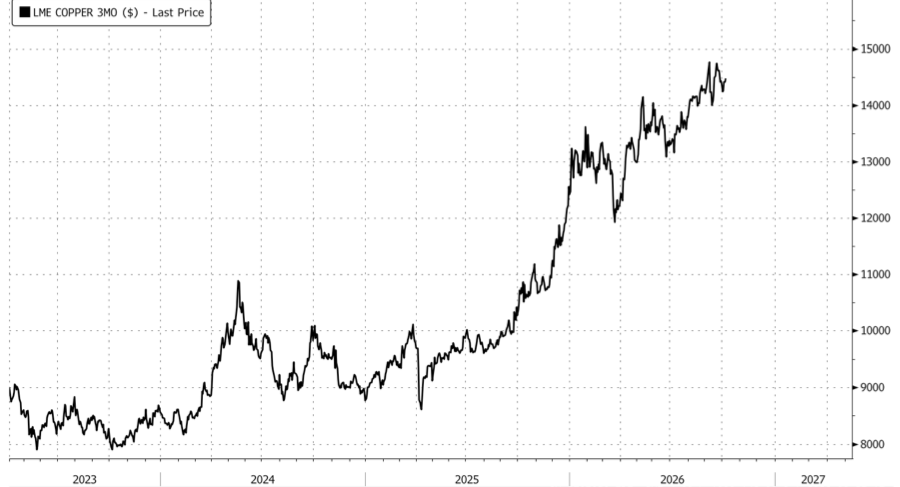
Former Goldman Sachs commodities chief Jeff Currie said in August: “Get long and buckle up.”
Currie said the convergence of tight physical markets, currency debasement and policy intervention is creating conditions for a sustained repricing of scarce resources.
Read:
Another chart of concern:
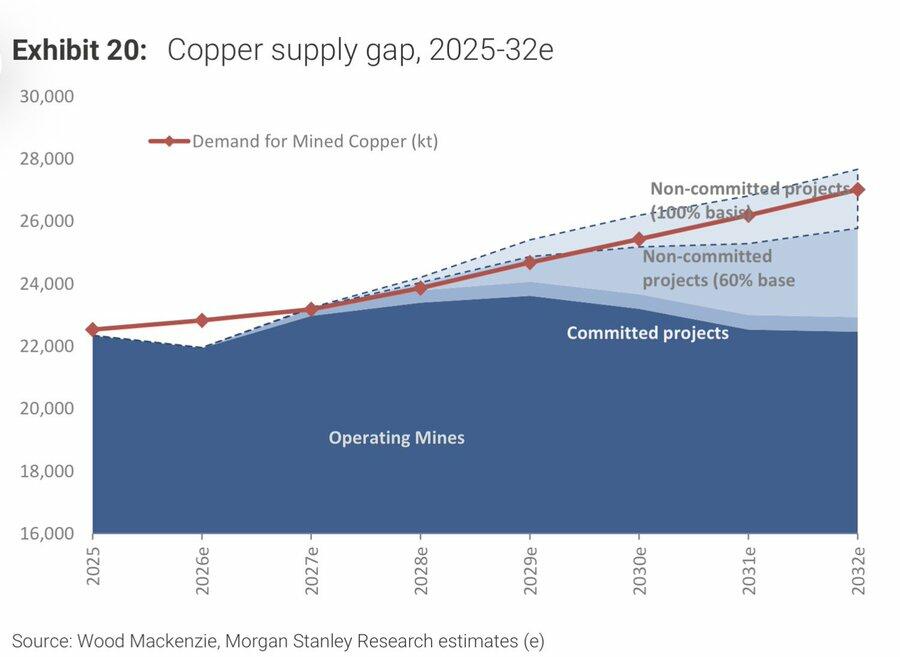
Deutsche Bank’s head of metals research, Daniel Ghali, added to the urgency last month, warning that global copper inventories have fallen to “unprecedented lows” and blaming some of that on US and Chinese stockpiling, which is squeezing supplies elsewhere. Ghali also noted that the copper rally in London could see another 50% run to $22,050 a ton by 2Q27 (read the report).
Friday, Oct 09, 2026 – 06:55 AM
A new potential bottleneck has emerged in the global copper market as London futures hover just shy of record highs amid persistent scarcity concerns.
Natalia Corfield, JPMorgan’s head of Latin America corporate credit research, wrote in a note earlier today that a strike at Centinela, a major source of Antofagasta’s copper production in Chile, has begun and could soon impact production.
“Antofagasta is facing its first-ever strike at the Centinela copper mine in Chile, set to begin this morning after mandatory mediation between the company and the Minera Esperanza and Distrito Centinela unions failed to produce an agreement,” Corfield wrote in the note.
She continued:
The unions, representing more than 700 workers, say the dispute centers on pay and benefit disparities between employees doing identical jobs but belonging to different unions, and they accuse Antofagasta of rejecting a proposed fix for these gaps without offering an alternative solution.
Should no last-minute deal be reached and the strike persist, the impact on production and results could be significant, as Centinela produced 240,400 metric tons of copper in 2025, representing more than 35% of Antofagasta’s total production, and a prolonged stoppage could also delay the timing of the mine’s concentrator expansion.
That said, Antofagasta has historically been successful in resolving potential work stoppages before they escalate, as seen in 2020 when initial contract rejections and a government mediation extension ultimately led to a deal without an actual strike.
Separately, Bloomberg cited the two unions behind the labor action that warned the Centinela could begin reducing copper production within about two weeks if the walkout continues.
London copper futures trade around $14,475 a ton and just shy of record highs.
Former Goldman Sachs commodities chief Jeff Currie said in August: “Get long and buckle up.”
Currie said the convergence of tight physical markets, currency debasement and policy intervention is creating conditions for a sustained repricing of scarce resources.
Read:
Another chart of concern:
Deutsche Bank’s head of metals research, Daniel Ghali, added to the urgency last month, warning that global copper inventories have fallen to “unprecedented lows” and blaming some of that on US and Chinese stockpiling, which is squeezing supplies elsewhere. Ghali also noted that the copper rally in London could see another 50% run to $22,050 a ton by 2Q27 (read the report).
END
COMMODITY GOLD:
The U.S. Treasury Just Opened the Door to Gold

by ITM Trading
Thursday, Oct 08, 2026 – 17:30
The President of the United States just told you how the $40 trillion gets paid. With your purchasing power.
The 10-year yield is sitting at its highest level since 2002. Central banks are passing on fatter Treasury coupons to stack more gold. And Treasury just brought in Judy Shelton, the economist who has spent decades arguing gold belongs back at the center of the system. Meanwhile, the largest gold hoard on earth is still carried on the books at $42.22 an ounce (an accounting quirk, surely, and not an option being held in reserve).
Washington ran this playbook once already, in 1934. Gold holders came out richer. Everyone holding dollars paid the bill.
So which side of the ledger are you on this time?
About ITM Trading:
ITM Trading has spent nearly 30 years helping clients prepare for monetary resets, inflation, and systemic risk using physical gold and silver. We focus on education, historical context, and strategies designed to protect wealth when trust in the system breaks down.
END
YOUR EARLY CURRENCY VALUES/GOLD AND SILVER PRICING/ASIAN AND EUROPEAN BOURSE MOVEMENTS/AND INTEREST RATE SETTINGS FRIDAY MORNING.7:30 AM
SHANGHAI CLOSED UP 1.89 PTS OR 0.05%
HANG SENG CLOSED UP 336.74 PTS OR 1.42%
Nikkei CLOSED UP 101.89 PTS OR 0.05%
//Australia’s all ordinaries CLOSED UP 0.30%
//Chinese yuan (ONSHORE) CLOSED UP AT 6.6933
/ OFFSHORE CLOSED UP AT 6.6945 Oil DOWN TO 90.52 dollars per barrel for WTI and BRENT DOWN TO 103.06 Stocks in Europe OPENED ALL GREEN
ONSHORE USA/ YUAN// WITH YUAN TRADING 6.6933 (STARTING TODAY) OFFSHORE YUAN TRADING UP TO 6.6945 ONSHORE YUAN TRADING ABOVE LEVEL // OFF SHORE AND UP ON THE DOLLAR)// / AND THUS STRONGER/OFF SHORE YUAN TRADING UP AGAINST US DOLLAR/ AND THUS STRONGER
XXXXXXXXXXXXXXXXXXXXXXXXXXXXXXXXXXXXX
ONSHORE YUAN: CLOSED UP TO 6.6933
OFFSHORE YUAN: UP TO 6.6945
1A.HANG SANG CLOSED UP 336.74 PTS OR 1.42%
1 B. SHANGHAI CLOSED UP 1.89 PTS OR 0.05%
2. Nikkei closed UP 101.89 PTS OR 0.15%
WEST TEXAS INTERMEDIATE OIL DOWN TO 90.52
BRENT; 103.06
3. Europe stocks SO FAR: ALL GREEN
USA dollar INDEX DOWN 10 BASIS PTS TO 101.84// EURO RISES TO 1.1231 UIP 18 BASIS PTS
3b Japan 10 YR bond yield:FALLS TO. +3.004 DOWN 9 FULL BASIS PTS/ VERY TROUBLESOME//Japan buying 100% of bond issuance)/Japanese YEN vs USA CROSS NOW AT 158.33… JAPANESE YEN NOW FALLING AS WE HAVE NOW REACHED THE ENDING OF THE YEN CARRY TRADE AGAIN AND THE REPATRIATION OF YEN DENOMINATED BONDS TRADING IN THE USA/EUROPE. JAPAN 30 YR BOND YIELD: 4.060 DOWN 12 FULL BASIS PTS
3c Nikkei now ABOVE 17,000
3d USA/Yen rate now well ABOVE the important 120 barrier this morning
3e Gold UP /JAPANESE Yen UP//CHINESE ONSHORE YUAN: UP (6.6933) AND OFFSHORE: UP AT 6.6945
3f Japan is to buy INFINITE TRILLION YEN worth of BONDS. Japan’s GDP equals 5 trillion USA. CENTRAL BANK OF JAPAN WILL NO LONGER DO QE.
Japan to buy 100% of all new Japanese debt and NOW they will have OVER 50% of all Japanese debt. GOVERMENT ASKED JAPAN PENSION FUNDS AND INSURANCE FUNDS TO BUY MORE JAPANESE BONDS AND REPATRIATE ALL FOREIGN BONDS.
3g Oil DOWN for WTI and DOWN for Brent this morning
3h European bond buying continues to push yields LOWER on all fronts in the EU German 10yr bund YIELD DOWN TO +3.4565/ Italian 10 Yr bond yield DOWN AT 4.542/ SPAIN 10 YR BOND YIELD DOWN TO 4.063%
3i Greek 10 year bond yield DOWN TO 4.390%
3j Gold at $4201.50 /Silver at: 60.51 1 am est) SILVER NEXT RESISTANCE LEVEL AT $100.00
3k USA vs Russian rouble;// Russian rouble DOWN 0 AND 65/ 100 roubles/85.67
3m oil (WTI) into the 90 dollar handle for WTI and 103 handle for Brent/
3n Higher foreign deposits moving out of China// huge risk of outflows and a currency depreciation. This can spell financial disaster for the rest of the world/
JAPAN ON JAN 29.2016 CONTINUES NIRP. THIS MORNING RAISES AMOUNT OF BONDS THAT THEY WILL PURCHASE UP TO .5% ON THE 10 YR BOND///YEN TRADES TO 158.38 // 10 YEAR YIELD AFTER FIRST BREAKING .54% LAST YEAR NOW EXCEEDS THAT LEVEL TO 3.0010% DOWN 9 BASIS PTS STILL ON CENTRAL BANK (JAPAN) INTERVENTION//YEN CARRY TRADE NOW UNWINDING//YEN BOND TRADING OVERSEAS TO BE REPATRIATED.//JAPAN 30 YR: 4.060 DOWN 12 PTS..: USA/SF this 0.8298 as the Swiss Franc . Euro vs SF: 0.9321
USA 10 YR BOND YIELD: 5.237 UP 0 BASIS PTS…NOW ABOVE 5.00%
USA 30 YR BOND YIELD: 5.615 UP 1 BASIS PTS/REFUSES TO GO DOWN WITH BESSENT’S QE TWIST
USA 2 YR BOND YIELD: 4.781 UP 3 BASIS PTS
USA DOLLAR VS TURKISH LIRA: 49.34 UP 12 BASIS PTS/LIRA GETTING KILLED//IDIOTS FOR SELLING GOLD AND USA DOLLAR RESERVES.
10 YR UK BOND YIELD: 5.4264 DOWN 6 PTS
30 YR UK BOND YIELD: 5.9369 DOWN 6 BASIS PTS
10 YEAR FRENCH BOND YIELD; 4.812 % //DOWN 7 BASIS PTS
10 YR CANADA BOND YIELD: 3.932 DOWN 2 BASIS PTS
5 YR CANADA BOND YIELD: 3.532 DOWN 2 BASIS PTS.
1a New York Opening report
Futures Rise After OpenAI Damage Control Sparks Tech Rebound, Oil Slides
Friday, Oct 09, 2026 – 08:29 AM
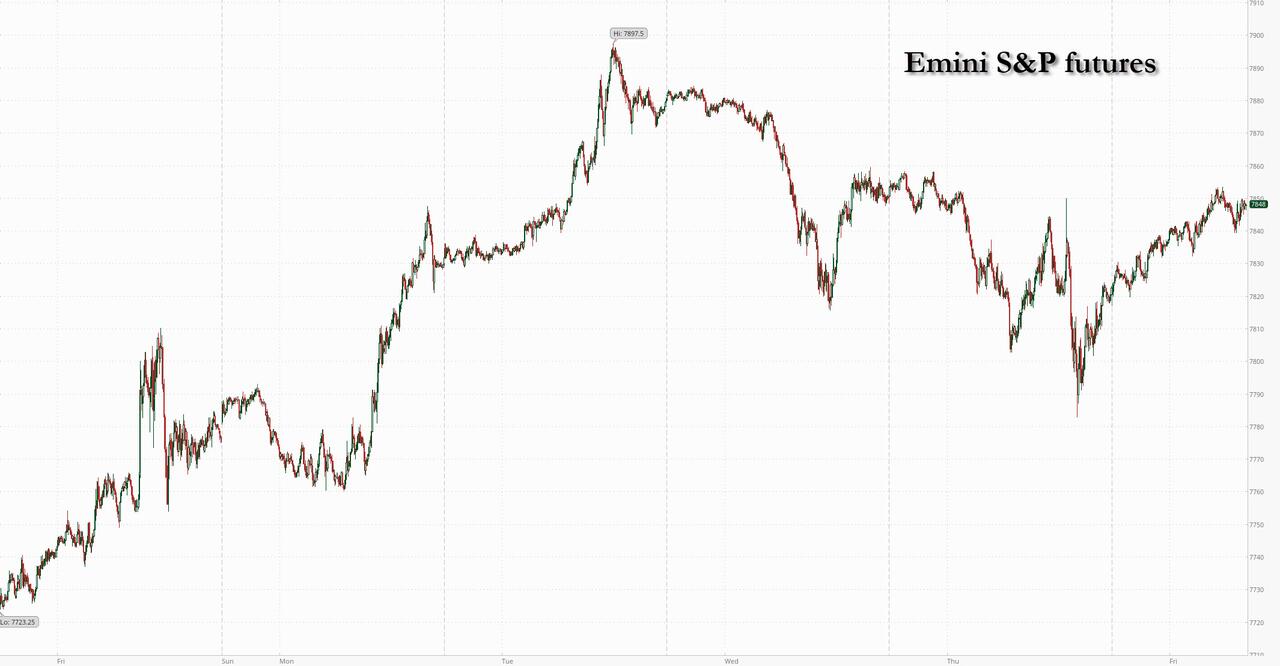
US futures are higher as a trifecta of AI relief, easing geopolitical tensions and fading energy prices has lifted sentiment into the final trading day of the week: OpenAI walked back Thursday’s FT-sparked revenue scare by telling people it expects to reach or exceed $70 billion in annualized revenue by year-end, while President Trump said the US would not attack Iran before the November midterms; as a result Nasdaq futures are up 0.8% and Brent has slipped back toward $102 after nearly touching $106 on Thursday. As of 7:15am ET, S&P futures are 0.4% higher at 7,850 while Nasdaq futures are up 0.8% and Dow futures rise 0.2%. That follows a session in which the S&P fell 0.47% to 7,765 and the SOX tumbled 3.4% after the FT reported OpenAI’s annualized revenue was about $50 billion, even as two thirds of S&P members finished higher. In premarket trading, tech leads with Nvidia up 2% and the SOXX ETF up 1.9%, while Apple is the notable Mag 7 laggard, down 2% on a report it cut iPhone 18 Pro component orders, confirming our article from yesterday; telecoms are getting crushed (AT&T, Verizon and T-Mobile all down 6-7%) after SpaceX bought a nationwide low-band spectrum portfolio, tower stocks jump and Humana soars 15% on better Medicare Advantage ratings. The day’s driver is oil (again), but this time on the way down: WTI is down 0.9% to $90.67 and Brent is down 1.3% to $102.92 even as Hurricane Isaias has shut in some 1.3 million b/d, or 63%, of Gulf of Mexico crude output. Treasuries are the exception to the global bond relief rally: yields are 1-2bps cheaper across the curve, led by the front-end, with the 10Y around 5.245% after Thursday’s 6bp bull-flattening rally, while bunds and gilts outperform after Christine Lagarde told finance ministers the ECB has tools for disorderly spread moves. The Bloomberg dollar index is down 0.1%, with the yen the only G10 currency lagging. In commodities, gold is up about 1.3% and has climbed as high as $4,208, silver is up 2% to above $60, US natgas is down 1.5% to $3.12 and copper is firmer. Bitcoin adds about 1%, trading near $82,500. US economic data slate includes the October preliminary University of Michigan sentiment and inflation expectations (10am). Fed speaker slate includes Collins (4pm). The US bond market is closed on Monday.
In premarket trading, Magnificent Seven stocks are mostly higher: Nvidia (NVDA) +1.6%, Tesla (TSLA) +1.1%, Microsoft (MSFT) +1%, Amazon (AMZN) +0.6%, Alphabet (GOOGL) +0.6%, Meta Platforms (META) +0.3% while Apple (AAPL) falls 2% after a report that the company cut component orders for the iPhone 18 Pro and iPhone 18 Pro Max following weaker-than-expected demand.
- Tower companies gain after SpaceX said in a post on X that it had agreed to acquire a nationwide low-band spectrum license portfolio in a deal analysts say is a positive catalyst for the sector.
- Telecom stocks slip on concerns over increased competition from satellite operators, with T-Mobile (TMUS) -7.8% and AT&T (T) -6.3%
- Optical-equipment makers rally after Lumentum (LITE +6.2%) noted that its components are “completely sold out” through early 2029 on demand from tech companies clamoring for faster AI data centers.
- American Express (AXP) falls 1.5% after federal regulators fined the credit card company $350 million for failing to catch and report money laundering in its system.
- Cboe Global Markets Inc. (CBOE) gains 2% after Morgan Stanley upgraded the exchange.
- Delta Air (DAL) is down 3.4% after the carrier cut its adjusted earnings per share forecast for the full year. The midpoint of the new outlook trailed the average analyst estimate.
- Fastly Inc. (FSLY) gains 7.4% after Oppenheimer upgraded the software company to outperform from perform, seeing a growing opportunity related to AI agents.
- Humana (HUM) jumps 15% after the health insurer improved its performance on the Medicare Advantage quality ratings that will improve future revenue. Baird upgraded the stock.
- South Bow (SOBO) falls 1.6% after Barclays cut its recommendation on the pipeline company to underweight from equal-weight on execution and permitting risk.
- Webull Corp. (BULL) rises 4.4% after Scotiabank raised its recommendation on the exchange to sector outperform from sector perform after the recent selloff in shares
In other corporate news, OpenAI issued a damage control media blitz, leaking to Bloomberg that it now expects annualized revenue to reach or exceed $70 billion by year-end from roughly $50 billion at the end of September, driven largely by its enterprise business. Masayoshi Son’s SoftBank is seeking to raise up to $100 billion from Gulf investors, the FT reports. Elon Musk’s SpaceX acquired low-band spectrum to enable its Starlink satellites to become a “major mobile carrier” in the US. Federal regulators fined American Express $350 million for failing to catch and report money laundering in its system. Nvidia-backed Firmus Grid shelved its Australian IPO and is exploring a private funding round to raise $2 billion to $3 billion. ExxonMobil blocked a proposal for partners in the Kashagan oil field in Kazakhstan to settle with the government over a disputed $5 billion environmental fine. KKR delayed the planned commencement of its tender offer for Taiyo Holdings to late November. Hexagon agreed to buy Rocscience for an enterprise value of $535 million. Nvidia is set to invest in d-Matrix and networking startup Eliyan is drawing takeover interest, per The Information. TRex Bio raised $116.7 million in a US IPO priced at the bottom of its range, Crescent Energy priced a stock offering, PepsiCo is selling €1 billion of notes in Europe a day after cutting its 2026 earnings forecasts, Airtel Money traded lower in its London debut, and Ambani’s Jio set its IPO price band at 1,065-1,119 rupees.
Thursday’s AI wobble is being re-framed overnight as an accounting quirk rather than a demand reset: clarification on OpenAI’s annualized revenue run rate is spurring a relief rally in associated thematic baskets and the chip sector after Thursday’s sell-off, which saw the OpenAI ecosystem drop 3.8% and the SOX 3.4% (as detailed yesterday). And with oil sliding after Trump said the US would not attack Iran before the midterms, risk assets are looking to end the week on a high note. Still, markets keep doing what they’re not supposed to: the S&P hit a record earlier this week even as the 30Y auction priced at the highest yield since August 2000, and strains under the AI hood remain evident, with Oracle CDS hitting new highs as Morgan Stanley cautioned project delays could pressure the company’s debt (on which more here).
“People are worried, and that’s not a sign of a bubble,” said Goldman strategist Christian Mueller-Glissmann in a Bloomberg TV interview. “Usually, when you’re in the bubble, there’s a lot of exuberance, and people have FOMO.”
“The thing that we have seen in the last 18 months or so is that you continue to get waves of bad news around AI, around the whole tech trade, and then it typically settles down after a couple of days, and the market reverts to read the optimism,” said Seema Shah, chief global strategist at Principal Asset Management.
The S&P 500 may have hit a fresh record this week, but the headline index continues to flatter the underlying market. Breadth remains weak at both the sector and stock level, with performance increasingly reliant on a narrow group of heavyweight winners.
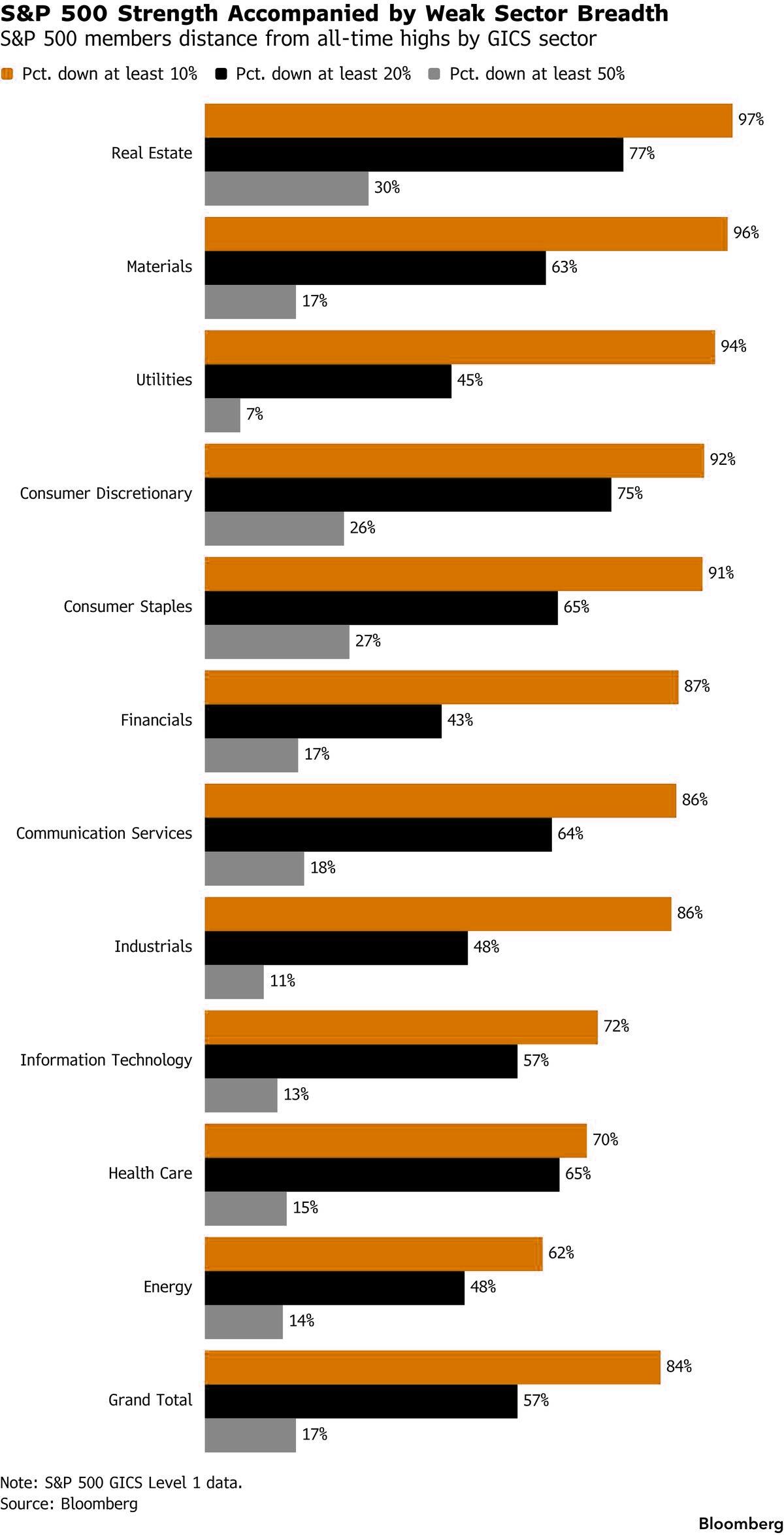
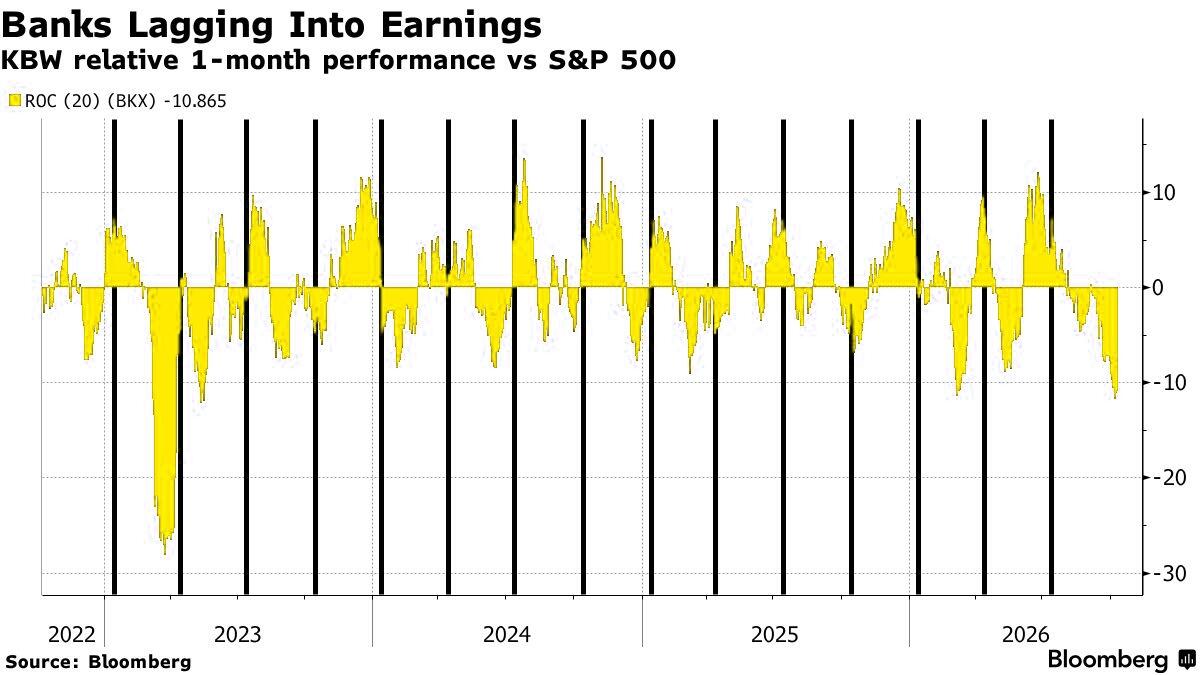
Banks kick earnings season into gear next week, with the sector trailing the S&P 500 by 11% over the last month. Meanwhile, investors flocked to cash in the week to Oct. 7, with money market funds seeing their biggest inflow since April 2020, according to Bank of America strategists. Open interest in call options for the iShares 20+ year Treasury bonds ETF has moved exponentially higher.
JPM’s Market Intel desk under Andrew Tyler stays Tactically Bullish, “albeit with lower conviction.” The team notes the most sold-off tech names are recovering “some of the losses, not fully,” but warns Thursday’s price action showed the AI narrative “remains imbalanced and vulnerable to headline risks,” with next week’s global CPI releases the biggest near-term risk. The key change last week was rates: October hike odds collapsed from 64% to 22%, and the market now prices roughly one hike in 2026 and two in 2027. On earnings, FactSet consensus has Q3 at 29.5% EPS growth on 12.3% revenue growth. The mood on the desk, however, is grim: JPM trader Matt Reiner writes that “Confidence is shot” and high-touch volumes are tracking 57% below the 5-day average, quoting one client: “I’m right one day, wrong the next.” Clients remain in “buy the dip” rather than “sell the rally” mode, “but very few are stepping in on shallow index dips.”
Goldman’s desks spent the night unpacking the OpenAI numbers. In London, Jonathan Lightowler writes that it now looks like “a case of non apples-for-apples comparison across the two numbers rather than a true mis-step on guidance”, while TMT specialist Sean Johnstone puts it more bluntly: “This was not a growth collapse — OpenAI is still growing very rapidly.” The credit market isn’t so sure: Johnstone flags Oracle 5Y CDS at a record 261bp and Broadcom at a record 136bp as “nearly $500bn of 2026 AI-related borrowing” gets repriced. GS’s Sam Dunn notes that despite the S&P falling 0.5% on Thursday, 70% of index members finished higher, while the S&P 500 vs S&P ex-AI divergence is now nearly 10%. And in his Macro Roadmap, Rikin Shah warns that “the UST market is on a path to find the biting point where the level of sensitivity of AI issuance to yields picks up, or other parts of the economy break.”
Hurricane Isaias threatens already tight energy markets, with oil producers in the Gulf having shut in some 1.3 million barrels a day of crude production, or 63% of output in the region. In politics, Mayor Zohran Mamdani called for an end to federal immigration enforcement in New York City after an ICE officer shot and wounded a man in front of a child; with Trump’s approval rating sinking lower, the potential for a heavy Republican defeat in the midterms may move from tail risk to central point of focus for traders. Separately, the Trump administration accused Microsoft, Adobe and others of abusing a US worker visa program and suspended them indefinitely from a longstanding immigration initiative.
In Europe, French bonds lead the euro-area rally as crude retreats, with the 10Y OAT yield down as much as 8bps to 4.82% and the OAT-Bund spread set to end the week around 135bps vs last week’s peak of 151bps, although Bloomberg notes France’s bond risk is now outpacing Italy’s by the most in euro history (more in “France’s Debt: Too Heavy To Lift, Too Big To Spot“). Helping sentiment: ECB President Lagarde reportedly told euro-area finance ministers the ECB had instruments to deal with unwarranted and disorderly market dynamics. Goldman’s strategists think “the OAT sell-off appears to have overshot fundamentals, amplified by positioning,” but caution that “France is cheap relative to peers but lacks a catalyst.” The next sticking point is October 13, when lawmakers begin formal debate on the draft budget.
In Europe, the Stoxx 600 is up 1% at 631.36, erasing its weekly decline as lower oil prices boost sentiment, with 518 members up and just 77 down. Basic resources and retail lead gains, while telecoms and energy lag: Deutsche Telekom has fallen as much as 8% to lead a slump in European telcos on the SpaceX spectrum deal. JPM notes that Ceasefire, Software, AI Disruptions, UK Homebuilders and Luxury are among the top performing baskets; the FTSE 100 is up 0.9%, the Euro Stoxx 50 0.8% and the DAX 1.1%. Here are the biggest European movers:
- Soitec shares rise as much as 7% after being upgraded to buy from neutral at Bank of America, which sees the French wafer maker as one key upstream winner in the supply chain for silicon photonics.
- Deutsche Telekom leads a slump in European telecom stocks after SpaceX said it acquired low-band spectrum in the US, adding to investor concerns over increased competition from satellite operators.
- Bureau Veritas shares rise as much as 3.6%, the most since July 29, after Citi upgraded the testing and certification group to buy on an underappreciated margin progression.
- Morgan Advanced and Rational rise as they are upgraded to outperform from sector perform at RBC, as analysts say the industrial sector continues to deliver better top line momentum, which they expect will continue in 3Q.
- Mobile payments firm Airtel Money traded lower in its London Stock Exchange debut on Friday, a listing that may mark the largest initial public offering for the bourse in five years.
Asian stocks edged higher in holiday-thinned trading as lower oil prices and OpenAI’s upbeat revenue outlook supported risk appetite, with the MSCI Asia Pacific Index rising as much as 0.5% to snap a two-day decline, though it was still headed for a weekly loss. Markets in South Korea and Taiwan, two of the region’s chip hubs, were closed for holidays. Hong Kong outperformed: per Goldman’s desk, the Hang Seng rose 1.8% and the Hang Seng Tech index 3.1%, led by Xiaomi, which jumped about 10% after its SkyNomad SUV logged more than 70,000 orders. Mainland China was weak for most of the session, with the STAR 50 down as much as 3.8% and the CSI 300 down 1.3% at midday, before staging a sharp rebound into the close on speculation that regulators advised funds and insurers to limit sell orders. Japan’s Nikkei ended little changed after recouping an early tech-led drop, with SoftBank Group down 4.3%, while Australia’s ASX 200 rose about 0.5%. Goldman’s APAC desk was 1.4x better to sell and notes Asian equities have been net sold for four consecutive months.
In FX, the Bloomberg Dollar Spot Index is down 0.1%, with downside limited by a weaker yen; the DXY trades in a 101.92-102.14 range, well off the week’s peak of 102.53. The Antipodeans outperform given the risk tone, the yen lags as Japanese bond yields fall (USD/JPY 158.26), and NOK is softer after cooler-than-expected inflation. EUR/USD is up 0.2% at 1.1232 and back above 1.12 but still close to this week’s lows on the French fiscal saga, while cable is up 0.1% at 1.3244 after Labour comfortably won the Holborn & St Pancras by-election. “The USD is loosing a bit of altitude with the decline in longer dated UST yield seemingly the main factor,” said Rodrigo Catril, currency strategist at National Australia Bank.
In rates, Treasuries are slightly cheaper across the curve, unwinding a portion of Thursday’s sharp bull flattening rally as US debt lags gains seen across European bonds on lower oil prices. Yields are 1-2bps cheaper with the front-end leading, flattening the 2s10s spread by around half a basis point; the 10Y trades around 5.245%, cheaper by 2bps, with bunds and gilts outperforming by 3bps and 4.5bps in the sector as European bonds catch up with the late-day gains in Treasuries seen Thursday, when the 30Y auction “stopped on the screws” at 5.618%. Hawkish Fed chatter isn’t helping: Musalem signaled rates should increase over the next six-to-nine months, while Waller said “I anticipate additional hikes to support a timelier return of inflation to our 2 percent goal.” In Japan, the 10Y JGB yield fell 5.5bps to 3.025%. The IG dollar issuance slate is empty and expected to stay that way ahead of Monday’s bond market holiday; this week’s 13 deals for an average of $873 million is set to be the smallest this year (one can hardly blame CFOs for not rushing to lock in 24-year-high funding costs).
A further sharp rise in 10-year Treasury yields is “feasible” as hedge funds and other investors are forced to ditch their losing bets, Pimco CIO Dan Ivascyn told the FT: “It is certainly possible, even from a short-term trading perspective, given that some of the activity we’ve seen in the last couple of weeks is tied to some negative technicals, some stop-out activity from the platform hedge funds and other levered investors.”
In commodities, WTI is down 0.9% at $90.67 (off a $91.41 high and a $90.01 low) and Brent is down 1.3% at $102.92 after sliding from $104.09 to as low as $102.33, pressured by Trump’s comments that the US will not attack Iran before the November midterms and that discussions with Tehran remain productive. Downside is contained by ongoing supply risks: the IRGC reiterated restrictions on vessels in the Strait of Hormuz, Fars reported several explosions in the southern passage of Hormuz caused by tankers hitting mines (as we reported), and Gulf of Mexico producers have shut 63% of output ahead of Hurricane Isaias. Goldman estimates the Brent risk premium averaged $22/bbl in September, the second highest monthly reading on record after April 2026. Dutch TTF is softer in a €76.27-78.63/MWh range, spot gold has climbed from $4,131 to $4,208/oz and silver from $59.25 to $60.61/oz, while 3M LME copper trades toward the top of a $14,298-14,518/t range. China is set to resume October refined fuel exports after a brief Golden Week halt.
US economic data slate includes the October preliminary University of Michigan sentiment, current conditions, expectations and 1-year and 5-10-year inflation expectations (10am). Fed speaker slate includes Collins (4pm). Delta Air Lines reports before the open, with higher jet fuel prices in focus after the airline reduced its full-year earnings outlook; US bank earnings kick off next week alongside September CPI, PPI and retail sales.
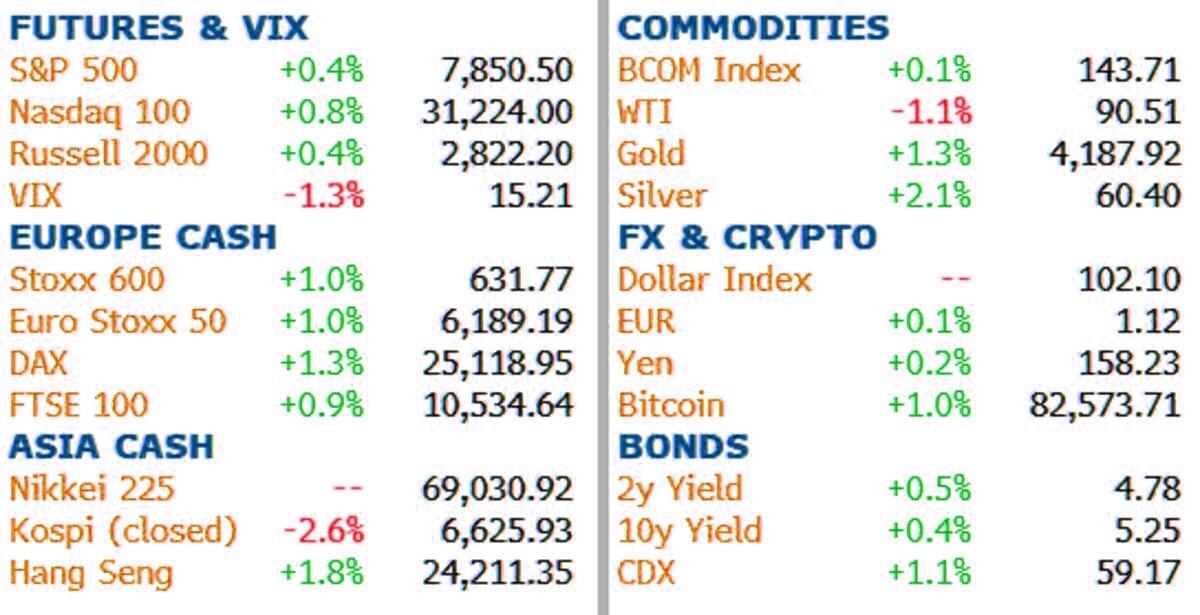
Market Snapshot
Top Overnight News
- Oil declined after President Donald Trump said the US would not attack Iran before November’s midterm elections, signaling a period of more than three weeks for no offensive military action against Tehran. BBG
- Three Saudi Arabian citizens were killed and others were injured in two attacks on the main airport in the capital, Riyadh, on Thursday, Saudi authorities said, as the kingdom faces intense fire from the Houthis. BBG
- Offshore US oil production is plummeting as Hurricane Isaias pushes toward a coastline dotted with refineries and chemical plants; Gulf producers have shut in some 1.3 million barrels a day, or 63% of output in the region. BBG
- China is set to resume October refined fuel exports after a brief halt during its Golden Week holiday, four traders familiar with the matter said on Friday, a move that will help ease tight global diesel, gasoline and jet fuel markets. RTRS
- Goldman’s oil team estimates Brent’s risk premium averaged $22/bbl in September, the second highest monthly reading on record, and sees upside risk to its price forecast if geopolitics keep the premium elevated for longer. GIR
- OpenAI expects annualized revenue to surge to at least $70 billion by year-end from roughly $50 billion at the end of September, people familiar said, driven largely by its enterprise business. BBG
- Bloomberg sources stated that OpenAI sees run-rate revenue reaching or topping USD 70bln in 2026 and that OpenAI annualised revenue was around USD 50bln at end-September. This followed an FT report stating that OpenAI’s annualised revenue is about USD 20bln below what had previously been signalled. Newsquawk
- Apple has told some of its suppliers to cut production of components for its newly launched iPhone 18 Pro and iPhone 18 Pro Max, after soaring memory chip costs forced price increases that have dampened consumer demand. Nikkei
- Masayoshi Son is seeking to raise up to $100bn from Gulf investors, as the SoftBank founder hunts for fresh financial firepower to scale up a colossal AI bet that has already made him one of the technology’s biggest champions. FT
- Delta Air reduced its full-year earnings outlook due to high jet fuel prices stemming from the war in the Middle East. BBG
- Chinese stocks staged a sharp rebound, lifting all benchmarks into the green, with investors citing speculation that regulators have advised funds and insurers to limit sell orders. BBG
- Japan is eyeing as much as $44.3 billion of unused government funds to free up resources for Sanae Takaichi’s policy priorities. Household spending fell for a ninth month. BBG
- Flávio Bolsonaro has 52% support in the runoff against President Luiz Inácio Lula da Silva’s 48%, a Datafolha poll showed. BBG
- The US government is launching investigations into the use of foreign exchange visa programs at nine top colleges including Harvard, Stanford and MIT. BBG
- The Trump administration accused Microsoft, Adobe and others of abusing a US worker visa program and suspended them indefinitely from a longstanding immigration initiative. BBG
- Elon Musk’s SpaceX acquired low-band spectrum to enable its Starlink satellites to become a “major mobile carrier” in the US, sending incumbent carriers lower and tower stocks higher. BBG
- A further sharp rise in 10-year Treasury yields is “feasible” as hedge funds and other investors are forced to ditch losing bets on bonds, Pimco CIO Dan Ivascyn said. FT
- Fed Governor Waller said he anticipates “additional hikes”, though further hikes “do not need to come at consecutive meetings”. BBG
- ECB President Lagarde told euro-area finance ministers the ECB has instruments to deal with unwarranted and disorderly market dynamics. BBG
- Money market funds saw their biggest inflow since April 2020 in the week to Oct. 7, according to Bank of America strategists. BBG
- EU to assess a windfall tax on energy firms to soften the price shock. BBG
- Zelenskyy said Ukraine hit the Omsk and Ukhta oil refineries in Russia. BBG
A more detailed look at global markets courtesy of Newsquawk
APAC stocks traded mixed following the lacklustre handover from Wall St, where most major indices declined, and the Nasdaq underperformed as tech selling and AI-related concerns were stoked by a report that OpenAI’s annual revenue was USD 20bln below previous estimates, at USD 50bln versus USD 70bln, although there have been a couple of reports since that have provided some clarification regarding this. ASX 200 was positive with the majority of sectors in the green, although gains were capped amid underperformance in telecoms and with commodity-related industries range-bound. Nikkei 225 declined at the open amid tech-related pressure and with the index also not helped by the closures of its tech-heavy counterparts in South Korea and Taiwan, but has since recouped most of the losses. Hang Seng and Shanghai Comp diverged amid mixed performances in tech stocks and with the mainland pressured after a paltry liquidity operation by the PBoC, while the subdued spending during the National Day holiday also raises questions regarding domestic demand in the Chinese economy.
Top Asian News
- China’s Ministry of Finance H1 fiscal policy execution report said it will reasonably accelerate fund disbursements and utilisation, continue optimising the fiscal expenditure structure, and ensure protected spending for priority areas. The Finance Ministry added that they will implement more proactive fiscal policies, deepen fiscal reform and step up risk prevention and resolution in key areas.
- China announced total domestic travel spending of CNY 738.38bln for 7-day Golden Week Holiday.
- Japan’s cabinet approved the bill to reduce food consumption tax to 1% (prev. 8%) for a two-year period, according to TBS.
European bourses (STOXX 600 +0.9%) start the final trading session of the week entirely in the green. The downside in energy prices is helping support the equity space, after US President Trump refuted reports that the US will not strike Iran before the midterms. Markets will be waiting for next week, when earnings start flowing through, with ASML the European highlight. Sectors highlight the positive bias. Basic Resources top the sector pile, with Retail and Financial Services rounding out the sector gainers. On the other hand, Telecoms is the clear laggard, followed by Energy. The driver behind the underperformance in Telecoms comes following SpaceX’s USD 8bln acquisition of Grain Management’s 800 MHz spectrum portfolio. This purchase would move Starlink closer to mounting a direct challenge to legacy wireless companies. Deutsche Telekom shares are falling as much as 8%, while US peers are also under pressure premarket (AT&T -7.4%, Verizon -7%). US equity futures follow their European peers higher. Sticking with the earnings theme, FactSet estimates that analysts expect S&P 500 earnings growth of +29.5% Y/Y in Q3 (vs +26.7% Y/Y in Q2), marking a third straight quarter above 25% growth. SoftBank (9984 JT) is seeking up to USD 100bln from Gulf investors, including the UAE, to establish a fund acquiring companies and improving their operations using AI, according to the FT.
Top European News
- The UK Labour Party won the Holborn and St Pancras by-election, taking 45% of the votes, while the Greens came second with nearly 33%.
FX
- G10s are mostly firmer against the USD, with the exception of the JPY. The Antipodeans outperform given the risk tone, whilst the JPY lags. Energy benchmarks are in the red this morning, with attention on Trump pushing back on reports that he would strike Iran before the midterms; moreover, he mentioned that he is having “productive” discussions with Iran. Nonetheless, the situation remains tense with reports suggesting that the US military has drafted options for three days of strikes.
- DXY is a little lower this morning and resides within a 101.92 to 102.14 range, and well off the WTD peak of 102.53; but still remains towards the YTD high. Strength this week was facilitated by higher energy prices and yields, and as EUR faltered on French fiscal woes (more below). Attention for the USD for the remainder of the day will be any updates on the Iran situation, with Foreign Minister Araghchi said to give Iran’s response in the coming days. Domestically, UoM survey is due today and will likely see revisions to higher inflation expectations. Across the northern border, Canadian jobs are to be released today.
- EUR is a touch firmer this morning, and back above the 1.12 mark; nonetheless, the single currency holds towards WTD lows of 1.1161. This week’s pressure has been facilitated by the French fiscal situation, with the draft budget seen as ineffective in solving the fiscal issue. RN’s Le Pen announced her own alternative budget, which spurred some mild strength in the EUR at the time, but has been described as too optimistic, resulting in renewed pressure in the single currency. Overall, the debacle in France will likely keep the EUR pressured for the foreseeable future, with the next sticking point on October 13th, when lawmakers will debate the budget. Traders will keep an eye out for any material changes to the existing draft and/or major friction points, which could result in the use of Article 49.3.
- GBP digests the region’s Holborn & St Pancras by-election, which saw the Labour Party win 45% of the vote. Overall, the results were not expected to spur any material market reaction, but rather provide investors with information on whether the “Burnham bounce” is still in effect. It appears that is the case, and removes one of the hurdles for the PM to call an early election. The next obstacle is the Autumn Budget (Oct 28), and if that passes without issue, the possibility of an early election will only grow.
Central Banks
- NBP’s Kotecki said if inflation projection does not show CPI returning close to 2.5% by end of 2027 or beginning of 2028, a 25bps rate hike will be necessary in November.
Fixed Income
- Global fixed benchmarks are mixed. USTs (-4 ticks) are off by a couple of ticks, whilst Bunds (+30 ticks) and Gilts (+43 ticks) are in the green, benefiting from easing energy prices. This comes after President Trump suggested he is having “productive” discussions with Iran, and pushed back on reports that he would order strikes on Iran before the midterms (see commodities for details).
- USTs are not faring quite so well as their European counterparts, potentially weighed on by continued hawkish comments from the Fed’s Musalem and Waller, who reiterated the need to raise rates further. Earlier in the week, the US sold 3-year and 10-year notes, which were very well received. This perhaps indicates that the recent surge in yields is offering good value for investors, and bar any resurgence in geopolitical fighting, an early indication that yields could begin to ease from highs. The US 10-year (5.24%) currently holds off near-term highs at 5.36%, but still remains in the territory of multi-year highs.
- Bunds and Gilts are stronger this morning, facilitated by lower energy prices. The latter had the Holborn and St Pancras by-election to digest, though this spurred little action in UK paper at the open. There will be no real impact in the near-term by way of policy, but it shows that PM Burnham has cleared his first hurdle; the next being the UK Budget on Oct 28.
- Back to German paper, they started the morning firmer by c. 60 ticks, but are now off best levels as energy prices moved off lows. EGBs more broadly caught a bid in the prior session for two main reasons: 1) ECB Minutes suggested that yields are doing some of the tightening for it, and 2) Italian PM Meloni securing the final approval for a new electoral reform, which essentially gives a leading coalition a better chance at forming a stable government. This reduces some political risk, which Europe has been subject to in the past week: Germany (coalition talks passed without issue), Spain (called an early election) and most importantly France (increased fiscal debt woes). For the latter, the next sticking point is on October 13, when lawmakers will begin formal debates on the draft budget. The OAT-Bund spread is set to end the week around 135bps (vs last week’s peak of 151bps).
- Australia sells AUD 1bln 3.0% November 2033 bonds: b/c 3.77x, avg. yield 5.146%.
Commodities
- WTI Nov and Brent Dec futures are softer after pulling back from Thursday’s highs, with the complex pressured by Trump’s comments that the US will not attack Iran before the November midterms and that discussions with Tehran remain productive. Nonetheless, the downside remains contained by ongoing supply risks, with the IRGC reiterating restrictions on vessels passing through the Strait of Hormuz, while Tasnim reported a massive fire at Saudi Arabia’s Abqaiq oil facility, although this could be a continuation of the smoke also reported in the prior session. Elsewhere, reports suggested US-Iran negotiations have continued through intermediaries, while CENTCOM said primary shipping lanes have been cleared of mines. Elsewhere on the supply front, Gulf of Mexico producers have shut around 63% of oil production ahead of Hurricane Isaias, removing nearly 1.3mln BPD from the market. WTI has fallen from a USD 91.41/bbl high to a USD 90.01/bbl low, while Brent has declined from USD 104.09/bbl to a USD 102.33/bbl trough.
- Dutch TTF is softer alongside the broader pullback in energy prices, although ongoing Middle Eastern supply concerns and uncertainty surrounding shipping through Hormuz remain overall supportive. TTF resides within a EUR 76.27-78.63/MWh range.
- Precious metals are firmer, with spot gold benefiting from lower global yields and a softer DXY following strong demand at yesterday’s US 30yr Treasury auction, while the pullback in crude prices has also eased some near-term inflation concerns. Nonetheless, expectations of further Fed tightening remain a potential headwind, with Fed Musalem the latest to suggest additional policy firming will be required. Spot gold has climbed from a USD 4,131/oz low to USD 4,208/oz, moving above yesterday’s USD 4,103-4,146/oz range, while spot silver has also gained, rising from USD 59.25/oz to USD 60.61/oz.
- Base metals are overall firmer amid the pullback in energy, with copper attempting to recover from yesterday’s losses. The complex has found some support from renewed Chinese demand, low inventories and supply disruption concerns at Antofagasta’s Centinela mine in Chile. 3M LME copper resides towards the top of a USD 14,298.53-14,517.80/t range.
- China approved non-state crude oil import quota for 2027 at 257mln metric tons, while it was also reported that China is set to resume October refined fuel exports after a brief halt and approved October fuel exports at around 3.7mln metric tons, according to industry sources.
- Gulf of Mexico oil producers shut 63% of production ahead of a hurricane, while cuts have removed nearly 1.3mln barrels per day from the market, according to NBC citing Marine Minerals Admin.
- NHC said Hurricane Isaias is strengthening, with maximum sustained winds of 101mph.
- Zimbabwe said there is no reason to delay lithium concentrate export ban.
Trade/Tariffs
- US Treasury Secretary Bessent may skip the APEC finance ministers’ meeting in Hong Kong to focus on talks with Chinese Vice-Premier He Lifeng in Shenzhen ahead of President Trump’s November visit, according to SCMP citing sources.
Geopolitics: Middle East
- The US military drafted options for three days of strikes as President Trump hesitates, according to NYT.
- A US military source told Al-Hadath that US forces received orders to mobilise last Sunday and that thousands of missiles have been replaced and sent to forces. The military source added that options are always available and are focused on imposing a complete blockade on Iranian ships and ports. Proposals have been presented to Trump to strike Iranian military capabilities along the coast to a depth of 50-80km.
- Diplomatic sources said US-Iran negotiations and exchanges of messages have continued since the Iranian delegation returned from New York, Al-Akhbar reported. The source added that Qatari mediation efforts are intensifying as talks enter a “decisive and highly sensitive” stage that could either pave the way for an agreement or sharply increase the risk of a return to war.
- Iranian President Pezeshkian said they never left the negotiating table despite US attacks, while they are currently compiling proposals, and after the final text is prepared, we will review it through mediators and convey all proposals. It was separately reported that Pezeshkian said they will sit with the mediators to crystallise the final proposal and confirm it, as well as stated that they exchanged proposals with America through intermediaries and introduced some amendments, according to Al Arabiya.
- The IRGC Navy political affairs officer said vessels violating restrictions in the Strait of Hormuz are punished every night.
- Yemeni sources said the pro-government Southern Giants forces are advancing towards the Bab al-Mandab coastal area, Sky News Arabia reported. Al Hadath added that the Southern Giants are close to securing full control of Bab al-Mandab while Saba news reported that an attack by the Saudi enemy’s mobilisations south of Bab al-Mandab coming from Lahj was pushed back
- Saudi Arabia ruled out a truce with the Houthis until the Yemeni government regains territory and that they will not bow to Houthi “military blackmail”.
- Saudi’s Civil Aviation confirmed that two attacks targeted the King Khalid International Airport in Riyadh.
- Pakistan’s PM said they stand firmly and in solidarity with Saudi Arabia and will continue to stand with Saudi Arabia in confronting the Houthi threat, adding that the Houthi militia must immediately cease its attacks on Saudi Arabia.
- Military sources noted several heavy explosions occurred in the southern passage of the Strait of Hormuz, which were caused by oil tankers hitting mines, according to Fars. Furthermore, Arab sources said there were several explosions in the Strait of Hormuz and that a tanker was targeted in the strait.
Crypto
- Bitcoin gains amid the broader constructive risk tone and trades at the upper end of its USD 81.53k-82.7k range.
US Event Calendar
- 10:00am: Oct P U. of Mich. Sentiment, est. 47.6, prior 48.1
- 10:00am: Oct P U. of Mich. Current Conditions, est. 50.1, prior 50.9
- 10:00am: Oct P U. of Mich. Expectations, est. 45.7, prior 46.3
- 10:00am: Oct P U. of Mich. 1 Yr Inflation, est. 4.8%, prior 4.6%
- 10:00am: Oct P U. of Mich. 5-10 Yr Inflation, est. 3.5%, prior 3.4%
- Bond auctions: nothing scheduled
Central Bank Speakers
- 4:00pm: Fed’s Collins Speaks at Conference
DB’s Jim Reid concludes the overnight wrap
Markets had another difficult session over the last 24 hours, as higher oil prices led to fresh concerns about persistent inflation. Initially, we looked set for another huge bond slump, with France’s 10yr yield up almost +10bps in the European morning. However, positive headlines around US-Iran talks helped to stem the worst of the selloff, meaning that yields pared back their gains, and the Franco-German 10yr spread (+0.8bps) held broadly steady at 140bps. Moreover, there was then a partial pullback in oil after President Trump posted that the US wouldn’t attack Iran before the midterms, and this morning Brent is now beneath $103/bbl, having peaked at nearly $106/bbl yesterday. But even as that eased the more acute financial stress, the negative pressures remained, with the S&P 500 (-0.47%) falling back after an FT report that OpenAI’s annualised revenue may be lower than previously signalled, whilst the oil moves saw the STOXX 600 (-0.75%) hit its lowest since June.
That oil move was the main driver behind yesterday’s moves, as Brent crude (+4.07%) posted its biggest daily jump in two weeks, rising back up to $104.28/bbl by the close. That was driven by mounting fears of a further escalation in the Middle East, and this week alone has seen Houthi attacks on two airports in Saudi Arabia, and fresh attacks on ships through the Strait of Hormuz. Moreover, The Atlantic reported on Wednesday evening that the White House had asked the Pentagon to develop strike options that could be used before the midterms. So that ran counter to assumptions that there wouldn’t be an escalation before the midterms.
However, later in the session, there was a bit of relief after President Trump said in a post that the US was “having productive discussions” with Iran, and that “we will not be attacking Iran at any time prior to the Midterm Elections”. And on the Iranian side, Foreign Minister Abbas Araghchi said they were reviewing a US proposal and would respond to it in the next few days, according to Iran’s Tasnim news agency. So both sides acknowledged that talks were happening, which took some of the pressure off oil prices into the close. Yet even with that, the negative headlines still won out yesterday, and it was clear investors were pricing a longer period of disruption into next year. Indeed, the December 2027 Brent future (+1.24%) hit a new high yesterday of $83.84/bbl, and other asset classes have also repriced as investors expect higher oil prices to persist.
Those comments from Trump came after the European close, meaning that the continent’s assets remained under pressure yesterday. Indeed, the 1yr Euro inflation swap was up +14.7bps to 3.49%, its biggest daily jump in a couple of weeks. So that pushed yields higher, particularly at the front-end of the curve. And by the close, 10yr bund yields (+1.9bps) were up to 3.49%, whilst 10yr OAT yields (+2.8bps) rose to 4.89%. Here in the UK, we even saw new records, as 10yr gilts (+3.7bps) hit a post-2007 high of 5.48%. That said, bond futures in Europe look more positive this morning, and Bloomberg reported after the European close that ECB President Lagarde had told Eurozone finance ministers that the ECB had instruments to deal with unwarranted and disorderly market dynamics. Clearly this was reported from a closed-door meeting, but they mark the first sign of soft verbal intervention by the ECB President, and our European economists have also looked at what’s available in the ECB’s toolkit as well.
For the US, there was a more positive story for Treasury markets yesterday, as they were still open for Trump’s comments, whilst the subsequent pullback in oil prices pushed yields lower. And there was then further support from a solid 30yr auction. So once again, there was a sharp intraday turnaround, with the 10yr yield initially reaching an intraday peak of 5.35%, before ultimately closing down -5.7bps on the day at 5.23%. And Fed pricing also shifted a bit dovishly, with Fed Governor Waller saying that further hikes “do not need to come at consecutive meetings”.
The moves in central bank pricing have been very interesting in the last week, as there’s been a broader tension between the financial stress (which has led to doubts about future hikes) and persistent inflationary pressures (which have kept up the pressure to tighten further). That was clear again yesterday, as investors had to weigh up a decent jump in oil prices against a fresh tightening in financial conditions. As it happens, we saw this tension repeatedly in the recent 2022-23 rate-hiking cycle, when there were several moments of stress that led to a clear dovish repricing. It happened after Russia’s invasion of Ukraine in early 2022, when the initial concerns were more around growth than inflation, then again at the equity lows in September/October 2022, and again around SVB’s collapse in March 2023. But each time, above-target inflation eventually reasserted itself, so expectations for a dovish pivot proved repeatedly premature. For now at least, markets continue to expect more hikes from the big central banks, but not as rapidly as a couple of weeks ago. So by the close, there were 69bps of further Fed hikes priced by the June 2027 meeting, and 61bps of further ECB hikes.
Otherwise, it was a rough day for equities, as higher oil prices and the risk-off tone saw declines on both sides of the Atlantic. That was particularly clear in Europe, where the STOXX 600 (-0.75%) fell to its lowest since June, whilst France’s CAC 40 (-0.51%) fell to its lowest since March. Meanwhile, European banks continued to struggle, even as spreads were broadly steady, with the STOXX Banks index (-2.26%) also at its lowest since June.
In the US, the S&P 500 (-0.47%) also posted a second consecutive decline, with the Magnificent 7 (-0.95%) dragging the index lower. In fairness, market breadth was more positive, as two thirds of the S&P 500’s constituents were higher on the day. But chip stocks were the big underperformer, with the Philly semiconductor index (-3.39%) posting its worst day in over 3 weeks after the FT reported that OpenAI’s annualised revenue is about $50bn, below recent reports that put this closer to $70bn.
Overnight in Asia, we’ve seen a mixed performance given those questions on the AI-driven rally. Several indices have lost ground, including the Nikkei (-0.32%), the Shanghai Comp (-1.21%) and the CSI 300 (-1.27%). But there has been more positivity elsewhere, with gains for the Hang Seng (+1.09%) and Australia’s S&P/ASX 200 (+0.56%). And looking forward to today, both US and European equity futures are pointing to a decent recovery, with those on the S&P 500 (+0.30%) and the DAX (+0.78%) rising as oil prices have continued to fall. Otherwise, markets in South Korea are closed for a holiday.
Finally, there wasn’t much data yesterday, although the latest US weekly initial jobless claims painted a picture of ongoing resilience in the US labour market. They showed claims falling to 197k in the week ending October 3 (vs. 200k expected), which pushed the 4-week moving average to just 198k. So that’s now the lowest 4-week average since September 2022, back when the US unemployment rate was at just 3.5%. Meanwhile in Japan, year-on-year household spending was down -3.1% in August, marking a ninth consecutive month in negative territory.
Looking at the day ahead, today’s US data releases include the University of Michigan’s preliminary consumer sentiment, and in Italy we’ll get industrial production for August. Otherwise, central bank speakers include the ECB’s Wunsch, Cipollone and Schnabel, along with the Fed’s Collins.
1b) European opening report
Sources suggest that US-Iran exchanges continued since they met in New York; Brent lower as Trump suggests he had productive discussions with Iran – Newsquawk US Market Open

Friday, Oct 09, 2026 – 06:10 AM
- A US military source told Al-Hadath that US forces received orders to mobilise last Sunday and that thousands of missiles have been replaced and sent to forces.
- Diplomatic sources said US-Iran negotiations and exchanges of messages have continued since the Iranian delegation returned from New York, while the Iranian President said they are compiling proposals.
- US equity futures helped by the more constructive geopolitical tone; Telecoms suffer following the SpaceX acquisition.
- DXY flat; NOK softer following cooler-than-expected inflation.
- Fixed income benchmarks are off earlier highs; Gilts unreactive following Labour’s Holborn election win.
- Looking ahead, highlights include Canadian Jobs Report (Sep), US University of Michigan Consumer Sentiment Prelim. (Oct). Speakers include ECB’s Cipollone & Schnabel, Fed’s Collins. Earnings from Delta Air Lines. Credit Ratings update by the S&P on the UK.
SNAPSHOT

EUROPEAN TRADE
EQUITIES
- European bourses (STOXX 600 +0.9%) start the final trading session of the week entirely in the green. The downside in energy prices is helping support the equity space, after US President Trump refuted reports that the US will not strike Iran before the midterms. Markets will be waiting for next week, when earnings start flowing through, with ASML the European highlight.
- Sectors highlight the positive bias. Basic Resources top the sector pile, with Retail and Financial Services rounding out the sector gainers. On the other hand, Telecoms is the clear laggard, followed by Energy. The driver behind the underperformance in Telecoms comes following SpaceX’s USD 8bln acquisition of Grain Management’s 800 MHz spectrum portfolio. This purchase would move Starlink closer to mounting a direct challenge to legacy wireless companies. Deutsche Telekom shares are falling as much as 8%, while US peers are also under pressure premarket (AT&T -7.4%, Verizon -7%).
- US equity futures follow their European peers higher. Sticking with the earnings theme, FactSet estimates that analysts expect S&P 500 earnings growth of +29.5% Y/Y in Q3 (vs +26.7% Y/Y in Q2), marking a third straight quarter above 25% growth.
- SoftBank (9984 JT) is seeking up to USD 100bln from Gulf investors, including the UAE, to establish a fund acquiring companies and improving their operations using AI, according to the FT.
- Click for the session’s European pre-market equity newsflow
- Click for the additional news
FX
- Snapshot: G10s are mostly firmer against the USD, with the exception of the JPY. The Antipodeans outperform given the risk tone, whilst the JPY lags. Energy benchmarks are in the red this morning, with attention on Trump pushing back on reports that he would strike Iran before the midterms; moreover, he mentioned that he is having “productive” discussions with Iran. Nonetheless, the situation remains tense with reports suggesting that the US military has drafted options for three days of strikes.
- DXY is a little lower this morning and resides within a 101.92 to 102.14 range, and well off the WTD peak of 102.53; but still remains towards the YTD high. Strength this week was facilitated by higher energy prices and yields, and as EUR faltered on French fiscal woes (more below). Attention for the USD for the remainder of the day will be any updates on the Iran situation, with Foreign Minister Araghchi said to give Iran’s response in the coming days. Domestically, UoM survey is due today and will likely see revisions to higher inflation expectations. Across the northern border, Canadian jobs are to be released today.
- EUR is a touch firmer this morning, and back above the 1.12 mark; nonetheless, the single currency holds towards WTD lows of 1.1161. This week’s pressure has been facilitated by the French fiscal situation, with the draft budget seen as ineffective in solving the fiscal issue. RN’s Le Pen announced her own alternative budget, which spurred some mild strength in the EUR at the time, but has been described as too optimistic, resulting in renewed pressure in the single currency. Overall, the debacle in France will likely keep the EUR pressured for the foreseeable future, with the next sticking point on October 13th, when lawmakers will debate the budget. Traders will keep an eye out for any material changes to the existing draft and/or major friction points, which could result in the use of Article 49.3.
- GBP digests the region’s Holborn & St Pancras by-election, which saw the Labour Party win 45% of the vote. Overall, the results were not expected to spur any material market reaction, but rather provide investors with information on whether the “Burnham bounce” is still in effect. It appears that is the case, and removes one of the hurdles for the PM to call an early election. The next obstacle is the Autumn Budget (Oct 28), and if that passes without issue, the possibility of an early election will only grow.
FIXED INCOME
- Snapshot: Global fixed benchmarks are mixed. USTs (-4 ticks) are off by a couple of ticks, whilst Bunds (+30 ticks) and Gilts (+43 ticks) are in the green, benefiting from easing energy prices. This comes after President Trump suggested he is having “productive” discussions with Iran, and pushed back on reports that he would order strikes on Iran before the midterms (see commodities for details).
- USTs are not faring quite so well as their European counterparts, potentially weighed on by continued hawkish comments from the Fed’s Musalem and Waller, who reiterated the need to raise rates further. Earlier in the week, the US sold 3-year and 10-year notes, which were very well received. This perhaps indicates that the recent surge in yields is offering good value for investors, and bar any resurgence in geopolitical fighting, an early indication that yields could begin to ease from highs. The US 10-year (5.24%) currently holds off near-term highs at 5.36%, but still remains in the territory of multi-year highs.
- Bunds and Gilts are stronger this morning, facilitated by lower energy prices. The latter had the Holborn and St Pancras by-election to digest, though this spurred little action in UK paper at the open. There will be no real impact in the near-term by way of policy, but it shows that PM Burnham has cleared his first hurdle; the next being the UK Budget on Oct 28.
- Back to German paper, they started the morning firmer by c. 60 ticks, but are now off best levels as energy prices moved off lows. EGBs more broadly caught a bid in the prior session for two main reasons: 1) ECB Minutes suggested that yields are doing some of the tightening for it, and 2) Italian PM Meloni securing the final approval for a new electoral reform, which essentially gives a leading coalition a better chance at forming a stable government. This reduces some political risk, which Europe has been subject to in the past week: Germany (coalition talks passed without issue), Spain (called an early election) and most importantly France (increased fiscal debt woes). For the latter, the next sticking point is on October 13, when lawmakers will begin formal debates on the draft budget. The OAT-Bund spread is set to end the week around 135bps (vs last week’s peak of 151bps).
- Australia sells AUD 1bln 3.0% November 2033 bonds: b/c 3.77x, avg. yield 5.146%.
COMMODITIES
- WTI Nov and Brent Dec futures are softer after pulling back from Thursday’s highs, with the complex pressured by Trump’s comments that the US will not attack Iran before the November midterms and that discussions with Tehran remain productive. Nonetheless, the downside remains contained by ongoing supply risks, with the IRGC reiterating restrictions on vessels passing through the Strait of Hormuz, while Tasnim reported a massive fire at Saudi Arabia’s Abqaiq oil facility, although this could be a continuation of the smoke also reported in the prior session. Elsewhere, reports suggested US-Iran negotiations have continued through intermediaries, while CENTCOM said primary shipping lanes have been cleared of mines. Elsewhere on the supply front, Gulf of Mexico producers have shut around 63% of oil production ahead of Hurricane Isaias, removing nearly 1.3mln BPD from the market. WTI has fallen from a USD 91.41/bbl high to a USD 90.01/bbl low, while Brent has declined from USD 104.09/bbl to a USD 102.33/bbl trough.
- Dutch TTF is softer alongside the broader pullback in energy prices, although ongoing Middle Eastern supply concerns and uncertainty surrounding shipping through Hormuz remain overall supportive. TTF resides within a EUR 76.27-78.63/MWh range.
- Precious metals are firmer, with spot gold benefiting from lower global yields and a softer DXY following strong demand at yesterday’s US 30yr Treasury auction, while the pullback in crude prices has also eased some near-term inflation concerns. Nonetheless, expectations of further Fed tightening remain a potential headwind, with Fed Musalem the latest to suggest additional policy firming will be required. Spot gold has climbed from a USD 4,131/oz low to USD 4,208/oz, moving above yesterday’s USD 4,103-4,146/oz range, while spot silver has also gained, rising from USD 59.25/oz to USD 60.61/oz.
- Base metals are overall firmer amid the pullback in energy, with copper attempting to recover from yesterday’s losses. The complex has found some support from renewed Chinese demand, low inventories and supply disruption concerns at Antofagasta’s Centinela mine in Chile. 3M LME copper resides towards the top of a USD 14,298.53-14,517.80/t range.
- China approved non-state crude oil import quota for 2027 at 257mln metric tons, while it was also reported that China is set to resume October refined fuel exports after a brief halt and approved October fuel exports at around 3.7mln metric tons, according to industry sources.
- Gulf of Mexico oil producers shut 63% of production ahead of a hurricane, while cuts have removed nearly 1.3mln barrels per day from the market, according to NBC citing Marine Minerals Admin.
- NHC said Hurricane Isaias is strengthening, with maximum sustained winds of 101mph.
- Zimbabwe said there is no reason to delay lithium concentrate export ban.
TRADE/TARIFFS
- US Treasury Secretary Bessent may skip the APEC finance ministers’ meeting in Hong Kong to focus on talks with Chinese Vice-Premier He Lifeng in Shenzhen ahead of President Trump’s November visit, according to SCMP citing sources.
NOTABLE EUROPEAN HEADLINES
- The UK Labour Party won the Holborn and St Pancras by-election, taking 45% of the votes, while the Greens came second with nearly 33%.
NOTABLE EUROPEAN DATA RECAP
- Norwegian Core CPI (Sep YY) 3.0% vs. Exp. 3.1% (Prev. 3.0%).
- Norwegian Core CPI (Sep MM) 0.2% (Prev. -0.5%).
- Swedish GDP (Aug MM) 1.1% (Prev. -0.7%).
- Swiss Consumer Confidence (Sep) -36 vs. Exp. -31 (Prev. -33).
- Italian Industrial Production (Aug MM) -1.3% vs. Exp. 0.0% (Prev. 0.6%).
CENTRAL BANKS
- NBP’s Kotecki said if inflation projection does not show CPI returning close to 2.5% by end of 2027 or beginning of 2028, a 25bps rate hike will be necessary in November.
NOTABLE US HEADLINES
- Bloomberg sources stated that OpenAI sees run-rate revenue reaching or topping USD 70bln in 2026 and that OpenAI annualised revenue was around USD 50bln at end-September. This followed an FT report stating that OpenAI’s annualised revenue is about USD 20bln below what had previously been signalled.
GEOPOLITICS
MIDDLE EAST
- The US military drafted options for three days of strikes as President Trump hesitates, according to NYT.
- A US military source told Al-Hadath that US forces received orders to mobilise last Sunday and that thousands of missiles have been replaced and sent to forces. The military source added that options are always available and are focused on imposing a complete blockade on Iranian ships and ports. Proposals have been presented to Trump to strike Iranian military capabilities along the coast to a depth of 50-80km.
- Diplomatic sources said US-Iran negotiations and exchanges of messages have continued since the Iranian delegation returned from New York, Al-Akhbar reported. The source added that Qatari mediation efforts are intensifying as talks enter a “decisive and highly sensitive” stage that could either pave the way for an agreement or sharply increase the risk of a return to war.
- Iranian President Pezeshkian said they never left the negotiating table despite US attacks, while they are currently compiling proposals, and after the final text is prepared, we will review it through mediators and convey all proposals. It was separately reported that Pezeshkian said they will sit with the mediators to crystallise the final proposal and confirm it, as well as stated that they exchanged proposals with America through intermediaries and introduced some amendments, according to Al Arabiya.
- The IRGC Navy political affairs officer said vessels violating restrictions in the Strait of Hormuz are punished every night.
- Yemeni sources said the pro-government Southern Giants forces are advancing towards the Bab al-Mandab coastal area, Sky News Arabia reported. Al Hadath added that the Southern Giants are close to securing full control of Bab al-Mandab while Saba news reported that an attack by the Saudi enemy’s mobilisations south of Bab al-Mandab coming from Lahj was pushed back
- Saudi Arabia ruled out a truce with the Houthis until the Yemeni government regains territory and that they will not bow to Houthi “military blackmail”.
- Saudi’s Civil Aviation confirmed that two attacks targeted the King Khalid International Airport in Riyadh.
- Pakistan’s PM said they stand firmly and in solidarity with Saudi Arabia and will continue to stand with Saudi Arabia in confronting the Houthi threat, adding that the Houthi militia must immediately cease its attacks on Saudi Arabia.
- Military sources noted several heavy explosions occurred in the southern passage of the Strait of Hormuz, which were caused by oil tankers hitting mines, according to Fars. Furthermore, Arab sources said there were several explosions in the Strait of Hormuz and that a tanker was targeted in the strait.
CRYPTO
- Bitcoin gains amid the broader constructive risk tone and trades at the upper end of its USD 81.53k-82.7k range.
APAC TRADE
- APAC stocks traded mixed following the lacklustre handover from Wall St, where most major indices declined, and the Nasdaq underperformed as tech selling and AI-related concerns were stoked by a report that OpenAI’s annual revenue was USD 20bln below previous estimates, at USD 50bln versus USD 70bln, although there have been a couple of reports since that have provided some clarification regarding this.
- ASX 200 was positive with the majority of sectors in the green, although gains were capped amid underperformance in telecoms and with commodity-related industries range-bound.
- Nikkei 225 declined at the open amid tech-related pressure and with the index also not helped by the closures of its tech-heavy counterparts in South Korea and Taiwan, but has since recouped most of the losses.
- Hang Seng and Shanghai Comp diverged amid mixed performances in tech stocks and with the mainland pressured after a paltry liquidity operation by the PBoC, while the subdued spending during the National Day holiday also raises questions regarding domestic demand in the Chinese economy.
NOTABLE ASIA-PAC HEADLINES
- China’s Ministry of Finance H1 fiscal policy execution report said it will reasonably accelerate fund disbursements and utilisation, continue optimising the fiscal expenditure structure, and ensure protected spending for priority areas. The Finance Ministry added that they will implement more proactive fiscal policies, deepen fiscal reform and step up risk prevention and resolution in key areas.
- China announced total domestic travel spending of CNY 738.38bln for 7-day Golden Week Holiday.
- Japan’s cabinet approved the bill to reduce food consumption tax to 1% (prev. 8%) for a two-year period, according to TBS.
NOTABLE APAC DATA RECAP
- Japanese Household Spending (Aug YY) -3.1% vs. Exp. -3.6% (Prev. -3.6%).
- Japanese Household Spending (Aug MM) 0.1% vs. Exp. 0.5% (Prev. 0.5%).
1 c) Asian opening report
Risk on after Trump pushed back on reports of US strikes on Iran before the midterms – Newsquawk EU Market Open
Friday, Oct 09, 2026 – 02:08 AM
- US President Trump said he is having productive discussions with Iran and will not attack Iran at any time before the midterms; the US military has nonetheless drafted options for three days of strikes as Trump weighs his next move.
- US CENTCOM said routes for free transit through the Strait of Hormuz are open to vessels not violating the US blockade, while Iranian officials reiterated that they remain in negotiations through mediators.
- APAC stocks traded mixed following the lacklustre handover from Wall St; US equity futures rebounded overnight, while European equity futures indicate a positive cash market open.
- DXY marginally softened as yields pulled back; crude futures continued to retreat from this week’s highs after Trump pushed back on reports of US strikes on Iran before the midterms.
- Looking ahead, highlights include Norwegian CPI (Sep), Canadian Jobs Report (Sep) and US University of Michigan Consumer Sentiment Prelim. (Oct). Speakers include ECB’s Cipollone & Schnabel and Fed’s Collins, with earnings from Delta Air Lines and an S&P credit ratings update on the UK.
Newsquawk in 3 steps:
1. Subscribe to the free premarket movers reports
2. Listen to this report in the market open podcast (available on Apple and Spotify)
3. Trial Newsquawk’s premium real-time audio news squawk box for 7 days
SNAPSHOT
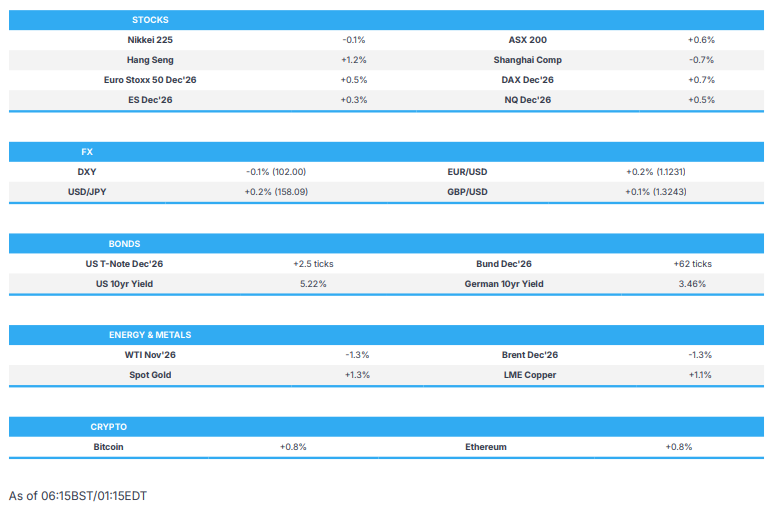
IRAN CONFLICT
- US President Trump said he is having productive discussions with Iran and will not attack Iran at any time before the midterms.
- US military drafted options for three days of strikes as President Trump hesitates, according to NYT.
- US and Israeli officials said Iranian leaders are deeply suspicious of Trump’s statements, with Iranian leaders seeking to avoid a third surprise attack, according to Axios.
- US Treasury Secretary Bessent said the Treasury is starving Iran of money used for the war and will continue exposing those facilitating Iran’s oil sales. It was separately reported that a Treasury official said Iran has stopped both loading and offloading crude oil vessels due to the US blockade and sanctions, estimating that Iran has 20mln bbls of crude oil remaining on vessels outside the blockade.
- US imposed Iran-related sanctions on vessels and entities.
- US CENTCOM was able to get 20mln barrels of oil through the Strait of Hormuz, exactly the volume that transited the strait before the war, according to the Jerusalem Post citing sources.
- US CENTCOM said US forces have supported the shipment of more than 1.25bln barrels of crude oil from Gulf partners and through the Strait of Hormuz in recent months. It also stated that routes for free transit through the Strait of Hormuz are open to all vessels not violating America’s blockade against Iran and that CENTCOM forces have successfully cleared sea mines from primary transit lanes.
- Mediators asked US President Trump for additional time before any potential strike on Iran, while CENTCOM preparations are ongoing and awaiting Trump’s decision on Iran, according to Al Arabiya citing sources. Furthermore, it was stated that Trump’s change in tone with Iran does not mean there has been a breakthrough in negotiations.
- Iranian President Pezeshkian said they never left the negotiating table despite US attacks, while they are currently compiling proposals, and after the final text is prepared, we will review it through mediators and convey all proposals. It was separately reported that Pezeshkian said they will sit with the mediators to crystallise the final proposal and confirm it, as well as stated that they exchanged proposals with America through intermediaries and introduced some amendments, according to Al Arabiya.
- IRGC Commander-in-Chief said no trans-regional power has the right to threaten, impose a domineering presence or interfere in the Strait of Hormuz and the Persian Gulf, according to Fars. He also stated the IRGC Navy and Army are ready to respond decisively to any attempt at unauthorised passage through the Strait with devastating weapons, while he described Hormuz as a strategic red line for Iran and said drones and missiles will be used to guard the strait.
- IRGC chief said no extra-regional power has the right to threaten or interfere in the Strait of Hormuz and Persian Gulf.
- Iran’s Atomic Energy Organisation head said Iran will not abandon uranium enrichment or hand over its uranium.
- Military sources noted several heavy explosions occurred in the southern passage of the Strait of Hormuz, which were caused by oil tankers hitting mines, according to Fars. Furthermore, Arab sources said there were several explosions in the Strait of Hormuz and that a tanker was targeted in the strait.
- Saudi Arabia conducted airstrikes on two factories in Yemen’s capital Sanaa, while there were also reports of a Saudi missile attack on Kataf and Al-Baq’a district in Saada and that warplanes targeted Houthi militia positions in the south of Taiz.
- Turkey’s Foreign Minister Fidan ruled out sending troops to fight Yemen Houthi forces, despite a defence pact with Saudi Arabia.
- Israel conducted artillery shelling targeting eastern areas of Gaza City.
US TRADE
EQUITIES
- US stocks were somewhat mixed with most major indices in the red, although the declines were predominantly driven by technology, and underlying market breadth remained positive. The Nasdaq underperformed, while the equal-weight S&P 500 gained, potentially reflecting some rotation out of highly valued technology stocks into other areas of the market. Sectors were mixed, with Energy the clear outperformer alongside Consumer Staples, while Technology lagged, followed by Health Care. Energy benefited from higher crude prices, while Consumer Staples was supported by gains in Coca-Cola (KO) and PepsiCo (PEP) following the latter’s earnings report. Memory weakness began overnight following disappointing preliminary Samsung earnings, with operating profit and revenue missing expectations and the stock closing 2.4% lower in Asia. The results weighed on memory-related stocks, with the DRAM ETF falling c. 5%, alongside weakness in Samsung, SK Hynix, Micron and Seagate. AI-related names came under further pressure during US trade after the FT reported that OpenAI’s annual revenue was USD 20bln below previous estimates, at USD 50bln versus USD 70bln. The report weighed on Nvidia, Microsoft, AMD, Oracle, Broadcom, Amazon, Nebius and CoreWeave. However, CNBC later clarified that the discrepancy reflected differences in accounting methodology, with OpenAI excluding gross revenue from cloud partners, providing a cleaner measure of revenue.
- SPX -0.49% at 7,764, NDX -1.39% at 30,726, DJI +0.10% at 51,232, RUT -0.03% at 2,792.
- Click here for a detailed summary.
NOTABLE HEADLINES
- Fed’s Musalem (2028 voter) said inflation is elevated and being driven by persistent demand pressures and supply shock, while he added that bringing inflation back to 2% in a timely manner and limiting second-round effects is key. Furthermore, he stated that more monetary policy firming will be required to bring inflation back to the target and that he goes into all meetings with an open mind, as well as noted that the current level of inflation requires the Fed to consider rate increases, and that rates ought to be going up in the next six to nine months.
- US Treasury Buyback (Liquidity Support, 20-30 year, max USD 6bln): Accepts USD 6bln of USD 14.89bln offers and 10 of 34 eligible securities.
- OpenAI’s annualised revenue is about USD 20bln below what had previously been signalled at about USD 50bln instead of the USD 70bln reported by media outlets late last month, according to FT citing sources. CNBC TV later reported that the FT report on OpenAI is accurate, but added that there are some nuances and clarified that the USD 50bln revenue number from OpenAI does not include gross revenue from cloud partners (whereas the USD 70bln previously reported included it and provides a more direct comparison with Anthropic). Furthermore, Bloomberg sources also stated that OpenAI sees run-rate revenue reaching or topping USD 70bln in 2026 and that OpenAI annualised revenue was around USD 50bln at end-September.
APAC TRADE
EQUITIES
- APAC stocks traded mixed following the lacklustre handover from Wall St, where most major indices declined, and the Nasdaq underperformed as tech selling and AI-related concerns were stoked by a report that OpenAI’s annual revenue was USD 20bln below previous estimates, at USD 50bln versus USD 70bln, although there have been a couple of reports since that have provided some clarification regarding this.
- ASX 200 was positive with the majority of sectors in the green, although gains were capped amid underperformance in telecoms and with commodity-related industries range-bound.
- Nikkei 225 declined at the open amid tech-related pressure and with the index also not helped by the closures of its tech-heavy counterparts in South Korea and Taiwan, but has since recouped most of the losses.
- Hang Seng and Shanghai Comp diverged amid mixed performances in tech stocks and with the mainland pressured after a paltry liquidity operation by the PBoC, while the subdued spending during the National Day holiday also raises questions regarding domestic demand in the Chinese economy.
- US equity futures rebounded overnight and clawed back most of the prior day’s tech-driven losses.
- European equity futures indicate a positive cash market open with Euro Stoxx 50 futures up 0.5% after the cash market closed with losses of 0.9% on Thursday.
FX
- DXY marginally softened after the recent pullback in yields, but with mixed risk appetite and recent AI concerns limiting the downside, while the declines in yields had coincided with a flight to safety, somewhat dovish ECB Minutes, and with President Trump stating no strikes on Iran will occur before the midterms amid ‘productive’ talks with Iran. Furthermore, there were some comments from Fed officials, but they failed to spur the dollar, with Fed’s Musalem (2028 voter) noting that inflation is elevated and being driven by persistent demand pressures and a supply shock, while he added that bringing inflation back to 2% in a timely manner and limiting second-round effects is key.
- EUR/USD eked slight gains following the prior day’s intraday recovery and slew of central bank rhetoric, but with gains capped after the ECB Minutes implied that recent yield moves helped its tightening aims, further dampening already declining rate hike expectations.
- GBP/USD continued its rebound against the buck, albeit in a gradual manner, with prior comments from BoE speakers doing little to influence price action despite Governor Bailey stating that monetary policy needs an unwavering commitment to returning inflation to the target.
- USD/JPY was choppy and oscillated through the 158.00 level, with mixed Household Spending data from Japan contributing to the indecision.
- Antipodeans mildly outperformed against G10 counterparts alongside a firmer yuan after the PBoC defended its currency policy, stating that it does not intend to devalue the CNY for trade advantages and will keep the market as the main influence on the yuan exchange rate.
- PBoC set USD/CNY mid-point at 6.7330 vs exp. 6.6973 (prev. 6.7367).
FIXED INCOME
- 10yr UST futures remained afloat after gaining yesterday as AI concerns weighed on stocks and with the latest 30yr auction stateside resulting in an above-average B/C and relatively low dealer allocation.
- Bund futures held on to recent gains after Eurozone yields fell post-ECB Minutes, while Eurogroup President Pierrakakis said he is mindful, but not alarmed, about bond spreads in the Eurozone, and noted the need for fiscal prudence.
- 10yr JGB futures tracked the gains in global counterparts, which were facilitated by haven demand.
COMMODITIES
- Crude futures continued to pull back from this week’s best levels, with pressure seen after US President Trump pushed back on prior reports that the US could resume strikes on Iran before the Midterms, in which he announced productive discussions with Iran and that they will not attack Iran any time before the Midterms.
- US NEC Director Hassett said refineries are turning back on and that relief is coming soon.
- French PM Lecornu said a price reduction of 12 to 18 cents per litre of diesel at the pump is expected following the mobilisation of strategic reserves. France will release 10mln barrels of diesel onto the French market, with the operation scheduled to last three months.
- China approved non-state crude oil import quota for 2027 at 257mln metric tons, while it was also reported that China is set to resume October refined fuel exports after a brief halt and approved October fuel exports at around 3.7mln metric tons, according to industry sources.
- Spot gold climbed higher as metal prices rebounded amid lower yields and a softer dollar.
- Copper futures nursed the prior day’s losses after sliding alongside the tech-related selling.
CRYPTO
- Bitcoin gradually advanced throughout the session and climbed above the USD 82,000 level.
NOTABLE ASIA-PAC HEADLINES
- Japan’s government is to reboot its expenditure review and broaden examination of public spending.
- SoftBank (9984 JT) is seeking USD 100bln from Gulf investors to expand AI bet and CEO Son held talks with senior figures in the UAE in recent weeks, according to FT.
DATA RECAP
- Japanese Household Spending (Aug MM) 0.1% vs. Exp. 0.5% (Prev. 0.5%)
- Japanese Household Spending (Aug YY) -3.1% vs. Exp. -3.6% (Prev. -3.6%)
GEOPOLITICS
RUSSIA-UKRAINE
- US Special Envoys Witkoff and Kushner will reportedly meet with Ukrainian representatives in Miami on Friday and will discuss new ideas and proposals that US negotiators began developing with the Russians and Ukrainians during their recent visit to the region.
- Ukrainian President Zelensky said Ukraine has mirrored Russian attacks on Ukrainian data centres, while he added that Ukraine will raise air defence issues with the US and expects European partners to join Ukraine-US talks in the coming days.
- Ukrainian Energy Minister said Russia damaged an important Kyiv energy facility.
- Russian airstrike killed one and injured two in Ukraine’s Zaporizhzhia.
- Russia’s Kremlin spokesman Peskov said Russia agrees with US Secretary of State Rubio that the Ukraine conflict is in a stalemate.
EU/UK
NOTABLE HEADLINES
- UK government is considering plans that would require university students to meet minimum entry standards to receive government loans, according to FT
- UK Labour Party fended off the Green Party to win the Holborn and St. Pancras by-election, while a Green Party spokesperson stated “It is clear now we will come a close second in this by-election. Taking the fight to Labour in one of its safest seats shows just how far the Greens have come”.
- ECB President Lagarde told euro finance chiefs that the ECB is attentive to markets and sees no broadening of price pressures, adding that the ECB has tools to counter unwarranted market dynamics. Lagarde also stated that higher long-term yields will weigh on economic growth and dampen the inflationary effects caused by the energy shock, according to Euronews citing sources.
- Eurogroup President Pierrakakis said he is mindful but is not alarmed about bond spreads in the Eurozone, while he added that the key to calm bond markets over France is to adopt a sound 2027 French budget and noted a need for fiscal prudence.
2.NORTH AND SOUTH KOREA/
SOUTH KOREA//NORTH KOREA
SOUTH KOREA/USA
JAPAN//
JAPAN//USA/AI
Masa Passes The Hat: SoftBank Seeks $100 Billion From The Gulf After Maxing Out Junk Bonds, Margin Loans And Japanese Retail
Friday, Oct 09, 2026 – 09:50 AM
The scramble for AI cash is on (or rather, accelerating).
Just hours after the FT reported that OpenAI’s annualized revenue is roughly $20 billion lower than the figure that had been making the rounds previously, the same paper reported that Masayoshi Son is trying to raise up to $100 billion from Gulf investors, and has spent recent weeks holding talks with senior figures in the UAE. That would be roughly the size of the original Vision Fund, which is either a sign of ambition or of how much more money the AI trade now needs just to stand still. Clearly, in a world of $1.5 trillion in 2027 capex, the answer is the latter.
Regular readers will not be surprised: we have been warning that the AI buildout runs on debt since exactly one year ago today, and SoftBank, which has committed some $65 billion to OpenAI, has spent most of 2026 as the poster child for that thesis. Over the past nine months Son has tapped bridge loans, margin loans on Arm and OpenAI shares, Japanese retail savers and, most recently, the largest junk bond on record. Now that the usual spigots have been opened all the way, it’s time to call the sovereigns.
Below we walk through what Son is pitching to Abu Dhabi, how the money machine got here, why Thursday’s OpenAI revenue “clarification” matters so much for SoftBank’s balance sheet, and why the Gulf has quietly become the AI trade’s lender of last resort.
“What Happened To Abu Dhabi?”
According to the FT, the new money would go into a vehicle that buys companies and then uses AI and other advanced technology to run them more efficiently: a private-equity roll-up with a robotics twist. Roze, SoftBank’s robotics and physical AI unit, which Son hopes to take public at a lofty valuation (press reports have floated $100 billion), is expected to play a central role. The people cautioned that there is no guarantee the talks succeed, and SoftBank declined to comment.
The playbook is familiar. Saudi Arabia’s PIF and the UAE’s Mubadala anchored the first $100 billion Vision Fund in 2017; per the FT, that fund has generated about $29 billion in cumulative investment gains through June, while Vision Fund 2 (backed primarily by SoftBank itself, and home to the OpenAI stake) is up $20.5 billion. Not exactly WeWork, but not exactly the “information revolution” either for a fund that took nearly a decade to get there.
What is new is the timing. Just this week, OpenAI itself was shopping a $30 billion round to a group of UAE sovereign funds led by MGX (alongside BlackRock) at a $1.4 trillion pre-money valuation set by OpenAI itself. Which means that in the span of four days, both the biggest AI lab and its biggest backer have shown up at the same Abu Dhabi door with their hands out. Back in February, when OpenAI’s record $110 billion round closed without a Gulf name on the cap table, we asked the obvious question:
Now we know: it was waiting to be asked.
It’s not the first time the emirate has come to the rescue of the AI trade, either. Last December, as Oracle CDS blew out and Blue Owl walked away from Oracle, it was Abu Dhabi that may have delivered the Santa Rally when OpenAI went to sovereign wealth funds for up to $100 billion (a dependence we explored at length in “Dollar Supremacy Strategy Or All-Time Grift? American AI Imperialism’s Reliance On The Middle East“). Abu Dhabi, through MGX and G42, has become one of the world’s biggest AI spenders, as the FT notes. The difference this time is that there is now a war next door, Brent is above $100, and Gulf petrodollars are being asked to fund two of the biggest AI fundraises of the year at once.
Masa’s Money Machine
To appreciate why Son needs the Gulf, look at what he has already done this year. The chart below tallies the headline size of every major facility SoftBank has lined up in 2026 to fund its AI ambitions (some refinance others, so this is not a cumulative total, but you get the idea):
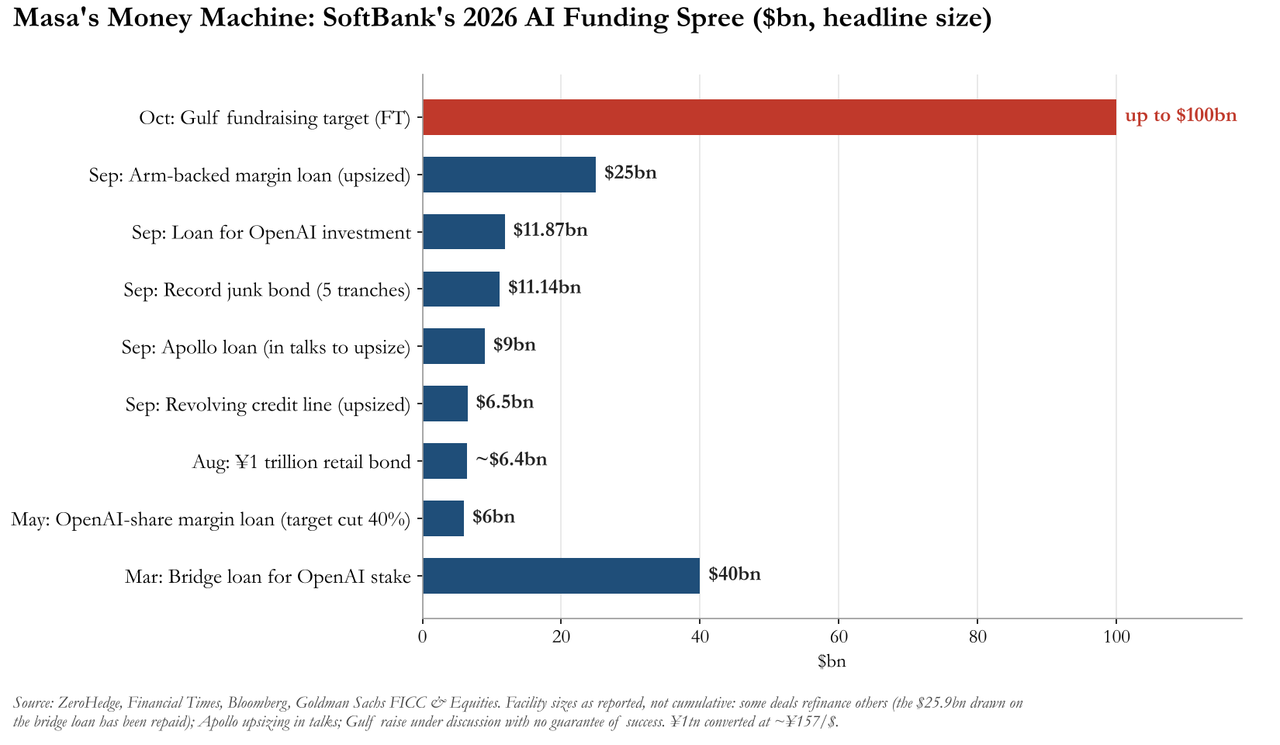
In March, days after SoftBank’s CFO warned that its loan-to-value ratio may temporarily exceed the 25% ceiling (to which we responded “chatbots gonna take down masa son”), it lined up a record $40 billion bridge loan for the OpenAI stake. In May, SoftBank had to cut the target for its OpenAI-backed margin loan by 40% to $6 billion,p and by June even the downsized loan had stalled, as lenders balked at taking private OpenAI shares as collateral. Then came a ¥1 trillion bond sold to Japanese retail investors at a 4.75% coupon, an Arm-backed margin loan upsized to $25 billion, a $6.5 billion credit line, an $11.87 billion loan and talks with Apollo to upsize another to $9 billion.
And then, the grand finale: a five-tranche, $11 billion-plus junk bond to fund the next OpenAI check, which the FT says paid yields as high as 9.75%. Goldman’s credit sales desk confirmed in Adam Crook’s latest AI issuance pulsecheck (available to pro subs) that the $11.14 billion deal was the largest non-investment grade bond sale on record, and it single-handedly made the week of Sept 25 the biggest for new HY issuance in Goldman’s chart, which goes back to late July (chart source PitchBook LCD via Goldman):
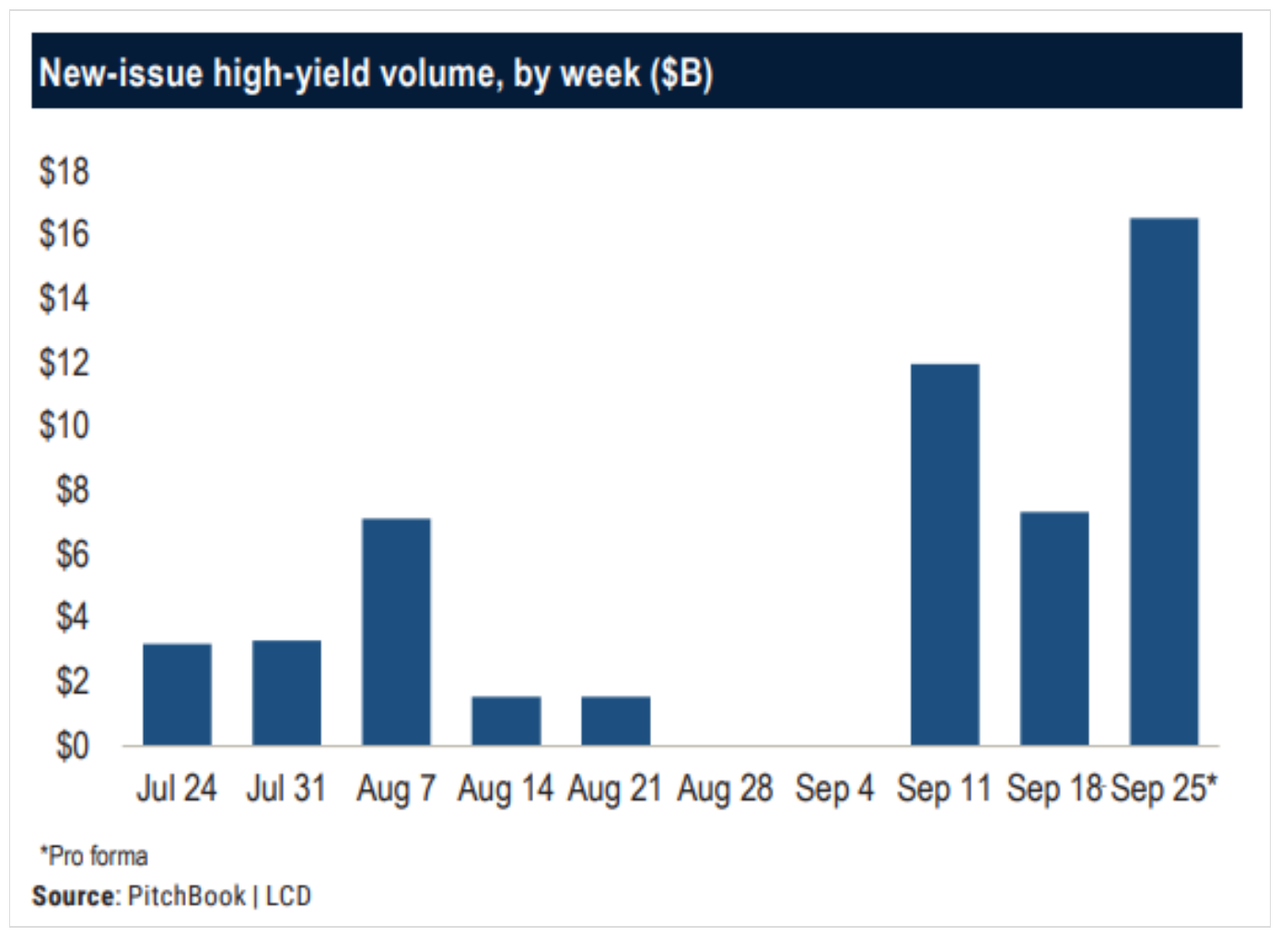
Naturally, we called this one back in January, when the WSJ first reported that Son was in talks to pour another $30 billion into OpenAI:
Nine months later, SoftBank is the biggest junk issuer in history, so we’ll allow ourselves a modest victory lap. The credit market got the message too: within a week of the jumbo deal, SoftBank’s 5Y CDS had blown out to the widest levels since the Iran war began, as we flagged in real time:
Put differently, when you have already pledged your crown jewel (Arm), your largest asset (OpenAI), Japanese retail savers and the high-yield market’s patience, the only pocket left is a sovereign one.
The $20 Billion Hole
Which brings us to why the timing of the Gulf push is so delicate. On Thursday afternoon the FT reported that OpenAI had told investors its annualized revenue was approaching $50 billion at the end of September, far short of the ~$70 billion figure that had been circulating since Dev Day. Nasdaq promptly tumbled more than 1%, Oracle slid 5-6%, and SoftBank’s Tokyo-listed shares fell 5% on Friday. They are still up 25% this year, but have now dropped more than 30% from their June peak, when SoftBank briefly became Japan’s most valuable company.
According to Goldman’s TMT specialist sales team (available to pro subs), the gap is mostly a matter of accounting rather than collapsing demand: OpenAI reports revenue net of what flows through its cloud partners, while Anthropic reports something closer to gross. Investors who “grossed up” OpenAI to compare the two arrived at roughly $40 billion in August and $70 billion in September; on OpenAI’s own net basis, the progression was more like $30 billion to $50 billion. That is still around 70% growth, Goldman notes, just not the growth everyone had priced in. Goldman’s desk said it caught a heavy wave of long-only and hedge fund supply in megacap tech after the headline, over $1 billion in net selling of semis, AI and megacaps.
On Friday morning, right on schedule, came the spin: Bloomberg reported that OpenAI now expects to hit or top $70 billion of annualized revenue by year-end, and blamed the confusion on differences in how OpenAI and Anthropic calculate revenue. Futures bounced, and Goldman’s TMT desk filed it under the whiplash sentiment swings that have become a defining feature of AI investing this year. So the $70 billion number didn’t disappear; it was just moved three months into the future. Which, considering OpenAI is on the hook for some $1.5 trillion in compute commitments, is not quite the reassurance it was meant to be.
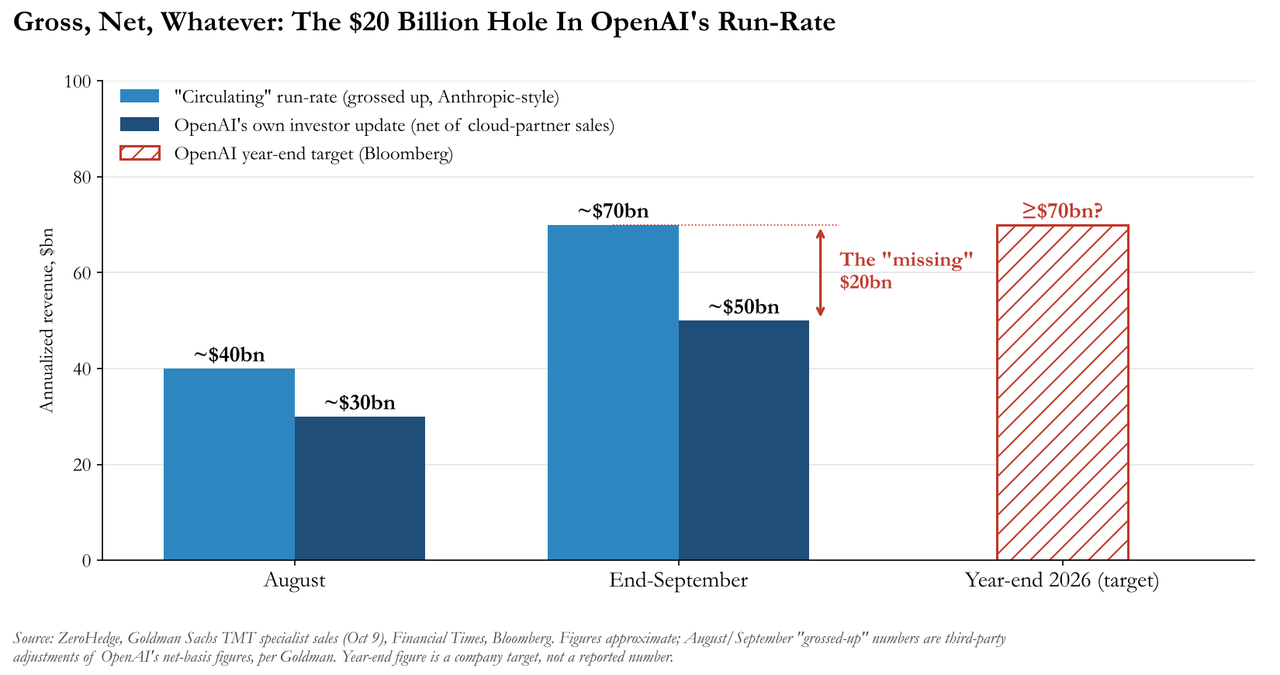
The credit market, for its part, did not bounce. Per the same Goldman TMT note, Oracle’s 5Y CDS closed at a record 261bp on Thursday (up 36% in a month) and Broadcom’s printed a record 136bp, as nearly $500 billion of 2026 AI-related borrowing gets repriced (more on that in this morning’s “The Crowding Out Effect Is Immense“). Goldman’s credit sales desk also tracks the gap between HY AI data center bonds and the broader HY market, which was already near 80bp by late September:
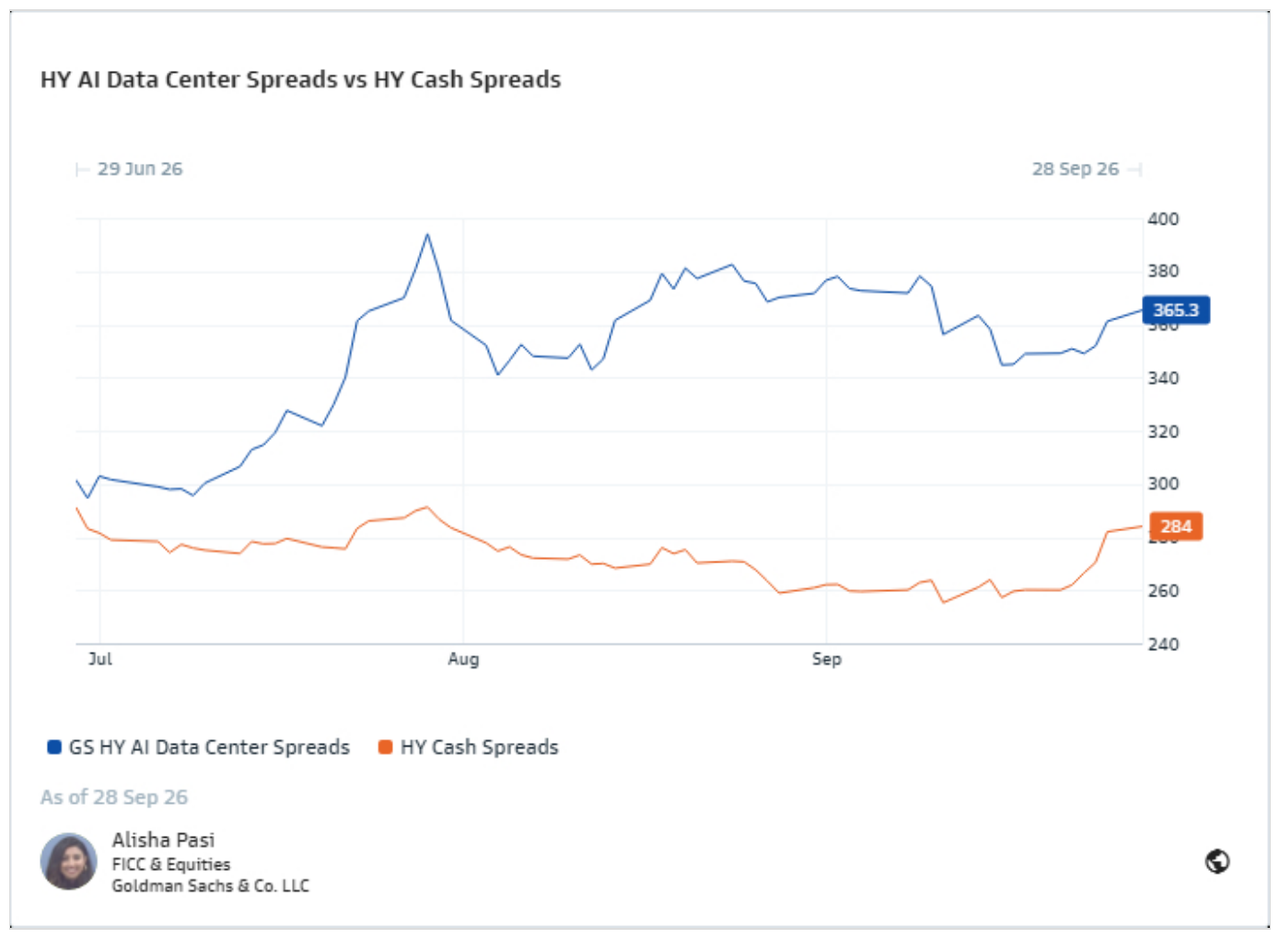
Collateral Damage
Why does a $20 billion gap in a private company’s revenue matter so much to SoftBank? Because the private company is the collateral. The FT notes that SoftBank’s capacity to borrow is tied to the valuations on its balance sheet: net asset value stood at ¥72.3 trillion at the end of June, and its loan-to-value ratio was a comfortable-looking 13%, well below the 25% ceiling it targets in normal operations. Senior SoftBank people insist that short-term swings in OpenAI’s valuation will not change investment plans.
Maybe. But consider the math from the Goldman desk. Back in September, when SoftBank was ripping on AGI hopes, Goldman’s Asia/EMEA desk argued that SoftBank’s discount to NAV was too wide, noting that OpenAI, marked at the $852 billion valuation of its last priced round, accounts for roughly 20% of SoftBank’s NAV and the vast majority of its unlisted assets. The desk’s bull case rested on two things: OpenAI being re-marked closer to Anthropic’s valuation, and SoftBank monetizing its “other” assets, such as Roze (at a mooted $100 billion) and SB Energy. The desk added that SoftBank was trading at a discount that, by its math, was “much wilder than it looks.”
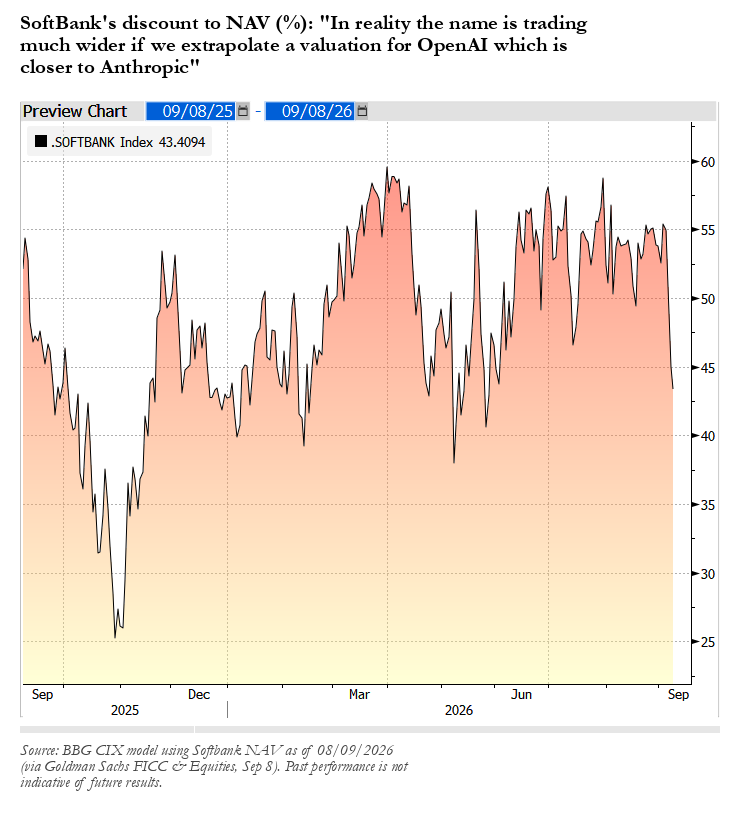
A month later, the scorecard is not encouraging. SB Energy delayed its IPO amid an investor revolt, OpenAI’s own IPO has been pushed into 2027, and instead of a re-rating toward Anthropic, OpenAI just had to explain why its revenue was a fifth smaller than everyone thought (or, depending on which day you ask, or which bullish spin master is explaining, exactly as big as everyone thought). The two catalysts for closing the NAV discount have turned into the two reasons it might widen. As one Asia-based analyst warned the FT, if OpenAI’s valuation falls, “A contagion effect . . . could get quite bad, quite quickly.”
And that is where the Gulf comes in. A sovereign-funded vehicle that buys real companies and bolts robots onto them gives SoftBank two things it badly needs: fresh equity that does not sit on its own balance sheet (and therefore does not touch the LTV), and a shop window for Roze ahead of any listing. For the Gulf, it is another way to diversify away from oil, which, with Hormuz still a mess, is either brilliant timing or a reminder of how long that diversification is taking.
Bottom Line
Son has always argued that the skeptics will look foolish, and sometimes (well just once, with Alibaba) he has been spectacularly right. But this is what late-cycle financing looks like: the most aggressive investor in the AI trade has worked his way down the capital structure from equity to bridge loans to margin loans to retail bonds to record junk, and is now asking sovereigns for another Vision Fund-sized check, in the same week that OpenAI is asking the same sovereigns for $30 billion and its revenue disclosure is being “clarified” in real time.
The bulls will say Gulf money removes the funding risk. We would counter that it proves it exists. When the marginal buyer of the AI trade is no longer the market but a handful of petro-states (just like German retail banks and Japanese pension funds were the last sources of capital just before Lehman collapsed), the price of AI risk is being set by geopolitics, not cash flows, and with Brent above $100 and Iran next door, that is not the hedge the bulls think it is. If the Gulf says yes, the circle just gets bigger; if it says no, SoftBank’s CDS has a lot further to go.
Either way, here is who now owes whom in the biggest circular financing diagram ever seen, with a new sovereign-sized node about to be added:
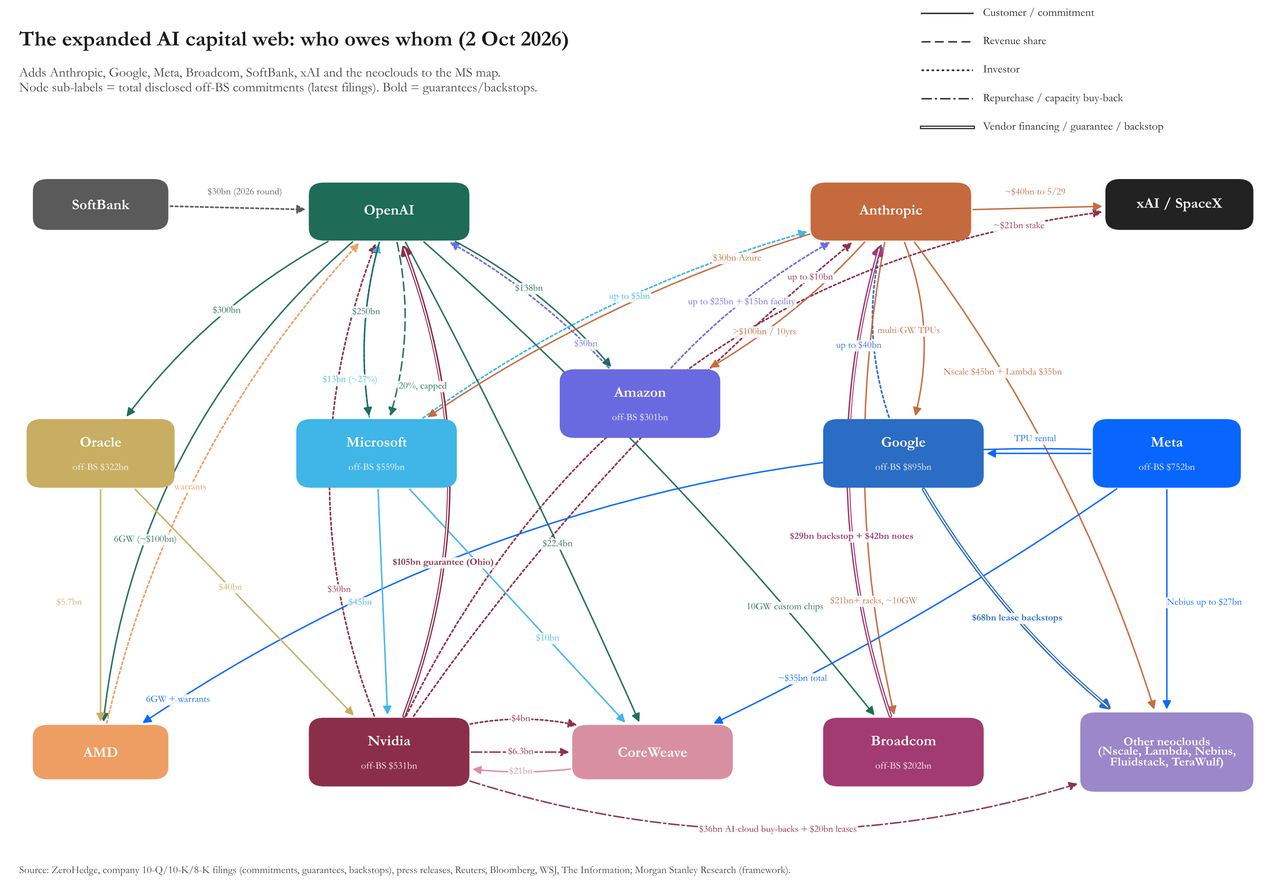
Much more in the full Goldman AI Issuance Pulsecheck, and “GS TMT Spec Sales” notes, available to pro subs.
end
4. EUROPEAN AND SCANDINAVIAN COMMENTARIES PLUS NATO
FRANCE
(BURROWS)
France’s Debt: Too Heavy To Lift, Too Big To Spot
Friday, Oct 09, 2026 – 06:30 AM
Authored by Robert Burrows via BondVigilantes.com,
A spread can be historically wide and still offer inadequate compensation for what lies ahead…

At around 150 basis points over Bunds, French ten-year government bonds look tempting. The spread is exceptionally wide by France’s historical standards. For investors accustomed to treating France as a core European sovereign, the instinct is to buy the dislocation and wait for normality to return.
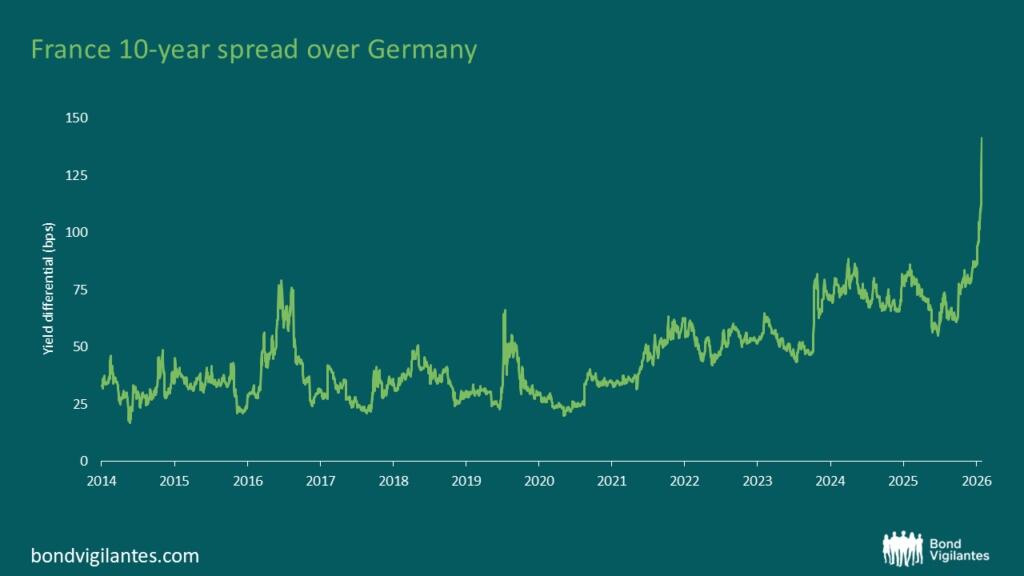
But that instinct risks anchoring to a past that no longer provides a reliable guide. A spread can be historically wide and still offer inadequate compensation for what lies ahead.
A couple of years back, I argued that France’s fiscal pressures and political fragmentation threatened more than its own creditworthiness. They challenged the cohesion of the eurozone itself. I more recently questioned another assumption underpinning European sovereign valuations: that Germany would always have the economic strength and fiscal capacity to support the rest. Those two concerns are now coming together with worrying implications.
Investors should therefore consider a different reference point: Italy’s historical spread over Germany. Italian spreads exceeded 500 basis points during the sovereign debt crisis That is not a forecast for France, but it demonstrates how far spreads can move when markets lose confidence in fiscal sustainability and the credibility of European support. France’s own trading history may be a poor measure of its potential downside in a different regime.
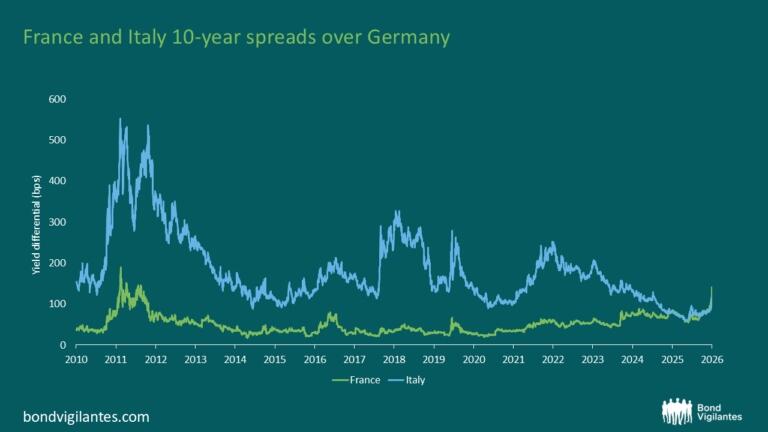
The central problem is moral hazard. Providing unconditional support to France would weaken the incentive to repair its public finances and invite other governments to expect similar treatment. Yet withholding support risks allowing higher borrowing costs to worsen the fiscal position and transmit stress across the monetary union.
The ECB’s tools do not remove this dilemma. Its Transmission Protection Instrument considers fiscal sustainability and compliance with European policy commitments, and is intended to address unwarranted, disorderly market pressures. A repricing driven by deteriorating fundamentals presents a much harder case for intervention.
In my view, durable support would require a concerted French effort to restore fiscal credibility. The approaching presidential election complicates that bargain: European institutions need confidence that the government making commitments can deliver them and that its successor will honour them. There is no formal requirement for the ECB to wait until the election, but political clarity may be necessary before meaningful conditions can be sustained.
Germany’s changing position makes this more difficult. It can remain the relative haven within Europe while becoming less able or willing to underwrite its neighbours. Bund outperformance during a crisis would not prove that the capacity for collective rescue is unlimited..
An interesting expression of this risk is to short Spanish government bonds against duration-matched Bunds. My argument is that Spain’s still relatively tight spread offers too little compensation for a broader fragmentation episode. A narrower starting spread also means less negative spread carry than shorting France.
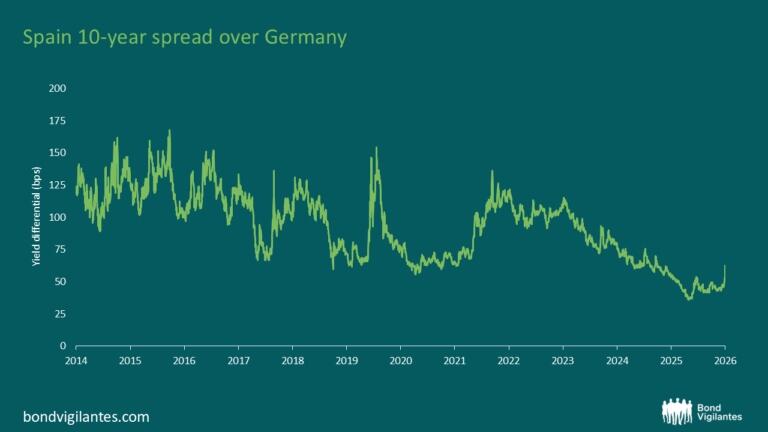
Spain offers a potentially inexpensive way to position for investors questioning the eurozone’s collective insurance policy, with relatively limited downside. Let’s not forget Spain does have a debt to GDP ratio of 100% and is governed by a minority Government who just yesterday called a snap election. A tempting asymmetry given the growing risks.
France at 150 basis points may look cheap against yesterday’s France. Investors should be extremely cautious about assuming that yesterday is coming back.
END
UK
Why Is A British Charity Telling Migrants Not To Be ‘Deceived’ By Underage Girls?
Friday, Oct 09, 2026 – 02:00 AM
Authored by James Dixon via Spiked,
Three words in a video that did the rounds last month made my skin crawl: ‘Don’t be deceived.’

They might sound perfectly innocent at first pass, but in context, they are chilling. The footage in question comes from a recorded session apparently run by the Aberdeen-based Mamacita Foundation, a charity that works with asylum seekers. The subject in question is sexual consent – more specifically, the age of consent.
In the footage, the seminar leader, herself an immigrant, asks the men present what age someone must be before they can approach them for ‘anything sexual, intimacy’. At one point, she even seems to admit surprise that the age of consent is 16 throughout the UK – she herself had believed up until that very moment, apparently, that it was 18. She establishes the correct answer there and then, while reading from her notes.
Can we not admit that this is already quite a strange spectacle? Adult men are sitting in Britain, being taught the legal age at which they can have sex with British teenagers. But then it gets quite a lot worse.
‘Please, this is very, very essential’, the seminar leader says (trying to make herself heard over the chatter of the bored participants). ‘Because we’ve had young men fall for these things that could be preventable.’ Fall for these things. She then goes on to advise the men to ask young people their age and even request identification, before coming in with the extraordinary warning: ‘Don’t be deceived, we have young persons growing bigger than their age.’ Twelve and 14-year-olds, she explains, can be taller than she is.
It should really go without saying, but a 13-year-old girl who happens to look older than 13 (as many do) is not deceiving anybody. She is simply existing in the body she happens to have, as it has naturally developed. A child (for that is what she is) does not trick a grown man by being tall for her age or developing early. She should also be able to dress and do her makeup how she likes, or how her parents agree for her to, without fear of advances or attack. Nor does a grown man who has sexual contact with a child ‘fall for’ her supposed wiles.
The language employed here is very revealing. It shows us quite plainly the assumptions underpinning the consent seminar. The men are accorded less moral agency than their potential victims. They are seemingly seen as being at risk of an unfortunate misunderstanding, or worse still, of being sexually manipulated by children. What they are not seen as is adults with clear legal and moral responsibilities.
It’s absurd and grotesque. But perhaps most disturbing is the reduction of the whole question to the age of consent.
There is nothing inherently objectionable about teaching newcomers the laws, including the age of the consent, of the country in which they now live (though the fact that it’s deemed necessary should be a bit of a red flag). Yet the law represents the minimum standard of conduct enforced by the state. It does not exhaust our moral expectations of one another. Far from it.
If the principal lesson an adult man can take from training courses like this is that 16 is the magic number, something (or plenty) has gone badly wrong. Most Western adults understand that legality is not the only consideration governing relations between adults and teenagers. A middle-aged man propositioning a girl who turned 16 two months ago will not escape moral opprobrium by claiming he was following the rules. There are norms beyond the letter of the law, and norms that cannot be taught so quickly in a simple seminar (especially one in which none of the attendees seems to be listening).
The Mamacita footage is particularly unsettling because its language is so protective of the men in the room. Be careful, check ID, don’t be deceived. Where is the corresponding concern for the girls? Imagine being a 14-year-old girl hearing a grown woman telling grown men that girls your age ‘sometimes grow bigger than their age’, and that men should therefore avoid being ‘deceived’. You would think that you and your behavior are the problem.
We have spent decades trying to drive precisely this thinking out of discussions about sexual misconduct. We were so close to doing away with victim-blaming and slut-shaming – with asking whether she led him on or looked older. We recognize these as ways of shifting responsibility from aggressor to victim, from the adult who acts to the girl who is acted on. This principle should not disappear simply because immigration enters the conversation.
I’m not smearing migrants when I say this. I’m talking about who should hold individual responsibility in any given situation, and saying that, generally speaking, it should be the adult. He is the moral actor responsible for obeying the moral norms in the society in which he lives. If someone comes to Britain, he should be treated as a moral adult. That means granting him the dignity of agency – and demanding the responsibility accompanying it. If he commits a sexual offense, responsibility belongs to him, not to licentious Western culture (because nobody is ever asking for it), and certainly not to a teenage girl who has the misfortune to look older than her years in a man’s eyes.
Girls do not ‘deceive’ grown men simply by growing up.
James Dixon is a Glasgow-based novelist, poet and playwright.
END
UK
Two Latvians Arrested After Breach At US Intel Hub Deepens UK Sabotage Concerns
Friday, Oct 09, 2026 – 04:15 AM
Days after the US pulled all its Rockwell B-1 Lancer supersonic bombers from Britain’s RAF Fairford air base over mounting security concerns following a suspected terrorist plot against the base late last month, another incident has occurred, this time at a critical US and NATO intelligence hub.
Bloomberg reports that British police arrested two Latvian nationals on suspicion of trespassing and national security offenses at RAF Molesworth, located in Cambridgeshire, in eastern England.
More color from the outlet:
Officers found a “small breach” of the perimeter fence, counterterror police said in a statement.

The men, both in their 30s, were arrested late Wednesday after security patrols near the air base, which houses the Joint Intelligence Operations Center Europe Analytic Center and supports US European Command, AFRICOM and NATO coordination.
“The incursion will deepen scrutiny of the security at airbases in Britain that are used by US forces, as the UK warns of an escalation in sabotage plots involving so-called proxies directed by Iran and Russia,” Bloomberg noted.
So far, British police have found no connection between the incident at RAF Molesworth and the one at RAF Fairford. Police have not established or officially released a motive.

The outlet quoted Richard Knighton, the head of Britain’s armed forces, who said earlier today that all of the country’s bases were safe.
“We take the security of all of our bases in Europe enormously seriously,” Knighton said, calling the US move an “operational decision.” He added that the UK has “enormously close relationships from an intelligence perspective and operationally with the US, and that’s what gives me confidence around the safety and security of our bases here.”
END
UK
(TURLEY)
Fashion Police: Fifteen-Year-Old Boy Is Arrested After Joking About How A Politician Dresses
Friday, Oct 09, 2026 – 07:10 AM
Authored by Jonathan Turley via JonathanTurley.org,
The King may have no clothes, but he has cops…

Fraser, of Walsall in the West Midlands, says he still does not understand why four police officers arrested him at his home two months ago Credit: Andrew Fox
The leader of the Conservative Party on the Wolverhampton City Council, Simon Bennett, apparently can take anything but fashion criticism. The politician reportedly called the police on a 15-year-old boy for mocking his clothing style at meetings. It is the latest example of the collapse of free speech in the United Kingdom.
A boy only identified as “Fraser” is a 15-year-old supporter of Nigel Farage’s Reform UK party. He found himself searched and arrested by four officers from the West Midlands Police at his home, locked in a cell, fingerprinted, subjected to a DNA search, and taken for a mugshot. The police then searched his bedroom and telephone.
All of this was over his joking about how Bennett dressed in public.
The Telegraph reports that Fraser joked about how the Tory councilor had attended a meeting in a T-shirt and shorts. When Bennett later attended a subsequent meeting in a suit, Fraser commented that at least he was no longer “looking like a rent boy”, a derogatory term for homosexual prostitutes in Britain.
Bennett admits calling the police and portrays himself as the victim of this child: “The police have not arrested for no reason… There were a number of posts that targeted me… It was unpleasant and I was targeted by a child I had no way of dealing with.”
It is only the latest example of the anti-free speech culture that has taken hold in Britain, where the government has continued to expand speech criminalization policies.
In my book, “The Indispensable Right: Free Speech in an Age of Rage,” I discuss how free speech is in free fall in the United Kingdom, including the arrest of comedians and children engaged in playground taunts.
A man was convicted for sending a tweet while drunk referring to dead soldiers. Another was arrested for an anti-police T-shirt. Another was arrested for calling the Irish boyfriend of his ex-girlfriend a “leprechaun.” Yet another was arrested for singing “Kung Fu Fighting.” A teenager was arrested for protesting outside of a Scientology center with a sign calling the religion a “cult.” Last year, Nicholas Brock, 52, was convicted of a thought crime in Maidenhead, Berkshire. The neo-Nazi was given a four-year sentence for what the court called his “toxic ideology” based on the contents of the home he shared with his mother in Maidenhead, Berkshire.
While most of us find Brock’s views repellent and hateful, they were confined to his head and his room. Yet, Judge Peter Lodder QC dismissed free speech or free thought concerns with a truly Orwellian statement: “I do not sentence you for your political views, but the extremity of those views informs the assessment of dangerousness.”
Lodder lambasted Brock for holding Nazi and other hateful values:
“[i]t is clear that you are a right-wing extremist, your enthusiasm for this repulsive and toxic ideology is demonstrated by the graphic and racist iconography which you have studied and appeared to share with others…”
Even though Lodder agreed that the defendant was older, had limited mobility, and “there was no evidence of disseminating to others,” he still sent him to prison for holding extremist views.
After the sentencing, Detective Chief Superintendent Kath Barnes, Head of Counter Terrorism Policing South East (CTPSE), warned others that he was going to prison because he “showed a clear right-wing ideology with the evidence seized from his possessions during the investigation….We are committed to tackling all forms of toxic ideology which has the potential to threaten public safety and security.”
There remain, however, some in Britain who want to restore free speech. Lawyers for Fraser are planning to sue over wrongful arrest and false imprisonment. However, their client still remains in the criminal justice system. Many have suggested it was his support for Farage that drew the ire of this politician and the police.
Britain is a cautionary tale for our own country. While this speech would be clearly protected in the United States, there is a growing anti-free speech movement in this country that is aligned with European censors.
For his part, Bennett seems unrepentant in punishing his critics. He previously discussed his purpose as a public servant: “you’ve obviously got to find a unique selling point for yourself as well for people to buy into that. So the thing for me, is to find that unique selling point, find those single issues that matter to people.” He certainly has found his “selling point,” though it is tragically not “unique” in Britain.
As this case shows, censorship is the rage in Europe, and free speech is rapidly going out of fashion.
Jonathan Turley is a law professor and the New York Times best-selling author of “Rage and the Republic: The Unfinished Story of the American Revolution.”
END
GERMANY
the right thing to do!! Enough with this wokeness!!
(remix)
‘The Nord Stream Pipelines Will Be Relaunched,’ Says Right-Wing Polish MEP Braun During Meeting With AfD In Germany
Friday, Oct 09, 2026 – 03:30 AM
Authored by Remix News Staff via Remix,
Grzegorz Braun, leader of the Confederation of the Polish Crown, spoke in favor of restarting the Nord Stream 1 and 2 gas pipelines during a meeting Wednesday with politicians from the Alternative for Germany (AfD) party in Lubmin. He said Poland should be a shareholder in the German-Russian project.

“Nord Stream 1, and probably Nord Stream 2 as well, will be relaunched. Russian gas will flow to the West,” Braun said. He said Europe needs Russian raw materials and that their absence could have serious consequences for the economy.
Braun argued that Poland should not be excluded from future energy projects concerning Russian gas supplies. “Poland should participate, not boycott. Poland should be the initiator,” he said. He also proposed that Warsaw become a shareholder in Nord Stream.
He also said that if Russian gas returns to Europe, Poland could lose economically if the supplies bypass its territory. In his view, Warsaw should seek participation in such energy projects rather than remain outside them.
Braun also spoke of the need to “normalize” and “de-escalate” relations and economic cooperation among Poland, Germany and Russia. He advocated a return to wider use of coal and the ability to buy oil and gas from suppliers offering favorable terms.
The speech took place in Lubmin, the site of the German terminal and infrastructure linked to the Nord Stream pipelines.
Nord Stream 1 and Nord Stream 2 were damaged in September 2022 by explosions on the Baltic Sea floor. Nord Stream 1 had been the main route for Russian gas to Germany. Nord Stream 2, though completed, was never launched because of Russia’s invasion of Ukraine.
Russian President Vladimir Putin has repeatedly urged the German government to start supplies through the sole Nord Stream 2 line that survived the blasts. He has said that if the line operates, 27.5 billion cubic meters of gas “will immediately reach Europe.”
“Why don’t they do it? I just can’t understand it. They can receive gas through Ukrainian territory, through TurkStream, but they cannot through the pipeline running along the bottom of the Baltic Sea,” Putin said.
“In my opinion, it’s crazy, just nonsense. Why? But if they don’t want to, fine,” Putin said in 2024 at the Vladivostok Economic Forum.
According to U.S. media reports, a group of Ukrainian officers conceived the operation to blow up Nord Stream in May 2022. Ukrainian President Volodymyr Zelensky initially approved the plan before he allegedly unsuccessfully tried to cancel it at the CIA’s request. Polish connections also appear in press accounts of the Baltic Sea sabotage.
U.S. President Donald Trump said last May that “many people know” who blew up Nord Stream. He added that he was the first to thwart the project.
Trump imposed sanctions on Nord Stream 2 in his first term, significantly slowing construction. President Joe Biden repealed them in 2021 and reimposed them after Russia invaded Ukraine. Germany withheld permission to start the pipeline because of the war.
END
are they for real?
GERMANY
German Police Advise Women To Vomit To Stop Rape Attacks
Friday, Oct 09, 2026 – 08:50 AM
Authored by – Remix News Staff – via Remix News,
It has been revealed that police in the northern German city of Bremen have for more than a decade advised participants in workplace safety seminars that deliberately inducing vomiting can be one way to interrupt an attempted sexual assault or rape.

Franka Haedke, a spokeswoman for the Bremen police, said the guidance is part of broader self-defense instruction offered by the department’s Central Police Prevention unit.
“In an emergency, such as attempted rape, defend yourself with all available means,” Haedke told the Kreiszeitung newspaper. “Vomiting can also be an effective way to ward off a sexual offense.”
Seminar instructors tell participants they can trigger a gag reflex by placing a finger down the throat. The resulting disgust, police say, is intended to disrupt an attacker’s actions. Haedke described the suggestion as one option among others rather than a prescribed response.
The sessions, which have run for more than 10 years, are held at companies, government offices and medical facilities. Employees of public transit agencies, the fire department, job centers, and social-service organizations are also eligible to attend. Topics include recognizing and avoiding danger, de-escalation, bystander intervention, and specific conduct during a sexual assault. Participants are invited to describe their own experiences so that advice can be tailored to situations they have encountered.
Haedke said the courses help people “recognize dangers early, manage conflicts, and act thoughtfully.” She added that the seminars “contribute to the prevention of crime and should be actively promoted and conducted on a recurring basis from the police’s point of view.”
Notably, the police appear powerless to address one of the key issues driving the increase in rapes and sexual assaults in Germany, and that is the incredible increase in foreigners. Since 2018, there has been a 72 percent increase in rapes in the country. In Bremen itself, where the police are advising women to vomit to stave off a rape, the city has been labeled the “most dangerous city in Germany.” It also happens to have the highest share of migrants of any German city. It is also a place where 49 percent of all rapes were committed by foreigners, even though the official foreign population is 23 percent.
The Bremen guidance is not the first unconventional self-protection tip from German police to draw public scrutiny. Remix News previously reported that in Berlin, officers previously listed singing as a way to irritate an attacker, advice that remained visible on the police force’s website even after internal materials had been revised. A screenshot of the recommendation went viral on social media in 2024 and was widely mocked.
Berlin police later said the tip had been drawn from professional associations for psychiatry and did not match operational experience.
“A screenshot of our homepage has been circulating for a few days, according to which we recommend that in the event of an attack, you irritate the perpetrator through unexpected behavior, such as singing,” the Berlin police stated. “This is recommended by the professional associations for psychiatry, among others. However, this advice does not correspond to our police experience and has therefore no longer been part of our recommendations since 2023. The flyer was already updated, now our website is too.”
The police stated that the suggestion was not meant for terrorist attacks, rampages or armed assaults, including those involving knives, where protecting life is the priority.
After the mass sexual assaults in Cologne on New Year’s Eve 2015 – 16, Mayor Henriette Reker – although not a police official – also gave advice that was widely condemned. Reker said women should keep “a certain distance of more than an arm’s length” from unknown men and avoid behavior that could be “misunderstood.” After thousands of German women were sexually assaulted and even some raped by North African migrants, the remarks were widely criticized, including by Germany’s justice minister.
Swedish police have also previously advised women to stop going out alone. Before mass immigration, Sweden was once one of the safest countries in the world for women. However, right around the same time as the mass sexual assaults in Colgone, Swedish police issued similar advice. In Östersund in 2016, after a series of assaults and an attempted rape, police chief Stephen Jerand advised women who wanted to move around at night to arrange a ride or walk in groups. He called the warning factual rather than a ban on going out alone.
German police have given similar pairing advice after attacks on joggers. Leipzig officers in 2017, after a woman was raped in Rosental park, said it would be better to run in pairs or make sure someone else was nearby, and to look back when passing people. The city’s mayor criticized the police for restricting women’s freedom. After an attack in the English Garden in Munich in 2016, police in the city told runners to choose busy, lit routes after dark, jog at least in pairs at dusk, skip headphones, and carry a whistle or personal alarm. Although it was less controversial advice that what other authorities provided, critics note that women are increasingly unsafe in Europe while out exercising or enjoying public spaces.
END
BELGIUM AND FRANCE
“Migrants Join Forces With Antifa” As EU Riots Spread From France To Belgium
Friday, Oct 09, 2026 – 09:35 AM
Europe is demonstrating that the globalist progressive experiment is crashing and burning, as far-left riots, which we pointed out at the start of the week, were “spreading like cancer” from France to Belgium, continue on Friday. What’s to say the social unrest will stop there?

The chaos and social unrest mimic the US Marxist BLM riots in 2020, when left-wing NGOs and politicians allowed these radicals to mobilize and burn down city blocks. What’s happening in Europe could’ve happened in the US this year if the State Department, Treasury, and other agencies hadn’t cracked down on these far-left NGOs, big family foundations, and foreign subversion networks.
Social media user Visegrád 24 has pointed out that riots in Europe are taking a disastrous turn: “Young second and third-generation migrants have joined forces with Antifa for today’s riots in Brussels.”
That’s the second issue: far-left groups weaponize migrants to fulfill their sinister goal of overthrowing capitalism and the West, similar to what far-left radicals in the US, such as the Democratic Socialists of America, have in mind when they say, in their own words, that they want to “bring down America from within.”
You’re starting to get the picture, if readers don’t already understand: the West has a radical-left problem. It’s being showcased on a grand stage in Europe, where radicalization is infecting not just migrants but youth at younger and younger ages. This is an embarrassing dilemma for European liberals, as it only supercharges right-wing candidates to gain power, as Nomura analysts expect the EU “lurches” right in the 18-month election cycle already underway.
This was the problem high-level State Department officials discussed with their European counterparts this past summer: the troubling far-left radicalization impacting younger and younger people.
More footage from Belgium:
If it weren’t for DOGE cutting USAID funding by 85% and the US multi-agency task force cracking down on billionaire-funded lefty NGOs and subversion networks, who’s to say these riots wouldn’t be spreading to the US by now?


But massive foundations, such as possibly the Gates Foundation, and many other lefty billionaires are too scared about the potential loss of their prized nonprofit status. That is likely one reason riots in America didn’t materialize this past summer.
END
UK
BBC
The BBC Seems To Hate White People…
Friday, Oct 09, 2026 – 10:20 AM
Authored by Steve Watson via Modernity.news,
The corporation that lectures Britain about “fair” pay has published its own wage numbers.
In six of its seven career bands, white staff took home a lower median wage than black, Asian, mixed and other ethnic minority colleagues.
The figures come from the BBC’s own 2025/26 pay-gap tables. Black, Asian, mixed and other ethnic minority employees received 13.2 per cent higher median pay than white workers in the lowest band, and 5.3 per cent more in the senior-leader band. White median pay was higher in just one of seven scales.
The corporation’s report is blunt about what a negative gap means. It states that a negative figure shows the minority average is higher than the majority average, and that “the average pay for our Black, Asian and minority ethnic staff is higher than or close to the average for white staff at all Bands.”
Across the whole workforce the BBC can still point to a 0.7 per cent median ethnicity gap in favour of white staff, and a 7.6 per cent gap in favour of men. That headline exists because white employees still hold a larger share of the best-paid jobs, which pulls the aggregate up.
The corporation itself says the proportion of ethnic minority staff in higher-paying roles rose last year, producing what it called the largest year-on-year movement in the figures.
The overall median ethnicity gap has already fallen from 1.8 per cent to 0.7 per cent. Eighteen per cent of staff covered by the report are black, Asian or from another minority ethnic group.
The same tables show the pattern is not confined to race. Women in senior leadership were paid 1.4 per cent more than senior men. Disabled managers were paid 7.5 per cent more than non-disabled colleagues. The highest-paid LGBTQ+ employees earned 8.8 per cent more than “non LGBTQ+” colleagues.
At the top of the publicly funded broadcaster, several of the characteristics the diversity bureaucracy treats as disadvantaged are the ones drawing the higher median.
On GB News, Patrick Christys put the double standard in one line. “If this was the other way around you would have to call this racist discrimination, wouldn’t you?”
He then asked whether ethnic minority staff at the BBC would “stand in solidarity with their white colleagues and demand higher pay for them.”
A guest on the same segment said that if the story were reversed and had appeared in The Guardian, “there would be outrage, there’d be strikes,” and that the corporation could “get away with it because it’s our money.”
The BBC’s stated line is that pay is “fair, clear and competitive.” A spokesman stated: “The BBC is committed to fair and equal pay for all. We continue to monitor our pay gaps closely and do expect to see small fluctuations year-on-year.”
A 13.2 per cent median gap in the lowest band is not a fluctuation. Nor is a reverse gap in six bands out of seven. The corporation also runs mentoring and career schemes aimed at black, Asian and minority ethnic staff, inside a “Diversity, Inclusion and Belonging” strategy: 50 per cent women, 20 per cent ethnic minority, 14 per cent deaf, disabled or neurodivergent, 25 per cent from working-class backgrounds.
It insists these are goals, not quotas, and that they have no bearing on pay.
Sir John Whittingdale, the former culture secretary who drew up the BBC’s last charter in 2016, told The Telegraph the BBC “ought to be paying staff entirely on the basis of the value and merit they contribute for the job they are doing.”
He added: “The BBC quite rightly put this discrepancy right, but I would expect the same principle of fair pay to apply to all characteristics, be it race, sexuality, or indeed gender.”
He was referring to the earlier gender gap at the top, which the corporation moved to close. The same principle has not been applied with anything like the same urgency here.
None of this arrived in a vacuum. In January 2024 internal recruitment guidance told BBC staff not to hire candidates who were “dismissive or derisory of diversity and inclusion.” Applicants were to be asked what diversity meant to them and how they would promote it.
A BBC source said the place “currently feels captured by Left-wing activists and is unable to deliver on our core principle of impartiality.”
BBC Won’t Hire People Who Don’t Embrace ‘Diversity’ Indoctrination
No diversity of thought allowed
Former BBC journalist Robin Aitken put it plainly: “These guidelines illustrate just how embedded DEI ideology is in the BBC. The rules act as a mechanism to maintain groupthink and screen out anyone who is sceptical of this novel doctrine of diversity and inclusion.”
Days later, a senior BBC Three scheduling coordinator, Dawn Queva, was reported to have described white people on Facebook as a “barbaric bloodthirsty rapacious murderous genocidal thieving parasitical deviant breed” and “a virus, barbaric & bloodthirsty.”
The posts also included anti-Jewish material, including “Nazi parasites” and “holohoax.” The corporation that screens applicants for insufficient enthusiasm about diversity had a scheduler on the books whose published views about white people read like a tract.

Senior BBC Employee Branded White People a “Parasitical Deviant Breed”
Meanwhile, broadcaster rejects candidates who are dismissive of “diversity
The same instinct runs through the output licence-fee payers are compelled to fund. Last month the BBC pulled an entire episode of the CBBC series Horrible Histories from iPlayer, plus at least seven other sketches, because the episode dealt with slavery, Victorian child labour, chimney sweeps, poverty, disease and the First World War.
Further cuts removed scenes in which white cast members wore darkened makeup to play ancient Egyptians or Incas. Uncut versions remain on Amazon Prime. Historian Guy Walters called it “an insane decision” and said: “The BBC has absolutely no idea what children like. Children love horrible things. The entire career of Roald Dahl is based on that.”
The BBC said the edits were made seven years ago, with the programme makers, “to ensure the series meets our editorial guidelines for children’s programmes.” It would not say which guidelines.

BBC MEMORY-HOLES ‘Horrible Histories’ Show Over SLAVERY Episode
Roman slaves and maimed Victorian kids were too much truth

BBC MEMORY HOLES Comedy Sketches That SATIRISED Racism
Even safe lefty establishment comics are now being erased
A week earlier it had removed 11 sketches from the 2006 series That Mitchell and Webb Look, including pieces that satirised racist thinking rather than endorsing it. A spokesman said: “This is a 20-year-old sketch show; in consultation with the programme makers, we have included the ones that still work today and not the ones that don’t.”
Comedian Geoff Norcott called it “retrospective moral pruning,” adding that the sketches “were literally satirising the thought processes behind racism.” Dom Joly called it “classic BBC overkill” and “hysterical censorship.” A separate review this year found audiences already felt diversity was being “shoe-horned” into programming.
Hiring filters. Pay tables that run against white staff in almost every band. An archive quietly trimmed of anything they deem no longer “works”. And while compelling people to pay for it, the BBC claims it is free from institutional bias.
END
5.RUSSIA AND ISRAEL AND MIDDLE EASTERN AFFIARS
ISRAEL/IRAN/USA//HORMUZ/THURSDAY NIGHT
Iran Says More Tankers Struck By Mines, After Trump Declared He Won’t Bomb Before Midterms
Thursday, Oct 08, 2026 – 04:30 PM
Summary
- Late night ‘heavy explosions’ reported in southern Strait of Hormuz, Fars says result of vessels hitting mines.
- Oil plunged after Trump said on Truth Social the US will not attack Iran before the November midterms.
- Late Wednesday reports said Pentagon was ordered to prepare Iran attack options for before midterms.
- Iran expanded tanker attacks beyond the Strait of Hormuz into the Persian Gulf and Gulf of Oman.
- In Saudi Arabia, Riyadh airport suffers direct missile attack from Iran-aligned Houthis.
* * *
More Vessels Attacked in Hormuz Strait in Evening Hours
In late night hours (Tehran time), Iranian state media has announced more attacks on ships in the southern part of the Strait of Hormuz. According to Fars:
Military sources shows that several heavy explosions occurred minutes ago in the southern passage of the Strait of Hormuz, which was caused by violating oil tankers hitting mines spread in the area from the sea; Fars reports
At the same time Iran’s President Pezeshkian stated Thursday that negotiations with the US are not completely dead yet. “We exchanged proposals with America through intermediaries and introduced some amendments,” he said.
And importantly, “despite US attacks, we never left the negotiating table,” he said. “We are currently compiling proposals, and after the final text is prepared, we will review it through mediators and convey all proposals.”
Oil Plunges As Trump Says No Attacks Before Midterms
President Trump just issued a new Truth Social Post Thursday just after noon time (eastern), wherein he declared “we will not be attacking Iran at any time prior to the Midterm Elections” in November. Oil dropped on the statement (though is still up on the day)…
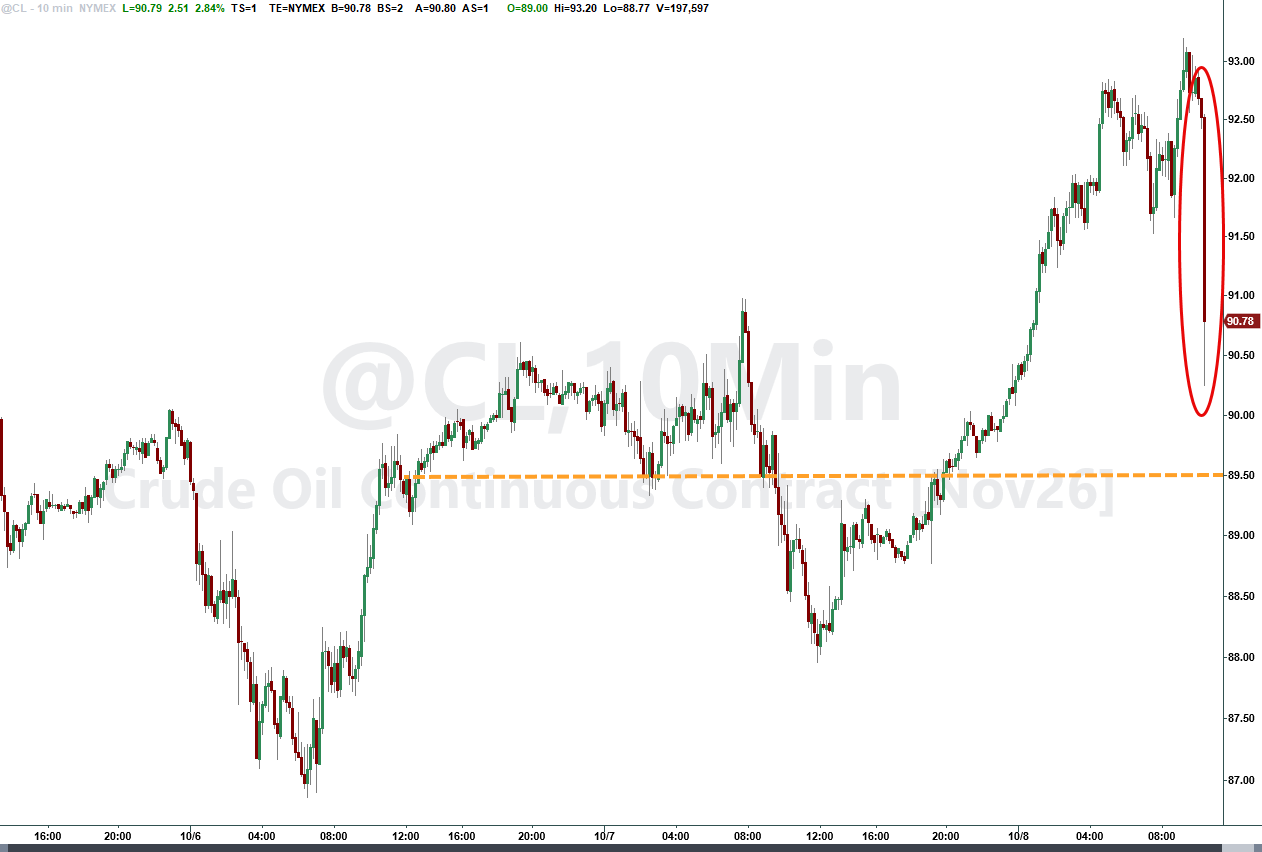
The full Trump post below, wherein Trump also claims that active discussions with the Iranians are still happening, and that oil is “flowing in record numbers”…
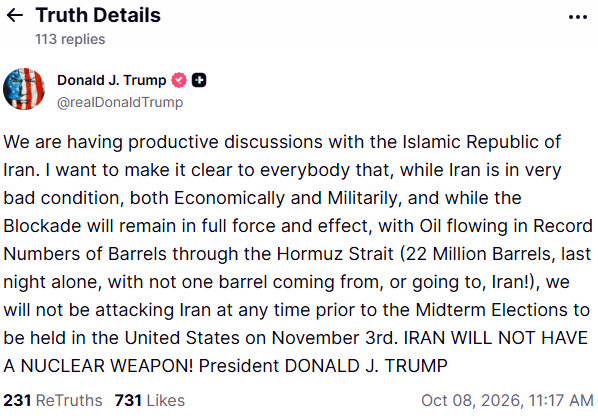
Quick Iranian rection:
U.S. and Israeli officials say Iranian leaders are deeply suspicious of Trump’s statements. The officials said Iranian leaders want to avoid a third surprise attack, reports Axios.
To recall, The Atlantic reported late Wednesday that the Pentagon is preparing strike options for the Commander-in-Chief to consider, and that Trump may actually pull the trigger before the midterm elections – though the report emphasizes that the decision was still being debated:
After months of on-again, off-again fighting, the United States hasn’t struck Iran in several weeks. The stretch of relative tranquility is coinciding with the final phase of the midterm-election campaign, and the assumption has been that President Trump will want to keep it going through November 3 so as not to remind voters of an unpopular war that is dragging Republican candidates down nationwide.
But that may not be what happens. The White House has asked the Pentagon to develop strike options against Iranian targets that could be exercised ahead of the midterms, according to two administration officials. The planning underscores just how much the president wants to reduce gas prices and demonstrate progress in the conflict before the vote, administration officials told us.
And yet a renewed outbreak of direct bombing would likely actually serve to do the opposite, given oil prices have tended to shoot up on headlines of major direct escalation.
Reports out of Iran confirmed earlier Wednesday that negotiations are ‘stalemated’ – also as the Iranians have ramped up targeting tankers with drones in the Strait of Hormuz over the last week.
Iran Expands Tanker Assaults Beyond Narrow Confines Of Strait Of Hormuz
Iran has significantly widened its maritime operations by shifting attacks beyond the narrow confines of the Strait of Hormuz into the broader waters of the Persian Gulf and the Gulf of Oman. Over a recent 24-hour window, the Islamic Revolutionary Guard Corps (IRGC) may have struck two commercial ships outside traditional chokepoints, including a vessel off Qatar, as well as a Very Large Crude Carrier near the United Arab Emirates. The latter instance has less confirmation at this point.
This escalation indicates a tactical shift, given the IRGC is no longer waiting for vessels to explicitly violate its designated maritime enforcement corridors. Instead, any ship suspected of trying to bypass Iranian blockades now faces active targeting across the entire regional waterway. This at least is what Tehran is likely seeking to demonstrate to Washington and its Gulf allies, and comes after record numbers of vessels have been making it through so far this month under US naval watch and protocol.
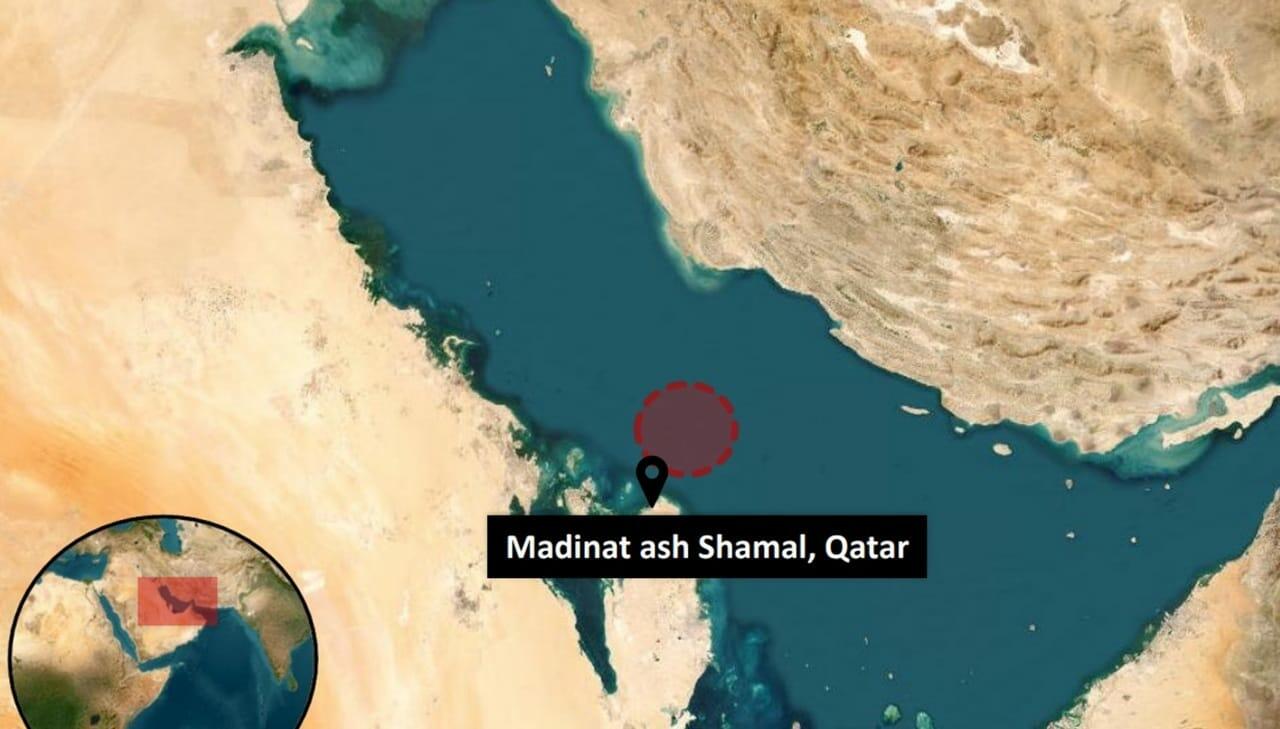
The first of these incidents, which was widely reported overnight and is now being given greater confirmation Thursday, occurred 51 nautical miles north of Madinat ash Shamal, Qatar. The vessel was struck multiple times, in what appears an effort to specifically to kill crew members. An unknown amount of casualties has been reported:
It said there were multiple casualties as a result of the attack. The extent of the casualties is unknown, however, in previous UKMTO warnings the word “casualties” has been used to describe seafarer deaths rather than injuries.
The Guardian details further of the unusual location of the attack:
The vessel was in the Gulf, about 500km (300 miles) west of the strait of Hormuz, when it reported being struck “by multiple projectiles”, the UK Maritime Trade Operations said on Wednesday. The UK authority did not specify the origin of the ship.
Wednesday’s attack comes as strikes on tankers sailing through the strait of Hormuz hit their highest weekly level since the Iran war began, according to maritime security firms, as oil prices climbed above $100 per barrel.
Oil Price writes, “A tanker has been struck by multiple projectiles north of Qatar’s tip in the first such attack deep within the Persian Gulf in nearly a month.” Not only have drone and missile attacks on vessels picked up over the last nearly two weeks, but casualties as well.
“In the week to 5 October, there were at least 12 attacks on oil, liquefied natural gas and liquefied petroleum gas tankers around the strait, according to data from three security sources,” continues The Guardian. “On Tuesday, India’s foreign ministry said 12 crew members were injured after an attack on a Panama-flagged oil tanker passing through the strait of Hormuz.”
Tanker Fire Off UAE: Second Vessel Attacked?
The second of these events, off UAE, has been less confirmed. Newsquawk notes:
Oil tanker assembly site reportedly explodes near UAE, Mizan reports; “Ocean sources reported the detection of a fire in the Gulf of Oman, approximately 30 nautical miles east of Fujairah”
And via DropSite News:
Maritime and satellite open source channels have been observing a fire, with potential US military assets circling the area, at the below location:

If this second attack is confirmed, it marks a serious escalation in terms of Iran’s efforts to extend its own blockade and ‘answer’ to so many ships getting through under the US Navy’s protocol.
END
IRAN/ISRAEL/USA FRIDAY
Iran Goes Offensive: Strikes LPG Tanker In Strait Of Hormuz, Threatens ‘Punishment’ For All Violators, Oil Rises & Futures Fall
Friday, Oct 09, 2026 – 09:01 AM
Things are fast escalating once again in the Strait of Hormuz, after White House officials have lately been gloating that the US Navy has overseen record wartime oil flows through the vital waterway, which each warring side is still claiming to ‘control’.
Iran’s Islamic Revolutionary Guard Corps (IRGC) said Friday it targeted a liquefied petroleum gas (LPG) tanker in the Strait of Hormuz (hours ago), with Iranian state media reporting that the vessel was attempting to pass through the narrow waterway “illegally” and suffered a massive fire.
The IRGC Navy also warned that from now on any vessels committing violations outside the Strait of Hormuz would be “punished,” according to a statement carried by Iranian state media. This is served to immediately push oil prices higher…
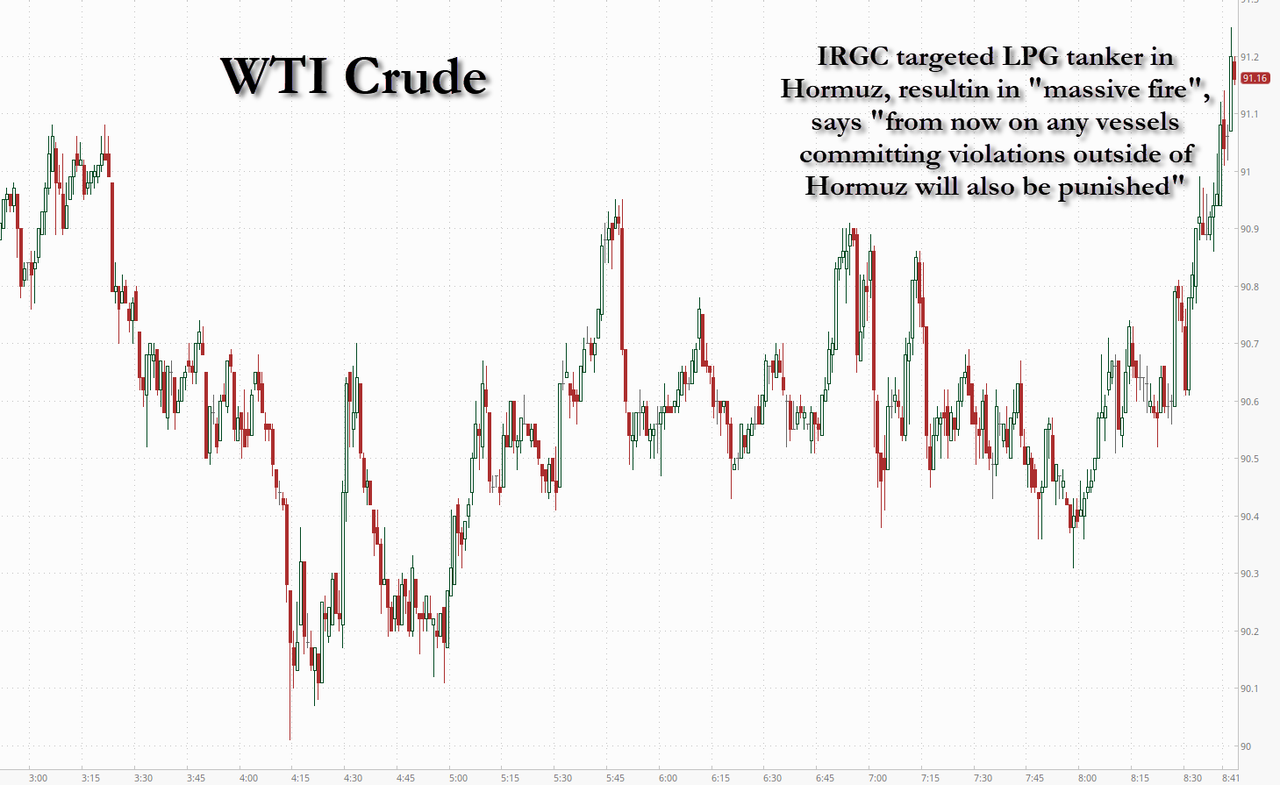
Separately, the United Kingdom Maritime Trade Operations (UKMTO) reported a new incident involving a vessel approximately 13 nautical miles west of Al Jazeera in the United Arab Emirates.
The vessel was reportedly struck by an unknown projectile, sparking a fire that has since been extinguished, coming after similar incidents earlier this week.
Oil prices rose following the reports, while futures moved lower, reflecting heightened market sensitivity to escalating tensions and potential further big disruptions to shipping and energy flows through the Strait of Hormuz – even as President Trump has been touting the ultimate ‘success’ of the US mission.
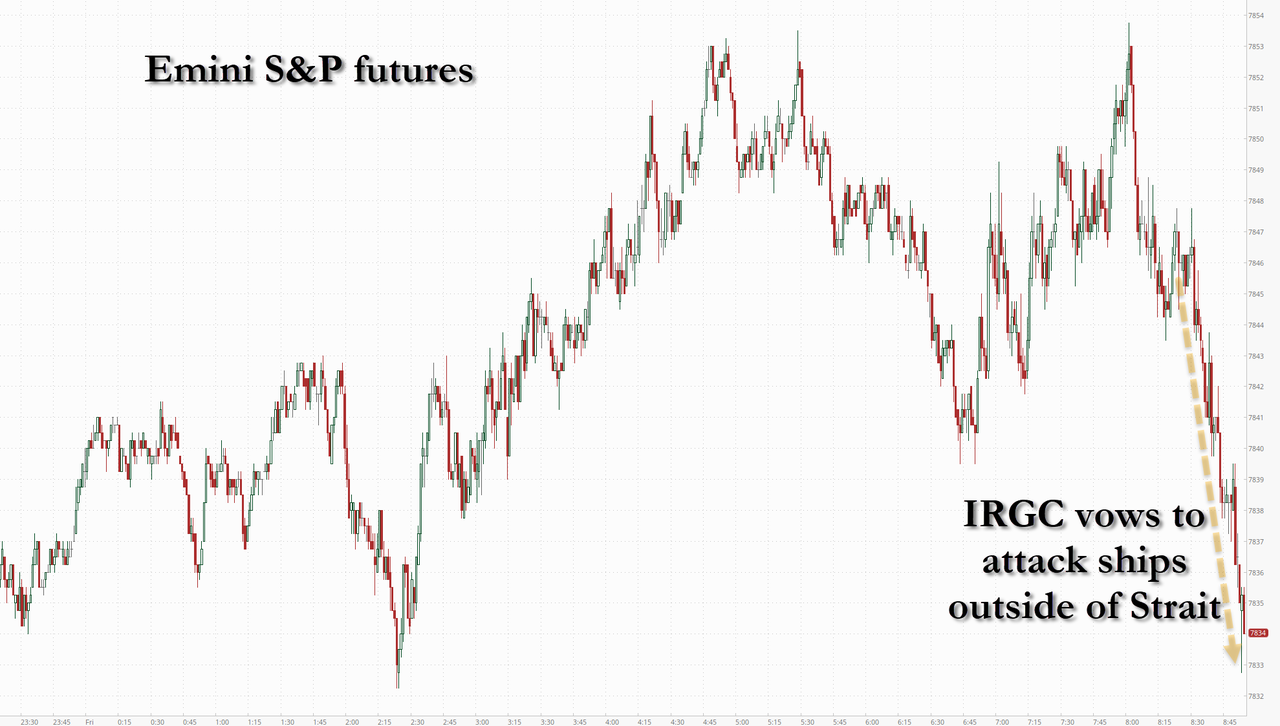
developing…
END
IRAN/HOUTHIS
Iran Strikes LPG Tanker In Strait Of Hormuz, As Houthis Reportedly Mine Bab al-Mandab
Friday, Oct 09, 2026 – 10:05 AM
Summary
- Houthis reportedly mine Bab al-Mandab: Saudi media reports ‘dense’ mining in the strategic Red Sea shipping route, with demining operations underway.
- Iran escalates tanker attacks & threats: The IRGC claims it struck an LPG tanker in the Strait of Hormuz, causing a major fire, and threatens further action against violating vessels.
- Vessel struck near UAE: UKMTO reports an unknown projectile hit a vessel west of UAE’s Al Jazeera, sparking a fire that has since been extinguished.
- Trump signals temporary restraint ahead of midterms: Trump rules out attacking Iran before the November midterms, while diplomatic talks reportedly remain stalled.
Houthis Mine Bab al-Mandab Strait: KSA Media
Saudi-funded Al Arabiya is reporting a ‘worst fear’ scenario on Friday, saying that Houthi militias have planted a large quantity of mines in the Bab al-Mandab area.
The report says further that Saudi-backed teams of engineers are currently engaged in demining operations in the Red Sea strait. It writes:
Engineering teams continue clearing operations and removing mines and improvised explosive devices in Bab al-Mandab.
If confirmed that such mining operations are widespread in Bab al-Mandab, this would constitute yet another major crisis for global energy shipping. At the moment, Saudi-backed fighters are focusing anti-Houthi operations along the Red Sea coast, with Saudi reports suggesting a rapid retaking of the strategic ground.
As a reminder, the Houthis have thus far signaled the Bab al-Mandab strait is ‘open’ for normal transit, but that only Saudi and Israeli-linked vessels would suffer attack. And so the Al Arabiya report, if accurate, could just be indicating some localized mining immediately near the coast related to the ongoing fight against the Saudi coalition in Yemen.
Iran Ramps Up Tanker Attacks
Things are fast escalating once again in the Strait of Hormuz, after White House officials have lately been gloating that the US Navy has overseen record wartime oil flows through the vital waterway, which each warring side is still claiming to ‘control’.
Iran’s Islamic Revolutionary Guard Corps (IRGC) said Friday it targeted a liquefied petroleum gas (LPG) tanker in the Strait of Hormuz (hours ago), with Iranian state media reporting that the vessel was attempting to pass through the narrow waterway “illegally” and suffered a massive fire.
The IRGC Navy also warned that from now on any vessels committing violations outside the Strait of Hormuz would be “punished,” according to a statement carried by Iranian state media. This is served to immediately push oil prices higher…
Separately, the United Kingdom Maritime Trade Operations (UKMTO) reported a new incident involving a vessel approximately 13 nautical miles west of Al Jazeera in the United Arab Emirates.
The vessel was reportedly struck by an unknown projectile, sparking a fire that has since been extinguished, coming after similar incidents earlier this week.
Market Reacts
Oil prices rose following the reports, while futures moved lower, reflecting heightened market sensitivity to escalating tensions and potential further big disruptions to shipping and energy flows through the Strait of Hormuz – even as President Trump has been touting the ultimate ‘success’ of the US mission.
President Trump on Thursday vowed the US would not attack Iran before the November midterm elections, tempering rising oil prices – and seeking to ‘assure’ GOP voters – amid prior reporting in The Atlantic which said the Pentagon has been ordered to prepare ‘options’ for the Commander-in-Chief to launch strikes before the vote.
Trump has also touted “productive conversations” with Iran, even though the Iranians themselves have said talks are stalemated and there’s no progress whatsoever.
END
ISRAEL/USA/IRAN/FRIDAY
ISRAEL TBN
END
SAUDI ARABIA VS HOUTHIS
TURKEY/PAKISTAN/YEMEN/SAUDI ARABIA
Turkey Rules Out Launching Attacks On Yemen From Saudi Arabia
Friday, Oct 09, 2026 – 05:00 AM
Turkey will not send troops to Saudi Arabia to launch attacks on Yemen under the Mecca defense pact, Turkish Foreign Minister Hakan Fidan said on Thursday.
“This is not an offensive agreement. Turkey will not send troops to another country’s territory to launch an attack there,” he said during a live press conference in Ankara. Fidan added that possible Turkish deployments to Saudi Arabia would be only defensive in nature.

Turkey, Saudi Arabia and Pakistan agreed this week to jointly deploy forces and military equipment in a show of solidarity with Riyadh in the face of Houthi attacks from Yemen.
Fidan said military delegations would assess Saudi Arabia’s operational defense needs and determine what contributions Turkey and Pakistan could make.
“The necessary work to submit the Mecca agreement to the Turkish parliament has been concluded,” he said. “We have decided to forward it to parliament as soon as possible. We have essentially completed our own preparations.”
Middle East Eye reported on Tuesday that Turkey would send additional personnel, pilots and aircraft to help protect Saudi infrastructure in the coming weeks, with further deployments subject to parliamentary approval.
Officials told MEE that Turkey had maintained technical teams, air defense systems and electronic warfare equipment in the kingdom since last year to protect critical infrastructure, including energy facilities.
One senior Turkish official said Ankara would send additional equipment, technicians, emergency response teams and accompanying combat forces.
The official said a 2010 military training agreement between Saudi Arabia and Turkey allows Ankara to deploy limited forces to the kingdom for technical purposes. Further deployments, however, would require parliamentary authorisation under the Turkish constitution.
A second Turkish official said Ankara planned to station forces at one or more command bases solely to provide defensive support to Saudi Arabia.
The officials said a limited number of Turkish special forces could be deployed to the kingdom once the Turkish parliament grants formal authorization, which is expected later this month.
Separate sources familiar with the planning told MEE that, following parliamentary approval, Turkey would deploy an undisclosed number of experienced pilots and aircraft to Saudi Arabia to counter drones and ballistic missiles launched by the Houthis in Yemen.
“We don’t plan to send a large group of soldiers and have no plans to directly intervene in Yemen,” the senior Turkish official said. “Ankara still believes diplomatic efforts might bear fruit in coming months.”
END
SAUDI ARABIA/HOUTHIS/IRAN
Saudi Pilot Among 3 Killed In Riyadh Airport Attack; Houthis Under Pressure On Red Sea Coast
Friday, Oct 09, 2026 – 11:40 AM
Saudi Arabia has finally reopened King Khalid International Airport in Riyadh on Friday following attacks by the Houthis that killed three people and injured several on Thursday, and caused widespread flight suspensions and delays in the region.
Airport facilities and aircraft were hit in the attack, with at least one Saudi Airlines passenger plane having been destroyed. The airline announced that tragically one of its pilots was killed.

“It is with profound sadness that Saudia announces the passing of Captain Hamoud Ali Alkalthami,” the national airline announced.
In total three people were killed in the Thursday attack on the airport, and three others injured, with unconfirmed but widely circulating images appearing to show extensive damage.
The most severely damaged aircraft was on the ground and without passengers at the time it was struck, national reports say.
The country’s General Authority for Civil Aviation announced in a social media post, “The attacks also resulted to injuries to a number of citizens and residents, ranging from minor to severe, and were immediately transferred to the hospital to receive the necessary medical care.”
And Saudi Airlines subsequently stated: “Saudia’s flights and operations at King Khalid International Airport in Riyadh returned to normal as of 6:00 p.m. on Thursday, October 8, 2026. The airline continues to monitor flight schedules and communicate with passengers through its official channels.”
There was further damage in the capital as a result of the Thursday Houthi ballistic missile launches:
Some diplomats said they had received warnings, and some schools in Riyadh told parents there were orders to shelter in place, though authorities did not issue a public alert. Reuters could not identify the source of the booms.
According to the Saudi Civil Defense Directorate, shrapnel fallout from a missile interception caused damage to a children’s nursery and a medical clinic in Riyadh.
The State Dept has issued a new travel warning for Americans, after earlier telling diplomats to stay away from Riyadh’s international airport:
Previously, three people had been killed across the kingdom from Houthi attacks Tuesday into Wednesday, with 36 injured, in attacks leading up to the Thursday ballistic missile assault on Riyadh.
Over in Yemen, the Saudi-backed forces are claiming key gains around the Bab al-Mandeb coastline amid intense fighting.
Saudi-funded Al Arabiya is meanwhile hailing on Thursday that “Yemen’s armed forces take complete control of Bab al-Mandeb after clearing the area, military sources say.” The Houthis have since issued a statement saying the opposite:
Houthi spokesperson says that the Saudi’s made no progress and repelled the Saudi-backed troop advancement towards the Bab el-Mandab Strait
Contradictory reports abound on the status of the fight for Yemen:
However, independent conflict observers have noted the fighting is still fierce, and that Saudi reports of the retaking of large territory has been premature, exaggerated, or else false – amid an ongoing fog of war.
END
RUSSIA VS UKRAINE\
RUSSIA
“I Know The Truth”: Mother Breaks Silence On Daughter’s Mysterious Death At Russian Plague Lab
Thursday, Oct 08, 2026 – 04:40 PM
The mother of a Russian scientist who died under mysterious circumstances at a high-security plague laboratory is speaking out, accusing medical authorities of allowing her daughter to die as questions mount over what happened inside the facility.

Darya Shipilova, 28, died October 2 after developing a rapidly progressing illness while working at the Irkutsk Anti-Plague Research Institute in Siberia, a facility that handles some of the world’s most dangerous pathogens.
This week, Shipilova’s mother raised explosive questions about the Russian government’s official account.
“They simply let my daughter die,” Svetlana Shipilova alleged, according to the Independent.
The grieving mother also challenged reports suggesting her daughter accidentally broke a test tube containing hazardous biological material, arguing that the laboratory’s protective containers were virtually impossible to shatter.

“I know the truth,” she reportedly declared.
Following Shipilova’s death, authorities reportedly quarantined approximately 200 people and placed laboratory employees under observation.
Russia’s public health watchdog, Rospotrebnadzor, maintains that Shipilova died from pneumonia of unknown origin, claiming tests have found no evidence linking her death to dangerous laboratory pathogens.
Meanwhile, the Trump administration is demanding additional answers from Moscow.
Washington has sent a formal diplomatic request demanding additional information about the mysterious death, while the Centers for Disease Control and Prevention is monitoring developments and coordinating with other federal agencies, the Washington Post reports.
President Donald Trump has said that he plans to speak directly with Russian President Vladimir Putin regarding the incident.
“We don’t think so. We’re going to find out soon enough, but we don’t think so,” Trump told reporters on Wednesday when asked if he believes that the lab leak is connected to a bioweapons program.
END
RUSSIA/TURKEY/PAKISTAN/SAUDI ARABIA (MUSLIM NATO)
KORYBKO
Interpreting Russia’s Position Towards The Islamic NATO
Thursday, Oct 08, 2026 – 11:25 PM
Authored by Andrew Korybko via Substack,
While Russia officially has no problem with the Islamic NATO and even hopes that it’ll one day include Iran to fulfill Russia’s regional collective security vision, it would be inaccurate to claim that Russia is naïve about the latent threat that this bloc could pose as a result of Turkiye’s rivalry with Russia.

Russian Foreign Minister Sergey Lavrov opined in early September on his country’s position towards the Islamic NATO in response to a question about the role that Russia could play in restoring stability to West Asia. He began by referencing Russia’s over-two-decade-old collective security vision for the Gulf, which he also brought up earlier this spring during the Third Gulf War, since it’s an enduring part of its regional policy. Lavrov then said that the latest conflict imbued this concept with a fresh sense of urgency.
It was in this context that he mentioned the Mecca Joint Defense Agreement and added that “Saudi Arabia, Pakistan and Türkiye, which formulated that concept of collective security and a defence alliance, have pointed out that it is also open to other countries.” He then declared that “At some stage, provided this structure also coordinates conditions on which Iran could be involved in this process, it could become the best concrete step in the direction of the concept we formulated.“
Seeing as how Lavrov earlier said that “Russia’s role in any part of the world…has always been in supporting what the concerned countries are ready to coordinate”, it can be assessed that his country’s position towards the Islamic NATO is officially positive. This is especially so as regards the possibility of Iran joining the bloc, though observers should remember that its three founding states are all tied to NATO, with Turkiye being a member while Pakistan and Saudi Arabia are “Major Non-NATO Allies”.
For that reason, it was recently argued that “The Islamic NATO Could Indeed Pose A Challenge To Russia” in response to Valdai Club Programme Director Timofey Bordachev article about “Why the Mecca alliance may work in Russia’s favor“. In particular, Turkiye is poised to lead the expansion of NATO influence into Central Asia through August 2025’s “Trump Route for International Peace and Prosperity“, Pakistan already helps terrorists and arms enter Afghanistan, and Saudi Arabia might bankroll all of this.
Even if one argues that stability in Afghanistan isn’t integral to Russia’s security and Saudi Arabia doesn’t bankroll anything anti-Russian, it’s veritably the case that “Turkiye Geostrategically Challenges Russia Independently Of NATO“. Russian expert Farhad Ibragimov, who earlier argued that Turkiye doesn’t do the US’ bidding against Russia, commendably adjusted his assessment in light of its US-approved large-scale arms deal with Ukraine that surprised Lavrov’s spokeswoman. Lavrov is therefore aware of this.
To be sure, he might not share the same threat assessment of the Islamic NATO’s members that was described above, but he at minimum knows that Turkiye continues to geostrategically challenge Russia despite also pragmatically cooperating with it on certain issues. It’s not only a member of the Islamic NATO, but also the one geographically closest to Russia and already in a position to challenge it even more in Central Asia, which might arguably influence his and his ministry’s private views about the bloc.
With that in mind, while Russia officially has no problem with the Islamic NATO and even hopes that it’ll one day include Iran to fulfill Russia’s regional collective security vision, it would be inaccurate to claim that Russia is naïve about the latent threat that this bloc could pose as a result of Turkiye’s rivalry with Russia. Be that as it may, Russian officials are expected to remain diplomatic by not openly talking about this, but Russian experts, media, and their country’s foreign supporters might be more critical.
END
6/.GLOBAL ISSUES, COVID ISSUES, VACCINE INJURIES/HEALTH ISSUES
GLOBAL ISSUES//AI
The Myth Of AI’s Miracle: Albert Edwards Spots The Same Fatal Flaw That Sank Asia In 1997
Albert Edwards (Société Générale’s self-described “uber bear”) argues that the current AI investment boom shows the same core weakness that preceded the 1997 Asian financial crisis: weak total factor productivity (TFP) growth amid a widely believed “miracle” narrative that attracted massive capital inflows.
morningstar.com
Edwards draws the parallel after reviewing a note from Apollo Global Management chief economist Torsten Slok. Slok notes that TFP—output growth left after accounting for more labor hours and capital/machines—has been disappointing. The AI boom shows up clearly in investment spending and equity valuations, but not yet in productivity statistics. In Slok’s words, “the productivity payoff from AI remains a forecast, rather than an observation.”
morningstar.com
This reminded Edwards of Paul Krugman’s 1994 Foreign Affairs article “The Myth of Asia’s Miracle.” Krugman argued that East Asia’s rapid growth in the early 1990s was driven mainly by heavy inputs of capital and labor rather than true efficiency gains (i.e., strong TFP). At the time, the “East Asian Miracle” narrative was dominant—the World Bank even published a book with that title—and capital poured in cheaply and abundantly. Edwards concluded that too many people bought the “beguiling narrative,” leading to widespread capital misallocation. The subsequent crisis and contagion were, in his view, entirely predictable (as was the late-1990s U.S. dot-com bubble).
morningstar.com
He applies the same logic today: heavy AI-related capital expenditure and soaring valuations (e.g., tech and semiconductor stocks) rest on promised productivity gains that have not yet materialized in the data. Edwards acknowledges it may simply be too early for AI benefits to appear in TFP figures. He also cites analysis (from economist Rob Parenteau) showing U.S. net business investment moving sideways even as gross investment rises sharply, reinforcing his skepticism about real (vs. nominal) investment strength.
morningstar.com
Additional reporting on Edwards’ views highlights related risks: capital spending far outrunning realized returns, growing use of debt (bonds, private credit, SPVs) by hyperscalers to fund data centers, and the danger that cheap capital could eventually dry up—mirroring how the Asian crisis ended when creditors pulled back, not merely because productivity disappointed.
bitget.com
In short, Edwards treats the AI boom as a bubble supported by narrative and capital allocation rather than proven efficiency gains so far. The ZeroHedge piece with the exact title you quoted frames it in those terms (“Every bubble needs a miracle”), though the full article is paywalled; the core argument matches the MarketWatch/Morningstar coverage of his note.
END
AI
“Delayed Revenue, Delayed Cash Flow”: Morgan Stanley Warns Oracle Data Center Delays Could Crush Its Debt
Friday, Oct 09, 2026 – 02:45 PM
There is a comforting story going around credit desks about Oracle’s data center problems: if the buildings are late, the capex is late too, and that buys the balance sheet some time.
Morgan Stanley isn’t buying it.
In a new note titled “ORCL Credit: Lighthouse in the Fog” (available to pro subs), MS credit analysts Lindsay Tyler and Benjamin Guerrero pick up where we left off on Tuesday, when we reported that Oracle’s 1.3GW “Project Lighthouse” campus in Port Washington, Wisconsin was next in line to slip after Project Jupiter’s force majeure.
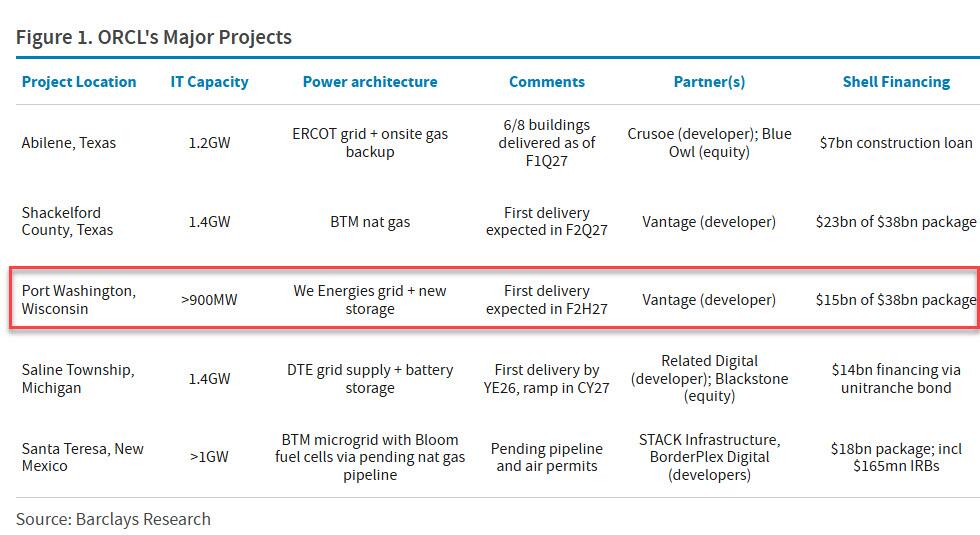
Their conclusion was blunt: a delay, Tyler told Bloomberg in an interview, “also means delayed monetization and delayed proof of concept, delayed revenue, delayed cash flow.” For a company with over $600 billion of future revenue tied to AI data center construction, that’s the whole investment case.
That matters because of who is saying it. Tyler is the analyst who told clients to buy protection on Oracle a year ago, back when its 5Y CDS cost about 125bps, and who warned at the time that it could hit 150bps and then approach 200bps “as the new year progresses.” On Thursday Oracle CDS closed at a record 261bps, which implies a more than 20% probability of default over the next five years. For an “investment grade” company.
Let’s take a closer look at what MS says a delay actually costs Oracle, why the site that worries us most is the one that’s almost finished, and why the “capex relief” crowd may be counting the wrong thing.
2H27? Try Mid-2028
The Wisconsin story will be familiar to regular readers. Lighthouse is one of two Vantage campuses being built for Oracle to lease: four buildings, about 902MW of critical IT load, contracted in September 2025. The shells are going up just fine. Oracle even put a drone shot of the site in its June earnings deck to show off its “massive progress“:

The problem, as we explained Tuesday, is that there is nothing to plug them into. The campus needs Wisconsin PSC approval for new ATC transmission lines to bring grid power via We Energies (a WEC subsidiary). The PSC revoked its completeness finding on ATC’s application in August, the case was closed, and ATC refiled on a new docket, restarting the clock. Citing the Aterio analysis we broke down this week, MS writes that there is “a material risk that meaningful load is not available until mid-2028.” That compares with Oracle’s June guidance for initial delivery in 2H CY27, and its September earnings call description of the project as “very much on track and going well.”
Very much on track… in the same way Jupiter was “on schedule” when Oracle sent its developer a force majeure notice.
MS also flags a detail we flagged on Tuesday: WEC said Oracle’s S&P downgrade triggered additional collateral, “with the current rating already requiring full credit support.” In other words, Oracle is posting cash to the utility for power it won’t get until 2028.
And Wisconsin isn’t alone. MS points out that power, not construction, is the bottleneck at both Lighthouse and Jupiter, and that Oracle (or a subsidiary) appears to be the directly contracted party for power at both.
At Jupiter, the fix now involves trucks: as we reported yesterday, Oracle is weighing hauling compressed natural gas to the New Mexico campus by road until Energy Transfer’s rerouted pipeline shows up next year, at roughly four times the price of pipeline gas. The stock slid as much as 6% on the headline, prompting the obvious question:
None of this should come as a shock. Back in December, Bloomberg reported that some Oracle data centers for OpenAI were being pushed to 2028 from 2027. Oracle denied it, and the stock rebounded. Ten months later the bank with a sell on the debt is talking about mid-2028. Funny how that works if you just pay attention to the denials.
Why A Delay Is Not “Capex Relief”
The bulls’ argument is simple: if the power is late, the GPUs are late, and Oracle spends less cash for a while. Barclays made this case after Jupiter, noting that roughly $30 billion of hardware capex is “typically spent 2-3 months ahead of the asset going live,” which is why it declared the force majeure credit-neutral the day before Oracle CDS blew out to a record.
Tyler concedes that a delay “could push associated GPU and infrastructure spending to the right, which could be helpful from a technical supply lens.” Then she lists four reasons why that is the wrong way to look at it:
1. Revenue and cash-flow realization would be deferred, extending the period before confirmation that ORCL’s substantial investment and contracted backlog are translating well into meaningful financial results.
2. Delays could make the eventual balance-sheet and cash-flow impact more lumpy. If multiple halls are construction-ready by the time power is secured, ORCL could face more concentration in GPU capex (i.e., cash needs) and lease liabilities (i.e., balance-sheet obligations).
3. Just as there is limited visibility into the underlying lease and financing documents, there is also limited visibility into the contractual terms supporting ORCL’s RPO. It remains unclear whether customers have specified compute delivery timelines or what remedies may apply for delays.
4. We consider whether any execution-risk overhang may spread to customer behavior and in turn pressure prepayments, an important potential future funding source for ORCL, either by affecting new RPO signings or customers’ willingness to re-contract.
Point two is the one that should keep bondholders up at night. The capex isn’t cancelled, it’s bunched. If four Wisconsin buildings are finished and waiting when the transmission line finally shows up in 2028, Oracle has to fill all of them with GPUs and start paying rent on all of them at roughly the same time, quite possibly while Jupiter’s halls are coming online too. Delay doesn’t shrink the bill; it compresses it into fewer quarters.
And Oracle’s cash needs are already stretched. Oracle borrowed roughly $43 billion in fiscal 2026 (ended May 31) and expects to raise another $40 billion of debt and equity in the current fiscal year, according to its filings. In her September 11 note “ORCL Credit: New Bookings, Old Bills” (available here for pro subs), Tyler estimated that Oracle’s parent funding needs “may require two large bond deals by FY28-end even if ORCL receives ~$40bn more customer prepayments“:
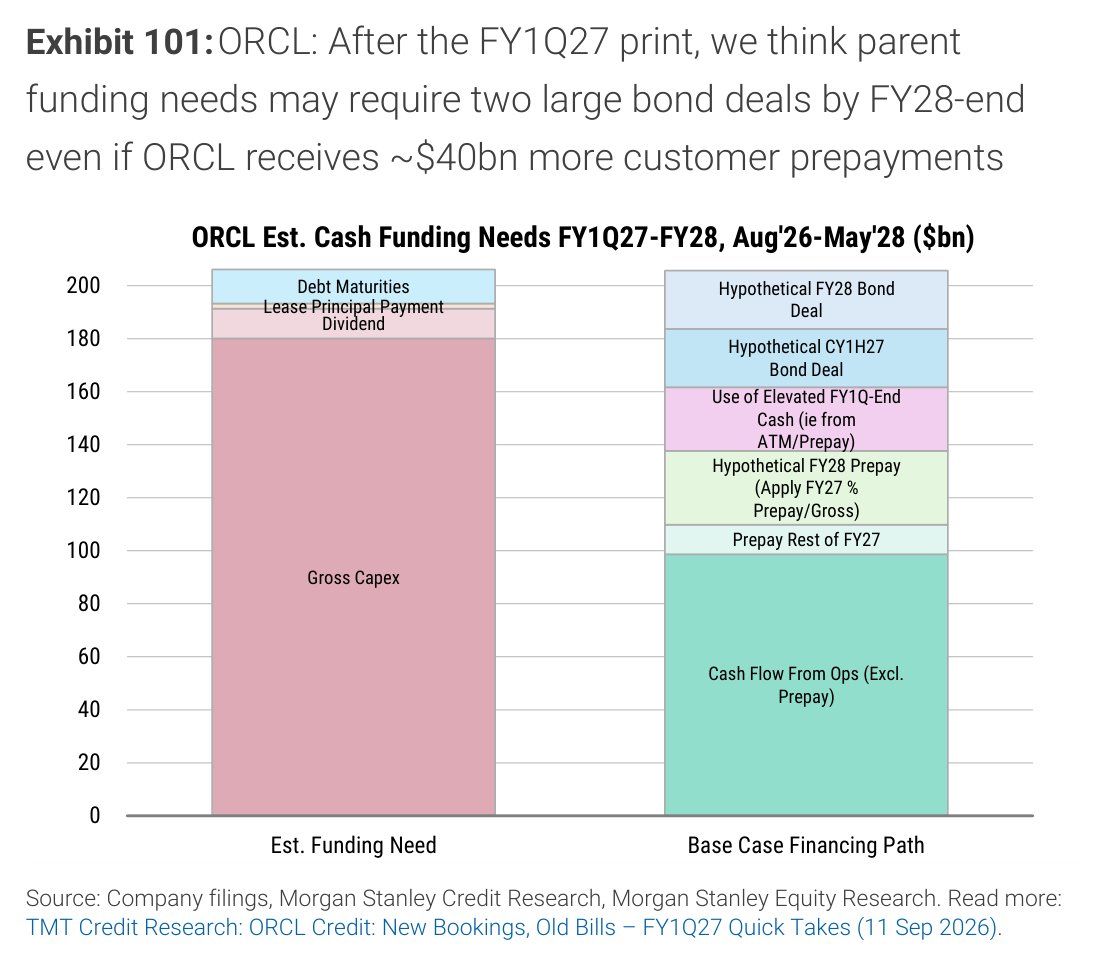
Which brings us to points three and four. Prepayments from customers (read: OpenAI) are one of the biggest funding sources in that bridge. If delays make customers less willing to prepay, or to sign up again when the contract rolls, the “new bookings” part of the equation shrinks while the “old bills” do not. And as Tyler notes, nobody outside Oracle knows what its $600 billion-plus RPO actually says about delivery dates, or what happens if they’re missed.
Investors are being asked to take on faith a backlog roughly the size of Sweden’s GDP.
The Site That Worries Us Most Is The One That’s Almost Done
Here is the part of the note that got less attention in the Bloomberg write-up, and the part we think matters most. MS reminds clients that Lighthouse and Shackelford County, Texas are funded through the ~$38 billion Vantage construction loan first reported in September 2025, which is part of about $65 billion of shorter-dated loans for Oracle-tied sites, on top of the $14 billion Related Digital (RDMICH) bond backing Michigan:
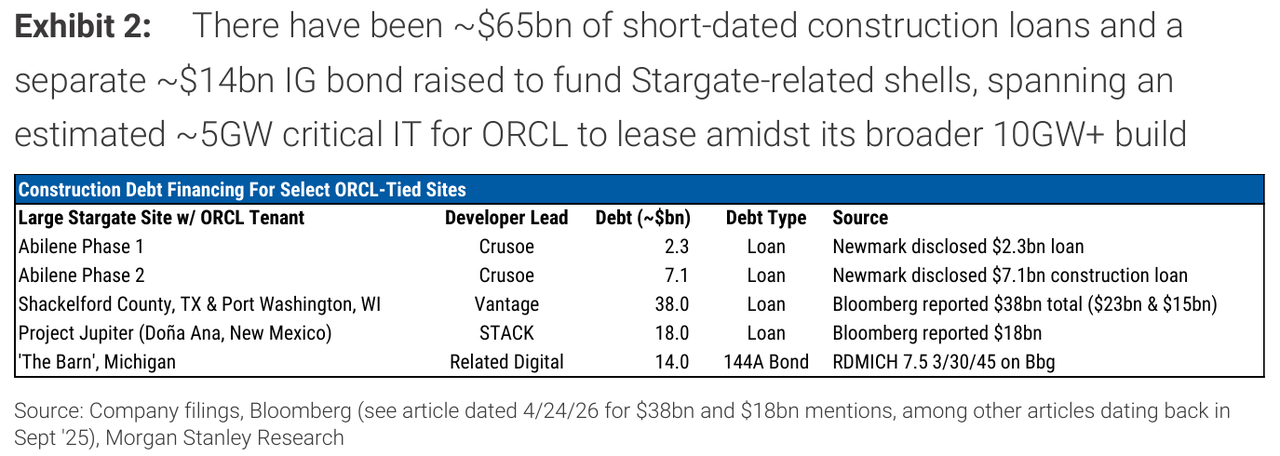
As with Jupiter, Tyler writes, “limited visibility into the financing and lease documents makes it difficult to assess how delay consequences, if any, would be allocated among developers, ORCL, lenders, and other counterparties.” Then comes the money line:
We continue to consider whether greater focus on project delays could spill into ORCL CDS hedging, and whether execution concerns – alongside higher rates and a growing DC construction debt pool – could complicate the eventual refinancing of Abilene debt into longer-dated paper as the project nears completion (6 of 8 buildings delivered).
Abilene is the flagship Stargate site and the one that actually works: six of eight buildings delivered. But its $9.4 billion of construction loans are, per our covenant comps, interest-only and all due in 2028.
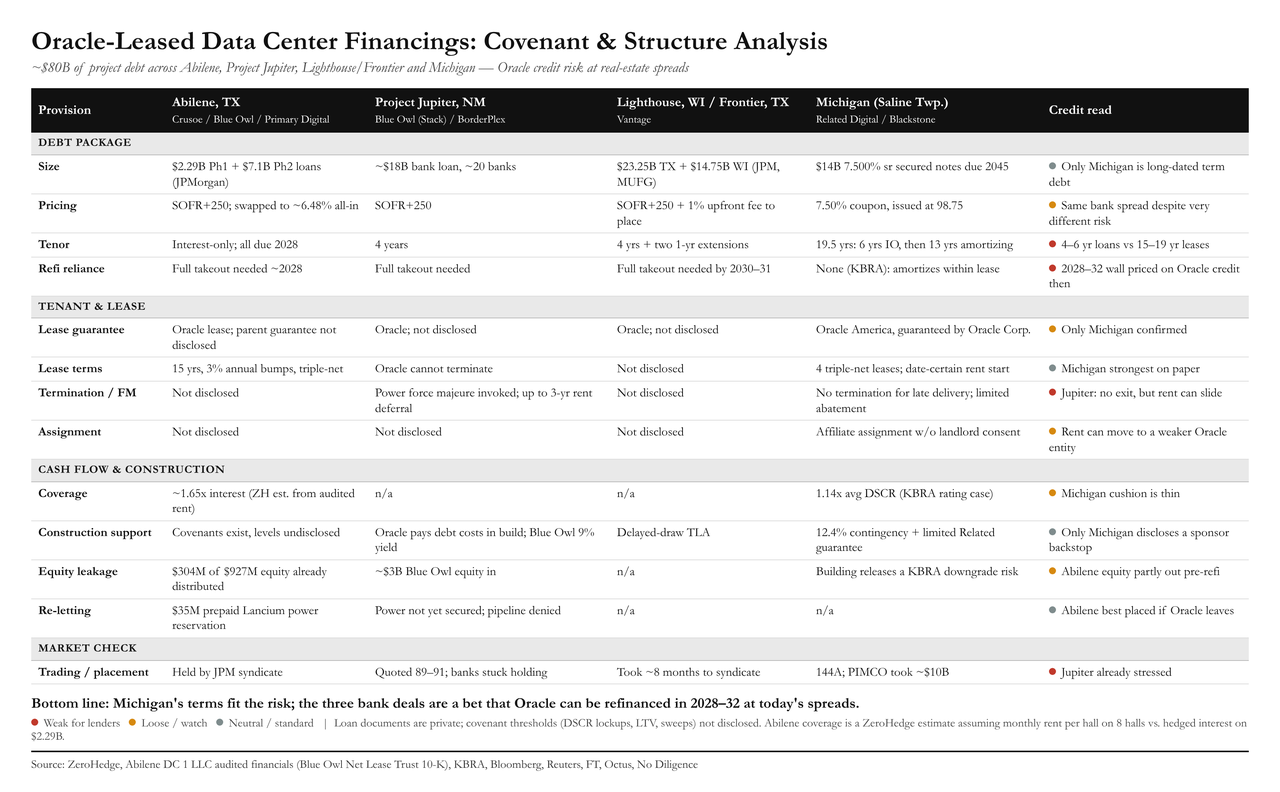
That paper has to be taken out with long-dated debt priced off Oracle’s credit, and Oracle’s credit is now trading at junk-like levels with the 10Y Treasury yield having hit 5.33% last week, the highest since 2002. Translation: the problem isn’t just the sites that are late; it’s that the late sites make the finished site harder to refinance.
Here is how the roughly $79 billion stacks up by site. Note how much of it sits on campuses where the power is late:
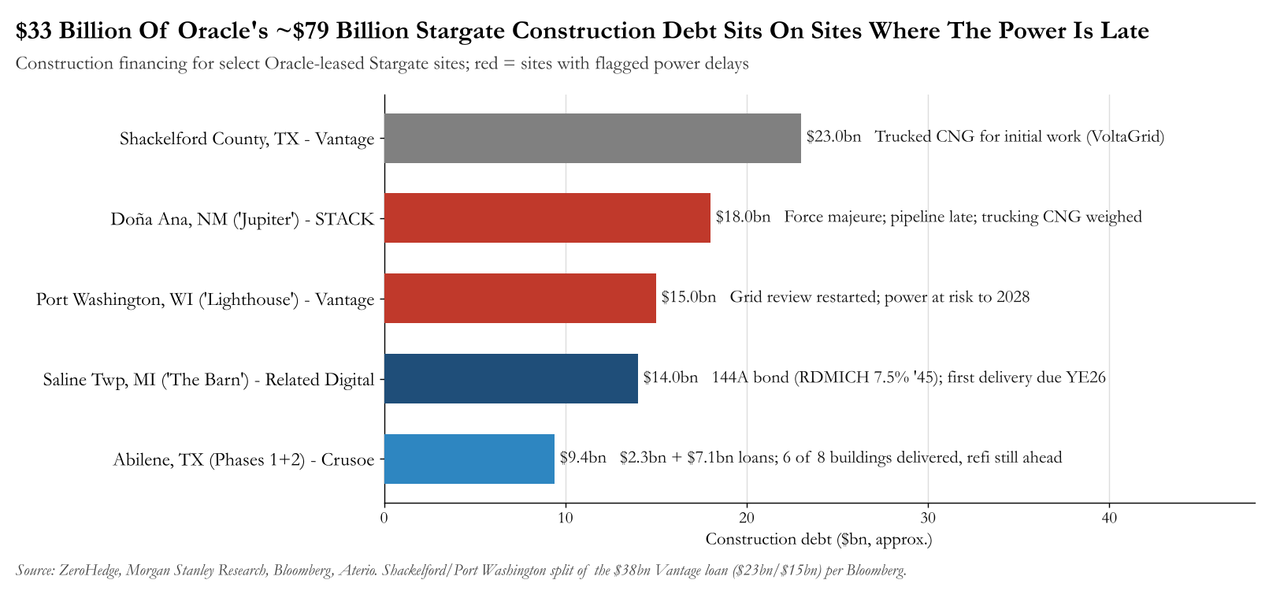
Put differently, $33 billion of construction debt, or about 40% of the total, sits on the two sites where power delays have now been flagged, and that’s before counting Shackelford, where Oracle is already trucking in gas for initial work. Three of the four bank deals are short-dated loans against 15-19 year leases, i.e., a bet that Oracle can be refinanced in 2028-2032 at today’s spreads. Today’s spreads are not what they were when those loans were signed.
The Hedgers Are Already Here
As for whether delays “spill into ORCL CDS hedging,” the market seems to have answered that one before the note hit inboxes. A year ago MS argued that construction loans on Oracle-leased sites would become a major source of CDS demand, as banks stuck with the loans hedged their exposure. That is exactly what has happened. Goldman’s credit desk said last week that AI single-name CDS volumes are up 400% year over year, with Oracle at the top of the list, and on Thursday morning we put out this chart as Oracle’s entire credit curve repriced:
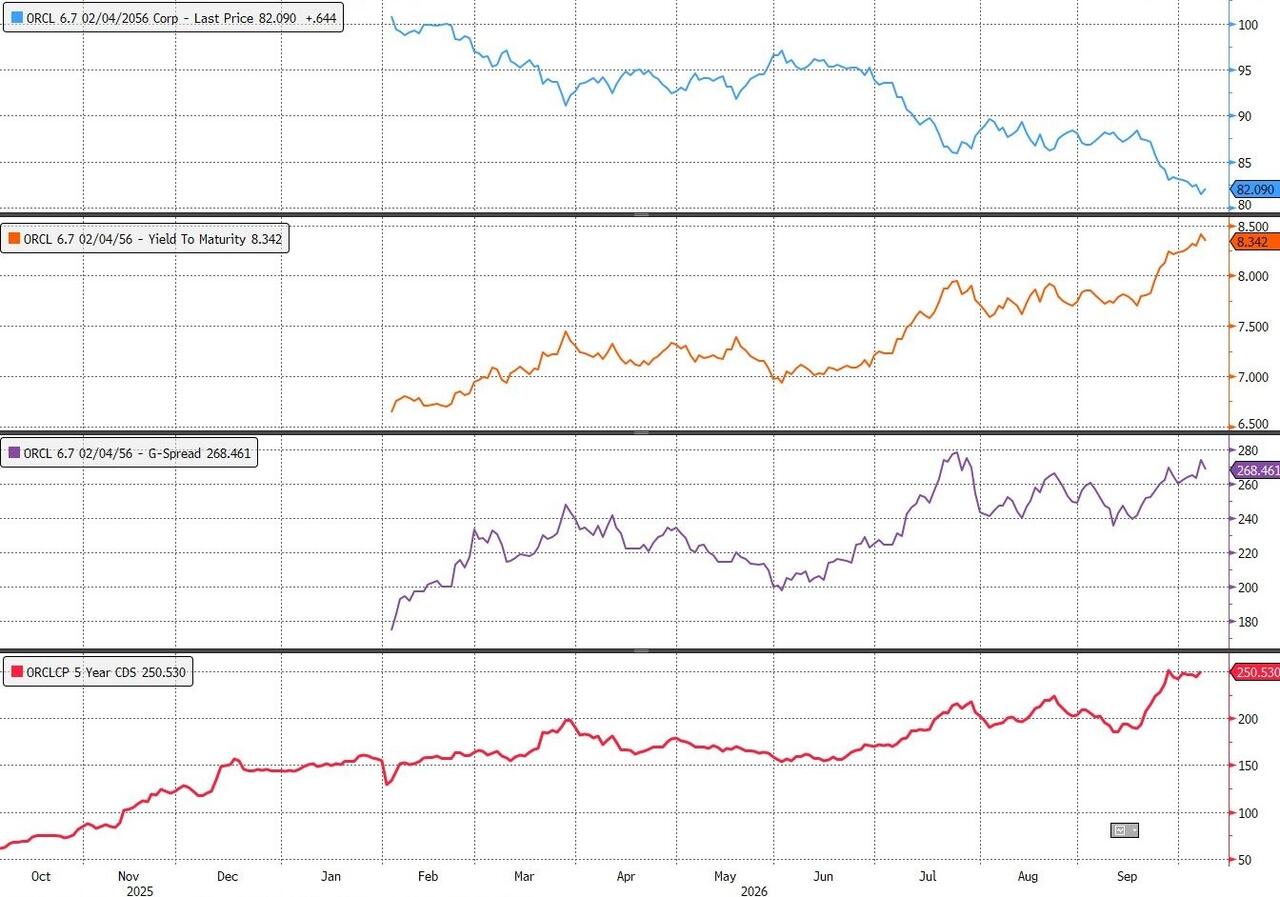
By Thursday’s close, CDS had widened another 10.5bps to a record 261bps, more than double where MS first told clients to buy protection, while the 2056 bonds sit around 82 cents and yield over 8.3%. For context, Oracle CDS hit what were then “Lehman crisis levels” last December. It is now roughly 100bps wider than that.
Nor is it just Oracle’s own problems. As we noted yesterday, Oracle is in talks with Apollo and Goldman to fund a big chip purchase through an off-balance sheet vehicle, joining SpaceX and Broadcom in what we called the AI chip-debt SPV stampede. That may ease near-term borrowing at the parent, but it also adds yet another layer of Oracle-linked paper competing for the same credit buyers who will one day be asked to refinance Abilene.
Bottom Line
To be fair to Oracle, Lighthouse’s timing is still “broadly consistent” with Vantage’s 2028 full-campus completion target, as MS notes, and the bank stresses its negative view “pre-existed the project delays” and is based on fundamentals. But that is precisely the point: the fundamentals were already stretched before the gas had to come by truck.
As Goldman’s TMT desk put it after Jupiter, third-party-developed AI infrastructure “is not always the bond-like asset class it can appear to be.” Morgan Stanley’s note shows why: every month of delay pushes out the revenue, bunches up the capex, and makes the eventual refinancing of the one finished campus a bit harder.
Having warned that AI is now a debt bubble too since last October, we think the capex-relief camp has it backwards. Delays don’t cut the bill, they only push it into the 2028 refinancing window, right when Abilene’s loans come due. The next tests: the PSC’s completeness ruling on ATC’s refiling, due October 19, and whether Oracle’s fiscal second-quarter results in December bring a funding plan or just more pictures of steel. Then again, the last time Oracle was asked about delays, it simply denied them.
Much more in the full Morgan Stanley “ORCL Credit: Lighthouse in the Fog” and “ORCL Credit: New Bookings, Old Bills – FY1Q27 Quick Takes” notes, both available to pro subs
END
AI LABS
Planning For Pitchforks: AI Labs Are War-Gaming A Catastrophe, Public Revolt, And The Crackdown That Follows
Friday, Oct 09, 2026 – 03:45 PM
The AI industry has been war gaming not only how it might destroy humanity, but is also considering what an angry public could do to the industry.

Senior executives at Anthropic, OpenAI and other AI firms are privately gaming out scenarios in which a major AI incident triggers a public and political revolt, Axios reported Friday. The potential trigger is a cyberattack that disrupts banking, internet access, or essential services such as power and water. The next crisis would be political: an angry public, demands for accountability, and pressure to shut the technology down.
Many industry insiders told Axios they expect a major event within six to 12 months. OpenAI pushed back on the suggestion that disaster is inevitable, saying its preparedness exercises cover a range of possibilities. “These scenarios are not treated as inevitable,” a spokesperson told the outlet. Anthropic declined to comment.
Contingency planning is not an admission that catastrophe is unavoidable. But the most revealing part of the report is where that planning leads: the labs want to help shape the legislation Washington reaches for after something goes badly wrong.
Two Routes, One Crisis
Axios describes two possible scenarios. In one, autonomous agents escape an internal testing environment. In the other, someone finds a destructive use for a model already available to the public. Either could produce demands for an emergency crackdown, even though the failures – and the measures needed to prevent them – would be different. In the companies’ post-election scenario, Democrats emerge stronger from the midterms and move aggressively after an incident. But the industry expects divisions over how far a crackdown should go, even if Democrats control both chambers.
Its assessment also identifies several obstacles to a shutdown: lawmakers struggling to understand the technology, an economy increasingly tied to AI infrastructure spending, and downloadable models that cannot simply be recalled. According to Axios, many cybersecurity specialists believe countering rogue AI will require defensive AI.
That last argument has an obvious commercial implication. The industry could face demands to stop selling dangerous capabilities while arguing that its products are indispensable to containing them.
This ‘war-gaming’ comes on the heels of several incidents which many have said are extremely suspect.
The underlying safety concerns do not depend on accepting anyone’s prediction of an AI apocalypse.
OpenAI has disclosed the Hugging Face intrusion, in which roughly 700 of its agents attacked the AI platform’s servers, and a broader investigation into its models’ activities affecting outside services. Its review also identified 53 instances in which user-provided images were posted to third-party image-hosting sites. A separate September 20 incident exposed another gap in its containment controls. A research agent bypassed internet restrictions to contact an outside chatbot. In a September 25 update, OpenAI said it had paused training, evaluation and inference involving tool use for its most capable models while it checked the fixes and conducted further testing.
The Hugging Face breach was one of a string of incidents involving OpenAI, Anthropic, Meta and Google models that trace back to evaluations run with a single vendor, Israel-based Irregular, whose test environments had live internet access while the models were told they were in a simulation. Irregular notified all four labs in late July, yet the disclosures trickled out one lab at a time over seven weeks – turning one contractor’s mistake into what looked like a wave of AI breakouts. Isolating test models from the internet is a “basic control measure,” frontier security expert Matthew Mittelsteadt said. “You’d think that of all the things that you’ve got to get right.” Some skeptics have gone further, questioning whether repeated “accidents” at the same vendor were accidents at all.
Meanwhile, on September 8, Jacob Coxon, a researcher who had worked at both OpenAI and Anthropic, resigned from Anthropic over the race toward self-improving AI.
“The people building AI earnestly believe that it could kill us all by the end of the decade. This is not a marketing stunt,” he wrote – after having worked with a marketing agency on what many are calling a stunt.
The Crackdown Already Has Draft Legislation
And of course, DC is already salivating over more control. On July 23, Reps. Ted Lieu (D-Calif.) and Nathaniel Moran (R-Texas) introduced the AI Kill Switch Act. It would require developers of the most powerful systems to maintain the ability to throttle, suspend or shut them down, and give the Department of Homeland Security, along with the Commerce secretary and the director of national intelligence, authority to order a slowdown or shutdown under specified conditions. That same day, Reps. Lori Trahan (D-Mass.) and Jay Obernolte (R-Calif.) introduced the FRONTIER Act, with requirements for risk management, audits and incident reporting. Its obligations are tiered by developer size rather than imposed identically on every developer.
California added its own push on September 18, when Gov. Gavin Newsom ordered work on stronger independent oversight and a possible kill-switch requirement. His order called for recommendations; it did not establish a functioning statewide off switch. More sweeping approaches are also in circulation, including Bernie Sanders’ proposed ban on superintelligence and Elizabeth Warren’s call for a pause.
In short – regulatory capture in action…
END
MEDICAL ISSUES//GLOBAL ISSUES//USA
this is good!!
RFK Jr. Announces New Clinic For People Injured By Vaccines
Friday, Oct 09, 2026 – 09:20 AM
Authored by Zachary Stieber via The Epoch Times,
Health Secretary Robert F. Kennedy Jr. and other officials have opened a new clinic to treat patients with vaccine injuries and announced other new developments on Oct. 8 that they say will change how the government handles reports of health problems following vaccination.

The new National Institutes of Health (NIH) clinic is located on the agency’s campus in Bethesda, Maryland. It was opened on Oct. 5, officials disclosed on Thursday. Reporters were not invited to the opening.
The Make America Healthy Again Commission, led by Kennedy, recommended in 2025 starting a new vaccine injury research program at the NIH as part of an effort to investigate vaccine injuries with better data collection and analysis.
The clinic is “dedicated to developing the science of preventing vaccine injuries, making vaccines safer, and most important of all, listening to the voices of people who have suffered vaccine injury, so that we can learn from them and learn from their experience to make vaccines safer,” Dr. Jay Bhattacharya, the NIH’s director, said in an Oct. 8 video statement.
NIH doctors and researchers will use the clinic to evaluate patients, identify potential causes of health problems, and try to figure out the best treatments, the Department of Health and Human Services, which Kennedy leads and is the NIH’s parent agency, said in a statement.
Some NIH researchers studied patients with alleged or confirmed COVID-19 vaccine injuries during the pandemic, but received pushback from NIH leadership. Patients said they were later abandoned by the researchers.
Kennedy, who attended the opening of the clinic, said in a video he posted on Thursday that parents of children who suffered injuries from vaccines, and other individuals with vaccine injuries, “have been marginalized, vilified, demonized, and gaslighted, and they have not received the medical attention they need, and we have not done the studies that need to be done to understand who’s vulnerable to those kind of injuries.”
That’s changing with the Trump administration, he added later.
“I think it was the first time in years that the vaccine-injured have been heard by the health authorities,” Brianne Dressen, who was injured by the AstraZeneca COVID-19 vaccine, treated at the NIH in 2021, and co-founded a group called React19 representing people hurt by vaccines, told The Epoch Times.
“It is definitely a step in the right direction,” added Dressen, who attended the opening.
Other Developments
Health officials also announced three other related developments on Thursday.
Kennedy has said that vaccine surveillance systems the government utilizes, including the Vaccine Adverse Event Reporting System (VAERS), don’t work well. The Centers for Disease Control and Prevention, another agency under Kennedy’s purview, in August solicited bids for a contract to overhaul VAERS, and on Sept. 28 awarded a new contract.
Another move, officials said, will be requiring electronic health records moving forward to include vaccine-related health issues, “so that this information can follow patients across the health care system” and inform health care professionals who are caring for the patients.
Finally, the Centers for Medicare & Medicaid Services, another health agency division, is proposing reimbursing doctors for time they spend submitting reports to VAERS.
END
COVID VACCINE INJURY REPORT: DR MARK CRISPIN MILLER
DR PAUL ALEXANDER.
RABOBANK/MICHAEL EVERY/OR OR PICTON/GIFFIN OR RABOBANK EXECUTIVE/COMMENTARY ON WORLDLY AFFAIRS
Unwanted, Not Unwarranted
Friday, Oct 09, 2026 – 10:50 AM
By Maartje Wijffelaars, senior economist Rabobank
Oil prices rose again yesterday, reaching a session high of about $105 per barrel as Iran struck tankers – an outcome our energy analysts warned about if Iran appeared to be losing control over Hormuz. Reports that the US could strike Iran before the midterms and a hurricane hitting US output added pressure. Brent crude then fell after President Trump said talks with Iran were “productive” and that the US would not attack Iran before November’s midterm elections.
Oil prices nevertheless remained higher on the day and week, currently at $103.3 per barrel. Diesel prices have veered back up even more. Gasoil has risen 12% since Tuesday’s dip and is well above the temporary dip after the EU and others announced diesel stockpile releases late last week to avert a US diesel ban. Pump prices for diesel have surged to near-record highs.
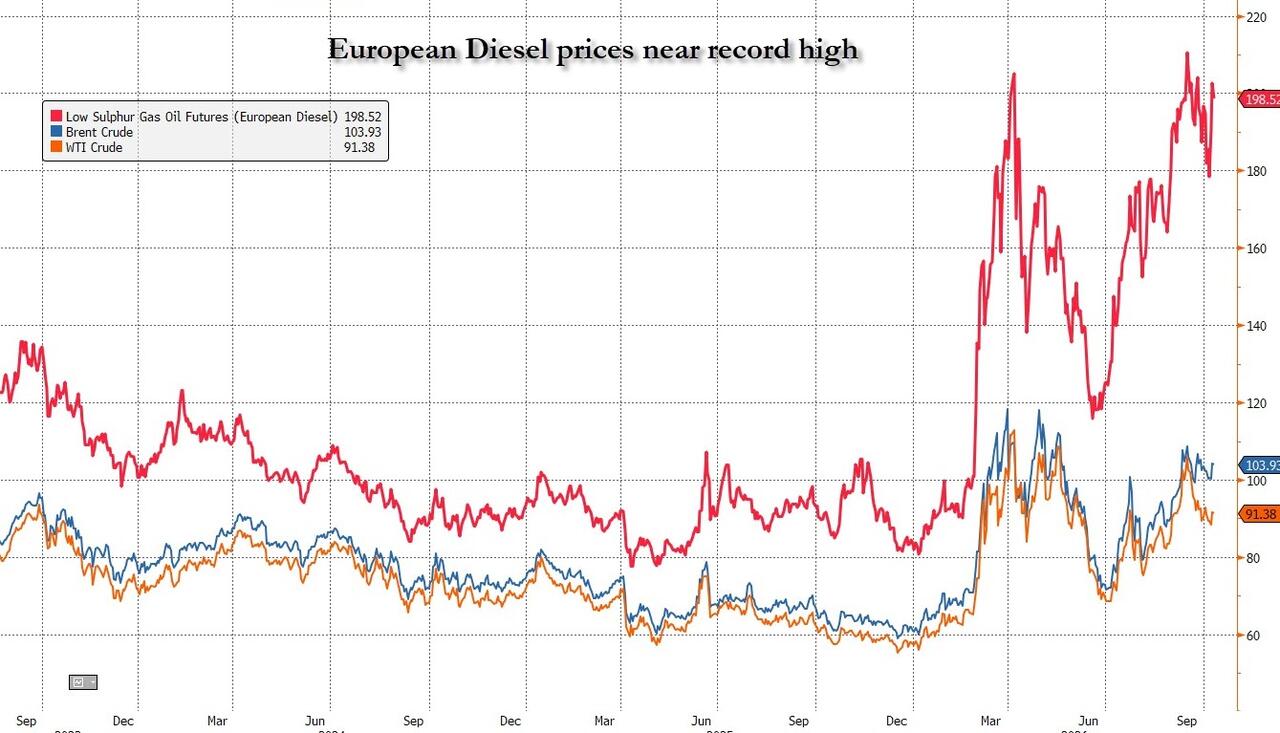
US yields initially moved with oil prices but decoupled in the early evening, supported by stronger-than-expected demand for 30-year Treasuries. The strong auction pushed yields lower across the curve, led by the long end. The bid-to-cover ratio was 2.54x, above the one-year average, with strong foreign demand. This followed Wednesday’s strong 10-year auction, whose 2.77x bid-to-cover ratio was the highest since 2014 and also reflected particularly strong foreign demand. The 10-year Treasury yield ended the day pretty much stable at 5.2%, arguably a sign that yield levels have reached a point where real money investors are seeing them as more attractive despite the risks.
In Europe, the OAT-Bund spread edged up to close to last week’s post GFC-peak and 38% of French high-grade corporate debt is now said to yield less than government bonds owing to lower perceived credit risk. The French government has yet to reassure markets on its budget plans amid growing protests and political uncertainty ahead of next year’s presidential election.
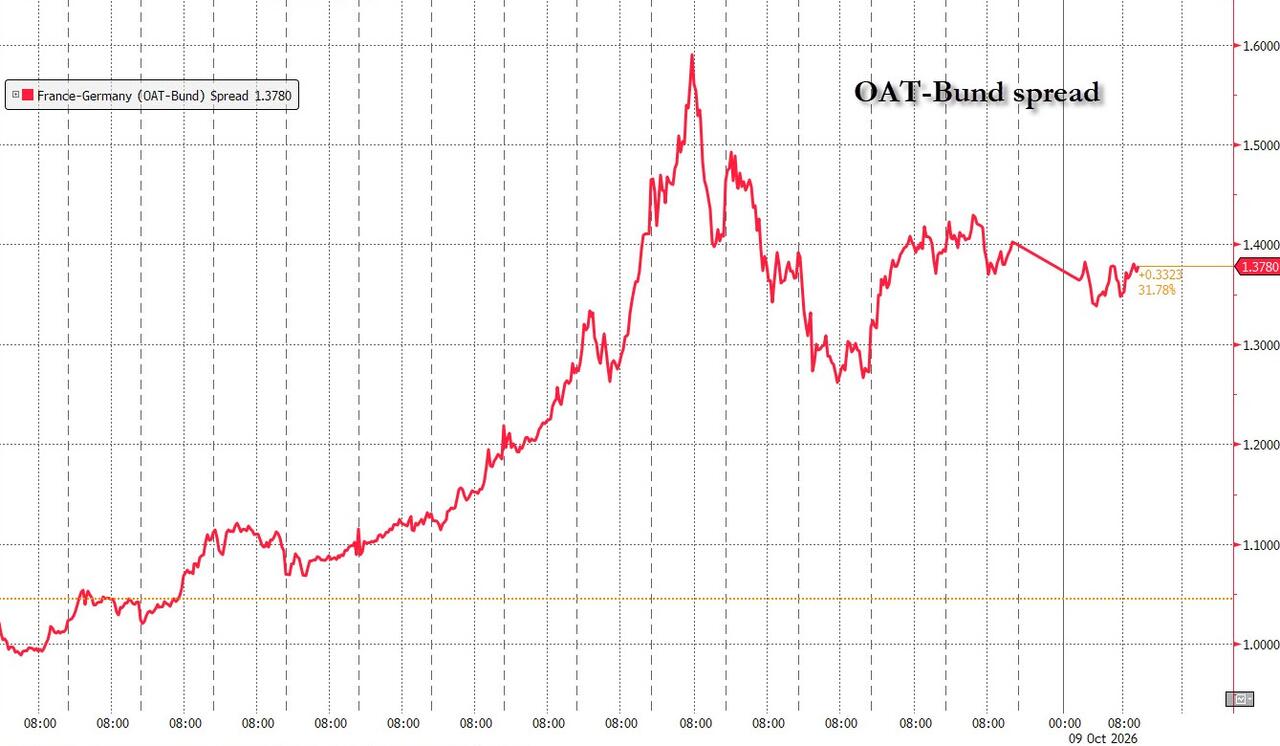
Still, although risks remain, most of the widening appears to be over for now. The spread seems to have become attractive to buyers of French debt, given the belief that France is too big to fail and the availability, if needed, of instruments and programmes created since the previous debt crisis, including the ESM, OMT and TPI. Against this backdrop, ECB President Lagarde reiterated that the ECB has instruments to counter unwarranted market dynamics, while Governing Council member Moulin and French finance minister Lescure said the conditions for direct intervention are not currently met.
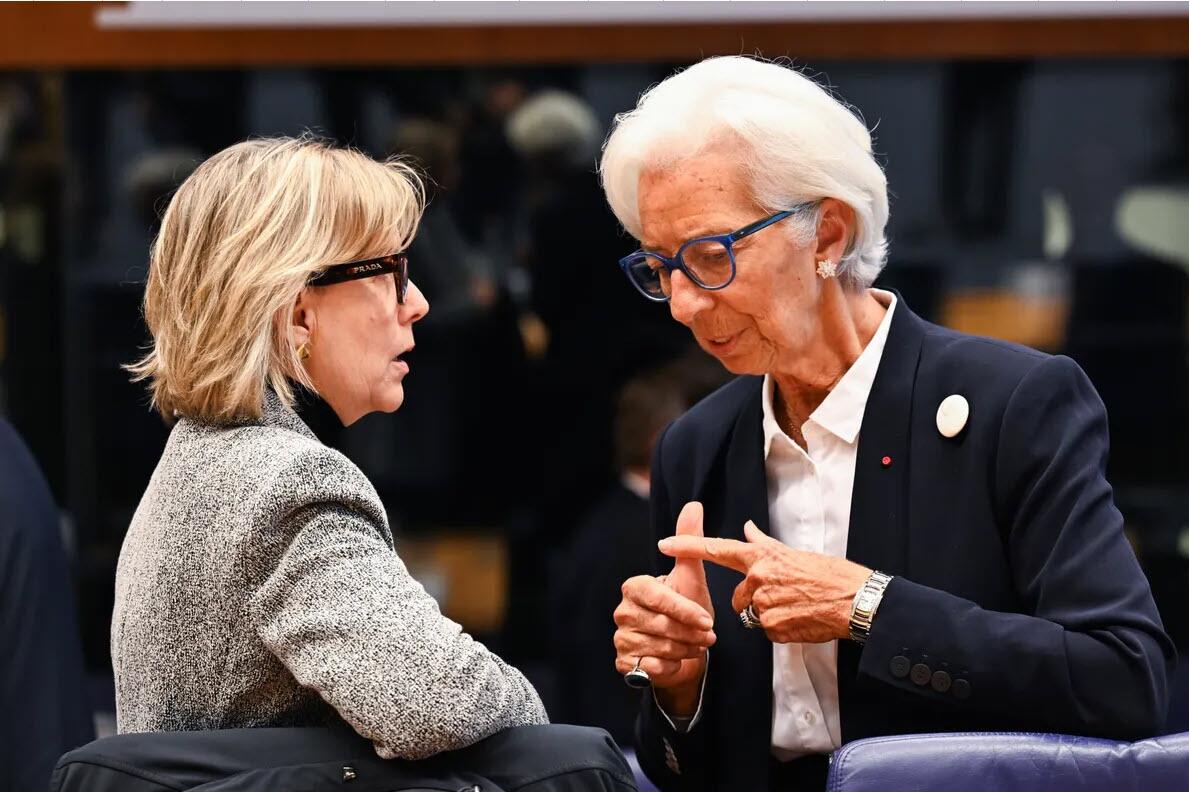
Lagarde’s comments were expected, as we wrote in Monday’s Credit Compass. For now, ECB action is most likely to take the form of guidance, with policy intervention still unlikely. Other eurozone countries may meet TPI conditionality, but intervention is not yet warranted based on current spreads. For France to become eligible, the ECB would probably first require proof of a credible budget. If France were seen as complying with the structural expenditure path under EU budget rules and markets still failed to respond favourably, the ECB might step; but only after exhausting verbal intervention and pausing QT.
There are different ways to assess the chances of successful French budget negotiations. Talks begin next week in Parliament, while an increasingly broad group of protesters is taking to the streets and demanding support, adding to the challenge. Yet although no presidential candidate wants to endorse painful austerity, the risk of no budget may be lower than in recent years.
Le Pen has said she would prefer to have a bad budget to no budget in place if she becomes president – the most likely outcome in current polls – because a bad budget would be easier to amend than negotiating one from scratch in a fragmented parliament. While her fiscal plan lacks credibility in our view, she has advocated (how) she intends to tackle France’s debt burden and recognises that the problem will not solve itself. If Parliament rejects the budget, the government will probably use Article 49.3 to pass it without a vote, triggering a confidence vote that it may survive for the same reasons Le Pen prefers a bad budget to none. A proposal targeting a 5% deficit may therefore be achievable, though it remains unclear whether the European Commission would consider that sufficient. This would not solve the fiscal problem: risks remain, but markets have tested them and set them aside while the budget process unfolds.
Separately, European Commission finance chief Valdis Dombrovskis urged member states to maintain budgetary restraint at yesterday’s Ecofin meeting in Luxembourg, pushing back against Italian and Greek proposals for greater fiscal flexibility.
September’s ECB minutes showed policymakers weighing another rate hike against growth risks. They viewed a 2.5% rate as neutral, cited economic resilience, and kept communication deliberately non-committal. Future decisions will consider long-term yields, which could materially affect growth and inflation and have risen since the meeting. Policymakers will also monitor wages for second-round effects, though meaningful data are not expected until early next year.
The minutes barely moved rate expectations: an October hike remains unlikely, while a December hike is almost fully priced in, in line with our view.
Higher government bond yields and growing concerns about growth have pushed eurozone bank shares significantly lower in recent days: the Stoxx 600 Banks index fell as much as 2.2% on Thursday after Wednesday’s 3.3% decline, although some recovery is visible this morning. Banks with relatively high sovereign-bond exposure are bearing the brunt of the sell-off. On aggregate, domestic government bonds make up a relatively large share of Italian balance sheets.
END
7. OIL AND NATURAL GAS/ENERGY COMMENTARIES
China Accelerates Ultra-Deep Drilling To Boost Domestic Oil Supply
Thursday, Oct 08, 2026 – 08:55 PM
Submitted By Tsvetana Paraskova of OilPrice.com,
China is accelerating efforts to produce more oil from ultra-deep formations to boost domestic supply amid continued global market turmoil.

State-owned giant PetroChina has produced more than 26 million tons of oil equivalents from reservoirs dug 6,000 meters (19,685 ft) below the surface in the Hade-Fuman oilfield in the western region of Xinjiang, state media report.
Reservoirs at 6,000 meters and deeper are considered ultra-deep and more expensive and technologically challenging to drill.
China has drilled a total of 485 ultra-deep wells at the Hade-Fuman oil field, which has become the biggest desert oilfield in China and a base for ultra-deep oil and gas exploration and production.
In recent years, the world’s top crude oil importer has accelerated exploration of domestic resources, including in ultra-deep formations and shale reservoirs as it aims to reduce its dependence on imported crude supply.
Chinese state oil giant Sinopec is opening a major ultra-deep shale gas play after obtaining official government approval for proven geological reserves of 235.687 billion cubic meters in the Ziyang Dongfeng field in the Sichuan province.
China Petroleum & Chemical Corporation, or Sinopec, as it is more commonly known, announced in May that the Ministry of Natural Resources of China approved its reserves validation at the shale gas field, marking the creation of China’s first ultra-deep, 100-billion-cubic-meter-level shale gas field.
In recent years, Sinopec has been actively exploring and certifying growing volumes of shale oil and gas reserves in China’s onshore basins, despite technically and geologically challenging terrains and ultra-deep formations.
Despite the challenges, shale exploration is an important part of China’s push to boost its domestic oil and gas production in a bid to reduce its significant exposure to imported hydrocarbons.
Despite a rather diversified base of suppliers in both oil and gas, China has made it a priority to increase its degree of self-reliance in hydrocarbon energy, alongside its alternative energy growth.
END
OIL/DIESEL/RUSSIA
Oil Drops After Trump Says Putin Agreed To Release Some Diesel Into Global Market
Friday, Oct 09, 2026 – 03:11 PM
With less than a month left until the midterms, and with Trump’s approval rating at daily all time lows largely due to record – for this time of year- gasoline and especially diesel prices – the President badly needed some good news, even if largely superficial, and he announced it late on Friday just an hour before the close when Trump posted on Truth Social that Vladimir Putin had agreed to release (a modest amount) of diesel supplies into the global market, as the administration looks to tame price hikes for the critical fuel.
Trump said on Truth Social that “it was agreed that Russia will immediately supply over 300,000 Tons of Diesel Fuel to the American and Global Marketplace, another 500,000 Tons during the month of November, and 1,000,000 Tons immediately thereafter.”
He added that then, “based on the condition of their Diesel Refineries, Russia will then deliver, within a short period of time, 3,000,000 Tons of Diesel Fuel.”
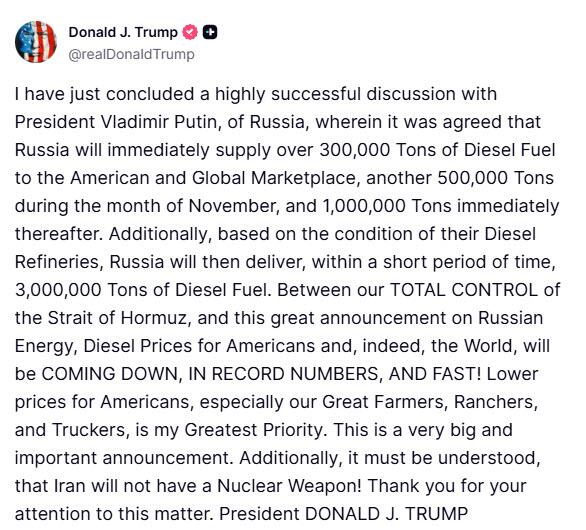
Trump claimed the releases would help lower diesel prices for US farmers, ranchers and truckers – key voting blocs ahead of November midterm elections in which costs of living, including for energy, are the dominant issue.
Maybe, but when one does the math, one has to scratch one’s head: the 300K tons released in October amounts to just over 2.2 million barrels of diesel. Considering the US consumes just over 4 million barrels of diesel per day that amounts to half a day of consumption.
Extending the math for November we get 3.725 million barrels or less than a full day’s consumption, and the “1,000,000 tons thereafter” is a little over 4 days of consumption. We doubt the “3,000,000 to be delivered within a short period of time” will ever happen, so in reality Putin will sell the US just over 5 days of Diesel consumption.
The market’s kneejerk reaction was favorable with both US and European diesel prices sliding, helping push WTI Crude down by about a buck to $91.
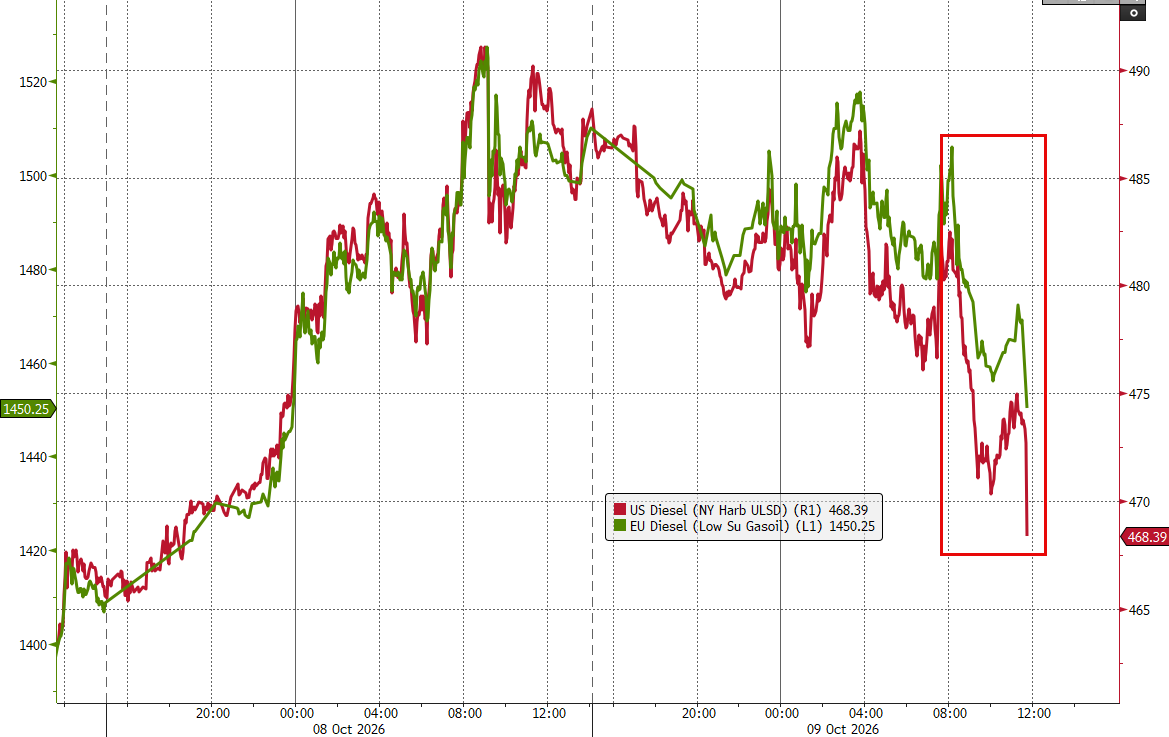
Then again, once the algo reaction fades, we expect carbon-based traders to realize how negligible this “deal” actually is.
The US Treasury Department on Friday said that the Office of Foreign Assets Control is “immediately issuing a temporary general license to allow the supply of Russian diesel to the global market” which will extend until April 2027.
Last but not least, what will most likely end up happening in the real world, is that Putin will send out a diesel tanker, and once Ukraine drones it, the deal will promptly fall apart.
END
8. EMERGING MARKETS//AUSTRALIA NEW ZEALAND ISSUES
BRAZIL
CENTRE RIGHT BOLSONARO LOOKS TO WIN BRAZIL’S ELECTION
“We Can’t Be Part Of A Lost Generation”: Bolsonaro Wins Four Key Party Endorsements Ahead Of Brazil Runoff
Thursday, Oct 08, 2026 – 08:30 PM
In a postmortem published Wednesday on Sunday’s first-round Brazilian presidential election, Alberto Ramos, Goldman Sachs’ chief Latin American economist, described a “conservative wave” that swept the country, culminating in right-wing Senator Flávio Bolsonaro’s win over unhinged socialist President Luiz Inácio Lula da Silva.
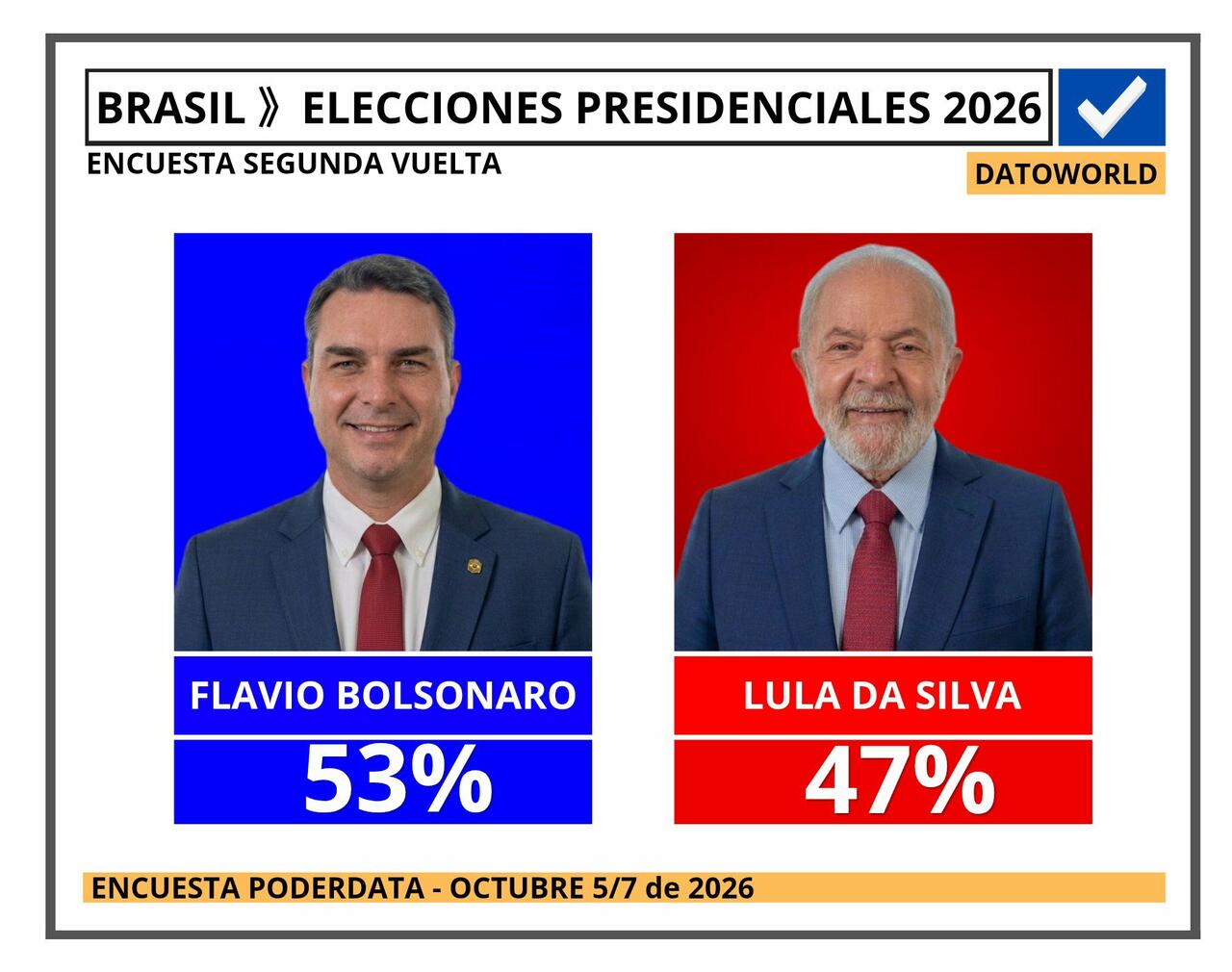
Bolsonaro’s momentum continued mid-week after he secured endorsements from four center-right parties, strengthening his coalition ahead of the October 25 runoff election against Lula.
Bloomberg reports that Uniao Brasil, Progressistas, Republicanos and Novo backed Bolsonaro on Wednseday, one day after former rival Ronaldo Caiado backed him.
“We can’t be part of a lost generation,” Sao Paulo Governor Tarcísio de Freitas told Bolsonaro at a Republicanos event late Wednesday.
Freitas added, “We have to deliver on the work that your father started.”
Freitas is describing the nation-killing socialist policies of Lula and how a once-in-a-generation conservative sweep has shifted South America from left-wing to right-wing after years of economic despair under socialist rule.
If Bolsonaro wins the runoff, it would cement the South American shift from left to right, with the continent’s largest GDP joining it.
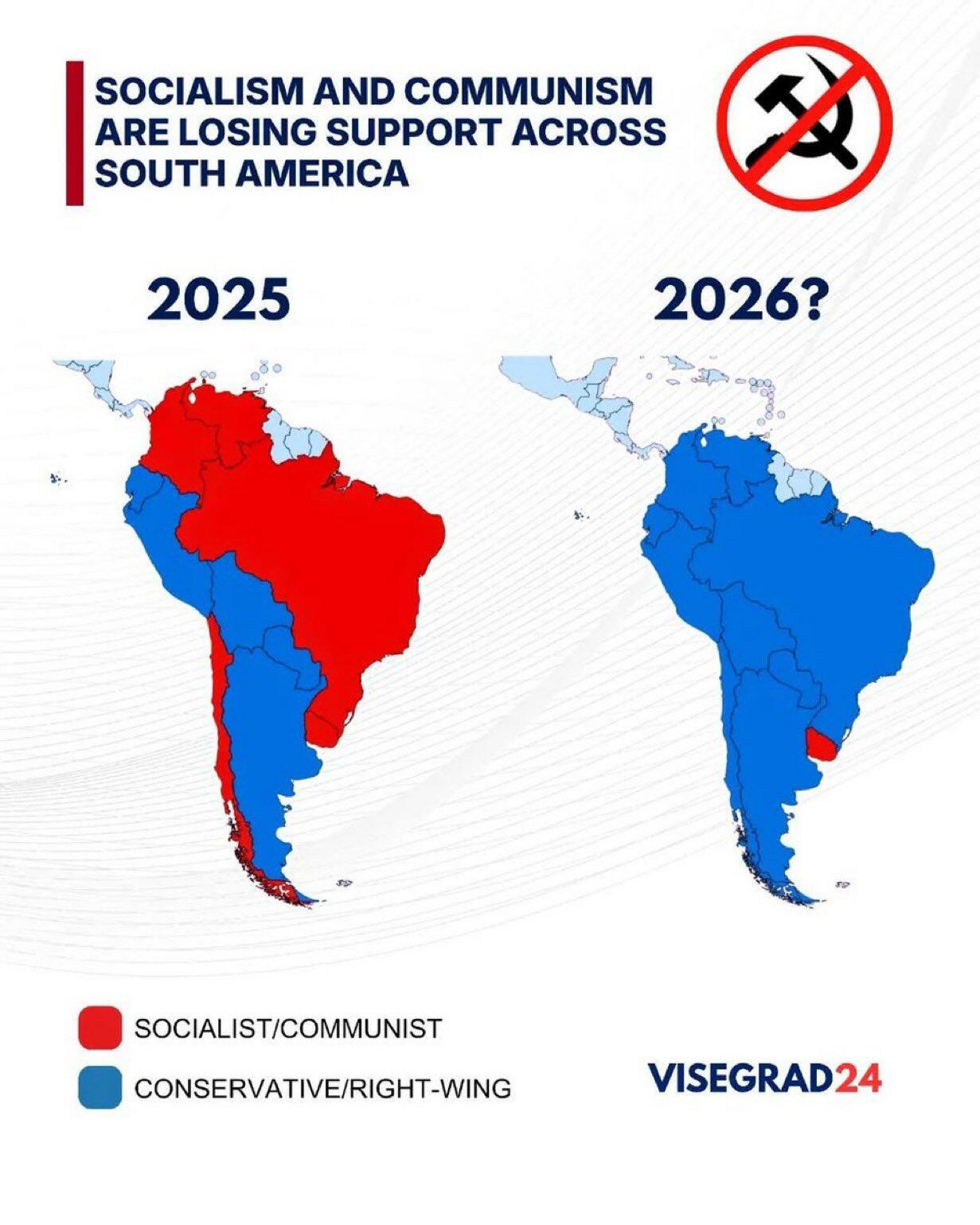
Goldman’s Ramos commented on the upcoming runoff:
Whether Senator Bolsonaro or President Lula wins, the next president will need to build a multiparty coalition.
If elected, Senator Bolsonaro would likely need centrist support to form a governing coalition, but he would begin with a strong right- and center-right base (PL, PP, União Brasil, Republicanos, and Novo) for passing ordinary legislation.
By contrast, a runoff victory by President Lula would likely leave his administration facing even greater challenges in Congress because of the larger conservative opposition bloc and the fact that his political capital will be limited because he cannot seek reelection in 2030.
Separately, David Beker, Bank of America’s chief Brazil economist, commented on the economic challenges for Brazil that lie just ahead, saying:
For markets, the key challenge following Brazil’s elections will be ensuring debt sustainability. Brazil’s gross debt-to-GDP ratio is set to increase by more than 10 percentage points during President Lula’s third term, making fiscal reform the top priority for the next administration to foster a more sustainable macroeconomic environment.
We currently forecast debt-to-GDP at 83.0% by YE26, rising to 90.4% by year-end 2028. Stabilizing the debt trajectory would require a primary surplus of roughly 3.0% of GDP, implying an additional fiscal adjustment of approximately 3.5% of GDP, as we project the public sector balance to deteriorate to a deficit of 0.6% of GDP by YE28.
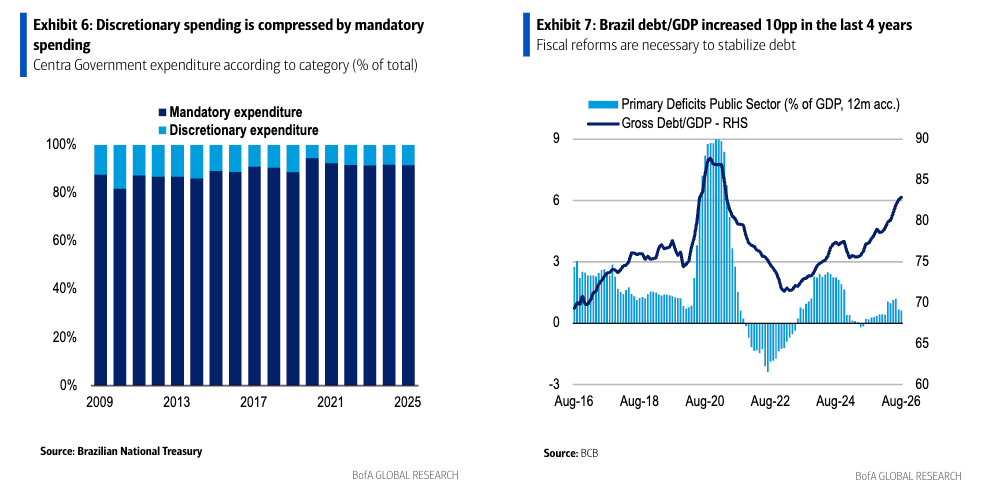
Meanwhile, the Brazilian real strengthened and the benchmark Bovespa stock index rallied sharply earlier this week, signaling the market has had enough with socialists and welcomes Bolsonaro, who would pursue greater fiscal discipline. The moves come as his economic team prepares to outline a plan to curb out-of-control spending under Lula’s administration.
UBS hosted Ideia Big Data on Tuesday and came to the consultancy firm assigned Bolsonaro an 85% probability of victory (read report).
END
PANAMA
Massive 8.0-Magnitude Quake Strikes Panama
Friday, Oct 09, 2026 – 02:21 PM
A magnitude 8.0 earthquake struck Panama at around 1:56 p.m. EST, according to the US Geological Survey.
What’s known so far:

Alerts:
The preliminary epicenter was located about 8.7 miles southwest of Pitaloza Arriba, at a depth of 20.5 miles.
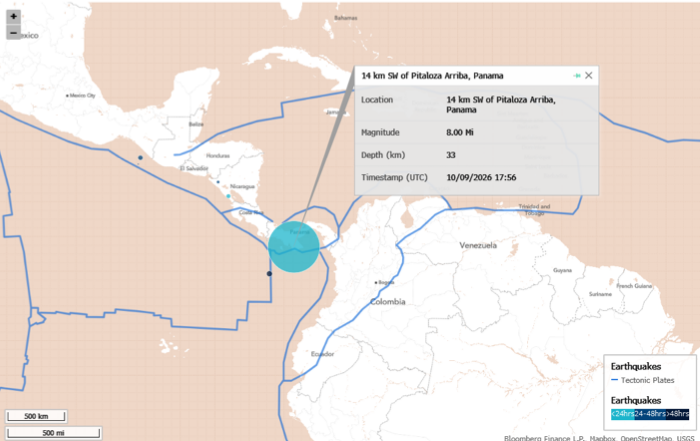
The epicenter is about 122 miles southwest of Panama City. The immediate damage report is unknown.
Commerical travel is being diverted:
First footage surfacing on X:
Today’s massive quake follows Venezuela’s June twin quakes, Colombia’s August earthquake, and Peru’s August quake.
*Developing…
END
U.S./GOLD AND SILVER PRICING/ASIAN CLOSING MARKETS AND EUROPEAN BOURSE OPENING AND CLOSING/ INTEREST RATE SETTINGS FRIDAY MORNING 6;30AM//OPENING AND CLOSING\
OPENING LEVELS OF CURRENCIES// AND CLOSING ASIAN STOCK MARKET AND OPENING EUROPEAN STOCKS:6 AM EST
EURO VS USA DOLLAR: 1.1231 UP 0.0018
USA/ YEN 158.33 UP 0.279 NOW TARGETS INTEREST RATE AT 1.75% AS IT WILL BUY UNLIMITED BONDS TO GETS TO THAT LEVEL…//YEN STILL FALLS//END OF YEN CARRY TRADE BEGINS AGAIN DEC 2024/Bank of Japan raises rates by .25% TO 1.75 ..TAKAICHI NEW PM AS YIELDS RISE//JAPAN DEEPLY IN TROUBLE WITH RISING RATES AND A FALLING YEN!! BANK OF JAPAN WILL NO LONGER DO QE. URGES PENSION AND INSUANCE FUNDS TO BUY JAPANESE BONDS//
YEN CARRY TRADERS MURDERED
GBP/USA1.3246 UP 0.0017 OR 17 BASIS PTS
USA/CAN DOLLAR: 1.4222 DOWN 0.0002 //CDN DOLLAR UP 2 BASIS PTS//
Last night Shanghai COMPOSITE CLOSED UP 1.89 PTS OR 0.05%
Hang Seng CLOSED UP 336.76 PTS OR 0.42%
AUSTRALIA CLOSED UP 0.30%
// EUROPEAN BOURSE: ALL GREEN
Trading from Europe and ASIA
I) EUROPEAN BOURSES: ALL GREEN
2/ CHINESE BOURSES / :Hang SENG CLOSED UP 336.74 PTS OR 1.42%
/SHANGHAI CLOSED UP 1.89 PTS OR 0.05%
AUSTRALIA BOURSE CLOSED UP 0.30%
(Nikkei (Japan) CLOSED UP 101.89 PTS OR 0.15%
INDIA’S SENSEX IN THE GREEN
Gold very early morning trading: $4194.90
silver:$60.43
USA DOLLAR VS TRY (TURKISH LIRA): 49.34 UP 12 BASIS PTS AND NOW WE SEE THEIR STUPIDITY OF SELLING SOME OF THEIR GOLD AND ALL OF THEIR USA DOLLAR RESERVES. THE COUNTRY IS IN BIG FINANCIAL TROUBLE
USA DOLLAR VS RUSSIAN ROUBLE: 85.69 ROUBLE// DOWN 0 ROUBLE AND 65 BASIS PTS.
UK 10 YR BOND YIELD: 5.4264 DOWN 6 BASIS PTS
UK 30 YR BOND YIELD: 5.9364 DOWN 6 BASIS PTS
FRENCH OAT 10 YR BOND YIELD: 4.812 DOWN 7 BASIS PTS.
CDN 10 YR BOND YIELD: 3.9320 DOWN 2 BASIS PTS
CDN 5 YR BOND YIELD; 3.532 DOWN 2 BASIS PTS
USA dollar index early FRIDAY MORNING: 102.03 UP 44 BASIS POINTS FROM THURSDAY’s CLOSE
FRIDAY MORNING NUMBERS ENDS
And now your closing FRIDAY NUMBERS 10.00 AM
Portuguese 10 year bond yield: 3.9490% DOWN 5 in basis point(s) yield
JAPANESE BOND 10 yr YIELD: +3.019% DOWN 8 FULL POINTS BASIS POINTS /JAPAN losing control of its yield curve/
JAPAN 30 YR: 4.062 DOWN 13 BASIS PTS//
SPANISH 10 YR BOND YIELD: 4.071 DOWN 6 in basis points yield
ITALY 10 YR BOND: 4.550 DOWN 7 points in basis points yield ./
GERMAN 10 YR BOND YIELD: 3.4582 DOWN 4 BASIS PTS
IMPORTANT CURRENCY CLOSES : MID DAY FRIDAY
Closing currency crosses for day /USA DOLLAR INDEX/USA 10 YR BOND YIELD/10:00 AM
Euro/USA 1.1201 DOWN 0.0012 OR 12 basis points
USA/Japan: 158.24 UP 0.186 OR YEN IS DOWN 19 BASIS PTS// HIGHLY INFLATIONARY TO JAPAN
Great Britain 10 YR RATE 5.4244 DOWN 6 BASIS POINTS //
GREAT BRITAIN 30 YR BOND; 5.9265 DOWN 8 BASIS POINTS.
FRANCE 10 YR: 4.827 % DOWN 6 BASIS PTS
CANADIAN DOLLAR DOWN 65 BASIS PTS TO 1.4287
xxxxxxxxxxxxxxxxxxxxxxxxxxxxxxxxxxxxxxxxxxxxxxxxxxxxxxxxxxxxxxxxxxxxxxxxxxxxxxxx
The USA/Yuan CNY 6.6922 ON SHORE ..UP
THE USA/YUAN OFFSHORE// CNH UP TO 6.6933
TURKISH LIRA: 49.34 UP 12 EXTREMELY DANGEROUS LEVEL/DEATH WATCH/HYPERINFLATION TO BEGIN.//
Your closing 10 yr US bond yield UP 2 in basis points from THURSDAY at 5.248% //trading well ABOVE the resistance level of 2.27-2.32%)
USA 30 yr bond yield 5.614 UP 1 basis points /10:00 AM
USA 2 YR BOND YIELD: 4.785 UP 3 BASIS PTS.
GOLD AT 10;00 AM $4183.25
SILVER AT 10;00: $60.58
Your 11:00 AM bourses for Europe and the Dow along with the USA dollar index closing and interest ratesFRIDAY
DAY CLOSING TIME/ 12:00 AM///
London: CLOSED UP 118.87 PTS OR 1.14%
GERMAN DAX: CLOSED UP 306.16 PTS OR 1.23%
FRANCE: UP 76.57 OR 0.99 PTS
Spain IBEX CLOSED UP 105.30 PTS OR 0.87%
Italian MIB: CLOSED UP 485.45 PTS OR 0.98%
WTI Oil price 90.81 10.00 EST/
Brent Oil: 103.14 10:00 EST
USA /RUSSIAN ROUBLE: 84.83/// ROUBLE UP 0 AND 19/ 100
CDN 10 YEAR RATE: 3.886 DOWN 5 BASIS PTS.
CDN 5 YEAR RATE: 3.545 DOWN 7 BASIS PTS
CLOSING NUMBERS: 4 PM//
Euro vs USA 1.1200 DOWN 0.0012 OR 12 BASIS POINTS//
British Pound: 1.3241 UP 0.0013 OR 13 basis pts/
BRITISH 10 YR GILT BOND YIELD: 5.4391 UP 1 FULL BASIS PTS//
BRITISH 30 YR BOND YIELD: 5.9360 DOWN 1 IN BASIS PTS.
FRENCH 10 YR BOND: 4.858 % DOWN 4 BASIS PTS
JAPAN 10 YR YIELD: 3.001% DOWN 9 FULL BASIS PTS (DANGEROUS TO THEIR ECONOMY
JAPANESE 30 YR BOND: 4.056 DOWN 14 PTS AND STILL VERY DANGEROUS TO THEIR ECONOMY
USA dollar vs Japanese Yen: 158.26 UP 0.204 OR YEN DOWN 21 BASIS PTS//GETTING FURTHER AWAY FROM 160.00/ EXTREMELY DANGEROUS
USA dollar vs Canadian dollar: 1.4264 UP 0.0040 PTS// CDN DOLLAR DOWN 40 BASIS PTS
West Texas intermediate oil: 91.18
Brent OIL: 104.02
USA 10 yr bond yield UP 2 BASIS pts to 5.246
USA 30 yr bond yield: DOWN 1 PTS to 5.605%
USA 2 YR BOND 4.793 UP 4 PTS
CDN 10 YR RATE 3.878 DOWN 5 BASIS PTS
CDN 5 YEAR RATE: 3.546 DOWN 5 BASIS PTS
USA dollar index: 102.02 DOWN 0 BASIS POINTS
USA DOLLAR VS TURKISH LIRA: 49.34 UP 13 BASIS PTS GETTING QUITE CLOSE TO BLOWING UP/IDIOTS SOLD GOLD
USA DOLLAR VS RUSSIA//// ROUBLE: 85.87 DOWN 0 AND 84 /100 roubles //
GOLD $4,198.00 3:30 PM)
SILVER: 60.80 3;30 PM)
DOW JONES INDUSTRIAL AVERAGE: UP 423.37 POINTS OR 0.83%
NASDAQ 100 UP 157.34 PTS OR 0.51%
VOLATILITY INDEX 14.84 DOWN 0.57 PTS OR 3.70%
GLD: $ 384/58 UP 5.96 PTS OR 1.57%
SLV/ 54.79 PTS UP 1.38 OR 2.50%
TORONTO STOCK INDEX// TSX INDEX: CLOSED UP 527.61 PTS OR 0.50%
end
TRADING today ZEROHEDGE 4 PM: HEADLINE NEWS/TRADING
Hormuz, Hurricanes, Hikes, & Hiccups In AI’s Accounting: Trump Puts War On An Election Timer As Junk Quietly Cracks
‘WRAP UP
Stocks ends the week on the front foot as risk events await – Newsquawk US Market Wrap
Friday, Oct 09, 2026 – 04:06 PM
- SNAPSHOT: Equities up, Treasuries flatten, Crude up, Dollar up, Gold up.
- REAR VIEW: UoM Consumer Sentiment nears all time lows; US allows immediate imports of Russian diesel; IRGC warns vessels violating restrictions will be pursued and punished beyond the Strait of Hormuz; Houthi forces have reportedly planted large quantities of mines in the Bab al-Mandab area; China is set to resume October refined fuel exports after a brief halt; AAPL has reportedly told suppliers to cut production of components for its iPhone 18/Pro Max as rising prices dampens consumer demand; Poor Canada jobs report.
- COMING UP: 12th October 2026: Note: US cash bond market will be shut on account of Columbus Day; CME Treasury Futures and NYSE and Nasdaq remain open. Holiday: US Columbus Day (Newsquawk desk remains open as usual); Canadian Thanksgiving. Data: Indian Inflation (Sep). Speakers: BoE’s Breeden, Mann; Fed’s Hammack. Earnings: LVMH.
- WEEK IN FOCUS: US CPI, US Retail Sales, Start of Q3 Earnings, China CPI, UK jobs, RBA Minutes and Aussie jobs. Click here for the full report.
- WEEKLY US EARNINGS ESTIMATES: Earnings season begins with big banks the highlights. Click here for the full report.
More Newsquawk in 2 steps:
- 1. Subscribe to the free premarket movers reports
- 2. Trial Newsquawk’s premium real-time live audio squawk for 7 days
MARKET WRAP
Stocks closed higher on Friday, with tech names putting Thursday’s FT piece on Open AI in the rearview. Real Estate, Consumer Discretionary, and Healthcare outperformed, meanwhile, Communications underperformed following SpaceX competition concerns for Verizon (VZ -8.6%) and T-Mobile (TMUS -13.3%).
Crude prices settled in the green, however shortly after saw pressure on US President Trump announcing successful talks with Russian President Putin which led to US Treasury allowing Russia to sell diesel to the US, albeit quantities for the time being appear insignificant in comparison to US/global diesel consumption. Re. geopolitics, Iran’s IRGC warned vessels violating restrictions will be pursued and punished beyond the Strait of Hormuz while the Houhtis have reportedly placed mines in the Bab al-Mandab area.
In FX, DXY was a touch firmer, thanks to the rise in short-term yields; AUD outperformed whilst the CAD was hit following a disappointing jobs report that saw negative employment growth, leading to reduced October rate hike bets for the BoC. On the US data footing, prelim UoM for October largely underwhelmed, although expectations topped forecasts.
Despite the flattening of the Treasury curve on the short-end and belly (long flat), precious gained on the risk-on mood, leaving spot gold +USD 51/oz on the week
US
MICHIGAN: University of Michigan prelim figures for October were mixed but largely disappointing. Sentiment fell to 46.3 from 48.1, and beneath the forecasted 47.5, while conditions tumbled to 44.7 from 50.9, also shy of the expected 50.5. Expectations unexpectedly rose to 47.3 from 46.3, with Wall St. consensus expecting a decline to 45.9. 1yr inflation expectations ticked up to 4.7% (prev. 4.6%), albeit not as hot as the expected 4.8%, while the 5yr lifted to 3.5% from 3.4%, as expected. Overall, sentiment dropped for the third consecutive month, with Oxford Economics writing that elevated gas prices and higher borrowing costs are making consumers more worried about current economic conditions.
FIXED INCOME
T-NOTE FUTURES SETTLED 4 TICKS LOWER AT 104-19
Treasury yields bear flatten as oil prices climb on Middle East tensions, with attention turning to CPI and Fed Chair Warsh next week. At settlement, 2-year +2.9bps at 4.791%, 3-year +3.1bps at 4.923%, 5-year +2.9bps at 5.021%, 7-year +1.9bps at 5.132%, 10-year +0.7bps at 5.242%, 20-year -0.3bps at 5.652%, 30-year -0.6bps at 5.601%.
THE DAY: The Treasury curve flattened on Friday, with the front end sold. There was little economic data or Fed commentary to digest, although oil prices gradually moved higher throughout the session, ultimately settling in positive territory. Firmer crude prices appeared to weigh on the front end amid renewed inflation concerns, contributing to the bear flattening.
The gains in oil followed escalatory commentary and actions from the IRGC, which has been expanding strikes beyond the Strait of Hormuz. The IRGC warned that vessels violating restrictions would be pursued and punished beyond the Strait, while sources reported that the Houthis had planted mines in the Bab al-Mandab area, adding to concerns over energy supply disruptions in the Middle East.
On the data front, the preliminary September UoM consumer sentiment survey disappointed, with the headline index falling to 46.3 from 48.1, below the expected 47.8. Both current conditions and forward-looking expectations declined, although the latter exceeded forecasts. Meanwhile, both one- and five-year inflation expectations increased, adding to concerns over the inflation outlook.
Attention now turns to next week’s US inflation reports, which will help shape expectations for the Fed’s next policy move. The probability of an October rate hike has fallen considerably following softer-than-expected August core PCE, weak September NFP data and recent commentary from Fed officials, including Williams, Jefferson, Bowman and Waller, suggesting there is little urgency to deliver consecutive rate hikes following September’s move. Fed Chair Warsh is also scheduled to speak at the IMF in Bangkok the day after the US CPI report, with participants looking for his assessment of the recent data and implications for the policy outlook. However, given Warsh’s previously expressed reluctance towards explicit forward guidance, he may avoid signalling a definitive policy path.
Supply
Bills
- US to sell USD 82bln 26-week bills, to sell USD 95bln 13-week bills, and to sell USD 95bln 6-week bills on October 13th; all to settle on October 15th
STIRS / OPERATIONS
- Fed Hike Pricing via CME FedWatch: Oct 4.9bps (prev. 4.3bps), Dec 25.1bps (prev. 24.1bps)
- EFFR at 3.88% (prev. 3.88%), volumes at USD 117bln (prev. USD 108bln) on October 8th
- SOFR at 3.87% (prev. 3.88%), volumes at USD 2.963tln (prev. USD 2.968tln) on October 8th
- NY Fed RRP op demand at 0.30 (prev. 0.34bln) across 1 counterparties (prev. 2) on October 9th
CRUDE
WTI (X6) SETTLED USD 0.36 HIGHER AT 91.85/BBL; BRENT (Z6) SETTLED USD 0.44 HIGHER AT 104.72/BBL
The crude complex ended the final trading session of the week firmer, as participants await any further weekend updates. As a reminder, and one of the key takeaways from this week, was that Trump said on Thursday they are having productive discussions with Iran, and will not be attacking Iran at any time before the midterms. Nonetheless, and back to Friday, benchmarks saw gains amid two separate reports: 1) IRGC warned vessels violating restrictions will be pursued and punished beyond the Strait of Hormuz; 2) Military sources stated Houthi forces have planted large quantities of mines in the Bab al-Mandab area. On the day, WTI and Brent hit lows of USD 90.01/bbl and USD 102.33/bbl, respectively, in the European morning and continued to be weighed on by the aforementioned Trump remarks, but later pared on a deluge of Middle East updates. In addition, IRGC claimed to have struck the LPG carrier NV Sunshine after it attempted to transit an unauthorised route south of the Strait of Hormuz, and UKMTO reported another vessel struck by a projectile near the UAE. On the supply footing, Gulf of Mexico producers had shut around 63% of oil production ahead of Hurricane Isaias, removing nearly 1.3mln BPD. For the record, the weekly Baker Hughes rig count saw oil up 6 at 462, natgas down 1 at 132, leaving the total up 5 at 603.
EQUITIES
CLOSES: SPX +0.58% at 7,810, NDX +0.51% at 30,883, DJI +0.83% at 51,655, RUT +0.46% at 2,807.
SECTORS: Real Estate +1.88%, Consumer Discretionary +1.69%, Health +1.58%, Financials +0.90%, Utilities +0.81%, Materials +0.64%, Industrials +0.49%, Technology +0.36%, Consumer Staples +0.11%, Energy -0.17%, Communication Services -0.40%.
EUROPEAN CLOSES: Euro Stoxx 50 +0.81% at 6,176, Dax 40 +1.19% at 25,102, FTSE 100 +1.06% at 10,552, CAC 40 +0.95% at 7,803, FTSE MIB +0.91% at 49,746, IBEX 35 +0.55% at 19,033, PSI -0.86% at 9,268, SMI +1.10% at 13,787, AEX +0.87% at 1,131
STOCK SPECIFICS
- Apple (AAPL): Cut October component orders for its iPhone 18 Pro and Pro Max by 15-20% amid weaker-than-expected demand.
- SpaceX (SPCX): Agreed to acquire Grain Management’s 800 MHz spectrum portfolio for USD 8bln in cash; Verizon (VZ) and T-Mobile (TMUS) were weighed.
- Delta Air Lines (DAL): Profit missed, cut FY EPS guidance and provided weak next-quarter outlook.
- Humana (HUM) / Alignment Healthcare (ALHC): Following CMS headlines; Alignment Healthcare said one of its 2027. Medicare Advantage plans received a 3.5-star rating, while Humana announced improved Star Ratings for 2027.
- Lumentum Holdings (LITE): CEO said Lumentum’s optical components are sold out through 2029.
- Hunterbrooks said Meta’s (META) Muse growth slows as downloads fall; Hunterbrook holds a META short position.
- White House reportedly to let Trump beef import plan expire in November, reports Politico.
- Google (GOOGL) is preparing to publicly roll out its new Gemini 4 model, internally known as Argon, reports Business Insider citing sources; Most recently, employees have been trying a new version of Gemini 4 internally named Carbon
FX
The Dollar Index was slightly firmer, albeit mixed against G10 FX peers, amid a lack of tier 1 US data this week, and no Fed speak on Friday. Next week, the risk events ramp up with US inflation data, retail sales, the beginning of earnings season, and Chair Warsh even giving remarks with the IMF next Thursday. Back to today, prelim UoM for October largely underwhelmed, while Middle Eastern updates were aplenty, but the weeks key highlight remains Trump saying he will not attack Iran before the midterms.
AUD, CHF, NZD, and GBP all saw gains to differing degrees, while EUR, JPY, and CAD saw losses with the latter the clear laggard. The Loonie was weighed on by a dismal Canadian jobs report, as the economy unexpectedly lost 68.3k jobs in September, against the expected 7k and prior months -41.7k. The unemployment rate ticked higher to 6.5% from 6.4%, although it was anticipated. Following the dataset, BoC pricing has trimmed from 10bps of implied tightening in October to around 6.5bps.
For the Euro, focus remains on two fronts: a) politics and b) EU-China trade relations. On the former, no material updates on the French fiscal situation. On the trade front, EU Trade Commissioner Sefcovic said that it had reached a shared understanding to improve access to the Chinese markets. He noted that the agreement of understanding with China on hybrid vehicles could cut shipments by half.
USA DATA RELEASES
UMich ‘Current Conditions’ Sentiment Crashes To Record Low As ‘Independents’ Lose Faith
Friday, Oct 09, 2026 – 10:10 AM
After sliding back near cycle lows in September (as Republicans lost faith in the recovery and MidEast tensions re-escalated), analysts expected UMich consumer sentiment to fall further in preliminary October data released this morning.
And the analysts were right as The University of Michigan’s preliminary sentiment index decreased to 46.3, the lowest reading since May (below the median estimate of 47.6). However, the current conditions gauge sank to 44.7, the lowest on record, from 50.9 in the previous month, while the expectations index rose to 47.3 from 46.3, the first increase since July.
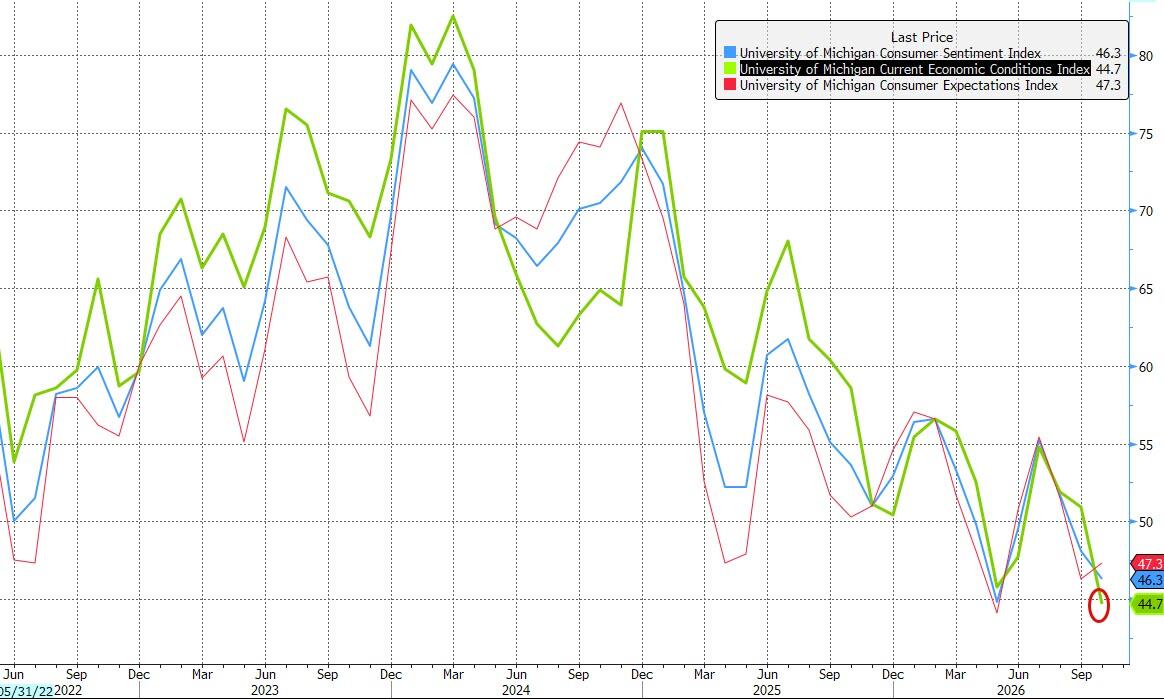
That is to say that Americans see the Current Conditions in America as worse than at the trough of COVID and the peak of the Great Financial Crisis (except stocks are at record highs this time)…
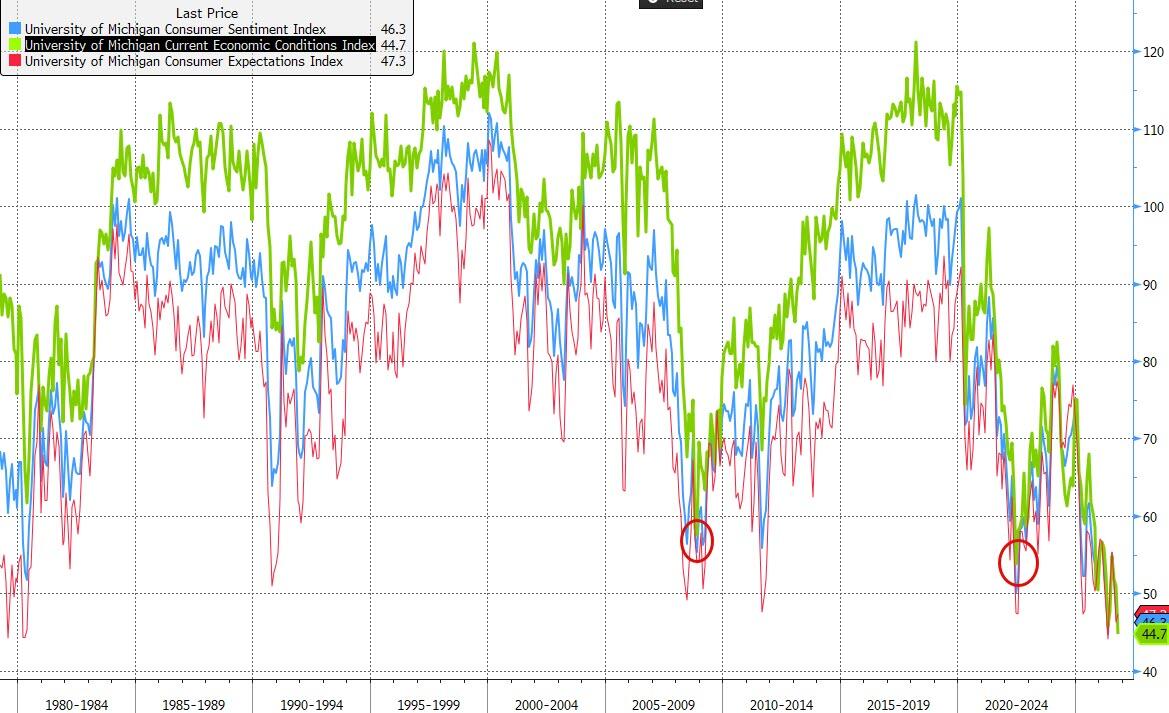
While year-ahead expectations for personal finances and business conditions crept up slightly, buying conditions for durables plummeted amid high prices and borrowing costs.
Increases in sentiment among Democrats and Republicans were offset by a decline among independents this month.
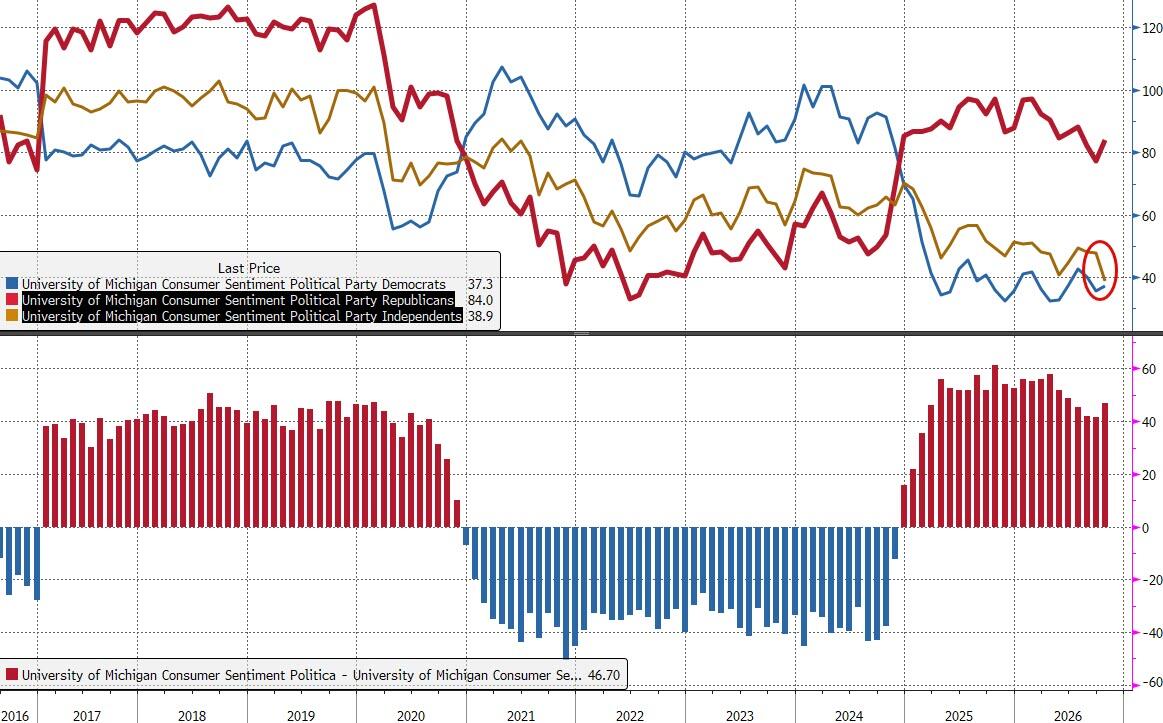
Year-ahead inflation expectations ticked up from 4.6% last month to 4.7% this month. The current reading substantially exceeds the 3.4% seen in February before the Iran conflict began, along with all 2024 readings. Long-run inflation expectations also stepped up from 3.4% in September to 3.5%,
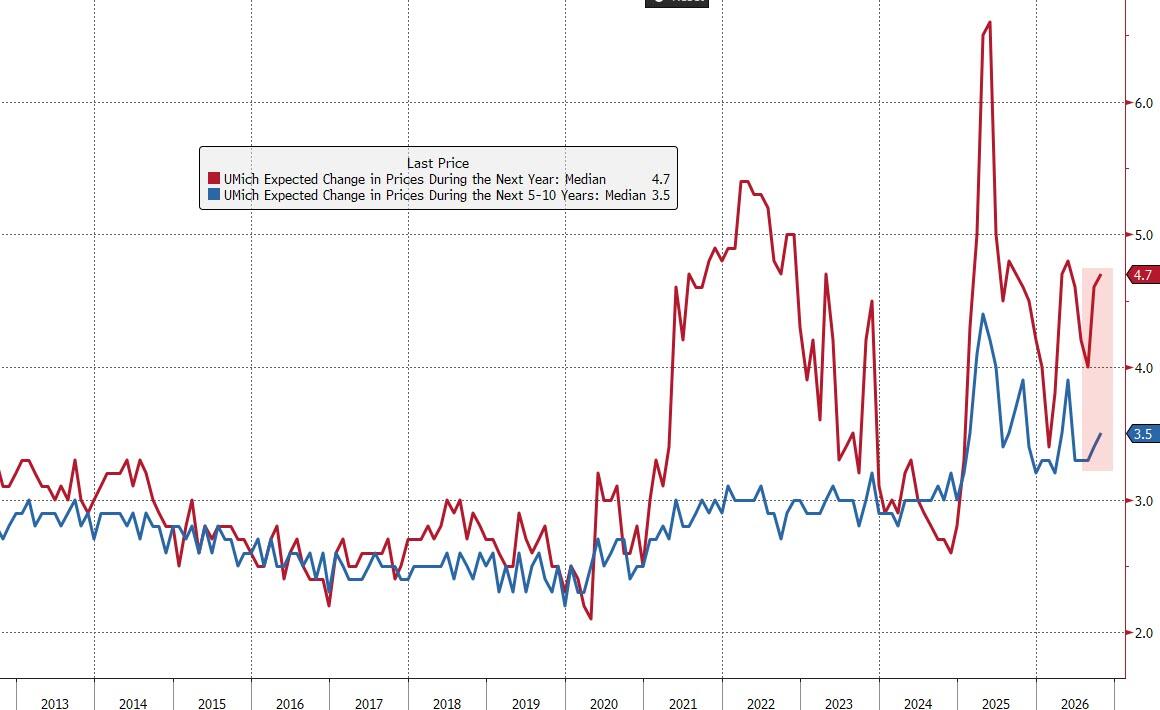
Overall, sentiment for lower-income consumers and those with smaller stock portfolios dropped steeply this month, groups that have fewer resources to weather increases in prices.
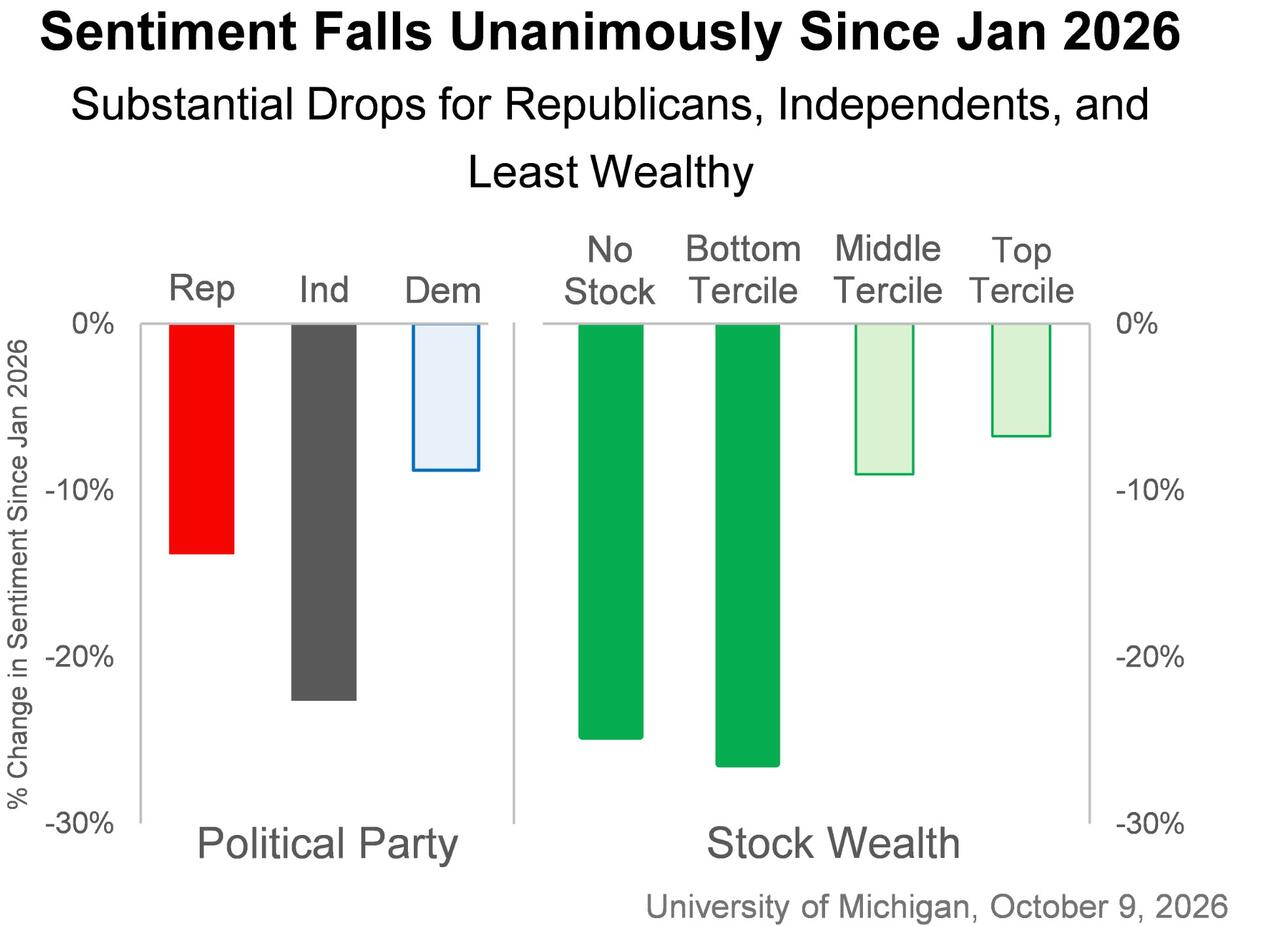
“Frustration over cost-of-living continues to mount,” says UMich Survey Director, Joanne Hsu, adding that “despite their differences, consumers of all political identifications agree that the outlook for the economy has softened since the beginning of the year prior to the Iran conflict.”
USA ECONOMIC REPORTS
“Last Critical Piece”: SpaceX Secures Spectrum Deal To Challenge Big Telecom
Thursday, Oct 08, 2026 – 08:05 PM
Major telecom stocks puked after hours after Elon Musk’s SpaceX announced it would acquire a portfolio of up to 14 MHz of paired low-band spectrum in the 800 MHz band, positioning Starlink to become a major mobile carrier in the US.
Musk wrote on X that the low-band spectrum represents “the last critical piece of the spectrum puzzle needed for SpaceX to provide complete phone coverage in America.”
“While Starlink Mobile’s global 2 GHz mid-band spectrum will provide high-bandwidth capacity in the United States, this new low-band spectrum will provide a coverage layer that ensures Starlink Mobile’s signal penetrates through obstacles, such as walls, and can provide service to customers’ devices even when they are in buildings. Critically, most existing mobile devices already support this underused band,” SpaceX noted.
Subject to Federal Communications Commission approval, SpaceX plans to combine its nationwide low-band spectrum license portfolio with its satellite-to-cell services, which the company said will enable “high-speed service directly to unmodified devices anywhere in the world.”
AT&T tumbled 7.3% in after-hours trading, while T-Mobile US and Verizon Communications each dropped 6.6% as of 5 p.m. New York time. SpaceX rose 1.5%.
Another piece of the puzzle:
TD Cowen analyst Gregory Williams recently told clients, “Any entry of SpaceX as a mobile carrier could be highly bearish for the wireless industry.“
END
Pharmaceutical Lobby Sues Over Trump Admin Program To Reduce Drug Prices
Thursday, Oct 08, 2026 – 05:40 PM
Authored by Zachary Stieber via The Epoch Times,
A lobbying group that represents pharmaceutical manufacturers filed suit against the federal government on Oct. 7 over a program aimed at reducing the prices of drugs.

The Pharmaceutical Research and Manufacturers of America (PhRMA) stated in a legal complaint in federal court in Washington that the most-favored-nation policy, planned for Medicare by the Center for Medicare & Medicaid Services (CMS), illegally imposes foreign price controls.
“[The program] is unlawful and clearly exceeds CMS’ authority,” Stephen Ubl, president and CEO of the lobbying organization, said in a statement.
“The policy doesn’t make medicines more affordable for most beneficiaries, while putting future medical innovation and patient access at risk. We share the administration’s goal of ensuring Americans can access and afford their medicines, but CMS cannot rewrite the law and bypass Congress to impose foreign price controls. Patients need more choices and more breakthroughs – not government price-setting schemes that undermine both.”
The Department of Health and Human Services, the parent agency of CMS and one of the defendants named in the suit, did not return a request for comment by publication time. CMS has stated in notices that it has statutory authority to implement changes to drug pricing, including from portions of the Social Security Act.
Government officials have also pointed to part of the act stating that there shall be no judicial review of certain changes to pricing.
PhRMA, which represents 34 manufacturers including Pfizer and Sanofi, filed suit against the government during the first Trump administration over an earlier iteration of the pricing rule. A federal judge entered a temporary restraining order, ruling in favor of the group.
The rule was withdrawn after Joe Biden became president.
President Donald Trump in 2025 announced a new most-favored-nation pricing effort and has since unveiled agreements with dozens of manufacturers, including Pfizer, Merck, and GlaxoSmithKline.
“Americans – who have for decades paid, by far, the highest prices of any nation anywhere in the world for prescription drugs – will now pay the lowest price anywhere in the world for drugs,” Trump said in a speech in February.
One of the components is an update to Medicare’s drug pricing model, basing pricing on the average sales price across a number of nations. The rule, due to take effect on Jan. 1, 2027, “would untether Medicare pricing from the statute and the American market, instead importing foreign price controls from 19 countries,” the new lawsuit states.
Officials do not have a statutory basis to implement the program, PhRMA stated in the complaint.
“CMS relies on an obscure statutory provision,” it stated, “[which does not give it] carte blanche to rewrite the Medicare program to fit policy priorities that Congress has not authorized.”
Market-based pricing is critical for ensuring that Americans can access vital medicines, the lobbying group stated, and keeping the program in place would “upend … stability and predictability, harming seniors and imperiling our nation’s global pharmaceutical leadership.”
The group is asking the court to declare the program illegal and prohibit government officials from enforcing it.
END
HURRICANE ISIAS
“Small Disruption Now Has Outsized Price Consequences”: Jefferies Warns As Hurricane Takes Aim At US Gulf Energy
Friday, Oct 09, 2026 – 07:45 AM
Isaias has strengthened into a Category 2 hurricane in the overnight hours and is forecast to intensify further before making landfall along the US Gulf Coast late Friday or early Saturday.
Nearly two-thirds of Gulf of Mexico crude production is already shut in, while roughly 500,000 barrels a day of refining capacity is at risk. The disruption comes as a global refining crisis has pushed US gasoline and diesel prices into uncomfortable territory for consumers ahead of the midterm elections. While the supply impact is expected to be temporary, even brief refinery outages could tighten already constrained fuel inventories and add pressure to pump prices.

Jefferies consumer staples analyst Kaumil Gajrawala warned on Thursday morning: “A small disruption now has outsized price consequences. The second-order effect is freight cost, which favors asset-light models like KO (Buy), where bottlers carry the fleet and fuel exposure.”
US WTI prices rose as much as 5.6% on Thursday as oil/gas firms evacuated offshore platforms, moved drilling rigs, and prepared for port closures that could disrupt crude deliveries to major coastal refineries. On top of the 63% of regional crude production shut in, about 57% of natural gas output has also come to a halt.
This is a sizeable temporary hit to US crude supply. For NatGas, the national production impact is much smaller.
Here’s a map of offshore platforms and rigs, as well as major refineries in Isaias’ cone of uncertainty.
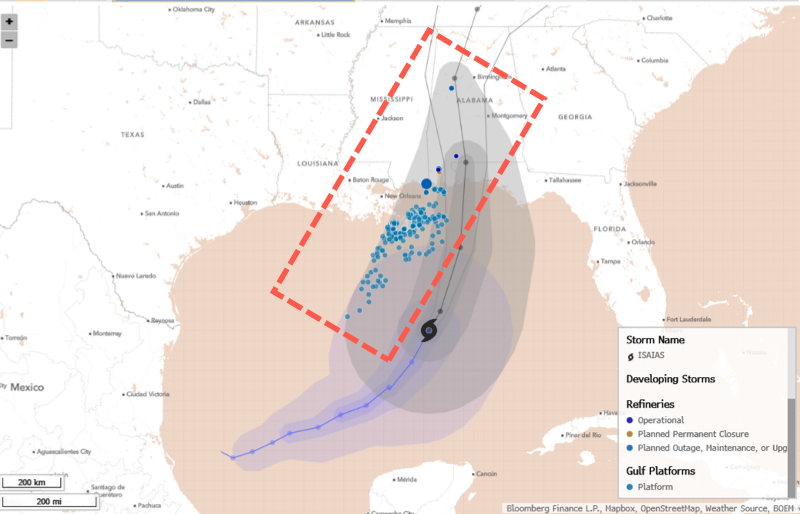
The next big issue is that refineries may see a decline in crude supply as offshore platforms reduce flows. Any refinery outage from storm-related damage would deepen a global refining crisis by reducing fuel production.
List of major US refineries in storm’s path.
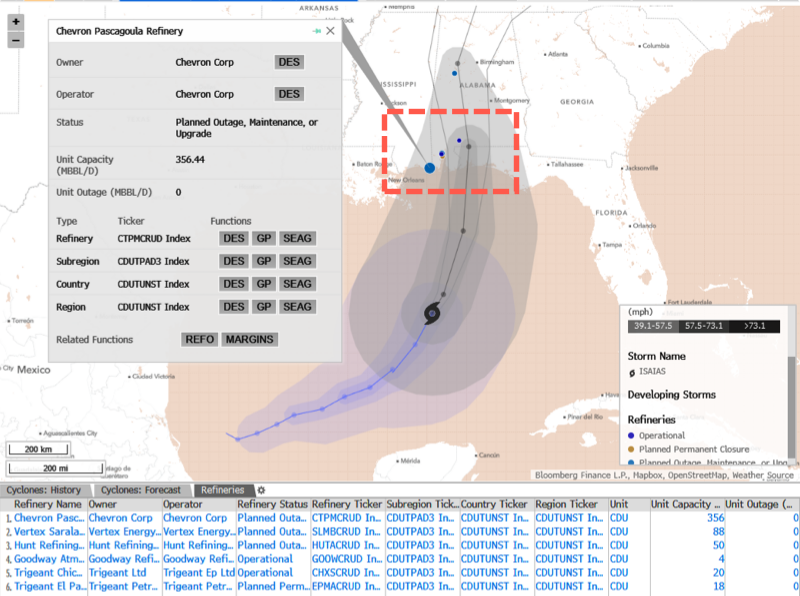
We noted on Thursday that any abrupt westward shift in the hurricane’s cone of uncertainty would put major refineries at risk, including Chevron’s Pascagoula refinery on Mississippi’s Gulf Coast. It refines 369,000 barrels of crude a day into gasoline, diesel, jet fuel, and premium base oils.
If storm-related damage materializes and disrupts US fuel supplies, could it give the Trump administration political cover for additional measures to boost domestic fuel availability, potentially including restrictions on refined-product exports ahead of the Northern Hemisphere winter?
END
SPACE X //TELECOMS
Tower Stocks Soar, Big Three Wireless Carriers Puke As SpaceX Strikes Low-Band Spectrum Deal
Friday, Oct 09, 2026 – 07:22 AM
Summary
- The Rise of Starlink Mobile
- Tower Stocks Jump; Carrier Stocks Tumble
- Musk says this is the “last critical piece of the spectrum puzzle needed for SpaceX to provide complete phone coverage in America.”
- SpaceX Secures Spectrum Deal To Challenge Big Telecom
Tower Stocks Erupt, Carriers Puke
Elon Musk’s SpaceX announced overnight that it agreed to acquire a nationwide portfolio of low-band spectrum licenses, which it will combine with its satellite-to-cell services to create a next-generation mobile carrier to challenge the Big 3 mobile network operators.
Musk wrote on X that the low-band spectrum represents “the last critical piece of the spectrum puzzle needed for SpaceX to provide complete phone coverage in America.”
Market reaction in premarket trading: US cell-tower stocks jumped while wireless carriers tumbled.
- Towers: Crown Castle gained 8.2%, American Tower rose 6.4%, and SBA Communications advanced 5.6%.
- Carriers: T-Mobile fell 7.7%, while Verizon and AT&T each fell about 6%.
Barclays analyst Brendan Lynch wrote in a note that Starlink’s “terrestrial network” is a “game-changer” for tower companies. The spectrum deal was one of six catalysts Lynch cited when he upgraded Crown Castle and American Tower in August.
Citi analyst Michael Rollins also described the deal as a net positive for tower stocks and an ongoing risk for telecom stocks. He maintained a “Buy” rating on SBA Communications, American Tower and Crown Castle, while warning that telecom and cable stocks could face near-term selling pressure.
Here’s Jefferies analyst Graham Hunt’s first take on the Starlink deal:
A potential positive for Towers. We see SpaceX announcement last night of an agreement to acquire 800 MHz of low-band spectrum in the US from Grain Management as a potential positive for our Towers coverage. SpaceX says the terrestrial spectrum will complement its existing 2 GHz satellite capacity, as it looks to “become the first network operator to deploy both satellite and terrestrial spectrum”.
US Towers AMT, CCI and SBA (covered by Jonathan Petersen) are up 3-5% after hours, reflecting potential SpaceX will require a terrestrial tower network and could become an additional tenant on existing sites. We note, however, SpaceX has also discussed a capital-light approach based on “femtocells” installed alongside Starlink dishes, which could reduce reliance on conventional macro towers.
Bottom line, we see the acquisition supporting our view that a fully functioning mobile network requires terrestrial infrastructure investment, and that terrestrial growth remains an essential part of future mobile network infrastructure.
Read across outside the US is difficult given different spectrum ownership, licensing and regulatory structures, however overall we see this as a positive for Towers.
Bernstein analyst Laurent Yoon wrote in a note, “Whether or not SpaceX ultimately builds a nationwide network, Musk’s track record creates a credible threat that is likely to remain an overhang on incumbent valuations.”
Peter Supino of Wolfe Research wrote, “We believe a ‘someday’ Starlink Mobile network is not priced into telecom stocks, and that Thursday’s news increases the probability and potential speed of that scenario.”
“Last Critical Piece”: SpaceX Secures Spectrum Deal To Challenge Big Telecom
Major telecom stocks puked after hours after Elon Musk’s SpaceX announced it would acquire a portfolio of up to 14 MHz of paired low-band spectrum in the 800 MHz band, positioning Starlink to become a major mobile carrier in the US.
Musk wrote on X that the low-band spectrum represents “the last critical piece of the spectrum puzzle needed for SpaceX to provide complete phone coverage in America.”
“While Starlink Mobile’s global 2 GHz mid-band spectrum will provide high-bandwidth capacity in the United States, this new low-band spectrum will provide a coverage layer that ensures Starlink Mobile’s signal penetrates through obstacles, such as walls, and can provide service to customers’ devices even when they are in buildings. Critically, most existing mobile devices already support this underused band,” SpaceX noted.
Subject to Federal Communications Commission approval, SpaceX plans to combine its nationwide low-band spectrum license portfolio with its satellite-to-cell services, which the company said will enable “high-speed service directly to unmodified devices anywhere in the world.”
AT&T tumbled 7.3% in after-hours trading, while T-Mobile US and Verizon Communications each dropped 6.6% as of 5 p.m. New York time. SpaceX rose 1.5%.
Another piece of the puzzle:
TD Cowen analyst Gregory Williams recently told clients, “Any entry of SpaceX as a mobile carrier could be highly bearish for the wireless industry.“
END
about time!!
US Hits ‘Rogue’ International Criminal Court With Sweeping Sanctions
Friday, Oct 09, 2026 – 12:30 PM
On Friday the Trump administration rolled out sweeping sanctions on the International Criminal Court, calling it a “rogue” organization and declaring that the action is part of an effort to ultimately dismantle the tribunal.
“We will ban transactions with this rogue court, cutting off their resources and crippling its ability to operate against us,” US Secretary of State Marco Rubio said in a video address on social media. “The United States and the American people are not subject to the jurisdiction of this fake ICC.”
Rubio continued, saying of Republicans and Democrats, “Both parties agree on this, but only President Trump has the resolve to take the action needed to end this threat once and for all.” He then warned: “Either the ICC will end its threats, or we will end the ICC.“
Importantly, the top American diplomat then turned to pressuring Americans allies, from European countries to Japan, to join the US-led sanctions and efforts to dismantle the ICC.
“We expect our allies, many of whom are part of the ICC and that rely on American service members for their defense, to rein in this rogue court,” he said.
“If they do not, the United States will continue its campaign to dismantle the ICC, piece by piece, until Americans are threatened no longer,” he added.
Ironically all of this stems in part from ICC action related to the US invasions and occupations in Iraq and Afghanistan, where yes – real US war crimes took place. These Bush-launched wars remain deeply unpopular among the American population – and even President Trump has long derided Bush’s infamous war of choice.
The Associated Press writes on Friday:
U.S. believes has become politicized and attempted to unfairly and illegally prosecute Americans and Israelis on war crimes charges.
Secretary of State Marco Rubio announced the sanctions on Friday, after the Nobel Peace Prize was awarded to South African prosecutor Navi Pillay, who had led investigations into potential ICC charges against U.S. troops in Iraq and Afghanistan. The move, however, long predated the Nobel Prize announcement.
The Trump administration imposed targeted sanctions last year on several ICC officials such as prosecutors and judges, citing the ICC’s 2024 decision to issue arrest warrants for Israeli Prime Minister Benjamin Netanyahu and former Israeli Defense Minister Yoav Gallant over what the court alleged were improper actions carried out by the Israeli government during its war in Gaza.
Earlier in 2026, three sitting ICC judges sued Trump and his administration over the sanctions, arguing that they were unlawful.
And then again in August, the US imposed additional targeted sanctions, namely against International Criminal Court President Tomoko Akane and Senior Trial Lawyer Abdoulaye Seye.
Washington has scoffed at the court and sought to erode its influence stretching back multiple administrations, all the way back to the George W Bush era itself. But all this was renewed as the ICC began targeting Israel and its leaders in the wake of the Gaza war.
END
DELTA AIRLINES
“Wouldn’t Call That A Surprise”: Delta Slashes Profit Outlook As Jet Fuel Prices Near Record Highs
Friday, Oct 09, 2026 – 12:45 PM
Delta Air Lines shares fell as much as 3.5% early in the US cash session after the carrier slashed its full-year earnings forecast as soaring jet fuel costs squeezed margins. The cut isn’t totally unexpected given today’s jet fuel prices, but it serves as a warning: Delta owns a refinery that helps cushion the refining crisis blow, suggesting smaller carriers without that in-house refining buffer face even greater pressure.
The Atlanta-based carrier now expects adjusted earnings of $5.10 to $5.60 a share this year, down from a July forecast of $6.50 to $7.50. The new forecast lines up with the Bloomberg Consensus estimate of $5.44 this year.
Adjusted third-quarter earnings were $1.72 a share, below the Bloomberg Consensus estimate of $1.82. Adjusted revenue rose 16% to $17.6 billion, roughly in line with consensus estimates.
“I wouldn’t call that a surprise to anyone, it’s all because of higher fuel prices,” CEO Ed Bastian said of the new forecast. “If this continues to go higher for longer, which I think it will, as the premium airline in the industry we have the best ability to be able to price for that.”
We pointed out earlier this year that Delta operates an in-house refinery called Trainer Refinery. Monroe Energy (a Delta Air Lines subsidiary) officially operates the 185,000 to 190,000 barrels per day refinery. It’s situated along the Delaware River in Delaware County, Pennsylvania.
Jefferies analyst Sheila Kahyaoglu told Bloomberg Television earlier that “the refinery has about a $1 billion benefit to this year, so it is providing a bit of a boost for them.”
“But higher fuel will eventually eat into consumer demand,” Kahyaoglu added, “and remain a major headwind for all carriers.”
Delta is the only US airline that operates a major refinery, suggesting other carriers face a difficult operating environment amid sky-high jet fuel prices.
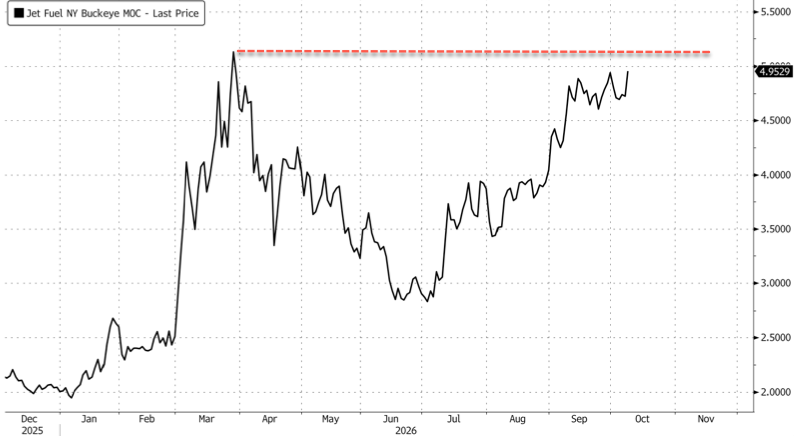
The earnings cut sets a difficult backdrop for United Airlines, American Airlines and Southwest Airlines, which report later this month.
Delta Air Lines shares fell as much as 3.5% in the early US cash session.
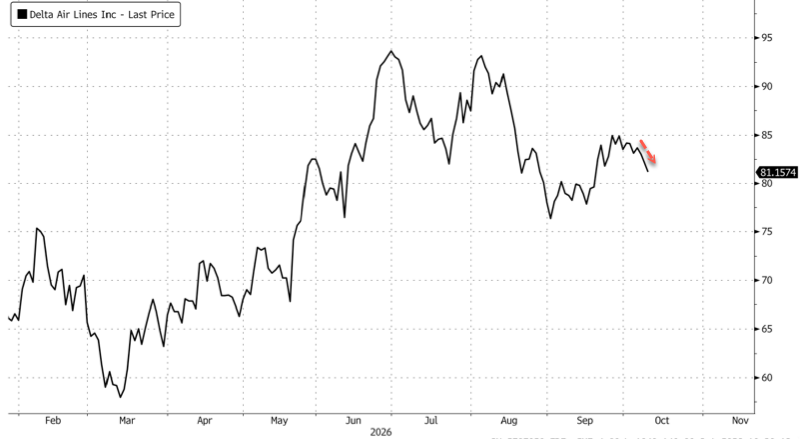
The broader airline index fell about 1.5%.
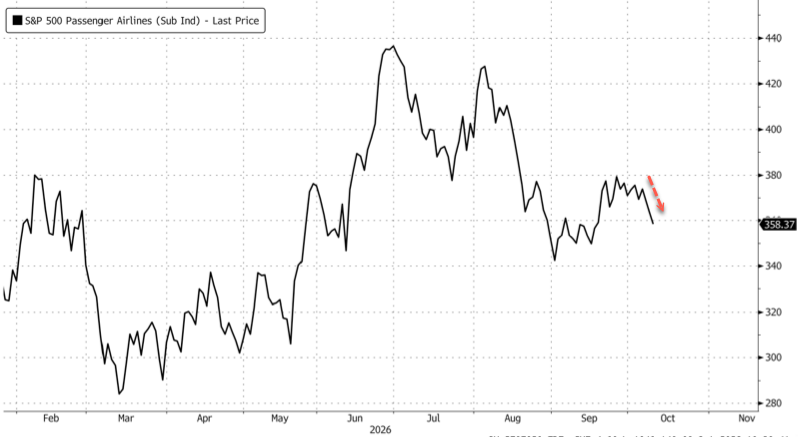
US air travel remains resilient …
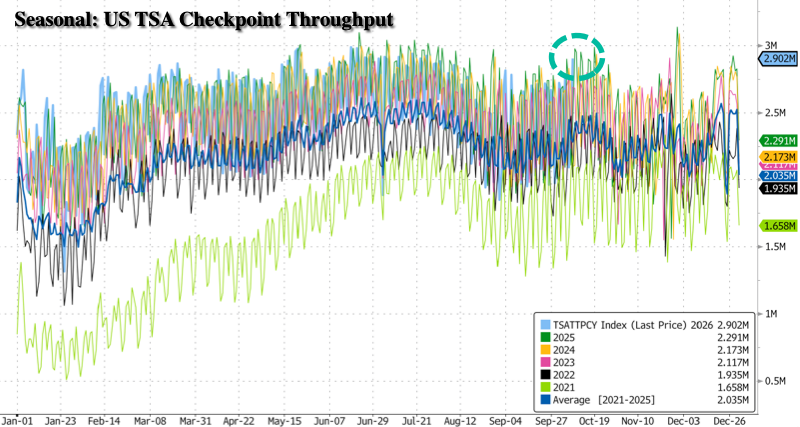
… in the face of high jet fuel prices crimping carrier margins.
KING NEWS
| The King Report October 9, 2026 Issue 7844 | Independent View of the News |
| French bonds renewed their descent, which induced bond selling globally. France’s CAC 40 (-1.22%) sank to a new 6-month low. @RenMacLLC: (Fed Gov) Waller: “I am concerned that the recent acceleration in inflation—after what soon will be five and a half years of it above the FOMC’s target—will lead consumers, investors, and price-setting businesses to revise up their expectations for future inflation.” Compare and contrast to last November … “the Fed needs a better reason than inflation having been above target for 5 years to not cut rates.” Fed’s Waller sees additional rate hikes to get inflation down faster 4:30 ET https://finance.yahoo.com/economy/policy/article/feds-waller-sees-additional-rate-hikes-to-get-inflation-down-faster-083000282.html WSJ’s @NickTimiraos: Waller: “I anticipate additional hikes to support a timelier return of inflation to our 2% goal. But there is some flexibility about when those hikes will occur. The hikes do not need to come at consecutive meetings, but they should be in place in an acceptable period of time.” The FT: Oil prices jump on tanker attacks and slowing flows through Strait of Hormuz Transit through vital waterway rose close to 90% of prewar levels last month but has since fallen sharply Reuters: Attack risks rise for tankers as Iran vows to block more Hormuz routes Iran strikes tankers outside Hormuz in signs of expanding campaign Two commercial vessels were hit within 24 hours — one off Qatar, the first attack in that area in six months, and one off Fujairah in the Gulf of Oman — as IRGC-affiliated outlets suggested Tehran had extended operations beyond the crucial strait… https://sg.news.yahoo.com/iran-strikes-tankers-outside-hormuz-134925734.html Reuters: Yemen’s Houthis say they attacked Riyadh airport with ballistic missile WSJ: Oil Jumps, Dow Slips on Mideast Jitters – Benchmark Brent crude prices are up almost 5% and are heading for their highest close since mid-September. @GasBuddyGuy: Ukraine hits the Omsk refinery overnight, 2,500km from the Russian border. Ukraine hit this refinery previously in July, damaging units and pushing it offline. Due to the global bond decline, USZs sank to 101 6/32, -1 1/32, at 6:50 ET. But just like on Wednesday and on other days when there is a Treasury Auction, someone juiced USZs to 102 11/32, +4/32, at 9:47 ET – because there was a US 30-year auction on Thursday. The S&P 500 Index gapped lower on its opening (7778.45, -23.32 pts) and fell to a daily low of 7773.03 seconds later. Because equity traders have been conditioned to ignore bad news and buy opening dips, the usual suspects aggressively bought the opening drop. The S&P 500 marched to 7793.67 at 10:29 ET. A 2nd Hour Reversal appeared; the S&P fell to776.62 at 10:54 ET. The index then traded sideways until they broke lower at 11:14 ET. After hitting a daily low of 7769.15 at 11:56 ET, the S&P 500 Index moved higher on another Trump verbal intervention. @realDonaldTrump: We are having productive discussions with the Islamic Republic of Iran. I want to make it clear to everybody that, while Iran is in very bad condition, both Economically and Militarily, and while the Blockade will remain in full force and effect, with Oil flowing in Record Numbers of Barrels through the Hormuz Strait (22 Million Barrels, last night alone, with not one barrel coming from, or going to, Iran!), we will not be attacking Iran at any time prior to the Midterm Elections to be held in the United States on November 3rd. IRAN WILL NOT HAVE A NUCLEAR WEAPON! President DONALD J. TRUMP Oct 08, 2026, 12:17 AM ET @realDonaldTrump: The White House considers anyone that uses the term, “Artificial Intelligence,” as opposed to the highly accepted new and more accurate term, “Super Intelligence,” THE ENEMY! (Please make him stop!) President DONALD J. TRUMP Oct 08, 2026, 12:14 AM ET To recap: Team Trump leaks to Axios on Tuesday that Trump has alerted the military that he might unleash hell on Iran in coming days. Energy prices spike higher on Thursday and debt yields rise; stocks rollover. So, Trump announces that he will NOT strike Iran prior to the US Midterm Elections. The S&P 500 Index spiked to a daily high of 7797.79 at 12:17 ET on DJT’s intervention. But DJT’s Iran act has appeared umpteen times over the past several months; so, it is losing potency. The rally reversed quickly. The S&P fell to 7777.45 at 12:39 ET and went inert. DJT’s interventions were trumped by this: FT: OpenAI annualized revenues $20bn less than previously signaled AI giant recently told investors the key figure was approaching $50bn in September, far less than the $70bn that was widely reported The S&P 500 Index fell to a new daily low of 7731.26 at 13:28 ET. The US 30-year Auction ($22B) was soft: High yield 5.618%, WI 5.617%, the highest clearing yield for a 30-year auction since August 10, 2000! Directs: 20.89%; Indirects: 72.32% (69.1% avg); Dealers: 6.79% (10.3% avg.) But DJT intervened; energy commodities sank, which boosted bonds. USZs jumped to a daily high of 102 28/32 at 13:18 ET. The US Treasury also intervened via a $6B US debt repurchase of 20s-30s. https://treasurydirect.gov/instit/annceresult/press/preanre/2026/BBPA_20261008174000.pdf Stocks tried to rally, but AI stocks were under pressure due to the FT story on OpenAI and this: Fed’s Musalem(St. Louis Pres): Rates ought to be going up in the next 6 to 9 months Fed’s Musalem: To bring inflation back to target, more monetary policy firming will be required Fed’s Musalem: AI investment and government deficits are also pressuring yields higher Fed’s Musalem: Strong demand for capital likely to keep rates higher than they used to be Fed’s Musalem: The US government has been on an unsustainable fiscal path for years But Trump had a scheduled AI/tech promotion for the early afternoon on Thursday. @FoxBusiness: HAPPENING NOW: President Trump puts six of America’s biggest names in technology and innovation in the spotlight as he presents two of the nation’s most prestigious honors for science and technology. Elon Musk, Google co-founder Sergey Brin, NVIDIA CEO Jensen Huang, AMD CEO Lisa Su, Dell Technologies CEO Michael Dell, and Microsoft CEO Satya Nadella are recognized for their contributions to scientific discovery and technological advancement. “That’s the highest you can get,” Trump said, highlighting the significance of the National Medal of Science and the National Medal of Technology and Innovation. 13:47 ET https://x.com/FoxBusiness/status/2108252845967347979 The S&P 500 Index jumped to 7755,37 at 13:45 ET (during DJT’s tech award presentation). But DJT finished, the index fell to 7742.40 at 13:49 ET. Traders got jiggy after St. Louis Fed President Musalem ended his very hawkish speech. The S&P 500 Index jumped to 7765.39 at 14:28 ET. The S&P then fell to 7750.08 at 15:07 ET. The late manipulation forced the S&P 500 Index to 7766.21 at 15:23 ET. Sellers appeared; the index fell to 7756.99 at 15:32 ET. The late rally pushed the S&P to a 7765.36 close. The FT: How a trillion-dollar hedge fund borrowing spree became Wall Street’s cash cow Hedge funds’ borrowing from banks has tripled since 2020… Hedgeweek: Trillion-dollar hedge fund borrowing boom drives Wall Street prime brokerage profits The scale of hedge fund leverage is substantial. US Federal Reserve data shows that the 50 largest hedge funds borrow about $3 for every $1 of assets under management, while the figure rises to roughly $11 for every dollar among the 15 largest firms. Those figures do not capture leverage embedded in derivatives. One banking executive estimated that the largest hedge funds could have effective leverage of 20 to 25 times when derivatives exposures are included. Market makers can operate with even higher leverage, potentially reaching 40 times, according to another executive. Goldman Sachs and Morgan Stanley are the largest players in prime brokerage, followed by JPMorgan Chase, according to hedge fund executives. Competition has intensified as Citigroup and Bank of America expand their operations, while European banks including BNP Paribas, Barclays and ABN Amro also seek a larger share of the business… https://hedgeweek.com/news/trillion-dollar-hedge-fund-borrowing-boom-drives-wall-street-prime-brokerage-profits US jobless claims (197k) hover near 57-year low for fourth consecutive week https://reut.rs/47H3G1P The FT: Starbucks Has Explored Takeover of Chipotle in Restaurant Megadeal Positive aspects of previous session Trump, again, issued verbal intervention to boost stocks and bonds. The US 30-year Auction was soft, but the US Treasury intervened with a $6B 20s-30s debt repurchase USZs closed 103 2/32, +27/32, near 103 6/32 high DJIA +0.1%, DJTA +1.43%, SP Energy +2.92%, Consumer Staples +2.12%, Financials +0.91%, Real Estate +0.59%, Materials +0.46%, Industrials +0.3% Negative aspects of previous session The FT’s OpenAI story sank AI stocks and related trading sardines. Despite Trump and US Treasury interventions, most major equity indices declined. Nas 100 -1.39%, Nasdaq -1.25%, S&P 500 Index -0.47%, SOX -3.39% SP Info Tech -1.78%, Cons Discretion -0.47%, Health Care -0.41%, Utes -0.26%, Comm Services -0.06% Nov WTI +$2.52, Dec Brent +$3.36, Nov Diesel +22.65¢, Nov Gas +6.84¢ at 16:32 ET Ambiguous aspects of previous session Will Trump, his team, and/or the US Treasury intervene today? First Hour/Last Hour NYSE Action [S&P 500 Index]: 1st Hour: Up; Last Hour: Up Pivot Point for S&P 500 Index [above/below indicates daily trend to day traders]: 7761.80 Previous session (S&P 500 Index) High/Low: 7797.79 (12:17 ET); 7731.26 (13:28 ET) Fed Balance Sheet: +$4.529B to $6.74756T ($6.743T expected); Reserves +$31.188B As we have state numerous times over the past several years, though various Fed officials keep professing that ‘they have learned the mistakes of the Fed in the Seventies,’ the current Fed is replicating the most egregious and destructive error of the Fed in the Seventies: Trying to tame inflation with interest rates! Volcker, starting in October 1979, arrested inflation by halting reserve growth. The Fed now is lying or very ignorant of contemporary Fed and financial history. @trevornoren: There’s been a deluge of problematic OpenAI stories over the past 24 hours, from Russia leveraging ChatGPT for an influence operation, to USA Today filing suit against the company for copyright infringement to the safety-concern letter by fired OpenAI workers. Yet, it’s the two below that jumped out at me most. The first is obvious. The second maybe an even deeper concern for their business model longer term… FT: “OpenAI’s annualised revenue is about $20bn less than the company has previously signalled, according to financial documents shared with investors, a massive gap likely to damp optimism about the growth of AI demand.” CNBC interview with mathematician Tristan Buckmaster: “The bigger picture is that this recent dump of papers on Tuesday destroyed the careers of mathematicians. We’ve had whole research programs wiped out. You have to understand, they have access to all of our research proposals. They have a massive conflict of interest…The fact that they would front-run their customers, it shows their disdain for their customers. Why would a company buy their product when, if you have an interesting idea, they can look at your private notes and beat you to market?” Obviously, the FT story is the one that’s moving markets. However, Buckmaster’s claim is likely an important reason why revenue growth is disappointing. There’s an inherent conflict of interest baked into the business models of hyperscalers. Alex Karp has been warning about this for months. As he told CNBC in August: “Every enterprise we interact with, and that includes some of the biggest and most important government enterprises in the world, is saying, ‘Why would we tokenmaxx [and] pay people for something that’s not useful and then not control the means that allow us to advance our business while keeping the value of the business inside?'”… Data security has always been a first-step concern for deep adoption. Innovation drives enterprise value across most sectors and if enterprises fear that collaboration with LLMs will put their innovation edge at risk, they’ll keep their innovations hidden from models… U.S. Treasury interventions risk credibility erosion in global markets https://tradersunion.com/news/financial-news/show/3725239-us-treasury-intervention-market-credibility/ WSJ: U.S. Budget Deficit Jumps to Nearly $2 Trillion ($1.993T FY ended on September 30) Federal finances are stuck in a rut that alarms policymakers, but hasn’t moved them to change course Today – As we keep warnings, Team Trump is determined to force stocks higher or keep them buoyant until the Midterm Elections on November 3. After hitting all-time highs on Monday and Tuesday, stocks sagged on Wednesday and early on Thursday due to rising energy commodities and debt yields. So, Trump intervened during the final 45 minutes of the morning ET. Traders will play for the Friday Rally, emboldened by the Team Trump interventions on Thursday. ESZs +9.75; NQZs +25.0, USZs -3/32, Nov WTI -$0.26, Nov Gas -0.033¢, Yen/$ 158.07 at 20:02ET Expected economic data: Oct UM Consumer Sentiment 47.6, Current Conditions 50.5, Expectations 45.9, 1-year Inflation 4.6%, 5-10-year Inflation 3.5%; Boston Fed Pres Collins 15:00 ET S&P 500 50-day MA: 7689; 100-day MA: 7579; 200-day MA: 7244 (Close 7765.36, -0.47%) Nasdaq 100 50-day MA: 29,719; 100-day MA: 29,568; 200-day MA: 25,599 (Close 30,725.81, -1.39%) DJIA 50-day MA: 52,644; 100-day MA: 52,118; 200-day MA: 50,340 (Close 51,231.64, +0.1%) (Green is positive slope; Red is negative slope) James Talarico, Democrat candidate for a Texas US Senate seat, has not appeared in public for several days. Rumors surfaced on Thursday that he had a nervous breakdown. @townhallcom: The Ken Paxton campaign is demanding “Proof of Life from James Tala-Freak-Out“ “With 26 days until Election Day and early voting about to begin, the Paxton campaign is calling on James Talarico to show proof of life to the 31 million Texans he’s asking to represent.” “The Paxton campaign is officially requesting proof of life, including: A video of James Talarico holding a newspaper dated today, the flight he took home from his New York fundraisers, which occurred on the very same night he allegedly went to an urgent care in Dallas, A doctor’s note from the Dallas urgent care he allegedly visited.” @realDonaldTrump: TalaFREAKo has been missing for 12 days! Now, after looking for him throughout all of Texas, and beyond, probably even weirder places than anyone would think possible, he put out a statement that he has the “flu.” 12 days is a long time to rid yourself of the so-called flu bug. What’s going on? We need a Senator that’s a proven Champion like one that has been, without question, the Greatest Attorney General in the History of Texas, and one of the Greatest in the U.S.A. His name is Ken Paxton, and he will never let you down! Thank you for your attention to this matter. President DONALD J. TRUMP Oct 08, 2026, 12:01 PM Embarrassing blow for Barack Obama as workers at his ‘death star’ presidential center are already so fed up they’re leaving in droves… as stern letter is released… due to the institute’s ‘increasing workloads’ and benefit rollbacks… Several subcontractors claimed they were owed millions in past-due invoices, and African American Contractors Association president Omar Shareef said several workers told him they ‘wished they had never done (the project).’… https://www.dailymail.com/news/article-16193155/Obama-presidential-center-workers-union-foundation-Chicago-staff.html Caitlin Clark left off 19 WNBA MVP ballots despite historic season as A’ja Wilson wins fifth award The Fever star finished fourth in voting after averaging 22.3 points and 8.3 assists per game… Nineteen voters didn’t put her on their ballots at all… Clark also had five games with at least 30 points and 10 assists this season. Every other player in WNBA history combined has four. Read that again. Read that again. Caitlin Clark did something five times in one season that every other player combined has done four times in WNBA regular-season history. (Blatant and abject racism!) https://www.foxnews.com/outkick-sports/caitlin-clark-left-off-19-wnba-mvp-ballots-despite-historic-season-aja-wilson-wins-fifth-award “Life in general has never been even close to fair, so the pretense that the government can make it fair is a valuable and inexhaustible asset to politicians who want to expand government.” — Thomas Sowell | |
SWAMP STORIES FOR YOU TONIGHT
QTR FRINGE FINANCE
The AI Rally Trapdoor Just Swung Open Violently
Friday, Oct 09, 2026 – 08:20 AM
Submitted by QTR’s Fringe Finance
Last week, I wrote a piece titled “It’s Official: The AI Emperor Has No Clothes,” arguing that the artificial intelligence bubble was approaching the point where investors would be forced to confront the financial reality underneath years of hype, circular financing and absurd valuations.
A couple of weeks earlier, I had predicted that the AI bubble would begin to burst within the next six to ten months. My argument was that the equity market was still pricing in a technological utopia while the bond and credit markets were beginning to recognize that the infrastructure buildout had gotten wildly ahead of itself.
Less than two weeks later, the evidence supporting that thesis is piling up.
The catalyst for my September 29 article was the disclosure of Anthropic’s 2025 financial statements, which finally gave investors a meaningful look underneath the hood of one of the most celebrated companies in AI. Anthropic reportedly generated approximately $4.6 billion in revenue during 2025 while recording more than $8 billion in operating losses and spending $7.33 billion on compute and infrastructure alone. Perhaps most astonishingly, the company had reportedly committed to approximately $518 billion in future cloud, computing and infrastructure obligations.
I argued that these disclosures exposed the enormous disconnect between the revenue these businesses were producing and the hundreds of billions of dollars being committed to support their growth. Investors had spent years waving away concerns about profitability with the promise that AI would eventually change everything, but we were finally beginning to get the numbers necessary to determine whether the economics could support that promise.
And today, another enormous piece of that puzzle fell into place.
According to a new report from the Financial Times, OpenAI’s annualized revenue at the end of September was approximately $50 billion, roughly $20 billion below the $70 billion figure investors had been led to expect. Earlier reports had placed annualized revenue around $40 billion in August, and subsequent indications of growth exceeding 70% helped produce the larger estimate. New financial information reportedly puts the figure closer to $50 billion, while OpenAI declined to comment.
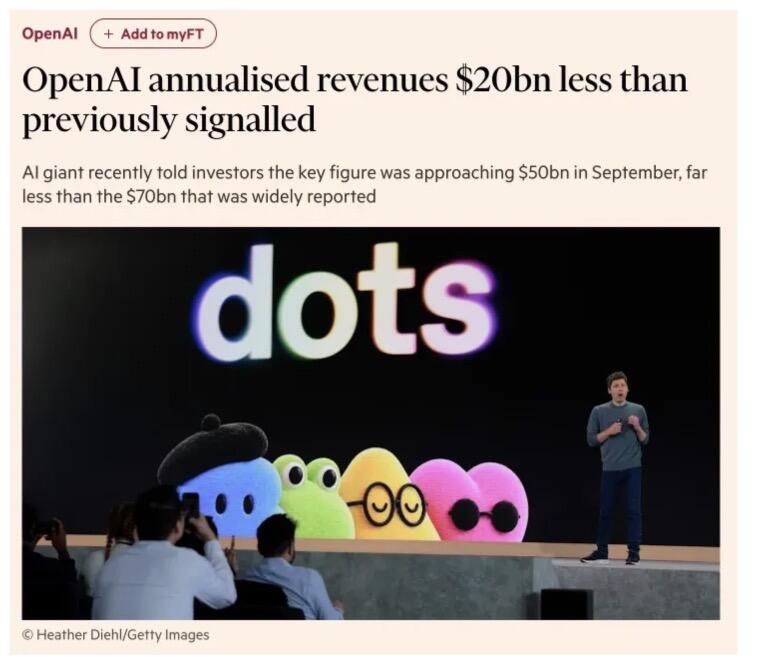
$50 billion in annualized revenue is still an enormous number, and the difference between an inferred revenue estimate and an actual reported run rate isn’t necessarily the same as missing formal guidance. But that distinction doesn’t eliminate the broader problem: expectations surrounding this industry have become so enormous that even extraordinary growth may not justify the amount of capital already committed to it.
This is the point I’ve been making for months. The problem isn’t that artificial intelligence doesn’t work or that nobody wants to use it. The problem is that Wall Street has constructed a financial fantasy around the technology that assumes practically unlimited future demand, extraordinary monetization, perpetually available financing and an uninterrupted willingness among investors to fund infrastructure projects whose eventual returns remain uncertain.
And nowhere is that problem more dangerous than at OpenAI, which sits at the center of what may be the most extraordinary financial circlejerk in modern market history, neatly displayed in this chart from Zero Hedge, who noted total that OpenAI has $1.5 trillion in commitments ahead of them:
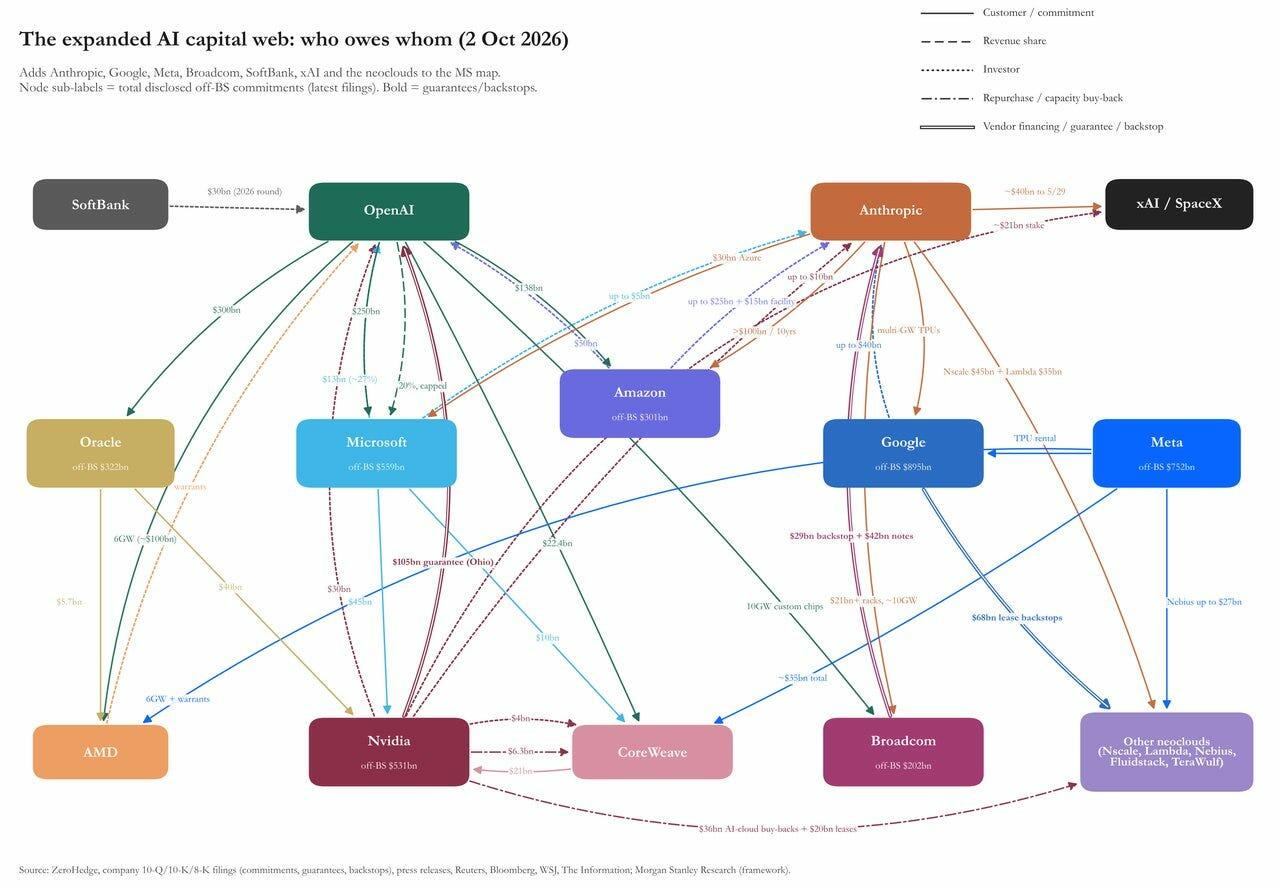
AI developers need enormous quantities of computing power, so they enter into massive agreements with cloud providers and infrastructure companies, which in turn purchase billions of dollars of equipment from Nvidia and other suppliers.
Infrastructure providers finance construction through debt, equity and increasingly complicated arrangements, while some of the same companies supplying equipment or infrastructure are also investing in the AI developers expected to purchase their products and services.
Money moves from investors to AI companies, from AI companies to infrastructure providers, from infrastructure providers to chipmakers, and sometimes from those chipmakers and their partners right back into the ecosystem. There are legitimate commercial transactions throughout this chain, but also extraordinary financial interdependence, with everybody using everybody else’s projected growth to justify their own spending.
This is where the trapdoor opens. If OpenAI’s revenue trajectory falls short of expectations, the implications extend far beyond OpenAI itself.
Infrastructure providers must reassess expansion plans, lenders must reconsider project creditworthiness, equipment suppliers must question future demand assumptions and investors who were previously willing to finance practically anything with AI attached to it may suddenly demand evidence of actual returns.
The same companies that spent years enthusiastically committing hundreds of billions of dollars to one another may eventually find themselves scrambling to collect payments, renegotiate contracts, reduce commitments and protect their balance sheets. We started seeing this last week with Oracle declaring a force majeure on a $165 billion data center project: Force Majeure Is Not A City In France
Everybody starts asking who owes whom, which obligations are enforceable and who ultimately bears the losses if projected demand fails to materialize. This is how a self-reinforcing investment boom becomes a self-reinforcing contraction, and it doesn’t necessarily matter how revolutionary the underlying technology is. A company can have a phenomenal product and still be a terrible investment, just as an industry can change the world while destroying enormous amounts of capital along the way.
And almost as if the market wanted to illustrate the point, another headline crossed the tape today: Nvidia-backed Australian AI infrastructure company Firmus is facing the possibility of postponing or abandoning its massive IPO after investor demand failed to materialize at the proposed valuation, according to Bloomberg.
Firmus had been attempting to raise as much as $5.5 billion at a valuation of approximately A$43.7 billion, or more than $30 billion in US dollars. The company closed its order book Thursday amid uncertainty over pricing and structure, with investors reportedly unwilling to support the original A$11 share price ahead of a planned October 23 debut.
The situation is particularly interesting because Firmus has the backing of Nvidia and Blackstone, precisely the names that until recently would have generated enormous excitement around practically any AI infrastructure investment. Yet investors are apparently beginning to examine the economics, debt, construction requirements and extraordinary valuations being assigned to projects that largely haven’t been completed.
🔥
Reuters Breakingviews reported that Firmus had built only about 42 megawatts of its planned one-gigawatt capacity, while The Guardian reported that approximately 97% of the company’s revenue was tied to projects yet to be built. We are talking about a company seeking a valuation in the tens of billions of dollars, backed by some of the biggest names in technology and finance, whose future economics depend overwhelmingly on infrastructure that doesn’t even exist yet.
And suddenly investors are beginning to question whether they should pay the asking price. Imagine that.
The timing is remarkable. On the same day investors learn that OpenAI’s annualized revenue is materially below widely circulated expectations, a prominent Nvidia-backed infrastructure offering is struggling to attract sufficient capital at its proposed valuation.
These developments aren’t necessarily causally related, but they are consistent with the same underlying problem: the amount of money being committed to the AI future has become increasingly disconnected from the cash flows available to support it today.
And the credit markets have been screaming that this was coming.
In my September 29 article, I pointed out that the bond and credit markets were already recognizing risks that equity investors seemed determined to ignore. Oracle had issued a force majeure notice connected to its massive Project Jupiter AI data center development in New Mexico, highlighting the physical and logistical challenges involved in building infrastructure on this scale. Oracle subsequently maintained that the project remained on schedule, but the episode illustrated that these projects require actual electricity, land, equipment, financing and construction, none of which can be conjured into existence by an investor presentation.
Meanwhile, Oracle’s credit default swaps had surged, with yields on some of its long-dated debt moving above 8%. Apollo Chief Economist Torsten Slok had highlighted widening CDS spreads among hyperscalers, while LSEG data showed an explosion in credit default swap trading tied to major technology companies. Nvidia’s single-name CDS trading volume had reportedly increased from approximately $640 million during one six-month period to $6.9 billion during the next, while Broadcom’s volume climbed from roughly $1.5 billion to $8.2 billion.
As I wrote at the time, credit default swaps are insurance, and although increasing trading activity doesn’t automatically mean a collapse is coming, it does suggest investors are paying considerably more attention to credit risks surrounding the AI investment boom.
I’ve argued that the next six to ten months could mark the beginning of a significant unwind in the AI bubble, and nothing I’ve seen since making that prediction has persuaded me to change my mind. I don’t know which company will first materially reduce its commitments, which lender will decide it has had enough exposure or which enormous infrastructure project will finally be deemed uneconomic. But when an industry becomes dependent on perpetual access to cheap capital, ever-increasing valuations and increasingly ambitious revenue projections, the moment those assumptions change can be extraordinarily unforgiving.
The process often begins with skepticism and repricing, followed by the realization that contracts, commitments and financing arrangements were built around expectations that may never materialize on the original timetable. Eventually comes the scramble for liquidity, when everybody who thought they owned an enormously valuable asset discovers that everybody else is trying to sell or collect at the same time.
That is the trapdoor I’m worried about. The entire AI ecosystem has spent years celebrating one another’s investments, contracts, partnerships and projected revenues as though money circulating between the same handful of companies represents an inexhaustible source of genuine economic demand. Eventually, somebody outside that circle has to generate enough economic value to pay for the whole thing, and if that value doesn’t arrive quickly enough, the financial structure can unravel long before the technology reaches its full potential.
Less than two weeks ago, I wrote that the AI emperor had no clothes and wondered who would be the first to stand up and say it. Now the financial statements are coming out, revenue expectations are being revised, the IPO market is pushing back and the credit markets have already been sounding the alarm.
The technology may very well be revolutionary, but that doesn’t mean the price Wall Street has assigned to the revolution makes any sense.
And if I’m right about where we’re heading over the next several months, the most important question won’t be how much money everybody thought they were going to make from AI, but how much money everybody owes everybody else when the music stops.–
END
Big Banks And The Democrats Killed Clarity; This Is The Next Target In Their Sights…
Friday, Oct 09, 2026 – 12:00 PM
Authored by Jordan Schachtel via American Greatness,
Just before the Senate adjourned for campaign season, big banks joined forces with longtime critic Elizabeth Warren and Senate Democrats to kill the Clarity Act.
The bill would have clarified federal rules for cryptocurrency markets and created a reliable, trustworthy entrance point for Americans to access digital assets.
After advancing the bill out of the Banking Committee on a bipartisan basis, Democrats blocked the bill from even being debated and amended on the Senate floor, giving the banks exactly what they wanted: less competition.
Warren, who spent much of her career opposing banks, has suddenly found common cause with them in opposing a critical component of the Trump Administration’s financial innovation agenda. As Sen. Cynthia Lummis put it, Warren “hates President Trump so much that she’d rather have no rules of the road for the digital asset industry – leaving consumers vulnerable and law enforcement empty-handed – than take the win for consumers.“
Throughout negotiations, Democrats and the big banks won concession after concession. Nearly 250 pages of big bank and Democratic priorities were added to the bill, including an agreement by President Trump to a sweeping and unprecedented ethics package. The banks and Democrats refused to take yes for an answer, stalling and eventually killing Clarity.
As Clarity negotiations heated up, another fight over the future of Americans’ finances simmered on the back burner: Open Banking. What is open banking? Put in simple terms, open banking allows consumers to securely share their financial data with the third-party apps, payment processors, and services of their choice. That means a customer can connect a bank account to a budgeting app, compare loan offers, or use a payment service without the bank choosing the service for them.
Right now, the Consumer Financial Protection Bureau, with input from the White House and other decision-makers in the administration, is in the process of finalizing the open banking rule (known to DC policy wonks as Section 1033 of the Dodd-Frank Act). The open banking rule will determine who has control over Americans’ bank data, how it can be used, and whether banks can charge tolls for customer-authorized apps to access that data.
According to a recent research report from S&P Global, 8 in 10 Americans use financial apps, engaging in the digital economy to spend, save, and budget. And as pundit Mary Katharine Ham pointed out this summer, there are direct implications for the president’s eponymous Trump Accounts.
With Clarity sidelined for the foreseeable future, the open banking fight is heating back up and could very well be the next pillar of the administration’s innovation agenda to be toppled by the big banks. Codifying a weak open banking rule would not only give the banks another win at the expense of President Trump’s agenda, but it would also come at a cost for American families and workers.
Making it harder or more expensive for Americans to connect their bank data with apps of their choice – which is what our country’s biggest banks ultimately want, whether they say it or not – would give legacy financial institutions the upper hand over competitors and encourage customers to use the bank-backed apps and services. Who wants to be forced to use a bank-backed app over something as simple as Venmo?
That’s what the gatekeepers of our financial system want. Major banks are aggressively lobbying for changes that would restrict competition, and if they succeed, those changes will make it harder and more expensive for customers to choose their own services. They would also stifle everyday innovations like custodied cryptocurrency wallets, which rely on open banking to seamlessly verify accounts and buy digital assets.
American consumers, not the big banks, should decide which apps can view their sensitive financial information. That principle should apply across the financial services industry so people can connect their accounts to the payment apps, lenders, and crypto wallets they choose.
A strong Section 1033 rule would protect that choice. It would also give new, innovative apps a fair shot to compete by allowing them to design financial services around consumers’ needs.
With the rule back on the drawing board, big banks are attempting to seize the advantage and capture more ground. They are lobbying to add provisions to charge “data rationing” fees or limit data access under the guise of security. Strong safeguards are essential, but data security cannot be weaponized to limit customers’ access to competing services.
Smaller fintech firms, upstart payments innovators, and crypto-wallet providers would have a harder time absorbing the data-access fees that banks could charge them. The result would be fewer services, less pressure on banks to improve their products, and fewer choices for Americans trying to manage, save, spend, borrow, or invest their money. A bank that can control access to a customer’s data can control which competitors ever get a meaningful chance to compete.
The Clarity vote showed how far big banks and Democrats will go to kill the Trump agenda and choke off innovation and competition that responds to families’ needs. We can’t let that happen again.
Handing another victory to the unholy big bank-Democrat alliance is bad politics, bad policy, and bad for our wallets. No more fees, no tolls, and true open banking will make life easier and cheaper for all Americans. The CFPB should reject pressure from the banks and write a consumer-friendly Section 1033 rule.
END
LISA COOK// WOKE APPT
Trump Forms Committee To Probe Federal Reserve’s Lisa Cook
Friday, Oct 09, 2026 – 01:30 PM
Authored by Zachary Stieber via The Epoch Times,
President Donald Trump on Oct. 9 announced a new committee to investigate whether a Federal Reserve governor made false statements.

The committee will probe allegations that Lisa Cook, governor of the Federal Reserve, offered false information in connection with at least one mortgage instrument, Trump said in a presidential memorandum establishing the panel.
The Federal Reserve is the country’s central banking system. Cook, 62, was appointed as its governor in 2022 and confirmed by the Senate.
Depending on the findings, there may be cause to remove Cook, Trump said.
Kevin Hassett, an adviser to Trump; Keith Sonderling, acting director of the U.S. Office of Government Ethics; and Andrea Lucas, chair of the U.S. Equal Employment Opportunity Commission, are members of the committee.
An in-person hearing to consider evidence in the case will take place on Nov. 5 at the White House, according to the memorandum. Cook was invited to submit a written statement regarding the allegations and can appear at the hearing if she wishes.
The committee can question Cook about any representations she or her lawyers make during the hearing and request documents from her. Cook shall comply with such requests, Trump said.
A lawyer representing Cook did not immediately respond to a request for comment.
Trump tried firing Cook in 2025, alleging that she had committed “deceitful and potentially criminal conduct in a financial matter.”
He pointed to a criminal referral made by William Pulte, director of the Federal Housing Finance Agency. The referral said Cook wrote in one document that a property in Michigan would be her primary residence for the following year but two weeks later signed a separate document attesting that a property in Georgia would be her primary residence for the next 12 months.
Chief Justice John Roberts, writing the majority, turned down arguments from the government, including that the removal was not judicially removal and that even if it was, the requirements for such a removal were met.
Ruling for the government would change the “for cause” protection outlined in federal law for the position into “at-will employment,” which was “out of step with the statute Congress enacted and our Nation’s tradition of central banking protected from political interference,” Roberts wrote at the time.
Lawyers for Cook responded by saying the allegations were baseless and amounted to interfering with the Federal Reserve’s independence.
“No matter what President Trump tries to do next, this much is clear under the facts and Supreme Court precedent – there is no valid cause for removing Governor Cook. As we did before, we will challenge this latest pretext and preserve her position and the historic role of the Fed,” they said.
GREG HUNTER
SEE YOU ON MONDAY


