
XX
EXCHANGE: COMEX
CONTRACT: NOVEMBER 2026 COMEX 100 GOLD FUTURES
SETTLEMENT: 4,102.500000000 USD
INTENT DATE: 11/05/2026 DELIVERY DATE: 11/09/2026
FIRM ORG FIRM NAME ISSUED STOPPED
363 H WELLS FARGO SECURITI 2
657 H MORGAN STANLEY 1
661 C JP MORGAN SECURITIES 12 9
737 C ADVANTAGE FUTURES 1
905 C ADM 1
TOTAL: 13 13
MONTH 4467
GOLD: NUMBER OF NOTICES FILED FOR NOVEMBER./2026: 13 CONTRACTS NOTICES FOR 1300 OZ or 0.0404 TONNES
total notices so far: 4467 contracts FOR 446,700 OZ OR 13.894 TONNES
SILVER NOTICES: 22 NOTICE(S) FILED FOR 110,000 OZ /
total number of notices filed so far this month : 1366 CONTRACTS (NOTICES) for 6.830 million oz
GLD
WITH GOLD DOWN $32.30 INVESTORS SWITCHING TO SPROTT PHYSICAL INSTEAD OF FRAUDULENT GLD/HUGE CHANGES AT THE GLD: A DEPOSIT OF 2.85 TONNES OF GOLD OUT OF THE GLD//INVENTORY RESTS AT 1040.51 TONNES
WITH NO SILVER AROUND AND SILVER DOWN $0.35 AT THE SLV.//NO CHANGES IN SILVER INVENTORY AT THE SLV/
NOV: INITIAL STANDING 5.820 MILLION OZ FOLLOWED BY TODAY’S HUGE 15 CONTRACT QUEUE JUMP FOR 0.075 MILLION OZ//NEW STANDING ADVANCES TO 8.580 MILLION OZ//
NOV. 12.430 MILLION OZ
NOV: INITIAL STANDINGl 10.566 TONNES OF GOLD FOLLOWED BY TODAY’S QUEUE JUMP OF 5 CONTRACTS FOR 500 OZ//(0.0155 TONNES)//NEW STANDING ADVANCES TO 13.9844 TONNES
GOLD PRICE GAIN OF $39.05
NOV INITIAL STANDING 10.566 TONNES FOLLOWED BY TODAY’S 5 CONTRACT QUEUE JUMP FOR 500 OZ OR 0.0155 TONNES///NEW STANDING ADVANCES TO 13.9844 TONNES
NOV// 36.36 MILLION OZ
SHANGHAI CLOSED DOWN 40.73 PTS OR 1.10%
HANG SENG CLOSED DOWN 315.12 PTS OR 1.27 %
Nikkei CLOSED DOWN 3,689.90 PTS OR 6.04%
//Australia’s all ordinaries CLOSED DOWN 0.24%
//Chinese yuan (ONSHORE) CLOSED UP AT 6.6699
/ OFFSHORE CLOSED UP AT 6.66722 Oil DOWN TO 90.03 dollars per barrel for WTI and BRENT DOWN TO 97.53 Stocks in Europe OPENED ALL RED
ONSHORE USA/ YUAN// WITH YUAN TRADING 6.6699OFFSHORE YUAN TRADING UP TO 6.6672 ONSHORE YUAN TRADING BELOW LEVEL // OFF SHORE AND UP ON THE DOLLAR)// / AND THUS STRONGER OFF SHORE YUAN TRADING UP AGAINST US DOLLAR/ AND THUS STRONGER
XXXXXXXXXXXXXXXXXXXXXXXXXXXXXXXXXXXXX
NOV 0//SO FAR
NOV 0 SO FAR
NOV 0
THE SPECS WERE UNSUCCESSFUL IN LOWERING GOLD’S PRICE ( IT ROSE BY $39.05
| Gold | Ounces |
| Withdrawals from Dealers Inventory in oz | nil |
| Withdrawals from Customer Inventory in oz | 2 ENTRIES i) Out of Manfra: 2944.246 oz ii) Stonex 996.681 oz (31 kilobars) total withdrawal 3940.927 oz |
| Deposit to theDealerInventory in oz | 0 ENTRIES |
| Deposits to the Customer Inventory, in oz | DEPOSITS/CUSTOMER//gold 0 ENTRIES xxxxxxxxxxxxxxxx |
| No of oz served (contracts) today | 13 CONTRACTS 1300 OZ 0.0404 TONNES OF GOLD |
| No of oz to be served (notices) | 29 Contracts 2900 OZ 0.0902 TONNES |
| Total monthly oz gold served (contracts) so far this month | 4467 notices 446,700 OZ 13.894TONNES |
| Total accumulative withdrawals of gold from the Dealers inventory this month | NIL oz |
| Total accumulative withdrawal of gold from the Customer inventory this month |
dealer deposits: 0
xxxxxxxxxxxxxxxxxxx
DEPOSITS:CUSTOMER ACCT
ENTRIES: 0
xxxxxxxxxxxxxxxxxx
comex withdrawals
2 ENTRIES
i) Out of Manfra: 2944.246 oz
ii) Stonex 996.681 oz (31 kilobars)
total withdrawal 3940.927 oz
adjustments: 1
all dealer to customer
a) Brinks 12,635.343 oz
COMEX IS DRAINING GOLD
chaos inside the comex
THE FRONT MONTH OF NOV OI STANDS AT 42 CONTRACTS HAVING A GAIN OF 9 CONTRACTS.
ON THURSDAY WE HAD 448,100 OZ( 13.938 TONNES) STAND FOR DELIVERY: TODAY, 448,600 OZ (13.9844 TONNES) FOR A GAIN OF 500 OZ 5 CONTRACTS (.0155 TONNES)//NEW STANDING ADVANCES TO 13.9844 TONNES OF GOLD
.
DECEMBER, THE LARGEST DELIVERY MONTH IN THE CALENDAR, ITS OI FALLS BY 4670 CONTRACTS DOWN TO 260,278
JANUARY RISES BY 40 CONTRACTS TO 903 OI
.
We had 13 contracts filed for today representing 1300 oz
Today, 0 notice(s) were issued from J.P.Morgan dealer and 0 notices issued from their client or customer account. The total of all issuance by all participants equate to 13 contract(s) of which 0 notices were stopped (received) by j.P. Morgan dealer and 9 notice(s) was (were) stopped (received) by J.P.Morgan//customer account
To calculate the INITIAL total number of gold ounces standing for NON /2026. contract month, we take the total number of notices filed so far for the month (4,467) to which we add the difference between the open interest for the front month of NOV (42) CONTRACTS) minus the number of notices served upon today 13 x 100 oz per contract) equals 448,600 OZ OR(13.9844Tonnes of gold)
THUS: INITIAL total number of gold ounces standing for NOV. /2026. contract month,we take the total number of notices filed so far for the month (4,467) to which we add the difference between the open interest for the front month of NOV( 42) contracts minus the number of notices served upon today 13x 100 oz per contract) equals 448,600 OZ OR(13.9844Tonnes of gold)
new total of gold standing in NOV becomes 13.9844 TONNES//
TOTAL COMEX GOLD STANDING FOR NOV: 13.9844 TONNES WHICH IS NOW VERY STRONG FOR THIS NON ACTIVE DELIVERY MONTH OF NOV/
THURSDAY VOLUME: 259,440 GOOD
COMEX GOLD INVENTORIES/CLASSIFICATION
NEW PLEDGED GOLD:
241,794.285 oz NOW PLEDGED /HSBC 5.94 TONNES
204,937.290 OZ PLEDGED MANFRA 3.08 TONNES
83,657.582 PLEDGED JPMorgan no 1 1.690 tonnes
265,999.054, oz JPM No 2
1,152,376.639 oz pledged Brinks/
Manfra: 33,758.550 oz
Delaware: 193.721 oz
International Delaware:: 11,188.542 oz
total pledged gold: 1,678,544.566 oz 52.20tonnes pledged gold lowers
total inventories in gold declining rapidly
total pledged gold: 1,678,544.566.tonnes oz 52.20 tonnes
TOTAL OF ALL GOLD ELIGIBLE AND REGISTERED GOLD 22,993,188.238oz//
TOTAL REGISTERED GOLD 14,343,497.990 tonnes (446.142 tonnes)
TOTAL OF ALL ELIGIBLE GOLD 8,649,690.248 oz.
REGISTERED GOLD THAT CAN BE SERVED UPON in oz 12,664,953 ((REG GOLD- PLEDGED GOLD)=
393.933 Tonnes //
total inventories in gold declining rapidly
SILVER COMEX
NOV DELIVERY MONTH
NOV 6
| Silver | Ounces |
| Withdrawals from Dealers Inventory | NIL oz |
| Withdrawals from Customer Inventory | 3 entries i) Out of Asahi: 621,681.310 oz ii) Out of CNT 25,404.050z iii) Out of JPMorgan; 64,814.160 oz TOTAL WITHDRAWAL: 715,928.940oz |
| Deposits to the Dealer Inventory | 1 ENTRY i) Into Stonex: 431,093.420 oz total deposit: 431,093.420 oz |
| Deposits to the Customer Inventory | ENTRIES: 0 |
| No of oz served today (contracts) | 22 CONTRACT(S) ( 110,000 OZ) |
| No of oz to be served (notices) | 350 Contracts (1.750 MILLION oz) |
| Total monthly oz silver served (contracts) | 1366 contracts 6.830 MILLIONoz |
| Total accumulative withdrawal of silver from the Dealers inventory this month | NIL oz |
| Total accumulative withdrawal of silver from the Customer inventory this month |
DEPOSITS INTO DEALER ACCOUNTS
ENTRY:0
DEPOSIT ENTRIES/CUSTOMER ACCOUNT
1 ENTRIES:
a) Delaware: 58,765.380 oz
total: 58,765.380 oz
xxxxxxxxxxxxxxxxxxxxxxxxx
withdrawals:
3 ENTRIES
i) Out of Asahi: 621,681.310 oz
ii) Out of CNT 25,404.050z
iii) Out of JPMorgan; 64,814.160 oz
TOTAL WITHDRAWAL: 715,928.940oz
adjustments : // all dealer to customer
a) Asahi 599,447.400 oz
TOTAL REGISTERED SILVER: 100.938 MILLION OZ//.TOTAL REG + ELIGIBLE. 334.527Million oz
registered silver dropping in numbers
CALCULATIONS FOR THE NEW STANDING FOR SILVER FOR NOV
FRONT MONTH: SILVER OPEN INTEREST CONTRACTS: 372 FOR A GAIN OF 21 CONTRACTS .
ON THURSDAY WE HAD 8.505 MILLION OZ STAND FOR DELIVERY. TODAY 8.580 MILLION OZ FOR A GAIN OF 75,000 OZ OR A QUEUE JUMP OF 15 CONTRACTS.
.
DECEMBER LOST 2191 CONTRACTS DOWN TO AN OI OF 75,885
JANUARY GAINED 129 C0NTRACTS TO 1005 OI
TOTAL NUMBER OF NOTICES FILED FOR TODAY:22 or 110,000oz
CONFIRMED volumeTHURSDAY; 93,239 fair/
AND NOW NOV DELIVERIES:
To calculate the number of silver ounces that will stand for delivery in NOV. we take the total number of notices filed for the month so far at 1366 X5,000 oz = 6.830MILLION oz.
Then we take the difference between the front month of NOV. and the number of notices filed for today x 5000 to give us our standing
Thus the standings for silver for the NOV 2026 contract month: (1366 Notices served so far) x 5000 oz + OI for the front month of NOV (372 minus number of notices served upon today ( 22 x 5000 oz) equals silver standing for the NOV .contract month equating to 8.580 MILLION OZ t
We must also keep in mind that there is considerable silver standing in London coming from our longs
There are ONLY 100.938million oz of registered silver
JPMorgan as a percentage of total silver: 125.980 ///334.527million: 37.72%
The record level of silver open interest is 234,787 contracts set on April 21./2017 with the price on that day at $18.42.
The previous record was 224,540 contracts with the price at that time of $20.44.
BOTH GLD AND SLV ARE MASSIVE FRAUD
XXXXXXXXXXXXXXXXXXXXXXXXXXXXXXXXXXXXXXXXXXX
NOV6 WITH GOLD DOWN $32.30 HUGE CHANGES IN GOLD AT THE GLD. A DEPOSIT OF 2.850 TONNES OF GOLD INTO THE GLD.INVENTORY RESTS AT 1040.51 TONNNES
NOV4 WITH GOLD UP $133.00 HUGE CHANGES IN GOLD AT THE GLD. A WITHDRAWAL OF 2.850 TONNES OF GOLD OUT OF THE GLD.INVENTORY RESTS AT 1037.66 TONNNES
NOV3 WITH GOLD DOWN $28.35 HUGE CHANGES IN GOLD AT THE GLD. A WITHDRAWAL OF 1.14 TONNES OF GOLD OUT OF THE GLD.INVENTORY RESTS AT 1040.51 TONNNES
NOV2 WITH GOLD UP $68.40 SMALL CHANGES IN GOLD AT THE GLD. A DEPOSIT OF 0.57 TONNES OF GOLD INTO THE GLD.INVENTORY RESTS AT 1041.65TONNNES
OCT 30/ WITH GOLD DOWN $129.60 HUGE CHANGES IN GOLD AT THE GLD. A WITHDRAWAL OF 2.28 TONNES OF GOLD INTO THE GLD.INVENTORY RESTS AT 1041.08TONNNES
0CT 29 2026 WITH GOLD DOWN $23.45 HUGE CHANGES IN GOLD AT THE GLD. A DEPOSIT OF 2,56 TONNES OF GOLD OUT OF THE GLD INVENTORY RESTS AT 1043,34 TONNNES
OCT 28/2026 WITH GOLD DOWN $23,45 SMALL CHANGES IN GOLD AT THE GLD: A DEPOSIT OF 0.20 TONNES OF GOLD INTO THE GLD..INVENTORY REST AT 1041,65 TONNES
0CT 27/ WITH GOLD UP $38.30//HUGE CHANGES IN GOLD AT THE GLD.. A WITHDDRAWAL OF ,65 TONNES OF GOLD AT THE GLD..INVENTORY RESTS AT 1040,80 TONNES
OCT 26/ WITH GOLD UP $28,40 HUGE CHANGES IN GOLD AT THE GKD.. A MASSIVE WITHDRAWAK IF 16.17 TONNES OF GOLD OUT OF THE GLD..INVENTORY RESTS AT 1041.47 TONNES
OCT 23//2026/WITH GOLD DOWN $49.65 /HUGE CHANGES IN GOLD AT THE GLD. A WITHDRAWAL OF 2.56 TONNES OF GOLD OUT OF THE GLD//// //:/INVENTORY RESTS AT 1057.62 TONNES
OCT 22//2026/WITH GOLD DOWN $87.75 /HUGE CHANGES IN GOLD AT THE GLD. A DEPOSIT OF 1.14 TONNES OF GOLDINTO THE GLD//// //:/INVENTORY RESTS AT 1060.18 TONNES
OCT 21//2026/WITH GOLD UP $8.55 /NO CHANGES IN GOLD AT THE GLD.// //:/INVENTORY RESTS AT 1059.04 TONNES
OCT 20//2026/WITH GOLD DOWN $41.05 /NO CHANGES IN GOLD AT THE GLD. //:/INVENTORY RESTS AT 1059.04 TONNES
OCT 19//2026/WITH GOLD DOWN $19.65 /HUGE CHANGES IN GOLD AT THE GLD:A DEPOSIT OF 5.13 TONNES OF 0.29 TONNES OF GOLD INTO THE GLD/. //:/INVENTORY RESTS AT 1059.04 TONNES
OCT 16//2026/WITH GOLD UP $60.50 /HUGE CHANGES IN GOLD AT THE GLD:A WITHDRAWAL OF 0.29 TONNES OF GOLD FROM THE GLD/. //:/INVENTORY RESTS AT 1053.91 TONNES
OCT 15//2026/WITH GOLD UP $60.50 /HUGE CHANGES IN GOLD AT THE GLD:A WITHDRAWAL OF 1.21 TONNES OF GOLD FROM THE GLD/. //:/INVENTORY RESTS AT 1054.20 TONNES
OCT 14//2026/WITH GOLD DOWN $66.25 /NO CHANGES IN GOLD AT THE GLD: //:/INVENTORY RESTS AT 1055.41 TONNES
OCT 13//2026/WITH GOLD DOWN $13.25 /HUGE CHANGES IN GOLD AT THE GLD: A DEPOSIT OF OF 2.281TONNES OF GOLD INTO THE THE GLD//: //:/INVENTORY RESTS AT 1055.411 TONNES
OCT 12//2026/WITH GOLD DOWN $24.20 /HUGE CHANGES IN GOLD AT THE GLD: A WITHDRAWAL OF 2TONNES OF GOLD OUT OF THE GLD//: //:/INVENTORY RESTS AT 1053.13 TONNES
OCT 9//2026/WITH GOLD UP $60.00 /HUGE CHANGES IN GOLD AT THE GLD: A WITHDRAWAL OF 4.562 TONNES OF GOLD OUT OF THE GLD//: //:/INVENTORY RESTS AT 1055.411 TONNES
OCT 8//2026/WITH GOLD UP $16.85 /HUGE CHANGES IN GOLD AT THE GLD: A DEPOSIT OF 3.703 TONNES OF GOLD INTO THE GLD//: //:/INVENTORY RESTS AT 1059.873 TONNES
OCT 7//2026/WITH GOLD DOWN $46.70 /NO CHANGES IN GOLD AT THE GLD:: //:/INVENTORY RESTS AT 1056.27 TONNES
OCT 6//2026/WITH GOLD UP $30.60 /HUGE CHANGES IN GOLD AT THE GLD:: A DEPOSIT OF 0.754 TONNES OF GOLD INTO THE GLD// //:/INVENTORY RESTS AT 1056.27 TONNES
OCT 5//2026/WITH GOLD DOWN $2.20 /HUGE CHANGES IN GOLD AT THE GLD:: A WITHDRAWAL OF 0.854 TONNES OF GOLD INTO THE GLD// //:/INVENTORY RESTS AT 1055.696 TONNES
OCT 2//2026/WITH GOLD DOWN $43.00 /HUGE CHANGES IN GOLD AT THE GLD:: A DEPOSIT OF 0.854 TONNES OF GOLD INTO THE GLD// //:/INVENTORY RESTS AT 1056.55 TONNES
OCT 1//2026/WITH GOLD UP $19.55 /HUGE CHANGES IN GOLD AT THE GLD:: A WITHDRAWAL OF 1.711 TONNES OF GOLD OUT OF THE GLD// //:/INVENTORY RESTS AT 1055.696 TONNES
SEPT 30//2026/WITH GOLD UP $7.80 /HUGE CHANGES IN GOLD AT THE GLD:: A DEPOSIT OF 2.847 TONNES OF GOLD INTO THE GLD// //:/INVENTORY RESTS AT 1057.407 TONNES
SEPT 29//2026/WITH GOLD UP $11.75 /NO CHANGES IN GOLD AT THE GLD //:/INVENTORY RESTS AT 1054.56 TONNES
SEPT 28//2026/WITH GOLD DOWN $150.20 /NO CHANGES IN GOLD AT THE GLD //:/INVENTORY RESTS AT 1054.56 TONNES
SEPT 25//2026/WITH GOLD DOWN $150.20 /NO CHANGES IN GOLD AT THE GLD //:/INVENTORY RESTS AT 1054.56 TONNES
SEPT 24//2026/WITH GOLD DOWN $18.70 /HUGE CHANGES IN GOLD AT THE GLD A DEPOSIT OF 1.43 TONNES OF GOLD INTO THE GLD://:/INVENTORY RESTS AT 1056.84 TONNES
SEPT 23//2026/WITH GOLD DOWN $58.00 /HUGE CHANGES IN GOLD AT THE GLD://:/INVENTORY RESTS AT 1055.41 TONNES
GLD INVENTORY: 1040.51 TONNES, TONIGHTS TOTAL GOLD INVENTORY
SILVER
NOV 6// WITH SILVER DOWN $0.35// NO CHANGES AT THE SLV: ../ //INVENTORY RESTS AT 506.435 MILLION OZ
NOV 4// WITH SILVER UP $2.44// SMALL CHANGES AT THE SLV: A WITHDRAWAL OF 242,000 OZ OUT OF THE SLV../ //INVENTORY RESTS AT 506.435 MILLION OZ
NOV 3// WITH SILVER DOWN $1.05// HUGE CHANGES AT THE SLV: A HUGE DEPOSIT OF 3.656 MILLION OZ INTO THE SLV../ //INVENTORY RESTS AT 506.677 MILLION OZ
NOV 2// WITH SILVER UP $1.55// HUGE CHANGES AT THE SLV: A HUGE DEPOSIT OF 3.34 MILLION OZ INTO THE SLV../ //INVENTORY RESTS AT 503.021 MILLION OZ
OCT 30// WITH SILVER DOWN $3.06// NO CHANGES AT THE SKV/ //INVENTORY RESTS AT 499.681 MILLION OZ
OCT 29 WITH SILVER DOWN $0.25: HUGE CHANGES AT THE SLV: A HUGE DEPOSIT OF 1.334 MILLION OZ INTO THE SLV//INVENTORY RESTS AT 499.681 MILLLION OZ
OCT 28/WITH SILVER DOWN $0.25: NO CHANGES IN SILVER INVENTORY AT THE SLV..INVENTOR RESTS AT 498,327 MILLION OZ
OCT 27/ WITH SILVER UP $0.25 NO CHANCES IN SILVER INVENTORY AT THE SLV//INVENTORY RESTS AT 498.327 MILLION OZ
OCT 26/ WITH SILVER UP 0.25 SMALL CHANGES AT THE SLV//A DEPOSIT OF 451,000 OZ OF SILVER INTO THE SLV//INVENTORY RESTS AT 498.327 MILLION OZ
OCT 23 WITH SILVER DOWN $0.94 : :NO CHANGES AT THE SLV:// // :INVENTORY RESTS AT 497.876 MILLION OZ
OCT 22 WITH SILVER DOWN $2.72 : : SMALL CHANGES AT THE SLV: A WITHDRAWAL OF 632,000 OZ INTO SLV// // :INVENTORY RESTS AT 497.876 MILLION OZ
OCT 21 WITH SILVER DOWN $0.28 : : STRONG CHANGES AT THE SLV: A DEPOSIT OF 858,000 OZ INTO SLV// // :INVENTORY RESTS AT 498.508 MILLION OZ
OCT 20 WITH SILVER UP $0.68 : :NO CHANGES A WITHDRAWAL OF 943,000 OZ INTO OUT OF SLV// // :INVENTORY RESTS AT 497.650 MILLION OZ
OCT 16 WITH SILVER UP $1.19 : :MEGA HUGE CHANGES A DEPOSIT OF 4.374 MILLION OZ INTO THE SLV// // :INVENTORY RESTS AT 498.593 MILLION OZ
OCT 15 WITH SILVER UP $1.19 : :SMALL CHANGES A DEPOSIT OF 406,000 OZ INTO THE SLV// // :INVENTORY RESTS AT 494.219 MILLION OZ
OCT 14 WITH SILVER DOWN $3.25 : :SMALL CHANGES A WITHDRAWAL OF 135,000 OZ OUT OF THE SLV// // :INVENTORY RESTS AT 493.948 MILLION OZ
OCT 13 WITH SILVER DOWN $0.97 : :HUGE CHANGES A DEPOSIT OF 722,000 OZ INTO THE SLV// // :INVENTORY RESTS AT 493.813 MILLION OZ
OCT 12 WITH SILVER DOWN $0.51 : :HUGE CHANGES A DEPOSIT OF 722,000 OZ INTO THE SLV// // :INVENTORY RESTS AT 493.948 MILLION OZ
OCT 9 WITH SILVER UP $0.62 : :SMALL CHANGES A DEPOSIT OF 948,000 OZ INTO THE SLV// // :INVENTORY RESTS AT 493.226 MILLION OZ
OCT 8 WITH SILVER DOWN $0.74 : :SMALL CHANGES IN INVENTORY AT THE SLV:A WITHDRAWAL OF 532,000 OZ FROM THE SLV// // :INVENTORY RESTS AT 492.278 MILLION OZ
OCT 7 WITH SILVER DOWN $1.36 : :SMALL CHANGES IN INVENTORY AT THE SLV:A WITHDRAWAL OF 451,000 OZ FROM THE SLV// // :INVENTORY RESTS AT 492.910 MILLION OZ
OCT 6 WITH SILVER UP $0.31 : :NO CHANGES IN INVENTORY AT THE SLV: // :INVENTORY RESTS AT 493.361 MILLION OZ
OCT 5 WITH SILVER UP $0.87 : :NO CHANGES IN INVENTORY AT THE SLV: // :INVENTORY RESTS AT 493.361 MILLION OZ
OCT 2 WITH SILVER DOWN $0.74 : :NO CHANGES IN INVENTORY AT THE SLV: // :INVENTORY RESTS AT 493.578 MILLION OZ
OCT 1 WITH SILVER UP $0.57 : :HUGE CHANGES IN INVENTORY AT THE SLV: A WITHDRAWAL OF 1.400 MILLION OZ OUT OF THE SLV// :INVENTORY RESTS AT 493.578 MILLION OZ
SEPT 30 WITH SILVER DOWN $0.55 : :HUGE CHANGES IN INVENTORY AT THE SLV: A DEPOSIT OF 994,000 OZ INTO THE SLV// :INVENTORY RESTS AT 494.978 MILLION OZ
SEPT 29 WITH SILVER DOWN $0.58 : :SMALL CHANGES IN INVENTORY AT THE SLV: A WITHDRAWAL OF 566,000 OZ FROM THE SLV// :INVENTORY RESTS AT 493.984 MILLION OZ
SEPT 28 WITH SILVER DOWN $2.91 : :SMALL CHANGES IN INVENTORY AT THE SLV: A DEPOSIT OF 0.542 MILLION OZ FROM THE SLV// :INVENTORY RESTS AT 494.436 MILLION OZ
SEPT 25 WITH SILVER DOWN $2.91 : :SMALL CHANGES IN INVENTORY AT THE SLV: A DEPOSIT OF 0.542 MILLION OZ FROM THE SLV// :INVENTORY RESTS AT 494.436 MILLION OZ
SEPT 24 WITH SILVER DOWN $0.96 : :HUGE CHANGES IN INVENTORY AT THE SLV: A WITHDRAWAL OF 0.813 MILLION OZ FROM THE SLV// :INVENTORY RESTS AT 493.533 MILLION OZ
SEPT 23 WITH SILVER UP $1.58 : :HUGE CHANGES IN INVENTORY AT THE SLV: A WITHDRAWAL OF 1.716 MILLION OZ FROM THE SLV// :INVENTORY RESTS AT 494.346 MILLION OZ
SEPT 22 WITH SILVER UP $0.10 : :NO CHANGES IN INVENTORY AT THE SLV: :INVENTORY RESTS AT 496.062 MILLION OZ
SEPT 21 WITH SILVER UP $1.04 : :HUGE CHANGES IN INVENTORY AT THE SLV: :INVENTORY RESTS AT 489.558 MILLION OZ
SEPT 18 WITH SILVER UP $1.04 : :NO CHANGES IN INVENTORY AT THE SLV: :INVENTORY RESTS AT 489.558 MILLION OZ
SEPT 17 WITH SILVER UP $1.10 : :HUGE CHANGES IN INVENTORY AT THE SLV: A WITHDRAWAL OF 1.265 MILLION OZ FROM THE SLV/ :INVENTORY RESTS AT 489.558 MILLION OZ
SEPT 16 WITH SILVER UP $0.95 : :HUGE CHANGES IN INVENTORY AT THE SLV: A WITHDRAWAL OF 813,000 OZ FROM THE SLV/ :INVENTORY RESTS AT 490.823 MILLION OZ
SEPT 15 WITH SILVER DOWN $0.16 : :HUGE CHANGES IN INVENTORY AT THE SLV: A WITHDRAWAL OF 813,000 OZ FROM THE SLV/ :INVENTORY RESTS AT 491.636 MILLION OZ
SEPT 14 WITH SILVER DOWN $0.91 : :NO CHANGES IN INVENTORY AT THE SLV:/ :INVENTORY RESTS AT 492.449 MILLION OZ
SEPT 11 WITH SILVER DOWN $3.50 : :NO CHANGES IN INVENTORY AT THE SLV:/ :INVENTORY RESTS AT 492.449 MILLION OZ
CLOSING INVENTORY 506.435MILLION OZ OF SILVER
GOLD COMMENTARIES:
1.PETER SCHIFF//JOHN RUBINO//RAVEN
Peter Schiff Is Not Optimistic…
Authored by Peter Schiff via X,
The most likely legislation Congress can pass that Trump will sign will preserve all the tax cuts Trump brags about but include all the extra spending that Democrats want. It may also contain a complete repeal of the national debt ceiling and price controls on credit card interest rates. The result will be massive increases in already massive federal budget deficits.
If the economy also slips into recession due to a big slowdown in AI capex, budget deficits currently running at around $3 trillion annually could rise to nearly $5 trillion. That will send the national debt soaring to $50 trillion by the end of Trump’s term. To accommodate those massive deficits, the Fed will open up the monetary spigots like never before, launching the mother of all QE programs. The U.S. dollar will tank, and consumer prices will go through the roof.
This will also put substantial upward pressure on long-term bond yields and mortgage rates, crushing the economy and housing market. To avoid a worse financial crisis than in 2008, the Fed will choose higher inflation instead and buy Treasuries and MBS in record amounts. Since the Fed won’t buy corporate or municipal bonds, expect those yields to soar, wreaking havoc on state and local governments and the stock market.
Since credit card interest rates will likely be capped, expect most consumers to be completely cut off from credit. If price controls extend to consumer goods, expect shortages, long lines, black markets, widespread power outages, and civil unrest.
Since the war can’t really end unless we surrender by caving in to Iran’s demands, it will likely continue. Since the Strategic Petroleum Reserve will run dry if we don’t stop the drain, oil prices will rise sharply, perhaps to $150-$200 per barrel. Even if Trump manages to end the war by promoting a defeat as a great victory, oil prices will rise anyway.
The 2028 election will be a blame game, with each party accusing the other of being responsible for the worst economy ever and the highest inflation in U.S. history. Voters have a track record of blaming presidents and their parties for the affordability crises, so not only will the Democrats win the White House, but they will also increase their majorities in both houses of Congress, likely reaching a filibuster-proof 60 seats in the Senate. Their policies will risk turning record-high inflation into hyperinflation.
The only thing you can do now is protect yourself, as there is nothing you can do to protect the country. In fact, by not going broke like the vast majority of Americans will, you will be better positioned to help rebuild what both Democrats and Republicans will have destroyed.
Load up on gold and silver now while you can still afford to buy them.
JOHN RUBINO
ALASDAIR MACLEOD…
Gold and silver rally
Mid-term election drama has gold and silver higher, while oil, bond yields, and the dollar ease.
There are reasons to believe that the potential for gold and silver prices to move higher could now be explosive. The background is one of severe mispricing due to war propaganda, continual draining of physical metal from Western capital markets, and subdued speculator interest. Could it be that these distortions are finally being uncovered by the dramatic success of the Democrats in the midterms?
It was apparent that the surprise success of the Democrats in capturing both houses from Republican control was the signal for a significant bear squeeze on the shorts in gold and silver. The chart below illustrates how over the last five months gold’s open interest on Comex has gradually recovered from ultra-low levels to be simply oversold at 400,000 contracts.

It reflects some accumulation at low prices, but there is evidence that the paper market is being sidelined. Customs data confirms that China imported 1,220 tonnes this year to August including monetary gold, and the last two months will have added significantly to that total. If Comex has a contribution to the physical market, its stand for delivery system has delivered 621 tonnes into buyers’ hands so far this year. Buyers are big and are mostly going directly to the refiners, so paper derivatives reflect price hedging activity against off-market deliveries rather than genuine supply and demand factors.
Rather than follow paper market developments, investors would do better to follow factors likely to change the dollar’s purchasing power, which means cutting through propaganda seemingly designed to support it and financial markets. There have been widespread claims in the US media that oil flows through Hormuz are almost back to normal at up to 16 million barrels a day. However, IMF analysis suggests otherwise:

According to the IMF’s tracking data, only 3 ships on average over the seven days to 25th October went through the Strait, with only 2 ships on this date. Some oil, up to 2mbpd is reportedly pumped from the UAE overland, but Houthi activity is believed to have effectively closed the Saudi pipeline to Yanbu removing up to 6mbpd otherwise assumed to be flowing.
There is little doubt that financial markets have been thoroughly misled over the true quantity of oil emanating from the Middle East and that there’s an information shock to come. Meanwhile, the credit bubble in equity markets is already beginning to deflate, with AI and semiconductor stocks falling sharply yesterdday. The chart below shows hourly movements in the S&P500 Index:

Is this the start of a wider financial unravelling? Investors will hope not. But there is a general instability in financial markets becoming exposed, even before the truth over oil supplies from the Persian Gulf is revealed to markets.
Put another way, risk in credit is increasing, whether it be from disinformation or the unwinding of excessive credit. And having removed its own speculator class, China has bought up the physical gold available without driving prices higher.
Finally, silver’s supply situation still appears tight ensuring continuing volatility relative to gold. Comex deliveries this year total 9,500 tonnes so far, and warehouse stocks have declined 3,575 tonnes. Meanwhile, speculator longs in the hedge funds are still at the lowest level for 20 years:

END
CHRIS POWELL AND HIS GATA DISPATCHES
4. ANDREW MAGUIRE//KINESIS LIVE FROM THE VAULT/295
END
5. COMMODITY REPORT ///GOLD//
YOUR EARLY CURRENCY VALUES/GOLD AND SILVER PRICING/ASIAN AND EUROPEAN BOURSE MOVEMENTS/AND INTEREST RATE SETTINGS FRIDAY MORNING.7:30 AM
SHANGHAI CLOSED DOWN 40.73 PTS OR 1.10%
HANG SENG CLOSED DOWN 315.12 PTS OR 1.27 %
Nikkei CLOSED DOWN 3,689.90 PTS OR 6.04%
//Australia’s all ordinaries CLOSED DOWN 0.24%
//Chinese yuan (ONSHORE) CLOSED UP AT 6.6699
/ OFFSHORE CLOSED UP AT 6.66722 Oil DOWN TO 90.03 dollars per barrel for WTI and BRENT DOWN TO 97.53 Stocks in Europe OPENED ALL RED
ONSHORE USA/ YUAN// WITH YUAN TRADING 6.6699OFFSHORE YUAN TRADING UP TO 6.6672 ONSHORE YUAN TRADING BELOW LEVEL // OFF SHORE AND UP ON THE DOLLAR)// / AND THUS STRONGER OFF SHORE YUAN TRADING UP AGAINST US DOLLAR/ AND THUS STRONGER
XXXXXXXXXXXXXXXXXXXXXXXXXXXXXXXXXXXXX
ONSHORE YUAN: CLOSED UP TO 6.6799
OFFSHORE YUAN: UP TO 6.6672
1A.HANG SANG CLOSED DOWN 315.12 PTS OR 1.27%
1 B. SHANGHAI CLOSED DOWN 40.73 PTS OR 1.10%
2. Nikkei closed DOWN 3,689.90 PTS OR 6.04%
WEST TEXAS INTERMEDIATE OIL DOWN TO 90.03
BRENT; 97.53
3. Europe stocks SO FAR: ALL RED
USA dollar INDEX UP 35 BASIS PTS TO 101.78 EURO FALLS TO 1.1187 DOWN 41 BASIS PTS
3b Japan 10 YR bond yield:FALLS TO. +2.6314 DOWN 14 FULL BASIS PTS/ VERY TROUBLESOME//Japan buying 100% of bond issuance)/Japanese YEN vs USA CROSS NOW AT 157.92… JAPANESE YEN NOW FALLING AS WE HAVE NOW REACHED THE ENDING OF THE YEN CARRY TRADE AGAIN AND THE REPATRIATION OF YEN DENOMINATED BONDS TRADING IN THE USA/EUROPE. JAPAN 30 YR BOND YIELD: 3.819 DOWN 5 FULL BASIS PTS
3c Nikkei now ABOVE 17,000
3d USA/Yen rate now well ABOVE the important 120 barrier this morning
3e Gold DOWN /JAPANESE Yen UP //CHINESE ONSHORE YUAN: UP (6.6699 AND OFFSHORE: UP AT 6.6672
3f Japan is to buy INFINITE TRILLION YEN worth of BONDS. Japan’s GDP equals 5 trillion USA. CENTRAL BANK OF JAPAN WILL NO LONGER DO QE.
Japan to buy 100% of all new Japanese debt and NOW they will have OVER 50% of all Japanese debt. GOVERMENT ASKED JAPAN PENSION FUNDS AND INSURANCE FUNDS TO BUY MORE JAPANESE BONDS AND REPATRIATE ALL FOREIGN BONDS.
3g Oil DOWN for WTI and DOWN for Brent this morning
3h European bond buying continues to push yieldsLOWER on all fronts in the EU German 10yr bund YIELD DOWN TO +3.2196 Italian 10 Yr bond yield DOWN AT 4.311 SPAIN 10 YR BOND YIELD DOWN TO 3.803
3i Greek 10 year bond yield DOWN TO 4.2196%
3j Gold at $4070.35 /Silver at: 52.04 1 am est) SILVER NEXT RESISTANCE LEVEL AT $100.00
3k USA vs Russian rouble;// Russian rouble DOWN 0 AND 34/ 100 roubles/81.84
3m oil (WTI) into the 90 dollar handle for WTI and 97 handle for Brent/
3n Higher foreign deposits moving out of China// huge risk of outflows and a currency depreciation. This can spell financial disaster for the rest of the world/
JAPAN ON JAN 29.2016 CONTINUES NIRP. THIS MORNING RAISES AMOUNT OF BONDS THAT THEY WILL PURCHASE UP TO .5% ON THE 10 YR BOND///YEN TRADES TO 157.92 10 YEAR YIELD AFTER FIRST BREAKING .54% LAST YEAR NOW EXCEEDS THAT LEVEL TO 2.6310% DOWN 14 BASIS PTS STILL ON CENTRAL BANK (JAPAN) INTERVENTION//YEN CARRY TRADE NOW UNWINDING//YEN BOND TRADING OVERSEAS TO BE REPATRIATED.//JAPAN 30 YR: 3.8190 DOWN 5 PTS..: USA/SF this 0.8173 as the Swiss Franc . Euro vs SF: 0.9143
USA 10 YR BOND YIELD: 4.824 DOWN 2 BASIS PTS…NOW BELOW 5.00%
USA 30 YR BOND YIELD: 5.244 DOWN 2 BASIS PTS/
USA 2 YR BOND YIELD: 4.466 DOWN 2 BASIS PTS
USA DOLLAR VS TURKISH LIRA: 50.03 UP 3 BASIS PTS/LIRA GETTING KILLED//IDIOTS FOR SELLING GOLD AND USA DOLLAR RESERVES.
10 YR UK BOND YIELD: 5.1050 DOWN 14 PTS
30 YR UK BOND YIELD: 5.5753 DOWN 7 BASIS PTS
10 YEAR FRENCH BOND YIELD; 4.755 //DOWN 14 BASIS PTS
10 YR CANADA BOND YIELD: 3.666 DOWN 12 BASIS PTS
5 YR CANADA BOND YIELD: 3.374 DOWN 12 BASIS PTS.
1a New York Opening report
Nasdaq Futures Bounce As Dip-Buyers Pick Through AI Wreckage Ahead Of Payrolls
Friday, Nov 06, 2026 – 08:07 AM
US futures are higher, led by a sharp rebound in semis and memory names, as dip buyers emerge after Thursday’s AI bloodbath which saw the Nasdaq 100 suffer its worst day since March 2020, while traders brace for the October jobs report; at the same time the dollar is up against every G10 currency and oil reversed an early jump above $100 after Qatar’s Emir and Trump discussed de-escalating the Iran war, leaving the 10Y yield fractionally higher at 4.86% as the “sell everything” day gives way to a “buy what got hit hardest” morning. As of 8:05am ET, S&P futures are 0.1% higher at 7,390 while Nasdaq futures are up 1.3% at 27,100 and Dow futures are down 1.1%, as the rotation out of tech and into everything else reverses. On Thursday, the S&P 500 tumbled 4.4%, its worst day since April 2025, the Nasdaq 100 plunged 6.4% and the Philly semis index crashed 12%, wiping out $2.3 trillion in tech market value (and tech hedge funds’ entire 2026 gain), as the Democratic midterm sweep stoked fears of a regulatory crackdown on the AI buildout. In premarket trading, chip and memory stocks are retracing roughly 30-40% of yesterday’s losses according to JPM: Micron +7.8%, AMD +7.1%, Intel +4.7%, Broadcom +4.4% and Nvidia +4.3%, while Lam Research jumps 10% after unveiling a $25 billion buyback; outside of AI, Cloudflare and Airbnb soar on strong guidance while DraftKings and Atlassian tumble. The day’s driver is AI (again): having been the market’s biggest tailwind for three years, the AI capex trade is now its fulcrum, and the only question that matters this morning is whether Thursday’s six-standard-deviation puke in semis was capitulation or, as we asked last night, just the opening act. Treasuries are slightly weaker after a two-day haven rally, with yields 2-3bps cheaper across the curve and the 10Y around 4.86%, near the session high, while swaps now price about 72% odds of a December Fed hike, down from near 80% on Tuesday. The Bloomberg Dollar Spot Index is up 0.2% at a one-week high, with the Aussie sliding to a seven-month low and cable suffering its biggest drop since mid-October. In commodities, Brent briefly topped $100 as Iran claimed two tankers hit mines in the Strait of Hormuz, before sliding to as low as $98 after the Qatar call, WTI is up 0.5% at $90.94, and gold drops 0.5% to about $4,069/oz. Bitcoin trades just above $76,000. US economic data slate includes the October jobs report (8:30am), the November preliminary University of Michigan sentiment (10am) and September consumer credit (3pm). Fed speaker slate includes Musalem (9:10am), Bowman (12:15pm) and Daly (1pm).
In premarket trading, Mag 7 stocks are mixed, with Nvidia leading gains among Magnificent Seven peers during the AI infrastructure rebound: Nvidia (NVDA) +4%, Tesla (TSLA) +1.7%, Alphabet (GOOGL) -0.1%, Meta Platforms (META) +0.01%, Apple (AAPL) -1.2%, Amazon (AMZN) -0.8%, Microsoft (MSFT) -0.7%
- Artificial intelligence infrastructure stocks are set for a rebound after tech stocks wiped out $2.3 trillion in market value in Thursday’s rout. Among notable movers: Micron (MU) +8%, AMD (AMD) +8%, Intel (INTC) +6%
- Among notable movers: Micron (MU) +7.8%, AMD (AMD) +7.1% Intel (INTC) +4.7%, Broadcom (AVGO) +4.4%
- Airbnb (ABNB) jumps 12% after the online travel agency gave an outlook for fourth-quarter revenue that exceeded the consensus estimate.
- Affirm (AFRM) falls 4% as investors looked past first quarter results that beat and instead focused on loan delinquencies at the buy-now-pay-later company.
- Akamai Technologies (AKAM) gains 7% with analysts positive on the software company’s results, which showed positive trends for its cloud business.
- Atlassian (TEAM) slumps 19% after the software company’s results were seen as underwhelming, with a disappointing outlook.
- Axon (AXON) sinks 9% after the maker of wearable video cameras for law enforcement gave a current-quarter forecast for adjusted Ebitda and revenue that fell short of analysts’ expectations.
- Cloudflare (NET) is up 18% after the software company raised its full-year forecast across key metrics.
- Dentsply Sirona (XRAY) slumps 14% after the dental equipment maker slashed its profit forecast for the full year. The guidance missed the average analyst estimate.
- DraftKings (DKNG) tumbles 20% after the sports-betting company’s 2027 adjusted Ebitda forecast missed the average analyst estimate.
- JFrog (FROG) climbs 23% after the digital security provider predicted its fastest revenue growth in four years.
- Guardant Health (GH) slumps 7% after the diagnostic test maker posted reported volume growth for its Shield cancer test that analysts found short of investor expectations.
- IonQ (IONQ) gains 8% after the quantum computing company’s results and forecast underlined positive demand trends.
- Lyft (LYFT) falls 7% after the ride-hailing company gave a current quarter ride bookings and earnings forecast that came in largely in line with expectations.
Moderna (MRNA) rises 3% after the vaccinemaker boosted its revenue growth guidance for the full year. - Monster Beverage (MNST) slides 6% as the energy drink distributor reported a miss on third-quarter gross margin.
- Natera (NTRA) sinks 14% after the cancer test maker said CEO Steve Chapman was stepping down effectively immediately and succeeded by Solomon Moshkevich. Analysts view the CEO change as a surprise that overshadows the firm’s third-quarter results.
- Under Armour (UAA) falls 13% after the athletic apparel and footwear company reduced its year gross margin forecast, citing higher costs.
- Workiva (WK) falls 18% after the software company’s results were seen as adding to concerns about its growth.
In other corporate news, Anthropic got some badly needed good press as the market frets over its IPO (and with it, default risk across its AI suppliers), with the WSJ reporting that its ARR topped $80 billion at the end of October versus some expectations in the mid-$70 billion range; Lam Research announced a $25 billion buyback, roughly 10% of its market cap; Tesla will wind down Cybertruck output to boost Cybercab production by mid-2027; Nvidia is boosting chip tracking in Southeast Asia to fight smuggling; Goldman and Apollo are in talks to sell SpaceX’s $40 billion AI deal; Todd Boehly said he is weighing a bid for Lukoil’s international assets; ING was the mystery seller of a roughly $500 million portfolio of data center loans, including a $25 million slice backing part of the Stargate site in New Mexico where Oracle sent the developer a force majeure notice (good luck); Apple raised $7.5 billion in a high-grade bond sale; Chesnara will buy MetLife UK; Sylvamo plans to sell its Europe business to Midas Atlantic Partners; and Ibiden aims to spend $13 billion by 2030 to meet AI chip demand.
Futures are showing signs of an early bounce, but the biggest rout in the Nasdaq 100 since the Covid pandemic has left investors wondering whether capitulation is already here or is still building. Thursday’s selling pulled down everything from chipmakers to retailers, with 85% of S&P 500 members down on the day, but tech was the culprit: the SOX suffered a six-standard-deviation drop measured against moves over the past 20 years, a sign that investors are now cutting exposure at any cost after building oversized positions in anything AI-related. And while there was no obvious headline to trigger the crash, the catalyst is clear: data center opposition had been building one moratorium at a time, and the midterms tilted a broad swath of the regulatory map against the AI buildout (as we discussed in “Democrats Spent Year Demanding Data Center Moratoriums. They Own The Narrative. Will They Own The Fallout?“).
“There’s a real sense of panic in the selling, and I suspect crowded positions, deleveraging and possibly forced liquidations are making things much worse,” said Dilin Wu, a strategist at Pepperstone Group. “This looks like more than just investors getting nervous about AI valuations.”
Semiconductor stocks in exceptional rout: such moves lower have happened only twice in the past 20 years.
Forced sellers may not be done. According to JPMorgan Market Intelligence, the move lower was “exacerbated by retail selling and forced liquidations”, with retail sellers by over three standard deviations; levered ETFs are estimated to have sold $60 billion of equity exposure into the close, 90% of it tied to tech, and vol control funds still have about $50 billion to sell over the next few days (see also McElligott’s “$47BN In Levered ETF Selling, $61BN In Vol Control“). Systematic funds are now short US equities, which means the good news, per the desk, is that positioning is a lot cleaner.
Volatility is off the highs, but Thursday’s 11.6-point jump in the VIX to 28.18 was the third-largest one-day rise from a calm start since the index began in 1990, while the VVIX, the “vol of vol”, jumped the most in eight years.
Only two VIX spikes have started calmer and gone further.
JPM’s Market Intel desk under Andrew Tyler is sticking with its Tactically Bullish call, noting that when the NDX is within about 6% of all-time highs and drops 3.5% or more, the index tends to rebound about 3% the following week. JPM’s Ron Adler, global co-head of equity HT cash trading, was more sober: “AI remains the fulcrum point of the market, and I think it’s that straightforward,” he wrote, adding that while a lot of the positioning pain has been taken, “right now, that’s about all I have.” Into payrolls, JPM’s Michael Feroli sees 75k jobs vs a 65k Street estimate and the unemployment rate falling to 4.1%, but the desk warns that NFP may have asymmetric downside risk: a beat is fine but backward looking, while a miss will add to recession fears in a market now pricing “if AI fails or capex goes to zero.”
The head of Goldman’s Americas equities execution services summed up Thursday’s floor: “Our phones are exploding with asks for color. Unfortunately we aren’t seeing much.” Over at Goldman’s London desk, Rich Privorotsky called Thursday’s session “a violent catch down” and asked the question everyone is asking: “Is this a 1998 style liquidity crisis and buying opportunity, or March 2000 and the beginning of a structural technology unwind? I lean toward 1998.” GS derivatives strategist Lee Coppersmith notes the bank’s Vol Panic Index surged to 9.57 out of 10, with Cboe trading more than 11 million puts, the largest put volume day on record; after the 15 prior signals above 9.5, the S&P averaged a 4.6% gain over the next three months. Meanwhile, Goldman’s Ismail Abbas notes that “many of our AI related baskets just had their biggest down day since the launch of ChatGPT,” and futures closed below the medium-term CTA threshold, with $7.5 billion of S&P for sale over the next week in a down tape. On the credit side, the most leveraged AI infrastructure bonds are now firmly distressed according to GS TMT sales, with CDS implying a more than 60% five-year default probability (as we previewed in “Blast Radius“).
Bank of America’s Michael Hartnett noted that through Wednesday, US equities had their biggest four-week inflows since June, with $92.3 billion pouring into US stock funds; the team remains “risk-off” until central-bank rate hikes end, the 10-year Treasury yield falls below 4.5%, and oil drops below $80. In politics, House Democratic leader Hakeem Jeffries promises to “stop the stupid Trump tariffs,” incoming Senate Finance chair Ron Wyden says he will reassert congressional authority over trade, and Trump blamed “Dumocrats” for the hit to Americans’ 401(k)s (because of course he did).
In Europe, the Stoxx 600 is down 1.3%, off the worst levels after sliding as much as 1.7% earlier, as the global selloff wipes out the weekly gain and every sector trades in the red; media shares are the worst performers while tech sits toward the top of the pile as the selloff stabilizes, with ASML up 3%. The DAX is down 2.1% and the FTSE 100 drops 2.0%, while Spain’s IBEX holds up best. JPM’s desk sees buyers of semis and renewables and covering in MidEast shorts, while software, defense and luxury are under pressure; Bloomberg notes that Europe’s diversified market has suddenly become one of the most attractive trades around as global investors seek to shed AI exposure. Here are the biggest European movers:
- Coca-Cola HBC shares rise as much as 2.7% after the bottling company said it hasn’t received any notification from Russia about any changes to its operations in the country.
- Intercos shares rise as much as 7.7% in Milan after the company said it expects a strong start to 2027. The manufacturer of cosmetic products posted 3Q revenue, adjusted Ebitda that grew year-on-year.
- JOST Werke rises as much as 12% after the vehicle components manufacturer reported preliminary adjusted Ebit for the third quarter that beat the average analyst estimate.
- Teleperformance slumps as much as 22% after lowering its like-for-like sales growth guidance for the full year.
- Hannover Re, Munich Re fall as JPMorgan downgrades the reinsurers, citing a tougher outlook for the industry into 2027 which is “at odds with recent subsector strength.”
- Daimler Truck shares fall as much as 8.3% after the German company’s order intake disappointed, especially in North America.
- Genmab shares fall as much as 5.5% after the Danish biotech firm reported third-quarter revenues that were only in line with expectations and indicated 2027 costs can be higher than its own estimates.
- Aperam declines as much as 4.4% after third-quarter Ebitda came in below expectations and with the specialty steel company’s fourth-quarter guidance for a “slightly higher” figure implying significant cuts to consensus.
Asian stocks extended the global rout, with the MSCI Asia Pacific Index sliding as much as 5.3%, its steepest drop since March, and on course for its longest losing run since August 2023. Japan’s Nikkei 225 tumbled 6% and is now more than 20% below its June record, officially in a bear market, with Tokyo Electron, SoftBank and Kioxia opening with double-digit losses. South Korea’s Kospi plunged as much as 8.8%, triggering a 20-minute trading halt and briefly breaking below 5,000, before closing down about 6% as SK Hynix sank more than 10% and Samsung lost over 6%. Taiwan’s Taiex tumbled as much as 9% and entered a bear market as TSMC slid 4.7%, prompting authorities to impose short-selling curbs and activate the national stabilization fund. China held up better, with the CSI 300 down about 1.6% and the Hang Seng off 1.3%, while the ASX 200 fell 0.5% thanks to its lack of tech names. Goldman’s Asia desk says Taiwan was the most net sold market for a second week (-$1.2 billion) while China saw $815 million of net buying, adding that so far “the flow has been orderly, and we have not seen any significant signs of panic.” Japan’s GPIF reported a ¥5.25 trillion quarterly loss, its first in six quarters.
In FX, the Bloomberg Dollar Spot Index rose as much as 0.3% to a one-week high, with the greenback higher against all G10 peers as traders pivot back to treating it as a safety trade. Risk-sensitive currencies lead losses: USD/NOK is up 1%, the kiwi is down 0.9% and the Aussie fell 1% to 0.6862, its weakest since April. Cable dropped as much as 0.5% to 1.3382, its biggest drop since Oct. 14, a day after the BoE’s hawkish hike, and EUR/USD slid to a 1.1167 low. The franc and yen are the most resilient, with USD/JPY around 157.8-158.3. Goldman’s FX strategists note that “the broad Dollar has remained strikingly stable throughout the equity fluctuations of this week.”
In rates, Treasuries hold modest losses, with yields 2-3bps cheaper across the curve and the 10Y around 4.86%, near the session high, after Thursday’s haven rally sent the 2Y down 12bps to 4.46% and the 10Y down 5bps to 4.835%; ahead of payrolls, bond traders are positioned for further gains as expectations for more Fed rate hikes continue to fade, with swaps pricing about 18bps of tightening for December, or a 72% chance of a hike, down from 82% on Wednesday; the Bloomberg crowd-sourced whisper number for payrolls is 81k vs the 70k median estimate. Bloomberg’s Ven Ram notes that haven flows into bonds “haven’t held up”: German bunds gave up an early rally that pushed the 2Y yield down 5bps to 2.93%, its lowest since Aug. 31, with the 10Y Bund little changed at 3.24%, while gilts lag Treasuries by about 2bps as the market digests a BoE that was far more hawkish than expected and Bailey’s warning that another hike is likely if energy prices stay high. The OAT-Bund spread stands at 154bps after widening almost 4bps on Thursday. Goldman’s Arvind Giridhar thinks the asymmetry in reaction to NFP is to a miss rather than a beat, so “the front end remains a buy on dips.” The IG dollar slate is empty so far after eleven names priced almost $22 billion on Thursday, pushing weekly supply above $74 billion, the fourth largest this year; Alphabet plans Hong Kong and Singapore dollar bonds after Apple raised $7.5 billion (at this point, a hyperscaler not selling bonds would be news).
“AI is mainly a US story. We shouldn’t see a 1-1 spillover to Bunds and other EGBs,” said Larissa de Barros Fritz, senior rates strategist at ABN Amro. “The theme for EGBs will remain sovereign risks, and we see AI themes as mainly a driver for UST into the year-end.”
In commodities, crude benchmarks pared the week’s rebound, with Brent Jan futures slipping back toward $98 after peaking at $100.83 and WTI Dec up 0.5% at $90.94 after a $92.53 high, as markets digest a call between Qatar’s Emir and Trump on de-escalating tensions in the region. That followed a morning in which the geopolitical premium had been building, with Iran claiming two tankers hit mines in the Strait of Hormuz and an Iranian MP warning a US attack could send oil above $150; meanwhile, Kyiv hit a sixth Russian oil plant in a week, halting the Yanos refinery, and Aramco cut its prices. Dutch TTF is well off its highs. Spot gold falls 0.5% to around $4,069/oz but remains on track for its biggest weekly gain since August, even as Goldman cut its end-2026 forecast to $4,150/oz and end-2027 to $4,800/oz; silver rises 0.4% to $52 and LME copper is lower in a $13.64k-13.83k range.
US economic data slate includes October nonfarm payrolls, unemployment rate and average hourly earnings (8:30am), November preliminary University of Michigan sentiment (10am) and September consumer credit (3pm). Fed speaker slate includes Musalem (9:10am), Bowman (12:15pm) and Daly (1pm). On the corporate front, Humana, Moderna, Charter, Vistra and Warner Bros Discovery are among those reporting before the bell.
Market Snapshot

Top Overnight News
- The Nikkei 225 plunged 6%, down 20% from a June peak and entering a technical bear market as investors unwound AI trades. BBG
- A market rout in October walloped hedge funds, forcing them to unwind positions at the highest rate in years and cut staff. The pain left many nursing deep losses even before the stock selloff intensified Thursday. WSJ
- Wall Street peers into abyss of AI trade as midterms expose risk; tech stocks wiped out $2.3 trillion in market value in Thursday’s rout. BBG
- Taiwan imposed a short-selling limit to support its stock market, and its national fund will activate market stabilization measures after the Taiex tumbled as much as 9%. BBG
- South Korean finance minister said the government will take necessary measures to prevent the stock market from overreacting and materially deviating from fundamentals: Newsquawk
- Europe’s diversified stock market has suddenly become one of the most attractive trades around, as global investors seek to shed artificial intelligence exposure. BBG
- Money market funds drew $140.4b in the week ended Nov. 4 while global stocks had the biggest four-week inflows on record, BofA says citing EPFR. BBG
- Anthropic’s ARR topped USD 80bln at the end of October, vs some expectations of mid-70bln: WSJ
- ING was the mystery seller of a roughly $500 million portfolio of data center loans all at once, as the midterms tilt the regulatory map against the AI buildout. BBG
- October Payrolls Preview: We estimate nonfarm payrolls rose by 75k in October, somewhat above consensus of +65k and the three-month average of +51k, reflecting the low level of layoffs and a solid signal from big data indicators of job growth. We forecast a 0.3% month-over-month increase in average hourly earnings, in line with consensus, reflecting neutral calendar effects. Goldman
- Qatar’s Emir spoke with Donald Trump about de-escalating the Iran war, fueling hopes for a resolution. Oil wavered. BBG
- Iran says ships from China, India, Iraq, and Qatar are able to pass through Hormuz without any restrictions. SCMP
- Iran claims 2 oil tankers hit mines in the Strait of Hormuz; says tankers were trying to leave the Strait with US help: Fars via BBG
- The US administration is reviewing plans to resume military operations against Iran: The Hill
- Kyiv hit a sixth Russian oil plant in a week; Russia’s Yanos refinery halted operations after a Nov. 3 attack. BBG
- Democrats are eyeing President Trump’s trade war with Canada as the first target in a campaign to roll back his administration’s tariff agenda, according to the party’s senior trade lawmaker in the Senate. WSJ
- Democrats plan to launch an aggressive wave of investigations against companies that aligned themselves w/Trump, and are “zeroing in on Apple, Meta, and the companies led by Musk.” WaPo
- Secretary of State Marco Rubio dismissed reports he may leave the Trump administration, telling the NYT that working for the president until the end of this term has “always been my plan.” NYT
- US President Trump said he was not on the ballot in the midterm elections and claims Republicans would have won in a landslide if he had been: Newsquawk
- US Secretary of War Hegseth is reportedly not currently being considered for the Tennessee Senate seat: AP
- Japan’s Sanae Takaichi wants additional proceeds from the BOJ’s accelerated ETF sales to fund investments in sectors critical to economic security. Faster sales may boost annual funding by about $5 billion. BBG
- BoE’s Bailey: if energy prices remain high, another hike possible; “I don’t agree we have got endemic inflation.” BBG
A more detailed look at global markets courtesy of Newsquawk
Asia-Pac stocks were lower across the board, with the ASX 200 helped by the lack of tech names. However, the focus remained on semiconductor names and those that are key to the AI buildout, given the blue wave in the US midterms. The selloff appeared to reflect fears of an AI slowdown following the Democratic sweep in the midterms. ASX 200 printed losses but to a lesser degree, as its composition lacks tech names. Macquarie reported net profit that slightly beat estimates; however, losses were seen following news that the prudential regulator found a breach of the group’s non-bank businesses and will further review Macquarie’s capital settings. Nikkei 225 tracked the broader market lower, with its main tech names opening with double-digit losses (Tokyo Electron -13%, SoftBank -14%, Kioxia -14%). Sony was initially positive after its operating profit beat estimates and it raised its FY guidance, but succumbed to the broader risk tone (-1.3%). Outside of the tech giants, Japan Tobacco tumbled after four of its Russian units were placed under temporary administration. KOSPI was amongst the hardest hit, triggering multiple sidecars as SK Hynix and Samsung Electronics dragged the index lower. South Korean finance minister said the government will take necessary measures to prevent the stock market from overreacting and materially deviating from fundamentals. Hang Seng and Shanghai Comp followed their Asian peers lower. The PBoC injected CNY 226bln via overnight reverse repos for a CNY 52bln net drain, with the rate at 1.25%.
Top Asian News
- Indonesia’s Coordinating Minister for Economic Affairs said authorities are considering removing the cap on IDR conversion under foreign exchange retention rules.
- Japan’s Chief Cabinet Secretary Kihara said markets are determined by various factors and declines to comment on market developments.
- Japanese parties agree to vote on tax cut and cash benefit bills later on Friday, Kyodo reported.
- MSCI Chairman said the implementation of South Korea’s regulatory reforms is essential for its developed-market reclassification.
- Japanese PM Takaichi said proceeds from the BoJ ETF sales reflects Japan’s economic growth and should be used to promote further growth and a virtuous economic cycle.
- Japanese PM Takaichi said market volatility is affecting global markets and is watching developments carefully.
- Japan’s PM Takaichi said the government is considering support payments for over 30% of workers, with eligibility potentially expanded beyond the JPY 3.5mln annual income threshold.
- Japan approves JPY 10bln reserve fund use for cybersecurity.
- Taiwan’s national fund to activate market stabilisation measures.
European bourses (STOXX 600 -1.3%) are in the red, but off worst levels as the AI/tech sell-off stabilises in Europe; ASML (+3%). Major indices are currently lower by between 0.4-1.6%, with the IBEX 35 faring a little better vs peers, whilst the SMI is the laggard. European sectors are entirely in the red. Focus of course is on Tech, which sits towards the top of the pile, as the sector attempts to stabilise in Europe/US. Overnight action saw memory giants SK Hynix (-10.3%) and Samsung (-6.3%) extend lower, which weighed on the KOSPI, which closed with losses of c. 6%. Over in Japan, Kioxia (-8.7%) also traded in the red, bringing its WTD losses to 36.7%. The US session is yet to get underway, but the Roundhill Memory ETF (DRAM) has fallen just shy of 25% this week. As mentioned in yesterday’s piece, losses were sparked in the aftermath of the US Democratic sweep, with traders fearing heightened AI regulation. Nonetheless, the memory environment remains incredibly tight, with several companies noting strong demand into 2029, and LTAs. Further adding to this trend, TrendForce (written 5th Nov), wrote that the tight supply situation will continue into 2027; “overall DRAM bit supply will slow to 24% in 2027”. Balancing the debate is a recent post from Citrini’s Jukan. He recently posted on X, following conversations with veteran investors, that memory LTAs are “meaningless”. The investor opined that once prices fall, customers “gladly forfeit prepayments” and walk away from their agreements. US equity futures are mixed; the ES and NQ attempt to reclaim some of the hefty losses seen on Thursday, which saw the Nasdaq close with losses in excess of 6%. The RTY is essentially flat whilst the YM trades lower; a reversal of the rotation out of tech is seen so far. Aside from what is likely just a bounce from recent losses, the WSJ reported that Anthropic’s ARR topped USD 80bln at the end of October, vs some expectations of mid-70bln. In pre-market trade, NVDA (+3.8%) and SanDisk (+8.2%) both rebound off near-term lows; it remains to be seen whether this is sustained into the open, and throughout the US session. A clear sentiment changer comes in the form of the US NFP report, whereby the US economy is expected to add 65k nonfarm payrolls in October; the unemployment rate is expected to hold at 4.2%.
FX
- The dollar is firmer against all of its major peers, with the Antipodeans the clear laggards and the CHF and JPY the most resilient. Focus remains squarely on the US Jobs Report, with non-farm payrolls expected to rise to 65K for October from the prior 29K, and the unemployment rate expected to hold steady at 4.2%. DXY currently resides towards the top of a 101.45-102.04 range.
- EUR has broken beneath Thursday’s 1.1203 base, extending to a 1.1167 trough in the European morning from a 1.1235 peak. The morning’s European data has done little for the single currency, with German Industrial Production beating at 0.7% M/M (exp. 0.0%, prev. 2.0%), the French Trade Balance printing a wider-than-expected deficit of EUR 7.3bln (exp. 5.8bln, prev. 6.0bln), and Spanish Industrial Production at 2.0% Y/Y (prev. 1.3%). Price action is largely driven by the USD.
- GBP is softer and has also printed fresh lows this morning, in a 1.3385-1.3464 band, while EUR/GBP continues to hold beneath the 0.8350 mark following Thursday’s hawkish BoE hike. BoE Governor Bailey has since said he does not agree that the UK has endemic inflation, while adding that if energy prices remain high there is a chance of another hike. Elsewhere, the Lloyds House Price Index was soft at -0.6% M/M (exp. 0.1%, prev. -0.1%) and -1.2% Y/Y (exp. -0.3%, prev. -0.1%). BoE’s Pill is due later at 12:15 GMT.
- JPY marginally softer with USDJPY towards the upper end of a 157.26-158.36 range, again a USD story, holding the bulk of its overnight recovery. Japan’s Chief Cabinet Secretary Kihara declined to comment on market developments, noting markets are determined by various factors, while GPIF posted a quarterly loss of JPY 5.3tln, its first in six quarters. CHF has held up better than most amid its haven properties and despite a sizeable miss in Swiss Consumer Confidence at -45 (exp. -35, prev. -36). Swiss FX reserves fell to CHF 758.5bln (prev. 770.3bln).
- Antipodeans lag amid the risk aversion that reverberated from APAC into Europe. The antipodeans are also hit by the losses across metals.
Central Banks
- Fed’s Williams (voter) said the US economy has been remarkably resilient amid recent shocks, growth has strengthened. Inflation has been too high for too long. Energy price pressures are showing up in the expected areas.
- ECB’s Lane said inflation needs to be back to target in a year or two. Fiscal policy has been more expansionary than expected this year, but is expected to be less so in the next years. Referencing December, says now is the time to gather information
- Goldman Sachs expects Fed rate cuts from late 2027 through early 2028.
- BoE Governor Bailey said “I don’t agree we have got endemic inflation”, adding that if energy prices remain high, there is a chance of another hike. Private wages at upper end range for inflation target. “If we get no resolution of this problem in the Middle East and energy prices continue to be at the high level we have seen them then I think the probability of us having to increase interest rates at least once more is probably reasonably high”.
- PBoC injected CNY 226bln via overnight reverse repos for a CNY 52bln net drain with the rate at 1.25%.
- PBoC set USD/CNY midpoint at 6.7168 vs exp. 6.6762 (prev. 6.7156).
- BoC and Canadian Finance Ministry said Canada’s inflation target will remain 2%, the midpoint of the 1-3% control range, measured as the 12-month rate of change in CPI.
Fixed Income
- A modestly firmer start to the final session of a pivotal week for fixed income. USTs bid by a handful of ticks at most, after rallying over the last two sessions given the US midterms and the AI/tech selloff that ultimately followed. Currently, matching the 107-16 WTD peak from Thursday, and back to levels from mid-September.
- For yields, the week has seen pressure across the curve. The short/medium buckets hit by the energy pullback, paring of global central bank tightening expectations and the near term read across from the stock selloff and associated growth implications, with a deadlocked US government given a Dem. Congress and Rep. President also factoring. Further out, the same points are an influence, in addition to the hints in the QRA toward a move away from the long-end, continuing a global trend.
- Of course, it is premature to assess the week as a whole, with the October NFP report due in the next few hours; full Newsquawk preview available.
- Bunds about 20 ticks firmer, with the narrative much the same as that outlined for USTs. Benefitting today from the ongoing modest energy pullback we are seeing globally, and particularly within Europe where Dutch TTF is lower by nearly EUR 3/MWh as it stands. Currently, in the upper half of 123.06-53 parameters.
- Gilts were initially in-line with peers, but now flat. For the most part, participants have been digesting a BoE that was much more hawkish than expected on face value, and has a clear bias towards further tightening; however, Bailey made very clear that this could be reassessed depending on the Middle East/energy situation. Though, pipeline price pressures mean another hike is likely the base case, with the debate now between a back-to-back in December, or waiting until February’s forecast gathering.
- Alphabet (GOOG) plans Hong Kong and Singapore USD bonds, IFR reported.
- Australia sold AUD 800mln 3.25% 2039 AGB: b/c 2.56x (prev. 3.26x), average yield 5.1074% (prev. 4.5113%).
- Apple (AAPL) targets USD 7.5bln in its seven-parter USD-denominated bond sale, according to a term sheet.
Commodities
- Crude benchmarks have pared the week’s rebound, with WTI Dec’26 and Brent Jan’27 slipping, having earlier printed peaks of USD 92.53/bbl and USD 100.83/bbl. Dutch TTF is also well off its highs within a EUR 89.97-94.83/MWh range. The move lower comes as markets digest a phone call between Qatar’s Emir and US President Trump, in which the pair discussed diplomatic efforts aimed at de-escalating tensions in the region.
- That followed a morning in which the geopolitical premium had been building. Iran continues to reiterate that the reopening of the Strait of Hormuz will be contingent on the US accepting its seven conditions. Sabereen reported two oil tankers on fire in the Strait of Hormuz, while explosions were reported in Najran in southern Saudi Arabia, with damage attributed to debris from a missile interception. Separately, IRGC Ground Forces commander Karami said Iran’s armed forces are fully prepared to deliver a decisive response to any hostile action, while the FT reported at least four Iranian vessels hovering over subsea cables in the Gulf of Oman. Further, Tasnim, citing an Iranian MP, suggested that Iran’s response to any US aggression will include Europe, adding that the response could lead to oil crossing the USD 150 mark.
- Spot gold remains on track to end the week with its biggest gains since August, though it trades lower on the day in a USD 4,035.92-4,107.00/oz band, having pared some of its earlier downside as the European session got underway, in tandem with DXY rising in early European trade. Traders look ahead to the US jobs report later today (Full Newsquawk preview available). Elsewhere in precious metals, palladium lags while platinum is marginally firmer; some suggest industrial consumers and jewellery fabricators are taking advantage of this week’s cheap entry points.
- Base metals are also softer amidst the broader risk tone. 3M LME copper is lower in a USD 13.64k-13.83k/t range. The red metal has not benefited from the Democratic win, as it removes two key bullish catalysts: the rapid buildout of AI infrastructure and the risk of US import tariffs on the metal.
- Energy Aspects cuts its forecasts for diesel shipments in November from Chinese state-run refiners to 580k tonnes (prev. 980k tonnes), Bloomberg writes.
- Chinese official said they are to strengthen ties with overseas oil-producing regions and diversify oil and gas supply sources.
- Goldman Sachs lowers end-2026 gold price forecast to USD 4,150/oz and end-2027 forecast to USD 4,800/oz.
Trade/Tariffs
- China’s MOFCOM initiates an anti-dumping investigation into imports of para-aramid filament yarn from the EU.
- China and the Netherlands held export control talks in Shenzhen on November 5, according to China’s Commerce Ministry.
- US Democrats are targeting President Trump’s tariffs on Canada as the first step in a broader effort to roll back his administration’s trade policies, WSJ reported. Senator Wyden (D) said there is overwhelming support for repealing the tariffs on Canadian products.
- US House Democrats are reportedly mulling the future of the select panel on US-China competition, Semafor reports citing sources; focus could now broaden to other foreign actors.
Geopolitics: Iran
- US President Trump said Iran is not doing anything without US approval; Need to decide whether to go further or “certify it”; would rather not destroy the rest of Iran if possible, but maybe will have to. Regarding the Russian diesel tanker, said they are looking into the law that forbids it.
- Iranian lawmaker warns that Iran’s response to America will include Europe, Tasnim reported; the response could lead to oil crossing the USD 150 mark. In the event of US-Israeli action, Iran’s response will be such that the range of the responding missiles will include Europe, and this will lead to the price of oil crossing the USD 150 mark. The Islamic Republic of Iran is adopting a “strategic response”. This means that Iran’s response will not be simply proportional to the volume or location of the enemy’s attacks, but will be a large-scale, multi-pronged, and strategic response that will be implemented without taking into account geographical considerations. The naval blockade of Iran has occurred hundreds of miles away, but this action is considered a form of war against the country, and at the appropriate time and using prepared weapons, the enemy will be attacked.
- Two oil tankers are said to be on fire in the Strait of Hormuz, Sabereen reported. IRGC adds “Two offending tankers, one in the eastern part of the Strait of Hormuz and the other in the Strait itself, intended to pass through an illegal route; the two ships were stopped and detained in the territorial waters of the Strait of Hormuz.”.
- Iran’s IRGC Ground Forces commander Karami said its armed forces are fully prepared to deliver a decisive response to any hostile action, Press TV reported.
- At least four Iranian vessels have been hovering over subsea cables in the Gulf of Oman, the FT reported citing data from Windward. Comes after Iran warned of disruption to digital infrastructure if the US escalated the conflict.
- Hezbollah may open an additional front in the event of a confrontation with Iran, Sabereen reported citing Israeli press.
- Iran’s IRGC said that its aerospace forces grounded two more US MQM-170 reconnaissance drones over the southern Qeshm Island, Press TV reported.
- Iran has sent a new response regarding the nuclear file to the US through mediators, according to Journalist Mallick.
- Iran’s response to Qatar’s proposal regarding its nuclear capabilities remains pending, with the next step in negotiations dependent on Tehran’s decision, Arabic TV reported citing Al Arabiya sources.
- The US administration is reviewing plans to resume military operations against Iran, The Hill reported citing sources.
- US President Trump reportedly met with the national security team before his comments on Iran in the Oval Office, Axios reported. Source added that CENTCOM is finalising preparations to potentially resume major combat operations in Iran, but has not received a new directive.
- Iraqi foreign minister said that a return of military operations between the US and Iran is likely and is no longer a secret, Al Hadath reported.
- Qatar Emir held a phone call with US President Trump; discussed diplomatic efforts aimed at de-escalating tensions in the region. “During the call, they reviewed the strategic relations between the two countries and ways to support and strengthen them. They also discussed the latest regional developments, particularly the diplomatic efforts aimed at de-escalating tensions in the region”. “His Highness emphasized the importance of continuing dialogue and adopting diplomatic means to resolve disputes, prevent further escalation in the region, and ensure freedom of navigation and the security of energy supplies”.
Geopolitics: Ukraine
- Russia’s Afipsky oil refinery caught fire following a drone strike by Ukraine, Sabereen reported.
- Russia’s Defense Ministry said they hit an energy facility in Ukraine’s Kiev region and a cargo vessel in the Odessa port, IFX reported.
- Russia’s Defence Ministry said its Air Forces hit an electric substation near Ukraine’s Sumy, TASS reported.
- US Envoy Kushner said the US held productive and substantive discussions with Ukraine, NATO and European partners, covering security guarantees for Ukraine and a broader European security architecture.
- US President Trump said he met with Russian Envoy Dmitriev and that they are close to settling the Russia-Ukraine war, going to be a big agreement and will involve more than Ukraine and all of Europe. Did not meet with the Ukrainian delegation.
Geopolitics: Other
- Saudi strike on water facilities within Al-Shamaytan, Yemen.
- The Pakistani army has launched an attack on a border point in Afghanistan, Naya reported.
- Turkish parliament has ratified the defence pact with Saudi Arabia and Pakistan, AA reported.
Crypto
- Bitcoin is on the backfoot and trades just above the USD 76k mark, with Ethereum also on the backfoot and holding around USD 2.2k.
US Event Calendar
- 8:30am: Oct Change in Nonfarm Payrolls, est. 70k, prior 29k
- 8:30am: Oct Change in Private Payrolls, est. 65k, prior 46k
- 8:30am: Oct Change in Manufact. Payrolls, est. 6.5k, prior 9k
- 8:30am: Oct Unemployment Rate, est. 4.2%, prior 4.2%
- 8:30am: Oct Average Hourly Earnings MoM, est. 0.3%, prior 0.1%
- 8:30am: Oct Average Hourly Earnings YoY, est. 2.9%, prior 3.0%
- 10:00am: Nov P U. of Mich. Sentiment, est. 48.0, prior 48.0
- 3:00pm: Sept Consumer Credit, est. $13.800b, prior $8.281b
Central Bank Speakers
- 9:10am: Fed’s Musalem Speaks at Greater St. Louis, Inc.
- 12:15pm: Fed’s Bowman in Moderated Conversation
- 1:00pm: Fed’s Daly Speaks in CNBC Interview
DB’s Jim Reid concludes the overnight wrap
What a week it’s been. I’m not sure whether watching the last episode of Slow Horses last night or watching markets yesterday left me more exhausted after a huge slump in the most AI-exposed parts of the market. In fact, the scale of the moves ranked among the biggest in years, and the Philly semiconductor index (-12.25%) had its worst day since the pandemic slump in March 2020. And in turn, that cascaded elsewhere, with the S&P 500 (-4.36%) posting its biggest slump since the Liberation Day volatility in April 2025. So that drove a huge surge in the VIX index (+11.6pts), which also saw its biggest daily jump since the Liberation Day period, ending the session at 28.2pts, its highest since March. Meanwhile, several other points of recent stress crept back in, with Brent crude oil prices (+3.88%) paring a little of their losses from earlier in the week, whilst the Franco-German 10yr spread (+3.8bps) also widened again. So the risk-off tone was undoubtedly back.
The sell-off has spread to Asia but Nasdaq futures (+0.77%) are edging back up a bit after the -5.52% slump yesterday. However that hasn’t saved Asia with the Nikkei (-6.28%) now more than -20% below its June record high and into bear-market territory. Elsewhere, South Korea’s KOSPI (-4.39%) is also sharply lower after plunging as much as -8.8% in early trading, its lowest level since early February. The index was up more than +116% in late June and it’s now up “only” just over +22%. The Korean Exchange temporarily halted stock and derivatives trading for 20 minutes earlier after the benchmark dropped -8%, triggering a circuit breaker. Meanwhile, losses elsewhere in the region have been more contained, with the Shanghai Composite (-1.27%), Hang Seng (-1.29%), CSI 300 (-1.58%) and ASX (-0.49%) all trading lower but not slumping. S&P futures are down around a tenth of a percent with Stoxx futures down around a percent having closed before the last leg of the US sell off last night.
These moves have come as investors continue to ponder the likelihood of tougher AI regulation after the midterms, with the most exposed stocks seeing a big impact. Indeed, the decline in the Philly semiconductor index now leaves it more than -38% beneath its peak back in June. And several names saw even bigger losses, with CoreWeave (-9.83%) falling to its lowest level since April 2025, with its 5yr CDS widening another +127bps to 1289bps. Meanwhile, Nvidia (-9.26%) had its biggest drop since January 2025 and is now slightly lower YTD, whilst Tesla (-10.77%) had its biggest drop since July.
What was striking about yesterday’s moves was there wasn’t a particular catalyst driving them. Of course, the midterm results were in focus, but these were already known the previous day, after which US equities saw a huge rally. While initially some more defensive portions of the market held in better, by the close only 73 members of the S&P 500 were higher on the day. This is broadly consistent with the last time the S&P 500 was down this much on 10 April 2025, when just 75 companies in the index were up on the day. So while the equal weight index (-2.89%) outperformed it clearly also suffered.
However the rotation trade over the last month has had a profound impact with S&P’s information technology (-15.89%) and communication services (-13.43%) posting sharp losses, whereas consumer staples (+13.96%) and healthcare (+11.24%) have posted equally sharp gains. But even though more than two-thirds of the index’s members have moved higher in the last month, the sheer weight of tech has dragged down the broader index.
With AI fears gathering pace again, that led to a fresh round of question marks as to whether the Fed would hike again in December. For now it’s still considered likely, but market pricing came down from 82% on Wednesday to 68% by last night’s close. And in turn, there was a strong rally for US Treasuries, with the 2yr yield (-11.9bps) down to 4.46%, whilst the 10yr yield (-5.3bps) fell to 4.835%.
Notably, all those moves came in spite of another very strong batch of US data. For instance, the weekly initial jobless claims fell to just 189k in the week ending October 31 (vs. 196k expected). And in turn, that took the 4-week moving average down to its lowest since 1969, at just 194.75k. Meanwhile, nonfarm productivity was also stronger than expected in Q3, growing by an annualised +3.6% (vs. +2.7% expected), whilst the Q2 number was revised up from +1.4% to an annualised +2.1% pace. So there was good news on both the labour market and on productivity, which sets the backdrop for the October jobs report at 13:30 London time. As a reminder, our US economists expect nonfarm payrolls to rise by +55k in October, with the unemployment rate remaining at 4.2%. But the next FOMC meeting isn’t until December 9, so there’s still another jobs report after this one before the Fed’s next decision.
As all that was going on, matters weren’t helped by a fresh rise in energy prices, with Brent crude (+3.88%) closing at $98.29/bbl. It moved back above $100 this morning but is just below again as I type. Clearly it was a lot higher last week, but given that the active contract was down over -16% over the first three days of the week, it was a reminder that positive headlines could only take prices down so far without a proper resolution in the conflict. That said, we did get a New York Times headline yesterday which said that Iran was reviewing a set of proposals from mediators, and they were willing to re-engage on nuclear talks.
Earlier in Europe, markets put in a comparatively resilient performance, reflecting the continent’s more limited exposure to AI and the fact that it closed before the last leg of the slump. For instance, the STOXX 600 was on course for a record high at one point, before it ultimately closed -0.38% lower. Clearly that wasn’t great, but compared to the slump in the S&P 500, it showed how tech was such a big driver of yesterday’s moves. Indeed, several European indices even managed to post gains yesterday, including France’s CAC 40 (+0.34%) and Spain’s IBEX 35 (+0.59%). Futures point to a weaker open but still notable outperformance in the last 24 hours.
The other big story in Europe yesterday was the unexpectedly hawkish hike from the Bank of England. The 25bp hike to 4% was widely expected, but the decision to hike was unanimous, and the one dissenter actually wanted a larger 50bp hike instead. Looking forward, Governor Bailey also signalled further hikes ahead, saying that “Unless progress towards resolving the conflict is made, or there is other news which softens the risk to inflationary pressures, a further increase in bank rate may be warranted”. Moreover, their latest inflation forecasts now saw CPI rising to +4.9% in Q2 2027. Our economists believe a December rate hike is now finely balanced. But given recent positive developments in the Middle East and the Bank’s near-term projections, they think a February rate hike is marginally more likely (with December likely delivering a 5-4 hold) but much can happen between now and then. For now they retain their view for one more hike with Bank Rate peaking at 4.25%. See their review piece here
10yr gilt yields were -2.6bp lower on the day before the announcement but then rose +6.8bps intraday as the market absorbed the hawkish messaging before a late flight to quality trade left benchmark yields little changed (+0.2bps).
For European bonds, there was more of a classic risk-off move, with 10yr bund yields (-2.2bps) falling back, in contrast to those on 10yr OATs (+0.7bps) and BTPs (+2.5bps). So that meant the 10yr Franco-German spread was back up +3.8bps to 154bps, slightly unwinding its big move lower the previous day. But unlike in the US, there wasn’t much of a shift in ECB pricing for December, with investors still pricing a 76% chance of a rate hike by the close, broadly unchanged from the 79% at Wednesday’s close.
Finally, COP31 (the UN’s Climate Change Conference) kicks off on Monday, and our analysts have written a preview on it for the DB Research Institute (link here). Among others, they expect AI’s climate potential and rising electricity demand to feature prominently in discussions, with a focus on clean-energy expansion to support its growing power needs.
Looking at the day ahead now, the main data highlight will be the US jobs report. Otherwise, we’ll get German industrial production and Euro Area retail sales for September, and the University of Michigan’s preliminary consumer sentiment index for November. From central banks, we’ll hear from the Fed’s Williams, Musalem and Bowman, along with the ECB’s Lane and the BoE’s Pill.
1 b) European opening report
1 c) Asian opening report
APAC followed suit to the AI-led slump on Wall Street, Europe looks set for a negative open – Newsquawk EU Market Open

Friday, Nov 06, 2026 – 02:10 AM
- US stocks slumped on Thursday amid a broad risk-off environment, with the Nasdaq falling over 6% as AI-related chip, memory and neocloud names tumbled to multi-month lows amid fears of an AI slowdown following the Democratic sweep.
- APAC stocks were lower across the board, with the KOSPI amongst the hardest hit and triggering multiple sidecars; US equity futures found a base, while European equity futures indicate a lower cash market open.
- DXY was slightly firmer as US Treasury yields rebounded from Thursday’s decline; USTs came off their peak, while JGBs gapped higher to play catch-up to Thursday’s bid.
- Crude extended on Thursday’s gains with Brent hovering around USD 100/bbl, while spot gold is on track to end the week with its biggest gains since August.
- Looking ahead, highlights include French Trade Balance (Sep), EU Retail Sales (Sep), US Jobs Report (Oct), University of Michigan Consumer Sentiment Prelim. (Nov), Canadian Jobs Report (Oct), Ivey PMI (Oct). Speakers include Fed’s Williams, Musalem, Bowman, ECB’s Lane, BoE’s Pill and BoJ’s Ueda.
Newsquawk in 3 steps: - 1. Subscribe to the free premarket movers reports
- 2. Listen to this report in the market open podcast (available on Apple and Spotify)
- 3. Trial Newsquawk’s premium real-time audio news squawk box for 7 days
SNAPSHOT

US TRADE
EQUITIES
- US stocks slumped on Thursday amid a broad risk-off environment, with the Nasdaq falling over 6% as AI-related chip, memory and neocloud names tumbled to multi-month lows. The sell-off appeared to reflect fears of an AI slowdown following the Democratic sweep in the midterms, adding to existing concerns surrounding AI spending and funding. Meanwhile, Qualcomm (QCOM) earnings disappointed following weak smartphone chip sales. There was also considerable chatter regarding potential hedge fund liquidations, with unverified social media reports suggesting significant losses across several hedge fund trading pods.
- SPX -4.32% at 7,356, NDX -6.36% at 26,630, DJI -3.44% at 51,521, RUT -4.48% at 2,729
TARIFFS/TRADE
- US Democrats are targeting President Trump’s tariffs on Canada as the first step in a broader effort to roll back his administration’s trade policies, according to the WSJ. Senator Wyden (D) said there is overwhelming support for repealing the tariffs on Canadian products.
- BoC Governor Macklem said he is optimistic about lower US tariffs but can’t rule out escalation before US trade gets better.
NOTABLE HEADLINES
- US President Trump posted that the stock market suffered one of the worst days ever but will be bigger and stronger than ever before.
- US Secretary of State Rubio is reportedly considering whether to leave the administration, according to Bloomberg citing sources. However, NewsNation reported that this is not true. Furthermore, US Secretary of State Rubio, in a NYT interview, denied the reports that he is considering stepping down and said that he will stay on till the end of the Trump term.
- US War Secretary Hegseth could face an impeachment vote as soon as next week, according to Fox.
- US War Secretary Hegseth is reportedly not currently being considered for the Tennessee Senate seat, according to the AP.
- US Texas Governor-elect said data centre development needs to be halted until measures are in place to protect Texans.
- US 15-Year Mortgage Rate (Nov/05) 6.57% (Prev. 6.60%).
- US 30-Year Mortgage Rate (Nov/05) 7.18% (Prev. 7.24%).
- A portfolio of c. USD 500mln in data centre loans is reportedly up for sale through a competitive auction following the Democratic sweep of the US midterms, according to Bloomberg citing sources. It was later reported that ING (INGA NA) put up the USD 500mln portfolio for sale.
- Banxico lowered its overnight rate to 6.25% (exp. 6.50%, prev. 6.50%). Said the board was split on the rate decision, Galia Borja and Jonathan Heath voting in favour of a hold.
- Canada proposes total borrowing of CAD 611bln in 2027/28 (prev. 587bln in 2026/27). Revises deficit forecasts lower to CAD 62.3bln in 2026/27 (prev. 65.3bln), 62.5bln in 2027/28 (prev. 63.1bln), 57.6bln in 2028/29 (prev. 57.7bln), 53.4bln in 2029/30 (prev. 56.2bln) and 52.9bln in 2030/31 (prev. 53.2bln). Lowers GDP growth forecasts for 2026 to 1.0% (prev. 1.1%) and 2027 to 1.7% (prev. 1.9%), while raising 2028/29 to 2.0% (prev. 1.9%).
APAC TRADE
EQUITIES
- Asia-Pac stocks were lower across the board, with the ASX 200 helped by the lack of tech names. However, the focus remained on semiconductor names and those that are key to the AI buildout, given the blue wave in the US midterms. The selloff appeared to reflect fears of an AI slowdown following the Democratic sweep in the midterms.
- ASX 200 printed losses but to a lesser degree, as its composition lacks tech names. Macquarie reported net profit that slightly beat estimates; however, losses were seen following news that the prudential regulator found a breach of the group’s non-bank businesses and will further review Macquarie’s capital settings.
- Nikkei 225 tracked the broader market lower, with its main tech names opening with double-digit losses (Tokyo Electron -13%, SoftBank -14%, Kioxia -14%). Sony was initially positive after its operating profit beat estimates and it raised its FY guidance, but succumbed to the broader risk tone (-1.3%). Outside of the tech giants, Japan Tobacco tumbled after four of its Russian units were placed under temporary administration.
- KOSPI was amongst the hardest hit, triggering multiple sidecars as SK Hynix and Samsung Electronics dragged the index lower. South Korean finance minister said the government will take necessary measures to prevent the stock market from overreacting and materially deviating from fundamentals.
- Hang Seng and Shanghai Comp followed their Asian peers lower. The PBoC injected CNY 226bln via overnight reverse repos for a CNY 52bln net drain, with the rate at 1.25%.
- US equity futures found a base following Thursday’s selloff, with the NQ futures nearing the 27k handle.
- European equity futures indicate a negative cash market open with Euro Stoxx 50 futures -1.1% after the cash market closed with losses of 0.3% on Thursday.
FX
- DXY was slightly higher, supported as initially US Treasury yields initially rebounded from Thursday’s decline. Focus will be on the US Jobs Report, with non-farm payrolls expected to rise to 65K for October, from the prior 29K, while the unemployment rate expected to hold steady at 4.2%.
- EUR extended on Thursday’s low of 1.1203 and finished Asia-Pac trade at the lower end of its 1.1191-1.1235 range. Light docket for Europe, as markets will wait for the US data.
- GBP was modestly lower. BoE’s Pill is expected to speak later today, and with the member seen as hawkish, it will be key to see his view on the future rate path. Pill was with the majority at Thursday’s policy meeting, voting to hike rates by 25bps to 4.00%.
- JPY saw some initial strength at the beginning of equity futures trade, with USD/JPY falling to a low of 157.26 before reversing to the 158.00 handle as US equity futures found a steady footing.
- Antipodeans extended on Thursday’s losses, as AUD/USD slipped below the 0.6900 mark.
FIXED INCOME
- USTs peaked at 107-16 in Thursday’s session but came off slightly in the light volume Asia-Pac session, higher by around a tick or two heading into the European session. Focus will be on the US Jobs Report, with non-farm payrolls expected to rise to 65K for October, from the prior 29K, while the unemployment rate is expected to hold steady at 4.2%.
- Bunds tracked their US counterparts, and neared the 123.00 mark. EGBs had been helped by the recent selloff across the energy complex, but with crude rebounding on Thursday and Brent hovering around USD 100/bbl, further upside may be limited.
- JGBs gapped higher and printed a high above the 128.00 handle, as they play catch-up to the bid across fixed income in Thursday’s session.
COMMODITIES
- Energy benchmarks extended on Thursday’s gains, with WTI and Brent in USD 90.89-92.53/bbl and USD 98.87-100.83/bbl ranges, respectively. Geopolitical newsflow has been light thus far, with most of the focus being on the price action in equities. Earlier, Sabereen reported explosions in the Strait of Hormuz; however, this did not get wider coverage, while Saudi Civil Defence issued warnings for Najran. US President Trump continued to seem indecisive on potential next steps in Iran, while Axios reported that the President met with the national security team before his comments on Iran in the Oval Office. More upbeat commentary was made regarding Russia-Ukraine peace talks, after Trump met with Russian Envoy Dmitriev and said they are close to settling the war.
- Spot gold is on track to end the week with its biggest gains since August; however, on the day, the yellow metal traded at the lower end of its USD 4,035-4,107/oz range. This week’s gains have been supported by lower Treasury yields and a weaker dollar.
- 3M LME Copper was softer, at the bottom end of its intraday band. The red metal has not benefited from the Democratic win, as it removed two key bullish catalysts: rapid buildout of AI infrastructure and the risk of US import tariffs on the metal.
- QatarEnergy is in talks for more long-term deals to buy LNG from US firms, planning to purchase 3-6mln tonnes of LNG annually, according to Bloomberg.
- Saudi Aramco cuts its December Arab Light OSP to Asia by USD 2/bbl to a USD 6.50/bbl discount to the Oman/Dubai average, the lowest since May 2020.
- Energy Aspects cut its forecasts for diesel shipments in November from Chinese state-run refiners to 580k tonnes (prev. 980k tonnes).
- Goldman Sachs lowered its end-2026 gold price forecast to USD 4,150/oz and end-2027 forecast to USD 4,800/oz.
CRYPTO
- Bitcoin hovered just above the USD 75k handle as the crypto searched for a base following Thursday’s selloff.
- The US White House is reviewing the SEC’s proposed crypto broker rule changes, according to Bloomberg.
NOTABLE ASIA-PAC HEADLINES
- Japan’s PM Takaichi said the government is considering support payments for over 30% of workers, with eligibility potentially expanded beyond the JPY 3.5mln annual income threshold. She said global market volatility is being closely monitored and proceeds from BoJ ETF sales should be used to promote further economic growth and a virtuous economic cycle.
- South Korean Finance Minister said the government will take necessary measures to prevent excessive stock market reactions and significant deviations from fundamentals, attributing recent volatility to external factors. Pledged to monitor markets with the highest level of caution, while South Korea will ease margin requirements for three months.
- Taiwan ordered the regulator to closely monitor the stock market and take measures flexibly to stabilise the market. Furthermore, Taiwan is to unveil stock stabilisation measures this afternoon, according to Paper.
DATA RECAP
- Japanese Average Cash Earnings (Sep YY) 4.6% vs. Exp. 3.8% (Prev. 3.9%).
- Japanese Overtime Pay (Sep YY) 3.60% (Prev. 4.90%).
- Japanese Stock Investment by Foreigners (Oct/31) 1129.3B (Prev. 1182.2B).
- Japanese Foreign Bond Investment (Oct/31) 1312.0B (Prev. -81.8B).
GEOPOLITICS
MIDDLE EAST
- US President Trump said Iran is not doing anything without US approval. Need to decide whether to go further or “certify it” and would rather not destroy the rest of Iran if possible, but maybe will have to.
- US President Trump reportedly met with the national security team before his comments on Iran in the Oval Office, Axios reported citing sources. The sources added that CENTCOM is finalising preparations to potentially resume major combat operations in Iran, but has not received a new directive.
- Iran has sent a new response regarding the nuclear file to the US through mediators, according to Journalist Mallick.
- Iran is reportedly reviewing concrete proposals from mediators concerning its nuclear programme, potentially paving the way for renewed negotiations to end the war with the US, according to the NYT citing officials. US VP Vance has emerged as a key supporter of Qatari-led mediation efforts, while Iran’s Supreme National Security Council head Rezaei has reportedly shown greater openness to nuclear discussions alongside Foreign Minister Araghchi and Parliament Speaker Ghalibaf.
- Iran has passed a nuclear proposal to the US through Qatar, which will only be discussed once Washington meets its seven demands, a senior Iranian official told Reuters.
- Iran does not envisage any further steps to advance diplomacy until all seven conditions are met, according to Fars citing a senior security source.
- Iran’s response to Qatar’s proposal regarding its nuclear capabilities remains pending, with the next step in negotiations dependent on Tehran’s decision, Arabic TV reported citing Al Arabiya sources.
- US officials say military strikes against Iran remain an option, with Trump potentially considering a limited attack targeting nuclear facilities rather than broader strikes on energy infrastructure, according to i24NEWS. Regional diplomats say Qatar has renewed mediation efforts, urging Iran to offer concessions on its nuclear programme to secure an agreement.
- The US administration is reviewing plans to resume military operations against Iran, The Hill reported citing sources.
- US President Trump’s administration held secret talks with Iran on deporting Iranians even as the war dragged on, according to the AP citing court documents.
- At least four Iranian vessels have been hovering over subsea cables in the Gulf of Oman, the FT reported citing data from Windward. It comes after Iran warned of disruption to digital infrastructure if the US escalated the conflict.
- Iraqi foreign minister said that a return of military operations between the US and Iran is likely and is no longer a secret, Al Hadath reported.
- Western media outlets are spreading false news about the details of Iran’s Supreme National Security Council head Rezaei’s meeting with Russian President Putin, Al-Mayadeen reported citing a high-ranking Iranian security and political source.
- Explosions were heard in the Strait of Hormuz, Sabereen reported.
- Saudi Civil Defence issued a warning for the Najran Province while explosions were heard in the area, Sabereen reported.
RUSSIA-UKRAINE
- US President Trump said he met with Russian Envoy Dmitriev and that they are close to settling the Russia-Ukraine war. It is going to be a big agreement and will involve more than Ukraine and all of Europe. He added that he did not meet with the Ukrainian delegation.
- US Envoy Kushner said the US held productive and substantive discussions with Ukraine, NATO and European partners, covering security guarantees for Ukraine and a broader European security architecture.
- Russia’s Defence Ministry claims Russian forces struck an energy facility in Ukraine’s Kyiv region, an electrical substation near Sumy and a cargo vessel at Odessa port, according to Interfax and TASS.
EU/UK
NOTABLE HEADLINES
- UK cabinet ministers are reportedly lobbying PM Burnham and Energy Secretary Fahnbulleh to approve drilling at the Rosebank oil and gas field in the North Sea, with a majority of the cabinet and some senior advisers backing the project, according to Bloomberg citing officials.
2.NORTH AND SOUTH KOREA/
NORTH KOREA
SOUTH KOREA/
JAPAN//
ROBERT H..
TaraBull on X: “

#BREAKING: 128 banks in western Japan went dark at once on a Friday afternoon. ATMs, counters, online banking, and transfers all froze after one shared system center failed. One equipment glitch took down 128 of the 236 banks on the network. Still no clear timetable for a fix as… /
FYI
CHINA
4. EUROPEAN AND SCANDINAVIAN COMMENTARIES PLUS NATO
AMSTERDAM
Climate Rioters Storm Microsoft Data Center Site In Amsterdam, Chant “Free Palestine” & “F**k AI”
Friday, Nov 06, 2026 – 12:40 PM
Far-left climate activists broke into the construction site of a new Microsoft data center in Amsterdam earlier this morning. The breach is a troubling sign that far-left social unrest across the West is far from over.
Geef Tegengas, a Dutch direct-action collective that began targeting fossil gas infrastructure in 2024, led the breach at the Amsterdam data center construction site. The action comes as this year’s energy crisis exposes a key vulnerability in Europe’s transition away from fossil fuels: demand for natural gas persists, leaving households and industry exposed to supply disruptions and price spikes.
Around 100 Geef Tegengas comrades entered the construction site, Reuters reported. Some carried signs reading “f*ck AI” and “Microsoft powers genocide.” Protesters also chanted “Microsoft has got to go” and “free Palestine.”
So who funds Geef Tegengas? Dutch news coverage of the group’s 2024 launch identified Patagonia, the Climate Emergency Fund, Fossielvrij NL and Stichting Vrienden van XR as co-funders. Fossielvrij NL launched the movement. Who financed this morning’s protest remains unclear.
END
FRANCE
After Weeks Of Riots, France’s Thursday General Strike Forces Macron’s PM To Blink
Friday, Nov 06, 2026 – 02:40 PM
France’s nationwide strike put 575,000 people in the streets on Thursday by the Interior Ministry’s count, topping the 550,000 it counted on Oct. 17, when protests in several cities turned into riots and looting. France’s major labor union, the CGT, claimed close to 1.6 million, France 24 reports. After the marches, Prime Minister Sébastien Lecornu called unions and employers to Matignon on Monday for talks on wages and the cost of living.

The CFDT, CGT, FO, UNSA and FSU called the strike over wages, pensions and the 2027 budget, and Sortiraparis reported that every other union federation had said it would take part, with the CFTC backing it.
The Interior Ministry said the declared marches “generally went well” (translated) and reported 448 arrests, according to franceinfo, against 1,314 after the Oct. 24 protests.
Riot police fired teargas at the end of the marches in Lyon and Bordeaux, while officers in Lyon also used water cannon as fires were set in the streets.
Police were pelted with pétanque balls in Rennes and projectiles in Pau and Orléans, and in Toulouse, fireworks fired at a school started a blaze that burned its student services office. In eastern Paris, police used teargas to keep students from reaching the Hélène Boucher high school after stopping students from building barricades out of wheeled bins outside of schools in the early morning.
The unions called the strike after leaders met Lecornu on Oct. 21 and left “unanimously disappointed,” according to Euronews. CGT leader Sophie Binet said Lecornu announced no measures and showed “no consideration of our demands,” and that she wants strikes to take over from street protests so the movement can “generalise the strike.” The CFTC’s Cyril Chabanier was more upbeat, saying the government “opened the door” to talks on the minimum wage.
The strike follows weeks of unrest. According to the Interior Ministry, the Oct. 17 protests at about 550,000 people and the Oct. 24 protests at 410,000, the Rio Times reports, with unions claiming higher figures. The Oct. 24 protests brought 1,314 arrests and 53 injured police and gendarmes. In response, Paris imposed a curfew from 11 p.m. to 6 a.m. around Place de la République and Les Halles, and Lyon renewed its own. Euronews says Justice Minister Gérald Darmanin put the number of people taken into police custody nationwide at 2,500, with 917 sent for immediate trial, and that the government blames “the ultra-left” for much of the violence. President Emmanuel Macron, speaking from Qatar, called for “firmness” against those responsible.

High school and university students have been protesting for weeks as well, demanding more funding for education, repairs to school buildings and the scrapping of the Parcoursup admissions platform – which the government says will be replaced for the 2028 admissions round.

Rail was the most exposed sector to the strike, since the four representative SNCF unions called the strike. About one in ten TGVs was expected to be canceled, and Intercités, TER, RER and Transilien services disrupted, with only one train in three running on RER D. SUD-Rail secretary Fabien Villedieu called it “a big strike over pay, jobs and working conditions.” Paris metro, bus and tram services were forecast to run normally, though CGT-RATP’s open-ended strike notice let staff walk out individually. Airport ground-staff unions also called a strike, but France’s civil aviation authority had not asked airlines to cancel flights at Roissy or Orly. The Eiffel Tower closed for the day.
In schools, the Education Ministry estimated 17.54% of public primary teachers were on strike, while the FSU-SNUipp union said nearly 80 Paris schools were closed and up to 75% of teachers were out in parts of Seine-Saint-Denis. The government said 81 high schools were disrupted on Thursday, against 1,000 by the student unions’ count, and that a third of higher education sites were affected, the Guardian reports.
Monday’s talks at Matignon will hopefully be more productive than the Oct. 21 meeting, where, by the unions’ account, Lecornu offered nothing. Labor Minister Jean-Pierre Farandou told TF1 that “the government wants to act fast on the Smic,” France’s minimum wage, with a boost he said “is exceptional in nature” (translated). Echos Plus reports the government is weighing a 0.6% increase, against the extra 100 euros a month net the CFDT wants.
That said, the 2027 budget the unions are striking over has already hit a wall. On Wednesday, the day before the walkout, the National Assembly unanimously rejected the revenue half of the bill, as we noted, which sinks the whole bill in the lower house and sends the government’s original text to the Senate, LCP reports.
Whether Thursday becomes the start of something longer is still an open question. Binet, who had urged workers to extend the strike beyond one day, called it “a very serious time, with a very dangerous authoritarian drift from the government” (translated), according to the Guardian. The eight unions in the coalition said “the only thing that will stop the mobilization is an answer to our demands” (translated), and they meet again Monday, after the Matignon talks, to decide what comes next.
The Yellow Vests coordination, which called Thursday a “People’s November 5,” called for the strike to “continue and spread” with blockades and local actions across France on Friday, Sortiraparis reported. For Saturday, Paris police approved a union march from République to Nation on Thursday’s route but banned the Yellow Vests’ “Act IV” rally at Place de la Concorde, both called for 2 p.m., it reported Friday. The movement says it will turn out anyway and “disobey massively” (translated); joining a banned demonstration carries a 135-euro fine.
POLAND
Nearly Half Of Poles Demand PM Tusk’s Resignation After Dramatic Takeover Of Constitutional Court
Friday, Nov 06, 2026 – 02:00 AM
Authored by Remix News Staff via Remix News,
Nearly half of Poles believe Prime Minister Donald Tusk should step down, according to the first poll released after his dramatic takeover of the Constitutional Tribunal, which involved riot police seizing the building. Another poll also shows that if elections were held now, his party would lose power and a right-wing coalition could come to power.
In a survey for the weekly Wprost, 47.4 percent of respondents said Tusk should no longer serve as prime minister, while 38.3 percent wanted him to remain in office and 14.3 percent expressed no opinion.
The findings come amid a sharp dispute over the Constitutional Tribunal, in which judges elected by the current parliamentary majority moved to suspend the court’s president and vice president, lowered the required quorum for decisions, and assumed control of its operations. One of the judges involved had not taken the oath of office before President Karol Nawrocki, which is a constitutional requirement.
A separate voting-intention poll by United Surveys by IBRiS for Wirtualna Polska, conducted Nov. 2, days after the tribunal events, showed Tusk’s Civic Coalition (KO) still leading but with a notable decline. KO stood at 27.2 percent, down 2.5 percentage points from the firm’s previous survey. Law and Justice (PiS) rose to 18.2 percent, up one point, followed by the right-wing Confederation at 13.3 percent and Grzegorz Braun’s right-wing Confederation of the Polish Crown at 11.6 percent. The Left registered 7.1 percent, while Rozwój Plus was at 5.2 percent.
If those results were to hold on election day, Tusk would lose power. Under seat projections, KO would take 172 seats in the 460-member Sejm, PiS 108, the Confederation 73, Braun’s group 61, the Left 30 and Rozwój Plus 16. That would leave the current governing partners, KO and the Left, with only 202 seats, short of the 231 needed for a majority.
A coalition of right-leaning parties could only come to power if it included Braun’s faction, but many analysts expect that the right could form some kind of alliance once push comes to shove.
Notably, Braun was pictured with PiS leader Jarosław Kaczyński outside the Constitutional Tribunal during protests against Tusk’s seizure of power. The photo op they took together appeared to signal their readiness for a potential alliance.
The United Surveys poll, conducted by computer-assisted telephone interviews among 1,000 adults, carried a margin of error of 3 percentage points. Undecided voters rose to 10.7 percent.
Tusk claims his seizure of power is necessary to restore the court’s “legitimacy” after years of PiS influence and accused Nawrocki and the conservatives of blocking judicial reforms. In an address on Oct. 31, he criticized the president, PiS and protesters outside the court, saying a democratic state “must be strong and capable of enforcing justice.” He also claimed forces aligned against him are backed by the Russians. The EU has also come out in support of Tusk and refused to condemn his seizure of the court in violation of the Polish constitution.
If the polls are any indication, the illegal seizure has only worsened his position among the Polish public in the lead up to parliamentary elections in 2027.
Nawrocki, who routinely polls as the most popular politician in Poland, has slammed the court takeover as an illegal power grab. Some politicians on the right have threatened members of Tusk’s government with arrest if the right ever manages to come back into power.
END
5.RUSSIA AND ISRAEL AND MIDDLE EASTERN AFFIARS
ISRAEL/IRAN/USA /THURSDAY NIGHT
Tanker War Continues: Iran Says 5 Ships Hit Naval Mines In Last 24 Hours
Thursday, Nov 05, 2026 – 08:30 PM
Iranian state media on Thursday is citing several more instances of tankers on fire in the Strait of Hormuz and regional waters.
Iran’s IRGC military says, “This afternoon, two more offending oil tankers collided with naval mines in the insecure area east of the Strait of Hormuz and caught fire,“ as cited in IRIB.

Earlier on Thursday, the IRGC announced two prior instances of tankers hitting mines, which happened in the overnight hours while they attempted ‘illegal’ passage south of the strait.
If accurate, this would bring the number of impacted tankers over the past 24 hours to five:
In a statement published by state broadcaster IRIB, the navy said “ignoring maritime warnings and entering prohibited areas without coordination are reported to be among the reasons for the fires in these two oil tankers”.
The navy has now reported blazes on at least five tankers in total attempting to cross the waterway through “unauthorized routes” in the past 24 hours.
One of these was a smaller tugboat, per some recent regional reports. Some may have been hit earlier in the week but may still be drifting, or on fire. October had seen a record pace of these shipping attacks, with only a slight slowdown observed so far in November.
In the wake of the midterm elections this week, after major Democratic victories across the House and Senate, there’s been relative silence on the Iran issue coming from the White House.
There’s been ample reporting on the potential for Trump to order a “short and intensive” new attack on Iran, but the question would still remain: what then?
Washington might be able to keep up the current status quo, despite these frequent Iranian attacks, but it’s also the case that the Pentagon’s ‘limited’ strikes against the southern Iranian coast could persist.
The war remains quite obviously deeply unpopular among the American public, and Trump has certainly felt this pressure, especially given the outcome of the election.
Tehran actually sees itself as having the upper-hand at this moment, at least when it comes to PR and ‘leverage’ in a political sense. Its leaders have been bragging that they essentially accomplished a ‘regime change’ of sorts in American Congress.
END
FRIDAY
Trump Says US ‘Locked And Loaded’ For Renewed Strikes Against Iran
Friday, Nov 06, 2026 – 08:20 AM
Authored by Tom Ozimek via The Epoch Times (emphasis ours),
U.S. President Donald Trump said that Iran cannot do anything regarding its nuclear program without approval from Washington and that he would soon decide whether to resume renewed military operations against Tehran.

Trump’s remarks on Thursday came during an Oval Office exchange with reporters, who asked for comment on reports that Iranian negotiators are reviewing a new proposal put forward by regional mediators for a deal that would constrain Iran’s nuclear program.
“It doesn’t make any difference what they’re looking at,” Trump said. “They’re not going to have a nuclear weapon; they know that. So do I.”
Trump said that he would soon decide whether to resume major combat operations in Iran, clarifying that his preference would be for a negotiated solution rather than destruction of the Middle Eastern country.
“In Iran we are there for seven months, and we control everything that we’ve wanted to control, and now we’ll make a decision: do we want to go further,” he said.
“I think it‘ll take them 25 years to rebuild the country. I would rather not destroy the rest of the country if possible, but maybe I’ll have to; you’ll know soon enough.”
For weeks, Trump has threatened to return to a full-scale bombardment of Iran after the midterm elections if Tehran remained unwilling to reach a negotiated settlement on terms acceptable to the United States, particularly regarding its nuclear program.
“We’re locked and loaded,” Trump told reporters Thursday. “If we have to do the rest of the Iran thing, we’re very much locked and loaded.”
Iran’s top security official, Mohsen Rezaei, said earlier Thursday that Tehran had set seven conditions to reopen the Strait of Hormuz and enter negotiations with Washington.
“As long as they do not execute our seven conditions, we will neither open the Strait of Hormuz nor have negotiations,” he said during a visit to Russia.

Tehran’s demands include sanctions relief, the release of frozen Iranian assets, and paying war reparations.
Washington, meanwhile, insists that any initial talks address Iran’s nuclear program.
On Wednesday, Vice President JD Vance publicly questioned whether the Iran war was worth it and said it cost Republicans control of Congress in the midterm election.
Vance’s remarks stirred debate about whether Trump remained willing to proceed with a potential resumption of major combat operations against Iran. The president’s latest Oval Office remarks suggest that renewed military action remains under consideration.
Trump on Monday expressed optimism about a possible settlement with Iran as talks continued in Qatar, with Vance saying he and the president had discussed the matter and both “feel pretty good about the prospects for potentially coming to a negotiated settlement.”

“We’re going to keep working at it,” Vance said.
The U.S.–Iran conflict has spread regionally, with clashes between Iran-backed Houthis and a Saudi Arabia-led coalition in Yemen, Saudi Arabia, and parts of the Red Sea.
The Saudi-led coalition said Friday that its air defense systems intercepted two ballistic missiles launched by the Houthis toward Najran, a major city in Saudi Arabia.

“Debris fell as a result of the interception, and damage assessment is underway,” the coalition said in a Nov. 6 post on X.
Trump held a phone call with Qatari Emir Sheikh Tamim bin Hamad Al Thani to discuss the regional situation and efforts to de-escalate tensions, Qatar News Agency reported on Friday.
The two men discussed the latest international efforts, notably the initiatives led by the State of Qatar, to bridge the gaps between the concerned parties and support the negotiation process, to pave the way for reaching a comprehensive agreement that resolves the crisis and ensures security and stability in the region, according to the Qatar News Agency.
Al Thani highlighted the importance of continuing dialogue and embracing diplomacy as a means of resolving disputes, while calling for safeguarding freedom of navigation and energy supply security, the agency said.
Qatar has been mediating between Iran and the United States, with Qatari intermediaries shuttling proposals between Tehran and Washington.
END
Iran Reportedly Hands Out Iodine Tablets As Trump Locks Crosshairs On Pickaxe Mountain
Friday, Nov 06, 2026 – 10:17 AM
Summary:
- Iodine Tablets Being Distributed
- Iranian Video Tells Citizens How To Survive Nuke
- Trump Says US ‘Locked And Loaded‘ For Renewed Strikes Against Iran
Iran Hands Out Iodine Tablets
The US midterms are over, and Democrats swept this week’s elections. The question now is what the Trump administration will do about Iran’s Pickaxe Mountain and Kharg Island.
This morning’s diplomatic signals could change at a moment’s notice. Meanwhile, The Times reportsthat the Iranian government is distributing iodine tablets to communities near nuclear facilities as Tehran fears an attack on Pickaxe Mountain may be imminent.
Here’s how The Times described the preparations:
However, the video appears to tell citizens how to survive a nuclear explosion at Pickaxe. The video, examined by The Times, asks viewers to imagine a nuclear explosion before listing the approximate distances to nearby cities: 17 miles from Natanz, 25 from Kashan, 117 from Isfahan and 223 from Tehran. It gives three instructions for survival: “Get inside, stay inside and listen for updates.”
It also warns that an attack on an underground facility could throw large quantities of radioactive earth and rock into the atmosphere, allowing winds to carry contaminated dust for hundreds of miles. People near the site may have only ten to 15 minutes before the fallout arrives, it claims, while those in more distant cities could have several hours.
It is not just the video that is adding to the belief among Iranians that an attack is imminent. Iodine tablets are being distributed to communities near nuclear facilities as a precaution against possible radiation exposure, according to a health ministry official. “Yes, we are distributing iodine,” the official told The Times.
“During every war, we have tried to distribute it within a two-to-three-kilometre radius of nuclear facilities. Trump can no longer be trusted. He may go through with this crime.”
If the Trump administration decides to escalate, a cyberattack or other less lethal means could disrupt operations at Iran’s oil export hub on Kharg Island. Pickaxe Mountain poses a much bigger challenge.
Pickaxe Mountain’s nuclear facilities lie 80 to 100 meters underground, making them difficult to destroy even with the most powerful US conventional bunker-busting bombs. However, a B61-11 nuclear bunker buster could destroy the facility.
Recall what Trump said last week: “There are ‘one or two sites’ left that need to be dealt with, including Pickaxe Mountain. We can do it in ten minutes. We have a plan for it, and we can execute it very quickly.”
END
Trump Says US ‘Locked And Loaded’ For Renewed Strikes Against Iran
Authored by Tom Ozimek via The Epoch Times (emphasis ours),
U.S. President Donald Trump said that Iran cannot do anything regarding its nuclear program without approval from Washington and that he would soon decide whether to resume renewed military operations against Tehran.
Trump’s remarks on Thursday came during an Oval Office exchange with reporters, who asked for comment on reports that Iranian negotiators are reviewing a new proposal put forward by regional mediators for a deal that would constrain Iran’s nuclear program.
“It doesn’t make any difference what they’re looking at,” Trump said. “They’re not going to have a nuclear weapon; they know that. So do I.”
Trump said that he would soon decide whether to resume major combat operations in Iran, clarifying that his preference would be for a negotiated solution rather than destruction of the Middle Eastern country.
“In Iran we are there for seven months, and we control everything that we’ve wanted to control, and now we’ll make a decision: do we want to go further,” he said.
“I think it’ll take them 25 years to rebuild the country. I would rather not destroy the rest of the country if possible, but maybe I’ll have to; you’ll know soon enough.”
For weeks, Trump has threatened to return to a full-scale bombardment of Iran after the midterm elections if Tehran remained unwilling to reach a negotiated settlement on terms acceptable to the United States, particularly regarding its nuclear program.
“We’re locked and loaded,” Trump told reporters Thursday. “If we have to do the rest of the Iran thing, we’re very much locked and loaded.”
Iran’s top security official, Mohsen Rezaei, said earlier Thursday that Tehran had set seven conditions to reopen the Strait of Hormuz and enter negotiations with Washington.
“As long as they do not execute our seven conditions, we will neither open the Strait of Hormuz nor have negotiations,” he said during a visit to Russia.
Tehran’s demands include sanctions relief, the release of frozen Iranian assets, and paying war reparations.
Washington, meanwhile, insists that any initial talks address Iran’s nuclear program.
On Wednesday, Vice President JD Vance publicly questioned whether the Iran war was worth it and said it cost Republicans control of Congress in the midterm election.
Vance’s remarks stirred debate about whether Trump remained willing to proceed with a potential resumption of major combat operations against Iran. The president’s latest Oval Office remarks suggest that renewed military action remains under consideration.
Trump on Monday expressed optimism about a possible settlement with Iran as talks continued in Qatar, with Vance saying he and the president had discussed the matter and both “feel pretty good about the prospects for potentially coming to a negotiated settlement.”
“We’re going to keep working at it,” Vance said.
The U.S.–Iran conflict has spread regionally, with clashes between Iran-backed Houthis and a Saudi Arabia-led coalition in Yemen, Saudi Arabia, and parts of the Red Sea.
The Saudi-led coalition said Friday that its air defense systems intercepted two ballistic missiles launched by the Houthis toward Najran, a major city in Saudi Arabia.
“Debris fell as a result of the interception, and damage assessment is underway,” the coalition said in a Nov. 6 post on X.
Trump held a phone call with Qatari Emir Sheikh Tamim bin Hamad Al Thani to discuss the regional situation and efforts to de-escalate tensions, Qatar News Agency reported on Friday.
The two men discussed the latest international efforts, notably the initiatives led by the State of Qatar, to bridge the gaps between the concerned parties and support the negotiation process, to pave the way for reaching a comprehensive agreement that resolves the crisis and ensures security and stability in the region, according to the Qatar News Agency.
Al Thani highlighted the importance of continuing dialogue and embracing diplomacy as a means of resolving disputes, while calling for safeguarding freedom of navigation and energy supply security, the agency said.
Qatar has been mediating between Iran and the United States, with Qatari intermediaries shuttling proposals between Tehran and Washington.
END
ISRAEL TBN
ISRAEL/HEZBOLLAH
Israel Launches Heavy Strikes On Southern Lebanon For First Time In Weeks
Wednesday, Nov 04, 2026 – 07:15 PM
Technically there’s still supposed to be a fragile (and not infrequently violated) Lebanon truce in effect.
But fighting has been on the uptick in southern Lebanon of late, as encroaching Israeli forces target suspected Hezbollah hideouts and individuals. Wednesay saw the IDF launch a deadly drone strike on the Lebanese town of Qabrikha, which it said involved targeting “suspects” who were “observing” Isreali forces inside Lebanon.

“Earlier today (Wednesday), the [army] struck two suspects who were observing … forces in the area of Qabrikha, located outside the security zone in southern Lebanon,” the army said.
“The strike was carried out to eliminate the threat to forces operating in the security zone,” it added, but then further claimed Israel “remains committed to the agreement between Israel and Lebanon.”
However, Lebanese and locals are outraged that a motorcyclist was simply taken out while traversing roads in his own country. This is amid an ongoing IDF occupation, well inside Lebanese territory.
Lebanese health authorties later confirmed one person was killed and another wounded, the former said to be a medical worker, and the latter said to be a local photojournalist. The incident is reported to be a first major Israeli military action in weeks.
Israeli media’s account: Israeli drone strikes two suspects on a motorcycle in southern Lebanon after they allegedly approached troops and posed an immediate threat; at least one killed, identified in local reports as a medical worker affiliated with the Amal movement allied with Hezbollah
In the meantime, some top Lebanese officials are warning Hezbollah against escalation. The country’s prime minister Nawaf Salam is urgently warning the group against plunging the country into a new war.
Looming large in the background is also the potential that the Iran war could resume at any moment, potentially involving Israel once again as well. “Faced with the risks of renewed war in the region, I renew my warning of the dangers of dragging Lebanon into a new senseless adventure in service of outside interests,” Salam said. According to more:
Without mentioning Hezbollah, though the reference was clear, he condemned the “exorbitant price in human lives, livelihoods, and destroyed homes” already paid by the Lebanese, especially those in the South, who should have the right to “live in security and build their future away from the cycle of wars, forced displacements, and destruction.”
The prime minister then reiterated that protecting Lebanon is “a national responsibility,” in contrast to Hezbollah’s claim to lead the “resistance” against Israel, and emphasized the importance of “putting Lebanon’s higher interest” above all other considerations. “The decision of war and peace is the exclusive domain of the state and its constitutional institutions,” he insisted.
“We do not accept the country again becoming a theatre for the conflict of others,” Salam added, emphasizing that Lebanon had “already paid a heavy price.”
Late Wednesday into overnight hours: Reports of intense Israeli strikes taking place across southern Lebanon:
Lebanese politicians and the people remain deeply divided on Hezollah – which does have a widespread and popular support base both in Lebanon and the broader region.
The group, which has support from Iran, is by far the most well-armed force in Lebanon, and has long been more powerful than even the Lebanese national army. Ironically this is in part due to US sanctions on Lebanon’s military which greatly throttles the type and amount of military equipment it can receive from abroad.
END
ISRAEL
Arab-Led Parties To Back Eisenkot To Form Israel’s Next Government
Thursday, Nov 05, 2026 – 10:35 PM
The Arab-led Joint List has said it will back Israeli opposition leader Gadi Eisenkot to form a new government, dealing a heavy blow to Prime Minister Benjamin Netanyahu’s efforts to remain in power.
The Joint List announced on Thursday that it would “recommend that Gadi Eisenkot be tasked with forming the government”, bringing the total number of lawmakers backing him to 67 in the 120-seat Knesset. The decision follows Wednesday’s endorsement by Ra’am, another Arab-led party, whose eight lawmakers also backed Eisenkot.

The two parties together secured a record 19 seats in last week’s general election, giving them a potentially decisive role in determining who forms Israel’s next government.
Netanyahu’s right-wing bloc won 53 seats in the 27 October election, while the opposition alliance led by Eisenkot secured 48. A majority in parliament requires 61 seats.
The results left both camps short of the numbers needed to govern independently, making the support of Arab-led parties and smaller political factions crucial to the coalition negotiations.
The Joint List said its unanimous decision reflected public demands to prevent Netanyahu and his government from returning to power. It also said the endorsement was intended to widen the gap between Eisenkot and Netanyahu and strengthen the chances of replacing the incumbent government.
The alliance, which comprises three Arab-led factions, said its decision came despite the opposition’s failure to sufficiently challenge Netanyahu’s political direction, incitement against Arab citizens and attempts to undermine the legitimacy of their electoral choices.
However, the endorsements do not necessarily mean the Arab parties will join an Eisenkot-led government.
The Joint List has said it is prepared to support an opposition government from outside the governing coalition, rather than take ministerial positions.
Its leaders have opposed joining a government while Israel continues its occupation of Palestinian territory.
Eisenkot and his opposition partners have also faced divisions over cooperation with Arab-led parties. The opposition bloc has set conditions for potential partners, including recognizing Israel as a Jewish state, supporting military conscription and condemning Hamas.
Some opposition figures have rejected relying on Arab lawmakers, while others have argued that their support is essential to ending Netanyahu’s rule.
Eisenkot, 66, has repeatedly rejected the idea of a Palestinian state alongside Israel. While serving as army chief between 2015 and 2019, he publicly advocated for closer ties with Saudi Arabia, saying the two countries should work together to counter Iran’s influence in the region.
He also said Israel would be willing to share intelligence with Riyadh to confront Tehran.
END
RUSSIA VS UKRAINE
Ukraine’s Azov Brigade Admits Holding AWOL Soldiers At Residential House Amid Torture Allegations
Friday, Nov 06, 2026 – 03:20 AM
Authored by John Weeks via Antiwar.com,
A riot erupted Monday night outside a residential house in Ukraine’s Petropavlivska Borshchahivka, a suburb approximately 12 miles west of Kyiv, after social media posts claimed the military was torturing conscripts in the basement and that medics were being denied access to the wounded.
Approximately 200 people gathered at the house. They threw eggs, water bottles, and bricks at police and National Guard soldiers. After they broke through the brick wall surrounding the house, they were dispersed with tear gas and live ammunition warning shots.
A statement released that night from the 1st Corps of the National Guard of Ukraine confirmed that the house was a “military camp” operating as a “temporary deployment point of military unit 3121 of the National Guard of Ukraine, which belongs to the 1st corps of the Azov National Guard.”
The statement said the camp was holding “mobilized servicemen” who had been “detained after committing an unauthorized abandonment of the unit…awaiting distribution to military units and further service.” It said four of the detainees had “injuries” and dismissed the torture allegations as “unverified information.”
“Azov protects the lives and health of its servicemen in extremely difficult conditions at the front. The unit is guided by the same principles in the rear: this applies to all servicemen of the corps and does not depend on the length of their service, ” the statement said.
The Azov Battalion was founded in 2014 by Andriy Biletsky, out of his Patriot of Ukraine gang and fellow travelers from Right Sector, the coalition Nazi militia that had played a pivotal role in the 2014 Maidan coup. Since then, Azov has evolved into two sections, “The Third Army Corps,” which Biletsky leads, and “The 12th Special Forces Brigade Azov” within the National Guard.
Both National Guard commander Oleksandr Pivnenko and Presidential Office head Kyrylo Budanov arrived at the scene to restore order and assure protesters that the allegations were false and that the four injured detainees had been taken to a medical center.
Ukrainian officials suggested an influence campaign might be at work, but admitted the reality of the deeply controversial mobilization tactics makes such potential campaigns easy to run.
As The Kyiv Independent put it, “While the events in Petropavlivska Borshchahivka show signs of a Russian information operation, their escalation is built on real, simmering tensions in Ukrainian society around the topic of mobilization.”
Ukraine has been under martial law since Russia’s “full-scale invasion” of 2022, which authorized forced mobilization. Draft officers have resorted to ripping military-aged men off the street and throwing them in vans or buses as a standard recruitment practice. Hundreds of draft officers have been attacked, and a few have been killed.
END
6/.GLOBAL ISSUES, COVID ISSUES, VACCINE INJURIES/HEALTH ISSUES
GLOBAL ISSUES//USA HIGHER CANCER RATES
Investigation Exposes America’s Growing Cancer Crisis And Reveals Where It’s Worst
Friday, Nov 06, 2026 – 06:30 AM
A growing cancer crisis is gripping younger generations across the United States as increasing numbers of Americans in their 20s, 30s and 40s are being diagnosed with diseases once overwhelmingly associated with older adults, according to an analysis conducted by the Daily Mail.
A 2025 National Cancer Institute study identified 14 types of cancer with rising rates among Americans under 50, while alarming new maps reveal where the disease is striking hardest. Roughly three out of four Americans diagnosed with colorectal cancer before age 50 already have advanced-stage disease, according to the American Cancer Society’s 2026 statistics. Colorectal cancer rates among adults ages 20 to 49 have been climbing approximately 3% annually, while rates among Americans 65 and older have been falling.
The findings have left some of the nation’s leading cancer researchers confronting an increasingly urgent question: What is driving this troubling rise in cancer among younger Americans?
Breast cancer rates are especially high among younger women in parts of the Northeast and East Coast, while colorectal cancer increases stretch from California and the Pacific Northwest to Florida.
Pancreatic cancer presents an even more troubling picture, with rates among Americans under 50 climbing nearly 3% annually and increases recorded across much of the South, Midwest and East Coast.
Researchers are investigating a growing list of suspects, including ultra-processed foods, obesity, pesticides, environmental chemicals and exposures that may begin in childhood.
A 2025 study by researchers at Mass General Brigham and Harvard Medical School involving 30,000 young women found that heavy consumers of ultra-processed foods faced a 45% higher risk of developing colon polyps, some of which can eventually become cancerous. Yet, there’s a problem with blaming everything on America’s deteriorating diet and expanding waistlines.

What is even more concerning is that researchers are investigating whether exposure to everyday chemicals during childhood could be contributing to cancers diagnosed decades later. Substances found in plastics, food packaging, cosmetics and household products are now under scrutiny for their potential effects on the body’s hormones.
Additionally, researchers are examining whether exposure to certain pesticides could be playing a role. A study involving pesticide applicators in Iowa and North Carolina found that exposure to a commonly used herbicide was associated with a threefold increase in pancreatic cancer risk, although researchers have not established that pesticides are driving the broader rise in cancer cases, according to the Mail.

Doctors are increasingly encountering younger cancer patients who are otherwise remarkably healthy.
“It’s remarkable to me how healthy some of these individuals are,” University of Colorado cancer specialist Dr. Christopher Lieu told the Mail.
END
COVID VACCINE INJURY REPORTS; DR MARK CRISPIN MILLER
RABOBANK/MICHAEL EVERY/OR OR PICTON/GIFFIN OR RABOBANK EXECUTIVE/COMMENTARY ON WORLDLY AFFAIRS
7. OIL AND NATURAL GAS/ENERGY COMMENTARIES
Global Diesel Crunch Set To Last Well Into 2027
Wednesday, Nov 04, 2026 – 06:25 PM
Authored by Tsvetana Paraskova via OilPrice,
- Asia’s crude imports have nearly recovered to pre-war levels, reaching 26.39 million bpd in October, while refined fuel imports remain 10% below pre-war volumes.
- Diesel shortages persist despite recovering crude flows, as damaged Middle Eastern refineries, Russian supply disruptions and reduced fuel shipments keep refining margins elevated.
- The global diesel crunch could extend well into 2027, with deferred refinery maintenance and uncertain Chinese exports threatening to prolong supply shortages.
While crude oil imports in Asia have reached pre-war levels, imports of refined products remain weak as gasoline and diesel imports from the Middle East have crashed amid reduced refining capacity.
Asia’s oil import story these days is a reflection of the global oil markets – crude oil availability has significantly increased since the early summer lows and flows out of the Middle East have largely recovered, but supply of gasoline, and especially diesel, has sharply dropped since the Iran war began at the end of February.
Reduced refinery runs in the Middle East, with some refineries still out following Iranian strikes in the early days of the war, have combined with lower refined product flows through the Strait of Hormuz, due to the much more dangerous ship-to-ship transfers of highly inflammable fuels, to slash supply to the market.
Russia’s fuel crunch due to Ukrainian strikes on refineries and the lack of Russian diesel exports have compounded the global diesel problem, sending refining margins and retail prices to record highs in the third quarter of the year.
The crunch is extending into the fourth quarter, and could last well into 2027, analysts say, as many refineries will have to undergo in the spring long overdue maintenance that has been deferred from this year to maximize production.
In this context, crude and product imports in Asia, the world’s biggest oil-importing region, are telling of the state of the global oil market.
A Tale of Two Markets
Asia’s crude oil imports jumped to 26.39 million barrels per day (bpd) in October, up from 24.24 million bpd the month prior, per data by Kpler cited by Reuters’ Asia Commodities and Energy Columnist Clyde Russell.
The import levels are estimated at nearly par with the three-month average of 27 million bpd before the Iran war, and up by 39% compared to the lowest level during the conflict so far of 19 million bpd in April, according to the data.
Asia’s crude imports that have moved through the Strait of Hormuz soared to 7.4 million bpd in October, compared to just 1.6 million bpd in April. Flows through Hormuz en route to Asia are still lagging the pre-war levels of about 13 million bpd, but supply has jumped from Saudi Arabia’s Red Sea port of Yanbu. In recent months, Asian refiners have also materially raised crude oil imports from Russia and the Americas to offset the supply lost at the Strait of Hormuz.
In contrast, Asia’s light and middle distillate imports, estimated at about 6.15 million bpd in October by Kpler, were still 10% below pre-war levels. Imports from the Middle East alone remain 18.4% below pre-war volumes, although Asia’s total fuel imports rose from September on the back of increased supply from the Americas and Africa.
Diesel Crunch
Gasoline and especially diesel supply remains more restricted than crude oil flows. Since the summer, diesel has been the most distressed barrel in the oil market and soaring refining margins and wholesale and retail prices globally are reflecting this constraint.
Despite the recovered crude flows, refineries outside the Middle East and Russia cannot offset the lost capacity, at a time when diesel and other middle distillate demand is rising going into the northern hemisphere winter.
China’s near-term export policies will be key for Asia’s regional supply in the fourth quarter, analysts say.
“China remains the main Asian uncertainty. October’s clean-product export plan was around 500 kt below September’s, while November diesel and jet export volumes remain unclear,” Abhishek Kumar, senior oil market analyst at Sparta Commodities, said last week.
“Additional Chinese cargoes could loosen Asian balances, but the market needs greater clarity on approvals and actual loadings.”
For global supply, the crunch is likely to extend until the middle of 2027, investment banks and the International Energy Agency (IEA) have warned.
Global seaborne gasoil and diesel exports have contracted sharply since the Middle East crisis began, the IEA said in its latest Oil Market Report for October.
Reduced refinery output lowered exports to an average 4.7 million barrels per day over the first nine months of 2026, which was 10% below the same period last year, or a drop of 700,000 bpd, the agency noted.
Even if refinery output rose early next year, the diesel and gasoil market balance “will remain tight well into 2027 and is dependent on a recovery of product supply from the Middle East,” the IEA said.
“Failing this, further demand reductions and the heavy economic costs these will entail may be needed to balance markets.”
Global fuel markets are set to remain tight until at least the middle of next year as the second quarter of 2027 will see unusually high planned maintenance that refiners have deferred from this year, Morgan Stanley said last month.
The expected drop in refinery utilization in the second quarter of next year would be two and a half times the usual capacity taken offline by spring maintenance globally, and is more than the capacity in the Middle East and Russia that’s currently offline, according to Morgan Stanley’s analysts.
END
8. EMERGING MARKETS//AUSTRALIA NEW ZEALAND ISSUES
VENEZUELA/USA
Questions Mount Over Venezuela’s ‘Biggest Oil Deal In World History’
Wednesday, Nov 04, 2026 – 08:05 PM
Authored by Charles Kennedy via OilPrice,
- Trump’s $100 billion Venezuela oil deal faces growing scrutiny, as NABEP confronts questions over financing, drilling capacity and its ability to develop 65 billion barrels of reserves.
- NABEP claims production has surged to 223,000 bpd, with plans to deploy 41 rigs in November and eventually exceed 1 million bpd.
- Venezuela’s oil revival is attracting major international players, including Chevron, Eni, BP and Continental Resources, despite persistent investment and operational challenges.
“The biggest oil deal in world history” between the Trump Administration and North American Blue Energy Partners may not live up to the hype as the privately held and previously little-known company could face steep challenges in developing Venezuela’s huge oil resources, Reuters reported, citing more than a dozen oil workers, contractors, and experts from the industry.
Following the capture of Nicolas Maduro by U.S. forces in January, the U.S.-backed interim Venezuelan government has made changes to the legal, regulatory, and commercial frameworks, which has started to attract a broad pool of investors in its oil industry. Eni, Repsol, and Halliburton, to name a few, are back with deals to develop and help drill oilfields.
U.S. supermajor Chevron has pledged over $7 billion in investment over the next five years to more than double its production in Venezuela to about 600,000 barrels per day (bpd) by 2031.
The new oil order in Venezuela also includes North American Blue Energy Partners (NABEP), the company led by Venezuela-born businessman Alejandro Betancourt and involved in “the biggest oil deal in world history”.
As much as $100 billion in investment could be involved in new oil infrastructure after the interim Venezuelan authorities granted NABEP 100-year concessions for 17 oilfields with proven reserves of approximately 65 billion barrels, according to the White House.
Yet, NABEP could face challenges in hiring workers, competing for rigs, and securing capital to develop the huge resources in Venezuela, Reuters reported last week.
The company disputed Reuters’ article, saying that the publication, even after receiving a detailed response to questions, ran only the parts that suited its “biased narrative” to question whether NABEP could deliver on its goals.
This weekend, NABEP said its in-country fleet in Venezuela would reach in November a total of 41 of the 60 rigs announced in October.
Currently, NABEP has nine drilling rigs that bore new wells in Venezuela. Three are active in the Junín 10 block of the Orinoco Belt, three more will start there soon, and three are being refurbished or moved into position. Four more rigs are being shipped from Houston, Brazil, and Colombia, the company said.
“We are paying for every one of these rigs with the oil we produce. It’s the same reinvestment strategy we used to successfully grow production tenfold in two years,” NABEP CEO Alejandro Betancourt said in a statement.
NABEP said it had boosted its oil production in Venezuela from 18,000 bpd to 223,000 bpd in two years via about $1 billion in company-funded investment.
“NABEP controls the rights to commercialize more than 65 billion barrels of P1 oil reserves in Venezuela and plans to invest nearly $100 billion to increase production capacity and improve oil-and-gas infrastructure,” said the company, adding that its near-term goal is to increase production to more than 1 million barrels of oil per day.
In the rebuttal to Reuters’ article, NABEP said its “business plan doesn’t currently contemplate raising outside funding or offering new equity stakes. We’ve already proven we can grow without outside money, and that’s our focus for the time being: we’re reinvesting hundreds of millions of dollars more into expanding production with every passing month.”
The closely-held company hasn’t released many details about how it is financing the operations.
“NABEP’s $100 billion figure represents a long-term funding requirement, not committed near-term capital, and the company has not disclosed a detailed financing structure,” intelligence firm Rystad Energy said in September.
At any rate, oil production in Venezuela is set to grow, not only from NABEP and Chevron, but from other companies that are returning or setting foot in Venezuela.
Continental Resources, for example, has announced a Memorandum of Understanding with state oil firm PDVSA to operate and develop the Ayacucho 2 Block in the prolific Orinoco Oil Belt. Ayacucho 2, which Continental Resources will operate with a 100% interest, has an estimated 30 billion barrels of resource in place.
Italy’s Eni signed a strategic contract in Venezuela to become the operator of the giant Junín-5 oil field in the Orinoco Belt. Junín-5, a heavy oil field containing 35 billion barrels of certified oil in place, currently produces around 12,000 bpd.
BP, ADNOC’s international energy investment company, XRG, and Qatar’s UCC Oil and Gas Holding were awarded a license for the Loran offshore gas field in Venezuela, which is northeast of the Orinoco Delta and near Venezuela’s maritime boundary with Trinidad and Tobago.
END
U.S./GOLD AND SILVER PRICING/ASIAN CLOSING MARKETS AND EUROPEAN BOURSE OPENING AND CLOSING/ INTEREST RATE SETTINGS FRIDAY MORNING 6;30AM//OPENING AND CLOSING\
OPENING LEVELS OF CURRENCIES// AND CLOSING ASIAN STOCK MARKET AND OPENING EUROPEAN STOCKS:6 AM EST
EURO VS USA DOLLAR: 1.1187 DOWN 0.0041
USA/ YEN 157.92 UP 0.423 NOW TARGETS INTEREST RATE AT 1.75% AS IT WILL BUY UNLIMITED BONDS TO GETS TO THAT LEVEL…//YEN STILL FALLS//END OF YEN CARRY TRADE BEGINS AGAIN DEC 2024/Bank of Japan raises rates by .25% TO 1.75 ..TAKAICHI NEW PM AS YIELDS RISE//JAPAN DEEPLY IN TROUBLE WITH RISING RATES AND A FALLING YEN!! BANK OF JAPAN WILL NO LONGER DO QE. URGES PENSION AND INSUANCE FUNDS TO BUY JAPANESE BONDS//
YEN CARRY TRADERS MURDERED
GBP/USA 1.3394 DOWN 0.0061 OR 61 BASIS PTS
USA/CAN DOLLAR: 1.4067 UP 0.0053 //CDN DOLLAR DOWN 53 BASIS PTS//
Last night Shanghai COMPOSITE CLOSED DOWN 40.73 PTS OR 1.10%
Hang Seng CLOSED DOWN 315.12 PTS OR 1.27%
AUSTRALIA CLOSED DOWN 0.24%
// EUROPEAN BOURSE: ALL RED
Trading from Europe and ASIA
I) EUROPEAN BOURSES: ALL RED
2/ CHINESE BOURSES / :Hang SENG CLOSED DOWN 315.12 PTS OR 1.27%
/SHANGHAI CLOSED DOWN 40.73 PTS OR 1.10%
AUSTRALIA BOURSE CLOSED DOWN .24%
(Nikkei (Japan) CLOSED DOWN 3,689.90 OR 6.04%
INDIA’S SENSEX IN THE GREEN
Gold very early morning trading: $4070.00
silver:$52.04
USA DOLLAR VS TRY (TURKISH LIRA): 50.016 UP 13 BASIS PTS AND NOW WE SEE THEIR STUPIDITY OF SELLING SOME OF THEIR GOLD AND ALL OF THEIR USA DOLLAR RESERVES. THE COUNTRY IS IN BIG FINANCIAL TROUBLE
USA DOLLAR VS RUSSIAN ROUBLE: 81.84 ROUBLE// DOWN 0 ROUBLE AND 34 BASIS PTS.
UK 10 YR BOND YIELD: 5.1080 DOWN 16 BASIS PTS
UK 30 YR BOND YIELD: 5.5753 DOWN 11 BASIS PTS
FRENCH OAT 10 YR BOND YIELD: 4.755 DOWN 16 BASIS PTS.
CDN 10 YR BOND YIELD: 3.666 DOWN 3 BASIS PTS
CDN 5 YR BOND YIELD; 3.3740 DOWN 15 BASIS PTS
USA dollar index early FRIDAY MORNING: 101.78 UP 35 BASIS POINTS FROM THURSDAY’s CLOSES
FRIDAY MORNING NUMBERS ENDS
And now your closing FRIDAY NUMBERS 10.00 AM
Portuguese 10 year bond yield: 3.690 % DOWN 3 in basis point(s) yield
JAPANESE BOND 10 yr YIELD: +2.6417% DOWN 17 FULL POINTS BASIS POINTS /JAPAN losing control of its yield curve/
JAPAN 30 YR: 3.8430 DOWN 10 BASIS PTS//
SPANISH 10 YR BOND YIELD: 3.827 DOWN 4 in basis points yield
ITALY 10 YR BOND: 4.3320 DOWN 5 points in basis points yield ./
GERMAN 10 YR BOND YIELD: 3.2453 DOWN 5 BASIS PTS
IMPORTANT CURRENCY CLOSES : MID DAY FRIDAY
Closing currency crosses for day /USA DOLLAR INDEX/USA 10 YR BOND YIELD/10:00 AM
Euro/USA 1.1137 DOWN 0.0090 OR 90 basis points
USA/Japan: 158.35 UP 0.897 OR YEN IS DOWN 90 BASIS PTS// HIGHLY INFLATIONARY TO JAPAN
Great Britain 10 YR RATE 5.1568 DOWN 2 BASIS POINTS //
GREAT BRITAIN 30 YR BOND; 5.6185 DOWN 1 BASIS POINTS.
FRANCE 10 YR: 4.782 DOWN 7 BASIS PTS
USA DOLLAR/VS CANADIAN DOLLAR UP 0.0098 BASIS PTS TO 1.4115 CDN DOLLAR DOWN 98 BASIS PTS
xxxxxxxxxxxxxxxxxxxxxxxxxxxxxxxxxxxxxxxxxxxxxxxxxxxxxxxxxxxxxxxxxxxxxxxxxxxxxxxx
The USA/Yuan CNY 6.6729 ON SHORE ..DOWN
THE USA/YUAN OFFSHORE// CNH DOWN TO 6.6731
TURKISH LIRA: 50.16 UP 14 EXTREMELY DANGEROUS LEVEL/DEATH WATCH/HYPERINFLATION TO BEGIN.//
Your closing 10 yr US bond yield UP 3 in basis points from THURSDAY at 4.860 % //trading well ABOVE the resistance level of 2.27-2.32%)
USA 30 yr bond yield 5.2712 UP 2 basis points /10:00 AM
USA 2 YR BOND YIELD: 4.526 UP 5 BASIS PTS.
GOLD AT 9;00 AM $4037.00
SILVER AT 9;00: $51.66
Your 11:00 AM bourses for Europe and the Dow along with the USA dollar index closing and interest ratesFRIDAY
DAY CLOSING TIME/ 12:00 AM///
London: CLOSED DOWN 114.99 PTS OR 1.07%
GERMAN DAX: CLOSED DOWN 548.35 PTS OR 2.08%
FRANCE: DOWN 70.36 OR 0.86%
Spain IBEX CLOSED DOWN 134.40 PTS OR 0.60 %
Italian MIB: CLOSED DOWN 479.82 TS OR 0.95%
WTI Oil price 90.76
Brent Oil: 98.34 10;00 EST
USA DOLLAR INDEX: 102.22 OR UP 80 PTS
USA /RUSSIAN ROUBLE: 81.82/ ROUBLE DOWN 0 AND 43 100
CDN 10 YEAR RATE: 3.6470 DOWN 2 BASIS PTS.
CDN 5 YEAR RATE: 3.358 DOWN 2 BASIS PTS
CLOSING NUMBERS: 4 PM//
Euro vs USA 1.1137 DOWN 0.0090 OR 90 BASIS POINTS//
British Pound: 1.3349 DOWN 0.01003 OR 100 basis pts/
BRITISH 10 YR GILT BOND YIELD: 5.1559 DOWN 0 FULL BASIS PTS//
BRITISH 30 YR BOND YIELD: 5.6138 DOWN 0 IN BASIS PTS.
FRENCH 10 YR BOND: 4.763% DOWN 2 BASIS PTS
JAPAN 10 YR YIELD: 2.670 % DOWN 14 FULL BASIS PTS (DANGEROUS TO THEIR ECONOMY
JAPANESE 30 YR BOND: 3.867 DOWN 5 PTS AND STILL VERY DANGEROUS TO THEIR ECONOMY
USA dollar vs Japanese Yen: 158.48 UP 0.985 OR YEN DOWN 99 BASIS PTS//GETTING FURTHER AWAY FROM 160.00/ EXTREMELY DANGEROUS
USA dollar vs Canadian dollar: 1.4136 UP 0.0118 PTS// CDN DOLLAR DOWN 118 BASIS PTS
West Texas intermediate oil: 90.06
Brent OIL: 98.12
USA 10 yr bond yield UP 2 BASIS pts to 4.8530%
USA 30 yr bond yield: UP 1 PTS to 5.260%
USA 2 YR BOND 4.516 UP 4 PTS
CDN 10 YR RATE 3.6530 DOWN 6 BASIS PTS
CDN 5 YEAR RATE: 3.3640 DOWN 6 BASIS PTS
USA dollar index: 102.20 UP 77 BASIS POINTS
USA DOLLAR VS TURKISH LIRA: 50.15 UP 13 BASIS PTS GETTING QUITE CLOSE TO BLOWING UP/IDIOTS SOLD GOLD
USA DOLLAR VS RUSSIA//// ROUBLE: 81.94 DOWN 0 AND 4 /100 roubles //
GOLD $4066.80 3:30 PM)
SILVER: 52.20 3;30 PM)
DOW JONES INDUSTRIAL AVERAGE: DOWN 225.59 POINTS OR 0.44%
NASDAQ 100 UP 360 PTS OR 1.35 %
VOLATILITY INDEX 24.80 DOWN 3.38PTS OR 12.17%
GLD: $ 372.52 DOWN 2.97 PTS OR 0.79%
SLV/ 46.85 PTS DOWN 0.08 OR 0.17%
TORONTO STOCK INDEX// TSX INDEX: CLOSED UP 221.45 PTS OR 0.62%
END
end
TRADING today ZEROHEDGE 4 PM: HEADLINE NEWS/TRADING
Blue-nami Hangover: Chips Bounce, Breadth Doesn’t As Hot Payrolls Put December Hike Back On The Table
WRAP UP
USA DATA RELEASES
JOBS REPORT//ALWAYS PHONY!
US Jobs Soar By 165K Blowing Away Estimates; Unemployment Rate Drops Putting Dec Rate Hike Back In Play
Friday, Nov 06, 2026 – 08:11 AM
In our preview of the October jobs report, we said that the labor data has rarely looked this solid going into a monthly payrolls report: claims near 57-year lows, the lowest October layoffs since 2023, JOLTS openings up 333K and ADP above expectations. If anything, the risk is to the upside of the 63K consensus, and the unemployment rate could well tick down.
Which, as we noted, was the problem as “a strong print gives Warsh, Hammack and Barkin all the cover they need to hike in December, right as the Nasdaq is coming off its worst day since March 2020. Goldman’s rates desk thinks a single print can’t take the hikes out.” We said that we agree with this take, and added that the more likely outcome is a decent number that puts December back in play and adds a rates problem to what has so far been an AI problem. Given where positioning is, CTAs already selling and long-only “frozen (again),” that’s not a recipe for a relief rally.
Well, moments ago, the BLS reported the October jobs and it came extremely red hot, enough to indeed put a December rate hike back on the docket, AI collapse notwithstanding. Here are the numbers:
October monthly payrolls rose by 165K, up more than double the 70K expected bounce, and the third highest print of 2026.
The number was so hot it not only printed above the highest Wall Street estimate…
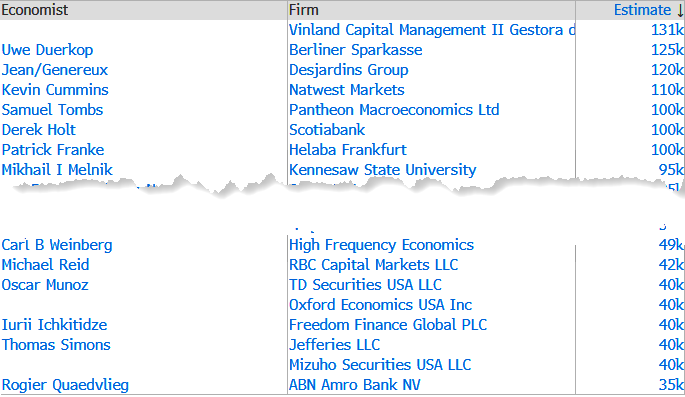
… it was a 5-sigma beat to the median consensus number.
Not only was October red hot, prior month revision were all higher: the August was revised up by 53,000, from +133,000 to +186,000, and September was revised up by 31,000, from +29,000 to +60,000. With these revisions, employment in August and September combined is 84,000 higher than previously
reported. 
It wasn’t just the job number that came in red hot: the unemployment rate unexpectedly dipped back to 4.1% from 4.2%, and against expectations of an unchanged print.
And completing the trifecta of hot data was the average hourly earnings which beat expectations both MoM and YoY, with the former printing 0.4%, above the 0.3% expected, and the highest since Nov 2025, while the annual change in earnings disappointed expectations of the first sub-3% print since covid, and instead rose from the pre-revision 3.0% to 3.1% (then again Sept was revised higher to 3.2%).
Developing.
END
Consumer Sentiment Unexpectedly Jumps, Fueled By Independents, Despite Growing AI Bubble Fears
Friday, Nov 06, 2026 – 10:37 AM
The UMichigan consumer sentiment survey unexpectedly jumped in November to a three-month high, boosted by modest improvements in Americans’ views of their personal finances and the economic outlook.
The University of Michigan’s preliminary sentiment index increased to 51 in November from 48 in October; the median estimate in a Bloomberg survey of economists projected sentiment to hold at 48. Still, despite the improvement, the overall index remains just shy of the lowest prints ever recorded just a few months ago and during the early 1980s “hyperinflationary” period.

The improvement was concentrated among independents, who reported the strongest consumer sentiment in more than a year. Curiously, sentiment across both Democrats and Republicans deteriorated in the days ahead of the mid-term election (The survey period included responses from Oct. 20 to Nov. 2). 
The improvement was widespread across both current conditions and expectations, with the two printing at 51.0 and 50.9, respectively, beating expectations of 47.0 and 49.0. Curiously, this happened despite another sharp drop in Democrat assessment of current conditions.
Cost of living concerns remain top of mind for many Americans. About 57% of respondents spontaneously mentioned that high prices had eroded their living standards – the highest since May.
Despite limited layoffs and strong economic growth, household finances have been squeezed as prices rise faster than wages. Democrats’ decisive victory in the midterm elections reflected deep voter frustration with the economy, particularly the high cost of food, gasoline and housing.
Inflation expectations in the year ahead improved but remained elevated. Consumers expect prices to rise 4.3% over the next year, down from 4.7% a month ago to a three-month low, and below expectations of a 4.6% print. They also saw costs climbing at an annual rate of 3.4% over the next five to 10 years, also a step down from the 3.5% in the prior month.
In addition to inflation worries, “consumers’ comments revealed growing anxiety over a possible AI bubble,” Joanne Hsu, director of the survey, said in a statement.
“The personal finances of consumers with the largest stock portfolios dropped 12% this month to their lowest reading since April, likely due to agitation in stock values in recent weeks, while all other wealth groups saw modest improvements,” she added.
A survey of current personal finances climbed to a four-month high in November, while Americans’ views of buying conditions for durable goods rebounded from a record low.
USA ECONOMIC REPORTS
Outcome Of Alaska Senate Race May Not Be Known For Weeks
by Tyler Durden
Authored by Mark Stricherz via The Center Square,
The outcome of a tightly contested and controversial U.S. Senate race in Alaska may not be known until the end of the month or later.

U.S. Sen. Dan S. Sullivan, a Republican, is making a bid for a third six-year term. As of 1400ET today, he trails former U.S. Rep. Mary Peltola, a Democrat, by 637 votes with 74% of ballots counted. He has 102,325 votes to her 102,962. 
The race has been the focus of controversy after The New York Times reported that Peltola’s campaign helped recruit a candidate with the same name as Sullivan in an apparent attempt to confuse voters. She has denied doing that.
Twenty-three percent of votes have yet to be tallied. Even when they are, the narrow margin separating the candidates means that the outcome may be decided not at the state’s polling sites but through the mail via absentee and questioned ballots.
In the previous midterm congressional election four years ago, Alaska officials said they received 9,143 in-person absentee ballots and 8,009 questioned ballots. Two years ago, in the presidential election, state officials reported receiving 18,158 in-person absentee ballots and 15,138 questioned ballots. Voters can ask for a mail-in ballot and still vote in person, so the number of outstanding votes in the state’s general elections in 2022 and 2024 is unclear.
Steve Kirch, public relations manager for the state’s division of elections, did not immediately return an interview request.
What is clear is the 49th state’s deadline for counting all votes.
By Nov. 13, absentee ballots from the 50 states plus its territories as well as Puerto Rico, Guam, the Virgin Islands, and American Samoa should have arrived and must be postmarked by Nov. 3. By Nov. 18, all ballots from overseas addresses must be received and postmarked by Election Day. By Nov. 19, the State Review Board begins its review of election materials, and by Nov. 25, state officials expect to certify the election results.
In addition, Alaska has ranked choice voting. Peltola or Sullivan will need to receive more than 50 percent of the first-choice votes after officials have counted them all. If neither does, the last-place candidate is eliminated. Then, state officials redistribute that candidate’s ballots according to voters’ second and subsequent choices. The process continues until a candidate receives a majority, or 50% plus one vote.
Despite the state’s deadlines, federal officials may complicate them.
The Justice Department has sent a target letter to prominent Democratic elections attorney Marc Elias asking about his possible involvement in petitioning a retired teacher by the name of Dan J. Sullivan to run for Alaska’s Senate seat, according to the Associated Press.
Audrey Cook, a spokesman for the Justice Department, told The Center Square that the agency “cannot discuss ongoing investigations.”
END
A GOOD READ..
Every GOP Strategist & Candidate Should Be Forced To Participate In This Role-Playing Exercise
Thursday, Nov 05, 2026 – 05:40 PM
Authored by The Refined Populist
Every GOP strategist, consultant, and candidate should be forced to participate in a role-playing exercise this morning…
Your name is Bob. You’re a 49-year-old blue-collar worker in Ohio. You’ve always struggled to make ends meet. The good jobs were all shipped to China and the few remaining pay a pittance wage, undercut by endless illegal labor.
You’re a 3x Trump voter because you believed he would finally make America great again. You put your son through Ohio State. He graduated cum laude in computer science. You couldn’t have been prouder.
After months searching, he landed an entry-level job at Microsoft. Beneath his qualifications, but a good start for a smart kid. Then he got laid off.
That same month, Microsoft applied for 150,000 more H-1B visas because it can’t find qualified Americans. Your son has spent six months back in his childhood bedroom, sending hundreds of applications without landing an interview.

On TV, Trump boasts about the greatest economy in history and how many women and minorities are finding jobs. You decide a father-son steak night might cheer him up. Gas is $4.50 a gallon. Filling your truck costs over $100. At Kroger, ribeyes are $30/lb.
You settle for hamburger, even though 70/30 ground beef still costs $10+. At checkout, a fat black woman is screaming at the cashier because her EBT will only cover most of the filet mignon and lobster in her cart.
You think to yourself how the Iran war has made everything expensive, but at least we’re stopping their nuclear bomb. You weren’t even sure where Iran was before you googled it after we first bombed them in March.
After dinner, you take your son to the county fair. Half the people aren’t speaking English. Virtually none of the crowd looks like you. You’re forced to leave early after a “teen takeover” turns violent. A foreign born judge pledges none of them will go to jail.
Back home, you turn on the TV. Vivek Ramaswamy is lecturing the crowd about American mediocrity and why Ohio needs more foreign talent. Your son grows upset. You change the channel.
Now a Republican surrogate, the daughter of a governor or wife of an elderly billionaire, explains that young White men are the REAL welfare queens. They’d rather play videogames in their parents’ basements than work.
Your son says nothing. He just goes back to his childhood bedroom. You turn off the TV. Then your neighbor starts blasting reggaeton and cracking open Modelos.
He brought his cousin’s family from Mexico to help with all the minority-business contracts his construction firm keeps winning. Tonight they’re celebrating his nephew’s birth, the family’s first birthright American citizen.
You sit alone in your living room. You worked hard, paid taxes, obeyed the law, and raised your son to do everything right. You voted Republican again and again because you believed somebody in Washington would finally fight for you.
Instead, your wages are stagnant. Groceries are unaffordable. Your community is unrecognizable. Your country is fighting another foreign war.
And upstairs, the son you sacrificed everything for is lying awake in the bedroom he slept in at twelve, wondering what the heck he’s even supposed to do with his life now.
Every time you turn on the TV, the Republicans you elected are either congratulating themselves or explaining why you and your son are the problem.
For ten years, they told you America’s future depended on your vote. Now you aren’t even sure America has a future worth defending.
The Republican Party needs to answer one simple question this morning: You’ve spent a decade demanding Bob’s loyalty. You’ve given him stagnant wages, unaffordable groceries, another foreign war, and a son who did everything right but can’t find work. And when they complain, you call them lazy, entitled, and racist.
What possible reason have you given Bob and his son to vote Republican? Do you honestly think you deserve their vote?
We publish a variety of perspectives. Nothing written here is to be construed as representing the views of ZeroHedge.
END
Is Anthropic About To Delay The Biggest IPO Ever?
Thursday, Nov 05, 2026 – 08:05 PM
Backers want a lower price, the November timetable is in doubt, and executives and advisers are set to meet to review the deal…
Major institutional backers are pushing Anthropic to cut the $1.5 trillion valuation it had been targeting for its IPO, and one suggested pricing could fall closer to $1 trillion, the Wall Street Journal reported Thursday, after the Nasdaq Composite lost $2.5 trillion of market value in a single session.
Anthropic had aimed to raise up to $100 billion around the week before Thanksgiving, which would top SpaceX’s June listing as the largest offering ever. According to the Journal, executives and advisers plan to meet in the coming days to review the IPO, and backers are debating whether to adjust the price range or push back the timeline. With a mountain of cash on hand, the company can afford to shrink the raise or wait.
Potential investors doubt Anthropic can complete its roadshow the week after next and still list in November, four people familiar with the discussions told Reuters. The roadshow had been expected to start the week of Nov. 9, with pricing the week after. Some now see $1.5 trillion as the high end of expectations, and Anthropic may need to offer a bigger discount because of its record of quarterly losses and its huge commitments to partners in the AI buildout. If the pressure on AI-related assets continues, the company could postpone until markets look sturdier, the sources said. Anthropic declined to comment.
Investors are also waiting on Anthropic’s October revenue, which was left blank in its updated S-1, to see whether growth has recovered from its recent slowdown, two of the sources told Reuters.
The valuation has been marked down once already. After Anthropic told investors in October that third-quarter revenue grew 45% from the second quarter, down from more than doubling the quarter before, IPO investors marked it down from about $2 trillion to $1.5 trillion, as we reported.
Tech stocks suffered their sharpest selloff in a year after Tuesday’s midterms handed Democrats the House and Senate, a blue wave that knocked the market’s teeth in. The Journal tied the retreat to AI-skeptical lawmakers and local data center moratoriums; Reuters pointed to ballot efforts in many states to limit data center development. Meta president Dina Powell McCormick said Wednesday that building data centers will be “harder following the election results,” Yahoo Finance reported.
Prediction markets have cut the odds of a November listing. On Polymarket, the odds of an Anthropic IPO by Nov. 30 fell from 84% to 58%, and by Dec. 31 from 90% to 73%…
In private markets, OpenAI has secured only $11 billion of the $30 billion it targeted in its latest round, at an adjusted $1.25 trillion valuation, according to the Journal.
As for those commitments, this week’s amended filing put Anthropic’s committed spend at $895.4 billion, more than $1 trillion all-in…
…, with $69.8 billion due in the next 12 months…

Buyers would also inherit Anthropic’s philanthropy. Anthropic has already put 5% of its fully diluted stock into its own Anthropic Public Benefit Fund, managed initially by CEO Dario Amodei, his sister Daniela, Jack Clark and Buddy Shah, and the board may add up to another 2% every time the stock rises 50%. The co-founders, who stand to be worth hundreds of billions after the IPO, have each pledged 80% of their personal equity to charity. The employee donation-matching program alone produced a $2.0 billion non-cash charge in the third quarter, one of the two items that pushed Anthropic back to an operating loss.
And whoever buys in won’t get much say. As we detailed when Anthropic’s S-1 landed last month, a single Class F share owned by the seven co-founders carries 50.1% of the vote, the Long-Term Benefit Trust elects a majority of the board, and public shareholders will never hold more than 49.9% of the vote, one of the 10 biggest red flags we found in the filing.
END
Haircut No. 2: Anthropic IPO Talk Slides To $1.2 Trillion As AI Rout Crushes Odds Of A November Listing
Friday, Nov 06, 2026 – 10:57 AM
Keeps going lower.
Three weeks ago we reported that Anthropic IPO investors had marked the valuation from $2 trillion down to $1.5 trillion as the growth slowdown sank in. This morning, Bloomberg reports that the price tag has been cut again: after Thursday’s AI bloodbath, some potential backers are now discussing a value as low as $1.2 trillion for the company, a person familiar told the news agency (deliberations are “ongoing,” no final decisions have been made, and Anthropic declined to comment).
Put in context: in early October investors were floating a fair value “as high as $2 trillion.” The low end of today’s range is 40% below that peak, which is a lot of haircut for a company that, according to the WSJ, just pushed its annualized revenue run rate past $80 billion. And for some, even that’s not low enough.
“Fair Value,” Revised (Again)
The Bloomberg story fills in the timeline. After the company’s October briefing on its latest financials, investors told the bankers on the deal that their estimate of a fair valuation had moved to around $1.4 trillion to $1.5 trillion. Then came Thursday, when the Nasdaq 100 plunged 6.4%, wiping out $2.3 trillion in market value, a record for a single day, and that number “shifted again.” Which is why prospective investors are now “facing a weekend of uncertainty ahead of the kickoff of formal marketing.”
The buy-siders Bloomberg spoke to are all over the map, though the direction of travel is the same:
- BNP Paribas Wealth Management Germany’s CIO Stephan Kemper expects the valuation to land at the very low end of the rumored $1.5-$2 trillion range, “maybe some 10% to 15% below that,” which works out to roughly $1.3 trillion.
- Gallo Partners’ Michael Alfaro said before Thursday’s rout that Anthropic needed to target $1.3 trillion to $1.4 trillion “in order to build a quality book.” That was before the Nasdaq’s worst day since Covid.
- Sycomore’s David Rainville: “If they set a valuation toward the bottom of the range, say $1.2 trillion, they shouldn’t have a problem finding investors.” Translation: at $1.5 trillion, they might.
- And HSBC’s Max Kettner thinks around $1 trillion “could be a more comfortable level.”
Kettner’s reasoning is worth quoting, because it’s the one that should worry the underwriters most:
“I don’t think we need the headline ‘oh my god, it is a trillion dollar IPO,’ because I think what’s actually more important is the secondary. If we get a dynamic like we had with SpaceX, that you get it on secondary and then stock rips for a couple hours, but then it dumps, in the current environment you don’t want to have that.“
Kettner isn’t alone at $1 trillion. Late on Thursday the WSJ reported that three major investors planning to take part in the offering think the $1.5 trillion valuation will likely need to come down, with one putting it “closer to $1 trillion.” Executives and advisers are set to meet in the coming days, the raise could shrink from the planned up to $100 billion, and one investor floated a delay because it may be hard to convince institutions “burned in the recent selloff” to take a big AI risk again. At about the same time, Reuters reported that potential investors doubt Anthropic can start its roadshow next week and still list in November, something we discussed in “Is Anthropic About To Delay The Biggest IPO Ever?“
Here is how the “fair value” has evolved in the space of five weeks:
Note the dashed line: at $1 trillion, the IPO would price barely 4% above the $965 billion post-money of May’s Series H. So much for the “biggest IPO ever” step-up.
$80 Billion Of ARR… And It Still Doesn’t Clear
The awkward part is that the company itself is still growing fast. The WSJ reported this morning that Anthropic’s ARR topped $80 billion at the end of October, against some expectations in the mid-$70 billion range, which probably helped this morning’s premarket bounce in Nvidia and the memory names. Badly needed good press, and maybe a sign the August-September slowdown we flagged after investor day wasn’t the start of a stall.
Some napkin math (approximate): at $2 trillion, buyers were being asked to pay 25x that $80 billion run rate. At $1.25 trillion, the midpoint of the new range, it’s about 16x. In other words, the multiple has compressed by roughly 40% while the run rate went up. That’s what a derating looks like.
On a trailing basis the math is still eye-watering. Against the roughly $35 billion Anthropic booked over the past four quarters, $1.25 trillion is about 35x sales. As Fortune noted this week, citing Jay Ritter’s IPO data, anything above ~$1.41 trillion would mean more than 40x trailing revenue, a level reached by just 14 of 4,110 IPOs since 1980. And that’s before you get to the $895 billion in committed spend disclosed in the amended S-1, roughly $70 billion of which is due in the next 12 months, or the October revenue line the filing left conspicuously blank.
Which brings us to the real problem: the company’s numbers are no longer the only thing being priced. After Tuesday’s Democratic sweep, the market is also pricing permitting risk on the data centers Anthropic needs to hit those numbers. Goldman estimates that the states likely to add restrictions hold about 45% of planned US capacity, and Anthropic’s own Texas campus was already stuck on a $15 billion bridge loan before the election.
Polymarket Got There First
As usual, the prediction markets didn’t wait for the Bloomberg scoop. Yesterday morning, with the Nasdaq rout just starting, we pointed out that the odds of an Anthropic listing were tumbling:
(The “by Nov 25” contract in that chart had slid to 69% from 86% a day earlier.) They kept tumbling. As of this morning, Polymarket gives Anthropic a 54% chance of listing by Nov 25 and 60% by Nov 30, down from 86% for both before the rout. Even the odds of an IPO at any point in 2026 have dropped from 93% to 73%:
The valuation markets moved even faster. Polymarket’s “What will Anthropic’s IPO valuation be?” contracts now make $1.25-$1.50 trillion the favorite at 43%, up from about 5% a week ago. The $1.50-$1.75 trillion bracket, which was a ~65% favorite right after the midterms, has collapsed to 32%, and the odds of anything $1.75 trillion or above are down to 16%. Bloomberg’s $1.2-$1.3 trillion range straddles the bottom of the new favorite bracket, and the “below $1.25 trillion” tail has quietly gone from about 1% to 7%:
Nothing says “orderly price discovery” like the favorite outcome changing three times in a month.
1998 Or 2000?
Over at Goldman, the trading desks are split on what Thursday’s crash means for the AI trade, and by extension for whoever ends up buying Anthropic stock. Goldman Delta One head Rich Privorotsky, who admitted “what I got wrong” on AI just one day earlier, posed the question everyone is asking in his morning note (available to pro subs):
“Is this a 1998 style liquidity crisis and buying opportunity, or March 2000 and the beginning of a structural technology unwind? I lean toward 1998. Russia’s default/LTCM were the external shocks but US growth remained intact. Once liquidity returned and the Fed eased, markets recovered rapidly… The uncomfortable parallel with 2000 is the sheer scale of spending and uncertainty around returns. Are we liquidating a sound growth story or discovering its economics are wrong? I lean toward the former, but demand, utilization and returns need to hold.”
Privorotsky lists four concerns behind the selloff: i) insufficient capital to finance the buildout, ii) insufficient revenue to justify the investment, iii) insufficient power and permitting capacity, and iv) an unsustainable aggregate spending trajectory. The market, he argues, “has latched onto number three, arguably the least important.” Maybe. But the Anthropic IPO is a referendum on all four at once: it is a $100 billion capital raise (#1), priced off a run rate (#2), by a company that needs permitted, powered data centers (#3) to service nearly $900 billion in commitments (#4).
And Goldman’s own credit strategists are hardly reassuring on #1. In her latest Global Credit Trader, “AI-Related Supply: Outlining the Directional Risks” (also available to pro subs), Amanda Lynam notes that hyperscaler bond issuance has already hit $296 billion this year, well above Goldman’s $250 billion full-year forecast, and warns that between now and early December the risks to spreads are “firmly tilted towards more widening.” That is the backdrop against which bankers are trying to place what would be the largest equity raise in history, which is something we have been warning about since last October, when AI quietly became the largest sector in the bond market.
Meanwhile, the people who were supposed to anchor the book are licking their wounds. Goldman’s derivatives desk says clients “had aggressively dumped protection” into Wednesday’s post-midterm relief rally, leaving the market underhedged for Thursday’s reversal, and tech-focused hedge funds have just wiped out their entire 2026 gain. Not exactly the crowd that will be clamoring for a $100 billion allocation next week.
And Then There’s OpenAI
Anthropic isn’t the only frontier lab finding out what the AI unwind does to private marks. Last Friday, the FT reported that OpenAI had slashed its funding target by $10 billion to about $20 billion at a $1.25 trillion valuation, a week after it trimmed the price from $1.4 trillion following a “thud” from Morgan Stanley’s wealthy clients. Now the WSJ reports that OpenAI has secured just $11 billion of the $30 billion it originally targeted, and that’s at the adjusted $1.25 trillion valuation.
Here’s the punchline: just last week, the FT’s explanation for OpenAI’s struggles was that Anthropic’s IPO was “absorbing both investor capital and focus.” Well, if Anthropic prices at the low end of Bloomberg’s range, the “hot” public listing would value the company below the $1.25 trillion OpenAI is struggling to raise money at privately. One of those two marks is wrong, and probably not the public one.
Size Down, Price Down… Or Wait Until 2027?
So what are Anthropic’s options? Per Bloomberg, the company and its selling shareholders could start marketing with a conservative size and valuation and upsize on demand, the Cerebras and Figma playbook. Bloomberg helpfully adds that both “are now trading well below their IPO prices.” The “less palatable option” is to delay: IPO filings must be public for at least 15 calendar days before formal marketing, and some issuers wait weeks or months, updating their quarterly financials along the way. For Anthropic, that would probably mean a Q4 refresh and a 2027 listing.
Our take: the bulls have a point that the business is growing (an $80 billion run rate is no small number), and Privorotsky may well be right that this is a liquidity event rather than a demand collapse. But his own 1998 analogy ended with the Fed easing. This time, Fed speakers Barkin and Hammack spent Thursday openly arguing for higher rates while the Nasdaq had its worst day since March 2020. In that environment, the more likely path is a third haircut or a delay, not a triumphant upsizing. As IG’s Alexandre Baradez put it, “maybe it’s better to go to the market when the valuation excesses have already been purged.”
The question is whether they have been, or whether $1.2 trillion is just this week’s number. For now, everyone wants to be in the room for the biggest IPO ever; fewer and fewer want to pay for the privilege.
More in Privorotsky’s “Liquidation. 1998 or 2000.” note and Goldman’s Global Credit Trader, both available to pro subs.
END
Democrats Spent Year Demanding Data Center Moratoriums. They Own The Narrative. Will They Own The Fallout?
Friday, Nov 06, 2026 – 05:20 AM
Thursday’s selloff in hyperscaler and neocloud stocks deepened as investors reassessed the mounting risks that the Democratic sweep in the US midterms poses to the AI infrastructure boom. By midday in New York, the Nasdaq was down more than 5%, while Morgan Stanley’s neocloud index had plunged 12%, reflecting concerns that Democratic-led moratoriums could delay projects, disrupt spending plans, and even undermine the US economy. We’ve extensively detailed where state-level restrictions could put the buildout most at risk (read here and here).
Earlier today, the doom headlines started pouring in. The Wall Street Journal reported that OpenAI leaders were discussing whether to reset expectations for next year’s data center buildout after the blowout election results signaled dire straits for the AI boom.
WSJ said AI insider concerns surfaced Tuesday night at San Francisco’s Opera House, where Nvidia CEO Jensen Huang hosted executives for “The Marriage of Figaro.” Attendees discussed how midterm election results and mounting local opposition could put immense pressure on the planned expansion of computing capacity.
We’ve repeatedly warned about the implications of what follows a Democratic sweep. More specifically, Goldman highlighted the exposure of the US data center buildout to the blue wave, as Democrats won governorships in Texas, Ohio, Nevada, Georgia and Michigan, while gaining a trifecta in Pennsylvania and likely Arizona.
“The states where Democrats are likely to further restrict data centers account for roughly 45% of planned US data center capacity, with Texas alone accounting for roughly 25%,” Goldman said.
This chart shows the states Democrats won and how much of the planned buildout could be at risk.
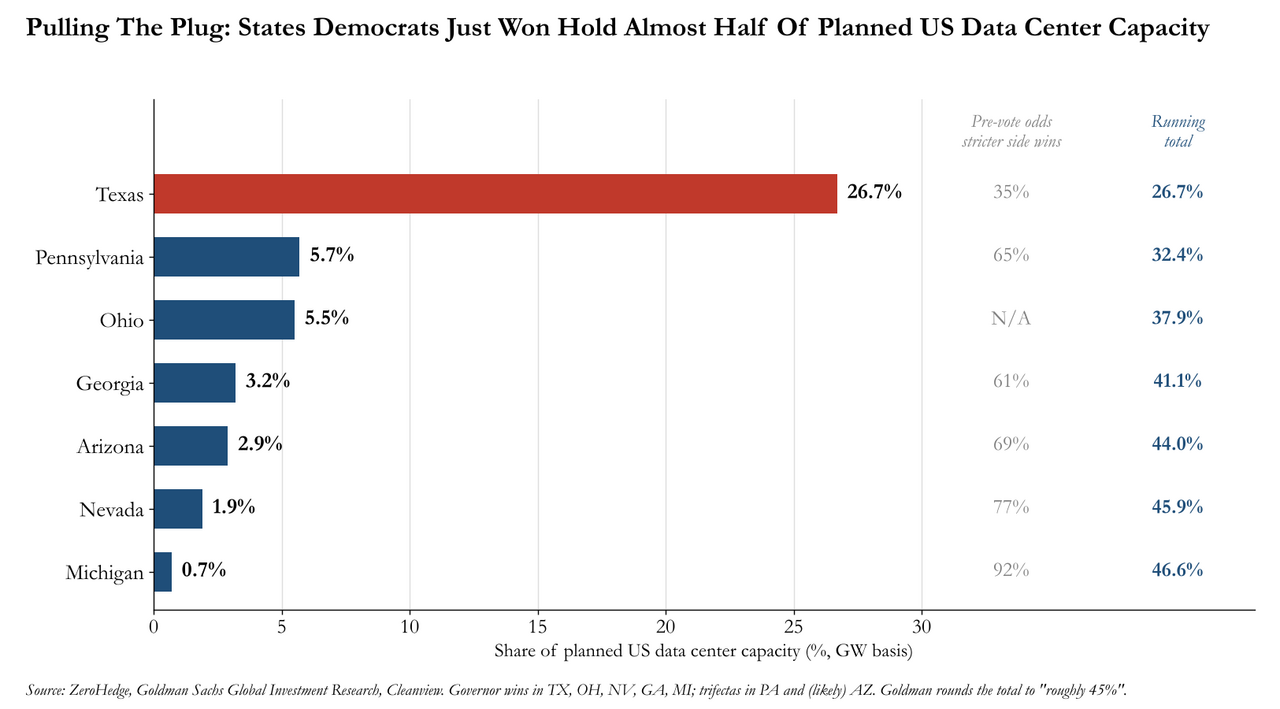
Economists view the data center buildout and grid expansion as among the largest economic drivers under the Trump administration’s reindustrialization strategy for the US economy, accounting for an estimated 25% of total growth this year alone. Disrupting the construction boom could have severe consequences beyond plunging tech and chip stocks. It could translate into local economic turmoil if Democrats implement restrictions state by state, particularly in newly blue Texas.
With all this turmoil unfolding, we want to examine who owns the data center moratorium narrative. To no one’s surprise, a key pillar of the Democratic Party’s midterm campaign has been to stop President Trump’s reindustrialization at all costs, even if that means crashing stocks and the economy.
The largest and most high-profile anti-data-center push came from the known socialists in Congress. Representative Alexandria Ocasio-Cortez and Senator Bernie Sanders pushed for a nationwide moratorium from late 2025 into the 2026 midterm race. Representative Frank Pallone later endorsed a federal pause, adding to the ranks of Democrats seeking to derail the economic revival.
AoC and Bernie kicked off the “data center moratorium” narrative in late 2025. Dems ran with it. 
The headlines speak for themselves:
At the state level, particularly in Texas, Governor-elect Gina Hinojosa has pledged to continue pausing approvals until lawmakers adopt new protections. Ohio’s Amy Acton has advocated a conditional moratorium, while Georgia’s Keisha Lance Bottoms has called for a statewide pause to assess the industry’s effects on communities.
Other Democratic governors have already acted. New York Governor Kathy Hochul imposed a permitting pause on new hyperscale facilities in July. Oregon Governor Tina Kotek expanded restrictions on projects.
More headlines showing who owns the data center moratorium narrative:
Republicans have also backed restrictions but to a lesser degree. Michigan Senate candidate Mike Rogers supported a one-year statewide moratorium, while Democrat Abdul El-Sayed advocated local and state pauses. In Ohio, Republican Vivek Ramaswamy urged a temporary halt to approvals.
So the moratorium narrative came from socialist Democrats, then some Republicans jumped on the bandwagon as they saw this topic was near and dear to voters. 
Beyond Democrats trying to crash the Trump economy, because that really is the end goal, they’ve also said since the election that they want revenge for Trump nuking all things DEI in what will be years of endless lawfare. Amplifying the anti-data center rhetoric was a far-left China-linked NGO sympathetic to Democrats, and oddly enough.
All in all, Democrats own the narrative. Instead of being pro-growth and growing the US economy out of a debt trap, the party that has embraced far-left socialist DSA is willing to crash not just stocks but the economy over their hatred of Trump.
… and what comes next will be an information war over who gets the blame for the deflating bubble.
END
Microsoft Pulls The Plug On Oracle AI Rental As Post-Election Data Center Fallout Spreads
Friday, Nov 06, 2026 – 02:03 PM
More bad news for Oracle.
About an hour after we checked in with Oracle’s PR team on how that whole “force majeure is commonplace” thing was working out…
… we got our answer, just not from Oracle:
According to Bloomberg, Microsoft has spent recent months switching off the computing capacity it rented from Oracle after declining to renew the contract. The reason is about as unflattering as it gets for a company that has staked its balance sheet on AI infrastructure: the Oracle hardware ran on older-generation Nvidia chips and, over time, “no longer fit the company’s specifications.”
ORCL promptly slid 4%, which put it, in our words, below the $116 equity offering price it sold $10 billion in stock at just four days ago. Recall that the stock hit $248.15 on June 1. Investors who bought the “de-risked” story this week are already underwater on a deal that is barely four days old, and the stock has lost more than half its value in five months.
But the Microsoft headline is just the latest entry on a list that has grown every single day since Tuesday night, when voters handed governors’ mansions in the states holding roughly 45% of planned US data center capacity to candidates who promised to pause them. Put the two together and Oracle has a problem at both ends of its pipeline: its old capacity is too old to rent, and its new capacity may be too blue to build.
Too Old To Rent
Some history first. The Oracle-Microsoft deal was announced in 2023 to power the AI version of Bing, and at the time, Bloomberg notes, the idea of Microsoft renting servers from a direct rival was taken as early proof of just how short the world was of compute. (The full size of the deal was never disclosed.)
Three years later, the same arrangement is proof of something else: GPUs age, and the biggest buyer of rented compute in the world is no longer willing to pay for the old ones.
Oracle, naturally, disagrees. A spokesperson told Bloomberg demand for its AI infrastructure “remains strong, including for earlier-generation” GPUs, and reminded everyone that in September it said it was renewing contracts for four-year-old GPUs at a 20% premium to the original price. That 20% premium has been a staple of the bull case: just this Wednesday, Wells Fargo’s Jerry Revich, in “Texas Policy Reset Adds Timing Risk to 20-30% of the Data Center Power Pipeline” (available to pro subs), cited Oracle’s 97.9% AI infrastructure utilization and “20% average renewal/resale premium” as evidence that “token economics remain attractive.”
Well, one renewal just came in at a 100% discount.
Microsoft’s retreat also fits a pattern we have been tracking for weeks. Microsoft committed more than $80 billion to rent capacity from neoclouds like CoreWeave, Nscale and Nebius, and per Bloomberg, key leaders there have grown frustrated over high costs and delays, tightened oversight of data center projects and debated whether to sign any new neocloud deals at all. In October, Microsoft walked from Nscale’s UK deal; on Thursday came the report that it won’t expand its Texas deal with Nscale either, along with the disclosure that it spent $5 billion less on Q3 capex than projected due to delays at third-party capacity, including IREN’s.
Translation: Microsoft wants new chips, on time, in its own specifications, and it is increasingly unwilling to pay landlords who can’t deliver all three. Which is a problem for every landlord whose collateral is a rack of chips that gets one generation older every year the power doesn’t show up.
Too Blue To Build
And the power is now even less likely to show up on time.
Cleanview counts nine states where the governor or governor-elect has promised or already imposed a pause on new data centers. Together they hold 158.6 GW of planned capacity, or 41% of the entire US pipeline:
Now look at who is most exposed. Every single gigawatt of OpenAI’s planned capacity sits in a state whose new governor backed a pause on the campaign trail, as does 45% of Microsoft’s:
Why does that matter for Oracle? Because OpenAI is Oracle. The $300 billion compute contract that sent ORCL soaring in September 2025 is being built across Texas (Abilene, Shackelford County), New Mexico, Wisconsin and Michigan, which is why OpenAI shows up at 100% above. Two of those states, Texas and New Mexico, delivered the most hostile results of the night.
Take New Mexico, home of Project Jupiter, the 2.45 GW Oracle-OpenAI Stargate campus that regular readers know all too well. Back on Sept 24 Oracle sent a force majeure notice to the Blue Owl unit developing the site, then insisted the notice was “commonplace” and meant nothing. We had a different reading at the time:
The more important detail came that night, when the FT reported that Oracle remains on the contractual hook regardless: if Jupiter isn’t ready, Oracle still owes a “carry cost” in lieu of rent for up to three years, enough to cover the interest on the debt in full plus a set equity return for Blue Owl’s funds. As one person familiar with the contract put it, “The power delivery risk sits with Oracle, not the investors.” Here is the structure we mapped out at the time. Note who sits at the bottom of every arrow:
And for the record, here is what we wrote in that same Sept 24 post, six weeks before the vote: the construction delays “will only get worse if Democrats win back the house at the midterm elections.” They won back a lot more than the House, so we’ll allow ourselves a modest victory lap.
Two weeks later, Oracle was trucking compressed natural gas to its data centers because the Jupiter pipeline was running late, and the $18 billion of construction loans behind the campus were already quoted at 89-91 cents on the dollar (per the FT).
On Tuesday, New Mexico elected Deb Haaland, and the morning after, she told reporters her plan for day one: “a moratorium for large-scale data centers with the legislature passing a set of guardrails.” As for Jupiter’s gas plants specifically, Cleanview notes Haaland has written that under her watch they would “not exist.” The fuel-cell air permit is still pending, with a Nov 23 decision deadline. Hey guys, any updates?
Texas is no better. As we laid out in “What’s Next For Data Centers After The Blue Tsunami“, governor-elect Gina Hinojosa turns Abbott’s audit-based freeze into one tied to legislation, which means at least through the May 31, 2027 session end. And the Goldman TMT desk noted this morning that part of today’s bounce came from “benign comments from Texas governor-elect on datacenters.” When “benign” is the bull catalyst, you know where the bar is.
Goldman: “Timing Rather Than Cancellations”… For Now
Goldman’s research department spent Friday pushing back on the panic, and in fairness, it has the numbers. In his “End of Week Market Intelligence: dc downside?” (available to pro subs), Chris Hussey frames this week’s debate as follows:
“At the core of market concerns this week is a debate around whether all of the compute power that has been ordered (semiconductors, servers, fiber optic cables) will have a place to be installed when it is delivered in the years ahead.”
Goldman’s answer is mostly yes, at least through 2027. Hardware analyst Mike Ng “US Data Center Capacity update: Framing risks to our data center forecasts“, also available to pro subs) says capacity already under construction implies 22/24 GW-IT of net additions in 2027/28, matching his 20/24 GW forecasts, and calls the key risk “timing rather than cancellations.” The catch is Texas, which accounts for 20% of 2027 and 27% of 2028 under-construction additions:
E&C analyst Adam Bubes went a step further and actually raised his US data center construction spending forecasts to $80 billion/$100 billion for 2026/27 (from $67 billion/$87 billion), introducing $125 billion for 2028. His reasoning: every project in Goldman’s 2027 forecast has already broken ground. 2028 is another story, though: only about half of the 2028 projects on Goldman’s watch list have broken ground, and beyond that it’s almost all PowerPoint:
Note the light blue. That is the “announced” capacity, and it is exactly what a governor’s moratorium hits first. Bubes concedes as much, arguing moratoria “would primarily impact projects that have not yet started” and would smooth the cycle into 2029/30 “rather than impacting the TAM.”
Maybe. But today’s Microsoft story shows why “timing” is not as harmless as it sounds. A project that slips two years gets delivered into a world where the chips ordered for it are two years older. For a hyperscaler, a delay is a timing issue. For whoever owns the GPUs, it’s a depreciation issue. Microsoft just told Oracle which one it is.
And somebody is going to have to fund the wait. Goldman credit strategist Amanda Lynam estimates hyperscalers are financing 36% of this year’s capex with credit (and 35% next year), while only 43% of the $687 billion of AI-related financing so far this year came from hyperscalers. Oracle has already done its share: as we noted on Monday, it blew through its entire four-year $20 billion “hard cap” in a single morning, five days after promising it. Which, as regular readers know, is why we have been calling AI a debt bubble since last October.
The Casualty List Gets Longer
The Oracle news landed at the end of a week that saw the Nasdaq suffer its worst day since March 2020 on Thursday (-6.4%), while Goldman’s AI data center-levered basket fell 12% in a single session. The headlines since then haven’t helped much:
- ING was said to be selling a $500 million data center loan portfolio (Thursday);
- Bloomberg reported this morning that the ECB is mulling a review of bank loans to data centers, following the Bank of England’s own probe last year;
- and Nomura’s Ting Lu argued that China’s AI buildout “may benefit significantly” from a blue wave that slows US data center construction. Somewhere in Hangzhou, a capex budget just got revised higher.
Here is the updated ZH Casualty List, with Oracle as the newest entry:
Who’s Left Holding The Old Chips?
Jefferies’ Julien Dumoulin-Smith summed up the sellside consensus on the election in one line “The Blue Morning After: State-by-State Election Scorecard“): “Demand moves right, not away.” Goldman says the same thing with more charts.
Perhaps they’re right about demand. But capacity that moves right ages, financing that moves right costs more, and a landlord that moves right keeps paying for the slip (just ask Oracle’s lenders on Jupiter). Today’s Microsoft story is the first clear sign of what happens at the other end: the tenant with the deepest pockets in AI is choosing newer chips over older contracts, and that probably makes Oracle’s 20% renewal premium look a lot more like an exception.
Which leaves Oracle squeezed on both sides: the older chips it already owns are losing their best renter, while the new campuses meant to replace them sit in exactly the states that just voted for a pause. Goldman hosted Oracle management today, of all days; we’d love to know what was said in the room. Until then, we’ll keep asking the obvious question:
Much more in the full Goldman “End of Week Market Intelligence: dc downside?”, and “US Data Center Capacity update” both available to pro subs.
Burger Bloodbath Intensifies As Yet Another Major Franchisee Goes Bust
Friday, Nov 06, 2026 – 08:40 AM
Another fast-food franchisee has filed for bankruptcy, becoming the latest casualty of mounting financial pressures squeezing restaurant operators across the United States.
Global Midsouth Holding Corp., a franchisee of Checkers and Rally’s, filed for Chapter 11 bankruptcy protection on October 28, just one day before a scheduled foreclosure auction involving one of its Tennessee restaurant properties, according to TheStreet.
The Memphis-based company reported $1.9 million in assets against $1.3 million in liabilities. Revenue fell from $860,000 in 2024 to $800,000 in 2025, underscoring the financial difficulties facing the business.
However, Global Midsouth isn’t the only burger franchisee that went bust.
Meritage Hospitality Group, one of Wendy’s largest franchisees, filed for bankruptcy in September after struggling with declining sales, rising beef prices, and mounting financial obligations.
The operator, which ran 314 Wendy’s restaurants across 15 states when it filed, had already shuttered 60 underperforming locations. Another 60 restaurants could shut down by mid-November, according to court documents.
The bankruptcies come as the restaurant industry faces even bigger problems.
As we reported yesterday, San Diego-based Out West Restaurant Group, also known as Cerca Trova Restaurant Group, filed for Chapter 11 bankruptcy protection Monday in Delaware, putting 61 restaurants across five Western states into bankruptcy proceedings.
The company’s debt has exploded from $269 million in 2020 to approximately $449 million in 2026, according to the Los Angeles Times.
“Guest traffic and earnings continued to decline, while food, labor, and other production costs continued to rise,” CEO David Goronkin said.
California’s rising minimum wages have been a major problem, with more than half the company’s employees working in the Golden State. The COVID-19 pandemic also delivered another devastating blow, sending revenue plunging approximately 35%.
Outback parent company Bloomin’ Brands said that it is preparing to swoop in. The restaurant giant has offered $26.3 million to acquire the struggling franchisee’s assets, alongside up to $5.5 million in emergency financing. “This is an isolated situation involving the franchisee,” a Bloomin’ Brands spokesperson said. The 61 restaurants are expected to remain open during bankruptcy proceedings.
Multifamily CRE Meltdown Keeps Getting Uglier
Thursday, Nov 05, 2026 – 06:25 PM
Authored by Wolf Richter via Wolf Street,
There are about $2.3 trillion in multifamily commercial real estate (CRE) loans out there, backed by buildings with rental apartments. The US government, via Fannie Mae and Freddie Mac, holds about $1.2 trillion of that. Fannie and Freddie have become very aggressive multifamily CRE lenders. So, dear taxpayer, you’re on the hook for about half of the multifamily CRE debt.
The rest is held around the globe by banks, insurance companies, real estate funds, alternative asset managers – a melted-down mortgage just hit Bridge Investment Group, a unit of PE giant Apollo (more on that in a moment) – holders of Commercial Mortgage-Backed Securities (CMBS) and Collateralized Loan Obligations (CLOs).
All of them have gotten hit by melted-down mortgages as the higher interest rates make it just about impossible to refinance the balloon payments when they come due on fixed-rate loans, or even make interest payments on variable-rate loans pegged to SOFR, which jumped when the Fed started hiking its policy rates. The result has been wave after wave of multifamily defaults, and it keeps getting worse.
CMBS holders got hit by another default: The $210 million interest-only 5-year mortgage on a Class A 283-unit 20-acre waterfront apartment property, “The Cove at Tiburon,” across the Bay from San Francisco. The mortgage had been issued in 2020 to refinance the property at ultra-low interest rates. The mortgage was then securitized and sold to investors who thought that ultra-low interest rates would be a permanent feature.
The interest-only mortgage became delinquent when it wasn’t paid off in October, after having already been modified and extended in November 2025. It could not be refinanced at current interest rates because the declining rental income wasn’t enough to cover operating expenses and the interest payments at today’s interest rates. Now there are talks underway to extend it for another six months, according to Trepp, which analyzes and tracks CMBS. Extend and pretend forevermore.
The multifamily CMBS delinquency rate rose to 8.1% in October, driven by this delinquency, the highest since 2016, when the $3 billion delinquent loan on the huge 11,250-apartment campus, Stuyvesant Town – Peter Cooper Village, in Manhattan, was paid off by the acquirers of the property.
Back in 2024, Morningstar DBRS, which rated the CMBS, wrote about the problems lining up for the mortgage on The Cove at Tiburon:
“At issuance [of the loan in 2020], Morningstar DBRS shadow-rated the loan investment grade given that the property benefits from a prime waterfront location, superior amenities, and limited competition within the submarket. However, despite these aspects, which Morningstar DBRS expected to contribute to cash flow stability over the loan term, the property’s reported occupancy rate and cash flow trended downward shortly after issuance, primarily as a result of a slowdown in leasing activity….
“As per the March 2024 rent roll, the property was 80.2% occupied at an average rental rate of $5,789 per unit, compared with June 2022 figures of 91.9% and $5,852 per unit, respectively.
“It appears that new leases are being signed at lower rental rates to curb increases in vacancy rates, resulting in lowered cash flows….”
And now that property would have to be refinanced at much higher interest rates, and that just doesn’t pencil out.
Other lenders got hit too.
Bridge Investment Group, an alternative investment manager owned by PE giant Apollo, is now stuck with the defaulted $360 million loan on The Beaudry, a new high-end 64-floor apartment tower in downtown Los Angeles, with 785 units and amenities such as floor-to-ceiling windows, saltwater pool, spa, rooftop lounge, 24/7 athletic club, a full-swing golf simulator, etc.
The tower, which opened in 2023, was developed by giant real-estate developer and landlord Brookfield for about $600 million. Because the $360 million loan cannot be refinanced at today’s interest rates without a massive capital infusion, Brookfield decided to hand over the keys, walk away from the property and the loan, and let the lender worry about the whole schmear, according to the WSJ today.
Brookfield, which already defaulted on mortgages of numerous office towers in Los Angeles and around the country, has played a substantial role in the Office CRE meltdown.
Bridge Investment Group is now trying to sell the Beaudry loan – and thereby the rights to the property.
The Beaudry has lots of competition: Over 10,000 new apartments were built from 2017 to 2021 in downtown L.A., the most of any other downtown in the country, according to RentCafe, cited by the WSJ.
Then came working from home, and proximity to now substantially vacant and defaulting office towers wasn’t such a magnet anymore.
At the Beaudry, rents start at $2,424 a month for a 539-square-foot studio on the sixth floor, according to its website. Up the scale, a two-bedroom 1,200 sf apartment on the eighth floor is listed at $4,905. The same floorplan on the 20th floor is listed at $5,730. A 3-bedroom 1,700 sf unit on the 49th floor is listed at $8,893. All of them with big views.
Asking rents average around $4,200 a month at the Beaudry, according to CoStar, cited by the WSJ, far below what Brookfield had aimed for. “A lot of students live here,” Max Xing, a student at the University of Southern California, told the WSJ. He moved into a studio in August. But the Beaudry was designed as high-end living for professionals working downtown, Andrew Parks, a lead designer on the Beaudry, told the WSJ. “We wanted to go for something that felt very sophisticated.”
In addition to the higher interest rates…
There are other pieces to the multifamily meltdown, including:
Growing supply: The Growth of the Vacant Housing Stock in the US
And pressure on multifamily rents: Single-Family & Multifamily Rents in the US and 22 Large US Metros
KING NEWS
| King Report Bulletin – MidTerm Elections | Independent View of the News |
| NBC estimates that Democrats will take 255 House Seats; GOP will take 180 Seats https://www.nbcnews.com/politics/2026-elections/house-results @wallstengine: DEMOCRATS FLIP 6 SENATE SEATS, TYING 2006 FOR THEIR BIGGEST MIDTERM SENATE GAIN THIS CENTURY – NORTH CAROLINA, SOUTH CAROLINA, TEXAS, KANSAS, OHIO, IOWA (Might flip Alaska and Nebraska, too) @nytimes: The Rev. Adam Hamilton became the first Democrat to win a Senate seat in Kansas since the Great Depression (94 years ago)… defeating Senator Roger Marshall, a one-term Republican. @realDonaldTrump: I wasn’t on the Ballot and if I was, we would have won IN A LANDSLIDE! Thank you for your attention to this matter. President DONALD J. TRUMP Nov 03, 2026, 10:37 PM I’m going to become a Political Pundit, both good and bad, on the reasons these Candidates won and lost! President DONALD J. TRUMP Nov 03, 2026, 11:38 PM Trump to MAGA: Vote Like I’m on the Ballot September 28, 2026 https://www.yahoo.com/news/politics/articles/trump-maga-vote-im-ballot-142935937.html Dem Chair of House Oversight Committee @RepRobertGarcia: LAWYER UP. @seanmdav: According to exit polls, 74 percent of voters said the Iran war was a crucial or major factor in their vote. 62 percent of those voters sided with Democrats in today’s election. We had a generational opportunity and a massive coalition in 2024, and neocons pissed it all away for yet another pointless Middle East war. https://x.com/seanmdav/status/2117805282956820493 @MaryMargOlohan: National GOP operative tells me: “People will try to overcomplicate this, but its really simple: This is 100% because of Iran. It’s all in the data and has been since a week after the war started. The economic anxiety is directly correlated with the war. We got our asses kicked because of it.” @StefWKight: National GOP strategist conspicuously sends me these (Polls: DJT -36% negative on economy; lowest overall rating (34) at Midterm Election since Truman (33) in 1946. https://x.com/StefWKight/status/2117805625585344522/photo/2 @RevShark: Trump tripped over his own ego and failed to be responsive to the things that were bothering the most people. The Democratic Party didn’t have any real solutions, but it didn’t matter because of the great dislike of Trump Fox producer @RyanBrosky: Gas prices are high. Costs are still up. Homes are unaffordable. Interest rates climbing. That’s why Republicans lost tonight. Republicans can sit here and say well we’re doing so great. They need to look in the mirror and accept it’s not what they think it is. America voted. @clashreport: Florida Governor Ron DeSantis: Some of these Republicans are saying, “Oh, well, the gas, don’t worry. It’s no big deal.” Or they’re trying to blame Biden. No, no. Listen, we’ve just got to be honest. Gas is higher. It hurts people, working-class people, and it’s higher because of the Iran conflict. That’s just the fact. If you can’t admit that to voters, then you’re gaslighting them, and they’re not going to listen to you on other things. https://x.com/clashreport/status/2117542337463144877 Florida Governor Ron DeSantis on Iran: Trump obviously ran saying he wasn’t going to do a Middle East war. He did. Had that been wrapped up in like a week, like Venezuela was very quick, it probably wouldn’t have been an issue right now. (Should have finished Iran in June 2025, but…) But what’s happened is it’s kind of an open-ended conflict, and it’s having a direct impact on people’s finances because they’re going to the gas pump. They’re seeing energy prices have gone up. https://x.com/clashreport/status/2117541660552806532 @ReOpenChris: Governor DeSantis says Democrats have outflanked Republicans on AI Data Centers and Flock cameras. DeSantis says if Republicans don’t get with it younger voters will chose Democratic Socialism and Mamdani over crony capitalism every day of the week… “The flock cameras, you know, I ordered those down off the deck because, you know, we used to have license plate readers like a toll booth and they would send you things. Now they’re collecting all the data of everyone that passes that camera and they know you go to Wawa twice a week and all that. What the hell do they have a right? A private company be collecting this data. So there’s the issue sets are changing. And I just think Republicans need to be wise to that. We do best as a party when we are standing for small business folks, people that are working hard. When we get into corporatism, that’s when you really start to lose people. Don’t be a corporatist. Don’t just be aligned with a handful of big companies. Don’t be a crony capitalist. You know, the best way to end up in a socialist country is to push crony capitalism, because that will take all these young people. They’re going to choose Mamdani over a crony capitalist any day of the week.” https://x.com/ReOpenChris/status/2117688167646298399 @RCPolitics: “I don’t know if DeSantis is running in 2028, but what he’s saying is indisputably true. The GOP base voted for Trump because they didn’t want more wars,” @TomBevanRCP said. “To not even acknowledge that… is a disconnect that even Republican voters have trouble stomaching.” @PhilWMagness: Tonight is rapidly turning into a preview of what a JD Vance 2028 electoral map would look like. (Vance knows this. ‘Tis why he has stated that he wants to spend time with this family.) @dandarling: Texas had a Senator, John Cornyn, who voted like 98% conservative. He had a history of winning his races by large margins. But online influencers and podcasters knew better and primaried him with Paxton. And now not only will Republicans lose a Senate seat, they may lose the governorship. Absolutely foolish. If you care about good, conservative policy, you should care about having candidates that can appeal to a large enough constituency so they can win. Democrat James Talarico beat Republican Ken Paxton in Texas’s Senate race. Talarico is the first Dem to win a Senate race in Texas since 1988. Paxton was saddled with sordid allegations, but Trump back him over incumbent/anti DJT Cornyn in the Primary. A GOP civil war in Texas developed. Paxton, 63, has been embroiled in many scandals throughout his time as a political official, from being at the center of a criminal fraud case during his time as Texas’ attorney general to having controversial extramarital affairs during his marriage with Angele Paxton, 63… https://www.msn.com/en-us/news/other/inside-ken-paxton-s-controversy-with-estranged-wife-and-influencer-girlfriend/ar-AA2gHFWb?ocid=BingNewsSerp @sunnyright: I just take comfort in the fact that we’ve voted out John Cornyn, who only voted with Trump like 99% of the time, and have scored a major conservative victory by very possibly replacing him for 6 years with a radical, gun-grabbing leftist who thinks God is nonbinary and there are six genders. The Hill’s @JuliaManch: A White House official describes the mood inside the White House as “defiant.” “President Trump was not on the ballot, and it’s proven that Trump voters show up when he is on the ballot,” the official said. Note: Trump urged voters over the past month to “pretend” he was on the ballot. Bloomberg, citing WH official: Regardless of how today plays out, President Trump’s resolve to stop the Radical Left is only going to become stronger. Ex-Clinton Advisor @MarkHalperin: From leading Republican strategists to me. These are three different people: “There will be surprise winners and surprise survivors, but its going to be a blood bath.” “This is going to be a massacre. Donald Trump asked voters to vote as if he was on the ballot. They did.” “It’s worse than anyone thought. The assumptions on the percentage of Republicans that would vote Republican was wrong.” Why: Answer is obvious: Inflation, diesel, Iran, Israel, Epstein, data centers, ballroom, Trump family deals. CNN’s @halbritz: “Administration officials and President Donald Trump’s allies are already pinning blame for tonight’s results on those they say encouraged him to go to war with Iran. … Some Trump allies expect he will find someone to take the blame for GOP losses. Defense Secretary Pete Hegseth, who has been a proponent of the war, is seen by some allies as potentially vulnerable. Trump, always one to crowdsource an opinion, has asked allies about their thoughts on Hegseth’s performance of late.” To the Bitter End, Trump Has Been the Author of His Own Ruin First, there were Trump’s overarching policy blunders that set the scene for all that voters are angry about: The tariff regime crippling America’s heartland is inexcusable, dubiously constitutional, and hideously destructive to the GOP’s chances in once-solid red states like Iowa, Kansas, and Nebraska. The Iran war has precipitously raised the price of gas… Inflation continues to bite on top of all of that… And through it all, there Trump and his friends and family have sat — shamelessly corrupt, gorging themselves like ravenous hogs from the public trough, and flaunting it all with such open trashiness… Donald Trump made to ensure that the GOP would field the weakest possible slate of candidates for Senate in nearly every race. Trump’s primary criterion for judging politicians has always been personal loyalty: Only the most docile, loudly croaking toady in the room gets his endorsement… https://www.nationalreview.com/2026/11/to-the-bitter-end-trump-has-been-the-author-of-his-own-ruin/ Fox News Voter Poll on Deep Red South Caroline Senate Race; 64% said Graham did NOT have the experience. 61% said Trump’s decision to go to war with Iran was wrong. Besides the GOP civil war in Texas and national anti-GOP wave, TX Gov Abbott lost (by 15 pts) because he supports big data centers (Texas has 1/4 of US data center capacity) and most Americans do not. @uTobian: Winning the midterm elections was a two foot putt for Republicans. They controlled all three branches of government. Keep your promises, coast to victory. Instead they broke promise after promise, alienated their base, and destroyed their broad coalition. The Great Squandering. The betrayals of the Trump administration: Iran War • Withholding Epstein files • Liability protection for glyphosate • More pesticides • mRNA flu shots • New Covid boosters • Tariffs paid by consumers, rebated to corporations • More gov. spending. Trump had the opportunity to be the greatest president in American history. And he threw it all away for endless grifting and a strange obsession with the Reflecting Pool. Astonishing and tragic. Conservative commentator @toddstarnes: A complete disconnect between the American people and the Republican Party. Months ago I said the White House needed more advisors from Mayberry and fewer from Mar-a-Lago. What a devastating night for freedom and liberty. And it was all preventable. @KellyLMcCarty: The Republicans were crushed in the 1974 midterms. Reagan later delivered a speech explaining why: “The meaning of the last election will not be found among those who voted. It will be found among those who stayed home—the biggest non-voter bloc in our nation’s history. And why did they stay home? Well, because they said they couldn’t see any difference between the two parties. https://x.com/KellyLMcCarty/status/2117806869561413950 @VigilantFox: Nancy Mace says people in the White House told her NOT to run for Lindsey Graham’s Senate seat, and “anyone could have won the seat with an R by their name except for Darlene Graham.” MACE: “I was told not to run. I was told by the administration, by people in the White House, I was told not to run. … I mean, anyone could have won the seat with an R by their name except for Darlene Graham.” “Four years ago, I beat Annie Andrews by 14 points. This was not a hard race. She is a very woke liberal white woman. She checks all the boxes of the terrible things of liberal white women.” https://x.com/VigilantFox/status/2117821557011538203 @MattMorseTV: The Republicans have two months to pass the SAVE America Act before the Democrats take control of Congress. Trump to CNN after Democrats take control of the U.S. Senate and House: “We’ll work with the Democrats and we’ll look forward to working with them. We’ll probably work something out.” https://x.com/bennyjohnson/status/2117840089518600257 A Democrat Senate and House means the Trump presidency is over. Most Dem candidates that won ran on socialism and/or DJT hate. Dem leaders know they cannot pass any meaningful legislation. To appease their core voters, they will go hard after Trump and his associates. The good news for the GOP is that the economy is due for a very serious recession and debt reckoning. Dems are likely to be in charge when the stuff hits the fan. And their left wing will only make it worse. -END- | |
| The King Report November 5, 2026 Issue 7863 | Independent View of the News |
| House Democratic Leader Hakeem Jeffries and Senate Dem Leader Schumer vowed to end the Iran War. Energy commodities sank on the notion that the Iran War will end soon. Dec WTI fell as much as 9.3% (87.13 low). Dec Diesel fell as much as 8%. USZs rallied as much as 24/32. Equity futures plunged on Tuesday night on the Blue Wave that bestowed Congress onto Democrats. However, someone decided to aggressively buy equity futures. Some pundits said the rally was due to traders being short in anticipation of the Blue Wave scurrying to cover those shorts. Some opined that stocks surged on the belief that Dems would enact policies to boost the economy (various and sundry freebies for all?).@WSJ: Trump made clear that he will assert his veto power once Democrats take over Congress. As the results came in, the president posted a photo of a red hat with “VETO” on it. A White House post Wednesday was captioned “PSA: TRUMP IS STILL YOUR PRESIDENT.” @DeItaone: S&P 500 HAS RISEN AFTER EVERY US MIDTERM ELECTION SINCE 1942 – The S&P 500 has delivered positive returns in the 12 months following every US midterm election since 1942, according to Dow Jones Market Data… https://x.com/clashreport/status/2118039699247833144NQZs hit a low of 27,615.75 at 21:07 ET on Tuesday night. It then soared to 28,969.00 at 910:15 ET on computer model induced buying (Historical post-Midterm Rally). The Pro Dump then commenced; the dump money buying near the NYSE opening was trapped. NQZs sank to 28,474.00 at 11:28 ET. ESZs behaved similarly. After a rebound to 28,792.00 at 11:55 ET, NQZs then rolled over into a trading range until it fell to 28,520.50 at 15:55 ET. A late manipulation pushed NQZs to 28,624.00 at 16:01 ET.The S&P 500 Index had an ABC rally from a sharply higher opening. It traded sideways from 11:40 ET until it broke lower at 15:45 ET. After a fall to 7682.56 at 15:55 ET, the S&P 500 closed at 7688.62. The early rally was mostly traders. Stocks then went sideways because there was little organic buying.This absurd assessment is on Barchart: The Democratic sweep of Congress in the US midterm elections has erased market uncertainty and bolstered speculation that Democratic control of Congress will curb further fiscal expansion, easing concerns about government borrowing and burgeoning deficits… https://www.barchart.com/story/news/8657221/stocks-surge-on-midterm-election-optimismPositive aspects of previous session A pattern (post-Midterm) rally appeared; the S&P 500 Index low was its opening.Energy commodities got hammered; USZs rallied as much as 24/32.S&P 500 +1.58%, DJIA +3.03%, DJTA +1.12%, Nasdaq +1.44%, Nas 100 +0.91%SP Consumer Discretionary +4.27%, Financials +3.46%, Real Estate +3.19%, Materials +3.06%, Health Care +3.04%, Comm Services +2.95%, Consumer Staples +2.95%, Info Tech +0.55%, Utes +0.43% Negative aspects of previous session USZs rallied only 24/32 despite huge declines in energy commodities. More spending on the way?!Gold jumped as much as 3.9% – fear of even more government spending?!SOX Index -3.13%; SP Energy -4.77%, Industrials -1.11% Ambiguous aspects of previous session How will markets react to the Midterm Election results? First Hour/Last Hour NYSE Action [S&P 500 Index]: 1st Hour: Up; Last Hour: Down Pivot Point for S&P 500 Index [above/below indicates daily trend to day traders]: 7680.10Previous session (S&P 500 Index) High/Low: 7715.87 (13:05 ET); 7635.81 (9:30 ET) @unusual_whales: The average US family health insurance premium, per KFF’s annual survey: 1999: $6,000; 2002: $8,000; 2005: $11,000; 2008: $13,000; 2011: $15,000; 2014: $17,000; 2017: $19,000; 2020: $21,000; 2023: $24,000; 2026: $28,000– That’s up 387% since 1999, about 6% a year. Inflation over the same period: about 2.6% a year.(But the BLS has healthcare costs DOWN over the past several years!) @AmOptimistShow: Marc Andreessen says affordability is “the fundamental political question of our time.” “It’s just not acceptable that if I can’t spend $3 million, I can’t have a house that’s in a good neighborhood with a good job attached to it. It’s just not acceptable that a four-year college degree is gonna cost a million dollars. And it’s just not acceptable that this health care monster is running out of control. In many ways, this is the fundamental political question of our time.”https://x.com/clashreport/status/2118039699247833144Trump’s diesel fuel deal with Russia has faltered as multiple tankers have turned away from the US – FT https://www.ft.com/content/f66ebf48-6d09-4a91-9af5-8bf7adca65ba?syn-25a6b1a6=1 Today – On Wednesday, traders reflexively bought stocks and equity futures for the Post-Midterm Election Rally. This action was done without thought or consideration to fundamentals and possible Democrat actions or Trump reactions. Institutional investors and large funds had a day to digest and contempt the probable consequences of the Blue Wave. If organic buyers do not join the post-Midterm Rally, stocks should retrench. Democrats are vowing to address Americans’ ‘affordability’ concerns. Historically, this means increased regulations, government subsidies, and even price fixing. These increase costs or reduce supply. It will be weeks if not months before Dems reveal their initiatives. So, traders will continue to dictate activity. ESZs +1.50; NQZs -115.50, USZs +13/32, Dec WTI -$0.59, Dec Gas -0.40¢, ¥/$ 158.13 at 20:00 ET Expected Economic Data: Initial Jobless Claims 196k, Continuing Claims 1.71m; Q3 Nonfarm Productivity 2.5% q/q, Unit Labor Costs 0.7% q/q S&P 500 50-day MA: 7693; 100-day MA: 7622; 200-day MA: 7319 (Close 7688.62, +1.58%)Nasdaq 100 50-day MA: 29,738; 100-day MA: 29,523; 200-day MA: 29,971 (Close 28,180.26, +0.91%) DJIA 50-day MA: 52,149, 100-day MA: 52,418; 200-day MA: 50,655 (Close 51,786.72, +3.03%) (Green is positive slope; Red is negative slope) @realDonaldTrump: Stock Market just hit another Record High — 91 Days in just a short period of time — Less than two years. Your 401(k)s are through the roof. Record Setting All! President DONALD J. TRUMP Nov 04, 2026, 12:27 PM (Beaucoup responses to this on social media) You can’t make this up! Trump canceled his scheduled appearances on Wednesday but then did this:CNN’s @alaynatreene: In an unexpected event, Trump has called the press to gather around him at the site of his new Presidential Ballroom, going into to detail about its features(Ceremonially signed a beam for the Ballroom) https://x.com/clashreport/status/2118039699247833144@Osinttechnical: President Trump is currently delivering surprise remarks on the White House ballroom project and other renovations in the DC area. https://x.com/clashreport/status/2118039699247833144Trump cheers himself up after midterm wipeout by touting White House ballroom, helipadThe bizarre event mirrored Trump’s final election appeal to voters at the Lincoln Memorial Reflecting Pool on Monday, where the president spoke at length about re-lining the shallow body of water, and took 24 minutes to get around to mentioning the looming election…https://nypost.com/2026/11/04/us-news/trump-cheers-himself-up-after-midterm-wipeout-by-touting-white-house-ballroom-helipad/ Trump: “A structure the likes of which has never been seen anywhere…”https://x.com/clashreport/status/2118039699247833144@clashreport (NOT a parody): Trump: We ordered the marble for the floor, really magnificent marble. It’s a cut, a vein that people have been after for 50 years. And the owner of the quarry didn’t want to sell it, but he liked me, and he was also so honored to be doing it for the country, for the White House. And the marble floor, you’ll see, is the most beautiful marble you’ll ever see. It’s a special vein. This is a vein that everybody wanted for a long time, and I got it, and I got for the floor of the Ballroom.https://x.com/clashreport/status/2118039699247833144NYT: On the Democrats’ Agenda: Investigations of Trump and His FamilyWhen a new Congress is sworn in, it will have the power to hold hearings and issue subpoenas, prompting one representative to advise White House officials and others to “lawyer up.”REPORTER: “Are you concerned about [impeachment]?” TRUMP: “Not even a little bit. I think it would destroy the Democrat Party if they did that, because impeachment for no reason. What? For having a successful country? Our country is more successful now than at any time in its history.”https://x.com/clashreport/status/2118039699247833144 Trump at Ballroom event: “If I were on the ballot, we would have won. You saw the people that were packed, thousands and thousands of people at every rally.” “There was such love at those rallies. It was incredible. And we weren’t able to transfer the love to candidates.” “You couldn’t transfer that love.”https://x.com/clashreport/status/2118039699247833144 @MichaelRCaputo: HISTORIC? Grover Cleveland lost 110 House seats, Hoover lost 102, FDR lost 81 and 7 Senate seats. Truman lost 12 Senators, Ike lost 13. Clinton lost 9 Senators. Bush 2006 lost 6 Senators and 30 House. Obama lost 9 Senate seats in 2014, 63 in House. Spare me all the HISTORIC. According to polls, which were extremely accurate for this political cycle, Americans had a lower approval for Democrats than Trump until June 2025, when DJT balked on subduing Iran. https://yougov.com/en-us/trackers/the-democratic-party-favorability @ByronYork: From exit polls, the percentage of voters who ranked a particular issue a “crucial or major factor” in deciding their vote, followed by the percentage of them who voted Democrat:90% Government corruption (56%); 89% Cost of living (58%); 74% Iran (63%); 73% Immigration enforcement policies (46%); 56% AI/Data centers (64%)https://www.foxnews.com/elections/polls/voter-poll-results The GOPe and globalists are now demanding that the GOP work with Dems on immigration. Polls shows strict immigration enforcement was one of the only positive issues for the GOP. Because illegal immigration is a pocketbook issue. The masses know massive immigration is inflationary and reduced job and income prospects. @AF_Graphs: Exit polls are showing the GOPs perceived strict immigration enforcement was one of their few winning issues. The Iran war was a massive losing issue.https://x.com/AF_Graphs/status/2117815414709497895 VP @JDVance: One of the things the data analysts on our side obsessed over was “composition”—whether the electorate looked close enough to 2024 for Republicans to win. And despite polls that showed a Democrat blowout, the data kept on telling us the same story: in some states turnout was merely OK, in other states it was downright amazing, and in no state was it catastrophic. There was a genuine sense of optimism on our team: our people were showing up.So, I asked the smartest data guy I know, does that mean we’re going to shock the world? “No,” he told me. “We might do better than the polls suggest. But the data is telling us that a lot of Trump/Vance 2024 voters are pissed and planning to vote for the other guys. Our voters are turning out, but they may not vote for us.”Well, that looks prophetic now. Our voters did show up. In Florida, for example, the electorate was 9 points more Republican than Democrat, just a couple points worse than 2024. Undoubtedly there were places we could have done better on turnout. But the main problem is not turnout. The main problem is that many people who voted for Trump/Vance in 2024 voted for Democrats in 2026. There will be a lot of infighting and arguing over what happened and why that is. One of the pollsters I really respect told me that our economic messaging wasn’t sharp enough down the stretch. I’m sure that’s true. But the real reason we lost is obvious to almost everyone.Another pollster—one of the smartest people I know in politics, told me yesterday we’d lose the generic ballot by 13 points. I felt negative going into Tuesday, but even I was shocked by this. In his polling, he saw that a lot of Trump 2024 voters were angry and planning to vote for Democrats. He asked those voters who had abandoned us what would cause them to come back on our team. The top four answers, accounting for nearly all of the responses were:1) End the war2) Focus on cost of living/inflation3) Put America First4) Change our relationship to Israel (Vance, ala his patron Carlson, is anti-Israel)Our voters showed up. And the above four reasons are why many of them voted for Democrats. This is according to a pollster who nailed the results… …In the next few months, there’s going to be a lot of gaslighting. Expect to hear any number of establishment politicians say the solution to our woes is amnesty. I’m open to the idea that we should change enforcement—by focusing more on businesses that hire illegal labor, for instance. But anyone pushing amnesty is lying to you. (Chumming the amnesty waters?) The reason we lost is the war…Vance courting disgruntled Trump voters to form ‘new right’ alliance after Republican bloodbath, sources say https://www.foxnews.com/politics/vance-courting-disgruntled-trump-voters-form-new-right-alliance-republican-bloodbath@NiohBerg: Trump didn’t lose because he started the Iran War. He lost because he didn’t commit to winning the war, and instead parked it in a confusing stalemate.40 days of fighting; 210 days of nonsense; Even out of those 40 days, only 25 days saw serious heavy fighting, and yet, they were extremely successful.The Islamic regime was on the edge of collapse, its leaders assassinated left and right, and the IRGC were literally hiding in tunnels and sleeping in tents. It was the time to push for surrender, not pull back. Going for a ceasefire rather than the killshot back in April was a MASSIVE mistake. W Bush Press Sec @AriFleischer: Mr. Vice-President, Please allow me to present a different perspective.The problem was not the Iran War. It was the ceasefire. If you start a war, you need to win it and finish it – otherwise don’t start it. This war should have been over six months ago, with the Strait of Hormuz wide open and oil flowing. The second and third tiers of Iranian leadership should have been destroyed, and we should have supported the pro-Western forces who could have taken leadership. We stood on the brink of a new, more peaceful Middle East – and then we blinked. We had a chance not only to deny Iran nuclear weapons, but to get rid of the world’s biggest supporter of terrorism.Instead, we had a ceasefire, which was followed by months of will we or won’t we finish the job. Every day was a different message. There still is. Is the war over? Is it about to begin? No one knows. There is confusion and inconsistency… https://x.com/clashreport/status/2118039699247833144 WSJ’s @KimStrassel (Leans right): This is a total hoot (Vance’s explanation of Blue Wave): About the only thing it gets correct is that 2024 Trump voters were “pissed.” As the polls spell out, very clearly, they were angry about tariffs-–a word weirdly not found in this post, but which exit polls showed 65% of voters dislike. There’s a straight line between those punishing costs and Senate losses in Kansas, Iowa, Ohio (farm areas) and beyond.Angry the WH instead spent this past year talking about ballrooms and the Kennedy center. Frustrated by the complete absence of a next-two-year agenda (85% are concerned by healthcare costs. Where is the GOP plan?) They are also unhappy about the war, though the numbers might be different if the president had been clear about an exit strategy… The vast majority of GOP voters said our support for Israel was “just right” or “not strong enough.”Amusing to claim the problem here was traditional conservatives, as they were sidelined… The GOP strength has always been in its coalition–free-marketers, defense hawks, cultural conservatives. Trump’s first-term success came from largely following that Reagan playbook. The second-term leaned into me-too progressive populism–at the veep’s urging–and it ain’t working. The weird thing is that the veep remains more obsessed with remaking the party than with winning. Winning will require a lot better understanding of what happened yesterday than what is on offer in this alternate-universe view.Ex-Clinton Advisor @Mark_Penn: Polls were right and indicated this was coming. Hispanic voters were the key swing vote in 2024 and they swung back. Working class voters felt pinched by inflation and blamed Trump for it rather than Biden, primarily because of tariffs.There was about a 10 point national swing from the Trump high watermark which is 5 per cent who changed their mind. But that makes a huge difference in outcomes. (At the margin voters)Message and organization beat money. Thus will have little bearing on the presidential race but it perfectly identifies who the fight is about and those who are the swing voters the winner.Pro DJT, Fox Business’s @CGasparino: There’s never ONE reason why anything happens. But let’s also be clear: Tariffs and the way they were carried out are at the heart of Trump’s leadership flaws and what was rejected last night. You don’t upend the world economy based on some unproven economic theory promulgated by the likes of Peter Navarro and Howard Lutnick, one that treats friend and foe alike and is equivalent to a regressive tax (aka inflation) on the working class. You don’t promise a tariff-related manufacturing boom that can never happen and do that nearly day 1 of your presidency when people are reeling from the high prices of the Biden years. Then you don’t do what you did in Iran without finishing the job and fast (which would have led to a peace dividend) and without making sure on Day 1 you had the US navy ready to do what it’s doing now and keeping the flow of oil going. You don’t deregulate crypto then open up a crypto biz through your family. You dont tell people the economy is great when you know inflation is above the target and the people you need to vote for you and your party–the working class–can’t speculate through higher costs buying stocks. You don’t waste time attacking comedians for random remarks when things are tough. You dont splurge on ballrooms, argue about the fucking reflecting pool. It’s all part of the same argument: A president that doesn’t think through the ramifications of his actions, whose hubris overwhelms better judgment. It convinces him that he can cast some spell on the broad electorate through his Twitter feed or through some noxious rally and get majorities to agree with stuff they know isn’t right. WSJ: Trump Lost Big Time. Now He Faces Some Real Tough Decisions.What to do in Iran and Ukraine and even whether to seek the resignation of Supreme Court Justice Samuel Alito all will require immediate attention. How the Trump era crashed – The US president forgot the economic bit of populism – FTAlmost half of Republicans, never mind independents, went into the midterms citing White House “corruption, self-dealing and conflicts of interest” as a concern. Things that voters didn’t mind when inflation was low — that were laughed off as part of Maga’s raffish charm — now unhinge them…The midterm results should not cheer liberals too much…If it is true that economic grievances are what defeated him, then lots of other important issues didn’t… https://www.ft.com/content/637bfe05-69f9-4650-b043-731c1ebb4be6?syn-25a6b1a6=1 ‘Power Belongs to the People:’ Democrats Score Historic Victories Nationwide Running on Economic Populism – It was a message that mirrored President Donald Trump’s winning message in 2016 against Hillary Clinton…Democrats seemed to seize that two-time winning message from Trump…https://www.breitbart.com/politics/2026/11/04/power-belongs-to-people-democrats-score-historic-victories-nationwide-running-economic-populism/@hahussain: The main lesson from yesterday’s election is the volatility of US politics since 2018: Five flips in five successive elections. This has not happened in a long time in the US… If this proves to be a new… trend, then don’t expect the Dems to hold onto both chambers of Congress for a long time.And this trend is not exclusive to America. Britain has seen six successive prime ministers in office over the past six years. Democracy (rotation of power) as we know it is changing. If such a trend persists and our liberal democracies start sinking further into politicking and electioneering, that will threaten policy-making, especially at a strategic level. Government decisions will become photo ops with little effect on real life. This is probably why neither Democrats nor Republicans have been able to combat inflation/raising prices in the US. Until the writing of these lines, neither party has presented a convincing plan for doing so. (The tumult is due to political malpractice and insensitivity to the masses!)https://x.com/clashreport/status/2118039699247833144Americans have not recovered, including mentally and emotionally, from the Great Financial Crisis of 2008 and the Covid Crisis. They still harbor ill feelings to the ruling class for bailing out Wall St and granting immunity to the scores of people that callously caused and profited from Covid and the GFC.This is why Obama won in 2008 and again in 2012 when Romney blew a significant lead in the final month or two by appearing callous, smug, and elitist.Trump won twice, and maybe three times, because voters suppressed their distaste for his character and embraced his populist message and pledge to ‘drain the swamp’ as well as ‘lock her up,’ a metaphor for holding accountable the insiders responsible for evil doings. Yet Trump 86ed the Epstein List; halted the Fauci prosecution; saddled up with big drug companies in lieu of donations, etc., etc., etc.Furthermore, pocketbook issues, except in declared war, reign supreme in elections. And even though the stock market/financialization has become ‘the economy’ for some, the masses are governed by checkbook reality. It’s not the economy as defined by the stock market or bogus economic reports, notably crafted inflation metrics and GDP. It’s the checkbook reality.And if one insults the masses’ intelligence by incessant gaslighting about inflation and economic realities, enough voters will revolt against the offender. As the above FT claims, leaders that appear “callous” to inflation and the plight of the masses are voted out.@clashreport: Florida Governor Ron DeSantis: They voted against releasing the Epstein files. And I’m like, that’s a bad vote. We ran as Republicans saying we need to do that, and then you actually have people in Congress voting against releasing them. https://x.com/clashreport/status/2118002129189163218@InTheAssembly: Texas just elected a Democratic senator and governor. Texas is also where roughly 20% of America’s data centers are supposed to get built. James Talarico ran on a six point data center crackdown. Repeal the sales tax exemption. Make large energy users pay for their own grid infrastructure. Give local communities the power to reject projects outright. His line all campaign: “Data centers are jacking up utility bills across the state of Texas.”The scale here is ABSURD. ERCOT’s interconnection queue sits around 474 GW and roughly 90% of it is data centers. That queue is five times the entire peak demand of the Texas grid. The EIA’s high demand case has ERCOT North wholesale power prices running 79% above its February forecast by 2027. And check this out… Abbott paused all new data center grid connections back in August pending an audit. BNEF analysts openly speculated the pause was timed to keep the issue off the table until after his November reelection. He lost anyway. The Texas legislature reconvenes in January. The utility commission’s rulemaking deadline is December 31…@realDonaldTrump: Why does FoxNews have Bill de Blasio, the Worst Mayor in the History of New York City, on air, ranting and raving like a Lunatic? He left the City in disgrace, and the damage he caused was incalculable — It has never been the same, and now he’s telling us how to run America. FoxNews bears responsibility for these losses by constantly and consistently putting on the Dumocrat opposition, and worse. GOD BLESS AMERICA! President DONALD J. TRUMP Nov 03, 2026, 11:52 PM@mikeeisenberg: Everyone’s talking about the blue wave. Perhaps, the bigger story is AI infrastructure.About 41 local ballot measures on data centers went up across 10 states on Tuesday, and every one with results so far except one went against them, usually 70 to 80% against, in red and blue towns alike. NBC’s exit poll found 56% of voters called AI and data centers a major factor in their vote for Congress.Power bills, water and land are now kitchen-table issues, and that pushed votes blue. America is building the AI future, and Americans don’t want it in their backyard.@ThomBrady5: “Texas has added ~476k new lawful permanent residents in just the last four years…@GregoryKBovino: (TX Gov) Greg Abbott did this to himself. He begged the tech companies to come to Texas, and he had them bring their H1b employees, most of whom are from India. 70 to 80 percent vote democrat. He pleased big business and got himself voted out. Did you ever wonder why the US Border Patrol was not mass deporting illegal aliens out of Houston or Dallas wholesale?@realDonaldTrump: If Greg Abbott, the Governor of Texas, hadn’t become a RINO in the last six months of his Political Life, he wouldn’t have lost. He went back to his original formula, and it wasn’t pretty! President DONALD J. TRUMP Nov 03, 2026, 11:35 PM(~13 hours earlier) @realDonaldTrump: Greg Abbott is the strong and highly respected Governor of Texas, a State I love and WON BIG three times, including with 6.4 Million Votes in 2024 (The most Votes in History, BY FAR)!As Governor, Greg is also fighting tirelessly to Champion Texas Values, Grow the Economy, Cut Taxes and Regulations, Support our Amazing Farmers and Ranchers, Advance MADE IN THE U.S.A., Unleash American Energy Dominance, Promote School Choice, Keep our now very Secure Border, SECURE, Stop Migrant Crime, Murderers, and other Criminals from illegally entering our Country, Ensure LAW AND ORDER, Protect our Brave Military, Veterans, and Law Enforcement, and Defend our always under siege Second Amendment. Greg’s opponent, Gina Hinojosa, is a Radical Left Democrat who wants massive Tax Increases, Open Borders, Men playing in Women’s Sports, and Transgender Mutilization of your Children. Gina Hinojosa is Reckless, Radical, and Dangerous!Greg Abbott has my Complete and Total Endorsement for Re-Election. He is an exceptional Governor and man. GET OUT AND VOTE FOR GREG — HE WILL NEVER LET YOU DOWN! President DONALD J. TRUMP Nov 03, 2026, 8:19 AMTrump: “The Democrats did a good job. They fought hard. You know, I don’t like to consider it a defeat for me. I wasn’t on the ballot.”DJT: I got Greenland and nobody talks about it… Greenland is three times the size of Texas, and we got it.https://x.com/clashreport/status/2117850686826123468Fox’s @aishahhasnie: “They didn’t like the candidates,” says TRUMP of the MAGA base.Trump ignores national polls, claims his approval rating among Republicans is 99%Trump may have been citing CNN statistics guru Harry Enten, who reported that 99% of MAGA Republicans voted for him in 2024… https://www.msn.com/en-us/news/other/trump-ignores-national-polls-claims-his-approval-rating-among-republicans-is-99/ar-AA2glXDY?ocid=BingNewsSerpPunchbowl’s @LauraEWeiss16: SCHUMER says Dems’ top focus must be on addressing high costs and second to “go after corruption,” calling this “the most corrupt administration in American history”Trump: “I just wasn’t a fan of (TX Senator) Cornyn. I just wasn’t a fan. I found him to be a disloyal guy… When it wasn’t fashionable to be with Trump, he wasn’t there. When it was fashionable, he kissed my ass. I remember the other days, and I just felt I couldn’t endorse him.”https://x.com/RapidResponse47/status/2117850622468776104@FoxNews: “This is close to an extinction level event for Republicans.” Florida Gov. Ron DeSantis has a stark assessment of the GOP’s devastating midterm losses across the country, but points to Florida as the major exception. “In January, when everyone in office leaves, who were either term limited or got voted out of the ten largest states in this union, only one state will have Republican control of their state, the state of Florida.” https://x.com/FoxNews/status/2117997682115453069@DailySignal: There’s no sugarcoating it: Republicans lost badly in the 2026 midterms, suffering stunning defeats in states once considered reliably red and seeing Democrats take control of both chambers of Congress. Furthermore, the Democratic Socialists of America expanded its bloc in the U.S. House; however, voters who rejected Republican candidates also embraced election-integrity measures, writes @Tyler2ONeil. https://x.com/DailySignal/status/2118004456491024717Speaker Mike Johnson announced he will not seek the House minority leadership in the next Congress. The worthless but perfectly coiffed, richly tanned, and excessively preened GOPe Senate Leader, John Thune, will seek the Minority Leader position of the new Senate.@overton_news: (CNN’s token Republican) Scott Jennings GOES OFF on Republican Vivek Ramaswamy for dragging the Ohio races down with him… (DJT anointed & pushed for Ramaswamy)JENNINGS: “So twice now he seems to have misunderstood the object of politics, which is to make people like you and not be a human repellent.” (Indirect rebuke at DJT?) “And that is what he has done in Ohio, and I think it hurt everybody else over there.” “I think it hurt Jon Husted.”“There’s something to be said for just trying to be basically nice and basically approachable.”“And that ad that they ran is going to go down as one of the DUMBEST strategic blunders at a time when you could ill-afford it because of the environment.” https://x.com/overton_news/status/2117847420516073878Some pundits opine that if Dems impeach Trump the Senate could convict him because DJT has alienated a critical mass of GOP Senators.Rich Baris @Peoples_Pundit: President Trump really has no margin for error now moving forward. Last night was an electoral bloodbath. Tomorrow they come for his kids, Donald J TrumpJr and Eric Trump. This team will not defend them, and neither will Marco Rubio. He needs to fire them now.(Baris accurately predicted Trump’s wins in 2016 and 2024 but warned of a GOP disaster in 2026.)The movement did not collapse last night. It collapsed last year, the moment you all started to shill over Epstein, then the Iran War. You promised to hold a corrupt ruling class accountable, forsake the foreign lobbies, to NEVER START A NEW WAR IN THE MIDDLE EAST, and put the forgotten man and woman FIRST. Put America FIRST.,,Now, the very bad news is you wasted all this time and the demographic clock kept ticking. The debt clock kept ticking and worsening, too. Yes, Democrats hate you and voted at crazy rates to hurt you, not to hold you accountable. But that is the Democratic base. They alone are not nearly big enough to do to us last night what voters did.Independents and even a good deal of Republicans (by defecting or not voting) joined them to punish us for breaking our promises… This is all transactional now. If Democrats do not make Americans’ lives better, they will punish them too.We’re in the Fourth Turning. That’s how it goes. So, buckle up and prepare for instability and horrible civil turbulence. You blew the opportunity to lessen the calamity. P.S. Good job, neocons! You very well might have ended the country. We shall see. But I don’t ever lose hope.Trump disavows supporters pushing Jeffrey Epstein ‘bulls—‘: ‘I don’t want their support anymore!’ … https://www.nbcnews.com/politics/donald-trump/trump-disavows-supporters-pushing-jeffrey-epstein-bulls-dont-want-supp-rcna219078@realDonaldTrump: Too bad the Senate has not yet approved the Sunshine Protection Act or, the I Don’t Want to Change My Clocks Anymore Act. It’s so dark outside, so early (Sunset was 5:06 P.M., and it was dark by 5:31 P.M. — Isn’t that ridiculous?). Just a few days ago it was so nice and sunny at this same time… everyone’s been running around changing their clocks all over the place. I didn’t want to make a big deal out of this prior to the Election because I didn’t want to have certain Senators lose their Race, in a landslide, but it is too bad they can’t get it done. The House sent it over to the Senate with great bipartisan support, numerous times (308-117), but the Senate didn’t take it up. We have far bigger priorities, but I will keep fighting for this! President DONALD J. TRUMP Nov 04, 2026, 6:33 PM@WSJopinion: This time, Trump defeats himself in a rout. Democrats will need to find a direction and not just continue being the party of “not Trump,” writes Holman Jenkinshttps://www.wsj.com/opinion/this-time-trump-defeats-himself-in-a-rout-6629198b?mod=e2two@libsoftiktok: Kansas voters pass amendment amending the state constitution to state that only U.S. citizens can vote in our elections. Voters in Arkansas APPROVE Issue 1, which requires citizenship to vote in elections@EndWokeness: Ohio results: Governor race: +8 Democrat; Voter ID amendment: +31 YesNorth Carolina results: Senate race: +20 Democrat: Voter ID amendment: +20 YesNevada results: Governor race: +7 Democrat: Voter ID amendment: +25 YesEven in a blue tsunami, voter ID was able to pass with landslide margins.Our two cents on 2028: The GOP candidate for president must be affable, like Reagan, and not abrasive like Nixon or Trump. This dynamic augurs against Desantis, who is not warm and fuzzy. @Poeslawisalive: (Ex-DJT Press Sec) Karoline Leavitt Says Democrats Won the Midterms because Americans don’t know how much money they have: Leavitt: “They listened to the lying media”.Reporter: “But they know how much money they have”. Leavitt: “No, they don’t”.https://x.com/clashreport/status/2118039699247833144@LegendaryEnergy: Having a girl in her twenties who married a millionaire man three decades older than her tell average Americans they don’t realize how much money they have is quite possibly the worst strategy ever. Your CEO Mentor: Believing Your Own Bullsh!t: The Emperor’s New ClothesThe Dunning Kruger Effect… The study found that we tend to massively overestimate our own capabilities, performance, and impact and underestimate others. This comes through in people’s self-ratings, on everything from their academic ability to their competence in investing. A slew of studies since then show that over 80% of people, and sometimes as high as 93%, consider themselves to be above average… https://yourceomentor.com/believing-your-own-bullshit/The Danger of Self-Deception: How Not to Believe Your Own Bullsh*t”Hubris, often considered a classical tragic flaw, is an exaggerated self-confidence or arrogance that can cloud judgment and lead to ruin. It’s an inflated sense of one’s capabilities and importance, typically stemming from an overindulgence in believing one’s own narrative or, as we might call it, one’s own bullsh*t. The problem with hubris is that it blinds us from the truth – the realities of our weaknesses, the consequences of our actions, and the perspectives of others…https://concreteshamanism.com/2023/06/the-danger-of-self-deception-how-not-to-believe-your-own-bullshit/ | |
| The King Report for November 6, 2026 Issue 7864 | Independent View of the News |
| On Thursday, a Red Wave appeared; but it was on Wall Street. @market_sleuth: In the 2018 midterm election it took SPY three trading days to give up the post election rally. In 2026 it took one. https://x.com/market_sleuth/status/2118361456542413252 Yesterday’s King Report: On Wednesday, traders reflexively bought stocks and equity futures for the Post-Midterm Election Rally. This action was done without thought or consideration to fundamentals and possible Democrat actions or Trump reactions. Institutional investors and large funds had a day to digest and contempt the probable consequences of the Blue Wave. If organic buyers do not join the post-Midterm Rally, stocks should retrench. Nasdaq plunges into correction territory as Dem wins threaten data centers – and AI giants rush to stem fallout https://trib.al/BpHZzo4 After the panic short covering and the pattern & momentum buying on Wednesday, equities declined sharply on Thursday, led by AI related stocks. Investors and traders with longer than a one-day perspective feared that evil is coming due to the Blue Wave and its promises to smite (fill in). Near 10:30 ET: MU -12.9%, NVDA -6.88%, TSLA -9,66%, AMD -14.01%, SNDK -17.46%, SPCX -9%, Apple +0.13%, AMZN -3.18%, MSFT -2.58%, TSM -7.74%, META -5.05%, GOOGL -3.94%. The S&P 500 hit its lowest level (7350.35) since July 29, 2026. The Nasdaq 100 hit its lowest level (26,606.43) since April 16, 2026! The SOX Index sank to its lowest level (8997.39) since April 15, 2026 (9144.98 low). Nasdaq fell to its lowest level (24,262.14) since April 23, 2026. The panic buying on Wednesday, even though socialists were taking over, was very dumb money! Bonds were up modestly; gold rallied over $72. Energy commodities rallied sharply. The S&P 500 opened modestly lower and relentlessly sank as organic investors aggressively sold stuff. The index tumbled to 7394.02 (-294.60 pts. -3.4%) at 10:53 ET. After a rebound to 7486.37 at 11:35 ET, the S&P 500 sank to 7365.84 at 13:04 ET. The pre-last-hour rally took the S&P to 7431.09 at 14:53 ET. Selling resumed; the S&P 500 Index sank to 7350.35 at 15:59 ET and closed at 7353.80. @CNBC: Senate Democrats are gearing up to investigate JPMorgan Chase’s banking relationship with disgraced sex offender Jeffrey Epstein once they take control of Congress early next year. Democratic staffers on the Senate Finance Committee… likely to be chaired in the next Congress by Sen. Ron Wyden, D-Ore., intend to home in on how high-ranking executives at the nation’s largest bank handled Epstein… http://cnb.cx/4iyL1dI Positive aspects of previous session USZs +13/32 Negative aspects of previous session S&P 500 -4.36%, DJIA -3.44%, DJTA -3.56%, Nas 100 -6.36%, Nasdaq -5.52%, SOX Index -12.25%The S&P 500 sank to its lowest level since July 31, 2026! This is a huge deal! The SOX Index, Nasdaq, and the Nas 100 sank to their lowest levels mid-AprilSP Info Tech -7.3%, Industrials -4.12%, Cons Discretionary -3.74% Energy -2.81%, Financials -2.74%, Materials -2.7%, Health Care -2.5%, Comm Services -1.86%, Real Estate -1.82%, Utes -0.71%, Consumer Services -0.67%; USZs rallied only 13/32 despite the stock carnage.Dec Gold +$82.80 high. Dec WTI +$2.96; Jan Brent +$4.36, Dec Diesel +16.06¢, Dec Gas +5.21¢NVDA -9.26%, MU -17.34%, AMD -17.55%, TSLA -10.87%, SNDK -22.25%, SPCX -9.23%,MSFT -3.62%, META -3.89%, ABGO -10.66%, GOOGL -2.15%@Barchart: Nasdaq 100 $QQQ plunges through its 200-day moving average https://x.com/Barchart/status/2118407993091924260/photo/1@Barchart: Nvidia plunges below its 200-day moving average by the largest margin since April 2025 https://x.com/Barchart/status/2118437102585065805/photo/1@Barchart: Semiconductor Stocks now trade at their widest discount relative to the S&P 500 since 2018 https://x.com/Barchart/status/2118403497779454011/photo/1FT: Wall Street sheds $3.2tn as Democratic midterm sweep triggers brutal AI rout Ambiguous aspects of previous session Is there any reason for Team Trump to rig/manipulate stocks now? First Hour/Last Hour NYSE Action [S&P 500 Index]: 1st Hour: Down; Last Hour: Down Pivot Point for S&P 500 Index [above/below indicates daily trend to day traders]: 7461.79Previous session (S&P 500 Index) High/Low: 7681.29 (9:30 ET); 7350.35 (10:53 ET) In Q3, Unit Labor Costs unexpectedly fell -0.7%: +0.4% was expected. Blue Wave fodder! @Smirkley: Young men with kids voted to the right of men without kids by 40 points. Young women with kids voted to the right of women without kids by 35 points (Political divide is families vs singles!)https://x.com/Smirkley/status/2118356806720266556 Harmeet Dhillon, controversial head of Justice Department’s Civil Rights Division, resigns -CSTwo sources familiar with the matter…ttold CBS News that Mr. Trump demanded she be fired after he watched her Oct. 18 appearance on “60 Minutes” discussing the government’s election integrity efforts.https://www.cbsnews.com/news/harmeet-dhillon-resigns-doj-civil-rights-division/ Rubio Rejects Reports He Will Leave His Jobs to Run for President – NYT What will Trump do now that he has lost his mojo? DJT’s threats to GOP friends and foes have lost their sting because DJT no longer has electoral juice. In fact, DJT appears to be toxic now. This is why Vance quickly moved to separate himself from the POTUS within 24 hours of the Blue Wave. You might not ‘lose a vote by shooting someone on 5th Avenue,’ but when you renege on promises, mismanage war, and most importantly, forget about checkbook realities of the commons, you’re toast. WSJ: White House Warns Conservative Groups It Is ‘Monitoring’ Their StatementsThe memo was sent after Republicans lost the House and Senate, prompting prominent conservatives to publicly blame President Trump’s policies… (Futile & empty threat; DJT is no longer a ‘Don!’) Fed Balance Sheet: +2.51B; Reserves: +$36.318B https://www.federalreserve.gov/releases/h41/20261105/ @WesternLensman: MSNOW’s Stephanie Ruhle kicked off her 930am segment gloating about how the markets were surging because Democrats won. “[Investors] made it abundantly clear that they welcome a massive check on presidential power.” The markets immediately tanked.https://x.com/WesternLensman/status/2118403685122240792 Trump from the Oval Office: “We’re going to do a lot of things. You’ll be seeing a lot of things over the next week, two weeks. We have a lot of things cooking. We’re doing very well. We have thousands of factories being built in the United States… if you took the tariffs off… they would stop construction immediately… Prices will come way down…” https://x.com/MorseReport/status/2118493567312449543 @realDonaldTrump: The Stock Market crashed today because the Dumocrats had a big Tuesday — So sad to see, you only have yourselves to blame! President DONALD J. TRUMP Nov 05, 2026, 7:02 PM I JUST WASN’T ON THE BALLOT. IF I WERE, WE WOULD HAVE WON IN A LANDSLIDE! President DONALD J. TRUMP Nov 05, 2026, 7:14 PM Today – The November Employment Report has little significance. The market believes the Fed cannot hike rates in December because the AI Bubble has burst and stocks are sinking. Traders want to play for a technical bounce and the Friday Rally. The biggest obstacle for a rally is the probability of forced liquidation from levered funds and traders, great and small. If stocks are down in the morning and/or at midday, the usual suspects will try to instigate a Friday Afternoon Rally. Early in Asia: Nikkei -7% (-20%+ from June top), and the So. Korean Kospi -8.55%, limit down, halt. ESZs +12.75; NQZs +118.50, USZs -4/32, Dec WTI +$0.60, Dec Gas +1.81¢, ¥/$ 157.664 at 20:00 ET Expected Economic Data: Oct NFP 65k, Mfg 5k, Rate 4.2%, Wages 0.3% m/m & 2.9% y/y, Workweek 34.4; Nov UM Consumer Sentiment 48, Current Conditions 48, Expectations 49.5m 1-year Inflation 4.7%, 5-10-year Inflation 3.6%; St. Louis Fed Pres Musalem 9:10 ET; Fed Gov Bowman 12:15 ET S&P 500 50-day MA: 7687; 100-day MA: 7620; 200-day MA: 7321 (Close 7353.73, -4.36%)Nasdaq 100 50-day MA: 29,686; 100-day MA: 29,484; 200-day MA: 29,977 (Close 26,629.81, -6.36%) DJIA 50-day MA: 52,110, 100-day MA: 52,417; 200-day MA: 50,667 (Close 51,523.06 -3.44%) (Green is positive slope; Red is negative slope) Ted Cruz says ‘blue tsunami’ took over Texas after Democrats swept statewide racesCruz argued that Republicans’ political defeat stemmed from their failure to address growing frustration over the cost of living, as voters continued struggling with everyday expenses. “Food is too high, gas is too high, diesel is too high, insurance is too high, life is too high,” he wrote…https://www.foxnews.com/politics/ted-cruz-says-blue-tsunami-took-over-texas-after-democrats-swept-statewide-races?lid=5z2f7sunaopm We have been bashing bogus US government statistics for almost 30 years, particularly CPI. Wall Street and politicians accept the fake CPI because it provides an excuse for the Fed to paper over deficit spending and provide the juice for Wall Street to speculate and lever up (and acquire assets). But the average Betty and Joe live by the realities of their checkbook. And unless they have significant stock holdings, the average American is left behind by this scam. Example: In high school, we had a $1/day. 12¢ bus fare (with CTA student pass) each way; McDonald’s lunch: 2 burgers at 15¢ each, fries and a drink (Each 10¢), total 50¢, no food tax then. That left 26¢. After a sports practice: 15¢ for a 16 oz Seven-Up, and sometimes a 2¢ freeze pop or 2 or 3. An alternative lunch was 2 hot dogs and fries. A hot dog and fries at Atlas Burger was 20¢. A local sports bar this week is advertising this special: 2 hot dogs and fries for $11.39; plus tax is about $12.50. What cost 40¢ before the inflationary jolt of 1973-1974 now costs $12.50. That’s a 30+-fold increase. We received the minimum wage of $1.65/hr at our part-time job then. The minimum wage now around Chicagoland is not $49.50. The Illinois minimum wage is $15.00/hour, Chicago’s rate is $17.05/hour. The McDonalds hamburger was 15¢ from 1948 until the early ‘70s. The median home price was $16k to $20k near 1970. Prices in the US were generally stable from 1947 until the early 70s. @AFpost: Despite almost doubling the Democrats $800M spend, spending nearly $1.7B in the 2026 midterms, the GOP was obliterated. https://x.com/AFpost/status/2118360165288378836 @ACTBrigitte: DE SANTIS IS SOUNDING OFF: Republicans controlled the White House, House, and Senate and still chose to do nothing meaningful on mass deportations. They left federal courts free to block removals, refused to shut down H-1B abuse, and never bothered codifying Trump’s immigration orders into law. The base noticed the deliberate inaction. (“lack of productivity by Republicans in the House and Senate.”) https://x.com/clashreport/status/2118039699247833144 There have been beaucoup stories and posts about voter anger for Trump; but there has NOT been many or any about voter anger for the feckless, craven, and corrupt GOP Congress. @RyanBrosky: These are some of the first tweets from Democrat elected officials following the midterm wins. Nothing about affordability, your gas, your freedoms, ending the war, or making life better than it is now. Instead it’s back to focusing anger and seeking revenge against Trump.https://x.com/clashreport/status/2118039699247833144 Democrats’ blue wave may crash into a dead endSoon-to-be Speaker Hakeem Jeffries has just run an entire campaign on not just acting as a check on Trump, but on holding him accountable. He’s even taken to calling Election Day, “Judgment Day.” His caucus won’t let him work with Trump during his waning days in the White House — even if it’d be better for them if they, you know, tried to do their jobs… And the messaging will all be geared toward mollifying the craziest members of their base, not on reassuring the average Joe… And eventually, they’ll find something to try impeaching Trump over, and quite possibly pull the trigger on another trial in the Senate — just like they did the first time around. Democrats will likely be enjoying mimosas on Wednesday morning. But they’re equally likely to give themselves a years-long hangover — by reminding Americans of who they really are.https://nypost.com/2026/11/03/opinion/democrats-blue-wave-may-crash-into-a-dead-end/ WSJ: How Trump Lost the Midterms (Disaffected aides squealing)Trump vacillated on immigration throughout the year, sometimes telling aides he wanted a bigger crackdown. After first lady Melania Trump complained about people she knew getting deported, the president would tell aides that the architect of his aggressive immigration campaign, Stephen Miller, had gone too far. Republicans in Texas and Florida privately complained to the White House… At times, Trump told aides he didn’t care about the midterms at all, said a senior administration official who talked to him. The president was tired of worrying about domestic political issues that he didn’t think mattered as much as foreign policy and his legacy, the official said. (Bushes did the same) When Trump’s aides told him in the spring and summer that polls showed voters concerned about his handling of affordability, he said the polling was fake, the senior administration official said… Trump also pushed out of Senate races Republican candidates who would have faced better odds, including in Georgia, South Carolina, North Carolina and Texas. He instead anointed candidates he believed would be loyal to him… Trump aides grew deeply concerned in August when internal polling showed voters overwhelmingly disagreed. Allegations of corruption involving the administration and the Trump family became a top concern for voters. Yet Trump continued to focus on pet projects, including a new White House ballroom and a proposed 250-foot triumphal arch… Aides said it was a waste of time to tell him to stop talking about the ballroom because he held several long meetings a week on the topic and enjoyed giving tours…https://www.wsj.com/politics/policy/how-trump-lost-midterms-33cf9fd4?st=RKSSkh NY Post’s @LydiaMoynihan: Trump ran on draining the swamp. Instead, a whole new group of swamp dwellers has brought a new level of corruption to Washington. Republicans need an honest postmortem on the allegations of people monetizing access to the president.https://x.com/LydiaMoynihan/status/2118137312781750602 @NEWSMAX: Democratic socialist Nithya Raman is projected to become Los Angeles’ next mayor, defeating incumbent Karen Bass. The victory marks a significant political shift in the nation’s second-largest city and delivers another electoral success for the Democratic Socialists of America. The US’s 3-largest cities are ruled by socialists/communists/Marxists. @ReOpenChris: Governor DeSantis says young people chose socialism because the Republican alternative is crony corporatism which resembles the Soviet politburo funneling power and benefits to a handful of elites… I think a big part of that is, what they’re comparing is not free enterprise to socialism. What they’re comparing is how government gets involved in business, and you have crony capitalism. So the best kind of indirect supporters of socialism are some of these corporatist Republicans who propagate these crony policies. Because the average person seeing that would say, wait a minute, you’re trying to bend the government to funnel benefits to this corporation or that industry or this… If you have a competitive market and you truly have free enterprise, that’s going to benefit small businesses. It’s going to benefit individuals. You are going to see the standard of living rise. The problem is these young people really aren’t seeing that. They’re seeing just a handful of companies that have an outsized influence on our economy and on our society. And they see government policy, for example. The Republicans in Washington wanted to do a 10-year effective amnesty for big tech where states and locals wouldn’t be able to provide any type of regulatory oversight over artificial intelligence. And I’m thinking to myself, what other industry gets this? These hyperscale data centers that have become very controversial, you go to places like rural Texas, these are conservative people that are just beside themselves because these things are getting, in some of these instances, they’re getting no property tax… If it’s cronyism versus socialism, there’s going to be enough people who are going to choose socialism because on the surface, it seems like, well, it’s government stepping in on behalf of people. Now we know a socialist society is going to be a highly cronyist society as well. Just look at how the Castro family lived in Cuba for all these decades while their people suffered. Look at how the Soviet Politburo lived back in the day or how the Chinese communists lived. It’s human nature kind of at its worst. It’s a different veneer, but ultimately, it’s funneling power and benefits to a handful of an elite.” https://x.com/ReOpenChris/status/2118380586653921284 @AFpost: According to a Senior WH official, Susie Wiles and top White House aides are leaking damaging information about Secretary of War Pete Hegseth to the media. “They intend to scapegoat Hegseth for the Republican Party’s devastating midterm defeat, in an effort to save themselves. Susie Wiles understands that the base wants to see a high level firing, but she intends for it not to be her. This is despite Susie having handpicked the majority of the Republican Senate candidates and lying to Trump about the polling in the weeks leading up to the election. Susie Wiles is chiefly responsible for yesterday’s catastrophic loss.” CBS: Senate Minority Leader Chuck Schumer vowed Wednesday that “whenever Trump defies the will of the American people or the law, we will launch investigations, take him to court, and entangle him in legislative razor wire.” https://www.cbsnews.com/live-updates/senate-election-results-2026/ @ReOpenChris: Incoming House Oversight Chairman Robert Garcia says Jared Kushner, Don Jr and Eric Trump will be targeted first! “First is we’re going to take on the Trump crime family. The amount of grift and corruption is unprecedented in American politics. You have Don Jr. whose wedding is being paid for by a Russian oligarch. You have Jared Kushner who got $2 billion from the Saudis when he left the White House, you have another son that is on of course the board of companies that are getting contracts from the Pentagon, the president himself is a crypto scheme where he’s making billions of dollars. This family is billions richer as the American public struggle.” https://x.com/ReOpenChris/status/2118349921686298763 @WallStreetApes: Official Election Administration and Voting Comprehensive Report buried all the way on page 193 of the document shows Texas processed 2,900,357 new valid voter registrations between 2022-2024 without proof of citizenship Documented proof of citizenship like birth certificate, passport and naturalization papers is not required at the time of voter registration in Texas. 56.5% of Texas voter registration were classified as “new valid registrations.”… https://x.com/WallStreetApes/status/2118248772337897554 Most of the few pollsters that had DJT winning in 2016 and 2024 saw the GOP getting obliterated in 2026. (Atlas Intel, and Rich Baris THE PEOPLE’S PUNDIT, Mark Mitchell to name a few) @RealLindellTV: “THEY TRIED TO SHUT US DOWN!” POLLSTER ACCUSES SUSIE WILES’ WHITE HOUSE OF IGNORING WARNINGS BEFORE GOP MIDTERM DISASTER!Pollster Mark Mitchell…@honestpollster says he and a fellow pollster (@Peoples_Pundit) saw Trump’s 2024 coalition unraveling well before Election Day, but claims their warnings were met with attacks rather than action…. Mitchell argues that economic frustration drove voters away from Republicans and that the party’s leadership must confront what went wrong. https://x.com/RealLindellTV/status/2118431227791233378 | |
SWAMP STORIES FOR YOU TONIGHT
Minnesota Just Sent A Somali Daycare Owner To The Statehouse – Wait Till You See The Money
Friday, Nov 06, 2026 – 02:20 PM
Minnesota voters on Tuesday elected a Somali daycare owner whose center has collected $7.29 million from the state childcare subsidy program at the heart of last winter’s viral fraud scandal.

Democratic-Farmer-Labor (DFL) candidate Abdi Daisane, a Somali American who came to the US more than 15 years ago, won House District 14A with about 52% of the vote, beating Republican Mike Conway, the St. Cloud City Council president, and flipping a Republican-held seat, MPR News reported. He becomes St. Cloud’s first Somali American state lawmaker. Daisane lost the same race in 2024 to Republican Rep. Bernie Perryman, who ran for the state Senate this year instead.
Daisane gave part of his victory speech in Somali.
Daisane launched his second run for the seat on Christmas Eve 2025, the New York Post reported at the time. Two days later, YouTuber Nick Shirley posted his video tour of seemingly empty Somali-linked daycares – drawing more than 131 million views on X in five days, and FBI Director Kash Patel said the bureau had surged agents and resources to Minnesota as the Trump administration froze childcare funding to the state. Days before Tuesday’s election, the Justice Department uncovered another $29 million in Minnesota benefits fraud.
Daisane hasn’t been charged with anything, and we found no sign his center appeared in Shirley’s videos.
The Money
Daisane is the CEO of Blooming Kids Child Care Center in St. Cloud. The center received $7.29 million in Child Care Assistance Program (CCAP) payments from 2018 through 2025, according to Department of Children, Youth, and Families data posted by the Minnesota House’s Fraud Prevention and State Agency Oversight Committee. The payments more than tripled in three years, from $439,034 in 2021 to $1.54 million in 2024, and held at $1.52 million in 2025. DCYF, which runs CCAP, wouldn’t provide payment information when Alpha News asked.
Blooming Kids also took in $598,251.62 in approved claims from the federally funded Child and Adult Care Food Program (CACFP) since late 2020, according to Minnesota Department of Education records Alpha News obtained through a data request. MDE hadn’t confirmed the figure as of Alpha’s report.
From 2020 into early 2022, the center’s CACFP sponsor was Partners in Nutrition, Department of Education records reviewed by Alpha News show. In September, Partners in Nutrition agreed to hand over $18.5 million, everything it had, and permanently dissolve to settle Attorney General Keith Ellison’s lawsuit alleging it knowingly and repeatedly billed the state for meals that were never served between October 2020 and February 2022, and facilitated widespread fraud at the sites it was supposed to be monitoring.
Ellison put PIN in the same breath as Feeding Our Future, the nonprofit at the center of Minnesota’s pandemic food-aid fraud prosecutions, blaming “bad actors like PIN and Feeding Our Future” for eroding trust in government programs. “My office continues to actively investigate a number of individuals and entities affiliated with PIN for violations of the Minnesota False Claims Act,” he said. Blooming Kids was not among the food sites named in the lawsuit. Alpha News asked whether the center, Daisane or anyone tied to it had been investigated in connection with Partners in Nutrition; Ellison’s office didn’t respond.
So Where Are The Kids?
Late last month, a worker at a nearby business told Alpha News, “I do not recall ever seeing children entering or leaving the facility,” and said a white van tied to the center carried only an adult driver. The same source later reported seeing roughly 5 to 10 school-age children on the rear playground around 5:00 to 5:30 p.m. on some occasions. Fox News Digital visited on Thursday and found a mostly empty parking lot, windows covered in tinted, mirrored film and a paper sign on the front door directing visitors to another entrance.

The Violations
State regulators have cited Blooming Kids for at least 16 licensing violations in three reviews between October 2024 and October 2025, Alpha News found in state records. In the October 2024 review, regulators found children “were subjected to prohibited disciplinary actions.” An April 2025 licensing investigation found staff “did not supervise the children at all times.” The October 2025 review flagged infants not placed on their backs to sleep without the required documentation, unlabeled infant bottles and lapses in required CPR and first-aid training.
The state also fined the center $400 in November 2024 for two background-study violations, including letting an employee work for nearly seven months after the worker’s background study expired. The order was addressed to Daisane as the center’s authorized agent. The Department of Human Services’ licensing database shows another review, on Oct. 8 of this year, that also found violations. Blooming Kids is licensed for up to 113 children, and its license remains active.
During his first run in 2024, after a 2023 review cited the center for equipment in disrepair and missing immunization and staff-qualification records, Daisane told St. Cloud Live, “I have always prioritized providing a safe and nurturing environment for all children,” and said that when problems come up, “we learn from our mistakes and we do better next time.”
The Wife
Daisane’s wife told BBC Somali in 2023 that she crossed the US-Mexico border to join him, an interview that resurfaced online during the campaign. “I smuggled myself and jumped over the wall for my love,” she said, according to Alpha News’ translation.
Daisane’s campaign didn’t answer Alpha News’ questions about her entry or the violations, and Daisane didn’t respond to Alpha or Fox News about the center’s funding.
After the results came in, ACT for America founder Brigitte Gabriel tagged DHS and Homeland Security Secretary Markwayne Mullin on a post about Daisane’s win and his wife: “great opportunity to do something about this.”
“We are a lost state. We should cede it to Canada,” posted Matt Brodsky, president of Red Ax Strategies.
END
ABOUT TIME…
CAIR Shuts Down Florida Operations After DeSantis Administration’s Terror Designation Takes Effect
Friday, Nov 06, 2026 – 03:40 PM
Authored by AG News Staff via American Greatness,
The Council on American-Islamic Relations has suspended its operations in Florida after the state’s designation of its Florida chapter as a domestic terrorist organization took effect.

The move came after U.S. District Judge Allen C. Winsor of the Northern District of Florida rejected CAIR’s emergency request to block the designation.
Florida Attorney General James Uthmeier, who won reelection Tuesday over Democrat Jose Javier Rodriguez, confirmed the news on social media Thursday, the day the designation took effect. He called the ruling a “great win by our Solicitor General’s office and for the people of Florida.”
Gov. Ron DeSantis also celebrated, calling it a “good win” and adding, “Florida is holding CAIR accountable.”
DeSantis and other members of the Florida Cabinet have long maintained that CAIR has ties to Hamas and the Muslim Brotherhood. Last year, DeSantis signed an executive order labeling CAIR and CAIR Florida as terrorist organizations, cutting them off from public contracts, funding and benefits from state and local agencies.
CAIR blamed the governor for the shutdown. “We have suspended our operations in Florida because of Governor DeSantis and other state officials’ baseless and unconstitutional enforcement of the state’s unprecedented new ‘domestic terrorist organization’ laws against us,” the group said. It said the ACLU, the Southern Poverty Law Center and other partners are representing it in a federal lawsuit on First Amendment and due process grounds.
The ACLU vowed to fight on. “Today’s ruling is deeply disappointing and we are appealing it,” said Ashley Gorski, senior counsel with the ACLU National Security Project. “We cannot allow this dangerous and sweeping censorship regime to stand.”
Founded in Washington in 1994 by Omar Ahmad and Nihad Awad, CAIR describes itself as working to enhance understanding of Islam, protect civil rights and empower American Muslims. It has chapters in more than 20 states.
GREG HUNTER….


