
GOLD CLOSED DOWN $34.30 TO $3848.30
SILVER CLOSED DOWN $2.28 TO $46.86
SILVER: 47.01 3;30 PM)
EXCHANGE: COMEX
CONTRACT: NOVEMBER 2026 COMEX 100 GOLD FUTURES
SETTLEMENT: 3,879.700000000 USD
INTENT DATE: 11/13/2026 DELIVERY DATE: 11/17/2026
FIRM ORG FIRM NAME ISSUED STOPPED
099 H DEUTSCHE BANK AG 12
323 C HSBC 27
363 H WELLS FARGO SECURITI 27
661 C JP MORGAN SECURITIES 30 13
737 C ADVANTAGE FUTURES 1 1
905 C ADM 5
TOTAL: 58 58
MONTH 5269
MONTH TO DATE: 5269
GOLD: NUMBER OF NOTICES FILED FOR NOVEMBER./2026: 58 CONTRACTS NOTICES FOR 5,800 OZ or 0.1804 TONNES
total notices so far: 5269 contracts FOR 526,900 OZ OR 16.388 TONNES
SILVER NOTICES: 1 NOTICE(S) FILED FOR 5,000 OZ /
total number of notices filed so far this month : 1533 CONTRACTS (NOTICES) for 7.665 million oz
GLD
WITH GOLD DOWN $34.50 INVESTORS SWITCHING TO SPROTT PHYSICAL INSTEAD OF FRAUDULENT GLD/HUGE CHANGES AT THE GLD: A MASSIVE DEPOSIT OF OF 3.70 TONNES OF GOLD INTO THE GLD//INVENTORY RESTS AT 1044.40 TONNES
WITH NO SILVER AROUND AND SILVER DOWN $2.28 AT THE SLV.//NO CHANGES IN SILVER INVENTORY AT THE SLV///
NOV: INITIAL STANDING 5.820 MILLION OZ FOLLOWED BY TODAY’S HUGE 156 CONTRACT QUEUE JUMP FOR 780,000 OZ//NEW STANDING ADVANCES TO 9.480 MILLION OZ//
NOV. 23.730 MILLION OZ
NOV: INITIAL STANDINGl 10.566 TONNES OF GOLD FOLLOWED BY TODAY’S QUEUE JUMP OF 24 CONTRACTS FOR 2,400 OZ//(0.07465TONNES)/ TO WHICH WE ADD OUR 0.7776 EXCHANGE FOR RISK ISSUENCES:/NEW STANDING ADVANCES TO 17.1881 TONNES
GOLD PRICE GAIN OF $0.65
NOV INITIAL STANDING 10.566 TONNES FOLLOWED BY TODAY’S 24 CONTRACT QUEUE JUMP FOR 2400 OZ OR 0.07465 TONNES FOR A NORMAL DELIVERY OF 16.4105 TONNES TO WHICH WE ADD OUR FIRST EXCHANGE FOR RISK AT 250 CONTRACTS//250000 OZ OR 0,7776 TONES///NEW STANDING ADVANCES TO 17.1881 TONNES
NOV// 67.063 TONNES
SHANGHAI CLOSED DOWN 31.78 PTS OR 0.87%
HANG SENG CLOSED UP 116.28 PTS OR 0.49 %
Nikkei CLOSED UP 330.64 PTS OR 0.54%
//Australia’s all ordinaries CLOSED DOWN 0.24%
//Chinese yuan (ONSHORE) CLOSED UP AT 6.6671
/ OFFSHORE CLOSED UP AT 6.6678 Oil UP TO 88.66 dollars per barrel for WTI and BRENT UP TO 95.46 Stocks in Europe OPENED ALL MIXED
ONSHORE USA/ YUAN// WITH YUAN TRADING UP 6.6671//OFFSHORE YUAN TRADING UP TO 6.6678 ONSHORE YUAN TRADING ABOVE LEVEL // OFF SHORE AND UP ON THE DOLLAR)// / AND THUS STRONGER OFF SHORE YUAN TRADING UP AGAINST US DOLLAR/ AND THUS STRONGER
XXXXXXXXXXXXXXXXXXXXXXXXXXXXXXXXXXXXX
NOV : FIRST ISSUANCE/NOV 13 AT 250 CONTRACTS OR 250,000 OZ OR .7776 TONNES/ONE OCCASION
NOV 1 SO FAR AT 250 CONTRACTS/25000 OZ OR 0.7776 TONNES/ONE OCCASION
NOV// ONE SO FAR EXCHANGE FOR RISK EQUAL TO 250 CONTRACTS/250,000 OZ OR 0.7776 TONNES (ONE OCCASION)
THE SPECS WERE UNSUCCESSFUL IN LOWERING GOLD’S PRICE ( IT ROSE BY $0.65)
| Gold | Ounces |
| Withdrawals from Dealers Inventory in oz | nil |
| Withdrawals from Customer Inventory in oz | 1 ENTRIES i) Out of i) Out of Manfra: 482.265 oz (15 kilobars) total withdrawal 482.265 oz |
| Deposit to theDealerInventory in oz | 0 ENTRIES |
| Deposits to the Customer Inventory, in oz | DEPOSITS/CUSTOMER//gold 1 ENTRIES i) Into HSBC 124,904.982 oz total deposit: 124,904.982 oz xxxxxxxxxxxxxxxx |
| No of oz served (contracts) today | 58 CONTRACTS 5800 OZ 0.1804 TONNES OF GOLD |
| No of oz to be served (notices) | 7 Contracts 700 OZ 0.0217 TONNES |
| Total monthly oz gold served (contracts) so far this month | 5269 notices 526,900 OZ 16.388TONNES |
| Total accumulative withdrawals of gold from the Dealers inventory this month | NIL oz |
| Total accumulative withdrawal of gold from the Customer inventory this month |
dealer deposits: 0
xxxxxxxxxxxxxxxxxxx
DEPOSITS:CUSTOMER ACCT
ENTRIES: 1
1 ENTRIES
i) Into HSBC 124,904.982 oz
total deposit: 124,904.982 oz
xxxxxxxxxxxxxxxxxx
comex withdrawal
1 ENTRY
i) Out of Manfra: 482.265 oz
(15 kilobars)
total withdrawal 482.265 oz
adjustments: 0
COMEX IS DRAINING GOLD
chaos inside the comex
THE FRONT MONTH OF NOV OI STANDS AT 65 CONTRACTS HAVING A HUGE LOSS OF 581 CONTRACTS.
ON FRIDAY WE HAD NORMAL DELIVERY OF 525,200 OZ(16.335 TONNES) STAND FOR DELIVERY: TODAY, 527,600 OZ (16.4105 TONNES) FOR A GAIN OF 2,400 OZ //24 CONTRACTS (0.07465 TONNES)//NEW STANDING ADVANCES TO 16.4105 TONNES OF GOLD TO WHICH WE ADD OUR FIRST EXCHANGE FOR PHYSICAL ISSUANCE OF 250 CONTRACTS/250,000 OZ OR 0.776 TONNES//NEW STANDING ADVANCES TO 17.1881 TONNES.
.
DECEMBER, THE LARGEST DELIVERY MONTH IN THE CALENDAR, ITS OI FALLS BY 6911 CONTRACTS DOWN TO 213,477
JANUARY FALL BY 14 CONTRACTS TO 1294 OI
.
We had 609 contracts filed for today representing 60.900 oz
Today, 0 notice(s) were issued from J.P.Morgan dealer and 30 notices issued from their client or customer account. The total of all issuance by all participants equate to 58 contract(s) of which 0 notices were stopped (received) by j.P. Morgan dealer and 13 notice(s) was (were) stopped (received) by J.P.Morgan//customer account
To calculate the INITIAL total number of gold ounces standing for NON /2026. contract month, we take the total number of notices filed so far for the month (5,269) to which we add the difference between the open interest for the front month of NOV (65) CONTRACTS) minus the number of notices served upon today 58 x 100 oz per contract) equals 527,400 OZ OR(16.4104Tonnes of gold) to which we add our first exchange for risk issuance of 250 contracts//25,000 oz or 0.7776 tonnes//new standing for November thus rises again to 17.1881 tonnes.
THUS: INITIAL total number of gold ounces standing for NOV. /2026. contract month,we take the total number of notices filed so far for the month (5269) to which we add the difference between the open interest for the front month of NOV( XXX) contracts minus the number of notices served upon today 58 x 100 oz per contract) equals 527,400 OZ OR(16.4105Tonnes of gold) to which we add our first exchange for physical of 250 contracts/250,000 or 0.776 tonnes//new standing advances to 17.1881 tonnes
new total of gold standing in NOV becomes 17.1881 TONNES//
TOTAL COMEX GOLD STANDING FOR NOV: 17.1881 TONNES WHICH IS NOW VERY STRONG FOR THIS NON ACTIVE DELIVERY MONTH OF NOV/
FRIDAY VOLUME: 191,894 GOOD
COMEX GOLD INVENTORIES/CLASSIFICATION
NEW PLEDGED GOLD:
241,794.285 oz NOW PLEDGED /HSBC 5.94 TONNES
204,937.290 OZ PLEDGED MANFRA 3.08 TONNES
83,657.582 PLEDGED JPMorgan no 1 1.690 tonnes
265,999.054, oz JPM No 2
1,152,376.639 oz pledged Brinks/
Manfra: 33,758.550 oz
Delaware: 193.721 oz
International Delaware:: 11,188.542 oz
total pledged gold: 1,682,029.777 oz 52.31tonnes pledged gold lowers
total inventories in gold declining rapidly
total pledged gold: 1,682,029.777.tonnes oz 52.31 tonnes
TOTAL OF ALL GOLD ELIGIBLE AND REGISTERED GOLD 23,028,764.307oz//
TOTAL REGISTERED GOLD 14,220,956.893 tonnes (442.331 tonnes)
TOTAL OF ALL ELIGIBLE GOLD 8,807,807.424 oz.
REGISTERED GOLD THAT CAN BE SERVED UPON in oz 12,538,927 ((REG GOLD- PLEDGED GOLD)=
390.010 Tonnes //
total inventories in gold declining rapidly
SILVER COMEX
NOV DELIVERY MONTH
NOV 16
| Silver | Ounces |
| Withdrawals from Dealers Inventory | NIL oz |
| Withdrawals from Customer Inventory | 2 entries i) Out of CNT: 10,055.000 oz ii) Out of Delaware 6018.870 oz total deposit: 609,922,572 oz |
| Deposits to the Dealer Inventory | 0 ENTRY |
| Deposits to the Customer Inventory | ENTRIES: 1 i) Into HSBC 124,904.982 oz total deposit: 124,904.982 oz |
| No of oz served today (contracts) | 1 CONTRACT(S) ( 5,000 OZ) |
| No of oz to be served (notices) | 363 Contracts (1.815 MILLION oz) |
| Total monthly oz silver served (contracts) | 1533 contracts 7.665 MILLIONoz |
| Total accumulative withdrawal of silver from the Dealers inventory this month | NIL oz |
| Total accumulative withdrawal of silver from the Customer inventory this month |
DEPOSITS INTO DEALER ACCOUNTS
ENTRY:0
DEPOSIT ENTRIES/CUSTOMER ACCOUNT
0 ENTRIES:
xxxxxxxxxxxxxxxxxxxxxxxxx
withdrawals:
2 ENTRIES
i) Out of CNT: 10,055.000 oz
ii) Out of Delaware 6018.870 oz
total deposit: 609,922,572 oz
adjustments : //0
TOTAL REGISTERED SILVER: 101.715 MILLION OZ//.TOTAL REG + ELIGIBLE. 332.165 Million oz
registered silver dropping in numbers
CALCULATIONS FOR THE NEW STANDING FOR SILVER FOR NOV
FRONT MONTH: SILVER OPEN INTEREST CONTRACTS: 364 FOR A GAIN OF 150 CONTRACTS .
ON FRIDAY WE HAD 8.700 MILLION OZ STAND FOR DELIVERY. TODAY 9.480 MILLION OZ FOR A GAIN OF 480,000 OZ OR A QUEUE JUMP OF 156 CONTRACTS DECIDED TO TAKE DELIVERY ON THIS SIDE OF THE POND.
.
DECEMBER LOST 947 CONTRACTS UP TO AN OI OF 59,852
JANUARY LOST 947 C0NTRACTS TO 1,093 OI
TOTAL NUMBER OF NOTICES FILED FOR TODAY:1 or 5,000 oz
CONFIRMED volume FRIDAY; 63,733 fair/
AND NOW NOV DELIVERIES:
To calculate the number of silver ounces that will stand for delivery in NOV. we take the total number of notices filed for the month so far at 1533 X5,000 oz = 7.665 MILLION oz.
Then we take the difference between the front month of NOV. and the number of notices filed for today x 5000 to give us our standing
Thus the standings for silver for the NOV 2026 contract month: (1533 Notices served so far) x 5000 oz + OI for the front month of NOV (364 minus number of notices served upon today ( 1 x 5000 oz) equals silver standing for the NOV .contract month equating to 9.480 MILLION OZ t
We must also keep in mind that there is considerable silver standing in London coming from our longs
There are ONLY 101.715 million oz of registered silver
JPMorgan as a percentage of total silver: 125.080 ///332.165million: 37.65%
The record level of silver open interest is 234,787 contracts set on April 21./2017 with the price on that day at $18.42.
The previous record was 224,540 contracts with the price at that time of $20.44.
BOTH GLD AND SLV ARE MASSIVE FRAUD
XXXXXXXXXXXXXXXXXXXXXXXXXXXXXXXXXXXXXXXXXXX
NOV16 WITH GOLD DOWN $34.30// HUGE CHANGES IN GOLD AT THE GLD. A DEPOSIT OF 3.70 TONNES OF GOLD OUT OF THE GLD.INVENTORY RESTS AT 1044.40 TONNNES
NOV13 WITH GOLD UP $0.65 SMALL CHANGES IN GOLD AT THE GLD. A WITHDRAWAL OF 0.380 TONNES OF GOLD OUT OF THE GLD.INVENTORY RESTS AT 1040.70 TONNNES
NOV12 WITH GOLD DOWN $112.40 HUGE CHANGES IN GOLD AT THE GLD. A WITHDRAWAL OF 1.14 TONNES OF GOLD OUT OF THE GLD.INVENTORY RESTS AT 1041.08 TONNNES
NOV11 WITH GOLD DOWN $30.50 SMALL CHANGES IN GOLD AT THE GLD. A WITHDRAWAL OF 0.29 TONNES OF GOLD OUT OF THE GLD.INVENTORY RESTS AT 1042.29 TONNNES
NOV10 WITH GOLD DOWN $83.10 HUGE CHANGES IN GOLD AT THE GLD. A DEPOSIT OF 1.14 TONNES OF GOLD INTO THE GLD.INVENTORY RESTS AT 1042.51 TONNNES
NOV9 WITH GOLD UP $36.20 HUGE CHANGES IN GOLD AT THE GLD. A DEPOSIT OF 0.8600 TONNES OF GOLD INTO THE GLD.INVENTORY RESTS AT 1041.37 TONNNES
NOV6 WITH GOLD DOWN $32.30 HUGE CHANGES IN GOLD AT THE GLD. A DEPOSIT OF 2.850 TONNES OF GOLD INTO THE GLD.INVENTORY RESTS AT 1040.51 TONNNES
NOV4 WITH GOLD UP $133.00 HUGE CHANGES IN GOLD AT THE GLD. A WITHDRAWAL OF 2.850 TONNES OF GOLD OUT OF THE GLD.INVENTORY RESTS AT 1037.66 TONNNES
NOV3 WITH GOLD DOWN $28.35 HUGE CHANGES IN GOLD AT THE GLD. A WITHDRAWAL OF 1.14 TONNES OF GOLD OUT OF THE GLD.INVENTORY RESTS AT 1040.51 TONNNES
NOV2 WITH GOLD UP $68.40 SMALL CHANGES IN GOLD AT THE GLD. A DEPOSIT OF 0.57 TONNES OF GOLD INTO THE GLD.INVENTORY RESTS AT 1041.65TONNNES
OCT 30/ WITH GOLD DOWN $129.60 HUGE CHANGES IN GOLD AT THE GLD. A WITHDRAWAL OF 2.28 TONNES OF GOLD INTO THE GLD.INVENTORY RESTS AT 1041.08TONNNES
0CT 29 2026 WITH GOLD DOWN $23.45 HUGE CHANGES IN GOLD AT THE GLD. A DEPOSIT OF 2,56 TONNES OF GOLD OUT OF THE GLD INVENTORY RESTS AT 1043,34 TONNNES
OCT 28/2026 WITH GOLD DOWN $23,45 SMALL CHANGES IN GOLD AT THE GLD: A DEPOSIT OF 0.20 TONNES OF GOLD INTO THE GLD..INVENTORY REST AT 1041,65 TONNES
0CT 27/ WITH GOLD UP $38.30//HUGE CHANGES IN GOLD AT THE GLD.. A WITHDDRAWAL OF ,65 TONNES OF GOLD AT THE GLD..INVENTORY RESTS AT 1040,80 TONNES
OCT 26/ WITH GOLD UP $28,40 HUGE CHANGES IN GOLD AT THE GKD.. A MASSIVE WITHDRAWAK IF 16.17 TONNES OF GOLD OUT OF THE GLD..INVENTORY RESTS AT 1041.47 TONNES
OCT 23//2026/WITH GOLD DOWN $49.65 /HUGE CHANGES IN GOLD AT THE GLD. A WITHDRAWAL OF 2.56 TONNES OF GOLD OUT OF THE GLD//// //:/INVENTORY RESTS AT 1057.62 TONNES
OCT 22//2026/WITH GOLD DOWN $87.75 /HUGE CHANGES IN GOLD AT THE GLD. A DEPOSIT OF 1.14 TONNES OF GOLDINTO THE GLD//// //:/INVENTORY RESTS AT 1060.18 TONNES
OCT 21//2026/WITH GOLD UP $8.55 /NO CHANGES IN GOLD AT THE GLD.// //:/INVENTORY RESTS AT 1059.04 TONNES
OCT 20//2026/WITH GOLD DOWN $41.05 /NO CHANGES IN GOLD AT THE GLD. //:/INVENTORY RESTS AT 1059.04 TONNES
OCT 19//2026/WITH GOLD DOWN $19.65 /HUGE CHANGES IN GOLD AT THE GLD:A DEPOSIT OF 5.13 TONNES OF 0.29 TONNES OF GOLD INTO THE GLD/. //:/INVENTORY RESTS AT 1059.04 TONNES
OCT 16//2026/WITH GOLD UP $60.50 /HUGE CHANGES IN GOLD AT THE GLD:A WITHDRAWAL OF 0.29 TONNES OF GOLD FROM THE GLD/. //:/INVENTORY RESTS AT 1053.91 TONNES
OCT 15//2026/WITH GOLD UP $60.50 /HUGE CHANGES IN GOLD AT THE GLD:A WITHDRAWAL OF 1.21 TONNES OF GOLD FROM THE GLD/. //:/INVENTORY RESTS AT 1054.20 TONNES
OCT 14//2026/WITH GOLD DOWN $66.25 /NO CHANGES IN GOLD AT THE GLD: //:/INVENTORY RESTS AT 1055.41 TONNES
OCT 13//2026/WITH GOLD DOWN $13.25 /HUGE CHANGES IN GOLD AT THE GLD: A DEPOSIT OF OF 2.281TONNES OF GOLD INTO THE THE GLD//: //:/INVENTORY RESTS AT 1055.411 TONNES
OCT 12//2026/WITH GOLD DOWN $24.20 /HUGE CHANGES IN GOLD AT THE GLD: A WITHDRAWAL OF 2TONNES OF GOLD OUT OF THE GLD//: //:/INVENTORY RESTS AT 1053.13 TONNES
OCT 9//2026/WITH GOLD UP $60.00 /HUGE CHANGES IN GOLD AT THE GLD: A WITHDRAWAL OF 4.562 TONNES OF GOLD OUT OF THE GLD//: //:/INVENTORY RESTS AT 1055.411 TONNES
OCT 8//2026/WITH GOLD UP $16.85 /HUGE CHANGES IN GOLD AT THE GLD: A DEPOSIT OF 3.703 TONNES OF GOLD INTO THE GLD//: //:/INVENTORY RESTS AT 1059.873 TONNES
OCT 7//2026/WITH GOLD DOWN $46.70 /NO CHANGES IN GOLD AT THE GLD:: //:/INVENTORY RESTS AT 1056.27 TONNES
OCT 6//2026/WITH GOLD UP $30.60 /HUGE CHANGES IN GOLD AT THE GLD:: A DEPOSIT OF 0.754 TONNES OF GOLD INTO THE GLD// //:/INVENTORY RESTS AT 1056.27 TONNES
OCT 5//2026/WITH GOLD DOWN $2.20 /HUGE CHANGES IN GOLD AT THE GLD:: A WITHDRAWAL OF 0.854 TONNES OF GOLD INTO THE GLD// //:/INVENTORY RESTS AT 1055.696 TONNES
GLD INVENTORY: 1044.80 TONNES, TONIGHTS TOTAL GOLD INVENTORY
SILVER
NOV 16// WITH SILVER DOWN $2.28// NO CHANGES AT THE SLV: ../ //INVENTORY RESTS AT 504.269 MILLION OZ
NOV 13// WITH SILVER DOWN $1.05// NO CHANGES AT THE SLV: ../ //INVENTORY RESTS AT 504.269 MILLION OZ
NOV 12// WITH SILVER DOWN $1.75// SMALL CHANGES AT THE SLV:A WITHDRAWAL OF 0.361 MILLION OZ FROM THE SLV/ ../ //INVENTORY RESTS AT 504.269 MILLION OZ
NOV 11// WITH SILVER UP $0.69// NO CHANGES AT THE SLV: ../ //INVENTORY RESTS AT 504.630 MILLION OZ
NOV 10// WITH SILVER DOWN $1.54// HUGE CHANGES AT THE SLV: A WITHDRAWAL OF 0.451 MILLION OZ FROM THE SLV//../ //INVENTORY RESTS AT 504.630 MILLION OZ
NOV 9// WITH SILVER UP $0.65// HUGE CHANGES AT THE SLV: A WITHDRAWAL OF 1.3540 MILLION OZ FROM THE SLV//../ //INVENTORY RESTS AT 505.081 MILLION OZ
NOV 6// WITH SILVER DOWN $0.35// NO CHANGES AT THE SLV: ../ //INVENTORY RESTS AT 506.435 MILLION OZ
NOV 4// WITH SILVER UP $2.44// SMALL CHANGES AT THE SLV: A WITHDRAWAL OF 242,000 OZ OUT OF THE SLV../ //INVENTORY RESTS AT 506.435 MILLION OZ
NOV 3// WITH SILVER DOWN $1.05// HUGE CHANGES AT THE SLV: A HUGE DEPOSIT OF 3.656 MILLION OZ INTO THE SLV../ //INVENTORY RESTS AT 506.677 MILLION OZ
NOV 2// WITH SILVER UP $1.55// HUGE CHANGES AT THE SLV: A HUGE DEPOSIT OF 3.34 MILLION OZ INTO THE SLV../ //INVENTORY RESTS AT 503.021 MILLION OZ
OCT 30// WITH SILVER DOWN $3.06// NO CHANGES AT THE SKV/ //INVENTORY RESTS AT 499.681 MILLION OZ
OCT 29 WITH SILVER DOWN $0.25: HUGE CHANGES AT THE SLV: A HUGE DEPOSIT OF 1.334 MILLION OZ INTO THE SLV//INVENTORY RESTS AT 499.681 MILLLION OZ
OCT 28/WITH SILVER DOWN $0.25: NO CHANGES IN SILVER INVENTORY AT THE SLV..INVENTOR RESTS AT 498,327 MILLION OZ
OCT 27/ WITH SILVER UP $0.25 NO CHANCES IN SILVER INVENTORY AT THE SLV//INVENTORY RESTS AT 498.327 MILLION OZ
OCT 26/ WITH SILVER UP 0.25 SMALL CHANGES AT THE SLV//A DEPOSIT OF 451,000 OZ OF SILVER INTO THE SLV//INVENTORY RESTS AT 498.327 MILLION OZ
OCT 23 WITH SILVER DOWN $0.94 : :NO CHANGES AT THE SLV:// // :INVENTORY RESTS AT 497.876 MILLION OZ
OCT 22 WITH SILVER DOWN $2.72 : : SMALL CHANGES AT THE SLV: A WITHDRAWAL OF 632,000 OZ INTO SLV// // :INVENTORY RESTS AT 497.876 MILLION OZ
OCT 21 WITH SILVER DOWN $0.28 : : STRONG CHANGES AT THE SLV: A DEPOSIT OF 858,000 OZ INTO SLV// // :INVENTORY RESTS AT 498.508 MILLION OZ
OCT 20 WITH SILVER UP $0.68 : :NO CHANGES A WITHDRAWAL OF 943,000 OZ INTO OUT OF SLV// // :INVENTORY RESTS AT 497.650 MILLION OZ
OCT 16 WITH SILVER UP $1.19 : :MEGA HUGE CHANGES A DEPOSIT OF 4.374 MILLION OZ INTO THE SLV// // :INVENTORY RESTS AT 498.593 MILLION OZ
OCT 15 WITH SILVER UP $1.19 : :SMALL CHANGES A DEPOSIT OF 406,000 OZ INTO THE SLV// // :INVENTORY RESTS AT 494.219 MILLION OZ
OCT 14 WITH SILVER DOWN $3.25 : :SMALL CHANGES A WITHDRAWAL OF 135,000 OZ OUT OF THE SLV// // :INVENTORY RESTS AT 493.948 MILLION OZ
OCT 13 WITH SILVER DOWN $0.97 : :HUGE CHANGES A DEPOSIT OF 722,000 OZ INTO THE SLV// // :INVENTORY RESTS AT 493.813 MILLION OZ
OCT 12 WITH SILVER DOWN $0.51 : :HUGE CHANGES A DEPOSIT OF 722,000 OZ INTO THE SLV// // :INVENTORY RESTS AT 493.948 MILLION OZ
OCT 9 WITH SILVER UP $0.62 : :SMALL CHANGES A DEPOSIT OF 948,000 OZ INTO THE SLV// // :INVENTORY RESTS AT 493.226 MILLION OZ
OCT 8 WITH SILVER DOWN $0.74 : :SMALL CHANGES IN INVENTORY AT THE SLV:A WITHDRAWAL OF 532,000 OZ FROM THE SLV// // :INVENTORY RESTS AT 492.278 MILLION OZ
OCT 7 WITH SILVER DOWN $1.36 : :SMALL CHANGES IN INVENTORY AT THE SLV:A WITHDRAWAL OF 451,000 OZ FROM THE SLV// // :INVENTORY RESTS AT 492.910 MILLION OZ
OCT 6 WITH SILVER UP $0.31 : :NO CHANGES IN INVENTORY AT THE SLV: // :INVENTORY RESTS AT 493.361 MILLION OZ
OCT 5 WITH SILVER UP $0.87 : :NO CHANGES IN INVENTORY AT THE SLV: // :INVENTORY RESTS AT 493.361 MILLION OZ
CLOSING INVENTORY 504.269 MILLION OZ OF SILVER
GOLD COMMENTARIES:
1.PETER SCHIFF//JOHN RUBINO//RAVEN/JIM RICKARDS
JOHN RUBINO…
House Prices To Fall 30%
| John RubinoNov 14 |  |


The following chart explains today’s “frozen” housing market.

It also guarantees that at least one of three things will happen to restore balance in the sector.
- Mortgage interest rates fall to 3%
- Household incomes rise by 40%
- Home prices fall by 30%
Let’s consider each scenario:
3% Mortgages
Cutting today’s 7% mortgage rates in half would lower monthly payments to a tolerable level for many home buyers.
Is it likely? Well, mortgage rates key off of the yield on 10-year Treasury notes, which in turn key off of inflation expectations. With inflation now running at nearly twice the Fed’s target rate, the 10-year yield has been rising, not falling. So 7% mortgages are vastly more likely than 3% in the coming year.

40% Higher Household Incomes
Incomes, alas, are more likely to fall than rise in the next few years:
Microsoft to reportedly offer buyouts to 60,000 employees in latest cuts
(Guardian) – Microsoft announced that it would offer buyouts to 60,000 employees in an effort to reduce costs amid the rising use of artificial intelligence, according to reports, the latest example of how AI is reshaping tech companies and the greater workforce.
This is the latest of several trimmings Microsoft has made to its workforce this year. The company announced in April that it was offering voluntary retirement to about 7% of its US workforce, which consisted of about 125,000 employees at the time. Its global workforce is made up of about 223,000 workers globally.
Some of Microsoft’s most recognizable divisions – including Xbox, Windows and Copilot, its AI tool – will be participating in the offer, Bloomberg reported on Monday. Employees in certain divisions, including in cybersecurity, datacenters and marketing, would not be eligible for the offer, it said.
Multiple tech companies have announced layoffs due to the rise of AI and increased investment in the technology this year. Meta, the parent company of Facebook and Instagram, announced plans in April to cut 10% of its personnel, or about 8,000 employees, to boost efficiency. Amazon has made several cuts to its workforce, most recently in its retail division. And in June, Oracle shed its workforce by nearly 13%, cutting 21,000 jobs, as a result of AI.
30% Lower Home Prices
Now for a feasible number. A 30% drop would bring home prices more or less into line with the incomes required to buy them.
And there’s historical precedent for this kind of decline: During the previous decade’s housing bust, the Case-Shiller home price index fell by 27%.

But as with everything else in this inflationary decade, home prices are now at levels that make a 30% cut hard to imagine. On a $500,000 house (typical in today’s middle-class neighborhoods), 30% equals $150,000 off the asking price, something for which today’s sellers are not prepared.
Getting from here to there will feel like a crisis. But it might happen surprisingly fast. Consider Bitcoin this year and NVIDIA this month:


Whether what’s coming is good or bad depends on whether you’re a buyer or a seller. So, useful aphorisms for each:
Patience is bitter, but its fruit is sweet — Jean‑Jacques Rousseau
He who panics first, panics best — anonymous
END
2/ ALASDAIR MACLEOD…
Should Trump go the APEC meeting?
President Trump is scheduled to meet Presidents Putin and Xi in Shenzhen next week. One wonders what will be achieved, other than giving us timing over the next attack against Iran.
The White House has confirmed that President Trump will meet his opposite numbers from Russia and China on the sidelines of the APEC summit. I wrote about this in an article for Substack subscribers on 20th October, when it was first mooted. In that article, I suggested it would be compared with the Yalta conference at the end of WW2, when Europe was divided up between the victors.
I also pointed out that this is no Yalta. Yalta was a negotiation. This meeting is not, despite Trump probably thinking it is, but he has no cards to play. He probably believes that he can wring some concessions out of China on rare earth exports, for example, but I’m reminded of the position of lobbyists trying to get policy changes out of President “silent” Cal Coolidge. Coolidge said that he would let the lobbyist talk until he ran out of things to say, at which point Coolidge would simply stand up bid him goodbye. The lobbyist leaves with nothing.
I think that encapsulates Xi’s negotiating style with the Americans, particularly if Trump threatens a renewed attack on Iran if he doesn’t get his way. In short, I think Trump’s Shenzhen visit will turn out to be fruitless, and he will be further frustrated.
It might give us some timing on an escalation of the war against Iran, either with a renewed bombing attack or even with a land invasion. Any such action will certainly not achieve its objective, whatever that might be, and provoke a backlash which will end the US presence in the region. Israel’s existence would also be imperilled. The Iranians are effectively saying, “bring it on”, and they have the backing of China and Russia, who might also share Iran’s view.
The big picture is that China, Russia, and Iran want the US out of what they call West Asia. Meanwhile, the US deep state, the Republicans, and the Democrats cannot abandon Israel. If they walk away from West Asia, the very existence of Israel will be threatened. Israel will lose all their Arab allies who will change their allegiances in favour of cozying up to the new hegemons, and they will have no alternative but to do so as well. That means accepting a two-state solution and the end of Zionism.
It is also the beginning of the end of the dollar throughout Asia. There will be no reason to hold dollar reserves at any level. If you need to pay for anything from outside Asia in dollars, euros, or yen, you use trade finance facilities which are self-extinguishing credit.
This sea-change of events undermining US power and the dollar might be triggered by the meeting of Trump, Putin, and Xi. But a negotiation giving ground to Trump, it is not.
END
Bubble, Nvidia Trouble
Nvidia is accused of selling its chips on credit to its customers in an accounting manipulation. It is behaviour typical during extreme equity market bubbles.
Lau Vegys of SNAFU Investing has posted a valuable commentary of the AI boom and Nvidia’s role in it. According to Vegys quoting the Wall Street Journal:
“Nvidia has been negotiating billions of dollars of financial guarantees for companies that couldn’t afford to buy its chips. In the spring, Huang’s son-in-law, Nico Caprez, a vice president at the company, and another vice president were telling prospective partners that Nvidia could arrange credit support for them in a couple of weeks.”
In other words, a significant portion of Nvidia’s sales occur if Nvidia pays for them. I don’t intend to analyse Nvidia’s accounts, other than to comment that pretax profits have soared raising the question as to how much of these profits will turn out to be false.

The AI data centre business is seeing unprecedented growth with many corporations seeking to build them. It is the classic Klondike rush driven by group thinking greed. We know how it will end, particularly when the Chinese have demonstrated that they can do it all at a fraction of the US cost. And they have the infrastructure: terawatts of electricity and the coolant water required. The datacentre ambitions of the US industry are a bubble in itself, and Nvidia is a bubble on top.
One point which I don’t think analysts have grasped is the almost certainty that funding costs for Nvidia’s hoped-for forward sales will increase materially, due to two factors. The first is Scott Bessent’s debt trap gradually becoming evident in treasury yields, and the second is the cycle of bank credit. Rising bond yields will undermine financial markets, particularly equities, and banks will respond by contracting credit. Not only will this collapse Nvidia’s forward sales book, but it will be exposed to losses from those it has helped to finance by buying equity in them and guaranteeing their loans. Anyone with a modicum of caution can see the scope for everything to go wrong.
Almost all investors have a slice of this impending disaster, because being the largest component of the NASDAQ and S&P indices Nvidia is in all the index trackers. And since the fall of the founder and CEO Jensen Huang, analysts are sure to look more closely at Nvidia’s accounting practices and the entire data centre phenomenon as well.
This in itself could be enough to start a contraction of credit supporting equities generally. Note that broker loans currently total about $1.5 trillion, with hedge funds rolling over repos specifically to finance securities positions totalling a further $2 trillion. The liquidation of bullish leverage threatens a disorderly crash in equities.
It is yet further evidence of the wisdom in getting out of credit and into the safety of real money, which is physical gold. And very kindly, the bullion establishment has cheapened the relationship giving prescient investors a wonderful opportunity to protect their wealth in these troubled times.
END
CHRIS POWELL AND HIS GATA DISPATCHES
4. ANDREW MAGUIRE//KINESIS LIVE FROM THE VAULT/297
5. COMMODITY REPORT ///DIAMONDS
The Spectacular End Of The Diamond Cartel
Saturday, Nov 14, 2026 – 02:30 PM
Authored by Jeffrey A. Tucker via The Epoch Times,
An astonishing collapse is happening right now, one that was easily foreseen five years ago but which still defies belief. The world’s longest-running industrial resource cartel has fallen apart due to technological innovation. The resource is diamonds, the company is De Beers, and the reason for the upheaval is lab-created diamonds which are indistinguishable from natural ones to the eye. Only a professional can tell based on imperfections.
TikTok is now running real-time auctions for diamonds. Curious, I looked into how much they are per carat. I had heard that they had fallen to $1,000, which would be a 50-90 percent drop. Actually, as it turns out, you can pick up a real diamond on a TikTok auction for only $100.
You see what’s happening here. The diamond is not only losing its economic status. Next comes its cultural status. It will soon become a gemstone like any other. Perhaps there will be a reaction such that new brides will prefer anything but a diamond just to make the point. They will move to emeralds, rubies, sapphires, and aquamarines. They were popular in the 19th century.
Indeed, the diamond as a wedding ring is a 20th century phenomenon, a result of one of the most brilliant marketing campaigns ever. In 1947, copywriter Frances Gerety at N.W. Ayer coined the slogan “A Diamond Is Forever.” Diamonds became permanent symbols of love and commitment, discouraging resale, and creating cultural necessity for engagement rings. Supporting ideas like the “two months’ salary” guideline further raised average spending.
All of this secured the cartel by the De Beers company of South Africa, which had controlled 90 percent of the world’s diamond supply by 1900. The company was taken over by Ernest Oppenheimer in the 1920s. The brilliant strategy was to restrict supply to keep the price as high as possible. They did this for a century, creating one of the mightiest industrial empires on the planet.
Finally, lab-created diamonds came along. At first, they were dismissed as fakes. The trouble is that they were indistinguishable in chemical composition. The idea of natural is great except when you pay a huge premium for that and the results are identical to what is created in a lab. It was obvious years ago that the diamond would lose its status under these circumstances.
There is an interesting economic lesson here. For many generations, diamonds were considered to be among the most valuable commodities on earth. No one alive could remember a time when it was otherwise. People actually began to believe the propaganda that the diamond really is forever owing to its unique status as incredibly hard and stunningly beautiful.
Surely that will never change.
But it did change, nearly all at once, due to a single technological innovation. It reveals a core point. Whatever you think is materially valuable is only temporarily so. Economic value is not intrinsic to anything. Moral value, familial value, religious value, sacramental value: these are a different matter. But material value can always change and dramatically so, based on supply and demand. Maybe that sounds obvious to you but it took centuries to discover this core truth.
The diamond market illustrates the point well. And the truth of this is illustrated by an old puzzle that intrigued economists for hundreds of years. Diamonds are obviously more valuable than water, even though water is more essential to life based on its seeming intrinsic merit. But change the environmental conditions and the calculation changes. A man dying of thirst in a desert has no use for diamonds but might give up his life savings for a glass of water.
What does this actually illustrate? It shows that economic value traces to the minds, perceptions, and judgments of individuals and the circumstances of time and place. There really are no exceptions to the rule.
In Mark Twain’s Life on the Mississippi, he noted that from de Soto’s first glimpse in 1542, the river had no real economic value.
“Apparently nobody happened to want such a river, nobody needed it, nobody was curious about it; so, for a century and a half the Mississippi remained out of the market and undisturbed. When De Soto found it, he was not hunting for a river, and had no present occasion for one; consequently he did not value it or even take any particular notice of it.
“But at last La Salle the Frenchman conceived the idea of seeking out that river and exploring it. … Naturally the question suggests itself, Why did these people want the river now when nobody had wanted it in the five preceding generations? Apparently it was because at this late day they thought they had discovered a way to make it useful; for it had come to be believed that the Mississippi emptied into the Gulf of California, and therefore afforded a short cut from Canada to China.”

Here we have a characteristic passage by the remarkably insightful Twain. He was actually a great economist in addition to being America’s best author. He saw the essential point about something as mighty and wonderful as the Mississippi River. It meant nothing outside its actual value in use. And so it is with everything.
The notion of use itself is tricky. You can use something just for its beauty, its ability to inspire, the pure delight of having something even if it is otherwise useless. The use of a pet rock in the 1970s was to brag to your friends that you had one. That’s its use. Then when the bragging rights went away, so did its value.
You can think of countless things that are this way now. The Cybertruck put into production by Tesla had a good run so long as people felt prestige by owning one. But the first time I saw one parked in a high-end suburban neighborhood, in the midst of houses with slate roofs and windows with functioning shutters, my thought was: this thing is monstrously ugly.
The aesthetics of the thing were supposed to be about the future. In point of fact, it looked like a garbage truck. The newness of the machine wore off quickly and it became nothing but an eyesore. Tesla has announced it is ending production. Not even the wealth and power of Elon Musk could make it work. It will be seen forever as an embarrassing chapter in 21st century automotive design.
The Cybertruck might be the most useful truck ever but that doesn’t matter if it looks ridiculous.
That’s a long way of saying: the diamond is not forever. It was for a century. But that century is over, and I fully expect a sweeping reaction to take place. It probably already is. What bride will want one now that you can snag one for $100 on TikTok? Other gems will take their place if they haven’t already.
For my part, I’m thrilled at the collapse of this cartel. It’s a joy to see. It’s the human mind and human innovation that rule the day in the long run. No one company can control and manage its resources if all the world is plotting to wreck the business model. Goodbye De Beers as we knew you. The old you won’t be missed.
END
BITCOIN
Liquidation Nightmare Sends Bitcoin Plunging As Market Gripped By “Extreme Fear”
Sunday, Nov 15, 2026 – 11:00 AM
Bitcoin plunged to a four-month low overnight as leveraged long positions unwound compounded by weeks of ETF fund outflows, expectations of higher interest rates (and surging real yields), and concerns about tighter crypto regulation following the Democratic sweep of Congress. The deepening bear market also comes amid a broader retreat from risk assets as uncertainty surrounds the AI bubble, with Jensen Huang’s departure from Nvidia adding to those concerns last week.
Extreme Fear
CoinMarketCap’s Fear and Greed Index registered “extreme fear” early Sunday.
Technicals
Since peaking around $87,162 in late September, Bitcoin has tumbled into a bear market, dropping roughly 28% to around $62,577 by early Sunday morning. It subsequently pared some losses as a potential short-term floor emerged, recovering to about $65,250 as of 9:15 a.m. EST, still down roughly 25% from its peak.
Panic into the weekend. 
“I think this is a technical move, as Bitcoin broke down through its 200-day moving average of about $73,000, which has caused a slew of liquidations and new shorts to develop,” said Rich Rosenblum, co-founder of crypto market maker GSR, as quoted by Bloomberg.

Rosenblum added that a technical floor might be emerging.
Macro
Macro conditions have not helped. Hotter-than-expected U.S. inflation readings (October CPI rose 0.4% month-over-month) shifted market pricing toward a December Fed rate hike, pushing 10-year Treasury yields above 5% and strengthening the dollar.
Real yields have been surging…
Leaving non-yielding assets like Bitcoin facing higher opportunity costs in this environment, while the broader risk-off tone in technology stocks has spilled over given Bitcoin’s elevated correlation with the Nasdaq.
Liquidation
“Bitcoin’s drop below $69,000 was directly triggered by a concentrated liquidation of leveraged long positions,” HashKey senior analyst Tim Sun told Decrypt. “Though the deeper issue lies in steadily weakening market demand.”
Roughly $1.3-2 billion in crypto positions were wiped out in 24-hour windows, the bulk of them Bitcoin longs, which accelerated the decline in classic liquidation-driven fashion.
Sun pointed to a combination of pressures, including six consecutive days of net outflows from US spot Bitcoin ETFs, according to CoinGlass data. He also cited shrinking stablecoin supply and MSCI’s removal of digital asset treasury firm Strategy from its indexes.
“ETFs, stablecoin liquidity, and corporate treasuries have served as the primary capital pillars supporting this Bitcoin rally,” Sun said. “With all three coming under simultaneous pressure, the market is losing the marginal buying power that previously propelled prices higher.”
ETF Flows
Bloomberg data show weakening demand for Bitcoin ETFs, with outflows in late October and early November eroding the robust inflows seen in September.
BlackRock’s IBIT is the black line and accounts for the largest swings. It recorded a daily inflow above $600 million in October, followed by consecutive weeks of outflows through mid-November.

Sun added that a meaningful rebound would require “long-term allocation capital” to flow back into Bitcoin ETFs. This may suggest that without this, there could be more trouble ahead, especially with the prospect of another Federal Reserve rate increase next month.
Well…
Whoops.
And That’s Not All
Additionally, political and industry-specific headwinds have compounded the pressure.
Democrats’ sweep of both the House and Senate in the November 3 midterms has raised concerns about a less crypto-friendly legislative path in the next Congress, including slower progress on market-structure bills and greater regulatory scrutiny.
Separately, the fallout from the late-October Binance hack – the largest crypto theft on record at roughly $6.3 billion, attributed to North Korea-linked actors – has continued to weigh on confidence, especially among institutional participants wary of custody and counterparty risk.
Meanwhile, Richard Galvin, executive chairman of crypto investment firm DACM, told Bloomberg that Anthropic’s IPO next Thursday may be drawing capital away from digital assets.
Taken together, the drop reflects a classic confluence: tighter financial conditions, evaporating institutional inflows, leveraged positioning being forcibly unwound, and a shift in the political and industry narrative after a strong prior run. Bitcoin remains highly sensitive to these overlapping drivers.
A stabilization in ETF flows, softer rate expectations, or clearer regulatory signals could ease the pressure, but near-term rallies have so far proven fragile.
END
YOUR EARLY CURRENCY VALUES/GOLD AND SILVER PRICING/ASIAN AND EUROPEAN BOURSE MOVEMENTS/AND INTEREST RATE SETTINGS MONDAY MORNING.7:30 AM
SHANGHAI CLOSED DOWN 31.78 PTS OR 0.87%
HANG SENG CLOSED UP 116.28 PTS OR 0.49 %
Nikkei CLOSED UP 330.64 PTS OR 0.54%
//Australia’s all ordinaries CLOSED DOWN 0.24%
//Chinese yuan (ONSHORE) CLOSED UP AT 6.6671
/ OFFSHORE CLOSED UP AT 6.6678 Oil UP TO 88.66 dollars per barrel for WTI and BRENT UP TO 95.46 Stocks in Europe OPENED ALL MIXED
ONSHORE USA/ YUAN// WITH YUAN TRADING UP 6.6671//OFFSHORE YUAN TRADING UP TO 6.6678 ONSHORE YUAN TRADING ABOVE LEVEL // OFF SHORE AND UP ON THE DOLLAR)// / AND THUS STRONGER OFF SHORE YUAN TRADING UP AGAINST US DOLLAR/ AND THUS STRONGER
XXXXXXXXXXXXXXXXXXXXXXXXXXXXXXXXXXXXX
ONSHORE YUAN: CLOSED UP TO 6.6671
OFFSHORE YUAN: DOWN TO 6.6678
1A.HANG SANG CLOSED UP 116.24 PTS OR 0.49%
1 B. SHANGHAI CLOSED DOWN 31.78 PTS OR 0.47%
2. Nikkei closed DOWN 1373.35 PTS OR 2.25%
WEST TEXAS INTERMEDIATE OIL UP TO 88.66
BRENT; 95.46
3. Europe stocks SO FAR: ALL MIXED
USA dollar INDEX UP 12 BASIS PTS TO 103.44 EURO FALLS TO 1.1014 DOWN 7 BASIS PTS
3b Japan 10 YR bond yield:RISES TO. +2.8930 UP 3 FULL BASIS PTS/ VERY TROUBLESOME//Japan buying 100% of bond issuance)/Japanese YEN vs USA CROSS NOW AT 159.43… JAPANESE YEN NOW FALLING AS WE HAVE NOW REACHED THE ENDING OF THE YEN CARRY TRADE AGAIN AND THE REPATRIATION OF YEN DENOMINATED BONDS TRADING IN THE USA/EUROPE. JAPAN 30 YR BOND YIELD: 4.046 UP 4 FULL BASIS PTS
3c Nikkei now ABOVE 17,000
3d USA/Yen rate now well ABOVE the important 120 barrier this morning
3e Gold DOWN /JAPANESE Yen DOWN //CHINESE ONSHORE YUAN: UP (6.6671 AND OFFSHORE: UP AT 6.6678
3f Japan is to buy INFINITE TRILLION YEN worth of BONDS. Japan’s GDP equals 5 trillion USA. CENTRAL BANK OF JAPAN WILL NO LONGER DO QE.
Japan to buy 100% of all new Japanese debt and NOW they will have OVER 50% of all Japanese debt. GOVERMENT ASKED JAPAN PENSION FUNDS AND INSURANCE FUNDS TO BUY MORE JAPANESE BONDS AND REPATRIATE ALL FOREIGN BONDS.
3g Oil UP for WTI and UP for Brent this morning
3h European bond buying continues to push yieldsHIGHER on all fronts in the EU German 10yr bund YIELD UP TO +3.3888 Italian 10 Yr bond yield UP AT 4.455 SPAIN 10 YR BOND YIELD UP TO 3.957
3i Greek 10 year bond yield UP TO 4.2887%
3j Gold at $3860.90 /Silver at: 47.64 1 am est) SILVER NEXT RESISTANCE LEVEL AT $100.00
3k USA vs Russian rouble;// Russian rouble UP 0 AND 15/ 100 roubles/82.55
3m oil (WTI) into the 88 dollar handle for WTI and 95 handle for Brent/
3n Higher foreign deposits moving out of China// huge risk of outflows and a currency depreciation. This can spell financial disaster for the rest of the world/
JAPAN ON JAN 29.2016 CONTINUES NIRP. THIS MORNING RAISES AMOUNT OF BONDS THAT THEY WILL PURCHASE UP TO .5% ON THE 10 YR BOND///YEN TRADES TO 159.43 10 YEAR YIELD AFTER FIRST BREAKING .54% LAST YEAR NOW EXCEEDS THAT LEVEL TO 2.8930% UP 3 BASIS PTS STILL ON CENTRAL BANK (JAPAN) INTERVENTION//YEN CARRY TRADE NOW UNWINDING//YEN BOND TRADING OVERSEAS TO BE REPATRIATED.//JAPAN 30 YR: 4.0460 UP 4 PTS..: USA/SF this 0.8398 as the Swiss Franc . Euro vs SF: 0.9251
USA 10 YR BOND YIELD: 5.1370 DOWN 2 BASIS PTS…NOW ABOVE 5.00%
USA 30 YR BOND YIELD: 5.4650 DOWN 2 BASIS PTS/
USA 2 YR BOND YIELD: 4.849 DOWN 2 BASIS PTS
USA DOLLAR VS TURKISH LIRA: 50.39 UP 2 BASIS PTS/LIRA GETTING KILLED//IDIOTS FOR SELLING GOLD AND USA DOLLAR RESERVES.
10 YR UK BOND YIELD: 5.3672 UP 3 PTS
30 YR UK BOND YIELD: 5.7963 UP 2 BASIS PTS
10 YEAR FRENCH BOND YIELD; 4.941 //UP 2 BASIS PTS
10 YR CANADA BOND YIELD: 3.8560 UP 5 BASIS PTS
5 YR CANADA BOND YIELD: 3.5930 UP 4 BASIS PTS.
1a New York Opening report
Futures Slide As Asian Chip Carnage Greets Nvidia’s First Post-Huang Earnings Week
Monday, Nov 16, 2026 – 08:22 AM
US futures are lower as the AI selloff resumes on a Monday packed with risk: Asian chipmakers were obliterated (Taiwan’s Taiex plunged 6%, the Kospi lost 4%) as the Nvidia leadership soap opera took another turn, with the FT reporting that ousted CEO Jensen Huang is discussing a comeback just as Treasury Secretary Bessent demanded a dramatic shakeup and an outside CEO, all ahead of Nvidia’s first post-Huang earnings on Tuesday, the Anthropic IPO later this week and Fed Chair Warsh at noon today; meanwhile Iran struck a Bahrain air base for the second time in three days and more tankers hit mines around Hormuz, yet oil is flat and 10Y yields are pinned at 5.13% after last week’s biggest weekly jump since April 2025. As of 8:15am ET, S&P futures are down 0.5% around 7,542 while Nasdaq futures slide 1.3% and Dow futures are barely in the red. On Friday the S&P fell 0.4% and the Nasdaq 0.9% as Nvidia capped its worst week since April 2025, although the S&P still ended the week higher and snapped a four-week losing streak. In premarket trading, the Mag 7 is mixed with Microsoft (+0.8%) and Apple (+0.6%) higher while Nvidia (-2.3%) drags; semis are hit again (Broadcom -3%, Intel -4.5%, Micron -4.8% after a fatal accident halted part of its Taichung fab), with AI infra and crypto proxies hammered (CoreWeave -5.9%, Coinbase -6.6%, Strategy -7.4%), while Take-Two jumps 3.2% on strong GTA VI pre-orders; the selling in Korean memory names comes as reports of a memory-collusion lawsuit hit the tape, confirming our article from Friday that a judge refused to toss the DRAM cartel suit against Samsung, SK Hynix and Micron. The day’s driver is, once again, Nvidia: the stock is down 34.6% over six weeks per JPM, the board is under pressure from Washington and from Huang’s Silicon Valley allies, and options imply a roughly 7.8% move on earnings, the biggest implied swing in two years. In rates, Treasuries are steady after last week’s rout (2Y +33bps, 10Y +28bps on the week) as traders await Williams and Warsh, while gilts lead a selloff in European bonds, pushing the UK 2Y yield to 5% for the first time since 2023 after BOE chief economist Pill said the MPC has further to go on hikes. The Bloomberg dollar index rises for a fifth day to its highest since May 2025, EUR/USD is flirting with 1.10 and the Aussie is the G10 laggard after weak China data. In commodities, WTI slips 0.4% to $88.21 and Brent is at $95.15 as a well-supplied physical market and Goldman’s warning of a sizable surplus next year offset the Gulf attacks; gold drops 0.6% to $3,862 and silver slides 2.4% to a fresh cycle low near $47.6, while copper hits a four-month low. Bitcoin trades around $64,400 after tumbling to $62,000 on Sunday. US economic data slate includes November Empire Manufacturing (8:30am); Fed speaker slate includes Williams (9:05am), Warsh (12pm) and Hammack (2:15pm), with Barr having spoken at 5am. Treasury sells $95BN of 13-week and $82BN of 26-week bills at 11:30am. Mexico’s markets are closed for a holiday.
In premarket trading, Mag 7 stocks are mostly lower: (Apple (AAPL) +0.3%, Microsoft (MSFT) -0.1%, Alphabet (GOOGL) -1%, Amazon (AMZN) -1%, Meta Platforms (META) -1%, Tesla (TSLA) -1.2%, Nvidia (NVDA) -4%)
- Semiconductor stocks slip as investors prepare for a raft of risk events this week, including Nvidia’s earnings, Anthropic’s IPO and a meeting between the leaders of the US, China and Russia. Movers include Broadcom (AVGO) -4%, Intel (INTC) -5%
- Cryptocurrency-exposed stocks slide after Bitcoin extends a recent plunge to fall below $65,000.
- Managed-care companies rise after the Trump administration let states delay a requirement that some people in the Medicaid program work, volunteer or go to school to get health insurance. Centene (CNC) +3%, Molina (MOH) +2%
- Alpha Tau Medical (DRTS) climbs 11% after the drug developer gave interim results from a trial of its investigative treatment for brain cancer.
- Aramark (ARMK) falls 5% after the food and related products distributor reported adjusted earnings per share and revenue for the fourth quarter that missed the consensus estimates. 2027 guidance includes a slight miss on EPS growth. The midpoint of the organic revenue growth projection is also below the Street estimate.
- Blackstone Digital Infrastructure Trust (BXDC) climbs 7% after signing an agreement to buy a 75% majority interest, worth about $5 billion, in two data center joint ventures with Amazon Web Services.
- Diamondback Energy (FANG) slips 1% after agreeing to buy certain subsidiaries of closely held oil driller Double Eagle for $2.15 billion in cash and 15.56 million shares, growing its position as one of the largest operators in the world’s most productive shale patch.
- Eli Lilly & Co. (LLY) inches about 1% higher after agreeing to buy Calytrix Bio, Inc. in a deal that could be worth up to $1.5 billion in the latest transaction by the acquisitive US drug company.
- Summit Therapeutics (SMMT) falls 12% after US regulators rejected the lung cancer treatment that the company and partner Akeso Inc. are developing.
- Take-Two Interactive (TTWO) is up 2% as Jefferies touts strong pre-orders ahead of the Grand Theft Auto VI game launch on Thursday.
In other corporate news, Nvidia’s board remains under siege: Treasury Secretary Bessent urged a dramatic leadership shakeup, told the company to look outside for a CEO and come clean on export-control compliance, hours before the FT reported that Huang is discussing a return (the Senate GOP, meanwhile, wants Lutnick to testify over Nvidia chips reaching China); Anthropic’s IPO, reportedly six times oversubscribed, is expected to price on Wednesday and start trading on the Nasdaq on Thursday; Johnson & Johnson is in talks to buy eye-disease drug developer Ollin Biosciences for as much as $3.4 billion (FT); Diamondback Energy is in talks to buy Double Eagle V for about $5 billion; Canadian Natural Resources agreed to buy Advantage Energy for C$2.255 billion; UniCredit got the Fed’s nod to complete its Commerzbank deal; ULA’s Vulcan rocket suffered an unexplained failure and lost 40 Amazon satellites, on the same weekend SpaceX caught its Starship upper stage midair for the first time; Summit Therapeutics plunges after the FDA declined to approve ivonescimab; Medline holders filed to offer 60 million shares; and US airlines are still digging out after an FAA network outage, with cancellations topping 17,000.
Global markets open the week in risk-off mode, with nerves on edge ahead of three big catalysts: Nvidia earnings and the Anthropic IPO will test the AI trade, retail sales and big-box earnings will test the US consumer, and Warsh will be parsed for any reaction to the most violent Treasury selloff in years. The irony is that last week markets kept doing what they are not supposed to do: Nvidia incinerated over $500 billion in market cap and 2Y yields soared more than 30bps, yet the S&P snapped a four-week losing streak and the equal-weight index ended within 1% of a record high, the paradox Goldman’s Tony Pasquariello flagged over the weekend. As AMD and Broadcom added roughly the same $500 billion that Nvidia lost, the market has so far treated the Huang ouster as a redistribution of AI market share rather than an end to the capex cycle; whether that holds is what this week will decide (see our map of every circular AI deal that now hangs on Colette Kress).
Westpac’s head of FX strategy Richard Franulovich sees tentative signs that the US rates selloff may be approaching its limits: Friday’s PPI details lowered October core PCE tracking estimates, and falling energy prices should start to subtract from November CPI.
BlackRock Investment Institute head Jean Boivin agrees, telling Bloomberg TV that he does not expect the Fed to be as hawkish as markets now assume and that much of the inflation story is already in the price. That’s a lot of price: swaps fully discount another quarter-point hike in December and a total of 90bps of tightening by September 2027.
On the other side of the AI debate, Morgan Stanley strategists went max overweight global stocks, arguing that an intact AI capex cycle will keep growth and earnings resilient into 2027 (see our note on Morgan Stanley’s 2027 outlook), while Barclays sees the S&P at 8,700 by end-2027, 15% above Friday’s close. Deutsche Bank strategists note that aggregate equity positioning recovered slightly last week but remains underweight, while sentiment is notably weak.
The underperformance of Nvidia is now stark: the chipmaker is down for the year even as the SOX and UBS’s AI winners basket remain solidly in the green.
And with the leadership vacuum, options are pricing a roughly 7.8% earnings swing, above the realized post-earnings move in seven of the past 10 quarters.
Goldman’s EMEA head of one-delta trading Rich Privorotsky sees pressure across the entire AI complex overnight, with Taiwan down 6%, Advantest down 11%, Hynix almost 8% and TSMC nearly 6%, while Japanese domestic consumer names rose almost 3% in what he calls a massive rotational move; his shorthand is that AI is now simply beta plus momentum. The market treated last week as a tactical redistribution of hardware market share, but his worry is the bigger second-order question of the duration of the entire capex cycle, because Huang’s role in accelerating spend and anchoring industry-wide infrastructure deployment cannot be overstated. The question for the tape is whether this stays a rotation or marks the start of a broader digestion phase in aggregate AI enterprise capex.
Privorotsky also notes that last week brought multiple-sigma moves higher in nominal yields with all three Treasury auctions reportedly tailing (as we discussed), yet credit has held in remarkably well. Perhaps the message is that less AI spending means better credit and weaker equity multiples. His bigger problem is consistency: parts of semis trade near historical valuation lows while consumer staples command enormous forward premiums, and equities are pricing a slowdown while rates price persistent inflation and restrictive policy, which makes him wonder whether receiving rates is the better expression. Sentiment is objectively depressed and positioning is the saving grace, but with AI leadership under pressure, defensives expensive and no relief from rates, he struggles to see what drives a sustained recovery. He is watching Fed speak and energy today.
JPM’s Market Intel desk under Andrew Tyler says this week feels seminal for the year-end narrative and stays Tactically Bullish: hedge funds have sold semis for a record six straight weeks, US positioning sits around the 20th percentile and retail is buying dips, while the bear case is another AI leg lower if Nvidia fails to reassure on ecosystem financing, plus a hawkish Fed with four hikes (December inclusive) already priced. The desk wants primary exposure to the Mag 7, options for an AI rebound and cyclicals over defensives ex-tech, and notes that companies are neither rewarded for beats nor punished for misses in a quarter where S&P EPS growth is running at 31.9%.
Elsewhere at Goldman, Tony Pasquariello says the desk saw the biggest sale of global AI stocks in four years, with prime book net exposure in the 3rd percentile; Lee Coppersmith points out that the US tech long/short ratio is the lowest since 2016, CTAs are near max short the Nasdaq and the AI semis basket trades at 11x 2028 earnings, so at a market multiple prices imply EPS falling about 6%; and Brian Garrett notes that the SPX year-end straddle costs 4.2%, less than last Thursday’s 4.4% one-day drop, while vol-control funds face about $27 billion of supply. TMT specialist Sean Johnstone flags Nvidia’s 14-day RSI of 24, the lowest since 2019, with the stock at 11x NTM, and says the real debate is whether a post-Huang Nvidia keeps acting as lender of last resort to the neoclouds; Goldman’s analysts have Nvidia’s EPS 6% above the Street for both Q3 and Q4.
Commenting on the overnight action, Bank J. Safra Sarasin equity strategist Wolf von Rotberg told Bloomberg that “More interesting will be details around the actual sales exposure of Nvidia to China.” Joachim Klement, head of strategy, economics and ESG at Panmure Liberum, said “A strong start in public markets will provide a boost to AI bulls.” Mizuho International multi-asset strategist Evelyne Gomez-Liechti added that “Retail sales tomorrow and Wednesday’s FOMC minutes should be more important for whether the market can validate the amount of 2027 tightening now priced.”
In Europe, the bond story has shifted to the UK: gilts lead the EGB selloff with 2Y yields at 5% for the first time since 2023 as traders price almost four BOE hikes by the end of 2027 ahead of jobs and CPI data this week, and Privorotsky sees weak growth against stubborn inflation as the UK’s immediate problem. In France, the social security financing bill faces a Senate vote on Wednesday after the National Assembly rejected it, and for OATs, he argues, the issue is whether any credible adjustment survives the parliamentary process, not the vote itself.
In Europe, the Stoxx 600 is up 0.1% at 664.99, with breadth split almost perfectly (289 up, 288 down), as the region again acts as the anti-AI trade. Healthcare leads, with Novo Nordisk up 2.8% on an upbeat CagriSema update and Genmab higher after UBS raised its target to a Street high, while defense names BAE, Kongsberg and Leonardo also gain; miners are the biggest laggards as copper sinks to a four-month low and gold hits its lowest in over a year, and chip equipment names ASML and ASM International fall. JPM’s desk says defensives (healthcare, staples, telecom) lead while momentum and beta lag, and Goldman’s industrials desk sees European cyclicals on the back foot as AI concerns spread, with high-touch selling in electricals and semicap names. Here are the biggest European movers:
- Genmab rises as much as 2.7% after UBS sharply upgraded its price target on the Danish biotech firm to a joint Street high, a level that implies a 40% increase on the previous close.
- Ceres Power jumps as as much as 12% after signing a manufacturing license agreement for its Endura solid oxide fuel cell technology in the Europe, Middle East and Africa region with an undisclosed privately owned European energy technology company.
- Warsaw Stock Exchange rises as much as 7.5% after eastern Europe’s biggest bourse operator reported a 39% y/y jump in net income, propelled by high trading volumes, lower costs and stronger contribution from units including the KDPW depositary.
- Vusion rises as much as 8.7% after its price target is raised to €215 from €190 at Oddo BhF, which reiterated an outperform rating on increasing orders.
- Ninety One shares drop as much as 8.7% in London after first-half net outflows of £4.2 billion sharply missed expectations.
- European Mining Stocks are the biggest laggards in Europe on Monday amid broad falls in metal prices, with copper at a four-month low and gold sliding to its lowest level in over a year.
- L&G shares drop as much as 2.9% after analysts warned tough conditions in the core pension risk transfer (PRT) franchise will weigh on sentiment.
- Applied Nutrition shares fall as much as 7.3% after the sports nutrition firm posted in-line results but disappointed some analysts by maintaining its guidance.
- Xvivo Perfusion shares slide as much as 6.3% as SB1 Markets assigns the Swedish organ transplant technology firm its only sell rating among analysts tracked by Bloomberg.
Asian stocks fell for a third straight session as chipmakers tracked their US peers lower, with the MSCI Asia Pacific Index down as much as 2.2%. Taiwan’s Taiex plunged 6.03%, its fifth-largest drop in a decade, as hedge funds aggressively sold TSMC and ABF, CCL and PCB names went limit-down. The Kospi sank 4.03% to near 5,000 on foreign program selling and the memory-collusion lawsuit reports, and the Nikkei 225 fell 2.42% to 59,662, slipping below 60,000, with Advantest and Tokyo Electron alone accounting for 1,072 of the 1,480-point drop; Goldman’s Japan semis basket fell 8.3%, and Japan’s surprise Q3 contraction (-0.1% annualized vs. +0.3% expected) did not help. Chinese A-shares closed at a 16-month low after October activity data missed across the board (industrial output +4.8% vs. 5.3% expected, retail sales +0.4% vs. 0.8%, fixed-asset investment -8.1% YTD), with the CSI 300 down 0.9%. Hong Kong bucked the trend, with the Hang Seng up 0.5% on consumer and EV names even as New World Development plunged as much as 47% on a heavily discounted HK$24.9 billion rights issue. Australia’s ASX 200 edged 0.4% lower, while India saw a record $8.94 billion of foreign buying in November.
In FX, the Bloomberg Dollar Spot Index is up 0.1%, rising for a fifth day to its highest since May 2025, while the DXY trades in a tight 103.33-103.53 range, holding above last week’s peak. EUR/USD is little changed around 1.1015, with options hinting at positioning for a sustained break below $1.10. The yen edges up on intervention chatter, with USD/JPY in a 159.36-159.89 range, while the pound slips to its lowest since mid-October around $1.32. The Aussie is the worst G10 performer, down 0.3% after the weak China data. In EM, the Indonesian rupiah fell to a record low and the Taiwan dollar slid toward its weakest in a decade as foreign investors fled local stocks.
In rates, Treasuries are broadly steady, with the 10Y yield flat at 5.13% and the 2Y around 4.85%, after last week’s carnage sent 10Y yields up 27.9bps (the biggest weekly rise since April 2025) and 2Y yields up 33bps (the most since October 2024). Swaps fully price a December hike, and Goldman’s Ilir Xholi notes the market now discounts a full hiking cycle peaking around 4.75% by next fall, which he thinks is too much; Deutsche Bank now expects three more 25bp hikes, taking fed funds to 4.625% by end-Q1 2027. Bunds are flat-ish, with German 2Y yields up 3bps after ECB’s Vujcic said bets on a hike next year do not look unreasonable and Simkus said more tightening may be needed in 2027, while gilts underperform on the Pill comments and ahead of PM Burnham’s EU speech. Treasury sells $95 billion of 13-week and $82 billion of 26-week bills at 11:30am, and the rest of the day belongs to Williams and Warsh, although Warsh is speaking about productivity and typically avoids forward guidance, which is perhaps the one topic the bond market cares least about today.
In commodities, WTI December slips 0.4% to $88.21 (in an $87.59-89.49 range, briefly dipping below its 100- and 200-DMAs) and Brent January is down 0.7% at $95.15, as Iran’s strike on Bahrain and fresh tanker incidents near Hormuz are offset by reports that the US is not considering imminent strikes on Iran and signs of an ample physical market; Goldman expects Brent to average $88 in 2027 and fall to $78 by December 2027, and US retail diesel fell below $6 a gallon for the first time since early September. Dutch TTF gas is lower on milder weather forecasts and record US LNG exports. Spot gold drops 0.6% to $3,862 after being rejected at $3,900, silver slides 2.4% to $47.57 and LME copper is under pressure at a four-month low after the China data.
US economic data slate includes November Empire Manufacturing (8:30am). Fed speaker slate includes Williams (9:05am), Warsh (12pm) and Hammack (2:15pm). Tyson and Aramark report before the open; Nike kicks off a two-day investor event, and conferences include RBC Global Industrials, JPMorgan’s Global TMT conference in Hong Kong and Jefferies Global Healthcare in London.
Market Snapshot
Top Overnight News
- Iran will not let UN inspectors visit its damaged nuclear facilities until the Middle East war has ended and the United States meets its conditions, a senior Iranian official said: El Arabiya
- Estonia will close its border with Russia in December after blaming Moscow for a second alleged sabotage attempt on a defense company in the Baltic state: FT
- Iran targeted Bahrain for the second time in three days, launching drones at a US air defense site. Donald Trump is expected to discuss the Iran war with Xi Jinping and Vladimir Putin on the sidelines of the APEC summit this week: BBG
- Japan’s economy contracted for the first time in a year last quarter as energy-driven price growth hurt consumption, highlighting the inflationary threat facing the central bank: WSJ
- We see a “sizable” oil surplus next year, predicting supply will outpace demand by 2 million barrels a day. It expects Brent to average $88 a barrel in 2027, easing to $78 by year-end: GIR
- US airlines are still scrambling to restore their networks after Friday’s tech outage upended travel. The FAA expects operations to return to normal today, despite more than 10,000 delays Sunday night: BBG
- Nvidia’s leadership turmoil deepened, with Scott Bessent urging the chipmaker to pursue a “dramatic” shakeup and look externally for its next CEO. The FT reported that Jensen Huang is discussing a possible return: BBG
- In his final months as chief executive of Nvidia, Jensen Huang was laying the groundwork to pull back the company’s approach to backstopping the AI economy. Now, with a finance chief at the helm who was already wary of some deals the ousted chief forged, the startups who had been counting on Nvidia’s support expect an even greater pullback: WSJ
- Our PB data shows Tech was by far the most $ net sold sector globally again this past week, with the US Info Tech long/short ratio falling to its lowest level in our PB dataset going back to 2016… The nature of our flows has also shifted: we had previously witnessed mainly long liquidation and de-grossing, but this past week saw a more pronounced pickup in new shorts. Our cash desk also saw persistent NVDA supply from the LO community, with money rotating into hyperscalers and other pockets of large cap tech. So despite NDX snapping a four-week losing streak (helped by semis), the appetite to re-engage still feels pretty limited. H/T Lee Coppersmith, GSPB: GS
- India’s wholesale price index came in at +12.29%, up from +11.39% in Sept, but a bit cooler than the consensus forecast of +12.4%: BBG
- China’s industrial production, investment and retail sales slowed more sharply than expected in October, putting pressure on policymakers to speed up stimulus spending to prop up weak domestic demand in the economy: FT
- China’s economic data for Oct falls short of expectations, including retail sales (+0.4% vs. the Street +0.8%) and industrial production (+4.8% vs. the Street +5.3%): FT
- Japan’s Q3 GDP came in below expectations at -0.1% Q/Q (vs. the Street +0.2%) (WSJ: GS
- US air travel disruptions extended into a third day on Sunday, with more than 5,200 flights affected, including over 1,600 cancellations and around 3,600 delays, according to FlightAware. US Transportation Secretary Duffy said services were gradually resuming, although a full recovery may not be achieved until Monday, while the disruption followed a router replacement at an FAA facility in Arkansas, which reportedly caused a recently installed router in Texas to transmit excessive data and overwhelm other network routers: Newsquawk
- Fed Financial Stability Report stated that asset valuation pressures continued to be elevated. Measures of equity valuations have remained high, partly driven by market enthusiasm for super intelligence. The report added that AI is the most-cited risk to the financial system, flagged as a salient risk by 87% of survey respondents: Newsquawk
A more detailed look at global markets courtesy of Newsquawk
APAC stocks began the week on the back foot with most major indices in the red as participants digested disappointing data releases and await this week’s key events, including NVIDIA earnings on Tuesday and the Trump-Xi-Putin trilateral meeting on the sidelines of the APEC summit in Shenzhen on Thursday. ASX 200 trickled lower but with trade confined within tight parameters as the weakness in mining, materials and resources offset the gains in real estate, tech and telecoms. Nikkei 225 wiped out initial gains and fell beneath the 60,000 level as tech stocks led the declines, and with sentiment not helped by the disappointing preliminary GDP data for Q3, which showed a surprise annualised contraction of 0.1%. KOSPI underperformed with the index pressured by losses in its tech heavyweights. Hang Seng and Shanghai Comp were mixed, with the mainland pressured following disappointing Industrial Production and Retail Sales data, while lending figures released last Friday showed a contraction in New Loans. Conversely, Hong Kong bucked the trend and was led higher by consumer and EV stocks.
Top Asian News
- China’s stats bureau said China will focus on implementing various policies and will further unlock the potential of domestic demand, while it noted global conditions remain uncertain and volatile. Furthermore, it stated that China’s domestic supply-demand imbalance remains pronounced and China’s economic growth momentum needs to be strengthened, as well as vowed that China will improve supply, advance reforms and expand opening-up.
- Japanese Economy Minister Kiuchi said they expect improvement in employment and income environment to underpin a gradual economic recovery, adding that they need to continue closely monitoring the impact from the Middle East situation. Following the Q3 GDP figure, Kiuchi said private consumption was impacted by higher prices from Middle East tensions, natural disasters and bad weather.
European bourses (Stoxx 600 +0.1%) are broadly higher to start the week, as they continue to act as the anti-AI trade. Further boosting European sentiment is an update from Morgan Stanley, forecasting a 15% gain by the end of 2027, citing continued diversification flows and earnings growth. The sentiment was not as positive overnight in Asia, with the Taiwanese and South Korean benchmarks under pressure after Friday’s downside in US chip stocks. Uncertainty over Nvidia’s leadership remains, with the FT reporting over the weekend that ousted CEO Huang discussed the possibility of returning to the tech behemoth. Returning to Europe, sectors have a slight positive bias. Health Care tops the sector pile, with Optimised Personal Care and Telecoms rounding out the sector gainers. Basic Resources leads the downside, given weakness in copper following disappointing Chinese activity data. Tech and Utilities complete the sector laggards. US equity futures are mixed with a negative bias, with the NQ the underperformer. Focus this week will be on Nvidia earnings (Tuesday AMC). Goldman expects Nvidia to report solid Q3 results and guide Q4 above consensus, helped by better-than-expected margins. Its EPS estimates for both quarters are 6% above the Street (Q3: USD 2.57 vs USD 2.42, Q4: USD 2.88 vs USD 2.73). Click for the session’s European pre-market equity newsflow Click for the additional news
Top European News
- UK PM Burnham sought to play down his own comments about rejoining the EU, saying that no one is talking about rejoining, according to Bloomberg. However, a separate report noted that PM Burnham vows to reopen the Brexit debate as he paves the way for a UK-EU ‘reset’ deal and will tell a City of London audience that he is prepared for a national discussion regarding a longer-term accord with Europe, according to FT.
- UK government said it would expand and accelerate its job guarantee programme for young people, ahead of the publication of a long-awaited review into the causes of rising youth inactivity.
- S&P affirmed Italy at BBB+; outlook positive.
FX
- Snapshot: G10s are mixed against the USD. JPY leads, followed closely by the GBP, whilst the Aussie is the laggard. Focus remains on the EUR, with the single currency approaching 1.10 to the downside.
- DXY is slightly firmer and trades within a narrow 103.33-103.53 range, currently holding above the peak from last week (103.43). To remind, the recent USD strength came after hawkish Fed’s Waller comments and a hotter-than-expected US CPI report; the PPI metrics thereafter tempered some of the hawkish bets, given the implications for the PCE report due later this month. Hawkish commentary from a few speakers over the weekend has kept the index elevated.
- Tier-1 data is lacking for the start of the week, so attention for the time being will be on Fed speak. Chair Warsh is on the docket today, but is set to speak on productivity and the labour force; and given that he typically avoids giving forward guidance, markets won’t be expecting a lot from him. Nonetheless, the risk he surprises markets remains.
- JPY holds slightly in the green this morning, amidst growing expectations of intervention and slight haven demand. USD/JPY holds within a 159.35-159.89 range. Overnight, Japan’s Q3 metrics were poor with the annualised figure contracting 0.1% vs expectations of +0.3%. However, there are some caveats to this report, namely poor weather and the Kyushu earthquake which led to the shuttering of some factories. MUFG opines that “we don’t expect weaker growth in Q3 that was reinforced by temporary factors to derail the BoJ’s plans for faster quarterly rate hikes”.
- The Aussie is the underperformer this morning, due to the poor risk tone overnight and following the disappointing Chinese activity data. In brief, Industrial Production missed expectations, whilst Retail Sales was also poor. Despite the poor metrics, a near-term rate cut is unlikely, with the PBoC preferring targeted stimulus instead.
Central Banks
- Fed’s Jefferson (voter) said inflation had become the most important measure for policymakers as they considered further interest-rate increases, as well as noted that recent economic activity and labour market conditions had been solid, while price pressures remained persistent. Furthermore, he added that October price data was consistent with inflation running well above target.
- Fed’s Collins (2028 voter) said a gradual path of interest-rate increases would be appropriate to lower inflation, but added that she is open-minded, while she sees the price pressures broadening and stated that inflation has been elevated for a long time.
- Fed’s Schmid (2028 voter) said inflation is running too hot, and the Fed has some work to do on inflation, while he added that inflation is moving in the wrong direction and is uncomfortably above the 2% target. Schmid stated that he would push back on the idea that the Fed’s inflation objective requires a reaction from any particular set of prices, such as prices for AI-related tech goods. Furthermore, he said it is not the Fed’s role to affect the price of any one good or service and that the Fed, through its influence on demand, has the tools and responsibility to tackle inflation.
- BoJ Board Member Takata said price increases are now more likely to generate second‑round effects, and given that some FX market participants have recently focused on both nominal and real interest rate differentials, it is important to monitor price developments transmitted through exchange rates, while he added that such developments are among the reasons why further interest rate hikes are currently necessary. Takata said the BoJ should avoid raising rates at a predetermined pace or magnitude, and instead should respond flexibly and based on data to Japan’s economic and price conditions. Furthermore, he said Japan’s policy interest rate has only recently moved closer to the neutral range and that the BoJ must bring its policy rate sufficiently close to neutral to respond swiftly to potential second-round inflationary effects.
- ECB’s Simkus told Econostream that he sees a December rate hike as his baseline scenario, with further tightening possible in 2027 depending on inflation developments and policy transmission. Simkus noted emerging second-round inflation effects in consumer expectations and corporate pricing plans, while inflation forecasts for 2027 and potentially 2028 could be revised higher. He said a December hike would leave monetary policy in restrictive territory.
- ECB’s Vujcic warned that AI investment, sovereign debt risks and vulnerabilities in the non-bank financial sector could exacerbate financial instability. He noted that Eurozone growth remains resilient despite losing momentum in Q3, while higher energy prices pose upside risks to inflation and weaker confidence and rising borrowing costs could weigh on economic growth. In later comments, Vujcic said pricing of another rate hike next year does not seem unreasonable from where we stand at the moment, but there is much to happen between now and then.
- BoE’s Chief Economist Pill stated he expects that further rate hikes will be needed to combat inflation in 2027 and that they will do what is necessary to get inflation back to 2% over time, while he is worried about the inflationary impact being magnified by second-round effects, according to FT.
- BoE’s Greene said it was better to act proactively now to bring inflation under control than to take a more cautious approach and risk significant second-round effects, while she stated that “When you have no idea where inflation is going, when you’re facing uncertainty, I think you need to adopt an attitude of how can I screw this up the least?”
Fixed Income
- A contained start to the week for fixed income, with USTs firmer by a handful of ticks in 105-04+ to 105-10+ parameters. The US specific docket for today features notable Fed speak, highlighted by Williams and then Warsh; both of which will be scrutinised for insight into the post-CPI/PPI and Waller discourse around December, as CME implies a modest chance of a 50bps move.
- Bunds broadly in-fitting. Specifics light, awaiting updates from the UK (see below), but focus more so on the geopolitical/energy front and as we await updates stateside with several key speakers due. Currently, Bunds are in a 121.81 to 122.05 band, and essentially flat within that.
- Gilts modestly underperform, lower by about 20 ticks and at an 84.80 low. Pressure is a function of anticipation into PM Burnham’s EU speech this evening, and as we await the Milburn review tomorrow. Points which could both see Labour rebellion against any subsequent policy decisions, and by extension potentially bring into question the viability of another Labour government.
Commodities
- Crude benchmarks are choppy and little changed, having briefly slipped beneath Friday’s troughs before recovering, as fresh tanker incidents around the Strait of Hormuz and Iran’s strike on Bahrain were offset by reports that the US is not considering imminent airstrikes against Iran (see below for a recap of geopolitics). WTI Dec’26 trades within a USD 87.59-89.49/bbl range (vs Friday’s USD 87.80-89.64/bbl range), briefly dipping beneath its 100 and 200 DMAs at USD 87.85/bbl and USD 87.64/bbl, while Brent Jan’27 moves within USD 94.32-96.77/bbl (vs Friday’s USD 95.06-97.13/bbl range). Elsewhere, Goldman Sachs expects Brent to fall to USD 78/bbl by end-2027 as a surplus returns, although it pointed to near-term upside risk.
- Dutch TTF is lower within a EUR 86.65-91.28/MWh range, having slid as much as 4.7% at the start of the session before paring, as traders weigh milder weather forecasts across Europe and record US LNG exports against persistent concerns over the continent’s thin winter inventories.
- Spot gold is softer within a USD 3,832.46-3,901.37/oz range (vs Friday’s USD 3,867.67-3,923.09/oz range), with early upside reversed after the yellow metal was rejected at the USD 3,900/oz level, while hawkish weekend Fed rhetoric from Jefferson, Collins and Schmid could be weighing. The yellow metal remains well beneath its 21DMA at USD 4,017/oz. Spot silver underperforms within a USD 47.15-49.07/oz range (vs Friday’s USD 48.49-50.79/oz range).
- 3M LME copper is softer within a USD 13,205.45-13,346.00/t range, pressured by the mostly negative risk tone in Asia and disappointing Chinese activity data, in which Industrial Production (4.8% vs exp. 5.3%), Retail Sales (0.4% vs exp. 0.8%) and Fixed Asset Investment (-8.1% vs exp. -7.0%) all missed expectations.
- In geopolitics, Iran targeted an air base in Bahrain in its first direct strike on the Gulf state in several weeks, while the IRGC reported explosions after two oil tankers hit mines in the Strait of Hormuz and warned oil firms that the southern Hormuz route is mined. Furthermore, UKMTO said a tanker was struck by an unidentified projectile while exiting the Strait at 05:58GMT, triggering an engine-room fire, with no casualties reported. ILNA reported that the US plans to escalate economic and military pressure on Iran to secure an initial Strait of Hormuz agreement.
Trade/Tariffs
- US and allies including Japan, Australia, Israel and the UK have agreed to identify critical AI technologies and supply chains requiring greater protection from China, according to FT. It was also reported that the Trump administration is to name NVIDIA (NVDA) among AI ‘National Champions’ in a new programme that seeks to help US AI firms compete for business overseas, according to WSJ.
- White House said US President Trump is to sign a trade deal with Thailand and will meet with Quad leaders in Manila on Tuesday, ahead of the APEC leaders meeting on Thursday in Shenzhen.
- Canadian PM Carney and Brazil’s President Lula signalled closer ties on Sunday, announcing funding to protect the world’s tropical forests and plans for reciprocal visits. The two leaders met on the sidelines of the Association of Southeast Asian Nations summit in Manila.
Geopolitics: Middle East
- US Homeland Security Secretary Mullin said the US is fully prepared to counter Iranian assassination threats targeting President Trump and his cabinet, while he stressed that authorities take all threats seriously and remain focused on protecting Trump, his family and the wider public.
- US Air Force responded to reports of suspicious drone activity at a base in eastern England on Friday, which was the latest in a series of security incidents at UK facilities used by the US military. The suspected unauthorised drone activity occurred at RAF Lakenheath in Suffolk, although no personnel, aircraft or infrastructure were affected.
- USS Roosevelt arrived in the CENTCOM region, bringing the total to three carrier strike groups deployed to CENTCOM’s area of responsibility, according to Axios’s Ravid.
- US is reportedly not considering imminent airstrikes against Iran despite pressure from Israel, according to sources cited by Israeli i24News, while Mossad chief Gofman briefed senior US officials on Tehran’s recent military build-up and sources noted that the final decision lies with President Trump, with military action remaining a possibility, although not in the immediate term.
- The US reportedly plans to intensify economic and military pressure on Iran to secure an initial agreement on reopening the Strait of Hormuz, including tighter financial sanctions, restrictions on Iranian trade and oil supply routes, and potential military action against certain supply routes. Washington is seeking a phased reopening of the Strait and gradual easing of blockade restrictions, with broader negotiations on nuclear issues, sanctions and frozen assets to follow, according to ILNA citing Eram News and diplomatic sources.
- Iran targeted an air base in Bahrain in the first direct strike on the Gulf state in several weeks, while it reiterated that a route towards ending the conflict with the US remained open. IRGC said on Sunday it had launched six drones at the Riffa helicopter base in response to what it called “blatant aggression of the US military” and claimed the drones had achieved “successful impact”, although Bahrain’s military said it had intercepted several Iranian aerial attacks and destroyed the projectiles.
- Iran said early on Sunday that five tankers hit mines in the Strait of Hormuz over the past 48 hours, and Iran’s Navy announced late on Sunday that another oil tanker caught fire after hitting a naval mine east of the Strait of Hormuz. IRGC also reported explosions on Monday after two oil tankers hit mines in the Strait of Hormuz, while it warned oil firms that the southern Hormuz route is mined and that trusting the lies of US military officials and cooperating with them will make vessels a prey to fire. Following this, UKMTO reported a tanker was struck by an unidentified projectile while exiting the Strait of Hormuz at 05:58GMT, triggering an engine-room fire; no casualties reported.
- Iran’s Foreign Minister Araghchi said Tehran is seeking friendly ties and has no inherent regional disputes, adding neighbouring states should not enable attacks and that defensive actions target only the aggressors’ military sites.
- Iranian Deputy Foreign Minister Gharibabadi suggested the IAEA’s request to inspect damaged Iranian nuclear facilities could be aimed at evaluating the effectiveness of US strikes, while he added that Iran would not grant inspectors access until its conditions are fulfilled and the war has permanently ended. Gharibabadi stated that the US response to Tehran’s conditions lacks binding commitments, with delays in meeting certain demands diminishing the prospects of a deal, as well as cautioned that Washington could be using talks to buy time and prepare for a potential attack. Furthermore, he insisted on guarantees that all of Iran’s conditions will be fulfilled and stated that Iran is seeking to create a joint regional security mechanism without the presence of foreign powers.
- Iran’s Foreign Ministry spokesman Baghaei said Iran will not wait on others to safeguard national security and interests, and will rely on its own capabilities and take the most appropriate measures to protect them, while he added that Iran’s use of diplomacy does not mean it expects or relies on the other side, and reiterated that any attack will be responded to. Baghaei also commented that at this stage, Iran rules out suspending uranium enrichment activities or reducing enrichment levels. Furthermore, Baghaei said that Germany, as Israel’s second-largest arms supplier, should share responsibility for Israel’s crimes, while he rejected French claims that Iran was responsible for a recent cyberattack on refrigeration systems at French supermarkets as baseless and stated that European states have a habit of making accusations without providing evidence.
- Saudi-led coalition said it had intercepted missiles headed towards Riyadh and drones over the Eastern Province on Sunday, while Houthi militants claimed to have targeted pumping stations 5 and 6 along the east-west oil pipeline in Saudi Arabia’s Riyadh region using two drones, adding that the operation successfully met its objectives.
- Saudi forces conducted airstrikes on areas in Taiz and Lahij, Yemen, while sources reported Saudi airstrikes targeted Houthis at Hodeidah airport and a naval base, according to Sky News Arabia.
- Yemeni government forces pulled out of an area close to the Bab el-Mandeb Strait, leaving the Houthis in control.
- Australia, Canada, Italy and the UK issued a joint statement expressing concern over the dire humanitarian conditions in Gaza and called on Israel to end delays and permit the immediate, unrestricted delivery of aid throughout the territory.
- Maersk (MAERSKB DC) announced AE1, AE2 and AE3 Gemini services will now sail through the Trans-Suez route instead of via the Cape of Good Hope.
Geopolitics: Ukraine
- US envoy Kushner said the Trump administration wanted to see direct talks between Moscow and US allies in Europe, while Kushner also commented that both Russia and Ukraine understand that practical compromises will be needed to end the war.
- Ukrainian President Zelensky said US peace envoys had asked whether Ukraine would be willing to give up the Donbas region in the nation’s east to Russia in exchange for NATO membership, signalling a potential shift in Washington’s negotiating approach. Zelensky said that if the US and other NATO partners formally confirmed such an offer, he would put the decision to the Ukrainian public, stressing that he could not make the decision alone and that concrete details had yet to be provided. Furthermore, Zelensky said that Russia is unwilling to agree to an energy ceasefire.
- Ukrainian President Zelensky claimed that Russian casualties, including killed and wounded, topped 50,000 in October, while he added that Ukraine has disabled over 55% of Russian oil refining capacity to date.
- Ukraine claimed a strike on a major crude-pipeline hub in Russia’s Samara region on Friday, while it also said that missiles hit a petrochemical plant and a refinery in Russia’s Tatarstan and defence facilities in Bryansk.
- Russian forces targeted a Naftogaz Group facility in central Ukraine on Saturday, as attacks on energy infrastructure continued, while Russia struck a cargo vessel and infrastructure at Ukraine’s Chornomorsk port.
- Russian Foreign Minister Lavrov said any agreement to resolve the Ukraine conflict would be unworkable if Moscow’s interests were disregarded, while he questioned the EU’s potential role in peace talks and reiterated that Russia’s position remains unchanged, with any settlement required to fulfil the objectives of its special military operation, in response to European Commission President von der Leyen’s call for a ceasefire as a prerequisite for negotiations.
- Estonia is to shut its border crossings with Russia from December 1st following a suspected sabotage attack on a drone maker in the Baltic state over the weekend, which authorities claimed was ordered by Russia’s GRU military intelligence service, while a Russian Foreign Ministry spokesperson said it would be another bout of ‘Russophobia’ if Estonia intends to close its border.
- French Foreign Minister Barrot said the EU will add the St Petersburg oil terminal to its sanctions list.
- EU is to suggest a EUR 45bln Ukraine loan borrowed against the bloc’s budget, according to FT.
Crypto
- Bitcoin extended the selloff over the weekend, reaching a low of USD 62.03k on Sunday. Since then, the cryptocoin has consolidated in a USD 64.11k-65.36k range. Focus turns to the USD 60k handle, with a large concentration of put open interest at the key round mark, according to Deribit.
US Event Calendar
- 8:30am: Nov Empire Manufacturing, est. 18.0, prior 25.5
- 11:30am: $95bn 13-week bill auction
- 11:30am: $82bn 26-week bill auction
Central Bank Speakers
- 5:00am: Fed’s Barr speaks on AI and financial stability
- 9:05am: Fed’s Williams gives opening remarks
- 12:00pm: Fed’s Warsh participates in Fed conference on productivity and jobs
- 2:15pm: Fed’s Hammack on Bloomberg TV
DB’s Jim Reid concludes the overnight wrap
The global Outlook outage turned Friday’s EMR into the EAR instead. It reminded me how much things have changed over my career. When I started in the mid-1990s, I used to fax handwritten trade ideas individually to tens and tens of clients every morning, carefully typing each number to make sure they got the fax rather than the local Chinese restaurant. I promise to personally fax the EMR every day to any client who sends me their current fax number. I’m pretty confident none of you still have one. Maybe it’s time to bid for one on eBay as a backup.
Assuming you’re reading this and nothing else has gone wrong, the week ahead has plenty to keep markets occupied after Waller’s 50bps thunderbolt last week and the stronger-than-expected inflation data which, as we’ll see at the end, led to the largest rise in US 10yr (+27.9bps) and 2yr (+33.0bps) yields since April 2025 and October 2024 respectively. Nvidia’s results tomorrow may outweigh everything though and will largely put a bow on a bumper earnings season in what has been a bumpy period for markets. Tomorrow also brings US October retail sales and industrial production, Wednesday has US housing data and the minutes from the October FOMC meeting, while a heavy run of Fed speakers should help frame how much the inflation surprise has changed the policy debate, especially given the reaction to Waller’s speech last week. Watch out for Warsh speaking today. Globally, the UK has labour-market data tomorrow and inflation on Wednesday, while Japan has Q3 GDP today and national CPI on Friday. The APEC leaders’ meeting in Shenzhen on Wednesday and Thursday adds a geopolitical angle.
Digging into the US, tomorrow’s October retail sales report should be particularly insightful after a strong +0.8% MoM increase in September. Our economists expect headline sales to be unchanged in October, with the step-down in auto sales weighing on the total. Ex-autos, our economists expect a +0.3% MoM increase after +0.8% previously, with lower gasoline prices acting as a drag. But the underlying consumer picture should look firmer than the headline: our economists expect the retail control measure to rise +0.4% MoM after just +0.1% in September. That will be an important cross-check on consumer momentum after recent data have continued to paint a picture of resilient US growth.
Tomorrow also brings October industrial production. Our economists expect a +0.3% MoM increase, moderating from September’s strong +0.7%. So between retail sales and production, tomorrow should give us a useful snapshot of whether the economy retained momentum at the start of Q4 even as financial conditions remained relatively tight.
The backdrop to those numbers has become more hawkish after last week’s inflation data came in stronger than expected. That prompted our US economists to revise their Fed call: they now expect three further 25bp hikes, in December, January and March, taking the fed funds rate to 4.625% by the end of Q1 2027. Wednesday’s October FOMC minutes therefore risk looking a little stale given they pre-date the latest inflation surprise, but they should still provide a useful benchmark for where the Committee’s policy views stood before those data. There are also 12 Fed officials appearing over the week, so markets will be looking for any evidence that the latest inflation news has shifted the broader reaction function.
Fed Chair Warsh is in focus today, moderating a panel in San Francisco as the first of the Fed’s five task forces — on productivity and jobs — presents its findings. The discussion should be particularly relevant to the current debate around AI, productivity and the labour market. Our economists’ baseline is that the task force will focus primarily on AI’s potential to lift productivity and sustain strong growth without necessarily generating the same degree of inflation pressure, although possible disruption to hiring and implications for r-star could also feature.
Housing returns to the agenda on Wednesday, with October housing starts, building permits and pending home sales all due. That will give another read on a sector that remains sensitive to elevated borrowing costs and should help fill out the picture of domestic demand alongside tomorrow’s consumer and production numbers.
Outside the US, focus will be on the APEC economic leaders’ meeting in Shenzhen on Wednesday and Thursday. In Europe, the UK has a busy week: labour-market data arrive tomorrow, followed by October CPI, RPI and PPI on Wednesday. Our UK economists expect headline CPI to rise to +3.80% YoY from +3.48% in September and core CPI to increase to +2.87% from +2.78%. Friday then brings October retail sales and November GfK consumer confidence. Germany’s November ZEW survey is tomorrow and October PPI is on Friday, while the UK-EU summit also takes place on Friday.
Japan’s trade balance comes out on Wednesday, before October national CPI on Friday; our economists expect core CPI to accelerate to +2.4% YoY from +2.1% in September, while core-core CPI is expected to slow to +2.3% YoY.
Finally, earnings season is drawing to a close but until Nvidia reports tomorrow it’s hard to move on from it. Elsewhere the slower trickle of earnings sees Walmart, Home Depot, TJX, Lowe’s and Target providing a read on the US consumer. Walt Disney and Palo Alto Networks are among the other US highlights, while Alibaba, Tencent and JD.com report in China.
As we start a new week, a tech stock sell-off is hurting Asia. Across the region, Taiwan’s TAIEX (-5.74%) is the worst performer, with the tech heavy KOSPI (-4.00%) and Nikkei (-2.09%) also weak. The CSI 300 (-0.81%) and Shanghai Composite (-0.74%) are also lower after weaker-than-expected October activity data (more below). In contrast, the Hang Seng (+0.84%) is outperforming. S&P 500 (-0.49%) and Nasdaq 100 (-1.00%) futures are notably lower although European futures are flat.
In terms of data, China’s October activity data highlighted ongoing weakness in domestic demand, with industrial production and retail sales both missing expectations while investment remained under pressure. Industrial production rose +4.8% YoY, below forecasts of +5.3% and down from +5.5% in September. Retail sales increased +0.4%, undershooting expectations for +0.8% growth and slowing from +1.1% previously. Fixed-asset investment fell -8.1% in the January-October period, worse than the expected -7.0% decline and a deterioration from the -7.2% contraction recorded over the first nine months of the year. Meanwhile, new home prices declined for another month in October, although the pace of declines seems to be moderating. Prices fell -0.15% month-on-month after a -0.14% decline in September.
Japan’s economy unexpectedly contracted in Q3 2026, reflecting softer export momentum and weaker consumer spending despite ongoing government support measures. GDP declined -0.1% YoY in the three months to September, missing expectations for +0.2% growth and reversing a revised +1.7% expansion in the previous quarter. On a quarter-on-quarter basis, GDP was unchanged, compared with expectations for a modest +0.1% increase.
Recapping last week now and the main story was a rates sell-off sparked by hawkish remarks from Fed officials and a higher-than-expected US CPI print, while volatility in tech and energy markets continued. So that led 10yr Treasury yields (+27.9bps to 5.14%) to post their largest weekly rise since April 2025, while 2yr yields (+33.0bps to 4.84%) saw their largest rise since October 2024.
For equities, what started off as a strong rebound ended with a Nvidia-driven tech sell-off late in the week. This still left the S&P 500 (+2.51%, -0.40% Friday) and the Nasdaq (+2.27%, -0.91% Friday) posting solid weekly gains. The Philly semiconductor index (+8.05%) rebounded from its early November slump, despite a -3.43% slide on Friday. Nvidia was at the centre of the late selloff, posting its largest weekly decline since April 2025 (-12.75%, -2.01% Friday). In Asia, the Nikkei (+6.46%) and the KOSPI (+4.56%) joined in with the weekly tech gains, but the Hang Seng (-3.45%) lost ground. European equities also advanced, with the Stoxx 600 (+2.44%, +0.02% Friday) and DAX (+3.60%, -0.08% Friday) reaching new highs. Credit markets also benefited from the overall risk-on mood, with US HY spreads -20bps tighter, while EUR HY (-25bps) saw its biggest tightening since April 2025.
Turning to rates, the main catalyst of the sell-off was a strong US CPI print on Tuesday, with monthly core inflation at +0.30% (vs. +0.2% expected). This was also accompanied by hawkish Fed commentary, most notably Governor Waller opening the door to a 50bps December hike, which left markets pricing +27bps of hikes for the December meeting (+7.2bps on the week). So that drove a painful bond sell-off, although 2yr yields did pare back their rise on Friday (-3.8bps) after October PPI came in below expectations (+0.3% m/m vs +0.4% m/m expected). In Europe, sovereign bonds also weakened, with yields on 10yr bunds (+12.3bps), OATs (+16.5bps) and BTPs (+9.4bps) all higher over the week. And investors priced in a more hawkish path for the ECB, with the amount of hikes priced by next June rising +13.5bps to 59bps.
The repricing in US rates boosted the US dollar, with the dollar index (+1.09%, +0.24% Friday) reaching its highest level since Trump announced the Liberation Day tariffs on April 2nd, 2025. By contrast, gold posted its biggest weekly decline since June (-4.58% to $3,884/oz). And crypto assets faced headwinds from higher rates and tech volatility, with Bitcoin posting a sixth consecutive weekly decline (-12.24%).
Finally, oil prices saw a sizeable roundtrip. Brent crude ultimately ended the week -2.52% lower at $95.84/bbl, but this was well above the lows below $90/bbl on Tuesday as hopes for Iran resolution again faded.
END
1b) European opening report
Iran targeted an air base in Bahrain in its first direct strike on the Gulf state in weeks; DXY modestly firmer awaiting Warsh – Newsquawk US Market Open

Monday, Nov 16, 2026 – 06:01 AM
- Iran targeted an air base in Bahrain in its first direct strike on the Gulf state in weeks, while several more tankers reportedly hit mines in and around the Strait of Hormuz.
- Ukrainian President Zelensky said US envoys asked if Ukraine would give up the Donbas in exchange for NATO membership, adding he would put any formal offer to the Ukrainian public.
- The FT reported that Nvidia (NVDA) co-founder Huang is considering returning as CEO, while US Treasury Secretary Bessent said the Co. needs a ‘shake-up’ with an external CEO.
- US equity futures are mixed, with the NQ underperforming as chip stocks resume their selloff.
- DXY is modestly higher; CHF and AUD underperform.
- Energy benchmarks are rangebound; copper under pressure following weak Chinese activity data.
- Looking ahead, highlights include Canadian Inflation (Oct), ASEAN Summit (16-18 Nov). Speakers include Fed Chair Warsh & Williams, UK PM Burnham.
SNAPSHOT

Newsquawk in 3 steps:
1. Subscribe to the free premarket movers reports
2. Listen to this report in the market open podcast (available on Apple and Spotify)
3. Trial Newsquawk’s premium real-time audio news squawk box for 7 days
EUROPEAN TRADE
EQUITIES
- European bourses (Stoxx 600 +0.1%) are broadly higher to start the week, as they continue to act as the anti-AI trade. Further boosting European sentiment is an update from Morgan Stanley, forecasting a 15% gain by the end of 2027, citing continued diversification flows and earnings growth.
- The sentiment was not as positive overnight in Asia, with the Taiwanese and South Korean benchmarks under pressure after Friday’s downside in US chip stocks. Uncertainty over Nvidia’s leadership remains, with the FT reporting over the weekend that ousted CEO Huang discussed the possibility of returning to the tech behemoth.
- Returning to Europe, sectors have a slight positive bias. Health Care tops the sector pile, with Optimised Personal Care and Telecoms rounding out the sector gainers. Basic Resources leads the downside, given weakness in copper following disappointing Chinese activity data. Tech and Utilities complete the sector laggards.
- US equity futures are mixed with a negative bias, with the NQ the underperformer. Focus this week will be on Nvidia earnings (Tuesday AMC). Goldman expects Nvidia to report solid Q3 results and guide Q4 above consensus, helped by better-than-expected margins. Its EPS estimates for both quarters are 6% above the Street (Q3: USD 2.57 vs USD 2.42, Q4: USD 2.88 vs USD 2.73).
- Click for the session’s European pre-market equity newsflow
- Click for the additional news
FX
- Snapshot: G10s are mixed against the USD. JPY leads, followed closely by the GBP, whilst the Aussie is the laggard. Focus remains on the EUR, with the single currency approaching 1.10 to the downside.
- DXY is slightly firmer and trades within a narrow 103.33-103.53 range, currently holding above the peak from last week (103.43). To remind, the recent USD strength came after hawkish Fed’s Waller comments and a hotter-than-expected US CPI report; the PPI metrics thereafter tempered some of the hawkish bets, given the implications for the PCE report due later this month. Hawkish commentary from a few speakers over the weekend has kept the index elevated.
- Tier-1 data is lacking for the start of the week, so attention for the time being will be on Fed speak. Chair Warsh is on the docket today, but is set to speak on productivity and the labour force; and given that he typically avoids giving forward guidance, markets won’t be expecting a lot from him. Nonetheless, the risk he surprises markets remains.
- JPY holds slightly in the green this morning, amidst growing expectations of intervention and slight haven demand. USD/JPY holds within a 159.35-159.89 range. Overnight, Japan’s Q3 metrics were poor with the annualised figure contracting 0.1% vs expectations of +0.3%. However, there are some caveats to this report, namely poor weather and the Kyushu earthquake which led to the shuttering of some factories. MUFG opines that “we don’t expect weaker growth in Q3 that was reinforced by temporary factors to derail the BoJ’s plans for faster quarterly rate hikes”.
- The Aussie is the underperformer this morning, due to the poor risk tone overnight and following the disappointing Chinese activity data. In brief, Industrial Production missed expectations, whilst Retail Sales was also poor. Despite the poor metrics, a near-term rate cut is unlikely, with the PBoC preferring targeted stimulus instead.
FIXED INCOME
- A contained start to the week for fixed income, with USTs firmer by a handful of ticks in 105-04+ to 105-10+ parameters. The US specific docket for today features notable Fed speak, highlighted by Williams and then Warsh; both of which will be scrutinised for insight into the post-CPI/PPI and Waller discourse around December, as CME implies a modest chance of a 50bps move.
- Bunds broadly in-fitting. Specifics light, awaiting updates from the UK (see below), but focus more so on the geopolitical/energy front and as we await updates stateside with several key speakers due. Currently, Bunds are in a 121.81 to 122.05 band, and essentially flat within that.
- Gilts modestly underperform, lower by about 20 ticks and at an 84.80 low. Pressure is a function of anticipation into PM Burnham’s EU speech this evening, and as we await the Milburn review tomorrow. Points which could both see Labour rebellion against any subsequent policy decisions, and by extension potentially bring into question the viability of another Labour government.
COMMODITIES
- Crude benchmarks are choppy and little changed, having briefly slipped beneath Friday’s troughs before recovering, as fresh tanker incidents around the Strait of Hormuz and Iran’s strike on Bahrain were offset by reports that the US is not considering imminent airstrikes against Iran (see below for a recap of geopolitics). WTI Dec’26 trades within a USD 87.59-89.49/bbl range (vs Friday’s USD 87.80-89.64/bbl range), briefly dipping beneath its 100 and 200 DMAs at USD 87.85/bbl and USD 87.64/bbl, while Brent Jan’27 moves within USD 94.32-96.77/bbl (vs Friday’s USD 95.06-97.13/bbl range). Elsewhere, Goldman Sachs expects Brent to fall to USD 78/bbl by end-2027 as a surplus returns, although it pointed to near-term upside risk.
- Dutch TTF is lower within a EUR 86.65-91.28/MWh range, having slid as much as 4.7% at the start of the session before paring, as traders weigh milder weather forecasts across Europe and record US LNG exports against persistent concerns over the continent’s thin winter inventories.
- Spot gold is softer within a USD 3,832.46-3,901.37/oz range (vs Friday’s USD 3,867.67-3,923.09/oz range), with early upside reversed after the yellow metal was rejected at the USD 3,900/oz level, while hawkish weekend Fed rhetoric from Jefferson, Collins and Schmid could be weighing. The yellow metal remains well beneath its 21DMA at USD 4,017/oz. Spot silver underperforms within a USD 47.15-49.07/oz range (vs Friday’s USD 48.49-50.79/oz range).
- 3M LME copper is softer within a USD 13,205.45-13,346.00/t range, pressured by the mostly negative risk tone in Asia and disappointing Chinese activity data, in which Industrial Production (4.8% vs exp. 5.3%), Retail Sales (0.4% vs exp. 0.8%) and Fixed Asset Investment (-8.1% vs exp. -7.0%) all missed expectations.
- In geopolitics, Iran targeted an air base in Bahrain in its first direct strike on the Gulf state in several weeks, while the IRGC reported explosions after two oil tankers hit mines in the Strait of Hormuz and warned oil firms that the southern Hormuz route is mined. Furthermore, UKMTO said a tanker was struck by an unidentified projectile while exiting the Strait at 05:58GMT, triggering an engine-room fire, with no casualties reported. ILNA reported that the US plans to escalate economic and military pressure on Iran to secure an initial Strait of Hormuz agreement.
TRADE/TARIFFS
- US and allies including Japan, Australia, Israel and the UK have agreed to identify critical AI technologies and supply chains requiring greater protection from China, according to FT. It was also reported that the Trump administration is to name NVIDIA (NVDA) among AI ‘National Champions’ in a new programme that seeks to help US AI firms compete for business overseas, according to WSJ.
- White House said US President Trump is to sign a trade deal with Thailand and will meet with Quad leaders in Manila on Tuesday, ahead of the APEC leaders meeting on Thursday in Shenzhen.
- Canadian PM Carney and Brazil’s President Lula signalled closer ties on Sunday, announcing funding to protect the world’s tropical forests and plans for reciprocal visits. The two leaders met on the sidelines of the Association of Southeast Asian Nations summit in Manila.
NOTABLE EUROPEAN HEADLINES
- UK PM Burnham sought to play down his own comments about rejoining the EU, saying that no one is talking about rejoining, according to Bloomberg. However, a separate report noted that PM Burnham vows to reopen the Brexit debate as he paves the way for a UK-EU ‘reset’ deal and will tell a City of London audience that he is prepared for a national discussion regarding a longer-term accord with Europe, according to FT.
- UK government said it would expand and accelerate its job guarantee programme for young people, ahead of the publication of a long-awaited review into the causes of rising youth inactivity.
- S&P affirmed Italy at BBB+; outlook positive.
NOTABLE EUROPEAN DATA RECAP
- Swiss Prelim GDP Sport Adjusted (Q3) +0.2% vs. Exp. -0.1%.
- European Industrial Production (Sep MM) 0.2% vs. Exp. 0.3% (Prev. -0.5%).
- European Industrial Production (Sep YY) -1.5% vs. Exp. -0.2% (Prev. -1.1%).
- UK Rightmove House Prices MM (Nov) -1.8% (Prev. 1.0%).
- UK Rightmove House Prices YY (Nov) -0.2% (Prev. -0.1%).
CENTRAL BANKS
- Fed’s Jefferson (voter) said inflation had become the most important measure for policymakers as they considered further interest-rate increases, as well as noted that recent economic activity and labour market conditions had been solid, while price pressures remained persistent. Furthermore, he added that October price data was consistent with inflation running well above target.
- Fed’s Collins (2028 voter) said a gradual path of interest-rate increases would be appropriate to lower inflation, but added that she is open-minded, while she sees the price pressures broadening and stated that inflation has been elevated for a long time.
- Fed’s Schmid (2028 voter) said inflation is running too hot, and the Fed has some work to do on inflation, while he added that inflation is moving in the wrong direction and is uncomfortably above the 2% target. Schmid stated that he would push back on the idea that the Fed’s inflation objective requires a reaction from any particular set of prices, such as prices for AI-related tech goods. Furthermore, he said it is not the Fed’s role to affect the price of any one good or service and that the Fed, through its influence on demand, has the tools and responsibility to tackle inflation.
- BoJ Board Member Takata said price increases are now more likely to generate second‑round effects, and given that some FX market participants have recently focused on both nominal and real interest rate differentials, it is important to monitor price developments transmitted through exchange rates, while he added that such developments are among the reasons why further interest rate hikes are currently necessary. Takata said the BoJ should avoid raising rates at a predetermined pace or magnitude, and instead should respond flexibly and based on data to Japan’s economic and price conditions. Furthermore, he said Japan’s policy interest rate has only recently moved closer to the neutral range and that the BoJ must bring its policy rate sufficiently close to neutral to respond swiftly to potential second-round inflationary effects.
- ECB’s Simkus told Econostream that he sees a December rate hike as his baseline scenario, with further tightening possible in 2027 depending on inflation developments and policy transmission. Simkus noted emerging second-round inflation effects in consumer expectations and corporate pricing plans, while inflation forecasts for 2027 and potentially 2028 could be revised higher. He said a December hike would leave monetary policy in restrictive territory.
- ECB’s Vujcic warned that AI investment, sovereign debt risks and vulnerabilities in the non-bank financial sector could exacerbate financial instability. He noted that Eurozone growth remains resilient despite losing momentum in Q3, while higher energy prices pose upside risks to inflation and weaker confidence and rising borrowing costs could weigh on economic growth. In later comments, Vujcic said pricing of another rate hike next year does not seem unreasonable from where we stand at the moment, but there is much to happen between now and then.
- BoE’s Chief Economist Pill stated he expects that further rate hikes will be needed to combat inflation in 2027 and that they will do what is necessary to get inflation back to 2% over time, while he is worried about the inflationary impact being magnified by second-round effects, according to FT.
- BoE’s Greene said it was better to act proactively now to bring inflation under control than to take a more cautious approach and risk significant second-round effects, while she stated that “When you have no idea where inflation is going, when you’re facing uncertainty, I think you need to adopt an attitude of how can I screw this up the least?”
NOTABLE US HEADLINES
- US air travel disruptions extended into a third day on Sunday, with more than 5,200 flights affected, including over 1,600 cancellations and around 3,600 delays, according to FlightAware. US Transportation Secretary Duffy said services were gradually resuming, although a full recovery may not be achieved until Monday, while the disruption followed a router replacement at an FAA facility in Arkansas, which reportedly caused a recently installed router in Texas to transmit excessive data and overwhelm other network routers.
- NVIDIA (NVDA) co-founder Jensen Huang is reportedly considering returning as NVIDIA’s CEO, with allies in Silicon Valley pressuring the Co.’s board to reinstate him, according to FT. In relevant news, US Treasury Secretary Bessent said NVIDIA needs a ‘shake-up’ with an external CEO and stated that there needs to be an assessment of the Co.’s compliance with US export controls.
- Fed Financial Stability Report stated that asset valuation pressures continued to be elevated. Measures of equity valuations have remained high, partly driven by market enthusiasm for super intelligence. The report added that AI is the most-cited risk to the financial system, flagged as a salient risk by 87% of survey respondents.
GEOPOLITICS
MIDDLE EAST
- US Homeland Security Secretary Mullin said the US is fully prepared to counter Iranian assassination threats targeting President Trump and his cabinet, while he stressed that authorities take all threats seriously and remain focused on protecting Trump, his family and the wider public.
- US Air Force responded to reports of suspicious drone activity at a base in eastern England on Friday, which was the latest in a series of security incidents at UK facilities used by the US military. The suspected unauthorised drone activity occurred at RAF Lakenheath in Suffolk, although no personnel, aircraft or infrastructure were affected.
- USS Roosevelt arrived in the CENTCOM region, bringing the total to three carrier strike groups deployed to CENTCOM’s area of responsibility, according to Axios’s Ravid.
- US is reportedly not considering imminent airstrikes against Iran despite pressure from Israel, according to sources cited by Israeli i24News, while Mossad chief Gofman briefed senior US officials on Tehran’s recent military build-up and sources noted that the final decision lies with President Trump, with military action remaining a possibility, although not in the immediate term.
- The US reportedly plans to intensify economic and military pressure on Iran to secure an initial agreement on reopening the Strait of Hormuz, including tighter financial sanctions, restrictions on Iranian trade and oil supply routes, and potential military action against certain supply routes. Washington is seeking a phased reopening of the Strait and gradual easing of blockade restrictions, with broader negotiations on nuclear issues, sanctions and frozen assets to follow, according to ILNA citing Eram News and diplomatic sources.
- Iran targeted an air base in Bahrain in the first direct strike on the Gulf state in several weeks, while it reiterated that a route towards ending the conflict with the US remained open. IRGC said on Sunday it had launched six drones at the Riffa helicopter base in response to what it called “blatant aggression of the US military” and claimed the drones had achieved “successful impact”, although Bahrain’s military said it had intercepted several Iranian aerial attacks and destroyed the projectiles.
- Iran said early on Sunday that five tankers hit mines in the Strait of Hormuz over the past 48 hours, and Iran’s Navy announced late on Sunday that another oil tanker caught fire after hitting a naval mine east of the Strait of Hormuz. IRGC also reported explosions on Monday after two oil tankers hit mines in the Strait of Hormuz, while it warned oil firms that the southern Hormuz route is mined and that trusting the lies of US military officials and cooperating with them will make vessels a prey to fire. Following this, UKMTO reported a tanker was struck by an unidentified projectile while exiting the Strait of Hormuz at 05:58GMT, triggering an engine-room fire; no casualties reported.
- Iran’s Foreign Minister Araghchi said Tehran is seeking friendly ties and has no inherent regional disputes, adding neighbouring states should not enable attacks and that defensive actions target only the aggressors’ military sites.
- Iranian Deputy Foreign Minister Gharibabadi suggested the IAEA’s request to inspect damaged Iranian nuclear facilities could be aimed at evaluating the effectiveness of US strikes, while he added that Iran would not grant inspectors access until its conditions are fulfilled and the war has permanently ended. Gharibabadi stated that the US response to Tehran’s conditions lacks binding commitments, with delays in meeting certain demands diminishing the prospects of a deal, as well as cautioned that Washington could be using talks to buy time and prepare for a potential attack. Furthermore, he insisted on guarantees that all of Iran’s conditions will be fulfilled and stated that Iran is seeking to create a joint regional security mechanism without the presence of foreign powers.
- Iran’s Foreign Ministry spokesman Baghaei said Iran will not wait on others to safeguard national security and interests, and will rely on its own capabilities and take the most appropriate measures to protect them, while he added that Iran’s use of diplomacy does not mean it expects or relies on the other side, and reiterated that any attack will be responded to. Baghaei also commented that at this stage, Iran rules out suspending uranium enrichment activities or reducing enrichment levels. Furthermore, Baghaei said that Germany, as Israel’s second-largest arms supplier, should share responsibility for Israel’s crimes, while he rejected French claims that Iran was responsible for a recent cyberattack on refrigeration systems at French supermarkets as baseless and stated that European states have a habit of making accusations without providing evidence.
- Saudi-led coalition said it had intercepted missiles headed towards Riyadh and drones over the Eastern Province on Sunday, while Houthi militants claimed to have targeted pumping stations 5 and 6 along the east-west oil pipeline in Saudi Arabia’s Riyadh region using two drones, adding that the operation successfully met its objectives.
- Saudi forces conducted airstrikes on areas in Taiz and Lahij, Yemen, while sources reported Saudi airstrikes targeted Houthis at Hodeidah airport and a naval base, according to Sky News Arabia.
- Yemeni government forces pulled out of an area close to the Bab el-Mandeb Strait, leaving the Houthis in control.
- Australia, Canada, Italy and the UK issued a joint statement expressing concern over the dire humanitarian conditions in Gaza and called on Israel to end delays and permit the immediate, unrestricted delivery of aid throughout the territory.
- Maersk (MAERSKB DC) announced AE1, AE2 and AE3 Gemini services will now sail through the Trans-Suez route instead of via the Cape of Good Hope.
RUSSIA-UKRAINE
- US envoy Kushner said the Trump administration wanted to see direct talks between Moscow and US allies in Europe, while Kushner also commented that both Russia and Ukraine understand that practical compromises will be needed to end the war.
- Ukrainian President Zelensky said US peace envoys had asked whether Ukraine would be willing to give up the Donbas region in the nation’s east to Russia in exchange for NATO membership, signalling a potential shift in Washington’s negotiating approach. Zelensky said that if the US and other NATO partners formally confirmed such an offer, he would put the decision to the Ukrainian public, stressing that he could not make the decision alone and that concrete details had yet to be provided. Furthermore, Zelensky said that Russia is unwilling to agree to an energy ceasefire.
- Ukrainian President Zelensky claimed that Russian casualties, including killed and wounded, topped 50,000 in October, while he added that Ukraine has disabled over 55% of Russian oil refining capacity to date.
- Ukraine claimed a strike on a major crude-pipeline hub in Russia’s Samara region on Friday, while it also said that missiles hit a petrochemical plant and a refinery in Russia’s Tatarstan and defence facilities in Bryansk.
- Russian forces targeted a Naftogaz Group facility in central Ukraine on Saturday, as attacks on energy infrastructure continued, while Russia struck a cargo vessel and infrastructure at Ukraine’s Chornomorsk port.
- Russian Foreign Minister Lavrov said any agreement to resolve the Ukraine conflict would be unworkable if Moscow’s interests were disregarded, while he questioned the EU’s potential role in peace talks and reiterated that Russia’s position remains unchanged, with any settlement required to fulfil the objectives of its special military operation, in response to European Commission President von der Leyen’s call for a ceasefire as a prerequisite for negotiations.
- Estonia is to shut its border crossings with Russia from December 1st following a suspected sabotage attack on a drone maker in the Baltic state over the weekend, which authorities claimed was ordered by Russia’s GRU military intelligence service, while a Russian Foreign Ministry spokesperson said it would be another bout of ‘Russophobia’ if Estonia intends to close its border.
- French Foreign Minister Barrot said the EU will add the St Petersburg oil terminal to its sanctions list.
- EU is to suggest a EUR 45bln Ukraine loan borrowed against the bloc’s budget, according to FT.
OTHER
- US President Trump will hold a trilateral summit with Chinese President Xi and Russian President Putin on Thursday on the sidelines of the annual APEC conference, reports NYP citing sources. The discussion is expected to focus on developing a nuclear arms control pact. This was later confirmed by China. To add, China’s Foreign Ministry said the upcoming meeting between Chinese, Russian and US presidents will aim to strengthen communication, manage differences and stabilise the interests of the three nations.
CRYPTO
- Bitcoin extended the selloff over the weekend, reaching a low of USD 62.03k on Sunday. Since then, the cryptocoin has consolidated in a USD 64.11k-65.36k range. Focus turns to the USD 60k handle, with a large concentration of put open interest at the key round mark, according to Deribit.
APAC TRADE
- APAC stocks began the week on the back foot with most major indices in the red as participants digested disappointing data releases and await this week’s key events, including NVIDIA earnings on Tuesday and the Trump-Xi-Putin trilateral meeting on the sidelines of the APEC summit in Shenzhen on Thursday.
- ASX 200 trickled lower but with trade confined within tight parameters as the weakness in mining, materials and resources offset the gains in real estate, tech and telecoms.
- Nikkei 225 wiped out initial gains and fell beneath the 60,000 level as tech stocks led the declines, and with sentiment not helped by the disappointing preliminary GDP data for Q3, which showed a surprise annualised contraction of 0.1%.
- KOSPI underperformed with the index pressured by losses in its tech heavyweights.
- Hang Seng and Shanghai Comp were mixed, with the mainland pressured following disappointing Industrial Production and Retail Sales data, while lending figures released last Friday showed a contraction in New Loans. Conversely, Hong Kong bucked the trend and was led higher by consumer and EV stocks.
NOTABLE ASIA-PAC HEADLINES
- China’s stats bureau said China will focus on implementing various policies and will further unlock the potential of domestic demand, while it noted global conditions remain uncertain and volatile. Furthermore, it stated that China’s domestic supply-demand imbalance remains pronounced and China’s economic growth momentum needs to be strengthened, as well as vowed that China will improve supply, advance reforms and expand opening-up.
- Japanese Economy Minister Kiuchi said they expect improvement in employment and income environment to underpin a gradual economic recovery, adding that they need to continue closely monitoring the impact from the Middle East situation. Following the Q3 GDP figure, Kiuchi said private consumption was impacted by higher prices from Middle East tensions, natural disasters and bad weather.
NOTABLE APAC DATA RECAP
- Chinese Industrial Production (Oct YY) 4.8% vs. Exp. 5.3% (Prev. 5.5%).
- Chinese Retail Sales (Oct YY) 0.4% vs. Exp. 0.8% (Prev. 1.1%).
- Chinese Fixed Asset Investment (YTD) (Oct YY) -8.1% vs. Exp. -7% (Prev. -7.2%).
- Chinese Unemployment Rate (Oct) 5.1% vs. Exp. 5.2% (Prev. 5.2%).
- Chinese House Price Index (Oct YY) -2.4% (Prev. -2.8%).
- Japanese GDP Growth Rate Prel (Q3 QQ) 0.0% vs. Exp. 0.1% (Prev. 0.4%).
- Japanese GDP Growth Annualised Prel (Q3) -0.1% vs. Exp. 0.3% (Prev. 1.4%).
- Japanese Industrial Production Final (Sep YY) 1.7% vs. Exp. 1.9% (Prev. 2.7%).
- Japanese Industrial Production Final (Sep MM) 2.0% vs. Exp. 2.2% (Prev. -2.4%).
1c) Asian opening report
Iran targeted an air base in Bahrain, and more ships continue to hit mines in the Strait; European bourses set for a flat open – Newsquawk EU Market Open
Monday, Nov 16, 2026 – 01:45 AM
- APAC stocks were mostly lower after disappointing Chinese activity data and a surprise contraction in Japan’s annualised Q3 GDP, with the Nikkei 225 falling beneath 60,000.
- Iran targeted an air base in Bahrain in its first direct strike on the Gulf state in weeks, while several more tankers reportedly hit mines in and around the Strait of Hormuz.
- Ukrainian President Zelensky said US envoys asked if Ukraine would give up the Donbas in exchange for NATO membership, adding he would put any formal offer to the Ukrainian public.
- The FT reported that NVIDIA (NVDA) co-founder Huang is considering returning as CEO, while US Treasury Secretary Bessent said the Co. needs a ‘shake-up’ with an external CEO.
- DXY lacked direction, while crude opened slightly lower amid reports the US is not considering imminent strikes on Iran.
- Looking ahead, highlights include Canadian CPI (Oct), ASEAN Summit (16-18 Nov). Speakers include ECB’s Vujčić, Fed Chair Warsh & Williams, UK PM Burnham. Supply from the Netherlands.
SNAPSHOT

Newsquawk in 3 steps:
1. Subscribe to the free premarket movers reports
2. Listen to this report in the market open podcast (available on Apple and Spotify)
3. Trial Newsquawk’s premium real-time audio news squawk box for 7 days
LOOKING AHEAD
- Highlights include Canadian Inflation (Oct), ASEAN Summit (16-18 Nov). Speakers include ECB’s Vujčić, Fed Chair Warsh & Williams, UK PM Burnham. Supply from the Netherlands.
- Click for the Newsquawk Week Ahead.
IRAN CONFLICT
- US Homeland Security Secretary Mullin said the US is fully prepared to counter Iranian assassination threats targeting President Trump and his cabinet, while he stressed that authorities take all threats seriously and remain focused on protecting Trump, his family and the wider public.
- US Air Force responded to reports of suspicious drone activity at a base in eastern England on Friday, which was the latest in a series of security incidents at UK facilities used by the US military. The suspected unauthorised drone activity occurred at RAF Lakenheath in Suffolk, although no personnel, aircraft or infrastructure were affected.
- USS Roosevelt arrived in the CENTCOM region, bringing the total to three carrier strike groups deployed to CENTCOM’s area of responsibility, according to Axios’s Ravid.
- US is reportedly not considering imminent airstrikes against Iran despite pressure from Israel, according to sources cited by Israeli i24News, while Mossad chief Gofman briefed senior US officials on Tehran’s recent military build-up and sources noted that the final decision lies with President Trump, with military action remaining a possibility, although not in the immediate term.
- Iran targeted an air base in Bahrain in the first direct strike on the Gulf state in several weeks, while it reiterated that a route towards ending the conflict with the US remained open. IRGC said on Sunday it had launched six drones at the Riffa helicopter base in response to what it called “blatant aggression of the US military” and claimed the drones had achieved “successful impact”, although Bahrain’s military said it had intercepted several Iranian aerial attacks and destroyed the projectiles.
- Iran said early on Sunday that five tankers hit mines in the Strait of Hormuz over the past 48 hours, and Iran’s Navy announced late on Sunday that another oil tanker caught fire after hitting a naval mine east of the Strait of Hormuz. IRGC also reported explosions on Monday after two oil tankers hit mines in the Strait of Hormuz, while it warned oil firms that the southern Hormuz route is mined and that trusting the lies of US military officials and cooperating with them will make vessels a prey to fire.
- Iranian Deputy Foreign Minister Gharibabadi suggested the IAEA’s request to inspect damaged Iranian nuclear facilities could be aimed at evaluating the effectiveness of US strikes, while he added that Iran would not grant inspectors access until its conditions are fulfilled and the war has permanently ended. Gharibabadi stated that the US response to Tehran’s conditions lacks binding commitments, with delays in meeting certain demands diminishing the prospects of a deal, as well as cautioned that Washington could be using talks to buy time and prepare for a potential attack. Furthermore, he insisted on guarantees that all of Iran’s conditions will be fulfilled and stated that Iran is seeking to create a joint regional security mechanism without the presence of foreign powers.
- Iran’s Foreign Ministry spokesman Baghaei said Iran will not wait on others to safeguard national security and interests, and will rely on its own capabilities and take the most appropriate measures to protect them, while he added that Iran’s use of diplomacy does not mean it expects or relies on the other side, and reiterated that any attack will be responded to. Baghaei also commented that at this stage, Iran rules out suspending uranium enrichment activities or reducing enrichment levels. Furthermore, Baghaei said that Germany, as Israel’s second-largest arms supplier, should share responsibility for Israel’s crimes, while he rejected French claims that Iran was responsible for a recent cyberattack on refrigeration systems at French supermarkets as baseless and stated that European states have a habit of making accusations without providing evidence.
- Saudi-led coalition said it had intercepted missiles headed towards Riyadh and drones over the Eastern Province on Sunday, while Houthi militants claimed to have targeted pumping stations 5 and 6 along the east-west oil pipeline in Saudi Arabia’s Riyadh region using two drones, adding that the operation successfully met its objectives.
- Saudi forces conducted airstrikes on areas in Taiz and Lahij, Yemen, while sources reported Saudi airstrikes targeted Houthis at Hodeidah airport and a naval base, according to Sky News Arabia.
- Yemeni government forces pulled out of an area close to the Bab el-Mandeb Strait, leaving the Houthis in control.
- Australia, Canada, Italy and the UK issued a joint statement expressing concern over the dire humanitarian conditions in Gaza and called on Israel to end delays and permit the immediate, unrestricted delivery of aid throughout the territory.
US TRADE
EQUITIES
- US stocks were mostly lower on Friday, with the Nasdaq underperforming as selling in Tech and AI stocks continued amid ongoing turmoil at NVIDIA following Jensen Huang’s departure, while Cisco’s softer AI orders from hyperscalers added to the pressure. The FT reported that the NVDA board had approached Arm (ARM) CEO Rene Haas, though NVIDIA later said it had not formally approached any candidates. As such, tech was the notable sector laggard, followed by Consumer Discretionary and Industrials, while Consumer Staples and Energy outperformed.
- SPX -0.40% at 7,562, NDX -1.22% at 27,944, DJI +0.10% at 52,348, RUT -0.28% at 2,791.
- Click here for a detailed summary.
TARIFFS/TRADE
- US and allies including Japan, Australia, Israel and the UK have agreed to identify critical AI technologies and supply chains requiring greater protection from China, according to FT. It was also reported that the Trump administration is to name NVIDIA (NVDA) among AI ‘National Champions’ in a new program that seeks to help US AI firms compete for business overseas, according to WSJ.
- White House said US President Trump is to sign a trade deal with Thailand and will meet with Quad leaders in Manila on Tuesday, ahead of the APEC leaders meeting on Thursday in Shenzhen.
- China’s Premier Li said China‑ASEAN cooperation endures amid geopolitical tensions, while he called for free trade and regional integration.
- Canadian PM Carney said he will focus on food and energy security, financial services and China’s role in the international system during his China visit.
- Canadian PM Carney and Brazil’s President Lula signalled closer ties on Sunday, announcing funding to protect the world’s tropical forests and plans for reciprocal visits. The two leaders met on the sidelines of the Association of Southeast Asian Nations summit in Manila.
NOTABLE HEADLINES
- Fed’s Jefferson (voter) said inflation had become the most important measure for policymakers as they considered further interest-rate increases, as well as noted that recent economic activity and labour market conditions had been solid, while price pressures remained persistent. Furthermore, he added that October price data was consistent with inflation running well above target.
- Fed’s Collins (2028 voter) said a gradual path of interest-rate increases would be appropriate to lower inflation, but added that she is open-minded, while she sees the price pressures broadening and stated that inflation has been elevated for a long time.
- Fed’s Schmid (2028 voter) said inflation is running too hot, and the Fed has some work to do on inflation, while he added that inflation is moving in the wrong direction and is uncomfortably above the 2% target. Schmid stated that he would push back on the idea that the Fed’s inflation objective requires a reaction from any particular set of prices, such as prices for AI-related tech goods. Furthermore, he said it is not the Fed’s role to affect the price of any one good or service and that the Fed, through its influence on demand, has the tools and responsibility to tackle inflation.
- White House will not commit to complying with potential subpoenas from a Democratic-led Congress, according to White House Counsel Will Scharf, who added the Trump admin believes company executives who had been in contact with President Trump may be covered by executive privilege.
- US air travel disruptions extended into a third day on Sunday, with more than 5,200 flights affected, including over 1,600 cancellations and around 3,600 delays, according to FlightAware. US Transportation Secretary Duffy said services were gradually resuming, although a full recovery may not be achieved until Monday, while the disruption followed a router replacement at an FAA facility in Arkansas, which reportedly caused a recently installed router in Texas to transmit excessive data and overwhelm other network routers.
- NVIDIA (NVDA) co-founder Jensen Huang is reportedly considering returning as NVIDIA’s CEO, with allies in Silicon Valley pressuring the Co.’s board to reinstate him, according to FT. In relevant news, US Treasury Secretary Bessent said NVIDIA needs a ‘shake-up’ with an external CEO and stated that there needs to be an assessment of the Co.’s compliance with US export controls.
APAC TRADE
EQUITIES
- APAC stocks began the week on the back foot with most major indices in the red as participants digested disappointing data releases and await this week’s key events, including NVIDIA earnings on Tuesday and the Trump-Xi-Putin trilateral meeting on the sidelines of the APEC summit in Shenzhen on Thursday.
- ASX 200 trickled lower but with trade confined within tight parameters as the weakness in mining, materials and resources offset the gains in real estate, tech and telecoms.
- Nikkei 225 wiped out initial gains and fell beneath the 60,000 level as tech stocks led the declines, and with sentiment not helped by the disappointing preliminary GDP data for Q3, which showed a surprise annualised contraction of 0.1%.
- KOSPI underperformed with the index pressured by losses in its tech heavyweights.
- Hang Seng and Shanghai Comp were mixed, with the mainland pressured following disappointing Industrial Production and Retail Sales data, while lending figures released last Friday showed a contraction in New Loans. Conversely, Hong Kong bucked the trend and was led higher by consumer and EV stocks.
- US equity futures retreated with the Emini Nasdaq 100 underperforming after failing to sustain the initial upward momentum seen at the open following a report over the weekend that NVIDIA co-founder Jensen Huang was considering returning as NVIDIA’s CEO, with allies in Silicon Valley pressuring the Co.’s board to reinstate him, while US Treasury Secretary Bessent commented that NVIDIA needs a ‘shake-up’ with an external CEO and that there needs to be an assessment of the Co.’s compliance with US export controls.
- European equity futures indicate a flat cash market open with Euro Stoxx 50 futures unchanged after the cash market closed with losses of 0.2% on Friday.
FX
- DXY lacks direction to start the week as participants await key upcoming meetings, including the Trump-Xi-Putin trilateral meeting on the sidelines of the APEC summit in Shenzhen on Thursday, while the dollar failed to benefit from the latest hawkish rhetoric from Fed officials, including Jefferson (voter), who stated that inflation had become the most important measure for policymakers as they considered further interest-rate increases and that October price data was consistent with inflation running well above target. Furthermore, Collins (2028 voter) said a gradual path of interest-rate increases would be appropriate to lower inflation and that inflation has been elevated for a long time, while Fed’s Schmid (2028 voter) said inflation is running too hot and that the Fed has some work to do.
- EUR/USD traded little changed in the absence of any pertinent catalyst and with the single currency stuck around its weakest level since April 2025.
- GBP/USD lingered around a monthly low but held on to the 1.3200 handle in quiet FX trade despite reports that UK PM Burnham sought to play down his own comments about rejoining the EU, while hawkish comments from BoE officials failed to spur a bid, with BoE Chief Economist Pill stating he expects further rate hikes will be needed to combat inflation in 2027, and BoE’s Greene said it was better to act proactively now to bring inflation under control than to take a more cautious approach and risk second-round effects.
- USD/JPY slightly retreated after its recent pullback from a brief foray into 160.00 territory and with little impact seen on the yen from the disappointing Japanese preliminary GDP data for Q3.
- Antipodeans conformed to the humdrum picture across the FX space after last week’s declines and with demand not helped by the mostly negative risk sentiment and disappointing Chinese activity data.
- PBoC set USD/CNY midpoint at 6.7141 vs exp. 6.6771 (prev. 6.7152)
FIXED INCOME
- 10yr UST futures traded little changed, with prices unaffected by the hawkish leaning comments from Fed officials over the weekend and with participants awaiting several releases this week, including the FOMC Minutes from the October meeting, where the Fed kept rates unchanged, but with two dissenters voting for a hike, although the meeting preceded the latest strong jobs and hot inflation reports.
- Bund futures were uneventful and sat just beneath the 122.00 level amid a lack of pertinent catalysts.
- 10yr JGB futures were contained amid the latest 10yr inflation-indexed JGB auction, which saw a higher yield than previous despite a stronger b/c, but with the downside limited as participants also digested the miss on Japanese GDP data.
COMMODITIES
- Crude futures opened slightly lower despite Iran targeting an air base in Bahrain in the first direct strike on the Gulf state in several weeks, and the arrival of USS Roosevelt in the CENTCOM region, bringing the total number of carrier strike groups to three within that area of responsibility. Nonetheless, sources cited by i24News stated the US was not considering imminent airstrikes against Iran despite pressure from Israel.
- Spot gold was indecisive to start the week, with early upside in the precious metal reversed after hitting resistance around the USD 3,900/oz level.
- Copper futures retreated amid the mostly negative sentiment and weak Chinese activity data.
CRYPTO
- Bitcoin ultimately declined in choppy trade but is off the lows seen over the weekend after having pared some of the losses from a brief dip beneath the USD 63,000 level.
NOTABLE ASIA-PAC HEADLINES
- BoJ Board Member Takata said price increases are now more likely to generate second‑round effects, and given that some FX market participants have recently focused on both nominal and real interest rate differentials, it is important to monitor price developments transmitted through exchange rates, while he added that such developments are among the reasons why further interest rate hikes are currently necessary. Takata said the BoJ should avoid raising rates at a predetermined pace or magnitude, and instead should respond flexibly and based on data to Japan’s economic and price conditions. Furthermore, he said Japan’s policy interest rate has only recently moved closer to the neutral range and that the BoJ must bring its policy rate sufficiently close to neutral to respond swiftly to potential second-round inflationary effects.
- China’s stats bureau said China will focus on implementing various policies and will further unlock the potential of domestic demand, while it noted global conditions remain uncertain and volatile. Furthermore, it stated that China’s domestic supply-demand imbalance remains pronounced and China’s economic growth momentum needs to be strengthened, as well as vowed that China will improve supply, advance reforms and expand opening-up.
DATA RECAP
- Chinese Industrial Production (Oct YY) 4.8% vs. Exp. 5.3% (Prev. 5.5%)
- Chinese Retail Sales (Oct YY) 0.4% vs. Exp. 0.8% (Prev. 1.1%)
- Chinese Fixed Asset Investment (YTD) (Oct YY) -8.1% vs. Exp. -7% (Prev. -7.2%)
- Chinese Unemployment Rate (Oct) 5.1% vs. Exp. 5.2% (Prev. 5.2%)
- Chinese House Price Index (Oct YY) -2.4% (Prev. -2.8%)
- Japanese GDP Growth Rate Prel (Q3 QQ) 0.0% vs. Exp. 0.1% (Prev. 0.4%)
- Japanese GDP Growth Annualised Prel (Q3) -0.1% vs. Exp. 0.3% (Prev. 1.4%)
GEOPOLITICS
- US envoy Kushner said the Trump administration wanted to see direct talks between Moscow and US allies in Europe, while Kushner also commented that both Russia and Ukraine understand that practical compromises will be needed to end the war.
- Ukrainian President Zelensky said US peace envoys had asked whether Ukraine would be willing to give up the Donbas region in the nation’s east to Russia in exchange for NATO membership, signalling a potential shift in Washington’s negotiating approach. Zelensky said that if the US and other NATO partners formally confirmed such an offer, he would put the decision to the Ukrainian public, stressing that he could not make the decision alone and that concrete details had yet to be provided. Furthermore, Zelensky said that Russia is unwilling to agree to an energy ceasefire.
- Ukrainian President Zelensky claimed that Russian casualties, including killed and wounded, topped 50,000 in October, while he added that Ukraine has disabled over 55% of Russian oil refining capacity to date.
- Ukraine claimed a strike on a major crude-pipeline hub in Russia’s Samara region on Friday, while it also said that missiles hit a petrochemical plant and a refinery in Russia’s Tatarstan and defence facilities in Bryansk.
- Russian forces targeted a Naftogaz Group facility in central Ukraine on Saturday, as attacks on energy infrastructure continued, while Russia struck a cargo vessel and infrastructure at Ukraine’s Chornomorsk port.
- Russian Foreign Minister Lavrov said any agreement to resolve the Ukraine conflict would be unworkable if Moscow’s interests were disregarded, while he questioned the EU’s potential role in peace talks and reiterated that Russia’s position remains unchanged, with any settlement required to fulfil the objectives of its special military operation, in response to European Commission President von der Leyen’s call for a ceasefire as a prerequisite for negotiations.
- Estonia is to shut its border crossings with Russia from December 1st following a suspected sabotage attack on a drone maker in the Baltic state over the weekend, which authorities claimed was ordered by Russia’s GRU military intelligence service, while a Russian Foreign Ministry spokesperson said it would be another bout of ‘Russophobia’ if Estonia intends to close its border.
- EU is to suggest a EUR 45bln Ukraine loan borrowed against the bloc’s budget, according to FT.
OTHER
- Australia and the Philippines signed a new defence pact on Sunday, strengthening military cooperation as the US allies face a more assertive China in the Asia-Pacific region.
EU/UK
NOTABLE HEADLINES
- UK PM Burnham sought to play down his own comments about rejoining the EU, saying that no one is talking about rejoining, according to Bloomberg. However, a separate report noted that PM Burnham vows to reopen the Brexit debate as he paves the way for a UK-EU ‘reset’ deal and will tell a City of London audience that he is prepared for a national discussion regarding a longer-term accord with Europe, according to FT.
- UK government said it would expand and accelerate its job guarantee programme for young people, ahead of the publication of a long-awaited review into the causes of rising youth inactivity.
- UK Labour Party’s Alan Milburn will call for a GBP 1bln tax break to boost youth employment when he publishes his review of youth unemployment on Tuesday, according to FT.
- BoE’s Chief Economist Pill stated he expects that further rate hikes will be needed to combat inflation in 2027 and that they will do what is necessary to get inflation back to 2% over time, while he is worried about the inflationary impact being magnified by second-round effects, according to FT.
- BoE’s Greene said it was better to act proactively now to bring inflation under control than to take a more cautious approach and risk significant second-round effects, while she stated that “When you have no idea where inflation is going, when you’re facing uncertainty, I think you need to adopt an attitude of how can I screw this up the least?”
- ECB’s Knot said the central bank cannot substitute for sound fiscal policy and that the central bank’s tools for stabilising sovereign debt markets could not replace responsible management of public finances, while Knot is among the candidates to become the institution’s next president.
DATA RECAP
- UK Rightmove House Prices MM (Nov) -1.8% (Prev. 1.0%)
- UK Rightmove House Prices YY (Nov) -0.2% (Prev. -0.1%)
2.NORTH AND SOUTH KOREA/
NORTH KOREA
SOUTH KOREA/
JAPAN//
CHINA
CHINA/
4. EUROPEAN AND SCANDINAVIAN COMMENTARIES PLUS NATO
UK
This Is State-Snooping Taken To The Extreme: UK Taxman Wants Your AI Chatbot History
Saturday, Nov 14, 2026 – 09:00 AM
Authored by Steve Watson via Modernity,
The UK government’s tax collectors are pushing for powers that would let HMRC demand the private chatbot conversations ordinary Britons have with AI tools when preparing their returns.
Under proposals in the Budget Bill, the definition of what the taxman can force you to hand over expands from computer “records” to any “relevant thing.” That wording opens the door to prompt histories, working papers and full conversations on platforms such as ChatGPT, Microsoft Copilot and Claude if they played any part in calculating figures.
The measure sits inside a broader drive to close a £59 billion tax gap. Failure to respond to a Schedule 36 information notice already carries an initial £300 penalty; those who do not correct inaccuracies can be hit for up to £3,000. Third parties, including the AI companies themselves, can even be ordered to supply the data, the Telegraph reports.
HMRC insists it is merely modernizing old powers for a digital world and that requests will still need a lawful basis. Critics see the thin end of a very long wedge.
Nimesh Shah of Blick Rothenberg noted that HMRC has said it wants information about “how tax figures have been produced using software or automated processes.” That language, he observed, raises the question of whether the actual chatbot exchanges used to prepare calculations could become disclosable.
Seb Maley, chief executive of Qdos, put it more bluntly: “As more taxpayers and businesses put their trust in AI to help manage their tax affairs, HMRC is making sure it isn’t left behind. It wants to know not just what tax figure a system produces, but how it arrived at that number.”
Anne Strickland of the Taxpayers’ Alliance called the idea “a deeply intrusive overreach by the taxman.” She added that HMRC “already has sweeping powers, and expanding them further risks trampling over the privacy of ordinary Britons.” Ministers, she said, must rein the authority in before the power is ever used.
David Stirling of Mint Wealth advised anyone who has used a chatbot for tax work to assume the workings “could one day be scrutinised, so don’t type anything you wouldn’t fancy explaining to the taxman.”
More than 28 million UK adults have already turned to AI for personal finance help, according to Lloyds Banking Group. Separate surveys show roughly 40 percent of people have used generative tools for financial advice and that more than 30 percent of businesses have put tax questions to systems such as ChatGPT or Copilot. Six in ten of those who tried AI said they found the answer they needed. The taxman now wants the trail of how those answers were produced.
An HMRC spokesman stated: “This is about updating our existing information powers to reflect how tax information is now stored and processed digitally. It is not about going through everyone’s use of large language models. We can only request information where we already have a lawful basis to do so.”
The same Budget package that expands information powers also hands HMRC the ability, from July 2029, to recover lower-value debts automatically from bank accounts of people who “repeatedly” fail to engage.
Nigel Farage warned weeks earlier that the taxman could seize money without even holding a meeting. “As someone who’s been debanked, this sets a dark precedent,” he wrote. “Reform will fight this at every turn.”
The chatbot expansion and the bank-account raid sit on the same continuum: less process, less privacy, more direct state reach into the financial lives of ordinary people. Reform UK has already labeled the bank powers “draconian and dystopian.” The AI proposals fit the same pattern.
Labour’s answer to a large tax gap is not simpler rules or lower rates that raise compliance. It is wider demands, heavier penalties and the quiet assumption that private digital conversations about money now belong to the state if an algorithm touched them.
The taxman already knows how to take money from accounts without a meeting. Next it wants the chat history that led to the figure on the form.
Britons who treat an AI tool as a private notepad for tax calculations now find themselves having to be wary. The conversation is no longer just between you and the machine. The government continues it’s draconian efforts to use every tool as a means for surveillance.
Meanwhile, kids are being indoctrinated with tax propaganda in school.
UK
Britain’s SAS Warns Troops Are Scared To Pull Trigger Over ‘Witch Hunts’
Saturday, Nov 14, 2026 – 08:30 AM
Britain’s Special Air Service soldiers are shying away from missions where they may have to kill, serving SAS officers say, because they fear being accused of war crimes later by a public inquiry that has hung over the regiment for nearly four years.
The officers told the Telegraph that there have been no outright refusals to deploy. But some serving members are now “less inclined” to volunteer for dangerous operations they could be investigated over. Asked what kind of operations, one officer answered: “Jobs where you might end up shooting people.”
Serving SAS officers almost never speak to the press, even anonymously. The one quoted by the paper said the regiment feels “permanently and constantly scrutinised, without reprieve” and called it the worst part of the job. The officer still expects troops to act “correctly” on operations and not “hesitate” when they have to shoot.
The inquiry in question is the Independent Inquiry relating to Afghanistan, chaired by Lord Justice Sir Charles Haddon-Cave. It is examining allegations that SAS soldiers executed detained men and children during night raids between mid-2010 and mid-2013, that the killings were covered up, and that military police failed to investigate, according to BFBS Forces News.
The Ministry of Defence set it up in December 2022, after a BBC Panorama investigation alleged that one SAS unit killed 54 people in suspicious circumstances during a single six-month tour in 2010 and 2011. The MoD criticized the program’s “unjustified conclusions” at the time, and an SAS source called the BBC’s reporting “vexatious and fallacious.” Forensic specialists are now going through about 10,000 photographs taken during the raids, which Haddon-Cave has said do not appear to have been part of the military police investigations. Three weeks of public hearings run through October and November, and the inquiry has set April 30, 2027, as its deadline to finish taking evidence on the alleged killings.
Defence Secretary Wes Streeting, in the job only since July, has taken the soldiers’ side in public. Speaking to Forces News on Remembrance Sunday, he said that special forces members “live under a cloud worrying about whether they are going to be persecuted rather than thanked for their service.”
“Those are things I need to put right. That’s going to be a process. It’s not simple,” Streeting said.
His comments have fed speculation that he could scrap the inquiry altogether, though people close to Streeting deny that is his plan, the Telegraph reported.
The Afghanistan inquiry is not the only case weighing on the regiment. The Sunday Times reported this month that five SAS soldiers spent three years under a murder investigation over a 2022 night raid in Syria that killed two people who turned out to be teenagers working for ISIS. The soldiers were cleared in May 2025 but told the case could be reopened at any time.
In April, the Telegraph reported that SAS soldiers were applying for early release in numbers the paper withheld for security reasons, with insiders calling the losses a “threat to national security.”
The serving officer said lawfare is “a contributing factor in the motivations of those who are leaving, or choosing not to extend,” and that the regiment depends on senior soldiers staying past their normal length of service. Experienced officers in line for promotion could instead leave for careers where they feel more valued.
“We won’t see the problem until it’s too late,” the officer warned.
END
FRANCE
Houellebecq, France’s Most Famous Novelist, Faces Prison For Comments About Muslims
\
Sunday, Nov 15, 2026 – 10:00 AM
Authored by Stephen Green via PJ Media,
On some half-forgotten bookshelf downstairs is my English translation of French author Michel Houellebecq’s 2015 novel, Submission. In it, a coalition of lefties and a new Muslim Brotherhood party with a charismatic leader conspire to deny Marine Le Pen and her nationalists the chance to win the 2022 presidential election.
If that sounds familiar, you didn’t need to read the novel – earlier this week I wrote about a similar coalition forming in the real world next year to deny Le Pen and National Rally from winning the 2027 presidential election.
The Muslim Brotherhood candidate – Mohammed Ben-Abbes – wins in Submission and quickly moves to end the Fifth Republic and create Europe’s first Islamic republic.
Houellebecq wasn’t even the first to go there. Australia-based author John Birmingham published Without Warning in 2007, where an unexplained cosmic event wipes out 95% of the U.S. population – plus swathes of Canada and Mexico, too – on the eve of the 2003 Iraq War. A side plot involves French elites sensing which way the wind will blow without the American hyperpuissance, and aligning their country with Islam.
But you don’t have to indulge in speculative fiction to see which way the wind blows in France today.
Houellebecq, now 70, faces up to a year in prison and/or a 45,000 euro fine for “complicity in provoking discrimination, hatred or violence” against Muslims for comments made during a 2022 interview.
And Another Thing: Coincidentally but not without dark irony, Submission was published in Europe on the same day as the terrorist attack on the Paris office of Charlie Hebdo satire magazine. Two French-born Algerian Muslim brothers murdered 12 and injured another 11 because the publication had dared to mock Muhammad.
Speaking with philosopher Michel Onfray for Front Populaire, Houellebecq “described Muslims as a threat to the security of native French people and predicted attacks against mosques and cafes frequented by Muslims,” according to one report, calling such hypothetical violence “Bataclans in reverse.” That’s a reference to the 2015 Bataclan theater massacre, part of a series of Islamic terror attacks over two days, resulting in 130 dead civilians and at least another 875 wounded.
The same Morocco World News story summarized the rest of Houellebecq’s remarks: “Muslims should leave France if they failed to respect the law and stop committing theft and assault. During the same interview, he described the far-right ‘great replacement’ theory as a fact rather than a theory.”
“Far-right,” eh?
A judge at the Nanterre judicial court put Houellebecq under formal investigation on Tuesday, “following complaints from the Union of Mosques of France (UMF) and the Movement Against Racism and for Friendship Between Peoples (MRAP).”
While MRAP has no official connection to the Muslim Brotherhood, the organization has been criticized for close ties to figures associated with the Brotherhood’s loose global network.
Please note that Houellebecq didn’t actually call for anti-Muslim violence; he merely predicted it if France remains on its present course. His lawyers argue that his words fall under protected speech, even in France.
But we still can’t have anyone saying things like that, can we? It might upset the people who put France on its present course, and will do almost anything to keep it there – including threatening a 70-year-old novelist with prison time during the run-up to a presidential election.\
END
GERMANY
Another Leftist Myth Popped: Nearly 80% Sexual Offenders At Oktoberfest Are Foreigners
Monday, Nov 16, 2026 – 04:40 AM
Authored by Remix News Staff via Remix News,
During this year’s Oktoberfest in Germany, which saw millions of visitors, new police data shows that 78.5 percent of recorded sexual offenses were perpetrated by foreigners. This is the first time police released a breakdown of the nationality of sexual crime arrests at Oktoberfest, and the results dispel a long-standing leftist claim about German men and sexual assault and harassment. The breakdown of the data shows there were 82 recorded offenses against sexual self-determination, including five rapes. There were 65 suspects identified, all men. Of those 65, only 14 held German citizenship, while 51 suspects, or 78.5 percent of the total, who were foreign nationals.
This is rather important data as leftists have claimed that Germans are just as predisposed to sexual violence and crime as migrants when it comes to large-scale events, festivals and concerts. This argument was often made in relation to the mass sexual assault of women on New Year’s Eve 2015-16 across Germany, in particular in the city of Cologne. In total, at least 1,200 women were sexually assaulted and in some cases raped by North Africans and Middle Eastern men in an incident that continues to shock Germany to this day.
Leftists claimed, without any statistical or factual basis, that Oktoberfest is the perfect counter example which shows that Germans are just as predisposed to such behavior. The annual festival is massive and features a rowdy drinking scene. In the leftist fever dreams, pink-faced, blonde Germans in lederhosen, with bulbous bellies full of bratwurst, rampage through beer tents, sexually harassing women dressed in dirndls while grasping huge beer steins.
As with most leftist theories, they eventually meet statistical reality and disintegrate. It should be noted that even before this year’s release of data from Oktoberfest, there was never a mass sexual assault on the scale of what occurred on New Year’s Eve in 2016, so this claim from leftists was already lacking in substance.
Just to really stress how absurd these sexual violence statistics are from Oktoberfest, it must be taken into account that although nearly 80 percent of sexual crimes were committed by foreigners, they were still a vast minority of attendees. Only 20 percent of Oktoberfest visitors were foreigners, while 80 percent were German citizens.
In the end, 20 percent of the visitors commit 80 percent of the sexual crimes.
The number of German suspects also does not tell the full story, as every single one of these Germans could have been Germans with a migration background. That is very unlikely, but Germany obscures this data. Parties like the Alternative for Germany (AfD) have attempted to ascertain the migration background of perpetrators by requesting and examining the first name of perpetrators among German citizens. Parsing the data has shown that up to 50 percent of perpetrators among German citizens have foreign first names – an inexact method but revealing nonetheless.
At Oktoberfest, among all sexual offense suspects, Italians were the largest group with 19 suspects. Germans were in second with 14. There were four from Serbia, three from Afghanistan, and two each from India, Turkey, Romania, and Switzerland.
Nationwide, foreign suspects commit 38.5 percent of rape, serious sexual assault, and sexual coercion, despite making up 14.9 percent of the population.
Compared with the previous year at Oktoberfest, sexual offenses rose modestly by 10.8 percent. Nationality breakdowns were not published in previous years.
Of course, Oktoberfest is not representative of German society as a whole. Many foreign groups do not even attend in any great numbers, including many Muslims who abstain from drinking alcohol for religious reasons or simply have no cultural interest in the event.
Nevertheless, the German police’s decision to publish the nationality of suspects this year pops another leftist myth that Oktoberfest sees widespread sexual violence and that German men are on their worst behavior there. In general, the more data on migration and foreigners, the more leftists are left with no constructive retort or answer besides more censorship.
END
ESTONIA/RUSSIA
Estonia Slams Russian Border Shut After Foiled GRU Plot To Torch NATO Drone Maker
Monday, Nov 16, 2026 – 04:00 AM
Estonia will close all of its border crossings with Russia from Dec. 1, its foreign ministry announced on Sunday, a day after what Estonian officials say was a sabotage attempt ordered by Russia’s military intelligence service, the GRU, against a drone maker just outside Tallinn.
The target was Threod Systems, which builds reconnaissance and attack drones, at its plant in Viimsi, north of the capital. Prosecutor General Astrid Asi said the attack was set for 3:06 a.m. on Saturday, Nov. 14, and that the company’s own security team thwarted it. The attackers tried to break windows and pour flammable liquid inside to set off a fire and an explosion. No one was hurt, and production and deliveries were not significantly affected.

Estonia’s Internal Security Service (KAPO) and the Police and Border Guard Board detained eight suspects, all Latvian citizens, and prosecutors asked a court to remand five of them in custody. “This was yet another attempt by Russia to carry out an act of sabotage in Estonia,” KAPO Director General Margo Palloson said, adding that counterintelligence had established that the GRU coordinated it.
Latvia’s State Security Service (VDD) said it had passed risk information to KAPO, and that its officers searched nine sites in Latvia and seized explosive devices, pyrotechnics and ammunition, along with a large number of phones and data storage devices, according to Latvian public broadcaster LSM.

Foreign Minister Margus Tsahkna said KAPO had confirmed the GRU ordered the attack, credited Threod’s own guards and Latvia’s help with the arrests, and said he would take the case to Monday’s meeting of EU foreign ministers, where Estonia will push to keep isolating Russia through visa restrictions and sanctions, according to a ministry statement. He also told his Finnish, Latvian and Lithuanian counterparts about the border decision.
Earlier on Sunday, Prime Minister Kristen Michal had asked Interior Minister Igor Taro and the Government Office to prepare the steps to close the border. “Closing the border would reduce the threat to people in Estonia,” Michal said in a statement, which said Estonian defense companies had been warned and given security advice before and after an arson attack on another firm in August, and that Threod had followed it. “We do not warn about these threats without reason,” he said.
Taro said he would propose closing every road crossing to pedestrians and vehicles from the start of December: “Now that moment has arrived.” The government has yet to decide whether the closure will be temporary or indefinite, and Estonians and truck drivers now in Russia have two weeks to get home, ERR reported. Estonia has three road crossings with Russia, at Narva, Luhamaa and Koidula, open from 7 a.m. to 7 p.m.
In February the government had already shut Luhamaa and Koidula at night for three months, citing border incidents originating from Russia, and Taro said traffic through the crossings had fallen to about a fifth of 2018 levels.
Threod is the second Estonian defense company targeted by attempted arson since August. On the night of Aug. 15, a fire broke out at a Milrem Robotics building in Tallinn’s Lasnamäe district; Milrem supplies THeMIS unmanned ground vehicles to Ukraine. Latvia detained three Latvian suspects within days and handed them to Estonia in September, and on Sept. 29 the government said the fire had been commissioned by Russia’s special services.
According to KAPO, the GRU recruits EU residents who can move freely through the Schengen zone, often from criminal circles or people in financial trouble, to sow fear, disrupt defense production and keep weapons from reaching Ukraine.
As we reported, Lithuania has blamed Russian intelligence for an arson attack on an IKEA store, and earlier this month Poland sent extra police, counterterrorism units included, to its border with Kaliningrad in anticipation of possible sabotage.
Michal called the Threod attempt part of Russia’s hybrid war against Europe, aimed at weakening support for Ukraine, and said that if Russia keeps up its hybrid operations, “we must be prepared to reduce the risks we face.”
END
UK/IRAN
UK Court Convicts 2 Iranian Men Of Spying For Tehran
Monday, Nov 16, 2026 – 03:20 AM
Authored by Evgenia Filimianova via The Epoch Times,
A UK court has convicted two Iranian men of spying on journalists working for an international broadcaster banned by Iran, finding that they gathered intelligence for Tehran and targeted critics of the Islamic Republic living in the UK.

Mostafa Sepahvand, 41, and Farhad Javadi Manesh, 46, were convicted on Nov. 12 at Woolwich Crown Court of assisting a foreign intelligence service, contrary to the UK’s National Security Act 2023.
Sepahvand was also found guilty of preparatory conduct under the same legislation.
A third defendant, Shapoor Qalehali Khani Noori, 57, was acquitted of all charges.
The Crown Prosecution Service (CPS) said the men had carried out surveillance on the journalists, as well as a lawyer, and gathered information that prosecutors said was intended for Iranian intelligence handlers.
“This was a calculated operation to spy on those critical of the Iranian regime,” said Frank Ferguson, head of the CPS Special Crime and Counter Terrorism Division.
He said Sepahvand and Manesh had been promised financial rewards in exchange for passing intelligence to contacts in Iran.
“Sepahvand himself was willing to go beyond surveillance to commit serious violence against their targets,” Ferguson said.
He said that the case demonstrated “Iranian intelligence’s willingness to use proxies to target the regime’s critics abroad.”
Sepahvand argued that he had acted under duress because he feared the consequences of refusing instructions.
Prosecutors had to prove that Sepahvand intentionally gathered information knowing that it could help a foreign intelligence service, or that he should have known that.
They said investigators found videos, photographs, and messages showing that Sepahvand had monitored the homes and workplaces of journalists linked to Iran International, a Persian-language television channel.
The CPS said Sepahvand was the main contact with handlers in Iran, while Manesh passed him information, photographs and videos.
Mobile phone data placed Manesh in London in late 2024 while carrying out surveillance on another target, prosecutors said.
Investigators also found evidence that Sepahvand had searched for a target who had moved to a west London hotel because of security concerns.
The CPS said Sepahvand later asked a contact in Iran for 150,000 pounds to “finish [the target] off” after finding the target.
Wider Security Concerns
The convictions come as British authorities have publicly accused Iran of directing hostile activity inside the UK.
In October, two men were charged following an incident at RAF Fairford in southwest England.
One faced a charge of conduct likely to materially assist a foreign intelligence service, while the second was charged with entering a prohibited place for a purpose prejudicial to the UK.

Tehran’s embassy in the UK rejected any link to the RAF Fairford incident in a statement posted on social media on Sept. 28.
In Parliament on Oct. 12, UK Prime Minister Andy Burnham said that activity surrounding the base was highly likely to have been coordinated in Iran and “almost certainly directed by Iran’s Islamic Revolutionary Guard.”
Following the incident, the Pentagon removed its B-1 bomber aircraft from the base.
Speaking in October, MI5 Director General Ken McCallum said Iran-linked investigations had intensified over the previous year, as more than 50 arrests were made in the UK during that period.
“The other major shift this year has been Iranian ambitions to come at harder targets, like military sites,” McCallum added.
Iran has repeatedly denied involvement in espionage or hostile activity in the UK.
Following the arrests of Sepahvand and others in May 2025, Iranian Foreign Minister Abbas Araghchi said he was “disturbed” by the detentions.
Sepahvand and Javadi Manesh are due to be sentenced at London’s Central Criminal Court on Dec. 17.
END
5.RUSSIA AND ISRAEL AND MIDDLE EASTERN AFFIARS
ISRAEL/IRAN/USA /SUNDAY NIGHT
Hormuz ‘Closed’, Bab El-Mandeb Falls: Three US Carriers Off Iran By Monday
Sunday, Nov 15, 2026 – 09:30 PM
On Sunday we had a few developments in the Middle East… Iran’s Revolutionary Guards declared the Strait of Hormuz “closed,” Saudi-backed forces in Yemen gave up the coast at the Bab el-Mandeb to the Houthis, and the New York Times reported that the USS Theodore Roosevelt will join two other American carriers in the region within the next day.

Yemen’s Saudi-backed forces pulled out of the area overlooking the Bab el-Mandeb Strait on Sunday, leaving the Iran-aligned Houthis in control of the coast at the Red Sea’s southern gate and ending a six-week counteroffensive that was supposed to take it back.
The Southern Armed Forces, the main force fighting for the internationally recognized government in the south, announced “a redeployment operation for its forces from Dhubab Airport and the Bab el-Mandeb area,” Reuters reported. “This step is taken based on the priority of securing the capital, Aden,” the statement said, referring to the southern port city that has served as the government’s base since the Houthis took Sanaa in 2015.
The units have fallen back to al-Suqyah, just south of Dhubab and about 150 km (95 miles) west of Aden, and are still trying to push the Houthis off nearby stretches of coast, according to military sources cited by Reuters. Neither the Houthis nor Saudi Arabia commented right away.
The retreat erases almost everything the Saudi-backed campaign won since October. The Houthis swept down the coast in September, taking the port of Mocha, as we reported at the time, then Dhubab and the islands in the strait. A counteroffensive backed by Saudi air power retook Dhubab last month, but it never dislodged the Houthis from the area or recaptured Mocha.
Government military spokesman Majed Al-Nuzaili welcomed the move and called for international help to secure the strait, citing its importance to shipping and global trade, Arab News reported. He described defending Aden and lifting the siege of Taiz as “linked national responsibilities.”

In the highlands south of Taiz, Houthi forces sit just outside Tur al-Bahah in Lahj governorate, about 80 km (50 miles) from Aden. Taiz, Yemen’s third-largest city, has been cut off since early October; it holds about half of the 300,000 people displaced by the latest fighting, and aid cannot get in while civilians cannot get out. The southern forces said the redeployment would also back the push to break that siege and end what they called “blockade and starvation policies,” The National reported.
Yemen’s armed forces said they carried out 906 strikes on Houthi positions on Sunday, 41 of them airstrikes, along with drone, rocket and artillery fire on fronts in Marib, al-Jawf and Taiz.
With Iran disrupting traffic through the Strait of Hormuz, Saudi Arabia has leaned on the Red Sea to move its crude, piping it west on the East-West pipeline to export terminals at Yanbu. The Houthis have hit that route repeatedly: the pipeline was struck by drones again on Nov. 9, and a day later the Houthis launched another salvo at Riyadh’s airport and pumping stations along the line.
The Saudi-led coalition said it shot down two Houthi ballistic missiles fired toward Riyadh on Sunday, the same day the southern forces announced their pullback. Earlier this month the Houthis went further, launching cross-border ground raids into Saudi territory.
Yemen’s civil war had been largely frozen since a 2022 truce before it reignited this summer as a spillover of the Iran war the US and Israel launched in February. The Houthis’ gains and their attacks on Saudi Arabia and Red Sea shipping have strengthened Iran’s position in that wider fight, Reuters noted. The retreat comes two days after President Trump said in an interview that Saudi Arabia is “disintegrating.”
The Roosevelt’s arrival would put three US carrier strike groups within striking range of Iran at once.
The Roosevelt would link up with the USS George H.W. Bush, on station in the region since April, and the Japan-based USS George Washington, there since August, according to Stars and Stripes. Its strike group brings Carrier Air Wing 11, the cruiser USS Chosin, the destroyers USS Paul Hamilton and USS Decatur and more than 5,000 service members. Three carriers would give the US up to 144 front-line strike fighters, F/A-18s and F-35s, against the roughly 96 combat aircraft Capital Alpha’s Byron Callan counts on the two decks now.
The carrier report landed the same day Iran fired six drones at a US air defense radar in Bahrain, its second attack on the kingdom in three days, and the Revolutionary Guards declared that “The Strait of Hormuz is closed,” as we reported earlier Sunday. Bahrain said its air defenses brought the drones down before they reached their targets.
The Roosevelt left San Diego on Sept. 27, with Navy officials telling families to plan on eight months away, and as we noted at the time, it was expected to relieve the George Washington rather than add to the force. It made a three-day port call in Singapore and left on Nov. 8 through the Strait of Malacca. Whether Washington keeps all three carriers in theater or sends the George Washington home is still unclear.
“The only time that we see the US concentrating three aircraft carriers in one particular region” is ahead of major combat operations, Megan Sutcliffe of the risk firm Sibylline told The National, calling the carrier move “a major trigger for escalation and a major indicator” that the US and Israel are heading back to air strikes on Iran. Former Royal Navy commander Tom Sharpe said three decks give Trump “a lot of strike options” and “a hell of a lot of firepower.”
Military analyst Lynette Nusbacher told the same outlet the Roosevelt could simply be swapping in for one of the two carriers already there and “should not be read as a sign of imminent combat commitment.” She still put the odds of a US attack on Iran in the next few weeks at “high.”
Trump said last weekend he was “highly unlikely” to order a new bombing campaign if talks progress, then declared on Thursday that “We don’t need a deal” with Tehran. He also told CNN he already had three carriers in the region, a claim Goldman’s desk disputed at the time, noting the Roosevelt wasn’t due before mid-November.
Democrats take control of Congress in January and are already eyeing a shutdown fight to defund the war. Former British diplomat Alastair Crooke has argued Trump has until Jan. 3 to strike. Sharpe said the timing fits with “those that thought there might be an escalation in November, post midterms.”
END
Iran Hits Bahrain Again As Guards Declare Hormuz “Closed”
by Tyler Durden
Iran fired drones at Bahrain early Sunday, its second attack in three days on the Gulf kingdom that hosts the US Navy’s Fifth Fleet, after a lull that had held since September, as months of diplomacy to end the war have produced no breakthrough.

The Islamic Revolutionary Guard Corps said six drones targeted “the US air defence radar system at the Al-Riffa helicopter base in Bahrain,” calling the strike the second phase of its response to hostile US actions. “Any aggression by the American enemy will be met with an even harsher and more forceful response,” the Guards said in a statement carried by Iranian state television, according to AFP. The IRGC released footage of the launches:
The general command of the Bahrain Defence Force said “Iran continues its systematic hostile approach through its sinful attacks targeting the Kingdom of Bahrain” (translated), and that its air defenses intercepted the drones before they reached their targets. There were no immediate reports of injuries or damage.
Explosions were heard over the island around 4 a.m. local time, with residents reporting a second series of blasts around 6:30 a.m., AFP reported. The Interior Ministry put out two nationwide alerts, Bahrain’s first since September, telling citizens and residents to “remain calm, proceed to the nearest safe location”:
Bahrain’s Foreign Ministry said the kingdom “rejects turning its territory into an arena for settling scores and holds Iran fully responsible” for the attacks on Friday and Sunday and their consequences, RFE/RL reported.
On Friday, the Guards claimed they had destroyed a US early-warning radar in Bahrain in retaliation for American strikes on a telecommunications tower in Sirik, in southern Iran, as we reported. Central Command disputed that, saying both drones the IRGC launched toward Bahrain were shot down by US forces, with “no injuries or damage”:
After the US and Israel attacked Iran on Feb. 28, Tehran fired thousands of missiles and drones at the Gulf states that host American forces, Bahrain among the most heavily hit. Those attacks had largely died down until Friday.
The Guards also had a warning for shipping on Sunday: “The Strait of Hormuz is closed.” The IRGC Navy separately claimed two oil tankers had struck naval mines south of the strait, a claim maritime authorities had not verified, The National reported. It is the latest in a run of mine claims: the Guards said three more tankers were hit in the strait on Nov. 10, and Iran said a day later that it had struck Oman’s Didamar Island, whose lighthouse and radar guide tankers through Hormuz’s southern lane.

Saudi Arabia condemned the attacks on Bahrain as a violation of international law. Its own air defenses intercepted two ballistic missiles that Yemen’s Iran-backed Houthis fired at Riyadh, along with drones over the Eastern Province. On Friday, Gulf states demanded that Iran pay full compensation for every attack since February.
In Washington, Trump has held off on new strikes but is keeping the naval blockade of Iran’s ports in place, and declared on Thursday: “We don’t need a deal with Iran”, as we noted. He is set to raise the war with Xi Jinping and Vladimir Putin at their three-way summit in Shenzhen on Thursday.
Tehran has been widening the map: Mohsen Rezaei, secretary of Iran’s Supreme National Security Council, warned this week that if American aircraft use bases in Europe to attack Iran, “we may even target some US military bases in European countries.”
END
ISRAEL TBN
END
END
ISRAEL/IRAN/USA /SUNDAY NIGHT
From Sabotaged Supermarkets To RAF Fairford: Iran’s War On Europe Is No Longer Deniable
Sunday, Nov 15, 2026 – 07:00 AM
Authored by Struan Stevenson via Townhall,
France has finally done what European governments have been reluctant to do for far too long. On November 10, Paris formally accused the Iranian regime of conducting cyberwarfare against French citizens, attributing attacks on more than 700 supermarket sites to an offensive cyber unit affiliated with the Islamic Revolutionary Guard Corps (IRGC). The consequences were extraordinary. Hackers manipulated refrigeration systems, destroying food worth tens of millions of euros and causing fires. This was not ordinary cybercrime. It was state-sponsored industrial sabotage on French soil.
But the latest revelations are even more alarming. The United States Department of Justice has now unveiled an indictment alleging that Iran-backed operatives orchestrated a terrorist plot against RAF Fairford, the British airbase housing American military personnel and aircraft. According to the indictment, operatives based in Iran coordinated with associates in Britain, arranging vehicles, fuel, and materials in preparation for an attack in September. Three men have been charged in the United States in connection with an alleged wider campaign involving nearly 20 attacks and attempted attacks across Europe and America. These are serious allegations, which must ultimately be tested in court. But they follow British intelligence warnings that Iran is increasingly targeting military installations rather than restricting its operations to dissidents and opposition figures.
During my 15 years as a Member of the European Parliament, including five years as president of its Delegation for Relations with Iraq, I repeatedly warned about Tehran’s international campaign of terrorism, intimidation, and subversion. Europe has been a battleground for decades. I experienced this personally. Following a side meeting at a United Nations human rights gathering in Geneva, where I publicly accused Iran of conducting cyberwarfare against its opponents, my own website was subjected to a devastating cyberattack and wiped out. I cannot independently establish who ordered the attack, but the timing was deeply suspicious.
The wider evidence is overwhelming. In 2017, Iranian hackers reportedly penetrated the British Parliament’s computer systems. In 2018, Britain’s National Cyber Security Centre identified the Iranian Mabna Institute as responsible for a prolonged cyber-espionage campaign against universities across the Western world. In July 2022, Iranian state-sponsored hackers launched a destructive assault on Albania’s government computer systems, disrupting public services and stealing sensitive information. Albania subsequently severed diplomatic relations with Tehran. In January 2023, Iranian hackers targeted the French satirical magazine Charlie Hebdo, stealing and exposing personal information relating to readers and customers. Microsoft attributed the operation to an Iranian state actor. Now France has formally attributed the supermarket sabotage to SHAHID KAVEH, an offensive cyber unit affiliated with the IRGC’s Electronic Warfare and Cyber Defense Organization. This is a watershed moment. European governments can no longer pretend that Iranian cyber aggression is merely an abstract security concern.
Nor is the danger confined to cyberspace. On June 10, 2026, Britain and 23 other countries issued a joint condemnation of Iranian intelligence services, including the IRGC Intelligence Organization, the Quds Force, and the Ministry of Intelligence and Security, for lethal plotting and other malign activities against dissidents, journalists, and Jewish and Israeli communities. The statement also condemned attacks claimed by the Harakat Ashab al-Yamin al-Islamiya (HAYI) network across Europe. In July, Britain publicly accused the IRGC’s Quds Force of directing proxy attacks across Europe and summoned Iran’s diplomatic representative.
The threat is becoming increasingly brazen. In September, the suspected plot against RAF Fairford exposed the danger to American and British military installations. The subsequent U.S. indictment alleges that Iranian and Iran-backed operatives coordinated the operation, even communicating through intermediaries with a suspect held in an American prison. MI5’s director has warned that Iran’s ambitions now extend to harder targets, including military sites. This is a profoundly disturbing escalation.
Iran’s record of assassination and attempted mass murder on European soil is equally appalling. In September 1992, four Iranian Kurdish opposition figures were murdered at Berlin’s Mykonos restaurant. A German court established that the killings had been ordered by Iran’s political leadership. In 2015 and 2017, Iranian dissidents were assassinated in the Netherlands, with Dutch intelligence identifying strong indications of Iranian involvement. Danish authorities uncovered a suspected Iranian assassination plot in 2018.
Then came the extraordinary terrorist conspiracy of June 2018. Assadollah Assadi, an accredited Iranian diplomat based in Vienna, organized a bomb attack against a major Iranian opposition gathering at Villepinte, near Paris. I was among the international supporters attending that event. Thousands of people could have been killed had European security services failed to intercept the conspirators. Assadi was convicted in Belgium in 2021 and sentenced to 20 years’ imprisonment. On November 9, 2023, my former European Parliament colleague and close friend Alejo Vidal-Quadras was shot in the face outside his home in Madrid. He survived. Spanish prosecutors subsequently linked the attempted assassination to Iran’s campaign against its opponents abroad. In October 2026, they sought lengthy prison sentences for seven defendants. Britain is hardly immune. MI5 has warned of more than 20 potentially lethal Iran-backed plots against people living in the United Kingdom since 2022. Journalists, dissidents, and political opponents have been threatened with kidnapping or murder.
What more evidence do European governments require? The same regime that terrorizes its own population, executes political prisoners, and crushes women demanding freedom has exported its violence into the heart of Europe. Its intelligence agencies have recruited criminal intermediaries. Its cyber operatives have attacked civilian infrastructure. Its proxies have targeted Jewish communities, opposition figures and, increasingly, military installations. Yet there are still politicians who believe another round of negotiations will somehow persuade Tehran to become a responsible international partner. We have heard these arguments for decades. Dialogue, engagement, concessions, and diplomatic incentives have failed to end the regime’s repression or its international campaign of intimidation.
There can be no credible diplomatic settlement with Tehran’s rulers while they continue to sponsor assassination plots, wage cyberwarfare, and terrorize opponents abroad. Europe must abandon its illusions, defend its citizens, and stand firmly with the Iranian people in their struggle for freedom and democracy.
Struan Stevenson was a Member of the European Parliament representing Scotland (1999-2014), president of the Parliament’s Delegation for Relations with Iraq (2009-14), and chairman of the Friends of a Free Iran Intergroup (2004-14). He is an author and international lecturer on the Middle East.
We publish a variety of perspectives. Nothing written here is to be construed as representing the views of ZeroHedge.
END
SAUDI ARABIA VS HOUTHIS
Trump Says Saudi Arabia Is ‘Disintegrating’
Saturday, Nov 14, 2026 – 10:30 PM
Saudi Arabia is “disintegrating”, US President Donald Trump said in an interview released on Friday, which is likely to offend the kingdom, as it suffers missile and drone strikes from Yemen’s Houthis.
Trump passed judgment on Saudi Arabia, one of the US’s closest allies, in an interview with Stephen A Smith, boasting he could destroy Iran in three days by attacking civilian infrastructure but that Saudi Arabia and other Gulf states have asked him not to because of their own weaknesses.

“If I want to take them out, I hit their [energy] in one day. Their energy is gone. In one day, their bridges are gone, and in one day, their manufacturing capability is gone. It would only take me three days, one day each,” Trump said.
“Saudi Arabia has asked me to please just let it be the way it is now for a while because they’re disintegrating,” Trump said. “Qatar, if you look at that, Kuwait, UAE, Bahrain, all of them would much prefer the waiting period,” he added.
This is not the first time Trump has appeared to enjoy bragging about the leverage he has over Gulf states and, particularly, Crown Prince Mohammed bin Salman. Saudi Arabia has relied on the US as its security guarantor since WWII.
“He (MBS) didn’t think this was going to happen… he didn’t think he’d be kissing my ass… he thought it’d be just another American president that was a loser… but now he has to be nice to me,” Trump said in March, when the war on Iran was in full swing.
‘Tremendous investors’
While Saudi Arabia avoided the worst impact of the US-Israeli war on Iran that saw smaller Gulf states pummelled with missiles and drones in retaliation, it has since come under attack from Houthis in Yemen.
A ceasefire there between the Saudi-backed internationally recognized government and the Iran-aligned Houthis collapsed over the summer, with fighting now raging. The Houthis have struck Saudi airports, energy infrastructure and cities. The strikes have forced the kingdom to cancel key conferences intended to promote its non-oil economy and have interfered with the export of energy supplies.
Trump’s assessment about the negative impact of the war on Gulf states is shared by many analysts, but his own secretary of state, Marco Rubio, brushed off concerns this week that Gulf countries were suffering.
Trump noted that the Gulf states have invested “trillions of dollars” in the US. The US State Department approved the sale of up to 48 F-35 warplanes to Saudi Arabia in September, in a historic deal that could total $24bn.
“They’re tremendous investors in our country. They spend trillions of dollars in our country,” Trump said, regarding the Gulf. “The people that we’re here to protect would rather have me do it the way I’m doing it now”.
The Trump administration says it has no plans to resume a full-scale war on Iran, but intends to strangle its economy by blockading the Strait of Hormuz. The only oil that’s not getting out consistently, through the Strait of Hormuz, is Iranian oil,” Rubio said earlier this week. “The economic pressure on Iran is so devastating… that the president’s concluded… there’s no need for major combat operations”.
END
IRAN/USA/TRUMP
Trump Goes Quiet As Mossad Warns CIA Of Iranian Plot To Kill Him With Explosive Drones
Israel’s Mossad has handed the CIA intelligence that Iran is planning to assassinate President Trump and senior members of his administration, possibly with explosive-laden drones, senior Israeli and American officials told Israel Hayom on Saturday.
According to the paper, US intelligence agencies asked the Mossad to verify the material, and the Israeli service did. The officials told Israel Hayom that the threats have contributed to a sharp drop in recent days in the chances of even a preliminary US-Iran agreement, and are among the reasons Trump has hardened his line on Tehran.
Mossad head Roman Gofman (pictured next to Vice President JD Vance) has been in talks with CIA Director John Ratcliffe this past week in Washington
Trump has not made a public appearance since Wednesday, after a steady stream of rallies ahead of the midterms, the Daily Mail noted, though he kept posting on Truth Social through Saturday. Israel Hayom reported that his outdoor appearances have been cut back, with counter-drone systems added at the events he still attends.
Senior officials seen as potential targets have also been moved to secure facilities, according to the report. Treasury Secretary Scott Bessent, the architect of the administration’s economic war on Iran, was moved out of his Georgetown home and onto a military base after intelligence found the threats against him had reached an advanced stage, as we reported on Tuesday. Days earlier, an Iranian video had threatened to kill him, and on Thursday he tore into the Wall Street Journal for publishing a photo of his home.
Attorney General Todd Blanche, Secretary of War Pete Hegseth and Secretary of State Marco Rubio are also living in military housing, according to the Daily Mail, which reported that a banner reading “We Will Kill Trump” went up over Tehran’s Enqelab Square in early November.
The warning came as Mossad Director Roman Gofman spent the week in Washington, where he met CIA Director John Ratcliffe. Neither the CIA nor the White House has publicly confirmed the drone plot.
This is not the first time an Israeli tip about an Iranian plot against Trump has reshaped his movements. In July, Trump left the NATO summit in Ankara on a smaller military plane instead of Air Force One after Israel warned of an Iranian plot to hit the aircraft. A US official later told the Washington Post that the warning was “Israeli-derived, not US-generated, and viewed as low confidence,” and CIA analysts did not find it compelling, as we noted in August.
Turkish officials went further, telling Middle East Eye they believed the Ankara warning was a ruse to derail diplomacy between Washington and Tehran and make Israel look like Trump’s protector, as we reported. And former National Counterterrorism Center director Joe Kent said this month that the Iran threat intelligence he raised with Trump came from Israel.
The new warning lands just before Trump heads to the Asia-Pacific Economic Cooperation summit in Shenzhen, where the White House has confirmed he will sit down with Xi Jinping and Vladimir Putin in an unprecedented trilateral, and as Washington and Tehran remain far apart on a deal. By Israel Hayom’s account, the Mossad’s drone warning has become one more obstacle to any diplomatic breakthrough with Iran.
END
RUSSIA VS UKRAINE
Donbas For NATO? Zelensky Says Washington Just Floated A Swap That Crosses Putin’s Reddest Line
Saturday, Nov 14, 2026 – 10:00 AM
Volodymyr Zelensky says US negotiators asked for the first time whether Ukraine would pull out of Donbas in exchange for NATO membership, a trade that would hand Moscow the land it has demanded for years while putting Kyiv inside the alliance Vladimir Putin calls a red line.
“The Americans raised the question: ‘What if Ukraine joins NATO? Would Ukraine withdraw from Donbas?'” Zelensky told journalists, according to the Kyiv Independent.
“This was the first time this issue had been raised.”
The question came out of two days of US-brokered talks between Ukraine and Russia in Abu Dhabi on Nov. 10-11, which ended without a breakthrough but with a deal to swap more than 1,000 prisoners, as we reported. Final numbers for the exchange were still under discussion, according to Reuters.
Zelensky said Kyiv is not ready to give up territory, but he would put the question to a national referendum if Ukraine got a full package: security guarantees, a strong and funded army, and money to rebuild. “If the American side confirms this to us together with other NATO colleagues, then I will ask the opinion of our society,” he said, per the Kyiv Post. “I have no right to make that decision on my own.”
He drew one line in advance: any deal would come “without any recognition of the occupied territories as Russian.” He wants guarantees modeled on NATO’s Article 5 “as an absolute minimum,” and said Washington told him no US soldiers would deploy to Ukrainian soil.
“But we need specifics, and we don’t have them yet. All of this is still under discussion,” Zelensky said.
NATO “is back on the agenda,” he added, but Putin’s signals point to “an extremely difficult conversation.”
The opening would reverse Washington’s line, since US officials had previously said Ukrainian NATO membership was off the table. It also follows a rough stretch between Kyiv and the White House, with Trump pressing Ukraine to pause strikes on Russian oil facilities while his waiver let Russian diesel exports double, and Zelensky complaining again about Starshield disruptions.
Putin has long called Ukrainian NATO membership a red line and cited it as one reason for the 2022 invasion. Zelensky made clear he expects no give from Moscow on the map either. “When Putin says something about state borders, it is certainly not about reducing Russia’s territory, right?” he said. “Therefore, there is no faith in the comrade in the Kremlin.”
He also dismissed Putin’s offer of a local humanitarian ceasefire in Kostiantynivka, a contested city in the Donetsk region, as proof Russia can’t take it by force. “Putin simply wants us to leave Kostiantynivka so that they can move in and occupy the entire city that way,” Zelensky said, according to RTE. US envoys Steve Witkoff and Jared Kushner raised an energy ceasefire with Putin in Moscow on Thursday with no reported progress, and Zelensky said “Putin personally does not support a ceasefire.”
Zelensky met Witkoff and Kushner outside Dublin on Thursday and said the US side told him all parties had agreed Europe would get a seat at the next round, the result Kushner went all in on after Putin aide Yuri Ushakov poured cold water on the idea. EU leaders meeting in Dublin agreed Europe’s team would be Britain, France, Germany, Italy and Poland, plus the bloc’s institutions.
The NATO question follows a plan Kyiv turned down days earlier. Trump’s envoys proposed redrawing the administrative borders of Donetsk and Luhansk along the current front line, which would let Moscow claim all of Donbas without capturing the Ukrainian-held cities it still wants, according to The Telegraph. A Ukrainian source told the paper Kyiv would never recognize it, de facto or de jure.
Zelensky has described a US Donbas-for-security link before. In March he told Reuters Washington would finalize security guarantees “once Ukraine is ready to withdraw from Donbas,” as we noted. Secretary of State Marco Rubio shot that down two days later: “he knows that’s not true.”
END
RUSSIA/UKRAINE
Korybko: Ukraine’s Membership In NATO Is Unacceptable For Russia Under Any Conditions
Monday, Nov 16, 2026 – 02:00 AM
Authored by Andrew Korybko via Andrew Korybko’s Newsletter,
Putin is ready to compromise with NATO and Ukraine in order to ensure Russia’s security interests, but precisely because these interests were the reason why he authorized the special operation in the first place, he can’t abandon them just for the rest of Donbass.
Zelensky claimed that “The Americans raised a question: ‘What if Ukraine joins Nato? Would Ukraine withdraw from Donbas?’ This was the first time this had been raised.” BBC reported that “He went on to say that if he received a specific proposal that contained security guarantees, no constraints on Ukraine’s military and funds to rebuild the country, he would put it to a referendum.” The US didn’t confirm that it floated this idea, but even if it did no matter its intent, it’s unacceptable to Russia under any conditions.
Putin had just told Trump’s envoys Steve Witkoff and Jared Kushner during their latest meeting last week that he wants to completely resolve the Ukrainian Conflict by addressing its root causes. This includes NATO’s continued eastward expansion. He also declared that the presence of foreign troops in Ukraine under any conditions would restart the conflict. As a NATO member, Ukraine would host alliance forces and could drag the bloc into a hot war with Russia, ergo the unacceptability of this scenario for him.
He also told them that “We know that territorial issues are understood differently on both sides. What’s more important to us are the people who live there, their traditions, their culture, and their right to live by their own rules and in accordance with their traditional values.” This proves that territorial issues aren’t at the core of the conflict and implies that Putin is willing to compromise on them, perhaps by relying on this legal loophole here, so long as Russia’s security interests are assured.
Ukraine’s membership in NATO with the consequently assumed hosting of NATO forces and “no constraints on Ukraine’s military” in exchange for the one-quarter to one-tenth of Donbass that Kiev still controls would be a bad deal for Russia in and of itself and especially if it receives nothing else in return. Such an outcome would reconceptualize the entire conflict as a territorial one in contradiction of Putin’s famous proclamation on Day One elaborating on the root security causes vis-à-vis NATO expansionism.
It would also endanger Russia’s Belarusian ally due to NATO encircling it on three sides in that scenario upon formally expanding into Ukraine. Belarusian-Ukrainian border clashes sparked by Kiev could therefore lead to a hot NATO-Russian war due to their mutual defense obligations to Kiev and Minsk respectively. Russia couldn’t back down in that event otherwise it would discredit itself and NATO would then expand to the Belarusian-Russian border if Minsk falls as it’s expected to do if it’s hung out to dry.
Likewise, NATO couldn’t back down either otherwise it too would discredit itself once the Ukrainian Conflict resumes if the bloc doesn’t directly attack Russia for attacking what would then be its formal Ukrainian member, so its official expansion into Ukraine could throw NATO into a future dilemma too. It’s therefore not in either side’s objective interests, only in Ukraine’s subjective ones as Zelensky perceives them to be, which are premised on the false assumption that Russia would back down in this scenario.
“Russia’s Reported Reaffirmation Of Its 2021 Security Guarantee Requests Is A Negotiating Tactic” to inspire creative diplomatic solutions for resolving the NATO-Russian security dilemma caused by the bloc’s continued expansionism. Putin is ready to compromise with NATO and Ukraine in order to ensure Russia’s security interests, but precisely because these interests were the reason why he authorized the special operation in the first place, he can’t abandon them just for the rest of Donbass.
END
RUSSIA/UKRAINE SUNDAY NIGHT
Russian Refineries Go Up In Flames Ahead Of Trump-Xi-Putin Summit In China
Monday, Nov 16, 2026 – 01:20 AM
President Donald Trump will meet with Chinese President Xi Jinping and Russian President Vladimir Putin next week on the sidelines of the APEC summit in China to discuss nuclear nonproliferation, among other topics.
The meeting is expected to be the first trilateral sit-down between the three countries’ leaders. Trump has suggested the talks could help advance a new agreement among the superpowers.
Ahead of the meeting, our focus shifts to what Trump and Putin will discuss regarding a defiant Ukraine and its ongoing offensive campaign against Russian refineries (read here & here). The attacks come amid what past reports describe as a deep partnership between the CIA and Ukrainian intelligence.
According to NEXTA, Ukrainian drone strikes have targeted ten major refineries over the past two weeks.
Belarusian media outlet NEXTA wrote on X that “Putin will head into his meeting with Trump and Xi Jinping, just five days away, with Russia’s oil industry going up in flames.” The outlet described Ukraine’s drone campaign as targeting the oil industry that funds Russia’s war.
NEXTA said that, over the past two weeks, “ten oil refineries have been targeted,” naming facilities in Ryazan, Kirishi, Volgograd and Omsk, among others. It also cited two strikes on a pumping station near Samara and an attack on the port of Ust-Luga.
Ukrainian news outlet RBC-Ukraine offered additional details about the attacks on Russian refineries, reporting that:
In just one week, Ukrainian strikes disrupted the operations of nine of Russia’s 35 largest oil refineries. Actual oil refining volumes may have fallen by approximately 30%, to 200,000 metric tons per day.
These losses are significant for the Russian economy, which relies heavily on energy exports. At the same time, petroleum products are essential not only for supplying civilian consumers, but also for meeting military logistics needs.
The effects of the attacks are already being felt on Russia’s domestic market. In particular, on November 9, reports emerged that Rosneft had reinstated restrictions on fuel sales at its gas stations. In some regions, drivers were allowed to purchase no more than 30 liters of gasoline in cities and 50 liters per vehicle on highways. Restrictions were also introduced on fuel sales in jerrycans.
Beyond Russia, there has been some promising news: energy flows through the Strait of Hormuz have gradually recovered. However, they are unlikely to return to pre-war levels even as trade flows normalize, according to a recent Rystad Energy report.

IEA Executive Director Fatih Birol said at the Singapore International Energy Week conference last month that global energy markets won’t return to pre-war conditions in 2027. Ongoing supply disruptions, especially of refined products such as diesel and jet fuel, will continue to pressure global economies and threaten fuel availability.
In recent weeks, the prospect of a US-Iran peace deal has erased a $20 war-risk premium in Brent crude futures, with contracts settling around $95 a barrel last week.
Our key concern, from Russian refinery disruptions to uncertainty surrounding Hormuz, is that refined product supplies will remain tight well into next year.
END
RUSSIA/UKRAINE MONDAY MORNING
everything intensifies
Ukraine Launches Massive Drone Barrage, Hits Putin’s Crimean Bridge As Refinery Attacks Intensify
Monday, Nov 16, 2026 – 07:20 AM
Russia’s Defense Ministry said it intercepted well over 1,300 Ukrainian one-way attack drones across numerous regions in the overnight hours, including Crimea and the Moscow region. At least one Ukrainian drone hit another oil refinery, and another hit the Kerch Bridge in Crimea.
“The enemy struck the Crimean bridge,” Crimea’s regional head Sergei Aksyonov wrote on Telegram earlier today.
In Aksyonov’s Telegram post, he provided no color on the damage report to the Kerch Bridge.
Ukraine’s drone strike on the Kerch Bridge appears to be an attempt to sever Russia’s direct road-and-rail connection to Crimea. It’s critical for logistics and local economic commerce.
More importantly, it appears that Ukrainian intelligence and its drone units have included attacks on civilian infrastructure amid weeks of pounding Russia’s refineries and, in doing so, furthering the global crude products crisis that will persist well into 2027.
Beyond the Kerch Bridge, other reports said an industrial plant in Ilsky, in Russia’s Krasnodar region, was hit overnight, likely marking another strike on an oil refinery.
We reported overnight that, over the past few weeks, at least ten Russian oil refineries have been targeted, with Ukrainian news outlet RBC-Ukraine claiming:
In just one week, Ukrainian strikes disrupted the operations of nine of Russia’s 35 largest oil refineries. Actual oil refining volumes may have fallen by approximately 30%, to 200,000 metric tons per day.
These losses are significant for the Russian economy, which relies heavily on energy exports. At the same time, petroleum products are essential not only for supplying civilian consumers, but also for meeting military logistics needs.
The effects of the attacks are already being felt on Russia’s domestic market. In particular, on November 9, reports emerged that Rosneft had reinstated restrictions on fuel sales at its gas stations. In some regions, drivers were allowed to purchase no more than 30 liters of gasoline in cities and 50 liters per vehicle on highways. Restrictions were also introduced on fuel sales in jerrycans.
On Sunday, Ukrainian President Volodymyr Zelensky said that figure was closer to 55% of Russia’s refining capacity. A Bloomberg report covered this claim but couldn’t independently verify it.
Meanwhile, talks last week between Russian and Ukrainian delegations in Abu Dhabi failed to produce any meaningful step in the right direction toward a peace deal. Both sides discussed another prisoner swap. Major differences remain over territory.
President Donald Trump will meet with Chinese President Xi Jinping and Russian President Vladimir Putin later this week on the sidelines of the APEC summit in China to discuss nuclear nonproliferation, among other topics. We’re sure energy and active war zones across Eurasia will be top of mind as well.
END
UKRAINE
“Highest Risk Will Be This Winter”: Regulators From 38 Countries Warn Of Nuclear Accident In Ukraine
Monday, Nov 16, 2026 – 08:40 AM
Nuclear safety regulators representing 38 countries warned Monday that the risk of a nuclear accident in Ukraine is rising this winter, and called on Russia to stop striking the power grid that Ukraine’s reactors need to keep their fuel cool, according to a joint statement seen by Reuters before its release.
The statement comes from three European bodies, HERCA, WENRA and NORA, whose members cover every EU country plus the US, Britain, Canada and Japan. The regulators “express our deep concern about the increasing risks to nuclear safety arising from Russia’s war against Ukraine,” and said they see “an urgent need for Russia to cease attacks against Ukraine’s nuclear facilities” and the energy infrastructure those plants depend on.
Without a stable grid supply, Ukraine’s nuclear plants find it harder to keep nuclear material cool and avoid a meltdown, the regulators said: the kind of meltdown that made Chernobyl in 1986 the world’s worst civil nuclear accident, spreading iodine-131, cesium-134 and cesium-137 across Ukraine, Belarus, Russia and much of northern and central Europe.
Per Strand, who heads both HERCA and NORA, told Reuters that Russian strikes have recently turned deadlier, with drones carrying bigger payloads and hitting their targets more precisely.
“Because of this new tactic of the Russians, … clearly the highest risk will be this winter for a nuclear accident,” Strand said.
His worst case is a nationwide blackout that knocks out all nine of Ukraine’s producing reactors at once. “Nine reactors at the same time with the potential of (radioactive) releases would be quite a severe situation,” he said. Ukraine’s three working nuclear plants supply some 80% of the power the country is using this winter, so the grid and the reactors are now hostages to each other.
Strand said the danger can still be headed off if Russia is pressed now to stop attacking energy infrastructure, and that if it isn’t, European countries will need to coordinate their emergency preparedness.
The International Atomic Energy Agency said Saturday that grid instability caused by military activity had forced several operating Ukrainian reactors to cut power in the preceding week.
Ukraine’s fourth plant, Zaporizhzhia, is Europe’s largest and sits under Russian control near the front line, producing no electricity. It has lost off-site power 27 times since the war began, each time falling back on emergency diesel generators, and it has hung on a single off-site power line since late March, according to the IAEA. In February, as we reported, the agency had to broker a rare local ceasefire just so crews could repair the plant’s backup line.
Moscow and Kyiv each accuse the other of shelling Zaporizhzhia and cutting its lines, and the nuclear risk runs both ways: a Ukrainian drone hit a cooling tower at Russia’s Kursk nuclear plant days after President Trump said both sides had agreed to stop hitting energy targets.
Nearly five years in, the war is heading into its fifth winter, and the regulators who would have to deal with any fallout say this is the one with the highest risk of a nuclear accident.
END
6/.GLOBAL ISSUES, COVID ISSUES, VACCINE INJURIES/HEALTH ISSUES
GLOBAL ISSUES
Your Shopping Bag Runs Through Hormuz
Saturday, Nov 14, 2026 – 04:30 PM
Authored by Larry C. Johnson via Sonar21,
Every morning the cable networks put up the price of Brent and a graphic of a tanker, and every evening the experts reassure us that the oil is still flowing, more or less. Crude is the scoreboard everyone watches. It is also the wrong scoreboard.
Iran has hit roughly fifty ships in and around the Strait of Hormuz since September 1, most of them tankers. Against a world fleet of more than 8,000 tankers, that is a rounding error. Washington’s reassurance machine will tell you exactly that. What it won’t tell you is that a good share of what moves through the strait isn’t crude at all. It’s the stuff the modern economy is actually made of: the feedstocks for plastics, the methanol for chemicals, the urea and ammonia for fertilizer. And those markets are far less forgiving than oil.
If you want to know what Iran’s tanker campaign really costs, stop looking at the gas pump. Look in your kitchen.
What actually comes out of the Gulf
Start with plastic. The Middle East is the world’s largest exporter of polyethylene, the most widely used plastic on the planet. In 2025 the region shipped 18.7 million tons out of global exports of 43.8 million tons, more than 40 percent of the world total. According to ICIS, about 84 percent of the region’s polyethylene capacity depends on the Strait of Hormuz to reach the sea. Polypropylene and ethylene glycol, the raw material for polyester and PET bottles, follow the same route.
Then the feedstocks. Before the war, nearly 1.2 million barrels a day of naphtha moved through Hormuz, meeting 60 to 70 percent of Asia’s import needs, according to S&P Global. Asia’s steam crackers turn that naphtha into ethylene and propylene, the building blocks of nearly every plastic you own. The Gulf also supplies most of the propane and butane that feed Asia’s other plastics plants.
Then the chemicals. The Middle East exported more than 17 million tons of methanol in 2025. Iran alone shipped well over 9 million tons, and roughly 70 percent of China’s methanol imports came from the region. And fertilizer: by CRU’s count, nearly a third of global urea exports, 44 percent of sulfur exports and almost a fifth of ammonia exports pass through or originate west of the strait.
That’s the cargo Iran is shooting at. Not just oil, but the raw material for packaging, textiles, car parts, medical supplies and the fertilizer that grows the world’s food.
Why plastic bleeds faster than oil
Crude has escape hatches. Saudi Arabia can push oil across the peninsula to Yanbu, and the UAE can pipe it to Fujairah. Governments keep strategic petroleum reserves for exactly this kind of emergency. Petrochemicals have none of that. There is no strategic polyethylene reserve. Nobody stockpiles methanol for national security. And the giant plants at Jubail, Ras Laffan and Ruwais sit on the Gulf coast, built to load ships, not pipelines. As one analyst put it to Argaam, most petrochemical products cannot be rerouted the way crude can.
The ships are also more fragile, financially speaking. A VLCC hauling two million barrels at today’s freight rates can swallow a war-risk premium of several million dollars and still make money. The smaller product tankers, chemical tankers and gas carriers that move naphtha, methanol and LPG earn far less per voyage. Brokers noticed back in June that clean tankers were being scared off by insurance costs that crude carriers shrugged off. Every Iranian strike pushes those premiums up again, and the smallest, least profitable ships are the first to stop coming.
The buyers can’t easily switch, either. Asia’s crackers were built around Gulf naphtha. Some can burn more LPG instead, but that flexibility is limited, and the LPG comes through the same strait. When the naphtha stops, the crackers cut rates or declare force majeure. S&P put it bluntly: naphtha has moved beyond economics, and availability is now the core concern.
The numbers show it. UN data comparing April 2026 with a year earlier show Middle East methanol exports down 80 percent, urea down 83 percent and ammonia down 75 percent. Even polypropylene, the least affected of the twelve commodities the UN tracked, fell 24 percent.
The September head fake
Washington had a good September, or thought it did. With the US Navy escorting traffic down a southern route along the Omani coast, Gulf oil flows through Hormuz recovered to more than 81 percent of prewar levels, according to Kpler. The victory laps were drafted.
Iran read the same numbers and responded the way it said it would. The International Maritime Organization counted 34 confirmed attacks on ships between September 28 and October 27. On a single Sunday in October, six commercial vessels were hit, the most in one day since the war began. By mid-October, just seven tankers crossed the strait in a day, fewer than half the weekly average. The IRGC now announces, with some relish, that tankers using routes it hasn’t approved keep “striking mines.”
Here’s the part that matters for petrochemicals. Iran doesn’t need to sink a single chemical tanker to choke the chemical trade. It only needs to make each transit risky enough that the owners of small, low-margin ships stay home. The crude may limp through under Navy escort. The naphtha, methanol and polymers ride on the ships least able to bear the risk.
Who gets the bill
Asia first. Japan, South Korea and India depend on imported Gulf feedstocks, and their crackers have spent the year cutting rates or declaring force majeure. China’s polyethylene output in April fell 8.2 percent from a year earlier because its naphtha-fed crackers couldn’t get enough feedstock. S&P Global Market Intelligence estimates the disruption has taken nearly 20 percent of global ethylene capacity and as much as 40 percent of Asian naphtha supply off the market. Europe, whose crackers also run on naphtha, is not far behind.
Then everyone else. Polyethylene prices nearly doubled between the end of February and April. Dow and Celanese raised prices. Plastic is in the packaging for your groceries, the dashboard of your car, the syringes at your hospital and the polyester in your shirt. When the price of the resin doubles, it doesn’t stay in the chemical industry. It works its way onto store shelves, quietly, a few cents at a time.
And then there is food. Urea, ammonia and sulfur are not plastics, but they ride the same strait and suffer the same insurance math. Farmers who pay more for fertilizer either pass it on or plant less. Either way, you pay.
In fairness, there is one winner. American petrochemical producers, sitting on cheap shale gas along the Gulf Coast, have enjoyed a windfall as buyers scramble for resin that doesn’t pass through Hormuz. So if you were wondering who benefits from this war, check the quarterly earnings in Houston.
Two years, if everything goes right
Don’t take my word for how long the hangover lasts. Take the word of the man who runs the world’s biggest oil company. Speaking in London on October 5, Aramco chief executive Amin Nasser said the world entered this crisis with almost 10 billion barrels of oil in storage and has since lost nearly 3 billion barrels of supply, roughly half of what would normally have moved through Hormuz. Less than 6 billion barrels of commercial inventory remain, he said, and most of that is not practically available. His verdict: “Until Hormuz fully re-opens and confidence returns, the crude reality is that pressure at both ends of the barrel will intensify. Even then, replenishing inventories while meeting demand could take up to two years.” He repeated the warning in Riyadh a week later.
Note the conditions. Two years starts only after the strait fully reopens, and only if confidence returns. Every Iranian strike since then has pushed that starting gun further back.
And Nasser was talking about crude, the commodity with all the advantages. Crude has strategic reserves to draw on, a 7-million-barrel-a-day East-West pipeline to Yanbu and a Saudi upstream that Nasser says remains fully intact. Petrochemicals have none of those cushions. There is no strategic reserve of naphtha or methanol to refill. The plants that make them sit on the Gulf coast with no pipeline around the strait. If the best-protected product in the Gulf needs two years to get back to normal after the shooting stops, you can do the math on polyethylene yourself.
Except that the escape hatch is now under fire too. The East-West pipeline is carrying about 4 million barrels a day of Saudi crude to Yanbu, roughly 4 percent of global supply, and it is the main reason Saudi Arabia has avoided the fate of its neighbors. The Houthis know it. On Thursday they claimed strikes on a pumping station along the pipeline, the oil facility at Yanbu and an Aramco building in Riyadh. On Friday they claimed another pumping station, along with Riyadh’s King Khalid International Airport. My sources tell me pumping station 11 was destroyed. Riyadh, as usual, has confirmed nothing.
This is not the first time. In September, attacks on the pipeline set fires at three pumping stations, and Saudi Arabia shut down the entire line as a precaution before rigging bypasses. The pipeline has 13 pumping stations, and every one taken out cuts how much crude reaches the Red Sea. So the one alternative route Nasser was counting on, the one he said kept Brent from hitting $200, is being taken apart one station at a time. Two years was the optimistic case. It assumed the bypass would hold.
The math Washington skipped
The planners who started this war modeled oil. They had the SPR, the escort plan and the pipeline workarounds. What they apparently didn’t model was that the Persian Gulf is also one of the world’s great chemical plants, and that its output has no pipeline, no reserve and no Navy escort sized to protect a fleet of small, uninsurable ships.
Iran figured that out. Its tanker campaign doesn’t have to win at sea. It only has to keep the strait dangerous enough, long enough, for the world to run short of the things that are made from what passes through it. Each strike resets the insurance clock and keeps the small ships away for another month.
So the next time someone in Washington tells you the oil is still flowing, ask them about the naphtha, the methanol and the polyethylene. Then go look at the price of a pack of diapers. That’s where this war is being lost.
COVID VACCINE INJURY REPORT: DR MARK CRISPIN MILLER
Pope’s brother Louis Prevost has multiple myeloma; Billy Joel can’t drive, perform; Eagles’ Jalen Hurts, Panthers’ R.T. Moton have many blood clots; La. news anchor Marcelle Fontenot has breast cancer
John Shannon (“Love Is Blind”) has MS; Charrisse Jackson-Jordan’s son Jackson (RHOP) has colon cancer; wrestler Jim Ross hospitalized after 2nd brain procedure; Marilyn Mee has terminal colon cancer
| Mark Crispin MillerNov 14 |  |
A survey of the likely global toll of COVID “vaccination,” based on the reports collected by our worldwide team of researchers this past week.
Celebs
UNITED STATES
Pope Leo’s brother also battling cancer, wife tells CBS News
10/14/2026

Louis Prevost, Pope Leo XIV’s older brother who lives in Florida, has multiple myeloma, his wife told CBS News on Tuesday. The news comes amid the Vatican’s earlier announcement that the pope has been diagnosed with lung cancer after undergoing surgery to remove a nodular lesion from his right lung. Deborah Prevost did not share what stage Louis’ cancer is in but said he’s currently in a clinical trial at a local hospital where he’s being treated. Multiple myeloma is a type of cancer that affects plasma cells, according to the Multiple Myeloma Research Foundation. Deborah Prevost said Louis was first diagnosed in 2017 but was able to maintain it at a “very low level” after undergoing treatment in 2019 that included stem cell treatment and a clinical trial. He “fell out of remission” three months ago, she said.
News from Underground by Mark Crispin Miller is a reader-supported publication. To receive new posts and support my work, consider becoming a free or paid subscriber.
Billy Joel reveals he can’t drive or perform anymore in heartbreaking health update
10/16/2026

Billy Joel revealed he “can’t drive” or perform anymore after being diagnosed with a rare brain disorder. “I’m not allowed to drive,” the 77-year-old music icon said in a Hollywood Reporter interview published Thursday, also noting that he has to “take a series of tests” before he knows if he can perform again. Since he can’t drive, Joel said he’s auctioning off over 70 of his motorcycles. The Grammy Award winner noted that his normal pressure hydrocephalus (NPH) diagnosis “makes driving a little bit iffy,” so he “realized it’s time for me to turn it over to somebody else.” Last year, Joel was diagnosed with NPH, a disorder that occurs when cerebrospinal fluid builds up inside the skull and presses on the brain, disrupting cognitive functioning, per the Cleveland Clinic. The “Piano Man” singer announced his diagnosis in May 2025 when he canceled his tour performances. At the time, he officially pulled the plug on the remainder of the concerts after postponing several shows when he suffered a fall at his Mohegan Sun Casino performance in Montville, Connecticut, in March of that year. Last month, Joel revealed he underwent brain surgery after learning that the procedure could help improve his balance and memory. Joel confirmed that he noticed an improvement in his memory, balance and overall “ability to function” after the surgery. He also shared he was continuing to go to physical therapy and closely following his doctors’ advice.
Researcher’s note – Joel told Howard Stern he felt Eric Clapton’s anti-vaccine stance was a ‘total shock’: https://www.yahoo.com/entertainment/billy-joel-tells-howard-stern-171000525.html“
‘I’m lucky’: Love Is Blind’s John opens up about his MS diagnosis and what it means
10/15/2026

Boston, MA – John Shannon from Love Is Blind season 11 revealed that he was diagnosed with multiple sclerosis (MS) last year. It’s an autoimmune disease that currently has no cure, so here’s everything John [33] has said about his diagnosis of MS and what it is. In the trailer for season 11 of Love Is Blind, John reveals that he was recently diagnosed with MS. “Less than a year ago, I was diagnosed with MS,” John shared in the first episode of season 11. “It’s scary, but it’s really also a motivator to, you know, do everything you can while you can,” he said in his confessional. “You gotta live life to the fullest.”
Researcher’s note – “The World Health Organization” now states on its website: “COVID-19 vaccination [sic] can cause multiple sclerosis due to cross-reactive CD4+ T cells that recognize the spike protein of SARS-CoV-2 and myelin peptides.” In other words, your own immune system destroys the nerve pathways and then attacks your brain and spinal cord.
 Ivermectin Shop | Ivermectincure |@_Ivermectincure“The World Health Organization” now states on its website: “COVID-19 vaccination can cause multiple sclerosis due to cross-reactive CD4+ T cells that recognize the spike protein of SARS-CoV-2 and myelin peptides.” In other words, your own immune system destroys the nerve …
 8:07 AM · Oct 14, 2026 · 328K Views192 Replies · 2.77K Reposts · 6.18K Likes
R&B Singer Nearly Dies After Heart Attack on Stage, Gets Cleared to Perform Again Days Later
10/15/2026
Anyone would think suffering a heart attack would mean taking a long time away to recover. However, for R&B singer Angela Northern, it took only days to be cleared to sing again after a medical emergency onstage. During a performance at a B.B. King’s Blues Club in Memphis, she revealed that she had “100% blockage” in one of her arteries. As a result, she needed a stent immediately. Thankfully, she’s no longer in the ICU after such a massive health scare. However, mere days after the emergency, she revealed she’s hitting the road once again to perform. After clearance from her doctors, Northern will go back to B.B. King’s and then play a festival in Brownsville, Tennessee.
No age reported.
RHOP’s Charrisse Jackson-Jordan and son Jackson reveal his private battle with colon cancer at 27
10/14/2026

The Real Housewives of Potomac star Charrisse Jackson-Jordan and her son Jackson Jordan are opening up about his shocking colon cancer diagnosis. In the fall of 2025, Jackson noticed blood in his stool and changes in his bowel habits. But the model, then 27, decided to keep his symptoms hidden, brushing them off because he didn’t want to hear any bad news from doctors. “It was more so out of fear of what they would say,” he tells PEOPLE exclusively. “I was just kind of hoping it would go away or hoping I could do something myself to fix it without telling anybody.” It wasn’t until late November that he was forced to face the issue. Jackson was hospitalized for three days. In addition to blood transfusions, he also underwent a colonoscopy and a slew of other tests. Doctors told him that as soon as they started the procedure, they found a tumor. At 27 years old, Jackson was diagnosed with colon cancer. By January 2026, Jackson learned that his cancer had been caught early and it hadn’t spread. Shortly after, he began two months of weekly radiation. After a month of recovery from radiation, Jackson underwent four months of biweekly chemotherapy. Jackson completed treatment at the end of August. In early September 2026, his scans showed no evidence of disease and he was declared cancer-free. Now 28, the model says he’ll have routine checkups every three months, but he feels good.
Experts weigh in on Jalen Hurts scary blood clot with potential timetables for return
10/16/2026

Eagles quarterback Jalen Hurts’ superficial blood clot in his calf could sideline him for at least 45 days if his course of treatment includes blood thinners, according to multiple doctors. “A lot of times, what we’re doing, is kind of following people closely over time,” Dr. Jordan Schaefer, a hematologist at the University of Michigan Health System and associate professor of internal medicine at the University of Michigan Medical School, told USA TODAY Sports of potential treatment options. Schaefer said if Hurts [28] is being treated with blood thinners, the quarterback’s recovery timeline would be more complicated because football is a contact sport. Blood-thinning medications increase the risk of serious bleeding with traumatic injuries, including internal bleeding. Dr. Ryan Schreiter, a clinical orthopedic surgeon and sports medicine physician at Temple University, weighed in on Hurts’ timeline for recovery during an appearance Thursday on SportsRadio 94WIP. “I think this is going to be the downer … it’s usually 45 days to potentially three months on oral anticoagulants [blood thinners] and that is to make sure that that blood clot goes away,” Schreiter said. “… He was obviously symptomatic because he went in. I don’t know Jalen personally but it must be pretty bad if he’s going in and saying, ‘Hey this isn’t right.’
Researcher’s note – Philadelphia Eagles quarterback Jalen Hurts confirmed during the team’s training camp in late July 2021 that he has been “vaccinated” against COVID-19: https://www.nytimes.com/athletic/2737341/2021/07/28/eagles-updates-more-than-90-percent-vaccinated-zach-ertz-practices-qb-intrigue/
Panthers RT Moton coughed up blood before clot diagnosis
10/13/2026

CHARLOTTE, N.C. – Carolina Panthers right tackle Taylor Moton [32] said Tuesday that he coughed up blood before being diagnosed with multiple blood clots in late June. The ailment sidelined him throughout training camp and preseason, and well into the second month of the regular season. Moton, the longest tenured nonspecialist in Carolina, participated in his first padded practice of 2026 on Tuesday after the Panthers activated his 21-day practice window on the non-football injury (NFI) list. Following practice, during his first conversation with reporters since OTAs, Moton detailed his illness and the steps he took to get back onto the field. Moton said upon returning from a youth football camp in Lansing, Michigan, he experienced symptoms that would eventually lead to the discovery of multiple blood clots in his right lung. “I started coughing up blood — and it was like a lot of it,” Moton said. “And I could start feeling it leaking through my chest even–something like really different. So, after 15-or-something minutes, I was like ‘Yeah, I’ve got to go to the hospital.’ Went to the hospital, they were doing CT scans, ultrasounds, trying to find what was going on. And that’s when they found a multitude of clots in my right lung. … So from there, they put me on blood thinners, and other than that I was just working. I just couldn’t have contact on the blood thinners cause having contact on blood thinners can lead to like a brain bleed … but ultimately doing everything I could to just work and simulate football without the contact up until then.”
Researcher’s note – Moton is fully “vaccinated”: The Carolina Panthers offensive tackle confirmed his vaccination [sic] status to reporters, stating that he chose to get the shot to ensure a smoother season, prevent himself from holding the team back, and protect his family: https://www.charlotteobserver.com/sports/nfl/carolina-panthers/article253057433.html
NFL Sets Stiff Penalties for the Unvaccinated [sic], Jolting Teams: https://www.nytimes.com/2021/07/23/sports/football/nfl-vaccination-policy.html
NFL loosening many COVID restrictions for vaccinated [sic] players: https://13wham.com/news/coronavirus/nfl-loosening-many-covid-restrictions-for-vaccinated-players
WWE & AEW Legend Jim Ross Hospitalized Again After Recent Brain Procedure
10/14/2026

WWE Hall of Famer Jim Ross has been hospitalized again, less than a week after undergoing his second brain procedure. Ross, 74, underwent brain surgery on October 7 to address an issue involving a shunt implanted during his initial procedure in August [reported here last week]. Although the second operation reportedly went well, the veteran broadcaster is facing another health setback. The AEW commentator took to X on Monday, October 12, to inform fans about his latest hospitalization. His announcement comes amid a challenging period that has kept him away from AEW programming for several months. “Back in the hospital due to low oxygen. Weighed 198. Need a break,” Ross wrote. The latest hospitalization follows a series of health complications involving the shunt implanted during his first brain surgery in August. Ross previously explained that the device had helped with some of his balance issues, but he later began experiencing severe headaches that prompted further medical evaluation. A CT scan reportedly revealed bleeding, leading to doctors addressing the shunt issue with another procedure on October 7. Last week, his longtime podcast co-host Conrad Thompson relayed information from Ross’ daughter that the procedure had gone well. However, the latest development suggests that Ross continues to face challenges during his recovery.
Researcher’s note – Ross has had various health problems through the years, which greatly escalated after his COVID “vaccination” in April 2021. In October 2021 he was diagnosed with skin cancer, followed by cancer in his hip in 2024, and colon cancer in 2025. In 2023 his balance issues worsened and he had a major fall, followed by years of frequent falling which led to a 2026 diagnosis of fluid in his brain: Link
Marcelle Fontenot reveals breast cancer diagnosis, stresses importance of early detection
10/15/2026

LAFAYETTE, La. – Longtime Acadiana news anchor Marcelle Fontenot has revealed she’s being treated for early-stage breast cancer. Fontenot was diagnosed following a routine mammogram in August. Marcelle was diagnosed with ductal carcinoma in situ (DCIS). It’s a non-invasive, early form of breast cancer where abnormal cells grow inside the milk ducts without spreading to the surrounding breast tissue. “I am two weeks post-op. My cells were found in a milk duct and contained there. So, my surgeon removed the duct instead of just the area of tissue,” she explained. With a family history of breast cancer, Marcelle added she’s been getting mammograms since she was 25 years old. She’s always known she is at higher risk for breast cancer, but that didn’t make the news any easier to hear. “I am a living, breathing example of the fact that early detection matters. This could be so different if I had waited another year and skipped a year, or another six months or whatever that time frame would look like. But here we are. The diagnosis happened; the treatment is underway,” she expressed. Marcelle has met with an oncologist and will undergo radiation in the coming weeks.
Researcher’s note – Casts and crews on productions will have to show proof of COVID booster [sic] shots under updated guidelines: Link
No age reported.
Radio personality and animal advocate Marilynn Mee has terminal cancer
10/18/2026

Marilynn Mee, a former on-air radio personality and animal rights activist, announced this weekend she has terminal cancer. In 2021, Mee was diagnosed with colon cancer. She underwent surgery and was cancer free for five years. The cancer returned earlier this year as she was diagnosed with stage 4, terminal colon cancer. Mee is undergoing rigorous chemotherapy to provide more time for her to get her affairs in order, secure loving homes for her dogs and spend as much time as she can with friends. Currently, Mee is in the hospital, suffering from side effects from the chemo. Mee, who is 70, was born and raised in the Milwaukee area and attended the University of Wisconsin-Milwaukee. Mee had one of the longest and most respected radio careers in the city. Mee’s position was eliminated in 2020, and she decided to focus full time on her animal rights advocacy work.
Wisconsin Meteorologist, 56, Says He Survived a Scary Heart Attack After 90% Artery Blockage
10/16/2026

A Wisconsin meteorologist is recovering after experiencing a “scary” heart attack. Mark Baden, WISN 12’s chief meteorologist, revealed in an Oct. 15 Facebook post that he survived a massive blockage in his artery. He included a photo of him recovering in his hospital bed, giving a smile and a thumbs-up. “Pretty scary day for me. I had a heart attack today,” Baden, 56, wrote in the post. “I thankfully listened to my body and knew something was wrong.” Baden went on to explain that he had a “90% blockage in my largest artery,” despite “staying in pretty good shape.” Baden has worked at the Milwaukee-based news station since 1997, according to his Facebook.
Researcher’s note – SAG-AFTRA and JPC Allow for Mandatory Vaccine [sic] Policies on Production Sets: https://www.dglaw.com/sag-aftra-and-jpc-allow-for-mandatory-vaccine-policies-on-production-sets/
Iowa governor’s husband announces recurrence of cancer following remission
10/19/2026

DES MOINES, Iowa – On Monday, Kim Reynolds’ office announced that the governor’s husband, Kevin [68], has been diagnosed with a recurrence of cancer following a three-year remission. Reynolds is recovering from surgery to remove a tumor from his brain and will begin radiation therapy to treat the cancer. Kevin Reynolds was first diagnosed with lung cancer in 2023.
RABOBANK/MICHAEL EVERY/OR OR PICTON/GIFFIN OR RABOBANK EXECUTIVE/COMMENTARY ON WORLDLY AFFAIRS
7. OIL AND NATURAL GAS/ENERGY COMMENTARIES
Oil Market Flips To Surplus For First Time Since Iran War: IEA
Monday, Nov 16, 2026 – 08:15 AM
Authored by Evgenia Filimianova via The Epoch Times,
The International Energy Agency (IEA) has said the global oil market is showing early signs of rebalancing after a rapid recovery in Gulf oil exports pushed global supply above demand for the first time since the war in Iran began.
In its latest monthly report, published on Friday, the agency said that global oil supply rose by 2.3 million barrels a day (mb/d) in October to 105.4 mb/d. The climb followed a 3 mb/d increase in September.
“The oil market is showing tentative signs of rebalancing, with global oil supplies surpassing demand for the first time since the outbreak of the war in Iran,” the IEA said.
The agency forecast that the market would return to a supply surplus in the fourth quarter of 2026, with a larger build expected in 2027.
But the agency warned that fuel markets remain under severe pressure, particularly for diesel, and its member countries are accelerating the release of emergency stocks, including more than 20 million barrels of diesel, to bridge the gap.
Global oil supply is expected to rebound by 6.6 mb/d in 2027, averaging 108.1 mb/d after falling by 4.8 mb/d this year.
World oil demand is forecast to decline by 2.7 mb/d in 2026 to 102.3 mb/d before recovering by 2 mb/d in 2027. The annual decline in demand is expected to moderate to 2.7 mb/d in the fourth quarter, down from an average of 4.4 mb/d in the second and third quarters.
Gulf Exports Recover
The IEA attributed much of the recovery to stronger Gulf crude exports, saying they rebounded much faster than global demand.
Observed global oil inventories increased by 52 million barrels in October, equivalent to 1.7 mb/d, marking the first monthly increase since June.
The agency said oil on water or oil in transit on tankers rose by 86 million barrels to its highest level since January as crude exports from the Gulf accelerated.
Despite the rise in oil on water, onshore inventories continued to decline and remained at their lowest level since at least 2016. OECD total inventories fell by 47 million barrels during the month, including a 41 million-barrel decline in industry stocks.
Overall, global inventories have fallen by a cumulative 462 million barrels since the start of the war, highlighting how much the conflict has tightened supplies.
The report showed oil producers continued to increase output in October as exports recovered. Total crude oil production by OPEC+ countries rose to 37.72 million barrels a day (mb/d) in October from 35.71 mb/d in September.
Saudi Arabia, Iraq, and Kuwait increased output in October, while Iran’s output edged down slightly from the previous month. Russia also increased production in October, although the report showed it remained 1.22 mb/d below its implied production target.
Diesel Shortage Concern
Despite improved crude supplies, the IEA warned that refined fuel markets remain under significant pressure.
It said global oil demand continued to be weighed down by disruptions to exports of refined products and liquefied petroleum gas from the Gulf, which remain around half their pre-war levels, as well as persistently high fuel prices.
Diesel supply remained the market’s biggest concern as continued attacks on Russian energy infrastructure reduced the country’s diesel exports, compounding supply losses from the Middle East.
Refineries in the Atlantic Basin, particularly in the United States, were operating at high rates to benefit from strong refining margins, while improved crude availability in Asia and new Chinese fuel export quotas could support higher refinery throughput.
The IEA’s 32 member countries are accelerating emergency stock releases.
After a meeting on Oct. 15, the agency said members had “agreed to take all necessary steps to complete the remaining releases of around 100 million barrels [of oil] in a timely manner consistent with national circumstances.”
As of mid-October, about 330 million barrels have been released, with the United States accounting for more than 40 percent of the total. Some members have released more than they originally pledged.
The agency said it would accelerate the release of about 20 million barrels of diesel and urged countries that can produce more diesel to do the same.
END
8. EMERGING MARKETS//AUSTRALIA NEW ZEALAND ISSUES
MEXICO/USA
U.S./GOLD AND SILVER PRICING/ASIAN CLOSING MARKETS AND EUROPEAN BOURSE OPENING AND CLOSING/ INTEREST RATE SETTINGS MONDAY MORNING 6;30AM//OPENING AND CLOSING\
OPENING LEVELS OF CURRENCIES// AND CLOSING ASIAN STOCK MARKET AND OPENING EUROPEAN STOCKS:6 AM EST
EURO VS USA DOLLAR: 1.1014 DOWN 0.0007
USA/ YEN 159.43 UP 0.046 NOW TARGETS INTEREST RATE AT 1.75% AS IT WILL BUY UNLIMITED BONDS TO GETS TO THAT LEVEL…//YEN STILL FALLS//END OF YEN CARRY TRADE BEGINS AGAIN DEC 2024/Bank of Japan raises rates by .25% TO 1.75 ..TAKAICHI NEW PM AS YIELDS RISE//JAPAN DEEPLY IN TROUBLE WITH RISING RATES AND A FALLING YEN!! BANK OF JAPAN WILL NO LONGER DO QE. URGES PENSION AND INSUANCE FUNDS TO BUY JAPANESE BONDS//
YEN CARRY TRADERS MURDERED
GBP/USA 1.3199 DOWN 0.0003 OR 3 BASIS PTS
USA/CAN DOLLAR: 1.4281 UP 0.0014 //CDN DOLLAR DOWN 14 BASIS PTS//
Last night Shanghai COMPOSITE CLOSED DOWN 31.78 PTS OR 0.87%
Hang Seng CLOSED UP 116.24 PTS OR 0.49%
AUSTRALIA CLOSED DOWN 0.24%
// EUROPEAN BOURSE: ALL MIXED
Trading from Europe and ASIA
I) EUROPEAN BOURSES: ALL MIXED
2/ CHINESE BOURSES / :Hang SENG CLOSED UP 116.28 PTS OR 0.49%
/SHANGHAI CLOSED DOWN 31.78 PTS OR 0.47%
AUSTRALIA BOURSE CLOSED DOWN .24%
(Nikkei (Japan) CLOSED DOWN 1,373.24 OR 2.25%
INDIA’S SENSEX IN THE GREEN
Gold very early morning trading: $3860.60
silver:$47.64
USA DOLLAR VS TRY (TURKISH LIRA): 50.39 UP 2 BASIS PTS AND NOW WE SEE THEIR STUPIDITY OF SELLING SOME OF THEIR GOLD AND ALL OF THEIR USA DOLLAR RESERVES. THE COUNTRY IS IN BIG FINANCIAL TROUBLE
USA DOLLAR VS RUSSIAN ROUBLE: 82.55 ROUBLE// UP 0 ROUBLE AND 15 BASIS PTS.
UK 10 YR BOND YIELD: 5.3672 UP 3 BASIS PTS
UK 30 YR BOND YIELD: 5.7968 UP 1 BASIS PTS
FRENCH OAT 10 YR BOND YIELD: 4.9410 UP 2 BASIS PTS.
CDN 10 YR BOND YIELD: 3.8808 DOWN 5 BASIS PTS
CDN 5 YR BOND YIELD; 3.533 DOWN 6 BASIS PTS
USA dollar index early MONDAY MORNING: 103.51 UP 18 BASIS POINTS FROM FRIDAY’s CLOSES
MONDAY MORNING NUMBERS ENDS
And now your closing MONDAY NUMBERS 10.00 AM
Portuguese 10 year bond yield: 3.817 % UP 1 in basis point(s) yield
JAPANESE BOND 10 yr YIELD: +2.8888% UP 3 FULL POINTS BASIS POINTS /JAPAN losing control of its yield curve/
JAPAN 30 YR: 4.040 UP 2 BASIS PTS//
SPANISH 10 YR BOND YIELD: 3.949 UP 1 in basis points yield
ITALY 10 YR BOND: 4.452 UP 2 points in basis points yield ./
GERMAN 10 YR BOND YIELD: 3.3758 UP 0 BASIS PTS
IMPORTANT CURRENCY CLOSES : MID DAY MONDAY
Closing currency crosses for day /USA DOLLAR INDEX/USA 10 YR BOND YIELD/10:00 AM
Euro/USA 1.1009 DOWN 0.0011 OR 11 basis points
USA/Japan: 159.51 DOWN 0.0810 OR YEN IS UP 8 BASIS PTS// HIGHLY INFLATIONARY TO JAPAN
Great Britain 10 YR RATE 5.3452 UP 1 BASIS POINTS //
GREAT BRITAIN 30 YR BOND; 5.7771 DOWN 1 BASIS POINTS.
FRANCE 10 YR: 4.941 UP 2 BASIS PTS
USA DOLLAR/VS CANADIAN DOLLAR DOWN 0.0038 BASIS PTS TO 1.4304 CDN DOLLAR DOWN 38 BASIS PTS
xxxxxxxxxxxxxxxxxxxxxxxxxxxxxxxxxxxxxxxxxxxxxxxxxxxxxxxxxxxxxxxxxxxxxxxxxxxxxxxx
The USA/Yuan CNY 6.6649 ON SHORE ..UP
THE USA/YUAN OFFSHORE// CNH UP TO 6.6647
TURKISH LIRA: 50.39 UP 2 EXTREMELY DANGEROUS LEVEL/DEATH WATCH/HYPERINFLATION TO BEGIN.//
Your closing 10 yr US bond yield DOWN 5 in basis points from FRIDAY at 5.112 % //trading well ABOVE the resistance level of 2.27-2.32%)
USA 30 yr bond yield 5.449 DOWN 3 basis points /10:00 AM
USA 2 YR BOND YIELD: 4.829 DOWN 5 BASIS PTS.
GOLD AT 9;00 AM $3875.80
SILVER AT 9;00: $46.90
Your 11:00 AM bourses for Europe and the Dow along with the USA dollar index closing and interest rates MONDAY
DAY CLOSING TIME/ 12:00 AM///
London: CLOSED DOWN 12.67 PTS OR 0.22%
GERMAN DAX: CLOSED DOWN 151.31 PTS OR 0.57%
FRANCE: DOWN 16.91 OR 0.20%
Spain IBEX CLOSED DOWN 73.50 PTS OR 0.37 %
Italian MIB: CLOSED DOWN 337.96 PTS OR 0.65%
WTI Oil price 86.94
Brent Oil: 93.31 10;00 EST
USA DOLLAR INDEX: 103.42 OR UP 19 PTS
USA /RUSSIAN ROUBLE: 82.57/ ROUBLE UP 0 AND 12 100
CDN 10 YEAR RATE: 3.8040 DOWN 5 BASIS PTS.
CDN 5 YEAR RATE: 3.539 DOWN 5 BASIS PTS
CLOSING NUMBERS: 4 PM//
Euro vs USA 1.1000 DOWN 0.0021 OR 21 BASIS POINTS//
British Pound: 1.3184 DOWN 0.0019 OR 19 basis pts/
BRITISH 10 YR GILT BOND YIELD: 5.3515 DOWN 2 FULL BASIS PTS//
BRITISH 30 YR BOND YIELD: 5.8090 DOWN 2 IN BASIS PTS.
FRENCH 10 YR BOND: 4.959% UP 3 BASIS PTS
JAPAN 10 YR YIELD: 2.8888 % UP 3 FULL BASIS PTS (DANGEROUS TO THEIR ECONOMY
JAPANESE 30 YR BOND: 4.038 UP 4 PTS AND STILL VERY DANGEROUS TO THEIR ECONOMY
USA dollar vs Japanese Yen: 159.47 DOWN 0.117 OR YEN UP 12 BASIS PTS//GETTING FURTHER AWAY FROM 160.00/ EXTREMELY DANGEROUS
USA dollar vs Canadian dollar: 1.4267 UP 0.0004 PTS// CDN DOLLAR DOWN 4 BASIS PTS
West Texas intermediate oil: 85,49
Brent OIL: 92.38
USA 10 yr bond yield DOWN 4 BASIS pts to 5.122%
USA 30 yr bond yield: DOWN 2 PTS to 5.466%
USA 2 YR BOND 4.8210 DOWN 5 PTS
CDN 10 YR RATE 3.808 DOWN 5 BASIS PTS
CDN 5 YEAR RATE: 3.533 DOWN 6 BASIS PTS
USA dollar index: 103.51 UP 18 BASIS POINTS
USA DOLLAR VS TURKISH LIRA: 50.39 UP 2 BASIS PTS GETTING QUITE CLOSE TO BLOWING UP/IDIOTS SOLD GOLD
USA DOLLAR VS RUSSIA//// ROUBLE: 82.57 UP 0 AND 12 /100 roubles //
GOLD $3858.00 3:30 PM)
SILVER: 47.01 3;30 PM)
DOW JONES INDUSTRIAL AVERAGE: DOWN 760.57 POINTS OR 1.45%
NASDAQ 100 DOWN 746.58 PTS OR 2.67 %
VOLATILITY INDEX 23.93 UP 4.63 PTS OR 23.99%
GLD: $ 352.93 DOWN 2.52 PTS OR 0.71%
SLV/ 42.39 PTS DOWN 1.74 OR 3.95%
TORONTO STOCK INDEX// TSX INDEX: CLOSED DOWN 383.77 PTS OR 1.06%
END
end
TRADING today ZEROHEDGE 4 PM: HEADLINE NEWS/TRADING
Huang-Over & Hormuz Headlines Hammer Stocks; Spoos Lose As Bonds Snooze
WRAP UP
USA DATA RELEASES
USA ECONOMIC REPORTS
FRIDAY NIGHT
ALL USA FLIGHTS GROUNDED
FAA Lifts Nationwide Ground Stop After Comms System Crash; Flight Disruptions Could Stretch Into Tomorrow
Saturday, Nov 14, 2026 – 07:43 AM
The latest:
- FAA Lifts Nationwide Ground Stop
- FAA halts all departures nationwide; flights in the air allowed to continue
- First nationwide ground stop since the January 2023 NOTAM failure
- Duffy cites a communications failure hitting all Air Route Traffic Control Centers
- Comms failure due to network reboot/crash
- DHS’s Mullin calls it a telecom outage and says there’s no sign of an attack, “not another 9/11”
- Mullin says the fix will take “some time” and he can’t rule out an AI link
- Some international departures from the east and west coasts were being allowed
Duffy, Mullin Hold Press Briefing
FAA Ground Stop Has Been Lifted
At 8:19 p.m. EST, the FAA canceled a nationwide ground stop that began around 4:00 p.m. EST and stranded tens of thousands of passengers. This is the second such shutdown since the September 11, 2001, terror attacks 
The shutdown snarled airports nationwide, with airlines canceling more than 1,000 flights and delaying more than 10,000, according to flight-tracking website FlightAware.
The Department of Homeland Security released a statement saying the disruption was not caused by a cyberattack. In fact, the outage appears to be related to a telecommunications network overseen by L3Harris Technologies
There is no official timeline for when normal flight operations will resume after the ground stop, but the widespread disruption suggests recovery could take hours, potentially into Saturday morning.
However, JetBlue provided some clarity, warning passengers that disruptions will last into tomorrow morning.
FAA Nationwide Ground Stop Caused By Network Reboot, System Crash; CBS Reports
More than 1,100 U.S. flights had been canceled and nearly 10,000 had been delayed as of Friday at 5:40 p.m. ET, according to FlightAware. As of around 4 p.m., there were still roughly 11,000 flights scheduled to depart from U.S. airports Friday, according to aviation analytics company Cirium.
Some international departures from the east and west coasts were being allowed to take off Friday evening, according to industry officials.
Polymarket predictions suggest the ground stop will be lifted around 2240ET. But after that, who knows how long until any kind of normal is resumed.
Caused By Network Update Crash, Reboot
The outage appears to be related to a telecommunications network overseen by L3Harris Technologies, according to people briefed on the matter.
The network handles crucial radio frequencies that air-traffic controllers use to communicate with pilots, the people said. It wasn’t immediately clear whether the outage also affected the radar feeds that controllers use to keep aircraft safely separated in the skies.
CBS News reporter Olivia Rinaldi says in a post on X, citing unidentified people, said an update to this private communications network that connects America’s air traffic control system caused the system to reboot, and when the FAA’s telecommunication infrastructure rebooted, it crashed, causing the communications outage.
There is no confirmation of this report officially.
“Not Another 9/11”: DHS
Update (1707ET): DHS Secretary Markwayne Mullin says that the ground stop is a telecommunications outage and not terrorism.
MULLIN: “This was a telecommunication outage throughout the FAA. Out of abundant caution, we have grounded all the flights, and all the flights are accounted for…“”There was no indication as of yet that this was a nefarious attack against us. It’s just a telecommunication outage as of right now.
“There’s no reason for the public to be afraid or scared for your loved ones,” Mullin said, adding this isn’t “another 9/11.”
END
Travel Hell Continues: 1000s Still Stranded After Ground Stop As Duffy Demands $50 Billion: ‘This Is An Emergency’
Saturday, Nov 14, 2026 – 09:30 AM
More than 3,000 flights within, into or out of the US had been canceled by Saturday morning, according to FlightAware, as airlines dug out from Friday’s nationwide ground stop, which wiped out more than 9,100 flights that day and left tens of thousands of passengers stuck in airports overnight.
As we reported Friday night, the FAA lifted the stop at about 8:15 p.m. ET, roughly four hours after it halted every departure in the country. It was only the second nationwide ground stop since the September 11 attacks; the first came in January 2023, when the FAA’s pilot-alert system failed.
“It’s going to be slow,” Transportation Secretary Sean Duffy told reporters at the White House Friday night, warning that airlines would need time to get back to normal capacity and that some passengers would have to be rebooked.

“Nickel And Diming It”
Duffy said the trouble began at 3:36 p.m., when the FAA saw “instability for our radar and our communications” at centers across the country, according to the transcript of the briefing. “Our switches, our routers actually got overloaded with data and they went down,” he said, adding that the FAA’s new IP switches stayed up: “it’s the old hardware that went down.” Elsewhere in the briefing he said, “We use 1980s little copper lines.”
Homeland Security Secretary Markwayne Mullin offered a less flattering version for the modernization effort itself: the new equipment the FAA has been bolting onto the network “was overwhelming the older system.” Piecing the upgrade together, he said, is the problem: “nickel and diming it together does not work.”
On Thursday, a day before the outage, Duffy and budget director Russ Vought sent appropriators a letter asking for $30.1 billion, Roll Call reported, a request that mirrors the Modern Skies Act Sen. Eric Schmitt (R-Mo.) introduced in September; only $10.1 billion of that bill goes to air traffic control upgrades.
By Friday night the ask was $50 billion. “This is an emergency — I want Congress to give us emergency funding,” Duffy said. “I want $50 billion.” Mullin put a “complete overhaul” at about the same figure. That is $19.9 billion more than the White House had put in writing the day before.
Congress already gave the FAA $12.5 billion in the July 2025 reconciliation law, which Duffy called partial funding. In January, as we noted, the FAA put the whole overhaul at “at least $32.5 billion” and Duffy was asking Congress for another $20 billion to finish it by the end of Trump’s term. Thursday’s letter alone, on top of the $12.5 billion, put the total at $42.6 billion, more than $10 billion above that estimate, before Friday’s number pushed it higher still.
“We’re Looking At That”
Mullin said investigators had found no sign of a cyberattack. “There’s no chatter,” he said. “We haven’t seen any footprints, as you would say, or identifications of people that got into the system.”
Asked whether the FAA’s new AI traffic tool had anything to do with it, Mullin didn’t rule it out:
Air Space Intelligence, the company behind the FAA’s SMART traffic-planning system, said the ground stop was “not based on or a result of the SMART system” or of its integration with the FAA:
Mullin also said “the president has declared this a national emergency, and now we have to have Congress act and fund it.”
In September, as we reported, a cut fiber line knocked out Philadelphia TRACON’s radio frequencies and ground-stopped arrivals at Newark, JFK, LaGuardia and Philadelphia, and FAA Administrator Bryan Bedford said the agency hadn’t known the backup fiber was cut until the primary circuit failed.
On Capitol Hill, Senate Commerce Committee Republicans noted that Lyndon Johnson was president the last time one of the country’s 22 air route traffic control centers was built. Sen. Maria Cantwell (D-Wash.), who takes over the committee in January when Democrats take the Senate majority, said it will review how planes communicate on their primary frequencies, and the leaders of the House Transportation Committee, Reps. Sam Graves (R-Mo.) and Rick Larsen (D-Wash.), promised to “thoroughly review” what went wrong.
Duffy wants the money out of the lame-duck Congress: “We now have an opportunity in an emergency funding bill before the end of the year to give the money,” he said, with Republicans running the Senate until January.
END
“These Shell Companies Were Obvious”: Bessent Gives Nvidia Board 10 Days, Wants Outsider To Replace Huang
Sunday, Nov 15, 2026 – 04:45 PM
Treasury Secretary Scott Bessent says Nvidia needs a “dramatic shakeup” at the top and should look outside the company for Jensen Huang’s successor, and he isn’t letting the ouster close the books on how the company’s chips reached China. (We lay the entire backchannel infrastructure out here… worth a read.)

“This makes me think that as the board conducts a search for a new leader, that they need to go outside the company,” Bessent said on Fox News on Sunday, adding that given what was going on inside the chipmaker, “they need a dramatic shakeup.”
Asked by Larry Kudlow why Megaspeed, the Singapore firm tied to the alleged Chinese spy at the center of the scandal, never made the Commerce Department’s entity list, Bessent left Commerce’s “internal workings” to Commerce and turned on Nvidia instead: “Was it a low-level fail? Was it in the middle? Or was it up in the C-suite? And who knew?”
“Because, I mean, these [shell] companies were obvious. They were being investigated,” he said. “And did Nvidia use them as a workaround to sell chips to the Chinese?”
Bessent wants the focus moved from Huang’s personal “foibles” to the legal and national-security questions, and he put a clock on it. “I want to keep coming back to what was the culture at Nvidia, and were they pressing these seemingly illicit sales to goose their revenues and their earnings?” he said. “And I think we need answers in the next 10 days from the board and from the outside counsel.”
Nvidia’s strong independent lead director brought in outside counsel, Bessent noted, “and I think we’re going to get an explanation on this culture of noncompliance at Nvidia.”
The Treasury chief again pointed at Commerce Secretary Howard Lutnick over Megaspeed, which Treasury had wanted blacklisted. “As I said, many other departments were pushing for this, and Commerce had the pen,” Bessent said, repeating the line he used against Lutnick on Friday.
Rep. John Moolenaar, the Michigan Republican who chairs the House Select Committee on the CCP, confirmed that Huang has agreed to a closed-door interview with three House committees (Foreign Affairs, Intelligence and his own China panel) along with representatives from Nvidia. “We are in the process of discussing exact dates, but yes, they said they will be forthcoming and work with the committee,” he told CBS’ Margaret Brennan, who had asked about a Dec. 1 session.
The lawmakers want to know “to what degree privileged information was accessed” and “to what degree this potential alleged Chinese spy influenced Nvidia’s philosophy,” Moolenaar said. Alice Huang, he noted, “set up a company that has been able to access over $12 billion of high-end chips,” and investigators are looking at whether those chips were smuggled into China.
“That was simply irresponsible and a direct threat to our national security,” Moolenaar said of Jensen Huang’s relationship with a Chinese national, “knowing that every Chinese national can be pressured by the Chinese Communist Party.”
As we detailed, Alice Huang is a former Megaspeed International executive whom US officials suspect of being a Chinese spy. The scandal broke on a New York Times report that China’s top spy agency recruited her to gather intelligence on Huang and Nvidia’s AI chips, a warning that came in a classified memo overseen by Secretary of State Marco Rubio, as we reported on Saturday. Huang resigned as CEO and left the board on Thursday, and the board named CFO Colette Kress interim CEO while it weighs “internal and external candidates,” according to Nvidia’s announcement.
That puts Kress on stage for Nvidia’s third-quarter results on Tuesday, after the stock fell 12.7% last week. Arm CEO Rene Haas has led the betting to replace Huang.
Some of Nvidia’s biggest backers want the opposite of an outsider. Altimeter Capital’s Brad Gerstner and Atreides Management’s Gavin Baker urged Nvidia’s board to take a “slow, measured, and deliberate” approach to the succession, one that leaves room for “the potential return of Jensen Huang,” in a letter Gerstner posted on X.
On Capitol Hill, the scandal is feeding a bipartisan push for export-control legislation that would curb China’s access to AI chips and chipmaking equipment, which Moolenaar wants in the National Defense Authorization Act. Bessent rejected it on Sunday: “I don’t think we need the legislation. We have all the rules we need. We just need them enforced.”
Moolenaar disagreed on the same morning: “you actually need acts of Congress to put that in place.”
END
“I Don’t Know That She Was A Spy At All”: Trump Defends Lutnick And Jensen Before China Trip
Monday, Nov 16, 2026 – 10:20 AM
President Trump on Monday stood by both men under fire in the Nvidia spy scandal, saying Commerce Secretary Howard Lutnick may have held off blacklisting Megaspeed to avoid angering China, that he isn’t considering replacing him, and that he doesn’t know Alice Huang was a spy “at all.”
Speaking to reporters on the South Lawn before leaving for Manila and Shenzhen, where he is set to meet Xi Jinping and Vladimir Putin, Trump was asked about US restrictions on chips and said he could see both sides of the fight inside his own cabinet.
“I don’t think you want to insult China just before you go there,” Trump said. “The other view is just go, you know, down and dirty and do what you have to do. Can’t say either is wrong or right.”
Meanwhile in the land of awkward, Lutnick is on the trip – as is Treasury Secretary Scott Bessent, who on Friday pinned the Megaspeed delay on Commerce. As we reported, Bessent said Treasury, War, USTR and State had backed putting the Singapore-based Nvidia customer on the Entity List for months, “but Commerce has the pen.”

Bessent had already confronted Lutnick in the Situation Room on Nov. 5, asking why Megaspeed wasn’t on the list, and Lutnick w: “I don’t know. I’ll look into it.” Trump himself signed off on action against companies suspected of diverting Nvidia chips to China three times this year, according to Axios, while Lutnick warned the curbs “will start a trade war with China.”
Megaspeed, a major buyer of Nvidia chips, is suspected of funneling them into China and denies any wrongdoing. Alice Huang, a former Megaspeed executive whom US intelligence officials suspect of working for China’s Ministry of State Security, had an affair with Jensen Huang, who resigned as Nvidia’s CEO on Thursday.
Trump also cast doubt on the spy allegation. Told that Rubio had said intelligence showed Alice Huang was a Chinese spy, he asked, “Who told me that?” and then said: “I haven’t heard that. I haven’t heard that. No, I don’t know that she is a spy.”
“Usually what happens with that is that any woman coming to the country that’s a beautiful woman that comes from China, they say she’s a spy,” Trump said. “I don’t know that she was a spy at all. I mean, I really don’t.”
Rubio warned Trump about the relationship aboard Air Force One on the way to China in May, as we reported last week. Beijing has rejected the spy allegations, and Attorney General Todd Blanche said last week the Justice Department has not concluded she was a spy.
Asked whether Nvidia should reinstate Huang as CEO, Trump said: “I would not mind. I would not mind that.” He noted he had floated Tim Cook for the job, but said of Huang: “I think he learned a big lesson. I guess maybe one lesson more important than another.”
Bessent wants the opposite: he has given Nvidia’s board 10 days and wants an outsider to replace Huang, as we reported Sunday, while Huang is reportedly weighing a comeback with a “war room” of Silicon Valley allies behind him.
Trump also said “I may” raise Alice Huang with Xi, after officials told ABC News they didn’t expect him to bring up the allegations at the summit.
Lutnick has agreed to testify before the Senate Banking Committee on Dec. 10. In the meantime, a new rule puts AI chip rentals to China and five “diversion” hubs under license, as we reported Monday.
END
RAVEN: HOUSING
A Dark Storm Is Gathering Over The Housing Market

by Tyler Durden
Monday, Nov 16, 2026 – 08:35 AM
Submitted by QTR’s Fringe Finance
I’ve been warning about the continued risks surrounding AI steadily since August, and I continue to believe we’re going to see more bad news from the sector that has driven the bull market of the last few years.
I also think more bad news is coming for Nvidia and I’ve also warned about crypto, and the shaky price action we saw this weekend reinforces my view that more volatility and downside could be ahead.
I know, it’s a downer for a Sunday morning. And spoiler alert: today’s column isn’t going to be bright and cheery, either. Hey…if I have to suffer on Sundays as an Eagles fan this year, I’m insisting you must suffer, too.
But in all seriousness, today I’m going to focus on a concern I’ve had dating back for the last year or so in an area that isn’t talked about much, but where a deluge of newly released data is giving cause for some nascent concern: housing.

Financial stress doesn’t necessarily remain confined to one asset class. It’s the reason I’ve been barking about commercial real estate, subprime auto paper, regional banks, equities, crypto and bonds for the last year. Today I’m going to bark about housing.
Weakness in speculative investments can coincide with a broader pullback in risk-taking, tighter credit conditions, and more cautious consumer behavior. That doesn’t mean declining crypto prices automatically translate into falling home prices, but it’s worth considering how financial pressure moves through household balance sheets, particularly when housing affordability is already stretched.
There’s a general sequence that often develops when people need cash. They typically begin with their most liquid assets…first stocks, crypto, and other investments that can be sold quickly. Cashing out CDs, savings accounts and the likes. Then, when cash is scarce, they sell the dung heap of crap they’ve been amassing…their collection of Jordans or Pokemon cards or Steve Wilkos show official memorabilia (or whatever the hell ‘collector’ shit is in in the year 2026) …then their new consumer electronics they just bought for themselves on credit that they don’t need.

“Get the hell off my stage! You don’t deserve a chair!”
As financial pressure builds, some households increasingly rely on credit cards, followed by unsecured personal loans when additional borrowing is available. Eventually, larger assets such as cars, boats, or other possessions may be sold to generate cash or reduce monthly expenses.
Housing often comes way later in that process. Selling a home takes time, involves substantial transaction costs, and may require finding somewhere else to live. Homeowners generally have strong incentives to avoid selling unless circumstances require it. But prolonged financial stress can eventually lead to more listings, increased borrowing against home equity, missed HELOC or mortgage payments, and forced sales.
Housing has historically experienced long boom-and-bust cycles, sometimes spanning 15 to 20 years or more, although there is no fixed timetable. We’re now approaching 20 years since the 2007–2008 housing crisis, making it worth considering where we stand in the current cycle. Not every household follows the same financial progression, but housing often responds to economic deterioration with a significant lag, which is precisely why the emerging weakness in today’s data deserves attention.
I’ll say up front these are not “outright panic” numbers. But they are a collection of multiple newly released data points all heading in the very wrong direction at the same time peoples’ retirement accounts and stock portfolios are starting to come under pressure. And the point of this “fringe” blog that I write is to be early…very early…in pointing out trends.
So think of this data not as definitive proof we’re going to see a housing crash, but maybe a damn important ingredient in a potential recipe for a perfect storm at some point that may start a housing correction in 2027.
The latest debt data suggests some of that financial pressure is already building, according to Bloomberg. Per the Federal Reserve Bank of New York’s third-quarter Household Debt and Credit report, released November 10, the share of overdue consumer loans increased to 5% from 4.7% in the previous quarter, while total household debt rose 1.8% to $19.1 trillion.
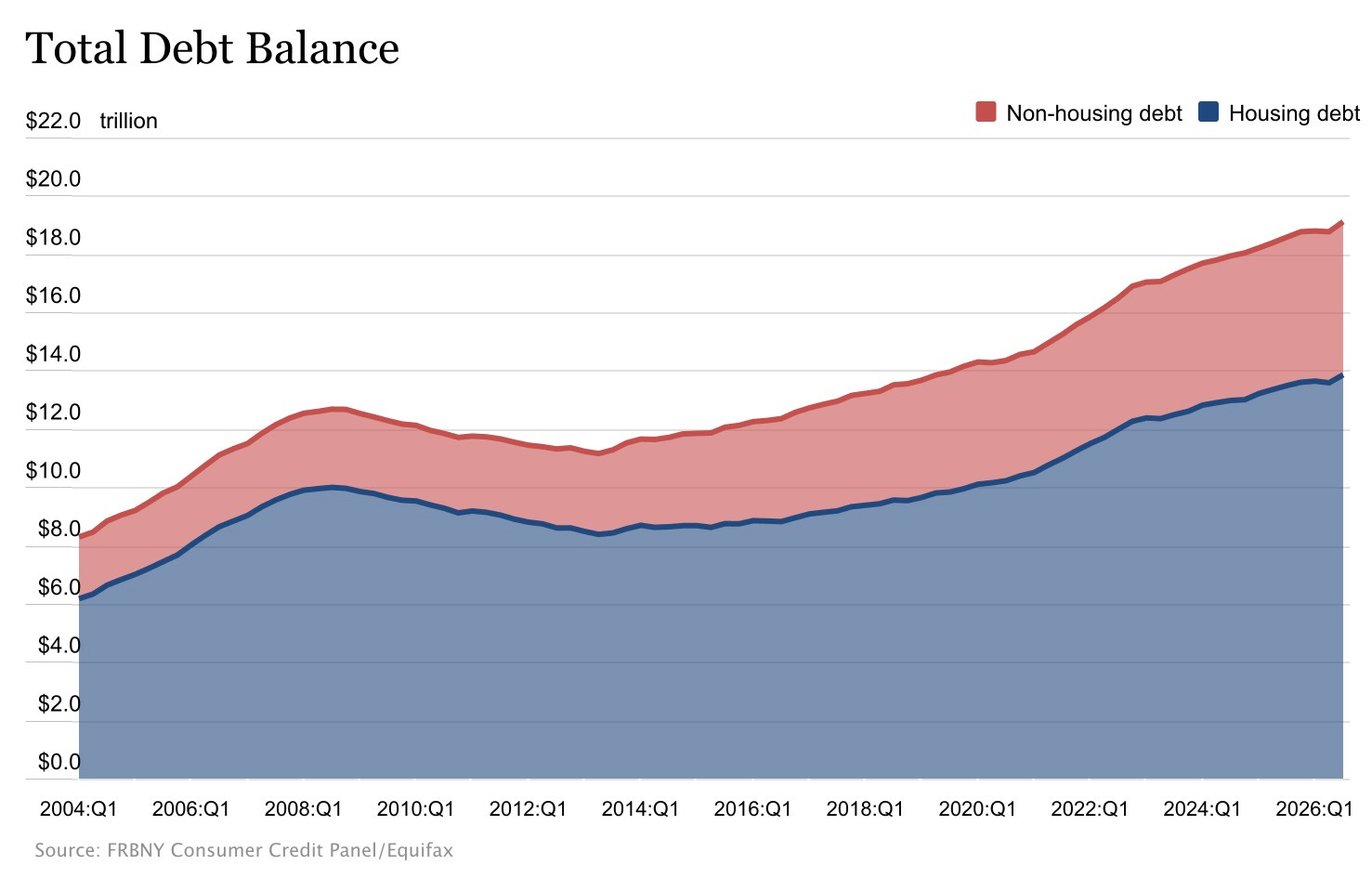
Separately, Urban Institute research found that 5.8% of Americans had at least some delinquent credit card debt, compared with 4.3% in August 2019. Approximately 5.5% had delinquent auto or retail loans, up from 3.9% before the pandemic. These figures suggest that financial pressure is extending beyond housing and affecting multiple categories of household borrowing.
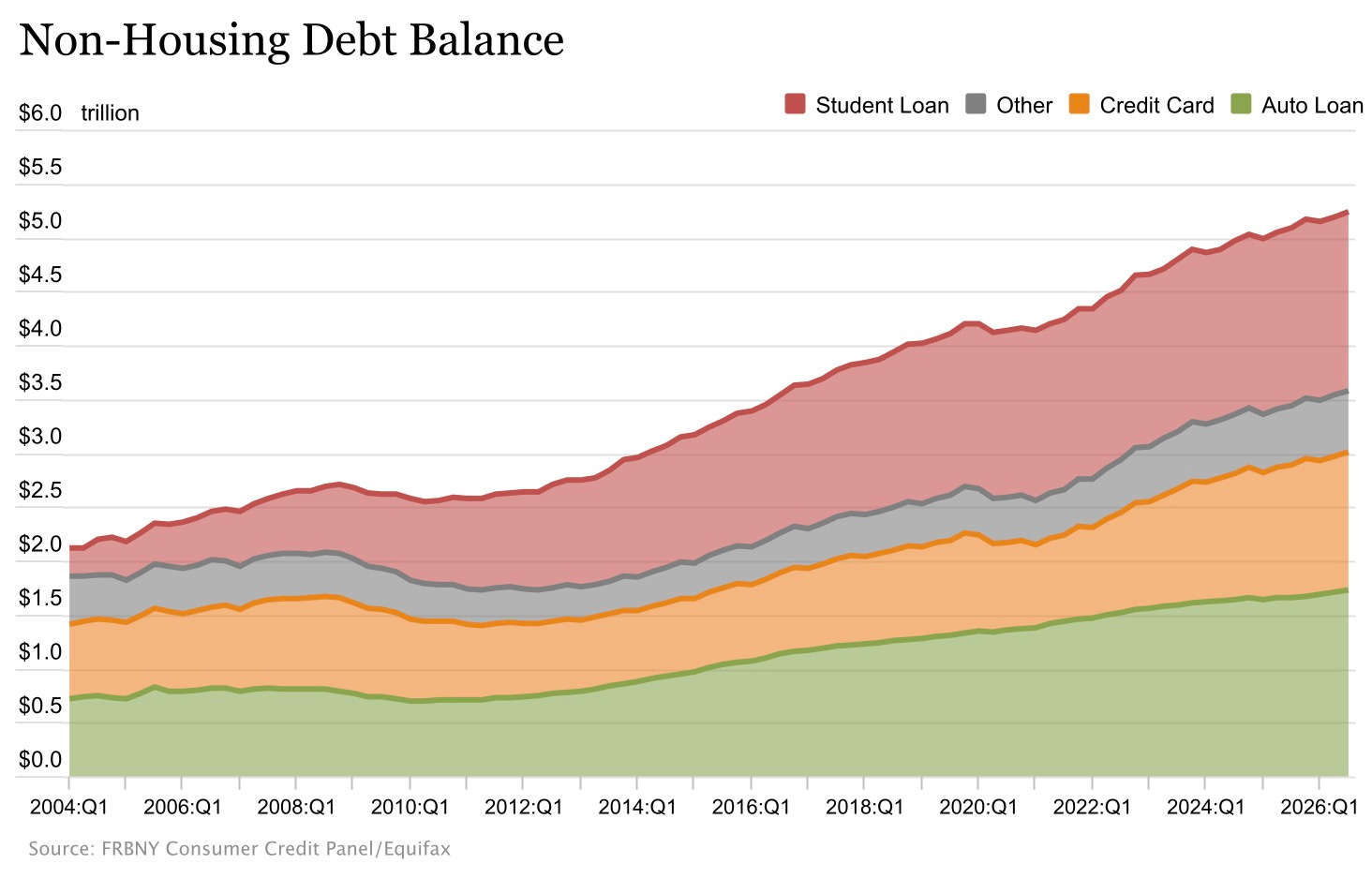
More concerning for housing, the share of mortgage balances more than 90 days overdue reached 1.13%, its highest level since the first quarter of 2018.
Meanwhile, outstanding home equity line of credit balances increased by $23 billion during the quarter, the largest quarterly increase since 2005 and the 18th consecutive quarter of growth.
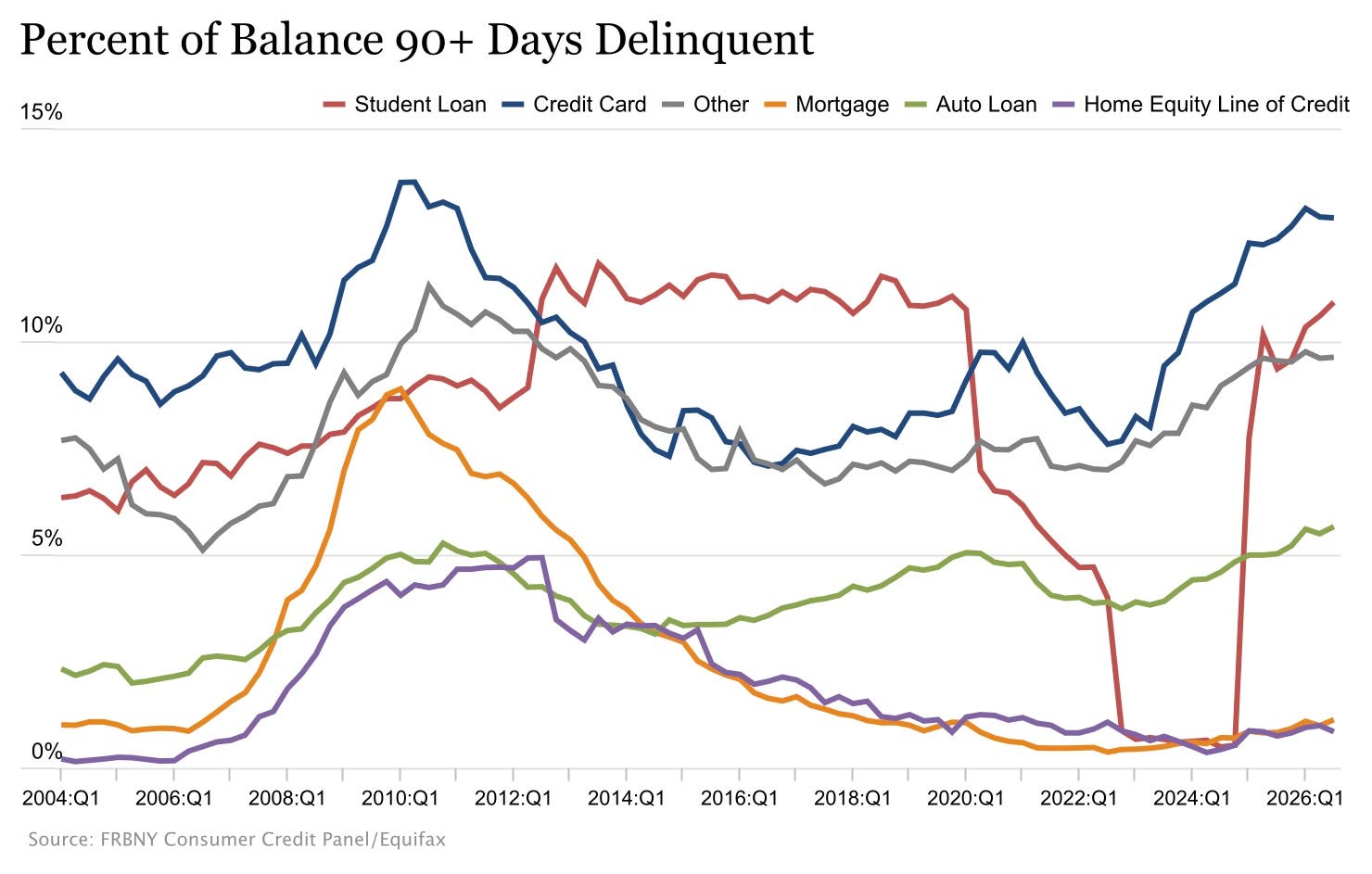
Rising HELOC balances don’t necessarily indicate financial distress, since homeowners also borrow against equity for renovations and other expenses. And New York Fed researchers emphasized that overall mortgage credit quality remains strong. Nevertheless, the combination of rising household debt, elevated consumer delinquencies, and increasing mortgage distress deserves attention, particularly given how weak housing demand has already become.
Again….not “panic” numbers, but not pretty, either. We’re not at the point where widespread mortgage defaults or forced selling are driving the national housing market. However, the latest data suggests the market is weakening, and several indicators are moving in the wrong direction.
According to Redfin’s November 10, 2026 report, the median U.S. home-sale price declined 0.4% year over year in October, reaching approximately $388,634. This marked the first annual decline in more than three years.
Just two months earlier, home prices were still increasing approximately 2.5% annually. A 0.4% decline isn’t particularly large on its own, and median prices can be affected by the mix of homes being sold, but the change in direction is worth noting.
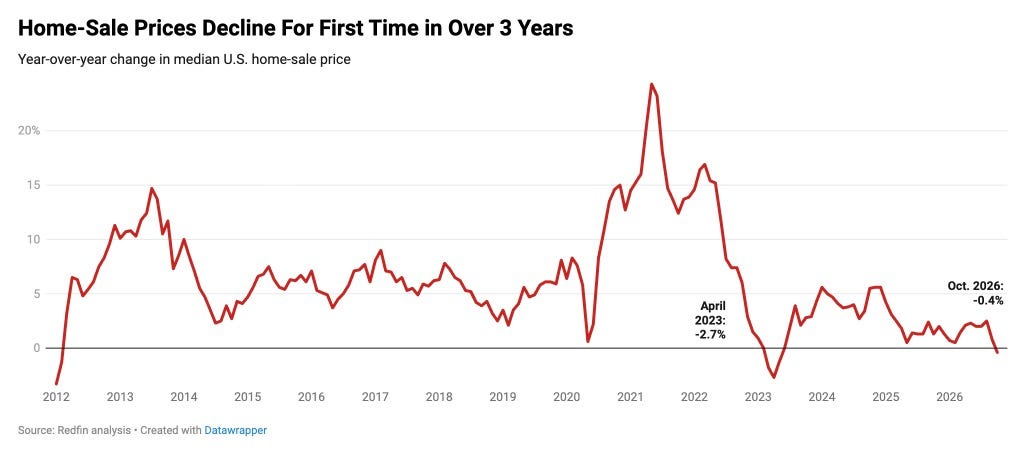
The bigger concern is transaction activity.
Redfin reported that pending home sales declined 15.1% year over year and 3.6% from September. Pending sales reached their lowest level since 2013, excluding April 2020 during the initial pandemic shutdowns. Because pending sales represent homes under contract, they provide an indication of future completed transactions. Sustained weakness suggests that buyers are having difficulty absorbing available inventory at current prices and financing costs.
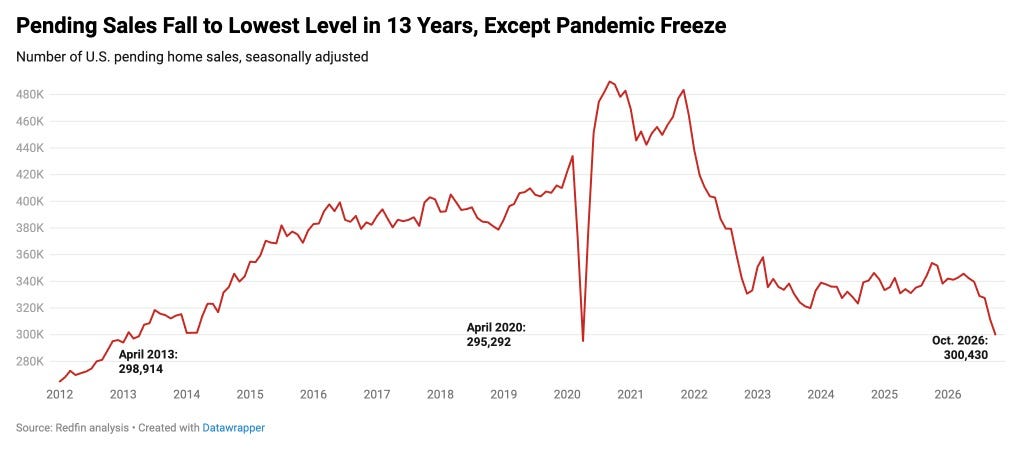
The National Association of Realtors reported similarly weak conditions in its November 12 release. Existing-home sales declined 5.5% month over month and 8.8% year over year in October, falling to a seasonally adjusted annual rate of 3.75 million homes.
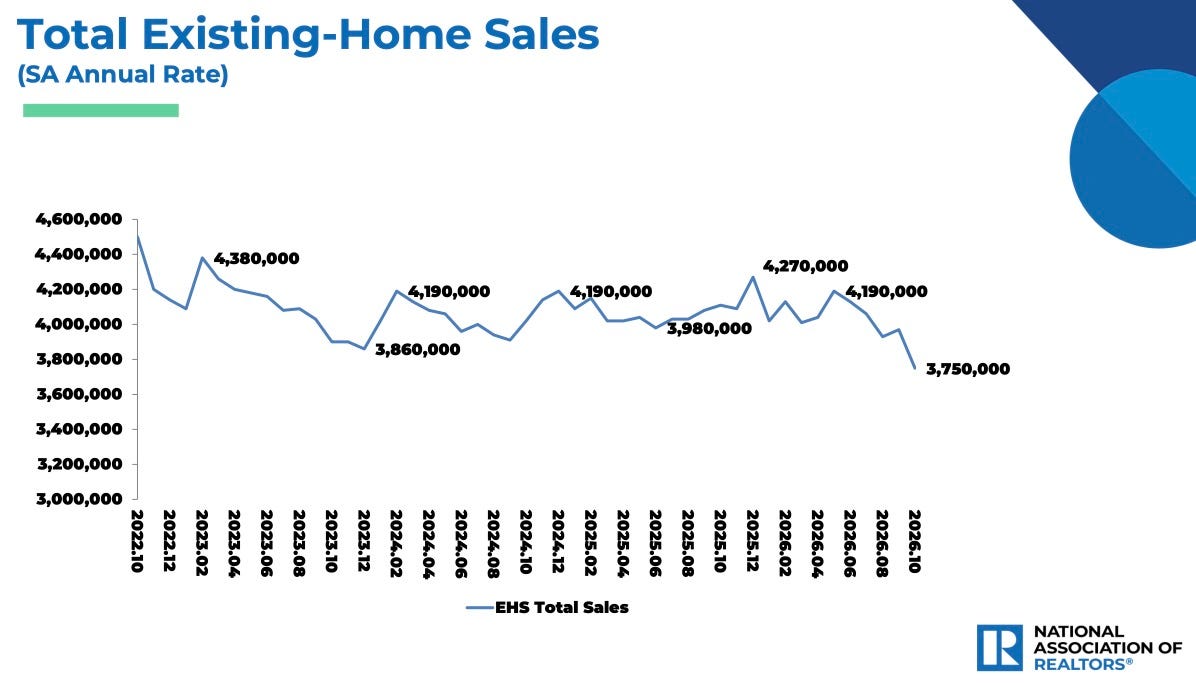
That was the lowest level since August 2010. The comparison doesn’t mean today’s market has the same underlying problems as the post-financial-crisis housing market, but it does demonstrate how severely transaction activity has slowed.
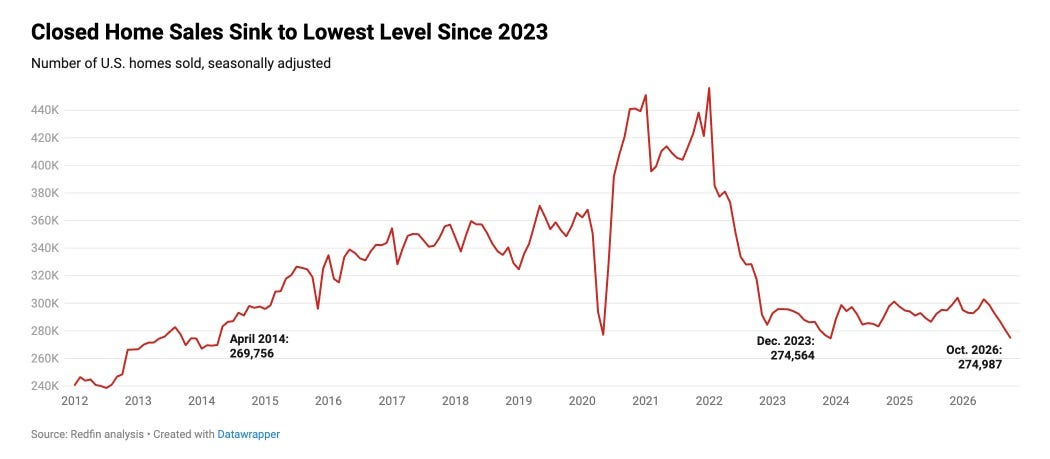
Inventory is also increasing relative to demand. The National Association of Realtors reported 1.59 million existing homes available for sale in October, an increase of 4.6% from the previous year. Months of supply rose to 5.1, compared with 4.4 a year earlier. Redfin separately reported that active inventory reached its highest level since early 2020. These measures aren’t identical, but both point toward a market in which homes are taking longer to sell and available supply is increasing relative to the number of buyers.
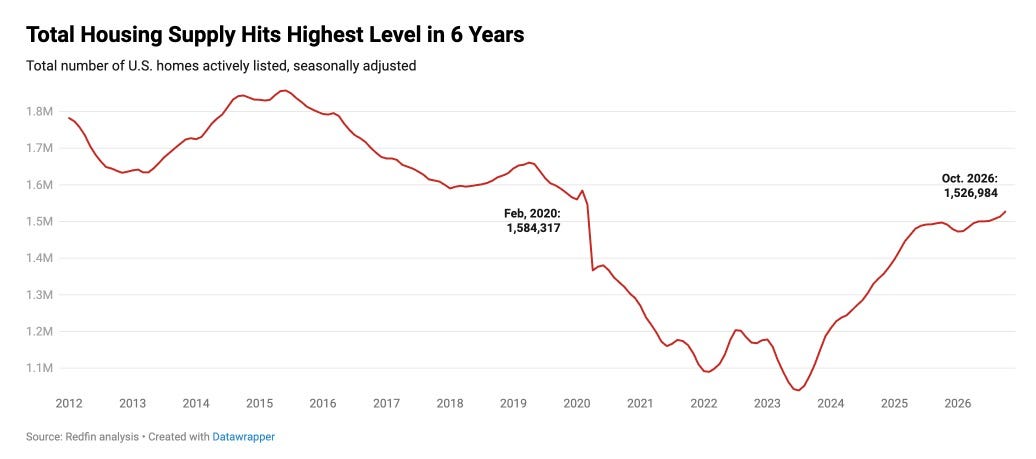
One particularly notable detail is that inventory has been rising even as new listings have softened. That suggests some of the increase is coming from homes remaining on the market longer rather than a sudden surge of homeowners deciding to sell. If economic conditions weaken and more households need to list their properties, that could add supply to a market already struggling with demand.
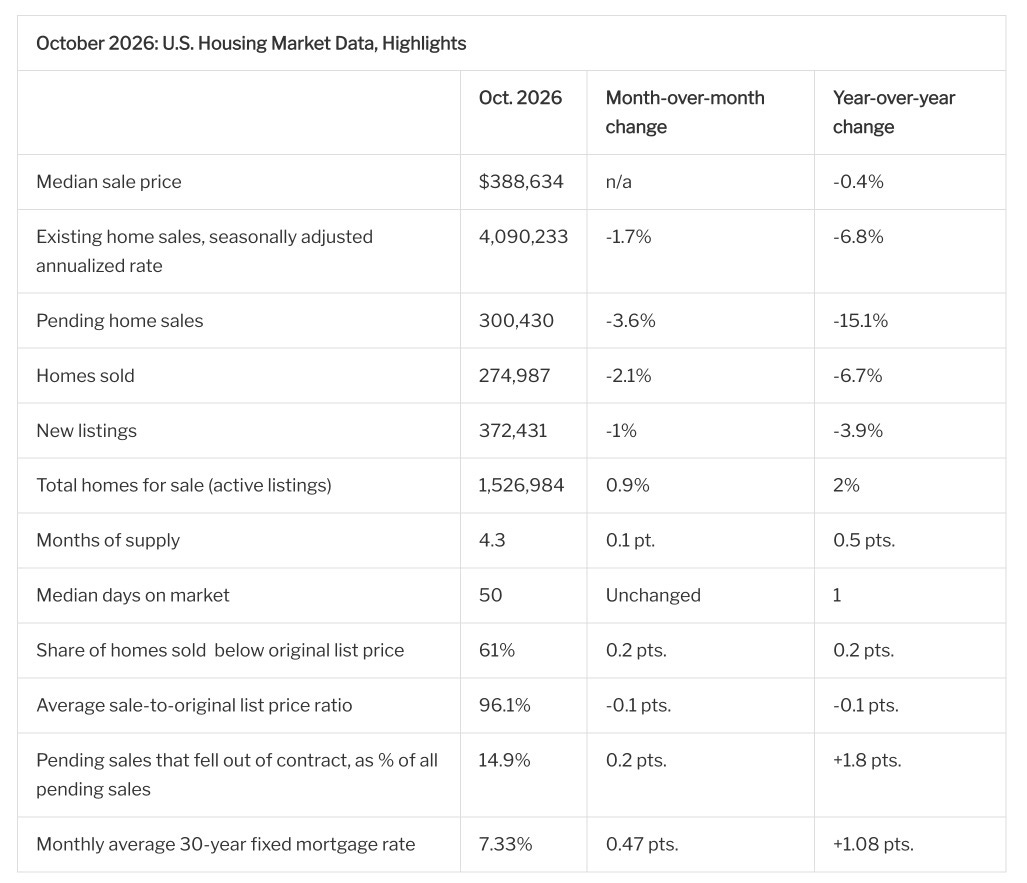
Sellers are also making more concessions. Redfin reported that approximately 61% of homes sold in October closed below their original asking prices, while 36% of sold homes had experienced at least one price reduction. Nearly 15% of pending transactions fell out of contract. Selling below an asking price doesn’t necessarily indicate a decline in a property’s underlying value, but the frequency of reductions and canceled contracts provides additional evidence that buyers have gained negotiating power.
People aren’t getting “desperate to sell”…it’s just a “record buyer’s market”, right?
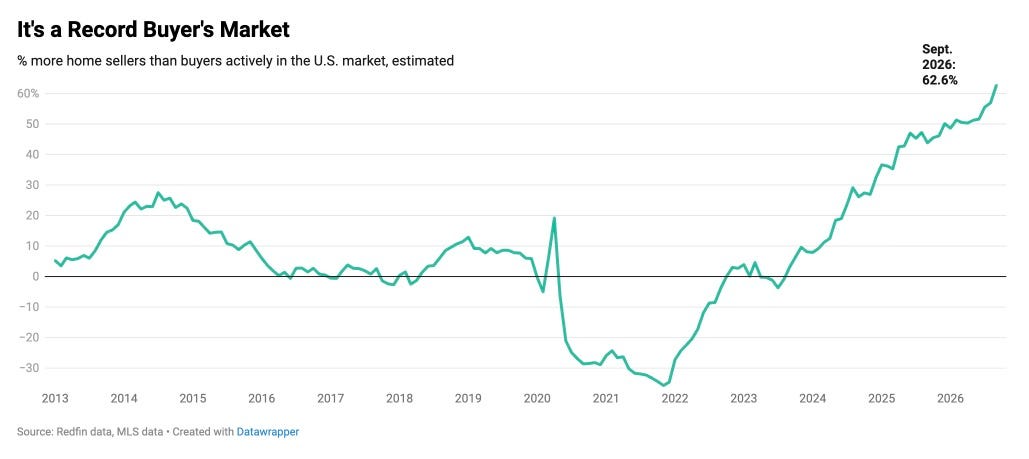
Regional data shows that some markets are already experiencing considerably larger price declines than the national average. Redfin reported year-over-year median sale-price decreases of 6.5% in Austin, 5.1% in Seattle, and 4.9% in Nashville. Pending sales also fell sharply in several large metropolitan areas, including Seattle, San Diego, and Denver. These differences matter because a national correction doesn’t have to occur uniformly. Markets with weaker employment, greater inventory growth, or particularly stretched affordability can experience substantially larger declines than the country as a whole.
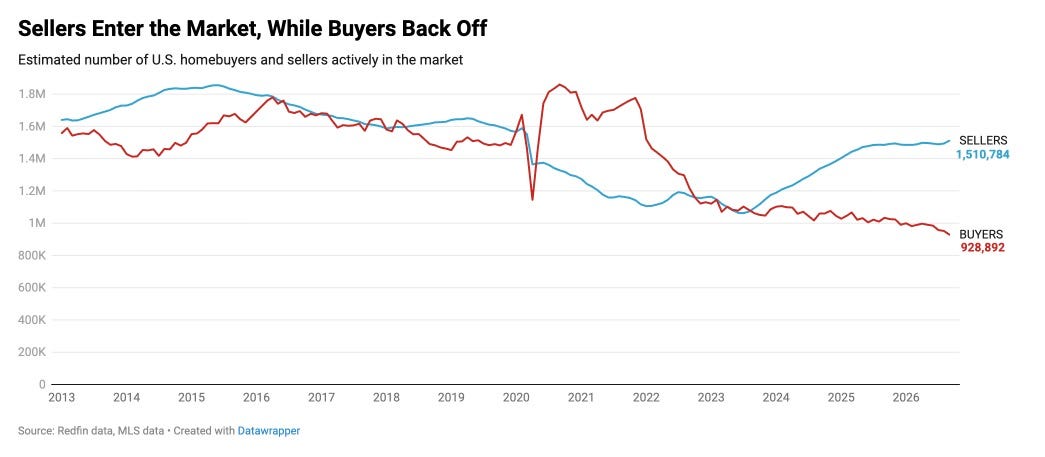
Mortgage rates remain another major obstacle. According to the National Association of Realtors’ October report, the average 30-year fixed mortgage rate was approximately 7.33%, compared with 6.25% a year earlier. On a $400,000 mortgage amortized over 30 years, that difference raises the monthly principal and interest payment from approximately $2,463 to $2,750. That’s roughly $287 more per month, excluding property taxes, insurance, and maintenance.
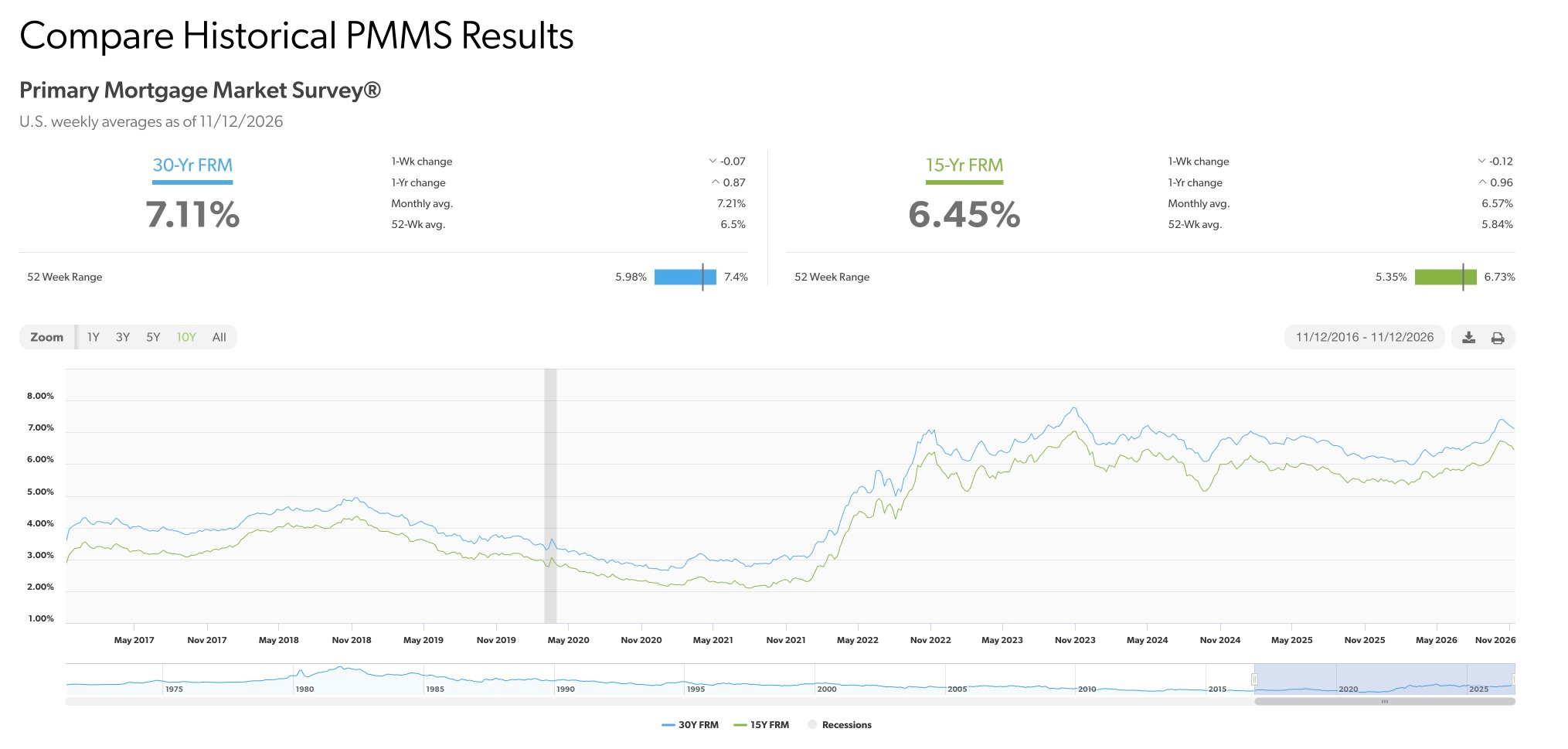
Higher borrowing costs reduce purchasing power and limit the number of qualified buyers. At the same time, homeowners with mortgages originated or refinanced at much lower rates have little incentive to move.
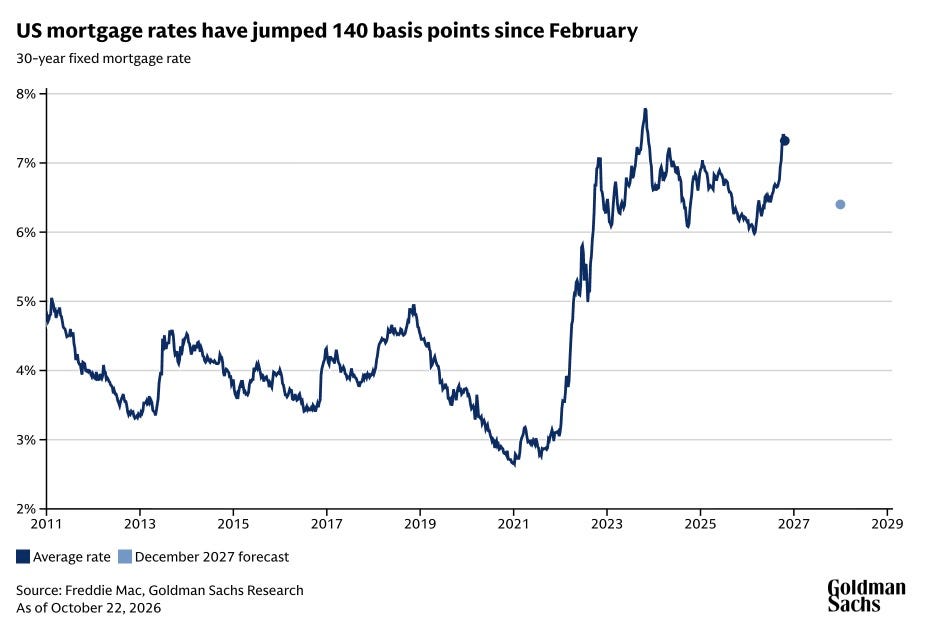
That lock-in effect has restricted supply and helped support prices, but it also contributes to low transaction volumes. If homeowners eventually need to sell because of unemployment, debt, relocation, or other financial pressures, those properties would enter a market where affordability remains difficult.
The mortgage delinquency data is worth examining because it helps distinguish a weak housing market from a potentially more serious correction. According to Intercontinental Exchange’s September 2026 mortgage report, the national mortgage delinquency rate was 3.66%. Serious delinquencies were approximately 1.04%, close to their 2017–2019 September average.
These figures remain relatively contained and don’t suggest a nationwide mortgage crisis. However, the direction of several distress indicators is less encouraging. Serious delinquencies increased approximately 21% year over year, while active foreclosure inventory rose 37%, reaching its highest level since early 2019. Completed foreclosure sales also increased 15%. Mortgages originated in 2022 or later accounted for 43% of foreclosure starts and 49% of completed foreclosure sales during September.
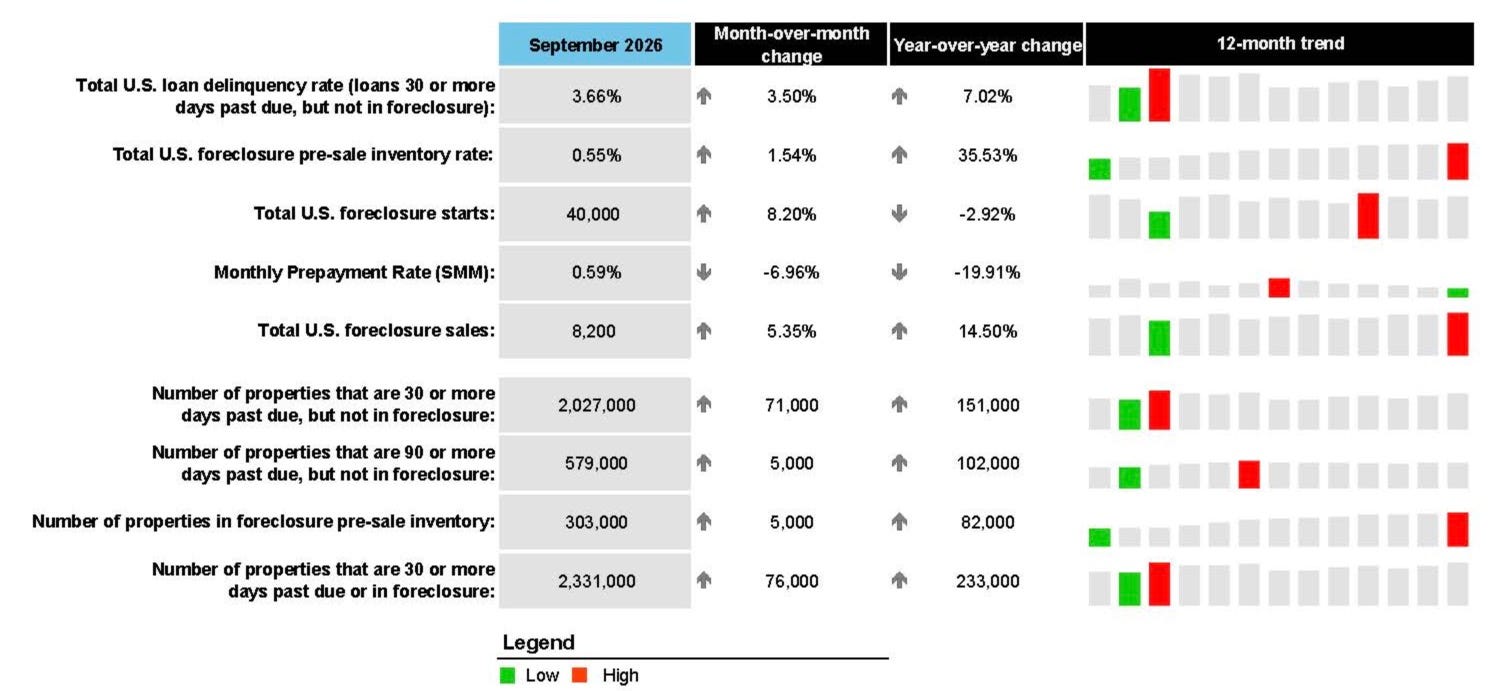
Those increases are coming from relatively low levels, which is an important qualification. Distressed transactions still represented only about 2% of existing-home sales in October, according to the National Association of Realtors. Nevertheless, the foreclosure figures suggest that financial pressure is increasing among a portion of mortgage borrowers, particularly some who purchased or refinanced more recently.
The key question for 2027 and 2028 is whether these conditions stabilize or deteriorate further. Major housing forecasters have generally projected modest national price growth rather than a crash. Fannie Mae’s third-quarter 2026 expert survey anticipated home-price increases of approximately 2.2% in 2027 and 2.7% in 2028. Goldman Sachs has also projected very limited price appreciation in 2027, with growth below 1%. These forecasts suggest a market that remains relatively stagnant, rather than one experiencing a broad collapse.
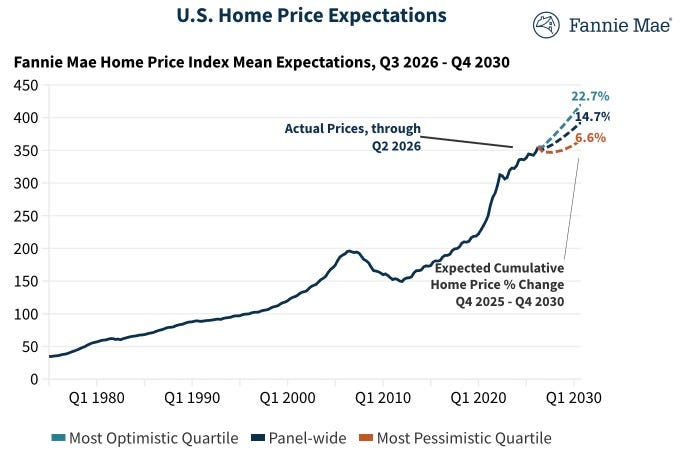
I think the downside risks to those forecasts are increasing. Housing demand is already weak, inventory is building, and mortgage distress is moving higher. A further deterioration in employment would make that combination more concerning.
Homeowners who can comfortably afford their mortgage payments have little reason to sell into a weak market, but job losses and prolonged income disruption can change that decision. More forced selling would increase inventory at precisely the time buyers are already constrained by affordability.
This is where my concerns about AI and other speculative markets become relevant. Weakness in those markets doesn’t establish that a housing correction is coming, and there isn’t sufficient evidence to conclude that this weekend’s crypto volatility is directly affecting housing.
However, a broader decline in asset values, combined with layoffs, tighter lending standards, and weaker consumer confidence, could eventually affect housing demand and household finances. Technology-heavy housing markets may be particularly sensitive to changes in employment and compensation.
There are still important reasons not to expect a repeat of 2008. Mortgage underwriting standards have generally been stronger, many homeowners have substantial equity, and a large share of existing borrowers have fixed-rate mortgages with relatively low payments. The current delinquency rate is also far below the levels associated with the worst period of the financial crisis. Those factors provide meaningful protection against widespread forced selling.
85% OFF FOREVER IF YOU SUBSCRIBE TODAY: I am again offering an 85% discount to anyone that wants to become a Fringe Finance annual subscriber today. It’s a discount you can keep and stays applied for as long as you wish to remain a subscriber: Get 85% off forever
But a housing correction doesn’t require another 2008. Prices can decline because buyers can no longer afford prevailing valuations, sellers become more willing to negotiate, and available inventory exceeds demand at current prices. A national decline of 5% to 10% over the next couple of years is increasingly plausible in my view, particularly if sales remain depressed and inventory continues growing.
A 10% to 15% decline would likely require more significant economic deterioration, while a nationwide decline exceeding 20% would probably require a much larger employment or credit shock.
What makes the latest data concerning to me is the combination of weakening indicators rather than any single statistic. National median prices have turned slightly negative in Redfin’s data, pending sales are down double digits, existing-home transactions have fallen to levels last seen in 2010, inventory is increasing, and sellers are reducing prices more frequently. Meanwhile, serious delinquencies and foreclosure activity are rising even though overall mortgage distress remains relatively low.
I’ve warned about AI, and I continue to expect more difficult developments there. I’ve warned about crypto, and this weekend’s price action hasn’t changed my outlook. Housing is now another area where I believe the risks deserve closer attention. We haven’t reached the stage of widespread mortgage defaults or a national wave of forced selling, but several of the conditions that can precede a correction are already present.
The next phase will depend heavily on employment, household credit conditions, mortgage rates, and whether inventory continues to outpace buyer demand. If those indicators worsen together, a more substantial housing correction becomes increasingly likely. The data doesn’t yet establish that a nationwide crash is coming, but it does suggest that the housing market is more vulnerable than it was a year ago.
END
Bond Auctions Tail, Art Auctions Don’t: Blue-Chip Painting Sales Soar 76% As The Trophy Bid Returns
Monday, Nov 16, 2026 – 05:20 AM
It was another rough week for auctions. All three coupon sales in last week’s refunding tailed, starting with Monday’s 3Y, which needed record Directs to save it. Tuesday’s 10Y, which followed another hot CPI print, was downright ugly: it priced at 5.020%, tailing by a full basis point, the biggest tail since February. Indirects plunged from a near-record 80.3% to 61.2%, the lowest since October 2023, as foreign buyers staged a bit of a strike, and Directs soared to 29.0%, the highest since September 2013:
Thursday’s 30Y then tailed too, at 5.441%, sending yields to session highs.
And yet there is one auction market where the buyers keep showing up. At Christie’s and Sotheby’s, 95% of all blue-chip post-war paintings offered in the first nine months of 2026 found a buyer, and 70% sold above their estimates. Here is how Swiss art-investment firm Partasio summed it up in its Q3 2026 Art Market Review:
“Confidence returned at the top end of the market. Sales of blue-chip post-war paintings priced above USD 500,000 reached USD 2.25 billion, up 76% from the previous year. The sell-through rate stood at 95%, while 70% of lots sold above expectations. Four paintings exceeded USD 50 million…”
So with the 10Y coupon at 5% for the first time since 2006, the art market is having its best year since, well, the last time anyone thought rates mattered.
A disclosure, before anyone rushes to bid: the report is, by its own fine print, an “advertisement” from a firm that sells blue-chip painting portfolios “starting at CHF 30,000”, so it was probably never going to be bearish. The auction data underneath are hard numbers though, and with New York’s marquee sales starting Monday, now is a good time to look at what they say. Even Partasio concedes that “the recovery has not been broad-based.”
Value, Not Volume
Partasio tracks paintings created after 1945 that sold for at least $500,000 (or, if unsold, carried an estimate of at least $500,000) at the four major houses: Sotheby’s, Christie’s, Phillips and Bonhams. In the first three quarters, 646 such lots were offered and 614 sold. Sales hit $2.25BN, up 76% from $1.28BN a year earlier, while the number of lots sold rose by just 7%, from 575 to 614.
Some back of the envelope math: that works out to an average price of roughly $3.7 million per painting, up about 65% from roughly $2.2 million a year earlier. Partasio says growth “came from value rather than volume, pointing to a deepening at the top rather than a speculative spike.” We’ll let readers decide where exactly a “deepening at the top” ends and a speculative spike begins, when the average painting costs 65% more than it did a year ago.
Estimates were blown away too. 432 lots sold above expectations, up from 348 in 2025, while lots below expectations fell from 133 to 96. Bought-in (unsold) lots plunged 56%, from 72 to 32, dropping the unsold rate to just 5%.
For context, the last time we were tweeting about Sotheby’s buy-ins, just over a decade ago, it was for the opposite reason:
That’s a roughly 30% buy-in rate then vs 5% now. And momentum built all year: results beat estimates by 21% at the March sales in New York and London, 19% in New York in May and 24% in London in June, before hitting 30% at the September sales in Hong Kong and London. Sell-through never dropped below 90% at any of the major sales.
But before anyone declares a new golden age, a word on the comps. The first nine months of 2025 were close to the trough: global auction sales fell 6% in H1 2025, with post-war and contemporary art down 19%, after the over-$10 million segment plunged 39% the year before (per ArtTactic data cited by NBC). Partasio’s own data show zero paintings above $50 million sold in its universe in Q1-Q3 2025. Growth rates look a lot better off a base like that.
The turn came last November, when Sotheby’s sold the Leonard Lauder Klimt for a record $236.4 million, the same night Maurizio Cattelan’s 18-karat gold toilet “America” fetched $12.1 million (we previewed that particular masterpiece in “Flush With Value” (Nov 4, 2025)).

The trophy bid carried into 2026, with Christie’s selling Jackson Pollock’s Number 7A for $181.2 million in May as part of the $630.8 million S.I. Newhouse collection, per The Art Newspaper.
Trickle-Up Art-onomics
Strip out the top end, though, and the art market barely grew at all.
The number of paintings sold between $500,000 and $1 million actually fell, from 259 to 251. Between $1 million and $5 million, it inched up from 260 to 263. All in, sales of paintings between $500,000 and $5 million slipped from 519 to 514. Above that line it was a different universe: lots between $5 million and $10 million jumped 63% to 65, the $10-50 million band nearly doubled to 31 from 16, and four paintings cleared $50 million, versus none last year.
Here is the same data in Partasio’s own chart:
If that shape looks familiar, it should: it is the K-shaped economy in oil on canvas. Back in January we wrote that the “K-Shaped Economy Is Here To Stay” (Jan 11), as Goldman’s consumer dashboard showed asset owners pulling away on the back of the AI-fueled stock rally. Goldman’s Joseph Briggs noted at the time that “the net worth-to-disposable personal income ratio remains near its all-time high on the back of strong equity price gains.” Ten months later, that wealth has clearly found its way to the salerooms, but only the ones with velvet ropes.
It is also the same story we told about earnings in “The S&P 2” (Oct 6), where Goldman’s Ben Snider expected the top 10 stocks to deliver over two-thirds of Q3 S&P 500 earnings growth while the median stock barely grew. Swap Micron and Nvidia for a Pollock and a Rothko, and you have the 2026 art market.
Partasio’s niche has company. The Art Basel and UBS Global Art Market Report 2026 found that global art sales rose a modest 4% in 2025 to $59.6BN, but sales above $10 million grew 30%. Bank of America’s 2026 U.S. Art Market Report (compiled with ArtTactic) shows the same split in New York: the $10 million-plus segment snapped back after a 46.9% contraction in 2024, even as works under $50,000 still made up 61.3% of all lots sold.
“The Sotheby’s 2”
Concentration shows up among the sellers as well. Christie’s and Sotheby’s accounted for about 95% of sales. Christie’s led with $1.17BN (52% share), up 80% from $650 million, and Sotheby’s matched that pace, also up 80% to $967 million (43%). Phillips grew 23% to $108 million, though its share slipped from 7% to 5%, while Bonhams was flat at $7 million. Diversification at its finest.
Geographically, it was all about New York, where sales rose 88% to $1.45BN, lifting its share of the total to 64% from 60%. London rose 68% to $466 million, while Hong Kong grew a more modest 49% to $283 million and saw its share slip from 15% to 13%.
Further down the food chain, things look a lot less festive. Partasio notes that “smaller galleries continue to face financial pressure and elevated shipping costs” (no thanks to diesel prices), and London’s Stephen Friedman Gallery, which represented 39 artists and estates, went into administration in February owing creditors £7.8 million, more than £800,000 of it to artists, according to The Art Newspaper.
Paris Burns, London Shrugs
Since Partasio published, two of the four Q4 tests it flagged have come and gone, and both told the same K-shaped story.
At Frieze London (Oct 14-17), blue-chip stands were “largely conservative,” and collectors kept taking longer to decide than before the downturn. Art adviser Judith Greve summed it up: “It’s the very high and the very low stuff that is selling the best, it’s still a strange time.” The Fine Art Group’s Philip Hoffman put it more bluntly: “the serious money is going to Paris, we are sending our whole team there with few on the ground in London.“
Paris, meanwhile, was busy burning. With rioters looting luxury stores across France the weekend before the fair, Art Basel Paris opened on Oct 20 behind anti-ram barriers and guard dogs, and shut early on the evening of Oct 23, scrapping its weekend days, on the advice of the Paris police prefect. Did it hurt sales at the top? Probably not: Hauser & Wirth sold a 1965 Gerhard Richter for $10.5 million on the first VIP day, and a Modigliani nude was on offer at over $100 million, per The Art Newspaper. Billionaires, it turns out, can always find a way through the barricades.
Who’s Paying? Leverage, Of Course
One more reason the top end looks so strong: it has never been easier to borrow against a painting, or to get the auction house to take the risk. Sotheby’s completed a $900 million securitization in January, now including collectible cars alongside art, while Christie’s financing arm has expanded into watches, handbags and wine (per TAN). Regular readers will recall that we flagged the art lending boom back in August 2024, when the rich were pledging their art for liquidity on account of “Margin Calls, Death, Divorce & Bankruptcy.”
Then there are the guarantees. According to Bank of America’s report, the guaranteed share of New York evening sales hit 78.3% in 2025, up from 36.4% in 2016, and the bank notes that “Sellers are similarly cautious, relying more on auction guarantees and private sales than in previous years.” In other words, the 95% sell-through rate comes with a lot of pre-arranged buyers. Art-backed ABS and guaranteed lots, sold into a market where Treasury auctions keep tailing… what could possibly go wrong?
Rothko Or Ten-Year?
Here is the chart that maybe says the most. Bank of America’s data show that the average annual resale return on art sold at New York auction fell to 4.4% in 2025, from 5.3% in 2024. And for anyone who bought a work in the hope of a quick flip, works resold within five years returned minus 5.7%. Meanwhile, the Treasury is now paying a 5% coupon on the 10Y, and last week’s 30Y cleared at 5.441%.
Put differently, the average resold painting now earns less than the 10Y it competes with for the same capital, before insurance, storage, and a buyer’s premium that can run well into the double digits. Rate-insensitive, maybe… but not exactly a carry trade. Which is probably why the art market’s bid is coming almost entirely from people who don’t need to care about carry.
The art market’s link to the stock market is nothing new either. When the S&P stumbled in 2016, Christie’s first-half sales plunged 27%. And when FAANG was the only game in town, the reaction to a soft night at Sotheby’s was this:
In 2026, everyone has been buying NVDA… and the Rothko.
This Week’s $2.4BN Test
Which brings us to Monday. Sotheby’s, Christie’s, Phillips and Bonhams expect at least $2.04BN in New York sales this week, and potentially more than $2.4BN, according to The Art Newspaper. Sotheby’s alone projects more than $1.1BN, a house record for a marquee season, about 40% of it from Wednesday’s (Nov 18) sale of the Blaquier-Arrieta collection: 12 Impressionist and Modern paintings, all fully guaranteed, expected to fetch about $450 million. The headline lot is Van Gogh’s Blossoming Chestnut Trees (1890), estimated at around $180 million, which would blow past the artist’s $117 million auction record; Cézanne’s Arlequin carries an estimate of around $120 million, just shy of his $137.8 million record. (Small irony: since every one of those works predates 1945, none of them will even count in Partasio’s post-war tally.) Christie’s expects $823 million to $1.1BN, led by its Nov 17 20th Century evening sale, where a Kandinsky and a Klimt are each estimated at $60-80 million.
The timing could be better. A week after the midterms crashed the AI trade, Jensen Huang resigned as Nvidia’s CEO on Thursday, CPI ran hot for a third straight month, Waller floated a 50bp December hike, and gold tumbled below $3,900 while bitcoin puked under $70,000 (all recapped in Friday’s “Everything Bad, Everywhere, All At Once… Except Stocks“). The auction houses insist none of that matters to evening-sale buyers. Christie’s Kat Widing told The Art Newspaper that “People aren’t day-trading Picassos.“
Two Billionaires In The Same Room
Partasio’s conclusion on the Blaquier-Arrieta sale:
“If estimates are met, the sale would provide further evidence of strong demand at the upper end of the market and could close the year on a high note, carrying renewed confidence into 2027.”
Our take: the 2026 art boom is a derivative of the AI equity boom, propped up by guarantees and art-backed loans, and the bottom of the market, and the galleries that serve it, haven’t recovered at all. A painting that returns 4.4% a year is a luxury good competing with a 5% risk-free coupon, and the moment the AI wealth effect fades for real, history (2008, 2016) says the trophy end is where the bids vanish first. Then again, a Treasury auction needs a deep pool of foreign buyers, and as last week showed, it can’t always find one. A Sotheby’s evening sale just needs two billionaires in the same room, and one of them is probably the guarantor.
We’ll check back after the Van Gogh hits the block on Wednesday night.
END
THE RAVEN…
Nvidia’s Board Absolutely Cannot Let Jensen Huang Return

by quoth the raven
Sunday, Nov 15, 2026 – 18:30
Submitted by QTR’s Fringe Finance
Moments ago, the Financial Times reported that Jensen Huang is considering a return as Nvidia CEO, just days after resigning amid allegations involving affairs with a subordinate and a woman suspected of having connections to Chinese intelligence.
According to the FT, Huang has been discussing a potential comeback with confidantes, while a group of influential Silicon Valley executives and investors is organizing an effort to pressure Nvidia’s board into reinstating him.
One ally is reportedly assembling a “war room” to coordinate the effort, potentially even seeking support from the White House. Elon Musk, Tim Sweeney, and prominent Nvidia shareholders have reportedly joined the growing chorus calling for his return.
I wanted to take a quick second to explain why I believe Nvidia’s board not only should not bring Jensen Huang back, but absolutely can not allow him to return, unless its directors are prepared to commit what I would consider corporate governance suicide.
And I don’t think that’s an exaggeration. To quote Walter Sobchak: “Has the whole world gone crazy? Am I the only one around here who gives a shit about the rules?”

Let’s zoom out here. The facts are that Nvidia is arguably facing the most intense scrutiny in its history. Every journalist, analyst, regulator, short seller, and investigative researcher with an interest in the company is now incentivized to go back through everything Nvidia has done over the past several years.
Every major customer relationship, every transaction involving China, every export-control decision, every internal compliance procedure, and every potential conflict of interest is going to be examined under a microscope.
The combination of this unprecedented external scrutiny with Nvidia’s own internal board investigation, in my opinion, dramatically increases the probability that additional damaging information comes to light, as I have been arguing for a week now. That doesn’t mean further wrongdoing is inevitable, but it is a risk the board absolutely has to consider, particularly given the potential consequences.
Which brings me to the central problem with this comeback narrative.
How on earth does a board of directors, acting in its fiduciary capacity, justify reinstating an executive who has reportedly been involved in a personal relationship with a woman whose business activities and alleged connections have raised material questions about potential export-control circumvention and national security (which is to say nothing of accounting treatments)?
To be clear, these allegations and their implications remain subject to investigation. But that uncertainty is precisely the problem. The board does not yet know the full extent of what happened, what Huang knew, what he disclosed, or whether any of it affected Nvidia’s business decisions.
Imagine the scenario in which the board brings Huang back after he reportedly deceived executives already about his affairs, only for another damaging revelation to emerge two weeks later, two months later, or two years later? At that point, the directors could no longer credibly argue that they were unaware of the risks. They would have made a conscious decision to restore his authority in the face of publicly documented red flags and an ongoing investigation.
That is a horrific position for any board to voluntarily put itself in.
Unlike the initial scandal, which the board can plausibly characterize as conduct it is now investigating and addressing, the decision to reinstate Huang would belong entirely to the current directors. They would own it.
What’s particularly interesting is that…(READ THIS FULL ARTICLE 100% FREE HERE).
—
KING NEWS
| The King Report November 13, 2026 Issue 7869 | Independent View of the News |
| Nvidia CEO Jensen Huang resigned. Colette Kress, Nvidia’s CFO, will serve as interim CEO. https://www.cnbc.com/2026/11/12/colette-kress-nvidia-cfo-interim-ceo-candidate.html @realDonaldTrump: NOW THAT Nvidia CEO JENSEN HUANG, who has done a fantastic job, has resigned, there is only one man to take his place – TIM COOK of Apple. A Legend replaces a Legend! President DONALD J. TRUMP Nov 12, 2026, 10:29 AM NVDA sank while SpaceX rallied on reports that Jensen Huang will join with Elon Musk. OpenAI just closed its funding round raising $15 Billion at a valuation of $1.25 Trillion – CNBC Groundhog Day continues! After reports that a US-Iran deal was nigh on Monday and Iran a day or so later refuting that a US-Iran deal was nigh, Trump on Thursday claimed the US doesn’t need a deal. @realDonaldTrump: I have asked Vice President Vance to focus his complete and total attention on the Massive Corruption and Crime taking place in Democrat run Cities and States throughout the U.S. The Blue States, such as Minnesota, California, Illinois, and many more, are all poorly run, corrupt disasters. Billions of Dollars is being stolen each and every month. Our Budget could be quickly BALANCED with the correction of this large scale criminal activity. CORRUPTION is in the Democrat Leadership’s blood! We don’t need a deal with Iran. Those days have long since passed. We’ve got their money, Hundreds of Billions of Dollars, and we’ve got their Strait! Thank you for your attention to this matter. President DJT Nov 12, 2026, 8:07 AM C14 News’s @DBalazada: New details behind Trump’s tweet: According to the information we have, over the past 24 hours Iran made it clear to Qatar that it would not negotiate over its nuclear program. The Qataris passed the message on to the Americans. After the message reached Trump, he wrote that there was no point in an agreement. “The worst thing you can possibly do in a deal is seem desperate to make it. That makes the other guy smell blood, and then you’re dead.” – DJT, in “The Art of the Deal” Has Trump removed Vance, the architect of the infamous MOU with Iran, from Iran negotiations? Energy commodities rallied moderately on DJT’s Iran post; but quickly rescinded most of the rally. The NQZ (Nasdaq 100 December futures) low (28,013.75, -459.50 pts) occurred at 8:16 ET. The usual suspects were so eager to buy the Huang dip that they bought 75 minutes before the NYSE opening. NQZs then soared to 28,398.50 (-74.75) at 9:53 ET. After a respite, NQZs soared to a daily high of 28,652.25 at 11:20 ET. They then fell until they hit 28,302.00 at 15:32. They hit 28432.,75 at 16:00 ET. Nvidia hit a daily low of 148.80, -24.93 points, at 9:31 ET; it then rallied to 167.14 at 11:12 ET. NVDA then traded within a 4-handles range into its close of 116.19. The S&P 500 Index opened at 7550.84, -68.54 points. It then jumped to 7611.00 at 9:53 ET. After a retreat to 7581.00 at 10:10 ET, the S&P 500 ran to 7652.76 at 11:23 ET. But, that was it! The S&P 500 Index then stair stepped lower into the close (7592.92, -0.35%). Thursday’s King Report: Traders will play the upside until fear about the October PPI release tomorrow enters minds in the afternoon. Microsoft is suffering a major outage, taking down Microsoft 365, Outlook, Teams, OneDrive, and more https://www.xda-developers.com/microsoft-suffering-major-outage-taking-down-microsoft-365-outlook-teams-onedrive/ Microsoft Outlook outage disrupts email for more thousands of users https://trib.al/kMiDN10 US Records $404 Billion Deficit in First Month of Fiscal Year – BBG The US budget gap widened to $404 billion in October, up 42% from the same period a year earlier, Treasury Department data showed Thursday. In the first month of the fiscal year, which began Oct. 1, government spending rose 12%, to $773 billion, and tax receipts fell 9%, to $369 billion. Tariff revenue fell roughly 39% from the same month in 2026, to $19.2 billion… (Keep buying bonds and trade with Mr. “I’m the House!”) https://news.bloomberglaw.com/international-trade/us-records-404-billion-deficit-in-first-month-of-fiscal-year US October federal budget deficit sets a record Outlays of $773 billion vs $689 billion in Oct 2025 Receipts $369 billion vs $404 billion in Oct 2025 Deficit of $404 billion vs $284 billion in Oct 2025https://investinglive.com/news/us-october-federal-budget-deficit-sets-a-record/ Normally, ‘receipts’ fall in recessions. Customs duties/tariffs fell to $19.22B from $31.35B. file:///C:/Users/BillKing/Downloads/MonthlyTreasuryStatement_202610.pdf Why did Individual Income Taxes fall $30.58B y/y and Corporate Income Taxes almost $3B in October? The US economy is running on government spending and AI capex. This will NOT end well. Positive aspects of previous session Stocks rallied sharply after an opening tumble on Nvidia and Huang’s resignation. SP Info Energy +1.5%, Comm Services +0.37%; Negative aspects of previous session After a morning buying frenzy, the S&P 500 fell in the afternoon and closed -0.35%. S&P 500 -0.35%, DJIA -0.36%, DJTA -0.58%, Nas 100 -0.3%, Nasdaq +-0.39%, SOX Index -0.54% SP Materials -1.49%, Industrials -0.91%, Financials -0.72%, Heath Care -0.66%, Real Estate -0.5%, Info Tech -0.42%, Consumer Staples -0.14%, Consumer Discretionary -0.07% Utes -0.05% USZs – 1 23/32 at 16:16 ET; the ¥/$ fell to a low of 160.045 Dec WTI Oil +$2.39; Jan Brent +$3.29; Dec Diesel +8.47¢; and Dec Gasoline +6.48¢ at 16:18 ET. Ambiguous aspects of previous session The 2-year US Treasury yield (4.89%) is encroaching on the 10-year yield (5.138%). With the ¥/$ (160.045) below the previous intervention threshold, is intervention imminent? First Hour/Last Hour NYSE Action [S&P 500 Index]: 1st Hour: Up; Last Hour: Down Pivot Point for S&P 500 Index [above/below indicates daily trend to day traders]: 7598.84 Previous session (S&P 500 Index) High/Low: 7652.76 (11:23 ET); 7550.84 (9:30 ET) Jared Kushner, Steve Witkoff arrive at Kremlin for Putin talks https://trib.al/qJZXHY9 @realDonaldTrump: Here we go again! With the perceived loss by the Republicans in the Midterms – I WAS NOT ON THE BALLOT– the INVASION of our Country is taking place again. Huge CARAVANS are forming and beginning their illegal march through Mexico. Many of the people in these Caravans are those that various countries don’t want – “Send them to America,” they say – But they will not be accepted! MEXICO MUST STOP THEM, NOW, and if they do not do so, the Tariffs on Mexico will be IMMEDIATELY DOUBLED. MEXICO, THE GOVERNOR OF TEXAS, THE VERY LIBERAL NEW GOVERNOR OF TEXAS, OUR GREAT BORDER PATROL, & ICE, HAVE BEEN SO INFORMED. There will be no leniency!… Nov 12, 2026, 7:04 AM Fed Balance Sheet: +$10.722B on T-Bills +$7.035B; Reserves: $30.515B Japan’s Mimura says markets shouldn’t forget intervention risks as yen nears 160 Japan’s top currency diplomat Atsushi Mimura on Thursday warned market participants that it’s “too early to forget” this summer’s intervention as the yen again edged towards the key 160-per-dollar level… https://www.msn.com/en-us/money/economy/japan-s-mimura-says-markets-shouldn-t-forget-intervention-risks-as-yen-nears-160/ar-AA2hfZik?ocid=BingNewsSerp Chinese ‘spy’ Alice Huang at center of DOJ probe into another alleged Nvidia smuggling scheme Sneaking products made by Super Micro Computer – another Nvidia partner and supplier – into China https://trib.al/rc6evml Third extramarital affair comes to light hours after Jensen Huang quits Nvidia https://trib.al/kbWsdys (Three Huangs don’t make a Right!) Rep. Ro Khanna’s wife sold Nvidia stocks near peak before shares plunged over sex scandal https://trib.al/Uz8sub4 On Thursday, NY Fed President John Williams said inflation is too high and the Fed needs to address it. But Williams said it is NOT the Fed’s role to reduce prices; the Fed targets the inflation rate of change and NOT the inflation level. Wall Street is elated with Williams’ proclamation. Main St is chagrined. Today – Traders poured into stocks early on Thursday, which is conditioned behavior. However, stocks, with increasing frequency, have been falling in the afternoon. Only the illegal but encouraged late manipulation keeps stocks from posting larger losses. After digesting the October PPI Report, the usual suspects will play for the Friday Rally. Be prepared for a ¥/$ intervention. The 160 threshold was breached on Thursday. Traders don’t like to be extended over the skies ahead of a weekend. It would be a good time to squeeze forex types. ESZs +18.75; NQZs +104.75, USZs -12/32, Dec WTI -$0.23, Dec Gas -0.86¢, ¥/$ 159.88 at 20:00 ET Expected Economic Data: Oct PPI 0.4% m/m & 6.6% y/y; Core PPI 0.3% m/m & 5% y/y; Fed Gov Bowman 10:50 ET, SF Fed Pres Daly 12:00 ET S&P 500 50-day MA: 7671; 100-day MA: 7624; 200-day MA: 7335 (Close 7592.45, -0.35%) Nasdaq 100 50-day MA: 29,536; 100-day MA: 29,379; 200-day MA: 28,029 (Close 28,289.19, -0.3%) DJIA 50-day MA: 52,002, 100-day MA: 52,440; 200-day MA: 50,741 (Close 52,297.09, -0.36%) (Green is positive slope; Red is negative slope) @honestpollster: Brutally cracking down on blue state fraud could have been politically powerful if done a year ago, as I recommended. But we’re just starting now, with Trump’s political capital drained, GOP now losing on the corruption issue, and Dems issuing subpoenas as we speak. The WH consultants had a plan for these midterms which was to apparently NOT deliver for the American people, and then buy the election with donorbux plus MAGA rallies. Now, with the election over, the GOP Congress is finally scrambling to get stuff done. @LeaderJohnThune: @SenateGOP is committed to being here and doing whatever it takes to finish this legislative session strong and get as much done as we can for the American people. https://x.com/LeaderJohnThune/status/2120302207769932166 Daily Wire’s @megbasham: It’s pretty insane that the entire Republican voting base has said, “we don’t want this guy. We don’t want this failed leadership.” And their arrogance and obstinacy is so great that they come out and tell us, “we don’t care what you want. We understand we’re supposed to represent your wishes, but we are going to spit in your face and do what we want anyway.” Literally, the only constituency that the Senate Republicans have are each other and a handful of massive donors. Hegseth gives top award to soldier who scolded him, aides at Arlington National Cemetery Iglesias reprimanded Hegseth and a group of his staffers when a loud laugh was heard after they took photos at the site following a ceremony that included President Donald Trump and Vice President JD Vance… https://trib.al/CnQfALa -END- | |
| The King Report November 16, 2026 Issue 7870 | Independent View of the News |
| Israeli spy chief in D.C. as Netanyahu presses Trump to resume war The visit by Roman Gofman, one of Benjamin Netanyahu’s closest confidants, comes as the Israeli prime minister is pressing President Trump to resume the war against Iran… https://www.axios.com/2026/11/13/mossad-israel-iran-war-netanyahu-pressures-trump October PPI +0.3% m/m (Goods +0.5%, Services +0.2%) & +6.5% y/y; +0.4% m/m & +6.6% y/y expected. This is the highest y/y since Nov 2022. Core PPI +0.3% m/m & +5.0% as expected. https://www.bls.gov/ppi/latest-numbers.htm The BLS: Final demand goods: The index for final demand goods increased 0.5 percent in October following a 2.5-percent rise in September. Over 60 percent of the advance in October is attributable to prices for final demand goods less foods and energy, which moved up 0.5 percent. The index for final demand foods increased 1.3 percent. In contrast, prices for final demand energy edged down 0.1 percent. For the 12 months ended in October, the index for final demand goods increased 10.2 percent, the largest 12-month rise since advancing 10.5 percent in October 2022. Product detail: Within the index for final demand goods in October, prices for basic organic chemicals advanced 3.9 percent. The indexes for fresh and dry vegetables; gas fuels; aeronautical, nautical, and navigational instruments; jet fuel; and processed young chickens also moved higher. (See table 2.) Conversely, diesel fuel prices fell 7.9 percent… https://www.bls.gov/news.release/pdf/ppi.pdf The US 10-year rose to a 4-week high today of 5.17 4%; the 30-year hit 5.501%. The 2-year hit 4.876%. USZs fell as much as 30/32, to 105 even. USZ ticked 109 2/32 on November 6, 2026. BBG’s @mackhawk: A year ago, we asked Nvidia about a Shanghai data center with links to Alice Huang. They declined to answer our questions and insisted that when it came to Megaspeed, there was nothing to see. We now have filings showing there are indeed banned Nvidia chips at that site. Thread: https://x.com/mackhawk/status/2121252848776450049 These documents were filed with Chinese regulators, disclosing that smuggled Dell & Super Micro servers were installed at a facility with a number of links to Alice Huang — including that Megaspeed used a rendering of the project to describe its largest data center to investors https://x.com/mackhawk/status/2121252862219202679 Alice Huang-Linked Firm Procured Banned Nvidia Chips in China · A Chinese company founded by Alice Huang procured smuggled AI chips that were installed at a Shanghai data center with links to Megaspeed International Pte… · Some of the servers were originally sold to Aperia Cloud Services, an official Nvidia Cloud Partner headquartered in Singapore, but wound up in the hands of Alice’s company at a sprawling AI facility in Shanghai. · The documents show that the hardware included Nvidia’s H800, H100, and H200 chips, which are restricted from sale to China, and were installed at the Shanghai data center, raising questions about US trade restrictions and Nvidia’s relationship with Alice… https://www.bloomberg.com/news/articles/2026-11-13/banned-nvidia-chips-installed-at-china-data-center-linked-to-alice-huang?accessToken=eyJhbGciOiJIUzI1NiIsInR5cCI6IkpXVCJ9.eyJzb3VyY2UiOiJTdWJzY3JpYmVyR2lmdGVkQXJ0aWNsZSIsImlhdCI6MTc5NDU3MDAyOCwiZXhwIjoxNzk1MTc0ODI4LCJhcnRpY2xlSWQiOiJUT0MwWVNUOTZPU0swMCIsImJjb25uZWN0SWQiOiIwREFFQTQxQ0VDMzg0OTcxOTZCMzU2NzAzMUM4RTBBMCJ9.8xPtsYLxhHOOXJeIil4YPQylr-RPNxEa71S10nV4TNk Obviously, someone in the US intel community is so troubled and irate at China’s espionage operation that has procured AI technology due to the malfeasance or complicity of high US officials that he/she is leaking and giving documentation of the misdeeds to the media. It appears that someone should be going to jail. The big questions: Who knew what and when? Because Jensen Huang tethered himself to Trump, Dems will savagely investigate L’affaire Nvidia. @EricLDaugh: Treasury Sec. Scott Bessent reveals he, Marco Rubio and SecWar Hegseth wanted to put China-linked MEGASPEED on the entity list for MONTHS, but Sec. Howard Lutnick never did it https://x.com/EricLDaugh/status/2121233689845584211 Near 10:40 ET: NVDA -4.16%, AMD -9.77%, MU -5.11%, TSLA -2.45%, SNDK -9.12%, SPCX -2.14%, APPL +1.06%, MSFT -0.02%, AVGO -6.53%, GOOGL -1.35%, META +0.46%, S&P 500 -1.12% The SP 500 Index opened at 7616.85, +24.45, and hit a daily high of 7621.78 seconds late. Aggressive selling suddenly appeared to exploit the conditioned buying; the S&P sank to 7499.40 at 10:21 ET. A plodding, low energy stair step rally took the S&P 500 to 7559.26 at 14:09 ET. The S&P 500 then rolled over into a 10-handle trading range, on listless activity, until the illegal late manipulation pushed the index to 7568.33 at 15:51 ET. The index then fell when the FAA issued an emergency order that grounded all departing aircraft, citing “extraordinary circumstances and for reasons of safety… Incoming international flights to the United States will be handled on a case-by-case basis… https://x.com/wallstengine/status/2121348694142517437/photo/1 Microsoft 365 went down on Thursday. Then on Friday, the FAA issued an emergency grounding of all aircraft due to an equipment problem. Did Iran do it? The S&P 500 fell to 755.20 at 15:58 ET; but fundamentals be damned, a late manipulation closed the index at 7561.67, -0.40%. The FAA outage has hit both air traffic control radar and radio frequencies – CNN FAA launched new AI ‘SMART’ tool to all air route traffic control centers just days before nationwide ground stop https://trib.al/e7uYPxk Trump’s Transportation Secretary Sean P. Duffy Delivers State-of-the Art Air Traffic Control Management Tool to Transform the Flying Experience, Reduce Delays & Cancellations for the Traveling Public September 21, 2026 https://www.faa.gov/newsroom/trumps-transportation-secretary-sean-p-duffy-delivers-state-art-air-traffic-control FAA: SMART is a cloud-based platform system that enhances existing FAA air traffic management systems. It provides air traffic control and aircraft operators with a shared, data-driven view of the National Airspace before flights depart… https://www.faa.gov/newsroom/SMART_One-Pager.pdf DOT awards AI contract for air traffic control modernization 06/23/2026 Air Space Intelligence (which was awarded a core AI contract for the effort), Palantir Technologies (which gained an expanded role in the Washington, D.C. deployment), and Thales (France) have been tied to the program’s development and bidding. https://www.eenews.net/articles/dot-awards-ai-contract-for-air-traffic-control-modernization/ At a WH presser Friday night, Transportation Secretary Sean Duffy said routers became overloaded with data and began to provide inconsistent information. “Because of that, we shut the system down.” He called on Congress to provide $50B in funding to modernize the nation’s flight systems. Fox’s @Grady_Trimble: In most detailed description of what went wrong yet, Duffy says FAA contractor L3 Harris was doing a switch from old copper wire to fiber and new IP-based communication: “As we switched from copper to fiber, it started flooding other routers and our air traffic control system.” @mattvanswol: So I went back and watched the press conference again and something is not adding up… So basically the air traffic control system went haywire at 3:36 p.m, the FAA grounded the entire country with more than 3,500 planes in the air… Mullin went first and told everyone it wasn’t a cyberattack and nobody was ever in danger, but he never said what caused it, and then Duffy took the podium for about SEVEN MINUTES and blamed old analog switches “overloaded with data,” “1980s little copper lines,” 25 years of past administrations, and a Congress that won’t give him the $50 billion he wants, and he even bragged that the new switches he’d already put in didn’t fail, but in all that time he never once mentioned that his team had been working on the system… and here’s the strange part, about fourteen minutes in Mullin casually said the FAA had been “putting patches into the system” and new equipment, and that the new technology was overwhelming the older system, which is a VERY different story than old wires just giving out which is what Duffy seemed to be implying the whole time… Mullin had JUST talked about which was that the installation of the upgrades had brought down the old system… Something is wrong here. Mullins: “As FAA going in and putting patches into the system… that new equipment, new technology was overwhelming the old system…Patchwork doesn’t work… it has to be a complete overhaul of the system…” https://x.com/mattvanswol/status/2121604347565916569 @Anna_Giaritelli: I’ve spoken with 60 air traffic controllers tonight about what Sean Duffy said at the White House today. None of them are buying what he said… they said these types of switches that the FAA is doing, they don’t happen during the day, they don’t happen during busy times like a Friday afternoon. They’re doing these midweek, middle of the night when there is no air traffic going on… The WSJ: The outage appears to be affecting a telecommunications network overseen by L3Harris Technologies, according to people briefed on the matter. The network handles crucial radio frequencies that air-traffic controllers use to communicate with pilots, the people said. It wasn’t immediately clear whether the outage also affected the radar feeds that controllers use to keep aircraft safely separated in the skies. An L3Harris spokeswoman didn’t immediately respond to a request for comment… https://www.wsj.com/us-news/faa-temporarily-halts-flights-across-u-s-b9b06e59?st=QoeToG @TimOnPoint: L3Harris claims 99.99971% reliability via dual paths at critical sites, multi-carrier routing, automatic failover, optical metro rings, and diverse backbones. Updates are supposed to use “build-then-switch”: install and test in parallel, cut over one path at a time in low-traffic windows with full backups, never taking the network offline. The national cascade is odd. A local router issue or single update should have been contained by the redundancies. Instead it took down voice/frequency links across every en-route center. Prior 2025 cases (Dallas, Philadelphia) already showed backups failing under L3Harris oversight. Until the root cause shows why containment failed, the claimed redundancies look more theoretical than real. Fox’s @pdoocy: What they are describing – routers overloaded with data, leading to instability, sounds like a cyber-attack… @BreannaMorello: LISTEN CAREFULLY – “This is what the Department of Homeland Security is all about, this is why we were stood up to have a continuity of government…”- Markwanye Mullin What is a Continuity of Government? Continuity of Government means the plans, procedures, and arrangements that allow a government to keep performing after a catastrophic emergency (such as a nuclear attack, major terrorist event, natural disaster, or other crisis that kills or incapacitates leaders or disrupts normal operations). Seems extreme? https://x.com/BreannaMorello/status/2121430338178023429 WSJ: The Single Router in Southern Arkansas That Ground Air Travel to a Halt – A data overload on an antiquated FAA network resulted in stalled trips for hundreds of thousands of travelers All passengers (32) accounted for after tanker collides with cruise ship in New Orleans Tanker ‘lost control’ before collision: New Orleans mayor New Orleans Helena Moreno told reporters that the Atlantic Asphalt tanker “lost control” before striking the American Heritage riverboat. U.S. Coast Guard Capt. Melanie Burnham added that there appeared to be a loss of steering on the tanker, but the cause of the collision is still under investigation… https://www.yahoo.com/news/us/live/all-passengers-accounted-for-after-tanker-collides-with-cruise-ship-in-new-orleans-mayor-says-223554822.html Workday outage leaves workers at over 11K companies unable to access payroll and workplace accounts – The Pleasanton, California-based company said it is investigating a major service disruption after encountering a problem while testing its backup systems… Workday provides payroll, benefits, recruiting and other human resources services to more than 11,500 organizations worldwide… https://justthenews.com/nation/technology/workday-outage-leaves-employees-unable-access-payroll-and-workplace-accounts National Weather Service reports nationwide radar website outage amid FAA ground stop https://www.msn.com/en-us/weather/meteorology/national-weather-service-reports-nationwide-radar-website-outage-amid-faa-ground-stop/ar-AA2hoXjE?ocid=BingNewsSerp 911 outage has people fearing the worst November 13, 2026 The US’s 911 emergency service line is experiencing issues after hundreds of people across the country reportedly couldn’t reach emergency services over the phone… https://cybernews.com/news/911-line-down-outage/ Bomb found at Illinois ethanol plant, prompting evacuations (Friday) Peoria officials said a bomb was found at BioUrja Renewables and later defused; FBI said it is investigating https://www.theguardian.com/us-news/2026/nov/14/peoria-illinois-evacuation-bomb US Air Force Responds to Suspected Drone Activity Over UK Airbase Nov. 13, 2026, 3:47 p.m. (But NO reports of activity or the number of drones! Did someone hack systems & project drones?) https://www.usnews.com/news/world/articles/2026-11-13/us-military-responds-to-suspected-drone-activity-at-raf-lakenheath-base-in-uk-sky-news-reports Were all the above ‘problems’ coincidences, Friday the 13th mojo, or something else? Israeli intelligence warns of Iranian plot to target Trump, top US officials with drones (Saturday) Senior Israeli and US officials tell Israel Hayom that Mossad intelligence on Iranian plans to target President Donald Trump and top administration officials was also corroborated by another Western intelligence agency. Senior US officials have been moved to secure facilities, Trump’s public appearances have been curtailed, and special security measures have been introduced… https://www.israelhayom.com/2026/11/14/israeli-intelligence-warns-of-iranian-plot-to-target-trump-top-us-officials-with-drones/ @realDonaldTrump: I am in the White House having meetings on many subjects. Very exciting times for the USA. Great things are happening – We are the “hottest” Country anywhere in the World! President DJT Nov 15, 2026, 8:42 AM Positive aspects of previous session DJIA +0.,1%, DJTA +0.27%; SP Consumer Stapled +1.39%, Energy +0.96%, Financials +0.8%, Health Care +0.56%, Utes +0.4%, Comm Services +0.26%; Energy commodities fell modestly. Negative aspects of previous session S&P 500 -0.4%, Nas 100 -1.22%, Nasdaq -0.91%, SOX Index -3.43% SP Info Tech -1.7%, Consumer Discretionary -0.45%, Industrials -0.42%, Real Estate -0.1% USZs -21/32, -30/32 low; the ¥/$ fell to a low of 160.189 Ambiguous aspects of previous session Was the US under cyber on Thursday & Friday, and if so, by whom? First Hour/Last Hour NYSE Action [S&P 500 Index]: 1st Hour: Up; Last Hour: Up Pivot Point for S&P 500 Index [above/below indicates daily trend to day traders]: 7598.84 Previous session (S&P 500 Index) High/Low: 7621.78 (9:30 ET); 7499.40 (10:21 ET) WSJ: How Jensen Huang Built the Backdoor Route That Keeps Beijing in AI Race Massive data centers in Southeast Asia provided crucial computing power for Chinese companies and a cover for alleged chip smuggling. Behind Jensen Huang’s spy scandal, a shadow war for Trump’s ear on China Rubio’s intervention helped topple one of Washington’s most influential corporate voices on China, giving momentum to officials pushing for tougher restrictions… Rubio issued a memo warning Trump about the relationship between Huang and a suspected Chinese spy, based on a report generated by the CIA, according to a person familiar with the matter. Rubio used the CIA report to write his own, recasting the agency’s reporting in his own more assertive terms, the person said, speaking on the condition of anonymity to describe confidential intelligence… Until recently, Huang’s close relationship with Trump appeared to give him the upper hand. But with the downfall of the leather-jacket sporting CEO, the hawks are ready to seize on the moment to redirect the national agenda toward tougher policies on China… https://www.washingtonpost.com/technology/2026/11/13/behind-jensen-huangs-spy-scandal-shadow-war-trumps-ear-china/ Mercedes to halt German investments, mulling plant closures (WOW!!!) Like its German peers, Mercedes has been battered by Chinese competition and high costs… Its management has been locked in talks with staff representatives to find ways to reduce costs but, with little sign negotiations were making progress, the manufacturer signaled a harder line… Management was unable to see any way forward on finding a deal with unions “despite numerous intensive discussions,” he said… The powerful IG Metall union is currently demanding a pay rise of five percent in wage negotiations with the company… https://uk.finance.yahoo.com/news/mercedes-halt-german-investments-mulling-182135802.html WSJ: U.S. Figures Iran Still Has up to 2,500 Missiles, Countering Trump Assertions The reconstitution of Tehran’s missile stockpile has factored into the Trump administration’s discussions about whether to resume strikes. @realDonaldTrump: Has anyone noticed that immediately after the Election the Stock Market lost 3 Trillion Dollars in Value? In other words, Investors throughout the World hated seeing what took place on Election Day. But have no fear, the Market has since gone up, and America will soon be GREATER THAN EVER BEFORE! President DONALD J. TRUMP Nov 14, 2026, 7:50 PM WSJ: Democrats Torn Over Floating New Taxes to Cover Multitrillion-Dollar Agenda Lawmakers debate raising new revenues to help pay for expanded healthcare and other big policy ideas Jensen Huang cultists are begging and demanding that Nvidia reinstate the disgraced ex-CEO. Bessent calls for Nvidia leadership shake-up amid China chip scandal, urges outside CEO ‘They need a dramatic shake-up,’ Treasury Secretary Bessent said “We will see if Nvidia intentionally ignored the warning signs of these shell companies, many of them in Singapore,” Bessent said, claiming that Nvidia’s accounts showed a crash in sales to China followed by a surge in sales to Singapore. “And I have seen reporting that only 1% of the chips sold in Singapore remained in Singapore,” he added. “This makes me think that, as the board conducts a search for a new leader, that they need to go outside the company.”… https://www.foxbusiness.com/business-leaders/bessent-calls-nvidia-leadership-shake-up-amid-china-chip-scandal-urges-outside-ceo Today – Fed Chair Warsh speaks at the Productivity and Jobs Task Force Conference in San Francisco 12:00 ET; NY Fed Pres Williams speaks at 9:05 ET. Despite the disquieting news and events over the past 3-4 days, the usual suspects are more jiggy than usual on Sunday night. ‘They’ intent to play for the Monday Rally and NVDA’s results on Tuesday. Furthermore, the Anthropic (Nasdaq) is scheduled for Thursday. Be prepared for a ¥/$ intervention. The 160 threshold was breached on Thursday. Traders don’t like to be extended over the skies ahead of a weekend. It would be a good time to squeeze forex types. T-Bill Auction this week: $95B 13-week & $82B 26-week on Monday; $100B 6-week Tuesday; more later in the week. https://www.treasurydirect.gov/auctions/auction-announcements/ ESZs +18.00; NQZs +151.75, USZs +4/32, Dec WTI -$0.36, Dec Gas+0.14¢, ¥/$ 159.77 at 20:00 ET Expected Economic Data: Nov Empire St. Mfg. Index 17 S&P 500 50-day MA: 7667; 100-day MA: 7626; 200-day MA: 7339 (Close 7561.67, -0.4%) Nasdaq 100 50-day MA: 29,506; 100-day MA: 29,366; 200-day MA: 28,039 (Close 27.943.74, -1.22%) DJIA 50-day MA: 51,974 100-day MA: 52,444; 200-day MA: 50,757 (Close 52,347.55, +0.1%) (Green is positive slope; Red is negative slope) Lauren Chen @TheLaurenChen: First time at Mar-a-Lago https://x.com/TheLaurenChen/status/2121237332460240933 @hpmcd1: In case anyone has forgotten, Lauren fled the United States in 2024 after the DOJ exposed her for taking millions of dollars from sanctioned Russian entities to hire podcasters to push propaganda to conservatives. She was publicly welcomed back into the United States last year by State Department employee @Overlord26 and subsequently invited to the White House Easter Egg Roll. She is now at MAL. Trump teams up with Schiff, Padilla, Warnock and other Dems on effort to ‘save’ Hollywood https://justthenews.com/government/white-house/trump-teams-schiff-padilla-warnock-and-other-dems-effort-save-hollywood Where was “saving Hollywood” on Americans’ priorities/issues? “It is easier to fool people that to convince people that they have been fooled.” – Mark Twain @Austin__Berg: Chicago CFO Ashlee Gabrysch just resigned, citing an inability to give “complete and accurate” information about the city’s finances. This is the third CFO to leave Mayor Brandon Johnson’s office this year—plus a deputy CFO and the city’s budget director—following credit downgrades from three ratings agencies. “Throughout my career, I have remained committed to upholding the highest standards of financial integrity and transparency, and in my short time as Chief Financial Officer, I have faithfully discharged this duty,” Gabrysch wrote. “It has become apparent, however, that to continue in this role would be to compromise my integrity and professional obligations.” This latest departure from Johnson’s team highlights how little public finance expertise lives outside the mayor’s office. Chicago is the largest American city with neither an elected financial watchdog nor a city manager. The City Council Office of Financial Analysis is also woefully under-resourced compared to peer cities. https://x.com/Austin__Berg/status/2121257044384608763 | |
SWAMP STORIES FOR YOU TONIGHT
GREG HUNTER…INTERVIEWING DR JEROME CORSI..
Voter Fraud Blue Wave Biggest Scandal Ever – Dr. Jerome Corsi
By Greg Hunter On November 14, 2026 In Political Analysis35 Comments

By Greg Hunter’s USAWatchdog.com (Saturday Night Post)
The last time Dr. Jerome Corsi was on USAWatchdog was midterm election day. He contended that President Trump “set a voter fraud trap” for the Democrats. Many have scoffed and laughed at this claim. Meanwhile, the Lying Legacy Media (LLM) is constantly beating the drum for the so-called “Blue Wave.” Prepare for the laughter to turn to tears for the election fraudsters. Dr. Corsi is an election expert. He has a Harvard PhD in political science and has been on the cutting edge of enforcing election integrity for at least two years. Dr. Corsi and his team have the proof the 2026 Election was stolen with a massive and elaborate election and voter fraud plan. Dr. Corsi says, “It’s a voter fraud blue wave. . .. The 2026 Election was run by an algorithm.”
In simple terms, the Dem fraudsters took real votes away from Republican candidates and manufactured fake votes for Democrat candidates in every race across America. Corsi explains, “In this case, what the criminals did was take Donald Trump’s vote total in 2024, and they subtracted 15% of those votes across the precincts, in each precinct. They gave that 15% of the votes running against the GOP candidate. . .. It was a 30% swing.”
Without the cheating algorithm taking away real votes from Republicans and giving fake votes to the Democrats, who would have won the House and the Senate? Dr. Corsi says, “It’s pretty clear the GOP would have won without any problem, and would have had massive gains. The algorithm had to be run because the Democrats knew they were going to lose. . .. These people hate the Constitution. They hate America, so why wouldn’t they cheat? They knew they were going to lose, and they knew they were going to lose massively. So, they just decided they would all out steal the election.”
How good is the proof the Democrats cheated and cheated big? Dr. Corsi says, “I am 100% confident for several reasons. The mathematics of this are indisputable. . .. There are two CIA Agents on the record . . .. and they admit they use algorithms to change elections and have been doing it for years. They are now explaining to the American people how it is done. . .. Also, we have found the formula that explains 90% of the variance of the voting data. This means it was used in almost every instance, in every race, in every precinct. So, therefore, this is a massive amount of evidence that is beyond being suggestive. This is absolutely convincing. This is now at the point of being indisputable.”
So, how about the narrative that the Iran war, or fuel prices, or the affordability issue is what caused the midterm election to be lost for the GOP? All manufactured lies. According to Dr. Corsi, “They paid for bots to be generated, and the bots generated bots, all of which are posting on social media. They said affordability is the real problem. Donald Trump has lost support among conservatives. They were building a narrative that was a cover story for the fact that the election was stolen with an algorithm. This is all a lie. The MAGA movement is still very strong, and they support Donald Trump. The inflation that caused the affordability problem occurred during the Biden years. . .. the narrative they call ‘astroturfing.’ You are putting on a mainstream media lie percolating on social media. Democrat Van Jones was bragging how successful they were and how they fooled people. Astroturf is not real grass, it’s plastic. That’s why they call this astroturfing.”
Is this going to be stopped by President Trump? Dr. Corsi says, “Donald Trump knows he and his family are in jeopardy for their lives. . .. Donald Trump knows this is a deadly game. . .. Donald Trump has the evidence now by the algorithm to show how the election was stolen. The American people don’t want this. This is a Coup d’état. That’s going to be convincing to the American people once it is explained and seen. . .. This Democrat house of cards is crumbling. The criminals better understand they will be caught. . .. This will be the biggest scandal in American history. This is the first attempt of a Coup d’état that I believe will fail because of patriots that refused to take the lie. . .. People are going to realize the election was a fantasy. The results you were shown by NBC and CBS were all fantasy. They were reporting the algorithm.”
In closing, Dr. Corsi says, “I don’t think Donald Trump wants to be known as the President that allowed the country to be stolen in a coup. I don’t think he’s going to want to do that. When Donald Trump has the evidence, he’s going to know what to do with it. I don’t think he will have any hesitation because his family is at risk. He personally is at risk. These insane anti-American traitors will not hesitate to hang their enemies.”
There is more in the information packed 44-minute interview.
Signal Relief reusable patches lower pain 60% on average. They use patent-pending micro-antenna technology designed to interface directly with those overactive electrical pain messages being sent to the brain. For more information from Mike Hammond, co-founder of Signal Relief reusable patches, watch this 12-minute video. There is an additional 10% discount when you use promo code USAWatchdog. You can also call 833-572-0403 for help and information.
Join Greg Hunter of USAWatchdog as he goes one-on-one with Dr. Jerome Corsi of GodsFiveStones.com as he gives us an update on the voter fraud trap that has been sprung that will stop the Democrat takeover of America 11.14.26.
Dr. Corsi is also the author of the new book called Dumb-O-Crats.
After the Interview:


Today’s close is the number that matters for anyone with a drawer of old flatware: silver at $46.86 means a 100 g sterling tray holds 92.5 g of fine silver, so a little over $139 of melt, and a refiner’s offer will still land somewhere around 70-90% of that. The gap between a $2.28 down day and the quote you get in hand is where the negotiation happens. Weigh hollowware handles and candlestick bases separately, since weighted and cement-filled pieces are rarely solid. Mark & Melt’s scrap silver calculator runs those weight-and-purity sums when you want a ceiling before calling around.
LikeLike