
GOLD CLOSED DOWN $53.00 TO $3685.00
SILVER CLOSED DOWN $0.57 TO $44.59
EXCHANGE: COMEX
CONTRACT: NOVEMBER 2026 COMEX 100 GOLD FUTURES
SETTLEMENT: 3,736.800000000 USD
INTENT DATE: 11/18/2026 DELIVERY DATE: 11/20/2026
FIRM ORG FIRM NAME ISSUED STOPPED
099 H DEUTSCHE BANK AG 122
323 C HSBC 217
363 H WELLS FARGO SECURITI 59
661 C JP MORGAN SECURITIES 80 40
905 C ADM 4
TOTAL: 261 261
1
MONTH 5689
GOLD: NUMBER OF NOTICES FILED FOR NOVEMBER./2026: 261 CONTRACTS NOTICES FOR 26,100 OZ or 0.8118 TONNES
total notices so far: 5950 contracts FOR 595,000 OZ OR 18.506 TONNES
SILVER NOTICES: 5 NOTICE(S) FILED FOR 25,000 OZ /
total number of notices filed so far this month : 1948 CONTRACTS (NOTICES) for 9.740 million oz
GLD
WITH GOLD DOWN $53.00 INVESTORS SWITCHING TO SPROTT PHYSICAL INSTEAD OF FRAUDULENT GLD/HUGE CHANGES AT THE GLD: A LARGE WITHDRAWAL OF OF 1.98 TONNES OF GOLD INTO THE GLD//INVENTORY RESTS AT 1044.12 TONNES
WITH NO SILVER AROUND AND SILVER DOWN $0.57 AT THE SLV.//HUGE CHANGES IN SILVER INVENTORY AT THE SLV///A MASSIVE WITHDRAWAL OF 4.828 MILLION OZ OUT OF THE SLV
NOV: INITIAL STANDING 5.820 MILLION OZ FOLLOWED BY TODAY’S 8 CONTRACT QUEUE JUMP FOR 40,000 OZ//NEW STANDING ADVANCES TO 10.270 MILLION OZ//
NOV. 26.160 MILLION OZ
NOV: INITIAL STANDINGl 10.566 TONNES OF GOLD FOLLOWED BY TODAY’S QUEUE JUMP OF 183 CONTRACTS FOR 18,300 OZ//(0.5692TONNES)/ TO WHICH WE ADD OUR TWO EXCHANGE FOR RISK ISSUANCE: 0.7900 EXCHANGE FOR RISK ISSUENCES:/NEW STANDING ADVANCES TO 19.329 TONNES
GOLD PRICE LOSS OF $122.90
NOV INITIAL STANDING 10.566 TONNES FOLLOWED BY TODAY’S 183 CONTRACT QUEUE JUMP FOR 18,300 OZ OR 0.5692 TONNES FOR A NORMAL DELIVERY OF 18.538 TONNES TO WHICH WE ADD OUR TWO EXCHANGE FOR RISK AT 254 CONTRACTS//25,400 OZ OR 0,7900 TONES///NEW STANDING ADVANCES TO 19.328 TONNES
NOV// 81.956 TONNES
SHANGHAI CLOSED DOWN 10.26 PTS OR 0.28%
HANG SENG CLOSED DOWN 453.13 PTS OR 1.95 %
Nikkei CLOSED UP 453.13 PTS OR 1.95%
//Australia’s all ordinaries CLOSED DOWN 0.57%
//Chinese yuan (ONSHORE) CLOSED DOWN AT 6.6670
/ OFFSHORE CLOSED DOWN AT 6.6677 Oil DOWN TO 83.50 dollars per barrel for WTI and BRENT UP TO 92.51 Stocks in Europe OPENED ALL MOSTLY GREEN
ONSHORE USA/ YUAN// WITH YUAN TRADING DOWN 6.6670//OFFSHORE YUAN TRADING DOWN TO 6.6677 ONSHORE YUAN TRADING ABOVE LEVEL // OFF SHORE AND DOWN ON THE DOLLAR)// / AND THUS WEAKER OFF SHORE YUAN TRADING DOWN AGAINST US DOLLAR/ AND THUS WEAKER
XXXXXXXXXXXXXXXXXXXXXXXXXXXXXXXXXXXXX
NOV : FIRST ISSUANCE/NOV 13 AT 250 CONTRACTS OR 250,000 OZ OR .7776 TONNES/SECOND OCCASION: 4 CONSTRACTS FOR 400 OZ/0. 01244 TONNES: TOTAL EXCHANGE FOR RISK//NOV 254 CONTRACTS//0.7900 TONNES OF GOLD.
NOV 2 SO FAR AT 254 CONTRACTS/25,400 OZ OR 0.7900 TONNES/TWO OCCASIONS
NOV// TWO SO FAR EXCHANGE FOR RISK EQUAL TO 254 CONTRACTS/25,400 OZ OR 0.7900 TONNES (TWO OCCASIONS)
THE SPECS WERE SUCCESSFUL IN LOWERING GOLD’S PRICE ( IT FELL BY $122.90)
| Gold | Ounces |
| Withdrawals from Dealers Inventory in oz | nil |
| Withdrawals from Customer Inventory in oz | 2 ENTRIES i) Out of Stonex: 482.265 oz (15 kilobars) ii) Out of Brinks 96,453.000 oz 3000 kilobars total withdrawal: 96,935.265 oz 3015 kilobars//or 3.015 tonnes |
| Deposit to theDealerInventory in oz | 0 ENTRIES |
| Deposits to the Customer Inventory, in oz | DEPOSITS/CUSTOMER//gold 2 ENTRIES i) Into Asahi 32,013.878 oz ii) Into JPMorgan 34,922.280 oz total deposit 66,936.158 oz xxxxxxxxxxxxxxxx |
| No of oz served (contracts) today | 261 CONTRACTS 26,100 OZ 0.8118 TONNES OF GOLD |
| No of oz to be served (notices) | 10 Contracts 1000 OZ 0.0311 TONNES |
| Total monthly oz gold served (contracts) so far this month | 5950 notices 595,000 OZ 18.506TONNES |
| Total accumulative withdrawals of gold from the Dealers inventory this month | NIL oz |
| Total accumulative withdrawal of gold from the Customer inventory this month |
dealer deposits: 0
dealer deposits: 0
xxxxxxxxxxxxxxxxxxx
DEPOSITS:CUSTOMER ACCT
ENTRIES: 0
xxxxxxxxxxxxxxxxxx
comex withdrawal
2 ENTRIES
i) Out of Stonex: 482.265 oz
(15 kilobars)
ii) Out of Brinks 96,453.000 oz
3000 kilobars
total withdrawal: 96,935.265 oz
3015 kilobars//or 3.015 tonnes
adjustments: 1 // customer acct to dealer:
a) JPMorgan: 4822.650 ozoz
dealer to customer acct
b) Manfra: 15,396.205 oz
COMEX IS DRAINING GOLD
chaos inside the comex
THE FRONT MONTH OF NOV OI STANDS AT 273 CONTRACTS HAVING A LOSS OF 68 CONTRACTS.
ON WEDNESDAY WE HAD NORMAL DELIVERY OF 577,700 OZ(17.968 TONNES) STAND FOR DELIVERY: TODAY, 596,000 OZ (18.538 TONNES) FOR A HUGE QUEUE JUMP GAIN OF 18,300 OZ //183 CONTRACTS (0.5692 TONNES)//NORMAL STANDING ADVANCES TO 18.538 TONNES OF GOLD TO WHICH WE ADD OUR TWO EXCHANGE FOR PHYSICAL ISSUANCE OF 254 CONTRACTS/25,400 OZ OR 0.7900 TONNES//NEW STANDING ADVANCES TO 19.328 TONNES.
.
DECEMBER, THE LARGEST DELIVERY MONTH IN THE CALENDAR, ITS OI FALLS BY 14,464 CONTRACTS DOWN TO 180,952
JANUARY OI ROSE BY 183 CONTRACTS TO 1702 OI
.
We had 261 contracts filed for today representing 26,100 oz
Today, 0 notice(s) were issued from J.P.Morgan dealer and 80 notices issued from their client or customer account. The total of all issuance by all participants equate to 261 contract(s) of which 0 notices were stopped (received) by j.P. Morgan dealer and 40 notice(s) was (were) stopped (received) by J.P.Morgan//customer account
To calculate the INITIAL total number of gold ounces standing for NON /2026. contract month, we take the total number of notices filed so far for the month (5,950) to which we add the difference between the open interest for the front month of NOV (271) CONTRACTS) minus the number of notices served upon today 261 x 100 oz per contract) equals 596,000 OZ OR(18.538Tonnes of gold) to which we add our 2 exchange for risk issuance of 254 contracts//25,400 oz or 0.7900 tonnes//new standing for November thus rises again to 19.328 tonnes.
THUS: INITIAL total number of gold ounces standing for NOV. /2026. contract month,we take the total number of notices filed so far for the month (5950) to which we add the difference between the open interest for the front month of NOV( 271) contracts minus the number of notices served upon today 261 x 100 oz per contract) equals 596,000 OZ OR(18.538 Tonnes of gold) to which we add our 2 exchange for physical of 254 contracts/25,400 or 0.790 tonnes//new standing advances to 19.328 tonnes
new total of gold standing in NOV becomes 19.328 TONNES//
TOTAL COMEX GOLD STANDING FOR NOV: 19.328 TONNES WHICH IS NOW VERY STRONG FOR THIS NON ACTIVE DELIVERY MONTH OF NOV/
WEDNESDAY VOLUME: 315,159 GOOD
COMEX GOLD INVENTORIES/CLASSIFICATION
NEW PLEDGED GOLD:
241,794.285 oz NOW PLEDGED /HSBC 5.94 TONNES
204,937.290 OZ PLEDGED MANFRA 3.08 TONNES
83,657.582 PLEDGED JPMorgan no 1 1.690 tonnes
265,999.054, oz JPM No 2
1,152,376.639 oz pledged Brinks/
Manfra: 33,758.550 oz
Delaware: 193.721 oz
International Delaware:: 11,188.542 oz
total pledged gold: 1,710,790.808 oz 53.212tonnes pledged gold lowers
total inventories in gold declining rapidly
total pledged gold: 1,710,790.808 tonnes oz 53.212 tonnes
TOTAL OF ALL GOLD ELIGIBLE AND REGISTERED GOLD 22,965,617.222oz//
TOTAL REGISTERED GOLD 14,163,622.706 tonnes (440.548 tonnes)
TOTAL OF ALL ELIGIBLE GOLD 8,801,994.516 oz.
REGISTERED GOLD THAT CAN BE SERVED UPON in oz 12,452832 ((REG GOLD- PLEDGED GOLD)=
387.33 Tonnes //
total inventories in gold declining rapidly
SILVER COMEX
NOV DELIVERY MONTH
NOV 19
| Silver | Ounces |
| Withdrawals from Dealers Inventory | NIL oz |
| Withdrawals from Customer Inventory | 3 entries i) Out of Asahi: 299,448.500 oz ii) Out of CNT 76,043.440 ,oz iii) Out of HSBC 6017.970 oz total withdrawal: 381,509,901 oz |
| Deposits to the Dealer Inventory | 0 ENTRIES |
| Deposits to the Customer Inventory | ENTRIES: 3 i) Into Asahi: 591,602.100 oz ii) Into Delaware: 1041.057 oz iii) Out of HSBC 267,280.470 oz total deposit 559,923.627 oz |
| No of oz served today (contracts) | 5 CONTRACT(S) ( 25,000 OZ) |
| No of oz to be served (notices) | 106 Contracts (0.530 MILLION oz) |
| Total monthly oz silver served (contracts) | 948 contracts 9.740 MILLIONoz |
| Total accumulative withdrawal of silver from the Dealers inventory this month | NIL oz |
| Total accumulative withdrawal of silver from the Customer inventory this month |
DEPOSITS INTO DEALER ACCOUNTS
ENTRY:0
DEPOSIT ENTRIES/CUSTOMER ACCOUNT
3 ENTRIES:
i) Into Asahi: 591,602.100 oz
ii) Into Delaware: 1041.057 oz
iii) Out of HSBC 267,280.470 oz
total deposit 559,923.627 oz
xxxxxxxxxxxxxxxxxxxxxxxxx
withdrawals:
3 ENTRIES
i) Out of Asahi: 299,448.500 oz
ii) Out of CNT 76,043.440 ,oz
iii) Out of HSBC 6017.970 oz
total withdrawal: 381,509,901 oz
adjustments : //0
TOTAL REGISTERED SILVER: 101.158 MILLION OZ//.TOTAL REG + ELIGIBLE. 330.749 Million oz
registered silver dropping in numbers
CALCULATIONS FOR THE NEW STANDING FOR SILVER FOR NOV
FRONT MONTH: SILVER OPEN INTEREST CONTRACTS: 111 FOR A LOSS OF 206 CONTRACTS .
ON WEDNESDAY WE HAD 10.230 MILLION OZ STAND FOR DELIVERY. TODAY 10.270 MILLION OZ FOR A GAIN OF 40,000 OZ OR A QUEUE JUMP OF 8 CONTRACTS DECIDED TO TAKE DELIVERY ON THIS SIDE OF THE POND.
.
DECEMBER LOST 1674 CONTRACTS DOWN TO AN OI OF 51,425
JANUARY GAINED 89 C0NTRACTS TO 1,241 OI
TOTAL NUMBER OF NOTICES FILED FOR TODAY:5 or 25,000 oz
CONFIRMED volume WEDNESDAY; 109,319 good//rollovers
AND NOW NOV DELIVERIES:
To calculate the number of silver ounces that will stand for delivery in NOV. we take the total number of notices filed for the month so far at 1948 X5,000 oz = 9.740 MILLION oz.
Then we take the difference between the front month of NOV. and the number of notices filed for today x 5000 to give us our standing
Thus the standings for silver for the NOV 2026 contract month: (1948 Notices served so far) x 5000 oz + OI for the front month of NOV (111 minus number of notices served upon today ( 5 x 5000 oz) equals silver standing for the NOV .contract month equating to 10.270 MILLION OZ t
We must also keep in mind that there is considerable silver standing in London coming from our longs
There are ONLY 101.158 million oz of registered silver
JPMorgan as a percentage of total silver: 125.080 ///330.749million: 37.79%
The record level of silver open interest is 234,787 contracts set on April 21./2017 with the price on that day at $18.42.
The previous record was 224,540 contracts with the price at that time of $20.44.
BOTH GLD AND SLV ARE MASSIVE FRAUD
XXXXXXXXXXXXXXXXXXXXXXXXXXXXXXXXXXXXXXXXXXX
NOV19 WITH GOLD DOWN $53.00// HUGE CHANGES IN GOLD AT THE GLD. A WITHDRAWAL OF 1.98 TONNES OF GOLD OUT OF THE GLD.INVENTORY RESTS AT 1044.12 TONNNES
NOV18 WITH GOLD DOWN $122.90// HUGE CHANGES IN GOLD AT THE GLD. A DEPOSIT OF 1.70 TONNES OF GOLD OUT OF THE GLD.INVENTORY RESTS AT 1046.10 TONNNES
NOV17 WITH GOLD UP $12.60// HUGE CHANGES IN GOLD AT THE GLD. A DEPOSIT OF 1.70 TONNES OF GOLD OUT OF THE GLD.INVENTORY RESTS AT 1046.10 TONNNES
NOV16 WITH GOLD DOWN $34.30// HUGE CHANGES IN GOLD AT THE GLD. A DEPOSIT OF 3.70 TONNES OF GOLD OUT OF THE GLD.INVENTORY RESTS AT 1044.40 TONNNES
NOV13 WITH GOLD UP $0.65 SMALL CHANGES IN GOLD AT THE GLD. A WITHDRAWAL OF 0.380 TONNES OF GOLD OUT OF THE GLD.INVENTORY RESTS AT 1040.70 TONNNES
NOV12 WITH GOLD DOWN $112.40 HUGE CHANGES IN GOLD AT THE GLD. A WITHDRAWAL OF 1.14 TONNES OF GOLD OUT OF THE GLD.INVENTORY RESTS AT 1041.08 TONNNES
NOV11 WITH GOLD DOWN $30.50 SMALL CHANGES IN GOLD AT THE GLD. A WITHDRAWAL OF 0.29 TONNES OF GOLD OUT OF THE GLD.INVENTORY RESTS AT 1042.29 TONNNES
NOV10 WITH GOLD DOWN $83.10 HUGE CHANGES IN GOLD AT THE GLD. A DEPOSIT OF 1.14 TONNES OF GOLD INTO THE GLD.INVENTORY RESTS AT 1042.51 TONNNES
NOV9 WITH GOLD UP $36.20 HUGE CHANGES IN GOLD AT THE GLD. A DEPOSIT OF 0.8600 TONNES OF GOLD INTO THE GLD.INVENTORY RESTS AT 1041.37 TONNNES
NOV6 WITH GOLD DOWN $32.30 HUGE CHANGES IN GOLD AT THE GLD. A DEPOSIT OF 2.850 TONNES OF GOLD INTO THE GLD.INVENTORY RESTS AT 1040.51 TONNNES
NOV4 WITH GOLD UP $133.00 HUGE CHANGES IN GOLD AT THE GLD. A WITHDRAWAL OF 2.850 TONNES OF GOLD OUT OF THE GLD.INVENTORY RESTS AT 1037.66 TONNNES
NOV3 WITH GOLD DOWN $28.35 HUGE CHANGES IN GOLD AT THE GLD. A WITHDRAWAL OF 1.14 TONNES OF GOLD OUT OF THE GLD.INVENTORY RESTS AT 1040.51 TONNNES
NOV2 WITH GOLD UP $68.40 SMALL CHANGES IN GOLD AT THE GLD. A DEPOSIT OF 0.57 TONNES OF GOLD INTO THE GLD.INVENTORY RESTS AT 1041.65TONNNES
OCT 30/ WITH GOLD DOWN $129.60 HUGE CHANGES IN GOLD AT THE GLD. A WITHDRAWAL OF 2.28 TONNES OF GOLD INTO THE GLD.INVENTORY RESTS AT 1041.08TONNNES
0CT 29 2026 WITH GOLD DOWN $23.45 HUGE CHANGES IN GOLD AT THE GLD. A DEPOSIT OF 2,56 TONNES OF GOLD OUT OF THE GLD INVENTORY RESTS AT 1043,34 TONNNES
OCT 28/2026 WITH GOLD DOWN $23,45 SMALL CHANGES IN GOLD AT THE GLD: A DEPOSIT OF 0.20 TONNES OF GOLD INTO THE GLD..INVENTORY REST AT 1041,65 TONNES
0CT 27/ WITH GOLD UP $38.30//HUGE CHANGES IN GOLD AT THE GLD.. A WITHDDRAWAL OF ,65 TONNES OF GOLD AT THE GLD..INVENTORY RESTS AT 1040,80 TONNES
OCT 26/ WITH GOLD UP $28,40 HUGE CHANGES IN GOLD AT THE GKD.. A MASSIVE WITHDRAWAK IF 16.17 TONNES OF GOLD OUT OF THE GLD..INVENTORY RESTS AT 1041.47 TONNES
OCT 23//2026/WITH GOLD DOWN $49.65 /HUGE CHANGES IN GOLD AT THE GLD. A WITHDRAWAL OF 2.56 TONNES OF GOLD OUT OF THE GLD//// //:/INVENTORY RESTS AT 1057.62 TONNES
OCT 22//2026/WITH GOLD DOWN $87.75 /HUGE CHANGES IN GOLD AT THE GLD. A DEPOSIT OF 1.14 TONNES OF GOLDINTO THE GLD//// //:/INVENTORY RESTS AT 1060.18 TONNES
OCT 21//2026/WITH GOLD UP $8.55 /NO CHANGES IN GOLD AT THE GLD.// //:/INVENTORY RESTS AT 1059.04 TONNES
OCT 20//2026/WITH GOLD DOWN $41.05 /NO CHANGES IN GOLD AT THE GLD. //:/INVENTORY RESTS AT 1059.04 TONNES
OCT 19//2026/WITH GOLD DOWN $19.65 /HUGE CHANGES IN GOLD AT THE GLD:A DEPOSIT OF 5.13 TONNES OF 0.29 TONNES OF GOLD INTO THE GLD/. //:/INVENTORY RESTS AT 1059.04 TONNES
OCT 16//2026/WITH GOLD UP $60.50 /HUGE CHANGES IN GOLD AT THE GLD:A WITHDRAWAL OF 0.29 TONNES OF GOLD FROM THE GLD/. //:/INVENTORY RESTS AT 1053.91 TONNES
OCT 15//2026/WITH GOLD UP $60.50 /HUGE CHANGES IN GOLD AT THE GLD:A WITHDRAWAL OF 1.21 TONNES OF GOLD FROM THE GLD/. //:/INVENTORY RESTS AT 1054.20 TONNES
OCT 14//2026/WITH GOLD DOWN $66.25 /NO CHANGES IN GOLD AT THE GLD: //:/INVENTORY RESTS AT 1055.41 TONNES
OCT 13//2026/WITH GOLD DOWN $13.25 /HUGE CHANGES IN GOLD AT THE GLD: A DEPOSIT OF OF 2.281TONNES OF GOLD INTO THE THE GLD//: //:/INVENTORY RESTS AT 1055.411 TONNES
OCT 12//2026/WITH GOLD DOWN $24.20 /HUGE CHANGES IN GOLD AT THE GLD: A WITHDRAWAL OF 2TONNES OF GOLD OUT OF THE GLD//: //:/INVENTORY RESTS AT 1053.13 TONNES
OCT 9//2026/WITH GOLD UP $60.00 /HUGE CHANGES IN GOLD AT THE GLD: A WITHDRAWAL OF 4.562 TONNES OF GOLD OUT OF THE GLD//: //:/INVENTORY RESTS AT 1055.411 TONNES
OCT 8//2026/WITH GOLD UP $16.85 /HUGE CHANGES IN GOLD AT THE GLD: A DEPOSIT OF 3.703 TONNES OF GOLD INTO THE GLD//: //:/INVENTORY RESTS AT 1059.873 TONNES
OCT 7//2026/WITH GOLD DOWN $46.70 /NO CHANGES IN GOLD AT THE GLD:: //:/INVENTORY RESTS AT 1056.27 TONNES
OCT 6//2026/WITH GOLD UP $30.60 /HUGE CHANGES IN GOLD AT THE GLD:: A DEPOSIT OF 0.754 TONNES OF GOLD INTO THE GLD// //:/INVENTORY RESTS AT 1056.27 TONNES
OCT 5//2026/WITH GOLD DOWN $2.20 /HUGE CHANGES IN GOLD AT THE GLD:: A WITHDRAWAL OF 0.854 TONNES OF GOLD INTO THE GLD// //:/INVENTORY RESTS AT 1055.696 TONNES
GLD INVENTORY: 1044.12 TONNES, TONIGHTS TOTAL GOLD INVENTORY
SILVER
NOV 19// WITH SILVER DOWN $0.57/ HUGE CHANGES AT THE SLV:A WITHDRAWAL OF 4.828 MILLION OZ OUT OF THE SLV// ../ //INVENTORY RESTS AT 500.072 MILLION OZ
NOV 18// WITH SILVER DOWN $2.30/ SMALL CHANGES AT THE SLV:A DEPOSIT OF 631,000 OZ INTO THE SLV// ../ //INVENTORY RESTS AT 504.900 MILLION OZ
NOV 17// WITH SILVER UP $0.60/ SMALL CHANGES AT THE SLV:A DEPOSIT OF 631,000 OZ INTO THE SLV// ../ //INVENTORY RESTS AT 504.900 MILLION OZ
NOV 16// WITH SILVER DOWN $2.28// NO CHANGES AT THE SLV: ../ //INVENTORY RESTS AT 504.269 MILLION OZ
NOV 13// WITH SILVER DOWN $1.05// NO CHANGES AT THE SLV: ../ //INVENTORY RESTS AT 504.269 MILLION OZ
NOV 12// WITH SILVER DOWN $1.75// SMALL CHANGES AT THE SLV:A WITHDRAWAL OF 0.361 MILLION OZ FROM THE SLV/ ../ //INVENTORY RESTS AT 504.269 MILLION OZ
NOV 11// WITH SILVER UP $0.69// NO CHANGES AT THE SLV: ../ //INVENTORY RESTS AT 504.630 MILLION OZ
NOV 10// WITH SILVER DOWN $1.54// HUGE CHANGES AT THE SLV: A WITHDRAWAL OF 0.451 MILLION OZ FROM THE SLV//../ //INVENTORY RESTS AT 504.630 MILLION OZ
NOV 9// WITH SILVER UP $0.65// HUGE CHANGES AT THE SLV: A WITHDRAWAL OF 1.3540 MILLION OZ FROM THE SLV//../ //INVENTORY RESTS AT 505.081 MILLION OZ
NOV 6// WITH SILVER DOWN $0.35// NO CHANGES AT THE SLV: ../ //INVENTORY RESTS AT 506.435 MILLION OZ
NOV 4// WITH SILVER UP $2.44// SMALL CHANGES AT THE SLV: A WITHDRAWAL OF 242,000 OZ OUT OF THE SLV../ //INVENTORY RESTS AT 506.435 MILLION OZ
NOV 3// WITH SILVER DOWN $1.05// HUGE CHANGES AT THE SLV: A HUGE DEPOSIT OF 3.656 MILLION OZ INTO THE SLV../ //INVENTORY RESTS AT 506.677 MILLION OZ
NOV 2// WITH SILVER UP $1.55// HUGE CHANGES AT THE SLV: A HUGE DEPOSIT OF 3.34 MILLION OZ INTO THE SLV../ //INVENTORY RESTS AT 503.021 MILLION OZ
OCT 30// WITH SILVER DOWN $3.06// NO CHANGES AT THE SKV/ //INVENTORY RESTS AT 499.681 MILLION OZ
OCT 29 WITH SILVER DOWN $0.25: HUGE CHANGES AT THE SLV: A HUGE DEPOSIT OF 1.334 MILLION OZ INTO THE SLV//INVENTORY RESTS AT 499.681 MILLLION OZ
OCT 28/WITH SILVER DOWN $0.25: NO CHANGES IN SILVER INVENTORY AT THE SLV..INVENTOR RESTS AT 498,327 MILLION OZ
OCT 27/ WITH SILVER UP $0.25 NO CHANCES IN SILVER INVENTORY AT THE SLV//INVENTORY RESTS AT 498.327 MILLION OZ
OCT 26/ WITH SILVER UP 0.25 SMALL CHANGES AT THE SLV//A DEPOSIT OF 451,000 OZ OF SILVER INTO THE SLV//INVENTORY RESTS AT 498.327 MILLION OZ
OCT 23 WITH SILVER DOWN $0.94 : :NO CHANGES AT THE SLV:// // :INVENTORY RESTS AT 497.876 MILLION OZ
OCT 22 WITH SILVER DOWN $2.72 : : SMALL CHANGES AT THE SLV: A WITHDRAWAL OF 632,000 OZ INTO SLV// // :INVENTORY RESTS AT 497.876 MILLION OZ
OCT 21 WITH SILVER DOWN $0.28 : : STRONG CHANGES AT THE SLV: A DEPOSIT OF 858,000 OZ INTO SLV// // :INVENTORY RESTS AT 498.508 MILLION OZ
OCT 20 WITH SILVER UP $0.68 : :NO CHANGES A WITHDRAWAL OF 943,000 OZ INTO OUT OF SLV// // :INVENTORY RESTS AT 497.650 MILLION OZ
OCT 16 WITH SILVER UP $1.19 : :MEGA HUGE CHANGES A DEPOSIT OF 4.374 MILLION OZ INTO THE SLV// // :INVENTORY RESTS AT 498.593 MILLION OZ
OCT 15 WITH SILVER UP $1.19 : :SMALL CHANGES A DEPOSIT OF 406,000 OZ INTO THE SLV// // :INVENTORY RESTS AT 494.219 MILLION OZ
OCT 14 WITH SILVER DOWN $3.25 : :SMALL CHANGES A WITHDRAWAL OF 135,000 OZ OUT OF THE SLV// // :INVENTORY RESTS AT 493.948 MILLION OZ
OCT 13 WITH SILVER DOWN $0.97 : :HUGE CHANGES A DEPOSIT OF 722,000 OZ INTO THE SLV// // :INVENTORY RESTS AT 493.813 MILLION OZ
OCT 12 WITH SILVER DOWN $0.51 : :HUGE CHANGES A DEPOSIT OF 722,000 OZ INTO THE SLV// // :INVENTORY RESTS AT 493.948 MILLION OZ
OCT 9 WITH SILVER UP $0.62 : :SMALL CHANGES A DEPOSIT OF 948,000 OZ INTO THE SLV// // :INVENTORY RESTS AT 493.226 MILLION OZ
OCT 8 WITH SILVER DOWN $0.74 : :SMALL CHANGES IN INVENTORY AT THE SLV:A WITHDRAWAL OF 532,000 OZ FROM THE SLV// // :INVENTORY RESTS AT 492.278 MILLION OZ
OCT 7 WITH SILVER DOWN $1.36 : :SMALL CHANGES IN INVENTORY AT THE SLV:A WITHDRAWAL OF 451,000 OZ FROM THE SLV// // :INVENTORY RESTS AT 492.910 MILLION OZ
OCT 6 WITH SILVER UP $0.31 : :NO CHANGES IN INVENTORY AT THE SLV: // :INVENTORY RESTS AT 493.361 MILLION OZ
OCT 5 WITH SILVER UP $0.87 : :NO CHANGES IN INVENTORY AT THE SLV: // :INVENTORY RESTS AT 493.361 MILLION OZ
CLOSING INVENTORY 500.072 MILLION OZ OF SILVER
GOLD COMMENTARIES:
1.PETER SCHIFF//JOHN RUBINO//RAVEN/JIM RICKARDS
MATHEW PIEPENBURG…
Gold Down, Silver Down: No Reason To Panic
Thursday, Nov 19, 2026 – 07:00 AM
Authored by Matthew Piepenburg via VON GREYERZ,
Having just come off nine days of gold presentations in two languages, three cities and even more price swings, it’s time for a reality check on the price action in gold and silver, both of which have reached bear territory this year, with silver falling twice as fast.
Are we worried?
No. We are buying.
Time Not Timing
For those speculators agnostically trading the metals long or short in a market-timing maze of buy/sell signals, nothing explained below will resonate.
This is because we are buyers rather than traders of precious metals.
We see gold and silver as monetary metals confronting a monetary sea change in which the compounding impact of inflation will reduce fiat currency purchasing power by at least 70% in the next decade.
In this hard light of wealth preservation, our focus is time, not timing. And our store of value, confirmed by centuries, is real money not paper currencies.
And time, as the song says, is on our side.
Many, of course, will see this as apologetics from sell-side “gold bugs.”
But for those who understand history, math and risk management, the case for precious metals is as obvious today as a cavity to a dentist.
Gold’s longer-term trajectory is now mathematically assured by its inverse relationship to paper currencies. In this light, the price falls of 2026 are effectively a buyer’s gift.
Peak Lunacy, Not Peak Gold
We are very far from peak gold, but simultaneously at the apex of what the American bond king, Jeffrey Gundlach, described as “peak lunacy.”
In fact (and coming as no surprise to any familiar with my obsession with credit markets), if one seeks conviction in gold, the signals begin in those boring and hence ignored credit markets.
And yes, the objective lunacy of the global credit profile is staggering.
Private Credit’s Pain Delay
As warned earlier this year, the “weapons of mass destruction” lurking within the private credit minefield have only grown more threatening.
These private credit books are held by a wide range of insurance, annuity and pension funds holding the very same folio of loans yet at extremely diverse valuations.
From a perfect par score of 100, for example, the same book of loans marked by entity “X” at 90 will be marked by entity “Y” at 20 or 30. Based on real math, the entire private credit space deserves little more than a triple-C rating (with scores at 60), and that’s being very generous.
This valuation disparity is partly due to the fact that ratings agencies with staffs of thirty can not effectively underwrite thousands of credits.
But the darker truth is that these PC funds are just lying about their homemade valuations and hoping for a miracle to save them. This explains why investors in their gated funds can only get 5% of their money out per quarter.
Their pain cannot be avoided, merely postponed.
Even More Lunacy: From Private Equity to AI
Then there is private equity, another credit bug looking for a windshield.
Its prior LBO (levered buyout) model succeeded on a premise of cheap credit with rates at 0% to 2%. Those days and rates are over, yet an entire generation of PE sponsors, who have never seen rates above 5%, still pretend to be what they once were.
Far worse, of course, is the greatest misallocation of capital and credit in the history of capital markets, namely the AI Nirvana-to-Nightmare template.
Not only have five tech hyper-scalers (who account for 90% of the S&P’s earnings) grossly over-invested $1.1 trillion in AI CAPEX, but they’ve also squandered an additional $3T in off-balance-sheet debt in two AI monopolies (OpenAI and Anthropic).
The quarter-over-quarter margins for these two un-moated tech fantasies are falling, not rising. In short, AI’s best days have passed, yet the market prices its future for perfection.
No one believes the ratings on these credits, the spreads of which are widening. Soon, this credit boom will mathematically morph into yet another credit bust as investors revolt, credit tanks and defaults peak in a reckoning reminiscent of 2008.
Meanwhile, as everyone from CoreWeave to Google is burning through cash and competing for your data center sucker-money, the markets are turning a blind eye to default risk whose objective levels surpass the subprime crisis (and mis-ratings) of the GFC.
Ultimate Lunacy – Sovereign Debt
But if such lunacy in private credits wasn’t scary enough, just look at government debt. In the last 25 years, global government debt has skyrocketed by >5X from $21T to $115T.
What’s worse is that the cost of that debt has reached decade highs, as evidenced by the decade highs in sovereign bond yields.
And as for the home of the world’s reserve currency, it spends over $7.5T per year against an income of just $5T.
Just six years ago, U.S. public debt was $23T, and the cost of borrowing was 0.5%.
Today, that debt is over $40T, and the cost of borrowing is above 5%.
Do the math…
Very soon, Uncle Sam’s only options will be constructive default or bazooka money, either of which will send precious metals well beyond their prior highs of January 2026.
Chasing Yield, Ignoring Disaster
Despite these warnings, patterns and patient signals, today’s desperate debt issuers and equally desperate yield-chasers are thinking only of timing their next trade rather than contemplating these historical risks.
They see $1.9T of 2026 investment-grade bond issuance with coupons as high as 6% to 8%; they see USTs offering 5% to 6% yield. And they tell themselves this “sure beats a yield-less pet rock.”
Such optimized herd-thinking is nothing new. As the institutional “smart money” goes further out on the risk branch looking for yield and laughing at gold to make their annual performance bonus, what they are refusing to see would be almost comical, if it was not otherwise so tragic.
In particular, this lunatic market has three key blind spots.
Blindspot 1: Measuring Yield in a Melting Currency.
It can feel nice to see nominal bond yields rising; but what investors overlook is that when measuring their yields in gold rather than dollars, they are in fact losing, not winning.
Even that sacred 10Y UST, which the world perceives as “risk-free-return,” has lost 90% over the last 12 years when measured in gold rather than dollars.
But this is what happens to a currency whenever its M2 money supply (driven by credit expansion at the banks) increases by 45% in just six years. Its purchasing power melts unnoticed until, like Hemingway’s description of poverty, it goes from slowly to all at once.
Blindspot 2: “Positive Yield” Is an Open Lie.
Those observing this year’s dramatic price falls in gold point to the traditional argument that investors see an opportunity cost in holding a yield-less pet rock vs a higher-yielding bond market.
But this logic assumes the bond market (from SpaceX and Google Bonds [all trading well below par] to Uncle Sam’s IOUs) are actually beating inflation.
And for those who believe that the current CPI inflation scale from the BLS represents honest inflation reporting, then yes, bonds offer more positive yield than precious metals.
But anyone who can fog a mirror and count to ten knows better.
Not only do we all FEEL inflation at a much higher rate than the official 3.7% but the more honest measures of inflation literally confirm inflation at closer to 10%.
How do I know this?
Well, if we use the same scale Volcker used in the 1980’s (before the BLS began over 20 revisions of its BS CPI scale to hide inflation), we would be staring down the barrel of at least 11% inflation right now.
Alternatively, if, like Michael Green, we simply measured the annual inflation rate by the annual rate of debt increase, or if, like Jeffrey Gundlach, we measured the annual inflation rate by our import and export rates, we’d derive a similar and more honest inflation rate of at least 9%.
In other words, using real math rather than BLS lies, we’d realize that not a single UST across the entire yield curve is actually beating inflation or offering positive yield.
This is not fable but fact. This is honest math.
More importantly, this is just history repeating itself.
Blindspot 3: Governments Are Playing Rather than Serving You.
As I’ve written countless times, and as others from Russell Napier to Richard Werner have confirmed, broke nations don’t want to see inflation go away; they want more of it.
The oldest trick in the book for debt-soaked (and hence failing nations) is to destroy their debt by destroying their currency, i.e. “inflating away their debt.”
The fancy lads call this “financial repression” or “negative real rates,” and what it all boils down to is making sure the inflation rates are higher than the costs of their debt (or bond yields).
But here’s the rub: The kind of inflation rates needed to surpass the yields on the 10Y UST (currently yielding 5.13%) are extremely embarrassing and hence politically toxic to the political and economic opportunists who have mismanaged our national balance sheet for decades.
Their solution?
Easy.
Just lie about the inflation rate. This trick is great for Uncle Sam, but highway robbery to his citizens.
And that, by the way, is the very nature of Warsh’s “inflation task force” or new “trimmed median PCE inflation” scale. It’s simply another lie from on high.
Stated even more simply: Your “risk-free-return” is literally return-free-risk.
Getting Back to Gold & Silver.
But what do all these bond signals and political tricks have to do with the inevitable blast-off in gold? How can we be so certain of precious metal prices surpassing prior highs and confirm that we are nowhere near “peak gold”?
In other words, how can we, or anyone, track the patterns of tomorrow?
It’s actually simple, because the patterns of yesterday are repeating themselves with almost eerie clarity.
Toward this end, the astounding brevity of investor memory is a bit scary.
Rising Yields + Rising Debt = More Debasement & Rising Gold
It was only a few years back when we saw an almost identical debt-and-rate setup for dramatically rising gold.
Remember 2022-2024 and Powell’s “higher for longer” policies of rising rates and Fed balance sheet tightening to allegedly “fight inflation,” which he had previously said was only “transitory”?
As I warned then, Powell’s America and then $33T debt levels could never afford a rising yield/rate environment without breaking the system and inevitably being forced to resort to bazooka money, screaming dollar debasement and a rising gold price.
Unlike Volcker, who could raise rates to fight inflation when U.S. debt was less than 1T, Powell (and now Warsh) have no such options when debt levels are in the $40T arena.
The hard math of fiscal dominance empirically tells us that Uncle Sam can’t afford to be a hawk for any extended period. Too many things break in a high-rate (cost of debt) environment, forcing an inevitable pivot to more fantasy money and an inflationary endgame.
And as for breaking things, remember that 2022-2024 period of climbing rates? 2022 saw the worst nominal returns in stocks and bonds since 1871. And as for 2023, the crashing bond market which Powell’s rising rates created also induced the greatest banking crisis since 2008.
And what happened next? After 2 years of rising yields and 500 basis points of rate hikes, Powell caved; the money printing and rate cutting kicked in, and 2025 saw gold and silver ripping moon-bound.
Folks, that was just a year ago – and yet already, no one sees the familiar set-up for what’s inevitable in the months and years ahead as pundits scream “peak gold” and AI leads the retail plankton (emergency liquidity) into yet another equity and credit disaster marked by rates and yields the USA simply can’t afford.
In short, very soon, the Fed and U.S. Treasury, after exhausting all their desperate options and narratives (from stablecoin miracle solutions to AI growth miracles), will have to once again face the hard math of not enough natural demand for their over-indebted and weaponized IOUs, and not enough GDP or tax receipts to service their debts.
Drumroll the Mouse-Clicker
Other than the political sin of default, the only option left for our trapped elites in DC will be trillions in more mouse-clicked liquidity, a likely gold revaluation and hence another patterned, “debasement trade” tailwind for precious metals, with silver racing the fastest in the next uptrend.
This pattern has nothing to do with timing.
It has everything to do with time.
And for those who understand history’s patterns and math’s cruel honesty, we gold INVESTORS (unconstrained by margin calls, stop-loss deadlines and annualized return bonuses) have all the time we need to watch this next cycle play itself out.
END
2/ ALASDAIR MACLEOD…
The liquidity crisis arrives
Gold and silver last sold off during a severe liquidity crisis in bonds in March 2020. Subsequently, gold and silver rallied strongly. We face a similar situation today.
This article shows that the selloff in gold and silver is a sign of a developing bond crisis, which will likely freeze the $12.5 trillion repo market with severe consequences for all financial markets. That will require the Fed to backstop treasuries by offering to buy up to $2.5 trillion of them to ensure sufficient liquidity is in the system. We walk the reader through the evidence and likely outcomes of a rapidly developing situation.
Introduction
The current decline in gold and silver values is echoed in other commodities, particularly energy with WTI oil having declined from $105 to $82 in only 13 trading sessions. This selloff in commodities has been sudden and extensive, despite continuing problems in the Middle East. While the US government reports that oil is flowing relatively freely through Hormuz, independent evidence says otherwise. This is what the IMF is saying:

Transits through Hormuz are close to zero. Furthermore, we know that the Houthis have disrupted Saudi’s pipeline to Yanbu, hitting pumping stations and the pipeline itself. The Houthis also have also gained control over the Bab el Mandab pinch point at the southern entrance to the Red Sea. We can be sure that little if any Saudi oil is being shipped from Yanbu. In other words, the high-spending Saudi regime now has little or no income. And the oil price is not reflecting the seriousness of the global supply deficit.
The dollar’s trade-weighted index has been rising, a little over 5% since August. But this reflects weakness in the euro and yen rather than a desire for dollars on their own merits. Does this relative dollar strength explain why gold, silver, and commodity prices generally are so weak?
It seems unlikely. The most likely explanation is tightening dollar credit, going beyond rising Fed funds rates. When rising borrowing costs coincide with increased borrowing, together they indicate businesses experiencing margin pressures and a decline in cash flows. It is the earliest sign of a slowdown and recession in business activity, and that is what appears to be happening now.
With consumer lending static, bank credit grew at an annualised rate of 3.4% in September, which more than doubled to 7.3% in October. Commercial and industrial loans grew 13.7% annualised in October, compared with 7.4% in Q3, all indicating cash flow replacement demand from slowing economic activity. That’s the real economy, not the one necessarily reflected in government statistics. We can now say with greater certainty that the real economy faces a slowdown in activity, which with rising interest rates and corporations overburdened by debts risks resulting in significant corporate failures.
The crisis in bank lending particularly affects private equity and similar borrowers. These shadow banks’ borrowing increased at an annualised 20.2% in October, having slowed significantly in the previous five quarters. The sharp increase indicates that cash injections into their indebted investments are required to keep them afloat.
Increasing demand for bank credit is followed by increased caution on lending. The Fed’s survey of loan officers in October confirmed that banks are getting more cautious in their lending, particularly to small and medium-sized businesses.
At the same time, there are rising prices, only softened by the temporary illusion of falling energy and other commodity prices. We know this is temporary because of the facts on the ground contradicting government propaganda (see the IMF daily transits chart above). Furthermore, pressure on prices to rise are always underestimated and there is no reason to think that will not be the case today.
Trouble in repos
So far, there’s little evidence of liquidity difficulties in the $12.5 trillion repo market. But overnight rates have risen significantly, as the chart below of the Secured Overnight Funding rate (SOFR) indicate:

The current Fed funds rate is 3.75%—4.00% and will almost certainly rise further in December. The cost of funding by shadow banks is rising, which includes private equity and hedge funds. Along with a slowing economy, suddenly risk is emerging in this vital market.
Treasury yields are beginning to rise again after a modest correction:

The trend is obviously going higher and for good reasons. The inflation outlook is still underestimated, and worse for the US Treasury a debt trap is emerging in its finances. The classic debt trap conditions are when government revenue fails to keep pace with debt funding costs, a condition now apparent from developments in bank lending that show an economy entering recession. There’s a horrible circularity in a debt trap: rising bond yields increase the condition requiring yet higher bond yields to discount the consequences, until the victim finally cuts its spending sufficiently to return confidence to financial markets.
Despite other consequences of a recession, a debt trap results in far higher bond yields being demanded in financial markets. This changes the risk attitude of traders, leading to liquidity drying up, particularly in off-the-run treasuries. An off-the-run treasury is a bond which has been in existence for some time and has a settled list of holders. These are already less liquid than on-the-runs which have been recently issued. But the collateral in the $12.5 trillion repo market is mostly off-the-run treasuries.
Rises in bond yields are beginning to threaten repo liquidity, because counterparties are less keen to take in collateral, and if they haven’t already prime dealers will widen spreads in a general flight towards on-the-run quality. This is what happened in the last such event, and we need to look at the last repo crisis to see how it might play out.
The covid lockdown
Between 18th February and 23rd March 2020, the S&P500 lost 33%. The repo market seized up for the reasons outlined above. On 9th March, the yield on the 10-year treasury note fell to 0.5%, reflecting a flight out of riskier investments. But then yields began to rise, not because risk elsewhere had diminished but because they became a source of funds. And with yields rapidly rising (the 10-year yield almost doubled to 0.95% by 13th March, rising to 1.27% on 18th March) off-the-runs were not being quoted. Consequently, the Fed was forced to step in, announcing that it was prepared to buy up to $500 billion of treasuries and $200 billion of agency debt.
At that time, the repo market was estimated to be $4 trillion. At $12.5 trillion today, the scale of a similar Fed rescue may have to be over $2 trillion. And there’s no guarantee that it will succeed.
Gold and silver
At the start of Covid, along with a 33% fall in the S&P500 Index gold and silver were similarly marked down aggressively. Gold fell from $1,700 on 9th March 2020 to $1,453 on 16th March, subsequently rallying to $2,073 on 7th August. And silver fell from $18.90 to $11.67 and then rose to $29.80 respectively.
If our thesis about financial market liquidity is correct, then the sharp declines in gold, silver, oil, and other commodities is signalling a developing crisis centering on the repo market, triggered by early signs of a contraction in bank lending to non-financial businesses as they enter recession. At the same time, bond yields and the Fed funds rate are being driven higher by underestimated inflation, which is the consequence of the crisis in the Middle East.
When market participants work out for themselves the consequences of this mess, they will buy gold, silver, and other commodities primarily to escape the falling purchasing power of the dollar and other currencies facing similar market dynamics.
In 1973-74 a similar situation with respect to oil and gold played out. In late-1973 OPEC raised its reference price for oil moderately. Gold initially fell from $120 to $90 in mid-December before rising to recover all its earlier losses by mid-January. In late-January, OPEC more than doubled its oil reference price and by early April the price of oil had doubled from its December low as well. This is illustrated below:

Further evidence, if it were needed of the dynamics behind a selloff in gold and silver. It is part of a discovery process that reveals the true risk is in the dollar and attendant currencies, and gold is the escape from that risk. A lesson to be relearned.
CHRIS POWELL AND HIS GATA DISPATCHES
The financial narrative now says gold is trash, but behind closed doors it’s not
Submitted by admin on Wed, 2026-11-18 21:41Section: Daily Dispatches
9:44p ET Wednesday, November 18, 2026
Dear Friend of GATA and Gold:
GATA’s job is not to promote the purchase of the monetary metals or the shares of the companies that mine them. GATA’s job is to expose, oppose, and, where possible, litigate against manipulation of the monetary metals markets and tell people that the best way to defeat the manipulation may be to purchase and take delivery of the monetary metals and thereby put fatal pressure on the derivatives that long have been the primary mechanisms of manipulation.
In that respect, some promotion of the monetary metals may be in order today now that the financial market narrative has become so false and incoherent.
That narrative maintains that the monetary metals, traditionally regarded as protection against inflation, are somehow just trash because inflation is rising.
The narrative maintains that the metals are trash because the Federal Reserve may raise interest rates above 5%, when for practical purposes the rates most people pay (but don’t receive on their cash and savings) are already well above that level and the real inflation rate is closer to 10%.
And the narrative maintains that gold, unlike U.S. dollars, doesn’t pay interest though gold does pay interest just as the dollar does — when it is lent — and though Asia is building a financial system that will use gold as a primary form of collateral, essentially remonetizing it officially.
Today’s narrative overlooks that the desperate ones are actually gold’s adversaries — a diminishing number of governments and government institutions. That’s what was signified by GATA consultant Robert Lambourne’s recent report about the huge increase in gold swaps undertaken in September and October by the Bank for International Settlements to give camouflage to gold’s adversaries and their lack of gold:
They always need some real metal to deploy strategically for price control, and the swaps signify that they are short. And why wouldn’t they be short today?
Governments and central banks that have defected from supporting the U.S. dollar and gold suppression policy continue to buy gold in large amounts — and more than they acknowledge buying. BIS gold swaps wouldn’t be soaring if the metal was as plentiful as recent price smashes suggest.
Gold Newsletter’s Brien Lundin noted today —
— as others have been noting, the big risk posed by higher interest rates to overly indebted governments, businesses, and economies. Talking about raising rates is free but any actual raising of rates may reverse abruptly if the increasing burden of debt starts to crack the financial system.
Those who are selling their gold this week may discover before long that it ended up with a government or central bank on the other side of the world, and not because it was trash.
CHRIS POWELL, Secretary/Treasurer
Gold Anti-Trust Action Committee Inc.
CPowell@GATA.org
4. ANDREW MAGUIRE//KINESIS LIVE FROM THE VAULT/299
END
5. COMMODITY REPORT /RARE EARTHS
Trump Says US Rare Earths Production Will Match China’s Within 10 Months
Wednesday, Nov 18, 2026 – 10:20 PM
Authored by Jill McLaughlin via The Epoch Times,
The United States should have enough rare earth minerals within 10 months to supply its own critical materials needed for national security, energy, and industry, President Donald Trump said on Nov. 17.
Reaching the milestone would allow the United States to loosen China’s grip on the world’s supply of materials and minerals, and ensure its own supply chain, although one expert called the timeframe “unrealistic.”
“We are making rare earths at a level that we’ve never made before. …We’re gonna catch them within 10 months, they say,” Trump told reporters in Manila during the first day of a three-day trip to Asia.
The president made the remarks to reporters during a photo session with Prime Minister of India Narendra Modi, Japanese Prime Minister Sanae Takaichi, and Australian Prime Minister Anthony Albanese. They were gathered for a QUAD (Quadrilateral Security Dialogue) leaders meeting on the sidelines of the Association of Southeast Asian Nations (ASEAN) conference.
Trump didn’t provide details but said the United States was working on projects over the next 12 months and had made several new critical mineral deals to secure supply chains independent of China.
“These will make our countries much stronger and, at the same time, guarantee safety,” Trump told leaders later during a roundtable discussion. “We’re working very closely on minerals, rare earths, and everything else. We have a lot of things happening over the next 12 months that will very much surprise people.”
China has dominated the global processing and supply of rare earth elements for the past 60 years as a result of strategic planning aided by cheap capital and lax environmental regulations.
The country also manufactures about 95 percent of the global supply of permanent rare earth magnets needed for electric vehicles, wind turbines, and defense systems.
“Everything that we need we’ll have in 10 months,” Trump said. “We’re producing major numbers when it comes to rare earths. And [Japan and India are] too, by the way. We’re all doing it.”
For decades, the United States and its allies had stopped mining and outsourced manufacturing of its critical minerals, without due consideration for threats to the supply chain posed by communist China.
Meanwhile, Beijing has poured resources into rare earth mining and processing across the globe, consolidating it under Communist Party control.
China also has control over heavy rare earths including terbium, graphite processing, and cobalt refining, according to the Center for European Policy Analysis (CEPA).
Jack Lifton, co-chairman of the Toronto-based think tank Critical Minerals Institute, warned that the United States’s needs to direct effort not only into rare earth supply but also manufacturing capability.
“China’s rare earth industry did not become dominant merely because its government financed mineral deposits or announced manufacturing capacity,” he said in a note Tuesday. “It developed an increasingly integrated industrial system, accumulated manufacturing experience, expanded production, and established relationships with customers. Whatever one thinks of China’s industrial policies, the resulting manufacturing capabilities are real.
“The United States cannot reproduce in a few years, through financial commitments alone, an industrial system that took decades to develop,” Lifton added.
The Trump administration has invested in and helped several new mining and production projects get started in allied countries and in the United States.
In August, Trump held a roundtable with the mining industry where he announced over $2 billion in additional critical mining and mining-related projects.
The Department of War is investing over $85 million into Strategic Bauxite to secure a supply of refractory-grade bauxite to support manufacturing of high-temperature-resistant materials to make components for the military, Trump said.
The department was also investing $150 million into Niron Magnetics in Minnesota to produce permanent magnets, free of rare earth metals, to support the defense industrial base.
Other investments the administration was making included $400 million into a full scandium value chain, and the first scandium mine for a supply chain of high-heat aluminum alloys for fighter jets and spacecraft.
The Export-Import Bank was investing in a boron deposit in California, graphite in Alabama, and tantalum and niobium in Pennsylvania.
The U.S. International Development Finance Corporation was spending $4.8 million to develop a rare earth mine in Madagascar to secure magnet metals.
The Energy Department was investing $100 million in 14 mining schools to train the next generation in mining, minerals, and supply chains.
Rep. Mark Alford (R-Mo.), said he helped his state secure up to $160 million in federal funding for critical mineral projects.
“Missouri contains 36 of the 60 federally designated critical minerals, and I’m proud to have helped secure up to $160 million in federal funding to put them to work through a new initiative in Kansas City!” he posted on X Nov. 17.
YOUR EARLY CURRENCY VALUES/GOLD AND SILVER PRICING/ASIAN AND EUROPEAN BOURSE MOVEMENTS/AND INTEREST RATE SETTINGS THURSDAY MORNING.7:30 AM
SHANGHAI CLOSED DOWN 10.26 PTS OR 0.28%
HANG SENG CLOSED DOWN 453.13 PTS OR 1.95 %
Nikkei CLOSED UP 453.13 PTS OR 1.95%
//Australia’s all ordinaries CLOSED DOWN 0.57%
//Chinese yuan (ONSHORE) CLOSED DOWN AT 6.6670
/ OFFSHORE CLOSED DOWN AT 6.6677 Oil DOWN TO 83.50 dollars per barrel for WTI and BRENT UP TO 92.51 Stocks in Europe OPENED ALL MOSTLY GREEN
ONSHORE USA/ YUAN// WITH YUAN TRADING DOWN 6.6670//OFFSHORE YUAN TRADING DOWN TO 6.6677 ONSHORE YUAN TRADING ABOVE LEVEL // OFF SHORE AND DOWN ON THE DOLLAR)// / AND THUS WEAKER OFF SHORE YUAN TRADING DOWN AGAINST US DOLLAR/ AND THUS WEAKER
XXXXXXXXXXXXXXXXXXXXXXXXXXXXXXXXXXXXX
ONSHORE YUAN: CLOSED DOWN TO 6.6670
OFFSHORE YUAN: DOWN TO 6.6677
1A.HANG SANG CLOSED DOWN 453.13 PTS OR 1.95%
1 B. SHANGHAI CLOSED DOWN 10.26 PTS OR 0.28%
2. Nikkei closed UP 517.72 PTS OR 0.88%
WEST TEXAS INTERMEDIATE OIL DOWN TO 83.50
BRENT; 92.51 UP
3. Europe stocks SO FAR: ALL MOSTLY GREEN
USA dollar INDEX DOWN 23 BASIS PTS TO 103.55 EURO RISES TO 1.1009 DOWN 23 BASIS PTS
3b Japan 10 YR bond yield:FALLS TO. +2.829 DOWN 4 FULL BASIS PTS/ VERY TROUBLESOME//Japan buying 100% of bond issuance)/Japanese YEN vs USA CROSS NOW AT 159.92… JAPANESE YEN NOW FALLING AS WE HAVE NOW REACHED THE ENDING OF THE YEN CARRY TRADE AGAIN AND THE REPATRIATION OF YEN DENOMINATED BONDS TRADING IN THE USA/EUROPE. JAPAN 30 YR BOND YIELD: 4.007 DOWN 4 FULL BASIS PTS
3c Nikkei now ABOVE 17,000
3d USA/Yen rate now well ABOVE the important 120 barrier this morning
3e Gold DOWN /JAPANESE Yen UP //CHINESE ONSHORE YUAN: UP (6.6651 AND OFFSHORE: UP AT 6.6661
3f Japan is to buy INFINITE TRILLION YEN worth of BONDS. Japan’s GDP equals 5 trillion USA. CENTRAL BANK OF JAPAN WILL NO LONGER DO QE.
Japan to buy 100% of all new Japanese debt and NOW they will have OVER 50% of all Japanese debt. GOVERMENT ASKED JAPAN PENSION FUNDS AND INSURANCE FUNDS TO BUY MORE JAPANESE BONDS AND REPATRIATE ALL FOREIGN BONDS.
3g Oil DOWN for WTI and UP for Brent this morning
3h European bond buying continues to push yieldsHIGHER on all fronts in the EU German 10yr bund YIELD UP TO +3.3845 Italian 10 Yr bond yield UP AT 4.440 SPAIN 10 YR BOND YIELD DOWN TO 3.9540
3i Greek 10 year bond yield UP TO 4.2865%
3j Gold at $3735.60 /Silver at: 45.22 1 am est) SILVER NEXT RESISTANCE LEVEL AT $100.00
3k USA vs Russian rouble;// Russian rouble UP 0 AND 54/ 100 roubles/81.86
3m oil (WTI) into the 83 dollar handle for WTI and 92 handle for Brent/
3n Higher foreign deposits moving out of China// huge risk of outflows and a currency depreciation. This can spell financial disaster for the rest of the world/
JAPAN ON JAN 29.2016 CONTINUES NIRP. THIS MORNING RAISES AMOUNT OF BONDS THAT THEY WILL PURCHASE UP TO .5% ON THE 10 YR BOND///YEN TRADES TO 159.92 10 YEAR YIELD AFTER FIRST BREAKING .54% LAST YEAR NOW EXCEEDS THAT LEVEL TO 2.829% DOWN 4 BASIS PTS STILL ON CENTRAL BANK (JAPAN) INTERVENTION//YEN CARRY TRADE NOW UNWINDING//YEN BOND TRADING OVERSEAS TO BE REPATRIATED.//JAPAN 30 YR: 4.007 DOWN 4 PTS..: USA/SF this 0.8422 as the Swiss Franc . Euro vs SF: 0.9268
USA 10 YR BOND YIELD: 5.0910 UP 3 BASIS PTS…NOW ABOVE 5.00%
USA 30 YR BOND YIELD: 5.4290 UP 2 BASIS PTS/
USA 2 YR BOND YIELD: 4.8190 UP 2 BASIS PTS
USA DOLLAR VS TURKISH LIRA: 50.47 UP 3 BASIS PTS/LIRA GETTING KILLED//IDIOTS FOR SELLING GOLD AND USA DOLLAR RESERVES.
10 YR UK BOND YIELD: 5.3182 DOWN 4 PTS
30 YR UK BOND YIELD: 5.7576 UP 2 BASIS PTS
10 YEAR FRENCH BOND YIELD; 4.885 //UP 1 BASIS PTS
10 YR CANADA BOND YIELD: 3.8020 DOWN 2 BASIS PTS
5 YR CANADA BOND YIELD: 3.530 DOWN 2 BASIS PTS.
1a New York Opening report
Futures Rip As Anthropic IPO Frenzy Revives AI Trade, Asian Chips Puke
Thursday, Nov 19, 2026 – 08:08 AM
US futures are higher, with Nasdaq contracts ripping as much as 2% after Anthropic’s blockbuster IPO priced well above its marketed range and revived the battered AI trade, while traders shrug off a fresh round of Iran escalation (Trump is reportedly weighing new strikes and the IRGC claims two supertankers hit mines in Hormuz) and parse the first ever Trump-Xi-Putin trilateral in Shenzhen; as a result the S&P is set to snap a five-day losing streak just as it was precariously clinging to its 200-day moving average. As of 8:00am ET, S&P futures are 1.2% higher (trading around 7,424 earlier in the session) while Nasdaq futures jump 2.0% and Dow futures are +0.6%. The bounce follows Wednesday’s choppy session in which the S&P slipped 0.2% for a fifth straight decline while the Nasdaq 100 eked out a 0.4% gain, as Nvidia faded its post-earnings pop to close 3% lower despite a beat and raise. Premarket, all of the Mag 7 are higher, led by Alphabet (+4.2%) and Amazon (+2.5%); cybersecurity names are surging after Palo Alto (+9.5%) raised guidance and agreed to buy Applied Compute for $4.5 billion, dragging CrowdStrike, Cloudflare and Zscaler higher. The day’s driver is Anthropic: the Claude maker and its seven co-founders raised a record $107.3 billion in an upsized IPO and private placement, pricing at $83 a share against a $70-$78 range, for a fully diluted valuation of about $1.5 trillion, as we detailed last night; the stock is indicated 20% to 26% higher in gray market trading ahead of its Nasdaq debut. Treasuries are slightly weaker, with yields up 1-2bps across the curve and the 10Y at 5.085%, as the risk-on tone unwinds part of the overnight haven bid; traders still price about 27bps of Fed hikes in December after hawkish FOMC minutes showed almost all officials expect more tightening. The dollar is modestly softer, with the yen lagging (USD/JPY near 159.9) and the Aussie the worst G-10 performer after a big jobs miss. Oil is steady, with WTI up 0.4% to $83.59 and Brent at $92.27; gold is nursing losses near $3,730 after briefly dipping below $3,700, while copper hovers near multi-month lows after Wednesday’s near 6% plunge. Bitcoin trades around $63,700 after its pre-IPO liquidation slump. US economic data slate includes initial jobless claims and the November Philadelphia Fed survey (8:30am), the October leading index (10am) and the Kansas City Fed manufacturing index (11am). Fed speaker slate includes Hammack (8:50am), Jefferson (9:25am), Goolsbee (12:30pm), Barr (2:15pm), Barkin (4pm) and Paulson (6:30pm). We also get a $19 billion 10Y TIPS reopening at 1pm.
In premarket trading, Mag 7 stocks are all higher: (Alphabet (GOOGL) +4.2%, Amazon (AMZN) +2.5%, Nvidia (NVDA) +2.1%, Tesla (TSLA) +1.7%, Meta Platforms (META) +1.5%, Microsoft (MSFT) +1.5%, Apple (AAPL) +0.4%)
- Anthropic PBC (ANT) shares are indicated to open higher in gray market trading after the company’s $107.3 billion initial public offering and private placement.
Shares of tech stocks are broadly higher as investors looked ahead to the upcoming Anthropic IPO. - Bath & Body Works (BBWI) falls 2% after the retailer posted third quarter results.
- Everpure (P) rises 5% after the storage and data management company boosted its revenue guidance for the year.
- NetEase ADRs (NTES) fall 6% after the Chinese internet and video-game company reported disappointing 3Q results, with weaker-than-expected games revenue.
- Palo Alto Networks (PANW) jumps 10% after the cybersecurity firm delivered better-than-expected first-quarter results and raised its full-year outlook. It also agreed to buy the AI model platform Applied Compute in an $4.5 billion deal that’s expected to move the firm into the neocloud business and enable development of cyber-specific AI models.
In other corporate news, Palo Alto Networks went shopping again, agreeing to buy AI model platform Applied Compute for $4.5 billion (roughly 45x ARR, as JPM’s desk points out) in a deal meant to move the cyber firm into the neocloud business; Alibaba posted a stronger than expected 10% rise in revenue, while PDD’s third-quarter revenue of 108.34 billion yuan badly missed the 115.21 billion estimate; Lenovo tanked after reporting its first operating loss since 2017 as memory costs bite; Microsoft and Intel signed a long-term Azure infrastructure pact; UniCredit struck a deal with the German government on its Commerzbank takeover; AbbVie is targeting solid tumors in a deal worth up to $2.54 billion; Starboard sees more upside in Flowserve and Riot Platforms; Apollo scrapped a planned $2 billion loan to Manchester City’s owner, according to the FT; UGI will spin off its global LPG business; and Moody’s lowered its outlook on Nvidia’s credit to stable from positive, citing governance concerns, as the chipmaker’s headhunters reportedly approached Arm CEO Rene Haas about succeeding Jensen Huang.
Anthropic’s listing is being treated as an even bigger risk-clearing event than the midterms, with Bloomberg noting that a smooth, oversubscribed deal was just what a market that sent the Nasdaq 100 into correction territory since early October needed. With Nvidia earnings and the IPO now in the rearview mirror and Friday’s derivatives expiration about to reset positioning, the market moves into a relatively light event calendar into year-end, and the path to a year-end rally suddenly looks clearer. Of course, it was only on Wednesday that gold and crypto were dumped as investors raised cash for the very same mega-IPO they are now celebrating, and yields are still north of 5% with the Fed openly talking about hikes; but who needs a dovish Fed when you have a $1.5 trillion AI lab.
Commenting on the Anthropic-fueled overnight rally, Bloomberg Intelligence analysts Mandeep Singh and William Tong wrote that “Anthropic’s upsized IPO pricing reflects expectations that recursive self-improvement can help the company further optimize compute costs and expand into new markets such as drug discovery. First-party agent products remain central to sustaining its high net revenue retention and fending off competition from frontier models released by hyperscale peers, including Google’s Gemini and Meta’s Muse. Execution on enterprise adoption and API monetization will be key to supporting the valuation of around $1.5 trillion, about 12-13x expected 2027 sales, particularly as token-pricing pressure across frontier models intensifies.”
“The strong demand for the IPO is a welcome reminder that the AI theme is well and truly still alive,” said Jai Malhi at Vanda Research. “Now that we have seen the positioning de-rating in tech, this provides a compelling opportunity for dip buyers.”
Not everyone is convinced. Bloomberg Intelligence’s Mandeep Singh and William Tong note that Anthropic’s valuation works out to about 12-13x expected 2027 sales, and argue that execution on enterprise adoption and API monetization will be key to supporting it, particularly as token-pricing pressure across frontier models intensifies.
Morgan Stanley’s global head of macro strategy Matthew Hornbach warned that, for all the optimism returning to the AI space, the damage from a breach of AI safeguards is the biggest risk currently underpriced by markets.
Amundi Chief Investment Officer Vincent Mortier was also cautious: “Question marks are still alive regarding the monetization of it; the capacity of players like Anthropic, but also others, to monetize their huge investments… That’s why we believe it’s a bit excessive, even though this company in particular is, of course, of very good quality.”
Meanwhile, Goldman’s cross-asset team led by Christian Mueller-Glissmann is overweight both equities and government bonds as inflation cools, and sees the S&P reaching 8,700 in 12 months, 19% above current levels, alongside a 4.65% 10Y; they recommend shifting from companies building AI infrastructure toward those using it, and underweighting corporate credit, putting them in the same camp as Barclays and Morgan Stanley.
Timing matters: the S&P’s latest pullback has erased most of the post-summer cushion and pushed the index right into its long-term line in the sand.
And with prices down 17% from the peak even as earnings estimates keep rising, US tech valuations have dropped to the lowest since the pandemic.
Goldman’s Rich Privorotsky calls today “pivotal.” Futures are sharply higher on the back of the Nasdaq after the US absorbed plenty of bad news on Wednesday, but Asia is struggling, with the TSMC-exposed basket down 8% as new BIS rules tightening AI chip licensing across parts of Asia and restricting offshore compute access for Chinese customers threaten delayed projects and excess capacity, a risk he says was clearly not fully priced in the region. The offset is positioning: two months of aggressive selling have left global semis valuations depressed, and it doesn’t take much good news to trigger a squeeze. On rates, he notes that despite a hawkish Waller, the Fed minutes and ECB noise, bonds rallied and the curve bull flattened, with the market increasingly pricing weaker growth as capex expectations come down and commodities roll over; he sees plenty of parallels to late 2018: the same late-cycle slowdown, with very different policy implications. With the S&P precariously holding its 200-day, VIX in the mid-20s and Thanksgiving next week, simple stabilization could be a meaningful tailwind; while there are myriad issues in AI, a lot is now in the price, and if rates play ball there is a very real bull case for equities. In hindsight, he concludes, the whole market changed when the Fed changed its posture, and it may well end the same way. His watch list for today: Walmart, claims, Philly Fed, the 10Y TIPS auction, and the yen as it approaches 160.
JPM’s Market Intel desk sees a “healthy rebound” led by the Mag 7 and broader tech, with Palo Alto’s strong earnings adding to the momentum on resilient cybersecurity demand. Fed pricing was little changed after Waller reiterated his 50bp call, though the recent repricing of the December and Q1 2027 meetings has been hawkish; the desk still sees a 50bp move in December as unlikely and says the bigger question for the equity bull case is how the market prices the Fed path through 2027. The team remains Tactically Bullish, arguing positioning is cleaner and entry points more attractive, and it prefers primary exposure to the Magnificent Seven with options to play a rebound in AI themes. On tech, JPM’s Brian Heavey notes that Nvidia ceding its premarket gains showed investor focus remains on the CEO and regulatory overhangs rather than the quarter, with AMD, Broadcom and Alphabet seen as share gainers while Nvidia is weakened; flows remain dormant, with the desk buying about $660 million vs selling $450 million in tech. JPM strategist Dubravko Lakos-Bujas reiterates his 8,000 year-end S&P target.
The Goldman desk adds that Wednesday’s tape was thin to the point of dysfunction: ES top-of-book depth averaged just $4.2 million, one of the worst liquidity sessions in the last four years, while the S&P implied move through Friday’s expiration is 1.55%. Positioning is about as clean as it gets: Fundamental L/S net leverage fell another 7.6 points month-to-date to the lowest in more than five years, below the Liberation Day lows, and hedge fund selling of global info tech over the past six weeks has been the fastest in a decade, according to Goldman’s Prime data. In London, Jonathan Lightowler describes flows as extremely light, with risk appetite at the lows, while the FOMC minutes were stale but tilted hawkish, with “a few” officials beyond the dissenters viewing the hold as a close call.
On the continent, bond yields are 1-3bps higher as the macro tone remains hawkish at the margin, with the Bundesbank’s Joachim Nagel saying a December ECB hike would send a clear signal and the ECB’s Martin Kocher saying further hikes may be needed, while the ECB’s Moulin warned inflation is still too high because of oil.
In Europe, the Stoxx 600 is up 0.2% at 645.04, set to snap a three-day decline as Anthropic’s IPO restores confidence in the AI trade, with 313 members up and 277 down. Technology leads, with semis rallying across the board, followed by basic resources and industrials, while consumer staples and real estate lag. JPM’s desk flags Semis, Momentum Long, EU Defence and Software as the top performing baskets, while UK homebuilders lag; the FTSE 100 is down 0.2% while the Euro Stoxx 50 gains 0.6% and the DAX 0.4%. Soitec soared as much as 16% after raising its Photonics-SOI guidance again, while Novartis slipped after trimming its medium-term sales growth outlook. Here are the biggest European movers:
- Semiconductor stocks rise across the board as investors look ahead to the public market debut of Anthropic, with the stock quoted higher in grey market trading.
- Soitec climbs as much as 16% after raising its Photonics-SOI guidance once again, with the French chip material company now expecting the platform to generate revenue in 2027 at more than three times its 2026 level.
- Babcock shares rally as much as 9% after the support services and defense firm beat expectations in the first half.
- Johnson Matthey rises as much as 4.7% after the chemicals company upgraded guidance and increased its dividend by 3%.
- Saipem shares gain as much as 7% after the Italian construction and drilling services company, which is in the process of merging with Subsea 7, saw revenue and Ebitda beat expectations in the third quarter.
- Halma rises as much as 3.8% after reporting a beat in pretax profit for the first half-year, particularly driven by photonics.
- Novartis shares slip as much as 2.7% as the Swiss drugmaker slightly pared its outlook for medium-term sales growth growth before its investor meeting.
- Close Brothers drops as much as 12% as RBC highlights a small 2027 downgrade for net interest margin from the specialized lender.
- JD Sports fell as much as 4.4% after it narrowed its adjusted pretax profit forecast for the full year toward the lower end of the previous range while posting third quarter results that broadly met analysts’ expectations.
- Breedon shares drop as much as 7.1% after the building materials company warned it will deliver underlying Ebitda at the lower-end of expectations this year as the firm struggles with rising energy costs.
- PZU drop as much as 5.1% after Poland’s largest insurer reported 3Q net income that missed estimates, with revenue growth unable to fully offset the rising cost of claims.
Asian stocks fell to a seven-month low as renewed selling in chipmakers showed investors remain wary of tech even after the sharp pullback, with the MSCI Asia Pacific Index dropping about 0.9%. Taiwan was the epicenter: the Taiex sank 4.4%, extending November’s losses to 15%, while the TPEx crashed 7.2%, its eighth-largest drop ever, prompting the FSC to tighten short-selling curbs yet again (proving once more that nothing stops a liquidation like banning the people who sell). TSMC and Samsung reportedly suspended shipments of certain chips to Chinese customers while they seek US export licences under the new restrictions. Goldman’s Sunil Koul said the memory trade in Asia had become very crowded both in positioning and multiples: Asian semis made up a quarter of global hedge fund exposure at the June peak, now down to 12-13%, with scope for further de-risking. The Hang Seng fell 1.9% as Tencent tumbled 6.5% after heavy AI capex pushed free cash flow negative and the balance sheet into net debt, with Alibaba and Lenovo both down 5.5%. Elsewhere, the Kospi rose 1.5% as South Korean exports topped $1 trillion for the first time, Japan’s Nikkei added 0.7% despite hawkish comments from BOJ Governor Ueda, and Australia’s ASX 200 slid 1.0% as miners slumped and unemployment jumped to a five-year high of 4.9%.
In FX, the Bloomberg Dollar Spot Index is down 0.1% and the DXY trades in a 103.66-103.97 range, having briefly topped Wednesday’s peak before fading as risk sentiment improved. The yen is the G-10 laggard, with USD/JPY rising to around 159.9 as the risk-on tone overwhelmed hawkish BOJ commentary, and yen options are the least bullish since April with spot near the 160 handle. The kiwi outperforms, while the Aussie is the worst performer after October employment fell 43.5k (vs +25k expected), sparking rate cut bets. EUR/USD is up 0.2% near 1.0995, while cable is flat near its yearly low after Wednesday’s cooler UK CPI.
In rates, Treasuries are slightly cheaper, paring an overnight bull flattening rally as Nasdaq futures soared and energy prices firmed, with the 10Y up about 1bp to 5.08%. Overnight, the long end had extended Wednesday’s gains, which were anchored by a 20Y auction that stopped on the screws at 5.459%; short-end yields have retreated some 10bps since peaking after last week’s hot CPI, even as Bloomberg Economics’ gauge of Fed commentary is at its most hawkish since 2023, a combination Bloomberg’s Garfield Reynolds reads as a haven bid outweighing the hawks. Traders are betting on about 27bps of hikes in December and roughly 80bps through next year, and today’s Fed speakers will be scrutinized for whether anyone joins Waller in calling for a 50bp move. Bunds are slightly lower after the ECB’s Kocher and Nagel kept rate hikes on the table, while gilts are steady ahead of BOE speeches. Supply today includes $115 billion of 4-week bills and $110 billion of 8-week bills at 11:30am and the $19 billion 10Y TIPS reopening at 1pm; on the IG front, Boston Scientific is boosting late-year supply.
In commodities, WTI December is up 0.4% at $83.59 and Brent January is up 0.4% at $92.27, with Brent trading in a $91.21-$93.09 range as traders weigh the risk of fresh US strikes on Iran against the outlook for a supply glut. The IRGC claims two “non-compliant” supertankers carrying more than 4 million barrels hit mines in the Strait of Hormuz, a report that oil largely ignored, while Xi, Trump and Putin agreed to boost supply of refined oil products, according to Chinese state TV, and Energy Secretary Chris Wright said the US is considering ramping up diesel and oil exports to Europe. Gold is modestly higher near $3,730 after briefly dipping below $3,700, near a 14-month low, and silver trades around $45. LME copper remains near multi-month lows after Wednesday’s near 6% plunge, its biggest drop since April 2025, as AI-linked bullish bets unwound. Privorotsky calls the breadth of the commodity weakness striking: precious and industrial metals, grains, gasoline and diesel are all under pressure, a broad disinflationary impulse that could materially change the rates narrative.
US economic data slate includes initial jobless claims (est. 198k), continuing claims and the November Philadelphia Fed business outlook (8:30am), the October leading index (10am) and the Kansas City Fed manufacturing index (11am). Fed speaker slate includes Hammack (8:50am), Jefferson (9:25am), Goolsbee (12:30pm), Barr on AI (2:15pm), Barkin (4pm) and Paulson (6:30pm). On the corporate front, Walmart and Williams-Sonoma report before the open, Intuit and Keysight after the close, and Anthropic makes its Nasdaq debut; conferences include Jefferies healthcare and JPMorgan European financials in London and Morgan Stanley European TMT in Barcelona.
Market Snapshot
Top Overnight News
- Xi Jinping, Donald Trump and Vladimir Putin agreed to increase production and supply of refined oil products at a trilateral meeting on the sidelines of APEC. The leaders also discussed preventing nuclear war and resolving conflicts including Ukraine and Iran: BBG
- Mideast tensions flared anew, with a Houthi missile attack damaging a Riyadh skyscraper home to Saudi Arabia’s sovereign wealth fund PIF: BBG
- Heavily armed insurgents in Iran’s restive borderlands are posing a new challenge to the embattled leadership in Tehran, carrying out an increasing number of attacks in recent months that have targeted regime security forces: WSJ
- President Trump is weighing plans for another round of extensive military strikes on Iran, taking into account new intelligence about Iranian capabilities and intensifying pressure from Israel to move quickly and aggressively, U.S. and Israeli officials briefed on the discussions said: NYT
- The world can end its energy dependence on the Strait of Hormuz if it invests about $240bn to develop alternative pipelines and new sources of energy supply, according to the International Energy Agency: FT
- California is being raked by a Pacific storm, prompting Los Angeles to warn of imminent evacuations if mud and debris begin sliding on fire-scarred hillsides: BBG
- The data-center moratorium in Texas has ended, and much earlier than expected. Texas regulators have begun approving permits for data center power sources, including a large off-grid natural gas plant owned by SPCX. Barron’s: GS
- US officials and cyber security experts have warned that a rush to fix software bugs identified by AI may be behind a recent wave of outages that have underlined the vulnerability of critical infrastructure: FT
- The US housing market is increasingly divided between equity-rich homeowners and underwater owners who owe more than their homes are worth. The divide may persist for decades as wealthier owners tap home equity to help the next generation: BBG
- Australia reported weak jobs data for Oct, with employment slumping 43.5K (vs. the Street forecast of a 25K gain) and a 20bp uptick in the unemployment rate to 4.9% (vs. the Street 4.7%): WSJ
- Eurozone monetary policy: The ECB might increase bank reserve requirements from 1% to 2% according to a Reuters report, a move that would drain liquidity from the financial system.: GS
- Bank of Japan Governor Kazuo Ueda signaled that weak consumption won’t derail plans for further rate increases. He expects spending to recover as wage gains broaden and inflation slows: BBG
- US President Trump said Democrats can send him any bills they want and that he would host Democrats at the White House, while he will work with Democrats on entertainment‑industry legislation, adds doing a bill on entertainment and motion picture business: Newsquawk
- US President Trump said outages are all individual events, adds he wants to upgrade the whole FAA system, not just pieces, adds want to give one contract to coordinate ATC system and will have the best ATC system in a couple of years: Newsquawk
- Moody’s said the US fiscal trajectory is unlikely to change materially following the midterm elections and that the economy has grown more strongly than initially expected in 2026. Expects Congress to raise or suspend the debt ceiling before the Treasury exhausts its borrowing capacity, potentially following protracted negotiations. Anticipates continued effective monetary policy under an independent Fed. Higher interest rates, elevated energy prices and a normalisation of the AI investment cycle are expected to contribute to slower US growth: Newsquawk
A more detailed look at global markets courtesy of Newsquawk
APAC stocks were mostly lower in indecisive trade following on from the choppy performance stateside, where the major indices finished mixed, and Nvidia wiped out its post-earnings gains, while the focus in the region turned to the APEC summit and the looming trilateral meeting between US President Trump, Chinese President Xi and Russian President Putin. ASX 200 retreated with the downside led by underperformance in the mining, materials, resources and energy sectors following the recent declines in underlying commodity prices, while weak jobs data and a five-year-high unemployment rate added to the downbeat mood. Nikkei 225 swung between gains and losses before ultimately edging higher, despite disappointing Machinery Orders and hawkish comments from BoJ Governor Ueda, who continued to flag further rate hikes. KOSPI flip-flopped throughout the session and traded both sides of the 5,000 level, while it failed to benefit from news that South Korea and China have substantially concluded negotiations on services and investment under their bilateral FTA. Hang Seng and Shanghai Comp traded lower with underperformance in Hong Kong as hyperscalers and platform companies were pressured following the disappointing earnings results from Tencent, which missed expectations and posted marginal profit growth amid increased AI spending.
Top Asian News
- India’s Economic Affairs Secretary said the government will examine extended‑term financing for manufacturing and urges industry to support a boost in urban demand.
- Taiwan FSC announces stock market stabilisation measures and widens restrictions on short selling, adds it will monitor international finance and adjust stock market stabilisation measures as needed. New short selling curbs are to start from Friday. Taiwanese stock fundamentals remain fairly solid.
European bourses are mixed but with a slight positive tilt. Focus will be on the Anthropic IPO (see more below). Sectors lack a clear bias. Tech tops the sector pile, with Industrials and Basic Resources rounding out the sector gainers. To the downside lies Optimised Personal Care, with Food, Beverages & Tobacco and Media following closely behind. Over in Asia, the sentiment was not as positive. In Taiwan, the TAIEX slumped over 4%, extending November’s losses to 15% as the long liquidation move continues. As a result, Taiwan’s FSC announced further controls to limit short selling. In China, Chinese chip designers fell after unverified market chatter stated that Samsung Foundry may halt production for some Chinese chip designers and tighten scrutiny on advanced Chinese chip orders following the new US BIS export restrictions. US equity futures are firmer across the board, with outperformance in the NQ as chip stocks that benefit from the AI trade jump. For Anthropic, the Claude-maker set the price of its IPO at USD 83/shr. Anthropic said to price IPO at USD 83/shr, according to Bloomberg TV. Anthropic (ANT) confirms offering totals 980mln shares of Class A stock, of which 956mln shares were sold by the company and 23.6mln shares were sold by certain stockholders, will list on Nasdaq on Thursday. Anthropic and backers are to receive around USD 81.3bln from the IPO, with the IPO share price at USD 83. TSMC (2330 TT) and Samsung Electronics (005930 KS) suspend shipments of certain chips to Chinese customers while seeking US export licences under new restrictions, FT reports.
Top European News
- UK Treasury opposes flagship plan to tackle youth unemployment, rejecting the proposal to lower employers’ national insurance contributions, according to FT.
- UK PM Burnham faces a battle with ‘Brexit zombies’ regarding the adoption of EU laws, according to FT.
FX
- DXY is a touch softer within a 103.66-103.97 range, having briefly topped Wednesday’s peak (103.91) before fading as risk sentiment improved, with US equity futures firmer ahead of Anthropic’s record-breaking IPO. Yesterday, the FOMC Minutes leaned hawkish, with a couple of participants saying a December hike of more than 25bps may be warranted if inflation data were unfavourable. Focus today is on the US-China-Russia trilateral, while US Initial Jobless Claims and several Fed speakers are due later.
- EUR/USD is firmer within a 1.0955-1.10 range, with sizeable option expiries at 1.0975 (EUR 1.75bln+) and 1.1000-05 (EUR 838mln) for today’s NY cut. ECB’s Moulin spoke this morning and said inflation remains too high as oil continues to have an upward impact.
- GBP/USD is flat within a 1.3120-1.3161 range, lingering near its yearly low following Wednesday’s cooler-than-expected CPI data.
- USD/JPY is higher within a 159.27-159.90 range, extending above Wednesday’s 159.65 peak as the improved risk tone weighs on the JPY, with hawkish comments from BoJ Governor Ueda overnight failing to support the currency.
- Antipodeans are diverging: NZD/USD outperforms within a 0.5483-0.5528 range, above Wednesday’s high, potentially benefiting from AUD/NZD selling, while AUD/USD lags within a 0.6662-0.6721 range after Australian unemployment rose to a five-year high of 4.9% (exp. 4.7%).
Central Banks
- Fed’s Kashkari (2026 voter) said interest rates can affect investment levels; Markets believe the Fed will need to raise rates more than Fed officials currently expect. The Fed has to ensure inflation expectations stay anchored. Elevated inflation has stemmed from a series of supply shocks. Job market is resilient. The strength of demand has been somewhat surprising. Fed is clearly missing on the inflation side of the mandate. Fed’s Kashkari said AI has been a primary engine of growth for the US.
- BoJ Governor Ueda said pace and timing of rate increases will depend on assessment of likelihood baseline projections materialising and associated risks. Japan’s economy is recovering moderately and noted consumption is resilient despite economic uncertainties, adds expect to keep raising interest rates given that monetary conditions are still accommodative. Underlying inflation is roughly consistent with the BoJ’s price target. There is risk underlying inflation may overshoot the BoJ’s target. Important to anchor underlying inflation around 2% to avoid risk of inflation overshoot from materialising. Our simulations suggest our policy and accelerated ETF sales can avoid inflicting a severe impact on BoJ finances. Rate increase would raise firms’ funding costs, but when considering impacts on the economy, must also take into account strong corporate earnings and rising wages. Will scrutinise how rates could impact corporate and household activity.
- ECB’s Moulin said there are no signs of second-round effects yet, but the ECB must remain vigilant; inflation remains too high as oil continues to have an upward impact.
- ECB’s Kocher said further rate hikes may be needed; deviations from 2% target must be temporary.
- ECB keeps capital requirements broadly stable for 2027; Overall Common Equity Tier 1 (CET1) capital requirements and guidance for 2027 remained broadly stable at 11.3% of risk-weighted assets, compared with 11.2% for 2026. Supervisory priorities for 2027-29 focus on banks’ resilience to geopolitical risks and macro-financial shocks, as well as on operational resilience to technology-driven risks.
- PBoC conducts CNY 768bln overnight reverse repo operation for a net injection of CNY 67bln, with the rate held at 1.25%.
- PBoC set USD/CNY midpoint at 6.7128 vs exp. 6.6684 (prev. 6.7118).
- Thailand central bank chief sees no rate change for now and said weak baht is in line with regional peers.
Fixed Income
- Global fixed benchmarks are mixed, but ultimately trading on either side of the unchanged mark. USTs (-4+ ticks) are off by a handful of ticks, with Bunds (-5 ticks) joining the slight negative bias; Gilts (U/C) manage to hold afloat.
- Overnight, USTs held an upward bias, but pared that strength towards the start of the European morning. Pressure facilitated by the risk tone, with the NQ (+1.9%) soaring ahead of the much anticipated Anthropic IPO (see equities for details). Also factoring in was a slight rebound in the energy space, with the complex flat during APAC hours, but gradually climbed as the session progressed. USTs currently hold within a 105-20 to 105-28+ range.
- Yields are firmer across the curve, albeit only modestly so; the belly appears to be outperforming a touch. The day ahead will include a number of Fed speakers, with participants looking out for whether any other members join Waller in showing openness to a larger 50bps hike.
- Bunds and Gilts trade lacklustre this morning, with pertinent newsflow lacking. For the former, ECB’s Kocher held a familiar tone by suggesting that further rate hikes may be needed; elsewhere, Moulin mentioned that inflation is too high. For the UK specifically, the FT reported that the UK Treasury opposes the flagship plan to tackle youth unemployment, rejecting the proposal to lower employers’ national insurance contributions. So, whilst PM Burnham could still decide to move ahead with the plan, but could then face financing obstacles for other government priorities later on.
- Spain sold EUR 5.4bln vs exp. 4.5-5.5bln vs exp. EUR 4.5-5.5bln 2.60% 2031, 3.75% 2034 and 3.20% 2035 Bono.
- France sells EUR 11.99bbln vs exp. EUR 10-12bln 0.00% 2030, 0.00% 2031, 3.25% 2032 and 3.00% 2034 OAT.
- UK sells GBP 1.25bln 0.50% 2029 Gilt via tender: avg. yield 4.755% (prev. 4.818%), b/c 3.83x (prev. 3.65x).
Commodities
- Crude benchmarks are modestly firmer, with focus today on the bilateral and trilateral meetings between the US, China, and Russia (rolling analysis available on the Newsquawk feed). Trump and Xi said they both feel strongly that oil should flow through the Strait of Hormuz during their bilateral, albeit this hardly impacted prices at the time. Gulf tensions also persist: a senior US official told N12 that Iran is prepared for escalation and that threats have increased significantly amid a US military build-up, while Sabereen reported an attack on a non-compliant vessel in the Strait of Hormuz. Elsewhere, Bloomberg reported major commodity firms are in talks with QatarEnergy to secure additional long-term Qatari crude supplies for 2027.
- WTI Jan’27 trades within a USD 81.69-83.11/bbl range (vs yesterday’s USD 81.20-84.77/bbl range), while Brent Jan’27 moves within USD 91.21-93.09/bbl (vs yesterday’s USD 90.34-93.54/bbl range). Dutch TTF outperforms within a EUR 81.21-84.33/MWh range (vs yesterday’s EUR 80.18-86.49/MWh range), rebounding after Wednesday’s slide, albeit without a clear fresh catalyst.
- Spot gold is modestly firmer within a USD 3,693.54-3,758.73/oz range (vs yesterday’s USD 3,720.02-3,857.61/oz range), nursing losses after briefly dipping beneath USD 3,700/oz, as the Dollar softens alongside the improved risk tone, although the recovery remains limited after the hawkish-leaning FOMC Minutes. Spot silver trades within a USD 44.54-45.89/oz range (vs yesterday’s USD 44.76-47.62/oz range). 3M LME copper is a touch softer within a USD 12,435.03-12,677.08/t range, remaining near multi-month lows and failing to benefit from the improved risk tone.
- Major commodity firms are reportedly in talks with QatarEnergy to secure additional long-term Qatari crude supplies for 2027, according to Bloomberg citing sources.
- Japanese PM Takaichi said that she will support building oil stockpile system among ASEAN states; will continue to build economic and energy resilience of Gulf countires.
- Marathon Petroleum (MPC) issues a force majeure for North Dakota oil deliveries.
Trade/Tariffs
- Chinese President Xi called the meeting with US President Trump, “positive and constructive”; should agree to make an action plan to develop stable and constructive strategic relations. China and the US should cooperate to address drug trafficking, repatriation of illegal immigrants and telecom network fraud. Momentum in China-US relations should be maintained through action based on the leaders’ consensus. China-US relations should build on positive momentum, with cooperation expanded and disputes reduced. China and US should expand areas of cooperation and narrow differences. Both sides should strengthen communication and coordination on trade, seek mutual benefits and address mutual concerns. China and US agree to formulate an action plan to develop stable and constructive strategic relations. US must handle Taiwan-related issues appropriately to avoid major setbacks in bilateral relations. The US must insist on doing the right thing (in regard to Taiwan) to avoid major setback in China-US relations. Both sides should cooperate to prevent AI safety risks and ensure AI remains under human control.
- China’s Commerce Ministry said Chinese and US trade teams maintain communication at all levels; the China-US Trade Council’s agricultural working group will hold its first meeting soon. Expresses strong concern and firm opposition to recent US economic and trade restrictions targeting China. Hopes the US will work with China towards common goals and continue strengthening communication.
- Japanese PM Takaichi said she will promote mutually beneficial ties with China, emphasising communication. Have been talking to China about rare earth export controls.
- Chinese President Xi said China remains committed to working with US President Trump. He’s willing to work with Trump to continue steering China-US relations on a correct course. China-US relations overall are stable and improving.
- US President Trump said he discussed chips and AI with Chinese President Xi, but did not talk to Xi about Jensen Huang, adds some people cannot be replaced and we have to take care of people like Jensen and Elon. Might have referred to Nvidia situations just briefly. Dismisses Huang affair as non‑security issue, adds haven’t heard she was a spy and called her a businesswoman. Could sell Blackwells in two to three years.
Geopolitics: Iran
- IRGC Navy claims two supertankers carrying over 4mln barrels of crude oil struck a naval mine and exploded while attempting to transit a restricted route in the Strait of Hormuz.
- US President Trump weighs possible new strikes on Iran as Israel urges action, although has not made a decision regarding Iran strikes, while new intelligence on Iranian capabilities is said to inform his options, according to NYT citing officials.
- Senior US official warns that Iran is prepared for escalation and threats have increased significantly amid a US military build-up in the region, according to Israel’s N12 TV.
- UKMTO said it received a delayed report of tanker hit by unidentified projectile near Oman’s Khasab, while crew are safe.
- Reports of an attack of a non-compliant vessel in the Strait of Hormuz, Sabereen reported.
Geopolitics: Ukraine
- Drones have reportedly attacked an oil storage in Russia’s Tartarstan, Ifx reported.
- Russia hits infrastructure in Ukraine’s port of Chornomorsk, while reported note power stations in Ukraine’s Odesa and Sumy were hit by Russian strikes.
Geopolitics: Other
- Saudi Arabia carries out airstrikes on Yemen’s capital Sanaa, according to Saba News Agency.
- “Saudi Arabia has escalated its operations on the Marib and Al-Jawf fronts in eastern Yemen”, Al Akhbar reported citing sources.
- Fire at an oil facility in Riyadh, Naya reported.
- NSA outage disrupts a key intelligence hub in Georgia which supports Middle East operations, according to sources cited by CNN.
- Saudi Defence Minister and US Central Command chief held talks in Riyadh on cooperation and regional security.
Crypto
- Bitcoin is a little lower this morning and trades around USD 63.5k; Ethereum is steady and sits around USD 1.8k.
US Event Calendar
- 8:30am: Nov 14 Initial Jobless Claims, est. 198k, prior 200k
- 8:30am: Nov 7 Continuing Claims, est. 1703k, prior 1697k
- 8:30am: Nov Philadelphia Fed Business Outlook, est. 20.1, prior 20.9
- 10:00am: Oct Leading Index, est. 0.0%, prior 0.0%
- 11:00am: Nov Kansas City Fed Manf. Activity, est. 11, prior 11
- 11:30am: $115bn 4-Week Bill and $110bn 8-Week Bill Auctions
- 1:00pm: $19bn 10-Year TIPS Reopening; $15bn 9-Day CMB
Central Bank Speakers
- 8:50am: Fed’s Hammack Delivers Opening Remarks
- 9:25am: Fed’s Jefferson Participates in Panel Event
- 12:30pm: Fed’s Goolsbee Speaks at Economic Club of Indiana Luncheon
- 2:15pm: Fed’s Barr Speaks on Artificial Intelligence
- 4:00pm: Fed’s Barkin in Fireside Chat
- 6:30pm: Fed’s Paulson Speaks at Money Marketeers
DB’s Jim Reid concludes the overnight wrap
Markets are still struggling to find a floor under the selloff, as the S&P 500 (-0.23%) posted a 5th consecutive decline yesterday, whilst most indices in Asia have also fallen overnight. Moreover, there are still plenty of jitters under the surface, as other sectors beyond tech have come under pressure as well. So it remains a difficult environment, with the risk-off tone increasingly spreading to other asset classes. For instance, yesterday saw fresh questions about how much the Fed could keep hiking rates, which saw the 10yr Treasury yield (-3.8bps) fall to 5.07%. Meanwhile, the concerns about economic demand also drove fresh losses across commodities, with Brent crude oil (-1.28%) falling to $91.95/bbl, whilst gold (-3.23%) hit a 14-month low of $3,725/oz. So it was another rough day, with little respite wherever you looked.
Once again, there wasn’t a single driver behind the selloff. Admittedly, fears of an AI-related slowdown remained in focus, with Nvidia (-2.89%) sliding again after its results on Tuesday night, extending the decline from its early October peak to -37%. However, across the broader tech space, the NASDAQ (+0.42%) and the Mag-7 (+0.50%) actually recovered after four consecutive declines. So it wasn’t just a tech story, and the equity losses have become increasingly broad-based over the last couple of sessions. In fact, the S&P 500 is now down -3.15% so far this week, which if sustained would be the biggest weekly decline since the Liberation Day tariff announcements in April 2025, when the index fell more than -9%. And in level terms, the S&P 500 now stands at a 5-month low, and it’s also down -6.33% from its October peak, making this the biggest peak-to-trough decline since March.
That trend has continued in Asia overnight, with most of the major indices falling back this morning. The Hang Seng (-1.83%) is leading the way, with the index currently on course for its lowest level since June. But that’s been echoed elsewhere, with the CSI 300 (-0.24%) on course for its lowest level since July 2025, whilst the Shanghai Comp (-0.29%) would hit its lowest since August 2025 as it stands. Meanwhile in South Korea, the KOSPI (-0.32%) has also lost ground, although Japan’s Nikkei (+0.48%) has seen a relative outperformance this morning. In Australia, however, the S&P/ASX 200 is down -1.04%, with matters not helped by an unexpectedly weak jobs report, which showed unemployment rising to a 5-year high of 4.9% in October (vs. 4.7% expected). Looking forward, S&P 500 futures (+0.60%) have recovered this morning, but a consistent theme of recent days has been that an initial recovery in US equity futures is followed by fresh losses around the cash open.
With the equity selloff showing few signs of relenting, the risk-off tone was also clear for sovereign bonds, with yields falling on both sides of the Atlantic as a result. Admittedly, things looked quite different earlier in the session, as Fed Governor Waller made another set of hawkish comments on CNBC. He said that “We have to be a little more aggressive in our rate hikes to try to get inflation down”, and that if the Fed didn’t signal that another hike was coming in January, “then you have to go 50 in December to put it in place and get it done.” But ultimately, the risk-off mood dominated, with 10yr yields (-3.8bps) ending the session at 5.07%, and this morning they’re down another -1.6bps to 5.05%.
Against that backdrop, we also got the minutes of the Fed’s October decision, when they kept rates on hold after the October hike. There were some hawkish takeaways, as it said “almost all participants” had a baseline that included higher rates. Moreover, it said “a couple of participants” thought a rate hike larger than 25bps “could warrant consideration at the next meeting if incoming inflation data were unfavorable.” But given that future rate hikes are already priced in, the release didn’t lead to much of a market reaction.
As all that was happening, there was some mild relief on the inflation side, as commodities continued to decline across the board. For instance, Brent crude oil (-1.28%) fell to $91.95/bbl, whilst WTI oil (-3.20%) came down to $83.26/bbl. Overnight, oil prices have stabilised after the New York Times reported that President Trump was considering plans for further strikes on Iran, although he was yet to make a decision. But there hasn’t been too much of a market reaction to that, with Brent crude only up +0.21% this morning to $92.14/bbl. Meanwhile in the metals space, prices (-5.30%) saw their biggest daily decline yesterday since July 2025 amid doubts over the AI investment boom, while agricultural commodities including corn (-2.34%) and wheat (-3.97%) also fell back sharply. So that took some of the inflationary pressures off, with the 1yr Euro inflation swap (-9.2bps) down to 3.00%, whilst the 1yr US inflation swap (-5.0bps) fell to 2.02%.
Whilst the market mood is clearly downbeat at the moment, this pattern fits into something I noted earlier this week (link here) on how some of the bearish risks are working to offset each other right now. For instance, as fears of an AI slowdown have gathered pace and equities have seen bigger declines, we’ve simultaneously seen sovereign bond yields come down (easing the short-term fiscal stress), and inflation pressures also decline (easing concern about rate hikes). So whilst there are plenty of prominent risks on the horizon, it’s important to remember these aren’t just additive, and it’s actually quite difficult for all the most bearish outcomes to happen at once.
Earlier in Europe, markets also struggled, with another risk-off move across the continent. That was clearest for equities, with the STOXX 600 (-1.03%) falling to a three-week low. Indeed, it marked the first time the index had back-to-back declines of more than 1% since March. And there was fresh pressure on the Euro itself too, which weakened another -0.21% against the US Dollar yesterday to $1.0975, marking its lowest close since April 2025. Then for sovereign bonds, we also saw a modest pullback in yields, with those on 10yr bunds (-0.7bps), OATs (-1.5bps) and BTPs (-0.4bps) all falling back.
Here in the UK, gilts saw a relative outperformance after the latest CPI print for October, with the 10yr yield (-8.2bps) falling to 5.29% by the close. The release showed headline CPI at a 12-month high of +3.6%, in line with consensus. But gilts rallied because the BoE staff projection was for a larger increase to +3.7%, so investors adjusted their expectations in a slightly dovish direction in response. For instance, the amount of rate hikes priced by September 2027 fell -6.8bps on the day to 86bps by the close. In addition, the dovish repricing also contributed to sterling (-0.45%) falling to its weakest level against the dollar in almost a year at $1.3149.
Looking at the day ahead now, data releases include the US weekly initial jobless claims, the Philadelphia Fed’s manufacturing business outlook survey for November, and the Kansas City Fed’s manufacturing survey for November. Central bank speakers include Fed Vice Chair Jefferson, the Fed’s Hammack, Goolsbee, Barr, Barkin and Paulson, ECB President Lagarde, and the BoE’s Dhingra. Finally, today’s earnings releases include Walmart.
1 b European report
NQ outperforms ahead of the Anthropic IPO; Xi and Trump say their talks were “positive and constructive” – Newsquawk US Market Open

Thursday, Nov 19, 2026 – 05:47 AM
- Trump met Putin, with the Kremlin saying talks focused on Ukraine and went well. Trump and Xi also met, with the latter stating that talks were “positive and constructive”. Trilateral talks between Xi-Trump-Putin lasted around 90 minutes, and have now concluded.
- Trump is weighing new Iran strikes as Israel urges action, according to NYT.
- European bourses are mixed; the NQ outperforms in anticipation of the Anthropic IPO.
- DXY slips as risk sentiment improves during the trilateral; JPY lags while the Kiwi outperforms.
- Crude modestly firmer amid Gulf tensions; gold nurses losses after briefly dipping beneath USD 3,700/oz.
- Looking ahead, highlights include US Jobless Claims (Nov/14), SARB Policy Announcement (Nov), Banxico Minutes, Anthropic IPO. Speakers include ECB’s Lagarde, Fed’s Hammack, Jefferson, Goolsbee, Barr, Barkin & Paulson, RBNZ’s Conway. Supply from the US.
SNAPSHOT

Newsquawk in 3 steps:
1. Subscribe to the free premarket movers reports
2. Listen to this report in the market open podcast (available on Apple and Spotify)
3. Trial Newsquawk’s premium real-time audio news squawk box for 7 days
LOOKING AHEAD
- Looking ahead, highlights include US Jobless Claims (Nov/14), SARB Policy Announcement (Nov), Banxico Minutes, Anthropic IPO. Speakers include ECB’s Lagarde, Fed’s Hammack, Jefferson, Goolsbee, Barr, Barkin & Paulson, RBNZ’s Conway. Supply from the US.
- Click for the Newsquawk Week Ahead.
EUROPEAN TRADE
EQUITIES
- European bourses are mixed but with a slight positive tilt. Focus will be on the Anthropic IPO (see more below). Sectors lack a clear bias. Tech tops the sector pile, with Industrials and Basic Resources rounding out the sector gainers. To the downside lies Optimised Personal Care, with Food, Beverages & Tobacco and Media following closely behind.
- Over in Asia, the sentiment was not as positive. In Taiwan, the TAIEX slumped over 4%, extending November’s losses to 15% as the long liquidation move continues. As a result, Taiwan’s FSC announced further controls to limit short selling. In China, Chinese chip designers fell after unverified market chatter stated that Samsung Foundry may halt production for some Chinese chip designers and tighten scrutiny on advanced Chinese chip orders following the new US BIS export restrictions.
- US equity futures are firmer across the board, with outperformance in the NQ as chip stocks that benefit from the AI trade jump. For Anthropic, the Claude-maker set the price of its IPO at USD 83/shr.
- Anthropic said to price IPO at USD 83/shr, according to Bloomberg TV.
- Anthropic (ANT) confirms offering totals 980mln shares of Class A stock, of which 956mln shares were sold by the company and 23.6mln shares were sold by certain stockholders, will list on Nasdaq on Thursday. Anthropic and backers are to receive around USD 81.3bln from the IPO, with the IPO share price at USD 83.
- TSMC (2330 TT) and Samsung Electronics (005930 KS) suspend shipments of certain chips to Chinese customers while seeking US export licences under new restrictions, FT reports.
FX
- DXY is a touch softer within a 103.66-103.97 range, having briefly topped Wednesday’s peak (103.91) before fading as risk sentiment improved, with US equity futures firmer ahead of Anthropic’s record-breaking IPO. Yesterday, the FOMC Minutes leaned hawkish, with a couple of participants saying a December hike of more than 25bps may be warranted if inflation data were unfavourable. Focus today is on the US-China-Russia trilateral, while US Initial Jobless Claims and several Fed speakers are due later.
- EUR/USD is firmer within a 1.0955-1.10 range, with sizeable option expiries at 1.0975 (EUR 1.75bln+) and 1.1000-05 (EUR 838mln) for today’s NY cut. ECB’s Moulin spoke this morning and said inflation remains too high as oil continues to have an upward impact.
- GBP/USD is flat within a 1.3120-1.3161 range, lingering near its yearly low following Wednesday’s cooler-than-expected CPI data.
- USD/JPY is higher within a 159.27-159.90 range, extending above Wednesday’s 159.65 peak as the improved risk tone weighs on the JPY, with hawkish comments from BoJ Governor Ueda overnight failing to support the currency.
- Antipodeans are diverging: NZD/USD outperforms within a 0.5483-0.5528 range, above Wednesday’s high, potentially benefiting from AUD/NZD selling, while AUD/USD lags within a 0.6662-0.6721 range after Australian unemployment rose to a five-year high of 4.9% (exp. 4.7%).
FIXED INCOME
- Global fixed benchmarks are mixed, but ultimately trading on either side of the unchanged mark. USTs (-4+ ticks) are off by a handful of ticks, with Bunds (-5 ticks) joining the slight negative bias; Gilts (U/C) manage to hold afloat.
- Overnight, USTs held an upward bias, but pared that strength towards the start of the European morning. Pressure facilitated by the risk tone, with the NQ (+1.9%) soaring ahead of the much anticipated Anthropic IPO (see equities for details). Also factoring in was a slight rebound in the energy space, with the complex flat during APAC hours, but gradually climbed as the session progressed. USTs currently hold within a 105-20 to 105-28+ range.
- Yields are firmer across the curve, albeit only modestly so; the belly appears to be outperforming a touch. The day ahead will include a number of Fed speakers, with participants looking out for whether any other members join Waller in showing openness to a larger 50bps hike.
- Bunds and Gilts trade lacklustre this morning, with pertinent newsflow lacking. For the former, ECB’s Kocher held a familiar tone by suggesting that further rate hikes may be needed; elsewhere, Moulin mentioned that inflation is too high. For the UK specifically, the FT reported that the UK Treasury opposes the flagship plan to tackle youth unemployment, rejecting the proposal to lower employers’ national insurance contributions. So, whilst PM Burnham could still decide to move ahead with the plan, but could then face financing obstacles for other government priorities later on.
- Spain sold EUR 5.4bln vs exp. 4.5-5.5bln vs exp. EUR 4.5-5.5bln 2.60% 2031, 3.75% 2034 and 3.20% 2035 Bono.
- France sells EUR 11.99bbln vs exp. EUR 10-12bln 0.00% 2030, 0.00% 2031, 3.25% 2032 and 3.00% 2034 OAT.
- UK sells GBP 1.25bln 0.50% 2029 Gilt via tender: avg. yield 4.755% (prev. 4.818%), b/c 3.83x (prev. 3.65x).
COMMODITIES
- Crude benchmarks are modestly firmer, with focus today on the bilateral and trilateral meetings between the US, China, and Russia (rolling analysis available on the Newsquawk feed). Trump and Xi said they both feel strongly that oil should flow through the Strait of Hormuz during their bilateral, albeit this hardly impacted prices at the time. Gulf tensions also persist: a senior US official told N12 that Iran is prepared for escalation and that threats have increased significantly amid a US military build-up, while Sabereen reported an attack on a non-compliant vessel in the Strait of Hormuz. Elsewhere, Bloomberg reported major commodity firms are in talks with QatarEnergy to secure additional long-term Qatari crude supplies for 2027.
- WTI Jan’27 trades within a USD 81.69-83.11/bbl range (vs yesterday’s USD 81.20-84.77/bbl range), while Brent Jan’27 moves within USD 91.21-93.09/bbl (vs yesterday’s USD 90.34-93.54/bbl range). Dutch TTF outperforms within a EUR 81.21-84.33/MWh range (vs yesterday’s EUR 80.18-86.49/MWh range), rebounding after Wednesday’s slide, albeit without a clear fresh catalyst.
- Spot gold is modestly firmer within a USD 3,693.54-3,758.73/oz range (vs yesterday’s USD 3,720.02-3,857.61/oz range), nursing losses after briefly dipping beneath USD 3,700/oz, as the Dollar softens alongside the improved risk tone, although the recovery remains limited after the hawkish-leaning FOMC Minutes. Spot silver trades within a USD 44.54-45.89/oz range (vs yesterday’s USD 44.76-47.62/oz range). 3M LME copper is a touch softer within a USD 12,435.03-12,677.08/t range, remaining near multi-month lows and failing to benefit from the improved risk tone.
- Major commodity firms are reportedly in talks with QatarEnergy to secure additional long-term Qatari crude supplies for 2027, according to Bloomberg citing sources.
- Japanese PM Takaichi said that she will support building oil stockpile system among ASEAN states; will continue to build economic and energy resilience of Gulf countires.
- Marathon Petroleum (MPC) issues a force majeure for North Dakota oil deliveries.
TRADE/TARIFFS
- Chinese President Xi called the meeting with US President Trump, “positive and constructive”; should agree to make an action plan to develop stable and constructive strategic relations. China and the US should cooperate to address drug trafficking, repatriation of illegal immigrants and telecom network fraud. Momentum in China-US relations should be maintained through action based on the leaders’ consensus. China-US relations should build on positive momentum, with cooperation expanded and disputes reduced. China and US should expand areas of cooperation and narrow differences. Both sides should strengthen communication and coordination on trade, seek mutual benefits and address mutual concerns. China and US agree to formulate an action plan to develop stable and constructive strategic relations. US must handle Taiwan-related issues appropriately to avoid major setbacks in bilateral relations. The US must insist on doing the right thing (in regard to Taiwan) to avoid major setback in China-US relations. Both sides should cooperate to prevent AI safety risks and ensure AI remains under human control.
- China’s Commerce Ministry said Chinese and US trade teams maintain communication at all levels; the China-US Trade Council’s agricultural working group will hold its first meeting soon. Expresses strong concern and firm opposition to recent US economic and trade restrictions targeting China. Hopes the US will work with China towards common goals and continue strengthening communication.
- Japanese PM Takaichi said she will promote mutually beneficial ties with China, emphasising communication. Have been talking to China about rare earth export controls.
- Chinese President Xi said China remains committed to working with US President Trump. He’s willing to work with Trump to continue steering China-US relations on a correct course. China-US relations overall are stable and improving.
- US President Trump said he discussed chips and AI with Chinese President Xi, but did not talk to Xi about Jensen Huang, adds some people cannot be replaced and we have to take care of people like Jensen and Elon. Might have referred to Nvidia situations just briefly. Dismisses Huang affair as non‑security issue, adds haven’t heard she was a spy and called her a businesswoman. Could sell Blackwells in two to three years.
NOTABLE EUROPEAN HEADLINES
- UK Treasury opposes flagship plan to tackle youth unemployment, rejecting the proposal to lower employers’ national insurance contributions, according to FT.
- UK PM Burnham faces a battle with ‘Brexit zombies’ regarding the adoption of EU laws, according to FT.
NOTABLE EUROPEAN DATA RECAP
- Italian Current Account (Sep) 1570M (Prev. 2592M).
- European Current Account (Sep) 27.5B (Prev. 7.7B).
- European Current Account s.a (Sep) 12.5B vs. Exp. 16.6B (Prev. 8.7B).
CENTRAL BANKS
- Fed’s Kashkari (2026 voter) said interest rates can affect investment levels; Markets believe the Fed will need to raise rates more than Fed officials currently expect. The Fed has to ensure inflation expectations stay anchored. Elevated inflation has stemmed from a series of supply shocks. Job market is resilient. The strength of demand has been somewhat surprising. Fed is clearly missing on the inflation side of the mandate. Fed’s Kashkari said AI has been a primary engine of growth for the US.
- BoJ Governor Ueda said pace and timing of rate increases will depend on assessment of likelihood baseline projections materialising and associated risks. Japan’s economy is recovering moderately and noted consumption is resilient despite economic uncertainties, adds expect to keep raising interest rates given that monetary conditions are still accommodative. Underlying inflation is roughly consistent with the BoJ’s price target. There is risk underlying inflation may overshoot the BoJ’s target. Important to anchor underlying inflation around 2% to avoid risk of inflation overshoot from materialising. Our simulations suggest our policy and accelerated ETF sales can avoid inflicting a severe impact on BoJ finances. Rate increase would raise firms’ funding costs, but when considering impacts on the economy, must also take into account strong corporate earnings and rising wages. Will scrutinise how rates could impact corporate and household activity.
- ECB’s Moulin said there are no signs of second-round effects yet, but the ECB must remain vigilant; inflation remains too high as oil continues to have an upward impact.
- ECB’s Kocher said further rate hikes may be needed; deviations from 2% target must be temporary.
- ECB keeps capital requirements broadly stable for 2027; Overall Common Equity Tier 1 (CET1) capital requirements and guidance for 2027 remained broadly stable at 11.3% of risk-weighted assets, compared with 11.2% for 2026. Supervisory priorities for 2027-29 focus on banks’ resilience to geopolitical risks and macro-financial shocks, as well as on operational resilience to technology-driven risks.
- PBoC conducts CNY 768bln overnight reverse repo operation for a net injection of CNY 67bln, with the rate held at 1.25%.
- PBoC set USD/CNY midpoint at 6.7128 vs exp. 6.6684 (prev. 6.7118).
- Thailand central bank chief sees no rate change for now and said weak baht is in line with regional peers.
NOTABLE US HEADLINES
- US President Trump said Democrats can send him any bills they want and that he would host Democrats at the White House, while he will work with Democrats on entertainment‑industry legislation, adds doing a bill on entertainment and motion picture business.
- US President Trump said outages are all individual events, adds he wants to upgrade the whole FAA system, not just pieces, adds want to give one contract to coordinate ATC system and will have the best ATC system in a couple of years.
- Moody’s said the US fiscal trajectory is unlikely to change materially following the midterm elections and that the economy has grown more strongly than initially expected in 2026. Expects Congress to raise or suspend the debt ceiling before the Treasury exhausts its borrowing capacity, potentially following protracted negotiations. Anticipates continued effective monetary policy under an independent Fed. Higher interest rates, elevated energy prices and a normalisation of the AI investment cycle are expected to contribute to slower US growth.
GEOPOLITICS
Bi- and tri-lateral meeting in China:
- US President Trump said he plans to discuss ending Ukraine war with Chinese President Xi and Russian President Putin at the trilateral.
- Kremlin said Trump‑Putin meeting went well, with Ukraine as main topic and Putin leaving in an excellent mood.
- US President Trump said in meeting with Russian President Putin that a lot of wonderful things can come out of this and that he had a great relationship with Putin for many years.
- US President Trump said the three countries should jointly safeguard peace and stability; already discussed a lot. We are positioned to discuss reducing nuclear weapons. Not easy to give nuclear weapons up. Vital to cooperate on the threat of nuclear proliferation. Will discuss the war in Ukraine. Things are happening in Ukraine. Let’s see if we can get something done. Will not allow Iran to acquire a nuclear weapon.
- US President Trump said would love to solve the Russia‑Ukraine conflict, noted animosity between President Putin and President Zelensky, also said Iran is looking at gases and bio‑weapons but adds shouldn’t be panicked about this kind of thing.
- US President Trump said the US does not need help to defeat Iran and he will not ask help from Chinese President Xi and Russian President Putin on Iran, adds relationship with China is a great one.
RUSSIA-UKRAINE
- Drones have reportedly attacked an oil storage in Russia’s Tartarstan, Ifx reported.
- Russia hits infrastructure in Ukraine’s port of Chornomorsk, while reported note power stations in Ukraine’s Odesa and Sumy were hit by Russian strikes.
US-IRAN
- IRGC Navy claims two supertankers carrying over 4mln barrels of crude oil struck a naval mine and exploded while attempting to transit a restricted route in the Strait of Hormuz.
- US President Trump weighs possible new strikes on Iran as Israel urges action, although has not made a decision regarding Iran strikes, while new intelligence on Iranian capabilities is said to inform his options, according to NYT citing officials.
- Senior US official warns that Iran is prepared for escalation and threats have increased significantly amid a US military build-up in the region, according to Israel’s N12 TV.
- UKMTO said it received a delayed report of tanker hit by unidentified projectile near Oman’s Khasab, while crew are safe.
- Reports of an attack of a non-compliant vessel in the Strait of Hormuz, Sabereen reported.
OTHERS
- Saudi Arabia carries out airstrikes on Yemen’s capital Sanaa, according to Saba News Agency.
- “Saudi Arabia has escalated its operations on the Marib and Al-Jawf fronts in eastern Yemen”, Al Akhbar reported citing sources.
- Fire at an oil facility in Riyadh, Naya reported.
- NSA outage disrupts a key intelligence hub in Georgia which supports Middle East operations, according to sources cited by CNN.
- Saudi Defence Minister and US Central Command chief held talks in Riyadh on cooperation and regional security.
CRYPTO
- Bitcoin is a little lower this morning and trades around USD 63.5k; Ethereum is steady and sits around USD 1.8k.
APAC TRADE
- APAC stocks were mostly lower in indecisive trade following on from the choppy performance stateside, where the major indices finished mixed, and Nvidia wiped out its post-earnings gains, while the focus in the region turned to the APEC summit and the looming trilateral meeting between US President Trump, Chinese President Xi and Russian President Putin.
- ASX 200 retreated with the downside led by underperformance in the mining, materials, resources and energy sectors following the recent declines in underlying commodity prices, while weak jobs data and a five-year-high unemployment rate added to the downbeat mood.
- Nikkei 225 swung between gains and losses before ultimately edging higher, despite disappointing Machinery Orders and hawkish comments from BoJ Governor Ueda, who continued to flag further rate hikes.
- KOSPI flip-flopped throughout the session and traded both sides of the 5,000 level, while it failed to benefit from news that South Korea and China have substantially concluded negotiations on services and investment under their bilateral FTA.
- Hang Seng and Shanghai Comp traded lower with underperformance in Hong Kong as hyperscalers and platform companies were pressured following the disappointing earnings results from Tencent, which missed expectations and posted marginal profit growth amid increased AI spending.
NOTABLE ASIA-PAC HEADLINES
- India’s Economic Affairs Secretary said the government will examine extended‑term financing for manufacturing and urges industry to support a boost in urban demand.
- Taiwan FSC announces stock market stabilisation measures and widens restrictions on short selling, adds it will monitor international finance and adjust stock market stabilisation measures as needed. New short selling curbs are to start from Friday. Taiwanese stock fundamentals remain fairly solid.
NOTABLE APAC DATA RECAP
- Australian Part Time Employment Chg (Oct) -40.6K (Prev. -73.7K).
- Australian Employment Change (Oct) -43.5K vs. Exp. 25K (Prev. -39.3K).
- Australian Full Time Employment Change (Oct) -2.9K (Prev. 34.4K).
- Australian Participation Rate (Oct) 66.6% vs. Exp. 66.8% (Prev. 66.8%).
- Australian Unemployment Rate (Oct) 4.9% vs. Exp. 4.7% (Prev. 4.7%).
- Japanese Foreign Bond Investment (Nov/14) -440.7B (Prev. -534.1B).
- Japanese Stock Investment by Foreigners (Nov/14) -224.1B (Prev. -102.3B).
- Japanese Machinery Orders (Sep MM) -0.3% vs. Exp. -0.5% (Prev. 5.2%).
- Japanese Machinery Orders (Sep YY) 13.4% vs. Exp. 13.7% (Prev. 18.6%).
- New Zealand Exports (Oct) 6.95B (Prev. 6.29B).
- New Zealand Imports (Oct) 9.72B (Prev. 8.42B).
- New Zealand Trade Balance (Oct) -2772MB vs. Exp. -1.65MB (Prev. -2123MB).
1c) Asian opening report
Trump meets Putin and Xi ahead of trilateral, weighs new Iran strikes; hawkish FOMC Minutes; Anthropic prices record IPO – Newsquawk EU Market Open
Thursday, Nov 19, 2026 – 01:51 AM
- Trump met Putin, with the Kremlin saying talks focused on Ukraine and went well, and is now meeting Xi, saying they both want oil to flow through Hormuz.
- Trump is weighing new Iran strikes as Israel urges action, according to NYT.
- FOMC Minutes showed a couple of participants open to a December hike of more than 25bps; DXY kept afloat.
- APAC stocks were mostly lower and AUD lagged after weak jobs data, while Anthropic priced its IPO at USD 83/shr.
- Looking ahead, highlights include US Jobless Claims (Nov/14), SARB Policy Announcement (Nov), Banxico Minutes, Anthropic IPO, US-China-Russia Trilateral Meeting. Speakers include ECB’s Elderson & Lagarde, Fed’s Hammack, Jefferson, Goolsbee, Barr, Barkin & Paulson, RBNZ’s Conway. Supply from Spain, France, the UK & the US.
Newsquawk in 3 steps:
1. Subscribe to the free premarket movers reports
2. Listen to this report in the market open podcast (available on Apple and Spotify)
3. Trial Newsquawk’s premium real-time audio news squawk box for 7 days
SNAPSHOT

FOMC MINUTES
- FOMC Minutes stated that most participants expressed support for no rate hike at the October meeting and that a couple of participants said a December hike of more than 25bps may be warranted if incoming inflation data were unfavourable, while Fed staff inflation forecast was similar to the one prepared for the September meeting and it was stated that the economic growth outlook was a little stronger. Some participants favoured an increase of 25 basis points in the target range at this meeting, emphasising that inflation had remained too high and that they saw few signs of it abating, while a few participants who favoured an increase in the target range indicated that they could have supported no change in the federal funds rate provided that it was clearly understood by market participants that further tightening was likely. Furthermore, it was stated that with regard to the outlook for monetary policy in the months ahead, almost all participants judged that, under their baseline outlooks for inflation and the labour market, further action to raise the target range for the federal funds rate—broadly consistent with the September Summary of Economic Projections—would likely be appropriate, in order to ensure a timely return of inflation to the 2% objective.
IRAN CONFLICT
- US President Trump said the US does not need help to defeat Iran and he will not ask Chinese President Xi and Russian President Putin for help on Iran, while he said Iran is looking at gases and bio-weapons, but people shouldn’t be panicked about this kind of thing. Trump added that he wants a lasting deal in Iran, that the blockade is the most effective thing they have done, and what they are doing in Iran is the right thing, as well as stated that the MoU with Iran delayed things but wasn’t a mistake.
- US President Trump is weighing possible new strikes on Iran as Israel urges action, although he has not made a decision regarding Iran strikes, while new intelligence on Iranian capabilities is said to inform his options, according to NYT citing officials.
- US officials said Iran was prepared for further escalation, with a senior US official warning that threats had increased significantly amid the reinforcement of forces in the region, according to N12 TV.
- Israeli PM Netanyahu reportedly held security consultations on Iran, according to Al Arabiya.
- US Central Command chief and Saudi Defence Minister held talks in Riyadh on cooperation and regional security.
- Iranian Foreign Minister Araghchi said he had a very good trip to Muscat and had a fruitful meeting with his Omani counterpart and also an important meeting with the Sultan of Oman.
- UKMTO said it received a delayed report of a tanker hit by an unidentified projectile near Oman’s Khasab, while the crew are safe.
- Saudi Arabia carried out airstrikes on Yemen’s capital Sanaa, while the Saudi-led coalition intercepted a Houthi missile targeting southern Saudi Arabia.
- Houthi military said it struck Riyadh’s King Khalid International Airport and financial centre with multiple cruise missiles in retaliation for Saudi strikes on civilian infrastructure in Yemen, while Houthis carried out operations, hitting a vital and sensitive target in Jizan with ballistic missiles and a target at the Khamis Mushait Air Base with a drone.
US TRADE
EQUITIES
- US stocks were mixed, with the Nasdaq 100 and Russell 2000 gaining while the S&P 500 and Dow Jones closed in the red. Nvidia initially rallied after earnings, as impressive results and guidance eased some fears over Huang’s resignation, but those gains swiftly faded after the cash open. Neocloud names were also initially supported, but IREN (IREN) and CoreWeave (CRWV) closed in the red, with the NCLD ETF more or less flat. Sectors were mixed, with Consumer Discretionary the distinct outperformer and Energy the clear laggard, weighed on by lower crude prices after an unexpected build in the weekly inventory data, while Middle East updates offered little new.
- SPX -0.23% at 7,323, NDX +0.42% at 27,116, DJI -1.11% at 50,198, RUT +0.53% at 2,716.
- Click here for a detailed summary.
TARIFFS/TRADE
- China and South Korea concluded negotiations on services and investment under their bilateral FTA, securing improved access to the Chinese market for South Korean films, games and other businesses, including most-favoured-nation treatment for films and games.
- UK reportedly plans to resist an EU request to align its tariffs on Chinese goods with those imposed by the bloc, potentially limiting Britain’s access to subsidies and public contracts under the EU’s proposed “Made in Europe” rules, according to FT.
NOTABLE HEADLINES
- Fed’s Barr (voter) said he supports further rate hikes if the economy performs as expected, but will monitor incoming data to determine the Fed’s next move. Barr stressed that it is critical to bring inflation back to 2% in a timely manner, noting that inflation remains too high and is putting pressure on many families, while the economy remains strong with low unemployment.
- Fed’s Kashkari (2026 voter) said interest rates can influence investment levels and stressed that the Fed must ensure inflation expectations remain anchored, while he also noted that markets believe the Fed will need to raise rates more than Fed officials currently expect. Kashkari attributed elevated inflation to a series of supply shocks, as well as noted that the labour market remains resilient and the strength of demand has been somewhat surprising.
- Fed’s Daly (2027 voter) said consumer spending remained resilient, including among lower-income households, while inflation had been too high for too long. She said employment was broad-based, with a resurgence in manufacturing, although the overall labour market remained stable with limited dynamism. Daly added that inflation was elevated, but its future trajectory remained uncertain.
- US President Trump said he discussed chips and AI with Chinese President Xi but did not talk to Xi about Jensen Huang, while he added that some people cannot be replaced and “we have to take care of people like Jensen and Elon”. Trump said he might have referred to the Nvidia situation briefly and dismissed the Huang affair as a non-security issue, stating he hasn’t heard she was a spy and calling her a businesswoman, as well as stating that the US could sell Blackwells in two to three years.
- US President Trump is said to have complained to aides and allies over the past two weeks that VP Vance should have said Trump was right to go to war with Iran, according to the NYT, citing sources. Furthermore, Trump has continued to praise Secretary of State Marco Rubio privately and suggested he could be a strong presidential candidate, while Vance has yet to decide whether to run in 2028.
- US President Trump said the outages are all individual events and that he wants to upgrade the whole FAA system, not just pieces, while he added that he wants to give one contract to coordinate the ATC system and the US will have the best ATC system in a couple of years.
- NSA outage disrupted a key intelligence hub in Georgia which supports Middle East operations, according to sources cited by CNN.
- Anthropic (ANT) confirmed its offering totals 980mln shares of Class A stock, with the IPO priced at USD 83/shr, of which 956mln shares were sold by the company and 23.6mln shares by certain stockholders, while Anthropic and its backers are to receive around USD 81.3bln from the IPO.
APEC
- Chinese President Xi called for open, inclusive cooperation and free trade at the APEC leaders’ summit in Shenzhen, while he highlighted that technological and industrial innovation is flourishing across the Asia-Pacific region. Xi urged the community to take new steps, stand united and adapt to emerging trends, and stressed the need to unblock economic channels and create space for growth in the region. He added that a fair and non-discriminatory environment for cooperation should be established and that economies should capitalise on their diverse strengths to encourage cooperation.
- US President Trump said at the meeting with Chinese President Xi that the APEC summit had been “amazing” and that board of trade is bringing balance to lopsided ties, while he added they have made it a fair relationship with China and have split tariffs in a fair way. Trump said he and Xi feel strongly that oil should flow through the Strait of Hormuz, and he will be asking China to do more for US farmers, while he told Xi, “You’re my friend and we have a very special relationship.”
- US President Trump said at APEC that the US has been a Pacific power for hundreds of years and remains committed to promoting growth, stability, sovereignty, prosperity and peace across the region, while he stated that inflation over the past three months had fallen to unexpectedly low levels. Trump said he looks forward to meetings with Xi and Putin, while he stated that AI is almost entirely good but has bad elements that require caution, and he opposes regulations that would stifle the industry and will not allow such restrictions to be imposed. Trump also commented that the relationship with China is a great one, that the US spies on China and China spies on the US, and he would love China not to build new nuclear weapons.
- US President Trump said in a meeting with Russian President Putin that a lot of wonderful things can come out of this, adding that he had a great relationship with Putin for many years.
- Russia’s Kremlin said the Trump-Putin meeting went well and Ukraine was the main topic, while it added that Putin left the meeting in an excellent mood.
APAC TRADE
EQUITIES
- APAC stocks were mostly lower in indecisive trade following on from the choppy performance stateside, where the major indices finished mixed, and Nvidia wiped out its post-earnings gains, while the focus in the region turned to the APEC summit and the looming trilateral meeting between US President Trump, Chinese President Xi and Russian President Putin.
- ASX 200 retreated with the downside led by underperformance in the mining, materials, resources and energy sectors following the recent declines in underlying commodity prices, while weak jobs data and a five-year-high unemployment rate added to the downbeat mood.
- Nikkei 225 swung between gains and losses before ultimately edging higher, despite disappointing Machinery Orders and hawkish comments from BoJ Governor Ueda, who continued to flag further rate hikes.
- KOSPI flip-flopped throughout the session and traded both sides of the 5,000 level, while it failed to benefit from news that South Korea and China have substantially concluded negotiations on services and investment under their bilateral FTA.
- Hang Seng and Shanghai Comp traded lower with underperformance in Hong Kong as hyperscalers and platform companies were pressured following the disappointing earnings results from Tencent, which missed expectations and posted marginal profit growth amid increased AI spending.
- US equity futures gained overnight with some support seen amid Anthropic’s record-breaking IPO.
- European equity futures indicate a positive cash market open with Euro Stoxx 50 futures up 0.4% after the cash market closed with losses of 0.9% on Wednesday.
FX
- DXY kept afloat after the mixed sentiment stateside facilitated a mild haven bid for both the dollar and US Treasuries, while there was recent hawkish commentary from the Fed as Waller reiterated his open-mindedness towards a 50bps hike and now seemingly voiced frustration at the lack of signalling of an aggressive pace of tightening in the coming months, while the FOMC Minutes stated that most participants expressed support for no rate hike at the October meeting, although a couple of participants said a December hike of more than 25bps may be warranted if incoming inflation data were unfavourable.
- EUR/USD remained lacklustre beneath the 1.1000 handle amid the firmer buck and after the single currency failed to benefit from the latest ECB rhetoric and Eurozone HICP revisions.
- GBP/USD lingered around a yearly low after recently underperforming against major peers, while recent data showed softer-than-expected headline inflation, although BoE Governor Bailey noted inflation was likely to rise further, as well as described the prospect of a faster acceleration in prices as “enormously frustrating”.
- USD/JPY edged marginally higher amid the firmer buck and disappointing Japanese machinery orders, although the upside was capped as BoJ Governor Ueda continued to signal future rate increases.
- Antipodeans were mixed, with AUD underperforming and close to wiping out the entirety of this year’s gains following disappointing jobs data, which showed a surprise contraction in headline Employment Change, while the Unemployment Rate rose to a five-year high of 4.9% (prev. 4.7%).
- PBoC set USD/CNY midpoint at 6.7128 vs exp. 6.6684 (prev. 6.7118).
FIXED INCOME
- 10yr UST futures eked slight gains after settling higher yesterday as yields fell amid the choppy risk sentiment and lower oil prices, although hawkish Waller commentary limited the downside in yields, while the FOMC Minutes were ultimately uneventful.
- Bund futures mildly extended on the prior day’s rebound alongside the lower oil prices.
- 10yr JGB futures took impetus from the recent upside in global peers, with prices also supported following weaker-than-expected Machinery Orders from Japan and despite comments from BoJ Governor Ueda, who continued to signal further rate increases.
COMMODITIES
- Crude futures were lacklustre after slumping yesterday as Middle East updates offered little new, and with prices not helped by the unexpected crude build in the weekly inventory metrics.
- US War Secretary Hegseth said the US and Venezuela signed an oil deal through the Pentagon, claiming that the agreement makes the Strait of Hormuz a “non-factor”.
- Vietnamese and Russian leaders agreed to deepen energy cooperation at APEC.
- Spot gold attempted to nurse some losses following its slide beneath the USD 3,800/oz level, but with the recovery thwarted amid recent dollar and hawkish Fed rhetoric.
- Copper futures were contained following recent selling pressure and the mostly downbeat mood.
CRYPTO
- Bitcoin ultimately gained in two-way trade and rose back above the USD 63,000 level.
NOTABLE ASIA-PAC HEADLINES
- BoJ Governor Ueda said Japan’s economy is recovering moderately and consumption is resilient despite economic uncertainties, while he added that the BoJ expects to keep raising interest rates given that monetary conditions are still accommodative. Ueda said underlying inflation is roughly consistent with the price target, but there is a risk it may overshoot, so it is important to anchor underlying inflation around 2% to prevent that risk from materialising.
- Ueda also said the pace and timing of rate increases will depend on the assessment of the likelihood of baseline projections materialising and associated risks, while he warned that a weak yen could push inflation above target by raising prices across a broad range of goods. He noted FX fluctuations now have a larger impact on inflation than previously as firms are more active in passing on costs, as well as stated that it is important to lift rates into positive territory to enable future real rate cuts when the economy weakens, and that the BoJ’s JGB holdings are likely to fall steadily as it tapers purchases.
DATA RECAP
- Japanese Machinery Orders (Sep) M/M -0.3% vs. exp. -0.5% (prev. 5.2%)
- Japanese Machinery Orders (Sep) Y/Y 13.4% vs. exp. 13.7% (prev. 18.6%)
- Australian Employment Change (Oct) -43.5K vs. exp. 25K (prev. -39.3K)
- Australian Full-Time Employment Change (Oct) -2.9K (prev. 34.4K)
- Australian Unemployment Rate (Oct) 4.9% vs. exp. 4.7% (prev. 4.7%)
- Australian Participation Rate (Oct) 66.6% vs. exp. 66.8% (prev. 66.8%)
GEOPOLITICS
RUSSIA-UKRAINE
- US President Trump said he would love to solve the Russia-Ukraine conflict and noted the animosity between President Putin and President Zelensky, while he added that Xi and Putin work together, so it makes sense to meet both, and that both of them like him.
- Pentagon’s chief strategist reportedly criticised Ukraine’s long-range strikes inside Russia before abruptly walking out of a meeting with European allies, according to The Telegraph.
- Russia hit infrastructure in Ukraine’s port of Chornomorsk, while power stations in Ukraine’s Odesa and Sumy were also hit by Russian strikes.
OTHER
- The Trump administration is weighing options to press Beijing to release two US citizens wrongfully detained in China on espionage allegations, according to ABC News citing US officials.
EU/UK
NOTABLE HEADLINES
- UK PM Burnham faces a battle with ‘Brexit zombies’ on the adoption of EU laws, according to FT.
- EU leaders will tell UK PM Burnham that further agreements will not be accepted unless Britain at least joins the single market, according to The Telegraph.
- UK Treasury opposes a flagship plan to tackle youth unemployment, rejecting the proposal to lower employers’ national insurance contributions, according to FT.
2.NORTH AND SOUTH KOREA/
NORTH KOREA
SOUTH KOREA/
JAPAN//
CHINA
China’s First Fully AI-Generated Feature Film Flops At Box Office Despite Multimillion-Yuan Budget
Thursday, Nov 19, 2026 – 02:40 AM
China’s first feature film made entirely with artificial intelligence has failed to attract cinema audiences, suggesting that the country’s enthusiasm for AI entertainment may have its limits, according to the South China Morning Post.
Sanxingdui: Future Past, created without actors or a traditional film crew, generated only 1.8 million yuan (US$270,000) during its first three weeks in theatres, according to box office tracker Beacon Pro. Its production reportedly cost tens of millions of yuan.
SCMP writes that the film’s poor performance contrasts with the explosive growth of AI entertainment in China, particularly short-form online dramas. The sector is already worth billions of yuan, with official figures showing that more than 90 per cent of the 430,000 microdramas released between January and August contained AI-generated material.
But audiences were largely unimpressed by Sanxingdui. Online criticism focused on lifeless characters, inconsistent imagery and a confusing storyline, with many viewers finding the artificial visuals distracting.
Michael Berry, a professor of contemporary Chinese cultural studies at the University of California, Los Angeles, believes the widespread availability of AI videos may be part of the problem.
Consumers have become accustomed to watching cheaply produced AI clips on their phones, he suggested, but expect something more substantial and authentic when buying a cinema ticket.
The success of Niu Lai, a small independent Chinese animation, offers a striking comparison. Made over five years by a mother and son using relatively basic production methods, the film earned more than 51 million yuan in three weeks after gaining popularity on social media.
Although its animation was unpolished and its dialogue sometimes awkward, viewers embraced its personal, handmade quality.
The contrasting results have prompted criticism from Chinese state media. In a Tuesday editorial, People’s Daily said Sanxingdui highlighted fundamental difficulties facing AI filmmaking.
Rather than developing a script and then creating the visuals, its producers reportedly assembled AI-generated sequences first and constructed a narrative around them. The approach left the finished film lacking cohesion.
The newspaper argued that impressive computer-generated imagery alone cannot replace strong writing, convincing performances or emotional depth. It nevertheless maintained that AI still has a future in filmmaking.
The setback also comes as China’s cinema industry faces declining revenues. Weak consumer spending and competition from digital platforms have contributed to a nearly 30 per cent fall in box office receipts during the first 10 months of 2026, when ticket sales totalled 31.6 billion yuan, according to Beacon Pro.
Berry suggested that the public’s response could reflect changing preferences rather than outright rejection of AI technology.
As synthetic content becomes increasingly commonplace, some audiences may be rediscovering the appeal of creative work shaped by human imagination, effort and emotion.
CHINA/USA
4. EUROPEAN AND SCANDINAVIAN COMMENTARIES PLUS NATO
BELGIUM
FRANCE
UK
UK Govt Asks Google To Silence Russell Brand After “Appalling” Prison Message
Thursday, Nov 19, 2026 – 05:20 AM
The UK government has asked Google to take down Russell Brand’s YouTube channel, three days after his wife read out a message from him in prison on it. A justice minister met with representatives of Google, which owns YouTube, to make the request, a source told Sky News on Wednesday. Meta has already disabled Brand’s Instagram and Facebook accounts.
Laura Gallacher, Brand’s wife, read the statement on Sunday, Nov. 15, at the end of the couple’s weekly YouTube show, Sunday Service with the Brands, which she has kept going on her own. “As you know, I am not guilty for the offences I have been jailed for, so something strange is happening,” the message said.
“I am incarcerated in HMP Littlehey, little as in small, and hey as in hey, I’m in the biggest sex offenders’ prison in Europe,” Brand went on. “The good news is that I have already seen that the staff here are strong, they are kind, and they are dedicated. And as for my fellow prisoners, I now know that I am in no position to judge anyone. I don’t know which other men here are not guilty, and the ones that are, they are people that Christ died to save, like you and me, let us all love, pray for, and forgive one another as God forgave us.”
Prime Minister Andy Burnham’s spokesman called the message “clearly appalling” and said the Ministry of Justice is investigating whether Brand broke prison rules. “Prisoners are strictly banned from making statements that cause distress to victims,” the spokesman said, according to LBC. “Prisoners cannot get around these rules by having someone else publish their comments.” Prisoners may protest their innocence; the rules bar statements that distress victims and limit speaking to the media to “exceptional circumstances.”
If he is found to have broken the rules, Brand could be re-categorized, lose his phone call privileges or be moved out of the Category C prison to a tougher one. Prison officials have already decided to move him to another jail, The Times reported, citing sources. He was transferred to Littlehey, in Cambridgeshire, on Friday.
One of the women who waived her anonymity told LBC the message was “probably a slap in the face to those women that have just gone through a horrific ordeal in court and fought so hard to get that conviction.”
Brand, 51, was found guilty at Southwark Crown Court on Nov. 5 of one count of rape and three counts of sexual assault against four women between 2004 and 2009. He was sentenced to 10 and a half years, as we reported, after a first night behind bars that included a strip search. Days later, a jailed murderer sent him a chilling message from prison.
Meta pulled his Instagram and Facebook accounts after the conviction, and his X account answered on Nov. 11 with a dig at the company and thanks to Elon Musk:
YouTube already cut off Brand’s income from the channel, which then had more than 6.6 million subscribers, in September 2023, days after The Times, The Sunday Times and Channel 4’s Dispatches published the allegations. “If a creator’s off-platform behavior harms our users, employees or ecosystem, we take action to protect the community,” the company said at the time.
London leaned on a video platform over Brand once before, and was told no. In September 2023, Caroline Dinenage, then chair of the Commons Culture, Media and Sport Committee, wrote to Rumble CEO Chris Pavlovski asking “whether Rumble intends to join YouTube in suspending Mr Brand’s ability to earn money on the platform.” Rumble posted the letter:
Pavlovski called it “extremely disturbing” and “deeply inappropriate and dangerous that the UK parliament would attempt to control who is allowed to speak on our platform.” “We emphatically reject the UK parliament’s demands,” he wrote. This time the request went to Google, and it came from a minister.
END
UK/EU
Andy Burnham’s EU Surrender Is An Outrage Against Democracy
Thursday, Nov 19, 2026 – 03:20 AM
Authored by Fraser Myers via Spiked,
Andy Burnham seems to have twigged that his ‘Brexit reset‘ is going to be a tough sell to the public. Due to be unveiled at Friday’s UK-EU summit in Brussels, the new deal – covering food, youth mobility, energy and more – is shaping up to be almost entirely one-sided. Every new leak and report suggests that yet more money and more powers are to be siphoned off to the EU, for no discernible gain for Britain.
Speaking last night at the Lord Mayor’s Banquet, the PM unveiled the supposed great prize of his new deal with the EU. ‘A potential deal’, Burnham said, could add ‘up to 0.4 per cent’ to UK GDP, according to the most favorable, optimistic estimates. A figure so derisory that even the PM struggled to sound impressed by it. Nevertheless, the PM believes that Britain has been so weakened by leaving the EU that it is ‘not in a position to turn its back’ on even those measly crumbs from the table. Burnham may have been dressed in white tie and tails for the occasion, but tattered rags and a begging bowl might have fitted his message better. Beggars can’t be choosers, the PM essentially said, and Britain should snap at the chance to take whatever terms the EU deigns to give us.
Perhaps the biggest tell that not even the salesmen are convinced by the reset is the ‘Farage clause’ that’s set to appear in the food section of the deal. The Times reports that, should Britain renege on the terms, it would have to pay a multimillion-pound penalty. Since both Conservative leader Kemi Badenoch and Reform UK leader Nigel Farage had already vowed to reverse Burnham’s reset deal, the clear aim here is to insulate the agreement from any challenge or renegotiation – a staggering violation of the long-standing democratic principle that no parliament should bind its successor.
It’s not hard to see why a future UK government would want to scrap this deal. The new agricultural agreement would require all UK farmers to follow EU rules and face EU inspections, regardless of whether they actually export to the EU. With the EU minting 780 new farming rules every year, industry leaders warn that the cost of compliance with this tidal wave of regulation will be passed on to British consumers. The meager benefits, meanwhile, will all flow to the tiny fraction of farmers, retailers and food-processing firms who export to mainland Europe.
Then there are the mountains of cash that Burnham looks likely to part with. His predecessor, Keir Starmer, had already agreed to spend £570million per year for the UK to rejoin the Erasmus student-exchange program. Burnham’s deal could add an extra £450million to that price tag, as he has signaled he is open to subsidizing EU students’ tuition fees, to the tune of tens of thousands of pounds per student. Hamish Falconer, the UK minister leading the talks, has also hinted that Britain may end up paying into the EU’s ‘cohesion fund’ to support infrastructure projects in Eastern Europe. All of this additional spending is apparently on the table even while Britain is borrowing itself into bankruptcy.
The Brexit reset represents an abject surrender to Brussels. Yet even this is a mere stepping stone to a far greater betrayal of democracy. Burnham has, of course, made it no secret that he longs to take Britain back into the EU. Having promised to respect the 2016 referendum when campaigning for his seat in Leave-voting Makerfield, he then told the Labour faithful in September that rejoining the bloc must be on the table. At last night’s Lord Mayor’s Banquet, he repeated his pledge to oversee the ‘biggest transfer of power out of Westminster and Whitehall’ for a generation. What he left unsaid was that the transfer of power he really wants to see is not from London to Britain’s cities and regions, but from our democratically elected government and parliament to the unelected bureaucracy in Brussels.
In other words, Burnham not only wants to overturn the referendum. He also wants to hand over lawmaking powers to the EU in perpetuity. As anti-democratic as the ‘Farage clause’ may be, it pales in comparison to the turn against democracy that the Rejoin agenda represents.
The great sellout of British sovereignty is only just beginning.
GERMANY
Germany Sends Child Benefit To 291,000 Kids Abroad; AfD Vows To ‘Stop The Social Abuse’
Thursday, Nov 19, 2026 – 04:40 AM
Authored by Remix News Staff via Remix News,
Germany paid child benefits for nearly 291,300 children living abroad at the end of 2025, nearly triple the figure from 2011, according to Federal Employment Agency data. Now, Alternative for Germany (AfD) co-leader Alice Weidel says only her party can end this practice.
“Almost 300,000 children abroad are receiving German child benefit – the number has nearly tripled since 2011! Over half a billion euros in child benefit went to foreign accounts in 2025. Child benefit in this form must be put under review – only the AfD will stop the social abuse!” she wrote on X.
The numbers, obtained by the left-wing BSW party, showed payments covering 291,292 children with residences outside Germany. In 2011 the figure stood at 103,559.
The largest groups by nationality were Polish parents with 112,384 children, followed by German parents with 36,727 children, Czech parents with 33,872 children, and Romanian parents with 32,459.
Transfers of child benefit to foreign bank accounts totaled about €528 million in 2025, up from €45.7 million in 2011. However, for foreigners living in Germany, the figure is much higher. Remix News reported this week that nearly 60 percent of welfare spending on households with at least one child goes to foreigners, totaling €12.2 billion.
Under European Union coordination rules, a parent working or paying taxes in Germany can generally claim German child benefit, currently 259 euros per month per child, for children living in other EU, EEA or Swiss countries.
René Springer, the AfD’s labor and social policy spokesman in the Bundestag, has long called for adjusting payments to local living costs. In a Nov. 15 post on X he said the party has made the same demand for a decade.
“German child benefit must not be transferred in full – 259 euros per child – to foreign accounts. In Romania or Bulgaria, that is a lot of money. We demand adjustment to the local cost of living,” Springer wrote.
He argued the approach would be fairer to German taxpayers and to workers in Germany who have children abroad. He added that Germany’s parliament should decide in the national interest rather than accept EU constraints as binding, and that sovereignty means parliament decides in the interest of its own people.
The AfD has introduced parliamentary motions to index the payments to living costs and standards, but other parties have rejected them.
Meanwhile, Sahra Wagenknecht of the BSW has demanded a complete halt to payments for children living abroad. Some CDU/CSU politicians, including Günter Krings, have recently called for adjusting amounts to local costs or seeking changes to EU rules, while noting that legal obstacles exist.
END
GERMANY
Afghan Suspects Behind 108,000 Serious Crimes In Germany, Rapes Up 533% In A Decade
Thursday, Nov 19, 2026 – 02:00 AM
Authored by Remix News Staff via Remix News,
German police recorded 108,409 serious offenses between 2015 and 2024 which featured at least one Afghan suspect, according to figures released by the Federal Ministry of the Interior in September 2025. Remarkably, Afghans are estimated to number approximately 450,000 people in the country, which represents an astronomical crime rate for their population.
The data, drawn from the Police Crime Statistics (PKS), also indicates there were 52 murder victims and 2,691 rape cases involving Afghan suspects over the same ten-year period.
The data was obtained by AfD MP Jan Wenzel Schmidt after he requested in parliament how many people had been murdered, injured or raped by Afghans in Germany since 2015.
The government’s reply indicates just how much crime has grown over the ten-year period as the Afghan population grew year-by-year. Rape cases rose from 69 in 2015 to 437 in 2024, a 533 percent increase. In 2024 alone, it rose 25 percent compared with 2023, with more than one recorded rape per day involving an Afghan on average.
Cases of bodily harm involving at least one Afghan suspect totaled 105,666 over the decade. After a temporary decline during the pandemic years 2020 and 2021, the crime numbers have risen year after year. In 2024 alone, police registered a record 14,217 serious crimes with Afghan suspects.
It should be noted that some of the crimes were committed multiple times by the same suspect. There are also many Afghans who have committed no crime, but the numbers nonetheless reveal that Afghans commit serious crimes at a vastly higher rate than Germans relative to their population size. In the areas of violent crime and serious sexual offenses, Afghans are especially overrepresented, with rates for serious sexual offenses roughly 14 times higher than those of German nationals.
When the figures came out in September 2025, Schmidt described the 2024 total as a “sad record” and contrasted it with the number of deportations.
“The fact that only 28 Afghan criminals have been deported so far seems – with all due respect – ridiculous in comparison,” he said.
Germany has since stepped up deportation flights to Kabul, sending 20 Afghan offenders in February and 31 Afghan men in July.
The figures come amid continued reports of knife attacks. In one recent case in Berlin, two Turkish men aged 25 and 26 were stabbed on a bridge in the city center by a group of ten people of Afghan nationality, which included seven men and three women. Afghans have also been involved in some of the most high-profile crimes in the country, including the infamous Islamic-motivated stabbing attack in Mannheim that killed a German police officer and an attack in Bavaria in which a two-year-old child in a kindergarten group was stabbed to death.
The release of foreign crime data has been consistently attacked by the left and even the German Press Council, which previously criticized certain media presentations of such data for allegedly violating Guideline 2 of the Press Code. The organization is claiming that the presentation of such data reinforces stereotypes when reporting on the origin of suspects.
Others, such as the AfD, contend that the issue is not presenting the data or stereotypes, but the number of victims who had suffered serious harm at the hands of Afghan suspects, especially as the vast majority of them were invited into Germany for protection.
The Interior Ministry figures and the accompanying political reactions have revived debate over deportation policy, the integration of recent arrival cohorts, and the interpretation of crime statistics that track nationality rather than longer-term residence or naturalization status.
5.RUSSIA AND ISRAEL AND MIDDLE EASTERN AFFIARS
Days-Long Strike Campaign On Table As Trump Links Iran To Chemical, Biological Weapons
Thursday, Nov 19, 2026 – 09:05 AM
After the whole CNN ‘dirty bombs’ and ‘chemical weapons’ in DC reporting this week, which was based on the usual cast of ‘anonymous intelligence’ officials, President Trump has given these dubious claims new life by echoing them on Fox News (of course), while threatening the usual military ‘options’ on the table.
Trump said in an interview Wednesday while in China, “There is indication that Iran is looking at gasses, looking at bio, because we’ve shut them out with the nuclear. And they’re looking at gas and biological weapons. Not nice. And we’ll see.” So we’re witnessing a rerun of the whole ‘rogue state’ and WMD scare again. How original…
But he seemed to suggest a long timeline for him to consider a new attack: “And we’ll see. We’re going to have a new year coming up, and we’ll see what happens after January 1,” he said to Fox. “Look, if it does happen, we wipe them out.”
Iran’s Foreign Minister had picked up on the rehashed Iraq war and Saddam themes related to these latest WMD talking points. “In the past 72 hours, pro-Israel media have reported that Iran is supposedly plotting to use chemical weapons in DC while building missile bases under dams. Rubbish,” Abbas Araghchi said in a social media post, also in reference to a NY Times report on the dams.
“Spare us the Iraq War-style propaganda, especially with Israeli fingerprints all over it. Nobody is buying it,” he added.
Indeed, despite the supposed ‘threat’, the reality is that life goes on in the Washington DC area as usual, and nobody is hiding in bunkers, or evacuating federal buildings or clearing out of Metro stations, or any such panic.
To be expected, we are still being treated to the latest iteration of breathless ‘war planning and options’ style reports: “President Donald Trump is considering another major round of military strikes against Iran as Israel presses Washington to act quickly over intelligence suggesting Tehran is rebuilding its missile and drone arsenals and expanding its chemical and biological weapons programs, The New York Times reported Wednesday.”
And then there are the usual ‘no final decision made’ reports, per the latest: “Trump has not made a final decision, according to U.S. and Israeli officials familiar with the discussions, but military planners have developed options for a renewed campaign that could target Iranian weapons systems, military installations, and energy facilities.”
More of the same indeed:
The obvious question remains: if Trump intiatates another round of major boming, what then? Iranian leadership would be no less entrenched, and the only result would be more Iranian retaliatory huge ballistic missile and drone salvos on Ameria’s Gulf allies, US regional bases, and oil and gas infrastructure.
More Thursday reporting on new ‘assessments’ being drawn up for the White House:
- Earlier today, the White House asked the Pentagon and intelligence experts for their assessments of how Iran would respond to each of the strike scenarios the US military had prepared, according to Axios citing sources.
- Yesterday, NYT reported that US President Trump is weighing possible new strikes on Iran as Israel urged action, although he had not made a decision regarding Iran strikes, while new intelligence on Iranian capabilities was said to inform his options, according to officials.
And UK media has also issued a claim of a likely “four to seven day” window of strikes involving the US and Israelis. “US President Trump is reportedly considering a four-to-seven-day joint military campaign with Israel against Iran following new intelligence on Tehran’s missile rebuilding efforts,” The Telegraph reports.
It notes that Trump is considering the new action afer the recent visit to Washington of Mossad chief Roman Gofman, who is of course a close Netanyau confidant. Appropriately jaded pundits might observe in all of this that the will of the American people is not being listend to (as even Vance admitted after the GOP’s midterm catastrophe), but Israel is.
ISRAEL TBN
SAUDI ARABIA/HOUTHIS
Houthis Launch More Missiles On Riyadh’s Financial District, International Airport
Wednesday, Nov 18, 2026 – 04:39 PM
Update(1639ET): Another day, another Houthi attack on Riyadh: “Yemen’s Iran-aligned Houthis said on Sunday they targeted the King Khalid International Airport and a financial centre in the Saudi capital Riyadh with two ballistic missiles,” reports Reuters based on the latest statements out of the Yemeni group.
The Saudis have not immediately confirmed whether there’s been any impacts, but authorities in the kingdom have tended to conceal or downplay missile impacts and damage throughout the conflict. Houthi military spokesperson Yahya Saree further said the group fired ballistic missiles at a target in Jizan and launched a drone attack on Khamis Mushait air base, claiming successful strikes. The Houthis have of late been focused on trying to hit the Saudi capital’s financial district, as well as Aramco headquarter buildings.
* * *
This should come as no surprise, but Saudi Arabian officials are peparing for the war with the Houthis to extend well into 2027, according to Reuters citing two Western officials briefed by Saudis on the plans.
“Public messaging around the war has also slowly shifted in the kingdom, with greater acknowledgement of its impacts,” the Reuters report says. “Saudi officials now foresee the campaign stretching on for up to six months, aiming to see gains on the ground by the kingdom’s Yemeni allies before any negotiations with the Houthis, according to the Western officials, who spoke on condition of anonymity to discuss non-public conversations with Saudi counterparts.”

After last month the Saudi-backed coalition in Yemen had regained some lost ground along the coast, the past week has seen Houthis take much of that back yet again, and are now threatening Aden, which is the headquarters of the Saudi and US-recognized government.
All the while, Houthi drone and missile attacks on the kingdom’s territory have been coming almost daily, chiefly targeting airports, military bases, as well as energy sites like the crucial East-West pipeline.
President Trump in a media interview late last week raised eyebrows in Riyadh by saying that Saudi Arabia is “disintegrating”.
“Saudi Arabia has asked me to please just let it be the way it is now for a while because they’re disintegrating,” Trump had said while commenting on the conflict with both the Houthis and Iran. “Qatar, if you look at that, Kuwait, UAE, Bahrain, all of them would much prefer the waiting period,” he added.
The sources who spoke to Reuters expressed hope that a broader Iran deal would end the war on both fronts. “All three said a deal to end the wider Iran war could see the Yemen conflict draw down,” as cited in Reuters.
According to more: “The third source also said Riyadh believes that US offensive support for Saudi operations in Yemen, which President Donald Trump’s administration has so far withheld, could help change the tide of the conflict, potentially allowing Saudi-backed forces to make the gains they want within weeks.”
Or else, it would simply see American forces get further bogged down in an unwinnable, protracted conflict. Going back to 2015, the Houthis have proven extremely difficult to dislodge, and have steadily made advances in territory, after over a decade of war with the Saudi coalition.
The Saudis have increased their assaults from the air, but the ground operation is another story…
As for a potential direct Saudi-Houthi deal to end the Yemen conflict, Riyadh wants its Yemeni forces to secure more battlefield gains before entering direct negotiations.
There have been reports that Oman could be a neutral host meeting place, but efforts to get the sides to the table have proven futile so far. Reports say it is the Houthis which have rejected such overtures, as they continue to make gains.
END
SAUDI ARABIS VS HOUTHIS
“Windows Blown Out”: PIF Skyscraper In Riyadh Reportedly Damaged Amid Houthi Attacks
Thursday, Nov 19, 2026 – 08:15 AM
Yemen’s Iran-backed Houthi rebels launched another missile or drone attack toward Riyadh on Thursday, with witnesses reporting damage to the Public Investment Fund Tower, home to the kingdom’s massive sovereign wealth fund.
The incident marks the second time this month that Riyadh’s financial district has suffered damage amid Houthi missile and drone attacks, bringing the region back to the cusp of further escalation.
Detailed reporting on the overnight developments:
What’s new this morning:
AFP reporters heard a powerful blast across the capital earlier today as civil defense authorities warned of “potential danger.” Minutes later, authorities said the danger had passed.
The Saudi-led military coalition fighting the Houthis said it had “addressed a missile threat launched by the terrorist Houthi militia towards Riyadh.”
Sources told the outlet that the 80-story PIF Tower, the tallest building in the financial district, had sustained damage.
“The facade is damaged across several floors, with windows blown out,” one source said. Two others confirmed the damage.
PIF Context
Saudi Arabia’s PIF is the kingdom’s sovereign wealth fund, investing government capital in businesses, infrastructure, and major development projects to support its Vision 2030 agenda, which aims to diversify the Saudi economy well beyond oil. Some of those investments include those in struggling EV maker Lucid.
Earlier this month, Saudi Arabia’s Energy Ministry confirmed that Aramco’s administrative tower in the King Abdullah Financial District was hit following a Houthi attack.
These attacks on Saudi Arabia’s financial district produce a very uncomfortable reality for the kingdom: despite spending billions of dollars on early-warning systems, air defenses, and interceptors, its financial infrastructure remains under attack from a ragtag squad of rebels.
Latest on Saudi’s conflict with Houthis:
Saudi Arabia’s financial district under threat did not bring back a war risk premium into Brent crude futures this morning, nor did ongoing disruptions in the Strait of Hormuz. Energy flows through the critical maritime chokepoint have recovered, as the IEA warned in recent days that the oil market is flipping into surplus (read report). 
Contracts on the global oil benchmark are trading around $92.75 a barrel this morning.
SAUDI ARABIA/HOUTHIS
Houthis Are ‘Occupying’ Part Of Saudi Arabia, Tucker Carlson Claims
Wednesday, Nov 18, 2026 – 08:20 PM
Conservative US podcaster Tucker Carlson said that Yemen’s Houthis are “occupying” parts of Saudi Arabia, and that the American media is not covering the wartime development.
“The Houthis are legitimately threatening the Saudi kingdom right now,” Carlson said in a podcast, released on Monday, where he interviewed American geopolitical analyst Brandon J Weichert. “They are occupying part of Saudi right now… I don’t know if this is even covered in the American media, but it’s a fact. It’s a really big thing,” he said.
“Are there Houthi forces on Saudi soil right now? There are,” he added.

Carlson did not say where he obtained the information about a Houthi “occupation” of Saudi territory, but the media personality often speaks with senior Arabian Gulf leaders.
The Financial Times reported in October that Carlson visited “certain Arab Gulf royals on their Mediterranean yachts”. Carlson claimed in his interview that he spoke to leaders in the Gulf “this week”.
Carlson has criticized the US defence and intelligence establishment, but he counts Vice President JD Vance as a friend. Although he has blasted President Donald Trump over the war on Iran and Israel, he told Weichert that he recently had a long conversation with the US president.
‘Houthi incursion’
Carlson’s claim follows an exclusive report from Middle East Eye on November 2, citing western and Arab officials, that the Houthis were launching raids into Saudi Arabia. The sources said that the raids took place in October, but did not confirm that the Houthis were still holding Saudi territory.
Saudi Arabia’s rugged border with Yemen is effectively off limits to journalists. The terrain is a mix of mountains and vast desert. Whole villages there were uprooted after the last round of fighting in Yemen, which saw the Houthis launch cross-border incursions into Saudi Arabia.
Fighting between the Houthis and the Saudi-backed, internationally recognised government is focused inside Yemen’s borders. The Houthis are moving towards the port city of Aden, the government’s provisional capital.
But the Houthis have openly spoken about their territorial ambitions in Saudi Arabia. The Houthis lay claim to the kingdom’s three southern provinces of Asir, Jazan and Najran, which Yemen ceded to Saudi Arabia in the 1934 Treaty of Taif.
The Houthis originated in Yemen’s Saada governorate, the mountainous region south of the border with Saudi Arabia.
The movement takes its name from its founder, Hussein Badreddin al-Houthi and follows the Zaydi sect of Shia Islam. The Houthis recruit across Yemeni society, but their senior leadership claims Hashemite descent, which would link them to the Prophet Muhammad.
Carlson also said that he believes the Houthis are being aided in their war effort by backers other than Iran, who hope to see the kingdom of Saudi Arabia weakened.
“You do wonder who is controlling the Houthis,” he said. “I think Iran has had a huge effect on the Houthis, but is that the only power that is behind this?” he said.
Carlson did not say who he believes is supporting the Houthis, but Dropsite News reported in October that Yemeni factions backed by the UAE were quietly assisting the Houthis in targeting advice.
END
IRGC Says 3 More Tankers On Fire After Ignoring Warnings In Hormuz Area
Wednesday, Nov 18, 2026 – 04:05 PM
Update(1605ET): Added to Tuesday’s reported five tanker attacks in or near the Hormuz Strait, on Wednesday the IRGC has claimed three more attacks on oil tankers which caught fire:
The IRGC says the three oil tankers that caught fire after hitting mines east of the Strait of Hormuz had ignored warnings from its naval forces as they navigated in restricted areas with navigation systems disabled.
In a statement carried by the IRIB news agency, the IRGC said passage through the waterway must be coordinated with Iranian authorities.
Tehran has been warning ships against using “American routes” – threatening with direct attack. The IRGC has clearly stepped up the tempo, which especially ramped up again by the middle of this month. Previously, it was the middle of October which saw record numbers of attacks on shipping.
While there’s little doubt that much more oil is now getting out of the Persian Gulf as a result of the US CENTCOM mission as well as ‘dark’ mode ship-to-ship transfers, this method is still coming at a high cost, also amid US naval deployments getting greatly extended:
END
RUSSIA VS UKRAINE
RUSSIA
“Scared To Face Russia?” Hackers Hijack Hockey Federation Days After Banning Russians
Thursday, Nov 19, 2026 – 04:00 AM
Hackers took over the International Ice Hockey Federation’s website on Tuesday morning, replacing it with a picture of Russian players celebrating under the words “Scared to face Russia?” and a second line: “You banned the only team you can’t beat.”
The message stayed up for a few minutes before the IIHF pulled the site offline. It landed two days after the federation confirmed on Sunday that Russia’s under-20 team will not play at the World Junior Championship in Edmonton and Red Deer, Alberta, “due to the position and restrictions formally communicated by the Canadian Government.” The tournament runs from Dec. 26 to Jan. 5.
The IIHF said it “has been the target of a cyberattack” and that it was investigating where the attack came from:
IIHF.com was still down at 2 p.m. Eastern, with visitors greeted by a “temporarily unavailable” maintenance notice. The federation has not said who was behind it. TSN’s Chris Johnston described the attackers as a group calling itself “pro-Russia hackers.”
Moscow’s hockey body moved quickly to put distance between itself and the stunt. The Russian Ice Hockey Federation said it was aware of the attack and denied any part in it, in a statement headlined: “The RIHF strongly condemns the hacker attack on the IIHF’s website.”
“The RIHF views such actions negatively,” it said, adding that Russia’s case for getting back on the ice should be made only through lawful means.
Those legal methods had been working for Russia until Canada stepped in. On Oct. 30, the Court of Arbitration for Sport ordered the IIHF to let Russian teams back into five international championships, the world juniors among them. Russia and Belarus have been barred from international hockey since the 2022 invasion of Ukraine.
Prime Minister Mark Carney told reporters at the Commonwealth summit on Nov. 3 that Russia and Belarus “are supporting this illegal and unjustified horrific war in Ukraine.”
“As long as that’s going on, there will be none of those athletes competing for their countries in Canada,” Carney said.
“So if you’re asking specifically about the World Juniors, the Russians will not be there.”
The government later said the bar applies even to players holding valid Canadian visas.
With Russia out, Norway keeps the place it had been told it would lose to make room for the Russians, and the IIHF Council kept the tournament in Canada after “carefully assessing the feasibility of alternative arrangements.”
Russia’s Sports Minister Mikhail Degtyaryov answered on Telegram on Sunday that “the only legitimate decision would be to move the tournament out of Canada,” and called for consequences for the IIHF, Hockey Canada and the Canadian government’s “status and the right to host international competitions.”
The Russian federation called the IIHF’s decision “unacceptable” and “unlawful,” made “solely due to political reasons,” and said it would take its case to the International Olympic Committee, which does not run IIHF tournaments.
As for the hackers’ boast, the “only team you can’t beat” last won world junior gold in 2011, when it rallied from 3-0 down to beat Canada 5-3 in the final in Buffalo.
END
RUSSIA VS UKRAINE
Crimean Bridge Attacked For Third Time In A Week, As Russia Initiates Revenge Strikes On Ukraine
Thursday, Nov 19, 2026 – 08:45 AM
The Crimean bridge has come under yet another attack overnight, which marks the third Ukrainian assault on the key structure in the past week.
It was initially hit in a major surprise attack wave early Tuesday, and suffered serious destruction of a large section, after which President Volodymyr Zelensky openly boasted about it, including the use of Dutch-supplied drones.
These initial attacks, along with the latest follow-up, has resulted in the strategically important Kerch Bridge to be closed to traffic.
“Explosions were heard again over the Kerch Strait overnight on November 19. Ukraine’s missile forces, specifically the Ukrainian Navy’s Neptune coastal defense missile systems, struck the illegally built Kerch Bridge with missiles. The target was hit, and traffic across the bridge was halted. The railway track was damaged,” the statement of Ukraine’s General staff said.
Sergey Aksyonov, governor of Crimea, said in a post to Telegram, “As a result of another attack on the Crimean bridge, traffic has been temporarily suspended. All responsible services are at their workstations. An assessment of the damage caused is underway.”
And Russia’s Transport Ministry also confirmed Thursday morning that train traffic is “temporarily suspended” due to “last night’s drone attack.” It noted further, “There are no casualties as a result of the incident. Specialists are assessing the damage.”
It remains a key supply route for Russian forces stationed in Crimea, and so Russian teams are expected to likely get quickly to work restoring its usability – but this could prove difficult given it is under constant threat of new drone attack. However, train services have already been restored by the afternoon local time:
Trains were due to start running again “from around 4 pm” (1300 GMT), Moscow-installed governor Sergei Aksyonov said. He praised the “heroic efforts” of railway workers to restore services, which were halted after the attack.
In the meantime it seems Russia has initiated its ‘revenge’ – having on Wednesday mounted devastating missile attacks which killed and injured many:
Russian air attacks across Ukraine have killed at least five people, authorities said, a day after a Ukrainian strike on Russia’s Kerch Bridge killed two and caused part of the structure to collapse.
In the southern city of Odesa, at least four people were killed and 13 others wounded in Russian air strikes, with President Volodymyr Zelenskyy saying the “brutal and deliberate” attack also targeted first responders.
Ukraine has in turn on Thursday mounted a rare daytime attack on the southwestern Russian city of Kursk, injuring at least 11 people.
Ukraine’s military owning up to a third attack wave on the Kerch Strait Bridge, and positively boasting about it:
Kursk region Governor Alexander Khinshtein accused Ukraine on Thursday of attempting to “sow panic, intimidate and undermine trust” by launching attacks in broad daylight. He insisted there’s no military facilities even close to the sites that were targeted, some of them residential areas, including the town’s “historic center”.
Also, another oil site far from the front lines was targeted in the latest long-range Ukrainian drone strike. The Transneft pipeline’s Kelykino pumping station, which is some 800 miles from Russia’s border with Ukraine, has reporteldy again come under fire.
6/.GLOBAL ISSUES, COVID ISSUES, VACCINE INJURIES/HEALTH ISSUES
NIH Targets Fauci’s Secret Role In Lab Leak Cover-Up Paper
Wednesday, Nov 18, 2026 – 09:00 PM
Authored by Steve Watson via Modernity,
The Trump administration has formally demanded that Nature Medicine investigate whether Anthony Fauci, Francis Collins and Sir Jeremy Farrar secretly shaped the 2020 paper that became the decisive weapon against the COVID lab-leak theory.
In a letter from NIH Director Jay Bhattacharya, the agency called for a “formal, independent investigation” into allegations of ghostwriting and undisclosed contributions, and told the journal to consider correction or retraction.
The paper, “The Proximal Origin of SARS-CoV-2,” appeared in March 2020 under the names of Kristian Andersen, Andrew Rambaut, Ian Lipkin, Edward Holmes and Robert Garry. It concluded that “we do not believe that any type of laboratory-based scenario is plausible.”
The paper was cited millions of times, amplified by media and public-health officials, and used by Fauci himself from the White House podium in April 2020 to shut down questions about the Wuhan Institute of Virology.
Congressional records and later-released emails show the three senior figures participated in the February 1, 2020 teleconference that launched the effort, received drafts, and were thanked in a March 6 email for their “advice and leadership.”
Farrar convened the call, circulated drafts and made at least one direct edit. None of the three was named as an author or acknowledged contributor.
The NIH letter states: “Although its acknowledgements identify support from the NIH and Wellcome Trust, they do not name Anthony Fauci, Francis Collins or Jeremy Farrar as authors or contributors.”
Private communications reveal a stark contrast with the public certainty. Farrar estimated a 50:50 chance of a lab accident and described Wuhan research as “like the Wild West.” Collins warned that further discussion could damage “international harmony” and called for a “confidence-inspiring framework” to silence the “voices of conspiracy.”
Co-author Andrew Rambaut wrote: “My feeling is we should say there is no evidence of a specifically engineered virus, we cannot possibly distinguish between natural evolution and escape, so we are content with ascribing it to a natural process.” Months after publication, Andersen still privately said “we can’t rule it out.”
Bhattacharya has emphasized that “Intellectual contributions play a central role in shaping the scientific story. Authorship and acknowledgement in scientific publications must accurately and ethically reflect all substantive input.”
The demand follows an HHS advisory opinion examining disclosure of contributions, which specifically referenced the Nature Medicine paper and the involvement of Fauci, Collins and Farrar.
This latest step sits within a longer record of efforts to manage the origins narrative. Fauci’s own diary entries from 2021-2022 show him attributing the rise of the lab-leak theory to Trump’s decision to cancel an NIH grant to EcoHealth Alliance for work at the Wuhan lab.
He wrote that “the entire controversy with China as the source of the outbreak and the lab leak theory stems from the tension between Trump and China” and claimed the cancellation occurred “with no evidence to support any suspicion.”
Fauci Blamed Trump For Lab Leak Theory Taking Off, Diary Shows
Sought to portray it a Trump-backed conspiracy against him
 modernity
Court documents later showed Peter Daszak of EcoHealth sending wine to Fauci’s senior adviser David Morens and thanking him for “behind the scenes shenanigans in my battle against your bosses boss, his boss and the ultimate boss on the hill.”
Morens used private email to evade FOIA requests while working to restore EcoHealth funding and counter the lab-leak narrative. Daszak also organized the Lancet letter that branded lab-leak discussion a conspiracy theory.
BOMBSHELL: Daszak Sent GIFTS To Fauci Aide For “Shenanigans” In Lab Leak Cover Up
Emails reveal deliberate plot to crush the truth about COVID’s origins
CIA operations officer James Erdman III testified in May 2026 that Fauci intentionally influenced the intelligence community’s assessment. “Dr. Fauci’s role in the cover-up was intentional,” Erdman said.
He added, “Dr. Fauci influenced the analytical process and findings by leveraging his position to ensure the IC consulted with a conflicted list of curated subject matter experts, public health officials, and scientists.”
Analysts had repeatedly concluded a lab origin was most likely; those findings were softened or set aside.
BOMBSHELL CIA Testimony: Fauci Accused of INTENTIONALLY Burying COVID Lab Leak Evidence
Whistleblower testimony details alleged flip in agency conclusions
In April 2025 the White House released a detailed assessment concluding that a lab-related incident involving gain-of-function research was the most likely origin.
It noted that the Proximal Origin paper was prompted by Fauci to advance the natural-origin narrative and was then used to discredit the lab-leak hypothesis.
The report cited the absence of any identified intermediate host, the virus’s features, the location of the outbreak, and the research conducted at the Wuhan Institute of Virology under inadequate biosafety conditions.
Lab Leak: White House Unveils Massive Report On The True Origins Of COVID 19
A lab-related incident involving gain-of-function research is the most likely the origin of COVID-19…
The authors of Proximal Origin have maintained that their conclusions reflected the scientific process and that Fauci and Collins did not direct the outcome. A Democratic staff review found no evidence of direction.
Critics, including scientists who have examined the private messages and the paper’s claims, argue the public presentation systematically understated laboratory risk while private assessments continued to treat a lab origin as plausible.
The NIH letter does not itself declare the paper fraudulent. It asks Nature Medicine to determine whether the published byline and acknowledgments accurately reflect who contributed, and to act if they do not.
That is a narrower question than the broader debate over the virus’s origin. It is also the first formal institutional demand under the current administration for the journal that published the single most influential early document used to close that debate.
GLOBAL ISSUES
The Fake 96,000-Patient Database That Sank Hydroxychloroquine… And Medicine’s Growing Black-Box
Wednesday, Nov 18, 2026 – 07:40 PM
Authored by Maryanne Demasi via Brownstone Institute,
On May 22, 2020, the Lancet published a study that changed the course of the Covid-19 pandemic.
It purported to analyze the medical records of 96,032 patients hospitalized with Covid-19 across 671 hospitals and six continents, delivering a damning conclusion about an old antimalarial drug – hydroxychloroquine.
Patients treated with hydroxychloroquine alone or with a macrolide antibiotic appeared more likely to develop dangerous heart rhythm disturbances and more likely to die.
The study’s findings dealt a major blow to hydroxychloroquine – a cheap, off-patent drug that was already at the center of a fierce political battle.
President Donald Trump had publicly championed hydroxychloroquine as a potential Covid treatment and called for research to be accelerated – even revealing that he was taking the drug himself.
Within days of the study appearing in the Lancet, the World Health Organization suspended the hydroxychloroquine arm of its multinational Solidarity trial. Other trials were interrupted, and treatment policies changed around the world.
The study carried enormous authority because of its size. Nearly 100,000 patient records appeared to provide the kind of real-world evidence clinicians desperately wanted while conventional randomized trials were still underway.
But there was a problem – investigators quickly concluded the database was fake.
The company behind it was Surgisphere, an obscure Chicago operation. What followed was one of the most extraordinary scientific collapses in modern history, exposing how easily global health policy could be swayed by unverified data.
Six years later, Surgisphere is worth revisiting – not as a one-off pandemic anomaly, but because the weakness it revealed in modern healthcare data has only become more consequential.
The Sleuths
Among those scrutinizing the Lancet paper was physician James Todaro, who had been closely following the emerging hydroxychloroquine literature.
Todaro wasn’t surprised that hydroxychloroquine showed little benefit in severely ill patients. What caught his attention was the substantially higher mortality – an extraordinary safety signal for a cheap, decades-old drug with a well-established safety profile.
Clinicians, statisticians, epidemiologists, and independent researchers began pulling apart the paper.
One of the first major discrepancies came from Australia. The study claimed to include 600 Australian patients from five hospitals, with 73 deaths recorded by April 21, 2020. But only 67 Covid deaths had been recorded in the entire country by that date.
Something wasn’t adding up. The data contained more Australian deaths than Australia itself had recorded.
The Guardian contacted hospitals in Melbourne and Sydney whose participation would have been necessary to reach the numbers reported in the paper. All denied contributing to the database and said they had never heard of Surgisphere.
The company said one Asian hospital had accidentally been assigned to Australia. The figures were corrected, and the authors maintained that the mistake did not alter the conclusions.
But researchers kept looking.
The study also claimed to contain detailed clinical data from hospitals across Africa, including information derived from continuous cardiac monitoring.
Collecting and transmitting that level of granular, near-real-time information requires expensive and sophisticated electronic hospital infrastructure – technology that many African hospitals simply did not have.
Researchers questioned how Surgisphere could possibly have obtained such comprehensive electronic records from facilities where the systems needed to generate them were unlikely to exist.
Then there was North America. The study claimed to have records for approximately 63,000 hospitalized Covid patients from the region – roughly equivalent to the total number of Covid hospitalizations reported across the entire United States at the time.
If the numbers were genuine, Surgisphere had somehow captured detailed clinical records for virtually every hospitalized Covid patient in America, across hundreds of independent hospitals using different electronic medical-record systems.
It was an extraordinary claim. If true, Surgisphere had accomplished something that major health systems and technology companies had struggled to achieve for years: connecting hundreds of hospitals using different electronic medical-record systems and extracting detailed, standardized clinical information on tens of thousands of patients across multiple countries, almost in real time.
Todaro later described a database with that capability as the “holy grail” of medical research. The idea that an obscure company had quietly built it without anyone in the field knowing about it was increasingly difficult to believe.
The Company Behind the Data
A global healthcare database spanning hundreds of hospitals would require substantial technical infrastructure – software engineers, database architects, statisticians, data-security specialists, and clinical informatics teams.
But investigators found nothing resembling such an operation.
Surgisphere’s website was heavy with references to artificial intelligence, machine learning, and advanced analytics, but provided little evidence of how its vast international data network actually operated.
Its public footprint showed only a handful of employees and no visible army of data engineers capable of building and maintaining the system described in the papers.
The company’s founder and lead author, Sapan Desai, was a vascular surgeon who had also written science-fiction novels.
Media investigations uncovered even stranger details about the small group of people associated with the company. The Guardian revealed that one employee, listed as a marketing executive, was an adult model and events hostess.
As researchers and journalists dug deeper, pages disappeared from Surgisphere’s website, and claims about academic relationships were altered or removed.
The company had supposedly built a research asset of extraordinary value – a database spanning hundreds of hospitals and tens of thousands of patients that would ordinarily generate years of publications across numerous diseases.
If only it were true.
Who Had Actually Checked the Data?
The Lancet paper contained an important declaration: all four authors stated that they had full access to the data and accepted responsibility for its integrity.
But that assurance soon unraveled.
On June 2, 2020, more than 200 scientists, clinicians, and statisticians signed an open letter detailing serious concerns about the study’s methods and data, and demanding independent validation.
An audit could have resolved the dispute.
But when asked to provide the data, the study’s lead author, Harvard cardiologist Professor Mandeep Mehra, reportedly replied: “Our data sharing agreements with the various governments, countries and hospitals do not allow us to share data unfortunately.”
Three of the four authors then said they could no longer vouch for the primary data because they had been unable to complete an independent review.
By June 4, 2020, it was all over. The authors abandoned the study, and the Lancet retracted it. On the same day, the New England Journal of Medicine retracted another Covid study built on the same database.
A Failure Beyond Surgisphere
The scandal was widely treated as an extraordinary case of scientific fraud during a chaotic time, but its true significance lies in what it exposed.
Neither the peer-reviewers nor the journal editors had verified the underlying data, and outside researchers were barred from inspecting it. None of that stopped the study from rewriting global health policy overnight.
Recognizing the failure, the Lancet published a statement in September 2020 titled “Learning from a retraction,” introducing new safeguards for research reliant on large datasets.
The journal mandated that multiple authors directly access and verify raw data, required data-sharing statements, and introduced specialized data-science peer review.
These reforms were a clear admission of systemic failure, but they left a critical flaw unresolved.
Requiring authors to verify the dataset delivered to them is not the same as requiring them – or independent researchers – to verify those data against the original source medical records.
Six years later, that distinction has become critical. Modern medicine is embracing real-world evidence at an unprecedented scale, relying on massive aggregations of electronic health records, insurance claims, and disease registries to evaluate major drugs and vaccines.
Massive datasets containing the health records of millions of patients now underpin thousands of studies on drug safety, vaccines, and treatment effectiveness.
Regulators are increasingly relying on them too.
Last December, then-FDA Commissioner Marty Makary announced plans to expand the agency’s use of “real-world evidence” in regulatory decisions.
“We’re removing unnecessary barriers that have prevented us from using powerful real-world evidence to get life-changing treatments to patients faster,” Makary said.
There are valid reasons for the shift. Electronic health records covering millions of patients can reveal rare side effects and long-term outcomes that clinical trials may be too small or too short to detect.
But there is a problem. Much of this research relies on enormous, heavily processed datasets that researchers and independent reviewers cannot readily check against the original hospital records.
The danger became clear during the Surgisphere scandal in 2020, when the database underpinning a major Covid-19 study that influenced health policy turned out to be fake.
Six years later, the same fundamental problem remains.
If neither researchers nor independent reviewers can trace the data back to the original medical records, how do we know they are reliable?
Who Controls the Data?
Patient records are scattered across thousands of hospitals, stored in different computer systems, and protected by strict privacy laws.
Before researchers can analyze them, those records must be extracted, stripped of identifying information, converted into standardized codes, and assembled into research-ready databases.
The use of these datasets has exploded. A PubMed search for “real world evidence” or “real world data” shows how rapidly the field has grown over the past two decades (see graph).
Between the original medical record and the scientist who eventually analyzes it sits something of a black box.
This has created a powerful role for middlemen – companies and research networks that extract, process, and package medical records into datasets for researchers to analyze.
Commercial data companies, such as IQVIA, TriNetX and Merative, along with research networks such as OHDSI and PEDSnet, now occupy this space.
They largely draw on real patient data from electronic health records, Medicare, insurance claims, and other healthcare databases.
But some, such as OHDSI, can also work with synthetic data – artificially generated patient records that mimic the characteristics of real healthcare data but do not represent actual patients.
By the time researchers receive the data, the records may already have passed through multiple stages of extraction, coding, filtering and software transformation.
Several organizations involved in this process also have financial ties to the pharmaceutical industry.
TriNetX, for example, received venture backing from Merck’s Global Health Innovation Fund. OHDSI was launched by Janssen, and receives financial support from pharmaceutical companies including Takeda, Janssen, AstraZeneca, Merck and Pfizer.
Those relationships do not mean the databases are inherently corrupted or biased, but when organizations involved in processing the data also have commercial interests, independent scrutiny of how the data are handled becomes even more important.
The Secrecy of PEDSnet
PEDSnet provides a window into how this data pipeline works.
This large US research network turns electronic health records from major children’s hospitals into datasets for medical research. During the pandemic, it was used for influential studies examining the safety and effectiveness of Covid-19 vaccines in children.
In 2024, researchers published a study using PEDSnet data to evaluate Pfizer’s Covid vaccine in adolescents. The result was striking.
The authors reported 98.4% effectiveness against documented infection in adolescents during the Delta wave, with no statistically significant waning after the first dose – effectively claiming near-perfect protection.
Another high-profile PEDSnet study later reported that Pfizer’s vaccine was 95.4% effective against long Covid in adolescents during the Delta period, based on records from 20 US health systems.
To some researchers, those extraordinary figures seemed “highly implausible,” prompting them to look more closely at the underlying data. But when they tried to re-examine them, they hit a wall.
The paper stated that the data were “not publicly available due to privacy concerns,” adding that they “may be available through submitting PEDSnet Study Approval applications.”
In a public exchange on X, one of the study’s senior authors, biostatistician Professor Jeffrey Morris, stated, “I don’t know and don’t have access to those data.”
Morris later explained that access was governed by strict consortium protocols.
“The PEDSNet data is a consortium repository of complete medical records for millions of children so…they are not ‘public’ by law,” he said, adding that his colleagues “are not at liberty to share the data.”
One of the papers, however, stated that eight authors had “accessed and verified the data.” Corresponding author Christopher Forrest was among them.
MD Reports contacted the authors, including Forrest, asking about data access, but there was no response. PEDSnet also did not respond.
It therefore remains unclear what was actually verified – and whether anyone checked the research dataset against the original hospital records.
So when scientists say they have “verified” a dataset, what exactly have they verified?
Who Gets to See the Underlying Data?
A 2021 report prepared for the US Department of Health and Human Services provides a rare look inside these research networks.
It examined 15 major networks, including PEDSnet, PCORnet, FDA Sentinel, and OHDSI.
Access to patient-level information is tightly controlled. The report noted that “only authorized individuals at each data provider organization have access to patient-level information.”
Outside researchers can submit instructions specifying what they want analyzed. Depending on the network and project, they may receive deidentified or aggregated results – sometimes only summaries – rather than the underlying medical records.
These restrictions are intended to protect patient privacy. But deidentifying, summarizing, enhancing, and imputing data requires additional processing, and each step creates another opportunity for errors or distortions to creep in.
The HHS report itself warned that automated quality checks cannot catch every error. Data that pass validation can later be “found erroneous in unexpected ways, even in environments with long-established data workflows.”
That goes to the heart of the problem.
Researchers are often unable to check whether the data they receive faithfully reflect what was originally recorded at the hospital. If an error was introduced before the dataset reached them, it may simply pass through unnoticed.
That is precisely what Surgisphere exposed – researchers analyzed a database they believed contained genuine hospital records, without being able to verify those records at their source.
Compounding the problem, independent researchers trying to scrutinize or replicate published findings often struggle to obtain the dataset at all.
The result is a black box at both ends – researchers cannot verify the data against the original medical records, and outsiders cannot independently check the data after publication.
When Researchers Get to Check
A recent dispute over HPV vaccination in Scotland shows what can happen when researchers are given access to the underlying data.
The original Scottish study used national health registry records and made international headlines after reporting “zero cases” of invasive cervical cancer among women vaccinated against HPV at ages 12 or 13.
Two Australian researchers, Associate Professors Samir Saidi and Mark Jones, requested the underlying dataset from the Scottish researchers.
They received it in full, deidentified and without financial cost or legal restrictions.
When Saidi and Jones reanalyzed the anonymized data, the picture changed dramatically.
They found key differences between the vaccinated and unvaccinated groups, questioned the population figures used in the analysis, and argued that the celebrated “zero cancer” finding was largely explained by the women’s young age and short follow-up.
The merits of the statistical debate aside, the important point is that the data could be checked. There was no black box, and without access, the problems Saidi and Jones identified would probably never have surfaced.
The Reproducibility Problem
That kind of scrutiny is fundamental to science. Important findings should be open to independent checking and replication.
NIH Director Jay Bhattacharya has made replication and reproducibility a major agency-wide priority.
The NIH describes replication and reproducibility as “foundational to the conduct of gold standard science,” with its new initiative focused on data sharing, standardization, and independent replication.
That push now extends to the provenance of real-world data. The NIH’s new Data COUNTS initiative aims to preserve the “full data provenance and lineage” of electronic health records – allowing researchers to trace where the data came from and what happened to them along the way.
Longstanding NIH publishing principles state that, where ethically appropriate, “all datasets on which the conclusions of the paper rely must be made available” to reviewers during peer review and upon reasonable request after publication.
In practice, researchers seeking access to data can face lengthy application processes, outright refusals, or fees that make independent scrutiny difficult or impossible.
Patient privacy is essential, but it need not preclude independent scrutiny.
Researchers can be given controlled access through secure systems, while independent audits can verify whether research datasets accurately reflect the original records without exposing patients’ identities.
At the very least, there should be a clear audit trail showing how the original records were turned into the dataset used in the study.
Medicine’s New Black Box
The problem exists at both ends.
Before researchers see the data, patient records have already been extracted, enhanced, coded, and transformed. After publication, independent researchers may be unable to obtain the dataset to check the findings for themselves.
Between the two sits an increasingly powerful layer of commercial data companies and research networks controlling how medical information is processed and who gets to see it.
Surgisphere was not simply an isolated pandemic scandal. It exposed a weakness in a research system increasingly dependent on enormous datasets that few people evaluating the resulting science will ever see.
Six years later, the datasets are vastly larger, the software more complex, and their influence over healthcare greater than ever.
The NIH now says research data should have traceable “provenance and lineage.” That standard should extend through the entire research chain.
Researchers must be able to examine the underlying data themselves, or there must be an independent way to verify where the data came from and how they were processed.
Otherwise, “accessed and verified” risks becoming little more than a box to tick, while medicine is still being asked to trust the
end
TRUMP FOREIGN VISIT:
WATCH: Trump meets Putin, Xi in China as world powers clash over Iran, Ukraine, nuclear weapons
“We are really making history,” Trump said. “The three of us have a great deal to discuss. No peace was ever forged by declining opportunities for engagement.”
Follow us on Googlehttps://www.youtube.com/embed/qnVym0I7g3A?si=YuvEgCOHRgObEonqUS President Donald Trump, Chinese President Xi JInping, and Russian President Vladimir Putin hold trilateral talks at the APEC Summit on November 19, 2026.ByREUTERSNOVEMBER 19, 2026 06:50Updated: NOVEMBER 19, 2026 13:07
US President Donald Trump and Chinese and Russian counterparts Xi Jinping and Vladimir Putin finished an unprecedented three-way meeting on Thursday, where they said they would discuss the war in Ukraine and nuclear arms control.
Earlier, sitting around a big round table in a villa in the southern Chinese city of Shenzhen, on the sidelines of an Asia-Pacific summit, the leaders of the world’s biggest nuclear powers took turns to give opening remarks.
“We are really making history,” Trump said. “The three of us have a great deal to discuss.”
“No peace was ever forged by declining opportunities for engagement.”
Putin said the three countries have “numerous shared interests in the settlement of regional conflicts, including obviously the conflict in Ukraine.”
Unlike Trump and Putin, Xi – who Chinese state media said was presiding over the meeting – did not make a reference to Ukraine, but said: “History tells us that when major powers live in harmony, the world is at peace. When major powers clash, the world falls into turmoil.”
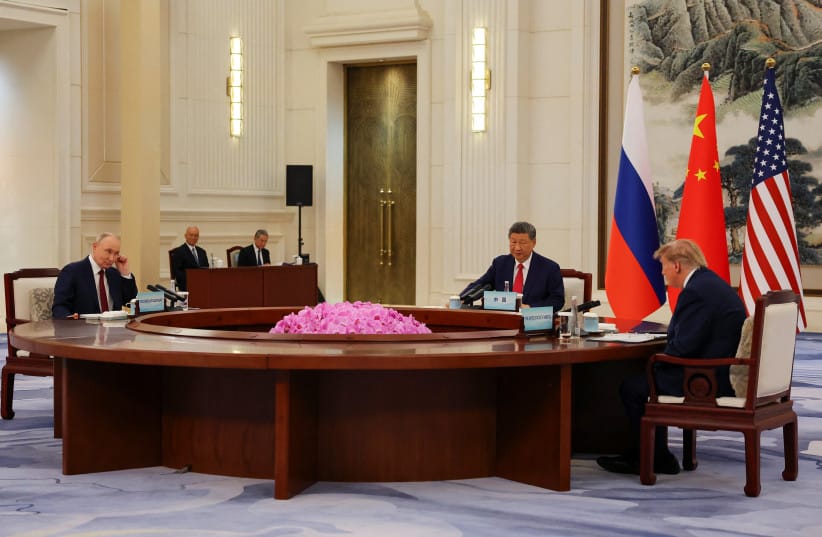
Trump has insisted nuclear arms control be a central topic of the summit, despite China’s repeated objections to joining talks with Washington and Moscow, which have far larger nuclear arsenals.
“It’s not an easy thing to do – give them up,” Trump told Xi and Putin at the start of their meeting.
The trilateral is unlikely to produce major agreements, analysts say, given big differences over Ukraine, Iran, nuclear weapons and trade. But it has unnerved smaller countries that fear their interests might be disregarded.
Xi welcomes Trump at airport in unprecedented move
Trump hailed the lavish welcome Chinese leader Xi gave him as a “big win” on Thursday, ahead of an unprecedented three-way meeting with Xi and Putin.
Trump met Putin and Xi separately ahead of the trilateral talks, calling the Russian leader a “friend.” The Kremlin said they discussed the war in Ukraine and that Putin left the meeting in an “excellent” mood.
At the start of a lunch meeting with Xi, Trump said the two sides found “balance” in what is now a “fair” trade relationship. Both feel strongly about oil having to flow through the Strait of Hormuz, which has been disrupted by the Iran war, Trump said.
Russia, China and the United States can strengthen global stability if they cooperate constructively, Putin told his Chinese and US counterparts at their trilateral summit in Shenzhen on Thursday.
Putin also said he, Chinese President Xi Jinping and US President Donald Trump should discuss global and regional issues as well as energy security.
Trump, Putin meet, discuss Ukraine war in bilateral talks
Trump and Putin addressed each other on friendly terms at the start of their bilateral talks.
“We’ve had a great relationship for many years. We know each other for a long time, and I think a lot of wonderful things can come out of this, or at least start. But I think they’ll come out of this,” Trump told Putin before the pair held bilateral talks.
Putin and Trump discussed the conflict in Ukraine, bilateral ties and their upcoming joint meeting with Xi, Kremlin aide Yuri Ushakov was quoted as saying by the state-owned TASS news agency.
The leaders also discussed bilateral ties and their upcoming joint meeting with Chinese President Xi Jinping during the Asia-Pacific Economic Cooperation (APEC) summit in China’s southern city of Shenzhen, Ushakov added.
The bilateral meeting went well, and Putin left the talks ‘in an excellent’ mood, Ushakov said.
Earlier, Putin told APEC leaders that Russia is an integral part of the Asia-Pacific region.
He urged nations to use Russian logistics infrastructure and said Moscow was contributing to regional food and energy security.
“I would like to emphasize that constructive partnership with APEC economies is Russia’s strategic course. We are an integral part of the region and make a significant contribution to its economic prosperity,” Putin said.
APEC should set a unifying tone and build a constructive agenda for cooperation, which he said the draft of the group’s final communique aims for, adding that Moscow supports the document.
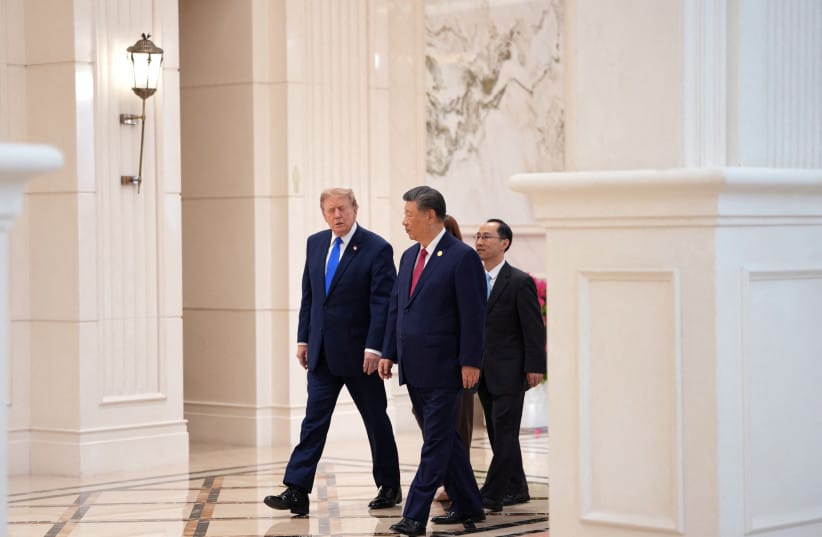
Trump meets with Chinese President Xi
Speaking to Fox News earlier on Thursday, Trump highlighted the pomp surrounding his arrival, which contrasted with the more muted greeting of other leaders, including Putin. Japanese Prime Minister Sanae Takaichi landed without any welcoming ceremony.
Xi greeted Trump at the airport, the first time he has done so with any visiting leader since becoming president, reciprocating his counterpart’s gesture at Joint Base Andrews in September when they last met. The leaders also briefly hugged.
“This is a great president, one of the great presidents of China, and he’s never gone to the airport to meet somebody,” Trump said, when asked what he wanted to get out of the trilateral.
“And not only that, the fanfare, the beauty, the pageantry, the thousands of people, the young children, the soldiers, the whole thing. It was great respect, and I appreciate that. That’s a big win for us. It’s a big win for China too.”
Trump arrived after Xi and Putin delivered pointed speeches at an Asia-Pacific Economic Cooperation summit in China’s southern tech hub of Shenzhen, denouncing Western trade “protectionism” and sanctions.
During Thursday’s APEC proceedings, Xi reiterated his advocacy for what he called “free and open” trade. Western leaders say China’s growth model favoring industrial strength over consumers is unfair and creates destabilizing global trade imbalances.
Trump says Board of Trade has brought ‘greater balance’ to US-China ties
Trump said that the Board of Trade that he and Chinese President Xi Jinping agreed to form at their summit in Beijing in May had brought “greater balance to a very lopsided relationship” between the two countries.
Advertisement
Trump made his comments at the start of a meeting with Xi during the APEC summit in China and said the US and China had split their tariffs in a fair way.
“We have split up the tariffs and cut it in a very fair way,” Trump said in his comments.
“The original relationship with China was very lopsided,” he said, while criticizing past US leaders.
Trump has used tariffs as a key tool in foreign and trade policies despite facing legal and judicial setbacks in the US and in spite of criticism from economists and analysts that such an approach risks raising inflation and causing a wider trade war.
US and Chinese officials held the first official meeting of the Board of Trade last Friday.
Trump has insisted nuclear arms control be a central topic of the summit, despite China’s repeated objections to joining talks with Washington and Moscow, which have far larger nuclear arsenals.
“They’re going hot and heavy on building nuclear weapons. I’d love them not to do it,” Trump said of China.
“But when they look at me, and they say, ‘OK, we’ll do it, but will you reduce your nuclear weapons by 2,000 weapons?’ It’s a hard thing to do for me,” he said. “It’s probably hard for them to do also.”
Could Trump meet Kim Jong Un?
The president has also expressed interest in meeting North Korean leader Kim Jong Un, but there was no confirmation of an imminent encounter.
Trump’s Asia trip has offered a chance to showcase US influence, strengthen ties with regional allies and pursue a high-profile diplomatic opening with Xi and Putin.
But the US president will return home facing political challenges, including the fallout from bruising midterm elections, the Nvidia spy scandal and a spate of tech and air travel outages that have rattled Americans.
The diplomatic gathering of the leaders of the world’s largest nuclear powers is unlikely to yield major agreements, however, analysts say, given big differences over Ukraine, Iran, nuclear weapons and trade.
END
Trump, Xi, & Putin Unveil Four-Point “Declaration Toward Peace” After Historic Summit
Thursday, Nov 19, 2026 – 09:24 AM
Summary:
- Four-Point Communiqué Released
- Multipolar World Takes Shape
- Trump, Xi & Putin Meet In Historic Meeting In China
Four-Point Communiqué
Shortly after the historic trilateral talks between Chinese President Xi Jinping, US President Donald Trump, and Russian President Vladimir Putin in China, a four-point communiqué was released, “pledging in rather vague terms to boost the supply of petroleum refined products,” as Bloomberg’s Javier Blas put it.
The communiqué includes a pledge by the US, China, and Russia to boost production and supply of refined petroleum products and preserve stable energy flows.
The energy pledge offered no production targets, implementation timetable, or details on how the three countries would coordinate additional supplies, leaving its potential impact on global fuel markets unclear.
The communiqué also committed the countries to dialogue on reducing nuclear risks and preventing the proliferation of nuclear weapons.
The leaders reaffirmed that “a nuclear war cannot be won and must never be fought,” without announcing specific arms reductions.
Here are the four points:
- As permanent members of the United Nations Security Council, China, Russia, and the United States committed to reform the U.N. so that the U.N. can respond more effectively to global challenges and conform to its fundamental mission of international peace and security.
- The three countries plan to increase the production and supply of refined petroleum products for the benefit of all nations. They reaffirmed the importance of stable energy flows.
- The three heads of state recognized that the principle of state consent and respect for immunities of State officials are of paramount importance, and concurred that the International Criminal Court and other similar bodies must not abuse their jurisdiction.
- The three heads of state reaffirmed that a nuclear war cannot be won and must never be fought. The three countries will conduct dialogue on reducing nuclear risks and preventing the proliferation of nuclear weapons.
Blas concluded, “(FWIW: the US is maxed out; China can do more but only if it buys more crude; Russia is limited by the war in Ukraine).”
Trump, Xi, & Putin Hold First-Ever Trilateral Summit As A Multipolar World Takes Shape
The APEC summit in China entered day two today, bringing together Chinese President Xi Jinping, US President Donald Trump, and Russian President Vladimir Putin for historic trilateral talks that found common ground on several points, including increasing fuel supplies, stable energy flows, and, of course, avoiding World War III.
Trump boasted about the trilateral meeting with Xi and Putin, saying the leaders of three nuclear superpowers sitting together in a room and talking through their differences were “really making history.”
Xi described his meeting with Trump as “positive and constructive” and signaled efforts to preserve the trade truce already in place between the world’s two largest economies, despite the US federal government’s clampdown on Nvidia AI chips flowing into China via shell companies in surrounding countries.
According to a Chinese government readout, Trump and Xi agreed to build a “constructive relationship” of strategic stability and an action plan to stabilize relations, and called for greater cooperation on AI safety and drug controls.
“Any disagreements that cannot be resolved immediately should be managed constructively to prevent conflicts from escalating,” Xi said, according to the statement.
We pointed out that this trilateral meeting of the world’s nuclear superpowers could mark the dawn of a new era, one in which a new multipolar world is born. This has certainly alarmed Europe and other world capitals as concerns mount about carving up hemispheres.
China’s readout, however, did omit the latest US chip restrictions, which limit Beijing’s ability to train frontier AI models. That omission could be a flashpoint and risk retaliation by Beijing.
On Taiwan, Beijing said Trump reaffirmed that the US doesn’t support the island’s independence.
The discussions also covered Ukraine and denuclearization, as well as “managing major-power disputes.”
“No peace was ever forged by declining opportunities for engagement and speech,” Trump said. “Together, we are choosing a different course.”
Putin highlighted that the three leaders represent the victorious nations of World War II and must continue preserving of the international legal order established then.
“Our countries have many overlapping interests in resolving regional conflicts, including, of course, the conflict in Ukraine,” Putin said.
One takeaway is that the leaders of the three nuclear powers sat down today to discuss promises to reshape the global order into a multipolar one. 
Hence Trump’s declaration that they were “really making history.”
COVID VACCINE INJURY REPORT: DR MARK CRISPIN MILLER
RABOBANK/MICHAEL EVERY/OR OR PICTON/GIFFIN OR RABOBANK EXECUTIVE/COMMENTARY ON WORLDLY AFFAIRS
7. OIL AND NATURAL GAS/ENERGY COMMENTARIES
8. EMERGING MARKETS//AUSTRALIA NEW ZEALAND ISSUES
VENEZUELA/USA
Democratic Congress Could Delay 500,000 Barrels A Day Of Venezuela’s Oil Comeback
Thursday, Nov 19, 2026 – 06:00 AM
Authored by Rystad Energy via OilPrice.com,
The Democratic victory in the 2026 US midterm elections has given the party control of both chambers of Congress, limiting President Trump’s domestic agenda from January 2027. However, foreign policy remains largely within the president’s remit, as demonstrated by his interventions in Venezuela this year, from the capture of Nicolas Maduro to the reopening of the country’s oil sector. These developments have highlighted how closely Venezuela’s oil recovery is tied to decisions in Washington. However, Rystad Energy’s analysis suggests that Venezuela’s near-term oil recovery is unlikely to be derailed by the latest election result. The bigger risk lies further down the line, as increased congressional scrutiny could delay around 0.5 million bpd of potential production growth until after 2040.
Venezuela’s near-term recovery is being driven primarily by brownfield activity, including well reactivations, workovers and infill drilling. These projects have shorter lead times and require fewer new approvals, supporting crude production growth from approximately 1.2 million bpd in October 2026 to around 1.5 million bpd by 2028, an increase of roughly 300,000 bpd. Sanctions implementation and licensing by the US Treasury’s Office of Foreign Assets Control (OFAC) also remain largely under executive control, limiting what a Democratic Congress can change directly.
The picture becomes less certain further out, as growth increasingly depends on greenfield developments, larger investment commitments and the operators selected to deliver them. Rystad Energy’s existing upside scenario sees Venezuelan production approaching 3 million bpd by 2040, assuming stronger prices and continued policy support. A new sensitivity following the midterm result suggests greater congressional scrutiny could delay selected greenfield projects by one to three years, pushing around 0.5 million bpd of potential 2040 production further out. The impact is concentrated in longer-cycle projects rather than the brownfield-led recovery expected over the next few years.
However, that growth will be harder to deliver if political scrutiny delays or challenges operators’ ability to develop their assets. North American Blue Energy Partners (NABEP) is a case in point. Its three production participation contracts have lifted combined output from roughly 90,000 barrels per day (bpd) at the end of 2024 to nearly 200,000 bpd currently, led by Petrozamora. The company is already facing questions from Democratic lawmakers over its selection and the legal basis for its agreements, raising broader questions about Venezuela’s operating environment and its ability to attract investment to sustain longer-term recovery.
Greater scrutiny doesn’t change Venezuela’s underlying resource potential. Most of the near-term recovery involves bringing existing wells back online, which doesn’t require congressional approval, so I wouldn’t expect the midterms to slow that down. The bigger risk is to greenfield projects, which could be delayed by several years. The oil isn’t going anywhere, but it may take longer to reach the market. ExxonMobil’s recently announced MOU with PDVSA remains at an early stage, with no committed capital or development timetable yet disclosed; this suggests interest in unlocking Venezuela’s petroleum potential rather than any concrete investment commitments. A longer-term complication, however, is Venezuela’s own election. A new government could revisit the contracts signed under the interim administration, creating uncertainty for projects that require 10 to 20 years of political and regulatory stability,”
Radhika Bansal, Senior Vice President, Upstream Research, Rystad Energy.
The political reset in January has also reshaped Venezuela’s oil export patterns, with a much larger share of the country’s crude now heading to the US and India. Together, the two countries accounted for around three-quarters of Venezuelan crude exports over the period shown. India, in particular, presents an opportunity for Venezuela to regain market share from Russia, which has become a major supplier of crude oil to the country since the outbreak of the war in Ukraine.
At the same time, US policy continues to place greater pressure on buyers of Russian crude than on those purchasing Venezuelan oil. However, the change isn’t like-for-like as Venezuela’s main export grade, Merey, is a heavy, high-sulfur crude that is significantly thicker and more difficult to process than Russian Urals. It requires specialized refinery equipment to turn it into usable fuels, meaning only India’s more complex refineries can readily absorb additional volumes. Higher shipping costs to Asia also make Venezuelan crude less competitive when Russian Urals is available at steep discounts.
Ultimately, Venezuela’s ability to capture a larger share of India’s imports will depend on both commercial economics and US policy. If Washington continues to apply greater pressure on Russian crude buyers while allowing Venezuelan trade to expand, Venezuela could gain a competitive advantage. However, differences in crude quality, refinery compatibility and freight costs mean it is unlikely to replace Russian barrels one-for-one. For the US midterms, the key point is that the election result is unlikely to disrupt Venezuelan exports in the near term, as any change in congressional control would not automatically alter existing trade flows or the current policy framework.
From a geopolitical perspective, Venezuela’s next election could become an increasingly important signpost for oil markets. No date has been agreed, although Washington has outlined a transition roadmap involving reforms to the judiciary and electoral authorities, followed by the declaration of a presidential vacancy and new elections. A Democratic victory in the US midterms could increase pressure on Trump to accelerate this process. Democrats have already questioned the lack of a clear democratic roadmap and could use congressional hearings, funding negotiations and oversight powers to demand firmer commitments. While their ability to dictate Venezuela’s electoral calendar remains limited, they could raise the political cost of delaying the transition.
President Trump, however, faces a dilemma: holding elections sooner would allow him to claim credit for restoring democracy in Venezuela and bolster his foreign policy legacy, but could also put existing oil agreements at risk. A newly elected government could revisit deals reached with interim Venezuelan President Delcy Rodríguez, creating uncertainty for investors and potentially delaying planned projects. Allowing more time for economic recovery and investment before holding elections may therefore suit the Trump administration, particularly if it gives existing commercial arrangements time to take hold before a new government comes to power.
U.S./GOLD AND SILVER PRICING/ASIAN CLOSING MARKETS AND EUROPEAN BOURSE OPENING AND CLOSING/ INTEREST RATE SETTINGS THURSDAY MORNING 6;30AM//OPENING AND CLOSING\
OPENING LEVELS OF CURRENCIES// AND CLOSING ASIAN STOCK MARKET AND OPENING EUROPEAN STOCKS:6 AM EST
EURO VS USA DOLLAR: 1.1004 UP 0.0032
USA/ YEN 159.92 UP 0.532 NOW TARGETS INTEREST RATE AT 1.75% AS IT WILL BUY UNLIMITED BONDS TO GETS TO THAT LEVEL…//YEN STILL FALLS//END OF YEN CARRY TRADE BEGINS AGAIN DEC 2024/Bank of Japan raises rates by .25% TO 1.75 ..TAKAICHI NEW PM AS YIELDS RISE//JAPAN DEEPLY IN TROUBLE WITH RISING RATES AND A FALLING YEN!! BANK OF JAPAN WILL NO LONGER DO QE. URGES PENSION AND INSUANCE FUNDS TO BUY JAPANESE BONDS//
YEN CARRY TRADERS MURDERED
GBP/USA 1.3164 UP 0.0013 OR 13 BASIS PTS
USA/CAN DOLLAR: 1.4303 UDOWN0.0028 //CDN DOLLAR UP 28 BASIS PTS//
Last night Shanghai COMPOSITE CLOSED DOWN 10.26 PTS OR 0.28%
Hang Seng CLOSED DOWN 453.13 PTS OR 1.95%
AUSTRALIA CLOSED DOWN 0.57%
// EUROPEAN BOURSE: ALL MOSTLY GREEN
Trading from Europe and ASIA
I) EUROPEAN BOURSES: ALL MOSTLY GREEN
2/ CHINESE BOURSES / :Hang SENG CLOSED DOWN 453.13 PTS OR 1.95%
/SHANGHAI CLOSED DOWN 10.26 PTS OR 0.28%
AUSTRALIA BOURSE CLOSED DOWN 0.57%
(Nikkei (Japan) CLOSED UP 517.72 OR 0.88%
INDIA’S SENSEX IN THE GREEN
Gold very early morning trading: $3731.50
silver:$45.22
USA DOLLAR VS TRY (TURKISH LIRA): 50.47 UP 3 BASIS PTS AND NOW WE SEE THEIR STUPIDITY OF SELLING SOME OF THEIR GOLD AND ALL OF THEIR USA DOLLAR RESERVES. THE COUNTRY IS IN BIG FINANCIAL TROUBLE
USA DOLLAR VS RUSSIAN ROUBLE: 81.86 ROUBLE// UP 0 ROUBLE AND 54 BASIS PTS.
UK 10 YR BOND YIELD: 5.3132 UP 2 BASIS PTS
UK 30 YR BOND YIELD: 5.7576 UP 2 BASIS PTS
FRENCH OAT 10 YR BOND YIELD: 4.886 DOWN 1 BASIS PTS.
CDN 10 YR BOND YIELD: 3.802 DOWN 2 BASIS PTS
CDN 5 YR BOND YIELD; 3.530 DOWN 2 BASIS PTS
USA dollar index early THURSDAY MORNING: 103.55 DOWN 23 BASIS POINTS FROM WEDNESDAY’s CLOSES
THURSDAY MORNING NUMBERS ENDS
And now your closing THURSDAY NUMBERS 10.00 AM
Portuguese 10 year bond yield: 3.8330 % UP 1 in basis point(s) yield
JAPANESE BOND 10 yr YIELD: +2.828% DOWN 6 FULL POINTS BASIS POINTS /JAPAN losing control of its yield curve/
JAPAN 30 YR: 4.004 DOWN 5 BASIS PTS//
SPANISH 10 YR BOND YIELD: 3.9670 UP 1 in basis points yield
ITALY 10 YR BOND: 4.4540 UP 1 points in basis points yield ./
GERMAN 10 YR BOND YIELD: 3.3881 UP 1 BASIS PTS
IMPORTANT CURRENCY CLOSES : MID DAY WEDNESDAY
Closing currency crosses for day /USA DOLLAR INDEX/USA 10 YR BOND YIELD/10:00 AM
Euro/USA 1.0982 UP 0.0012 OR 12 basis points
USA/Japan: 159.73 UP 0.347 OR YEN IS DOWN 35 BASIS PTS// HIGHLY INFLATIONARY TO JAPAN
Great Britain 10 YR RATE 5.2976 DOWN 1 BASIS POINTS //
GREAT BRITAIN 30 YR BOND; 5.7436 DOWN 2 BASIS POINTS.
FRANCE 10 YR: 4.905 UP 3 BASIS PTS
USA DOLLAR/VS CANADIAN DOLLAR UP 0.0010 BASIS PTS TO 1.4320 CDN DOLLAR DOWN 11 BASIS PTS
xxxxxxxxxxxxxxxxxxxxxxxxxxxxxxxxxxxxxxxxxxxxxxxxxxxxxxxxxxxxxxxxxxxxxxxxxxxxxxxx
The USA/Yuan CNY 6.6667 ON SHORE ..UP
THE USA/YUAN OFFSHORE// CNH UP TO 6.66692
TURKISH LIRA: 50.47 UP 3 EXTREMELY DANGEROUS LEVEL/DEATH WATCH/HYPERINFLATION TO BEGIN.//
Your closing 10 yr US bond yield DOWN 1 in basis points from WEDNESDAY at 5.056 % //trading well ABOVE the resistance level of 2.27-2.32%)
USA 30 yr bond yield 5.406 DOWN 1 basis points /10:00 AM
USA 2 YR BOND YIELD: 4.798 DOWN 1 BASIS PTS.
GOLD AT 9;00 AM $3685.80
SILVER AT 9;00: $44.64
Your 11:00 AM bourses for Europe and the Dow along with the USA dollar index closing and interest rates THURSDAY
DAY CLOSING TIME/ 12:00 AM///
London: CLOSED DOWN 98.49 PTS OR 0.93%
GERMAN DAX: CLOSED DOWN 66.09 PTS OR 0.81%
FRANCE: DOWN 66.09 OR 0.81%
Spain IBEX CLOSED DOWN 187,10 PTS OR 0.97 %
Italian MIB: CLOSED DOWN 232.42 PTS OR 0.46%
WTI Oil price 84.32
Brent Oil: 92.25 10;00 EST
USA DOLLAR INDEX: 103.76 OR DOWN 3 PTS
USA /RUSSIAN ROUBLE: 82.05/ ROUBLE UP 0 AND 33 100
CDN 10 YEAR RATE: 3.807 DOWN 2 BASIS PTS.
CDN 5 YEAR RATE: 3.528 DOWN 2 BASIS PTS
CLOSING NUMBERS: 4 PM//
Euro vs USA 1.0975 UP 0.0003 OR 3 BASIS POINTS//
British Pound: 1.3098 DOWN 0.0047 OR 47 basis pts/
BRITISH 10 YR GILT BOND YIELD: 5.3207 UP 2 FULL BASIS PTS//
BRITISH 30 YR BOND YIELD: 5.8198 UP 7 IN BASIS PTS.
FRENCH 10 YR BOND: 4.949% UP 8 BASIS PTS
JAPAN 10 YR YIELD: 2.8213 % DOWN 2 FULL BASIS PTS (DANGEROUS TO THEIR ECONOMY
JAPANESE 30 YR BOND: 4.001 DOWN 5 PTS AND STILL VERY DANGEROUS TO THEIR ECONOMY
USA dollar vs Japanese Yen: 159.69 UP 0.305 OR YEN DOWN 30 BASIS PTS//GETTING FURTHER AWAY FROM 160.00/ EXTREMELY DANGEROUS
USA dollar vs Canadian dollar: 1.4340 UP 0.0009 PTS// CDN DOLLAR DOWN 9 BASIS PTS
West Texas intermediate oil: 83.77
Brent OIL: 92.23
USA 10 yr bond yield DOWN 2 BASIS pts to 5.048%
USA 30 yr bond yield: DOWN 2 PTS to 5.397%
USA 2 YR BOND 4.774 DOWN 3 PTS
CDN 10 YR RATE 3.814 UP 2 BASIS PTS
CDN 5 YEAR RATE: 3.532 UP 2 BASIS PTS
USA dollar index: 103.85 UP 5 BASIS POINTS
USA DOLLAR VS TURKISH LIRA: 50.46 UP 2 BASIS PTS GETTING QUITE CLOSE TO BLOWING UP/IDIOTS SOLD GOLD
USA DOLLAR VS RUSSIA//// ROUBLE: 82.165 UP 0 AND 22 /100 roubles //
GOLD $3668.50 3:30 PM)
SILVER: 44.03 3;30 PM)
DOW JONES INDUSTRIAL AVERAGE: DOWN 1100.40 POINTS OR 2.19%
NASDAQ 100 UP 599.21 PTS OR 2.21 %
VOLATILITY INDEX 28.16 UP 3.60 PTS OR 1.466%
GLD: $ 335.18DOWN 6.01 PTS OR 1.76%
SLV/ 39.64 PTS DOWN 1.07 OR 4.62%
TORONTO STOCK INDEX// TSX INDEX: CLOSED DOWN 578.57 PTS OR 1.67%
END
end
TRADING today ZEROHEDGE 4 PM: HEADLINE NEWS/TRADING
Markets Gag On Biggest IPO Of All Time; Dollar & Bonds Bid As Tech Wrecks
US stocks were pressured with the major indices dropping over 2%, while Anthropic surges on its debut – Newsquawk Daily Asia-Pac Market Open
Thursday, Nov 19, 2026 – 05:11 PM
- US stocks ultimately finished lower on Thursday despite the pre-market optimism surrounding the Anthropic (ANT) IPO, which was met with strong demand. Anthropic shares opened at USD 111.50/shr, well above the USD 83/shr IPO price, although subsequently tumbled from their post-IPO peaks to below USD 100/shr. Nonetheless, shares still closed above their IPO price. Meanwhile, AMD (AMD) shares tumbled, further weighing on sentiment following a short report from Hunterbrook, which suggested AMD has its own China-related issues and questioned whether the company is a safer alternative to Nvidia (NVDA). The Anthropic IPO and weakness in AMD were key drivers of cross-asset price action, with T-notes settling higher across the curve amid a flight-to-quality bid. Additional support for Treasuries came from softer-than-expected US economic data, with jobless claims exceeding forecasts and the Philly Fed manufacturing survey disappointing.
- USD was firmer against most peers alongside the broader risk-off sentiment and as a continued drop in the precious metals space weighed on commodity currencies. Anthropic’s IPO was met with strong demand, though optimism faded after the open, weighing on equity indices and driving haven demand for the dollar and US Treasuries. Despite recent US data and Fed speak leaning hot, AI growth has become a key theme in the FX space, and given that today’s sell-off extended across all sectors and internationally, the dollar was able to benefit. Datawise, US initial jobless claims rose more than expected, and regional data was mixed (Philly missed, Kansas beat), while there were also several Fed comments, with Goolsbee noting that inflation is well above the Fed’s 2% target, pointing to very strong consumer demand.
- Looking ahead, highlights include Japanese National CPI, New Zealand Credit Card Spending, UK GFK Consumer Confidence, PBoC Loan Prime Rate, Supply from Japan.
More Newsquawk in 2 steps:
1. Subscribe to the free premarket movers reports
2. Trial Newsquawk’s premium real-time audio news squawk box for 7 days
LOOKING AHEAD
- Highlights include Japanese National CPI, New Zealand Credit Card Spending, UK GFK Consumer Confidence, PBoC Loan Prime Rate, Supply from Japan.
- Click for the Newsquawk Week Ahead.
IRAN CONFLICT
- US President Trump said he was in no rush to make a decision on Iran, adding that any attack would be conducted in cooperation with Israel and could target nuclear facilities, infrastructure and senior officials, according to Channel 12.
- US President Trump said he was not rushing into a decision on Iran and that developments would become clearer after the beginning of the year, according to Axios. Mossad Director Gofman visited Washington and Miami last week for talks with CIA Director Ratcliffe and White House envoy Witkoff, while he was sent to press for a resumption of military action against Iran, according to an Israeli source.
- US President Trump is considering launching another attack on Iran, according to N12 TV.
- White House officials have asked the Pentagon and intelligence experts to assess how Iran could respond to each of the strike scenarios prepared by the US military, according to Axios, citing sources. White House has also asked whether any of the options could avoid triggering a major Iranian retaliation against oil and gas facilities in Gulf countries.
- US State Department issued a travel advisory for Kuwait, urging Americans in the Middle East to exercise heightened vigilance amid an increased threat of armed attacks by Iranian-backed Houthis.
- US Embassy in Riyadh denied claims circulating online that the diplomatic mission had been hit by a drone strike.
- US remains interested in building up its military presence to the maximum ahead of US President Trump’s decision, including deploying aircraft carriers and B-2 and B-52 bombers, according to i24NEWS, citing an Israeli security source.
- US Senate rejected a House-passed resolution to curb President Trump’s power to strike Iran by 48-51 votes, according to CBS.
- Iranians have reportedly become significantly more aggressive in recent days, with cruise missiles being used against ships transiting the Strait of Hormuz, according to i24 News, citing sources.
- Iranian Foreign Ministry spokesperson Baghaei said US officials’ claim of “signs of chemical and biological weapons development” by Iran is a repetition of the old pattern of “lying to scare public opinion and justify war and aggression”, according to Tasnim.
- IRGC said the Strait of Hormuz would not be reopened until Iran’s seven conditions were met, and the nuclear issue would not be addressed until the Strait of Hormuz dispute was resolved, while Iran would not accept the continuation of the sea, land and air blockade imposed on the country.
- IRGC spokesperson said Iran could target US military bases in Europe if instructed by its leadership, claiming Tehran had demonstrated a missile range of 4,500km, according to SNN.
- Iranian Brigadier General Mohebbi warned that Iran would target any military base used to launch US attacks against it, irrespective of the country hosting the facility, according to Al Alam. He added that any oil tanker crossing the Strait of Hormuz illegally would be targeted.
- Another violating tanker caught fire in the restricted area east of the Strait of Hormuz after hitting a naval mine and was stopped, according to SNN, while the IRGC Navy claimed that two supertankers carrying over 4mln barrels of crude struck naval mines and exploded while attempting to transit a restricted route in the Strait of Hormuz.
- Saudi Civil Defence said a tower in Riyadh’s financial district had been targeted in an attack attributed to the Houthis, resulting in material damage but no injuries.
- Houthis said they had carried out four military operations, including one targeting the financial centre, and warned it would remain a target as long as Saudi Arabia continued its actions against them.
US TRADE
- US stocks ultimately finished lower on Thursday despite the pre-market optimism surrounding the Anthropic (ANT) IPO, which was met with strong demand. Anthropic shares opened at USD 111.50/shr, well above the USD 83/shr IPO price, although subsequently tumbled from their post-IPO peaks to below USD 100/shr. Nonetheless, shares still closed above their IPO price. Meanwhile, AMD (AMD) shares tumbled, further weighing on sentiment following a short report from Hunterbrook, which suggested AMD has its own China-related issues and questioned whether the company is a safer alternative to Nvidia (NVDA). The Anthropic IPO and weakness in AMD were key drivers of cross-asset price action, with T-notes settling higher across the curve amid a flight-to-quality bid. Additional support for Treasuries came from softer-than-expected US economic data, with jobless claims exceeding forecasts and the Philly Fed manufacturing survey disappointing.
- SPX -2.02% at 7,175, NDX -2.21% at 26,517, DJI -2.19% at 49,098, RUT -1.84% at 2,664.
- Click here for a detailed summary.
TARIFFS/TRADE
- US President Trump rated his meeting with Chinese President Xi and Russian President Putin 12 out of 10, describing it as a success and saying they had built “fantastic relationships”. Trump said he discussed ‘super intelligence’ with Xi and that both leaders agreed minimal safeguards would be beneficial, although they did not define what those safeguards would involve.
- US President Trump said he had spoken to Chinese President Xi about purchasing more US agricultural products, although he was less certain whether Xi had agreed to increase soybean purchases.
- US President Trump said China is buying a lot of the soybeans, corn and agricultural products, while he thinks they are going to have a very substantial increase in that for the farmers, according to NBC.
- China’s Commerce Ministry said Chinese and US trade teams remained in contact at all levels, adding that the China-US Trade Council’s agricultural working group would hold its first meeting soon. MOFCOM also expressed strong concern and firm opposition to recent US economic and trade restrictions targeting China, and called on Washington to work towards common goals and strengthen communication.
- Mexican President Sheinbaum said her meeting with US President Trump had been “very good” and that the two would meet again in March.
- Canada is aiming for an interim trade arrangement with the US by year-end, according to CBC citing sources.
- TSMC (2330 TT) and Samsung Electronics (005930 KS) have suspended shipments of certain chips to Chinese customers while seeking US export licences under new restrictions, according to the FT.
NOTABLE HEADLINES
- Fed’s Jefferson (voter) said he was not interested in changing the inflation target.
- Fed’s Barr said AI could expand access to financial services and he is worried the path of regulation could make it harder to understand financial risks, while he is more focused on longer-term issues with bank regulations.
- Fed’s Goolsbee (2027 voter) said the labour market was stable, but inflation remained “way higher” than the Fed’s 2% target, while he added that consumer demand had been very strong and solid. He was concerned that the inflationary impact of tariffs had proved more persistent than expected. Goolsbee said AI appeared promising as a productivity driver, but the Fed’s immediate responsibility was to assess whether the economy was overheating and prevent the AI surge from contributing to excessive economic activity. He added that the labour market was currently stable and that the Fed’s failure had been on inflation.
- Fed’s Goolsbee (2027 voter) said he doesn’t see inflation on a path back to 2% at this point, as it isn’t just coming from oil and tariff shocks but has a sizeable demand component, while he added that inflation has proved far more persistent than thought in 2025, with data centre demand and AI-related wealth effects adding to it. Goolsbee said it has not been good news on inflation over the past few months and that the steepness of the rate path will depend on whether ‘borderline disturbingly high’ inflation is seen returning to the Fed’s 2% target. Furthermore, he stated that what is happening with services inflation is key to understanding whether price pressures stem from demand or from things like energy costs and is not concerned about wages pushing up inflation at this point.
DATA RECAP
- US Philadelphia Fed Manufacturing Index (Nov) 6.3 vs. Exp. 20 (Prev. 20.9)
- US Philly Fed New Orders (Nov) -0.4 (Prev. 4.3)
- US Philly Fed Prices Paid (Nov) 58.20 (Prev. 43.20)
- US Philly Fed Business Conditions (Nov) 33.6 (Prev. 33.0)
- US Philly Fed Employment (Nov) 11.6 (Prev. 9.1)
- US Kansas Fed Manufacturing Index (Nov) 23 (Prev. 16)
- US Kansas Fed Composite Index (Nov) 18 (Prev. 11)
- US Initial Jobless Claims (Nov/14) 203.0K vs. Exp. 197K (Prev. 202.0K)
- US Continuing Jobless Claims (Nov/07) 1763K vs. Exp. 1710K (Prev. 1693K)
FX
- USD was firmer against most peers alongside the broader risk-off sentiment and as a continued drop in the precious metals space weighed on commodity currencies. Anthropic’s IPO was met with strong demand, though optimism faded after the open, weighing on equity indices and driving haven demand for the dollar and US Treasuries. Despite recent US data and Fed speak leaning hot, AI growth has become a key theme in the FX space, and given that today’s sell-off extended across all sectors and internationally, the dollar was able to benefit. Datawise, US initial jobless claims rose more than expected, and regional data was mixed (Philly missed, Kansas beat), while there were also several Fed comments, with Goolsbee noting that inflation is well above the Fed’s 2% target, pointing to very strong consumer demand.
- EUR was flat after failing to sustain early upward momentum and a brief reclaim of the 1.1000 handle.
- GBP weakened and eventually retreated to sub-1.3100 territory, despite BoE officials suggesting the need to act to address inflation, while participants look ahead to UK Retail Sales on Friday.
- JPY was pressured but with USD/JPY off intraday highs after stalling just shy of the 160.00 level.
- South African Interest Rate Decision 7.25% vs. Exp. 7.25% (Prev. 7.25%); split decision (4-3), with the three dissenters voting for a 25bps hike.
FIXED INCOME
- T-notes settled marginally higher and yields ultimately lower following choppy risk sentiment, Anthropic’s IPO and soft US data.
COMMODITIES
- Oil prices settled flat, albeit in choppy trade as Middle East tensions showed no sign of abating.
- US Energy Secretary Wright said Washington was considering increasing diesel and oil exports to Europe.
GEOPOLITICAL
RUSSIA-UKRAINE
- Ukrainian President Zelensky said the next round of negotiations with Russia must include Europe.
- US President Trump expressed optimism about prospects for peace following talks with Russian President Putin and told other leaders that Ukraine had been discussed, according to sources. Trump said he would not make a decision on Ukraine without Ukrainian President Zelensky.
- US envoys Kushner and Witkoff held productive talks with German Chancellor Merz on efforts to secure peace in Ukraine.
- US envoy Kushner said US President Trump had left the Shenzhen meeting believing peace was achievable and remained open to security guarantees. He noted significant progress on the post-war prosperity plan and said Russia had agreed to engage in a multilateral format with European countries. Trump wanted to reach an agreement with Europe alongside the US.
- US Special Envoy Kushner said an Article Five-like security guarantee would represent a significant commitment and was something US President Trump was open to, although it would need to serve US interests.
- Russian President Putin said Russia would retaliate against attacks on the Crimean Bridge, according to Interfax, adding that Russia had not transported petroleum products across the bridge. He said he had discussed the possibility of ceasefires in several areas with the Russian Security Council but would not pursue negotiations following the attacks on the bridge. Russia remained ready to seek compromises on the European security system, while attempts to pressure Moscow over territorial issues were pointless. Putin added that no decision had been made on attending the G20 and that he would consider the matter.
- Leaders of Germany, France, the UK and Ukraine stressed in a joint statement that Ukraine must have robust, legally binding security guarantees in place once a ceasefire takes effect, while the leaders urged Russia to agree to an energy ceasefire for the winter as a first step towards ending hostilities.
OTHER
- Chinese President Xi, US President Trump and Russian President Putin issued a joint peace declaration, according to CCTV. The three countries reaffirmed the importance of maintaining stable energy flows and planned to increase the production and supply of refined petroleum products.
- China, the US and Russia reaffirmed the importance of maintaining stable energy flows in a joint peace declaration, while they plan to increase the production and supply of refined petroleum products under their joint peace declaration. Furthermore, they agreed to hold talks on reducing nuclear risks and preventing nuclear proliferation under their joint peace declaration, as well as reiterated that nuclear war cannot be won and must never be fought.
- Chinese President Xi said China, the US and Russia could strengthen coordination to safeguard the stability of global energy supply chains. He added that nuclear war could not be won and must not be fought, and every effort should be made to prevent it. Xi called on the US to abandon its Cold War mentality and avoid pursuing decoupling and supply-chain disruption, while urging Washington to encourage parties involved in conflicts to pursue political solutions through dialogue.
- US President Trump said the three countries should work together to safeguard peace and stability, adding that they had already discussed a wide range of issues. He said reducing nuclear weapons was an option for discussion, although giving them up would not be easy, and stressed the importance of cooperation to address nuclear proliferation risks.
- US President Trump said a deal to limit nuclear weapons will be difficult to reach, but he will keep working on it, following discussions with Chinese President Xi and Russian President Putin that giving up nuclear weapons is psychologically hard.
ASIA-PAC
NOTABLE HEADLINES
- Chinese Foreign Minister said the China-US-Russia summit had established a new framework for direct engagement between the three leaders.
- US President Trump said he did not discuss Nvidia (NVDA) or the alleged Chinese spy much with Chinese President Xi, but did talk about AI, according to Fox News. Trump stated, “We both want regulations, moderate regulations for safety purposes, and we’re going to work together on reasonable regulations.”
- US House Foreign Affairs Committee Chairman Mast moved to disclose Nvidia (NVDA) China export control licence information, revealing Nvidia and AMD (AMD) AI chip licences for China, according to a statement.
- US House committee report called for sweeping restrictions on China’s aerospace sector, potentially affecting Airbus (AIR FP) and French aerospace companies.
- FCC voted to prohibit Chinese telecommunications companies from having direct access to US phone numbers.
- At least six Chinese universities on the US blacklist have reported purchasing restricted Nvidia (NVDA) chips in recent years, according to CNN, citing a review of business records. The purchases were made through lesser-known sellers in China and involved relatively small quantities of older chips rather than advanced industrial computing technology.
EU/UK
NOTABLE HEADLINES
- UK and EU have provisionally agreed to cap a post-Brexit youth mobility visa scheme at 100,000 places for people under 32, according to The i Paper. The agreement was reached at negotiator level but remains subject to approval by EU member states and further negotiations ahead of Friday’s Brussels summit.
- UK-EU Brexit reset negotiations remain deadlocked over food regulations and university tuition fees ahead of Friday’s summit, according to The Guardian.
- BoE’s Greene said there is a duty to anchor elevated inflation expectations and the risk of underacting is bigger than overdoing it, while she added that policy has not been as restrictive as thought.
- BoE’s Lombardelli said the necessary action would be taken to bring inflation back to the 2% target.
- ECB’s Nagel said further interest rate adjustments could be necessary following two hikes, adding that another increase would send a clear signal. Inflation remained challenging, although the situation was not comparable to 2022. He was confident the ECB would achieve its inflation target and saw no wage-price spiral, with the risk of second-round effects considerably lower than in 2022.
- ECB’s Kocher said further rate hikes could be necessary and that any deviation from the 2% inflation target must be temporary.
- ECB’s Moulin said inflation remained too high as oil continued to exert upward pressure. He added that there were no signs of second-round effects yet, although the ECB needed to remain vigilant.
- ECB’s Panetta said policymakers must prevent inflation from becoming entrenched, while ensuring that efforts to contain price pressures did not excessively damage economic growth.
WRAP UP
USA DATA RELEASES
Continuing Jobless Claims Unexpectedly Jump As ‘Low Hire, Low Fire, Low Inspire’ Economy Rolls On
Thursday, Nov 19, 2026 – 08:55 AM
Last week we called it the labor market’s trilemma: claims at 57-year lows, sentiment near record lows and a hires rate stuck at 3.4% (Nov 12). This morning the “low fire” leg finally blinked.
Not by much, but in the wrong direction, and just as the Fed has decided to keep hiking.
In his latest US Daily note, titled “US Daily: Adding A Third Hike” (available to pro subs), Goldman economist David Mericle expects a second 25bp hike in December and a third in March 2027, with the first cut pushed out to December 2027. In other words, Goldman reads these data as a labor market strong enough to tighten into, and a consumer about to pay for it.
Eight Weeks, Not Nine
Start with the headline. Initial jobless claims printed 203K for the week ended Nov 14 against 198K expected, and last week’s 200K was revised up to 202K. The four-week average rose 2,000 to 197,750. We noted last week that 200K made nine straight weeks at or below that line, the first time in a series dating to 1967. With the revision, it is eight.
Keep the scale in view, though. Claims hit 189K in July, the lowest since 1969. A “disappointing” 203K would have been a perfectly good week in 2019, when claims averaged 218K and the best single week was 196K…
The less comfortable number sits in continuing claims. The advance figure for the week ended Nov 7 jumped to 1.763 million, up 70K from a prior week revised down to 1.693 million, and 60K above the 1.703 million consensus. That puts the series back at late-August levels. As we flagged this morning:
To be fair, continuing claims are still about 186K below a year ago, and the insured unemployment rate held at 1.1%. But initial claims have flatlined near 200K while the stock of people still collecting benefits has turned up. Few people are being fired, but those who are take longer to land the next job. That is the “low hire” half of the trilemma showing up in a claims table:
Low Hire: A 5-Sigma Beat On A 48K Trend
The hiring leg is where the headlines mislead. October payrolls rose 165K against a 59K to 70K consensus, and hot payrolls put a December hike back on the table (Nov 6). As we put it on the day:
Goldman’s economists, who were at 75K going in, did the arithmetic on what the beat means for trend growth, as quoted in our trilemma post:
After upward revisions to the two prior months, the three-month average of payroll growth stands at 137k (vs. 51k prior to today’s report), and our estimate of the underlying pace of job growth based on the payroll and household surveys stands at 124k (vs. 51k prior to today’s report). (emphasis ours)
The same note flagged a calendar quirk: October payrolls tend to bounce after a weak September when Labor Day falls late, as it did this year. Strip that out and the 12-month average gain was just 48K before October. Even with the bounce it is only 74K…
The flow data say the same. September JOLTS showed openings jumping to 7.52 million (Nov 3), yet hires held at 3.4%, or about 5.4 million. That matches the 2013 average and sits well below 2019’s 3.9%. The layoffs rate was 1.0%, a tick above the 0.9% record low of 2021. Revelio’s private count was even softer, with just 26K jobs added in October, hiring at 20.9% and attrition at 20.7%, both still near the bottom of its series. Postings fell 2.4% to 18.4 million:
Nobody is leaving, either. The quits rate of 2.1% is barely above 2025’s 2.0% average and well under 2019’s 2.3%:
Under The Headline: Longer Searches, Broader Slack
Beneath a 4.1% unemployment rate, down from 4.2%, the October report was less cheerful. U-6 rose 0.3pp to 7.9% as involuntary part-time work jumped 339K to 4.8 million. Goldman attributes much of the U-6 move to a 171K rise in marginally attached workers, which is the kind of slack that never shows up in a claims table:
The median duration of unemployment hit 11.9 weeks in October, the longest since November 2021, and PNC notes that the share of the unemployed out of work 27 weeks or longer rose to 27.6%, the highest since December 2021. Nobody gets fired, but the people who do stay lost. As Lance Roberts argued in a post we ran last week (Nov 13), “labor hoarding” explains why the earnings boom is not reaching full-time workers, whose share of the working-age population is 49.0%, against 50.6% in 2019:
Low Inspire: 57% Say Prices Are Eating Their Living Standards
Then there is the consumer, who has a job and no joy. UMich sentiment bounced to 51.0 in the November preliminary from 48.0, beating consensus (Nov 6), but it is flat on a year ago, 10% below February’s 56.6 and not far above the record low of 44.8 set in May. The survey’s director, Joanne Hsu, put the problem in one sentence:
About 57% spontaneously mentioned that their living standards have been eroded by high prices, the highest seen since May and up from 46% in February, just prior to the Iran conflict. (emphasis ours)

The “bounce” may also be the high-water mark. Interviews ran from Oct 20 to Nov 2, before the election and before the AI rout that followed, and sentiment already fell 5% among households with the largest stock portfolios amid “growing anxiety over a possible AI bubble.” The final November reading lands tomorrow.
The Conference Board’s Labor Market Indicator has been trending weaker for months…
The wage math explains the mood. Average hourly earnings rose 3.1% from a year ago in October, while the last official CPI reading, September’s, was 3.7%. BLS published no October year-over-year figure because of last year’s shutdown gap, but October CPI ran hot (Nov 10): 0.4% on the month, with core up 0.3% for a third straight month. Nowflation’s own estimate puts the annual rate near 4.0%. Real wages are going backwards, and one-year inflation expectations of 4.3% sit far above February’s 3.4%:
A Hiking Fed Meets A Frozen Market
In the old playbook, weak sentiment and mediocre hiring meant a dovish Fed. Not this one. The funds rate was lifted to 3.75% to 4.00% in September, and after the hot CPI print Goldman’s Mericle went further:
The October CPI report this morning surprised meaningfully to the upside across several categories and marked a third month of worse inflation news. We continue to expect a second 25bp rate hike in December and are adding a third 25bp hike to our forecast in March 2027. (emphasis ours)
The Fed’s own voices are louder still. Governor Christopher Waller told CNBC on Wednesday that a half-point hike is likely necessary at the Dec 8-9 meeting:
“You might need to, like, shock people,” Waller said. “I’m very, very concerned about inflation. It’s kind of headed in the wrong direction, and it’s spreading out.” (emphasis ours)
The October minutes, released Wednesday, showed policymakers confident about hiking in December while collecting more information, and flagged AI as “a material source of inflation risk.” Traders price a 95% chance of a quarter-point hike, per CME FedWatch, with the 2-year at 4.84% and the 10-year at 5.10%. PNC’s Jay Hawkins put it plainly after the last claims report: payrolls plus CPI “all but ensures” a 25bp move. Today’s 203K does nothing to change that. We laid out the squeeze last week:
Bloomberg Economics calls this the “New Labor-Market Norm,” with the subtitle “New Challenge for the Fed.” The challenge is that hikes land on mortgage, auto and card balances held by the same households already telling UMich that prices are eating their living standards.
Bottom Line
Goldman is confident that inflation will be meaningfully lower by the end of 2027 as tariffs, the energy shock and AI price pressures fade. Hikes, in that telling, are the bridge.
Our take: this is a cost-of-living problem wearing a labor-market costume. Claims say recession is not imminent, hiring says stall speed for anyone on the outside, and sentiment says households are poorer. Employed but poorer is not a labor problem. It is a price level, and the Fed’s remedy is to make borrowing dearer for the 57% who are already complaining.
A low-fire market is only reassuring until it isn’t, and claims tend to look their best right before they turn.
We’ll check back after tomorrow’s final UMich print, the November jobs report on Dec 4, and the Fed meeting on Dec 8-9.0-Year Lows”.
USA ECONOMIC REPORTS
Rebellion Against Jeffries Disintegrates In Landslide Speaker Nomination: Will The Same Happen With Schumer?
Thursday, Nov 19, 2026 – 10:05 AM
Two weeks of post-midterm histrionics about a rebellion against House Democratic Party leader Hakeem Jeffries evaporated on Wednesday, as the New Yorker won the House speaker nomination in a lopsided 251-11 vote. The outcome threw cold water on the party’s progressive wing, which had branded Jeffries as just another establishmentarian who’s all too willing to bend to the wishes of big business and keep on funding and arming the State of Israel.
The nomination all but assures he will become the Speaker of the House on January 3, when the 120th Congress convenes and holds a vote. Forever enmeshed in identity-politics, major media outlets emphasized that he will be the first black speaker. In the run-up to Wedneday’s vote, some of Jeffries’ backers had implied that much of the opposition to his speakership sprang from racism, as demonstrated in this exchange on Jake Tapper’s CNN show:
The goofiness of that claim was brilliantly illuminated on Wednesday. Voting for the speaker nomination is conducted via secret ballots, but, of seven members-elect who’ve publicized their votes, six of them are non-white and four are black. That group of seven progressives issued a joint statement after the balloting. “Whether on Medicare for All, stopping ICE terror, getting money out of politics, or ending the genocide in Gaza, our constituents sent us to Congress with a mandate on these issues,” they wrote. They added that they’ve worked to “secure commitments” from Jeffries on those issues, but that “there is still work to be done” and that “our vote in caucus today was no.”
Last week, Jeffries was subjected to serial heckling when he spoke at the What’s Next conference, where Democratic leaders, strategists, and newly elected lawmakers gathered to plan how to use the new majorities and how to position the party for 2028. “YOU’RE A F***ING LIAR!” one man yelled. His and other disruptive tirades accused Jeffries of “being in the pocket of corporations,” “tak[ing] money from private equity” and “shaking hands with the Trump family.”
On Monday, California Democrat Ro Khanna said he would support Jeffries, but told Cenk Uyger that he was thus far disappointed that he and other were unable to secure commitments from Jeffries on two key demands: eliminating military aid to Israel, and killing NDAA Section 219, which, if enacted in the coming weeks, would integrate the United States and Israeli militaries.
In other balloting for House Democratic leadership positions, Massachusetts Rep. Katherine Clark was chosen as Majority Leader, while California Rep. Pete Aguilar will be Majority Whip. California Rep. Ted Lieu will chair the Democratic Caucus.
Now we’ll have to wait to see whether the race for the Senate Majority Leader nomination ends in similarly anticlimactic fashion. In the upper chamber, New York’s Chuck Schumer is squaring off against Maryland’s Chris Van Hollen. According to a New York Times tracker of that contest, 16 Democrats have publicly said they’ll vote for Schumer. Five have endorsed Van Hollen, and another five have called for “change.” The remaining 29 have yet to voice their feelings. It will take 28 votes to win.
BRANDON SMITH…
Get Ready For Surging Inflation As Democrats Take Power
Wednesday, Nov 18, 2026 – 04:20 PM
Authored by Brandon Smith via Alt-Market.us
Pattern recognition is an important mental tool and something that has been largely neglected in western countries in modern times. It’s the ability to identify and address persistent problems when it comes to certain groups and their inherent behaviors. When it comes to the political left, overt inflation and economic decay seem to follow wherever they go.
The “blue wave” data coming out of a number of states is suspicious and unprecedented, to say the least (if a federal investigation is not pending, one should be). But let’s set that debate aside for a moment and assume that the majority of American voters truly did want Democrats to take over multiple states and Congress in order to make changes to the current course of the country.
What does that change actually look like?
Well, one of the primary issues topping the polls was the economy and affordability, but if reducing inflation was the intention behind putting more Democrats in office, then I’m sorry to say that the public will be greatly disappointed. Historically speaking, higher inflation (and higher prices) tend to strike when Democrats take control (and by inflation, I’m referring to all external pressures on CPI, not just money printing by the central bank).
First, we need to address the core complaint on the affordability front, which was oil and gas prices. Higher prices were directly attributed to the Iran War and “supply shortages” from the throttling of the Strait of Hormuz.
A fight has been raging over how legitimate this claim actually is, with numerous independent analysts showing ship traffic returning to the strait and Gulf oil flows going back to normal over the past four months. Satellite tracking data and shipment delivery data indicate that the Hormuz is definitely NOT as big a factor for high prices as the media made it out to be.
In other words, there are no supply shortages. This is not a thing. But then, why did prices remain so high? Critics of the war and the blockade consistently used high prices as “proof” that the situation was not improving (which is backwards – prices lag behind supply changes, they don’t necessarily reflect the current supply).
My position over the past few months has been that high prices actually reflect market speculation (or perhaps manipulation by corporations and foreign buyers). The post midterm plunge showed that I was correct.
Oil immediately and magically plummeted along with pump prices right after the election (a drop of around 10% on average and still falling). Some areas have seen prices slump back below $3 a gallon. This is not possible if supply shortages are a legitmate problem.
Costs were undeniably inflated by speculators, or artificially inflated to stress out the public and encourage a specific outcome at the polls. Democrats are already trying to take credit for the abrupt drop in costs even though they aren’t in office yet. Some leftists argue that prices are dropping because Democrats will “end the war” (it’s unlikely they will have the ability to stop Trump’s blockade).
The fact remains that supply is not an issue. Ships travel the Hormuz regularly, oil is flowing, and Iran has very little influence over gas prices. But does this mean CPI will fall across the board? No, not really.
In fact, inflation is likely to surge in the wake of a Democrat controlled Congress, even if the Fed raises interest rates in December. On average over the past 50 years, CPI has spiked in most cases when Democrats have majority power in government, even when there is a sitting Republican president.
This is because the political left escalates social program spending while restricting domestic industry and production, thus throttling supply instead of meeting market demand. Rate hikes do little against inflation driven by higher production costs. Congress can also block measures that would normally lower costs or increase supply. They don’t need to pass any legislation, all they have to do is derail legislation that would free up the market.
Through state governments, Democrats have even more power to raise costs using bureaucratic red tape. They can strangle business operations, not to mention increase state taxes and raise the minimum wage. All of this translates to higher prices on the shelf and in utilities (For example, California’s gas prices over the past few months have been 60% higher than the national average because of state taxes and left-wing bureaucracy).
Some people will argue that the Trump Administration has been doing the same thing and boosting inflation, specifically through the war and tariffs, but the data shows that, at the very least, prices have stabilized without the Democrats at the helm.
Under Biden, the average CPI was 5% with a peak of 9.1%. Under Trump, the average CPI has been 3% with a peak of 3.7%. Even under Obama in the midst of the deflationary credit collapse, inflation hit a peak of 3.8% (still higher than Trump during his latest term). Neither the tariffs or the war have had a meaningful influence on inflation. In fact, all the fear mongering over tariffs has been completely debunked, with CPI increasing only 0.4%; directly attributed to Trump’s taxation of corporations relying on foreign labor.
The numbers are the numbers. Bluster is bluster. The numbers don’t care about feelings or agendas.
The underlying public motivation during the midterms was to press for lower prices. This is not going to happen now, not without a substantial deflationary crisis which the Trump Administration would immediately be blamed for. It is more likely, though, that Democrats will encourage higher inflation leading into 2028 with the intent to pin rising costs on conservatives.
Inflation is nearly impossible to reverse without vast changes in government policy and the economy to trigger significant credit cuts, spending cuts and supply abundance. No president has the power to do that. Anyone calling for this to happen is looking for a benevolent dictator, not a president.
The biggest problem right now in terms of optics is that the average person just doesn’t understand how inflation works, or why prices skyrocket.
The best we can do under the current system is mitigate the amount of inflation that accumulates. The Trump Administration and conservatives have done a better job of this than Democrats. We just traded a moderate climb for an ACME rocket to the moon. It’s a fact that many refuse to admit, but Dems are an inevitable disaster for the American wallet.
In 2027, look for CPI to ramp up yet again, and watch for the Fed to raise rates to counter, likely to no avail.
Furthermore, watch for continued stock market declines due to state and congressional interference with business development; tech and AI companies being a main target. This has been a key platform of Democrats, but not because they care about the risks associated with AI. Instead, their goal is to remove AI from private hands and give control over to governments and supranational bodies like the UN. They want AI elitism, not basic regulation.
Market declines would no doubt create a conflict of interest for the Fed and spur them to eventually lower rates (or return to QE) as a way to prevent a crash. That is to say, higher inflation is built into the next two years no matter what, and once again Democrats will be a key driver.
The big question is, who will get the blame in 2028? We’ve seen this song and dance before and the establishment will always shift responsibility over to conservatives for all economic troubles. While both sides of government contribute to inflation, it’s fair to ask who is contributing the BULK of that inflation? Watch over the next year as prices rise while Democrats try to claim it’s not their fault, even though they represent the only changing factor in the equation.
We publish a variety of perspectives. Nothing written here is to be construed as representing the views of ZeroHedge.
END
ANTHROPIC//STOCK
Anthropic IPO Prices At $83, Raises A Record $107 Billion… With Its Own Chip Suppliers Holding Up The Floor
Wednesday, Nov 18, 2026 – 06:00 PM
Update: the revised IPO terms were just published by Anthropic, and instead of the 825 million shares offered previously, the new offering is 980 million shares, a 19% increase in the offering size.
Today Anthropic, PBC priced its initial public offering of its Class A common stock at $83.00 per share. The offering consists of 980,000,000 shares of Class A common stock, 956,351,354 of which are being sold by Anthropic and 23,648,646 of which are being sold by certain selling stockholders. Anthropic will not receive any proceeds from the sale of shares by the selling stockholders.
The shares are expected to begin trading on the Nasdaq Global Select Market on November 19, 2026 under the symbol “ANT.” The offering is expected to close on November 20, 2026, subject to the satisfaction of customary closing conditions. In addition, Anthropic has granted the underwriters a 30-day option to purchase up to an additional 147,000,000 shares of its Class A common stock.
And so it’s official: Anthropic is about to be a $1.1 trillion company… or $1.5 trillion fully-diluted company depending – as we noted last week – on who’s counting.
After a week in which the same “above the range” headline hit the tape three days in a row, the Claude maker priced its IPO at $83 a share on Wednesday, $5 above the top of the $70-$78 marketed range, and upsized the deal… and as of 6:40pm we learned by how much: from 825 million to 980 million.
That means the IPO raises at least $81.3 billion and, with the $26 billion vendor placement, more than $107 billion in total, 43% more than SpaceX’s $75 billion base deal in June (or $86.2 billion including the greenshoe); about 4.2x Saudi Aramco, and more than SK Hynix, Aramco, Alibaba and SoftBank combined. The greenshoe would add another $12.2BN, for about $119.5BN!
Shares start trading on the Nasdaq under the ticker ANT on Thursday, with some speculating that the price was set so that the customary post-IPO 20% pop pushes the stock above $100. If doesn’t, or if it closes red… watch out.
Just don’t call it a surprise.
To put the size in context, as Howard Marks pointed out last week, there’s only so much new capital available in a given year: a typical year of US IPOs raises less than $50 billion. Anthropic just raised double that in one night.
The Number(s)
At $83, using the same share bridge we laid out when the range was filed: about 13.20 billion shares outstanding after the deal give an actual market cap of roughly $1.1 trillion, the number an index provider will use, up from $1.08 trillion before the upsizing. Add the 1.77 billion employee options (average strike: $2.91), the 1.07 billion unvested RSUs and the 2.05 billion shares reserved for grants nobody has received yet, and you get the $1.5 trillion fully diluted figure that will lead every headline. 
Either way, it’s a long way from the “$2 trillion or more” that was being whispered in early October: 25% below on a fully diluted basis, 45% below on shares outstanding. It’s also 41% above the $58.90 per share (post-split) that Series H buyers paid in May at a $965 billion post-money, and right around the “$1.5 trillion or more” the FT said bankers were pushing for. 
It’s not just the company selling shares: insiders will become instantly rich too – each of the seven co-founders is selling 3.38 million shares, or about $280 million apiece at $83, roughly $2 billion combined. Not bad for a company whose prospectus warns of “existential risks to humanity.”
Six Times Covered (By Whom?)
The demand story is real, at least on paper. Bloomberg reported the book was “multiple times” oversubscribed within a day of launch, then about six times, with multiple orders of $10 billion or more. Up to 20% of the deal is going to retail, and Vanda Research expects about $250 million of net retail buying on day one, twice what it saw for SpaceX. According to the WSJ, venture backers including Bessemer, Menlo and Accel planned to add to their stakes in the offering rather than sell.
But as we cautioned last Wednesday, oversubscription is a marketing number and guarantees nothing about performance: Klarna and StubHub were both heavily oversubscribed and both broke issue, and Cerebras was about 20x covered. It is now trading at a fraction of its IPO price.
Then there’s the $26 billion of Class N stock going to seven companies at the IPO price: Google and Nvidia ($10 billion each), AMD, Broadcom, Micron, Microsoft and TSMC. Of course, since each one of them also sells Anthropic its chips or cloud, expect that $26 billion to be promptly “circularly refinanced” right back to the companies who “invested it.”. At $83 that’s about 313 million shares, and since Google’s $10 billion funds a commitment it had already made, the “new” money is probably closer to $16 billion (or $0 after payment for chips). Nothing says arm’s-length price discovery like your vendors setting the floor.
And the vendor relationship doesn’t stop at the cap table. Nearly half of Anthropic’s revenue is sold through the hyperscalers’ own cloud marketplaces, which also account for the majority of its receivables:
What $83 Buys You
The bull case boils down to one number: an $81 billion revenue run rate as of Oct. 31, up $10 billion in a single month (it is unclear if Dario is annualizing days now, or has moved on to hours or maybe even minutes for the biggest pig-lipstick boost possible). At $83, buyers are paying 18.4x that run rate fully diluted (13.4x on shares outstanding). At $2 trillion it would have been 25x, which is about the only sense in which this is a bargain.
The rest of the amended S-1 is less flattering, as we detailed when the prospectus dropped and again at launch:
- Q3 revenue rose 47% sequentially to $16.96 billion, down from 144% growth in Q2;
- a $567 million operating loss, one quarter after the first-ever $974 million operating profit, blamed on $5 billion of pricier short-term compute;
- price cuts and discounts shaved about $600 million off Q3 revenue;
- and nearly $901 billion of commitments, mostly compute.
The operating leverage story reversed in a single quarter: total operating expenses climbed back to 103% of revenue, as compute and infrastructure jumped to 58% of sales from 48%…
…which means each dollar of compute bought less revenue for the first time in the series: $1.72 in Q3, down from $2.08.
So much for the first-ever operating profit. One and done, at least for now:
And then there’s the bill. Add up the contractual obligations table, signed leases that haven’t started, post-Sept 30 deals and short-term commitments and you get $895.4 billion of committed spend in the S-1/A, plus an estimated $150-175 billion under deals with no fixed dollar amount. That’s a trillion-dollar tab.
Of that, $69.8 billion is due in the next 12 months, more than Q3’s annualized revenue and roughly 11x nine-month operating cash flow:
Put differently, the roughly $92.5 billion Anthropic will pocket from the IPO and the placement (before the upsize and the greenshoe) covers about 16 months of bills already signed, and about one-tenth of the total. And, as noted above, a good chunk of it goes right back to the same seven companies that just bought the biggest chunk of stock. Even the lead-left bank’s own model (per the FT) sees free cash outflows of $65.7 billion in 2027 and operating losses peaking around $40 billion before turning positive in 2029, on the way to $600 billion of revenue by 2030. Which, well, is a lot of things that have to go right.
Votes Here, Money There
Public buyers at $83 are also buying into the structure we drew up last month: a single Class F share gives the seven founders a fixed 50.1% of the vote, the Long-Term Benefit Trust’s single Class T share picks four of the seven directors, and Class A holders are capped at 49.9% with no practical say over a single board seat. Amazon and Google own up to 12% and 14.99% with zero votes, and every Class N stake converts to Class A the moment it’s sold, with registration rights to match.
Translation: the overhang is built in. On top of the usual lock-up expiries, the Public Benefit Fund gets up to another 2% of the company every time the stock rises 50% from the IPO price, so the first trigger sits at $124.50. In other words, the dilution kicks in precisely when the stock is working.
Making Room For ANT
The deal has already moved markets. As we noted in today’s wrap, desk chatter suggested much of the recent price action was about making room for Anthropic, with gold, crypto, copper and Nvidia all puked to fund allocations. That came on top of Nomura’s Charlie McElligott flagging dealers at their most short gamma since 2019 heading into his NVDA-Anthropic-OpEx “risk quad-fecta.”
As for Thursday’s open, the crypto crowd has already placed its bets: Hyperliquid’s pre-IPO perp traded near $99 on Tuesday, about 19% above tonight’s offer price. Given the book, the retail allocation and the race to launch leveraged ANT ETFs, a first-day pop looks about as close to a sure thing as these things get. What happens after is a different question.
Enter Warren
Washington also weighed in, just in time for pricing. Minutes after the $85 headline, Sen. Elizabeth Warren took aim at the deal, seizing on the same “existential risks to humanity” language from the prospectus that we flagged at launch, and warning about “potential threats to Americans’ retirements and the entire financial system if this IPO goes awry”:
The timing is a little late: the S-1 has been public since Oct. 26 and the books closed Tuesday at 4pm. Funny how the existential risk only became a regulatory emergency a few hours before pricing. Still, the “retirements” angle isn’t entirely wrong: with up to 20% of the deal earmarked for retail and leveraged single-stock ETFs lining up, Main Street will own a lot of this stock very quickly, probably at well above $83.
The Benchmark Nobody Can Ignore
H.C. Wainwright’s Mike Colonnese called a successful Anthropic IPO “an important valuation benchmark for the AI sector,” and he’s right. Peter Thiel’s Jack Selby put the other side bluntly:
“An underperforming Anthropic IPO has to be a very prominent player in what will be a pretty massive correction in the market with respect to AI… just imagine where it’s going to go after the lockups expire.”
Here’s our take. The pop is the easy part: a six-times-covered book, a fifth of the deal in retail hands and a market that sold everything else to make room all but guarantee a strong open. The hard part starts afterwards, when the vendor stakes, the Public Benefit Fund and the lock-up expiries begin feeding supply into a float that just absorbed a record $94 billion, at 18x a run rate whose growth halved last quarter and against a compute bill that runs to the better part of a trillion dollars. Bankers priced this for a pop; the risk is everything after it. We know which way we lean.
Or, as we put it when the $85 whisper hit this afternoon:
We’ll find out at Thursday’s open.
END
Anthropic Opens 34% Above IPO Price, Market Cap Tops $2 Trillion
Thursday, Nov 19, 2026 – 11:50 AM
Summary:
- ANT has opened for trading at $111.50, 34% above the IPO Price
- Anthropic IPO Allocates Nothing to Most Institutional Orders
- Anthropic-Linked Perpetual Futs On Hyperliquid $104
- Anthropic IPO Prices At $83, Raises A Record $107 Billion
Anthropic Opens At $111.50
CEO Dario Amodei just helped ring the opening bell at the Nasdaq.
Anthropic shares just opened (just before midday) at $111.50, 34% above the IPO price of $83, trading under the symbol “ANT”.
That opening price pushes the not-yet-six-year-old company’s market capitalization above $2 trillion.
Seeing some selling pressure out of the gate…
The broad market is extending losses after the ANT open…
Low Institutional Offering, Stocks Sink
Anthropic’s IPO is said to have given nothing to most institutional buyers.
We see two possibilities for why:
- Either the deal was going so well that the bookrunners were able to fill retail buyers and cut the institutional back so much that they’ll guarantee a pop on the shares and outperformance as the company joins indexes and investors are forced to buy it.
- Or they couldn’t find institutional investors who were willing to pay $83 a share so they crammed it into retail bidders who were less discriminating on price.
For now, the early squeeze in stocks has faded very rapidly. As the indicative price for Anthropic’s IPO open increases (latest around $105 from $83 IPO), so the US Majors have tumbled since the US cash market opened…
…and SPX has broken back below its 200DMA…
ANT IPO Countdown; Here’s Where Gray Market Trades
Anthropic’s massive market debut this morning is shaping up as one of the most critical tests for the AI trade after its oversubscribed IPO and private placement were upsized to $107.3 billion, exceeding SpaceX’s fundraising record set in early summer.
The Claude chatbot developer priced its shares at $83, above the $70 to $78 range in its prospectus, implying a fully diluted valuation of about $1.5 trillion.
Trading under the ticker “ANT” on the Nasdaq Global Select Market could begin around 10 a.m. ET, according to Nasdaq. However, matching the substantial order book could push the first trade into late morning or early afternoon.
Ahead of the debut, Anthropic-linked perpetual futures on crypto platform Hyperliquid have traded at premiums of roughly 20% to 26% to the IPO price, with contracts around $104.20.
“A strong debut could restore confidence in AI valuations,” Betashares analyst Hugh Lam said, adding that the IPO is being watched as a “verdict on the wider AI trade.”
The big question today is whether investors will chase Anthropic for fear of missing out (FOMO) on the AI trade of the year, or balk at a valuation of roughly 11x projected next-year revenue, a hefty premium. At $1.5 trillion, how much of the AI revolution is already baked in for now?
Bloomberg Opinion’s Nir Kaissar writes:
That is, unless Anthropic hoards all the profits. Don’t count on it.
The problem with outsized profits is that they attract competition, which is arguably Anthropic’s biggest vulnerability. It wasn’t that long ago that OpenAI’s ChatGPT was the only chatbot anyone had heard of.
Anthropic’s Claude has made inroads because large language models have shallow moats: They’re relatively easy to replicate, and brand loyalty is limited. Just ask Dario Amodei, who left OpenAI, where he helped lead research on GPT-2 and GPT-3 before founding Anthropic in 2021.
What happened to OpenAI could easily happen to Anthropic. The proliferation of open models is a preview of their coming ubiquity. Anthropic will soon have numerous competitors worldwide, including in China.
Look at the fight Chinese electric-car manufacturers are giving Tesla Inc. — a business at least as complicated as developing LLMs.
With Nvidia’s earnings in the rearview mirror, Anthropic’s IPO in just a matter of hours, and Friday’s derivatives expiration set to reshuffle positioning, Wall Street will head into Thanksgiving holiday week in a continued test: Will the biggest IPO in history give the AI trade a revival, or lead to an extended downturn?
END
“Somebody Wants Out!”: Nomura Warns If Stocks Can’t Rally With Every Machine Primed To Buy, It’s Not A Positioning Problem
Nomura (via Charlie McElligott) is flagging that the failure of stocks to sustain a rally—despite a “quad-fecta” of bullish catalysts and systematic/machine buyers being primed—points to genuine selling pressure rather than a simple positioning or technical issue.
zerohedge.com
The ZeroHedge piece (published November 19, 2026) highlights the short-lived nature of the expected squeeze. Key positives lined up:
- Nvidia delivered a strong earnings beat and raised guidance.
- Anthropic’s IPO priced above the range at $83 and was indicated to open significantly higher (around $110, implying a market cap north of $2 trillion).
- VIX expiration passed without major incident.
Nasdaq futures initially gained ~2%, but the advance faded quickly. The S&P 500 slipped back below its 200-day moving average by mid-morning.
zerohedge.com
In this setup, with CTAs, vol-control funds, dealers, and other systematic strategies positioned or ready to buy into strength (a common theme in recent McElligott notes on gamma, vanna, and mechanical flows), the lack of follow-through is notable. McElligott’s framing—“Somebody Wants Out!” and “If Stocks Can’t Rally With Every Machine Primed To Buy, It’s Not A Positioning Problem”—suggests discretionary or fundamental selling is overpowering the mechanical bid. This contrasts with periods where light positioning or systematic re-leveraging alone could drive or sustain upside.
zerohedge.com
Related recent McElligott commentary (covered on ZeroHedge and elsewhere) has focused on dealer gamma extremes (recently deeply negative), vol dynamics, AI-trade cleanouts/rotations, and the fragility after momentum reversals and de-grossing. The current observation fits a pattern of questioning whether mechanical support is enough when underlying demand or conviction is weak.
zerohedge.com
Full details sit behind ZeroHedge’s premium paywall; the public teaser and cross-referenced market context above capture the core warning. Markets remain sensitive to whether any bounce can attract broader participation beyond the machines.
END
The $320 Billion Question: Wall Street Split On Whether Warsh’s Fed Will Keep Funding Bessent’s Bill Binge
Wall Street is divided over whether Fed Chair Kevin Warsh will accommodate (or at least not actively hinder) Treasury Secretary Scott Bessent’s debt-management strategy—particularly heavy short-term T-bill issuance paired with long-bond buybacks—amid large ongoing deficits and related pressures around bank securities losses near the $320–327 billion range.
morningstar.com
In mid-to-late 2026 context (with Warsh having taken the Fed chair role in May), Bessent has pursued more activist Treasury operations. After long-term yields (notably the 30-year) spiked to multi-year or 19-year highs, he announced plans to at least double longer-dated debt buybacks (e.g., targeting 10- to 30-year securities, scaling operations from roughly $2 billion toward $4 billion+ per session for periods such as September–November). This has been framed as supporting market function and liquidity while shifting more issuance toward shorter-term bills. Analysts have linked related regulatory or liquidity tweaks (such as treatment of discount-window capacity in bank liquidity rules) to helping banks absorb more Treasuries and ease unrealized losses on securities portfolios, which the FDIC’s quarterly data put around $326–327 billion in Q2 (down from higher 2023 peaks).
morningstar.com
Warsh, by contrast, has emphasized a more hands-off stance: reducing Fed forward guidance and “dot plot”-style projections, letting markets do more of the work on rates and financial conditions, criticizing large-scale asset purchases except in clear dysfunction, and signaling a desire to shrink the overall size and duration of the Fed’s balance sheet (still elevated around $6.7 trillion) while tilting remaining holdings shorter. Higher long yields have sometimes been viewed under this approach as a useful automatic tightener that reduces the need for the Fed itself to hike short rates as aggressively.
reuters.com
This creates the core tension Wall Street is debating:
- Bessent’s “bill binge” (plus buybacks) aims to manage the cost and absorption of large deficits/refinancing needs and support longer-term yields lower or more orderly. Sustained success can depend on bank demand, liquidity conditions, and—over time—the Fed’s balance-sheet path and rate stance not working strongly against it.
- Warsh’s preference for less intervention, balance-sheet runoff/reduction, and market-driven pricing risks pushing longer yields higher or complicating Treasury’s efforts if the Fed prioritizes inflation control (still above target in the period) over accommodating fiscal issuance patterns.
- Coordination history exists (both share ties to figures like Stanley Druckenmiller; regular contact has been noted), and some commentary argues their roles can be complementary (Treasury on debt management, Fed on monetary policy/independence). Others see growing friction, with Bessent’s moves potentially undercutting Warsh’s desire for clearer market signals and higher yields doing some tightening work. wsj.com
Market and analyst reactions have been mixed: some see potential for coordinated yield-curve or regulatory support that eases bank balance-sheet pressure and aids Treasury absorption; others warn of credibility risks, policy cross-currents that complicate the inflation fight, or limits to how far buybacks can move a multi-trillion-dollar market without broader Fed involvement. Recent commentary (into fall 2026) has noted ongoing tests of Warsh’s inflation credibility alongside administration preferences for lower borrowing costs.
reuters.com
In short, the “$320 billion question” crystallizes uncertainty over fiscal-monetary alignment: whether Warsh’s Fed prioritizes a cleaner, less accommodative balance-sheet and rate path (potentially raising the cost or difficulty of Bessent’s strategy) or finds ways to coexist with/support heavy bill issuance and related debt operations without fully subordinating the inflation mandate. Outcomes will depend on incoming data, the path of deficits and yields, bank regulatory details, and how both principals navigate independence versus practical coordination.
4 web pages
TEXAS/MUSK
Texas County Kills SpaceX Tax Break As Musk’s Lone Star Welcome Wears Thin
Wednesday, Nov 18, 2026 – 07:20 PM
If you needed a reminder that Texas just turned blue – Cameron County commissioners on Tuesday killed SpaceX’s bid for a 10-year, 100% property tax abatement on its planned $24 billion data center and gas-fired power plant near Starbase, voting 3-2 against scheduling the public hearing the deal needed, the Brownsville Herald reported.
County Judge Eddie Treviño Jr. and Precinct 2 Commissioner Joey Lopez voted to move ahead; Commissioners Sofia Benavidez, David Garza and Gus Ruiz voted no. Lopez, who said he wanted the hearing so the court could review the numbers, told KRGV afterward: “as of right now, there won’t be a second meeting. So the [request] is dead.”
Without the tax abatement, SpaceX said it would “redirect current and/or future investment to other super compute facility sites outside Cameron County,” the Herald reported.
SpaceX filed its application on Oct. 15 and revised it on Nov. 9. According to a county presentation reported by the RGV Business Journal, the project carries $24 billion in capital investment, an estimated $13.8 billion in taxable value in its first year and 500 new jobs. The vote followed several hours in executive session, and the hearing commissioners declined to notice would have been held Dec. 29.

The site is 444 acres that the city of Brownsville de-annexed earlier this year at SpaceX’s request, and that Starbase has since annexed. Brownsville itself put a 90-day moratorium on data centers in place on Nov. 4.
“A terrible mistake for Texas, but it’s what the people voted for,” wrote X user Matthew Cone, sharing that line and wondering “how quickly they pivot to Louisiana or Florida.”
The vote lands two weeks after Democrats swept Texas’ statewide races. Governor-elect Gina Hinojosa said the day after the election that “we need to stop what we are doing with data centers until we have those protections,” as we reported, and she has since asked the state parks department to hold off on a proposed sale of Boca Chica state land to SpaceX until she takes office in January.
Florida, for one, is already making its pitch: Rep. Carlos Gimenez has invited Musk to move Tesla’s headquarters to the Sunshine State as Democrats line up probes of his companies.
SpaceX’s first county deal, a 10-year abatement signed in 2014, brought the launch site to Boca Chica; by 2024, the county said, citing figures SpaceX supplied, the company had invested more than $3 billion in Starbase and employed or contracted more than 3,400 people.

SpaceX’s separate request now goes to the City of Starbase, where two of the three commissioners who will rule on it work for SpaceX: Mayor Bobby Peden, the company’s vice president of Texas test and launch, and Commissioner Jordan Buss, its senior director of environmental, health and safety, according to Newsweek. The city’s public notice sets the hearing on the abatement and a companion economic development agreement for Dec. 9, without stating the size or length of the break.
END
“Little Or No Warning”: US Embassies Across Europe Issue Holiday Terror Alert
Thursday, Nov 19, 2026 – 08:30 AM
Authored by Kimberly Hayek via The Epoch Times,
U.S. embassies in Madrid; Berlin; Pristina, Kosovo; and Tallinn, Estonia, have posted matching security alerts urging Americans across Europe to stay alert as holiday crowds build.
The notices, dated Nov. 16, list the location as Europewide.
“As the holiday season approaches, U.S. citizens should remain vigilant of their surroundings and practice sound personal security and situational awareness,” the alert said. “Large gatherings and public events may present a target of opportunity for terrorist groups and criminals.”
The notice names no specific plot, city, or date, but said, “Terrorists – including lone actors – may attack with little or no warning, targeting tourist locations such as markets, transportation hubs, shopping malls, place of worship, and other public areas.”
Travel Disruptions and Precautions
The notice also flag possible travel problems.
“Disruptions to travel and daily life remain possible across Europe during the holiday season,” it said.
Strikes and demonstrations have occurred with greater frequency in recent months, the notice added, and hoax bomb threats in November targeted civil aviation in numerous European countries, disrupting flights.
Embassy officials urged Americans to remain alert, avoid demonstrations and areas with significant police activity, keep a low profile, and secure valuables in public. They also advised travelers to contact airlines about disruptions to their plans. The embassies encourage U.S. citizens abroad to enroll in the Smart Traveler Enrollment Program for security updates.
The Madrid embassy’s post on X used slightly different wording, saying citizens “should exercise extra vigilance at holiday festivals and events and other locations with large crowds.”
The alert does not change country-level advisories. Germany remains at Level 2, Exercise Increased Caution, because of terrorism, according to the Berlin embassy. Kosovo carries the same level because of unrest and terrorism.
Seasonal notices such as these are routine. The U.S. Embassy in Brussels issued a holiday alert on Dec. 11, 2025, titled “Increased Security Risk and Embassy Closures Over Holiday Season in December.”
It said, “Large gatherings may present a target of opportunity for terrorist groups and criminals.”
Magdeburg Verdict and Past Alerts
Holiday-season concern has recent roots. A German court on June 26 sentenced a Saudi doctor to life in prison over a car-ramming attack on a Christmas market in Magdeburg that left six people dead. He rammed a rented BMW into crowds days before Christmas in 2024. A 9-year-old was among those killed.
The Magdeburg attack came eight years after an Islamic extremist drove a truck into a crowded Christmas market in Berlin, killing 13 people. The Berlin attacker was killed days later in a shootout in Italy.
Weeks before the Berlin attack, in November 2016, the State Department told Americans in Europe to be aware of a “heightened risk of terrorist attacks” during the holidays. The advisory said “credible information” indicated that Islamic State and al-Qaida militants continued to plan attacks in Europe around the holiday season.
END
KING NEWS
| The King Report November 19, 2026 – Issue 7873 | Independent View of the News |
| Be alert for a scam that asks you to join a Google Meet from one of your contacts and download a new version of Google Meet. Fed’s Waller says central bank may need to ‘shock people’ with half-point rate hike “I’m very, very concerned about inflation. It’s kind of headed in the wrong direction, and it’s spreading out,” Waller told CNBC’s Steve Liesman during a “Squawk Box” interview. “If you really want to get it down, you’ve got to start taking more aggressive actions.” “You might need to, like, shock people,” he said… https://www.cnbc.com/2026/11/18/federal-reserve-governor-christopher-waller.html @jingyanghk: Jay Puri, Nvidia’s longtime sales chief, handled customer relations w/Alice Huang & is married to a former exec at Supermicro, which is being investigated for chip smuggling into China. Puri is married to Cenly Chen, a former longtime senior executive at Supermicro. In March, U.S. prosecutors charged two Supermicro executives with conspiring to smuggle banned Nvidia servers to China. Chen was not charged with wrongdoing. She left the company in April. And we also reported separately that Nvidia sales employees introduced Alibaba to Alice Huang to help find workarounds on U.S. bans of AI chip exports to China. https://x.com/jingyanghk/status/2122924394377040155 Nvidia Introduced Alibaba to Alice Huang for Workaround on U.S. Export Controls Nvidia’s sales team introduced Chinese tech giant Alibaba to Alice Huang, the alleged Chinese spy involved in smuggling Nvidia chips into … Megaspeed wasn’t the only company Nvidia introduced to Alibaba for this purpose, one of the people said, though the identities of other companies couldn’t be learned… https://www.theinformation.com/articles/nvidia-introduced-alibaba-alice-huang-workaround-u-s-export-controls @kakashiii111: First, publish Jensen’s numbers to reassure investors. Then, take a closer look at what’s baked into those numbers? Why would a former $5 trillion company take weeks to file its 10-Q, as if it were a suspicious company that had just changed its auditor (e.g., SMCI)? https://x.com/kakashiii111/status/2122813376216838229 The Bank of Nvidia’s tab jumped to nearly $670 billion — and its customers are taking longer to pay: Chart of the Day – Everything Nvidia has promised to buy, back, or invest now comes to nearly $670 billion, up from about $530 billion in July, by Yahoo Finance calculations…Most of the jump is for chips, not loans. Promises to suppliers swelled to $390 billion from $279 billion, mostly to lock up memory for years to come… Nvidia’s accounts receivable — bills sent but not yet paid — hit $81 billion, or 64 days of sales… https://finance.yahoo.com/markets/article/the-bank-of-nvidias-tab-jumped-to-nearly-670-billion–and-its-customers-are-taking-longer-to-pay-chart-of-the-day-110000229.html Nvidia, which had rallied almost 4% after releasing its Q3 results, lost the entire rally and was -2.49% (151.60, -3.86 pts) by 10:43 ET. King Report on Wednesday: Equity futures are sharply higher on Tuesday night due to Nvidia. Barring news, stocks should jump higher. However, conditioned traders have been aggressively buying NQZs and ESZs overnight, but those big gains have been disappearing during the NYSE session. The S&P 500 opened at 7355.69, +15.16 points, and ran to a daily high of 7367.68 at 9:32 ET. Selling commenced, the S&P 500 Index fell to 7303.22 at 9:50 ET. After a rebound to 7366.71 at 10:00 ET on conditioned dip buying, the S&P 500 Index fell to 7285.76 at 11:21 ET. The post-Europena close (11:30 ET) move conflated with a Noon Balloon and took the S&P 500 Index to 7357.60 at 12:33 ET. The index retreated to 7327.73 at 12:51 ET. After making an effective double top at 13:44 ET (7356.26), the S&P 500 Index rolled over. It fell after hawkish FOMC Minutes were released. FOMC Minutes Highlights October 27-28, 2026 · “The staff judged that current vulnerabilities could amplify shocks somewhat more than usual, with elevated asset valuations and leverage at hedge funds representing the most salient vulnerabilities, while strong bank and household balance sheets provided an important buffer…” · “Participants acknowledged that inflation remained elevated. Several participants noted that the annual revision to the national accounts had led to a reduction in measured inflation for this year, though a couple emphasized that the revision did not indicate an improvement in the basic inflation outlook…” · “Most participants expected inflation to remain elevated in the near term but to decline over time toward 2 percent…” · “Some participants favored an increase of 25 basis points in the target range at this meeting, emphasizing that inflation had remained too high and that they saw few signs of it abating…’ · “Almost all participants judged that, under their baseline outlooks for inflation and the labor market, further action to raise the target range for the federal funds rate—broadly consistent with the September Summary of Economic Projections—would likely be appropriate…” · “A couple of participants noted that an increase of more than 25 basis points could warrant consideration at the next meeting if incoming inflation data were unfavorable. A few participants observed that inflation could prove more persistent than anticipated, in which case a shift to a more restrictive policy stance could become necessary…” https://www.federalreserve.gov/monetarypolicy/files/fomcminutes20261028.pdf After falling to 7314.07 at 14:50 ET, the S&P 500 Index rallied to 7329.24 at 15:43 ET. After a modest retreat, the S&P 500 Index traded sideways into the close. Nvidia closed -2.89% (150.96), -4.5 points. Oct Housing Starts +9.9% m/m to 1.309m, 1.25m expected. Permits -7.4% to a 6.5-year low of 1.295 m, 1.375m expected. Positive aspects of previous session Nas 100 +0.42%; DJTA +0.26%, Nasdaq +0.42%; SOX Index +0.1%; USZs +20/32 SP Consumer Discretionary +2.24%, Info Tech +0.17%, Real Estate +0.17% AMD +5.31%, AMZN +3.82%, AVGO +3.65%, SPCX +1.27% Jan WTI -$2.34, Jan Brent -$1.19, Jan Diesel -7.52¢, Jan Gasoline -5.30¢ Negative aspects of previous session S&P 500 -0.23%, DJIA -1.11%; SP Energy -3.52%, Health Care -2.18%, Materials -1.19%, Financials -1.11%, Consumer Staples -0.48%, Industrials -0.03% Ambiguous aspects of previous session Where will the next big system malfunction appear? First Hour/Last Hour NYSE Action [S&P 500 Index]: 1st Hour: Down; Last Hour: Up 0.05 pts Pivot Point for S&P 500 Index [above/below indicates daily trend to day traders]: 7325.78 Previous session (S&P 500 Index) High/Low: 7367.68 (9:32 ET); 7285.76 (11:21 ET) Ranking Members Raskin, Meeks and Kamlager-Dove Probe Whether Lutnick’s Family Finances Shaped His Response to the NVIDIA Spy Scandal… sent a letter to Cantor Fitzgerald Chairman Brandon Lutnick demanding records to determine whether his father, Commerce Secretary Howard Lutnick, blocked efforts to stop the suspected smuggling of advanced NVIDIA chips to China while his family’s firm held hundreds of millions of dollars in NVIDIA stock… https://democrats-judiciary.house.gov/media-center/press-releases/ranking-members-raskin-meeks-and-kamlager-dove-probe-whether-lutnick-s-family-finances-shaped-his-response-to-the-nvidia-spy-scandal AI models used to plan ‘viable’ attack plots in test despite safeguards: Government report The world’s leading artificial intelligence platforms were used to create “viable” plans to build homemade bombs and carry out mass casualty attacks in major U.S. cities in a test, according to a new government report released Wednesday. Using Claude, Grok, ChatGPT and Gemini, investigators with the nonpartisan Government Accountability Office produced “feasible information that could assist a malicious actor with planning and executing attacks” within 12 hours, using well-known techniques to bypass the platforms’ guardrails, the agency wrote in its report… https://abcnews.com/Technology/ai-models-plan-viable-attack-plots-test-despite/story?id=138229892 @RapidResponse47: Trump: “The relationship that I have with China is a great one… It’s a respect relationship. You saw the seating last night; you saw the greeting yesterday — which, in the history of China, has never happened… That’s a big win for us.” https://x.com/RapidResponse47/status/2123215548075192560 Anthropic raises $81bn in record IPO (980mn shares at $83, ~$1.5T valuation) – FT https://www.ft.com/content/62c0510b-ca65-441e-9baf-675b93903b9e?syn-25a6b1a6=1 Today – Stocks are oversold on a trading basis. The S&P 500 Index has declined for 5 consecutive sessions, the longest losing streak since August 2025. Traders keep playing for rallies; and as notable above ‘they’ keep buying equity futures in the thin nighttime session. Traders are aggressively buying equity futures on Wednesday night, abetted by the Anthropic IPO. It’s time for a dead cat bounce. If stocks do NOT rally today, it would suggest that some institutions are in active liquidation mode. ESZs +51.00; NQZs +376.00, USZs -1/32, Dec WTI -$0.55, Dec Gas -1.75¢, ¥/$ 159.42 at 20:00 ET The Tuesday night high for NQZs is 27,609.75, +534.25. So, NQZs are much lower as we publish. Expected Econ Data: Initial Jobless Claims 196k, Continuing Claims 1.725m; Oct LET 0.1% m/m Cleveland Pres Hammack 8:50 ET, Chicago Pres Goolsbee 12:30 ET, Richmond Pres Barking 16:00 ET S&P 500 50-day MA: 7648; 100-day MA: 7625; 200-day MA: 7345 (Close 7323.63, -0.23%) Nasdaq 100 50-day MA: 29,363; 100-day MA: 29,296; 200-day MA: 28,063 (Close 27,116.26, +0.42%) DJIA 50-day MA: 51,854, 100-day MA: 52,410; 200-day MA: 50,782 (Close 50,198.17, -1.11%) (Green is positive slope; Red is negative slope) Trump admin launches new Threat Disruption Center to combat scams, cybercrime targeting Americans https://justthenews.com/government/federal-agencies/trump-admin-launches-new-threat-disruption-center-combat-scams | |
-END-
SWAMP STORIES FOR YOU TONIGHT
GREG HUNTER…


