
GOLD CLOSED DOWN $88.25 TO $3563.00
SILVER CLOSED DOWN $2.33 TO $41.02
EXCHANGE: COMEX
CONTRACT: NOVEMBER 2026 COMEX 100 GOLD FUTURES
SETTLEMENT: 3,649.200000000 USD
INTENT DATE: 11/23/2026 DELIVERY DATE: 11/25/2026
FIRM ORG FIRM NAME ISSUED STOPPED
099 H DEUTSCHE BANK AG 9
323 C HSBC 1
363 H WELLS FARGO SECURITI 213
365 C MAREX CAPITAL MARKET 1
435 H SCOTIA CAPITAL (USA) 207
661 C JP MORGAN SECURITIES 13
686 C STONEX FINANCIAL INC 1
726 C PLUS500US FINANCIAL 1
905 C ADM 5 5
TOTAL: 228 228
GOLD: NUMBER OF NOTICES FILED FOR NOVEMBER./2026: 228 CONTRACTS NOTICES FOR 22800 OZ or 0.7090 TONNES
total notices so far: 6210 contracts FOR 621,000 OZ OR 19.315 TONNES
SILVER NOTICES: 281 NOTICE(S) FILED FOR 1,405,000 OZ /
total number of notices filed so far this month : 2344 CONTRACTS (NOTICES) for 11.720 million oz
GLD
WITH GOLD DOWN $88.25 INVESTORS SWITCHING TO SPROTT PHYSICAL INSTEAD OF FRAUDULENT GLD/HUGE CHANGES AT THE GLD: A MASSIVE WITHDRAWAL OF OF 3.13 TONNES OUT OF GOLD OUT OF THE GLD//INVENTORY RESTS AT 1031.30 TONNES
WITH NO SILVER AROUND AND SILVER DOWN $2.33 AT THE SLV.//HUGE CHANGES IN SILVER INVENTORY AT THE SLV///A MASSIVE DEPOSIT OF 2.617 MILLION OZ INTO THE SLV
NOV: INITIAL STANDING 5.820 MILLION OZ FOLLOWED BY TODAY’S 183 CONTRACT QUEUE JUMP FOR 915,000 OZ//NEW STANDING ADVANCES TO 11.725 MILLION OZ//
NOV. 35.290 MILLION OZ
NOV: INITIAL STANDINGl 10.566 TONNES OF GOLD FOLLOWED BY TODAY’S QUEUE JUMP OF 200 CONTRACTS FOR 200,000 OZ//(0.6221TONNES)/ TO WHICH WE ADD OUR TWO EXCHANGE FOR RISK ISSUANCE: 0.7900 EXCHANGE FOR RISK ISSUENCES:/NEW STANDING ADVANCES TO 20.105 TONNES
GOLD PRICE GAIN OF $136.40
NOV INITIAL STANDING 10.566 TONNES FOLLOWED BY TODAY’S 200 CONTRACT QUEUE JUMP FOR 200,000 OZ OR 0.6221 TONNES FOR A NORMAL DELIVERY OF 19.315 TONNES TO WHICH WE ADD OUR TWO EXCHANGE FOR RISK AT 254 CONTRACTS//25,400 OZ OR 0,7900 TONES///NEW STANDING ADVANCES TO 20.105 TONNES
NOV// 144.534 TONNES
SHANGHAI CLOSED UP 9.42 PTS OR 0.27%
HANG SENG CLOSED DOWN 164.09 PTS OR 0.73 %
Nikkei CLOSED UP 2,321.35 PTS OR 4.11%
//Australia’s all ordinaries CLOSED UP 0.06%
//Chinese yuan (ONSHORE) CLOSED UP AT 6.6645
/ OFFSHORE CLOSED UP AT 6.6643 Oil DOWN TO 79.95 dollars per barrel for WTI and BRENT DOWN TO 89.05 Stocks in Europe OPENED ALL MIXED
ONSHORE USA/ YUAN// WITH YUAN TRADING UP 6.6645//OFFSHORE YUAN TRADING UP TO 6.6643 ONSHORE YUAN TRADING ABOVE LEVEL // OFF SHORE AND UP ON THE DOLLAR)// / AND THUS STRONGER OFF SHORE YUAN TRADING UP AGAINST US DOLLAR/ AND THUS STRONGER
XXXXXXXXXXXXXXXXXXXXXXXXXXXXXXXXXXXXX
NOV : FIRST ISSUANCE/NOV 13 AT 250 CONTRACTS OR 250,000 OZ OR .7776 TONNES/SECOND OCCASION: 4 CONSTRACTS FOR 400 OZ/0. 01244 TONNES: TOTAL EXCHANGE FOR RISK//NOV; 254 CONTRACTS//0.7900 TONNES OF GOLD.
NOV 2 SO FAR AT 254 CONTRACTS/25,400 OZ OR 0.7900 TONNES/TWO OCCASIONS
NOV// TWO SO FAR EXCHANGE FOR RISK EQUAL TO 254 CONTRACTS/25,400 OZ OR 0.7900 TONNES (TWO OCCASIONS)
THE SPECS WERE UNSUCCESSFUL IN LOWERING GOLD’S PRICE ( IT ROSE BY $136.40)
| Gold | Ounces |
| Withdrawals from Dealers Inventory in oz | nil |
| Withdrawals from Customer Inventory in oz | 2 ENTRIES i) Out of Loomis: 803.775 oz (25 kilobars) ii) Out of Manfra: 321.51 oz 10 kilobars total withdrawal: 1,125.285 oz / |
| Deposit to theDealerInventory in oz | 0 ENTRIES |
| Deposits to the Customer Inventory, in oz | DEPOSITS/CUSTOMER//gold 0 ENTRIES xxxxxxxxxxxxxxxx |
| No of oz served (contracts) today | 228 CONTRACTS 22800 OZ 0.7090 TONNES OF GOLD |
| No of oz to be served (notices) | 0 Contracts 0 OZ 0.0000 TONNES |
| Total monthly oz gold served (contracts) so far this month | 6210 notices 621,000 OZ 19.315 TONNES |
| Total accumulative withdrawals of gold from the Dealers inventory this month | NIL oz |
| Total accumulative withdrawal of gold from the Customer inventory this month |
dealer deposits: 0
dealer deposits: 0
xxxxxxxxxxxxxxxxxxx
DEPOSITS:CUSTOMER ACCT
ENTRIES: 0
xxxxxxxxxxxxxxxxxx
comex withdrawal
2ENTRIES
i) Out of Loomis: 803.775 oz
(25 kilobars)
ii) Out of Manfra: 321.51 oz 10 kilobars
total withdrawal: 1,125.285 oz
adjustments: 4 //
i) Asahi : customer to dealer 57,326.915 oz
ii) Brinks: dealer to customer: 500.421 oz
iii) HSBC dealer to customer: 15,723.729 oz
iv) JPMorgan: customer to dealer: 9588.600 oz
COMEX IS DRAINING GOLD
chaos inside the comex
THE FRONT MONTH OF NOV OI STANDS AT 228 CONTRACTS HAVING A GAIN OF 186 CONTRACTS.
ON MONDAY WE HAD NORMAL DELIVERY OF 601,000 OZ(18.6930 TONNES) STAND FOR DELIVERY: TODAY, 621,000 OZ (19.315 TONNES) FOR A QUEUE JUMP GAIN OF 20,000 OZ //2000 CONTRACTS (0.6221 TONNES)//NORMAL STANDING ADVANCES TO 19.315 TONNES OF GOLD TO WHICH WE ADD OUR TWO EXCHANGE FOR PHYSICAL ISSUANCE OF 254 CONTRACTS/25,400 OZ OR 0.7900 TONNES//NEW STANDING ADVANCES TO 20.105 TONNES.
.
DECEMBER, THE LARGEST DELIVERY MONTH IN THE CALENDAR, ITS OI FALLS BY 42,413 CONTRACTS DOWN TO 107,337. WE ARE GOING TO HAVE A DANDY AMOUNT OF GOLD STANDING AT THE COMEX PROBABLY NORTH OF 120 TONNES. AND THEN LONDON WILL EXERCISE A MOUNTAIN OF EXCHANGE FOR PHYSICAL ISSUANCES IN LONDON.
JANUARY OI ROSE BY 342 CONTRACTS TO 2146 OI
.
We had 228 contracts filed for today representing 22800 oz
Today, 0 notice(s) were issued from J.P.Morgan dealer and 0 notices issued from their client or customer account. The total of all issuance by all participants equate to 228 contract(s) of which 0 notices were stopped (received) by j.P. Morgan dealer and 13 notice(s) was (were) stopped (received) by J.P.Morgan//customer account
To calculate the INITIAL total number of gold ounces standing for NON /2026. contract month, we take the total number of notices filed so far for the month (6,210) to which we add the difference between the open interest for the front month of NOV (228) CONTRACTS) minus the number of notices served upon today 228 x 100 oz per contract) equals 621,000 OZ OR(19.315Tonnes of gold) to which we add our 2 exchange for risk issuance of 254 contracts//25,400 oz or 0.7900 tonnes//new standing for November thus rises again to 20.105 tonnes.
THUS: INITIAL total number of gold ounces standing for NOV. /2026. contract month,we take the total number of notices filed so far for the month (6210) to which we add the difference between the open interest for the front month of NOV( 228) contracts minus the number of notices served upon today 228 x 100 oz per contract) equals 621,000 OZ OR(19.315 Tonnes of gold) to which we add our 2 exchange for physical of 254 contracts/25,400 or 0.790 tonnes//new standing advances to 20.105 tonnes
new total of gold standing in NOV becomes 20.105 TONNES//
TOTAL COMEX GOLD STANDING FOR NOV: 20.105 TONNES WHICH IS NOW VERY STRONG FOR THIS NON ACTIVE DELIVERY MONTH OF NOV/
MONDAY VOLUME: 401,014 HUGE//rollovers
COMEX GOLD INVENTORIES/CLASSIFICATION
NEW PLEDGED GOLD:
241,794.285 oz NOW PLEDGED /HSBC 5.94 TONNES
204,937.290 OZ PLEDGED MANFRA 3.08 TONNES
83,657.582 PLEDGED JPMorgan no 1 1.690 tonnes
265,999.054, oz JPM No 2
1,152,376.639 oz pledged Brinks/
Manfra: 33,758.550 oz
Delaware: 193.721 oz
International Delaware:: 11,188.542 oz
total pledged gold: 1,843,370.098 oz 57.336 tonnes pledged gold lowers
total inventories in gold declining rapidly
total pledged gold: 1,843,370.098 tonnes oz 57.336 tonnes
TOTAL OF ALL GOLD ELIGIBLE AND REGISTERED GOLD 22, 748,372.335oz//
TOTAL REGISTERED GOLD 14,250,257.194 tonnes (443.248 tonnes)
TOTAL OF ALL ELIGIBLE GOLD 8,498,115.141 oz.
REGISTERED GOLD THAT CAN BE SERVED UPON in oz 12,406,887 ((REG GOLD- PLEDGED GOLD)=
385.306 Tonnes //
total inventories in gold declining rapidly
SILVER COMEX
NOV DELIVERY MONTH
NOV 24
| Silver | Ounces |
| Withdrawals from Dealers Inventory | NIL oz |
| Withdrawals from Customer Inventory | 2 entries i) Out of JPMorgan: 1710,657.800 oz ii) Out of Stonex: 589,504.750 oz total withdrawal: 2,306,189.530 oz |
| Deposits to the Dealer Inventory | 0 ENTRIES |
| Deposits to the Customer Inventory | ENTRIES: 4 i) Into CNT 598,953.650 oz ii) Into Delaware 1959.700 oz iii) Into HSBC 759,539.600 oz iv) Into Loomis 598,362.390 oz total deposit 1,958,795.340 oz oz |
| No of oz served today (contracts) | 281 CONTRACT(S) ( 1.405 MILLION OZ) |
| No of oz to be served (notices) | 1 Contracts (0.005 MILLION oz) |
| Total monthly oz silver served (contracts) | 2344 contracts 11.720 MILLIONoz |
| Total accumulative withdrawal of silver from the Dealers inventory this month | NIL oz |
| Total accumulative withdrawal of silver from the Customer inventory this month |
DEPOSITS INTO DEALER ACCOUNTS
ENTRY:0
DEPOSIT ENTRIES/CUSTOMER ACCOUNT
4 ENTRIES:
i) Into CNT 598,953.650 oz
ii) Into Delaware 1959.700 oz
iii) Into HSBC 759,539.600 oz
iv) Into Loomis 598,362.390 oz
total deposit 1,958,795.340 oz oz
xxxxxxxxxxxxxxxxxxxxxxxxx
withdrawals:
2 ENTRIES
i) Out of JPMorgan: 1710,657.800 oz
ii) Out of Stonex: 589,504.750 oz
total withdrawal: 2,306,189.530 oz
adjustments : //4
all dealer to customer:
a) Asahi 2236,817.400 oz
b) Loomis 959,220.311 ooz
c) Manfra 105,569.930 oz
d) Stonex: 125,847.040 oz
TOTAL REGISTERED SILVER: 98.342 MILLION OZ//.TOTAL REG + ELIGIBLE. 329.071 Million oz
registered silver dropping in numbers
CALCULATIONS FOR THE NEW STANDING FOR SILVER FOR NOV
FRONT MONTH: SILVER OPEN INTEREST CONTRACTS: 282 FOR A GAIN OF 148 CONTRACTS .
ON MONDAY WE HAD 10.810 MILLION OZ STAND FOR DELIVERY. TODAY 11.725 MILLION OZ FOR A GAIN OF 915,000 OZ OR A QUEUE JUMP OF 183 CONTRACTS DECIDED TO TAKE DELIVERY ON THIS SIDE OF THE POND.
.
DECEMBER LOST 10,592 CONTRACTS DOWN TO AN OI OF 30,885. WE ARE GOING TO HAVE A WHOPPER OF A SILVER DELIVERY AS WELL. (MAYBE AROUND 60 MILLION OZ STANDING)
JANUARY GAINED 71 C0NTRACTS TO 1,341 OI
TOTAL NUMBER OF NOTICES FILED FOR TODAY:281 or 1.405 MILLION oz
CONFIRMED volume MONDAY; 157,384 huge//rollovers
AND NOW NOV DELIVERIES:
To calculate the number of silver ounces that will stand for delivery in NOV. we take the total number of notices filed for the month so far at 2344 X5,000 oz = 11.720 MILLION oz.
Then we take the difference between the front month of NOV. and the number of notices filed for today x 5000 to give us our standing
Thus the standings for silver for the NOV 2026 contract month: (2344 Notices served so far) x 5000 oz + OI for the front month of NOV (282 minus number of notices served upon today ( 281 x 5000 oz) equals silver standing for the NOV .contract month equating to 11.725 MILLION OZ
We must also keep in mind that there is considerable silver standing in London coming from our longs
There are ONLY 98.342 million oz of registered silver
JPMorgan as a percentage of total silver: 122.158///329.071million: 37.11%
The record level of silver open interest is 234,787 contracts set on April 21./2017 with the price on that day at $18.42.
The previous record was 224,540 contracts with the price at that time of $20.44.
BOTH GLD AND SLV ARE MASSIVE FRAUD
XXXXXXXXXXXXXXXXXXXXXXXXXXXXXXXXXXXXXXXXXXX
NOV24 WITH GOLD DOWN $88.25// HUGE CHANGES IN GOLD AT THE GLD. A WITHDRAWAL OF 3.13 TONNES OF GOLD OUT OF THE GLD.INVENTORY RESTS AT 1031.30 TONNNES
NOV23 WITH GOLD UP $136.40// HUGE CHANGES IN GOLD AT THE GLD. A WITHDRAWAL OF 3.71 TONNES OF GOLD OUT OF THE GLD.INVENTORY RESTS AT 1034.43 TONNNES
NOV20 WITH GOLD DOWN $170.15// HUGE CHANGES IN GOLD AT THE GLD. A WITHDRAWAL OF 4.98 TONNES OF GOLD OUT OF THE GLD.INVENTORY RESTS AT 1038.17 TONNNES
NOV19 WITH GOLD DOWN $53.00// HUGE CHANGES IN GOLD AT THE GLD. A WITHDRAWAL OF 1.98 TONNES OF GOLD OUT OF THE GLD.INVENTORY RESTS AT 1044.12 TONNNES
NOV18 WITH GOLD DOWN $122.90// HUGE CHANGES IN GOLD AT THE GLD. A DEPOSIT OF 1.70 TONNES OF GOLD OUT OF THE GLD.INVENTORY RESTS AT 1046.10 TONNNES
NOV17 WITH GOLD UP $12.60// HUGE CHANGES IN GOLD AT THE GLD. A DEPOSIT OF 1.70 TONNES OF GOLD OUT OF THE GLD.INVENTORY RESTS AT 1046.10 TONNNES
NOV16 WITH GOLD DOWN $34.30// HUGE CHANGES IN GOLD AT THE GLD. A DEPOSIT OF 3.70 TONNES OF GOLD OUT OF THE GLD.INVENTORY RESTS AT 1044.40 TONNNES
NOV13 WITH GOLD UP $0.65 SMALL CHANGES IN GOLD AT THE GLD. A WITHDRAWAL OF 0.380 TONNES OF GOLD OUT OF THE GLD.INVENTORY RESTS AT 1040.70 TONNNES
NOV12 WITH GOLD DOWN $112.40 HUGE CHANGES IN GOLD AT THE GLD. A WITHDRAWAL OF 1.14 TONNES OF GOLD OUT OF THE GLD.INVENTORY RESTS AT 1041.08 TONNNES
NOV11 WITH GOLD DOWN $30.50 SMALL CHANGES IN GOLD AT THE GLD. A WITHDRAWAL OF 0.29 TONNES OF GOLD OUT OF THE GLD.INVENTORY RESTS AT 1042.29 TONNNES
NOV10 WITH GOLD DOWN $83.10 HUGE CHANGES IN GOLD AT THE GLD. A DEPOSIT OF 1.14 TONNES OF GOLD INTO THE GLD.INVENTORY RESTS AT 1042.51 TONNNES
NOV9 WITH GOLD UP $36.20 HUGE CHANGES IN GOLD AT THE GLD. A DEPOSIT OF 0.8600 TONNES OF GOLD INTO THE GLD.INVENTORY RESTS AT 1041.37 TONNNES
NOV6 WITH GOLD DOWN $32.30 HUGE CHANGES IN GOLD AT THE GLD. A DEPOSIT OF 2.850 TONNES OF GOLD INTO THE GLD.INVENTORY RESTS AT 1040.51 TONNNES
NOV4 WITH GOLD UP $133.00 HUGE CHANGES IN GOLD AT THE GLD. A WITHDRAWAL OF 2.850 TONNES OF GOLD OUT OF THE GLD.INVENTORY RESTS AT 1037.66 TONNNES
NOV3 WITH GOLD DOWN $28.35 HUGE CHANGES IN GOLD AT THE GLD. A WITHDRAWAL OF 1.14 TONNES OF GOLD OUT OF THE GLD.INVENTORY RESTS AT 1040.51 TONNNES
NOV2 WITH GOLD UP $68.40 SMALL CHANGES IN GOLD AT THE GLD. A DEPOSIT OF 0.57 TONNES OF GOLD INTO THE GLD.INVENTORY RESTS AT 1041.65TONNNES
OCT 30/ WITH GOLD DOWN $129.60 HUGE CHANGES IN GOLD AT THE GLD. A WITHDRAWAL OF 2.28 TONNES OF GOLD INTO THE GLD.INVENTORY RESTS AT 1041.08TONNNES
0CT 29 2026 WITH GOLD DOWN $23.45 HUGE CHANGES IN GOLD AT THE GLD. A DEPOSIT OF 2,56 TONNES OF GOLD OUT OF THE GLD INVENTORY RESTS AT 1043,34 TONNNES
OCT 28/2026 WITH GOLD DOWN $23,45 SMALL CHANGES IN GOLD AT THE GLD: A DEPOSIT OF 0.20 TONNES OF GOLD INTO THE GLD..INVENTORY REST AT 1041,65 TONNES
0CT 27/ WITH GOLD UP $38.30//HUGE CHANGES IN GOLD AT THE GLD.. A WITHDDRAWAL OF ,65 TONNES OF GOLD AT THE GLD..INVENTORY RESTS AT 1040,80 TONNES
OCT 26/ WITH GOLD UP $28,40 HUGE CHANGES IN GOLD AT THE GKD.. A MASSIVE WITHDRAWAK IF 16.17 TONNES OF GOLD OUT OF THE GLD..INVENTORY RESTS AT 1041.47 TONNES
OCT 23//2026/WITH GOLD DOWN $49.65 /HUGE CHANGES IN GOLD AT THE GLD. A WITHDRAWAL OF 2.56 TONNES OF GOLD OUT OF THE GLD//// //:/INVENTORY RESTS AT 1057.62 TONNES
OCT 22//2026/WITH GOLD DOWN $87.75 /HUGE CHANGES IN GOLD AT THE GLD. A DEPOSIT OF 1.14 TONNES OF GOLDINTO THE GLD//// //:/INVENTORY RESTS AT 1060.18 TONNES
OCT 21//2026/WITH GOLD UP $8.55 /NO CHANGES IN GOLD AT THE GLD.// //:/INVENTORY RESTS AT 1059.04 TONNES
OCT 20//2026/WITH GOLD DOWN $41.05 /NO CHANGES IN GOLD AT THE GLD. //:/INVENTORY RESTS AT 1059.04 TONNES
OCT 19//2026/WITH GOLD DOWN $19.65 /HUGE CHANGES IN GOLD AT THE GLD:A DEPOSIT OF 5.13 TONNES OF 0.29 TONNES OF GOLD INTO THE GLD/. //:/INVENTORY RESTS AT 1059.04 TONNES
OCT 16//2026/WITH GOLD UP $60.50 /HUGE CHANGES IN GOLD AT THE GLD:A WITHDRAWAL OF 0.29 TONNES OF GOLD FROM THE GLD/. //:/INVENTORY RESTS AT 1053.91 TONNES
OCT 15//2026/WITH GOLD UP $60.50 /HUGE CHANGES IN GOLD AT THE GLD:A WITHDRAWAL OF 1.21 TONNES OF GOLD FROM THE GLD/. //:/INVENTORY RESTS AT 1054.20 TONNES
OCT 14//2026/WITH GOLD DOWN $66.25 /NO CHANGES IN GOLD AT THE GLD: //:/INVENTORY RESTS AT 1055.41 TONNES
GLD INVENTORY: 1031.30 TONNES, TONIGHTS TOTAL GOLD INVENTORY
SILVER\
NOV 24// WITH SILVER DOWN $2.33/ HUGE CHANGES AT THE SLV:A DEPOSIT OF 2.617 MILLION OZ INTO THE SLV// ../ //INVENTORY RESTS AT 505.171 MILLION OZ
NOV 23// WITH SILVER UP $2.31/ HUGE CHANGES AT THE SLV:A DEPOSIT OF 1.354 MILLION OZ OUT OF THE SLV// ../ //INVENTORY RESTS AT 502.554 MILLION OZ
NOV 20// WITH SILVER DOWN $3.56/ HUGE CHANGES AT THE SLV:A WITHDRAWAL OF 3.70 MILLION OZ OUT OF THE SLV// ../ //INVENTORY RESTS AT 500.072 MILLION OZ
NOV 19// WITH SILVER DOWN $2.30/ SMALL CHANGES AT THE SLV:A DEPOSIT OF 631,000 OZ INTO THE SLV// ../ //INVENTORY RESTS AT 504.900 MILLION OZ
NOV 17// WITH SILVER UP $0.60/ SMALL CHANGES AT THE SLV:A DEPOSIT OF 631,000 OZ INTO THE SLV// ../ //INVENTORY RESTS AT 504.900 MILLION OZ
NOV 16// WITH SILVER DOWN $2.28// NO CHANGES AT THE SLV: ../ //INVENTORY RESTS AT 504.269 MILLION OZ
NOV 13// WITH SILVER DOWN $1.05// NO CHANGES AT THE SLV: ../ //INVENTORY RESTS AT 504.269 MILLION OZ
NOV 12// WITH SILVER DOWN $1.75// SMALL CHANGES AT THE SLV:A WITHDRAWAL OF 0.361 MILLION OZ FROM THE SLV/ ../ //INVENTORY RESTS AT 504.269 MILLION OZ
NOV 11// WITH SILVER UP $0.69// NO CHANGES AT THE SLV: ../ //INVENTORY RESTS AT 504.630 MILLION OZ
NOV 10// WITH SILVER DOWN $1.54// HUGE CHANGES AT THE SLV: A WITHDRAWAL OF 0.451 MILLION OZ FROM THE SLV//../ //INVENTORY RESTS AT 504.630 MILLION OZ
NOV 9// WITH SILVER UP $0.65// HUGE CHANGES AT THE SLV: A WITHDRAWAL OF 1.3540 MILLION OZ FROM THE SLV//../ //INVENTORY RESTS AT 505.081 MILLION OZ
NOV 6// WITH SILVER DOWN $0.35// NO CHANGES AT THE SLV: ../ //INVENTORY RESTS AT 506.435 MILLION OZ
NOV 4// WITH SILVER UP $2.44// SMALL CHANGES AT THE SLV: A WITHDRAWAL OF 242,000 OZ OUT OF THE SLV../ //INVENTORY RESTS AT 506.435 MILLION OZ
NOV 3// WITH SILVER DOWN $1.05// HUGE CHANGES AT THE SLV: A HUGE DEPOSIT OF 3.656 MILLION OZ INTO THE SLV../ //INVENTORY RESTS AT 506.677 MILLION OZ
NOV 2// WITH SILVER UP $1.55// HUGE CHANGES AT THE SLV: A HUGE DEPOSIT OF 3.34 MILLION OZ INTO THE SLV../ //INVENTORY RESTS AT 503.021 MILLION OZ
OCT 30// WITH SILVER DOWN $3.06// NO CHANGES AT THE SKV/ //INVENTORY RESTS AT 499.681 MILLION OZ
OCT 29 WITH SILVER DOWN $0.25: HUGE CHANGES AT THE SLV: A HUGE DEPOSIT OF 1.334 MILLION OZ INTO THE SLV//INVENTORY RESTS AT 499.681 MILLLION OZ
OCT 28/WITH SILVER DOWN $0.25: NO CHANGES IN SILVER INVENTORY AT THE SLV..INVENTOR RESTS AT 498,327 MILLION OZ
OCT 27/ WITH SILVER UP $0.25 NO CHANCES IN SILVER INVENTORY AT THE SLV//INVENTORY RESTS AT 498.327 MILLION OZ
OCT 26/ WITH SILVER UP 0.25 SMALL CHANGES AT THE SLV//A DEPOSIT OF 451,000 OZ OF SILVER INTO THE SLV//INVENTORY RESTS AT 498.327 MILLION OZ
OCT 23 WITH SILVER DOWN $0.94 : :NO CHANGES AT THE SLV:// // :INVENTORY RESTS AT 497.876 MILLION OZ
OCT 22 WITH SILVER DOWN $2.72 : : SMALL CHANGES AT THE SLV: A WITHDRAWAL OF 632,000 OZ INTO SLV// // :INVENTORY RESTS AT 497.876 MILLION OZ
OCT 21 WITH SILVER DOWN $0.28 : : STRONG CHANGES AT THE SLV: A DEPOSIT OF 858,000 OZ INTO SLV// // :INVENTORY RESTS AT 498.508 MILLION OZ
OCT 20 WITH SILVER UP $0.68 : :NO CHANGES A WITHDRAWAL OF 943,000 OZ INTO OUT OF SLV// // :INVENTORY RESTS AT 497.650 MILLION OZ
OCT 16 WITH SILVER UP $1.19 : :MEGA HUGE CHANGES A DEPOSIT OF 4.374 MILLION OZ INTO THE SLV// // :INVENTORY RESTS AT 498.593 MILLION OZ
OCT 15 WITH SILVER UP $1.19 : :SMALL CHANGES A DEPOSIT OF 406,000 OZ INTO THE SLV// // :INVENTORY RESTS AT 494.219 MILLION OZ
OCT 14 WITH SILVER DOWN $3.25 : :SMALL CHANGES A WITHDRAWAL OF 135,000 OZ OUT OF THE SLV// // :INVENTORY RESTS AT 493.948 MILLION OZ
CLOSING INVENTORY 502.554 MILLION OZ OF SILVER
GOLD COMMENTARIES:
1.PETER SCHIFF//JOHN RUBINO//RAVEN/JIM RICKARDS
MATHEW PIEPENBURG…
END
2/ ALASDAIR MACLEOD…
The paper price scam
You think your screen is telling you the true values of gold or silver? Think again!
Commodity trading in futures and forward markets, particularly gold and silver are dominated by banks through their bullion bank subsidiaries. They are trading paper representatives of the underlying commodities without the intention of taking delivery of the physical metals. It is a paper trade, not a commodity trade.
Investors seeking exposure to these metals are generally ignorant of a wholesale market which is separate but refers to these paper-driven values. They go directly to the refiners and other large sellers off market to place their buying orders. It is an arrangement which favours large buyers such as central banks, sovereign wealth funds, ultra-high net worth individuals in Asia, and Chinese commercial banks offering their depositors gold accumulation plans.
Price theory tells us that it is marginal supply and demand which determines values.
But in financial markets, the assumption is that buyers and sellers come together to transact through a common medium. If you buy your Nvidia stock through your broker, you go to NASDAQ where it’s listed. Secondary listings on the London Stock Exchange and in Frankfurt are irrelevant, and they defer to NASDAQ anyway. We automatically assume that the same price theory applies to gold and silver, because we are familiar with dealing in bonds and equities.
However, this is not the case with gold and its precious cousin, silver. There are two markets; one you see and one you don’t. This is deliberate and goes back to London’s Big Bang in the mid-eighties, when banks were permitted to become market makers in all financial instruments.
The US authorities had had a rough ride in the 1970s when the newly-fiat dollar had almost been broken by gold, having risen from the Bretton Woods value of $35 per ounce to $850 at one point. It represented a serious loss of faith in the dollar, valued against common law money without counterparty risk. The chairman of the Fed, Paul Volcker had to raise the Fed’s funds rate to 20% to stabilise the dollar in 1981, driving the US economy into a severe recession with unemployment over 10%.
Obviously, this couldn’t be allowed to happen again. The solution was to create paper markets to soak up demand which would otherwise drive the price of gold higher. This meant doing away with the Glass-Stegal Act for non-US activities and permitting banks to take over market-making operations. They could create paper credit contracts denominated in gold and other commodities out of thin air, the expansion of which would suppress their prices. At the same time, this freedom in London allowed commercial banks to expand into stockbroking and through the application of their capital enhance financial activities generally centred on the dollar. So gold was suppressed, and the dollar enhanced.
It was a clever plan which worked well for at least the next two decades, But the consequences were an unfettered expansion of dollar debt which despite the price control mechanisms of paper expansion has seen the gold price increase from a 2000 low of $254 to current levels, reflecting a de facto devaluation of the dollar. But the Chinese government understood the difference between gold as money and dollars as credit. And the gold and silver suppression scheme of paper expansion allowed them to accumulate large quantities of physical bullion, which they are still doing to this day.
In 1983, China introduced regulations appointing the Peoples Bank with the sole responsibility for acquiring and dealing in gold and silver. Meanwhile, ownership of gold by private citizens was effectively banned (there were limited exceptions) allowing the Peoples Bank to accumulate gold on behalf of the state.
From the mid-eighties onwards, leased gold became the vehicle for a carry trade into US Treasuries leading to analyst Frank Veneroso estimating that by 2002 between one-third and half of all central bank gold was out on lease, sold into markets and lost to the central banks and replaced with paper promises of their eventual return. This probably explains why the New York Fed, which acts as custodian for foreign central banks’ gold has had difficulty delivering gold back to its European owners when demanded.
Furthermore, between 1983 and 2002 when the PBOC was accumulating the state’s gold, global mine supply increased by 42,460 tonnes and Swiss private banks were also sellers on behalf of their clients. Someone was absorbing all this gold, and China was definitely in the frame.
They are still at it, exploiting the difference between paper and physical. China has imported over 1,000 tonnes of non-monetary gold this year so far, plus 129 tonnes of monetary gold. Are they worried about the paper price of gold? Obviously not: they know it is irrelevant and the true value of gold is considerably higher, otherwise they wouldn’t be buying it.
END
CHRIS POWELL AND HIS GATA DISPATCHES
4. ANDREW MAGUIRE//KINESIS LIVE FROM THE VAULT/299
END
5. COMMODITY REPORT //RARE EARTHS
Beijing Halts Critical Minerals Ban To Avoid US Escalation And Maintain Trade Truce
Tuesday, Nov 24, 2026 – 06:55 AM
China extended the suspension of its ban on exports of gallium, germanium, and antimony to the US through January 2027, even as the Trump administration tightens AI chip export restrictions following the Nvidia fallout. The move preserves a key component of the bilateral trade truce and signals Beijing’s willingness to avoid further escalation with Washington.
The Ministry of Commerce announced the extension earlier today, just days before the existing suspension was due to expire on Friday, and it merely shows Beijing’s leverage on critical material supply chains. 
“The move follows the latest Trump-Xi summit and brings the minerals reprieve broadly in line with other elements of the truce running into January,” UBS analyst Nana Antiedu wrote in a note, adding, “However, underlying tensions remain, with Washington tightening restrictions on China’s access to advanced AI chips through overseas data centers and Beijing warning of countermeasures if the US proceeds.”
Gallium, germanium and antimony are critical inputs for semiconductors, satellites and military equipment, and Beijing’s quasi-monopoly has given it significant leverage over the US in trade negotiations. Beijing is expected to maintain its dominance of the rare-earth supply chain through at least 2030.
At the ASEAN summit in Manila earlier this month, President Trump told reporters that the US is producing rare earths at unprecedented levels and will “catch them” within 10 months.
The claim that the US can “catch” China within a year appears overly optimistic, given that China controls 91% of rare-earth refining and 94% of magnet production.
Recall that Beijing introduced export controls on rare earths in late 2025 and paused them a month later. That pause was similarly extended earlier this month and now expires on January 10.
Trump and President Xi have met several times this year, most recently at the historic trilateral meeting in China. 
They are due to meet again at a G20 meeting in Miami in mid-December.
END
YOUR EARLY CURRENCY VALUES/GOLD AND SILVER PRICING/ASIAN AND EUROPEAN BOURSE MOVEMENTS/AND INTEREST RATE SETTINGS TUESDAY MORNING.7:30 AM
SHANGHAI CLOSED UP 9.42 PTS OR 0.27%
HANG SENG CLOSED DOWN 164.09 PTS OR 0.73 %
Nikkei CLOSED UP 2,321.35 PTS OR 4.11%
//Australia’s all ordinaries CLOSED UP 0.06%
//Chinese yuan (ONSHORE) CLOSED UP AT 6.6645
/ OFFSHORE CLOSED UP AT 6.6643 Oil DOWN TO 79.95 dollars per barrel for WTI and BRENT DOWN TO 89.05 Stocks in Europe OPENED ALL MIXED
ONSHORE USA/ YUAN// WITH YUAN TRADING UP 6.6645//OFFSHORE YUAN TRADING UP TO 6.6643 ONSHORE YUAN TRADING ABOVE LEVEL // OFF SHORE AND UP ON THE DOLLAR)// / AND THUS STRONGER OFF SHORE YUAN TRADING UP AGAINST US DOLLAR/ AND THUS STRONGER
XXXXXXXXXXXXXXXXXXXXXXXXXXXXXXXXXXXXX
ONSHORE YUAN: CLOSED UP TO 6.6645
OFFSHORE YUAN: UP TO 6.6643
1A.HANG SANG CLOSED DOWN 164.09 PTS OR 0.73%
1 B. SHANGHAI CLOSED UP 9.42 PTS OR 0.27%
2. Nikkei closed UP 2,321.35 PTS OR 4.11%
WEST TEXAS INTERMEDIATE OIL UP TO 79.95
BRENT; 89.05 UP
3. Europe stocks SO FAR: ALL MIXED
USA dollar INDEX DOWN 16 BASIS PTS TO 104/10 EURO RISES TO 1.0933 UP 24 BASIS PTS
3b Japan 10 YR bond yield:FALLS TO. +2.722 DOWN 6 FULL BASIS PTS/ VERY TROUBLESOME//Japan buying 100% of bond issuance)/Japanese YEN vs USA CROSS NOW AT 158.95… JAPANESE YEN NOW FALLING AS WE HAVE NOW REACHED THE ENDING OF THE YEN CARRY TRADE AGAIN AND THE REPATRIATION OF YEN DENOMINATED BONDS TRADING IN THE USA/EUROPE. JAPAN 30 YR BOND YIELD: 3.934 DOWN 3 FULL BASIS PTS
3c Nikkei now ABOVE 17,000
3d USA/Yen rate now well ABOVE the important 120 barrier this morning
3e Gold DOWN /JAPANESE Yen DOWN //CHINESE ONSHORE YUAN: UP (6.6645 AND OFFSHORE: UP AT 6.6643
3f Japan is to buy INFINITE TRILLION YEN worth of BONDS. Japan’s GDP equals 5 trillion USA. CENTRAL BANK OF JAPAN WILL NO LONGER DO QE.
Japan to buy 100% of all new Japanese debt and NOW they will have OVER 50% of all Japanese debt. GOVERMENT ASKED JAPAN PENSION FUNDS AND INSURANCE FUNDS TO BUY MORE JAPANESE BONDS AND REPATRIATE ALL FOREIGN BONDS.
3g Oil DOWN for WTI and DOWN for Brent this morning
3h European bond buying continues to push yieldsLOWER on all fronts in the EU German 10yr bund YIELD DOWN TO +3.2683 Italian 10 Yr bond yield DOWN AT 4.3334 SPAIN 10 YR BOND YIELD DOWN TO 3.8520
3i Greek 10 year bond yield DOWN TO 4.1759%
3j Gold at $3618.00 /Silver at: 41.93 1 am est) SILVER NEXT RESISTANCE LEVEL AT $100.00
3k USA vs Russian rouble;// Russian rouble UP 0 AND 16/ 100 roubles/81.76
3m oil (WTI) into the 79 dollar handle for WTI and 89 handle for Brent/
3n Higher foreign deposits moving out of China// huge risk of outflows and a currency depreciation. This can spell financial disaster for the rest of the world/
JAPAN ON JAN 29.2016 CONTINUES NIRP. THIS MORNING RAISES AMOUNT OF BONDS THAT THEY WILL PURCHASE UP TO .5% ON THE 10 YR BOND///YEN TRADES TO 159.51 10 YEAR YIELD AFTER FIRST BREAKING .54% LAST YEAR NOW EXCEEDS THAT LEVEL TO 2.7221% DOWN 6 BASIS PTS STILL ON CENTRAL BANK (JAPAN) INTERVENTION//YEN CARRY TRADE NOW UNWINDING//YEN BOND TRADING OVERSEAS TO BE REPATRIATED.//JAPAN 30 YR: 3.934 DOWN 3 PTS..: USA/SF this 0.84509 as the Swiss Franc . Euro vs SF: 0.9194
USA 10 YR BOND YIELD: 4.9000 DOWN 1 BASIS PTS…NOW BELOW 5.00%
USA 30 YR BOND YIELD: 5.288 DOWN 1 BASIS PTS/
USA 2 YR BOND YIELD: 4.664 DOWN 0 BASIS PTS
USA DOLLAR VS TURKISH LIRA: 50.63 UP 3 BASIS PTS/LIRA GETTING KILLED//IDIOTS FOR SELLING GOLD AND USA DOLLAR RESERVES.
10 YR UK BOND YIELD: 5.1927 DOWN 3 PTS
30 YR UK BOND YIELD: 5.6590 DOWN 3 BASIS PTS
10 YEAR FRENCH BOND YIELD; 4.770 //DOWN 3 BASIS PTS
10 YR CANADA BOND YIELD: 3.687 DOWN 2 BASIS PTS
5 YR CANADA BOND YIELD: 3.416 DOWN 2 BASIS PTS.
1a New York Opening report
PART A
Futures Slide As Jensen Squeeze Fizzles, AI Hangover Returns; Bonds Rally
Tuesday, Nov 24, 2026 – 08:28 AM
US futures are lower as Monday’s forced-buying frenzy following Jensen Huang’s reinstatement at Nvidia fizzles and AI caution returns, with chipmakers and memory names sliding, Anthropic breaking below its $83 IPO price and HPE tumbling on a margin warning; meanwhile oil keeps sliding on US-Iran diplomacy hopes even as Iran says tankers hit mines in Hormuz; as a result Treasuries extend gains with the 10Y yield dropping 7bps to 4.89%. As of 8:10am ET, S&P futures are 0.9% lower while Nasdaq futures slide 1.6% and Dow futures are down 0.4%. The pullback follows a session in which the S&P soared 4.7% to 7,237, its best day since April 2025, and the Nasdaq 100 jumped 6.9% as Nvidia surged 31.5%, its biggest gain since 2003, in what was mostly a short squeeze and levered-ETF rebalance (as we noted yesterday, McElligott sized the mechanical bid at $41 billion). In premarket trading, Nvidia gives back 5.7%, semis and memory are down 4-6% with Micron -7% and Intel -6.6%, and the Mag 7 is mostly lower ex-Apple; software outperforms the tech tape, confirming BTIG’s Jonathan Krinsky’s call to sell the Jensen squeeze. Ex-AI, there is a defensive tilt with health care and staples higher while energy leads cyclicals. The day’s driver is the AI hangover: Nvidia’s U-turn removed one uncertainty but opened several others, from governance and circular financing to export controls, with Huang due before three House committees on Dec 1 and the Senate Banking Committee on Dec 3, while the US added Megaspeed and Alibaba’s Singapore unit to its trade blacklist. In rates, Treasuries rally across the curve with the 2Y down 5bps to 4.64% as cheaper oil eases inflation fears and haven demand returns; money markets still fully price a December Fed hike, and a Bloomberg survey of economists sees hikes in December and March. The Bloomberg dollar index slips 0.1% after hitting its highest since April 2025 on Monday, with the euro and pound outperforming and the yen lagging. In commodities, WTI dips toward $79.5 and Brent trades below $89 as Qatar works to revive US-Iran talks and Dubai spreads flip to contango; copper drops back below $12,200, silver slides over 2% and gold is modestly lower. Bitcoin is back below $60,000, fully reversing its Nvidia bump. US economic data slate includes the weekly ADP employment report (8:15am), September FHFA house prices and Case-Shiller (9:00am), and November Conference Board consumer confidence and Richmond Fed manufacturing (10:00am); the Treasury sells $90 billion of 6-week bills and $54 billion of 52-week bills at 11:30am, and a 5-year note auction (1 pm ET). No Fed speakers are scheduled, though the Fed’s discount rate minutes are due; Thursday’s Thanksgiving holiday closes US markets.
In premarket trading, Mag 7 stocks are mostly lower led by Nvidia (NVDA) which falls 5.5%, paring some of Monday’s surge (Apple (AAPL) -0.1%, Microsoft (MSFT) -0.5%, Amazon (AMZN) -0.9%, Alphabet (GOOGL) -0.8%, Meta Platforms (META) -1.2%, Tesla (TSLA) -0.5%).
- Semiconductor stocks retreat after Monday’s rally.
- Agilent (A) is up 7% after the life sciences company gave a first quarter profit forecast that surpassed expectations.
- Analog Devices (ADI) falls 9% after the chipmaker forecast first quarter adjusted earnings that missed consensus estimate at midpoint of the guidance range.
- Anthropic (ANT) shares briefly traded below their $83 initial public offering price in premarket trading, wiping out gains for investors who piled into the artificial intelligence lab’s record-setting debut.
- Best Buy (BBY) gains 5% after the consumer electronics and appliance retailer’s comparable sales for the third quarter easily topped the consensus estimate. Management also boosted annual guidance metrics.
- Bristol-Myers Squibb (BMY) inches about 1% lower after the big pharma firm said CFO David Elkins will step down from the role, effective March 1, 2027.
- Dick’s Sporting Goods (DKS) rises 14% after the company raised forecast as its struggling Foot Locker chain returned to growth.
- Dollar Tree (DLTR) jumps 8% after the retailer’s third-quarter adj. EPS and comparable sales topped Street expectations. Management boosted its annual guidance for adjusted EPS and raised the low-end of its net and comparable sales ranges.
- Fluence Energy (FLNC) jumps 15% after the energy storage company reported a backlog that exceeded analyst estimates.
- HP Enterprise (HPE) slides 11% after the server maker gave a revenue forecast for the current quarter that fell short of the most optimistic estimates, disappointing some investors who were looking for a bigger boost from the AI boom.
- Insmed (INSM) jumps 14% after Sanofi SA agreed to buy US biotech for $41 billion.
- Kohl’s (KSS) gains 7% after the retailer reported comparable sales for the third quarter that beat the average analyst estimate. It also raised its full-year outlook.
- Medtronic (MDT) falls 1% after the medical device maker posted revenue for the second quarter that trailed the average analyst estimate.
- Semtech Corp. (SMTC) falls 12% after the semiconductor company gave guidance for fourth-quarter adjusted gross margin that was below the average analyst estimate.
In other corporate news, Sanofi agreed to buy Insmed for $41 billion, or $175 per share in cash, the biggest pharma deal in three years, as the French drugmaker scrambles to plug the hole left by the looming patent loss on its top seller (it lined up a $35 billion bridge loan from JPMorgan and BNP); Linamar will buy Terex’s Genie unit for $1.4 billion; a China Southern unit will buy Boeing jets in a $7.4 billion deal; Compass Group plans to move its primary listing to the US by 2028; Xiaomi’s 3Q revenue of 107.24 billion yuan topped estimates; Hon Hai launched up to $1.5 billion of convertible bonds; and subprime auto dealer America’s Car-Mart filed for Chapter 11, a timely reminder that not everything was bailed out on Monday.
The global framing this morning is simple: stocks are giving back some (most) of the Nvidia-powered gains, with declines concentrated in AI-exposed names and chipmakers, while bonds rally everywhere, the dollar eases and commodities slip. Monday’s move felt far more positioning-driven than fundamental, with volumes lower than during Friday’s drawdown and much of the buying forced: dealers hedging levered-ETF exposure and short sellers rushing to cover. And while the VIX dropped more than 9 points to around 26, 20-day realized volatility of the VIX rose to around 300%, the highest since the April 2025 tariff turmoil, a sign of a fragile market primed for outsized swings in either direction.
AJ Bell’s head of markets Dan Coatsworth summed up the drama as the most dramatic corporate reversal he can remember, and Bloomberg’s Before the Bell notes that questions about circular financing, which were already worrying investors before the last two weeks, won’t suddenly dissipate, while governance, succession, export controls and regulatory risk all remain open.
“The hype settles and the emotion fades and everybody starts thinking jagain,” said Jacopo Ceccatelli at Banca Finanziaria Internazionale SpA. “It’s going to be very, very important to see what happens in the next two to three days.”
Some, like Bloomberg’s Garfield Reynolds, think that what happens next won’t be pleasant: “The ebullience spilling across equities may prove fleeting, considering the way that government yields are grinding lower along with copper in the face of Jensen Huang-inspired relief rallies. The corollary is that the global economy is likely to slow down in a way that argues against a full revival of AI boom optimism.”
Strategists at Citadel Securities warned that markets are signaling a darkening growth outlook just as the Fed turns increasingly hawkish, echoing the late-2018 setup that preceded a sharp selloff in risk assets (see our earlier note on Citadel Securities’ Shah).
Goldman’s Brian Garrett argued over the weekend that plenty of bad news is already priced in, adding that volumes and implied vol spiking together have historically been more indicative of a crescendo than a continuation. Still, the rebound was narrow: Nvidia alone delivered 26% of the Nasdaq 100’s gain, and the equal-weighted S&P rose only 2.6% against 4.7% for the cap-weighted index.
Goldman’s Rich Privorotsky asked whether there was any doubt that the Trump put is back after Jensen’s return sparked a massive squeeze of shorts added into the end of last week. His first-order read is that Huang’s return removes some doubt about Nvidia’s willingness to keep underwriting the AI buildout, and given how aligned Jensen is with the administration he may lean in harder (CoreWeave’s 22% jump showed where that mattered). Yet Privorotsky concedes that the price action is bear-market in nature, too violent for anyone to hold, and that the best thing the market could do is sit still for a couple of days, let the excess vol premium bleed out and give systematics room to re-lever. Add decent year-end seasonals and even a temporary reprieve on oil or AI, and he sees a lot of potential demand; he also doubts shorts, deeply underwater after Friday, have already flipped long. On macro, the most impressive thing to him was how little the back end moved with the Nasdaq up 6.5%, while US 2Y inflation swaps appear to have slipped through the bottom of their range; if commodities keep falling and AI spending doubts persist, the market starts trading the last hike of the cycle. His watch list for today: Ifo, Dell, Workday, the 5Y auction, consumer confidence (the first print since the selloff), the dollar and commodities.
JPM’s Market Intel desk under Andrew Tyler is moving back to Tactically Cautious, admitting it “whiffed” on its tactical bullish call last week. The team sees a tactical bounce as likely but no bottom forming in the very near term, with 2018 the best comp, when the late-year bounce was faded. JPM argues the Huang news creates a new “Trump/AI put” but also raises fresh governance questions, and its updated Monetization Menu now favors a market-neutral approach, with the Mag 7 and security software the safest spots in tech and UK/EU likely to outperform if the dollar sees profit-taking. A buyside poll by JPM’s Marissa Gitler found most respondents calling Monday some form of dead cat bounce, or a bear-market rally capable of a squeeze nobody wants to stand in front of, while JPM’s Ron Adler warned that the broader uncertainty around corporate governance and political involvement “just got A LOT worse.”
Elsewhere at Goldman, the desk saw a $3.9 billion MOC to sell Monday, ETFs at about 37% of the tape (the highest since April) and S&P top-of-book depth at a YTD intraday low of about $2 million. GS Prime data show US ETF shorts rose 19% last week, the third-largest weekly increase in a decade, while the PB book long/short ratio is the lowest on record. Goldman’s TMT specialist Sean Johnstone noted that SMH’s 15% surge only took it back to where it was Thursday, and that after 8 prior Nasdaq +7% days the index averaged a 2.2% decline the next day (as we discussed in “Does This Feel Real?”).
For Mohit Kumar at Jefferies, a rebound into year-end would require the Federal Reserve to soften its hawkish tone. With a day to go before the Fed’s favored inflation gauge is expected to show price pressures accelerating, traders are fully pricing in a 25 basis-point hike at next month’s meeting while leaning toward another two increases in 2027. Kumar said the rate cycle may resemble that of late 2018 and 2019, when a tighter policy outlook triggered a sharp fall in stocks as the growth outlook deteriorated. That prompted the Fed to turn more accommodative, sending stocks higher again.
The BlackRock Investment Institute concurred that the amount of tightening priced in for next year appeared excessive. “We expect headline US inflation to cool next year while economic growth moderates as oil prices, the effects of tariffs and AI-related price pressures ease,” the firm said in a client note. “That gives the Fed room to tighten less than markets expect.”
In Europe, the Stoxx 600 is down 0.3% at 635.35 with 315 members down and 273 up, as miners sink with copper resuming declines while Sanofi jumps on the Insmed deal; food, beverage and tobacco leads, while basic resources, retail and tech lag. JPM notes a roughly 4.3% range between the best and worst sectors, with value and quality leading and beta and momentum lagging; Goldman’s James McGeoch saw Monday’s commodity pop as short covering and expected European miners to open 1-2% lower. Germany’s Ifo rose to 90.6 vs 90.5 expected, a seventh monthly gain in the outlook. Here are the biggest European movers:
- Clariane surged as much as 40% in heavy volumes after two of its biggest shareholders announced a bid to buy out the French nursing home operator.
- GB Group shares gain as much as 9.4%, the most in a year, after the British identity verification and fraud prevention company reported in-line first-half results, with analysts saying cost cuts should support profit for FY27.
- Sanofi shares rise as much as 6.2%, to the highest since November 2025, after the French drugmaker agreed to buy US biotech Insmed Inc. in a $41 billion tie-up to expand its immunology and rare-disease portfolio.
- Balfour Beatty gains as much as 5.8%, the most since Aug. 12, as the UK builder says it expects 2026 profit from operations at its earnings-based businesses to be 20% to 25% above the prior year.
- Vallourec shares rise 3.1% after a Goldman Sachs analyst reiterates their buy rating, on the rationale that the post-3Q selloff overstates near-term headwinds and that earnings and free cash flow should rebound sharply in 2027.
- Burberry rose as much as 2.8%, before paring gains, after BofA says the luxury firm’s turnaround is showing good “traction,” and double-upgrades to buy from underperform.
- Kingfisher declines as much as 4.5%, with analysts at JPMorgan saying the “solid” print was not enough to move shares up given the high expectations going into results.
- Cranswick shares fall as much as 5.7%, the biggest drop in more than six months. Analysts cite a slowdown in second-quarter sales volumes after a robust first quarter, with Jefferies noting that some investors may have expected a nudge to profit growth outlook.
- Demant shares drop as much as 6.6%, to the lowest in more than a month, after the Danish hearing aids producer lowered its medium-term organic growth outlook.
- Marston’s shares fall as much as 7.3%, the most in over six months, as a decline in like-for-like sales and free cash flow overshadowed the UK pub operator’s in-line results and plans for a £15 million buyback.
- Tomra Systems shares fall as much as 8.8%, hitting the lowest level in more than five years, after the Norwegian maker of recycling machines provided targets for medium-term growth at its capital markets day.
- Aixtron drops as much as 10% as UBS cuts its recommendation to sell from neutral and slashes the price target by more than 50%, saying it expects the laser capacity buildout to slow in 2028 after a blowout 2027.
Asian stocks staged a powerful rebound, with the MSCI Asia Pacific Index rising as much as 4.3%, the most in four months, led by chipmakers. Taiwan’s Taiex soared 9% to above 40,000 with TSMC and Hon Hai up nearly double digits and some 600 stocks limit-up (on turnover Goldman’s Rachel Hu notes was the lowest YTD), while Korea’s Kospi jumped 6.3% back above 5,000, triggering sidecars as foreigners turned net buyers after seven days of selling. Japan’s Nikkei 225 gained 3.9% to 58,677 on its return from a long weekend, Australia’s ASX rose 1.8%, but China barely participated: the CSI 300 edged up 0.1% and the Hang Seng fell 0.7% after erasing its opening gains. Taiwan’s October industrial output jumped 29.8% y/y vs 22.2% expected, while China opened a probe into Politburo member and Shanghai chief Chen Jining and suspended some critical-mineral curbs on the US until Jan 27. India and Vietnam were closed for holidays.
In FX, the Bloomberg Dollar Spot Index slipped 0.14% after Monday’s climb to its highest since April 2025; the DXY trades at the low end of a 104.14-104.40 range. ING’s Chris Turner said his 104.60 DXY target has just about been reached and that the dollar has overshot short-term rate differentials, though a sustained pullback may not come before the Dec 9 Fed meeting. EUR/USD is little changed near 1.0910 after a fresh YTD low yesterday, cable steadies around 1.3040 and USD/JPY holds near 159 as the yen lags; Standard Bank warns a deeper AI rout could boost the yen by triggering a carry unwind.
In rates, Treasuries gain across the curve as falling oil eases inflation concerns and the AI rally loses momentum, with 10Y yields down 7bps to 4.89% and 2Y yields down 5bps to 4.64%, leaving the 10Y comfortably below 5% and well off the 5.36% peak hit a few months ago. Bunds and gilts are firmer too, with gilts higher for a third day as lower oil and gas prices lead traders to pare BOE hike bets, even as ECB hawks Kaasik and Simkus insist more tightening is needed. New York Fed’s Williams said the Fed still has “work to do” and didn’t rule out hikes at successive meetings, which DBS reads as a preference for a calibrated pace. Money markets still fully price a 25bp December hike (because nothing says “darkening growth outlook” like rate hikes). Supply comes in the form of 6-week and 52-week bills, plus [VERIFY] the 5Y auction, ahead of Wednesday’s PCE.
In commodities, WTI trades in a $79.07-80.61 range and Brent below $89 (Feb Brent $85.63-87.13), extending Monday’s 3% slide as Qatar’s PM said Doha is working with Iran and the US to revive talks. That is despite Iran’s army saying two “non-compliant” tankers hit mines and caught fire east of the Strait of Hormuz, with the IRGC reporting another, and Iran’s army chief ordering the strait to stay closed until its conditions are met. Privorotsky notes more barrels are getting out of the Gulf and that, barring another serious escalation, Iran’s grip on the marginal barrel is weakening; the Dubai timespread has flipped into contango and Chinese refiners are snapping up cut-price cargoes. Dutch TTF is firmer near €90/MWh on a cold snap. Spot gold trades in a $3,608-3,678 range, silver drops 2.4% and LME copper falls back below $12,200 on weak Chinese demand.
US economic data slate includes the weekly ADP employment change (8:15am), FHFA house prices and Case-Shiller (9:00am), and Conference Board consumer confidence and Richmond Fed manufacturing (10:00am). No Fed speakers. Earnings before the open include Analog Devices, Medtronic, Best Buy, Dollar Tree, Burlington, Dick’s, Abercrombie, Kohl’s and J.M. Smucker, with Dell, Workday, Autodesk and HP Inc after the close.
Market Snapshot
Top Overnight News
- China extended the suspension of a ban on exports of several critical minerals to the US, preserving a key element of a fragile trade truce despite growing technology tensions: BBG
- The US is investigating Iran’s potential involvement in cyberattacks against as many as 50 ships carrying oil, chemical products, and other potentially explosive cargo: WSJ
- Prime Minister Lawrence Wong doesn’t want Singapore to be used as a route for companies seeking to circumvent US chip export controls, as authorities in the city-state investigate locally based firm Megaspeed over its purchases of Nvidia chips: TheEdge
- The Trump administration blacklisted a Singaporean subsidiary of Alibaba Group Holding Ltd., roping one of China’s biggest tech companies into its crackdown on Megaspeed International, the firm at the center of the NVDA controversy: BBG
- US President Donald Trump and Vice President JD Vance personally intervened in Nvidia’s decision to reinstate CEO Jensen Huang over the weekend, convinced he alone protected American-made open-weight AI models, people familiar with the matter said: Reuters
- Chinese refiners boosted oil purchases this month to replenish stockpiles, with Unipec said to have bought up to 20 cargoes from West Africa for December loading, roughly equivalent to the region’s monthly average to all of China: BBG
- European car sales rose for a ninth straight month in October as EV demand surged, with battery-powered cars accounting for 43% of new-vehicle registrations: BBG
- Coca-Cola said David Elkins, chief financial officer of Bristol Myers Squibb, will become its finance chief in April 2027, succeeding longtime CFO John Murphy, who plans to retire: Reuters
- Meta Platforms said it will not issue its planned Class C shares while it faces shareholder litigation challenging the company’s proposed recapitalization, delaying a share sale program intended to help fund its artificial intelligence investments: Reuters
- SPY, QQQ, and IWM accounted for ~32% of notional ETF volumes last week, the highest of the previous 8 weeks, coinciding with more than 400 ETFs notching a $100mm+ volume day on Friday: GS
- Eurozone auto registrations for Oct came in at +2.6% Y/Y, down from +9.3% in Sept: BBG
- Germany’s IFO Expectations Index for Nov came in at 91.9, up from 91.5 in Oct but a bit below the Street’s 92 forecast: BBG
- Japan’s flash PMIs were mixed, with a downtick in services (50.5 vs. 51.7 in Oct) and an uptick in manufacturing (53.7 vs. 53.3 in Oct): BBG
- Singapore’s Q3 GDP came in ahead of expectations at +1.5% Q/Q versus the Street +1.3% Q/Q: BBG
- Taiwan’s industrial production for Oct came in ahead of expectations at +29.8% versus the Street +22.2%: BBG
A more detailed look at global markets courtesy of Newsquawk
APAC stocks were predominantly higher as the region took impetus from the tech-led surge on Wall Street, owing to NVIDIA’s decision to reinstate Jensen Huang as its President, CEO and Board Director following pressure from US President Trump, which boosted the tech sector and saw shares in the AI darling rocket by over 31%. ASX 200 was led higher by tech, with nearly all sectors in the green aside from energy after recent oil declines, while newsflow was light, although ANZ brought forward its RBA rate cut call to June 2027 from November 2027. Nikkei 225 surged on return from the long weekend after having averted Monday’s regional selling pressure and with the advances spearheaded by NVIDIA suppliers and semiconductor stocks. KOSPI benefited from the relief rally in tech and prompted the activation of sidecars again. TAIEX outperformed with the likes of TSMC and Hon Hai gaining by nearly double-digit percentages on the NVIDIA-driven tech momentum and following the recent market support measures by authorities. Hang Seng and Shanghai Comp were mixed as the Hong Kong benchmark wiped out the entirety of its opening gains amid weakness in Chinese energy majors and some tech stocks, given that NVIDIA and its CEO Jensen Huang still face multiple investigations regarding potential export control violations, while the US added Megaspeed and Alibaba’s Singapore unit Apex Enterprise Solutions to its trade blacklist.
Top Asian News
- Japan is considering easing rules governing its foreign exchange special account to fund tax cuts, according to Kyodo.
European bourses (Stoxx 600 -0.2%) trade on the softer side as Monday’s NVIDIA-related upside pares back slightly. Markets reacted positively to the news that Huang was reinstated as the CEO of the tech behemoth, but overall risk sentiment has failed to follow through; silver -2.6%, bitcoin -2.2%, copper -3.6%, USTs +1+ ticks, NVIDIA -4.8% pre-market. This shows the fragility in the market, with some analysts pointing to the “too big to fail” risk, echoing similarity to the 2008 GFC. Sectors lack a clear bias. Food, Beverages & Tobacco tops the sector pile, with Optimised Personal Care and Insurance rounding out the sector gainers. To the downside reside Basic Resources, Retail and Tech. US equity futures are lower across the board, giving back some of Monday’s outsized gains. Focusing on the ES, a fairly balanced cash session was seen following the pre-cash upside, with focus being on the cash low of 7167 for buyers to defend heading into the 14:30GMT open. Click for the session’s European pre-market equity newsflow Click for the additional news
Top European News
- France reportedly to create strategic reserve of rare earths, according to Les Echos.
FX
- DXY is modestly lower and trades at the lower end of its 104.14-104.40 range (vs yesterday’s 103.48-104.53 range), taking a breather after yesterday’s surge to a fresh YTD high on NVIDIA’s reinstatement of Jensen Huang as CEO, which eased some AI growth concerns and spurred hawkish Fed bets. Fed’s Williams said the Fed still has work to do to get inflation back to its 2% target and that risks are skewed to the upside. Ahead, US ADP weekly employment data and the Fed Discount Rate Minutes are due.
- EUR/USD is firmer within a 1.0896-1.0937 range (vs yesterday’s 1.0881-1.1006 range), nursing some of yesterday’s losses after the pair hit a fresh YTD low, with little reaction to a mixed German Ifo. The Business Climate edged up to 90.6 (exp. 90.5, prev. 90.2) and Current Conditions rose to 89.4 (exp. 89.1, prev. 88.8), while Expectations held at 91.6, short of the expected 92.0. The single currency remains beneath its 21 DMA at 1.1088, with ECB’s Vujcic ahead. EUR/GBP trades within a 0.8359-0.8370 range (vs yesterday’s 0.8357-0.8385 range).
- GBP/USD is higher within a 1.3024-1.3072 range (vs yesterday’s 1.3011-1.3144 range), steadying after yesterday’s tumble to a fresh YTD low, with BoE’s Greene due later.
- USD/JPY continues to bid higher and trades within a 158.75-159.58 range (vs yesterday’s 158.48-159.50 range), holding above its 21, 50, 100 and 200 DMAs. Japan downgraded its assessment of consumer spending in November, while Kyodo reported Japan is considering easing the rules governing its FX special account to fund tax cuts.
- Antipodeans are little changed, with AUD/USD within a 0.6620-0.6638 range (vs yesterday’s 0.6598-0.6658 range) and NZD/USD within a 0.5442-0.5460 range (vs yesterday’s 0.5433-0.5483 range), despite the broad rally in Asia-Pac stocks. ANZ brought forward its RBA rate cut call to June 2027.
Central Banks
- Fed’s Williams (voter) said the Fed still has work to do to return inflation to its 2% target, with inflation risks skewed to the upside despite limited signs of broadening price pressures. Williams expects inflation to end 2026 at 3.5% before returning to 2% in 2028, while forecasting US GDP growth of 2.75% in both 2026 and 2027 and unemployment declining to 4% next year. He noted that the economy remains resilient and the labour market stable, while uncertainty persists around energy prices and AI’s economic impact. Furthermore, Williams said future policy decisions will be data-dependent and does not rule out consecutive rate hikes if necessary, although he has not determined a rate path.
- ECB’s Simkus said further monetary tightening will be needed in 2027 if inflation remains persistent, with the ECB needing to act pre-emptively. He sees no risk of overtightening and notes recent EUR weakness is adding to inflationary pressures.
Fixed Income
- Global fixed income benchmarks are mildly firmer, and have held a bullish bias throughout the European morning. USTs (+1+ ticks) hold just above the unchanged mark, while Bunds (+9 ticks) and Gilts (+10 ticks) post slight gains. Tentative trade, but ultimately in demand given today’s pull-back in the tech/AI space; NVDA -4.8% pre-market.
- USTs hold within a 106-16+ to 106-25+ range, and are currently at the upper end of the confines. As mentioned, the strength comes as the tech space gives back some of the hefty gains seen in the prior session, and also as crude benchmarks reside near recent lows.
- On the curve, yields are lower across the horizon with underperformance at the belly. The US 10yr (4.90%) remains shy of the 5.00% mark and well off the extremes seen a few months ago, which saw the 10yr surge towards 5.36%. Pressure stems from a) cooling oil prices and b) haven inflows as the tech trade unwound. The next theme to watch for USTs will be whether or not the recent reinstatement of Huang as NVIDIA CEO will renew demand for the tech space. The geopolitical environment remains tumultuous, with no progress yet seen between the US and Iran. And in monetary policy, the US PCE report tomorrow should keep inflation woes front of mind.
- Bunds follow the upward trend for the reasons mentioned above. The release of the German Ifo survey (in-line/mixed) spurred little reaction, but points to some stabilisation in the region; the Ifo Chief said the improved situation points to a return to growth in Q4. Bunds hold within a 122.80 to 123.09 range.
- Unsurprisingly, Gilts follow the above and hold within 86.32 to 86.59 confines. Bearish risk for the UK today comes in the form of the Timms review into PIP, expected from 12:30GMT. The review is not expected to make any direct cost-cutting recommendations, but the government remains of the view that the bill can be reduced over the long term, via a recommendation to align payments with needs rather than at fixed levels, according to The Sun.
Commodities
- Crude benchmarks are softer and extend on the prior session’s declines amid optimism over US-Iran diplomacy, after the Qatari PM said Qatar is working with both Iran and the US to revive the negotiation process and met US VP Vance and Secretary of State Rubio to discuss Iran talks. Rising Persian Gulf exports and forecasts of a supply surplus are also potentially weighing. This comes despite Iran’s Army Chief Hatami ordering the Strait of Hormuz to remain closed until Iran’s seven conditions are met, with restrictions to be tightened daily.
- WTI Jan’27 trades within a USD 79.07-80.61/bbl range (vs yesterday’s USD 79.87-83.95/bbl range), while Brent Feb’27 moves within USD 85.63-87.13/bbl (vs yesterday’s USD 86.20-90.51/bbl range). Dutch TTF is firmer within a EUR 88.21-91.75/MWh range (vs yesterday’s EUR 88.23-96.08/MWh range), potentially supported by the latest Iranian rhetoric on Hormuz, while Kpler expects about 12mln tonnes per annum of Qatari LNG capacity to stay offline through 2027.
- Spot gold is lower within a USD 3,608-3,678/oz range (vs yesterday’s USD 3,558.63-3,689.87/oz range), reversing earlier gains amid recent hawkish Fed bets, after Fed’s Williams said inflation is still too high and risks are skewed to the upside. The yellow metal remains well beneath its 21 DMA at USD 3,899/oz. Spot silver underperforms within a USD 41.83-44.02/oz range (vs yesterday’s USD 41.54-44.25/oz range).
- 3M LME copper is lower within a USD 12,158.20-12,515.00/t range, falling back beneath USD 12,200/t and reversing gains that followed Jensen Huang’s reinstatement at NVIDIA. This comes amid weak Chinese demand, potential Fed rate hikes and doubts about AI infrastructure spending, while copper talks between Antofagasta and China have reportedly stalled.
- Kpler’s Asia LNG outlook expects about 12mln tonnes per annum of Qatari LNG capacity to stay offline through 2027.
- The LME is reportedly in the final stages of approving aluminium produced by Indonesia’s PT Hua Chin Aluminum Indonesia for delivery into its warehousing network, Bloomberg reported.
Trade/Tariffs
- US added Alibaba’s (9988 HK) subsidiary in Singapore, Apex Enterprise Solutions, to its blacklist, while Alibaba responded that its Singapore unit never diverted restricted chips and it will pursue all legal avenues to protect its rights and reputation following the US blacklisting. US also added Megaspeed, the company at the heart of the NVIDIA (NVDA) scandal, to its trade blacklist.
- Singapore PM Wong said Singapore will not be used as a conduit to evade US export controls and that investigations into Megaspeed are ongoing, while they are focusing on whether Megaspeed breached any Singapore laws and will continue to have discussions with US authorities.
- The European Commission imposed provisional import quotas on hybrid vehicles. Following this, China’s MOFCOM said it will closely monitor the EU’s investigation into provisional safeguards on hybrid cars and reserves all rights, including seeking WTO dispute settlement and trade compensation.
- China is to suspend some critical mineral curbs on the US until January 27th 2027.
Geopolitics: Middle East
- US eyes Iran as the possible culprit behind dozens of new cyber attacks on ships, according to WSJ.
- Qatari PM and Foreign Minister Al Thani said that they are working with both Iran and the US to revive the negotiation process, according to Al Jazeera.
- Qatari PM Al Thani and envoy Al-Thawadi met US VP Vance and Secretary of State Rubio to discuss Iran negotiations, according to The Washington Post.
- Qatar’s Foreign Ministry said Qatari‑US talks covered developments including in the Gaza Strip, Syria, Lebanon, Iran and Afghanistan, while talks addressed strengthening cooperation in the areas of mediation and peaceful conflict resolution.
- Iran’s Army Chief Hatami ordered that the Strait of Hormuz is to remain closed until Iran’s seven conditions are met, with restrictions to be tightened daily and stronger controls imposed, IRIB reported.
Geopolitics: Ukraine
- Russia’s Defence Ministry said Russian forces hit a vessel carrying military‑purpose cargo southwest of Odesa and a power substation in Ukraine’s Chernihiv region.
- US reportedly delays Patriot missile shipments to Ukraine with around 60 Patriot air‑defence interceptors agreed by the US for Ukraine still awaiting Pentagon approval to be sent, according to FT.
Crypto
- Bitcoin turns back below the USD 60k handle, after completely reversing the NVIDIA-driven gains.
US Event Calendar
- 8:15am: ADP Weekly Employment Change
- 8:30am: Philadelphia Fed Non-Manufacturing Activity
- 9:00am: Sept. FHFA House Price Index MoM, est. 0.2%, prior 0.3%
- 9:00am: 3Q FHFA House Price Index QoQ, prior 0.4%
- 9:00am: Sept. S&P Cotality CS 20-City YoY NSA, est. 2.71%, prior 2.65%
- 9:00am: Sept. S&P Cotality CS US HPI YoY NSA, est. 2.20%, prior 2.09%
- 10:00am: Nov. Richmond Fed Manufacturing Index, est. -2, prior -2
- 10:00am: Nov. Conf. Board Consumer Confidence, est. 92.4, prior 91.7
- 11:30am: US to sell $90 billion of 6-week bills and $54 billion of 52-week bills
- [VERIFY] [x]pm: US to sell $[x] billion of 5-year notes
- 12:00pm: Fed annual revision to Industrial Production
Central Bank Speakers
- No Fed speakers scheduled; Fed Discount Rate Minutes due [x]
- 11:30am: BoC Governor Tiff Macklem speaks at the Economic Club of Canada
DB’s Jim Reid concludes the overnight wrap
Yesterday, after heated debate, rows, tantrums and tiaras, all Deutsche Bank’s economists and strategists came together and published our latest World Outlook for 2027. It’s called “Great Expectations, but Risky Business”. Given the current market swings, it feels like an appropriate title. It runs through all our economic and market forecasts for the year ahead. Among others, our equity strategists see the S&P 500 reaching 9,000 by end-2027 on extremely supportive earnings, whilst oil should provide some baseline relief as Brent falls towards $70/bbl in H2. Otherwise, our rates strategists are broadly neutral duration, with the 10yr Treasury yield at 5.05% at end-2027, whilst our FX strategists see EUR/USD falling to 1.08 in H1, before recovering to 1.15 by end-2027. Meanwhile, we see the global economic resilience continuing, with global growth at 3.5% in 2027, and 3.4% in 2028. See the full report here.
Imagine a scenario where you’re perceived to be so important to a company that your stock increases nearly a trillion dollars on a day that you’re reinstated as CEO. That sums up the last 24 hours. Indeed, as we published the World Outlook our equity strategist had an S&P 500 target +25% above current levels. A few hours later and nearly a fifth of that has been achieved after markets staged an astonishing recovery, with the S&P 500 (+4.73%) surging on the news that Jensen Huang had been reinstated as the CEO of Nvidia. In fact, it was the S&P’s best daily performance since April 2025, back when the 90-day tariff postponement after Liberation Day led to a huge unwind of the selloff. And in many respects, it felt like a similar day, with the most AI-exposed assets rapidly paring back last week’s selloff. For instance, Nvidia (+31.48%) saw its biggest share price jump since 2003, adding more than a trillion dollars of market cap at the peak of the day and $952bn by the close, which is more than double the largest ever previous daily market cap gain ($450bn for Microsoft in July 2026). The Philly semiconductor index (+14.03%) had its best day since the 90-day tariff extension. Moreover, other bullish catalysts boosted sentiment, with the November flash PMIs showing continued resilience across the global economy, whilst optimism on the oil supply outlook pushed Brent crude oil (-3.46%) to its lowest close since August, at $89.74/bbl. So it was a remarkable shift from where we ended last week, with a huge turnaround in market sentiment.
Asia tech is certainly catching up with the turnaround this morning with Taiwan’s TAIEX (+9.02%) surging, driven by sharp gains in heavyweight semiconductor stocks, although the index still remains just under 20% below its recent highs. The KOSPI (+7.27%) is also posting strong gains, while the Nikkei (+4.03%) is advancing after returning from a market holiday and the S&P/ASX 200 (+1.82%) is also firmly higher. Chinese equities are lagging the broader regional rally, with the CSI 300 (+0.35%) and Shanghai Composite (+0.34%) posting only modest gains, while the Hang Seng (-0.40%) is lower. S&P 500 (+0.29%) and Nasdaq 100 futures (+0.31%) are a lot calmer but are still edging higher.
Looking in more detail now at the Bobby Ewing style comeback of the decade. News of Jensen Huang’s reinstatement came out shortly before the US open. The statement from the board said that they had “received input from senior levels of the United States government”, and a post from President Trump said that “The United States Government has no reason to believe that Jensen’s return to NVIDIA poses any risk to National Security.”
Up until then, US equity futures were already pointing to a clear bounceback from last week, with the S&P 500 on course to end a run of 7 consecutive declines. However, the recovery was then turbocharged by those Nvidia headlines, with an immediate jump in S&P 500 futures. Before the news of Huang’s return, S&P 500 futures were “only” up +2.16%, but the actual index ultimately ended the session +4.73% higher, with even bigger gains across the AI space. Indeed, it means the S&P 500 is now back within 8% of its record high, a big contrast to last Friday when it briefly entered technical correction territory (more than 10% below its peak).
Whilst the Nvidia news caused the biggest moves yesterday, it’s worth remembering the note we highlighted yesterday from our US equity strategists (link here). They pointed out that last week’s selloff had already left equity positioning at a very low point, close to the bottom of its typical band (1 standard deviation either side). Then on top of the technical factors, the latest flash PMIs yesterday offered fresh reassurance that the global economy was still holding up. So unlike a lot of previous risk-off moves, there certainly hadn’t been a meaningful deterioration in the data, with Germany even seeing a notable acceleration. For instance, the German composite PMI was up to 55.0 (vs. 53.2 expected), the highest since 2022, whilst the Euro Area composite PMI remained broadly steady at 51.7 (vs. 52.0 expected). And over in the US, the composite PMI was still at 54.6 (vs. 55.6 expected), so clearly in expansionary territory still even if a little below expectations. To be honest, the only obvious point of weakness was France, where the composite PMI fell to a 6-month low of 46.2 (vs. 47.9 expected).
That rebound for US equities cascaded across global markets, with huge moves across sectors and regions. That said, the equity move was pretty concentrated, and even though the S&P 500’s rise was the biggest by far of 2026 (no other day has been above 3%), the number of companies rising yesterday (419) wasn’t the highest for the year, as we hit 423 a couple of weeks ago. So this was very much driven by the chip stocks. Indeed in Europe, the rally was a lot more moderate, with the STOXX 600 (+1.81%) and the DAX (+2.15%) seeing much smaller moves relative to the US.
With fears of an AI slowdown receding, it also led markets to price back in a more hawkish path for the Federal Reserve over the months ahead. So for the next meeting in December, markets are once again fully pricing in a 25bp hike, with 26.1bps priced in for that decision (+3.1bps on the day). Then looking further out, 70bps of hikes are now priced in by the September 2027 meeting, up +6.6bps relative to Friday. Those moves also came as NY Fed President Williams said the Fed “must take actions over time” to bring inflation back to the 2% goal and that it has “work to do to get that done”. All that led to a decent flattening in the US Treasury curve, with the 2yr yield (+4.6bps) rising to 4.69%, whereas the 10yr yield was unchanged at 4.95%.
Over in Europe, yields saw a sharper decline, with extra support from the latest decline in oil prices. In part, that followed comments from President Trump to Fox News over the weekend, warning about new strikes against Iran after the New Year. So although that left the door open to some kind of future escalation, it also pointed away from an imminent attack, and Brent crude (-3.46%) fell to $89.37/bbl in response. There were also signs of ongoing diplomacy, with Axios reporting that US Vice President Vance met the prime minister of Qatar, which has acted as a mediator, to discuss Iran negotiations. In turn, that offered a boost to European sovereign bonds, with yields falling on 10yr bunds (-1.6bps), OATs (-9.2bps) and BTPs (-6.3bps). The main exception to that came from European natural gas (+1.45%), which edged up after the latest weather forecasts suggested the current colder spell would persist over the next couple of weeks.
Early morning data in Asia showed that Japan’s latest PMI data pointed to a mixed start to November, highlighting an uneven recovery across the economy. Manufacturing activity strengthened, with the au Jibun Bank flash Manufacturing PMI rising to 53.7 from 53.3 in October and coming in above the consensus forecast of 53.5. However, momentum in the services sector softened, with the Services PMI falling to 50.5 from 51.7. As a result, the Composite PMI eased to 51.5 from 52.1.
Looking at the day ahead now, and US data releases include the Conference Board’s consumer confidence print for November, the FHFA house price index for September, and the Richmond Fed’s manufacturing index for November. Meanwhile in Germany, there’s the Ifo business climate indicator for November. Otherwise from central banks, we’ll hear from the ECB’s Kaasik, Vujcic, Kocher, Sleijpen, the BoE’s Greene, and Bank of Canada Governor Macklem.
END
PART B…
Futures Extend Losses As Trump Readies New Tariff Barrage On China, Dozens Of Other Countries: Report
Tuesday, Nov 24, 2026 – 08:38 AM
US equity index futures were already sliding early Tuesday morning but legged lower around 8:00 a.m. ET after a Wall Street Journal report said the Trump administration is preparing to fire up the tariff machine again, targeting China and dozens of other countries.The report comes just days after last week’s historic trilateral meeting involving Trump, Xi and Putin.
According to the report, US Trade Representative Jamieson Greer could announce findings from a months-long investigation into China, the European Union and 14 other nations as soon as this week, though the timing remains unknown.
The new measures are expected to cover most products from the targeted economies. Steel, aluminum and automobiles would likely be excluded.
Nitty-gritty details remain uncertain, such as final tariff rates. Trump folks have already indicated they want to broadly restore tariff levels imposed in 2025 before the Supreme Court struck down the levies at the start of this year.
The outlet continued:
Nations that came to trade agreements with the Trump administration, like Japan, the EU and others, will likely see their overall tariff rate reflect the pacts they signed before the Supreme Court decision, said the people familiar with the plans. That means the EU, Japan and South Korea will likely face 15% tariffs or lower, while other nations like Vietnam and India could see higher tariffs based on their deals with Trump.
China is likely to receive a higher tariff than many of the other nations, the people said, as Trump officials have said its subsidies are particularly extensive and disruptive to the global economy. The administration could also include language that allows it to increase the tariffs on nations if their industrial overcapacity worsens, or if they don’t make policy changes in future negotiations with the U.S., some of the people added.
S&P 500 futures legged lower on the news, with the overall decline erasing about half of Monday’s rally following Jensen Huang’s return to Nvidia.

Nasdaq futures also legged lower.
The duties would likely be added to separate tariffs of 10% to 12.5% announced in July against 60 economies for failing to block trade in goods produced with questionable forced labor.
Markets were already on a roller-coaster ride over the Jensen-Nvidia saga and cracks in the AI circular financing scheme in recent weeks. Now, renewed tariff fears are adding yet another source of volatility to the holiday-shortened trading week, with VIX trading at 32.
And now wait for angry comments from Beijing.
1b European opening report
NVDA -4.8% gives back recent strength; DXY is a touch lower whilst JPY underperforms – Newsquawk US Market Open

Tuesday, Nov 24, 2026 – 05:50 AM
- Qatari PM and Foreign Minister Al Thani said that they are working with both Iran and the US to revive the negotiation process.
- Global markets give back some of the NVIDIA-driven gains (NQ -1%, DXY -0.1%, NVDA -4.8% pre-market).
- GBP and EUR outperform their G10 peers, with the latter supported by a broadly positive Ifo report.
- Fixed income benchmarks resume their bid higher (USTs +1+ tick).
- Energy benchmarks fall on US-Iran diplomacy hopes.
- Looking ahead, highlights include US ADP Employment Change Weekly, Chicago Fed Labour Market Indicators, Fed Discount Rate Minutes. Speakers include ECB’s Vujcic, BoC’s Macklem & BoE’s Greene. Supply from the US. Earnings from Dell & HP Inc.
SNAPSHOT

Newsquawk in 3 steps:
1. Subscribe to the free premarket movers reports
2. Listen to this report in the market open podcast (available on Apple and Spotify)
3. Trial Newsquawk’s premium real-time audio news squawk box for 7 days
EUROPEAN TRADE
EQUITIES
- European bourses (Stoxx 600 -0.2%) trade on the softer side as Monday’s NVIDIA-related upside pares back slightly. Markets reacted positively to the news that Huang was reinstated as the CEO of the tech behemoth, but overall risk sentiment has failed to follow through; silver -2.6%, bitcoin -2.2%, copper -3.6%, USTs +1+ ticks, NVIDIA -4.8% pre-market. This shows the fragility in the market, with some analysts pointing to the “too big to fail” risk, echoing similarity to the 2008 GFC.
- Sectors lack a clear bias. Food, Beverages & Tobacco tops the sector pile, with Optimised Personal Care and Insurance rounding out the sector gainers. To the downside reside Basic Resources, Retail and Tech.
- US equity futures are lower across the board, giving back some of Monday’s outsized gains. Focusing on the ES, a fairly balanced cash session was seen following the pre-cash upside, with focus being on the cash low of 7167 for buyers to defend heading into the 14:30GMT open.
- Click for the session’s European pre-market equity newsflow
- Click for the additional news
FX
- DXY is modestly lower and trades at the lower end of its 104.14-104.40 range (vs yesterday’s 103.48-104.53 range), taking a breather after yesterday’s surge to a fresh YTD high on NVIDIA’s reinstatement of Jensen Huang as CEO, which eased some AI growth concerns and spurred hawkish Fed bets. Fed’s Williams said the Fed still has work to do to get inflation back to its 2% target and that risks are skewed to the upside. Ahead, US ADP weekly employment data and the Fed Discount Rate Minutes are due.
- EUR/USD is firmer within a 1.0896-1.0937 range (vs yesterday’s 1.0881-1.1006 range), nursing some of yesterday’s losses after the pair hit a fresh YTD low, with little reaction to a mixed German Ifo. The Business Climate edged up to 90.6 (exp. 90.5, prev. 90.2) and Current Conditions rose to 89.4 (exp. 89.1, prev. 88.8), while Expectations held at 91.6, short of the expected 92.0. The single currency remains beneath its 21 DMA at 1.1088, with ECB’s Vujcic ahead. EUR/GBP trades within a 0.8359-0.8370 range (vs yesterday’s 0.8357-0.8385 range).
- GBP/USD is higher within a 1.3024-1.3072 range (vs yesterday’s 1.3011-1.3144 range), steadying after yesterday’s tumble to a fresh YTD low, with BoE’s Greene due later.
- USD/JPY continues to bid higher and trades within a 158.75-159.58 range (vs yesterday’s 158.48-159.50 range), holding above its 21, 50, 100 and 200 DMAs. Japan downgraded its assessment of consumer spending in November, while Kyodo reported Japan is considering easing the rules governing its FX special account to fund tax cuts.
- Antipodeans are little changed, with AUD/USD within a 0.6620-0.6638 range (vs yesterday’s 0.6598-0.6658 range) and NZD/USD within a 0.5442-0.5460 range (vs yesterday’s 0.5433-0.5483 range), despite the broad rally in Asia-Pac stocks. ANZ brought forward its RBA rate cut call to June 2027.
FIXED INCOME
- Global fixed income benchmarks are mildly firmer, and have held a bullish bias throughout the European morning. USTs (+1+ ticks) hold just above the unchanged mark, while Bunds (+9 ticks) and Gilts (+10 ticks) post slight gains. Tentative trade, but ultimately in demand given today’s pull-back in the tech/AI space; NVDA -4.8% pre-market.
- USTs hold within a 106-16+ to 106-25+ range, and are currently at the upper end of the confines. As mentioned, the strength comes as the tech space gives back some of the hefty gains seen in the prior session, and also as crude benchmarks reside near recent lows.
- On the curve, yields are lower across the horizon with underperformance at the belly. The US 10yr (4.90%) remains shy of the 5.00% mark and well off the extremes seen a few months ago, which saw the 10yr surge towards 5.36%. Pressure stems from a) cooling oil prices and b) haven inflows as the tech trade unwound. The next theme to watch for USTs will be whether or not the recent reinstatement of Huang as NVIDIA CEO will renew demand for the tech space. The geopolitical environment remains tumultuous, with no progress yet seen between the US and Iran. And in monetary policy, the US PCE report tomorrow should keep inflation woes front of mind.
- Bunds follow the upward trend for the reasons mentioned above. The release of the German Ifo survey (in-line/mixed) spurred little reaction, but points to some stabilisation in the region; the Ifo Chief said the improved situation points to a return to growth in Q4. Bunds hold within a 122.80 to 123.09 range.
- Unsurprisingly, Gilts follow the above and hold within 86.32 to 86.59 confines. Bearish risk for the UK today comes in the form of the Timms review into PIP, expected from 12:30GMT. The review is not expected to make any direct cost-cutting recommendations, but the government remains of the view that the bill can be reduced over the long term, via a recommendation to align payments with needs rather than at fixed levels, according to The Sun.
COMMODITIES
- Crude benchmarks are softer and extend on the prior session’s declines amid optimism over US-Iran diplomacy, after the Qatari PM said Qatar is working with both Iran and the US to revive the negotiation process and met US VP Vance and Secretary of State Rubio to discuss Iran talks. Rising Persian Gulf exports and forecasts of a supply surplus are also potentially weighing. This comes despite Iran’s Army Chief Hatami ordering the Strait of Hormuz to remain closed until Iran’s seven conditions are met, with restrictions to be tightened daily.
- WTI Jan’27 trades within a USD 79.07-80.61/bbl range (vs yesterday’s USD 79.87-83.95/bbl range), while Brent Feb’27 moves within USD 85.63-87.13/bbl (vs yesterday’s USD 86.20-90.51/bbl range). Dutch TTF is firmer within a EUR 88.21-91.75/MWh range (vs yesterday’s EUR 88.23-96.08/MWh range), potentially supported by the latest Iranian rhetoric on Hormuz, while Kpler expects about 12mln tonnes per annum of Qatari LNG capacity to stay offline through 2027.
- Spot gold is lower within a USD 3,608-3,678/oz range (vs yesterday’s USD 3,558.63-3,689.87/oz range), reversing earlier gains amid recent hawkish Fed bets, after Fed’s Williams said inflation is still too high and risks are skewed to the upside. The yellow metal remains well beneath its 21 DMA at USD 3,899/oz. Spot silver underperforms within a USD 41.83-44.02/oz range (vs yesterday’s USD 41.54-44.25/oz range).
- 3M LME copper is lower within a USD 12,158.20-12,515.00/t range, falling back beneath USD 12,200/t and reversing gains that followed Jensen Huang’s reinstatement at NVIDIA. This comes amid weak Chinese demand, potential Fed rate hikes and doubts about AI infrastructure spending, while copper talks between Antofagasta and China have reportedly stalled.
- Kpler’s Asia LNG outlook expects about 12mln tonnes per annum of Qatari LNG capacity to stay offline through 2027.
- The LME is reportedly in the final stages of approving aluminium produced by Indonesia’s PT Hua Chin Aluminum Indonesia for delivery into its warehousing network, Bloomberg reported.
TRADE/TARIFFS
- US added Alibaba’s (9988 HK) subsidiary in Singapore, Apex Enterprise Solutions, to its blacklist, while Alibaba responded that its Singapore unit never diverted restricted chips and it will pursue all legal avenues to protect its rights and reputation following the US blacklisting. US also added Megaspeed, the company at the heart of the NVIDIA (NVDA) scandal, to its trade blacklist.
- Singapore PM Wong said Singapore will not be used as a conduit to evade US export controls and that investigations into Megaspeed are ongoing, while they are focusing on whether Megaspeed breached any Singapore laws and will continue to have discussions with US authorities.
- The European Commission imposed provisional import quotas on hybrid vehicles. Following this, China’s MOFCOM said it will closely monitor the EU’s investigation into provisional safeguards on hybrid cars and reserves all rights, including seeking WTO dispute settlement and trade compensation.
- China is to suspend some critical mineral curbs on the US until January 27th 2027.
NOTABLE EUROPEAN HEADLINES
- France reportedly to create strategic reserve of rare earths, according to Les Echos.
NOTABLE EUROPEAN DATA RECAP
- German Ifo Business Climate (Nov) 90.6 vs. Exp. 90.5 (Prev. 90.2).
- German Ifo Current Conditions (Nov) 89.4 vs. Exp. 89.1 (Prev. 88.8).
- German Ifo Expectations (Nov) 91.6 vs. Exp. 92.0 (Prev. 91.6).
CENTRAL BANKS
- Fed’s Williams (voter) said the Fed still has work to do to return inflation to its 2% target, with inflation risks skewed to the upside despite limited signs of broadening price pressures. Williams expects inflation to end 2026 at 3.5% before returning to 2% in 2028, while forecasting US GDP growth of 2.75% in both 2026 and 2027 and unemployment declining to 4% next year. He noted that the economy remains resilient and the labour market stable, while uncertainty persists around energy prices and AI’s economic impact. Furthermore, Williams said future policy decisions will be data-dependent and does not rule out consecutive rate hikes if necessary, although he has not determined a rate path.
- ECB’s Simkus said further monetary tightening will be needed in 2027 if inflation remains persistent, with the ECB needing to act pre-emptively. He sees no risk of overtightening and notes recent EUR weakness is adding to inflationary pressures.
NOTABLE US HEADLINES
- US Attorney General Todd Blanche said President Trump talked with many people, including Blanche, regarding Jensen Huang, while he added that a Huang investigation has not been discussed publicly and he believes the right decision was made.
GEOPOLITICS
MIDDLE EAST
- US eyes Iran as the possible culprit behind dozens of new cyber attacks on ships, according to WSJ.
- Qatari PM and Foreign Minister Al Thani said that they are working with both Iran and the US to revive the negotiation process, according to Al Jazeera.
- Qatari PM Al Thani and envoy Al-Thawadi met US VP Vance and Secretary of State Rubio to discuss Iran negotiations, according to The Washington Post.
- Qatar’s Foreign Ministry said Qatari‑US talks covered developments including in the Gaza Strip, Syria, Lebanon, Iran and Afghanistan, while talks addressed strengthening cooperation in the areas of mediation and peaceful conflict resolution.
- Iran’s Army Chief Hatami ordered that the Strait of Hormuz is to remain closed until Iran’s seven conditions are met, with restrictions to be tightened daily and stronger controls imposed, IRIB reported.
RUSSIA-UKRAINE
- Russia’s Defence Ministry said Russian forces hit a vessel carrying military‑purpose cargo southwest of Odesa and a power substation in Ukraine’s Chernihiv region.
- US reportedly delays Patriot missile shipments to Ukraine with around 60 Patriot air‑defence interceptors agreed by the US for Ukraine still awaiting Pentagon approval to be sent, according to FT.
OTHER
- South Korean military said a Russian aircraft, not North Korean aircraft, entered Korea’s ADIZ over the East Sea, while it was also reported that an alert was issued as Russian aircraft approached Ulleungdo Island but there was no airspace violation.
CRYPTO
- Bitcoin turns back below the USD 60k handle, after completely reversing the NVIDIA-driven gains.
APAC TRADE
- APAC stocks were predominantly higher as the region took impetus from the tech-led surge on Wall Street, owing to NVIDIA’s decision to reinstate Jensen Huang as its President, CEO and Board Director following pressure from US President Trump, which boosted the tech sector and saw shares in the AI darling rocket by over 31%.
- ASX 200 was led higher by tech, with nearly all sectors in the green aside from energy after recent oil declines, while newsflow was light, although ANZ brought forward its RBA rate cut call to June 2027 from November 2027.
- Nikkei 225 surged on return from the long weekend after having averted Monday’s regional selling pressure and with the advances spearheaded by NVIDIA suppliers and semiconductor stocks.
- KOSPI benefited from the relief rally in tech and prompted the activation of sidecars again.
- TAIEX outperformed with the likes of TSMC and Hon Hai gaining by nearly double-digit percentages on the NVIDIA-driven tech momentum and following the recent market support measures by authorities.
- Hang Seng and Shanghai Comp were mixed as the Hong Kong benchmark wiped out the entirety of its opening gains amid weakness in Chinese energy majors and some tech stocks, given that NVIDIA and its CEO Jensen Huang still face multiple investigations regarding potential export control violations, while the US added Megaspeed and Alibaba’s Singapore unit Apex Enterprise Solutions to its trade blacklist.
NOTABLE ASIA-PAC HEADLINES
- Japan is considering easing rules governing its foreign exchange special account to fund tax cuts, according to Kyodo.
NOTABLE APAC DATA RECAP
- Japanese Global Composite PMI Flash (Nov) 51.5 (Prev. 52.1).
- Japanese S&P Global Manufacturing PMI Flash (Nov) 53.7 vs. Exp. 53.5 (Prev. 53.3).
- Japanese Global Services PMI Flash (Nov) 50.5 (Prev. 51.7).
1c) Asian opening report
European bourses set for a flat open; crude benchmarks slightly lower despite tankers hitting mines in the Hormuz – Newsquawk EU Market Open
Tuesday, Nov 24, 2026 – 01:35 AM
- US stocks rallied with the Nasdaq outperforming after NVIDIA (NVDA) reinstated Jensen Huang as CEO following pressure from the White House; NVDA shares rallied 31%.
- APAC stocks were predominantly higher as the region took impetus from the tech-led surge on Wall Street, although the Hang Seng wiped out its opening gains.
- Qatar’s PM said they are working with both Iran and the US to revive the negotiation process; IRGC said three tankers caught fire after hitting Hormuz mines.
- DXY took a breather after strengthening on Huang’s return; Fed’s Williams said inflation is still too high and risks are skewed to the upside.
- Looking ahead, highlights include German Ifo (Nov), US ADP Employment Change Weekly, Chicago Fed Labour Market Indicators, Fed Discount Rate Minutes. Speakers include ECB’s Vujcic, BoC’s Macklem & BoE’s Greene. Supply from the Netherlands & the US. Earnings from Dell & HP Inc.
STOCKS

Newsquawk in 3 steps:
1. Subscribe to the free premarket movers reports
2. Listen to this report in the market open podcast (available on Apple and Spotify)
3. Trial Newsquawk’s premium real-time audio news squawk box for 7 days
LOOKING AHEAD
- Highlights include German Ifo (Nov), US ADP Employment Change Weekly, Chicago Fed Labour Market Indicators, Fed Discount Rate Minutes. Speakers include ECB’s Vujcic, BoC’s Macklem & BoE’s Greene. Supply from the Netherlands & the US. Earnings from Dell & HP Inc.
- Click for the Newsquawk Week Ahead.
IRAN CONFLICT
- US eyes Iran as the possible culprit behind dozens of new cyber attacks on ships, according to WSJ.
- Qatari PM and Foreign Minister Al Thani said that they are working with both Iran and the US to revive the negotiation process, according to Al Jazeera.
- Qatari PM Al-Thani and envoy Al-Thawadi met US VP Vance and Secretary of State Rubio to discuss Iran negotiations, according to The Washington Post.
- Qatar’s Foreign Ministry said Qatari‑US talks covered developments including in the Gaza Strip, Syria, Lebanon, Iran and Afghanistan, while talks addressed strengthening cooperation in the areas of mediation and peaceful conflict resolution.
- Israel’s Eisenkot and Liberman oppose an independent Israeli attack, according to Channel 14.
- IRGC said three tankers caught fire after hitting Hormuz mines, while the IRGC Navy Commander warned that the Strait of Hormuz is not a place to test unauthorised routes or ignore maritime warnings.
- Iranian army air defence said it had destroyed a US Lockheed (LMT) drone.
- Kpler analyst Bakr said Iran appears to be testing the US naval blockade with tankers using spoofed tracking signals, although there was no confirmed breach of the blockade so far.
- Saudi-led coalition intercepted and destroyed a drone launched by Houthis towards the southern region.
US TRADE
EQUITIES
- US stocks rallied on Monday, with the Nasdaq outperforming thanks to the 31% rally in NVIDIA (NVDA) shares after the board announced it had reinstated Jensen Huang as CEO, while the decision followed pressure from the White House as President Trump had spoken with NVIDIA over the weekend to push for Huang’s return, and with other tech CEOs also calling for him to be reinstated. The news saw Nasdaq 100 futures hit the 7% limit-up threshold in pre-market trade and the Technology sector rallied 9% to outperform its peers, while Communication Services, Consumer Discretionary and Industrials also posted notable gains. Conversely, Energy stocks underperformed amid lower oil prices, while defensive sectors, including Consumer Staples, Real Estate, Utilities and Health Care also lagged. The NVIDIA developments dictated cross-asset price action, with the Aussie outperforming amid the equity rally, while the Dollar also caught a bid on improved US growth prospects. Huang’s return helped alleviate concerns that had mounted in recent weeks surrounding a potential slowdown in AI investment and growth.
- SPX +4.72% at 7,237, NDX +6.86% at 26,746, DJI +3.01% at 49,599, RUT +3.38% at 2,669.
- Click here for a detailed summary.
TARIFFS/TRADE
- US added Alibaba’s (9988 HK) subsidiary in Singapore, Apex Enterprise Solutions, to its blacklist, while Alibaba responded that its Singapore unit never diverted restricted chips and it will pursue all legal avenues to protect its rights and reputation following the US blacklisting. US also added Megaspeed, the company at the heart of the NVIDIA (NVDA) scandal, to its trade blacklist.
- Singapore PM Wong said Singapore will not be used as a conduit to evade US export controls and that investigations into Megaspeed are ongoing, while they are focusing on whether Megaspeed breached any Singapore laws and will continue to have discussions with US authorities.
NOTABLE HEADLINES
- Fed’s Williams (voter) said the Fed still has work to do to get inflation back to its 2% target and he is continuing to look at data to determine the economy’s future path, while he does not see inflation pressures broadening much. Williams said inflation should end 2026 at 3.5% and return to 2% in 2028, as well as stated that inflation is still too high and that risks are skewed to the upside.
- Fed’s watchdog probes Fed Vice Chair for Supervision Bowman’s dinner with Bank of America (BAC) clients, according to a source.
- NVIDIA’s (NVDA) decision to reinstate Jensen Huang as CEO followed several days of manoeuvring initiated by President Trump to pressure the Board and reassure it that Huang did not pose a national security risk, according to the NYT.
- US President Trump pushed NVIDIA (NVDA) to reinstate Huang as CEO after allies argued he was ‘too big to fail’ for the US economy and a victim of ‘deep state’ manoeuvring, according to Axios citing sources.
- US President Trump and VP Vance viewed Jensen Huang as a unique figure who could protect open-source models and prevent closed-source AI companies from becoming too powerful, according to a source. Furthermore, both were briefed on the national security aspects of the NVIDIA situation and saw no evidence that Huang had acted illegally or improperly in relation to US national security.
- US President Trump’s administration told NVIDIA (NVDA) during a call over the weekend that it needed to ensure compliance with export controls if it reinstated Jensen Huang as CEO, according to a source.
- US Attorney General Todd Blanche said President Trump talked with many people, including Blanche, regarding Jensen Huang, while he added that a Huang investigation has not been discussed publicly and he believes the right decision was made.
- The weekend at the White House was said to be pure bedlam with many major tech CEOs and many on Wall Street intensely lobbying the White House and Trump to push harder for Huang to return to prevent an AI market meltdown, according to FBN’s Gasparino citing sources.
- US House Democratic Leader Jeffries said Congress will thoroughly investigate NVIDIA (NVDA), while he added that the annual defence bill must include export controls.
APAC TRADE
EQUITIES
- APAC stocks were predominantly higher as the region took impetus from the tech-led surge on Wall Street, owing to NVIDIA’s decision to reinstate Jensen Huang as its President, CEO and Board Director following pressure from US President Trump, which boosted the tech sector and saw shares in the AI darling rocket by over 31%.
- ASX 200 was led higher by tech, with nearly all sectors in the green aside from energy after recent oil declines, while newsflow was light, although ANZ brought forward its RBA rate cut call to June 2027 from November 2027.
- Nikkei 225 surged on return from the long weekend after having averted Monday’s regional selling pressure and with the advances spearheaded by NVIDIA suppliers and semiconductor stocks.
- KOSPI benefited from the relief rally in tech and prompted the activation of sidecars again.
- TAIEX outperformed with the likes of TSMC and Hon Hai gaining by nearly double-digit percentages on the NVIDIA-driven tech momentum and following the recent market support measures by authorities.
- Hang Seng and Shanghai Comp were mixed as the Hong Kong benchmark wiped out the entirety of its opening gains amid weakness in Chinese energy majors and some tech stocks, given that NVIDIA and its CEO Jensen Huang still face multiple investigations regarding potential export control violations, while the US added Megaspeed and Alibaba’s Singapore unit Apex Enterprise Solutions to its trade blacklist.
- US equity futures traded sideways overnight following the prior day’s tech-led surge.
- European equity futures indicate a lower cash market open with Euro Stoxx 50 futures down 0.2% after the cash market closed with gains of 2.2% on Monday.
FX
- DXY took a breather after strengthening on Jensen Huang’s return as NVIDIA CEO, which eased some of the AI growth concerns, underpinned US equities, and spurred hawkish Fed rate bets, while there were some comments from Fed’s Williams, who stated that the Fed still has work to do to get inflation back to its 2% target and that he is not ruling out options when it comes to the pace of future policy action, with the data to drive future actions.
- EUR/USD nursed some of its losses after briefly dipping beneath the 1.0900 handle yesterday owing to a firmer dollar and following mixed flash PMIs across the bloc.
- GBP/USD was contained following its recent tumble to sub-1.3100 territory, while calls from UK PM Burnham for the UK to establish more constructive relations with the EU, and comments from BoE Chief Economist Pill that action was needed now to preserve price stability had very little impact on the currency.
- USD/JPY traded rangebound amid a quiet calendar and very few Japan-specific catalysts post-holiday.
- Antipodeans were uneventful amid mixed commodities trade and despite the broad rally in stocks.
- PBoC set USD/CNY midpoint at 6.7111 vs exp. 6.6757 (prev. 6.7120).
FIXED INCOME
- 10yr UST futures lacked direction following the prior day’s choppy performance and yield curve flattening amid hawkish Fed bets and after the latest 2-year Treasury auction was met with solid demand.
- Bund futures retested the 123.00 level to the upside amid lower oil prices, while German IFO data looms.
- 10yr JGB futures resumed last Friday’s upward momentum on return from the long weekend amid a light overnight calendar and despite the rally across Asia-Pac stock markets.
COMMODITIES
- Crude futures were subdued after sliding yesterday amid easing supply concerns and with a lack of major geopolitical escalation, while Qatar’s PM Al Thani said they are working with both Iran and the US to revive the negotiation process and had met with US VP Vance and Secretary of State Rubio to discuss Iran negotiations.
- US Senate committee is investigating whether US VP Vance played a role in awarding Vitol a Venezuelan oil deal, according to reports citing a letter.
- Petrobras sees oil production to reach 2.9mln bpd and expects Brent crude prices at USD 74/bbl in 2027 under its new business plan, while it lifted its five‑year investment plan to USD 122bln from USD 109bln.
- Spot gold was choppy with an initial rebound thwarted following recent hawkish Fed bets.
- Copper futures trickled lower and continued to gradually fade the knee-jerk reaction to the NVIDIA CEO reinstatement, despite the rally across Asia-Pac stocks.
CRYPTO
- Bitcoin briefly fell back beneath the USD 60,000 level before recouping a majority of the losses.
NOTABLE ASIA-PAC HEADLINES
- Singapore GDP Growth Rate Final (Q3 QQ) 1.5% vs. Exp. 1.3% (Prelim. 1.1%)
- Singapore GDP Growth Rate Final (Q3 YY) 6.1% vs. Exp. 5.6% (Prelim. 5.4%)
GEOPOLITICS
RUSSIA-UKRAINE
- Russia’s Defence Ministry said Russian forces hit a vessel carrying military‑purpose cargo southwest of Odesa and a power substation in Ukraine’s Chernihiv region.
- US reportedly delays Patriot missile shipments to Ukraine with around 60 Patriot air‑defence interceptors agreed by the US for Ukraine still awaiting Pentagon approval to be sent, according to FT.
- NATO spokesperson said the Supreme Allied Commander Europe authorised the forward deployment of NATO Airborne Warning and Control System (AWACS) aircraft after violations of Polish airspace last week.
OTHER
- South Korea issued a security warning after a Russian aircraft intruded into South Korean airspace over the East Sea, but then lifted the security warning following the exit of Russian aircraft from the area.
EU/UK
NOTABLE HEADLINES
- European fertiliser producers shut plants amid soaring energy costs with a third of ammonia output suspended, according to FT.
2.NORTH AND SOUTH KOREA/
NORTH KOREA
SOUTH KOREA/
JAPAN//
Japan Quietly Tells Arms Makers To Brace For Order Cuts Of Up To 80%
Tuesday, Nov 24, 2026 – 01:25 AM
Japan’s Defense Ministry has told its biggest weapons contractors that its purchases from fiscal 2027 will likely come in far below initial estimates, with missiles and warships among the buys now on the chopping block, Nikkei Asia reports, as Tokyo fights over how much of Prime Minister Sanae Takaichi’s China-focused military buildup it can actually pay for.
The warning went out in early November to the “prime” contractors that sign directly with the ministry, according to Kyodo. Each company was handed its own estimate for equipment and facility orders, at half of its original projection or 50% to 80% below it, and told to revise its business plans. Some of the firms hit had already expanded their production lines for the buildup. Industry’s verdict: they’d “had the ladder pulled away” (translated).
Finance Ministry officials have proposed ¥50 trillion to ¥60 trillion ($313 billion to $376 billion) for defense over the five years starting April 2027, four people familiar with the matter told Reuters. That tops the current ¥43 trillion plan, but it is well short of the ¥80 trillion some defense officials and ruling Liberal Democratic Party lawmakers had counted on, and the people said it could mean cutting planned purchases of some missiles and aircraft, including US-made F-35 stealth fighters, by as much as half.
The Defense Ministry’s own math says it needs ¥70 trillion to ¥80 trillion. A Finance Ministry official dismissed that as “an astronomical figure” and “out of the question,” per Jiji Press. A senior official in the prime minister’s office shot back that, “Given fluctuations in exchange rates over the past few years, it would amount to an effective spending cut.”
Exchange rates make it worse: Reuters converted its figures at 159.64 yen to the dollar, and the F-35s and American missiles on Tokyo’s list are priced in dollars.

Finance officials argue a steeper defense increase would be hard to fund alongside Takaichi’s growth spending and her cut to the sales tax on food, which Reuters said would leave a ¥4.3 trillion annual hole in revenue. She has reportedly resisted raising taxes to cover defense, though a senior government official told Jiji, “We must raise taxes and issue additional government bonds if necessary.”
At a joint meeting of LDP commissions on Wednesday, one lawmaker said of the roughly ¥60 trillion figure, “It amounts to an actual reduction once future payment obligations are taken into account,” according to Jiji, and another called the plan “completely lacking a sense of responsibility.” The ruling bloc is now demanding ¥70 trillion or more.
Japan buys ships and aircraft on loans repaid over up to five years, starting the year after the contract, and contracts signed under the current plan already commit ¥16.8 trillion in payments from fiscal 2027 onward, the Defense Ministry estimates. Against a ¥60 trillion plan, that is 28% spoken for before a single new contract is signed; against ¥50 trillion, about a third.
The 2026 US National Defense Strategy calls for allies to spend 3.5% of GDP on their armed forces, and Tokyo was reportedly weighing that target, a report that sent Japanese bond yields to a 30-year high (the Defense Ministry denied telling the US it would go to 3.5%). Instead, by Reuters’ calculation, even ¥60 trillion would leave Japan short of its own 2% goal. With GDP of about ¥690 trillion this year, per Jiji, ¥10 trillion to ¥12 trillion a year works out to roughly 1.5% to 1.7%.
Finance Minister Satsuki Katayama declined to comment, saying the government’s security and defense advisory panel “has not yet discussed matters at that level of detail.” One ruling party official told Reuters that a contingency “could occur at any time,” and that a figure in the ¥50 trillion range is “out of the question” if the goal is deterring one.

The final number lands with the year-end rewrite of Japan’s three core security documents, which will set spending from April 2027 through March 2032. Until then, contractors that expanded production for the buildup are planning for half the orders, or less.
end
CHINA
CHINA //USA
“They’ll Catch Us Within 10 Years”: Trump Says China Building Nukes At Rapid Pace
Tuesday, Nov 24, 2026 – 02:00 AM
Authored by Jill McLaughlin via The Epoch Times,
China is building nuclear weapons at a “hot and heavy” pace and could catch up to the United States in the next decade, President Donald Trump said Nov. 20, a day after meeting with Chinese leader Xi Jinping and Russian President Vladimir Putin in China.
“China’s way behind, but they’ll catch us within 10 years,” Trump told reporters at a press conference. “But they have a lot.”
The president estimated China had 600 nuclear weapons. The United States has over 3,700 nuclear warheads in its stockpile, according to the Energy Department.
Russia has 4,400 warheads, according to the Stockholm International Peace Research Institute.
The New Strategic Arms Reduction Treaty (START) expired in February, which capped deployed U.S. and Russian strategic nuclear arms.
Trump is seeking a new treaty with a vision of making the world safer from nuclear weapons, which he considers the “single greatest threat to the world,” Under Secretary for Arms Control and International Security Thomas DiNanno said Feb. 6 in Geneva.
China is on track to have over 1,000 nuclear warheads by 2030, and Russia is helping China develop the weapons-grade fissile material needed for the expansion, DiNanno said.
Trump said Xi and Putin agreed to the idea of limiting nuclear weapons in the first-ever trilateral meeting among the nuclear powers.
The relationship was “fantastic,” Trump said.
The countries control 92 percent of global nuclear weapons, but the level of destruction represented was much greater than conventional weapons or war machines, the president added.
“It’s unacceptable,” Trump said. “This is a different level. We’re not going to let it destroy the world because there can be no winners.”
The leaders spoke about the need to cooperate to stop the spread of nuclear weapons, fissile material, and weapons-related technology to countries and other nonstate entities, Trump said.
They also spoke “extensively” about ensuring Iran will never have a nuclear weapon – the main reason Trump started the conflict with the Middle Eastern country in February.
“Iran will never have a nuclear weapon ever,” Trump said.
The leaders issued a four-point peace declaration at the conclusion of the meeting, stating that a nuclear war cannot be won and must never be fought.
The leaders also pledged to dialogue on reducing nuclear risks and preventing the further spread of nuclear weapons.
Secretary of State Marco Rubio said it helped the leaders to engage in agreements by having good relationships.
“These three countries … possess the overwhelming majority of nuclear weapons on this planet,” Rubio said. “The better these three leaders get along, the easier and more conducive the environment will be to actually agree to things that are concrete down the road.”
The talks come at a time when the threat of nuclear warfare has reached outer space, according to an October report by the Defense Intelligence Agency detailing current space-related national security threats.
“Russia is developing a satellite designed to carry a nuclear weapon despite its obligation to comply with the 1967 Outer Space Treaty, which prohibits the placement of any objects carrying nuclear weapons or any other kinds of weapons of mass destruction into orbit around Earth,” the agency reported.
In February 2022, Russia launched Cosmos 2553, a satellite that Moscow claimed was testing the effects of space radiation on electronic systems, but it was launched into an “unusual and isolated orbit not used by any other spacecraft,” the Defense Intelligence Agency reported.
China, Russia, Iran, and North Korea are developing, testing, deploying, and using space capabilities in a way that threatens the security of all space systems and their associated benefits, the agency said.
Iran has also launched satellites into lower orbit for civil and military use, according to the report.
There is no indication that China plans to actively test or develop a nuclear anti-satellite weapon for space, the report said.
end
4. EUROPEAN AND SCANDINAVIAN COMMENTARIES PLUS NATO
GERMANY
German Spies Are Grilling Russian Travelers After Passport Control: Report
Tuesday, Nov 24, 2026 – 04:00 AM
Since at least early September, German intelligence officers have been pulling Russian travelers into side rooms after they clear passport control at the country’s airports, taking their phones and asking them about the war, mobilization and prices back home. About 15 such interviews have come to light, according to exiled Russian news outlet, Meduza, which spoke with several of the people questioned.
The BfV, Germany’s domestic intelligence agency and its counterintelligence service, has now gone on record: the agency confirmed to Meduza that it conducts some of the interviews. The threat situation in Germany “has been described in considerable detail and remains highly fluid,” the agency said, so it “continually adjusts its measures in response to the persistently high threat level” – airport interviews among them. The foreign intelligence service, the BND, has said only that it reports on such matters to the government and the Bundestag’s oversight bodies.
One of those questioned, a student named ‘Alina’ was flying back to Berlin from Tbilisi via Istanbul on Sept. 9 with her student visa six days from expiring. A passport officer led her to a room with a man at a computer, who walked her to a second room where two more plainclothes men and a female interpreter were waiting. They asked her to put her phone in a pouch designed to muffle sound so she couldn’t record the conversation.
“I’m still scared of plainclothes cops after living in Russia,” she told Meduza, adding that she couldn’t say for sure whether anyone showed her ID. Over 20 to 30 minutes, in Russian through the interpreter, the officers asked what she did in Germany, what her parents and friends did, when she was last in Russia, what she thought of “the current situation,” and whether she had any ties to Russian intelligence or the military. Then they thanked her and wished her well. She never learned what the conversation was for.
The program first surfaced in early November, when the exile magazine Holod reported on an elderly woman taken aside at Berlin’s airport in late October. She spoke neither English nor German, so officers phoned her son in Germany to ask whether he minded them talking to his mother. They then kept her for an hour, asking whether mobilization had touched her family, whether relatives were serving in the military, and whether she had noticed prices rising.
Beyond Berlin
On Sept. 11 at Frankfurt Airport, far from Berlin, a young man who showed a BfV ID card approached Alexey Chigadaev, a China scholar and doctoral student at the Free University of Berlin who also writes for Meduza, after he had cleared passport control on a flight from Kazakhstan. With two hours to kill before his train, he agreed to talk.
“The questions were super vague,” Chigadaev said. “What do you do? Where do your family and close friends live? How do they feel about the war in Ukraine? … They didn’t even ask whether I support Putin. What if I do?“
The interviews are voluntary, and some Russians have walked away. A permanent resident returning from Istanbul in early November was stopped past the automated gates, taken toward a room by a plainclothes man who never identified himself, and was let go within about three minutes once she learned she could decline, Holod reported. Another woman got out of one by saying she had a doctor’s appointment, according to a friend’s comment on a Telegram post by the Berlin outlet Genau.
Andrei Pivovarov, the opposition politician and former political prisoner, says BND officers asked a Russian woman on a tourist visa to sign a cooperation agreement at the end of her interview. She refused, and the next time she flew to an EU country, he told Meduza, she was denied entry to the Schengen Area.
After Leipzig
The questioning began weeks after a drone packed with about 1.3 pounds of explosives was found on the night of Aug. 4-5 inside Leipzig/Halle Airport, next to a Ukrainian An-124 cargo plane with ammunition on board. On Sept. 1 Berlin formally blamed Russia, ordered the Russian consulate in Bonn and the Russian House in Berlin closed, and announced tighter entry checks on Russian citizens – without ever saying what those checks would involve. Moscow denies any role, the episode has drawn false-flag suspicions, and the fallout pushed relations with Berlin into a deeper freeze.
How far the interviews reach, and what they are for, is unclear even to people who work with Russian emigres. Political scientist Alex Yusupov told Meduza he doubts those questioned weren’t told they could say no, and that “as for the reported entry ban after the interview, it’s still completely unclear what happened.”
Anastasia Burakova, founder of the rights project Kovcheg (Ark), said sitting for such an interview could in theory violate the Russian Criminal Code’s provision on “confidential cooperation with a foreign state”, though she judged the danger small for anyone who keeps quiet about it. She also said travelers may treat the interviews as routine and never mention them, so the real count is anyone’s guess.
Chigadaev, for his part, thinks he was picked only because he happened to be the first Russian through the gate, and doubts anyone is being recruited at all. “It reminds me of Russian border guards. They’ve got a quota to fill,” he said. “They were told to do 20, so that’s what they’re doing. There’s no point to it.”
END
POLAND/RUSSIA
KORYBKO…
Korybko: Does Putin Really Have Poland In His Sights?
Tuesday, Nov 24, 2026 – 12:50 AM
Authored by Andrew Korybko via Substack,
Putin isn’t afraid of Poland since Russia could just nuke it in self-defense, rather, he’s afraid that Poland could become the tripwire for World War III if it’s manipulated by a false flag into invading Kaliningrad and/or Belarus so he therefore wouldn’t ever provoke it.
Two recent events were framed as Russian provocations against Poland. The first was an alleged Gleiwitz-like false flag provocation in Kaliningrad that Russia supposedly cooked up to divide Poland and Ukraine per Polish reports citing sources in the security services while the second was its latest accidental violation of Polish airspace that liberal Prime Minister Donald Tusk spun as a deliberate provocation. These back-to-back events make it seem like Putin has Poland in his sights.
Unlike the ruling liberal coalition’s messaging that Tusk’s judicial coup was aimed at saving Poland from allegedly Russian-backed anti-EU authoritarians, or his innuendo that Poles are protesting it on Putin’s orders, the abovementioned lies are relatively (keyword) more believable to Poles. For those who aren’t aware, his judicial coup is actually an attempted German takeover of Poland by proxy to prepare Europe for war with Russia, and fearmongering about Russian aggression against Poland is part of this plan.
To be sure, it’s probably the case that Russia is responsible for some of the sabotage in Poland that the security services have accused it of, but that’s to be expected given Poland’s irreplaceable role in NATO’s military logistics to Ukraine. For whatever one might think about this sabotage, it’ll likely end once the conflict does. It also pales in comparison to the damage that Poland is responsible for inflicting on Russia through its aforesaid role as well as the arms that it’s donated and sold to Ukraine during the conflict.
The reason why Russia’s retaliatory damage to Polish interests through the sabotage that it’s accused of orchestrating remains far below the damage that Poland has inflicted on Russia through Ukraine is due to Putin’s fear of setting into motion an uncontrollable escalation cycle that leads to World War III. So afraid is he of this that he thus far hasn’t targeted French troops in Ukraine despite earlier threatening to do so and didn’t even escalate against Ukraine after its NATO-assisted attacks on Russia’s nuclear triad.
Additionally, he’s so afraid of a NATO invasion of Kaliningrad that he recently explained why he’d resort to nukes if that happens in the hope of deterring it due to European NATO’s (E-NATO) conventional military capabilities dwarfing Russia’s own, so he’s not going to provoke Poland into this. Poland already commands E-NATO’s largest army, so its hypothetical invasion of Kaliningrad would spark World War III, as would its hypothetical invasion of ally Belarus to whom Putin sent nukes to deter Poland.
His calculation appears to be that Poland is “too big to fall’ from the perspective of the US and E-NATO’s commitment to Article 5, unlike perhaps the Baltic States, and that Russia’s nuking of Poland if it invades Kaliningrad and/or Belarus wouldn’t go unanswered by the US, the UK, and France. He has no interest in invading Poland since Russia has no territorial disputes with it, Poland has almost no Russian minority that it might mistreat, and its society is hostile to Russia, so war is only possible if Poland initiates it.
That’s precisely what Putin wants to avoid through the described means since he seems to believe that one of the most likely scenarios for a hot NATO-Russian war that sparks World War III is another Polish-Russian War initiated by Poland either of its own free will or after being manipulated by a false flag. Putin isn’t afraid of Poland since Russia could just nuke it in self-defense, rather, he’s afraid that Poland could become the tripwire for World War III so he therefore wouldn’t ever provoke it.
UK
SPAIN
10,000 Identical Inflatables: Report Exposes ‘Coordinated’ Plot Behind Ceuta Migrant Invasion
Tuesday, Nov 24, 2026 – 02:40 AM
Spanish police investigators say the migrants who swam into Ceuta on July 30 and 31 used up to 10,000 identical inflatable rings that could only have been bought in bulk ahead of time and handed out on the Moroccan side, according to a new police report sent to the National Court judge investigating the mass crossing.
The report, by the National Police’s immigration and borders center (Cenif), concludes that “a single batch was acquired beforehand, distributed locally and then used in a generalized manner” (translated), pointing to a “pre-arranged distribution and use for the mass crossing ‘by swimming’ at a perfectly determined time and place” (translated), according to excerpts published by El Mundo.
Investigators put the number of rings used along El Tarajal beach at anywhere from 4,000 to 30,000, with 8,000 to 10,000 the most likely figure. A single black model with a printed design makes up 80% of the rings left stranded on the beach, and police who went through images of the beaches of Castillejos (Fnideq), the Moroccan town across the border, from earlier months and years found that model was not in general use there.
Officers concluded it “does not seem possible” (translated) that the migrants, some 80,000 of them, bought the same model in shops or online, since no seller would have had the stock for a sudden run on thousands of units. Nor do the rings appear to have come from outside Castillejos: they don’t show up in camera footage of the crowds on the move, and of 91 migrants interviewed, only three said they had brought a ring from home.
Some of those interviewed told police they bought their rings in Fnideq, and others that they got them on the beach before reaching the breakwater. One woman told investigators that a soldier near the shore sold her and a friend the rings they used, for 270 Moroccan dirhams (about 27 euros), according to the report as described by Europa Press.
The rings add to what the same unit told the court in September. That report estimated that 75,000 to 85,000 people entered over the two days, described “total permissiveness” (translated) on the Moroccan side of the breakwater, and laid out at least five tiers behind the crossing, from promoters and social media viralizers to crowd-movers and coordinators, with a top tier the police could not identify but linked to people tied to Moroccan security forces. It found no sign that smuggling gangs organized the entry, saying they lacked the means to move that many people, and counted 82 bodies recovered in Spanish waters.
Police also handed the court video allegedly showing Moroccan agents steering the crowd. Prime Minister Pedro Sánchez, for his part, said in early September that Morocco was not behind the influx and blamed mafias and smugglers spreading fake news online, as The Olive Press recounted.
National Court Judge María Tardón has asked Spain’s maritime rescue center in Tarifa for the details of every rescue on July 30 and 31. She has also asked Hazte Oír, a group that joined the case as a popular prosecutor, for photos and video of a Ford Focus with Spanish plates that, according to its complaint, sat on the Tarajal breakwater in the early hours of July 30 while its two occupants helped only some of the people crossing.
Between 5,000 and 10,000 of those who crossed stayed in Ceuta, by the police’s September estimate, and the city has paid for it since: emergency services logged a 650% jump in sexual assaults in the three months after the crossing, with minors in more than half the cases.
end
EUROPE
Europe Pours Billions Into Bunkers As Most People Don’t Know Where To Hide
Tuesday, Nov 24, 2026 – 05:20 AM
From Helsinki’s drainable swimming pools to German parking garages and Lithuanian basements, Europe’s governments are spending billions to get their citizens underground – and most of those citizens still can’t say where they would go.

Finland is the model the rest of the continent keeps visiting. Helsinki has about 5,500 shelters with room for close to a million people, in a city of roughly 700,000, and Finland has required shelters by law for more than 70 years, according to This is Finland. The Itäkeskus swimming hall, which sits under about 50 meters of solid rock and draws some 375,000 visitors a year, is one of them. Almost all of the city’s shelters can be taken into use immediately and must be fully operational within 72 hours. “It would be foolish not to use this capacity,” said Pasi Raatikainen, a senior civil defense planner at the Helsinki City Rescue Department.
On Saturday a Russian cargo ship, the Sparta II, was reportedly hit by drones in the Gulf of Finland and left burning and adrift, little more than a week after Helsinki warned Kyiv against expanding the war into those waters following a strike on a Russian warship.

Poland shows how far behind most of Europe started. A government survey published in 2023 found bomb shelters for about 300,000 people in a country of 38 million. President Andrzej Duda then signed a civil defense law that took effect on Jan. 1, 2025, and commits Warsaw to spending at least 0.3% of GDP a year on civil protection, about 24 billion zloty (€5.6 billion) over four years by Defense Minister Władysław Kosiniak-Kamysz’s count. “We have a large army,” he said, but “we must also have a resilient society.”
In a United Surveys by IBRiS poll for Wirtualna Polska taken Oct. 16-18, 58.7% of Poles said they didn’t know where their nearest shelter or hiding place was, and only 15.7% could name its exact location – even as the state points to more than 86,000 shelter locations.

Lithuania had 6,618 marked shelters as of July, enough for about 1.6 million people, or roughly 58% of the population, according to the Interior Ministry, which wants to reach 60% by 2027 and modernize at least 1,000 shelters by 2028. But in a Baltijos tyrimai survey for LRT in June, just 22% of Lithuanians said they knew exactly where their nearest shelter was, while 31% said they didn’t know and had never looked.

Germany had just 579 public shelters with space for about 480,000 people as of September 2025, according to ZDF, in a country of more than 80 million. The civil protection pact Interior Minister Alexander Dobrindt and Defense Minister Boris Pistorius presented in May puts €10 billion into civil protection through 2029, €3 billion of it for the THW disaster relief agency, and counts underground car parks, tunnels and cellars as shelters, with the federal NINA warning app to point people to the nearest one. Pistorius was blunt: “the aim can never be to have a shelter space for 80 million Germans” (translated).
Brussels has been nudging in the same direction. The European Commission’s preparedness strategy, unveiled in March 2025, urged households to keep essential supplies for at least 72 hours in an emergency. The message has landed: 72% of EU citizens said they were highly worried about wars near the bloc’s borders in a European Parliament Eurobarometer survey published in February. Britain, meanwhile, has rolled out its own “Be Ready” campaign alongside a “Black Sky” plan for a total grid failure, as we reported this month.
The front-line states are borrowing straight from Ukraine. In June, Tallinn set up a modular shelter of reinforced concrete in a green space downtown, built to a standardized Ukrainian design and supplied by Citysec Industry, the first of its kind in public space in Estonia. “Ukraine’s experience clearly shows how important it is for people to have access to safe and readily available shelters,” said Deputy Mayor Tiit Terik.
Photo: Moodul-varjumiskoht Juhkentali tänaval. Author: Ken Mürk/ERR (Photo: Moodul-varjumiskoht Juhkentali tänaval. Author: Ken Mürk/ERR)
Switzerland, which built for nuclear war decades ago, is finding new buyers for the old concrete. The country had about 8,000 Cold War military bunkers, and roughly 1,000 were sold off after the Berlin Wall fell; the army stopped selling its old fortifications in 2023 and is weighing putting some back into service, according to Swissinfo. Lucerne’s state-owned utility spent CHF 30 million turning a 1968 civil defense shelter built for 1,200 people into a data center, and its head says inquiries have climbed since Iran struck data centers in the Gulf. “Sensitivity to the issue of physical data security is increasing,” said Marco Reinhard.
Across the Atlantic, Vice President JD Vance told Americans last week not to build a bunker or stock up on food and water, saying the administration doesn’t see a crisis coming. Europe’s governments, by their own budgets, see one close enough to dig for.
END
EUROPE/CHINA //RUSSIA
Trump, Xi, And Putin Make A Spectacle Of Europe’s Irrelevance
Tuesday, Nov 24, 2026 – 03:20 AM
Authored by Frank Furedi via Spiked,
This week’s Asia-Pacific Economic Cooperation (APEC) meeting in Shenzhen, China provided the backdrop for a trilateral summit between the leaders of China, Russia and the US. Presidents Xi Jinping, Vladimir Putin and Donald Trump all attempted to play the role of would-be Masters of the Universe. As a BBC commentator noted, the summit was ‘high on spectacle, short on substance’.
But then mega-summits are rarely about substance. They are designed to send out a message about the global power of those invited – and, in the case of this summit, the relative lack of global power of those not invited.
Western media have already made much of the optics of the APEC summit. There have been reams of commentary on Trump warmly referring to Putin as ‘my friend’, and on Xi breaking with Chinese diplomatic protocol to personally greet Trump on the tarmac at Shenzhen Bao’an International Airport. These diplomatic displays of bonhomie showed that all three key players had a common interest – namely, creating the impression that they were formidable statesmen capable of making consequential decisions about the future of the world.
The summit itself only lasted for 80 minutes. Yet what was important was not what was said, but that it happened at all. Fifty years from now, historians may note that this was China’s coming-out party. As the host, Xi took top billing in this carefully staged performance. It highlighted China’s status as a global superpower. According to a report in The Times, ‘The official pictures showed President Xi in the middle, in the dominant position, and in subordinate places to the right and left sat Putin and Trump. The symbolism was unmistakable.’ The central, even dominant role assumed by Xi highlighted the unmistakable shift in global power towards China.
For his part, Trump was pictured nodding off during Xi’s speech. But then the US president was not there to listen but to perform. Indeed, after the Republican Party’s disaster in the midterm elections, Trump was clearly delighted to swap the domestic stage for the international one. It was a chance to burnish his image as a global statesman. Throughout the summit, Trump repeatedly exaggerated the trilateral meeting’s significance. ‘We are making history’, he said.
For very different reasons, Putin was also delighted to be invited. The very fact that he was there at all showed that attempts to isolate him and Russia over the invasion of Ukraine have singularly failed. Moreover, Trump’s willingness to treat him as a friend rather than as an enemy suggests that America’s position on the war in Ukraine may soon undergo a dramatic reversal. It is worth noting that shortly after the summit, Trump instructed the European members of the so-called Coalition of the Willing to stop funding Ukraine.
That Europe had absolutely no presence in this summit underlined the continent’s geopolitical decline and the sorry state of the European Union as a global player. The EU must be getting used to being overlooked by the key global decision-makers – it was recently left out of the discussions between Russia, Ukraine and the US in Abu Dhabi. The EU’s failure to appoint an individual or a team who would talk and negotiate with Russia is not helping matters.
While the big boys got on with their mega-summit in China, European leaders met in Berlin for yet another meeting of the Coalition of the Willing. Ukrainian president Volodymyr Zelensky and UK prime minister Andy Burnham were also in attendance. No doubt those present were motivated by an awareness that Europe is struggling to gain a voice in global diplomacy.
Future historians studying the Shenzhen summit will no doubt note the crisis of statesmanship haunting the West. Trump’s erratic and unserious diplomacy is bad enough, but matters are far worse when it comes to the leaders of Europe. They are happy to go to Kyiv for photo-ops next to Zelensky. But when it comes to seizing the initiative and playing a decisive role in the resolution of the war between Russia and Ukraine, they are nowhere to be seen. Despite constantly being humiliated by Trump, Europe’s leaders are still clearly unwilling and incapable of doing anything without the approval of Washington.
Europe is in real danger of being reduced to an insignificant role in world affairs. To reverse this trajectory, we need to confront Europe’s crisis of leadership. And that means developing a strategic vision to assist European nations in finding their place in the world.
Frank Furedi is president of the Freedom and Sovereignty Initiative Europe.
end
5.RUSSIA AND ISRAEL AND MIDDLE EASTERN AFFIARS
Vance Seeks Iran Peace Offramp In Secret Qatar Talks As Four More Tankers Hit Mines In Hormuz
Tuesday, Nov 24, 2026 – 08:45 AM
From Monday evening into Tuesday, Iran’s Islamic Revolutionary Guards Corps (IRGC) Navy has tallied that four tankers have struck naval mines while using an “unauthorized” route in the Strait of Hormuz.
Initially three were struck and reported fires on Monday evening, with the United Kingdom Maritime Trade Operations (UKMTO) agency having reported they were struck by “unidentified projectiles” while sailing east through the Strait of Hormuz.

But the UKMTO later said all three were able to continue on their routes under their own power, and that all crew members were accounted for. A fourth was announced by Tuesday.
The Guards are boasting that these vessels were under extensive US military air cover and escort, which which failed to prevent their being bit by Iran’s mines. “US military cover and escort will not replace compliance with maritime regulations and instructions from the IRGC Navy Traffic Control Center,” the statement proclaimed.
Meanwhile, the US Navy is keeping the naval blockade of Iran’s ports in place, even while Tehran says it will be ‘impossible’ to completely block its trade – and the Pentagon is even trying to monitor overland routes especially related to military or dual use goods.
Treasury Secretary Scott Bessent on Monday characterized Iran’s economy as “underwater,” saying its shadow banking system was “the last financial lifeline of a bankrupt regime.”
But all of this pressure has still not induced Tehran to drop its seven conditions, which it says must still be adhered to in order to end the war.
Iran’s Parliament Speaker Mohammad Bagher Ghalibaf on Tuesday reiterated that the seven conditions must be met: “Our words are the same as we have said before: there will be no action or negotiation before Iran implements its seven conditions, and we are ready to respond decisively to the enemy’s movements and change the geography of the battle in the event of the enemy’s mistake,” he said according to state media.
“In the face of the recent nonsense and threats of the US President, I must clarify that our position is clear and unchangeable,” Ghalibaf said, warning further that Iranian forces would “shift the geographical scope of the conflict should the enemy make a mistake.“
The White House still appears to be pushing to break this stalemate in talks. The Trump administration has once again appointed Vice President JD Vance to try and make headway.
According to Axios reporting on Monday, “Qatari prime minister Sheikh Mohammed Bin Abdulrahman al-Thani and Qatari envoy Ali al-Thawadi met today with Vice President Vance to discuss the negotiations with Iran, according to a source with knowledge.”
Secretary of State Marco Rubio was also involved, but interestingly met separately. According to a slightly fuller account from The Associated Press:
Vice President JD Vance and Secretary of State Marco Rubio met separately Monday with the prime minister of Qatar, the Gulf country that has played a key role in efforts to revive stalled negotiations on ending the U.S. conflict with Iran.
Vance held talks with Qatar’s prime minister, Sheikh Mohammed bin Abdulrahman bin Jassim Al Thani, at the White House, according to a person familiar with the meeting. The person, who spoke on condition of anonymity due to the sensitivity of the discussions, would not give details of the meeting. The vice president’s office did not immediately respond to a request for comment.
The development comes after President Donald Trump told Vance that the administration did not need a deal with Iran and instructed him to focus on fraud and crime in Democratic-led cities following the Republican Party’s wipeout in this month’s midterm elections. The vice president, who had been the chief negotiator on a brief ceasefire agreement, has blamed voter unhappiness with the Iran war for the Republican losses.
Vance may become the new ‘face’ of White House efforts to achieve peace, also in order to salvage his favorability among the public for a likely presidential run for 2028.
The war has proven deeply unpopular among the American public, and so he’s likely trying to distance himself from hawkish policies and prior Iran war decision-making.
But clearly as Ghalibaf’s fresh remarks demonstrate, Iran is not ready to given the US an easy offramp. Their attacks on shipping in the Hormuz area has only intensified since the US midterm elections, which saw Democrats sweep Congress.
END
White House Debating Another Assassination Campaign Inside Iran
Tuesday, Nov 24, 2026 – 12:45 PM
Here we go again… Officials in the Trump administration are mulling a new round of targeted assassinations of Iran’s leaders amid the stalemated conflict, and as the IRGC continues attacking international vessels in the Strait of Hormuz on a daily basis, and has also lately targeted Bahrain.
According to NBC News citing anonymous sources, some in the White House believe this could hasten an end to the war, and induce Tehran to significantly compromise. However, the same report underscores that a serious divide about strategy remains, with other officials warning that an assassination campaign would just escalate the conflict further, as it barrels toward becoming another US ‘forever war’ in the region.
Sources told NBC that this assassination option has has always been on the table, but has “been under renewed discussion in recent weeks” as President Trump considers what comes next in the protracted conflict. He’s lately been saying he could renew the bombing campaign after the new year if talks fail to produce fruit.

Of course, the whole thing opened with the targeted killing of Iran’s Supreme Leader Ayatollah Ali Khamenei, after which his son Mojtaba was named the new Supreme Leader. He is considered ‘less moderate’.
When it comes to the well over eight-month long Iran conflict, we’ve already witnessed the Trump administration repeat failed strategies. According to some of President Trump’s own prior explanations, he launched the war under the assumption that if the Ayatollah and top leaders were assassinated, then there would be quick regime collapse amid a popular revolt and takeover of government institutions.
He and supporters of the war envisioned that it would be a quick Venezuela-style op, which removed longtime strongman Nicolás Maduro. That proved a fantasy.
Not only did this scenario not play out, but the White House was reportedly ‘surprised’ at the stregnth of Iran’s retaliation on Gulf states and US regional bases. The Pentagon itself has admitted that “hundreds” of US buildings, assets, and military sites in the Middle East were hit, despite that several dozens of Iranian leaders and high military officials were killed in the opening US-Israeli salvo of Operation Epic Fury.
As things escalated, the Iranians took a more ‘hardline’ – both in in terms of military strategy and on the question of political negotiaitons to end the war. All of this was very predictable.
We also might point out that any serious analyst would have assessed this before the strikes had even started, and indeed there’s some evidence that the Chairman of the Joint Chiefs of Staff tried to warn just this before Trump ordered the operation.
As one pundit has pointed out: “Endurance regimes do not need clean victory to change the game. They only need to survive the shock while making the old equilibrium too costly for their adversaries to restore.“ So ‘winning’ for Iran looks much different, compared to US objectives.
“Remove hardliners”?…. or just produce more:
Journalist Jeremy Scahill, who starting over two decades ago covered the lead-up to the Iraq war from on the ground in Baghdad, has underscored that “In asymmetric warfare, the less powerful side does not need to militarily defeat an adversary, but rather force it to a point where it determines the costs of continuing the war is too high.”
While it is certainly true that the Iranians are suffering greatly under wartime conditions and sanctions, Tehran has vowed to be undrelenting and to retaliate even harder in the event Trump escalates again.
END
Israel’s Architect Of Covert Action In Iran Says Third Round Of War ‘Inevitable’
Tuesday, Nov 24, 2026 – 01:30 PM
Former Mossad Director David Barnea, whose prior leadership coincided with Israel’s expanding intelligence and sabotage operations inside Iran (his stint as intel chief ran from June 2021 to June 2026), has issued a stark warning which contradicts Washington’s search for an offramp in the conflict with Iran.
In remarks given before a security summit in Jerusalem this week, he called a third military confrontation with Tehran inevitable so long as its nuclear program remains intact.

“A diplomatic agreement with the Ayatollah regime will never succeed,” Barnea asserted while claiming Iran’s fundamental ambition remains acquiring nuclear weapons.
“We must act quickly and decisively to bring about the downfall of this regime. If this means going to another war, that is what we must do,“ he said in the remarks which closely echo the veiw of Benjamin Netanyahu.
He called on Israeli leadership to pursue the overthrow of the Iranian government “as soon as all conditions allow” – which presumably would mean getting the Trump administration back on board.
“Difficult decisions in history have never been popular,” he said, characterizing the current conflit as a major historical turning point which will having lasting repurcussions.
“We need to act with speed and determination in order to bring about the fall of this regime. If this means going to war again, then that is what we need to do. For whoever asks: when is the right time to act? My answer is at the moment when it is possible,” said Barnea.
Barnea earlier this month made some stunning admissions regarding Israeli covert operations inside Iran. One publication points out that “During his tenure, Barnea oversaw an aggressive intelligence campaign against Iran, including operations targeting nuclear scientists, weapons facilities, and military infrastructure.”
Interesingly, prior US intelligence has long contradicted the notion that Iran is actively seeking a nuclear weapon. However, at this point in the stalemated conflict, it could be doing so in secret.
Additionally, as we featured before, the CIA’s own assessment of the situation is that the Iranian government will not be overthrown. It has gone so far to previously assess that if Iran’s leaders were killed, a “more radical” leadership would take power.
Israeli intelligence sees Iran’s government as weakened but intact. “The belief that Israel and the United States could help instigate widespread revolt was a foundational flaw in the preparations for a war that has spread across the Middle East,” a prior NY Times report said
ISRAEL TBN
END
SAUDI ARABIA VS HOUTHIS//SOUTH KOREA/UKRAINE
Saudi Arabia Turns To South Korea, Ukraine To Bolster Air Defenses
Monday, Nov 23, 2026 – 11:50 PM
Amid difficulty in defending its territory during wars with Iran and Yemen, Saudi Arabia is seeking to bolster its US-made air defenses by partnering with additional countries and producing missile interceptors and drones domestically, the Los Angeles Times reported on Monday.
Saudi Arabia is a major purchaser of US weapons and has built the foundation of its air defense systems on US-made THAAD, PAC-3 Patriot, and Hawk missile systems. However, the kingdom has had difficulty defending itself from cheaper and more numerous Iranian and Yemeni ballistic and cruise missiles and drones.

Since the start of the US-Israeli war on Iran in February and Saudi Arabia’s renewed war against Yemen’s Ansarallah-led government in July, Riyadh has depleted supplies of its US-made interceptors, while suffering attacks on its oil refineries, pipelines, and airports.
As a result, the Kingdom is in a “scramble to find alternatives to US weapons systems,“ including with assistance from South Korea, Greece, Pakistan, Turkey, the UK, and Egypt.
Even before the Iran war began, Saudi Arabia had signed a $3.2-billion missile defense deal with South Korea to complement its arsenal of US-made missile interceptors.
Riyadh is also looking to manufacture interceptors on Saudi soil. In February, Saudi start-up SR2 Defense Systems reached an agreement with US-based Vector to produce “attritable systems” – cheap one-way drones that can be expended in large numbers to counter incoming attacks.
Saudi Arabia has difficulty defending from large numbers of Iranian and Yemeni attacks in part due to the size of its territory and widely dispersed infrastructure. In the first two months of the war against Iran, the Islamic Republic fired more than 1,000 missiles and drones at Saudi Arabia.
Because standard interception procedure calls for firing two interceptors at every incoming projectile, it is estimated Saudi Arabia had already used up roughly 86 percent of its interceptor inventory by the time its war against Yemen began in July, the Times noted.
As a result, Yemen’s Ansarallah-led armed forces were able to strike Saudi targets, such as its vital East-West Oil Pipeline and Riyadh International Airport, with “devastating effect.”
Saudi Arabia has ordered additional Patriot PAC-3 interceptor missiles from US weapons firm Lockheed Martin. However, the missiles take anywhere from 24 to 30 months to produce, and the kingdom is competing against the 19 other countries that also use the missiles to procure them.
Earlier this year, Lockheed signed a $58 billion contract with Saudi Arabia to triple PAC-3 production capacity by the end of 2030. But ramping up production will take time, and it is unclear how quickly Saudi Arabia’s order can be filled. Lockheed can currently only produce 600 Patriots per year, and the US Army itself placed an order last year for 2,000 Patriot missiles that must be fulfilled.
Even if the kingdom can acquire enough US missiles, it is cost-prohibitive to spend $4 million for each PAC-3 or $12 million for each THAAD interceptor to destroy a drone or ballistic missile that costs its enemies less than $100,000 and can be produced much more quickly.
In response, the Saudi military has tested cheaper interceptors such as the P1-Sun by the Ukrainian manufacturer SkyFall. The Saudis have also called on allies France and Britain to deploy warplanes to the kingdom to shoot down incoming drones.
Saudi officials have also requested military assistance from allies Pakistan and Turkey following the signing of the Mecca Pact military alliance in August.
At the same time, Greece maintains a Patriot battery in the port city of Yanbu, the final destination of the East–West oil pipeline, to counter Yemeni attacks on Saudi Arabia’s Red Sea coast.
END
SAUDI ARABIA//HOUTHIS
Nearly A Dozen Injured After Houthi Missile Strikes Tallest Tower In Saudi Capital
Tuesday, Nov 24, 2026 – 11:45 AM
Yemen’s Houthis have mounted another ballistic missile attack targeting the Saudi capital’s financial district, and unlike in prior such instances, this time there are signifcant casualties.
The Public Investment Fund Tower suffered a direct hit, after which Saudi authorities reported that nearly a dozen people were injured in the attack.

Saudi Arabia’s civil defense identified that the casualties included two Saudi citizens, two Indian nationals, three Nepalese nationals and four Egyptian nationals, as cited in Al Jaeera.
The Wall Street Journal is also confirming, “A projectile launched by Yemen’s Iranian-backed Houthi rebels struck the tallest tower in Saudi Arabia’s capital Tuesday for the second time in less than a week, again damaging the building home to the kingdom’s sovereign-wealth fund.”
The report notes furrther: “The strike on the Public Investment Fund Tower, which stands over Riyadh’s King Abdullah Financial District, follows a previous Houthi assault on the building on Thursday. Another Houthi attack earlier this month on the neighborhood, home to some of the world’s biggest financial firms, targeted a building owned by oil giant Saudi Aramco.”
The building’s offices are not fully active, with workers having been sent home earlier this month, though presumably there has remained a minimal level of staffing or security at the building.
WSJ adds that typical inbound projectile alert sirens were not active. “Authorities sent no alerts to residents in Riyadh before the Houthi strike on the 80-story building, people familiar with the matter said,” the report says. “The building had already been evacuated a few weeks ago over Houthi threats, they added.”
Tuesday’s incident marks the second time in a week but the third time this month that Riyadh’s financial district has suffered damage amid Houthi missile and drone attacks, bringing the region back to the cusp of further escalation.
The Saudi government has denounced what it called a terrorist attack; however, Saudi anti-air defenses have been largely powerless to stop Houthi projectiles from getting through. US military advisors are in the kingdom assisting with Patriot batteries.
END
IRANIAN OPERATIVES
Boardroom Jihad: Iran-Linked Operatives Seen Directing Real-Time Attacks On US Bases
Monday, Nov 23, 2026 – 07:15 PM
Authored by Steve Watson via Modernity,
Federal prosecutors have released videos showing men gathered around screens in what looks like a Middle East boardroom, issuing real-time instructions to attackers on the ground in Europe and the United States.
These are not cave-dwelling fanatics. They are operatives apparently tied to Iran’s Islamic Revolutionary Guard Corps and Kata’ib Hizballah, recruiting and paying locals to carry out arsons, stabbings, and bomb plots against American forces and Jewish targets.
The evidence cuts through years of official denial about imported Islamist networks.
Nearly 20 attacks and attempted attacks across Europe and the US have been linked to this group, including a near-fatal stabbing of Jewish men in London, firebombings of synagogues and a Jewish charity, an attempted bombing of a Manhattan synagogue, and a foiled plot against RAF Fairford, a British base housing US aircraft and personnel. One of the three charged men is already in US custody.
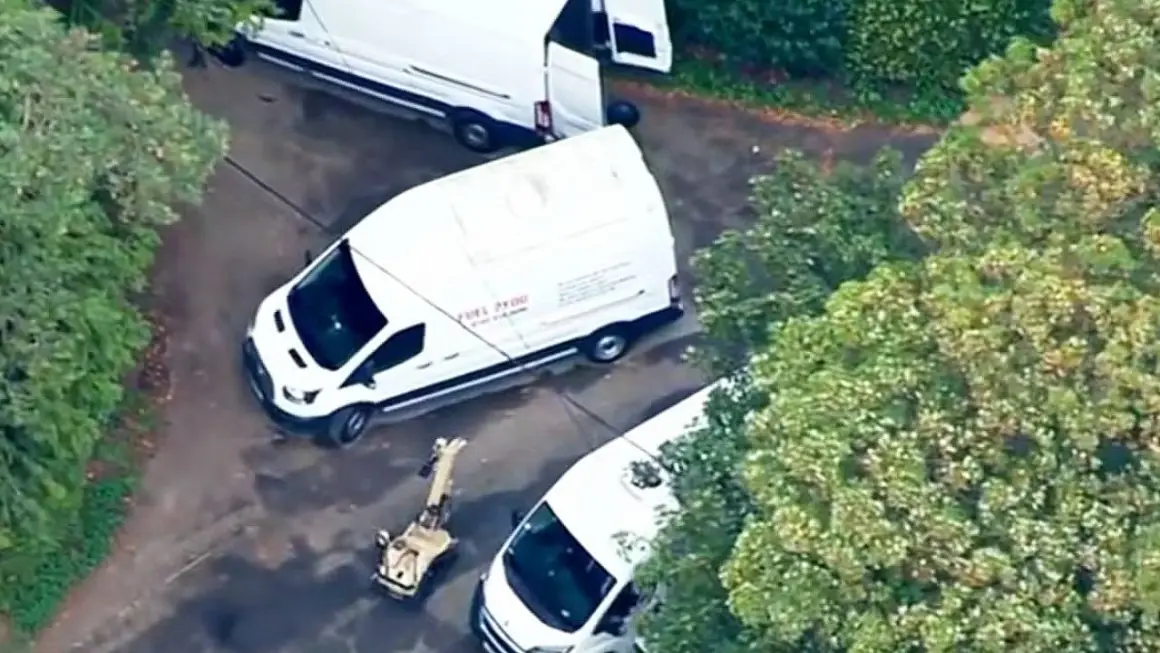
Failed TERRORISTS released on bail; Witness says there were more than 5; Police took hours to respond
An eight-count superseding indictment unsealed in Manhattan federal court names Mohammad Baqer Saad Dawood al-Saadi, a dual Iranian-Iraqi national; Mohsen Mohajeri, an Iranian; and Mohammad Ali al-Hassani, an Iraqi. Only al-Saadi is in US custody after his arrest earlier this year. The others remain at large, believed to be in Iran.
Prosecutors say the men directed attackers during live video calls and later distributed propaganda. In one session projected onto a large screen bearing the logo of a front group called Harakat Ashab al-Yamin al-Islamiya (HAYI), al-Hassani coached a perpetrator: “Light it up like a Christmas tree.”
The attacker lit an improvised device and threw it at a London synagogue. Another video shows the group studying a map of London, with al-Hassani telling Mohajeri, “We need to get focused on London.”
US Attorney Jamie McDonald described the operation as “the new threat that we’re facing today.” He added: “What we’ve alleged here is that this is an Iran, an IRGC affiliated network of terrorist organizations.”
In a separate statement he said the defendants “helped orchestrate a campaign of terror on behalf of terrorist organizations affiliated with Iran that targeted Jewish communities in Europe and the United States, and the British military base, RAF Fairford, housing American service members.”
He added: “The threat presented by Iran and Iran-backed terrorist groups to America and our allies is not hypothetical – it is very real.”
Attorney General Todd Blanche stated: “Anyone who plans a terrorist plot on a military base housing American servicemembers will be prosecuted by the United States government.”
HAYI claimed responsibility for multiple London attacks, including the torching of Jewish ambulances in Golders Green and the synagogue arson. Seven of the roughly 18 European attacks occurred in Britain.
Al-Saadi, already charged with promoting about 18 European attacks and an attempted New York synagogue bombing, allegedly continued coordinating the Fairford plot from a Brooklyn jail cell via coded messages through family.
Five British men were arrested near the base in September after suspicious vans loaded with fuel were spotted; the plot never reached the perimeter, and US bombers were later withdrawn.
The pattern matches a “gig-economy” model of terrorism: remote direction, paid recruits, and rapid propaganda. Attacks began in early March 2026 with a Belgian synagogue arson and spread to the Netherlands, France, and the UK.
Targets were overwhelmingly Jewish and Israeli-linked. British authorities have charged locals in connection with some of the incidents; one 17-year-old who set a synagogue alight later claimed he did not know the building’s purpose.
These cases arrive amid broader data on Islamist plots and antisemitic violence in Europe. Jewish communities in London, Paris, and elsewhere have reported repeated arsons, stabbings, and harassment. The remote-control method bypasses traditional borders and makes detection harder until after the fact.
A Rare Voice at the UN
In a separate development, Yemeni-Swedish journalist Luai Ahmed (sometimes rendered Louis in social media posts) addressed the UN Human Rights Council and directly challenged Muslim-majority governments on human rights abuses. Speaking as a Muslim, he asked pointed questions that rarely surface in that forum.
He questioned Iran over the killing of protesters demanding freedom. He asked Qatar why it harbored and funded the Hamas terrorists responsible for the October 7 massacre. He pressed Syria on the slaughter of Alawites, Druze, and other minorities.
On Pakistan he said: “Pakistan, if you care about religious freedom, why did you sentence a Christian woman to death, Shagufta Kiran, for allegedly sharing a WhatsApp message about the age issue in Islamic marriage?”
He also noted that Mahmoud Abbas remains in the 22nd year of a four-year term.
Shagufta Kiran, a Christian mother of four and former nurse, was arrested in 2021 after a Muslim complainant alleged she forwarded blasphemous content in a WhatsApp group.
An Islamabad court sentenced her to death in September 2024 under Section 295-C of Pakistan’s blasphemy laws, which carry a mandatory death penalty for insulting the Prophet Muhammad, plus a fine and additional years under cybercrime statutes.
Her defense maintains she merely forwarded a message without reading or authoring it.
Naeem Yousaf Gill of the National Commission for Justice and Peace told Aid to the Church in Need: “We are deeply disappointed. Justice has not been served in Shagufta’s case. She will take her case to the High Court. The sentence is harsh.” Her lawyer has stated that the original author remains free while the woman who shared the message faces execution.
Pakistan’s blasphemy laws have long been criticized for enabling personal vendettas and mob violence against minorities. Dozens of people, including Christians, face death sentences; none have been executed by the state in recent years, but extrajudicial killings are common.
Ahmed’s remarks stand out because, as the original post noted, similar statements can carry death sentences or extrajudicial risk in multiple countries applying Sharia-based criminal law.
Western governments continue to import populations from these environments while treating concerns about compatibility as bigotry. The boardroom videos and the UN exchange supply concrete evidence that the problem is not abstract.
Mass deportation of non-citizens linked to such networks, rigorous screening, and an end to the assumption that every cultural system can coexist inside liberal democracies are the minimum responses.
The alternative is more real-time video calls directing the next synagogue or military target, and more Western silence while Christians face the gallows for a forwarded message.
END
SYRIA/USA
US Weighs Military Training for Syrian Army Despite Massacres of Alawites, Christians & Druze
Monday, Nov 23, 2026 – 09:45 PM
For the first time since the overthrow of secular Ba’ath President Bashar al-Assad, Washington is said to be readying a plan to train the Syrian military, though nothing has yet been publicaly approved or formalized.
Ex-al Qaeda commander and self-proclaimed President Ahmad al-Sharaa’s regime came to power in December 2024, and what followed were various waves of massacres involving the country’s minority religious populations – including attacks on Alawites, Christians, Druze, and Shia-related groups. The Kurds have also been targeted in Damascus-backed Sunni attacks.
Sources cited in a Monday Reuters report describe that discussions have focused on training the Syrian army in “demining”. From there it would likely expand, as these ‘allied’ training programs tend to go.
“The proposal for a multinational training mission still faces legal hurdles in the United States and skepticism among some in the Syrian military,” the sources said.
The officials added that “the initial program would emphasize training in demining and safe disposal of ordnance, but could serve as a model for wider cooperation if successful.”
A US Central Command (CENTCOM) spokesman has said that the so-called Damascus Coordination Center (DCC, based in Jordan) is continuing to work in “support of a stable, unified, and peaceful Syria.”
Ironically it was US-Gulf axis covert intervention which largely destabilized Syria in the first place, driving a some 14-year long proxy war. The CIA had its ‘Timber Sycamore’ program, while the Pentagon claimed to have trained ‘moderate rebels’. These supposed ‘moderates’ ended up being jihadists, including militants that cooperated with and even directly joined ISIS.
Now in the post-Assad era, the Syrian army is made up of the very same jihadists who waged a brutal war against the Assad government as well as the Syrian poulation for years. Among favored tactics were suicide bombings.
“The framework under discussion would also involve personnel from about 15 US allies, including Britain, France, Germany, Australia, Saudi Arabia and the UAE,” the Reuters report says.
And here’s the fun part: US officials “would need to vet prospective Syrian recipients before providing funding.“
This would bring the US Leahy Laws into play, given the historic legislation prohibits Washington cooperation with foreign forces involved in gross violations of human rights.
It wasn’t long ago that President Sharaa (aka Jolani) had a US bounty on his head for being ‘ex-ISIS’ and a founding member of al-Nusral Front, which is Syrian Al-Qaeda.
He has also sought to whitewash his image and engage in heavy PR aimed at Western audiences. While the Islamist government has presented an idea of religious unity for Syria, they have also eagerly branded any clashes involving Alawites as “Assad remnant” forces, and reacted harshly, while plainly targeting especially the Alawites on a day-to-day basis.
END
RUSSIA// AZERBAIJAN
KORYBKO…
Even Ukrainian Media Noticed Azerbaijan’s Tilt Back Toward Russia
Tuesday, Nov 24, 2026 – 04:40 AM
Authored by Andrew Korybko via Substack,
Russian-Azerbaijani relations appear to be regaining the momentum that they lost during their dispute from late 2024 to mid-2026, which is what Russia has wanted all along, so the prerogative for taking them further is Azerbaijan’s.
The Kyiv Post published an insightful piece in mid-November after Azerbaijani President Ilham Aliyev’s meeting with Zelensky in Dublin on the sidelines of the latest European Political Community meeting. They noted that their readouts afterwards differed with respect to Zelensky emphasizing that they discussed spring’s drone deal while Aliyev omitted any mention of it. The Kyiv Post then contextualized this disconnect by drawing attention to two of Azerbaijan’s Russian-friendly moves as of late.
The first was that “During Russian Energy Week in Moscow on Oct. 16, Elshad Nasirov, vice president of Azerbaijan’s state energy firm SOCAR, announced that Baku wanted to resume purchasing natural gas from Russia’s state-owned giant Gazprom. ‘We can proudly say that our cooperation with such a giant company as Gazprom is a very good example,’ Nasirov said, according to Russia’s state-run TASS news agency.”
Then the second was that “On Nov. 1, Dmitry Shugayev, head of Russia’s Federal Service for Military-Technical Cooperation, told the Russian Defense Ministry’s Zvezda television channel that Moscow and Baku had signed a program to build and modernize facilities for repairing armored vehicles used by Azerbaijan’s military…Shugayev also raised the possibility of selling Russian Pantsir-S1 surface-to-air missile and gun systems to Baku, expressing confidence that the two sides would reach an agreement.”
The Kyiv Post didn’t try to explain Azerbaijan’s recent tilt towards Russia, but it’s arguably a response to the unexpected cooling of ties with Turkiye following their dispute over Azerbaijan’s hijab ban in schools. They still consider each other to be “one nation, two states”, but the fraternal feelings that their people held for one another up until this dispute began in late September are no longer as strong as they used to be after their acrimonious falling out on social media over this highly sensitive issue.
It was then foreseen here that two of the ways in which Azerbaijan might fine-tune its geostrategic balancing act is by prioritizing the “Central Asian Community” (CAC) over the Turkish-led “Organization of Turkic States” in parallel with improving ties with Russia. The closer energy and military-technical cooperation that the Kyiv Post drew attention to in their article are effective means to that end. Aliyev’s recent downplaying of his country’s springtime drone deal with Ukraine complements these efforts.
If this trend remains on track, then closer security cooperation between the CAC and Russia’s CSTO could follow, the latter of which used to count CAC members Azerbaijan and Uzbekistan as members while Turkmenistan has always been a constitutionally neutral state. If paired with confidence-building measures between them and Iran, then the Caspian can revert to its status as a zone of cooperation instead of remain the scene of competition as has been the case since August 2025 as explained here.
Most observers appear to have missed Azerbaijan’s Russian-friendly moves as of late amidst its falling out with Turkiye, but they’re nothing to sneeze at, and the Kyiv Post did a journalist service by pointing them out no matter whatever one might think about its other reporting. Russian-Azerbaijani relations appear to be regaining the momentum that they lost during their dispute from late 2024 to mid-2026, which is what Russia has wanted all along, so the prerogative for taking them further is Azerbaijan’s.
END
RUSSIA VS UKRAINE
6 .GLOBAL ISSUES, COVID ISSUES, VACCINE INJURIES/HEALTH ISSUES
GLOBAL ISSUES
Christianity Is Under Relentless Attack
Monday, Nov 23, 2026 – 05:40 PM
Authored by Steve Watson via Modernity,
Another historic church has gone up in flames, this time a 137-year-old structure in rural Maryland that local officials once called the most distinctive building left in its village.
Just after 3 a.m. on November 19, a neighboring resident spotted the blaze at Galestown United Methodist Church on Galestown Newhart Mill Road in Dorchester County.
Fifty-five firefighters from the Eldorado Brookview Volunteer Fire Department and neighboring companies responded to the two-alarm fire. They found flames showing from all sides and battled it for roughly two hours before bringing it under control.
The interior origin and structural compromise forced crews into ladder-pipe operations. Damage to the building and contents is estimated at $280,000. Thankfully, no injuries were reported.
Deputy Chief Matt Stevens of the Fire Marshal’s Office stated, “We are putting the origin of the fire somewhere within the interior of the church. And as of right now, the cause remains under investigation.”
Built in 1889, the church was noted by the Maryland Historical Trust as “the most distinctive structure surviving in the village.”
Other congregations have offered space for hymn sings while the small community assesses next steps.
This is now happening every week all over the world.
We have tracked a steady sequence of similar incidents across the United States, the United Kingdom, Europe and Canada in which historic churches are destroyed or heavily damaged, with official statements frequently listing the cause as under investigation or unknown.

Oh Look, YET ANOTHER Church Up In FLAMES…
Historic Toledo steeple collapses in another “cause unknown” blaze

Another TWO Historic Churches Explode Into Flames…
133-year-old Grand Rapids sanctuary gutted; 175-year-old Alabama church destroyed

Another Day Another Church BURNED To The Ground
New Brunswick’s largest wooden church reduced to ash in confirmed arson
 modernity
END

YET ANOTHER Church TORCHED; Cause “Unknown”
Historic Cleveland sanctuary reduced to rubble
COVID VACCINE INJURY REPORT: DR MARK CRISPIN MILLER
RABOBANK/MICHAEL EVERY/OR OR PICTON/GIFFIN OR RABOBANK EXECUTIVE/COMMENTARY ON WORLDLY AFFAIRS
Nvidiaaargh! > Nvidiaaah?
Tuesday, Nov 24, 2026 – 11:00 AM
By Michael Every of Rabobank
Huang around long enough and things work out…. or fall apart, depending on how you look at it. Yesterday saw wild swings in markets, and in US politics and geopolitics, after Jensen Huang was reinstated as Nvidia CEO 11 days after his firing for serial affairs and a Chinese spy scandal. That followed intervention from President Trump and Vice-President Vance, the former posting a picture of Huang as himself after his near assassination in 2024, holding up a red bra under the words ‘Sex sells’. To say this episode is not a good look for the US is an understatement: it grows bananas in a few states, so one pejorative political-economy adjective can technically apply.
Politically, ‘honeypot’ and chip allegations were well known in some circles before they were used to eject Huang, an act which appeared political. His reinstatement is far more so. Will future presidents now be more interested in who key US CEOs are, and they more interested in doing what presidents want?
From a national security perspective, it was ‘EM’ to allow what happened to transpire. Huang will be in the Congressional firing line in weeks and must explain what he knew about circumventing export controls on AI chips and spies – so who does it all get pinned on if not Trump? Certainly, don’t think Huang will be his own man now he’s back: he and his firm will be working with national security agencies rather than around them as poachers turned gamekeepers unless things have truly gone bananas. So, under-the-table US-China quid pro quo on AI chips for rare earths clearly won’t continue now, as the US just blacklisted Megaspeed, and Trump has even spoken about banning or taxing offshore data centres so China can’t control them. Where does that then lead us?
Financially, this was a state rejection of allowing the AI bubble to burst even if it didn’t flow from the Fed (itself showing how central banks are now less important). You don’t like the K-shaped economy with AI? Try the L-shape you get instead – or that seemed the risk.
Yet any ‘great man’ arguments aside, taking away the circular financing Nvidia offers the AI sector clearly ‘kicked out the jams’ from under it – and that ouroboros isn’t changed by reinstating Huang. Indeed, as one sees the dramatic advances in AI now emerging, with the promise of exponentially more within 12-18 months, a cynic might wonder if the sector just needs a little more time to produce the national security ‘lightning in a bottle’, behind a raised drawbridge vs. open source, after which the true economic value of the sector might be eventually allowed to reemerge?

But for now, we have US stocks up, yields up –as Fed concern about a bursting bubble was just addressed– and the US dollar up. On the latter, recall the many stories over the first three quarters of 2026 about ‘dedollarisation’ and a weaker greenback. Then see the DXY is up 6% YTD and that the dollar just soared vs. EM while the AI panic was happening; and that it’s rising again now the panic is over.
Meanwhile, the Lowy Institute annual Asia Power Index claims “US military supremacy in Asia is over,” and it’s no longer “uncontested military hegemon,” as the US Navy warns of having to operate with 9 aircraft carriers for years, not 11, and the press reports China is expanding its nuclear submarine fleet with long-range missiles able to reach the continental US from the South China Sea. If you want to talk about the US dollar longer term outlook, follow that kind of trend.
Energy markets are still feeling happier despite three more ships on fire in Hormuz after hitting mines. The geopolitics is still less happy, with the US imposing sanctions on dozens of figures linked to Iran’s shadow banking networks while seeing Iran as perhaps behind dozens of new cyberattacks against its ships. Trump is holding back on new strikes for now, as is Israel. The US window may be closing with some GOP leaders signalling a potential openness to helping Democrats cut off Iran war funding; the Israelis are tied up by efforts to replace PM Netanyahu following the election held last month. Overall, escalation still seems more likely than not.
After Ukraine sank a Russian warship in a Libyan port, Moscow has warned of severe consequences, is poised to put a nuclear weapon in space within 60 days and has threatened “hostile” Estonia with “open war.” Clearly, escalation is the path there, while Von der Leyen and Jared Kushner have clashed over peace talks sequencing, the former wanting a ceasefire before any new European security architecture is discussed with Russia, the latter saying it all needs to happen in tandem. For now, new EU sanctions are aimed at Russia’s banks, soldiers, and athletes.
Meanwhile:
- In the UK, everything is all about Brexit again, Brejoin being the new mot du jour. Yet PM Burnham is now saying it would be “unthinkable” for Britain to rejoin the EU without a referendum, which doesn’t appear to have been the thinking last week. That’s as the leader of the opposition warns Britain risks French-style social unrest ahead even as the government isn’t cutting social spending at all.
- In France, President Macron is proposing a constitutional reform to enforce a budget “golden rule” aimed at fiscal discipline – which would resolve the large and sometimes violent social unrest being seen on its streets(?)
- Le Pen says she wants to negotiate tariffs with the US bilaterally, smashing EU rules, as France doesn’t run a trade surplus with it: recall she also wants to withhold France’s EU budget contribution, leave Schengen, the EU electricity market, and some single market rules.
- Ahead of Spain’s election, very divergent trends are being seen: rising support for left-wing Basque separatists seems to stand against a general Spanish shift to the right.
- The annual Berlin Pulse survey just showed 83% of the German public don’t want to choose between the US and China. One is a NATO ally whose president just posted that Putin is ‘my friend’; the other backs Russia and is close to being in a trade war with Berlin.
- US-India energy ties are reportedly tightening as India buys Venezuelan oil and US LPG, with rumours that a trade deal is finally moving closer.
- A South Korean think tank reports even its dynamic exporters are seeing intense competition from China in 10 of 13 key sectors, raising the risks of a hit to sales and of K-shaped economic polarisation. Imagine what less muscular global exporters are going to experience ahead.
- In Canada, a potential constitutional crisis seems to loom after a Quebec court ruled that separatist provincial legislators must swear an oath to King Charles III or else their laws are unconstitutional – yet they refuse to do so.
- New York Mayor Mamdani appointed the 9/11 defence lawyer for Al Qaeda as Chief Counsel following the announced closure of the anti-terror police department and Rikers Island prison.
That’s just a fraction of the global stories in the last 24 hours that either make one want to go ‘aaargh!’ or ‘aaah.’
END
7. OIL AND NATURAL GAS/ENERGY COMMENTARIES
Libya’s Oil Output Plunges As Armed Groups Shut Key Pipelines
Tuesday, Nov 24, 2026 – 06:00 AM
Authored by Tsvetana Paraskova via OilPrice.com,
Libya’s oil production has crashed by about 350,000 barrels per day (bpd) after an outlaw group closed a valve on the pipeline transporting crude oil from Sharara, the country’s biggest oilfield, the National Oil Corporation said on Monday.
Libya’s NOC condemned the closure, which adds to the closure of a pipeline at the Hamada oilfield, which has been ongoing for three weeks now and has already resulted in a loss of about 15,000 bpd of crude oil production.
This weekend, NOC said that the forced shutdown of the Hamada pipeline by an armed group for more than 20 days has triggered severe financial losses and a drop in output, “directly undermining the strategic growth that the entire NOC workforce has been working tirelessly, day and night, to achieve.”
Since the start of the blockade at Hamada, cumulative losses have reached 302,778 barrels, equivalent to $30.8 million, based on current average crude prices, NOC added.
As a result of the two valve closures, Libya’s total daily oil production losses have now reached approximately 365,000 bpd, “at a time when global oil prices are rising, and the country is facing a critical economic situation,” NOC said in a statement today.
NOC’s board of directors called on the Petroleum Facilities Guard and the relevant government authorities “to fulfill their responsibilities in safeguarding oil facilities and infrastructure, preventing any attacks or disruptions to their operations, and intensifying efforts to reopen both pipelines and resume production as soon as possible.”
Crude oil production at Sharara suffered the most recent setback two months ago, after an armed military group closed a valve on the pipeline that carries crude oil from the field to the Zawiya port for export.
Libya’s fresh supply scare comes amid disruptions in the Middle East despite a rebound in crude oil flows through the Strait of Hormuz in recent months.
END
IRAQ
Iraq Refuses To Accept OPEC+ Assessment Of Its Production Capacity
Tuesday, Nov 24, 2026 – 02:45 PM
Submitted by Julianne Geiger of OilPrice.com
Iraq is refusing to accept an OPEC+ assessment that says the country can sustainably produce less than 5 million barrels of oil per day. Baghdad wants OPEC+ to recognize a capacity of around 6 million bpd – an important acknowledgment ahead of the group’s upcoming Sunday meeting, at which production targets for 2027 are expected to be a topic of discussion.
Under the current OPEC+ production agreement, Iraq’s limit is 4.431 million bpd. If OPEC acknowledges the higher capacity assessment that Iraq is requesting, it would give Baghdad a stronger argument for a larger quota. OPEC+ hired outside consultants to assess members’ production capabilities before deciding how much oil each country should be permitted to pump.
Granting Iraq a larger allocation would mean either allowing more oil onto the market or reducing the amount other members can produce.
Earlier this month, Iraq’s Oil Minister Basim Mohammed Khudair claimed that Iraq was already producing more than 5 million bpd, which is higher than the quota. He also insisted Iraq was complying with OPEC+ requirements because its exports remained within acceptable limits.
But OPEC+ limits don’t set limits on exports, and oil produced for domestic use isn’t exempt from production quotas.
According to OPEC’s November report, Baghdad reported October production of 4.888 million bpd, which is higher than the current quota. OPEC’s independent sources put the figure at 4.491 million bpd. That’s a difference of nearly 400,000 barrels daily between what Iraq says it pumped and what OPEC believes it pumped. Even the lower estimate exceeds Iraq’s current production allowance by roughly 60,000 bpd.
The International Energy Agency estimates Iraq’s sustainable production capacity at 4.87 million bpd, considerably below Iraq’s self-assessed 6 million bpd capacity.
Iraq threatened earlier this year to leave OPEC if it didn’t receive a satisfactory allocation, although it later withdrew that warning. The UAE has already departed the organization over similar issues.
END
Bianco: Refinery Damage, De-Globalization Mean Inflation Here To Stay
Tuesday, Nov 24, 2026 – 03:30 PM
Ukraine’s penchant for blowing up Russian oil refineries and Washington’s bipartisan push for American protectionism mean inflation will only get worse. That’s according to Jim Bianco of Bianco Research who joined last night’s ZeroHedge debate on WTF Is Happening In Markets where he was joined by Brent Johnson and Dave Collum to examine the recent market selloff.
Bianco warned that inflation will prove far more persistent than investors expect, illustrated in energy with crude prices normalizing but refined diesel remaining high. The three also discussed when or if market valuations will come back to reality, an eventuality that may be ushered in by a combination of AI-related layoffs and aging boomers leading to net liquidations, flipping the passive investment bid to a tumbling ask.
Below were the highlights from Bianco’s inflationary warnings though we recommend the full conversation for those who missed it:
The Tides of Globalization Have Turned
Jim Bianco argued that the retreat from globalization will continue to create a lasting source of inflation, as government policies increasingly prevent Americans from accessing cheaper goods and services abroad.
“The average hip replacement in the United States is $70,000. The average hip replacement in India is $10,000. Why can’t you go to India and get the hip replacement? Because we put in laws that your insurance company won’t cover it.”
Across the board, hip replacements to electric cars, abroad is cheaper. The Chinese car company Beyond Your Dreams (BYD) makes a virtual replica of Tesla’s Model 3 for $15,000. For context, Model 3’s range in price from $39,000 to $56,000.
“If you believe that we’re gonna go back to globalization, then let me buy a $15,000 brand new car, let me buy one of my kids a $10,000 brand new car. Of course not… We actually ban those cars in the United States.”
Bianco sees little motivation to change this dynamic, even among the candidates that are furthest to the Left.
“The tide has turned when it comes to globalization. We are no longer searching the world for the cheapest place to make stuff.”
“That’s why I think we are stuck with more goods inflation, and we’re going to be at a higher inflation level.”
Thanks Ukraine…
Bianco pointed to Ukrainian strikes on Russian refineries for exacerbating energy markets already stressed by the Iran war. With Hormuz largely online, we (at least for now) have ample crude oil supply, but insufficient capacity to turn it into finished products like gasoline and diesel.
“The Ukrainians have blown up a lot of refineries in Russia. So hey, oil’s getting out, but where am I gonna send it? All the refineries in Russia are on fire and I can’t send it right back to the refineries in the Middle East to turn it into gasoline. So who wants this oil?”
With existing refineries already operating near capacity, Bianco argued that additional crude supply does little to alleviate shortages of refined products.
“Every other refinery is running at 97%. They don’t need more oil. We need more refining capacity… The result is a growing disconnect The price of oil is going down, but the price of diesel isn’t. And that is going to continue to be an issue.”
Listen to the full discussion where Bianco, Johnson, and Collum get into how this market might crash, what is Kevin Warsh’s plan, what’s up with gold, and more. Watch below, on Youtube, or listen on Spotify.
8. EMERGING MARKETS//AUSTRALIA NEW ZEALAND ISSUES
U.S./GOLD AND SILVER PRICING/ASIAN CLOSING MARKETS AND EUROPEAN BOURSE OPENING AND CLOSING/ INTEREST RATE SETTINGS TUESDAY MORNING 6;30AM//OPENING AND CLOSING\
OPENING LEVELS OF CURRENCIES// AND CLOSING ASIAN STOCK MARKET AND OPENING EUROPEAN STOCKS:6 AM EST
EURO VS USA DOLLAR: 1.0933 UP 0.0024
USA/ YEN 159.51 UP 0.481 NOW TARGETS INTEREST RATE AT 1.75% AS IT WILL BUY UNLIMITED BONDS TO GETS TO THAT LEVEL…//YEN STILL FALLS//END OF YEN CARRY TRADE BEGINS AGAIN DEC 2024/Bank of Japan raises rates by .25% TO 1.75 ..TAKAICHI NEW PM AS YIELDS RISE//JAPAN DEEPLY IN TROUBLE WITH RISING RATES AND A FALLING YEN!! BANK OF JAPAN WILL NO LONGER DO QE. URGES PENSION AND INSUANCE FUNDS TO BUY JAPANESE BONDS//
YEN CARRY TRADERS MURDERED
GBP/USA 1.3065 UP 0.0032 OR 32 BASIS PTS
USA/CAN DOLLAR: 1.4345 DOWN 0.0021 //CDN DOLLAR UP 21 BASIS PTS//
Last night Shanghai COMPOSITE CLOSED UP 9.42 PTS OR 0.27%
Hang Seng CLOSED DOWN 164.09 PTS OR 0.73%
AUSTRALIA CLOSED UP 0.06%
// EUROPEAN BOURSE: ALL MIXED
Trading from Europe and ASIA
I) EUROPEAN BOURSES: ALL MIXED
2/ CHINESE BOURSES / :Hang SENG CLOSED DOWN 164.09 PTS OR 0.73%
/SHANGHAI CLOSED UP 9.42 PTS OR 0.27%
AUSTRALIA BOURSE CLOSED UP 0.06%
(Nikkei (Japan) CLOSED UP 2,321.35 OR 4.11%
INDIA’S SENSEX IN THE RED
Gold very early morning trading: $3620.00
silver:$41.91
USA DOLLAR VS TRY (TURKISH LIRA): 50.63 UP 3 BASIS PTS AND NOW WE SEE THEIR STUPIDITY OF SELLING SOME OF THEIR GOLD AND ALL OF THEIR USA DOLLAR RESERVES. THE COUNTRY IS IN BIG FINANCIAL TROUBLE
USA DOLLAR VS RUSSIAN ROUBLE: 81.76 ROUBLE// UP 0 ROUBLE AND 16 BASIS PTS.
UK 10 YR BOND YIELD: 5.1927 DOWN 3 BASIS PTS
UK 30 YR BOND YIELD: 5.6870 DOWN 3 BASIS PTS
FRENCH OAT 10 YR BOND YIELD: 4.770 DOWN 3 BASIS PTS.
CDN 10 YR BOND YIELD: 3.6870 DOWN 2 BASIS PTS
CDN 5 YR BOND YIELD; 3.416 DOWN 1 BASIS PTS
USA dollar index early TUESDAY MORNING: 104/10 DOWN 16 BASIS POINTS FROM MONDAY’s CLOSES
TUESDAY MORNING NUMBERS ENDS
And now your closing TUESDAY NUMBERS 10.00 AM
Portuguese 10 year bond yield: 3.730 % DOWN 2 in basis point(s) yield
JAPANESE BOND 10 yr YIELD: +2.714% DOWN 7 FULL POINTS BASIS POINTS /JAPAN losing control of its yield curve/
JAPAN 30 YR: 3.928 DOWN 4 BASIS PTS//
SPANISH 10 YR BOND YIELD: 3.862 DOWN 1 in basis points yield
ITALY 10 YR BOND: 4.354 DOWN 2 points in basis points yield ./
GERMAN 10 YR BOND YIELD: 3.2721 DOWN 1 BASIS PTS
IMPORTANT CURRENCY CLOSES : MID DAY TUESDAY
Closing currency crosses for day /USA DOLLAR INDEX/USA 10 YR BOND YIELD/10:00 AM
Euro/USA 1.0956 UP 0.0049 OR 49 basis points
USA/Japan: 159.14 UP 0.116 OR YEN IS DOWN 0.12 BASIS PTS// HIGHLY INFLATIONARY TO JAPAN
Great Britain 10 YR RATE 5.1927 DOWN 1 BASIS POINTS //
GREAT BRITAIN 30 YR BOND; 5.6472 DOWN 4 BASIS POINTS.
FRANCE 10 YR: 4.765 DOWN 3 BASIS PTS
USA DOLLAR/VS CANADIAN DOLLAR DOWN 0.0037 BASIS PTS TO 1.4329 CDN DOLLAR UP 37 BASIS PTS
xxxxxxxxxxxxxxxxxxxxxxxxxxxxxxxxxxxxxxxxxxxxxxxxxxxxxxxxxxxxxxxxxxxxxxxxxxxxxxxx
The USA/Yuan CNY 6.6645 ON SHORE ..UP
THE USA/YUAN OFFSHORE// CNH UP TO 6.6677
TURKISH LIRA: 50.63 UP 3 EXTREMELY DANGEROUS LEVEL/DEATH WATCH/HYPERINFLATION TO BEGIN.//
Your closing 10 yr US bond yield DOWN 4 in basis points from MONDAY at 4.883 % //trading well ABOVE the resistance level of 2.27-2.32%)
USA 30 yr bond yield 5.274 DOWN 3 basis points /10:00 AM
USA 2 YR BOND YIELD: 4.644 DOWN 2 BASIS PTS.
GOLD AT 9;00 AM $3622.40
SILVER AT 9;00: $42.16
Your 11:00 AM bourses for Europe and the Dow along with the USA dollar index closing and interest rates TUESDAY
DAY CLOSING TIME/ 12:00 AM///
London: CLOSED DOWN 11.44 PTS OR 0.20%
GERMAN DAX: CLOSED DOWN 331/76 PTS OR 1.31%
FRANCE: DOWN 0.90 OR 0.01%
Spain IBEX CLOSED DOWN 156.40 PTS OR 0.42 %
Italian MIB: CLOSED DOWN 903.11 PTS OR 1.84%
WTI Oil price 80.66
Brent Oil: 90.01 10;00 EST
USA DOLLAR INDEX: 103.86 OR DOWN 39 PTS
USA /RUSSIAN ROUBLE: 82.09/ ROUBLE DOWN 0 AND 21 100
CDN 10 YEAR RATE: 3.643 DOWN 4 BASIS PTS.
CDN 5 YEAR RATE: 3.376 DOWN 5 BASIS PTS
CLOSING NUMBERS: 4 PM//
Euro vs USA 1.0967 UP 0.0059 OR 59 BASIS POINTS//
British Pound: 1.3117 UP 0.0083 OR 83 basis pts/
BRITISH 10 YR GILT BOND YIELD: 5.1936 DOWN 1 FULL BASIS PTS//
BRITISH 30 YR BOND YIELD: 5.6422 DOWN 1 IN BASIS PTS.
FRENCH 10 YR BOND: 4.779% DOWN 1 BASIS PTS
JAPAN 10 YR YIELD: 2.722 % DOWN 6 FULL BASIS PTS (DANGEROUS TO THEIR ECONOMY
JAPANESE 30 YR BOND: 3.946 DOWN 2 PTS AND STILL VERY DANGEROUS TO THEIR ECONOMY
USA dollar vs Japanese Yen: 158.96 DOWN 0.540 OR YEN UP 54 BASIS PTS//GETTING FURTHER AWAY FROM 160.00/ EXTREMELY DANGEROUS
USA dollar vs Canadian dollar: 1.4262 DOWN 0.0097 PTS// CDN DOLLAR UP 97 BASIS PTS
West Texas intermediate oil: 81.58
Brent OIL: 90.85
USA 10 yr bond yield DOWN 3 BASIS pts to 4.899%
USA 30 yr bond yield: DOWN 0 PTS to 5.295%
USA 2 YR BOND 4.665 DOWN 1 PTS
CDN 10 YR RATE 3.679 UP 1 BASIS PTS
CDN 5 YEAR RATE: 3.422 UP 1 BASIS PTS
USA dollar index: 103.74 DOWN 52 BASIS POINTS
USA DOLLAR VS TURKISH LIRA: 50.63 UP 3 BASIS PTS GETTING QUITE CLOSE TO BLOWING UP/IDIOTS SOLD GOLD
USA DOLLAR VS RUSSIA//// ROUBLE: 82.05 DOWN 0 AND 13 /100 roubles //
GOLD $3552.00 3:30 PM)
SILVER: 40.75 3;30 PM)
DOW JONES INDUSTRIAL AVERAGE: UP 397.24 POINTS OR 0.86%
NASDAQ 100 DOWN 531.93 PTS OR 1.99 %
VOLATILITY INDEX 26.80 UP 0.18 PTS OR 0.68%
GLD: $ 325.42 DOWN 7.60 PTS OR 2.28%
SLV/ 36.85 PTS DOWN 2.06 OR 5.29%
TORONTO STOCK INDEX// TSX INDEX: CLOSED DOWN 120.23 PTS OR 0.35%
END
end
TRADING today ZEROHEDGE 4 PM: HEADLINE NEWS/TRADING
Yet Another Huangover… Bonds Bid, Credit Crushed, As Big-Tech, Bullion, & Bitcoin Buckle
WRAP UP
Tech lags and pares some Monday strength as tariffs once again touted – Newsquawk US Market Wrap
Tuesday, Nov 24, 2026 – 04:27 PM
- SNAPSHOT: Equities down, Treasuries up, Crude up, Dollar down, Gold down.
- REAR VIEW: US Consumer Confidence beats expectations by a wide margin; Fed’s Williams sees inflation just above 2% next year and at target in 2028; Trump admin officials reportedly debating targeting Iran’s leaders; US reportedly preparing tariff hikes on China, EU and other countries; US 5yr auction shows stronger demand; BoC’s Macklem sounds hawkish as its Monetary Policy Framework Review removes all references to pursuing maximum sustainable employment; Iraq reportedly rejects OPEC+’s assessment of its oil production capacity.
- COMING UP: Data: Australian CPI (Oct), US Initial Jobless Claims (Nov/21), PCE (Oct), GDP (Q3), Personal Spending (Oct), Durable Goods (Oct), Atlanta Fed GDPNow Events: Fed Beige Book. Speakers: BoE’s Bailey, Lombardelli, Mann, Dhingra. Supply: Japan, Italy, Germany, US.
- WEEK IN FOCUS: Highlights Include US PCE, Flash PMIs, Aussie CPI and ECB Minutes. Access full report here.
- WEEKLY US EARNINGS ESTIMATES: Access full report here.
More Newsquawk in 3 steps:
1. Subscribe to the free premarket movers reports.
2. Trial Newsquawk’s premium real-time live audio squawk for 7 days.
3. Check out Newsquawk’s US Midterm Election dashboard.
MARKET WRAP
Stocks pared some of Monday’s rally, sparked by Jensen Huang’s return as Nvidia CEO, with the selling largely contained to Tech. HPE (HPE) disappointed investors hoping for stronger AI infrastructure demand. Meanwhile, breadth was positive, with most sectors in the green (Healthcare, Staples and Utilities outperformed), allowing the equal-weight RSP to post gains.
Retail earnings were positive, with beats from Best Buy, Dollar Tree and Kohl’s, as retailers held onto gains despite later trade concerns arising from reports that the US is preparing tariff increases on China, the EU and other countries.
Treasuries were bid across the curve on haven demand as tech stocks pulled back, shrugging off a much stronger-than-expected consumer confidence report. The Dollar was mostly weaker, erasing Monday’s gains, as the equity sell-off stayed confined to tech, while Fed Williams’ outlook for inflation to moderate next year to just above 2% may have eased long bets. Gold also declined, trading lower by over USD 80/oz on the AI selloff despite the haven bid for T-Notes as the hawkish Fed risk remains.
CAD outperformed after hawkish inflation remarks from BoC Governor Macklem and the BoC’s heightened focus on inflation in its monetary policy framework review lifted December hike bets.
Crude reversed early losses as Middle East optimism faded, potentially helped by an NBC report that Trump administration officials are debating targeting Iran’s leaders.
FED
WILLIAMS (voter): Said inflation is too high and further monetary tightening will be needed over time to bring it back to the 2% goal in a timely manner and on a sustained basis, noting there is still work to do and the Fed will respond if inflation pressures don’t ease. Will keep assessing incoming data to decide what action to take at the December 8th-9th meeting. Noted the US economy is showing strength and resilience and that tech-sector volatility has not upended the positive outlook, adding he was not surprised by market volatility, though a sharp darkening in market sentiment could affect his view on the economy. Expects inflation to end 2026 at 3.5%, moderate to just above 2% next year and reach the target in 2028, with risks skewed to the upside; energy prices remain elevated with an uncertain outlook, and while tariffs, geopolitical conflicts and the AI surge are showing up in prices of certain goods, there is little evidence of them spilling over significantly into broader, more persistent inflation. Sees growth of 2.75% in both 2026 and 2027, said the job market has been stable and expects unemployment to fall from 4.1% to around 4% next year. On the path ahead, said future decisions will be data-driven and he has no particular timing in mind for rates, noting “we’re going to have to learn along the way”. Added that he is “not excluding options”, including moves at consecutive meetings, and that if the economy proved strong while inflation failed to moderate, “you wouldn’t just want to wait around”.
US DATA
CONSUMER CONFIDENCE: Consumer Confidence rose 11.4 points to 103.3 in November, above the forecasted 92.4, marking a second consecutive monthly increase and returning to levels last seen in January 2025. The Present Situation Index jumped 13.7 points to 132.8, while the Expectations Index rose 9.9 points to 83.6. The headline gain was “potentially due to lower uncertainty following the midterm elections,” said Fergus McCormick, Senior Economist at The Conference Board, adding that “the gain in confidence was led by stronger perceptions of present and future labor market conditions.” Present labour market views improved markedly, with the differential between consumers saying jobs are “plentiful” and those saying they are “hard to get” widening by 7.6ppts to +12.4%, while net expectations for the labour market rose 9.2ppts to -1.2%. Views of business conditions also improved, both currently and over the next six months, though net expectations for household income eased slightly. McCormick noted that “while consumers continued to express frustration with high prices and rising costs, some comments cited hope for the general economy,” while comments about war and conflict ticked up slightly. Average 12-month inflation expectations declined for a second straight month but remained elevated at 5.7%, and consumers still expected higher interest rates over the next year. McCormick added that “consumers planned slightly higher spending on goods and vacations.” By political affiliation, confidence improved sharply among Democrats and Independents but fell slightly among Republicans, who nonetheless remained the most confident group.
RICHMOND FED: The Richmond Fed manufacturing index rose to 3 in November from -2, above the expected -2. All three components rose, with new orders at 2 (prev. -8), employment at 6 (prev. 3) and shipments at 2 (prev. 0). Backlogs of orders improved but remained negative, while local business conditions improved notably to 4 from -8. The average growth rate of prices paid increased to 7.59 from 7.12, while prices received held at 5.27. Looking ahead, the future indices for shipments, new orders and employment rose further into positive territory, while firms expect growth in both prices paid and prices received to slow over the next 12 months. The future local business conditions index also increased.
FIXED INCOME
T-NOTE FUTURES (Z6) SETTLED 3+ TICKS HIGHER AT 106-27+
Yields fall across the curve as equities pare some of Monday’s rally. At settlement, 2-year -2.1bps at 4.671%, 3-year -3.7bps at 4.674%, 5-year -4.6bps at 4.712%, 7-year -4.7bps at 4.786%, 10-year -3.8bps at 4.904%, 20-year -2.0bps at 5.336%, 30-year -1.5bps at 5.293%.
THE DAY: T-notes were bid on Tuesday as haven demand returned amid a pullback in US equities following Monday’s surge, which was sparked by Jensen Huang’s return as Nvidia CEO. The reversal in equities was the predominant driver of Treasury price action.
Meanwhile, Fed’s Williams spoke overnight, noting that he is not ruling out any options regarding the pace of future tightening. Williams said he would be willing to hike rates at consecutive meetings if required, stressing that incoming data will dictate future policy decisions.
US data saw a notable improvement in consumer confidence, while inflation expectations declined but remained elevated. The improvement in the headline was driven by increases in both the present situation and expectations indices, while consumers’ assessment of the labour market also improved.
Elsewhere, tariffs returned to focus, with the US reportedly set to announce tariff increases on China, the EU and other countries. The Section 301 tariffs are expected to be targeted rather than imposed at a blanket rate, although the new tariffs will reportedly not exceed levels agreed upon in existing trade deals.
The 5-year Treasury auction was decent relative to recent auctions. Although it still tailed, the 0.3bps tail was smaller than both the prior and six-auction average, while the bid-to-cover ratio rose above average. Strong direct demand more than offset the deterioration in indirect demand, leaving dealers with a smaller share of the offering than both the prior and six-auction average.
SUPPLY
Notes
- US sold USD 70bln of 5-yr notes; Tail 0.3bps.
- US sold USD 28bln of 2yr FRNs; High discount margin of 0.05%.
- US to sell USD 44bln of 7-yr notes on November 25th; to settle on November 30th
Bills
- US sold 6-week bills at a high-rate 4.085%, B/C 2.88x; sold 1-year bills at high-rate 4.365%, B/C 3.04x
- US to sell USD 75bln of 17-week bills, USD 105bln of 4-week bills (prev. 115bln), and USD 100bln of 8-week bills (prev. 110bln) on November 25th; all to settle on December 1st
STIRS/OPERATIONS
- Fed Hike Pricing via CME FedWatch: Dec 25.7bps (prev. 25.6bps), Mar 58.0bps (prev. 55.8bps)
- EFFR at 3.88% (prev. 3.88%), volumes at USD 87bln (prev. USD 91bln) on November 23rd
- SOFR at 3.92% (prev. 3.92%), volumes at USD 3.173tln (prev. USD 3.141tln) on November 23rd
- NY Fed RRP op demand at 0.301bln (prev. 0.35bln) across 2 counterparties (prev. 1) on November 24th
- NY Fed T-Bill Purchases (1-4 month): Accepts USD 3.51bln of USD 30.14bln offered; Offer-to-cover 8.58x
CRUDE
WTI (F7) SETTLED USD 1.88 HIGHER AT USD 82.05/BBL; BRENT (G7) SETTLED USD 2.10 HIGHER AT USD 88.78/BBL
The crude complex was firmer, reversing early losses as Middle East optimism faded. WTI and Brent hit lows of USD 79.07/bbl and USD 85.63/bbl, respectively, in the European morning amid hopes for US-Iran diplomacy. However, the move soon reversed, and benchmarks settled around their highs, potentially aided by the softer Dollar and several bullish oil headlines. Iran’s Army Chief ordered the Strait of Hormuz to remain closed, the IRGC said a tanker had struck a mine, while two others turned back, after initial Iranian press reported that three tankers hit mines in the Strait. Moreover, NBC reported, citing sources, that Trump administration officials are debating targeting Iran’s leaders in a move aimed at removing hardliners from the regime, a sign that tensions are likely to remain elevated. On supply, Bloomberg reported that Iraq rejected the OPEC+ assessment of its oil production capacity. Looking ahead, weekly private inventory data are due after-hours.
EQUITIES
CLOSES: SPX -0.50% at 7,201, NDX -1.99% at 26,214, DJI +0.85% at 50,019, RUT +0.57% at 2,685
SECTORS: Technology -2.77%, Industrials -0.51%, Communication services -0.46%, Consumer discretionary +0.12%, Materials +0.26%, Financials +0.89%, Energy +0.89%, Real estate +1.17%, Utilities +1.29%, Consumer staples +1.73%, Health care +2.88%.
EUROPEAN CLOSES: Euro Stoxx 50 -1.15% at 6,005, Dax 40 -1.31% at 25,006, FTSE 100 -0.13% at 10,467, CAC 40 -0.05% at 8,040, FTSE MIB -1.84% at 48,121, IBEX 35 -0.86% at 19,016, PSI +0.19% at 9,334, SMI -0.01% at 14,734, AEX -1.07% at 1,077
STOCK SPECIFICS:
- Hewlett Packard Enterprise (HPE): Despite strong earnings & guidance, w/ some suggesting results disappointed investors exp. a stronger boost from AI infrastructure demand
- Agilent Technologies (A): EPS & rev. beat w/ solid next Q & FY outlook
- Dollar Tree (DLTR): EPS, rev. & SSS all topped Wall St. exp.
- Medtronic (MDT): Top line fell short
- Best Buy (BBY): EPS & rev. topped w/ stellar FY guidance
- Kohl’s (KSS): Q. metrics topped alongside lifting FY outlook
- AMD’s (AMD) Venice competes very well with Nvidia’s (NVDA) Vera CPU in per-thread performance in SPEC CPU 2026 intrate, now that official results are out, according to SemiAnalysis.
- Abercrombie & Fitch (ANF): Q3 metrics beat as did FY profit view.
- Blackstone, Warburg Pincus and Apollo are in talks to back GTCR’s USD 50bln Global Payments (GPN) buyout, according to source reports.
FX
USD was mostly weaker against peers despite a flight-to-quality bid into Treasuries, as the equity sell-off was largely contained to the tech sector. Volatility in the sector is likely to persist at least until questions over Nvidia’s governance and its reported links to China are addressed in Huang’s upcoming testimony before both chambers of Congress.
Late-session remarks from New York Fed President Williams may have eased long bets on the Dollar given his inflation outlook. Williams sees inflation ending 2026 at 3.5%, moderating to just above 2% next year and reaching the target in 2028, although he acknowledged that risks are skewed to the upside.
US Consumer Confidence printed well above expectations in November, driven by stronger perceptions of both current and future labour market conditions. DXY wiped out Monday’s gains and is now trading at 103.80, against an intraday high of 104.40.
Trade was also back in focus, as the WSJ reported that the US is preparing to raise tariffs on China, the EU and other countries, and the EU, Japan and South Korea may face tariffs of 15% or less, whilst China could face higher rates. The report added that USTR Greer may announce the outcome of the investigation into foreign industrial subsidies as soon as this week.
CHF, GBP, NZD, CAD and EUR all saw strong gains versus the buck, while JPY was the clear underperformer, trading marginally weaker amid risk-taking in the FX space. Japanese PM Takaichi is said to have ordered a second extra budget. USD/JPY traded between 158.74-159.58.
CAD firmed in response to hawkish remarks from BoC Governor Macklem and the BoC’s Monetary Policy Framework review. Macklem sounded hawkish on the inflation outlook, noting second-round effects from the oil shock and some pass-through of cost pressures. The policy framework removed references to maximum employment, placing greater focus on the inflation problem, stating: “Total CPI inflation is our target, and it will be front and centre in all our communications”. Consequently, money markets raised December rate hike bets, now pricing an 81% chance of a 25bps hike (vs. 65% beforehand). USD/CAD currently trades at 1.4265, on track to erase all of last week’s gains.
USA DATA RELEASES
US Home Prices Rise For Sixth Straight Month, Despite Soaring Mortgage Rates
by Tyler Durden
Tuesday, Nov 24, 2026 – 09:10 AM
Amid soaring mortgage rates, new home prices falling rapidly, and collapsing homebuilder confidence, US home prices in America’s 20 largest cities rose for the sixth straight month in September (according to the latest – admittedly lagged – data from S&P Cotality Case-Shiller). Prices rose 0.13% MoM (less than the 0.20% MoM expected) with the annual growth in prices dipping from the fastest pace since May 2025…
However, while “nominal home prices remain resilient”, Rebecca Kaufman, Associate Director of Commodities at S&P Dow Jones Indices, noted that “inflation is once again widening the gap between nominal and real housing returns… marking the 16th consecutive month in which U.S. home prices declined in real terms.”
Chicago led all metros for the sixth consecutive month, posting a 6.9% annual gain, followed by New York at 5.8% and Miami at 4.6%. Seattle recorded the largest annual decline for the fourth consecutive month at 1.9%, followed by Denver (-1.0%) and Dallas (-0.9%).
Miami’s rise is particularly notable: After moving into fourth place among the 20 cities in July and August, it has now climbed into the top three, a sharp reversal from its comparatively weak performance in 2025.
However, given the lagged and smoothed nature of Case-Shiller’s data, the party may just be about to collapse into the hangover as mortgage rates have surged…
…and Fed Reserves continue to suggest no impetus for further gains…
Which seems like a good thing from an affordability perspective, but this gap (between current and average mortgage rates) needs to narrow to extricate buyers and sellers from the trap…

Finally, Kaufman notes that “September also revealed a widening gap between seasonal weakness and underlying price momentum. On a non-seasonally adjusted basis, the U.S. National and 10-City Composite Indices fell 0.3% and 0.5% month over month, respectively, while both rose 0.2% after seasonal adjustment. That contrast suggests that some of the apparent monthly weakness reflects the normal fall slowdown rather than a broad deterioration in home prices.”
USA ECONOMIC REPORTS
NVIDIA
THE RAVEN…
Nvidia Just Made Its Scandal Infinitely Worse
In exchange for a temporary reprieve from the selling, Nvidia’s board may have subjected the company to years of additional scrutiny.
Yesterday morning, NVIDIA’s board of directors may have thought it was putting out a fire in the best way they could. Instead, I think it may have just dumped a gallon of gasoline on it. And when the smoke clears from yesterday’s shock headline…once people have a moment to think and digest…I think it’ll be as clear to everyone as it is to me today.
Prior to yesterday, NVIDIA’s communications team was actually doing a decent enough job, considering the circumstances.

The market was slowly acclimating to the idea of a NVIDIA without Jensen Huang at the helm, the company had an independent investigation underway, and the board had given investors the impression that it understood the gravity of the situation and was prepared to move forward without its founder.
In fact, the board was adamant in a way that makes yesterday’s reinstatement simply bizarre. Remember, it was just last Tuesday, on NVIDIA’s quarterly earnings call, that board chairman Harvey Jones explicitly told investors that the board “does not intend to reinstate Jensen as CEO.”
The day prior, both CNBC and The Washington Post had reported that the board wasn’t even considering bringing Huang back, despite mounting pressure from President Trump and Silicon Valley executives.
Five days later, the board unanimously voted to bring Huang back.

There was, at the very least, some semblance of an orderly process taking place. And had the investigation ultimately vindicated Huang, the board could have brought him back with considerably less controversy.
Instead, we’re essentially back at square one this morning, except now there are a number of additional questions to be answered, additional parties involved, additional potential conflicts of interest to examine, and a political dimension to this story that is going to make it exponentially more difficult for NVIDIA to put the whole thing behind it.
The board may have bought itself a temporary reprieve from the selling in NVIDIA’s stock, but I think it has done so at the expense of subjecting the company to even more scrutiny over the coming months and years.
Oh, and I’m not quite sure the stock is definitely going back to $200 right away, either.
As I told George Gammon yesterday, I still don’t know whether President Trump effectively strong-armed the board into reinstating Huang or whether the board felt as though the assurances it received from the president somehow absolved it of responsibility for bringing him back.
Were the directors reluctant to reinstate Huang and pressured into doing so? Or were they simply looking for someone sufficiently high up in the U.S. government to give them the all-clear so they could justify bringing him back?
Neither possibility gives me much comfort.

For starters, I find it difficult to believe that the national security questions surrounding Huang could have been comprehensively investigated and resolved in the short period of time between his resignation and his reinstatement. Perhaps the intelligence community had been investigating these matters for considerably longer than the public has known about them? Perhaps the government has information that definitively puts some of these allegations to rest?
But what information became available between the middle of last week, when Huang’s return appeared to be out of the question, and Sunday evening, when NVIDIA’s board unanimously decided to bring him back?
And how much of that information had to do with national security versus how much had to do with the several trillion dollars in market capitalization that had evaporated from U.S. equity markets?
As I asked George yesterday:
“What did Trump know today that he didn’t know five days ago other than the stock market crashed?”
And even if we’re willing to give the president the benefit of the doubt on the national security issue, there’s an entirely separate set of questions pertaining to NVIDIA’s business and accounting practices that seem to have been conveniently forgotten about in yesterday’s jubilation.
I’m reasonably certain Donald Trump did not spend his weekend conducting a forensic accounting examination of NVIDIA’s Singapore-related revenue.
Did the president review NVIDIA’s revenue recognition policies? Did he examine correspondence with its distributors? Did he review the company’s customer concentration, the ultimate destinations of its products, its end-user verification procedures, or the nature of the relationships between NVIDIA and the various entities through which its chips have been sold?
Did he examine the extent to which NVIDIA’s investments in other companies may ultimately be facilitating purchases of its own products? Did he speak with the company’s auditors?
Of course, these are different questions than whether or not Jensen Huang personally poses a national security risk. And yet the apparent resolution of one question seems to have been interpreted by the market as the resolution of all of them.
Even if Huang is completely vindicated personally, that tells us next to nothing about whether NVIDIA has adequately accounted for its revenue, complied with export restrictions or maintained appropriate internal controls.
These are questions that require accountants, auditors, attorneys, investigators, documentation and, most importantly, time. NVIDIA’s shares being up 31.5% yesterday does not expedite any of those processes.
Let’s See The 10-Q
One of the things I mentioned in passing during my conversation with George yesterday was that, as of our interview, NVIDIA had yet to file its quarterly 10-Q despite having already reported earnings.
I cannot imagine a more anticipated quarterly filing at this point.
Every word pertaining to the company’s internal controls, revenue recognition, geographic revenue disclosures, customer concentration, related-party transactions, commitments, contingencies and risk factors is going to be examined under a microscope.
Every change in language from previous filings is going to be dissected. Every omission is going to invite questions. Every new disclosure is going to invite follow-up questions.

The company’s auditors are also now in an unenviable position. Whatever assurances the president has given NVIDIA’s board, those assurances are not a substitute for audit evidence.
And while the Trump administration’s SEC may ultimately determine that there is nothing worth pursuing here, congressional investigators will be able to draw their own conclusions and demand their own documentation.
Democrats are already calling for investigations into the circumstances surrounding Huang’s return, and the Financial Times reports that Huang is scheduled to appear before the Senate Banking Committee on December 3.
As I said yesterday, I don’t agree with Democrats on much of anything economically. But that doesn’t mean I’m going to pretend these aren’t legitimate questions simply because Democrats are the ones asking them.
NVIDIA’s board could have confined much of this controversy to the company itself. Instead, it has invited congressional investigators to examine not only the original allegations surrounding Huang and NVIDIA, but also the circumstances under which the president intervened to bring him back.
There are now effectively two potential investigations where previously there was one.
And the second one may ultimately wind up being considerably more uncomfortable for NVIDIA’s directors than the first.
Painting Themselves Into a Corner
Another thing that I think is worth paying close attention to over the coming weeks is whether or not we see any departures from NVIDIA’s board of directors or its executive ranks.
The speed with which the board apparently went from accepting Huang’s departure to unanimously supporting his return strikes me as remarkable.
The Financial Times reported that the decision came as a surprise to some of the company’s senior executives.
I know Huang received a hero’s welcome upon returning to NVIDIA’s headquarters yesterday, but I would be surprised if there weren’t at least a handful of people within the organization who have reservations about how this entire affair has been handled.

And consider the position of anyone working within NVIDIA who may have information pertinent to the ongoing investigation.
Last week, you were potentially cooperating with an independent investigation into the practices of a former CEO. This week, that CEO is once again running the company, has been publicly vindicated by the president of the United States, and has the unanimous backing of the board of directors.
Would you feel more comfortable or less comfortable coming forward with potentially adverse information today than you did on Friday?
Even if NVIDIA takes every conceivable precaution to ensure the independence of its investigation, the perception of that independence has arguably been compromised.
If I were a NVIDIA shareholder, I would want to know what specific mechanisms have been put in place to prevent Huang from influencing the investigation into matters involving himself.
Who controls the documents? Who controls the scope of the investigation? Who determines which findings are material enough to disclose to shareholders? What happens if the investigators need to interview executives who now once again report to Huang? And what happens if the investigation uncovers information that warrants removing him a second time?
Instead, I think exces have tacitly been handed an all clear to “tidy up” over the coming weeks and months. It would be bizarre to see the SEC go after the company now, wouldn’t it?
The economic and political consequences of reaching an adverse conclusion have now been made abundantly clear to everyone involved in the process of trying to reach an objective conclusion.
That seems like an extraordinarily unhealthy dynamic to introduce into an “independent” investigation.
It also gives anyone with legitimate concerns about the process a much greater incentive to take those concerns outside the company. I would not be surprised to see additional leaks to the press, whistleblower complaints or other disclosures over the coming months.
All The Good News Is Now Past Us
From a market perspective, another thing I pointed out to George yesterday afternoon was that the bulls have effectively exhausted their biggest potential positive headline.
“Jensen coming back is the … best headline you could have.”
Now what? The prodigal son has returned. The president has given him his blessing. Wall Street analysts can dust off their old price targets, and everybody can go back to pretending that the AI ecosystem is going to grow uninterrupted in perpetuity.
Except now Huang has to actually navigate the company through the remainder of this controversy.
Not only that, but interest rates are still high. The questions about Singapore still exist. The questions about accounting still exist. The questions about export controls still exist. The internal investigation is still ongoing…supposedly.
Meanwhile, every journalist, short seller, foreign intelligence agency, competitor, congressional staffer and investigative researcher in the world has an extraordinary incentive to find out something new about NVIDIA.
I don’t know what they’re going to find. Maybe nothing. But I would argue that the probability of embarrassing information becoming public has potentially increased as a result of yesterday’s decision, simply because of the number of additional people who now have professional, financial or political incentives to keep digging into this story.
And there’s a larger irony here that George pointed out yesterday that I think is worth contemplating. If you’re bullish on NVIDIA and the broader market, how could you possibly take comfort in the fact that the return of one individual can generate several trillion dollars in additional market capitalization across U.S. equities in a matter of hours?

We went from worrying about the market’s dependence on the Magnificent Seven, to worrying about its dependence on NVIDIA, to apparently being dependent on one guy in a leather jacket.
George described it as a “single point of failure.”
If anything, yesterday’s rally made the fragility of the entire AI ecosystem more apparent to me. And lest we forget, bringing Jensen Huang back does nothing to change the cost of capital.
It does nothing to change the amount of debt outstanding in the AI ecosystem, the refinancing obligations of neocloud companies, the state of the housing market, the deterioration in consumer credit or the questions surrounding the eventual economic returns on hundreds of billions of dollars of AI infrastructure spending.
As my readers know, my bearish thesis on the market existed long before Jensen Huang’s personal life became a topic of national conversation. His reinstatement does nothing to change it.
From a Corporate Scandal to a Political Scandal
As I wrote yesterday, I think NVIDIA has unnecessarily turned itself into a partisan political issue.
And depending on what actually transpired behind the scenes over the last several days, we may ultimately look back on yesterday as either a hasty decision based on incomplete information or the beginnings of a Watergate-style cover-up undertaken in the interest of preserving the appearance of a healthy stock market.
There is also the possibility that the government has conducted a thorough examination of the national security issues, that Huang is entirely vindicated, that NVIDIA’s accounting is pristine and that the company eventually puts this whole affair behind it.
But even under that comparatively rosy scenario, I still don’t understand why the board couldn’t have waited. What was the emergency? The stock was down? Is this the proof positive that we’ll do anything…we need to do anything we can to keep the stock market at or near all time highs, all the time?
But honestly…was NVIDIA unable to sell GPUs without Jensen Huang? They have tens of thousands of employees. Was it unable to fulfill orders? Was it unable to collect its accounts receivable? Were its engineers incapable of continuing to develop products? Was the company facing some imminent operational catastrophe that necessitated his immediate return?
Or was the emergency simply that NVIDIA’s stock price was going down?

Because if it was the latter, we’ve established a rather astonishing precedent for what constitutes an acceptable reason to abbreviate an independent corporate governance process. And we’ve also potentially established a precedent for every other CEO of a systemically important company who finds himself embroiled in controversy going forward.
Just how big does your company have to become, and just how much collateral damage does your departure have to inflict on the stock market, before the ordinary rules of corporate governance cease to apply to you?
What an unbelievable incentive structure we’re creating.
As I told George yesterday:
“What we need is the truth and the answers about where the chips are going about what Jensen knew and when he knew it and what’s going on in the company’s second largest revenue segment.”
We still need those answers this morning. We needed them when NVIDIA was trading considerably lower on Friday, and we’ll need them if NVIDIA makes new all-time highs next week.
The market’s enthusiasm for Huang’s return has absolutely no bearing on what those answers ultimately turn out to be.
Yesterday, the board could have continued down a path that, however uncomfortable it might have been for shareholders in the short term, would have given NVIDIA the opportunity to emerge from this controversy with its institutional credibility intact.
Instead, it has staked that credibility on an outcome it seemingly has yet to establish.
And the great irony is that, in attempting to bring this scandal to a premature end, NVIDIA’s board may have ensured that it remains in the headlines for years to come.
END
NVIDIA
“Now We’ve Seen Everything”: Traders And Analysts React To Jensen’s Un-Firing
Jensen Huang has been reinstated as NVIDIA’s President, CEO, and board director, effective immediately—just 11 days after resigning—following a unanimous board vote and heavy external pressure, including from President Trump and senior U.S. government officials.
arstechnica.com
Huang stepped down around November 12, 2026, amid reports of extramarital affairs (including with Alice Huang, a Singapore-based executive whom U.S. intelligence has linked to Chinese intelligence interests, plus relationships involving NVIDIA employees). The board initially accepted the resignation, named CFO Colette Kress interim CEO, stated it had no plans to reinstate him, and launched an independent investigation into the foreign intelligence targeting claims. An investigation and new national security/export-control oversight measures continue.
reuters.com
Market Impact and the “Un-Firing”
The market’s reaction to Huang’s absence was severe. ZeroHedge framed the S&P 500’s response as roughly minus $5 trillion in value over the roughly 11 days without him, reflecting how tightly NVIDIA and the broader AI trade were tied to his leadership. NVIDIA shares had already dropped sharply (on the order of ~30%+ from recent levels in some accounts).
zerohedge.com
On the reinstatement news (announced early Monday, November 23), NVIDIA stock surged ~30–33% (adding roughly $900 billion to over $1 trillion in market value in a single session in various reports), helping lift the Nasdaq ~6%+ and the S&P 500 ~4–5%. Broader AI-related names also rallied as uncertainty around leadership at the central player in the AI infrastructure boom eased.
reuters.com
The board cited a series of discussions with Huang (satisfied with his candor and ability to lead) plus “input from senior levels of the United States government,” concluding his return posed no national security risk. Trump publicly claimed significant personal involvement (“I made the deal,” “my intervention was very important”), called Huang a “great patriot and national treasure,” stated he “did nothing wrong,” and noted the Attorney General found no evidence of unlawful conduct. Huang returned to headquarters to employee applause and said he was honored, committed, and eager to get back to work (with comments reported about aiming to be a better CEO the second time).
arstechnica.com
Traders’ and Analysts’ ReactionsReactions mix relief, celebration of Huang’s irreplaceability, skepticism about governance, and notes that fundamentals and ongoing risks remain:
- Relief and confidence boost: Many saw it as removing a major overhang on the AI trade. Comments highlighted Huang’s long track record, customer/supplier relationships, and role as visionary; his return was viewed as restoring continuity and calming markets after a “perfect storm of uncertainty.” Retail sentiment on platforms like Stocktwits skewed more bullish. High-profile figures (Elon Musk: “The mistake has been corrected”; Sam Altman, Bill Ackman, and others) welcomed it. kitco.com
- “Too big to fire” / governance questions: Several noted the board’s sharp reversal (after explicitly ruling out a return days earlier) raises questions about oversight, board credibility, and founder concentration risk. Critics pointed out the investigation is incomplete and that markets appear to prioritize Huang’s presence over full accountability. One analyst called the return “almost as big a shock as his departure” and questioned who provides proper risk oversight at a systemically important company. Michael Burry and others remained skeptical, citing ongoing probes. businessday.co.za
- Market mechanics view: Some strategists framed it as “don’t fight the administration” (or the tape), urged cool heads rather than chasing the surge, and noted NVIDIA still faced concentration, regulatory, and competitive issues even with Huang back. One observed the stock remained below certain prior levels despite the bounce. theglobeandmail.com
ZeroHedge’s piece (“Now We’ve Seen Everything”) captures the sense of corporate and political theater: the same board that had ruled out a return brought him back after the market delivered a clear verdict on a Jensen-less NVIDIA, with government (and Trump) input tipping the scales. The episode underscores how central one individual had become to trillions in market value and the AI narrative.
END
NVIDIA
“12 Out Of 12”: BTIG’s Krinsky Says Sell The Jensen Squeeze…
BTIG’s Jonathan Krinsky is telling clients to sell into the sharp rebound in the Nasdaq 100 (the “Jensen Squeeze”).
zerohedge.com
Context
- Friday: Nasdaq 100 fell 5.61%.
- Monday: It ripped higher by ~7% (trading was halted at one point). The catalyst was Nvidia CEO Jensen Huang returning to the “corner office” after a major personal/professional scandal (an extramarital affair with a woman linked in reporting to potential Chinese intelligence concerns and related chip-diversion questions). Shorts got crushed in what ZeroHedge called “Huang Out To Dry.” zerohedge.com
The move was euphoric and rare. Krinsky — the chartist ZeroHedge notes has been correctly calling the broader selloff — views the bounce as historically very bad news.
Krinsky’s technical case
The key chart (NDX) shows a 6%+ rally that occurred while the index was still below its 200-day moving average. Historically, such rallies “fade more often than not.” The index has also pushed back into major resistance. Krinsky’s advice: use the strength to reduce positions rather than chase new ones.The “12 Out Of 12” in the headline appears to refer to a perfect (or near-perfect) historical track record on similar setups that Krinsky is highlighting.Bottom lineThis is classic technical analysis from a strategist who has been bearish/cautious on the tech-heavy indices during the recent correction. He sees the violent short-covering rally driven by Huang’s return as a selling opportunity, not the start of a sustainable new upleg. The full note is behind ZeroHedge’s premium paywall, but the publicly available summary and chart make the stance clear: fade the squeeze.
1 web page
END
NVIDIA
Jensen Is Back… But So Is 2018: Goldman’s Privorotsky Calls Monday’s Rip “Bear Market” Price Action
Goldman’s Rich Privorotsky described Monday’s sharp market rally (the “rip”) as “bear market” price action—too violent for many to hold—despite the positive catalyst of Jensen Huang’s reinstatement at Nvidia.
zerohedge.com
The headline comes from a ZeroHedge piece published November 24, 2026. It notes that roughly 24 hours after news of Nvidia’s board reinstating Jensen Huang as President, CEO, and board member (framed by some as a “Trump put” effect), euphoria hit a snag: professional traders remained skeptical of the bounce.
zerohedge.com
Context
- Recent weeks featured heavy tech/AI de-risking and liquidation-style selling rather than orderly rotation. Hedge-fund net exposure in tech had swung sharply underweight, financial conditions tightened rapidly (Goldman US Financial Conditions Index rose sharply), and the S&P 500 tested or fell below its 200-day moving average in prior sessions.
- Privorotsky (head of EMEA Delta One trading at Goldman) has repeatedly highlighted parallels to late 2018: Fed policy pressure, broad liquidation, and markets needing a policy pivot for a durable recovery. In 2018 the S&P 500 fell nearly 20% from September highs into late December before the Fed signaled a pause.
- Charts circulating with the coverage overlay 2018 vs. 2026 year-to-date paths and show similar late-year deterioration. htx.com
The “too violent for anyone to hold” characterization of Monday’s move is classic bear-market bounce language: sharp, news-driven upside that professional flow finds hard to trust or chase, often fading or setting up further volatility rather than confirming a durable bottom.Full details of Privorotsky’s note sit behind ZeroHedge’s paywall, but the public framing is consistent with his recent commentary on positioning, financial-conditions stress, and the 2018 playbook. Markets remain sensitive to AI-capex sustainability, power constraints, export controls, and Fed signals.
END
NVIDIA
Jensen’s Back, And Congress Is Coming For Him
Tuesday, Nov 24, 2026 – 09:35 AM
Jensen Huang walked back into Nvidia on Monday to cheering staff, reinstated as CEO 11 days after he resigned. Capitol Hill is promising him a far colder reception, starting a week from today.
Three House Republican chairmen, Brian Mast of Foreign Affairs, John Moolenaar of the China select committee and Rick Crawford of Intelligence, said in a joint statement Monday evening that “The NVIDIA board’s brief internal investigation and reinstatement of Jensen Huang do not erase the national security threats and questions that must be addressed.”
Huang and Nvidia general counsel Tim Teter have confirmed they will sit for transcribed interviews on Dec. 1 and Dec. 2 “as previously planned,” the chairmen said, weeks after the House GOP threatened Huang with a subpoena. They want answers on “the mass smuggling of NVIDIA products, their diversion for Chinese military purposes, and their key role in advancing our foremost adversary’s AI capabilities.”

The Senate Banking Committee has set a public hearing for Dec. 3 with Huang as its only witness, listed again as Nvidia’s president and CEO. The hearing, “Protecting America’s AI Advantage: Oversight of U.S. Export Controls,” opens at 10 a.m. in the Dirksen building.
Senate Intelligence Chairman Tom Cotton, who says he warned the administration “from the start” about China getting America’s most advanced chips through smuggling and remote access, called the Nvidia and Megaspeed controversy “just the tip of the iceberg” and said it was “not resolved because Jensen Huang has his job back.”
Cotton vowed to pass “overwhelmingly bipartisan chip export-control bills, including my Chip Security Act, one way or the other.” His bill, introduced in May 2025, would require a location verification mechanism on export-controlled advanced chips and make exporters report chips diverted from where they were meant to go.
Commerce blacklisted Megaspeed, the Singapore firm tied to the woman at the center of the spy allegations, on the same day Huang walked back in.
Lawmakers in both parties also want to know how Huang got his job back. Trump told CNBC on Monday that he spoke to the board, adding, “I convinced them.” Nvidia’s own filing says the board “received input from senior levels of the United States government” and is “confident that Mr. Huang’s reinstatement poses no national security risk.”
Utah Republican Sen. John Curtis told Politico there is “a lot of bad here,” and that the administration will “pick up liability for this decision.”

North Dakota Sen. Kevin Cramer, a Banking Committee member, predicted that between Democrats angry over Trump’s backing of Huang and Republicans wary of China, an export-control bill will pass with enough votes to override a veto.
Democrats won the Senate on Nov. 3, and Elizabeth Warren, Banking’s top Democrat, is in line for its gavel and its subpoena power in January. Warren and a number of Banking Republicans “are going to put the screws to these people like they’ve never had the screws put to them before,” Cramer told Politico.
Huang turned down Warren’s invitation to testify at a Banking hearing on AI in June. If he had time “to attend a $1 million-a-head dinner at Mar-a-Lago and fly across the world to meet with President Xi Jinping of China, he should be able to find time to answer questions from Congress,” she said then.
When he resigned on Nov. 12, Warren called for passing the AI Overwatch Act to keep advanced American AI “out of China’s hands” in a statement that added: “Mr. Huang, NVIDIA executives, and NVIDIA’s board of directors still owe Congress answers about the company’s compliance with U.S. export controls.”
END
NVIDIA
No Smoking Gun: WSJ Abruptly Walks Back The Alice Huang Spy Story
Tuesday, Nov 24, 2026 – 10:35 AM
The Wall Street Journal is backing away from the Nvidia spy narrative it heavily promoted. Three weeks after the outlet reported that officials in the US, Singapore and Taiwan feared Alice Huang was “a Chinese intelligence source,” the paper reported late Monday that her links to Chinese intelligence may be only circumstantial, and that US intelligence has no smoking gun proving she was tasked with collecting on Jensen Huang or passing along national-security secrets.
The Journal’s earlier reporting, published Nov. 1, said US officials had concluded last year that she was “sharing information with the Chinese government” while working with Nvidia on data centers in Asia, and that authorities in Singapore and Taiwan had at one point put physical surveillance teams on her. Singapore’s Ministry of Home Affairs said after publication that it had conducted no such investigation of Alice Huang.
The new account, from people with knowledge of the US intelligence (like Marco Rubio was when he rewrote a CIA memo that did not conclude she was a spy), is that Alice Huang was in contact with Chinese intelligence while her affair with Jensen Huang was going on, but nothing in the intelligence shows she was actively tasked by Beijing. Some US officials told the paper the links are circumstantial, since Chinese business figures are routinely compelled to keep in touch with the country’s security apparatus. Others said any information she collected and passed on, however minor, was a national-security risk given how central Huang is to America’s AI industry.
The New York Times reported Sunday night that US intelligence had tracked Alice Huang in contact with an officer of China’s Ministry of State Security from the spring of 2025 until this fall, overlapping with the affair.
Kevin Bass claimed that Transformer, a newsletter run by the journalism nonprofit Tarbell, called for Huang’s ouster three days before he resigned, that Tarbell is “funded by the Anthropic network,” and that at least seven current Tarbell Fellows have shaped stories on the scandal.
Another widely shared post tallied what three weeks of “Chinese honeytrap spy plot” headlines cost: a trillion dollars in Nvidia’s market cap and Huang’s job, with the coverage amplified, it claimed, by $177 million in funding from the network of Anthropic investor Dustin Moskovitz.
That gap in the intelligence is what President Trump and his allies leaned on as they pushed Nvidia’s board to take Huang back. The board did on Monday, saying it had received input from “senior levels of the United States government” and was confident his “reinstatement poses no national security risk,” according to the company’s filing.
Trump’s own take, on CNBC Monday: “Every time you have a Chinese woman that’s good-looking or beautiful, they say she’s a spy.”
Rep. Jim Himes (D-CT), in line to chair the House Intelligence Committee, told the paper the intelligence community has no clear answers on the questions that matter: “We need to know what information he conveyed to her, what influence she might have applied to him, whether she was tasked by the Chinese, whether she was witting – we don’t know the answer to that question.”
Lawmakers and congressional staff say the administration has shared little of the underlying intelligence with Capitol Hill, and a session set for last Wednesday to go over it and other matters was postponed, according to the Journal. Huang is due before the Senate Banking Committee on Dec. 3.
Treasury Secretary Scott Bessent, who a week earlier had told the board to look outside the company for a new CEO, called the spy angle “kind of a canard” on Sunday. Attorney General Todd Blanche said this month that the Justice Department has not confirmed whether she was a spy, and Beijing has dismissed the allegations as a smear.
The World’s Biggest Spy Service
Current and former intelligence officials, lawmakers and China analysts told the Journal that the spy-or-not debate misses the larger problem: under Xi, China’s intelligence services have grown so sprawling and opportunistic that the line between a recruited agent and an unwitting asset has blurred, which makes the damage harder to measure and the threat easier to wave off.
Some US intelligence officials now describe the Ministry of State Security as the largest and most active spy service in the world, with an estimated 600,000 to 800,000 personnel, the paper reported. Xi installed his protégé Chen Yixin as minister in 2022, and the agency has since moved into the open, running a WeChat account that warns the public about foreign spies and pushing national-security lessons into schools from primary grades to university.
Beyond China’s borders, the ministry watches Chinese nationals through WeChat and other platforms as well as on the ground, and its officers court foreign contacts with headhunter-style approaches, business pretexts and face-to-face meetings inside China, favoring people tied to politics, technology or business.
Based on that, analysts told the Journal, Alice Huang would have been impossible for the ministry to miss: a Chinese businesswoman with personal access to the head of the world’s most strategically important chip designer, who posted intimate photos with him on WeChat Moments for anyone in her network to see.
Secretary of State Marco Rubio notably rewrote a memo this spring warning Trump that Huang might be compromised through her intelligence ties, though it stopped short of calling her a Chinese spy sent to collect on him. Her former company, Singapore-based Megaspeed, has been under US investigation since at least 2024 over the alleged smuggling of restricted Nvidia chips to Chinese firms, and Commerce blacklisted it on the day Huang walked back into Nvidia.
END
RAVEN….
The Fed’s Inflation Surrender Is Coming

by quoth the raven
Tuesday, Nov 24, 2026 – 12:40
Submitted by QTR’s Fringe Finance
On Sunday, Treasury Secretary Bessent said on Face the Nation that he was worried the Fed could jeopardize the economy by over-tightening.
“Many people believe that they may be making a policy mistake if they overtighten,” he said during his appearance. “We’ve seen a substantial tightening in financial conditions over the past few months.”
Later in the day, hedge fund manager Bill Ackman took to Twitter to also express his thoughts on the Federal Reserve and his agreement with Bessent’s sentiment that raising rates would be another major monetary policy mistake.
“I think the Fed is about to make another mistake on December 9th. Financial conditions have tightened massively,” Ackman wrote, referring to the assumed coming rate hikes.
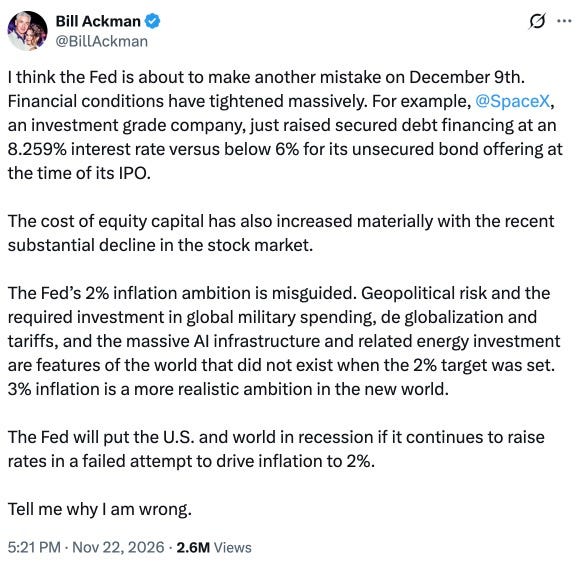
He pointed to the rising cost of capital, citing SpaceX as an example, before arguing that the Federal Reserve’s longstanding inflation target is no longer appropriate for the world we live in.
“The Fed’s 2% inflation ambition is misguided,” Ackman stated. “Geopolitical risk and the required investment in global military spending, de globalization and tariffs, and the massive AI infrastructure and related energy investment are features of the world that did not exist when the 2% target was set.”
Ackman added that “3% inflation is a more realistic ambition in the new world,” warning that the Fed could push the United States and the global economy into recession if it continues raising interest rates in pursuit of 2% inflation.
He ended his post with a challenge: “Tell me why I am wrong.”
Well, I think Ackman is wrong, but is going to be proven right. Not because I agree with his argument that the Federal Reserve should abandon its 2% inflation target. In fact, I think doing so would be damaging to the average American household. But because I believe the Fed has spent the better part of two decades backing itself into a monetary corner from which there is no painless escape, as I’ve constantly written.
I think the Fed will eventually have to accept structurally higher inflation.
Whether that comes through an explicit increase in…(READ THIS FULL ARTICLE HERE)
CALIFORNIA/SAN LUIS OBISPO
Don’t Even Boil It: California City Warns Residents Not To Drink Tap Water After Suspicious Tank ‘Tampering’ Alarm
Monday, Nov 23, 2026 – 04:40 PM
The City of San Luis Obispo told residents of its Serrano and Patricia neighborhoods early Monday not to drink or cook with their tap water, after an intrusion alarm at a city drinking water storage tank indicated trespassing and possible tampering.
The city’s “Do Not Drink” notice went out at about 3:30 a.m. Officials said the break-in raised concerns that an unknown substance may have been introduced into the drinking water. The alarm tripped on Sunday evening, Nov. 22, according to KEYT.
Crews drained the tank and flushed the water lines around it. The city has not said whether anyone actually got into the water, or whether anything was put in it.
Residents in the affected area were told to use bottled water for drinking, baby formula, juice, brushing teeth, washing dishes, making ice and cooking. The city also warned them not to boil, filter or otherwise treat the tap water, since none of that would make it safe if something had been added.
“Keep using bottled water until the city confirms that testing shows the tap water is safe to drink,” the city said Monday. Bottled water is being handed out at Bishop Peak Elementary School on Jaycee Drive, and the city has posted a map and address list of the affected properties. Officials expect the problem to be resolved within 72 hours, KEYT reported; the notice stays in effect until further notice.
San Luis Obispo County has been here before. In November 2022, the operator of the county’s Santa Margarita water system found that vandals had damaged the fence at its storage site and cut the lock on a tank holding about 100,000 gallons. Because it was unknown whether anyone had tampered with the water, the tank was taken out of service and drained, and the county notified the State Water Resources Control Board, its health department and the Sheriff’s Department.

The scare also comes two weeks after the Nov. 8 Santa Barbara Half Marathon, a little more than an hour’s drive south, where about 30 runners needed medical treatment and 26 were taken to hospitals. Rumors spread online that water stations along the course had been spiked. The county said the illnesses appeared to be “an isolated event connected directly to race participation and the heat”, while Santa Barbara police kept investigating what they called “suspicious circumstances.”
END
ILLINOIS//ETHANOL PLANT
this could have caused a massive amount of deaths and destruction
(ZEROHEDGE)
Ethanol Plant Bomb Suspect Jailed As Feds Reveal What Was On His Missing Hard Drive
Tuesday, Nov 24, 2026 – 08:00 AM
The BioUrja Renewables trainee accused of the Nov. 13 bomb threat that emptied a one-mile ring around a Peoria, Illinois, ethanol plant will stay in jail until trial, after prosecutors told a federal judge that a hard drive removed from a laptop and found in his truck held files on explosive devices, and that a schematic map of the plant was in the same vehicle.
U.S. Magistrate Judge Ronald Hanna ordered Andrew M. Kozak, 41, of Chillicothe, held without bond at a detention hearing on Friday, Nov. 20. Hanna called the accusations “exceptionally serious,” WCBU reported from the courtroom, and said that if the device found at the plant had gone off, it would have caused “mass destruction and death.” He described it as a “viable device,” according to 25News.
Booking/mugshot photo of Andrew M. Kozak, the BioUrja Renewables trainee accused in the Peoria ethanol plant bomb threat
The emailed threat, sent to BioUrja employees under the subject line “severe site security risk,” complained of a “severe lack of security” and a “general feeling of apathy” among plant workers. It gave the location of a bomb as a sign of “good faith” for “future negotiations,” prosecutors said. Police found the package near a tank that afternoon, and the device was rendered safe. “The danger of that speaks for itself,” Assistant U.S. Attorney Douglas McMeyer told the court.
Prosecutors laid out the digital trail with surveillance footage and internet records. Cameras caught Kozak arriving at a Hy-Vee in north Peoria around 9:45 a.m.; about 15 minutes later, an email account in the name “Jake Armitage” was set up on the store’s public Wi-Fi; and the threat went out at 10:16 a.m., with Kozak on camera inside the store two minutes later. He checked out at 10:31 a.m. Kozak’s wife told FBI agents he had used the Jake Armitage name on Facebook, and the account was later used from the couple’s home internet connection in Chillicothe, prosecutors said.
A Nov. 16 search of that home turned up AA rechargeable batteries, copper sheeting, wiring and white tape, which prosecutors said matched the components of the partly destroyed device found at the plant, one fitted with timers or remote-control parts. Agents also found a laptop with its hard drive missing. The drive turned up in Kozak’s truck, holding files on shaped-charge explosives and a blasting cap well, along with a video about copper-based explosives, prosecutors said, according to Fox News. His search history, prosecutors said, ran to footage of ethanol tanks exploding and to the 2023 probe of a blast at another ethanol plant.
Here is a slide from prosecutors’ presentation showing an alleged explosive device put at BioUrja. The government alleges it was Andrew Kozak but he has not been charged with that.
Kozak’s public defender argued that the government had not shown he built or placed the device, that others in the house could have used the laptop, and that the batteries ran his wife’s outdoor lights and solar lamps. The defense called Kozak an intelligent person, “a nice guy” who helps his neighbors, and asked that his right to liberty not be “eviscerated.” Hanna found that no conditions of release would protect the public, saying home detention would not stop further planning and an ankle monitor would not stop him from running, and pointed to Kozak’s record and to his family having left the area.
Kozak, a trainee at the plant for about 10 months, was taken into custody at the plant when he reported for his shift on Nov. 16. He has a string of Nebraska burglary-related convictions and two prison stints between 2008 and 2014, as we reported the day after a grand jury indicted him.
The indictment charges him with transmitting an interstate threat to damage and destroy the plant by fire and an explosive, which carries up to 10 years in prison, and with sending a threat by interstate communication, which carries up to five. Neither count accuses him of building or planting the bomb. He pleaded not guilty on Nov. 17.
The threat forced a mandatory evacuation of thousands of people within a mile of the plant in Peoria and East Peoria, which held until the afternoon of Nov. 14. A pretrial hearing is set for Dec. 3, and a jury trial for Jan. 11.
Evacuation and search operation after the bomb was found at the Peoria ethanol plant
Bill Daly, a former FBI investigator who worked the 1993 World Trade Center bombing, told Fox News the threat counts are a common opening move: they keep a suspect in custody while the lab work on the device catches up. “It doesn’t mean that what he’s currently charged with may be the only charges,” he said.
END
VIRGINIA
Virginia Schools Shut Down After 500+ Staff Never Checked For Child Abuse
Tuesday, Nov 24, 2026 – 09:00 AM
Authored by Steve Watson via Modernity,
Albemarle County, Virginia just closed all 29 of its schools after discovering that more than 500 employees hired over the past three years were never run through the state’s Child Protective Services registry.
The district serves roughly 14,000 students. New hires passed criminal background checks, but their information was never submitted for the separate state check that flags founded cases of child abuse or neglect.
The failure went on for three years.
Education Secretary Linda McMahon highlighted the case in a Fox News interview.
She highlighted what investigators found: a fifth-grade teacher who pled guilty to child pornography charges; a “social and emotional learning” coach arrested for sexually assaulting at least seven students under the age of 13; and multiple administrators arrested for failing to report the misconduct.
The superintendent who oversaw the district during this period, Matthew Haas, “resigned” over the handling of the abuse cases.
However, he walked away with full pay and benefits through 2027, plus a raise and an $800 bonus, under the terms of his exit agreement.
McMahon said she has never been more upset as a mother and grandmother.
The Department of Education is placing the district on high-risk status, which cuts off upfront federal grant funding, and is moving to debar not only the charged staff but the senior officials who allowed it to happen.
The district closed starting November 19 and hopes to reopen after Thanksgiving. Acting Superintendent Chandra Hayes said none of the people currently under investigation for abuse or failure-to-report charges were among the 500+ whose checks were skipped.
The state is prioritizing screenings for staff who work directly with students.
This is the same pattern seen elsewhere: employees with red flags quietly moved instead of removed.
One in ten kids will face sexual harassment before they graduate. In Albemarle, the system that was supposed to catch the problem never even looked.
KING NEWS
| The King Report November 24, 2026 Issue 7876 | Independent View of the News |
| Nvidia reinstated Jensen Huang as CEO. This is why equity futures soared on Sunday night. Someone traded on inside info again and greatly profited again. Pecunia uber alles! NYT: Trump Is Said to Have Directed Effort to Reinstate Nvidia ChiefLate last week, Mr. Trump decided he wanted to do whatever he could to help Mr. Huang get his old job back… Over the weekend, Mr. Trump asked Vice President JD Vance to talk to Mr. Huang and work with Nvidia’s board to resolve the situation. Mr. Vance spoke privately with Mr. Huang over the weekend and helped the Nvidia board get the assurances it needed that the Trump administration did not believe that Mr. Huang himself posed a national security risk. Only a tiny handful of officials at the highest level of the government were aware of these conversations…(No Rubio, we’d bet!) “He’s got a very, very, very good wife, and they’ve worked it out,” Mr. Trump said. “She’s a fantastic woman.” https://www.nytimes.com/2026/11/23/us/politics/trump-nvidia-huang.html King Report on Monday: Though Asian bourses are down 2%+ on Sunday night, someone is manipulating NQZs & ESZs higher. Does someone know something or is the manipulation to save someone or more? (It was both!) Trump on Sunday night: I hope the Board of Nvidia rehires Jensen Huang. It would be the best thing for the Company, and also, for the U.S.A. President DONALD J. TRUMP. Trump tells CNBC, ‘I convinced’ Nvidia board to reinstate Jensen HuangTrump also told CNBC’s Eamon Javers in a phone interview that he has spoken with Nvidia’s board “directly and indirectly” ahead of Huang’s reinstatement. Trump said the board “did ask for assurance on the national security threat” and that he gave “assurance.”… “And we gave them assurances at least with everything we know, and we know a lot,” Trump said… https://www.cnbc.com/2026/11/23/trump-nvidia-jensen-huang.html “The Board believes Jensen is the right person to lead NVIDIA, and that his reinstatement is in the best interests of our stockholders, employees, partners and customers,” said Harvey Jones, Chair of the Board. @realDonaldTrump: The NVIDIA Board of Directors has made the correct and proper decision to return Jensen Huang to the position of CEO. The Country needs Jensen’s leadership at NVIDIA in order to ensure the Success and Prosperity of not only the Company, but the American Economy. The United States Government has no reason to believe that Jensen’s return to NVIDIA poses any risk to National Security. The Attorney General of the United States has confirmed that the U.S. Government does not possess evidence that he has engaged in any unlawful conduct. On a personal note, I have gotten to know Jensen, and he is a Great Patriot and National Treasure. Separately, NVIDIA should continue its thorough internal investigation of the Company’s compliance with U.S. export controls in order to ensure that it is fulfilling its legal obligations and Patriotic Duty to protect U.S. National Security. Congratulations to Jensen, the NVIDIA Board, to the People of the United States — and, indeed, the World! Thank you for your attention to this matter… Trump on CNBC: “I have a unique relationship with President XI and every time I say I really like him people get angry at me, ‘you shouldn’t say that,’ stupid people say that. He’s got far fewer nuclear weapons than we have, but he’s got a lot and he will have more and more and he’s producing them rather quickly (with Team Trump’s help?)… His respect is so great for Jensen, he viewed him on a different level than just about anybody. This guy (Xi) could end up paying him [Huang] a fortune to let him run a company in China.” https://cnb.cx/4iZSHpq WSJ’s @marykissel: President Trump just told @CNBC that Jensen Huang could’ve gone to work for a Chinese company. If that’s even a part of the calculation to reinstate him, then we’ve effectively been blackmailed by an adversary (Beijing). Think about that. Huge national security implications. @RapidResponse47 “Are you concerned at all about an AI bubble?” Trump on CNBC: “I’m not concerned now because I think we have one of our great stars back in play. This is like a baseball team — you have stars.” https://x.com/RapidResponse47/status/2124893634000744931 Make it stop! The continuous gaslighting and egregious insults on Americans’ intelligence is unseemly. Only an insanely idiotic person would NOT realize that chips were illegally going to China; but Jensen Huang is one of the most brilliant human beings in the known universe. @macropaperr: Jensen Huang’s return as NVIDIA CEO has triggered a MASSIVE political backlash in Washington. Democratic lawmakers are furious that NVIDIA reinstated Huang while serious national security questions remain unanswered. Here’s what they’re saying: 1. Sen. Elizabeth Warren: Called the decision “reckless” and warned that Huang, NVIDIA executives and the board still owe Congress answers about compliance with U.S. export controls. 2. Rep. Debbie Dingell: Accused NVIDIA’s board of making an “irresponsible decision” by bringing Huang back before Congress has even questioned him. 3. Rep. Raja Krishnamoorthi: Warned that investigators still don’t know what information Chinese intelligence may have obtained from Huang, while government and company investigations remain unfinished. 4. Sen. Ruben Gallego: Accused President Trump of “selling out our national security to keep the stock market high.” 5. Gov. JB Pritzker: Blasted the reinstatement as an example of “greed and lack of accountability.” 6. Rep. Richard Neal: Demanded answers from Congress about what exactly is happening behind the scenes. And this is far from over. Huang is back in charge of one of America’s most valuable companies, but congressional investigations into NVIDIA’s China-related activities and potential national security risks are still hanging over him. NVIDIA’s board may have brought Jensen Huang back, but Washington is clearly not ready to move on. Rep. Don Bacon (R-NE), House Armed Services Cybersecurity Subcommittee Chair: “Huang was compromised and exploited by a Chinese spy. Nvidia should have moved on without Huang and ignored the administration’s inexplicable desire to save Huang.” Dems and GOP China hawks want investigations into Nvidia and Huang and Lutnick and Trump and anyone else involved with semiconductors chips, and other technology, illegally going to China. @htsfhickey: We have reached a new level of depravity in this country – not so much amongst the American people – but our leaders in Washington, Wall Street and Silicon Valley (the “elites”). The company said the board had “received input from senior levels of the United States government.” Based on that input, the board said it is “confident that Mr. Huang’s reinstatement poses no national security risk.” Whether or not Mr. Leather Jacket had an affair and might have been compromised by a foreign agent, he did have multiple affairs that he lied about to the Board and others, including an affair with at least one subordinate (a violation of code of conduct and a fireable offense). However, he and his firm were smack in the middle of the vast number of AI-related circular financing deals (many of which were not documented) that have propped up the greatest stock market bubble in U.S. history. Pulling out the key Jenga (Jengson) piece could topple the already unstable edifice that so many of the “elites” have profited from. They couldn’t let that happen. Better to give up all pretense of morality. As I’ve written in the HTS letter, I expected this bubble’s unwinding would be a battle and that there would likely be many (sharp) rallies interspersed during the overall decline. Obviously, this event does not change that opinion. But it is a sad day for the country.GOP (Utah) @SenJohnCurtis: Nvidia’s board says it relied on input from senior U.S. officials to conclude that bringing Jensen Huang back posed no national security risk. I have some questions. Who in our government weighed in? What did they tell the board? And on what basis did the board conclude there was no risk? Mr. Huang was right to step down when the affair came to light. Just 11 days after Nvidia announced his departure, the board brought him back while its own independent investigation was still underway. Last week, the board said it didn’t intend to reinstate him. I’d like to know what changed. GOP Sen (AK) @SenTomCotton: I have warned the administration from the start about Communist China obtaining our most advanced chips through both smuggling and remote access. The controversy with Nvidia and Megaspeed is just the tip of the iceberg, and it’s not resolved because Jensen Huang has his job back. Congress has much to investigate and we will pass overwhelmingly bipartisan chip export-control bills, including my Chip Security Act, one way or the other.Dem Sen Schumer: “Democrats will wield their full power to investigate any wrongdoing by the Trump Administration…” and “anyone selling out our national security for financial gain.”GOP Sen (ND) @SenKevinCramer: The legal and reputational risk of hiring a CEO who may very well be convicted in the United States or other nations of violating espionage and export control laws is now born by the board of Nvidia, but the national security risk is passed along to the United States military and its citizens. The risk of extortion by a Chinese asset who’s been banned by Singapore is risk enough to not rehire Huang. The worst part of this is what we may never know. Congress should immediately pass the strictest export controls possible. I hope it’s not too late.Fox’s @ChadPergram: (Dem Rep): Raskin: “NVIDIA CEO Jensen Huang admitted his affair with a Chinese asset (and likely spy). Billions of dollars of restricted advanced AI chips were carefully diverted to China. “Trump was briefed about the facts as early as last year, and did nothing about the circumvention of our export laws other than buy tens of millions of dollars in NVIDIA stock for himself. “Last week, Trump traveled to China to meet with the ‘outstanding, amazing’ Chinese premier Xi Jinping who Trump marvels over because he has the ‘brains’ and the ‘looks’ and controls 1.4 billion people with ‘an iron fist.’“Right after Trump’s trip, Trump calls into NVIDIA’S corporate board meeting to push the board to reinstate Huang as CEO and President of NVIDIA. “Why are Trump and Lutnick putting China’s interests first? Is it just the tens and hundreds of millions of dollars they’re making out in the open or does Huang have even more damning information on them? A real Congress will find out.”CNBC’s @SaraEisen: This raises serious questions about the credibility and judgement of Nvidia’s board of directors. Less than a week ago, the board Chair told investors on the earnings call: “The NVIDIA board unanimously accepted his resignation and does not intend to reinstate Jensen as CEO.”President Trump told us this morning, “I convinced them” [the board] to bring Jensen back. There will be endless lawsuits from anyone that sold Nvidia last week after the board told investors there’s no consideration of bringing him backRubio walks off in silence when asked if Jensen Huang is a security risk as Republicans break ranks over Nvidia return https://trib.al/J26tpyBNB: Intel sources in recent weeks have been copiously leaking info re: NVDA, Huang, and China. With the reinstatement of Huang as NVDA CEO, you can expect more leaks after Thanksgiving for NVDA and Huang’s scheduled December 1-3 appearances at various House & Senate committees.Fox Business’s @CGasparino: Call me crazy, but Trump laying the groundwork that Huang’s affair was a nothing burger from a national security standpoint and he should return to Nvidia (as I reported Jensen and Co are desperately trying to do) has all the earmarks of a modern-day Watergate for this administration. IMHO (and it’s based on knowing the president) the real reason Trump believes Huang should return is because he believes it will save the market and his record on the economy because AI is what’s left in its bull run. It’s a ballsy strategy and it might work given the powerful forces at work. But its worth noting that the evidence is PILING up that he’s playing with fire based on what we know about Huang’s management of @nvidia and what Alice Huang was doing. Plus Trump isn’t that powerful any longer. Tech bros/Wall Street just got a big middle finger during the midterms as well. The Dems are emboldened to make “L’affaire Jensen” part of their quest to impeach Trump and score more political points, and it appears Trump is making that effort a lot easier. I should also point out there is never one reason why markets correct or why tech and AI is correcting (or has corrected). Huang can’t save it from what is at the very least a normal adjustment to valuations. BBG’s @EdLudlow: Bloomberg reporting that Jensen Huang being reinstated was done without the company’s senior leadership being consulted. Colette Kress, interim CEO and CFO, was excluded from the process and the decision made only on Sunday afternoon. News Nation’s @bungarsargon: Jensen Huang wasn’t the dupe of a Chinese spy; there’s evidence he was complicit in a mass smuggling operation of our most advanced technology to our adversary’s military. So why is he being reinstated at Nvidia? Because he had a big helping hand from the Trump administration. https://x.com/bungarsargon/status/2124874192701255850Are AI levered companies now what big banks were to the Establishment in 2008 (Too big to fail)? @GaryMarcus: Given how many *Republican* Senators have come down publicly against today’s shenanigans, I wouldn’t assume that conviction for impeachment is entirely out of the question.54 Democrats plus 2 Independents and 11 Republicans looking to separate themselves from Trump in 2028 is all it would take. (There could be enough GOP Senators that are China hawks or GOPe that might join with Dems to convict.) Trump hangs up on Beijing: FCC cuts off Chinese carriers from U.S. phone numbersTrump’s China fight has moved off the trade floor and into Americans’ pockets, from the robocalls on their phones to the cloud supporting their apps. In a single week, his administration cut China’s biggest carriers off from U.S. phone numbers and moved to stop Beijing from renting American AI chips through overseas data centers. The Federal Communications Commission (FCC) nis “strengthening our first line of defense against bad actors and illegal robocallers,” FCC Chairman Brendan Carr said Thursday. Carr has warned about the threat before: “The CCP is constantly exploring for ways to breach our networks,” Carr said in 2025, pointing to the Salt Typhoon hacks as evidence of state-sponsored interference with global communications… (Give more high tech & AI chips to China!) Consumers received more than 4 billion robocalls in October… One recent report found scam victims lose an average of $4,000. The robocall fight doubles as a counterintelligence fight… https://justthenews.com/politics-policy/trump-hangs-beijing-fcc-cuts-chinese-carriers-us-phone-numbers Huang’s return to NVDA is viewed as a negative for Anthropic. ANT hit a low of 84.61 (-4%) at 15:06. NQZs soared as much as 2010 points on panic short covering and manic trader buying. ESZs rallied as much as 378 points! The Trump Put/Rig in all its glory & wonder was played! NQZs hit a daily high of 27,137.00 (+2010.50, +8.0%) seconds after the NYSE opening. The December Nas 100 futures then sank to 26,450.250 at 9:41 ET. They then traded sideways into the close. The S&P 500 opened +317.02 (7227.42) and hit 7260.17 seconds later. The index retreated to 7152.66 at 9:41 ET and then rallied to a daily high of 7295.60 (+385.21, +5.574%) at 10:32 ET. The 2nd Hour Reversal and liquidation for the European close took the S&P 500 Index down to 7207.82 at 11:42 ET. The European close contra move took the S&P 500 up to 7259.88 at 12:15 ET. After a modest roll over, the S&P 500 Index traded sideways into the close. Positive aspects of previous session Stocks, particularly AI and tech trading sardines, soared on Trump’s latest stock market intervention.NVDA hit a high of 171.50 (+45.97, +36.6%) at 10:25 ET.S&P 500 +4.73%, DJIA +3.01%; DJTA +2.19%, Nas 100 +6.86%, Nasdaq +6.51%, SOX Index +14.03%SP Info Tech +9.03%, Comm Services +5.18%, Consumer Discretionary +4.27%, Industrials +3.9%, Materials +3.56%, Financials +1.86%, Utilities +1.4%, Healthcare +1.25%, Real Estate +1.08%Jan WTI -$3.10, Jan Brent -3.22, Jan Diesel -19.50¢, Jan Gasoline -8.31¢ at 16:26 ET Negative aspects of previous session Nvidia flatlined after 11:15 ET (after rolling over from 10:25 ET high)The S&P 500 Index hit its high at 10:32 ET.SP Energy -1.32%; Consumer Staples -0.09%; ANT closed at 87.64, -1.47% after a high of 94.24.USZs rallied only 3/32 (despite energy commodity carnage) at 16:25 ET and were as low as -19/32. Ambiguous aspects of previous session How long will the Trump stock market manipulation keep stocks buoyant? First Hour/Last Hour NYSE Action [S&P 500 Index]: 1st Hour: Up; Last Hour: Down Pivot Point for S&P 500 Index [above/below indicates daily trend to day traders]: 7228.48Previous session (S&P 500 Index) High/Low: 7295.60 (10:32 ET); 7152.66 (9:41 ET) Today – After a rig and/or manipulations the market usually trades in a range. Few people want to play in a rigged game without some semblance of price discovery. Add in high absenteeism for Thanksgiving Day week, and we have the ingredients for listless action. Traders are buying equity futures on Monday night. Be alert for a pump & dump! As we noted last week, for the past 2 months NQZs and ESZs have been up sharply at night but get sold during the day. ESZs +40.00; NQZs +199.75, USZs -7/32, Dec WTI -$0.02, Dec Gas -0.25¢, ¥/$ 158.95 at 20:15 ET Expected Econ Data: Sept Case/Shiller Home Prices -0.3% m/m & 2.7% y/y; Sept US House Price Index 0.2% m/m & 2.4% y/y; Conference Board Nov Consumer Confidence 92 Treasury Auctions this week: 5-yr $70B today; 7-yr $44B 11/25; T-Bills $321B Mon/Tue https://www.treasurydirect.gov/auctions/auction-announcements/ S&P 500 50-day MA: 7618; 100-day MA: 7614; 200-day MA: 7348 (Close 7237.17, +4.73%)Nasdaq 100 50-day MA: 29,178; 100-day MA: 29,186; 200-day MA: 28,082 (Close 26,746.10 +6.86%) DJIA 50-day MA: 51,651, 100-day MA: 52,304; 200-day MA: 50,774 (Close 49,595.31, +3.01%) (Green is positive slope; Red is negative slope) Clemenceau: “The cemeteries are full of men who were once thought to be indispensable.” | |
-END-
SWAMP STORIES FOR YOU TONIGHT
“Don’t Lecture Us About Justice, Piggy”: Newsom Camp Hits Back As Trump Savages Death Row Clemency
Tuesday, Nov 24, 2026 – 07:40 AM
President Trump took the podium at the Justice Department on Monday and unloaded on California Gov. Gavin Newsom, calling his commutation of all 548 death sentences in the state “one of the most shocking acts of injustice our country has ever seen,” then signed a memorandum the same day ordering federal prosecutors to seek death for child killers and to speed up federal executions.
“Just days ago, the governor of California, Gavin Newsom, granted clemency and mercy to 548 of the most evil monsters on the face of the earth,” Trump said, with Attorney General Todd Blanche and FBI Director Kash Patel at the event and relatives of murder victims in the room.
Trump ran through who is on the list: “more than 110 child killers, more than 100 rapists who murdered their victims,” and serial killers including Charles Ng, “who tortured, enslaved, and slaughtered at least 11 people.” Newsom, he said, “came along and stole away the only closure those families might ever have.”

The White House’s roll call of the spared includes Richard Allen Davis, who murdered 12-year-old Polly Klaas, Randy Kraft, Cary Stayner and Luis Bracamontes. Polly’s father, Marc Klaas, was among the families the White House brought forward, along with Sandy Friend, whose son Michael Lyons was kidnapped, tortured and murdered at 8. “Face me, Gov Newsom. Tell me Michael’s life doesn’t matter,” Friend said.
“He stood with the murderers and the child slayers, but today we say the American people stand with you,” Trump told them, adding that his administration is working “to get this travesty overturned in some form.” Washington has no say over a governor’s clemency, though, and the fight over Newsom’s order is in California’s courts, where half the state’s district attorneys have sued to stop it.
What Trump can control is the federal death row. The memorandum directs the attorney general to “pursue Federal jurisdiction and seek the death penalty” for first-degree murder of a minor, murder in the course of rape, sexual abuse or sex trafficking, and murder in the course of kidnapping or human trafficking. It also orders that federal death sentences be “carried out as expeditiously as possible,” by prioritizing appeals, “opposing dilatory litigation tactics” and cutting administrative delays. It builds on the order Trump signed on his first day back in office.
“Once juries have spoken, capital punishment will be swift and certain,” Trump said.
Newsom’s press office had swung first, hours before Trump spoke. Every person Newsom commuted “will die in prison. Not one walks out,” it posted, before turning to Trump’s own pardons: “Convicted murderers, deadly drug traffickers, violent January 6 child-sex offenders. Pardoned, released, and walking free! Don’t lecture us about justice, piggy.” The last word recycles the “quiet, piggy” line Trump aimed at a Bloomberg reporter last November, which Newsom’s office turned into a run of AI pig memes at the time.
As Trump spoke, Newsom posted a video of his own, opening on “Donald Trump is once again standing inside the Department of Justice, next to his former personal defense lawyer, who is now the Attorney General.” He brought up Trump’s 1989 newspaper ads calling for the death penalty for the Central Park Five, then the pardons. “Donald Trump doesn’t oppose mercy. He sells it,” Newsom said. “If you’re poor, black, or brown, you get the needle. If you’re rich and know Donald Trump, you get a pardon and a personal phone call.”
His office put a number on it, citing a House Judiciary Democrats report that Trump’s clemency wiped out “$1.7 billion in restitution and funds owed by his buddies,” some of it owed to victims and to the federal Crime Victims Fund.
Newsom announced the commutations on Nov. 5, two days after the election, converting every death sentence in California to life without parole. None of them takes effect until the legal steps are done, and 382 of the 548 need the California Supreme Court’s sign-off because of prior felony convictions. Newsom halted executions in 2019, and the state hasn’t carried one out since Jan. 17, 2006.
Lt. Jason Davis, whose brother was killed in the line of duty, said Newsom ignored California voters, who have twice voted for the death penalty at the ballot box. Prosecutors were already in open revolt before Trump got involved.
The fight lands as Newsom weighs a run for the White House: he has said he’ll decide by early January, and won’t run if Kamala Harris does. Polymarket bettors give him a 10% chance of winning the 2028 Democratic nomination.
GREG HUNTER…


