
Gold: $1088.20 up $0.30 (comex closing time)
Silver $14.36 down 6 cents
In the access market 5:15 pm
Gold $1086.00
Silver: $14.31
First, here is an outline of what will be discussed tonight:
At the gold comex today, we had a very poor delivery day, registering 0 notice for nil ounces. Silver saw 0 notices for nil oz.
Several months ago the comex had 303 tonnes of total gold. Today, the total inventory rests at 208.72 tonnes for a loss of 94 tonnes over that period.
In silver, the open interest surprisingly fell by a considerable 2843 contracts despite silver being down by only 6 cents in yesterday’s trading. The total silver OI now rests at 162,435 contracts In ounces, the OI is still represented by .812 billion oz or 116% of annual global silver production (ex Russia ex China).
In silver we had 0 notices served upon for nil oz.
In gold, the total comex gold OI fell by 378 contracts to 436,426 contracts as gold was only down by $0.30 yesterday. It seems the modus operandi of the bandits is to liquefy gold/silver OI as be approach first day notice on Monday, November 30. We had 0 notices filed for nil today.
We had a huge withdrawal in gold inventory at the GLD to the tune of 3.00 tonnes / thus the inventory rests tonight at 663.43 tonnes. The appetite for gold coming from China is depleting not only gold from the LBMA and GLD but also the comex is bleeding gold. Our 670 tonnes of rock bottom inventory in GLD gold has been broken. It looks to me that China has taken the last amounts of physical gold from the GLD. I guess the only place left for China to receive physical gold, after they deplete the GLD will be the FRBNY and the comex. In silver,no change in silver inventory / Inventory rests at 313.681 million oz.
We have a few important stories to bring to your attention today…
1. Today, we had the open interest in silver fall by a considerable 2843 contracts down to 162,435 despite the fact that silver was down by only 6 cents with respect to yesterday’s trading. The total OI for gold fell by a tiny 378 contracts to 436,426 contracts with gold down only 30 cents yesterday.
The fact that OI continues to remain high in silver necessitates the bankers to continue raiding hoping to shake the leaves from both the gold and silver trees. Remember that December is generally a big delivery month for both gold and silver
(report Harvey)
2.Gold trading overnight, Goldcore
(/Mark OByrne)
9 USA stories/Trading of equities:
2 commentaries on Macy’s
i ) a) the big retailer Macy’s misses on revenues, on earnings and just about everything. They report that international shoppers are just not coming to the stores as the dollar is just too high
(Macy’s zero hedge)
i b) just look at what happens when you continue borrow money to buy your own stock
ii) a More troubles for Valeant as funds liquidate their holdings
(zero hedge)
iib) Bill Ackman, largest owner of shares of Valeant now faces a lawsuit on insider trading and no doubt there will be criminal charges
(zero hedge)
iii) Judgment day looms for the USA 10 yr bond as yields touch its resistance levels
(zero hedge)
iv) more on that Freddie Mac deal with 3 billionaires to privatize apartments putting on huge risk to the taxpayer:
10. Physical stories
i) USA banks said to hold 10 trillion usa in risky loans (repeated)
(London’s Financial Times/GATA)
ii) The largest ever Chinese gold deposit has been discovered under 20000 meters undersea:
(courtesy Koos Jansen)
iii) Base metals have collapsed over 50% from their high levels of 2011:
(zero hedge)
iv) Jessie of Cafe Americain states that the gold/silver whacking is due to fears by the cartel of deliveries in December of our two precious metals
(Jessie/Americain cafe)
v) Craig Hemke on the fraud at the comex
(Greg Hunter/Craig Hemke)
Let us head over to the comex:
The total gold comex open interest fell from 436,804 down to 436,426 for a loss of 378 contracts as gold was down by only $0.30 with respect to yesterday’s trading. For the past two years, we have strangely witnessed two interesting developments with respect to the gold open interest: 1) total gold comex collapse in OI as we enter an active delivery month, and 2) a continual drop in the amount of gold standing in an active month. It looks like the latter has stopped. The November contract rose by 3 contracts rising to 214. We had 0 notices filed yesterday, so we gained 3 gold contracts or an additional 300 oz will stand for delivery in this non active delivery month of November. The big December contract saw it’s OI fall by 10,719 contracts from 236,981 down to 226,262. The estimated volume today (which is just comex sales during regular business hours of 8:20 until 1:30 pm est) was 266,977 which is very good. The confirmed volume yesterday (which includes the volume during regular business hours + access market sales the previous day was good at 183,636 contracts and aided by copious HFT trading.
November contract month:
INITIAL standings for November
Nov 11/2015
| Gold |
Ounces
|
| Withdrawals from Dealers Inventory in oz | nil |
| Withdrawals from Customer Inventory in oz nil | nil
|
| Deposits to the Dealer Inventory in oz | nil |
| Deposits to the Customer Inventory, in oz | 4,018.75 oz
Scotia
|
| No of oz served (contracts) today | 0 contracts
|
| No of oz to be served (notices) | 214 contracts
(21,400 oz) |
| Total monthly oz gold served (contracts) so far this month | 7 contracts
700 oz |
| Total accumulative withdrawals of gold from the Dealers inventory this month | nil |
| Total accumulative withdrawal of gold from the Customer inventory this month | 89,423.6 oz
|
Total customer deposits 4018.75 oz
we had 0 adjustments:
November initial standings/First day notice
Nov 11/2015:
| Silver |
Ounces
|
| Withdrawals from Dealers Inventory | nil |
| Withdrawals from Customer Inventory | 16,265.59 oz
CNT,Delaware |
| Deposits to the Dealer Inventory | nil |
| Deposits to the Customer Inventory | 1,158,050.49 oz
Scotia |
| No of oz served (contracts) | 0 contracts (nil oz) |
| No of oz to be served (notices) | 6 contracts
30,000 oz) |
| Total monthly oz silver served (contracts) | 5 contracts (25,000 oz) |
| Total accumulative withdrawal of silver from the Dealers inventory this month | nil oz |
| Total accumulative withdrawal of silver from the Customer inventory this month | 4,671,040.1 oz |
Today, we had 0 deposit into the dealer account:
total dealer deposit; nil oz
total customer deposits: 1,158,050.49 oz
total withdrawals from customer account: 16,265.59 oz
And now SLV
Nov 11/no change in silver inventory at the SLV/rests tonight at 313.681 million oz/
Nov 10/no change in silver inventory at the SLV/rests tonight at 313.681 million oz/
Nov 9/no change in silver inventory/rests tonight at 313.681
Nov 6/ we had a very tiny withdrawal of 136,000 oz (probably to pay for fees)/Inventory rests tonight at 313.681 oz
Nov 5/strange no change in silver inventory/rests tonight at 313.817 million oz/
Nov 4/2015: no change in silver inventory/rests tonight at 313.817 million oz/
Nov 3.2015; no change in silver inventory/rests tonight at 313.817 million oz/
Nov 2/a withdrawal of 716,000 oz from the SLV/Inventory rests tonight at 313.817 million oz
Oct 30.no change in silver inventory at the SLV/Inventory rests at 314.532 million oz
Oct 29/a big withdrawal of 1.001 million oz from the SLV/Inventory rests at 314.532 million oz
Oct 28.2015: no change in silver inventory at the SLV//inventory rests at 315.533 million oz.
Oct 27/no change in silver inventory at the SLV/Inventory rests at 315.533 million oz/
Oct 26/no change in silver inventory at the SLV/Inventory rests at 315.533 million oz/
Oct 23./no change in silver inventory at the SLV/Inventory rests at 315.533 million oz
Oct 22./no change in silver inventory at the SLV/Inventory rests at 315.533 million oz
Oct 21:a we had a small addition in silver ETF inventory of 381,000 oz/inventory rests tonight at 315.533 million oz
Oct 20.2015/ no change in silver ETF/Inventory rests at 315.152 million oz
“I Can’t Deny It – The Outlook For Gold Isn’t Pretty Right Now”
Today we turn our attention to the precious metal that once brought joy and riches to its owners, but now seems to bring nothing but despair and disappointment. I’m talking, of course, about gold.

There’s no point fighting it – gold is in a bear market – Money Week
It’s taken yet another tumble. After a miserable early summer, which saw new lows at $1,080 an ounce, gold enjoyed a pleasant August to October with a nice 10% rally. But it didn’t last writes Dominic Frisby in his just released article for Money Week.
Why it is I’m not sure, but the second half of October rarely seems to be a good time for gold – and so it proved this year. All those late summer gains have now been given back and, once again, gold is flirting with its lows in the $1,080-$1,090 area.
For all the excitement, it was just another ‘dead cat bounce’ – a so-called ‘suckers’ rally’, as the Americans so cruelly put it – in an ongoing bear market.
I’d love to tell you that $1,080 is the low – that this is the mother of all buying opportunities, that you should all max out your credit cards and buy every flake you can possibly get your hands on.
But gold-lover though I may be, that is not what I see next.
Until Monday’s stabilisation, we’d had something like 13 down days in a row, which is extreme, even by the standards of this bear market, so some kind of steadying of the ship is likely.
But the bottom line is that this is a bear market. And the trend is down. Fighting the trend is no more effective than fighting the tide or fighting the wind. You’re better off accepting it for what it is, and going with it.
How far could gold fall?
I still have $1,050 as my target for this year. And I suspect we’ll get there. This target is based on nothing more than price action.
Below is a ten-year chart of gold. I have drawn an amber band in the $1,000 to $1,050 area. On the way up it was a wall of resistance that lasted for almost two years. Let’s hope it is a similarly strong wall of support on the way down.
The question is, which of the two – the downward trend or the wall of support – will prove stronger?
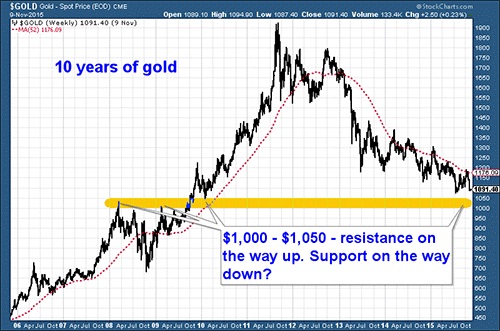
I’d also draw your attention to that dashed red line I have drawn. This is the 52-week simple moving average – it shows the average price of the previous 52 weeks, the previous year in other words.
In a bull market, it is sloping up. Rallies will often retrace to this line before the next leg up (they did this between 2001 and 2009). Post-2009, the bull market was so strong, rallies did not even retrace that far.
In a bear market however, the opposite happens. It trends down – because prices are getting lower and lower. Bear market rallies – or suckers’ rallies – tend to retrace to it before the next leg down. It marked the point at which the latest rally petered out. It’s a useful long-term indicator.
Sure, it is not declining as steeply as it did in 2013, but it is still declining. Before we can declare “the bear market is dead” and “long live the bull market”, we need to see that line flatten out and then begin to rise. It will happen one day – just not yet.
If that amber zone of support does not hold, then, based on price action alone, the $850 area comes into play, and after that $730. Even in my current bearish frame of mind I’d be surprised to see the latter, but we’ll have to see what happens over the next few months.
One reason to worry about gold
I don’t want to put the wind up you. I know how negative I’m sounding this morning. But here is something that really concerns me about the gold price.
Relative to other commodities – and, please, don’t let’s get into an argument about whether gold is a commodity or not – the gold price is still very strong. It may not feel like it, but it is. This is the chart that every goldbug does not want to see.
It shows the price of gold relative to the price of commodities – as measured by the CRB, the world’s oldest commodities’ futures index – since 1980. When the price is high, that means gold is expensive on a relative basis. When the price is low, gold is cheap.

Gold price relative to commodities
Compared to other commodities, gold is not far off all-time highs. That’s because, of course, commodities – be they oil, natural gas, base metals, softs, grains – have all fallen dramatically in price. Most are at multi-year lows. Gold is ‘only’ down 40%.
For that ratio to come back to its long-term averages – in other words if we are to see some sort of reversion to the mean (and there is no guarantee we will) – either gold needs to come down a lot more, or commodities need to rise.
I’m not sure that, with deflationary forces abounding in the world, commodities are going to rise in price by anything that significant any time soon. I may be wrong, of course. But the environment for them isn’t so great, I’d say.
So there is one reason gold could still have further to fall. It is overvalued on a relative basis [to commodities].
I’m hanging on to my gold hoard
I’m not selling my physical. I’m pretty confident a day will come when I’m mighty glad I own it. I also have a few positions in mining companies that I’m not currently selling – I’ll tell you about those in a future Money Morning. I’m actually pretty excited about a couple of them.
But I’m also sitting quite heavily in cash. And in my trading account I’ve been shorting gold, silver (as I mentioned last week), palladium (as mentioned about a month ago) and various gold mining indices (as a hedge). This has been working well.
I closed out most of my shorts on Monday, in expectation of some kind of respite rally. I’ll check out the action over the next week or so, before deciding what my next move is.
Editor’s Note:
Dominic Frisby is one of the more informed analysts on the precious metal markets and this is why we have had him on our webinars. We share his concern about prices in the very short term particularly for those trading markets. However, taking a longer term perspective we see gold and silver as being undervalued at these price levels.
While gold may be overvalued versus the wider commodities complex which have collapsed, arguably it is undervalued versus stocks, bonds, property, art and other markets many of which are near or at all time record highs … floating on a sea of artificial QE induced liquidity.
[Click to expand]

It is important to note that the current weakness of gold and silver is primarily in dollar and sterling terms. For investors in Canada, Australia, New Zealand and of course the EU – who have seen their currencies depreciate – gold is higher in local currency terms and once again acting as a hedge – see table above.
Still depressed gold prices are providing an opportunity for those seeking to get an allocation to bullion and as we advised on our recent webinar – dollar cost averaging remains prudent.
As ever, it is important to use gold and silver bullion as risk hedging assets and financial insurance in a diversified portfolio.
Must-read guide to international bullion storage:

Download Essential Guide to Gold Storage in Singapore

Download Essential Guide To Storing Gold In Switzerland
DAILY PRICES
Today’s Gold Prices: USD 1088.60, EUR 1013.17 and GBP 718.36 per ounce.
Yesterday’s Gold Prices: USD 1092.50, EUR 1017.23 and GBP 723.50 per ounce.
(LBMA AM)

Gold in 1 year
Gold closed down $2.70 yesterday to finish the day at $1088.70. Silver closed at $14.42, down $0.14. Platinum lost $12 to $898.

end
(courtesy Craig Hemke/(Turd Ferguson/Greg Hunter)
Huge Fraud at COMEX Covering Up Huge Demand for Gold-Craig Hemke
 By Greg Hunter’s USAWatchdog.com
Financial expert Craig Hemke says not only is the 300 to 1 leverage at COMEX “extreme fraud,” but it also is a sign of record demand for physical gold. Hemke explains, “We have been at this number now for a couple of months. . . . Meaning that for every one physical ounce of supply in the vaults of COMEX, there are 300 beneficial owners. 300 paper ounces have been created. That leverage, that stress is telling us something. You get the anecdotal stories about the empty vaults of London and the stress of the gold that is flowing out of the vaults of London and out of the U.S., out of the UK and into Switzerland. There are stories of the refiners running 24 hours a day, 7 days a week, taking the old 400 ounce gold bar and . . . recasting them into kilo bars and shipping them to the East where the demand is. . . . It’s huge fraud to cover up huge demand. There is no doubt about it.”
Hemke goes on to say, “I think we are finally starting to run out (of physical gold). There are all these data points, but I can’t look at it and say, therefore, by Thanksgiving, all hell is going to break loose and the system is going to break. I am not going to tell you that, but what I will tell you, I am perfectly comfortable owning gold, and I have been perfectly comfortable accumulating it for the last three years while the price falls because I know this system is eventually going to fail and, when it does, the result is going to be spectacular.”
Hemke goes on to say, “There is a reason why the futures markets are set up and utilized the way they are. It’s modern alchemy, and it is to suppress or control price, but you have to have this physical metal backing it. It is that that I think we are finally getting to the end of. When the music stops and everybody that has an unallocated account in London or Sydney or has GLD, all these folks who think they own gold, when instead, all they own is a paper obligation with counter-party risk. When the music stops, when the 300 people are circling one chair while the music plays, when they all try to sit on that chair at once and the world realizes there is nowhere near the amount of gold that was supposed to be there, let’s just say the price is not going to be $1,100 an ounce.”
Hemke says what happened in the run-up to the September Fed meeting is happening again. The dollar is rising and commodities are tanking. Hemke explains, “All of these prices are going straight in the toilet because of the rising dollar. They were going straight in the toilet back in August, too. We are right back to where we were in August. So, when we move through November, and we’ll get a GDP revision to the 3rd quarter, which will be down from its paltry 1.5%. . . . By the time we get around to December 16 (the last Fed meeting of 2015), I am quite certain, based on all these economic factors, that the Fed will do nothing again and, all of a sudden, things will look better for commodities, gold and everything else.”
On the falling price of gold and silver since 2011, Hemke says, “I don’t lose a minute of sleep over that–none. Everything we were worried about in 2011 and 2012 is still out there. It’s only gotten even worse than it was then. The fact that the price is where it is, actually, is a bonus for everybody. It is a chance for those who have not prepared for this event to get prepared and get their hands on physical metal while they can because the end is coming. The fact that it’s been postponed for a couple of years doesn’t mean anything and doesn’t make a bit of difference to me.”
Join Greg Hunter as he goes One-on-One with Craig Hemke, founder of TFMetalsReport.com.
(There is much more in the video interview.)
end
U.S. banks said to hold $10 trillion of ‘risky’ trades
Submitted by cpowell on Tue, 2015-11-10 23:48. Section: Daily Dispatches
By Barney Jopson and Ben McLannahan
Financial Times, London
Tuesday, November 10, 2015
The repeal of part of the Dodd-Frank financial reforms has left big U.S. banks holding $10 trillion of “risky” derivatives trades on their books, according to an investigation by Democrats.
Sen. Elizabeth Warren, a liberal Wall Street foe, said the repeal — which sparked a firestorm when it was slipped into a budget bill in December 2014 — had left federally insured banks exposed to dangerous swaps trades.
The rollback of the relevant rule, which followed almost no congressional debate, sparked stinging criticism of Wall Street and cemented perceptions of the pernicious influence of bank lobbyists on Capitol Hill.
The rule would have required banks to “push out” swaps trades to entities that are not insured with taxpayer funds. …
… For the remainder of the report:
http://www.ft.com/intl/cms/s/0/b8076642-87d3-11e5-9f8c-a8d619fa707c.html
end
The largest ever Chinese gold deposit has been discovered under 20000 meters undersea:
(courtesy Koos Jansen)
Largest Ever Chinese Gold Deposit Has Been Found 2,000m Undersea In Shandong
The largest ever gold deposit in China has been found in the East China Sea, near the Sanshan Islands in the Shandong province, at a depth of 2,000 meters, the People’s Daily Online reported on Tuesday.
The Shandong Provincial No. 3 Institute of Geological and Mineral Survey announced on Monday the massive gold deposit in the sea near the city of Laizhou holds 470.47 tonnes of gold. The vice director of the Shandong Provincial No. 3 Institute, Ding Zhengjiang, said the gold deposit is part of a belt that lies deep at the sea bottom.
“It’s very difficult to locate and set up the drilling platforms at sea,” Ding said. The project manager Zhang Junjin said, “drilling holes into underground rocks that are more than 1,000 meters deep is a big challenge. Normally in China, gold mine prospection is conducted within 800 meters underground. The discovery of a gold deposit lying 2,000 meters undersea provides new drilling technology for future gold mining,” (Quotes by the People’s Daily Online).
Owned by Laizhou Ruihai Mining Ltd, the preparations for China’s first undersea gold mine took three years and involved more than 120 kilometers of drilling, with 67 sea drilling platforms and nearly 1,000 geological workers.

At a current gold price on the Shanghai Gold Exchange of ¥225 yuan per gram for gold having a fineness of 9999, the deposit is worth ¥105.9 billion yuan, or more than $16 billion US dollars.
As inland gold reserves are globally being depleted, undersea gold mining initiatives are increasing. In June 2015 The Times Of India reported exploration has begun for mineral deposits and precious metals like gold and silver in the Southern Indian Ocean at a geological junction where three tectonic plates meet near Mauritius.
In 1949 China’s domestic mining output was a little over 4 tonnes a year. Currently, China is the largest gold miner globally; in 2014 China produced 452 tonnes of gold. The China Gold Association recently disclosed domestic mining output reached 357 tonnes in the first three quarters of 2015, which is 476 tonnes of gold annualized, up 3.5 % y/y.

Most notably, Chinese domestic mining has increased significantly since the late seventies when the country started to open up under the guidance of Deng Xiaoping. It’s being thought that half way the nineties China became a net gold importer. Ever since China has not exported its domestic gold mining output and ramped up gold import to well over 1,000 a year since 2013.
Estimated above ground gold reserves in China are at least 13,743 tonnes, of which 1,723 tonnes are owned by China central bank the People’s Bank Of China, and 12,021 tonnes owned by the private sector.

Koos Jansen
E-mail Koos Jansen on: koos.jansen@bullionstar.com
end
Collapse of base metals:
(courtesy zero hedge)
Forget Oil, Base Metals Collapse 50% From 2011 Highs
Bloomberg’s global commodities index is testing fresh 16 year lows but this is often excused on the basis that it includes crude oil weakness – which will mean-revert higher any day now. Perhaps the bigger, even louder warning signal is directly from the basest of base industrial metals… which are now down 50% from their 2011 “reflate the world” highs.
The index – based on copper, aluminum, zinc, nickel, lead, and tin – is not flashing ‘recovery is coming’ headlines…

But then again – when has that mattered for stocks…

Charts: Bloomberg
end
An Almost Perfect Storm Of Incompetence And Felony
“People of privilege will always risk their complete destruction rather than surrender any material part of their advantage. Intellectual myopia, often called stupidity, is no doubt a reason.
But the privileged also feel that their privileges, however egregious they may seem to others, are a solemn, basic, God-given right.”
John Kenneth Galbraith, Age of Uncertainty
“Misdeeds, once exposed, have no refuge but in audacity. And they have accomplices in those who are fearful in their complicity.”
Tacitus, Annals
We just saw a very historically significant decline in the precious metals in terms of days lower without relief. And we have seen a remarkable rise in the US dollar index against the Euro and the Swiss franc that cannot possibly be good for the real economy of the US, when every other developed nation is trying to devalue their currencies to stimulate their exports and inhibit imports.
I believe that a portion of the gold selling in particular is an effort to knock down the open interest in gold for December. If there was any serious attempt for holders of those contracts to stand for delivery, even JPM, which has been obviously building up its stores of gold to act as the ‘fixer’ in that market, would not be able to cover the demand.
JPM was consistently taking delivery for their house account in gold, and just transferred 70,000+ ounces over from Nova Scotia’s warehouse, from whom they had been taking delivery.
As we know, in the last big delivery month, JPM stepped up with an enormous amount of their gold, 400,000+ ounces, to provide enough real bullion to satisfy the contracts standing for delivery. Even now their inventories remain somewhat depleted.
The dollar has also been soaring, because the Fed is trying to pretend that the US is recovering so that they can raise rates. A strong dollar and higher rates are very harmful to what is almost undoubtedly a fragile economic recovery in the US.
And it is fantasy to think that the US can somehow go it alone, and continue to improve while the rest of the world is cutting rates because their economies are slowing.
The Fed wants to raise rates for their own policy purposes, so they can cut them, without going overtly negative, when their latest financial bubble starts to collapse, which it may already be doing. They cannot really raise rates in a Presidential election year past June, so they will push ahead, to serve their own purposes, even as they harm the real economy.
There will be another financial crisis as the IMF warned today. There will be a serious dislocation in several financial markets, including the precious metals and the bonds at some point, that will rock the current system to its foundations.
It is a portion of the credibility trap which inhibits any meaningful remedy and reform.
It is an almost perfect storm of incompetence and felony.
end
1 Chinese yuan vs USA dollar/yuan falls badly in value , this time at 6.3660 Shanghai bourse: in the green ( on hope), hang sang:red
2 Nikkei closed up 20.13 or 0.10%
3. Europe stocks all in the green /USA dollar index down to 99.17/Euro down to 1.0717
3b Japan 10 year bond yield: rises to .323% !!!!(Japan buying 100% of bond issuance)/Japanese yen vs usa cross now at 123.10
3c Nikkei now just above 18,000
3d USA/Yen rate now well above the important 120 barrier this morning
3e WTI: 43.61 and Brent: 47.10
3f Gold up /Yen down
3gJapan is to buy the equivalent of 108 billion uSA dollars worth of bond per month or $1.3 trillion. Japan’s GDP equals 5 trillion usa.
Japan to buy 100% of all new Japanese debt and by 2018 they will have 25% of all Japanese debt. Fifty percent of Japanese budget financed with debt.
3h Oil down for WTI and down for Brent this morning
3i European bond buying continues to push yields lower on all fronts in the EMU. German 10 yr bund falls to .624 per cent. German bunds in negative yields from 6 years out
Greece sees its 2 year rate rise to 7.51%/: still expect continual bank runs on Greek banks
3j Greek 10 year bond yield falls to : 7.74% (yield curve flat)
3k Gold at $1089.50 /silver $14.44 (8:00 am est)
3l USA vs Russian rouble; (Russian rouble down 8/100 in roubles/dollar) 64.47
3m oil into the 44 dollar handle for WTI and 47 handle for Brent/ China purchases huge supplies from Saudi Arabia
3n Higher foreign deposits out of China sees huge risk of outflows and a currency depreciation (already upon us). This can spell financial disaster for the rest of the world/China forced to do QE!! as it lowers its yuan value to the dollar.
30 SNB (Swiss National Bank) still intervening again in the markets driving down the SF. It is not working: USA/SF this morning 1.0064 as the Swiss Franc is still rising against most currencies. Euro vs SF is 1.0787 well above the floor set by the Swiss Finance Minister. Thomas Jordan, chief of the Swiss National Bank continues to purchase euros trying to lower value of the Swiss Franc.
3p Britain’s serious fraud squad investigating the Bank of England on criminal charges/
3r the 6 year German bund now in negative territory with the 10 year rises to +.624%/German 6 year rate negative%!!!
3s The ELA lowers to 82.4 billion euros,
The bank withdrawals were causing massive hardship to the Greek bank. the Greek referendum voted overwhelming “NO”. Next step for Greece will be the recapitalization of the banks and that will be difficult.
4. USA 10 year treasury bond at 2.33% early this morning. Thirty year rate above 3% at 3.12% /
5. Details Ransquawk, Bloomberg, Deutsche bank/Jim Reid.
(courtesy Jim Reid/Bloomberg/Deutsche bank/zero hedge)
Global Stocks Break 5 Day Losing Streak As Poor Chinese Data Sparks Hope For More Stimulus
For the third day in a row, China dominated the overnight newsflow with the latest industrial output data, which printed at 5.6% missing expectations of a 5.8% increase, and was tied with March for the lowest print since late 2008.

The detailed breakdown:

Additionally, electricity output dropped 3.2% on year, the second straight decline, underscoring the impact of the domestic slowdown on heavy industry. Steel and cement output continued to decline. Investment in property development slowed to a 2% pace of growth, the lowest since early 2009 in the depths of the global financial crisis. While housing sales are rising, data suggest most of that is accounted for by developers clearing inventory rather than building new properties.
The continued industrial weakness in turn pushed the commodity complex lower, with both copper…

… and the entire universe continuing its recent decline as copper, zinc and nickel are heading for their lowest close in at least six years as slowing growth in China dents demand from the world’s largest consumer of energy, metals and grains. The London Metal Exchange index of six industrial metals is set for a third consecutive annual drop, the worst streak since at least 2001. The gauge has sunk 23 percent this year and 50% from its 2011 highs.

And while China’s fixed investment, commodity-reliant economy, which accounts for about half of the country’s GDP, it was a glimmer of good news surrounding China’s consumer economy that, together with the plunge protection team pushed stocks into the green in a last hour scramble, when October retail sales were reported a better than expected +11.0% yoy (vs. +10.9% expected), which was up one-tenth from September and the highest annual increase in 9 months. Additionally, vehicle sales jumped 7.1% y/y in October, up from 2.7% in September, and vehicle production turned positive, up 4.9%, for the first time in four months thanks to recent government stimulus meant to boost the local car industry.
“The retail sales data were a positive boost to sentiment,” said Ronald Wan, chief executive at Partners Capital International in Hong Kong. “Targeted measures as well as the holiday effect helped with consumption last month. A transition towards consumer-driven economy is taking place, albeit at a slow pace.”
The retail data also came during China’s ‘Singles Day’, a day which initially started during the 1990s by college students in something of a twist on Valentine’s Day and which has now progressed into a mega-day for retail sales in China. In fact, Alibaba has estimated that 1.7m deliverymen, 400,000 vehicles and 200 airplanes will need to be deployed to handle today’s deliveries. The same company announced this morning that it sold some $5bn worth of merchandise in just the first hour and a half of the day. So if you’re one of those that has been stunned at how ‘Black Friday’ has moved from a quaint US event to what is fast becoming a global behemoth then be warned as the marketing men have ‘Singles Day’ as their next plan for global domination.
Ultimately the market decided to focus on the retail sales and to ignore the ongoing collapse in the commodity complex which overnight also led to the latest Chinese default, this time a cement maker China Shanshui Cement Group Ltd, leading to the following markets picture:
Market Wrap
- S&P 500 futures up 0.3% to 2083
- Stoxx 600 up 0.5% to 378
- MSCI Asia Pacific up 0.2% to 133
- US 10-yr yield down 1bp to 2.33%
- Dollar Index down 0.29% to 99.0
- WTI Crude futures down 1% to $43.78
- Brent Futures down 0.3% to $47.30
- Gold spot down less than 0.1% to $1,089
- Silver spot up less than 0.1% to $14.44
Elsewhere in Asia, markets traded mixed following the lacklustre close on Wall St., and unlike China itself, focused on the further weak tier 1 data from China adding to the cautious tone in the region. As noted above, the Shanghai Comp. (+0.3%) traded lower after the headline Chinese industrial production data missed expectations before recovering as participants continue to speculate over further PBoC easing, while the Hang Seng (-0.2%) pulled off worst levels following Tencent earnings. ASX 200 (+0.5%) was underpinned by broad sector gains offsetting the weakness in materials amid concerns surrounding BHP (-2.9 %). Nikkei 225 (+0.1%) traded flat amid light volumes coupled with USD/JPY softening. 10yr JGBs traded lower in a subdued session, while the BoJ entered the market to purchase JPY 1.2trl in government bonds.
Asia Wrap:
- MSCI Asia Pacific up 0.2% to 133
- Nikkei 225 up 0.1% to 19691
- Hang Seng down 0.2% to 22352
- Shanghai Composite up 0.3% to 3650
- S&P/ASX 200 up 0.5% to 5123
Top Asian News:
- Goldman Sachs Sees Start of Shenzhen Link by April, Lau Says: Chinese authorities will probably make announcement on start date by early next year
- Shanshui Cement Faces Liquidation, Default Hearing: Winding- up petition, application for appointment of provisional liquidators filed with Cayman Court
- Japan’s Lost Decade Has Lesson for Those Dreading China: Slowdown: Airlines, auto makers profit from Chinese economic slump
European equities (Euro Stoxx: +0.6%) have spent the session firmly in the green during European trade with consumer staples the notable outperformer. This comes as AB InBev (+0.8%) made a formal offer for SABMiller (+2.7%) on the day of their ‘put up or shut up’ deadline. Separately, European equities were also bolstered by dovish comments from ECB’s Visco, who largely reiterated comments from ECB’s Draghi by stating that the December ECB meeting will see a discussion about a cut to the deposit rate.
Just like in China, the main driver behind today’s strength was hope in more central bank easing, and as a result Bunds completely reversed initial weakness to trade higher, supported by expectations of further policy easing by the ECB, while PO/GE 10y spread is also seen tighter by 1 bps, having traded wider by 4bps earlier. Of note, DBRS is said to be discussing Portuguese politics in what is considered to be a crucial rating review which might result in bonds being excluded from the ECB QE, as the rating agency is currently the only one of the major four to rank Portugal as investment grade standard.
Europe Wrap:
- Stoxx 600 up 0.5% to 378
- FTSE 100 up 0.5% to 6306
- DAX up 1% to 10937
- German 10Yr yield down less than 1bp to 0.62%
- Italian 10Yr yield down less than 1bp to 1.69%
- Spanish 10Yr yield up less than 1bp to 1.87%
- S&P GSCI Index up less than 0.1% to 351.9
Top European News:
- Vivendi Plummets as Investors Question ‘Heavy’ Investment Plan: Intends to use a $10-billion cash pile to invest heavily in media and content, raising concerns the plan may limit the return of funds to shareholders down the road
- Carney Says Bank of England Will Continually Review Regulation: Said in London speech that reform of the financial sector isn’t finished
- TalkTalk Jumps as Carrier Sees Limited Impact From Hacker Attack: Said it’s on target to meet analysts’ estimates for the year as the co. grapples with fallout from a cyber attack
- EasyJet Mulls Viability of Sinai Route After Russia Jet Crash: Working on plans for redeploying aircraft from Sharm el-Sheik in Egypt to the Canary Islands and western Mediterranean if there’s a collapse in U.K. demand
In FX markets, price action has been dictated by the USD-index which retreated from yesterday’s highs amid touted profit taking. Consequently, this supported the greenbacks counterparts which saw USD/JPY break below 123.00 overnight, before recovering modestly in the European session. Elsewhere, AUD/USD saw minor losses after Chinese industrial production printed at a 7-month low. However, the move was later pared due to Chinese retail sales printing at a 9-month high.
In the commodity complex, both WTI and Brent crude oil futures reside in negative territory, with the former breaking below the $44.00/bbl handle overnight on the back of the larger than previous API build (6300k vs Prey. 2800k). Of note, the DoE will not release oil inventory data today, due to Veterans Day Holiday.In metals markets, gold prices rose overnight due to the softness seen in the USD-index, however came off best levels since European participants came to market and are now amid touted profit taking after yesterday saw the greenback touch a fresh 7-month high. Elsewhere, copper prices fell following lacklustre Chinese industrial production data as shown in the chart above.
Looking at the US calendar, with bond markets closed in the US today for Veterans Day (but equity markets remain open) there’s no economic data due out and also no Fed speakers due to speak.
Bulletin Headline Summary from RanSquawk and Bloomberg
- Chinese industrial production printed at 7 month lows overnight, however sentiment was less downbeat than it otherwise may have been as Chinese retail sales printed at 9 month highs
- European stocks trade in positive territory, led by consumer staples after AB lbev make formal offer for SABMiller
- Today could see potentially lighter volumes with CME Pit FX and Rates both closed due to Veterans Day.
Top Global News:
- AB InBev Gets SABMiller for $107 Billion as U.S. Deal Agreed: AB InBev will pay GBP44 in cash for a majority of the stock, confirming a price accord announced on Oct. 13. AB InBev’s SABMiller Deal Backed by $75b Loan, A&O Says: World’s largest-ever loan backs acquisition
- China Rebalancing Takes Hold as Output Slows, Retail Jumps: China’s industrial output matched the weakest gain since the global credit crisis last month, while retail sales accelerated
- $1 Billion of Shares Frozen as China Money Manager Xu Probed: Shares frozen in listed companies as authorities probe Xu Xiang, one of the country’s best-known hedge fund bosses, for alleged insider trading and stock manipulation
- Tullett to Buy ICAP’s Global Hybrid Voice Broking Business: Tullett will issue ~309.9m new shares to ICAP shareholders and the co. to fund the deal
- Lufthansa Loses Bid to Block Strike as Flights Canceled: Court bid lost, forcing the airline to cancel 931 flights scheduled for Wednesday
- DraftKings, FanDuel Told by New York to Cease Operations: AG calls the daily fantasy sports sites gambling, illegal under state law
- EON Posts Record Loss After Billions in Power Plant Writedowns: 9-month underlying net income EU962m vs est. EU995m; 3Q had impairments of EU8.3b
- Alibaba Sets Singles’ Day Record as Ma Takes Event to Beijing: James Bond star Daniel Craig appears at Singles’ Day event
- Carlsberg to Cut 2,000 Jobs as Russian Beer Market Shrinks: Aims to reduce annual costs by as much as 2 billion Danish kroner by 2018 and will cut management staff by 15%
- Apple R&D Plan Will Meet Indonesia Phone Rule, Says Minister: Will enable co. to meet rules requiring locally produced content, allowing Apple to sell smartphones in the country beyond next year
- Republicans Clash Over How to Prevent Another Financial Crisis: Jeb Bush elbows way back into fray amid debate over immigration, nation’s financial system
- Sure, IBM Shares Have Gained 3,400,000% But Are They a Buy Now?: Company listed for first time 100 yrs agon on New York Stock Exchange
DB’s Jim Reid completes the overnight wrap
As we go to print this morning part 3 of this week’s China data dump has just been released and it’s a bit of a mixed bag. Retail sales during October were up a better than expected +11.0% yoy (vs. +10.9% expected), which was up one-tenth from September. However, industrial production declined last month to +5.6% yoy from +5.7% the previous month and below expectations of a rise to +5.8%. Lastly fixed asset investment was down a tenth last month, although in line with consensus at +10.2% yoy.
Chinese equity markets have emerged from the midday break with a negative tone. Declining a bit further post the data, the Shanghai Comp is -0.42% currently and CSI 300 -0.79%. Elsewhere the Hang Seng (-0.07%) has also nudged lower after a positive start, while the Nikkei (+0.17%) is just about in positive territory along with the Kospi (+0.04%). The China data had had little impact on the Aussie Dollar which is unmoved post the prints but up half a percent on the day.
Today also marks ‘Singles Day’ in China, a day which initially started during the 1990s by college students in something of a twist on Valentine’s Day and which has now progressed into a mega-day for retail sales in China. In fact, Alibaba has estimated that 1.7m deliverymen, 400,000 vehicles and 200 airplanes will need to be deployed to handle today’s deliveries. The same company announced this morning that it sold some $5bn worth of merchandise in just the first hour and a half of the day. So if you’re one of those that has been stunned at how ‘Black Friday’ has moved from a quaint US event to what is fast becoming a global behemoth then be warned as the marketing men have ‘Singles Day’ as their next plan for global domination.
Also making some noise this morning are more headlines suggesting another Chinese corporate default is on its way. A statement from Chinese cement maker China Shanshui Cement Group has said that it ‘will be unable to obtain sufficient financing on or before’ its maturity date for its $314m (CNY denominated) bonds due tomorrow. The filing, according to Bloomberg, also suggests that this ‘will also constitute an event of default’. The same Bloomberg article also notes that the company will be at least the sixth this year to renege on obligations in the China’s onshore bond market.
Despite yesterday’s softer than expected Chinese CPI number, it was a fairly quiet day of price action in markets. After Asian equity markets closed mostly in the red, European markets initially declined into lunchtime, before then rebounding into the close to finish a tad higher (Stoxx 600 +0.10%). It was a similar story across the pond where the S&P 500 (+0.15%) traded with a bit of a softer tone for most of the session (trading as low as -0.4% intraday) before also staging something of a recovery into the close to finish in positive territory for the first time since Tuesday last week. Some gains for utility and health care stocks in particular helped, offsetting a rough day for Apple which fell just over 3% following a negative broker report which indicated potential weakening demand for new products.
Meanwhile, despite it being a better day for Oil markets with WTI snapping four consecutive down days to close up +0.78% and back above $44/bbl (although has weakened this morning), the soft China inflation numbers helped precious metals sell-off with the likes of Silver and Platinum down -0.88% and -1.37% respectively. Zinc was also particularly weak yesterday, down -2.25% and to the lowest now since 2009.
It was also pretty quiet in the US Treasury market where the benchmark 10y closed more and less unchanged at 2.343% and continues to hover at its three and a bit month highs. 2y yields were also pretty much unchanged at 0.876%, while over at the Fed we heard Chicago Fed President Evans again, this time saying that he would like the Fed’s balance sheet ‘to return to something like a normal balance sheet that is normal for the size of the economy we have today’. The problem with this is that in the c.94 years between the Fed being set up and the GFC, their balance sheet only crept up in real terms before exploding after. So normal should probably be comfortably under a trillion dollars not the c.4.5 trillion they have currently. Such a normalisation is highly unlikely to occur as far as the eye can see.
Some of the bigger moves yesterday were again in the European sovereign bond market. 10y Bund yields closed the session down 4.1bps at 0.619% and are now some 7bps down from Friday’s recent six-week high in yield. Similar maturity yields in Portugal rebounded and closed 6bps tighter despite the confirmation that the Centre-Right government was ousted in yesterday’s vote, while yields in Italy and Spain were 6bps and 9bps lower respectively. Some of those moves may have been attributed to the latest comments out of the ECB where Governor Liikanen re-affirmed that ‘the Governing Council is ‘willing and able to act by using all the instruments available within its mandate if warranted’ and that the ‘expanded asset purchase programme is intended to run until the Governing Council sees a sustained adjustment in the path of inflation consistent with the aim of achieving inflation rates below, but close to, 2% over the medium term’.
In terms of yesterday’s economic data, the NFIB small business optimism survey for October was unchanged relative to September at 96.1, but a tad lower than expectations of 96.4. The October import price index reading was down -0.5% mom at the headline (vs. -0.1% expected) which puts the YoY rate now at -10.5%. The reading excluding petroleum was soft also at -0.4% mom. There was better news to be had in the latest wholesale inventories data however as they were up +0.5% mom (vs. +0.1% expected) in September. Wholesale trade sales rose +0.5% mom (vs. +0.1%) during the month also.
It was a pretty quiet calendar over in Europe too. French industrial production was up +0.1% mom during September after expectations for a decline, helping to lift the YoY rate up to +1.8%. Manufacturing production (0.0% mom vs. -0.5% expected) also beat consensus. Meanwhile in Italy the latest IP report for September was a bit softer than hoped at +0.2% mom (vs. +0.6% expected).
Looking at the day ahead now, data-wise in Europe the only release of note this morning will be the latest UK employment data dump where expectations are for no change in the September unemployment rate. Of potentially more importance will be comments from the ECB’s Draghi who is set to speak at a BoE event at 1.15pm GMT along with the BoE Governor Carney. With bond markets closed in the US today for Veterans Day (but equity markets remain open) there’s no economic data due out and also no Fed speakers due to speak.
end
China’s ‘Nasdaq’ Rises For 6th Straight Day As Commodities, Freight Index Collapse
The PBOC weakened the Yuan fix for the 7th straight day – the longest such streak of ‘devaluation’ since 2012 – which appears to have helped fuel yet another day of gains for China’s most-levered Shenzhen and ChiNext stock indices (even though the USDollar is losing altitude against Asian FX). At the break we note that the lower beta CSI-300 and Shanghai Composite are diverging lower. Meanwhile, over in real economy land, Copper is hitting new lows, nickel is weak, zinc is down, and China Containerized Freight Index just hit a new record low… but when has any of that ever mattered?
PBOC devalued the Yuan Fix for the 7th straight day – that is the longest streak since May 2012…Currency war death by a thousand cuts?

But The USDollar is losing ground against Asian FX in general overnight…

High-beta Shenzhen is now up 6 straight days…almost entirely retracing the drop from China’s devaluation…

But Shenzhen (red) and ChiNext (yellow) are notably diverging from Shanghai Composite (blue) and CSI-300 (green) in the last few days…

However, amid all this exuberant releveraging and stability, Commodity prices are plunging and Containerized Freight (i.e. exports) costs have hit record lows...
Charts: Bloomberg
end
The World’s Biggest Bond Bubble Continues To Burst As China Suffers More Defaults
Once China began to mark an exceptionally difficult transition from a smokestack economy to a consumption and services-led model, those who were aware of how the country had gone about funding years of torrid growth knew what was likely coming next.
Years of borrowing to fund rapid growth had left the country with a sprawling shadow banking complex and a massive debt problem and once commodity prices collapsed – which, in a bit of cruel irony, was partially attributable to China’s slowdown – some began to suspect that regardless of how hard Beijing tried to keep up the charade, a raft of defaults was inevitable.
Sure enough, the cracks started to show earlier this year with Kaisa and Baoding Tianwei Group and as we documented last month, if you’re a commodities firm, there’s a 50-50 chance you’re not generating enough cash to service your debt:

There’s only so long this can go on without something “snapping” as it were because even if Beijing intends to perpetuate things by continuing to engineer bailouts (e.g.Sinosteel), that will only add to the deflationary supply glut that’s the root cause of the problem in the first place and ultimately, Xi’s plans to liberalize China’s capital markets aren’t compatible with ongoing bailouts so at some point, the Politburo is going to have to choose between managing its international image and allowing the market to purge insolvent companies.
On Wednesday we get the latest chapter in the Chinese defaults saga as cement maker China Shanshui Cement Group Ltd said it won’t be paying some CNY2 billion ($314 million) of bonds due tomorrow.
Oh, and it’s also going to default on its USD debt and file for liquidation.
Here’s Bloomberg with more:
On Wednesday, the creditors got their answer.Shanshui, reeling from China’s economic slowdown and a shareholder campaign to oust Zhang, said it will fail to pay 2 billion yuan ($314 million) of bonds due on Nov. 12, making it at least the sixth Chinese company to default in the local note market this year. Analysts predict it won’t be the last as President Xi Jinping’s government shows an increased willingness to allow corporate failures amid a drive to reduce overcapacity in industries including raw-materials and real estate.
Shanshui’s troubles — it will also default on dollar bonds and file for liquidation — reflect the fallout from years of debt-fueled investment in China that authorities are now trying to curtail as they shift the economy toward consumption and services. In the latest sign of that transition, data Wednesday showed the nation’s October industrial output matched the weakest gain since the global credit crisis, while retail sales accelerated.
“Debt wasn’t a problem during the boom years because profits kept growing,” Zhang said last month. “But it’s not sustainable when the economy slows.”
Shanshui’s total debt load as of June 30 was four times bigger than in 2008, according to data compiled by Bloomberg.
Defaults in China’s local corporate bond market have mounted this year as the economy weakened. Sinosteel Co. last month failed to pay interest on 2 billion yuan of notes maturing in 2017. Baoding Tianwei Yingli New Energy Resources Co., whose majority holder was until last year the world’s biggest solar panel company by shipments, failed to make a complete payment on a note due Oct. 13.
There’s also a shareholder spat with the chairman going on here, but in the end, this is a story that fits perfectly with the narrative as laid out above and as we’ve documented on too many occasions to count. This is a perfect storm involving heavily indebted producers whose businesses have become uneconomic in the face of a sharp downturn and efforts to keep them afloat have only served to exacerbate the same overcapacity problem that forced them into de facto insolvency in the first place.
So where do we go from here? Well, nowhere good and in a sign of things to come, Bloomberg also reports that Yunnan Coal Chemical has some CNY1.31 billion in overdue debt “due to continuous losses and rising financing.”
As we noted earlier this month, as of this moment China has between $25 and $30 trillion notional in financial and non-financial corporate credit (in China, where everything is government backstopper, there isn’t really much of a difference), about 5 times greater than the market cap of Chinese stocks (and orders of magnitude greater than their actual float), and 3 times greater than China’s official GDP, which also makes it the biggest bond bubble in the world, even bigger than the US Treasury market.

For their part, BofAML thinks this entire debacle could begin to unravel in earnest in about six months and on that note, we’ll once again close with the list of who’s most likely to be next:


end
“No QE For You!”: ECB May Cut “Lifeline” To Portugal After Socialists Overthrow Government
On Tuesday, Brussels and Berlin got what amounted to the worst news possible out of Portugal. In what sounds like the plot of a McCarthy-era propaganda spy novel, the Socialists and Communists have overthrown the government.
More specifically, Antonio Costa and the Socialists cemented their coalition with the Communists and The Left Bloc on the way to ousting Portuguese PM Pedro Passos Coelho’s government. This came just days after President Anibal Cavaco Silva reappointed the premier on the heels of largely inconclusive elections. That reappointment represented a slap in the face for the leftists and all but guaranteed they’d move to take control.
That’s just about the last outcome Jean Claude-Juncker, Angela Merkel, and Christine Lagarde wanted to see on the heels of the summer’s fraught and protracted negotiations with Greece.
As we’ve discussed extensively, the whole point of putting Alexis Tsipras through round after round of “mental waterboarding” was to dissuade any and all Syriza sympathizers from attempting to negotiate for debt relief and/or a rolling back of austerity. If things should go south in Lisbon, it would mean that the advocates of fiscal rectitude in the EMU will be forced to watch as one of their prized bailout “success” stories turns the corner and decides “austerity” isn’t worth the trouble.
That sets the stage for more debt drama just as the EU splinters over the migrant crisis.
Needless to say, none of the above is credit positive for Portugal (although arguably, a prolonged period of political discord may have been worse) and as Bloomberg reports, the country may be about to lose its last investment grade rating and with it, its eligibility for PSPP. Here’s more:
Portugal’s government bonds, the worst performers in the euro zone over the past month, face another hurdle with a potential credit-rating downgrade that may see them excluded from the European Central Bank’s asset-buying program.
For Portugal’s bonds to be eligible for purchase, the nation must be rated investment grade by at least one major ratings company. It has already been junked by Moody’s Investors Service, Standard & Poor’s and Fitch Ratings.
But the country still holds that crucial investment-grade status by DBRS Ltd. The Toronto-based company is scheduled to review its position on Friday, raising the possibility Portugal could lose a crucial source of support.
“The fear is that if DBRS downgraded them, it would trigger Portugal falling out of the eligibility,” said David Schnautz, a London-based interest-rates strategist at Commerzbank AG. “It’s obviously something that investors have to brace for. It’s a low-probability but high-impact event.”
If Portugal is downgraded, a waiver allowing the ECB to keep buying their bonds may be possible, Commerzbank analysts wrote in a research note.
In short:
So essentially, this is just the start of the very same kind of tactics the troika used to bully Greece; that is, they’ll use the fear of financial armageddon to get the political outcomes that you want. Here’s Reuters explaining why Portugal may need some “tough love” now that the Socialists and in charge:
A compromise could be messy, tough love might actually help.
Cutting Portugal off could be dramatic. In 2013, Italy was gripped with similar instability and its 10-year bond spreads rose over a 100 basis points higher than Portugal’s today. Cyprus was late to gain access to the programme in 2015 and it spread over German bunds was over 5 percent. Beyond Portugal, the move would highlight the limits of the ECB’s ability to move markets.
So let’s get this straight, cutting Portugal off would be “dramatic” and it could have a huge effect on spreads, but somehow cutting them off “highlights the limits of the ECB’s ability to move markets”? That seems contradictory. It seems like cutting them off and seeing Portuguese yields soar would show just how much the ECB matters when it comes to influencing borrowing costs.
Of course all of this is farcical to a certain extent. As the chart below shows, the definition of “austerity” is apparently soaring debt-to-GDP and when it comes to driving down borrowing costs, Draghi’s jawboning (“whatever it takes”) is clearly more effective than the ECB’s bazooka:

Still, if the ECB does cut Portugal off we’ll be on the same slippery slope as we were with Greece. As we noted last month, “the ATM lines, empty shelves, and gas station queues Greece witnessed over the summer have not had their intended psychological effect in Portugal as Socialist leader Antonio Costa announced earlier in the week that he’s prepared to align with the Communists and with Left Bloc to form a government in defiance of the Right-wing coalition.” But seeing another country forced into third world status and watching it happen in yours are two entirely different things and it could very well be that cutting Lisbon off from PSPP is a warning shot from the ECB which, if not heeded, could very well lead to further punitive “measures.”
Incidentally, it’s also worth noting that Portugal’s fiscal deficit just ballooned to 7.2% (just “slightly” above target) after the country admitted that the Novo Banco bailout would likely have to remain on the government’s books for the time being and make no mistake, there’s nothing about a 7.2% budget deficit that Wolfgang Schaueble is going to like.
* * *
Bonus color from Barclays
The elevated costs of political and policy uncertainty
Political uncertainty is having already significant costs. Portugal 10y sovereign spreads have increased to over 215bp versus Bunds and more than 90bp versus 10y Spanish Bonos. The political uncertainty takes place against a background of still elevated private and public debt. Public debt stands at c.125% of GDP, and it continues to be rated below investment grade by three of the major credit rating agencies.
Key to where Portugal’s funding costs and future ratings are heading will be the macroeconomic policies of the new government. A fundamental difference of the Socialist Party and its allies has been their proposal of less austerity. While Mr Costa has expressed his full commitment to take Portugal out of the Excessive Deficit Procedure as soon as possible by reducing the public deficit below 3% of GDP, it is not yet clear how this target squares with his proposals (and his allies’): to roll back some of the public sector wage cuts, unfreeze of pensions, reverse some privatizations (including the transport systems of Lisbon and Oporto), and cut the VAT on some goods and services. At the same time, the parties have pledged to boost public investment. In sum, the markets await the content of the economic and fiscal plans of the new government in order to assess whether they square with its overall fiscal objectives.
Will markets settle after the appointment of the Socialist Party?
Even if the Socialist Party is appointed to form a government (as we expect), we do not think that the Communist Party or the Left Bloc will enter Mr Costa’s cabinet in a full-fledged coalition. The support of these radical-left parties is likely to be on an “as need” basis and will depend on how close the Socialist’s proposals are aligned with their own parties’ agendas. These parties have already dropped some of their previous, more radical proposals, including a euro area exit and an upfront restructuring of Portugal’s public debt. However, we remain concerned about the strength of the alliance between these parties, given the traditional moderation of the Socialist Party and the much more radical stance of the other two. Minority governments in Portugal tend not to last their full term, and we do not rule out the possibility that Portugal may need to hold elections again within a year. Political uncertainty is likely to continue to weigh on Portugal’s funding costs, despite the very accommodative monetary policy of the ECB (Portuguese debt is part of ECB’s PSPP programme) and the more benign macroeconomic conditions in Portugal and the euro area.
Bonus Bonus: a snapshot of the country’s vulnerabilities


EUR Slides On News ECB May Expand QE To Muni Bonds Next
After a disappointingly un-uber-dovish speech this morning by Draghi,it appears The ECB needed to full ease-tard to make sure ‘markets’ believe. EURUSD tumbld 50 pips – to the lows of the day – after Reuters reports that, in what is becoming increasingly clear desperation, The ECB is mulling buying the debt of cities and regions.

As Reuters reports,
The European Central Bank is examining whether to buy municipal bonds of cities such as Paris or regions like Bavaria, according to people with knowledge of a possible extension of its one-trillion-euro-plus money printing scheme.
This regional bond buying could be one in a series of measures to be rolled out in the coming months, although one of the sources said time was short for a full launch in December and that this would likely come by March next year.
The ECB declined to comment.
As part of preparations for the next rate-setting meeting of policy-setters on Dec. 3, ECB officials are now analysing whether and how to extend its shopping list to municipal bonds, issued by, say, Madrid or Mainz, or a federal German state.
“You have big markets, such as Spain and Italy. France has a well developed market,” said one person.
According to data from Thomson Reuters IFR, almost $500 billion of bonds issued by European cities and regions are in circulation. The regions have sold more than $76 billion of bonds over the last year.
The source said that while some cities were risky, they had the fallback of central governments. Municipal bonds typically have a lower credit rating than governments. It is a fragmented market in Europe, with many small issues.
But you should not worry that The ECB is wastuing European taxpayer capital…
“Some cities in Spain or Italy are bust. But a city will always be there,” said the person. “Someone will always pay back the debt. They have the backing of the government and the ability to raise taxes.”
We have some other suggestions…
Did Someone Try To Sabotage Russia’s North Stream Gas Pipeline With An Underwater Drone
When last we visited the Nord Stream pipeline story we noted that the prospect of doubling the line’s capacity in conjunction with Western O&G companies was effectively allowing Moscow to adopt a hardline approach in talks with Ankara.
Turkish autocrat President Recep Tayyip Erdogan is keen on seeing Syria’s Bashar al-Assad pushed aside and, as everyone who doesn’t live in a cave knows, Russia and Iran are keen on preserving the Assad government. This makes for a rather awkward scenario. Ankara and Moscow have established deep trade ties and when Russian jets venture into Turkish airspace whilst attempting to bomb some of the very same militants Turkey has supported, the relationship becomes strained. That goes double when Turkey shoots down Russian drones.
Now obviously, there are very real questions about whether Erdogan can support Ankara’s assertion that Turkey can survive without Russian gas. The idea that either Russia or Turkey would jeopardize the Turkish Stream based on differences of opinion about the President of Syria is to a certain extent absurd (although what happens to that President may shape the future of energy transports from the Mid-East to Europe), but whatever the case, the Nord Stream has become key for the Russians and as we documented in the hilarious “They’re Making Idiots Of Us!”: Eastern Europe Furious At West For Doing Gas Deals With Russian Devils,” Ukraine and Slovakia aren’t pleased with Moscow’s memorandum of intent with Shell, E.On and OMV.
Here’s a look at the Nord Stream:
Well, in what certainly may be a coincidence but in what also looks remarkably suspicious given the current geopolitcal circumstances, an underwater drone “rigged with explosives” (to quote RT) was spotted near the Nord Stream by Sweden. Here’s more:
An unmanned military underwater vehicle rigged with explosives was spotted on the seabed in the vicinity of the Nord Stream gas pipeline in the Baltics on Friday, Swedish media report. The device is expected to be disarmed on November 9.
An abandoned expendable remotely-operated mine clearance underwater vehicle allegedly with explosives onboard has been detected in multinational waters of the Baltic Sea by the Swedish Navy, Svenska Daglabet reports.
The discovery was made during a routine check of the Nord Stream pipeline. Since it was discovered in the Swedish economic zone, north of the island of Gotland, the Nord Stream pipeline operator immediately notified the Swedish military.
The type of ROV (remote operated vehicle) found near Gotland is typically used to disarm big unremovable munitions found on seabed, as the drone is blown up along with the dangerous object.
The national identity of the drone has not been verified so far, as many countries use UUVs of a similar construction, Stolpe said.
So, here’s a drone equipped with explosives that shows up near the Nord Stream just as the expansion of the pipeline’s capacity threatens Ukraine and Slovakia and gives Russia negotiating leverage with Ankara in the middle of war in a country that shares a border with Turkey.
Maybe it’s nothing, but bear in mind this is Russia’s go-to pipeline at this juncture and since no one seems to want to come forward and claim they own the drone, one is certaily left to wonder if this could possibly have been an attempt at sabotage.
end

Russia Floats “Trial Balloon” For “Elections” In Syria – Saudi Arabia, Rebels Shoot Down Trial Balloon
One of the most amusing things about watching Washington’s Syria strategy unravel over the past three or so months is the extent to which John Kerry has scaled back the “Assad must go rhetoric.”
Put simply, once Russia and Iran stepped up their involvement, there was no point in continuing to insist upon his ouster.
In fact, persisting with the hardline stance actually risked making The Pentagon look even more ridiculous because unless the US intended to actually go to war alongside the rebels and various other militants fighting the Russians and Iranians, anti-regime forces are likely to lose this battle and because there’s little chance that Moscow and Tehran are going to go along with any kind of “compromise” that sees a puppet government of the US and Saudi Arabia installed in Damascus, “insisting” on something and then having Sergei Lavrov deliver a flat “no” is even more embarrassing than just coming out and acknowledging that the calculus has changed.
Still, Saudi Arabia, Qatar, and Turkey aren’t ready to throw in the towel and indeed, Riyadh and Doha have at various times suggested that they may be contemplating direct military action. After all, this is an epic opportunity for the Saudis to break Tehran’s “Shiite crescent” and the effort is now falling completely apart.
Well, just as we predicted, Russia is attempting to orchestrate “elections” in Syria and Moscow hasn’t “ruled out” Assad running. Say what you will about support for the Assad government among Syrians, the idea that there is going to be a free and fair election in Syria in the middle of the war is patently absurd. If Assad were to run, Assad would almost surely win (for all kinds of reasons, some of which have nothing to do with the democratic will of the people) and then Russia and Iran would be able to tell the rest of the world to go home because the Syrian people have “spoken.”
As Reuters reports, a new “draft” document outlines Moscow’s idea for a political solution. It purportedly involves an 18-month constitutional reform initiative followed by elections. It was promptly rejected by the opposition and “Gulf commentators.” Here’s more:
Syrian opposition figures and Gulf commentators dismissed on Wednesday a Russian draft proposal for a process to solve the Syrian crisis, saying Moscow’s aim was to keep President Bashar al-Assad in power and marginalize dissenting voices.
A draft document obtained by Reuters on Tuesday showed Moscow would like Damascus and unspecified opposition groups to agree on launching a constitutional reform process of up to 18 months, followed by early presidential elections.
The text, obtained by Reuters, does not rule out Assad’s participation in early presidential elections, something his enemies say is impossible if there is to be peace.
“The Syrian people have never accepted the dictatorship of Assad and they will not accept that it is reintroduced or reformulated in another way,” said Monzer Akbik, member of the Western-backed Syrian National Coalition.
Hadi al-Bahra, a member of the coalition’s political committee, said the main problem was Assad and any political process needed to tackle this with assurances and guarantees.
He also dismissed the idea of holding elections under the current system. “How can the elections be fair when the citizens inside Syria are afraid of retaliation from the security services of the regime?” he said.
“The Russians are basically trying to wiggle out of Geneva,” said Mustafa Alani, director of defense and security at the Gulf Research Centre (GRC) think tank. “So it is the question of he can stay: it’s a red line for all the Gulf Cooperation Council. Absolutely a red line. This is something that won’t be a negotiable issue.”
Saudi Arabia is one of Assad’s most strident opponents and Foreign Minister Adel al-Jubeir has said he must be removed from power as part of a solution.
Saud Humaid Assubayii, security affairs committee chairman at Saudi Arabia’s appointed Shura Council, said the proposal was flawed because it did not rule out Assad’s participation in elections.
Speaking in a personal capacity, he said the Syrian president should not be able to stand because “he killed hundreds of thousands of his own people” in the war.
So assess all of the claims made there for yourself, but the takeaway is that no matter whether the US, out of sheer diplomat necessity, rolls back its demands, this is ultimately a battle between the Saudis and Iran, and Riyadh is not at all prepared to see this nearly five-year effort to break Tehran’s regional influence go to waste just as Iran comes off international sanctions and cranks up its oil production while simultaneously allying with Baghdad and forging energy deals with the Russians.
As for the Syrian government – or whatever is left of it – there’s no question as to what the outcome is going to be, and on that note, we’ll close with a quote from a “source close to Damascus” who spoke to Reuters:
“The Russians and the Iranians agree with each other on the topic of commitment to Assad – this commitment is final.”
Suspected Egypt Plot Prompts Security Concerns at U.S. Airports
-
Most of 1 million workers aren’t searched entering airport
-
Drug, weapons charges prompted lawmakers to seek changes
The suspected bombing of a Russian airliner over Egypt is raising concerns about security loopholes in the U.S., where the vast majority of the almost 1 million employees at airports aren’t subject to searches like those that travelers receive.
Intelligence reports that an airport worker may have been responsible for planting an explosive device on a Metrojet Airbus A321, which broke apart and crashed on Oct. 31, are a sobering reminder that terrorist groups might try to do the same thing here, said Representative John Katko, a New York Republican who is chairman of the House’s transportation security subcommittee.
“I do think that the Metrojet incident has really pointed up the seriousness of looking at the insider threat at airports, both domestically and internationally,” Katko said. “It’s become a much more urgent matter since the Metrojet bombing.”
In most cases, baggage handlers, ramp workers and others simply show their badges to enter areas where they can access baggage and aircraft. After a series of gun- and drug-smuggling cases at U.S. airports, the House last month passed legislation co-sponsored by Katko that would study whether it’s feasible to search all employees and also require tighter background checks. The legislation hasn’t been acted on by the Senate.
Security Measures
U.S. officials have increased security measures this year for airport workers, but the Transportation Security Administration and an advisory panel made up of aviation industry groups and worker unions have rejected full screening. Searching every employee wouldn’t be a “silver bullet” improvement to security and would be more costly than other methods, a TSA advisory panel concluded this year.
That is a mistake, particularly as a result of intelligence reports suggesting sympathizers of ISIS, an acronym for the Islamic State that is fighting against governments in Iraq and Syria, were behind the Metrojet crash, according to John Halinski, the former deputy administration of TSA.
“Unfortunately, the bad guys don’t play by the rules,” Halinski said. “We have to evolve to meet the next threat, not the last one. This would be the next threat.”
Security Enhanced
A spokesman for the agency asked this week about airport security, referred to statements U.S. officials made in recent months expressing confidence in the layers of protection at the nation’s airports. Security has also been enhanced for flights heading to the U.S. from overseas airports in response to the Egyptian crash.
There have been at least eight cases brought in the past year by prosecutors charging airport workers in the U.S. with using their employee status to smuggle drugs, weapons or other contraband into secure areas so that they could then be brought aboard aircraft.
Last July, 46 people were indicted on federal charges they were part of a ring that conspired to smuggle heroin, methamphetamine and cocaine through Dallas-Fort Worth International Airport in Texas. Four members of the group were airport workers who used their employee identification badges to skirt security, according to the U.S. Attorney’s Office indictment.
One suspect in the Texas case told an informant it was a good thing that terrorists didn’t know about the security loophole because it would allow explosives to be smuggled onto a plane, according to court testimony by a U.S. Federal Bureau of Investigation agent supplied by Katko’s office.
Four Cases
Melinda Haag, who served as U.S. Attorney for northern California until Sept. 1, brought four such cases this year against airport workers in San Francisco and Oakland, California. Another case was brought by her former office on Nov. 7.
“It is troubling to learn that there’s a whole category of people who don’t go through the same stringent level of screening, who have equal or better access to airport facilities and the aircraft,” Haag said. “The airports are only as secure as the least secure person who works there.”
New York Flights
Brooklyn, New York, District Attorney Kenneth Thompson on Dec. 30 brought charges against a group that allegedly smuggled 129 weapons aboard airliners from Atlanta to New York. Some of the weapons, which included assault rifles, were loaded, Thompson said.
He called the case “deeply troubling” because it showed the potential for a terrorist to gain access to a plane. “They could have easily put a bomb on one of those planes,” he said in a press conference last year.
As a result of the investigation, a TSA advisory panel studied how to improve security and rejected the need for full airport worker screening. The Aviation Security Advisory Committee, which issued a report on its findings, is made up of airport, airline and union officials.
Homeland Security Secretary Jeh Johnson, following the panel’s recommendations, announced security changes on April 20, including increasing random searches of airport workers and reducing the number of access doors to sensitive areas.
“I am confident that the potential insider-threat posed by aviation industry employees will be significantly mitigated as a result of these recommendations,” Johnson said.
Screening Everyone
Katko’s bill calls for an additional study to estimate how much it would cost to begin fully searching all airport employees. The lawmaker said he expects the projections will be for tens of billions of dollars.
It’s currently impractical to screen everyone at many airports because the facilities were designed to give employees easy access to secure areas to improve efficiency, he said. Some employees frequently move in and out of secure areas as part of their work, making repeated screening time-consuming.
In spite of those hurdles, the government needs to do more, from additional searches to keeping a closer eye on whether employees have violated the law, he said. He called the results of his research in the past year “pretty scary.”
“The more questions we asked, the more we became convinced that these holes needed to be plugged,” he said.
end
EMERGING MARKETS
Microsoft Just Gave Brazilian Consumers A Stunning Inflationary Wake Up Call
Day after day, investors hear about “foreign currency impacts” on earnings… which are dutifully shrugged off by pandering protagonists on mainstream media – “if you just ignore the currency effect, everything is awesome.”
Well the truth is – unless you have lived it and seen it, you have no idea of the massive impacts that a soaring dollar (and collapsing currencies across the emerging markets – which every firm still believes is the engine of global economic growth).
So here, for some terrifying clarification, is Microsoft’s latest product pricing announcement:

So – for various countries from Russia to Brazil and from Algeria to New Zealand, while maintaining its USD purchase price, Microsoft has adjusted its loal price “to reflect fluctuations in the currency exchange rate.”
In the case of Brazil shown above as an example – the local price of a Microsoft product just went up from BRL 6.5 to BRL 10.3…
That is an enormous 58% inflation in local pricing!!
How would you imagine that will affect local demand? And this is happening in every country and for every US corporation’s products.
* * *
Is The Fed about to hike rates, sending the Dollar even higher, and simultaneously crushing global demand?
h/t ForrestM
end
“It’s A Bloodbath” – Here Is The Biggest Casualty Of Canada’s Recession
In the past year, we have extensively profiled the collapse of ground zero of Canada’s oil industry, Calgary, as a result of the plunge in the price of oil, in posts such as the following:
- “Canada Crude Contagion: Calgary Home Prices Drop Most In 2 Years”
- “Canada’s Biggest Oil Casualty To Date: Calgary’s Nexen Shutters Oil Trading Desk”
- “The Canadian Housing Bubble Has Begun To Burst”
- “Canada’s Oil Patch Confidence Crashes”
- “Canada Mauled by Oil Bust, Job Losses Pile Up – Housing Bubble, Banks at Risk”
- “The Stage Is Set For A Massive Housing Market Correction in Canada’s Oilpatch”
Since then it has only gotten worse for Canada, and as of two it culminated with the first official recession in 7 years.

Additionally, in September we profiled the expected collapse of the Calgary commercial real estate market when we reported that in Alberta Canada now has 1.7 million square feet of empty office space, the most in North America, with another 5.2 million under construction! After years of booming construction, the natural resource rich country is starting to feel the pinch.
Overnight Bloomberg followed up on this stunning deterioration when it, too, reported that “office-tower owners in Canada’s energy hub are about to feel the full force of the oil-price crash.”
Using data from real estate brokers including Jones Lang LaSalle Inc. and Avison Young, Bloomberg calculates that vacancy is already at a five-year high in Calgary and rents are the lowest since 2006 after thousands of office jobs were cut. Energy company tenants have now begun to ask for rental relief and are offering subleases for as little as half the going rate.
The backlog is even worse: five new office towers with about 3.8 million square feet (353,031 square meters) of space hits the market in the next three years.
End result: if one ignores shadow vacancy rates, it is “only” as bad as 2010. If one adds shadow vacancy, or space leased but sitting empty, the rate jumps to 16%, the highest since the mid-1980s.
In downtown Calgary, the vacancy rate jumped to 14 percent in the third quarter, the highest since 2010 and compared with 5 percent for downtown Toronto, according to CBRE Group Inc. Companies are subleasing a record 2.7 million square feet, the brokerage said. That doesn’t include as much as 2 million square feet of so-called “shadow vacancy” or space leased but sitting empty, which would push vacancy to 16 percent, the most since the mid-1980s.
As for Canada in general, the vacany rate has already surpassed the 2009 highs.

The following comment from Alexi Olcheski, an office-leasing principal at Avison Young from his office in downtown Calgary, says it all:
“It is a bloodbath. We’re at the highest point of fear and uncertainty now.”
The real estate mauling is impacting the public stocks of office REITs: “caught in the downturn are tower owners including Dream Office REIT, Artis REIT and Morguard Corp., whose shares have dropped about 27 percent, 14 percent and 5.1 percent respectively over the past 12 months. The Standard & Poor’s/TSX Capped REIT Index is down 8.7 percent over the same period compared with a 8.2 percent drop in the broad S&P/TSX Composite Index. U.S. crude has dropped more than half since its peak in June 2014 to hover around $45 a barrel.”
Some more examples of how the collapse in oil prices is spreading through the economy, which is on the verge of grinding to a halt:
Penn West Plaza, owned by developer Morguard, is among the buildings with empty floors. About 38 percent of its 621,628 square feet of office space is on the market for sublease, according to leasing documents. The going rate for the penthouse of the West tower is “negotiable” while occupancy is “immediate” for other floors, according to the ads. Morguard didn’t return phone calls and e-mails seeking comment.
Employment at Penn West Petroleum Ltd. shrank to less than 800 workers this year from about 2,250 three years ago.Athabasca Oil Corp., which eliminated more than 25 percent of its workforce last month, has been subleasing from Penn West and is also trying to find tenants to take some space off its hands, according to listings.
Even Calgary’s most iconic tower, completed just a few years ago, isn’t immune. The 58-story Bow, Canada’s second-largest office building at 2.0 million square feet, is owned by H&R REIT and leased until 2038 to Encana Corp., the real estate firm’s largest tenant by revenue. Encana subleases 1 million square feet to Cenovus Energy Inc., which in turn aims to vacate and sublease half of that, according to Reg Curren, a Cenovus spokesman. Together, the firms cut about 1,500 jobs this year, part of the 36,000 job losses at energy companies across Canada since the oil rout began.
Perhaps it is time for Canada to implement double seasonally-adjusted initial claims reports too and to pull a BLS, showing how despite reality, the job market is flying.
For now one thing is preventing an all out real-estate disaster: subleasing, but even that is at best cutting losses by half, with subleases done at 50% of the original cost. This had lead to rents dropping to C$20.75 a square foot in downtown Calgary, the lowest since at least 2006.
Subleasing is in overdrive and has helped buffer landlords from the impact of the oil slump. Avison Young’s Olcheski said he made his first quadruple sublease earlier this year, when a technology firm rented space from a company several leases removed from the main energy tenant.
But the subleases are being done at as little as 50 percent of the original cost, according to Damien Mills, executive vice president and managing director of Western Canada for JLL. Rents have dropped to C$20.75 a square foot in downtown Calgary, the lowest since at least 2006, according to the brokerage.
Which means one thing: more equity downside, and more layoffs: “Landlords now are forced to compete with somebody that’s looking for a very different return on their real estate cost,” Mills said. Some owners are already feeling the pain. Two-thirds of Dream Office’s space in Calgary expires in the years up to 2019 and only 13 percent has been picked up, according to company documents.
“With a smaller tenant size relative to most landlords, we believe this reduces leasing rollover risk as these tenants tend to be leaner, resulting in less headcount reductions during an economic downturn,” Rajeev Viswanathan, chief financial officer of Dream Office, said by e-mail. The company is also aggressively pursuing smaller tenants, he said.
But the worst news: another influx of soon to be completed office space means another 2 million square feet in rental availability are about to hit the market, sending rents to what may soon be record lows.
Artis REIT, which has 20 office buildings in Calgary with tenants including power generator TransAlta Corp., has 2.2 million square feet uncommitted starting in 2016, according to company documents. Artis executives didn’t respond to requests seeking comment.
In addition to the current glut of space, five office towers — each with at least 430,000 square feet — are due for completion in the next three years in Calgary, some only 36 percent leased as of October.
Olcheski, who’s worked in Calgary for about 10 years, is trying to remain optimistic amid the uncertainty. It’s going to be his best year yet for leases to smaller, non-energy tenants, for example.
What happens then? Nobody knows, or rather, only God does: “God only knows what’ll happen if oil doesn’t rebound,” he said. “I try not to let that penetrate my mind.“
end
Euro/USA 1.0717 down .0018
USA/JAPAN YEN 123.10 up .017
GBP/USA 1.5192 up .0057
USA/CAN 1.3270 up .0012
Early this morning in Europe, the Euro fell by 18 basis points, trading now just above the 1.07 level falling to 1.0717; Europe is still reacting to deflation, announcements of massive stimulation (QE), a proxy middle east war, and the ramifications of a default at the Austrian Hypo bank, an imminent default of Greece, Glencore,and now Nysmark and the Ukraine, along with rising peripheral bond yield. Last night the Chinese yuan down in value (onshore). The USA/CNY up in rate at closing last night: 6.3666 / (yuan down)
In Japan Abe went all in with Abenomics with another round of QE purchasing 80 trillion yen from 70 trillion on Oct 31/2014. The yen now trades in a southbound trajectory as settled down again in Japan by 2 basis points and trading now well above the all important 120 level to 123.10 yen to the dollar.
The pound was up this morning by 57 basis points as it now trades well above the 1.51 level at 1.5192.
The Canadian dollar is now trading down 12 basis points to 1.3270 to the dollar.
We are seeing that the 3 major global carry trades are being unwound. The BIGGY is the first one;
1. the total dollar global short is 9 trillion USA and as such we are now witnessing a sea of red blood on the streets as derivatives blow up with the massive rise in the rise in the dollar against all paper currencies and especially with the fall of the yuan carry trade. The emerging market which house close to 50% of the 9 trillion dollar short is feeling the massive pain as their debt is quite unmanageable.
2, the Nikkei average vs gold carry trade (blowing up)
3. Short Swiss franc/long assets (European housing/Nikkei etc. This has partly blown up (see Hypo bank failure).(blew up)
These massive carry trades are terribly offside as they are being unwound. It is causing global deflation ( we are at debt saturation already) as the world reacts to lack of demand and a scarcity of debt collateral. Bourses around the globe are reacting in kind to these events as well as the potential for a GREXIT>
The NIKKEI: this TUESDAY morning:closed up 20.13 or 0.10%
Trading from Europe and Asia:
1. Europe stocks all in the green
2/ Asian bourses mostly mixed … Chinese bourses: Hang Sang red (massive bubble forming) ,Shanghai in the green (massive bubble ready to burst), Australia in the green: /Nikkei (Japan) in the green/India’s Sensex in the red/
Gold very early morning trading: $1088.90
silver:$14.44
Early Wednesday morning USA 10 year bond yield: 2.33% !!! up 2 in basis points from Tuesday night and it is trading well below resistance at 2.27-2.32%. The 30 yr bond yield falls to 3.12 up 3 in basis point.
USA dollar index early Wednesday morning: 99.17 cents down 8 cents from Tuesday’s close. (Resistance will be at a DXY of 100)
This ends early morning numbers Wednesday morning
The Biggest Threat To Oil Prices: 2-Mile Long Stretch Of Iraq Oil Tankers Headed For The U.S.
After some initial excitement, November has seen crude oil prices collapse back towards cycle lows amid demand doubts (e.g. China exports, China Industrial Production) and supply concerns (e.g. inventories soaring). However, an even bigger problem looms that few are talking about. As Iraq – the fastest-growing member of OPEC – has unleashed a two-mile long, 3 million metric ton barrage of 19 million barrel excess supply directly to US ports in November.
Crude prices are already falling:

But OPEC has another trick up its sleeve to crush US Shale oil producers. As Bloomberg reports,
Iraq, the fastest-growing producer within the 12-nation group, loaded as many as 10 tankers in the past several weeks to deliver crude to U.S. ports in November, ship-tracking and charters compiled by Bloomberg show.
Assuming they arrive as scheduled, the 19 million barrels being hauled would mark the biggest monthly influx from Iraq since June 2012, according to Energy Information Administration figures.
The cargoes show how competition for sales among members of the Organization of Petroleum Exporting Countries is spilling out into global markets, intensifying competition with U.S. producers whose own output has retreated since summer. For tanker owners, it means rates for their ships are headed for the best quarter in seven years, fueled partly by the surge in one of the industry’s longest trade routes.

Worst still, they are slashing prices…
Iraq, pumping the most since at least 1962 amid competition among OPEC nations to find buyers, is discounting prices to woo customers.
The Middle East country sells its crude at premiums or discounts to global benchmarks, competing for buyers with suppliers such as Saudi Arabia, the world’s biggest exporter. Iraq sold its Heavy grade at a discount of $5.85 a barrel to the appropriate benchmark for November, the biggest discount since it split the grade from Iraqi Light in May. Saudi Arabia sold at $1.25 below benchmark for November, cutting by a further 20 cents in December.
“It’s being priced much more aggressively,” said Dominic Haywood, an oil analyst at Energy Aspects Ltd. in London. “It’s being discounted so U.S. Gulf Coast refiners are more incentivized to take it.”
So when does The Obama Administration ban crude imports?
And now, we get more news from Iraq:
- *IRAQ CUTS DECEMBER CRUDE OIL OSPS TO EUROPE: TRADERS
So taking on the Russians?
* * *
Finally, as we noted previously, it appears Iraq (and Russia) are more than happy to compete on price.. and have been successful – for now – at gaining significant market share…

Even as both Iran and Saudi Arabia are losing Asian market share to Russia and Iraq, Tehran is closely allied with Baghdad and Moscow while Riyadh is not. That certainly seems to suggest that in the long run, the Saudis are going to end up with the short end of the stick.
Once again, it’s the intersection of geopolitcs and energy, and you’re reminded that at the end of the day, that’s what it usually comes down to.
Crude Carnages To $42 Handle – Lowest Since ‘Andy Hall’ August Meltup
Now down 5 of the last 6 days, WTI Crude is crumbling another 3.5% today, back to a $42 handle for the first time since the manic surge at the end of August. Furthermore, the dramatic decoupling of Oil VIX from Oil that occurred at the end of August has now converged.

And Oil Volatility and the Oil ETF have recoupled…

Charts: Bloomberg
end
Four US Firms With $4.8 Billion In Debt Warned This Week They May Default Any Minute
The last 3 days have seen the biggest surge in US energy credit risk since December 2014, blasting back above 1000bps. This should not be a total surprise since underlying oil prices continue to languish in “not cash-flow positive” territory for many shale producers, but, as Bloomberg reports, the industry is bracing for a wave of failures as investors that were stung by bets on an improving market earlier this year try to stay away from the sector. “It’s been eerily silent,” in energy credit markets, warns one bond manager, “no one is putting up new capital here.”
The market is starting to reprice dramatically for a surge in defaults…

Eleven months of depressed oil prices are threatening to topple more companies in the energy industry. As Bloomberg details,
Four firms owing a combined $4.8 billion warned this week that they may be at the brink, with Penn Virginia Corp., Paragon Offshore Plc, Magnum Hunter Resources Corp. and Emerald Oil Inc. saying their auditors have expressed doubts that they can continue as going concerns. Falling oil prices are squeezing access to credit, they said. And everyone from Morgan Stanley to Goldman Sachs Group Inc. is predicting that energy prices won’t rebound anytime soon.
The industry is bracing for a wave of failures as investors that were stung by bets on an improving market earlier this year try to stay away from the sector. Barclays Plc analysts say that will cause the default rate among speculative-grade companies to double in the next year. Marathon Asset Management is predictingdefault rates among high-yield energy companies will balloon to as high as 25 percent cumulatively in the next two to three years if oil remains below $60 a barrel.
“No one is putting up new capital here,”said Bruce Richards, co-founder of Marathon, which manages $12.5 billion of assets. “It’s been eerily silent in the whole high-yield energy sector, including oil, gas, services and coal.”
That’s partly because investors who plowed about $14 billion into high-yield energy bonds sold in the past six months are sitting on about $2 billion of losses,according to data compiled by Bloomberg.
And the energy sector accounts for more than a quarter of high-yield bonds that are trading at distressed levels, according to data compiled by Bloomberg.

Barclays said in a Nov. 6 research note that the market isanticipating “a near-term wave of defaults” among energy companies. Those can’t be avoided unless commodity prices make “a very large” and “unexpected” resurgence.
“Everybody’s liquidity is worse than it was at this time last year,” said Jason Mudrick, founder of Mudrick Capital Management. “It’s a much more dire situation than it was 12 months ago.”
Charts: Bloomberg
USA/Chinese Yuan: 6.3670 up .0067 on the day (yuan down)
New York equity performances for today:
With Bonds Away, Algos Will Play: Stocks & Silver Slide As Crude & Credit Crumble
As copper, crude, and credit crash, market internals collapse, and global economic data swirls the great toilet of Keynesian pump-priming… stock investors want to hear just one thing from the world’s central bankers…
Trading stocks today was as easy as ‘123’…

* * *
Overnight excitement after crappy Japan Tankan survey data (recession looms) and China Industrial Production means ‘moar stimulus’ was sold hard at the US Open, bounce on Europe’s close…

Depite best efforts, everything ended the day red with small caps the laggards (now closing back below the 100DMA)

The Dow is clinging to unchanged post-FOMC as Small Caps and Trannies remain positive…

Macy’s outlook cemented opinion on the weakness of the consumer and retail stocks extended losses…

AAPL fell for the 5th of the last 6 days – closing below the 100DMA for 2nd day in a row…

Big volume spikes in VXX at 1540 today…

Treasury cash market was closed but futures were open…30Y and 5Y ended flat but 10Y implied a 1.5bps yield rise (a little odd given the weakness in stocks)…

Corporate bond markets were also closed for Veterans Day, but that never stopped the selling from continuing…HYG down 6 days in a row…

The USDollar followed the same pattern – higher in Asia/Europe, lower in US – as Cable surged after a decent jobs print prompted expectations for a rate hike…

And the Dollar difted lower against Asian FX…

Commodities all slipped lower on the day with silver and crude the worst hit…(seeimgly glued together)

Silver is now down 8 days in a row… to its lowest since August

Finally, crude carnaged to the lowest levels since the end of August…
And Oil Volatility and the Oil ETF have recoupled from that August divergence…
Charts: Bloomberg
Bonus Chart: This won’t last…

The consumer in the USA is 70% of GDP. Macy’s misses on all fronts. This should give you an idea of how bad things really are in the uSA
(courtesy Macy’s/zero hedge)
Macy’s Blames “Tepid Spending” On Revenue Miss: Same Store Sales Tumble; Slashes Guidance
The “unexpected” weakness among US consumption, that segment accountable for 70% of US GDP, continues this morning when moments ago Macy’s reported a trifecta of weak data, reporting a miss on Q3 sales which came at $5.87 billion below the $6.1 billion expected, and down from the $6.2 billion a year ago, but also a plunge in comparable store sales which tumbled by 3.9%, far worse than the expected drop of -0.4%, and nearly three times as bad as the 1.4% drop a year ago.
Cash flow plunged: cash provided by operating activities was $278 million in the first three quarters of 2015, compared with $841 million in the first three quarters of 2014.
Finally, M also slashed its full year same store guidance down from flat to -1.8% to -2.2% with sales projected to drop -2.7% to -3.1%, compared to a previous guidance of -1%, as contrary to the propaganda, the discretionary spending of the US consumer is bad and getting worse by the day.
Here is the company’s explanation for this debacle:
“We are disappointed that the pace of sales did not improve in the third quarter, as we had expected. Spending by domestic customers remained tepid, especially in key apparel and accessory categories. Simultaneously, the slowdown in buying by international visitors continued to significantly impact Macy’s and Bloomingdale’s stores in tourist centers, which are some of our company’s largest-volume and most profitable locations,” said Terry J. Lundgren, chairman and chief executive officer of Macy’s, Inc.
“Moving forward, we are accelerating steps needed to adapt in response to changing customer shopping preferences so we can restore our annual comparable sales growth on an owned plus licensed basis in the years ahead to the level of 2 percent to 3 percent while re-attaining an EBITDA rate as percent of sales of 14 percent. This includes building on our strength as a leading omnichannel innovator with consistent growth in online sales,” Lundgren said. “No other retailer has our track record of mastering change and creating shareholder value with a model of customer centricity. We have a deep and resourceful management team that is skilled in creating and executing successful strategies. Since the beginning of fiscal 2009, we have returned nearly $9 billion to shareholders. Our Total Shareholder Return has been 540 percent during that period, compared with a 121 percent increase in the Dow Jones Industrial Average.”
Any time a company starts touting its historical share return to justify a terrible quarter, run.
M, just like MCD, announced it would not be pursuing a REIT conversion at this time.
After extensive review with the assistance of our experienced financial, tax, legal and real estate advisors, the company has decided not to pursue the formation of a REIT at this time. The board of directors has concluded that a REIT does not offer sufficient upside potential for value creation. To the extent that circumstances change, we may revisit this alternative in the future.
And while readers are still thinking about that 540% return since 2009, here is why it won’t be repeated any time soon. Presenting the company’s guidance:
The company has revised its 2015 guidance. Earnings per diluted share for the full-year 2015 now are expected in the range of $4.20 to $4.30, excluding asset impairment charges associated primarily with previously announced store closings. This compares with previous guidance in the range of $4.70 to $4.80. Updated annual guidance calculates to guidance for fourth quarter earnings of $2.54 to $2.64 per diluted share, excluding any additional charges associated with store closings or cost reductions. Earnings guidance for 2015 includes gains from asset sales, including approximately $60 million from the sale of real estate in Seattle and an expected $250 million gain on the sale of real estate in downtown Brooklyn.
Guidance is for full-year 2015 comparable sales on an owned plus licensed basis to decrease by 1.8 percent to 2.2 percent, compared with previous guidance of approximately flat. This calculates to fourth quarter comparable sales on an owned plus licensed basis to decline by 2.0 percent to 3.0 percent. Full-year and fourth quarter 2015 comparable sales on an owned basis will be approximately 50 basis points lower than on an owned plus licensed basis. The company expects 2015 total sales to be down by 2.7 percent to 3.1 percent, compared to previous guidance for total sales to be down approximately 1 percent.
Oh well, time to blame the “unseasonably warm weather” again.
And on all this horrible news, the stock is inexplicably down.

Macy’s Massacre – 3 Years Of Wasted Buybacks Ends Financial Engineering Dreams
Macy’s is down over 13% today, pushing towards a sub-$40 handle – the lowest since February 2013 – after lowering guidance and disappointing a market full of hope (and hype) that retail is back (remember, all the retail hiring last Friday). However, that is not the most prescient issue as 3 years of buying back billions of dollars of Macy’s stocks – to financially-engineer earnings to ensure executive compensation is satisfactory – have been completely wasted. And worst still, the additional debt added to fund the total failure in timing of buybacks has now sent Macy’s credit spiking to multi-year highs (as the stock tumbles).
“No Brainer” – Macy’s actually increased their buyback pace last quarter alone – spending $900 million on stock at an average price of $53.89, a loss of $230 million of that “investment”

And the flipside of shareholder-friendly releveraging… spiking default risk…

Now what? This is the clear message that executives in every credit cycle – there is a limit to the largesse with which you can abuse bondholders in the name of levitating share prices amid a dismal reality.
As we detailed previously, if you needed further proof thatUS equity markets have become the preferred channel for transferring debt sale proceeds directly into the pockets of top management, Bloomberg has all the evidence you need. Here’s more:
Buybacks and dividends are rising to records in the U.S., and for many chief executives, that means a fatter pay check — even if sales aren’t growing.
Eleven of the 15 non-financial U.S. companies that spent the most on buybacks last year base part of CEO pay on earnings per share or total shareholder return, or both, according to data compiled by Bloomberg. These metrics get a boost when businesses return cash to investors, giving companies like International Business Machines Corp. and Cisco Systems Inc. added incentive to dole out cash to stockholders.
Linking compensation to buybacks and dividends can encourage managers to sacrifice funds that could be used for long-term investments, economist William Lazonick said. It also raises the prospect that executives are being paid for short-term returns rather than running a business well.
Tying pay to performance has long been considered a shareholder-friendly move that gives executives an incentive to ensure that the company is on solid footing. Investors such as Warren Buffett have applauded payouts when they consider shares to be undervalued. Large pension funds have welcomed pay incentives, like when Walt Disney Co. in 2013 changed the way it calculates CEO Bob Iger’s stock awards.
Yet dividends and buybacks can prop up per-share earnings and total shareholder return — lifting CEO pay as a result — even in cases where sales are falling.
The focus on shareholder value has “led to this really corrosive feedback loop between executive compensation and corporate behavior,” said Nick Hanauer, co-founder of venture capital firm Second Avenue Partners LLC. “When everyone around a board room can justify essentially any behavior to generate a higher stock price, no stone shall go unturned.”
Average CEO compensation for the top 350 U.S. firms by revenue has climbed to $16.3 million last year, according to data from the Economic Policy Institute. That’s up from $15.7 million in 2013.
Overall in 2014, non-financial companies returned almost $1 trillion in share repurchases and dividends. As a percentage of gross domestic product, that’s among the largest payouts on record.
Not all investors are applauding the bonanza.
Amid a bull market, shareholders may not be as concerned as they should about the potential boost that buybacks and dividends can give to CEO pay, said Robert Barbetti, head of compensation advisory for J.P. Morgan Private Bank in New York.
“Boards and compensation committees should be thinking very carefully about the incentive plans and objectives that work long term.”


As BloombergView followed up today, there is simply no question who really benefits in the end from management’s exuberant buybacks: Why Management Loves Buybacks
According to RAFI’s study, U.S. companies issued stock equal to $1.2 trillion last year. All told the new issues in 2014 exceeded share buybacks.
The RAFI study also found that “the cash flow statement often fails to report the majority of a company’s stock issuance.”Much of that unreported issuance is used as compensation for employees, primarily management. “When management redeems stock options, new shares are issued to them, diluting other shareholders” the report further notes. “A buyback is then announced that roughly matches the size of the option redemption. This facilitates management’s resale of the new stock.”
The conclusion is that what looks like buybacks are actually thinly veiled management-compensation plans, or in RAFI’s words, “simply a mirage.”
The poorly disclosed compensation structure is only half of the problem with buybacks. Timing and pricing are another big issue… as we showed above.
As Bloomberg concludes, the bigger question is simply this: Why is management at so many companies bereft of better ideas and more productive uses for corporate cash?
Maybe it’s because so much of the proceeds of buybacks end up in their own pockets.
* * *
Finally, do you still believe the huge surge in retail jobs in the payrolls data?

Charts: Bloomberg
Judgment Day Looms – US 10Y Yield Hitting Key Resistance
With the US bond markets closed for Veterans’ Day, it is time to take a breath and examine how far (and how fast) yields have moved in the last few weeks. With the entire curve bursting higher, we focus on the 10Y yield which will need to fight through critical resistance here if rates are to continue to rise.
Last Friday, we posted a piece on the “breakout” in the 2-Year Treasury Yield. In light of the much stronger than expected jobs numbers, rates rallied on speculation that the Fed was more likely to hike rates sooner rather than later. And though the direction of longer-term rates like the 30-Year and 10-Year are predominantly market-driven as opposed to being directed by monetary policy (save for the occasional $trillion of quantitative easing purchases), those longer-term rates rose as well on Friday.
However, contrary to the 2-Year which is at multi-year highs, the longer maturities are still far from signaling any significant shift in their path to the upside. In order for that case to be made, some serious resistance levels will first need to be breached. The 10-Year Treasury Yield is currently testing one of those initial key resistance level on its chart in the 2.35%-2.40% range.

As the chart shows, the area is marked by potential resistance from, most importantly, the down trendline connecting the peaks in 2007, 2014 and this past summer. Additionally, the 500-day moving average, which has served as a fairly good line of demarcation between uptrends and downtrends the past 4 years is also in the vicinity of 2.37%.
Also evident on the chart is the absence of a clear intermediate-term trend. For all the talk of a rising rate environment, 10-year rates have sure done very little in the way of rising. At best, rates have gone sideways over the past 4 years. The result is a triangle or pennant formation containing a series of higher lows and lower highs. The break of this pattern could go a long way in determining the next intermediate-term course for rates.
Should the 10-Year break above the present resistance level, it opens up a quick path up to the summer highs around 2.50% (also home to the 61.8% Fibonacci Retracement of the 2014-2015 decline). A breakout above there would signify a higher high in the yield for the first time since the beginning of 2014. Then, perhaps, we can entertain the notion of rising rates.
But first things first… the 10-Year Treasury Yield must overcome the layer of resistance it is currently encountering.
* * *
More from Dana Lyons, JLFMI and My401kPro.
end
Valeant Fiasco Hits Biggest Holder: Sequoia Suffers Largest Outflow Of The Year, And Why It Could Get Worse
We previously reported that despite his spirited, now weekly and very public defense of his investment in Valeant which has resulted in over $2 billion in losses, so far Bill Ackman’s Pershing Square has not been seen notable redemptions. However, the same can not be said about Valeant’s top holder, The Sequoia Fund – which was founded by Warren Buffett’s friend William Ruane and which had $7.2 billion in AUM as of November 4 – which has likewise defended its massive bet on Valeant, and which according to Bloomberg has seen $98.9 million in redemptions in October, its biggest monthly outflow of the year.
According to Bloomberg, Ruane Cunniff & Goldfarb, the investment firm that runs the Sequoia Fund, was Valeant’s largest shareholder as of June 30, with VRX shares growing to 29% of Sequoia’s portfolio at midyear. The latest outflow is a continuation of previous redemptions: “in the first 10 months of 2015, Sequoia Fund’s outflows totaled about $213 million, Bloomberg data show, after investors withdrew more than $500 million in 2014.”
As previously reported, two of the fund’s five independent directors, Vinod Ahooja and Sharon Osberg, quit in October as its top holding plunged and dragged down its long-term record. Shares of Valeant dropped 47 percent last month to $93.77 as of Oct. 30. Sequoia Fund declined about 9 percent in October, compared with a 8.4 percent return for the Standard & Poor’s 500 Index.
Meanwhile, the selling in Valeant has continued while the company’s CDS has continued to drift wider, and now suggests a 46% default probability over the next five years.

But what has been a relative trickle in outflows, could accelerate dramatically following a report overnight from the WSJ, according to which “as shares in Valeant Pharmaceuticals International Inc. plunged in recent weeks, representatives from its largest shareholder went to great lengths to check up on its multibillion-dollar investment, including paying hundreds of dollars for information and offering thousands more to not talk with anyone else.”
Ruane, Cunniff & Goldfarb Inc., manager of Sequoia Fund Inc., said it reached out to former employees of the Philidor Rx Services LLC mail-order pharmacy that almost exclusively dispensed Valeant drugs and sought to speak with them about the pharmacy’s work.
Staff from Ruane Cunniff paid ex-employees and pledged to keep names of those they spoke to confidential, said David Poppe, the firm’s president. He said the firm paid $1,000 to talk with one former employee for two hours and discussed giving that ex-employee several thousand dollars if the person would keep Ruane Cunniff exclusively apprised “about what was happening at Philidor,” though the firm eventually decided against entering into any further arrangement.
In retrospect the interest in understandable: after all until last month virtually none of the Valeant investors had heard of Philidor:
“At least for us, it’s hard to get great insight into what was going on there. There’s a certain sense of flying blind through this whole thing,” said Michael Waterhouse, a Morningstar analyst who follows Valeant. Mr. Waterhouse said he raised the company’s uncertainty rating to high, up from medium, and is waiting to see what a Valeant board investigation finds.
The problem for Sequoia is how to justify its public statements, which as noted above, rushed to defend Valeant’s relationship with Philidor only to see the tie between the two companies officially severed two weeks ago, suggesting at least some impropriety.
Its subsequent backtracking has not helped: as the WSJ adds, “Sequoia has always had a history of buying and selling based on its own research, not on what is popular or unpopular,” said Sequoia board Chairman Roger Lowenstein.
Except on this occasion, when the only thing that Valeant had going for itself was a massive debt-funded rollup strategy and, of course, in the process becoming one of the biggest hedge fund hotels, with its popularity becoming its key selling point.
It gets worse:
“We went into our own due diligence phase, and we reached out to a number of people. Some of them wanted to be paid for their time, and we did pay them for their time,” Mr. Poppe said. He said Ruane Cunniff told every person it spoke with that it “did not want them to violate any nondisclosure agreements they had signed with Philidor.”
Sorry, but the due diligence phase is supposed to take place before not after an investment that accounts for almost a third of your assets. As for whether Sequoia’s payments to former Philidor employees constituted “hush money” that will be up to the multi-billions fund’s other investors to decide. If the answer is yes, or if the recent stumble in performance has led many to say “enough”, expect hundreds of millions or more in redemptions, which will unleash even more selling of Valeant shares, and so on until the fair price of the company finally emerges and true “value investors” can finally step in and buy.
Ackman’s Terrible Year Just Got Even Worse With News He Will Be Sued For Collusive Insider Trading
It was last April when Valeant first revealed of the collusive scheme it had hatched with financier Bill Ackman: upon consultation with Ackman, Valeant’s soon to be embattled CEO Michael Pearson would announce a hostile takeover bid of Allergan (this is before the company was acquired by white knight Actavis), but not before Ackman would load up on $4 billion in AGN shares (mostly in the form of calls) to generate massive profits when the news of the hostile offer not by Ackman but by a technically unrelated party was announced.
At the time we said this smacks of criminal, and collusive, insider trading. From our April 22, 2014 post:
In yet another page of the activist investor’s sleaze book, last night Bill Ackman showed that when it comes to unethical way to generate “alpha” he truly may have no equal, when we learned that together with serial-acquirer and emplyee terminator Valeant, Ackman’s Pershing Square would join in on a debt-funded (thank you ZIRP) acquisition of botox maker Allergan.
Nothing about that is odd. Where the story, however, would becomes a near-criminal farce if the US actually had a regulator which itself was not an agency designed to promote and reward criminality (in hopes of getting a job there as a kickback), is that as Valeant was preparing to announce its bid, Pershing Square – well aware of what was coming – was buying, and buying, and buying Valeant stock. Actually, scratch that – Ackman bought almost no stock: in fact he only bought some $76 million in AGN stock in late February. The balance: all call options, accumulated on an almost daily basis through March all the way until April 21, the day the news was leaked.
As Bloomberg explained, Ackman began buying Allergan stock Feb. 25 and then in March switched to over-the-counter call options to accumulate his stake, regulatory filings show. A buying pause April 9 and 10 helped lower the price, before Ackman resumed in earnest April 11, according to two people familiar with the matter.
Valeant was interested in the unusual arrangement with Ackman because the hedge fund could amass more of Allergan’s shares before making a public disclosure, said a person familiar with the matter. The shares rallied the most since 2009 in the six days before the stake and bid were disclosed yesterday, soaring 22 percent, and trading volume last week approached the highest level in a year.
Why? Because Ackman had accumulated so many calls, it was in his interest at this point to leak the “news” about not his but Valeant’s involvement, which is always happy to trade off its balance sheet and future growth prospects in exchange for a pop in the stock price here and now, even if that means firing thousands of workers, and actually cutting back even more on the company’s own internal organic R&D spending.
Or said otherwise, if you know your “partner” is about to submit a takeover bid for a company, wouldn’t you buy every call option you can find ahead of the announcement? That is precisely what Ackman did.
Here is what Ackman’s furious call buying spree, which in turn pushed the stock price ever higher based on delta-hedging desks.
And this is the total amount of calls Ackman bought. Remember: he only bought $76 million in AGN stock on February 25 and 26.


Naturally, we screamed bloody murder but we assumed that because this is such a glaring example of insider trading we must have missed something – some massive loophole because not even Ackman would be so dumb as to engage in such a blatant frontrunning of material news in which not he but someone else was the acquiror of a company.
Sure enough, the very next day NYT‘s William Cohan scrambled to Ackman’s defense:
Mr. Ackman is no fool. Rather, he is brazenly intelligent — he once volunteered to me, unsolicited, his breathtaking SAT scores – and before leaping into this particular abyss heconsulted, deliberately, with Robert Khuzami, the former head of enforcement at the S.E.C., who is now a $5 million-a-year-man at Kirkland & Ellis, the Wall Street law firm. Mr. Khuzami assured Mr. Ackman that buying nearly $4 billion of Allergan’s shares knowing that Valeant intended to start a hostile takeover at a premium to market did not violate the S.E.C.’s rule 10b5-1 about insider trading.
Alas, as recent events involving Ackman’s investment in Valeant have demonstrated, not only is Ackman’s intellgience suddenly very much in question, but so is his entire research methodology: how many other managers would allocate billions into a company they never fully diligences and which has cost Ackman over $2 billion in losses if it wasn’t for two things: hubris and laziness.
And now we get a second confirmation that Ackman may not only not have been “brazenly intelligent” but was downright stupid when moments ago we learned that a District Judge in Santa Ana, California, David Carter, has said Valeant and Ackman must both face a lawsuit accusing them of insider trading in Allergan before making an unsuccessful takeover bid for the maker of Botox.
In other words, the judge has tacitly admitted that precisely what we said Ackman (and Valeant) criminally did with Allergan, is what may have happened.
As Reuters reports the Judge rejected arguments by Valeant, Ackman and Ackman’s Pershing Square Capital that the lawsuit should be dismissed because their activity was not fraudulent.
The lawsuit was filed on behalf of investors who sold Allergan shares in the two months before the defendants on April 22, 2014 announced an unsolicited $51 billion bid for Allergan.
Pershing had by then quietly amassed a 9.7 percent stake in Allergan, which soared in value after the bid was announced. Investors said Pershing bought those shares knowing that Valeant was preparing a bid that could, and later did, become hostile.
Again, exactly as we said happened on April 22, 2014.
Naturally, Valeant and Ackman said there was no intent to defraud, and that they breached no duties by sharing information before the takeover bid became public.
But the judge, without ruling on the merits, found “serious questions” as to whether “substantial steps” had been taken toward a possible hostile bid, which would have required Valeant to disclose more or Ackman to stop his buying.
“Plaintiffs must plead defendants knew they were in possession of material nonpublic information at the time of the trade and that they acted with the intent to deceive, manipulate, or defraud,” Carter wrote. “Plaintiffs have alleged both elements.”
And now it’s off to court. Valeant spokeswoman Laurie Little said the Laval, Quebec-company was disappointed with the decision, and believes it complied with securities laws. “We look forward to presenting evidence to establish that we did nothing improper,” she added.
Valeant’s adversary in court, and the lead plaintiffs on the insider trading suit, are the State Teachers Retirement System of Ohio, the Iowa Public Employees Retirement System, and Allergan employee Patrick Johnson.
* * *
But the biggest irony in all this is that the only reason Ackman proceeded with an action that clearly is collusiveinsider trading, is that he got a greenlight by a former SEC head of enforcement that this was legal!
Let that sink in: the person whose job it was to be the first line of defense against blatantly criminal activity greenlight precisely the action that a district judge now says stinks of insider trading.
No wonder said SEC enforcer Robert Khuzami, formerly of Deutsche Bank (wink wink), is currently paid a $5 million salary at Kirkland and Ellis to defend Wall Street criminals.
* * *
We look forward to the lawsuit and will be amused to find if, as we expected all along, Ackman is forced to repay the billion or so in illegally obtained proceeds. Considering the state his hedge fund finds itself in, he too may soon need a loan from Valeant.
And speaking of Valeant, today’s news was hardly welcome – the stock closed down another 6% at the lows.

While Ackman is not a publicly traded corporation, we are confident his value followed the same intraday trajectory.
The Stench Of Freddie Mac Is Back——$18 Billion In Crony Capitalist Thievery
by David Stockman • November 11, 2015


Washington’s capacity to foster crony capitalist larceny and corruption never ceases to amaze. But according to the Bloomberg story below, Wall Street’s shameless thievery from US taxpayers is about to get a whole new definition.
To wit, Freddie Mac is handing three private equity billionaires $18 billion in deeply subsidized debt financing in order to undertake giant rental apartment deals. According to no less an authority than Morgan Stanley, the subsidy embedded in this cheap financing amounts to 150 basis points or about $250 million per year on the amounts in play.
Yet this largesse will serve no discernible public purpose whatsoever. Indeed, over the 10-year term of these loans the bonanza will amount to about $2.5 billion, but it will not generate a single new unit of housing. Nor will it provide a single dollar of incremental rent relief to any low or moderate income tenant.
That’s because the purpose of these giant loans is not to fund new construction of rental housing—– for which there is currently an arguable shortage. And it’s not even to incentivize owners to convert existing apartment buildings to affordable housing.
Instead, its sole effect will be to put the taxpayers in the business of highly leveraged Wall Street deal making. That is, it will fund what amounts to apartment company LBOs being undertaken by the largest players in the private equity world including Barry Sternlicht’s Starwood Capital Group, Steve Schwarzman’s Blackstone Group and John Grayken’s Lone Star Fund.
Each of these cats are billionaires many times over and their remit most definitely does not include bolstering the social safety net. What they are doing is buying giant apartment companies in high priced takeover deals. These LBOs will shower sellers and speculators with windfall gains, and Wall Street dealers and themselves with prodigious fees now and the prospect of pocketing double, triple or quadruple their modest cash equity investments not too far down the road.
Freddie Mac, of course, is the one and same crony capitalist monstrosity that helped take the US financial system to the brink in 2008. If Washington had any common sense and gumption at all, it would have taken it out back and shot it years ago.
But the K-Street lobbies kept it alive during the dark days after the crash and have now invented a new mission to purportedly facilitate affordable rental housing. But that’s a crock, and the true purpose could not be more blatantly obvious than in the three deals described in the Bloomberg article.
Thus, Freddie Mac will loan Lone Star Fund $5 billion to finance an LBO of Home Properties. Folks, the later is a rental housing REIT that is publicly traded, more than adequately financed and in no need of help from the nation’s taxpayers whatsoever. In fact, it already has about $2.4 billion of plain old market debt.
But it can be well and truly said that the punters and hedge funds which own the stock have made out like bandits. Its share price has tripled since the March 2009 bottom, but more importantly, was up by 35% just in the 18-months prior to the June 2015 LBO announcement.

Did Home Properties earnings take-off in the last year or so, thereby warranting the stock price surge shown above?
No they didn’t. During the 12-months ended in June 2015, Home Properties earned $177 million or 4% less than the $185 million of net income it posted two years earlier for the June 2013 LTM.
So here’s what putting the US taxpayer back into harms’ way in this instance will accomplish. A rental housing REIT with 121 communities and 41,917 apartment units, and which currently is comprised of about 30% “affordable” units under Freddie Mac’s elastic definitions, will be shuffled from public to private ownership.
That’s it!
Its proud new billionaire owner won’t be required to add a single additional unit of so-called “affordable” housing, and that term doesn’t mean much anyway. Freddie Mac’s definition includes about 60% of US households!
Well, there is one thing different. What is now public REIT with $4.4 billion of equity market cap and $2.4 billion of debt will become a private LBO with $5 billion of debt and a deal fee tab in the order of $400 million.
(to be continued)


[…] by Harvey Organ Harvey Organ’s Blog […]
LikeLike
Superb write up Harvey, don’t know what I’d do without you
LikeLike
It looks like China has increased its Silver stocks at the SHFE in the last few months. 500 metric tonnes currently. What do you make of this latest announcement about China no longer banning imports of silver ore, Harvey? Are they in dire need of Silver?
http://www.platts.com/latest-news/metals/hongkong/china-abolishes-ban-on-silver-conc-ore-imports-27947682
LikeLike