
GOLD:$: 1971.40 UP $2.20 The quote is London spot price (cash market)
Silver:$24.26// UP 23 CENTS London spot price ( cash market)
Closing access prices: London spot
i)Gold : $1977.00 LONDON SPOT 4:30 pm
ii)SILVER: $24.31//LONDON SPOT 4:30 pm
CLOSING FUTURES PRICES: KEY MONTHS
AUGUST GOLD: $1966.10 CLOSE 1::30 PM SPREAD SPOT/FUTURE AUG (BACKWARD $5.30)
OCT GOLD: $1970.90 CLOSE 1.30 PM// SPREAD SPOT/FUTURE OCT /: BACKWARD: $0.50 (
DEC. GOLD $1975.80 CLOSE 1.30 PM SPREAD SPOT/FUTURE DEC $4.40 ($ 8 BELOW NORMAL CONTANGO)
CLOSING SILVER FUTURE MONTH
SILVER SEPT COMEX CLOSE; $24.55…1:30 PM.//SPREAD SPOT/FUTURE SEPT// : 11 CENTS PER OZ (8 CENTS ABOVE NORMAL CONTANGO)
SILVER DECEMBER CLOSE: $24.44 1:30 PM SPREAD SPOT/FUTURE DEC. : 21 CENTS PER OZ ( 9 CENTS ABOVE NORMAL CONTANGO)
DONATE
COMEX DATA
JPMorgan has been receiving gold with reckless abandon and sometimes supplying (stopping)
receiving today: 823/2142
issued; 0
EXCHANGE: COMEX
CONTRACT: AUGUST 2020 COMEX 100 GOLD FUTURES
SETTLEMENT: 1,962.800000000 USD
INTENT DATE: 07/31/2020 DELIVERY DATE: 08/04/2020
FIRM ORG FIRM NAME ISSUED STOPPED
____________________________________________________________________________________________
072 C GOLDMAN 4
072 H GOLDMAN 401
104 C MIZUHO 171
118 C MACQUARIE FUT 1039
118 H MACQUARIE FUT 7
152 C DORMAN TRADING 21
159 C ED&F MAN CAP 14 2
167 C MAREX 225
332 H STANDARD CHARTE 67
355 C CREDIT SUISSE 15
357 C WEDBUSH 1
657 C MORGAN STANLEY 34 34
657 H MORGAN STANLEY 320
661 C JP MORGAN 503
661 H JP MORGAN 264
685 C RJ OBRIEN 6
686 C INTL FCSTONE 326 2
690 C ABN AMRO 164 60
700 C UBS 63
709 C BARCLAYS 194
709 H BARCLAYS 4
732 C RBC CAP MARKETS 13
737 C ADVANTAGE 88 12
800 C MAREX SPEC 146 11
878 C PHILLIP CAPITAL 15
880 C CITIGROUP 7
905 C ADM 50 1
____________________________________________________________________________________________
TOTAL: 2,142 2,142
MONTH TO DATE: 34,874
NUMBER OF NOTICES FILED TODAY FOR AUGUST CONTRACT: 2142 NOTICE(S) FOR 214,200 OZ (6.66 tonnes)
TOTAL NUMBER OF NOTICES FILED SO FAR: 34874 NOTICES FOR 3,487,400 OZ (108.47 TONNES)
SILVER
FOR AUGUST
219 NOTICE(S) FILED TODAY FOR 1,095,000 OZ/
total number of notices filed so far this month: 694 for 3.470 MILLION oz
BITCOIN MORNING QUOTE $11,216 UP 158
BITCOIN AFTERNOON QUOTE.: $11,386 UP 317
GLD AND SLV INVENTORIES:
WITH GOLD UP $2.20 AND NO PHYSICAL TO BE FOUND ANYWHERE:
WITH ALL REFINERS CLOSED//MEXICO ORDERING ALL MINES SHUT: WHERE ARE THEY GETTING THE “PHYSICAL?
NO CHANGES IN GOLD INVENTORY AT THE GLD///
GLD: 1,241.96 TONNES OF GOLD//
WITH SILVER UP 23 CENTS TODAY: AND WITH NO SILVER AROUND:
A HUGE CHANGES IN SILVER INVENTORY AT THE SLV: SURPRISINGLY:
A WITHDRAWAL OF 0.931 MILLION OZ FROM THE SLV//
RESTING SLV INVENTORY TONIGHT:
SLV: 567,161 MILLION OZ./
XXXXXXXXXXXXXXXXXXXXXXXXX
Let us have a look at the data for today
xxxxxxxxxxxxxxxxxxxxxxxxxxxxxxxxxxxxxxxxxxxxxxxxxxxxxxxxxxxxxxxxxxxxxxxxxx
IN SILVER THE COMEX OI ROSE BY A HUMONGOUS SIZED 5635 CONTRACTS FROM 187,740 UP TO 193,375, AND CLOSER TO OUR NEW RECORD OF 244,710, (FEB 25/2020. THE HUGE SIZED GAIN IN OI OCCURRED WITH OUR $0.82 GAIN IN SILVER PRICING AT THE COMEX. IT SEEMS THAT THE GAIN IN COMEX OI IS PRIMARILY DUE TO HUGE BANKER SHORT COVERING PLUS A GOOD EXCHANGE FOR PHYSICAL ISSUANCE, ZERO LONG LIQUIDATION, ACCOMPANYING A MONSTROUS INCREASE IN SILVER OZ. STANDING AT THE COMEX FOR AUGUST. WE HAD A HUGE NET GAIN IN OUR TWO EXCHANGES OF 6748 CONTRACTS (SEE CALCULATIONS BELOW).
WE HAVE ALSO WITNESSED A HUGE AMOUNT OF PHYSICAL METAL STAND FOR COMEX DELIVERY AS WELL WE ARE WITNESSING CONSIDERABLE LONGS PACKING THEIR BAGS AND MIGRATING OVER TO LONDON IN GREATER NUMBERS IN THE FORM OF EFP’S. WE WERE NOTIFIED THAT WE HAD A GOOD SIZED NUMBER OF COMEX LONGS TRANSFERRING THEIR CONTRACTS TO LONDON THROUGH THE EFP ROUTE: SEP 1113 DEC: 0 FOR ZERO ALL OTHER MONTHS AND THEREFORE TOTAL ISSUANCE 1113 CONTRACTS. WITH THE TRANSFER OF 1113 CONTRACTS, WHAT THE CME IS STATING IS THAT THERE IS NO SILVER (OR GOLD) TO BE DELIVERED UPON AT THE COMEX AS THEY MUST EXPORT THEIR OBLIGATION TO LONDON. ALSO KEEP IN MIND THAT THERE CAN BE A DELAY OF 24-48 HRS IN THE ISSUING OF EFP’S. THE 1113 EFP CONTRACTS TRANSLATES INTO 11.075 MILLION OZ ACCOMPANYING:
1.THE 82 CENT GAIN IN SILVER PRICE AT THE COMEX AND
2. THE STRONG AMOUNT OF SILVER OUNCES WHICH STOOD FOR DELIVERY IN THE LAST 12 MONTHS:
JUNE/2018. (5.420 MILLION OZ);
FOR JULY: 30.370 MILLION OZ
FOR AUG., 6.065 MILLION OZ
FOR SEPT. 39.505 MILLION OZ S
FOR OCT.2.525 MILLION OZ.
FOR NOV: A HUGE 7.440 MILLION OZ STANDING AND
21.925 MILLION OZ FINALLY STAND FOR DECEMBER.
5.845 MILLION OZ STAND IN JANUARY.
2.955 MILLION OZ STANDING FOR FEBRUARY.:
27.120 MILLION OZ STANDING IN MARCH.
3.875 MILLION OZ STANDING FOR SILVER IN APRIL.
18.845 MILLION OZ STANDING FOR SILVER IN MAY.
2.660 MILLION OZ STANDING FOR SILVER IN JUNE//
22.605 MILLION OZ STANDING FOR JULY
10.025 MILLION OZ INITIAL STANDING IN AUGUST.
43.030 MILLION OZ INITIALLY STANDING IN SEPT. (HUGE)
7.32 MILLION OZ INITIALLY STANDING IN OCT
2.630 MILLION OZ STANDING FOR NOV.
20.970 MILLION OZ FINAL STANDING IN DEC
5.075 MILLION OZ FINAL STANDING IN JAN
1.480 MILLION OZ FINAL STANDING IN FEB
23.005 MILLION OZ FINAL STANDING FOR MAR
4.660 MILLION OZ FINAL STANDING FOR APRIL
45.220 MILLION OZ FINAL STANDING FOR MAY
2.205 MILLION OF FINAL STANDING FOR JUNE
86.470 MILLION OZ FINAL STANDING IN JULY.
5.545 MILLION OZ INITIAL STANDING IN AUGUST
FRIDAY, AGAIN OUR CROOKS USED COPIOUS PAPER IN ORDER TO LIQUIDATE SILVER’S PRICE…AND THEY WERE UNSUCCESSFUL IN KNOCKING THE PRICE OF SILVER DOWN (IT ROSE 82 CENTS ).. AND,OUR OFFICIAL SECTOR/BANKERS WERE UNSUCCESSFUL IN THEIR ATTEMPT TO FLEECE ANY SILVER LONGS FROM THEIR POSITIONS. THE HUGE GAIN AT THE COMEX WAS ACCOMPANIED BY : i) A GOOD ISSUANCE OF EXCHANGE FOR PHYSICALS 2) A MONSTROUS INCREASE IN SILVER OZ STANDING FOR AUGUST, STRONG BANKER SHORT COVERING AND 4) ZERO LONG LIQUIDATION AS WE DID HAVE A HUGE NET GAIN OF 6748 CONTRACTS OR 33.74 MILLION OZ ON THE TWO EXCHANGES! YOU CAN BET THE FARM THAT OUR BANKER ARE DESPERATE TO LIQUIDATE THEIR HUGE SHORT POSITIONS IN SILVER
HISTORICAL ACCUMULATION OF EXCHANGE FOR PHYSICALS
AUGUST
ACCUMULATION FOR EFP’S/SILVER/J.P.MORGAN’S HOUSE OF BRIBES, / STARTING FROM FIRST DAY /FOR MONTH OF AUGUST:
1113 CONTRACTS (FOR 1 TRADING DAY(S) TOTAL 1113 CONTRACTS) OR 5.565 MILLION OZ: (AVERAGE PER DAY: 1113 CONTRACTS OR 5.565 MILLION OZ/DAY)
TO GIVE YOU AN IDEA AS TO THE HUGE SUPPLY THIS MONTH IN SILVER: SO FAR THIS MONTH OF AUGUST: 5.565 MILLION PAPER OZ HAVE MORPHED OVER TO LONDON. THIS REPRESENTS AROUND 19.13% OF ANNUAL GLOBAL PRODUCTION (EX CHINA EX RUSSIA)* JUNE’S 345.43 MILLION OZ IS THE SECOND HIGHEST RECORDED ISSUANCE OF EFP’S AND IT FOLLOWED THE RECORD SET IN APRIL 2018 OF 385.75 MILLION OZ.
ACCUMULATION IN YEAR 2020 TO DATE SILVER EFP’S: 1,276.93 MILLION OZ.
JANUARY 2020 EFP TOTALS SO FAR: 181.61 MILLION OZ
FEB 2020 EFP’S TOTAL : …… 259.600 MILLION OZ
MARCH EFP’S ….. 452.280 MILLION OZ //TOTALS//AND A NEW RECORD FOR THE MONTH)
APRIL EFP 95.355 MILLION OZ. (EX. FOR PHYSICALS BECOMING A LOT LESS)
MAY EFP FINAL: 77.27 MILLION OZ
JUNE EXP 71.15 MILLION OZ.
JULY EXP 133.95 MILLION OZ/ (EXCHANGE FOR PHYSICALS STARTING TO RISE EXPONENTIALLY AGAIN)
AUGUST EXP 5.565 MILLION OZ (EXCHANGE FOR PHYSICALS INCREASING)
RESULT: WE HAD A HUGE SIZED INCREASE IN COMEX OI SILVER COMEX CONTRACTS OF 5635, WITH OUR 82 CENT GAIN IN SILVER PRICING AT THE COMEX ///FRIDAY… THE CME NOTIFIED US THAT WE HAD A GOOD SIZED EFP ISSUANCE OF 1119 CONTRACTS WHICH EXITED OUT OF THE SILVER COMEX AND TRANSFERRED THEIR OI TO LONDON AS FORWARDS. SPECULATORS CONTINUED THEIR INTEREST IN ATTACKING THE SILVER COMEX FOR PHYSICAL SILVER
TODAY WE GAINED AN ATMOSPHERIC SIZED OI CONTRACTS ON THE TWO EXCHANGES: 6748 CONTRACTS (WITH OUR $0.82 CENT GAIN IN PRICE)//
THE TALLY//EXCHANGE FOR PHYSICALS
i.e 1113 OPEN INTEREST CONTRACTS HEADED FOR LONDON (EFP’s) TOGETHER WITH A HUGE SIZED INCREASE OF 5635 OI COMEX CONTRACTS. AND ALL OF THIS DEMAND HAPPENED WITH A 82 CENT GAIN IN PRICE OF SILVER/AND A CLOSING PRICE OF $24.03 // FRIDAY’S TRADING. YET WE STILL HAVE A STRONG AMOUNT OF SILVER STANDING AT THE COMEX FOR DELIVERY.
In ounces AT THE COMEX, the OI is still represented by JUST UNDER 1 BILLION oz i.e. 0.9665 BILLION OZ TO BE EXACT or 138% of annual global silver production (ex Russia & ex China).
FOR THE NEW AUGUST DELIVERY MONTH/ THEY FILED AT THE COMEX: 219 NOTICE(S) FOR 1,095,000 OZ OF SILVER.
IN SILVER,PRIOR TO TODAY, WE SET THE NEW COMEX RECORD OF OPEN INTEREST AT 244,196 CONTRACTS ON AUG 22.2018. AND AGAIN THIS HAS BEEN SET WITH A LOW PRICE OF $14.70//TODAY’S RECORD OF 244,705 WAS SET WITH A PRICE OF: 18.91 (FEB 25/2020)
.
ON THE DEMAND SIDE WE HAVE THE FOLLOWING:
- HUGE AMOUNTS OF SILVER STANDING FOR DELIVERY (MARCH/2018: 27 MILLION OZ , APRIL/2018 : 2.485 MILLION OZ MAY: 36.285 MILLION OZ ; JUNE/2018 (5.420 MILLION OZ) , JULY 2018 FINAL AMOUNT STANDING: 30.370 MILLION OZ ) FOR AUGUST 6.065 MILLION OZ. , SEPT: A HUGE 39.505 MILLION OZ./ OCTOBER: 2,520,000 oz NOV AT 7.440 MILLION OZ./ DEC. AT 21.925 MILLION OZ JANUARY AT 5.825 MILLION OZ.AND FEB 2019: 2.955 MILLION OZ/ MARCH: 27.120 MILLION OZ/ APRIL AT 3.875 MILLION OZ/ A MAY: 18.845 MILLION OZ ..JUNE 2.660 MILLION OZ//JULY 22.605 MILLION OZ; AUGUST 10.025 MILLION OZ/ SEPT 43.030 MILLION OZ//OCT: 7.665 MILLION OZ// NOV: 2.630 MILLION OZ//DEC: 20.970 MILLION OZ; JAN: 5.075 MILLION OZ.//FEB 1.480 MILLION OZ//MAR: 23.005 MILLION OZ/APRIL 4.660 MILLION OZ//MAY 45.220 MILLION OZ//JUNE: 2.205 MILLION OZ// JULY 86.470 million oz//AUGUST 5.545 MILLION OZ//
- THE RECORD PRIOR TO TODAY WAS SET IN FEB 25/2018: 244,710 CONTRACTS, WITH A SILVER PRICE OF $18.90//.
- HUGE ANNUAL EFP’S ISSUANCE EQUAL TO 2.9 BILLION OZ OR 400% OF SILVER ANNUAL PRODUCTION/2017 RECORD SETTING EFP ISSUANCE FOR ANY MONTH IN SILVER; APRIL/2018/ 385.75 MILLION OZ/ AND THE SECOND HIGHEST RECORDED EFP ISSUANCE JUNE 2018 345.43 MILLION OZ
AND YET, WITH THE EXTREMELY HIGH EFP ISSUANCE, WE HAVE A CONTINUAL LOW PRICE OF SILVER DESPITE THE ABOVE HUGE DEMAND. TO ME THE ONLY ANSWER IS THAT WE HAVE SOVEREIGN (CHINA) WHO IS ENDEAVOURING TO GOBBLE UP ALL AVAILABLE PHYSICAL SILVER NO MATTER WHERE, EXACTLY WHAT J.P.MORGAN IS DOING. AND IT IS MY BELIEF THAT J.P.MORGAN IS HOLDING ITS SILVER FOR ITS BENEFICIAL OWNER..THE USA GOVERNMENT WHO IN TURN IS HOLDING THAT SILVER FOR CHINA.(FOR A SILVER LOAN REPAYMENT)
GOLD
IN GOLD, THE COMEX OPEN INTEREST FELL BY A MONSTROUS SIZED 26,875 CONTRACTS TO 559,375 AND FURTHER FROM OUR NEW RECORD (SET JAN 24/2020) AT 799,541 AND PREVIOUS TO THAT: (SET JAN 6/2020) AT 797,110.
THE HUGE SIZED LOSS OF COMEX OI OCCURRED DESPITE OUR STRONG RISE IN PRICE OF $17.90 /// COMEX GOLD TRADING// FRIDAY// WE HAD HUGE BANKER SHORT COVERING, A HUMONGOUS SIZED INCREASE IN GOLD TONNAGE STANDING AT THE COMEX FOR AUGUST, ALONG WITH ZERO LONG LIQUIDATION ACCOMPANYING A SMALL EXCHANGE FOR PHYSICAL ISSUANCE AND OUR MONSTROUS CULMINATION OF GOLD SPREADER LIQUIDATION. THIS ALL HAPPENED WITH OUR STRONG GAIN IN PRICE OF $17.90. WE WOULD SUGGEST THAT ALL OF THE COMEX OI LOSS WAS DUE TO THIS SPREADER LIQUIDATION.
WE HAD A VOLUME OF 0 4 -GC CONTRACTS//OPEN INTEREST 58
WE LOST A STRONG SIZED 25,080 CONTRACTS (78.00 TONNES) ON OUR TWO EXCHANGES.
ALL OF THE COMEX OI LOSS WAS DUE TO THE LIQUIDATION OF THOSE SPREADERS.
E.F.P. ISSUANCE
THE CME RELEASED THE DATA FOR EFP ISSUANCE AND IT TOTALED A SMALL SIZED 1795 CONTRACTS:
CONTRACT .; AUG 0 AND OCT: 1280 DEC: 1667; FEB: 0 ALL OTHER MONTHS ZERO//TOTAL: 1795. The NEW COMEX OI for the gold complex rests at 559,609. ALSO REMEMBER THAT THERE WILL BE A DELAY IN THE ISSUANCE OF EFP’S. THE BANKERS REMOVE LONG POSITIONS OF COMEX GOLD IMMEDIATELY. THEN THEY ORCHESTRATE THEIR PRIVATE EXCHANGE DEAL WITH THE LONGS AND THAT COULD TAKE AN ADDITIONAL, 48 HRS SO WE GENERALLY DO NOT GET A MATCH WITH RESPECT TO DEPARTING COMEX LONGS AND NEW EFP LONG TRANSFERS. . EVEN THOUGH THE BANKERS ISSUED THESE MONSTROUS EFPS, THE OBLIGATION STILL RESTS WITH THE BANKERS TO SUPPLY METAL BUT IT TRANSFERS THE RISK TO A LONDON BANKER OBLIGATION AND NOT A NEW YORK COMEX OBLIGATION. LONGS RECEIVE A FIAT BONUS TOGETHER WITH A LONG LONDON FORWARD. THUS, BY THESE ACTIONS, THE BANKERS AT THE COMEX HAVE JUST STATED THAT THEY HAVE NO APPRECIABLE METAL!! THIS IS A MASSIVE FRAUD: THEY CANNOT SUPPLY ANY METAL TO OUR COMEX LONGS BUT THEY ARE QUITE WILLING TO SUPPLY MASSIVE NON BACKED GOLD (AND SILVER) PAPER KNOWING THAT THEY HAVE NO METAL TO SATISFY OUR LONGS. LONDON IS NOW SEVERELY BACKWARD IN BOTH GOLD AND SILVER AND WE ARE WITNESSING DELAYS IN ACTUAL DELIVERIES.
IN ESSENCE WE HAVE A HUMONGOUS SIZED DECREASE IN TOTAL CONTRACTS ON THE TWO EXCHANGES OF 26,875 CONTRACTS: 26,875 CONTRACTS DECREASED AT THE COMEX AND 1795 EFP OI CONTRACTS WHICH NAVIGATED OVER TO LONDON. THUS TOTAL OI LOSS OF 25,080 CONTRACTS OR 78.00 TONNES. FRIDAY, WE HAD A GAIN OF $17.90 IN GOLD TRADING……
AND WITH THAT GAIN IN PRICE, WE HAD A HUGE SIZED LOSS IN TOTAL/TWO EXCHANGES GOLD TONNAGE OF 78.00 TONNES!!!!!! THE BANKERS/OFFICIAL SECTOR SUPPLIED INFINITE SUPPLIES OF SHORT GOLD COMEX PAPER WITH RECKLESS ABANDON. THE BANKERS WERE UNSUCCESSFUL IN THEIR ATTEMPT TO LOWER GOLD’S PRICE (IT ROSE $17.90).AND IT ALSO SEEMS THAT THEIR ATTEMPT TO FLEECE ANY GOLD LONGS FROM THE GOLD ARENA WAS ALSO UNSUCCESSFUL AS ALL OF THE LOSS WAS DUE TO THE CULMINATION OF SPREADER LIQUIDATION. AS I STATED ON FRIDAY: “SPREADER LIQUIDATION WILL COME TO ITS CONCLUSION WITH THE UPCOMING MONDAY’S REPORT (FRIDAY’S OFFICIAL NUMBERS)”
CALCULATIONS ON GAIN/LOSS ON OUR TWO EXCHANGES:
WE HAD A SMALL SIZED ISSUANCE IN EXCHANGE FOR PHYSICALS (1795) ACCOMPANYING THE HUGE SIZED LOSS IN COMEX OI (26,875 OI): TOTAL LOSS IN THE TWO EXCHANGES: 25,080 CONTRACTS. WE NO DOUBT HAD 1 )HUGE BANKER SHORT COVERING, 2.)A MONSTROUS INCREASE IN GOLD TONNAGE STANDING AT THE GOLD COMEX FOR THE FRONT AUGUST MONTH, 3) ZERO LONG LIQUIDATION; 4) HUMONGOUS COMEX OI LOSS AND .5) SMALL EXCHANGE FOR PHYSICAL ISSUANCE 6) CULMINATION OF MONSTROUS GOLD SPREADER LIQUIDATION... AND …ALL OF THIS WAS COUPLED WITH OUR STRONG GAIN IN GOLD PRICE TRADING//FRIDAY//$17.90.
THE DOMINANT FACTOR IF NOT ALL OF THE LOSS OF OI AT THE COMEX WAS DUE TO THE SPREADING LIQUIDATION!!
WE ARE BEGINNING TO WITNESS A LACK OF EXCHANGE FOR GOLD PHYSICALS UNDERWRITTEN DUE TO PREMIUMS STARTING TO REAPPEAR IN THE FUTURE PRICE OF GOLD VS LONDON SPOT. THE COST TO THE BANKERS IS JUST TOO GREAT TO ENGAGE IN THESE VEHICLES ONCE THIS OCCURS.
THE FACT THAT WE ARE CONTINUALLY SEEING A DROP IN COMEX OPEN INTEREST AND VOLUMES COUPLED WITH LESS EXCHANGE FOR PHYSICALS PROBABLY MEANS THAT OUR LONGS ARE ALREADY DEPARTING NEW YORK FOR THE NEW PHYSICAL PLATFORM AT LONDON’S LME.
SPREADING OPERATIONS/NOW SWITCHING TO SILVER
OUR SPREADING OPERATION HAS NOW SWITCHED INTO GOLD…..
SPREADING OPERATION FOR OUR NEWCOMERS:
FOR NEWCOMERS, HERE ARE THE DETAILS:
SPREADING LIQUIDATION HAS NOW COMMENCED IN SILVER AS WE HEAD TOWARDS THE NEW ACTIVE FRONT MONTH OF SEPT.
FOR THOSE OF YOU WHO ARE NEW, HERE IS THE MODUS OPERANDI OF THE SPREADERS AND THE CRIMINAL ELEMENT BEHIND IT:
HERE IS A BRIEF SYNOPSIS OF HOW THE CROOKS FLEECE UNSUSPECTING LONGS IN THE SPREADING ENDEAVOUR;
THE SPREADING LIQUIDATION OPERATION IS NOW OVER FOR GOLD..AND WE WILL NOW MORPH INTO AN ACCUMULATION PHASE OF SPREADING CONTRACTS FOR SILVER. THEY WILL ACCUMULATE CONSIDERABLE AMOUNT OF THE CONTRACTS AND THEN LIQUIDATE ONE WEEK PRIOR TO FIRST DAY NOTICE
MODUS OPERANDI OF THE CORRUPT BANKERS AS TO HOW THEY HANDLE THEIR SPREAD OPEN INTERESTS:
.
AS I HAVE MENTIONED IN PREVIOUS COMMENTARIES:
“AS YOU WILL SEE, THE CROOKS WILL NOW SWITCH TO SILVER AS THEY INCREASE THE OPEN INTEREST FOR THE SPREADERS. THE TOTAL COMEX GOLD OPEN INTEREST WILL RISE FROM NOW ON UNTIL ONE WEEK PRIOR TO FIRST DAY NOTICE AND THAT IS WHEN THEY START THEIR CRIMINAL LIQUIDATION.
HERE IS HOW THE CROOKS USED SPREADING AS WE ARE NOW INTO THE NON ACTIVE DELIVERY MONTH OF AUGUST HEADING TOWARDS THE ACTIVE DELIVERY MONTH OF SEPT FOR SILVER:
YOU WILL ALSO NOTICE THAT THE COMEX OPEN INTEREST STARTS TO RISE IN THIS NON ACTIVE MONTH OF AUGUST. BUT SO IS THE OPEN INTEREST OF SPREADERS. THE OPEN INTEREST IN SILVER WILL CONTINUE TO RISE UNTIL ONE WEEK BEFORE FIRST DAY NOTICE OF AN UPCOMING ACTIVE DELIVERY MONTH (SEPT), AND THAT IS WHEN THE CROOKS SELL THEIR SPREAD POSITIONS BUT NOT AT THE SAME TIME OF THE DAY. THEY WILL USE THE SELL SIDE OF THE EQUATION TO CREATE THE CASCADE (ALONG WITH THEIR COLLUSIVE FRIENDS) AND THEN COVER ON THE BUY SIDE OF THE SPREAD SITUATION AT THE END OF THE DAY. THEY DO THIS TO AVOID POSITION LIMIT DETECTION. THE LIQUIDATION OF THE SPREADING FORMATION CONTINUES FOR EXACTLY ONE WEEK AND ENDS ON FIRST DAY NOTICE.”
HISTORICAL ACCUMULATION OF EXCHANGE FOR PHYSICALS IN 2020 INCLUDING TODAY
AUGUST
TO GIVE YOU AN IDEA AS TO THE STRONG SIZE OF THESE EFP TRANSFERS : THIS MONTH IN 1 TRADING DAY(S) IN TONNES: 5.58 TONNES
TOTAL ANNUAL GOLD PRODUCTION, 2019, THROUGHOUT THE WORLD EX CHINA EX RUSSIA: 3555 TONNES
THUS EFP TRANSFERS REPRESENTS 5.58/3550 x 100% TONNES =0.157% OF GLOBAL ANNUAL PRODUCTION
ISSUANCE OF EXCHANGE FOR PHYSICAL GOLD HAS DISSIPATED THIS MONTH…THE COST TO THE BANKERS TO CARRY THESE CONTRACTS IN LONDON IS BECOMING TOO GREAT FOR THEM.
ACCUMULATION OF GOLD EFP’S YEAR 2020 TO DATE: 3264.12 TONNES
JANUARY 2220 TOTAL EFP ISSUANCE; : 570.19 TONNES
FEB 2020 TOTAL EFP ISSUANCE : 653.78 TONNES
MARCH TOTAL EFP ISSUANCE 1,098.93 TONNES (*AND A NEW ALL TIME RECORD ISSUANCE//22 DAYS)
APRIL TOTAL EFP. ISSUANCE: 243.45 TONNES (EFP ISSUANCE BECOMING A LOT LESS)
MAY TOTAL EFP ISSUANCE: 248.68 TONNES (EFP ISSUANCE STILL LOW// PREMIUM COST TO THE BANKERS IS HUGE..SO ISSUANCE IS LESS)
JUNE TOTAL EFP ISSUANCE: 192.06 TONNES
JULY TOTAL EFP ISSUANCE; 313.09 TONNES ..(EXCHANGE FOR PHYSICALS REVERSE COURSE AND ARE NOW INCREASING!)
AUGUST TOTAL EFP ISSUANCE; 5.58 TONNES
WHAT IS ALARMING TO ME, ACCORDING TO OUR LONDON EXPERT ANDREW MAGUIRE IS THAT THESE EFP’S ARE BEING TRANSFERRED TO WHAT ARE CALLED SERIAL FORWARD CONTRACT OBLIGATIONS AND THESE CONTRACTS ARE LESS THAN 14 DAYS. ANYTHING GREATER THAN 14 DAYS, THESE MUST BE RECORDED AND SENT TO THE COMPTROLLER, GREAT BRITAIN TO MONITOR RISK TO THE BANKING SYSTEM. IF THIS IS INDEED TRUE, THEN THIS IS A MASSIVE CONSPIRACY TO DEFRAUD AS WE NOW WITNESS A MONSTROUS TOTAL EFP’S ISSUANCE AS IT HEADS INTO THE STRATOSPHERE.
First, here is an outline of what will be discussed tonight:
1.Today, we had the open interest at the comex, in SILVER, ROSE BY A HUGE SIZED 5635 CONTRACTS FROM 187,740 UP TO 193,375 AND CLOSER TO OUR COMEX RECORD //244,710(SET FEB 25/2020). THE LAST RECORDS WERE SET IN AUG.2018 AT 244,196 WITH A SILVER PRICE OF $14.78/(AUGUST 22/2018)..THE PREVIOUS RECORD TO THAT WAS SET ON APRIL 9/2018 AT 243,411 OPEN INTEREST CONTRACTS WITH THE SILVER PRICE AT THAT DAY: $16.53). AND PREVIOUS TO THAT, THE RECORD WAS ESTABLISHED AT: 234,787 CONTRACTS, SET ON APRIL 21.2017 OVER 2 3/4 YEARS AGO. THE PRICE OF SILVER ON THAT DAY: $17.89.
THE HUGE SIZED GAIN IN OI SILVER COMEX WAS PRIMARILY DUE TO; 1) HUGE BANKER SHORT COVERING , 2) A GOOD ISSUANCE OF EXCHANGE FOR PHYSICALS (SEE BELOW), 3) ANOTHER HUMONGOUS INCREASE IN SILVER OZ STANDING AT THE SILVER COMEX FOR AUGUST, AND 4) ZERO LONG LIQUIDATION
EFP ISSUANCE 1113 CONTRACTS
OUR CUSTOMARY MIGRATION OF COMEX LONGS CONTINUE TO MORPH INTO LONDON FORWARDS AS OUR BANKERS USED THEIR EMERGENCY PROCEDURE TO ISSUE:
SEPT: 1113 AND DEC. 0 AND ALL OTHER MONTHS: ZERO. TOTAL EFP ISSUANCE: 1113 CONTRACTS. EFP’S GIVE OUR COMEX LONGS A FIAT BONUS PLUS A DELIVERABLE PRODUCT OVER IN LONDON. IF WE TAKE THE COMEX OI GAIN OF 5635 CONTRACTS TO THE 1113 OI TRANSFERRED TO LONDON THROUGH EFP’S, WE OBTAIN AN ATMOSPHERIC GAIN OF 6748 OPEN INTEREST CONTRACTS FROM OUR TWO EXCHANGES. THUS IN OUNCES, THE GAIN ON THE TWO EXCHANGES 33.74 MILLION OZ, OCCURRED WITH OUR 82 CENT GAIN IN PRICE///
NOBODY IS LEAVING THE SILVER ARENA AND NOBODY IS LEAVING THE GOLD ARENA!!
BOTH THE SILVER COMEX AND THE GOLD COMEX ARE IN STRESS AS THE BANKERS SCOUR THE BOWELS OF THE EXCHANGE FOR METAL..THE EVIDENCE IS CLEAR: HUGE AMOUNTS OF PHYSICAL STANDING FOR BOTH SILVER AND GOLD .
(report Harvey)
2 ) Gold/silver trading overnight Europe, Goldcore
(Mark O’Byrne/zerohedge
and in NY: Bloomberg
3. ASIAN AFFAIRS
i)MONDAY MORNING/ SUNDAY NIGHT:
SHANGHAI CLOSED UP 57.96 POINTS OR 1.75% //Hang Sang CLOSED DOWN 137.22 POINTS OR 0.56% /The Nikkei closed UP 485.38 POINTS OR 2.24%//Australia’s all ordinaires CLOSED DOWN .09%
/Chinese yuan (ONSHORE) closed UP at 6.9846 /Oil UP TO 40.10 dollars per barrel for WTI and 43.30 for Brent. Stocks in Europe OPENED GREEN// ONSHORE YUAN CLOSED UP // LAST AT 6.9846 AGAINST THE DOLLAR. OFFSHORE YUAN CLOSED UP ON THE DOLLAR AT 6.9860 TRADE TALKS STALL//YUAN LEVELS GETTING DANGEROUSLY CLOSE TO 7:1//TRUMP INITIATES A NEW 25% TARIFFS FRIDAY/MAY 10/MAJOR PROBLEMS AT HUAWEI /CFO ARRESTED//CORONAVIRUS PANDEMIC// : /ONSHORE YUAN TRADING ABOVE LEVEL OF OFFSHORE YUAN/ONSHORE YUAN TRADING STRONGER AGAINST USA DOLLAR/OFFSHORE YUAN TRADING STRONGER AGAINST THE DOLLAR /TRADE DEAL NOW DEAD..TRUMP RAISED RATES TO 25%
COMEX DATA//AMOUNTS STANDING//VOLUME OF TRADING/INVENTORY MOVEMENTS
GOLD
LET US BEGIN:
(Jan/zerohedge)
A Record Amount Of Physical Gold Was Just Delivered On COMEX, Here’s Why
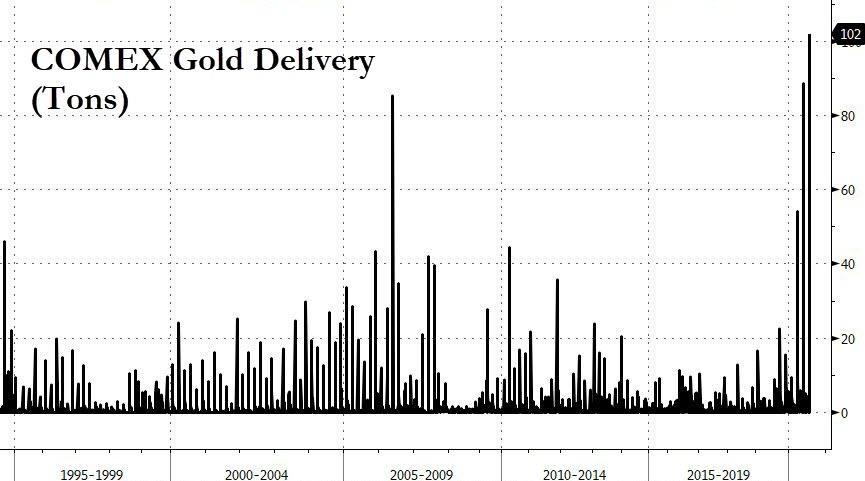
Traders on the main gold futures exchange in New York just issued the largest daily physical delivery notice on record.
In the latest sign of how the market’s norms have been upended by the price disconnect that struck in March, Bloomberg reports that traders on Thursday declared their intent to deliver 3.27 million ounces (over 100 tonnes) of gold against the August Comex contract, the largest daily notice in bourse data going back to 1994…
Source: Bloomberg
While millions of ounces of gold trade on the futures market every day, typically only a tiny fraction of that goes to delivery. But in recent months, huge amounts of bullion have flowed into New York and the COMEX has seen record deliveries.

Source: Bloomberg
As Jan Nieuwenhuijs of Voima Gold explains,three elements cause physical delivery on the COMEX to have reached record highs this year:
- strong demand for futures in New York,
- a persisting spread between the price of futures in New York versus spot gold in London,
- and arbitrage.
Physical delivery on the largest gold futures exchange in the world, the COMEX in New York, has reached all time highs this year. Usually, delivery is “negligible.” What has changed?

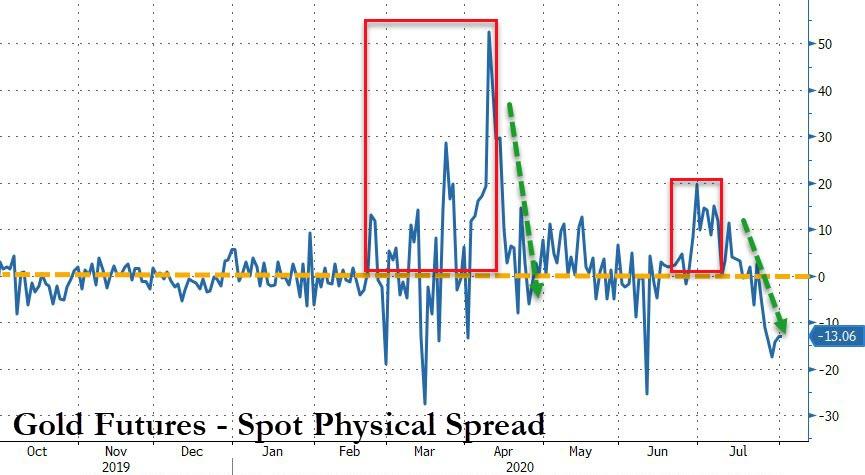
An important change in the global gold market occurred on March 23, 2020. On that day the price of gold futures in New York started drifting higher than the price for spot gold in London. Ever since, the spread has persisted, though it continuously widens and narrows. The reason for this disturbance in the market can be read in my previous article “What Caused the New York vs. London Gold Price Spread and Why it Persists.”
To understand the shift in deliveries, first let’s have a look at how the global gold market operated before March 23, when things still ran smoothly.
The Global Gold Market Before March 23, 2020
The world’s most dominant gold spot market is the London Bullion Market, where mostly “loco London” gold is traded. Meaning the metal is physically settled within the environs of the M25 London Orbital Motorway. The most dominant gold futures market is located in New York, where metal can be physically delivered within a 150-mile radius of the City of New York.
Before March 23, the price in London (spot) and the price in New York (near month futures contract) always traded in tight lockstep because of arbitrage. If, for example, the futures price would trade above spot, arbitragers would “buy spot and sell futures” until the spread was closed. Arbitragers would hold their positions—long spot, short futures—until maturity of the futures contract, because at expiry the price of the futures contract was guaranteed to converge with the spot price. In this example we can see that strong demand in New York would be translated into spot buying in London.
Worth noting is that when a futures trader rolled its position into the next month, and his initial futures buying was translated into spot buying in London by an arbitrager, on a systemic level the arbitrager would roll its position as well.
Of course, the opposite happened as well. When futures traded below spot, arbitragers would “buy futures and sell spot” until the spread was closed.
So far, a simplified version of the market before March 23.
The Global Gold Market After March 23, 2020
Since March 23 of this year, futures have persistently been trading above spot, though the spread isn’t constant. As a result, arbitragers aren’t assured the futures price in New York will converge with the spot price in London. An arbitrage trade as described above, through a position in both markets, incurs risk.
What arbitragers currently do to profit from the spread is buy spot, sell futures, fly the metal to New York, and physically deliver the gold. This is how the profit is locked in. If the spread between spot and futures is $40 per ounce, the arbitrager’s profit is $40 minus costs for transport, insurance, storage, etc.
Now you can see why the persistent spread between New York and London has increased physical delivery on the COMEX through arbitrage.
Conclusion
Physical delivery on the COMEX is elevated because of the current unusual situation in the global gold market. The gold delivered in New York has been imported from spot markets such as Singapore, Switzerland and Australia. U.S. imports directly from the U.K. are rare, because in London 400-ounce bars are traded and the main futures contract in New York requires smaller bars for delivery.
You might wonder who takes delivery from arbitragers that make delivery on the COMEX. Possibly, these are arbitragers, too. In the chart below you can see the spread between the “near month futures contract” and the “next near month futures contract.” This spread has also blown out on March 23. Arbitragers can buy the near month, and sell the next near month for a higher price. Subsequently, they take delivery of the near dated contract and make delivery of the further dated contract.
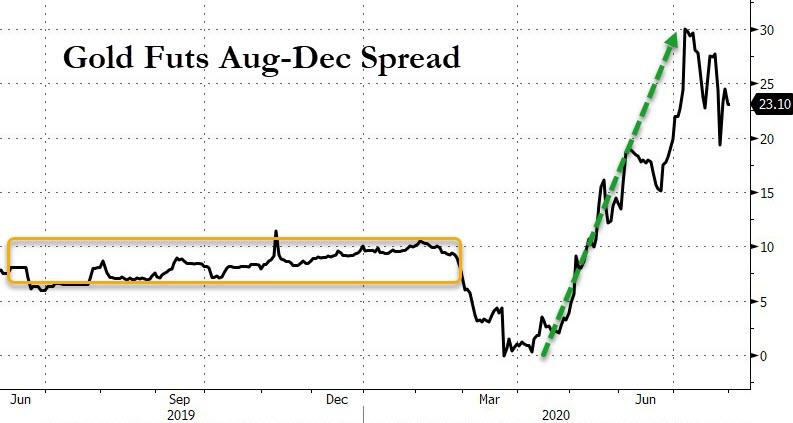
At the time of writing the near month (August) is trading at $1,973, while the most active month (December) trades at $1,994 dollars.
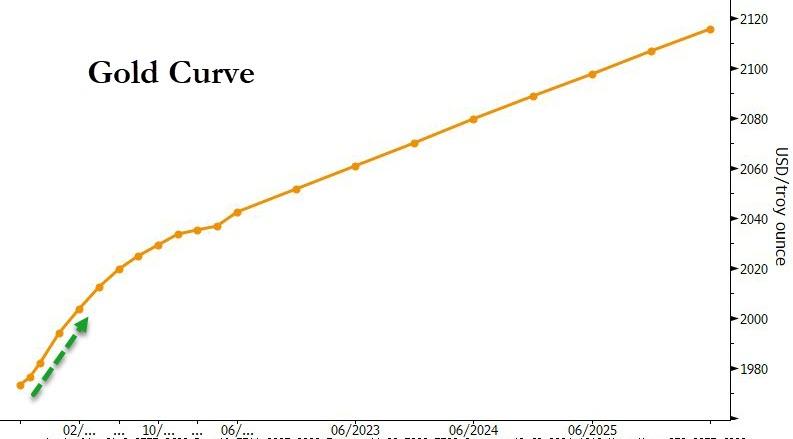
Arbitragers can buy long August and sell short December to collect $21 dollars per ounce.
One reason I can think of why the spreads persist, is because bullion banks are currently less active on the COMEX. Previously, bullion banks—having access to cheap funding—often performed the arbitrage trades.
* * *
end
Silver Just Had Its Best Month In 40 Years: Here Are July’s Best And Worst Performing Assets
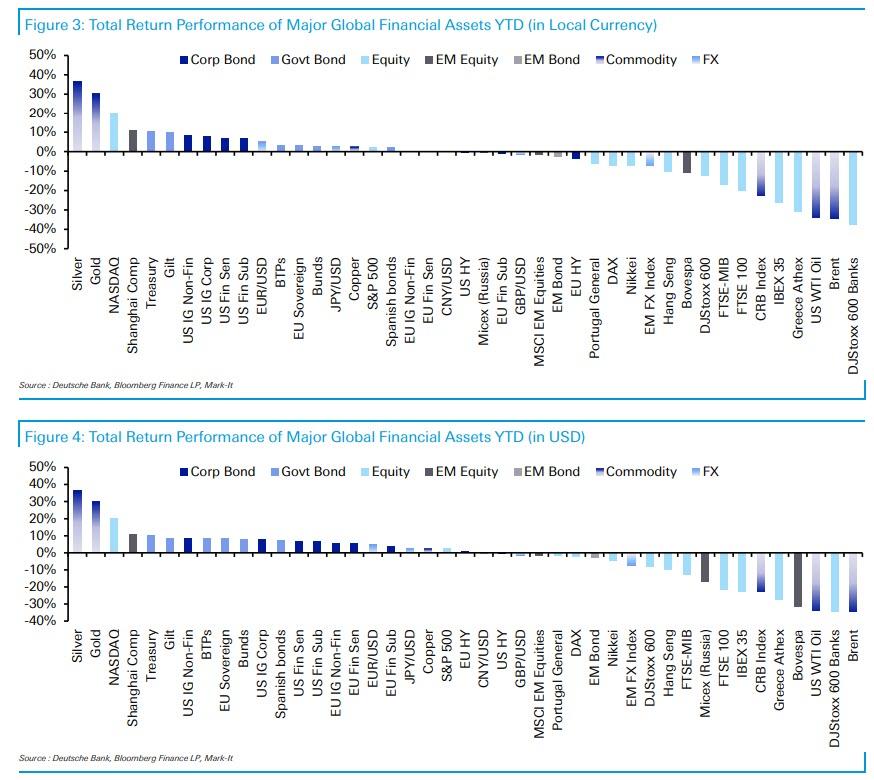
When looking at the torrid market performance in July, Deutsche Bank’s Jim Reid notes that silver (+35%) had its best month since December 1979 while the dollar the worst for a decade. US equities had a good month in spite of rising virus caseloads due to a strong earnings season relative to expectations, especially in tech towards the end of the month. YTD Silver, Gold and the NASDAQ have been the three best performers while at the bottom of the leaderboard Brent, WTI and European Banks are all down at least 30%.
Below we present some of the key highlights from Deutsche Bank’s July 2020 performance review
While July proved to be another decent month for risk assets, it was the performance of two other assets in particular which caught the eye. The first was Silver, which had its strongest month since December 1979. The second was the weakness in the USD, which ended with the USD spot index dropping by the most in a single month since September 2010.
Indeed the impact of the latter was fully felt when looking at returns in USD terms, with 36 of the 38 assets in DB’s sample finishing with a positive total return. In local currency terms, that number dropped to a still-impressive 30 assets. As markets move into August, typically a more subdued month for volumes but perceived to be a weaker month for risk, the focus remains on the reopening of economies on the one hand and signs of rising cases in certain countries on the other.
First, let’s look at silver, which rallied +34.0% during July, pushing it straight to the top of Deutsche Bank’s YTD leaderboard with a +36.6% advance. Gold also had a strong month, in part helped by the tailwind of the weaker USD, rising +10.9% for its biggest monthly gain since February 2016. In fact it was a good month for
commodities all round, with Copper (+5.7%), Brent (+5.2%) and WTI (+2.5%) also up, while the broader commodity index gained +4.1%.
As mentioned, the other big mover was the USD with GBP, EUR and the JPY strengthening +5.5%, +4.8% and +2.0%, respectively, versus the greenback. EM FX also gained +2.1%. In USD terms, that move saw equity markets in Europe post gains of anywhere from 1% to 5% (with the exception of European Banks, which returned -0.8%) with the STOXX 600 up +3.9%; however, in local currency terms returns were flat to -4%.
As for US equity markets, it was another strong month for the tech sector with the NASDAQ returning +6.9% while the S&P 500 finished with a total return of +5.6%. It was more of a mixed story in Asia with the Shanghai Comp returning +12.0% in local currency terms while in contrast the Hang Seng returned just +1.5% and the Nikkei -2.6%.
Finally, as for bond markets, another month of declining yields and in some cases record-low yields meant returns were anywhere from +0.4% for Gilts to +1.7% for BTPs. Again, the weaker USD propelled USD returns last month, up to +6.7% for BTPs and +5.5% for Bunds. For completeness Treasuries returned +1.2%. Last but not least, it was a similar story for credit, where in local currency terms USD outperformed EUR by 1-2 percentage points, with USD HY outperforming IG.
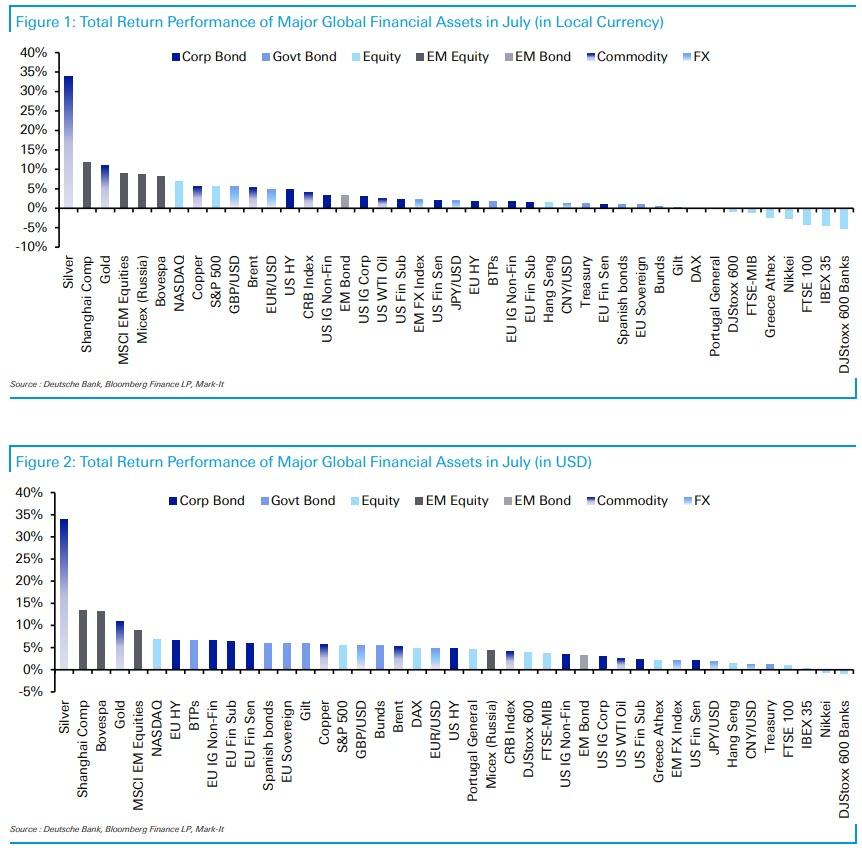
A quick recap of where things stand YTD. In local currency terms 18 of the 38 assets in our sample have a positive total return while in USD terms that number rises to 20. Silver, Gold and the NASDAQ have been the three best performers while at the bottom of the leaderboard Brent, WTI and European Banks are all down at least 34%.
Coin shortage is getting worse:
(zerohedge)
America’s Coin Shortage Is Getting Worse
The nation’s coin shortage, prompted by less cash circulating as a result of Covid-19 – is getting worse.
And believe it or not, cash is still being used in 49% of payments that are $10 or below, according to a recent study by the Federal Reserve Bank of San Francisco, reported on by Bloomberg.
The irony of the situation lies in the fact that the Fed can print trillions for bonds, but can’t come up with a couple of quarters to do its laundry. Despite the Fed’s best efforts to keep money circulating, there is still a coin shortage in the U.S. The effects are being felt in places like laundromats, where coins are used to do laundry.
Brian Wallace, president and CEO of the Coin Laundry Association (we swear this is an actual organization), said: “This is just an unexpected wrench in the works that I don’t think any of us could have anticipated, finding ourselves short on quarters.”
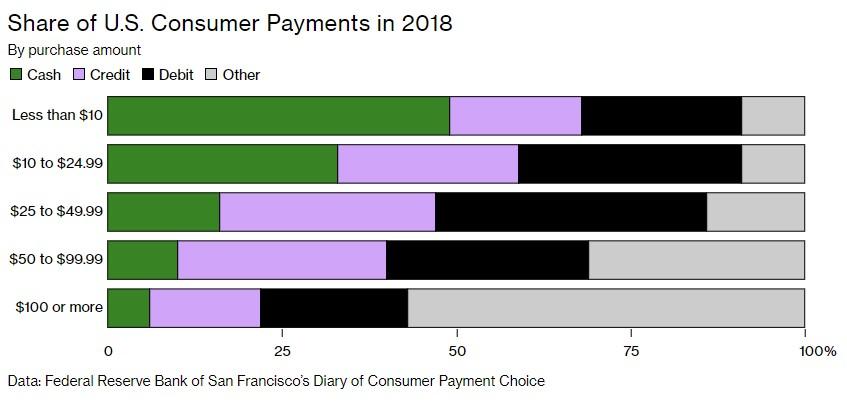
Only about 20% of laundromats offer a card option and 27% accept credit cards. In other words, most laundromats still rely on coins to do business.
“The people that show up to the laundromat each weekend are there for a purpose. It’s an essential service. Anything that impedes that progress certainly impacts tens of millions of families that use vended laundry each week,” Wallace continued.
Coinstar, which processed $2.7 billion worth of coins last year, collects an 11.9% fee from customers. The company has said its business has decreased during the lockdown, but it is now starting to see a slight bounce back. And despite operating in Japan, Canada, Italy, and several other European countries, it hasn’t seen the same issues outside the U.S.
“There’s something unique about the U.S. that we can’t figure out why this has come to this crisis,” says Jim Gaherity, chief executive officer of Coinstar. “I don’t refer to it as a shortage, I refer to it as ‘We don’t have coin moving.’ It’s there, it’s just not in the right place.”
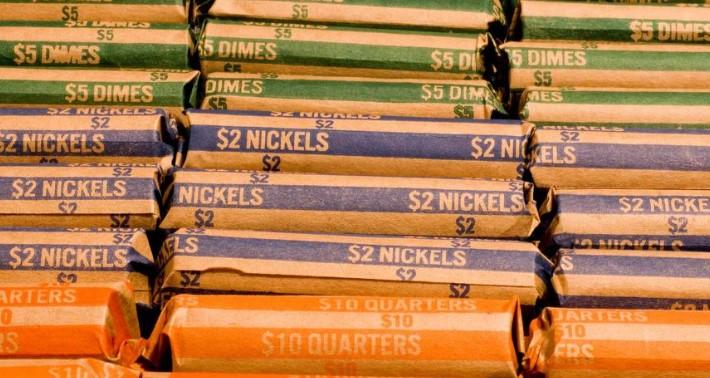
Jerome Powell said in June that the shortage would be temporary, while at the same time U.S. mints spool up more production.
The Fed has, in the interim, put together a “coin task force” to liaise with companies like Coinstar to help come up with solutions. Organizations like the Coin Laundry Association have suggested the Fed distributing additional coins and prioritizing to “consumer businesses in the essential critical infrastructure workforce.”
Banks and businesses are also offering premiums and deals for turning in your coins. One Wisconsin bank is offering a $5 bonus for every $100 worth of coins that are turned in. Recall, days ago, we wrote that Chick-Fil-A was giving away free food to customers who paid in coins.
end
Silver production from our two biggest producers, Mexico and Peru is playing havoc to our bankers who need physical supplies badly.
(Steve St Angelo/SRSRocco report)
CHART OF THE WEEK: Mexico & Peru Silver Production Big Declines Again In May
According to the data released by Mexico and Peru’s governmental mining data, domestic silver production continued to be depressed in May. Interestingly, the production data just released from Mexico’s INEGI shows that the country’s silver production in May was even less than what they reported for April.
I first wrote about this in my article, World’s Two Largest Silver Producers Mine Supply Cut Drastically In April. The combined silver production loss from Mexico and Peru in April was 432 metric tons or 53% versus the same month last year. Peru accounted for the largest of the decline in April at 237 metric tons (mt) compared to 195 mt for Mexico.
However, Mexico’s silver production in May dropped to 298 mt compared to 301 mt in April. Here is the combined silver production by Mexico and Peru from April 2019 to May 2020:
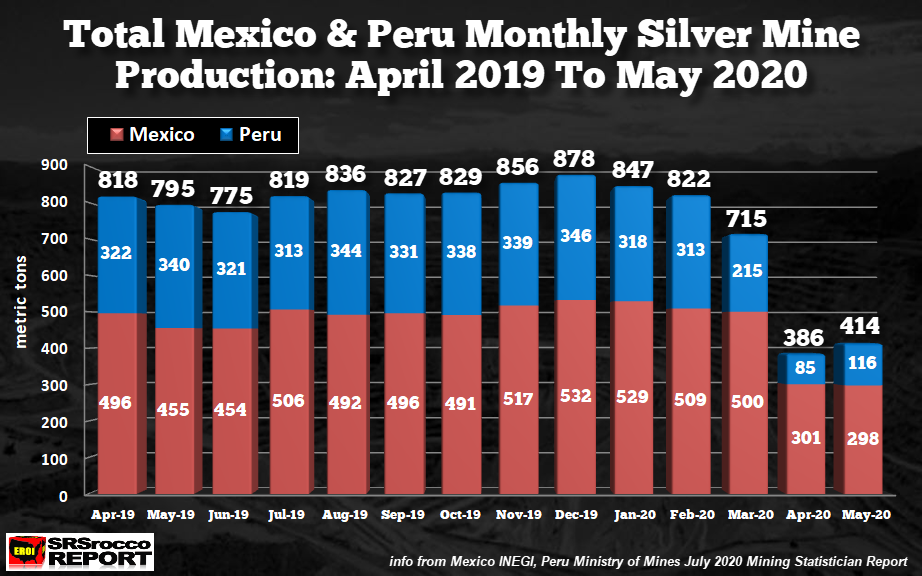
The net loss of silver production from Mexico and Peru over the last three month period (March to May) is 770 mt, or 32% less than it was during the same period last year. Thus, just these two countries have lost nearly 25 million oz of silver production. I imagine once we factor in losses of silver production from other countries, we could see upwards of 35-40+ million oz decline so far.
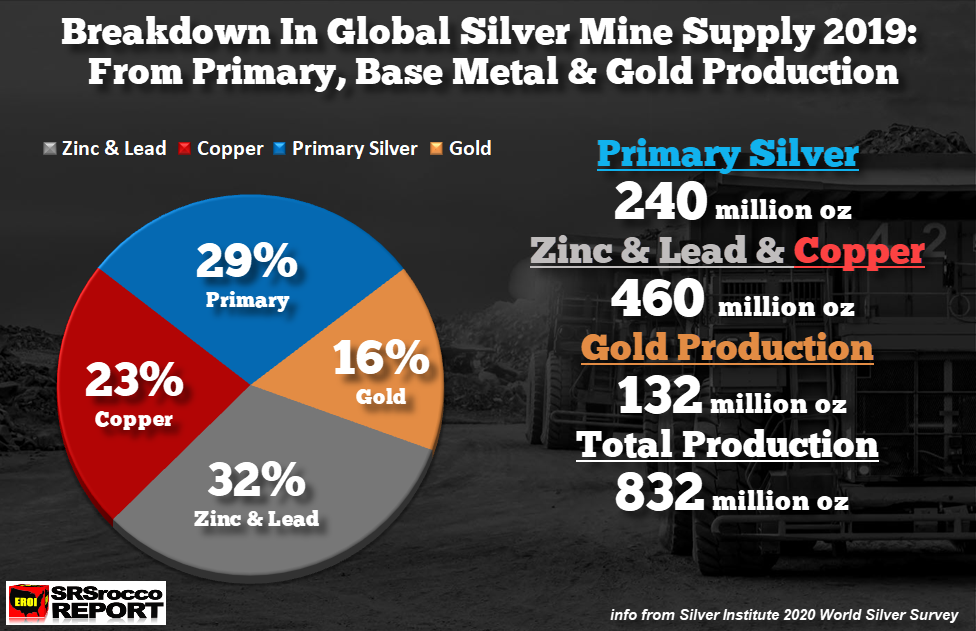
But, this is only PHASE ONE of the collapse in global silver production. I stated that as the U.S. and the global economy begin to roll-over in the second half of 2020, and onwards, we are going to see a reduction in base metal demand. With so many people becoming unemployed, the global recession-depression will cause a significant decrease in copper, zinc, and lead demand. Thus, in PHASE TWO, demand for base metals will decline, and with it, the curtailment of copper, zinc, and lead production.
With 55% of global silver mine supply as a by-production of base metal mining, any reduction of copper, zinc, and lead production will negatively impact the silver market.
With the negative fundamentals for global silver supply continuing in the future, along with increased investment demand, the world will eventually find out that silver is one of the most undervalued assets in the world.
Yes, it’s true that demand for silver in Jewelry and Industrial applications has likely fallen significantly in Q2 2020. Still, with over $450 trillion held in global Stocks, Bonds, and Real Estate, total global silver investment is a fraction of a fraction. According to the World Silver Survey, there is about 2.5 billion oz of “Identifiable Above-Ground” silver investment stocks in the world. I provided some simple silver valuations below:
2.5 Billion oz Silver Investment Stocks X $25 per oz = $62.5 billion
5.0 Billion oz Silver Investment Stocks X $25 per oz = $130 billion
If just $1 trillion of that $450 trillion attempted to move into silver, that would push the silver price up nearly eight times… almost $200 per oz. But, that is if all that 5 billion oz of silver was able to be accessed. I would imagine a large percentage of that silver will continue to stay in STRONG HANDS.
end
J Johnson’s commodity report// (silver/gold)
Trust is Everything in The Game of Confidence!
Posted August 3rd, 2020 at 8:59 AM (CST) by J. Johnson & filed under General Editorial.
Great and Wonderful Monday Morning Folks,
Gold is trading higher, but nowhere near the opening rally, with the trade at $1,986.40, up 50 cents after hitting another N-LoCH (New Life of Contract High) at $2,009.50 with the low nearby at $1,982. Silver is still leading the rally, after hitting the early-trade-high at $25.275, with the price right now at $24.37, up 15.4 cents after being knocked down to $24.16. The US Dollar is getting that overseas support, even while we are printing it (to cause that eventual drop), with the current value pegged at 93.725, up 40.4 points and close to the high at 93.815 with the low down at 93.295. Of course, all this happened before 5 am pst, the Comex open, the London close, and after a weekend of no news by the Leftist Media who chose to ignore all the Court Docs alleging Bill Clinton visited Epstein Island. Maybe this explains why fewer and fewer are getting the news from the media.
In Venezuela, Gold is now priced at 19,839.17 Bolivar, pulling back 54.93 from Friday’s quote with Silver at 243.395, it too getting a 1.049 Bolivar pullback. Argentina’s currency is now pricing Gold at 143,642.95 dropping 170.70 Peso’s with Silver losing 4.91 with the last trade at 1,762.27 A-Peso’s. The Turkish Lira’s price for Gold last traded at 13,871.83 Lira, dropping 14.28 from Friday’s value with Silver losing 0.416 of a T-Lira with the price now at 170.190.
August Silver’s Delivery Demands now has a post of 914 fully paid for contracts up on the board, unchanged from Friday’s count, waiting for receipts and with a Volume of 1 and with no price attached to it. Friday’s delivery activities happened in between $24.385 and $23.565 with the last buy at $24.189 up 84.9 cents with a Volume of 220 (swaps) that were completed by the end of the day. This proves NO drop in the demand count at all! So, did 220 contracts get a jump in deliveries ahead of the supposed FIFO (First In-First Out) claims of engagement? Silver’s Overall Open Interest now sits at 187,741 Overnighters going against the physicals proving a drop of 76 after the Sunday night drop, from the high.
August Gold’s Delivery Demands now sit at 47,211 fully paid for contracts waiting for receipts. Ironically the delivery count is also unchanged from Friday’s numbers with a Volume of 310 already up on the board with a trading range between $1,984.30 and $1,963.10 with the last buy at $1,967 up $4.20 so far today. Friday’s full trading day had a Volume of 2,914 up on the board with a trading range between $1,981.10 and $1,948 with the last buy at $1,962.80, settling the day out with a $20.50 gain. Gold’s Overall Open Interest declined by 1,076 short contracts leaving 586,484 Overnighters going against the price.
Australia got the bio-bug! The premier of Victoria plunged the region into a “state of disaster” on Sunday, announcing even stricter lockdown measures, introducing a nightly curfew and banning virtually all trips outdoors after Australia’s second largest state recorded 671 new infections in a single day. We’re 6 months into a bug release from a level 4 bio-lab and still no confirmation on anything except all the masksperts making idiots out of both sides as we all learn about this together.
Real or not, the Bio has caused immeasurable amounts of damage to the controllers of debt all over the world with the latest claim that more than 60% of Global Debt now yields less than 1% ROI. Also of note; HSBC crashed to an 11 Year low as their profits plunged and as the loss of reserves expands, with low export trades, now and in the future, causing a drop of 6.4% in share value already today. This bank seems to have a trust problem lately. Trust is everything in the game of confidence and that confidence is gone. That should lead to the debt of a nation being untrustworthy too. Then today, our VOM2 Money Stock came in and it ain’t good at all, yet the price of our currency stays in place (for now).
Got Silver and Gold? Have a great day no matter what! Keep that smile going for all you may see, as you keep safe distance and as we make it thru another month of debt issues and precious metals risings. As always …
Stay Strong!
Jeremiah Johnson
More J.Johnson content is available with purchase of a JSMineset subscription.
US seeks halt in civil lawsuit accusing JP Morgan of manipulating metals market, citing criminal case
- The U.S. wants a federal judge to halt a civil lawsuit accusing J. P. Morgan of manipulating precious metals markets. The Justice Department cited an ongoing criminal case as its reason for the request.
- A former J. P. Morgan trader pleaded guilty in Connecticut last month to manipulation charges.
- In the guilty plea, the trader said he had learned to make bogus trade orders from senior traders at the bank and that he used the strategy hundreds of times with the knowledge and consent of his immediate supervisors.
CNBC.com
The Justice Department is asking a judge to put the brakes on a civil lawsuit against J. P. Morgan Chase, citing an ongoing probe into a “related criminal case” that involves alleged manipulation of precious metals markets.
The department wants a six-month postponement in the proceedings of the civil lawsuit, which was filed in 2015 by hedge fund manager Daniel Shak and two commodity traders. The government also says it could ask for a longer delay in the case, according to a court filing on Monday.
The move comes days after Shak’s lawyer, David Kovel, sought permission to reopen questioning of two former J. P. Morgan traders and the bank’s current global head of base and precious metals trading.
Kovel, in making the request with the Manhattan federal judge in the civil case, cited last month’s guilty plea by one of those former traders, John Edmonds, in federal court in Connecticut.
Edmonds admitted making bogus bids on precious metals contracts while working at the bank from 2009 to 2015.
Neither J. P. Morgan Chase nor Kovel’s clients have opposed the Justice Department’s request.
In arguing for a delay, the Justice Department said Shak’s lawsuit is “related” to Edmonds’ criminal case and that Edmonds has “pleaded guilty and acknowledged his own participation in such conduct, as well as that of other traders.”
“Edmonds awaits sentencing, but the broader investigation is ongoing,” the Justice Department said. The U.S. wants to delay the civil case “to protect the integrity of its ongoing criminal investigation,” it said.
J. P. Morgan did not respond to a request for comment by CNBC. Kovel declined to comment.
Tuesday night, after this story first was published, Judge Paul Engelmayer ordered the federal prosecutors to explain in detail by Monday why postponing proceedings in the civil lawsuit would not harm those involved, and why reopening questioning “would be detrimental to the Government’s ongoing criminal investigation.”
Englemayer also wrote that he regards Edmonds’ guilty plea “as potentially highly consequential” to the civil case.
In his guilty plea, the 36-year-old Edmonds said he had learned to make bogus trade orders from senior traders at the bank and that he used the strategy hundreds of times with the knowledge and consent of his immediate supervisors. He admitted to working with “unnamed co-conspirators” at J. P. Morgan, according to the Justice Department.
Kovel wants to question Edmonds again as well as Michael Nowak, the bank’s global head of base and precious metal trading, and former J. P. Morgan Chase Managing Director Robert Gottlieb. The three had previously answered questions under oath in the civil case.
Kovel said in court filings that Nowak was the immediate supervisor of Edmonds, while Gottlieb was Edmonds’ mentor.
In his prior deposition, Edmonds said that Gottlieb sat only a “couple feet” away from him for about five years, and that he was “somebody [he] looked up to in the business,” who helped guide and train him.
Nowak is described by Edmonds as his direct supervisor, with whom he would sometimes discuss trading strategies. Nowak was also the person responsible for overseeing the performance and risk of Edmonds’ portfolio, according to the deposition.
Edmonds also stated in his prior deposition that he would enter precious metals trades for both Nowak and Gottlieb, among others.
The civil lawsuit claims Shak and his fellow plaintiffs lost tens of millions of dollars as a result of actions by J. P. Morgan’s traders.
Federal judge tells traders they can combine cases accusing JP Morgan of rigging metals market
- Litigation in a separate civil case has been put on hold until at least May at the behest of the Justice Department, which is investigating a “related criminal case” that involves alleged market manipulation by precious metals traders at J. P. Morgan.
- Judge John Koeltl of the Southern District of New York appointed the White Plains, N.Y., law firm Lowey Dannenberg as interim lead counsel for the proposed class action.
A group of traders from across the U.S. who allege that J. P. Morgan Chase manipulated precious metals markets for years are one step closer to bringing a class action suit against the nation’s largest bank.
Earlier this month, a federal judge said five separate lawsuits making similar allegations against the bank could be combined, potentially including thousands of people who traded in the precious metals market from Jan. 2009 through Dec. 2015.
Litigation in a separate civil case has been put on hold until at least May at the behest of the Justice Department, which is investigating a “related criminal case” that involves alleged market manipulation by precious metals traders at J. P. Morgan.

J. P. Morgan declined to comment on this story.
Judge John Koeltl of the Southern District of New York appointed the White Plains, N.Y., law firm Lowey Dannenberg as interim lead counsel for the proposed class action.
Vincent Briganti, a partner at the firm, filed the first suit seeking class action status in November on behalf of Dominick Cognata, a trader who alleges he suffered losses due to J.P. Morgan’s illegal trading conduct in the silver and gold futures and options markets.
That was after the federal court in Connecticut unsealed a criminal plea agreement by John Edmonds, a former J.P. Morgan metals trader. In his guilty plea, Edmonds, who is 36-years old, admitted that he and other “unnamed co-conspirators” fraudulently manipulated the precious metals markets while they were employed at J. P. Morgan from 2009 to 2015.
Edmonds said he had learned the illegal trading tactics from senior traders, and then used them hundreds of times with the knowledge of and consent of his immediate supervisors.
Briganti’s lawsuit also names John Edmonds and a group of yet-to-be-identified precious metals traders and the bank as defendants.
On Wednesday, the lawyers sent a letter to Judge Koeltl saying they were having difficulty locating Edmonds to serve him legal papers and requested a 30-day extension to do so, which the judge granted on Thursday. Briganti noted that they have been in contact with Edmonds’ attorney in the criminal case. Edmonds’ attorney and Briganti could not be reached for comment.
“We are hopeful that this extension will result in completing service on Mr. Edmonds without formal motion practice and a request for alternative means of service,” Briganti said in the letter.
The next step in the civil case is for the plaintiffs to file an amended class action complaint and set a schedule for defendants to respond.
In addition to the proposed class action, J. P. Morgan also faces a separate civil suit which also accuses the bank of rigging precious metals markets.
end
March 4.2019
Parker City News
JP Morgan faces potential class action lawsuit after guilty pleas by a former metals trader
Traders from across the U.S. are banding together to accuse J. P. Morgan Chase of manipulating precious metals markets for years.
At least six lawsuits, all making similar allegations against the nation‘s largest bank, have been filed in New York federal court in the past month, since federal prosecutors in Connecticut with a former J. P. Morgan Chase metals trader.
The cases could potentially include thousands of people who traded in the precious metals market. The White Plains, N.Y., law firm Lowey Dannenberg is asking the court to combine the cases and name it as the lead.
The law firm‘s commodities group is led by Vincent Briganti, the attorney who filed the first lawsuit on behalf of Dominick Cognata, a New York resident who alleges he suffered losses due to J. P. Morgan‘s trading conduct in the silver and gold futures and options markets.
A combined case, seeking class action status, would include anyone who purchased or sold futures contracts or an option on NYMEX platinum or palladium or COMEX silver or gold between at least Jan. 1, 2009, and Dec. 31, 2015. The lawyers believe that “at least hundreds, if not thousands” of traders would be eligible to join the case.
Named as defendants in all of the lawsuits are John Edmonds, a 36-year old former metals trader at J. P. Morgan, a group of yet-to-be-identified precious metals traders and the bank.
Edmonds, a New York resident, pleaded guilty in October to one count of conspiracy to defraud the market and manipulate prices of precious metals futures contracts and one count of commodities fraud. In the criminal plea, Edmonds admitted that he and other “unnamed co- conspirators” at J. P. Morgan, fraudulently manipulated precious metals markets from 2009 to 2015, the same time frame covered in the class action suits.
Briganti filed the initial class action on Nov. 7, just one day after the Justice Department unsealed Edmonds‘ plea in the U.S. District Court of Connecticut.
Edmonds admitted in his guilty plea that he deployed the illegal trading scheme hundreds of times with the direct knowledge and consent of his immediate supervisors. Plaintiffs say they have suffered economic injury, including monetary losses, as a direct result of actions by Edmonds and the other unnamed J. P. Morgan metals traders in the futures and options contracts.
One of the suits alleges that “the number of unlawful trades that JP Morgan traders executed in precious metals futures markets is at least in the thousands.”
J. P. Morgan declined to comment. Lowey Dannenberg did not respond to a request for comment by CNBC.
The Justice Department‘s criminal investigation is still ongoing and recently caused a separate related civil case to be put on hold for at least six months while the government continues its investigation. That civil lawsuit, which also accuses J. P. Morgan of rigging the precious metals market, was filed in 2015 by hedge fund manager Daniel Shak and two commodity traders.
After reviewing the details of the plea agreement, David Kovel, the attorney for Shak‘s suit, sought to re- interview Edmonds, along with two other current and former senior traders at the bank. However, the government argued that reopening questioning would be detrimental to the ongoing criminal investigation. The federal judge overseeing the proceedings ordered a six-month stay in the civil case.
Kovel declined to comment.
Edmonds was originally scheduled to be sentenced in Hartford, Conn., on Wednesday, Dec. 19, but a court filing on Nov. 27 shows the sentencing has been postponed until June. A spokesman for the U.S. Attorney for Connecticut could not elaborate on why the sentencing was postponed since the court filing is under seal.
-END-
S&P Futures Jump To Five Month High, Dollar Spikes In Bullish Start To New Month
World stocks rose and US futures jumped to the highest level since late February even as U.S. lawmakers struggled to agree on the next round of coronavirus aid while Covid cases around the globe continued to rise, while a squeeze on crowded short positions left the dollar clinging to a tentative bounce.
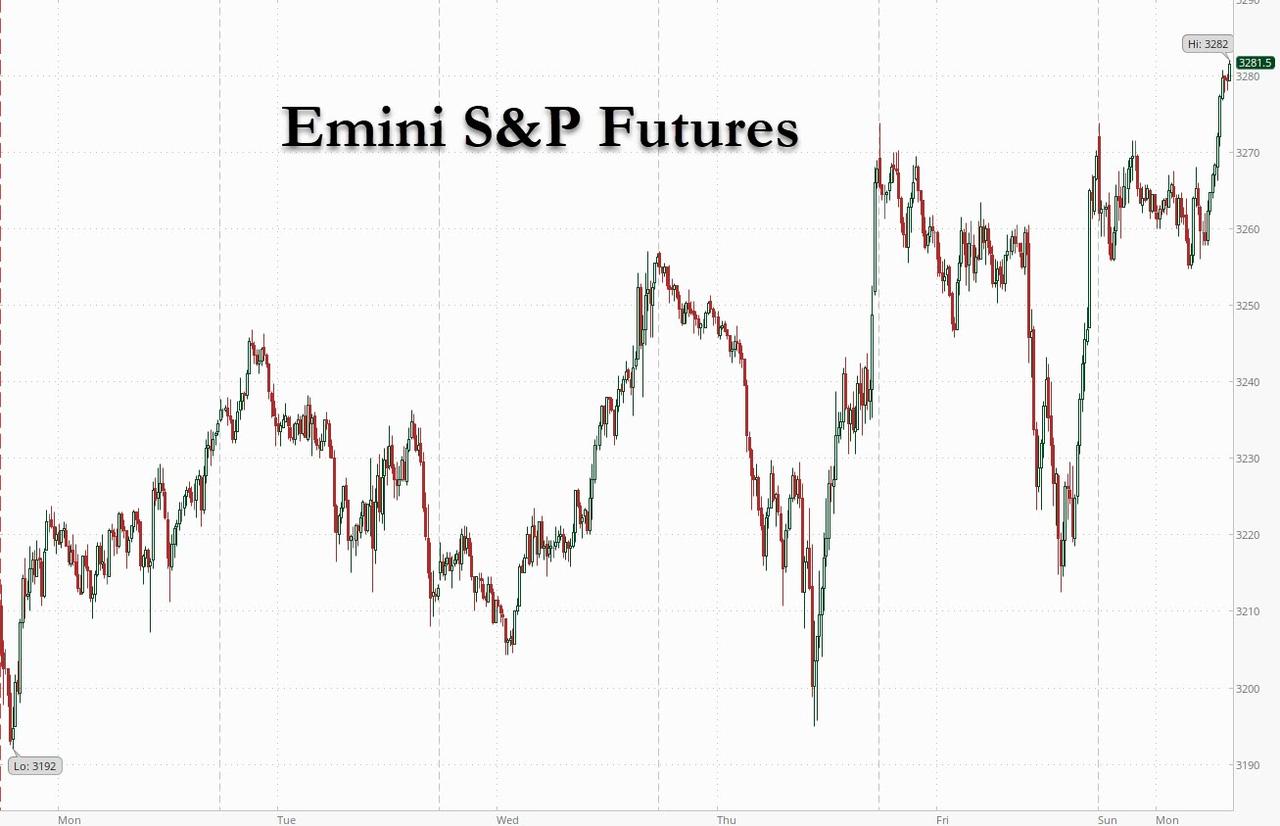
S&P 500 futures turned higher, reversing earlier losses with Microsoft rising in pre-market trading as it tried to salvage a deal for the U.S. operations of TikTok. Marathon Petroleum jumped after agreeing to sell its gasoline-station business for $21 billion. Still, investors remained jittery amid the lack of a progress on the stimulus package and White House Chief of Staff Mark Meadows not optimistic about a deal.
“Three months to go until the U.S. Presidential election! Surely Congress will want to get something over the line regarding new stimulus in the U.S. driven more by politics than necessarily economics,” said Chris Bailey, European strategist at Raymond James.
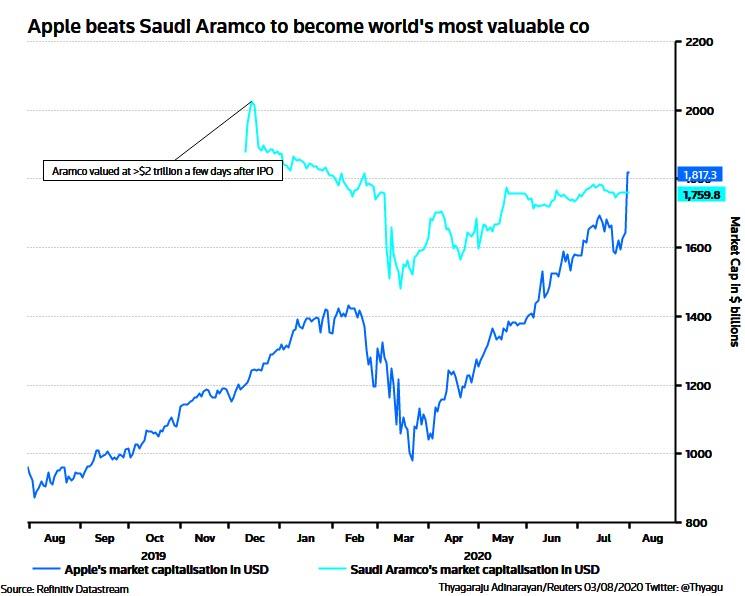
On Friday, Fitch Ratings cut the outlook on the United States’ triple-A credit rating to negative from stable and said the direction of fiscal policy depends in part on the November election and the resulting makeup of Congress, cautioning that policy gridlock could continue. However, as Reuters notes, those concerns have hardly hit the U.S. technology sector, evident in Friday’s record highs, with Apple overtaking Saudi Aramco to become the world’s most valuable company.
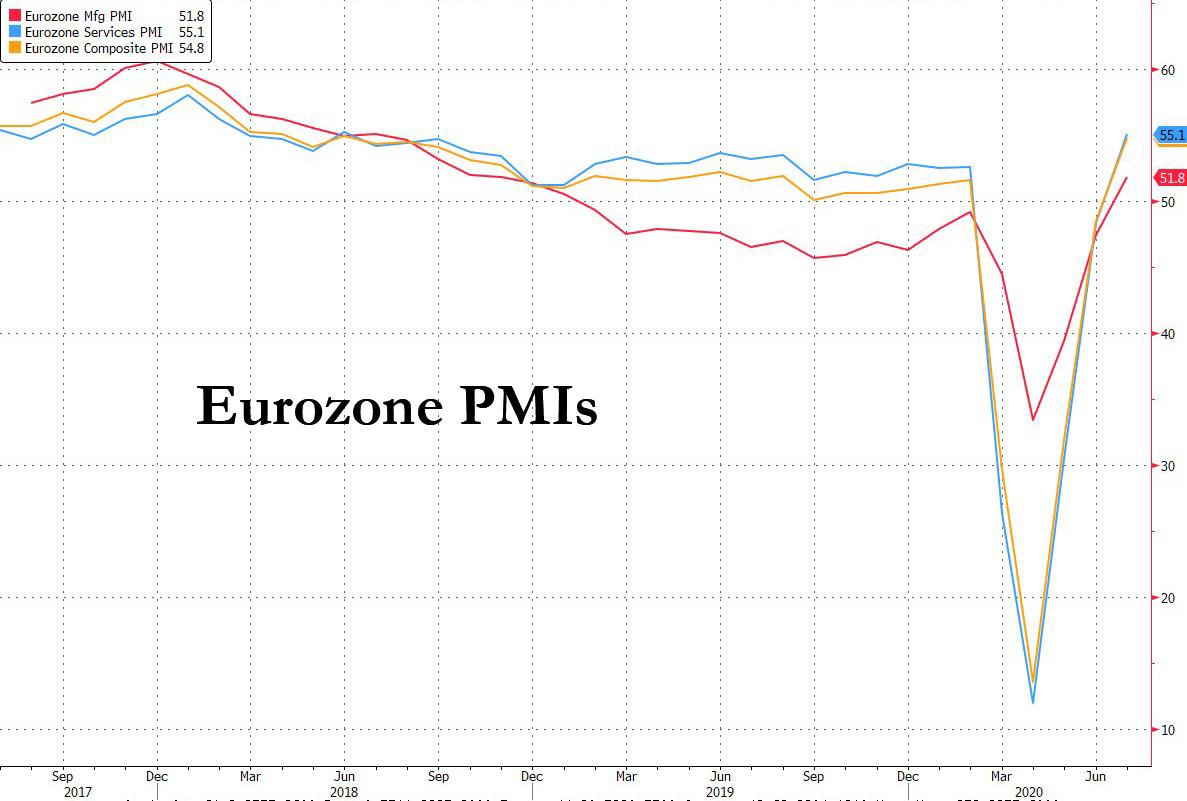
In Europe, stocks were up over 1% with all but four sector indexes advancing, with gains led by automakers, technology and chemicals sub- indexes, which are all up at least 1.7%. Travel and leisure stocks are the worst performers. Technology stocks rallied on positive read-across from peers on the other side of the Atlantic, while automobile shares jumped after the euro area recorded its first manufacturing expansion in one-and-a-half years when the final Eurozone mfg PMI printed at 51.8, above the 51.1 expected.
Spanish stocks, meanwhile, declined on Monday as the country saw the biggest jump in coronavirus cases since a national lockdown was lifted in June, while data showed international tourist arrivals to the country fell 98% year on year in June. “Second wave virus concerns are building in Australia, Europe etc. but no huge risk-aversion move,” said Bailey.
European gains were also limited by a selloff in big banks’ shares, with index heavyweight HSBC falling 5% to a fresh 11 year low after it warned that its bad debt charges could surge to as much as $13 billion, and France’s Societe Generale reported a 1.26 billion euro ($1.48 billion) second-quarter loss.
Earlier in the session, Asian stocks also gained, led by communications and health care, after falling in the last session. Most markets in the region were down, with Jakarta Composite dropping 2.8% and Singapore’s Straits Times Index falling 1.9%, while Japan’s Topix Index gained 1.8%. The Topix gained 1.8%, with ISB and ITmedia rising the most. The Shanghai Composite Index rose 1.8%, with Raytron Technology and Piesat Information Technology Co Ltd posting the biggest advances as investor margin debt resumed its climb.
Factory activity data from China showed the fastest pace of expansion in nearly a decade.
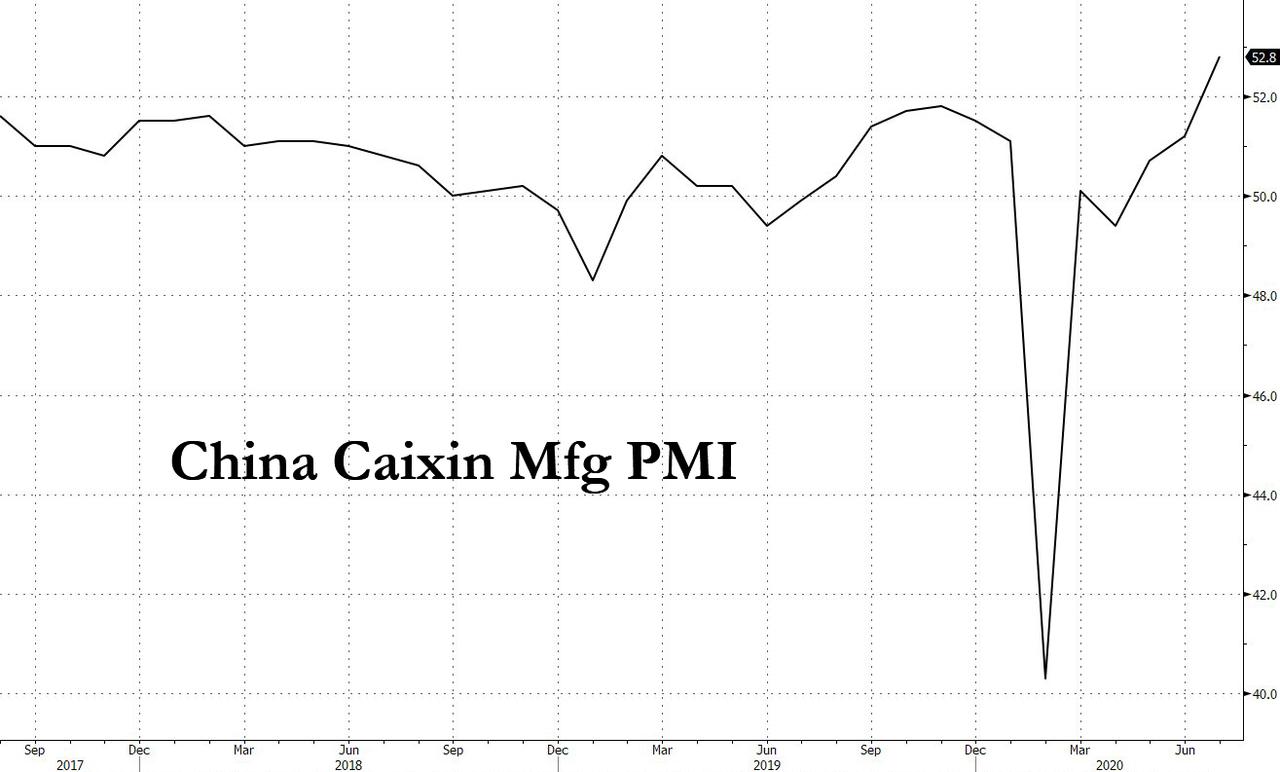
That helped China’s blue chips rally 1.6%, offsetting worries about U.S.-China relations. Japan’s Nikkei meanwhile added 2.2%, courtesy of a pullback in the yen.
“There is going to be a recovery — we shouldn’t lose track of that as we go through this period,” Anne Anderson, head of fixed income at UBS Asset Management Australia, said on Bloomberg TV. “But returning to where we were before we started is going to be a real challenge and is going to require ongoing monetary and fiscal support. It’s a long way out of here.”
Meanwhile, tension between the U.S. and China emerged as another threat to risk appetite. The Trump administration will announce measures shortly against “a broad array” of Chinese-owned software deemed to pose national-security risks, U.S. Secretary of State Michael Pompeo said. Even so, shares advanced in Japan and China, where mainland-listed technology stocks surged on expectations of support from Beijing in response to U.S. moves against Chinese-owned software companies.
In FX, Dollar bears also took some profits as short positions hit an 11 year high, with the Bloomberg Dollar Spot Index heading for its biggest two-day gain in seven weeks, with the greenback rising against all Group-of-10 peers except the Swedish krona and the yen.
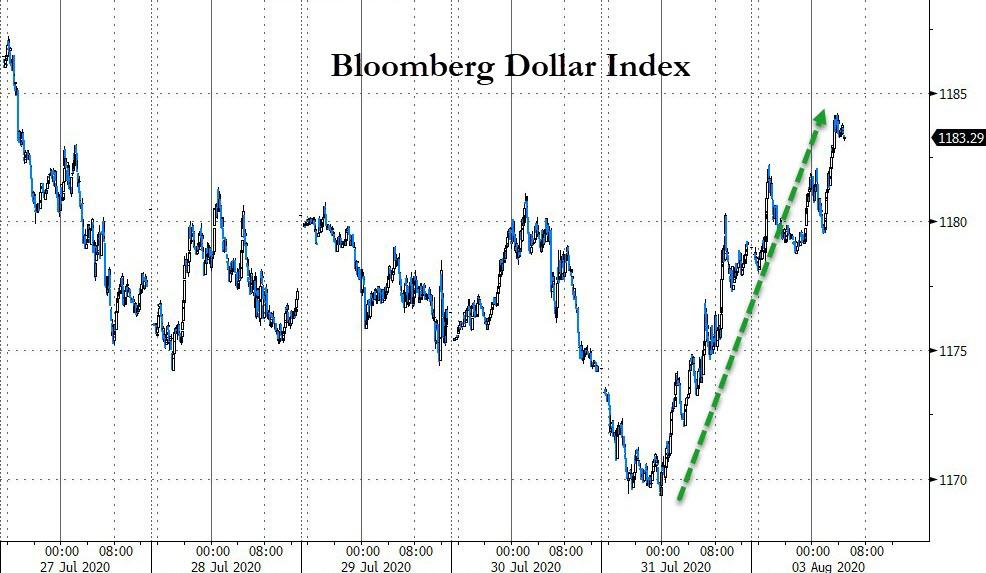
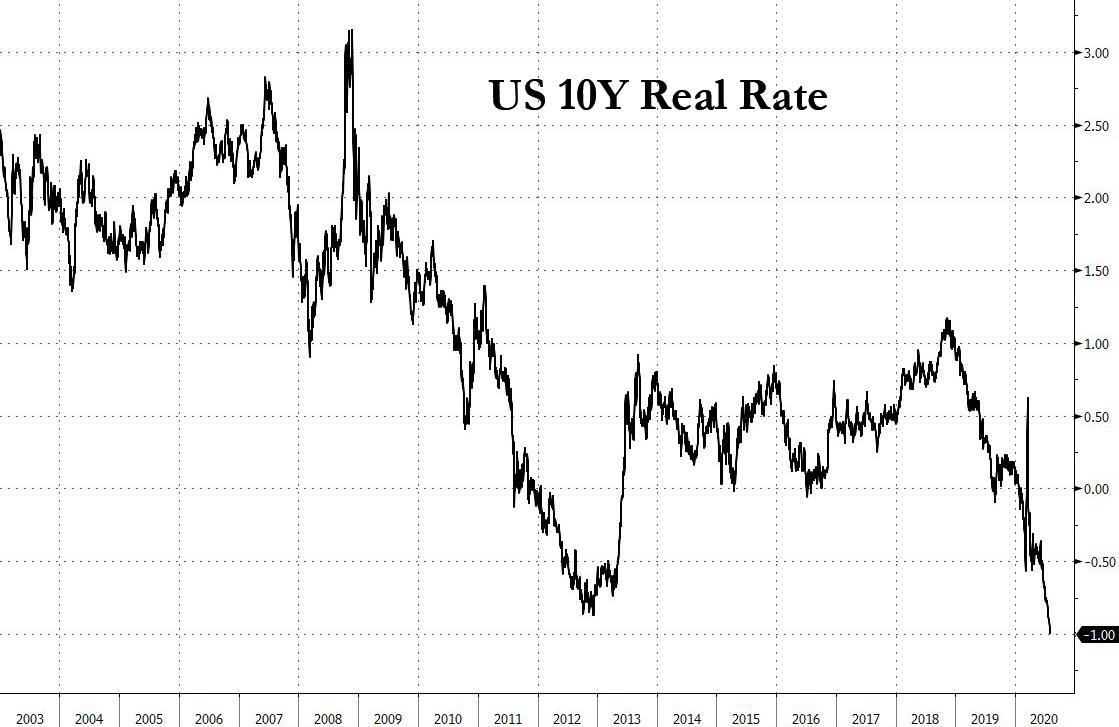
but any further gains were capped by the slowing U.S. economic recovery from COVID-19 and real rates breaking below -1% for the first time.

The real 10Y rate hit a record low amid a marked flattening of the yield curve as investors wager on more accommodation from the Federal Reserve.
The euro and the pound were down only slightly with the dollar at $1.1755 per euro and $1.3065 per pound. Both the currencies recorded their best monthly gain in nearly a decade in July.
“Amid improvements in business sentiment, signals are emerging that the initial boost from pent-up demand is fading and consumer confidence is slipping lower,” economists at Barclays wrote in a note. “Together with concerns about labour market and virus developments, this clouds the outlook and could be exacerbated if U.S. fiscal support is not renewed in time.”
In rates, 10-year Treasury yields were higher at 0.5576% after touching the lowest level since March last week. German government bond yields rose slightly to -0.527%. Treasuries bear steepened as month-end support came out of the market and investors looked ahead to Wednesday’s supply announcement where record sales of notes and bonds are expected. Yields higher by up to 3bp across long-end of the curve with front-end broadly anchored, steepening 2s10s, 5s30s by ~1.5bp each; 10-year yields around 0.545%, cheaper by 1.5bp vs. Friday close while bunds, gilts outperform by ~2bp each. Yields on 30-year U.S. Treasuries are set for the biggest daily increase since June 30 as U.S. equity futures advance and the bond curve bear-steepens. As Bloomberg adds, a busy week of IG corporate issuance also expected, adding to downside pressure on Treasuries along with delta hedging large option package.
The recent decline in the dollar combined with super-low real bond yields has been a boon for gold, which hit $1,984 an ounce on Monday and seemed on track to take out $2,000 soon.
In other commodities, oil prices eased on concerns about oversupply as OPEC and its allies are due to pull back from production cuts in August while an increase in COVID-19 cases raised fears of slower pick-up in fuel demand. Brent crude futures dipped 46 cents to $43.06 a barrel, while U.S. crude eased 51 cents to $39.76.
On today’s calendar, economic data include ISM and Markit manufacturing data. Ferrari is among today’s scheduled earnings.
Market Snapshot
- S&P 500 futures down 0.1% to 3,260.50
- STOXX Europe 600 up 0.4% to 357.57
- MXAP up 0.3% to 165.11
- MXAPJ down 0.4% to 549.24
- Nikkei up 2.2% to 22,195.38
- Topix up 1.8% to 1,522.64
- Hang Seng Index down 0.6% to 24,458.13
- Shanghai Composite up 1.8% to 3,367.97
- Sensex down 1.7% to 36,967.20
- Australia S&P/ASX 200 down 0.03% to 5,926.09
- Kospi up 0.07% to 2,251.04
- Brent Futures down 0.6% to $43.24/bbl
- Gold spot down 0.2% to $1,972.89
- U.S. Dollar Index up 0.1% to 93.44
- German 10Y yield rose 0.4 bps to -0.52%
- Euro down 0.03% to $1.1775
- Brent Futures down 0.6% to $43.24/bbl
- Italian 10Y yield rose 4.2 bps to 0.887%
- Spanish 10Y yield rose 0.2 bps to 0.342%
Top Overnight News from Bloomberg
- Factories across the euro area saw a stronger return to growth in July than initially reported, marking the region’s first manufacturing expansion in one-and-a-half years while economies from Germany to Italy beat expectations. In the U.K., although numbers were slightly below flash estimates, manufacturing grew at the fastest pace in almost three years as the nation’s lockdown eased
- Gold’s spot and futures prices opened the week by hitting records, with the metal for immediate delivery closing in on $2,000 an ounce as the search for haven assets continues amid the coronavirus pandemic
- Microsoft chief executive Satya Nadella attempted to salvage a deal for the U.S. operations of TikTok by speaking with President Donald Trump by phone
- Oil edged below $40 a barrel in New York as OPEC and allied producers started to unwind output cuts even as many countries are still struggling to contain the virus
Asian equity markets began the new trading month mixed after last Friday’s positive close on Wall St where the tech sector rallied following earnings from the industry giants including Apple which rose to a fresh record high, but with upside in the region restricted ahead of this week’s risk events and after continued stalemate in US coronavirus relief discussions. ASX 200 (flat) was subdued as gains in commodity related sectors were offset by underperformance in the top weighted financials and with trade hampered by reduced liquidity due to bank holiday in New South Wales, while risk appetite was also weighed by a state of disaster declaration in Victoria with the state capital of Melbourne to be subjected to tougher restrictions including a curfew through to at least September 13th. Nikkei 225 (+2.2%) was the stellar performer as it coat-tailed on recent favourable currency flows and after Q1 Final GDP topped estimates, although there were some notable losses seen in Shinsei Bank and Mazda post earnings, as well as Seven & I on news it is to acquire Speedway convenience stores from Marathon Petroleum in a deal valued around USD 18.9bln. Hang Seng (-0.6%) and Shanghai Comp. (+1.8%) were mixed after PBoC inaction resulted to a CNY 100bln liquidity drain and as participants digested a more than 50% drop in HSBC HY profits, as well as the highest Chinese Caixin Manufacturing PMI reading since 2011. There was also plenty of focus around tech after reports that President Trump is to allow 45 days for ByteDance to negotiate the sale of TikTok to Microsoft and will reportedly take action on Chinese software companies that threaten national security in the approaching days. Finally, 10yr JGBs were lower amid a surge in Japanese stocks and with the BoJ present in the market for JPY 450bln of JGBs predominantly focused on 1yr-3yr maturities, while the central bank recently announced its buying intentions for August in which it maintained the current pace of purchases for all maturities.
Top Asian News
- Why Investors Keep Losing Money Betting Against the Hong Kong Dollar Peg
- Goldman, BofA Left Off Ant IPO for Work With Alibaba Rivals
- SoftBank, Naver to Start Joint Tender Offer for Line on Aug. 4
Mixed trade in the European equity sphere (Euro Stoxx 50 +0.6%) after a similar lead from APAC markets, as participants remain on standby for this week’s key risk events – including US ISM and labour market report alongside any updates on fiscal stimulus talks. Core EU bourses saw some upside in the run-up to the Final Manufacturing PMIs, potentially on optimism for higher revisions, but indices have since remained contained. UK’s FTSE 100 lags the core markets on currency dynamics, and with the Financial sector hit on the back of dismal earnings from HSBC (-5.1%) where Q2 profit slumped and loan loss provisions rose almost seven-fold. Furthermore, SocGen (-3.1%) adds to the woes in the sector after posting a surprise loss due to pandemic impact on equity trading. Energy names have also lost steam amid price action in the complex, but overall European sectors remain mixed with no clear risk tone to be derived. The sectoral breakdown sees Travel and Leisure at the bottom as second wave fears materialise in the sector. Elsewhere of note, AI company Shanghai Zhizhen Network Technology is suing Apple for around USD 1.4bln over virtual assistant patent violations, WSJ reported.
Top European News
- U.K. Manufacturing Grows as Sector Starts Long Road to Recovery
- Euro-Area Factories Returned to Growth Amid Severe Jobs Cuts
- Real Estate Stocks Fall on Lockdown Concerns, Negative Sentiment
In FX, mixed macro impulses for the Franc as Swiss CPI was considerably firmer than forecast, but the manufacturing PMI fell short of expectations and the key 50.0 mark to leave Usd/Chf eyeing 0.9200 and Eur/Chf even closer to 1.0800 following yet another rise in weekly bank sight deposits. Moreover, the cross has rebounded amidst Eurozone manufacturing PMIs that beat consensus and underpinned EU stocks alongside economic recovery hopes. Conversely, the COVID-19 escalation in Melbourne, Victoria has prompted a state of disaster amidst tougher restrictions and a curfew in the capital until September 13, at the earliest, on the eve of the RBA policy meeting – full preview of the event available on the headline feed – to the detriment of the Aussie that is holding just above 0.7100 vs the Greenback compared to last Friday’s 0.7200+ new ytd peak.
- USD – The Dollar has handed back some of its pre-month end gains after the DXY rebounded further from fresh 2020 lows (92.546) to 93.708 and is now pivoting 93.500, with additional support coming via M&A flows due to deals amounting to Usd 16.4 bn and Usd 21 bn for US companies from German and Japanese rivals respectively. Ahead, the final Markit manufacturing PMI, ISM equivalent and construction spending before a duo of Fed speakers (Bullard and Evans).
- JPY/GBP/NZD – All intiailly firmer against the Buck, or off worst levels to be more precise, as the Yen regains composure following its aggressive reversal from the low 104.00 area to 106.40+, while Sterling revisited 1.3100 from not far off 1.3050 even though the final UK manufacturing PMI was revised down a tad and the coronavirus outbreak in Northern England has reached ‘major incident’ proportions in Greater Manchester. Elsewhere, the Kiwi is benefiting from the aforementioned Aussie travails to an extent given Aud/Nzd pulling back below 1.0750 to keep Nzd/Usd more buoyant on the 0.6600 handle despite reports that hedge funds are implementing bearish positions ahead of the RNBZ later in August.
- EUR/CAD/SEK/NOK – Some traction for the Euro within 1.1796-42 parameters vs the Greenback in wake of the better than prelim/anticipated Eurozone manufacturing PMIs, but no confirmed breach of resistance in the form of the 100 HMA (1.1779), while the Loonie is sub-1.3400 amidst another downturn in crude prices that is also hampering the Norwegian Krona relative to its Swedish counterpart after the manufacturing PMI reclaimed 50.0+ status and retail sales picked up pace. Indeed, Eur/Nok is hovering around 10.7500 in contrast to Eur/Sek testing 10.3100 vs highs of 10.7860 and 10.3515 respectively.
- EM – The Yuan is keeping its head above 7.0000 on the back of China’s Caixin manufacturing PMI exceeding forecast at 52.8 for the strongest print since January 2011 and the Rouble is consolidating off recent lows circa 74.0000 awaiting the latest CBR MPR, but the Rand is lagging near 17.3000 after a steep decline in SA tax receipts for the fy through end July.
In commodities, WTI and Brent front-month futures remain subdued in early European trade with little by way of fresh fundamental catalysts, but with that being said, OPEC+ are poised to ease the magnitude of the agreed-upon cuts this month which will see an additional 1.9mln BPD of supply entering the market – this was reflected by the Russian oil and gas condensate output for the first half of August. It is also worth bearing in mind that the extra supply comes against the backdrop of rising second-wave fears which have prompted some cities to re-enter lockdown, whilst others deferred their reopening plans. Elsewhere, spot gold remains uneventful after testing support at USD 1970/oz (vs. fresh high 1987.94), with the yellow metal decoupled from Dollar dynamics (for now) as prices remain near record highs. Spot silver sees similar lacklustre action sub 24.50/oz. Turning to base metals, Dalian iron ore futures rose in excess of 4% to hit 12-month highs on a firm demand outlook. Conversely, copper touched a three-week low despite the strong Chinese factory data, with some citing second wave fears.
US Event Calendar
- 9:45am: Markit US Manufacturing PMI, est. 51.3, prior 51.3
- 10am: ISM Manufacturing, est. 53.5, prior 52.6
- 10am: Construction Spending MoM, est. 1.0%, prior -2.1%
- Wards Total Vehicle Sales, est. 14m, prior 13.1m
DB’s Jim Reid concludes the overnight wrap
A happy August to you all. This morning’s EMR is brought to you by the powers of paracetamol and ibuprofen as I played my one and only game of cricket this season over the weekend. It was President’s Day and I’m the President of my club so I couldn’t really avoid coming out of semi-retirement for a game I played pretty much every summer weekend from around 1983 to 2011. Running, diving, throwing, bowling, eating a big tea all took a big toll out of me.
My performance certainly wasn’t as good as markets were in July, unless the dollar was my benchmark. Craig (who is still in a state of shock after Arsenal won the FA Cup final on Saturday) has already published July’s performance review this morning (link here) where the highlights were a bumper month for Silver and Gold and a poor month for the dollar. Silver (c.+35%) had its best month since December 1979 and the dollar the worse for a decade. US equities had a good month in spite of rising virus caseloads due to a strong earnings season relative to expectations, especially in tech towards the end of the month. YTD Silver, Gold and the NASDAQ have been the three best performers while at the bottom of the leaderboard Brent, WTI and European Banks are all down at least 30%.
In terms of how August is faring so far, it’s been a mixed start in Asia with the Nikkei (+1.95%) and Shanghai Comp (+1.08%) both posting decent gains, the Hang Seng (-0.95%) down and the Kospi and ASX little changed. Meanwhile, yields on 10yr USTs are up +1.3bps and futures on the S&P 500 are down -0.08%. In terms of data releases, China’s June Caixin manufacturing PMI came in at 52.8 (vs. 51.1 expected) which was the highest reading since Jan 2011 while Japan’s final manufacturing PMI reading was confirmed at 45.2 (vs. 42.6 in preliminary read). We also got Japan’s final annualized 1Q GDP print this morning, printing at -2.2% qoq (vs. -2.8% qoq expected).
In terms of weekend news, US Secretary of State Michael Pompeo has said that the White House will announce measures against “a broad array” of Chinese-owned software deemed to pose national-security risks. This follows President Trump saying on Friday that he intends to ban music-video app TikTok from the US. Meanwhile, on the fiscal stimulus negotiations in the US, there are reports that Democrats and Republicans continue to remain far apart on the plan to restore a $600-per-week jobless benefit that expired last week. Negotiations will continue today.
Looking at coronavirus numbers for the weekend, growth rates for new cases slowed in the US to an average of 1.13% per day (vs. average growth of 1.70% over last 5 weekends). The same was true for the most populous states like Texas, Florida, California and Arizona. The fatalities growth rate also slowed in Texas (1.35% vs. 1.89%) and Arizona (0.96% vs. 2.45%) but continues to remain high in Florida (1.75% vs. 1.34%) and California (1.13% vs. 0.73%). Meanwhile, the White House coronavirus task force head Deborah Birx said the pandemic is in a “new phase” as it spreads across U.S. rural and urban areas. In Asia, Australia’s Victoria state declared a state of disaster and has ordered Melbourne’s residents to stay home except for work, medical care, provisions or exercise. The city is now under curfew between 8 p.m. and 5 a.m and the new restrictions will be in force for six weeks. The state reported 671 new cases in the past 24 hours. Please see the regular case and fatalities table in the PDF for more. Finally, the latest on a possible vaccine is that the Serum Institute of India received approval for conducting phase two and three clinical trials of the Covid-19 vaccine candidate developed by the University of Oxford and AstraZeneca in the country.
Looking ahead to this week now, the release of PMIs from around the world (today and Wednesday mostly) will set the tone, before the July US jobs report on Friday rounds out the week. On the central bank front, we will hear the monetary policy decision from the Bank of England and Governor Bailey’s ensuing press conference on Thursday. The market also enters the second half of Q2 earnings season, which has already seen a record number of beats in the S&P 500.
Going through in more detail now, the majority of manufacturing PMIs are out on today, before services and composite PMIs come out on Wednesday for the most part. There’ll also be the ISM manufacturing index from the US (today). The key here will be to see how differentiated PMIs are given that some governments around the world are cautiously easing restrictions with others needing to tighten. For the countries where we already have a flash PMI reading, they generally showed that the recovery has more momentum in Europe than in the US. Many of the flash European levels were the strongest in at least two years, while both manufacturing and services PMIs in the US failed to meet expectations. As ever caution is required as these are diffusion indices which simply monitor whether activity is better or worse than the previous month. Remember that the US was never as shutdown as Europe so momentum was always likely to be more in the latter’s favour regardless of the recent rise in cases.
In terms of payrolls on Friday, markets are generally expecting a third straight month of gains, though likely at a slower rate than we saw in June. DB are looking for a further +900k gain in the headline, below consensus estimates at +1.578m. This follows last month’s blowout +4.8m increase. Our economists also see the unemployment rate falling to 10.5% from 11.1%, in line with the median estimate. This data will give some insight into how the renewed spread of the coronavirus through the US, especially in the South and West have affected the US economy. The rest of the key data can be found in the day by day week ahead guide at the end.
On the central bank front, one highlight will be the Bank of England meeting and Governor Bailey’s ensuing press conference on Thursday. While our DB economists are not expecting any change to the policy rate this meeting, there is a chance for a dovish surprise on the overall commentary and tone. Focus will be on the central bank’s economic projections, the ongoing review of the effective lower bound, and the path of QE. See their preview here .
Elsewhere in central banks, India and Brazil are also releasing their policy decisions on Wednesday and Thursday, respectively. The two countries have the highest confirmed coronavirus caseloads outside the US, and are expected to lower interest rates in light of the continued economic impact of the pandemic. Following the FOMC last week and the lifting of the blackout period, we will hear from the Fed’s Bullard, Evans, Mester and Kaplan.
Earnings will continue to be in focus, with 133 companies reporting from the S&P 500 and a further 95 from the STOXX 600. Among the releases include HSBC, Heineken, Siemens, Berkshire Hathaway, and Ferrari today. Then tomorrow markets will hear from Bayer, Diageo, Fidelity, BP, Walt Disney and Activision Blizzard. Wednesday will see Deutsche Post, Allianz, Humana, Bayerische Motoren, Regeneron Pharmaceuticals, CVS Health, MetLife and Fiserv release earnings. Following that, Thursday includes Merck, AXA, Siemens, adidas, Bristol-Myers Squibb, Novo Nordisk, Becton Dickinson & Co, Zoetis, T-Mobile, Illumina. Finally on Friday, Standard Life Aberdeen, Norwegian Cruise Line, Royal Caribbean Cruises and Ventas. So another busy week.
To review last week now, global equity markets were bifurcated with US stocks outperforming after beating low earning expectations, particularly in tech. The S&P 500 rose +1.73% (+0.77% Friday) led primarily by the mega cap tech stocks which reported towards the end of last week. With Apple, Facebook, and Amazon in particular surprising on earnings, the tech-focused Nasdaq outperformed this week as the index rose +3.69% (+1.49% Friday). Over 60% of the S&P have now reported and the index has seen a record of just under 85% of companies beat EPS estimates. Remember that the issue with this earnings season was that analysts didn’t increase their estimates in June as macro surprises beat. This left a great set up for earnings versus expectations.
Risk assets in Europe did not fare as well with European equities down -2.98% (-0.89%) over the 5 days, pushing the index down -1.11% for July. It was the first monthly loss since March as cyclical sectors led the declines following more concerns on the economic outlook and small rises in cases across the continent.
Even as US equities rose, core sovereign bonds fell with US 10yr Treasury yields falling -6.1bps (-1.8bps Friday) to a record closing low of 0.528%. Similarly, UK 10yr gilts rose +1.6bps on Friday to be just off Thursday’s all-time closing lows to fall -4.0bps overall on the week to 0.10%. German bunds fell -7.6bps to -0.52%, while a souring risk appetite saw wider peripheral spreads to bunds in Italy (+9.2bps), Spain (+6.3bps), Portugal (+7.1bps) and Greece (+9.7bps). The dollar fell over -1.0% on the week for the second week in a row, and has not seen a weekly rise since mid-June when economic data and US cases started getting worse again. With yields and the greenback falling, gold continued its breakneck rally. The metal rose +3.88% (+0.98% Friday) to another all-time record of $1975.86/oz.
On Friday, we received Q2 GDP data from the majority of Europe. This came following Thursday’s data out of the US, Germany and China. We learned that Euro Area quarterly GDP fell by -12.1%, right in-line with estimates and the largest decline on record. France GDP shrank -13.8% (vs. -15.2% expected), with the construction sector seeming to be hit the hardest after falling about -24% in the second quarter. Italy similarly showed a slightly ‘better’ GDP print than expected, coming in at -12.4% (vs. -15.5%). Unlike France and Italy, Spain’s data came in under projections with the economy contracting -18.5% (vs. -16.6% expected). In other data, German retail sales fell -1.6% MoM, better than the expected -3.3% drop, but somewhat expected given the +12.7% rise last month. In the US, July MNI Chicago PMI surprised by rising into expansionary territory at 51.9 vs 36.6 last month and well above the 44.0 estimate. Finally, the preliminary July University of Michigan survey showed sentiment fall -0.7pts to 72.5, just below estimates of 72.9. The slight drop in sentiment was driven by a -2.7pt move lower in current conditions even in light of a slight rise in expectations.
3A/ASIAN AFFAIRS
i)MONDAY MORNING/ SUNDAY NIGHT:
SHANGHAI CLOSED UP 57.96 POINTS OR 1.75% //Hang Sang CLOSED DOWN 137.22 POINTS OR 0.56% /The Nikkei closed UP 485.38 POINTS OR 2.24%//Australia’s all ordinaires CLOSED DOWN .09%
/Chinese yuan (ONSHORE) closed UP at 6.9846 /Oil UP TO 40.10 dollars per barrel for WTI and 43.30 for Brent. Stocks in Europe OPENED GREEN// ONSHORE YUAN CLOSED UP // LAST AT 6.9846 AGAINST THE DOLLAR. OFFSHORE YUAN CLOSED UP ON THE DOLLAR AT 6.9860 TRADE TALKS STALL//YUAN LEVELS GETTING DANGEROUSLY CLOSE TO 7:1//TRUMP INITIATES A NEW 25% TARIFFS FRIDAY/MAY 10/MAJOR PROBLEMS AT HUAWEI /CFO ARRESTED//CORONAVIRUS PANDEMIC// : /ONSHORE YUAN TRADING ABOVE LEVEL OF OFFSHORE YUAN/ONSHORE YUAN TRADING STRONGER AGAINST USA DOLLAR/OFFSHORE YUAN TRADING STRONGER AGAINST THE DOLLAR /TRADE DEAL NOW DEAD..TRUMP RAISED RATES TO 25%
3 a./NORTH KOREA/ SOUTH KOREA
South Korea
b) REPORT ON JAPAN
3 C CHINA
CHINA VS USA
First it was TikTok and now the USA is targeting Chinese site “We Chat” owned by Chinese tech giant TenCent.
(zerohedge)
US Announces New Action Against “Array” Of Chinese Software Companies
Update (1850ET): The SCMP is reporting that WeChat, a popular chat app developed and run by Chinese tech giant Tencent, will also be targeted by the Trump administration along with TikTok.
* * *
As the White House teased in a media trial balloon yesterday, the administration has just announced its latest initiative to hector Beijing, and the Chinese technology sector, as the Trump Administration ratchets up the retaliatory pressure in a burst of election-year fervor.
The Trump administration will announce measures shortly against “a broad array” of Chinese-owned software that pose a “national security risk”, according to Mike Pompeo, Trump’s Secretary of State.
Ever since President Trump said late Friday that a ban on the popular social media app TikTok was “imminent”, talks between ByteDance, the owner of TikTok and a separate app called “Douyin” – (equivalent to “TikTok” in English) which is similar to TikTok in many ways, but is a different app built to operate on the Chinese Internet – have apparently collapsed. Media reports claimed that, after being courted by a group of VC firms, ByteDance was in advanced talks to sell TikTok to Microsoft.
But those talks have apparently stalled. Treasury Secretary Steven Mnuchin said earlier that the app must either be “sold or blocked”, and it appears that Beijing has soured on the optics of appearing to kowtow to Trump just before the election – god forbid President Xi be accused of intervening on Trump’s behalf.
Trump “will take action in the coming days with respect to a broad array of national-security risks that are presented by software connected to the Chinese Communist Party,” Pompeo added.
From placing new restrictions and pressures on Huawei – including successfully pressing allies like the UK to walk back their earlier support for allowing Huawei parts to be incorporated into “non-core” parts of their 5G networks – as well as taking shots at foreign students studying in the US, among other things.
CFIUS Gives Microsoft 45 Days For TikTok Deal Talks As ByteDance Shifts HQ To London
Just weeks after abandoning a planned move to London – a cancellation that was reportedly politically motivated, according to myriad reports in the British press (more on that here) – ByteDance will reportedly shift its headquarters to London from Beijing.
The decision, which was motivated by the Trump Administration’s threats to bar TikTok from the American market on national security grounds, follows a quiet agreement between British government ministers and ByteDance. Last night, we reported the confirmation that Microsoft had restarted talks with ByteDance regarding a possible acquisition of TikTok.
The company confirmed the reports Monday, and it appears ByteDance has finally shown itself willing to play ball with the US, despite the brief period of uncertainty over the weekend after ByteDance and Microsoft reportedly broke off talks pending more guidance from the administration.

Whoever buys TikTok will control the app and its global operations, but ByteDance will retain ownership of a separate app called Douyin (“TikTok”) which is Chinese-language and built for the Chinese internet.
Microsoft says it’s aiming to wrap up talks by Sept. 15, giving us a 6-week timeline during which we expect the White House to tone down its rhetoric a little bit, even if the administration does move ahead with imposing new restrictions on apps like WeChat, and companies like Huawei.
As investors tried to piece together exactly what was happening behind the scenes, Reuters came through last night with exactly that: a deeply-sourced report citing White House officials who explained that President Trump’s comments on Friday – that the US would move to ban TikTok – elicited serous pushback from his advisors and Republican lawmakers like Lindsey Graham. Trump initially opposed the idea of allowing ByteDance to sell TikTok to Microsoft. But he quickly relented, and by Sunday night, GOP lawmakers had provided enough assurances to BD and Microsoft CEO Satya Nadella that a deal to buy TikTok would receive the administration’s blessing when the time comes for the CFIUS review.
For decades, American law has required a government board to weigh in – and ultimately approve – every foreign deal involving major American assets and ensure that the deal doesn’t impact American national security priorities. China’s wave of ambitious buyouts around the world over the past 10 years – remember, China owns Smithfield foods, one of the biggest pork producers in the world, and a company that’s technically an American company – has made western governments wary of Beijing’s “neo-imperialist” approach.
Once Trump assented to the deal, CFIUS reportedly gave the two companies 45 days to work out a deal (hence the Sept. 15 deadline shared by Microsoft).
Lindsey Graham tweeted over the weekend that a Microsoft buyout of TikTok would be a “win-win” for America and China.
TikTok has roughly 100 million users in the US, and has been valued at $50 billion, reportedly. Though it’s unclear what prices MSFT is looking at.
For some reason, we suspect Beijing doesn’t see things Graham’s way. And as Reuters pointed out, whether Microsoft can successfully separate TikTok’s technology from ByteDance in a way that would successfully assuage security concerns remains to be seen. It’s probably one of the biggest risk factors standing in the way of any eventual deal.
A key issue in the negotiations will be separating TikTok’s technology from ByteDance’s infrastructure and access, to alleviate U.S. concerns about the integrity of personal data. ByteDance owns a Chinese short video app called Douyin that was based on the same code used for TikTok.
Not to say that it can’t be overcome. But it certainly explains the intense government scrutiny at every stage in the process, as CFIUS told Reuters it intends to monitor the negotiations.
The negotiations between ByteDance and Microsoft will be overseen by CFIUS, a U.S. government panel that has the right to block any agreement, according to the sources, who requested anonymity ahead of a White House announcement. Microsoft cautioned in its statement that there is no certainty a deal will be reached.
One idea under consideration is to give Microsoft and ByteDance a transition period to develop technology for TikTok that will be completely separate from ByteDance, one of the sources said.
Microsoft said it did not intend to provide further updates until there was a definitive outcome in the negotiations.
The scrutiny facing TikTok isn’t unprecedented: Scrutiny from CFIUS and the White House recently forced a Chinese company to divest its ownership stake in the American LGBTQ-focused hookup app “Grindr”.
But we can’t help but suspect that Trump’s Friday remarks about barring the app from the US have left a bad taste in Beijing’s mouth. We fear the deal talks might be fraught with ongoing conflict as both companies struggle to balance their own priorities with the demands of their respective governments.
As much as we appreciate a good compromise…
HSBC Crashes To 11 Year Low As Profit Plunges And Loss Reserves Soar
HSBC Holdings shares tumbled 6.4% Monday morning, hitting 11 year lows not seen since the 2008-09 financial crisis, following the bank’s latest earnings report that warned the virus-induced global downturn might trigger $13 billion in loan losses.
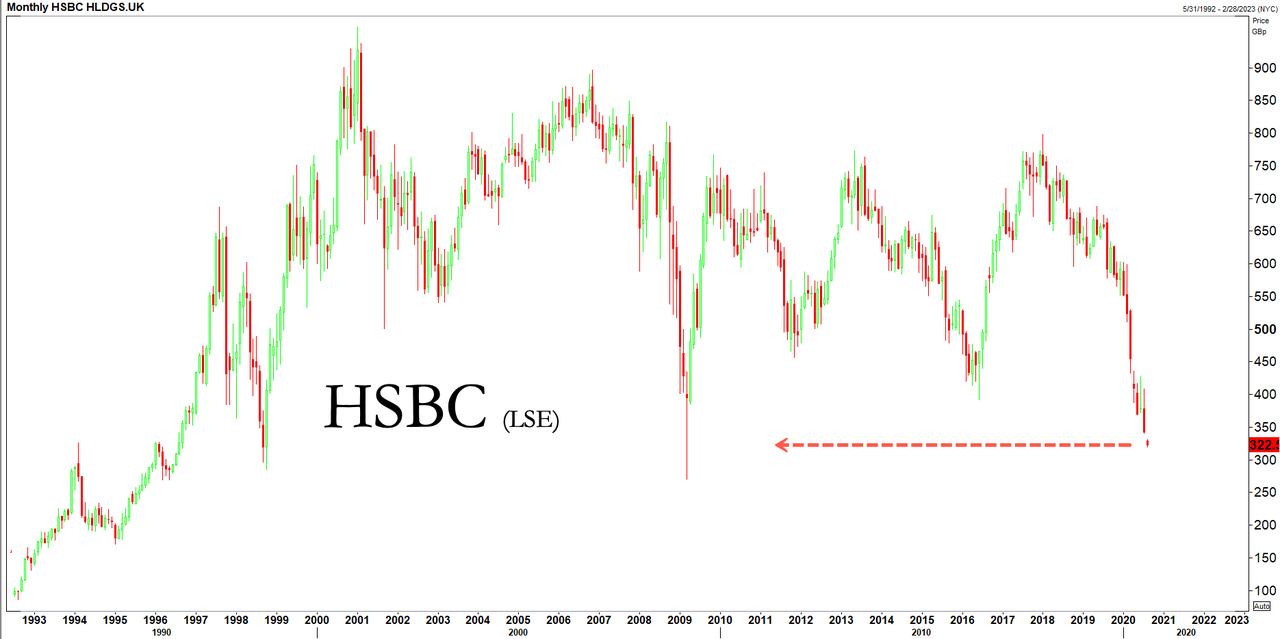
Investors were spooked after HSBC increased the range of loan losses to $8 billion-$13 billion from $7 billion-$11 illion, reflecting a challenging second quarter and even more challenging, well, future quarters. Bloomberg Intelligence said the new credit loss guidance for 2020 was $2 billion more at the top end, while Jefferies said the bank’s management “unhelpfully” increased the range of credit loss guidance.
“What we have seen this quarter is quite a sharp shift in the economic outlook for the global economy, the famous ‘V’ has got a lot sharper, and as a result, we have materially increased our provisions,” CFO Ewen Stevenson told Reuters.
For the current quarter, the bank reported a pre-tax profit of $4.32 billion in 1H20, down from $12.41 billion a year ago, which missed the average of analysts’ forecasts of $5.67 billion. Morgan Stanley’s Magdalena Stoklosa wrote in a note that pretax profit missed consensus by 12%, driven mostly by provision.
The bank’s revenue fell 9% to $26.7 billion over the first half, slightly above analysts’ expectations of $26.41 billion.
Stevenson said HSBC’s business in the U.K. was hit hard, took a $1.5 billion charge against expected credit losses.
CEO Noel Quinn wrote in the earnings update that HSBC was severely “impacted by the Covid-19 pandemic, falling interest rates, increased geopolitical risk, and heightened levels of market volatility.”
“The first six months of 2020 have been some of the most challenging in living memory. Due to the Covid-19 pandemic, much of the global economy slowed significantly, and some sectors drew to a near-total halt,” Quinn said.
He cited tensions between China and the U.S. that challenged banking operations:
“Current tensions between China and the U.S. inevitably create challenging situations for an organization with HSBC’s footprint. We will face any political challenges that arise with a focus on the long-term needs of our customers and the best interests of our investors.”
Quinn expects to “accelerate implementation” of a restructuring plan announced earlier this year will allow it to pivot away from Europe and the U.S. to focus on the Chinese market.
RBC analyst Benjamin Toms said the results reflect a “bleak outlook” for the bank…
China Behind On Trade Deal Purchase Commitments As Trump Forgets About Phase Two
China is severely lagging behind purchase commitments laid out in phase one trade agreement with the US.
The Peterson Institute for International Economics’ (PIIE) trade tracker of China’s monthly purchases of US goods covered by the deal through June reveals purchase levels were only at 47% of year-to-date targets.

According to the agreement, China would purchase goods and services by a combined $200 billion over 2020 and 2021 from 2017 levels. This PIIE Chart below tracks China’s monthly purchases from July show China hasn’t bought enough American goods.

China’s year-to-date total imports of covered products from the US are around $40.2 billion, compared with a prorated year-to-date target of $86.3 billion. This means China is behind $46.1 billion in purchases.
As a result of Beijing’s inability to uphold the flimsy trade agreement, President Trump recently said he’s not focused on the next phase of the trade deal, otherwise known as “Phase Two.”
Since the coronavirus pandemic, bilateral relations between both superpowers have been severely damaged. President Trump routinely blames China for releasing the “plague” that has crashed the US economy. The status of the trade deal agreement appears to be a dud ahead of the US presidential election.
Even before the phase one deal was signed, in early January, we warned: “Why The “Phase One” Trade Deal Is Impossible, In One Chart.”
Beijing pushing New Delhi toward a hard choice

Comprehending Beijing’s short-term tactics and long-term strategies is a very tough job because of the opaque Chinese governance system. However, Chinese policy on India after the Ladakh military standoff appears lucid and very straightforward.
China has sent an unequivocal message to India that the demarcation and finalization of their boundaries, either on the map or on the ground, are unlikely to happen soon, as reported on Friday by one of India’s less jingoistic and more reliable digital journalism outlets, The Wire.
China’s ambassador to India, Sun Weidong, conveyed such a message to India, speaking on “India-China Relations: The Way Forward” at a webinar held by the Institute of Chinese Studies on Thursday.
Responding to a question on why China does not want to settle the Line of Actual Control (LAC) with the exchange of maps, Sun said Beijing was still not keen to restart the border-demarcation process with India.
The Wire quotes Sun as saying, “The purpose of clarification of [the] LAC is to maintain peace and tranquility. When we look back into history, if one side has unilaterally [stated] its own perception on the LAC during the negotiations, that will lead to disputes. That’s why this process cannot … move on. I think that this is a departure [from the] original purpose.”
The process of demarcation and clarification of the Sino-Indian border was halted in 2002. China and India agreed to engage to improve bilateral ties in trade and economic cooperation, and building consensus on global issues, keeping their differences on the border issue aside.
Sun Weidong’s remarks, as reported by The Wire, support the conclusion that Chinese strategists do not consider a final settlement of the border a priority at this time. According to Sun, the main issue is for India and China to maintain peace and tranquility on the border in alignment with the agreements of 1993 and 1996 and other confidence-building measures.
Sun also hinted that Chinese strategists take the view that the 1993 and 1996 agreements with India were the outcome of the particular historical contexts of the 1990s, and the strategic setting has changed drastically since the Bharatiya Janata Party (BJP) came to power in May 2014.
The border settlement cannot be made according to agreements reached under different circumstances in the past. That is, the changed context for Chinese strategists is India’s strategic “tilt” toward “the West” after August 2016.
Thus Beijing wants to say clearly to New Delhi that border-demarcation issues are irrelevant if India wants to pursue a strategic alliance with the US.
“The important thing is that we must follow those agreements and continue our discussion and consultation along the diplomatic channels and also among corps commanders, [and] also find out a way to de-escalate the situation and restore peace and tranquility,” The Wire quotes the Chinese ambassador as telling the Indian government.
In other words, the Chinese ambassador to India has indicated that Beijing wants to maintain peace and tranquility on the border as a short-term tactic, but does not seek a permanent solution right now or in the near future but only as a long-term strategy.
Thus China has left India to choose between two options on a take-it-or-leave-it basis.
The first option is to fulfill the “agreements and consensus” reached between India and China at their informal summits in Wuhan, China, in April 2018 and in Mahabalipuram, India, in October 2019. Beijing wants New Delhi to decouple from its strategic alliance with Washington. It also wants India to join hands with China in building an open, multipolar, pluralistic, and participatory global economic order.
The second option is to demarcate the border with China by force. That would mean waging a full-scale war with China, and winning the battle, forcing to Beijing accept the border as defined by New Delhi.
However, if India chooses this second option, it will be suicidal. India cannot afford a war against China because of the vast disparity in power between the two countries in terms of both economic and military capabilities.
The military and economic costs of war would be far higher for India than for China, especially right now; in the midst of the Covid-19 pandemic, India is struggling to meet its regular defense and development budgets.
About 2,500 years ago, the Chinese military thinker and philosopher Sun Tzu rightly said, “Who wishes to fight must first count the cost.” How it would pay for a war is a very crucial question for India at this moment.
More important, if war breaks out between these two Asian giants, the political setbacks will be far more significant for India than for China because of the differences in their governance systems. If India faces a defeat in such a war, the BJP won’t likely retain power.
Thus if the BJP-led government chooses war, it will be shooting itself in the foot.
Ambassador Sun Weidong’s remarks at the webinar indicate that China sees a clear strategic advantage over India as long as the border dispute drags on. With the deployment of 20,000 to 40,000 troops, China can keep India’s political and military leadership occupied by border issues.
The Ladakh episode has shown that China can keep India busy by prolonging border tensions. China has also gotten India to waste its scarce financial resources, political and military energy, time and effort to protect a tract of barren borderland in the Himalayan highlands.
As a nation, India will miss the opportunity for economic development because of resources diverted to maintain the Line of Actual Control. As a result, New Delhi will fail to prioritize socioeconomic development, divert its scarce financial resources to protect barren territory, and derail the nation’s economic progress.
As a result, India will shrink economically and politically on the global stage. Overall, it is apparent that Beijing’s strategists reckon India could end up being about a half-century behind China and they can prevent India from emerging as a rival in the future.
Chinese strategists are well aware of the history and psyche of Indians, willing to fight for their territorial pride over barren land.
These strategists want to contain India for the long term by exploiting Indians’ territorial nationalism as a crucial weakness. They believe they can fulfill their long-term strategic objective – to prevent India from evolving as an aspirant superpower – as long as the border issue lingers. China wants to hang an albatross on India’s neck by prolonging the border dispute.
A final agreement on India-China border demarcation will be possible only when the military and economic capabilities between these two countries are at parity. Then, no force will be needed to settle their border disputes.
Until then, China is making strategic moves on the geopolitical chessboard, and it is India’s turn to make an appropriate counter-move by making a tough choice.
And since New Delhi has nuclear missiles pointed at Beijing, it becomes clear why drills are being done there in case of nuclear attack.
A desperate China will reach out to all areas around it to expand its’ borders before financial reality takes hold.”
CCP under attack & at risk to get ousted
It is no different with China. Xi may well be in a tough spot as several retired Generals are calling for change and Xi knows only too well that without the army, to repress the public, the party is finished, and he will have to run or die, or purge the army of all dissent.,assuming measured Army support for the party. Just like the army knows it needs the people and serves the people and not the party. Economic realities in China may well play louder than ideology of a political party. The virus and the flooding have combined along with China’s aggression with its’ neighbors to create a huge storm. One that is uniting the Regional countries against China, unlike anything seen in recent history. Even in South America and Africa the China yoke is being cast off.
So while many people tell tale of the Great Copycat ( did you know they have copied virtually all the car models, that sell for China cheap in China … even a Bentley, or a Lamborghini) that is China who has aspirations of global dominance. That day is not yet here, nor is it even likely that China can ever pay their external loans. As it would seem the Party hierarchy has the wealth and not the country or the people.
One can only wonder, what this will mean for those folks who bought the party line of China in their own willingness to sacrifice their own country’s well being for the propaganda of the Chinese party? What does this mean for the likes of Merkel who has chosen China over America, because she dislikes Trump? Or what this means for supply chains which will no doubt find themselves in greater upheaval than during the virus shutdown? And can you imagine the future sales at those comatose companies who thought China sales would lend them to the land of milk and honey?
Whatever happens going forward, we should remain vigilant to a possible changing China and the reset such a event would cause in the face of what the Davos crowd wants in a Green Reset that does not factor for a faltering or failed China and couple that with the population agenda folks like Gates who wants to stick a needle in everyone. As it stands, all these agendas may well end up in the trash.”Cheers
Robert
4/EUROPEAN AFFAIRS
BANK OF IRELAND (COMMERCIAL BANK)
The EU has imposed negative rates now for quite some time. However banks are loathe to pass these negative rates on consumers. Only large accounts have been hit. That is about to change as the Bank of Ireland is now imposing negatives rates on cash held in pensions
(zerohedge)
Bank Of Ireland Is Now Imposing Negative Rates On Cash Held In Pensions
If you’re holding your pension with the Bank of Ireland, you are now officially being charged to do so.
In a move that we’re sure is going to have absolutely no consequences, the bank is starting to impose negative interest rates on cash held in pensions, according to The Irish Examiner. The bank is applying a rate of 0.65% on pension pots, which means customers will now pay the bank $65 on every $10,000 held.
The bank commented: “European Central Bank interest rates have been negative since 2014. Since then banks have been subject to negative interest rates for holding funds overnight and market indications are that rates will remain low for some time.”
It continued: “As a result, we have applied negative rates on deposits for large institutional and corporate customers since 2016. We recently wrote to 14 investment and pension trustee firms to inform them about a rate change to their accounts, which is reflective of the negative interest rate environment.”
“The average amount held on deposit by investment and pension trustee firms is in excess of around €100m, therefore it is no longer sustainable for the Bank to continue with the current rate of interest. We provided 3 months’ advance notification of this rate change to our investment and pension trustee firm customers,” the bank concluded.
Ulster Bank is also considering similar rates in the future. The bank’s CEO, Jane Howard, said: “In terms of Ulster Bank, we did introduce negative rates earlier this year and we’ve introduced it for larger businesses with balances of over €1m.”
She continued: “As I sit here today we have no plans to charge negative interest rates for our personal customers but given the way everything happens, like Covid, so unexpectedly, it is not something I can rule out forever.”
Thanks, Christine.
5. RUSSIAN AND MIDDLE EASTERN AFFAIRS
IRAN/USA//UN
If the UN removes arms embargo against Iran, then the uSA will take necessary action and that may be military operations
(zerohedge)
Pompeo Vows US To Take “Necessary Action” If UN Arms Embargo On Iran Ends
For months the US has been in a full court diplomatic press on fellow UN Security Council members in an attempt to ensure that a UN arms embargo against Iran does not expire.
The embargo on selling conventional weapons to Iran is set to end October 18, and is ironically enough part of the 2015 nuclear deal brokered under Obama, which the Trump administration in May 2018 pulled out of.
But now Pompeo vows the US will “take necessary action” — no doubt meaning more sanctions at the very least, and likely military action at worst. He told the Senate Foreign Relations Committee this week that “in the near future… we hope will be met with approval from other members of the P5.”

And he followed with:
“In the event it’s not, we’re going to take the action necessary to ensure that this arms embargo does not expire,” he said.
Speaking to the Senate Foreign Relations Committee, Secretary of State Mike Pompeo continued to call on the world to accept extending the UN arms embargo against Iran. The embargo is scheduled to expire on October 18.
But it’s clear at this point that the UN is not intent on extending the embargo. Russia for one has promised as much. Both Russia and China also have recent weapons deals in the works with the Islamic Republic.
6.Global Issues
That did not take long! Norwegian expedition cruise company reported a Covid outbreak soon after it started operations agin
(Sloan/The Points Guy)
One Of The First Ships To Resume Cruising Is Having A COVID Outbreak
By Gene Sloan of ThePointsGuy
On second thought, maybe it was too soon. One of the first cruise ships in the world to resume sailing since the coronavirus-caused worldwide halt to cruising in March is experiencing a significant outbreak of the illness that already has sent several people to the hospital.
Norwegian expedition cruise company Hurtigruten late Friday said four sick crew members from the 535-passenger Roald Amundsen were admitted to the University Hospital of North Norway in Tromsø, Norway, earlier in the day after the vessel docked in the city. All four had tested positive for COVID-19. On Saturday, the line said another 32 crew members had tested positive for the illness.
The Roald Amundsen on Friday had just finished a seven-night sailing out of Tromsø to the Arctic’s wildlife-filled Svalbard archipelago.

All four of the hospitalized crew members had been sick for several days while on board the vessel, and all four had been placed in isolation. But the line said their symptoms weren’t consistent with COVID-19. They only tested positive for the illness after the ship docked in Tromsø early Friday.
It’s unclear if the crew members are seriously ill, or if they only are being hospitalized as a way to keep them isolated.
The entire ship has now been placed in isolation, and the 154 remaining crew members on board have all been tested for COVID-19. Hurtigruten on Saturday said 122 of the crew members had tested negative for the illness.
Hurtigruten on Saturday said it had contacted all 178 passengers who left the ship early Friday, and they had been ordered to self-quarantine in line with Norwegian health regulations.
The company also has contacted another 209 passengers who were aboard the previous sailing of the Roald Amundsen, and they have been told to self-quarantine, too.
The next voyage of the vessel, which had been scheduled to begin Friday, has been canceled.
Hurtigruten has been at the forefront of efforts to restart cruising in Europe in the wake of falling coronavirus case counts across the continent. The line started cruises to Norway out of Hamburg, Germany, in June with a single ship, the 530-passenger Fridtjof Nansen. It added cruises to Svalbard on the Roald Amundsen and the 335-passenger Spitsbergen in July.
The trips only have been open to local travelers from select European countries. No Americans have been on board the vessels.
“We are now focusing all available efforts in taking care of our guests and colleagues,” Hurtigruten spokesperson Rune Thomas Ege said in a statement posted Saturday at the line’s website. “We work closely with the Norwegian national and local health authorities for follow-up, information, further testing, and infection tracking.”
Hurtigruten had implemented a wide range of new health and safety measures on Roald Amundsen and the other ships it brought back into operation, including enhanced cleaning, added medical screenings for passengers and crew, and an end to buffets. All the vessels were operating at a sharply reduced capacity, below 50% of normal, to ensure social distancing.
The Roald Amundsen trips included Zodiac landings for wildlife sightseeing in the Svalbard archipelago as well as kayaking and other expedition-related activities.
Huirgruten pioneered cruises to Svalbard in 1896.
Cruises to Svalbard and other parts of the Arctic were thought to be somewhat simpler to run during a pandemic as they don’t involve much passenger interaction with other humans. The typical Arctic voyage is an expedition-style sailing that involves landings and Zodiac excursions to see wildlife, glaciers and floating ice formations.
The Roald Amundsen currently is scheduled to begin sailings around the British Isles for U.K. residents in early September. Hurtigruten didn’t say whether those trips would go ahead.
Hurtigruten is just one of several cruise companies in Europe that have been starting to bring back sailings since June. Until now, no cruise operators in North America have resumed sailings. But one small-ship cruise company, UnCruise Adventures, plans to resume trips out of Juneau, Alaska, on Saturday.
END
7. OIL ISSUES
8 EMERGING MARKET ISSUES
Your early morning currency/gold and silver pricing/Asian and European bourse movements/ and interest rate settings MONDAY morning 7:00 AM….
Euro/USA 1.1731 DOWN .0041 REACTING TO MERKEL’S FAILED COALITION/ REACTING TO +GERMAN ELECTION WHERE ALT RIGHT PARTY ENTERS THE BUNDESTAG/ huge Deutsche bank problems ///ITALIAN CHAOS//CORONAVIRUS //PANDEMIC// /AND NOW ECB TAPERING BOND PURCHASES/JAPAN TAPERING BOND PURCHASES /USA RISING INTEREST RATES /FLOODING/EUROPE BOURSES /ALL GREEN
USA/JAPAN YEN 106.09 UP 0.473 (Abe’s new negative interest rate (NIRP), a total DISASTER/NOW TARGETS INTEREST RATE AT .11% AS IT WILL BUY UNLIMITED BONDS TO GETS TO THAT LEVEL…
GBP/USA 1.3025 DOWN 0.0054 (Brexit March 29/ 2019/ARTICLE 50 SIGNED/BREXIT FEES WILL BE CAPPED/
USA/CAN 1.3430 UP .0032 CANADA WORRIED ABOUT TRADE WITH THE USA WITH TRUMP ELECTION/ITALIAN EXIT AND GREXIT FROM EU/(TRUMP INITIATES LUMBER TARIFFS ON CANADA/CANADA HAS A HUGE HOUSEHOLD DEBT/GDP PROBLEM)
Early THIS MONDAY morning in Europe, the Euro FELL BY 41 basis points, trading now ABOVE the important 1.08 level FALLING to 1.1731 Last night Shanghai COMPOSITE CLOSED UP 57.96 POINTS OR 1.75%
//Hang Sang CLOSED DOWN 137.22 POINTS OR 0.56%
/AUSTRALIA CLOSED DOWN 0,07%// EUROPEAN BOURSES ALL GREEN
Trading from Europe and Asia
EUROPEAN BOURSES ALL GREEN
2/ CHINESE BOURSES / :Hang Sang CLOSED DOWN 137.22 POINTS OR 0.56%
/SHANGHAI CLOSED UP 57.96 POINTS OR 1.75%
Australia BOURSE CLOSED DOWN. 07%
Nikkei (Japan) CLOSED UP 485.38 POINTS OR 2.24%
INDIA’S SENSEX IN THE RED
Gold very early morning trading: 1970.60
silver:$24.28-
Early MONDAY morning USA 10 year bond yield: 0.55% !!! UP 2 IN POINTS from FRIDAY’S night in basis points and it is trading WELL BELOW resistance at 2.27-2.32%.
The 30 yr bond yield 1.238 UP 4 IN BASIS POINTS from FRIDAY night.
USA dollar index early MONDAY morning: 93.78 UP 43 CENT(S) from FRIDAY’s close.
This ends early morning numbers MONDAY MORNING
xxxxxxxxxxxxxxxxxxxxxxxxxxxxxxxxxxxxxxxxxxxxxxxxxxxxxxxxxxxxxxxxxxxxxxxxxxxxxxxxxxxxxxxxxxxxxxxxxxxxxxxxxxxxxx6
And now your closing MONDAY NUMBERS \1: 00 PM
Portuguese 10 year bond yield: 0.34% DOWN 0 in basis point(s) yield from YESTERDAY/
JAPANESE BOND YIELD: -+02% UP 0 BASIS POINTS from YESTERDAY/JAPAN losing control of its yield curve/56
SPANISH 10 YR BOND YIELD: 0.34%//UP 1 in basis point yield from yesterday.
ITALIAN 10 YR BOND YIELD:1,01 UP 0 points in basis points yield from yesterday./
the Italian 10 yr bond yield is trading 67 points higher than Spain.
GERMAN 10 YR BOND YIELD: RISES TO –.52% IN BASIS POINTS ON THE DAY//
THE IMPORTANT SPREAD BETWEEN ITALIAN 10 YR BOND AND GERMAN 10 YEAR BOND IS 1.53% AND NOW ABOVE THE THE 3.00% LEVEL WHICH WILL IMPLODE THE ENTIRE ITALIAN BANKING SYSTEM. AT 4% SPREAD THERE WILL BE A HUGE BANK RUN…
END
IMPORTANT CURRENCY CLOSES FOR TUESDAY
Closing currency crosses for TUESDAY night/USA DOLLAR INDEX/USA 10 YR BOND YIELD/1:00 PM
Euro/USA 1.1742 DOWN .0028 or 28 basis points
USA/Japan: 106.14 UP .517 OR YEN DOWN 52 basis points/
Great Britain/USA 1.3040 DOWN .0039 POUND DOWN 39 BASIS POINTS)
Canadian dollar DOWN 15 basis points to 1.3412
xxxxxxxxxxxxxxxxxxxxxxxxxxxxxxxxxxxxxxxxxxxxxxxxxxxxxxxxxxxxxxxxxxxxxxxxxxxxxxxx
The USA/Yuan,CNY: AT 6.9809 ON SHORE (UP)..GETTING DANGEROUS
THE USA/YUAN OFFSHORE: 6.9831 (YUAN UP)..GETTING REALLY DANGEROUS
TURKISH LIRA: 6.9733 EXTREMELY DANGEROUS LEVEL/DEATH WISH.
the 10 yr Japanese bond yield closed at +02%
Your closing 10 yr US bond yield UP 2 IN basis points from FRIDAY at 0.557 % //trading well ABOVE the resistance level of 2.27-2.32%) very problematic USA 30 yr bond yield: 1.24 UP 4 in basis points on the day
Your closing USA dollar index, 93.70 UP 35 CENT(S) ON THE DAY/1.00 PM/
Your closing bourses for Europe and the Dow along with the USA dollar index closing and interest rates for MONDAY: 12:00 PM
London: CLOSED UP 139.18 2.38%
German Dax : CLOSED UP 350.60 POINTS OR 2.85%
Paris Cac CLOSED UP 104.19 POINTS 2.18%
Spain IBEX CLOSED UP 96,60 POINTS or 1.40%
Italian MIB: CLOSED UP 265.36 POINTS OR 1.39%
WTI Oil price; 41.09 12:00 PM EST
Brent Oil: 44.12 12:00 EST
USA /RUSSIAN / RUBLE RISES: 73.38 THE CROSS HIGHER BY 1.00 RUBLES/DOLLAR (RUBLE LOWER BY 100 BASIS PTS)
TODAY THE GERMAN YIELD RISES TO –.52 FOR THE 10 YR BOND 1.00 PM EST EST
END
This ends the stock indices, oil price, currency crosses and interest rate closes for today 4:30 PM
Closing Price for Oil, 4:00 pm/and 10 year USA interest rate:
WTI CRUDE OIL PRICE 4:30 PM : 40.78//
BRENT : 43.90
USA 10 YR BOND YIELD: … 0.56//up 2 basis points…
USA 30 YR BOND YIELD: 1.24..up 4 basis points.
EURO/USA 1.177660 ( DOWN 6 BASIS POINTS)
USA/JAPANESE YEN:105.95 UP .326 (YEN DOWN 33 BASIS POINTS/..
USA DOLLAR INDEX: 93.60 UP 25 cent(s)/
The British pound at 4 pm Britain Pound/USA:1.3074 DOWN 5 POINTS
the Turkish lira close: 6.9573
the Russian rouble 73.155 UP 1003 Roubles against the uSA dollar.( UP 100 BASIS POINTS)
Canadian dollar: 1.3386 UP 12 BASIS pts
German 10 yr bond yield at 5 pm: ,-0.52%
The Dow closed UP 236.08 POINTS OR 0.89%
NASDAQ closed UP 157.52 POINTS OR 1.47%
VOLATILITY INDEX: 24.53 CLOSED UP .07
LIBOR 3 MONTH DURATION: 0.248%//libor dropping like a stone
USA trading today in Graph Form
Nasdaq Surges To Another Record High Despite Dollar Surge
Another day, another nicely engineered short squeeze…
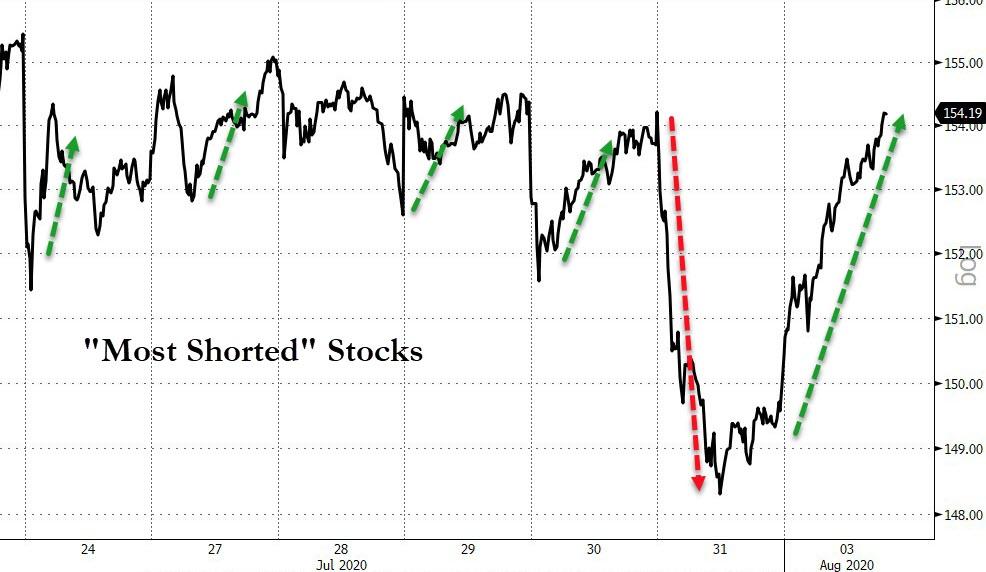
Source: Bloomberg
Oh and a panic bid into the world’s biggest market cap company (after it already rose over 10% on Friday), but a lot of that faded as the day went on…

And a better than expected ISM print (ignoring the decline in the Markit PMI) sparked a bid in value/cyclical stocks…
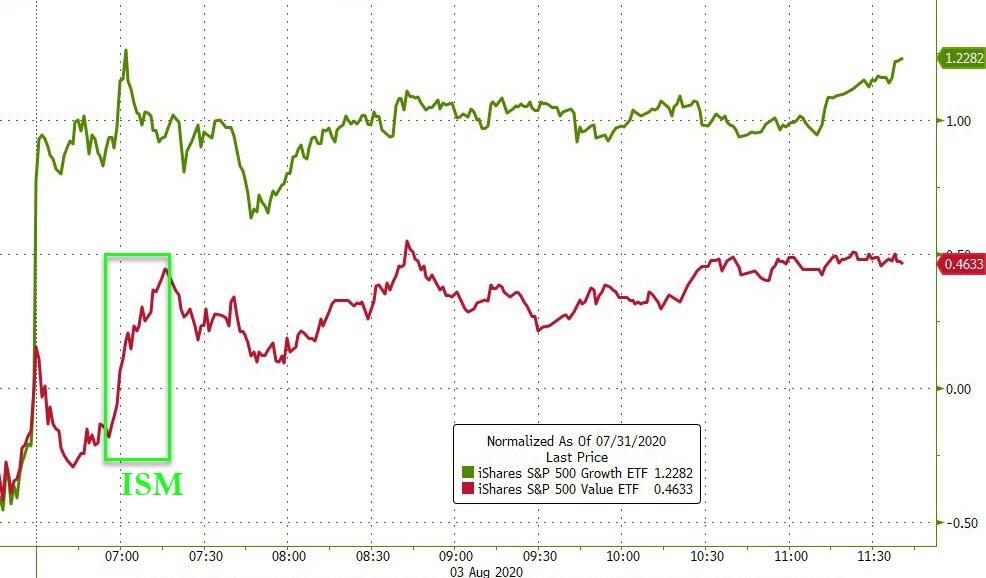
Source: Bloomberg
All helped lift the broad markets today (despite a late-day drop on McConnell comments about the Democrats “not budging” on negotiations… (Small Caps managed to outgain tech on the day thanks to that late drop)
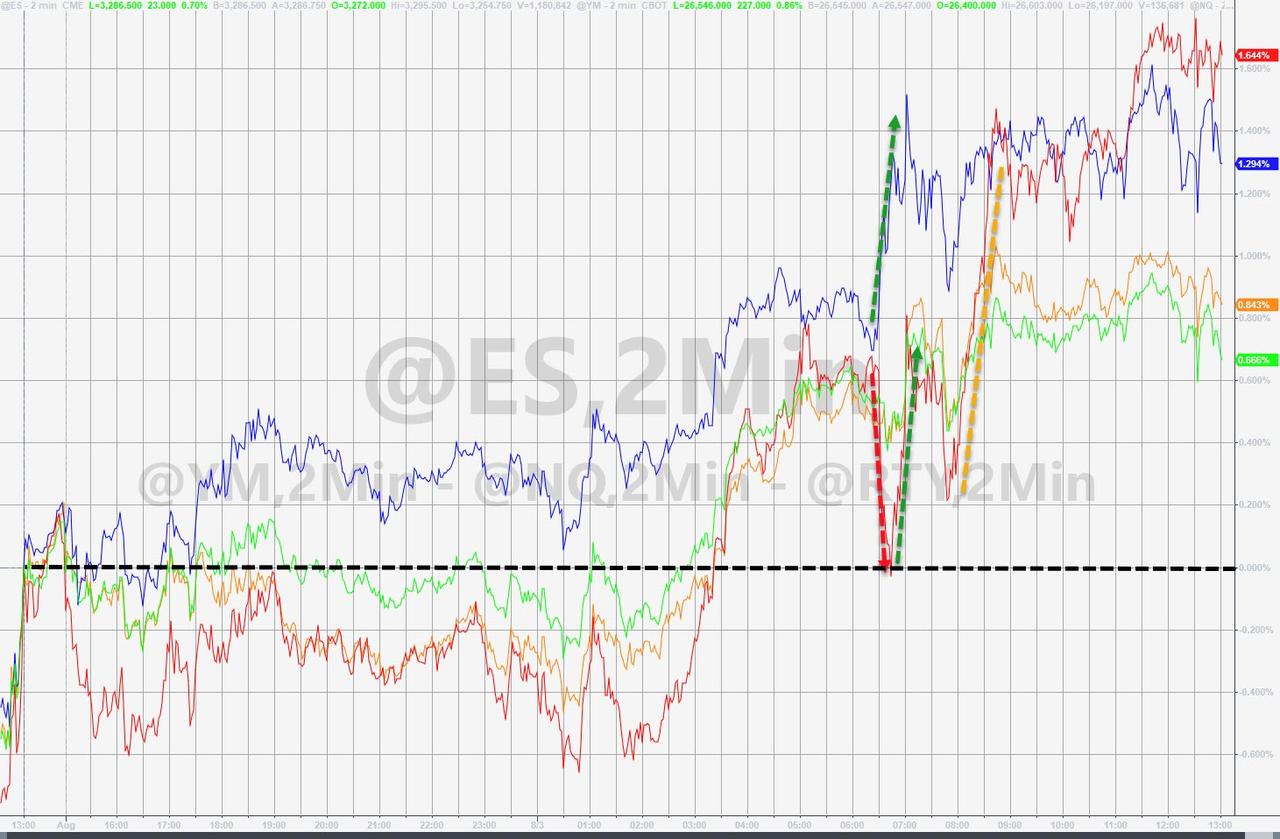
NOTE the cash open saw an immediate panic-bid in Nasdaq and dump of Small Caps, but the latter quickly reversed.
AAPL & MSFT accounted for more than half of The Dow’s gains today, but gun stocks surged more on the back of huge surge in background checks…
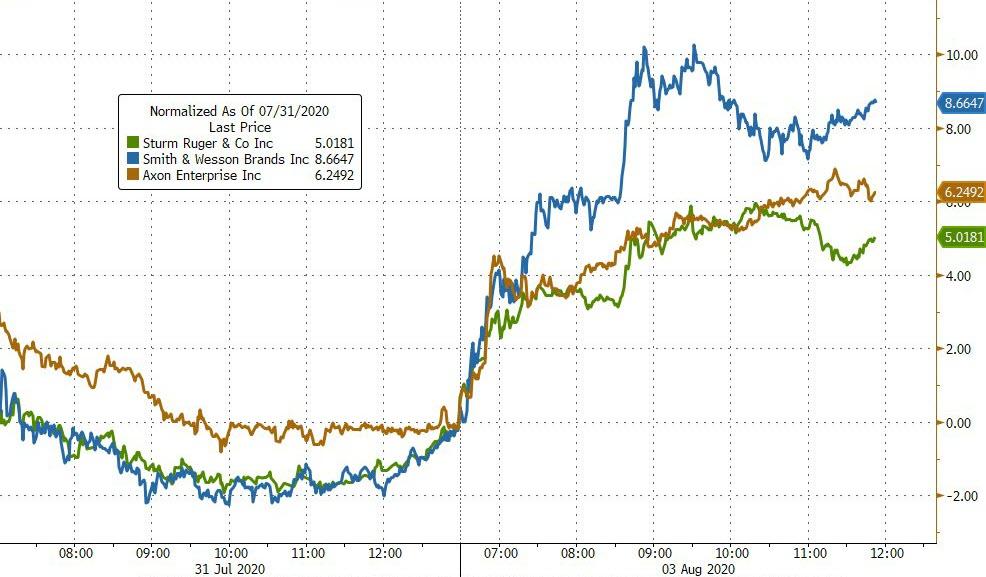
Source: Bloomberg
Momentum continues to keep the dream alive…
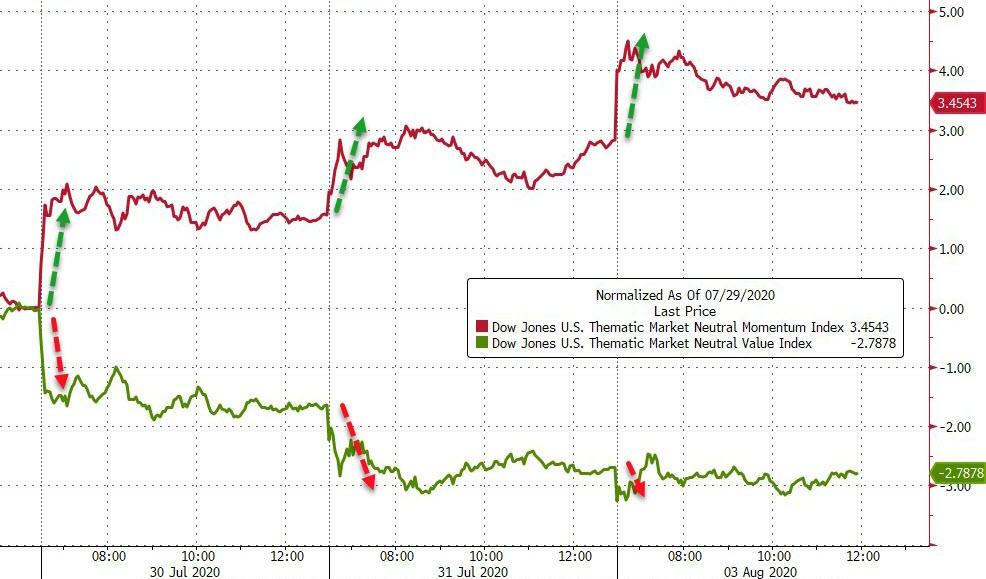
Source: Bloomberg
The rally in stocks held up despite a big surge in the dollar (which has been highly inveresely correlated with stocks for much of the last four months)…
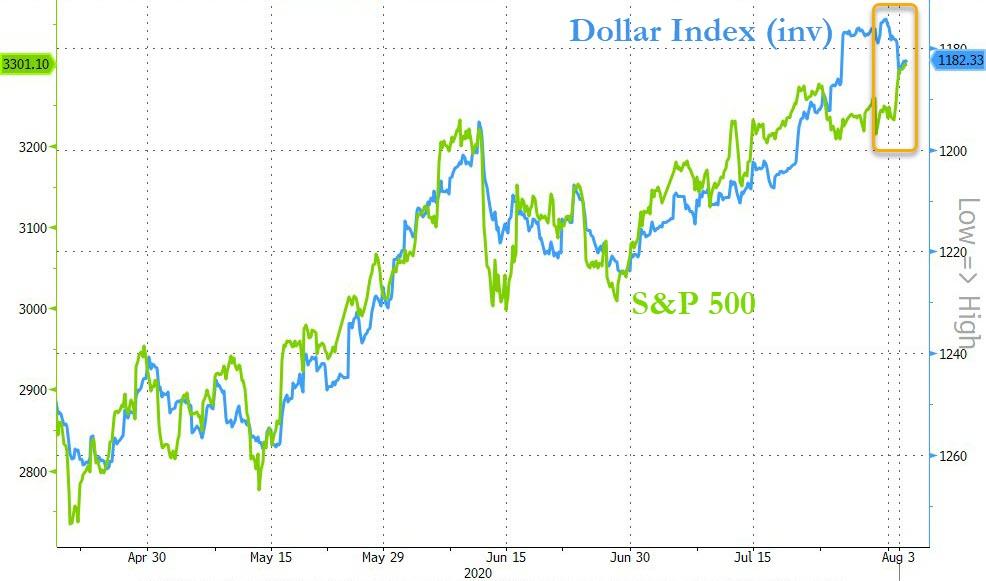
Source: Bloomberg
Biggest 2-day jump in the dollar since early June..

Source: Bloomberg
…though it started to give back some gains after Europe closed…
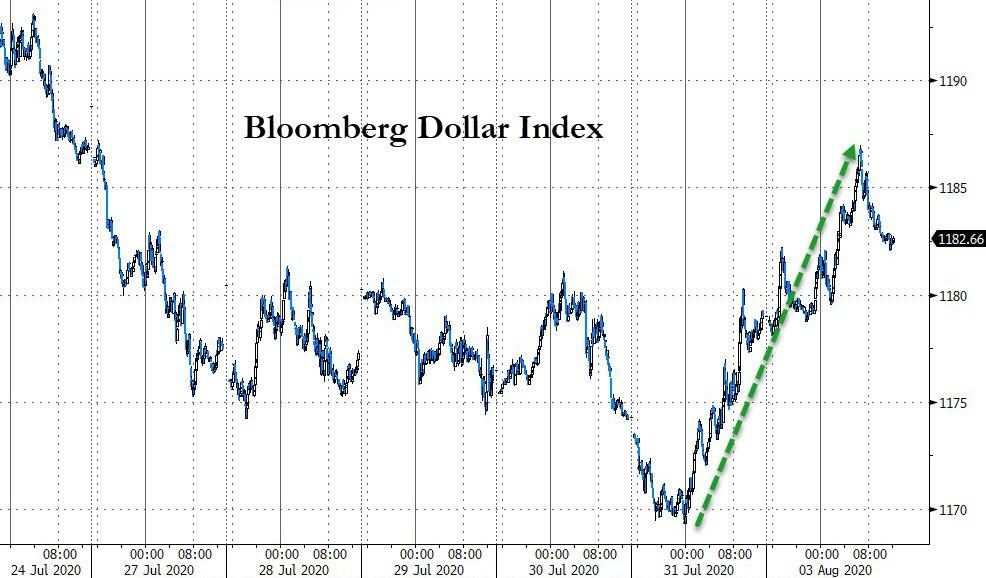
Source: Bloomberg
But the bounce was from a serious point of support…

Source: Bloomberg
Bitcoin continued to recover from its flash-crash over the weekend…
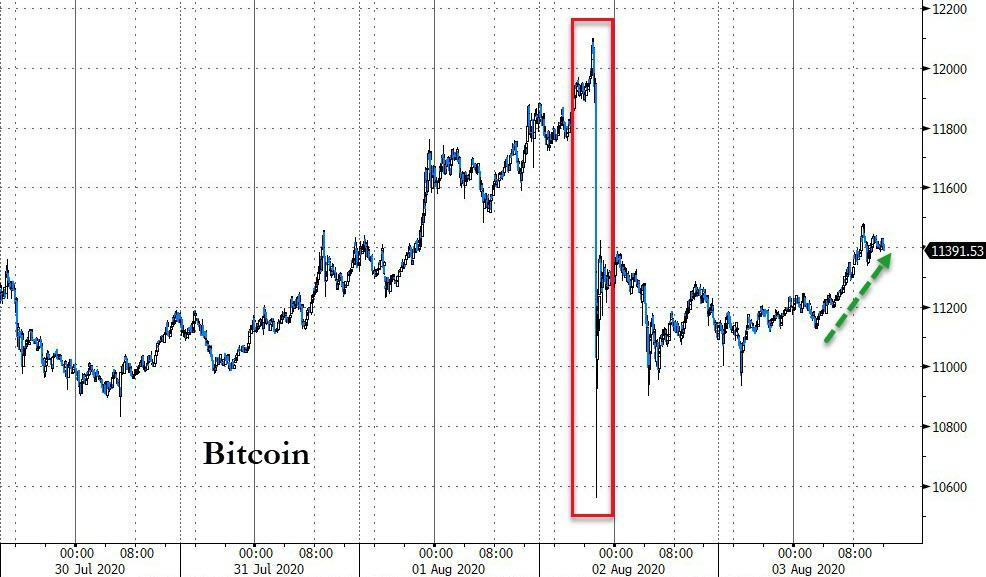
Source: Bloomberg
And Ethereum even more so…
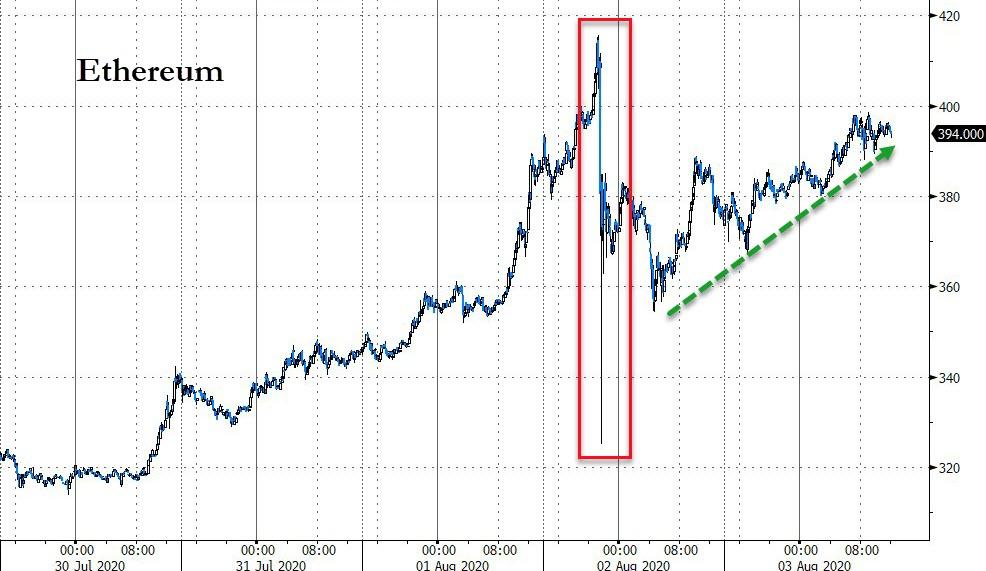
Source: Bloomberg
Treasury yields were higher on the day skewed to long-end underperformance amid the massive Google issuance (2Y +0.5bps, 30Y +4bps)…
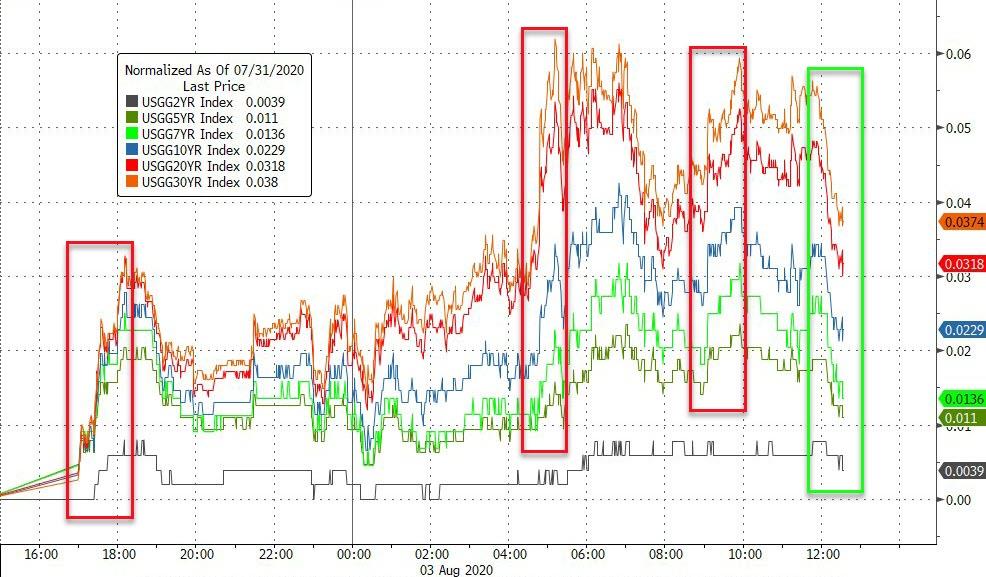
Source: Bloomberg
But even with those rate-locks and rotation, 10Y yields barely budged by the close…

Source: Bloomberg
Gold scrambled into the green as the dollar started to leak lower…

Source: Bloomberg
Finally, there’s this: Bloomberg reports that income-oriented investors have less reason than ever to favor U.S. corporate bonds over stocks. The gap between the yield on the Bloomberg Barclays U.S. Corporate Bond Index and the dividend yield for the S&P 500 Index shows as much. Both yields were about 1.9% at the end of last week, according to data compiled by Bloomberg.
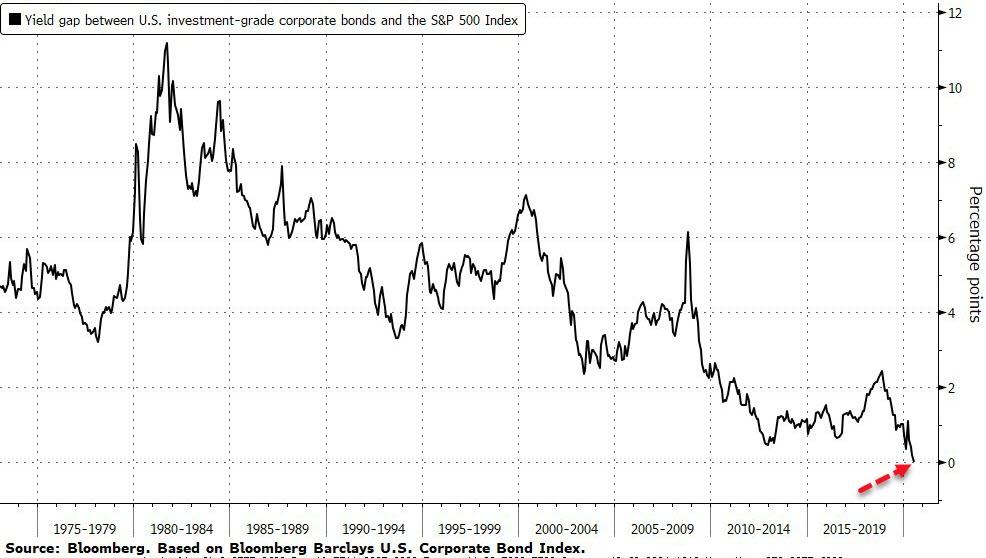
Source: Bloomberg
Corporate yields have been as much as 11 percentage points higher on a monthly basis since the 1970s, as shown in the chart. The most recent peak was 2.4 points, reached in November 2018. But then again with The Fed’s foot on the throat of all price discovery, it makes sense that everything is the same, no matter the risk differentials.
That’s all that matters.
And now your more important USA stories which will influence the price of gold/silver
MARKET TRADING//USA
a)Market trading/THIS MORNING/USA
Shorts Crushed As Dollar Surges, Euro Tumbles In Violent Trend Reversal
Following the worst month for the dollar in a decade, there has been a bout of position squaring as we start August, largely on the back of a slump in the Euro, which is down 200 pips in 2 days, and accelerating weakness in the Yen, which have sent the Bloomberg dollar index to its highest level in a week, surging the most since June 14.
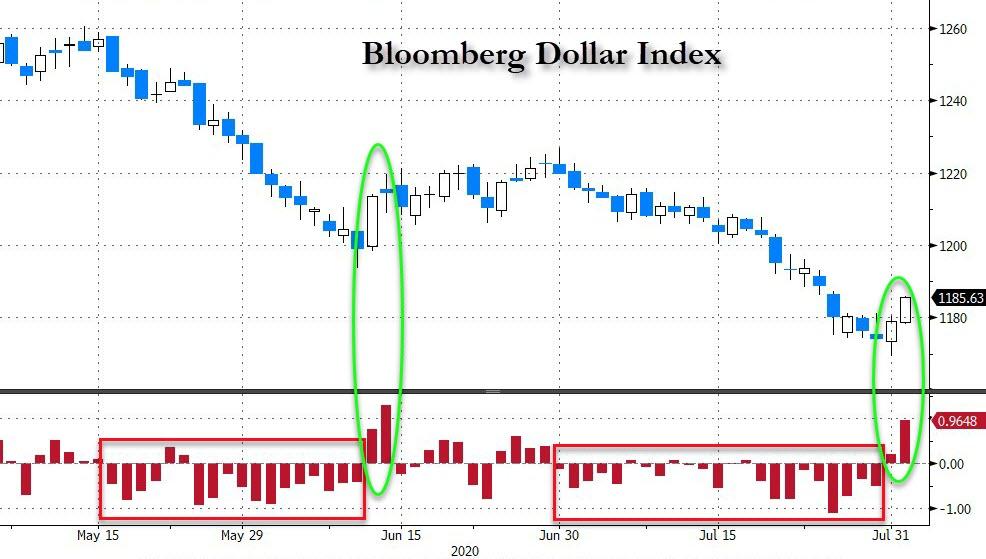
The spike in the dollar has pushed Treasury yields higher from their all time closing lows printed on Friday (as positive purchasing managers readings in China and Europe helped buoy risk appetite), while the sharp reversal has triggered a furious bout of short covering in Dollar futures, which according to the latest CFTC data has printed the most short in 9 years.
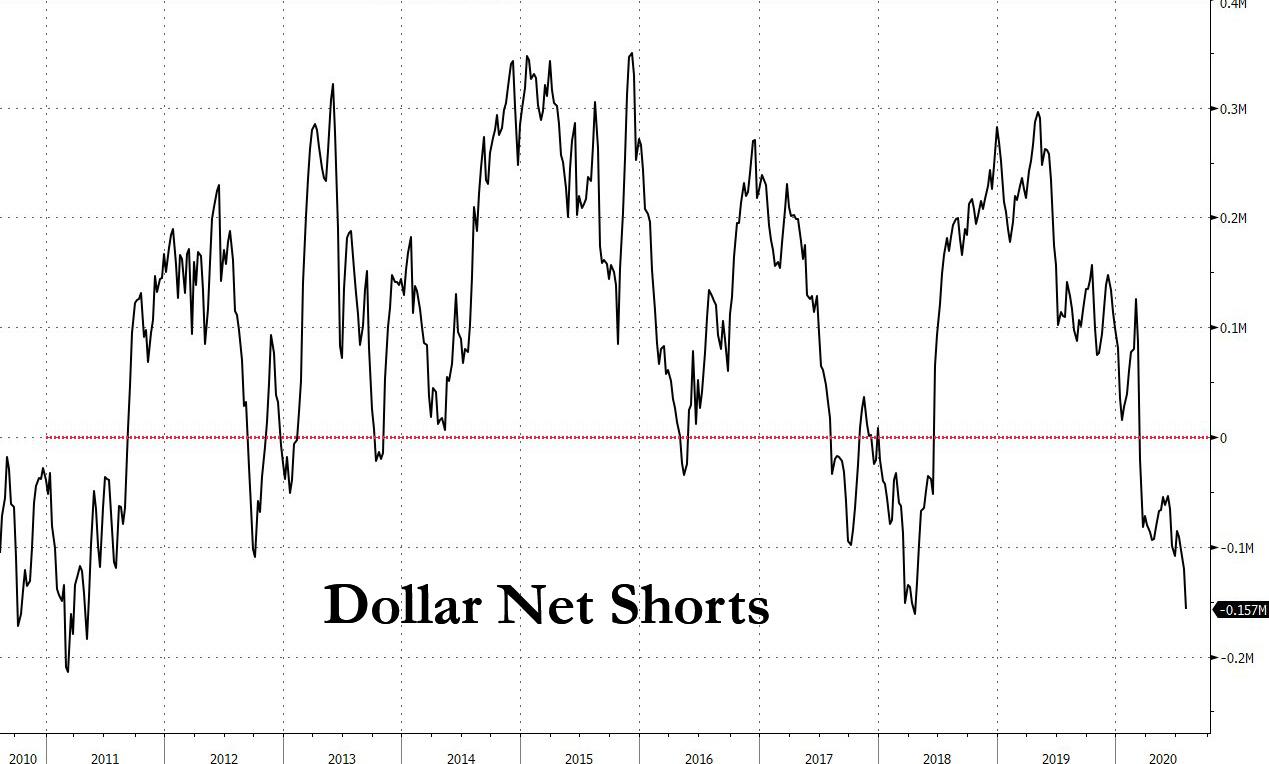
The shorting of the dollar accelerated last week, with Goldman’s FX strategists noting that in the week ending July 28, non-commercial traders net sold $5.2bn USD, following net sales of $2.2bn USD the previous week. Currently, they are net short $24.5bn USD. Both asset managers and leveraged funds contributed to the net sales of Dollars. At the same time, asset managers net sold $6.3bn USD, primarily against net purchases of EUR, JPY, and GBP.
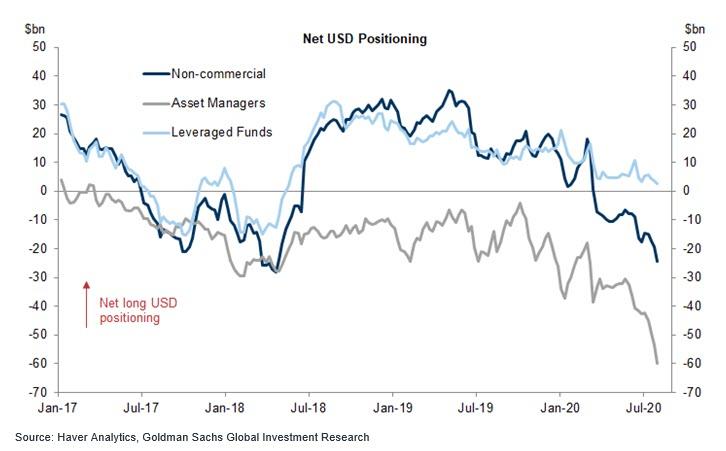
The net sales of USD were primarily against net purchases of $5.1bn EUR, which non-commercial traders have also net purchased in eight of the prior nine weeks. Asset managers are currently net long $48.3bn EUR, the highest exposure in years. Leveraged funds also net sold USD, while net purchasing $1.3bn EUR
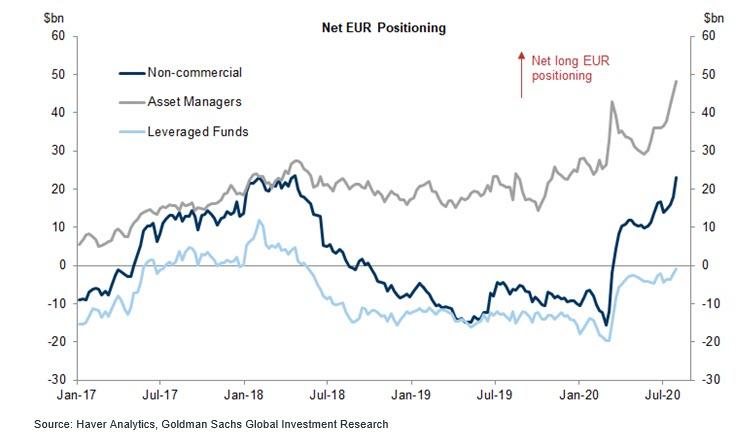
A similar increase in net longs was also observed in the Yen.
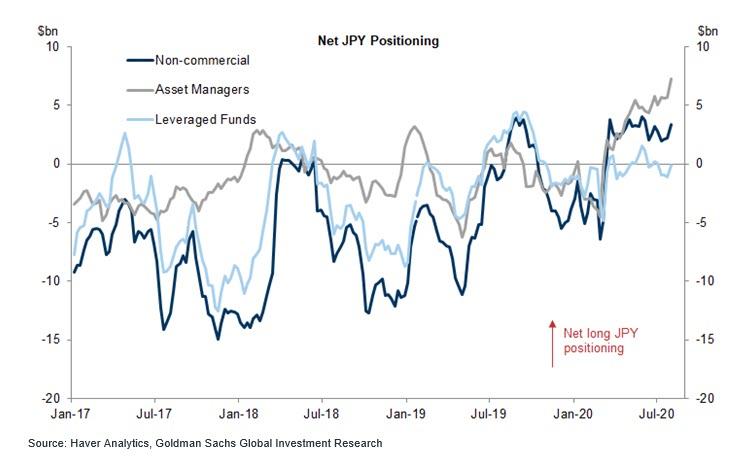
And now that traders are starting to turn their attention to surging covid cases in Europe and Japan while the US situation appears to have plateaued, expect this rollercoaster to reverse fully with the EUR slide only starting and the Dollar uptrend resuming.
What is most surprising perhaps about the reversal in the dollar is the lack of gold weakness – at least for now – despite the surge in the dollar. Keep an eye on precious metals to see if gold strength continues despite the apparent break in the dollar downside trend.
b)MARKET TRADING/USA/AFTERNOON
ii)Market data/USA
again, fraudulent ISM numbers..
US Manufacturing PMI “Worryingly Weak” As ISM Spikes To 16-Month Highs
Following more rebounds in ‘soft’ manufacturing survey data in Europe and Asia (and LatAm – Brazil Manufacturing PMI exploded to a record in July), both ISM and Markit’s measures of US manufacturing sentiment were expected to continue their v-shaped recovery (despite hard data refuses to follow suit).
However, while the July surveys improved over June, Markit’s PMI notably dropped from the flash print but ISM’s report showed major gains…
- Markit US Manufacturing PMI MISS 50.9 vs 51.3 exp and 49.8 prior (51.3 flash)
- ISM US Manufacturing BEAT 54.2 vs 53.6 exp and 52.6 prior
This is the highest ISM manufacturing print since March 2019
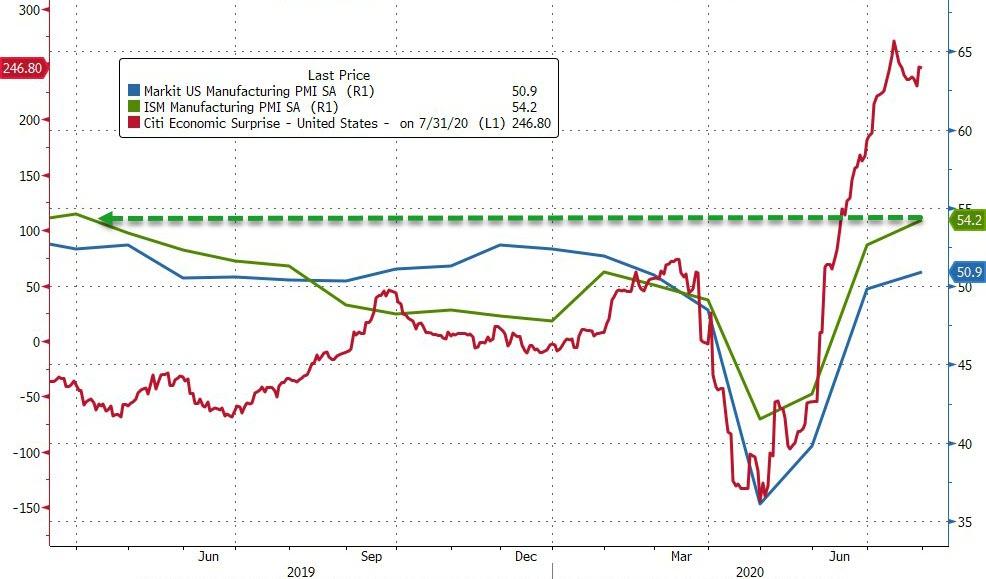
Source: Bloomberg
So take your pick – disappointing intra-month decline (as reopenings are rolled back) or best month in 16 months (because nothing matters)?
ISM New Orders have exploded higher to best since Sept 2018 but employment is not catching up to the “V”…
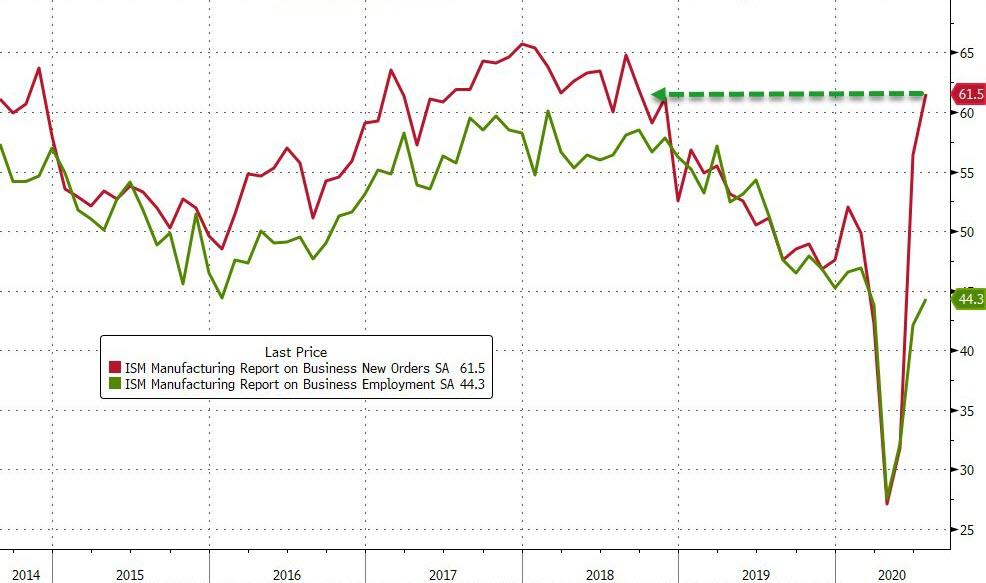
Source: Bloomberg
As Chris Williamson, Chief Business Economist at IHS Markit notes:
“Although indicating the strongest expansion of the manufacturing sector since January, the IHS Markit PMI remains worryingly weak. Much of the recent improvement in output appears to be driven merely by factories restarting work rather than reflecting an upswing in demand.
Growth of new orders remains lacklustre and backlogs of work continue to fall, hinting strongly at the build-up of excess capacity. Many firms and their customers remain cautious in relation to spending in the face of re-imposed lockdowns in some states and worries about further disruptions from the pandemic.
“Encouragingly, business optimism about the year ahead has revived to levels last seen in February, but many see the next few months being a struggle amid the ongoing pandemic, with a more solid-looking recovery not starting in earnest towards the end of the year or even into 2021.
Further infection waves could of course derail the recovery, and many firms also cited the presidential elections as a further potential for any recovery to be dampened by heightened political uncertainty.”
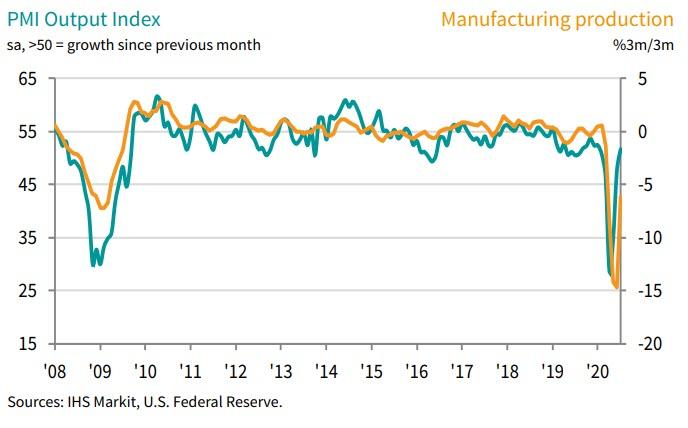
Finally, as a reminder, the euphoric (phew, thank the lord that’s over) rebound has sent ‘soft’ survey data hopes to a level that has historically not portended a good reaction in markets…
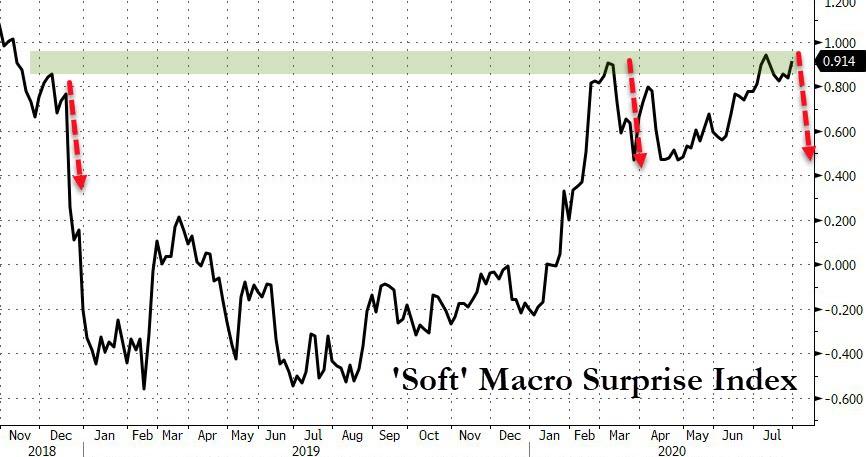
Source: Bloomberg
end
US Construction Spending Unexpectedly Tumbles For 4th Straight Month
Homebuilder stocks have soared to record highs as the US housing market appears to barely blink at the biggest economic contraction since The Great Depression.
While stocks initially collapsed, the data never did and now homebuilders are back at record highs…
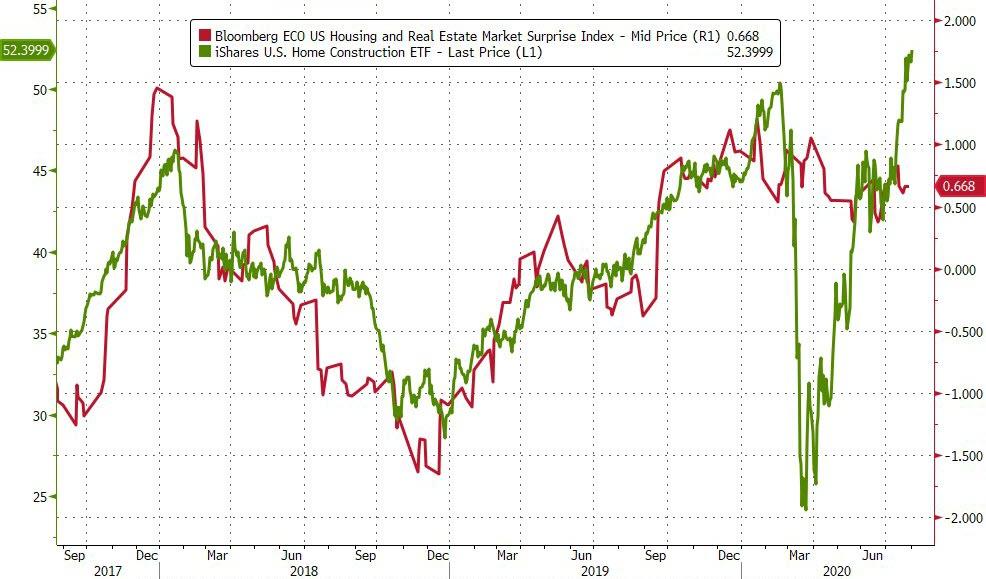
Source: Bloomberg
There’s just one thing though…
US Construction Spending surprised to the downside in June, falling 0.7% MoM versus expectation of a 1.0% rise.
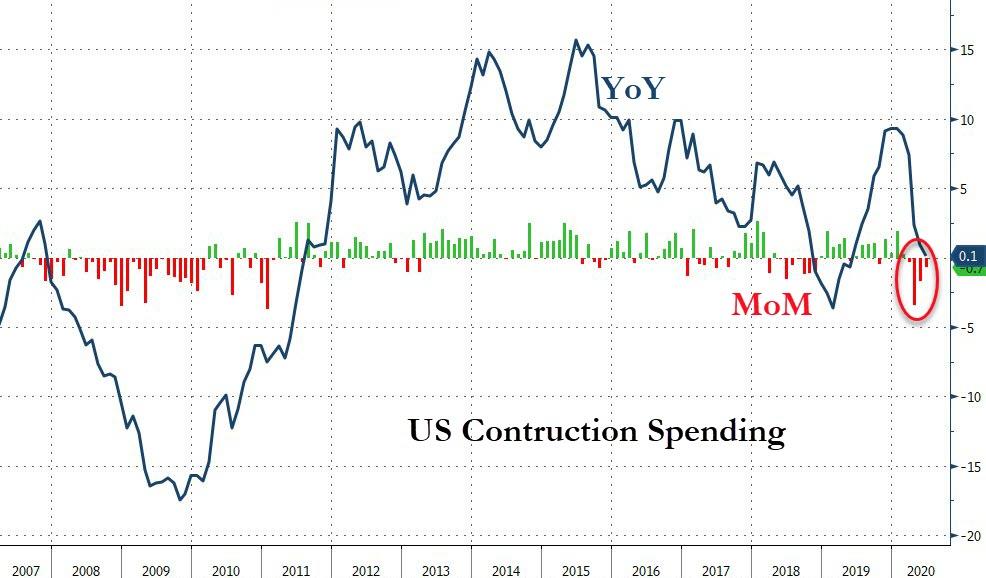
Source: Bloomberg
Under the hood, it was a mixed bag with private residential falling and non-residential managing a small gain:
- Private residential construction fell 1.5%
- Private nonresidential construction rose 0.2%
With Educational and Recreation construction collapsing most…
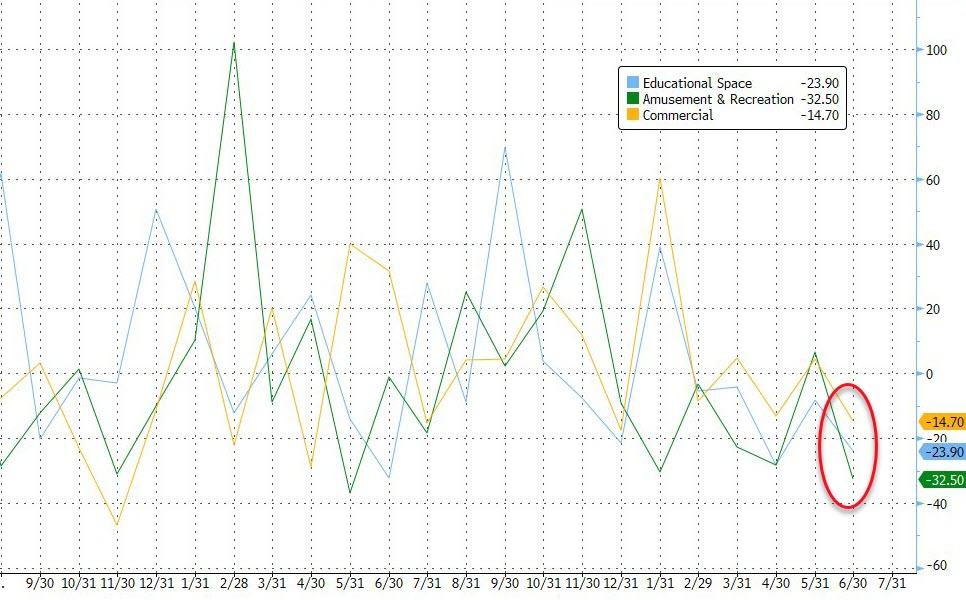
Single-family home construction spending remains drastically down YoY…
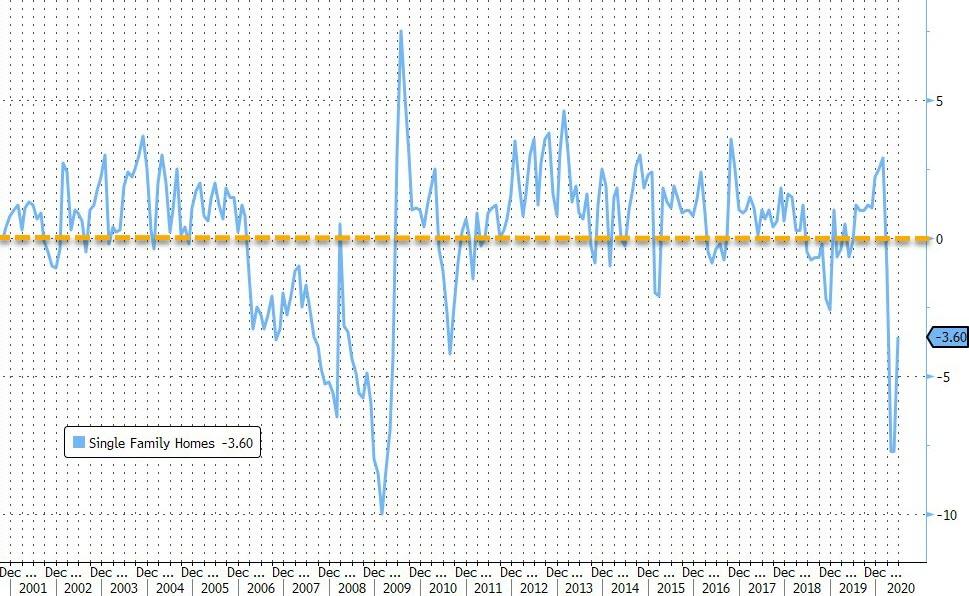
Additionally, Public construction fell 0.7% in June (with government construction spending was 26.1% of total in June).
However, perhaps most notably, private residential home improvement spending fell 0.4% in June to $201.5b, not confirming the narrative of a not-dining-out American consumer ‘nesting’ at home that has propelled so many home-related stocks.
end
US Q3 GDP Now Seen Surging 20% By Atlanta Fed
One day after the BEA reported last Thursday that US GDP crashed an annualized 32.9% in the second quarter, the biggest drop since the great depression…
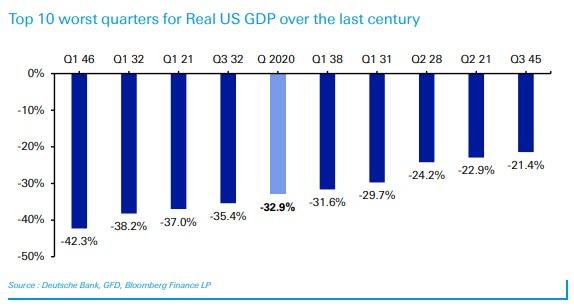
… the Atlanta Fed published its first GDPNow “nowcast” estimate for the third quarter, which came in at a relative subdued 11.9%, and far below sellside consensus estimates of an 18% print in the third quarter.
Perhaps shamed by Wall Street optimism, just one day business later the Atlanta Fed moments ago announced that its latest revision as of Aug 3 pushed up its Q3 GDP estimate by a whopping 65%, and its GDPNow model now estimates that real GDP growth in the third quarter of 2020 is 19.6%. The reason for the massive repricing? This morning’s Manufacturing ISM Report (which beat expectations) and construction spending report (which missed badly).
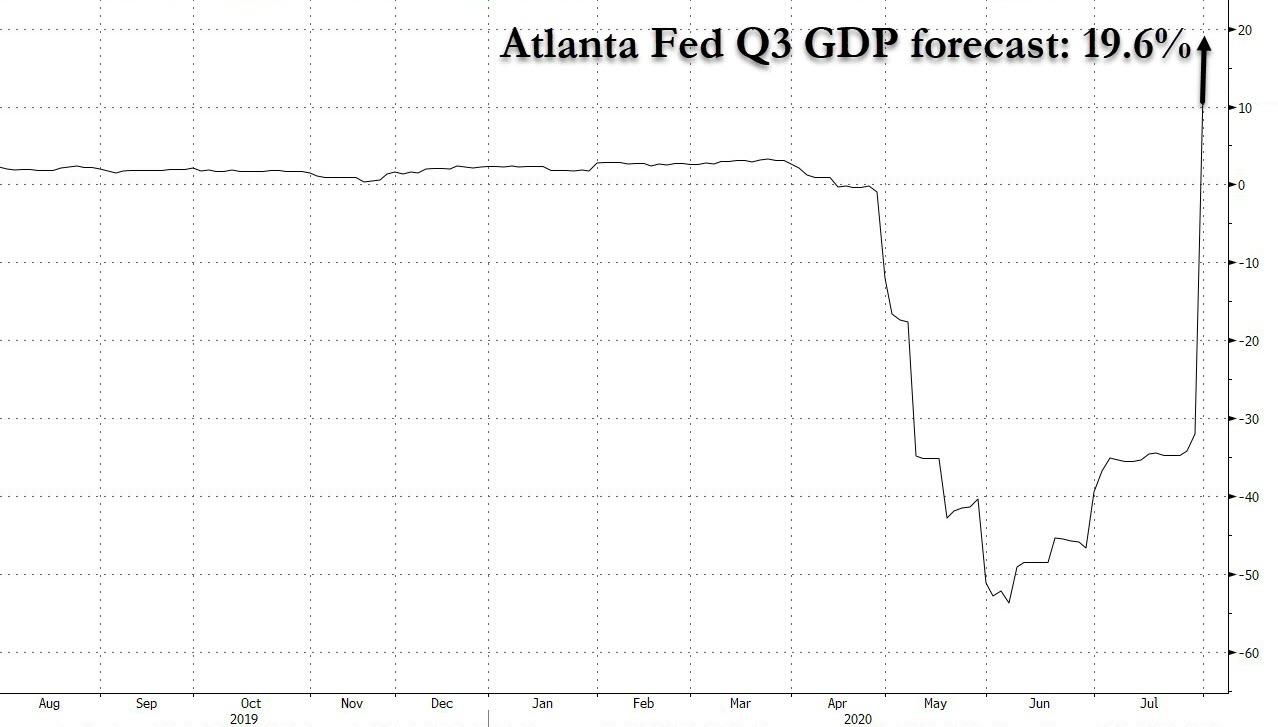
Following the latest data, the nowcasts of third-quarter real personal consumption expenditures growth and third-quarter real GDP investment growth increased from 14.4% and -1.7%, respectively, to 22.4% and 11.1%, respectively. Also, the nowcast of third-quarter real government spending growth increased from 5.7% to 6.8%.
If the Atlanta Fed is correct, the annualized Q3 GDP print would be the highest on record.
Of course, it goes without saying that if Congress fails to roll over the emergency unemployment benefits which expired last month – and which as we previously noted are instrumental in the record 25% of personal income that is funded by the US government…
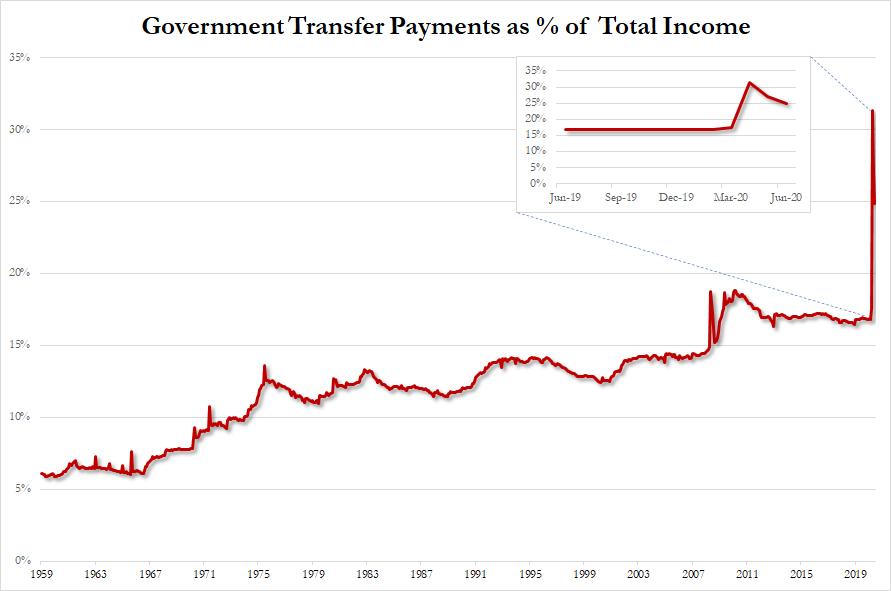
… Q3 GDP will end up being another unmitigated disaster.
iii) Important USA Economic Stories
PORTLAND
Despite the news that “calm returns to Portland” protesters burn bibles, American bibles and pig’s head
(zerohedge)
Portland’s ‘Peaceful’ Protesters Burn Bibles, American Flags And Pig’s Head After Feds Withdraw
After federal agents withdrew from Portland late last week, neo-Marxist ‘youts‘ broke out the lighter fluid and began torching Bibles, American flags, and a severed pig’s head donning a police hat.
Of course, the Washington Post is out with fresh propaganda with the headline “Calm returns to Portland as federal agents withdraw.”
Right…
US COVID-19 Deaths Top 1k For 5th Day As US Outbreak Slows, Europe Accelerates: Live Updates
- Florida deaths top 7k
- Poland suffers 3rd record jump in COVID-19 cases
- Germany sees “R” rate hit 1.06
- Tokyo reports 472
- Russia hopes to start mass vaccinations in October
* * *
For the next few days, the COVID-19 pandemic won’t be the only major disaster unfolding in the Sun Belt: Hurricane Isais is headed straight for Miami-Dade, the worst-hit county in the worst-hit state.
To be sure, as we pointed out yesterday, hospitalizations and single-day case tallies, and daily positivity percentages appear to finally be declining across the Sun Belt.

However, deaths have continued to climb. In the US, COVID-19 daily deaths topped 1,000 – another 1,353 deaths, to be exact – for the fifth consecutive day of fatalities over 1,000. for the fifth straight day, even as the shuttering of testing sites in some parts of the state has caused positivity numbers to decline.

According to the latest data published by Bloomberg and JHU on Saturday morning, the US added 66,545 new virus cases on Friday, a 1.5% increase, compared with the daily average increase of 1.6%. Total cases were 4,561,511.
On Saturday, Florida reported 179 new deaths, snapping a 4-day streak of record daily death numbers, while also pushing the state’s death toll past 7k to 7,022.
Fla also reported another 9,642 cases (+2%), lower than the 2.3% average increase over the prior week. The state’s total is now 480,028.
Governor Ron DeSantis has declared a state of emergency as the storm nears, and many state-run testing facilities have been closed.
Meanwhile, in Europe and Asia, new case numbers continued to climb.
Public health officials in Tokyo announced 472 new cases on Saturday, a new record for Japan’s capital city, according to NHK public television, which quoted Tokyo officials as saying such. The number of cases reported out of the capital megacity topped 400 for 2 days in a row.
Tokyo Gov Yuriko Koike has said Tokyo could declare its own state of emergency if the situation continues to worsen, however, the central government says there is still no need to do so nationally, despite a record spike in several cities around the nation.
As thousands of protesters gathered in Berlin to campaign against the government reimposing economically-painful COVID-19 restrictions – with some claiming the hysteria surrounding the virus, Germany recorded 864 new infections in the 24 hours through Saturday morning. A spate of smaller outbreaks has kept the infection rate above the key threshold of 1.0 for eight consecutive days. The most recent reading put the “R” rate at 1.06.
After reporting its lowest death rate in five days, Russian health officials announced Saturday that the government is preparing to start mass vaccinations against the virus, with health workers and teachers first in line for innoculation said Health Minister Mikhail Murashko said.
A vaccine has reportedly been developed by Moscow’s Gamaleya Institute (with help from the Russian Direct Investment Fund) and has completed clinical trials and the authorities are preparing to register it with regulators. It will be used for the vaccinations.
Russia hopes to start the mass vaccination program in October. Meanwhile, below is the latest chart from JHU showing the 5-day-moving averages for the ten worst-impacted countries in the world.
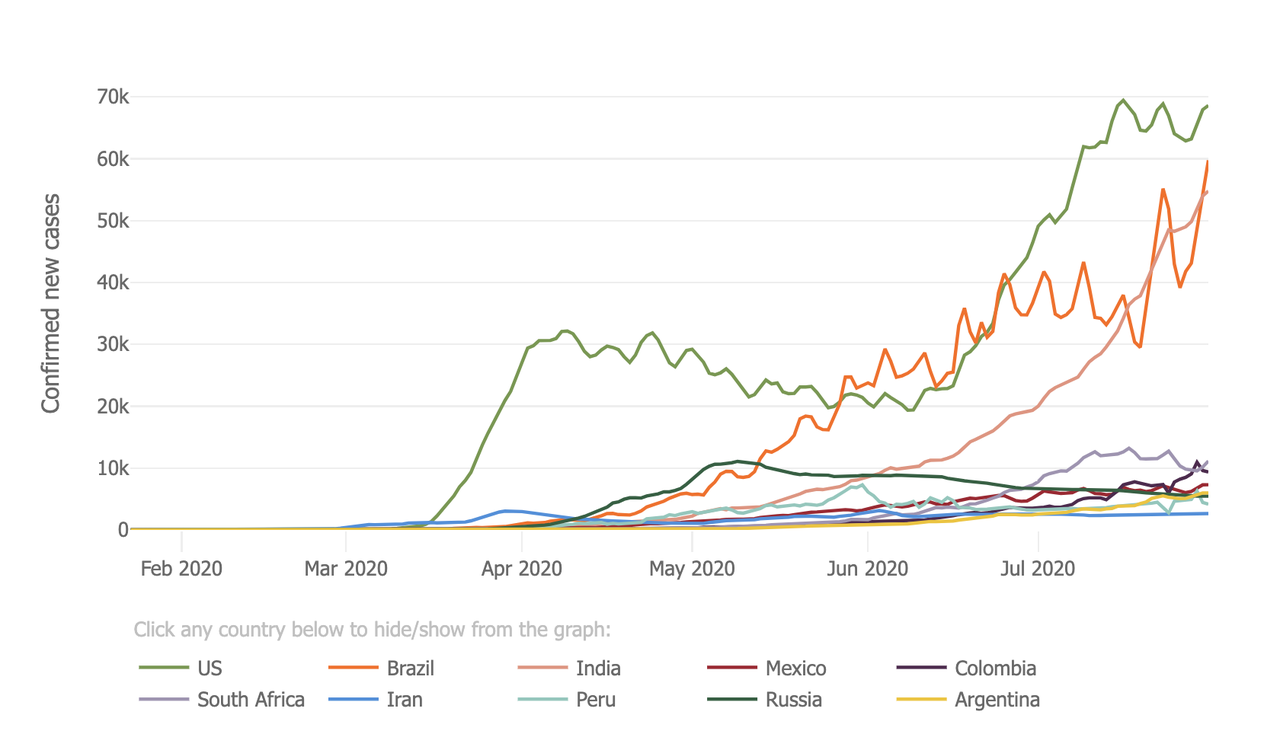
Poland reported its highest number of new coronavirus cases for a third day in a row on Saturday, with 658 new cases confirmed, according to the Health Ministry. 5 new deaths were also reported. The country has reported a total of 46,346 coronavirus cases and 1,721 deaths.
Poland’s prime minister hasn’t ruled out tightening some social distancing restrictions if the situation continues to worsen.
NJ COVID-19 Transmission Rate Highest In Months; Manchester Declares “Major Incident” To Fight Outbreak: Live Updates
Summary:
- UK activates declares “major incident” in Manchester to combat COVID
- Cuomo says students, teachers must be confident for in-person learning to return
- Florida cases drop, deaths lowest in weeks
- NJ “R” rate hits highest rate in months
- Melbourne declares “state of emergency” 3 weeks into lockdown
- Victoria reports 671 new cases
- US cases climbed 58,908 (+1.3%) yday, slowest rate in 5 days
- Mexico death toll tops UK for 3rd place
- India cases top 1.75 mil
- Democratic rep tests positive
- Vietnam reports 2 more deaths
* * *
Update (1515ET): COVID-19 cases haven’t really come back all that much in the UK.
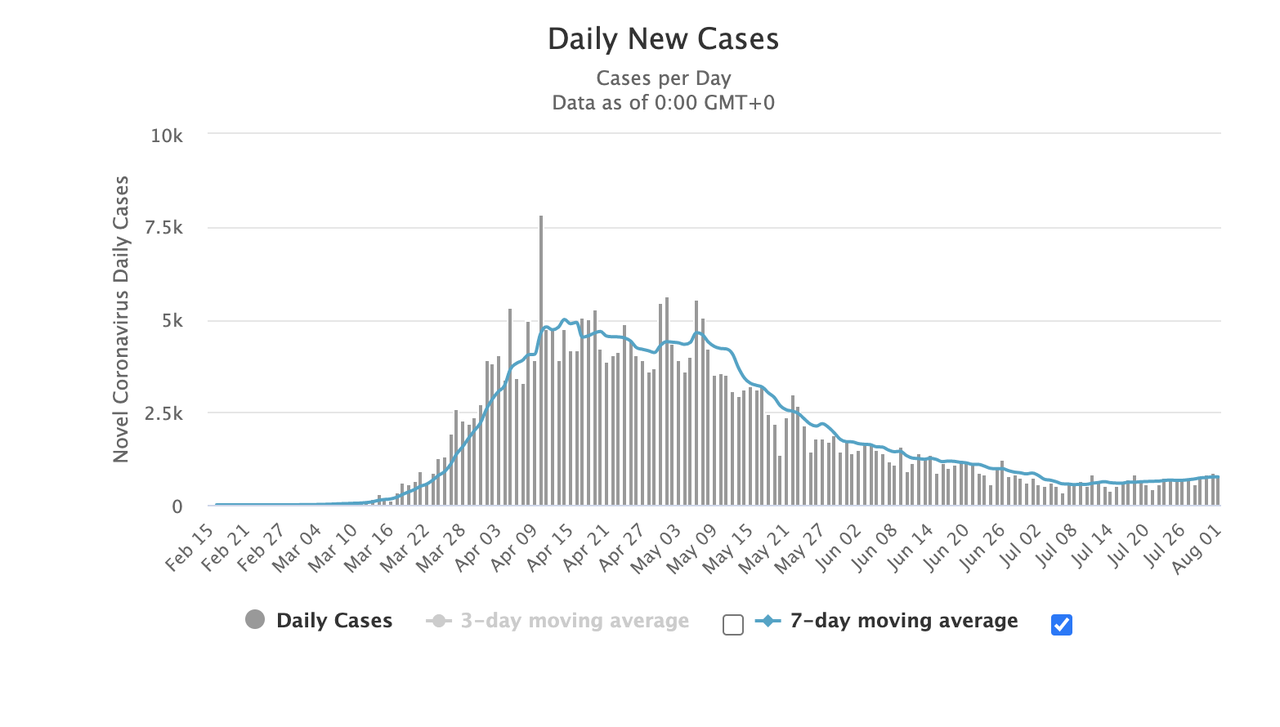
While there has been a slight uptick, as some epidemiologists have described it, warnings about a dire ‘second wave’ hitting just as children are supposed to be returning to school have prompted local officials in the new “hotspots” including part of northern Manchester to declare a “major incident”, according to the leader of the City Council, who was quoted in the British press.
Notably, the announcement comes just after Mexico officially (according to Johns Hopkins and Bloomberg) surpassed the UK for the world’s third-highest death toll. The British people have been left shellshocked from a brutal outbreak that impacted up to half of long-term care homes in some of the worst-hit parts of the country. UK-wide, 4 in 10 homes were affected, and the dead likely number in the tens of thousands.
* * *
Update (1405ET): US cases are on track for another day-on-day decline following the lowest aggregate number in five days.
In New York, Gov Andrew Cuomo – as promised – announced that parents and teachers must be comfortable before returning to the classroom, and therefore, in the state of New York, teachers and students will have the option of continuing with remote learning.
He also released the state’s latest numbers.
While Cuomo promised to come up with a detailed reopening plan that would accommodate those who wish to continue with remote learning, media reports citing sources within Cuomo’s office trashed NYC (and its mayor, Cuomo’s top political rival) for submitting an “outline” of a reopening strategy – not the fully fleshed out plan that some had apparently been expecting, ABC7 reports.
Florida reported 7,104 (+1.5%) cases on Sunday, lower than the previous week’s average of 2.8%. Reported deaths among residents was 62, the lowest in weeks. The state’s total has climbed to 487,132 cases and 7,084 deaths among residents, leaving it in 2nd place nationwide behind California in terms of number of cases.
On the political side, House Speaker Nancy Pelosi said she doesn’t trust information on the pandemic from the head of the White House’s coronavirus task force, Dr. Deborah Birx.
Birx “is [Trump’s] appointee so I don’t have confidence there, no,” Pelosi told ABC.
Across the Hudson in Trenton, Gov Murphy announced that NJ’s transmission rate continued to creep up, with it hitting 1.49, according to data posted on the state’s website, the highest rate in months, and double the level from the mid-June lows.
The rate indicates the average number of people infected by each patient, and is supposed to measure whether the outbreak is expanding, or contracting.
* * *
Across the Sun Belt, the number of coronavirus cases reported daily has continued to decline, but the outbreak is intensifying across Europe, and – most alarmingly – in Melbourne, which is becoming a new global symbol of SARS-CoV-2’s intransigence, as one of the most restrictive lockdowns in the world has failed to squelch the latest outbreak.
Although the alarmism peddled in some corners of the media probably isn’t warranted, Melbourne has seen its daily confirmed totals climb to new records day after day. With the public pressure mounting three weeks after the new lockdown began (with no progress having been made), state officials have tightened restrictions and declared a state of disaster on Sunday.
The decision comes as Victoria State Premier Daniel Andrews announced 671 new cases in the past 24 hours with seven deaths. More than 380 people were being treated in the hospital, with 38 in intensive care.

Andrews’ state of disaster will begin at 6pm Sunday, and allow police the added powers to enforce social distancing restrictions.
Metropolitan Melbourne will be under a curfew limiting movement between 8 pm and 5 am. These new restrictions will be in place for (at least) six weeks.
Australia has recorded about 17,000 infections and ~200 deaths so far, with the majority of these in Victoria.
In North America, the number of new US cases rose by 58,908 (+1.3%), the smallest daily jump in at least five days, according to data maintained by Johns Hopkins & Bloomberg.
That’s less than the 1.6% average for the past 7 days. Deaths have increased by 946, coming in below 1,000 for the first time in five days.
Of course, some of this pullback could be due to the closings of testing centers in Florida in areas threatened by hurricane Isaias.
South of the border, Mexico’s soaring death toll has become the third largest in the world (though that’s not yet reflected in this chart).
Only the US and Brazil have recorded more deaths. Mexico has now suffered at least 46,688 deaths during the pandemic, with a total of 424,637 infections.
India has seen the number of new cases finally start to wane, yet the country’s COVID-19 caseload passed 1.75 million on Sunday after another spike of 54,735 in the past 24 hours. That’s down from 57,118 on Saturday. The Health Ministry on Sunday also reported 853 deaths for a total of 37,364.
In some of the densest slums of Mumbai and New Delhi, contact tracers have gathered evidence showing that nearly half of the population, in some places, will test positive for antibodies.
Days after Texas Rep Louie Gohmert tested positive for the virus, Democratic Rep. Raul Grijalva announced late yesterday that he had become infected, and unsurprisingly, is already jumping to conclusions.
“While I cannot blame anyone directly for this, this week has shown that there are some Members of Congress who fail to take this crisis seriously…Numerous Republican members routinely strut around the Capitol without a mask to selfishly make a political statement at the expense of their colleagues, staff, and their families.”
Vietnam reported two more deaths from the coronavirus on Sunday, raising the country’s death toll to five, all in the last few days.
As Sunday begins in the US, will the number of new cases continue to fall? Thanks to a series of ‘teenage house parties’, Connecticut and New Jersey have reported “mini-boomlets” of the virus over the past week or so.
NJ Tightens Restrictions On Crowd Sizes, Houston Orders Police To Enforce Mandatory Mask Rules: Live Updates
Summary:
- Houston mayor asks police to issue tickets to people who aren’t masked
- Newsom says all major COVID-19 benchmarks in the state are trending down
- CDC releases back-to-school decision-making tool for parents
- California cases slow to 5,739 new cases, hospitalizations climb by 132
- NJ lowers limit on number of people allowed at indoor, outdoor gatheirngs
- NJ rate of transmission hits 1.48
- UK gov’t games out plan to close London should ‘second wave’ intensify
- Arizona reports just 1,030 new cases as hospitalizations fall for 12th day
- Iran’s death toll is 3x larger than previously believed
- Issues plague school reopenings in Indiana, Georgia
- NYC will bring back outdoor dining next summer, mayor says
- Owner, captain of NYC party boat arrested after flouting restrictions
- Kosovo PM infected by COIVD
- Eli Lilly starts testing new antibody-based COVID drug
- New Florida cases decline as testing stations closed
- 46 hospitals in FLA have no open ICU beds
- More schools reopen in Indiana, Georgia, elsewhere
- Global COVID cases top 18 million
- Australia imposes tighter lockdown on Melbourne
- Duterte revives Manilla lockdown
- COVID US cases slow
- HK reports 80 new cases, first reading below 100 in two weeks
- Gottlieb says lockdowns may not always be most appropriate solution
* * *
Update (1630ET): The mayor of Houston has just issued an order to local police to issue tickets to anybody not wearing a mask.
* * *
Update (1520ET): Gov Newsom’s briefing was pretty optimistic on Monday. Following data showing a sharp decline in newly reported cases, the governor celebrated the fact that all of the major metrics (new cases, hospitalizations etc) are “all trending down.”
As we noted earlier, some of the first school districts in the US reopened for in-person learning on Friday and Monday. And at least one school district in Georgia has already uncovered an outbreak affecting its football team.
The AP wrote a whole piece about the schools reopening. It mostly focused on mother’s reactions to letting their little ones return to schools, where risk of infection is much higher than home.
Rachel Adamus was feeling those emotions at sunrise Monday as she got 7-year-old Paul ready for his first day of second grade and prepared 5-year-old Neva for the start of kindergarten.
With a new school year beginning this week in some states, Adamus struggled to balance her fears with her belief that her children need the socialization and instruction that school provides, even as the U.S. death toll from the coronavirus has hit about 155,000 and cases are rising in numerous places.
As the bus pulled away from the curb in Adamus’ Dallas, Georgia, neighborhood, the tears finally began to fall.
“We have kept them protected for so long,” said Adamus, who said her aunt died from COVID-19 in Alabama and her husband’s great uncle succumbed to the virus in a New Jersey nursing home. “They haven’t been to restaurants. We only go to parks if no one else is there. We don’t take them to the grocery store. And now they’re going to be in the classroom with however many kids for an entire day with a teacher.”
With schools set to reopen around the country in the coming weeks, teachers from the northeast to California remain in limbo in regards to what the plan will be.
* * *
Update (1430ET): California reported 5,739 new cases, bringing its total to 514,901 (prev. +9,032).
The state saw hospitalizations fall by 132 to 7,629 on Monday, the State Health Department said.
Gov Gavin Newsom will deliver a live briefing on the state’s COIVD-19 response at 1500ET:
Meanwhile, the CDC has reportedly released a “back to school” decision making tool for parents.
* * *
Update (1315ET): As New Jersey’s COVID-19 transmission rate climbs following a series of house parties that prompted a harsh warning from Gov Murphy, the governor on Monday decided to lower the number of people allowed at indoor and outdoor gatherings, lowering the limit from 100 to 25.
Gov Murphy and state health officials have blamed a slight uptick in the state’s cases on young people refusing to follow social distancing guidelines. He also revealed that the rate of transmission in the state had climbed to 1.48.
Even more alarmingly, as shellshocked Britons continue to panic about the virus even though signs of a rebound remain very muted, media reports have reported on government plans to combat a future spike in the virus by allowing ministers to completely lock down London in the coming months, if the virus returns to what was formerly the UK’s biggest hotspot.
The so-called Contain Strategy, unveiled last month, “does set out the possibility of a power to restrict people’s movement and potentially close down local transport networks,” said BoJo spokesman James Slack when asked if the government had gamed out the possibility of shuttering the capital.
* * *
Update (1230ET): Before the next raft of state infection numbers hit the tape, we’d like to circle back to a story that hit early Monday morning: WSJ reported that a new antibody-based COVID-19 treatment being developed by Eli Lilly in partnership with Canadian AbCellera Biologics has just started a new study that aims to test up to 2,400 subjects in nursing homes and other long-term care homes.
The new drug is part of a class of antibody based drugs that are based on antibodies harvested from the blood of one of the first Americans to contract and survive the virus.
* * *
Update (1115ET): Arizona just reported 1,030 new cases (+0.6%) on Monday, its smallest daily increase since late June. That’s compared with 1.3% 7-day average.
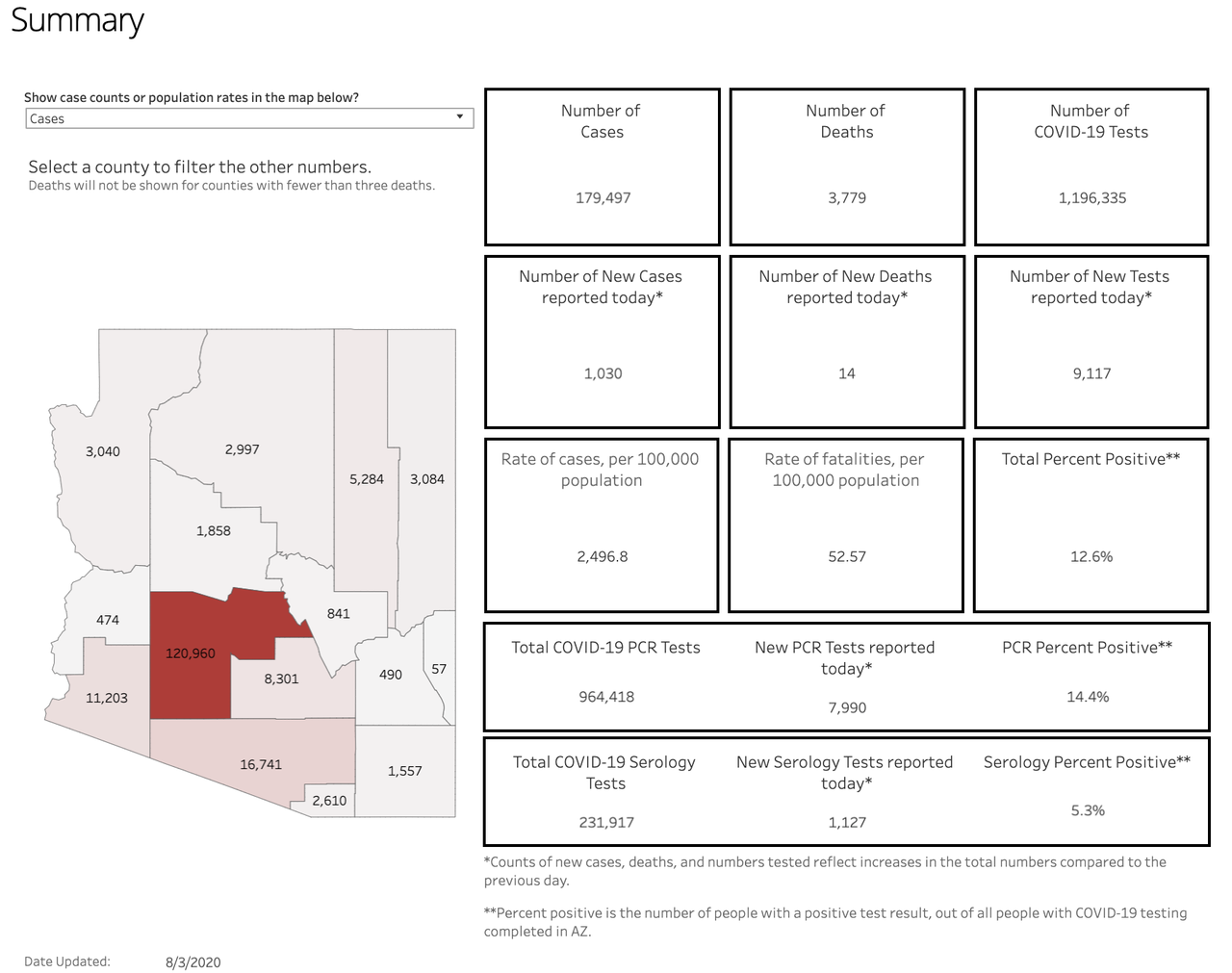
The state also reported 14 more deaths on Monday, the lowest count since July 13, bringing the state’s tallies to 179,497 (for confirmed cases) and 3,779 (for deaths).
The spread of coronavirus in Arizona has been slowing in the weeks after the implementation of face mask requirements in many areas, including all of Maricopa County, the worst-hit county in AZ, and statewide executive orders to close businesses such as bars and gyms and restrict dine-in service.
Arizona’s positivity rate declined to 12.9% statewide.
In other news, Kosovo’s Prime Minister Avdullah Hoti revealed late last night that he had tested positive for COVID-19, but was not experiencing any serious symptoms.
During his latest update from city hall, Mayor de Blasio said that his outdoor dining program for NYC restaurants has been so successful, he would revive it next year, while largely dithering about plans for returning students to school, which is supposed to start in a few weeks.
More than 9,000 restaurants have set up tables on sidewalks, curbs and on streets closed to traffic in the past few months, the mayor said. Outdoor dining will begin June 1 next year. It will also continue in NYC until the cold weather makes it impermissible.
Meanwhile, as NYC struggles to keep looking tough on COVID-19 enforcement, officers arrested the owners and captain of The Liberty Belle, a large riverboat that can fit up to 600 guests with four bars and three outdoor decks, after the boat flouted NYC’s social distancing rules to hold a party with 170 guests on board.
Over in the Middle East, the BBC reported that following Iran’s latest explosion in COVID-19 deaths, the true death toll may be almost 3x larger than official count.
Spain just diagnosed 968 new cases over the last 24 hours, bringing its total to 297,054.
* * *
Update (1100ET): With more testing centers closed, Florida reports 4,752 new cases of COVID-19 on Monday, along with another 73 deaths. It’s the fewest number of new cases reported since June 23, though it comes after a weekend when many test sites were closed.


The state has 491,884 total cases, the most in the country after California, which has more than half a million cases. The death toll hit 7,279.
We’ll likely need to wait a few days to see whether the trend of declining new cases remains intact.
In other news, more states around the country are sending staff back to school for the first time since education shut down around the country back in the spring.
Already, over the weekend, just days after public schools reopening in Indiana for the first time, at least one student and one school staff member have tested positive for the coronavirus, according to reports that emerged over the weekend. The infections occurred in the Greenfield-Central Community School Corporation, 20 miles east of Indianapolis. A student tested positive on his first day back in class, meaning he likely contracted the virus elsewhere.
Parents at another early-open school district in Georgia complained to CNN in a story published last week before schools reopened with only staff allowed on-site. And on Monday, a spate of new positive tests has prompted North Paulding High School near Atlanta to consider delaying the return of in-person classes, which were supposed to start imminently, after an outbreak affecting the football team. Football practices have been cancelled, the school said. School is supposed to start Monday with a mix of both in-class and virtual learning.
Circling back to hard-hit Florida, 46 hospitals around the state still have no open ICU beds and 26 hospitals have just one available ICU bed, according to Fla.’s Agency for Healthcare Administration. 4 counties – Jackson, Monroe, Nassau, Okeechobee – said no ICU beds were available as of Monday morning, the agency said. These numbers typically fluctuate throughout the day.
* * *
New coronavirus flareups that have emerged over the past few weeks across Europe, Asia, Africa, Latin America and Australia have driven global infection rates to their highest levels yet. By early Monday morning in New York, the number of confirmed cases of COVID-19 had surpassed 18 million…

…as the world reports roughly 250,000 new cases a day, leaving the world on track to surpass 19 million by the end of the week.
Lockdowns initially helped Europe, China, South Korea and parts of the US to suppress the virus. But similar measures adopted by Australia’s Victoria State – home of the country’s second-biggest city, Melbourne – have failed to suppress a second-wave of the outbreak.
While analysts at JPM question whether lockdowns are the smartest strategy to confront outbreaks in the second wave, Australia’s Victoria state has doubled down, announcing Monday that it would shut down large parts of its retail and manufacturing sectors for another six weeks.

One day after declaring a state of disaster, Premier Daniel Andrews also announced that construction firms must radically reduce the number of workers on-site across the city. While essential services such as banks, supermarkets, pharmacies and petrol stations remain open, production at meat-processing plants across Victoria will be reduced by one-third, potentially limiting supplies of meat and driving up food prices during already trying times.
The new measures – which follow lockdowns, curfews and other restrictions – will further limit movement and activity, especially at night, and ultimately force 1 million workers to stay home, according to the BBC.
Workers forced to stay home can apply for benefits to compensate them for some of their lost wages, up to
Despite imposing a strict lockdown three weeks ago (these new measures add to the restrictions already in place), the outbreak in Victoria has continued to worsen. Until about 4 weeks ago, Australia held the title of one of the most successful virus response efforts of any anglophone country. But a seemingly unstoppable outbreak centered around Melbourne has brought the country to its worst place yet.
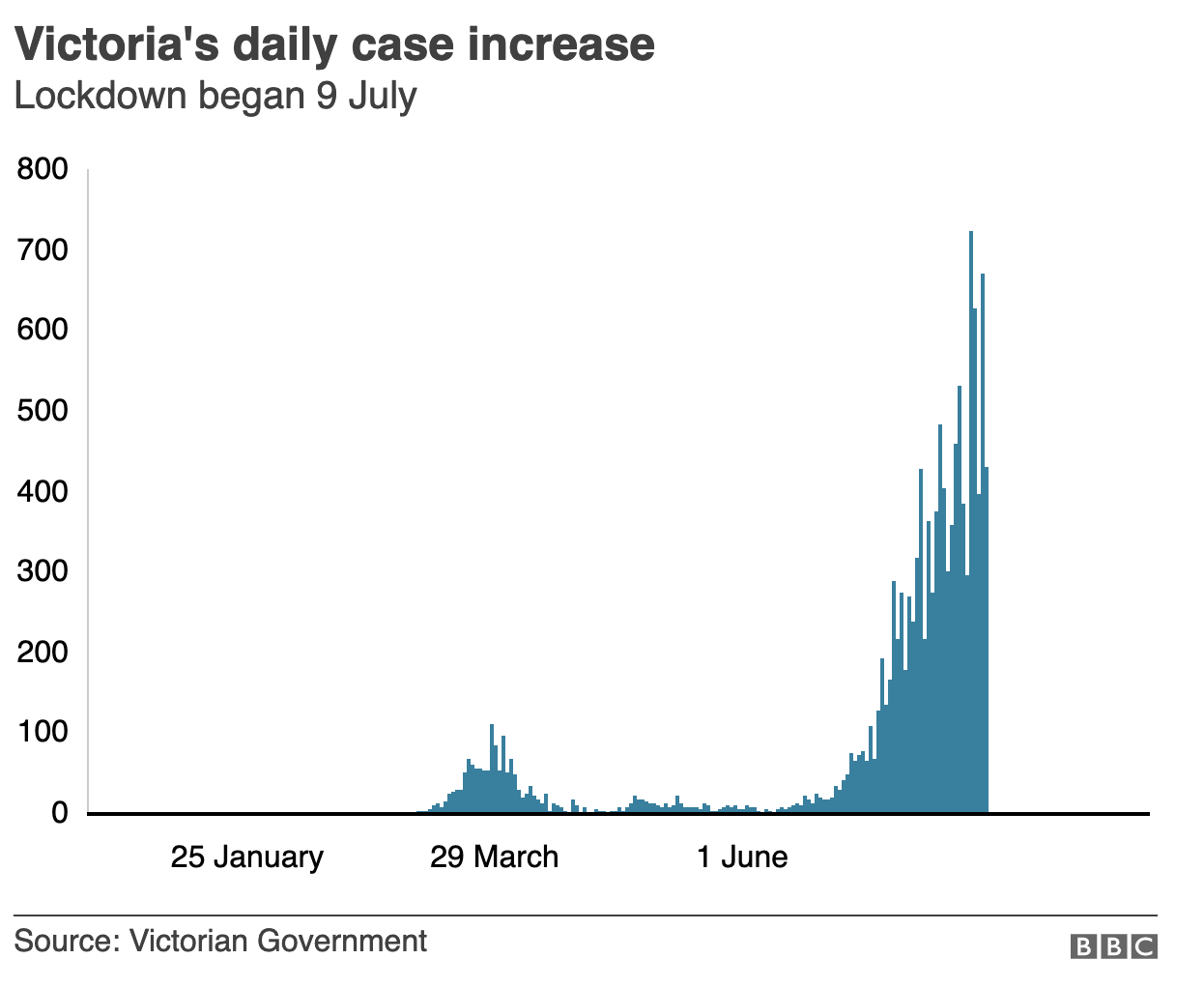
Elsewhere in Asia, Philippines President Rodrigo Duterte has ordered the country’s capital, Manila, back on lockdown starting Aug. 4 after the country recorded its biggest single-day jump in new cases yet, with 3,226 new infections confirmed and 46 additional deaths. That marked the fourth straight day that the Philippines had recorded a new record jump in infections, putting it on track to surpass Indonesia as the country with the biggest outbreak in Southeast Asia.
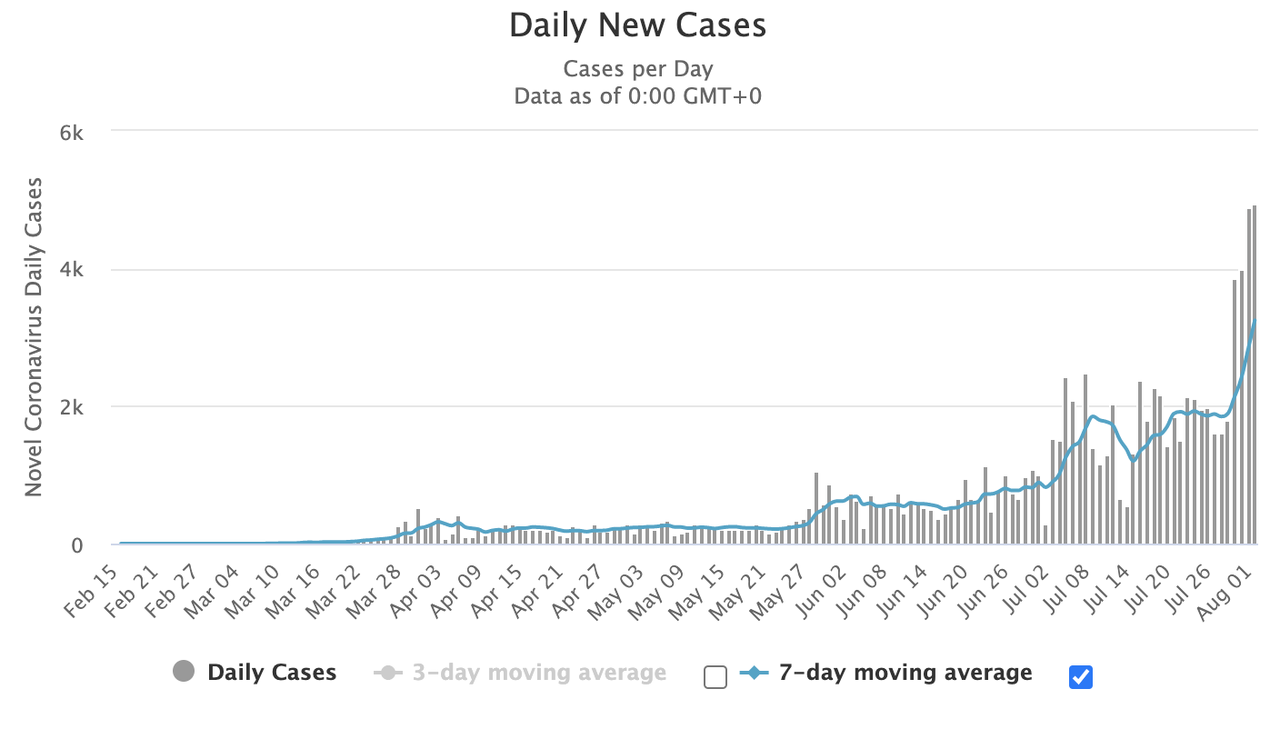
Health officials announced that the country’s total confirmed cases had reached 106,330 confirmed cases and 2,104 deaths.
In the US, which saw the number of new cases reported decline again on Sunday, Dr. Birx warned last night that the virus is more widespread than ever across the country, while Dem leader Nancy Pelosi said she didn’t have much confidence in Dr. Birx, whom she denounced as an unreliable Trump appointee.
Another silver lining: Hong Kong reported 80 new cases, the first time in 12 days that the SAR reported a daily rise of fewer than 100 new cases. A team of Chinese officials are rolling out a new mass-testing regime in the quasi-autonomous territory that is still reeling from a new national security law imposed by Beijing that cracks down on political dissent.
Finally: During his daily appearance on CNBC’s “Squawk Box”, former FDA head Scott Gottlieb said governments should work toward a “happy medium” of closures and restrictions that does the least amount of damage to the economy while keeping the virus mostly at bay.
“The question is: can they hang on to those gains, or are they being quietly seeded right now”…the bottom line question is targeted mitigation – you close bars….you move activities outside – combined with universal masking…is that enough to keep the virus at bay,”
“If it can, then we may have found some kind of happy medium if you will between lockdowns and unfettered spread.”
US Beach Towns Fear Collapse As Summer Of Pandemic Causes Havoc
The executive director of the Bethany-Fenwick Chamber of Commerce, Lauren Weaver, told USA Today that “our businesses (located on the southern tip of the Delmarva Peninsula) have 12 weeks to make money to survive the rest of the year… sales for the town’s 75 or so beach-district merchants are down 40% to 70% compared with a year ago.”
Weaver warned: “A lot of them are not going to survive” this season.
Bethany-Fenwick is an upscale beach community, home to wealthy elites, such as Joe Biden.

The virus pandemic has made it challenging for local businesses to operate, many of whom only make money during the summer months.
Down the street, about 20 minutes south, revenue for businesses in Ocean City, Maryland, is down 20% to 25%, said Susan Jones, head of the Ocean City Hotel-Motel-Restaurant Association.
Jones said the city’s decision to reopen beaches in early May despite the virus pandemic helped businesses survive. She said this year is a not a profitability story, but rather a breakeven story.
Back to Rehoboth and Dewey Beaches, which are a string of beach towns that generate more than $3.5 billion in annual revenue, according to Southern Delaware Tourism. Much of the area is dependent on travel and tourism.
Bethany was shut down for 2.5 months to mitigate the virus spread, reopened in early June with stores and restaurants operating at 30% capacity. Capacity has doubled to 60% in July; the recovery, however, is anything but smooth.
The reopening of eateries in Dewey has been rough. Gov. John Carney had to shut down restaurants before July 4 holiday, one of the biggest revenue days of the year for businesses in the area, after tourists tested positive for COVID-19.
The Bethany Beach Ocean Suites Hotel said the average summer rate is $799 per night, has been dramatically reduced following a rash of cancellations.
Alex Heidenberger, who co-owns Mango’s eatery in Bethany, said he “cried” when the governor decided to shut restaurants ahead of July 4th weekend.
Heidenberger said, “Mango’s revenue fell by $300,000 in the weeks before and after July 4, accounting for the bulk of the $400,000 in losses the restaurant has sustained during the crisis.”
“To take two steps back, that is the worst possible scenario,” said Heidenberger.
During the good times, he said the restaurant made $200,000 per week in sales, and around $2 million in summer revenue. This summer, he said, Mango’s sales have been halved.
“It’s really devastating us,” he said. “I’m operating at a loss,” adding that, “every day is a new challenge — it’s just exhausting.”
Heidenberger said he hasn’t paid the mortgage in four months. Profitability at the restaurant has collapsed. With the beach town in crisis, he has had to serve as a lifeguard on the beach as a shortage in beach crew was due to lockdowns.
“I’m working harder than I have ever worked in my life,” he said, adding that he puts in about 80 hours a week at the two restaurants. Yet, “I have no money… This is all I think about. I don’t sleep.”
He wasn’t sure if Mango’s was going to make it through the summer:
“I don’t know what the future is going to be,” Heidenberger said, noting his family already has closed two restaurants in D.C. as a result of the pandemic. At the same time, he said, “This is all I know. This is what I love.”
A similar collapse is happening in beach communities in California, Florida, New Jersey, and Texas.
end
MUSEUMS
A third of all USA museums are not confident that they will survive. Most museums receive only a 1/4 of their funding from government..the rest from private donations..and donations are just not coming. Visitors are not coming into the museums due to the COVID and thus food and ticket sales are declining
(zerohedge)
A Third Of US Museums “Not Confident” They Will Survive
The American Alliance of Museums (AAM) recently published a survey designed to gauge the state of the US museum industry during the COVID-19 pandemic. The survey results were troubling, at least a third of directors of 760 museums reported a “significant risk” of closing permanently within 16 months.
The survey results document extreme financial distress in the museum field. One-third (33%) of respondents were not confident they would be able to survive 16 months without additional financial relief, and 16 percent felt their organization was at significant risk of permanent closure. The vast majority (87%) of museums have only 12 months or less of financial operating reserves remaining, with 56% having less than six months left to cover operations. Forty-four percent had furloughed or laid off some portion of their staff, and 41 percent anticipated reopening with reduced staff. – the survey said
AAM President and CEO Laura Lott told NPR, “there’s a large public perception that museums rely on government support when the reality is they get only a quarter of their funding from the government.”

AAM stats show US museums receive about 850 million visits per year. However, this year, because of the virus pandemic and strict social distancing rules, those numbers will dramatically be reduced, resulting in the lower ticket, gift shop, and food sales.
Of the 760 museums surveyed, 40% were history museums, historic houses, and historical societies. Others were aquariums, botanical gardens, art museums, and science centers.
To sum up, the great museum bust is dead ahead. Does that mean cheap art is about the hit auction houses and reverse lofty prices?
end
Democrats reject a one week extension of the $600 unemployment boost
(zerohedge)
Democrats Reject One-Week Extension Of $600 Unemployment Boost Amid Otherwise ‘Productive’ Talks
The Trump administration and Democratic leadership say that while they are nowhere near a deal on the next COVID-19 stimulus package, they made “progress” during a three-hour meeting on Saturday.
Treasury Secretary Steven Mnuchin said that the meeting was the “most productive we’ve had to date,” echoing comments by Senate Minority Leader Chuck Schumer (D-NY), who told reporters after the meeting “We’re not close yet, but it was a productive discussion. Now each side knows where they’re at.”
The rhetoric following the weekend meeting marked a notable thaw between Democrats and administration officials following days of heated remarks, including on Friday when Speaker Nancy Pelosi (D-Calif.) and White House chief of staff Mark Meadows traded barbs during dueling press conferences.
Meadows — who had previously told reporters that he was not optimistic about the chances of a deal in the upcoming week — called Saturday the “first day of a good foundation.” –The Hill
“We’re still a long ways apart, and I don’t want to suggest that a deal is imminent, because it is not. But like with any deal, as you make progress, I think it’s important to recognize you’re making progress,” said Meadows.
That said, Democrats wouldn’t budge on temporary relief for struggling Americans – balking at a White House proposal for a one-week extension on the $600 supplemental benefit, which lapsed two days ago.
“We proposed a one-week extension at $600 so while we negotiate, at least those people won’t lose their money,” Mnuchin told ABC News‘ “This Week” on Sunday, adding “I’m surprised Democrats don’t want to agree with that. They’re insistent on having this as part of a larger deal.”
According to Rep. Richard Neal (D-MA), Chairman of the House Ways and Means Committee, Democrats are seeking a comprehensive package, and not “a piecemeal approach.”
Senate Majority Leader Mitch McConnell (R-KY) and the GOP have proposed a $1 trillion plan, while Democrats are holding steady at a $3 trillion package they approved over eight weeks ago.
“There’s obviously a need to support workers, to support the economy and people who, through no fault of their own, are shut down because of this terrible disease,” said Mnuchin. “On the other hand, we have to be careful about not piling on enormous amounts of debt for future generations.”
On Sunday, House Speaker Nancy Pelosi (D-CA) told ABC‘s “This Week” that Democrats may be flexible on the $600 unemployment bonus – which Republicans seek to set at 70% of pre-pandemic income. Pelosi cited a Yale study suggesting that there was “no evidence that recipients of more generous benefits were less likely to return to work,” a study which the Yale-educated Mnuchin rejected.
Mnuchin, meanwhile, said he and Meadows would go back to Capitol Hill “every day until we reach an agreement,” according to MassLive.com.
END
Rent moratorium expires as the Landlord tenant battles begin
(zerohedge)
As Rent Moratorium Expires, Landlord-Tenant Battles Begin
Readers may recall the eviction moratorium expired a little more than a week ago nearly four months after the US economy effectively shut down due to the covid pandemic. 33% of renters have yet to make their full payment in July, a recent survey showed. This means that 12 million renters could be on the cusp of eviction in a matter of months.
Landlords are set to lose billions of dollars this year over the inability of tenants to pay rent thanks to the virus-induced recession. With much of chaos and disagreement on Capitol Hill about the next round of stimulus, nevertheless, no deal on a rent moratorium extension, landlords are now demanding back rent and August payment.
While the exact cause of the landlord-tenant dispute turned violent in Georgia Sunday morning has yet to have an underline cause, one can only assume it might have been due to payment.
FOX 5 Atlanta’s Kaitlyn Pratt quoted Gwinnett County Police’s twitter on early Sunday morning of a dispute between the landlord and tenant.
Pratt tweeted, “LANDLORD-TENANT FIGHT Brings SWAT to a neighborhood. Landlord faces Battery, Obstruction of Justice and Terroristic threats.”
The Atlanta Journal-Constitution (AJC) said the landlord was charged with battery after a “dispute with a tenant turned into an hourslong SWAT standoff at a home in unincorporated Lawrenceville.”
AJC didn’t say what triggered the violent dispute, but as we speculated above, it could have been due to rent payment.
Washington’s inability to deliver the next round of Trump checks to the working-poor ahead of August, as we’ve noted a fiscal cliff was just ahead, has likely resulted in millions of folks skipping out on rent payments in August.
Tens of millions of Americans were pushed into instant-poverty by the economic downturn, many faces housing insecurity and homelessness as the labor market recovery reserves, which has led to millions of permanent job losses. Ahead of the recession, many Americans had insurmountable debts and no savings, or rather no safety net if times got rough.
One would assume confrontations between landlords and tenants on the subject of payments are set to rise, as tenants are on the brink of being homeless, and landlords are having trouble servicing mortgage payments with rental income collapsed.
A new battleground of the working-poor and community organizing groups is set to transition from city streets to the front yards of those who face eviction.
Here’s a community organizing group called “Stomp Out Slumlords,” organizing on what appears to be a rental property of a tenant facing eviction in Chillum, Maryland.
Stomp Out Slumlords organized a couple of dozens of folks, one day before August rent payment was due, held signs that said: “Eviction = Death,” and “Slumlords.”
The group tweeted one post of a picture of demonstrators in front of the house that read, “Fuck around, find out, landlords.”
The new battleground, as tens of millions face evictions, could be on front yards of rental properties with landlords.
The Fed Is Planning To Send Money Directly To Americans In The Next Crisis
Over the past decade, the one common theme despite the political upheaval and growing social and geopolitical instability, was that the market would keep marching higher and the Fed would continue injecting liquidity into the system. The second common theme is that despite sparking unprecedented asset price inflation, price as measured across the broader economy (at least using the flawed CPI metric) would remain subdued (as a reminder, the Fed is desperate to ignite broad inflation as that is the only way the countless trillions of excess debt can be eliminated and yet it has so far failed to do so).
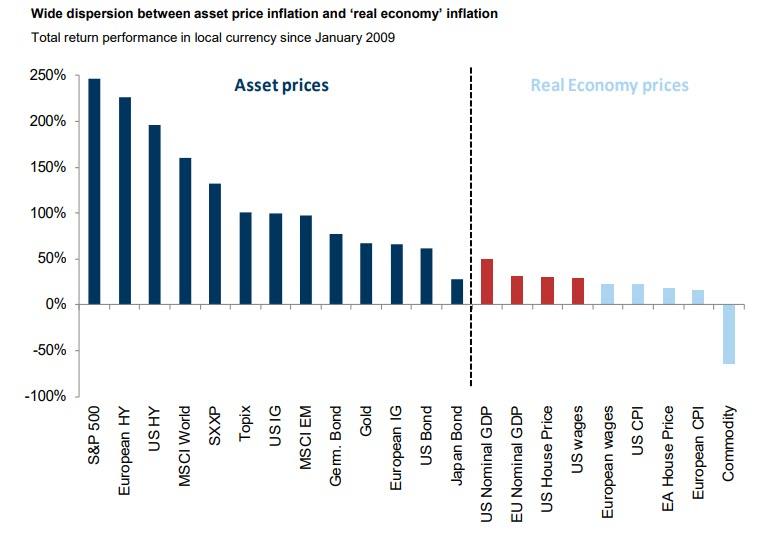
The Fed’s failure to reach its inflation target has sparked broad criticism from the economic establishment, even though as we showed in June, deflation is now a direct function of the Fed’s unconventional monetary policies as the lower yields slide, the lower the propensity to spend. In other words, the harder the Fed fights to stimulate inflation, the more deflation and more saving it spurs as a result (incidentally this is not the first time this “discovery” was made, in December we wrote “One Bank Makes A Stunning Discovery – The Fed’s Rate Cuts Are Now Deflationary“).
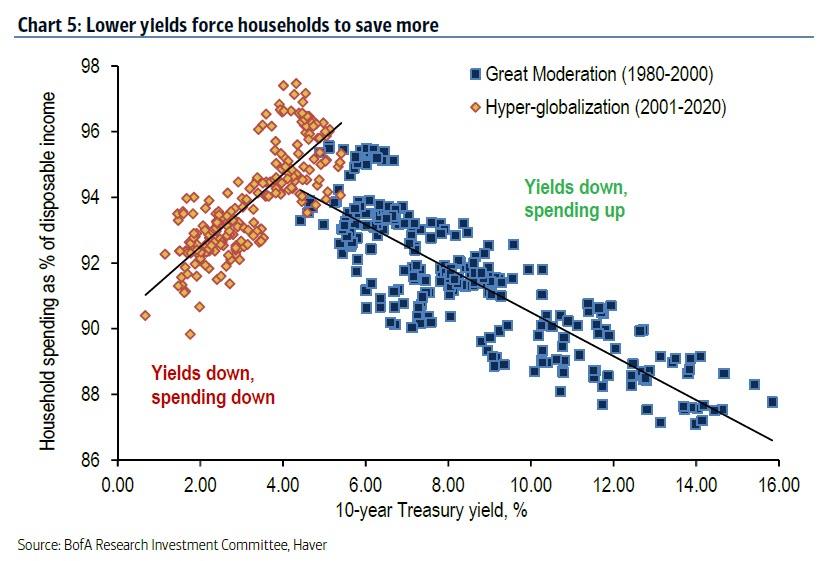
In short, ever since the Fed launched QE and NIRP, it has been making the situation it has been trying to “fix” even worse, all the while blowing a massive asset price bubble.
And having recently accepted that its preferred stimulus pathway has failed to boost the broader economy, the blame has fallen on how monetary policy is intermediated, specifically the way the Fed creates excess reserves which end up at commercial banks instead of “tricking down” all the way to the consumer level.
To be in the aftermath of the covid pandemic shutdowns the Fed has tried to short-circuit this process, and in conjunction with the Treasury it has launched “helicopter money” which has resulted in a direct transfer of funds to US corporations via PPP loans, as well as to end consumers via the emergency $600 weekly unemployment benefits which however are set to expire unless renewed by Congress as explained last week, as Democrats and Republicans feud over which fiscal stimulus will be implemented next.
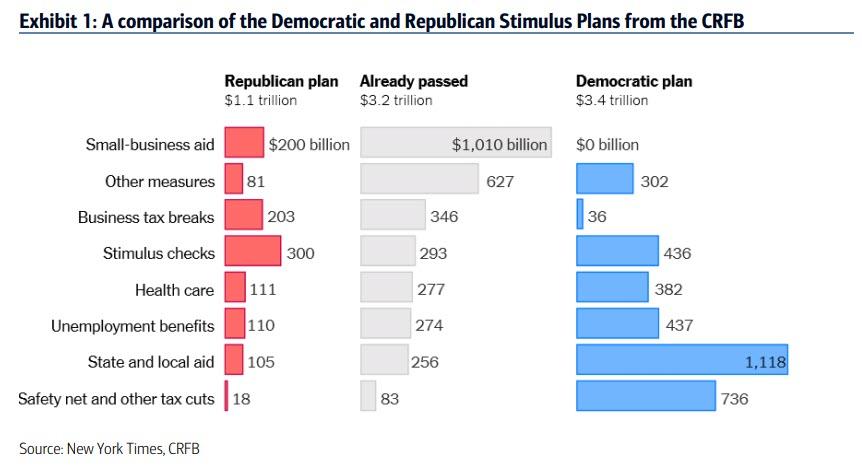
Ad yet, the lament is that even as the economy was desperately in need of a massive liquidity tsunami, the funds created by the Fed and Treasury (now that the US operates under a quasi-MMT regime) did not make their way to those who need them the most: end consumers.
Which is why we read with great interest a Bloomberg interview published on Saturday with two former central bank officials: Simon Potter, who led the Federal Reserve Bank of New York’s markets group i.e., he was the head of the Fed’s Plunge Protection Team for years, and Julia Coronado, who spent eight years as an economist for the Fed’s Board of Governors, who are among the innovators brainstorming solutions to what has emerged as the most crucial and difficult problem facing the Fed: get money swiftly to people who need it most in a crisis.
The response was striking: the two propose creating a monetary tool that they call recession insurance bonds, which draw on some of the advances in digital payments, which will be wired instantly to Americans.
As Coronado explains the details, Congress would grant the Federal Reserve an additional tool for providing support—say, a percent of GDP [in a lump sum that would be divided equally and distributed] to households in a recession. Recession insurance bonds would be zero-coupon securities, a contingent asset of households that would basically lie in wait. The trigger could be reaching the zero lower bound on interest rates or, as economist Claudia Sahm has proposed, a 0.5 percentage point increase in the unemployment rate. The Fed would then activate the securities and deposit the funds digitally in households’ apps.
As Potter then elucidates, “it took Congress too long to get money to people, and it’s too clunky. We need a separate infrastructure. The Fed could buy the bonds quickly without going to the private market. On March 15 they could have said interest rates are now at zero, we’re activating X amount of the bonds, and we’ll be tracking the unemployment rate—if it increases above this level, we’ll buy more. The bonds will be on the asset side of the Fed’s balance sheet; the digital dollars in people’s accounts will be on the liability side.”
And that, in a nutshell, is how the Fed will stimulate the economy in the next crisis in hopes of circumventing the reserve creation process: it will use digital money apps (which explains the Fed’s recent fascination with cryptocurrency and digital money) to transfer money directly to US consumers.
To be sure, the narrative is already set for how the Fed will “sell” this direct transfer of money to the rest of the world and the broader US population: as Coronado explains “it’s the most efficient from a macroeconomic standpoint in supporting spending and confidence. The fear of unemployment acts as an accelerant on a recession. There’s a shock—people are losing their jobs or worry about losing their jobs. They get very risk-averse. [By] getting money to consumers you can limit the depth and duration of a recession.”
And the kicker:
“you could actually generate real inflation. It could be beneficial for not only avoiding negative rates but creating a more healthy interest-rate market, a more healthy yield curve.”
So there you have it: the one thing that was missing from a decade of monetary tinkering by the Fed, the spark of inflation, will finally arrive as the Fed gives money to those most likely to spend it: the lower and middle classes of society.
But wait, there’s more: now that the Fed is implicitly focusing on racial inequality, and soon explicitly with Joe Biden going so far as to urge the Fed to fight “racial economic inequality” and former Minneapolis Fed president Kocherlakota writing an op-ed in which he said the Fed “should have a third mandate on racial inquality“, the stage is now set for the Fed to specifically release funds for those who have “suffered from inequality”, and once the time comes when the narrative allows to deploy reparations or direct funding to minorities, the Fed will be ready.
* * *
Below we republish the Bloomberg Markets interview with Coronado and Potter because it lays out, very clearly, just what the next monetary stimulus will look like now that helicopter money is fully engaged and money is about to be sent by the Fed directly to those Americans the Fed finds to be “in need.”
BLOOMBERG MARKETS: How would recession insurance bonds work?
JULIA CORONADO: Congress would grant the Federal Reserve an additional tool for providing support—say, a percent of GDP [in a lump sum that would be divided equally and distributed] to households in a recession. Recession insurance bonds would be zero-coupon securities, a contingent asset of households that would basically lie in wait. The trigger could be reaching the zero lower bound on interest rates or, as economist Claudia Sahm has proposed, a 0.5 percentage point increase in the unemployment rate. The Fed would then activate the securities and deposit the funds digitally in households’ apps.

And so instead of these gyrations we’ve been going through to get money to households, it would happen instantaneously.
SIMON POTTER: It took Congress too long to get money to people, and it’s too clunky. We need a separate infrastructure. The Fed could buy the bonds quickly without going to the private market. On March 15 they could have said interest rates are now at zero, we’re activating X amount of the bonds, and we’ll be tracking the unemployment rate—if it increases above this level, we’ll buy more. The bonds will be on the asset side of the Fed’s balance sheet; the digital dollars in people’s accounts will be on the liability side.
BM: Aside from speed, what are the main advantages of this approach?
JC: It’s the most efficient from a macroeconomic standpoint in supporting spending and confidence. The fear of unemployment acts as an accelerant on a recession. There’s a shock—people are losing their jobs or worry about losing their jobs. They get very risk-averse. [By] getting money to consumers you can limit the depth and duration of a recession. And you could actually generate real inflation. It could be beneficial for not only avoiding negative rates but creating a more healthy interest-rate market, a more healthy yield curve.
BM: What are the origins of the idea?
JC: The Bank of England has proposals for digital currency. And a number of people have talked about the need for monetary financing—the idea that the interest-rate tool is simply less effective in lower growth, slower credit growth economies. Helicopter money [making direct payments to the public] goes back to Milton Friedman, but Ben Bernanke revisited it. Some people proposed doing that through financing fiscal stimulus. We think going directly to consumers is more efficient than wading through that sticky fiscal process.
BM: This policy could be complementary to Treasury stimulus?
JC: It’s not a replacement for fiscal policy. It makes sense from a fiscal perspective, for example, to authorize unemployment insurance benefits for people who lose their jobs and other assistance for medical-care providers in the current situation.
SP: The central bank is not elected. It cannot make allocation decisions about fiscal transfers. It’s now being pushed to make allocation decisions around credit with the Treasury, because we believe this situation is so unique that the private sector cannot make those decisions itself. The simplest way to do this would be a lump sum. Not in the way Congress did it. We’d take the bluntness of monetary policy and say anyone who’s eligible should get the same amount of bonds.

Fiscal controls could use the same infrastructure. The imperative to invest in it is high. Nearly all Treasury payments at some point touch the Fed because it’s the Treasury’s bank. The digital payment providers—called interface providers in the Bank of England proposal—would manage these accounts and link them to the Fed and Treasury.
BM: What are the objections from the Fed, and other challenges?
SP: The reaction from some of my former colleagues a while ago to the notion of helicopter money was not the most embracing. Some of those concerns have disappeared.
The two objections were related to the switch of deposits in normal times from the traditional banking system into digital accounts and the extra stress in crisis times as people want to get safe. An account with the central bank is safe because the central bank can always print money to honor that claim. A private bank can’t do that because their asset side has all kinds of credit on it. What we’ve created is a narrow bank-type model [narrow banks only take deposits and invest them in the safest assets] that’s small and fit for purpose, with a cap of $10,000 [per person].
JC: One challenge is making it profitable for digital providers. We want strict limitations on the fees so we’re reaching people that are underbanked, but we also want a public-private partnership with a diversity of competitors jumping into this market. Privacy is just as important, because one thing that might induce them is access to people’s data. As the Fed, are you blessing that, and what structure do you put around that?
SP: We’ll all have to deal with deep questions of privacy in the digital world. One of the issues Congress had in passing the Cares Act is identifying who’s got mainly tip income, who doesn’t have sick days. If society wanted, you could use large datasets to direct fiscal transfers to those people. But that’s a job for Congress.
BM: Have you seen similar trials elsewhere?
SP: Sweden is a leader in thinking about this in part because they had a large decline in cash use. China is testing versions of digital currency. Fintech firms in the U.S. are interested in this—there’s a stable coin version of our proposal. There’s easily sufficient innovation within the U.S. to do this. How to do it in a way that’s well regulated and serving the public purpose is something the Fed should focus on over the next few years. It would be a key accomplishment of the Fed and Treasury to get this infrastructure in place.
Men’s Wearhouse Files For Bankruptcy
As we previewed on month ago in ‘Work-From-Home’-Epidemic Set To Bankrupt Suit-Sellers, “I Guarantee It“, on Monday the retail wreck continued on Sunday when Tailored Brands, the owner of Men’s Wearhouse filed for bankruptcy, adding to a list of brick-and-mortar retailers that have succumbed to the economic fallout from the COVID-19 crisis.
The retailer filed for Chapter 11 bankruptcy in the U.S. Bankruptcy Court for the Southern District of Texas. Tailored Brands said in a statement that it has entered into a restructuring agreement with more than 75% of its senior lenders, and that could reduce the company’s debt by at least $630 million. The company also said it has received commitments for $500 million in debtor-in-possession financing from its existing lenders. In the court filing, the company listed both its assets and liabilities in the range of $1 billion to $10 billion.
The Houston, Texas-based retailer, which was already struggling with competition from fast-fashion brands and a shift to online shopping before the pandemic, said it will continue to build on its previously announced plans to reduce its corporate workforce by 20% and shut as many as 500 stores.
The company’s four retail brands, including Moores Clothing for Men and K&G Fashion Superstore, will continue to operate through the process. It employs 18,000 workers and operates 1,274 retail and apparel rental stores in the U.S. and 125 in Canada, according to court documents.
Tailored Brands was in a tough spot before the outbreak: sales had fallen every year since 2016 as Men’s Wearhouse and Jos. A. Bank contended with changing consumer tastes and e-commerce rivals. “The unprecedented impact of Covid-19 requires us to further adapt and evolve,” Chief Executive Officer Dinesh Lathi said in a statement.
Despite its filing which will eliminate most of the company’s debt. Tailored Brands is gradually returning to normal operations after the coronavirus temporarily shut its doors. It re-opened just under half of its stores as of June 5, according to a statement. All of them, as well as e-commerce distribution centers in the U.S. and Canada, were temporarily closed in the first quarter.
The company traces its roots to 1973, when George Zimmer started Men’s Wearhouse in the Houston area. He would go on to become the face of the brand, starring in television commercials spouting his catchphrase “You’re going to like the way you look — I guarantee it,” before he was ousted in 2013. It acquired Jos. A. Bank the following year.
Tailored Brands has hired law firm Kirkland & Ellis LLP as legal advisor, investment bank PJT Partners as financial advisor and AlixPartners as restructuring advisor according to Bloomberg.
* * *
With its filing, Tailored Brands became the latest to collapse as a result of widespread economic lockdowns which have drained revenue, pushing already-struggling companies like J.C. Penney, J. Crew Group, and Neiman Marcus Group into bankruptcy. Lord & Taylor also filed Chapter 11 on Sunday.
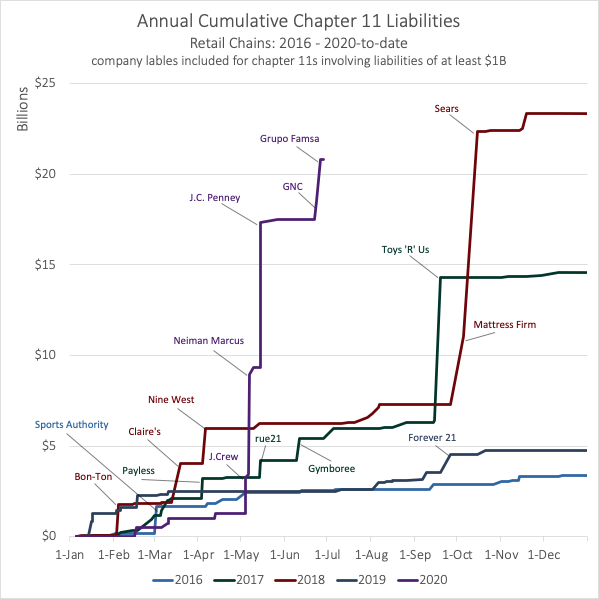
As Reuters notes, apparel retailers have been among the worst hit from the coronavirus crisis as their businesses were considered non-essential and their stores had to be closed. They were forced to limit operations to online, which led to furloughing of staff and unpaid leases and rents.
Separately, Lord & Taylor, a storied department store chain founded in 1826, billed as the oldest in the United States, also filed for Chapter 11 bankruptcy on Sunday.
Stockman Slams “Lockdown Lunacy” – Your Government Ordered Depression Has Arrived
Authored by David Stockman via Contra Corner blog,
Well, the Virus Patrol sure has done it. In a fit of reckless overkill they have managed to vaporize six years of economic growth during the last 90 days. And that’s just by the mechanical reckoning of the GDP accounts, where total output in Q2 weighed in at essentially the same level as Q4 2014.

The real damage is far deeper, however, and is reflected in millions of small businesses permanently destroyed, tens of millions of households wiped-out financially and the vicious daisy chain of delinquencies, deferrals and defaults just beginning to rip through the $78 trillion edifice of debt which entombs the US economy.
Real GDP Level
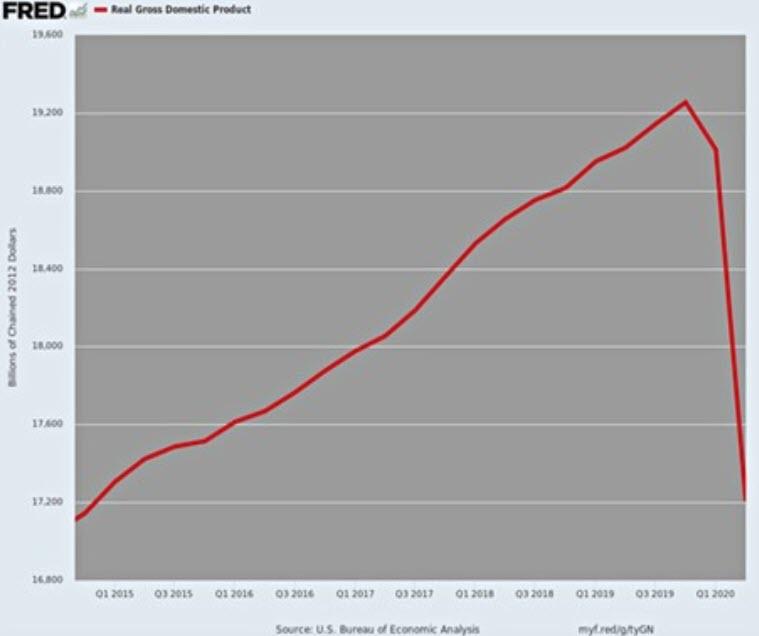
Of course, most of the Wall Street talking heads were nonplussed by this week’s release because, well, Q2 results are claimed to be ancient history: Reality is purportedly the “V”-shaped recovery on their spreadsheets, which really can’t fail to happen because it’s always two quarters out regardless of conditions at the moment.
So let’s get something straight. What is happening is an economic catastrophe the likes of which we have never seen before, even during the Great Depression of the 1930s.
In fact, the worst annual decline back then was a 14.8 percent drop in 1932, while the entire peak-to-trough real GDP decline between 1929 and the 1933 bottom was 30.5 percent.
So it would be fair to say that measured at an annualized rate, the idiotic Dr. Fauci and his Virus Patrol have now delivered a 32.9 percent GDP plunge, which single-handedly tops the entire contraction of the Great Depression.
Needless to say, the Q2 result also leaves the recessionary drops since 1950 way back in the dust. Even the auto industry induced plunge of Q1 1958 didn’t make the double-digit threshold. It clocked in at a 9.986 percent annualized decline or less than one-third of today’s cliff dive.
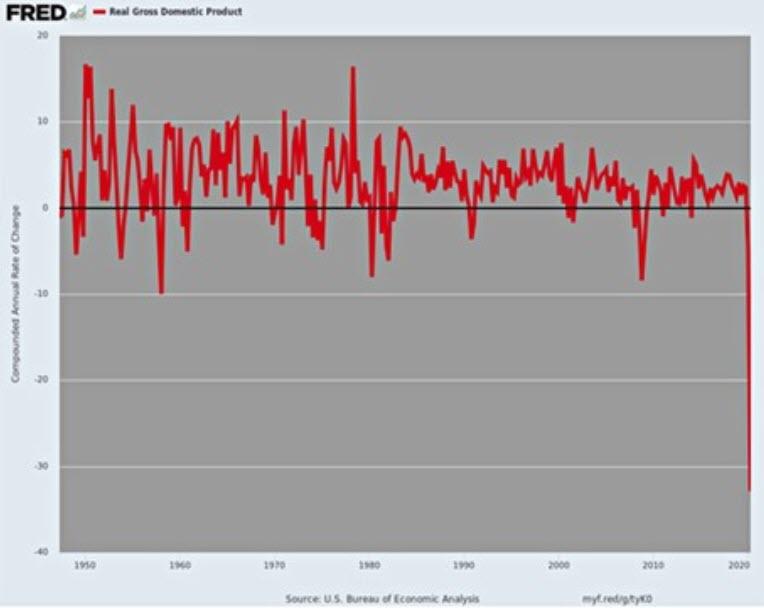
What was especially notable, however, was the vaporization of personal consumption spending on services, which ordinarily accounts for upwards of 70 percent of total PCE; and which is also ballyhooed by the paint-by-the-numbers Wall Street economist as the ballast the keeps GDP moving ever higher.
Not this time!
Services spending literally fell through the trapdoor, contracting at a 43.4 percent annualized rate. That compares with the 11 recessions since 1950 where real spending on services never went negative, save for the pinprick decline of -1.6 percent annualized during the Q1 2009 bottom of the Great Recession.
By every account, the economic plunge in the winter of 2008-2009 was the worst since the 1930s, but this week the Commerce Department reported a PCE-services drop that was 28X deeper!
Our purpose here is not to marshal scary numbers, even as they surely are.
Rather, our point is that what is coursing through the Q2 numbers is not anything that resembles a normal chain-of-reactions macroeconomic cycle. For instance, where job losses cascade through to shrinking incomes, thereby causing consumer confidence and spending wherewithal to diminish and household spending to be curtailed.
To the contrary, what is depicted below is essentially economic martial law. Agencies of the state commanded airports, restaurants, bars, hair salons, gyms, movies, dentist offices, theme parks, sporting events etc. to close or operate at drastically reduced capacity, which meant, in turn, that day-in-and-day out commerce and economic output vanished instantly.
Stated differently, this 43 percent plunge in services spending didn’t happen for the ordinary reason that people were short on cash. As we show below, personal income during the quarter – thanks to the massive flow of free stuff from Washington (aka government transfer payments) – clocked in at a record level!
Consequently, there will be no rebound in the plunging red line below no matter how much fiscal and monetary “stimulus” Washington pumps into the main street economy.
The services sector accounts for nearly 66 percent of total PCE, which, in turn, accounts for 68 percent of measured GDP. So the latter will not recover until the Virus Patrol gets its foot off the neck of what we call the social congregation activities of daily economic life; and also until it and its MSM collaborationist desist from fanning the false claim that the Covid is the equivalent of the Black Plague, thereby causing people to voluntarily quarantine out of misplaced fear.
Of course, you don’t have to listen to Dr. Fauci and the Scarf Lady for long – yes, they have not yet been locked up in padded cells where they belong – to realize that the Virus Patrol is on a once-in-a lifetime power trip.
In ultra-busy body/Nanny State fashion they are virtually regimenting the comings and goings of a $20 trillion economy – even as they keep the US economy on indefinite idle waiting for the vaccines and antivirals from their allies in Big Pharma and the Gates Complex to ride to the (mandatory) rescue.
Annualized Change In Personal Consumption Expenditures, Services, 1950-2020
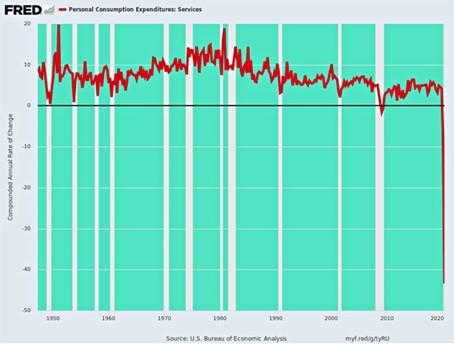
We don’t expect the Virus Patrol to be put out of business any time soon because the Donald is too confused and weak to shut them down.
Moreover, if he keeps shooting himself in the kneecaps via tweets like this week’s “lets-postpone-the-election” numbskullery, he will guarantee an even worse scenario: Namely, that while Sleepy Joe is being oxygenated and propped-up behind the Resolute Desk for daily Oval Office photo ops, the left-wing health Nazis who surround him will really go to town on Lockdown Nation.
Nor is that any kind of unhinged trashing of the camarilla of out-and-out statists who will form the core of the Biden Administration. The fact is, the Donald’s malpacticing doctors, the MSM and the Blue State mayors and governors have now unleashed a full-on public hysteria that is self-fueling.
It is now transforming ordinary sheeples into obedient and unquestioning brown-shirts. Even in the purportedly enlightened, socialist republic of Aspen, where we are sheltering for the duration, we see them “mask-up” even with no one in sight, while pumping strenuously up the mountain side on a fat-tired bike.
One manifestation of the Covid-Hysteria is the soaring level of “testing” going on as people either try to get a hall pass in order to return to work or just plain run to the nearest testing station every time the media sends off new alarm bells.
During April, for instance, which was the very worst month of the contagion in terms of serious illnesses and deaths, 5.2 million new tests were reported or 175,000 per day.
By contrast, in July to date (thru the 29th), there have been 21.5 million new tests reported or an average of 745,000 per day.
In a population that has been thoroughly exposed to the virus after five months, it is a given that with the number of tests soaring, the number of positive cases will rise proportionately. But that’s a misdirection because the real issue is the true medical severity of the new cases, and that has dropped precipitously.
The death rate has dropped from 1,800 per day in April to 780 in July; and whereas 15-20 percent of new cases were being hospitalized in most states during April, that figure has now fallen to 2-4 percent.
That is, after the Grim Reaper’s original romp through the most vulnerable populations – especially the nursing homes and long-term care facilities in March/April – the preponderant share of the remaining populations being infected and testing positive appear to have stronger immune defenses, and are mainly either asymptomatic or treating and recovering at home in the normal flu-season manner.
So on the facts, the Hysteria should be dying out, but, alas, the facts are of small moment in the context of a runaway public hysteria that is being turbocharged by a severely aggravated anti-Trump partisanship that has no modern precedent, or any at all.
We are constantly reminded that there are less than 100 days until the election, but probably of even more salience is that the next flu season will be arriving even sooner in October. And it won’t matter whether the obvious herd immunities building up against the SARS-Cov-2 cause the next flu season to be unusually mild or not.
That’s because the Virus Patrol will be at shrill alert for the “second wave” in the run-up to October, keeping the suffocated economy evident in today’s GDP report on its back foot for the balance of the year, at least. That means the ballyhooed V is now surely dead-as-a-door nail.
In this context, it needs be recalled that the services sector of the US economy is bearing the brunt of the Lockdown orders, but that it now counts for fully $8.7 trillion or 45 percent of GDP. That compares to a mere 26 percent back in the days of America’s industrial might in the mid-1950s.
In the big picture context, therefore, national policy – especially at the Eccles Building – caused the off-shoring and hollowing-out of the US industrial economy over the last three decades. In turn, that has left main street especially vulnerable to a state-orchestrated attack on its new services sector center of gravity such as outpatient surgery clinics, Pilates studios and tapas bars.
Again, an economic martial law attack on the new epicenter of the US economy means that the issue is not traditional stimulus, but clearing the decks and clearing the air of the Virus Patrol orders and Covid-Hysteria, which was the real culprit behind the Q2 GDP disaster.
Nominal GDP (light brown) Versus Service Sector PCE (dark brown), 1955-2020
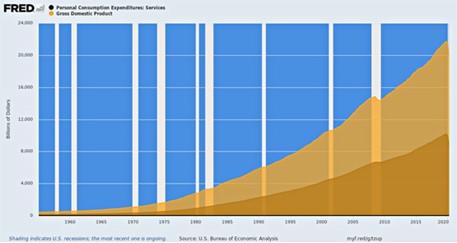
Perhaps nowhere is the impact of economic martial law more evident, ironically, than in the health care sub-sector of the services economy.
The former, of course, has been the workhorse of US GDP growth for decades. However, after peaking at $2.50 trillion in Q4 2019, it weighed in at just $1.89 trillion in Q2 2020. That’s a $608 billion decline, reflecting an astounding -24 percent contraction.
And this is supposed to be the worst medical crisis to hit America since the Spanish Flu of 1918!
But, actually, the government’s data mill is telling an absolutely opposite, nay crazy, story. Namely, that the single largest sector of the US economy plunged at a 61.6 percent annualized rate in Q2 – meaning that the figure gives the notion of being “off the charts” of history an altogether new definition.
The plunging red line below, therefore, is the doing of the Virus Patrol and its orders to shutdown most so-called discretionary healthy care services, such as cancer screenings. So until it is put out of business and the public Covid-Hysteria is substantially abated, the rebound of the health services sector is likely to the contained and protracted.
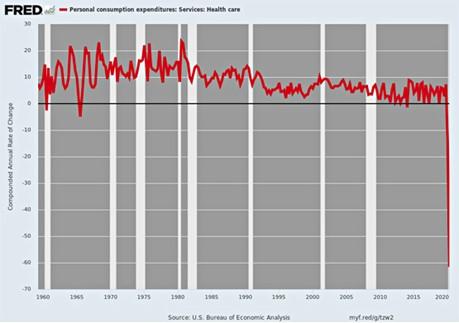
In short, what we have is a government-ordered depression, not a macroeconomic recession that is purportedly remediable by a huge dose of monetary and fiscal stimulus. So the truth is, the Virus Patrol, not the Fed and Washington’s everything bailout brigade, is in charge of the recovery from the Q2 disaster, and they are not much interested in letting it happen.
To take another salient example, the go-to strategy of the Virus Patrol has been to shutdown large scale public gatherings entirely, but that’s obviously the venue of the recreation sector.
So it is not surprising that the PCE spending rate for this sector has given “cliff-diving” a run for its money. Compared to the $590 billion annualized rate of spending in Q4 2019, the current quarter clocked in at just $272 trillion.
The amounted to a 53.4 percent decline from Q4 and an out-of-this-world contraction of 61 percent annualized in the current quarter. Or alternatively, recreation spending in Lockdown Nation during Q2 reverted to the level first crossed in Q2 2002.
That’s 18 year’s worth of growth gone in a virtual economic heartbeat.

Of course, there was one thing that was way up in Q2 – transfer payments and personal income. And every dime of the massive increase in transfer payments shown below was borrowed by Uncle Sam and monetized by the Fed.
Yet the only thing it accomplished was to further balloon the public debt because the current depression does not flow from the want of means or desire to spend: It’s the product of economic martial law ordered up by the Virus Patrol.
Still, it is worth noting that wage and salary income (brown line) was down by $680 billion at an annual rate in Q2, while the Washington spending machine boosted transfer payments at a $2.4 trillion annual rate, or by nearly four times more!
Once upon a time, that would have been considered insane overkill, and at least caused Republicans to screech at the top of their lungs about fiscal profligacy.
Alas, as they put up their $1.2 trillion Everything Bailout 5.0 against the House Dems’ $3.3 trillion alternative in the days just ahead, the chart below will be nowhere seen in the porkers’ lounges of Capitol Hill.
Change From Prior Quarter In Billions: Transfer Payments (purple line) Versus Wages and Salaries (brown line)
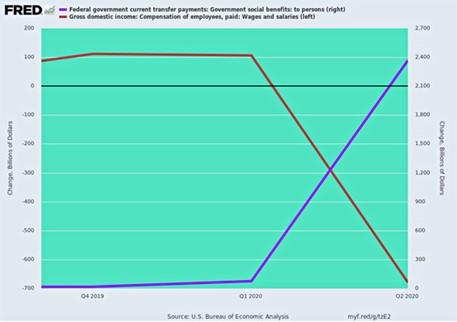
Schiff: The Dollar Crash Will Take Down Entire US “House Of Cards”
Authored by Mac Slavo via SHTFplan.com,
Peter Schiff says the new historic and record-breaking fall in gross domestic product numbers coupled with unemployment and the Federal Reserve’s excessive money creation will cause a dollar collapse. Once that happens, the entire house of cards that is the United States will fall.
Schiff says we should be prepared for the fall of the U.S. by the end of this year. According to a report by RT, Schiff, the ignorance of Americans is still present. People are not waking up, unfortunately. That ignorance is “likely to remain the case until the fall becomes a crash, which I don’t think will begin until the Dollar Index breaks 80,” wrote Schiff in a Tweet. ” At its current rate of decline that level could be breached before year-end, perhaps by election day.”
Remember, election time could be a gigantic planned disaster too, and Americans look like they’ll fall for that too.
While the dollar continues to fall, gold, silver, and cryptocurrencies are all going up. This is a signal that people are leaving centralized systems for those that are decentralized and not controlled by the ruling class or elitists who think of us as their slaves. According to Schiff, gold will supplant the dollar because the euro and other currencies are not ready to take its place. They are also centralized and in the control of the same people who control the creation of U.S. dollars.
“No other currency will take the dollar’s place, real money will take its place, particularly gold, because gold was there before the dollar,” he said, noting that the greenback “did a lousy job, and now gold is taking its spot back.”
Schiff added:
“The entire house of cards economy that has been erected over the years, and the Federal Reserve has been the architect of this house of cards economy, is rested on the foundation of the dollar’s reserve currency status. If the dollar loses that status then the foundation crumbles and the whole house of cards topples.

Robert Kiyosaki’s “magic three” are gold, silver, and Bitcoin. If you have any desire to protect your wealth, hard and decentralized assets are the place to be.
The dollar WILL crash. That’s the goal. There will be a new digital dollar and it will be centralized and controlled by the Federal Reserve banking cartel. It will likely all be tied together with your mandatory vaccine too. The beast system will be rolled out and it may be sooner than we expect.
end
iv) Swamp commentaries)
v) King report/Courtesy of Chris Powell of GATA which includes the major swamp stories.
GOP Rep @MarkMeadows: Tonight, once again, the White House offered a temporary extension of needed unemployment assistance—which expires tomorrow [July 31]. And again, Chuck Schumer and Nancy Pelosi said no… This is a politically motivated party that won’t take “yes” for an answer.
@realDonaldTrump: Pelosi & Schumer have no interest in making a deal that is good for our Country and our People. All they want is a trillion dollars, and much more, for their Radical Left Governed States… Pelosi & Schumer blocked desperately needed unemployment payments, which is so terrible…
The Do Nothing Democrats are more interested in playing politics than in helping our deserving people…
Bottom line: Things could get very, very dicey for stocks and the economy in coming weeks. Do you know where your lifeboat is moored?
Proportion of asymptomatic coronavirus carriers above 70 percent
With the study, some 5,484 contacts of SARS-CoV-2 index cases detected in Lombardy, Italy were reviewed, and the positive subjects were identified via nasal swabs and serological assays. It was found that 73.9 percent of the infected individuals (aged less than 60 years) did not develop symptoms, showing the proportion of the population who are asymptomatic… the risk of developing symptoms increased with age. Also rising with age was the risk of serious illness, with 6.6 percent of infected subjects older than 60 years going on to develop a critical disease…males are at significantly higher risk of suffering with a serious COVID-19 related illness…
Critically ill COVID-19 patients make quick recovery with treatment RLF-10
Geneva-based Relief Therapeutics Holdings AG RFLB.S has a patent for RLF-100, or aviptadil, a synthetic form of a natural peptide that protects the lung. U.S.-Israeli NeuroRx Inc partnered with Relief to develop the drug in the United States…2/3 clinical trial with 70 patients…
https://nypost.com/2020/08/02/relief-neurorx-rlf-100-helps-critical-covid-19-patients/
@pdubdev: COVID is really disappearing fast now in AZ and FL. CDC has started publishing daily visits to ER with Covid Like Illness (CLI). Chart at link: https://twitter.com/pdubdev/status/1289794601125941249
@kerpen: CDC reports July 30 COVID-Like Illness (CLI) surveillance. Down to 2.4% of ED visits nationally. Lowest since June 18. https://t.co/8CLgvqMltn
@realDonaldTrump on Sunday: When you see the Drug Companies taking massive television ads against me, forget what they say (which is false), YOU KNOW THAT DRUG PRICES ARE COMING DOWN, BIG. Favored Nations Clause means USA will pay the lowest price of any nation in the World. Never done before. Watch!!!
AstraZeneca to be exempt from coronavirus vaccine liability claims in most countries
The United States… already has a law to exclude tort claims from products that help control a public-health crises in the form of the 2005 Public Readiness and Emergency Preparedness, or PREP Act…
@bespokeinvest: The combined weighting of Financials, Industrials, and Energy is now just 20%, its lowest level since 1990. Back in the mid-2000s it was near 45%. Tech and Health Care, on the other hand, are up to 42%. Look how these two have changed over time.
Hundreds of Angry Protesters Gather Outside Hamptons Billionaire Mansions to Demand Wealth Tax [The elites that have embraced leftist mobs should really read the history of the French Revolution!]
Mnuchin on ABC’s “This Week”: We have to be careful about not piling on enormous amount of debts for future generation…” [This is not the Onion or The Babylon Bee doing a parody piece!!]
Sunday on CBS’s “Face the Nation” John Dickerson asked Minny Fed Prez Kashkari, “…But won’t racking up debt ultimately be something we have to deal with in the long term?”
Kashkari: It’s simply not an issue because we’re not having to go abroad to fund these extra- the extra money for the CARES Act or whatever is to come. … Right now, the US can fund itself at very, very low rates. Congress should use this opportunity to support the American people and the American economy. I’m not worried about it. We- if we get the economy growing, we will be able to pay off the debt.
https://www.cbsnews.com/news/transcript-neel-kashkari-on-face-the-nation-august-2-2020/
Fed’s Kashkari suggests four to six week shutdown; says U.S. Congress can spend big on coronavirus relief https://uk.reuters.com/article/uk-health-coronavirus-fed/feds-kashkari-suggests-four-to-six-week-shutdown-says-u-s-congress-can-spend-big-on-coronavirus-relief-idUKKBN24Y0P7
[US Sec of State] Pompeo: Trump taking action on Chinese software firms ‘in coming days’
“President Trump has said, ‘enough,’ and we’re going to fix it,” Pompeo said on Fox News’s “Sunday Morning Futures.” “And so he will take action in the coming days with respect to a broad array of national security risks that are presented by software connected to the Chinese Communist Party.”…
Postal Service backlog sparks worries that ballot delivery could be delayed in November
Postal employees and union officials say recent changes implemented by Postmaster General Louis DeJoy, a major donor to President Trump and the GOP, have led to days-long delays in mail delivery across the country… https://www.washingtonpost.com/politics/postal-service-backlog-sparks-worries-that-ballot-delivery-could-be-delayed-in-november/2020/07/30/cb19f1f4-d1d0-11ea-8d32-1ebf4e9d8e0d_story.html
DJT senior legal advisor @JennaEllisEsq: “If we can stand in line at grocery store or a hardware store, we can stand in line to vote.”
California’s spike in cases, deaths challenges conventional wisdom on COVID-19 lockdowns
Stay-at-home orders, face covering mandate appear to have had little effect on disease’s spread in Golden State. https://justthenews.com/politics-policy/coronavirus/spite-months-lockdown-mask-mandate-california-sees-spike-cases-and
GOP Rep. Jim Jordan Rakes Dr. Fauci Over the Coals When He Refuses to Call Out Danger of Mass “BLM Protests” – Fauci refuses to explain why mass protests okay, but opening your business or going to church isn’thttps://www.waynedupree.com/2020/07/jim-jordan-dr-fauci-protests-covid/
@nascarred14: Fauci Just Testified There Was No Efficacy OF HCQ!… 51 Global Studies Find HCQ Effective in Treating COVID-19 — 16 Find HCQ NOT Effective — But 10 of Those Are Late Treatment Studies! https://www.thegatewaypundit.com/2020/07/huge-development-51-global-studies-find-hcq-effective-treating-covid-19-16-find-hcq-not-effective-10-late-treatment-studies/
Pelosi says she has no confidence in White House COVID-19 adviser Dr. Birx
“I think the president has been spreading disinformation about the virus and she is his appointee so, I don’t have confidence there, no,” Pelosi told ABC’s “This Week” on Sunday morning when asked if she had confidence in Birx…https://t.co/fMHFMJbapr
Politics, Not Science, Keeping Schools Closed
The Los Angeles Teachers Union maintains that “the only people guaranteed to benefit from the premature reopening of schools amidst a rapidly accelerating pandemic are billionaires and the politicians they’ve purchased” — as if billionaires typically send their kids to L.A. public schools… Worst of all, none of this is medically substantiated…
Sweden is not alone in sending kids to school. Denmark opened its schools back up in April. Finland kept normal class sizes when it reopened. Parts of Montana opened schools back in May, as did parts of Canada and Germany. The Netherlands announced that Dutch students didn’t even need to socially distance anymore as they experienced very low transmission rates. Schools all across Europe have reopened successfully, both with and without masks…
If children are at minimal risk, transmission to adults is rare, and both can be accommodated with optional distance learning, why are some schools suspending all in-person education? It’s certainly not because of the parents… Further exposing the underlying agenda of school closings, the teachers union is not only refusing to teach children in the classroom but they are also refusing to teach children out of the classroom… There are few functions in society more essential than educating our children…
@IngrahamAngle: Teachers’ unions are demanding their Democrat toadies move against Catholic, religious & independent schools that are reopening for in-person learning this fall… Parents unite!
Here Are the Top Highlights from Ghislaine Maxwell’s Unsealed Court Records
Secret Jeffrey Epstein Documents Have Been Released by Court Order. Read Them All Here.
Bill Clinton denies visiting Jeffrey Epstein’s private island https://trib.al/5G4AIox
@Cernovich: To say that the FBI looks terrible in the Jeffrey Epstein files would be an understatement. Numerous victims contacted the FBI. The FBI ignored them, newly released emails show.
@JackPosobiec: Who was FBI director from 2001 to 2013 when Epstein was active and they had evidence of his child sex crimes? Robert Mueller
Dr. Alveda King on John Lewis’ funeral: The left will ‘grab at any opportunity’ to politicize
King says Obama chose to politicize Congressman Lewis’ funeral – According to King, Obama distorted history when he “took us back to the 1960s.” …”And, that was a time when segregation was still on the books, segregation was still legal, and those in power…”the niece of Martin Luther King Jr. remembered…https://www.foxnews.com/media/alveda-king-john-lewis-funeral-obama
One of the Sleaziest and Most Dishonest Figures in History of American Politics” – Tucker Carlson Goes Off on Obama after He Compares US Police to Racist Democrat Bull Connor
The country fallen apart riven by racial strife and tribalism, and one of the most respected people in the whole country decides to pour gasoline on that and compare the police to Bull Connor?…It’s reckless!…
James Murdoch resigns from the board of News Corp, citing ‘disagreements over certain editorial content’ – James Murdoch has previously expressed disagreement with his father’s conservative political views… https://www.cnn.com/2020/07/31/media/james-murdoch-resigns-news-corp/index.html
James took Fox News to the left and has been incurring the wrath of long-time viewers. The final straw for James might have been the announcement that he and his wife gave $2m, the max, to Biden.
Joe Biden delays VP announcement another week https://trib.al/YgK38Gg
Rumored Biden VP pick Karen Bass praised the Church of Scientology in 2010 https://t.co/A8xvbudU1i
@SteveGuest: Democrat Rep. Karen Bass insists she didn’t know communism in Cuba was bad just 4 years ago. REMINDER: Bass has admitted to being part of a radical group that trained American militants in Communist Cuba. https://t.co/DxcssHTc1C
Karen Bass, VP contender for Biden, renounces her praise of Fidel Castro
https://nypost.com/2020/08/02/karen-bass-renounces-her-praise-of-fidel-castro/
Trump campaign adviser: Election will not be delayed; Biden’s VP pick his ‘political living will’ https://t.co/rmENBllmG0
@ByronYork: Bill Clinton White House spokesman urges Joe Biden not to debate President Trump. https://t.co/QRJnVggo0W
Supporters Urge Joe Biden Not to Debate Trump…
Ex-Secret Service agent @dbongino: Not a joke and not hyperbole – I’m hearing from people close to the situation that Biden’s cognitive decline is rapidly worsening and is becoming increasingly difficult to mask. The Democrats are going to have to make a decision soon.
America believes in debates [63% of registered voters want debates; 18% don’t] December 19, 2019
https://today.yougov.com/topics/politics/articles-reports/2019/12/19/america-believes-debates
Most Say Presidential Debates Influence Their Vote September 11, 2012
Two-thirds (67%) of those who voted in the 2008 election said the debates between Barack Obama and John McCain were very or somewhat helpful in deciding which candidate to vote for, according to the Pew Research Center’s quadrennial post-election survey… [Most academics say debates don’t matter.]
https://www.pewresearch.org/fact-tank/2012/09/11/most-say-presidential-debates-influence-their-vote/
Babylon Bee: Biden Campaign Says He Is So Close To A VP Pick He Can Smell Her
Donald Trump in US election polls surge as voters trust him to revive COVID-19 hit economy
A BELIEF that Donald Trump can revive the US economy after the coronavirus…
The third in a series of monthly Democracy Institute/ Sunday Express polls has given President Trump a surprise lead over his Democrat rival of 48 percent to 46 percent, his clearest lead yet.
Crucially, President Trump has a lead of 48 percent to 43 percent in the swing states Florida, Iowa, Michigan, Minnesota, Pennsylvania and Wisconsin which would put him back in the White House with an electoral college tally of 309 to Biden’s 229…According to the poll 71 percent of Trump voters are “shy” to admit it compared to 66 percent a month ago…
@AdamLaxalt: Gov. Sisolak and the NV Dems called a special session with no public present and inside 24 hours are ramming through mail-in balloting and ballot harvesting. They are massively altering our election 97 days out entirely without the SecState. They are working to steal our election
Op-ed in WSJ: The Captive Mind and America’s Resegregation
Idol smashing and cancel culture are part of a broad ideological project to dominate society.
American society is faced with a stark binary choice. Either we push back against the unrelenting assault of the neo-Marxist narrative, or we yield to the totalitarian impulse now in full view in our politics. By Prof. Andrew A. Michta https://t.co/mmYAJCjwPe
@TomBevanRCP: On July 1 Portland police disbanded its 34-member Gun Violence Reduction Team at the direction of the City council after budget cuts. By the end of the month, the Portland had recorded its highest number of homicides in more than 3 decades. https://t.co/ZMiBvOheEI
Minneapolis police tell residents to obey criminals and ‘be prepared’ to be robbed
The MPD has reported a 46 percent increase in carjackings and a 36 percent increase in robberies compared to this same time last year, according to WCCO…“Be prepared to give up your cell phone and purse/wallet,” the police said in their email, a copy of which was obtained by Alpha News. The email said citizens should listen to criminals and “do as they say.”…
Cuban community plans rally at NuLu restaurant in response to Black Lives Matter demands
Martinez has publicly denounced the demands on Facebook, calling them “mafia tactics” used to intimidate business owners [Louisville]…
Adequately represent the Black population of Louisville by having a minimum of 23% Black staff;
Purchase a minimum of 23% inventory from Black retailers or make a recurring monthly donation of 1.5% of net sales to a local Black nonprofit or organization;
Require diversity and inclusion training for all staff members on a bi-annual basis;
And display a visible sign that increases awareness and shows support for the reparations movement…
Ex-MLB star @aubrey_huff: Welcome to America….where a pro athlete has to explain why he stands for the national anthem.
Well that is all for today
I will see you TUESDAY night.


 harveyorganblog.com
Harvey
thank you thank you thank you for the education you gave me
I will always be grateful to you
I hope you are well and your family is well also
take care of your self
your friend always
will molloy
LikeLike
[…] by Harvey Organ of Harvey Organ Blog […]
LikeLike