Mar 20 2023 · by harveyorgan · in Uncategorized · Leave a comment·Edit
GOLD PRICE CLOSED: UP $9.60 at $1978.30
SILVER PRICE CLOSED: UP $0.15 to $22.53
Access prices: closes : 4: 15 PM
Gold ACCESS CLOSE 1978.80
Silver ACCESS CLOSE: 22.52
Trading today filled the gaps left with gold accelerating beyond its Friday closed of 1968.00 Now comes the exercise of the crooks defending $2000 gold. Should be exciting to watch:
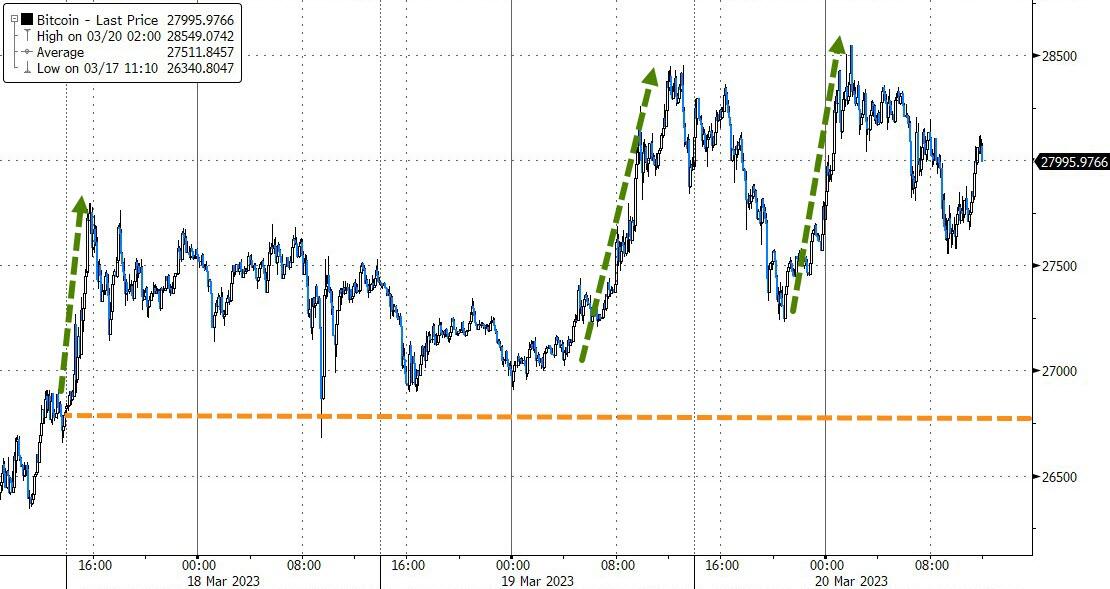
Bitcoin morning price:, $28,319 UP 1514 Dollars
Bitcoin: afternoon price: $27,932 UP 1127 dollars
Platinum price closing $989.50 UP $12.50
Palladium price; closing $1423.40 UP $17.85
END
Due to the huge rise in the dollar, we must look at gold and silver in currencies other than the dollar to understand where we are heading
I will now provide gold in Canadian dollars, British pounds and Euros/4: 15 PM ACCESS
CANADIAN GOLD: $2,703.70 DOWN 21.45 CDN dollars per oz (ALL TIME HIGH 2725.60)
BRITISH GOLD: 1611.33 DOWN 20.87 pounds per oz//(ALL TIME HIGH//1629.84)
EURO GOLD: 1844/91 DOWN 16.46 euros per oz //(ALL TIME HIGH//1860.82)
COMEX DATA
EXCHANGE: COMEX
EXCHANGE: COMEX
CONTRACT: MARCH 2023 COMEX 100 GOLD FUTURES
SETTLEMENT: 1,969.800000000 USD
INTENT DATE: 03/17/2023 DELIVERY DATE: 03/21/2023
FIRM ORG FIRM NAME ISSUED STOPPED
435 H SCOTIA CAPITAL 138
624 H BOFA SECURITIES 8
657 C MORGAN STANLEY 3
661 C JP MORGAN 279 83
737 C ADVANTAGE 1 9
905 C ADM 39
TOTAL: 280 280
JPMORGAN stopped 83/280 contracts
DONATE
Click here if you wish to send a donation. I sincerely appreciate it as this site takes a lot of preparation.
GOLD: NUMBER OF NOTICES FILED FOR MAR/2023. CONTRACT: 280 NOTICES FOR 28000 OZ or 0.8709 TONNES
total notices so far: 4740 contracts for 47,400 oz (14.7439 tonnes)
SILVER NOTICES: 46 NOTICE(S) FILED FOR 230,000 OZ/
total number of notices filed so far this month : 3087 for 15,435,000 oz
END
GLD
WITH GOLD UP $9.60
INVESTORS SWITCHING TO SPROTT PHYSICAL (PHYS) INSTEAD OF THE FRAUDULENT GLD
/HUGE CHANGES IN GOLD INVENTORY AT THE GLD:////// A MASSIVE DEPOSIT OF 6.36 TONNES OF GOLD INTO THE GLD//
INVENTORY RESTS AT 921.08TONNES
Silver//SLV
WITH NO SILVER AROUND AND SILVER UP 15 CENTS
AT THE SLV// HUGE CHANGES IN SILVER INVENTORY AT THE SLV: A WITHDRAWAL OF OF 3.401 MILLION OZ FROM THE SLV: INVESTORS ARE SWITCHING SLV TO SPROTT’S PSLV
CLOSING INVENTORY: 459.347. MILLION OZ
Let us have a look at the data for today
SILVER//OUTLINE
SILVER COMEX OI ROSE BY AN GIGANTIC SIZED 1305 CONTRACTS TO 120,717 AND CLOSER TO THE RECORD HIGH OI OF 244,710, SET FEB 25/2020 AND THIS GIGANTIC SIZED GAIN IN COMEX OI WAS ACCOMPLISHED WITH OUR $0.79 GAIN IN SILVER PRICING AT THE COMEX ON FRIDAY. WE ARE NOW RECORDING FOR PROSPERITY OUR NEW LOW COMEX OI SILVER SET AT 119,412 CONTRACTS , MARCH 17/2023. OUR BANKERS WERE UNSUCCESSFUL IN KNOCKING THE PRICE OF SILVER DOWN (IT ROSE BY $0.79). AND WERE UNSUCCESSFUL IN KNOCKING ANY SPEC LONGS AS WE HAD A MONSTROUS GAIN ON OUR TWO EXCHANGES 2040 CONTRACTS. WE HAD 0 CRIMINAL NOTICES FILED IN THE CATEGORY OF EXCHANGE FOR RISK TRANSFER ( THE TOTAL ISSUED IN THIS CATEGORY SO FAR THIS MONTH TOTAL 1 MILLION OZ.) WE HAVE FINISHED WITH OUR SPECS BEING SHORT AS THEY COVERED WITH THE RISE IN PRICE IN JANUARY . WE HAVE NOW RETURNED TO OUR USUAL AND CUSTOMARY SCENARIO: BANKERS SHORT AND SPECS LONG.
WE MUST HAVE HAD:
A STRONG ISSUANCE OF EXCHANGE FOR PHYSICALS( 735 CONTRACTS) iiii) AN INITIAL SILVER STANDING FOR COMEX SILVER MEASURING AT 15.58 MILLION OZ(FIRST DAY NOTICE) FOLLOWED BY TODAY’S QUEUE JUMP TO LONDON OF 180,000 OZ//NEW STANDING: 15.570 MILLION OZ + THE 1.0 MILLION OZ OF EXCHANGE FOR RISK//THUS TOTAL NEW STANDING 16.570 MILLION OZ/ //// V) HUGE SIZED COMEX OI GAIN/ STRONG SIZED EFP ISSUANCE/
I AM NOW RECORDING THE DIFFERENTIAL IN OI FROM PRELIMINARY TO FINAL –116 CONTRACTS
HISTORICAL ACCUMULATION OF EXCHANGE FOR PHYSICALS MAR. ACCUMULATION FOR EFP’S SILVER/JPMORGAN’S HOUSE OF BRIBES/STARTING FROM FIRST DAY/MONTH OF MAR:
TOTAL CONTRACTS for 14 days, total 11,229 contracts: OR 56.145 MILLION OZ . (802 CONTRACTS PER DAY)
TOTAL EFP’S FOR THE MONTH SO FAR: 56.145 MILLION OZ
.
LAST 23 MONTHS TOTAL EFP CONTRACTS ISSUED IN MILLIONS OF OZ:
MAY 137.83 MILLION
JUNE 149.91 MILLION OZ
JULY 129.445 MILLION OZ
AUGUST: MILLION OZ 140.120
SEPT. 28.230 MILLION OZ//
OCT: 94.595 MILLION OZ
NOV: 131.925 MILLION OZ
DEC: 100.615 MILLION OZ
JAN 2022// 90.460 MILLION OZ
FEB 2022: 72.39 MILLION OZ//
MARCH: 207.430 MILLION OZ//A NEW RECORD FOR EFP ISSUANCE
APRIL: 114.52 MILLION OZ FINAL//LOW ISSUANCE
MAY: 105.635 MILLION OZ//
JUNE: 94.470 MILLION OZ
JULY : 87.110 MILLION OZ
AUGUST: 65.025 MILLION OZ
SEPT. 74.025 MILLION OZ///FINAL
OCT. 29.017 MILLION OZ FINAL
NOV: 134.290 MILLION OZ//FINAL
DEC, 61.395 MILLION OZ FINAL
JAN 2023/// 53.070 MILLION OZ //FINAL
FEB: 2023: 100.105/ MILLION OZ/FINAL//MUCH STRONGER ISSUANCE VS THE LATTER TWO MONTHS.
MARCH 2023: 56.145 MILLION OZ//INITIAL//ON PAR WITH LAST MONTH
RESULT: WE HAD A GIGANTIC SIZED INCREASE IN COMEX OI SILVER COMEX CONTRACTS OF 1305 CONTRACTS WITH OUR $0.79 GAIN IN SILVER PRICING AT THE COMEX//FRIDAY.,. THE CME NOTIFIED US THAT WE HAD A STRONG SIZED EFP ISSUANCE CONTRACTS: 735 CONTRACTS ISSUED FOR MAY AND 0 CONTRACTS ISSUED FOR ALL OTHER MONTHS) WHICH EXITED OUT OF THE SILVER COMEX TO LONDON AS FORWARDS./ WE HAVE A GOOD INITIAL SILVER OZ STANDING FOR MAR OF 15.58 MILLION OZ//FIRST DAY NOTICE// FOLLOWED BY TODAY’S 180,000 OZ QUEUE JUMP TO LONDON (WHICH INCREASES THE AMOUNT OF SILVER STANDING) + 1.0 MILLION OF EXCHANGE FOR RISK ISSUED EARLY IN MARCH (INCREASES THE AMOUNT OF SILVER STANDING) //NEW STANDING 16.570 MILLION OZ .. WE HAVE A GIGANTIC SIZED GAIN OF 2156 OI CONTRACTS ON THE TWO EXCHANGES
WE HAD 46 NOTICE(S) FILED TODAY FOR 230,000 OZ
THE SILVER COMEX IS NOW BEING ATTACKED FOR METAL BY LONDONERS ET AL.
GOLD//OUTLINE
IN GOLD, THE COMEX OPEN INTEREST ROSE BY A GIGANTIC SIZED 18,476 CONTRACTS TO 475,728 AND FURTHER FROM THE RECORD (SET JAN 24/2020) AT 799,541 AND PREVIOUS TO THAT: (SET JAN 6/2020) AT 797,110.
THE DIFFERENTIAL FROM PRELIMINARY OI TO FINAL OI IN GOLD TODAY: REMOVED -464 CONTRACTS.
.
WE HAD A GIGANTIC SIZED INCREASE IN COMEX OI ( 18,476 CONTRACTS) WITH OUR $50.50 GAIN IN PRICE. WE ALSO HAD A SMALL INITIAL STANDING IN GOLD TONNAGE FOR MAR. AT 4.9953 TONNES ON FIRST DAY NOTICE FOLLOWED BY TODAY’S HUGE QUEUE JUMP OF 6600 OZ (0.2052 TONNES) //(QUEUE JUMPING = EXERCISING LONDON BASED EFP’S, ATTACHED TO COMEX CONTRACTS ) (EFP is the transfer of COMEX contracts immediately to London for potential gold deliveries originating from London).
YET ALL OF..THIS HAPPENED WITH OUR GIGANTIC $50.50 GAIN IN PRICE WITH RESPECT TO FRIDAY’S TRADING
WE HAD AN ATMOSPHERIC SIZED GAIN OF 26,057 OI CONTRACTS (81.048 PAPER TONNES) ON OUR TWO EXCHANGES
E.F.P. ISSUANCE
THE CME RELEASED THE DATA FOR EFP ISSUANCE AND IT TOTALED A STRONG SIZED 7581 CONTRACTS:
The NEW COMEX OI FOR THE GOLD COMPLEX RESTS AT 475,728
IN ESSENCE WE HAVE A MONSTER SIZED INCREASE IN TOTAL CONTRACTS ON THE TWO EXCHANGES OF 26,057 CONTRACTS WITH 18,476 CONTRACTS INCREASED AT THE COMEX AND 7581 EFP OI CONTRACTS WHICH NAVIGATED OVER TO LONDON. THUS TOTAL OI GAIN ON THE TWO EXCHANGES OF 26,057 CONTRACTS OR 81.048 TONNES.
CALCULATIONS ON GAIN/LOSS ON OUR TWO EXCHANGES
WE HAD A STRONG SIZED ISSUANCE IN EXCHANGE FOR PHYSICALS (7581 CONTRACTS) ACCOMPANYING THE HUGE SIZED GAIN IN COMEX OI (18,476) TOTAL GAIN IN THE TWO EXCHANGES 26,057 CONTRACTS. WE HAVE ( 1) NOW RETURNED TO OUR NORMAL FORMAT OF BANKERS GOING SHORT AND SPECULATORS GOING LONG ,2.) FAIR INITIAL STANDING AT THE GOLD COMEX FOR MAR. AT 4.9953 TONNES FOLLOWED BY TODAY’S 6600 OZ QUEUE JUMP//NEW STANDING 15.063 TONNES // ///3) ZERO LONG LIQUIDATION //4) GIGANTIC SIZED COMEX OPEN INTEREST GAIN// 5) STRONG ISSUANCE OF EXCHANGE FOR PHYSICAL PAPER/
HISTORICAL ACCUMULATION OF EXCHANGE FOR PHYSICALS IN 2023 INCLUDING TODAY
MAR
ACCUMULATION OF EFP’S GOLD AT J.P. MORGAN’S HOUSE OF BRIBES: (EXCHANGE FOR PHYSICAL) FOR THE MONTH OF MAR :
TOTAL EFP CONTRACTS ISSUED: 60,324 CONTRACTS OR 6, 032,400 OZ OR 187.63 TONNES IN 14 TRADING DAY(S) AND THUS AVERAGING: 4309 EFP CONTRACTS PER TRADING DAY
TO GIVE YOU AN IDEA AS TO THE SIZE OF THESE EFP TRANSFERS : THIS MONTH IN 14 TRADING DAY(S) IN TONNES 187.63 TONNES
TOTAL ANNUAL GOLD PRODUCTION, 2022, THROUGHOUT THE WORLD EX CHINA EX RUSSIA: 3555 TONNES
THUS EFP TRANSFERS REPRESENTS 187.63/3550 x 100% TONNES 5.26% OF GLOBAL ANNUAL PRODUCTION
ACCUMULATION OF GOLD EFP’S YEAR 2021 TO 2023
JANUARY/2021: 265.26 TONNES (RAPIDLY INCREASING AGAIN)
FEB : 171.24 TONNES ( DEFINITELY SLOWING DOWN AGAIN)..
MARCH:. 276.50 TONNES (STRONG AGAIN/
APRIL: 189..44 TONNES ( DRAMATICALLY SLOWING DOWN AGAIN//GOLD IN BACKWARDATION)
MAY: 250.15 TONNES (NOW DRAMATICALLY INCREASING AGAIN)
JUNE: 247.54 TONNES (FINAL)
JULY: 188.73 TONNES FINAL
AUGUST: 217.89 TONNES FINAL ISSUANCE.
SEPT 142.12 TONNES FINAL ISSUANCE ( LOW ISSUANCE)_
OCT: 141.13 TONNES FINAL ISSUANCE (LOW ISSUANCE)
NOV: 312.46 TONNES FINAL ISSUANCE//NEW RECORD!! (INCREASING DRAMATICALLY)//SIGN OF REAL STRESS//SURPASSING THE MARCH 2021 RECORD OF 276.50 TONNES OF EFP
DEC. 175.62 TONNES//FINAL ISSUANCE//
JAN:2022 247.25 TONNES //FINAL
FEB: 196.04 TONNES//FINAL
MARCH: 409.30 TONNES INITIAL( THIS IS NOW A RECORD EFP ISSUANCE FOR MARCH AND FOR ANY MONTH.
APRIL: 169.55 TONNES (FINAL VERY LOW ISSUANCE MONTH)
MAY: 247.44 TONNES FINAL//
JUNE: 238.13 TONNES FINAL
JULY: 378.43 TONNES FINAL
AUGUST: 180.81 TONNES FINAL
SEPT. 193.16 TONNES FINAL
OCT: 177.57 TONNES FINAL ( MUCH SMALLER THAN LAST MONTH)
NOV. 223.98 TONNES//FINAL ( MUCH LARGER THAN PREVIOUS MONTHS//comex running out of physical)
DEC: 185.59 tonnes // FINAL
JAN 2023: 228.49 TONNES FINAL//HUGE AMOUNT OF EFP’S ISSUED THIS MONTH!!
FEB: 151.61 TONNES/FINAL
MARCH: 187.63 TONNES/INITIAL (ANOTHER STRONG MONTH FOR EFP ISSUANCE)
SPREADING OPERATIONS
(/NOW SWITCHING TO GOLD) FOR NEWCOMERS, HERE ARE THE DETAILS
SPREADING LIQUIDATION HAS NOW COMMENCED AS WE HEAD TOWARDS THE NEW ACTIVE FRONT MONTH OF APRIL. WE ARE NOW INTO THE SPREADING OPERATION OF GOLD
HERE IS A BRIEF SYNOPSIS OF HOW THE CROOKS FLEECE UNSUSPECTING LONGS IN THE SPREADING ENDEAVOUR ;MODUS OPERANDI OF THE CORRUPT BANKERS AS TO HOW THEY HANDLE THEIR SPREAD OPEN INTERESTS:HERE IS HOW THE CROOKS USED SPREADING AS WE ARE NOW INTO THE NON ACTIVE DELIVERY MONTH OF MAR HEADING TOWARDS THE ACTIVE DELIVERY MONTH OF APRIL., FOR BOTH GOLD:
YOU WILL ALSO NOTICE THAT THE COMEX OPEN INTEREST STARTS TO RISE BUT SO IS THE OPEN INTEREST OF SPREADERS. THE OPEN INTEREST IN WILL CONTINUE TO RISE UNTIL ONE WEEK BEFORE FIRST DAY NOTICE OF AN UPCOMING ACTIVE DELIVERY MONTH (NOV), AND THAT IS WHEN THE CROOKS SELL THEIR SPREAD POSITIONS BUT NOT AT THE SAME TIME OF THE DAY. THEY WILL USE THE SELL SIDE OF THE EQUATION TO CREATE THE CASCADE (ALONG WITH THEIR COLLUSIVE FRIENDS) AND THEN COVER ON THE BUY SIDE OF THE SPREAD SITUATION AT THE END OF THE DAY. THEY DO THIS TO AVOID POSITION LIMIT DETECTION. THE LIQUIDATION OF THE SPREADING FORMATION CONTINUES FOR EXACTLY ONE WEEK AND ENDS ON FIRST DAY NOTICE.”
WHAT IS ALARMING TO ME, ACCORDING TO OUR LONDON EXPERT ANDREW MAGUIRE IS THAT THESE EFP’S ARE BEING TRANSFERRED TO WHAT ARE CALLED SERIAL FORWARD CONTRACT OBLIGATIONS AND THESE CONTRACTS ARE LESS THAN 14 DAYS. ANYTHING GREATER THAN 14 DAYS, THESE MUST BE RECORDED AND SENT TO THE COMPTROLLER, GREAT BRITAIN TO MONITOR RISK TO THE BANKING SYSTEM. IF THIS IS INDEED TRUE, THEN THIS IS A MASSIVE CONSPIRACY TO DEFRAUD AS WE NOW WITNESS A MONSTROUS TOTAL EFP’S ISSUANCE AS IT HEADS INTO THE STRATOSPHERE.
First, here is an outline of what will be discussed tonight:
1.Today, we had the open interest at the comex, in SILVER ROSE BY A GIGANTIC SIZED 1305 CONTRACTS OI TO 120,717 AND CLOSER TO OUR COMEX HIGH RECORD //244,710(SET FEB 25/2020). THE LAST RECORDS WERE SET IN AUG.2018 AT 244,196 WITH A SILVER PRICE OF $14.78/(AUGUST 22/2018)..THE PREVIOUS RECORD TO THAT WAS SET ON APRIL 9/2018 AT 243,411 OPEN INTEREST CONTRACTS WITH THE SILVER PRICE AT THAT DAY: $16.53). AND PREVIOUS TO THAT, THE RECORD WAS ESTABLISHED AT: 234,787 CONTRACTS, SET ON APRIL 21.2017 OVER 5 YEARS AGO. HOWEVER WE HAVE SET A RECORD LOW OF 119,412 CONTRACTS THIS PAST WEEK, MARCH 17/2022
EFP ISSUANCE 735 CONTRACTS
OUR CUSTOMARY MIGRATION OF COMEX LONGS CONTINUE TO MORPH INTO LONDON FORWARDS AS OUR BANKERS USED THEIR EMERGENCY PROCEDURE TO ISSUE:
MAY 735 and ALL OTHER MONTHS: ZERO. TOTAL EFP ISSUANCE: 735 CONTRACTS. EFP’S GIVE OUR COMEX LONGS A FIAT BONUS PLUS A DELIVERABLE PRODUCT OVER IN LONDON. IF WE TAKE THE COMEX OI GAIN OF 1305
CONTRACTS AND ADD TO THE 735 OI TRANSFERRED TO LONDON THROUGH EFP’S,
WE OBTAIN A HUGE GAIN OPEN INTEREST CONTRACTS FROM OUR TWO EXCHANGES OF 2046 CONTRACTS.
THUS IN OUNCES, THE GAIN ON THE TWO EXCHANGES //10.200 MILLION OZ
OCCURRED DESPITE OUR $0.79 GAIN IN PRICE ….. OUR SPEC SHORTS HAVE NOWHERE TO HIDE!
END
OUTLINE FOR TODAY’S COMMENTARY
1/COMEX GOLD AND SILVER REPORT
(report Harvey)
2 ) Gold/silver trading overnight Europe,
(Peter Schiff,
end
3. Egon von Greyerz///Matthew Piepenburg via GoldSwitzerland.com, Pam and Russ Martens
4. Chris Powell of GATA provides to us very important physical commentaries
end
5. Other gold/silver commentaries
6. Commodity commentaries//
7/CRYPTOCURRENCIES/BITCOIN ETC
3. ASIAN AFFAIRS
i)MONDAY MORNING//SUNDAY NIGHT
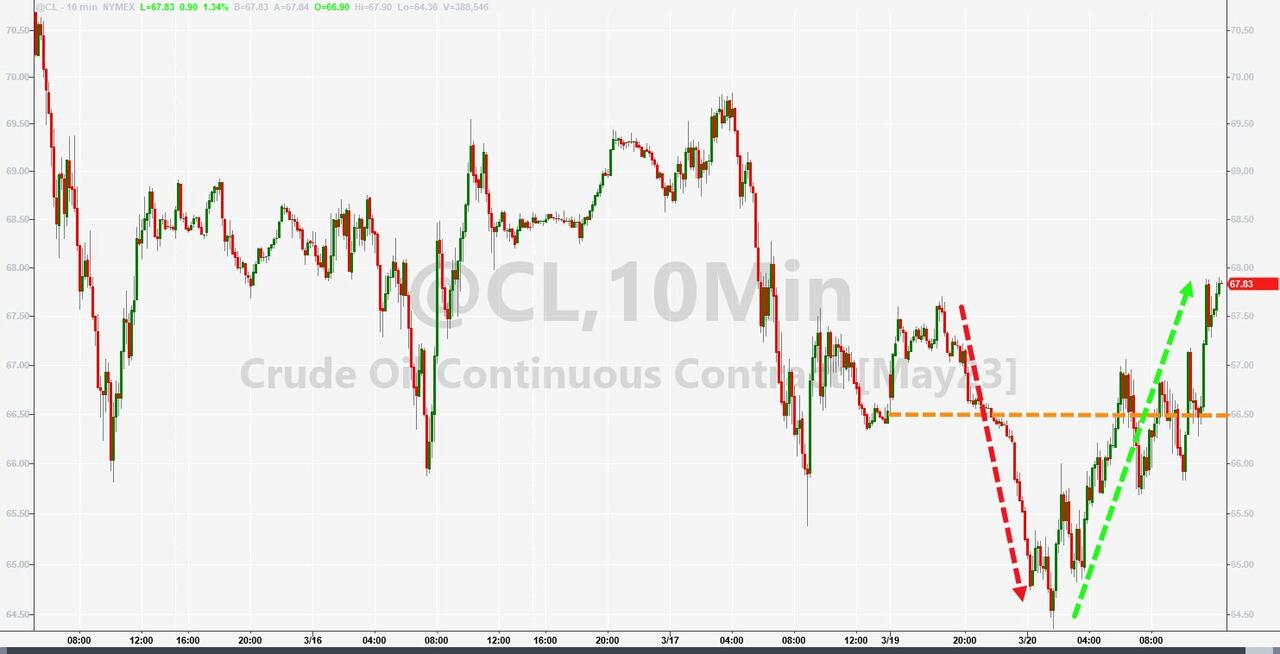
SHANGHAI CLOSED DOWN 15.64 PTS OR 0.48% //Hang Seng CLOSED DOWN 517.88 PTS OR 2.65% /The Nikkei closed DOWN 388.12 PTS OR 1.42% //Australia’s all ordinaries CLOSED DOWN 1.43% /Chinese yuan (ONSHORE) closed UP 6.8795//OFFSHORE CHINESE YUAN UP TO 6.8802// /Oil DOWN TO 65.68 dollars per barrel for WTI and BRENT AT 72.13 / Stocks in Europe OPENED ALL GREEN// ONSHORE YUAN TRADING ABOVE LEVEL OF OFFSHORE YUAN/ONSHORE YUAN TRADING STRONGER AGAINST US DOLLAR/OFFSHORE STRONGER
a)NORTH KOREA/SOUTH KOREA
outline
b) REPORT ON JAPAN/
OUTLINE
3 C CHINA
OUTLINE
4/EUROPEAN AFFAIRS
OUTLINE
5. RUSSIAN AND MIDDLE EASTERN AFFAIRS
OUTLINE
6.Global Issues//COVID ISSUES/VACCINE ISSUES
OUTLINE
7. OIL ISSUES
OUTLINE
8 EMERGING MARKET ISSUES
COMEX DATA//AMOUNTS STANDING//VOLUME OF TRADING/INVENTORY MOVEMENTS
GOLD
LET US BEGIN:
THE TOTAL COMEX GOLD OPEN INTEREST ROSE BY A GIGANTIC SIZED 18,476 CONTRACTS UP TO 475,728 WITH OUR HUGE GAIN IN PRICE OF $50.50 ON FRIDAY
EXCHANGE FOR PHYSICAL ISSUANCE
WE ARE NOW IN THE NON ACTIVE DELIVERY MONTH OF MAR… THE CME REPORTS THAT THE BANKERS ISSUED A VERY STRONG SIZED TRANSFER THROUGH THE EFP ROUTE AS THESE LONGS RECEIVED A DELIVERABLE LONDON FORWARD TOGETHER WITH A FIAT BONUS.,
THAT IS 7581 EFP CONTRACTS WERE ISSUED: : APRIL 7581 & ZERO FOR ALL OTHER MONTHS:
TOTAL EFP ISSUANCE: 7581 CONTRACTS
WHEN WE HAVE BACKWARDATION, EFP ISSUANCE IS VERY COSTLY BUT THE REAL PROBLEM IS THE SCARCITY OF METAL AND IT IS FAR BETTER FOR OUR BANKERS TO PAY OFF INDIVIDUALS THAN RISK INVESTORS ESPECIALLY FROM LONDON STANDING FOR DELIVERY. THE LOWER PRICES IN THE FUTURES MARKET IS A MAGNET FOR OUR LONDONERS SEEKING PHYSICAL METAL. BACKWARDATION ALWAYS EQUAL SCARCITY OF METAL!
ON A NET BASIS IN OPEN INTEREST WE GAINED THE FOLLOWING TODAY ON OUR TWO EXCHANGES: AN ATMOSPHERIC SIZED TOTAL OF 26,057 CONTRACTS IN THAT 7581 LONGS WERE TRANSFERRED AS FORWARDS TO LONDON AND WE HAD A HUGE SIZED GAIN OF 18,476 COMEX CONTRACTS..AND THIS MONSTER SIZED GAIN ON OUR TWO EXCHANGES HAPPENED WITH OUR GAIN IN PRICE OF $50.50. WE ARE NOW WITNESSING THE BANKERS GOING NET SHORT AND THE SPECS GOING NET LONG.
// WE HAVE A STRONG AMOUNT OF GOLD TONNAGE STANDING: MAR (15.063) (NON ACTIVE MONTH)
TONNES),
HERE ARE THE AMOUNTS THAT STOOD FOR DELIVERY IN THE PRECEDING 12 MONTHS OF 2021-2022:
DEC 2021: 112.217 TONNES
NOV. 8.074 TONNES
OCT. 57.707 TONNES
SEPT: 11.9160 TONNES
AUGUST: 80.489 TONNES
JULY: 7.2814 TONNES
JUNE: 72.289 TONNES
MAY 5.77 TONNES
APRIL 95.331 TONNES
MARCH 30.205 TONNES
FEB ’21. 113.424 TONNES
JAN ’21: 6.500 TONNES.
TOTAL YEAR 2021 (JAN- DEC): 601.213 TONNES
YEAR 2022:
JANUARY 2022 17.79 TONNES
FEB 2022: 59.023 TONNES
MARCH: 36.678 TONNES
APRIL: 85.340 TONNES FINAL.
MAY: 20.11 TONNES FINAL
JUNE: 74.933 TONNES FINAL
JULY 29.987 TONNES FINAL
AUGUST:104.979 TONNES//FINAL
SEPT. 38.1158 TONNES
OCT: 77.390 TONNES/ FINAL
NOV 27.110 TONNES/FINAL
Dec. 64.541 tonnes (TOTAL YEAR 656.076 TONNES)
2003:
JAN/2023: 20.559 tonnes
FEB 2023: 47.744 tonnes
MAR: 15.063 TONNES
THE SPECS/HFT WERE UNSUCCESSFUL IN LOWERING GOLD’S PRICE( IT ROSE $50.50) //// AND WERE UNSUCCESSFUL IN KNOCKING ANY SPECULATOR LONGS AS WE HAD OUR HUGE SIZED GAIN OF 26,057 CONTRACTS ON OUR TWO EXCHANGES
WE HAVE GAINED A TOTAL OI OF 81.048 PAPER TONNES OF TOTAL OI FROM OUR TWO EXCHANGES, ACCOMPANYING OUR INITIAL GOLD TONNAGE STANDING FOR MAR. (4.9953 TONNES) FOLLOWED BY TODAY’S HUGE QUEUE JUMP OF 6,600 OZ (0.2052 TONNES)… ALL OF THIS WAS ACCOMPLISHED WITH OUR GAIN IN PRICE TO THE TUNE OF $50.50
WE HAD -464 CONTRACTS REMOVED TO THE COMEX TRADES TO OPEN INTEREST AFTER TRADING ENDED LAST NIGHT
NET GAIN ON THE TWO EXCHANGES 26,057 CONTRACTS OR 2,605,700 OZ OR 81.048 TONNES
TONNES
Estimated gold comex today 385,521// //very strong
final gold volumes/yesterday 425,632///extremely strong
//MARCH 20/ MARCH 2023 CONTRACT
| Gold | Ounces |
| Withdrawals from Dealers Inventory in oz | nil |
| Withdrawals from Customer Inventory in oz | 2304.17 oz Brinks . |
| Deposit to the Dealer Inventory in oz | nil OZ |
| Deposits to the Customer Inventory, in oz | nil oz |
| No of oz served (contracts) today | 280 notice(s) 28,000 OZ 0.8709 TONNES |
| No of oz to be served (notices) | 73 contracts 7300 oz .2270 TONNES |
| Total monthly oz gold served (contracts) so far this month | 4740 notices 474,000 14.7439 TONNES |
| Total accumulative withdrawals of gold from the Dealers inventory this month | NIL oz |
| Total accumulative withdrawal of gold from the Customer inventory this month | x |
i)Dealer deposits: 0
total dealer deposit: nil oz
No dealer withdrawals
Customer deposits: 0
total deposits: nil oz
customer withdrawals: 1
i) out of BRINKS: 2,304.17 oz
total withdrawals: 2,304.17 oz
in tonnes: 0.07166 tonnes
Adjustments; 1
out of Brinks: 19,347.200 oz adjusted out of dealer into customer account
CALCULATIONS FOR THE AMOUNT OF GOLD STANDING FOR MAR.
For the front month of MARCH we have an oi of 353 contracts having LOST 143 contracts. We had 209 notices filed on FRIDAY so we
gained A STRONG 66 contracts or an additional 6600 oz will stand for metal at the comex
April LOST A SMALL 964 contracts DOWN to 181,509 contracts. It is here that our banker friends have to worry as many will try and take delivery in this upcoming delivery month.
May GAINED 16 contracts to stand at 286
We had 280 notice(s) filed today for 28,000 oz
Today, 0 notice(s) were issued from J.P.Morgan dealer account and 279 notices were issued from their client or customer account. The total of all issuance by all participants equate to 280 contract(s) of which 0 notices were stopped (received) by j.P. Morgan dealer and 83 notice(s) was (were) stopped received by J.P.Morgan//customer account and 0 notice(s) received (stopped) by the squid (Goldman Sachs)
To calculate the INITIAL total number of gold ounces standing for the MAR. /2023. contract month,
we take the total number of notices filed so far for the month (4,740 x 100 oz ), to which we add the difference between the open interest for the front month of (MAR. 353 CONTRACTS) minus the number of notices served upon today 280 x 100 oz per contract equals 484,300 OZ OR 15.063 TONNES the number of TONNES standing in this active month of MARCH.
thus the INITIAL standings for gold for the MAR contract month:
No of notices filed so far (4,740 x 100 oz+ 353 OI for the front month minus the number of notices served upon today (280)x 100 oz} which equals 484,300 oz standing OR 15.063 TONNES in this active delivery month of MARCH..
TOTAL COMEX GOLD STANDING: 15.063 TONNES WHICH IS HUGE FOR AN INACTIVE DELIVERY MONTH.
XXXXXXXXXXXXXXXXXXXXXXXXXXXXXXXXXXXXXXXXXXXXXXXXXXXXXXXXXXXXX
COMEX GOLD INVENTORIES/CLASSIFICATION
NEW PLEDGED GOLD:
241,794.285 oz NOW PLEDGED /HSBC 5.94 TONNES
204,937.290 PLEDGED MANFRA 3.08 TONNES
83,657.582 PLEDGED JPMorgan no 1 1.690 tonnes
265,999.054, oz JPM No 2
1,152,376.639 oz pledged Brinks/
Manfra: 33,758.550 oz
Delaware: 193.721 oz
International Delaware:: 11,188.542 o
total pledged gold: 1,765,662.466 OZ 54.919 tonnes
TOTAL OF ALL GOLD ELIGIBLE AND REGISTERED: 21,364,092.907 OZ
TOTAL REGISTERED GOLD: 10,919,280.949 (339.63 tonnes)..
TOTAL OF ALL ELIGIBLE GOLD: 10,444,841.958 OZ
REGISTERED GOLD THAT CAN BE SERVED UPON: 9,154,588 OZ (REG GOLD- PLEDGED GOLD) 284.71 tonnes//
END
SILVER/COMEX
MAR 20/2023// THE MARCH 2023 SILVER CONTRACT
| Silver | Ounces |
| Withdrawals from Dealers Inventory | NIL oz |
| Withdrawals from Customer Inventory | 438,464.610 oz Brinks CNT Delaware Loomis . |
| Deposits to the Dealer Inventory | nil |
| Deposits to the Customer Inventory | 263,613.750 oz CNT |
| No of oz served today (contracts) | 46 CONTRACT(S) (230,000 OZ) |
| No of oz to be served (notices) | 27 contracts (135,000 oz) |
| Total monthly oz silver served (contracts) | 3087 contracts (15,435,000 oz) |
| Total accumulative withdrawal of silver from the Dealers inventory this month | NIL oz |
| Total accumulative withdrawal of silver from the Customer inventory this month |
i) 0 dealer deposit
total dealer deposits: nil oz
i) We had 0 dealer withdrawal
total dealer withdrawals: oz
We have 1 deposits into the customer account
Into CNT: 263,613.750 oz
Total deposits: 263,613.750 oz
JPMorgan has a total silver weight: 146.872 million oz/283.529 million =51.81% of comex .//dropping fast
Comex withdrawals: 4
i) Out of CNT 30,490.500 oz
ii) Out of Brinks 1,957.700 oz
iii) Out of Loomis: 402,266.910 oz
iv) Out of Delaware: 3749.500 oz
Total withdrawals; 438,464.610 oz
adjustments: 4 all dealer to customer
i) Brinks 14,795.200 oz
ii) CNT 25,520.430 oz
iii) HSBC 25,119.510 o
iv) JPMorgan 25,388.300oz
the silver comex is in stress!
TOTAL REGISTERED SILVER: 37.833MILLION OZ (declining rapidly).TOTAL REG + ELIG. 283.529 million oz
CALCULATION OF SILVER OZ STANDING FOR MAR
silver open interest data:
FRONT MONTH OF MAR/2023 OI: 73 CONTRACTS HAVING GAINED 5 CONTRACT(S.) WE HAD 31 NOTICES FILED
YESTERDAY, SO WE GAINED 36 CONTRACTS OR AN ADDITIONAL 180,000 OZ WILL STAND FOR METAL ON THIS SIDE OF THE POND
April GAINED 11 CONTRACTS TO STAND at 388.
May GAINED 994 CONTRACTS DOWN TO 97,982.
TOTAL NUMBER OF NOTICES FILED FOR TODAY: 46 for 230,000 oz
Comex volumes// est. volume today 62,797// good//
Comex volume: confirmed yesterday: 790,985 contracts ( very good)
To calculate the number of silver ounces that will stand for delivery in MARCH. we take the total number of notices filed for the month so far at 3087 x 5,000 oz = 15,435,000 oz
to which we add the difference between the open interest for the front month of MAR(73) and the number of notices served upon today 46 x (5000 oz) equals the number of ounces standing.
Thus the standings for silver for the MAR./2023 contract month: 3087 (notices served so far) x 5000 oz + OI for the front month of MAR (73) – number of notices served upon today (46) x 500 oz of silver standing for the MAR. contract month equates 15.570 million oz +the 1.0 million oz of exchange for risk//new total standing 16.570 million oz
the record level of silver open interest is 234,787 contracts set on April 21./2017 with the price on that day at $18.42. The previous record was 224,540 contracts with the price at that time of $20.44
END
GLD AND SLV INVENTORY LEVELS
MARCH 20//WITH GOLD UP $9.60 TODAY; HUGE CHANGES IN GOLD INVENTORY AT THE GLD: A DEPOSIT OF 6.36 TONNES OF GOLD INTO THE GLD////INVENTORY RESTS AT 921.08 TONNES
MARCH 17/WITH GOLD UP $50.50 TODAY: NO CHANGES IN GOLD INVENTORY AT THE GLD//INVENTORY RESTS AT 914.72TONNES
MARCH 16/WITH GOLD DOWN $6.95 TODAY: HUGE CHANGES IN GOLD INVENTORY AT THE GLD: A DEPOSIT OF 1.45 TONNES OF GOLD INTO THE GLD////INVENTORY RESTS AT 914.72 TONNES
MARCH 15/THE IDES OF MARCH: WITH GOLD UP $18.75 TODAY: NO CHANGES IN GOLD INVENTORY AT THE GLD/INVENTORY RESTS AT 913.27 TONNES
MARCH 14/WITH GOLD DOWN $4.75 TODAY: HUGE CHANGES: A MONSTER DEPOSIT OF 11.85 TONNES OF GOLD INTO THE GLD//INVENTORY RESTS AT 913.27 TONNES
MARCH 13/WITH GOLD UP $48.85 TODAY: VERY STRANGE HUGE CHANGES IN GOLD INVENTORY AT THE GLD: A WITHDRAWAL OF 1.73 TONNES OF GOLD FROM THE GLD///INVENTORY REST AT 901.42 TONNES
MARCH 10//WITH GOLD UP $31.60 TODAY: HUGE CHANGES IN GOLD INVENTORY AT THE GLD; A WITHDRAWAL OF 3.47 TONNES OF GOLD FROM THE GLD//INVENTORY RESTS AT 903.15 TONNES
MARCH 9/WITH GOLD UP $16.50 TODAY: NO CHANGES IN GOLD INVENTORY AT THE GLD//INVENTORY RESTS AT 906.62 TONNES
MARCH 8/WITH GOLD DOWN $1.15 TODAY: HUGE CHANGES IN GOLD INVENTORY AT THE GLD: A MASSIVE WITHDRAWAL OF 5.5 TONNES FROM THE GLD////INVENTORY RESTS AT 906.62 TONNES
MARCH 7/WITH GOLD DOWN $33.20 TODAY:NO CHANGES IN GOLD INVENTORY AT THE GLD//INVENTORY RESTS AT 912.12 TONNES
MARCH 6/WITH GOLD UP $0.55 TODAY: SMALL CHANGES IN GOLD INVENTORY AT THE GLD: A WITHDRAWAL OF .57 TONNES FROM THE GLD///INVENTORY RESTS AT 912.12 TONNES
MARCH 3/WITH GOLD UP $14,10 TODAY; NO CHANGES IN GOLD INVENTORY AT THE GLD//INVENTORY RESTS AT 912.69 TONNES
MARCH 2/WITH GOLD DOWN $4.00 TODAY; HUGE CHANGES IN GOLD INVENTORY AT THE GLD: A WITHDRAWAL OF 2.61 TONNES OF GOLD FROM THE GLD////INVENTORY RESTS AT 912.69 TONNES
MARCH 1/WITH GOLD UP $18.90 TODAY: HUGE CHANGES IN GOLD INVENTORY AT THE GLD: A WITHDRAWAL OF 2.31 TONNES OF GOLD FROM THE GLD///INVENTORY RESTS AT 915.30 TONNES
FEB 28/WITH GOLD UP $12.10 TODAY: SMALL CHANGES IN GOLD INVENTORY AT THE GLD:A DEPOSIT OF .29 TONNES OF GOLD INTO THE GLD//INVENTORY RESTS AT 917.61 TONNES
FEB 27/WITH GOLD UP $6.95 TODAY: NO CHANGES IN GOLD INVENTORY AT THE GLD//INVENTORY RESTS AT 917.32 TONNES
FEB 24/WITH GOLD DOWN $9.10 TODAY:HUGE CHANGES IN GOLD INVENTORY AT THE GLD: A WITHDRAWAL OF 2.6 TONNES OF GOLD FROM THE GLD///INVENTORY RESTS AT 917.32 TONNES
FEB 23/WITH GOLD DOWN $13.05 TODAY: NO CHANGES IN GOLD INVENTORY AT THE GLD//INVENTORY REST AT 919.92 TONNES
FEB 22/WITH GOLD DOWN 22 CENTS TODAY: NO CHANGES IN GOLD INVENTORY AT THE GLD//INVENTORY RESTS AT 919.92 TONNES
FEB 21/WITH GOLD DOWN $7.45 TODAY: HUGE CHANGES IN GOLD INVENTORY AT THE GLD A WITHDRAWAL OF 1.16 TONNES OF GOLD FROM THE GLD///INVENTORY RESTS AT 919.92 TONNES
FEB 17/WITH GOLD DOWN $1.35 TODAY: NO CHANGES IN GOLD INVENTORY AT THE GLD//INVENTORY RESTS AT 921.08 TONNES
FEB 16/WITH GOLD UP $6.80 TODAY; SMALL CHANGES IN GOLD INVENTORY AT THE GLD: A DEPOSITOF .29 TONNES OF GOLD INTO THE GLD///INVENTORY RESTS AT 921.08 TONNES
FEB 15/WITH GOLD DOWN $19.65 TODAY: NO CHANGES IN GOLD INVENTORY AT THE GLD//INVENTORY RESTS AT 920.79 TONNES
FEB 14/WITH GOLD UP $1.40 TODAY: NO CHANGES IN GOLD INVENTORY AT THE GLD//INVENTORY RESTS AT 920.79 TONNES
FEB 13/WITH GOLD DOWN $9.90 TODAY: SMALL CHANGES IN GOLD INVENTORY AT THE GLD: A WITHDRAWAL OF .31 TONNES FORM THE GLD///INVENTORY RESTS AT 920.79 TONNES
FEB 10/WITH GOLD DOWN $4.05 TODAY: SMALL CHANGES IN GOLD INVENTORY AT THE GLD//A WITHDRAWAL OF .0.38 TONNES/INVENTORY RESTS AT 920.79 TONNES
FEB 9/WITH GOLD DOWN $10.90 TODAY:SMALL CHANGES IN GOLD INVENTORY AT THE GLD A DEPOSIT OF .38 TONNES OF GOLD INTO THE GLD./INVENTORY RESTS AT 921.10 TONNES
GLD INVENTORY: 921.08 TONNES
Now the SLV Inventory/( vehicle is a fraud as there is no physical metal behind them
MARCH 20./WITH SILVER UP 15 CENTS TODAY: HUGE CHANGES IN SILVER INVENTORY AT THE SLV: ANOTHER MASSIVE WITHDRAWAL OF 3.401 MILLION OZ FROM THE SLV////INVENTORY RESTS AT 459.347 MILLION OZ//
MARCH 17/WITH SILVER UP 79 CENTS TODAY: HUGE CHANGES IN SILVER INVENTORY AT THE SLV: A MASSIVE WITHDRAWAL OF 10.478 MILLION OZ FROM THE SLV////INVENTORY RESTS AT 462.748 MILLION OZ//
MARCH 16/WITH SILVER DOWN 25 CENTS TODAY; HUGE CHANGES IN SILVER INVENTORY AT THE SLV A WITHDRAWAL OF 5.009 MILLION OZ FROM THE SLV////INVENTORY RESTS AT 473.226 MILLION OZ//
MARCH 15/WITH SILVER DOWN 7 CENTS TODAY; BIG CHANGES IN SILVER INVENTORY AT THE SLV: A DEPOSIT OF 643,000 OZ INTO THE SLV//INVENTORY RESTS AT 478.235 MILLION OZ/
MARCH 14/WITH SILVER UP 9 CENTS TODAY: HUGE CHANGES IN SILVER INVENTORY AT THE SLV: A WITHDRAWAL OF 1.287 MILLION OZ FROM THE SLV////INVENTORY REST AT 477.592 MILLION OZ//
MARCH 13/WITH SILVER UP $1.35 : NO CHANGES IN SILVER INVENTORY AT THE SLV//INVENTORY RESTS AT 478.879 MILLION OZ//
MARCH 10.WITH SILVER UP 36 CENTS TODAY; NO CHANGES IN SILVER INVENTORY AT THE SLV//INVENTORY RESTS AT 478.879 MILLION OZ…
MARCH 9/WITH SILVER UP 2 CENTS TODAY: HUGE CHANGES IN SILVER INVENTORY AT THE SLV: A DEPOSIT OF 1.195 MILLION OZ INTO THE SLV///INVENTORY RESTS AT 478.979 MILLION OZ
MARCH 8/WITH SILVER DOWN 6 CENTS TODAY; HUGE CHANGES IN SILVER INVENTORY AT THE SLV: A WITHDRAWALOF 459,000 OZ FROM THE SLV///INVENTORY RESTS AT 477.684 MILLION OZ
MARCH 7/WITH SILVER DOWN 88 CENTS TODAY;HUGE CHANGES IN SILVER INVENTORY AT THE SLV: A WITHDRAWAL OF 920,000 OZ FROM THE SLV/////INVENTORY RESTS AT 478.143 MILLION OZ
MARCH 6/WITH SILVER DOWN 13 CENTS TODAY; NO CHANGES IN SILVER INVENTORY AT THE SLV//INVENTORY RESTS AT 479.063 MILLION OZ//
MARCH 3/WITH SILVER UP 67 CENTS TODAY:HUGE CHANGES IN SILVER INVENTORY AT THE SLV: A DEPOSIT OF 1.369 MILLION OZ INTO THE SLV////INVENTORY RESTS AT 479.063 MILLION OZ//
MARCH 2/WITH SILVER DOWN $.16 TODAY: HUGE CHANGES IN SILVER INVENTORY AT THE SLV: A WITHDRAWAL OF 920,00 OZ OF SILVER FROM THE SLV////INVENTORY RESTS AT 477.694 MILLION OZ
MARCH 1/WITH SILVER UP 4 CENTS TODAY; HUGE CHANGES IN SILVER INVENTORY AT THE SLV: A WITHDRAWAL OF 2.574 MILLION OZ OF SILVER FROM THE SLV////INVENTORY RESTS AT 478.614 MILLION OZ.
FEB 28/WITH SILVER UP 26 CENTS TODAY; HUGE CHANGES IN SILVER INVENTORY AT THE SLV: A WITHDRAWAL OF 1.241 MILLION OZ FROM THE SLV////INVENTORY RESTS AT 481.188
FEB 27/WITH SILVER DOWN 15 CENTS TODAY; HUGE CHANGES IN SILVER INVENTORY AT THE SLV: A WITHDRAWAL OF 1.471 MILLION OZ FROM THE SLV///INVENTORY RESTS AT 482.429 MILLION OZ
FEB 24/WITH SILVER DOWN 46 CENTS TODAY; HUGE CHANGES IN SILVER INVENTORY AT THE SLV: A WITHDRAWAL OF 3.172 MILLION OZ FROM THE SLV////INVENTORY RESTS AT 483.900 MILLION OZ//
FEB 23/WITH SILVER DOWN 32 CENTS TODAY: HUGE CHANGES IN SILVER INVENTORY AT THE SLV: A DEPOSIT OF 1.379 MILLION OZ INTO THE SLV////INVENTORY RESTS AT 487.072 MILLION OZ//
FEB 22/WITH SILVER DOWN 22 CENTS TODAY:SMALL CHANGES IN SILVER INVENTORY AT THE SLV: A WITHDRAWAL OF 689,000 OZ FROM THE SLV////INVENTORY RESTS AT 485.693 MILLION OZ
FEB 21/WITH SILVER UP 14 CENTS TODAY: HUGE CHANGES IN SILVER INVENTORY AT THE SLV: A DEPOSIT OF 1.5363 MILLION OZ INTO THE SLV////INVENTORY RESTS AT 486.382 MILLION OZ//
FEB 17/WITH SILVER UP 2 CENTS TODAY: SMALL CHANGES IN SILVER INVENTORY AT THE SLV: A DEPOSIT OF 827,000 OZ INTO THE SLV////INVENTORY RESTS AT 484.819 MILLION OZ/
FEB 16/WITH SILVER UP 8 CENTS TODAY: SMALL CHANGES IN SILVER INVENTORY AT THE SLV: A DEPOSIT OF 690,000 OZ OF SILVER INTO THE SLV////INVENTORY RESTS AT 483.992 MILLION OZ//
FEB 15/WITH SILVER DOWN $0.26 TODAY: NO CHANGES IN SILVER INVENTORY AT THE SLV//INVENTORY RESTS AT 483.302 MILLION OZ//
FEB 14/WITH SILVER DOWN 1 CENT TODAY: SMALL CHANGES IN SILVER INVENTORY AT THE SLV” A WITHDRAWAL OF 460,000 OZ FROM THE SLV////INVENTORY RESTS AT 483.302 MILLION OZ//
FEB 13 WITH SILVER DOWN 17 CENTS TODAY; NO CHANGES IN SILVER INVENTORY AT THE SLV// INVENTORY RESTS AT 483.762 MILLION OZ//
FEB 10/WITH SILVER DOWN 8 CENTS: NO CHANGES IN SILVER INVENTORY AT THE SLV: //INVENTORY RESTS AT 483.762 MILLION OZ
FEB 9/WITH SILVER DOWN 14 CENTS TODAY: NO CHANGES IN SILVER INVENTORY AT THE SLV: INVENTORY RESTS AT 483.76 MILLION OZ (CORRECTED).//
CLOSING INVENTORY 459.347MILLION OZ//
PHYSICAL GOLD/SILVER STORIES
1:Peter Schiff
The Comex Is In Far Worse Shape Than SVB If The Run On Physical Accelerates
SUNDAY, MAR 19, 2023 – 02:30 PM
Given the potential impacts of the ongoing banking crisis, I will start this article with the conclusion.
The current banking crisis could not have come at a worse time for the Comex system. Inventories have seen massive depletion over the last 2+ years as investors have slowly been pulling physical out of the vaults. I have previously called this a run on the vault but labeled it as a stealthy one. As though certain investors did not want to raise the alarm, but slowly take possession while inventory was still available.
Now that confidence in the banking system has been put to the test, people will look to alternative means to store their wealth and get their money out of the financial system. The easiest and safest way to do this would be to own physical precious metals, as people have done for thousands of years.
It is likely that demand for physical metal could increase significantly in the months ahead. The futures market is already showing a massive move in the price of gold, which is knocking on the door of $2,000. It’s only a matter of time before this moves into the physical market. When it does, the Comex vault run will pick up steam.
Investors looked at SVB and saw that it was undercapitalized and people could only get 80-90 cents on the dollar. If investors were to do the same due diligence on the Comex they would find an even worse fractional reserve system in the metals market. The recent discovery by the LME that some of their inventory was stones rather than nickel should only serve as another wake-up call that the supply of physical metal is extremely tight. If everyone rushes for physical at the same time, there won’t be nearly enough to satisfy demand at current prices (silver has 15 paper ounces per 1 physical ounce!).

We could be only months away from seeing a break in the Comex system. SchiffGold will be working all weekend to take orders. Best to get physical locked in at current prices while you still can.
Current Trends
This analysis focuses on gold and silver within the Comex/CME futures exchange. See the article What is the Comex? for more detail. The charts and tables below specifically analyze the physical stock/inventory data at the Comex to show the physical movement of metal into and out of Comex vaults.
Registered = Warrant assigned and can be used for Comex delivery, Eligible = No warrant attached – owner has not made it available for delivery.
Gold
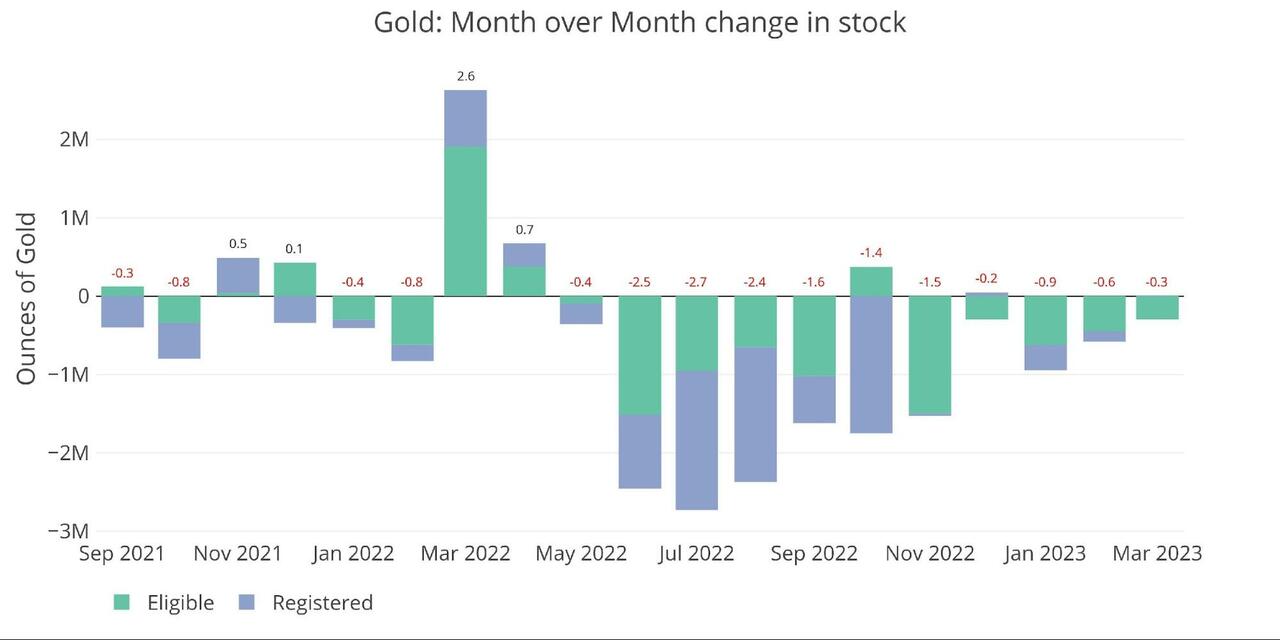
Gold is now in its 11th straight month of net outflows, seeing 285k ounces leave the vault so far in March. The exodus of metal has slowed since last year when some months saw almost 3M ounces leave Comex vaults.

Figure: 1 Recent Monthly Stock Change
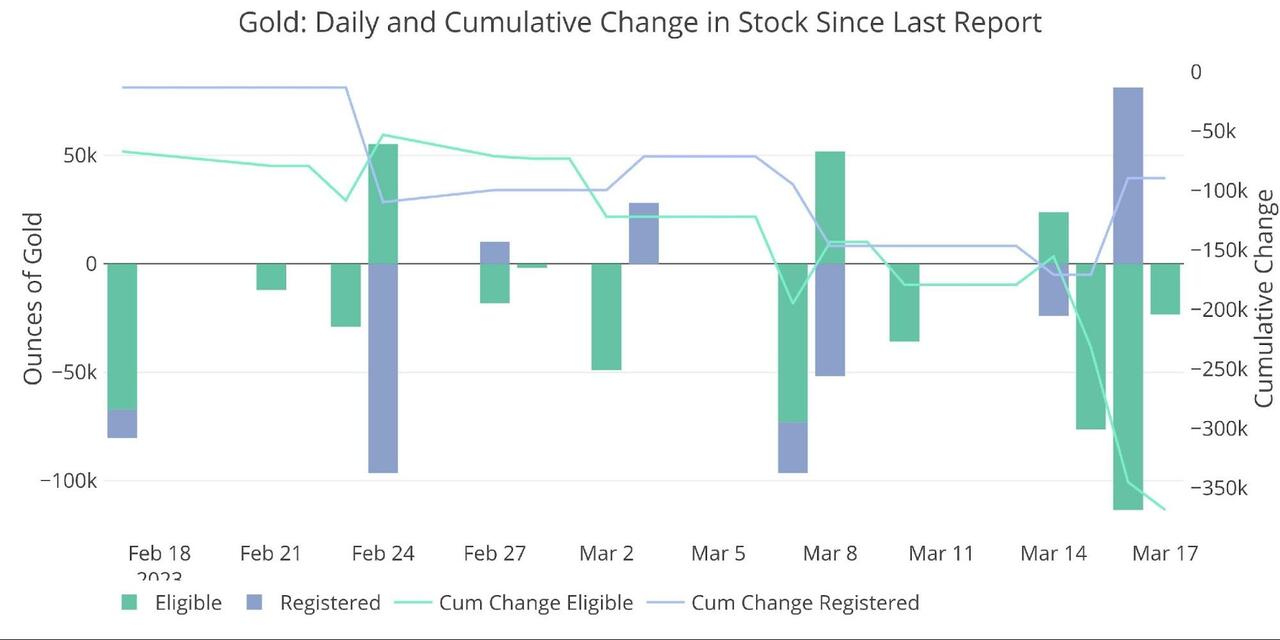
As mentioned above, this could change quickly and may already be changing! As the chart below shows, this latest week was the busiest week of outflows in the last month. Given the price of gold finished the week at $1993, the ongoing banking crisis, and general fear in the market… it seems likely that demand for physical could be ready to soar. That could drive larger outflows from Comex vaults in the near future.
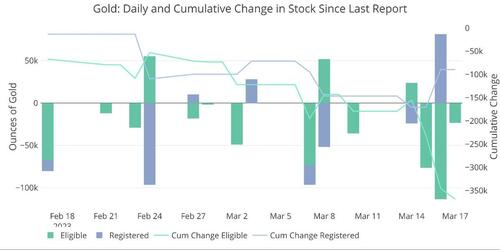
Figure: 2 Recent Monthly Stock Change
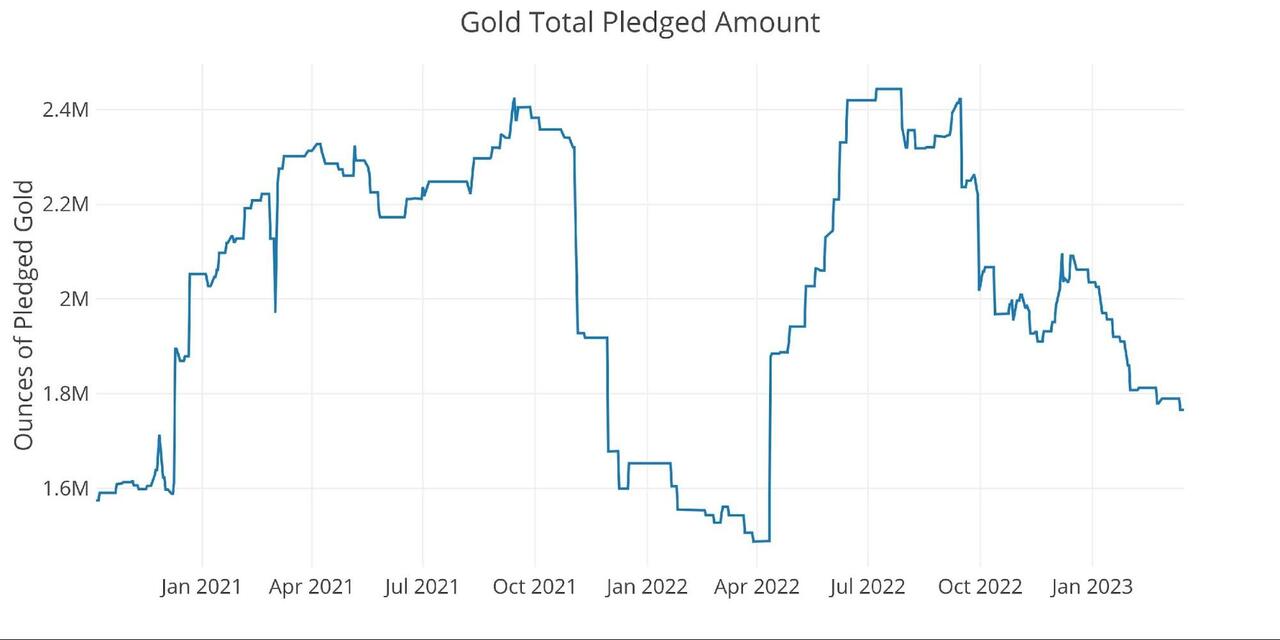
Pledged gold continues to decline, but similar to the inventory at large, the drop has been slowing.
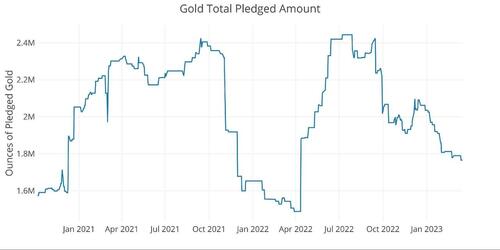
Figure: 3 Gold Pledged Holdings
Silver
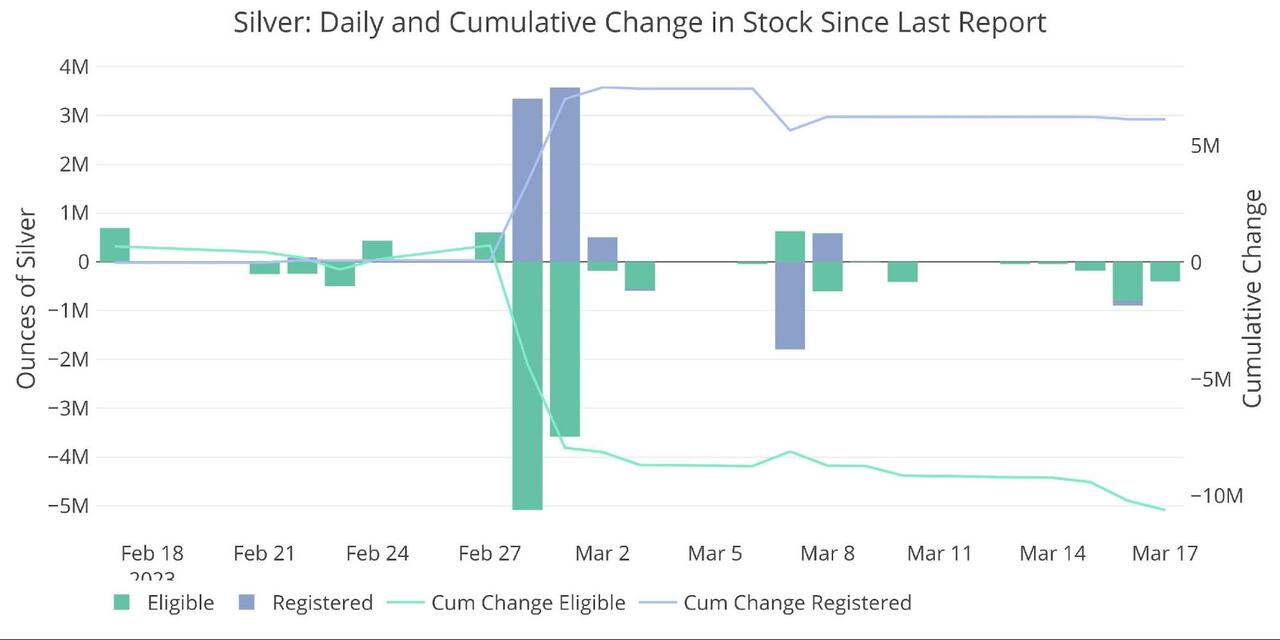
Outflows in silver continue at a strong pace, seeing 3.5M ounces in outflows MTD. Registered is actually seeing inflows for the second month in a row, most likely because inventory of Registered had reached dangerously low levels. As mentioned previously, the real floor is not actually zero but somewhere higher. This is for optics to keep confidence in the fractional reserve silver trade.
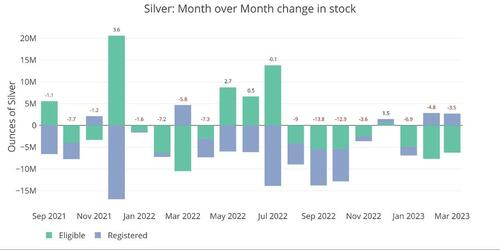
Figure: 4 Recent Monthly Stock Change
Unlike gold, the outflows slowed this week. The big moves into Registered occurred just as the March silver contract started its delivery. If Registered silver was not getting close to the bottom, why did the Comex have to move 7M ounces of silver into the Registered category to handle the March delivery volume? This metal was moved specifically to handle that demand which indicates available silver stocks are getting dangerously low.
Interestingly, the metal has not flowed back into Eligible as it typically does after delivery. The data shows that it was none other than JP Morgan taking the majority of the delivery at 5.2M ounces. Perhaps JP decided to obtain silver specifically for the purpose of keeping it in Registered to inflate the numbers. This move increased JP Morgan’s total allocation of Registered from 32% to 41.6%. This means almost half of all Registered silver now sits in JP Morgan vaults… most likely for optics.
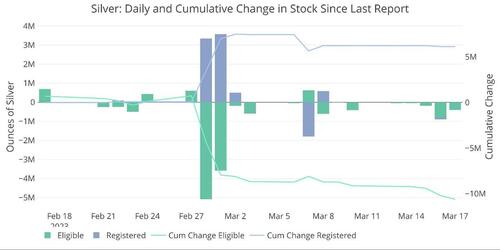
Figure: 5 Recent Monthly Stock Change
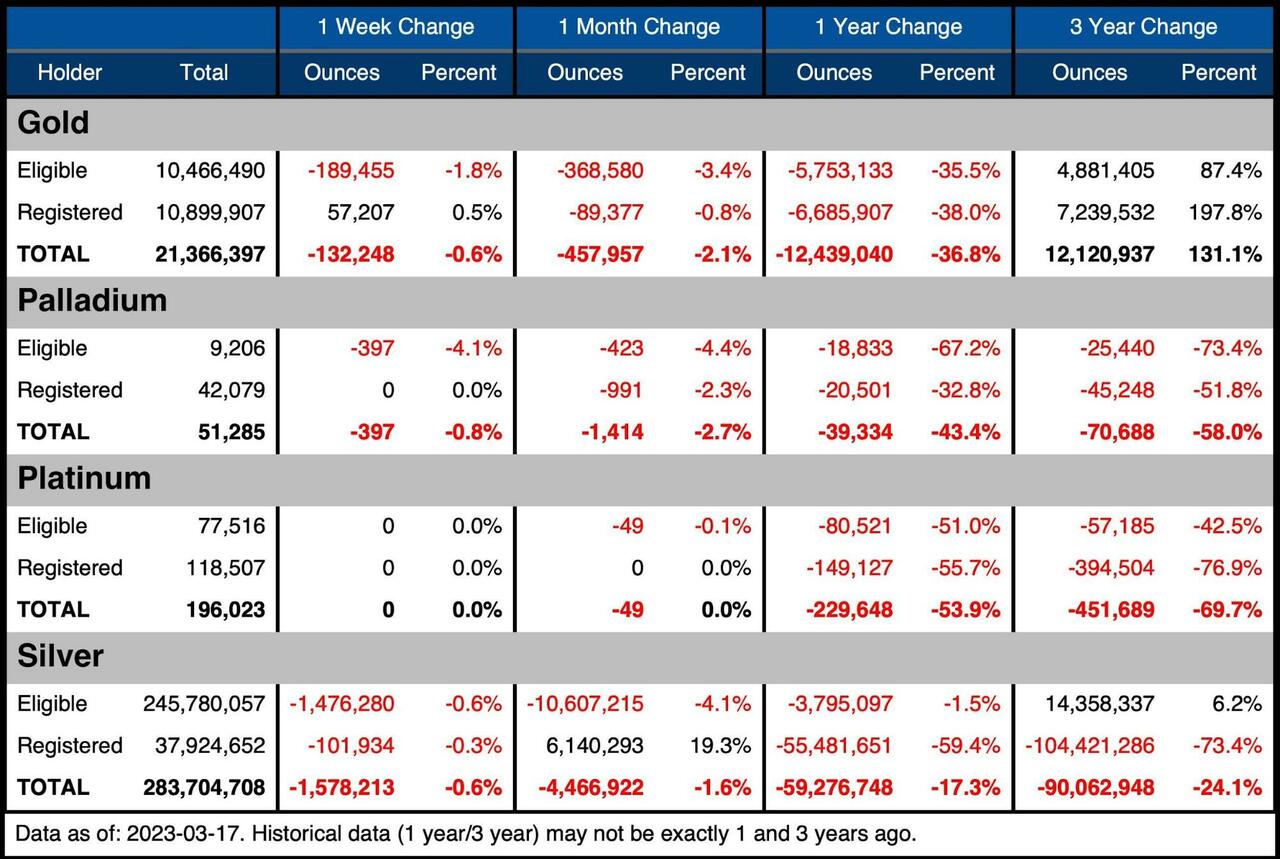
The table below summarizes the movement activity over several time periods to better demonstrate the magnitude of the current move.
Gold
- Over the last month, gold saw inventories fall by 2.1%
- Registered remains a bit higher than Eligible
- Since last year, total gold holdings have fallen by 36.8% or 12.4M ounces
Silver
- Registered has increased 19.3% in the last month
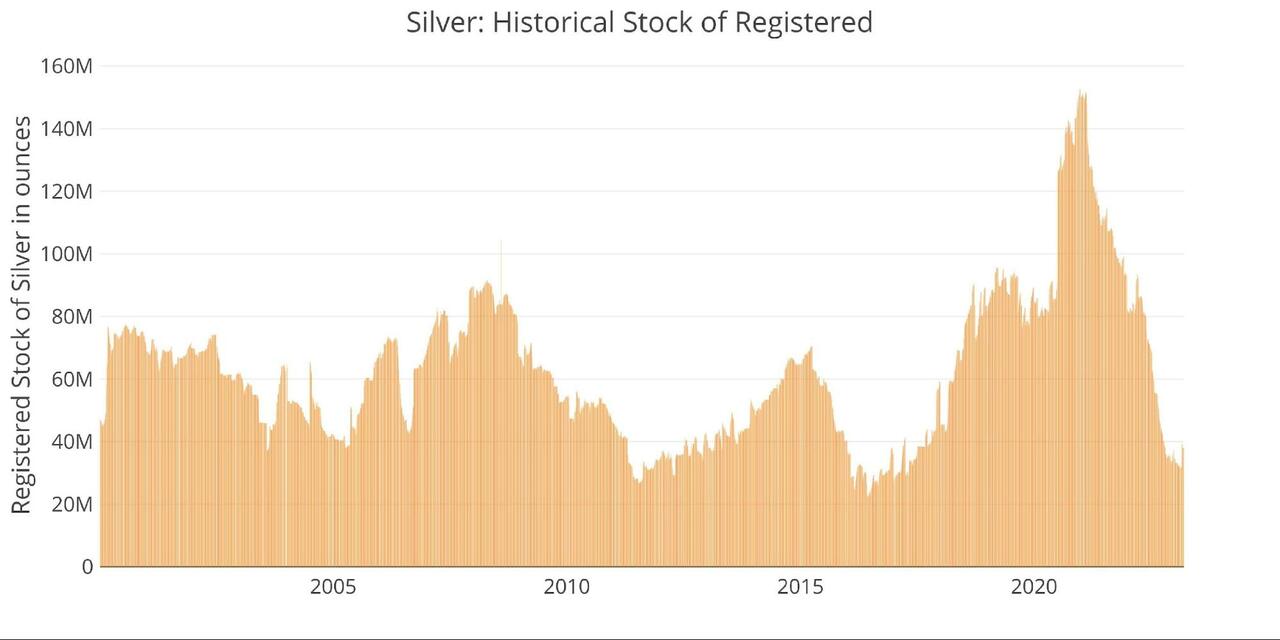
- Total Registered remains below 40M ounces and has still seen a drop of 55M ounces in the last year
Palladium/Platinum
Palladium and platinum are much smaller markets but it’s possible that is where the market breaks first.
- Palladium saw a drop of 2.7% during its delivery month
- Platinum was very quiet during the month
Platinum is heading towards its next delivery month in April. In January, Platinum looked like it could break the Comex. At the time, we highlighted they had only bought a few months. Well, we are now close to where inventory will be put to the test once again.
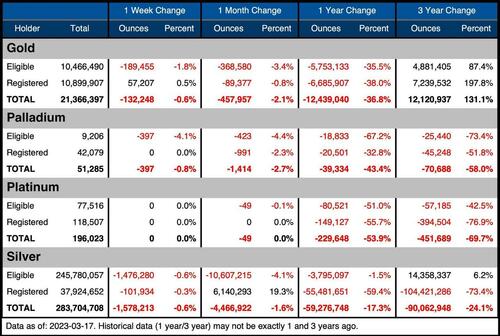
Figure: 6 Stock Change Summary
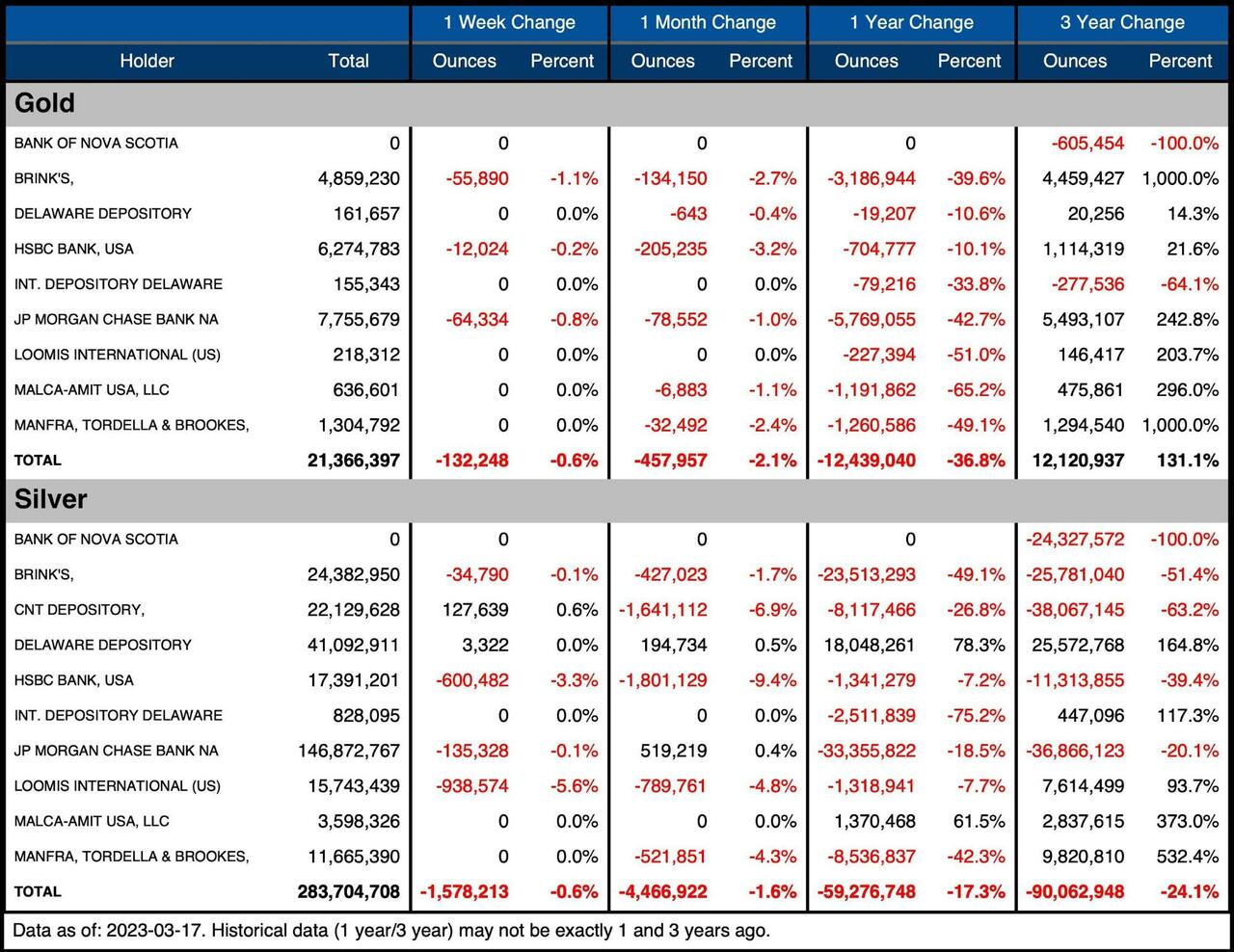
The next table shows the activity by bank/Holder. It details the numbers above to see the movement specific to vaults.
Gold
- 6 vaults lost gold over the month while none added
- Outflows were evenly distributed across all vaults
Silver
- JP Morgan only shows a net gain of 520k ounces, but as noted above, Registered inventories increased more than 5M ounces
- This indicates JP Morgan was moving the metal from within its own vaults
- CNT, HSBC, and Manfra all saw fairly large declines in their inventory
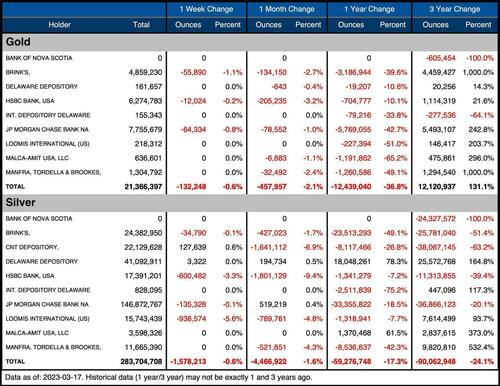
Figure: 7 Stock Change Detail
Historical Perspective
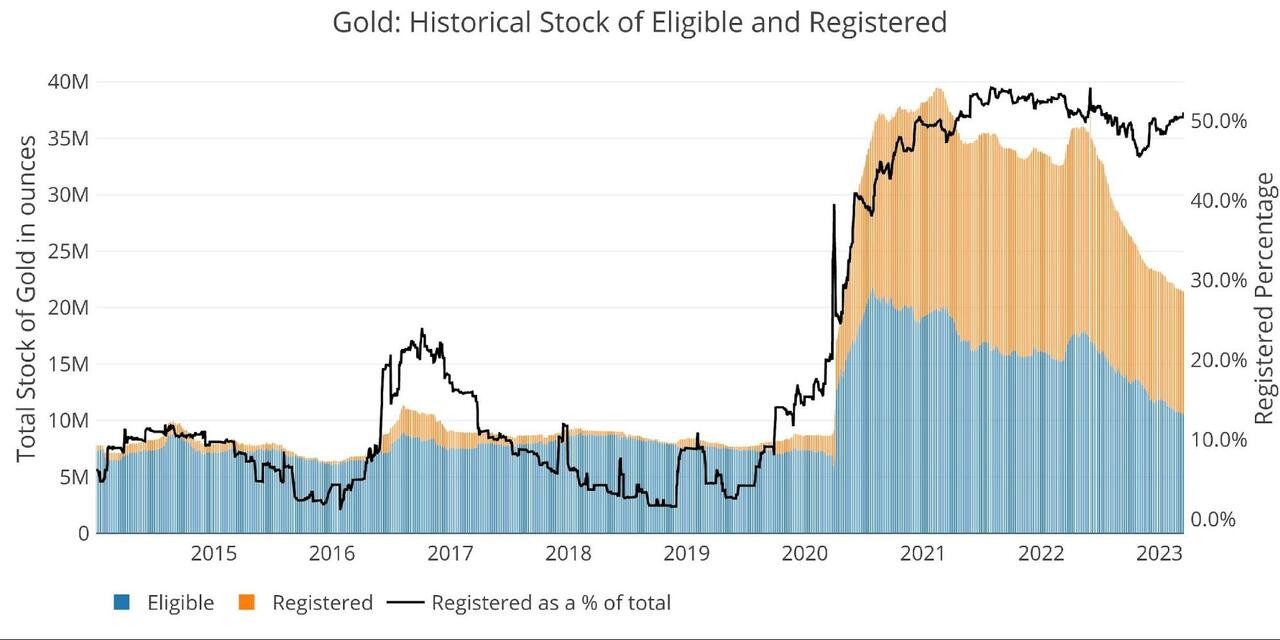
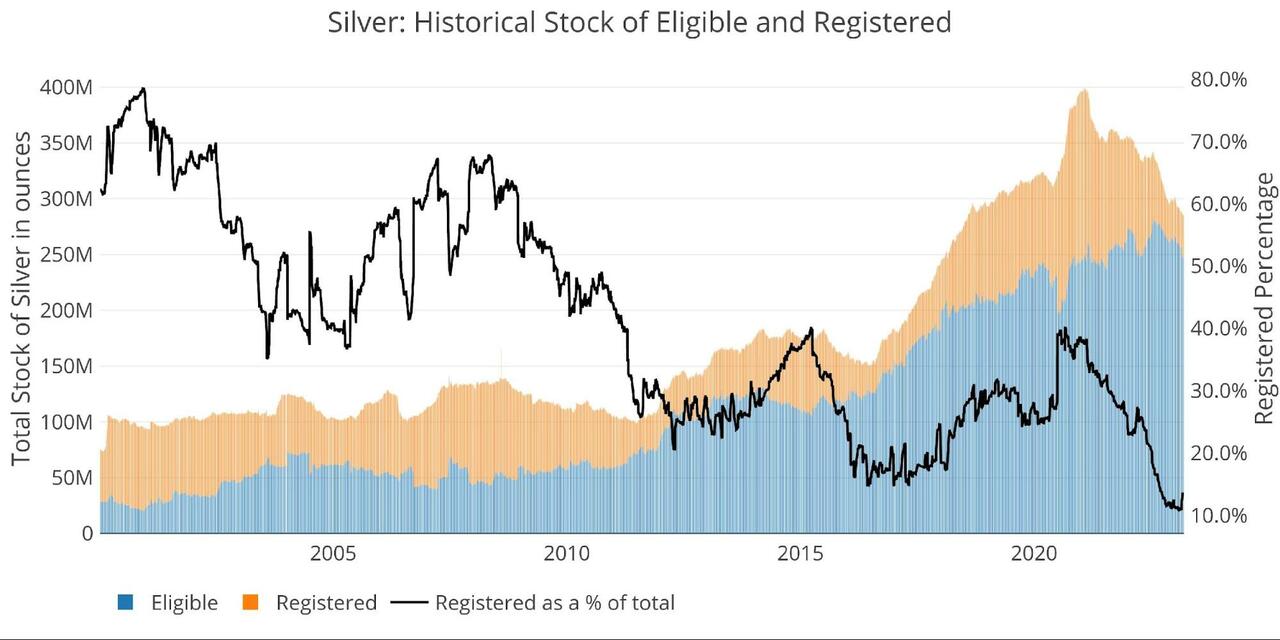
Zooming out and looking at the inventory for gold and silver shows just how massive the current moves have been. The black line shows Registered as a percent of total.
Inventories in gold have been falling evenly in both categories, which is why the black line has stayed relatively flat even while supplies have been crashing. It’s amazing how closely the ratio has stayed to the 50% mark. In October, the ratio reached 45%, but quickly rebounded to 50%.
In September 2019, all of the Registered stood for delivery, so it is likely this ratio is now being actively maintained to make sure confidence persists in the system. Given current market dynamics, this confidence could be put to the test.

Figure: 8 Historical Eligible and Registered
Silver has seen far more concentrated outflows from Registered, getting as low as 10.9% of total inventory in February. With the move by JP Morgan, the ratio has since recovered to 13.3%, but this is still at historically low levels compared to history.
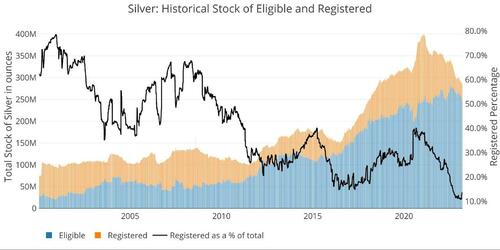
Figure: 9 Historical Eligible and Registered
The recent “spike” can be seen on the far right side of the chart above. From this perspective, the moves by JP Morgan seem much smaller. A similar spike-up happened in March 2022 which quickly reversed as metal started flowing back out of Registered immediately after. Will 2023 see a similar pattern?
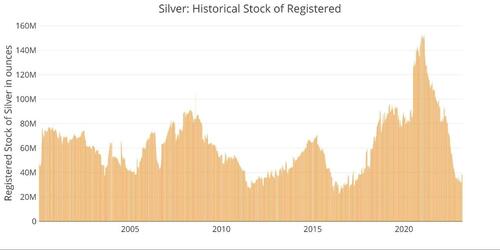
Figure: 10 Historical Registered
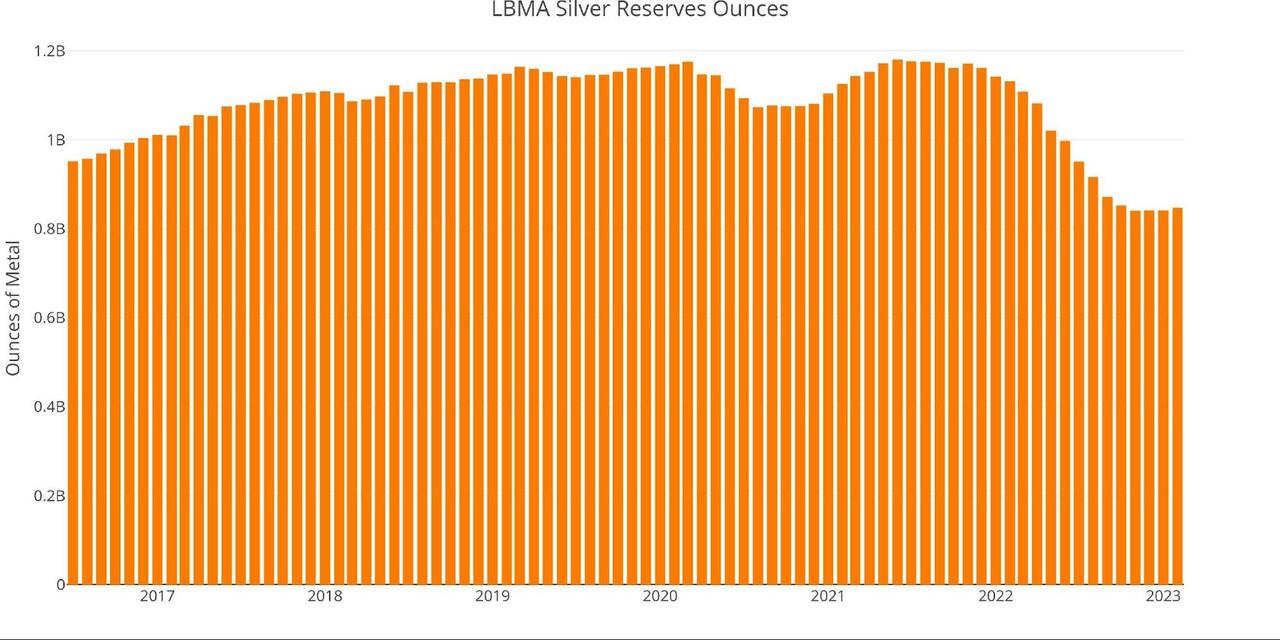
The LBMA had been seeing similar outflows of silver from their vault, but that appears to have stopped for now.

Figure: 11 LBMA Holdings of Silver
Available supply for potential demand
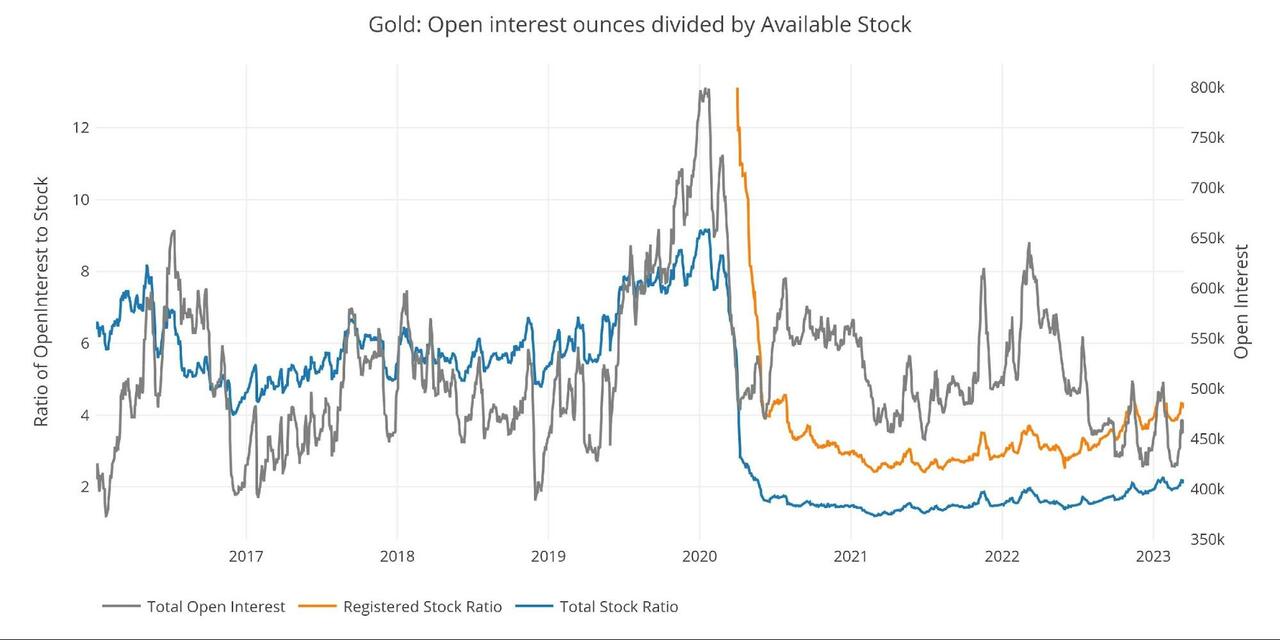
Coverage on the Comex continues to deteriorate. On Jan 26, before the recent sell-off in gold, the amount of paper gold for each Registered physical ounce was 4.6. That is the highest level since July 2020, right before all the new supply was added. The ratio now sits at 4.2, but the drop has mainly been driven by a fall in Open Interest rather than a surge in inventory.
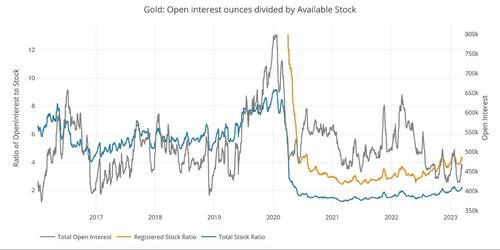
Figure: 12 Open Interest/Stock Ratio
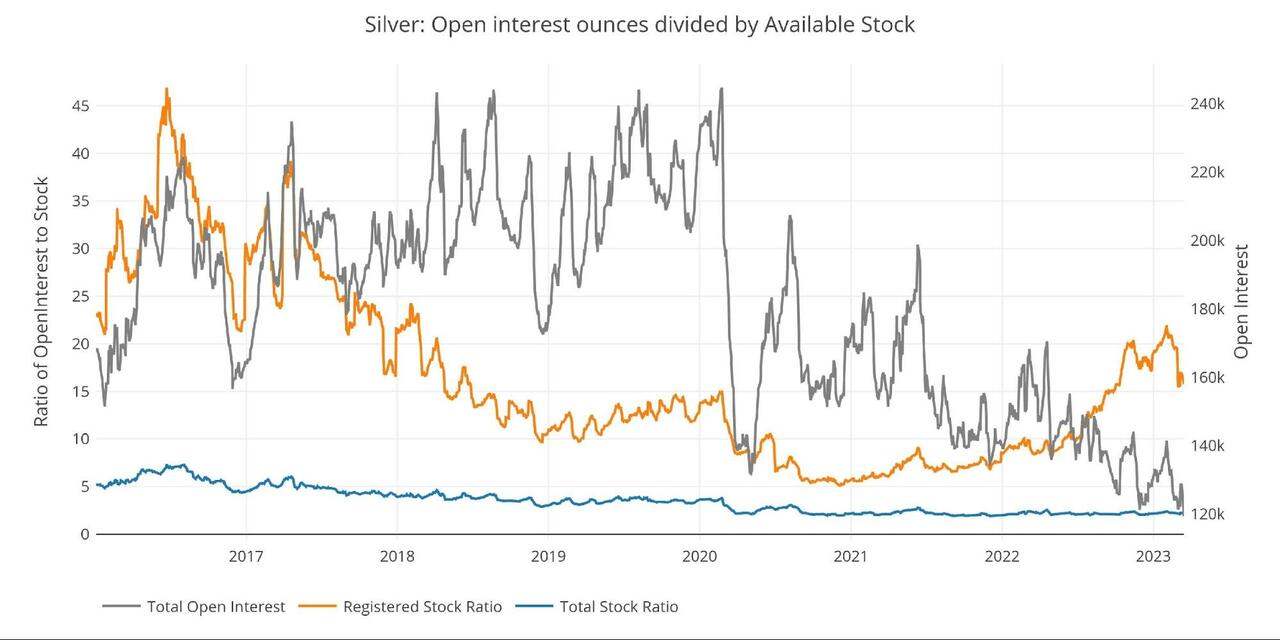
Coverage in silver is far worse than gold. The paper to Registered physical ratio reached 22 ounces on Feb 2nd. It had drifted lower to 19.5 and then after JP Morgan stepped in, the ratio dropped to 15.4.
This means that after the move by JP Morgan, there are still 15 paper contracts for every physical ounce of metal available.
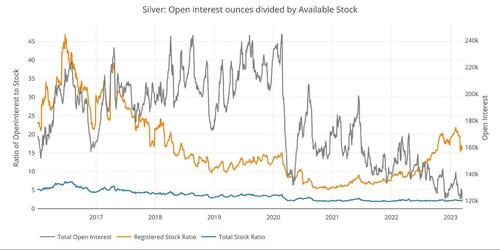
Figure: 13 Open Interest/Stock Ratio
Wrapping Up
See above!
2 Lawrie Williams//Pam and Russ Martens/Jim Rickards/Mathew Piepenburg/Von Greyerz//Rickards:
A MUST READ…….
EGON VON GREYERZ
THIS IS IT! – THE FINANCIAL SYSTEM IS TERMINALLY BROKEN
Egon von Greyerz
March 19, 2023
The financial system is terminally broken, toast, kaput!
Anyone who doesn’t see what is happening will soon lose a major part of their assets either through bank failure, currency debasement or the collapse of all bubble assets like stocks, property and bonds by 75-100%. Many bonds will become worthless.
Wealth preservation in physical gold is now absolutely critical. Obviously it must be stored outside a broken financial system. More later in this article.
The solidity of the banking system is based on confidence. With the fractional banking system, highly leveraged banks only have a fraction of the money available if all depositors ask for their money back. So when confidence evaporates, so do the balance sheets of the banks and depositors realise that the whole system is just a black hole.
And this is exactly what is about to happen.
For anyone who believes that this is just a problem with a few smaller US banks and one big one (Credit Suisse), they must think again.
RE CREDIT SUISSE SEE ‘STOP PRESS’ AT THE END OF THE ARTICLE.
THE BANKS ARE FALLING LIKE DOMINOS, INCLUDING CREDIT SUISSE TONIGHT
Yes, Silicon Valley Bank (16th biggest US bank) is gone after an idiotic and irresponsible policy to invest short term customer deposits in long term US Treasuries at the bottom of the interest rate cycle. Even worse, they then valued the bonds at maturity rather than market, to avoid taking a loss. Clearly a management that didn’t have a clue about risk. SVB’s demise is the second biggest failure of a US bank.
Yes, Signature Bank (29th biggest) is gone due to a run on deposits.
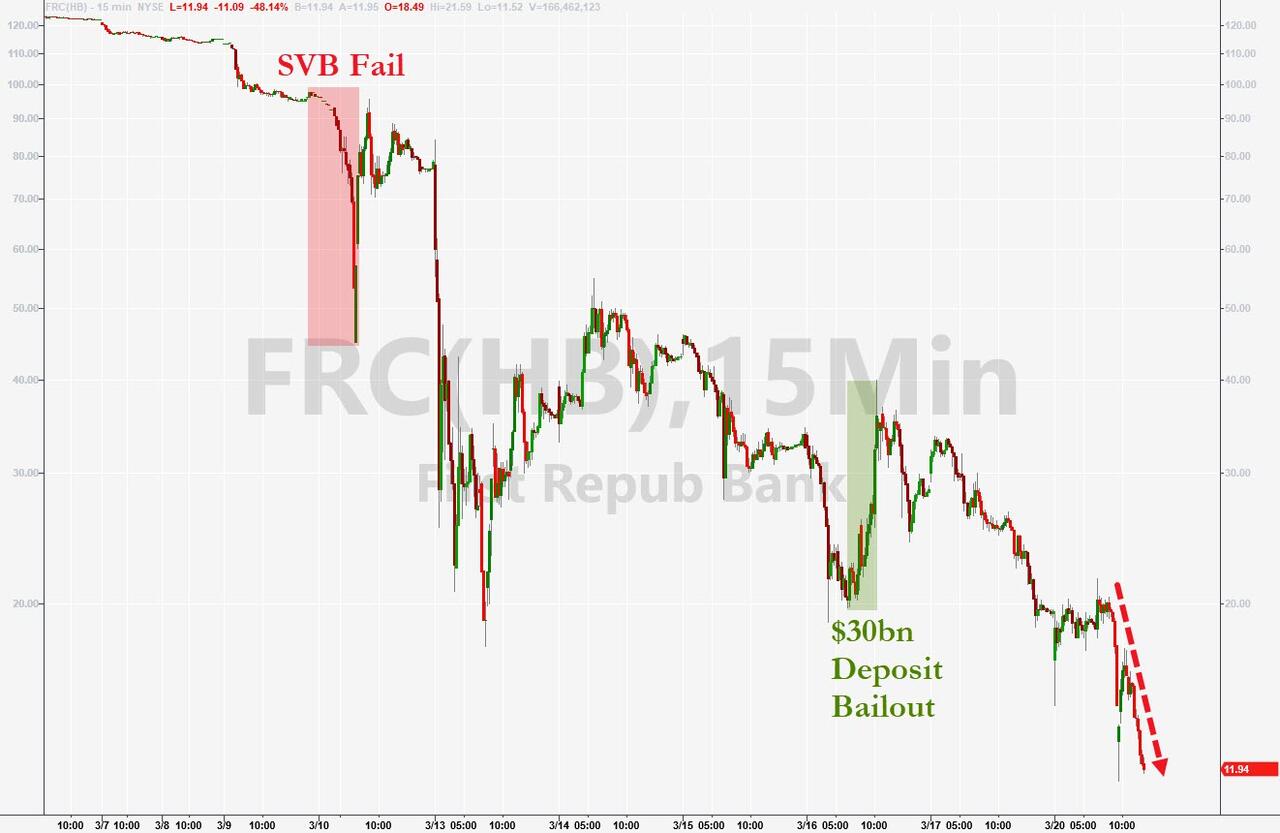
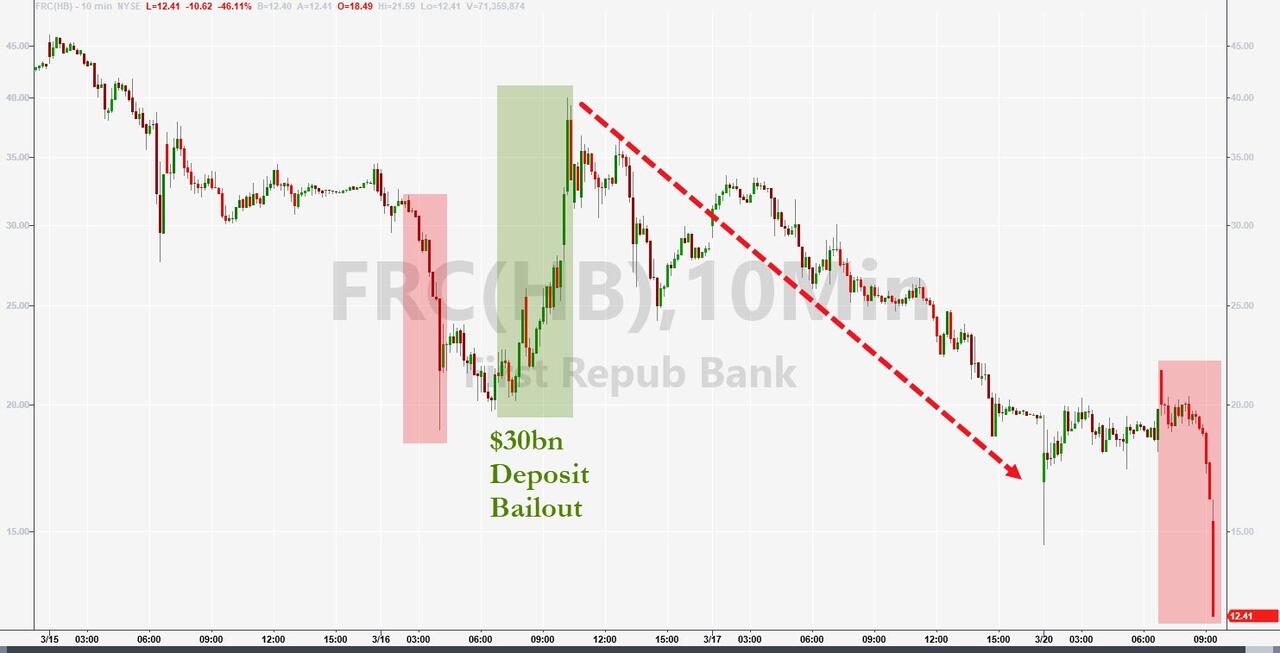
And yes, First Republic Bank had to be supported by US lenders and the Fed by a $30 billion loan due to a run on deposits. But this won’t stop the rot as depositors attack the next bank and the next one and the next one……….
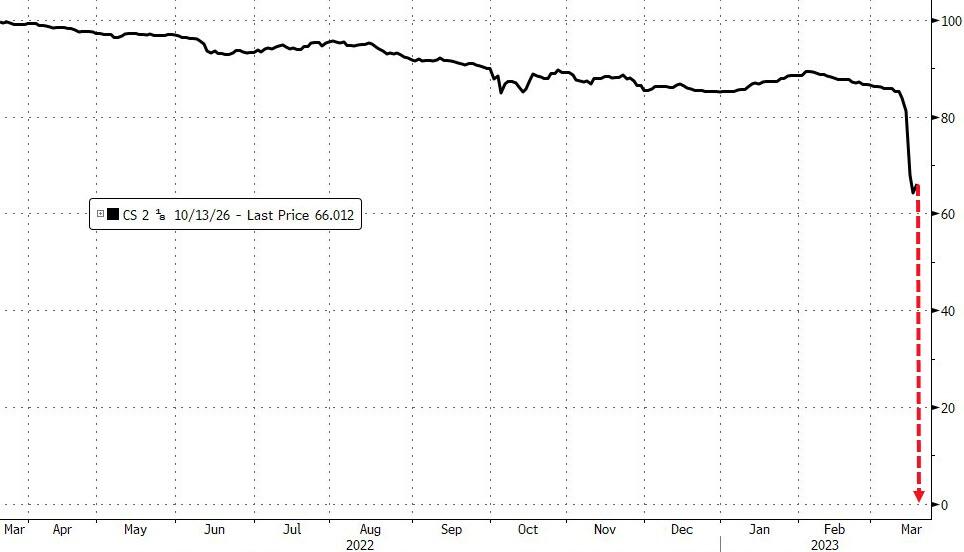
And yes, the Swiss second largest bank Credit Suisse (CS) is terminally ill after a number of poor investments over the years combined with poor management that has come and gone virtually every year.. I wrote an important article about the coming demise of CS 2 years ago here: “ARCHEGOS & CREDIT SUISSE – TIP OF THE ICEBERG.”
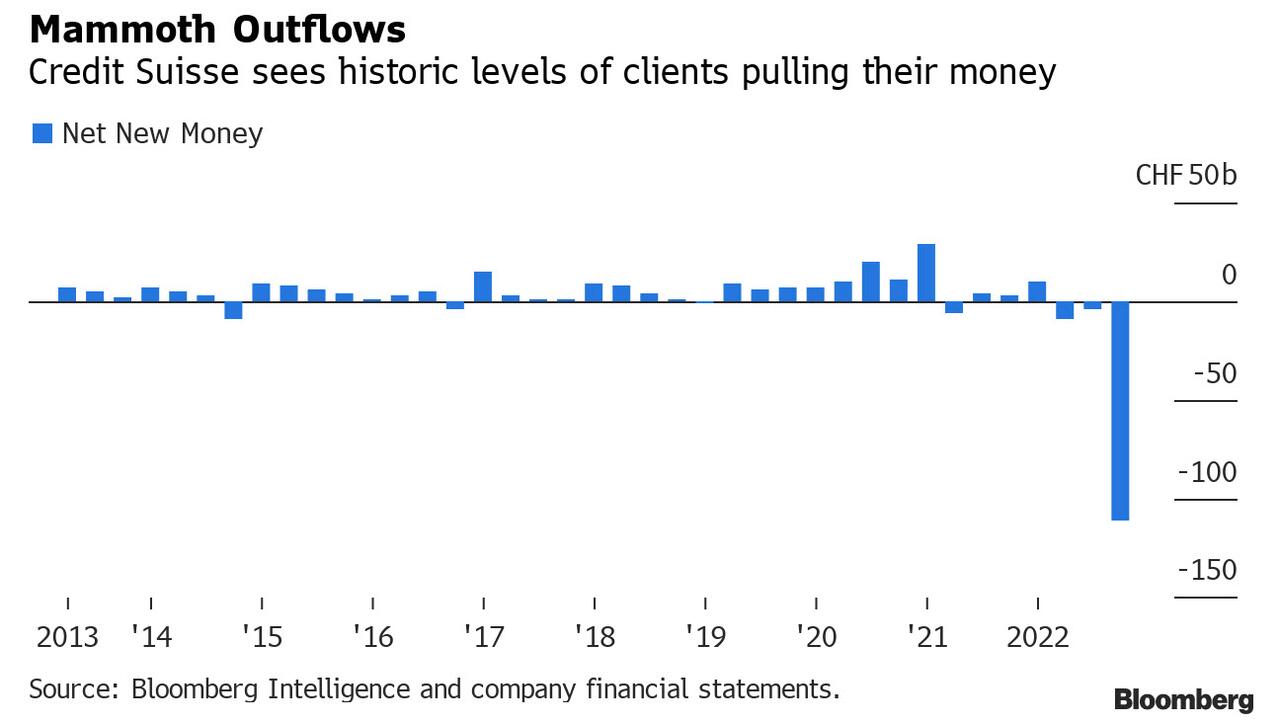
The situation at CS is so dire that a solution needs to be found before Monday’s (March 20) opening. The bank cannot survive in its present form. A failure for Credit Suisse would not just rock the Swiss financial system but have severe global repercussions. A merger with UBS is one solution. But UBS had to be bailed out in 2008 and doesn’t want to be weakened again by Credit Suisse without state guarantees and support from the Swiss National Bank (SNB). The SNB injected CHF50 billion into CS last week but the share price still went to a new low.
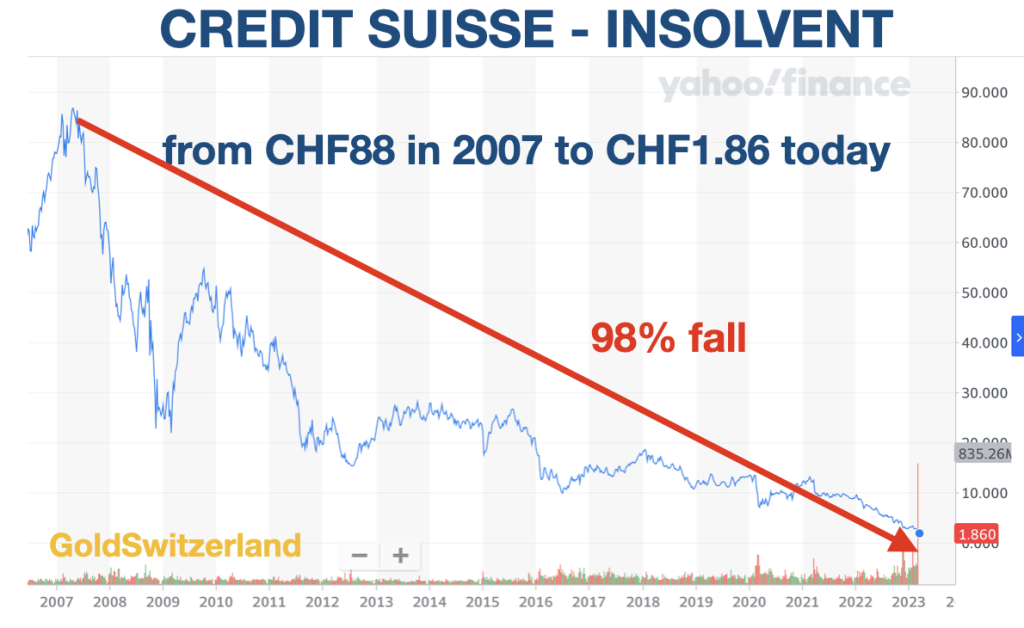
No one should believe that a state subsidised takeover of Credit Suisse by UBS will solve the problem. No, it will just be rearranging the deck chairs on the titanic and making the problem bigger rather than smaller. So rather than a lifebuoy, UBS will have a massive lead weight to carry which will guarantee its demise as the banking system collapses. And the Swiss government will take on assets which will be unrealisable.
Still, it is likely that by the end of the present weekend a deal will be announced with UBS being offered a deal they can’t refuse by taking over the good assets and the SNB/Government nurturing the bad assets of Credit Suisse in a rescue vehicle.
The SNB is of course in a mess itself, having lost $143 billion in 2022. The SNB balance sheet is bigger than Swiss GDP and consists of currency speculation and US tech stocks. This central bank is the world’s biggest hedge fund and the least successful.
Just to put a balanced view on Switzerland. It has the best political system in the world with direct democracy. It also has low Federal debt and normally no budget deficits. It is also the safest country in the world.
SWISS BANKING SYSTEM TOO BIG TO SAVE
But the Swiss banking system is very unsound, just like the rest of the world’s. A central bank which is bigger than the country’s GDP is extremely unsound. And a banking system which is 5x Swiss GDP makes it too big to save.
Although the Fed and ECB are much smaller in relation to their countries’ GDP than the SNB, these two central banks will soon discover that their assets of around $8 trillion each are grossly overvalued.
With a global banking system on the verge of a systemic failure, Central Bankers and bankers have been working around the clock this weekend to temporarily avoid the inevitable collapse of the bankrupt financial system.
BIGGEST MONEY PRINTING IN HISTORY COMING
As I pointed out above, the main Central Banks would also be bankrupt if they valued their assets honestly. But they have a wonderful source of money that they will tap to save the system.
Yes, I am of course talking about money printing.
We will in coming months and years see the most massive avalanche of money printing that has ever hit the world.
For anyone who believes that we are just seeing another bank run that will quickly evaporate, they will need to take a shower in ice cold Alpine water.
What we are witnessing is not just a temporary drama that will be sorted out by “the all powerful and resourceful” central banks.
THE DEATH OF MONEY
No, instead what we are seeing is the end phase of this financial era which started with the formation of the Fed in 1913 and in the next few years, or much sooner, will end with the death of money.
But the Death of Money doesn’t just mean that the dollar (and most currencies) will make their final move to ZERO, having already declined 98% since 1971.
Currency debasement is not the cause but the effect of the banking Cabal taking control of the money for their own benefit. As Mayer Amschel Rothschild said in the late 1700s: “Let me issue and control a nation’s money and I care not who makes the laws”.
Sadly, as this Cassandra (me) has written about since the beginning of the century, the Death of Money is not just all currencies going to ZERO as they have throughout history.
No, the Death of Money means a total and final collapse of this financial system.
Cassandra was a priestess in Greek mythology who was given the gift of predicting major events accurately but also given the curse that no one would believe her predictions.
No depositor must believe that the FDIC (Federal Deposit Insurance Corp) in the US or similar vehicles in other countries will save their deposits. All these organisations are massively undercapitalised and in the end it will be the governments in all countries which step in.
We know of course, that the government has no money. They just print whatever they need. That leaves ordinary people taking the final burden of all this money printing.
But ordinary people will have no money either. Yes a few rich people will be taxed heavily to cover bank deficits and losses. Still, that will be a drop in the ocean. Instead ordinary people will be impoverished with little income, no government handouts, no pension and money which is worthless.
The above is sadly the cycle that all economic eras go through. The issue this time is that the problem is global and of a magnitude never seen before in history.
Regrettably a rotten and bankrupt financial system needs to go through a cleansing period which the world will now experience. There cannot be sound growth and sound values until the current corrupt and debt infested system implodes. Only then can the world grow soundly again.
The transition will sadly be dramatic with a lot of suffering for most people. But there is no other way. We won’t just see poverty, famine but also many human tragedies. The risk of social unrest or civil war is very high plus the risk of a global war.
Central banks had of course hoped that their Digital Currencies (CBDC) would be ready to save them (but not the world) from the present debacle by totally controlling people’s spending. But in my view they will be too late. And since CBDCs are just another form of Fiat money, it would just exacerbate the problem with an even more severe outcome at the end. Still, it won’t prevent them from trying.
MARKET VALUE OF US BANKING ASSETS $2 TRILLION LOWER THAN BOOK VALUE
A paper issued by 4 US academics in finance, illustrates the $2 trillion black hole in the US banking system:
“Monetary Tightening and U.S. Bank Fragility in 2023: Mark-to-Market Losses and Uninsured Depositor Runs?”
March 13, 2023
Erica Jiang, Gregor Matvos, Tomasz Piskorski, and Amit Seru
CONCLUSION
“We provide a simple analysis of U.S. banks’ asset exposure to a recent rise in the interest rates with implications for financial stability. The U.S. banking system’s market value of assets is $2 trillion lower than suggested by their book value of assets. We show that these losses, combined with a large share of uninsured deposits at some U.S. banks can impair their stability. Even if only half of uninsured depositors decide to withdraw, almost 190 banks are at a potential risk of impairment to even insured depositors, with potentially $300 billion of insured deposits at risk. If uninsured deposit withdrawals cause even small fire sales, substantially more banks are at risk. Overall, these calculations suggest that recent declines in bank asset values significantly increased the fragility of the US banking system to uninsured depositors runs.”
What is crucial to understand is that the $2 trillion “loss” is only due to higher interest rates. When the US economy comes under pressure, the loan books of the banks will deteriorate dramatically and bad debts increase exponentially. With total assets of US commercial banks at $23 trillion, I would be surprised if 50% is repaid or recoverable in the coming crisis.
The above risks are just for the US financial system. The global system will be no better with the EU under massive pressure partly due to US led sanctions of Russia. Virtually every major economy in the world is in a dire position.
Let’s just look at the debt pyramid which I have discussed in many articles.
In 1971, when Nixon closed the gold window, global debt was $4 trillion. With gold backing no currency, this became a free for all to print unlimited amounts of money. And thus by 2000 debt had grown 25x to $100t. In 2006, when the Great Financial Crisis started, global debt was $120 trillion. By 2021 it had grown 75x from 1971 to $300 trillion.
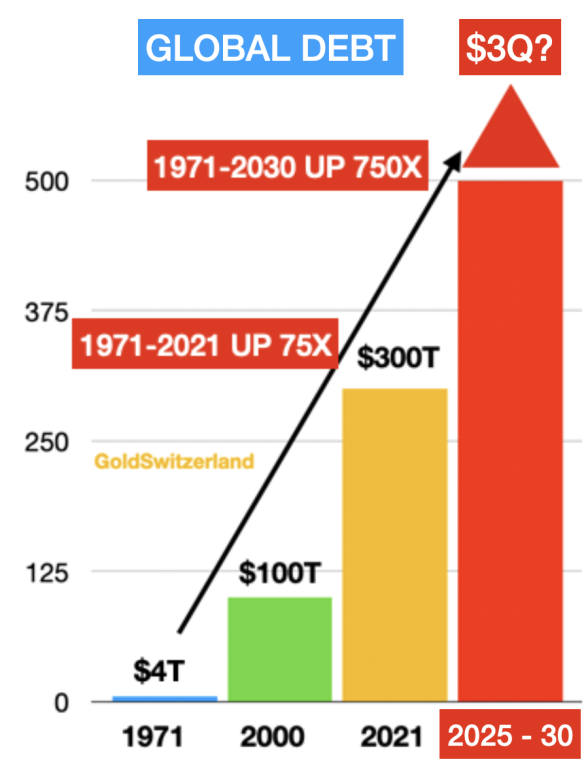
The red column shows global debt at $3 quadrillion sometime between 2025 and 2030.
This assumes that the shadow banking system plus outstanding derivatives of currently probably around $2 quadrillion will need to be saved by central banks in a money printing bonanza. This will obviously lead to hyperinflation and thereafter to a depressionary implosion.
I know this sounds sensational but still a very likely scenario at the end of the biggest credit bubble in history.
GOLD – CRITICAL WEALTH PRESERVATION
I have been standing on a soapbox for over 20 years, warning the world about the coming financial crisis and the importance of physical gold for wealth preservation purposes. In 2002 we invested important funds into physical gold with the purpose of holding it for the foreseeable future.
Between 2002 and 2011 gold went from $300 to $1,900. Since then gold corrected and then went sideways as stocks and the asset markets surged backed by massive credit expansion.
With gold currently around $1990, there is not much gain since 2011. Still since 2002 gold is up 7x. Due to the temporarily stronger dollar, gold’s gains measured in dollars are much smaller than in Euros, Pounds or Yen. But that will soon change.
In the final section of the article “WILL NUCLEAR WAR, DEBT COLLAPSE OR ENERGY DEPLETION FINISH THE WORLD?”, I outlined the importance of owning physical gold to store it in a safe jurisdiction away from kleptocratic governments.
“2023 is likely to be the year of gold. Both fundamentally and technically gold looks like it will make major up moves this year.”
And at the end of this article, I explain the importance of how and where gold should be held:“PREPARE FOR 10 YEARS OF GLOBAL DESTRUCTION.”
“So my own preference would be to own physical gold and silver that only I have direct control of and can withdraw or sell with very short notice.
It is also important to deal with a company that can move your metals at very short notice if the security or geopolitical situation would necessitate it.”
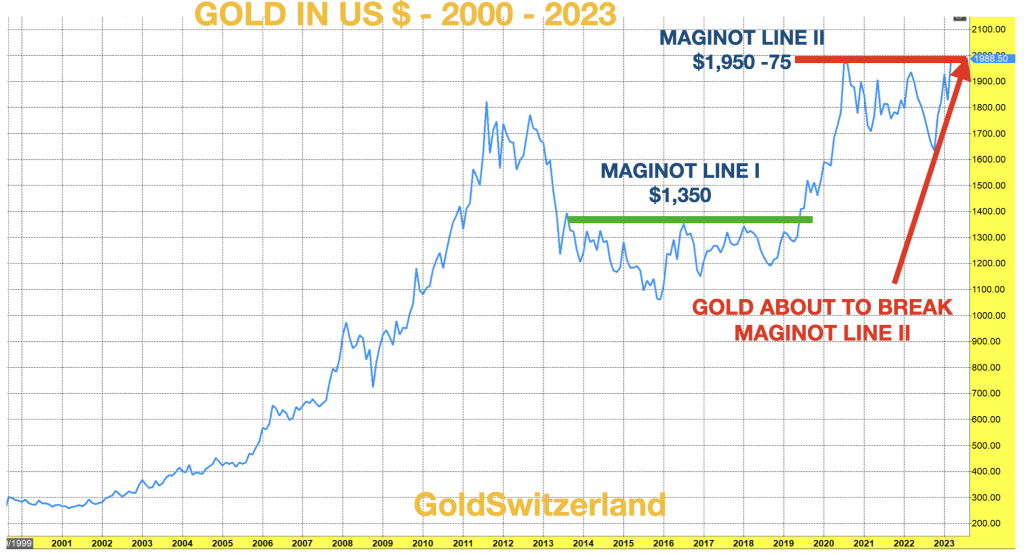
In February 2019 I wrote about what I called the Gold Maginot Line which had held for 6 years below $1,350. This is typical for gold. Having gone from $250 in 1999 to $1,900 in 2011, it then spent 8 years in a correction. At the time I forecast that the Maginot Line would soon break which it did and swiftly moved to $2,000 by August 2020. We have now had another period of consolidation since then and the next move above $2,000 and towards $3,000 is imminent.
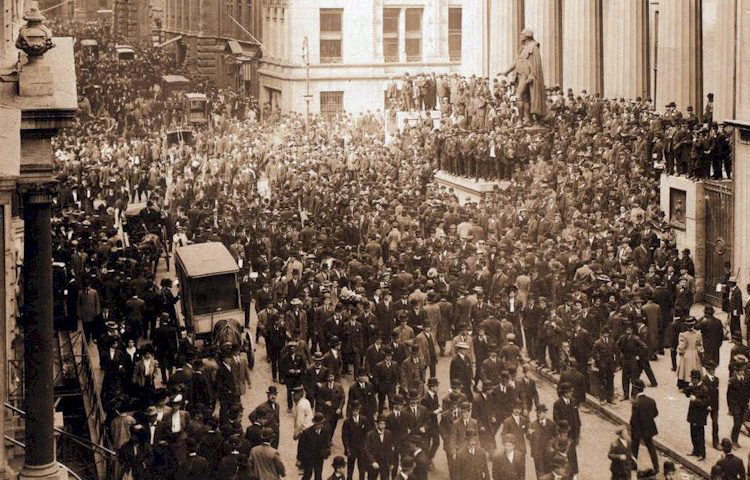
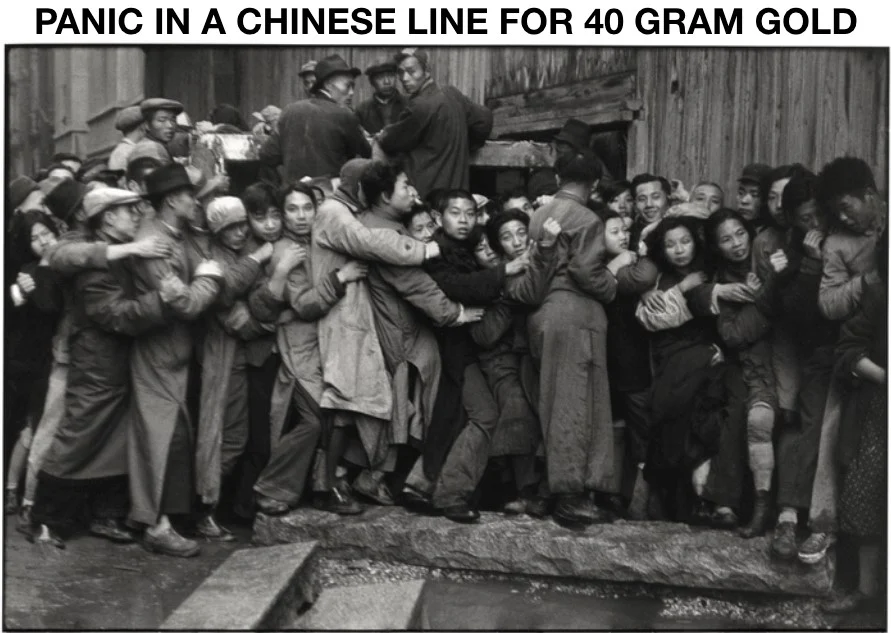
Just to remind ourselves what happens to your money and gold during a hyperinflationary period, here is a photo from China’s hyperinflation in 1949 as people try to get their 40 grammes (just over one ounce) that they were allocated by the government. At some point in the next few years, there will be a panic in the West to buy gold at any price.
So as I have been urging investors for over 20 years, please get your gold NOW while it is still available.
STOP PRESS
Intense discussions are right now going on here in Switzerland between UBS, Credit Suisse, the regulator FINMA, the Swiss National Bank – SNB – and the Swiss Government. The Fed, the Bank of England and the ECB are also involved.
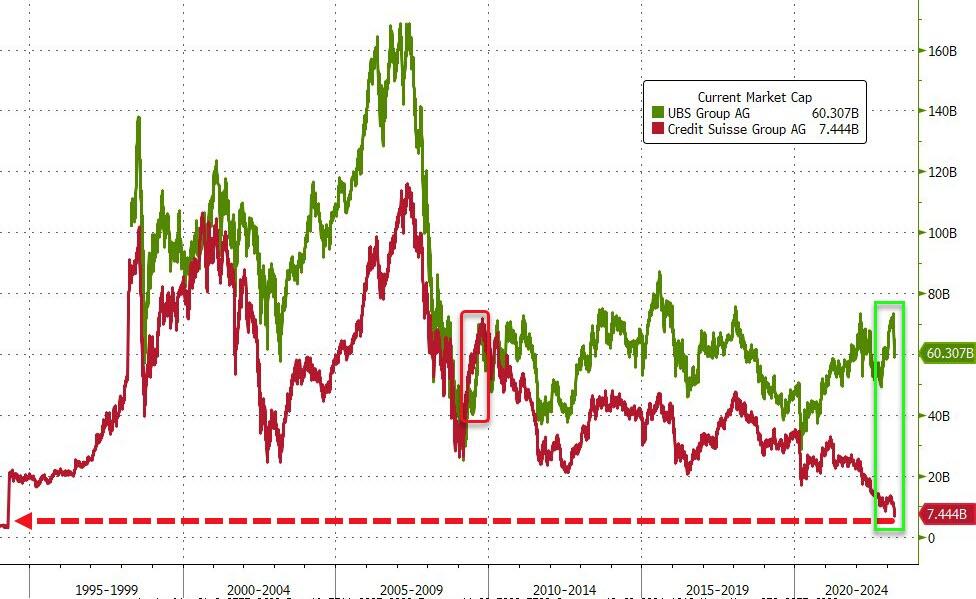
The latest rumour is that UBS will buy Credit Suisse for CHF900 million ($1 billion). The shares of CS closed at a market cap of CHF8 billion on Friday. The deal would clearly involve backing from the SNB and the Swiss government which would have to take on major liabilities.
The December 2022 book value of CS was CHF42 billion, as with all banks massively overstated.
The deal isn’t done at this point, 5.30pm Swiss time, but the whole banking world knows that without a deal, there will be global contagion starting tomorrow Monday the 20th.
Even if a provisional deal will be done by Monday’s open, the financial system has now been permanently injured with an open wound which won’t heal.
The problem will just move on to the next bank, and the next and the next….
Hold on to your seats but buy gold first.
END
23-03-18 19:40Section: Daily Dispatches
From The Telegraph, London
Sunday, March 19, 2023
https://www.telegraph.co.uk/opinion/2023/03/18/central-banks-have-pushed-us-precipice/
After the collapse of California’s Silicon Valley Bank left Prime Minister Rishi Sunak promising reporters a week ago there was “no systemic contagion risk,” here we are again.
Now the threat is even closer to home, with UBS in talks to take over all or part of Credit Suisse, in a deal brokered by a desperate Swiss government.
The sudden run on deposits at SVB was bad enough. It was the biggest U.S. lender to fail in more than a decade. Credit Suisse is in a different league altogether — one of only 30 banks worldwide classed as systemically important.
Already, there are warning signs that the move could threaten thousands of City jobs in London.
UBS has also made it clear it does not want to take on the full liabilities of Credit Suisse, asking the Swiss government for a backstop guarantee. The problem, of course, is that the combined balance sheet of the merged Swiss group would be much larger than Switzerland’s GDP — not a good place for a small country in the early stages of another global storm.
The fault for this slow-moving crisis is not hard to identify. Overconfident central banks and regulators, convinced of their godlike power to manage the world’s economy and keep it from danger, have once again pushed us to the precipice.
While individual banks deserve to face the consequences of their investment decisions, and directors, shareholders, and bondholders are ultimately responsible, it would be too easy to focus on their errors alone. The arrogance of financial regulatory authorities has helped to make the situation worse.
The immediate cause for the banks’ distress is a recent spate of interest rate hikes. The Federal Reserve in America runs annual stress tests on the banking sector to keep participants behaving responsibly. It emerged last week that, for the past decade, these tests have not assessed how banks would cope after a sudden, sharp rise in interest rates. False assurance in the system’s robustness came from the top down.
The impact of these hikes was then worsened by a regulatory system that assured financial institutions that government bonds such as U.S. Treasuries were the safest possible bet. Bond prices fall when rates rise, leaving any institution that swallowed the guidance nursing huge paper losses. That can be fine, unless these investments suddenly need to be turned into real money.
SVB appears an extreme example of where that advice could lead.
The interest rate rises that are now causing such havoc are themselves the result of earlier errors. Central banks decided that they had no choice but to act after inflation suddenly raged out of control last year, after decades of moderation.
Yes, Putin’s war of aggression in Ukraine played some role in this economic shock. But the greatest culprit was once again a bout of desperate ingenuity from the center. This time it was the extraordinary fiscal stimulus unleashed during the Covid pandemic. Worldwide, nearly $11 trillion was pumped into the system: a staggering 10% of global GDP.
Little wonder that our systems struggled to adjust in its aftermath.
Nor is this the beginning of the story. We have been living in the Alice-in-Wonderland world of easy money since 2008, or, arguably, since Alan Greenspan’s time at the Fed.
Quantitative easing and near-zero interest rates have kept the global economy on life support for a decade and a half. In this crisis too the ratings agencies proved asleep at the wheel. How can so few have realised the obvious: Interest rates that fall can also rise, and rise very quickly? Since when had the laws of finance and economics been repealed?
False confidence from regulators breeds instability. Interest rates need to be allowed to normalise from their artificially low levels so they can play their proper coordinating role in a free economy.
Yet in the brittle, artificial situation the gods of the central banks have created, every crisis produces more action and every action produces another crisis.
At some point we need to break the chain of failed interventions and acknowledge the limits to the power of central banks.
END
UBS offers to buy Credit Suisse for a pittance, nearly wiping out shareholders
Submitted by admin on Sun, 2023-03-19 09:08Section: Daily Dispatches
By Arash Massoudi, Stephen Morris, James Fontanella-Khan,
Laura Noonan and Owen Walker
Financial Times, London
Sunday, March 19, 2023
UBS has offered to buy Credit Suisse for up to $1bn, with Swiss authorities planning to change the country’s laws to bypass a shareholder vote on the transaction as they rush to finalise a deal before Monday.
The all-share deal between Switzerland’s two biggest banks is set to be signed as soon as this evening and will be priced at a fraction of Credit Suisse’s closing price on Friday, all but wiping out the target’s shareholders, four people with direct knowledge of the situation said.
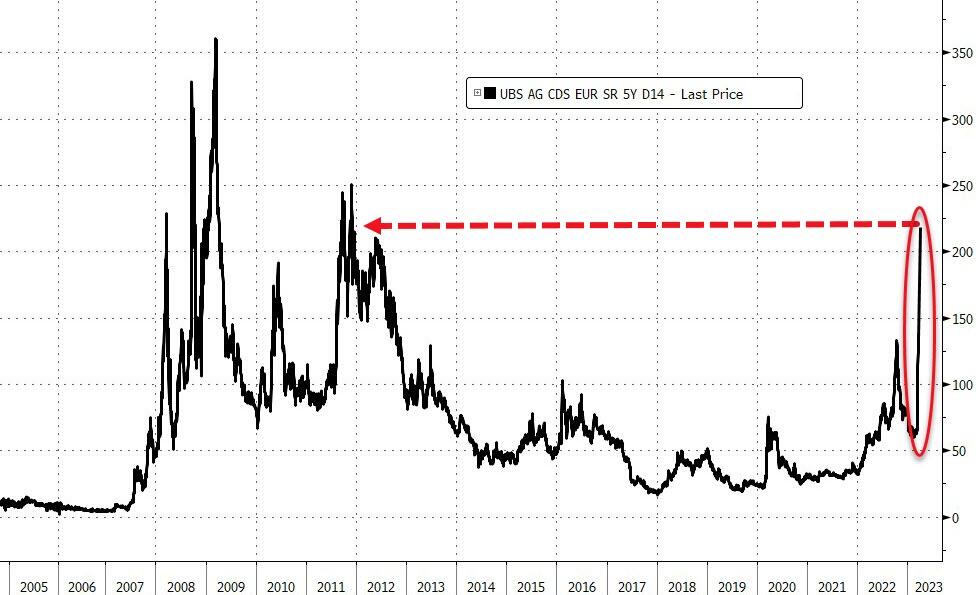
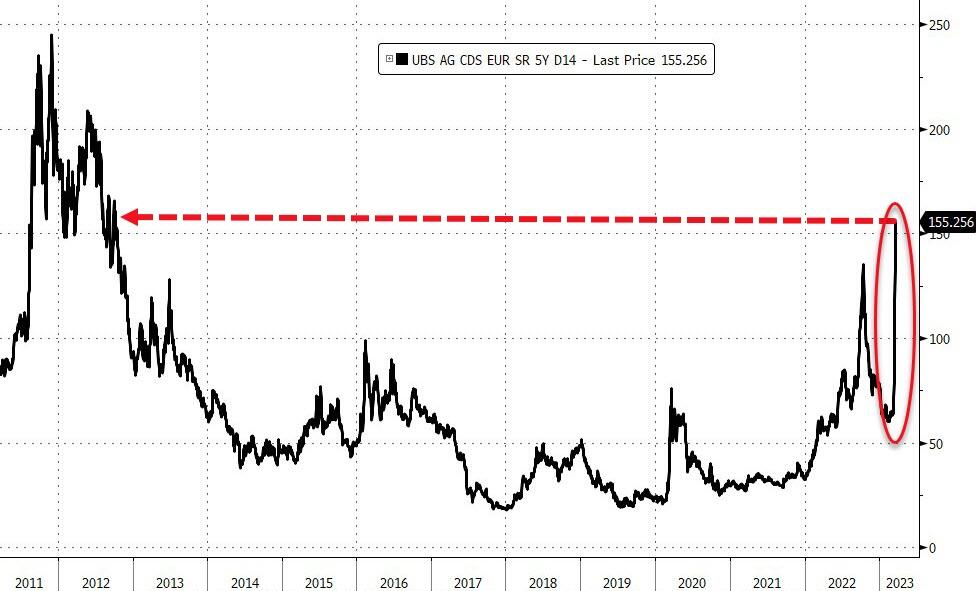
The offer was communicated this morning with a price of SFr 0.25 a share to be paid in UBS stock, far below Credit Suisse’s closing price of SFr 1.86 Friday, the people said. UBS has also insisted on a material adverse change that voids the deal if its credit default spreads jump by 100 basis points or more, they added. …
… For the remainder of the report:
https://www.ft.com/content/ec4be743-052a-4381-a923-c2fbd7ea9cfd
END
By doubling bid, UBS gets Credit Suisse and huge government credit line
Submitted by admin on Sun, 2023-03-19 13:53Section: Daily Dispatches
By Arash Massoudi, Stephen Morris, James Fontanella-Khan,
Laura Noonan, and Owen Walker
Financial Times, London
Sunday, March 19, 2023
UBS has agreed to buy Credit Suisse after increasing its offer to more than $2 billion, with Swiss authorities poised to change the country’s laws to bypass a shareholder vote as they rush to announce a deal before Monday.
The all-share deal between Switzerland’s two biggest banks is set to be announced as soon as this evening and will be priced at a fraction of Credit Suisse’s closing price on Friday, all but wiping out the target’s shareholders, three people with direct knowledge of the situation said.
UBS will now pay more than SFr 0.50 a share in its own stock, up from a bid of SFr 0.25 earlier today worth around $1 billion that was rejected by the Credit Suisse board, the people said.
But the price remains far below Credit Suisse’s closing price of SFr 1.86 on Friday.
The Swiss National Bank has agreed to offer a $100 billion liquidity line to UBS as part of the deal, according to two people familiar with the matter. …
… For the remainder of the report:
https://www.ft.com/content/ec4be743-052a-4381-a923-c2fbd7ea9cfd
end
Tanzania and India prepare to eliminate the uSA dollar in their bilateral trade
(Business Insider/Africa)//GATA
Tanzania and India prepare to eliminate U.S. dollar from their bilateral trade
Submitted by admin on Sun, 2023-03-19 09:44Section: Daily Dispatches
By Chinedu Okafor
Business Insider Africa
Lagos, Nigeria
Sunday, March 19, 2023
Tanzania and India have reached an agreement that will make the U.S. dollar no longer required for trade between the two nations.
Tanzania and India are able to conduct business using their respective currencies, the Tanzanian shilling and the Indian rupee, thanks to a bilateral trade settlement agreement.
According to data from the Indian High Commission in Dar es Salaam, the value of trade between the two countries was $4.5 billion (roughly Sh 10.4 trillion) in the year ending March 2022. India is one of Tanzania’s largest trading partners.
According to Binaya Pradhan, the Indian high commissioner to Tanzania, between April 2021 and March 2022 India’s exports to Tanzania totaled $2.3 billion (or about Sh 5.3 trillion), while its imports from the East African country were estimated to be $2.2 billion (about Sh 5.1 trillion).
He claimed that Tanzanian businesses and banks have the chance to fully utilize the new framework to enable seamless payment in local currencies. …
… For the remainder of the report:
end
4. OTHER GOLD/SILVER RELATED COMMENTARIES/
END
5.IMPORTANT COMMENTARIES ON COMMODITIES:
GLOBAL COMMODITIES ISSUES/FOOD IN GENERAL
6.CRYPTOCURRENCY COMMENTARIES/
end
1. YOUR EARLY CURRENCY/GOLD AND SILVER PRICING/ASIAN AND EUROPEAN BOURSE MOVEMENTS/AND INTEREST RATE SETTINGS//MONDAY MORNING.7:30 AM
ONSHORE YUAN: CLOSED UP TO 6.8795
OFFSHORE YUAN: 6.8802
SHANGHAI CLOSED DOWN 15.64 PTS OR 0.48%
HANG SENG CLOSED DOWN 517.88 PTS OR 2.65 %
2. Nikkei closed DOWN 388.12 PTS OR 1.42%
3. Europe stocks SO FAR: ALL GREEN
USA dollar INDEX DOWN TO 103.09 Euro RISES TO 1.0707 UP 54 BASIS PTS
3b Japan 10 YR bond yield: FALLS TO. +.217!!(Japan buying 100% of bond issuance)/Japanese YEN vs USA cross now at 131.02/JAPANESE YEN FALLING AS WELL AS LONG TERM 10 YR. YIELDS RISING //EVENTUALLY THIS WILL BREAK THE JAPANESE CENTRAL BANK.
3c Nikkei now ABOVE 17,000
3d USA/Yen rate now well ABOVE the important 120 barrier this morning
3e Gold DOWN /JAPANESE Yen UP CHINESE YUAN: UP-// OFF- SHORE: UP
3f Japan is to buy INFINITE TRILLION YEN’S worth of BONDS. Japan’s GDP equals 5 trillion usa
Japan to buy 100% of all new Japanese debt and NOW they will have OVER 50% of all Japanese debt.
3g Oil DOWN for WTI and DOWN FOR Brent this morning
3h European bond buying continues to push yields lower on all fronts in the EMU. German 10yr bund DOWN TO +2.0585%***/Italian 10 Yr bond yield FALLS to 4.003%*** /SPAIN 10 YR BOND YIELD FALLS TO 3.180…** DANGEROUS//
3i Greek 10 year bond yield RISES TO 4.056//
3j Gold at $1985,00//silver at: 22.48 7 am est) SILVER NEXT RESISTANCE LEVEL AT $30.00
3k USA vs Russian rouble;// Russian rouble DOWN 0 AND 16/100 roubles/dollar; ROUBLE AT 76.90//
3m oil into the 65 dollar handle for WTI and 72 handle for Brent/
3n Higher foreign deposits out of China sees huge risk of outflows and a currency depreciation. This can spell financial disaster for the rest of the world/
JAPAN ON JAN 29.2016 CONTINUES NIRP. THIS MORNING RAISES AMOUNT OF BONDS THAT THEY WILL PURCHASE UP TO .5% ON THE 10 YR BOND///YEN TRADES TO 132.56/10 YEAR YIELD AFTER BREAKING .54%, FALLS TO .217% STILL ON CENTRAL BANK (JAPAN) INTERVENTION
30 SNB (Swiss National Bank) still intervening again in the markets driving down the FRANC. It is not working: USA/SF this 0.9270– as the Swiss Franc is still rising against most currencies. Euro vs SF 0.9926well above the floor set by the Swiss Finance Minister. Thomas Jordan, chief of the Swiss National Bank continues to purchase euros trying to lower value of the Swiss Franc. CREDIT SUISSE IN TROUBLE
USA 10 YR BOND YIELD: 3.380% DOWN 2 BASIS PTS…GETTING DANGEROUS//
USA 30 YR BOND YIELD: 3.609 UP 1 BASIS PTS//INVERTED TO THE 10 YEAR!!
USA 2 YR BOND YIELD: 3.753 DOWN 9 BASIS PTS
USA DOLLAR VS TURKISH LIRA: 19.02…
GREAT BRITAIN/10 YEAR YIELD: 3.271% DOWN 1 BASIS PTS
end
i.b Overnight: Newsquawk and Zero hedge:
FIRST, ZEROHEDGE (PRE USA OPENING// MORNING
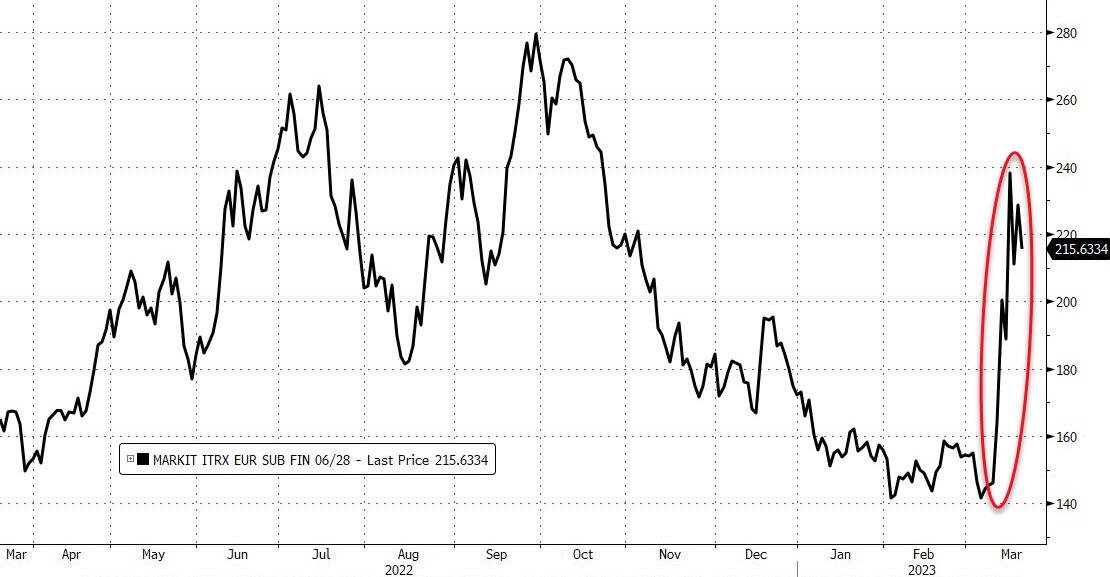
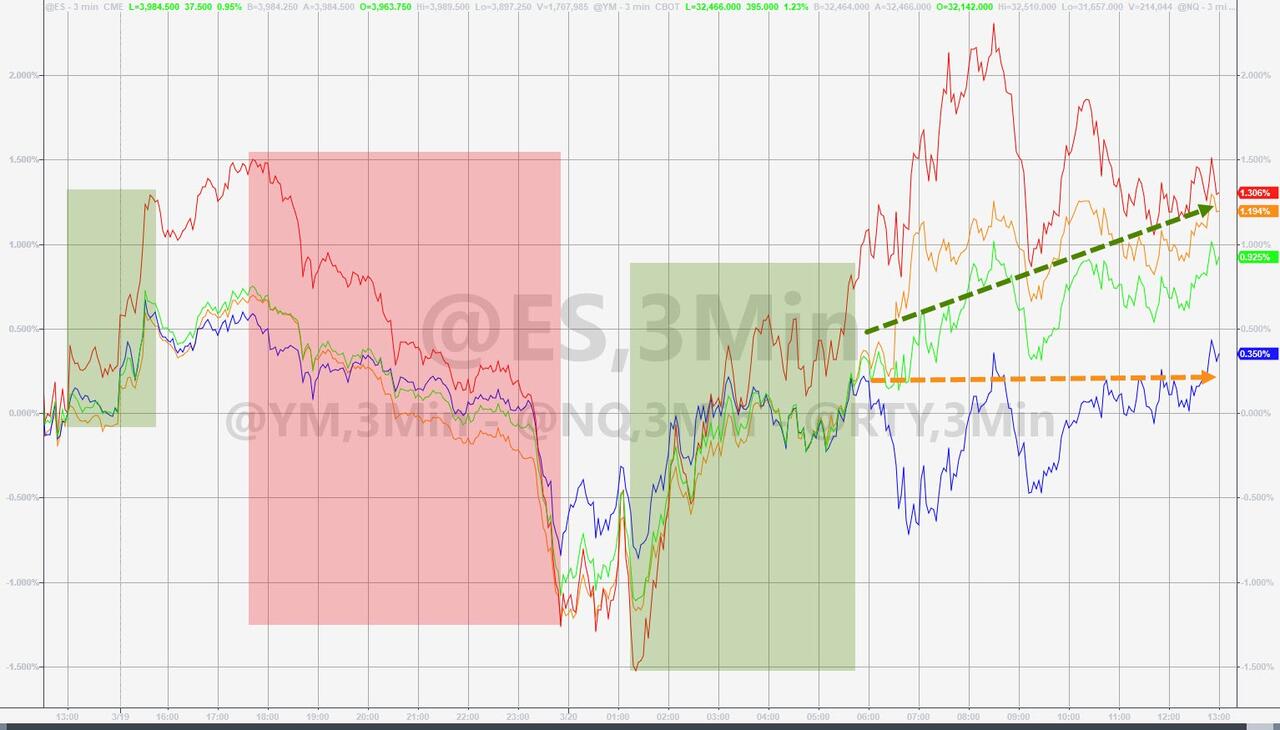
Futures Reverse Overnight Plunge As European Banks Stabilize From Historic Rout
MONDAY, MAR 20, 2023 – 08:03 AM
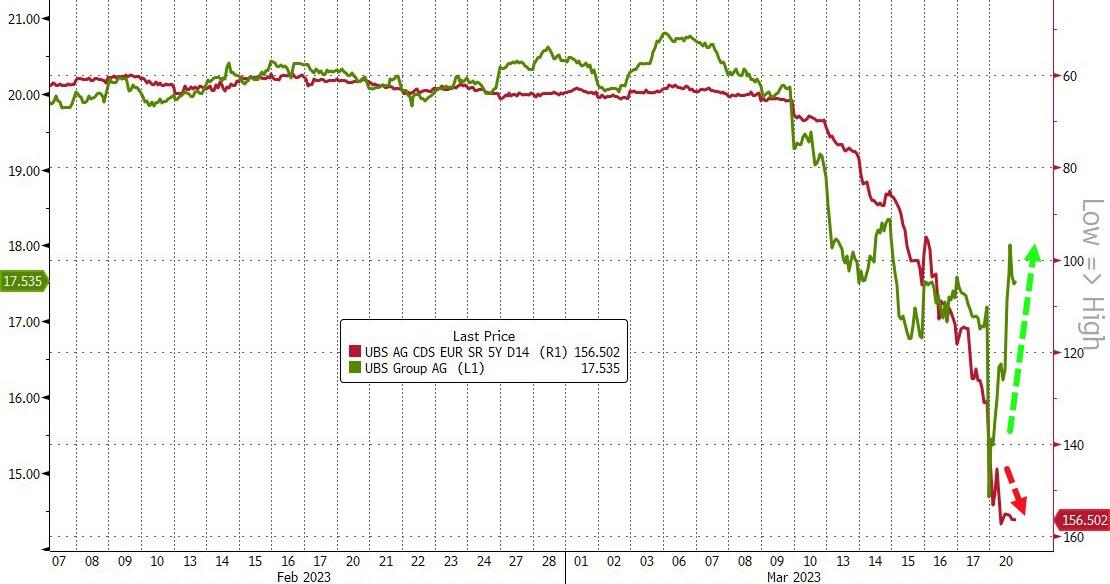
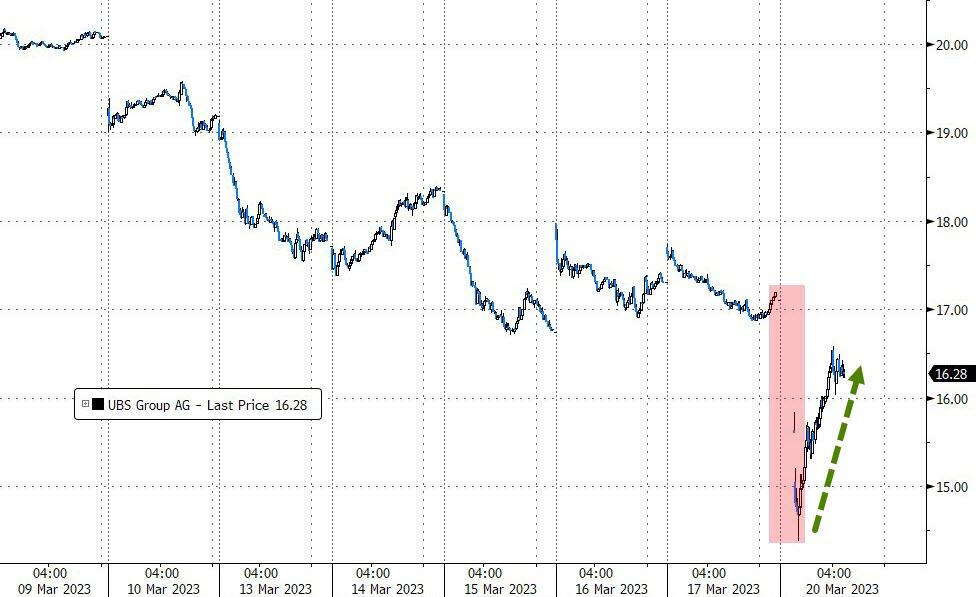
US equity futures, global markets and European bank stocks have stabilized, rebounding off worst levels which saw Europe’s brand new banking megagiant UBS plunge as much as 16% before recouping most of the losses…
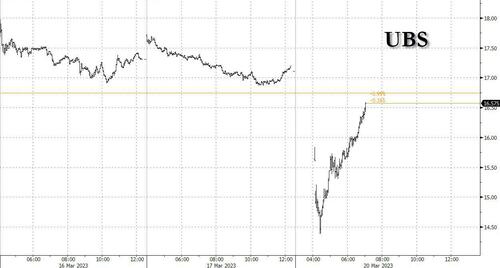
… as investors digested UBS’s agreement to buy Credit Suisse as well as central bank moves to boost dollar liquidity in an effort to restore confidence in the global financial system. Futures contracts on the S&P 500 were little changed at 7:30 a.m. ET after tumbling 1% earlier. The Stoxx Europe 600 index was modestly higher, with banks and financial services still the sharpest fallers. UBS shares sank as much as 16%, while Credit Suisse sank 60%. European bank stocks pared losses with the Stoxx Europe 600 Banks Index down less than 1%, after after dropping as much as 6%. A gauge of Asian shares fell by more than 1%.
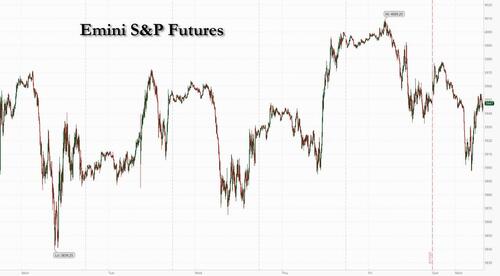
In premarket trading, First Republic Bank was poised to extend last week’s record loss as the US lender’s shares plunged 19% after S&P cut its credit rating again. Wells Fargo and Citigroup trimmed US premarket declines. Gold-mining stocks rallied in premarket trading on Monday, after a $3.2 billion deal between UBS and troubled lender Credit Suisse failed to calm nerves in the banking industry, knocking risk appetite. Newmont, the biggest US-listed gold miner, gains as much as 2.6%; Harmony Gold Mining +5.6%, Gold Fields +2.2%, New Gold +3.4%, Wheaton Precious Metals +1.5%, First Majestic Silver +2%, Pan American Silver +0.7%. The price of gold rose above $2,000 an ounce for the first time in a year amid safe-haven appeal. Here are some other notable premarket movers:
- Cryptocurrency-exposed stocks rise after Bitcoin extended its gains for a fifth consecutive session, with the digital asset reaching levels not seen in about nine months. Marathon Digital (MARA US) +5.6%, Riot Platforms (RIOT US) +8% and Coinbase (COIN US) +4.2%
- Energy stocks decline as investors’ concern about the banking system spur broad risk aversion and drag crude prices lower. Exxon Mobil (XOM US) slid 1.3%, Chevron (CVX US) -1.1%, Occidental Petroleum (OXY US) -1.1%.
For those who were lucky enough to be away from their computers this weekend, this is what you missed:
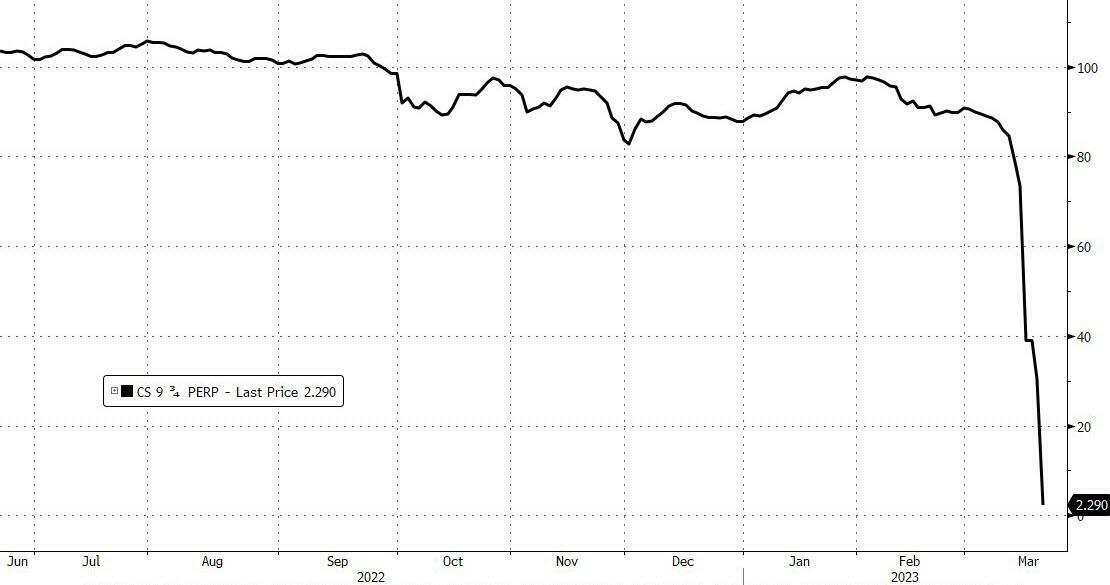
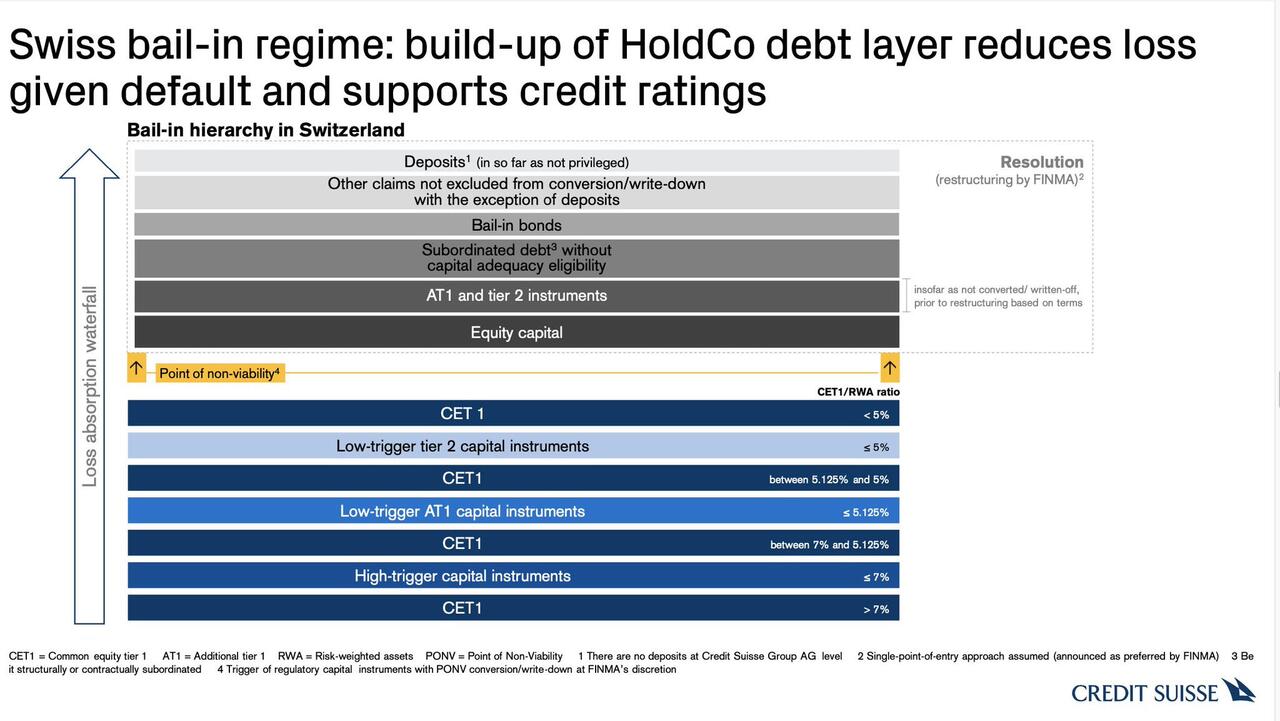
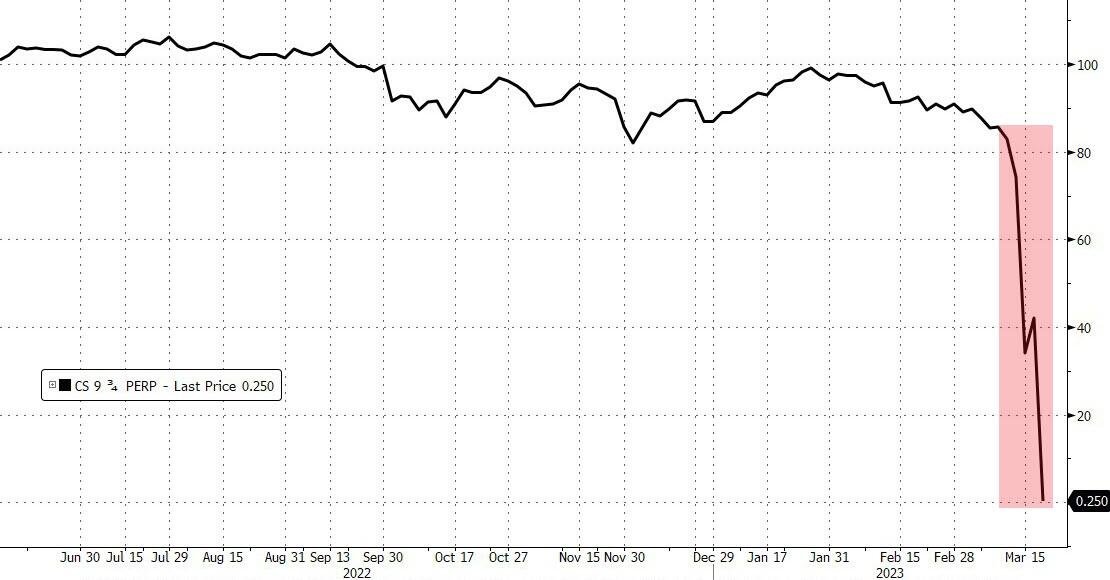
- Credit Suisse shareholders will receive 1 share in UBS (UBSN SW) for 22.48 shares in Credit Suisse which reflects a merger consideration of CHF 3bln and that FINMA determined that Credit Suisse’s additional tier 1 capital in the aggregate nominal amount of around CHF 16bln will be written off. Credit Suisse also told staff in a memo that the details of the transaction are being worked through and no disruption to client services is expected, while it told staff there will be no changes to payroll arrangements and bonuses will still be paid on March 24th.
- UBS said the company will suspend share buybacks and that they did not initiate the discussions but believe the transaction is financially attractive to UBS shareholders and are planning to de-risk and downsize Credit Suisse’s investment banking operations. UBS also noted its strategy is unchanged in US and APAC and said that Credit Suisse is quite complementary to the wealth business in Southeast Asia. Furthermore, Colm Kelleher will be Chairman and Ralph Hamers will be Group CEO of the combined entity, while the transaction is not subject to shareholder approval and there is a material adverse change clause on the Credit Suisse deal.
- SNB said it is providing substantial liquidity assistance to support the UBS takeover of Credit Suisse and the takeover was made possible with the support of the Swiss federal government, FINMA and SNB, while it added that both banks have unrestricted access to the SNB’s existing facilities. There were also comments from the Swiss Finance Minister that this is a commercial solution and not a bailout, while she noted the cost of bankruptcy to the Swiss economy would have been huge.
- ECB said it welcomes the swift actions and decisions taken by Swiss authorities and noted that the Euro area banking sector is resilient with strong capital and liquidity positions. ECB’s Lagarde also stated that the ECB’s policy toolkit is fully equipped to provide liquidity support to the euro area financial system if needed.
- BoE said it welcomes the comprehensive actions by the Swiss authorities to merge UBS and Credit Suisse, while it has been engaging with international counterparts throughout preparations for the announcement. Furthermore, it stated that the UK banking system remains safe and sound and is well-capitalised and funded.
- Fed Chairman Powell and US Treasury Secretary Yellen said they welcome the announcements by Swiss authorities to support financial stability and noted the capital and liquidity positions of the US banking system are strong and US financial system resilience is strong. Furthermore, they have been in close contact with international counterparts to support their implementation.
- At least two major banks in Europe are examining scenarios of contagion potentially spreading across Europe’s banking sector and looking to the Fed and ECB to step in with stronger signals of support, according to Reuters citing executives with knowledge of the deliberations.
- Banking stocks and bonds plummeted after UBS Group sealed a state-backed takeover of troubled peer Credit Suisse, a deal that was shoved down Credit Suisse investors’ throats – literally – in an attempt to restore confidence in a battered sector.
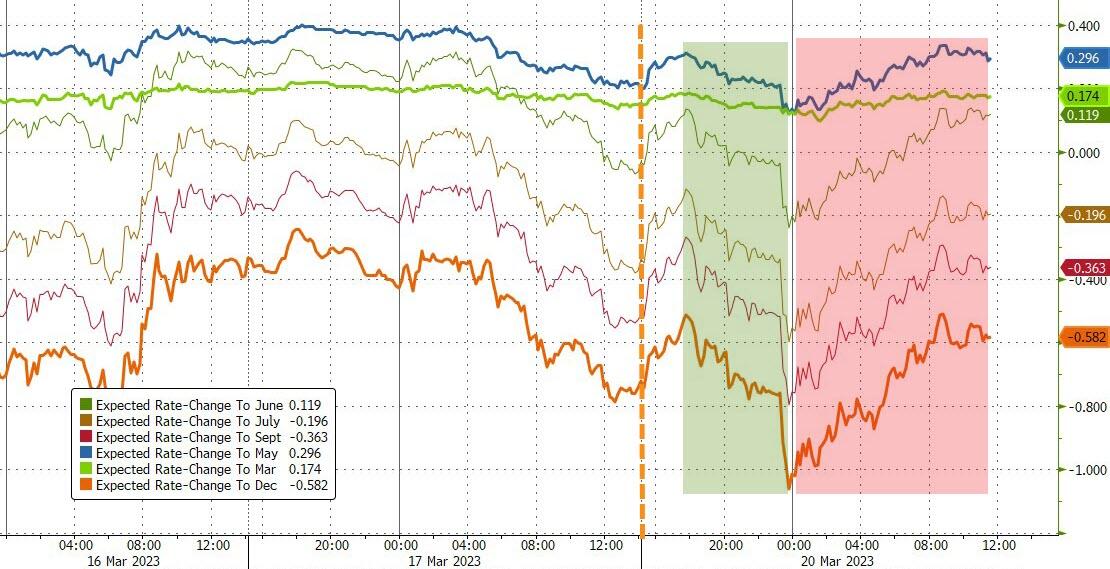
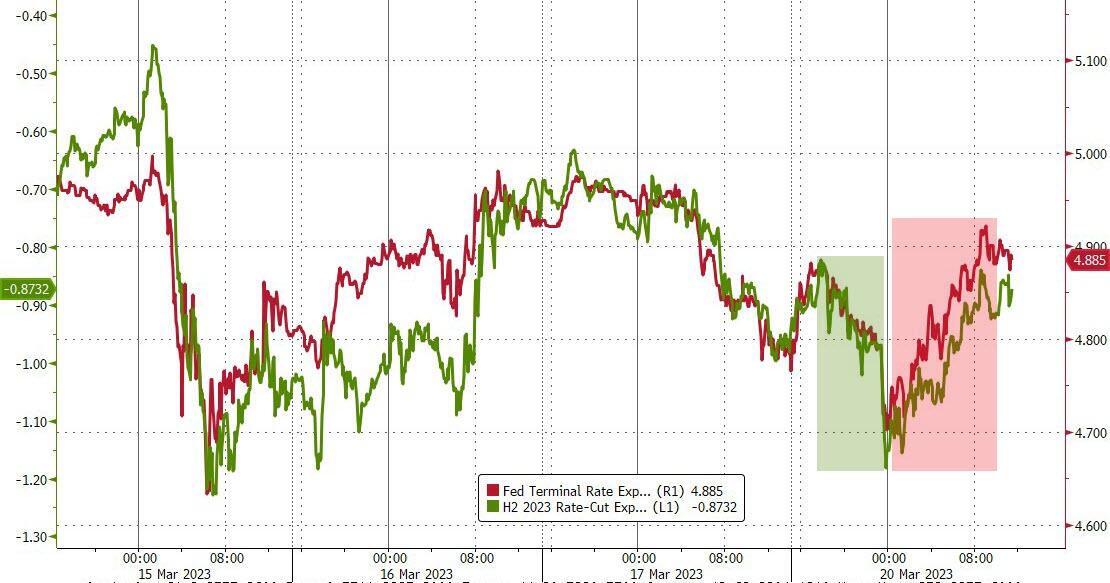
- The Federal Reserve and five other central banks announced coordinated action on Sunday to boost liquidity in US dollar swap arrangements. The Fed’s next policy decision is due later this week, with market attention on whether it may slow or pause interest-rate hikes.
- UBS emerged as Switzerland’s one and only global bank, a risky bet that makes the Swiss economy more dependent on a single lender. Credit Suisse told staff its wealth assets are operationally separate from UBS for now, but once they merged clients might want to consider moving some assets to another bank if concentration was a concern.
- The rudest shock in the rushed deal was reserved for the holders of Credit Suisse’s riskiest tranche of bonds. UBS is salvaging the most value from the wreckage, says Breakingviews columnist Liam Proud.
- Hedge fund managers and other large investors believe it is far too soon to call an all-clear on turmoil in the global financial sector.
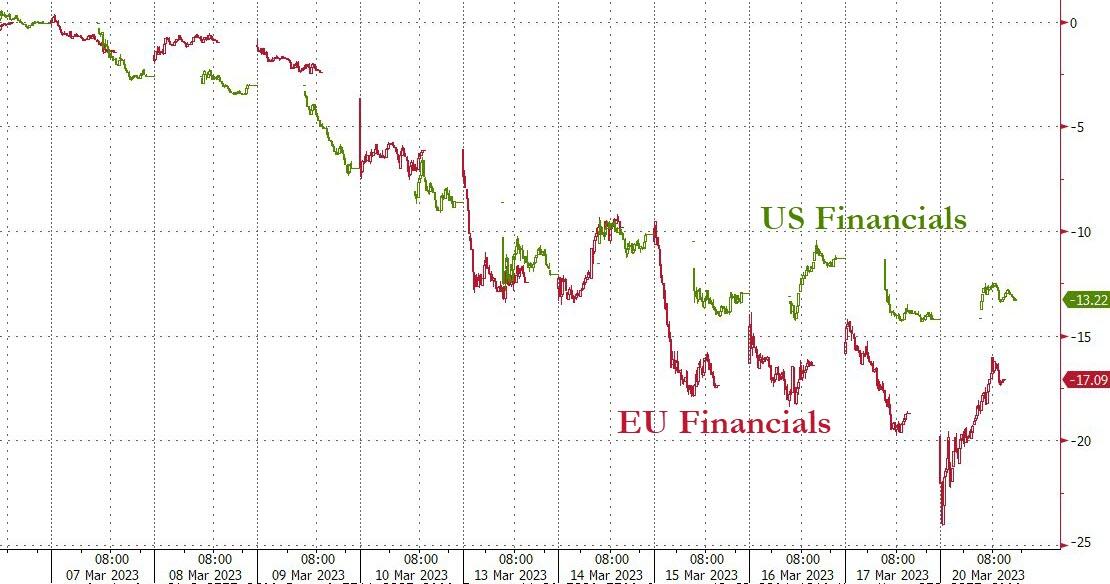
Amid the endless turmoil, the KBW Bank Index plunged 28% over the past two weeks, with financials rattled by concerns over Credit Suisse as well the recent failures of Silicon Valley Bank and two other US lenders. Gains in tech stocks have helped support the overall market, however, as investors look for a safe haven.
“The turmoil still has at least a couple of days to play out, and only the Fed can come in and calm that,” Chris Beauchamp, chief market analyst at IG Group Holdings Plc, said on Bloomberg Television. He expects the US central bank to hike rates by 25 basis points as a pause would be interpreted by markets as a sign that the stress in banks is bigger than initially thought.
“Assuming these banking stresses do not evolve into something more serious, the European Central Bank and the Fed may perceive that they are at or near their objectives with current policy,” said Brad Tank, chief investment officer for fixed income at Neuberger Berman. “The Fed, in particular, is further along in its tightening cycle and should have more flexibility to pause — and markets are indeed pricing for 2023 fed funds rate cuts once again.”
Meanwhile, one day after he revealed his shock that stocks remain resilient and just under 4,000 despite calling for a crah for the past 3 months, Morgan Stanley’s Michael Wilson said the stress in the banking system marks what’s likely to be the beginning of a painful and “vicious” end to the bear market in US stocks, adding that the risk of a credit crunch has increased materially. The S&P 500 will remain unattractive until equity risk premium climbs to as high as 400 basis points from the current 230 level, according to the bearish strategist who two weeks ago flip-flopped briefly to bullish before getting rugpulled by the banking crisis.
European stocks are higher after reversing the negative knee-jerk reaction to the terms of the UBS takeover of Credit Suisse. The Stoxx 600 is up 0.6% as gains in utilities, miners and consumer products outweigh declines in bank stocks. European oil stocks declined as investors’ concern about the potential for a global banking crisis spur broad risk aversion and drag crude prices lower. The Stoxx Europe 600 Energy index slid 1%; among oil majors, Shell declined 1.5%, TotalEnergies -1.3%, and BP -0.6%. Smaller producers also dropped with Harbour Energy falling 5.7% and Tullow Oil -7.7%. Here are the biggest European movers:
- UBS shares drop as much as 16%, the most in eight years, after a government-brokered deal for it to buy rival Credit Suisse prompted a slew of downgrades
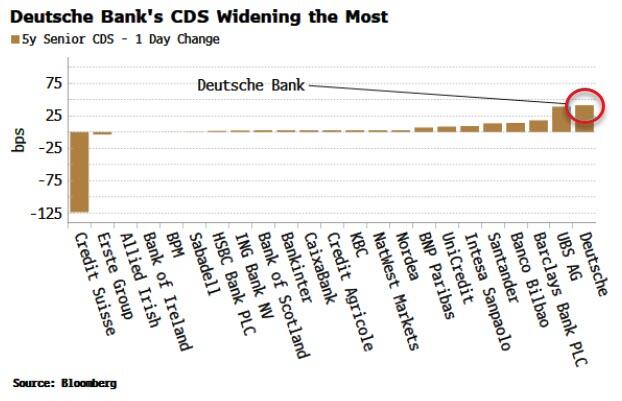
- Deutsche Bank declines 11%, ING -9.6%, Commerzbank -9.6%, Standard Chartered -8.7%, BNP Paribas -9% following UBS’s agreement to buy Credit Suisse
- El.En shares slide as much as 9.6% after Berenberg downgrades the laser- equipment maker to hold from buy, saying the company has a “tough year ahead”
- JM AB falls as much as 7.7% after DNB Markets gave the Swedish construction and building management company its sole sell rating in reinstated coverage
- Centamin shares rise as much as 6.6%, Endeavour Mining up as much as 7.2% and Fresnillo rises as much as 4.1% as gold gains owing to haven demand amid banking concerns
Earlier in the session, Asian stocks declined as the UBS takeunder failed to quell investor concerns about the health of the global financial system. The MSCI Asia Pacific Index fell as much as 1.4%, reversing most of its gain from Friday, with tech and financial names among the biggest drags. Hong Kong gauges led losses in the region as financial stocks including HSBC and AIA Group fell due to worries over risky bond exposures. While the takeover of Credit Suisse is seen to reduce the immediate systemic risk for the banking sector, investors are worried over further repercussions from its bonds. Traders are also focused on the Federal Reserve’s rate decision later this week.
“Even with the rescue plans over the weekend, it is hard to predict what will happen in the near future,” said Ayako Sera, a market strategist at Sumitomo Mitsui Trust Bank Ltd. “The measures to restore confidence in banks and to tame inflation go in opposite directions, and the dilemma is reducing risk appetite in the stock market.” China’s onshore equity benchmark erased earlier gains even after its central bank unexpectedly cut the reserve requirement ratio late Friday. The PBOC’s announcement timing “seems to fall in line with recent global banking jitters, which suggests that the PBOC is on high alert to provide any cushion against any knock-on impact from recent turmoil,” said Jun Rong Yeap, market strategist at IG Asia
In FX, the Bloomberg Dollar Spot Index steadied, erasing a decline of as much as 0.2% earlier while the Japanese yen is the best performer among the G-10’s. The New Zealand dollar is the weakest. Australia and New Zealand’s currencies flipped to losses amid souring risk sentiment.
“Traders are looking for haven assets again with bank stocks falling, and worries about CoCo bonds gaining momentum,” Mingze Wu, a foreign exchange trader at StoneX Group, said of contingent convertible bonds. “The insistence of the Swiss National Bank to make the UBS-Credit Suisse deal happen suggests the rot was deeper and greater than they might have thought, and the dollar is an obvious beneficiary of this rush to safety”
In rates, the nervous start to the trading week prompted a flight to safety, with German and UK government bonds rallying. 2-year TSY yield fell as much as 21bps to 3.63%, while its 10- year peer slid to as low as 3.29%, the lowest since September; traders bet on 15bps of Fed hikes this week but eased tightening beyond by as much as 12bps, pricing 105bps of cuts from the peak in May through to year-end. Bund futures are off their best levels but still in the green with 10-year yields down 4bps while two-year yields fall 8bps.
In commodities, oil prices fell again with West Texas Intermediate briefly plunging below $65 a barrel, as escalating investor concerns about a global banking crisis eroded appetite for risk assets including commodities. Gold steadied, after rising above $2,000 an ounce for the first time in a year.
Bitcoin remains bid and has extended comfortably above the USD 28k handle for the first time since June, though is yet to convincingly breach USD 28.5k to the upside.
There is nothing scheduled on the macro calendar today but there will be plenty of bank related newsflow.
Market Snapshot
- S&P 500 futures down 0.1% to 3,943.50
- MXAP down 1.1% to 155.86
- MXAPJ down 1.4% to 498.89
- Nikkei down 1.4% to 26,945.67
- Topix down 1.5% to 1,929.30
- Hang Seng Index down 2.7% to 19,000.71
- Shanghai Composite down 0.5% to 3,234.91
- Sensex down 1.3% to 57,214.31
- Australia S&P/ASX 200 down 1.4% to 6,898.51
- Kospi down 0.7% to 2,379.20
- STOXX Europe 600 up 0.6% to 438
- German 10Y yield little changed at 1.95%
- Euro down 0.3% to $1.0641
- Brent Futures down 3.8% to $70.18/bbl
- Gold spot up 0.8% to $2,005.59
- U.S. Dollar Index up 0.17% to 103.88
Top Overnight News from Bloomberg
- The Federal Reserve and five other central banks announced coordinated action Sunday to boost liquidity in US dollar swap arrangements, the latest effort by policymakers to ease growing strains in the global financial system.
- UBS Group AG shares slumped Monday as investors digested the news of its historic acquisition of rival Credit Suisse Group AG and began to assess the job of integrating the troubled Swiss lender.
- The riskiest bonds of European lenders are plunging after holders of Credit Suisse Group AG’s contingent convertible securities suffered a historic loss as part of its takeover by UBS Group AG.
A more detailed look at global markets courtesy of Newsquawk
Asia-Pac stocks were on the back foot amid ongoing banking sector jitters despite the announcement that UBS will take over Credit Suisse in an emergency rescue valued at CHF 3bln which would wipe out CHF 16bln of additional tier 1 bonds. ASX 200 extended its retreat from a recent break beneath 7,000 with declines led by weakness in the energy, real estate, consumer and financial sectors, although gold miners were boosted after last week’s climb in the precious metal. Nikkei 225 was pressured amid the banking sector woes and after the BoJ’s Summary of Opinions provided little in the way of new information whereby it reiterated that the BoJ must patiently maintain monetary easing. Hang Seng and Shanghai Comp. were varied with Hong Kong underperforming on broad weakness across sectors, while the mainland was kept afloat for most of the session after Friday’s surprise RRR cut by the PBoC in an effort to boost liquidity and support the economy, but opted to maintain its benchmark lending rates.
Top Asian News
- PBoC 1-Year Loan Prime Rate (Mar) 3.65% vs. Exp. 3.65% (Prev. 3.65%); 5-Year Loan Prime Rate (Mar) 4.30% vs. Exp. 4.30% (Prev. 4.30%)
- PBoC warned the collapse of Silicon Valley Bank shows rapid monetary policy shifts in developed economies are having a hazardous impact on financial stability, according to Bloomberg citing comments from Deputy Governor Xuan.
- PBoC adviser Cai said China needs household stimulus to boost the recovery and noted that residents’ incomes have not grown well in the past few years, so the recovery in consumption is not enough to support economic growth, according to Caijing.
- Russian President Putin said he expects total trade volume with China to exceed USD 200bln this year and it is important to increase the share of trade with China conducted in national currencies, according to Reuters.
- WHO advisers urged China to release all information related to the origin of the COVID-19 pandemic after new findings were briefly shared on an international database to track pathogens, while they recommended researchers in China investigate upstream sources of animals and animal products present in the Huanan Market before January 1st 2020, according to Reuters.
- BoJ Summary of Opinions from the March meeting stated that the BoJ must patiently maintain monetary easing until the price target is achieved and the BoJ must scrutinise without any preset idea the state of market function but must maintain easy policy at present. Furthermore, it stated the BoJ must focus on the risk of losing the chance to meet the price target with a premature policy shift, rather than the risk of being too late in shifting policy and must be mindful of the risk inflation may overshoot expectations.
European bourses are mixed/flat, as marked banking-led pressure has eased throughout the morning following the initial reaction to the UBS-Credit Suisse merger. On this, Credit Suisse and UBS opened lower by over 60% and 8% respectively, but have since eased off lows with the broader SX7P index now ~2% lower vs downside of over 5% at worst. On the merger, attention is on Credit Suisse’s AT1 bonds being written off; a detail which pressured such bonds in APAC trade, with HSBC for instance a notable initial laggard on this. Since, we have seen European regulators reiterate that CET instruments are the first to absorb losses, with AT1 only required after their full use. Stateside, futures are in similar proximity to the unchanged mark given the above as participants await updates around First Republic and look ahead to the FOMC.
Top European News
- BoE’s plans to revamp bank capital rules risk a 25% reduction in lending to small businesses which threatens jobs and economic growth, according to a study by consultants Oxera cited by FT.
- PoliticsHomes’ Payne reminds that DUP MPs meet today to discuss their stance on Wednesday’s Windsor Framework vote, expected to announce their stance on Tuesday.
- Moody’s affirmed Greece at Ba3; Outlook revised to Positive from Stable and affirmed Luxembourg at AAA; Outlook Stable, while S&P affirmed Belgium at AA; Outlook Stable.
FX
- The DXY has struggled to benefit from the subdued start to the session, with the index near the mid-point of 103.68-103.96 parameters for much of the morning.
- Given the tone, the JPY is the standout outperformer with USD/JPY down to 130.55 vs 132.64 peak; though, given the relative pickup in equity performance USD/JPY is now holding above 131.00.
- Despite the subdued risk tone, CHF is the underperformer as the market’s focus remains on Credit Suisse/UBS; USD/CHF above 0.93 and EUR/CHF above 0.99.
- Given their high-beta status, the Antipodeans are also faring poorly with RBA minutes and Kiwi trade data scheduled ahead.
- Elsewhere, peers are comparably more contained with EUR/USD holding above 1.0650 and Cable near 1.22.
- PBoC set USD/CNY mid-point at 6.8694 vs exp. 6.8701 (prev. 6.9052)
Fixed Income
- EGBs and USTs are benefitting from marked haven demand, with Bunds over 140.00 and USTs nearing 117.00 at best, though the benchmarks have eased from highs as equity sentiment improves.
- Specifically, Bunds soared to a 140.30 peak vs 137.10 low, but have since pulled back to just below 140.00 as the associated 10yr yield slipped to a 1.92% intraday low.
- Stateside, USTs are similar in both direction and magnitude with yields lower across the curve and action more pronounced in the short-end currently; as it stands, market pricing via Reuters is leaning towards the Fed leaving rates unchanged on Wednesday, with around a 40% chance of a 25bp hike implied.
Commodities
- WTI and Brent are lower intraday given the broader risk tone and while they are off lows, are yet to stage a ‘recovery’ akin to that seen in equities; currently, the benchmarks are lower by circa. USD 2/bbl just above USD 64.12/bbl and USD 70.12/bbl respective lows.
- Spot gold surpassed USD 2000/oz, but failed to hang onto the level as the DXY makes its way back into positive territory and broader sentiment improves slightly while base metals are moving with equity sentiment and as such are turning incrementally firmer on the session.
- Iraq’s Oil Minister said his country is committed to OPEC’s agreed production rates and obliged some oil companies’ operations in the south to cut production to come in line with OPEC’s agreed rates, while it was also reported that Iraq and OPEC stressed the importance to coordinate to stabilise prices, according to Reuters.
- Iran set April Iranian light crude oil price to Asia at Oman/Dubai plus USD 2.50/bbl, according to Reuters.
- India plans to extend export restrictions on diesel and gasoline beyond March 31st, according to Reuters sources.
- TotalEnergies (TTE FP) said 34% of operational staff at its refineries and depots conducted a strike on Sunday morning in protest against the government’s move to raise the retirement age by two years, according to Reuters.
- Kuwait Oil Company declares a state of emergency re. an oil spill located in west Kuwait; production unaffected.
Geopolitics
- Russian President Putin visited Crimea on the 9th anniversary of its annexation from Ukraine and also visited Mariupol in the occupied Donetsk region of Ukraine, while he also met with the top command of Russia’s military operation in Ukraine at the Rostov-on-Don command post in southern Russia, according to Reuters.
- Russian President Putin said the visit by Chinese President Xi confirms the special character of the Russian-Chinese partnership and Russia is pinning big hopes on the visit, while he added Russia is expecting a powerful impulse to relations and that relations are at their highest ever point. Putin also said there are no limits or forbidden subjects in relations with China and he is grateful for China’s balanced line on events in Ukraine, as well as welcomes China’s willingness to play a constructive role in solving the Ukrainian crisis. Furthermore, Putin said that they are worried about dangerous actions that could undermine global nuclear security and Russia is open to a diplomatic settlement of the Ukraine crisis but rejects ultimatums, according to Reuters.
- Chinese President Xi said China has always taken an objective and impartial position on the situation in Ukraine and has made efforts to promote reconciliation and peace negotiations, according to Rossiiskaya Gazeta.
- ICC judge issued an arrest warrant for Russian President Putin over alleged war crimes related to ‘unlawful deportation’ of Ukrainian children, according to The Guardian. It was also reported that German Chancellor Scholz said ICC is an important institution that has been given a mandate through international treaties and noted that nobody is above the law which is becoming clear now, according to Reuters.
- Ukrainian President Zelensky’s Chief of Staff and several top security officials including the Defence Minister held a call with US counterparts to discuss military aid for Ukraine, according to Reuters.
- Ukrainian Infrastructure Minister said the Black Sea grain deal has been extended for 120 days which is longer than the 60-day touted by Russia, while a UN spokesman confirmed the extension of the export deal but didn’t specify the length of the renewal, according to Reuters.
- EU foreign policy chief Borrell said an agreement was reached on ways to implement an EU-backed deal on normalising ties between Serbia and Kosovo, while he added that the sides agreed to implement their respective obligations in good faith.
- Saudi Arabia’s King Salman invited Iranian President Raisi to visit Riyadh, while it was also reported that Iran’s Foreign Minister agreed to hold a meeting at the foreign minister level with Saudi Arabia and said that Iran has declared a readiness to reopen embassies. In other news, Iraq and Iran signed a deal to tighten their border security.
- South Korea said that North Korea fired a short-range ballistic missile off the east coast into the sea on Sunday which flew 800km before hitting a target and is a clear violation of the UN Security Council resolution. In relevant news, G7 foreign ministers said they regret inaction by the UN Security Council regarding North Korea’s missile tests and that the March 16th ICBM launch undermines international peace, according to Reuters.
- North Korea confirmed it conducted exercises aimed at improving tactical nuclear capability on March 18th-19th and said the US and South Korea are expanding joint military drills aimed at North Korea involving US nuclear assets and its exercises are meant to send strong warnings against US and South Korea. Furthermore, North Korean leader Kim said the country should be ready to conduct nuclear attacks at any time in a deterrence of war, according to KCNA.
US Event Calendar
- Nothing major scheduled
DB’s Jim Reid concludes the overnight wrap
This weekend felt like being transported back into 2007-2008 in many respects with a race-against-time deal between UBS and Credit Suisse being put together in full view of the market. The most remarkable thing about yesterday was the huge swings in Credit Suisse AT1s on a Sunday. Clips of the $17.3bn of outstanding CS AT1 bonds seemed to trade at both ends of a mid-20s to around 70c range as the outline of the UBS deal filtered through. It was eventually a shock that the AT1s were zeroed in the deal even as UBS eventually bought CS for $3.3bn, a firmly positive number. This was however less than half what they were worth at the close on Friday and down 99% from their peak pre-GFC.
The decisions to wipe out AT1 bondholders is going to be the biggest issue medium and longer-term for the European banking sector, especially when the company was bought with a positive value yesterday. It’s hard to argue with the morals of it but it will likely increase the cost of capital for banks which could lead to an additional tightening of lending conditions. So that c.$17bn of debt destruction could eventually be worth multiples of that to the wider European economy and in other regions too. Selected Asian AT1 securities are trading around 5-10% down as we type and HSBC equity is around -6% in Hong Kong so this serves as a benchmark for the European banking open.
The good news at the macro level is that the CS situation has been dealt with and there are no obvious European next shoes to drop at this stage. CS had been decoupled from the rest of the continents’ banking sector for months now and therefore was by far and away the weakest link when the US regional banking woes began less than 2 weeks ago. So the market has now got to balance the reduction of systemic risk with the likely higher cost of some forms of bank capital. There will also be nervousness as to how easy it was to change laws and market conventions in order to get this deal done. Some risk premium will surely be factored in to the cost of capital for the sector now.
Meanwhile, in a coordinated global response, the Fed in a statement along with five other central banks – including the BOE, the BOJ, the ECB and the SNB – last night announced that they would enhance dollar swap lines i.e., to increase the frequency of swap line agreements from weekly to daily, beginning March 20 and will continue “at least” through the end of next month. In doing so, the central banks indicated that the move would serve as an “important backstop” amid financial market unease, thereby helping to keep credit flowing to households and businesses.
Overall, Asian equity markets have started the week on a weaker footing with the Hang Seng (-2.56%) leading losses across the region, with the Nikkei (-1.01%) and the KOSPI (-0.46%) also dipping in early trade. Elsewhere, stocks in mainland China are bucking the regional negative trend with the CSI (+0.12%) and the Shanghai Composite (+0.12%) both trading slightly higher. Note their was a 25bps RRR cut on Friday.
Outside of Asia, US stock futures tied to the S&P 500 (+0.12%) and NASDAQ 100 (+0.23%) are relatively flat which helps after the weekend news but then again as you’ll see from the weekly review at the end the S&P 500 was higher last week in the face of incredible turmoil elsewhere. Meanwhile, yields on 10yr US Treasuries are stable while 2yr yields (+2.92bps) briefly touched 4% before sliding back to 3.87% as we go to press.
Moving forward, it’s hard not to have sympathy for the Fed this week. Any criticism of their policy should probably be more directed to the actions of 2020-2021 for keeping policy excessively too loose as government spending, money supply and inflation was surging. Today they are in a catch-22 position where the excesses of those days (and earlier) are now unravelling while inflation is still way above target. Their rate decision on Wednesday will be the undoubted non-banking related highlight of the week but we will also have the BoE meeting (Thursday), UK CPI (Wednesday), Japan CPI (Thursday), flash global PMIs (Friday) which might capture a small amount of the turmoil period, and importantly Chinese President Xi Jinping will be in Moscow from today to Wednesday.
After the FOMC, it will be the BoE’s turn on Thursday to decide on rates. Our UK economists preview the meeting here and expect a final +25bps hike as well as likely dovish forward guidance amid concerns over overtightening risks. The decision will follow a host of UK inflation data released on Wednesday. Also on Thursday markets may follow the SNB meeting more closely than usual following this week’s turmoil around Credit Suisse.
Aside from several monetary policy decisions, there will also be a plenty of central bank speakers, especially from the ECB, including President Lagarde (twice), following last week’s +50bps hike.
In the US, aside from the PMIs investors will also get durable goods orders (DB forecast -0.5% vs -4.5% in January) on Friday and a host of regional Fed indicators throughout the week to gauge economic sentiment. Housing market data including existing home sales (tomorrow) and new home sales (Thursday) are also due.
Over in Europe, other key data will include the PPI (today) and the ZEW survey (tomorrow) for Germany, Eurozone consumer confidence on Thursday and UK consumer confidence and retail sales on Friday.
Moving on to Japan, the key release will be the CPI report on Thursday. Our Chief Japan Economist (full preview of the week ahead here) expects government subsidies for electricity and gas to weigh on core CPI inflation (3.2% vs +4.2% in January) but core-core CPI ex. energy to pick up 3.4% (3.2%) but reach its peak for the cycle.
Looking back on a tumultuous last week now. On Friday, with market volatility already elevated from the growing concerns around the global financial system the preliminary University of Michigan sentiment survey dropped -4.6pts to 63.4. That was just the second monthly drop since last June, and the lowest reading since December. The declines pre-dated the SVB collapse. If one wanted to find a positive in the report inflation expectations were lower with 5-10yr expectations down to 2.8% (2.9% expected), while the 1yr inflation expectation was 3.8% (4.1% expected). That’s the lowest 1yr expectations have been since April 2021.
That was just the last link in a chain of market moving events last week that repriced Fed futures across the curve. Expectations for a 25bps hike at the March meeting is now at just 60% with a 15.0bp hike priced in. That is down -18.3bps on the week and -4.2bps on Friday, as well as -27.8bps since Powell’s testimony before the Senate Banking Committee the week before last. At the same time, the expected terminal rate ended the week at 4.794% by the May meeting after starting the week at 5.285% at the June meeting and being as high as 5.691% at the September meeting on the prior Wednesday before the SVB news broke. Futures are also now pricing in nearly -96bps of rate cuts by year-end after starting the week with -40bps of cuts priced.
10yr Treasury yields fell back another -14.8bps on Friday and -27.0bps over the course of the week to their lowest level since early-February at 3.429%. The 2yr yield saw a much bigger move, coming down -74.9bps last week (-32.0bps on Friday) to their lowest level since September 2022. On this side of the pond, 10yr bund yields fell back -40.0bps (-18.2bps on Friday) last week to 2.108%, its lowest point since the first week of February. The 2yr bund yield fell by -71bps last week (-22.0bps Friday) in its most significant weekly down move since September 1992.
While sovereign bonds outperformed last week, US equities whipsawed with a large amount of dispersion. Even though the S&P 500 closed the five days higher, US banks continued to selloff with the KBW bank index down -14.55% last week (-5.25% Friday), with major banks like JPM (-5.87%), BofA (-8.09%), Citi (-8.46%), and GS (-7.26%) outperforming while the regional bank ETF KRE was down -14.30% last week. With CS seeing pressure from a lack of depositor and investor confidence, the SNB offered the Swiss bank a 50bn franc credit line. However this was not enough to stop the stock from ending the week -25.48% lower (-8.01% Friday), while European Banks at large were down -13.40% (-2.72% Friday) leaving the index up just +1.2% YTD. The STOXX 600 was down -3.85% week-on-week (-1.21% on Friday), whilst the CAC and DAX fell -4.09% (-1.43% on Friday) and -4.28% (-1.33% on Friday) respectively.
With risk markets selling off, credit spreads widened significantly on the week once again. The Euro Crossover HY CDS index was +66.7bps wider (+18.8bps wider Friday) and EUR IG CDS +18.1bps wider on the week (+3.8bps Friday). EUR HY CDS is now +18.9bps wider YTD, with EUR IG +9.9bps wider since the start of the year. US credit also significantly widened again as the US HY CDS index was +31.6bps wider (+26.8bps Friday) with IG +4.8bps wider following a +5.1bps move on Friday. The weekly widening has left USD HY CDS +45.7bps wider YTD, while US IG CDS was +5.8bps wider YTD.
Finally in commodities, industrial inputs sold off as recession fears rose. Brent crude fell back -11.85% (-2.32% on Friday) and WTI was down -12.96% (-2.36% on Friday), meanwhile European natural gas futures reversed the prior week’s significant rally with energy prices falling -18.92% week-on-week (-3.35%). Copper was down -3.26% (+0.72% Friday) while the overall Bloomberg Commodity index was down -1.87% (-0.16% Friday). With the risk-off tone throughout markets, Gold was a notable outperformer with the precious metal up +6.48% on the week (+3.63% Friday) in its best weekly performance since Covid to close at its highest level in a year at $1989/oz.
AND NOW NEWSQUAWK (EUROPE/REPORT)
UBS buys Credit Suisse while Central Banks take joint liquidity action – Newsquawk US Market Open

MONDAY, MAR 20, 2023 – 07:07 AM
- UBS (UBSN SW) is to acquire Credit Suisse (CSGN SW) for a total consideration of CHF 3bln; Credit Suisse’s additional tier 1 capital in the aggregate nominal amount of around CHF 16bln will be written off.
- Fed, BoE, BoC, BoJ, ECB and SNB agreed on coordinated action to enhance the provision of liquidity via the standing US dollar liquidity swap lines with daily 7-day maturity operations.
- European bourses began under marked pressure, but have since lifted into modestly positive territory though Banking names continue to lag.
- DXY has struggled to benefit from the subdued start, with JPY outperforming and CHF lagging.
- In Fixed, core benchmarks are benefitting from haven demand though as equity sentiment improves benchmarks are off best; German 10yr below 2.0% at worst.
- Commodities are lower intraday given the broader risk tone and are yet to ‘recover’ in-line with the equity move.
- Looking ahead, highlights include Russian President Putin & Chinese President Xi Meeting; French Gov’t no-confidence vote.

View the full premarket movers and news report.
Or why not try Newsquawk’s squawk box free for 7 days?
BANKS
US
- US President Biden said he is confident the bank crisis has calmed down and thinks US bank pressures have eased. It was also separately reported that the Biden administration is under increasing pressure to expand the deposit guarantee to boost confidence in the financial system, according to FT.
- Fed, BoE, BoC, BoJ, ECB and SNB agreed on coordinated action to enhance the provision of liquidity via the standing US dollar liquidity swap lines with daily 7-day maturity operations. Fed noted it will improve swap lines’ effectiveness in providing USD funding and central banks currently offering USD dollar operations agreed to increase the frequency of 7-day maturity operations from weekly to daily from Monday through to at least the end of April, according to Reuters.
- Fed and FDIC officials are to testify before the House panel on March 29th to discuss recent bank failures. It was also reported that the FDIC was considering a backstop on bank auctions for SVB Financial (SIVB) and Signature Bank (SBNK), while midsized US banks asked the FDIC to insure all deposits for two years.
- FDIC announced the subsidiary of New York Community Bancorp (NYCB) is to assume deposits of Signature Bridge Bank from the FDIC and 40 former Signature Bank (SBNY) branches will operate under New York Community Bank’s Flagstar Bank from today, while Flagstar’s bid did not include approximately USD 4bln of deposits related to the former Signature Bank’s digital banking business, according to Reuters.
- Warren Buffet held discussions with senior Biden administration officials regarding the banking crisis, according to a source cited by Reuters. FBN’s Gasparino noted rumours that Warren Buffet is meeting with mid-sized banks for a deal to quell the crisis.
- US Senator Warren called for an investigation into the failures of SVB and Signature Bank, while she responded ‘no’ when asked if she has faith in San Francisco Fed President Daly in the wake of the SVB collapse, according to Reuters and WSJ. WSJ also separately reported that the Fed raised concerns about SVB’s risk management in 2019.
- Appaloosa’s David Tepper reportedly purchased SVB Financial bonds between SVB’s collapse and its bankruptcy filing, according to FT.
CREDIT SUISSE
- UBS (UBSN SW) is to acquire Credit Suisse (CSGN SW) for a total consideration of CHF 3bln, according to Reuters.
- UBS (UBSN SW) said the company will suspend share buybacks and that they did not initiate the discussions but believe the transaction is financially attractive to UBS shareholders and are planning to de-risk and downsize Credit Suisse’s investment banking operations. UBS also noted its strategy is unchanged in US and APAC and said that Credit Suisse is quite complementary to the wealth business in Southeast Asia. Furthermore, Colm Kelleher will be Chairman and Ralph Hamers will be Group CEO of the combined entity, while the transaction is not subject to shareholder approval and there is a material adverse change clause on the Credit Suisse deal.
- Credit Suisse (CGSN SW) shareholders will receive 1 share in UBS (UBSN SW) for 22.48 shares in Credit Suisse which reflects a merger consideration of CHF 3bln and that FINMA determined that Credit Suisse’s additional tier 1 capital in the aggregate nominal amount of around CHF 16bln will be written off. Credit Suisse also told staff in a memo that the details of the transaction are being worked through and no disruption to client services is expected, while it told staff there will be no changes to payroll arrangements and bonuses will still be paid on March 24th.
- SNB said it is providing substantial liquidity assistance to support the UBS takeover of Credit Suisse and the takeover was made possible with the support of the Swiss federal government, FINMA and SNB, while it added that both banks have unrestricted access to the SNB’s existing facilities. There were also comments from the Swiss Finance Minister that this is a commercial solution and not a bailout, while she noted the cost of bankruptcy to the Swiss economy would have been huge.
- ECB said it welcomes the swift actions and decisions taken by Swiss authorities and noted that the Euro area banking sector is resilient with strong capital and liquidity positions. ECB’s Lagarde also stated that the ECB’s policy toolkit is fully equipped to provide liquidity support to the euro area financial system if needed.
- BoE said it welcomes the comprehensive actions by the Swiss authorities to merge UBS and Credit Suisse, while it has been engaging with international counterparts throughout preparations for the announcement. Furthermore, it stated that the UK banking system remains safe and sound and is well-capitalised and funded.
- Fed Chairman Powell and US Treasury Secretary Yellen said they welcome the announcements by Swiss authorities to support financial stability and noted the capital and liquidity positions of the US banking system are strong and US financial system resilience is strong. Furthermore, they have been in close contact with international counterparts to support their implementation.
- At least two major banks in Europe are examining scenarios of contagion potentially spreading across Europe’s banking sector and looking to the Fed and ECB to step in with stronger signals of support, according to Reuters citing executives with knowledge of the deliberations.
- Swiss Sight Deposits (CHF): Domestic Banks 499.9bln (prev. 496.5bln); Total 515.1bln (prev. 510.7bln).
ECB
- ECB, EBA, and SRB say Additional Tier 1 (AT1) is and will remain an important component of European banks’ capital structure; common equity instruments are the first to absorb losses and only after their full use would AT1 be required to be written down
- ECB’s Holzmann said he fears the ECB rate will reach above 4% and is expecting a few more rate hikes, while he added that the extent of further hikes would be data dependent and sees no global financial crisis like in 2008, according to Reuters.
- ECB’s Rehn said the ECB is to take the needed action to ensure price and financial stability, while he added that inflation is not easing enough.
- ECB’s Villeroy says France should avoid recession and domestic banks are strong. Regulation of French and European banks is better than in the US. French banks have strong liquidity and capital. Click here for the latest Bank of France forecasts.
- ECB’s Kazaks says the ECB is not done on rate hikes if the baseline holds up, via Bloomberg.
EUROPEAN TRADE
EQUITIES
- European bourses are mixed/flat, as marked banking-led pressure has eased throughout the morning following the initial reaction to the UBS-Credit Suisse merger.
- On this, Credit Suisse and UBS opened lower by over 60% and 8% respectively, but have since eased off lows with the broader SX7P index now ~2% lower vs downside of over 5% at worst.
- On the merger, attention is on Credit Suisse’s AT1 bonds being written off; a detail which pressured such bonds in APAC trade, with HSBC for instance a notable initial laggard on this. Since, we have seen European regulators reiterate that CET instruments are the first to absorb losses, with AT1 only required after their full use.
- Stateside, futures are in similar proximity to the unchanged mark given the above as participants await updates around First Republic and look ahead to the FOMC.
- Click here for more detail.
FX
- The DXY has struggled to benefit from the subdued start to the session, with the index near the mid-point of 103.68-103.96 parameters for much of the morning.
- Given the tone, the JPY is the standout outperformer with USD/JPY down to 130.55 vs 132.64 peak; though, given the relative pickup in equity performance USD/JPY is now holding above 131.00.
- Despite the subdued risk tone, CHF is the underperformer as the market’s focus remains on Credit Suisse/UBS; USD/CHF above 0.93 and EUR/CHF above 0.99.
- Given their high-beta status, the Antipodeans are also faring poorly with RBA minutes and Kiwi trade data scheduled ahead.
- Elsewhere, peers are comparably more contained with EUR/USD holding above 1.0650 and Cable near 1.22.
- PBoC set USD/CNY mid-point at 6.8694 vs exp. 6.8701 (prev. 6.9052)
- Click here for more detail.
FIXED INCOME
- EGBs and USTs are benefitting from marked haven demand, with Bunds over 140.00 and USTs nearing 117.00 at best, though the benchmarks have eased from highs as equity sentiment improves.
- Specifically, Bunds soared to a 140.30 peak vs 137.10 low, but have since pulled back to just below 140.00 as the associated 10yr yield slipped to a 1.92% intraday low.
- Stateside, USTs are similar in both direction and magnitude with yields lower across the curve and action more pronounced in the short-end currently; as it stands, market pricing via Reuters is leaning towards the Fed leaving rates unchanged on Wednesday, with around a 40% chance of a 25bp hike implied.
- Click here for more detail.
COMMODITIES
- WTI and Brent are lower intraday given the broader risk tone and while they are off lows, are yet to stage a ‘recovery’ akin to that seen in equities; currently, the benchmarks are lower by circa. USD 2/bbl just above USD 64.12/bbl and USD 70.12/bbl respective lows.
- Spot gold surpassed USD 2000/oz, but failed to hang onto the level as the DXY makes its way back into positive territory and broader sentiment improves slightly while base metals are moving with equity sentiment and as such are turning incrementally firmer on the session.
- Iraq’s Oil Minister said his country is committed to OPEC’s agreed production rates and obliged some oil companies’ operations in the south to cut production to come in line with OPEC’s agreed rates, while it was also reported that Iraq and OPEC stressed the importance to coordinate to stabilise prices, according to Reuters.
- Iran set April Iranian light crude oil price to Asia at Oman/Dubai plus USD 2.50/bbl, according to Reuters.
- India plans to extend export restrictions on diesel and gasoline beyond March 31st, according to Reuters sources.
- TotalEnergies (TTE FP) said 34% of operational staff at its refineries and depots conducted a strike on Sunday morning in protest against the government’s move to raise the retirement age by two years, according to Reuters.
- Kuwait Oil Company declares a state of emergency re. an oil spill located in west Kuwait; production unaffected.
- Click here for more detail.
NOTABLE HEADLINES
- BoE’s plans to revamp bank capital rules risk a 25% reduction in lending to small businesses which threatens jobs and economic growth, according to a study by consultants Oxera cited by FT.
- PoliticsHomes’ Payne reminds that DUP MPs meet today to discuss their stance on Wednesday’s Windsor Framework vote, expected to announce their stance on Tuesday.
- Moody’s affirmed Greece at Ba3; Outlook revised to Positive from Stable and affirmed Luxembourg at AAA; Outlook Stable, while S&P affirmed Belgium at AA; Outlook Stable.
NOTABLE DATA
- UK Rightmove House Prices MM (Jan) 0.8% (Prev. 0.0%); YY (Jan) 3.0% (Prev. 3.9%)
- German Producer Prices YY (Feb) 15.8% vs. Exp. 14.5% (Prev. 17.8%, Rev. 17.6%); MM (Feb) -0.3% vs. Exp. -0.5% (Prev. -1.0%, Rev. -1.2%)
NOTABLE US HEADLINES
- Former US President Trump claimed that he is to be arrested on Tuesday related to hush money payments to adult film star Stormy Daniels and called for protests, while top Republicans including potential rivals for the party’s nomination rushed to his defence although there has not been any official confirmation regarding charges being brought, according to The Guardian.
GEOPOLITICS
- Russian President Putin visited Crimea on the 9th anniversary of its annexation from Ukraine and also visited Mariupol in the occupied Donetsk region of Ukraine, while he also met with the top command of Russia’s military operation in Ukraine at the Rostov-on-Don command post in southern Russia, according to Reuters.
- Russian President Putin said the visit by Chinese President Xi confirms the special character of the Russian-Chinese partnership and Russia is pinning big hopes on the visit, while he added Russia is expecting a powerful impulse to relations and that relations are at their highest ever point. Putin also said there are no limits or forbidden subjects in relations with China and he is grateful for China’s balanced line on events in Ukraine, as well as welcomes China’s willingness to play a constructive role in solving the Ukrainian crisis. Furthermore, Putin said that they are worried about dangerous actions that could undermine global nuclear security and Russia is open to a diplomatic settlement of the Ukraine crisis but rejects ultimatums, according to Reuters.
- Chinese President Xi said China has always taken an objective and impartial position on the situation in Ukraine and has made efforts to promote reconciliation and peace negotiations, according to Rossiiskaya Gazeta.
- ICC judge issued an arrest warrant for Russian President Putin over alleged war crimes related to ‘unlawful deportation’ of Ukrainian children, according to The Guardian. It was also reported that German Chancellor Scholz said ICC is an important institution that has been given a mandate through international treaties and noted that nobody is above the law which is becoming clear now, according to Reuters.
- Ukrainian President Zelensky’s Chief of Staff and several top security officials including the Defence Minister held a call with US counterparts to discuss military aid for Ukraine, according to Reuters.
- Ukrainian Infrastructure Minister said the Black Sea grain deal has been extended for 120 days which is longer than the 60-day touted by Russia, while a UN spokesman confirmed the extension of the export deal but didn’t specify the length of the renewal, according to Reuters.
- EU foreign policy chief Borrell said an agreement was reached on ways to implement an EU-backed deal on normalising ties between Serbia and Kosovo, while he added that the sides agreed to implement their respective obligations in good faith.
- Saudi Arabia’s King Salman invited Iranian President Raisi to visit Riyadh, while it was also reported that Iran’s Foreign Minister agreed to hold a meeting at the foreign minister level with Saudi Arabia and said that Iran has declared a readiness to reopen embassies. In other news, Iraq and Iran signed a deal to tighten their border security.
- South Korea said that North Korea fired a short-range ballistic missile off the east coast into the sea on Sunday which flew 800km before hitting a target and is a clear violation of the UN Security Council resolution. In relevant news, G7 foreign ministers said they regret inaction by the UN Security Council regarding North Korea’s missile tests and that the March 16th ICBM launch undermines international peace, according to Reuters.
- North Korea confirmed it conducted exercises aimed at improving tactical nuclear capability on March 18th-19th and said the US and South Korea are expanding joint military drills aimed at North Korea involving US nuclear assets and its exercises are meant to send strong warnings against US and South Korea. Furthermore, North Korean leader Kim said the country should be ready to conduct nuclear attacks at any time in a deterrence of war, according to KCNA.
CRYPTO
- Bitcoin remains bid and has extended comfortably above the USD 28k handle, though is yet to convincingly breach USD 28.5k to the upside.
APAC TRADE
- APAC stocks were on the back foot amid ongoing banking sector jitters despite the announcement that UBS will take over Credit Suisse in an emergency rescue valued at CHF 3bln which would wipe out CHF 16bln of additional tier 1 bonds.
- ASX 200 extended its retreat from a recent break beneath 7,000 with declines led by weakness in the energy, real estate, consumer and financial sectors, although gold miners were boosted after last week’s climb in the precious metal.
- Nikkei 225 was pressured amid the banking sector woes and after the BoJ’s Summary of Opinions provided little in the way of new information whereby it reiterated that the BoJ must patiently maintain monetary easing.
- Hang Seng and Shanghai Comp. were varied with Hong Kong underperforming on broad weakness across sectors, while the mainland was kept afloat for most of the session after Friday’s surprise RRR cut by the PBoC in an effort to boost liquidity and support the economy, but opted to maintain its benchmark lending rates.
NOTABLE ASIA-PAC HEADLINES
- PBoC 1-Year Loan Prime Rate (Mar) 3.65% vs. Exp. 3.65% (Prev. 3.65%); 5-Year Loan Prime Rate (Mar) 4.30% vs. Exp. 4.30% (Prev. 4.30%)
- PBoC warned the collapse of Silicon Valley Bank shows rapid monetary policy shifts in developed economies are having a hazardous impact on financial stability, according to Bloomberg citing comments from Deputy Governor Xuan.
- PBoC adviser Cai said China needs household stimulus to boost the recovery and noted that residents’ incomes have not grown well in the past few years, so the recovery in consumption is not enough to support economic growth, according to Caijing.
- Russian President Putin said he expects total trade volume with China to exceed USD 200bln this year and it is important to increase the share of trade with China conducted in national currencies, according to Reuters.
- WHO advisers urged China to release all information related to the origin of the COVID-19 pandemic after new findings were briefly shared on an international database to track pathogens, while they recommended researchers in China investigate upstream sources of animals and animal products present in the Huanan Market before January 1st 2020, according to Reuters.
- BoJ Summary of Opinions from the March meeting stated that the BoJ must patiently maintain monetary easing until the price target is achieved and the BoJ must scrutinise without any preset idea the state of market function but must maintain easy policy at present. Furthermore, it stated the BoJ must focus on the risk of losing the chance to meet the price target with a premature policy shift, rather than the risk of being too late in shifting policy and must be mindful of the risk inflation may overshoot expectations.
MONDAY MORNING/SUNDAY NIGHT
SHANGHAI CLOSED DOWN 15.64 PTS OR 0.48% //Hang Seng CLOSED DOWN 517.88 PTS OR 2.65% /The Nikkei closed DOWN 388.12 PTS OR 1.42% //Australia’s all ordinaries CLOSED DOWN 1.43% /Chinese yuan (ONSHORE) closed UP 6.8795//OFFSHORE CHINESE YUAN UP TO 6.8802// /Oil DOWN TO 65.68 dollars per barrel for WTI and BRENT AT 72.13 / Stocks in Europe OPENED ALL GREEN// ONSHORE YUAN TRADING ABOVE LEVEL OF OFFSHORE YUAN/ONSHORE YUAN TRADING STRONGER AGAINST US DOLLAR/OFFSHORE STRONGER
2 a./NORTH KOREA/ SOUTH KOREA/
///NORTH KOREA/SOUTH KOREA/
END
2B JAPAN
JAPAN/
END
3c CHINA /
CHINA//RUSSIA/UKRAINE/USA
White House rejects ceasefire in Ukraine///China again tries to mediate;
(zerohedge)
White House Rejects Ceasefire In Ukraine As China Mediation Intensifies
FRIDAY, MAR 17, 2023 – 09:50 PM
The White House is already condemning any possible China-brokered peace plan initiative related to Ukraine before it even gets off the ground. Following Beijing confirming on Friday that Chinese President Xi Jinping will travel to Moscow on Monday through Wednesday to hold talks with President Vladimir Putin, the Biden administration is expressing concern and alarm over a potentially ‘bad deal’ for Ukraine.
White House national security spokesman John Kirby warned that any unconditional ceasefire would only benefit Putin and his forces as this point. This after it’s also been revealed that Xi is expected to hold a phone call with Ukraine’s Zelensky related to China’s 12-point peace plan. “A cease-fire now is… effectively the ratification of Russian conquest,” Kirby said. “And of course, it would be another continued violation of the U.N. Charter.”Image source: The Hill/Greg Nash
The US is worried that China’s diplomatic intervention and peace plan could result in significant territorial concessions:
White House national security spokesperson John Kirby said Friday that an unconditional cease-fire halting Russia’s offensive in Ukraine would legitimize Moscow’s hold on an estimated 17 percent of Ukrainian territory that was taken by force.
This is chiefly in the east, namely the Donbas region, where Russia has been making gains of late and is poised to take the strategic city of Bakhmut.
But Kirby’s preemptively and outright rejecting any possible ceasefire is at odds with prior repeat US statements that it is solely Zelensky’s decision to make. The White House has lately really promoted the idea that it is not in the background making decisions for Kyiv, but that it’s the Zelensky administration exercising its own sovereign choices concerning war strategy.
But in this instance of Washington trying to slam the door on Chinese-mediated peace, clearly it puts pressure on Zelensky to do the same.
The US may also be alarmed at how open Ukraine appears to be in dealing with China. The Hill notes of the latest positive interaction between China and Ukraine:
Ukrainian Foreign Minister Dmytro Kuleba on Thursday said he spoke with China’s State Councilor and Foreign Minister Qin Gang, where the two discussed “the significance of the principle of territorial integrity” and underscored the importance of Zelensky’s “Peace Formula” to end Russia’s war, which in part calls for Russia to withdraw its troops from all the territory it occupies in Ukraine.
But from the moment it was unveiled, the US alleged cynical motives behind Beijing’s peace efforts, despite Zelensky hinting he is open to deepened discussion with Chinese leadership.
Kirby in his fresh remarks said that Moscow will use any possible ceasefire to solidify gains. Then Russian forces will “basically be free to use that ceasefire to further entrench its positions in Ukraine,” he stated.
end
CHINA///RUSSIA
Robert H. to us on this very important topic:
The upcoming visit of Xi to Moscow
This is one of the most confused stories I have seen, being spun as support for Putin and support for BRICS and all sorts of other nonsense. All of this is wrong. Xi is going to Moscow with a shopping list for weapon systems to combat America in the Pacific. China has issues with its economy and other matters and cannot launch a “man on the moon” styled project to catch up in hypersonic complexes. Even though they do possess a space weapon system akin to the Avanguard Russia has in serial production. The Chinese one while tested and flaunted; it is not in serial production. Instead China is rapidly constructing a modern 200 silo ballistic missile complex. And it is not trivial. America is way behind in modernizing its’ missiles which date back to the 60’s.
I know people talk of Russia like it was back in Soviet times; but those days are long gone. It is a very different country than it used to be. Right now in disclosed weapon systems, Russia leads the world with unmatched and unrivaled systems. Especially in hypersonic missiles where there are no current rivals. And this includes China who is still not on par with Russia or America in a number of systems from satellites to missiles for offense and defense. The only questions are how much Russia will give, under what price and what conditions. India is under agreement going to be the 1st nation to receive the S-500 while China has been supplied several batteries of S-400 systems that can be upgraded. Right now the new complexes India has received are state of the art S-400 systems on par with what Russia uses. In Russia, all major cities have deployed S-500 complexes in addition of an integrated defense shield. And the S-550 will soon commence serial production if it is not already under way.
Now let’s look at what is being said for clues.
Translation: MOSCOW, March 17 – RIA Novosti. Deputy Chairman of the Security Council of the Russian Federation Dmitry Medvedev, Foreign Minister Sergei Lavrov, Deputy Prime Minister Dmitry Chernyshenko, Head of the Central Bank Elvira Nabiullina, Defense Minister Sergei Shoigu, Head of Roscosmos Yuri Borisov and Director of the Federal Service for Military-Technical Cooperation Dmitry Shugaev will take part in the first round of Russian-ChinesePresidential Assistant for International Affairs Yuri Ushakov said. “We have a large representation planned, taking into account the importance of the visit … Negotiations in a narrow format – Medvedev, Lavrov, Chernyshenko, Shoigu are supposed to participate in them, I will participate, Nabiullina, Shugaev, Borisov and Ambassador Morgulov. The circle of participants allows us to suggest what topics can be touched upon,” Ushakov told reporters.
Ushakov is correct, in what he says. It is straight forward to understand once you see these names: Shoigu, Borisov and Shugaev. Those are movers and shakers of Russia’s Armed Forces and Military-Industrial Complex and I assure you that in Xi’s shopping list there will be many very advanced toys present which China will need to push back on the US in general, and AUKUS in particular. Those toys will also serve as a deterrent. It is absolutely clear that China will ask for hypersonics and for aviation. Remember Iran is getting SU35’s and perhaps the same will be asked for by China. Even in general aviation Russia has a complete passenger plane process bypassing all American technology including engines , while China is dependent on Western engines for its’ commercial planes. This will not be allowed going forward, given the Russian Experience with sanctions as China would be vulnerable. Now, will China ask for S-500? Recall, that India has stated that she will be the first recipient of this complex. China DOES need Russia’s support and it will be fascinating to hear and see the results of this undeniably monstrously important summit in Moscow. As for space– the commitment to a new space station and Lunar permanent station will be confirmed. And it will exclude America.. if America can shed its’ Neocon control it still has time to get into the game. Otherwise, it really runs the risk of being regulated to a 2nd tier power by virtue of misguided foreign policy. The race for hegemony has winners and losers.
China will likely also ask for active sharing of Satellite data from the Liana systems which is far better than what China has now to ensure real time naval monitoring of AUKUS. And since Russia now has the remains of the American Reaper 9 drone in Russia, no doubt a briefing on findings will be requested.
The shopping list of weapon systems will go a long way to ensuring armament exports grow substantially. Insulated from USD problems and western banking upheavals caused by the Ukrainian Money Pit.
end
end
4.EUROPEAN AND UK AFFAIRS
SWITZERLAND/CREDIT SUISSE/UBS
Friday: UBS in talks to acquire Credit Suisse:
(zerohedge)
UBS Reportedly In Talks to Acquire Credit Suisse
FRIDAY, MAR 17, 2023 – 05:34 PM
Just a few short hours ago, Bloomberg reported that UBS and Credit Suisse were both against any merger scenario.
Citing sources close to the matter, Bloomberg said UBS would prefer to focus on its own wealth-centric standalone strategy and is reluctant to take on risks related to Credit Suisse.

Well since then things haven’t gone so well.
First, at least four major banks including Societe Generale and Deutsche Bank have placed restrictions on their trades involving Credit Suisse or its securities, Reuters reports, citing five unidentified people with direct knowledge of the matter.
Another source at a major global bank, who deals directly with Credit Suisse in Asia, said their bank had started asking the Swiss lender to gross settle, a trading scenario where the counterparty demands upfront payment from Credit Suisse instead of collecting later any money the Swiss lender might owe them as a result of the trade.
Another global bank has reduced its unsecured exposure to Credit Suisse, which includes all lending with no collateral, according to a person with knowledge of the matter. The bank is still providing repurchase agreements, which is secured lending.
This likely explains why the classic counterparty-risk hedge (1Y CDS) has barely budged despite the $50 billion liquidity injection from the SNB…

And second, given the continued collapse in Credit Suisse shares today (despite the billions from the SNB… and maybe even more from the ECB)…

…it appears a deal between the two Swiss banks could be on.
The Financial Times reports that, according to multiple people briefed on the talks, UBS is in discussions to take over all or part of Credit Suisse, with the boards of Switzerland’s two biggest lenders set to meet separately over the weekend to consider Europe’s most consequential banking combination since the financial crisis
The Swiss National Bank and regulator Finma are orchestrating the talks in an attempt to shore up confidence in the country’s banking sector.
Swiss regulators told their US and UK counterparts on Friday evening that merging the two banks was their “plan A” to arrest a collapse in confidence in Credit Suisse, a person familiar with those discussions told the FT.
UBS has a market value of $65bn (CHF60bn), while shares in Credit Suisse closed on Friday with a value of $8bn (CHF7.4bn).

Will this be bank mega-merger weekend?
* * *
As we detailed earlier, we knew this was the endgame more than two weeks ago when we reported that “Credit Suisse Crashes To All Time Low After Boosting Deposit Rates To Reverse Bank Run” in which we reported that after a quarter of “staggering” bank runs, the second largest Swiss bank – clearly panicking – was offering a 6.5% annual rate on new three-month deposits of $5 million or above – and a rate as high as 7% for one-year deposits – far above matched maturity Bills, and suggesting that to attract a client, the bank is forced to eat a loss.
The hope, we explained, “was that after it attracts enough new clients, the bank will then be able to quietly lower the rates and make the new accounts profitable, however as the various DeFi blow ups of 2022 showed, it never quite works out that way.”
This time was no different, and as the bank run accelerated, the Swiss bank ended up getting an (interim) $50 billion rescue financing from the SNB to cover the most recent deposit run, and it will get much more before it’s all said and done. To underscore this point, two days ago – in our post summarizing the SNB bailout – we said that “this is a last-ditch liquidity infusion, and all it does is prevent forced asset liquidations (a la SVB). Meanwhile it does nothing to halt the depositor flight because once confidence is gone, it rarely returns.“
Again we were right, and one day after the failed bailout attempt, Bloomberg writes that while the $54 billion lifeline won by Credit Suisse on Thursday gives it a fighting chance to rebuild its business, “some clients aren’t waiting around to find out how that goes.” To wit:
- In Asia, several ultra-wealthy clients continued to cut back their exposure amid the tumult this week.
- In the Middle East, some customers asked the bank to convert cash deposits into treasury bills and bonds.
- An executive at a rival European bank said they’re seeing some deposits shifting from Credit Suisse, although the amount isn’t yet sizable.
Such attrition, Bloomberg notes redundantly, “will make the overhaul that Chief Executive Officer Ulrich Koerner and his team are overseeing that much harder.” Because, at its heart, a successful bailout of Credit Suisse means halting the record historic run. Recall, the bank saw net outflows hit 110.5 billion francs ($119 billion) in the fourth quarter…

… and despite this week’s rescue, the bank run is once again picking up, setting up the bank for another bailout because unless the SNB and the Swiss government want a historic bank implosion on their hands, they now have no choice but to keep throwing good money after bad.
For the CEO, hope still lives: “We want to get back all what we lost,” Koerner said at an investor conference on Tuesday. “And once we are there, we go beyond and grow the business again.”
The problem is getting “there.” And while the bank has consistently said it has sufficient liquidity, “it isn’t yet clear what the overall flows are or whether the backstop is helping attract clients back.” Actually, it’s clear it is not, which begs the question: if an SNB rescue isn’t enough, what else can the bank do to restore confidence?
Not much: bankers are calling round clients to reassure them, primed with talking points sent out by executives or communicated at town halls. The lender is offering deposit rates that are significantly higher than rivals to win back funds, and even that is not working.
And as Bloomberg reports today, “some ultra-wealthy families booking out of Asia accelerated their retreat from the Swiss bank this week, according to three large single family offices that collectively manage billions and multiple private bankers based across Hong Kong and Singapore.”
One family office in the region is planning to cut back as much as 30% of its money parked with the embattled bank after the wealth manager was unable to assure it that non-Swiss clients would be protected in the event of a collapse, Bloomberg reports citing an unnamed person.
Some clients in the Middle East asked the bank to convert their cash deposits into fixed income securities, giving them more comfort to keep money with the firm, according to another person familiar with the matter. In Germany, a wealth manager received inquiries from Credit Suisse clients looking to shift deposits to his firm
To be sure, some clients are still optimistic:
Others are less concerned, with one adviser to several trusts saying he’s recommended they keep their deposits at Credit Suisse even though they far exceed the amounts covered by the country’s deposit insurance. He said he’s convinced there’s no risk because the Swiss government will never let the firm fail.
Then again, SVB’s corporate clients were also optimistic the bank would never fail…. until it did.
The bottom line for CS: “outflows haven’t reversed as of this month, though they have stabilized at much lower levels, according to the bank’s annual report released Tuesday, the same day Koerner said on Bloomberg Television that the bank had seen inflows on Monday.”
A day later, his bank’s shares plunged after its biggest shareholder ruled out adding to its stake, unnerving investors already on edge after three regional US banks failed in a span of days. It’s not like the bank won’t lie to restore confidence. Last month Reuters reported that Switzerland’s financial regulator is reviewing comments by Credit Suisse Chairman Axel Lehmann made in December on outflows from the company having “stabilized”, on the basis that they may have been misleading. In other words, the bank’s highest official was lying on the record, just to slow down the bank run.
The support of Credit Suisse’s counterparties will also be critical, and here too cracks are emerging: the biggest banks in the US have been paring down their direct exposure to Credit Suisse for months as it stumbled from one crisis to the next. Firms including JPMorgan, Bank of America and Citigroup have told regulators their exposures are now minimal. And then, earlier this week, Paris-based BNP Paribas also moved to trim its exposure telling clients that it will no longer accept so-called novations where BNP is asked to step in on derivatives contracts where Credit Suisse is a counterparty, Bloomberg reported.
And with every passing day, doubts grow. JPMorgan. analyst Kian Abouhossein wrote in a note (available to pro subscribers) that the “status quo is no longer an option,” laying out three possible scenarios for Credit Suisse and saying that a takeover is the most likely. However, shortly after Bloomberg reported that “both lenders are opposed to a forced combination.”
Any such move could be followed by a listing or spinoff of the Swiss unit. Other possibilities mooted in the note included the Swiss National Bank stepping in with a full deposit guarantee or Credit Suisse’s entire investment bank being shuttered.
While executives insist such drastic solutions aren’t needed now the backstop is in place, they are dead wrong since the deposit run is once again picking up. Meanwhile, the bank is claiming that its strategic revamp announced in October remains the core plan to turn around the bank, they say, with the bank’s offer to buy back debt underlining its core strength.
“We see it as preventive liquidity so that we can carry out the transformation of Credit Suisse and continue to work well in this turbulent situation,” Swiss bank head Andre Helfenstein said in an interview with national broadcaster SRF on Thursday.
It adds up to a finely balanced situation. With camera crews gathering Thursday outside of Credit Suisse’s stone-clad headquarters on Zurich’s moneyed Paradeplatz, CEO Koerner urged staff to stay focused.
“Effective communication is key to ensure that our clients and external stakeholders understand the strengths of the bank, our strategy and the accelerated progress we are making to create the new Credit Suisse,” he said in a memo.
So far the only thing the bank has communicated clearly is that it has no clear vision of how it will emerge from the current crisis while preserving depositor confidence.
END
SATURDAY: UBS seeks SNB backstop as they try and finalize a deal. USB seeks at least $6 billion government backstop.
(zerohedge)
UBS Seeks Government Backstop As It Rushes To Finalize Credit Suisse Takeover Deal As Soon As Tonight
UBS Seeks $6 Billion Government Backstop As It Rushes To Finalize Credit Suisse Takeover
Update (17:45ET): As negotiations drag on late on Saturday night local time, Bloomberg reports that liabilities at the Credit Suisse investment bank are proving to be a key sticking point in the takeover talks (“UBS is worried about the balance sheet risk associated with the investment bank, which has suffered a string of losses and scandals in recent years”), with Reuters adding that UBS is asking the Swiss government to cover about $6 billion in costs if it were to buy Credit Suisse. The $6 billion in guarantees “would cover the cost of winding down parts of Credit Suisse and potential litigation charges.”
There are other snags: one sources cautioned that the talks to resolve the crisis of confidence in Credit Suisse are encountering significant obstacles, and 10,000 jobs may have to be cut if the two banks combine.
Meanwhile, with UBS facing pressure from the Swiss authorities to carry out a takeover of its local rival as soon as possible to get the crisis under control, the FT reported that Switzerland is preparing to use emergency measures to fast-track the deal, the Financial Times reported, citing two people familiar with the situation.
The banking sector’s fundamentals are stronger and the global systemic linkages are weaker than during the 2008 global financial crisis, Goldman analyst Lotfi Karoui wrote in a late Friday note to clients (available here to pro subscribers). That limits the risk of a “potential vicious circle of counterparty credit losses,” Karoui said.
“However, a more forceful policy response is likely needed to bring some stability,” Karoui said. The bank said the lack of clarity on Credit Suisse’s future will pressure the broader European banking sector.
A senior official at China’s central bank said on Saturday that high interest rates in the major developed economies could continue to cause problems for the financial system.
Elsewhere, there were multiple reports of interest for Credit Suisse from other rivals. Bloomberg reported that Deutsche Bank was looking at the possibility of buying some of its assets, while U.S. financial giant BlackRock denied a report that it was participating in a rival bid for the bank.
12:39 SATURDAY
SATURDAY, MAR 18, 2023 – 12:39 PM
So much can change in just 48 hours.
Late on Thursday, just hours after the SNB had launched the first (of many) bailout attempts of Swiss banking giant Credit Suisse, Bloomberg blasted the following headline:
- *UBS, CREDIT SUISSE SAID TO OPPOSE IDEA OF A FORCED COMBINATION
This lack of enthusiasm by UBS to acquire its struggling rival of course forced the Swiss National Bank to front CS a CHF50 billion credit line to hold it over for the next four days amid a furious bank run, one which we said would be woefully insufficient to restore confidence in the collapsing lender, and which we probably used up in just a few hours.
Then, late on Friday, both banks “unexpectedly” changed their minds and we got the following 180 degree U-Turn report from the FT:
- *UBS IN TALKS TO ACQUIRE ALL OR PART OF CREDIT SUISSE: FT
So a deal is inevitable after all… but as always, there is a footnote one which we predicted yesterday when we said that a deal would only happen if the acquiring bank – in this case UBS – got a full central bank backstop.
That now appears to be the case with Bloomberg, Reuters and the WSJ all reporting that UBS is asking the Swiss government for a backstop to cover future risks if it were to buy Credit Suisse Group AG, after the Swiss National Bank and regulator Finma have told international counterparts that they regard a deal with UBS as the only option to arrest a collapse in confidence in Credit Suisse. The FT reported that deposit outflows from the bank topped CHF10bn ($10.8bn) a day late last week as fears for its health mounted.
According to the reports, UBS is discussing scenarios in which the government would take on certain legal costs and potential losses in any deal. Credit Suisse set aside SFr1.2bn in legal provisions in 2022 and warned that as yet unresolved lawsuits and regulatory probes could add another SFr1.2bn.
UBS also wants to be allowed to phase in any demands it would face under global rules on capital for the world’s biggest banks.
The backroom negotiations are taking place as the largest Swiss bank is exploring an urgent acquisition of all or parts of its smaller rival at the urging of regulators to halt a crisis of confidence, one which local authorities hope will be concluded on Saturday
Under one likely scenario, the deal would involve UBS acquiring Credit Suisse to obtain its wealth and asset management units, while possibly divesting the investment banking division, which has become the laughing stock on Wall Street after being one of the most iconic groups less than two decades ago. Talks are also still ongoing on the fate of Credit Suisse’s profitable Swiss universal bank.
According to the FT, the boards of the two banks are meeting this weekend as Credit Suisse’s regulators in the US, the UK and Switzerland are considering the legal structure of a deal and several concessions that UBS has sought.
UBS wants to be allowed to phase in any demands it would face under global rules on capital for the world’s biggest banks. Additionally, UBS has requested some form of indemnity or government agreement to cover future legal costs, one of the people said.
* * *
The time scale for agreement is fluid, according to Bloomberg which notes that the goal is for an announcement of a deal between the two banks by Sunday evening at the latest, while the Financial Times reported that a deal could emerge as soon as Saturday evening.
UBS executives had been opposed to an arranged combination with its rival because they wanted to focus on their own wealth management-centric strategy and were reluctant to take on risks related to Credit Suisse, Bloomberg reported earlier this week. Credit Suisse had 1.2 billion Swiss francs ($1.3 billion) in legal provisions at the end of 2022 and disclosed that it saw reasonably possible losses adding another 1.2 billion francs to that total, with several lawsuits and regulatory probes outstanding, according to Bloomberg Intelligence.
Credit Suisse has been unprofitable over the course of the last decade and has racked up billions in legal losses, while also suffering a historic bank run.
As we reported yesterday, the bank run spike late last week, and FT sources said deposit outflows from the bank topped Sfr10bn ($10.8bn) a day late last week as fears for its health mounted.
A government-brokered deal would address a rout in Credit Suisse that sent shock waves across the global financial system this week when panicked investors dumped its shares and bonds following the collapse of several smaller US lenders. A liquidity backstop by the Swiss central bank this week briefly arrested the declines, but the market drama carries the risk that clients or counterparties would continue fleeing, with potential ramifications for the broader industry.
The prospective takeover reflects the sharp divergence in the two banks’ fortunes. Over the past three years, UBS shares have gained about 120% while those of its smaller rival have plunged roughly 70%.
The former has a market capitalisation of $56.6bn, while Credit Suisse closed trading on Friday with a value of $8bn. In 2022, UBS generated $7.6bn of profit, whereas Credit Suisse made a $7.9bn loss, effectively wiping out the entire previous decade’s earnings.
* * *
Swiss regulators told their US and UK counterparts on Friday evening that merging the two banks was “plan A” to arrest a collapse in investor confidence in Credit Suisse, one of the people said. There is no guarantee a deal, which would need to be approved by UBS shareholders, will be reached the FT warned.
Negotiators have given Credit Suisse the code name Cedar and UBS is referred to as Ulmus, according to people briefed on the matter.
The fact that the SNB and Finma favour a Swiss solution has deterred other potential bidders. Earlier today the FT reported that BlackRock had drawn up a rival approach, evaluated a number of options and talked to other potential investors, but in the end withdrew from the process.
A full merger between UBS and Credit Suisse – whose headquarters face each other across Zurich’s central Paradeplatz square, would be an historic event for the nation and global finance and would create one of the biggest global systemically important financial institutions in Europe. UBS has $1.1tn total assets on its balance sheet and Credit Suisse has $575bn. However, such a large deal may prove too unwieldy to execute.
The Financial Times has previously reported that other options under consideration include breaking up Credit Suisse and raising funds via a public offering of its ringfenced Swiss division, with the wealth and asset management units being sold to UBS or other bidders.
UBS has been on high alert for an emergency rescue call from the Swiss government after investors grew wary of Credit Suisse’s most recent restructuring. Last year, chief executive Ulrich Körner announced a plan to cut 9,000 jobs and spin off much of its investment bank into a new entity called First Boston, run by former board member Michael Klein.
end
Sunday
The fun begins;
9:30 am: UBS offers to buy Credit Suisse for 25 cents per share or $1 billion dollars. CS balks at the takeunder deal
then:
10:30 am Sunday: so much for the shareholders balking at the price: now Switzerland, sovereign is proposing a full nationalization of the bank or partial nationalization and a bail in of the bondholders//equity becomes zero and depositors??? we do not know
(zerohedge)
13:00 INCREASE OFFER TO 50 CENTS OR 2 BILLION DOLLARS//NO WORD ON THE CREDIT DEFAULT SWAP TRIGGER
14:15/NEW OFFER OF 50 CENTS//SNB PLEGES 100 BILLION OF LIQUIDITY//DOES NOT MATTER CREDIT DEFAULT SWAPS BLOW OUT
15:; NEW OFFER 76 CENTS OR 3 BILLION DOLLARS// CONTINGENTBONDHOLDERS GET WIPED IN A RECORD BAIL IN//
IN ORDER OF EVENTS:
1.UBS Offers To Buy Credit Suisse For $1BN In 0.25 Per Share Takeunder; CS Balks At Offer (9:30)
2.Switzerland Considers Nationalization Of Credit Suisse As Proposed UBS Takeunder Falters (10.30)
3.UBS To Buy CS For $2 Billion; SNB Offers $100 Billion Liquidity But UBS CDS Blowout Regardless (14:15)
4.UBS To Buy CS For $3 Billion As AT1 Bondholders Get Wiped Out In Record “Bail-In”; SNB Offers $100 Billion Liquidity Backstop
5.UBS To Buy CS For $3 Billion As Bank’s $17BN In AT1 Bonds Get Wiped Out In Record “Bail-In”; SNB Offers $100 Billion Liquidity Backstop
Update (1510ET): We finally have a deal, and what was at first a CHF1 BN acquisition price of Credit Suisse by UBS, which then rose to CHF 2 BN, has now cranked up one final time to CHF 3BN (US$3.25 billion), or 0.76 per share, specifically shareholders of Credit Suisse will receive 1 share in UBS for 22.48 shares in Credit Suisse. As part of the deal, the Swiss National Bank is offering a 100 billion-franc liquidity assistance to UBS while the government is granting a 9 billion-franc guarantee for potential losses from assets UBS is taking over, i.e., this is a taxpayer-backed bailout.
More importantly, however, the bank’s entire AT1 tranche – some CHF16BN of Additional Tier 1 (AT1) bonds, a $275BN market – will be bailed in and written down to zero, to wit: “FINMA has determined that Credit Suisse’s Additional Tier 1 Capital (deriving from the issuance of Tier 1 Capital Notes) in the aggregate nominal amount of approximately CHF 16 billion will be written off to zero.“
This wipe out, pardon, bail-in is the biggest loss yet for Europe’s $275 billion AT1 market, far eclipsing the approximately €1.35 billion loss suffered by junior bondholders of Spanish lender Banco Popular SA back in 2017, when it was absorbed by Banco Santander SA to avoid a collapse.
AT1 bonds were introduced in Europe after the global financial crisis to serve as shock absorbers when banks start to fail. They are designed to impose permanent losses on bondholders or be converted into equity if a bank’s capital ratios fall below a predetermined level, effectively propping up its balance sheet and allowing it to stay in business.
As Bloomberg notes, investors had been concerned that a so-called bail-in would result in the AT1s being written down, while senior debt issued by the holding company, Credit Suisse would be converted into equity for the bank.
In retrospect, they were right to be worried… meanwhile equity holders get CHF3 billion; we are confident Swiss pensions will be delighted they are getting a doughnut while the Saudis get a not immaterial recovery.
PIMCO, Invesco and BlueBay Funds Management SA were among the many asset managers holding Credit Suisse AT1 notes. Pimco and BlueBay declined to comment when contacted by Bloomberg News on Friday, before the deal was announced. A spokeswoman for Invesco said that “due to portfolio disclosure policies, we wouldn’t disclose any current movements in portfolios but our investment teams are continuing to monitor developments and prudently managing our clients’ assets in light of current market conditions.”
The bonds were by Friday already trading at levels usually reserved for companies about to go bust. A slice of the bank’s $1.65 billion note, issued less than a year ago, changed hands at about 35 cents on the dollar, according to trade reporting system Trace.
And while it may be counterintuitive, according to the Swiss bail-in regime, AT1 debt is above equity in the loss absorption waterfall.
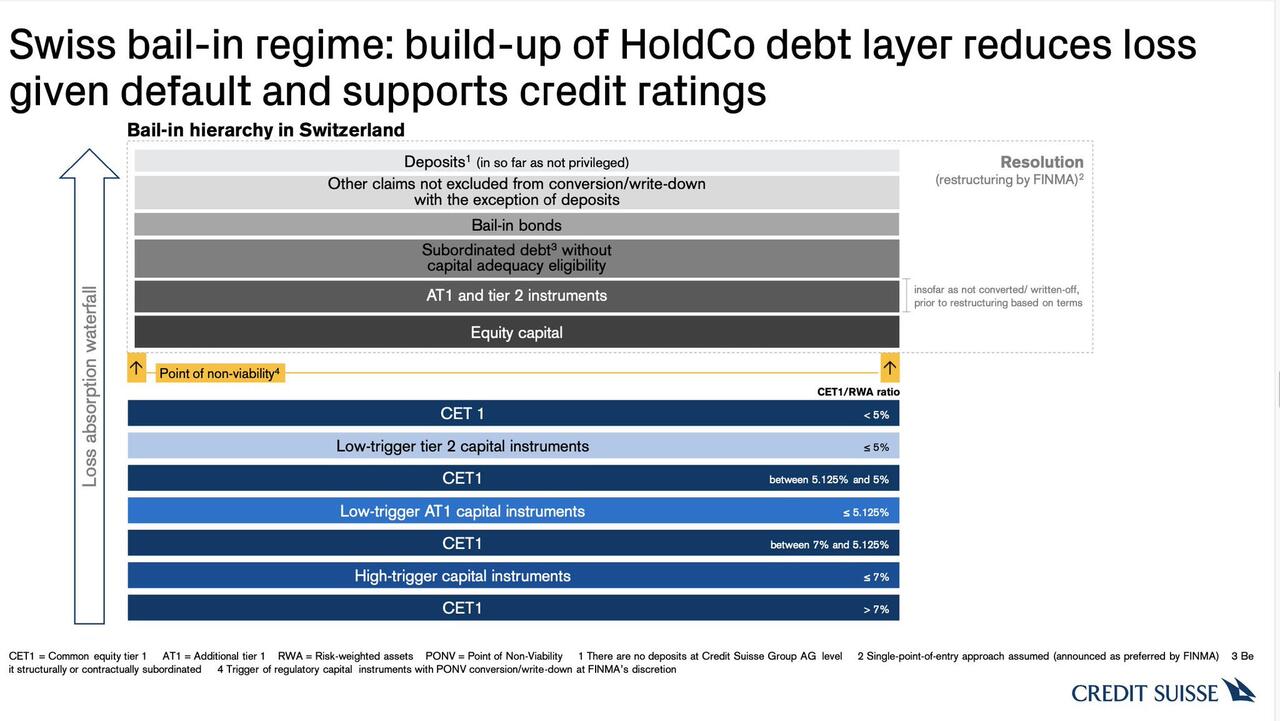
According to Bloomberg, pricing fluctuated on Sunday as traders weighed two contrasting scenarios: either the regulator would nationalize part or the whole bank, possibly writing off Credit Suisse’s AT1 bonds entirely, or a UBS buyout with potentially no losses for bondholders.
Well, as of this moment, those bonds have been Lehmaned, or rather Lehmanned in honor of the CS Chairman.
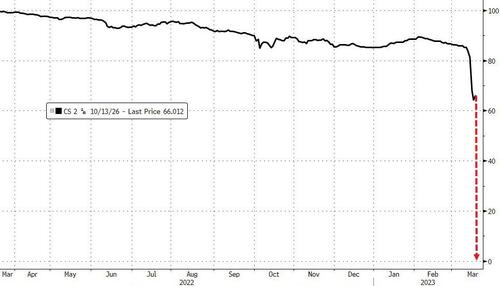
SUNDAY, MAR 19, 2023 – 01:11 PM
Update (1505ET): We finally have a deal, and what was at first a CHF1 BN acquisition price of Credit Suisse by UBS, which then rose to CHF 2 BN, has now cranked up one final time to CHF 3BN, or 0.76 per share, specifically shareholders of Credit Suisse will receive 1 share in UBS for 22.48 shares in Credit Suisse.
More importantly, however, the bank’s entire AT1 tranche – some CHF16BN of Contingent Convertible bonds – will be bailed in and written down to zero, to wit: “FINMA has determined that Credit Suisse’s Additional Tier 1 Capital (deriving from the issuance of Tier 1 Capital Notes) in the aggregate nominal amount of approximately CHF 16 billion will be written off to zero.“
This wipe out, pardon, bail-in is the biggest loss yet for Europe’s $275 billion AT1 market, far eclipsing the approximately €1.35 billion loss suffered by junior bondholders of Spanish lender Banco Popular SA back in 2017, when it was absorbed by Banco Santander SA to avoid a collapse.
AT1 bonds were introduced in Europe after the global financial crisis to serve as shock absorbers when banks start to fail. They are designed to impose permanent losses on bondholders or be converted into equity if a bank’s capital ratios fall below a predetermined level, effectively propping up its balance sheet and allowing it to stay in business.
As Bloomberg notes, investors had been concerned that a so-called bail-in would result in the AT1s being written down, while senior debt issued by the holding company, Credit Suisse would be converted into equity for the bank.
In retrospect, they were right to be worried… meanwhile equityholders get CHF3 billion; we are confident Swiss pensions will be delighted they are getting a doughnut while the Saudis get a not immaterial recovery.
PIMCO, Invesco and BlueBay Funds Management SA were among the many asset managers holding Credit Suisse AT1 notes. Pimco and BlueBay declined to comment when contacted by Bloomberg News on Friday, before the deal was announced. A spokeswoman for Invesco said that “due to portfolio disclosure policies, we wouldn’t disclose any current movements in portfolios but our investment teams are continuing to monitor developments and prudently managing our clients’ assets in light of current market conditions.”
The bonds were by Friday already trading at levels usually reserved for companies about to go bust. A slice of the bank’s $1.65 billion note, issued less than a year ago, changed hands at about 35 cents on the dollar, according to trade reporting system Trace.
According to Bloomberg, pricing fluctuated on Sunday as traders weighed two contrasting scenarios: either the regulator would nationalize part or the whole bank, possibly writing off Credit Suisse’s AT1 bonds entirely, or a UBS buyout with potentially no losses for bondholders.
Well, as of this moment, those bonds have been Lehmaned, or rather Lehmanned in honor of the CS Chairman.
Update (1500ET): It appears that what was first a CHF1 BN acquisition price, which then rose to CHF 2 BN, has now cranked up one final time to CHF 3BN, or 0.76 per share. More importantly, however, the bank’s entire AT1 tranche – some CHF16BN of Contingent Convertible bonds – will be bailed in and written down to zero, to wit: “FINMA has determined that Credit Suisse’s Additional Tier 1 Capital (deriving from the issuance of Tier 1 Capital Notes) in the aggregate nominal amount of approximately CHF 16 billion will be written off to zero.“
This wipe out, pardon, bail-in is the biggest loss yet for Europe’s $275 billion AT1 market, far eclipsing the approximately €1.35 billion loss suffered by junior bondholders of Spanish lender Banco Popular SA back in 2017, when it was absorbed by Banco Santander SA to avoid a collapse.
AT1 bonds were introduced in Europe after the global financial crisis to serve as shock absorbers when banks start to fail. They are designed to impose permanent losses on bondholders or be converted into equity if a bank’s capital ratios fall below a predetermined level, effectively propping up its balance sheet and allowing it to stay in business.
As Bloomberg notes, investors had been concerned that a so-called bail-in would result in the AT1s being written down, while senior debt issued by the holding company, Credit Suisse would be converted into equity for the bank.
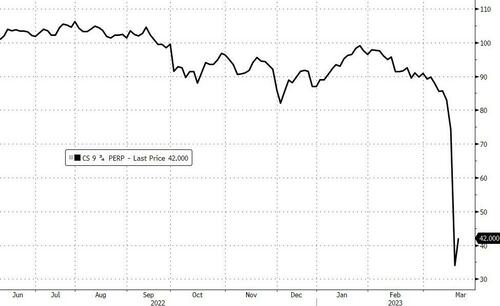
In retrospect, they were right to be worried… meanwhile equity holders get CHF3 billion; we are confident Swiss pensions will be delighted they are getting a doughnut while the Saudis get a not immaterial recovery.
PIMCO, Invesco and BlueBay Funds Management SA were among the many asset managers holding Credit Suisse AT1 notes. Pimco and BlueBay declined to comment when contacted by Bloomberg News on Friday, before the deal was announced. A spokeswoman for Invesco said that “due to portfolio disclosure policies, we wouldn’t disclose any current movements in portfolios but our investment teams are continuing to monitor developments and prudently managing our clients’ assets in light of current market conditions.”
Here is the full press release from Credit Suisse with final terms of the deal:
Credit Suisse and UBS have entered into a merger agreement on Sunday following the intervention of the Swiss Federal Department of Finance, the Swiss National Bank and the Swiss Financial Market Supervisory Authority FINMA (FINMA). UBS will be the surviving entity upon closing of the merger transaction. Under the terms of the merger agreement all shareholders of Credit Suisse will receive 1 share in UBS for 22.48 shares in Credit Suisse. Until consummation of the merger, Credit Suisse will continue to conduct its business in the ordinary course and implement its restructuring measures in collaboration with UBS. The Swiss National Bank will grant Credit Suisse access to facilities that provide substantial additional liquidity. On March 19, 2023, Swiss Federal Department of Finance, the Swiss National Bank and FINMA have asked Credit Suisse and UBS to enter into the merger agreement. Pursuant to the emergency ordinance which is being issued by the Swiss Federal Council, the merger can be implemented without approval of the shareholders. The consummation of the merger remains subject to customary closing conditions.
Credit Suisse and UBS have entered into a merger agreement on Sunday with UBS being the surviving entity. After negotiations that took place during the weekend leading up to the signing of the merger agreement, UBS and Credit Suisse concluded that it would be in the best interest of their shareholders and their stakeholders to enter into the merger. This move comes after the Swiss Federal Department of Finance, the Swiss National Bank and FINMA asked both companies to conclude the transaction to restore necessary confidence in the stability of the Swiss economy and banking system.
The merger transaction provides for the following key terms:
- All shareholders of Credit Suisse will receive 1 share in UBS for 22.48 shares in Credit Suisse as merger consideration. This exchange ratio reflects a merger consideration of CHF 3 billion for all shares in Credit Suisse.
- The merger transaction remains subject to customary closing conditions. Both parties are confident that all conditions can be met. The merger is expected to be consummated by end of 2023 if possible.
- The Swiss National Bank will grant Credit Suisse access to facilities that provide substantial additional liquidity.
- For the purpose of a seamless integration of Credit Suisse into UBS, UBS is expected to appoint key personnel to Credit Suisse as soon as legally possible.
- Credit Suisse continues to operate in the ordinary course of business and implement its restructuring measures in collaboration with UBS.
- UBS has expressed its confidence that the employment of the staff of Credit Suisse will be continued.
On Sunday, Credit Suisse has been informed by FINMA that FINMA has determined that Credit Suisse’s Additional Tier 1 Capital (deriving from the issuance of Tier 1 Capital Notes) in the aggregate nominal amount of approximately CHF 16 billion will be written off to zero.
In consideration of the unique circumstances affecting the Swiss economy as a whole, the Swiss Federal Council is issuing an emergency ordinance (Notverordnung) tailored to this particular transaction. Most importantly, the merger will be implemented without the otherwise necessary approval of the shareholders of UBS and Credit Suisse to enhance deal certainty.
Axel P. Lehmann, Chairman of the Board of Directors of Credit Suisse said: “Given recent extraordinary and unprecedented circumstances, the announced merger represents the best available outcome. This has been an extremely challenging time for Credit Suisse and while the team has worked tirelessly to address many significant legacy issues and execute on its new strategy, we are forced to reach a solution today that provides a durable outcome.”
And here is the press release from UBS’s side, which repeat all of the above and informs us that “the combination of the two businesses is expected to generate annual run-rate of cost reductions of more than USD 8 billion by 2027.” Translation: virtually all CS workers will be laid off.
UBS to Acquire Credit Suisse
- Creates leading global wealth manager with USD 5 trillion of invested assets across the Group
- Extends UBS lead in Swiss home market
- UBS strategy unchanged, including focus on growth in Americas and APAC
- Attractive financial terms which include downside protection
- Annual run-rate of cost reduction of more than USD 8 billion expected by 2027
- UBS remains strongly capitalized well above our target of 13% and committed to progressive cash dividend policy
- A focused Investment Bank, remaining committed to UBS’s model; strategic Global Banking businesses to be retained, majority of Credit Suisse markets positions moved to non-core
UBS plans to acquire Credit Suisse. The combination is expected to create a business with more than USD 5 trillion in total invested assets and sustainable value opportunities. It will further strengthen UBS’s position as the leading Swiss-based global wealth manager with more than USD 3.4 trillion in invested assets on a combined basis, operating in the most attractive growth markets.
The transaction reinforces UBS’s position as the leading universal bank in Switzerland. The combined businesses will be a leading asset manager in Europe, with invested assets of more than USD 1.5 trillion.
UBS Chairman Colm Kelleher said: “This acquisition is attractive for UBS shareholders but, let us be clear, as far as Credit Suisse is concerned, this is an emergency rescue. We have structured a transaction which will preserve the value left in the business while limiting our downside exposure. Acquiring Credit Suisse’s capabilities in wealth, asset management and Swiss universal banking will augment UBS’s strategy of growing its capital-light businesses. The transaction will bring benefits to clients and create long-term sustainable value for our investors.”
UBS Chief Executive Officer Ralph Hamers said: “Bringing UBS and Credit Suisse together will build on UBS’s strengths and further enhance our ability to serve our clients globally and deepen our best-in-class capabilities. The combination supports our growth ambitions in the Americas and Asia while adding scale to our business in Europe, and we look forward to welcoming our new clients and colleagues across the world in the coming weeks.”
The discussions were initiated jointly by the Swiss Federal Department of Finance, FINMA and the Swiss National Bank and the acquisition has their full support.
Under the terms of the all-share transaction, Credit Suisse shareholders will receive 1 UBS share for every 22.48 Credit Suisse shares held, equivalent to CHF 0.76/share for a total consideration of CHF 3 billion. UBS benefits from CHF 25 billion of downside protection from the transaction to support marks, purchase price adjustments and restructuring costs, and additional 50% downside protection on non-core assets. Both banks have unrestricted access to the Swiss National Bank existing facilities, through which they can obtain liquidity from the SNB in accordance with the guidelines on monetary policy instruments.
The combination of the two businesses is expected to generate annual run-rate of cost reductions of more than USD 8 billion by 2027.
UBS Investment Bank will reinforce its global competitive position with institutional, corporate and wealth management clients through the acceleration of strategic goals in Global Banking while managing down the rest of Credit Suisse’s Investment Bank. The combined investment banking businesses accounts for approximately 25% of Group risk weighted assets.
UBS anticipates that the transaction is EPS accretive by 2027 and the bank remains capitalized well above its target of 13%.
Colm Kelleher will be Chairman and Ralph Hamers will be Group CEO of the combined entity.
The transaction is not subject to shareholder approval. UBS has obtained pre-agreement from FINMA, Swiss National Bank, Swiss Federal Department of Finance and other core regulators on the timely approval of the transaction.
* * *
Update (1415ET): As attention turns to the Credit Suisse (the bailout tee), it appears that the market is not convinced that not even the SNB’s $100BN liquidity backstop will be sufficient as UBS Credit Default Swaps are starting to move in the wrong direction, and during Sunday’s emergency trading session, BBG reports that UBS CDS have widened by at least 40bps (so far) to 215 bps for five-year contracts. Should this move accelerate, the deal MAC may still be triggered and the deal could fall apart.
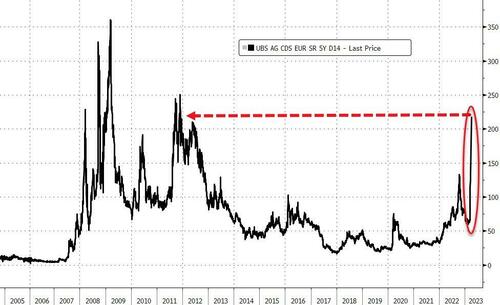
* * *
Update (1300ET): The Financial Times reports that UBS has agreed to buy Credit Suisse after increasing its offer to more than $2bn, with Swiss authorities poised to change the country’s laws to bypass a shareholder vote on the transaction as they rush to finalize a deal before Monday.
The purchase price is a fraction of the $8 billion market cap the company was valued at on Friday’s close; it means that UBS will now pay slightly more than CHF0.50 a share in its own stock, up from a bid of SFr0.25 earlier today, but far below Credit Suisse’s closing price of CHF1.86 on Friday.
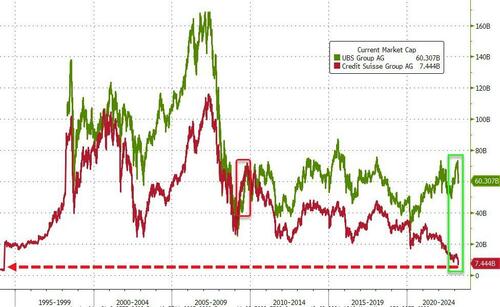
We also learn that UBS agreed to a softening of a material adverse change clause that would void the deal if its credit default spreads jump; it wasn’t immediately clear if that entire clause was scrapped or if the CDS trigger was merely pulled wider.
UBS shareholders – who will not be consulted on the deal which will circumvent normal corporate governance rules by preventing a UBS shareholder vote – are angry. As FT notes, Vincent Kaufmann, chief executive of Ethos Foundation, which represents Swiss pension funds that own between 3% and 5% of Credit Suisse and UBS, told the Financial Times that the move to bypass a shareholder vote on the deal was poor corporate governance.
“I can’t believe our members and UBS shareholders will be happy about this,” he said. “I have never seen such measures taken; it shows how bad the situation is.”
As a reminder, here is a list of the 40 biggest investors.
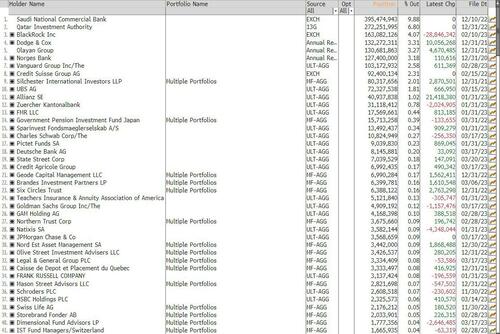
Finally, The Wall Street Journal reports that, in an effort to smooth the deal, the Swiss National Bank has offered UBS a whopping $100 billion in liquidity to help it take on Credit Suisse’s operations,
In other words, the Swiss government has extended a liquidity line equal to ~$11.5MM on a per capita basis: said otherwise, every family of 4 is backstopping almost $50MM in UBS assets.
Using UBS to save Credit Suisse marks a turnaround from nearly 15 years ago, when Switzerland bailed out UBS after it got stuck with billions of toxic assets in its U.S. business. Credit Suisse declined state aid at the time and emerged from the crisis in stronger shape
During the press conference, the Swiss president says the surge in deposit outflows on Friday showed that stabilization of Credit Suisse was necessary, i.e., the bank would have collapsed absent a takeover by a larger bank.
And here are some more highlights from the presser:https://www.zerohedge.com/markets/ubs-offers-buy-credit-suisse-1bn-025-share-takeunder-cs-balks-offer
- *KELLER-SUTTER: SOLUTION WILL STABILIZE CS, FINANCIAL MARKETS
- *KELLER-SUTTER: TOP PRIORITY WAS INTERESTS OF SWITZERLAND
- *KELLER-SUTTER: GUARANTEE ONLY KICKS IN ON CERTAIN THRESHOLD
- *CREDIT SUISSE TAKEOVER TO TRIGGER CHF16B WRITEDOWN ON AT1S
- *JORDAN: BANKRUPTCY OF CS WOULD HAVE HAD SEVERE CONSEQUENCES
- *JORDAN: CS BANKRUPTCY TO HAVE SEVERELY DAMAGED SWISS REPUTATION
- *JORDAN: US BANKING CRISIS AGGRAVATED CREDIT SUISSE CRISIS
- *JORDAN: SNB TO PROVIDE LIQUIDITY IF NEEDED
SUNDAY, MAR 19, 2023 – 09:28 AM
Update (10:30am ET): So much for Credit Suisse thinking it has leverage by balking at the proposed CHF0.25 offer from UBS. Just hours after it was floated that UBS could buy Credit Suisse for $1BN, a proposal which the bank’s shareholders balked at, Bloomberg reported that authorities are now considering a full or partial nationalization of Credit Suisse – an outcome which would wipe out the equity and bail-in bondholders – as the only other viable option outside a UBS Group AG takeover. And yes, 0.25 is still more than 0.0.
According to BBG, “the country is considering either taking over the bank in full or holding a significant equity stake if a takeover by UBS Group AG falls apart because of the complexities in arranging the deal and the short time frame involved.”
Needless to say, the situation remains “very fluid” and is changing by the hour as authorities seek to finalize a solution for the bank by the time Asian markets open, which is late evening in Europe, the people said.
* * *
Earlier 9 :28
SUNDAY, MAR 19, 2023 – 09:28 AM
With just hours left until futures reopen for trading in what could be a very turbulent session, UBS has offered to buy Credit Suisse for up to $1BN the FT first reported, with Swiss authorities planning to change the country’s laws to bypass a shareholder vote on the transaction as they rush to finalize the deal engineered to restore trust in the banking system.

The take-under offer was communicated on Sunday morning with a price of CHF0.25 a share to be paid in UBS stock, far below Credit Suisse’s closing price of CHF1.86 on Friday. And while the current terms value Credit Suisse’s equity at a paltry $1BN, the figure does not reflect additional provisions of around $6 billion from the Swiss National Bank to ensure the deal is done.
In other words, UBS gets an explicit $6BN central bank backstop (which would mean the central bank is in for a penny, in for a trillion), pays $1BN and gets a megabank whose Zurich headquarters alone is probably worth more. One can see why JPMorgan, pardon UBS would love the deal… and why Credit Suisse would be less than enthused.
The all-share deal between the two biggest Swiss banks is set to be signed as soon as Sunday evening and will be priced at a fraction of Credit Suisse’s closing price on Friday, all but wiping out the target’s shareholders, FT sources said. They also noted that in an unexpected twist, there will be a very unique material adverse exit clause: if UBS credit default spreads jump by 100 basis points or more, the deal is off! In other words, if the market balks at the pro forma deal and believes more contagion is coming, UBS wants none of it, and the Swiss government and SNB can deal with the fallout.
Needless to say, Credit Suisse shareholders – led by the Saudi National Commercial Bank, a full list of the top 40 is shown below – were less then enthused by the prospect of losing everything …

… and Bloomberg notes that Credit Suisse is pushing back on the proposed deal with backing from its biggest shareholder: “Credit Suisse believes the offer is too low and would hurt shareholders and employees who have deferred stock.”
The FT echoes the skepticism, and says that the situation is fast-moving and there is no guarantee that terms will remain the same or that a deal will be reached: “Some of the people said that the current terms were unfair for Credit Suisse and its shareholders. Others criticised the plans to void normal corporate governance rules by preventing a UBS shareholder vote.”
The reason why in this late hours there seems to be little convergence toward a consensus is because there has been limited contact between the two banks and the terms have been heavily influenced by the Swiss National Bank and regulator Finma, the FT sources said. Meanwhile, the Federal Reserve has given its assent to the deal progressing.
Both sides have been locked in discussions with regulators since Wednesday, when Credit Suisse asked the SNB to provide it with an emergency SFr50bn ($54bn) credit line. When this backstop failed to halt the collapse in depositor confidence and stock price – as we said it would – the central bank stepped in to force a merger after becoming concerned about the viability of the country’s second-largest lender. Yesterday, we learned that deposit outflows from Credit Suisse topped SFr10bn a day late last week, after a record bank run pulled CHF111BN from the group in the final three months of last year.
According to the FT, on Saturday night, the Swiss cabinet assembled in the finance ministry in Bern for a series of presentations from government officials, the SNB, market regulator Finma, and representatives of the banking sector.
UBS will dramatically shrink Credit Suisse’s investment bank, with Reuters reporting that some 10,000 workers will be let go, and the combined entity will make up no more than a third of the merged group, two of the people said. However, the current term sheet for the deal does not specify what will happen to Credit Suisse’s individual business divisions, and simply outlines a 100% takeover of the group.
The government is preparing emergency measures to fast-track the takeover and plans to introduce legislation that will bypass the normal six-week consultation period required for UBS shareholders so the deal can be sealed immediately. The framework of the deal has been designed by Swiss regulators to provide maximum stability to the country’s banking system, people briefed about the matter said.
However, if Credit Suisse balks at the takeunder – as it perhaps should, and takes its chances in bankruptcy court where its equity may be valued higher than the paltry 0.25 – the Swiss National Bank, and all other central banks, will have no choice but to step with a shotgun bailout of the entire financial system for the second time in 15 years.
END
MONDAY MORNING
Massive layoffs at Credit Suisse coming but so will their bonuses.
(zerohedge)
Massive Layoffs On Deck At Credit Suisse, Which Tells Workers Bonuses Will Still Be Paid So Go To Work
MONDAY, MAR 20, 2023 – 07:14 AM
The forced bail-in sale of Credit Suisse to UBS will lead to a staggering number of job cuts in the next few weeks or months, as there are significant overlaps at both banks resulting from the merger. Before the merger, Credit Suisse was already undergoing a restructuring process, laying off upwards of 9,000 employees. Now job losses could accelerate at the troubled bank, according to Bloomberg, citing people familiar with the situation.
The two banks have a considerable workforce with approximately 125,000 employees, 30% of whom are located in Switzerland. The merger creates a lot of overlaps in certain departments, and the people estimate significant job cuts are looming.
UBS Chairman Colm Kelleher wouldn’t share any details over the weekend about the job-cut number, but UBS published a statement Sunday about the need to reduce the bank’s annual cost base by more than $8 billion by 2027.
“Let me be very specific on this: UBS intends to downsize Credit Suisse’s investment banking business and align it with our conservative risk culture,” Kelleher said at Sunday’s press conference. He warned about a bumpy road ahead.
Bloomberg said Credit Suisse employees were emailed a memo about the impacted roles and “will aim to continue to provide severance in line with market practice.” The memo stated that bonuses would remain unchanged and will be paid on Friday… which probably is when everyone quits right after the bonus wire transfer hits their bank account (which is neither at UBS nor Credit Suisse).
“We know that many of you will have been following the intense media coverage over the past 48 hours on the future of Credit Suisse and appreciate the enormous uncertainty and stress that this has caused,” Credit Suisse Chairman Axel Lehmann and Chief Executive Officer Ulrich Koerner said in a separate memo.
The path moving forward for both banks appears to include reducing expenses and headcount. UBS will become even more dominant in Switzerland. And the good news is the takeover reduces systemic concerns (for now).
end
Why on earth would anybody want to invest in Switzerland.. They can just change the rules at whim. The following explains the devastation to CoCo bond holders in Switzerland.
(zerohedge)
“This Just Makes No Sense”: European Regulators Rush To Calm AT1 Investors After Credit Suisse Wipeout Shock
MONDAY, MAR 20, 2023 – 09:45 AM
14 years ago, the Obama administration (or rather his Wall Street lackey Steve Rattner) turned the bankruptcy process on its head with the Chapter 11 filing of General Motors, which steamrolled the bankruptcy liquidation waterfall by paying off the underfunded (and unsecured) pension plans of GM and Chrysler union workers at 40 cents on the dollar, while cramming down secured creditors, forcing them to accept 29 cents on the dollar in recovery.
On Sunday, something similar happened with Credit Suisse when, much to the shock of Europe’s $275 billion Additional Tier 1 market, some $17BN in Credit Suisse AT1, aka Contingent Convertible, bonds were wiped out even as equity holders received over $3 billion in consideration from UBS courtesy of Swiss taxpayers who ended up footing billions in contingent liabilities.
Not surprisingly, this morning the entire universe of riskiest bonds of European lenders – those in the AT1 tier – plunged after UBS agreed to buy the bank in a historic, government-enforced deal aimed at containing a crisis of confidence that had started to spread across global financial markets. It was the biggest loss yet for Europe’s AT1 market, which was created after the financial crisis to ensure losses would be borne by investors not taxpayers.
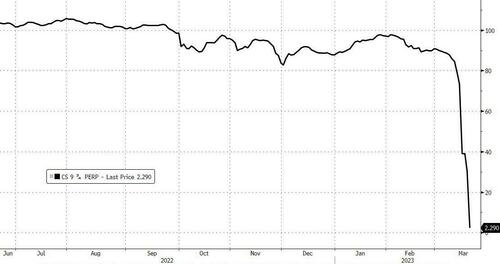
As shown in the Credit Suisse presentation chart below, in a typical writedown scenario, shareholders are the first to take a hit before AT1 bonds face losses. That’s why the decision to write down the bank’s riskiest debt — rather than its shareholders — provoked a furious response from some of the bondholders.
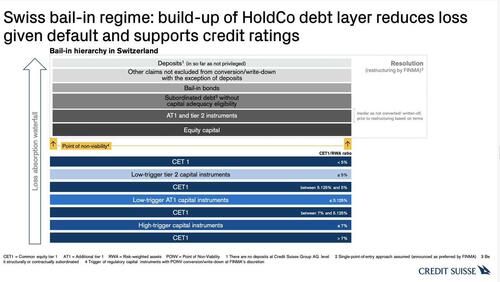
“This just makes no sense,” said Patrik Kauffmann, a fixed-income portfolio manager at Aquila Asset Management, who holds Credit Suisse CoCos. “Shareholders should get zero” because “it’s crystal clear that AT1s are senior to stocks.”
As noted last night, the wipeout of 16 billion francs ($17.2 billion) of Credit Suisse’s so-called AT1 bonds is the biggest loss yet for Europe’s $275 billion market in these securities, which were created after the financial crisis to ensure losses would be borne by investors not taxpayers.
Realizing that the chaos and fury among AT1 investors could spark the next leg of market contagion, on Monday morning European regulators rushed to reassure investors that shareholders should face losses before bondholders after the takeover of Credit Suisse Group AG wiped the bank’s Additional Tier 1 debt while preserving over $3 billion in equity value.
Junior creditors should bear losses only after equity holders have been fully wiped out, according to a joint statement from the Single Resolution Board, the European Banking Authority and the ECB Banking Supervision, who apparently were not consulted on Sunday during the whirlwind decisions that preserved some equity value at CS while wiping out its entire AT1 tranche.
Other European officials also weighed in. ECB Governing Council member Ignazio Visco said at an event in Milan that that regulators have the tools to deal with liquidity problems, but there are no issues currently. Italy’s Finance Minister Giancarlo Giorgetti said the risk for Italian banks is “not significant.” He added that he was “surprised” by the Swiss decision to prioritize shareholders over some bondholders.
As Bloomberg notes, the clauses that led to the bonds being marked to zero aren’t common. Only the AT1 bonds of Credit Suisse and UBS Group AG have language in their terms that allows for a permanent write-down and most other banks in Europe and the UK have more protections, according to Jeroen Julius, a credit analyst at Bloomberg Intelligence.
If the AT1 new-issue market reopens, equity conversion may become the dominant loss-absorption mechanism to reassure investors that they won’t be wiped out ahead of shareholders, BI’s Julius said.
Yet, judging by the market action, investors aren’t sticking around to find out. All kinds of risky bank debt tumbled on Monday and analysts predicted far-reaching consequences to Europe’s funding market. The market for new AT1 bonds will likely go into deep freeze, traders said.
Perpetual notes issued by Deutsche Bank AG, Unicaja Banco SA, Raiffeisen Bank International and BNP Paribas SA all dropped by more than 10 points on Monday. Deutsche Bank’s £650 million ($792 million) 7.125% note dropped as much as 17 pence to about 64, its biggest-ever one-day decline. Most other European lenders’ Additional Tier 1 (AT1) notes fell to record lows.
end
Then this, Monday afternoon//credit default swaps rise in an increase contagion risk
(Simon White/Bloomberg)
EU Contagion Risk Spreads As CDS Market Puts Focus On Deutsche Bank
MONDAY, MAR 20, 2023 – 01:05 PM
Authored by Simon White, Bloomberg macro strategist,
For once, the focus of a negative story on European banking hasn’t been Deutsche Bank. But the credit market isn’t letting DB off scot-free. The largest one-day move in 5-year credit-default swaps of European banks is Deutsche, with its spread widening more than even UBS’s.
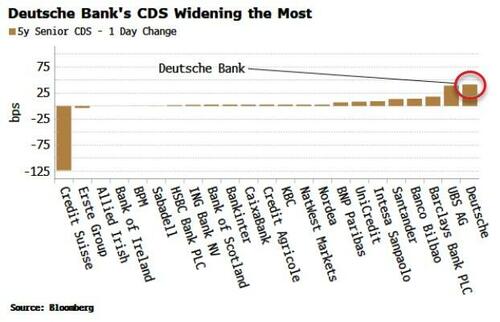
DB’s CDS has widened by virtually the same as UBS’s over the last month, even though it has not had to digest a rival with $575 billion in assets over a weekend.
[ZH: we also note that while UBS equity price rebounded from its 16% plunge at the open, CDS has not…]
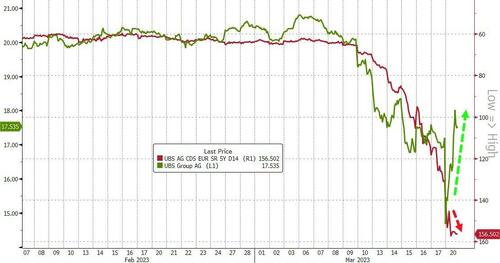
Deutsche Bank’s revenues have fallen over most of the last decade, and the bank has faced questions around its governance, with BaFin, the German bank regulator, censuring it over its money-laundering controls.
However, over the last two years the investment bank has spearheaded a recovery, with revenues and profitability improving.
Nonetheless, DB lagged the rebound seen in European bank shares that began last summer, while its price-to-book ratio remains subterranean.
Contagion risk is much lower than it was in 2008, but it is not zero. And contagion is not always fully logical: Credit Suisse’s tier 1 capital ratio was higher than DB’s.
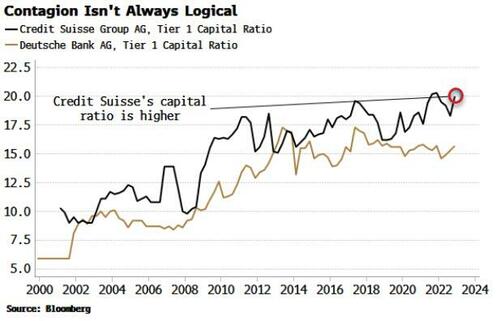
Keep watching CDS spreads to see if and where stress is spreading.
end
HOLLAND
Amazing: Dutch farmers storm to victory in regional elections. They are now set to become the largest party in their senate
(zerohedge)
Dutch Farmers Storm To Victory In Regional Elections, Set To Become Largest Party In The Senate
SATURDAY, MAR 18, 2023 – 07:00 AM
Authored by Thomas Brooke via Remix News,
The success of the Farmer-Citizen Movement (BBB) will further undermine the Dutch government’s plans to impose radical agricultural reforms campaigners say will destroy rural communities…

Lawmaker Caroline van der Plas, leader of the populist BBB Farmer-Citizen Movement, reacts after casting her vote for the provincial elections in Okkenbroek, eastern Netherlands, Wednesday, March 15, 2023. (AP Photo/Peter Dejong)
Voters dealt a hammer blow to the Dutch establishment in Wednesday’s regional elections, propelling the Farmer-Citizen Movement (BBB) to become the largest party in the Senate in just its first election.
Exit polls projected the movement will win 15 seats in the Dutch upper chamber as voters sent a clear message to Mark Rutte’s government over its planned nitrogen emissions laws campaigners say will devastate the country’s agricultural sector.
“The Dutch have clearly shown that they are fed up with the policy,” BBB leader Caroline van der Plas told De Telegraaf late on Wednesday. “I’m going to party.”
“The turnaround has started. The voters have spoken and have denounced support of this government,” she added in a tweet.
“She did very well,” Dutch Prime Minister Mark Rutte admitted, whose People’s Party for Freedom and Democracy (VVD) saw its projected seats fall from the current 12 to 10.

Government coalition parties didn’t fare much better. The liberal party, Democrats 66 (D66), is projected to drop a seat, as is the Christian Union (CU), while the Christian Democratic Appeal (CDA) is expected to drop four seats from its current nine.
With a collective seat share of just 24, the government coalition has fallen well short of a majority. It will now have to rely on working with opposition parties on specific legislative proposals to push through government policy.
The Senate wields considerable influence in the Netherlands, unlike many other European nations. While it cannot initiate legislation, it has the power to block government policy, and Thursday’s election suggests a period of sustained political stalemate for the country.
One victim of the election night was Thierry Baudet’s Freedom For Democracy (FvD) party. It saw its core voter base capitulate and is expected to lose 10 of its 12 seats. The collapse suggests the surge in support for BBB is to a large degree off the back of deep anti-government and right-wing sentiment.
Turnout was 61 percent, up significantly by 5 percentage points on 2019, suggesting the BBB managed to galvanize disenfranchised voters as the movement stormed to victory in almost every province to have already declared an outcome, including Drenthe, Overijssel, Friesland, Flevoland and Zeeland. The party is also projected to win in Gelderland, North Brabant, Limburg, and Groningen, and is neck-and-neck with the governing VVD in both North and South Holland.
The election result follows a recent Rabobank survey that revealed just 1 percent of Dutch citizens believe the country is clearly heading in the right direction, while 86 percent of respondents are pessimistic about the country’s trajectory.
The rise of the BBB over the past two years has been in response to the government’s plans to appease EU nitrogen emissions targets by imposing radical agricultural reforms. It introduced plans last year to reduce livestock numbers by a third, while farmers have also been told their land could be subject to compulsory buyouts.
The policy resulted in agricultural workers staging several demonstrations against the government, blocking motorways and supermarket distribution centers in mass protests last year.
At a recent demonstration in The Hague ahead of the elections, over 10,000 Dutch farmers came to hear campaigners speaking out against the government plans.
“We are fighting against a corrupt and unjust government,” Eva Vlaardingerbroek, a prominent campaigner in defense of the farmers, told attendees. She spoke of a government that “drives our farmers from their land” and that has “turned on its own population.”
The planned reductions affecting Dutch agriculture have been described by industry leaders as “so severe that rural communities will be totally devastated economically.” Those were the words of Sander van Diepen, a spokesperson for the Dutch agricultural and horticultural association, LTO Nederland, speaking in June last year.
Wednesday’s electoral victory does not guarantee success against the government’s plans, but with support from JA21 and Geert Wilders’ PVV party, the farmers’ movement will be able to establish a solid block of opposition to government policy and seek to frustrate the process
END
FRANCE (LAST NIGHT)
Protests on the pension reform escalated violently and it is possible that his government may fail
(John Cody//Remix news)
As French Protests Violently Escalate, Will Macron’s Government Fall?
MONDAY, MAR 20, 2023 – 02:00 AM
Authored by John Cody via Remix news,
After French President Emmanuel Macron pushed through pension reform without a vote in parliament, the backlash has been fierce, and there is now a good chance that a no-confidence vote this week could collapse his government. Even if he survives the vote, commentators say that Marine Le Pen has never been in a better position, with the conservative populist emerging as the “victor” in the fierce debate over pension reform.

Macron’s decision to turn to Article 49.3 of the French constitution, which allows him to bypass parliament and increase the retirement age from 62 to 64 via decree, had been labeled the “nuclear option” by the French press.
However, within the article is a clause that a vote of no-confidence can be tabled within 24 hours after Article 49.3 is used, and if it succeeds, it would mean the end of Macron’s government.
Spontaneous riots have already erupted across the country, resulting in over 258 arrests in Paris alone, but the press and political analysts are warning that worse unrest is on the horizon.
Hundreds of thousands have been driven onto the streets in recent weeks in defiance of Macron’s pension reform, and polling consistently shows approximately 75 percent of the French public rejects raising the retirement age.
These protests could help fuel the drive for a no-confidence vote, with Le Pen quickly announcing she would pursue a vote of no confidence immediately after Macron rammed through the pension reform. So far, Le Len’s National Rally and the left-wing France Unbowed have blocked each other when it came to attempts to remove French Prime Minister Elisabeth Borne, who remains a close ally of Macron.
However, the Liberal MP Charles de Courson could introduce it and thus act as a bridge between the right and the left. The Liberals, acting as a neutral intermediary, could allow the right and the left to vote for their motion. It has also been announced that the Liberties, Independents, Overseas and Territories (LIOT Group) is expected to table a no-confidence motion at 2:00 p.m. today as well.
Although the different factions of parliament have remained divided up until now, Macron’s dubious move to ram through pension reform without a democratic vote could finally unify the opposition.
The stakes are extremely high for Macron. He has labeled his move the “mother of all reforms” and wants to make the reform one of the crowning achievements of his rule. Regardless of whether he stays in power or not, the idea of “democracy” in France has become a farce, and tensions are only expected to mount in the coming weeks and perhaps coming years as well.
Le Pen says she will reverse the pension reform if she is elected president. Experts say her party stands to gain the most from Macron’s move, and she has succeeded in expanding her party’s electorate from the working-class base to the middle-class.
“It is precisely the employees who are angry about Macron’s reform,” said pollster Frédéric Dabi to Germany’s Welt.
Le Pen is also considered the best placed to capitalize among the various right-leaning and conservative parties in France.
“Le Pen is successfully continuing the process of normalization that it began years ago and continues to reap the rewards,” says right-wing extremism expert Jean-Yves Camus. “There are no more taboos when it comes to Marine Le Pen’s victory. We now have to consider this as a serious hypothesis.”
end
Macron (Barely) Survives ‘No Confidence’ Vote Amid French Pension Reform Protests
MONDAY, MAR 20, 2023 – 02:06 PM
Update (1400ET): French President Emmanuel Macron’s government narrowly survived a no-confidence vote in the National Assembly on Monday, fending off an effort to kill his contentious pension overhaul and topple his administration.
As The Wall Street Journal reports, the no-confidence motion spearheaded by a group of centrists won the support of 278 lawmakers in the lower house of parliament, a mere nine votes short of a majority.
Lawmakers are expected to vote later Monday on a second no-confidence motion filed by Marine Le Pen’s National Rally.
That measure is unlikely to pass because conservative and left-leaning lawmakers have said they won’t back a no-confidence motion put forward by the far-right party.
As Remix News’ John Cody detailed earlier, after French President Emmanuel Macron pushed through pension reform without a vote in parliament, the backlash has been fierce, and there is now a good chance that a no-confidence vote this week could collapse his government. Even if he survives the vote, commentators say that Marine Le Pen has never been in a better position, with the conservative populist emerging as the “victor” in the fierce debate over pension reform.
Macron’s decision to turn to Article 49.3 of the French constitution, which allows him to bypass parliament and increase the retirement age from 62 to 64 via decree, had been labeled the “nuclear option” by the French press.
However, within the article is a clause that a vote of no-confidence can be tabled within 24 hours after Article 49.3 is used, and if it succeeds, it would mean the end of Macron’s government.
Spontaneous riots have already erupted across the country, resulting in over 258 arrests in Paris alone, but the press and political analysts are warning that worse unrest is on the horizon.
Hundreds of thousands have been driven onto the streets in recent weeks in defiance of Macron’s pension reform, and polling consistently shows approximately 75 percent of the French public rejects raising the retirement age.
These protests could help fuel the drive for a no-confidence vote, with Le Pen quickly announcing she would pursue a vote of no confidence immediately after Macron rammed through the pension reform. So far, Le Len’s National Rally and the left-wing France Unbowed have blocked each other when it came to attempts to remove French Prime Minister Elisabeth Borne, who remains a close ally of Macron.
However, the Liberal MP Charles de Courson could introduce it and thus act as a bridge between the right and the left. The Liberals, acting as a neutral intermediary, could allow the right and the left to vote for their motion. It has also been announced that the Liberties, Independents, Overseas and Territories (LIOT Group) is expected to table a no-confidence motion at 2:00 p.m. today as well.
Although the different factions of parliament have remained divided up until now, Macron’s dubious move to ram through pension reform without a democratic vote could finally unify the opposition.
The stakes are extremely high for Macron. He has labeled his move the “mother of all reforms” and wants to make the reform one of the crowning achievements of his rule. Regardless of whether he stays in power or not, the idea of “democracy” in France has become a farce, and tensions are only expected to mount in the coming weeks and perhaps coming years as well.
Le Pen says she will reverse the pension reform if she is elected president. Experts say her party stands to gain the most from Macron’s move, and she has succeeded in expanding her party’s electorate from the working-class base to the middle-class.
“It is precisely the employees who are angry about Macron’s reform,” said pollster Frédéric Dabi to Germany’s Welt.
Le Pen is also considered the best placed to capitalize among the various right-leaning and conservative parties in France.
“Le Pen is successfully continuing the process of normalization that it began years ago and continues to reap the rewards,” says right-wing extremism expert Jean-Yves Camus. “There are no more taboos when it comes to Marine Le Pen’s victory. We now have to consider this as a serious hypothesis.”
5.RUSSIA//UKRAINE//MIDDLE EASTERN AFFAIRS//
//RUSSIA//CHINA
The real discussion will be for weapons, See Robert H. discussion on this
(zerohedge)
Xi To Arrive In Moscow Monday, Ukraine War ‘Core Part’ Of Talks With Putin
FRIDAY, MAR 17, 2023 – 06:30 PM
The Chinese Foreign Ministry has confirmed in a statement on its website that President Xi Jinping’s much anticipated state visit to Russia will be held from March 20-22, marking the first such in-person visit with President Putin since the Ukraine war started in February 2022.
The Kremlin at the same time confirmed of the trip that “An exchange of views is also planned in the context of deepening Russian-Chinese cooperation in the international arena,” and that, “A number of important bilateral documents will be signed.” Via Reuters
Russia has further said the two leaders will discuss “strategic cooperation” – following early last year’s declaration of Beijing and Moscow’s “no-limits partnership”.
The new Friday Beijing statement also said the war in Ukraine will be top priority, also after acknowledging that a Xi-Zelensky phone call will happen related to the Moscow visit:
China’s Foreign Ministry said the visit will take place from Monday to Wednesday at the invitation of Putin and confirmed that the war in Ukraine would be a core part of the talks.
“China’s proposition boils down to one sentence, which is to urge peace and promote talks,” foreign ministry spokesman Wang Wenbin said.
And more on the few details made known thus far, to kick off Monday:
The two leaders will start Monday with a one-on-one followed by an “informal lunch,” with negotiations set to take place Tuesday, according to Kremlin spokesperson Dmitry Peskov.
This will be Xi’s first important trip abroad after the 69-year old earlier this month became the longest-serving head of state that Communist China has ever seen going back to 1949, and comes after he already broke precedent in gaining a third term as head of the Chinese Communist party last fall.
Russian President Vladimir Putin had been among the first world leaders to congratulate Xi on his third term, and hailed the two countries’ strategic partnership. “Dear friend, please accept sincere congratulations on the occasion of your reelection,” Putin said in a statement published by the Kremlin. “Russia highly values your personal contribution toward the strengthening of ties … and strategic cooperation between our nations,” he had said a week ago.
“I am certain that working together, we will ensure the development of fruitful Russian-Chinese cooperation in all sorts of different areas,” Putin wrote. “We will continue to coordinate joint work on the most important regional and international issues.”
end
Robert H…
RUSSIA/CREDIT SUISSE
important: the state of affairs !!
War and its’ ugliness cometh to fools and innocents
As time gives rise to the vistas the eye sees, perspectives come with each new face of life seen each day knowing that yesterday is fading memories and today’s passing is a time that cannot be changed with a eye on tomorrow where changes can be made to vistas that come. Places, friends and family all pass one’s time to experience what we call life. Much like all passages of time we learn from what we experience and what we see and find each day.
What is remarkable in the hurry of each day is noting the folly of many fools and aspiring participants of grieve and loss. There is a man, a former soldier i pass periodically in a wheelchair who is a former soldier who lost both legs in Afghanistan. While coping with his path chosen, he has regrets about what he saw and what he did and what he has to live with. And he has lost all romance with war, without purpose. When we look at what is happening around us not just in Ukraine, which while being a proactive proxy war against Russia by American Neocons even though it is a complete corrupt money pit that actually works against Neocon purposes as corruption takes priority over winning as thieves play with abandonment and politicians line their pockets from the fruits of pointless death and destruction. We see signs of greater lunacy being sought. This past week a US B-52 simulated a nuclear attack against St. Petersburg violating Russian air space. One imagines that some brainwave lacking common sense must believe that a kinetic war might shift attention from the cusp of economic and financial collapse occurring with Western banks. But what if Russia responded by shooting that B-52? Does anyone understand that there were mere seconds from this happening? Had the bomb doors opened a S-400 had already had the plane in its’ sights and would have fired upon those doors being opened. And seconds later a S-500 would be streaking towards the missile launch and both would be destroyed. Seconds later a number of missiles would be streaking from subs at America and within a minute or two, cities would be Burning  .
.
Well darn few people reported or even know this occurred. Well, maybe this will wake up some folks. Yesterday, Commander-of the Russian Navy announced that there will upcoming launch of salvos of missiles from submarines in neutral waters of the Pacific to simulate a strike against America ( note i write salvos not one, because Russia has enough missiles to practice with and to destroy America). This may well be the last warning because what the Russian Foreign Ministry said is telling; “ we urge the United States to think about the consequences of its’ increasing aggressive actions fraught with direct military confrontation with Russia”.
What will it take for people to realize that the whole world will witness a global tragedy under the direction of a most questionable leader in the Oval Office who does not know where he is most of time shaking hands with imaginary people on stage surrounded by hate filled Neocons blinded by war rage with a fan club of politicians cheer leading war? Sadly, unless there is change soon, our generation will be witness to a war that should never be fought. And it will be a fight, America will lose. Think about this. Because history tells us that often empires end by war in seeking a fight that is over reach.
And the recent destruction of a NATO Command bunker in Ukraine by a Kinzhal missile should be clear indication that Russian talons are far more deadly than what people think. And the slow pace of conflict in Ukraine is seeing new weapons systems being tested and refined weekly. And yes, that Reaper Drone that crashed into the Black Sea has been recovered and is in Russia being dismantled. America will lose big time in this and in this way, this acts to prevent war while costing America many billions in lost technology that its’ hegemony opponents will soon possess. Drones will be easily dealt with and the IRS systems are compromised not just of America but the entire NATO Collective. Hubris often is cause of one’s fall. And the State awards to the SU-27 pilots are clear indication of the value gained by Russia and loss to NATO. One imagines the sheer grimace felt knowing that soon all such drones will be jammed if not worse. And what does say about other surveillance using the same software?
Lastly, on Credit Suisse, it is finished. Over 45 days ago, UBS was looking at the pieces it may want. And on Friday there were folks there told to clean out their desks over the weekend. And in the pubs of Zurich they were not celebrating with green beer. Expect more fallout from this this coming week. Banking messes will sort themselves out as too much sweeping under the rug of misfortune has occurred and no amount of Central Bank lending will change the realities of past errors. The time to pay the piper has come and with this perhaps positive change will result and banking will undergo many changes.
Meanwhile, I am headed for a pint to join in a weekend of  Irish cheer.
END
Always listen to Col Douglas MacGregor
(Douglas MacGregor)
Macgregor: The Gathering Storm
FRIDAY, MAR 17, 2023 – 11:30 PM
Authored by Douglas Macgregor via TheAmericanConservative.com,
America’s self-inflicted trouble in Ukraine aggravates our dangerous trouble at home…

The crisis of American national power has begun. America’s economy is tipping over, and Western financial markets are quietly panicking. Imperiled by rising interest rates, mortgage-backed securities and U.S. Treasuries are losing their value. The market’s proverbial “vibes”—feelings, emotions, beliefs, and psychological penchants—suggest a dark turn is underway inside the American economy.
American national power is measured as much by American military capability as by economic potential and performance. The growing realization that American and European military-industrial capacity cannot keep up with Ukrainian demands for ammunition and equipment is an ominous signal to send during a proxy war that Washington insists its Ukrainian surrogate is winning.
Russian economy-of-force operations in southern Ukraine appear to have successfully ground down attacking Ukrainian forces with the minimal expenditure of Russian lives and resources. While Russia’s implementation of attrition warfare worked brilliantly, Russia mobilized its reserves of men and equipment to field a force that is several magnitudes larger and significantly more lethal than it was a year ago.
Russia’s massive arsenal of artillery systems including rockets, missiles, and drones linked to overhead surveillance platforms converted Ukrainian soldiers fighting to retain the northern edge of the Donbas into pop-up targets. How many Ukrainian soldiers have died is unknown, but one recent estimate wagers between 150,000-200,000 Ukrainians have been killed in action since the war began, while another estimates about 250,000.
Given the glaring weakness of NATO members’ ground, air, and air defense forces, an unwanted war with Russia could easily bring hundreds of thousands of Russian Troops to the Polish border, NATO’s Eastern Frontier. This is not an outcome Washington promised its European allies, but it’s now a real possibility.
In contrast to the Soviet Union’s hamfisted and ideologically driven foreign policymaking and execution, contemporary Russia has skillfully cultivated support for its cause in Latin America, Africa, the Middle East, and South Asia. The fact that the West’s economic sanctions damaged the U.S. and European economies while turning the Russian ruble into one of the international system’s strongest currencies has hardly enhanced Washington’s global standing.
Biden’s policy of forcibly pushing NATO to Russia’s borders forged a strong commonality of security and trade interests between Moscow and Beijing that is attracting strategic partners in South Asia like India, and partners like Brazil in Latin America. The global economic implications for the emerging Russo-Chinese axis and their planned industrial revolution for some 3.9 billion people in the Shanghai Cooperation Organization (SCO) are profound.
In sum, Washington’s military strategy to weaken, isolate, or even destroy Russia is a colossal failure and the failure puts Washington’s proxy war with Russia on a truly dangerous path. To press on, undeterred in the face of Ukraine’s descent into oblivion, ignores three metastasizing threats: 1. Persistently high inflation and rising interest rates that signal economic weakness. (The first American bank failure since 2020 is a reminder of U.S. financial fragility.) 2. The threat to stability and prosperity inside European societies already reeling from several waves of unwanted refugees/migrants. 3. The threat of a wider European war.
Inside presidential administrations, there are always competing factions urging the president to adopt a particular course of action. Observers on the outside seldom know with certainty which faction exerts the most influence, but there are figures in the Biden administration seeking an off-ramp from involvement in Ukraine. Even Secretary of State Antony Blinken, a rabid supporter of the proxy war with Moscow, recognizes that Ukrainian President Volodymyr Zelensky’s demand that the West help him recapture Crimea is a red line for Putin that might lead to a dramatic escalation from Moscow.
Backing down from the Biden administration’s malignant and asinine demands for a humiliating Russian withdrawal from eastern Ukraine before peace talks can convene is a step Washington refuses to take. Yet it must be taken. The higher interest rates rise, and the more Washington spends at home and abroad to prosecute the war in Ukraine, the closer American society moves toward internal political and social turmoil. These are dangerous conditions for any republic.
From all the wreckage and confusion of the last two years, there emerges one undeniable truth. Most Americans are right to be distrustful of and dissatisfied with their government. President Biden comes across as a cardboard cut-out, a stand-in for ideological fanatics in his administration, people that see executive power as the means to silence political opposition and retain permanent control of the federal government.
Americans are not fools. They know that members of Congress flagrantly trade stocks based on inside information, creating conflicts of interest that would land most citizens in jail. They also know that since 1965 Washington led them into a series of failed military interventions that severely weakened American political, economic, and military power.
Far too many Americans believe they have had no real national leadership since January 21, 2021. It is high time the Biden administration found an off-ramp designed to extricate Washington, D.C., from its proxy Ukrainian war against Russia. It will not be easy. Liberal internationalism or, in its modern guise, “moralizing globalism,” makes prudent diplomacy arduous, but now is the time. In Eastern Europe, the spring rains present both Russian and Ukrainian ground forces with a sea of mud that severely impedes movement. But the Russian High Command is preparing to ensure that when the ground dries and Russian ground forces attack, the operations will achieve an unambiguous decision, making it clear that Washington and its supporters have no chance to rescue the dying regime in Kiev. From then on, negotiations will be extremely difficult, if not impossible.
end
Robert H
(Ukraine/Russia)
Understanding the Scale and Brutality and the Global Stakes of the War in Ukraine – A Son of the New American Revolution
This is reality is a modern day fiasco and tragedy for everyone because its’ impact is well beyond the Ukraine.
Do we realize that The Pentagon does not want a direct fight with Russia while neocons are besides themselves in a rush to war. Let’s not kid ourselves, when the Panama Pandora Papers were published the greatest number of crooks exposed were Ukrainians. We are now asked to support this insanity of Neocons to the peril of everything and everyone.
Neocons have managed to piss off everyone from North Korea to Iran to China to Russia. Clearly there is a vacuum of leadership in America allowing such foolhardy actions which do serve even Americans. And as Nuland said in her words “ fuck the EU” Europe is an expendable pawn. Do Europeans understand this? Do we understand that long term debt is being shunned for short term debt blowing open the Sovereign Debt crisis as short term debt pays more than long term debt. This is really what is causing losses in many banks. There is no buyers of long term debt. These fools really think they can default on debt and do another Bretton Woods deal to keep things going while blaming Russia and the Ukraine war. They are wrong. This is why Klaus and the WEF is trying to tell you you will “own nothing and be happy”. The truth is the #1 problem is government and out of control spending. Every week more people are waking up to this reality. Even rumors of arresting Trump this week will be a blowback on DC. Creditability of that crowd was blown away with the release of the Jan6th tapes which showed the Swamp lied. More nonsense when common sense is needed to confront realities. Sadly intelligence seems to be lacking to confront realities not fiction.
The nonsense daily now about China will only lead to international war. And given the noise it will only be time before China acts and they will take Taiwan.
Sooner than later confidence will be lost in government and people will turn to things like real estate and other physical assets and shun debt, especially government debt. Meanwhile the slow burn of war in Ukraine will render new problems. As it is now there is lack of farmers in the Western Ukraine to plant crops having killed them in the Donbas. Meanwhile American Airlines complain about having to seek alternative routing since they cannot fly over Russia losing money on international routes to competitors to deaf ears in DC. Will they be forced to curtail such routes as losses mount? If that happens will this not affect both Boeing and AirBus in lower sales?
What a crazy time!
end
IRAN/SAUDI ARABIA
This is a serious blow to USA hegemony: Saudi King invites Iranian President to visit their country for the first time in 25 years
(zerohedge)
Saudi King Invites Iranian President To Visit For 1st Time In 25 Years
MONDAY, MAR 20, 2023 – 04:15 AM
After striking their historic peace deal which was mediated by China in Beijing over a week ago, Iran and Saudi Arabia continue to make strikes toward full normalization of ties, after being archenemies for decades – and before that their peoples having been rivals for centuries when it comes to the religious Shia-Sunni divide.
An Iranian official has announced Sunday that the King of Saudi Arabia has issued a formal invitation to Iranian President Ebrahim Raisi to visit Riyadh in an unprecedented move. Raisi is said to have “welcomed” the invite from King Salman. Now what remains is setting a date.

“In a letter to President Raisi… the King of Saudi Arabia welcomed the deal between the two brotherly countries, [and] invited him to Riyadh,” Mohammad Jamshidi, the Iranian president’s deputy chief of staff for political affairs, said on Twitter.
The Iranian Foreign Ministry also confirmed the upcoming meeting. Additionally FM Hossein Amirabdollahian said that “An agreement was reached two months ago for Iranian and Bahraini technical delegations to visit the embassies of the two countries.”
He added, “We hope that some obstacles between Iran and Bahrain will be removed and we will take basic steps to reopen the embassies.”
Such an official head of state visit hasn’t taken place in over 20 years, with the last Iranian president to visit the kingdom being President Mohammad Khatami in February 1998. That visit in the late 90’s was the first trip by an Iranian president to Saudi Arabia since the 1979 Iranian Islamic revolution.
Last week, Henry Kissinger was cited in The Washington Post as calling the Saudi-Iran diplomatic breakthrough “a substantial change in the strategic situation in the Middle East.” According to more of the well-known former Secretary of State’s commentary:
The Saudis, who have been among Washington’s closest allies in the Middle East for decades, “are now balancing their security by playing off the US against China,” he explained.
According to Kissinger, Riyadh’s actions are comparable to what he himself accomplished in the early 1970s when, as secretary of state in the Nixon administration, he helped achieve rapprochement with Beijing amid its tensions with Moscow.
This could also eventually usher in a new era of hoped-for regional stability. Not only has the regional rivalry, which intensified most during the decade of the proxy war in Syria which began in 2011, been set amid a centuries-long divide over correct interpretation of Islam (Shia Iran vs. Sunni Saudi Arabia), but it has also spilled over in places like Yemen, scene of another grinding proxy war which pit Shia rebels against a Saudi-backed government.

The Saudis and Iranians also clash in supporting rival political factions inside Lebanon, with Tehran being the Shia paramilitary group Hezbollah’s biggest backer. For these reasons, accusations of supporting terrorism have been frequently hurled back-and-forth over the years. Iranian state media, for example, has long charged the Saudis with being a prime covert backer of the Islamic State (ISIS) in their drive to overthrow President Assad in Syria.
end
6.Global Issues//COVID ISSUES/VACCINE ISSUES
COVID-19 Vaccines Can Cause ‘Permanent Disabilities,’ Says German Health Minister
SATURDAY, MAR 18, 2023 – 08:10 AM
Authored by Lorenz Duchamps via The Epoch Times (emphasis ours),
Germany’s Minister of Health Karl Lauterbach, who once claimed that COVID-19 vaccination is free of side effects, admitted last week that he was wrong, saying adverse reactions occur at a rate of one in 10,000 doses and can cause “severe disabilities.”German Health Minister Karl Lauterbach speaks to the media to explain a new government plan to fundamentally reform Germany’s hospital system in Berlin, Germany, on Dec. 06, 2022. (Sean Gallup/Getty Images)
On Aug. 14, 2021, Lauterbach said on Twitter that the vaccines had “no side effects,” further questioning why some Germans refused to get vaccinated against COVID-19.
During an interview on ZDF’s “Heute Journal” on March 12, Lauterbach was asked by anchor Christian Sievers about the claim he made in the summer of 2021, confronting the health minister with his previous tweet that stated the shots are virtually free of side effects.
Lauterbach responded that the tweet was “misguided” and an “exaggeration” he made at the time, noting that it “did not represent my true position.”
“I’ve always been aware of the numbers and they’ve remained relatively stable … one in 10,000 [are injured],” Lauterbach said. “Some say that it’s a lot, and some say it’s not so many.”
Lauterbach’s remark on vaccine adverse events came after the German network played a segment of several Germans who’ve been seriously injured after getting the shot, including a 17-year-old gymnast who previously competed in the German Artistic Gymnastics Championships before she was hospitalized for more than one year shortly after receiving the second dose of the BioNTech COVID-19 vaccine.
“What do you say to those who have been affected [by vaccine injuries]?” Sievers asked Lauterbach.
“What’s happened to these people is absolutely dismaying, and every single case is one too many,” Lauterbach responded. “I honestly feel very sorry for these people. There are severe disabilities, and some of them will be permanent.”
Steve Kirsch, executive director of the Vaccine Safety Research Foundation, did not agree with Lauterbach, but he commended the health minister for making “progress” when comparing his latest remark to his previous comments regarding the safety and effectiveness of COVID-19 vaccines.
“The true rate of serious adverse events is approximately 100 times greater than the figures Lauterbach cited—’closer to 1 in 100 doses’ and ‘For death, it is ~1 in 1,000 doses,’” Kirsch said on Twitter.
By Oct. 31, 2022, the Paul-Ehrlich-Institut received a total of 333,492 individual case reports on suspected COVID-19 vaccine adverse reactions or vaccine side effects in Germany, according to official data (pdf) released in December 2022 by the medical regulatory body that researches vaccines and biomedicines.
“The number of individual case reports per month peaked in December 2021 and continued through the summer,” according to the federal agency, which is subordinate to the German Ministry of Health.
Despite these findings, the country’s health ministry website states, as of March 16, that “modern vaccines are safe and adverse effects only occur in sporadic cases.”
Lawsuits Pending
As the subject of post-vaccine injuries has started to be more widely covered by some German media outlets, lawsuits have begun to roll out against BioNTech, and also against other COVID-19 vaccine manufacturers.
BioNTech has denied all responsibilities, ZDF reported.
Vaccine manufacturers such as Pfizer and Moderna have immunity from liability if something unintentionally goes wrong with their vaccines, putting them in a very strong legal position.
“It’s true that within the framework of these EU contracts, the companies were largely exempted from liability and that the liability, therefore, lies with the German state,” Lauterbach said.
Read more here…
END
Dr Paul Alexander
wow!!
Adult-Onset Type 1 Diabetes Development Following COVID-19 mRNA Vaccination (Moon et al.): 56-year-old female patient developed hyperglycemia after second dose of COVID-19 mRNA-based vaccination
without a prior history of diabetes; the vaccine consultants, the companies, alphabet health agencies did not ensure proper safety of the gene shots; patients unfortunately gambled & many have lost
| DR. PAUL ALEXANDERMAR 19 |

SOURCE:
https://pubmed.ncbi.nlm.nih.gov/36625174/
‘visited our hospital with uncontrolled hyperglycemia despite administration of oral hyperglycemic agents. Her initial glycated hemoglobin level was high (11.0%), and fasting serum C-peptide level was normal. The fasting serum C-peptide level decreased to 0.269 ng/mL 5 days after admission, and the anti-glutamic acid decarboxylase antibody was positive. The patient was discharged in stable condition with insulin treatment.’
end
Pilot dies in crash in Nevada, late February 2023, Scott Walton, 46, was among five killed when the medical flight he was piloting crashed in rural northern Nevada; why? how could this happen?
Warning, we will likely lose one or two maybe three big commercial planes that will come down, pilots are forced to fly vaccinated with silent myocarditis, not being cleared to fly appropriately
| DR. PAUL ALEXANDERMAR 19 |
The risk is serious and grave, huge implications.
Pilots must refuse to fly. Airlines are not protecting their pilots.
end
DEVASTATING findings by Dr. James Thorp: “COVID-19 Vaccines: The Impact on Pregnancy Outcomes and Menstrual Function”; COVID injections are associated with a significant increase in adverse effects
menstrual abnormalities, miscarriage, fetal chromosomal abnormalities, fetal malformation, cystic hygroma, cardiac disorders, arrhythmias, cardiac arrest, vascular malperfusion, growth abnormalities..
| DR. PAUL ALEXANDERMAR 20 |

SOURCE:
https://www.preprints.org/manuscript/202209.0430/v2
‘COVID-19 vaccines, when compared to the Influenza vaccines, are associated with a significant increase in AE with all proportional reporting ratios of > 2.0: menstrual abnormalities, miscarriage, fetal chromosomal abnormalities, fetal malformation, fetal cystic hygroma, fetal cardiac disorders, fetal arrhythmias, fetal cardiac arrest, fetal vascular malperfusion, fetal growth abnormalities, fetal abnormal surveillance, fetal placental thrombosis, low amniotic fluid, preeclampsia, premature delivery, preterm premature rupture of membrane, fetal death/stillbirth, and premature baby death (all p values were much smaller than 0.05).’
10-year old Evan Lloyd Corson died suddenly in Canada, Hamilton, Ontario & what a tragic crushing loss for his parents, family; see obituary below; is this COVID mRNA vaccine related? can we ask? it
is near impossible for a healthy young child to suddenly die & he was a healthy hockey player; athletic; did COVID gene shot take him? I am asking, I think so unless it is shown otherwise; we mourn
| DR. PAUL ALEXANDERMAR 20 |

First, we give them NO quarter, and it is my hope that one day and soon, the proper legal inquiries and tribunals are conducted to examine all those who made these criminal decisions for these people are criminals in Canada to have mandated and forced these death shots. COVID vaccines that were untested and never needed in healthy children. Never. A statistical zero risk of severe outcomes if infected. What is in fact criminal, is that they knew. Those who made these lockdown and vaccine lunatic decisions. Some malfeasance is at play here in Canada by those charged with making and implementing the COVID policies.
It is so painful just to share this story. Devastating and we pray for these parents. People like Bridle, Makis, myself, Christian, Hoffe etc. as Canadians who have been clamoring against this death shot, are crushed by this. Is this COVID vaccine? Do you think he had the shots? This is a private matter but Hamilton Ontario is like the vaccine Taliban, see this site, do you think he was pressured, his parents? Did his school mandate it? Did they pressure the parents? We have to ask.
Look at the data on vaccine status in Canada which implies that it is highly like Evan had COVID shots. I am praying his parents withstood the criminal pressure but that would mean he died of other causes but even that is tragic.
As per Table 2 below, for kids 5 to 11 years old, we see 52% got at least one shot (1.5 million Canadian kids), 41% at least the primary series, and 9.5% got a likely booster in the last 6 months. Do you understand how many potentially vaccine injured kids there are in Canada? With silent myocarditis that could translate to cardiac arrest with heightened activity on the sports field. Parents must give their child NO more, none, these COVID death shots are not needed in healthy children, and you as parents must exclude myocarditis with the right tests (D-dimer, high-sensitivity troponin, cardiac MRI, EKGs etc.), before your child takes to the field. Demand of your doctors, to rule out silent myocarditis and even in your girls. They are at risk too. Your girls have serious risk too and were prior overlooked.


| end |
America out loud show with Dr. Paul Alexander “The Unvaccinated After COVID Do Not Show Any Increased Myocarditis Risk & Died Suddenly at 30,000 Ft? FAA, FDA, CDC Cover-up Signals Big Risk in planes”
America out Loud talk show, I have a podcast that runs Saturdays and Sundays; I wish to thank this great platform for not censoring us
| DR. PAUL ALEXANDERMAR 18 |
SOURCE:

END
Karen Kingston & Dr. Paul Alexander: Pfizer violated the Operation Warp Speed (OWS) contractual agreement with POTUS Trump; Kingston discusses the breaches as a contract expert
Trump made sure Pfizer COVID vaccine contract was written in a way to protect the United States; it had to be safe & effective; under Obama & Bush admin laws were passed that allowed
| DR. PAUL ALEXANDERMAR 17 |
Under Obama & Bush admin laws were passed that allowed Pfizer to get away with murder, but in the OWS contract it was written Pfizer could not get away with murder & Trump’s skill as a business man is there, 6 times stated must be ‘safe and effective’. More to come on this I think, Trump is no fool.
SOURCE:

END
mRNA technology had no genotoxicity, no carcinogenicity, oncogenicity, or teratogenicity studies to verify safety; the long-terms implications could be horrendous to those vaccinated; catastrophic
McCullough shares tweet
| DR. PAUL ALEXANDERMAR 18 |
Peter A. McCullough, MD, MPH™ @P_McCulloughMD

SLAY NEWS
| READ MORE |
| Ben Shapiro’s Takedown of Oscar-Winning Movie Goes Viral: ‘You Won’t Nominate Films That People Like’Conservative commentator Ben Shapiro went viral on social media when he trashed the Oscar-winning movie “Everything Everywhere All At Once.”READ MORE |
| CNN’s Ratings Hit Rock Bottom as New Strategy BackfiresCNN’s ratings have hit new lows as the embattled network tries desperately to stop the ship from sinking.READ MORE |
| Axios Fires Journalist for Falsely Accusing DeSantis of ‘Propaganda’Former Axios journalist Ben Montgomery crossed the line and was given the boot by his employer for falsely accusing Florida’s Republican Governor Ron DeSantis of spreading “propaganda.”READ MORE |
| Rand Paul Tells Democrat Senator to Pound Sand, Leads GOP Walkout of Homeland Security Committee MeetingSen. Rand Paul (R-KY) reached his limit with a Democrat senator’s shenanigans and led a walkout of Republicans from a Committee meeting.READ MORE |
| China’s Xi Jinping to Travel to Russia in Show of Support for PutinChina’s leader Xi Jinping is planning to travel to Russia in an apparent show of support for Russian President Vladimir Putin.READ MORE |
| Link Between Jimmy Kimmel and Jeffrey Epstein EmergesA link has emerged between Jimmy Kimmel and Jeffrey Epstein shortly after the late-night host publicly blasted reports about the dead pedophile’s “Client List” as a “conspiracy theory.”READ MORE |
| Biden Admin: Sex-Change Surgery for Children Will Soon Be Normalized – ‘Wheels Will Turn on This’Democrat President Joe Biden’s administration has pledged the “highest support” for putting children through sex-change surgery and other transgender treatments, a top health official has confirmed.READ MORE |
| Mike Lindell Forced to Borrow $10 Million to Keep MyPillow AfloatMike Lindell has revealed that he has been forced to borrow $10 million to keep his bedding company MyPillow afloat.READ MORE The latest reports from Slay NewsWEF Pushes for ‘End of Cash’ amid Banking CrisisThe World Economic Forum (WEF) is hailing the opportunity presented by the global banking crisis to advance toward its goal of a “cashless society.”READ MOREMarjorie Taylor Greene Calls on Voters to Beat Dems at Ballot Box over Trump Arrest: ‘These Idiots Are Sealing Their Own Fate’Republican Rep. Majorie Taylor Greene (R-GA) has blasted efforts by a Democrat prosecutor in New York to arrest President Donald Trump next week.READ MOREDef Leppard Drummer Rick Allen Attacked Outside Florida Hotel, Teenager ChargedThe drummer for legendary rock group Def Leppard, Rick Allen, was assaulted Monday night at a Fort Lauderdale hotel.READ MOREBill Maher Rips San Francisco’s ‘Crazy’ Reparations Plan: ‘Doesn’t Have a History of Slavery – This Is Madness’“Real Time” host Bill Maher has slammed San Francisco’s “crazy” reparations plan.READ MOREJonathan Turley Crushes NY DA’s Plan to Arrest Trump: ‘This Is a Flawed Case’President Donald Trump said today that he will be arrested by Manhattan District Attorney Alvin Bragg next Tuesday over allegations regarding payments made to porn star Stormy Daniels. Legal scholar Jonathan Turley rained on George Soros-installed Bragg’s parade, however. According to Turley, Bragg is punching above his weight by pursuing a “flawed case” against Trump. “This is a flawed case …READ MOREElon Musk: ‘Trump Will Be Re-Elected in Landslide Victory’ If Manhattan DA Arrests Him TuesdayTwitter boss Elon Musk has warned Democrats that President Donald Trump win the 2024 election “in a landslide victory” if New York prosecutors arrest him next week.READ MOREDemocrat Prosecutors Preparing to ‘Arrest Trump Next Week’Democrat prosecutors in New York are making “final preparations” to “arrest” President Donald Trump “next week,” multiple reports are suggesting.READ MOREChatGPT Inspires Tradition-Oriented Matchmaking ServiceChatGPT-3’s debut in late 2022 shook up tech–and online dating was no exception.READ MOREHunter Biden Finally Admits to Family’s Chinese Communist Party-Linked Deals Worth MillionsDemocrat President Joe Biden’s son Hunter has finally admitted to their family’s shady foreign business deals with entities in China linked to the ruling Chinese Communist Party (CCP).READ MOREKamala Harris Met with Chorus of Boos at Alma Mater’s Basketball GameDemocrat Vice President Kamala Harris was met with a loud chorus of boos during a basketball game at her alma mater, Howard University.READ MOREBanks Are Borrowing Billions to Maintain Liquidity amid Banking Crisis, Fed Data ShowsU.S. banks are borrowing billions of dollars to maintain liquidity following the recent collapse of Silicon Valley Bank (SVB), data published by the Federal Reserve shows.READ MOREPussycat Dolls Star Reveals Her Vaccine Injury: ‘I Was Severely Injured’A former member of the American all-girl pop group Pussycat Dolls has revealed that she was “severely injured” after receiving her Covid shots.READ MOREJames O’Keefe Drops Hammer on Project Veritas, Launches New Venture to ‘Empower Citizens Through Journalism’After being ousted by the company that he founded, undercover journalist James O’Keefe has fired back at Project Veritas by launching a new venture.READ MORE |
| Sen John Kennedy: Silicon Valley Bank Crisis Could Have Been AvoidedSen. John Kennedy (R-LA) has argued that the Silicon Vally Bank (SVB) collapse, and the resulting banking crisis, could have been avoided.READ MORE |
| Pro-Trump PAC Files Ethics Complaint against DeSantis, Alleges Illegal ‘Shadow Campaign’ for PresidentA pro-Trump political action committee (PAC) has filed a lawsuit against Ron DeSantis, accusing the Republican Florida governor of running a “shadow presidential campaign.”READ MORE |
VACCINE IMPACT//
Swiss Bank Fails! Bail-ins Implemented as Seniors’ Pensions Raided – Chaos in Europe as France Burns
March 19, 2023 6:31 pm

Credit Suisse, which was the second largest bank in Switzerland, and considered a “too big to fail” bank, has failed. Swiss authorities rushed through a deal late Sunday in an attempt to prevent a whole-scale stock market crash before trading started in Asia, along with futures trading in the U.S. The deal involved a forced fire sale to its rival bank, the largest bank in Switzerland, UBS , which included both bailout money from Switzerland’s Central Bank for SNB, along with a bail-in of AT1 bonds with which Credit Suisse used to fund seniors’ pensions, which will be completely wiped out. The bail-in wipeout of senior pensions is sure to fuel protests already happening around Europe over pension reforms, especially in France where protests began Thursday night last week when President Emmanuel Macron invoked what is basically an “executive order” before the French Parliament was about to vote on, and DISAPPROVE, pension reforms. The French have been rioting in the streets since then, continuing through Sunday night, as at the time I am writing this there are still livestream reports being broadcast showing much of France burning. Could we see similar types of bail-ins and pension funds disappear in the U.S.? Here is what the CEO of the largest investment firm in the U.S. said a few days ago…
MICHAEL EVERY/RABOBANK//
Benjamin Picton..
There Is No Neutral Option Any More
MONDAY, MAR 20, 2023 – 10:05 AM
By Benjamin Picton, Senior Strategist at Rabobank
The Neutral Option
So, the Swiss government has brokered a shotgun wedding for Credit Suisse (CS) and UBS: laws are to be changed to get the ring on the finger without putting it to a vote of UBS shareholders. The sticker price is CHF3bn according to Bloomberg, a substantial haircut to CS’s CHF7.4bn market cap when the market closed Friday. Regulators had repeatedly pointed out that CS was well capitalized and enjoyed strong liquidity coverage (even more so after the central bank facility was provided): if so, why was the large discount applied to the value of their equity? Nobody from either side is likely to be dancing at this wedding.

Subsuming CS into UBS raises the risk that instead of healing any sickness, the deal could transfer it to a larger host. Indeed, do the math on the two combined asset bases ($575bn + $1.1trn) compared to the Swiss economy. If a well-capitalised institution with more than $500bn in assets and central bank liquidity backstops was not sufficient to withstand a brief financial panic, will an asset base of 3x prove more resilient? Might the Swiss government want to be kept in the loop about strategic business decisions being taken as a logical result? Does that change political-economy a little? Is there still a neutral option?
Moreover, over the weekend, US mid-sized banks reportedly demanded a two-year total deposit insurance scheme from the FDIC, and warned if it doesn’t arrive there may lots more shotgun weddings… or shotguns. Reuters also reported “at least two” major European banks are examining scenarios of contagion and are looking to regulators, the ECB, and the Fed for support.
So, here’s the cavalry: on Sunday, the Fed and five other central banks (ECB, SNB, BOE, BOJ and BOC – but note no EM) announced coordinated shifts in the frequency of dollar swap lines from weekly to daily: this is action only usually seen in a crisis. The week ahead looks a movable feast already, but it seems a safe bet that further central bank intervention is on the cards: and further changes in the global financial architecture, with a larger role for government/regulators(?) On which note, Hal Brands on Bloomberg and Defence One magazine both argue that SVB is US national security too, and the Pentagon has been paying close attention. There’s no neutral option there, it seems.
Whether this all remains a liquidity issue or instead metastasizes remains to be seen. For the moment, our Fed watcher Philip Marey still expects the FOMC will hold the line and raise rates by 25bps this week. However, there’s clearly a tension between the Fed’s price stability mandate and the need to ensure the stability of the banking system – and the national security issue of the global role of US dollar, which remains king in some markets as we see, but where the backdrop is increasingly Robespierre in others. Again, no neutrality anymore.
Especially as the International Criminal Court (ICC) on Saturday issued an arrest warrant for Putin, indicting him for war crimes in directing the abduction of hundreds of Ukrainian children by invading Russian troops. To say that this makes any peace negotiations more difficult is an understatement.
Of course, arrest warrants issued in the Hague are little more than an annoyance for Putin as he prepares to welcome his Chinese counterpart to Moscow today. Markets will be looking to see if they build on their ‘no limits’ partnership declared in February of last year: any Chinese pledge of military support to Russia would toxic for the US and EU, as such accusations already swirl. However, Xi is reportedly interested in brokering a peace deal in Ukraine following his success in fostering détente between Iran and Saudi Arabia – that as Poland provides up to 19 MiG-29 fighter jets to Kyiv. If so, what will Xi propose to Putin and Zelenskiy? Can neutrality be shown?
Meanwhile, critics of former US President Donald Trump’s who accuse him of being too close to Putin can bask in the news that The Don expects to be arrested on Tuesday in relation to a case brought by the Manhattan District Attorney’s office. Stitching parts of law into new cloth, according to legal experts such as Dershowitz and Turley, the DA will reportedly argue Trump contravened campaign finance laws by directing his former attorney to make a payment to former adult film star Stormy Daniels in return for her silence over an alleged affair with Trump in the mid-2000s. The salacious scuttlebutt aside, an arrest promises to be an incendiary event should it come to pass. Trump has already encouraged his supporters to protest on social media, drawing comparisons to the leadup to the January 6 Capitol riots. More broadly, a criminal indictment is likely to strengthen Trump and Putin’s political capital as perceived victims of D.C. conspiracies.
FX markets showed some initial enthusiasm this morning, with USD/JPY rallying up to 132.50, but this is now well off the highs and dealing just above the Friday close at time of writing; US Treasury yields were also little changed after an initial move higher. It seems that the half-life on positive risk sentiment is troublingly short. Understandably so, trying to be neutral.
7//OIL ISSUES//NATURAL GAS ISSUES/USA AND GLOBE
END
8. EMERGING MARKETS//AUSTRALA NEW ZEALAND ISSUES
YOUR EARLY CURRENCY/GOLD AND SILVER PRICING/ASIAN AND EUROPEAN BOURSE MOVEMENTS/AND INTEREST RATE SETTINGS MONDAY MORNING 7;30AM
EURO VS USA DOLLAR:1.0707 UP .0054
USA/ YEN 131.02 DOWN 0.605/NOW TARGETS INTEREST RATE AT .50% AS IT WILL BUY UNLIMITED BONDS TO GETS TO THAT LEVEL…//YEN STILL FALLS//
GBP/USA 1.2231 UP 0.01084
USA/CAN DOLLAR: 1.3706 DOWN .0004 (CDN DOLLAR UP 4 PTS)
Last night Shanghai COMPOSITE CLOSED DOWN 23.66 PTS OR 0.73%
Hang Sang CLOSED DOWN 517.88 PTS OR 2.65%
AUSTRALIA CLOSED DOWN 1.43% // EUROPEAN BOURSE: ALL GREEN
Trading from Europe and ASIA
I) EUROPEAN BOURSES ALL GREEN
2/ CHINESE BOURSES / :Hang SANG CLOSED DOWN 517.88 PTS OR 2.65%
/SHANGHAI CLOSED DOWN 15.64 PTS OR 0.48%
AUSTRALIA BOURSE CLOSED DOWN 1.43%
(Nikkei (Japan) CLOSED DOWN 388.12 PTS OR 1.42%
INDIA’S SENSEX IN THE RED
Gold very early morning trading: 1983.80
silver:$22.46
USA dollar index early MONDAY morning: 103.09 DOWN 26 BASIS POINTS from FRIDAY’s close.
MONDAY MORNING NUMBERS ENDS
xxxxxxxxxxxxxxxxxxxxxxxxxxxxxxxxxxxxxxxxxxxxxxxxxxxxxxxxxxxxxxxxxxxxxxxxxxxxxxxxxxxxxxxxxxxxxxxxxxxxxxxxxxxxxx
And now your closing MONDAY NUMBERS 1: 00 PM
Portuguese 10 year bond yield: 3.005% DOWN 0 in basis point(s) yield
JAPANESE BOND YIELD: +0.206% UP 0 AND 5/100 BASIS POINTS /JAPAN losing control of its yield curve/
SPANISH 10 YR BOND YIELD: 3.184%// DOWN 1 in basis points yield
ITALIAN 10 YR BOND YIELD 3.971 DOWN 3 points in basis points yield ./ THE ECB IS QE ITALIAN BONDS (BUYING ITALIAN BONDS/SELLING GERMAN BUNDS)
GERMAN 10 YR BOND YIELD: 2.1055 UP 4 BASIS PTS
END
IMPORTANT CURRENCY CLOSES FOR MONDAY
Closing currency crosses for day /USA DOLLAR INDEX/USA 10 YR BOND YIELD/1:00 PM
Euro/USA 1.0716 UP 0.0064 or 64 basis points//
USA/Japan: 131.81 UP 0.191 OR YEN UP 19 basis points/
Great Britain/USA 1.2251 UP .01284 OR 128 BASIS POINTS //
Canadian dollar UP .0033 OR 33 BASIS pts to 1.3778
xxxxxxxxxxxxxxxxxxxxxxxxxxxxxxxxxxxxxxxxxxxxxxxxxxxxxxxxxxxxxxxxxxxxxxxxxxxxxxxx
The USA/Yuan, CNY: closed ON SHORE (CLOSED UP ..(6.8798)
THE USA/YUAN OFFSHORE: (YUAN CLOSED (UP)…. 6.8800
TURKISH LIRA: 19.02 EXTREMELY DANGEROUS LEVEL/DEATH WISH/HYPERINFLATION TO BEGIN.
the 10 yr Japanese bond yield at +0.206…VERY DANGEROUS
Your closing 10 yr US bond yield UP 7 IN basis points from FRIDAY at 3.470% //trading well ABOVE the resistance level of 2.27-2.32%) very problematic
USA 30 yr bond yield 3.639 UP 4 in basis points
USA 2 yr bond yield: 3,9805 UP 14 basis points
Your closing USA dollar index, 103.06 DOWN 30 BASIS PTS ON THE DAY/1.00 PM/
Your closing bourses for Europe and the Dow along with the USA dollar index closing and interest rates MONDAY: 12:00 PM
London: CLOSED UP 83.09 PTS OR 1.13%
German Dax : CLOSED UP 195.55POINTS OR 1.50%
Paris CAC CLOSED UP 115.32PTS OR 1.66%
Spain IBEX UP 141.10 POINTS OR 1.62%
Italian MIB: CLOSED UP 473.59 PTS OR 1.86%
WTI Oil price 66.53 12: EST
Brent Oil: 72.87 12:00 EST
USA /RUSSIAN /// DOWN TO: 77.06/ ROUBLE DOWN 0 AND 01/100 RUBLES/DOLLAR
GERMAN 10 YR BOND YIELD; +2.1055
UK 10 YR YIELD: 3.3125 UP 6 BASIS PTS
CLOSING NUMBERS: 4 PM
Euro vs USA: 1.0725 UP 0.0073 OR 73 BASIS POINTS
British Pound: 1.2277 UP .01540 or 154 basis pts
BRITISH 10 YR GILT BOND YIELD: 3.3305% up 2 BASIS PTS
USA dollar vs Japanese Yen: 131.40 DOWN 0.216////YEN UP 216 BASIS PTS//
USA dollar vs Canadian dollar: 1.3656 DOWN .0053 (CDN dollar, UP 53 basis pts)
West Texas intermediate oil: 67.59
Brent OIL: 73.70
USA 10 yr bond yield UP 8 BASIS pts to 3.475%
USA 30 yr bond yield UP 5 BASIS PTS to 3.654%
USA 2 YR BOND: UP 9 PTS AT 3.9366%
USA dollar index: 102.93 DOWN 3 BASIS POINTS
USA DOLLAR VS TURKISH LIRA: 19.02
USA DOLLAR VS RUSSIA//// ROUBLE: 77.17 DOWN 0 AND 11/100 roubles
DOW JONES INDUSTRIAL AVERAGE: UP 382.60 PTS OR 1.20%
NASDAQ 100 UP 42.73 PTS OR 0.34%
VOLATILITY INDEX: 24.18 DOWN 1.33 PTS (5.21)%
GLD: $183.84 UP 0.07 OR 0.038%
SLV/ $20.69 UP 0.06 OR 0.29%
end)
1 a)USA TRADING TODAY IN GRAPH FORM
Bitcoin, Bullion, & Bond Yields Higher As Credit Market Rejects Bank Bailout ‘Bullishness’
MONDAY, MAR 20, 2023 – 04:02 PM
Another weekend, another few 10s of billions of dollars/euros (or more) thrown at the wall, and the result was… a lot of headline sound and fury and ‘resilience’ and ‘safe’ and ‘no exposure’… and little shift in trading positions.
As repo guru Scott Skyrm, Executive Vice President at Curvature Securities, noted:
Just three weeks ago I sent my annual “Ides of March” commentary and guess what?
The Ides of March struck again!
Now that a second crisis hit the market, I wonder if this is the beginning of a larger crisis or the end of a small crisis.
If you recall, the Financial Crisis really begin in 2007.
- The first leg was the Liquidity Crisis of August 2007.
- The second leg was the collapse of Bear Stearns in March/Apirl 2008,
- and the final leg was the collapse of Lehman in September 2008.
If we believe the next financial crisis could follow a similar pattern, then here are some questions:
- Was SVB the Bear Stearns and Credit Suisse the Lehman?
- Or, are SVB and Credit Suisse the first round (like the Liquidity Crisis of 2007) and there’s a larger crisis on the horizon?
US and EU financial stocks ended the day marginally higher – not exactly ‘reassuring’ that the problem is fixed…
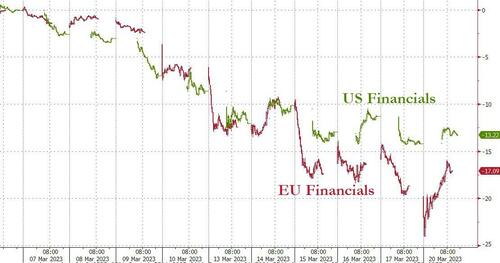
Source: Bloomberg
UBS CDS widened (to 11 year highs, and was put on watch negative by S&P Global Ratings) while the stock rebounded from an ugly 16% plunge at the open…
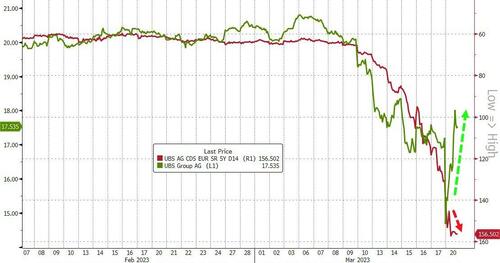
Source: Bloomberg
Broad European financial system credit risk barely budged on the weekend’s news…
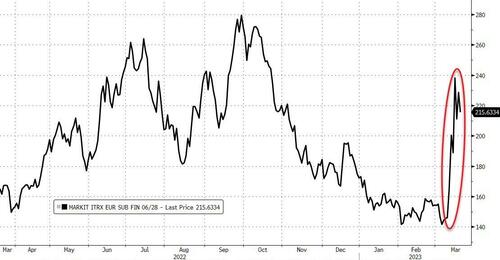
Source: Bloomberg
And across the pond, First Republic Shares crashed (-48%) to a new record low, despite last week’s $30 billion despite inflow bailout…
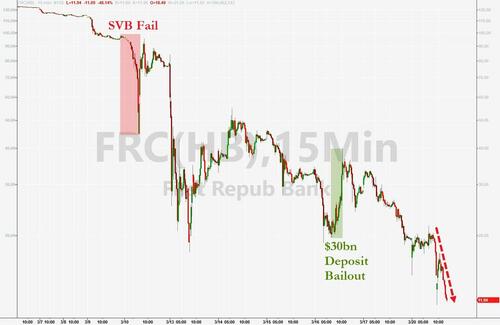
Could be worse – you could have been a CS AT1 bondholder who thought you were above equity in the capital structure…
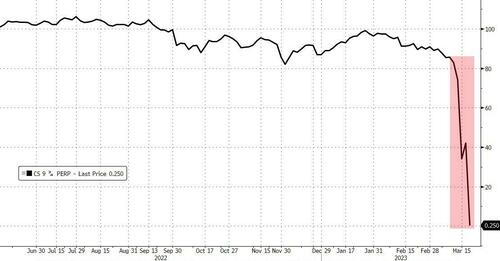
Source: Bloomberg
Those bonds went full Keyser Söze…
The broad US equity markets rallied on the day (though Nasdaq lagged and was basically unchanged). Relief rally on Sunday futures open, then selling through the Asia session. Europe saw a bid into the US cash open when Nasdaq went sideways while the rest of the majors drifted higher…
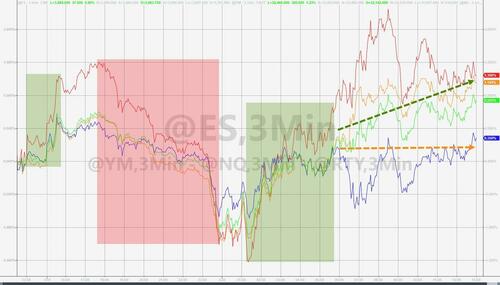
US Regional bank stocks barely managed gains on the day…
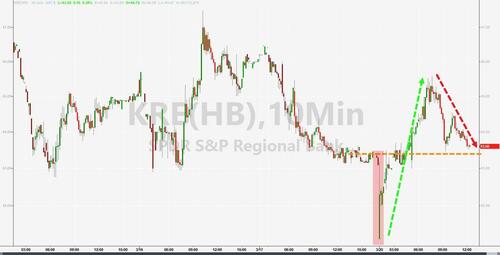
Office REITs were hoping for a big up day… but ended ‘meh’ after plunging for 8 straight days…
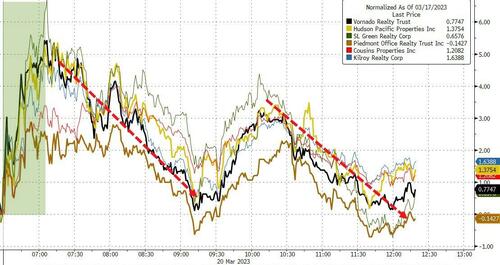
Source: Bloomberg
A squeeze was ignited at the cash open but it faded fast with “most shorted” stocks ending lower on the day…
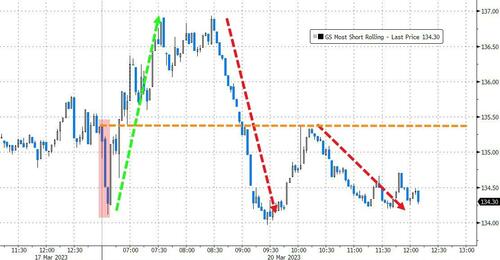
Source: Bloomberg
Treasury yields closed higher across the curve today but only after a wiled roller-coaster overnight with the short-end underperforming. Note the violent panic bid in USTs as Asia closed and the non-stop selling through the European and US sessions…
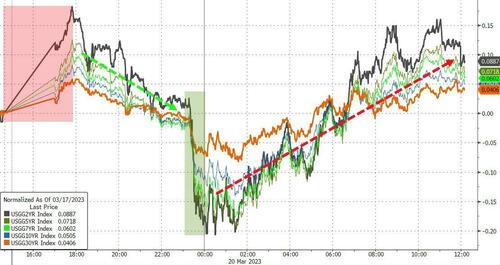
Source: Bloomberg
2Y Yields tagged 4.00%, puked down to near 3.60% before exploding back all the way up to 4.00% – an 80 bps swing intraday…now that is a wild ride for a day at the short-end… (liquidity is non-existent)
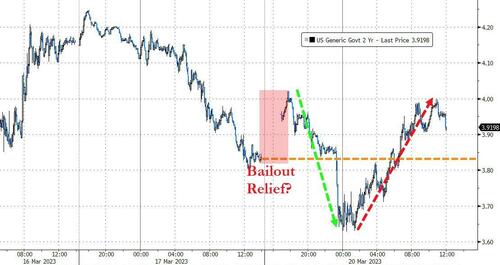
Source: Bloomberg
Inflation expectations (swaps) have tumbled in the last week or two since SVB and CS spoiled the party…
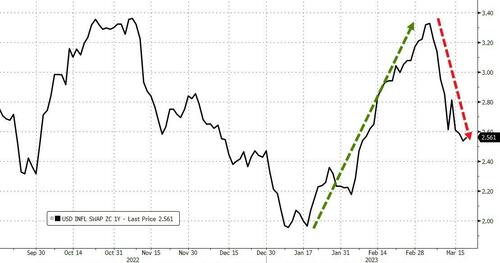
Source: Bloomberg
The dollar dumped to one-month lows…
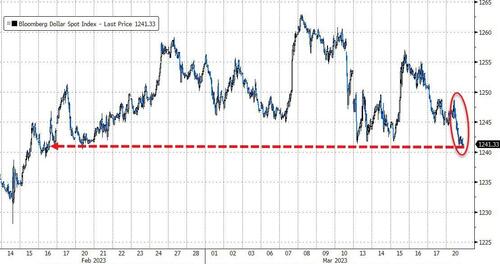
Source: Bloomberg
Bitcoin hit a 9-month high intraday, above $28,000…
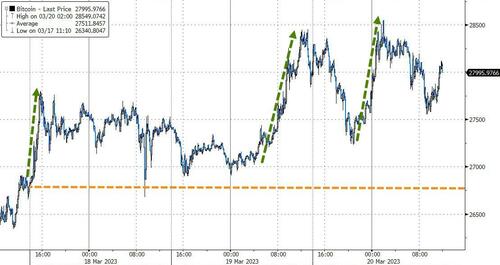
Source: Bloomberg
Gold topped $2000 intraday, but couldn’t hold it. The precious metal still
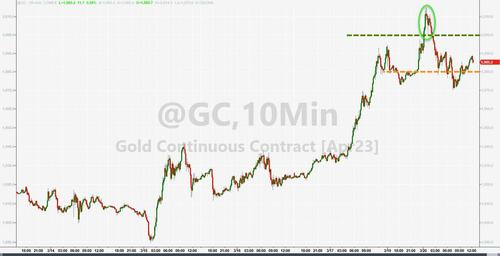
Oil prices followed a similar path to everything else, diving overnight, then ramping higher during Europe and US sessions to close green…
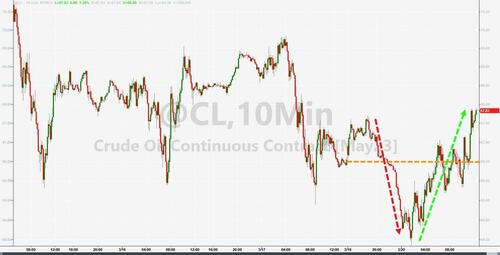
Interestingly, Gold surged up to a key level relative to oil today (1oz of gold can buy 30 barrels of oil) – a level it has only reached in crisis moments…
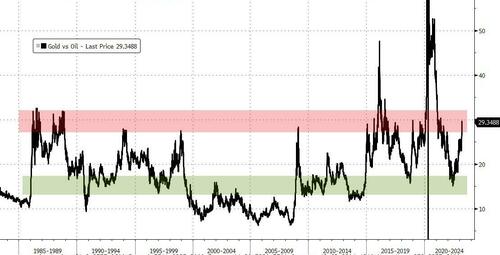
Source: Bloomberg
Finally, Goldman warns that market-implied recession risk for the next 12 months has picked up above 50% with Fed pricing being a core driver. Historically this drove more equity drawdown risk, especially if risky assets were reflecting little recession risk – currently, they imply only a 13% probability of being in a recession.
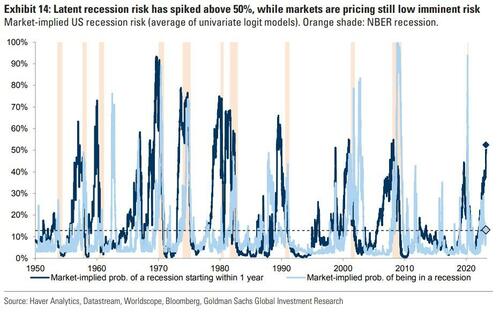
In light of that, we note that Fed rate-hike expectations rose notably today. After slipping lower overnight (as you might expect given the banking system fragility) probabilities then reversed as Europe opened – for no clear reason – ending higher on the day with expectations for a hike this week rising (hawkish) and the terminal rate in May also rising…
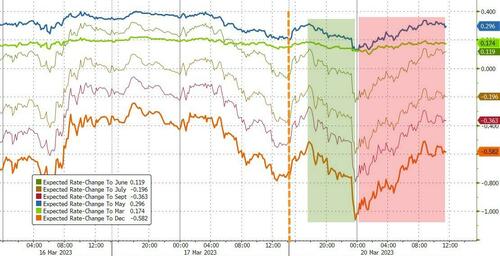
Source: Bloomberg
The market is now pricing a 70% chance of 25bps from The Fed this week. Former NYFed President Bill Dudley proclaimed:
“The case for zero is: do no harm, we know the banking system is under stress so why would you continue to raise rates when the banking system is under stress.”
Is the market thinking that The Fed thinks it’s solved the financial crisis so time to refocus on the inflation ‘issue’? We do not from the above chart that the terminal rate (now in May) is just 30bps above current levels (at 4.875%) and after that almost 100bps of rate-cuts are priced in by year-end.
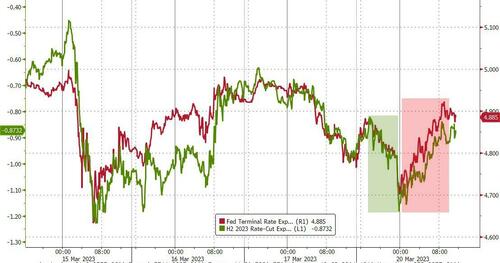
Translation – a huge capitulation by The Fed… big recession AND/OR global financial crisis escalates?
i b Morning trading: WALL STREET REACTS TO CREDIT SUISSE NEWS
Wall Street Reacts To Credit Suisse Bailout: UBS Credit Risk Hits 11-Year High
MONDAY, MAR 20, 2023 – 08:36 AM
Unsurprisingly, CS shares collapsed to their UBS bid price…
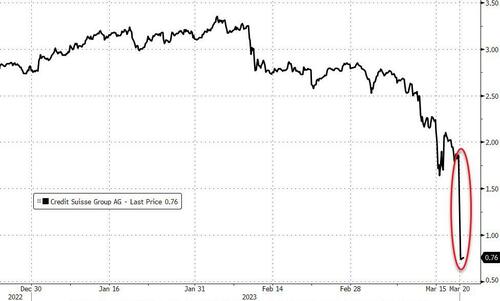
UBS share price is bouncing back from its ugly 16% opening plunge, but remains in the red…
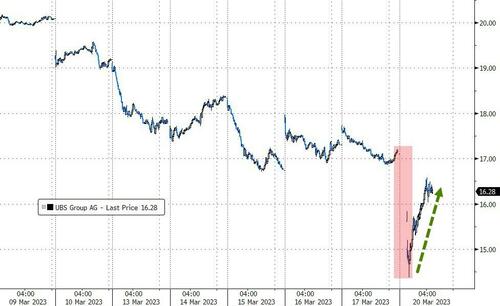
But UBS CDS has jumped to its highest since July 2012...
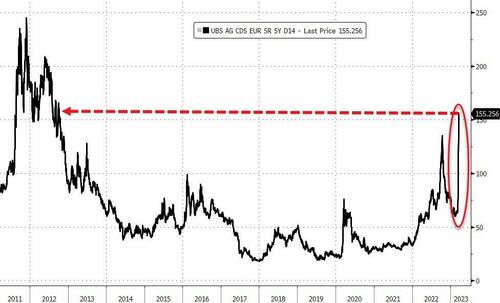
…after a government-brokered deal for it to buy rival Credit Suisse prompted a slew of downgrades from analysts, who warned of risks to the lender’s future earnings.
KBW analyst Thomas Hallet cuts UBS to underperform from market perform, saying there is “considerable uncertainty around the earnings trajectory, while buybacks have been put on hold.” Buybacks were a key part of the investment thesis for UBS, he adds.
- Hallett also notes “unknowns and uncertainties” around key areas such as capital requirements and litigation risks, while the decision to write-down AT1 bonds will unsettle some.
- Says once the accounting noise has died down and there is more certainty on what value the transaction has generated, it could be a compelling deal.
Another KBW analyst Andrew Stimpson expects that the move to wipe out AT1 bond holders to weigh on banks’ shares.
- Though the deal reduces contagion risk, he is “more fearful” of a rise in funding costs going up due to the decision on AT1s, or because of additional regulation on liquidity.
Oddo analyst Roland Pfaender also cuts UBS to underperform from neutral, citing high execution risk on the deal, which saw “very limited due diligence”.
- Notes that UBS management expects deal to be EPS accretive only by 2027, and has suspended share buybacks.
- Says significant integration effort might dilute UBS’s technology and growth initiatives.
Vontobel’s Andreas Venditti (buy) cuts price target to CHF19.5 from CHF22.5 citing higher cost of equity due to higher risk.
- Says UBS’s investment case changes “substantially”.
- Adds there are many significant risks, while issues currently impacting the global banking sector are not over.
Manulife Investment Management (Marc Franklin, a portfolio manager of multi asset solutions).
- “Putting up a firewall to ensure that a bank run doesn’t result in further bank runs and loss of confidence elsewhere in the system,” the policymakers have acted quickly over the weekend.
- They don’t want financial markets to take the pressure as “we are in the process of significant liquidity tightening cycle as a result of central banks trying to tackle the inflation problem”.
But after all that negativity, there were some upgrades on UBS, praising the logic behind the deal.
BofA’s Alastair Ryan upgrades UBS to buy, praising the “impeccable” logic of the deal, due to cost synergies and enhanced scale.
- Notes it gives UBS a 30% share in Swiss deposits; writes that “UBS is acquiring for US$3bn a – troubled – company with US$54bn equity.”
- Raises price target to CHF23 from CHF21
ZKB analyst Michael Klien, however, raises UBS to outperform from market perform, saying that while the transaction increases the risk profile for UBS, the potential benefits are likely to outweigh the risks.
- Adds the transaction should be completed within a few weeks and should positively impact earnings per share.
Morningstar analyst Johann Scholtz says “I think what will give investors confidence is the level of government support involved both in the form of liquidity and in the form of guarantees for future losses on the Credit Suisse portfolio and also restructuring costs”.
- This a very unique banking crisis in the making, where there hasn’t really been a credit event yet, Scholtz says in a Bloomberg TV interview.
However, most were more pessimistic than optimistic in the longer-term…
IG Markets’ Hebe Chen says the deal is a “strong wake-up call” to those who still believe that financial markets are not yet in a crisis.
- “If the collapse of SVB is more attributed to the external monetary policies, the fall of Credit Suisse exposed the rotten roots in the banking system — the poor risk controls and mismanagement. As such, the fall of Credit Suisse may have just been the tip of the iceberg”.
Jefferies analyst Flora Bocahut says the deal removes immediate tail risks, but it raises more questions; UBS’ capital requirement will likely be revised up, and management focus will be captured by this deal for many quarters, maybe years, she adds.
- The earnings impact is difficult to assess, but that should indeed initially be dilutive for UBS, with the issuance of new shares and consolidation of a largely loss-making Credit Suisse.
Citigroup analyst Andrew Coombs says UBS’ deal potentially has large cost synergies, but also carries the risk of sizable revenue attrition.
- For Swiss consumers, more than 25% mortgage market share is now with a single bank; there’s also increased concentration risk for private banking clients, a number of whom will have relationships with both banks.
- For the overall European banking sector, additional tier-1 costs may rise and deposit guarantee scheme limits may be reviewed.
Charles-Henry Monchau, CIO at Banque Syz says “I really don’t like what happened on AT1.
- The risk is that all AT1 bonds collapse – so beyond Credit Suisse. This will put major pressure on banks’ financial ratios”.
BetaShares Holdings’ Chamath De Silva, a portfolio manager says that apart from specific bank credit spreads and CDS premiums, the wider corporate bond market is not displaying signs of severe stress, despite some softening.
- Still, “the news of around $17 billion worth Credit Suisse’s AT1 securities being wiped out during the UBS takeover could spur additional credit selling”.
And, as we noted earlier, that decision to wipe out CS’ AT1 bonds spreads “realized losses” outside of the banking system.
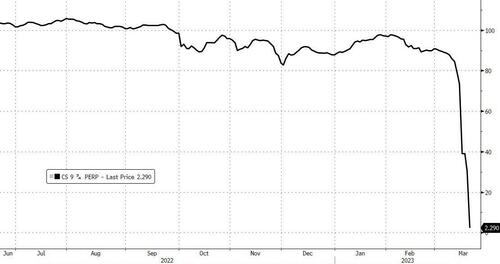
Our understanding is banks don’t own much of each other’s AT1 paper as the treatment is onerous. So this means it is spread out throughout the financial system. Who knows what new trouble that might cause?
END
Peter Tchir’s take on the deal:
(Peter Tchir)
The ‘Bad News’ Is More European Than US… For Now
MONDAY, MAR 20, 2023 – 08:15 AM
Authored by Peter Tchir via Academy Securities,
Quick Rundown
With markets moving quickly, we will do a quick recap of where we are at and what we think will be most important for markets this week.
It is a follow up from Saturday’s, Gasp, Gulp, Glug and Sunday’s 8 Cup of Coffee Day. Academy was able to participate in Bloomberg’s Banking Special yesterday, with this portion of our interview, focused on AT1, being made into its own clip (the rest of the interview was also interesting, I think, but will find that clip later).
And, finally, we got to wake up to Academy making it into the NY Times coverage of Investors Greet CS Deal Warily.
Biggest Concerns
The one thing we did not get this weekend was an explicit guarantee of bank deposits in the U.S. IT is “implicit” because depositors were saved at Signature Banks and Silicon Valley Bank using emergency measures, but it has not been made explicit. As every equity and credit analyst, as every private equity firm, questions companies on their “cash and cash equivalents” line and demands to know where they are banking, more pressure will mount to continue move out of deposits (I don’t think it is a matter of safety, but one of expedience). What I’ve missed until this weekend is how problematic that is, not just for mid-size banks, but for the 100s or even 1000s of smaller banks, that are highly regionalized or even localized. Many of whom are the lifeblood of daily business in those areas. This could/should come, but until it does, there will be pressure on these banks (I like buying dips and growing an outsized position in this space) despite the lack of clarity.
The decision to wipe out CS AT1 bonds.(Harvey: CoCo bonds) Bonds that had been trading in the mid to high 80’s and even 90’s as of March 10th traded at like 2 today. I’ve read many arguments that “support” that decision, as these were meant to be provide a capital “buffer” at times of stress, but the equity is getting paid and no official capital ratios were signaling this treatment. There are two problems with this from a European financial standpoint:
- Asset managers who own any AT1 paper will have to question that decision, and it will focus their attention on the weakest bank(s) in every country. The ability to raise this important level of capital is gone, at least for some time, for many, if not all banks in Europe.
- The decision spreads “realized losses” outside of the banking system. My understanding is banks don’t own much of each other’s AT1 paper as the treatment is onerous. So this means it is spread out throughout the financial system. Who knows what new trouble that might cause?
Back of Mind Concerns
No meaningful equity infusions into banks that have been trading poorly of late. This is only back of mind, rather than front and center, because we I think explicit guarantees are an almost necessary condition for this to occur.
It seems odd to me that UBS stock is doing poorly, even relative to other European bank stocks, as on the surface it seems that either they got a good deal (not only was the cost low, the AT1 debt wiped out, funding (albeit senior in bankruptcy funding) is available from the SNB, but there is some additional loss backstop being provided), or the price of other banks seems expensive. It did not appear, from the series of press releases on Sunday that UBS was an “enthusiastic” buyer which is also a concern, given they had more time than anyone else to examine the books (though even that time was short relative to the complexity of a major international finance company).
Central Banks are “selling” their cooperation (dollar funding lines, etc.) a little too hard. More concrete and unexpected action would be more helpful than just following what has become a standard “crisis” playbook.
Good(ish) News
No bank default in Europe. I don’t think anyone really thought this would happen so its only mildly positive and more than offset by the AT1 treatment.
Oil is below $65 for the first time since 2021! It is good from an inflation front, but not sure what it means from an economic standpoint.
Fed balance sheet is growing! I think markets are getting a little too excited about balance sheet growth, but the 2020/2021 playbook of lower interest rates and balance sheet growth driving stock prices higher (especially the riskiest sectors) is fresh in everyone’s mind. I do think Powell might have to discuss the possibility of suspending QT at this meeting.
Few if any more Fed hikes. I don’t see how in this backdrop, where financial conditions are almost certain to tighten (funding pressure on banks, does that), the Fed can ignore the lag effects. Yes inflation has ticked up, but nothing right now is indicating we are on a strong economic path until the banking concerns get resolved. Oil seems to support a pause too.
Bottom Line
The “bad news” is more European than U.S. so be cautious with Europe on the stock and bond front.
There is a very real possibility that we see some action on bank deposit guarantees so expect a bounce in U.S. stocks (especially the banks).
The easy money Fed trade is probably already overdone, but could easily continue, so fade that cautiously, especially with the possibility of some good news on the bank deposit front.
It is difficult to like interest rates at these levels, so reduce rate risk, at least for a trade, in the U.S.
Weirdly, the rally in gold (balance sheet growth) and bitcoin (a massive anti-bank, anti-establishment sentiment) make sense.
Good luck out there and be nimble, it seems like it could be another long week! (hopefully this note is still remotely relevant by the time you get it, which is anyone’s guess in this crazy, headline driven market).
END
THIS OCCURRED FRIDAY NIGHT:
First Republic Bank shares crash to record lows in future trading signaling problems- to- be on Monday
First Republic Bank Shares Crash To Record Low On Share-Sale Report
FRIDAY, MAR 17, 2023 – 05:01 PM
For a few brief hours yesterday, some market participants breathed a sigh of relief as the ‘big banks’ threw $30 billion of deposits to the ‘small banks’ (specifically First Republic Bank) and saved the world.

Today wrecked that dream as regional bank shares continued their recent and rapid demise with First Republic Bank – which had just been saved – leading the charge lower (after rallying yesterday afternoon).
Now, after the market has closed on a Friday evening (St.Patricks’ Day no less), NY Times reports that the bank – freshly stuffed with $30 billion of the big banks’ cash – is in talks to raise money from other banks or private equity firms by issuing new shares, in a desperate bid to bolster its finances.
We wish them luck in their efforts as Wedbush analyst David Chiaverini – who lowered First Republic to neutral today, warned that it’s difficult to “come up with a realistic scenario where there’s residual value for FRC common equity holders” in the event of a sale.
According to three people with knowledge of the process, the terms of the deal are unknown but a full sale of the bank is apparently possible.
First Republic Bank shares are extending losses in the after-market…

The after-hours action has pushed FRC to a record low, below its Oct 2011 lows…

Analysts at UBS said that banking stocks would “truly settle only after the market feels as if there is a longer-term solution” to First Republic’s woes.
The deposit injection is viewed as a band-aid to help the troubled bank meet short-term obligations. By comparison, raising money by issuing shares will allow the bank to strengthen the underlying business and bolster its ability to handle losses.
“The market may be interpreting that the $30 billion of new deposits that are going in may have staved off a depositor run, but it hasn’t added any new equity to the bank,” Arthur Wilmarth, professor emeritus at George Washington University’s law school, said in an interview.
“The shareholders know that they are certainly at risk.”
The bank’s market cap is now slightly more than $4bn (down from $40bn in late 2021)…

As a reminder, before the bailout yesterday, the bank was working with advisers on a possible sale to a larger rival or a rescue that could include a quick injection of cash to ensure that it had enough to pay out customer withdrawals going forward. The lender had also tried to shore up its finances last weekend with up to $70 billion in emergency loans from the Federal Reserve and JPMorgan.
end
Then this late Monday morning on First Republic. Remember there is no explicit guarantee on deposits …only implicit….
(zerohedge)
First Republic Bank Shares Crash To New Record Low, JPM’s Dimon Reportedly Leading Another Rescue Effort
MONDAY, MAR 20, 2023 – 12:10 PM
Having dumped $30 billion of deposits into First Republic Bank last week, and the bank then being rumored to be pushing for a capital raise, The Wall Street Journal reports that JPMorgan CEO Jamie Dimon is leading discussions with the chief executives of other big banks about fresh efforts to stabilize the troubled regional.
Among the options on the table, the people said, is an investment in First Republic by the banks themselves.
The plan could involve the banks converting some or all of the $30 billion in deposits into a capital infusion, some of the people said.
FRC shares are down over 45% this morning at a new record low…

As a reminder, the San Francisco-based bank’s customers have withdrawn some $70 billion since the collapse of Silicon Valley Bank earlier this month, The Wall Street Journal previously reported.
FRC shares are halted currently…
end
An excellent paper from Simon Black
(Simon Black)
The Fed Just Hijacked American Democracy
FRIDAY, MAR 17, 2023 – 06:10 PM
Authored by Simon Black via SovereignMan.com,
You know the old joke – “Predictions are hard… especially about the future.”
And it’s true, nobody has a crystal ball.
But it’s astonishing to see just how horribly wrong the people in charge can be in their predictions, especially about the very near future.
You probably remember Joe Biden famously insisted in the summer of 2021 that the Taliban was “highly unlikely” to take over Afghanistan.
Boy did he turn out to be wrong.
Only a few weeks later, the Taliban was in control of the entire country… and the world watched in utter astonishment as US military helicopters evacuated embassy personnel from Kabul in one of the most shameful episodes in modern American history.
Not to be outdone, it appears that the Federal Reserve has just had its own Afghanistan moment.
It was only Tuesday of last week that the Fed Chairman testified before a committee of concerned senators who thought the Fed may be tightening monetary policy (i.e. raising interest rates) too quickly.
This was a valid concern; rapid interest rate hikes DO create a LOT of risks. And one of those risks is that asset prices– especially bond prices– plummet in value.
This risk is particularly problematic for banks because they tend to invest their customer deposits in bonds.
In fact, now that the Fed has tightened its monetary policy so quickly, banks across the US have more than $600 billion in unrealized losses on their bond portfolios. This is a pretty major problem… because that $600 billion is ultimately YOUR money.
And it’s not like the Fed doesn’t have access to this information; after all, the Fed supervises nearly EVERY bank in the US financial system.
And yet last week the Fed Chairman completely rejected this risk, telling worried senators flat out that “nothing about the data suggests to me that we’ve tightened too much. . .”
In other words, he believed the Fed’s rapid interest rate hikes posed ZERO risk.
Talk about a terrible prediction; just THREE DAYS LATER, one of the largest banks in the US imploded, multiple bank runs unfolded across the country, the bond market fell into turmoil, and the Fed had to essentially guarantee the entire US banking system in order to restore confidence. (More on that in a moment.)
The mental image of bank runs in America, just days after the Chairman dismissed any risk, is the Fed’s equivalent of the Afghanistan debacle. It’s shameful.
But what’s REALLY concerning is the Fed’s response to this panic– their de facto guarantee of the entire US banking system. Because ultimately they just put YOU on the hook for the potential bond losses of every bank in America. I’ll explain–
After Silicon Valley Bank went bust, the FDIC announced that they will guarantee ALL deposits at the bank.
This is a departure from the FDIC’s normal pledge to guarantee deposits of up to $250,000, and their decision drew a lot of ire from pundits and politicians across the ideological spectrum. Many people concluded that the FDIC’s pledge was tantamount to a “taxpayer-funded bailout.”
But that assessment is wrong. Anyone who is intellectually honest and well-informed will easily understand that the FDIC is not funded by taxpayers. The FDIC is funded by charging fees to its member banks.
So when the FDIC decided to guarantee every depositor at Silicon Valley Bank, including those with balances exceeding $250,000, it means they’re bailing out SVB’s wealthy customers at the expense of big Wall Street banks.
But most people seem to have missed the real story… because the ACTUAL bailout is coming from the Fed, not the FDIC.
Despite the Chairman’s terrible prediction in front of the Senate Banking Committee last week, the Fed now seems keenly aware of the risks in the US banking system. They realize that there are LOTS of other banks that are sitting on massive unrealized losses, just like SVB.
So in order to prevent these banks from going under, the Fed invented a new facility they’re calling the “Bank Term Funding Program”, or BTFP.
But the BTFP is really just an extraordinary lie designed to make you think that the banking system is safe. They might as well have called it, “Believe This Fiction, People”, and I’ll show you why.
Whenever people borrow money from banks, we normally have to provide some sort of collateral. Banks make home equity loans using real estate as collateral. They make car loans where the car is collateral. Manufacturing businesses borrow money using factory equipment as collateral.
Well, banks do the same thing when they borrow money. And sometimes banks will even borrow money from the Federal Reserve. This is actually one of the reasons why the central bank exists– to act as a “lender of last resort” if banks need an emergency loan.
And when banks borrow money from the Fed, they have to post collateral too.
Instead of automobiles and houses, though, banks use their financial assets as collateral– specifically their bonds.
This is actually codified by law (12 CFR 201.108) whereby Congress lists specific assets that the Fed can accept as collateral when making loans to banks. The list is basically different types of bonds.
But this is the root of the problem. Banks are in financial trouble because their bond portfolios have lost so much value. Some banks (like SVB) are even insolvent because of this.
So now, through the BTFP, the Fed will now accept banks’ sagging bond portfolios as collateral, but loan the bank MORE money than the bond portfolios are worth.
Let’s say you’re an insolvent bank that invested, say, $100 billion in bonds. Those bonds are now worth $85 billion, and your bank is about to go under. “NO PROBLEMO!” says the Fed.
The bank simply posts their bond portfolio (which is only worth $85 billion) as collateral, and the Fed will loan the bank the full $100 billion… as if those losses never occurred.
It’s a complete lie. Everyone is pretending that the banks haven’t lost any money to give you a false sense of confidence in the financial system. “Believe the Fiction, People.”
Remember that banks in the US have more than $600 billion in unrealized bond losses right now. And that number will keep increasing if interest rates continue to rise.
So this means that the Fed has essentially guaranteed that entire $600+ billion. Commercial banks won’t lose a penny— they can now pass their financial risks down to the Federal Reserve.
This isn’t a bailout… it’s a time bomb.
We can keep our fingers crossed and hope that this time bomb never explodes. But if it does, the Federal Reserve is going to be looking at hundreds of billions in losses… which would trigger devastating consequences for the US dollar.
This means that everyone who uses US dollars… including every man, woman, and child in America, is ultimately on the hook for the potential consequences of the BTFP.
And that’s what is so remarkable about this: the Fed just made this decision all on its own.
Congress didn’t pass a law. There were no hearings, no judicial oversight, no votes.
Instead, several unelected bureaucrats who have been consistently wrong got together in a room and decided to guarantee $600+ billion in bank losses… and stick the American people with the consequences.
This is the same organization that said in February 2021 that there was no inflation.
The same organization that said in July 2021 that inflation was transitory and would pass in a few months.
The same organization that said in June 2022 that they finally understand “how little we understand about inflation.”
The same organization that said THREE DAYS before SVB’s collapse that “nothing about the data” suggested any risks with their policy actions.
The Fed has been wrong at every critical point over the past few years. And they’ve now unilaterally signed up every single person in America to a $600+ billion bank bailout without so much as a courtesy phone call to Congress.
This is apparently what Democracy means in America today.
We’ve all been subjected to endless vitriol over the past few years with people on all sides howling that “Democracy is under attack.”
Well, we just watched an unelected committee of central bankers hijack democracy and stick the American people with a potential $600+ billion bank bailout.
end
Early morning trading:
II) USA DATA
iii) USA ECONOMIC NEWS//
It begins: In reaction to the failure of Credit Suisse the Fed panics and announces coordinated daily USA dollar swap lines trying to ease the banking crisis
(zerohedge)
Fed Panics; Announces “Coordinated” Daily US Dollar Swap Lines To Ease Banking Crisis
SUNDAY, MAR 19, 2023 – 05:34 PM
“The market stops panicking when central banks start panicking”
In January 2022, just around the time the Fed was about to launch its most aggressive tightening campaign since Volcker, we warned “remember, every Fed tightening cycle ends in disaster and then, much more Fed easing”
Fast forward to just over a week ago, when the Fed tightening cycle indeed ended in disaster when SIVB became the first (of many) banks to fail, a chain of dominoes that culminated with today’s collapse of Credit Suisse – a systematically important bank with $600BN in assets.
And then, at 5pm, the easing officially began, because while a bunch of laughable macrotourists were arguing on FinTwit whether last week’s record surge in the Fed’s discount window was QE or wasn’t QE (answer: it didn’t matter, because as we said, it assured what comes next), the Fed finally capitulated, just as we warned over and over and over that it would…
… and at exactly 5pm the Fed announced “coordinated central bank action to enhance the provision of U.S. dollar liquidity” by opening daily Dollar Swap lines with all major central banks, in a carbon copy repeat of the Fed’s panicked post-covid crisis policy response playbook.
The Bank of Canada, the Bank of England, the Bank of Japan, the European Central Bank, the Federal Reserve, and the Swiss National Bank are today announcing a coordinated action to enhance the provision of liquidity via the standing U.S. dollar liquidity swap line arrangements.
To improve the swap lines’ effectiveness in providing U.S. dollar funding, the central banks currently offering U.S. dollar operations have agreed to increase the frequency of 7-day maturity operations from weekly to daily. These daily operations will commence on Monday, March 20, 2023, and will continue at least through the end of April.
The network of swap lines among these central banks is a set of available standing facilities and serve as an important liquidity backstop to ease strains in global funding markets, thereby helping to mitigate the effects of such strains on the supply of credit to households and businesses.
And once the USD swap lines are reopened, the rest of the cavalry follows: rate cuts, QE (the real stuff, not that Discount Window nonsense), etc, etc. In fact, we have already seen a near record surge in reserve injections:
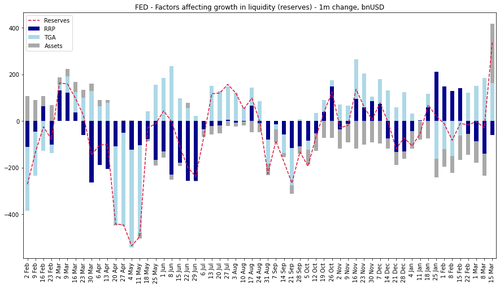
The Fed may as well formalize it now and at least preserve some confidence in the banking sector, even if it means destroying all confidence left in the “inflation fighting” Fed, with all those whose were in charge handing in their resignation for their catastrophic handling of this bank crisis.
Then again, maybe they should just wait until he Fed hikes its inflation target to 3% or more – something else we predicted…
Tweet
See new Tweets
Conversation

At some point Fed will concede it has no control over supply. That’s when we will start getting leaks of raising the inflation target
… because now that we are back in liquidity injection mode, well, say goodbye to hopes of seeing affordable eggs every again.
END
These guys are toast!
(zerohedge)
Bed, Bath And Beyond Bludgeoned Below A Buck, But Still Not Bankrupt
MONDAY, MAR 20, 2023 – 09:15 AM
Shares of Bed, Bath and Beyond are getting the “Credit Suisse treatment” this morning, plunging under $1 as the struggling retailer continues an incessant yet increasingly difficult search for rescue funding.
The retailer’s latest plans include a reverse stock split and overseeing its shares getting tossed from the S&P SmallCap 600 Index, where it will be replaced by Lumen Technologies, according to a Monday morning Bloomberg wrap up.
Earlier this month, the company had “lowered the price threshold of its deal with hedge fund Hudson Bay Capital to $1 until April 3, securing an extra $100 million of extra funding,” Bloomberg wrote.
The company is seeking approval for a reverse split between 1-for-5 and 1-for-10, with the final ratio to be determined by the Board. Shares are now down more than 95% over the past year.
We have to give the company (which has already missed interest payments on its bonds) an “A” for effort, as it continues to somehow avoid filing for what feels like should be an inevitable bankruptcy, filling a last ditch effort for financing last month, as we noted.
The company announced last month a plan to offer series A convertible preferred stock and warrants, raising over $1 billion. Wedbush wasn’t enthused about the prospect of saving the company last month:
“We see these capital-raising transactions as a ‘last gasp’ to survive before filing for bankruptcy protection where the common equity would likely be worthless,” Wedbush analyst Seth Basham wrote.
“In the event the transactions are successful, BBBY common shares could rise as they are trading like options on the company’s survival, but the ultimate value would be undermined by this highly dilutive offering of preferred stock that would have priority over the common shares”
A look into the company in early February claimed the company only has itself to blame for its dire financial straits. “Executives were mired in minutiae as the chain barreled toward bankruptcy,” the report says, citing former employees. For example, last summer the company’s executives urged white collar workers to return to the office four days a week despite the fact that many were already coming in.
The article laid out how every solution the company tried only led them further into financial ruin. Even firing 20% of its workforce and shuttering 150 of its 770 stores before securing new financing didn’t help the business.
end
USA economy is faltering badly as Amazon is prepared to fire another 9,000 workers
(zerohedge)
Amazon Prepares To Fire Another 9,000 Workers
MONDAY, MAR 20, 2023 – 11:00 AM
Bloomberg reported that Amazon sent an internal email notifying its employees about an upcoming wave of layoffs, which is part of the company’s continuing strategy to reduce costs amid mounting macroeconomic uncertainty.
Amazon CEO Andy Jassy reportedly told employees that an additional 9,000 people would be laid off in the coming weeks.
Chief Executive Officer Andy Jassy announced the cuts internally Monday, saying they would occur in the coming weeks and primarily affect Amazon Web Services, human resources, advertising and the Twitch livestreaming service groups. –Bloomberg
The world’s largest e-commerce company is grappling with sliding online sales growth and bracing for a possible recession.
In mid-January, Amazon notified employees about reducing its headcount by 18,000 workers worldwide — the largest round of jobs cuts in the company’s history.
It appears the company has massively overhired in the last several years — just like most tech companies.

Last week, Meta slashed another 10,000 workers. According to the layoff tracking website Layoffs.fyi, 483 tech companies have fired 128,000 workers so far this year.
Shares of Amazon moved slightly higher after the news.
… and the news comes weeks after Amazon paused construction on its giant second headquarters in Arlington, Virginia.
Liz Warren in a letter to Powell has declared war on the Fed Chairman with 11 questions on the failure of SVB and Signal bank. Get a load of the resume of the San Francisco Fed chairperson
(zerohedge)
Liz Warren Makes War On Powell, And How ‘Woke’ SF Fed Chief Failed On SVB
SUNDAY, MAR 19, 2023 – 05:00 PM
Senator Elizabeth Warren (D-MA) says Federal Reserve Chair Jerome Powell has racked up “an astonishing list of failures,” which contributed to the implosion of Silicon Valley Bank and Signature Bank, Bloomberg reports.
“SVB and Signature accumulated risk and made dangerous decisions about how to manage that risk,” said Warren in a Wednesday letter to Powell. “They did so in part because of greed and incompetence – but were allowed to do so under faulty supervision and in a weakened regulatory environment that you helped to create.”
“You owe the public an explanation,” Warren continued, demanding that Powell respond to 11 questions by March 29.
Warren’s letter outlines several efforts to weaken regulations that were implemented following the 2008 financial crisis, which was enabled by lax supervision by the Fed.
Warren also demanded that Powell recuse himself from an internal investigation by the Fed into regulatory failures concerning SVB – the results of which will be made public by Vice Chair Michael Barr by May 1. Instead, a bipartisan group of lawmakers wants an independent investigation.
The Fed and other regulators announced emergency measures to help contain the budding crisis, including a new loan program from the central bank that will make is easier for banks to borrow to meet deposit withdrawal demand.
In her letter, Warren also said Powell supported a 2018 law that exempted mid-sized banks like SVB from the same stringent oversight requirements faced by the biggest banks, a change that she and some other progressives have said contributed to SVB’s demise. Testifying about the bill at the time, Powell said the Fed would still have the ability to regulate mid-size banks if warranted, and that gave them “the tools that we need.” -Bloomberg
“Make no mistake: your decisions aided and abetted this bank failure, and you bear your share of responsibility for it,” wrote Warren.
Meanwhile, woke ‘Frisco Fed’ chief Mary Daly has also come under fire. As Paul Sperry writes in the NY Post: “Wokeness has replaced competence and merit across the banking sector, and San Francisco Fed Chief Mary Daly is the poster child of this pernicious trend.”

A protege of Treasury Secretary Janet Yellen and short-list candidate for Federal Reserve vice chair, Daly was supposed to be supervising Silicon Valley Bank but apparently was too busy playing politics and pushing woke agendas to regulate rogue banks like SVB, the second-biggest bank failure on record.
Daly had other priorities, including climate change, George Floyd and Black Lives Matter, inequities between blacks and whites, LGBTQ+ rights and a host of other woke social-justice issues that had nothing to do with banking and finance. -NY Post
According to Daly’s bio, her commitments include “understanding the economic and financial risks of climate change and inequities.”
Sperry highlights a recent LinkedIn post from Daly, in which she appears ‘sidetracked’ by racial justice, writing “What Black voices have I lifted up? Equity & inclusion begins with me. #GeorgeFloyd.”
And while Daly has been focused on everything but banking, she was completely oblivious to the warning signs of inflation.
Two years ago, as inflation was spiraling out of control, she said: “I am not thinking that we have unwanted inflation around the corner. I don’t think that’s a risk.”
Last year, she denied that the economy was suffering from horrific inflation, saying “That’s not what I see.”
And in August, Daly – who makes $422,000 per year, said “I don’t feel the pain of inflation anymore.”
“I’m not immune to gas prices rising, food prices rising,” she continued, adding “But I don’t find myself in a space where I have to make trade-offs, because I have enough, and many, many Americans have enough.”
From her policy papers, speeches and interviews, it’s clear that Daly thinks the Fed’s core mission isn’t controlling inflation but achieving full employment — and raising interest rates just hurts that goal. Her agenda is more jobs and higher wages for minorities, so sound money is not a priority for her — even though inflation is a huge tax on the working class and especially minorities.
Until recently, Daly was opposed to the Fed’s hawkish shift to tightening credit to fight inflation. Her bank examiners no doubt shared her dovish mindset and didn’t anticipate rates increasing, which may also explain why alarms weren’t raised at SVB. -NY Post
Sperry also notes that Daly has zero experience in banking or managing risk. According to her, Treasury Secretary Janet Yellen has been an “important mentor in my life . . . [S]he made my career kind of explode.”
And now banks under her watch are, ‘kind of imploding.’
end
USA COVID//
END
SWAMP STORIES
Trump announces that he will be indicted for that stupid hush money payment in 2016. The charges comes from the state attorney in NY
“Take Our Nation Back”: Trump Calls For Protests As ‘Imminent’ Arrest Expected
SATURDAY, MAR 18, 2023 – 11:00 AM
Update (1315ET): The Washington Post reports that Trump spokesman Steven Cheung said Saturday morning there had been no “notification” of an indictment and said Trump’s supporters should attend a rally he is holding next week in Texas for his 2024 reelection.
Susan Necheles, a lawyer for Trump, said his remark about the timing of his arrest was gleaned from media reports on Friday about local and federal law enforcement players expecting to convene early next week to discuss security and logistics related to Trump’s expected indictment.
“Since this is a political prosecution, the District Attorney’s office has engaged in a practice of leaking everything to the press, rather than communication with President Trump’s attorneys as would be done in a normal case,” Necheles said in a statement.
* * *
As the banking crisis and the Hunter Biden laptop scandal continues to unfold, the potential indictment of former President Trump on felony falsification charges could be the only headline that really matters next week.

Fox News anchor John Roberts informed viewers on Friday afternoon that the Manhattan District Attorney’s Office has requested a “meeting with law enforcement ahead of a potential Trump indictment.” He said, “to discuss logistics for some time next week, which would mean that they are anticipating an indictment next week.”
“Same sources familiar with the planning said they will go over security preparations in and around the courthouse in lower Manhattan. Secret Service will take the lead in what they will allow or will not allow, the source cautioned, mentioning, for instance, that the decision to handcuff the president, the former president, or not, they will set the tone and will escort him into the courtroom,” Roberts continued.
Trump’s lawyer, Joseph Tacopina, told AP News that if the former president is indicted, “we will follow the normal procedures.”
If Trump is charged with felony falsification of business records, he would be forced to surrender to New York authorities and make an appearance in a Manhattan courthouse. The former president allegedly coordinated a transfer of $130,000 to pornstar Stormy Daniels through former attorney Michael Cohen.
“The payments were made to a lawyer, not to Stormy Daniels. The payments were made to Donald Trump’s lawyer, which would be considered legal fees,” the lawyer told MSNBC earlier this week, adding that Cohen “was his lawyer at the time and advised him that this was the proper way to do this to protect himself and his family from embarrassment. It’s as simple as that. That is not a crime.”
According to New York Daily News, the Manhattan District Attorney’s office held meetings with several law enforcement agencies to discuss security concerns ahead of a possible indictment.
And if Trump is charged next week, he might as well kick off his presidential campaign — would be a hell of a way to start.
It is possible that a PR campaign is underway to divert the attention of the American public from banking failures and the Biden family.
Trump will most likely be in the spotlight next week. On Saturday morning, he wrote this on Truth Social:
What exactly is Trump suggesting his followers do? Those last few words seem to play right into Democrats’ narratives.
… and forget about those regional banks and Hunter Biden headlines next week. It might be all about Trump.

* * *
Here’s more on next week via submission by ‘BlueApples,’
Apparently, arrest warrants for populist politicians are en vogue right now. On the same day that the International Criminal Court (“ICC”) announced the issuance of an arrest warrant for Russian Federation President Vladimir Putin, reports out of New York suggest the same fate is forthcoming for former president Donald J. Trump. Local, state, and federal law enforcement agencies met with security agencies concerning the logistical preparations necessary to handle Trump’s arrest. That preparation is in anticipation of an indictment against Trump from Manhattan District Attorney Alvin Bragg for felony charges of falsification of business records, according to NBC News.
The crux of the charges stems back to Trump’s handling of the Stormy Daniels saga that enveloped his 2016 presidential campaign. According to Trump’s attorney, Joe Tacopina, the former president is not guilty of the presumably impending charges. In Trump’s defense, Tacopina shifted the blame to Michael Cohen hose cooperation with the Manhattan District Attorney’s office has accelerated its action against Trump. Under Cohen’s directive, Trump authorized a payment to Daniel’s that the Manhattan District Attorney’s Office contends was falsely categorized as a legal fee when Trump reimbursed Cohen for it. The potential charges coming from the Manhattan district attorney’s office are a near carbon copy of the federal charge Cohen pleaded guilty to in 2018 concerning the $130,000 payment Trump made to Daniels in the 11th hour of his 2016 campaign.
According to Cohen, the directive to issue the payment came directly from Trump. Cohen categorized the order from Trump for the purpose of influencing the 2016 Presidential Election. Cohen contended that the payments to Daniels were made by him directly and that Trump reimbursed him for the $130,000, a transaction that was itemized as a legal fee by Trump’s company. Cohen testified to a grand jury for a second time preceding the emergence of reports about a potential indictment of Trump. President Trump declined to appear before the same grand jury Cohen testified to earlier this week following an invitation from the District Attorney’s Office.
Despite not testifying before the grand jury, Tacopina has addressed the probe behind the looming charges against Trump. “We are not convinced they will bring a case, but if so we will deal with it,” Tacopina said in the wake of the Manhattan District Attorney’s office extending an invitation to Trump to testify before the grand jury. Trump himself categorized the probe as a “Scam, Injustice, Mockery, and Complete and Total Weaponization of Law Enforcement in order to affect a Presidential Election!” in a post made on his social media platform Truth Social. Cohen’s appearance before the same grand jury came following over 20 meetings with prosecutors.
Potential charges from Manhattan’s District Attorney would come at a time where Trump is already under the scrutiny of Justice Department Special Counsel Jack Smith. The Special Counsel’s probe into Trump envelopes the former president’s role in the events of January 6th, 2021 as well as his handling of the classified documents at the core of the FBI raid of Mar-a-Lago.
Like that FBI raid, Trump is sure to capitalize on any charges coming out of Manhattan to fortify the narrative of his 2024 presidential campaign. Like in 2016, Trump has repeatedly framed himself as an anti-establishment candidate despite any record substantiating that claim accrued during his time in office. The FBI raid of Mar-a-lago, coupled with charges that he may be indicted on next week, will surely be categorized as evidence of a political witch hunt against him, just as he has described the Russiagate narrative that emerged following his initial election in 2016.
As reports suggest, the gravity of that continued persecution of Trump is not lost upon the NYPD, New York State Court Officers, the U.S. Secret Service, the FBI’s Joint Terrorism Task Force, and the Manhattan District Attorney’s Office. The law enforcement and security consortium all met to discuss how booking Trump under any charges would be handled. However, sources reporting these deliberations have indicated that the meeting has yet to take place but that the Secret Service would have over-arching authority on the handling of any indictment.
If the Manhattan District Attorney’s Office does indeed move forward, it will mark the second high-profile case it has engaged in against Trump. In December 2022, the Trump Organization was convicted on charges of tax fraud and falsifying business records. Though Trump himself was not a defendant in that case, former CFO Allen Weisselberg eventually plead guilty to 15 felony charges.
Trump’s attorney Joseph Tacopina breathed life into the reality of similar felony charges against the former president by conveying that his client would follow normal booking procedures if he was indicted, according to CNBC. While falsification of business records can be charged as a misdemeanor in New York State, Manhattan District Attorney Alvin Bragg has elected to modify the charges as a felony. The same federal officials who charged Cohen decided against pursuing similar charges against Trump.
Despite any charges against being exalted as an immense victory against Trump by his opposition, any indictment doesn’t appear to dissuade him from his 2024 campaign. In discussing potential federal charges regarding his possession of classified documents, Trump assured his supporters that his commitment to running for election would remain unfettered. Trump told James Rosen of Newsmax that he would run for president regardless of any charges levied against him.
Trump’s incorrigible defiance in the face of looming charges against him serves as the pathological pillar of his 2024 campaign, assured to revitalize the devout allegiance to him that may have been fractured by the emergence of the likes of Florida Governor Ron DeSantis as a competitor for the Republican Party’s nomination in the next presidential election. Knowing the poignancy of how an indictment could reaffirm the belief that Trump is the victim of a continued political witch hunt, the decision by Bragg may eventually become an example of cutting one’s nose off to spite its face. Even if a conviction or guilty plea were to come from any felony charges, that may prove to be little more than a Pyrrhic victory for Trump’s opposition as it may stoke the same support that led to his election in 2016. In the end, that hubris could lead to the establishment’s demise once again as the Democratic Party struggles to put forward a worthy opponent for 2024.
end
Turley: Soros-Backed Manhattan DA’s Made-For-TV Trump Prosecution Is “Legally Pathetic”
SUNDAY, MAR 19, 2023 – 08:30 PM
George Washington University Law Professor Jonathan Turley panned reports of the looming potential case against former President Donald Trump after the former commander-in-chief announced he may be arrested in the next week.
As The Epoch Times’ Jack Phillips reports below, alleged unnamed court sources have told multiple news outlets that Trump could be indicted in the near future, while Trump said via Truth Social that he expects to be arrested by Manhattan District Attorney Alvin Bragg’s office on Tuesday. Bragg’s office has not publicly confirmed reports that he may possibly indict the former president for allegedly misclassifying a $130,000 hush payment made to Stormy Daniels in 2016.
Trump has denied claims that he had an affair with Daniels in the early 2000s. However, unconfirmed reports alleged that a grand jury in New York has been empaneled and may be seeking an indictment of the former president.
But Turley said that based on those reports, the DA’s case against Trump “is legally pathetic” and “is struggling to twist state laws to effectively prosecute a federal case long ago rejected by the Justice Department against Trump.”
“In 2018 (yes, that is how long this theory has been around), I wrote how difficult such a federal case would be under existing election laws. Now, six years later, the same theory may be shoehorned into a state claim,” wrote Turley, who was a former expert witness for Trump’s first impeachment trial, for The Hill.
“While we still do not know the specific state charges in the anticipated indictment, the most-discussed would fall under Section 175 for falsifying business records, based on the claim that Trump used legal expenses to conceal the alleged hush-payments that were supposedly used to violate federal election laws,” Turley said.
“While some legal experts have insisted such concealment is clearly a criminal matter that must be charged, they were conspicuously silent when Hillary Clinton faced a not-dissimilar campaign-finance allegation.”
He noted that a Section 175 charge “would normally be a misdemeanor” and that the “only way to convert it into a Class E felony requires a showing that the ‘intent to defraud includes an intent to commit another crime or to aid or conceal the commission thereof.’ That other crime would appear to be the federal election violations which the Justice Department previously declined to charge.”
Bragg’s office, meanwhile, could not prosecute the charge as a misdemeanor as it falls outside the two-year statute of limitations, Turley wrote. Instead, Bragg would have to pursue a felony charge.
“Prosecutors working under Bragg’s predecessor, Cyrus Vance Jr., also reportedly rejected the viability of using a New York law to effectively charge a federal offense,” Turley noted.
DA Bragg (who was elected with a million dollars of support from George Soros funneled through the Color of Change PAC) also previously expressed doubts about the Daniels case and shut it down when he took office several years ago, he said, adding that two lead prosecutors resigned at the time.
“…Bragg himself threw a flag on this play. I mean, he stopped the two prosecutors who were moving toward a trial. They resigned in protest. One of them then wrote a book. In my view, that book was deeply improper and unprofessional. The book was about prosecuting someone who had not been charged, let alone convicted. But it triggered a huge amount of pressure on Bragg. It does appear that it works. He then proceeded to bring this case.“
If Trump is indicted, it may require Trump to travel to the district attorney’s office in downtown New York to surrender. In white-collar cases, the defendant’s lawyers and prosecutors typically agree on a date and time, rather than arresting the person at home.
Trump would have his fingerprints and mugshot taken and would appear for arraignment in court. He would likely be released on his own recognizance and allowed to head home, legal analysts told Reuters.
Trump’s lawyer, Joe Tacopina, told CNBC on Friday that Trump would surrender if charged. If Trump refused to come in voluntarily, prosecutors could seek to have him extradited from Florida, where he currently resides.
On Saturday, Trump spokesperson Steven Cheung told The Epoch Times in an emailed statement that the former president has not been formally notified of any pending arrest. Both Cheung and Trump accused Bragg, a Democrat who received $1 million in campaign cash from a George Soros-linked organization, of targeting him for political gain and could try to seek dismissal of the charges on those grounds.
“There has been no notification, other than illegal leaks from the Justice Dept. and the DA’s office, to NBC and other fake news carriers, that the George Soros-funded Radical Left Democrat prosecutor in Manhattan has decided to take his Witch-Hunt to the next level,” Cheung said.
“President Trump is rightfully highlighting his innocence and the weaponization of our injustice system,” he added.
The Manhattan District Attorney’s Office has not responded to a request for comment.
As Jonathan Turley concludes, via The Hill, while some will view it as poetic justice for this former reality-TV host to be tried like a televised talent show, the damage to the legal system is immense whenever political pressure overwhelms prosecutorial judgment. The criminal justice system can be a terrible weapon when used for political purposes, an all-too-familiar spectacle in countries where political foes can be targeted by the party in power.
None of this means Trump is blameless or should not be charged in other cases. However, we seem to be on the verge of watching a prosecution by plebiscite in this case.
The season opener of “America’s Got Trump” might be a guaranteed hit with its New York audience — but it should be a flop as a prosecution.
THE KING REPORT
| he King Report March 17, 2023 Issue 6970 | Independent View of the News |
| The King Report March 20, 2023 – Issue 6971Independent View of the News UBS to Buy Credit Suisse in $3.3 Billion Deal to End Crisis (all-share deal) https://t.co/i2eThM4Zo6 The Swiss National Bank is offering a 100 billion-franc liquidity assistance to UBS while the government is granting a 9 billion-franc guarantee for potential losses from assets UBS is taking over. Regulator Finma said about 16 billion francs of Credit Suisse bonds will become worthless to ensure private investors help shoulder the costs… UBS Chairman Colm Kelleher said he will shrink Credit Suisse’s investment bank…This was the only possible solution,” Swiss Finance Minister Karin Keller-Sutter said, adding it was needed to stabilize the Swiss as well as international financial markets. Credit Suisse, she said, was no longer able to survive on its own. https://news.yahoo.com/ubs-buy-credit-suisse-historic-173300060.html CNBC: Credit Suisse shareholders receive 1 UBS share for every 22.48 Credit Suisse shares they hold… The combined bank will have $5 trillion of invested assets, according to UBS… “This is a commercial solution and not a bailout,” said Karin Keller-Sutter, the Swiss finance minister…said… https://www.cnbc.com/2023/03/19/ubs-agrees-to-buy-credit-suisse-as-regulators-look-to-shore-up-global-banking-system.html @BloombergTV: The UBS-Credit Suisse deal “is a bailout,” says Mohamed El-Erian, President of Queen’s College Cambridge, adding it “was not the best solution” https://t.co/FmSFunvlqp SNB Statement: Swiss National Bank provides substantial liquidity assistance to support UBS takeover of Credit Suisse https://t.co/KpcJdoCkOP UBS Vows to Shrink ‘Tricky’ Credit Suisse Investment Bank UBS is taking over a portfolio of “difficult-to-assess” illiquid assets, including long-dated derivatives as well as swaps, for which the bank negotiated a loss guarantee from the Swiss government. Given the fast nature of the deal, UBS was not able to do proper due diligence on the portfolio… (Derivatives, again!) https://finance.yahoo.com/news/ubs-vows-shrink-tricky-credit-205337777.html The cost of insuring UBS’s debt against default soared in Sunday trading after the lender agreed to buy Credit Suisse – UBS’s credit default swaps, derivatives often used to gauge a borrower’s credit risk, widened by at least 40 basis points to 215 bps for five-year contracts… https://t.co/avzcbhjAbC Credit Suisse Press Release: On Sunday, Credit Suisse has been informed by FINMA that FINMA has determined that Credit Suisse’s Additional Tier 1 Capital (deriving from the issuance of Tier 1 Capital Notes) in the aggregate nominal amount of approximately CHF 16 billion will be written off to zero… the merger will be implemented without the otherwise necessary approval of the shareholders of UBS and Credit Suisse to enhance deal certainty… https://www.credit-suisse.com/about-us-news/en/articles/media-releases/credit-suisse-and-ubs-to-merge-202303.html UBS initially proposed a 0.25Sfr per share takeover. Credit Suisse vehemently opposed it. UBS then raised the big to 0.50Sfr/share, a tad above $2B. This offer was refused. Beggars can’t be choosers – unless they are bankers! UBS offers to buy Credit Suisse for up to $1bn: FT (SFr0.25 a share to be paid in UBS stock) https://www.ft.com/content/ec4be743-052a-4381-a923-c2fbd7ea9cfd Credit Suisse said opposed to $1B UBS takeover offer (on Sunday) https://seekingalpha.com/news/3948697-credit-suisse-said-opposed-to-1b-ubs-takeover-offer-report FT: BlackRock explored rival Credit Suisse takeover bid BlackRock on Saturday said it “is not participating in any plans to acquire all or any part of Credit Suisse, and has no interest in doing so”…. https://www.ft.com/content/6319e205-d688-4521-b048-8d69a2c40847 Statement by ECB President Christine Lagarde “I welcome the swift action and the decisions taken by the Swiss authorities. They are instrumental for restoring orderly market conditions and ensuring financial stability. The euro area banking sector is resilient, with strong capital and liquidity positions. In any case, our policy toolkit is fully equipped to provide liquidity support to the euro area financial system if needed and to preserve the smooth transmission of monetary policy.” https://t.co/eOjI4tBRPz Bank of England Statement: Credit Suisse: The Bank of Canada, the Bank of England, the Bank of Japan, the European Central Bank, the Federal Reserve, and the Swiss National Bank are today announcing a coordinated action to enhance the provision of liquidity via the standing U.S. dollar liquidity swap line arrangements. To improve the swap lines’ effectiveness in providing U.S. dollar funding, the central banks currently offering U.S. dollar operations have agreed to increase the frequency of 7-day maturity operations from weekly to daily. These daily operations will commence on Monday, March 20 2023, and will continue at least through the end of April… https://www.bankofengland.co.uk/news/2023/march/coordinated-central-bank-action-to-enhance-the-provision-of-us-dollar-liquidity Statement by Secretary of the Treasury Janet L. Yellen and Federal Reserve Board Chair Jerome H. Powell – “We welcome the announcements by the Swiss authorities today to support financial stability. The capital and liquidity positions of the U.S. banking system are strong, and the U.S. financial system is resilient. We have been in close contact with our international counterparts to support their implementation.” (Very brief!) https://www.federalreserve.gov/newsevents/pressreleases/other20230319a.htm @elerianm: Virtually everyone at this high-level Swiss press conference–government officials, regulator, central bank governor, and executives of the two banks–blamed the US banking sector turmoil for being the catalyst for the financial turmoil in Switzerland. A blunt fact remains when you step back from all the details on @CreditSuisse-@UBS deal: Switzerland’s second-largest bank–a bank that opened its doors for business in 1856 and was one of the 30 systemically important banks around the world–will no longer exist as a standalone US Official: Credit Suisse’s problems are unrelated to deposit runs on US regional banks: Reuters @KrishnaMemani: For the number of times Swiss regulators have mentioned Twitter as the cause of this, we have to coin a new term… TWITTER Vigilantes….to replace bond market vigilantes. Two major banks in Europe look to regulators for reassurance https://t.co/NQxNbcw4FY The two banks have held their own internal deliberations on how soon the European Central Bank should weigh in to highlight banks’ resilience, specifically their capital and liquidity positions, the people said. One of the executives said the Federal Reserve might have to move first as the failures of Silicon Valley Bank and Signature Bank in the United States earlier this month triggered the concerns in Europe… https://www.reuters.com/business/finance/two-major-banks-europe-worry-about-contagion-look-regulators-reassurance-sources-2023-03-19/ Biden says banking turmoil has eased after a week of anxiety over bank failures https://t.co/2tBUO6cOLt S&P again downgrades First Republic Bank ratings (second time in less than a week) The credit rating agency lowered First Republic’s sovereign credit ratings to “B+” from “BB+”. S&P, however, maintained its outlook at “Creditwatch Negative.” The report comes after S&P on Wednesday downgraded the bank’s credit rating to “BB+” from “A-.”… https://www.reuters.com/article/global-banks-frst-rep-bk-sp/update-1-sp-again-downgrades-first-republic-bank-ratings-idUSL1N35R0JN Warren Buffett in Contract with Biden Officials on Banking Crisis – BBG on Saturday Representatives for Berkshire Hathaway and the White House didn’t immediately respond to requests for comment. (Biden retreated to Delaware for the weekend) https://www.afr.com/politics/federal/emergency-measures-being-prepared-to-force-credit-suisse-takeover-ft-20230319-p5ctam Elon Musk tweeted this meme on Saturday: “The banking system is collapsing. Arrest Donald Trump!” https://twitter.com/elonmusk/status/1637211412270399488 FDIC Moves Toward Breakup Plan for Silicon Valley Bank https://t.co/I9YGcpMy7p Midsize US Banks Ask FDIC to Insure All Deposits for Two Years – BBG on Saturday Financial system risks more bank runs without aid, group says Deposits have been moving into firms seen as too big to fail “Doing so will immediately halt the exodus of deposits from smaller banks, stabilize the banking sector and greatly reduce chances of more bank failures,” the Mid-Size Bank Coalition of America said in a letter to regulators seen by Bloomberg News… “Notwithstanding the overall health and safety of the banking industry, confidence has been eroded in all but the largest banks… Confidence in our banking system as a whole must be immediately restored,” adding that the deposit flight would accelerate should another bank fail… https://www.bloomberg.com/news/articles/2023-03-18/midsize-us-banks-ask-fdic-to-insure-all-deposits-for-two-years#xj4y7vzkg First Republic Bank plans to raise cash by selling shares privately – NYT https://t.co/OVMPdb1ffd Silicon Valley Bank filed Chapter 11 bankruptcy on Friday in New York. First Republic Bank plunged as much as 28.6% on Friday and closed -32.94%. Why did First Republic need a $30BN injection of cash? Bank courted mega rich tech clients like Zuckerberg who were ‘gifted’ cut-price loans – and had high level of uninsured deposits over $250,000 – Mark Zuckerberg… was offered a 1.05% mortgage rate on a $5.95 million loan for his five-bedroom Palo Alto home in 2011. At the time, the average 30-year rate was 4.45%. About three-quarters of the bank’s mortgage approvals are ‘jumbo’ loans, or loans above $417,000… https://www.dailymail.co.uk/news/article-11870927/Why-did-Republic-need-30BN-intervention-Bank-hit-contagion-SVB-collapse.html US senator says FBI, Justice Dept should help investigate SVB failure Van Hollen also said that regulators and lawmakers would need to debate whether and how to guarantee bank deposits above $250,000, adding: “We’re not going to bail out any bank.”… https://www.reuters.com/article/global-banks-svb-van-hollen/us-senator-says-fbi-justice-dept-should-help-investigate-svb-failure-idINW1N34P037 Pacific Western Bank faced ‘elevated’ withdrawals after bank failures https://www.reuters.com/business/finance/pacific-western-bank-faced-elevated-withdrawals-after-bank-failures-2023-03-18/ Liquidity is NOT the problem. The problems are capital and low bank interest rates for depositors! Reserves at Fed banks are near $3T, and over $2T is parked daily in the Fed’s Reverse Repo facility. Banks should have more stringent stress tests and much higher capital requirements. Before the SVB crisis appeared, most bank were paying around 3.4% to 4%+ for deposits, with T-Bills 5%+! CD rates were far less! As everyone knows, banks should pay higher interest rates than the US Treasury! Bankrate: Find current CD rates and recent interest rate trends from Bankrate below. Here are the current average annual percentage yields (APYs) for the week of March 15: 1-year CD yield: 1.62% APY 5-year CD yield: 1.24% APY 1-year jumbo CD yield: 1.71% APY 5-year jumbo CD yield 1.30% APY Money market account yield: 0.31% APY https://www.bankrate.com/banking/cds/current-cd-interest-rates/ ESMs oscillated between small loses and gains until they rallied moderately after Europe opened. ESMs peaked at 4:23 ET (4009.25). They then commenced a decline that ended at 8:49 ET (3956.75). It was time for the pre-NYSE open rally, augmented by expected buying on the NYSE open due to the expiration of March equity futures contracts. The early US buying ended at 10:02 ET. ESMs and stocks then tumbled. ESMs hit a daily low of 3933.00 at 11:40 ET. A Noon Balloon, abetted by expiry-related buying, developed. The rally ended at 12:30 ET. ESMs and stocks then traded sideways in a wide range until they broke down at 14:07 ET. The afternoon decline ended with new daily lows at 14:51 ET. It was time for the last-hour manipulation. A 23-handle ESM rally ended at 15:30 ET. ESMs and stocks chopped sideways into the close. Fed Blocked Mention of Regulatory Flaws in Silicon Valley Bank Rescue: NYT As U.S. regulators prepared to announce an extraordinary government rescue of depositors at Silicon Valley Bank and Signature Bank on Sunday, officials from the Biden administration pushed to formally spotlight shortcomings in financial regulation that they blamed for the banks’ rapid descent to insolvency, according to several people involved in or close to the discussions. But Jerome H. Powell, the chair of the Federal Reserve, blocked efforts to include a phrase mentioning regulatory failures in the joint statement released early Sunday evening by the Fed, the Treasury Department and the Federal Deposit Insurance Corporation… Mr. Powell pushed to take the line on regulation out of the statement because he wanted to focus on the actions being taken to shore up the financial system, according to a person familiar with that matter. Those steps included ensuring that no depositors at Silicon Valley Bank would lose their money and setting up a new program from the Fed to provide loans that could help the banking system at a challenging moment… (Powell CYA or prevention of bank runs? Team Biden playing politics?) https://www.nytimes.com/2023/03/16/business/fed-regulation-svb.html China Cuts Reserve Ratio to Boost Economy… by 0.25 percentage points, effective from March 27, it said in a statement on Friday. The PBOC last cut the RRR in December, by the same magnitude… It’s estimated the RRR cut “will release 500 billion yuan in long-term cash to the banking sector.”… https://finance.yahoo.com/news/china-cuts-requirement-ratio-boost-092826278.html Feb Industrial Production unchanged m/m, +0.2% expected; Jan revised to 0.3% from 0% Manufacturing Production 0.1%, -0.3% expected; Jan revised o 1.3% from 1.0% Capacity Utilization 78%, 78.4% expected; Jan revised to 78% from 78.3% March UM Sentiment 63.4, 67 expected, prior 67; Current Conditions 66.4, 70.5 expected, 70.7 prior; Expectations 61.5, 64.8 expected, 64.7 prior; 1-yr Inflation 3.8%, 4.1% expected and prior Surveys of Consumers – University of Michigan: Consumer sentiment fell for the first time in four months, sitting about 5% below February but remaining 7% above a year ago. This month’s decrease was already fully realized prior to the failure of Silicon Valley Bank… http://www.sca.isr.umich.edu/ Federal Reserve aware of Silicon Valley Bank’s risky practices over a year before collapse: report https://justthenews.com/politics-policy/finance/federal-reserve-aware-silicon-valley-banks-risky-practices-over-year Harvard Prof., Fmr. IMF Economist Rogoff: San Fran Fed Didn’t Know About SVB’s Problems, But Likely Knew ‘Their Carbon Footprint’ https://www.breitbart.com/clips/2023/03/18/harvard-prof-fmr-imf-economist-rogoff-san-fran-fed-didnt-know-about-svbs-problems-but-likely-knew-their-carbon-footprint/ Why woke ‘Frisco Fed chief missed Silicon Valley Bank’s warning signs Daly’s Fed bio gushes she’s committed to “understanding the economic and financial risks of climate change and inequities.”… In a recent LinkedIn post, Daly… writing: “What Black voices have I lifted up? Equity & inclusion begins with me… Meanwhile, Daly missed all the warning signs of runaway inflation, which led to the steep interest-rate hikes that made SVB’s investments worthless… Early last year, moreover, Daly denied the economy was suffering from painful inflation: “That’s not what I see.” She also didn’t see the need for hiking interest rates… Daly has no background in banking or managing risk. After dropping out of high school, she worked in a donut shop before eventually getting her GED and entering college, where she became enamored with a socialist professor. She said she was inspired by Marxian economist Gene Wagner, who “has mentored me my whole life.”… Another Daly cheerleader was Greg Becker, the chief executive who presided over collapsed SVB. Until his Friday ouster, he conveniently also sat on SF Fed’s board… https://nypost.com/2023/03/17/why-woke-frisco-fed-chief-missed-silicon-valley-banks-warning-signs/ Positive aspects of previous session ESMs and stocks rallied after Europe closed Negative aspects of previous session Stocks tumbled while bond soared on renewed concerns about US banks Gasoline and oil declined sharply, again, due to recession fright June gold soared as much as 3.6% and hit 2009.70. Ambiguous aspects of previous session Who else is in trouble? How many more ‘problems’ are lurking? First Hour/Last Hour Action [S&P 500 Index]: 1st Hour from NYSE open: Down; Last Hour: Up Pivot Point for S&P 500 Index [above/below indicates daily trend to traders]: 3925.62 Previous session High/Low: 3958.91; 3901.27 Putin open to diplomatic settlement in Ukraine, hails China role https://english.almayadeen.net/news/politics/putin-open-to-diplomatic-settlement-in-ukraine-hails-china-r On eve of Xi visit, Putin welcomes Chinese role in Ukraine crisis “We are grateful for the balanced line of (China) in connection with the events taking place in Ukraine, for understanding their background and true causes. We welcome China’s willingness to play a constructive role in resolving the crisis,” Putin said… https://www.reuters.com/world/eve-xi-visit-putin-welcomes-chinese-role-ukraine-crisis-2023-03-19/ China mediated a deal between Saudi Arabia and Iran, now it appears China will be the rainmaker in the Russia-Ukraine War. If China mediates a Ukraine-Russia deal, Biden and the US will be greatly debased. Astute investors and traders are contemplating the ramifications of the UBS-CS non-bailout bailout, particularly the possible chain-reaction from CS’s AT1 bonds being written down to zero. Die Welt’s @Schuldensuehner: Nightmare for CS-AT1-Holders & wider CoCo bond market as holders of $17bn of Credit Suisse bonds wiped out under UBS takeover while CS shareholders are set to receive CHF3bn. The entire CoCo (contingent converts) mkt needs to be repriced now from a risk perspective. Zero Hedge: AT1 bonds were introduced in Europe after the global financial crisis to serve as shock absorbers when banks start to fail. They are designed to impose permanent losses on bondholders or be converted into equity if a bank’s capital ratios fall below a predetermined level, effectively propping up its balance sheet and allowing it to stay in business. As Bloomberg notes, investors had been concerned that a so-called bail-in would result in the AT1s being written down, while senior debt issued by the holding company, Credit Suisse would be converted into equity for the bank. In retrospect, they were right to be worried… meanwhile equity holders get CHF3 billion; we are confident Swiss pensions will be delighted they are getting a doughnut while the Saudis get a not immaterial recovery… PIMCO, Invesco and BlueBay Funds… were among the many asset managers holding Credit Suisse AT1 notes… https://www.zerohedge.com/markets/ubs-offers-buy-credit-suisse-1bn-025-share-takeunder-cs-balks-offer BIS: Currency Swaps: The $80 Trillion Time Bomb https://www.finews.com/news/english-news/54712-forex-swaps-80-trillion-dollar-time-bomb LME finds bags of stones instead of nickel in metal warehouse https://t.co/XOSrcmZUAW (There have been rumors about counterfeit gold for at least a decade.) Perceived Fed conduit @NickTimiraos: One of the big questions for the Federal Reserve this week: just how much will the banking crisis tighten financial conditions, which has been a principle objective of the effort to raise interest rates to combat high inflation. (What about non-bank lenders?) @FaceTheNation: Federal Reserve Chair Jerome Powell is “going to need to raise interest rates 25 basis points this week… We still have inflation…” despite the banking crisis, IBM Vice Chairman @Gary_D_Cohn says. He adds that Powell will “leave himself a lot of room” to be flexible as data comes in. https://twitter.com/FaceTheNation/status/1637477754592538628 @CheddarFlow: SPY Saw $7.3 Billion of inflow Thursday… This is the most inflow since the vaccine for Covid was announced in November 2020, and the sixth largest in over a decade. https://twitter.com/CheddarFlow/status/1636819695759421440 Today – After expiration, there is usually an early rally on position squaring. This is Fed Week; usually there is a rally into the release of the FOMC Communique on Wednesday. The yin/yang of the current situation: The Fed is supplying beaucoup juice; but will problems in the system trump the beaucoup bucks? Is it Whack-a-mole time for the Fed and Team Biden? Are they any good at Whack-a-mole? “Does anyone really know what time it is?” Does anyone know, even approximately, how big the whole the derivative losses are on bonds. No model could account for the historic plunge in bonds last year. For years, we periodically warned that when the 40-year bond bull market ends, the ~$500 trillion notional of interest rate-related derivatives (Per BIS) could generate unfathomable losses for the 5 or 6 big banks that hold 94% of OTC derivates. ESMs are +27.50 and USMs – 1 17/32 at 22:00 ET on the UBS-CS deal and the usual Sunday buying. S&P 500 Index 50-day MA: 4008; 100-day MA: 3956; 150-day MA: 3933; 200-day MA: 3937 DJIA 50-day MA: 33,366; 100-day MA: 33,324; 150-day MA: 32,591; 200-day MA: 32,378 S&P 500 Index – Trender trading model and MACD for key time frames Monthly: Trender and MACD are negative – a close above 4514.50 triggers a buy signal Weekly: Trender and MACD are positive – a close below 3845.89 triggers a sell signal Daily: Trender and MACD are negative – a close above 4000.18 triggers a buy signal Hourly: Trender and MACD are positive – a close below 3888.63 triggers a sell signal @NewsBecker on Friday: Biden Handlers: “Alright, looks like President Biden’s not gonna be answering any questions.” (Joe’s countenance is disturbing) https://twitter.com/NewsBecker/status/1636755570077356033 Biden refuses to take questions with Irish leader after WH defends not holding press conference On Thursday, White House press secretary Karine Jean-Pierre said it was not true that Biden does not take questions from the press after meetings with world leaders (Daily, endless lying!) Biden’s refusal to take questions broke a promise from his press secretary, who on Thursday had said there would be an opportunity for the press to get answers from the president… https://www.foxnews.com/politics/biden-refuses-take-questions-irish-leader-wh-defends-not-holding-press-conference Biden ducks questions day after media revolt over lack of St. Patrick’s Day presser https://trib.al/XMh93wm Happy St. Patrick’s Day: Biden jokes he’s ‘really not Irish’ because he’s ‘never had a drink’ When it was his turn to speak, Biden joked about visiting Ireland and seeing his family members there, “There are so many and they actually weren’t in jail.“… https://t.co/tLDvLqLE2i Manhattan DA’s office ‘asked for a meeting’ with law enforcement ahead of possible Trump indictment – The court source said that ‘they are anticipating an indictment next week’ https://www.foxnews.com/politics/manhattan-das-office-asked-meeting-law-enforcement-possible-trump-indictment @elonmusk: If this happens, Trump will be re-elected in a landslide victory. Soros figured out a clever arbitrage opportunity: The many small political contests, such as DAs & judges, have much higher impact per dollar spent than the big races, so it is far easier to sway the outcome. Woke DA Alvin Bragg who’s set to indict Trump is one of America’s most controversial prosecutors after charging self-defense shopkeeper with murder and sending soft-on-crime memoDuring his first few years in office, transit crimes were skyrocketing, and NYers were begging to bail reinstatementDespite citizens’ cries for a safer city, Bragg’s office has been focusing on arresting Trump over claims he paid porn star Stormy Daniels to keep quiet…https://www.dailymail.co.uk/news/article-11876415/Woke-DA-Alvin-Bragg-whos-set-indict-Trump-one-Americas-controversial.html Turley: Manhattan DA’s made-for-TV Trump prosecution: high on ratings, but short on the law The case is legally pathetic. Bragg is struggling to twist state laws to effectively prosecute a federal case long ago rejected by the Justice Department against Trump over his payment of “hush money”…. https://thehill.com/opinion/judiciary/3906498-get-ready-for-manhattan-das-made-for-tv-trump-prosecution-high-on-ratings-but-short-on-the-law/ Trump calls Manhattan DA investigating him a ‘Racist in Reverse’ https://t.co/rREgDjRqKr Donald Trump says he will be arrested Tuesday (Calls for national protests) https://trib.al/As2gxib @JesseKellyDC: The last time Trump’s biggest fans protested on his behalf, he left them all to rot in jail without so much as a penny from him in legal fees. Not a penny. Shame on him for this. Do NOT go to a blue area and protest for this man. Ignore this. @MarinaMedvin: This happened to McCloskeys (in St. Louis) on Trump’s watch. They were persecuted by a Soros DA. Where was Trump? It’s happened to clients of mine. It happens all over the country. It was happening to conservatives and anyone who opposed leftism while Trump was in office. This is nothing new. Why does Trump expect special treatment from the people he watched mistreat others? Why stand up for him if he didn’t stand up for you? Between the Soros DA persecutions and the J6 selective prosecutions and incongruent plea offers — he stayed silent. Until, that is, campaign… @SpeakerMcCarthy: Here we go again — an outrageous abuse of power by a radical DA who lets violent criminals walk as he pursues political vengeance against President Trump. I’m directing relevant committees to immediately investigate if federal funds are being used to subvert our democracy by interfering in elections with politically motivated prosecutions. Alvin Bragg is abusing his office to target President Trump while he’s reduced a majority of felonies, including violent crimes, to misdemeanors. He has different rules for political opponents. Republicans stopped the radical DC crime law, and we will investigate any use of federal funds that are used to facilitate the perversion of justice by Soros-backed DA’s across the country. GOP Sen. @HawleyMO: The Democrats used the FBI against parents, they used the FBI against Catholics, they used Big Tech against vaccine critics & anyone who questioned them. Now they want to arrest Trump, their leading political opponent. They are the banana republic party. GOP @RepMTG: As soon as we subpoena banking records and reveal over $1 million paid to the Biden’s from China (just the start of our investigation directly into Joe Biden’s influence peddling and corrupt business dealings with foreign countries), Democrats rush into panic mode and roll out, “ARREST DONALD TRUMP!” Several pundits opine that Dems ordered Trump’s arrest because they want him to win the GOP Nomination. DeSantis fairs far better with independents and women than Trump. The Cold US Civil War is about to take another step toward a Hot Civil War. WaPo: Clinton Settles Paula Jones Lawsuit for $850,000 November 14, 1998 …to drop the sexual harassment lawsuit… It also may help the president’s allies defend him against independent counsel Kenneth W. Starr’s allegations that he lied and obstructed justice during the case… (No prosecution for Slick Willie!) https://www.washingtonpost.com/wp-srv/politics/special/clinton/stories/jones111498.htm Hillary Clinton quietly settled campaign finance violation last year, was NEVER ARRESTED https://t.co/rdR3cmdiv8 DeSantis: “How many of these jabs are you gonna take?… If you took the measles vaccine and then got measles the next year, you’d be upset that it didn’t work, you wouldn’t be thanking the MMR shot.” https://twitter.com/DeSantisWarRoom/status/1636398304484360193 Many of our current problems – from high inflation, rising interest rates & skyrocketing debt – stem from the failures of the expert class in the response to COVID. As we reflect on the 3-year anniversary of 15 Days to Slow the Spread, we must never let it happen again. Gov. @RonDeSantisFL says it’s “absolutely insane” that tyrants like Fauci are “pushing these boosters on six-month-old babies.” https://twitter.com/DeSantisWarRoom/status/1636401592885821452?cxt=HHwWmIC-3YSl1bUtAAAA Stanford partnered with Twitter, Biden admin to censor ‘stories of true vaccine side effects’: Twitter Files- Truth, repeatedly, was labeled a “disinformation event” if that truth caused skepticism among others. Stanford’s Virality Project took issue with accounts that used factual information to question the “expert guidance” of Dr. Anthony Fauci… https://thepostmillennial.com/breaking-stanford-partnered-with-twitter-biden-admin-to-censor-stories-of-true-vaccine-side-effects-twitter-files @mtaibbi: 1. TWITTER FILES #19 – The Great Covid-19 Lie Machine Stanford, the Virality Project, and the Censorship of “True Stories” 7. Though the Virality Project reviewed content on a mass scale for Twitter, Google/YouTube, Facebook/Instagram, Medium, TikTok, and Pinterest, it knowingly targeted true material and legitimate political opinion, while often being factually wrong itself. 8. This story is important for two reasons. One, as Orwellian proof-of-concept, the Virality Project was a smash success. Government, academia, and an oligopoly of would-be corporate competitors organized quickly behind a secret, unified effort to control political messaging. 9. Two, it accelerated the evolution of digital censorship, moving it from judging truth/untruth to a new, scarier model, openly focused on political narrative at the expense of fact… 19. That same GEC report found in the #TwitterFiles identified former Italian Prime Minister Giuseppe Conte, and former Italian Democratic Party Secretary Nicola Zingaretti (who’s been compared to Bernie Sanders) as “highly connective” accounts in a “Russia-linked” network… 21. VP warned against people “just asking questions,” implying it was a tactic “commonly used by spreaders of misinformation.” It also described a “Worldwide Rally for Freedom planned over Telegram” as a disinformation event… 25. Later, when “the CDC changed its methodology for counting Covid-19 cases among vaccinated people,” only counting those resulting in hospitalization or death, VP complained that “anti-vaccine” accounts RFK Jr. and “WhatsHerFace” retweeted the story to suggest “hypocrisy.”… 27. In a chilling irony, the VP ran searches for the term “surveillance state.” As an unaccountable state-partnered bureaucracy secretly searched it out, the idea that “vaccines are part of a surveillance state” won its own thoughtcrime bucket: “conspiracy.”… 31. The Virality Project was specifically not based on “assertions of fact,” but public submission to authority, acceptance of narrative, and pronouncements by figures like Anthony Fauci. The project’s central/animating concept was, “You can’t handle the truth.” https://twitter.com/mtaibbi/status/1636729166631432195?t=Wls31LO5HLhfwoU0G1JiiQ&s=09 @ProfMJCleveland: What I found the most astonishing about what they wanted censored was this: Reporting news that other countries had banned certain vaccines. Think about that: It’s news; it’s factual; it’s GOVERNMENTS not just randos making an assessment…not that that should be banned. The Army Might Be Ditching Its ‘Woke’ Image as It Faces Historic Recruiting Problems https://dailycaller.com/2023/03/11/army-wokeness-rebrand-recruiting-families/ Turley: Kitchen Bull Connors: Professor Denounces Cleanliness as Sexist and Racist Loyola (Chicago) Professor Jenna Drenten is a standout with a new theory that “cleanliness” is a “cultural gatekeeping mechanism” with “racist,” “sexist” and “classist” roots… https://jonathanturley.org/2023/03/17/kitchen-bull-connors-professor-denounces-cleanliness-as-sexist-and-racist/ @ggreenwald: Permit me to explain why not one corporate outlet that spread this proven lie — these materials were “Russian disinformation” — has retracted it. Retracting errors is what legitimate journalists do. These outlets exist to lie for political ends. | |
GREG HUNTER REPORT//
Greg Hunter INTERVIEWING KAREN KINGSTON
Trump CV19 Vax Contract Violated by Pfizer – Karen Kingston
By Greg Hunter On March 18, 2023 In Political Analysis69 Comments
By Greg Hunter’s USAWatchdog.com (Saturday Night Post)
Karen Kingston is a biotech analyst and former Pfizer employee who understands complicated medical and biological contracts. Kingston has been doing a deep dive into the contract President Trump signed with Pfizer for their version of the CV19 vax. The contract proves Trump required Pfizer to follow the law to produce a safe and effective vaccine. The Pfizer vax was not safe or effective and violated the contract. On top of that, the Pfizer vax turned out to be a bioweapon. Pfizer says it produced 63% of the 13 billion injections worldwide. Kingston explains, “Unlike any other contract I have ever read before, the contract says right up front the President said they had to produce a safe and effective vaccine, and they would have to promise it would protect against SARS-Cov-2 infections and all its variants. Oh, and by the way, all those Emergency Use Authorization (EUA) laws that give you immunity under Obama and Bush, Jr., you are going to forfeit those. . . . Trump said he wanted it by October 31, and the vaccine must be safe and effective. This was not safe and effective under the emergency use vaccine even though it was going to be EUA authorized. They cite the FDA laws under initial new drug applications that it must adhere to. In fact, Pfizer had to adhere to initial new drug application laws that were separate from EUA laws. On top of that, it had to be guaranteed to be safe and effective. . . . The contract that Trump had Pfizer sign made them guarantee this was safe and effective. So, they broke the contract, and Pfizer is not protected under the EUA law. . . . The way the contract is written, it looks to me, Trump said if we need a vaccine to reopen the country, you have to make sure it was safe and effective. . . . The phrase is in there over a dozen times. There is no gray area that the product (Pfizer CV19 vax) had to be safe and effective.”
The bioweapon/vax is research that has been under development for a couple of decades. Kingston contends, “Even Bobby Kennedy said the last 20 years of Fauci (NIH) and Ralph Baric (UNC) research was bioweapon research. Bioweapon research is based in mRNA technology. So, anyone working on mRNA technology under the guise of vaccines and gene therapy was really working on a bioweapon. This is exactly what Lt. General Kirillov, who heads up Russia’s bioweapon program, stated that this is what mRNA technology is. He said they are artificial viruses . . . pathogens based in mRNA technology. Basically, they are technology pathogens. They are meant to cause disease, disabilities and death in humans. They have developed this under the guise of vaccines. . .”
Kingston has been trying to get the leaders around the country and in Congress to stop ignoring the extreme death and disabilities caused by the CV19 bioweapon/vax. The evidence is now overwhelming, and, yet, this huge ongoing bioweapon attack is being ignored. Kingston says, “The NIH, CDC and FDA were co-conspirators, that’s what they are. They were complicit in developing mRNA bioweapons and deploying them, not just in the United States, but deploying them globally. By ignoring the crime, you become complicit in the crime. My concern is also for President Trump. These are clearly defined as bioweapons . . . that do not prevent infection, or transmission, does not prevent hospitalization and was done under criminal and fraudulent experimentation, that is the definition of a bioweapon, especially when it causes harm. . . .This is my warning to America and Congress. We cannot ignore that a bioweapon was developed by American companies and unleashed on the global population. If you continue to ignore this, then you are complicit in a crime. . . . You don’t want a foreign power to come in and take care of this. The way Russia takes care of many criminals is they execute them or assassinate them. This is not something that America wants another global military power to take care of.”
In closing, Kingston says, “We must stop mRNA technology because it will be used to destroy humanity.”
There is much more in the 1-hour and 16-minute in-depth interview.
Join Greg Hunter of USAWatchdog.com as he goes One-on-One with biotech analyst Karen Kingston as she gives an update on the bioweapon mRNA injections and why they need to be stopped for 3.17.23.
(Usawatchdog.com/trump-cv19-vax-contract-violated-by-pfizer-karen-kingston/)
After the Interview:Usawatchdog.com/trump-cv19-vax-contract-violated-by-pfizer-karen-kingston/
To look at some of the data and documents on the Trump Pfizer CV19 vax contract or proof the CV19 vax is a bioweapon and a psyop released on an unsuspecting public, go to the kingstonreport@substack.com.
To support Kingston financially, you can become a subscriber by clicking here.
I will see you TOMORROW
STARTING THE MIDDLE OF THIS WEEK, I WILL ONLY DO ABBREVIATED COMMENTARIES, STARTING THIS WEDNESDAY
HOWEVER I WILL CAPTURE THE MAJOR EVENTS
THIS WILL BE FOR 3 WEEKS


 harveyorganblog.com