MARCH 24//GOLD CLOSED DOWN $15.10 TO $1981.30//SILVER CLOSED UP 3 CENTS TO $23.14//PLATINUM CLOSED DOWN 30 CENTS TO $982.30//PALLADIUM CLOSED DOWN $32.60 TO $1429.70//COVID AND VACCINE UPDATES//RUSSIAN VS UKRAINE UPDATES//BANKING CRISES INTENSIFIES//SWAMP STORIES//
435 H SCOTIA CAPITAL 4 624 H BOFA SECURITIES 2 737 C ADVANTAGE 6
TOTAL: 6 6
MONTH TO DATE: 5,198JPMORGAN stopped 7/180 contracts
DONATE
Click here if you wish to send a donation. I sincerely appreciate it as this site takes a lot of preparation.
GOLD: NUMBER OF NOTICES FILED FOR MAR/2023. CONTRACT: 6 NOTICES FOR 600 OZ or 0.01866 TONNES
total notices so far: 5198 contracts for 519800 oz (16.1679 tonnes)
SILVER NOTICES: 0 NOTICE(S) FILED FOR nil OZ/
total number of notices filed so far this month : 3146 for 15,730000 oz
END
GLD
WITH GOLD UP $$47.70
INVESTORS SWITCHING TO SPROTT PHYSICAL (PHYS) INSTEAD OF THE FRAUDULENT GLD
/SMALL CHANGES IN GOLD INVENTORY AT THE GLD:////// A SMALL DEPOSIT OF 0.87 TONNES OF GOLD INTO THE GLD//
INVENTORY RESTS AT 925.42 TONNES
Silver//SLV
WITH NO SILVER AROUND AND SILVER UP 62CENTS
AT THE SLV// SMALL CHANGES IN SILVER INVENTORY AT THE SLV: A DEPOSIT OF OF 0.919 MILLION OZ FROM THE SLV: INVESTORS ARE SWITCHING SLV TO SPROTT’S PSLV
CLOSING INVENTORY: 459.485 MILLION OZ
Let us have a look at the data for today
SILVER//OUTLINE
SILVER COMEX OI FELL BY A HUGE SIZED 1159 CONTRACTS TO 118,082 AND FURTHER FROM THE RECORD HIGH OI OF 244,710, SET FEB 25/2020 AND THIS HUGE SIZED LOSS IN COMEX OI WAS ACCOMPLISHED DESPITE OUR $0.62 GAIN IN SILVER PRICING AT THE COMEX ON TUESDAY. WITH TODAY’S READING AT THE COMEX, WE HAVE NOW SET ANOTHER RECORD LOW AT 118,082CONTRACTS , MARCH 23.2023. OUR BANKERS WERE UNSUCCESSFUL IN KNOCKING THE PRICE OF SILVER DOWN (IT ROSE BY $0.62). AND WERE UNSUCCESSFUL IN KNOCKING ANY SPEC LONGS AS WE HAD A TINY GAIN ON OUR TWO EXCHANGES 46 CONTRACTS. WE HAD 0 CRIMINAL NOTICES FILED IN THE CATEGORY OF EXCHANGE FOR RISK TRANSFER ( THE TOTAL ISSUED IN THIS CATEGORY SO FAR THIS MONTH TOTAL 1 MILLION OZ.) WE HAVE FINISHED WITH OUR SPECS BEING SHORT AS THEY COVERED WITH THE RISE IN PRICE IN JANUARY . WE HAVE NOW RETURNED TO OUR USUAL AND CUSTOMARY SCENARIO: BANKERS SHORT AND SPECS LONG.
WE MUST HAVE HAD: A STRONG ISSUANCE OF EXCHANGE FOR PHYSICALS( 1205 CONTRACTS) iiii) AN INITIAL SILVER STANDING FOR COMEX SILVER MEASURING AT 15.58 MILLION OZ(FIRST DAY NOTICE) FOLLOWED BY TODAY’S ZERO JUMP TO LONDON OF nil OZ//NEW STANDING: 15.750 MILLION OZ + THE 1.0 MILLION OZ OF EXCHANGE FOR RISK//THUS TOTAL NEW STANDING 16.750MILLION OZ/ //// V) STRONG SIZED COMEX OI GAIN/ STRONG SIZED EFP ISSUANCE/
I AM NOW RECORDING THE DIFFERENTIAL IN OI FROM PRELIMINARY TO FINAL –40 CONTRACTS
HISTORICAL ACCUMULATION OF EXCHANGE FOR PHYSICALS MAR. ACCUMULATION FOR EFP’S SILVER/JPMORGAN’S HOUSE OF BRIBES/STARTING FROM FIRST DAY/MONTH OF MAR:
TOTAL CONTRACTS for 18 days, total 14,479contracts: OR 72.395 MILLION OZ . (8043CONTRACTS PER DAY)
TOTAL EFP’S FOR THE MONTH SO FAR: 72.395MILLION OZ
.
LAST 23 MONTHS TOTAL EFP CONTRACTS ISSUED IN MILLIONS OF OZ:
MAY 137.83 MILLION
JUNE 149.91 MILLION OZ
JULY 129.445 MILLION OZ
AUGUST: MILLION OZ 140.120
SEPT. 28.230 MILLION OZ//
OCT: 94.595 MILLION OZ
NOV: 131.925 MILLION OZ
DEC: 100.615 MILLION OZ
JAN 2022// 90.460 MILLION OZ
FEB 2022: 72.39 MILLION OZ//
MARCH: 207.430 MILLION OZ//A NEW RECORD FOR EFP ISSUANCE
APRIL: 114.52 MILLION OZ FINAL//LOW ISSUANCE
MAY: 105.635 MILLION OZ//
JUNE: 94.470 MILLION OZ
JULY : 87.110 MILLION OZ
AUGUST: 65.025 MILLION OZ
SEPT. 74.025 MILLION OZ///FINAL
OCT. 29.017 MILLION OZ FINAL
NOV: 134.290 MILLION OZ//FINAL
DEC, 61.395 MILLION OZ FINAL
JAN 2023/// 53.070 MILLION OZ //FINAL
FEB: 2023: 100.105/ MILLION OZ/FINAL//MUCH STRONGER ISSUANCE VS THE LATTER TWO MONTHS.
MARCH 2023: 72.395 MILLION OZ//INITIAL//STRONG ISSUANCE BUT BELOW LAST MONTH
RESULT: WE HAD A HUGE SIZED DECREASE IN COMEX OI SILVER COMEX CONTRACTS OF 1199 CONTRACTS DESPITE OUR $0.62 GAIN IN SILVER PRICING AT THE COMEX//THURSDAY.,. THE CME NOTIFIED US THAT WE HAD A HUGE SIZED EFP ISSUANCE CONTRACTS: 1205 CONTRACTS ISSUED FOR MAY AND 0 CONTRACTS ISSUED FOR ALL OTHER MONTHS) WHICH EXITED OUT OF THE SILVER COMEX TO LONDON AS FORWARDS./ WE HAVE A GOOD INITIAL SILVER OZ STANDING FOR MAR OF 15.58 MILLION OZ//FIRST DAY NOTICE// FOLLOWED BY TODAY’S 0 OZ EFP JUMP /QUEUE JUMP (WHICH INCREASES THE AMOUNT OF SILVER STANDING) + 1.0 MILLION OF EXCHANGE FOR RISK ISSUED EARLY IN MARCH (INCREASES THE AMOUNT OF SILVER STANDING) //NEW STANDING 16.750MILLION OZ .. WE HAVE A TINY SIZED GAIN OF 6 OI CONTRACTS ON THE TWO EXCHANGES
WE HAD 0 NOTICE(S) FILED TODAY FOR nil OZ
THE SILVER COMEX IS NOW BEING ATTACKED FOR METAL BY LONDONERS ET AL.
GOLD//OUTLINE
IN GOLD, THE COMEX OPEN INTEREST ROSE BY A STRONG SIZED 10,317 CONTRACTS TO 480,174 AND CLOSER TO THE RECORD (SET JAN 24/2020) AT 799,541 AND PREVIOUS TO THAT: (SET JAN 6/2020) AT 797,110.
THE DIFFERENTIAL FROM PRELIMINARY OI TO FINAL OI IN GOLD TODAY: REMOVED-x847CONTRACTS.
WE HAD A STRONG SIZED INCREASE IN COMEX OI ( 11,164 CONTRACTS) WITH OUR $47.70 GAIN IN PRICE. WE ALSO HAD A SMALL INITIAL STANDING IN GOLD TONNAGE FOR MAR. AT 4.9953 TONNES ON FIRST DAY NOTICE FOLLOWED BY TODAY’S QUEUE JUMP OF 400 OZ (0.133TONNES) //(QUEUE JUMPING = EXERCISING LONDON BASED EFP’S, ATTACHED TO COMEX CONTRACTS ) (EFP is the transfer of COMEX contracts immediately to London for potential gold deliveries originating from London).
YET ALL OF..THIS HAPPENED WITH OUR $47,70 GAIN IN PRICEWITH RESPECT TO THURSDAY’S TRADING
WE HAD A HUGE SIZED GAIN OF 12,626 OI CONTRACTS (39,27PAPER TONNES) ON OUR TWO EXCHANGES
E.F.P. ISSUANCE
THE CME RELEASED THE DATA FOR EFP ISSUANCE AND IT TOTALED A FAIR SIZED 2309 CONTRACTS:
The NEW COMEX OI FOR THE GOLD COMPLEX RESTS AT 480,174
IN ESSENCE WE HAVE A STRONG SIZED INCREASE IN TOTAL CONTRACTS ON THE TWO EXCHANGES OF 13,473CONTRACTS WITH 11,164 CONTRACTS INCREASED AT THE COMEX AND 2309 EFP OI CONTRACTS WHICH NAVIGATED OVER TO LONDON. THUS TOTAL OI GAIN ON THE TWO EXCHANGES OF 2309 CONTRACTS OR 41,906 TONNES.
CALCULATIONS ON GAIN/LOSS ON OUR TWO EXCHANGES
WE HAD A FAIR SIZED ISSUANCE IN EXCHANGE FOR PHYSICALS (2309CONTRACTS) ACCOMPANYING THE STRONG SIZED GAIN IN COMEX OI (10,317) TOTAL GAIN IN THE TWO EXCHANGES 2307 CONTRACTS. WE HAVE ( 1) NOW RETURNED TO OUR NORMAL FORMAT OF BANKERS GOING SHORT AND SPECULATORS GOING LONG ,2.) FAIR INITIAL STANDING AT THE GOLD COMEX FOR MAR. AT 4.9953 TONNES FOLLOWED BY TODAY’S 400 OZ QUEUE JUMP//NEW STANDING 16.310 TONNES // ///3) ZERO LONG LIQUIDATION //4) STRONG SIZED COMEX OPEN INTEREST GAIN/ 5) FAIR ISSUANCE OF EXCHANGE FOR PHYSICAL PAPER/
HISTORICAL ACCUMULATION OF EXCHANGE FOR PHYSICALS IN 2023 INCLUDING TODAY
MAR
ACCUMULATION OF EFP’S GOLD AT J.P. MORGAN’S HOUSE OF BRIBES: (EXCHANGE FOR PHYSICAL) FOR THE MONTH OF MAR :
TOTAL EFP CONTRACTS ISSUED: 76,245 CONTRACTS OR 7,624,500 OZ OR 237.15 TONNES IN 18 TRADING DAY(S) AND THUS AVERAGING: 4235 EFP CONTRACTS PER TRADING DAY
TO GIVE YOU AN IDEA AS TO THE SIZE OF THESE EFP TRANSFERS : THIS MONTH IN 18TRADING DAY(S) IN TONNES 237.15 TONNES
TOTAL ANNUAL GOLD PRODUCTION, 2022, THROUGHOUT THE WORLD EX CHINA EX RUSSIA: 3555 TONNES
THUS EFP TRANSFERS REPRESENTS 237,15/3550 x 100% TONNES 6.82% OF GLOBAL ANNUAL PRODUCTION
SEPT 142.12 TONNES FINAL ISSUANCE ( LOW ISSUANCE)_
OCT: 141.13 TONNES FINAL ISSUANCE (LOW ISSUANCE)
NOV: 312.46 TONNES FINAL ISSUANCE//NEW RECORD!! (INCREASING DRAMATICALLY)//SIGN OF REAL STRESS//SURPASSING THE MARCH 2021 RECORD OF 276.50 TONNES OF EFP
DEC. 175.62 TONNES//FINAL ISSUANCE//
JAN:2022 247.25 TONNES //FINAL
FEB: 196.04 TONNES//FINAL
MARCH: 409.30 TONNES INITIAL( THIS IS NOW A RECORD EFP ISSUANCE FOR MARCH AND FOR ANY MONTH.
APRIL: 169.55 TONNES (FINAL VERY LOW ISSUANCE MONTH)
MAY: 247.44 TONNES FINAL//
JUNE: 238.13 TONNES FINAL
JULY: 378.43 TONNES FINAL
AUGUST: 180.81 TONNES FINAL
SEPT. 193.16 TONNES FINAL
OCT: 177.57 TONNES FINAL ( MUCH SMALLER THAN LAST MONTH)
NOV. 223.98 TONNES//FINAL ( MUCH LARGER THAN PREVIOUS MONTHS//comex running out of physical)
DEC: 185.59 tonnes // FINAL
JAN 2023: 228.49 TONNES FINAL//HUGE AMOUNT OF EFP’S ISSUED THIS MONTH!!
FEB: 151.61 TONNES/FINAL
MARCH: 237.15 TONNES/INITIAL (ANOTHER STRONG MONTH FOR EFP ISSUANCE)
SPREADING OPERATIONS
(/NOW SWITCHING TO GOLD) FOR NEWCOMERS, HERE ARE THE DETAILS
SPREADING LIQUIDATION HAS NOW COMMENCED AS WE HEAD TOWARDS THE NEW ACTIVE FRONT MONTH OF APRIL. WE ARE NOW INTO THE SPREADING OPERATION OF GOLD
HERE IS A BRIEF SYNOPSIS OF HOW THE CROOKS FLEECE UNSUSPECTING LONGS IN THE SPREADING ENDEAVOUR ;MODUS OPERANDI OF THE CORRUPT BANKERS AS TO HOW THEY HANDLE THEIR SPREAD OPEN INTERESTS:HERE IS HOW THE CROOKS USED SPREADING AS WE ARE NOW INTO THE NON ACTIVE DELIVERY MONTH OF MAR HEADING TOWARDS THE ACTIVE DELIVERY MONTH OF APRIL., FOR BOTH GOLD:
YOU WILL ALSO NOTICE THAT THE COMEX OPEN INTEREST STARTS TO RISE BUT SO IS THE OPEN INTEREST OF SPREADERS. THE OPEN INTEREST IN WILL CONTINUE TO RISE UNTIL ONE WEEK BEFORE FIRST DAY NOTICE OF AN UPCOMING ACTIVE DELIVERY MONTH (NOV), AND THAT IS WHEN THE CROOKS SELL THEIR SPREAD POSITIONS BUT NOT AT THE SAME TIME OF THE DAY. THEY WILL USE THE SELL SIDE OF THE EQUATION TO CREATE THE CASCADE (ALONG WITH THEIR COLLUSIVE FRIENDS) AND THEN COVER ON THE BUY SIDE OF THE SPREAD SITUATION AT THE END OF THE DAY. THEY DO THIS TO AVOID POSITION LIMIT DETECTION. THE LIQUIDATION OF THE SPREADING FORMATION CONTINUES FOR EXACTLY ONE WEEK AND ENDS ON FIRST DAY NOTICE.”
WHAT IS ALARMING TO ME, ACCORDING TO OUR LONDON EXPERT ANDREW MAGUIRE IS THAT THESE EFP’S ARE BEING TRANSFERRED TO WHAT ARE CALLED SERIAL FORWARD CONTRACT OBLIGATIONS AND THESE CONTRACTS ARE LESS THAN 14 DAYS. ANYTHING GREATER THAN 14 DAYS, THESE MUST BE RECORDED AND SENT TO THE COMPTROLLER, GREAT BRITAIN TO MONITOR RISK TO THE BANKING SYSTEM. IF THIS IS INDEED TRUE, THEN THIS IS A MASSIVE CONSPIRACY TO DEFRAUD AS WE NOW WITNESS A MONSTROUS TOTAL EFP’S ISSUANCE AS IT HEADS INTO THE STRATOSPHERE.
First, here is an outline of what will be discussed tonight:
1.Today, we had the open interest at the comex, in SILVER FELL BY A HUGE SIZED 1199 CONTRACTS OI TO 118,082 AND FURTHER FROM OUR COMEX HIGH RECORD //244,710(SET FEB 25/2020). THE LAST RECORDS WERE SET IN AUG.2018 AT 244,196 WITH A SILVER PRICE OF $14.78/(AUGUST 22/2018)..THE PREVIOUS RECORD TO THAT WAS SET ON APRIL 9/2018 AT 243,411 OPEN INTEREST CONTRACTS WITH THE SILVER PRICE AT THAT DAY: $16.53). AND PREVIOUS TO THAT, THE RECORD WAS ESTABLISHED AT: 234,787 CONTRACTS, SET ON APRIL 21.2017 OVER 5 YEARS AGO. HOWEVER WE HAVE SET A NEW RECORD LOW OF 118,122 CONTRACTS TODAY, MARCH 22/2022
EFP ISSUANCE 1205 CONTRACTS
OUR CUSTOMARY MIGRATION OF COMEX LONGS CONTINUE TO MORPH INTO LONDON FORWARDS AS OUR BANKERS USED THEIR EMERGENCY PROCEDURE TO ISSUE:
MAY 1205 and ALL OTHER MONTHS: ZERO. TOTAL EFP ISSUANCE: 1205 CONTRACTS. EFP’S GIVE OUR COMEX LONGS A FIAT BONUS PLUS A DELIVERABLE PRODUCT OVER IN LONDON. IF WE TAKE THE COMEX OI LOSS OF 1199 CONTRACTS AND ADD TO THE 1205 OI TRANSFERRED TO LONDON THROUGH EFP’S,
WE OBTAIN A TINY GAIN OPEN INTEREST CONTRACTS FROM OUR TWO EXCHANGES OF 6 CONTRACTS.
THUS IN OUNCES, THE GAIN ON THE TWO EXCHANGES //0.0300MILLION OZ
OCCURRED DESPITE OUR $0.62GAIN IN PRICE ….. OUR SPEC SHORTS HAVE NOWHERE TO HIDE!
ii a) Chris Powell of GATA provides to us very important physical commentaries
b. Other gold/silver commentaries
c. Commodity commentaries//
d)/CRYPTOCURRENCIES/BITCOIN ETC
2.ASIAN AFFAIRS
i)FRIDAY MORNING//THURSDAY NIGHT
SHANGHAI CLOSED DOWN 20.99 PTS OR 0.64% //Hang Seng CLOSED DOWN 133.96 PTS OR 0.67% /The Nikkei closed DOWN 34.36 PTS OR 0.13% //Australia’s all ordinaries CLOSED down 0.15% /Chinese yuan (ONSHORE) closed up 6.8801//OFFSHORE CHINESE YUAN DOWN TO 6.8793/ /Oil UP TO 67.21 dollars per barrel for WTI and BRENT AT 73.13 / Stocks in Europe OPENED ALL RED// ONSHORE YUAN TRADING BELOW LEVEL OF OFFSHORE YUAN/ONSHORE YUAN TRADING WEAKER AGAINST US DOLLAR/OFFSHORE WEAKER
1. COMEX DATA//AMOUNTS STANDING//VOLUME OF TRADING/INVENTORY MOVEMENTS
GOLD
LET US BEGIN:
THE TOTAL COMEX GOLD OPEN INTEREST ROSE BY A STRONG SIZED 10,317 CONTRACTS UP TO 480,174 WITH OUR GAIN IN PRICE OF $47.70 ON THURSDAY
EXCHANGE FOR PHYSICAL ISSUANCE
WE ARE NOW IN THE NON ACTIVE DELIVERY MONTH OF MAR… THE CME REPORTS THAT THE BANKERS ISSUED A FAIR SIZED TRANSFER THROUGH THE EFP ROUTE AS THESE LONGS RECEIVED A DELIVERABLE LONDON FORWARD TOGETHER WITH A FIAT BONUS.,
THAT IS 2307 EFP CONTRACTS WERE ISSUED: : APRIL 2307 & ZERO FOR ALL OTHER MONTHS:
TOTAL EFP ISSUANCE: 2307 CONTRACTS
WHEN WE HAVE BACKWARDATION, EFP ISSUANCE IS VERY COSTLY BUT THE REAL PROBLEM IS THE SCARCITY OF METAL AND IT IS FAR BETTER FOR OUR BANKERS TO PAY OFF INDIVIDUALS THAN RISK INVESTORS ESPECIALLY FROM LONDON STANDING FOR DELIVERY. THE LOWER PRICES IN THE FUTURES MARKET IS A MAGNET FOR OUR LONDONERS SEEKING PHYSICAL METAL. BACKWARDATION ALWAYS EQUAL SCARCITY OF METAL!
ON A NET BASIS IN OPEN INTEREST WE GAINED THE FOLLOWING TODAY ON OUR TWO EXCHANGES: A HUGE TOTAL OF 12,626 CONTRACTS IN THAT 2309 LONGS WERE TRANSFERRED AS FORWARDS TO LONDON AND WE HAD A STRONG SIZED GAIN OF 10,317 COMEX CONTRACTS..AND THIS STRONG SIZED GAIN ON OUR TWO EXCHANGES HAPPENED WITH OUR GIGANTIC GAIN IN PRICE OF $47.70 WE ARE NOW WITNESSING THE BANKERS GOING NET SHORT AND THE SPECS GOING NET LONG.
// WE HAVE A STRONG AMOUNT OF GOLD TONNAGE STANDING: MAR (16.310) (NON ACTIVE MONTH)
TONNES),
HERE ARE THE AMOUNTS THAT STOOD FOR DELIVERY IN THE PRECEDING 12 MONTHS OF 2021-2022:
DEC 2021: 112.217 TONNES
NOV. 8.074 TONNES
OCT. 57.707 TONNES
SEPT: 11.9160 TONNES
AUGUST: 80.489 TONNES
JULY: 7.2814 TONNES
JUNE: 72.289 TONNES
MAY 5.77 TONNES
APRIL 95.331 TONNES
MARCH 30.205 TONNES
FEB ’21. 113.424 TONNES
JAN ’21: 6.500 TONNES.
TOTAL YEAR 2021 (JAN- DEC): 601.213 TONNES
YEAR 2022:
JANUARY 2022 17.79 TONNES
FEB 2022: 59.023 TONNES
MARCH: 36.678 TONNES
APRIL: 85.340 TONNES FINAL.
MAY: 20.11 TONNES FINAL
JUNE: 74.933 TONNES FINAL
JULY 29.987 TONNES FINAL
AUGUST:104.979 TONNES//FINAL
SEPT. 38.1158 TONNES
OCT: 77.390 TONNES/ FINAL
NOV 27.110 TONNES/FINAL
Dec. 64.541 tonnes (TOTAL YEAR 656.076 TONNES)
2003:
JAN/2023: 20.559 tonnes
FEB 2023: 47.744 tonnes
MAR: 16.310 TONNES
THE SPECS/HFT WERE UNSUCCESSFUL IN LOWERING GOLD’S PRICE( IT ROSE $47.70) //// AND WERE UNSUCCESSFUL IN KNOCKING ANY SPECULATOR LONGS AS WE HAD OUR STRONG SIZED GAIN OF 12,626 CONTRACTS ON OUR TWO EXCHANGES
WE HAVE GAINED A TOTAL OI OF 41,906 PAPER TONNES OF TOTAL OI FROM OUR TWO EXCHANGES, ACCOMPANYING OUR INITIAL GOLD TONNAGE STANDING FOR MAR. (4.9953 TONNES) FOLLOWED BY TODAY’S QUEUE JUMP OF 400OZ (0.01244ONNES)… ALL OF THIS WAS ACCOMPLISHED WITH OUR GAIN IN PRICE TO THE TUNE OF $47.70
WE HAD -847 CONTRACTS REMOVED TO THE COMEX TRADES TO OPEN INTEREST AFTER TRADING ENDED LAST NIGHT
NET GAIN ON THE TWO EXCHANGES 12626 CONTRACTS OR 1,262,600OZ OR 39,27TONNES
Total monthly oz gold served (contracts) so far this month
5198 notices 519800 16.149 TONNES
Total accumulative withdrawals of gold from the Dealers inventory this month
NIL oz
Total accumulative withdrawal of gold from the Customer inventory this month
x
i)Dealer deposits: 0
total dealer deposit: nil oz
No dealer withdrawals
Customer deposits: 0
total deposits: nil oz
customer withdrawals: 2
i)OUT OF DELAWARE 321.510 OZ 10 KILOBARS
II) OUT OF HSBC 64,302.000 OZ 2000 KILOBARS
total withdrawals: 64,623.510 oz
in tonnes: 2.010tonnes
Adjustments; 0
CALCULATIONS FOR THE AMOUNT OF GOLD STANDING FOR MAR.
For the front month of MARCH we have an oi of 52 contracts having LOST 35 contracts. We had 39 notices filed on THURSDAY so we
gained 4 contracts or an additional 400 oz will stand for metal at the comex
April LOST A SMALL 5532 contracts DOWN to 132,,194 contracts. It is here that our banker friends have to worry as many will try and take delivery in this upcoming delivery month.
May GAINED 380 contracts to stand at 1006
We had 6 notice(s) filed today for 600 oz
Today, 0 notice(s) were issued from J.P.Morgan dealer account and 0 notices were issued from their client or customer account. The total of all issuance by all participants equate to 6 contract(s) of which 0 notices were stopped (received) by j.P. Morgan dealer and 0 notice(s) was (were) stopped received by J.P.Morgan//customer account and 0 notice(s) received (stopped) by the squid (Goldman Sachs)
To calculate the INITIAL total number of gold ounces standing for the MAR. /2023. contract month,
we take the total number of notices filed so far for the month (5,198 x 100 oz ), to which we add the difference between the open interest for the front month of (MAR. 52 CONTRACTS) minus the number of notices served upon today 6 x 100 oz per contract equals 524,400OZ OR 16.310TONNES the number of TONNES standing in this active month of MARCH.
thus the INITIAL standings for gold for the MAR contract month:
No of notices filed so far (5,198x 100 oz+ xx OI for the front month minus the number of notices served upon today (6)x 100 oz} which equals 524400 oz standing OR 16.310TONNES in this active delivery month of MARCH..
TOTAL COMEX GOLD STANDING: 16.310 TONNES WHICH IS HUGE FOR AN INACTIVE DELIVERY MONTH.
To calculate the number of silver ounces that will stand for delivery in MARCH. we take the total number of notices filed for the month so far at 3146 x 5,000 oz = 15,730,000 oz
to which we add the difference between the open interest for the front month of MAR(23) and the number of notices served upon today 0 (5000 oz) equals the number of ounces standing.
Thus the standings for silver for the MAR./2023 contract month: 3146 (notices served so far) x 5000 oz + OI for the front month of MAR (23) – number of notices served upon today (0) x 500 oz of silver standing for the MAR. contract month equates 15.750million oz +the 1.0 million oz of exchange for risk//new total standing 16.750million oz
the record level of silver open interest is 234,787 contracts set on April 21./2017 with the price on that day at $18.42. The previous record was 224,540 contracts with the price at that time of $20.44
END
GLD AND SLV INVENTORY LEVELS
MARCH 23/WITH GOLD UP $47.70 TODAY: SMALL CHANGES IN GOLD INVENTORY AT THE GLD//A DEPOSIT 87 TONNES OF GOLD INTO THE GLD// //INVENTORY RESTS AT 925.42 TONNES
MARCH 21/WITH GOLD DOWN $38.70 TODAY: HUGE CHANGES IN GOLD INVENTORY AT THE GLD: ANOTHER HUGE DEPOSIT OF 3.4 TONNES OF GOLD INTO THE GLD////INVENTORY RESTS AT 924.55 TONNES
MARCH 20//WITH GOLD UP $9.60 TODAY; HUGE CHANGES IN GOLD INVENTORY AT THE GLD: A DEPOSIT OF 6.36 TONNES OF GOLD INTO THE GLD////INVENTORY RESTS AT 921.08 TONNES
MARCH 17/WITH GOLD UP $50.50 TODAY: NO CHANGES IN GOLD INVENTORY AT THE GLD//INVENTORY RESTS AT 914.72TONNES
MARCH 16/WITH GOLD DOWN $6.95 TODAY: HUGE CHANGES IN GOLD INVENTORY AT THE GLD: A DEPOSIT OF 1.45 TONNES OF GOLD INTO THE GLD////INVENTORY RESTS AT 914.72 TONNES
MARCH 15/THE IDES OF MARCH: WITH GOLD UP $18.75 TODAY: NO CHANGES IN GOLD INVENTORY AT THE GLD/INVENTORY RESTS AT 913.27 TONNES
MARCH 14/WITH GOLD DOWN $4.75 TODAY: HUGE CHANGES: A MONSTER DEPOSIT OF 11.85 TONNES OF GOLD INTO THE GLD//INVENTORY RESTS AT 913.27 TONNES
MARCH 13/WITH GOLD UP $48.85 TODAY: VERY STRANGE HUGE CHANGES IN GOLD INVENTORY AT THE GLD: A WITHDRAWAL OF 1.73 TONNES OF GOLD FROM THE GLD///INVENTORY REST AT 901.42 TONNES
MARCH 10//WITH GOLD UP $31.60 TODAY: HUGE CHANGES IN GOLD INVENTORY AT THE GLD; A WITHDRAWAL OF 3.47 TONNES OF GOLD FROM THE GLD//INVENTORY RESTS AT 903.15 TONNES
MARCH 9/WITH GOLD UP $16.50 TODAY: NO CHANGES IN GOLD INVENTORY AT THE GLD//INVENTORY RESTS AT 906.62 TONNES
MARCH 8/WITH GOLD DOWN $1.15 TODAY: HUGE CHANGES IN GOLD INVENTORY AT THE GLD: A MASSIVE WITHDRAWAL OF 5.5 TONNES FROM THE GLD////INVENTORY RESTS AT 906.62 TONNES
MARCH 7/WITH GOLD DOWN $33.20 TODAY:NO CHANGES IN GOLD INVENTORY AT THE GLD//INVENTORY RESTS AT 912.12 TONNES
MARCH 6/WITH GOLD UP $0.55 TODAY: SMALL CHANGES IN GOLD INVENTORY AT THE GLD: A WITHDRAWAL OF .57 TONNES FROM THE GLD///INVENTORY RESTS AT 912.12 TONNES
MARCH 3/WITH GOLD UP $14,10 TODAY; NO CHANGES IN GOLD INVENTORY AT THE GLD//INVENTORY RESTS AT 912.69 TONNES
MARCH 2/WITH GOLD DOWN $4.00 TODAY; HUGE CHANGES IN GOLD INVENTORY AT THE GLD: A WITHDRAWAL OF 2.61 TONNES OF GOLD FROM THE GLD////INVENTORY RESTS AT 912.69 TONNES
MARCH 1/WITH GOLD UP $18.90 TODAY: HUGE CHANGES IN GOLD INVENTORY AT THE GLD: A WITHDRAWAL OF 2.31 TONNES OF GOLD FROM THE GLD///INVENTORY RESTS AT 915.30 TONNES
FEB 28/WITH GOLD UP $12.10 TODAY: SMALL CHANGES IN GOLD INVENTORY AT THE GLD:A DEPOSIT OF .29 TONNES OF GOLD INTO THE GLD//INVENTORY RESTS AT 917.61 TONNES
FEB 27/WITH GOLD UP $6.95 TODAY: NO CHANGES IN GOLD INVENTORY AT THE GLD//INVENTORY RESTS AT 917.32 TONNES
FEB 24/WITH GOLD DOWN $9.10 TODAY:HUGE CHANGES IN GOLD INVENTORY AT THE GLD: A WITHDRAWAL OF 2.6 TONNES OF GOLD FROM THE GLD///INVENTORY RESTS AT 917.32 TONNES
FEB 23/WITH GOLD DOWN $13.05 TODAY: NO CHANGES IN GOLD INVENTORY AT THE GLD//INVENTORY REST AT 919.92 TONNES
FEB 22/WITH GOLD DOWN 22 CENTS TODAY: NO CHANGES IN GOLD INVENTORY AT THE GLD//INVENTORY RESTS AT 919.92 TONNES
FEB 21/WITH GOLD DOWN $7.45 TODAY: HUGE CHANGES IN GOLD INVENTORY AT THE GLD A WITHDRAWAL OF 1.16 TONNES OF GOLD FROM THE GLD///INVENTORY RESTS AT 919.92 TONNES
FEB 17/WITH GOLD DOWN $1.35 TODAY: NO CHANGES IN GOLD INVENTORY AT THE GLD//INVENTORY RESTS AT 921.08 TONNES
FEB 16/WITH GOLD UP $6.80 TODAY; SMALL CHANGES IN GOLD INVENTORY AT THE GLD: A DEPOSITOF .29 TONNES OF GOLD INTO THE GLD///INVENTORY RESTS AT 921.08 TONNES
FEB 15/WITH GOLD DOWN $19.65 TODAY: NO CHANGES IN GOLD INVENTORY AT THE GLD//INVENTORY RESTS AT 920.79 TONNES
FEB 14/WITH GOLD UP $1.40 TODAY: NO CHANGES IN GOLD INVENTORY AT THE GLD//INVENTORY RESTS AT 920.79 TONNES
FEB 13/WITH GOLD DOWN $9.90 TODAY: SMALL CHANGES IN GOLD INVENTORY AT THE GLD: A WITHDRAWAL OF .31 TONNES FORM THE GLD///INVENTORY RESTS AT 920.79 TONNES
FEB 10/WITH GOLD DOWN $4.05 TODAY: SMALL CHANGES IN GOLD INVENTORY AT THE GLD//A WITHDRAWAL OF .0.38 TONNES/INVENTORY RESTS AT 920.79 TONNES
FEB 9/WITH GOLD DOWN $10.90 TODAY:SMALL CHANGES IN GOLD INVENTORY AT THE GLD A DEPOSIT OF .38 TONNES OF GOLD INTO THE GLD./INVENTORY RESTS AT 921.10 TONNES
GLD INVENTORY: 925.42 TONNES
Now the SLV Inventory/( vehicle is a fraud as there is no physical metal behind them
MARCH 23 WITH SILVER UP 62 TODAY: SMALL CHANGES IN SILVER INVENTORY AT THE SLV: A SMALL DEPOSIT OF 919,000 0z INTO THE SLV/INVENTORY RESTS AT 459.485 MILLION OZ//
MARCH 21/WITH SILVER DOWN 24 CENTS TODAY; HUGE CHANGES IN SILVER INVENTORY AT THE SLV: A WITHDRAWAL OF 781,000 OZ FORM THE SLV////INVENTORY RESTS AT 458.566 MILLION OZ/
MARCH 20./WITH SILVER UP 15 CENTS TODAY: HUGE CHANGES IN SILVER INVENTORY AT THE SLV: ANOTHER MASSIVE WITHDRAWAL OF 3.401 MILLION OZ FROM THE SLV////INVENTORY RESTS AT 459.347 MILLION OZ//
MARCH 17/WITH SILVER UP 79 CENTS TODAY: HUGE CHANGES IN SILVER INVENTORY AT THE SLV: A MASSIVE WITHDRAWAL OF 10.478 MILLION OZ FROM THE SLV////INVENTORY RESTS AT 462.748 MILLION OZ//
MARCH 16/WITH SILVER DOWN 25 CENTS TODAY; HUGE CHANGES IN SILVER INVENTORY AT THE SLV A WITHDRAWAL OF 5.009 MILLION OZ FROM THE SLV////INVENTORY RESTS AT 473.226 MILLION OZ//
MARCH 15/WITH SILVER DOWN 7 CENTS TODAY; BIG CHANGES IN SILVER INVENTORY AT THE SLV: A DEPOSIT OF 643,000 OZ INTO THE SLV//INVENTORY RESTS AT 478.235 MILLION OZ/
MARCH 14/WITH SILVER UP 9 CENTS TODAY: HUGE CHANGES IN SILVER INVENTORY AT THE SLV: A WITHDRAWAL OF 1.287 MILLION OZ FROM THE SLV////INVENTORY REST AT 477.592 MILLION OZ//
MARCH 13/WITH SILVER UP $1.35 : NO CHANGES IN SILVER INVENTORY AT THE SLV//INVENTORY RESTS AT 478.879 MILLION OZ//
MARCH 10.WITH SILVER UP 36 CENTS TODAY; NO CHANGES IN SILVER INVENTORY AT THE SLV//INVENTORY RESTS AT 478.879 MILLION OZ…
MARCH 9/WITH SILVER UP 2 CENTS TODAY: HUGE CHANGES IN SILVER INVENTORY AT THE SLV: A DEPOSIT OF 1.195 MILLION OZ INTO THE SLV///INVENTORY RESTS AT 478.979 MILLION OZ
MARCH 8/WITH SILVER DOWN 6 CENTS TODAY; HUGE CHANGES IN SILVER INVENTORY AT THE SLV: A WITHDRAWALOF 459,000 OZ FROM THE SLV///INVENTORY RESTS AT 477.684 MILLION OZ
MARCH 7/WITH SILVER DOWN 88 CENTS TODAY;HUGE CHANGES IN SILVER INVENTORY AT THE SLV: A WITHDRAWAL OF 920,000 OZ FROM THE SLV/////INVENTORY RESTS AT 478.143 MILLION OZ
MARCH 6/WITH SILVER DOWN 13 CENTS TODAY; NO CHANGES IN SILVER INVENTORY AT THE SLV//INVENTORY RESTS AT 479.063 MILLION OZ//
MARCH 3/WITH SILVER UP 67 CENTS TODAY:HUGE CHANGES IN SILVER INVENTORY AT THE SLV: A DEPOSIT OF 1.369 MILLION OZ INTO THE SLV////INVENTORY RESTS AT 479.063 MILLION OZ//
MARCH 2/WITH SILVER DOWN $.16 TODAY: HUGE CHANGES IN SILVER INVENTORY AT THE SLV: A WITHDRAWAL OF 920,00 OZ OF SILVER FROM THE SLV////INVENTORY RESTS AT 477.694 MILLION OZ
MARCH 1/WITH SILVER UP 4 CENTS TODAY; HUGE CHANGES IN SILVER INVENTORY AT THE SLV: A WITHDRAWAL OF 2.574 MILLION OZ OF SILVER FROM THE SLV////INVENTORY RESTS AT 478.614 MILLION OZ.
FEB 28/WITH SILVER UP 26 CENTS TODAY; HUGE CHANGES IN SILVER INVENTORY AT THE SLV: A WITHDRAWAL OF 1.241 MILLION OZ FROM THE SLV////INVENTORY RESTS AT 481.188
FEB 27/WITH SILVER DOWN 15 CENTS TODAY; HUGE CHANGES IN SILVER INVENTORY AT THE SLV: A WITHDRAWAL OF 1.471 MILLION OZ FROM THE SLV///INVENTORY RESTS AT 482.429 MILLION OZ
FEB 24/WITH SILVER DOWN 46 CENTS TODAY; HUGE CHANGES IN SILVER INVENTORY AT THE SLV: A WITHDRAWAL OF 3.172 MILLION OZ FROM THE SLV////INVENTORY RESTS AT 483.900 MILLION OZ//
FEB 23/WITH SILVER DOWN 32 CENTS TODAY: HUGE CHANGES IN SILVER INVENTORY AT THE SLV: A DEPOSIT OF 1.379 MILLION OZ INTO THE SLV////INVENTORY RESTS AT 487.072 MILLION OZ//
FEB 22/WITH SILVER DOWN 22 CENTS TODAY:SMALL CHANGES IN SILVER INVENTORY AT THE SLV: A WITHDRAWAL OF 689,000 OZ FROM THE SLV////INVENTORY RESTS AT 485.693 MILLION OZ
FEB 21/WITH SILVER UP 14 CENTS TODAY: HUGE CHANGES IN SILVER INVENTORY AT THE SLV: A DEPOSIT OF 1.5363 MILLION OZ INTO THE SLV////INVENTORY RESTS AT 486.382 MILLION OZ//
FEB 17/WITH SILVER UP 2 CENTS TODAY: SMALL CHANGES IN SILVER INVENTORY AT THE SLV: A DEPOSIT OF 827,000 OZ INTO THE SLV////INVENTORY RESTS AT 484.819 MILLION OZ/
FEB 16/WITH SILVER UP 8 CENTS TODAY: SMALL CHANGES IN SILVER INVENTORY AT THE SLV: A DEPOSIT OF 690,000 OZ OF SILVER INTO THE SLV////INVENTORY RESTS AT 483.992 MILLION OZ//
FEB 15/WITH SILVER DOWN $0.26 TODAY: NO CHANGES IN SILVER INVENTORY AT THE SLV//INVENTORY RESTS AT 483.302 MILLION OZ//
FEB 14/WITH SILVER DOWN 1 CENT TODAY: SMALL CHANGES IN SILVER INVENTORY AT THE SLV” A WITHDRAWAL OF 460,000 OZ FROM THE SLV////INVENTORY RESTS AT 483.302 MILLION OZ//
FEB 13 WITH SILVER DOWN 17 CENTS TODAY; NO CHANGES IN SILVER INVENTORY AT THE SLV// INVENTORY RESTS AT 483.762 MILLION OZ//
FEB 10/WITH SILVER DOWN 8 CENTS: NO CHANGES IN SILVER INVENTORY AT THE SLV: //INVENTORY RESTS AT 483.762 MILLION OZ
FEB 9/WITH SILVER DOWN 14 CENTS TODAY: NO CHANGES IN SILVER INVENTORY AT THE SLV: INVENTORY RESTS AT 483.76 MILLION OZ (CORRECTED).//
CLOSING INVENTORY 459.485MILLION OZ//
PHYSICAL GOLD/SILVER STORIES
1:Peter Schiff
end
2 Lawrie Williams//Pam and Russ Martens/Jim Rickards/Mathew Piepenburg/Von Greyerz//Rickards/John Rubino
A
3,Chris Powell of GATA provides to us very important physical commentaries
end
4. OTHER GOLD/SILVER RELATED COMMENTARIES/
END
5.IMPORTANT COMMENTARIES ON COMMODITIES: LITHIUM
END
GLOBAL COMMODITIES ISSUES/FOOD IN GENERAL
6.CRYPTOCURRENCY COMMENTARIES/
end
1. YOUR EARLY CURRENCY/GOLD AND SILVER PRICING/ASIAN AND EUROPEAN BOURSE MOVEMENTS/AND INTEREST RATE SETTINGS//FRIDAY MORNING.7:30 AM
ONSHORE YUAN: CLOSED DOWN TO 6.8801
OFFSHORE YUAN: 6.8793
SHANGHAI CLOSED DOWN20,99 PTS OR 0.64%
HANG SENG CLOSED DOWN133.96 PTS OR 0.67%
2. Nikkei closed DOWN34.36PTS OR 0.33%
3. Europe stocks SO FAR: ALL RED
USA dollar INDEX UP TO 102.99 EURO FALLS TO 1.0718 DOWN 119 BASIS PTS
3b Japan 10 YR bond yield: FALLS TO. +.257(Japan buying 100% of bond issuance)/Japanese YEN vs USA cross now at 129.13/JAPANESE YEN FALLING AS WELL AS LONG TERM 10 YR. YIELDS RISING //EVENTUALLY THIS WILL BREAK THE JAPANESE CENTRAL BANK.
3c Nikkei now ABOVE 17,000
3d USA/Yen rate now well ABOVE the important 120 barrier this morning
3e Gold UP /JAPANESE Yen UP CHINESE YUAN: DOWN-// OFF- SHORE: DOWN
3f Japan is to buy INFINITE TRILLION YEN’S worth of BONDS. Japan’s GDP equals 5 trillion usa
Japan to buy 100% of all new Japanese debt and NOW they will have OVER 50% of all Japanese debt.
3g Oil DOWN for WTI and DOWN FOR Brent this morning
3h European bond buying continues to push yields lower on all fronts in the EMU. German 10yr bund UP TO +2.2027%***/Italian 10 Yr bond yield FALLS to 3.951*** /SPAIN 10 YR BOND YIELD FALLS TO 3.103…** DANGEROUS//
3i Greek 10 year bond yield FALLS TO 4.014/
3j Gold at $1994.50 silver at: 23.14 nam est) SILVER NEXT RESISTANCE LEVEL AT $30.00
3k USA vs Russian rouble;// Russian rouble DOWN 0 AND 51/100 roubles/dollar; ROUBLE AT 76.51//
3m oil into the 67 dollar handle for WTI and 73 handle for Brent/
3n Higher foreign deposits out of China sees huge risk of outflows and a currency depreciation. This can spell financial disaster for the rest of the world/
JAPAN ON JAN 29.2016 CONTINUES NIRP. THIS MORNING RAISES AMOUNT OF BONDS THAT THEY WILL PURCHASE UP TO .5% ON THE 10 YR BOND///YEN TRADES TO 129.83 10 YEAR YIELD AFTER BREAKING .54%, FALLS TO .257% STILL ON CENTRAL BANK (JAPAN) INTERVENTION
30 SNB (Swiss National Bank) still intervening again in the markets driving down the FRANC. It is not working: USA/SF this 0.9214as the Swiss Franc is still rising against most currencies. Euro vs SF 0.9877well above the floor set by the Swiss Finance Minister. Thomas Jordan, chief of the Swiss National Bank continues to purchase euros trying to lower value of the Swiss Franc.
USA 10 YR BOND YIELD: 3.302 DOWN 10 BASIS PTS…GETTING DANGEROUS//
USA 30 YR BOND YIELD: 3.6130 DOWN 7 BASIS PTS/
USA 2 YR BOND YIELD: 3.613DOWN 7 BASIS PTS
USA DOLLAR VS TURKISH LIRA: 19.07…
GREAT BRITAIN/10 YEAR YIELD: 3.189% DOWN 57BASIS PTS
end
2. Overnight: Newsquawk and Zero hedge:
2. a)FIRST, ZEROHEDGE (PRE USA OPENING// MORNING
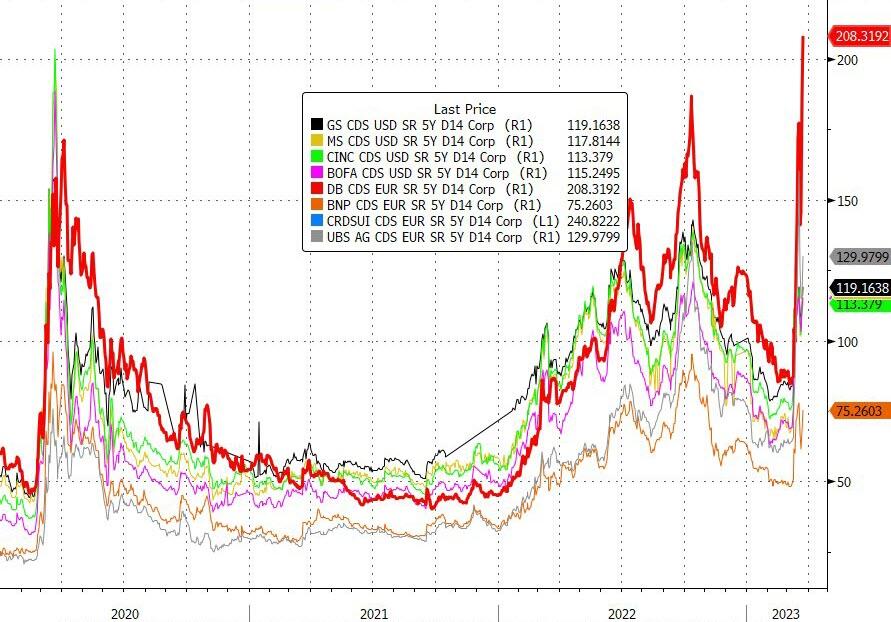
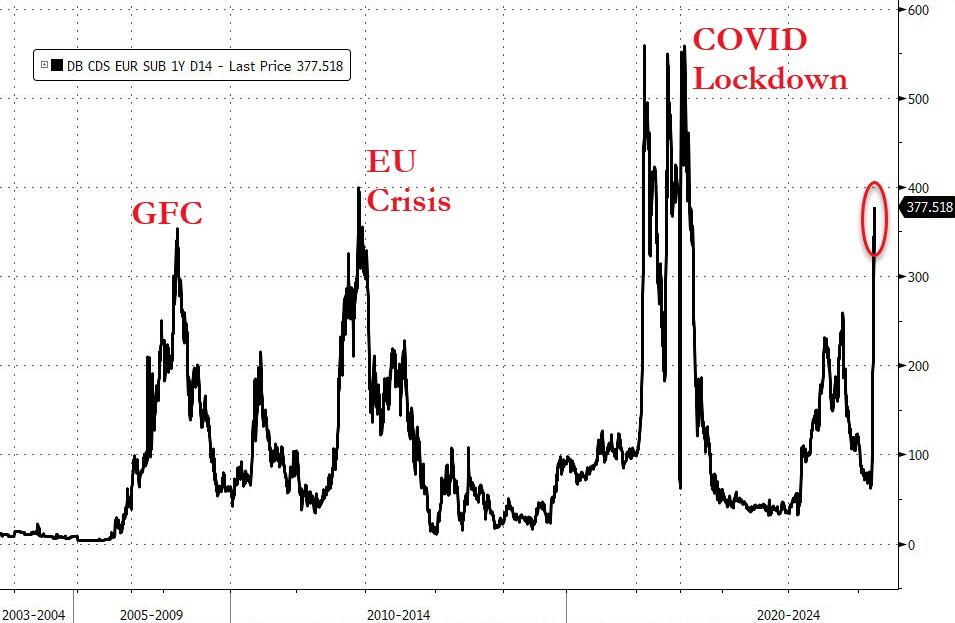
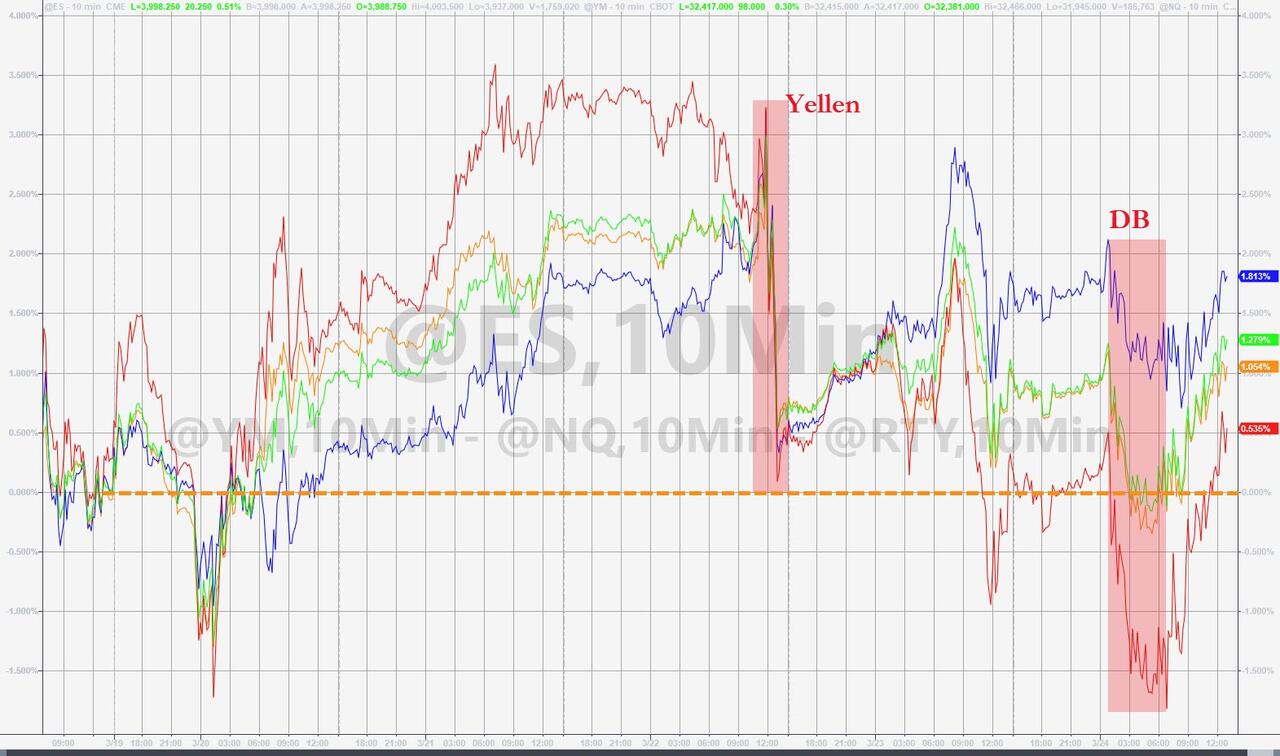
Futures Tumble, Treasuries And Rate Cut Odds Soar Amid Panic That Deutsche Bank Is The Next To Go
FRIDAY, MAR 24, 2023 – 03:09 PM
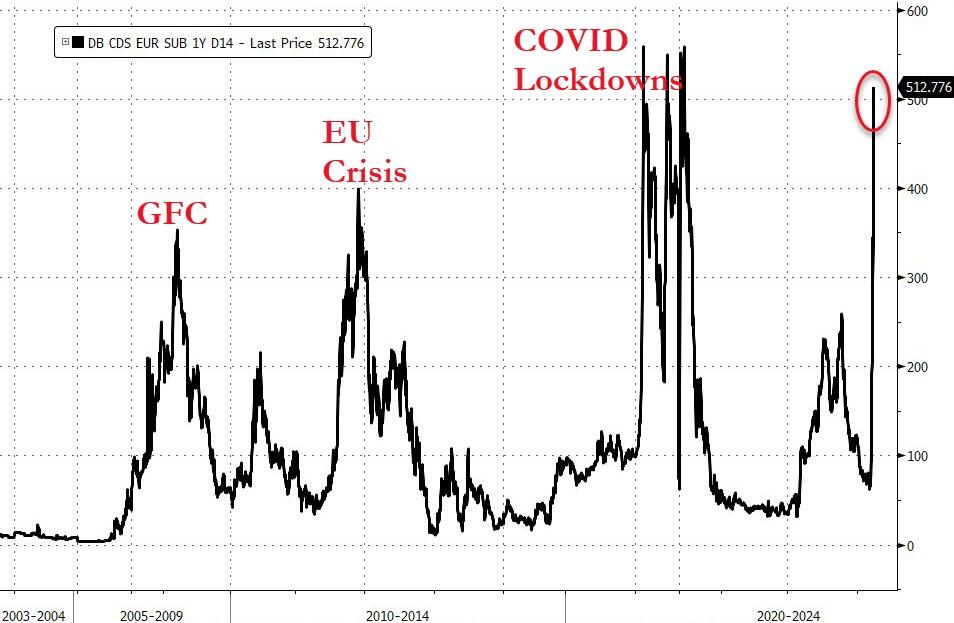
Yesterday, while attention was still focused on the US banking system and the ongoing botched response by the Fed and especially the Treasury’s senile Secretary, who more than two weeks after SIVB collapsed, have still not been able to stabilize confidence in banks – thereby assuring the US is about to slam head first into a brutal recession, just as Biden ordered to contain inflation, as US consumer spending is now in freefall – we pointed out that something bad was taking place in Europe: the credit default swaps of perpetually semi-solvent banking giant Deutsche Bank were quietly blowing out to multi-year highs.
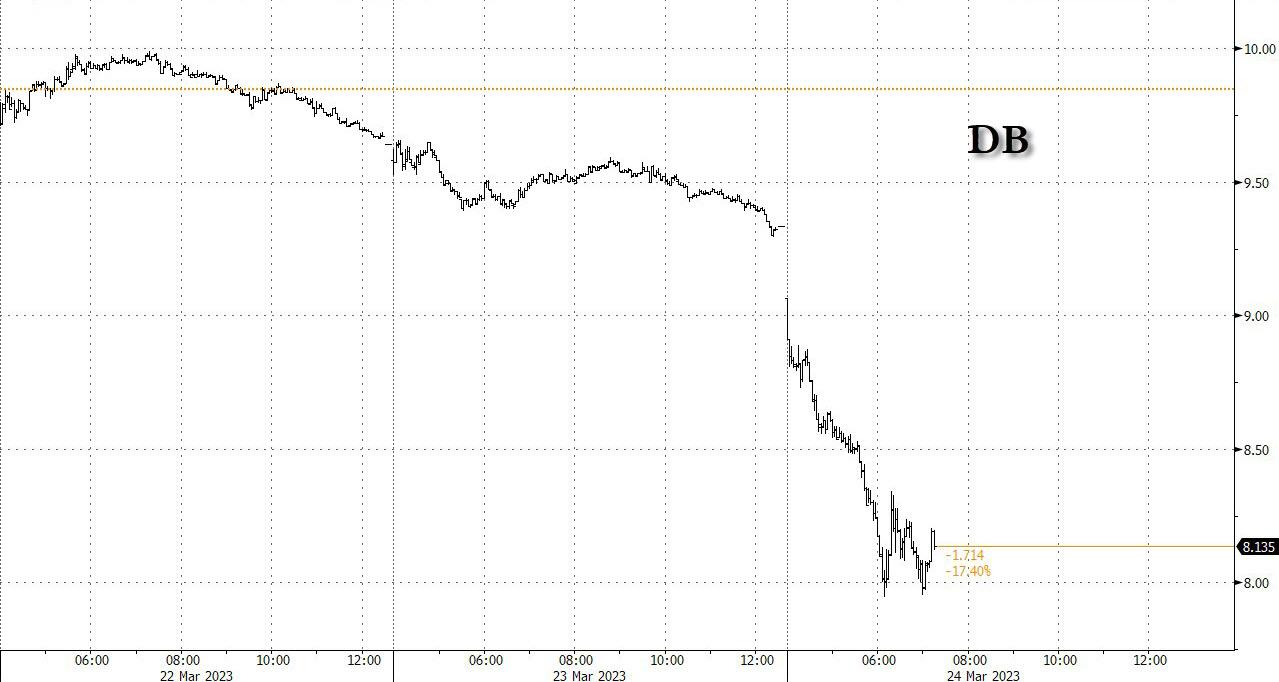
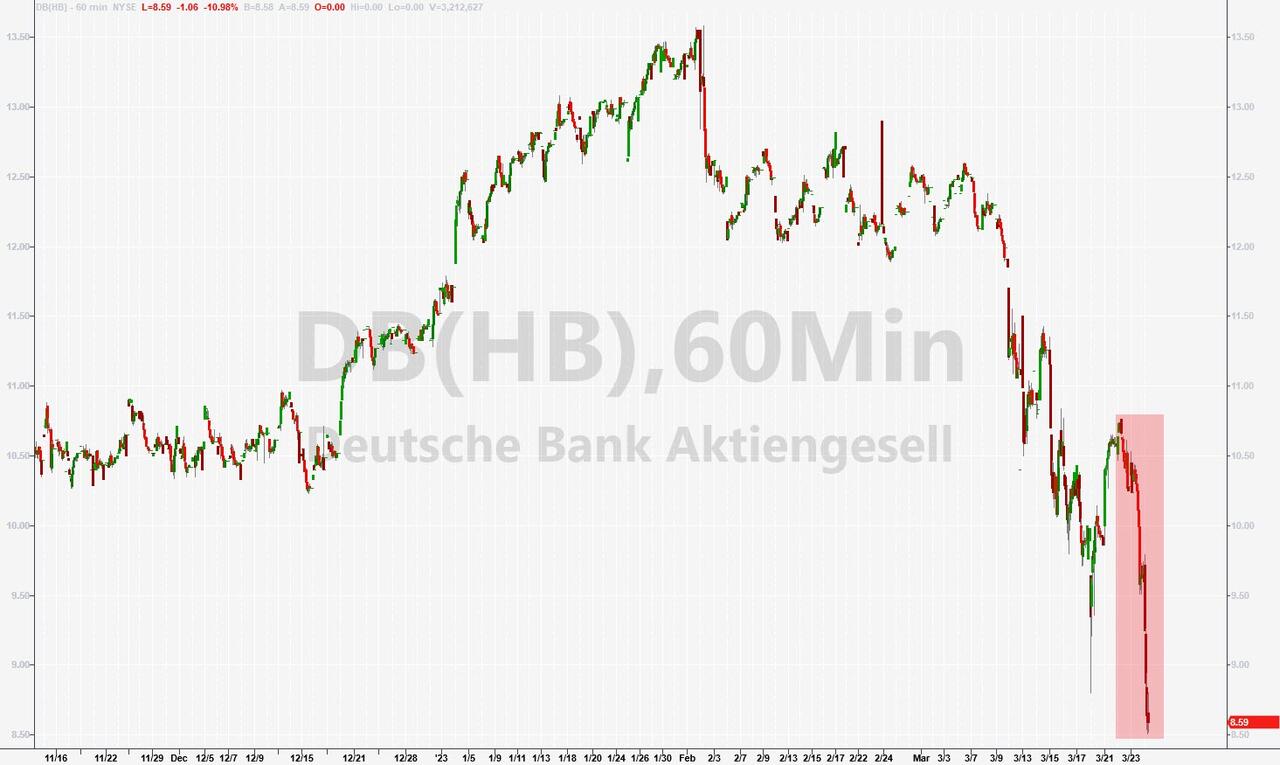
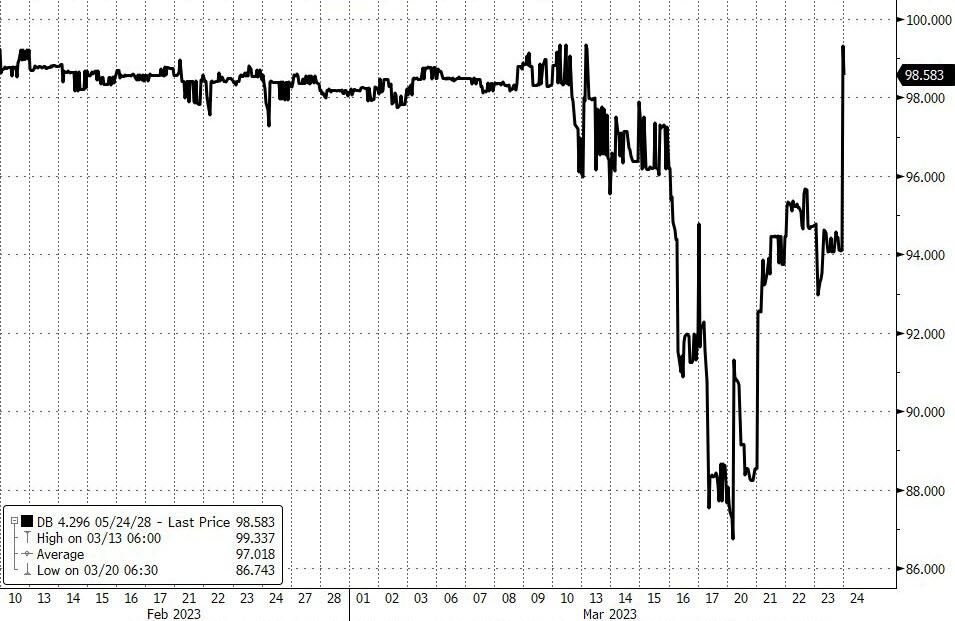
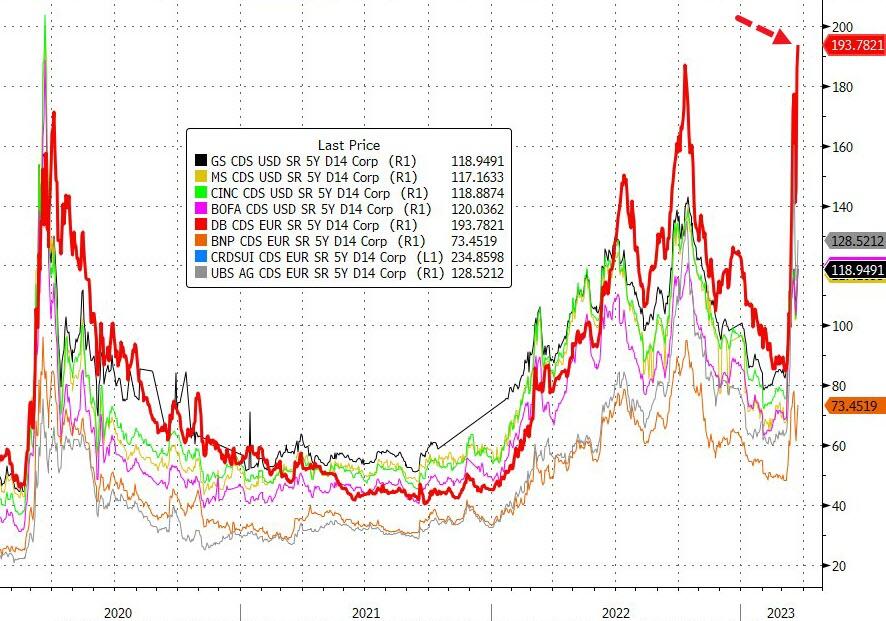
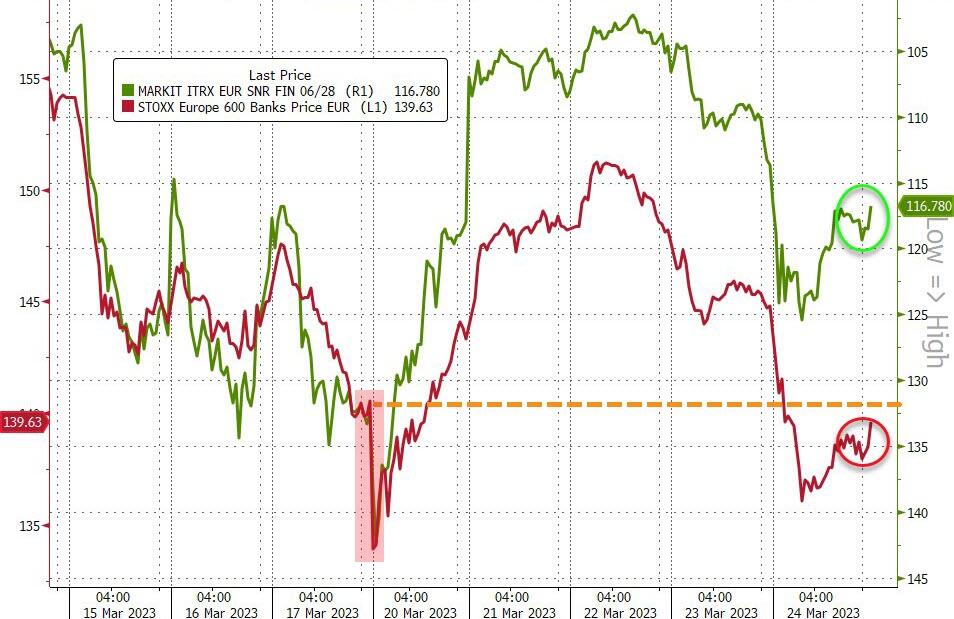
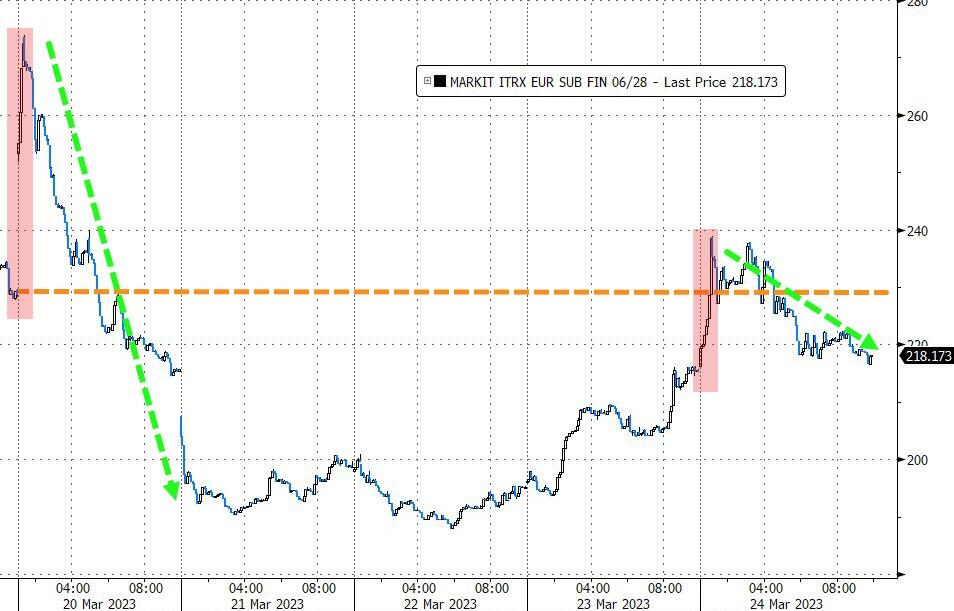
Well, we didn’t have long to wait before everyone else also noticed and this morning it’s official: the crisis has shifted to Germany’s and Europe’s largest TBTF bank, with even Bloomberg now writing that Deutsche Bank “has become the latest focus of the banking turmoil in Europe as ongoing concern about the industry sent its shares slumping the most in three years and the cost of insuring against default rising.” The bank – which has staged a recovery in recent years after a series of crises that nearly brought it down – said Friday it will redeem a tier 2 subordinated bond early. And while such moves are usually intended to give investors confidence in the strength of the balance sheet, though the share price reaction suggests the message isn’t getting through, and the stock plunged 13% in German trading…
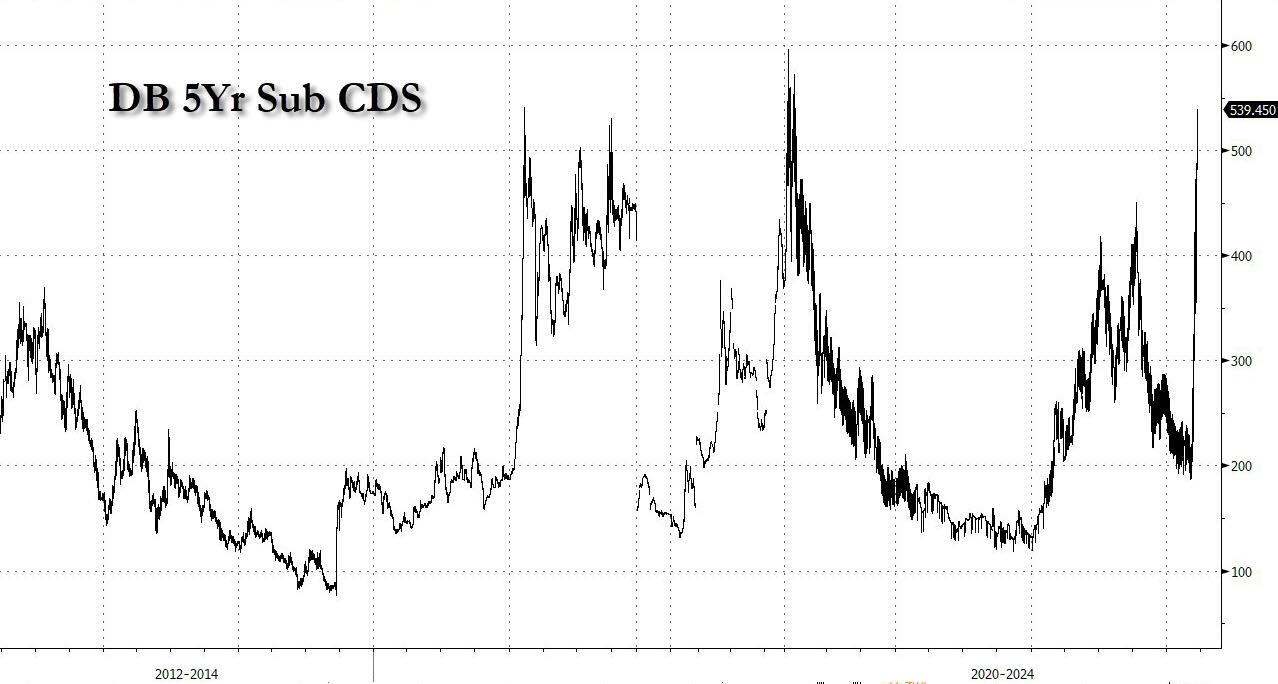
… while DB’s CDS has exploded to level surpassing the bank’s near-collapse in 2016, and is about to take out the covid wides.
“It is a clear case of the market selling first and asking questions later,” said Paul de la Baume, senior market strategist at FlowBank SA. “Traders do not have the risk appetite to hold positions through the weekend, given the banking risk and what happened last week with Credit Suisse and regulators.”
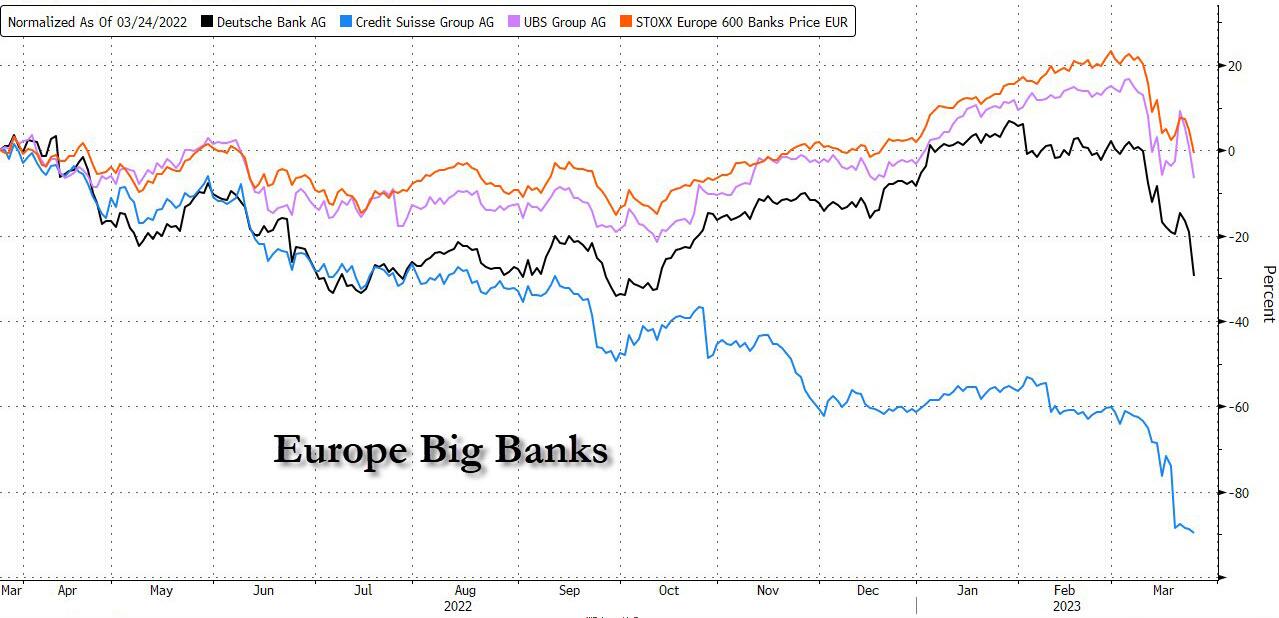
It wasn’t just Deutsche Bank: UBS Group AG shares also dropped as Bloomberg reported that it’s one of the banks under scrutiny in a US Justice Department probe into whether finncial professionals helped Russian oligarchs evade sanctions, according to people familiar with the matter. In any case, the sudden, violent spike in DB default risk which quickly carried over to all big European banks, and which will not reverse until first the ECB then the Fed both cut rates…
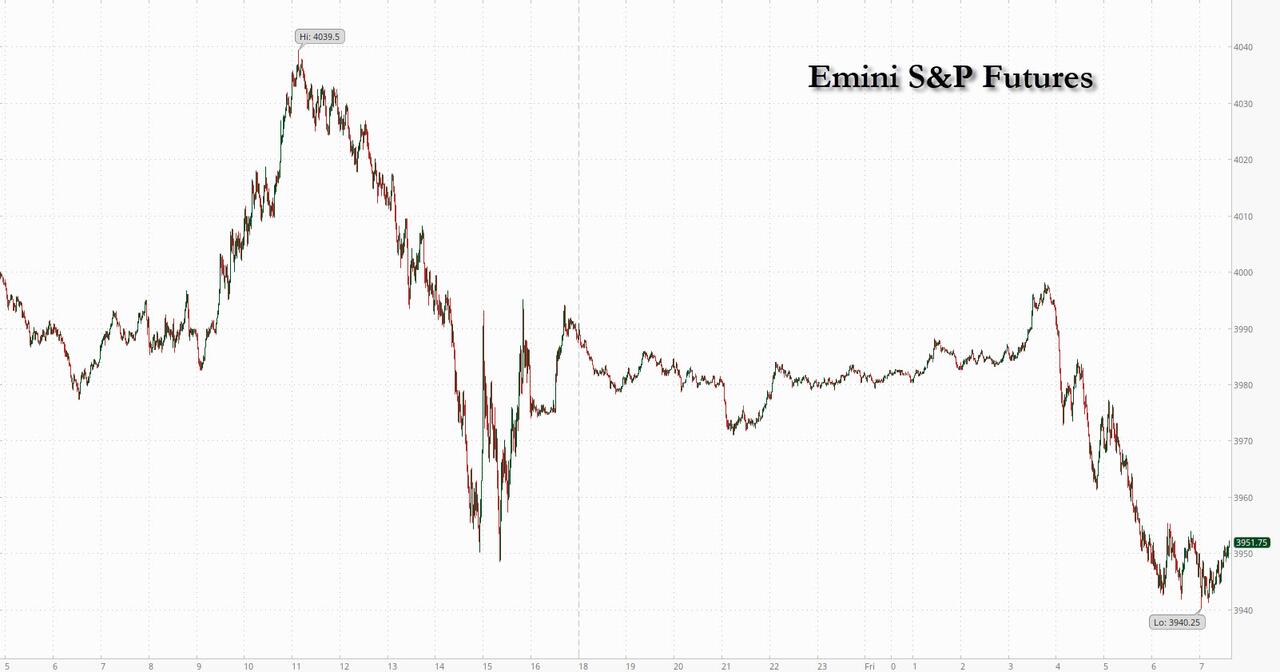
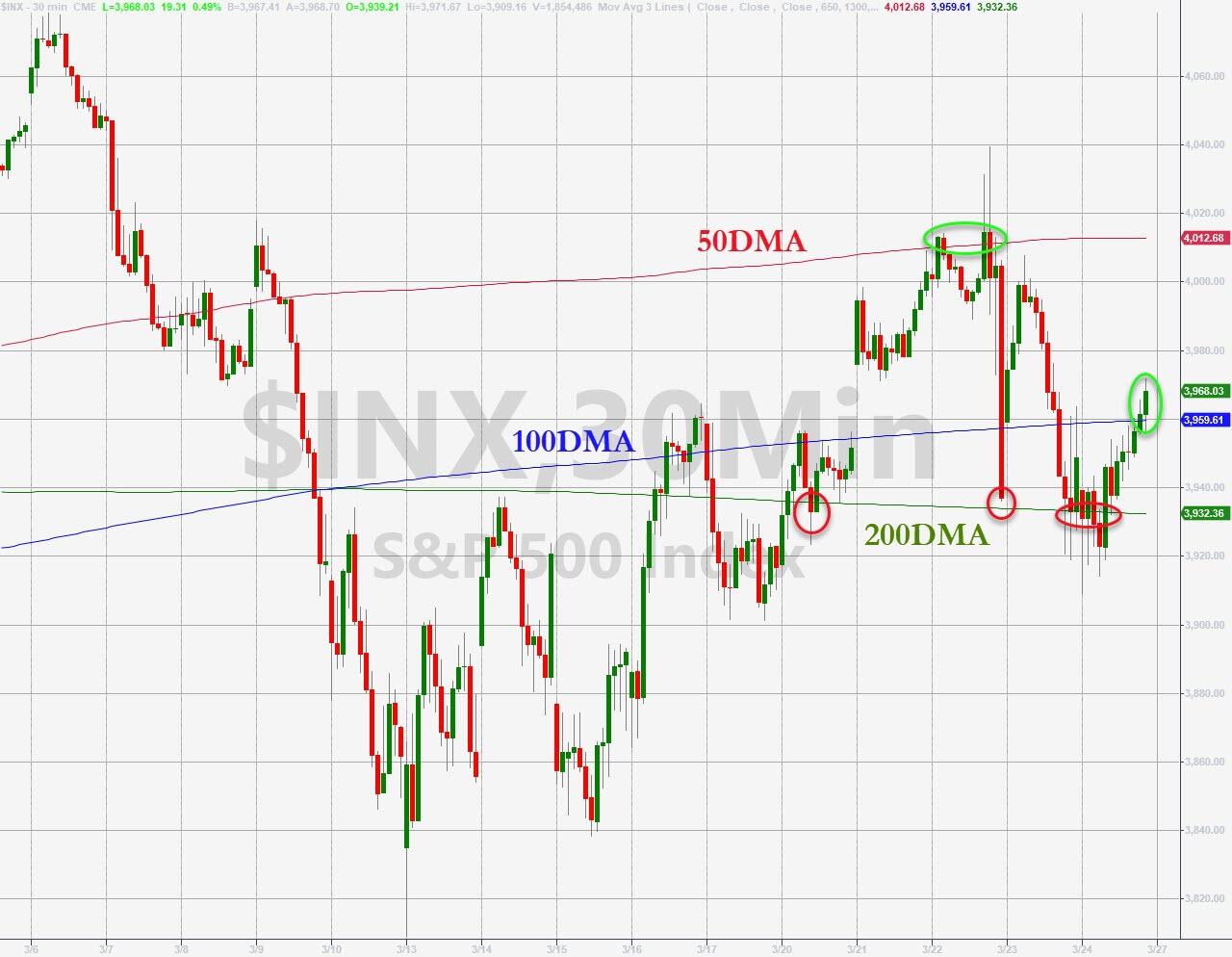
… sent broader risk sentiment reeling with S&P 500 futures at session lows, sliding 1% to 3940.
While there was no one big story setting off these moves. It could be a rush to havens heading into the weekend as traders wait for another shoe to drop — which has been a theme during recent weekends.
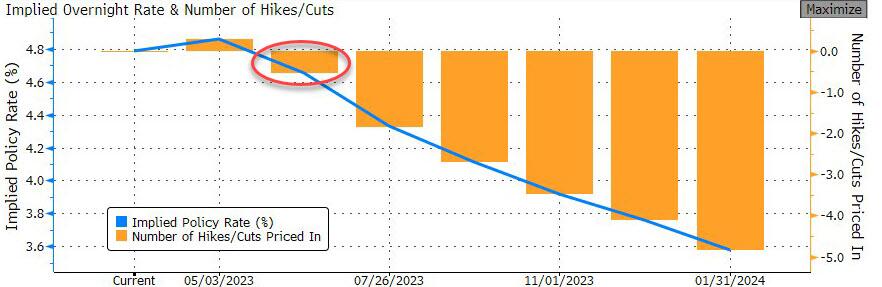
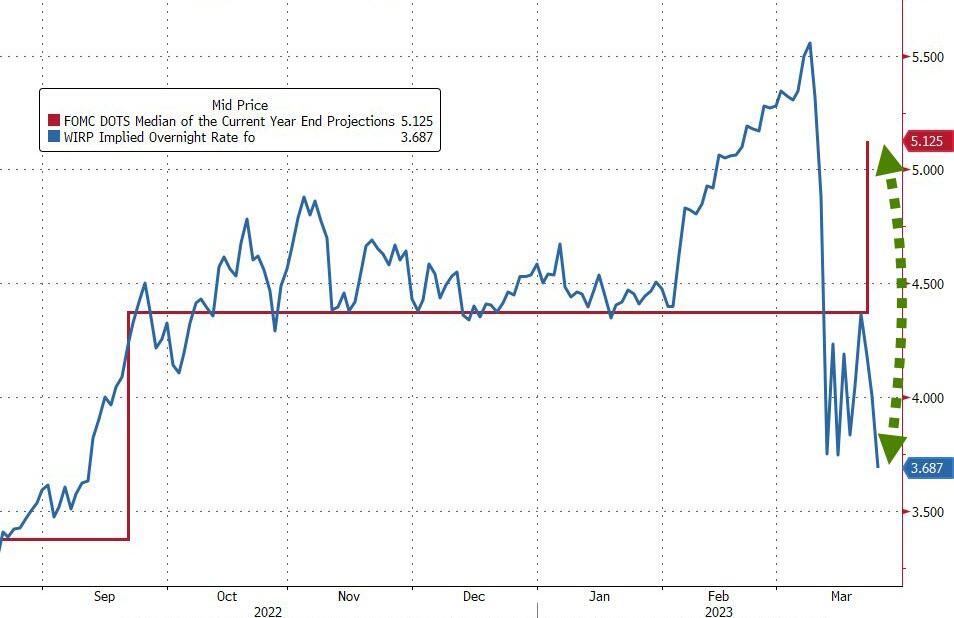
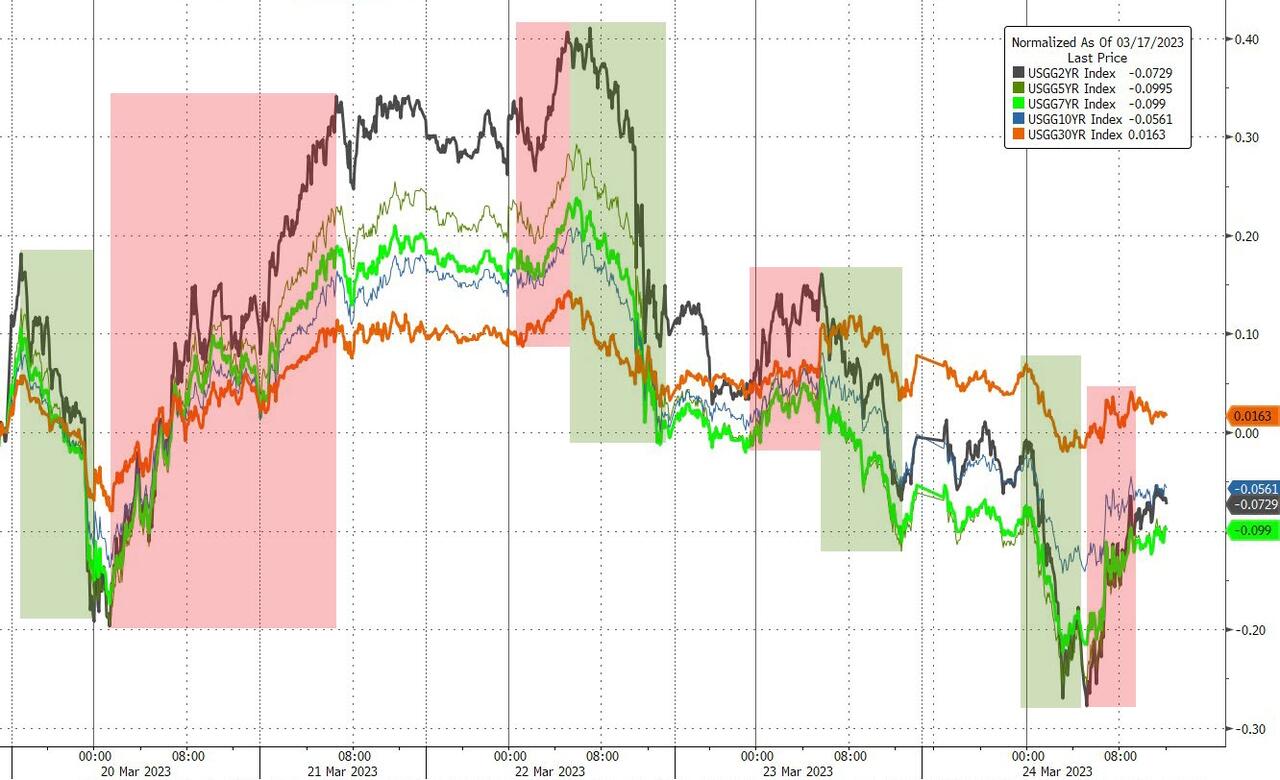
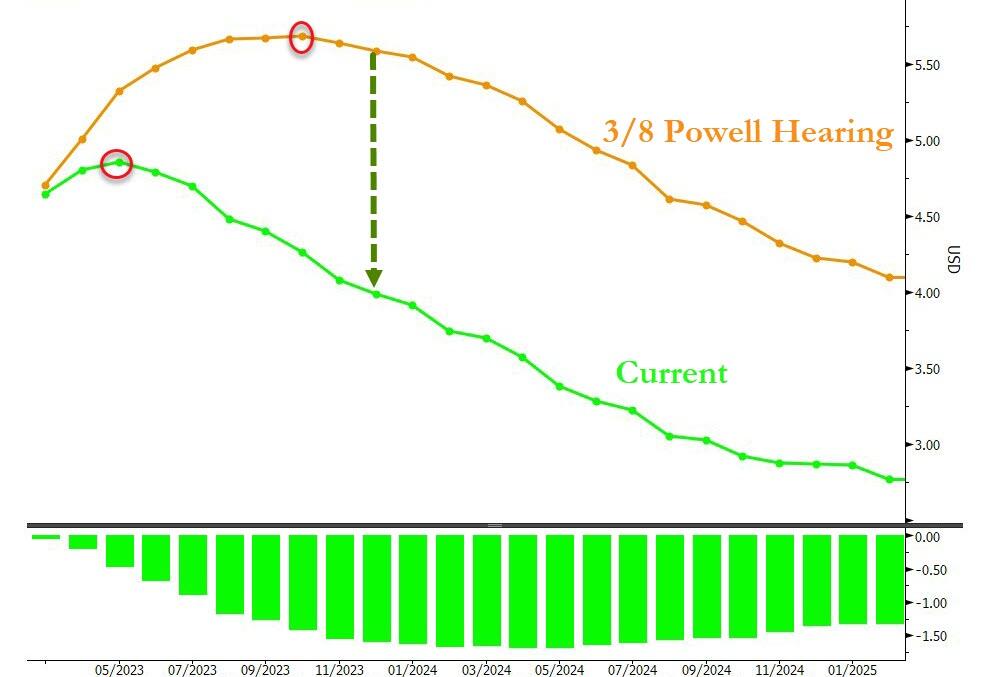
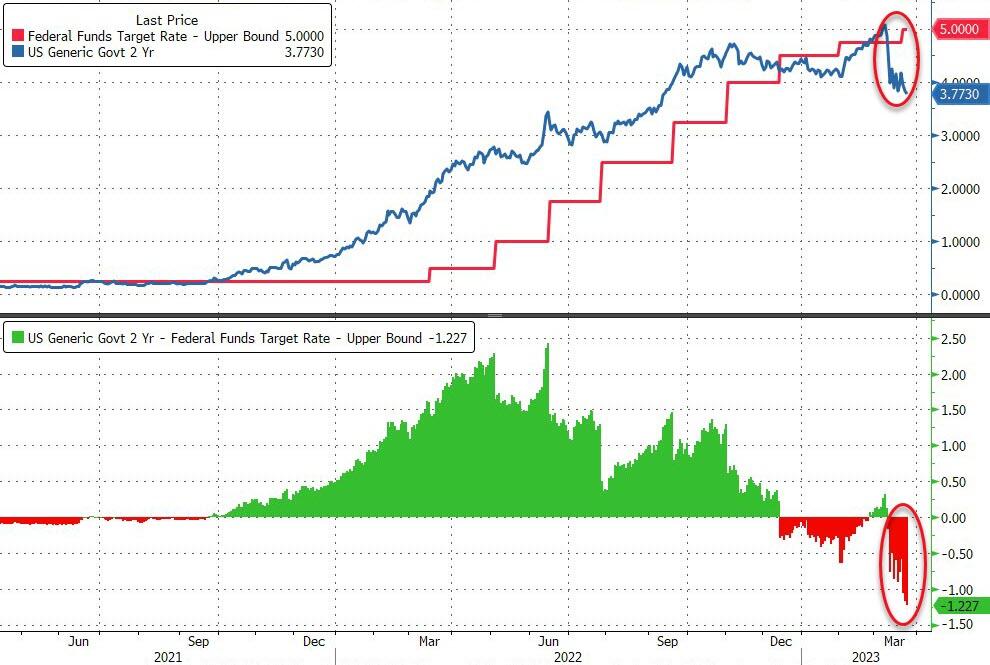
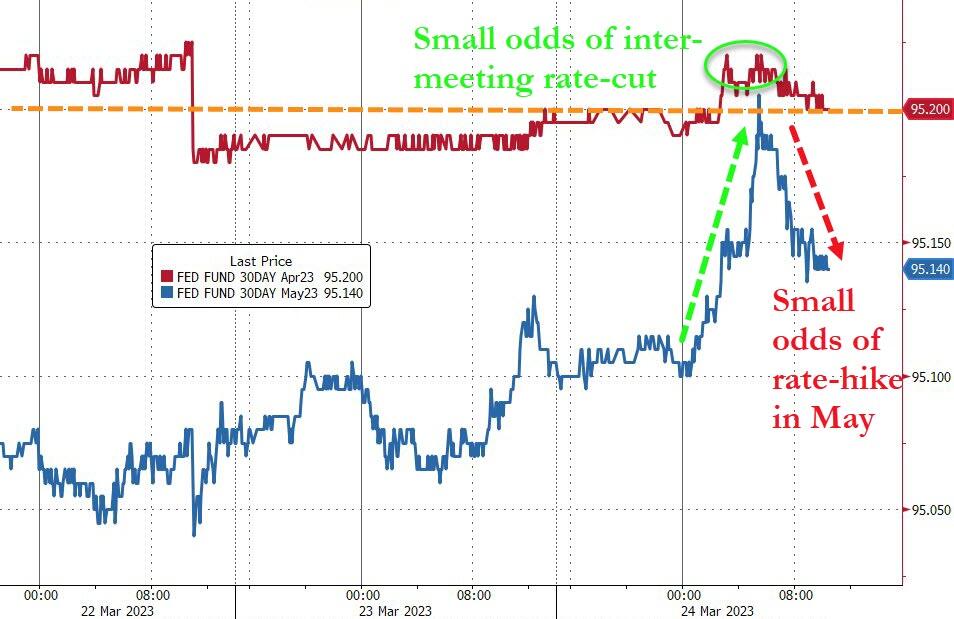
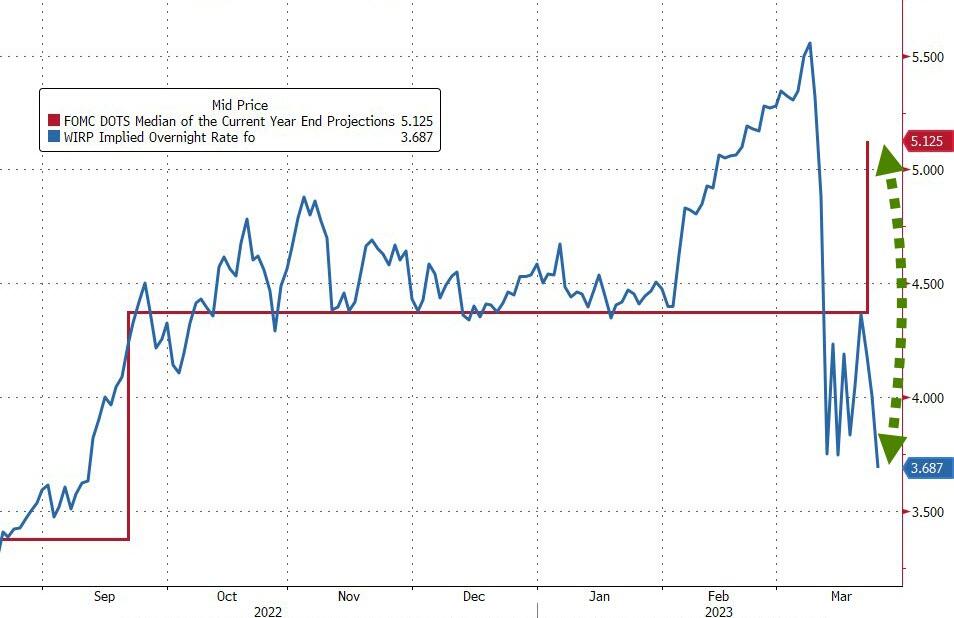
In any case, the latest global equity rout and bank crisis which is now spreading to TBTF banks has sent bond yields crashing with the 2-year US yield plumbing new session lows, breaking down as low as 3.55%, and the resulting shockwave has collapsed odds of another rate hike in May to just 28% while the odds of a rate cut in June have exploded to 83% as the Fed’s pivot finally arrives just on time: with the Fed having again broken the global financial system.
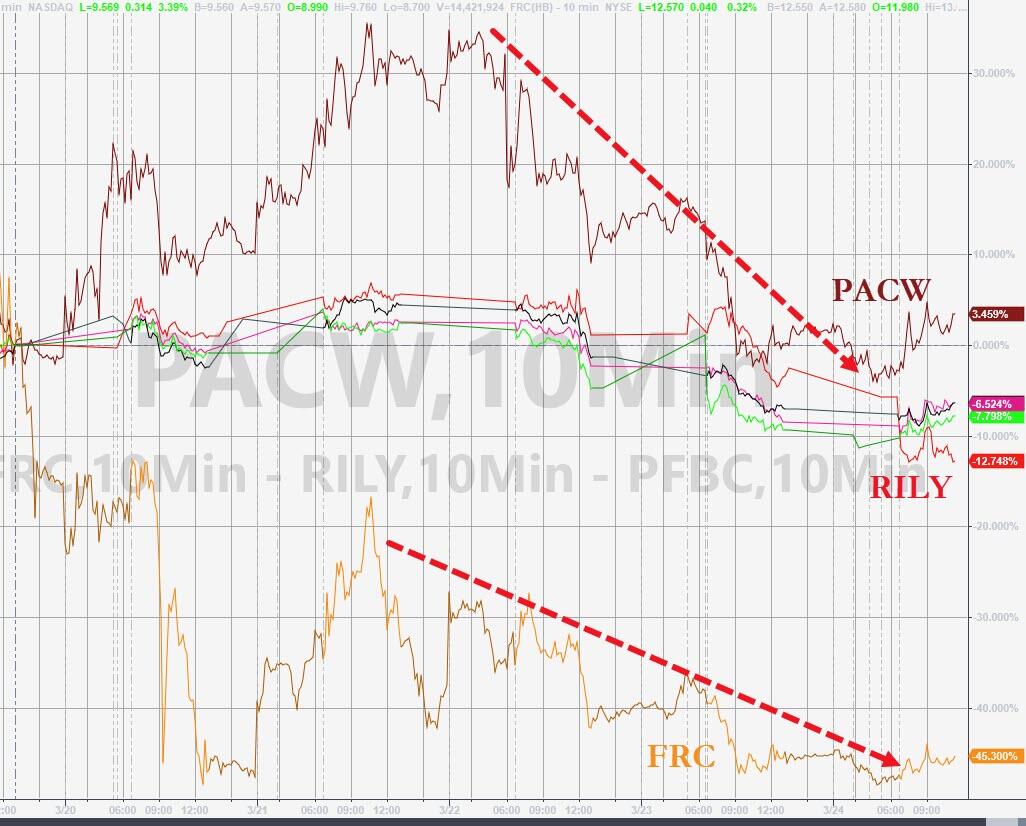
In premarket trading, First Republic Bank swung between gains and losses as investors digested Treasury Secretary Janet Yellen’s comments about regulators being prepared to take additional steps to guard bank deposits if warranted. Fellow regional banks and bigger lenders decline, and after a volatile session on Thursday took the stock’s March slump to 90%. Block fell another 5%, extending Thursday’s 15% plunge as it announced potential legal action against short seller Hindenburg Research for its report on the payment processor. Here are some other notable premarket movers:
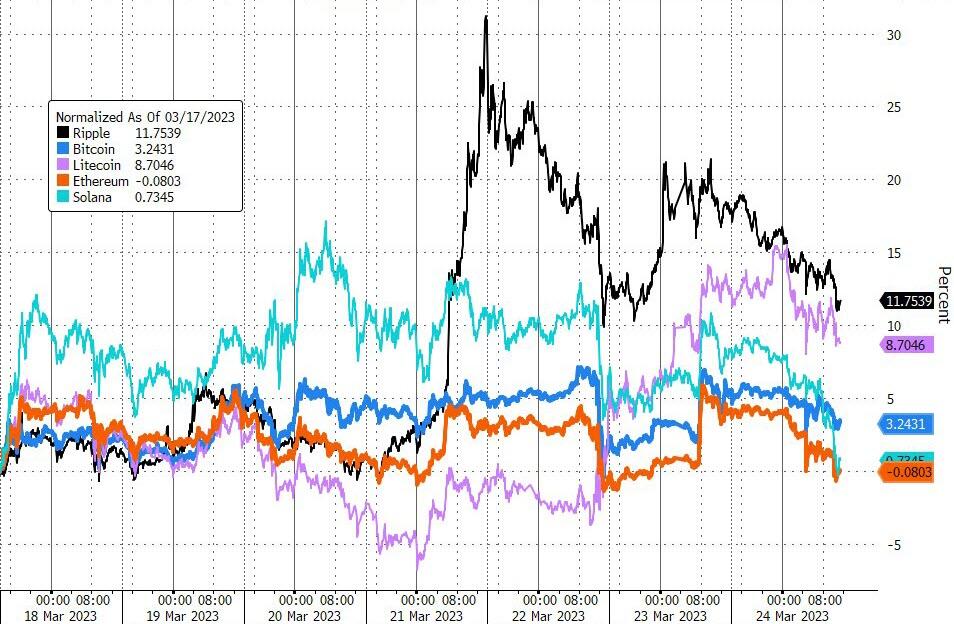
US cryptocurrency-exposed stocks decline, taking a pause from recent gains as the price of Bitcoin falls amid broader risk-off sentiment. Marathon Digital (MARA US) slid 0.9%, Hut 8 Mining Corp (HUT US) -1%, Coinbase (COIN US) -1.9%, Riot Platforms (RIOT US) -1.4%.
ReNew Energy Global gains 12% after Bloomberg reported, citing people familiar with the matter, that the Canada Pension Plan Investment Board is exploring buying the shares of the power producer that it doesn’t already own and taking the Nasdaq- listed firm private.
Joann slumped 6.2% in extended trading on Thursday after the fabric and crafts retailer reported adjusted earnings per share and Ebitda that missed the average analyst estimates, even as sales topped expectations.
Oxford Industries fell 5.5% in postmarket trading after the owner of Tommy Bahama and Lilly Pulitzer issued a forecast for net sales in the current quarter that trailed the average analyst estimate at the midpoint of the guidance range.
“Confidence is fragile, market volatility is likely to stay high, and policymakers may have to go further to make sure faith in the global financial system stays solid,” said Mark Haefele, chief investment officer at UBS Wealth Management. “Financial conditions are also likely to tighten, which increases the risk of a hard landing for the economy, even if central banks ease off on interest-rate hikes.”
“Credit and stock markets too greedy for rate cuts, not fearful enough of recession,” a team led by Michael Hartnett wrote in a note. The strategist, who was correctly bearish through last year, said investment-grade spreads and stocks will be taking a hit over the next three to six months. Global cash funds had inflows of nearly $143 billion, the largest since March 2020 in the week through Wednesday — adding up to more than $300 billion over the past four weeks, according to the note citing EPFR Global data.
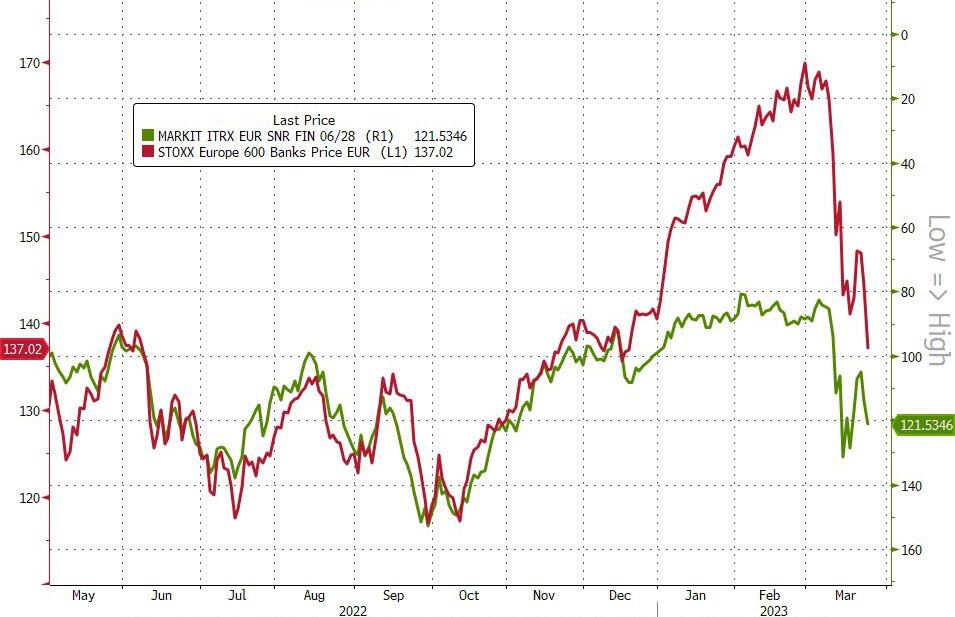
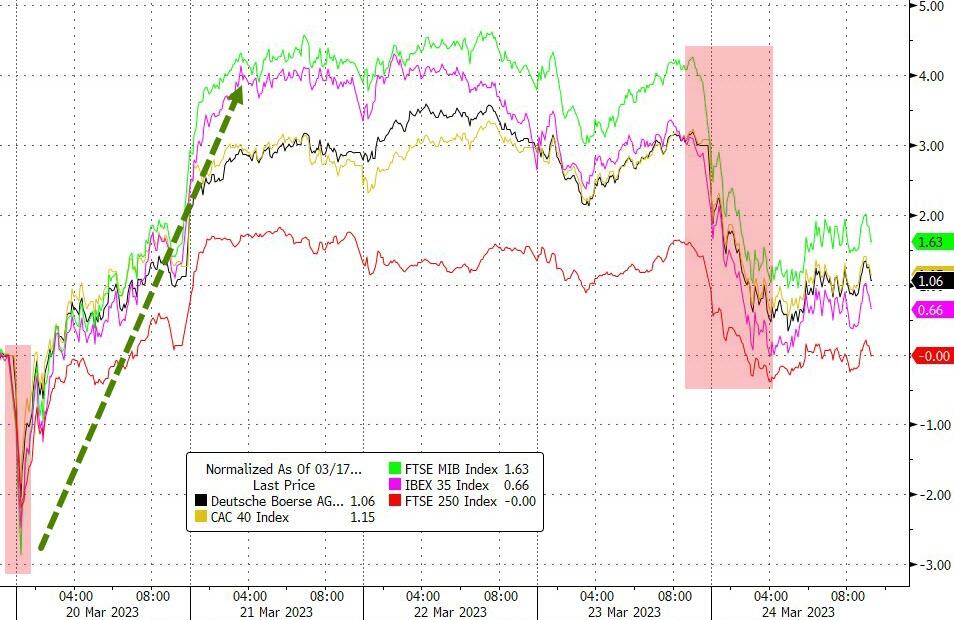
European stocks are also plumbing lower, with European bank stocks sliding for a third day, and erasing weekly and yearly gains, as sentiment remains fragile on the sector. Deutsche Bank slumped nearly 15% as credit-default swaps surged amid wider concerns about the stability of the banking sector. The Stoxx 600 Banks Index is 5.3% lower as of 11:20am in London, erasing earlier weekly gains; the index is now -2.8% YTD. Meanwhile, UBS, which is not in the banking sector index, slumped as much as 8.4% as Jefferies cut its rating to hold from buy and it was among the banks under scrutiny in a US Justice Department probe into whether financial professionals helped Russian oligarchs evade sanctions. European oil stocks are also underperforming on Friday, dragging down the regional benchmark, as crude prices slump under pressure from a stronger dollar and concerns about the impact on growth of a fresh bout of stress facing the banking sector. The Energy sub-index slid as much as 4.3%, the most since March 15, while the Stoxx Europe 600 benchmark fell about 2%. Here are some other notable European movers:
Casino Guichard-Perrachon SA fell as much as 6% to a fresh record low after Moody’s cut its long-term debt rating on the company further into junk territory
Dino Polska drops as much as 5%, after its 4Q report showed that the Polish food supermarket chain is unable to maintain profitability amid inflation pressures
Smiths Group gains as much as 2.1%, after the industrial firm beat expectations on Ebita, while also surpassing projections on its full-year sales outlook
JD Wetherspoon jumps as much as 9.3% after the British pub operator posted a revenue beat for 1H, with Jefferies analysts noting resilience in like-for-like sales
Earlier in the session, Asia equities were set to snap a three-day rally as lingering concerns over the health of the banking sector pushed a gauge of the region’s financial shares lower. The MSCI Asia Pacific Index fell as much as 0.5% before trimming losses, with its 11 sectoral sub-gauges showing mixed moves. Most markets declined, led by Hong Kong’s Hang Seng Index, while Chinese tech shares extended their rally on the back of positive earnings. An index of Asian financial stocks dropped as much as 0.9%, tracking overnight declines in a measure of US financial heavyweights to the lowest since November 2020. Treasury Secretary Janet Yellen’s comments that authorities can take further steps to protect the banking system if needed failed to fully assuage concerns.
“The unease in the financial space will continue to weigh on the Asian financial sectors,” said Hebe Chen, an analyst at IG Markets Ltd. “The flip-flop in the market this week is seeing overwhelmed investors scratching their heads in the face of the mixed bag from Fed.” Even with Friday’s lackluster moves, the MSCI Asia benchmark was set to notch its best weekly performance in about two months. The shares rose earlier in the week thanks to assurances from regulators in the US and Europe over protecting the banking sector and the Federal Reserve’s dovish tilt. Meanwhile, a gauge of tech stocks in Hong Kong advanced for the fourth day close at its highest in a month. Lenovo led the gain, with JPMorgan lifting its recommendation on a bottoming of PC demand. “We like the internet sector, especially within China right now,” Marcella Chow, JPMorgan Asset Management’s global market strategist, said in an interview with Bloomberg TV. “China tech sector is attractive given improving regulatory outlook, leaner and more cost effective cost structure, improving margin.”
Japanese stocks Inched lower as worries linger over the financial sector while investors assess statements made by US Treasury Secretary Janet Yellen. The Topix Index fell 0.1% to 1,955.32 as of market close Tokyo time, while the Nikkei declined 0.1% to 27,385.25. Mitsubishi UFJ Financial Group Inc. contributed the most to the Topix Index decline, decreasing 1.1%. Out of 2,159 stocks in the index, 976 rose and 1,039 fell, while 144 were unchanged. “Assuming that the fallout from the US financial sector woes doesn’t spread significantly, Japanese stocks will likely stop its decline and pick up as the earnings period starts next month,” said Takeru Ogihara, a chief strategist at Asset Management One
Australian stocks slumped to post a seventh week of losses; the S&P/ASX 200 index fell 0.2% to close at 6,955.20, with financials the biggest drag, as the malaise hanging over the global banking sector continued to damp sentiment. The benchmark erased 0.6% for the week, the seventh straight decline, maintaining the longest losing streak since 2008. In New Zealand, the S&P/NZX 50 index fell 0.1% to 11,580.82.
Indian stocks declined for a third straight week in the longest losing streak since December spurred by a late selloff in key gauges amid risk-off sentiment in global equities. The Nifty 50 index ended just shy of entering a so-called technical correction given the index’s near 10% drop from its December peak. For the week, the Nifty 50 fell 0.9% while the Sensex declined 0.8%. The S&P BSE Sensex fell 0.7% to 57,527.10 as of 3:30 p.m. in Mumbai, while the NSE Nifty 50 Index declined 0.8% to 16,945.05. The selloff in small and mid cap counters contributed to the broader losses, with the Nifty Mid cap 100 and Nifty Small Cap 100 indexes ending nearly 2% lower each. Stocks of asset management companies were hammered after the government dropped the benefit of long-term capital gains tax for debt mutual funds in order to ensure parity in tax treatment with other such products. Shares of HDFC AMC dropped 4.1%, Aditya Birla AMC -2%, UTI AMC -4.8% and Nippon Life India AMC -1.2%. Reliance Industries contributed the most to the index decline, decreasing 2%. Out of 30 shares in the Sensex index, six rose and 24 fell
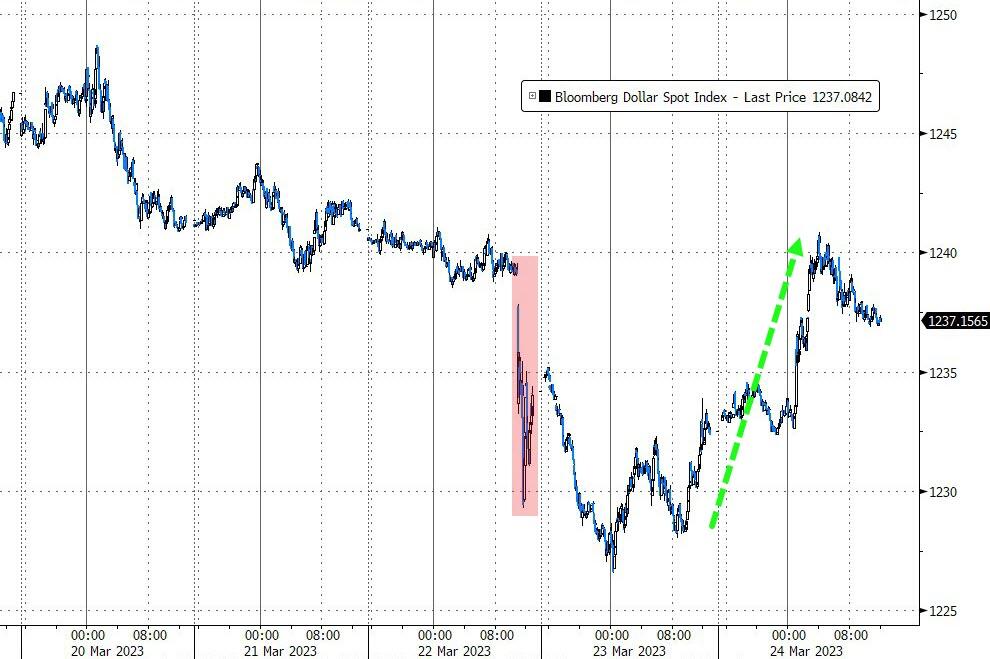
In FX, the dollar’s recent weakness, which had supported the outlook for the region’s currencies and other assets, also took a breather on Friday. The Bloomberg dollar index rose 0.3% after a six-day run of declines. The yen rallies to the highest in six weeks amid demand for haven assets due to concerns over the health of the global banking sector. The yen was the biggest gainer versus the greenback among the Group-of-10 currencies. Treasury yields continued to decline reflecting expectations for Federal Reserve rate cuts this year
“JPY’s strong performance we believe is driven by the return of its safe haven appeal, especially given that we see that Japanese banks are in a relatively better standing,” said Alan Lau, a strategist at Malayan Banking Bhd in Singapore. “Falling UST yields have also given the JPY support recently. Overall, we are positive on the yen and see the spot being on a downward trend this year with our year-end forecast at 122”
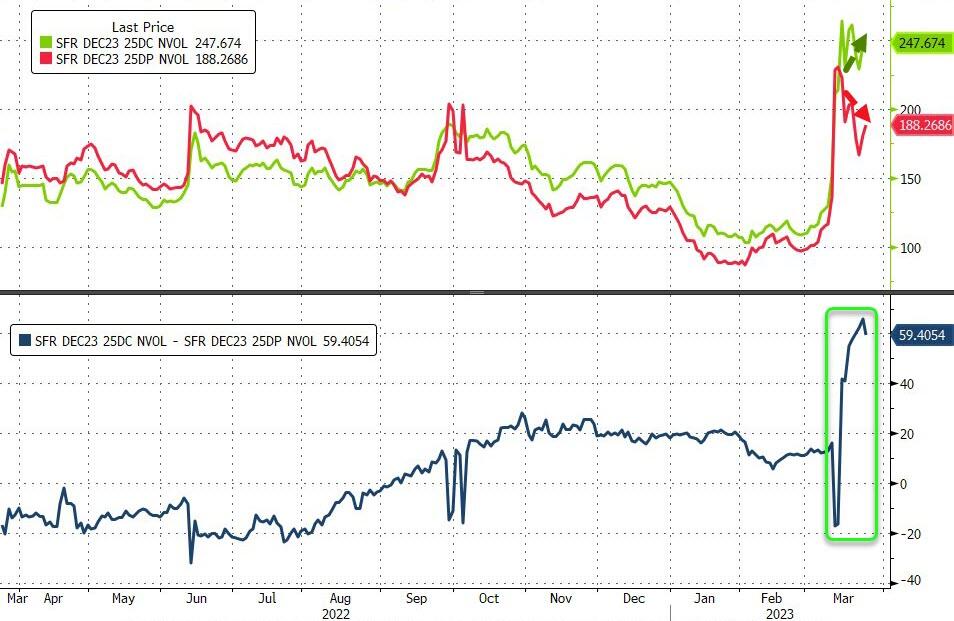
In rates, Treasuries front-end adds to Thursday’s gains, with 2-year yields richer by over 20bp on the day, as the yield continues to plumb new session lows, breaking as low as 3.55%, dropping below th 2023 lows, and steepening the curve as traders continue to price out rate-hike premium for the May meeting and start pricing for cuts as early as June. Yields were near lows of the day while rest of the curve is richer by 17bp across belly to 9bp out to long-end; front-end led gains steepens 2s10s, 5s30s by 10bp and 8bp on the day. SOFR white-pack futures surge higher, with gains led by Dec23 contract which rallied 27bp vs. Thursday close; Fed-dated OIS shows just 4bp of rate hike premium for the May policy meeting with almost a full cut then priced into the June policy meeting — around 120bp of rate hikes are then priced into year-end
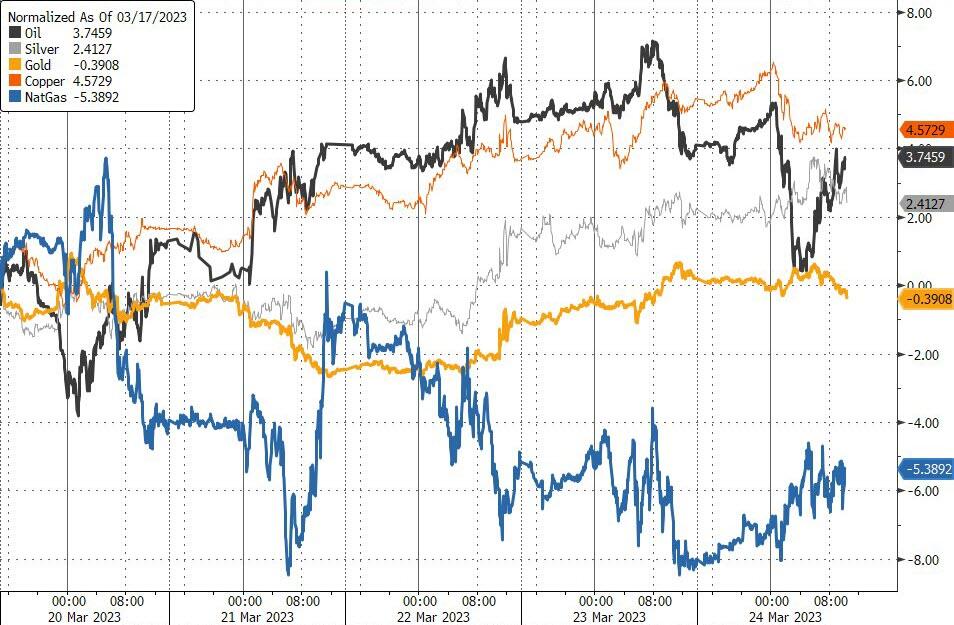
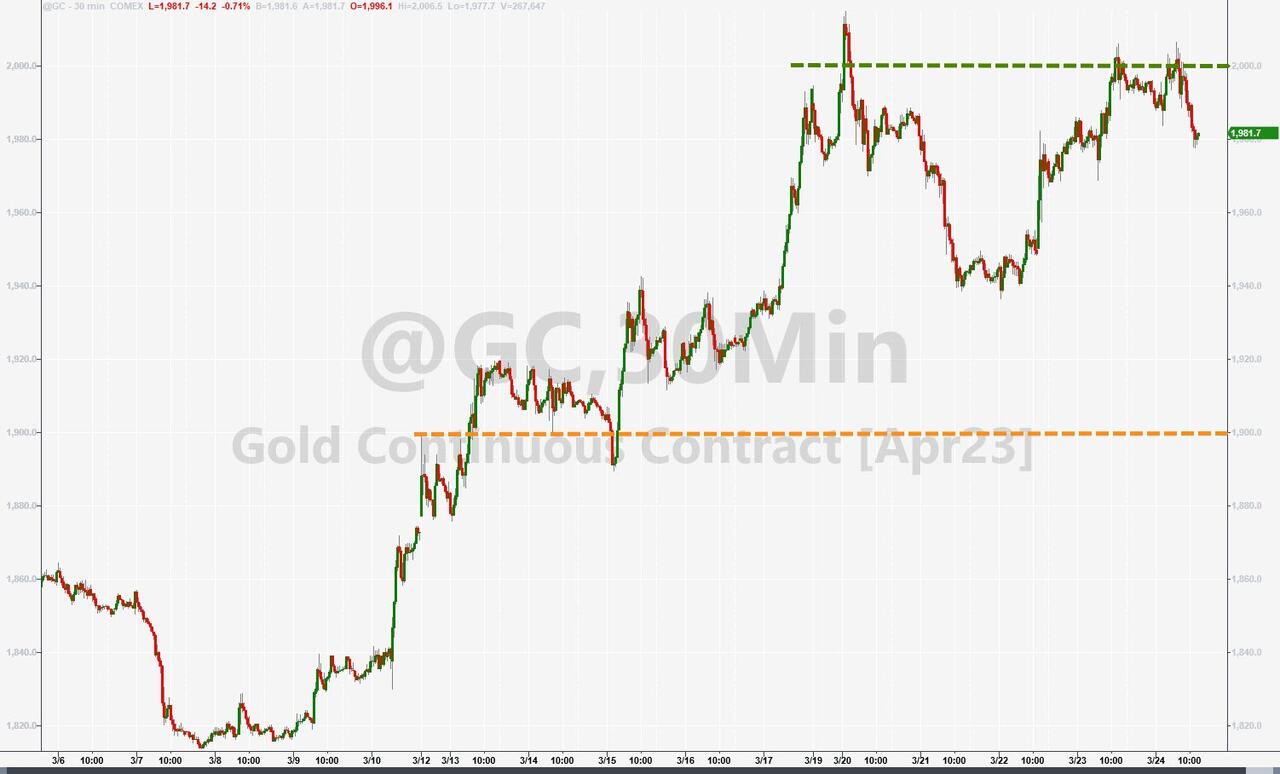
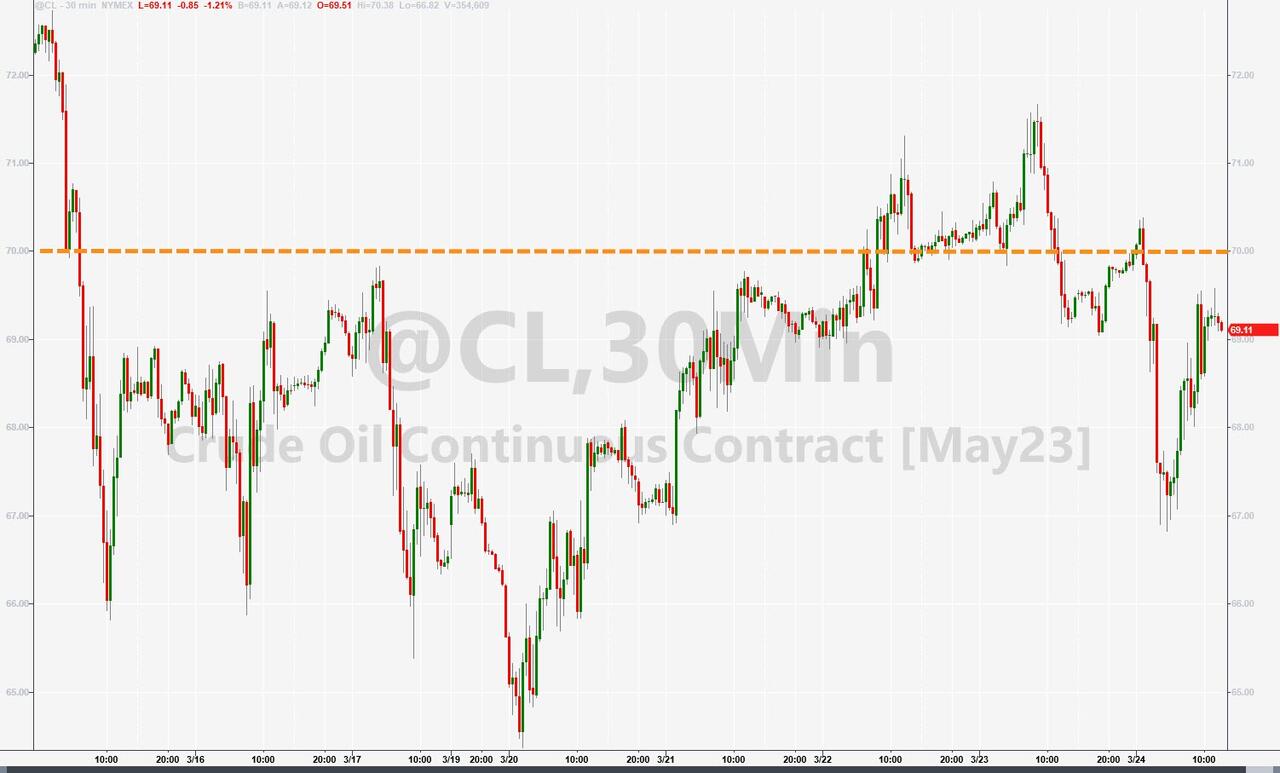
In commodities, oil slipped the most in over a week, with Brent below $75, tracking a slide in equity markets and feeling the effects of a stronger dollar. Aluminum and copper headed toward their biggest weekly gains in more than two months on increasing demand in China and bets on looser Federal Reserve policy. Uranium Energy is among the most active resources stocks in premarket trading, falling about 9%. Gold traded just shy of $2000 and is about to break solidly higher.
To the day ahead now, and data releases include the March flash PMIs from Europe and the US, along with UK retail sales for February, and the preliminary US durable goods orders for February. Otherwise from central banks, we’ll hear from the ECB’s De Cos, Nagel and Centeno, the Fed’s Bullard and the BoE’s Mann.
Market Snapshot
S&P 500 futures down 1% to 3,940
MXAP down 0.2% to 160.13
MXAPJ down 0.5% to 515.46
Nikkei down 0.1% to 27,385.25
Topix down 0.1% to 1,955.32
Hang Seng Index down 0.7% to 19,915.68
Shanghai Composite down 0.6% to 3,265.65
Sensex down 0.2% to 57,801.12
Australia S&P/ASX 200 down 0.2% to 6,955.24
Kospi down 0.4% to 2,414.96
STOXX Europe 600 down 0.7% to 443.10
German 10Y yield little changed at 2.11%
Euro down 0.4% to $1.0791
Brent Futures down 0.6% to $75.46/bbl
Gold spot down 0.3% to $1,987.17
U.S. Dollar Index up 0.30% to 102.84
Top Overnight News
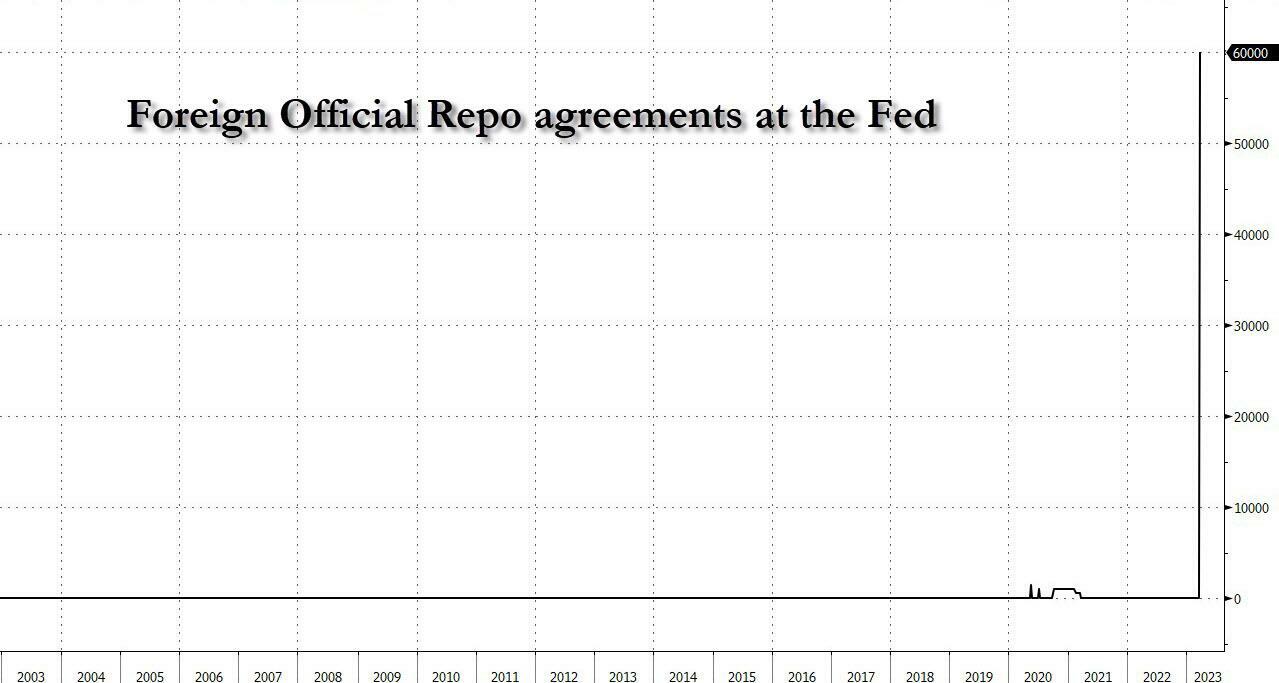
A Federal Reserve facility that gives foreign central banks access to dollar funding was tapped for a record $60 billion in the week through March 22: BBG
Deutsche Bank AG was at the center of another selloff in financial shares heading into the weekend: BBG
Credit Suisse Group AG and UBS Group AG are among banks under scrutiny in a US Justice Department probe into whether financial professionals helped Russian oligarchs evade sanctions, according to people familiar with the matter: BBG
Japan’s headline national CPI for Feb cools to +3.3% (down from +4.3% in Jan and inline w/the St) while core ticks higher to +3.5% (up from +3.2% in Jan and ahead of the St’s +3.4% forecast). RTRS
Copper prices will surge to a record high this year as a rebound in Chinese demand risks depleting already low stockpiles, the world’s largest private metals trader has forecast. Global inventories of the metal used in everything from power cables and electric cars to buildings have dropped rapidly in recent weeks to their lowest seasonal level since 2008, leaving little buffer if demand in China continues to pace ahead. FT
Authorities this week raided the Beijing offices of Mintz Group, detaining all five of the New York-based due diligence firm’s staff members in mainland China, the company said—an incident likely to unnerve global businesses operating in the country. WSJ
China’s top diplomat Wang Yi urged Europe to play a role in supporting peace talks for Russia’s war in Ukraine, though the US has warned Beijing’s proposals would effectively freeze the Kremlin’s territorial gains. BBG
Ukrainian troops, on the defensive for months, will soon counterattack as Russia’s offensive looks to be faltering, a commander said, but President Volodymyr Zelenskiy warned that without a faster supply of arms the war could last years. RTRS
Europe’s flash PMIs for March were mixed, with upside on services (55.6, up from 52.7 in Feb and ahead of the St’s 52.5 forecast) but downside on manufacturing (47.1, down from 48.5 in Feb and below the St’s 49 forecast). “Inflationary pressures have continued to moderate, with input prices falling sharply in manufacturing… overall input costs rose at the slowest rate since March 2021…the record easing of supply constraints marks a major reversal from the record delays seen during the pandemic” S&P
Deutsche Bank was at the center of another selloff in financials. The bank tumbled 11% in Frankfurt and default-swaps on its euro, senior debt surged to the highest since they were introduced in 2019, when Germany revamped its debt framework to introduce senior preferred notes. Other banks with high exposure to corporate lending also declined. Commerzbank slid 9% and Soc Gen 7%. BBG
The Swiss authorities and UBS Group AG are racing to close the takeover of Credit Suisse Group AG within as little as a month, according to two sources with knowledge of the plans, to try to retain the lender’s clients and employees. RTRS
Citizens Financial is set to submit a bid for SVB’s private banking arm, Reuters reported. Customers Bancorp is also said to be exploring a deal for all or part of SVB. Carson Block said depositors at SVB and Signature Bank should have taken haircuts after regulators seized the firms. BBG
A more detailed look at global markets courtesy of Newsquawk
APAC stocks were mostly subdued after the recent bout of central bank rate hikes and choppy performance stateside where Wall Street just about closed higher amid a dovish market repricing of Fed rate expectations. ASX 200 was lower with risk appetite sapped by weak PMI data which returned to contraction territory. Nikkei 225 lacked conviction after the latest inflation data printed mostly in line with estimates. Hang Seng and Shanghai Comp. retreated after the central bank drained liquidity and as participants digest earnings releases, while it was also reported that the US added 14 Chinese entities to the red flag list.
Top Asian News
HKMA said Hong Kong has very little exposure to the European and US banking situation, while it needs to monitor the situation carefully for any further volatility but is not concerned about risks to the Hong Kong banking sector.
China is to extend some tax relief measures, according to local media.
Equities are back under marked pressure as banking sector concern re-intensifies within Europe, Euro Stoxx 50 -2.3% & ES -0.8%. Specifically, the European banking index SX7P -5.0% is the standout laggard amid broad-based pressure in banking names as CDS’ for the stocks continue to rise alongside focus on the redemption of notes by Deutsche Bank and Lloyds; currently, Deutsche Bank -12% is the Stoxx 600 laggard. Stateside, futures are pressured in tandem with the above price action though with the magnitude less pronounced ahead of the arrival of US players and as we await potential updates to the regions own banking names. Apple (AAPL) supplier Pegatron (4982 TW) is reportedly looking to open a second factory within India, to construct the latest iPhone models, via Reuters citing sources.
Top European News
ECB is likely to reassure EU leaders regarding bank stability on Friday and is to call for EU deposit insurance, according to Reuters.
ECB’s Nagel says it is necessary to increase policy rates to sufficiently restrictive levels, whilst the APP wind down should accelerate from Q3. Domestic price pressures are likely to last for longer, whilst underlying inflation is increasingly concerning. There are signs of second-round effects from inflation-induced higher wage increases.
ECB’s Nagel says there is often a bumpy road after similar instances in the banking sector, not surprising there have been market moves. On Deutsche Bank’s share slide, ECB’s Nagel will not comment.
BoE’s Bailey says rates will rise again if firms hike prices, via BBC; “If all prices try to beat inflation we will get higher inflation,”
Bank headlines
Deutsche Bank (DBK GY) announces a decision to redeem its USD 1.5bln fixed to fixed reset rate subordinated Tier 2 notes, due 2028. Lloyds (LLOY LN) has issued a notice of redemption for the entire outstanding principal amount of the USD 1bln 0.695% senior callable fixed-to-fixed rate notes due 2024. In terms of the accompanying risk-off price action, the desk notes the early redemption(s) can perhaps be taken as a negative if we assume the justification is that the bank(s) expect to see more dovishness/risk-off before the next fixed-to-fixed rate adjustment.
UBS Wealth Management head Khan offered a retention package to Credit Suisse’s Asia staff in Hong Kong town hall which focuses on stabilising the Credit Suisse Asia team and boosting banker confidence, according to sources.
Credit Suisse (CSGN SW) and UBS (UBSG SW) are among the banks facing a US Russia-sanctions probe.
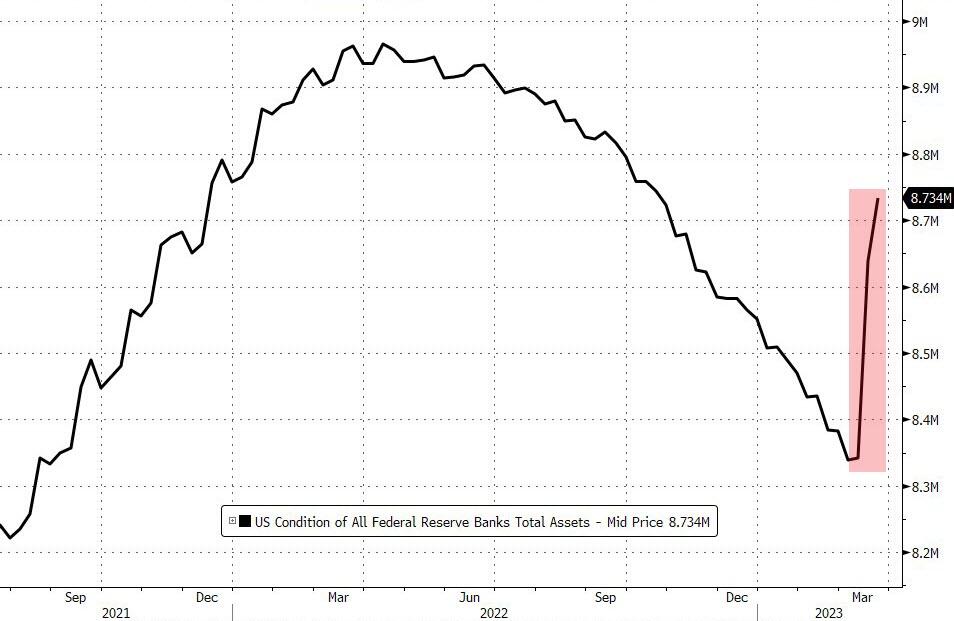
Fed Balance Sheet: 8.784tln (prev. 8.689tln); Total factors supplying reserve funds 8.784tln (prev. 8.689tln); Loans 354.191bln (prev. 318.148bln); Bank Term Funding Program 53.669bln (prev. 11.943bln); Other credit extensions 179.8bln (prev. 142.8bln).
FX
The USD is benefitting from the marked risk-off move with the index surpassing 103.00 from a 102.50 base in short-order and extending further to a 132.25+ peak since.
Action which comes to the detriment of peers ex-JPY, as USD/JPY has been lower by roughly a full point at worse (best) given its haven allure and with JPY repatriation factoring.
Notably, CHF is outperforming its peers, ex-JPY, but is still softer overall as its proximity/exposure to the European banking situation continues to overshadow traditional haven status vs USD though it is markedly outperforming the EUR as the focus is on EZ banks this morning.
As such, EUR is the standout laggard with EUR/USD down to a 1.0722 trough vs initial 1.0830 best, antipodeans are similarly hampered given their high-beta status and after Thursdays firmer action.
Cable failed to see a lasting benefit from the morning’s retail data while the subsequent PMIs were slightly softer than expected; but, again, the action is very much USD-driven.
PBoC set USD/CNY mid-point at 6.8374 vs exp. 6.8367 (prev. 6.8709)
Fixed Income
Core benchmarks are experiencing a marked bid given the risk-off price action that we are seeing with an accompanying dovish re-pricing being seen for Central Banks.
Specifically, Bunds have surpassed 139.50 and USTs above 1.17 with the respective 10yr yields down to 2.02% and 3.29% with market pricing in favour of an unchanged outcome at the next ECB and Fed meetings as such.
Gilts are moving in tandem with EGB/UST peers and have eclipsed 107.00; BoE pricing is now heavily in favour of an unchanged outcome at the May meeting.
Commodities
Commodities diverge given the marked risk-off action with crude and base metals pressured while precious metals glean incremental support as the USD offsets the benefit of haven demand.
Specifically, WTI and Brent are under USD 68.00/bbl and USD 74.00/bbl respectively which places them at the mid/lower-end of the current WTD USD 64.12-71.67/bbl and USD 70.12-77.44/bbl parameters.
Spot gold is incrementally firmer though is yet to convincingly surpass USD 2k/oz while base metals are dented by the aforementioned tone with 3-month LME Copper slipping further below 9k to a USD 8940 low.
Russia could recommend a temporary halt to wheat and sunflower exports, via Vedomosti; due to the sharp decline in prices.
US base at North-east Syria’s Al-Omar oil field has been targeted in an attack, according to security sources cited by Reuters.
UBS maintains a positive outlook on Gold and targets USD 2050/oz by the end of the year.
Geopolitics
Ukraine’s top ground forces commander said Ukrainian troops are to launch a counterassault soon as Russia’s large winter offensive weakens without capturing the eastern city of Bakhmut, according to Reuters.
Russian Security Council Deputy Chairman Medvedev says cannot rule out that Russian forces will need to reach Kyiv or Lviv to ‘destroy the infection’, according to RIA.
US Pentagon said the US conducted air strikes in Syria which targeted an Iranian-backed group in response to a deadly UAV attack, according to Reuters and Wall Street Journal.
US Treasury Secretary Yellen said sanctions on Iran have created a real economic crisis in that country and the US is constantly looking at ways to strengthen Iran sanctions but added that sanctions may not be sufficient to change a country’s behaviour, according to Reuters.
China’s Defence Ministry said it monitored and drove away a US destroyer which entered the South China Sea Paracel Islands on Friday again and sternly demands the US to immediately stop such provocations, according to Reuters.
North Korea said it conducted an important weapon test and firing drill from March 21st-23rd, while it added that it conducted a new underwater attack system in which it tested a new nuclear underwater attack drone and launched strategic cruise missiles. Furthermore, North Korea said its leader Kim guided the military activities and that Kim seriously warned enemies to stop reckless anti-North Korea war drills, according to KCNA.
South Korean President Yoon said they will step up security cooperation with the US and Japan against North Korea’s nuclear and missile provocations, while he said they will make sure North Korea pays the price for its reckless provocations, according to Reuters.
US Event Calendar
08:30: Feb. Durable Goods Orders, est. 0.2%, prior -4.5%
08:30: Feb. -Less Transportation, est. 0.2%, prior 0.8%
08:30: Feb. Cap Goods Orders Nondef Ex Air, est. -0.2%, prior 0.8%
08:30: Feb. Cap Goods Ship Nondef Ex Air, est. 0.2%, prior 1.1%
09:45: March S&P Global US Manufacturing PM, est. 47.0, prior 47.3
09:45: March S&P Global US Services PMI, est. 50.2, prior 50.6
09:45: March S&P Global US Composite PMI, est. 49.5, prior 50.1
10:00: Revisions: Wholesale Inventories
11:00: March Kansas City Fed Services Activ, prior 1
DB’s Jim Reid concludes the overnight wrap
There’s a bad bout of conjunctivitis going round the school at the moment and every member of the family has now had it with the last hold out being me until yesterday. So my eyes are a bit blurry this morning looking at screens. One of the twins believes he has conjunctiv”eye-test” as he thinks it’s called. If he hadn’t given it to me I’d think he was quite sweet.
As I was looking at screens last night through weepy eyes, markets looked like they were trying to normalise. However late weakness in financials again was a big drag on the last couple of hours of US trading. Just after the European close, the S&P 500 was up over +1.2% and looked set to reverse a good portion of the previous day’s losses. However by the end of the session, further weakness in banks and cyclicals more broadly left the index only +0.30%, but having been down nearly half a percent with 30 minutes left in trading. The VIX, which intraday was near its lowest level (20.18) since the SVB issues became prominent, ended the day 0.35pts higher at 22.6. Today we’ll see if the flash PMIs around the world are impacted by the early part of the mini banking crisis we’ve seen in the last two weeks. So watch the European and US numbers carefully.
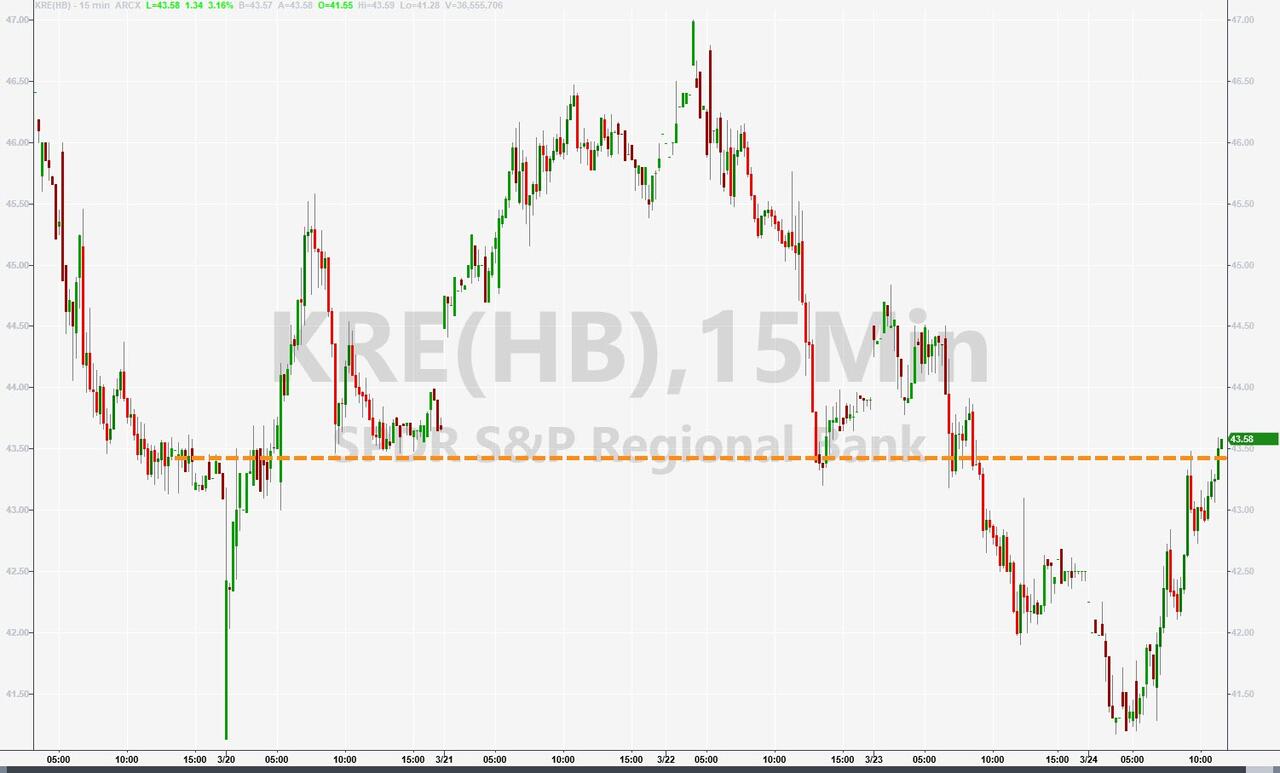
The renewed weakness in banks yesterday actually started in Europe with the STOXX Banks index down -2.27%. The STOXX 600 recovered from an intraday low of almost -1.0% to finish -0.21% lower overall. CDS markets highlighted the stress in European financials as the Subordinated Financial CDS index widened (+20bps) for the first time since last Friday – before the CS-UBS merger news – while the Senior CDS index was +9bps wider. In the US, the Regional bank ETF, KRE, was down -2.78% yesterday whilst the broader KBW Bank index was -1.73% lower as liquidity concerns of the smaller banks continue to permeate.
Staying with bank liquidity, after the US close last night, the Fed’s weekly balance sheet data showed that the use of the Fed’s discount window was down from $153bn to $110bn, while the credit deployed to SVB and Signature was up from 143bn to 180bn, and lastly the new emergency bank lending facility (BTFP) was up from $12bn to $54bn. So net of the two failed banks there was little change, indicating that banks were not finding it necessary to access cheap capital. The market should look favourably on that from a contagion standpoint. Overnight S&P and Nasdaq futures are both up around +0.2% and 2 and 10yr UST yields are both around -4.5bps lower as we go to press.
Far before that balance sheet data came out the S&P 500 opened much stronger, up +1.8% and stayed buoyant through the first three hours of trading, before the weakness in regional banks weighed on overall sentiment throughout the US afternoon. This was most pronounced with a bout of selling just before Treasury Secretary Yellen spoke in front of a House of Representatives subcommittee an hour or so before the US close. The selling might have been nervousness ahead of her remarks, given the negative market reaction to her comments before the Senate on Wednesday. Regardless, the S&P actually saw a +1.0% whipsaw move when Yellen said that the US government was “prepared for additional deposit action if warranted.” This was quickly faded, with the index continuing to trade between smaller gains and losses until it ended the day +0.30% higher.
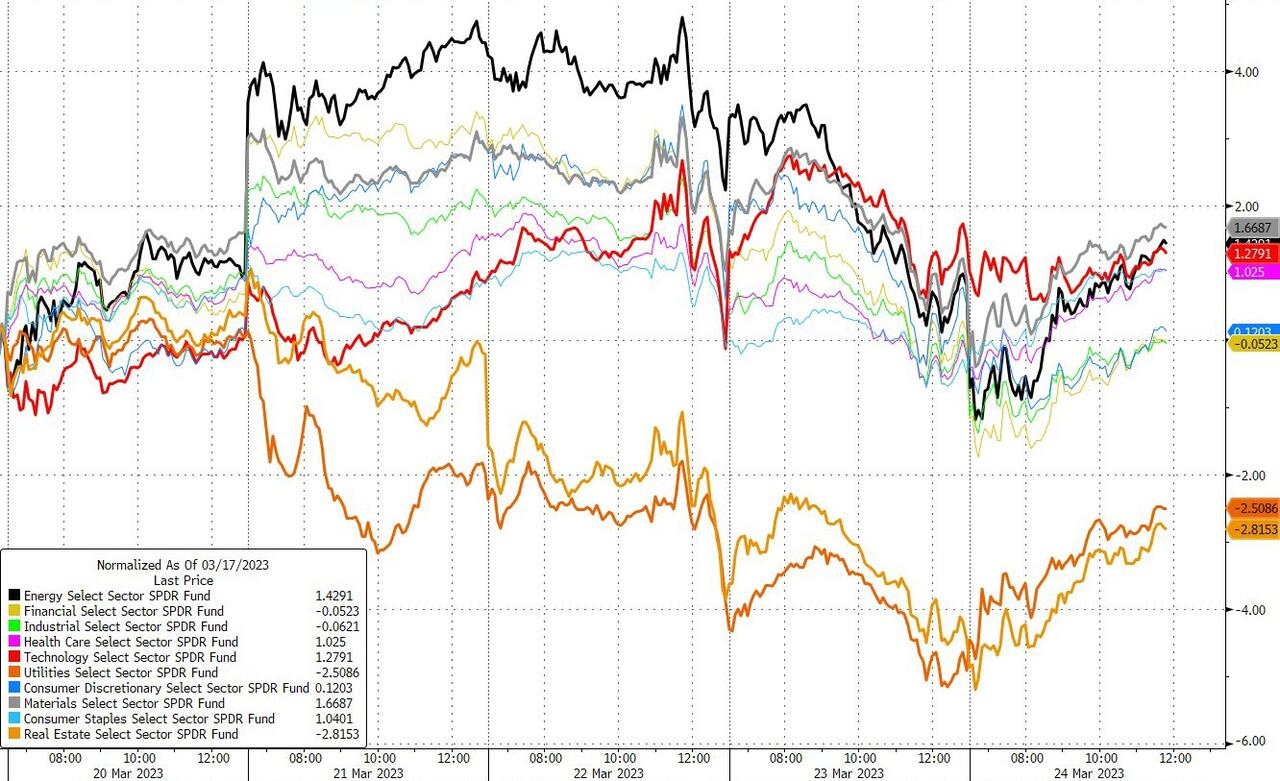
Despite the weakness in banks and Energy (-1.4%) on the back of lower oil prices, the S&P finished in the green thanks to Tech stocks outperforming on the lower rate outlook. The FANG+ index surged by +2.53%, whilst the NASDAQ 100’s gains (+1.19%) mean it’s now up nearly 20% from its lows at the end of December, almost meeting the traditional definition of a bull market.
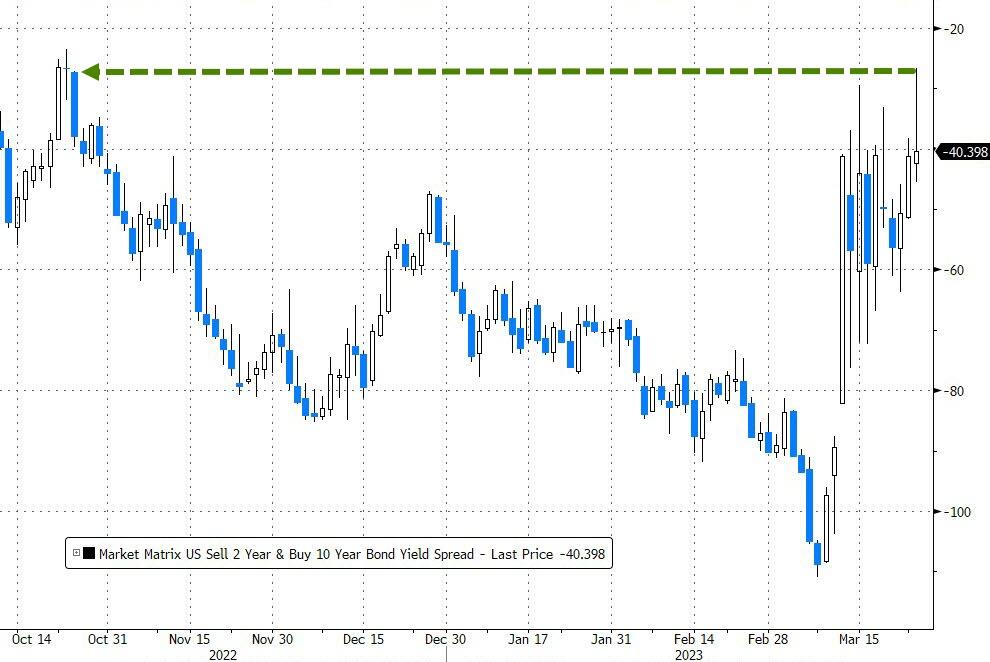
On the rates side, 10yr Treasury yields held up for the most part, with the 10yr yield -0.08bps to 3.427%. Short-dated rates were another story, with 2yr yields -10.4bps lower to 3.833% fully on the back of lower inflation expectations (-13.3bps), while 5yr rates were -7.2bps lower. This saw the 2s10s yield curve normalise a further +9.4bps yesterday to -41.3bps, which is the least inverted the curve has been in over 5 months. This drop in yields led by inflation expectations was also borne out in fed future pricing, where the market now only sees a 40% chance of a 25bp hike during the May meeting.
In Europe there was a sharp decline in longer dated yields that accelerated later in the session, with yields on 10yr bunds (-13.3bps), OATs (-12.3bps) and BTPs (-10.4bps) all moving lower. Furthermore, those moves came in spite of some of the ECB’s hawks calling for further tightening. For example, Austria’s Holzmann said that the ECB would “probably have to add” to its rate hikes at the next meeting in May. And the Netherlands’ Knot said that “I still think that we need to make another step in May, but I don’t know the size of that”.
Speaking of central banks, we had the Bank of England’s latest decision yesterday, who hiked rates by 25bps as expected. That takes the Bank Rate up to a post-2008 high of 4.25%, and 7 of the 9 MPC members were in support, with the other 2 preferring to remain on hold. Looking forward, the BoE said that they still expected inflation “to fall significantly” in Q2, aided by falling energy prices and the government’s move to extend the Energy Price Guarantee in last week’s budget. And when it comes to inflationary pressures, they said that if “there were to be evidence of more persistent pressures, then further tightening in monetary policy would be required.”
In his review (link here), our UK economist writes that while he sees some upside to growth and pay, there are downsides to services CPI and credit conditions, making the next meeting in May a difficult decision to call. On balance, he sees more downside risks than upside, and holds onto his call for the Bank Rate to remain where it is at 4.25%, with the risks tilted to one further hike.
Whilst we’re on central banks, yesterday also saw the Swiss National Bank hike rates by 50bps, taking the policy rate up to 1.5%. There were a number of hawkish-leaning details, including an upgrade in their inflation forecast relative to December, and their statement said that inflation was “still clearly above the range the SNB equates with price stability.” In the meantime, SNB President Jordan said that a “Credit Suisse bankruptcy would have had serious consequences for national and international financial stability and for the Swiss economy” and that “taking this risk would have been irresponsible.”
This morning in Asia equity markets are lower with the KOSPI (-0.72%) the biggest underperformer with the Nikkei (-0.41%), the Shanghai Composite (-0.54%), the CSI (-0.27%) and the Hang Seng (-0.21%) trading in negative territory.
Data from Japan has shown that consumer price inflation (+3.3% y/y) slowed in line with forecasts but for the first time in 13 months in February, compared to a +4.3% increase in January, mainly due to the effect of government’s energy subsidy program. At the same time, core-core CPI (excluding both fresh food and fuel costs) advanced further to +3.5% y/y in February (v/s +3.4% expected), notching the fastest y-o-y gain since January 1982. It followed a +3.2% increase in January highlighting the underlying inflationary pressures. Staying with Japan, the preliminary estimate for manufacturing PMI showed that sector activity remained in contraction for the fifth consecutive month in March after the reading came in at 48.6, albeit up from the previous month’s final reading of 47.7 as output and new orders remained under pressure. On the contrary, activity in the services sector expanded for the seventh straight month in March as the PMI edged up to 54.2, recording the fastest pace since October 2013, against prior month’s reading of 54.0.
Elsewhere, manufacturing as well as services in Australia slipped into contractionary territory as the manufacturing PMI fell to 48.7 in March from 50.5 in February with the services PMI deteriorating to 48.2 from the prior print of 50.7.
When it came to yesterday’s data, the US weekly initial jobless claims came in at a 3-week low of 191k over the week ending March 18 (vs. 197k expected), pointing to continued strength in the labour market. Continuing claims saw a small increase to 1694k (1690k expected) and remains in a slight up-trend but not at a concerning level yet. Meanwhile, the new home sales data for February showed a modest rise to an annualised rate of 640k (vs. 650k expected), taking them up to a 6-month high. Over in the Euro Area, the European Commission’s preliminary consumer confidence data for March showed a decline to -19.2 (vs. -18.2 expected), marking a reduction after 5 consecutive monthly improvements.
To the day ahead now, and data releases include the March flash PMIs from Europe and the US, along with UK retail sales for February, and the preliminary US durable goods orders for February. Otherwise from central banks, we’ll hear from the ECB’s De Cos, Nagel and Centeno, the Fed’s Bullard and the BoE’s Mann.
AND 2 b) NOW NEWSQUAWK (EUROPE/REPORT)
Risk off returns as banking concerns re-intensify within Europe; Deutsche Bank -12% – Newsquawk US Market Open
FRIDAY, MAR 24, 2023 – 02:05 PM
Equities are back under marked pressure as banking sector concern re-intensifies within Europe, Euro Stoxx 50 -2.3% & ES -0.8%.
Specifically, the European banking index SX7P -5.0% is the standout laggard as CDS’ for the stocks continue to rise & focus on the redemption of notes by Deutsche Bank and Lloyds; DBK -12%.
USD and JPY benefit from the risk move with other G10 peers all succumbing to the USD’s upside, DXY above 103.25 at best.
Core fixed benchmarks are bid with yields lower and a marked dovish re-pricing been seen for Central Banks.
Commodities diverge given the marked risk-off action with crude and base metals pressured while precious metals glean incremental support as the USD offsets the benefit of haven demand.
Looking ahead, highlights include US Flash PMIs, US Durable Goods, Speeches from Fed’s Bullard & BoE’s Mann.
Or why not try Newsquawk’s squawk box free for 7 days?
BANKS
Deutsche Bank (DBK GY) announces a decision to redeem its USD 1.5bln fixed to fixed reset rate subordinated Tier 2 notes, due 2028. Lloyds (LLOY LN) has issued a notice of redemption for the entire outstanding principal amount of the USD 1bln 0.695% senior callable fixed-to-fixed rate notes due 2024. In terms of the accompanying risk-off price action, the desk notes the early redemption(s) can perhaps be taken as a negative if we assume the justification is that the bank(s) expect to see more dovishness/risk-off before the next fixed-to-fixed rate adjustment.
UBS Wealth Management head Khan offered a retention package to Credit Suisse’s Asia staff in Hong Kong town hall which focuses on stabilising the Credit Suisse Asia team and boosting banker confidence, according to sources.
Credit Suisse (CSGN SW) and UBS (UBSG SW) are among the banks facing a US Russia-sanctions probe.
Fed Balance Sheet: 8.784tln (prev. 8.689tln); Total factors supplying reserve funds 8.784tln (prev. 8.689tln); Loans 354.191bln (prev. 318.148bln); Bank Term Funding Program 53.669bln (prev. 11.943bln); Other credit extensions 179.8bln (prev. 142.8bln).
EUROPEAN TRADE
EQUITIES
Equities are back under marked pressure as banking sector concern re-intensifies within Europe, Euro Stoxx 50 -2.3% & ES -0.8%.
Specifically, the European banking index SX7P -5.0% is the standout laggard amid broad-based pressure in banking names as CDS’ for the stocks continue to rise alongside focus on the redemption of notes by Deutsche Bank and Lloyds; currently, Deutsche Bank -12% is the Stoxx 600 laggard.
Stateside, futures are pressured in tandem with the above price action though with the magnitude less pronounced ahead of the arrival of US players and as we await potential updates to the regions own banking names.
Apple (AAPL) supplier Pegatron (4982 TW) is reportedly looking to open a second factory within India, to construct the latest iPhone models, via Reuters citing sources.
The USD is benefitting from the marked risk-off move with the index surpassing 103.00 from a 102.50 base in short-order and extending further to a 132.25+ peak since.
Action which comes to the detriment of peers ex-JPY, as USD/JPY has been lower by roughly a full point at worse (best) given its haven allure and with JPY repatriation factoring.
Notably, CHF is outperforming its peers, ex-JPY, but is still softer overall as its proximity/exposure to the European banking situation continues to overshadow traditional haven status vs USD though it is markedly outperforming the EUR as the focus is on EZ banks this morning.
As such, EUR is the standout laggard with EUR/USD down to a 1.0722 trough vs initial 1.0830 best, antipodeans are similarly hampered given their high-beta status and after Thursdays firmer action.
Cable failed to see a lasting benefit from the morning’s retail data while the subsequent PMIs were slightly softer than expected; but, again, the action is very much USD-driven.
PBoC set USD/CNY mid-point at 6.8374 vs exp. 6.8367 (prev. 6.8709)
Core benchmarks are experiencing a marked bid given the risk-off price action that we are seeing with an accompanying dovish re-pricing being seen for Central Banks.
Specifically, Bunds have surpassed 139.50 and USTs above 1.17 with the respective 10yr yields down to 2.02% and 3.29% with market pricing in favour of an unchanged outcome at the next ECB and Fed meetings as such.
Gilts are moving in tandem with EGB/UST peers and have eclipsed 107.00; BoE pricing is now heavily in favour of an unchanged outcome at the May meeting.
Commodities diverge given the marked risk-off action with crude and base metals pressured while precious metals glean incremental support as the USD offsets the benefit of haven demand.
Specifically, WTI and Brent are under USD 68.00/bbl and USD 74.00/bbl respectively which places them at the mid/lower-end of the current WTD USD 64.12-71.67/bbl and USD 70.12-77.44/bbl parameters.
Spot gold is incrementally firmer though is yet to convincingly surpass USD 2k/oz while base metals are dented by the aforementioned tone with 3-month LME Copper slipping further below 9k to a USD 8940 low.
Russia could recommend a temporary halt to wheat and sunflower exports, via Vedomosti; due to the sharp decline in prices.
US base at North-east Syria’s Al-Omar oil field has been targeted in an attack, according to security sources cited by Reuters.
UBS maintains a positive outlook on Gold and targets USD 2050/oz by the end of the year.
ECB is likely to reassure EU leaders regarding bank stability on Friday and is to call for EU deposit insurance, according to Reuters.
ECB’s Nagel says it is necessary to increase policy rates to sufficiently restrictive levels, whilst the APP wind down should accelerate from Q3. Domestic price pressures are likely to last for longer, whilst underlying inflation is increasingly concerning. There are signs of second-round effects from inflation-induced higher wage increases.
ECB’s Nagel says there is often a bumpy road after similar instances in the banking sector, not surprising there have been market moves. On Deutsche Bank’s share slide, ECB’s Nagel will not comment.
BoE’s Bailey says rates will rise again if firms hike prices, via BBC; “If all prices try to beat inflation we will get higher inflation,”
DATA RECAP
UK GfK Consumer Confidence (Mar) -36 vs. Exp. -36.0 (Prev. -38.0)
UK Retail Sales MM (Feb) 1.2% vs. Exp. 0.2% (Prev. 0.5%); Ex-Fuel MM (Feb) 1.5% vs. Exp. 0.1% (Prev. 0.4%, Rev. 0.9%)
UK Retail Sales YY (Feb) 3.5% vs. Exp. -4.7% (Prev. -5.1%); Ex-Fuel YY (Feb) -3.3% vs. Exp. -4.7% (Prev. -5.3%, Rev. -5.4%)
UK Flash Services PMI (Mar) 52.8 vs. Exp. 53.0 (Prev. 53.5); Manufacturing PMI (Mar) 48.0 vs. Exp. 49.8 (Prev. 49.3)
UK Flash Composite PMI (Mar) 52.2 vs. Exp. 52.8 (Prev. 53.1)
EU S&P Global Composite Flash PMI (Mar) 54.1 vs. Exp. 51.9 (Prev. 52.0)
EU S&P Global Manufacturing Flash PMI (Mar) 47.1 vs. Exp. 49.0 (Prev. 48.5); Services Flash PMI (Mar) 55.6 vs. Exp. 52.5 (Prev. 52.7)
German S&P Global Composite Flash PMI (Mar) 52.6 vs. Exp. 51.0 (Prev. 50.7)
German S&P Global Manufacturing Flash PMI (Mar) 44.4 vs. Exp. 47.0 (Prev. 46.3); Services Flash PMI (Mar) 53.9 vs. Exp. 51.0 (Prev. 50.9)
French S&P Global Composite Flash PMI (Mar) 54.0 vs. Exp. 51.8 (Prev. 51.7)
French S&P Global Manufacturing Flash PMI (Mar) 47.7 vs. Exp. 48.0 (Prev. 47.4); Services Flash PMI (Mar) 55.5 vs. Exp. 52.5 (Prev. 53.1)
GEOPOLITICS
Ukraine’s top ground forces commander said Ukrainian troops are to launch a counterassault soon as Russia’s large winter offensive weakens without capturing the eastern city of Bakhmut, according to Reuters.
Russian Security Council Deputy Chairman Medvedev says cannot rule out that Russian forces will need to reach Kyiv or Lviv to ‘destroy the infection’, according to RIA.
US Pentagon said the US conducted air strikes in Syria which targeted an Iranian-backed group in response to a deadly UAV attack, according to Reuters and Wall Street Journal.
US Treasury Secretary Yellen said sanctions on Iran have created a real economic crisis in that country and the US is constantly looking at ways to strengthen Iran sanctions but added that sanctions may not be sufficient to change a country’s behaviour, according to Reuters.
China’s Defence Ministry said it monitored and drove away a US destroyer which entered the South China Sea Paracel Islands on Friday again and sternly demands the US to immediately stop such provocations, according to Reuters.
North Korea said it conducted an important weapon test and firing drill from March 21st-23rd, while it added that it conducted a new underwater attack system in which it tested a new nuclear underwater attack drone and launched strategic cruise missiles. Furthermore, North Korea said its leader Kim guided the military activities and that Kim seriously warned enemies to stop reckless anti-North Korea war drills, according to KCNA.
South Korean President Yoon said they will step up security cooperation with the US and Japan against North Korea’s nuclear and missile provocations, while he said they will make sure North Korea pays the price for its reckless provocations, according to Reuters.
CRYPTO
Bitcoin is softer on the session but within very confined sub USD 500 parameters as it remains somewhat detached from the broader risk-off action currently being seen.
APAC TRADE
APAC stocks were mostly subdued after the recent bout of central bank rate hikes and choppy performance stateside where Wall Street just about closed higher amid a dovish market repricing of Fed rate expectations.
ASX 200 was lower with risk appetite sapped by weak PMI data which returned to contraction territory.
Nikkei 225 lacked conviction after the latest inflation data printed mostly in line with estimates.
Hang Seng and Shanghai Comp. retreated after the central bank drained liquidity and as participants digest earnings releases, while it was also reported that the US added 14 Chinese entities to the red flag list.
NOTABLE ASIA-PAC HEADLINES
HKMA said Hong Kong has very little exposure to the European and US banking situation, while it needs to monitor the situation carefully for any further volatility but is not concerned about risks to the Hong Kong banking sector.
China is to extend some tax relief measures, according to local media.
DATA RECAP
Japanese National CPI YY (Feb) 3.3% vs. Exp. 3.3% (Prev. 4.3%); Ex. Fresh Food YY (Feb) 3.1% vs. Exp. 3.1% (Prev. 4.2%)
Japanese National CPI Ex. Fresh Food & Energy YY (Feb) 3.5% vs. Exp. 3.4% (Prev. 3.2%)
Australian Composite PMI (Mar P) 48.1 (Prev. 50.6)
2 c. ASIAN AFFAIRS
ASIAN AND AUSTRALIAN CLOSINGS//EUROPE OPENING TRADING:
FRIDAY MORNING/THURSDAY NIGHT
SHANGHAI CLOSED DOWN 20.99 PTS OR 0.64% //Hang Seng CLOSED DOWN 133.96 PTS OR 0.67% /The Nikkei closed DOWN 34.36 PTS OR 0.13% //Australia’s all ordinaries CLOSED down 0.15% /Chinese yuan (ONSHORE) closed up 6.8801//OFFSHORE CHINESE YUAN DOWN TO 6.8793/ /Oil UP TO 67.21 dollars per barrel for WTI and BRENT AT 73.13 / Stocks in Europe OPENED ALL RED// ONSHORE YUAN TRADING BELOW LEVEL OF OFFSHORE YUAN/ONSHORE YUAN TRADING WEAKER AGAINST US DOLLAR/OFFSHORE WEAKER
2 d./NORTH KOREA/ SOUTH KOREA/
///NORTH KOREA/SOUTH KOREA/
END
2e) JAPAN
JAPAN/
END
3 CHINA /
CHINA/USA
end
4.EUROPEAN AND UK AFFAIRS
GERMANY/DEUTSCHE BANK
Deutsche Bank Bloodbath Reignites Global Bank Crisis Fears
FRIDAY, MAR 24, 2023 – 02:56 PM
Last night, amid the Fed’s H.4.1 report, we noted an unprecedented surge in foreign official Repo ($60 billion) under the Fed’s new FIMA repo facility, which means that the offshore scramble for dollars was alive and well, and someone really needed access to USD. The assumption was that it was Credit Suisse (or UBS) shoring up some shortfalls, but with the action of the last couple of days, others are worrying that there is more afoot in the EU banking system.
After brief respite earlier in the week, European bank stocks are cratering once again, now at 3-month lows (catching down to Senior Financial CDS)…
Deutsche Bank stock has crashed to 5-month lows…
Deutsche Bank CDS is soaring (Commerzbank is also rising rapidly) – now higher than at peak of the COVID lockdowns…
Source: Bloomberg
With the most crucial aspect (short-dated protection mainly used as a counterparty risk by derivatives trading partners) is very aggressively bid…
Source: Bloomberg
Notably, Deutsche unexpectedly announced its decision to redeem a tier 2 subordinated bond on Friday in a reassuring effort.
“Deutsche’s decision to redeem (having received all required regulatory approvals) should be a reassuring signal to credit investors,” Autonomous analyst Stuart Graham wrote in a note on Friday.
But instead, other Deutsche Bank AT1 bonds have plunged in price (with yields soaring above 16%)…
Source: Bloomberg
UBS and Barclays are also seeing AT1 bonds getting smashed lower as the entire CoCo bond market plunges in Europe (well down SNB!)
AT1mber…
Source: Bloomberg
Notably, ECB rate-hike odds have plunged this morning from a 25bps in May fully priced-in to just 60% odds now…
Source: Bloomberg
Even more stunningly, US money markets are now pricing in a rate-cut in June..
Source: Bloomberg
For context, the market’s expectations for The Fed’s rate at year-end is now 150bps lower than the Dot-Plot…
The government-brokered takeover of Credit Suisse by UBS is “no indication” of the state of European banks, Deutsche Bank management board member Fabrizio Campelli said at a conference yesterday.
There is no specific news on DB to catalyze these moves but if DB is next, then the world’s financial system has a serious problem that makes CS look like SVB.
end
CREDIT SUISSE
Switzerland “Looking More Like A Banana Republic” After CS ‘Rescue’
FRIDAY, MAR 24, 2023 – 01:55 PM
Having enraged bondholders (who saw their entire AT1 debt tranche wiped out before the equity was fully impaired, violating every conventional liquidation waterfall):
Mark Dowding, chief investment officer at RBC BlueBay, which held Credit Suisse AT1 bonds, said Switzerland was “looking more like a banana republic”
“If this is left to stand, how can you trust any debt security issued in Switzerland, or for that matter wider Europe, if governments can just change laws after the fact,” David Tepper, the billionaire founder of Appaloosa Management, told the Financial Times.
Was the bank condemned once Switzerland gave up its bank secrecy laws five years ago?
Did the negative yield curve that prevailed in Switzerland for over a decade push the bank into taking excessive risk and accepting rotten deals (Greensill, Archegos, Wirecard)?
Was its management just poor compared to other banks?
Are private banks and investment banks condemned to be poor bedfellows?
Whatever the reasons, it is hard to see a storied institution disappear and not feel a degree of compassion.
But taking a step back, Credit Suisse may not be the only thing that died today. For amid the Swiss bank’s weekend “rescue”, the notion that the Swiss can be counted on to be both punctilious and the ultimate “rule followers” has also been blown out of the water.
Indeed, the episode creates two precedents:
1) A bank can merge with another bank without shareholder approval being granted.
The logic runs that if a bank is systemically important, minority shareholder rights have to be overrun in the name of the “greater good”.
This is an important precedent that minority shareholders in all systemically important banks will no doubt take notice of.
2) Even as the “take-under” of Credit Suisse leaves equityholders with cents on the dollar, contingent convertible bond holders (known as CoCos or AT1 bonds) are being wiped out.
This is an arresting development, given that even unsecured bondholders usually rank above equityholders in the capital structure. So for equityholders to get “something” and CoCo bond holders to get “nothing” raises serious questions about the real value of CoCo bonds. This is important since CoCo bonds were widely used by European banks to bolster their balance sheets after the 2008 mortgage crisis and 2011-13 eurozone crisis.
To cut a long story short, the terms of the Credit Suisse take-under is likely to kill the CoCo market.
Imagine being the Saudi National Bank, which in October invested US$1.5bn for a 9.9% stake in Credit Suisse, no doubt on the premise that Switzerland is one of the safest jurisdictions for foreign investors. Yet in less than six months, the Saudi bank’s investment has been merged into UBS, crystallizing a loss of some 80%, without a vote being offered on the matter. How likely are Saudi institutions to invest more in Switzerland, or perhaps even in the wider Western world?
This situation brings me to two of my longstanding themes:
Firstly, that Western economies keep on undermining their main comparative advantage, namely, the rule of law and sacrosanct property rights. After all, when China was accepted into the World Trade Organization in 2001, the hope was that as trade grew, China would become more rules-based, democratic and civic rights-minded. Instead, the reverse has occurred, with Western countries following China to permit less free speech and impose more government interventions that include directed bank lending policies. The West embraced stupid Covid restrictions, imposed vaccine mandates and repressed demonstrations of dissent (see Who Is Copying Who? Part II? & What Freezing Russia’s Reserves Means). In the battle between “individual rights” and the “common good”, the West could usually be relied on to strongly favor “individual rights”. But can one believe that today? The Credit Suisse take-under shows that, given a chance, policymakers will trample all over “individual rights” in the name of promoting the “common good”.
This is probably doubly true if the individuals in question are both foreign and from non-democratic countries. Since most current account surpluses accumulate in countries like China, Saudi Arabia and Qatar and most of the world’s twin deficits occur in democracies like the US, France and Britain, a difficult question arises: if Western economies no longer treat property rights as sacrosanct, why should capital keep flowing from the “greater South” into the “unified West”, as it has since the late 1990s Asian Crisis?
Secondly, Western policymakers seem ready to sacrifice “individual rights” on the altar of the “common good” due to a bad brew stemming from the 2008 crisis, social media’s development and our current cultural predilection for virtue signaling (see The Guiding Principle Of Our Time & CYA As A Guiding Principle (2022)). All of this has shortened policy time horizons to the “here and now”. Hence, the more involved a population is with social media, the more the policy time frame shortens, with the “common good” tending to prevail over “individual rights”. So more individual freedoms expressed on social media seems to lead to weaker individual rights!
Putting it all together, the unfolding Credit Suisse debacle and the Swiss government’s policy responses lead to the following conclusions:
1) The effect of government interference is to raise regulatory uncertainty and so again make the broader financial industry uninvestible.
2) Breaking the CoCo bond market means that in the next crisis banks will have to fund themselves in new ways, or shareholders will simply face massive dilution.
3) Emerging market savings will increasingly stay at home. I exaggerate for effect, but if I was a Saudi banker today, I might feel that, like the Russians last year, my assets had just been seized.
4) Policymaking in the Western world remains a shambles. This means that emerging market bonds will continue to outperform developed market bonds, and gold is likely to continue outperforming both.
END
SWITZERLAND
POLAND/RUSSIA
5.RUSSIA//UKRAINE//MIDDLE EASTERN AFFAIRS//
SAUDI ARABIA
This will anger the USA to no end.
‘Times Have Changed’: Saudi Arabia To Reopen Embassy In Syria, Angering US
FRIDAY, MAR 24, 2023 – 05:40 AM
Syria’s President Bashar al-Assad continues to be brought “in from the cold” and back into the Arab regional fold at rapid pace, with Reuters confirming on Thursday the prior rumors that Saudi Arabia and Syria were on the brink of fully restoring diplomatic ties. They will now reopen embassies – a huge step. Is a return to the Arab League next?
“Syria and Saudi Arabia have agreed to reopen their embassies after cutting diplomatic ties more than a decade ago, three sources with knowledge of the matter said, a step that would mark a leap forward in Damascus’s return to the Arab fold,” Reuters reports.Source: AFP
The mutual embassy openings reportedly are the result of talks between the Saudis and a senior Syrian intelligence official. A source told Reuters they “preparing to reopen embassies after Eid al-Fitr,” in reference to a Muslim holiday in late April.
Most recently, the United Arab Emirates hosted Assad and his wife in an official visit – the first in well over a decade.
The US and Israel have not been happy at these developments, and the Syria-Gulf rapprochement also comes in the context of Iran and Saudi Arabia normalizing relations. One source told Al Jazeera:
“The prevailing attitude can be defined as, ‘times have changed, the Arab Spring is history and the region is transitioning towards a new future, with new geopolitical characteristics,'” the official, who himself recently reconciled with Damascus after defecting to the Syrian opposition in the summer of 2011, added.
It seems the Gulf has been willing to recognize that the Syrian government won the decade-long war and move on, but not Washington. The US has continued its military occupation of northern Syria, and Israel has extended its bombing campaign, even this week with strikes on Aleppo international airport.
Saudi Arabia will reopen its embassy in Syria, joining a list of several regional countries that reestablished ties with Damascus after failing miserably to overthrow its government for over a decade. Condolences to Israel, US and UK for failing to isolate post-victory Syria— Hadi Nasrallah (@HadiNasrallah) March 23, 2023
Far-reaching US sanctions are also still on. But regional leaders have been reaching out to Assad after the deadly earthquake which rocked Turkey and Syria, killing tens of thousands of people.
Saudi Arabia and allies like Qatar and the UAE had helped the US spearhead regime change efforts in Damascus. Russia and Iran came to the aid of Syria, however, in a war that took hundreds of thousands of lives and left much of the country in rubble.
end
Kremlin: We’ll Attack Any Country That Tries To Arrest Putin
BY TYLER DURDEN
FRIDAY, MAR 24, 2023 – 12:45 PM
There’s been a number of new developments including tit-for-tat warnings and threats following the International Criminal Court’s (ICC) last Friday issuance of an arrest warrant for Russian President Vladimir Putin.
The most blistering and alarming attack on the Hague-based court this week has been from former Russian president and current deputy chairman of the security council Dmitry Medvedev, who said any attempt to actually arrest Putin would be an act of war.
First, on Monday he said, “It’s quite possible to imagine a hypersonic missile being fired from the North Sea from a Russian ship at The Hague courthouse.” He added as part of the warning: “Everyone walks under God and rockets… Look carefully to the sky…”
In follow-up on Wednesday he said in a video statement posted to Telegram that any “arrest” would surely spark world war 3…
“Let’s imagine — obviously this situation which will never be realized — but nevertheless lets imagine that it was realized: The current head of the nuclear state went to a territory, say Germany, and was arrested,” Medvedev said.
“What would that be? It would be a declaration of war on the Russian Federation,” he continued. “And in that case, all our assets — all our missiles et cetera — would fly to the Bundestag, to the Chancellor’s office.”
Medvedev was responding to Germany saying it plans to cooperate with the ICC and arrest Putin if he were to ever fly to German soil.
Given the ICC doesn’t have a police force, any actual attempt to detain Putin would be the decision of a government, so needless to say it could not possibly be enforced. However, it does complicate Putin’s ability to travel to European or other capitalswhich cooperate with the ICC. This also means it could hinder peace efforts in the scenario Putin might choose to personally engage in negotiations or diplomacy in a European city.
It should be recalled amid the media outrage over Medvedev’s bombastic words that the Bush administration long ago said something similar… that the US would invade the Hague if a top US official were ever arrested to sent to the ICC:
As for hindering the possibility of peace negotiations further, Kiev has seized on the ICC move, saying it has made negotiations with the Russian leader pretty much impossible.
Mykhailo Podolyak, an advisor to Ukrainian President Volodymyr Zelensky, said in the wake of the warrant: now that Putin is “an obvious international criminal” this “directly means there will be no negotiations with the current Russian elite.”
Good analysis of what is happening in Ukraine
I sure hope that the Brits did not supply depleted rounds to the Ukrainians who will use them without hesitation. Alex is correct that the Russian soldiers and public will demand a retaliation. Making the Brits America’s bitch to be sacrificed along with the Europeans like the Poles. Whether anyone else would come to the aid of England or Poland is debatable. And of course the Ship of fools would go into overdrive to blame the Brits. Sadly, their politicians are being played as bigger fools. Apparently the Ukrainians have assembled a 80,000 man army to force relief to the trapped forces in Bakhmut. Whether this number is correct who knows. But is clear they have been supplied with Middle East war era vehicles and the like. So the amount of equipment is well beyond what is being reported and in line with vast trains of such equipment headed to Eastern seaboard ports, in previous months. Puzzling why the Russians have not carpet bombed these concentrations. They know where they are. At some point it will become necessary. Perhaps by letting them move out into the open civilians are spared. However that will be at the expense of Russian lives. Whatever happens next there is little doubt there will be escalation. With this will come escalation of banking and currency issues. It will be dow to who lasts longer in the end.
I sure hope that the Brits did not supply depleted rounds to the Ukrainians who will use them without hesitation. Alex is correct that the Russian soldiers and public will demand a retaliation. Making the Brits America’s bitch to be sacrificed along with the Europeans like the Poles. Whether anyone else would come to the aid of England or Poland is debatable. And of course the Ship of fools would go into overdrive to blame the Brits. Sadly, their politicians are being played as bigger fools. Apparently the Ukrainians have assembled a 80,000 man army to force relief to the trapped forces in Bakhmut. Whether this number is correct who knows. But is clear they have been supplied with Middle East war era vehicles and the like. So the amount of equipment is well beyond what is being reported and in line with vast trains of such equipment headed to Eastern seaboard ports, in previous months. Puzzling why the Russians have not carpet bombed these concentrations. They know where they are. At some point it will become necessary. Perhaps by letting them move out into the open civilians are spared. However that will be at the expense of Russian lives. Whatever happens next there is little doubt there will be escalation. With this will come escalation of banking and currency issues. It will be dow to who lasts longer in the end.
Combined, Russia & China have the largest nuclear arsenal weapons, the largest land mass, the most amount of people, flush rich in cash; Biden helped destroy US by forcing them together
America cannot confront a combined China and Russia. I want it too but it cannot. Get Biden’s frat boys and girls and idiots out of there and get some real Statesmen and women to fix this now. We are approaching WW III.
Again, a combined China and Russia is a devastating issue for the US.
This is likely another case of vaccine-induced silent myocarditis; these pilots were forced under threat of law & NO income to take the deadly gene injection! Company should have excluded myocarditis
America’s Faith In Technology is Leading the Financial Collapse of a Once Great CountryMarch 22, 2023 10:01 pmToday’s meeting of the Federal Reserve and their announcement regarding interest rates was, by far, the most anticipated financial announcement so far in 2023. Since the start of the banking collapse of the past couple of weeks, there has been widespread speculation about what the Fed was going to do today. Would they announce rate cuts and the return of easy money, which would throw a life preserver out to America’s smaller banks, or would they continue with rate hikes in an attempt to lower inflation, but potentially doom hundreds of America’s smaller and mid-sized banks to collapse? It was a no-win situation for the Fed, and most were anticipating at least a halt in rising interest rates, if not the announcement of rate cuts. In the end, the Fed announced another rate increase, stating that rate cuts were not on the table for the rest of 2023. Trying to calm the nerves of investors on Wall Street, Federal Reserve Chairman Jerome Powell announced that “all depositor savings” were “safe,” and that they were prepared to “use all tools” to keep the U.S. banking system “safe and sound.” However, Treasury Secretary Janet Yellen, who was testifying before a Senate Appropriations subcommittee at the same time Powell was making his remarks, was asked if the FDIC was going to raise the limit on bank deposits that are insured above the current $250,000 limit, and she replied: “This is not something we have looked at, it’s not something that we’re considering.” Whoops! The stock markets then began a steep decline in the final hour of trading, as soon as she said that. Bank stocks tumbled once again, but they are not the only ones looking at disaster. The automobile industry and the housing market is also in big trouble now, as U.S. consumers’ ability to borrow money and make major purchases will now get even worse. And just as a reminder, this current crisis of liquidity and downward spiral all began last year when FTX blew up, and the Big Tech sector began massive layoffs. Big Tech’s main bank, Silicon Valley Bank, the 15th largest bank in the U.S., was the first to crash. And now, America’s reliance on technology is crippling this nation, and it can only get worse, as all of this technology, such as AI which is eating up $billions of cash in Chat bot and other software right now, is all dependent upon hardware, and most of that is produced in China and Taiwan. China can now easily cripple the United States and bring us to brink of collapse, without firing a single shot or launching a single missile, by simply cutting off their exports to the U.S., and blocking exports from Taiwan.Read More…
SLAY NEWS
VACCINE IMPACT//
MICHAEL EVERY/RABOBANK//
end
7//OIL ISSUES//NATURAL GAS ISSUES/USA AND GLOBE
END
8. EMERGING MARKETS//AUSTRALA NEW ZEALAND ISSUES
END
YOUR EARLY CURRENCY/GOLD AND SILVER PRICING/ASIAN CLOSING MARKETS AND EUROPEAN BOURSE OPENING AND CLOSING/ INTEREST RATE SETTINGS FRIDAY MORNING 7;30AM//OPENING AND CLOSINGS
EURO VS USA DOLLAR:1.0718 DOWN .01185
USA/ YEN 129.83 DOWN 1.022 NOW TARGETS INTEREST RATE AT .50% AS IT WILL BUY UNLIMITED BONDS TO GETS TO THAT LEVEL…//YEN STILL FALLS//
GBP/USA 1.2193 DOWN 1.022
USA/CAN DOLLAR: 1.3781 UP.00663(CDN DOLLAR DOWN 63 PTS)
Last night Shanghai COMPOSITE CLOSED DOWN20.99PTS OR 0.64%
Hang Sang CLOSED DOWN 133.96PTS OR 0.67%
AUSTRALIA CLOSED DOWN.67% // EUROPEAN BOURSE: ALL RED
Trading from Europe and ASIA
I) EUROPEAN BOURSES ALL RED
2/ CHINESE BOURSES / :Hang SANG CLOSED DOWN 133.96 PTS OR 0.63%
/SHANGHAI CLOSED DOWN 20.99PTS OR 0.64%
AUSTRALIA BOURSE CLOSED DOWN .15%
(Nikkei (Japan) CLOSED DOWN 34.36 PTS OR 0.33%
INDIA’S SENSEX IN THE RED
Gold very early morning trading: 1994.35
silver:$23.18
USA dollar index early FRIDAY morning: 102.99 UP 18 BASIS POINTS from THURSDAY’s close.
The USA/Yuan, CNY: closed ON SHORE (CLOSED DOWN ..(6.8681
THE USA/YUAN OFFSHORE: (YUAN CLOSED (DOWN)…. 6.8692
TURKISH LIRA: 19.05 EXTREMELY DANGEROUS LEVEL/DEATH WISH/HYPERINFLATION TO BEGIN.
the 10 yr Japanese bond yield at +0.259…VERY DANGEROUS
Your closing 10 yr US bond yield DOWN 1IN basis points from THURSDAY at 3.372% //trading well ABOVE the resistance level of 2.27-2.32%) very problematic
USA 30 yr bond yield 3.644 DOWN 0 in basis points
USA 2 yr bond yield: 3.7667 DOWN 1 basis points
Your closing USA dollar index, 102,78 UP 57 BASIS PTS ON THE DAY/1.00 PM/
Your 12:00 AM bourses for Europe and the Dow along with the USA dollar index closing and interest rates THURSDAY: 12:00 PM
London: CLOSED DOWN 94,15PTS OR 1,26%
German Dax : CLOSED DOWN256.16 OINTS OR 1,46%
Paris CAC CLOSED DOWN 124.15 PTS OR 1.74%
Spain IBEX DOWN 177.70 POINTS OR 1.98%
Italian MIB: CLOSED UDOWN590.03PTS OR 2.23%
WTI Oil price 69,20 12: EST
Brent Oil: 76,90 12:00 EST
USA /RUSSIAN /// DOWNTO: 77.08/ ROUBLE DOWN 1 AND 08//100 RUBLES/DOLLAR
GERMAN 10 YR BOND YIELD; +2.1445
UK 10 YR YIELD: 3.308, UP 3BASIS PTS
CLOSING NUMBERS: 4 PM
Euro vs USA: 1.0749 DOWN 0.0085 OR 85 BASIS POINTS
British Pound: 1.2221 DOWN 0060 or 60 basis pts
BRITISH 10 YR GILT BOND YIELD: 3.308% UP 3BASIS PTS
USA dollar vs Japanese Yen: 130.63 DOWN 0.234//YEN up 23 BASIS PTS//
USA dollar vs Canadian dollar: 1.3721 UP .0004(CDN dollar, DOWN 4 basis pts)
West Texas intermediate oil: 69.20
Brent OIL: 74.90
USA 10 yr bond yield down 1 BASIS pts to 3.372%
USA 30 yr bond yield UP 0BASIS PTS to 3.644%
USA 2 YR BOND: down 1 PTS AT 3.7667%
USA dollar index: 102.78 up 57 BASIS POINTS
USA DOLLAR VS TURKISH LIRA: 19.05
USA DOLLAR VS RUSSIA//// ROUBLE: 77.05UP 1 AND 8//100 roubles
DOW JONES INDUSTRIAL AVERAGE: UP 132.28 PTS OR 0.41%
NASDAQ 100 UP 37,82PTS OR 0.30%
VOLATILITY INDEX: 21.74 DOWN .87 PTS (3.85)%
GLD: $183.65DOWN 2.09 OR 1.13%
SLV/ $21..22 DOWN0.06 OR 0.28%
end
USA AFFAIRS
1 a)USA TRADING TODAY IN GRAPH FORM
‘What Lies Beneath’? Market Headlines Mask Mayhem Below The Surface This Week
FRIDAY, MAR 24, 2023 – 11:00 PM
At the macro level, strong PMI data today was the icing on the cake of a ‘strong’ economy, pushing the US Macro Surprise Index to its strongest since April 2022 As Fed Funds were hiked to fresh cycle highs. Financial Conditions appear to be back into decoupling mode from ‘tight’ monetary policy. Whether it’s rate or credit-tightening, the transmission process is broken…
With more of a market focus, here are some facts from this tempestuous week that may surprise:
US Regional bank stocks unch on week
Gold unch on week
30Y Yield higher on week (2Y yields down notably)
Crude higher on week
US Stock Indices higher on week (led by tech)
Crypto small higher on week
Rate-hike odds plunged on week (recession)
EU Stocks up on week
EU bank stocks unch on week
EU bank credit risk lower on week
EU bank counterparty risk lower on week
But below the surface of these headline moves, there are some rather large fault-lines appearing…
Let’s start in Europe, because today’s chaos started there. Deutsche Bank’s credit risk exploded higher today…
The jawboning was magnificent – nothing to see here, move along!
“Deutsche Bank has fundamentally modernized and reorganized its business model and is a very profitable bank,” Chancellor Scholz said Friday at a news conference in Brussels when asked about the lender’s situation.
“There is no need to worry about anything.”
“We view this as an irrational market,” Citigroup Inc. analysts including Andrew Coombs wrote in a note.
“The risk is if there is a knock on impact from various media headlines on depositors psychologically, regardless of whether the initial reasoning behind this was correct or not.”
“We have no concerns about Deutsche’s viability or asset marks,” Stuart Graham, an analyst at Autonomous Research wrote.
“To be crystal clear – Deutsche is NOT the next Credit Suisse.”
“It is a clear case of the market selling first and asking questions later,” said Paul de la Baume, senior market strategist at FlowBank SA.
But the collapse in Credit Suisse CDS spreads helped put some lipstick on the EU banking system’s pig…
Source: Bloomberg
Overall, European bank markets roller-coastered dramatically, rallying off the opening lows after the CS bailout then reversing weaker to end the week. By the close, EU bank stocks were only modestly lower while Senior EU bank credit was tighter…
Source: Bloomberg
European ‘sub’ debt ended better on the week with spreads modestly tighter…
Source: Bloomberg
But while the index looked fine, Deutsche Bank’s 1Y Sub CDS (classic derivative counterparty risk hedge) literally exploded…
Source: Bloomberg
Despite today’s carnage in European banks, Europe’s broad stock markets ended the week in the green (thanks in large part to Monday’s post-CS bailout panic-bid short-squeeze)…
Source: Bloomberg
Back to the US, the major equity indices remained largely resilient this week (rising Fed balance sheet?). As today’s Emergency FSOC meeting took place, stocks began to rebound… Small Caps ended the week in the red with Nasdaq leading (as MSFT, AAPL ‘safe havens’ soared). S&P and Dow ramped today
The S&P 500 was very technical again this week. finding support early in the week at the 200DMA, rallying up to its 50DMA and reversing there. Falling back down to find support at the 200DMA again before bouncing back above the 100DMA today…
Utes and Real Estate were ugly this week as Tech, Energy, and Materials outperformed. Financials were flat…
Source: Bloomberg
CRE/Office REITs continued to collapse this week…
Source: Bloomberg
Which shouldn’t be a surprise as ‘Big Short 3.0’ CMBX crashes to fresh lows…
Source: Bloomberg
The Regional Bank stock index ended the week practically unchanged (after ramping up to unchanged today)…
But under the surface things were ugly for FRC, RILY, TCBI, COLB, and PACW plunged from early week gains…
Before we leave equity-land, as Goldman’s Chris Hussey points out, corporate investing activity was already poised to shrink before the recent bank stress, but the tightening lending standards coming out of the recent bank volatility is likely to further way on corporate investment spending…
Treasuries were mixed on the week with the long-end underperforming and the belly best. However, overall, it was another week of crazy vol in bond-land…
Source: Bloomberg
The 2Y Yield tumbled today to its lowest in almost 7 months, well below the 4.00% level…
Source: Bloomberg
The yield curve steepened notably this week (5s10s uninverted) with 2s10s back at its least inverted since October…
Source: Bloomberg
At the short-end of the curve, the yield curve collapsed from Powell’s hawkish Congressional hearings…
Source: Bloomberg
And the 2Y yield is now over 120bps below the current Fed Funds rate…
The dollar erased all of the post-Powell plunge but ended the week lower (3rd week lower of the last 4)…
Source: Bloomberg
Crypto was modestly higher on the week with BTC and ETH both up around 5% at their best but giving back most of those gains today…
Source: Bloomberg
Copper, Oil, and Silver all rallied on the week (while NatGas tumbled)…
Source: Bloomberg
Despite gold’s appeal, it ended the week basically unchanged, rebounding from the early week losses and topping $2000 twice intraweek…
WTI could not hold above $70…
Finally, at one point today, the market priced for a small chance of an inter-meeting rate-cut (but overall has reduced the odds of a May hike to just 25%)…
Source: Bloomberg
Additionally, we note that the market is massively more dovish than The Fed’s dotplot with regard to where rates will be at year-end…
Source: Bloomberg
That is 150bps! The market is clearly projecting a worsening financial crisis and/or a hard-landing recession… and stocks sure ain’t pricing that in!
Additionally, options traders are dramatically betting on lower rates/yields down by year-end as SOFT Dec23 Skews show incessant upside demand (h/t Nomura’s Charlie McElligott)
Source: Bloomberg
Larry McDonald perhaps summed up the situation best:
“Dear Central Banks – When you see suppress the true, market driven cost of capital for longer and longer periods of time. You incentivize the HTM yield reach across the banking system. Then you juice rates 500bps in 13 months to “fight” inflation and light it all on 🔥 fire”
It took The Fed’s QT program 11 months to reduce its almost $9 trillion balance sheet by $625bn… and 2 weeks to retrace two-thirds of that!!
Source: Bloomberg
If everything’s “fine” then why is The Fed balance sheet exploding higher again?
i b Morning trading:
Yellen Convenes Emergency Financial Stability Meeting On Friday As Banking Crisis Explodes
BY TYLER DURDEN
FRIDAY, MAR 24, 2023 – 05:01 PM
“Capital markets stop panicking when officials start panicking” – Michael Hartnett
Here comes the panic.
Bloomberg just reported that Treasury Secretary Janet Yellen – who was singlehandedly responsible for stoking and restarting the bank crisis on Wednesday which until that day was easing back, with her comments that nobody in charge was even talking about a uniform deposit insurance, let alone working on one – will convene the heads of top US financial regulators Friday morning for a previously unscheduled meeting of the Financial Stability Oversight Council.
The meeting will be closed to the public, the Treasury Department said in a statement. The Treasury didn’t say what time the meeting would begin, and it wasn’t immediately clear whether the council would issue a statement following the meeting.
The step comes as regulators continue efforts to instill calm in financial markets and among bank depositors following the recent failure of two mid-sized lenders in the US and the near-collapse of banking giant Credit Suisse Group AG before its government-brokered takeover by rival UBS Group AG.
FSOC’s members include the heads of the Federal Reserve, the Federal Deposit Insurance Corp. and several other regulatory agencies. It has little legal authority but serves as a coordinating forum. Here is a list of the full members:
The Council’s voting members are:
The Secretary of the Treasury who serves as the Chairperson of the Council;
Investigative journalist Seymour Hersh published an article on Substack on Wednesday that said the CIA was instructed to come up with a cover story for the Nord Stream bombings that was fed to The New York Times and the German newspaper Die Zeit.
The cover-up story was created to shift blame from the US after Hersh’s bombshell report published on February 8 that said President Biden ordered the attack on the Nord Stream natural gas pipelines, which connect Russia to Germany. “It was a total fabrication by American intelligence that was passed along to the Germans, and aimed at discrediting your story,” Hersh was told by a source within the American intelligence community.Image source: AP
Hersh said that the CIA was ordered to come up with a cover story after President Biden met with German Chancellor Olaf Scholz in Washington on March 3. Scholz’s visit was very brief and did not include the routine joint press briefing that usually follows a meeting between the president and another world leader. Hersh was told that his report detailing how the US took out Nord Stream was discussed by Biden and Scholz.
Hersh writes: “I was told by someone with access to diplomatic intelligence that there was a discussion of the pipeline exposé and, as a result, certain elements in the Central Intelligence Agency were asked to prepare a cover story in collaboration with German intelligence that would provide the American and German press with an alternative version for the destruction of Nord Stream 2.”
The result of the CIA’s work was published in The New York Times and Die Zeit on March 7. The New York Times report was very vague and said US officials are now claiming the Nord Stream bombings might have been carried out by a “pro-Ukrainian group.”
The Die Zeit report claimed German investigators believe it was carried out by six people using a yacht rented in Poland that was owned by two Ukrainians. Other Western media outlets published similar articles reinforcing the cover story in the following days.
Hersh said the information The New York Times received “originated with a group of CIA experts in deception and propaganda whose mission was to feed the newspaper a cover story—and to protect a president who made an unwise decision and is now lying about it.”
The cover story offers a radically different narrative than what Hersh’s February 8 report alleges. Using anonymous sourcing, Hersh reported that the Nord Stream pipelines were destroyed by explosives planted by US Navy divers in June 2022 under the cover of NATO drills in the Baltic Sea. The operation was done in coordination with Norway, and a Norwegian spy plane detonated the explosives by dropping a sonar buoy on September 26, 2022.
The last time Scholz visited Washington was on February 7, 2022. Biden vowed during a press conference that day that if Russia invaded Ukraine, he would “bring an end” to the Nord Stream 2 pipeline. According to Hersh, the plot to destroy the pipelines was already underway at that time, and the plotters took Biden’s comment as a blatant threat.
On Scholz’s possible complicity in the operation, Hersh said in his new article: “At this point, it must be noted that Chancellor Scholz, whether or not he was alerted of the destruction of the pipeline in advance—still an open question—has clearly been complicit since last fall in support of the Biden Administration’s cover-up of its operation in the Baltic Sea.”
END
Financial Stability Oversight Council Releases ‘Nothingburger’ Statement
BY TYLER DURDEN
FRIDAY, MAR 24, 2023 – 11:24 PM
Update (1615ET): After much anticipation of the potential for a market-moving action (deposit guarantees, backstops), FSOC has released a statement that is a total nothingburger:
Today, U.S. Secretary of the Treasury Janet L Yellen convened a meeting of the Financial Stability Oversight Council (Council) in executive session by videoconference.
During the meeting, the Council heard a presentation from staff of the Federal Reserve Bank of New York on market developments.
The Council discussed current conditions in the banking sector and noted that while some institutions have come under stress, the U.S. banking system remains sound and resilient.
The Council also discussed ongoing efforts at member agencies to monitor financial developments.
In attendance at the Council meeting by videoconference were the following members:
Janet L. Yellen, Secretary of the Treasury (Chairperson of the Council)
Jerome H. Powell, Chair, Board of Governors of the Federal Reserve System
Michael J. Hsu, Acting Comptroller of the Currency
Rohit Chopra, Director, Consumer Financial Protection Bureau
Gary Gensler, Chair, Securities and Exchange Commission
Martin Gruenberg, Chairman, Federal Deposit Insurance Corporation
Sandra L. Thompson, Director, Federal Housing Finance Agency
Todd M. Harper, Chairman, National Credit Union Administration
Thomas Workman, Independent Member with Insurance Expertise
James Martin, Acting Director, Office of Financial Research (non-voting member)
Steven Seitz, Director, Federal Insurance Office (non-voting member)
Elizabeth K. Dwyer, Superintendent of Financial Services, Rhode Island Department of Business Regulation (non-voting member)
Adrienne A. Harris, Superintendent, New York State Department of Financial Services (nonvoting member)
Melanie Lubin, Securities Commissioner, Office of the Attorney General of Maryland, Securities Division (non-voting member)
And this comes after Yellen said no industry-wide deposit guarantees and Powell raised rates… not exactly confidence-building.
We suspect markets will be ‘testing’ that resilience agains oon.
* * *
“Capital markets stop panicking when officials start panicking” – Michael Hartnett
Here comes the panic.
Bloomberg just reported that Treasury Secretary Janet Yellen – who was singlehandedly responsible for stoking and restarting the bank crisis on Wednesday which until that day was easing back, with her comments that nobody in charge was even talking about a uniform deposit insurance, let alone working on one – will convene the heads of top US financial regulators Friday morning for a previously unscheduled meeting of the Financial Stability Oversight Council.
The meeting will be closed to the public, the Treasury Department said in a statement. The Treasury didn’t say what time the meeting would begin, and it wasn’t immediately clear whether the council would issue a statement following the meeting.
The step comes as regulators continue efforts to instill calm in financial markets and among bank depositors following the recent failure of two mid-sized lenders in the US and the near-collapse of banking giant Credit Suisse Group AG before its government-brokered takeover by rival UBS Group AG.
FSOC’s members include the heads of the Federal Reserve, the Federal Deposit Insurance Corp. and several other regulatory agencies. It has little legal authority but serves as a coordinating forum. Here is a list of the full members:
The Council’s voting members are:
The Secretary of the Treasury who serves as the Chairperson of the Council;
The lockdowns and the stimulus required to keep the economy alive helped drive inflation. Then the Fed jacked up interest rates. And all hell broke loose…
On Friday March 10th, 2023, Silicon Valley Bank (SVB) died of Covid. Alright, it’s a little more complicated than that, but Covid lockdowns followed by massive government stimulus were a critical – and massively under-acknowledged – factor in propelling the bank’s demise.
At the heart of the crisis is the gigantic pile of low-interest debt that was issued during the height of the pandemic. While private-sector pandemic-era debt like corporate bonds also soared, US government debt like Treasury bonds piled up.
In a nutshell, during the pandemic the government issued enormous amounts of extremely low interest government debt — about $4.2 trillion of it. But now interest rates, including on government debt, are higher than they have been in 15 years and investors are dumping their old low-interest debt. As they dump, the resale price of the old debt goes down. The more it declines, the more investors want to dump. And thus, a panic is born.
To understand the problem fully, the question of US government debt has to be put into its larger context, which is: the pandemic response as a whole.
When news of the Covid virus first broke in December 2019, the 2 Year Treasury bond was being offered at 1.64% interest; the 10 year was at about 1.80%, and the resale value of such bonds on secondary markets was strong. Then, in March 2020, as Covid cases and deaths spiked, the US began to shutter its economy with panicked lockdowns that were supposed to “flatten the curve” or slow the spread of the virus and thus protect the hospitals. But Covid was politicized and the lockdowns were extended.
As the lockdowns dragged on, the US economy began to collapse, shrinking at a record-shattering annualized rate of 31.4% during the second quarter of fiscal year 2020.
To avoid total economic devastation, the federal government began massive debt-financed spending. In March 2020, Trump signed into law the $2.2 trillion economic stimulus bill the CARES Act, or Coronavirus Aid, Relief, and Economic Security. Then, in March 2021, Biden signed the American Rescue Plan Act which contained $1.9 trillion more in Covid relief. Finally, in April 2021, another trillion or so of Covid relief arrived in the Consolidated Appropriations Act.
Thanks to these laws, every industry and most people received public money. There was increased and extended unemployment payments, as well as the so-called “stimmy checks” or stimulus payments to everyone earning under $75,000 a year (about half the population). The Paycheck Protection Program spent almost a trillion dollars. The Provider Relief Fund doled out $178 billion to the healthcare system.
All this debt spending kept millions of people in their homes, and helped feed, employ, and care for millions more. The measures allowed hundreds of thousands of businesses to stay afloat even as many thousands of others went under. The impact of the spending on Americans’ well-being was generally positive. For a moment, the US child poverty rate was cut in half, falling to 5.2%.
But the economically destructive lockdowns were not necessary and did not work. Covid fanatics maintain that the lockdowns were unavoidable because the virus is so deadly. That, however, is uninformed. Last year I explained in detail how the Lockdown Left got the Covid crisis wrong. Not a single critic has challenged any of the facts I presented so there is little point in rehashing them all here.
Those who advocated an alternative to ham-fisted lockdowns, like the authors of the Great Barrington Declaration, which called for “focused protection” of vulnerable groups like the elderly, were viciously targeted in a reputation destruction campaign covertly orchestrated by former NIH director Francis Collins and de facto Covid czar Anthony Fauci. Never mind that the document’s authors were three eminently qualified scientists: Sunetra Gupta, professor of Theoretical Epidemiology at Oxford University; Jay Bhattacharya, professor of medicine at Stanford; and Martin Kulldorff, formerly a professor of medicine and biostatistics at Harvard. They were portrayed as far-right cranks who were almost eager to see millions die. But now, they have been vindicated.
Ultimately, the federal government spent $4.2 trillion propping up the economy that it was simultaneously choking to death with lockdowns. These two contradictory pressures laid the groundwork for the recent bank failures. Government mandated lockdowns hit the economy like a body blow. Factories closed, small businesses went under, ports and logistic hubs reduced operations, and about 2 million mostly older workers simply resigned. But at the same time, the federal government injected vast amounts of purchasing power into the economy, thus boosting consumption.
These two, contradictory government moves imposed almost unbearable pressure on supply chains. As shortages mounted, prices began to surge. Put simply: lockdowns plus stimulus equaled inflation.
Consider just one of the most important bottlenecks in the whole economy. During lockdown, many commercial driving license schools were closed. This helped create a shortage of about 80,000 truckers. If trucks do not roll supplies run low and prices go up.
At first, the official line on inflation – parroted by the Lockdown Left – maintained that inflation was “transitory.” But it was not. Inflation peaked at 9.1% in June 2022 while wage growth lagged at about 5%. In April 2020 during the worst of the lockdown, the Federal Reserve’s Federal Funds Rate sank to 0.5%. By February 2022, it had only risen to 0.8%.
Meanwhile, inflation was surging. By February 2022, inflation had reached 7.9%. Only then did the Fed, in an effort to tamp down prices, begin raising interest rates at the fastest pace rate in its history. The federal Funds rate was around 4.57% when SVB went under. Perhaps a massive wave of taxation could have soaked up enough liquidity to have helped cool prices, but that was a political impossibility. The more politically palatable response in Washington was for the Federal Reserve to raise interest rates.
Herein lies the problem. During the height of the lockdowns, banks bought up enormous amounts of government debt. As the Wall Street Journal put it: “U.S. banks are suffering the aftereffects of a Covid-era deposit boom that left them awash in cash that they needed to put to work. Domestic deposits at federally insured banks rose 38% from the end of 2019 to the end of 2021, FDIC data show. Over the same period, total loans rose 7%, leaving many institutions with large amounts of cash to deploy in securities as interest rates were near record lows.” Awash in deposits with not enough demand for loans, the banks bought US government securities. Their purchases surged 53% between 2019 and the end of 2021, to a total of $4.58 trillion, according to Fed data reported by the Wall Street Journal.
Because so much debt was being issued, it carried super-low interest rates. For example, on July 27, 2020, the 10 Year Treasury was offered at an annual interest rate of only 0.55%. This is fine if you are the borrower of money, but if you are the lender (that is to say, a bank giving the federal government money in exchange for a Treasury bond), it means your income stream will be reduced to a mere trickle. If inflation rises, it essentially disappears.
As the yield on new government debt reached toward 5% and inflation hung stubbornly at around 6.4%, all of that old, low-interest, pandemic-era debt started to look like garbage and banks began unloading it. The more that banks dumped old debt, the less value that debt had on resale markets. The lower its resale value, the more the banks wanted to dump it. SVB lost almost $2 billion selling off Government securities. And when they announced the loss, their stock price plunged by 60%.
At the same time, many of SVB’s clients were withdrawing money. This was in part because rising interest rates made borrowing new money more expensive and thus incentivized the use of savings in day-to-day business operations. Also, higher inflation and higher interest rates made low-earning bank deposits less attractive and compelled depositors to redeploy their surplus capital towards higher-earning investments. So, just as SVB needed cash, deposits were evaporating.
By the end of the week of March 10, the four biggest banks in the United States had lost $51 billion because of their panicked dumping of pandemic-era debt. Right after SVB was taken under government control, state regulators closed the New York-based Signature Bank. Before the weekend was over the Federal Reserve announced the creation of a new lending facility that would ensure that “banks have the ability to meet the needs of all their depositors.” Furthermore, the Fed said it was “prepared to address any liquidity pressures that may arise.”
It would seem that the federal government is ready to execute another de facto partial nationalization of US banking, just as they did in 2008 via emergency “cash injections” and then the Troubled Assets Relief Program (TARP). In this current crisis, banks can avoid losses on their low-interest debt if they do not sell it before its maturity. For that to happen, the banks need money. The Fed has said it will pour enormous amounts of money into the banks while all of the relevant officials have proclaimed that the banking system will somehow pay for this. All of this will almost certainly mean even more government debt will be issued.
Already, interest payments on the federal debt are one of the largest single items in the US budget – set to reach $400 billion this year. That is almost half as much as the grotesquely overdeveloped military budget. By comparison, federal spending on housing is only $78 billion.
Shoring up the banking system is necessary because if it collapses, the whole economy goes with it. At least in the short term, Americans are hostages of the US financial system. But government intervention without any new regulations and taxes upon the financial sector will likely mean more inflation and a bigger financial bubble. By refusing to properly tax the top 1%, the federal government also commits itself to more austerity for the many and more welfare for the rich, because rising government debt means a rising portion of our taxes must go toward interest payments.
This system of crisis-prone, hyper-financialized capitalism seems ever more like a junkie. If it doesn’t get its regular fix of public sector help, it will simply collapse and die.
Even if the federal government can stanch the current crisis, the pandemic debt story is global and very likely to cause trouble for some time to come. As a 2021 report by the World Bank put it: “The debt buildup during the pandemic-induced global recession of 2020 was the largest in several decades. This was true for all types of debt—total, government, and private debt; and advanced-economy and EMDE [emerging market and developing economy] debt; external and domestic debt. In 2020, total global debt reached 263 percent of GDP and global government debt 99 percent of GDP, their highest levels in half a century.”
The US intelligentsia and its media elites are finally beginning to reckon with the impact of misguided and authoritarian lockdowns on student learning and the psychological and physical health of millions. But in all the discussion of the current bank runs, the pivotal role of lockdowns in priming the crisis remains overlooked.
END
SWAMP STORIES
THE KING REPORT
The King Report March 22, 2023 Issue 6973
Independent View of the News
he King Report March 24, 2023 Issue 6975Independent View of the News The Bank of England hiked its benchmark interest rate by 25bps to 4.25%. The unexpected surge in UK CPI to 10.4% y/y cemented the decision. The BoE boosted its economic assessment. UK GDP is “now expected to increase slightly in the second quarter.” A month ago, the BoE forecast a 0.4% GDP decline. “GDP is still likely to have been broadly flat around the turn of the year.” – BoE
Bundesbank chief says rate-setters must be ‘more stubborn’ in inflation fight Joachim Nagel backs more rate rises as central banks on both sides of Atlantic wrestle with recent financial sector turmoil… https://t.co/JL1CQzRRY6
Vexing the Fed again, US Initial Jobless Claims fell to 191k from 192k; 197k was expected. Continuing Claims increased to 1.694m from 1.68m; 1.69m was consensus.
February New Home Sales are 640k; 650k was expected. However, January was revised to 633k from 670k. Therefore Feb New Home Sales increased 1.1%; -3.1% was consensus.
The Chicago Fed National Activity Index for February tumbled to -0.19 from +0.23; +0.1 was expected.
Fangs and trading sardines led the rally on Thursday. The NY Fang+ Index hit +3.76% at 11:08 ET as short-term traders of various classes aggressively bought stuff.
ESMs traded modestly higher but flat during early Asian trading. They rallied sharply from 21:45 ET until 22:45 ET. ESMs then went flat until a modest rally developed after Europe opened. After peaking at 4:47 ET, ESMs and stocks sank until 6:32 ET. ESMs and stocks rallied into the US repo market opening at 7 ET. ESMs then vacillated in a wide range until they began a rally minutes before the NYSE open. Traders incontinently bought stuff on the notion that the Fed is done hiking rates.
ESMs peaked at 11:08 ET. (+69.00). ESMs and stocks retreated into the European close as Old-World traders took profits. After a midday rollover, ESMs tumbled because bank stocks tanked. The tumble halted at 14:56 ET because Yellen changed course and said the US is prepared for additional deposit actions if needed. ESMs surged 43 handles in 5 minutes! But sellers returned, ESMs hit a new daily low at 15:21 ET. The usual late ESM upward manipulation appeared. ESMs jumped 47.00 in 29 minutes.
USMs hit a low of 130 14/32; they later surged to 132 8/32 at 15:28 ET, +1 7/32 for the day.
The Fed is back in its self-constructed box. Despite rate hikes, there is still way too much liquidity in the system and the Fed’s past behavior has conditioned traders to buy stuff on the flimsiest of excuses. So, stocks are surging anew – and might bubble up.
@BloombergAsia: Citigroup CEO Jane Fraser says the situation in the banking sector is not a credit crisis and warns mobile money is a “game changer” for bank runshttps://t.co/qDb5WaqAvX
You can imagine the horror when ‘mobile money’ panics with their stock holdings. No waiting for a wealth manager to answer your call; no waiting for the wealth manager’s firm to place the order; no waiting for the firm to execute the order; just zip the order into the market by one’s smartphone.
In 1987, there were structural circuit breakers. Retail and institutional sellers could not reach brokers because phone lines were clogged. Traders couldn’t reach other traders or NYSE floor brokers. The DOT and SIAC systems overloaded with orders and broke down. If current communication and execution systems existed on October 19, 1987, the carnage would have been worse.
Positive aspects of previous session Stocks rallied early in the US on feverish trader buying; the late upward ESM manipulation appeared Fangs, meme stocks, techs, and trading sardines soared on frantic buying
Negative aspects of previous session Industrial and energy commodities soared early (with stocks) Stocks tumbled in the afternoon on renewed banking crisis fears Physical gold hit $2003.35; June Gold futures hit $2023.30 The KBW Bank Stock Index hit a new low!!!
Ambiguous aspects of previous session Is buying stocks because the Fed will ease for a recession and banking crisis a good idea?
First Hour/Last Hour Action [S&P 500 Index]: 1st Hour from NYSE open:Up; Last Hour: Down
Pivot Point for S&P 500 Index [above/below indicates daily trend to traders]: 3958.34 Previous session High/Low: 4007.66; 3919.05
Fed Balance Sheet: +$94.487B; FIMA (foreign) Repos +60.0B (record); Loans +$36.043B Fed Discount Window borrowings fell to $110.2B from $152.9B – BBG Fed Loans to FDIC Bridge Banks Rise to $179.8B from $142.8B – BBG Fed Bank Term Funding Loans Rise to $53.7B from $11.9B Week Ago – BBG Fed Backstop Facility Borrowings by Banks Fell to $1693.9B from $163.9B – BBG
Today – Traders want to play for the Friday rally. However, recent late equity tumbles have diminished confidence and resurrected banking crisis fears. Who wants to be long stuff over the weekend? Do NOT play unless you must. There is a bad moon over the markets; and no one knows the extent of the evil.
Expected economic data: Feb Durables 0.5% m/m, ex-Trans 0.2%, Nondef ex-Air -0.2%, Shipments 0.2%; March S&P US Mfg. PMI 50.3, Composite PMI 49.5; St. Louis Fed Pres Bullard 9:30 ET.
ESMs are -0.75 and USMs are +3/32 at 21:00 ET. Monitor the KBW Bank Stock Index (BKX)!
Biden Judicial Nominee Stumbles Over Brady Motion DefinitionColorado Magistrate Kato Crews couldn’t define Brady motionSecond Biden court nominee to stumble in two monthsKato Crews, a magistrate judge in Denver who’s been selected for a district court seat there, couldn’t define a Brady motion and how to analyze it at his confirmation hearing… The motion… is a request by a defendant to compel prosecutors in a criminal case to turn over potentially favorable evidence. “I believe that the Brady case involved something regarding the Second Amendment,” Crews said. “I have not had an occasion to address that.”… https://news.bloomberglaw.com/us-law-week/another-biden-judicial-nominee-stumbles-at-confirmation-hearing
The whacko leftists the control The Big Guy continue to promote identity over ability.
@washingtonpost: U.S. defense officials face the bleakest recruiting environment since the aftermath of the Vietnam War, with less than a quarter of Americans ages 17 to 24 years old eligible to serve — and just 9 percent willing to do so… (Perpetual wars have consequences; plus, go woke, go broke!) https://www.washingtonpost.com/national-security/2023/03/22/military-recruiting-shortfalls/ @seanmdav: This is what happens when inept political leaders spend decades losing wars and callously wasting the lives of men and women who volunteer for combat. Corrupt politicians and inept generals have communicated their complete lack of regard for those who serve.
@ColumbiaBugle: New book out documenting the experiences of the January 6th political prisoners in the DC Jail: The American Gulag Chronicles. Tucker Carlson: “I have trouble believing that this could go on for over two years and none of the people that these defendants have voted for over the years stood up to defend them, with a few honorable exceptions. But where are the Republicans in Congress? I think that every time I hear it.” https://t.co/QepoRluLKj
More and more people are falling over dead from the CV19 bioweapon vax. Many are young people like 19-year-old boxing champion Jude Moore, who fell over dead this week with no known reported cause of death. Is anyone interested in why people are falling over dead in record numbers? Does anyone ask if the person is vaxed? Why are doctors “baffled”? Is America going to wake up to the genocide that is happening all around them? All questions will be answered in the affirmative sooner than later.
Don’t fall for the propaganda that Ukraine is winning the war with Russia. NATO wants to turn the tide for the obliterated Ukraine army. So, it is offering Depleted Uranium (DU) weapons to burn through Russian tanks. Russia says it is a form of nuclear warfare, and it will respond in kind. DU has a half-life of 4.5 billion years, and it contaminates everything it touches–forever!! The move is desperate and highly dangerous for all living things. In Ukraine, where these weapons are used, nothing will ever recover from the radioactive fallout.
The Fed raised interest rates even though we were told, once again, the Fed was going to pause and even cut interest rates. What is going on? The Fed appears to be protecting the U.S. dollar while printing money for bank bailouts. It’s QT and QE, or tightening and printing, at the same time. It looks like the Fed is desperate to hold the financial system together. Is your money really insured?
There is much more in the 45-minute news cast.
Join Greg Hunter of USAWatchdog.com as he talks about these stories and more in the Weekly News Wrap-Up for 3.24.23.

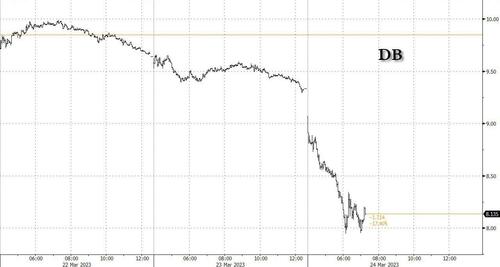
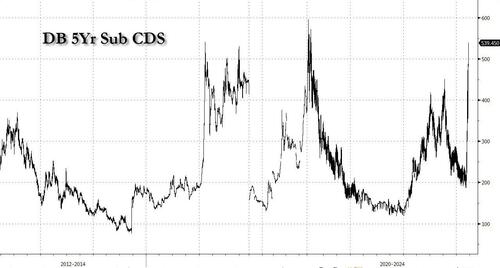
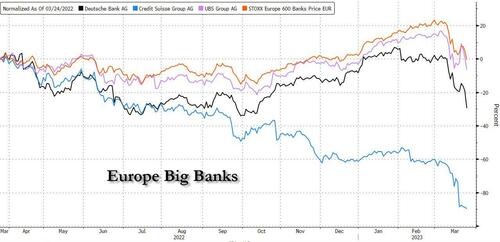
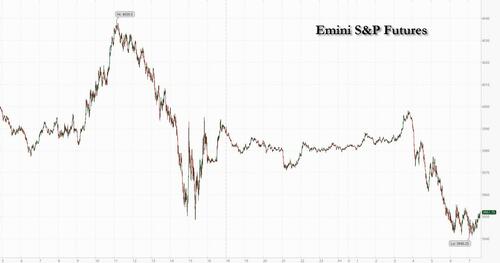
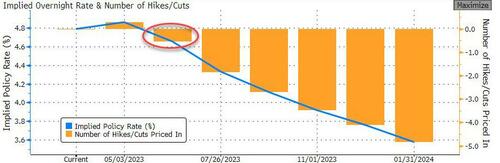


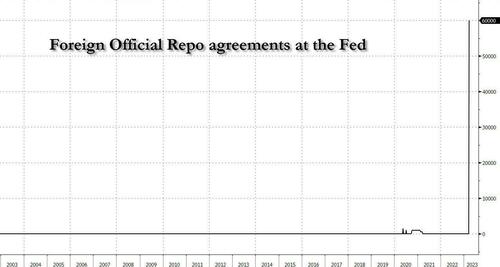

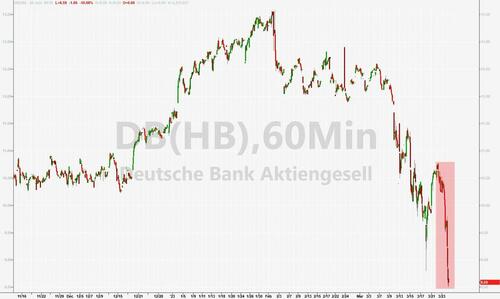
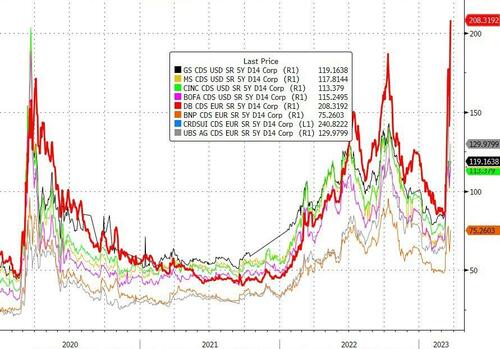
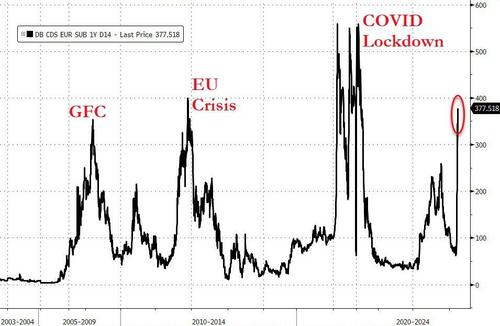
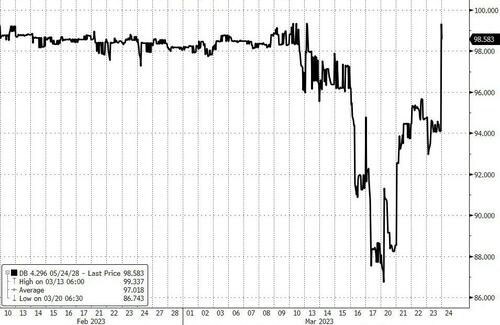
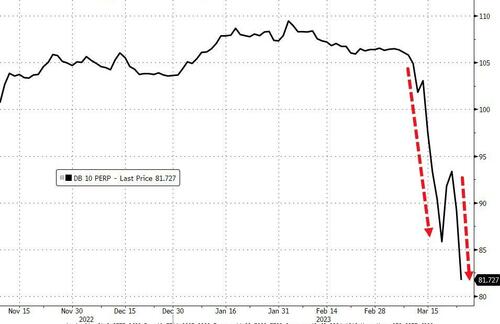

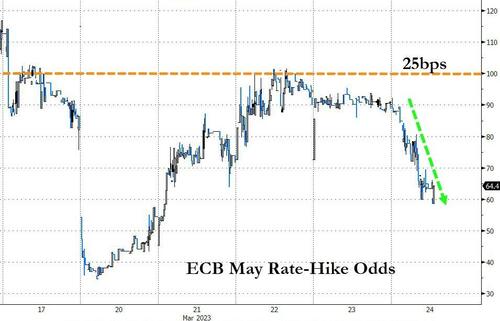
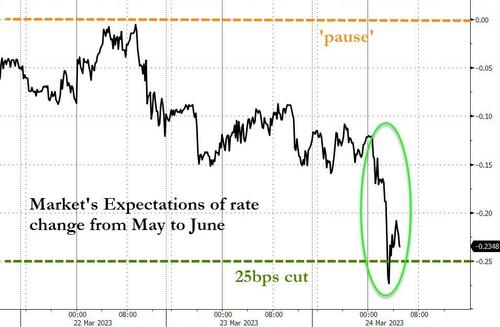
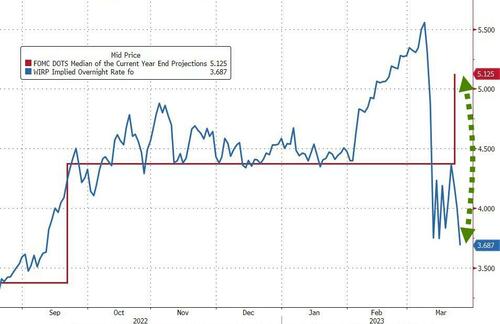
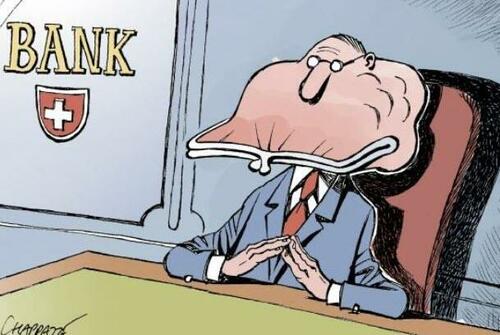

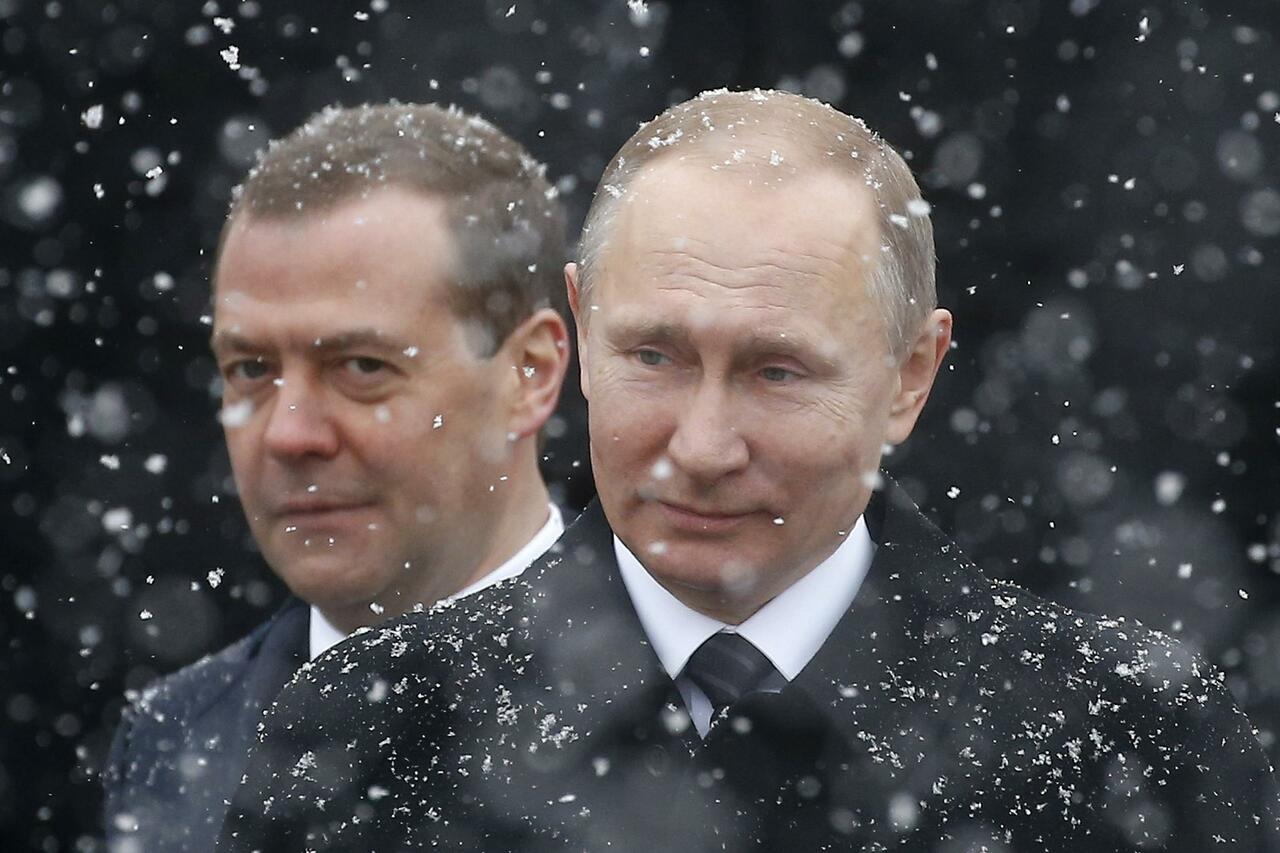


 Today’s meeting of the Federal Reserve and their announcement regarding interest rates was, by far, the most anticipated financial announcement so far in 2023. Since the start of the banking collapse of the past couple of weeks, there has been widespread speculation about what the Fed was going to do today. Would they announce rate cuts and the return of easy money, which would throw a life preserver out to America’s smaller banks, or would they continue with rate hikes in an attempt to lower inflation, but potentially doom hundreds of America’s smaller and mid-sized banks to collapse? It was a no-win situation for the Fed, and most were anticipating at least a halt in rising interest rates, if not the announcement of rate cuts. In the end, the Fed announced another rate increase, stating that rate cuts were not on the table for the rest of 2023. Trying to calm the nerves of investors on Wall Street, Federal Reserve Chairman Jerome Powell announced that “all depositor savings” were “safe,” and that they were prepared to “use all tools” to keep the U.S. banking system “safe and sound.” However, Treasury Secretary Janet Yellen, who was testifying before a Senate Appropriations subcommittee at the same time Powell was making his remarks, was asked if the FDIC was going to raise the limit on bank deposits that are insured above the current $250,000 limit, and she replied: “This is not something we have looked at, it’s not something that we’re considering.” Whoops! The stock markets then began a steep decline in the final hour of trading, as soon as she said that. Bank stocks tumbled once again, but they are not the only ones looking at disaster. The automobile industry and the housing market is also in big trouble now, as U.S. consumers’ ability to borrow money and make major purchases will now get even worse. And just as a reminder, this current crisis of liquidity and downward spiral all began last year when FTX blew up, and the Big Tech sector began massive layoffs. Big Tech’s main bank, Silicon Valley Bank, the 15th largest bank in the U.S., was the first to crash. And now, America’s reliance on technology is crippling this nation, and it can only get worse, as all of this technology, such as AI which is eating up $billions of cash in Chat bot and other software right now, is all dependent upon hardware, and most of that is produced in China and Taiwan. China can now easily cripple the United States and bring us to brink of collapse, without firing a single shot or launching a single missile, by simply cutting off their exports to the U.S., and blocking exports from Taiwan.Read More…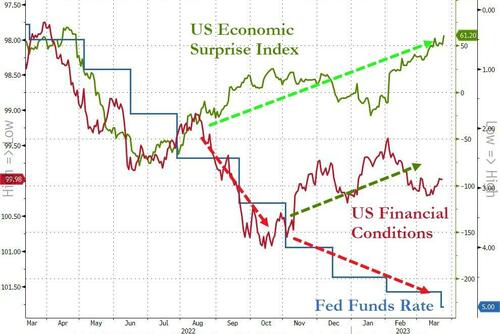
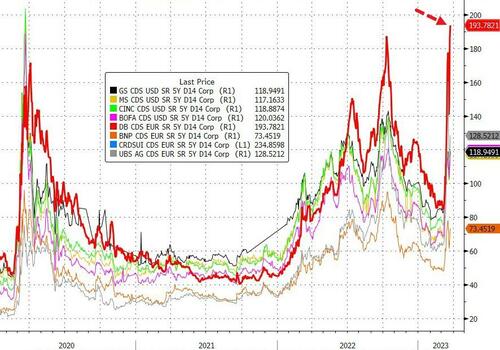
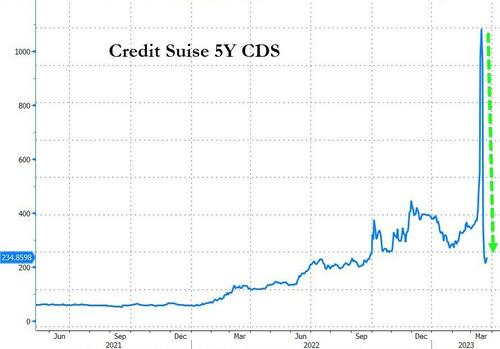
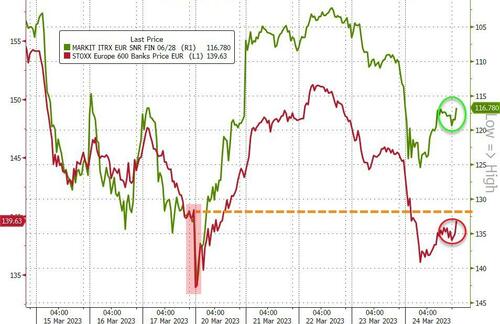
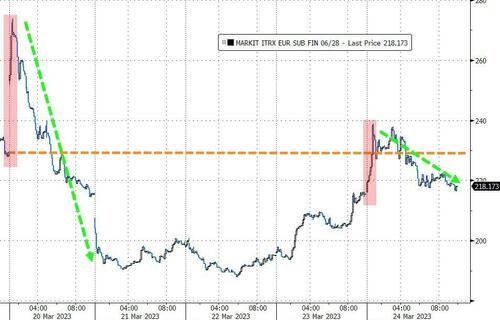
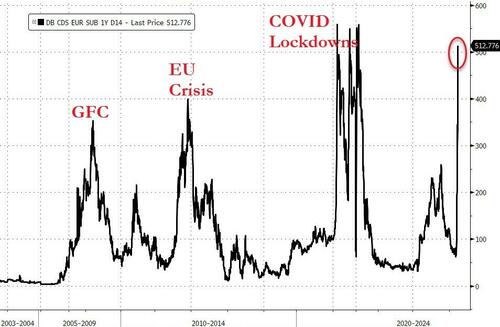
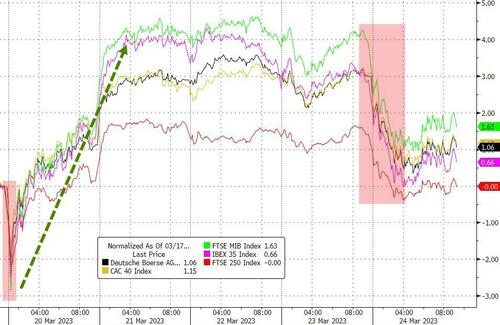
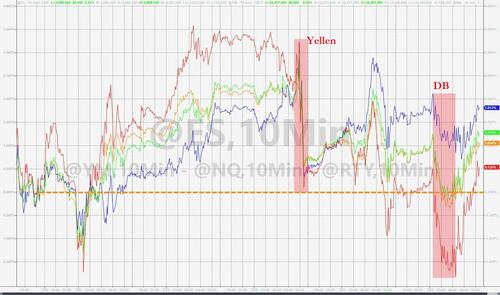
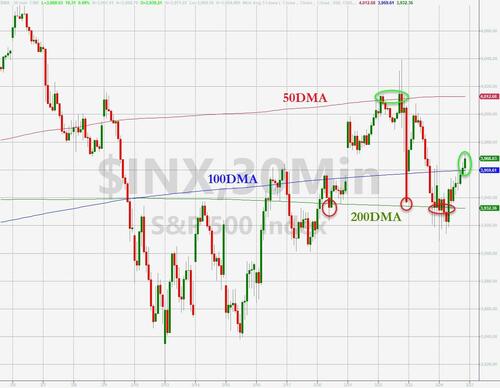
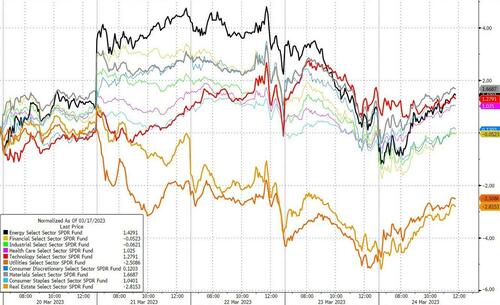
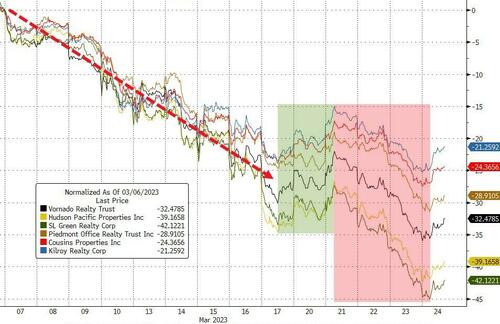
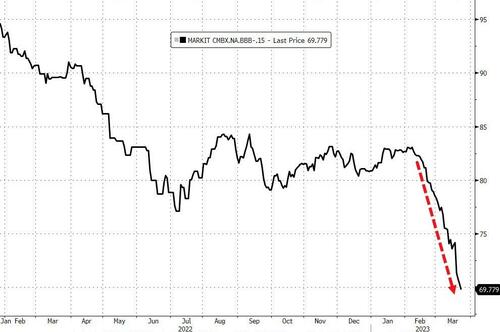
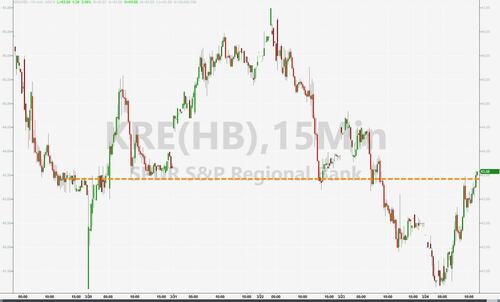
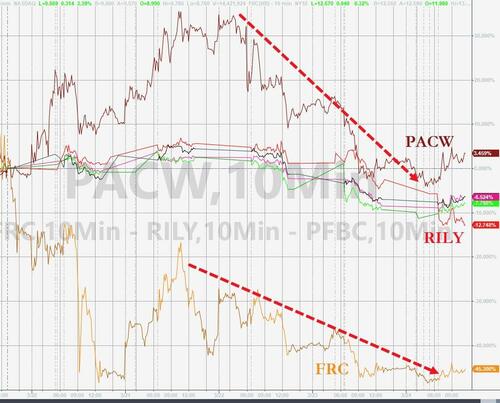
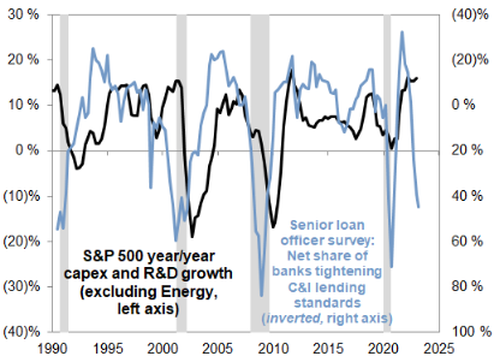
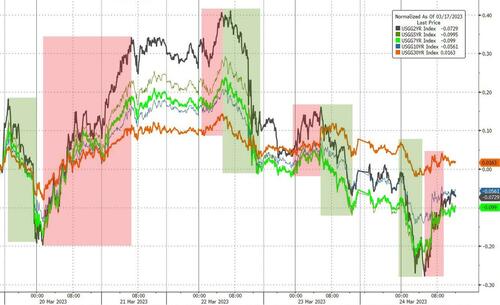
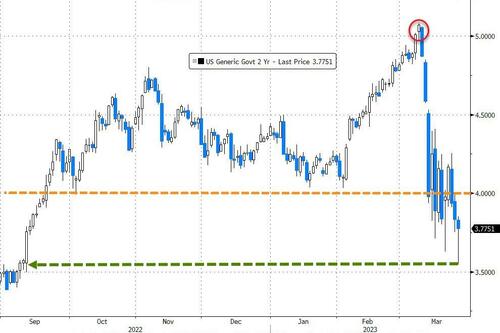
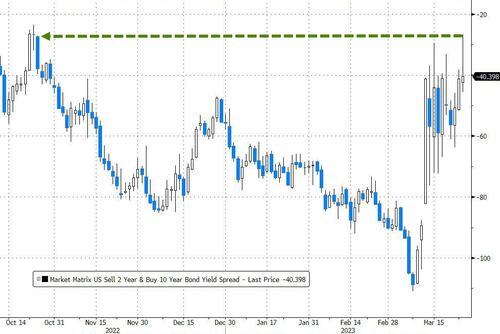
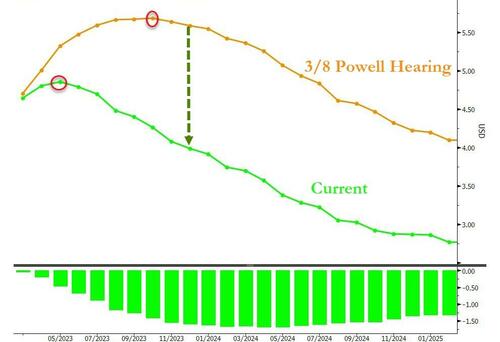
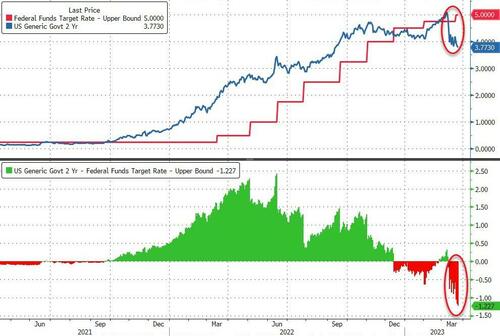
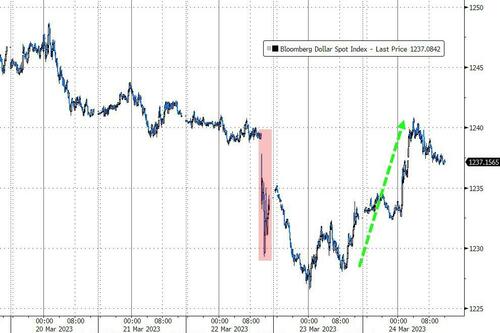
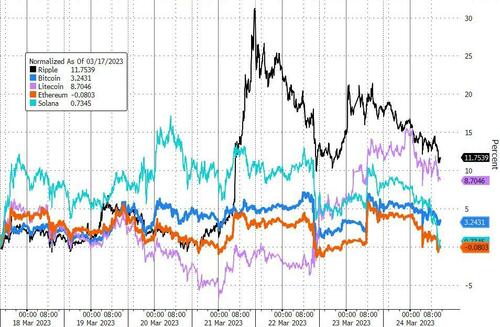
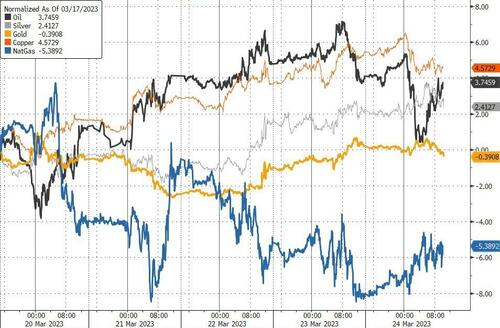
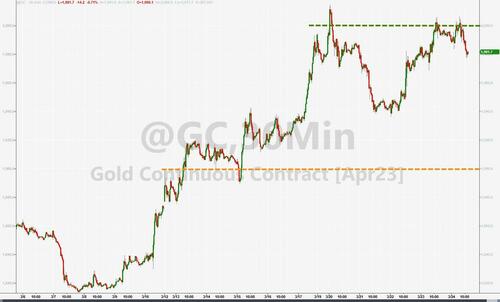
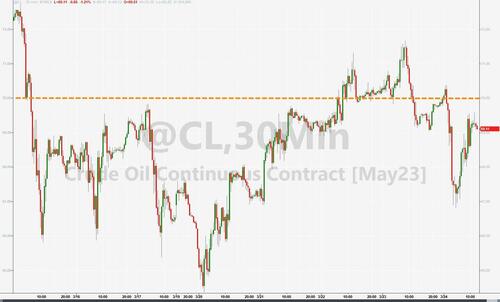
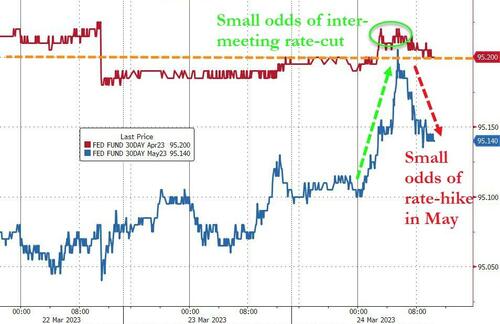
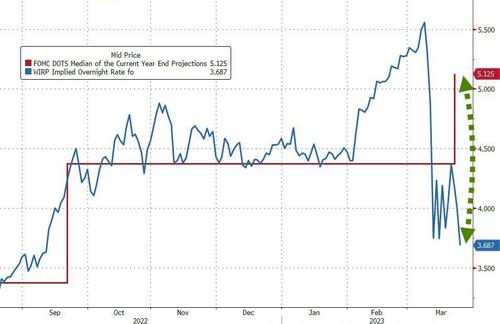
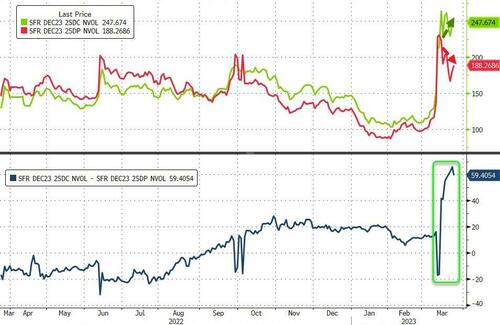
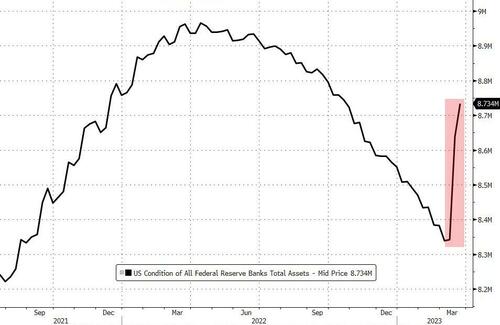
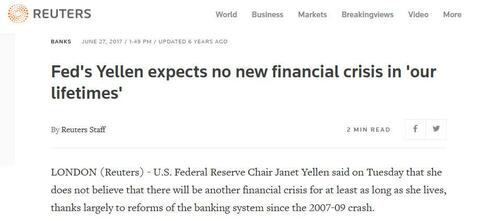


 harveyorganblog.com