next week beginning Monday April 20 through to Thursday,April 23, I will be out of the picture
for the 4 days. Thus I cannot do my normal report
I will provide the comex preliminary numbers and publish that as a work in progress. I will finalize the numbers late at night.
for you. HARVEY
EXCHANGE: COMEX
EXCHANGE: COMEX
CONTRACT: APRIL 2026 COMEX 100 GOLD FUTURES
SETTLEMENT: 4,800.000000000 USD
INTENT DATE: 04/15/2026 DELIVERY DATE: 04/17/2026
FIRM ORG FIRM NAME ISSUED STOPPED
099 H DEUTSCHE BANK AG 6
323 C HSBC 57
363 H WELLS FARGO SECURITI 61
365 C MAREX CAPITAL MARKET 1
555 C BNP PARIBAS SEC CORP 25
657 C MORGAN STANLEY 1
661 C JP MORGAN SECURITIES 11
737 C ADVANTAGE FUTURES 6
905 C ADM 2 2
TOTAL: 86 86
MONTH TO DATE: 18,296
MONTH TO DATE: 18,296
GOLD: NUMBER OF NOTICES FILED FOR APRIL/2026: 86 CONTRACTs NOTICES FOR 8,600 OZ or 0.2678TONNES
total notices so far: 18,296 contracts FOR 1,829,600 OZ OR 56.908 TONNES
SILVER NOTICES: 480 NOTICE(S) FILED FOR 2.400 MILLION OZ /
total number of notices filed so far this month : 2713 CONTRACTS (NOTICES) for 13.565 million oz
SILVER//OUTLINE
INITIAL STANDING FOR JANUARY: 22.915 MILLION OZ FOLLOWED BY TODAY’S 1.185 MILLION OZ QUEUE JUMP//NEW NORMAL STANDING ADVANCES TO 49.445 MILLION OZ// TO WHICH WE ADD OUR FIRST EXCHANGE FOR RISK FOR .100 MILLION OZ//NEW STANDING ADVANCES TO 49.545 MILLION OZ!!
INTIAL STANDING FOR FEBRUARY/SILVER: 13.505 MILLION OZ FOLLOWED BY TODAY’S HUGE 0.005 MILLION OZ QUEUE JUMP / : NEW STANDING FOR SILVER AT THE COMEX ADVANCES TO 25.180 MILLION OZ. BUT WE MUST ADD OUR FIRST EXCHANGE FOR RISK OF 25 CONTRACTS FOR .125 MILLION OZ AND THEN OUR SECOND EXCHANGE FOR RISK OF .0600 MILLION OZ TO OUR THIRD HUGE 2.825 MILLION OZ EXCHANGE FOR RISK!!
INITIAL STANDING FOR MARCH: A SURPRISINGLY LOW 31.076 MILLION OZ/ FOLLOWED BY A STRONG QUEUE JUMP OF 42 CONTRACTS OR 0.210 MILLION OZ/NEW STANDING REDUCES TO 46.060 MILLION OZ
INITIAL STANDING FOR APRIL: 7.120 MILLION OZ FOLLOWED BY TODAY’S 470 CONTRACT QUEUE JUMP WHERE 2.305 MILLION ADDITIONAL OZ WILL TAKE DELIVERY OVER ON THIS SIDE OF THE POND. NEW STANDING FOR SILVER AT THE COMEX THUS ADVANCES HUGELY TO 13.705 MILLION OZ
SUMMARY OF OUR APRIL 2026 COMEX CONTRACT MONTH:
JULY: 50.925 MILLION OZ (QUITE SMALL)
AUGUST: 59.455 MILLION OZ (QUITE SMALL)
SEPT. 50.510 MILLION OZ.(QUITE SMALL)
OCT; 82.020 MILLION OZ (WILL BE STRONG THIS MONTH)/ OCC WANTS TO REIN IN THESE ISSUANCES!
NOVEMBER: 36.425 MILLION OZ
DEC: 45.765 MILLION OZ
JANUARY 2026: 134.270 MILLION OZ (WILL BE A VERY STRONG MONTH FOR EXCHANGE FOR PHYSICAL!)
FEB : 82.130 MILLION OZ
MARCH: 56.075 MILLION OZ
APRIL; 17.320 MILLION OZ
AND JULY: 46.720 MILLION OZ//
AUGUST: 4.70 MILLION OZ INITIAL STANDING PLUS TODAY;S 5,000 OZ QUEUE JUMP //NEW STANDING ADVANCES TO 10.960 MILLION OZ
SEPTEMBER: 68.040 MILLION OZ NORMAL DELIVERY(INCLUDES ALL QUEUE JUMPING AND EXCHANGE FOR PHYSICAL TRANSFERS) PLUS 3.0 MILLION OZ EX FOR RISK = 71.040 MILLION OZ. (THIS IS THE FIRST AND ONLY ISSUANCE OF EXCHANGE FOR RISK FOR SILVER SINCE MAY.)
OCTOBER: 39.565 MILLION OZ OF NORMAL DELIVERY INCLUDES ALL QUEUE JUMPING
PLUS
2.110 MILLION OZ EXCHANGE FOR RISK//TOTAL OZ STANDING IN OCT ADVAN
NOVEMBER: INITIAL STANDING AT 11.575 MILLION OZ FOLLOWED BY TODAY’S 195,000 OZ QUEUE JUMP WHICH FOLLOWS ALL OTHER QUEUE JUMPS OF 9.155 MILLION OZ//STANDING ADVANCES TO 19.670 MILLION OZ/
DECEMBER: INITIAL AMOUNT STANDING FOR DELIVERY: 49.33 MILLION OZ// FOLLOWED BY ANOTHER STRONG 835,000OZ QUEUE JUMP+ DEC. FIRST EXCHANGE FOR RISK 0F .850 MILLION OZ + LAST WEEK.S 495,000 OZ EXCHANGE FOR RISK AND THEN A 3RD ISSUANCE IF 1.00MILLION OZ THEN FINALLY DEC 249ISSUANCE OF 1.35 MILLION OZ EXCHANGE FOR RISK//NEW TOTAL EX FOR RIS IS 3.685 MILLION OZ // STANDING ADVANCES TO 68.415 MILLION OZ//
JANUARY: INITIAL STANDING 22.915 MILLION OZ FOLLOWED BY TODAY’S 1.185 MILLION OZ QUEUE JUMP//NORMAL STANDING ADVANCES TO 49.445 MILLION OZ// TO WHICH WE ADD OUR FIRST EXCHANGE FOR RISK OF 0.100 MILLLION OZ//NEW STANDING ADVANCES TO 49.545 MILLION OZ
FEB: 13.399 MILLION OZ IS OUR INITIAL STANDING FOR SILVER! TO WHICH WE ADD OUR NEXT QUEUE JUMP FOR 5,000 OZ AND THEN ADD OUR 3 EXCHANGE FOR RISK FOR 3.010 MILLION OZ STANDING ADVANCES TO 28.190 MILLION OZ!!
MARCH: INITIAL AMOUNT OF SILVER STANDING IS 31.076 MILLION OZ FOLLOWED BY A FINAL 0.210 MILLION OZ QUEUE JUMP //NEW TOTAL STANDING ADVANCES TO 46.060 MILLION OZ
APRIL 2026: INITITAL AMOUNT OF SILVER STANDING 7.120 MILLION OZ FOLLOWED BY TODAY’S 2.305 MILLION OZ QUEUE JUMP//NEW STANDING ADVANCES TO 13.705 MILLION OZ
- MAY: SUMMARY FOR MAY TONNES WHICH STOOD FOR DELIVERY:
4. AUGUST: 60.547 TONNES OF INITIAL GOLD FIRST DAY NOTICE FOLLOWED BY THE NET MONTH’S QUEUE JUMP OF 47.2312 TONNES TO WHICH WE ADD THE FOLLOWING EXCHANGE FOR RISK ISSUANCE RECEIVED FOR THE MONTH: 5.4432 TONNES EX FOR RISK/AUG 7 , AUG 11: 2.413 TONNES EX FOR RISK AND AUG. 12 OF 2.
5.SEPT: INITIAL 8.093 TONNES OF GOLD PLUS TODAY’S QUEUE JUMP OF 0.4883 TONNES PLUS 2.2827 TONNES OF EXCHANGE FOR RISK TODAY//NEW TOTAL EX. FOR RISK/MONTH = 22.923//NEW TOTAL STANDING FOR GOLD SEPT ADVANCES TO = 48.801 TONNES!!
6.OCTOBER: 90.012 TONNES OF INITIAL GOLD STANDING WITH TODAY’S TINY 0.00311 TONNES QUEUE JUMP WHICH FOLLOWS ALL OTHER QUEUE JUMPS DURING OCT OF 76.1656 TONNES
THEN WE MUST ADD OUR 14.553 TONNES OF OUR ISSUANCE OF EXCHANGE FOR RISK/6 OCCASIONS//NEW TOTAL OF GOLD STANDING ADVANCES TO 197.5141 TONNES OF GOLD.
7.NOVEMBER BEGINS WITH 15.651 TONNES INITIALLY STANDING FOR DELIVERY FOLLOWED BY TODAY’S QUEUE JUMP OF 2.323 TONNES FOLLOWED BY ALL PREVIOUS QUEUE JUMPS IN OF OF 21.3775 TONNES TO WHICH WE ADD OUR TWO EXCHANGE FOR RISK ISSUANCE OF 4.5596 TONNES//NEW STANDING ADVANCES TO 43.9716 TONNES OF GOLD.
8. DECEMBER BEGINS WITH INITIAL STANDING OF 83.813 TONNES OF GOLD FOLLOWED BY TODAY’S 0.0TONNE QUEUE JUMP WHICH FOLLOWS ALL OTHER QUEUE JUMPS OF: 37.163 TONNES//NEW STANDING ADVANCES TO 115.390 TONNES TO WHICH WE ADD OUR 4 EXCHANGE FOR RISK FOR DECEMBER OF 6.587 TONNES/NEW STANDING ADVANCES TO 121.977 TONNES
9. JANUARY: INITITAL STANDING: 13.785 TONNES TO WHICH WE ADD OUR FIRST EXCHANGE FOR PHYSICAL TRANSFER OF 0.08709 TONNES WHICH FOLLOWS ALL OTHER QUEUE JUMPS OF 30.7117TONNES //NEW TOTAL QUEUE JUMPS 30.7117//NORMAL DELIVERY OF GOLD ADVANCES TO 36.8958 TONNES TO WHICH WE ADD OUR SIX EXCHANGE FOR RISK OF 22.315 TONNES//NEW STANDING ADVANCES TO 59.2108 TONNES.
FEB; INITIAL AMOUNT OF GOLD STANDING FOR DELIVERY: 93.567 TONNES OF GOLD TO WHICH WE ADD OUR NEXT 0.0248 TONNES 0.1555 TONNES QUEUE JUMP TO 41.2082 TONNES/ NEW NET QUEUE JUMP INCREASES TO 41.233 TONNES// AND THEN WE ADD OUR SIX EXCHANGE FOR RISK: 10,080 CONTRACTS OR 31.251 TONNES//NEW STANDING REDUCES TO 157.878 TONNES
MARCH:: INITIAL AMOUNT OF GOLD STANDING FOR DELIVERY: 8.099 TONNES TO WHICH WE ADD TODAY’S FAIR 4600 OZ QUEUE JUMP (0.2320 TONNES) AND THEN WE ADD OUR THREE EXCHANGE FOR RISK OF 22.3818 TONNES //NEW STANDING ADVANCES TO 67.6648 TONNES/
APRIL: INITIAL AMOUNT OF GOLD STANDING FOR DELIVERY: 52.600 TONNES FOLLOWED BY OUR FAIR 37 CONTRACT QUEUE JUMP FOR 3700 OZ//NEW STANDING ADVANCES TO 58.024 TONNES
MARCH:: SMALL INITIAL STANDING FOR GOLD FOR MARCH AT 8.099 TONNES TO WHICH WE ADD TODAY’S FAIR 46 CONTRACT QUEUE JUMP OF 4400 OZ OR 0.2320 TONNESAND THEN WE ADD BY OUR THREE EXCHANGE FOR RISK: 22.3818///NEW STANDING ADVANCES TO 67.6648 TONNES OF GOLD./
APRIL: INITIAL STANDING FOR GOLD; 52.600 TONNES FOLLOWED BY TODAY’S 1,500 OZ QUEUE JUMP //NEW STANDING ADVANCES TO 57.552 TONNES.
STANDING FOR THE LAST 4 MONTHS JANUARY TO APRIL:
FINAL STANDING FOR GOLD, JANUARY CONTRACT AT 59.2108 TONNES OF GOLD
FEBRUARY: INITIAL STANDING FOR GOLD: 157.878 TONNES!! WHICH INCLUDES ALL QUEUE JUMPING, THREE EXCHANGE FOR PHYSICAL TRANSFERS TO LONDON AND OUR SIX ISSUANCES EXCHANGE FOR RISK!!
MARCH: INITIAL STANDING AT 8.099 TONNES TO WHICH WE ADD OUR FINAL DAY: 0.2320 TONNES QUEUE JUMP AND THEN ADD +22.3818 TONNES EXCHANGE FOR RISK//NEW STANDING ADVANCES TO 67.6648 TONNES
APRIL: INITIAL STANDING 52.600 TONNES PLUS 3700 OZ QUEUE JUMP (0.1150 TONNES): NEW STANDING ADVANCES TO 58.024 TONNES
JAN. 2025: 257.919 TONNES (ISSUANCE WILL BE PRETTY GOOD THIS MONTH BUT MUCH LOWER THAN LAST MONTH)
FEB: 207.21 TONNES//EX FOR PHYSICAL ISSUANCE (WILL BE A FAIR SIZED ISSUANCE THIS MONTH)
MARCH 130.84 TONNES//QUITE SMALL THIS MONTH.
APRIL; 208.57 TONNES. STRONG THIS MONTH
MAY: 113.499 TONNES OF GOLD EFP ISSUANCE//QUITE SMALL THIS MONTH
JUNE: 97.79 TONNES OF GOLD EFP ISSUANCE/EXTREMELY SMALL
JULY : 150.877 TONNES// QUITE SMALL
AUGUST: 175.86 TONNES A LOT LARGER THIS MONTH.
SEPT. 116.13 TONNES VERY SMALL
OCT. 252.72 TONNES//CERTAINLY MUCH LARGER THIS MONTH/VERY STRONG
NOV: 124.74 TONNES
DEC: 190.04 TONNES//GOOD SIZED THIS MONTH FINAL.
TOTAL EXCHANGE FOR PHYSICAL ISSUED FOR YEAR 2025: 2,026.20 TONNES (LOWER THAN LAST YR 2,569.00 TONNES
JANUARY: 209.08 TONNES ( (WILL BE A STRONG MONTH FOR EXCHANGE FOR PHYSICAL)
FEB. 176.35 TONNES (WHICH IS A FAIR ISSUANCE)
MARCH: 214.67 TONNES//WILL BE STRONG ISSUANCE THIS MONTH
APRIL; 45.597 TONNES// WILL BE VERY SMALL THIS MONTH
HERE IS A BRIEF SYNOPSIS OF HOW THE CROOKS FLEECE UNSUSPECTING LONG
YOU WILL ALSO NOTICE THAT THE COMEX OPEN INTEREST STARTS TO RISE BUT SO IS THE OPEN INTEREST OF SPREADERS. THE OPEN INTEREST IN WILL CONTINUE TO RISE UNTIL ONE WEEK BEFORE FIRST DAY NOTICE OF AN UPCOMING ACTIVE DELIVERY MONTH (OCT), AND THAT IS WHEN THE CROOKS SELL THEIR SPREAD POSITIONS BUT NOT AT THE SAME TIME OF THE DAY. THEY WILL USE THE SELL SIDE OF THE EQUATION TO CREATE THE CASCADE (ALONG WITH THEIR COLLUSIVE FRIENDS) AND THEN COVER ON THE BUY SIDE OF THE SPREAD SITUATION AT THE END OF THE DAY. THEY DO THIS TO AVOID POSIT
WHAT IS ALARMING TO ME, ACCORDING TO OUR LONDON EXPERT ANDREW MAGUIRE IS THAT THESE EFP’S ARE BEING TRANSFERRED TO WHAT ARE CALLED SERIAL FORWARD CONTRACT OBLIGATIONS AND THESE CONTRACTS ARE LESS THAN 14 DAYS. ANYTHING GREATER THAN 14 DAYS, THESE MUST BE RECORDED AND SENT TO THE COMPTROLLER, GREAT BRITAIN TO MONITOR RISK TO THE BANKING SYSTEM. IF THIS IS INDEED TRUE, THEN THIS IS A MASSIVE CONSPIRACY TO DEFRAUD AS WE NOW WITNESS A MONSTROUS TOTAL EFP’S ISSUANCE AS IT HEADS INTO THE STRATOSPHERE.
The crooks also use the spread in the TAS account (trade at settlement). They buy the spot TAS (e.g. June) and sell the future TAS two months out (e.g. August). Then they unload the front month (i.e. unload the buy side first so the price of gold/silver falls. This occurs in the middle of the front delivery month cycle. They unload the sell side of the equation, two months down the road. The crooks violate position limits as the OCC refuse to hear our complaints.
First, here is an outline of what will be discussed tonight:
SILVER:
1.TODAY WE HAD THE OPEN INTEREST AT THE COMEX IN SILVER FELL BY A HUGE 814 CONTRACTS
EFP ISSUANCE 190 CONTRACTS
OUR CUSTOMARY MIGRATION OF COMEX LONGS CONTINUE TO MORPH INTO LONDON FORWARDS AS OUR BANKERS USED THEIR EMERGENCY PROCEDURE TO ISSUE:
MAY 190 CONTRACTS and 0 ALL OTHER MONTHS: ZERO. TOTAL EFP ISSUANCE: 0 CONTRACTS. EFP’S GIVE OUR COMEX LONGS A FIAT BONUS PLUS A DELIVERABLE PRODUCT OVER IN LONDON. IF WE TAKE THE COMEX OI LOSS OF 814 CONTRACTS AND ADD TO THE 190 E.FP. ISSUED
WE OBTAIN A STRONG SIZED LOSS OF 624 OI OPEN INTEREST CONTRACTS FROM OUR TWO EXCHANGES WITH OUR GAIN OF $0.01
THUS IN OUNCES, THE LOSS ON THE TWO EXCHANGES TOTALS 3.120 MILLION PAPER OZ
OCCURRED WITH OUR GAIN IN PRICE.OF $0.01
2.ASIAN AFFAIRS APRIL 16 /2025
SHANGHAI CLOSED UP 28.41 PTS OR 0.70%
HANG SENG CLOSED UP 414,68 PTS OR 1.60%
Nikkei CLOSED UP 1441.26 PTS OR 2.48%
//Australia’s all ordinaries CLOSED DOWN 0.40%
//Chinese yuan (ONSHORE) CLOSED UP 6.8166
/ OFFSHORE CLOSED UP AT 6.8144 Oil UP TO 92.02 dollars per barrel for WTI and BRENT DOWN TO 95.50 Stocks in Europe OPENED ALL GREEN
ONSHORE USA/ YUAN TRADING 6.8166 (UP) OFFSHORE YUAN TRADING UP TO 6.8144 ONSHORE YUAN TRADING BELOW OFF SHORE AND DOWN ON THE DOLLAR// / AND THUS STRONGER/OFF SHORE YUAN TRADING UP AGAINST US DOLLAR/ AND THUS STRONGER
XXXXXXXXXXXXXXXXXXXXXXXXXXXXXXXXXXXXX
1. COMEX DATA//AMOUNTS STANDING//VOLUME OF TRADING/INVENTORY MOVEMENTS
THE TOTAL COMEX GOLD OPEN INTEREST FELL BY A SMALL 608 CONTRACTS DOWN TO AN OI OF 361,666 CONTRACTS (OI) , HAVING ADVANCED FROM OUR NEW LOW OI SET THIS MONTH AND SURPASSING THE PREVIOUS ALL TIME LOW IN OI OF 354,581 SET APRIL6/2026. PREVIOUS TO THAT THE ALL TIME LOW IN OI WAS 390,000 SET IN THE YEAR 2001 WHEN GOLD WAS TRADING $260.00. THE CME SHOULD BE PROUD OF THEMSELVES AS MANY HAVE ABANDONED THIS CROOKED ARENA!!THUS OUR NEW ALL TIME LOW OF COMEX OI HAS NOW BEEN SET AT 354,581 WITH GOLD AT AN EXTREMELY HIGH $4700.00 WHICH MAKES ABSOLUTELY NO SENSE!!!
WE HAD NO T.A.S. LIQUIDATION DURING WEDNESDAY’S TRADING. IT SEEMS THAT THE SPECULATORS CONTINUED AGAIN TO GO MASSIVELY ON THE LONG SIDE WITH THE BANKERS TAKING THE SHORT SIDE, SUPPLYING THE NECESSARY PAPER, AS WELL AS COVERING THEIR SHORTFALL.
CENTRAL BANKS ALSO TENDERED THEIR NEW LONG CONTRACTS AT THE END OF THE DAY FOR PHYSICAL GOLD. YOU CAN VISUALIZE THIS WITH THE MASSIVE AMOUNT OF GOLD STANDING AT THE COMEX FOR THIS APRIL CONTRACT MONTH!!
THE SMALL SIZED GAIN ON OUR TWO EXCHANGES OCCURRED WITH OUR LOSS IN PRICE IN GOLD. THE SPECS HAVE NOW GONE MASSIVELY ON THE LONG SIDE AGAIN WITH THE BANKERS BUYING UP ALL THEY COULD AND COVERING THEIR SHORTFALL IN GOLD.
WE THUS HAD A SMALL GAIN IN OI ON BOTH OF OUR EXCHANGES, THE COMEX AND LONDON’S EXCHANGE FOR PHYSICAL EQUATING TO 419 CONTRACTS (OR 1.303 TONNES) DESPITE OUR LOSS IN PRICE, AS WE WERE INFORMED OF A FAIR 1027 CONTRACT EXCHANGE FOR PHYSICAL ISSUANCE..
THEN WE WERE NOTIFIED TODAY OF A ZERO CONTRACT EXCHANGE FOR RISK ISSUANCE IN GOLD CONTRACTS FOR 0 OZ OR 0.0 TONNES OF GOLD.
DURING THE MIDDLE OF THE FEBRUARY CONTRACT MONTH, WE HAD TWO IDENTICAL MONSTER 3,000 CONTRACT ISSUED FOR THE SAME 9.33 TONNES OF GOLD, AND THESE WERE THE HIGHEST EVER IN TONNAGE EVER ISSUED BY THE COMEX. ALTOGETHER THE TOTAL ISSUANCE FOR FEB TOTALLED SIX.(31.251 TONNES).
MARCH:
THURSDAY MARCH 17 WE RECEIVED ITS INITIAL 2000 CONTRACT EXCHANGE FOR RISK ISSUANCE FOR 6.22 TONNES. LAST FRIDAY: 0 ISSUANCE OF EXCHANGE FOR RISK. BUT ON MONDAY MARCH 23 WE RECEIVED NOTICE OF OUR SECOND EXCHANGE FOR RISK ISSUANCE FOR 2,200 CONTRACTS (220,000 OZ OR 6.843 TONNES) AND NOW FRIDAY WITH A MONSTER 2996 CONTRACTS FOR 9.3138 TONNES. THESE THREE ISSUANCES WILL NOW BE ADDED TO THE REGULAR AMOUNT OF GOLD STANDING, I.E. 22.3818 TONNES TO OUR NORMAL GOLD STANDING TO GIVE US WHAT WILL STAND FOR PHYSICAL GOLD FOR MARCH!
APRIL;: 0 EXCHANGE FOR RISK FOR FAR.
A LITTLE HISTORY OF EXCHANGE FOR RISK DECEMBER THROUGH TO APRIL:
IN DECEMBER WE HAVE RECORDED 5 ISSUANCES OF EXCHANGE FOR RISK/4 FOR DEC AND THE LAST ONE ON DEC 31 FOR JANUARY. WE NOW HAVE 3 CHOICES FOR THE RECIPIENT OF THIS ISSUANCE AND IT MUST BE A CENTRAL BANK. YOU WILL RECALL THAT THE BUYER ASSUMES THE RISK OF THAT DELIVERY. (THUS TOTAL EXCHANGE FOR RISK FOR THE MONTH OF DECEMBER IS 6.56 TONNES/4 OCCASIONS.
MONTH OF JANUARY/EXCHANGE FOR RISK
IN JANUARY THEY HAVE 6 TOTAL ISSUANCE : 3.446 TONNES EARLY, THEN JAN 9 ISSUANCE OF 9,331 TONNES AND THEN JAN 16: 0.1996 TONNES JAN 26: 1.499 TONNES, JAN 27: 3.160 AND FINALLY JAN 29: 4.659 TONNES TONNES//TOTAL EXCHANGE FOR RISK JANUARY 22.315 TONNES WHICH WAS ADDED TO OUR NORMAL DELVERIES.
AND FEBRUARY:
FEB EXCHANGE FOR RISK: NOW 6 ISSUANCES: 10,080 CONTRACTS FOR 1,008,000 OZ OR 31.251 TONNES!
HERE ARE THE CHOICES FOR THE RECIPIENT OF THOSE ISSUANCES:
1 THE CENTRAL BANK OF ENGLAND. BUT THEY RECEIVED CLEARANCE THAT THEIR GOLD IS BACK SO IT IS NOT LIKELY THAT THEY WOULD LIKE TO ADD TO THEIR RESERVES.
2. THE CENTRAL BANK OF THE USA: THE FED. LOGICAL CHOICE AS THEY CLAMOUR TRYING TO REDUCE THEIR 106+ TONNES OF SHORTAGE. HOWEVER THEY SEEM NOT TO BE IN A HURRY TO COVER THEIR HUGE SHORTFALL
3. THE CENTRAL BANK OF CHINA AS THEY BATTLE WITS WITH THE USA.
TOTAL EXCHANGE FOR RISK FOR DECEMBER IS 6.56 TONNES AND THIS WAS ADDED TO OUR NORMAL DELIVERY TOTALS..
THE JANUARY ISSUANCE OF 17.656 TONNES WAS ADDED TO OUR DAILY DELIVERY TOTALS!!
FEBRUARY ISSUANCES 6 FOR; 31.251 TONNES !! AND THIS WAS ADDED TO OUR DELIVERY TOTALS FOR THIS MONTH.
MARCH: CME ANNOUNCES ITS FIRST EXCHANGE FOR RISK FOR 2000 CONTRACTS FOR 200,000 OZ OR 6.22 TONNES OF GOLD DURING THE FIRST WEEK OF MARCH, AND THEN MONDAY, MARCH 22, WE RECEIVED ITS SECOND NOTICE ISSUANCE OF 2200 CONTRACTS OR 220000 OZ (6.843 TONNES). THEN FINALLY WE RECEIVED NOTICE OF OUR THIRD EXCHANGE FOR RISK OF 2996 CONTRACTS OR 9.3188 TONNES. TOGETHER ALL 3 ISSUANCES TOTAL 22.3818 TONNES WHICH WILL BE ADDED TO OUR NORMAL DELIVERY SCHEDULE.
APRIL: 0 EXCHANGE FOR RISK SO FAR.
DETAILS ON OUR NEW APRIL COMEX CONTRACT MONTH//
IN TOTAL WE HAD A SMALL SIZED GAIN ON OUR TWO EXCHANGES OF 419 CONTRACTS WITH OUR LOSS IN PRICE ($24.15). HOWEVER, OUR FRIENDLY PHYSICAL LONDON BOYS HAD ANOTHER FIELD DAY AGAIN THROUGHOUT THIS WEEK AS THEY WERE READY FOR THE FRBNY.S CONTINUED ORCHESTRATED ATTACKS VERY EARLY IN THE COMEX SESSIONS AS THEY TRIED TO ABSORB EVERYTHING IN SIGHT FROM THEIR DAILY ATTACKS. LONDONERS EXERCISED THEIR BOUGHT CONTRACTS FOR PHYSICAL GOLD VIA THE EXCHANGE FOR PHYSICAL ROUTE AND THANKED THE FRBNY AND OUR SHORT SPECULATORS FOR THE THOUGHTFULNESS.
LONDON ANNOUNCED EARLY IN THE YEAR (AND SCARCITY CONTINUES TO THIS DAY) THAT THEY WERE OUT OF GOLD. WRONGLY IT WAS ATTRIBUTED TO THEIR SHIPPING PHYSICAL GOLD TO COMEX FOR STORAGE DUE TO TRUMP’S INITIATION OF TARIFFS. THE TRUTH OF THE MATTER IS THAT THIS GOLD LEFT LONDON TO OTHER CENTRAL BANKS, AND COMEX BANKS HAVE BEEN PAPERING THEIR LOSSES (DERIVATIVE) WITH KILOBAR ENTRIES. BOTH COMEX AND LBMA ARE WITNESSING MASSIVE AMOUNTS OF GOLD LEAVING THEIR VAULTS.
THE LIQUIDATION OF T.A.S. CONTRACTS THROUGHOUT THE MONTHS OF JUNE THROUGH APRIL/ CONTINUES TO DISTORT OPEN INTEREST NUMBERS GREATLY ALTHOUGH THE T.A.S. ISSUANCES IN GOLD HAVE GENERALLY BEEN ON THE LOW SIDE COMPARED TO SILVER WHICH HAVE BEEN HUGE. TODAY’S NUMBER IS A STRONG SIZED T.A.S ISSUANCE CONTRACTS .THE CME NOTIFIES US THAT THEY HAVE ISSUED 2575 T.A.S CONTRACTS. THESE ARE GENERALLY USED FOR RAID PURPOSES TO STOP GOLD’S RISE AND TO TEMPER HUGE LOSSES IN OTC DERIVATIVE BETS AND IT WAS IN FULL FORCE DURING THIS WEEK WITH MUCH FAILURE DURING LONDON LBMA/OTC OPTION EXPIRY WEEK!! (APRIL FIRST DAY NOTICE)
IT SURE LOOKS LIKE THE BIS HAS SOMEHOW LOOKED THE OTHER WAY WITH ITS GOLD SWAPS WITH THE FRBNY AS THIS ENTITY FOR THE FED REFUSES THE BIS MARCHING ORDERS TO COVER AND THAT MAY EXPLAIN THE STRONG NUMBER OF T.A.S. ISSUANCES IN DECEMBER , JANUARY AND THROUGHOUT FEBRUARY TO GO ALONG WITH OUR HUGE NUMBER OF EXCHANGE FOR RISK ISSUED DURING THESE MONTHS INCLUDING FEBRUARY’S 6 EXCHANGE FOR RISK WHICH ALSO INCLUDED TWO MONSTER 9.3312 TONNE ISSUANCE (FEB 10 AND FEB 12). TOTAL EXCHANGE FOR RISK/FEB EQUALS 31.251 TONNES!! AND MARCH’S THREE ISSUANCES FOR 22.3818 TONNES! OTHER CENTRAL BANKS ARE PAYING ATTENTION AS THEY TAKE DELIVERY OF HUGE AMOUNTS OF PHYSICAL GOLD.
FOR MARCH WE HAVE 3 EXCHANGE FOR RISK ISSUANCES SO FAR FOR 7196 CONTRACTS OR 719,600 OZ/22.3818 TONNES.. AS DELIVERIES OF GOLD THESE PAST SEVERAL MONTHS HAVE BEEN HUGE!!
APRIL: 0 SO FAR HAVE BEEN ISSUED
HERE IS A SUMMARY OF GOLD STANDING FOR DELIVERY ON OUR LAST 12 MONTHS:
- FOR APRIL AT 209 TONNES
2. AND THIS CONTINUED INTO MAY WITH FINAL STANDING AT 90.23 TONNES.
3. JUNE WHICH IS A HUGE DELIVERY MONTH , FINAL STANDING WAS RECORDED AT A STRONG 93.085 TONNES. //(TOTAL NET QUEUE JUMPING FOR THE JUNE MONTH: 31.027 TONNES.)
4. IN JULY WE HAD HUGE DELIVERY NOTICES ESPECIALLY FOR A NON ACTIVE DELIVERY MONTH WITH INITIAL STANDING AT 17.947 TONNES PLUS MANY QUEUE JUMPS + 3.75 TONNES EX FOR RISK = 41.106 TONNES OF GOLD // FINAL TOTAL TONNES STANDING JULY: 41.106 TONNES
5. FOR THE MONTH OF AUGUST:
INITIAL AMOUNT OF GOLD STANDING FOR AUGUST: 60.547 TONNES PLUS THE MONTHS HUGE QUEUE JUMPS OF 47.2312 TONNES +44.696 TONNES EX FOR RISK (7 ISSUANCES) //NEW STANDING 152.208 TONNES WHICH IS MONSTROUS!!!
6. FINAL AMOUNT OF GOLD STANDING FOR SEPT; INITIAL STANDING; 2,602 CONTRACTS OR 260,200 OZ FOR 8.093 TONNES OF GOLD FOLLOWED BY TODAY’S 0.4883 TONNES QUEUE JUMP TO GO ALONG WITH TODAY’S 1.244 TONNES OF EXCHANGE FOR RISK ISSUANCE TODAY AND // TOTAL EXCHANGE FOR RISK ISSUANCE SEPT: 22.923 TONNES//NEW TOTALS STANDING ADVANCES TO 48.801 TONNES OF GOLD!!!
7. OCTOBER:
OCTOBER: INITIAL STANDING FOR GOLD: 90.164 TONNES TO WHICH WE ADD OUR LATEST OCT 30 QUEUE JUMP OF 0.00311 TONNES WHICH FOLLOWS OCT 29 QUEUE JUMP OF .4096 WHICH FOLLOWS; OCT 28 QUEUE JUMP OF .5069 TONNES WHICH FOLLOWS OCT 27 OF 0.3048 TONNES WHICH FOLLOWS: OCT 24 OF 0.8615 TONNES, FOLLOWING OCT 23 QUEUE JUMP OF 1.695 TONNES OCT 22 JUMP OF 8.622 TONNES WHICH FOLLOWS OCT 21: 3.8600 TONNES TO OCT 20 QUEUE JUMP OF 7.695 TONNE
SUMMARY FOR OCTOBER STANDING:
NOVEMBER WHERE INITIAL AMOUNT OF GOLD STANDING IS REGISTERED AT 15.651 TONNES OF GOLD FOLLOWED BY TODAY’S QUEUE JUMP OF 2 TONNES AND FOLLOWED BY ALL OTHER NOV QUEUE JUMPS OF 21.3775 TONNES TO WHICH WE ADD OUR TWO EXCHANGE FOR RISK ISSUANCE FOR 4.5596 TONNES.
/STANDING ADVANCES TO 43.9716 TONNES OF GOLD.
XXXXXXXXXXXXXXXXXXXXXXXXXXXXXXXXXXXXXXXXXXXXXXXXXXXXXXXXXXXXXXXXXXXXXXX
DECEMBER: INITIAL AMOUNT OF GOLD STANDING FOR DELIVERY IN THIS ACTIVE MONTH IS 83.813 TONNES FOLLOWED BY TODAY’S 0.XXXX TONNES QUEUE JUMP. THIS FOLLOWS ALL OTHER QUEUE JUMPING: 37.163 TONNES//NEW STANDING ADVANCES TO 115.390 TONNES TO WHICH WE ADD OUR FOUR EXCHANGE FOR RISK ISSUANCE OF 6.559 TONNES//NEW STANDING THUS INCREASES TO 121.977 TONNES
JANUARY: INITITAL STANDING: 13.785 TONNES TO WHICH WE ADD OUR QUEUE JUMP OF 0.000 TONNES WHICH FOLLOWS ALL OTHER QUEUE JUMPS OF 30.7117TONNES //NEW TOTAL QUEUE JUMPS 30.7117//NORMAL DELIVERY OF GOLD ADVANCES TO 36.8958 TONNES TO WHICH WE ADD OUR SIX EXCHANGE FOR RISK OF 22.315 TONNES//NEW STANDING ADVANCES TO 59.2108 TONNES.
FEBRUARY: . FEBRUARY: INITIAL STANDING: 93.566 TONNES TO WHICH WE ADD OUR NEXT QUEUE JUMP OF 0.0248 TONNES WHICH MUST BE ADDED ALL OTHER QUEUE JUMPS OF 41.2087 TONNES QUEUE JUMP//TOTAL QUEUE JUMP FOR FEB::ADVANCES TO 41.233 TONNES///STANDING ADVANCES TO 126.628 TONNES TO WHICH WE ADD OUR SIX EXCHANGE FOR RISK OF 31.251 TONNES/NEW STANDING RISES TO 157.879 TONNES
MARCH: INITIAL STANDING FOR GOLD: 8.099 TONNES TO WHICH WE ADD OUR NEXT QUEUE JUMP OF 0.2320 TONNES AND THEN WE ADD OUR THREE EXCHANGE FOR RISK OF 22.3818 TONNES////NEW STANDING FOR GOLD ADVANCES TO: 67.6648TONNES WHICH IS ABSOLUTELY HUGE FOR A NON ACTIVE DELIVERY MONTH!!
AND NOW APRIL 2026: INITIAL STANDING FOR GOLD: 52.600 TONNES FOLLOWED BY TODAY’S FAIR 3700 OZ (0.1150 TONNES) QUEUE JUMP. THUS STANDING FOR GOLD AT THE COMEX ADVANCES TO 58.024 TONNES.
HERE ARE THE AMOUNTS THAT STOOD FOR DELIVERY IN THE PRECEDING 48 MONTHS 2021-2024
DEC 2021: 112.217 TONNES
NOV. 8.074 TONNES
OCT. 57.707 TONNES
SEPT: 11.9160 TONNES
AUGUST: 80.489 TONNES
JULY 7.2814 TONNES
JUNE: 72.289 TONNES
MAY 5.77 TONNES
APRIL 95.331 TONNES
MARCH 30.205 TONNES
FEB ’21. 113.424 TONNES
JAN ’21: 6.500 TONNES.
TOTAL YEAR 2021 (JAN- DEC): 601.213 TONNES
YEAR 2022: STANDING FOR GOLD/COMEX
JANUARY 2022 17.79 TONNES
FEB 2022: 59.023 TONNES
MARCH: 36.678 TONNES
APRIL: 85.340 TONNES FINAL.
MAY: 20.11 TONNES FINAL
JUNE: 74.933 TONNES FINAL
JULY 29.987 TONNES FINAL
AUGUST:104.979 TONNES//FINAL
SEPT. 38.1158 TONNES
OCT: 77.390 TONNES/ FINAL
NOV 27.110 TONNES/FINAL
Dec. 64.000 tonnes
(TOTAL YEAR 656.076 TONNES)
JAN/2023: 20.559 tonnes
FEB 2023: 47.744 tonnes
MAR: 19.0637 TONNES
APRIL: 75.676 tonnes
MAY: 19.094 TONNES + 1.244 tonnes of exchange for risk = 20.338
JUNE: 64.354 TONNES
JULY: 10.2861 TONNES
AUGUST: 38.855 TONNES(INCLUDING .6842 EXCHANGE FOR RISK)
SEPT: 15.281 TONNES FINAL
OCT. 35.869 TONNES + 1.665 EXCHANGE FOR RISK =37.0355 tonnes
NOV: 18.7122 TONNES + 16.2505 EX. FOR RISK = 34.9627 TONNES
DEC. 47.073 + 4.634 TONNES OF EXCHANGE FOR RISK = 51.707 TONNES
TOTAL 2023 YEAR : 436.546 TONNES
2024/STANDING FOR GOLD/COMEX
JAN ’24. 22.706 TONNES
FEB. ’24: 66.276 TONNES (INCLUDES 1.723 TONNES EX. FOR RISK)
MARCH: 18.8398 TONNES + 1.1695 EX FOR RISK = 20.093 TONNES
APRIL: 2024: 53.673TONNES FINAL
MAY/ 2024 8.5536 TONNES + 3.3716 TONNES EX FOR RISK/= 11.9325
JUNE; 95.578 TONNES. + 1.045 TONNES EXCHANGE FOR RISK =96.623 THIS IS THE HIGHEST RECORDED GOLD STANDING SINCE AUGUST 2022
JULY: 11.692 TONNES
AUGUST 69.602 TONNES//FINAL STANDING
SEPT. 13.164 TONNES.
OCT 39.474 TONNES + + 20.917 TONNES EXCHANGE FOR RISK =60.391 TONNES
NOV . 11.265 TONNES +4.665 TONNES EXCHANGE FOR RISK/TUESDAY + 3.11 TONNES OF EX. FOR RISK/PRIOR = 19.0425 TONNES
DEC: 80.4230 TONNES PLUS DEC MONTH EXCHANGE FOR RISK TOTAL 14.6836 TONNES EQUALS 95.1066 TONNES
total year 2024: 540.30 tonnes
COMEX GOLD TRADING BEGINNING APRIL,. CONTRACT;
THE SPECS/HFT WERE SUCCESSFUL IN LOWERING GOLD’S PRICE( IT FELL BY $24.15)
WE HAD ZERO T.A.S. SPREADER LIQUIDATION // COMEX SESSION// DESPITE OUR LOSS IN PRICE , OUR LONG SPECULATORS REMAIN RELENTLESS POURING INTO THE COMEX STARTING TO BUILD ON ITS OI //
OTHER EASTERN CENTRAL BANKS TENDERED FOR PHYSICAL EVERY NIGHT WHICH ALSO EXPLAINS THE HUGE NUMBER OF TONNES OF GOLD THAT STOOD FOR GOLD DURING THESE PAST SEVERAL MONTHS
WEDNESDAY NIGHT//THURSDAY MORNING
THE CROOKS COULD NOT STOP OTHER CENTRAL BANK LONGS, SEIZING THE MOMENT, THEY EXERCISED AGAIN FOR PHYSICAL IN A BIG WAY TENDERING FOR PHYSICAL WEDNESDAY EVENING/THURSDAY MORNING AND THUS OUR HUGE NUMBER OF GOLD CONTRACTS STANDING FOR DELIVERY AT THE COMEX. CENTRAL BANKERS WAIT PATIENTLY FOR THE GOLD
A LITTLE REVIEW OF GOLD STANDING THESE PAST 7 MONTHS:
STANDING FOR GOLD OCT THROUGH TO APRIL:
- ANALYSIS// OCT DELIVERY MONTH GOING FROM FIRST DAY NOTICE// OCT COMEX CONTRACT TO FINALIZATION OCT 31:
OCT AT 90.164 TONNES TO BE FOLLOWED BY ALL PREVIOUS QUEUE JUMPS OF 75.696 TONNES WHICH WE ADD OUR 14.553 TONNES EX FOR RISK/6 OCCASIONS:
/ TOTAL STANDING 197.551 TONNE/OCTOBER FINAL//ABSOLUTELY A MONSTER DELIVERY FOR A NORMALLY QUIET OCT MONTH
2. AND NOW NOVEMBER:
NOVEMBER BEGINS WITH A HUGE 15.651 TONNES INITIALLY STANDING FOR DELIVERY FOLLOWED BY OUR TODAY’S QUEUE JUMP OF 2.323 TONNES WHICH FOLLOWED ALL OTHER NOVEMBER QUEUE JUMPS OF 21.3775 TONNES TO WHICH WE ADD OUR TWO ISSUANCES OF EXCHANGE FOR RISK OF 4.5596 TONNES..
NEW STANDING ADVANCES TO 43.9716 ONNES OF GOLD.
3. AND NOW DECEMBER:
3. DECEMBER: INITIAL AMOUNT OF GOLD STANDING FOR DELIVERY: 83.813 TONNES FOLLOWED BY A 0 CONTRACT QUEUE JUMP FOR NIL OZ OR 0.000 TONNES WHICH FOLLOWS OTHER DEC QUEUE JUMPS OF: 0 TONNES///STANDING ADVANCES TO 115.390 TONNES TO WHICH WE ADD OUR FOUR EXCHANGE FOR RISK ISSUANCE OF 6.559TONNES/NEW STANDING ADVANCES TO 121.977TONNES
4. JANUARY:
9. JANUARY: INITITAL STANDING: 13.785 TONNES TO WHICH WE ADD OUR QUEUE JUMP OF 0.000 TONNES WHICH FOLLOWS ALL OTHER QUEUE JUMPS OF 30.7117TONNES //NEW TOTAL QUEUE JUMPS 30.7117//NORMAL DELIVERY OF GOLD ADVANCES TO 36.8958 TONNES TO WHICH WE ADD OUR SIX EXCHANGE FOR RISK OF 22.315 TONNES//NEW STANDING ADVANCES TO 59.2108 TONNES.
10. FEBRUARY: INITIAL STANDING: 93.566 TONNES TO WHICH WE ADD OUR LATEST QUEUE JUMP OF 0.0298 TONNES TO WHICH THIS IS ADDED TO ALL OTHER QUEUE JUMPS OF 41.2082 / NEW QUEUE JUMP ADVANCES TO: 41.233 TONNES//STANDING ADVANCES TO: 126.628 TONNES TO WHICH WE ADD OUR SIX EXCHANGE FOR RISK OF 10,080 CONTRACTS FOR 1,008,000 OZ OR 31.251 TONNES/NEW STANDING ADVANCES TO 157.879 TONNES
MARCH: INITIAL STANDING: 8.099 TONNES TO WHICH WE ADD OUR NEXT QUEUE JUMP OF 0.2320 TO WHICH WE THEN ADD OUR THREE EXCHANGE FOR RISK FOR 22.3818 TONNES// GOLD STANDING ADVANCES TO: 67.6648 TONNES/
APRIL: INITIAL STANDING: A VERY STRONG 52.600 TONNES FOLLOWED BY TODAY’S FAIR 3700 OZ QUEUE JUMP (0.1150 TONNES). THUS STANDING FOR GOLD AT THE COMEX ADVANCES TO 58.024 TONNES
ALL OF THIS WAS ACCOMPLISHED DESPITE OUR LOSS IN PRICE TO THE TUNE OF $24.15
WE HAD A HUGE 2734 CONTRACTS REMOVED FROM THE COMEX TRADES TO OPEN INTEREST (CROOKS)//PRELIMINARY TO FINAL.
NET GAIN ON THE TWO EXCHANGES : 419 CONTRACTS OR 41,900 OZ OR 1.303TONNES
INITIAL GOLD COMEX
APRIL DELIVERY MONTH
APRIL 16 2026
| Gold | Ounces |
| Withdrawals from Dealers Inventory in oz | nil |
| Withdrawals from Customer Inventory in oz | ENTRIES; 2 2 entries a) Brinks 115,453.170 oz b) HSBC: 34,447.566 oz total withdrawal: 149.,900.736 in tonnes 4.66 |
| Deposit to the Dealer Inventory in oz | 0 ENTRY |
| Deposits to the Customer Inventory, in oz | DEPOSITS/CUSTOMER 1 ENTRY i) Into Brinks: 20,000.00000 oz ???? total deposit: 20,000.000 oz xxxxxxxxxxxxxxxxI |
| No of oz served (contracts) today | 86 CONTRACTS OR 8600 OZ 0.2674 TONNES OF GOLD |
| No of oz to be served (notices) | 359 Contracts 35,900 OZ 1.117 TONNES |
| Total monthly oz gold served (contracts) so far this month | 18,296 notices 1,829,600 oz 56.908 TONNES |
| Total accumulative withdrawals of gold from the Dealers inventory this month | NIL oz |
| Total accumulative withdrawal of gold from the Customer inventory this month |
dealer deposits: 0
DEPOSITS/CUSTOMER
1 ENTRY
i) Into Brinks: 20,000.00000 oz ????
total deposit: 20,000.000 oz
xxxxxxxxxxxxxxxxxx
comex withdrawals:
ENTRIES; 2
2 entries
a) Brinks 115,453.170 oz
b) HSBC: 34,447.566 oz
total withdrawal: 149.,900.736
in tonnes 4.66
they are draining the comex of gold
xxxxxxxxxxxxxxxxxxxxxxxxxxxxxxxxxxxxxxxxxx
ADJUSTMENTs
adjustments: / / 2
ADJUSTMENTS ://DEALER TO CUSTOMER
a) Loomis 96,453.000 oz
b) Manfra 3,396.558 oz
total removal from dealer account; 100,249.936 oz or 3.118 tonnes
COMEX IS DRAINING GOLD
chaos inside the comex
THE FRONT MONTH OF APRIL OI STANDS AT 445 CONTRACTS HAVING A LOSS OF 81 CONTRACTS.
WE HAD 118 CONTRACTS SERVED UPON WEDNESDAY SO WE GAINED A FAIR SIZED QUEUE JUMP OF 37 CONTRACTS. THUS 3700 OZ OF ADDITIONAL GOLD WILL STAND ON THIS SIDE OF THE BORDER AND THIS EQUATES TO 0.1180 TONNES.
MAY LOST 9 CONTRACTS TO AN OI OF 3075
JUNE IS A HUGE DELIVERY MONTH AND HERE THE OI FELL BY 856 CONTRACTS DOWN TO AN OI OF 265,975
We had 86 contracts filed for today representing 8,600 oz
Today, 0 notice(s) were issued from J.P.Morgan dealer and 11 notices issued from their client or customer account. The total of all issuance by all participants equate to 86 contract(s) of which 0 notices were stopped (received) by j.P. Morgan dealer and 0 notice(s) was (were) stopped (received) by J.P.Morgan//customer account
To calculate the INITIAL total number of gold ounces standing for APRIL. /2026. contract month, we take the total number of notices filed so far for the month (18,296) to which we add the difference between the open interest for the front month of APRIL (445 CONTRACTS) minus the number of notices served upon today 86 x 100 oz per contract) equals 1,865,500 OZ OR (58.024 Tonnes of gold)
THUS: INITIAL total number of gold ounces standing for APRIL. /2026. contract month, we take the total number of notices filed so far for the month (18,296) to which we add the difference between the open interest for the front month of APRIL ( 445 CONTRACTS) minus the number of notices served upon today 86 x 100 oz per contract) equals 1,865,500 OZ OR (58.024Tonnes of gold)
new total of gold standing in APRIL is 58.024 TONNES//
TOTAL COMEX GOLD STANDING FOR APRIL 58.024 TONNES TONNES WHICH IS NOW HUGE FOR THIS NORMALLY VERY ACTIVE ACTIVE DELIVERY MONTH OF APRIL.
confirmed volume WEDNESDAY confirmed 116,,943 poor
COMEX GOLD INVENTORIES/CLASSIFICATION
NEW PLEDGED GOLD:
241,794.285 oz NOW PLEDGED /HSBC 5.94 TONNES
204,937.290 OZ PLEDGED MANFRA 3.08 TONNES
83,657.582 PLEDGED JPMorgan no 1 1.690 tonnes
265,999.054, oz JPM No 2
1,152,376.639 oz pledged Brinks/
Manfra: 33,758.550 oz
Delaware: 193.721 oz
International Delaware:: 11,188.542 oz
total pledged gold: 1,926,418.685 oz 59.91 tonnes pledged gold lowers
total inventories in gold declining rapidly
total pledged gold: 1,926,418.685 tonnes oz 59.91 tonnes
TOTAL OF ALL GOLD ELIGIBLE AND REGISTERED GOLD 30,015,182.013 oz
TOTAL REGISTERED GOLD 15,777,724.632 or 490.753 Tonnes
TOTAL OF ALL ELIGIBLE GOLD 14,237,459.381 oz//eligible gold leaving hand over fist
REGISTERED GOLD THAT CAN BE SERVED UPON 13,851,306 oz ((REG GOLD- PLEDGED GOLD)=
430.833 Tonnes //
total inventories in gold declining rapidly
SILVER COMEX
APRIL DELIVERY MONTH
APRIL16
| Silver | Ounces |
| Withdrawals from Dealers Inventory | NIL oz |
| Withdrawals from Customer Inventory | 4 entries i) out of Brinks 620,385.490 oz ii) Out of CNT 188,742.910oz iii) Out of Delaware 3,000.000 oz ??? iv) Out of JPMorgan 653,684.400 oz total withdrawal: 1,465,812.810 oz |
| Deposits to the Dealer Inventory | 1 entries 1 entries i) Into Loomis: 59,974.000 oz ???? total deposit 59,974.000 oz ??? xxxxxxxxxxxxxxxxxxxxxxxxxxxxxx |
| Deposits to the Customer Inventory | DEPOSIT ENTRIES/CUSTOMER ACCOUNT zero |
| No of oz served today (contracts) | 480 CONTRACT(S) ( 2.400 MILLION OZ |
| No of oz to be served (notices) | 28 Contracts (0.140 MILLION oz) |
| Total monthly oz silver served (contracts) | 2713 contracts 13.565 MILLION oz |
| Total accumulative withdrawal of silver from the Dealers inventory this month | NIL oz |
| Total accumulative withdrawal of silver from the Customer inventory this month |
DEPOSITS INTO DEALER ACCOUNTS
1 entries
i) Into Loomis: 59,974.000 oz ????
total deposit 59,974.000 oz ???
DEPOSIT ENTRIES/CUSTOMER ACCOUNT
nil
xxxxxxxxxxxxxxxxxxxxxxxxx
withdrawals: customer side/eligible
4 entries
i) out of Brinks 620,385.490 oz
ii) Out of CNT 188,742.910oz
iii) Out of Delaware 3,000.000 oz ???
iv) Out of JPMorgan 653,684.400 oz
total withdrawal: 1,465,812.810 oz
the comex is being drained of silver
the comex is being drained of silver
adjustments:
one adjustments customer to dealer: Manfra
a) Manfra 99,713.312 oz
WEDNESDAY volume: 55,389 oz
xxxxxxxxxxxxxx
TOTAL REGISTERED SILVER: 77.120 MILLION OZ//.TOTAL REG + ELIGIBLE. 320.293 Million oz
registered silver dropping in numbers
CALCULATIONS FOR THE NEW STANDING FOR SILVER FOR APRIL
silver open interest data:
FRONT MONTH OF APRIL /2026 OI: 445 OPEN INTEREST CONTRACTS FOR A LOSS OF ONLY 106 CONTRACTS. WE HAD 576 CONTRACTS SERVED ON WEDNESDAY, SO WE GAINED 470 CONTRACTS OR 2.305 MILLION OZ UNDERWENT ANOTHER HUGE QUEUE JUMP FOR THE SECOND STRAIGHT DAY. STANDING THUS ADVANCES TO 13.705 MILLION OZ WHICH IS HUGE FOR THIS NORMALLY SMALL NON ACTIVE DELIVERY MONTH OF APRIL
MAY SAW A LOSS OF 1840 CONTRACTS DOWN TO 48,179 CONTRACTS.
JUNE SAW A GAIN OF 75 CONTRACTS UP TO 741 OI CONTRACTS
TOTAL NUMBER OF NOTICES FILED FOR TODAY: 480 or 2.400 MILLION oz
CONFIRMED volume; ON WEDNESDAY; 55,389 fair
AND NOW APRIL. DELIVERIES:
To calculate the number of silver ounces that will stand for delivery in APRIL. we take the total number of notices filed for the month so far at 2713 X5,000 oz = 13.565 MILLION oz
to which we add the difference between the open interest for the front month of APRIL (508) AND the number of notices served upon today (480)x (5000 oz)
Thus the standings for silver for the APRIL 2026 contract month: (2713 )Notices served so far) x 5000 oz + OI for the front month of APRIL (508) minus number of notices served upon today (480 )x 5000 oz equals silver standing for the APRIL..contract month equating to 13.705 MILLION OZ.
NEW STANDING: 13.705 MILLION OZ WHICH IS HUGE FOR A GENERALLY LOUSY DELIVERY MONTH OF APRIL.
We must also keep in mind that there is considerable silver standing in London coming from our longs
There are ONLY 77.120 million oz of registered silver
JPMorgan as a percentage of total silver: 143.609/320.293million: 44.84%
The record level of silver open interest is 234,787 contracts set on April 21./2017 with the price on that day at $18.42. The previous record was 224,540 contracts with the price at that time of $20.44.
BOTH GLD AND SLV ARE MASSIVE FRAUD
APRIL 16/2026/WITH GOLD DOWN $15.00 TODAY/HUGE CHANGES IN GOLD AT THE GLD A DEPOSIT 2.285 TONNES OF GOLD INTO THE GLD//:/INVENTORY RESTS AT 1051.783 TONNES
APRIL 15/2026/WITH GOLD DOWN $24.15 TODAY/HUGE CHANGES IN GOLD AT THE GLD A DEPOSIT 2.289 TONNES OF GOLD INTO THE GLD//:/INVENTORY RESTS AT 1049.478 TONNES
APRIL 14/2026/WITH GOLD UP $83.55 TODAY/HUGE CHANGES IN GOLD AT THE GLD A WITHDRAWAL OF 1.714 TONNES OF GOLD FROM THE GLD//:/INVENTORY RESTS AT 1047.192 TONNES
APRIL 13/2026/WITH GOLD DOWN $50.60 TODAY/HUGE CHANGES IN GOLD AT THE GLD A WITHDRAWAL OF 3.514 TONNES OF GOLD FROM THE GLD//:/INVENTORY RESTS AT 1048.906 TONNES
APRIL 13/2026/WITH GOLD DOWN $50.60 TODAY/HUGE CHANGES IN GOLD AT THE GLD A WITHDRAWAL OF 3.514 TONNES OF GOLD FROM THE GLD//:/INVENTORY RESTS AT 1048.906 TONNES
APRIL 10/2026/WITH GOLD DOWN $11.90 TODAY/SMALL CHANGES IN GOLD AT THE GLD A WITHDRAWAL OF 0.724 TONNES OF GOLD FROM THE GLD//:/INVENTORY RESTS AT 1052.42 TONNES
APRIL 9/2026/WITH GOLD UP $42.50 TODAY/HUGE CHANGES IN GOLD AT THE GLD A WITHDRAWAL OF 1.429 TONNES OF GOLD FROM THE GLD//:/INVENTORY RESTS AT 1052.990 TONNES
APRIL 8/2026/WITH GOLD UP $88.95 TODAY/NO CHANGES IN GOLD AT THE GLD A//:/INVENTORY RESTS AT 1054.419 TONNES
APRIL 7/2026/WITH GOLD UP $5.25 TODAY/HUGE CHANGES IN GOLD AT THE GLD A DEPOSIT OF 3.429 TONNES OF GOLD INTO THE GLD//:/INVENTORY RESTS AT 1054.419 TONNES
APRIL 6/2026/WITH GOLD UP $5.30 TODAY/NO CHANGES IN GOLD AT THE GLD:/INVENTORY RESTS AT 1050.99 TONNES
APRIL 2/2026/WITH GOLD DOWN $132.75 TODAY/HUGE CHANGES IN GOLD AT THE GLD:A DEPOSIT OF 3.714 TONNES OF GOLD INTO THE GLD/INVENTORY RESTS AT 1050.99 TONNES
APRIL 1/2026/WITH GOLD UP $134.70 TODAY/HUGE CHANGES IN GOLD AT THE GLD:A DEPOSIT OF 1.143 TONNES OF GOLD INTO THE GLD/INVENTORY RESTS AT 1047.276 TONNES
MAR 31/2026/WITH GOLD UP $119.65 TODAY/HUGE CHANGES IN GOLD AT THE GLD:A MASSIVE WITHDRAWAL OF 3.429 TONNES OF GOLD OUT OF THE GLD/INVENTORY RESTS AT 1046.133 TONNES
MAR 30/2026/WITH GOLD UP $33.45 TODAY/HUGE CHANGES IN GOLD AT THE GLD:A WITHDRAWAL OF 3.143 TONNES OF GOLD OUT OF THE GLD/INVENTORY RESTS AT 1049.562
MAR 27/2026/WITH GOLD UP $103.55 TODAY/SMALL CHANGES IN GOLD AT THE GLD:A DEPOSIT OF 0.285 TONNES OF GOLD INTO THE GLD/INVENTORY RESTS AT 1052.705
MAR 26/2026/WITH GOLD DOWN $213.05 TODAY/SMALL CHANGES IN GOLD AT THE GLD:A WITHDRAWAL OF 0.580 TONNES OF GOLD INTO THE GLD/INVENTORY RESTS AT 1052.42
MAR 25/2026/WITH GOLD UP $155.30 TODAY/SMALL CHANGES IN GOLD AT THE GLD:A DEPOSIT OF 0.300 TONNES OF GOLD INTO THE GLD/INVENTORY RESTS AT 1053.000
MAR 24/2026/WITH GOLD DOWN $7.25 TODAY/HUGE CHANGES IN GOLD AT THE GLD:A HUGE WITHDRAWAL OF 4.286 TONNES OF GOLD OUT OF THE GLD/INVENTORY RESTS AT 1052.705
MAR 23/2026/WITH GOLD DOWN $165.65 TODAY/HUGE CHANGES IN GOLD AT THE GLD:A HUGE WITHDRAWAL OF 5.149 TONNES OF GOLD OUT OF THE GLD/INVENTORY RESTS AT 1056.991
MAR 20/2026/WITH GOLD DOWN $39,55 TODAY/HUGE CHANGES IN GOLD AT THE GLD:A HUGE WITHDRAWAL OF 4.855 TONNES OF GOLD OUT OF THE GLD/INVENTORY RESTS AT 1062.135
MAR 19/2026/WITH GOLD DOWN $XXX TODAY/HUGE CHANGES IN GOLD AT THE GLD:A HUGE WITHDRAWAL OF 2.57 TONNES OF GOLD OUT OF THE GLD/INVENTORY RESTS AT 1066.99
MAR 18/2026/WITH GOLD DOWN $111.80 TODAY/HUGE CHANGES IN GOLD AT THE GLD:A HUGE WITHDRAWAL OF 1.144 TONNES OF GOLD OUT OF THE GLD// /// ///INVENTORY RESTS AT 1069.564 TONNES
MAR 17/2026/WITH GOLD UP $6.80 TODAY/HUGE CHANGES IN GOLD AT THE GLD:A HUGE WITHDRAWAL OF 0.857 TONNES OF GOLD OUT OF THE GLD// /// ///INVENTORY RESTS AT 1070.708 TONNES
MAR 16/2026/WITH GOLD DOWN $60.45 TODAY/HUGE CHANGES IN GOLD AT THE GLD:A HUGE WITHDRAWAL OF 4/327 TONNES OF GOLD OUT OF THE GLD// /// ///INVENTORY RESTS AT 1071/.565 TONNES
MAR 13/2026/WITH GOLD DOWN $61.40 TODAY/HUGE CHANGES IN GOLD AT THE GLD:A HUGE WITHDRAWAL OF 1.428 TONNES OF GOLD INTO THE GLD// /// ///INVENTORY RESTS AT 1075.852 TONNES
MAR 12/2026/WITH GOLD DOWN $49.25 TODAY/HUGE CHANGES IN GOLD AT THE GLD:A HUGE DEPOSIT OF 3.715 TONNES OF GOLD INTO THE GLD// /// ///INVENTORY RESTS AT 1077.28 TONNES
MAR 11/2026/WITH GOLD DOWN $70.55 TODAY/HUGE CHANGES IN GOLD AT THE GLD:A HUGE DEPOSIT OF 2.858 TONNES OF GOLD INTO THE GLD// /// ///INVENTORY RESTS AT 1073.565 TONNES
MAR 10/2026/WITH GOLD UP $137.75 TODAY/HUGE CHANGES IN GOLD AT THE GLD:ANOTHER MONSTER WITHDRAWAL OF 2.614 TONNES OF GOLD OUT OF THE GLD// /// ///INVENTORY RESTS AT 1070.707 TONNES
GLD INVENTORY: 1051..763 TONNES, TONIGHTS TOTAL GOLD INVENTORY
SILVER
APRIL 16 WITH SILVER DOWN $1.00: SMALL CHANGES IN SILVER INVENTORY AT THE SLV: A WITHDRAWAL OF 1.132 MILLION OZ OUT THE SLV// // :INVENTORY RESTS AT 490.477 MILLION OZ
APRIL 15 WITH SILVER UP $0.01: SMALL CHANGES IN SILVER INVENTORY AT THE SLV: A DEPOSIT OF 0.588 MILLION OZ OUT THE SLV// // :INVENTORY RESTS AT 491.579 MILLION OZ
APRIL 14 WITH SILVER UP $3.99: SMALL CHANGES IN SILVER INVENTORY AT THE SLV: A WITHDRAWAL OF 0.633 MILLION OZ OUT THE SLV// // :INVENTORY RESTS AT 490.991 MILLION OZ
APRIL 13 WITH SILVER DOWN 0.79: SMALL CHANGES IN SILVER INVENTORY AT THE SLV: A WITHDRAWAL OF 0.589 MILLION OZ OUT THE SLV// // :INVENTORY RESTS AT 491.624 MILLION OZ
APRIL 10 WITH SILVER DOWN 0.16: SMALL CHANGES IN SILVER INVENTORY AT THE SLV: A WITHDRAWAL OF 0.724 MILLION OZ OUT THE SLV// // :INVENTORY RESTS AT 492.213 MILLION OZ
APRIL 9 WITH SILVER UP $0.91: HUGE CHANGES IN SILVER INVENTORY AT THE SLV: A DEPOSIT OF 2.173 MILLION OZ INTO THE SLV// // :INVENTORY RESTS AT 492.937 MILLION OZ
APRIL 8 WITH SILVER UP $3.50: NO CHANGES IN SILVER INVENTORY AT THE SLV // :INVENTORY RESTS AT 490.764 MILLION OZ
APRIL 7 WITH SILVER DOWN $0.89: NO CHANGES IN SILVER INVENTORY AT THE SLV // :INVENTORY RESTS AT 490.764 MILLION OZ
APRIL 6 WITH SILVER UP $0.41: TINY CHANGES IN SILVER INVENTORY AT THE SLV:A SMALL WITHDRAWAL OF 0.224 MILLION OZ OUT OF THE SLV // :INVENTORY RESTS AT 490.764 MILLION OZ
APRIL 2 WITH SILVER DOWN $3.57: TINY CHANGES IN SILVER INVENTORY AT THE SLV:A WITHDRAWAL OF 0.091 MILLION OZ OUT OF THE SLV // :INVENTORY RESTS AT 490.988 MILLION OZ
APRIL 1 WITH SILVER UP $1.38: HUGE CHANGES IN SILVER INVENTORY AT THE SLV:A MASSIVE AND WITHDRAWAL OF 0.453 MILLION OZ OUT OF THE SLV // :INVENTORY RESTS AT 491.079 MILLION OZ
MAR 31 WITH SILVER UP $4.22: HUGE CHANGES IN SILVER INVENTORY AT THE SLV:A MASSIVE AND FRAUDULENT WITHDRAWAL OF 3.893 MILLION OZ FROM THE SLV // :INVENTORY RESTS AT 491.532 MILLION OZ
MAR 30 WITH SILVER UP $0.74: NO CHANGES IN SILVER INVENTORY AT THE SLV: // :INVENTORY RESTS AT 495.425 MILLION OZ
MAR 27 WITH SILVER UP $1.91: HUGE CHANGES IN SILVER INVENTORY AT THE SLV: A HUGE WITHDRAWAL OF 3.351 MILLION OZ FROM THE SLV// :INVENTORY RESTS AT 495.425 MILLION OZ
MAR 26 WITH SILVER DOWN $4.75: NO CHANGES IN SILVER INVENTORY AT THE SLV// :INVENTORY RESTS AT 498.776 MILLION OZ
MAR 25 WITH SILVER UP $3.25: NO CHANGES IN SILVER INVENTORY AT THE SLV// :INVENTORY RESTS AT 498.776 MILLION OZ
MAR 24 WITH SILVER DOWN $0.15: HUGE CHANGES IN SILVER INVENTORY AT THE SLV// A MASSIVE AND FRAUDULENT DEPOSIT OF 10.505 MILLION OZ INTO THE SLV :INVENTORY RESTS AT 498.776 MILLION OZ
MAR 23 WITH SILVER UP $0.06: HUGE CHANGES IN SILVER INVENTORY AT THE SLV// NO CHANGE IN INVENTORY/.. ./ :INVENTORY RESTS AT 488.271 MILLION OZ
MAR 20 WITH SILVER DOWN $1.92: HUGE CHANGES IN SILVER INVENTORY AT THE SLV// A WITHDRAWAL OF 2.490 MILLION OZ FROM THE SLV/.. ./ :INVENTORY RESTS AT 488.271 MILLION OZ
MAR 19 WITH SILVER DOWN $6.22: HUGE CHANGES IN SILVER INVENTORY AT THE SLV// A WITHDRAWAL OF 2.9444 MILLION OZ FROM THE SLV/.. ./ :INVENTORY RESTS AT 490.761 MILLION OZ
MAR 18 WITH SILVER DOWN $2.36: HUGE CHANGES IN SILVER INVENTORY AT THE SLV// A DEPOSIT OF 1.087 MILLION OZ FROM THE SLV/.. ./ :INVENTORY RESTS AT 494.792 MILLION OZ.
MAR 17 WITH SILVER DOWN $0.89: HUGE CHANGES IN SILVER INVENTORY AT THE SLV// A WITHDRAWAL OF 3.351 MILLION OZ FROM THE SLV/.. ./ :INVENTORY RESTS AT 493.705 MILLION OZ.
MAR 16 WITH SILVER DOWN $0.57: HUGE CHANGES IN SILVER INVENTORY AT THE SLV// A WITHDRAWAL OF 2.536 MILLION OZ FROM THE SLV/.. ./ :INVENTORY RESTS AT 497.056 MILLION OZ.
MAR 13 WITH SILVER DOWN $3.83: NO CHANGES IN SILVER INVENTORY AT THE SLV// . ./ :INVENTORY RESTS AT 499.592
MAR 12 WITH SILVER DOWN $0.51 HUGE CHANGES IN SILVER INVENTORY AT THE SLV// ANOTHER MONSTER WITHDRAWAL OF 3.713 MILLION OZ OUT OF THE SLV. ./ :INVENTORY RESTS AT 499.592 MILLION OZ
MAR 11 WITH SILVER DOWN $3.96 HUGE CHANGES IN SILVER INVENTORY AT THE SLV// ANOTHER MONSTER WITHDRAWAL OF 1.812 MILLION OZ OUT OF THE SLV. ./ :INVENTORY RESTS AT 503.305 MILLION OZ
MAR 10 WITH SILVER UP $5. HUGE CHANGES IN SILVER INVENTORY AT THE SLV// A MONSTER WITHDRAWAL OF 1.63 MILLION OZ OUT OF THE SLV. ./ :INVENTORY RESTS AT 505.117 MILLION OZ
MAR 9 WITH SILVER DOWN $0.30 HUGE CHANGES IN SILVER INVENTORY AT THE SLV// A MONSTER WITHDRAWAL OF 1.54 MILLION OZ OUT OF THE SLV. ./ :INVENTORY RESTS AT 506.747 MILLION OZ
CLOSING INVENTORY 490.447 MILLION OZ OF SILVER..
1.PETER SCHIFF
2. MATHEW PIEPENBERG/EGON VON GREYERZ
MATHEW PIEPENBURG…
XXX
JOHN RUBINO
Interviews With KER, WBB, Coffee and a Mike, USAWatchdog
| John RubinoApr 16 |


You’re currently a free subscriber to John Rubino’s Substack. For the full experience, upgrade your subscription.
ALASDAIR MACLEOD
NO 268 DR STEPHEN LEEB…
4. ANDREW MAGUIRE/LIVE FROM THE VAULT NO 267
end.
5. COMMODITY REPORT//..COPPER
ASIAN AFFAIRS APRIL 16/2026
YOUR EARLY CURRENCY VALUES/GOLD AND SILVER PRICING/ASIAN AND EUROPEAN BOURSE MOVEMENTS/AND INTEREST RATE SETTINGS THURSDAY MORNING.7:30 AM
SHANGHAI CLOSED UP 28.41 PTS OR 0.70%
HANG SENG CLOSED UP 414,68 PTS OR 1.60%
Nikkei CLOSED UP 1441.26 PTS OR 2.48%
//Australia’s all ordinaries CLOSED DOWN 0.40%
//Chinese yuan (ONSHORE) CLOSED UP 6.8166
/ OFFSHORE CLOSED UP AT 6.8144 Oil UP TO 92.02 dollars per barrel for WTI and BRENT DOWN TO 95.50 Stocks in Europe OPENED ALL GREEN
ONSHORE USA/ YUAN TRADING 6.8166 (UP) OFFSHORE YUAN TRADING UP TO 6.8144 ONSHORE YUAN TRADING BELOW OFF SHORE AND DOWN ON THE DOLLAR// / AND THUS STRONGER/OFF SHORE YUAN TRADING UP AGAINST US DOLLAR/ AND THUS STRONGER
XXXXXXXXXXXXXXXXXXXXXXXXXXXXXXXXXXXXX
YOUR EARLY CURRENCY VALUES/GOLD AND SILVER PRICING/ASIAN AND EUROPEAN BOURSE MOVEMENTS/AND INTEREST RATE SETTINGS THURSDAY MORNING.7:30 AM
ONSHORE YUAN: CLOSED UP AT 6.8166
OFFSHORE YUAN: UP TO 6.8144
1.HANG SANG CLOSED UP 414.68 PTS OR 1.40%
2. Nikkei closed UP 1441.26 PTS OR 2.48%
WEST TEXAS INTERMEDIATE OIL UP TO 92.02
BRENT; 95.50
3. Europe stocks SO FAR: ALL GREEN
USA dollar INDEX UP TO 97.86/// EURO FALLS TO 1.1799 DOWN 7 BASIS PTS
3b Japan 10 YR bond yield:LOWERS. +2.404 DOWN 1 FULL BASIS PTS/ VERY TROUBLESOME//Japan buying 100% of bond issuance)/Japanese YEN vs USA cross now at 158.82… JAPANESE YEN NOW FALLING AS WE HAVE NOW REACHED THE ENDING OF THE YEN CARRY TRADE AGAIN AND THE REPATRIATION OF YEN DENOMINATED BONDS TRADING IN THE USA/EUROPE. JAPAN 30 YR BOND YIELD: 3.611 UP 1 FULL BASIS PTS
3c Nikkei now ABOVE 17,000
3d USA/Yen rate now well ABOVE the important 120 barrier this morning
3e Gold UP /JAPANESE Yen DOWN CHINESE ONSHORE YUAN: 6.8166( UP AND OFFSHORE: UP AT 6.8144
3f Japan is to buy INFINITE TRILLION YEN worth of BONDS. Japan’s GDP equals 5 trillion USA
Japan to buy 100% of all new Japanese debt and NOW they will have OVER 50% of all Japanese debt.
3g Oil UP for WTI and BRENT UP this morning
3h European bond buying continues to push yields LOWER on all fronts in the EMU. German 10yr bund YIELD DOWN TO +3.0124 Italian 10 Yr bond yield DOWN to 3.768// SPAIN 10 YR BOND YIELD DOWN TO 3.456%
3i Greek 10 year bond yield DOWN TO 3.745%
3j Gold at $4826.75 //Silver at: 80.19 1 am est) SILVER NEXT RESISTANCE LEVEL AT $100.00
3k USA vs Russian rouble;// Russian rouble UP 0 AND 59 100 roubles/75.41
3m oil (WTI) into the 92 dollar handle for WTI and 96 handle for Brent/
3n Higher foreign deposits moving out of China// huge risk of outflows and a currency depreciation. This can spell financial disaster for the rest of the world/
JAPAN ON JAN 29.2016 CONTINUES NIRP. THIS MORNING RAISES AMOUNT OF BONDS THAT THEY WILL PURCHASE UP TO .5% ON THE 10 YR BOND///YEN TRADES TO 158.32 10 YEAR YIELD AFTER FIRST BREAKING .54% LAST YEAR NOW EXCEEDS THAT LEVEL TO 2.404% DOWN 1 BASIS PTS STILL ON CENTRAL BANK (JAPAN) INTERVENTION//YEN CARRY TRADE NOW UNWINDING//YEN BOND TRADING OVERSEAS REPATRIATED.//JAPAN 30 YR: 3.613 UP 1 PTS..: USA/SF this 0.7814 as the Swiss Franc . Euro vs SF: 0.9221
USA 10 YR BOND YIELD: 4.271 DOWN 1 BASIS PTS…
USA 30 YR BOND YIELD: 4.891 DOWN 0 BASIS PTS/
USA 2 YR BOND YIELD: 3.749 DOWN 2 BASIS PTS
USA DOLLAR VS TURKISH LIRA: 44.77 UP 2 BASIS PTS/LIRA GETTING KILLED//IDIOTS FOR SELLING GOLD
10 YR UK BOND YIELD: 4.7860 DOWN 3 PTS
30 YR UK BOND YIELD: 5.467 DOWN 3 BASIS PTS
10 YR CANADA BOND YIELD: 3.474 UP 4 BASIS PTS
5 YR CANADA BOND YIELD: 3.086 UP 3 BASIS PTS.
1a New York Opening report
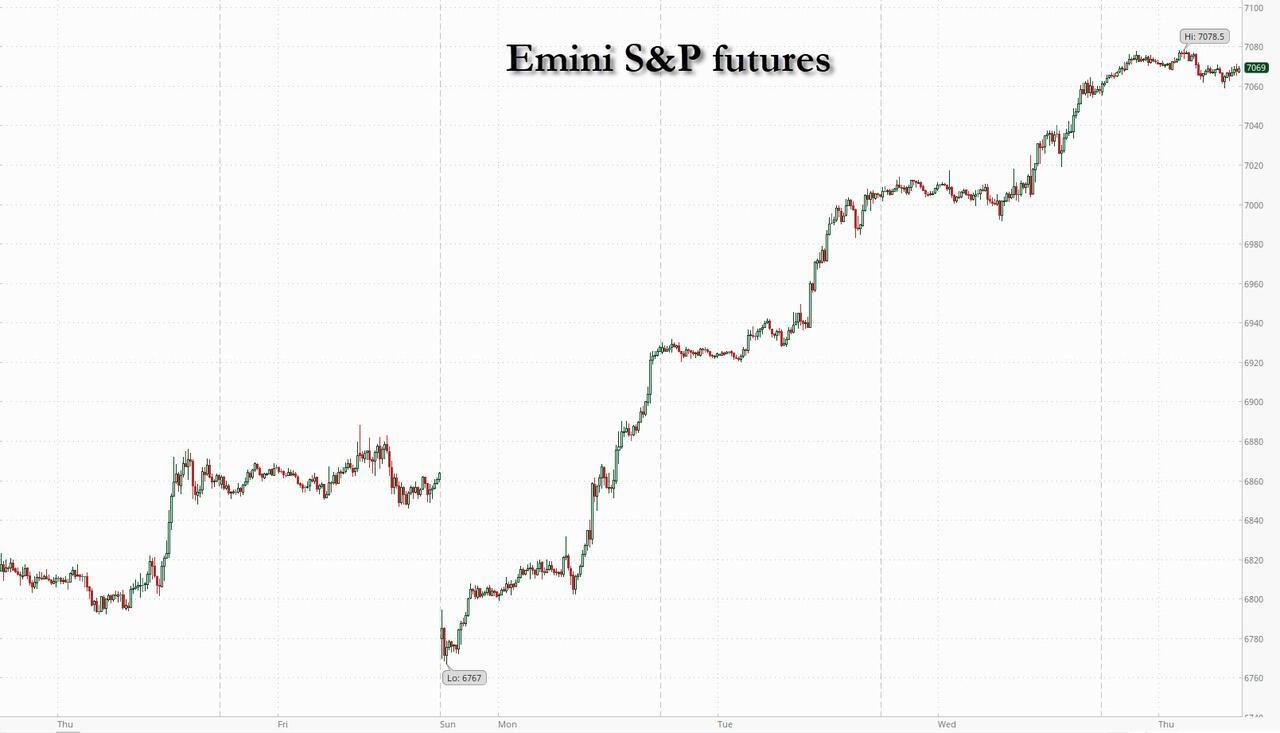
“The Roaring 2020s Are Back”: S&P Futures Hit New Record With Nasdaq Up 12 Straight Days On Iran Truce Optimism
Thursday, Apr 16, 2026 – 08:45 AM
Stock futures are edging higher on continued optimism about an extended truce in the Middle East, while Taiwan Semi’s solid results have sparked another leg higher in AI trade. As of 8:15 am ET, S&P 500 futures rose 0.1%, while Nasdaq 100 contracts +0.2%, and on pace for a 12th day of gains. The early hours of the session saw a sharp rally in technology stocks after TSMC’s upbeat revenue outlook highlighted the resilience of AI chip demand. In premarket trading, Mag 7 stocks were mostly higher led by MSFT +1.8% and TSLA +1.3%. On geopolitical headlines, the White House remains optimistic on the second round of talk (key Pakistani negotiator visits Tehran); Israel’s security cabinet met to discuss a possible ceasefire. Bond yields are 0-2bp lower with a modest gain in the dollar. Brent rose toward $96 a barrel as movements through the Strait of Hormuz remained all but paralyzed. Bonds rose, led by gains in Europe where central bank policymakers signaled they’re in no rush to raise interest rates. The dollar snapped an eight-day losing streak while gold rose above $4,800 an ounce. April’s strong stock rebound is being driven by a new kind of FOMO, according to Ed Yardeni, with Goldman saying that “despite the sharp market rebound, positioning has not fully caught up.” Still, while equities are “definitely pricing” the end of the war, we are “not there yet,” cautioned HSBC’s Patrick George while the IMF and World Bank are also worried that markets are underestimating the war’s economic damage. Today’s US economic data calendar includes April New York Fed services business activity, Philadelphia Fed business outlook, weekly jobless claims (8:30am) and March industrial production (9:15am). Fed speaker slate includes Williams (8:35am) and Miran (10:35am)
In premarket trading, Mag 7 stocks are mixed: Microsoft +1.3%, Tesla +0.7%, Meta Platforms +0.5%, Nvidia -0.4%, Alphabet -0.2%, Apple +0.8%, Amazon -0.1%
- Nuclear and uranium companies are set to extend this week’s rally after the White House released rules for establishing a National Initiative for American Space Nuclear Power. Oklo (OKLO) +7%, NuScale Power (SMR) +10%.
- Quantum computing shares are on track to extend gains for a third consecutive session after Nvidia unveiled a suite of new open-source AI models aimed at accelerating progress within quantum computing.
- Allbirds (BIRD) tumbles 21% as the newly minted AI stock takes a breather after soaring more than 580% on Thursday.
- Hims & Hers (HIMS) rises 9%, with shares on track to extend the previous day’s 14% rally, after Health Secretary Robert F. Kennedy Jr. said the FDA is seeking to remove 12 peptides from Category 2 restrictions.
- PepsiCo Inc. (PEP) gains 1% after quarterly revenue and earnings beat expectations as the maker of Doritos and Lay’s sees improvement in salty snacks volume following recent price cuts.
- PPG Industries (PPG) rises 3% after the supplier of paints and coatings posted preliminary first quarter adjusted earnings per share that topped expectations.
- QuidelOrtho Corp. (QDEL) sinks 17% after the health care services provider posted disappointing preliminary first-quarter revenue as US flu-like illness visits fell by about 30% from the year-earlier period.
- Travelers (TRV) slips 1.4% after the insurance company posted first quarter results where net premiums written declined 1.7% from the year-ago period.
- U.S. Bancorp (USB) rises about 1% after first-quarter profit beat estimates, as Chief Executive Officer Gunjan Kedia rounds out her first year leading the largest regional bank and boosting its stock.
- Voyager Technologies (VOYG) gains 6% after the defense and space company signed an order with NASA for the seventh Private Astronaut Mission to the International Space Station.
Elsewhere in AI, Nvidia’s Jensen Huang said the US should seek greater cooperation with China on AI research. Politicians are also weighing in on the global AI race, with House Republicans calling for US sanctions against Chinese entities that improperly extract results from leading US AI models to develop their own competing systems. Today’s Big Take focuses on Anthropic’s race to assess the dangers of Mythos.
Stock markets have rebounded as signs of easing tensions in the Middle East, combined with a fresh burst of AI optimism and corporate earnings, pushed investors to abandon their cautious views. Sentiment was boosted by lack of bad Iran news again: this time, the US and Iran are said to be considering a two-week ceasefire extension to allow more time to negotiate a peace deal; the next meeting between US / Iran may take place later this week with chatter from Pakistani media that Trump is said to be in attendance. April’s strong stock rebound is being driven by a new kind of FOMO, the fear of missing out on peace, according to Ed Yardeni, who said that for stocks, the V-shaped recovery this month makes it feel “like the Roaring 2020s are back.” Still, while equities are “definitely pricing” the end of the war, we are “not there yet,” cautioned HSBC’s Patrick George. The IMF and World Bank are also worried that markets are underestimating the war’s economic damage.
In the latest developments in the conflict, Pakistan stepped up efforts to help the US and Iran prolong a ceasefire that’s set to expire next week.
“Investors have become conditioned to buy every dip,” said Michael Bell, head of market strategy at RBC BlueBay Asset Management. “The outlook is binary, either Hormuz reopens soon or it doesn’t. With equity markets already assuming Hormuz will reopen soon, the upside is perhaps limited.”
The AI narrative is back in focus after TSMC raised its outlook for 2026, forecasting revenue growth of more than 30% and saying that capex is likely to lean toward the upper end of its forecast ($56 billion). Elon Musk’s Terafab project, which aims to reshape the chipmaking landscape dominated by TSMC, is reaching out to chip industry suppliers and asking them to move at ‘light speed’ on his project.
“TSMC describing AI demand as ‘extremely robust,’ pushing capex to the upper end of a $52-56 billion range, and signaling that the next three years of investment will significantly exceed the last three; that is not the language of a cycle nearing its peak,” said Amanda Lyons, information technology sector lead and head of research at Energy Group Capital.
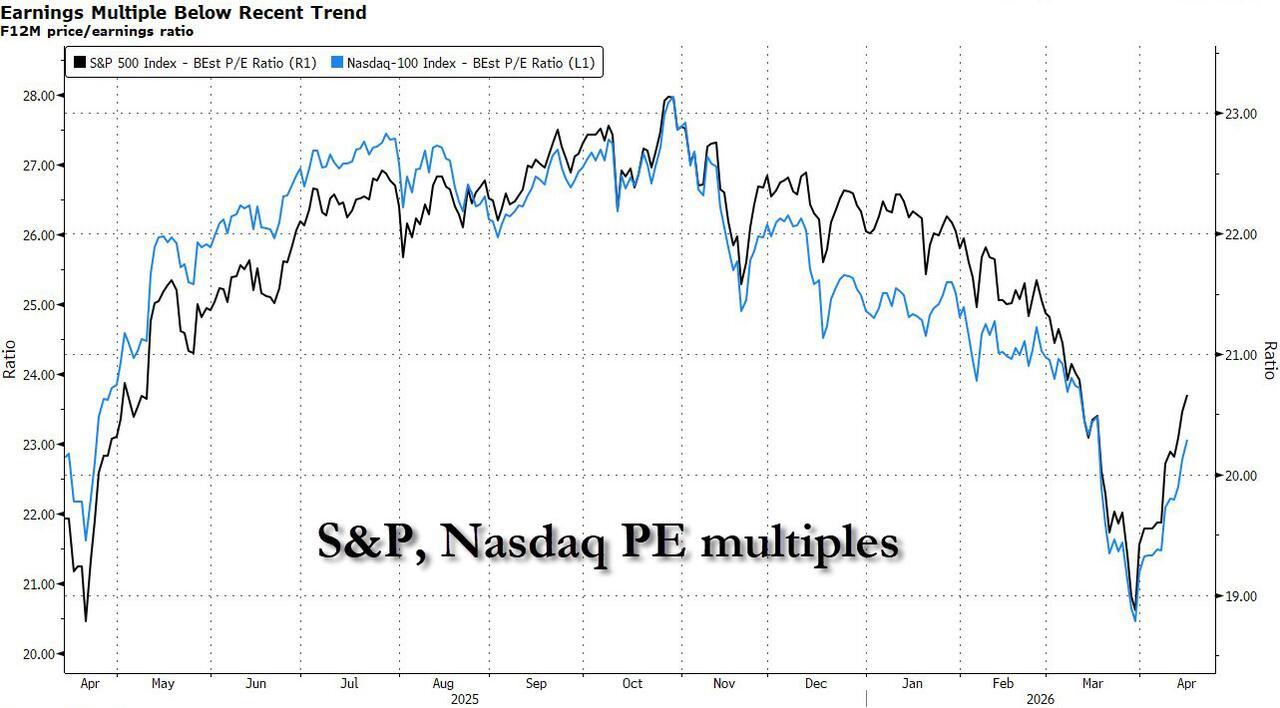
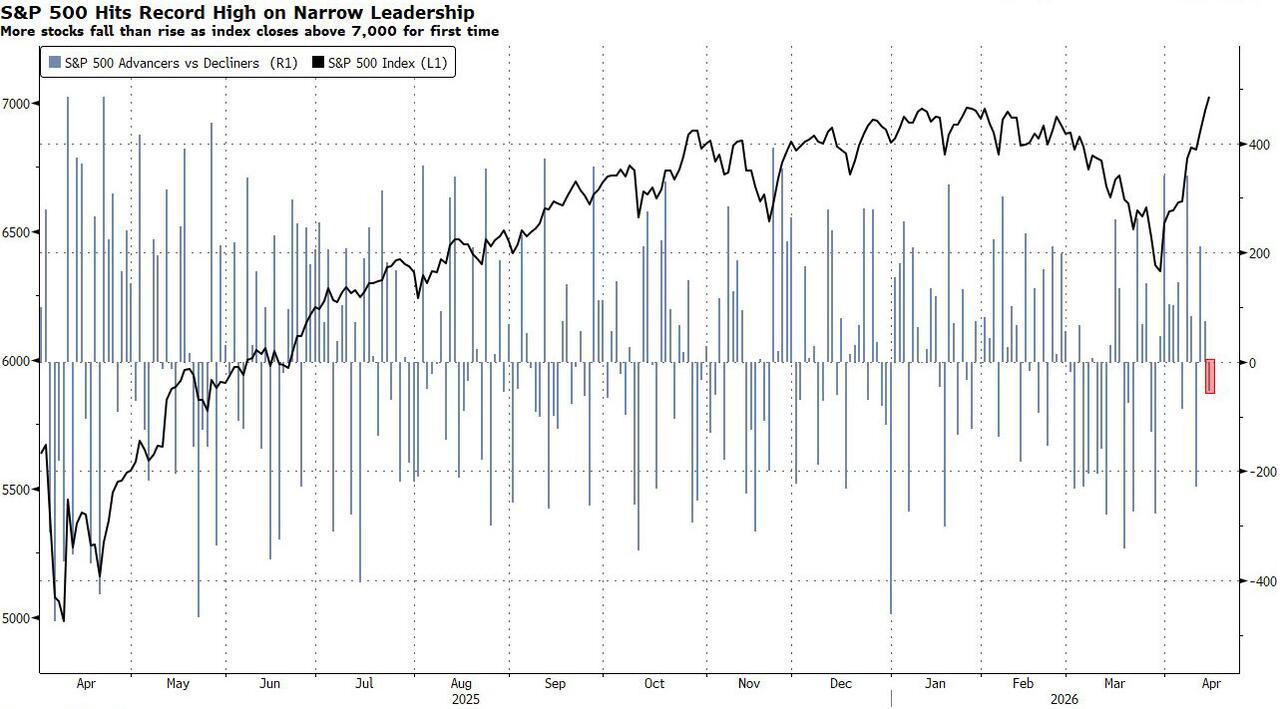
While the S&P 500 hit a new record on Wednesday, valuation ratios are still well below the levels seen in late 2025, indicating that earnings forecasts are moving up faster than stock prices. The current 12-month forward blended PE multiple for the S&P 500 of about 21 times compares to a peak of 23 times in November. The rally is also without breadth, with more decliners than advances as the gauge passed 7,000.
Another concerning fact about the latest record high: it was reach with more decliners than advancers, suggesting the leadership of this meltup is becoming dangerously narrow.
Lack of breadth however hasn’t stopped the Nasdaq from going from oversold to overbought in 2 weeks.
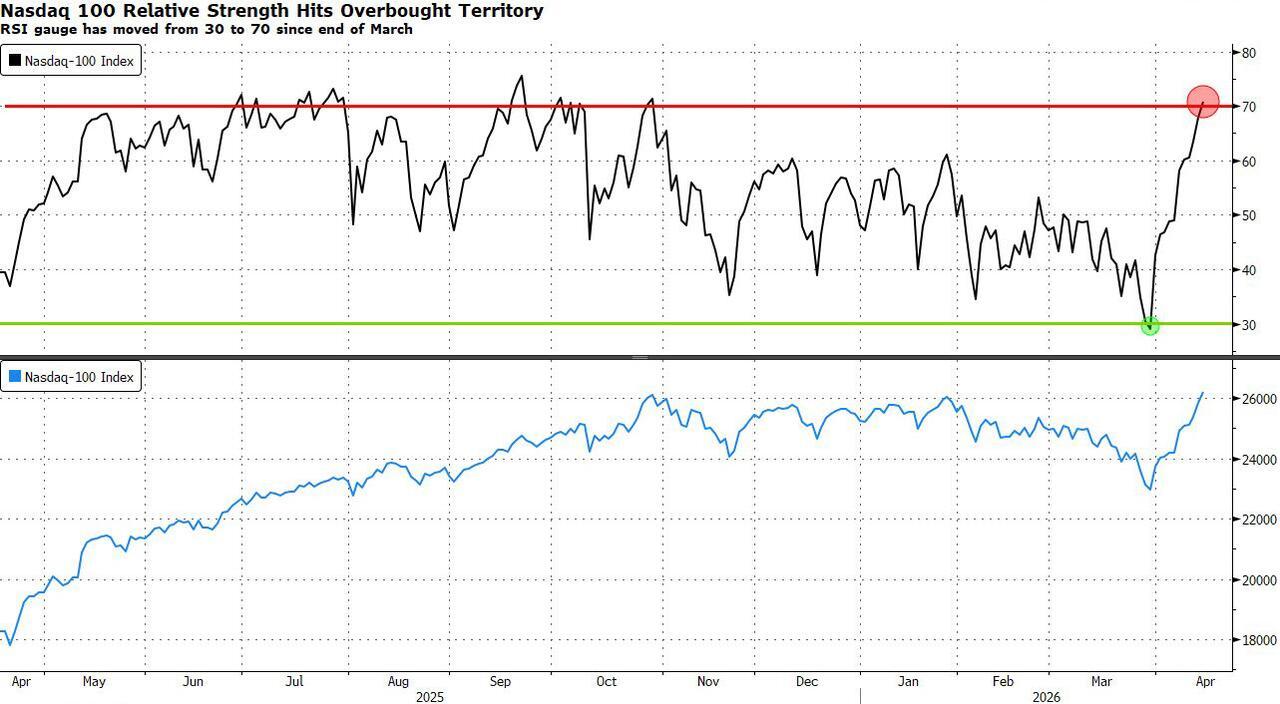
Technology stocks have been snapped up in recent weeks after lagging the market for much of the year, putting the Nasdaq 100 on course for its longest winning streak since 2017 if the gauge extends gains on Thursday.
Claudia Panseri of UBS Wealth Management said her exposure to artificial intelligence stocks is focused on the US and China and is “more selective” than two years ago. “We also prefer companies which are still investing using cash, rather than companies issuing bonds,” Panseri told Bloomberg TV.
Some stocks face a volatile option expiry into Friday, with $3.3 trillion notional of options open interest expiring across US indexes, ETFs and single stocks. Investors are “scrambling” for the “under-owned right tail” according to Nomura’s cross asset desk strategist Charlie McElligott.
Meanwhile, the latest private credit headlines have a more reassuring tone, with Goldman Sachs’ global head of alternatives for wealth saying she expects private credit firms to keep drawing capital despite recent redemption episodes. That follows Blue Owl shares posting their biggest two-day gain since November 2022, and reassurances from US banks that their exposure to private credit is manageable.
Technology stocks fueled gains in Europe where the Stoxx 600 rose 0.4%. Technology and retail shares are leading gains, while telecoms and food beverage stocks are the biggest laggards. Optimism surrounding the sector got a boost after Taiwan Semiconductor Manufacturing Co. raised its revenue outlook for 2026. Here are the biggest movers Thursday:
- Entain shares rise as much as 6.6% after its first-quarter online gaming revenue grew faster than expected, offsetting weaker retail and adverse sports results, according to analysts
- Tesco shares rise as much as 3.5% after the UK’s largest supermarket chain delivered annual earnings ahead of expectations
- Mitie Group rises as much as 4.5%, touching a record high, after the support services provider delivered a trading update
- Barry Callebaut shares drop as much as 17%, hitting the lowest level since November, after the Swiss chocolate maker reported first-half earnings that missed estimates and lowered guidance for the year
- Kering shares fall as much as 4.6% after the French owner of Gucci outlined financial ambitions at its capital markets day that analysts deemed cautious
- EasyJet shares fall as much as 8.7%, the most since June 2022, as the low-cost airline forecasts a 1H26 headline pretax loss of between £540 million ($733 million) and £560 million
- Heidelberger Druckmaschinen shares drop as much as 9.2%, pulling back from a two-month high, after the printing press maker issued a profit warning
Earlier in the session, Asian tech stocks also climbed to a record high, while Taiwan’s total market cap topped $4.1 trillion to overtake the UK. Asian markets rose, with a key regional benchmark on course for a third-straight day of gains, on optimism over corporate earnings and a potential US-Iran ceasefire extension. The MSCI Asia Pacific Index advanced as much as 1.5%, with Samsung Electronics and Alibaba among the biggest boosts. Technology stocks led gains, with a sector gauge climbing to a new record high. South Korea’s Kospi, Japan’s Nikkei 225 and Hong Kong’s Hang Seng Tech Index rose more than 2% each, while Taiwan’s total market cap climbed above $4.1 trillion to overtake the UK. Investors are renewing their interest in the artificial intelligence theme with support from resilient earnings at Asian tech hardware makers. At the same time, an outlook for an eventual end to the Middle East conflict and tamer energy prices is gaining traction. Among key moves, EV battery maker CATL climbed more than 10% in Hong Kong after better-than-expected earnings. Meanwhile, chip giant TSMC raised its revenue outlook for 2026, an upbeat forecast that underscores the resilience of AI chip demand.
In FX, the Bloomberg Dollar Spot Index is up 0.2% and on course to snap an eight-day losing streak. The kiwi is the laggard among the G-10’s, falling 0.4% against the greenback. The pound falls 0.2% having derived little support from stronger-than-expected UK GDP data.
In rates, treasuries are slightly richer across the curve with gains led by the front-end and belly, supported by a wider bull steepening move seen across European bonds with oil prices steady. US yields lower by up to 2bp across front-end and belly with 2s10s, 5s30s spreads steeper by around 0.5bp and 1.2bp on the day. US 10-year trades around 4.265%, richer by 1.5bp on the day with bunds and gilts outperforming by 1.5bp and 1bp in the sector. In Europe, both UK and German 2-year yields outperform, richer by over 5bp on an outright basis, follows UK manufacturing data printing lower-than-expected. The US session includes weekly claims and a couple of Fed speakers.
In commodities, brent crude futures climb 1.6% to around $96.40 a barrel. European government bonds gain, led by the short-end as traders pare bets on interest rate hikes by the Bank of England and European Central Bank this year. UK and German 2-year yields fall 4 bps each. Precious metals advance, although are off their best levels.
Today’s US economic data calendar includes April New York Fed services business activity, Philadelphia Fed business outlook, weekly jobless claims (8:30am) and March industrial production (9:15am). Fed speaker slate includes Williams (8:35am) and Miran (10:35am)
Market Snapshot
- S&P 500 mini +0.1%
- Nasdaq 100 mini +0.3%
- Russell 2000 mini little changed
- Stoxx Europe 600 little changed
- DAX little changed
- CAC 40 +0.3%
- 10-year Treasury yield little changed at 4.28%
- VIX little changed at 18.14
- Bloomberg Dollar Index little changed at 1193.41
- euro -0.2% at $1.178
- WTI crude +1.7% at $92.84/barrel
Top Overnight News
- Pakistan is stepping up efforts to ensure the US and Iran prolong a ceasefire that’s set to end next week, allowing more time for the warring sides to negotiate a lasting peace deal. The US and Iran are considering a two-week ceasefire extension, according to a person familiar with the matter, with neither side desiring to restart fighting. BBG
- The Trump administration wants automakers and other American manufacturers to play a larger role in weapons production, reminiscent of a practice used during World War II: WSJ
- Energy Secretary Chris Wright and Interior Secretary Doug Burgum will urge the heads of top U.S. oil and gas companies in a call Thursday to increase drilling in a bid to lower oil prices. Politico
- China’s economy picked up speed early in 2026, riding an export surge before the Iran war sent energy costs soaring and put global demand – vital to Beijing’s growth ambitions – at risk. The 5.0% year-on-year pace in the first quarter sits at the top of China’s full-year target range of 4.5%-5.0%, highlighting a resilience that sets it apart from much of Asia, helped by ample strategic oil reserves and a diversified energy mix. RTRS
- Australian employment rose by 17,900 in March, missing expectations and driven entirely by full-time roles, while the jobless rate held at 4.3%. BBG
- The UK economy grew 0.5% in February, beating estimates to post its strongest monthly reading since January 2024. Activity was boosted by the services sector, though the data predate the Iran war. BBG
- Policymakers at the European Central Bank are leaning toward keeping interest rates unchanged this month, postponing their verdict on whether the fallout of the Iran war warrants a response. BBG
- Senator Thom Tillis is blocking Trump’s Fed chair nominee, Kevin Warsh, until the Justice Department drops an investigation into Powell. And the stalemate is leaving him in limbo with no clear off-ramp in sight. Politico
- Anthropic’s Mythos is so skilled at hacking that access is tightly controlled. The system’s ability to autonomously find and exploit vulnerabilities is forcing banks and governments to rethink cybersecurity. BBG
- Foreign holdings of Treasuries soared to a record $9.49 trillion in February. Canada led with a $50.5 billion increase, while Japan remained the largest holder. BBG
Iran Conflict
- The Trump admin’s goal is to bring both sides to the brink of an overarching deal to end the conflict that can then be pushed over the finish line in a second face-to-face meeting, according to ABC, citing officials. The officials acknowledge that technical talks to hammer out the fine details and implementation of the arrangement will likely take longer to complete, perhaps eventually necessitating an extension of the initial ceasefire, but that pushing back the truce’s expiration date isn’t a top priority for the administration at the moment.
- US President Trump told guests Monday night he wants to bring the war in Iran to a swift end; said only way to get Iran back to negotiating table was to increase the pressure, according to WSJ citing officials at the dinner.
- US President Trump posted “Trying to get a little breathing room between Israel and Lebanon. It has been a long time since the two leaders have spoken, like 34 years. It will happen tomorrow. Nice!”.
- Pakistani Army Chief is heading to the US on Friday as part of mediation efforts between the US and Iran, Al Jazeera reported citing a Pakistani security source.
- Pakistan’s Foreign Ministry said the US and Iran are willing to hold talks and the process is continuing but no date decided for next round of US-Iran talks.
- A military advisor to the Islamic Revolution Leader said Iranian Armed Forces’ launchers are ready to hit American warships and sink all of them, Press TV reported.
- A senior Iranian official said the fate of Iran’s highly enriched uranium and the duration of its nuclear restrictions remain unresolved, adding that fundamental disagreements persist over nuclear issues. Iranian official said there are greater hopes for extending the ceasefire and holding a second round of talks after the trip, adding that the Pakistani army chief’s visit to Iran helped reduce differences in some areas.
- Iranian officials will meet with Pakistan’s army chief on Thursday in Tehran and will discuss US proposals, according to TASS.
- Iran and the Pakistani mediator will discuss details of the messages exchanged between Tehran and Washington tomorrow, Thursday; via Al Jazeera citing Iranian TV.
- Journalist Abas Aslani posted source said Iran-US talks are far less positive [than reported] due to contradictory US stances & Israeli spoiler efforts, media push hyping success of talks is a PR manoeuvre to calm markets and shield Trump from pressure.
- Iran’s ambassador to Pakistan said Islamabad is the sole venue for Iran–US talks.
- Diplomatic sources suggest that “Washington is pressing forcefully to cool down the Lebanese front”, via Kan’s Kais; “Second round of negotiations between Israel and Lebanon will take place in Washington soon”. “Second round of negotiations between Israel and Lebanon will take place in Washington soon, and that the current contacts are focused on achieving a temporary ceasefire that will lay the groundwork for ending the war.”
- Two Israeli officials said the meeting of the political security cabinet ended without a decision on a ceasefire in Lebanon, according to Axios’s Ravid.
- Israeli media citing informed sources state that a ceasefire in Lebanon will not happen soon despite Trump’s statements.
- Israeli army has not received any instructions so far to prepare for a ceasefire in Lebanon, via Al Arabiya citing local reported.
- Lebanese officials say a ceasefire between Israel and Lebanon is expected ‘soon’, according to FT.
- The next meeting between Israel and Lebanon is expected to be held early next week, via Sky news Arabia citing Israel Hayom.
- Iran’s Interior Minister has ordered border governors to neutralise the threat of a naval blockade by strengthening and developing border trade by increasing imports of basic goods and exports of goods, utilising all national and regional capacities.
- Iranian politician affiliated with Resistance Front of Islamic Iran, Mohsen Rezaei said they will not leave the Strait of Hormuz until the full realisation of Iran’s rights, adds that this time, Iran has set preconditions.
- Iranian Parliament Speaker Ghalifbaf said US should withdraw from ‘Israel first’ mistake and must comply with agreement, also said resistance and Iran are one soul both in war and ceasefire.
- Hezbollah fires long-range missiles at Tel Aviv, according to Defapress.
- Iranian military affiliated outlet Defapress claims that four ships broke the US naval blockade over the past 24 hours, citing satellite data.
- Israeli warplanes carried out a strike on the town of Shihabiya in southern Lebanon.
- US Central Command said US blockade has turned back 10 vessels in the Strait of Hormuz today.
- China’s Foreign Minister Wang Yi stressed to Iran that the Strait of Hormuz needs to reopen and stressed freedom of navigation in Hormuz, while he said Hormuz reopening is a unanimous call from the international community.
A more detailed look at global markets courtesy of Newsquawk
APAC stocks mostly gained following the positive lead from Wall Street, where the S&P 500 and Nasdaq printed fresh all-time highs, amid tech strength and peace talk optimism. ASX 200 bucked the trend and gave back initial gains, and more, as notable outperformance in tech was offset by losses in energy, resources, materials, financials and miners. Nikkei 225 rallied to a fresh record high after reclaiming the 59,000 status amid the hopes for a Middle East resolution and with the index led by the momentum in tech stocks. Hang Seng and Shanghai Comp were higher with further upside seen as the dust settled following the mixed Chinese GDP and activity data, in which GDP growth for Q1 missed expectations, but GDP Y/Y topped forecasts and printed at the high-end of China’s official 2026 GDP growth target. Meanwhile, Industrial Production data for March was better-than-expected, but Retail Sales disappointed.
Top Asian News
- Japan’s top FX diplomat Mimura said told US Treasury Secretary Bessent will upgrade FX developments as needed, and both sides agreed to coordinate closely on FX.
- Japanese Finance Minister Katayama said regarding exchange rates, agreed to further intensify communication with US Treasury Secretary Bessent.
- Japanese Finance Minister Katayama said many central bankers are adopting a wait-and-see stance, as raising interest rates could have a negative impact on the economy, adds it is impossible to predict when the current situation ends and spillover effects.
- Senior Japanese Financial Regulator official said Japan sees private credit as potential pillar in new strategy to meet corporate funding demand driven by M&A surge, according to reported.
- China NBS said the economy had a good start in Q1, but the external situation is becoming more complex, adds China is to expand domestic demand and optimise supply. China will implement proactive macro policies. Expects a complex, volatile external environment. China will consolidate economic recovery foundation. Sees mixed signs of strong supply and weak demand.
- Deutsche Bank upgrades China’s 2026 real GDP growth to 4.9% (prev. 4.5%).
- Barclays raises China 2026 GDP growth view to 4.6% (prev. saw 4.0%).
European bourses (STOXX 600 +0.2%) are broadly gaining, albeit only modestly. The CAC 40 is the outperformer, rebounding from Wednesday’s luxury-driven selloff. The FTSE 100 is also slightly higher this morning, after UK GDP came in far stronger than expected in February (0.5% vs exp. 0.1%). Sectors point to a positive bias. Top of the pile lies Technology, supported by strong TSMC earnings, which has lifted peers such ASML. Telecoms is the underperformer, with a downgrade for Telia weighing on the broader sector.
Top European News
- EU Inflation Rate MoM Final (Mar) M/M 1.3% vs. Exp. 1.2% (Prev. 0.6%, Low. 1.2%, High. 1.2%).
- EU Inflation Rate YoY Final (Mar) Y/Y 2.6% vs. Exp. 2.5% (Prev. 1.9%, Low. 2.5%, High. 2.6%).
- EU Core Inflation Rate YoY Final (Mar) Y/Y 2.3% vs. Exp. 2.3% (Prev. 2.4%).
- UK Balance of Trade (Feb) -0.720B vs. Exp. -3.6B (Prev. 3.922B).
- UK Goods Trade Balance (Feb) -18.79B vs. Exp. -20.2B (Prev. -14.45B, Low. -20.5B, High. -14B).
- UK GDP YoY (Feb) Y/Y 1.0% vs. Exp. 1.0% (Prev. 0.8%).
- UK GDP MoM (Feb) M/M 0.5% vs. Exp. 0.1% (Prev. 0%, Low. 0.0%, High. 0.3%).
Trade/Tariffs
- UK Europe Minister Nick Thomas-Symonds is expected to offer an update on the state of play in negotiations; EU Trade Chief Sefcovic, and European Parliament President Roberta Metsola, will also provide keynotes, reported Politico.
- USTR Greer said US-China Board of Investment is to be a government forum, adds there’s no situation where there’s no trade between US and China, also said the Trump admin wants to be pragmatic regarding China.
FX
- DXY edged higher throughout the entirety of the European session following punchy Iran rhetoric. The index marked a session high of 98.21, rising from its earlier trough of 97.83 made in Asia. (Full Middle East analysis on the headline feed) As it stands, both US and Iran continue communication, but there is no confirmation yet on second-round talks or a ceasefire extension – not to mention Lebanon, which remains a key point. Aside from geopolitics, POLITICO reported this morning, “a growing chorus of Republicans, eager to install Warsh, are joining the call for the administration to end the probe” into Fed Chair Powell. This comes ahead of Warsh’s hearing next week. The session ahead sees remarks from Fed’s Williams (voter), who will speak at a Federal Home Loan Bank of New York event, while Miran (voter, dovish dissenter) will speak on the global outlook.
- GBP knee-jerked higher on a stronger-than-expected UK GDP report from February, but now trades with very mild losses given the Dollar strength this morning. In brief, on a monthly basis, GDP rose 0.5%, while yearly saw an increase of 0.1%. This set of metrics did not encapsulate the US-Iran war and as such, MPC members will likely refer to the second-round effects of the energy shock before opting to adjust rates. Cable continues to trade towards recent highs and is essentially at pre-war levels. The pair attempted to breach 1.36, a rally which faltered at 1.3594.
- Antipodeans trade mixed. While Aussie is a touch firmer against a resilient USD following jobs data – Kiwi sits at the bottom of the pile as bets for RBNZ tightening pare a touch with markets implying 77bps of easing by year end (prev. c. 83bps). NZD/USD began falling in Asia, though losses extended throughout the European morning to trade at session lows of 0.5893, the move likely to face support @ 0.5892.
- JPY had a choppy overnight session with USD/JPY marking a session low of 158.27 after successful jawboning from Finance Minister Katayama; she told G7 members that Japan was watching FX with a high sense of urgency. She also reiterated close communication with the US Treasury. This, as is typically the case with the Japanese Finance Ministry, indicates officials are uncomfortable with the extent of JPY weakness, with JPY nearing the key 160 mark. Since these comments, JPY pared the entirety of the strength Katayama gave to the haven, pressured by the gains in the USD.
Central Banks
- ECB officials are said to be leaning towards an April rate hold.
- ECB’s Schnabel said that the memory of high inflation remains fresh, and inflation expectations could be more fragile. Can afford to take time to analyse the Iran shock. We are in a relatively favourable position because we were successful in bringing down inflation to 2% before the war started, have monetary policy stance that is broadly neutral. To carefully consider data that may indicate inflation becoming entrenched or having second-round effects.
- ECB’s Demarco said policymakers must be patient on rate decisions, but warns an adverse scenario could materialise; adverse scenario could require two rate hikes; longer-term inflation expectations anchored.
- ECB’s Muller said rate move at April meeting still cannot be ruled out, adds may not have all the data this month to determine if interest rates will have to be raised to tame an inflation surge and June meeting will offer greater body of information. No hard evidence of second-round effects of inflation.
- Goldman Sachs expects the ECB to deliver 25bp rate hikes in June and September 2026 (prev. saw hikes in April and June). Analysts expect energy prices to remain persistently high through 2026, significant pass-through into inflation is likely in coming months and ECB’s communication has remained largely hawkish on the path ahead.
Fixed Income
- Global fixed benchmarks opened the European session with a positive bias, but have gradually edged off best levels as the risk tone deteriorated as the morning progressed. Initial optimism was facilitated by comments from both Israeli and Lebanese officials, who said that a ceasefire is expected soon, and talks are expected to continue in the near-term. On the Iranian front, President Trump said that “he wants to bring the war in Iran to a swift end”. Thereafter, in early morning trade, a military advisor to the Islamic Revolution Leader said Iranian Armed Forces’ launchers are ready to hit American warships and sink all of them – a comment which weighed on the risk tone at the time, leading to upside in the crude complex, which pressured global fixed paper.
- USTs are firmer by a couple of ticks and currently trades at the lower end of a 111-11 to 111-17 range. Ultimately, moving at the whim of geopolitical developments, with markets now awaiting clear details on when/if the second round of Iran-US talks will begin. From a domestic perspective, weekly initial jobless claims (215k expected from 219k) and continuing claims (exp. 1.84mln from 1.794mln), NY Fed services activity, Philly Fed manufacturing are all due.
- Bunds are firmer by around 15 ticks and currently trade within a 125.32 to 125.62 range. German paper, as above, is off its best levels as the risk tone slipped a bit. Domestic newsflow has been fairly limited this morning, aside from an updated Goldman Sachs call for the ECB; analysts now expect the ECB to deliver 25bps rate hikes in June and September 2026 (prev. saw April and June), citing expectations that energy prices will stay high through 2026, feed through materially into inflation in the coming months and keep ECB communication largely hawkish. As it stands, money markets fully price in a 25bps hike in July. Focus later will be on the ECB Minutes (Mar), where the Bank kept rates steady – traders will be cognizant of any commentary pertaining to the Middle East situation.
- Gilts are incrementally lower and trade within an 88.68 to 89.07 range. Slightly underperforming vs peers, given the hawkish impulses from a stronger-than-expected UK GDP report. In brief, on a monthly basis, GDP rose 0.5%, while yearly saw an increase of 0.1%. ING writes “UK output surged in February, but it’s in line with a trend dating back to 2022, where growth is stronger in the first quarter than across the rest of the year. We’re taking this latest data with a pinch of salt”.
Commodities
- Regional mediators are actively working to extend the US-Iran ceasefire and secure a second round of talks, with both sides agreeing in principle to reconvene, though no date or venue has been set. The Trump administration is pushing a two-stage strategy: use sustained economic and military pressure to force Iran toward the brink of a broader deal, then finalise it in a follow-up face-to-face meeting, with technical negotiations on implementation likely to extend beyond the current truce. A senior Iranian official said the fate of Iran’s highly enriched uranium and the duration of its nuclear restrictions remain unresolved, adding that fundamental disagreements persist over nuclear issues.
- Pakistan has taken a central mediation role, coordinating messages between Tehran and Washington and engaging both politically and militarily, although officials confirm no timeline has been agreed for the next round. Despite publicly downplaying the need for a ceasefire extension, US officials acknowledge it may ultimately be required to keep negotiations alive as talks progress.
- Crude prices edged higher following yesterday’s losses as traders feel the ceasefire could be prolonged and negotiations restarted. Brent Jun holds above USD 95/bbl this European morning (in a USD 94.43-96.85/bbl range) while WTI Jun sits in a 87.32-89.82/bbl parameter.
- Spot gold trades modestly higher, just above USD 4,800/oz and well within yesterday’s USD 4,786-4,871/oz range. Base metals are flat/positive with 3M LME copper holding above USD 13k/t in a current USD 13,281.00-13,376.58/t range. Overnight data showed China’s Q1 growth accelerated on strong exports (Y/Y printed at the top end of China’s 2026 target of 4.5-5%), while March retail sales rose but slowed from February; analysts said the Iran war still poses risks to the outlook.
- Australia said it secures 100mln litres extra of diesel from Brunei and South Korea.
- Repsol (REP SM) is set to take back operational control of its Venezuelan oil assets and boost production following an agreement with the country’s government, according to FT.
- White House is expected to urge heads of oil and gas companies to increase drilling, according to POLITICO.
- Australia’s Energy Minister reported that a fire at Viva Energy’s (VEA AT) refinery is still not under control, while diesel and jet fuel output continues, but refinery fire may hit petrol production more.
Geopolitics (ex Iran)
- Ukrainian President Zelensky posted “there can be no normalization of Russia as it is today. Pressure on Russia must work”, following heavy drone attacks, via X.
- Explosions reported in Ukraine’s capital, Kyiv, while the Mayor said air defence systems have been activated
US Event Calendar
- 8:30 am: United States Apr 11 Initial Jobless Claims, est. 213k, prior 219k
- 8:30 am: United States Apr Philadelphia Fed Business Outlook, est. 10, prior 18.1
- 8:30 am: United States Apr 4 Continuing Claims, est. 1810k, prior 1794k
- 9:15 am: United States Mar Industrial Production MoM, est. 0.1%, prior 0.2%
- 9:15 am: United States Mar Capacity Utilization, est. 76.3%, prior 76.3%
- Individual investors are once again snapping up so-called “meme” stocks, an early sign that retail’s animal spirits are returning to the US equity market after the mid-month tax deadline and as geopolitical tensions abate.
Central Bank speakers
- 8:35 am: United States Fed’s Williams Gives Keynote Remarks
- 10:35 am: United States Fed’s Miran Speaks in Moderated Discussi
1b European opening report
Stocks and crude a touch firmer, TSMC beats, raises FY guide – Newsquawk US Market Open

Thursday, Apr 16, 2026 – 06:30 AM
- The Trump administration’s goal is to bring both sides to the brink of an overarching deal to end the conflict that can then be pushed over the finish line in a second face-to-face meeting.
- A military advisor to the Islamic Revolution Leader says Iranian Armed Forces’ launchers are ready to hit American warships and sink all of them, Press TV reported.
- European bourses printing mild gains, TSMC earnings lift the tech sector; US equity futures muted just shy of ATHs.
- DXY cautiously firms, JPY pares verbal intervention strength while GBP unreactive despite upside GDP surprise.
- Global benchmarks initially firmer, but hit as the risk tone deteriorated.
- Crude tilts higher as markets still await confirmation of any talks/ceasefire.
- Looking ahead, highlights include US Jobless Claims (Apr/11), Philly Fed Index (Apr), Industrial/Manufacturing Production (Mar), New Zealand Food Inflation (Mar), ECB Minutes (Mar). Speakers include Fed’s Williams & Miran, ECB’s Schnabel, Nagel & Lane, RBA’s Hunter & BoE’s Taylor. Earnings from Abbott, Charles Schwab, PepsiCo & Netflix.
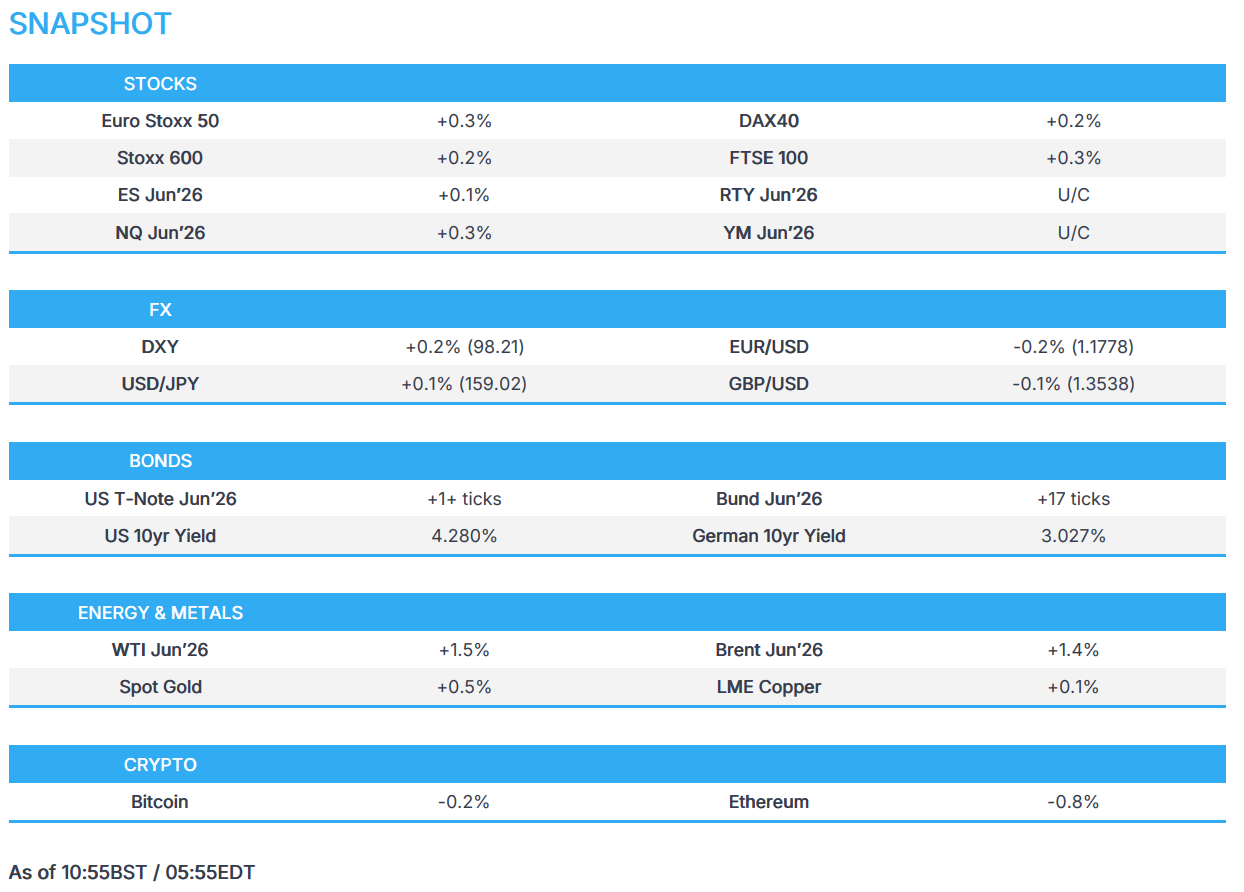
Newsquawk in 3 steps:
1. Subscribe to the free premarket movers reports
2. Listen to this report in the market open podcast (available on Apple and Spotify)
3. Trial Newsquawk’s premium real-time audio news squawk box for 7 days
IRAN CONFLICT
- The Trump admin’s goal is to bring both sides to the brink of an overarching deal to end the conflict that can then be pushed over the finish line in a second face-to-face meeting, according to ABC, citing officials. The officials acknowledge that technical talks to hammer out the fine details and implementation of the arrangement will likely take longer to complete, perhaps eventually necessitating an extension of the initial ceasefire, but that pushing back the truce’s expiration date isn’t a top priority for the administration at the moment.
- US President Trump told guests Monday night he wants to bring the war in Iran to a swift end; said only way to get Iran back to negotiating table was to increase the pressure, according to WSJ citing officials at the dinner.
- US President Trump posted “Trying to get a little breathing room between Israel and Lebanon. It has been a long time since the two leaders have spoken, like 34 years. It will happen tomorrow. Nice!”.
- Pakistani Army Chief is heading to the US on Friday as part of mediation efforts between the US and Iran, Al Jazeera reported citing a Pakistani security source.
- Pakistan’s Foreign Ministry said the US and Iran are willing to hold talks and the process is continuing but no date decided for next round of US-Iran talks.
- A military advisor to the Islamic Revolution Leader said Iranian Armed Forces’ launchers are ready to hit American warships and sink all of them, Press TV reported.
- A senior Iranian official said the fate of Iran’s highly enriched uranium and the duration of its nuclear restrictions remain unresolved, adding that fundamental disagreements persist over nuclear issues. Iranian official said there are greater hopes for extending the ceasefire and holding a second round of talks after the trip, adding that the Pakistani army chief’s visit to Iran helped reduce differences in some areas.
- Iranian officials will meet with Pakistan’s army chief on Thursday in Tehran and will discuss US proposals, according to TASS.
- Iran and the Pakistani mediator will discuss details of the messages exchanged between Tehran and Washington tomorrow, Thursday; via Al Jazeera citing Iranian TV.
- Journalist Abas Aslani posted source said Iran-US talks are far less positive [than reported] due to contradictory US stances & Israeli spoiler efforts, media push hyping success of talks is a PR manoeuvre to calm markets and shield Trump from pressure.
- Iran’s ambassador to Pakistan said Islamabad is the sole venue for Iran–US talks.
- Diplomatic sources suggest that “Washington is pressing forcefully to cool down the Lebanese front”, via Kan’s Kais; “Second round of negotiations between Israel and Lebanon will take place in Washington soon”. “Second round of negotiations between Israel and Lebanon will take place in Washington soon, and that the current contacts are focused on achieving a temporary ceasefire that will lay the groundwork for ending the war.”
- Two Israeli officials said the meeting of the political security cabinet ended without a decision on a ceasefire in Lebanon, according to Axios’s Ravid.
- Israeli media citing informed sources state that a ceasefire in Lebanon will not happen soon despite Trump’s statements.
- Israeli army has not received any instructions so far to prepare for a ceasefire in Lebanon, via Al Arabiya citing local reported.
- Lebanese officials say a ceasefire between Israel and Lebanon is expected ‘soon’, according to FT.
- The next meeting between Israel and Lebanon is expected to be held early next week, via Sky news Arabia citing Israel Hayom.
- Iran’s Interior Minister has ordered border governors to neutralise the threat of a naval blockade by strengthening and developing border trade by increasing imports of basic goods and exports of goods, utilising all national and regional capacities.
- Iranian politician affiliated with Resistance Front of Islamic Iran, Mohsen Rezaei said they will not leave the Strait of Hormuz until the full realisation of Iran’s rights, adds that this time, Iran has set preconditions.
- Iranian Parliament Speaker Ghalifbaf said US should withdraw from ‘Israel first’ mistake and must comply with agreement, also said resistance and Iran are one soul both in war and ceasefire.
- Hezbollah fires long-range missiles at Tel Aviv, according to Defapress.
- Iranian military affiliated outlet Defapress claims that four ships broke the US naval blockade over the past 24 hours, citing satellite data.
- Israeli warplanes carried out a strike on the town of Shihabiya in southern Lebanon.
- US Central Command said US blockade has turned back 10 vessels in the Strait of Hormuz today.
- China’s Foreign Minister Wang Yi stressed to Iran that the Strait of Hormuz needs to reopen and stressed freedom of navigation in Hormuz, while he said Hormuz reopening is a unanimous call from the international community.
EUROPEAN TRADE
EQUITIES
- European bourses (STOXX 600 +0.2%) are broadly gaining, albeit only modestly. The CAC 40 is the outperformer, rebounding from Wednesday’s luxury-driven selloff. The FTSE 100 is also slightly higher this morning, after UK GDP came in far stronger than expected in February (0.5% vs exp. 0.1%).
- Sectors point to a positive bias. Top of the pile lies Technology, supported by strong TSMC earnings, which has lifted peers such ASML. Telecoms is the underperformer, with a downgrade for Telia weighing on the broader sector.
- US equity futures are trading muted, with the NQ outperforming as TSMC lifts the index. ES futures is currently trading just shy of the ATH at 7,093.75 and could break ATHs in today’s cash session.
- TSMC (TSM/2330 TT) reported Q1 net income that beat estimates with revenue and operating profit that grew 35% and 61% respectively on an annual basis. In terms of guidance, its Q2 revenue metric beat analyst expectations while FY26 revenue was raised to above 30% (from “close” to 30%).
- Click for the sessions European pre-market equity newsflow
- Click for the additional news
FX
- DXY edged higher throughout the entirety of the European session following punchy Iran rhetoric. The index marked a session high of 98.21, rising from its earlier trough of 97.83 made in Asia. (Full Middle East analysis on the headline feed) As it stands, both US and Iran continue communication, but there is no confirmation yet on second-round talks or a ceasefire extension – not to mention Lebanon, which remains a key point. Aside from geopolitics, POLITICO reported this morning, “a growing chorus of Republicans, eager to install Warsh, are joining the call for the administration to end the probe” into Fed Chair Powell. This comes ahead of Warsh’s hearing next week. The session ahead sees remarks from Fed’s Williams (voter), who will speak at a Federal Home Loan Bank of New York event, while Miran (voter, dovish dissenter) will speak on the global outlook.
- GBP knee-jerked higher on a stronger-than-expected UK GDP report from February, but now trades with very mild losses given the Dollar strength this morning. In brief, on a monthly basis, GDP rose 0.5%, while yearly saw an increase of 0.1%. This set of metrics did not encapsulate the US-Iran war and as such, MPC members will likely refer to the second-round effects of the energy shock before opting to adjust rates. Cable continues to trade towards recent highs and is essentially at pre-war levels. The pair attempted to breach 1.36, a rally which faltered at 1.3594.
- Antipodeans trade mixed. While Aussie is a touch firmer against a resilient USD following jobs data – Kiwi sits at the bottom of the pile as bets for RBNZ tightening pare a touch with markets implying 77bps of easing by year end (prev. c. 83bps). NZD/USD began falling in Asia, though losses extended throughout the European morning to trade at session lows of 0.5893, the move likely to face support @ 0.5892.
- JPY had a choppy overnight session with USD/JPY marking a session low of 158.27 after successful jawboning from Finance Minister Katayama; she told G7 members that Japan was watching FX with a high sense of urgency. She also reiterated close communication with the US Treasury. This, as is typically the case with the Japanese Finance Ministry, indicates officials are uncomfortable with the extent of JPY weakness, with JPY nearing the key 160 mark. Since these comments, JPY pared the entirety of the strength Katayama gave to the haven, pressured by the gains in the USD.
FIXED INCOME
- Global fixed benchmarks opened the European session with a positive bias, but have gradually edged off best levels as the risk tone deteriorated as the morning progressed. Initial optimism was facilitated by comments from both Israeli and Lebanese officials, who said that a ceasefire is expected soon, and talks are expected to continue in the near-term. On the Iranian front, President Trump said that “he wants to bring the war in Iran to a swift end”. Thereafter, in early morning trade, a military advisor to the Islamic Revolution Leader said Iranian Armed Forces’ launchers are ready to hit American warships and sink all of them – a comment which weighed on the risk tone at the time, leading to upside in the crude complex, which pressured global fixed paper.
- USTs are firmer by a couple of ticks and currently trades at the lower end of a 111-11 to 111-17 range. Ultimately, moving at the whim of geopolitical developments, with markets now awaiting clear details on when/if the second round of Iran-US talks will begin. From a domestic perspective, weekly initial jobless claims (215k expected from 219k) and continuing claims (exp. 1.84mln from 1.794mln), NY Fed services activity, Philly Fed manufacturing are all due.
- Bunds are firmer by around 15 ticks and currently trade within a 125.32 to 125.62 range. German paper, as above, is off its best levels as the risk tone slipped a bit. Domestic newsflow has been fairly limited this morning, aside from an updated Goldman Sachs call for the ECB; analysts now expect the ECB to deliver 25bps rate hikes in June and September 2026 (prev. saw April and June), citing expectations that energy prices will stay high through 2026, feed through materially into inflation in the coming months and keep ECB communication largely hawkish. As it stands, money markets fully price in a 25bps hike in July. Focus later will be on the ECB Minutes (Mar), where the Bank kept rates steady – traders will be cognizant of any commentary pertaining to the Middle East situation.
- Gilts are incrementally lower and trade within an 88.68 to 89.07 range. Slightly underperforming vs peers, given the hawkish impulses from a stronger-than-expected UK GDP report. In brief, on a monthly basis, GDP rose 0.5%, while yearly saw an increase of 0.1%. ING writes “UK output surged in February, but it’s in line with a trend dating back to 2022, where growth is stronger in the first quarter than across the rest of the year. We’re taking this latest data with a pinch of salt”.
- UK sells GBP 900mln 1.875% 2049 I/L Treasury Gilt: b/c 3.20x (prev. 3.39x), real yield 2.165% (prev. 2.36%).
- France sells EUR 12.994bln vs exp. EUR 11-13.0bln 2.40% 2029, 2.70% 2031, 0.00% 2032 and 3.00% 2033 OAT.
- Spain sold EUR 5.653bln vs exp. EUR 5-6.0bln 3.10% 2031, 3.00% 2033 and 3.50% 2041 Bono.
COMMODITIES
- Regional mediators are actively working to extend the US-Iran ceasefire and secure a second round of talks, with both sides agreeing in principle to reconvene, though no date or venue has been set. The Trump administration is pushing a two-stage strategy: use sustained economic and military pressure to force Iran toward the brink of a broader deal, then finalise it in a follow-up face-to-face meeting, with technical negotiations on implementation likely to extend beyond the current truce. A senior Iranian official said the fate of Iran’s highly enriched uranium and the duration of its nuclear restrictions remain unresolved, adding that fundamental disagreements persist over nuclear issues.
- Pakistan has taken a central mediation role, coordinating messages between Tehran and Washington and engaging both politically and militarily, although officials confirm no timeline has been agreed for the next round. Despite publicly downplaying the need for a ceasefire extension, US officials acknowledge it may ultimately be required to keep negotiations alive as talks progress.
- Crude prices edged higher following yesterday’s losses as traders feel the ceasefire could be prolonged and negotiations restarted. Brent Jun holds above USD 95/bbl this European morning (in a USD 94.43-96.85/bbl range) while WTI Jun sits in a 87.32-89.82/bbl parameter.
- Spot gold trades modestly higher, just above USD 4,800/oz and well within yesterday’s USD 4,786-4,871/oz range. Base metals are flat/positive with 3M LME copper holding above USD 13k/t in a current USD 13,281.00-13,376.58/t range. Overnight data showed China’s Q1 growth accelerated on strong exports (Y/Y printed at the top end of China’s 2026 target of 4.5-5%), while March retail sales rose but slowed from February; analysts said the Iran war still poses risks to the outlook.
- Australia said it secures 100mln litres extra of diesel from Brunei and South Korea.
- Repsol (REP SM) is set to take back operational control of its Venezuelan oil assets and boost production following an agreement with the country’s government, according to FT.
- White House is expected to urge heads of oil and gas companies to increase drilling, according to POLITICO.
- Australia’s Energy Minister reported that a fire at Viva Energy’s (VEA AT) refinery is still not under control, while diesel and jet fuel output continues, but refinery fire may hit petrol production more.
TRADE/TARIFFS
- UK Europe Minister Nick Thomas-Symonds is expected to offer an update on the state of play in negotiations; EU Trade Chief Sefcovic, and European Parliament President Roberta Metsola, will also provide keynotes, reported Politico.
- USTR Greer said US-China Board of Investment is to be a government forum, adds there’s no situation where there’s no trade between US and China, also said the Trump admin wants to be pragmatic regarding China.
NOTABLE EUROPEAN DATA RECAP
- EU Inflation Rate MoM Final (Mar) M/M 1.3% vs. Exp. 1.2% (Prev. 0.6%, Low. 1.2%, High. 1.2%).
- EU Inflation Rate YoY Final (Mar) Y/Y 2.6% vs. Exp. 2.5% (Prev. 1.9%, Low. 2.5%, High. 2.6%).
- EU Core Inflation Rate YoY Final (Mar) Y/Y 2.3% vs. Exp. 2.3% (Prev. 2.4%).
- UK Balance of Trade (Feb) -0.720B vs. Exp. -3.6B (Prev. 3.922B).
- UK Goods Trade Balance (Feb) -18.79B vs. Exp. -20.2B (Prev. -14.45B, Low. -20.5B, High. -14B).
- UK GDP YoY (Feb) Y/Y 1.0% vs. Exp. 1.0% (Prev. 0.8%).
- UK GDP MoM (Feb) M/M 0.5% vs. Exp. 0.1% (Prev. 0%, Low. 0.0%, High. 0.3%).
- UK GDP 3-Month Avg (Feb) 0.5% vs. Exp. 0.2% (Prev. 0.2%, Low. 0.2%, High. 0.3%).
- UK Industrial Production MoM (Feb) M/M 0.5% vs. Exp. 0.3% (Prev. -0.1%).
- UK Industrial Production YoY (Feb) Y/Y -0.4% vs. Exp. -0.9% (Prev. 0.4%).
- UK Manufacturing Production YoY (Feb) Y/Y -0.5% (Prev. 1.3%, Low. -0.4%, High. 0.1%).
- UK Manufacturing Production MoM (Feb) M/M -0.1% (Prev. 0.1%, Low. 0.0%, High. 0.7%).
- UK Construction Output YoY (Feb) Y/Y -1.0% vs. Exp. -0.4% (Prev. -0.2%).
- Italian Inflation Rate MoM Final (Mar) M/M 0.5% vs. Exp. 0.5% (Prev. 0.7%).
- Italian Inflation Rate YoY Final (Mar) Y/Y 1.7% vs. Exp. 1.7% (Prev. 1.5%).
CENTRAL BANKS
- ECB officials are said to be leaning towards an April rate hold.
- ECB’s Schnabel said that the memory of high inflation remains fresh, and inflation expectations could be more fragile. Can afford to take time to analyse the Iran shock. We are in a relatively favourable position because we were successful in bringing down inflation to 2% before the war started, have monetary policy stance that is broadly neutral. To carefully consider data that may indicate inflation becoming entrenched or having second-round effects.
- ECB’s Demarco said policymakers must be patient on rate decisions, but warns an adverse scenario could materialise; adverse scenario could require two rate hikes; longer-term inflation expectations anchored.
- ECB’s Muller said rate move at April meeting still cannot be ruled out, adds may not have all the data this month to determine if interest rates will have to be raised to tame an inflation surge and June meeting will offer greater body of information. No hard evidence of second-round effects of inflation.
- Goldman Sachs expects the ECB to deliver 25bp rate hikes in June and September 2026 (prev. saw hikes in April and June). Analysts expect energy prices to remain persistently high through 2026, significant pass-through into inflation is likely in coming months and ECB’s communication has remained largely hawkish on the path ahead.
NOTABLE US HEADLINES
- US Pentagon approaches automakers and other US manufacturers as the Trump admin want them to play a larger role in weapons production, according to WSJ.
GEOPOLITICS
RUSSIA-UKRAINE
- Ukrainian President Zelensky posted “there can be no normalization of Russia as it is today. Pressure on Russia must work”, following heavy drone attacks, via X.
- Explosions reported in Ukraine’s capital, Kyiv, while the Mayor said air defence systems have been activated.
CRYPTO
- Bitcoin consolidates below USD 75k, Ethereum pulls back from USD 2.4k.
APAC TRADE
- APAC stocks mostly gained following the positive lead from Wall Street, where the S&P 500 and Nasdaq printed fresh all-time highs, amid tech strength and peace talk optimism.
- ASX 200 bucked the trend and gave back initial gains, and more, as notable outperformance in tech was offset by losses in energy, resources, materials, financials and miners.
- Nikkei 225 rallied to a fresh record high after reclaiming the 59,000 status amid the hopes for a Middle East resolution and with the index led by the momentum in tech stocks.
- Hang Seng and Shanghai Comp were higher with further upside seen as the dust settled following the mixed Chinese GDP and activity data, in which GDP growth for Q1 missed expectations, but GDP Y/Y topped forecasts and printed at the high-end of China’s official 2026 GDP growth target. Meanwhile, Industrial Production data for March was better-than-expected, but Retail Sales disappointed.
NOTABLE ASIA-PAC HEADLINES
- Japan’s top FX diplomat Mimura said told US Treasury Secretary Bessent will upgrade FX developments as needed, and both sides agreed to coordinate closely on FX.
- Japanese Finance Minister Katayama said regarding exchange rates, agreed to further intensify communication with US Treasury Secretary Bessent.
- Japanese Finance Minister Katayama said many central bankers are adopting a wait-and-see stance, as raising interest rates could have a negative impact on the economy, adds it is impossible to predict when the current situation ends and spillover effects.
- Senior Japanese Financial Regulator official said Japan sees private credit as potential pillar in new strategy to meet corporate funding demand driven by M&A surge, according to reported.
- China NBS said the economy had a good start in Q1, but the external situation is becoming more complex, adds China is to expand domestic demand and optimise supply. China will implement proactive macro policies. Expects a complex, volatile external environment. China will consolidate economic recovery foundation. Sees mixed signs of strong supply and weak demand.
- Deutsche Bank upgrades China’s 2026 real GDP growth to 4.9% (prev. 4.5%).
- Barclays raises China 2026 GDP growth view to 4.6% (prev. saw 4.0%).
NOTABLE APAC DATA RECAP
- Chinese GDP Growth Rate YoY (Q1) Y/Y 5.0% vs. Exp. 4.8% (Prev. 4.5%, Low. 4.0%, High. 5.7%).
- Chinese GDP Growth Rate QoQ (Q1) Q/Q 1.3% vs. Exp. 1.4% (Prev. 1.2%, Low. 0.9%, High. 1.8%).
- Chinese Industrial Production YoY (Mar) Y/Y 5.7% vs. Exp. 5.6% (Prev. 6.3%, Low. 4.5%, High. 7.0%).
- Chinese Unemployment Rate (March) 5.4% vs. Exp. 5.2% (Prev. 5.3%).
- Chinese Retail Sales YoY (Mar) Y/Y 1.7% vs. Exp. 2.3% (Prev. 2.8%, Low. 0.8%, High. 3.3%).
- Chinese House Price Index MoM (Mar) M/M -0.2% (Prev. -0.3%).
- Chinese House Price Index YoY (Mar) Y/Y -3.4% (Prev. -3.2%).
- Chinese Industrial Capacity Utilization (Q1) 73.6% (Prev. 74.9%).
- Chinese Fixed Asset Investment (YTD) YoY (Mar) Y/Y 1.7% vs. Exp. 1.8% (Prev. 1.8%).
- Australian Employment Change (Mar) 17.9K vs. Exp. 20K (Prev. 48.9K).
- Australian Unemployment Rate (Mar) 4.3% vs. Exp. 4.3% (Prev. 4.3%).
- Australian Full Time Employment Chg (Mar) 52.5K (Prev. -30.5K).
- Australian Part Time Employment Chg (Mar) -34.6K (Prev. 79.4K).
- Australian Participation Rate (Mar) 66.8% (Prev. 66.9%).
- Australian Consumer Inflation Expectations (Apr) 5.9% (Prev. 5.2%).
1c) Asian opening report
SPX notches fresh record highs amid negotiation optimism, TSMC reports strong results – Newsquawk EU Market Open
Thursday, Apr 16, 2026 – 02:13 AM
- The Trump administration’s goal is to bring both sides to the brink of an overarching deal to end the conflict that can then be pushed over the finish line in a second face-to-face meeting.
- Iran could consider ships being able to sail through the Omani side of the Strait of Hormuz without interference or attack as part of a deal with the US.
- Iran and the Pakistani mediator will discuss details of the messages exchanged between Tehran and Washington today.
- Israeli officials said their assessment was that the ceasefire in Lebanon could begin within days; Lebanese officials said a ceasefire between Israel and Lebanon was expected ‘soon’.
- APAC stocks mostly gained; European equity futures indicate a positive cash market open with Euro Stoxx 50 futures up 0.3%.
- Looking ahead, highlights include UK GDP (Feb), Industrial Production (Feb), Italian HICP Final (Mar), EZ HICP Final (Mar), US Jobless Claims (Apr/11), Philly Fed Index (Apr), Industrial/Manufacturing Production (Mar), New Zealand Food Inflation (Mar), ECB Minutes (Mar) & SNB Minutes (Mar). Speakers include Fed’s Williams & Miran, ECB’s Schnabel, Nagel & Lane, RBA’s Hunter & BoE’s Taylor. Supply from Spain, France & UK, Earnings from TSMC, Abbott, Charles Schwab, PepsiCo, Netflix, Tesco & Pernod Ricard.
SNAPSHOT
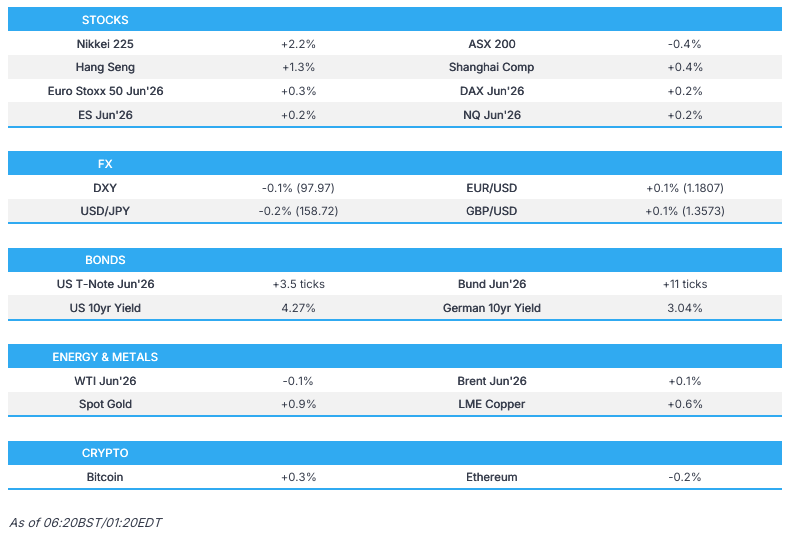
Newsquawk in 3 steps:
1. Subscribe to the free premarket movers reports
2. Listen to this report in the market open podcast (available on Apple and Spotify)
3. Trial Newsquawk’s premium real-time audio news squawk box for 7 days
IRAN CONFLICT
- US President Trump posted late on Wednesday, “Trying to get a little breathing room between Israel and Lebanon. It has been a long time since the two leaders have spoken, like 34 years. It will happen tomorrow. Nice!”
- US President Trump told guests on Monday night that he wants to bring the war in Iran to a swift end and that the only way to get Iran back to the negotiating table was to increase pressure, according to WSJ citing officials at the dinner.
- White House Press Secretary said it is not true the US requested Iran ceasefire extension, but added the US remains engaged in negotiations, with conversations productive and ongoing, while she feels good about prospects of a deal with Iran.
- White House Deputy Chief of Staff Miller told Fox News that President Trump is heavily involved in shaping the outlines of the ongoing negotiations with Iran, while he added that Washington seeks to achieve peace and stability, but at the same time does not accept Tehran possessing a nuclear weapon.
- US Treasury Secretary Bessent said Iran’s neighbours are more transparent now on Iran banking, and the US has requested that IRGC funds and those of the leadership be frozen. Bessent said the US told countries which buy Iranian oil that the US is willing to impose secondary sanctions, while he discussed maintaining pressure on Iran with Saudi Arabia’s Finance Minister.
- The Trump administration’s goal is to bring both sides to the brink of an overarching deal to end the conflict that can then be pushed over the finish line in a second face-to-face meeting, according to ABC citing officials. Furthermore, officials acknowledged that technical talks to hammer out the fine details and implementation of the arrangement will likely take longer to complete, perhaps eventually necessitating an extension of the initial ceasefire, but that pushing back the truce’s expiration date isn’t a top priority for the administration at the moment.
- US Envoy Witkoff proposed a ceasefire in Lebanon for a week, but Israel insisted on separating the Lebanese and Iranian fronts, according to Channel 12. It was separately reported that the US has not formally asked Israel for a ceasefire in Lebanon, and it is not part of the peace talks with Iran, although President Trump would welcome and be happy to see an end to the fighting as part of an agreement between Israel and Lebanon, according to Axios.
- US issued new Iran-related sanctions and counterterrorism designations, which target several vessels and entities.
- US Central Command said the US blockade turned back 10 vessels in the Strait of Hormuz yesterday. However, Iranian military-affiliated outlet Defapress claimed four ships broke the US naval blockade over the past 24 hours, citing satellite data.
- Iran could consider ships being able to sail through the Omani side of the Strait of Hormuz without interference or attack as part of a deal with the US, according to Reuters citing a source close to Tehran.
- Iran reportedly announced the suspension of all petrochemical exports until further notice.
- Iranian Foreign Minister Araghchi warned of serious repercussions from US provocative actions in the Gulf and Strait of Hormuz during a call with Chinese Foreign Minister Wang. Furthermore, Wang stressed freedom of navigation in Hormuz to Iran and that the Strait of Hormuz needs to reopen, while he said the Hormuz reopening is a unanimous call from the international community.
- Iranian Parliament Speaker Ghalifbaf said the US should withdraw from its ‘Israel first’ mistake and comply with the agreement, while he said the resistance and Iran are one soul in war and ceasefire.
- Iranian politician affiliated with Resistance Front of Islamic Iran, Mohsen Rezaei, said they will not leave the Strait of Hormuz until the full realisation of Iran’s rights, while he added that this time, Iran has set preconditions.
- Iran’s Interior Minister ordered border governors to neutralise the threat of a naval blockade by strengthening and developing border trade by increasing imports and exports of goods, as well as utilising all national and regional capacities.
- Iran and the Pakistani mediator will discuss details of the messages exchanged between Tehran and Washington today, while a separate report also noted that Iranian officials will meet with Pakistan’s army chief in Tehran and will discuss US proposals.
- Israeli PM Netanyahu said objectives are aligned with the US and that they are preparing for the possibility that fighting may resume, and are ready for any scenario, according to the Jerusalem Post. Netanyahu also commented that there are two main objectives in talks with Lebanon, which are the disarmament of Hezbollah and sustainable peace that is achieved through strength, while he added that it is too early to say how talks with Iran will end, or even how it will progress.
- Two Israeli officials said the meeting of the political security cabinet ended without a decision on a ceasefire in Lebanon, according to Axios’s Ravid.
- Israeli officials said their assessment was that the ceasefire in Lebanon could begin within days, while Israeli Channel 12 said the army is preparing for the possibility of a ceasefire in Lebanon. In relevant news, Lebanese officials said a ceasefire between Israel and Lebanon was expected ‘soon’, while Israeli media cited informed sources that stated that a ceasefire in Lebanon will not happen soon despite Trump’s statements.Israel expects the ceasefire with Iran will be extended, according to source reports. It was also reported that Israel is considering a short-term cease-fire in Lebanon that could pause the war against Iran-backed Hezbollah, according to three Israeli officials cited by NYT.
- Israeli Broadcasting Authority said a gradual withdrawal from southern Lebanon can only be discussed after progress in the political process, while it also stated that members of the Miniature Ministerial Council oppose the ceasefire in Lebanon.
- Israeli warplanes carried out a strike on the town of Shihabiya in southern Lebanon.
- Explosion was reported in Iraq’s Kurdistan region in Sulaymaniyah province amid a drone attack.
- US and Hamas held their first direct talks since the Gaza ceasefire as part of efforts to advance the fragile US-brokered agreement, two Hamas sources said via CNN.
- US Senate voted to block an effort to force US President Trump to end Iran strikes without lawmakers’ approval.
- US House Select Committee on China said Airbus Space likely provided satellite imagery of US military assets to China before Operation Epic Fury commenced
US TRADE
EQUITIES
- US stocks mostly remained supported in risk-on trade, which saw the S&P 500 and Nasdaq print fresh record highs, as markets completely unwound the downside seen since the start of the Iran war. Optimism remained regarding an end to the conflict after US President Trump had reiterated that he sees the war being very close to over, while there were reports regarding a two-week ceasefire extension, although both sides denied they had reached out to offer such an olive branch.
- SPX +0.80% at 7,023, NDX +1.40% at 26,205, DJI -0.15% at 48,464, RUT +0.30% at 2,714.
- Click here for a detailed summary.
TARIFFS/TRADE
- US Treasury Secretary Bessent and Mexico’s Finance Minister met on Tuesday and discussed the USMCA review. Bessent also met with France’s Finance Minister to discuss ongoing economic cooperation between the US and France, while they exchanged views on collaboration in areas such as critical minerals and multilateral economic priorities in advance of upcoming G7 and G20 discussions.
- USTR Greer said the US-China Board of Investment is to be a government forum, and stated there’s no situation where there’s no trade between the US and China, while he added that the Trump administration wants to be pragmatic regarding China.
NOTABLE HEADLINES
- Fed Beige Book stated that overall economic activity increased at a slight to modest pace in 8 out of 12 districts, while two districts reported little change and two districts reported slight to modest declines. Furthermore, the conflict in the Middle East was cited as a major source of uncertainty that complicated decision-making around hiring, pricing, and capital investment, with many firms adopting a wait-and-see posture.
- Fed’s Bowman (voter) said they hope to finalise Basel rulemaking by year-end and are still reviewing the liquidity framework.
- Fed’s Musalem (2028 voter) said the current range of interest rates is likely appropriate for some time, while he stated that the oil shock is likely feeding core inflation and expects it will be near 3% through year-end.
APAC TRADE
EQUITIES
- APAC stocks mostly gained following the positive lead from Wall Street, where the S&P 500 and Nasdaq printed fresh all-time highs, amid tech strength and peace talk optimism.
- ASX 200 bucked the trend and gave back initial gains, and more, as notable outperformance in tech was offset by losses in energy, resources, materials, financials and miners.
- Nikkei 225 rallied to a fresh record high after reclaiming the 59,000 status amid the hopes for a Middle East resolution and with the index led by the momentum in tech stocks.
- Hang Seng and Shanghai Comp were higher with further upside seen as the dust settled following the mixed Chinese GDP and activity data, in which GDP growth for Q1 missed expectations, but GDP Y/Y topped forecasts and printed at the high-end of China’s official 2026 GDP growth target. Meanwhile, Industrial Production data for March was better-than-expected, but Retail Sales disappointed.
- US equity futures marginally extended on gains as optimism regarding peace talks remained intact.
- European equity futures indicate a positive cash market open with Euro Stoxx 50 futures up 0.3% after the cash market closed with losses of 0.7% on Wednesday.
FX
- DXY lacked firm direction following yesterday’s indecisive performance amid mixed geopolitical headlines, including regarding a potential 2-week extension to the current US-Iran ceasefire and suggestions that an Israel-Lebanon ceasefire could occur soon. Nonetheless, there haven’t been any changes to the status quo, although betting markets are increasingly convinced of a permanent peace deal by the end of H1, while the latest Fed Beige Book and rhetoric from Fed officials did little to shift the dial, with Musalem noting that rates could be on hold for some time.
- EUR/USD eked mild gains after returning to the 1.1800 handle and following a slew of ECB rhetoric, including suggestions of a lack of clarity for April, with sources noting that policymakers are wary of an April rate hike as there is no evidence yet of second-round inflation effects.
- GBP/USD gradually edged higher but remained contained within the 1.3500 handle as participants look ahead to monthly GDP, as well as Industrial and Manufacturing Production data from the UK.
- USD/JPY continued its pullback from the 159.00 territory, before rebounding off lows, amid the positive risk appetite and in the absence of any tier-1 data from Japan.
- Antipodeans remained afloat with AUD/USD eventually supported by mixed jobs data from Australia, in which the headline Employment Change missed expectations, and the Unemployment Rate was unchanged at 4.3%, but with the jobs increase solely fuelled by a jump in full-time jobs.
- PBoC set USD/CNY mid-point at 6.8616 vs exp. 6.8190 (Prev. 6.8582)
FIXED INCOME
- 10yr UST futures marginally rebounded from the prior day’s lows after retreating amid haven outflows as markets remained cautiously optimistic about a resolution in the Middle East, while there were mixed reports regarding an Israel-Lebanon ceasefire and a US-Iran ceasefire extension.
- Bund futures traded rangebound but are off yesterday’s trough, while prices have largely ignored the recent slew of ECB rhetoric and reports that officials are said to be leaning towards an April rate hold.
- 10yr JGB futures were choppy and retested the 130.00 level to the upside, with some slight support seen following the enhanced liquidity auction for longer-dated JGBs.
COMMODITIES
- Crude futures were little changed following the prior day’s two-way price action amid conflicting reports regarding ceasefire agreements.
- White House is expected to urge heads of oil and gas companies to increase drilling.
- Spot gold climbed higher after returning to above the USD 4,800/oz level with recent fluctuations seen amid optimism around a second round of peace talks between the US and Iran.
- Copper futures remained afloat amid the mostly positive risk appetite but with gains capped as participants digested mixed Chinese GDP and activity data.
CRYPTO
- Bitcoin traded indecisively and briefly climbed above USD 75,000 before returning to flat territory.
NOTABLE ASIA-PAC HEADLINES
- China NBS said the economy had a good start in Q1, but the external situation is becoming more complex, while China is to expand domestic demand and optimise supply, as well as implement proactive macro policies. NBS said it expects a complex, volatile external environment, but added China will consolidate the economic recovery foundation, and it sees mixed signs of strong supply and weak demand.
- Japanese Finance Minister Katayama had discussions on currencies with US Treasury Secretary Bessent and agreed to stay in close contact, while Bessent is to stop in Japan en route to China in May, and Katayama will speak with him.
DATA RECAP
- Chinese GDP Growth Rate QQ (Q1) 1.3% vs. Exp. 1.4% (Prev. 1.2%, Low. 0.9%, High. 1.8%)
- Chinese GDP Growth Rate YY (Q1) 5.0% vs. Exp. 4.8% (Prev. 4.5%, Low. 4.0%, High. 5.7%)
- Chinese Industrial Production YY (Mar) 5.7% vs. Exp. 5.6% (Prev. 6.3%, Low. 4.5%, High. 7.0%)
- Chinese Retail Sales YY (Mar) 1.7% vs. Exp. 2.3% (Prev. 2.8%, Low. 0.8%, High. 3.3%)
- Chinese Unemployment Rate (March) 5.4% vs. Exp. 5.2% (Prev. 5.3%)
- Chinese House Price Index YY (Mar) -3.4% (Prev. -3.2%)
- Australian Employment Change (Mar) 17.9K vs. Exp. 20K (Prev. 48.9K)
- Australian Full Time Employment Chg (Mar) 52.5K (Prev. -30.5K)
- Australian Unemployment Rate (Mar) 4.3% vs. Exp. 4.3% (Prev. 4.3%)
- Australian Participation Rate (Mar) 66.8% (Prev. 66.9%)
GEOPOLITICS
RUSSIA-UKRAINE
- Explosions were reported in Ukraine’s capital, Kyiv, and air defence systems were activated.
OTHER
- US Pentagon plans a possible Cuba operation, in case US President Trump gives an order to intervene there, according to USA Today citing sources.
EU/UK
NOTABLE HEADLINES
- BoE Governor Bailey said a willingness to fund public debt is a vulnerability.
- ECB’s Nagel said there is not enough clarity about what happens in April and they need optionality, while the question about the Strait of Hormuz is essential, and two weeks can bring a lot of new information.
- ECB’s Schnabel said the memory of high inflation remains fresh, and inflation expectations could be more fragile, while she added they can afford to take time to analyse the Iran shock. Schnabel stated they are in a relatively favourable position because they were successful in bringing down inflation to 2% before the war started, and have a monetary policy stance that is broadly neutral. Furthermore, she said they are to carefully consider data that may indicate inflation becoming entrenched or having second-round effects.
- ECB’s Villeroy said so far, the impact on underlying inflation remains limited.
- ECB officials are said to be leaning towards an April rate hold.
- ECB’s Muller says rate move at April meeting still cannot be ruled out says June meeting is to offer more data.
- ECB policymakers are wary of an April rate hike as there is no evidence yet of second-round inflation effects, according to Reuters citing sources. Furthermore, sources said second-round inflation effects are still possible, and policy tightening remains firmly on the table, but concrete evidence is needed before policymakers act, while another source said that they cannot say what they will do at the next meeting, but currently do not have enough evidence to support a hike.
2.a NORTH KOREA/SOUTH KOREA/JAPAN
NORTH AND SOUTH KOREA
3. CHINA/
CHINA/USA
Bessent Keeps Running Tally Of China As “Unreliable Global Partner” – Count Now Stands At Three
Wednesday, Apr 15, 2026 – 09:20 PM
Treasury Secretary Scott Bessent told reporters Tuesday that Beijing’s panic hoarding of crude and refined products, while refusing to join the rest of the world in releasing supplies to offset the Gulf energy shock, has now demonstrated for the third time in five years that China is an “unreliable global partner.”
“China has been an unreliable global partner three times in the past five years; once during COVID, when they hoarded healthcare products, second on rare earth,” Bessent said, referring to Beijing’s move last year to weaponize rare earth exports against the US in the tit-for-tat trade war that disrupted US supply chains, including temporary factory shutdowns such as production lines briefly shuttered by Ford Motor Company.
Bessent said China continued to purchase tanker loads of crude instead of helping ease the global supply crunch caused by Iran’s closure of the Strait of Hormuz, despite already holding a massive strategic reserve. He also noted that China restricted exports of crude products early in the conflict.
Reuters noted that China’s strategic petroleum reserve “was roughly the same size as that of the entire reserve held by the 32-member International Energy Agency, but it was continuing to purchase oil.”
Bessent added, “They continued buying, and they’ve been hoarding, and they have cut off exports of many products.”
On US-China relations, he told reporters he’s been in contact with Chinese officials about the hoarding issue.
He declined to comment on whether the dispute and elevated tensions will derail an upcoming Trump-Xi meeting in Beijing, which has been pushed to mid-May.
“I think the message for the visit is stability. We’ve had great stability in the relationship since last summer; that emanates from the top down,” he said. “I think that communication is the key.”
Bessent added that the US military blockade would ensure that no Chinese tankers or other ships would pass the strait: “So they’re not going to be able to get their oil. They can get oil. Not Iranian oil.”
Last week, International Energy Agency chief Fatih Birol warned that governments must avoid panic hoarding and refrain from imposing fuel export bans as the Gulf energy shock continues to ripple outward to Asia, Africa, Europe, and eventually reaches the US West Coast.
“I urge all countries not to impose bans or restrictions on exports,” Fatih Birol emphasized in a Financial Times interview. “It is the worst time when you look at the global oil markets. Their trade partners, their allies and their neighbors will suffer as a result.”
The FT noted that Birol was “careful not to name China directly,” but made very clear his warning was likely aimed at Beijing.
So Bessent is clearly keeping a running tally of Beijing’s behavior as an “unreliable global partner,” and by his count, the number now stands at three.
What comes next is unclear, but the next signal will likely come from the upcoming Trump-Xi meeting.
END
4.EUROPEAN AND SCANDINAVIAN AFFAIR PLUS NATO
GERMANY
DRONE PRODUCTION
Germany Accelerates Kamikaze Drone Stockpiling With Rheinmetall Deal
Thursday, Apr 16, 2026 – 02:45 AM
Germany’s parliament has approved a sizeable contract for defense giant Rheinmetall to supply loitering munitions, or kamikaze drones, to the Bundeswehr, underscoring just how quickly European militaries are internalizing drone warfare lessons from both the Russia-Ukraine war and, more recently, the U.S.-Iran conflict. Berlin’s latest procurement push makes it clear that one-way attack drones are becoming a serious threat, and the race to stockpile them has begun.
Bloomberg reports that the budget committee of the Bundestag approved the Defense Ministry’s proposal for an initial tranche of Rheinmetall’s suicide drones worth $345 million.

The deal is capped at around $1.2 billion for Rheinmetall loitering munitions and depends on the firm meeting development and delivery milestones. The drones are initially intended for Germany’s brigade in Lithuania, but there is a possibility that they will be deployed elsewhere.
The approval follows Germany’s February decision to purchase $637 million worth of strike drones from startups Helsing and STARK. Rheinmetall missed out on those deals because it lacked a working prototype at the time.
The Defense Ministry confirmed the latest contract without identifying Rheinmetall: “As with the other two contracts, there are clearly defined qualification requirements, termination milestones, and innovation clauses.”
Lessons learned from the current conflicts across Eurasia have served as a wake-up call for countries around the world, unleashing a frantic race among the world’s militaries to procure low-cost attack drones.
What follows will be counter-drone systems to combat this emerging threat, as the war in the Middle East showed that the US and its Gulf allies lacked low-cost solutions.
On the U.S. homeland front, the Federal Aviation Administration has given the U.S. military the green light to deploy high-energy counter-drone laser weapons in U.S. airspace. Alarmingly, there are very few, if not any, low-cost counter-drone systems guarding America’s data centers, transmission substations, stadiums, and other critical infrastructure.
One month before the US-Iran conflict broke out, we informed readers of the urgent need for data centers to consider counter-drone systems. What followed were multiple data centers struck by Iranian drones in the Gulf region. Civilian infrastructure will not be spared as the world becomes increasingly dangerous and chaotic.
END
HUNGARY
Brussels will not like this;
(zerohedge)
New Hungarian Prime Minister Says Borders Will Remain Shut To Immigrants
Thursday, Apr 16, 2026 – 06:55 AM
In the wake of Viktor Orbán’s election defeat, one of the greatest fears among conservatives in the region is an unconstrained EU able to take action on foreign policy, health, and immigration without the threat of a veto. It is widely assumed that the incoming prime minister of Hungary, Péter Magyar, will seek a fast resolution of Brussels’ key issues with Hungary in order to unlock some €35 billion in funding.
His election win was heralded as a substantial victory for the global left wing, from EU globalists to Democrats in the US. Their assumption is that with Orbán’s veto power out of play, they will be able to do they want in Ukraine and in Hungary. However, the new Prime Minster may not be as cooperative as they initially believed.
Magyar has stated that he will not try to block a €90 billion EU loan to Ukraine which Orbán originally vetoed, but he also stated that Hungary will not be contributing to such loans and that the government will not support any attempt to induct Ukraine into the EU. He also announced this week that he will not allow Hungary to join in the EU’s “Migration Pact” and that he plans to further strengthen Hungary’s borders.

This includes a continued rejection of the EU’s asylum rules, which are widely abused by third world migrants to freely enter Europe and gain access to welfare subsidies.
Beyond the Ukraine funding veto, it was Orbán’s refusal to submit to open borders and mass immigration that caused constant conflict with the EU. He was frequently referred to by the political left as a “dictator” and a “fascist” in part because of his strict border policies (even though he is voluntarily leaving office after losing the election, which is not the behavior of a dictator).
Ursula von der Leyen, President of the European Commission, attacked Orbán regularly for his border controls, stating that Hungary’s program to reinforce their borders with walls and barbed wire was in violation of EU immigration standards.
It appears that this will not stop under Magyar.
The purpose of the EU Commission is to subjugate member countries through centralized monetary dependency and a series of financial sanctions if they step out of line. Financial leverage has been used on a number of occasions by the Commission to force nations to accept ever expanding mass immigration, largely from Muslim fundamentalist populations in countries like Algeria, Morocco, Syria and Afghanistan. Hungary is one of the few European nations to resist this multicultural agenda.
While it is a member state, Hungary is not currently in the eurozone, using its own currency, the Hungarian forint, rather than the euro.
It may be that the EU sees Magyar as an acceptable trade, as long as they get their funding package for Ukraine. They probably also intend to play the long game, hoping that once Hungary joins the eurozone they can be manipulated over time using monetary leverage. That said, their intentions have long focused on using Hungary as a fresh sponge to absorb migrants, and this is simply not going to happen according to Magyar’s post-election declarations.
END
EUROPE
ELECTRIFICATION!
Europe’s Electrification Dream Is Hitting A Wall
Thursday, Apr 16, 2026 – 02:00 AM
Authored by Gisele Widdershoven via OilPrice.com,
- Europe’s electrification strategy is ambitious but constrained by lagging grid infrastructure, creating bottlenecks that are already delaying industry and investment.
- Massive funding needs—running into trillions—combined with regulatory complexity and slow buildouts are exposing a gap between policy ambition and physical reality.
- Without better coordination, prioritization, and financing, Europe risks higher costs, weaker competitiveness, and a stalled energy transition.
The message given by Ursula von der Leyen to electrify the European economy is strategically coherent, politically appealing, and, on the surface, even unavoidable. It will be the real deal to decarbonize industry and power transport, reduce dependence on imported fossil fuels, and anchor Europe’s competitiveness. The latter is especially valid in an increasingly fragmented geopolitical order. Electrification is presented as the backbone of Europe’s future prosperity and security.
However, beneath this clear vision lies a far more uncomfortable reality. Brussels is not only pursuing an energy transition but also transforming its industrial base, transport systems, infrastructure networks, and geopolitical posture. All of this needs to be done while facing an increased financial, physical, and strategic strain. Electrification is not failing at present because the overall idea or strategy is wrong, but because the system required to support it is already overstretched. At the same time, and maybe even more important, the bill to fix that system is only beginning to emerge.

The real core problem of Brussels is not its ambition, but the sequencing of it all.
Europe is already accelerating the electrification of demand, mainly in the industrial, transport, and heating sectors, while simultaneously pushing to expand renewable supply at an unprecedented speed. One pivotal issue, however, seems to be constantly forgotten: the infrastructure that must connect the two is lagging dangerously behind. Policymakers and advisors should realize that electricity systems are not abstract constructs, but physical networks with hard limits. Throughout Europe, these limits have already been reached.
The prime example of this situation is the Netherlands.
Throughout the continent, the Dutch energy transition has been presented as a model: one of the highest per-capita deployments of offshore wind in the world, widespread solar adoption, aggressive electrification policies, and a political consensus around decarbonization. If Brussels’ overall strategy were working as intended, the Netherlands should be its showcase.
In reality, however, it is its warning.
At present, the Dutch electricity grid is no longer able to keep pace with the pace of change. The country’s grid congestion has become structural, not incidental. An ever-growing list of thousands of companies, some even stating 15,000+, are already on waiting lists for grid connections or capacity upgrades. In several Dutch regions, industrial clusters cannot expand, while new investments are delayed or diverted. The most shocking issue is that even residential developments are hindered or blocked by the lack of electricity.
The paradox is striking. At certain moments, especially when there is a positive combination of wind and sun, the Netherlands produces more renewable electricity than it can use. At other times, the country cannot supply enough electricity to meet demand. The Dutch system is increasingly hit by a system that needs to deal with a simultaneous suffering of surplus and scarcity.
This is not a temporary imbalance but the predictable outcome of a system in which generation has outpaced infrastructure. It is also where Europe’s electrification narrative begins to unravel.
The EC’s strategy again assumes a relatively smooth scaling of supply, demand, and infrastructure. Reality, however, is much more complex. At present, infrastructure development lags due to permitting constraints, investment bottlenecks, and physical construction timelines. At the same time, demand does not scale linearly, especially when industries hesitate amid uncertainty about costs and grid access. The system itself introduces frictions, such as congestion, curtailment, and volatility, all undermining efficiency.
Across Europe, an increasing number of grid operators are issuing urgent warnings as connection queues grow while investment pipelines stall. All are looking at a situation where the congestion costs are rising. And yet the policy response remains focused primarily on accelerating renewable deployment and electrification targets, as if infrastructure will inevitably follow.
It will not.
Right now, now is that electricity grids cannot be expanded at the pace of policy ambition. Building high-voltage transmission lines takes years, often more than a decade. At the same time, distribution networks require massive upgrades to handle decentralized generation and electrified demand. Local opposition, environmental regulations, and supply chain constraints slow all of this.
Brussels dramatically underestimates the scale of investment needed, which should motivate industry leaders to develop innovative financing strategies and advocate for substantial capital allocation to meet the €660 billion annual target and beyond.
To be clear, this is not incremental spending, but a structural reallocation of capital on a scale rarely seen outside wartime economies.
Given the €1.2 trillion investment requirement for electricity grids alone by 2040, policymakers should explore innovative financing models, public-private partnerships, and EU-level funding instruments to mobilize the necessary capital efficiently.
Addressing electrification requires a collective effort to rebuild Europe’s entire energy backbone, highlighting the importance of coordinated strategic planning among policymakers, industry, and investors to prevent economic inefficiency and political fragility.
That is where the Dutch case becomes valid. The Netherlands has already demonstrated that high levels of renewable penetration do not automatically translate into effective electrification. Without grid capacity, renewable energy cannot be fully utilized. Without certainty about the connection, industrial electrification stalls. Without system flexibility, volatility increases.
In other words, the transition becomes economically inefficient and politically fragile.
Another major constraint is that the financial challenge does not exist in isolation. It is unfolding within a rapidly deteriorating geopolitical environment.
The European Union is simultaneously being forced to increase defense spending, support Ukraine, and respond to renewed instability in global energy markets. The war in Ukraine has already triggered a structural shift in defense priorities, with European defense spending reaching hundreds of billions annually and new EU-level instruments targeting up to €800 billion in mobilized resources.
Since the last two months, tensions in the Middle East, especially in Hormuz, have reintroduced energy security risks that Europe had hoped electrification would mitigate. Roughly a fifth of global oil and LNG flows through Hormuz. Even partial disruptions immediately translate into higher prices, increased volatility, and renewed dependence on external suppliers.
This strategic contradiction is compounded by geopolitical risks, such as disruptions in the Strait of Hormuz and increased defense spending, which threaten to undermine Europe’s energy security and complicate the transition to electrification despite its intended benefits.
Brussels attempts to invest heavily in electrification to reduce energy vulnerability, while simultaneously being forced to spend heavily on defense and absorb the costs of ongoing fossil fuel dependence. The energy transition does not replace one system with another, but it layers new costs on top of old ones.
This is the fiscal collision at the heart of the European project. The real question right now, which needs to be answered honestly, is: who is going to pay?
Most European governments are already fiscally constrained, as public debt levels remain elevated following the pandemic and energy crisis. They also need to deal with increased defense spending, while social pressures are rising. The idea that national budgets alone can finance the electrification of the economy is no longer credible.
Again, private capital is often presented as the solution. Brussels strategy relies heavily on mobilizing institutional investors, de-risking projects, and leveraging capital markets. However, private capital is not a substitute for public strategy. Private capital flows where risk-adjusted returns are predictable. Grid infrastructure, industrial electrification, and system flexibility often do not meet these criteria without significant public guarantees.
Moreover, the scale required goes far beyond what current mechanisms can deliver. Even ambitious instruments such as the Innovation Fund or the proposed Industrial Decarbonization Bank, targeting tens or even hundreds of billions, remain small relative to the annual investment gap.
Europe’s uncomfortable truth is that it will need to adopt a fundamentally different financing model. Electrification at this scale clearly requires something closer to a strategic investment doctrine than a collection of policy instruments. Brussels will need to deal with a reality that requires prioritization, coordination, and, for all parties, critical acceptance of trade-offs.
- First, Europe will need to elevate energy infrastructure to the same strategic level as defense. If joint borrowing and coordinated financing can be justified for military capabilities, the same logic applies to cross-border electricity grids, storage systems, and industrial electrification corridors. These are not optional climate investments; they are the foundation of economic resilience.
- Second, existing revenue streams, particularly from carbon pricing mechanisms, must be more aggressively redirected toward infrastructure. The current allocation is insufficient relative to the scale of need.
- Third, public financial institutions, the European Investment Bank and national development banks—must significantly expand their role, particularly in areas where private capital remains hesitant.
All the above, however, will eliminate the need for prioritization.
The current reality shows that Europe cannot fund everything simultaneously. It cannot electrify all industries at once, build all infrastructure at once, and meet all geopolitical commitments without making choices. It is a political illusion to believe that coordination and efficiency gains will eliminate trade-offs.
The Dutch experience already demonstrates what happens when these trade-offs are ignored. Infrastructure constraints begin to shape economic outcomes. Investments are delayed or redirected. The energy transition loses momentum not because of political opposition, but because of practical limitations.
If we scale the Dutch experience to the European level, the consequences could be far more significant. Industries that depend on reliable, high-capacity electricity, especially chemicals, steel, and data infrastructure, will look beyond Europe if energy systems cannot deliver. Investment flows may shift to regions with more robust infrastructure. And Europe’s industrial base could erode at precisely the moment it seeks to strengthen it.
This is the risk embedded in the current electrification narrative.
Brussels assumes that more renewable energy and more electrification will automatically lead to lower costs, greater security, and enhanced competitiveness. Facts on the ground, however, show that without the infrastructure and financing to support it, the opposite may occur: higher costs, increased volatility, and reduced competitiveness.
The greatest danger is not a failure of electrification, but that it will proceed in an unbalanced way. There is a huge risk of too much generation without infrastructure, too much demand without connectivity, and too much ambition without sequence.
This is already happening.
The Netherlands shows that even a highly advanced energy transition can hit hard physical limits. These limits are not theoretical. They are visible in grid congestion, curtailed renewable output, delayed investments, and constrained economic growth.
Europe as a whole is now approaching the same inflection point.
Von der Leyen is right that electricity will define Europe’s future. However, to define the future is not the same as building it. Brussels needs to understand that building requires infrastructure that takes decades, capital that runs into trillions, and political choices that are far more difficult than current rhetoric suggests. We are not only looking at an energy strategy when pursuing electrification, but also at a test of Europe’s ability to align ambition with reality.
At present, that alignment is missing.
The physical limits of a grid need to be confronted by Europe, including the financial scale of its ambitions, and the geopolitical pressures shaping its choices. If not, the electrification agenda will remain incomplete. Again, the vision is not wrong, but the system required to deliver it is not yet ready. At the same time, the willingness to pay for it has not yet been fully acknowledged.
5. RUSSIAN AND MIDDLE EASTERN AFFAIRS
ISRAEL/IRAN/USA
US deploys additional troops to Middle East as Hormuz blockade enters third day – report
The deployment reportedly includes a carrier strike group with approximately 6,000 personnel aboard the USS George H.W. Bush, alongside roughly 4,200 Marines.

The Nimitz-class aircraft carrier USS George H.W. Bush (CVN 77) transits the Atlantic Ocean, Feb. 15, 2026.(photo credit: US Navy photo by Mass Communication Specialist 3rd Class John R. Farren)
APRIL 16, 2026 04:47
The United States plans to deploy additional troops to the Middle East in the near future to strengthen its military presence in the region amid a possible continuation of the fighting with Iran, The Washington Post reported on Wednesday.
According to US officials cited by the report, the deployment includes a carrier strike group with approximately 6,000 personnel aboard the USS George H.W. Bush, alongside roughly 4,200 Marines with an amphibious ready group of Naval infantry, which is expected to arrive later this month.
The deployment of troops overlaps with a US maritime blockade targeting the Iranian ports and the Strait of Hormuz, one of several efforts to push Tehran from an economic perspective and corner it to concede on its nuclear program during negotiations.
US intercepts tenth Iranian vessel amid Strait of Hormuz blockade
The United States Central Command (CENTCOM) said on Wednesday that an Iranian-flagged cargo vessel was intercepted after departing Bandar Abbas and transiting the Strait of Hormuz while attempting to evade a US maritime blockade.
CENTCOM said ten vessels have been turned back so far, with none breaching the blockade since it was established on Monday.
A report by the tracking company TankerTrackers contradicted CENTCOM’s claims, saying that satellite imagery shows several other tankers have bypassed the blockade of Iranian ports and are now in Iranian waters, including an Iranian-flagged tanker.
In addition, ships en route to Iraq were reported to have sailed with AIS systems turned off to conceal their movements.
END
USA IRAN/ISRAEL UPDATES THURSDAY MORNING
Hegseth: Hormuz Blockade Stays “As Long As It Takes” – Ships Now Fair Game For Search & Seizure
Thursday, Apr 16, 2026 – 08:55 AM
Summary
- US Navy: vessels seeking entry into Hormuz Strait now fair game for boarding, search, and outright seizure – including for suspicion of ‘contraband’.
- Hegseth: US forces are ready to restart combat if Iran doesn’t agree to a deal & strait blockade to continue for as long as it takes. Already 13 ships have been turned around.
- Iran’s parliament speaker Mohammad Bagher Qalibaf calls ceasefire in Lebanon “as important as a ceasefire in Iran.”
- Heavy Israeli bombardment of southern Lebanon, including targeting of infrastructure and bridges.
https://embed.polymarket.com/market?market=trump-announces-end-of-military-operations-against-iran-by-may-31st-651-724-212&height=300Trump announces end of military operations against Iran by May 31st?
Yes 70% · No 31%
View full market & trade on Polymarket
* * *
Boarding, Search, & Outright Seizure
Ships seeking to enter the Hormuz Strait already sanctioned by the US just got a lot more vulnerable: under Washington’s blockade of Iranian ports, they’re now fair game for boarding, search, and outright seizure, per US Naval Forces Central Command.
“In addition to enforcing the blockade, all Iranian vessels, vessels with active OFAC sanctions, and vessels suspected of carrying contraband, are subject to belligerent right to visit and search,” the notice said, referring to the Office of Foreign Assets Control. “These vessels, regardless of location, are subject to visit, board, search, and seizure.”
The definition of “contraband” is broad and expansive. It spans weapons, ammunition, combat aircraft, and military electronics, WSJ has described. “Petroleum products and lubricants are conditional contraband due to their essential role in military operations and their contribution to Iran’s war-sustaining economy,” the advisory also said. “Contraband is defined as goods that are destined for an enemy and that may be susceptible to use in armed conflict.”

Up until now, the blockade – initially rolled out Monday – was limited to ships moving in and out of Iranian ports, but the definition who can be targeted just widened. Meanwhile, US Central Command (CENTCOM) said Wednesday that in the first 48 hours, not a single ship made it past the blockade.
Hormuz Blockade: ‘As Long As It Takes’
The US will maintain a naval blockade of Iran for as long as it takes, Pentagon chief Pete Hegseth has stated in a press briefing Thursday. He and Joint Chiefs Chairman Gen. Dan Caine say that US forces are ready to resume major combat operations at a moment’s notice, which suggests the initial two-week ceasefire could get extended, as was widely reported the day prior. But this also suggests that Washington likely has no appetite for resuming major aerial operations directly against Iran anytime soon.
On the question of resumption of major combat operations, Hegseth warned: “To Iran, choose wisely. I pray you choose a deal which is within your grasp for the betterment of your people and the betterment of the world.” He followed with, “In the meantime, the War Department is locked and loaded.” Additional main highlights to the Hegseth/Caine update and presser:
- Iran likes to say it controls Strait of Hormuz but it has no navy
- Energy industry not destroyed ‘yet’, US blockade shutting down exports
- For as long as it takes, we will maintain blockade
- Launching operation ‘economic fury’
- Iran is digging out bombed out launchers
- I hope you choose a deal which is within your grasp
But again, the chief takeaway is that the Pentagon and Trump administration are making clear that US forces are ready to restart combat if Iran doesn’t agree to a deal. On that front, US officials say future talks are likely to be held again in Pakistan’s capital, Islamabad. Prior reports have indicated both sides have “agreed in principle” to engage in another round of talks.
Iran’s PressTV touting ability to inflict global economic pain…
Pentagon: 13 Ships Turned Around
Since the blockade went live, US forces have already turned around 13 ships, according to Gen. Caine in the same briefing. He underscored how far this reach extends, saying operations will take place “inside Iran’s territorial seas and in international waters.”
Officially, the Pentagon claims the blockade is limited – targeting Iran’s ports and coastal areas while sparing vessels simply passing through the Strait of Hormuz. In practice, however, the net is touted as much wider, as US forces “will actively pursue any Iranian-flagged vessel or any vessel attempting to provide material support to Iran,” including so-called “dark fleet vessels carrying Iranian oil,” Caine added.
He confirmed that more than 10,000 service members are now involved in the blockade, but with more US servicemembers en route to the region.
Lebanon Still Bombed Heavily by Israel amid US Ceasefire Efforts
Israeli jets pounded Nabatiyeh in southern Lebanon Thursday, unleashing one of the heaviest barrages there since the war began and sending black smoke billowing over the region. Strikes hit near the industrial zone and a supermarket on Nabih Berri Avenue, with nearby suburbs also taking damage, according to Lebanon’s state-run National News Agency.
Iran has signaled urgency on de-escalation, with parliament speaker Mohammad Bagher Qalibaf calling ceasefire in Lebanon “as important as a ceasefire in Iran.” He described, “In the Islamabad negotiations and afterwards, we have been seriously pursuing efforts to compel the adversaries to establish a permanent ceasefire in all areas of conflict.” Pakistan’s army chief is in Tehran mediating between Washington and Tehran.
Lebanon’s leadership is in th emeantime framing any truce as a gateway to talks, despite Hezbollah having rejected direct talks with Israel. The ceasefire it is “demanding with Israel” would be a “natural entry point for direct negotiations,” President Aoun said, adding: “Lebanon is keen to halt the escalation… so that the targeting of the innocents ceases, and the destruction of homes” stops.
Destruction of Al-Qasimia Bridge in Southern Lebanon
He stressed negotiations “are to be undertaken by the Lebanese authorities alone,” and said “the withdrawal of Israeli forces… is an essential step,” alongside redeploying the army “up to the international borders” to “end any manifestation of armed presence.”
And yet Israeli strikes are now hitting infrastructure. A key bridge over the Litani River near Qasmiyeh – linking Tyre and Sidon – was reportedly destroyed, though Israel said it only “struck adjacent to it.” The broader campaign is cutting off southern Lebanon, targeting chiefly Hezbollah positions, Israeli officials have claimed.
END
ISRAEL/IRAN/USA LATE MORNING
IRAN STILL DEFIANT
Defiant Iran Reasserts Toll System, Paid Through Iranian Banks After US Vows Hormuz Blockade Stays “As Long As It Takes”
Thursday, Apr 16, 2026 – 10:10 AM
Summary
- Iran seeks to boost rial through toll payment scheme; vessels pay Hormuz passage through Iranian banks.
- US Navy: vessels seeking entry into Hormuz Strait now fair game for boarding, search, and outright seizure – including for suspicion of ‘contraband’.
- Hegseth: US forces are ready to restart combat if Iran doesn’t agree to a deal & strait blockade to continue for as long as it takes. Already 14 ships have been turned around.
- Iran’s parliament speaker Mohammad Bagher Qalibaf calls ceasefire in Lebanon “as important as a ceasefire in Iran.”
- Heavy Israeli bombardment of southern Lebanon, including targeting of infrastructure and bridges.
https://embed.polymarket.com/market?market=trump-announces-end-of-military-operations-against-iran-by-may-31st-651-724-212&height=300Trump announces end of military operations against Iran by May 31st?
Yes 70% · No 31%
View full market & trade on Polymarket
* * *
Defiant Iran Reasserts Toll System: Paid Through Iranian Banks
An Iranian parliament official has been cited in newswires as saying the country’s planned Strait of Hormuz toll for ships seeking to pass is to be paid through Iranian banks. Previously it was said to be through cryptocurrency, and could be as a high as $2 million Oil rose higher, given this is another indicator this game of chicken in the narrow waterway could soon lead to fresh hostilities, despite the 2-week ceasefire still being in place, soon to expire.
As for negotiations, there’s optimism another round of US-Iran talks will occur, with both sides having agreed in principle, but Iran’s government informed Pakistan that the US must back off its maximal demands.
Below is a machine translation from the Persian of the fresh parliament statement via state-linked ISNA:
- The plan to consolidate Iran’s sovereignty in the Strait of Hormuz is being framed as a way to strengthen the rial.
- Iran is seeking a regulatory role in the Strait of Hormuz – one of the world’s most sensitive chokepoints -positioning it as oversight, not disruption or blackmail.
- Under the plan, foreign ships would settle accounts through offices in Iran or via the Iranian banking system, a move aimed at boosting the rial.
- Estimated current revenue from managing and regulating maritime traffic in the Strait of Hormuz: $10-15 billion.
Boarding, Search, & Outright Seizure
Ships seeking to enter the Hormuz Strait already sanctioned by the US just got a lot more vulnerable: under Washington’s blockade of Iranian ports, they’re now fair game for boarding, search, and outright seizure, per US Naval Forces Central Command.
“In addition to enforcing the blockade, all Iranian vessels, vessels with active OFAC sanctions, and vessels suspected of carrying contraband, are subject to belligerent right to visit and search,” the notice said, referring to the Office of Foreign Assets Control. “These vessels, regardless of location, are subject to visit, board, search, and seizure.”
The definition of “contraband” is broad and expansive. It spans weapons, ammunition, combat aircraft, and military electronics, WSJ has described. “Petroleum products and lubricants are conditional contraband due to their essential role in military operations and their contribution to Iran’s war-sustaining economy,” the advisory also said. “Contraband is defined as goods that are destined for an enemy and that may be susceptible to use in armed conflict.”
Up until now, the blockade – initially rolled out Monday – was limited to ships moving in and out of Iranian ports, but the definition who can be targeted just widened. Meanwhile, US Central Command (CENTCOM) said Wednesday that in the first 48 hours, not a single ship made it past the blockade.
Hormuz Blockade: ‘As Long As It Takes’
The US will maintain a naval blockade of Iran for as long as it takes, Pentagon chief Pete Hegseth has stated in a press briefing Thursday. He and Joint Chiefs Chairman Gen. Dan Caine say that US forces are ready to resume major combat operations at a moment’s notice, which suggests the initial two-week ceasefire could get extended, as was widely reported the day prior. But this also suggests that Washington likely has no appetite for resuming major aerial operations directly against Iran anytime soon.
On the question of resumption of major combat operations, Hegseth warned: “To Iran, choose wisely. I pray you choose a deal which is within your grasp for the betterment of your people and the betterment of the world.” He followed with, “In the meantime, the War Department is locked and loaded.” Additional main highlights to the Hegseth/Caine update and presser:
- Iran likes to say it controls Strait of Hormuz but it has no navy
- Energy industry not destroyed ‘yet’, US blockade shutting down exports
- For as long as it takes, we will maintain blockade
- Launching operation ‘economic fury’
- Iran is digging out bombed out launchers
- I hope you choose a deal which is within your grasp
But again, the chief takeaway is that the Pentagon and Trump administration are making clear that US forces are ready to restart combat if Iran doesn’t agree to a deal. On that front, US officials say future talks are likely to be held again in Pakistan’s capital, Islamabad. Prior reports have indicated both sides have “agreed in principle” to engage in another round of talks.
Iran’s PressTV touting ability to inflict global economic pain…
end
ISRAEL IRAN/USA/THURSDAY AFTERNOON
Trump Announces 10-Day Lebanon-Israel Truce, As Iran Reasserts Tolls Via Iranian Banks; US Vows Hormuz Blockade “As Long As It Takes”
Thursday, Apr 16, 2026 – 11:45 AM
Summary
- Trump unveils 10-day Lebanon ceasefire, but which Hezbollah has not signed on for, amid heavy IDF attacks on south.
- Iran seeks to boost rial through toll payment scheme; vessels pay Hormuz passage through Iranian banks.
- US Navy: vessels seeking entry into Hormuz Strait now fair game for boarding, search, and outright seizure – including for suspicion of ‘contraband’.
- Hegseth: US forces are ready to restart combat if Iran doesn’t agree to a deal & strait blockade to continue for as long as it takes. Already 14 ships have been turned around.
- Iran’s parliament speaker Mohammad Bagher Qalibaf calls ceasefire in Lebanon “as important as a ceasefire in Iran.”
https://embed.polymarket.com/market?market=trump-announces-end-of-military-operations-against-iran-by-may-31st-651-724-212&height=300Trump announces end of military operations against Iran by May 31st?
Yes 70% · No 31%
View full market & trade on Polymarket
* * *
Trump: Truce in Lebanon
President Trump has announced an apparent Lebanon breakthrough, announcing on Truth Social that Lebanon and Israel have agreed to a 10-day ceasefire. This just after on Thursday Israel launched at least 50 airstrikes in a matter of two hours on South Lebanon, according to national media. Israel says late Thursday its forces have no plans to withdraw ground troops from Southern Lebanon. Operations there look to continue, but presumably the ceasefire means Beirut might not be hit in the interim.
This week, Rubio oversaw historic peace talks between Lebanese officials and the Israeli government; however, which did not include Hezbollah. Both Tehran and Hezbollah have insisted that the Lebanon conflict should be resolved through the Pakistan mediated US-Iran process. The Lebanese government has little actual sway over Hezbollah, the country’s single most well-armed and influential paramilitary organization, which has more missiles and arms than even the national army. This means it remains a big unknown whether this 10-day truce will hold. Trump’s Truth Social message, which claims he solved “9 wars across the world” and a “lasting peace”:
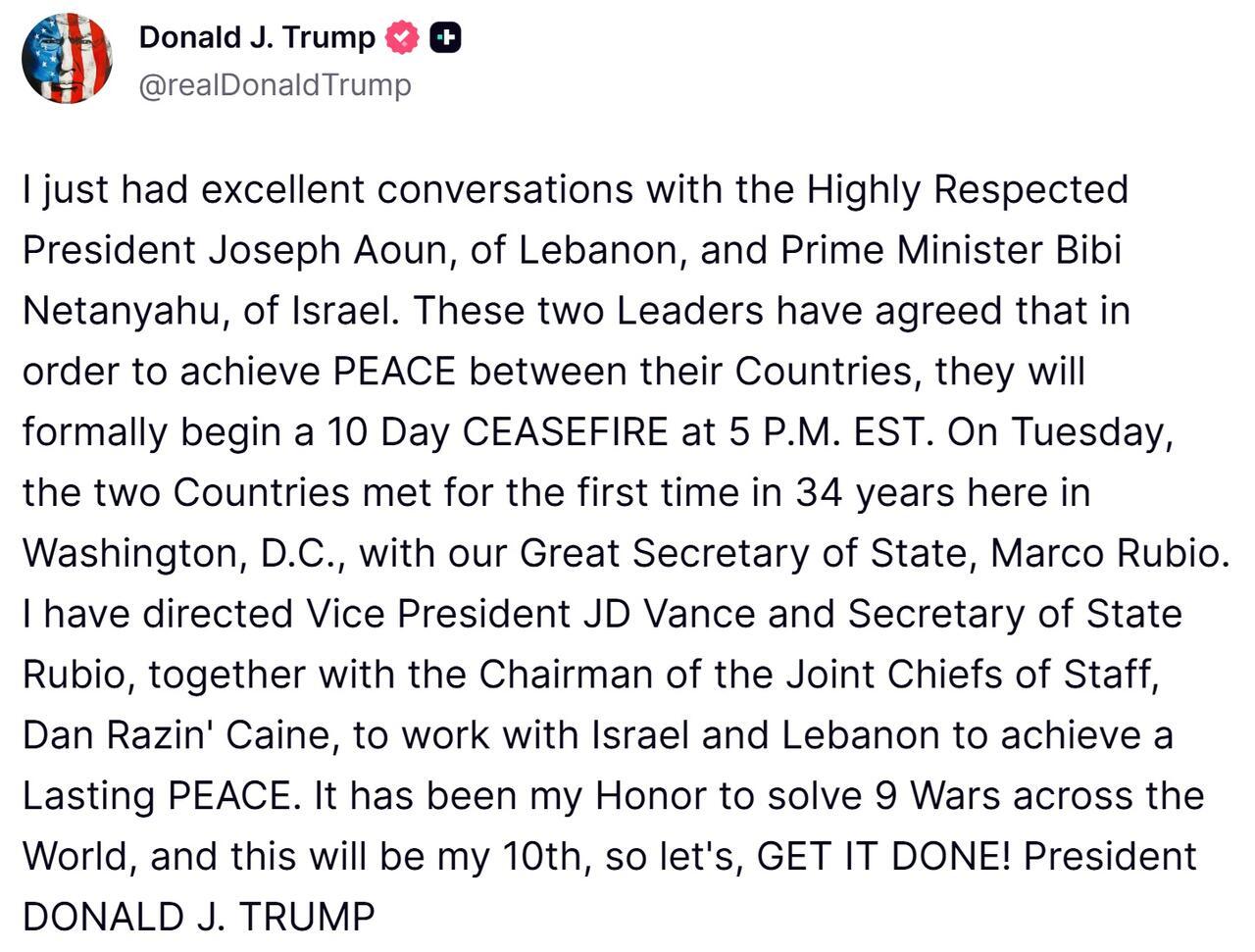
Defiant Iran Reasserts Toll System: Paid Through Iranian Banks
An Iranian parliament official has been cited in newswires as saying the country’s planned Strait of Hormuz toll for ships seeking to pass is to be paid through Iranian banks. Previously it was said to be through cryptocurrency, and could be as a high as $2 million Oil rose higher, given this is another indicator this game of chicken in the narrow waterway could soon lead to fresh hostilities, despite the 2-week ceasefire still being in place, soon to expire.
As for negotiations, there’s optimism another round of US-Iran talks will occur, with both sides having agreed in principle, but Iran’s government informed Pakistan that the US must back off its maximal demands.
Reuters: U.S. and Iranian negotiators have scaled back ambitions for a comprehensive peace deal and are instead seeking a temporary memorandum to prevent a return to conflict, two Iranian sources told Reuters.
Below is a machine translation from the Persian of the fresh parliament statement via state-linked ISNA:
- The plan to consolidate Iran’s sovereignty in the Strait of Hormuz is being framed as a way to strengthen the rial.
- Iran is seeking a regulatory role in the Strait of Hormuz – one of the world’s most sensitive chokepoints -positioning it as oversight, not disruption or blackmail.
- Under the plan, foreign ships would settle accounts through offices in Iran or via the Iranian banking system, a move aimed at boosting the rial.
- Estimated current revenue from managing and regulating maritime traffic in the Strait of Hormuz: $10-15 billion.
Boarding, Search, & Outright Seizure
Ships seeking to enter the Hormuz Strait already sanctioned by the US just got a lot more vulnerable: under Washington’s blockade of Iranian ports, they’re now fair game for boarding, search, and outright seizure, per US Naval Forces Central Command.
“In addition to enforcing the blockade, all Iranian vessels, vessels with active OFAC sanctions, and vessels suspected of carrying contraband, are subject to belligerent right to visit and search,” the notice said, referring to the Office of Foreign Assets Control. “These vessels, regardless of location, are subject to visit, board, search, and seizure.”
The definition of “contraband” is broad and expansive. It spans weapons, ammunition, combat aircraft, and military electronics, WSJ has described. “Petroleum products and lubricants are conditional contraband due to their essential role in military operations and their contribution to Iran’s war-sustaining economy,” the advisory also said. “Contraband is defined as goods that are destined for an enemy and that may be susceptible to use in armed conflict.”
Up until now, the blockade – initially rolled out Monday – was limited to ships moving in and out of Iranian ports, but the definition who can be targeted just widened. Meanwhile, US Central Command (CENTCOM) said Wednesday that in the first 48 hours, not a single ship made it past the blockade.
Hormuz Blockade: ‘As Long As It Takes’
The US will maintain a naval blockade of Iran for as long as it takes, Pentagon chief Pete Hegseth has stated in a press briefing Thursday. He and Joint Chiefs Chairman Gen. Dan Caine say that US forces are ready to resume major combat operations at a moment’s notice, which suggests the initial two-week ceasefire could get extended, as was widely reported the day prior. But this also suggests that Washington likely has no appetite for resuming major aerial operations directly against Iran anytime soon.
END
LATE THURSDAY AFTERNOON
6 MONTHS NEEDS FOR A DEAL?
Oil Jumps As Report On 6-Month Iran Deal Timeline Crushes Ceasefire Hopes, Hormuz Still Locked Down
Thursday, Apr 16, 2026 – 12:45 PM
Summary
- Trump unveils 10-day Lebanon ceasefire, but which Hezbollah has not signed on for, amid heavy IDF attacks on south. BBG reports on potential 6-month timeframe for comprehensive Iran deal, oil spikes.
- Iran seeks to boost rial through toll payment scheme; vessels pay Hormuz passage through Iranian banks.
- US Navy: vessels seeking entry into Hormuz Strait now fair game for boarding, search, and outright seizure – including for suspicion of ‘contraband’.
- Hegseth: US forces are ready to restart combat if Iran doesn’t agree to a deal & strait blockade to continue for as long as it takes. Already 14 ships have been turned around.
- Iran’s parliament speaker Mohammad Bagher Qalibaf calls ceasefire in Lebanon “as important as a ceasefire in Iran.”
https://embed.polymarket.com/market?market=trump-announces-end-of-military-operations-against-iran-by-may-31st-651-724-212&height=300Trump announces end of military operations against Iran by May 31st?
Yes 70% · No 31%
View full market & trade on Polymarket
* * *
Gulf, European officials See Needing 6 Months for Iran deal: BBG, Oil Spikes
A big headline out of Bloomberg has sent oil prices higher:
Some Gulf Arab and European leaders believe that a US-Iran peace deal will take about six months to be agreed and that the warring sides should extend their ceasefire to cover that timeframe, according to officials from the regions familiar with the matter.
The leaders want the vital Strait of Hormuz opened immediately to restore energy flows and are warning in private that a global food crisis may develop if that doesn’t happen by next month, said the officials, who asked not to be identified discussing private talks.
But important caveats remain: who are these “some” Gulf and “European leaders” – the latter who have remained far to the sidelines during this crisis, but who are yes still suffering the effects of the ultra-risky Operation Epic Fury Iran war gambit by Trump. Spike in crude…
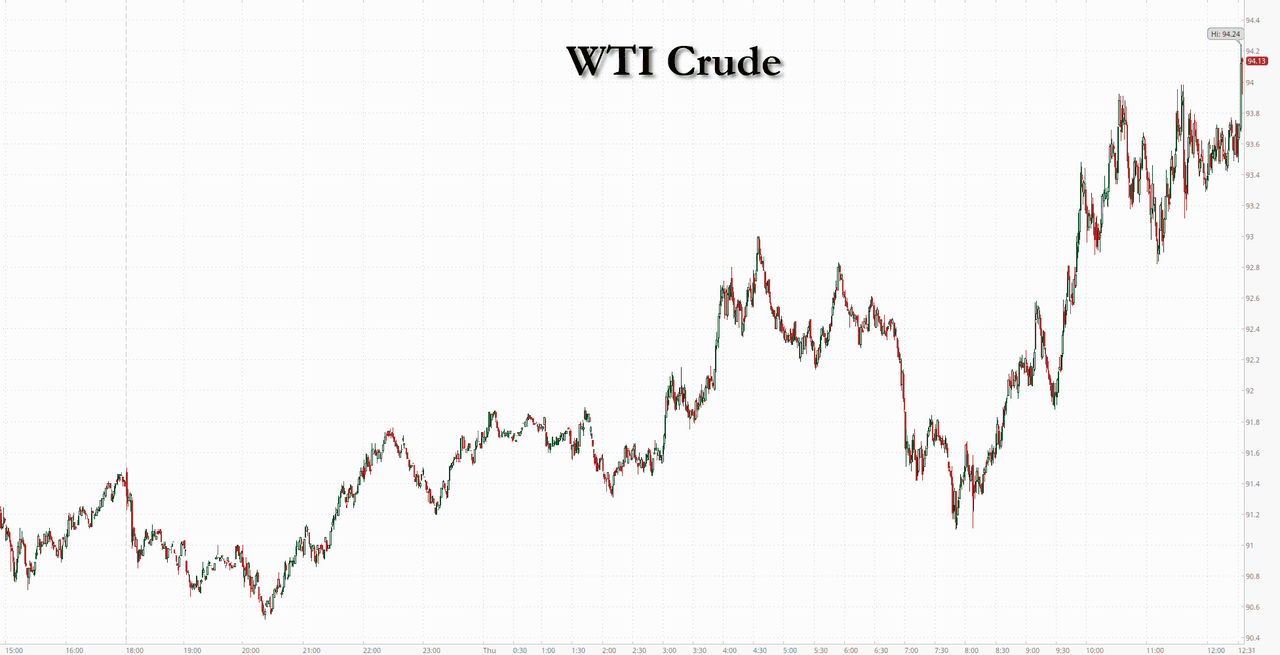
Trump: Truce in Lebanon
President Trump has announced an apparent Lebanon breakthrough, announcing on Truth Social that Lebanon and Israel have agreed to a 10-day ceasefire. This just after on Thursday Israel launched at least 50 airstrikes in a matter of two hours on South Lebanon, according to national media. Israel says late Thursday its forces have no plans to withdraw ground troops from Southern Lebanon. Operations there look to continue, but presumably the ceasefire means Beirut might not be hit in the interim.
This week, Rubio oversaw historic peace talks between Lebanese officials and the Israeli government; however, which did not include Hezbollah. Both Tehran and Hezbollah have insisted that the Lebanon conflict should be resolved through the Pakistan mediated US-Iran process. The Lebanese government has little actual sway over Hezbollah, the country’s single most well-armed and influential paramilitary organization, which has more missiles and arms than even the national army. This means it remains a big unknown whether this 10-day truce will hold. Trump’s Truth Social message, which claims he solved “9 wars across the world” and a “lasting peace”:
END
LATE AFTERNOON:
Trump Says ‘Probably, Maybe‘ Iran Talks To Resume This Weekend, ‘Not Sure’ About Ceasefire Extension
Thursday, Apr 16, 2026 – 04:00 PM
Summary
- Trump says “probably, maybe” Iran talks resume this weekend, “not sure” about ceasefire extension.
- Trump unveils 10-day Lebanon ceasefire, but which Hezbollah has not signed on for, amid heavy IDF attacks on south. BBG reports on potential 6-month timeframe for comprehensive Iran deal, oil spikes.
- Iran seeks to boost rial through toll payment scheme; vessels pay Hormuz passage through Iranian banks.
- US Navy: vessels seeking entry into Hormuz Strait now fair game for boarding, search, and outright seizure – including for suspicion of ‘contraband’.
- Hegseth: US forces are ready to restart combat if Iran doesn’t agree to a deal & strait blockade to continue for as long as it takes. Already 14 ships have been turned around.
https://embed.polymarket.com/market?market=trump-announces-end-of-military-operations-against-iran-by-may-31st-651-724-212&height=300Trump announces end of military operations against Iran by May 31st?
Yes 70% · No 31%
View full market & trade on Polymarket
* * *
Trump Still Signals Ambiguity on Peace/Ceasefire Potential
President Trump appeared to confirm ceasefire talks with Iran are still very up in the air, saying that he also doesn’t see the need to extend the current two-week ceasefire – “not sure,” he said – also amid the going US naval blockade of Iranian-China oil exports, or other sanctioned vessels. With no extension, the ceasefire will expire on April 22.
“If there’s no deal fighting resumes,” Trump affirmed in fielding reporters’ questions. Importantly, talks and timeline are still a big maybe:
President Trump told reporters the next in-person talks negotiating a deal for Iran will “probably, maybe” happen this weekend. He didn’t say where, and other U.S. officials haven’t confirmed any details.
He took the opportunity in the same remarks to slam the Pope. “If the pope looked at the 42,000 people that were killed over the last two or three months, as a protester, with no weapons, no nothing,” he claimed, using the same unsourced numbers he’s lately been throwing around. “I mean, you take a look at that, so I can disagree with the pope. I have a right to disagree. I have a right to disagree with the pope.”
The president added, “The pope can say what he wants. And I want him to say what he wants. But I can disagree. I think that Iran cannot have a nuclear weapon. If they do, the whole world would be in jeopardy, the Middle East would blow up and the whole world would be in jeopardy.”
“This is the real world, it’s a nasty world,” he said. “But as far as the pope and saying what he wants, he can do that.”
And on the newly declared Israel-Lebanon ceasefire, which does not include Hezbollah, Trump told reporters: “I responded to this call and agreed to a timeout, or rather a temporary ceasefire, of 10 days to try to advance the agreement that we began discussing with the ambassadors’ meeting in Washington.” He added: “For these peace talks, we have two fundamental demands: one, the disarmament of Hezbollah. Two, a sustainable peace agreement, peace from strength.”
ISRAEL TBN
ISRAEL/HAMAS
Hamas plans to use Iran, Lebanon negotiations to avoid disarmament, gain control of Gaza’s BoP
A source from the security establishment warned that Hamas is taking advantage of Israel’s focus on the Hezbollah situation and the US focus on the Iranian front to buy time.

An illustrative image of a silhouette over the backdrop of the Hamas flag.(photo credit: tanitost/Shutterstock)
APRIL 16, 2026 02:58
Hamas is using the instability created by the security situation in southern Lebanon and Iran to avoid advancing its disarmament compromises and gain political force in Gaza, a source from the security establishment warned on Wednesday.
According to the source, Hamas is taking advantage of Israel’s focus on the Hezbollah situation and the US focus on the Iranian front to buy time and avoid progress on the political front.
The main strategy by the Hamas leadership seems to be collecting taxes, recruiting activists, and taking control of goods entering the Gaza Strip.
One of the sources added that Hamas is trying to create the appearance of giving up power, but in practice, even if forced, it will aim to control the new rulers of the Gaza Strip from the shadows.
The security source said this mirrors Hezbollah’s strategy during the Hassan Nasrallah era, when they didn’t seize direct control of Lebanon but had the political and military power to operate without repercussions from the government.

Hamas rejects Board of Peace plan for Gaza
Hamas rejected the US-led Board of Peace’s disarmament plan for the terror group and asked the board to make modifications to it, a source told The Jerusalem Post on Wednesday.
The BoP’s high representative, Nickolay Mladenov, and three other mediators were also present, the source added.
The BoP’s plan is expected to last between 6 and 8 months, and the duration serves the organization’s strategy of buying time, as elections in Israel and the midterm elections in the US will be held during this period, further diverting attention from the Gaza Strip.
Meanwhile, according to Walla, most senior Hamas officials left Qatar for Turkey and other countries after receiving “signals” that it was advisable for them to leave.
Qatari security forces tightened their measures to prevent targeted assassinations, and Hamas understood the clues amid fears of similar actions by the Israeli intelligence community.
Sam Halpern and Amichai Stein contributed to this report.
END
ISRAEL /USA IRAN
US sanctions Iranian oil shipping network run by son of Ali Shamkhani
Shamkhani’s network had previously been sanctioned by the Treasury in July of 2025. The US issued 115 sanctions against the group, according to a Treasury press release at the time.

A ship passes through the Strait of Hormuz.(photo credit: somkanae sawatdinak/Shutterstock)
APRIL 16, 2026 00:40
The US Treasury Department said on Wednesday it was intensifying pressure on Iran’s oil transportation infrastructure by imposing sanctions on more than two dozen individuals, companies, and vessels.
The sanctions target entities within the network of Iranian oil shipping magnate Mohammad Hossein Shamkhani, son of Ali Shamkhani, a key figure in Iran’s security and nuclear efforts who was killed in US-Israeli strikes on Tehran on February 28.
Shamkhani’s network had previously been sanctioned by the Treasury in July of 2025. The US issued 115 sanctions against the group, according to a Treasury press release at the time.
“Treasury is moving aggressively with Economic Fury by targeting regime elites like the Shamkhani family that attempt to profit at the expense of the Iranian people,” Treasury Secretary Scott Bessent said in the statement.
The Treasury Department also issued sanctions against Iranian national and Hezbollah financier Seyed Naiemaei Badroddin Moosavi, and three companies linked to a money laundering scheme involving the sale of Iranian oil in exchange for Venezuelan gold.

The oil-for-gold scheme was carried out on behalf of Lebanese terrorist organization Hezbollah and Iran’s Islamic Revolutionary Guard Corps’s Quds Force, the Treasury stated.
US will not renew waiver on Iranian oil
In another move by the Treasury, the US announced that it wouldn’t renew its waiver on Iranian oil at sea that expires this week, and quietly let a similar waiver on sanctions on Russian oil expire over the weekend.
According to two sources who spoke with Reuters, the move aims to complement the effects of the Strait of Hormuz blockade, with one saying, “Treasury is going full force on Economic Fury.”
Additionally, the US Central Command (CENTCOM), which is in charge of enforcing the blockade on Iran, announced on Wednesday that it had successfully redirected an Iranian-flagged cargo vessel that attempted to breach the blockade, marking the tenth ship sent back since the blockade was imposed.
“Ten vessels have now been turned around, and zero ships have broken through since the start of the U.S. blockade on Monday,” CENTCOM said in a statement.
Reuters contributed to this report.
END
IRAN
Iran’s economy could collapse within three months under naval blockade, experts warn
An expert on Iran’s military noted that Iranian authorities have previously declared that if they are denied access to their ports, they will prevent other countries in the region from using theirs.

SCREENSHOT FROM a video released by Iranian media showing an encounter between the IRGC Navy and a US warship in the Strait of Hormuz, which they claim withdrew from the area after receiving a warning.(photo credit: IRIB News Agency)
ByOMID HABIBINIA/THE MEDIA LINEAPRIL 15, 2026 17:12Updated: APRIL 15, 2026 19:17
If a full naval blockade of Iran proves successful, it would, on the one hand, increase the immediate risk of war between Iran and the United States – potentially drawing in all countries in the region – and, on the other, trigger an unprecedented crisis in the global economy, particularly affecting China.
Forecasts suggest that Iran’s economy, which is heavily dependent on oil exports, could collapse within approximately three months. This would likely be accompanied by massive waves of street protests, driven by subsidy cuts and a sharp, unprecedented surge in runaway inflation.
Following the launch of the naval blockade operation ordered by US President Donald Trump after the failure of negotiations between the two sides in Islamabad, Iran’s ruling authorities have declared that any attack on Iranian ports would be met with retaliatory strikes against ports across the region.
Meanwhile, the Islamic Revolutionary Guard Corps (IRGC) has continued to obstruct passage through the Strait of Hormuz and has reportedly even threatened US military vessels in the area.
At the same time, as the blockade is enforced and President Trump has warned that any Iranian fast-attack boats approaching the area will be destroyed, the IRGC’s warning to US military vessels seeking to enter the Strait of Hormuz could at any moment ignite another war, despite the two-week ceasefire.

On Sunday, the IRGC declared that the passage of US military vessels through the Strait constitutes a violation of the ceasefire. Iranian state media also released a video on the same day showing what it described as a near-engagement by the IRGC Navy against a US military vessel, in an area from which ships are urged to keep their distance, as Iranian forces seemed prepared to open fire after warnings to leave the area were ignored.
The date, location, and identity of the vessel remain unclear, though the footage appears to be from the past day or so.
In an official statement, the IRGC explicitly warned: “Any attempt by military vessels to approach the Strait of Hormuz will be considered a violation of the two-week ceasefire with the United States and will be met with a severe and decisive response.”
The US Central Command (CENTCOM) had previously stated that the mission of American naval vessels in the Strait was to clear the area of mines allegedly deployed by the IRGC, but it has issued no response regarding the confrontation claimed by Iranian authorities.
In a report, Iran’s state-run Press TV claimed that on Saturday, two US warships, the USS Frank E. Petersen Jr. and the USS Michael Murphy, attempted to pass through the Strait of Hormuz into the Persian Gulf. According to the report, the IRGC Navy identified the vessels near the port of Fujairah as they navigated a risky passage through shallow waters.
After locking cruise missiles onto the ships, the regime forces reportedly gave them 30 minutes to leave the area, and with only minutes remaining before a possible strike, the vessels ultimately withdrew.
This account, attributed by Press TV to military sources, has not been confirmed by CENTCOM or any independent authority. CENTCOM, for its part, states that the two ships completed their mission of identifying a safe route, reopening commercial passage, and deploying mine-clearing equipment in the area before returning.
Some Western sources, including Axios, have reported that the vessels transited the Strait and then returned to the Arabian Sea.
Until last month, the United States maintained several vessels in the Persian Gulf and the Gulf of Oman, including the USS Canberra, USS Tulsa, and USS Santa Barbara, which were part of the Fifth Fleet and were officially tasked with mine countermeasures and ensuring maritime security in the region and the Strait of Hormuz.
However, it appears that these vessels have since withdrawn from the area to avoid potential attacks by the Islamic Republic. Instead, the US naval formation has been consolidated in the Arabian Sea, where the aircraft carrier USS Abraham Lincoln and USS Tripoli are also deployed. It has played a central role in U.S. military operations – particularly in strikes against Iranian naval bases and the destruction of a significant portion of Iran’s naval capabilities.
Nevertheless, Iranian military officials have implicitly stated that the IRGC Navy – relying largely on light vessels, fast-attack boats, drones, and anti-ship missiles – remains operational.
Military confrontation between US and Iran possible, expert says
Given the escalating crisis in the region and the enforcement of an economic blockade targeting Iran, whose war-stricken economy depends heavily on oil revenues despite US sanctions, the risk of a military confrontation in the Strait of Hormuz is now higher than ever.

Farzin Nadimi, an expert on Iran’s military affairs, spoke to The Media Line regarding the likelihood of another military confrontation: “It can be imagined that clashes between the United States and the IRGC could intensify significantly, as the Islamic Republic seeks to control the Strait of Hormuz and could sharply escalate the conflict between the two sides.”
He added that the IRGC may respond to US naval presence through fast-attack boats conducting offensive or disruptive operations, including laying mines or deploying mine-like objects to hinder both mine-clearing operations and commercial shipping.
While the United States aims to achieve quick success through the naval blockade, the IRGC is likely to attempt to prolong the conflict, slow down and limit the scope of maritime operations, and thereby exert broader pressure on global oil markets and the economy.
Nadimi, the Senior Fellow at The Washington Institute for Near East Policy, also noted that the Islamic Republic authorities have previously declared that if they are denied access to their own ports, they will prevent other countries in the region from using theirs.
He emphasized that, should the naval blockade succeed, the ruling authorities in Iran may deploy drones, unmanned vessels, or missiles against the ports of any country involved in maintaining maritime traffic connected to the blockade. Such retaliatory measures could once again lead to war between Iran and the United States – and likely Israel.
Iran seeking to raise economic cost of blockade
According to Nadimi, the Islamic Republic is attempting to raise the global economic cost of the blockade for the United States, while Washington seeks to achieve its objectives as quickly as possible.
However, he stressed that a naval blockade takes time to be effective. He warned that the rising tensions carry the risk of escalating into a full-scale war in the region, as the regime is likely to exert every effort to ensure that the blockade fails.
Given the foreseeable escalation of tensions in the Strait of Hormuz, and as the Islamic regime claims control over the passage and even the authority to impose tolls on vessels, Israel appears to be preparing for a possible resumption of military strikes against Iranian targets.
In such a scenario, the IRGC – which has effectively taken full control of the government – may fight to preserve what remains of its power, or, as some analysts suggest, attempt to expand a “scorched-earth doctrine” not only within Iran but across the region.
Over the course of 40 days of military operations, the United States and Israel have significantly degraded the Islamic Republic’s military capabilities, eliminating key leaders, commanders, and officials.
However, the IRGC – now dominating the political landscape following the removal of Ali Khamenei and the designation of Mojtaba Khamenei as the nominal leader – continues to maintain control within the country, sidelining clerical and conventional state structures.
It has intensified its crackdown on protesters, detaining hundreds in recent weeks and carrying out executions of several dissidents, while continuing to assert its ability to wage war, launch missiles and drones, and control the Strait of Hormuz.
Iran exports approximately 2 million barrels of oil per day through the Strait of Hormuz, with China as its primary buyer, purchasing at prices significantly below OPEC benchmarks.
A cutoff in oil revenues could rapidly devastate Iran’s already war-stricken economy and intensify domestic discontent. If the government is unable to pay the wages and bonuses of its security forces, some of these forces may refuse to continue their duties, and a portion could even join the broader population of dissatisfied citizens.
Although the exact volume of Iran’s oil exports over the past two weeks at the height of the conflict remains unclear, it is estimated that approximately 158 million barrels of Iranian oil are currently stranded at sea following the closure of the Strait. The last reported tankers carrying Iranian oil were vessels flying the Iranian flag that exited the Strait of Hormuz around the time CENTCOM announced the naval blockade.
If the regime’s authorities fail to secure oil revenues in the coming months, the destruction of key infrastructure – such as major industries – could place the government at risk of collapse. However, such an outcome would also bring severe economic disruption and pressure to countries across the region and the global economy.
In the event of a complete halt to both oil and non-oil exports, Iran’s state economy could suffer losses of approximately $400 million per day, while China, as a major buyer of discounted Iranian oil, would also face significant challenges.
Domestically, the immediate impact of lost oil revenues would be felt through subsidy cuts and a sharp increase in the prices of essential goods such as food and fuel.
Given that more than 85% of Iran’s exports pass through its ports, the situation could reach a critical point within less than three months. Domestic production of food and industrial materials – as well as small-scale industries such as plastics, which form a key part of Iran’s microeconomy – would face severe disruption, alongside the near-total collapse of digital trade and services due to prolonged internet shutdowns.
Even if mass street protests do not erupt within the next three months, continued economic pressure could lead to the complete collapse of Iran’s state-controlled and blockaded economy within a year, effectively dismantling the country’s economic and social foundations.
END
BRANDON SMITH ON THE BLOCKADE OF IRAN:
A MUST MUST READ//HE IS VERY ACCURATE (ALWAYS)
Trump’s Blockade Is Breaking Iran… And European Elites Are Angry
Wednesday, Apr 15, 2026 – 11:25 PM
Authored by Brandon Smith via Alt-Market.us
In March I published an article titled “Global Energy Crisis Or Iranian Surrender In Five Weeks?” in which I outlined the “worst case” and “best case” scenarios for the war in Iran. In my best case scenario I argued in favor of a specific plan to end the conflict quickly: A US naval blockade of the Strait of Hormuz, flipping the tables on Iran by blocking or seizing any oil tankers or gas tankers which exit Iranian ports.
Two weeks later, the Trump Administration has implemented this exact strategy.
The effectiveness of the blockade is already apparent; the propaganda bots on social media are scrambling to find a narrative to counter it, but they are failing. Why? Because Iran already tried to lock down the strait (which is an international waterway), and any government cheering (or secretly cheering) for Iran’s actions is now unable to make a rational argument against the US doing the same thing to Iran.
As I noted in March:
“We constantly hear about international exposure to the Hormuz shutdown, but the media rarely mentions that Iran is the MOST exposed economy of all. For now, Iranian oil ships continue to pass through the strait and these vessels are Iran’s economic lifeline. Strategic estimates suggest that without the steady passage of these oil tankers, the Iranian economy would completely collapse within five weeks…”
I then summarized what I believed was the simplest solution to end the war:
“Iranian cargo ships can be targeted for seizure by a US blockade of the Persian Gulf well away from the narrow waters of the Hormuz. The ships could be destroyed, but I suspect the Department of Defense will try to avoid oil spills and ecological disasters. Instead, the best option is to capture Iran’s tankers and then redirect the oil to countries in danger of shortages.
Iran has the option of shutting off GPS tracking for their vessels (shadow fleet), but this would not help them maneuver past a comprehensive US blockade. In other words, I argue that the US could turn the tables on Iran and use their reliance on the Hormuz against them.
With Iran’s economy in shambles, they will no longer be able to purchase missiles or drones for resupply from Russia and China. They won’t be able to pay for logistic resources for their military and they won’t be able to contain public unrest. The Iranians would be forced to negotiate and the war would be over quickly with minimal risk to US troops.”
For now, the US is not seizing Iran’s tankers and is merely sending them back to where they came from. However, it would seem that the Trump Administration and their military advisers have come to the same basic conclusions I did.

For years I have expressed my concerns about a potential conflict in Iran, largely because of the precarious global economic risks associated with mass energy shortages caused by a closure of the Hormuz, which transits around 25% of the world’s energy exports. That said, I do not care about “picking sides” when it comes to Israel or Iran.
This debate is irrelevant and designed, I think, to divide US conservatives over ancient tribal vendettas that do not involve us. I don’t care about the Israeli government or “Zionism” and I certainly don’t care what happens to the theocratic and tyrannical Muslim regime in Iran. We have much more important things to think about.
What matters to me is how the US and the American people are affected by geopolitical events. There has been endless debate on what the war is really about, whether it be Iranian nukes, Israeli schemes, Saudi schemes, control of global oil markets, etc. (I think every action the Trump Administration has take so far from Venezuela to Iran has largely been designed to contain China). In any case, a long term closure of the Hormuz will eventually result in market cascades and a stagflationary crisis.
What matters now is ending the war as quickly and decisively as possible without leaving the Homuz and 25% of global energy exports under Iran’s control. After that, people can wrestle over the “moral and constitutional” quandary to their heart’s content.
First, I think it’s vitally important to address some lies and disinformation being spread by propagandists and foreign agents online about the US blockade, so let’s quickly go down the list…
Lie #1: The US Is Blocking All Ships Traveling Through The Strait
This is false. The US is only blocking ships coming from Iranian ports. All other ships have been allowed to pass without incident. This lie is being spread by disinfo agents all over social media and it is also being spread by foreign governments from the UK to France to China. This, to me, says A LOT about the true agenda of these countries, given that they said little or nothing about Iran locking down the strait.
Lie #2: Chinese Vessels Have Broken The Blockade And The US Is Afraid
Nope. All Chinese vessels coming from Iranian ports have been turned away and any vessels coming from alternative ports have been allowed to pass. At the time this article is being published, only one ship from an Iranian port has allegedly slipped through the blockade, though the story on this ship might be fabricated. All other Iranian ships have been repelled.
Lie #3: The Blockade Puts US Naval Ships At Serious Risk
No, it does the opposite. US ships have no need to traverse the narrow Hormuz to blockade it. All they have to do is wait outside of it and turn back Iranian tankers that approach. No mines, no missiles, no drones, no tiny attack boats, nothing Iran has the ability to deploy has much of a chance of harming the US Navy. In fact, reports indicate ships like the USS Abraham Lincoln (an aircraft carrier) have already been targeted hundreds of times by Iran with no damage taken.
There is nothing Iran can do about a comprehensive blockade.
Lie #4: Iran Is Used To Sanctions And Can Hold Out Longer Than The US
No, they can’t. Only 7% of energy exports going to the US travel through the Hormuz. Iran’s entire economy hangs by a thin thread and that thread is oil exports to countries like China or Vietnam.
Iran is reportedly losing around $430 million each day that their ships remain stuck in the strait, and they have already taken around $270 billion in infrastructure damages. Iran pays for new weapons and military logistics with oil revenues. Their soldiers are paid in part with oil revenues. They mitigate civil unrest with oil revenues.
I suspect that the blockade will force Iran back into negotiations within a couple weeks. That’s how little time they have left.
Lie #5: Iran Has Alternative Ways To Bypass The Blockade
No, they don’t. Overland routes without ample pipelines are no substitute for the ease of oil tanker shipments. Even if they did have such pipelines, those lines could be easily destroyed.
By extension, as Iran’s oil exports stack up they will quickly run out of storage space, which means they will have to shut down drilling. This would cause significant damage to their oil infrastructure within weeks due to pressure differentials.
Recent news indicates that Iran has already halted all petrochemical exports until further notice. If true, this proves that the blockade is highly effective.
Lie #6: The Chinese Will Intervene And Force The Strait To Reopen
As noted, the strait is not closed. Only Iranian ports are closed. Furthermore, China has stayed away from direct intervention in the Hormuz because they simply don’t have the naval capacity to square off with the US even if they wanted to.
Keep in mind, only a week ago the Chinese government vetoed a UN resolution to reopen the strait when they thought Iran was going to control it. The CCP is impotent and they can do nothing.
Lie #7: The US Is Losing All Its Allies Over The Blockade
Wrong. What the blockade (and the war in general) is doing is exposing the countries which were pretending to be our allies when it was convenient. I examined this problem in my last article “The US Separation From Europe And NATO Is Long Overdue”, and this brings me to my final point on the war.
The fact that the European elites are suddenly so concerned with the US blockade, enough to call for a “coalition” to reopen the strait and “circumvent” the US, tells us all we need to know. I continue to believe that the globalists in these nations have been feeding off the US while at the same time organizing a “multicultural alliance” behind the scenes – A socialist new world order to supplant western civilization and leave the US behind as a husk.
Part of this agenda clearly involves a partnership with Islamic fundamentalists as a goon squad to oppress native western populations. This is why the elites have flooded Europe with third world migrants – Ignoring the concerns of citizens and even arresting people who speak out.
This is also why the Pope is so adamant to call for a Muslim/Christian pact (while he blatantly ignores the fact that Europeans have been terrorized by Muslim immigrants for over a decade). Let’s not forget that during the pandemic lockdowns, the Vatican joined with the globalists to form the Council for Inclusive Capitalism (run by Lynn Forester de Rothschild). Modern-era Popes are not friends to conservatives or Christians, but I plan to go into that problem in my next article.
The blockade, I believe, is so effective that it has struck fear in Iran, fear in China, and fear in the liberal order in Europe which was counting on the war to drag on for months or years. Look at how angry they all are that Trump flipped the script on the Hormuz? Why all the emotion and irrational hand wringing after the strait has been opened to MORE ships and oil traffic? Why all the panic when oil prices are falling? It doesn’t make sense unless they WANT the US to fail.
Regardless of how you might feel personally about the Iran war, it is undeniable that the situation has revealed many of our supposed allies as enemies. In reality, they were always enemies. The only thing that has changed is that the truth is finally out in the open.
Views expressed in this article are opinions of the author and do not necessarily reflect the views of ZeroHedge.
END
IRAN
Iran to execute first woman prisoner linked to January protests as regime executions surge
Bita Hemmati and three others have been sentenced to death for ‘collusion’ and ‘propaganda.’ Advocates claim the charges are baseless, citing a secretive process and state-televised interrogations.

Bita Hemmati(photo credit: SCREENSHOT/X, SECTION 27A COPYRIGHT ACT)ByDANIELLE GREYMAN-KENNARD, THE MEDIA LINE STAFFAPRIL 16, 2026 14:30Updated: APRIL 16, 2026 16:52
Iranian authorities are preparing to execute Bita Hemmati, the first woman sentenced to death in connection with the mass protests in Tehran in late December and January, according to the US-based non-profit the Human Rights Activists News Agency (HRANA).
For more stories from The Media Line go to themedialine.org
Judge Iman Afshari, of Branch 26 of the Tehran Revolutionary Court, sentenced Hemmati, her husband, Mohammadreza Majidi Asl, and Behrouz Zamaninezhad, and Kourosh Zamaninezhad to death on the charge of “operational action for the hostile government of the United States and hostile groups,” in addition to discretionary imprisonment period of five years on the charge of “assembly and collusion against national security.”
A fifth defendant, Amir Hemmati, was sentenced to five years of discretionary imprisonment on the charge of “assembly and collusion against national security,” and eight months in prison for “propaganda against the regime,” according to HRANA.
The four sentenced to death were arrested while demonstrating in Tehran and subjected to torture before their sentencing, according to a press release by the National Council of Resistance of Iran. HRANA also purported to have received evidence that the defendants were forced to confess.
The Abdorrahman Boroumand Center released a statement stating it believed Hemmati was the woman who was interrogated by judiciary chief Gholam-Hossein Mohseni-Eje’i on state television in January.

“The recording and broadcasting of forced confessions from defendants in an opaque process … constitutes a blatant violation of the defendant’s rights,” it said.
Charges include use of explosive weapons, harming security forces
The charges listed by the Iranian regime’s judiciary included allegedly “using explosives and weapons, harming stationed forces on-site, throwing objects including bottles, concrete blocks, and incendiary materials from the roofs of buildings, destroying public property, participating in protest gatherings, and chanting protest slogans.” However, HRANA claimed to have obtained a copy of the verdict, which failed to detail how the defendants were involved in the allegations.
Authorities also accused them of acting in line with disrupting national security and in connection with “hostile groups,” as well as sending content with the aim of undermining security.
No execution date has been announced for the four prisoners.
The planned executions come amid a broader increase in capital punishment in Iran. According to a report by Norway-based Iran Human Rights (IHR) and Paris-based Together Against the Death Penalty (EPCM), the regime carried out at least 1,639 executions over the past year.
Death sentences have been issued against at least 26 other people arrested over the January protests, and at least seven have already been killed.
RUSSIA VS UKRAINE
6.GLOBAL ISSUES, COVID ISSUES, VACCINE INJURIES/HEALTH ISSUES
GLOBAL ISSUES
MARK CRISPIN MILLER
Lady Gaga cancels show; Bryan Adams pulls out of show, festival canceled; UK: The Enemy cancels shows; Lisa McHugh in hospital with sepsis; GE: comic Torsten Sträter cancels shows
TX weatherwomen Diamond Dickson, 28, has terminal kidney cancer; UT county councillor Karl McMillan steps down due to “cancer problems”; BE: rocker Mauro Pawlowski, 54, has Alzheimers; & more
| Mark Crispin MillerApr 16 |
A survey of the likely global toll of COVID “vaccination,” based on the reports collected by our worldwide team of researchers this past week.
To help support our work, consider subscribing or making a donation.
Cancelations
UNITED STATES
Lady Gaga Abruptly Cancels Concert After Being Told Not to Perform by Doctor Due to Worsening Infection
April 8, 2026

Fans of Lady Gaga [40] still hoping to catch her in concert might need to start worrying. In a series of Instagram stories (captured by People), she said that she unfortunately had to cancel her final show at the Bell Center in Montreal, Quebec, Canada. All of it stems from a respiratory infection that she’d been desperately attempting to remedy on her own. However, with the doctor’s advice, she made the difficult decision to cancel. “I’m so sorry to share that I’m unable to perform tonight and have to cancel the show. I’ve been fighting a respiratory infection for the past few days and doing everything I can to rest and recover, but it’s gotten worse,” Lady Gaga shared in a statement. My doctor has strongly advised me not to perform today, and to be honest, I don’t think I could give you the quality of a performance today that you deserve.”
News from Underground by Mark Crispin Miller is a reader-supported publication. To receive new posts and support my work, consider becoming a free or paid subscriber.
Researcher’s note: Lady Gaga encouraged COVID “vaccine” uptake, and curated the 2020 online event, “Together at Home”, which raised funds for “vaccine” development and encouraged the world to follow public health directives.
Beloved TV weatherwoman, 28, says she has been diagnosed with cancer that has ‘low survival rate and no cure’
April 7, 2026

A Texas meteorologist is fighting a very rare and aggressive form of kidney cancer, she revealed over the weekend. KRIS-6’s Diamond Dickson, 28, made her diagnosis known to viewers in a self-filmed social media video Saturday after disappearing from TV screens in December. Dickson revealed that she was diagnosed in February with what she framed as ‘the most deadly kidney cancer someone can have.’ Doctors told her the chances of survival are ‘low’ and that there is ‘technically no cure’, she recalled. ‘What I thought was a severe kidney infection turned out not to be. Doctors here are calling me a rare/unicorn case because I’m healthy, eat well, and work out, but I still have rare symptoms,’ Dickson wrote at the time, still without a diagnosis. ‘I was barely walking on my own from how intense the pain was,’ she wrote. Dickson is now undergoing chemotherapy and is slated for kidney removal surgery, according to her update. Dickson joined the NBC affiliate KRIS-6 from Dallas’s Good Morning Texas in 2024. She also served as a morning anchor for 15 ABC’s Midday show and 25 News KXXV. She also reiterated warnings to other to keep tabs on their health. ‘Since my cancer is so aggressive, time really mattered in my case,’ she added.
Researcher’s note – Casts and crews on productions will have to show proof of COVID booster [sic] shots under updated guidelines: https://ktla.com/news/local-news/casts-and-crews-on-productions-will-have-to-show-proof-of-covid-booster-shoots-under-updated-guidelines/
Karl McMillan resigns from Wasatch County Council to battle cancer
April 7, 2026

Wasatch County [Utah] Council Chair Karl McMillan announced his resignation last week, citing “cancer problems.” He will now be focusing his efforts on palliative care, a holistic approach meant to improve the quality of life of patients with serious diseases like cancer. The Republican has occupied the seat since 2023 and previously served one term on the Wasatch County Planning Commission.
No age reported.
CANADA
TW Classic cancelled after headliner Bryan Adams cancels
February 13, 2026

Bad news for TW Classic fans: the one-day festival in Werchter [Belgium] will not take place this year. Headliner Bryan Adams will be unable to perform due to an urgent medical procedure involving an “essential” band member. The organizers see no way to find a suitable replacement in the short term and are therefore canceling this edition. The organizers are keeping quiet about the identity of the band member who needs surgery. It’s also unclear whether it’s the Canadian rocker himself.
UNITED KINGDOM (2)
Huge Brit band cancel string of gigs after ‘medical emergency’ saying ‘we are so sorry’
February 16, 2026

Rock band The Enemy have been forced to cancel a string of gigs after a “medical emergency” as they issue an apology to their fans. The group have revealed that their Glasgow and Edinburgh shows for tonight and Tuesday have been cancelled. Taking to Instagram to share the news, their management posted a statement on their behalf. It read: “Due to a family medical emergency within the band, they have had to rush back home and both tonight’s show at King Tut’s Glasgow and tomorrow night at The Caves Edinburgh have been cancelled.”
Country music star in hospital with sepsis
February 11, 2026

Country music singer Lisa McHugh [33] has been forced to postpone her return to the stage. Posting on social media she said: “I was admitted to hospital a couple of days ago with sepsis.” The singer was meant to be performing on Thursday night for the first time since she was diagnosed with functional neurological disorder (FND) in 2025. She said she was “disappointed” at not being able to perform alongside Nathan Carter at the Clanree Hotel, Letterkenny. She thanked everyone for their continued support, saying: “I can’t wait to see you all very soon. It truly means the world. Looks like my New Year is starting in March instead,” she added.
Researcher’s note – Pregnant Lisa McHugh opens up about her ‘scary’ battle with Covid-19: The 33-year-old confessed she was “totally floored” by the virus, and said: “I hate to think what would have happened me if I wasn’t doubly vaccinated [sic].” Link
GERMANY
Comedian is ill: Torsten Sträter cancels numerous performances
January 13, 2026

Torsten Sträter (59) has to cancel numerous performances of his tour “Mach mal das große Licht an (Turn on the Main Light)”. The comedian’s management announced this on his website. More than 20 dates within three months are affected. The reason for the cancellations is an “illness“ that requires a “long-term recovery phase”. The specific illness was not disclosed in detail. “The management asks that the artist’s privacy be respected and requests that further inquiries be refrained from”, it continues.
Researcher’s note – Torsten Strater actively promoted COVID “vaccination”. On November 14, 2021, he tweeted: “Hello, I’m Torsten Sträter. Comedian. I’m vaccinated. Three times. And I have a needle phobia, you monkeys”: Link
BELGIUM
dEUS Guitarist Mauro Pawlowski Has Alzheimer’s: “I Don’t Know How Anxious I Should Be”
April 11, 2026

Mauro Pawlowski (54), guitarist for dEUS, has Alzheimer’s disease. He revealed this in De Morgen. Last year, he was unable to participate in the band’s tour due to health issues. Shortly thereafter, the diagnosis came. After Pawlowski announced last summer that he would not be able to join dEUS on tour, he underwent a thorough medical examination. Not long after—in the autumn–he was told that he suffers from Alzheimer’s. It was a heavy blow for the guitarist. “It’s intense. I don’t know what to expect. I don’t know if I should be anxious,” he admits in an interview with De Morgen. “I don’t feel it, you know? It’s difficult. But for the people around me, it is harder—worse-than it is for me.” For his wife, Sigrid, it came as a “shock,” he says. His mother went into denial, as Pawlowski’s father had also passed away due to the effects of dementia. “That is why my mom initially refused to believe that I have Alzheimer’s. She had an incredibly hard time coming to terms with it.” As to whether he will still be able to take the stage, he leaves the matter open. Playing chords is still manageable, but remembering lyrics is becoming more difficult, he explains. In an enigmatic video on his social media, however, he still offers fans a glimmer of hope. “We will carry on,” is the message there. It is certain that new music is on the way soon, based on songs he had already recorded over the past few years but which had not yet been released.
ITALY
Carcarese vs. Arenzano Suspended Due to Referee’s Sudden Illness
April 12, 2026
Moments of intense drama unfolded today at the “Corrent” sports ground in Carcare. During the match between Carcarese and Arenzano—with ten minutes remaining in the first half–the match official, Paolo Trabucco [25] of the Chiavari section, fell ill on the pitch, complaining of severe chest pain. The team doctor for the home side intervened immediately; acting out of an abundance of caution and as a purely precautionary measure, he requested the use of a defibrillator. Fortunately, the life-saving device proved unnecessary. The referee remained alert and conscious throughout the emergency response. Medical personnel, arriving swiftly at the scene, stabilized the official before transporting him by ambulance to the hospital for necessary clinical examinations. Given the gravity of the situation and the shock felt by those present, the officiating crew and the two clubs decided to suspend the match. The game has therefore been officially postponed to a date yet to be determined. The entire Ligurian sports community has rallied around the match official, wishing him a speedy recovery and a quick return to the pitch.
NEWSWIZE
MICHAEL EVERY/OR OR PICTON/GIFFIN OR RABOBANK EXECUTIVE/COMMENTARY ON WORLDLY AFFAIRS
Can You Price In No Longer Pricing Things In?
Thursday, Apr 16, 2026 – 10:25 AM
By Michael Every of Rabobank
At this point it isn’t a random walk but a determined march: markets have decided the Iran war and the Hormuz blockades are over, and everything is going to be better than normal imminently: the Nasdaq and S&P are at all-time highs and even worries over private credit are receding. In the real world, there are signs that back that stance and ones that say otherwise.
Iran warned it could sink US ships in Hormuz if they police the waterway and the Houthis could blockade the Red Sea. The FT reports Iran used a Chinese spy satellite to target US bases. Note the subtext to Trump’s subsequent Truth Social post: “China is very happy that I am permanently opening the Strait of Hormuz. I am doing it for them, also – And the World. This situation will never happen again. They have agreed not to send weapons to Iran. President Xi will give me a big, fat, hug when I get there in a few weeks. We are working together smartly, and very well! Doesn’t that beat fighting??? BUT REMEMBER, we are very good at fighting, if we have to – far better than anyone else!!!”
Yet the US and Iran are reportedly weighing a two-week truce extension and inching towards a framework deal, as the latter feels the economic pressure; crucially, China is seen pressing Iran to open Hormuz; and Tehran has offered a proposal allowing ships to exit the Oman side of the Strait free of attack, if a wider deal with the US can be struck. That looks like the face-saving way for the regime to re-open the Strait… if there can be a “grand bargain” on the nuclear issue, missiles, and its regional proxies. Matching that trend, Israel is close to a one-week ceasefire with Hezbollah in Lebanon, even if there is no clear way to rid the country of the terror group despite the Israeli and Lebanese authorities now seeming united in wanting to do so.
Potentially, we could still see this war end in line with what has been our base case for a while now: a broad –if naturally disputed– US win vs Iran by the second to third week of April, giving it de facto control of a new Middle East (or, less likely, a belated TACO). Yet the downside is longer blockades, with tail risks of any new escalation deepening and/or widening the war. The latter scenario might only be priced into the physical market, not the oil futures markets.
Meanwhile, the US Beige Book noted “The conflict in the Middle East was cited as a major source of uncertainty that complicated decision-making around hiring, pricing, and capital investment, with many firms adopting a wait-and-see posture… Many Districts continued to report signs of consumer financial strain, increased price sensitivity, and rising demand at food banks and other social service organizations, while spending among higher-income consumers was resilient… several Districts reported that rising crop prices helped offset steep price increases of fertilizer and fuel.”
Australia needs more energy imports as a fire rages at one of its two oil refineries, the latest in a series of such accidents at the few western facilities still operating. An accident, sabotage, or just the result of over-working the facility in a crisis? Regardless, the founder of Ivanhoe Mines states that: “The Australian mining industry is now on the verge of collapse due to diesel shortages… the fuel supply chain that powers every drill, truck, and haul is about to snap.” Who drove that decline in refineries, one may ask? Markets and their uncanny ability to ‘price things in.’
China’s Canton Fair is clouded by higher costs hitting its exporters due to the Iran war.
Brussels warned EU countries not to hoard fuel within their borders weeks after telling everyone there was no risk of an energy crisis. Reportedly, the European Commission also wants to see fossil fuels taxed higher than electricity to drive the EU towards renewable energy in the long term – as member states are doing the opposite in the face of this crisis so far; and, from a broader geopolitical perspective, as we see the warning that ‘Fuel scarcity is European armies’ ‘Achilles’ heel.’ No military, and no mine, currently runs on electricity.
But let’s look to the ‘all-time highs’ post-war period and see if that’s really priced in or not.
Lots of scores will be settled in lots of places. As just one example of many, Trump has warned that the US-UK trade deal “can always be changed” with bilateral relations in a “sad state” after Britain was “not there when we needed them” on Iran.
There will be major structural shifts. For example, the IMF warns the war threatens to turbocharge a looming government debt crisis. The longer the blockade goes on, the more this is true. Defence spending is going to soar even higher even faster in even more places.
Specifically, the US is pushing for a staggering $1.5 trillion defense budget, up nearly 50%, and it’s using Iran and the ‘China threat’ to convince Congress to spend (read: borrow) much more. Very significantly, the Pentagon has also approached US automakers and manufacturers to ask if they can boost weapons production, e.g., GM or Ford shifting capacity from civilian to military. I’ve long argued neo-mercantilism and the US WW2 heuristic underlined ‘resilience’ requires a broad manufacturing base that can be adapted for military purposes in a crisis; that requires commodities and energy; and, in the face of others’ neo-mercantilism, it also means tariffs, subsidies, price controls, and a stronger state hand.
Indeed, alongside the farcical disconnect between the oil screen price –where investigations are underway into potential insider trading before Trump policy pivots– and the physical price of a barrel, that Pentagon request is a clear ‘Reverse Perestroika’: a shift from markets and consumption to state-led military-industrial production, which requires other key components to succeed, including the Fed.
Notably, Trump is refusing to allow to halt the criminal probe of Fed Chair Powell –the DOJ made a surprise visit to the Fed’s under-renovation headquarters, where they were turned away: a blockade?– while threatening to fire him if he won’t step down from the FOMC when his term ends on May 15. Powell says he won’t step down from the Committee until Warsh is appointed as Chair by the Senate; the Senate won’t appoint Warsh until the criminal prosecution of Powell is dropped. Does somebody need both sides to go to Pakistan to sort this out? But seriously, explain the logic of the Fed remaining untouched while epic shifts in geopolitics and political economy are underway; and do it without saying, “because markets.”
On which note, New York Mayor Mamdani also announced ‘Happy Tax Day’ aimed at raising $500m by taxing billionaires’ pied-a-terres in Manhattan: how much are their equivalents in Miami, one wonders?
Pulling this all together, it’s not just that the market has priced in only one possible geopolitical scenario ahead: it’s not pricing that geopolitics suggests a future when things aren’t priced in as the norm. At which point, what are markets for? Try answering that without answering what GDP is for.
I conclude by noting that a social media meme going round yesterday had two dinosaurs looking at a huge meteor approaching to impact the earth. The first says, “That doesn’t look good for us.” The second replies, “Don’t worry, it’s priced in.”

8. EMERGING MARKETS//AUSTRALIA NEW ZEALAND ISSUES
CANADA
More Than $1 Trillion in Investment Left Canada Between 2015 and 2024, Largest in Nation’s History: Report

The Canadian Press/Justin Tang
4/15/2026|Updated: 4/15/2026
Canada has seen the largest capital outflow in the nation’s history over the past decade with more than $1 trillion in investment leaving, according to a new report by RBC.
The report released April 14 by Jordan Brennan and Farhad Panahov of RBC Thought Leadership details how for every inward dollar of foreign direct investment between 2015 and 2024, two dollars in investment left the country, leading to “the largest capital exodus in Canadian history.”
The extended period of investment leaving Canada has created what Panahov and Brennan describe as an “unprecedented capital recession,” which they say has been defined by “weak business investment, stalling productivity, and stagnating living standards.”
Cause
Brennan and Panahov identify structural and policy obstacles as the main reason that investment has left Canada.
“The barriers are execution, predictability, and risk tolerance,” they write, adding that regulatory delays, changing policies, and uncertainty about approvals have caused an increasing number of investors to stop investing in Canada.
While risk is a given in most investments, Brennan and Panahov say investors “flee when hemmed in by vague rules and shifting frameworks” to go to jurisdictions that are seen as more stable and predictable.
Rebound
However, despite a decade of capital outflow, the report says Canada may be beginning to rebound.
As evidence of a rebound, the report points to foreign direct investment growing to almost $100 billion last year, marking its highest level since 2015. Panahov and Brennan also note that last year was the first time in a decade that investment inflow exceeded outflow.

More Than 120,000 People Left Canada Last Year, Marking an Emigration Peak

Why a Growing Number of Canadians Are Leaving the Country for Good—and What’s Driving Them Away
The authors say this turnaround is partly due to Canada once again becoming a more attractive destination for investment due to political stability, a significant resource base, and alignment with Western allied nations.
“Global capital flows are shifting significantly,” they write, referring to global disruptions such as the recent war in Iran as events that are prompting some investors to ”rebalance their portfolios.”
“Canada is back on the capital radar,” the report adds.
Opportunity
The report estimates that Canada could attract up to $1.8 trillion in the next decade and become a growth leader in the G7 if it takes advantage of the opportunity in oil and gas, agriculture and food processing, metals and minerals, defence, and aerospace.
Brennan and Panahov write that these sectors are “export-oriented, [research and development]-intensive, and strategically significant industries,” which can boost Canada’s growth in the decade to come.
They identify oil and gas on its own as having the potential to generate $705 billion in investment, while electricity could generate $670 billion.
“New oil pipelines and LNG terminals could elevate Canada to energy superpower status, diversifying trade, providing energy security to allies, and fostering carbon capture and sequestration technologies,” the authors write, adding that Canada could pursue “a transformative expansion of power across nuclear, hydro, and renewables, coupled with grid modernization” in the electricity sector.
Challenges Remain
Despite optimism about a possible rebound, Panahov and Brennan write that significant challenges remain for Canada, including regulatory barriers and unpredictable project approvals.
Their report observes that Canada currently “ranks last among G7 nations in investment in both machinery and equipment (M&E) and intellectual property (IP).”
The report notes that the United States puts around twice as much into M&E and IP compared to Canada’s 30 percent, which continues to have a downward effect on Canada’s economic competitiveness and living standard.
Enough Capital
Brennan and Panahov identify a considerable amount of capital currently not being used in Canada that they say could be “more than enough” to cause an economic growth spurt in the future.
“The non-financial corporate sector is sitting on more than $1 trillion in cash on its balance sheet,” the report notes, going on to say that getting that capital invested would be likely to attract more foreign direct investment as well as institutional and public investments.
“Simply put: There is more than enough capital to power the country’s growth ambitions,” the report reads.
The report advises that a new framework be developed to unlock the domestic capital that is focused on procurement reform, tax and foreign direct investment changes, savvier use of government spending, and asset recycling.
However, the authors warn that “global competition for capital is intense,” and say that Canada will have to move decisively and make use of its advantages such as rule of law, natural resources, political stability, and an educated and skilled workforce in order to continue growing real investment.
“The question is not whether Canada can grow—but how,” the report concludes.
END
CANADA USA
Trump Signs Pipeline Permits To Boost US–Canada Oil Flow
Thursday, Apr 16, 2026 – 11:05 AM
Authored by Kimberley Hayek via The Epoch Times,
President Donald Trump issued several pipeline permits on April 15, including one for the construction of a new pipeline to facilitate the transportation of crude oil and petroleum products between the United States and Canada, according to documents released by the White House.
The action covers four permits in total. The permit authorizing construction was issued to the Bakken Pipeline Company LP for pipeline facilities in Burke County, North Dakota. Other permits were issued for the maintenance and operation of existing pipelines at border locations in North Dakota and Michigan. The recipients of those operational permits are “Enbridge Energy, Limited Partnership” and “Enbridge Pipelines (Southern Lights) L.L.C.”—both indirect subsidiaries of Canadian pipeline giant Enbridge Inc.
According to the White House documents, the permits cover transport of crude oil and petroleum products of every description—refined and unrefined—including naphtha, liquefied petroleum gas, natural gas liquids, jet fuel, gasoline, kerosene, and diesel. The permits explicitly exclude natural gas subject to the Natural Gas Act.
Wednesday’s permits reflect the administration’s sweeping effort to expand America’s domestic and cross-border energy infrastructure.
At the CERAWeek energy conference March 2025 in Houston, Energy Secretary Chris Wright had said that Trump’s pledge to lower energy costs by boosting oil and natural gas production would require a corresponding increase in infrastructure investment.
“If ‘Drill, baby, drill’ is to [lower energy costs], we’re going to have to ‘Build, baby, build,’” Wright told reporters.
The Enbridge permits issued Wednesday supersede authorizations dating to 1991, 1994, and 2008, effectively reissuing and consolidating federal approval under the current administration. The cross-border pipeline landscape has grown increasingly complex in recent years—there are more than 2.6 million miles of oil and gas pipelines crisscrossing the United States, with 71 networks spanning the border with Canada, meaning they are primarily regulated under federal law and by treaties between the two countries.
Enbridge has long been a central player in that network, though not without controversy: The company confirmed in late 2024 that it had cleaned up roughly 60 percent of a nearly 70,000-gallon oil spill from one of its lines in Wisconsin.
The U.S.–Canada energy relationship has also been shadowed by tariff tensions. Trump threatened to impose 25 percent tariffs on Canada over border security concerns, along with a reduced levy of 10 percent on Canadian oil and gas. Wednesday’s permits signal continued bilateral energy cooperation even as trade negotiations between the two countries remain active.
The permits arrive against a backdrop of years of pipeline battles between Washington and Ottawa.
Trump has pushed for the revival of the Keystone XL pipeline, which would transport crude oil from Canada to the United States.
“The company building the Keystone XL Pipeline that was viciously jettisoned by the incompetent Biden Administration should come back to America, and get it built—NOW!” Trump wrote on Truth Social in February 2025.
The Keystone XL project was ultimately suspended on Jan. 20, 2021, when then-President Joe Biden revoked its presidential permit, citing the need to “advance environmental justice.” Biden argued the project would “not serve the U.S. national interest” based on an analysis conducted under the Obama administration citing climate risk.
Canada has been eager to expand its access to U.S. markets. Calgary-based Enbridge Inc. has been in talks with customers about expanding its Mainline pipeline network—the largest pipeline system in North America—to handle growing volumes of Canadian oil output. Canada currently sends 97 percent of its oil exports and 100 percent of its natural gas exports to the United States, leaving it with limited leverage in any trade dispute.
Wednesday’s permits are the latest step in Trump’s strategy to make North America self-sufficient in energy and a dominant exporter.
AUSTRALIA/IN TROUBLE DUE TO THEIR WOKENESS!
(ZEROHEDGE)
Fire Erupts At Major Australian Refinery, Amplifying Fuel Shock As “Green” Killed Refining Buffer
Thursday, Apr 16, 2026 – 08:20 AM
Australia’s failed “green” domestic energy policies had already sparked a fuel-supply shock shortly after the U.S.-Iran conflict disrupted tankers at the Hormuz chokepoint. Now, a fire has broken out at the larger of Australia’s two remaining oil refineries, adding even more fuel supply woes.
Victoria state fire authorities said the blaze erupted at Viva Energy’s 120,000-barrel-per-day Geelong refinery, one of only two operating oil refineries left in Australia. The refinery accounts for roughly 10% to 12% of Australia’s fuel supply while covering about half of Victoria’s fuel demand.
Reuters cited authorities early Thursday saying the fire at the refinery is now “under control.”
In a separate report, Al Jazeera noted that flames were reported to be as high as 200 feet and that a “gas leak” was potentially the source of the fire.
“This is not a positive development, but obviously there’s a long way to go in terms of working out just what the impact is,” Energy Minister Chris Bowen told local outlet Channel Nine.
The incident has once again exposed how thin Australia’s refining buffer has become after “green” was prioritized over common-sense domestic energy policies, including the import of a vast share of its fuel needs from the Gulf.
Viva Energy said the incident is set to affect petrol and aviation gasoline. The good news is that the plant is still producing jet fuel and diesel.
Australian Strategic Policy Institute analyst John Coyne warned, “I would expect we’d see a price hike depending on the scale of the damage, and secondly, it reinforces the challenges we have in terms of sovereign and resilient capabilities here.”
There was no indication from Viva Energy of the specific damage or a repair timeline.
Australia’s decision to prioritize “green” policies while allowing its fossil-fuel complex and refining capacity to deteriorate looks absolutely reckless and now nation-killing.
Let’s not forget there has been a wave of high-value energy assets damaged in conflicts across Eurasia or mysterious industrial accidents elsewhere.
YOUR EARLY CURRENCY/GOLD AND SILVER PRICING/ASIAN CLOSING MARKETS AND EUROPEAN BOURSE OPENING AND CLOSING/ INTEREST RATE SETTINGS THURSDAY MORNING 6;30AM//OPENING AND CLOSING
OPENING LEVELS OF CURRENCIES// AND CLOSING ASIAN STOCK MARKET AND OPENING EUROPEAN STOCKS:6 AM EST
EURO VS USA DOLLAR: 1.1799 DOWN 0.0007
USA/ YEN 158.82 DOWN .010 NOW TARGETS INTEREST RATE AT 1.75% AS IT WILL BUY UNLIMITED BONDS TO GETS TO THAT LEVEL…//YEN STILL FALLS//END OF YEN CARRY TRADE BEGINS AGAIN DEC 2024/Bank of Japan raises rates by .25% TO 1.75 ..TAKAICHI NEW PM AS YIELDS RISE//JAPAN DEEPLY IN TROUBLE WITH RISING RATES AND A FALLING YEN!!
GBP/USA 1.3570 DOWN 0.0002 OR 02 BASIS PTS
USA/CAN DOLLAR: 1.3721 DOWN 0.0021 CDN DOLLAR UP 21 BASIS PTS//
Last night Shanghai COMPOSITE CLOSED UP 28.41 PTS OR 0.70%
Hang Seng CLOSED UP 414,68 PTS OR 1.60%
AUSTRALIA CLOSED DOWN 0.40%
// EUROPEAN BOURSE: ALL GREEN
Trading from Europe and ASIA
I) EUROPEAN BOURSES: ALL GREEN
2/ CHINESE BOURSES / :Hang SENG CLOSED UP 414,68 PTS OR 1.60%
/SHANGHAI CLOSED UP 28.41 PTS OR 1.60%
AUSTRALIA BOURSE CLOSED DOWN 0.40%
(Nikkei (Japan) CLOSED UP 1441.26 PTS OR 2.48%
INDIA’S SENSEX IN THE RED
Gold very early morning trading: $4828.00
silver:$80.21
USA DOLLAR VS TRY (TURKISH LIRA): 44.77 PLUS 2 BASIS PTS AND NOW WE SEE THEIR STUPIDITY OF SELLING SOME OF THEIR GOLD.
USA DOLLAR VS RUSSIAN ROUBLE: 75.41 ROUBLE// UP 0 ROUBLE AND 59 BASIS PTS//ROUBLE STRONGEST CURRENCY ON THE PLANET.
UK 10 YR BOND YIELD: 4.7869 DOWN 3 BASIS PTS
UK 30 YR BOND YIELD: 5.467 DOWN 3 BASIS PTS
CDN 10 YR BOND YIELD: 3.470 UP 4 BASIS PTS
CDN 5 YR BOND YIELD; 3.086 UP 4 BASIS PTS
USA dollar index early THURSDAY MORNING: 97.84 UP 1 BASIS POINTS FROM WEDNESDAY’s CLOSE
THURSDAY MORNING NUMBERS ENDS
And now your closing THURSDAY NUMBERS 10.00 AM
Portuguese 10 year bond yield: 3.402% DOWN 2 in basis point(s) yield
JAPANESE BOND 10 yr YIELD: +2.402% DOWN 1 FULL POINTS BASIS POINTS /JAPAN losing control of its yield curve/
JAPAN 30 YR: 3.616 UP 2 BASIS PTS//
SPANISH 10 YR BOND YIELD: 3.465 DOWN 4 in basis points yield
ITALY 10 YR BOND: 3.783 DOWN 2 points in basis points yield ./ THE ECB IS QE’ ING ITALIAN BONDS (
GERMAN 10 YR BOND YIELD: 3.005 DOWN 2 BASIS PTS
IMPORTANT CURRENCY CLOSES : MID DAY THURSDAY
Closing currency crosses for day /USA DOLLAR INDEX/USA 10 YR BOND YIELD/10:00 AM
Euro/USA 1.1782 DOWN 0.0004 OR 4 basis points
USA/Japan: 159.00 UP 0.183 OR YEN IS DOWN 18 BASIS PTS// HIGHLY INFLATIONARY TO JAPAN
Great Britain 10 YR RATE 4.7880 DOWN 1 BASIS POINTS //
GREAT BRITAIN 30 YR BOND; 5.482 DOWN 0 BASIS POINTS.
Canadian dollar UP 11 BASIS pts to 1.3720
xxxxxxxxxxxxxxxxxxxxxxxxxxxxxxxxxxxxxxxxxxxxxxxxxxxxxxxxxxxxxxxxxxxxxxxxxxxxxxxx
The USA/Yuan CNY UP 6.8214 ON SHORE ..
THE USA/YUAN OFFSHORE// CNH UP TO 6.8205
TURKISH LIRA: 44.77 EXTREMELY DANGEROUS LEVEL/DEATH WATCH/HYPERINFLATION TO BEGIN.//
Your closing 10 yr US bond yield DOWN 1 in basis points from WEDNESDAY at 4.266.% //trading well ABOVE the resistance level of 2.27-2.32%)
USA 30 yr bond yield 4.888 DOWN 1 basis points /10:00 AM
USA 2 YR BOND YIELD: 3.649 DOWN 5 BASIS PTS.
GOLD AT 10;00 AM 4816.60
SILVER AT 10;00: 79.50
Your 11:00 AM bourses for Europe and the Dow along with the USA dollar index closing and interest rates THURSDAY CLOSING TIME 10:00 AM//
London: CLOSED DOWN 30.41 PTS OR 0.29%
GERMAN DAX: CLOSED UP 87.77 PTS OR 0.36%
FRANCE: CLOSED DOWN 11.87 PTS OR 0.14%
Spain IBEX CLOSED DOWN 96.30 PTS OR 0.53%
Italian MIB: CLOSED DOWN 128.88 PTS OR 0.27%
WTI Oil price 92.51 10.00 EST/
Brent Oil: 94.30 10:00 EST
USA /RUSSIAN ROUBLE /// AT: 76.52/ ROUBLE DOWN 0 AND 52 / 100
CDN 10 YEAR RATE: 3.465 UP 1 BASIS PTS.
CDN 5 YEAR RATE: 3.077 UP 0 BASIS PTS
CLOSING NUMBERS: 4 PM
Euro vs USA 1.1784 DOWN 0.0023 OR 23 BASIS POINTS//
British Pound: 1.3531 DOWN 0.0041 OR 41 basis pts/
BRITISH 10 YR GILT BOND YIELD: 4.8720 UP 6 FULL BASIS PTS//
BRITISH 30 YR BOND YIELD: 5.5789 UP 6 IN BASIS PTS.
JAPAN 10 YR YIELD: 2.408 UP 1 FULL BASIS PTS (DANGEROUS TO THEIR ECONOMY
JAPANESE 30 YR BOND: 3.611 UP 2 PTS AND STILL VERY DANGEROUS TO THEIR ECONOMY
USA dollar vs Japanese Yen: 159.14 UP 0.318 OR YEN DOWN 32 BASIS PTS EXTREMELY DANGEROUS/YEN FALLING DEEPLY IN VALUE
USA dollar vs Canadian dollar: 1.3697 DOWN 0.0033 PTS// CDN DOLLAR UP 33 BASIS PTS
West Texas intermediate oil: 93.99
Brent OIL: 98.33
USA 10 yr bond yield UP 3 BASIS pts to 4.309
USA 30 yr bond yield: UP 4 PTS to 4.931%
USA 2 YR BOND 3.676 DOWN 1 PTS
CDN 10 YR RATE 3.502 UP 3 BASIS PTS
CDN 5 YEAR RATE: 3.108 UP 2 BASIS PTS
USA dollar index: 97.85 DOWN 6 BASIS POINTS
USA DOLLAR VS TURKISH LIRA: 44.76 GETTING QUITE CLOSE TO BLOWING UP/IDIOTS SOLD GOLD
USA DOLLAR VS RUSSIA//// ROUBLE: 76.36 DOWN 0 AND 36/100 roubles //
GOLD $4790.60 3:30 PM)
SILVER: 78.55 3;30 PM)
DOW JONES INDUSTRIAL AVERAGE: UP 114.62 OR .24%
NASDAQ 100 UP 119.62 PTS OR 0.46%
VOLATILITY INDEX 17.79 DOWN 0.38 PTS OR 2.09%
GLD: $ 440.08DOWN 0.38 PTS OR 0.089%
SLV/ $71.24 PTS DOWN .60 OR OR 0.24%
TORONTO STOCK INDEX// TSX INDEX: CLOSED DOWN 80.61 PTS OR 0.24%
end
WRAP UP
Ceasefire-Squeeze Morphs Into ‘Spot Up, Vol Up’ Panic-Buying In Stocks; Bonds, Credit, & Crude Ain’t Buying It
USA DATA RELEASES
Despite ‘Survey’ Sadness, Jobless Claims Slide Near Historic Lows
Thursday, Apr 16, 2026 – 08:37 AM
The number of Americans filing for jobless benefits for the first time fell to just 207k (below the 213k expected and down from the prior 209.25k) – back near its lowest levels in 5 years (and trend towards its lowest level in 50 years)…
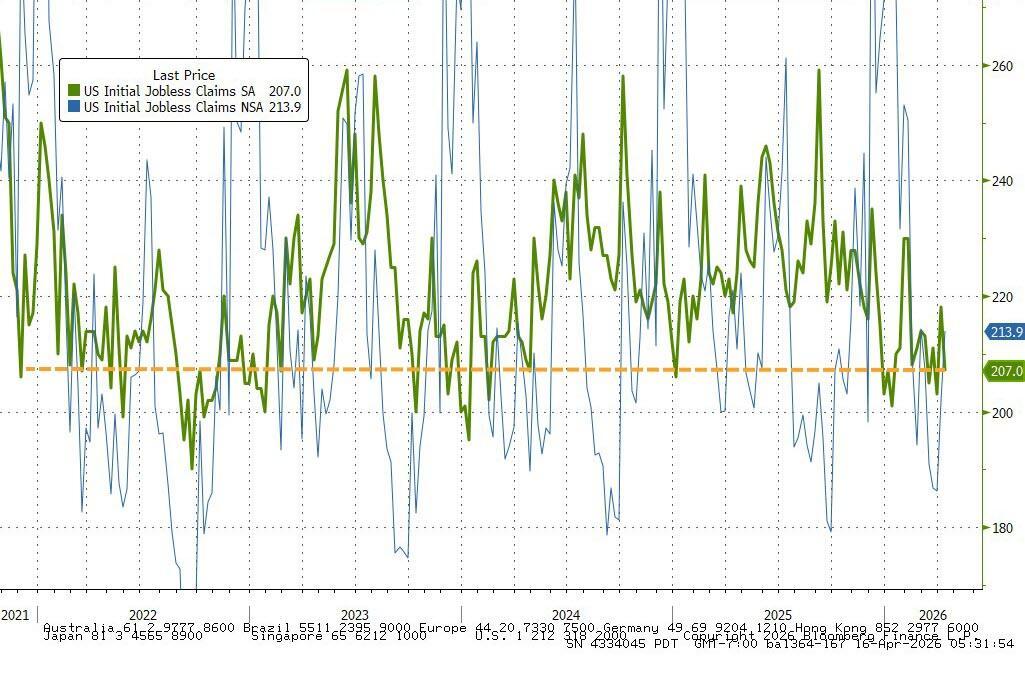
Source: Bloomberg
Despite a small pick up last week, Continuing jobless claims have been below the 1.9 million Maginot Line since the start of the year…
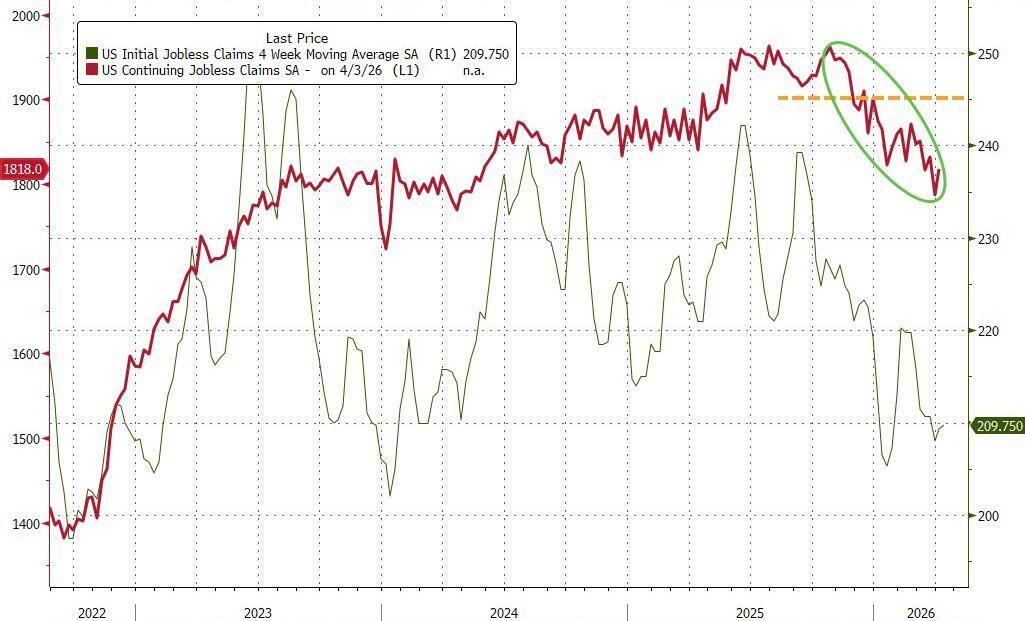
Source: Bloomberg
Finally, as the following chart suggests, while it may be “hard to get” a new job, firing remains very low…
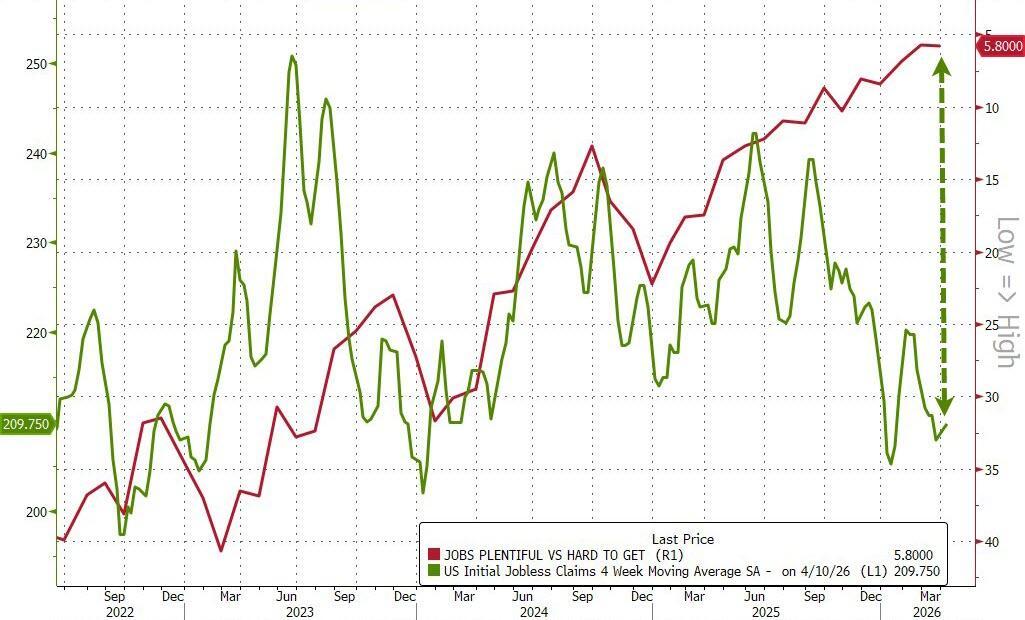
Source: Bloomberg
The ‘no hire, no fire’ economy is alive and kicking
END
US Industrial Production Unexpectedly Drops In March (After Huge Upward Revision For Feb)
Thursday, Apr 16, 2026 – 09:35 AM
At first glance the 0.5% MoM decline in US Industrial production (considerably worse than than the 0.1% MoM rise expected – and dragging YoY growth in IP down to +0.74%) is bad news… suggesting immediate impacts from the war are being felt and sparking headlines decrying President Trump’s actions.
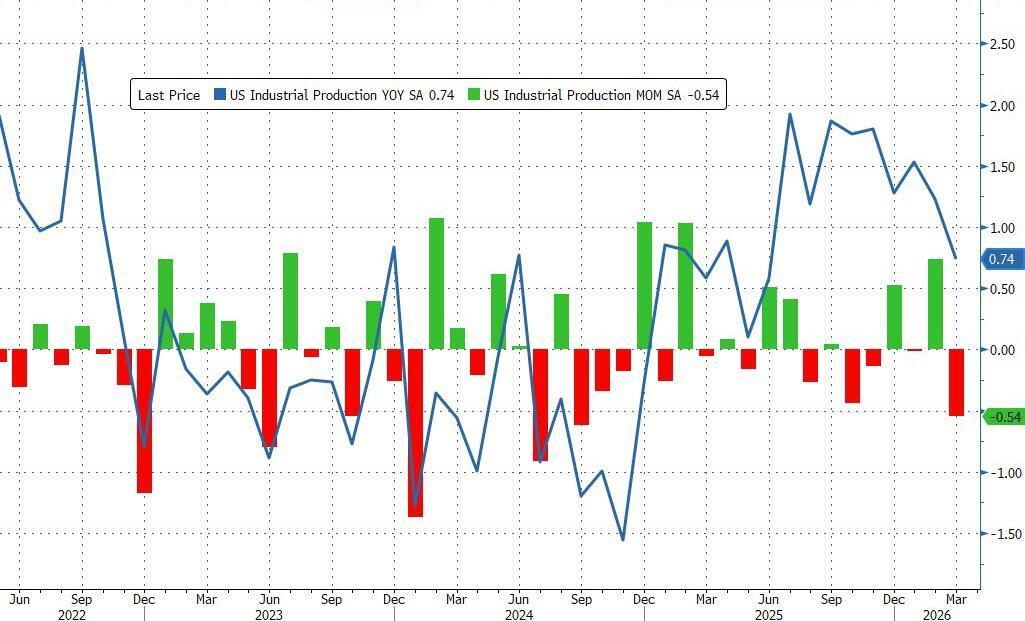
Source: Bloomberg
However, while we agree that the decline is notable, the fact that February’s data was revised drastically higher, from +0.2% to +0.7% MoM, means that over the two months, industrial production overall is actually higher (and up 0.2% since the end of the war)…
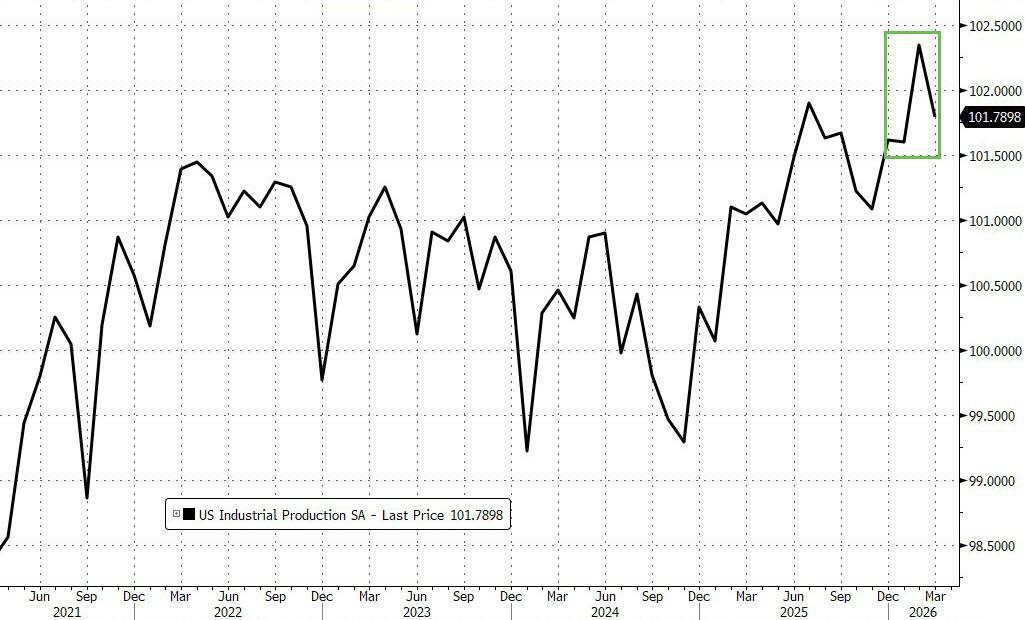
Source: Bloomberg
Energy was behind the slowdown:
- March oil and gas drilling posted a decline of 2.4% m/m after rising 0.6% in Feb., Federal Reserve data show.
- March consumer energy products was decline of 2.1% m/m after rising 2.3% in Feb.
- March commercial energy products declined 0.3% m/m after increasing 0.8% in Feb.
A similar picture evolves for Manufacturing production which fell 0.1% MoM in March (worse than the 0.1% MoM rise expected) after February’s 0.2% MoM rise was revised up 2x to a 0.4% MoM rise. Nevertheless, Manufacturing production YoY slowed to just 0.5%…
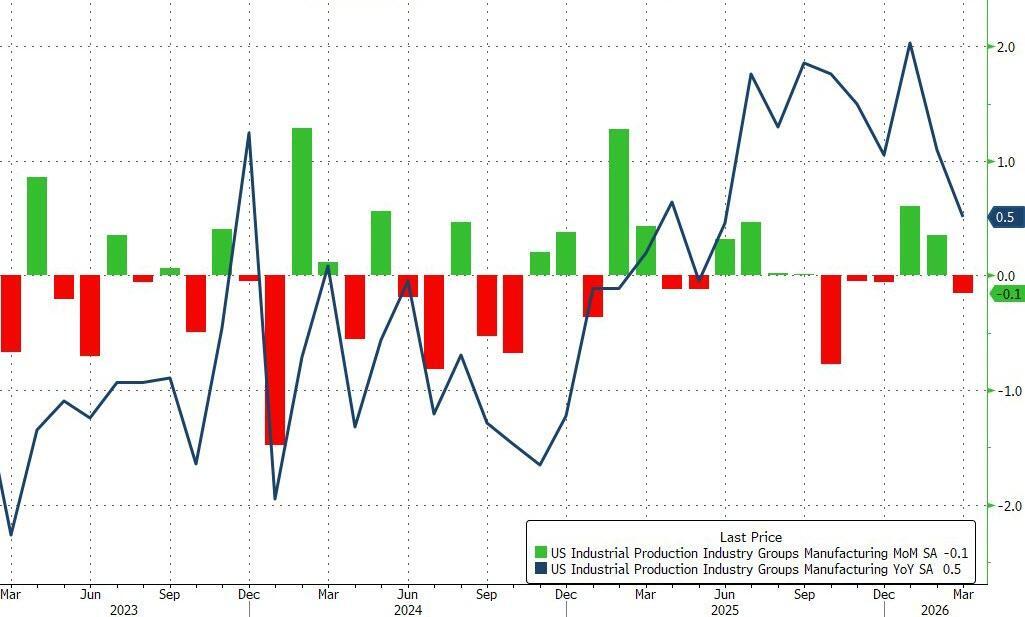
Source: Bloomberg
Bottom Line: it’s not great news that industrial production is slowing… but it’s not as dire as it looks at first glance (and remember Manufacturing PMIs were strong)… and energy production is unpredictable at best in the current environment.
USA ECONOMIC REPORTS
Beige Book Confirms Uncertainty, Fuel Costs Surged On Iran War As Economy Grew At “Slight To Modest” Pace
Wednesday, Apr 15, 2026 – 03:45 PM
US economic activity continued to increase at a “slight-to-modest” pace across most regions as the war with Iran generated a new wave of uncertainty and higher energy costs, the Federal Reserve said. The just released Beige Book – which featured information compiled by the New York Fed and collected through April 6, capturing the early effects of the war on the US economy – was the first one to discuss the state of the US economy after the Iran war started, and came at time when gas prices sstayed above $4/gal for two weeks after the biggest monthly jump in decades, with March fuel spending up 16% according to Bank of America card spending data.
So far, Bank of America said that discretionary spending remains resilient—but risks rise if Hormuz disruptions persist. The Fed agreed, with the Beige Book reporting that overall economic activity increased at a slight to modest pace in eight of the twelve Federal Reserve Districts, while two Districts reported little change (San Francisco and St Louis), and two Districts reported slight to modest declines (Boston and New York).
Price growth remained moderate overall, but energy and fuel costs rose “sharply” in all 12 Fed districts, the central bank reported in its Beige Book survey of regional business contacts released Wednesday.
“The conflict in the Middle East was cited as a major source of uncertainty that complicated decision-making around hiring, pricing and capital investment, with many firms adopting a wait-and-see posture,” the Fed said.
Bloomberg’s NLP model that measures net sentiment by evaluating hawkishness (+ score) and dovishness (- score) pictured below. Recent reading comes in at +1.2.
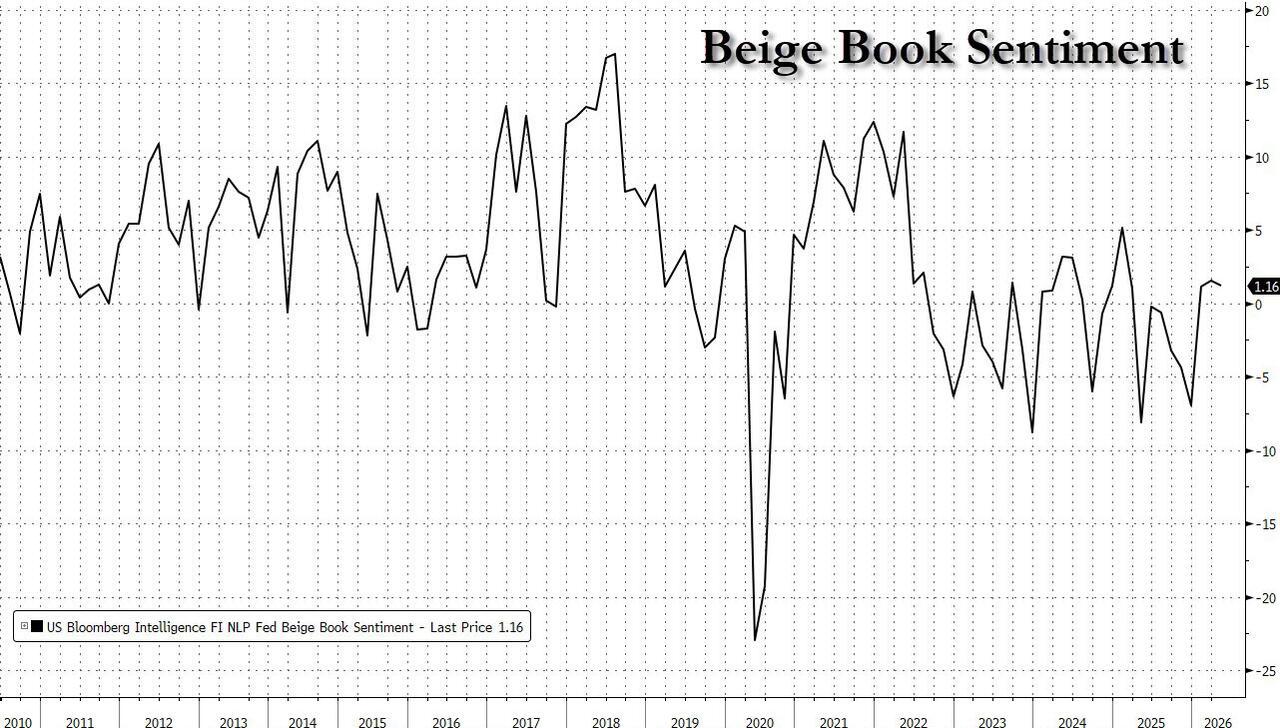
Several policymakers have signaled a preference to keep borrowing costs steady for quite some time while they evaluate the economic data. Officials are expected to leave their benchmark rate unchanged when they meet on April 28-29, according to pricing in futures contracts. A growing number of officials are concerned the war could fuel inflation, and more favored language at their March gathering that would have made it clear the Fed may need to raise interest rates.
Taking a closer look at the Beige Book, the conflict in the Middle East was cited as a major source of uncertainty that complicated decision-making around hiring, pricing, and capital investment, with many firms adopting a wait-and-see posture.
- Manufacturing activity rose slightly to moderately in most Districts. Banking sector activity was generally steady with loan demand stable to up moderately.
- On balance, consumer spending increased slightly despite harsh winter weather in some regions and higher fuel prices.
- Many Districts continued to report signs of consumer financial strain, increased price sensitivity, and rising demand at food banks and other social service organizations, while spending among higher-income consumers was resilient.
- Housing market activity softened across several Districts as heightened uncertainty and rising mortgage rates dampened buyer demand.
- Commercial real estate markets improved, with strength in industrial properties, especially data center projects. Office markets saw solid demand for Class A space but weaker demand for lower-tier properties.
- Energy activity was up slightly as oil prices rose, though many producers remained cautious about increasing drilling due to uncertainty about the persistence of higher prices. Agricultural activity was mixed, and several Districts reported that rising crop prices helped offset steep price increases of fertilizer and fuel.
- Business outlooks varied amid widespread uncertainty about future conditions.
In terms of Labor Markets, the Beige Book noted the following:
- On balance, employment was steady to up slightly during this reporting period, though one District noted a slight decline.
- Most Districts described labor demand as stable, with low turnover, minimal layoffs, and hiring mostly for replacement.
- Several Districts noted increased demand for temporary or contract workers, as firms remained cautious about committing to permanent hires.
- Many Districts reported that labor availability had improved, although difficulty finding some skilled workers, especially in the skilled trades, persisted.
- While most Districts indicated that AI had not yet significantly impacted overall staffing levels, some noted that AI-driven productivity improvements had enabled many firms to delay or reduce hiring. Wages generally continued to rise at a modest to moderate pace.
- Some Districts noted continued wage pressures for some roles in health care and the skilled trades, though overall wage competition remained muted.
Energy prices were sharply higher
- Price growth mostly remained moderate overall, with the vast majority of Districts reporting moderate increases and others pointing to modest growth. Generally, input cost increases outpaced selling price growth, compressing margins.
- Energy and fuel costs rose sharply in all Districts, attributed to the Middle East conflict, leading to higher freight and shipping costs and higher prices for plastics, fertilizers, and other petroleum-based products.
- Input cost pressures beyond energy-related increases were also widespread. Several Districts reported rising prices for metals due to tariffs, such as steel, copper, and aluminum. Technology costs rose for both hardware and software. Insurance premiums and health care costs continued to climb.
Finally, here are the main highlights by Fed districts:
- Boston: Economic activity declined slightly, employment and wages were flat, and prices rose at a moderate pace. Consumer spending was flat, as was activity in most sectors, but home sales slowed further. The conflict in the Middle East contributed to rising energy prices and created fresh uncertainty, though the outlook remained optimistic on balance.
- New York: Economic activity continued to decline modestly amid heightened uncertainty in large part due to shifts in tariff policy and the Middle East conflict. On balance, employment held steady, and wage growth remained modest. The pace of selling price increases remained moderate, and input price increases picked up markedly. Consumer spending grew slightly. Businesses generally expected little improvement in the months ahead.
- Philadelphia: Economic activity in the Third District grew slightly, down from a modest pace last period. Employment declined slightly, and wages again rose modestly. Prices continued to rise moderately, although cost pressures increased. Activity held steady for nonmanufacturers and increased moderately for manufacturers. Firms expect growth over the next six months, but uncertainty has risen further.
- Cleveland: Fourth District business activity increased modestly, with similar growth expected in the months ahead. Manufacturers reported increased demand, while retailers saw modest declines amid higher fuel prices. Residential real estate rebounded after a harsh winter. Employment grew slightly, and wages increased moderately. Nonlabor costs remained robust, while selling prices grew moderately.
- Richmond: The regional economy continued to grow modestly in recent weeks. Consumer spending on retail, travel, and tourism increased modestly. Nonfinancial service providers also reported modest growth in demand. Other sectors of the regional economy reported little change this cycle. Employment expanded slightly, wages picked up modestly, and price growth remained moderate.
- Atlanta: Economic activity grew at a modest pace. Employment remained flat and wages rose modestly. Prices and input costs also increased modestly. Retail sales and travel continued to expand. On balance, residential and commercial real estate conditions improved. Transportation and manufacturing activity expanded. Energy activity rose, but agricultural conditions were flat.
- Chicago: Economic activity in the Seventh District increased slightly over the reporting period. Manufacturing demand rose modestly; consumer spending increased slightly; construction and real estate activity, employment and business spending were flat on balance; and nonbusiness contacts saw no change in economic activity. Prices rose moderately, wages rose modestly, and financial conditions tightened modestly. Farm income expectations for 2026 declined some.
- St. Louis: Economic activity has remained unchanged since our previous report. Employment levels were unchanged and wage growth was moderate. Prices have risen moderately, but several contacts expressed concern about escalating energy costs. The outlook remains cautiously optimistic, yet contacts are attentive to risks to the economy associated with the conflict in the Middle East.
- Minneapolis: District economic activity increased slightly. Employment increased slightly and labor demand turned positive over the past two months. Prices increased modestly overall, but input price pressures intensified as oil price spikes fed through to freight and raw materials. Contacts across industries reported significant uncertainty.
- Kansas City: The Tenth District’s economy grew slightly over the reporting period, while employment levels remained flat. Manufacturing firms indicated suppliers have implemented automatic surcharges tied to logistics and energy inputs. District oil and gas activity remains steady. Overall, prices have increased modestly.
- Dallas: Economic activity in the Eleventh District expanded slightly. Manufacturing output growth slowed, while activity in services was largely flat. Energy sector activity ticked up, and bank lending increased on strength in commercial real estate, while home sales were slow. Employment grew slightly, while wages and prices increased modestly to robustly. Outlooks deteriorated amid elevated geopolitical uncertainty and fuel price concerns.
- San Francisco: Economic activity was stable at subdued levels over the reporting period. Employment levels were unchanged on net. Prices rose moderately, driven primarily by higher energy costs, while wages grew slightly. Retail sales grew slightly. Conditions were stable in services and manufacturing, down in agriculture, and mixed in real estate.
- END
END
IMF Warns US Treasury Market Prone To “Sudden Repricing” Due To Soaring Debt, Overreliance On Bills
Wednesday, Apr 15, 2026 – 05:20 PM
The International Monetary Fund warned Wednesday that the relentless US debt issuance is undermining the premium Treasuries have commanded from investors, with implications for government securities across the globe.
“The increase in the US Treasury security supply is compressing the safety premium that US Treasuries have traditionally commanded — an erosion that pushes up borrowing costs globally,” the Washington-based IMF said in its latest Fiscal Monitor report.
The US has been selling large volumes of debt because its budget deficit has averaged roughly 6% of gross domestic product over the past three years, an unprecedented shortfall outside of wartime or recession eras. The gap is expected to stay around those levels throughout the coming decade, according to the Congressional Budget Office. In reality, it will only get wider.

As Bloomberg reports, the IMF pointed to a narrowing gap between the yields of AAA rated corporate bonds and Treasuries as a sign of reduced appeal for US government securities. While spreads have typically been viewed as a gauge of the risk investors estimate for corporate borrowers, the fund is flipping that analysis on its head to view it as a metric of how much extra buyers are willing to pay for Treasuries.
“A narrowing spread implies that the premium investors pay for the safety and liquidity of Treasuries (relative to high-grade corporate debt) is compressing,” the IMF said. The fund showed that AAA corporate spreads have shrunk to roughly 35 basis points from more than 55 basis points at the start of 2019.

Besides funding runaway US debt, another danger flagged by the IMF was the increasing reliance of the US Treasury on sales of short-dated debt, a process launched by Janet Yellen and her Activist Treasury Issuance, and maintained ever since. Having initially criticized the Bill buildout, Treasury Secretary Scott Bessent last year said that it didn’t make sense to expand issuance of longer-dated securities, given that their yield levels were above those of T-Bills, which mature in under a year.

“When debt is concentrated at shorter maturities, governments must refinance more frequently, increasing their exposure to abrupt shifts in market conditions or investor sentiment,” the fund said, noting that the US – along with all other “developed” governments – has shifted reliance toward sales of bills.

Wednesday’s warnings come three weeks before Bessent’s Treasury sets out its latest plan for US debt issuance, known as the quarterly refunding policy statement.
Finally, the IMF also flagged the increasing role that hedge funds are playing in the Treasuries market, via so-called cash-futures basis trades, as a risk.
“The liquidity that hedge funds supply through such trades can be prone to flight, as it is backed by more-leveraged investors: a spike in volatility or financing costs can trigger forced unwinding, amplifying price dislocations,” it said.
Multiple elements – historically high borrowing needs, the composition of demand for Treasuries tilting toward hedge funds and the increasing reliance on shorter-dated securities – are contributing to increased vulnerability of the market to a “sudden repricing,” according to the IMF. These dynamics can also become self-reinforcing, the fund said.
“If investors grow concerned about a country’s rollover capacity, they may demand higher yields or step back from auctions of sovereign bonds altogether, validating the initial concern,” the IMF said, effectively explaining what happens when a Ponzi scheme stops working.
“The resulting political pressure to address rising costs of servicing debt may itself become a source of uncertainty that markets price in.”
Meantime, the Iran war will stoke new fiscal pressures, forcing governments to choose between cushioning their economies from rising energy costs or keeping a lid on borrowing, the IMF also said.
“The Middle East has added a new source of fiscal pressure to an already strained global landscape,” it said. “In a scenario of prolonged conflict, global debt-at-risk could increase by an additional 4 percentage points,” the IMF said, using a term that refers to the danger of repayment difficulties in an adverse scenario.

As finance ministers and central bankers from around the world gather in the US capital this week for the spring meetings of the IMF and World Bank, the fund chided most major economies on their fiscal policies, starting with the US which has “no debt consolidation plan in sight” – the IMF certainly is correct there – while China’s persistent large deficits are continuing to add to its borrowing load, which is also accurate, but fails to discuss China’s relentless dumping of products which are collapsing its core export markets as their manufacturing sectors implode as they can’t complete with Chinese state subsidies. Several European Union member nations have triggered escape clauses from the union’s rules on deficits in order to fund defense spending, the IMF noted.
But the US has a special role, given how reverberations in the Treasuries market spread across the world, the IMF said.
“The transmission is global: supply-driven increases in US yields spill over almost one-for-one to foreign bond markets, disproportionately affecting countries reliant on external financing,” the IMF said.
The full IMF Fiscal Monitor report can be found here.
END
DOJ Petitions Court To Toss Convictions Of Unpardoned Jan. 6 Defendants
Thursday, Apr 16, 2026 – 09:45 AM
Authored by Janice Hisle via The Epoch Times,
The Justice Department is petitioning an appeals court to throw out the convictions of unpardoned defendants who were charged in connection with the U.S. Capitol breach on Jan. 6, 2021.
“The United States has determined … that dismissal of this criminal case is in the interests of justice,” read a motion filed April 14 in the case of Elmer Stewart Rhodes III, Kelly Meggs, Kenneth Harrelson, and Jessica Watkins.
All four defendants belonged to the Oath Keepers, a group that says its members are mostly former military, police, and medics who are dedicated to upholding Constitutional rights. Rhodes, the group’s founder, had been one of the most high-profile Jan. 6 defendants; he was sentenced to 18 years in prison for seditious conspiracy and other charges.

In their motion filed in the U.S. District Court for the District of Columbia, federal prosecutors said they would file separate motions-to-vacate in “similar” Jan. 6 cases.
Those cases involve four other Oath Keepers—Roberto Minuta, Edward Vallejo, David Moerschel, and Joseph Hackett—along with Proud Boys members Ethan Nordean, Joseph Biggs, Zachary Rehl, and Dominic Pezzola.
The Proud Boys group has said it is open to men who are “gay or straight,” and of all races and religions who support Western values that created the modern world.
After being sworn in as the 47th president in 2025, President Donald Trump granted full pardons to about 1,500 people who faced Jan. 6 charges.
However, he stopped short of pardoning 14 defendants who were Oath Keepers and Proud Boys.
He instead commuted their sentences, leaving their convictions still standing.
Cases involving 12 of those defendants are part of the motion that U.S. Attorney Jeanine Pirro signed on April 14.
The remaining two defendants who had not received pardons include Oath Keeper associate Thomas Caldwell, who received a delayed presidential pardon in March 2025. The other is former Proud Boy Jeremy Bertino, who admitted guilt and served as a prosecution witness against other Proud Boys.
If the Washington appeals court vacates the convictions as requested, prosecutors then would move to dismiss the cases “with prejudice,” Pirro wrote.
That specification would permanently bar prosecutors from refiling the charges.
Since 1977, the U.S. Supreme Court has “recognized that appellate courts have authority” to take the action Pirro has requested, the filing said.
Some members of the Oath Keepers and Proud Boys did receive pardons, including former Proud Boys national chairman Henry “Enrique” Tarrio. He had been convicted of seditious conspiracy and other charges that brought a 22-year sentence—the longest meted out to any Jan. 6 defendant.
Last year, Tarrio, Biggs, Rehl, Nordean, and Pezzola filed a $100 million civil lawsuit against the federal government, alleging prosecutors violated their constitutional rights.
Nicholas Smith, an attorney who represents Nordean, expressed gratitude to the Justice Department for its “wise decision” in seeking dismissal of the convictions.
“We don’t want a precedent that says that any physical confrontation between protesters and law enforcement means a crime akin to treason, such as seditious conspiracy,” Smith said.
However, former Metropolitan Police Officer Michael Fanone, who suffered a heart attack after a rioter shocked him with a stun gun on Jan. 6, spoke out against the Justice Department’s motion to throw out the convictions.
“I would remind Americans that these were traitors to this country,” Fanone said. “They planned, incited, and carried out an insurrection.”
In a post on X, John Strand, a Jan. 6 defendant and conservative activist, said the government’s move constituted “exoneration” for defendants who were “entrapped and crushed by an evil, weaponized government.”
VICTOR DAVIS HANSON
KING NEWS
| The King Report April 16, 2026 Issue 7722 | Independent View of the News |
| Fangs rallied sharply early on coming earnings results and pattern buying. This boosted Nasdaq, the Naz 100, and the S&P 500 Index. The DJIA was down smartly in early trading; the DJTA was down sharply. U.S., IRAN SAID to WEIGH EXTENDING THEIR CEASEFIRE by TWO WEEKS – BBG Trump says China will not send weapons to Iran, ‘permanently’ opening Strait of Hormuz Trump said China and the U.S. are “working together smartly,” which is better than fighting. https://justthenews.com/politics-policy/all-things-trump/trump-says-china-will-not-send-weapons-iran-permanently-opening ESMs vacillated between moderate gains and small losses from their 18:00 ET opening on Tuesday night until they broke lower at 6:15 ET. After hitting the daily low of 6991.75 (-13.00) at 6:32 ET, ESMs commenced a rally that accelerated after the NYSE opening. Retail traders got very jiggy. ESMs hit a daily high of 7040.25 (+ 35.75), and the S&P 500 Index hit 7001.92, at 12:23 ET. When it became clear that there was NOT enough gusto to push the S&P 500 Index above its all-time high of 7002.28, traders dumped ESMs. After dropping to 7019.25 at 12:56 ET, the 2nd attempt to generate a new S&P 500 Index high commenced; it was successful. ESMs surged to 7064.50 and the S&P 500 Index hit 7026.24 at 15:55 ET. WH Press Sec Leavitt: “I saw some bad reporting this morning that we formally requested an extension of the ceasefire. That is NOT true. At this moment we remain very much engaged in these negotiations.” @N12News: Reuters, citing a source close to Tehran: Iran may consider allowing ships to sail on the Omani side of the Strait of Hormuz without interference or attack, as part of a deal with the US. Iran will maintain control over the waters in its territory in the Strait of Hormuz, and Oman will decide regarding its side. @bourscheid: Rumors are swirling that Scott Bessent got into a physical fistfight with Kevin Hassett this morning over economic policy disagreements. @Geiger_Capital: One of the great political moves by the left in recent years has been convincing a large portion of America that “the rich” don’t pay taxes and it’s all poor people, when the exact opposite is true. The Top 1% pay 46% of all income taxes. The Top 10% pay 76% of all income taxes. Positive aspects of previous session Fangs soared and drove Nasdaq and the Naz 100 sharply higher. Nasdaq rallied for the 11th consecutive day, its longest positive streak since 2021 The S&P 500 Index hit an all-time high. Negative aspects of previous session The DJTA got hammered in early trading; the DJIA declined smartly. USMs declined moderately while oil rallied modestly and gasoline rallied smartly. Ambiguous aspects of previous session Is the momentum top for stocks forming? (Top progression: momentum, volume, price) Is Team Trump fudging economic data and intervening in the stock market? First Hour/Last Hour NYSE Action [S&P 500 Index]: 1st Hour: Up; Last Hour: Up Pivot Point for S&P 500 Index [above/below indicates daily trend to day traders]: 7005.44 Previous session (S&P 500 Index) High/Low: 7026.24; 6967.13 ‘The Timing Is Suspicious’: Intel IG Admitted Under Oath He Changed Whistleblower Rules For Anti-Trump Ukraine Op In 2019 https://thefederalist.com/2026/04/14/the-timing-is-suspicious-intel-ig-admitted-under-oath-he-changed-whistleblower-rules-for-anti-trump-ukraine-op-in-2019/ Though polls show Americans overwhelmingly (83% to 85% depending on poll) support voter ID, Senate Republican leadership refuses to act. Everyone with an ounce of common sense knows Dems have rigged elections for over a century – and Dems benefit most from vote fraud. GOP solon reluctance to halt vote fraud strongly implies that numerous GOP solons benefit from vote fraud, mostly in primaries. Today – Yesterday’s King Report: The usual suspects will try to force key equity indices to new all-time highs, abetted by the unshakable hope for an Iran deal and pattern buying for Q1 Earnings Results… The usual suspects will ‘shoot for the number’ today, barring bad news. Now that the S&P 500 Index, Nasdaq, and the Naz 100 were forced to record highs, traders have no ‘numbers to shoot for.’ The game today, barring news, will be to orchestrate as many ‘pump & dumps’ as possible on patsies. This means juicing ESMs & NQMs in overnight and early US trading, then dumping. @bespokeinvest: Since 1928, this is the first time the S&P has made new all-time highs in 11 days or fewer after falling 5-10%. (This is French for the S&P 500 Index is grossly overbought and overvalued. Netflix is expected to report .84 EPS after the close. This is the official start of Fang reporting season. ESMs are +13.75; NGMs are +74.75; USMs are +1/32; and gas & oil are down moderately at 20:55 ET. Expected Economic Data: Initial Jobless Claims 213k, Continuing Claims 1.81m; March Industrial Production 0.1% m/m, Mfg. Production 0.1%, Capacity Utilization 76.3%; NY Fed Pres Williams 8:35 ET, Fed Gov Miran 10:35 ET S&P Index 50-day MA: 6762; 100-day MA: 6813; 150-day MA: 6779 200-day MA: 6675 DJIA 50-day MA: 47,956;100-day MA: 48,154; 150-day MA: 47,650; 200-day MA: 46,917 (Green is positive slope; Red is negative slope) S&P 500 Index (7022.95 close) – BBG trading model Trender and MACD for key time frames Monthly: Trender and MACD are positive – a close below 6035.78 triggers a sell signal Weekly: Trender and MACD are negative – a close above 7137.44 triggers a buy signal Daily: Trender and MACD are positive – a close below 6775.56 triggers a sell signal Hourly: Trender and MACD are positive – a close below 6992.32 triggers a sell signal “To admit foreigners indiscriminately to the rights of citizens, the moment they put foot in our country would be nothing less than to admit the Grecian Horse into the citadel of our liberty and sovereignty.” – Alexander Hamilton @WojPawelczyk: Here’s what Pope Benedict XVI had to say about migration: “States have the right to regulate migration flows and to defend their own frontiers, always guaranteeing the respect due to the dignity of each and every human person. Immigrants, moreover, have the duty to integrate into the host country, respecting its laws and its national identity.” – Papal Message for the 97th World Day of Migrants and Refugees, 2011… (A probably reason for his ‘removal’) DHS employee murdered while walking dog by criminal immigrant who was naturalized under Biden: feds https://nypost.com/2026/04/15/us-news/georgia-murder-suspect-olaolukitan-adon-abel-naturalized-citizen-from-uk/ @Patriot_Josh11: Mentally Ill Woman Released by Nebraska Courts Kidnaps and Slashes 3-Year-Old Boy in the Face at Walmart Before Hero Cops Shoot Her https://t.co/23jsw4E3H0 Devastated son blasts ‘animal’ squatter who stomped NYC mom to death as she planned fresh start https://trib.al/ktt53QT @EricLDaugh: Outrage is erupting nationwide after a known violent criminal with over 60 CHARGES killed US Marine Daniel Montano, 21, in Wilmington NC. Davy Spencer LENGTHY record includes felonies and violent offenses. They knew. But judges released him. https://x.com/EricLDaugh/status/2043009977632137349 @newsbusters: ABC, CBS, and NBC are refusing to cover violent crimes committed by illegals. Why are the media actively protecting illegal immigrants? https://newsbusters.org/blogs/nb/geoffrey-dickens/2026/04/15/censored-four-new-heinous-illegal-immigrant-crimes-buried Chicago seeks to shut down Ford City Mall, calls it a magnet for crime https://www.fox32chicago.com/news/ford-city-mall-shutdown-effort Illinois property taxes up 27% under Pritzker … from $31.8 billion in 2018 just before he took office to $40.37 billion in 2024… Illinois public schools are primarily funded by property taxes. But school districts are forced to rely so heavily on those taxes in part because the state diverts a growing share of its education spending to pensions instead of classrooms… https://www.illinoispolicy.org/illinois-property-taxes-up-27-under-pritzker/ Gov. Hochul proposes taxes on NYC homeowners who own second house worth more than $5M https://trib.al/SaqzrGE Yet Another Historic Church Torched in Canada A historic church, originally built in 1893 and standing for over a century, was destroyed by flames Monday evening in Saint-Romain, between Beauce and Estrie in the province of Quebec… According to CBC News’ 2024 investigation (covering May 2021 to Dec 2023), at least 33 Canadian churches burned to the ground. 24 confirmed arsons, only 2 were accidental, rest suspicious/under investigation. Only 9 arrests made. All over the West our historic Churches & heritage buildings are being burnt to the ground. The same thing is happening all over Europe… https://www.zerohedge.com/political/yet-another-historic-church-torched-canada @TheOfficerTatum: Bill Maher: “I’m not a Christian, but they are systematically killing Christians in Nigeria. They’ve killed over 100,000. They’ve burned 18,000 churches. They are literally attempting to wipe out the Christian population of an entire country. Where are the kids protesting this?” | |
SWAMP STORIES FOR YOU TONIGHT
another one!!
Mullin Blasts Biden Admin After DHS Employee Killed By Naturalized Felon
Wednesday, Apr 15, 2026 – 04:40 PM
On Monday, Lauren Bullis, a 40-year-old Department of Homeland Security (DHS) employee, was “brutally shot and stabbed to death” while walking her dog, and DHS Secretary Markwayne Mullin is blaming the Biden administration for her murder.

Bullis, an auditor with the DHS Office of Inspector General, was found on Battle Forest Drive in DeKalb County, Georgia, around 6:50 a.m. Witnesses saw a man standing over her body before he fled. She was not the only victim. According to reports, a neighbor heard the gunfire and ran out of her house to see what was happening. The neighbor told local media that it appeared Adon-Abel was attempting to sexually assault Bullis.
Before Bullis died, police discovered another woman had been shot multiple times outside a Checkers & Rally’s restaurant. She later succumbed to her injuries. Then, in Brookhaven, a homeless man was ambushed while sleeping outside a shopping center. He was shot several times and remains in critical condition.
That suspect is Olaolukitan Adon-Abel, 26, born in the United Kingdom and naturalized as a U.S. citizen in 2022 under the Biden administration. Adon-Abel was arrested on Monday and now faces two counts of murder, aggravated assault, possession of a firearm during the commission of a crime, and possession of a firearm by a convicted felon. As a convicted felon, he not only shouldn’t have had a gun, but according to federal law, he should not have been a citizen either.
Adon-Abel had convictions for sexual battery, battery against a police officer, obstruction, assault with a deadly weapon, and vandalism — a trail of violence spanning years. And yet, in 2022, the Biden administration’s U.S. Citizenship and Immigration Services granted him full citizenship. The legal standard for naturalization, as outlined in 8 U.S.C. § 1427, requires applicants to demonstrate “good moral character.” Someone who has assaulted a police officer and committed sexual battery should not clear that bar.
“Yesterday, a DHS employee, Lauren Bullis, was brutally shot and stabbed to death by Olaolukitan Adon Abel, a 26-year-old born in the United Kingdom, who was naturalized by the Biden Administration in 2022,” DHS Secretary Markwayne Mullin said in a statement to Fox News. “Since President Trump took office, USCIS has implemented measures to ensure individuals with criminal histories and who otherwise lack good moral character do not attain citizenship.”
Mullin continued, “He possesses a prior criminal record that includes convictions for sexual battery, battery against a police officer, obstruction, and assault with a deadly weapon, vandalism and now stands accused of murdering DHS employee Lauren Bullis by shooting and stabbing her while she walked her dog. He has also been arrested for the murder of an unidentified woman whom he reportedly shot outside a Checkers, before randomly shooting a homeless man multiple times outside a Kroger in Brookhaven.”
He added, “These acts of pure evil have devastated our Department, and my prayers are with the families of the victims.”
The Biden administration routinely dismissed concerns about immigration vetting as fearmongering. Critics who raised red flags about naturalization standards were called nativists or worse. But the standard is not political — it is statutory. Federal law bars naturalization for individuals who cannot demonstrate good moral character, and multiple violent criminal convictions are about as clear a disqualifier as exists in the code.
END
BALTIMORE
Build It, And They Will Come? Not The Case At Baltimore’s Harbor East Luxury Tower
The Four Seasons Private Residences in Harbor East, situated in crime-ridden Baltimore City and serving as a flagship luxury development project tied to the Inner Harbor’s waterfront revitalization, was originally envisioned as an ultra-luxury tower designed to attract the rich and powerful. The premise for building the tower, which opened in 2017, was very simple: build it, and they will come.
The Paterakis family, one of the most prominent business and real estate families in the Baltimore metro area, best known for their baking empire and for transforming part of the city’s waterfront over the decades, backed the Four Seasons Private Residences project, with one-bedroom condos hitting the market in 2017 for $1 million.

Yet the saying “build it, and they will come” didn’t play out here, as the latest report from local outlet Baltimore Banner says a third of the 62 condos “have never sold,” and the current listing price now “starts in the $500,000s.”

Three investors told the local outlet that “the true price is even lower” for these one-bedroom units. That would suggest a 50% collapse in value over just nine years since the 2017 debut.
The outlet continued:
The trio scooped up 11 units at the Four Seasons last year. Now they’re suing Harbor East Parcel D-Residential LLC in Baltimore Circuit Court, accusing the seller of artificially inflating the sale price listed in public records. Harbor East Parcel-D Residential is the limited liability company used by the Paterakis family and other investors to own and sell the condos. George Philippou, a son-in-law of Paterakis Sr., signs deeds and other property records on behalf of the company.
David J. Shuster, an attorney for the limited liability company, said in a statement that the claims in the lawsuit are without merit and declined to comment further, citing the ongoing litigation. The Four Seasons, a Toronto-based company that operates resorts, hotels and condos around the world, did not respond to a request for comment.
Paterakis’ bad bet on the ultra-luxury tower in Harbor East appears to be following a similar pattern to other high-profile redevelopment projects around the Inner Harbor, including Under Armor CEO Kevin Plank’s Baltimore Peninsula project, which has struggled.
Let’s not forget that the actual Inner Harbor is virtually a ghost town:
At a broader level, the common denominator behind these redevelopment failures is impossible to ignore: Baltimore’s population has collapsed to a 100-year low in a relatively short period, eroding demand for urban revival projects. Much of that decline can be linked to a city and state controlled by unhinged Democratic Party kings and queens, pushing far-left policies that have only backfired into a California-style exodus of residents.
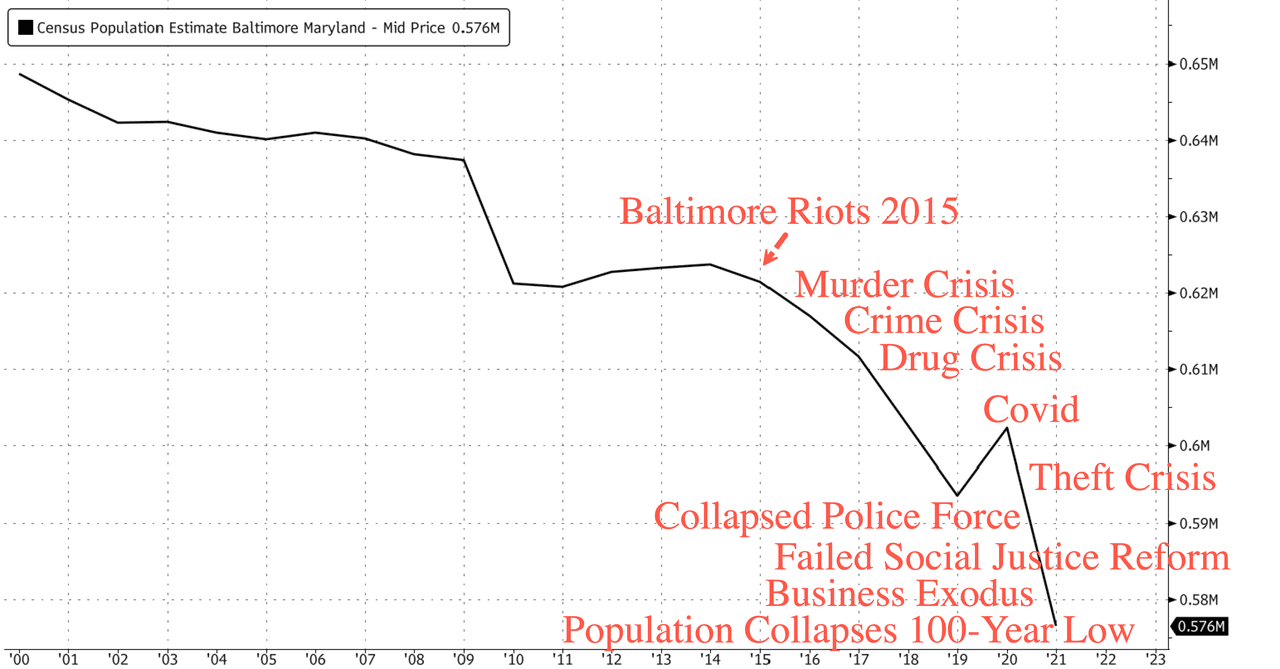
Baltimore’s failure is a direct result of the one-party rule of Democratic queens and kings who appear to have done nothing but economically sabotage the state.
But the story here takes a twist because there is a movement inside the business community, especially among Sinclair Executive Chairman David Smith, to combat the far-left crazies who run the city and state through information warfare. Democrats have freaked out that Smith bought the largest paper in the state, The Baltimore Sun, as the left-wing regime has failed to counter the narratives, while left-wing Gov. Wes Moore’s polling data implodes.
Alex Soros & Gov. Moore.

Here’s a novel idea for the business community that has watched its state and city implode under a far-left regime: it’s time to go on the offensive and ensure common-sense politicians are elected in future elections, rather than left-wing activists who have no problem abusing taxpayers and looting state coffers for progressive projects, such as this:
Meanwhile, just an hour south: “D.C. Economy “Under Strain,” Faces Biggest Spending Cuts Since Great Recession.”
END
CBS ’60 Minutes’ Left Out The Most Damning Part Of The Story
Wednesday, Apr 15, 2026 – 10:35 PM
Submitted by American Truckers United,
Over the last year, the American people have awakened to the reality of truck drivers unable to speak English, operating with non-domicile CDLs, and wreaking havoc on our roadways. What had yet to gain national attention was the ownership behind these illicit trucking companies. The 60 Minutes special that aired this weekend finally changed that by exposing one of the worst “chameleon carriers” in the industry.
The CBS report laid out the crisis in stark detail. The motor carrier mentioned is a Serbian-based network that repeatedly sheds its identity—changing names and USDOT numbers—to erase thousands of safety violations and hundreds of crashes. Drivers described forced 18-hour days, ELD cheating orchestrated by dispatchers in Serbia, and paychecks that came back negative after excessive lease, insurance, and repair fees were skimmed off the top. The carrier network racked up nearly 15,000 violations and 500 accidents in just two years while hauling freight for major shippers. Yet the carrier insists it is merely a “leasing company,” not a motor carrier, and therefore bears no responsibility for the trucks or drivers operating under its trailers.
60 Minutes built a compelling case that dismantled their narrative.
What 60 Minutes likely left on the cutting-room floor is the most damning part of the story: who keeps loading these illegal carriers with freight in the first place? Who failed—or refused—to vet the motor carrier, its foreign ownership, or its forced-labor operations?
The answer points directly to freight brokers, with industry giant C.H. Robinson at the forefront. Despite the motor carrier not being a registered motor carrier with the USDOT, C.H. Robinson awarded it “Carrier of the Year” in the 1,000+ truck category for 2025. Industry sources allege that the selection process for this award involves rigorous vetting and requires final approval from upper management. Such high-level oversight strongly suggests that senior leadership at C.H. Robinson may have been directly involved in bestowing one of its most prestigious honors on a well-known chameleon carrier.
END
ANOTHER BIDEN CRIME AGAINST TRUMP:
Gabbard Sends Criminal Referrals For 2019 Trump Impeachment Whistleblower, IG Coverup
Wednesday, Apr 15, 2026 – 10:10 PM
On Monday, DNI Tulsi Gabbard and the House Intelligence Committee released declassified transcripts revealing that the whistleblower whose complaint about Trump and Zelensky’s ‘perfect call’ as an extreme parisan who had a “prior professional relationship with one of the Democratic Presidential candidates,” and despite those facts, former-Intelligence Community Inspector General (ICIG) Michael Atkinson claimed “I did not find the complainant (whistleblower) was biased.”

Well, tonight they’re the recipients of two criminal referrals. Director of National Intelligence Tulsi Gabbard on Wednesady referred who is believed to be former CIA analyst Eric Ciaramella – along with the former intelligence community inspector general who fast-tracked it – for potential criminal investigation, the Office of the Director of National Intelligence announced Tuesday.
The referrals to the Justice Department, first reported by Fox News and confirmed by multiple officials familiar with the matter, come days after Gabbard’s office declassified more than seven-year-old transcripts and supporting documents that Democrats and the intelligence community had kept under wraps since the fall of 2019. The newly public records raise fresh questions about the origins and handling of the complaint that accused Trump of pressuring Ukraine to investigate Joe Biden and his son Hunter.
Ciaramella was a CIA analyst detailed to the National Security Council at the time. According to the declassified materials, he had no firsthand knowledge of Trump’s July 25, 2019, phone call with Ukrainian President Volodymyr Zelenskyy and instead relied on secondhand accounts from NSC colleagues. He was a registered Democrat who had previously worked on Ukraine policy under then-Vice President Biden – including traveling with him – and had pre-complaint contacts with Democratic staff on the House Intelligence Committee, including aides to then-Chairman Adam Schiff (D-Calif.), the records show.
Former Intelligence Community Inspector General Michael Atkinson, who received the complaint in August 2019, is accused in the declassified files of deviating from standard procedures. He allegedly changed the whistleblower complaint form to accommodate hearsay information, ignored Justice Department guidance that the complaint did not qualify as an “urgent concern,” did not review the actual call transcript, and relied on a narrow set of interviews – including one with a witness who had co-authored the controversial 2017 Intelligence Community Assessment on Russian election interference and had ties to former FBI official Peter Strzok.

Gabbard, a Trump ally installed as DNI earlier this year, framed the declassification and referrals as long-overdue accountability.
“Deep state actors within the Intelligence Community concocted a false narrative that was used by Congress to usurp the will of the American people and impeach the duly-elected President of the United States,” Gabbard said in a statement accompanying the release. “Inspector General Atkinson failed to uphold his responsibility to the American people, putting political motivations over the truth.”
The ODNI general counsel’s referral letter, obtained by outlets covering the story, cited possible violations of federal criminal law by “one or more former employees of the intelligence community,” specifically referencing Atkinson’s 2019 congressional briefings.
The declassified package – released by the House Permanent Select Committee on Intelligence at the request of Chairman Rick Crawford (R-Ark.) following a March 24 committee vote – includes closed-door transcripts of Atkinson’s 2019 testimony before the panel. Those transcripts had been withheld from Trump’s defense team during the impeachment proceedings and from the broader public for more than seven years.
The move revives one of the most contentious chapters of Trump’s first term and comes as his second administration aggressively pursues investigations into perceived abuses by the intelligence community during the Russia investigation, the 2020 election challenges and both impeachments.
Schiff, now a senator from California, and other Democrats involved in the original impeachment have not yet commented publicly on the latest developments. A spokesman for the House Intelligence Committee under Democratic control in 2019 called the declassification “a partisan stunt designed to rewrite history.”
This is not merely a failure of due diligence. It reflects a pattern of willful blindness, driven by greed, that prioritizes profit margins over safety, regulatory compliance, and the integrity of America’s trucking industry.
Large freight brokers have spent the past six years expanding their market share by abandoning legacy American-owned asset-based carriers and instead tapping a new, captive capacity source: foreign networks running what amounts to organized forced-labor schemes. Dispatch operations remain in foreign countries while unsafe trucks terrorize American highways. The brokers pocket the margin; the public pays the price in crashes, congestion, and national-security risks.
Trucking is the backbone of U.S. supply chains. When middlemen profit by partnering with chameleon carriers that exploit truck drivers, they do more than undercut honest American trucking companies—they corrupt a dangerous occupation that is critical to our economy and national defense.
This scandal extends far beyond the chameleon carriers themselves. It lies with the large freight brokers, the real profiteers, who continue to provide them with freight and access to the highways, accelerating the decline of American-owned trucking companies while leaving crash victims and their families without meaningful accountability or support.
Hold the brokers accountable for what they have done to our industry! Demand Accountability! Demand Broker Liability!
END
Former Virginia Lt. Gov. Justin Fairfax And Wife Found Dead In Apparent Murder-Suicide
Thursday, Apr 16, 2026 – 10:05 AM
Justin Fairfax, the former lieutenant governor of Virginia, and his wife, Cerina Fairfax, a dentist, were found dead in an apparent murder-suicide at their home shortly after midnight on Thursday, according to Fairfax County police.
Fairfax, 47, shot and killed his wife before turning the gun on himself, Police Chief Kevin Davis said. The couple’s teenage children were home at the time of the shootings.
Davis described the deaths as the result of an “ongoing domestic dispute surrounding a complicated or messy divorce.” Court records show that the Fairfaxes had been engaged in divorce proceedings this year.
Fairfax, a Democrat, served as Virginia’s lieutenant governor from 2018 to 2022 after winning election in 2017 alongside Gov. Ralph Northam. He largely remained out of the spotlight until 2019, when a series of scandals engulfed the state’s Democratic leadership.
The crisis began when old medical school yearbook photos surfaced appearing to show Governor Northam in blackface. As calls mounted for Northam’s resignation, two women came forward to accuse Mr. Fairfax, who would have been next in line for the governorship, of sexual assault. One alleged the assault occurred in 2000 at Duke University; the other said it took place in 2004 at the Democratic National Convention, the NY Times reports.
Fairfax denied both allegations – but the accusations effectively stalled momentum to force Northam from office. The situation grew more chaotic when the state attorney general, the third-ranking Democrat in Virginia’s executive branch, admitted he too had worn blackface as a college student. All three men ultimately served out their full terms.
Insisting he had done nothing wrong, Fairfax launched a bid for governor in the 2021 Democratic primary. In one televised debate, he accused his rival, former Gov. Terry McAuliffe, of “treating me like Emmett Till” for calling on him to resign over the sexual assault allegations.
With minimal institutional support and limited fundraising, Fairfax finished fourth in the primary, receiving just 3.6 percent of the vote. Mr. McAuliffe won the nomination but lost the general election to Republican Glenn Youngkin.
Fairfax had kept a low public profile since leaving office. Thursday’s tragedy marks a grim end to a once-promising political career that was repeatedly overshadowed by scandal and personal turmoil.
GREG HUNTER…