
EXCHANGE: COMEX
CONTRACT: MAY 2026 COMEX 100 GOLD FUTURES
SETTLEMENT: 4,539.800000000 USD
INTENT DATE: 05/21/2026 DELIVERY DATE: 05/26/2026
FIRM ORG FIRM NAME ISSUED STOPPED
099 H DEUTSCHE BANK AG 26
363 H WELLS FARGO SECURITI 231
555 C BNP PARIBAS SEC CORP 177
661 C JP MORGAN SECURITIES 60
686 C STONEX FINANCIAL INC 11
905 C ADM 21
TOTAL: 263 263
MONTH TO DATE: 6,573
MONTH TO DATE: 6,573
GOLD: NUMBER OF NOTICES FILED FOR MAY/2026: 263 CONTRACTs NOTICES FOR 26,300 OZ or 0.8180 TONNES
total notices so far: 6573 contracts FOR 657,300 OZ OR 20.444 TONNES
SILVER NOTICES: 0 NOTICE(S) FILED FOR 0.000 MILLION OZ /
total number of notices filed so far this month : 5681 CONTRACTS (NOTICES) for 28.405 million oz
SILVER//OUTLINE
INITIAL STANDING FOR JANUARY: 22.915 MILLION OZ FOLLOWED BY TODAY’S 1.185 MILLION OZ QUEUE JUMP//NEW NORMAL STANDING ADVANCES TO 49.445 MILLION OZ// TO WHICH WE ADD OUR FIRST EXCHANGE FOR RISK FOR .100 MILLION OZ//NEW STANDING ADVANCES TO 49.545 MILLION OZ!!
INTIAL STANDING FOR FEBRUARY/SILVER: 13.505 MILLION OZ FOLLOWED BY TODAY’S HUGE 0.005 MILLION OZ QUEUE JUMP / : NEW STANDING FOR SILVER AT THE COMEX ADVANCES TO 25.180 MILLION OZ. BUT WE MUST ADD OUR FIRST EXCHANGE FOR RISK OF 25 CONTRACTS FOR .125 MILLION OZ AND THEN OUR SECOND EXCHANGE FOR RISK OF .0600 MILLION OZ TO OUR THIRD HUGE 2.825 MILLION OZ EXCHANGE FOR RISK!!
INITIAL STANDING FOR MARCH: A SURPRISINGLY LOW 31.076 MILLION OZ/ FOLLOWED BY A TINY QUEUE JUMP OF 1 CONTRACTS OR 0.005 MILLION OZ/NEW STANDING ADVANCES TO 46.060 MILLION OZ
INITIAL STANDING FOR APRIL: 7.120 MILLION OZ FOLLOWED BY TODAY’S 1 CONTRACT QUEUE JUMP WHERE 5,000 OZ WILL TAKE DELIVERY OVER ON THIS SIDE OF THE POND. NEW STANDING FOR SILVER AT THE COMEX THUS ADVANCES SLIGHTLY TO 16.565 MILLION OZ PLUS WE MUST ADD OUR 4TH EXCHANGE FOR RISK ISSUANCE OF 17 CONTRACTS OR 0.085 MILLION OZ. THESE WILL BE ADDED TO OUR OTHER 3 ISSUANCES //NEW TOTAL EXCHANGE FOR RISK//1.165 MILLION OZ// NEW TOTAL SILVER STANDING 17.730 MILLION OZ//
INITIAL STANDING FOR MAY: 31.495 MILLION OZ FOLLOWED BY A 5 CONTRACT QUEUE JUMP FOR 0.025 MILLION OZ// AND THEN TO BOOT WE HAD OUR FIRST EXCHANGE FOR RISK ISSUANCE FOR 51 CONTRACTS OR 255,000 OZ MAY 21./STANDING BEFORE EXCHANGE FOR RISK: 32.125 MILLION OZ/NEW STANDING THUS ADVANCES TO 32.380 MILLION OZ/.//(32.125 MILLION OZ NORMAL STANDING PLUS .255 MILLION OZ EXCHANGE FOR RISK = 32.380 MILLION OZ)
SUMMARY OF OUR MAY 2026 COMEX CONTRACT MONTH:
JULY: 50.925 MILLION OZ (QUITE SMALL)
AUGUST: 59.455 MILLION OZ (QUITE SMALL)
SEPT. 50.510 MILLION OZ.(QUITE SMALL)
OCT; 82.020 MILLION OZ (WILL BE STRONG THIS MONTH)/ OCC WANTS TO REIN IN THESE ISSUANCES!
NOVEMBER: 36.425 MILLION OZ
DEC: 45.765 MILLION OZ
JANUARY 2026: 134.270 MILLION OZ (WILL BE A VERY STRONG MONTH FOR EXCHANGE FOR PHYSICAL!)
FEB : 82.130 MILLION OZ
MARCH: 56.075 MILLION OZ
APRIL; 44.44 MILLION OZ//FINAL.. SMALL THIS MONTH.
MAY 51.405 MILLION OZ
AND JULY: 46.720 MILLION OZ//
AUGUST: 4.70 MILLION OZ INITIAL STANDING PLUS TODAY;S 5,000 OZ QUEUE JUMP //NEW STANDING ADVANCES TO 10.960 MILLION OZ
SEPTEMBER: 68.040 MILLION OZ NORMAL DELIVERY(INCLUDES ALL QUEUE JUMPING AND EXCHANGE FOR PHYSICAL TRANSFERS) PLUS 3.0 MILLION OZ EX FOR RISK = 71.040 MILLION OZ. (THIS IS THE FIRST AND ONLY ISSUANCE OF EXCHANGE FOR RISK FOR SILVER SINCE MAY.)
OCTOBER: 39.565 MILLION OZ OF NORMAL DELIVERY INCLUDES ALL QUEUE JUMPING
PLUS
2.110 MILLION OZ EXCHANGE FOR RISK//TOTAL OZ STANDING IN OCT ADVAN
NOVEMBER: INITIAL STANDING AT 11.575 MILLION OZ FOLLOWED BY TODAY’S 195,000 OZ QUEUE JUMP WHICH FOLLOWS ALL OTHER QUEUE JUMPS OF 9.155 MILLION OZ//STANDING ADVANCES TO 19.670 MILLION OZ/
DECEMBER: INITIAL AMOUNT STANDING FOR DELIVERY: 49.33 MILLION OZ// FOLLOWED BY ANOTHER STRONG 835,000OZ QUEUE JUMP+ DEC. FIRST EXCHANGE FOR RISK 0F .850 MILLION OZ + LAST WEEK.S 495,000 OZ EXCHANGE FOR RISK AND THEN A 3RD ISSUANCE IF 1.00MILLION OZ THEN FINALLY DEC 249ISSUANCE OF 1.35 MILLION OZ EXCHANGE FOR RISK//NEW TOTAL EX FOR RIS IS 3.685 MILLION OZ // STANDING ADVANCES TO 68.415 MILLION OZ//
JANUARY: INITIAL STANDING 22.915 MILLION OZ FOLLOWED BY TODAY’S 1.185 MILLION OZ QUEUE JUMP//NORMAL STANDING ADVANCES TO 49.445 MILLION OZ// TO WHICH WE ADD OUR FIRST EXCHANGE FOR RISK OF 0.100 MILLLION OZ//NEW STANDING ADVANCES TO 49.545 MILLION OZ
FEB: 13.399 MILLION OZ IS OUR INITIAL STANDING FOR SILVER! TO WHICH WE ADD OUR NEXT QUEUE JUMP FOR 5,000 OZ AND THEN ADD OUR 3 EXCHANGE FOR RISK FOR 3.010 MILLION OZ STANDING ADVANCES TO 28.190 MILLION OZ!!
MARCH: INITIAL AMOUNT OF SILVER STANDING IS 31.076 MILLION OZ FOLLOWED BY A FINAL 0.210 MILLION OZ QUEUE JUMP //NEW TOTAL STANDING ADVANCES TO 46.060 MILLION OZ
APRIL 2026: INITITAL AMOUNT OF SILVER STANDING 7.120 MILLION OZ FOLLOWED BY TODAY’S 5,000 OZ QUUE JUMP //NEW STANDING ADVANCES TO 16.565MILLION OZ PLUS 1.165 MILLION OZ EXCHANGE FOR RISK.NEW TOTALS 17.730 MILLION OZ
MAY: INITIAL AMOUNT OF SILVER WILLING TO STAND; 31.495 MILLION OZ/ TO WHICH WE ADD OUR NEXT QUEUE JUMP OF 25,000 OZ//NEW STANDING ADVANCES TO 32.125 MILLION OZ//(FOLLOWING MANY EXCHANGE FOR PHYSICAL TRANSFERS TO LONDON DURING THIS MAY DELIVERY MONTH). THERE SEEMS TO BE A SCARCITY OF SILVER OVER AT THE COMEX). THEN WE ADD OUR FIRST EXCHANGE FOR RISK OF 51 CONTRACTS FOR 255,000 OZ//STANDING ADVANCES TO 32.380 MILLION OZ//
1.MAY SUMMARY FOR MAY TONNES WHICH STOOD FOR DELIVERY:
4. AUGUST: 60.547 TONNES OF INITIAL GOLD FIRST DAY NOTICE FOLLOWED BY THE NET MONTH’S QUEUE JUMP OF 47.2312 TONNES TO WHICH WE ADD THE FOLLOWING EXCHANGE FOR RISK ISSUANCE RECEIVED FOR THE MONTH: 5.4432 TONNES EX FOR RISK/AUG 7 , AUG 11: 2.413 TONNES EX FOR RISK AND AUG. 12 OF 2.
5.SEPT: INITIAL 8.093 TONNES OF GOLD PLUS TODAY’S QUEUE JUMP OF 0.4883 TONNES PLUS 2.2827 TONNES OF EXCHANGE FOR RISK TODAY//NEW TOTAL EX. FOR RISK/MONTH = 22.923//NEW TOTAL STANDING FOR GOLD SEPT ADVANCES TO = 48.801 TONNES!!
6.OCTOBER: 90.012 TONNES OF INITIAL GOLD STANDING WITH TODAY’S TINY 0.00311 TONNES QUEUE JUMP WHICH FOLLOWS ALL OTHER QUEUE JUMPS DURING OCT OF 76.1656 TONNES
THEN WE MUST ADD OUR 14.553 TONNES OF OUR ISSUANCE OF EXCHANGE FOR RISK/6 OCCASIONS//NEW TOTAL OF GOLD STANDING ADVANCES TO 197.5141 TONNES OF GOLD.
7.NOVEMBER BEGINS WITH 15.651 TONNES INITIALLY STANDING FOR DELIVERY FOLLOWED BY TODAY’S QUEUE JUMP OF 2.323 TONNES FOLLOWED BY ALL PREVIOUS QUEUE JUMPS IN OF OF 21.3775 TONNES TO WHICH WE ADD OUR TWO EXCHANGE FOR RISK ISSUANCE OF 4.5596 TONNES//NEW STANDING ADVANCES TO 43.9716 TONNES OF GOLD.
8. DECEMBER BEGINS WITH INITIAL STANDING OF 83.813 TONNES OF GOLD FOLLOWED BY TODAY’S 0.0TONNE QUEUE JUMP WHICH FOLLOWS ALL OTHER QUEUE JUMPS OF: 37.163 TONNES//NEW STANDING ADVANCES TO 115.390 TONNES TO WHICH WE ADD OUR 4 EXCHANGE FOR RISK FOR DECEMBER OF 6.587 TONNES/NEW STANDING ADVANCES TO 121.977 TONNES
9. JANUARY: INITITAL STANDING: 13.785 TONNES TO WHICH WE ADD OUR FIRST EXCHANGE FOR PHYSICAL TRANSFER OF 0.08709 TONNES WHICH FOLLOWS ALL OTHER QUEUE JUMPS OF 30.7117TONNES //NEW TOTAL QUEUE JUMPS 30.7117//NORMAL DELIVERY OF GOLD ADVANCES TO 36.8958 TONNES TO WHICH WE ADD OUR SIX EXCHANGE FOR RISK OF 22.315 TONNES//NEW STANDING ADVANCES TO 59.2108 TONNES.
FEB; INITIAL AMOUNT OF GOLD STANDING FOR DELIVERY: 93.567 TONNES OF GOLD TO WHICH WE ADD OUR NEXT 0.0248 TONNES 0.1555 TONNES QUEUE JUMP TO 41.2082 TONNES/ NEW NET QUEUE JUMP INCREASES TO 41.233 TONNES// AND THEN WE ADD OUR SIX EXCHANGE FOR RISK: 10,080 CONTRACTS OR 31.251 TONNES//NEW STANDING REDUCES TO 157.878 TONNES
MARCH:: INITIAL AMOUNT OF GOLD STANDING FOR DELIVERY: 8.099 TONNES TO WHICH WE ADD TODAY’S FAIR 4600 OZ QUEUE JUMP (0.2320 TONNES) AND THEN WE ADD OUR THREE EXCHANGE FOR RISK OF 22.3818 TONNES //NEW STANDING ADVANCES TO 67.6648 TONNES/
APRIL: INITIAL AMOUNT OF GOLD STANDING FOR DELIVERY: 52.600 TONNES FOLLOWED BY OUR 278 CONTRACT QUEUE JUMP FOR 27800 OZ/ (0.8646 TONNES)/NEW STANDING ADVANCES TO 70.286 TONNES TO WHICH WE ADD OUR 2ND EXCHANGE FOR RISK OF 1498 CONTRACTS FOR 149800 OZ OR 4.659 TONNES. THE NEW TOTAL EXCHANGE FOR RISK FOR THE MONTH OF APRIL IS 2239 CONTRACTS OR 223900 OZ OR 6.964 TONNES AND THIS WILL BE ADDED TO OUR NORMAL DELIVERY TOTALS (70.762 TONNES) TO GIVE US WHAT WILL STAND IN APRIL (77.726 TONNES)
MAY: INITIAL AMOUNT OF GOLD WILLING TO STAND: 12.24 TONNES OF GOLD TO WHICH WE ADD OUR NEXT QUEUE JUMP OF 418 CONTRACTS OR 41,800 OZ (1.300 TONNES) TO WHICH WE ADD OUR FIVE EXCHANGE FOR RISK ISSUANCES FOR 24.635 TONNES/STANDING NOW ADVANCES TO 47.540 TONNES OF GOLD.
STANDING FOR THE LAST 5 MONTHS JANUARY TO MAY:
FINAL STANDING FOR GOLD, JANUARY CONTRACT AT 59.2108 TONNES OF GOLD
FEBRUARY: INITIAL STANDING FOR GOLD: 157.878 TONNES!! WHICH INCLUDES ALL QUEUE JUMPING, THREE EXCHANGE FOR PHYSICAL TRANSFERS TO LONDON AND OUR SIX ISSUANCES EXCHANGE FOR RISK!!
MARCH: INITIAL STANDING AT 8.099 TONNES TO WHICH WE ADD OUR FINAL DAY: 0.2320 TONNES QUEUE JUMP AND THEN ADD +22.3818 TONNES EXCHANGE FOR RISK//NEW STANDING ADVANCES TO 67.6648 TONNES
APRIL: INITIAL STANDING 52.600 TONNES PLUS 27,800 OZ QUEUE JUMP (0.8648TONNES): NEW STANDING ADVANCES TO 70.286 TONNES PLUS OUR TWO EXCHANGE FOR RISK FOR 223,900 OZ OR 6.964 TONNES/NEW STANDING: 77.726 TONNES
MAY: INITIAL AMOUNT OF GOLD WILLING TO STAND; 12.24 TONNES TO WHICH WE ADD OUR NEXT QUEUE JUMP FOR 418 CONTRACTS/41800 OZ// 1.300 TONNES/ THEN WE MUST ADD OUR EXCHANGE FOR RISK ISSUANCE: TOTAL EXCHANGE FOR RISK 5 OCCASIONS: 24.635 TONNES///NEW STANDING NOW ADVANCES TO 47.540 TONNES
JAN. 2025: 257.919 TONNES (ISSUANCE WILL BE PRETTY GOOD THIS MONTH BUT MUCH LOWER THAN LAST MONTH)
FEB: 207.21 TONNES//EX FOR PHYSICAL ISSUANCE (WILL BE A FAIR SIZED ISSUANCE THIS MONTH)
MARCH 130.84 TONNES//QUITE SMALL THIS MONTH.
APRIL; 208.57 TONNES. STRONG THIS MONTH
MAY: 113.499 TONNES OF GOLD EFP ISSUANCE//QUITE SMALL THIS MONTH
JUNE: 97.79 TONNES OF GOLD EFP ISSUANCE/EXTREMELY SMALL
JULY : 150.877 TONNES// QUITE SMALL
AUGUST: 175.86 TONNES A LOT LARGER THIS MONTH.
SEPT. 116.13 TONNES VERY SMALL
OCT. 252.72 TONNES//CERTAINLY MUCH LARGER THIS MONTH/VERY STRONG
NOV: 124.74 TONNES
DEC: 190.04 TONNES//GOOD SIZED THIS MONTH FINAL.
TOTAL EXCHANGE FOR PHYSICAL ISSUED FOR YEAR 2025: 2,026.20 TONNES (LOWER THAN LAST YR 2,569.00 TONNES
JANUARY: 209.08 TONNES ( (WILL BE A STRONG MONTH FOR EXCHANGE FOR PHYSICAL)
FEB. 176.35 TONNES (WHICH IS A FAIR ISSUANCE)
MARCH: 214.67 TONNES//WILL BE STRONG ISSUANCE THIS MONTH
APRIL; 88.00 TONNES// WILL BE VERY SMALL THIS MONTH
MAY 88.562 TONNES
HERE IS A BRIEF SYNOPSIS OF HOW THE CROOKS FLEECE UNSUSPECTING LONGS
YOU WILL ALSO NOTICE THAT THE COMEX OPEN INTEREST STARTS TO RISE BUT SO IS THE OPEN INTEREST OF SPREADERS. THE OPEN INTEREST IN WILL CONTINUE TO RISE UNTIL ONE WEEK BEFORE FIRST DAY NOTICE OF AN UPCOMING ACTIVE DELIVERY MONTH (OCT), AND THAT IS WHEN THE CROOKS SELL THEIR SPREAD POSITIONS BUT NOT AT THE SAME TIME OF THE DAY. THEY WILL USE THE SELL SIDE OF THE EQUATION TO CREATE THE CASCADE (ALONG WITH THEIR COLLUSIVE FRIENDS) AND THEN COVER ON THE BUY SIDE OF THE SPREAD SITUATION AT THE END OF THE DAY. THEY DO THIS TO AVOID POSIT
WHAT IS ALARMING TO ME, ACCORDING TO OUR LONDON EXPERT ANDREW MAGUIRE IS THAT THESE EFP’S ARE BEING TRANSFERRED TO WHAT ARE CALLED SERIAL FORWARD CONTRACT OBLIGATIONS AND THESE CONTRACTS ARE LESS THAN 14 DAYS. ANYTHING GREATER THAN 14 DAYS, THESE MUST BE RECORDED AND SENT TO THE COMPTROLLER, GREAT BRITAIN TO MONITOR RISK TO THE BANKING SYSTEM. IF THIS IS INDEED TRUE, THEN THIS IS A MASSIVE CONSPIRACY TO DEFRAUD AS WE NOW WITNESS A MONSTROUS TOTAL EFP’S ISSUANCE AS IT HEADS INTO THE STRATOSPHERE.
The crooks also use the spread in the TAS account (trade at settlement). They buy the spot TAS (e.g. June) and sell the future TAS two months out (e.g. August). Then they unload the front month (i.e. unload the buy side first so the price of gold/silver falls. This occurs in the middle of the front delivery month cycle. They unload the sell side of the equation, two months down the road. The crooks violate position limits as the OCC refuse to hear our complaints.
First, here is an outline of what will be discussed tonight:
SILVER:
1.TODAY WE HAD THE OPEN INTEREST AT THE COMEX IN SILVER ROSE BY A STRONG 302 CONTRACTS TO AN OI OF 10,241.
EFP ISSUANCE 200 CONTRACTS
OUR CUSTOMARY MIGRATION OF COMEX LONGS CONTINUE TO MORPH INTO LONDON FORWARDS AS OUR BANKERS USED THEIR EMERGENCY PROCEDURE TO ISSUE:
JULY 200 CONTRACTS and 200 ALL OTHER MONTHS: ZERO. TOTAL EFP ISSUANCE: 0 CONTRACTS. EFP’S GIVE OUR COMEX LONGS A FIAT BONUS PLUS A DELIVERABLE PRODUCT OVER IN LONDON. IF WE TAKE THE COMEX OI GAIN OF 302 CONTRACTS AND ADD TO THE 200 E.FP. ISSUED
WE OBTAIN A STRONG GAIN OF 502 OI OPEN INTEREST CONTRACTS FROM OUR TWO EXCHANGES WITH OUR GAIN OF $1.27
THUS IN OUNCES, THE GAIN ON THE TWO EXCHANGES TOTALS 2.510 MILLION PAPER OZ
OCCURRED WITH OUR GAIN IN PRICE.OF $0.64
2.ASIAN AFFAIRS MAY 22 /2025
SHANGHAI CLOSED UP 36.04 PTS OR 0.39%
HANG SENG CLOSED UP 236.00 PTS OR 0.94%
Nikkei CLOSED UP 1690.80 PTS OR 2.74%
//Australia’s all ordinaries CLOSED UP .02%
//Chinese yuan (ONSHORE) CLOSED UP TO 6.7970
/ OFFSHORE CLOSED UP AT 6.8002 Oil DOWN TO 98.06 dollars per barrel for WTI and BRENT UP TO 105.14 Stocks in Europe OPENED ALL RED
ONSHORE USA/ YUAN TRADING UP (6.7970) OFFSHORE YUAN TRADING UP TO 6.8002 ONSHORE YUAN TRADING ABOVE OFF SHORE AND UP ON THE DOLLAR// / AND THUS STRONGER/OFF SHORE YUAN TRADING UP AGAINST US DOLLAR/ AND THUS STRONGER
XXXXXXXXXXXXXXXXXXXXXXXXXXXXXXXXX
1. COMEX DATA//AMOUNTS STANDING//VOLUME OF TRADING/INVENTORY MOVEMENTS
LET US BEGIN:
THE TOTAL COMEX GOLD OPEN INTEREST FELL BY A STRONG 4,059 CONTRACTS UP TO AN OI OF 370,607 CONTRACTS (OI) , HAVING ADVANCED FROM OUR NEW LOW OI SET LATE LAST MONTH AND SURPASSING THE PREVIOUS ALL TIME LOW IN OI OF 354,581 SET APRIL6/2026. PREVIOUS TO THAT THE ALL TIME LOW IN OI WAS 390,000 SET IN THE YEAR 2001 WHEN GOLD WAS TRADING $260.00. THE CME SHOULD BE PROUD OF THEMSELVES AS MANY HAVE ABANDONED THIS CROOKED ARENA!!THUS OUR NEW ALL TIME LOW OF COMEX OI HAS NOW BEEN SET AT 354,581 WITH GOLD AT AN EXTREMELY HIGH $4,700.00 WHICH MAKES ABSOLUTELY NO SENSE!!!
WE HAD NO T.A.S. LIQUIDATION DURING THURSDAY’S TRADING. IT SEEMS THAT SOME OF THE SPECULATORS CONTINUED AGAIN TO GO MASSIVELY ON THE LONG SIDE BUT WITH THE BANKERS NOW TAKING THE LONG SIDE,AND CENTRAL BANKS SUPPLYING THE NECESSARY PAPER, AS WELL AS COVERING THEIR SHORTFALL. THERE ARE ALSO SOME SPECULATORS WHO CONTINUALLY GO TO THE SHORT SIDE AND AND OF COURSE THEY WILL BE ANNHILATED ON CENTRAL BANK COMMAND!!
CENTRAL BANKS ALSO TENDERED THEIR NEW LONG CONTRACTS AT THE END OF THE DAY FOR PHYSICAL GOLD. YOU CAN VISUALIZE THIS WITH THE STRONG AMOUNT OF GOLD STANDING AT THE COMEX FOR THIS MAY CONTRACT MONTH!!
THE FAIR SIZED LOSS ON OUR TWO EXCHANGES OCCURRED WITH OUR GAIN IN PRICE IN GOLD (UP $26.30).
WE THUS HAD A FAIR SIZED LOSS IN OI ON BOTH OF OUR EXCHANGES, THE COMEX AND LONDON’S EXCHANGE FOR PHYSICAL EQUATING TO 1739 CONTRACTS (OR 5.409 TONNES) WITH OUR GAIN IN PRICE, AS WE WERE INFORMED OF A FAIR SIZED CONTRACT EXCHANGE FOR PHYSICAL ISSUANCE, EQUATING TO 2320 CONTRACTS.
THEN WE WERE NOTIFIED TODAY OF A MASSIVE 4000 CONTRACT FOR RISK ISSUANCE IN GOLD CONTRACTS FOR 400,000 OZ OR 12.4416 TONNES OF GOLD. A FEW DAYS AGO BY FAR WE HAD THE HIGHEST EVER EXCHANGE FOR RISK EVER ISSUED AT ONE TIME AND YET THIS ONE BEATS IT BY A FULL TONNE. THUS MAY 22 RECORDS THE HIGHEST EVER EXCHANGE FOR RISK FOR 12.4416 TONNES. WE HAD OUR FIRST ISSUANCE FOR EXCHANGE FOR RISK IN THE MONTH OF MAY ON MAY 7, THEN OUR 2ND ISSUANCE FOR OUR MAY GOLD MONTH ON MAY 12. THE THIRD ON MAY 18 , THEN MAY 21 OUR 4TH ISSUANCE AND THEN FINALLY TODAY, OUR 5TH ISSUANCE. THIS GOLD WILL BE ADDED TO OUR NORMAL MAY DELIVERIES TO GIVE US OUR FINAL AMOUNT OF GOLD WILLING TO STAND AT THE COMEX..
HISTORY OF EXCHANGE FOR RISK ISSUANCE THIS YEAR: FEBRUARY THROUGH MAY
FEBRUARY:
DURING THE MIDDLE OF THE FEBRUARY CONTRACT MONTH, WE HAD TWO IDENTICAL MONSTER 3,000 CONTRACT ISSUED FOR THE SAME 9.33 TONNES OF GOLD, AND THESE WERE THE HIGHEST EVER IN TONNAGE EVER ISSUED BY THE COMEX. ALTOGETHER THE TOTAL ISSUANCE FOR FEB TOTALLED SIX.(31.251 TONNES).
MARCH:
THURSDAY MARCH 17 WE RECEIVED ITS INITIAL 2000 CONTRACT EXCHANGE FOR RISK ISSUANCE FOR 6.22 TONNES. LAST FRIDAY: 0 ISSUANCE OF EXCHANGE FOR RISK. BUT ON MONDAY MARCH 23 WE RECEIVED NOTICE OF OUR SECOND EXCHANGE FOR RISK ISSUANCE FOR 2,200 CONTRACTS (220,000 OZ OR 6.843 TONNES) AND NOW FRIDAY WITH A MONSTER 2996 CONTRACTS FOR 9.3138 TONNES. THESE THREE ISSUANCES WILL NOW BE ADDED TO THE REGULAR AMOUNT OF GOLD STANDING, I.E. 22.3818 TONNES TO OUR NORMAL GOLD STANDING TO GIVE US WHAT WILL STAND FOR PHYSICAL GOLD FOR MARCH!
APRIL;: 2 EXCHANGE FOR RISK SO FAR, I.E. 2239 CONTRACTS FOR 223,900 OZ OR 6.964 TONNES AND THIS TOTAL TONNES WILL BE ADDED TO OUR NORMAL DELIVERY TO GIVE US WHAT WILL STAND IN APRIL
MAY: FIVE ISSUANCES SO FAR FOR 7920 CONTRACTS OR 792,000 OZ OR 24.635 TONNES.
XXXXXXXXXXXXXXXXXXXXXXXXXXXXXXXXX
A LITTLE HISTORY OF EXCHANGE FOR RISK DECEMBER THROUGH TO MAY:
IN DECEMBER WE HAVE RECORDED 5 ISSUANCES OF EXCHANGE FOR RISK/4 FOR DEC AND THE LAST ONE ON DEC 31 FOR JANUARY. WE NOW HAVE 3 CHOICES FOR THE RECIPIENT OF THIS ISSUANCE AND IT MUST BE A CENTRAL BANK. YOU WILL RECALL THAT THE BUYER ASSUMES THE RISK OF THAT DELIVERY. (THUS TOTAL EXCHANGE FOR RISK FOR THE MONTH OF DECEMBER IS 6.56 TONNES/4 OCCASIONS.
MONTH OF JANUARY/EXCHANGE FOR RISK
IN JANUARY THEY HAVE 6 TOTAL ISSUANCE : 3.446 TONNES EARLY, THEN JAN 9 ISSUANCE OF 9,331 TONNES AND THEN JAN 16: 0.1996 TONNES JAN 26: 1.499 TONNES, JAN 27: 3.160 AND FINALLY JAN 29: 4.659 TONNES TONNES//TOTAL EXCHANGE FOR RISK JANUARY 22.315 TONNES WHICH WAS ADDED TO OUR NORMAL DELVERIES.
AND FEBRUARY:
FEB EXCHANGE FOR RISK: NOW 6 ISSUANCES: 10,080 CONTRACTS FOR 1,008,000 OZ OR 31.251 TONNES!
HERE ARE THE CHOICES FOR THE RECIPIENT OF THOSE ISSUANCES:
1 THE CENTRAL BANK OF ENGLAND. BUT THEY RECEIVED CLEARANCE THAT THEIR GOLD IS BACK SO IT IS NOT LIKELY THAT THEY WOULD LIKE TO ADD TO THEIR RESERVES.
2. THE CENTRAL BANK OF THE USA: THE FED. LOGICAL CHOICE AS THEY CLAMOUR TRYING TO REDUCE THEIR 106+ TONNES OF SHORTAGE. HOWEVER THEY SEEM NOT TO BE IN A HURRY TO COVER THEIR HUGE SHORTFALL
3. THE CENTRAL BANK OF CHINA AS THEY BATTLE WITS WITH THE USA.
TOTAL EXCHANGE FOR RISK FOR DECEMBER IS 6.56 TONNES AND THIS WAS ADDED TO OUR NORMAL DELIVERY TOTALS..
THE JANUARY ISSUANCE OF 17.656 TONNES WAS ADDED TO OUR DAILY DELIVERY TOTALS!!
FEBRUARY ISSUANCES 6 FOR; 31.251 TONNES !! AND THIS WAS ADDED TO OUR DELIVERY TOTALS FOR THIS MONTH.
MARCH: CME ANNOUNCES ITS FIRST EXCHANGE FOR RISK FOR 2000 CONTRACTS FOR 200,000 OZ OR 6.22 TONNES OF GOLD DURING THE FIRST WEEK OF MARCH, AND THEN MONDAY, MARCH 22, WE RECEIVED ITS SECOND NOTICE ISSUANCE OF 2200 CONTRACTS OR 220000 OZ (6.843 TONNES). THEN FINALLY WE RECEIVED NOTICE OF OUR THIRD EXCHANGE FOR RISK OF 2996 CONTRACTS OR 9.3188 TONNES. TOGETHER ALL 3 ISSUANCES TOTAL 22.3818 TONNES WHICH WILL BE ADDED TO OUR NORMAL DELIVERY SCHEDULE.
APRIL: 2 EXCHANGE FOR RISK SO FAR FOR 223,900 OZ OR 6.964 TONNES. AND THIS TOTAL WILL BE ADDED TO OUR NORMAL DELIVERY TO GIVE US WHAT WILL STAND FOR APRIL!!
MAY: FIVE ISSUANCES SO FAR FOR 7920 CONTRACTS, 792,000 OZ OR 24.635 TONNES OF GOLD. THIS TOTAL WILL BE ADDED TO OUR NORMAL DELIVERIES IN MAY TO GIVE US WHAT WILL STAND IN MAY.
DETAILS ON OUR NEW MAY COMEX CONTRACT MONTH//
IN TOTAL WE HAD A FAIR LOSS ON OUR TWO EXCHANGES OF 1730 CONTRACTS WITH OUR GAIN IN PRICE ($26.30). HOWEVER, OUR FRIENDLY PHYSICAL LONDON BOYS HAD ANOTHER FIELD DAY AGAIN THROUGHOUT THIS WEEK AS THEY WERE READY FOR THE FRBNY.S CONTINUED ORCHESTRATED ATTACKS VERY EARLY IN THE COMEX SESSIONS AS THEY TRIED TO ABSORB EVERYTHING IN SIGHT FROM THEIR DAILY ATTACKS. LONDONERS EXERCISED THEIR BOUGHT CONTRACTS FOR PHYSICAL GOLD VIA THE EXCHANGE FOR PHYSICAL ROUTE AND THANKED THE FRBNY AND OUR SHORT SPECULATORS FOR THEIR THOUGHTFULNESS.
LONDON ANNOUNCED EARLY IN THE YEAR (AND SCARCITY CONTINUES TO THIS DAY) THAT THEY WERE OUT OF GOLD. WRONGLY IT WAS ATTRIBUTED TO THEIR SHIPPING PHYSICAL GOLD TO COMEX FOR STORAGE DUE TO TRUMP’S INITIATION OF TARIFFS. THE TRUTH OF THE MATTER IS THAT THIS GOLD LEFT LONDON TO OTHER CENTRAL BANKS, AND COMEX BANKS HAVE BEEN PAPERING THEIR LOSSES (DERIVATIVE) WITH KILOBAR ENTRIES. BOTH COMEX AND LBMA ARE WITNESSING MASSIVE AMOUNTS OF GOLD LEAVING THEIR VAULTS.
THE LIQUIDATION OF T.A.S. CONTRACTS THROUGHOUT THE MONTHS OF JUNE THROUGH MAY/ CONTINUES TO DISTORT OPEN INTEREST NUMBERS GREATLY ALTHOUGH THE T.A.S. ISSUANCES IN GOLD HAVE GENERALLY BEEN ON THE LOW SIDE COMPARED TO SILVER WHICH HAVE BEEN HUGE. TODAY’S NUMBER HOWEVER IS FINALLY A FAIR SIZED T.A.S ISSUANCE CONTRACTS .THE CME NOTIFIES US THAT THEY HAVE ISSUED 1300 T.A.S CONTRACTS. THESE ARE GENERALLY USED FOR RAID PURPOSES TO STOP GOLD’S RISE AND TO TEMPER HUGE LOSSES IN OTC DERIVATIVE BETS
IT SURE LOOKS LIKE THE BIS HAS SOMEHOW LOOKED THE OTHER WAY WITH ITS GOLD SWAPS WITH THE FRBNY AS THIS ENTITY FOR THE FED REFUSES THE BIS MARCHING ORDERS TO COVER AND THAT MAY EXPLAIN THE STRONG NUMBER OF T.A.S. ISSUANCES IN DECEMBER , JANUARY AND THROUGHOUT FEBRUARY TO GO ALONG WITH OUR HUGE NUMBER OF EXCHANGE FOR RISK ISSUED DURING THESE MONTHS INCLUDING FEBRUARY’S 6 EXCHANGE FOR RISK WHICH ALSO INCLUDED TWO MONSTER 9.3312 TONNE ISSUANCE (FEB 10 AND FEB 12). TOTAL EXCHANGE FOR RISK/FEB EQUALS 31.251 TONNES!! AND MARCH’S THREE ISSUANCES FOR 22.3818 TONNES! OTHER CENTRAL BANKS ARE PAYING ATTENTION AS THEY TAKE DELIVERY OF HUGE AMOUNTS OF PHYSICAL GOLD. APRIL HAD 2 EXCHANGE FOR RISK ISSUANCES FOR 6.694 TONNES. AND NOW MAY WITH ITS 5TH ISSUANCE FOR 12.4436 TONNES///TOTAL EXCHANGE FOR RISK FOR MAY: 24.635 TONNES ISSUED MAY 6 ,MAY 12, MAY 18 MAY 21 AND NOW MAY 22..
HERE IS A SUMMARY OF GOLD STANDING FOR DELIVERY ON OUR LAST 12 MONTHS:
1.APRIL AT 209 TONNES
2. AND THIS CONTINUED INTO MAY WITH FINAL STANDING AT 90.23 TONNES.
3. JUNE WHICH IS A HUGE DELIVERY MONTH , FINAL STANDING WAS RECORDED AT A STRONG 93.085 TONNES. //(TOTAL NET QUEUE JUMPING FOR THE JUNE MONTH: 31.027 TONNES.)
4. IN JULY WE HAD HUGE DELIVERY NOTICES ESPECIALLY FOR A NON ACTIVE DELIVERY MONTH WITH INITIAL STANDING AT 17.947 TONNES PLUS MANY QUEUE JUMPS + 3.75 TONNES EX FOR RISK = 41.106 TONNES OF GOLD // FINAL TOTAL TONNES STANDING JULY: 41.106 TONNES
5. FOR THE MONTH OF AUGUST:
INITIAL AMOUNT OF GOLD STANDING FOR AUGUST: 60.547 TONNES PLUS THE MONTHS HUGE QUEUE JUMPS OF 47.2312 TONNES +44.696 TONNES EX FOR RISK (7 ISSUANCES) //NEW STANDING 152.208 TONNES WHICH IS MONSTROUS!!!
6. FINAL AMOUNT OF GOLD STANDING FOR SEPT; INITIAL STANDING; 2,602 CONTRACTS OR 260,200 OZ FOR 8.093 TONNES OF GOLD FOLLOWED BY TODAY’S 0.4883 TONNES QUEUE JUMP TO GO ALONG WITH TODAY’S 1.244 TONNES OF EXCHANGE FOR RISK ISSUANCE TODAY AND // TOTAL EXCHANGE FOR RISK ISSUANCE SEPT: 22.923 TONNES//NEW TOTALS STANDING ADVANCES TO 48.801 TONNES OF GOLD!!!
7. OCTOBER:
OCTOBER: INITIAL STANDING FOR GOLD: 90.164 TONNES TO WHICH WE ADD OUR LATEST OCT 30 QUEUE JUMP OF 0.00311 TONNES WHICH FOLLOWS OCT 29 QUEUE JUMP OF .4096 WHICH FOLLOWS; OCT 28 QUEUE JUMP OF .5069 TONNES WHICH FOLLOWS OCT 27 OF 0.3048 TONNES WHICH FOLLOWS: OCT 24 OF 0.8615 TONNES, FOLLOWING OCT 23 QUEUE JUMP OF 1.695 TONNES OCT 22 JUMP OF 8.622 TONNES WHICH FOLLOWS OCT 21: 3.8600 TONNES TO OCT 20 QUEUE JUMP OF 7.695 TONNE
SUMMARY FOR OCTOBER STANDING:
NOVEMBER WHERE INITIAL AMOUNT OF GOLD STANDING IS REGISTERED AT 15.651 TONNES OF GOLD FOLLOWED BY TODAY’S QUEUE JUMP OF 2 TONNES AND FOLLOWED BY ALL OTHER NOV QUEUE JUMPS OF 21.3775 TONNES TO WHICH WE ADD OUR TWO EXCHANGE FOR RISK ISSUANCE FOR 4.5596 TONNES.
/STANDING ADVANCES TO 43.9716 TONNES OF GOLD.
DECEMBER: INITIAL AMOUNT OF GOLD STANDING FOR DELIVERY IN THIS ACTIVE MONTH IS 83.813 TONNES FOLLOWED BY TODAY’S 0.05 TONNES QUEUE JUMP. THIS FOLLOWS ALL OTHER QUEUE JUMPING: 37.163 TONNES//NEW STANDING ADVANCES TO 115.390 TONNES TO WHICH WE ADD OUR FOUR EXCHANGE FOR RISK ISSUANCE OF 6.559 TONNES//NEW STANDING THUS INCREASES TO 121.977 TONNES
JANUARY: INITITAL STANDING: 13.785 TONNES TO WHICH WE ADD OUR QUEUE JUMP OF 0.000 TONNES WHICH FOLLOWS ALL OTHER QUEUE JUMPS OF 30.7117TONNES //NEW TOTAL QUEUE JUMPS 30.7117//NORMAL DELIVERY OF GOLD ADVANCES TO 36.8958 TONNES TO WHICH WE ADD OUR SIX EXCHANGE FOR RISK OF 22.315 TONNES//NEW STANDING ADVANCES TO 59.2108 TONNES.
FEBRUARY: . FEBRUARY: INITIAL STANDING: 93.566 TONNES TO WHICH WE ADD OUR NEXT QUEUE JUMP OF 0.0248 TONNES WHICH MUST BE ADDED ALL OTHER QUEUE JUMPS OF 41.2087 TONNES QUEUE JUMP//TOTAL QUEUE JUMP FOR FEB::ADVANCES TO 41.233 TONNES///STANDING ADVANCES TO 126.628 TONNES TO WHICH WE ADD OUR SIX EXCHANGE FOR RISK OF 31.251 TONNES/NEW STANDING RISES TO 157.879 TONNES
MARCH: INITIAL STANDING FOR GOLD: 8.099 TONNES TO WHICH WE ADD OUR NEXT QUEUE JUMP OF 0.2320 TONNES AND THEN WE ADD OUR THREE EXCHANGE FOR RISK OF 22.3818 TONNES////NEW STANDING FOR GOLD ADVANCES TO: 67.6648TONNES WHICH IS ABSOLUTELY HUGE FOR A NON ACTIVE DELIVERY MONTH!!
APRIL 2026: INITIAL STANDING FOR GOLD: 52.20 TONNES FOLLOWED BY TODAY’S SMALL 500 OZ QUEUE JUMP/ TO WHICH WE ADD OUR TWO EXCHANGE FOR RISK ISSUANCES TOTALLING 223,900 OZ OR 6.964 TONNES//STANDING ADVANCES TO 77.726 TONNES WHICH IS ABSOLUTELY HUGE
MAY: INITIAL AMOUNT OF GOLD WILLING TO STAND: 12.24 TONNES OF GOLD TO WHICH WE ADD OUR NEXT HUGE QUEUE JUMP OF 41,800 OZ (1.300 TONNES) TO WHICH WE ADD OUR FIVE EXCHANGE FOR RISK ISSUANCE FOR 792,000 OZ OR 24.635 TONNES////NEW TOTALS STANDING FOR GOLD ADVANCES TO 47.540 TONNESS
HERE ARE THE AMOUNTS THAT STOOD FOR DELIVERY IN THE PRECEDING 48 MONTHS 2021-2024
DEC 2021: 112.217 TONNES
NOV. 8.074 TONNES
OCT. 57.707 TONNES
SEPT: 11.9160 TONNES
AUGUST: 80.489 TONNES
JULY 7.2814 TONNES
JUNE: 72.289 TONNES
MAY 5.77 TONNES
APRIL 95.331 TONNES
MARCH 30.205 TONNES
FEB ’21. 113.424 TONNES
JAN ’21: 6.500 TONNES.
TOTAL YEAR 2021 (JAN- DEC): 601.213 TONNES
YEAR 2022: STANDING FOR GOLD/COMEX
JANUARY 2022 17.79 TONNES
FEB 2022: 59.023 TONNES
MARCH: 36.678 TONNES
APRIL: 85.340 TONNES FINAL.
MAY: 20.11 TONNES FINAL
JUNE: 74.933 TONNES FINAL
JULY 29.987 TONNES FINAL
AUGUST:104.979 TONNES//FINAL
SEPT. 38.1158 TONNES
OCT: 77.390 TONNES/ FINAL
NOV 27.110 TONNES/FINAL
Dec. 64.000 tonnes
(TOTAL YEAR 656.076 TONNES)
JAN/2023: 20.559 tonnes
FEB 2023: 47.744 tonnes
MAR: 19.0637 TONNES
APRIL: 75.676 tonnes
MAY: 19.094 TONNES + 1.244 tonnes of exchange for risk = 20.338
JUNE: 64.354 TONNES
JULY: 10.2861 TONNES
AUGUST: 38.855 TONNES(INCLUDING .6842 EXCHANGE FOR RISK)
SEPT: 15.281 TONNES FINAL
OCT. 35.869 TONNES + 1.665 EXCHANGE FOR RISK =37.0355 tonnes
NOV: 18.7122 TONNES + 16.2505 EX. FOR RISK = 34.9627 TONNES
DEC. 47.073 + 4.634 TONNES OF EXCHANGE FOR RISK = 51.707 TONNES
TOTAL 2023 YEAR : 436.546 TONNES
2024/STANDING FOR GOLD/COMEX
JAN ’24. 22.706 TONNES
FEB. ’24: 66.276 TONNES (INCLUDES 1.723 TONNES EX. FOR RISK)
MARCH: 18.8398 TONNES + 1.1695 EX FOR RISK = 20.093 TONNES
APRIL: 2024: 53.673TONNES FINAL
MAY/ 2024 8.5536 TONNES + 3.3716 TONNES EX FOR RISK/= 11.9325
JUNE; 95.578 TONNES. + 1.045 TONNES EXCHANGE FOR RISK =96.623 THIS IS THE HIGHEST RECORDED GOLD STANDING SINCE AUGUST 2022
JULY: 11.692 TONNES
AUGUST 69.602 TONNES//FINAL STANDING
SEPT. 13.164 TONNES.
OCT 39.474 TONNES + + 20.917 TONNES EXCHANGE FOR RISK =60.391 TONNES
NOV . 11.265 TONNES +4.665 TONNES EXCHANGE FOR RISK/TUESDAY + 3.11 TONNES OF EX. FOR RISK/PRIOR = 19.0425 TONNES
DEC: 80.4230 TONNES PLUS DEC MONTH EXCHANGE FOR RISK TOTAL 14.6836 TONNES EQUALS 95.1066 TONNES
total year 2024: 540.30 tonnes
COMEX GOLD TRADING BEGINNING MAY,. CONTRACT;
THE SPECS/HFT WERE UNSUCCESSFUL IN LOWERING GOLD’S PRICE( IT ROSE BY $7.60)
WE HAD ZERO T.A.S. SPREADER LIQUIDATION THURSDAY // COMEX SESSION// WITH OUR GAIN IN PRICE , OUR LONG SPECULATORS STILL REMAIN RELENTLESS POURING INTO THE COMEX
OTHER EASTERN CENTRAL BANKS TENDERED FOR PHYSICAL EVERY NIGHT WHICH ALSO EXPLAINS THE HUGE NUMBER OF TONNES OF GOLD THAT STOOD FOR GOLD DURING THESE PAST SEVERAL MONTHS
THURSDAY NIGHT//FRIDAY MORNING
THE CROOKS COULD NOT STOP OTHER CENTRAL BANK LONGS, SEIZING THE MOMENT, THEY EXERCISED AGAIN FOR PHYSICAL IN A BIG WAY TENDERING FOR PHYSICAL THURSDAY EVENING/FRIDAY MORNING AND THUS OUR HUGE NUMBER OF GOLD CONTRACTS STANDING FOR DELIVERY AT THE COMEX. CENTRAL BANKERS WAIT PATIENTLY FOR THE GOLD
ALL OF THIS WAS ACCOMPLISHED WITH OUR GAIN IN PRICE TO THE TUNE OF $26.30
WE HAD A HUGE 9,733 CONTRACTS REMOVED FROM THE COMEX TRADES TO OPEN INTEREST (CROOKS)//PRELIMINARY TO FINAL.
NET LOSS ON THE TWO EXCHANGES : 1739 CONTRACTS OR 173,900 OZ OR 5.409 TONNES
MAY DELIVERY MONTH
MAY 22
| Gold | Ounces |
| Withdrawals from Dealers Inventory in oz | nil |
| Withdrawals from Customer Inventory in oz | ENTRIES; 0 |
| Deposit to the Dealer Inventory in oz | 0 ENTRY |
| Deposits to the Customer Inventory, in oz | DEPOSITS/CUSTOMER 1 ENTRY i) Into JPMorgan enhanced: 10,062.825 oz or 25 London good delivery bars. gold never comes into the comex//just an entry xxxxxxxxxxxxxxxx |
| No of oz served (contracts) today | 263 CONTRACTS OR 26,300 OZ 0.8180 TONNES OF GOLD |
| No of oz to be served (notices) | 791 Contracts 79,100 OZ 2.460 TONNES |
| Total monthly oz gold served (contracts) so far this month | 6373 notices 637,300 oz 20.444 TONNES |
| Total accumulative withdrawals of gold from the Dealers inventory this month | NIL oz |
| Total accumulative withdrawal of gold from the Customer inventory this month |
dealer deposits: 0
0 ENTRY
DEPOSITS/CUSTOMER
1 ENTRY
i) Into JPMorgan enhanced:
10,062.825 oz
or 25 London good delivery bars.
gold never comes into the comex//just an entry
xxxxxxxxxxxxxxxxxx
comex withdrawals:
ENTRIES; 0
adjustments: 4
All dealer to customer
a) Asahi 5,467.327 oz
b) Brinks: 58,562.037 oz
c) Manfra: 2,617.980 oz
d) Customer to dealer JPMorgan 14,567.935 oz
e) stonex: addition of 259.539 into registered
stonex addition 29.039 oz into eligible/stonex
COMEX IS DRAINING GOLD
chaos inside the comex
THE FRONT MONTH OF MAY OI STANDS AT 1054 CONTRACTS HAVING A LOSS OF 338 CONTRACTS.
WE HAD 756 CONTRACTS SERVED ON THURSDAY SO WE GAINED A HUGE 418 CONTRACTS OR 41,800 OZ (1.300 TONNES) UNDERWENT A HUGE QUEUE JUMP WHERE THEY WILL TAKE DELIVERY ON THIS SIDE OF THE POND. THIS QUEUE JUMP IS CENTRAL BANK CLAMORING FOR PHYSICAL GOLD EXACTLY AS ANDREW MAGUIRE TOLD US IN HIS LATEST PODCAST. ALL OF THIS GOLD IS ENDING UP IN SHANGHAI GOLD EXCHANGE: SGE.
.
JUNE IS A HUGE DELIVERY MONTH AND HERE THE OI FELL BY 31,155 CONTRACTS DOWN TO AN OI OF 135,311. JUNE BECOMES THE NEW FRONT MONTH AND WE SHOULD HAVE A STRONG AMOUNT OF GOLD STANDING FOR DELIVERY.
JULY LOST 36 CONTRACTS DOWN TO AN OI OF 1641.
We had 263 contracts filed for today representing 26,300oz
Today, 0 notice(s) were issued from J.P.Morgan dealer and 0 notices issued from their client or customer account. The total of all issuance by all participants equate to 263 contract(s) of which 0 notices were stopped (received) by j.P. Morgan dealer and 60 notice(s) was (were) stopped (received) by J.P.Morgan//customer account
To calculate the INITIAL total number of gold ounces standing for MAY. /2026. contract month, we take the total number of notices filed so far for the month (6,573) to which we add the difference between the open interest for the front month of MAY 1054 CONTRACTS) minus the number of notices served upon today 263 x 100 oz per contract) equals 736,400 OZ OR (22.905 Tonnes of gold) to which we add our FIVE exchange for risk issuance for 792,000 oz or 24.635 tonnes//new standing for gold/May again advances to 47.540 tonnes which is a monstrous delivery for a non active delivery month.
THUS: INITIAL total number of gold ounces standing for MAY. /2026. contract month, we take the total number of notices filed so far for the month (6,573) to which we add the difference between the open interest for the front month of MAY( 1054 CONTRACTS) minus the number of notices served upon today 263 x 100 oz per contract) equals 736,400 OZ OR (22.905 Tonnes of gold) plus we must add our Five exchange for risk issuances of 792000 oz or 24.635 tonnes/new standing advances to 46.540 tonness
new total of gold standing in MAY ADVANCES TO 47.540 TONNES//
TOTAL COMEX GOLD STANDING FOR MAY 47.540 TONNES TONNES WHICH IS NOW HUGE FOR THIS NORMALLY NON ACTIVE DELIVERY MONTH OF MAY.
confirmed volume THURSDAY confirmed 225,680// fair// many have left the arena
COMEX GOLD INVENTORIES/CLASSIFICATION
NEW PLEDGED GOLD:
241,794.285 oz NOW PLEDGED /HSBC 5.94 TONNES
204,937.290 OZ PLEDGED MANFRA 3.08 TONNES
83,657.582 PLEDGED JPMorgan no 1 1.690 tonnes
265,999.054, oz JPM No 2
1,152,376.639 oz pledged Brinks/
Manfra: 33,758.550 oz
Delaware: 193.721 oz
International Delaware:: 11,188.542 oz
total pledged gold: 1,925,502.739 oz 59.89 tonnes pledged gold lowers
total inventories in gold declining rapidly
total pledged gold: 1,925,502.739 tonnes oz 59.89 tonnes
TOTAL OF ALL GOLD ELIGIBLE AND REGISTERED GOLD 28,670,896.030oz
TOTAL REGISTERED GOLD 15,669,075.906 487.374 tonnes
TOTAL OF ALL ELIGIBLE GOLD 13,001,820.124 oz//eligible gold leaving hand over fist
REGISTERED GOLD THAT CAN BE SERVED UPON 13,743,573 oz ((REG GOLD- PLEDGED GOLD)=
427.48 Tonnes //
total inventories in gold declining rapidly
SILVER COMEX
MAY DELIVERY MONTH
MAY 22
| Silver | Ounces |
| Withdrawals from Dealers Inventory | NIL oz |
| Withdrawals from Customer Inventory | 2 entries i) Out of Brinks: 1,200,607.240 oz ii Out of Manfra: 199,365.670 oz total withdrawal: 1,399,972.910oz |
| Deposits to the Dealer Inventory | 0 entries |
| Deposits to the Customer Inventory | DEPOSIT ENTRIES/CUSTOMER ACCOUNT DEPOSIT ENTRIES/CUSTOMER ACCOUNT 1 ENTRIES i) Into Asahi: 605,421.670 oz total deposit: 605,421.670 oz |
| No of oz served today (contracts) | 0 CONTRACT(S) (0.000 MILLION OZ |
| No of oz to be served (notices) | 744 Contracts (3.720 MILLION oz) |
| Total monthly oz silver served (contracts) | 5,681 contracts 28.405 MILLION oz |
| Total accumulative withdrawal of silver from the Dealers inventory this month | NIL oz |
| Total accumulative withdrawal of silver from the Customer inventory this month |
DEPOSITS INTO DEALER ACCOUNTS
0 entries
DEPOSIT ENTRIES/CUSTOMER ACCOUNT
1 ENTRIES
i) Into Asahi: 605,421.670 oz
total deposit: 605,421.670 oz
xxxxxxxxxxxxxxxxxxxxxxxxx
withdrawals: customer side/eligible
2 entries
i) Out of Brinks: 1,200,607.240 oz
ii Out of Manfra: 199,365.670 oz
total withdrawal: 1,399,972.910oz
adjustments 1 customer to dealer
a) Manfra; 19,940.417 oz
xxxxxxxxxxxxxx
TOTAL REGISTERED SILVER: 81.689 MILLION OZ//.TOTAL REG + ELIGIBLE. 313.855 Million oz
registered silver dropping in numbers
CALCULATIONS FOR THE NEW STANDING FOR SILVER FOR MAY
silver open interest data:
FRONT MONTH OF MAY /2026 OI: 744 OPEN INTEREST CONTRACTS FOR A LOSS OF 32 CONTRACTS. WE HAD 37 CONTRACTS SERVED UPON ON THURSDAY SO WE GAINED 5 CONTRACTS OR 0.025 MILLION OZ UNDERWENT A QUEUE JUMP WHERE THEY WILL TAKE DELIVERY OVER ON THIS SIDE OF THE POND.
JUNE SAW A LOSS OF 44 CONTRACTS DOWN TO 2845 OI CONTRACTS
JULY SAW A LOSS OF241 CONTRACTS DOWN TO 72,173 CONTRACTS
TOTAL NUMBER OF NOTICES FILED FOR TODAY: 0 or 0.0 MILLION oz
CONFIRMED volume THURSDAY; 40,402 poor
XXX
AND NOW MAY. DELIVERIES:
To calculate the number of silver ounces that will stand for delivery in MAY. we take the total number of notices filed for the month so far at 5681 X5,000 oz = 28.405 MILLION oz
to which we add the difference between the open interest for the front month of MAY (744) AND the number of notices served upon today (0 )x (5000 oz)
Thus the standings for silver for the MAY 2026 contract month: (5,681 )Notices served so far) x 5000 oz + OI for the front month of MAY (744) minus number of notices served upon today (0)x 5000 oz equals silver standing for the MAY..contract month equating to 32.125 MILLION OZ.+TO WHICH WE ADD OUR FIRST EXCHANGE FOR RISK OF 0.255 MILLION OZ//
NEW STANDING ADVANCES T0: 32.380 MILLION OZ WHICH IS STILL PRETTY GOOD FOR THIS ACTIVE DELIVERY MONTH OF MAY.
We must also keep in mind that there is considerable silver standing in London coming from our longs
There are ONLY 81.689 million oz of registered silver
JPMorgan as a percentage of total silver: 140.287/313.855 million: 44.61
The record level of silver open interest is 234,787 contracts set on April 21./2017 with the price on that day at $18.42.
The previous record was 224,540 contracts with the price at that time of $20.44.
BOTH GLD AND SLV ARE MASSIVE FRAUD
MAY 22 /2026/WITH GOLD DOWN $13.45 TODAY/NO CHANGES IN GOLD AT THE GLD: ./ //:/INVENTORY RESTS AT 1036.851 TONNES
MAY 21 /2026/WITH GOLD UP $7.60 TODAY/NO CHANGES IN GOLD AT THE GLD: ./ //:/INVENTORY RESTS AT 1036.851 TONNES
MAY 20 /2026/WITH GOLD UP $26.30 TODAY/HUGE CHANGES IN GOLD AT THE GLD: A WITHDRAWAL OF 1.999 TONNES OF GOLD OUT OF THE GLD./ //:/INVENTORY RESTS AT 1036.851 TONNES
MAY 19 /2026/WITH GOLD DOWN $46.50 TODAY/HUGE CHANGES IN GOLD AT THE GLD: A DEPOSIT OF 2.57 TONNES OF GOLD INTO THE GLD./ //:/INVENTORY RESTS AT 1038.85 TONNES
MAY 18 /2026/WITH GOLD DOWN $4.90 TODAY/NO CHANGES IN GOLD AT THE GLD:/ //:/INVENTORY RESTS AT 1036.280 TONNES
MAY 15 /2026/WITH GOLD DOWN $118.70 TODAY/NO CHANGES IN GOLD AT THE GLD:/ //:/INVENTORY RESTS AT 1036.280 TONNES
MAY 14 /2026/WITH GOLD DOWN $20.95 TODAY/NO CHANGES IN GOLD AT THE GLD:/ //:/INVENTORY RESTS AT 1036.280 TONNES
MAY 13 /2026/WITH GOLD UP $18.75 TODAY/NO CHANGES IN GOLD AT THE GLD:/ //:/INVENTORY RESTS AT 1036.280 TONNES
MAY 12 /2026/WITH GOLD DOWN $38.20 TODAY/HUGE CHANGES IN GOLD AT THE GLD:A DEPOSIT OF 2.285 TONNES OF GOLD INTO THE GLD// //:/INVENTORY RESTS AT 1036.280 TONNES
MAY 11 /2026/WITH GOLD DOWN $2.80 TODAY/HUGE CHANGES IN GOLD AT THE GLD:A DEPOSIT OF 0.515 TONNES OF GOLD INTO THE GLD// //:/INVENTORY RESTS AT 1033.995 TONNES
MAY 8 /2026/WITH GOLD UP $22.00 TODAY/HUGE CHANGES IN GOLD AT THE GLD:A DEPOSIT OF 0.283 TONNES OF GOLD INTO THE GLD// //:/INVENTORY RESTS AT 1033.480TONNES
MAY 7 /2026/WITH GOLD UP $15.50 TODAY/HUGE CHANGES IN GOLD AT THE GLD:A WITHDRAWAL OF 0.853 TONNES OF GOLD FROM THE GLD// //:/INVENTORY RESTS AT 1033.197TONNES
MAY 6 /2026/WITH GOLD UP $124.70 TODAY/HUGE CHANGES IN GOLD AT THE GLD:A WITHDRAWAL OF 1.718 TONNES OF GOLD FROM THE GLD// //:/INVENTORY RESTS AT 1034.05TONNES
MAY 5 /2026/WITH GOLD UP $33.75 TODAY/NO CHANGES IN GOLD AT THE GLD:// //:/INVENTORY RESTS AT 1035.768 TONNES
MAY 4 /2026/WITH GOLD DOWN $106.65 TODAY/NO CHANGES IN GOLD AT THE GLD:// //:/INVENTORY RESTS AT 1035.768 TONNES
MAY 1 /2026/WITH GOLD UP $13.45 TODAY/HUGE CHANGES IN GOLD AT THE GLD:A WITHDRAWAL OF 3.427 TONNES OF GOLD FROM THE GLD// //:/INVENTORY RESTS AT 1035.768 TONNES
APRIL 30/2026/WITH GOLD UP $19.80 TODAY/HUGE CHANGES IN GOLD AT THE GLD:A WITHDRAWAL OF 5.142 TONNES OF GOLD FROM THE GLD// //:/INVENTORY RESTS AT 1039.195 TONNES
APRIL 29/2026/WITH GOLD DOWN $45.70 TODAY/NO CHANGES IN GOLD AT THE GLD:A WITHDRAWAL OF 2.285 TONNES OF GOLD FROM THE GLD// //:/INVENTORY RESTS AT 1044.337 TONNES
APRIL 28/2026/WITH GOLD DOWN $85.85 TODAY/HUGE CHANGES IN GOLD AT THE GLD:A WITHDRAWAL OF 2.285 TONNES OF GOLD FROM THE GLD// //:/INVENTORY RESTS AT 1044.337 TONNES
APRIL 27/2026/WITH GOLD DOWN $41.10 TODAY/NO CHANGES IN GOLD AT THE GLD: // //:/INVENTORY RESTS AT 1046.62 TONNES
APRIL 24/2026/WITH GOLD UP $13.95 TODAY/HUGE CHANGES IN GOLD AT THE GLD: A WITHDRAWAL OF 4.29 TONNES OF GOLD FROM THE GLD// //:/INVENTORY RESTS AT 1046.62 TONNES
APRIL 23/2026/WITH GOLD DOWN 28.35 TODAY/HUGE CHANGES IN GOLD AT THE GLD: A WITHDRAWAL OF 2.000 TONNES OF GOLD FROM THE GLD// //:/INVENTORY RESTS AT 1050.91 TONNES
APRIL 22/2026/WITH GOLD UP 26.40 TODAY/NO CHANGES IN GOLD AT THE GLD //:/INVENTORY RESTS AT 1052.91 TONNES
APRIL 21/2026/WITH GOLD DOWN 11.90TODAY/NO CHANGES IN GOLD AT THE GLD //:/INVENTORY RESTS AT 1052.91 TONNES
APRIL 17/2026/WITH GOLD UP $71.30 TODAY/HUGE CHANGES IN GOLD AT THE GLD A DEPOSIT 1.15 TONNES OF GOLD INTO THE GLD//:/INVENTORY RESTS AT 1052.91 TONNES
APRIL 16/2026/WITH GOLD DOWN $15.00 TODAY/HUGE CHANGES IN GOLD AT THE GLD A DEPOSIT 2.285 TONNES OF GOLD INTO THE GLD//:/INVENTORY RESTS AT 1051.783 TONNES
APRIL 15/2026/WITH GOLD DOWN $24.15 TODAY/HUGE CHANGES IN GOLD AT THE GLD A DEPOSIT 2.289 TONNES OF GOLD INTO THE GLD//:/INVENTORY RESTS AT 1049.478 TONNES
APRIL 14/2026/WITH GOLD UP $83.55 TODAY/HUGE CHANGES IN GOLD AT THE GLD A WITHDRAWAL OF 1.714 TONNES OF GOLD FROM THE GLD//:/INVENTORY RESTS AT 1047.192 TONNES
APRIL 13/2026/WITH GOLD DOWN $50.60 TODAY/HUGE CHANGES IN GOLD AT THE GLD A WITHDRAWAL OF 3.514 TONNES OF GOLD FROM THE GLD//:/INVENTORY RESTS AT 1048.906 TONNES
APRIL 13/2026/WITH GOLD DOWN $50.60 TODAY/HUGE CHANGES IN GOLD AT THE GLD A WITHDRAWAL OF 3.514 TONNES OF GOLD FROM THE GLD//:/INVENTORY RESTS AT 1048.906 TONNES
APRIL 10/2026/WITH GOLD DOWN $11.90 TODAY/SMALL CHANGES IN GOLD AT THE GLD A WITHDRAWAL OF 0.724 TONNES OF GOLD FROM THE GLD//:/INVENTORY RESTS AT 1052.42 TONNES
APRIL 9/2026/WITH GOLD UP $42.50 TODAY/HUGE CHANGES IN GOLD AT THE GLD A WITHDRAWAL OF 1.429 TONNES OF GOLD FROM THE GLD//:/INVENTORY RESTS AT 1052.990 TONNES
APRIL 8/2026/WITH GOLD UP $88.95 TODAY/NO CHANGES IN GOLD AT THE GLD A//:/INVENTORY RESTS AT 1054.419 TONNES
APRIL 7/2026/WITH GOLD UP $5.25 TODAY/HUGE CHANGES IN GOLD AT THE GLD A DEPOSIT OF 3.429 TONNES OF GOLD INTO THE GLD//:/INVENTORY RESTS AT 1054.419 TONNES
APRIL 6/2026/WITH GOLD UP $5.30 TODAY/NO CHANGES IN GOLD AT THE GLD:/INVENTORY RESTS AT 1050.99 TONNES
APRIL 2/2026/WITH GOLD DOWN $132.75 TODAY/HUGE CHANGES IN GOLD AT THE GLD:A DEPOSIT OF 3.714 TONNES OF GOLD INTO THE GLD/INVENTORY RESTS AT 1050.99 TONNES
GLD INVENTORY: 1036.851 TONNES, TONIGHTS TOTAL GOLD INVENTORY
SILVER
MAY 22 WITH SILVER DOWN $0.26: SMALL CHANGES IN SILVER INVENTORY AT THE SLV: A WITHDRAWAL OF 0.315 MILLION OZ FROM THE SLV/ // :INVENTORY RESTS AT 488.022 MILLION OZ
MAY 21 WITH SILVER UP $0.64: NO CHANGES IN SILVER INVENTORY AT THE SLV:/ // :INVENTORY RESTS AT 488.338 MILLION OZ
MAY 20 WITH SILVER UP $1.27: NO CHANGES IN SILVER INVENTORY AT THE SLV:/ // :INVENTORY RESTS AT 488.338 MILLION OZ
MAY 19 WITH SILVER DOWN $2.39: HUGE CHANGES IN SILVER INVENTORY AT THE SLV A WITHDRAWAL OF 1.086 MILLION OZ OUT OF THE SLV:/ // :INVENTORY RESTS AT 488.338 MILLION OZ
MAY 18 WITH SILVER DOWN $0.09: NO CHANGES IN SILVER INVENTORY AT THE SLV:/ // :INVENTORY RESTS AT 489.424 MILLION OZ
MAY 15 WITH SILVER DOWN $7.06: HUGE CHANGES IN SILVER INVENTORY AT THE SLV: A DEPOSIT OF 1.9000 MILLION OZ OF SILVER OZ INTO OF THE SLV// / // :INVENTORY RESTS AT 489.424 MILLION OZ
MAY 14 WITH SILVER DOWN $3,79: HUGE CHANGES IN SILVER INVENTORY AT THE SLV: A DEPOSIT OF 1.448 MILLION OZ OF SILVER OZ INTO OF THE SLV// / // :INVENTORY RESTS AT 487.524 MILLION OZ
MAY 13 WITH SILVER UP $3,62: HUGE CHANGES IN SILVER INVENTORY AT THE SLV: A DEPOSIT OF 1.086 MILLION OZ OF SILVER OZ INTO OF THE SLV// / // :INVENTORY RESTS AT 486.087 MILLION OZ
MAY 12 WITH SILVER DOWN $0.48: HUGE CHANGES IN SILVER INVENTORY AT THE SLV: A DEPOSIT OF 1.176 MILLION OZ OF SILVER OZ INTO OF THE SLV// / // :INVENTORY RESTS AT 484.990 MILLION OZ
MAY 11 WITH SILVER UP $5.10: HUGE CHANGES IN SILVER INVENTORY AT THE SLV: A WITHDRAWAL OF 0.995 MILLION OZ OF SILVER PUT OF THE SLV// / // :INVENTORY RESTS AT 483.814 MILLION OZ
MAY 8 WITH SILVER UP $1.25: HUGE CHANGES IN SILVER INVENTORY AT THE SLV: A DEPOSIT OF 0.689 MILLION OZ OF SILVER INTO THE SLV// / // :INVENTORY RESTS AT 484.809 MILLION OZ
MAY 7 WITH SILVER UP $2.26: NO CHANGES IN SILVER INVENTORY AT THE SLV: / // :INVENTORY RESTS AT 484.130 MILLION OZ
MAY 6 WITH SILVER UP $3.75: HUGE CHANGES IN SILVER INVENTORY AT THE SLV: A DEPOSIT OF 0.724 MILLION OZ INTO THE SLV/ // :INVENTORY RESTS AT 484.130 MILLION OZ
MAY 5 WITH SILVER UP $0.21: HUGE CHANGES IN SILVER INVENTORY AT THE SLV: A WITHDRAWAL OF 0.734 MILLION OZ FROM THE SLV/ // :INVENTORY RESTS AT 483.604 MILLION OZ
MAY 4 WITH SILVER DOWN $3.05: HUGE CHANGES IN SILVER INVENTORY AT THE SLV: A WITHDRAWAL OF 0.734 MILLION OZ FROM THE SLV/ // :INVENTORY RESTS AT 483.604 MILLION OZ
MAY 1 WITH SILVER UP $2.38: HUGE CHANGES IN SILVER INVENTORY AT THE SLV: A WITHDRAWAL OF 0.905 MILLION OZ FROM THE SLV/ // :INVENTORY RESTS AT 484.338 MILLION OZ
APRIL 30 WITH SILVER UP $2.03: HUGE CHANGES IN SILVER INVENTORY AT THE SLV: A WITHDRAWAL OF 1.991 MILLION OZ FROM THE SLV/ // :INVENTORY RESTS AT 485.243MILLION OZ
APRIL 29 WITH SILVER DOWN $1.95: NO CHANGES IN SILVER INVENTORY AT THE SLV:/ // :INVENTORY RESTS AT 487.234MILLION OZ
APRIL 28 WITH SILVER DOWN $2.05: NO CHANGES IN SILVER INVENTORY AT THE SLV:/ // :INVENTORY RESTS AT 487.234MILLION OZ
APRIL 27 WITH SILVER DOWN $1.39: NO CHANGES IN SILVER INVENTORY AT THE SLV:/ // :INVENTORY RESTS AT 487.234MILLION OZ
APRIL 24 WITH SILVER UP 0.92: SMALL CHANGES IN SILVER INVENTORY AT THE SLV: A WITHDRAWAL OF 1.54 MILLION OZ OUT THE SLV// // :INVENTORY RESTS AT 487,23MILLION OZ
APRIL 23WITH SILVER DOWN $2.35: SMALL CHANGES IN SILVER INVENTORY AT THE SLV: A WITHDRAWAL OF 2.489 MILLION OZ OUT THE SLV// // :INVENTORY RESTS AT 488,773MILLION OZ
APRIL 22 WITH SILVER UP 1.43: SMALL CHANGES IN SILVER INVENTORY AT THE SLV: A DEPOSIT OF 0.352 MILLION OZ OUT THE SLV// // :INVENTORY RESTS AT 491.262MILLION OZ
aPRIL 21 WITH SILVER DOWN 3.71: SMALL CHANGES IN SILVER INVENTORY AT THE SLV: A DEPOSIT OF 0.352 MILLION OZ OUT THE SLV// // :INVENTORY RESTS AT 491.262 MILLION OZ
APRIL 17 WITH SILVER UP $3.09: SMALL CHANGES IN SILVER INVENTORY AT THE SLV: A DEPOSIT OF 0.453 MILLION OZ OUT THE SLV// // :INVENTORY RESTS AT 490.900 MILLION OZ
APRIL 16 WITH SILVER DOWN $1.00: SMALL CHANGES IN SILVER INVENTORY AT THE SLV: A WITHDRAWAL OF 1.132 MILLION OZ OUT THE SLV// // :INVENTORY RESTS AT 490.477 MILLION OZ
APRIL 15 WITH SILVER UP $0.01: SMALL CHANGES IN SILVER INVENTORY AT THE SLV: A DEPOSIT OF 0.588 MILLION OZ OUT THE SLV// // :INVENTORY RESTS AT 491.579 MILLION OZ
APRIL 14 WITH SILVER UP $3.99: SMALL CHANGES IN SILVER INVENTORY AT THE SLV: A WITHDRAWAL OF 0.633 MILLION OZ OUT THE SLV// // :INVENTORY RESTS AT 490.991 MILLION OZ
APRIL 13 WITH SILVER DOWN 0.79: SMALL CHANGES IN SILVER INVENTORY AT THE SLV: A WITHDRAWAL OF 0.589 MILLION OZ OUT THE SLV// // :INVENTORY RESTS AT 491.624 MILLION OZ
APRIL 10 WITH SILVER DOWN 0.16: SMALL CHANGES IN SILVER INVENTORY AT THE SLV: A WITHDRAWAL OF 0.724 MILLION OZ OUT THE SLV// // :INVENTORY RESTS AT 492.213 MILLION OZ
APRIL 9 WITH SILVER UP $0.91: HUGE CHANGES IN SILVER INVENTORY AT THE SLV: A DEPOSIT OF 2.173 MILLION OZ INTO THE SLV// // :INVENTORY RESTS AT 492.937 MILLION OZ
APRIL 8 WITH SILVER UP $3.50: NO CHANGES IN SILVER INVENTORY AT THE SLV // :INVENTORY RESTS AT 490.764 MILLION OZ
APRIL 7 WITH SILVER DOWN $0.89: NO CHANGES IN SILVER INVENTORY AT THE SLV // :INVENTORY RESTS AT 490.764 MILLION OZ
APRIL 6 WITH SILVER UP $0.41: TINY CHANGES IN SILVER INVENTORY AT THE SLV:A SMALL WITHDRAWAL OF 0.224 MILLION OZ OUT OF THE SLV // :INVENTORY RESTS AT 490.764 MILLION OZ
APRIL 2 WITH SILVER DOWN $3.57: TINY CHANGES IN SILVER INVENTORY AT THE SLV:A WITHDRAWAL OF 0.091 MILLION OZ OUT OF THE SLV // :INVENTORY RESTS AT 490.988 MILLION OZ
CLOSING INVENTORY 488.022 MILLION OZ OF SILVER
GOLD COMMENTARIES:
1.PETER SCHIFF
2. MATHEW PIEPENBERG/EGON VON GREYERZ
ALASDAIR MACLEOD
US$ — Slowly then rapidly
Foreigners increasingly distrust the dollar, which is why central banks, the ultimate insiders are selling them for gold. The decline in the $ has not been noticed by Americans — yet.
| Alasdair MacleodMay 22∙Paid |

The chart above prices the dollar, which is only imaginary money, in real money which is gold. In 1968, when the exchange rate was $35 for an ounce of gold, if you bought $1,000 by selling 28.57 ounces of gold that $1,000 would be worth only 0.22 ounces today. The loss is represented by the double-headed arrow in the chart above. The pace at which the dollar’s value is slipping is now accelerating, even plotted on a log scale.
Of course, the relationship is almost always presented the other way round, showing gold having risen from $35 to $4,540 giving the illusion that gold is rising and the dollar is constant. The illusion continues to fool investors and commentators in G7 capital markets, but it no longer fools other foreign holders of the dollar, principally the Chinese. This is why gold and silver are being drained out of London and New York. Central banks and sovereign wealth funds along with increasing members of Asia’s private sector actors are dumping their excess dollars and other G7 currencies, encashing them for real money without counterparty risk.
Slowly and then suddenly is what Hemmingway said about bankruptcy. National bankruptcies are no different. But the way they are reflected in national bankruptcies is different, being exposed by loss of faith in the currency and the growing realisation that it is only imaginary money.
That is ahead of us, how far is difficult to tell. This week, gold and silver were on pause, with gold at $4520 down a mere $20 from last Friday, and silver at $75.75 is unchanged on the week. Silver’s volumes on Comex declined, suggesting that its sideways move is corrective of a positive trend, while gold’s volume improved over the week suggesting increasing resistance to further price rises. Looked at in the round, silver is suffering from lack of liquidity, while there’s plenty still in paper gold. But it is hardly relevant given the almost total absence of interest from US and London. This is reflected in the lowest levels of open interest on Comex for some time:


Very low open interest confirms oversold conditions when there are very few sellers left and buyers are uninterested. Furthermore, with stands-for-delivery and exchanges-for-physical, Comex vaults are being drained of bullion:

It turns out that gold is now one of the US’s top exports, not what was intended by the US Government’s rebalancing of the trade position. The other side of these exports is selling of the dollar, which is reflected in the dollar falling priced in yuan, China being the principal seller of dollars for gold and silver:

Slowly then suddenly: When Western capital markets run out of physical gold and silver to export to China and other Asian buyers, the price effect is likely to be dramatic. Investors in G7 capital markets will initially think it’s crazy, particularly with bond yields rising to long-term highs in all their currencies. Only later they will realise that it is not gold and silver rising, but their currencies entering a debt-driven collapse. And North Americans willingly exporting their gold hold an allocation estimated at only 0.2% in their $160 trillion portfolios. Their exposure to the collapse of their dollars is virtually total.
3. CHRIS POWELL AND HIS GATA DISPATCHES
Gold will replace the dollar in oil trade, Maguire tells LFTV
Submitted by admin on Thu, 2026-05-21 12:54 Section: Daily Dispatches
12:52p ET Thursday, May 21, 2026
Dear Friend of GATA and Gold:
Gold is likely to replace the U.S. dollar as the trade settlement currency for oil, London metals trader Andrew Maguire tells this week’s edition of Kinesis Money’s “Live from the Vault” program.
This replacement, Maguire explains, will be accomplished through the Chinese yuan, which is freely convertible to gold at the Shanghai exchange. China, Maguire notes, already operates an international bank clearing system.
The program is 54 minutes long and can be viewed at Kinesis Money’s channel at YouTube here:
CHRIS POWELL, Secretary/Treasurer
Gold Anti-Trust Action Committee Inc.
CPowell@GATA.org
END
Money Metals CEO deplores superficiality of treatment of Fort Knox gold issue
Submitted by admin on Wed, 2026-05-20 23:24 Section: Daily Dispatches
11:28p ET Wednesday, May 20, 2026
Dear Friend of GATA and Gold:
In an interview today with Chris Marcus of Arcadia Economics, Money Metals Exchange CEO Stefan Gleason deplores the superficiality with which the issue of auditing the U.S. gold reserve at Fort Knox continues to be treated by the Trump administration and financial news organizations.
The audits claimed to have been done by the U.S. government, Gleason says, have not really been audits at all but just a review of paperwork that itself has been improperly altered from time to time.
In any case, Gleason says, much of the U.S. gold reserve is impure metal, not acceptable for trade under current “good delivery” standards, and thus could not be fully mobilized in a financial emergency. U.S. Treasury officials, Gleason says, don’t seem to understand this basic issue.
Then, Gleason notes, there is the question of whether the U.S. gold reserve has been encumbered in any way by swaps, leases, or other transactions undertaken for surreptitious intervention in markets. That is, that there is gold in Fort Knox is only part of the issue; the other part is: Does anyone besides the U.S. government have a claim on it?
Gleason also recalls a conversation he had some years ago with former Federal Reserve Governor Kevin Warsh, who has just reappointed to the Fed board as chairman, in which Warsh backhandedly acknowledged that the Fed had intervened surreptitiously in the gold market.
The interview is 27 minutes long and can be viewed at the Arcadia Economics channel at YouTube here:
CHRIS POWELL, Secretary/Treasurer
Gold Anti-Trust Action Committee Inc.
CPowell@GATA.org
END
Hong Kong targets July launch for new gold-clearing system
Submitted by admin on Wed, 2026-05-20 10:33 Section: Daily Dispatches
By Yihui Xie
Bloomberg News
Tuesday, May 19, 2026
Hong Kong plans to launch a new gold-clearing system by July, advancing the city’s ambitions to become a global hub for bullion trading.
The government-owned mechanism will mirror the financial infrastructure used in London, the world’s largest bullion market, and allow participants to settle trades through unallocated accounts, people familiar with the matter said, requesting anonymity as they are not authorized to speak to the media.
Unallocated accounts allow for faster and more scalable trading, which is important for liquidity. They permit customers to hold a claim against the clearer on a quantity of gold without the need to own specific, numbered bars. Most precious metals traded in London are cleared in this way.
Hong Kong has invited a number of China-friendly central banks to participate in the clearing system as part of a push to promote itself as a trading, financing, and storage hub. The special administrative region has also signed a cooperation pact with the Shanghai Gold Exchange and plans to expand gold-storage capacity to 2,000 tons within three years. …
… For the remainder of the report:
END
Japan, China lead foreign govt. retreat from U.S. Treasurys as Iran war stokes currency fears
Submitted by admin on Wed, 2026-05-20 08:57 Section: Daily Dispatches
By Anniek Bao
CNBC, New York
Tuesday, May 19, 2026
Foreign governments cut U.S. Treasurys in March as the Middle East war forced central banks to liquidate dollar reserves, defending local currencies against an energy shock that sent exchange rates tumbling.
China reduced its holdings to $652.3 billion, down roughly 6% from February to the lowest level since September 2008, according to U.S. Treasury data released late Monday stateside.
Japan, the single largest foreign holder of U.S. government debt, shed approximately $47 billion to $1.191 trillion. Overall foreign holdings fell to $9.25 trillion in March from $9.49 trillion in February.
The selloff came as the outbreak of the U.S.-Iran conflict and a subsequent surge in crude oil prices sent the yen and other Asian currencies tumbling. Regional economies reliant on Gulf oil imports, including Japan, faced the largest energy shock in decades, prompting policymakers to sell part of their dollar-denominated assets to fund currency intervention.
“Given increased financial volatility since the start of the war in the Gulf, and resultant pressure on exchange rates, especially in Asia, it is not a surprise that U.S. Treasury holdings by central banks have fallen,” said Frederic Neumann, chief Asia economist at HSBC.
“Exchange market intervention to support local currencies will have led some central banks to sell a share of their U.S. Treasury holdings.” …
… For the remainder of the report:
4.ANDREW MAGUIRE LIVE FROM THE VAULT 273 and 272
MUST VIEWl ANDREW’S NEWEST PODCAST
Ted Oakley//272
5. COMMODITY REPORT/GOLD
YOUR EARLY CURRENCY VALUES/GOLD AND SILVER PRICING/ASIAN AND EUROPEAN BOURSE MOVEMENTS/AND INTEREST RATE SETTINGS FRIDAY MORNING.7:30 AM
SHANGHAI CLOSED UP 36.04 PTS OR 0.39%
HANG SENG CLOSED UP 236.00 PTS OR 0.94%
Nikkei CLOSED UP 1690.80 PTS OR 2.74%
//Australia’s all ordinaries CLOSED UP .02%
//Chinese yuan (ONSHORE) CLOSED UP TO 6.7970
/ OFFSHORE CLOSED UP AT 6.8002 Oil DOWN TO 98.06 dollars per barrel for WTI and BRENT UP TO 105.14 Stocks in Europe OPENED ALL RED
ONSHORE USA/ YUAN TRADING UP (6.7970) OFFSHORE YUAN TRADING UP TO 6.8002 ONSHORE YUAN TRADING ABOVE OFF SHORE AND UP ON THE DOLLAR// / AND THUS STRONGER/OFF SHORE YUAN TRADING UP AGAINST US DOLLAR/ AND THUS STRONGER
XXXXXXXXXXXXXXXXXXXXXXXXXXXXXXXXXXXXX
YOUR EARLY CURRENCY VALUES/GOLD AND SILVER PRICING/ASIAN AND EUROPEAN BOURSE MOVEMENTS/AND INTEREST RATE SETTINGS FRIDAY MORNING.7:30 AM
ONSHORE YUAN: CLOSED UP 6.7970
OFFSHORE YUAN: UP TO 6.8002
1.HANG SANG CLOSED UP 236.00 PTS OR 0.94%
2. Nikkei closed UP 1690.50 PTS OR 2.74%
WEST TEXAS INTERMEDIATE OIL DOWN TO 98.06
BRENT; 105.14
3. Europe stocks SO FAR: ALL RED
USA dollar INDEX UP TO 99.24/// EURO FALLS TO 1.1608 DOWN 9 BASIS PTS
3b Japan 10 YR bond yield:FALLS TO. +2.754 DOWN 1/2 FULL BASIS PTS/ VERY TROUBLESOME//Japan buying 100% of bond issuance)/Japanese YEN vs USA cross now at 159.12… JAPANESE YEN NOW FALLING AS WE HAVE NOW REACHED THE ENDING OF THE YEN CARRY TRADE AGAIN AND THE REPATRIATION OF YEN DENOMINATED BONDS TRADING IN THE USA/EUROPE. JAPAN 30 YR BOND YIELD: 3.998 DOWN 3 FULL BASIS PTS
3c Nikkei now ABOVE 17,000
3d USA/Yen rate now well ABOVE the important 120 barrier this morning
3e Gold DOWN /JAPANESE Yen DOWN CHINESE ONSHORE YUAN: UP( 6.7990 AND OFFSHORE: UP AT 6.8002
3f Japan is to buy INFINITE TRILLION YEN worth of BONDS. Japan’s GDP equals 5 trillion USA
Japan to buy 100% of all new Japanese debt and NOW they will have OVER 50% of all Japanese debt.
3g Oil DOWN for WTI and BRENT DOWN this morning
3h European bond buying continues to push yields LOWER on all fronts in the EMU. German 10yr bund YIELD DOWN TO +3.0637// Italian 10 Yr bond yield DOWN to 3.810// SPAIN 10 YR BOND YIELD DOWN TO 3.475%
3i Greek 10 year bond yield DOWN TO 3.722%
3j Gold at $4527/00 //Silver at: 76.25 1 am est) SILVER NEXT RESISTANCE LEVEL AT $100.00
3k USA vs Russian rouble;// Russian rouble DOWN 0 AND 16/ 100 roubles/71.36
3m oil (WTI) into the 98 dollar handle for WTI and 105 handle for Brent/
3n Higher foreign deposits moving out of China// huge risk of outflows and a currency depreciation. This can spell financial disaster for the rest of the world/
JAPAN ON JAN 29.2016 CONTINUES NIRP. THIS MORNING RAISES AMOUNT OF BONDS THAT THEY WILL PURCHASE UP TO .5% ON THE 10 YR BOND///YEN TRADES TO 159.12 // 10 YEAR YIELD AFTER FIRST BREAKING .54% LAST YEAR NOW EXCEEDS THAT LEVEL TO 2.754% DOWN 1/2 BASIS PTS STILL ON CENTRAL BANK (JAPAN) INTERVENTION//YEN CARRY TRADE NOW UNWINDING//YEN BOND TRADING OVERSEAS REPATRIATED.//JAPAN 30 YR: 3.998 DOWN 3 PTS..: USA/SF this 0.7867 as the Swiss Franc . Euro vs SF: 0.9136
USA 10 YR BOND YIELD: 4.573 DOWN 2 BASIS PTS…
USA 30 YR BOND YIELD: 5.092 DOWN 2 BASIS PTS/
USA 2 YR BOND YIELD: 4.085 UP 0 BASIS PTS
USA DOLLAR VS TURKISH LIRA: 45.74 UP 12 BASIS PTS/LIRA GETTING KILLED//IDIOTS FOR SELLING GOLD AND USA DOLLAR RESERVES.
10 YR UK BOND YIELD: 4.9680 DOWN 2 PTS
30 YR UK BOND YIELD: 5.638 DOWN 3 BASIS PTS
10 YR CANADA BOND YIELD: 3.552 DOWN 3 BASIS PTS
5 YR CANADA BOND YIELD: 3.199 DOWN 3 BASIS PTS.
1a New York Opening report
US Stock Futures Rise, Set For 8th Consecutive Week Of Gains
Friday, May 22, 2026 – 08:07 AM
US equity futures are higher into the long weekend, with the S&P 500 gaining for an 8th consecutive week higher, its longest streak of weekly wins since 2023 with sustained momentum in popular thematics, thanks to a liquidity boost, supportive macro readings, solid earnings and hopes that the US and Iran are moving closer to a peace deal, not to mention unrelenting enthusiasm for artificial intelligence which is fueling a historic gamma squeeze.

As of 7:30am ET, S&P futures are 0.2% higher, cutting overnight gains of 0.5% by more than half, and Nasdaq future gain 0.1% with most Mag 7 banes higher pre market led by GOOG/L (+0.4%) and NVDA (+0.3%). Bond yields are 1-2bp lower led by the belly of the curve; the 10-year yield is down two basis points to 4.55%; the softer-than-expected Japan CPI drove 30Y JGB yield 3.6bp lower (now back below 4%), which supported global bond markets. The USD is higher, while commodities are mixed: WTI crude added $2.10 to $98.50 this morning; precious metals are lower; Brent rebounded 2.6% to above $105 a barrel, but remained lower for the week. Ags are higher. Economic data slate includes May final University of Michigan sentiment (10am) and Kansas City Fed services activity (11am). Fed speaker slate includes only Waller at 10am

In premarket trading, Mag 7 stocks are mixed (Alphabet +0.06%, Nvidia +0.2%, Apple +0.07%, Tesla +0.05, Amazon -0.2%, Microsoft +0.1%, Meta -0.2%)
- US-listed Chinese stocks decline after China’s securities regulator announced plans to penalize three cross-border brokerages, adding to investor concerns around Beijing’s stance toward internet firms. Among large-cap Chinese internet firms, Alibaba (BABA) -4% and Baidu (BIDU) -3%.
- Booz Allen Hamilton (BAH) rises 5% after the defense contractor forecast adjusted Ebitda for 2027 that beat the average analyst estimate.
- Deckers Outdoor (DECK) gains 2% after the parent company of both Ugg and Hoka reported revenue for the fourth quarter that beat the average analyst estimate.
- Estee Lauder Cos. (EL) climbs 10% after the collapse of a proposed combination with Puig Brands SA that would have created one of the world’s largest fragrance and skincare companies.
- IBM (IBM) rises 2%, GlobalFoundries (GFS) gains 3% and smaller quantum computing firms climb, putting them on track to build on Thursday’s rally that came after the US government awarded $2 billion to IBM and several other companies as part of an investment push to develop quantum wafer facilities.
- IMAX Corp. (IMAX) gains 15% after the Wall Street Journal reported the large-screen theater company is exploring a sale and has approached entertainment companies as potential buyers.
- Ross Stores (ROST) rises 4% after the off-price retailer boosted its comparable sales forecast for the full year.
- Sweetgreen (SG) gains 6% after JPMorgan raised its recommendation on the restaurant chain to overweight from neutral on new products and an improving balance sheet.
- Take-Two Interactive Software (TTWO) rises 2% after the video-game company reported fourth-quarter results that beat expectations and confirmed a Nov. 19 release date for Grand Theft Auto VI.
- Workday (WDAY) jumps 7% after the software company reported first-quarter results that beat expectations and gave an outlook that is seen as positive.
- Zoom Communications (ZM) rises 7% after the company raised its full-year forecast for both adjusted earnings and revenue. It also reported first-quarter results that beat expectations.
In other news, SpaceX delayed a critical test of its massive Starship rocket just seconds before launch after a pin holding the tower arm in place failed to retract. Polymarket has appointed a representative in Japan and is preparing to lobby for the authorization of prediction markets in the country.
Markets are heading into the weekend on a quieter note, shaking off worries that severe disruptions to energy flows from the Middle East could stoke inflation. Signs that neither Iran nor the US is looking to widen their conflict and growing appetite for a broader group of AI beneficiaries have kept volatility subdued despite conflicting reports around peace talks. A drop in the VIX to the lowest since early February is helping the mood, as are some chunky numbers on announced corporate equity purchases. These have already exceeded $1 trillion for 2026 across new stock buybacks and cash takeovers, according to EPFR data.

Those looking for signs of economic resilience can point to the “US exceptionalism” that strategists at Evercore ISI saw in Thursday’s S&P PMI data. They lauded the contributions from domestic energy production, AI capex and wealth creation. Exceptional, too, is the performance by tech and AI since the start of the Iran War. A basket of stocks exposed to the Anthropic AI ecosystem has surged 56% since the start of March while the equal-weighted S&P 500 is flat.

On the subject of AI, Bloomberg notes that talks between the EU and Anthropic over testing banks and companies for digital vulnerabilities have stalled. Lenovo jumped to 26-year highs in Hong Kong trading after AI-related sales surged 84% year-on-year. DeepSeek’s senior management is said to have told potential investors in its ongoing 70 billion yuan ($10 billion) funding round that the startup will prioritize groundbreaking AI research over short-term commercialization.
“We’ve got the biggest capital spending boom since the financial crisis,” said Guy Miller, chief market strategist at Zurich Insurance.“That’s leading to record corporate profitability; we are in this virtuous circle where it’s generating profitability for other suppliers, other companies too.”
“The market is fully aware that headlines will remain volatile, and while oil needs to react for practical reasons, equities have probably moved on,” said Geoff Yu, senior macro strategist at BNY. “The lack of an agreement does not imply re-escalation, so the focus for now will stay with earnings and data.”
In politics, Alberta’s Premier said she’ll call a referendum on whether the energy-rich province should stay in Canada or start a legal process that could eventually lead to its independence. China imposed new export controls on some key chemical ingredients shipped to the US, Mexico and Canada, in a further sign of cooperation with Washington on curbing drug trafficking.
Away from stocks, treasuries gain for a third straight day after yields earlier this week tested multiyear highs. Investors said US authorities remain highly attentive to borrowing costs and that current levels will sharpen the White House’s resolve to find a resolution in the Middle East.
“The administration is well-focused on the bond market, even more than equities in my view, so they won’t allow the curve to steepen much further,” said Andrea Gabellone, head of global equities at KBC Securities.
In Europe, the Stoxx 600 rose for a fifth straight day, climbing 0.5% as the region’s semiconductor-linked stocks such as ST Microelectronics, ASML Holding and Infineon led gains.Here are the biggest movers Friday:
- Deutsche Post shares gain as much as 4.5% after being upgraded at Deutsche Bank, with analysts calling an end to the earnings downgrade cycle and saying recent fears over AI disruption and competition are overdone
- Softcat shares rise as much as 12%, hitting a six-month high, after the IT services firm lifted its annual underlying operating profit guidance. Analysts said a pull-forward in orders helped and expect consensus estimates to increase
- Brembo shares jump as much as 9.3% after the breaking systems maker announced the creation of a joint venture with Ningbo Huaxiang in China
- Games Workshop shares rise as much as 3.6% after the Warhammer owner said it expects full-year core revenue and pretax profit to be higher than the previous year
- Siemens Healthineers shares climb as much as 1.5% as Barclays analysts note the German medical equipment maker’s upbeat commentary on inflation at its European Leadership conference this week
- Puig shares slide as much as 15% at open, the most on record since its 2024 IPO, after the Spanish beauty firm’s merger talks with Estee Lauder collapsed
- Julius Baer shares dropped 10% following earnings update that analysts say was disappointing, with weak inflows. Shares had gained 9% YTD through Thursday
- Genuit Group shares drop as much as 6.1% after the developer of plastic piping systems warned its annual underlying operating profit will be toward the lower end of analyst expectations
- Amplifon drops as much as 3% after the Italian company sold shares to fund its acquisition of GN Store Nord’s hearing-aid business, announced in March
- Alerion Clean Power shares drop as much as 11% after the Italian renewable energy company’s board approved a €135.6 million capital increase, excluding pre-emptive rights, for up to 10% of its share capital
Earlier, Asian equities extended their advance, supported by sustained optimism in artificial intelligence and signs of progress in US-Iran talks. The MSCI Asia Pacific Index climbed as much as 1%, putting it on track to recover losses from the previous week. Japan and Taiwan led broad advances in the region. Interest in AI stocks remained firm amid stellar results from companies. Lenovo Group was the best performer on the Asian benchmark after reporting strong growth in AI-related earnings. In Japan, tech shares led gains, while the Kosdaq gauge extended gains in South korea to a second day, driven by a new government-backed fund for tech firms. Japanese equities rose, “supported by lower interest rates and expectations for an end to the Iran conflict,” BofA Securities analysts including Masashi Akutsu wrote in a note. “From a medium-term perspective, we maintain a preference for AI-related names and a bullish stance on Japanese equities.” Here Are the Most Notable Movers
- China’s hottest AI stocks may be among candidates for inclusion in Hong Kong stock gauges, opening access to trading links that may trigger billions of dollars in inflows.
- Zhipu shares surge as much as 23% in Hong Kong to a record, with analysts citing the Chinese AI company as a potential candidate for inclusion in the Hang Seng Tech Index.
- Lenovo Group Ltd. shares jumped to the highest in 26 years on Friday after reporting strong growth in AI-related earnings that offset difficulties from rising component prices.
- SoftBank Group shares surged for a second day, rising as much 13.9%, after the ADRs of its unit ARM Holdings rallied in the wake of earning results from AI chip leader Nvidia, which Jefferies sees as positive for ARM.
- Tongcheng Travel’s shares drop as much as 6.6%, after Citigroup cut its price target for the Chinese online travel agent, citing concerns over the greater-than-expected impact of oil price hikes on domestic Travel.
- Shares of NetEase rise as much as 5.8% in Hong Kong after the Chinese video games company reported better-than-expected results, thanks to strong game revenue growth and record-high margins after cost-cutting efforts.
- Lenovo’s shares rally as much as 11% in Hong Kong to their highest since March 2000, after the Chinese computer hardware maker reported fourth quarter revenue that beat estimates.
- Xiaomi’s Hong Kong-listed shares jump as much as 1.6% after the company introduced a performance version of its popular YU7 SUV, which Citigroup estimates could achieve monthly sales above 10,000 units.
- Shares of Guzman y Gomez surge as much as 21% after the Australian burrito restaurant chain exits the US market, a move that analysts say will improve future earnings.
- Tuas shares slide as much as 10% after the Australian telecommunications firm confirmed that the sale and purchase agreement for its subsidiary Simba to acquire M1 has been terminated.
The Bloomberg Dollar Spot Index is up by 0.2% after closing +0.1% in a choppy Thursday session, Antipodeans lag amid the risk environment and shifting tightening bets. Conflicting reports from the Gulf whipsawed the Buck on Thursday. Traders circulated fabricated reports that a final US-Iran draft had been reached, attributing the report to Al Arabiya, though this was later denied by the outlet. Despite this, progress in talks appears evident, while gaps remain on key issues, uranium and Hormuz. Energy benchmarks have rebounded, and as such, DXY is a touch firmer. The index resides well above significant DMAs, and within recent ranges – today supported by 99.20.
- AUD is the worst G10 performer as domestic banks push back on RBA calls. Recent soft PMI, and labour market data which showed a surprise contraction in headline employment change, and an uptick in the unemployment rate prompted NAB and Westpac to push calls for tightening back to August, which both previously expected the first hike expected in June. AUD/USD resides within Thursday’s ranges, remaining below 0.72 and supported by 0.71.
- GBP is unchanged against the Buck, and a touch firmer against the EUR. Retail Sales missed estimates, with the ONS noting that the poor figure was driven lower by fuel purchases. The PSNB figure also rose from April’s print and overshot the OBR’s forecast.
- EUR/GBP lower by 0.1% and within Thursday’s broad ranges. Support around 0.8640. GBP/USD little changed, within recent ranges
In rates, Treasuries gained for a third straight day after yields earlier this week tested multiyear highs. US yields are 1bp-1.5bp richer across the curve with intermediates outperforming, flattening 2s10s spread by almost 1bp; 10-year near 4.56% trails bunds and gilts in the sector by about 2.5bp. SIFMA has recommended a 2pm New York time close of trading for USD-denominated cash bonds ahead of US Memorial Day holiday Monday. IG dollar issuance slate empty so far. One offering was priced on Thursday, bringing weekly total to about 80% vs dealers’ $40 billion forecast. Focal points of holiday-shortened US session include University of Michigan sentiment data and speech by Fed’s Waller on the economic outlook.
In commodities, WTI crude futures are up around 2%, snapping a three-day decline, following latest Iran comments on uranium and the Strait of Hormuz.
Economic data slate includes May final University of Michigan sentiment (10am) and Kansas City Fed services activity (11am). Fed speaker slate includes only Waller at 10am
Market Snapshot

Top overnight News
- Oil rose as an Iran peace deal remained elusive. Iran’s recent attack on UAE’s nuclear power plant is seen as a “warning shot.” BBG
- Arabiya and Al Hadath exclusively report the text of the anticipated US-Iran agreement in case of its approval. The agreement includes: an immediate, comprehensive, and unconditional ceasefire on all fronts, a halt to military operations, ensuring freedom of navigation in the Arabian Gulf, the Strait of Hormuz, and the Sea of Oman and establishing a joint mechanism for monitoring and resolving disputes.
- Trump said the US will send 5,000 more troops to Poland in a policy U-turn. Separately, Ukraine and its allies are growing confident Russia’s invasion is running out of steam. BBG
- China has launched an unprecedented campaign against illegal cross-border trading, threatening severe penalties against popular brokers and ordering existing non-compliant accounts to be liquidated within two years. BBG
- China imposed new export controls on some key chemical ingredients shipped to the US, Mexico and Canada, in a further sign of cooperation with Washington on curbing drug trafficking. The targeted substances are primary building blocks used to manufacture illicit fentanyl. BBG
- China’s stock exchanges are scrutinizing recent stock rallies that have been fueled by artificial intelligence optimism, asking some listed companies and funds to give more details about their approach to the technology. Regulators have sent inquiries to managers of exchange-traded funds and other funds with heavy exposure to AI-related sectors, asking them to disclose their valuation methodologies and justify the assets they hold. BBG
- Japan’s key inflation gauge rose at the slowest pace in four years as the government continued to help ease the cost of living, creating difficult optics for the Bank of Japan to raise interest rates soon. Japan’s core consumer price index, which excludes fresh food, rose 1.4% in April from a year earlier. BBG
- The IMF approved the latest review of Argentina’s $20 billion debt deal to unlock about $1 billion, a vote of confidence in Javier Milei despite the country missing a program target. BBG
- UK government borrowing hit the highest level for any April in six years, as pressure on public finances mounts from the Iran war and domestic political instability. BBG
- House Republican leaders canceled a vote on the war as GOP absences threatened a defeat for Donald Trump. BBG
Iran News
- Arabiya and Al Hadath exclusively report the text of the anticipated US-Iran agreement in case of its approval. The agreement includes: an immediate, comprehensive, and unconditional ceasefire on all fronts, a halt to military operations, ensuring freedom of navigation in the Arabian Gulf, the Strait of Hormuz, and the Sea of Oman and establishing a joint mechanism for monitoring and resolving disputes.
- US Secretary of State Rubio said there has been slight progress on Iran. Iran is trying to create a tolling system in the Strait, and no nation should accept that. We will be continuing talks with Iran, and there is progress.
- “A Pakistani source says that cautious optimism is the prevailing sentiment in the ongoing discussions regarding the planned agreement.”, Al Arabiya reported.
- Pakistan source said the US and Iran’s insistence on raising the bar for their demand regarding uranium and the Strait of Hormuz has led to a “crisis in negotiations”, Al Jazeera reported.
- Pakistani Interior Minister met again with Iran’s Foreign Minister to study proposals for resolving disputes between US and Iran, Al Jazeera reported, citing the Pakistani Embassy.
- Pakistan’s Interior Minister will remain in Tehran on Friday to continue consultations and meet with Iranian officials, while a high-level source said the Pakistani Army Chief would not travel to Tehran on Thursday night, according to Al Arabiya.
- Pakistan’s Foreign Ministry spokesperson said China supports mediation efforts and has presented a 5-point initiative.
- Iranian National Security Commission member Rezei posted “These negotiations are probably also a hoax and the Americans have no desire for diplomacy”; says “instead of diplomats, send missiles to negotiate.”
- Iranian Foreign Ministry said “Everything being circulated about the status of the negotiations is not accurate”, Al ArabyTV reported.
- UAE official said there is a ’50-50′ chance of US-Iran Strait of Hormuz agreement, AFP reported.
- Unconfirmed reports of explosions in the UAE, Tasnim reported. Details of the explosions have not yet been released.
- Iraqi ports said search teams have been mobilised within territorial waters after contact was lost with two ships, while they did not receive any distress calls from the two Bolivian-flagged ships with which contact has been lost
A more detailed look at global markets courtesy of Newsquawk
APAC stocks were mostly higher following the positive handover from Wall Street, where all major indices gained and the Dow notched a record close on what was a choppy session, amid cautious optimism due to contradicting geopolitical headlines. ASX 200 gained with outperformance in the mining, materials and resources sectors, although the upside in the broader market was capped by weakness in telecoms, real estate and defensives. Nikkei 225 rallied amid continued tech strength, with SoftBank shares adding to the recent advances with another double-digit percentage gain, while the latest inflation data was softer-than-expected and could compel policymakers to think twice about a June rate hike. Hang Seng and Shanghai Comp were in the green with the Hong Kong benchmark led higher by tech stocks, including Lenovo and NetEase, as the former was boosted by its earnings results, which showed record FY revenue, while the mainland kept afloat after the PBoC upped liquidity efforts for a third day.
Top Asian News
- Chinese regulators and exchanges intensify scrutiny of AI-fuelled market frenzy, pressing listed firms and fund managers to justify valuations, Bloomberg reported citing sources.
- China CSRC and seven other departments said they will establish a routine collaborative regulatory mechanism to conduct comprehensive monitoring and inspections. CSRC plans penalties against Futu Holdings, Up Fintech’s Tiger Brokers and Longbridge Securities, including confiscating illegal gains.
- China’s NDRC said regarding the question on investment from the US, that they never told Chinese tech firms they couldn’t take foreign investment, while it added that foreign investment must follow Chinese laws and rules, and should not harm national security and interests. Furthermore, it is planning a policy support framework to accelerate AI commercialisation, and stated that prices are set to remain stable as the domestic supply demand outlook improves.
European bourses (STOXX 600 +0.5%) start the final day of the week entirely in the green, heading into an extended weekend for UK and US assets. This follows comments by US Secretary of State Rubio, via the FT, noting “some good signs” in the US-Iran talks, while Reuters reported, citing an Iranian official, that “gaps have been narrowed”. More recently, Al Arabiya released the text of the anticipated US-Iran agreement, which includes an immediate and unconditional ceasefire. However, commentary out of Iran earlier in the morning continues to downplay negotiations, with the Iranian Foreign Ministry saying that everything that has been circulated about the status of negotiations is inaccurate. Sectors highlight the positive bias. Technology (+1.8%) leads, closely followed by Telecoms (+1.3%) and Industrial Goods & Services (+0.9%). To the downside lie Real Estate (-0.6%) and Energy (-0.7%). Chemicals (+0.7%) are eking out mild gains despite a flurry of downgrades within the sector (IMCD/Arkema/Evonik to underweight by JPMorgan).
Top European News
- The next EU-UK summit could be postponed until July at the earliest (vs initial June date), Bloomberg reported citing sources. The prospect that substantial deals won’t be agreed in time.
- US Secretary of State Rubio said President Trump is disappointed with some NATO allies. Meeting will set groundwork for NATO leader’s summit.
- German Foreign Minister said defence spending will reach more than 4% of GDP in 2026 and on the way to 5%
FX
- DXY is higher on the session after closing +0.1% in a choppy Thursday session, Antipodeans lag amid the risk environment and shifting tightening bets.
- Conflicting reports from the Gulf whipsawed the Buck on Thursday. Traders circulated fabricated reports that a final US-Iran draft had been reached, attributing the report to Al Arabiya, though this was later denied by the outlet. Despite this, progress in talks appears evident, while gaps remain on key issues, uranium and Hormuz. Energy benchmarks have rebounded, and as such, DXY is a touch firmer. The index resides well above significant DMAs, and within recent ranges – today supported by 99.20. Today sees the UoM final release for May.
- AUD is the worst G10 performer as domestic banks push back on RBA calls. Recent soft PMI, and labour market data which showed a surprise contraction in headline employment change, and an uptick in the unemployment rate prompted NAB and Westpac to push calls for tightening back to August, which both previously expected the first hike expected in June. AUD/USD resides within Thursday’s ranges, remaining below 0.72 and supported by 0.71.
- GBP is unchanged against the Buck, and a touch firmer against the EUR. Retail Sales missed estimates, with the ONS noting that the poor figure was driven lower by fuel purchases. The PSNB figure also rose from April’s print and overshot the OBR’s forecast.
- EUR/GBP lower by 0.1% and within Thursday’s broad ranges. Support around 0.8640. GBP/USD little changed, within recent ranges
Central Banks
- ECB President Lagarde said long term inflation expectations are broadly well anchored and are particularly attentive to second-round effects.
- ECB’s Demarco said the ECB will probably need to hike in June. There is not much evidence of indirect inflation effects and the 2026 inflation outlook likely to be revised upwardly. Projections to show if one hike is enough or more is needed.
- Westpac pushes back its RBA rate hike call to August and September from a previous call of June and August.
Fixed Income
- Global benchmarks are firmer this morning, albeit modestly so. Action throughout the week has been at the whim of mixed geopolitical newsflow, which has led to choppy trade across the energy space. Today, oil prices are firmer (Brent Jul +3%), but reside towards WTD lows. As such, fixed benchmarks trade with tentative gains this morning as negotiation efforts continue.
- USTs are firmer by a handful of ticks, though the bias throughout the European morning has been choppy. Nonetheless, US paper remains in the green and within a 109-08 to 109-14+ range. From a geopolitical front, Al Arabiya obtained the text of the anticipated agreement between the US and Iran. All key details can be found on the board at 09:16 BST, but the next sticking points incl. the exchanging of text, and then the beginning of negotiation, which the text suggested should begin within 7 days. Ahead, focus will be on speak from Fed’s Waller, where he will touch on the economic outlook, whilst the final US Michigan Consumer Sentiment is also scheduled. Yields have been of great attention this week, with the US 10yr printing multi-month highs (4.68%), whilst the 30yr soared to levels not seen since 2007 (5.2%). As for today, the 10yr is hovering towards WTD lows (4.56%) as markets remain focused on continued negotiations.
- Bunds are firmer by c. 35 ticks, and trade within a 125.06 to 125.30 range. German paper has ultimately followed peers, but has had some domestic data to digest. Early this morning, Final German GDP (Q/Q) was unrevised, whilst the Y/Y metric was revised slightly firmer. Overall, indicative of a resilient economy, though external leads (PMIs) suggest that this may be short-lived. This theme is also seen in the latest Ifo survey, which has stabilised since the last month, though still does not indicate any material improvement in sentiment.
- Gilts started with slight outperformance, but now trade alongside peers. Strength followed peers, with outperformance stemming from a cooler-than-expected Retail Sales report. ONS noted the poor figure was driven lower by fuel purchases, suggesting motorists had full tanks, or had stopped stockpiling as fuel prices stabilised higher, given the length of the energy disruption. The PSNB was also published, which rose to 24.3bln (prev. 12.6bln, exp. 24.3bln). Gilts trade within an 87.56 to 87.86 range.
Commodities
- In terms of the latest on geopolitics, Al Arabiya/Al Hadath reportedly obtained a draft US-Iran agreement which, if approved, would see an immediate and unconditional ceasefire across all fronts. The draft also calls for a halt to military operations and media escalation, a commitment not to target military, civilian or economic infrastructure and guarantees for freedom of navigation in the Arabian Gulf, Strait of Hormuz and Sea of Oman. The agreement would take effect immediately once officially announced by both sides. Pakistan sources said the US and Iran’s insistence on raising the bar for their demand regarding uranium and the Strait of Hormuz have led to a “crisis in negotiations”.
- WTI and Brent July futures are on a firmer footing heading into a weekend of risk, and with the sides reportedly hitting a crisis in talks amid raising the bar for demands regarding uranium and the Strait of Hormuz. WTI resides in a USD 96.92-99.43/bbl range while its Brent counterpart trades in a USD 103.77-106.36/bbl parameter.
- Spot gold and silver are softer amid the elevated crude prices. Spot gold trades within a narrow USD 4,507-4,546/oz range, while spot silver trades on either side of USD 76/oz in a USD 75.69-77.04/oz range.
- Base metal futures are mostly firmer amid the overall risk appetite across stocks amid ongoing headlines regarding Pakistani efforts to narrow the gaps between the US and Iran. 3M LME copper resides in a USD 13.56k-13.69k/t. Note that the LME is closed on Monday amid a UK bank holiday.
- China refined fuel exports (ex Hong-Kong) expected to rise slightly from May-June to around 550k MT, according to Reuters sources.
- Japan to receive first oil tanker to exit the Strait of Hormuz since US-Iran war began.
- Hungary’s PM said an explosion took place at a MOL’s Tiszaujvaros energy plant. One person dead and several injured.
- UAE Presidential Advisor said they were losing out in terms of production under OPEC, leaving it was under consideration for a three-year period.
- Barclays said they have maintained their Brent forecast of USD 100/bbl for 2026, with risks skewed higher.
Trade/Tariffs
- China adjusts drug-making chemicals export list to countries, reports suggest. Exports of relevant chemicals to the US, Mexico and Canada must apply for licenses in accordance with regulations.
- The EU has suspended customs tariffs on certain nitrogen-based fertilisers for one year
US Event Calendar
- 10:00 am: United States May F U. of Mich. Sentiment, est. 48.2, prior 48.2
- 10:00 am: United States Fed’s Waller Speaks on Economic Outlook
DB’s Jim Reid concludes the overnight wrap
Morning from Helsinki. After a lot of travel recently, next week is mercifully quiet — though the price is one day off work at the end of it, on half-term childcare duty. Speaking of kids, this weekend I’m organising a U9 cricket festival for around 75 of them. Wish me luck. I’ve used AI to sort out all the complicated fixtures, so by next week I’ll know whether it’s the future of humanity or not.
If this had been written as Europe went home last night, it would have been all about the removal of optimism, higher oil, higher yields and weaker equities. However, optimism over a potential deal in Iran turned everything around before a slight pullback into the US close, as differences appeared to remain over nuclear questions and the future status of the Strait of Hormuz. In the end, this has left Brent at $104.30/bbl this morning, about a dollar below where it was at this time yesterday. The tentative optimism meant 10yr Treasuries (-1.4bps) and the S&P 500 (+0.17%) posted modest gains, with equity futures and Asian markets also moving higher this morning.
In terms of Iran developments, a multitude of contradictory headlines drove markets over the past 24 hours. Initially, oil prices fell in the European morning, as Iran’s ISNA reported that Iran was in the process of responding to a US text, with the report also saying the US text “has narrowed the gaps to some extent”. That initial optimism was soon reversed, as Reuters reported that Iran’s Supreme Leader had ordered that the country’s enriched uranium should stay in Iran. This drove a rebound in oil prices, given that the US had been calling for the removal of Iran’s uranium in the talks. However, Al Jazeera and other outlets later reported denials that such a new directive had been issued. Oil prices then saw a renewed decline amid social media reporting that the US and Iran may have reached a draft agreement that would leave nuclear talks for later, though the veracity of those reports was unclear. Optimism partially ebbed again as Iran’s President Pezeshkian suggested that “we will never back down” in talks. There were also questions over the status of the Strait of Hormuz under any deal, with Trump opposing efforts by Iran and Oman to establish a toll system, saying “we want it open, we want it free, we don’t want tolls”.
The increased optimism around potential movement towards a deal saw Brent crude decline from above $109/bbl early in yesterday’s US session to settle at $102.58/bbl (-2.32% on the day), before edging higher again to $104.30/bbl as I type. The moderation in oil prices helped Treasury yields reverse initial increases yesterday, with the 10yr yield down -1.4bps to 4.57% after trading as high as 4.63%. They are flat this morning.
That decline in long-term yields came despite more hawkish repricing at the front end, with 2yr yields up +2.8bps to 4.08% as the probability of a Fed hike by December moved up to 82%, its highest level so far this year. These moves came as US data remained solid, with the flash composite PMI stable at an expansionary level of 51.7 in May, while input prices rose at their fastest pace since November 2022 amid the energy shock.
For equities, improved optimism on Iran meant that US stocks erased initial declines, with the S&P 500 (+0.17%) advancing despite trading in the red for most of the session. This leaves the index just -0.74% below its all-time high and on track to post an eighth consecutive weekly gain, which would be the longest such run since 2023. Defensive sectors and blue-chip names led the advance, bringing the Dow Jones (+0.55%) to a new record high. Tech stocks were broadly stable, with the Nasdaq (+0.09%) and the Magnificent 7 (+0.03%) little changed, though Nvidia (-1.77%) fell after its results the previous evening. By contrast, IBM (+12.43%) surged on news that the US administration agreed to award the company $1bn to build a foundry for producing quantum computing chips. Meanwhile, Intuit (-20.02%) and Walmart (-7.27%) were two of the three biggest decliners in the S&P after soft earnings releases.
A positive mood has mostly continued in Asian markets overnight with the Nikkei (+2.29%) leading the way. Most other main markets are up around half a percent. S&P (+0.26%) and Nasdaq (+0.38%) futures are also higher alongside European Stoxx (+0.82%) futures.
This follows a less positive session in Europe yesterday, with several indices losing ground, including Germany’s DAX (-0.53%) and France’s CAC 40 (-0.39%). However, the STOXX 600 (+0.04%) eked out a fourth consecutive gain, supported by equity strength in other countries, including the UK and Switzerland. A similar story played out in bonds, with 10yr bunds (+0.3bps), OATs (+1.0bps) and BTPs (+1.1bps) seeing modest sell-offs, while 10yr gilts (-2.2bps) outperformed. Market sentiment in Europe was not helped by the May flash PMIs, which showed a deepening downturn in activity as the energy shock weighed. The Eurozone composite PMI fell to its lowest level since October 2023, at just 47.5. In France, the composite PMI fell to 43.5, its lowest since November 2020. Even in the UK, which had held up relatively better in April, the May composite PMI was also in contractionary territory at 48.5. Overall, there was a consistent theme of European weakness, raising fears that the energy shock was having a bigger impact than first thought.
Japan CPI came in softer than expected this morning but it hasn’t really moved JGB yields. April CPI came in at 1.4% yoy (1.6% expected), with core the same (1.7% expected). Ex fresh food and energy it came in three tenths lower than expected at 1.9%. Base effects and efforts to shield consumers from the impact of higher oil seem to have helped. The probably of a hike in June has gone down from 82.5% to around 78% according to futures. See our economist’s review of the data here.
Finally, there were a few other US data releases that were generally on the positive side. Weekly initial jobless claims fell slightly to 209k in the week ending May 16 (vs. 210k expected), taking the 4-week moving average down to 202.5k, its lowest level since January 2024. US housing starts for April also fell by less than expected, to an annualised pace of 1.465m (vs. 1.410m expected). The exception was the Philly Fed business outlook, which saw a sharp drop to a five-month low.
Looking ahead, data releases include UK retail sales for April, the Ifo Institute’s business climate indicator for Germany in May, and the University of Michigan’s final consumer sentiment index for the US in May. Central bank speakers include ECB President Lagarde, along with the ECB’s Vujcic, Kazimir and Muller, and the Fed’s Waller.
1b European opening report
DXY firms alongside crude, equities broadly bid despite some Chinese ADRs hit; Waller and Warsh ahead – Newsquawk US Market Open

Friday, May 22, 2026 – 06:18 AM
- Al Arabiya and Al Hadath exclusively report the text of the anticipated US-Iran agreement in case of its approval. A Pakistani source said that cautious optimism is the prevailing sentiment in the ongoing discussions regarding the planned agreement.
- However, another Pakistani source said the US and Iran’s insistence on raising the bar for their demand regarding uranium and the Strait of Hormuz has led to a “crisis in negotiations.”
- Crude on a firmer footing despite diplomatic efforts.
- Global equities set to end the week with gains, ahead of the UK/US extended weekend.
- FX broadly within Thursday’s wide ranges; GBP unfazed by PSNB and retail sales, AUD weaker as banks shift tightening call.
- Fixed income higher, Gilts benefit from cooler-than-expected Retail Sales.
- Looking ahead, highlights include Canadian Retail Sales (Mar), University of Michigan Consumer Sentiment Final (May), BoC SLOS (May), Kevin Warsh sworn in as Fed Chair with US President Trump to attend. Speakers include Fed’s Waller. Credit Ratings: Scope Ratings on China, S&P on Norway, Moody’s on Hungary, Portugal & UK.
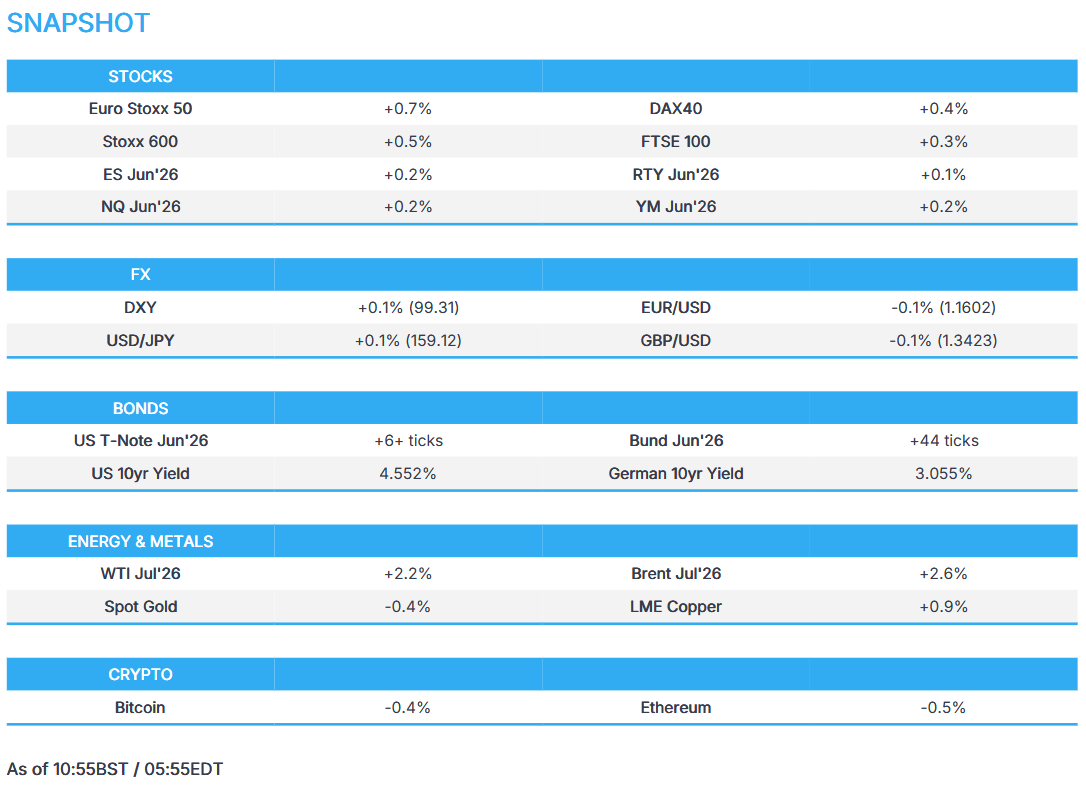
Newsquawk in 3 steps:
1. Subscribe to the free premarket movers reports
2. Listen to this report in the market open podcast (available on Apple and Spotify)
3. Trial Newsquawk’s premium real-time audio news squawk box for 7 days
IRAN CONFLICT
- Al Arabiya and Al Hadath exclusively report the text of the anticipated US-Iran agreement in case of its approval. The agreement includes: an immediate, comprehensive, and unconditional ceasefire on all fronts, a halt to military operations, ensuring freedom of navigation in the Arabian Gulf, the Strait of Hormuz, and the Sea of Oman and establishing a joint mechanism for monitoring and resolving disputes.
- US Secretary of State Rubio said there has been slight progress on Iran. Iran is trying to create a tolling system in the Strait, and no nation should accept that. We will be continuing talks with Iran, and there is progress.
- “A Pakistani source says that cautious optimism is the prevailing sentiment in the ongoing discussions regarding the planned agreement.”, Al Arabiya reported.
- Pakistan source said the US and Iran’s insistence on raising the bar for their demand regarding uranium and the Strait of Hormuz has led to a “crisis in negotiations”, Al Jazeera reported.
- Pakistani Interior Minister met again with Iran’s Foreign Minister to study proposals for resolving disputes between US and Iran, Al Jazeera reported, citing the Pakistani Embassy.
- Pakistan’s Interior Minister will remain in Tehran on Friday to continue consultations and meet with Iranian officials, while a high-level source said the Pakistani Army Chief would not travel to Tehran on Thursday night, according to Al Arabiya.
- Pakistan’s Foreign Ministry spokesperson said China supports mediation efforts and has presented a 5-point initiative.
- Iranian National Security Commission member Rezei posted “These negotiations are probably also a hoax and the Americans have no desire for diplomacy”; says “instead of diplomats, send missiles to negotiate.”
- Iranian Foreign Ministry said “Everything being circulated about the status of the negotiations is not accurate”, Al ArabyTV reported.
- UAE official said there is a ’50-50′ chance of US-Iran Strait of Hormuz agreement, AFP reported.
- Unconfirmed reports of explosions in the UAE, Tasnim reported. Details of the explosions have not yet been released.
- Iraqi ports said search teams have been mobilised within territorial waters after contact was lost with two ships, while they did not receive any distress calls from the two Bolivian-flagged ships with which contact has been lost.
EUROPEAN TRADE
EQUITIES
- European bourses (STOXX 600 +0.5%) start the final day of the week entirely in the green, heading into an extended weekend for UK and US assets. This follows comments by US Secretary of State Rubio, via the FT, noting “some good signs” in the US-Iran talks, while Reuters reported, citing an Iranian official, that “gaps have been narrowed”. More recently, Al Arabiya released the text of the anticipated US-Iran agreement, which includes an immediate and unconditional ceasefire. However, commentary out of Iran earlier in the morning continues to downplay negotiations, with the Iranian Foreign Ministry saying that everything that has been circulated about the status of negotiations is inaccurate.
- Sectors highlight the positive bias. Technology (+1.8%) leads, closely followed by Telecoms (+1.3%) and Industrial Goods & Services (+0.9%). To the downside lie Real Estate (-0.6%) and Energy (-0.7%). Chemicals (+0.7%) are eking out mild gains despite a flurry of downgrades within the sector (IMCD/Arkema/Evonik to underweight by JPMorgan).
- US equity futures follow the positivity seen in European and Asian equities, with the ES (+0.2%) looking set for an 8th consecutive week of gains. The rebound from the week’s earlier losses has been supported by the pullback in bond volatility.
- Click for the sessions European pre-market equity newsflow
- Click for the additional news
FX
- DXY is higher on the session after closing +0.1% in a choppy Thursday session, Antipodeans lag amid the risk environment and shifting tightening bets.
- Conflicting reports from the Gulf whipsawed the Buck on Thursday. Traders circulated fabricated reports that a final US-Iran draft had been reached, attributing the report to Al Arabiya, though this was later denied by the outlet. Despite this, progress in talks appears evident, while gaps remain on key issues, uranium and Hormuz. Energy benchmarks have rebounded, and as such, DXY is a touch firmer. The index resides well above significant DMAs, and within recent ranges – today supported by 99.20. Today sees the UoM final release for May.
- AUD is the worst G10 performer as domestic banks push back on RBA calls. Recent soft PMI, and labour market data which showed a surprise contraction in headline employment change, and an uptick in the unemployment rate prompted NAB and Westpac to push calls for tightening back to August, which both previously expected the first hike expected in June. AUD/USD resides within Thursday’s ranges, remaining below 0.72 and supported by 0.71.
- GBP is unchanged against the Buck, and a touch firmer against the EUR. Retail Sales missed estimates, with the ONS noting that the poor figure was driven lower by fuel purchases. The PSNB figure also rose from April’s print and overshot the OBR’s forecast.
- EUR/GBP lower by 0.1% and within Thursday’s broad ranges. Support around 0.8640. GBP/USD little changed, within recent ranges.
FIXED INCOME
- Global benchmarks are firmer this morning, albeit modestly so. Action throughout the week has been at the whim of mixed geopolitical newsflow, which has led to choppy trade across the energy space. Today, oil prices are firmer (Brent Jul +3%), but reside towards WTD lows. As such, fixed benchmarks trade with tentative gains this morning as negotiation efforts continue.
- USTs are firmer by a handful of ticks, though the bias throughout the European morning has been choppy. Nonetheless, US paper remains in the green and within a 109-08 to 109-14+ range. From a geopolitical front, Al Arabiya obtained the text of the anticipated agreement between the US and Iran. All key details can be found on the board at 09:16 BST, but the next sticking points incl. the exchanging of text, and then the beginning of negotiation, which the text suggested should begin within 7 days. Ahead, focus will be on speak from Fed’s Waller, where he will touch on the economic outlook, whilst the final US Michigan Consumer Sentiment is also scheduled. Yields have been of great attention this week, with the US 10yr printing multi-month highs (4.68%), whilst the 30yr soared to levels not seen since 2007 (5.2%). As for today, the 10yr is hovering towards WTD lows (4.56%) as markets remain focused on continued negotiations.
- Bunds are firmer by c. 35 ticks, and trade within a 125.06 to 125.30 range. German paper has ultimately followed peers, but has had some domestic data to digest. Early this morning, Final German GDP (Q/Q) was unrevised, whilst the Y/Y metric was revised slightly firmer. Overall, indicative of a resilient economy, though external leads (PMIs) suggest that this may be short-lived. This theme is also seen in the latest Ifo survey, which has stabilised since the last month, though still does not indicate any material improvement in sentiment.
- Gilts started with slight outperformance, but now trade alongside peers. Strength followed peers, with outperformance stemming from a cooler-than-expected Retail Sales report. ONS noted the poor figure was driven lower by fuel purchases, suggesting motorists had full tanks, or had stopped stockpiling as fuel prices stabilised higher, given the length of the energy disruption. The PSNB was also published, which rose to 24.3bln (prev. 12.6bln, exp. 24.3bln). Gilts trade within an 87.56 to 87.86 range.
COMMODITIES
- In terms of the latest on geopolitics, Al Arabiya/Al Hadath reportedly obtained a draft US-Iran agreement which, if approved, would see an immediate and unconditional ceasefire across all fronts. The draft also calls for a halt to military operations and media escalation, a commitment not to target military, civilian or economic infrastructure and guarantees for freedom of navigation in the Arabian Gulf, Strait of Hormuz and Sea of Oman. The agreement would take effect immediately once officially announced by both sides. Pakistan sources said the US and Iran’s insistence on raising the bar for their demand regarding uranium and the Strait of Hormuz have led to a “crisis in negotiations”.
- WTI and Brent July futures are on a firmer footing heading into a weekend of risk, and with the sides reportedly hitting a crisis in talks amid raising the bar for demands regarding uranium and the Strait of Hormuz. WTI resides in a USD 96.92-99.43/bbl range while its Brent counterpart trades in a USD 103.77-106.36/bbl parameter.
- Spot gold and silver are softer amid the elevated crude prices. Spot gold trades within a narrow USD 4,507-4,546/oz range, while spot silver trades on either side of USD 76/oz in a USD 75.69-77.04/oz range.
- Base metal futures are mostly firmer amid the overall risk appetite across stocks amid ongoing headlines regarding Pakistani efforts to narrow the gaps between the US and Iran. 3M LME copper resides in a USD 13.56k-13.69k/t. Note that the LME is closed on Monday amid a UK bank holiday.
- China refined fuel exports (ex Hong-Kong) expected to rise slightly from May-June to around 550k MT, according to Reuters sources.
- Japan to receive first oil tanker to exit the Strait of Hormuz since US-Iran war began.
- Hungary’s PM said an explosion took place at a MOL’s Tiszaujvaros energy plant. One person dead and several injured.
- UAE Presidential Advisor said they were losing out in terms of production under OPEC, leaving it was under consideration for a three-year period.
- Barclays said they have maintained their Brent forecast of USD 100/bbl for 2026, with risks skewed higher.
TRADE/TARIFFS
- China adjusts drug-making chemicals export list to countries, reports suggest. Exports of relevant chemicals to the US, Mexico and Canada must apply for licenses in accordance with regulations.
- The EU has suspended customs tariffs on certain nitrogen-based fertilisers for one year.
NOTABLE EUROPEAN HEADLINES
- The next EU-UK summit could be postponed until July at the earliest (vs initial June date), Bloomberg reported citing sources. The prospect that substantial deals won’t be agreed in time.
- US Secretary of State Rubio said President Trump is disappointed with some NATO allies. Meeting will set groundwork for NATO leader’s summit.
- German Foreign Minister said defence spending will reach more than 4% of GDP in 2026 and on the way to 5%
NOTABLE EUROPEAN DATA RECAP
- UK Retail Sales MoM (Apr) M/M -1.3% vs. Exp. -0.6% (Prev. 0.7%, Low. -1.4%, High. 0.5%).
- UK Retail Sales YoY (Apr) Y/Y 0.0% vs. Exp. 1.3% (Prev. 1.7%, Low. 0.4%, High. 1.7%).
- UK Retail Sales ex Fuel MoM (Apr) M/M -0.4% vs. Exp. -0.3% (Prev. 0.2%, Low. -1.3%, High. 0.4%).
- UK Retail Sales ex Fuel YoY (Apr) Y/Y 1.1% vs. Exp. 1.5% (Prev. 1.7%, Low. 0.7%, High. 2.0%).
- UK Public Sector Net Borrowing Ex Banks (Apr) 24.3B vs. Exp. 20.9B (Prev. 12.6B, Low. 21.1B, High. 17B).
- UK Gfk Consumer Confidence (May) -23 vs. Exp. -28 (Prev. -25).
- German GDP Growth Rate QoQ Final (Q1) Q/Q 0.3% vs. Exp. 0.3% (Prev. 0.2%, Low. 0.2%, High. 0.3%).
- German GDP Growth Rate YoY Final (Q1) Y/Y 0.4% vs. Exp. 0.3% (Prev. 0.4%, Low. 0.3%, High. 0.3%).
- German Ifo Business Climate (May) 84.9 vs. Exp. 84.2 (Prev. 84.4, Low. 83, High. 85.9).
- German GfK Consumer Confidence (Jun) -29.8 vs. Exp. -34 (Prev. -33.3, Low. -35, High. -30).
CENTRAL BANKS
- ECB President Lagarde said long term inflation expectations are broadly well anchored and are particularly attentive to second-round effects.
- ECB’s Demarco said the ECB will probably need to hike in June. There is not much evidence of indirect inflation effects and the 2026 inflation outlook likely to be revised upwardly. Projections to show if one hike is enough or more is needed.
- Westpac pushes back its RBA rate hike call to August and September from a previous call of June and August.
NOTABLE US HEADLINES
- US House Republicans delay war powers vote, according to Reuters.
GEOPOLITICS
RUSSIA-UKRAINE
- Ukrainian President Zelensky said Ukraine attacked Russian oil refinery in Yaroslavl (300k BPD).
OTHER
- China Foreign Ministry said China firmly opposes the US selling arms to Taiwan.
- US President Trump announces that the US will be sending an additional 5,000 troops to Poland.
CRYPTO
- Bitcoin held above USD 77k, Ethereum extends lower and trades just below USD 2.2k.
APAC TRADE
- APAC stocks were mostly higher following the positive handover from Wall Street, where all major indices gained and the Dow notched a record close on what was a choppy session, amid cautious optimism due to contradicting geopolitical headlines.
- ASX 200 gained with outperformance in the mining, materials and resources sectors, although the upside in the broader market was capped by weakness in telecoms, real estate and defensives.
- Nikkei 225 rallied amid continued tech strength, with SoftBank shares adding to the recent advances with another double-digit percentage gain, while the latest inflation data was softer-than-expected and could compel policymakers to think twice about a June rate hike.
- Hang Seng and Shanghai Comp were in the green with the Hong Kong benchmark led higher by tech stocks, including Lenovo and NetEase, as the former was boosted by its earnings results, which showed record FY revenue, while the mainland kept afloat after the PBoC upped liquidity efforts for a third day.
NOTABLE ASIA-PAC HEADLINES
- Chinese regulators and exchanges intensify scrutiny of AI-fuelled market frenzy, pressing listed firms and fund managers to justify valuations, Bloomberg reported citing sources.
- China CSRC and seven other departments said they will establish a routine collaborative regulatory mechanism to conduct comprehensive monitoring and inspections. CSRC plans penalties against Futu Holdings, Up Fintech’s Tiger Brokers and Longbridge Securities, including confiscating illegal gains.
- China’s NDRC said regarding the question on investment from the US, that they never told Chinese tech firms they couldn’t take foreign investment, while it added that foreign investment must follow Chinese laws and rules, and should not harm national security and interests. Furthermore, it is planning a policy support framework to accelerate AI commercialisation, and stated that prices are set to remain stable as the domestic supply demand outlook improves.
- RBI is said to be likely selling dollars through state-run banks.
NOTABLE APAC DATA RECAP
- Japanese Inflation Rate YY (Apr) 1.4% vs Exp. 1.8% (Prev. 1.5%).
- Japanese Inflation Rate Ex-Fresh Food YY (Apr) 1.4% vs. Exp. 1.7% (Prev. 1.8%, Low. 1.6%, High. 1.8%).
- Japanese Inflation Rate Ex-Food and Energy YY (Apr) 1.9% vs. Exp. 2.2% (Prev. 2.4%).
1 c Asian opening report
Bourses primed for firm open with EuroStoxx 50 futures +0.7% after choppy US session driven by geopols – Newsquawk EU Market Open
Friday, May 22, 2026 – 02:10 AM
- US stocks ultimately closed higher in what was another choppy session dominated by contradictory geopolitical headlines surrounding the Middle East conflict.
- Al Arabiya TV was initially reported to have obtained the final draft of a prospective Pakistani-mediated US-Iran agreement, although it was later stated that these reports were fabricated.
- A senior Iranian source said no deal had been reached yet, but gaps have narrowed, with Iran’s uranium enrichment and its control over the Strait of Hormuz among the sticking points.
- A high-level source familiar with the matter later said the Iranian Supreme Leader’s final decision is not to hand over the enriched uranium to Washington, according to Al Hadath.
- APAC stocks were mostly higher; European equity futures indicate a higher cash market open with Euro Stoxx 50 futures up 1.0%.
- Looking ahead, highlights include German GfK Consumer Confidence (Jun), GDP Final (Q1) & Ifo Business Climate (May), UK Retail Sales (Apr), PSNB (Apr), Canadian Retail Sales (Mar), University of Michigan Consumer Sentiment Final (May), BoC SLOS (May), and Kevin Warsh sworn in as Fed Chair. Speakers include ECB’s Lane & Fed’s Waller. Credit Ratings: Scope Ratings on China, S&P on Norway, Moody’s on Hungary, Portugal & UK.
SNAPSHOT
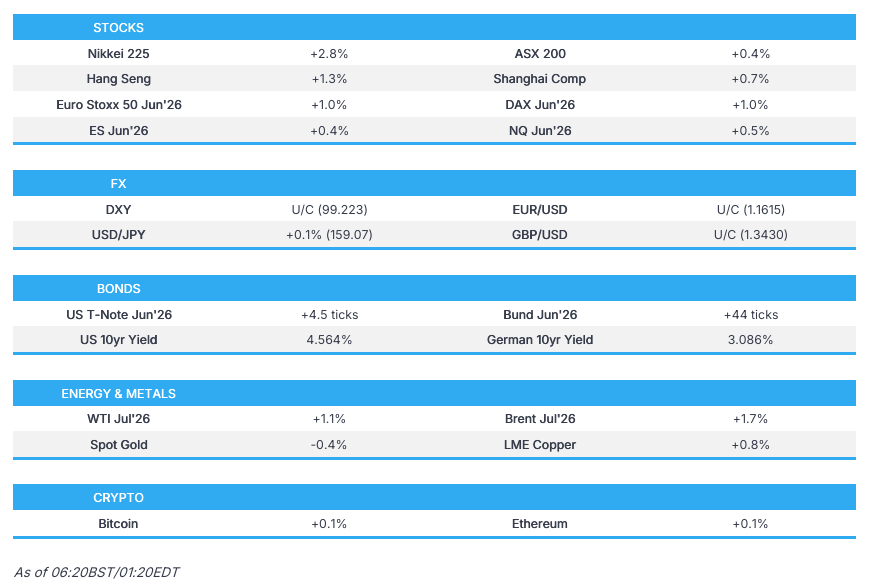
Newsquawk in 3 steps:
1. Subscribe to the free premarket movers reports
2. Listen to this report in the market open podcast (available on Apple and Spotify)
3. Trial Newsquawk’s premium real-time audio news squawk box for 7 days
IRAN CONFLICT
- US President Trump said they are negotiating with Iran and will get it one way or the other, while he added they do not want tolls on Hormuz, and that the US has total control of Hormuz. Trump said they knocked out 98% of Iran’s missile capacity, and no ship is going through Iran without their approval. Furthermore, he said the Iran conflict will end soon, as well as stated that the US will get Iran’s uranium and will likely destroy it. However, a Tasnim article called Trump’s comments “unfinished illusions”, referring to his claim that the US will take over highly enriched uranium.
- Al Arabiya TV was initially reported to have obtained the final draft of a prospective Pakistani-mediated US-Iran agreement, with 9 key provisions including an immediate, comprehensive and unconditional ceasefire on all fronts, mutual commitment not to target military, civilian or economic infrastructure, cessation of military operations and media warfare, respect for sovereignty and territorial integrity, as well as others. Furthermore, ILNA also cited Al Arabiya stating that the final draft of the US-Iran agreement has been reached with mediation of Pakistan and was expected to be announced within next few hours, although it was later stated that the report about reaching an agreement was fabricated.
- A senior Iranian source said no deal had been reached yet, but gaps have narrowed, with Iran’s uranium enrichment and its control over the Strait of Hormuz among the sticking points.
- A high-level source familiar with the matter later said the Iranian Supreme Leader’s final decision is not to hand over the enriched uranium to Washington, according to Al Hadath.
- Iran’s President said Iran will not back down in talks and that they will not bow their heads, while they are willing to sacrifice as much as possible for the honour and pride of Iran, and are not afraid of martyrdom.
- Iranian Foreign Ministry says “Everything being circulated about the status of the negotiations is not accurate”, Al ArabyTV reported.
- Iranian Foreign Ministry spokesperson said the focus of the negotiations is on ending the war on all fronts, including Lebanon, and that the claims made in the media about nuclear issues, including enriched materials or the enrichment debate, are speculation.
- Iranian Ministry of Foreign Affairs condemned the US imposing sanctions on the Iranian ambassador in Lebanon, as well as a number of Lebanese officials and citizens, according to Fars News.
- Iranian senior official told Al Jazeera that negotiators are very close to reaching a deal, and are currently working on a draft text, while another source said it is too early to say whether a serious, final agreement is in reach
- Pakistan’s Interior Minister will remain in Tehran on Friday to continue consultations and meet with Iranian officials, while a high-level source said the Pakistani Army Chief would not travel to Tehran on Thursday night, according to Al Arabiya.
- Pakistani Senator said Iran-US talks are moving in the right direction, according to IRNA citing a statement.
- Pakistani Interior Minister meets again with Iran’s Foreign Minister to study proposals for resolving disputes between US and Iran, Al Jazeera reported, citing the Pakistani Embassy.
- Israeli forces conducted strikes on southern Lebanon and a raid in the West Bank, while Hezbollah said it carried out 16 different military operations targeting Israeli bases and positions in the past 24 hours, according to Tasnim. It was separately reported that Israeli artillery hit areas in western Deraa, Syria.
- Iraqi ports said search teams have been mobilised within territorial waters after contact was lost with two ships, while they did not receive any distress calls from the two Bolivian-flagged ships with which contact has been lost.
- US House Republicans delay war powers vote, according to Reuters.
US TRADE
EQUITIES
- US stocks ultimately closed higher on what was another choppy session dominated by contradictory geopolitical headlines surrounding the Middle East conflict, while Treasury yields were predominantly lower, crude settled down from earlier highs, and the dollar finished little changed, as cross-asset price action largely tracked swings in oil prices owing to the shifting headlines around US-Iran negotiations.
- There were earlier reports that a final draft US-Iran agreement had been reached through Pakistani mediation and could be announced within hours, with Iranian media citing Al Arabiya TV. However, Al Arabiya later denied the report shortly before the closing bell. There were also several conflicting reports surrounding Iran’s enriched uranium, including whether it would remain in Iran or be transferred abroad, while it was noted that the two key sticking points remain Iran’s nuclear programme and reopening the Strait of Hormuz. Furthermore, the Pakistani Army Chief was no longer expected to travel to Tehran on Thursday night, and Reuters reported that no deal has yet been reached, although negotiations have narrowed the gaps between both sides. Elsewhere, participants digested several US data releases and some Fed commentary, but which once again generated little market reaction, as geopolitics and crude price swings dominated broader macro trade.
- SPX +0.17% at 7,446, NDX +0.20% at 29,357, DJI +0.55% at 50,291, RUT +0.93% at 2,843.
- Click here for a detailed summary.
TARIFFS/TRADE
- US President Trump said the US would likely have to pay back USD 149bln in tariffs, while he added that tariffs made the US modernly rich and would have to be done in a different way.
- China blocked exports of high-end solar manufacturing equipment from Suzhou Maxwell Technologies to Tesla (TSLA), according to NYT citing sources.
NOTABLE HEADLINES
- Fed’s Barkin (2027 voter) said the Fed was well-positioned to respond to risks as appropriate, while whether the Fed needed to hike rates depended on how businesses and consumers reacted to developing conditions. Barkin stated the policy of looking through supply shocks had worked well in the past, although it was easy to see more challenging conditions and more frequent shocks in the future, while long-term inflation expectations appeared to remain contained. Furthermore, he is not leaning towards overly focusing on risks to inflation or employment and does not feel it is a time for strong forward guidance.
- Fed’s Goolsbee (2027 voter) said there was still a pretty significant inflation problem, although the job market was stable, while Goolsbee said that he was most attuned to the inflation side of the dual mandate.
APAC TRADE
EQUITIES
- APAC stocks were mostly higher following the positive handover from Wall Street, where all major indices gained and the Dow notched a record close on what was a choppy session, amid cautious optimism due to contradicting geopolitical headlines.
- ASX 200 gained with outperformance in the mining, materials and resources sectors, although the upside in the broader market was capped by weakness in telecoms, real estate and defensives.
- Nikkei 225 rallied amid continued tech strength, with SoftBank shares adding to the recent advances with another double-digit percentage gain, while the latest inflation data was softer-than-expected and could compel policymakers to think twice about a June rate hike.
- Hang Seng and Shanghai Comp were in the green with the Hong Kong benchmark led higher by tech stocks, including Lenovo and NetEase, as the former was boosted by its earnings results, which showed record FY revenue, while the mainland kept afloat after the PBoC upped liquidity efforts for a third day.
- US equity futures marginally edged higher amid cautious optimism regarding US-Iran progress.
- European equity futures indicate a higher cash market open with Euro Stoxx 50 futures up 0.9% after the cash market closed with losses of 0.3% on Thursday.
FX
- DXY is rangebound after the prior day’s indecisive performance as oil prices and yields fluctuated at the whim of the mixed signals regarding the progress of US-Iran talks, including reports that a final draft of the US-Iran agreement had been reached with the mediation of Pakistan, although this was later refuted. It was also reported that the Pakistani army chief would not be travelling to Tehran on Thursday despite previous hopes, while there were conflicting reports on Iran’s stance on enriched uranium being transferred out of the country. There was also a recent slew of data releases stateside, which were ultimately mixed and provided little direction for the greenback, while participants await Warsh’s swearing-in as Fed chair today.
- EUR/USD was little changed after whipsawing through the 1.1600 level and with very quiet newsflow from the bloc.
- GBP/USD conformed to the humdrum mood in the FX space following recent mixed PMI data and with little reaction to the rhetoric from BoE’s Taylor, while UK Retail Sales data also looms.
- USD/JPY lingered around the 159.00 focal point, with little reaction seen following the softer-than-expected Japanese inflation data, which showed core inflation retreated further below the 2% price goal and printed its softest in more than four years.
- Antipodeans lacked direction in the absence of pertinent tier-1 data releases and despite the constructive mood.
- PBoC set USD/CNY mid-point at 6.8373 vs exp. 6.7922 (prev. 6.8349)
FIXED INCOME
- 10yr UST futures were rangebound following the recent indecisive performance, whereby rates fluctuated on the volatile crude price action and conflicting geopolitical reports.
- Bund futures held on to gains after climbing back above the 125.00 level in the aftermath of the recent weak PMI data from the bloc, while several German data releases approach, including GfK Consumer Confidence, Final Q1 GDP & Ifo Business Climate.
- 10yr JGB futures were contained amid gains in stocks and failed to benefit from the softer-than-expected CPI data, while the enhanced liquidity for long-end JGBs resulted in a weaker demand ratio.
COMMODITIES
- Crude futures rebounded off the prior session’s lows but with the rebound capped after recent choppy price action due to contradicting geopolitical headlines, including a report that the final draft of the US-Iran agreement has been reached with mediation of Pakistan, although this was later refuted and described as fabricated, while a senior Iranian source said no deal had been reached yet, but the gaps have narrowed.
- Spot gold marginally declined following yesterday’s indecision, in which global markets and oil prices whipsawed on the conflicting geopolitical signals.
- Copper futures remained afloat amid the positive risk appetite and hopes of US-Iran progress.
CRYPTO
- Bitcoin eked mild gains and gradually edged higher, but remained in the USD 77k territory.
NOTABLE ASIA-PAC HEADLINES
- China’s NDRC said regarding the question on investment from the US, that they never told Chinese tech firms they couldn’t take foreign investment, while it added that foreign investment must follow Chinese laws and rules, and should not harm national security and interests. Furthermore, it is planning a policy support framework to accelerate AI commercialisation, and stated that prices are set to remain stable as the domestic supply demand outlook improves.
DATA RECAP
- Japanese Inflation Rate YY (Apr) 1.4% vs Exp. 1.8% (Prev. 1.5%)
- Japanese Inflation Rate Ex-Fresh Food YY (Apr) 1.4% vs. Exp. 1.7% (Prev. 1.8%, Low. 1.6%, High. 1.8%)
- Japanese Inflation Rate Ex-Food and Energy YY (Apr) 1.9% vs. Exp. 2.2% (Prev. 2.4%)
GEOPOLITICS
OTHER
- US President Trump announces that the US will be sending an additional 5,000 troops to Poland.
EU/UK
DATA RECAP
- UK Gfk Consumer Confidence (May) -23 vs. Exp. -28 (Prev. -25)
2.a NORTH KOREA/SOUTH KOREA/JAPAN
JAPAN
Japan Just Triggered the $40T US Debt Crisis as Yields Hit 2007 Highs

by ITM Trading
Thursday, May 21, 2026 – 13:55
Japan’s 10-year yield just hit a level not seen since 1997, and the smart money is already moving to repatriate capital out of U.S. Treasuries. Meanwhile, the 30-year U.S. yield matches its 2007 peak. There’s just one problem: America’s debt back then was $8 trillion. Today it’s $40 trillion. Same rate. Five times the bill. Interest payments now exceed the entire defense budget (a small detail Washington somehow forgets to mention).
This isn’t a U.S. story. The UK, Germany, Italy, France: all flashing red. Central banks aren’t waiting. They’re hoarding gold at rates Goldman Sachs just revised 70% higher than the official numbers.
So when foreign buyers finally walk away from American debt, where exactly do you think the bill lands?
Taylor Kenney walks through what comes next.
About ITM Trading: ITM Trading has spent nearly 30 years helping clients prepare for monetary resets, inflation, and systemic risk using physical gold and silver. We focus on education, historical context, and strategies designed to protect wealth when trust in the system breaks down.
NORTH AND SOUTH KOREA
SOUTH KOREA/SAMSUNG
3. CHINA/
CHINA/OIL
HUGE STORY!!!
Chinese Refining Rates Unexpectedly Plunge To All-Time Lows As Economy Falls Off A Cliff
Friday, May 22, 2026 – 03:20 PM
Two weeks ago, when discussing the market “mystery” of sliding physical crude oil prices, we said that the most likely culprit were Chinese refiners, whose refining margins had just collapsed to the most negative on record.

The reason for the margin collapse was China’s domestic fuel policy: it has long been Beijing’s policy to soften price hikes to help shield consumers and avoid social unrest; which while beneficial to end consumers, is catastrophic to refiners and processors who are prohibited from passing on rising costs. In other words, China’s “energy security” was the dominant theme, and if it meant an entire industry has to suffer huge losses if it continues to purchase oil and process it into various product grades, so be it.
Ordered to process as much available inventory as possible, that’s what the refiners have done, and refining rates in Shandong province, China’s hub for smaller refineries known as teapots, ramped up over April to the highest level in almost two years, as processing margins cratered to record negative levels meaning refiners are losing record amounts on every barrel they process.

“I would not be surprised if the teapots are prioritizing politics over economics with an eye to their long-term survival,” said Erica Downs, a senior research scholar at Columbia University’s Center on Global Energy Policy. “They may be calculating that if they do their part to help China weather the energy crisis, then maybe they will build up some goodwill in Beijing.”
While Downs is right, and teapots are prioritizing politics, they are also certainly keeping an eye on economics to the extent they can avoid Beijing’s wrath, and predictably the logical consequence of this centrally-planned policy to force “independent” refiners (who are not really independent if they have to do whatever Beijing instructs them) to make fuel at record losses to ensure energy security, is for them to slash purchases of Iranian crude.
Sure enough, as we reported two weeks ago, Chinese crude oil imports cratered: China’s April imports plunged to a multi-year low of just 8.2 million barrels a day, down by about a quarter from a prewar level of around 11.7 million. The 3.5-million barrels a day swing almost matches the total consumption of Japan and is double the amount supplied by the United Arab Emirates pipeline that circumvents Hormuz.

Meanwhile, as imports collapsed, inventories at sea soared: Kpler reported that as of the start of May, there were about 16 million barrels on ships anchored in the Yellow Sea off the Chinese coast, almost 40% higher than the level prior to a US blockade of Iran’s ports in mid-April as oil that was ordered previously remains unused.
Amid this collapse in Chinese imports and aggressive stockpiling at sea, industry executives have noticed something odd: Chinese state-owned oil companies have been reselling some of their oil cargoes to European and Asian rivals. The behavior suggests surpluses, which is “odd” to say the least during a supply shortage. Where is this excess oil coming from?
The shift has not only capped benchmark oil prices, but also helped to trigger a collapse in the premia that traders pay above them to secure physical crude. The immediate outcome has been a very beneficial one: physical barrels that in early April went for $30 above benchmark prices were recently changing hands at premiums as low as $1. Talk of discounts has even started to emerge.

Underscoring this point, North Sea oil traders were no longer desperate for crude for immediate delivery anymore, compared to the panic buying of late March and early April
While the collapse in refining margins was a clear clue to the plunging oil imports, other questions remain: chief among them how is China importing far less crude than before without running down stocks? In the past, the country clearly bought more oil than it needed, building a huge emergency stockpile. Today, China has nearly 1.4 billion barrels in its reserves according to media reports, well above the 400 million of the US and Japan’s 260 million. As we reported in late 2025, China probably bought one million barrels a day more than it needed last year. By simply stopping beefing up the reserve, China can cut imports a lot without affecting its underlying oil needs.
The shift can explain, perhaps, a third of the import cut. But the rest? Here’s where oil traders speculate with different theories. The most likely argument is that Chinese economic activity is far weaker than previously thought, and thus oil consumption growth is also lower. That’s precisely what we learned earlier this week, when we discussed that “Shockingly Bad” Chinese Econ Data Stuns Wall Street, Sparks Hard Landing Concerns; in a nutshell virtually every component of China’s economy printed below the lowest economist estimate, and in many cases the data was as bad as when Beijing was emerging from the covid closure.

What is shocking is that it is common knowledge that Beijing traditionally massages its economic data to present itself in the rosiest possible light: the fact that it allowed data this ugly would suggest that the picture on the ground is much uglier.
Goldman’s Delta One head Rich Privorotsky captured this sentiment well, writing this morning that “overnight news from China showed economic data materially below expectations. Industrial production, retail sales and fixed asset investment all missed meaningfully. It’s hard to tell whether this reflects genuine demand destruction but perhaps it helps explain how the oil market has managed to balance despite ongoing supply concerns. I genuinely can’t remember a period when Chinese data, which tends to be heavily massaged, missed by anything close to this magnitude. Negative read through for consumption related categories.“
What’s the catalyst for that slowdown? Perhaps the impact of the war on several of China’s clients in the region, including the Philippines, Vietnam and Thailand (just don’t look for validation in Chinese economic “data” – like everything else, it took is centrally planned and Beijing would never confirm its economy is being hit due to the Iran war as that would mean reduced political leverage).
Whatever the cause may be, the result is the same and we got the final confirmation that China’s petroleum industry is in a tailspin overnight when Mysteel OilChem reported that China’s state refineries cut run rates below 67% of capacity in the week to May 21, the lowest on record. Specifically, state runs edged lower to 66.9% of capacity over the week, while independent refiners in Shandong cut runs to 52.54% of capacity, lowest since Feb. 27.

This was the missing link in the Chinese oil picture, because while one can debate whether China was filling the product pipeline with strategic reserve oil instead of imported, or was merely draining offshore stock, the fact that suddenly Chinese refining has absolutely cratered, indicated that far from thriving, demand for China’s product – both domestically and internationally – has fallen off a cliff, suggests that China and/or the broader Asian region is now at or near recession, something China’s all important credit impulse strongly hinted at (for a great discussion of China’s slowdown through the lens of credit impulse, see the following note from TS Lombard).

The good news: the tangent to a recession is widespread demand destruction, and since China suddenly needs far less oil, the price of physical will stay where it is until something changes. Of course, if Chinese demand falls even more, oil prices will slide, but then the question becomes how long can the US and the rest of the world avoid recession if Asia is already in it?
4. EUROPEAN AND SCANDINAVIAN COMMENTARIES PLUS NATO
UK
STARMER IS A TOTAL IDIOT!!
Starmer Government Doubles Down On Anti-Free Speech Policies
Friday, May 22, 2026 – 07:20 AM
When hundreds of thousands of Britons joined the recent Unite the Kingdom rally, the government of Keir Starmer wanted them to know that they were being watched for possible arrest. By deploying facial recognition systems and invoking the United Kingdom’s anti-free speech laws, Starmer’s government made it clear that it would not tolerate anything it considered hateful or xenophobic, on the heels of its losses to Reform UK in council elections.

Under its Online Safety Act, the government removed posts from social media platforms such as TikTok, including statements about Reform UK’s immigration policies.
Among those impacted was Reform UK’s shadow home secretary Zia Yusuf who reportedly had “two videos removed from TikTok—one for a user report under the UK’s Online Safety Act and another for hate speech.” They were later restored.
Starmer’s government also reportedly prevented speakers from the rally from entering the county, citing concerns they might “incite” the crowd.
The Times reported last year that the government was arresting 30 people a day for speech crimes.
In the last two decades, free speech protections in the U.K. have been eviscerated.
The criminalization of speech has expanded exponentially as individuals and groups call the police to silence those who criticize them or advocate opposing views.
Even silent prayer or “toxic ideologies” can lead to arrest. Expressing concerns over Western cultural values is now treated as an admission of “right-wing ideology,” warranting investigation. A few years ago, a neo-Nazi living with his mother was found to have a room filled with hateful symbols and material.
Judge Peter Lodder dismissed free speech concerns over the defendant’s possessions with a truly Orwellian flourish: “I do not sentence you for your political views, but the extremity of those views informs the assessment of dangerousness.” Calling the defendant “a right-wing extremist,” Mr. Lodder said the contents of his room were evidence of “enthusiasm for this repulsive and toxic ideology.”
One of the most notorious cases has been dropped with a belated apology. Last year, I wrote about how Graham Linehan became the latest comedian to be arrested as part of the global crackdown on free speech.
The co-creator of the U.K. sitcom “Father Ted” was arrested at London Heathrow Airport, allegedly over several social media posts criticizing transgender activists. The posts were not jokes, but political commentary.
Now, the Metropolitan Police has issued an apology that he should not have been detained by five armed officers at Heathrow Airport in September 2025. It took five months, but the Met Police apologized for how his case was handled and vowed to learn from the experience.
Met Police Inspector Matt Hume declared, “I apologize to Mr. Linehan for the shortcomings in this investigation. The Met Police remains committed to lawful, proportionate policing and to learning from failings when they arise. I accept that the service provided was not acceptable and recognize the distress and impact this matter has caused Mr. Linehan.”
The problem is that it is not clear why they concluded that they made a mistake but the laws are so sweeping in their language that the police can act in the most arbitrary and ideological fashion.
There will be no discipline of those who ordered the arrest, or apparently, further explanation of why this case, as opposed to hundreds of others, was viewed as improper.
The most that Hume would offer is that, while insisting that the arrest was entirely lawful, it was “flawed” because officers focused on the transgender criticism “rather than the alleged incitement to violence,” according to The Telegraph.
Linehan correctly noted in a post to X that “This, from the ‘apology’ I received from the police, doesn’t sound like an apology.”
That is because it is not a real apology.
It is an effort to spin and discard a high-profile controversy while reaffirming the very policies and laws that allow for such abuses to occur in the United Kingdom.
FRANCE/SYRIA
MY GOODNESS!! WHAT A TRANSFORMATION. FROM TERROR TO FINANCE!!
From ISIS To Finance Bro: Syria’s Sharaa To Attend G7 Summit In France
Friday, May 22, 2026 – 02:45 AM
Syria continues stepping out of the geopolitical wilderness, now apparently onto the highest-stakes stage in international finance. Or rather, the reality is that Washington’s post-Assad Al Qaeda in suits makeover of ‘former’ terror leader Ahmed al-Sharaa has reached its peak.
According to a Reuters report on Thursday, self-appointed Syrian President Ahmed al-Sharaa (Jolani) is set to lead a national delegation to the G7 summit in France next month.

The invitation marks the country’s first-ever participation in the summit since the elite forum was founded back in 1975.
Citing three sources familiar with the matter, the agency confirmed that an invitation was officially hand-delivered to Syrian Finance Minister Mohammed Yisr Barnieh while he was attending the group’s preparatory financial talks in Paris earlier this week. The main G7 summit is set to run mid-June, from the 15th through 17th in Évian-les-Bains, southeastern France.
A Syrian official speaking Reuters described that Damascus plans to heavily pitch its geography to the G7. This will likely center on leveraging the country’s role as a “potential strategic hub for supply chains” amid the Iran war and Hormuz Strait crisis.
“After the closure of the Hormuz Strait, pretty much all the neighboring countries in the region knocked on our door to get access to our Syrian ports,” stated Mazen Alloush, the director of local and international relations for Syria’s borders and customs authority. “They are making Plan B’s in case the crisis goes on longer.”
The over decade-long proxy war to oust Assad, which heavily involved the CIA and Gulf states, as well as Israel, has long been discussed as part of the ‘pipeline wars’ theme, and has for years been an open secret.
President Trump, who helped put Sharaa in power, and vouched for him when they first met in Saudi Arabia, is expected to attend the G7 summit.
But despite Damascus under Sharaa now being a willing puppet of Washington, economic relief for the war-ravaged Syrian population has remained illusory, as one Middle East outlet underscores:
Because Syria had been under crushing sanctions since the start of the 14-year war that began in 2011, many expected the economic situation to improve after Sharaa toppled former Syrian president Bashar al-Assad’s government and western nations began easing sanctions.
However, “attracting foreign investment and restoring normal banking ties have proven slower and more difficult than many officials had hoped,” Reuters noted. More than 90 percent of Syrians live below the poverty line and have suffered from major increases in the price of fuel, electricity, and food in recent months.
Gas prices have risen by nearly 50 percent in the past month, while the value of the Syrian currency has fallen against the dollar amid volatile price swings. In the past week, the Syrian pound depreciated from 13,400 liras per dollar to more than 14,700 liras per dollar, before ending at 14,000 liras per dollar.
All the while, looming large in the background is the fact that the Syrian government is now full of Sunni extremists, who have repeatedly targeted Alawites, Druze, and Christians for being “unbelievers”.
Thousands have died at the hands of ISIS-style Syrian government-linked military members, who have sought to cleanse the country of its ancient Christian and Alawite communities
END
5. RUSSIAN AND MIDDLE EASTERN AFFAIRS//
ISRAEL/USA VS IRAN//FRIDAY MORNING
WOULD NOT BELIEVE A WORK THE PAKISTANI ARMY CHIEF SAYS:
(zerohedge)
Oil Dips As Pakistani Army Chief Travels To Tehran As Rubio Touts ‘Slight Progress’ On Talks
Friday, May 22, 2026 – 08:45 AM
Despite the attempts of some regional outlets to spin a narrative of imminent peace (which we saw yesterday), a senior Iranian source told Reuters on Thursday that “no deal had been reached with the US” – though he did also claim that “gaps had narrowed” – somewhat in line with the optimistic narrative.
The Islamic Republic is reporteldy still reviewing the latest peace blueprint handed down by the Trump administration. Trump has meanwhile explicitly warned that further military action remains firmly on the table if Tehran doesn’t bend the knee.
Yet there’s more ‘action’ taking place in the interim – as Pakistan’s army chief once again is on his way to Tehran, per Al Arabiya, and this – though already previewed the day prior – caused oil to dump amid the usual daily optimistic headlines emerging just ahead of the US market open.

Field Marshal Asim Munir is expected to receive and relay Tehran’s answer to Washington on the latest.
Meanwhile, speaking to state television, Fadahossein Maleki, an influential member of Iran’s Parliament’s National Security and Foreign Policy Committee, strongly hinted that Iran might not wait around to be hit. When pressed on whether the ceasefire could collapse, Maleki bluntly stated, “Anything is possible.”
He took it a step further, openly floating the idea of an Iranian preemptive strike if Iran believed the Pentagon is moving its forces into position for resumption of military action.
“It could even come from Iran’s side, frankly,” Maleki warned, according to a report by Iran International. “If we feel that something is happening from a US base, Iran has the legitimacy to respond and prevent it.”
Despite these threats, US Secretary of State Marco Rubio has freshly said there has been some “slight progress” in talks with Iran to end the war, but followed by saying he did not wish to exaggerate how much.
Which helped push crude oil prices to the lows of the day…

More possibly premature reports of a ‘final draft’ being worked on…
He’s going full press against Iran’s efforts to impose a Hormuz toll system under its own permission protocols. “They’re trying to convince Oman, by the way, to join them in this tolling system in an international waterway. There is not a country in the world that should accept that. I don’t know of a country in the world that’s in favor of it, except Iran, but there’s no country in the world that should accept it,” Rubio said in Helsingborg, Sweden, on the sidelines of a NATO ministers meeting.
“I don’t know of anyone in the world that should be in favor of a tolling system in an international waterway, that’s just not acceptable. It can’t happen,” Rubio continued.
“If that were to happen in the Strait of Hormuz, it will happen in five other places around the world. Why would countries all over the world say, ‘Well, we want to do this too’? Not to mention how vital and critical that strait is to every country represented here today, but frankly, to countries not represented here today, particularly the Indo-Pacific,” he also said.
* * *
More latest developments via Newsquawk:
- Arabiya and Al Hadath exclusively report the text of the anticipated US-Iran agreement in case of its approval. The agreement includes: an immediate, comprehensive, and unconditional ceasefire on all fronts, a halt to military operations, ensuring freedom of navigation in the Arabian Gulf, the Strait of Hormuz, and the Sea of Oman and establishing a joint mechanism for monitoring and resolving disputes.
- US Secretary of State Rubio said there has been slight progress on Iran. Iran is trying to create a tolling system in the Strait, and no nation should accept that. We will be continuing talks with Iran, and there is progress.
- “A Pakistani source says that cautious optimism is the prevailing sentiment in the ongoing discussions regarding the planned agreement.”, Al Arabiya reported.
- Pakistan source said the US and Iran’s insistence on raising the bar for their demand regarding uranium and the Strait of Hormuz has led to a “crisis in negotiations”, Al Jazeera reported.
- Pakistani Interior Minister met again with Iran’s Foreign Minister to study proposals for resolving disputes between US and Iran, Al Jazeera reported, citing the Pakistani Embassy.
- Pakistan’s Interior Minister will remain in Tehran on Friday to continue consultations and meet with Iranian officials, while a high-level source said the Pakistani Army Chief would not travel to Tehran on Thursday night, according to Al Arabiya.
- Pakistan’s Foreign Ministry spokesperson said China supports mediation efforts and has presented a 5-point initiative.
- Iranian National Security Commission member Rezei posted “These negotiations are probably also a hoax and the Americans have no desire for diplomacy”; says “instead of diplomats, send missiles to negotiate.”
- Iranian Foreign Ministry said “Everything being circulated about the status of the negotiations is not accurate”, Al ArabyTV reported.
- UAE official said there is a ’50-50′ chance of US-Iran Strait of Hormuz agreement, AFP reported.
- Unconfirmed reports of explosions in the UAE, Tasnim reported. Details of the explosions have not yet been released.
- Iraqi ports said search teams have been mobilised within territorial waters after contact was lost with two ships, while they did not receive any distress calls from the two Bolivian-flagged ships with which contact has been lost.
- END
ISRAEL/USA VS IRAN
Rubio Says ‘Not There Yet’ As Reports Of Draft Iran Deals Circulating Deemed Inaccurate
Friday, May 22, 2026 – 09:55 AM
Summary
- Rubio confirms that there’s been no deal and that “we’re not there yet” – amid broader late morning pushback against morning optimistic, premature headlines.
- Saudi sources report Pakistan army chief & a Qatar delegation en route to Tehran, only for CBS to cite Pakistan Foreign Ministry which says “not aware” of Field Marshal Munir’s visit.
- Influential Iranian parliament member threatens ‘preemptive’ military action if preparations & movements by US forces in region is perceived.
Pakistan FM: “Not Aware of Any Visit” to Iran by Army Chief
In a quick market update, Newsquawk says risk-off as reporters push back on optimistic geopolitical reporting + Rubio says not there on Iran deal.
And this bit of serious contradiction of earlier reports, via CBS:
Pakistan’s Foreign Ministry spokesman Tahir Andrabi said Friday that he was “not aware of any visit right now” when asked about reports by Iranian state media since Thursday that Army chief Field Marshal Syed Asim Munir, a key mediator between Iran and the U.S., was expected in Tehran.
“I am sure this will be announced in due course, if it is to be announced. I can neither confirm nor deny it now,” Abdrabi said.
“As regards the details of any agreement, our consistent position on this matter is that we do not talk of specifics. As a mediator and as a facilitator, it is the inherent ingredient of our mandate that we remain quiet on the individual positions and the process — also not ascribe any adjective to the process i.e. fast, slow, medium,” said Adrabi, adding that he would “stick to this consistent position.”
Pakistan, Qatar Delegations En Route to Tehran
Despite the attempts of some regional outlets to spin a narrative of imminent peace (which we saw yesterday), a senior Iranian source told Reuters on Thursday that “no deal had been reached with the US” – though he did also claim that “gaps had narrowed” – somewhat in line with the optimistic narrative.
The Islamic Republic is reportedly still reviewing the latest peace blueprint handed down by the Trump administration. However, this is the latest from a Wall Street Journal correspondent:
Trump has meanwhile explicitly warned that further military action remains firmly on the table if Tehran doesn’t bend the knee. Yet there’s more ‘action’ taking place in the interim – as Pakistan’s army chief once again is on his way to Tehran, per Al Arabiya, and this – though already previewed the day prior – caused oil to dump amid the usual daily optimistic headlines emerging just ahead of the US market open. And in an apparent first, Qatar is sending a delegation too:
Futs hits session high on Reuters report Qatar has sent negotiating team to Tehran with the US team to help secure a deal to end war.

Field Marshal Asim Munir is expected to receive and relay Tehran’s answer to Washington on the latest.
Iran Threat of ‘Preemptive’ Military Action
Meanwhile, speaking to state television, Fadahossein Maleki, an influential member of Iran’s Parliament’s National Security and Foreign Policy Committee, strongly hinted that Iran might not wait around to be hit. When pressed on whether the ceasefire could collapse, Maleki bluntly stated, “Anything is possible.”
He took it a step further, openly floating the idea of an Iranian preemptive strike if Iran believed the Pentagon is moving its forces into position for resumption of military action.
“It could even come from Iran’s side, frankly,” Maleki warned, according to a report by Iran International. “If we feel that something is happening from a US base, Iran has the legitimacy to respond and prevent it.”
Despite these threats, US Secretary of State Marco Rubio has freshly said there has been some “slight progress” in talks with Iran to end the war, but followed by saying he did not wish to exaggerate how much.
Which helped push crude oil prices to the lows of the day…
More possibly premature reports of a ‘final draft’ being worked on…
end
IRAN/USA AND ISRAEL/ FRIDAY AFTERNOON
COMPLETE WASTE OF TIME;
Iran Says ‘No Deal’ Will Materialize If US Insists On Enriched Uranium Handover
Friday, May 22, 2026 – 01:50 PM
Summary
- Iran Foreign Ministry says “no deal” will be reached if the US makes enriched uranium handover demand (Al Jazeera).
- Rubio confirms that there’s been no deal and that “we’re not there yet” – amid broader late morning pushback against morning optimistic, premature headlines.
- Saudi sources report Pakistan army chief & a Qatar delegation en route to Tehran, after which Field Marshal Munir arrives – calls trip ‘last ditch effort’ to avert war.
- Influential Iranian parliament member threatens ‘preemptive’ military action if preparations & movements by US forces in region is perceived.
Iran FM: Agreement ‘Not Close’
Iran’s Foreign Ministry Spokesperson says cannot necessarily say that have reached a point where an agreement is close, Tasnim reports; focus of negotiations is on ending the war:
- Delegation from Qatar is currently holding talks with Iran’s foreign minister, but Pakistani side remains the mediator in negotiations.
- Details related to the Nuclear issue are not being discussed at this stage.
At around the same time as the above headline emerged, Sky News Arabia offered more optimism, citing a source who said that “broad outlines” have been reached in terms of an understanding on the nuclear issue.
Still, Al Jazeera reports that “no deal” will be reached if the US makes an enriched uranium handover demand. The Foreign Ministry maintains this will be a non-starter:
“We will not reach a conclusion if we try to delve into details related to highly enriched uranium in Iran,” the official IRNA news agency quoted him as saying.
Baghaei also said a Qatari delegation is currently holding talks with Iran’s Foreign Minister Abbas Araghchi, adding Pakistan remains the main mediator in the negotiations.
Pakistani Army Chief Asim Munir has arrived in Tehran: ‘Last Ditch Effort’
So it looks like the rumors were true, after Pakistan officials first seemed to deny, and also said no comment.
Army chief Field Marshal Syed Asim Munir, a key mediator between Iran and the US, has arrived in Tehran as the Iranians are said to be reviewing the latest updated Washington proposal for peace.
Pakistan FM: “Not Aware of Any Visit” to Iran by Army Chief
In a quick market update, Newsquawk says risk-off as reporters push back on optimistic geopolitical reporting + Rubio says not there on Iran deal.
And this bit of serious contradiction of earlier reports, via CBS:
Pakistan’s Foreign Ministry spokesman Tahir Andrabi said Friday that he was “not aware of any visit right now” when asked about reports by Iranian state media since Thursday that Army chief Field Marshal Syed Asim Munir, a key mediator between Iran and the U.S., was expected in Tehran.
“I am sure this will be announced in due course, if it is to be announced. I can neither confirm nor deny it now,” Abdrabi said.
“As regards the details of any agreement, our consistent position on this matter is that we do not talk of specifics. As a mediator and as a facilitator, it is the inherent ingredient of our mandate that we remain quiet on the individual positions and the process — also not ascribe any adjective to the process i.e. fast, slow, medium,” said Adrabi, adding that he would “stick to this consistent position.”
Pakistan, Qatar Delegations En Route to Tehran
Despite the attempts of some regional outlets to spin a narrative of imminent peace (which we saw yesterday), a senior Iranian source told Reuters on Thursday that “no deal had been reached with the US” – though he did also claim that “gaps had narrowed” – somewhat in line with the optimistic narrative.
The Islamic Republic is reportedly still reviewing the latest peace blueprint handed down by the Trump administration. However, this is the latest from a Wall Street Journal correspondent:
ISRAEL TBN
IRAN/STRAIT OF HORMUZ
It’s Not Iran Trapping Ships In The Hormuz, It’s The Insurance Risk
Thursday, May 21, 2026 – 08:30 PM
Is the Iranian regime the immediate barrier to oil tankers seeking to exit the Strait of Hormuz, or is it fear of liability that’s keeping shipping companies at bay?
The damage actually done to Iran’s military and weaponry by US strikes is a matter of hot debate, but one aspect of the strikes that is relatively easy to confirm is the destruction to Iran’s navy. US Central Command indicates that around 92% of Iran’s naval capacity has been sunk to the bottom of the ocean including at least 10 small submarines. So far, the regimes ability to actually hit and destroy US ships is next to nil.
The much vaunted “mosquito fleet” of small and fast attack boats has proven to be ineffective against US operations in the Strait, with some naval ships traveling directly through the Hormuz without much trouble. At bottom, Iran has no ability to enforce an effective “blockade” on the strait.

The regime’s containment is mostly restricted to the use of drones, which can be countered with US technology (jamming and counter-drone operations). But Iran also understands that the volatility of the cargo and the insurance risk is the greater element working in their favor.
In other words, no matter how effective US forces have been in destroying Iran’s assets in the strait, the financial risk to oil shippers remains. Insurance companies are the Trump Administration’s biggest obstacle, not Iran’s military. Tankers will not budge because there are too many coverage gaps, including the dreaded environmental coverage gap.
Pre-conflict, the insurance premium baseline for the Hormuz was extremely low (0.25% of a ships total value). Today, those premiums have spiked from 2% to 10%. Major insurers including P&I clubs like Gard, Skuld, NorthStandard and London P&I issued cancellation notices for war-risk coverage in the Persian Gulf area, effective in March. Reinsurers pulled back, forcing repricing. The costs are far too high and the risk outweighs the reward.
Traffic in the strait dropped by 80% almost immediately because of the loss of insurance. This created a self-reinforcing problem: Even with limited US naval guidance (“Project Freedom”) or occasional Iranian-coordinated passages, commercial operators avoid the risk without affordable coverage.
Industry brokers and shipping executives assert that the costs cannot be managed, and they have decided to adopt a “wait and see” approach on negotiations. Marcus Baker, Global Head of Marine, Cargo & Logistics at Marsh notes that tankers remain “insurable, if you’re prepared to take the risk…” but he emphasized the massive cost barrier for most operators.
Interestingly, Iran’s latest negotiation salvo on the strait focuses on their own crypto-based insurance scheme. It effectively amounts to a “protection racket”, forcing companies to buy insurance from the regime in exchange for safe passage. However, there have been few takers; most shippers don’t trust Iran to ensure the safety of their vessels.
The obvious first solution would be for the Trump Administration to offer US backed coverage for tankers traversing the Hormuz. This already happened in March.
Early in the war President Trump directed the U.S. International Development Finance Corporation (DFC) to provide political risk insurance and financial guarantees for maritime trade in the Gulf region. A maritime reinsurance facility was established offering up to $40 billion for hull & machinery, cargo, and in some expansions, liability risks. It partners with major insurers like Chubb and AIG.
The alternative coverage is reasonable, but there are some problems. The US is not offering full coverage which includes environmental damages should an oil spill take place, along with other gaps which prevent shippers from taking the deal. It also does not yet guarantee full escort protection for tankers traversing the strait, a factor which has been up in the air due to negotiations.
Analysts at Moody’s note that US government-backed coverage will not fully restart flows without broader liability protections.
In other words, if the Trump Administration wants to get ships moving out of the strait anytime soon, they will have to amend their insurance to cover all gaps including environmental risk. And, they will have to provide a reliable escort system. This can be easily accomplished with Littoral combat ships with anti-mine and anti-air capability and anti-drone tech that are able to operate in shallow and narrow waters. These ships have some of the most advanced automated anti-drone systems in the world.
Accurate details on negotiations with the Iranian regime are sparse. Iran’s propaganda operations on social media often contradict their own diplomatic statements. It’s important to keep in mind that the regime is concerned with looking weak to their own population, and the constant posturing online is often designed to keep their citizenry in line rather than frighten the US.
There are also questions as to who is actually in charge. Iran’s new “supreme leader” has not been seen alive since the decapitation strikes. Theories suggest the IRGC has reanimated the corpse of Ayatollah Mojtaba Khamenei through propaganda as a means to maintain a semblance of government authority.
It may be that no one is really at the wheel in Iran and that current negotiations are nothing more than a stalling tactic while the remaining officials vie for power. A deal may be close, but alternatives need to be considered. All other factors aside (including Iran’s stockpile of nearly 1000 pounds of 60% enriched Uranium which they openly admit to having), the Strait of Hormuz may require solutions outside of a deal with Iran. And, those ships simply will not move without some impressive financial guarantees from the US.
END
HORMUZ/THE GLOBE
Hormuz Shock Raises Recession Risk As Retailers Sound Alarm On Consumer Stress
Friday, May 22, 2026 – 07:45 AM
Oil market experts at Rapidan Energy Group warn that a prolonged closure of the Strait of Hormuz could trigger an oil shock severe enough to hit consumers hard and push the economy into a downturn on a scale approaching that of the 2008 Great Recession.
That warning was reinforced by a UBS analyst, who cautioned that sharper slowdowns for working-class households could emerge this summer as gasoline pump prices average north of $4.50 per gallon this week and collide with already stretched budgets.
Bloomberg cites a Rapidan note stating that its base case assumes Hormuz reopens in July, with Brent crude peaking near $130 a barrel and global oil demand falling by about 2.6 million barrels per day.
But if the Hormuz chokepoint remains heavily disrupted into late summer, between August and September, then the market would need demand destruction to offset the supply shock, potentially pushing global oil consumption into an annual decline in 2026, the analysts pointed out.
This would mean that if the average pump price of $4.50 per gallon for 87 octane is already high, then demand destruction, as we’ve outlined, would occur at or above $5, and the real consumer pain would only begin from there.

“The current macro setup is less extreme than the 1970s or 2007 to 08,” Rapidan analysts said, citing economies that are less oil-intensive and more robust monetary policy frameworks.
They noted, “But that relatively stronger starting point doesn’t neutralize the risk that continued oil price spikes would exacerbate financial and macroeconomic vulnerabilities.”
A delayed opening of the Hormuz chokepoint would increase the third-quarter oil supply deficit to 6 million barrels per day as inventories fall toward dangerously low levels, the analysts warned.
Even an early-August restart would not bring immediate relief, as inventories would continue to slide into early fall while Gulf production and shipments normalize.
JPMorgan analysts recently warned that the world is spiraling toward a catastrophic cliff-edge shortage of crude oil if the maritime chokepoint is blocked through June.

In a separate note on Friday, UBS analyst Matthew Cowley warned, “The coming months could see persistent inflation risks expose the economy to sharper slowdowns in low- and middle-income household spending.”
During earnings season this week, mega-retailer Walmart signaled that its customer base is already beginning to crack: “We see that in the most recent period, the number of gallons that customers fill up with when they come to our fuel stations fell below ten for the first time since 2022. That’s an indication of stress.”
Walmart’s customer base is important to monitor because it functions as a real-time proxy for consumer sentiment, especially among low- and middle-income households.
Those comments from Walmart are particularly alarming when coupled with consumer concerns from Wayfair, Lowe’s, and Home Depot this week:
- Wayfair CFO’s Muted Home-Goods Demand Outlook Offers More Bad News For Realtors
- Lowe’s CEO Warns Housing Market “Most Difficult” Since Financial Crisis As DIY Project Demand Crumbles
The early signs of stress are already emerging. Top retailers are flagging stress on low- and middle-income households, and the risk now is that a sustained fuel price shock could feed directly into demand destruction, persistent inflation, and broader growth weakness if the Hormuz chokepoint remains shuttered for the next couple of months.
END
IRAN
Iran moves to broaden its control over Hormuz, infuriating its Gulf neighbors and the US
Tehran publishes map asserting its control over area that extends into coastal waters of Oman and UAE; Rubio denounces move, five Gulf states protest it, Oman reportedly discussing it with Iran
Today, 3:36 pm

Vessels are seen anchored in the Strait of Hormuz, off the port city of Khasab on Oman’s northern Musandam Peninsula on May 17, 2026. (AFP)
Iran has asserted expanded control over the Strait of Hormuz, publishing a map showing its claims extending into the coastal waters of the United Arab Emirates and Oman, and holding talks with Oman about sharing fees from ships traversing the waterway.
The move was denounced on Friday as unacceptable by US Secretary of State Mario Rubio, who urged all countries to oppose it, and prompted a letter of protest from five Gulf states. US President Donald Trump on Thursday stressed, “We want [the Strait of Hormuz] open, we want it free. We don’t want tolls. It’s an international waterway.”
Iran’s newly created Persian Gulf Strait Authority announced the new arrangements on Wednesday, declaring there would henceforth be a “controlled maritime zone” at the strait.Promoted: JWedKeep Watching
The authority set the zone as the “line connecting Kuh-e Mobarak in Iran and southern Fujairah in the UAE at the eastern side of the strait, to the line connecting the end of Qeshm Island in Iran and Umm Al Quwain in the UAE at the western side of the strait,” and published a map of the designated area in both English and Persian.
“Transit in this zone for passage through the Strait of Hormuz requires coordination with the Persian Gulf Strait Authority and permission from this entity,” it declared.
Get The Times of Israel’s Daily Editionby email and never miss our top storiesNewsletter email addressGet it
By signing up, you agree to the terms
On Friday, The New York Times reported that Iran has been holding talks with Oman on charging fees from ships that traverse the strait, with the US-allied Gulf state potentially sharing in the profits, despite Washington’s insistence that freedom of navigation be restored to the blockaded waterway.
Two people familiar with the talks cited by the Times said that the discussions are ostensibly about fees, which are charged for services rendered to transiting vessels, rather than about tolls, which are charged for the transit itself and are illegal under international law.
“Still, if the fee system is just a toll by another name, it will not be considered legal,” the report quoted experts saying.
Oman, a US ally, originally dismissed the idea of partnering with Iran in the strait, but has more recently realized the scheme could benefit Muscat and expressed willingness to push the plan with Gulf neighbors and with the US, the Times said, citing two Iranian officials.
The Guardian reported Friday that Iran’s ambassador to France confirmed that Iran was seeking Oman’s cooperation with the plan, but it said Oman was wary of the idea.
It further reported that five other Gulf states — Bahrain, Kuwait, Qatar, Saudi Arabia and the United Arab Emirates — have written to the global shipping watchdog, the International Maritime Authority, denouncing the move and urging that it be prevented.
“Iran’s purported route should be seen for what it is, an attempt to control traffic through the strait by forcing vessels to use a route within its territorial waters, which can be exploited for monetary gain through the imposition of toll fees,” the joint letter stated. “Any understanding or recognition of Iran’s proposed route and PGSA as an alternative would set a dangerous precedent.”
US Secretary of State Rubio warned that Iran was “trying to create a tolling system. They’re trying to convince Oman, by the way, to join them in this tolling system in an international waterway.”
Speaking in Sweden on Friday, Rubio added, “I don’t know of a country in the world that’s in favor of it except Iran, but there’s no country in the world that should accept it.”
United Arab Emirates’ presidential advisor Anwar Gargash declared that “the regime is trying to establish a new reality born from a clear military defeat.” But, he went on: “Attempts to control the Strait of Hormuz or infringe on the UAE’s maritime sovereignty are nothing but pipe dreams.”
Underlining its proprietary claims, Iran’s Islamic Revolutionary Guard Corps said on Friday that its navy had given “permission” for 35 vessels, including oil tankers, container ships and other commercial vessels, to transit the Strait of Hormuz over the previous 24 hours.
Tehran has largely blocked shipping through the strait, a vital global energy conduit, since the outbreak of war with the United States and Israel on February 28. The United States imposed its own naval blockade in the strait on April 13, despite a ceasefire.
Since the ceasefire took effect on April 8, diplomatic efforts between Washington and Tehran have been underway in an attempt to reach a broader lasting agreement. However, negotiations have been repeatedly hindered by disputes over control and access to the Strait of Hormuz, as well as longstanding disagreements surrounding Iran’s nuclear program.

Pakistan mediates push for ceasefire
Iranian Foreign Minister Abbas Araqchi met Pakistani Interior Minister Syed Mohsin Naqvi on Friday to again discuss proposals to end the US-Israeli war, the semi-official Tasnim and ISNA news agencies reported.
Naqvi was facilitating communication to try to achieve a framework for ending the war and resolving differences, ISNA reported.
Rubio told reporters on Thursday there had been “some good signs” in the talks, but there could be no solution if Tehran enforced a tolling system in the Strait of Hormuz.
The war has wreaked havoc on the global economy, with the surge in oil prices stoking fears of rampant inflation. About a fifth of the world’s oil and liquefied natural gas shipments travelled through the Strait of Hormuz before the war.
The US dollar was near its highest level in six weeks on Friday amid the uncertainty over the peace talks, while oil prices climbed as investors doubted the prospects of a breakthrough.

‘We will get it’
US President Donald Trump said Thursday the US would eventually recover Iran’s stockpile of highly enriched uranium. Tehran has enriched uranium to a level that is a short technical step from weapons-grade and that the UN atomic agency says has no civilian use. Iran, which openly seeks Israel’s destruction, claims its nuclear program is peaceful.
“We will get it. We don’t need it, we don’t want it. We’ll probably destroy it after we get it, but we’re not going to let them have it,” Trump told reporters at the White House, referring to the stockpile.
Two senior Iranian sources told Reuters before Trump’s comments that Iranian Supreme Leader Ayatollah Mojtaba Khamenei had issued a directive that the uranium should not be sent abroad.
Trump faces domestic pressure ahead of November midterm elections, with Americans angry over the surge in fuel prices and his approval rating near its lowest level since he returned to the White House last year.
Tehran submitted its latest offer to the US earlier this week.
Tehran’s descriptions suggest it largely repeats terms Trump previously rejected, including demands for control of the Strait of Hormuz, compensation for war damage, lifting of sanctions, release of frozen assets and the withdrawal of US troops.
END
Shipping Turmoil Remains Largely Contained To Gulf, For Now
Friday, May 22, 2026 – 04:15 AM
The world’s most critical maritime energy chokepoint has now been closed for 12 weeks, leaving seaborne energy supply chains heavily disrupted. Still, one UBS analyst points out that the shock has yet to meaningfully spill over into broader global shipping outside the Gulf area, suggesting the disruption remains largely contained for now.
“It looks like non-energy related global shipping traffic is running just 4% below normal in May – a bit better than April,” UBS analyst Arend Kapteyn wrote in a note to clients Thursday morning titled “The State Of Global Shipping Disruption.”

Kapteyn continued:
Limited signs of spillovers to non-energy shipping (so far)
In our April 30 note, we showed how global oil/gas shipping traffic had fallen by 13% from pre-Middle East conflict levels—closely matching the disruption through the Strait of Hormuz—and how the various regions were trying to reroute ships to find alternative energy supplies. Today’s chart examines whether that energy shock is spilling over into broader shipping activity. A key question is whether fuel shortages are beginning to weigh on overall trade flows, providing an additional transmission channel to global supply chains. PMI delivery times have already lengthened by around 1¾ standard deviations, but it remains unclear how much reflects product shortages versus shipping constraints.
The chart shows our “momentum” measure of global shipping traffic—defined as tonnes of cargo multiplied by nautical miles traveled per day. We’ve aggregated the daily data at a monthly frequency (May is the average of the daily data month-to-date), and standardize using z-score over the full sample. Oil and gas shipping has continued to deteriorate, now around 4 standard deviations below normal. By contrast, non-energy shipping weakened through April (-2 standard deviations) but has partially recovered in May (now around -0.7 standard deviations). In level terms, non-energy related shipping/cargo traffic fell 5% in March (vs the prior 12m average) and 13% in April but is now back to just 4% below normal. In Asia—where energy shortages appear most acute—non-energy volumes were 10% below normal in April but are now running slightly above normal. In the Gulf, however, non-energy shipping remains severely disrupted (around 83% below normal), reflecting the broader impact of the Strait of Hormuz bottleneck on both energy and non-energy flows.
Meanwhile, Maersk CEO Vincent Clerc recently warned on CNBC that a “new wake-up call” for global trade nears if the Hormuz chokepoint remains shuttered through June.
Then there was a note from UBS analyst Pierre Lafourcade last week that said, “Supply chain stress is rising at its fastest pace since the early pandemic.”

The full note can be read by Professional subscribers here at our new Marketdesk.ai portal.
Signs that energy-flow disruptions are spreading into the broader shipping complex remain limited for now, with the stress still largely contained to the Gulf region.
END
END
RUSSIA VS UKRAINE
HEZBOLLAH
TURKEY
Turkey Markets Crash After Court Unseats Opposition Head In Latest Erdogan Power Grab
Thursday, May 21, 2026 – 06:50 PM
Shortly after we learned that Turkey had sold virtually all of its Treasuries in March to defend the lira after the Iran war broke out, the country was thrown into fresh political turmoil on Thursday when a Turkish court removed the leader of the country’s main opposition party in a landmark ruling that triggered a stock market crash, including one marketwide halt, and could strengthen President Recep Tayyip Erdogan’s grip on power while further alienating foreign capital.
The Ankara appeals court annulled the results of the 2023 congress of the Republican People’s Party, known by its Turkish initials CHP, the party’s deputy chairwoman Gul Ciftci told Bloomberg on Thursday. The decision voids the election of Ozgur Ozel as CHP chairman. The party can appeal the ruling.
The decision reinstates the CHP’s previous administration, including former party leader Kemal Kilicdaroglu, who lost a presidential race to Erdogan in 2023. The ruling also effectively cancels all decisions made by the party since the 2023 congress, according to the verdict.
By further hollowing out the political opposition and hampering the CHP’s efforts to secure the release of Imamoglu, Erdogan’s most prominent political rival, the decision eases the president’s ability to tighten his grip on power. Imamoglu has been behind bars since March 2025. Although he’s the CHP’s presidential candidate for elections slated for 2028, he may not be eligible for the ballot due to the cancellation of his university diploma.
Turkish stocks plunged after the court decision, with the benchmark Borsa Istanbul 100 Index closing 6.1% down. The sharp decline triggered a market-wide circuit breaker. Five-year credit default swaps rose 12 basis points to 253 basis points, while the lira was little changed and trading at 45.6133 per US dollar as of 6:09 p.m. Istanbul time although with little reserves left to defend the currency, we expect a painful and sharp devaluation in the coming weeks.

“While the central bank still has enough reserves to maintain the current policy framework, the buffer is wearing thin,” said David Austerweil, emerging-markets deputy portfolio manager at Van Eck Associates Corporation.
The decision paves the way for a comeback by former party leader Kemal Kilicdaroglu, potentially derailing CHP unity in the run-up to the next presidential elections, which is currently set for 2028 but expected earlier. According to Bloomberg, it may also hamper the party’s efforts to secure the release of jailed Istanbul Mayor Ekrem Imamoglu, Erdogan’s most prominent political rival.
The biggest impact, however, was on the Turkish markets which were already strained by the fallout of the Iran war. As reported earlier, to support the lira, monetary authorities offloaded almost all of the country’s US Treasuries in March.

They have also sold much of the country’s gold reserves, tightened liquidity, made lira funding costlier and asked state-run lenders to intervene in the currency market. The ruling on Thursday will likely put further pressure on Turkish assets and send the lira into a tailspin.

Ironically, the decision came while Finance Minister Mehmet Simsek and Central Bank Governor Fatih Karahan were in London courting investors. Both figures have been trying to attract foreign investment since taking over Turkey’s economic management in 2023. Their efforts were hampered after the arrest of Imamoglu last year, which led to a foreign investor exodus.
Hundreds of CHP figures have been detained since the 2024 elections, including the leaders of large cities. More recently, Erdogan’s regime detained the mayor of Bursa, the country’s fourth-largest city, on charges of corruption and launched a probe against Ankara’s popular mayor, Mansur Yavas, over the alleged misuse of state resources. Like Imamoglu, Yavas is also seen as a potential presidential candidate. Opposition figures have said such charges are politically motivated.
In September, a court removed the CHP’s Istanbul leadership over allegations of corruption and appointed Gursel Tekin – a former Istanbul party chief and ally of Kilicdaroglu – as trustee, another move that unnerved markets and triggered a selloff.
“The decision is an opportunity to unite,” Kilicdaroglu wrote on X after the ruling, having effectively reclaimed the party’s leadership. He had published a video the day before in which he spoke about the need to root out “corruption” within the CHP.
The ruling “will dent further risk appetite for TRY carry trades,” said Guillaume Tresca, an emerging market strategist at Generali Asset Management SpA. “Turkey is a trickier position than before.”
Turkey’s five-year credit default swaps – a barometer of risk sentiment and odds of sovereign default – rose 19 basis points to 261 basis points.
6.GLOBAL ISSUES, COVID ISSUES, VACCINE INJURIES/HEALTH ISSUES
MARK CRISPIN MILLER
DR PAUL ALEXANDER
MICHAEL EVERY/OR OR PICTON/GIFFIN OR RABOBANK EXECUTIVE/COMMENTARY ON WORLDLY AFFAIRS
7. OIL AND NATURAL GAS COMMENTARIES\
IRAN COLLECTING TOLLS AS SHIPS EXIT STRAIT OF HORMUZ
Iran Says 35 Ships Exited Strait Of Hormuz As Rubio Condemns Tolls
Friday, May 22, 2026 – 02:05 PM
The US blockade of the Iranian blockade is looking increasingly more porous.
Iran said 35 ships passed through the Strait of Hormuz in the past 24 hours in coordination with the Islamic Revolutionary Guard Corps, the Iranian state broadcaster reported on Friday. The navy had already reported on Wednesday that 26 ships had passed through the strait within 24 hours. On Friday, the data provider Kpler confirmed only 10 passages on Wednesday. This represented an increase from the four passages recorded the previous day.
The armed forces said the vessels included oil tankers, cargo ships and other merchant ships.
Tehran has repeatedly stressed that the Strait of Hormuz is not blocked. In practice, however, shipping companies must coordinate with Iranian contact points and are then only allowed to pass through a corridor near the Iranian coast. Then they have to also obtain permission to cross the US blockade located further out in the Arabian Gulf.
Iran’s leadership charges high fees (paid in bitcoin) for this. International law experts said such fees violate the right of transit.
US Secretary of State Marco Rubio, in Sweden for a NATO foreign ministers meeting, condemned Iran’s attempts at creating a tolling system for the strait. “I don’t know of a country in the world that’s in favor of it except Iran, but there’s no country in the world that should accept it,” he said.
Rubio confirmed a previous report from Bloomberg, saying Iran was trying to convince Oman to join the tolling system “in an international waterway.”
He said there is a UN resolution sponsored by Bahrain and “the highest number of co-sponsors of any resolution ever before” in front of the UN Security Council, but admitted that “a couple of countries” are “thinking about vetoing it” which Rubio called “lamentable.”
The United States is doing all it can to prevent an Iranian toll system from being established in the strait. Such a system is “just not acceptable. It can’t happen,” he said. He assumed all NATO countries had backed the resolution or would do so soon.
Rubio warned that if the Iranians are successful in pushing the toll system through it could happen elsewhere.
8. EMERGING MARKETS//AUSTRALIA NEW ZEALAND ISSUES
YOUR EARLY CURRENCY/GOLD AND SILVER PRICING/ASIAN CLOSING MARKETS AND EUROPEAN BOURSE OPENING AND CLOSING/ INTEREST RATE SETTINGS FRIDAY MORNING 6;30AM//OPENING AND CLOSING
OPENING LEVELS OF CURRENCIES// AND CLOSING ASIAN STOCK MARKET AND OPENING EUROPEAN STOCKS:6 AM EST
EURO VS USA DOLLAR: 1.1608 DOWN 0.0009
USA/ YEN 159.12 UP 0.090 NOW TARGETS INTEREST RATE AT 1.75% AS IT WILL BUY UNLIMITED BONDS TO GETS TO THAT LEVEL…//YEN STILL FALLS//END OF YEN CARRY TRADE BEGINS AGAIN DEC 2024/Bank of Japan raises rates by .25% TO 1.75 ..TAKAICHI NEW PM AS YIELDS RISE//JAPAN DEEPLY IN TROUBLE WITH RISING RATES AND A FALLING YEN!!
GBP/USA 1.3421 DOWN 0.0011 OR 11 BASIS PTS
USA/CAN DOLLAR: 1.3792 UP 0.0016 CDN DOLLAR DOWN 16 BASIS PTS//
Last night Shanghai COMPOSITE CLOSED DOWN 36.04 PTS OR 0.89%
Hang Seng CLOSED UP 236/00 PTS OR 0.94%
AUSTRALIA CLOSED UP 0.02%
// EUROPEAN BOURSE: ALL RED
Trading from Europe and ASIA
I) EUROPEAN BOURSES: ALL RED
2/ CHINESE BOURSES / :Hang SENG CLOSED UP 236.00 PTS OR 0.94%
/SHANGHAI CLOSED UP 36.04 OR 0.89%
AUSTRALIA BOURSE CLOSED UP 0.02%
(Nikkei (Japan) CLOSED UP 1,690.80 PTS OR 2.74%
INDIA’S SENSEX IN THE GREEN
Gold very early morning trading: $4527.00
silver:$76.25
USA DOLLAR VS TRY (TURKISH LIRA): 45.74 PLUS 12 BASIS PTS AND NOW WE SEE THEIR STUPIDITY OF SELLING SOME OF THEIR GOLD AND ALL OF THEIR USA DOLLAR RESERVES. THE COUNTRY IS IN BIG FINANCIAL TROUBLE
USA DOLLAR VS RUSSIAN ROUBLE: 71.36 ROUBLE// DOWN 0 ROUBLE AND 16 BASIS PTS. WOULD YOU BELIEVE THAT THE RUSSIAN ROUBLE AND THE ISRAEL SHEKEL ARE THE STRONGEST CURRENCIES BESIDES THE DOLLAR .
UK 10 YR BOND YIELD: 4.9680 DOWN 3 BASIS PTS
UK 30 YR BOND YIELD: 5.638 DOWN 4 BASIS PTS
CDN 10 YR BOND YIELD: 3.552 DOWN 4 BASIS PTS
CDN 5 YR BOND YIELD; 3.199 DOWN 4 BASIS PTS
USA dollar index early FRIDAY MORNING: 99.24 UP 2 BASIS POINTS FROM THURSDAY’s CLOSE
FRIDAY MORNING NUMBERS ENDS
And now your closing FRIDAY NUMBERS 10.00 AM
Portuguese 10 year bond yield: 3.400% DOWN 10 in basis point(s) yield
JAPANESE BOND 10 yr YIELD: +2.756% DOWN 0 FULL POINTS BASIS POINTS /JAPAN losing control of its yield curve/
JAPAN 30 YR: 4.027 DOWN 1 BASIS PTS//
SPANISH 10 YR BOND YIELD: 3.456 DOWN 9 in basis points yield
ITALY 10 YR BOND: 3.765 DOWN 11 points in basis points yield ./ THE ECB IS QE’ ING ITALIAN BONDS (
GERMAN 10 YR BOND YIELD: 3.0313 DOWN 8 BASIS PTS
IMPORTANT CURRENCY CLOSES : MID DAY FRIDAY
Closing currency crosses for day /USA DOLLAR INDEX/USA 10 YR BOND YIELD/10:00 AM
Euro/USA 1.1612 DOWN 0.0006 OR 6 basis points
USA/Japan: 159.04 UP 0.005 OR YEN IS DOWN 0.5 BASIS PTS// HIGHLY INFLATIONARY TO JAPAN
Great Britain 10 YR RATE 4.9090 DOWN 8 BASIS POINTS //
GREAT BRITAIN 30 YR BOND; 5.572 DOWN 7 BASIS POINTS.
Canadian dollar DOWN 21 BASIS pts to 1.3798
xxxxxxxxxxxxxxxxxxxxxxxxxxxxxxxxxxxxxxxxxxxxxxxxxxxxxxxxxxxxxxxxxxxxxxxxxxxxxxxx
The USA/Yuan CNY UP TO 6.7926// ON SHORE ..
THE USA/YUAN OFFSHORE// CNH UP TO 6.7944
TURKISH LIRA: 45.75 EXTREMELY DANGEROUS LEVEL/DEATH WATCH/HYPERINFLATION TO BEGIN.//
Your closing 10 yr US bond yield DOWN 5 in basis points from THURSDAY at 4.539.% //trading well ABOVE the resistance level of 2.27-2.32%)
USA 30 yr bond yield 5.061 DOWN 5 basis points /10:00 AM
USA 2 YR BOND YIELD: 3.806 DOWN 15 BASIS PTS.
GOLD AT 10;00 AM 4527.60
SILVER AT 10;00: 76.31
Your 11:00 AM bourses for Europe and the Dow along with the USA dollar index closing and interest rates FRIDAY CLOSING TIME 10:00 AM//
London: CLOSED UP 22.79 PTS OR 0.22%
GERMAN DAX: CLOSED UP 281.79 OR 1.15%
FRANCE: CLOSED UP 29.75 PTS PTS PTS OR 0.37%
Spain IBEX CLOSED UP 10.10 PTS OR 0.06 %
Italian MIB: CLOSED UP 342.27 PTS OR 0.70%
WTI Oil price 95.89 10.00 EST/
Brent Oil: 102.78 10:00 EST
USA /RUSSIAN ROUBLE /// AT: 71.02 ROUBLE UP 0 AND 0 / 100
CDN 10 YEAR RATE: 3.508 DOWN 7 BASIS PTS.
CDN 5 YEAR RATE: 3.158 DOWN 4 BASIS PTS
CLOSING NUMBERS: 4 PM
Euro vs USA 1.1607 DOWN 0.0011 OR 11 BASIS POINTS//
British Pound: 1.3441 UP 0.0009 OR 9 basis pts/
BRITISH 10 YR GILT BOND YIELD: 4.9100 DOWN 4 FULL BASIS PTS//
BRITISH 30 YR BOND YIELD: 5.528 DOWN 10 IN BASIS PTS.
JAPAN 10 YR YIELD: 2.749 DOWN 1 FULL BASIS PTS (DANGEROUS TO THEIR ECONOMY
JAPANESE 30 YR BOND: 3.995 DOWN 1 PTS AND STILL VERY DANGEROUS TO THEIR ECONOMY
USA dollar vs Japanese Yen: 159.15 UP 0.125 OR YEN DOWN 13 BASIS PTS
USA dollar vs Canadian dollar: 1.3806 UP 0.0030 PTS// CDN DOLLAR DOWN 30 BASIS PTS
West Texas intermediate oil: 96.68
Brent OIL: 103.96
USA 10 yr bond yield DOWN 3 BASIS pts to 4.561
USA 30 yr bond yield: DOWN 4 PTS to 5.064%
USA 2 YR BOND 4.123 UP 4 PTS
CDN 10 YR RATE 3.548 DOWN 0 BASIS PTS
CDN 5 YEAR RATE: 3.213 UP 2 BASIS PTS
USA dollar index: 99.23 UP 12 BASIS POINTS
USA DOLLAR VS TURKISH LIRA: 45.74 GETTING QUITE CLOSE TO BLOWING UP/IDIOTS SOLD GOLD
USA DOLLAR VS RUSSIA//// ROUBLE: 70.93 UP 0 AND 27/100 roubles //
GOLD $4505.80 3:30 PM)
SILVER: 75.46 3;30 PM)
DOW JONES INDUSTRIAL AVERAGE: UP 294.04 OR 0.58%
NASDAQ 100 UP 124.37 PTS OR 0.42%
VOLATILITY INDEX 16.41 UP 0.15 PTS OR 0.89%
GLD: $ 413.82 DOWN 3.17 PTS OR 0.76%
SLV/ $68.36 PTS DOWN 1.09 OR OR 1.57%
TORONTO STOCK INDEX// TSX INDEX: CLOSED UP 60.46 PTS 0.18%
end
TRADING today ZEROHEDGE 4 PM: HEADLINE NEWS/TRADING
Stocks & Rates Higher On The Week Amid Warsh, Waller, & War-Worries Into Long Weekend
WRAP UP
Crude sees two-way trade amid conflicting US/Iran reports, meanwhile Waller goes hawkish – Newsquawk US Market Wrap
Friday, May 22, 2026 – 04:13 PM
- SNAPSHOT: Equities up, Treasuries flatten, Crude up, Dollar up, Gold down
- REAR VIEW: Negotiations in Tehran have reportedly reached an understanding on broad outlines regarding the nuclear issue, however, differences between sides are very deep; Trump said to be frustrated and may decide on “decisive action” against Iran; Qatari and Pakistani officials arrive in Tehran to help secure a deal; Fed’s Waller goes hawkish, and pushes for easing bias in statement to be removed; UoM consumer sentiment hits record low; Kevin Warsh sworn in as new Fed Chair; China launches major crackdown on cross-border stock trading
- COMING UP: US/UK Cash Equity Markets closed all day. Desk remains open as usual.. Holidays: US Memorial Day, UK Spring Bank Holiday, EU Whit Monday.
- WEEK AHEAD: Highlights include US PCE, Australian CPI, Tokyo CPI, ECB Minutes and rate decisions from RBNZ, SARB, BoK. Click here for the full report.
- WEEKLY US EARNINGS ESTIMATES: Earnings quieten down with CRM, MRVL, COST the highlights. Click here for the full report.
More Newsquawk in 2 steps:
- 1. Subscribe to the free premarket movers reports
- 2. Trial Newsquawk’s premium real-time audio news squawk box for 7 days
MARKET WRAP
US equities ended the day higher amid broad strength (RSP +0.9%). Healthcare, Industrials, and Utilities outperformed, while Communications was the only sector notably in the red. Hardware names (DELL +16.8%, HPQ +15.3%) surged on Lenovo reporting its highest quarterly growth rate in five years amid strong consumer demand for PCs. Separately, Fed’s Waller shifted to hawkish from his dove stance at the start of the year, arguing against the easing bias in the statement, adding that it is “crazy” given recent data (hot CPI, PPI, and NFP in Apr), to be talking about rate cuts in the near future. The remarks resulted in short-end underperformance in treasuries, leaving money markets pricing in one 25bps rate hike by year-end. Meanwhile, Kevin Warsh was sworn in as the 17th Fed Chair, albeit remarks had little impact.
Geopolitics continued to dominate the tape, albeit with conflicting reporting. The main takeaways are that Pakistani and Qatari officials are in Iran to try and finalise an agreement between the US. Sky News Arabia, via a source, boosted optimism, noting that negotiations in Tehran have reached an understanding on broad outlines regarding the nuclear issue. However, an Iranian FM Spokesperson said the differences between Iran and the United States are deep and significant. Ultimately, oil settled slightly firmer as markets remain jittery over the future; Axios reported “A source close to Trump claimed that Trump had grown increasingly frustrated over the past several days and has raised the possibility of a final major military operation”.
In FX, the dollar was broadly firmer against peers, supported by Waller. CHF and GBP saw modest strength.
US data saw UoM Sentiment hit a record low and inflation expectations (1yr & 5yr) rise from April. The cost of living remained the top concern, with 57% of consumers spontaneously citing high prices as eroding their personal finances.
US
WALLER: Gave a very hawkish set of remarks, especially given his usual tone, as the influential Governor noted that they should remove easing bias from the statement, although he is not advocating for a hike at the moment. Note, in the prior meeting, Waller did not dissent in re. the removal of the language. Waller said do not expect to support a change in the policy rate in the near term, and the outcome will depend heavily on the length of the Iran conflict. Waller noted that if expectations start to become unanchored “would not hesitate” to support a rate hike, and cannot rule out hikes if inflation does not abate soon. On the dual mandate, he said the labour market is in balance and no longer the chief concern in determining the path of policy, and he is concerned about climbing expectations as the Fed’s inflation miss enters its sixth year. In the Q&A section, Waller said if expectations over the next 2/3/4 years rise, that is a problem. Want to run an ample reserve type system, and do not want to go back to a scarce reserve system. It is “crazy” given recent data to be talking about rate cuts in the near future.
MICHIGAN: Final UoM for May saw disappointing downward revisions, as sentiment was revised down to 44.8 (prev. & exp. 48.2), conditions 45.8 (prev. & exp. 47.8), and expectations 44.1 (exp. 48.5, prev. 48.1). In addition, 1yr inflation expectations moved up to 4.8% from 4.7%, above the expected 4.5%, with the longer-term 5yr jumping to 3.9% from 3.4%, which was also the consensus. Overall, Oxford Economics notes US/Israel-Iran war continues to depress consumer sentiment, with low-income consumers feeling the most pessimistic about further increases in gas prices. OxEco adds that a sustained rise in long-run inflation expectations would limit the Fed’s ability to view the oil price shock as a one-off.
FIXED INCOME
T-NOTE FUTURES (M6) SETTLED HALF A TICK HIGHER AT 109-08
Treasuries flatten as hawkish Fed Waller leaves markets fully pricing one 25bps hike by year end. At settlement, 2-year +4.4bps at 4.123%, 3-year +3.5bps at 4.171%, 5-year +1.4bps at 4.258%, 7-year -0.4bps at 4.399%, 10-year -1.6bps at 4.556%, 20-year -2.9bps at 5.073%, 30-year -3.2bps at 5.063%.
THE DAY: Treasuries saw mixed price action to end the week, with the short end sold and the long end bid. 2yr yields eked out new YTD highs following a hawkish speech and Q&A from Fed’s Waller, with money markets now pricing in one 25bps hike by year-end. Governor Waller, who was on the dove side in early 2026, has now notably shifted his stance following the latest FOMC meeting, amid both CPI and PPI coming in hot and NFP topping expectations in April. His concerns over the jobs market have eased: “Labour market is in balance and no longer the chief concern in determining path of policy”. He has joined the “many” policymakers who would have preferred to remove the easing bias from the policy statement and noted it is “crazy” given recent data, to be talking about rate cuts in the near future. Waller did note he is not advocating for a hike at the moment, but cannot rule out hikes if inflation does not abate soon. On the balance sheet, he wants to run an ample reserve type system, not going back to a scarce reserve system.
US data showed UoM Sentiment hitting a record low, down three months in a row. 1yr inflation expectations were 4.8% for May (prev. 4.7%) and the 5yr rose to 3.9% from 3.5%; price action at the time was driven by Waller’s speech.
Geopolitical updates were many to end the week, ultimately leaving crude prices slightly higher on the day, and perhaps providing some relief on the long end. As it stands, Qatari and Pakistani officials have arrived in Iran to close in on a deal. Sky News Arabia reported that negotiations in Tehran have reached an understanding on the broad outlines regarding the nuclear issue; however, the Iranian FM spokesperson said the differences between the sides are deep and significant.
STIRS/OPERATIONS
- Fed Pricing: Dec 26.2bps (prev. 19.9bps)
- EFFR at 3.62% (prev. 3.62%), volumes at USD 120bln (prev. USD 119bln) on May 21st
- SOFR at 3.51% (prev. 3.50%), volumes at USD 3.077tln (prev. USD 3.082tln) on May 21st
- NY Fed RRP op demand at 0.965bln (prev. 3.281bln) across 5 counterparties (prev. 9) on May 22nd
CRUDE
WTI (N6) SETTLED USD 0.25 HIGHER AT USD 96.60/BBL; BRENT (N6) SETTLED USD 0.96 HIGHER AT USD 103.54/BBL
The crude complex settled with marginal gains, amid non-stop Middle East reporting, which was conflicting at times. All in all, the Pakistani Army Chief has reportedly arrived in Tehran, before source reports gave different indications on the progress of negotiations and the likelihood of a breakthrough, which saw two-way trade. Highlighting this and garnering risk-on trade was Sky News Arabia, citing sources that negotiations in Tehran have reached an understanding on broad outlines regarding the nuclear issue. However, and around the same time, Fars reported, citing an Iranian Foreign Ministry Spokesperson, that differences between Iran and the US are so deep and numerous that it cannot be said that we will definitely reach a conclusion with several visits or negotiations within a few weeks,.Tasnim added that one cannot necessarily say that have reached a point where an agreement is close. Elsewhere, headlines to be aware of were Al Araby saying Pakistan’s army chief’s visit to Tehran may be a last-ditch effort to prevent the region from returning to war, and that both Washington and Tehran are not showing sufficient flexibility on key issues. Ahead of tomorrow, Al Arabiya said a meeting tomorrow will bring together the Pakistani army chief and the commander of the IRGC. Into the long weekend, participants will be awaiting any update, either way, regarding the progress of talks and a deal upon returning on Tuesday. For the record, WTI traded between USD 94.73-99.43/bbl and Brent USD 101.34-106.36/bbl.
EQUITIES
CLOSES: SPX +0.37% at 7,473, NDX +0.42% at 29,482, DJI +0.58% at 50,585, RUT +0.91% at 2,869
SECTORS: Communication Services -0.68%, Consumer Staples -0.09%, Real Estate +0.10%, Consumer Discretionary +0.20%, Financials +0.33%, Materials +0.35%, Energy +0.44%, Technology +0.52%, Industrials +0.68%, Utilities +0.80%, Health +1.19%.
EUROPEAN CLOSES: European Closes: Euro Stoxx 50 +0.99% at 6,019, Dax 40 +1.31% at 24,928, FTSE 100 +0.22% at 10,466, CAC 40 +0.37% at 8,116, FTSE MIB +0.70% at 49,511, IBEX 35 +0.06% at 17,985, PSI -0.66% at 9,167, SMI +0.42% at 13,503, AEX +0.97% at 1,045.
STOCKS SPECIFICS:
- AMD (AMD): CEO said it is working w/ Taiwan partners to increase prod. capacity as stronger-than-exp. demand tightens the global CPU market.
- Workday (WDAY): Stronger than exp. results, upgraded margin forecast w/ mgmt. citing strength in AI & rising use of its AI agents.
- Zoom (ZM): EPS & rev. topped alongside raising FY27 outlook.
- Ross Stores (ROST): Stellar Q1 report, supported by strong comp. sales, higher customer traffic, better margins & raised FY outlook.
- Take-Two Interactive (TTWO): Metrics beat & as it reiterated 19th Nov. release date for GTA6; note, next Q & FY guidance disappointed.
- Alcoa (AA): Upgraded at UBS to ‘Buy’ from ‘Neutral’.
- Inspire Medical (INSP): Downgraded at BofA to ‘Underperform’ from ‘Neutral’.
- US President Trump praised Eli Lilly (LLY) and Pfizer (PFE).
- Micron (MU) CEO sees memory chip shortages lasting beyond 2026.
- Lantheus (LNTH) said to weigh sale following offer from Curium.
FX
The Dollar saw mixed performance against G10 peers on Friday, in which was a day, yet again, dominated by Middle East headlines ahead of further US/Iran at the weekend. There have been plenty of conflicting reports surrounding the progression and likelihood of a deal, but the most recent update, via N12; Ravid said, via a US source, the President is frustrated and may decide on “decisive action” against Iran, which would allow him to declare victory and end the conflict. Away from the Middle East, the new Fed Chair, Warsh, was sworn in, but did not say much of importance in his first address. Further on the Fed footing, Governor Waller gave some hawkish remarks as he said should remove easing bias from the statement, if expectations start to become unanchored, “would not hesitate” to support a rate hike, and cannot rule out hikes if inflation does not abate soon. Although he did note he is not advocating for a hike at the moment, and does not expect to support a change in the policy rate in the near term.
As mentioned, G10 FX was mixed vs. the Greenback with only the Swissy and Pound eking out gains, albeit in thin currency-specific newsflow. EUR was flat, while CAD, JPY, and Antipodeans saw losses to differing degrees, with the latter also weighed on by pressure in metals prices. Looking at global data, Japanese inflation was cooler than expected, while UK retail sales disappointed, but had little sway on Cable. In Canada, retail sales impressed. As mentioned, the state of play was dictated by US/Iran rhetoric as participants await any de/escalation over the weekend.
USA DATA RELEASE/
USA ECONOMIC REPORTS
We Are 6 Months From Global Food Shortages Because Farmers Are Facing A Quadruple Whammy Crisis
Thursday, May 21, 2026 – 06:25 PM
Authored by Michael Snyder via TheMostImportantNews.com,
We have never faced anything quite like this. Diesel fuel and fertilizer have become far more expensive as a result of the conflict in the Middle East, and extreme weather is playing havoc with crops all over the planet. Here in the United States, we just experienced the driest first three months of a year in recorded history. No, that isn’t an exaggeration. Now a “Super El Niño” is coming, and that means that drought conditions are going to get even worse in many areas of the world. The “Super El Niño” of 1877-1878 resulted in widespread droughts that killed more than 50 million people, and now we are being warned that the upcoming “Super El Niño” could be even worse. Our farmers have never faced a “perfect storm” of this magnitude, and global food production is going to be way down in the months ahead.

The UN’s Food and Agriculture Organization is publicly warning that a severe global food crisis could strike about 6 months from now if something really dramatic does not happen…
The closure of the Strait of Hormuz could trigger a severe global food price crisis within six to 12 months unless governments act quickly, the Food and Agriculture Organization warned Wednesday.
Decisions now by farmers and governments on fertilizer use, imports, financing and crop choices will determine whether food prices spike later this year or in early 2027, the agency said.
I don’t know what national governments around the world are supposed to do.
They can’t create fertilizer out of thin air.
Thanks to the closure of the Strait of Hormuz by Iran, millions of farmers all over the northern hemisphere didn’t get the fertilizer that they needed for the spring planting season.
UNDP Administrator Alexander De Croo is telling us that as a result “many places in the world will have problems of food shortage” once harvest season arrives…
Food shortages are expected to hit many parts of the world from September or October following a fertilizer production plunge, the U.N. Development Program’s head said on Monday.
“In September, (or) October, many places in the world will have problems of food shortage,” as agricultural production is expected to be much lower following the fertilizer production slump resulting from high oil prices amid Middle East conflicts, UNDP Administrator Alexander De Croo said in an interview in Tokyo.
Even if fertilizer is available, many farmers simply cannot afford it.
In fact, one recent survey discovered that 70 percent of U.S. farmers could not afford to buy all of the fertilizer that they needed for the spring planting season because it has become so expensive.
Meanwhile, diesel has become painfully expensive as well.
Virtually all farm equipment runs on diesel, and as I write this article the average price of a gallon of diesel in the U.S. is sitting at about five and a half dollars.
But in California, the average price of a gallon of diesel has reached nearly seven and a half dollars…
According to AAA, the average price for diesel fuel in California is about $7.43 per gallon, which is $2.36 higher compared to last year. In Fresno, prices are slightly higher.
“In Fresno, you’re paying about $6.06 for a gallon of regular gasoline, but you’re paying $7.48 for a gallon of diesel,” Johnson said.
You may not care about what is happening in California, but you should because California produces more fruit and more vegetables than any other state by a very wide margin.
Drought is another major problem that U.S. farmers are dealing with.
In West Texas, the cracks in the ground caused by endless drought are big enough to swallow an entire human hand…
Scott Irlbeck crouched in a field of stunted wheat plants in a parched stretch of West Texas and slipped his hand into a crack wide enough to swallow it.
Last autumn, Irlbeck planted a crop that barely grew because rain never came. He now hopes his insurance adjuster will declare it a total loss so he will not need to spend money on pricey fuel to harvest it next month.
Coming into this year, the southwestern portion of the nation was experiencing the worst multi-year drought in at least 1,200 years.
And then the first three months of this year were the driest first three months of a year for the entire country ever recorded.
As a result, it is being projected that the winter wheat harvest will be a disaster…
Crop estimates underscore just how bad the situation is. Growers will see their smallest wheat crop in terms of production since 1972, according to the U.S. Department of Agriculture; 1.56 billion bushels this year, down 21% from 2025. That’s especially harmful to Kansas, one of the top overall producers of wheat in the U.S.
This year, only 22 million acres of winter wheat will be harvested, and the abandonment rate is above 32 percent…
Only 32.4 million acres (13.1 million hectares) of wheat were planted this year to begin with, and harvested acreage hit just 22 million, marking abandonment, which is when farmers stop tending to a crop before harvesting, at slightly above 32% of this year’s wheat crop, according to USDA estimates.
Just think about those numbers for a moment.
Our farmers simply gave up on nearly a third of this year’s winter wheat crop.
Wow.
Looking ahead, we are being told that the number of acres of wheat that U.S. farmers are planting in the spring will be the fewest “since record keeping began in 1919”…
U.S. growers were poised to plant the fewest acres of wheat since record keeping began in 1919, as high costs for fertilizer, seeds, and equipment have made it difficult to turn a profit.
In 1919, there were 104 million people living in the United States.
Today, there are more than 340 million people living in the United States.
It doesn’t take a math genius to figure out that we are headed for trouble.
And now a “Super El Niño” is looming…
A “Super El Niño” may be on its way and could impact weather in the United States and worldwide for the next several months.
El Niño is described by the National Weather Service (NWS) as “a state where the water temperatures in the Pacific Ocean near the equator become abnormally warm.” These warmer waters trigger significant weather pattern changes across the globe.
One expert is warning that there is approximately a 50 percent chance that this “Super El Niño” will be the most powerful ever recorded…
“I would suggest there is roughly a 50 per cent chance of the event becoming the strongest in the historical record right now,” Paul Roundy, a professor of atmospheric science at the University at Albany, in the US, told BBC Science Focus. “A few weeks ago, I was suggesting maybe 20 per cent.”
In a previous article, I discussed the fact that the “Super El Niño” of 1877-1878 caused widespread global famines that resulted in the deaths of 50 million people.
So how many will die during the “Super El Niño” that will begin later this year?
According to the UN, the number of people around the world there were experiencing acute hunger was already at an all-time record high even before the war with Iran started.
Now global hunger is spiking, and when people get really hungry they get really desperate.
For example, just check out what is going on in Afghanistan…
Khwaja Ahmad barely gets out a few words before he starts sobbing.
“We are starving. My older children died, so I need to work to feed my family. But I’m old, so no one wants to give me work,” he says.
When a local bakery near the square opens up, the owner distributes stale bread among the crowd. Within seconds, the loaves have been pulled apart, half a dozen men clutching onto precious pieces.
This should break your heart.
One extremely hungry man in Afghanistan says that he is willing to sell his own daughters just so that he will have enough money to buy food…
Abdul Rashid Azimi takes us into his home and brings out two of his children – seven-year-old twins Roqia and Rohila. He holds them close, eager to explain why he’s making unbearable choices.
“I’m willing to sell my daughters,” he weeps. “I’m poor, in debt and helpless.
“I come home from work with parched lips, hungry, thirsty, distressed and confused. My children come to me saying ‘Baba, give us some bread’. But what can I give? Where is the work?”
This is what is already happening.
Six months from now, the level of desperation around the world will be so much worse.
We need the Strait of Hormuz to be reopened as soon as possible, but that simply is not going to happen.
The Iranians are never going to give President Trump what he wants, and they are preparing for the next phase of the war…
Iranian parliament speaker Mohammad Bagher Ghalibaf claimed Wednesday that the U.S. is looking to “start a new war,” a report said.
“The enemy’s movements, both overt and clandestine, show that despite economic and political pressure, it has not abandoned its military objectives and is seeking to start a new war,” Ghalibaf said in a statement shared by Iranian media, according to The Times of Israel.
“Close monitoring of the situation in the United States reinforces the possibility that they still hope for the surrender of the Iranian nation,” he reportedly added.
The next chapter of this war is not going to look like the last chapter.
The IRGC is openly telling us that they are ready to attack “in places you cannot even imagine”…
Iran’s Revolutionary Guards warned on Wednesday that any new attack on the country would provoke them to spread the war beyond the Middle East, raising the stakes of diplomatic efforts to end the conflict.
In a statement reported by Iranian state media, the Islamic Revolutionary Guards Corps, a powerful military force that answers directly to the country’s supreme leader, said that if “aggression against Iran is repeated,” it would deliver blows “in places you cannot even imagine.”
The Iranians know that they cannot win the war by fighting symmetrically.
So they are going to use asymmetric tools to get the job done.
And some of those asymmetric tools will not be conventional.
When fighting erupts again, I expect things to get really crazy.
What this means is that the Strait of Hormuz is going to remain closed for a long time, and that is really bad news for farmers all over the globe.
Michael’s new book entitled “10 Prophetic Events That Are Coming Next” is available in paperback and for the Kindle on Amazon.com, and you can subscribe to his Substack newsletter at michaeltsnyder.substack.com.
END
Mortgage Rates Hit 9-Month High, Freezing Out Homebuyers In Peak Season
by Tyler Durden
The average rate on a 30-year fixed mortgage climbed to its highest level since August, threatening to derail the spring selling season as higher Treasury yields and renewed inflation pressure push loan costs higher and freeze more prospective buyers out of the market.
Freddie Mac data released Thursday show the 30-year fixed mortgage rate for the week ending May 21 jumped to 6.51% from 6.36%, the highest rate since Aug. 28, 2025.

Soaring mortgage rates stem from turmoil in the Gulf region, with the U.S.-Iran war driving up oil prices, inflation, and bond yields over the last three months. Rates on 10-year Treasuries hit their highest level in one year, while 30-year yields neared 2007 highs.

Mortgage rates fell to around 6% in early February, lifting hopes for a housing market rebound after three consecutive years of depressed activity. Yet hopes for a robust selling season were dashed because the conflict in the Middle East began in late February, and once the Hormuz chokepoint closed, energy prices surged, followed by rates.
“Each uptick in rates narrows the pool of buyers who can make the numbers work,” Realtor.com analyst Anthony Smith told News Corp.
The impact of higher rates is significant for buyers: Before the conflict, a buyer with a $2,500 monthly budget and 20% down could afford about a $400,000 home at a 6% mortgage rate, but only about $384,000 at a 6.5% rate.
Realtor.com analyst Jake Krimmel told Bloomberg, “We’ve been surprised so far that we haven’t seen deterioration like we did this time last year.”
“May is where the rubber will meet the road because that’s when things tend to really start picking up,” Krimmel said.
The end result of surging rates over the last few months was flat existing-home sales in April, well below Bloomberg Consensus expectations.

The continued housing market slowdown, which feels like an eternity for those in the industry, has pressured businesses tied to housing, such as furniture manufacturers, home builders, mortgage lenders, and real estate brokerages.
Home improvement retailers such as Home Depot and Lowe’s warned this week that consumers remain reluctant to splurge on big-ticket home improvement items, as elevated mortgage rates, high home prices, energy inflation, weakening sentiment, and broader macroeconomic uncertainty weigh on demand.
Lowe’s CEO Marvin Ellison warned analysts earlier this week that the housing market is the “most difficult” since the financial crisis.
He continued:
I think overall this has been the most difficult housing market that I’ve faced in this business since the financial crisis. And as Brandon mentioned, it’s almost exclusively or disproportionately on the DIY customer.
That’s the majority of where our revenue comes from. And so I look at it from this perspective, you know, we’ve delivered four quarters of positive comps in an environment where the DIY has faced more economic pressure than I’ve ever seen before.
Housing affordability for first-time homebuyers remains at a four-decade low.

“Decisions made during the period of ultra-low interest rates coming out of the pandemic are still shaping behavior,” said Torsten Slok, the chief economist at Apollo Global Management, citing the unwillingness of homebuyers with sub-4% rates to move. “The shift to higher rates has fundamentally changed the economics.”
“If you’re looking for relief on 30-year conventional mortgage rates, you’re not going to get it anytime soon,” said Kevin Flanagan, head of investment strategy at WisdomTree.
Nick Barta, a regional manager at Security First Financial, a Colorado-based mortgage company, told Bloomberg that the surge in rates because of the US-Iran war has had a chilling effect on the industry so far.
“All you hear about is gas prices and higher interest rates,” said Barta, who has worked in the mortgage industry for nearly four decades. “It freaks people out.”
President Trump has directed Fannie Mae and Freddie Mac to begin buying $200 billion in mortgage-backed securities to pressure mortgage rates lower.
“FHFA and the administration are actively evaluating a range of tools and policy options to improve affordability and expand access to homeownership for American families,” Federal Housing Finance Agency Director William Pulte said.
Sarah Wolfe, a senior economist at Morgan Stanley Wealth Management, warned that higher mortgage rates continue to leave an entire generation of homebuyers stuck in rentals.
“They want the same things as the generation before them,” Wolfe said, “and the bar to entry is getting higher and higher.”
END
Tulsi Gabbard Resigns As Director Of National Intelligence
Friday, May 22, 2026 – 01:07 PM
Tulsi Gabbard is stepping down from her role as Director of National Intelligence (DNI) to support her husband, Abraham, as he battles an extremely rare form of bone cancer, according to Fox News.

Gabbard informed President Donald Trump of her decision during a meeting in the Oval Office on Friday. Her last day at the Office of the Director of National Intelligence (ODNI) will be June 30, 2026.
In her formal resignation letter, obtained exclusively by Fox, Gabbard expressed deep gratitude to Trump, writing:
“I am deeply grateful for the trust you placed in me and for the opportunity to lead the Office of the Director of National Intelligence for the last year and a half. Unfortunately, I must submit my resignation, effective June 30, 2026. My husband, Abraham, has recently been diagnosed with an extremely rare form of bone cancer.”
She added that her husband “faces major challenges in the coming weeks and months,” and that she must step away from public service to be by his side.
“Abraham has been my rock throughout our eleven years of marriage… His strength and love have sustained me through every challenge. I cannot in good conscience ask him to face this fight alone while I continue in this demanding and time-consuming position.”
Gabbard noted the significant progress made during her tenure, including major declassification efforts (more than half a million pages), reducing the size of the intelligence community and saving taxpayers over $700 million annually, dismantling DEI programs, and establishing a “Weaponization Working Group” to address government weaponization.
The news comes roughly a week after a controversy involving the CIA reclaiming approximately 40 boxes of sensitive documents – including files related to the JFK assassination and MKUltra – from the ODNI. The incident sparked accusations of a “raid” on Gabbard’s office by some lawmakers, though her team pushed back against that characterization amid her broader push for declassification.
Gabbard was confirmed as DNI in early 2025 and has been a key figure in advancing transparency within the intelligence community.https://embed.polymarket.com/market?market=tulsi-gabbard-out-by-june-30&theme=dark&height=300Tulsi Gabbard out by June 30?
Yes 27% · No 73%
View full market & trade on Polymarket
This is a developing story.
Trump Admin Targets States’ Medicaid Fraud Units
Thursday, May 21, 2026 – 10:35 PM
Authored by Tom Gantert via The Epoch Times,
Vice President JD Vance said during a recent press conference that he was intensifying attempts to counter Medicaid fraud by investigating state-level units responsible for oversight.

States such as California and Hawaii seemed to lag behind others in combatting fraud, said Vance, whom the president picked in March to lead an anti-fraud task force.
“Now, we have red states and blue states that go after fraud aggressively, but we also unfortunately have some states, mostly blue states, unfortunately, that do not take Medicaid fraud very seriously,” he said.
In response, Vance said the administration would withhold $1.3 billion in Medicaid-related payments to California and also consider withholding from other states.
The administration put each of the 50 states on notice with recent letters signed by Health and Human Services Inspector General Thomas “March” Bell. It focused on state-level Medicaid Fraud Control Units (MFCUs), which receive federal funding.
Letters also went to the District of Columbia, Puerto Rico, and the U.S. Virgin Islands.
Here’s what to know about the units and Vance’s efforts.
Federal Grants at Stake
The letters threatened to take away all federal grants provided to a state’s Medicaid program if the state was not fulfilling its duties.
“It has become clear … that many MFCUs have been happy to rake in taxpayer dollars without fighting fraud,” Bell stated in the letter. “And for too long, there has been a lack of leadership at HHS that has allowed billions of our fellow Americans’ dollars to flow out to State capitals to fund MFCUs to supposedly fight Medicaid fraud without any real oversight.”
He said that the units must comply with certain requirements to receive funding. Federal law requires the units to investigate and prosecute fraud, investigate patient abuse and neglect in Medicaid-funded facilities, and recover overpayments.
The units must operate statewide, employ investigators, auditors, and attorneys, and remain separate from the state agency that administers Medicaid. The law requires the units to either possess prosecutorial authority or formally coordinate with prosecutors.
Bell told the attorneys general that “your failure to do your job as head of the MFCU has put all of your State’s Medicaid funds in jeopardy.”
Michigan Attorney General Dana Nessel’s office told The Epoch Times that the administration wrongly accused the state.
“That the new HHS-[Office of Inspector General] would send such a letter to all 53 MFCU’s in the nation, writing that ‘your failure to do your job as head of the MFCU has put all of your State’s Medicaid funds in jeopardy,’ is inconceivable and completely disconnected from the performance record of Michigan’s MFCU and the tremendous reporting our office makes in compliance with the federal government’s oversight,” Danny Wimmer, Nessel’s press secretary, told The Epoch Times.
“While some states have been, over the last year, singled out by the federal government for purported performance issues, Michigan has never been among them.”
The federal government covers most of the costs for MFCUs for each state.
For example, the attorney general’s unit for Michigan received a $5.5 million federal grant from the U.S. Department of Health and Human Services that covers 75 percent of its funding. The state picks up the remaining 25 percent, or $1.8 million.
In 2024, the total cost of all these state-based units was $396 million, of which $297 million was picked up by the federal government.
Wimmer said Michigan’s MFCU went through a “rigorous” recertification process every year in which the HHS’s Office of Inspector General determined whether it was in compliance with regulations.
How Do Fraud Control Units Work?
The Social Security Act requires each state to operate an MFCU.
Cases usually start as referrals from other organizations, third parties, or from MFCU staff members who detect potential fraud from data mining.
MFCU staff review referrals to determine the potential for criminal prosecution and civil action. Besides fraud, abuse and neglect are also investigated.
In 2025, about 1 in 5 cases investigated by MFCUs nationwide were for abuse and neglect. There were 3,019 investigations nationwide into abuse and neglect compared with the 12,902 investigations into fraud.
For example, Pennsylvania’s MFCU this year investigated a case involving a 50-year-old woman who was convicted of failure to renew a resident’s medications, which led to a fatal seizure in 2021.
About 4 in 10 fraud convictions from 2015 to 2024 involved Personal Care Attendants, nonmedical professionals who provide daily living assistance to people with disabilities or chronic illnesses.
Wimmer said Michigan’s unit “submits extensive questionnaires and produces significant accountings and reports on various aspects of their operations, such as investigative efforts and fiscal operations.”
He added that HHS “conducts very thorough weeklong on-site audits every 5-7 years on state MFCUs, including ours, wherein they send a team of approximately 10 inspectors to audit the fraud control unit.”
Ed Haislmaier, an expert in health care policy at The Heritage Foundation, said that although licensed providers were involved in fraud cases, fraud on an “industrial scale” appeared to occur more often in non-specialized areas of health care where professional licensing is not required.
Those sectors often included providers who could receive approval for government funding without undergoing background checks.
“The lower the barrier to entry for a type of provider, the more likely you are to see this kind of fraud,” Haislmaier said.
Targeted States
While the administration reached out to every state, Vance highlighted three—Hawaii, California, and New York—that he said were not taking fraud seriously.
During his press conference, he noted how Indiana had many more prosecutions than New York.
Vance said it was “absurd” to think that the people of Indiana were just more likely to commit Medicaid fraud than the people of New York.
“What is happening is that the leadership in New York are just not taking the fraud issue seriously,” Vance said. “They are not using these antifraud control units to actually investigate and indict the fraud.”
New York Gov. Kathy Hochul’s office didn’t respond to an email seeking comment.
HHS data revealed that Indiana had 951 investigations in fiscal year 2025 with 42 indictments and 32 convictions.
California, a top target for the Trump administration, had 1,052 investigations with 83 indictments and 43 convictions.
California Gov. Gavin Newsom’s office criticized Vance on social media.
Newsom’s office said in-home support services have grown because California is keeping seniors and people with disabilities out of the more expensive nursing homes—the cost of a nursing home was $137,000 a year compared with $30,000 a year for in-home support services.
Newsom said the approach saved taxpayers money.
Hawaii’s Medicaid investigative unit had 484 total investigations in fiscal year 2025 but not a single indictment or conviction, according to federal data.
Hawaii’s state data showed that from 2021 through 2025, the state conducted a total of 2,779 investigations into fraud and abuse that resulted in just five convictions. All were reported in 2021. That would mean Hawaii has conducted 2,104 fraud and abuse investigations from 2022 through 2025 without a single conviction.
Hawaii Attorney General Anne Lopez rejected Vance’s characterization of her state as not taking fraud seriously.
“Our Medicaid Fraud Control Unit has secured or helped secure more than $14 million in judgments, settlements and recoveries since 2021, filed recent criminal charges—and is actively working with federal and state partners to strengthen investigations and prosecutions,” Lopez said in a press release.
“We welcome accountability, but we will not allow the work of this unit to be mischaracterized as doing nothing.”
END
‘Mission Impossible’ Begins: Watch Live As Kevin Warsh Is Sworn In As 17th Fed Chair
Friday, May 22, 2026 – 10:50 AM
Kevin Warsh, who’s promised the biggest shakeup in decades at the US central bank, is set to be sworn into office this morning at 1100ET in a White House ceremony as the 17th chair of the Federal Reserve.
Warsh takes over at a tense moment for the economy and the central bank. Inflation has reaccelerated, driven by the impact of war in the Middle East on energy supplies. The Fed, meanwhile, has been battered by President Donald Trump for not cutting interest rates quickly enough.
That backdrop of persistent inflation and political pressure has stoked concern among investors and analysts that the Fed’s independence is under threat. In his confirmation hearing for the job, Warsh repeatedly pledged to act independently even as he criticized the central bank for what he called mission creep and its response to the pandemic inflation surge.
Warsh faces the highest 10Y yield of any Fed Chair being sworn in since Greenspan and a market that is priced dramatically more hawkishly than The Fed’s ‘dots’ expected…

For those watching closely, the first sign of new management will likely be visible in the Fed’s communication about monetary policy.
The June 17 press conference could give us a first taste.
Warsh has promised less forward guidance, data dependence and near-term forecasting, and more dissent.
This would be a structural break from the Bernanke-Yellen-Powell years.
Warsh’s swearing-in ceremony is due to start at 1100ET…
As James E Thorne wrote on X, Kevin Warsh’s arrival at the Federal Reserve is not a personnel change. It is a regime change attempt inside an institution built to prevent one.
A supply-sider now runs a central bank hard-wired for Keynesian demand management, and the machine is already resisting the new code.
The next mistake is visible in plain sight. Keynesians on Wall Street and inside the Fed are treating a supply shock as if it were a demand boom and calling for tighter money. This is dogma masquerading as seriousness. A chokepoint in the Strait of Hormuz, a jump in energy prices, and a cost shock rolling through transport, food, and manufacturing are not evidence of overheated demand. They are evidence of a damaged supply side.
Monetary policy cannot reopen a shipping lane. It cannot pump more oil. It cannot repeal geopolitics. It can only crush demand somewhere else, usually with a lag, and usually in the most interest-rate-sensitive corners of the economy first, housing, commercial real estate, capital spending, and durables. Those sectors did not close the Strait. They are simply first in line to pay for the Fed’s intellectual mistakes.
That is the Keynesian reflex in its purest form. Every price spike becomes “inflation.” Every inflation scare requires a rate move. Every rate move is advertised as proof of resolve. It is nonsense. A change in relative prices caused by a supply shock is not the same thing as an inflationary spiral. Pretending otherwise is how central banks turn an external shock into a domestic recession.
Machiavelli explained why change is so hard. The innovator makes enemies of everyone who did well under the old order and wins only lukewarm defenders among those who might benefit from the new. Christensen gave the same warning in corporate language. Incumbent institutions kill disruptive change because their processes, incentives, and prestige are built around the existing model.
That is the real problem Warsh faces. The resistance is not incidental. It is structural.
The test for Warsh is not whether he can sound tough on television. It is whether he can resist the Wall Street catechism that every supply shock must be met with tighter money.
If he hikes rates into a supply-driven price spike to prove his anti-inflation credentials, he will not have broken with the Keynesian regime.
He will have submitted to it.
This is not the 1970s.
Expectations are not unanchored, and the productive economy is already scarred by years of policy excess, fiscal decadence, and institutional bias.
The hope is that Warsh understands the difference between inflation and a supply shock, ignores the Keynesian pundits, and refuses to compound one policy error with another.

But as Ron Paul writes, Warsh faces an ‘Impossible Mission’ as Fed Chair as the markets greeted him with a worldwide spike in government bond yields.
Washington will read this as a problem of personnel, a question of whether the new man will cut rates fast enough to please the president who appointed him.
Ron Paul reads it as something older and more honest:
the predictable arithmetic of a state that has spent decades borrowing against the future, debasing its currency, and then waging wars it cannot pay for.
A new chairman changes none of that. The debt is still north of 39 trillion dollars, the dollar is still losing value faster than wages can keep up, and the printing press is still the only tool the warfare state has left.
What follows is Paul’s account of how the bill comes due, and why the people least responsible for running it up will be the ones handed the tab…

After Kevin Warsh was confirmed as Federal Reserve chairman last week, he received a stark reminder of the challenges facing the central bank. The reminder came in the form of a worldwide surge in the interest rates paid by government bonds. The surge followed the spike in oil prices caused by the Iran War.
The rise in bond yields comes along with the news that, according to government statistics (which are manipulated to understate the real rate of inflation), consumer prices increased by 3.8 percent over the past year while wages increased by 3.6 percent. This means that, even though many Americans received nominal wage increases, their real (adjusted for inflation) incomes fell.
The decline in real income is why more Americans are maxing out their credit cards or carrying large balances on cards. The high interest rates on those cards trap many Americans in debt burdens from which they are unable to escape.
President Trump’s “solution” to the economic problems facing many Americans is lower interest rates. Jerome Powell, who Warsh is succeeding as Fed chair, has refused to lower rates to the level desired by President Trump. This is a big part of why the president has said he chose not to reappoint Powell.
Concerns that Warsh would allow President Trump to dictate monetary policy help explain why only one Democratic Senator voted for Warsh’s confirmation.
Lowering rates may slightly reduce credit card and other interest rates paid by consumers. However, it will further erode the dollar’s value, thus further reducing Americans’ real incomes and causing them to go further into debt.
The Fed also faces pressure to lower rates in order to monetize the over 39 trillion dollars and rising federal debt. Before the Iran War, the Federal government was projected to spend 16 trillion dollars over the next ten years just on interest on the national debt. That amount has no doubt increased thanks to the billions spent waging an unconstitutional war against Iran.
The Iran War has harmed economies around the world and could result in a global debt crisis as the disruptions cause governments to default on their debt. The disruptions could also lead to new challenges to a basis of the dollar‘s world reserve currency status — the petrodollar system linking the dollar to oil.
After President Nixon severed the last link between the dollar and gold, then-Secretary of State Henry Kissinger brokered a deal with Saudi Arabia where the Saudis would use only dollars for the oil trade in exchange for American military support. In recent years, interest in challenging the petrodollar and the dollar’s world reserve currency status has grown. This is in large part because of opposition to the US government’s use of the dollar’s status to support the US government’s sanctions.
The end of the petrodollar and the dollar’s world reserve currency status will likely lead to major inflation as the Fed desperately pumps money into the economy to monetize ever increasing levels of federal debt. The good news is this could bring about the final collapse of the welfare-warfare state and the fiat money system that sustains it.
While the short-term results of this collapse will be painful, if those of us who know the truth are successful in convincing a critical mass of people to support free markets, limited government, and a noninterventionist foreign policy, the crisis will lead to a new age of peace, prosperity, and liberty.
* * *
The bottom line is that, as Rabobank concludes, Warsh is in a difficult position trying to convince the FOMC to cut rates as the White House prefers, while the economic data suggest the Committee could remain on hold or even hike.
If he lets the FOMC’s caution prevail, he could face criticism from the White House. Powell’s experience could serve as a stark reminder.
However, if Warsh pushes for policy rate cuts that go beyond what is seen as appropriate given the economic data, the bond market vigilantes will punish him with higher longer-term rates.
The FOMC may think monetary policy is still in a good place, but the new Chair will be between a rock and a hard place.
Good luck Mr.Warsh!
END
Turkey Isn’t Alone In Dumping Treasuries
Yes, Turkey’s recent actions are part of a broader pattern of foreign sales of US Treasuries, especially in early 2026.
bloomberg.com
Turkey’s Situation
In March 2026, Turkey liquidated nearly all its US Treasury holdings — selling roughly $14 billion, reducing its position from about $16 billion to around $1.8 billion. This was driven by urgent needs to defend the Turkish lira amid soaring energy import costs following the escalation of the Iran conflict. Oil-importing nations faced heavy pressure on their currencies and reserves.
middleeasteye.net
This wasn’t primarily a geopolitical move against the US but a practical response to domestic financial strains (similar to sales of gold reserves).Not Alone: Wider Foreign Selling in March 2026Foreign holdings of US Treasuries fell by $139 billion in March to about $9.35 trillion. Key movers included:
x.com
- Japan (largest holder): Sold ~$47.7 billion (to support the yen).
- China: Reduced by ~$41 billion, pushing holdings to their lowest levels in years (~$652 billion as of recent data).
- Other sellers: Saudi Arabia, Taiwan, India, and Thailand — many oil importers needing dollars for energy bills.
This was the fastest pace of foreign central bank selling since around 2012.
facebook.com
Longer-Term Trends
- BRIC nations (Brazil, Russia, India, China) have been quietly reducing exposure over the past 1–2 years. Brazil dropped from $229B to $168B over a year; China and India also trimmed holdings amid diversification and geopolitical shifts. fortune.com
- Japan has sold in chunks at times (e.g., tens of billions in late 2025) but remains the top holder (~$1.19 trillion).
- Europe has been a net buyer in some periods, offsetting some sales. reuters.com
- Overall foreign holdings remain massive (Japan + UK + China alone account for trillions), but the composition is shifting away from traditional large holders toward private investors and allies in some analyses. bloomberg.com
Context and Implications
These sales are often driven by necessity (currency defense, higher oil prices, domestic policy) rather than a coordinated attack on the dollar. US Treasuries are still seen as a safe-haven asset overall, though rising yields and fiscal concerns in the US play a role.
ssga.com
The US debt market is huge (~$38T+ total), and foreign sales represent a small slice in context. Domestic buyers (Fed, pensions, banks, mutual funds) have absorbed much of the supply. However, sustained net selling could contribute to higher yields and borrowing costs if it persists.Bottom line: Turkey’s dump stands out for its speed and scale relative to its small position, but it’s symptomatic of broader pressures on emerging market and oil-importing central banks in 2026. De-dollarization talk exists, but the dollar and Treasuries retain dominant status for now. Markets are watching oil prices, geopolitics, and US fiscal trajectory closely.
END
Electric Bills Could Be 2026 Election Shocker
Thursday, May 21, 2026 – 08:05 PM
Authored by John Haughey via The Epoch Times (emphasis ours),
If all politics is local, as former House Speaker Tip O’Neill said in tying politicians’ fortunes to constituents’ pocketbooks, then a voter’s electricity bill is about as local as an issue can get, landing on kitchen tables every month.Illustration by The Epoch Times, Getty Images, Samira Bouaou/The Epoch Times
With electricity costs spiking for many of the nation’s 133 million households, this local issue could determine whether Republicans retain control of Congress or Democrats seize one or both chambers in November’s midterm elections.
According to the U.S. Energy Information Administration, average residential electricity rates increased nationwide nearly 13 percent from April 2020 to April 2025. Since President Donald Trump returned to office in January 2025, they’ve increased 6 percent.
Electricity prices are expected to increase, on average nationwide, by another 6 percent in 2026, the administration projects, and as much as 40 percent by 2030, warns economic development finance firm ICF.

The reason is simple: supply and demand. The North American Electric Reliability Corp. projected in its 2026 long-term reliability assessment report that electricity demand will increase in the coming decade by 70 percent more than what was estimated in 2024. Many analyses find that overall demand will increase 25 percent by 2030.
The surge is driven by the development of power-hungry data centers, artificial intelligence computing, advanced manufacturing, and “the electrification of everything,” with the average home featuring up to 21 digital devices – all eating electricity all the time.
The solution is also simple: The nation’s 2,896 utility companies must increase the electricity their power plants produce with the most abundant, least expensive energy sources. Meanwhile, the nation’s seven major grid operators must add up to 7,500 miles a year to their 240,000-mile network of high-voltage transmission lines while also upgrading up to 100,000 miles of those live wires, through 2035.
But determining what solutions work best and what long-term investments to make is a complex $1 trillion challenge mired in partisan politics and buried in century-old federal, state, and local regulations.
Not only are utilities and regional transmission operators amping up from a standing start after nearly two decades of inertia, but many are scrambling to keep pace with swelling demand while also building out generation and transmission capacities to meet projected need.
The cost of these capital improvements is showing up in customers’ electricity bills, leading to heightened scrutiny of investment decisions and generation choices, as well as spurring debate about how individual communities want to develop, all while meeting a Trump administration mandate to expand rapidly to win the “AI arms race” with China.
The focus and investment is long overdue, said Robert Bryce, a film producer and author of a widely read Substack on the grid and seven books on energy policies, including, “A Question of Power: Electricity and the Wealth of Nations.”
“Given what we’ve seen in recent months, where both Republicans and Democrats are focusing on power prices, it’s clear that the days of ignoring the electric grid – and its pivotal role in our society – are over,” he told The Epoch Times. “That’s a good thing.”
Bills On The Ballot
Rising electricity, health care, gasoline, and grocery prices are components of the 2026 midterms’ top issue – affordability, as voters question why they’re paying so much for basic needs.
A sampling: Electricity bills were among primary concerns cited by 84 percent of 2,710 nationwide respondents in a January Climate Power survey. Eight of every 10 in a Kaiser Family Foundation poll of 1,426 voters that same month said “affordability” was their top issue, with 22 percent placing electricity just below gasoline and grocery prices. In a March Environmental Defense Fund poll of 1,000 Florida voters, 57 percent said electric bills are stressing household budgets.
Data center development is the lightning rod of this angst. In a January Pew Research Center poll of 8,512 adults, nearly 40 percent blamed data centers for higher utility bills. A February Politico national survey of 2,000 voters found nearly half see energy costs spurred by data centers as a top issue in congressional, state, and local elections.
How campaigns tackle “electricity inflation” will be pivotal in many of November’s 33 U.S. Senate elections, especially in Maine, Michigan, and Ohio races rated as “toss-ups” by Cook Political Reports. Sixteen House campaigns, including 13 seats held by GOP incumbents, are classified as “toss-ups.”
Assuaging voter anger over rising electricity bills will be among defining factors in many of these elections and will determine whether Republicans hold on to their 53-47 Senate majority and 217-212 House advantage.
“I have been writing about politics and energy for three decades,” Bryce said. “I cannot remember another time when so many politicians, from all parts of the political spectrum, are talking about electricity.”
Aron Solomon, chief strategy officer for campaign consultancy Amplify Inc., told The Epoch Times: “This is, honestly, shaping up to be one of the most interesting political issues of the 2026 cycle because electricity bills hit people in a very direct, and profoundly emotional way.
“Voters may not follow every inflation report or Fed decision, but they for sure notice when their monthly power bill suddenly jumps.”
University of Georgia School of Public and International Affairs professor Charles Bullock III said electricity bills are ripe targets for Democrats looking to unseat Republicans, who voters will perceive as responsible – fairly or not – for rising rates.
“When we get beyond the primaries and we move into the fall – and I could see this happening for a variety of offices – the Democrat accusing the Republican of not having done something to try to constrain energy costs” will be a standard pitch, he told The Epoch Times.
This tactic already proved itself successful in November 2025 with Democrats citing Republican policies for skyrocketing electricity bills in winning gubernatorial elections in New Jersey and Virginia, and in two Democrats unseating GOP incumbents in Georgia Public Service Commission races.
Blame Biden
There are well-defined partisan trenches on federal energy policies that voters believe manifest in their electricity bills. Those differences emerge starkly every spring and summer in congressional budget hearings.
The general gist is that Republicans say higher electricity bills are the residual fallout from President Joe Biden’s “green energy” push that funneled billions into renewable energy and regulatory paralysis fostered by interpretative expansions of the Clean Air Act, Clean Water Act, Endangered Species Act, and National Environmental Policy Act that induce litigation, prolong timelines, and add expenses to energy projects, including grid initiatives.
“There are few policy areas where reality asserts itself faster than it does in the field of energy,” Senate Energy and Natural Resources Committee Chair Sen. Mike Lee (R-Utah) said during an April 21 hearing on the Department of Energy’s Fiscal Year 2027 spending request.
“During the Biden administration, energy policy shifted away from reliability and toward favored sources, toward favored outcomes, and long, brittle supply chains that begin overseas. They assumed the system would hold together anyway, and it didn’t.”
In Trump’s second term, his administration has tossed aside any “all of the above” pretense to aggressively champion “baseload” oil, gas, and coal production as well as nuclear energy development while rolling back environmental regulations and reviving the nation’s refining and mining industries.
The president has orchestrated a “whole-of-government” focus on energy development, beginning with several day-one executive actions: declaring a national energy emergency, withdrawing from the Paris climate accords, opening Alaska’s “extraordinary resource potential” to development, and pausing federally permitted offshore wind projects he’s derided as boondoggle “wind mills.”
Energy Secretary Chris Wright and Interior Secretary Doug Burgum often reiterate that increasing natural gas and coal production and developing emerging nuclear technologies, rather than investing in “intermittent” renewables such as solar and wind, are key to scaling up the grid to accommodate data centers and other large load users. Both have said this is not only as an “affordability” consumer issue, but also as a national security imperative.
Wright has issued at least six emergency orders under the Federal Power Act to require retiring coal-fired power plants remain operable, if not actually operating, to ensure regional grids have capacity to generate electricity during peak demand, such as summer heatwaves and winter storms.
As of 2025, there were 401 coal-fired power plants in the United States, the last one coming online in 2013, according to America’s Power, which advocates on behalf of the nation’s coal-fired power plants. The Energy Information Administration documented in late 2024 that 173 of those units in 33 states were set to close by 2030, a pace accelerated by the Biden administration’s Clean Power Plant 2.0 and Greenhouse Gas rules, which required them to trim emissions by 90 percent or shut down.
Once primary races are settled, when congressional Republicans and candidates face off against Democrats in 2026 general election campaigns, they will claim they inherited rising electricity prices from Biden policies. They will point to actions such as repealing power plant rules, scaling back environmental laws, trimming regulations, streamlining permitting, reinvigorating fossil fuel development, building nuclear reactors, and expanding the nation’s 3.3 million mile natural gas pipeline network as ways to address energy affordability, which, they’re certain to note, is more an issue in Democrat-led states than in GOP-governed states.
Blame Trump
Democrats’ general election campaign pitch will claim the Trump administration and congressional Republicans are directly responsible for spiking electricity bills by ditching support for “all of the above” energy to exclusively favor fossil fuels while pulling the plug on assistance programs and renewable energy investments, especially solar, which has been the largest source of new electricity generation nationwide since 2020.
They point to initiatives adopted the last time Democrats held both chambers: 2021’s Bipartisan Infrastructure Law and 2022’s CHIPS and Science Act and Inflation Reduction Act, which authorized billions in tax credits, low-interest loans, and grant programs incentivizing private investments in renewable energies, advanced manufacturing, and grid expansion.
Many Inflation Reduction Act initiatives and grants were suspended under the One Big Beautiful Bill Act adopted in partisan votes and signed into law by Trump in July 2025.
In October 2025, the administration canceled, or “clawed back,” $8 billion in Inflation Reduction Act allocations for 223 renewable energy projects, nearly all in Democrat-led states.
“Satisfying a president’s desire for political revenge or intimidation is not a lawful basis for terminating projects that were on track to help reduce soaring electricity prices,” Sen. Martin Heinrich (D-N.M.) told Wright during the April 21 hearing.
“These cancellations on a political basis are a blatant betrayal of the communities, the workers, and the businesses counting on those investments to lower their energy costs, and now it is those communities, workers, and businesses who will pay the price regardless of their particular politics.”
Although Congress appropriated $8.8 billion for home energy rebates in 2026 to purchase more energy efficient appliances and for “weatherization” upgrades, the Department of Energy has stalled implementation in nearly 40 states, he said.
“That’s obstruction,” Heinrich said, “and while these cost-saving programs are being obstructed, the department is taking actions that actively raise prices. This [2027] budget reflects the same lack of concern for the real costs facing hard-working families trying to keep the lights on and their vehicles on the road.”
The department’s spending request eliminates the Weatherization Assistance Program, “which saves households, on average, $372 every year,” he said. “It also rescinds another $15.2 billion of [Inflation Reduction Act] funding – congressionally directed funds that are ready to go out the door to support grid reliability and help reduce electricity prices.”
After primaries set November ballots, when Congressional Democrats and candidates square off against Republicans in 2026 general election campaigns, they will pledge to restore these programs, revive defunded projects that boost grid capacity, encourage “all of the above” energies – especially nuclear – while refunding grants that advance renewables, which 65 percent of 3,524 adults surveyed in March 2026 by Pew Research Center said they support, including 44 percent of Republicans.An aerial view shows a 49.5-megawatt, three-level data center under construction in Vernon, Calif., on April 14, 2026. Rising electricity costs for many of the nation’s 133 million households could shape control of Congress in November’s midterm elections. Mario Tama/Getty Images
END
Rickards: Investing In A World In Turmoil
Thursday, May 21, 2026 – 03:40 PM
Authored by James Rickards via DailyReckoning.com,
To say that the world is in turmoil to an extent not seen since the 1960s is an understatement.

The war in Ukraine is now in its fifth year. The war in Iran continues with no end in sight, despite Trump’s optimistic talk. NATO may be nearing the break-up stage as Trump pulls U.S. troops out of Germany.
Energy prices are soaring, inflation has accelerated sharply again, consumer confidence has fallen sharply, debt is at an all-time high and supply chains are breaking down.
Yet the major U.S. stock indices are at or near all-time highs.
What accounts for record stock prices amid almost unprecedented turmoil?
There are a number of key factors supporting stocks. The most obvious is the AI frenzy. This has two aspects. The first is that AI applications can improve productivity. The second is that the build-out of data centers with the most advanced semiconductors has led to a $1 trillion capital investment tsunami as Microsoft, Amazon, Google, Meta, OpenAI, Anthropic and other AI providers build their server farms.
The next factor is related to the first and is often called the picks-and-shovels trade. The idea is that those who benefit in a gold rush are not the gold miners but the merchants who sell tools, clothes, supplies and other goods the miners need.
In the AI gold rush, the winners are electricity suppliers, builders, hardware manufacturers (semiconductors and servers) and small towns where the server farms are located. These suppliers will do well today whether AI lives up to its promise or not.
Passive Aggression
Another major factor is passive investing. An enormous amount of U.S. wealth is held in 401(k)s, IRAs and assets under management by wealth managers.
Relatively few of the account holders (or, for that matter, wealth managers) really understand active stock investing or risk management. Instead, they buy index funds, ETFs or other equity basket products that track the stock market itself or a specified segment.
When money is put into these index funds, the manager buys the stocks in the index. That buying pushes stock prices higher. That attracts more money, more buying and more gains in a positive feedback loop that drives stocks even higher. No Ph.D. is required. You just buy the index, sit back and enjoy the ride.
FOMO and TINA
Two other factors related to the passive investing feedback loop are fear of missing out (FOMO) and the idea that there is no alternative (TINA). It’s difficult to show up at a cocktail party or the country club when all of your friends are touting their stock gains and you’re not in the market.
It’s also difficult to put money in 4% cash equivalents or assets like gold when stocks seem set to deliver 10% returns as far as the eye can see.
FOMO and TINA have nothing to do with fundamental stock analysis. But they are real and powerful drivers of human behavior.
It’s not all fairy dust, however. There are actual fundamental drivers behind stock gains. Corporate profits are coming in strong (despite some high-profile missed estimates). U.S. energy self-sufficiency will keep the lights on in the U.S. and help prevent 1970s-style gas lines — even if we are not immune to the impact of higher prices.
That’s the argument for higher stock prices despite global problems. What could possibly go wrong?
Unrecognized Risks
The greatest threat to higher stock prices is that the market has not fully discounted the impact of the war in Iran and the unprecedented disruption in the supply of oil, liquid natural gas, nitrates for fertilizer, helium, sulphur, aluminum and other critical inputs.
The reality of these shortages has not hit home (with the exception of higher prices for gasoline and oil), but that does not mean the coast is clear.
An enormous amount of oil supply was already on vessels that left the Strait of Hormuz before the war began. That “floating supply chain” took weeks to be delivered to end users. That process has now been completed; the last deliveries have been made. There is nothing else on the way.
Major manufacturing nations like South Korea, Japan, Taiwan and China are now using up reserves. These may last another month or so. The critical point at which reserves are gone, no resupply is on the way and the Strait of Hormuz remains closed grows nearer by the day.
Even if the strait reopens tomorrow, the current shortages will raise prices, disrupt supply chains and possibly lead to a global recession. Markets seem to be ignoring this possibility in favor of a narrative that says the strait will reopen soon and all will be well.
Great Expectations (for AI)
Eventually, it may also occur to markets that AI is not producing any revenue. It’s consuming $1 trillion in capital and promising untold riches, but those riches have yet to materialize. AI is a powerful technology and it’s here to stay. But that does not mean it will be particularly profitable. It may even hurt growth if hundreds of thousands of skilled workers are laid off.
There are serious reasons to believe that AI will not be that productive at all. Output errors (called “slop”) not only cast doubt on the reliability of AI, but are also populating the internet, which AI itself uses as a training set for new applications.
More slop in the training set means even less reliable output than earlier versions. The dream of superintelligence (artificial general intelligence, AGI) is out of reach because of the inability of engineers to code abductive logic.
If the AI bubble bursts (which I expect), it will not only hurt the Mag 7 stocks but also the picks-and-shovels plays around it.
The Private Credit Canary
A separate trigger for a market meltdown is the crisis in private credit. Funds sponsored by top managers like Apollo, BlackRock, Blackstone, KKR, Morgan Stanley and others are severely limiting investor withdrawals.
Complicating matters further, if fund managers try to sell assets quickly, there may be very few buyers unless the seller agrees to slash the price dramatically — sometimes by half or more compared with the stated “book value.”
Supporters of private credit say that this private market is only worth about $4 trillion and that even 20% write-offs will not jeopardize the system. But this calculation ignores the impact of leverage and the effects of contagion. Losses in private credit can trigger runs on mid-tier banks, which then spread to funds that hold those mid-tier bank stocks and so on.
The Dark Side of Passive
But the greatest threat to the stock market may be the dominance of passive investing.
The same buying dynamic that drives stock prices higher can work in reverse. A market drawdown can cause investors to sell their index funds. This causes fund managers to sell the underlying stocks, which takes down the indices, causing more selling by investors and so on.
While passive investing can push markets higher gradually, it can also drive them lower with startling speed and violence.
What’s an investor to do? The positive story for stocks is real, but the downside potential is equally real. The solution is to hedge by diversifying your portfolio. Keep some stocks, but also maintain a slice of cash, a slice of gold and medium-term U.S. Treasury notes.
Gold is the everything hedge. Treasury notes are secure and will rally when the recession goes into high gear. Cash will give you the option to go shopping for bargains when everyone else is dumping stocks.
TINA and FOMO are not your friends. Diversification is.
TRUCKERS/USA
American Freight Revival Enters Next Phase As Illegal Alien Trucker Chaos Continues
Thursday, May 21, 2026 – 07:15 PM
Submitted by American Truckers United,
In a unanimous landmark decision, the U.S. Supreme Court ruled that the Federal Aviation Administration Authorization Act (FAAAA) does not protect freight brokers from state-law negligence claims when they carelessly hire unsafe motor carriers.
The case, Shawn Montgomery v. Caribe Transport II, LLC, et al., marks a seismic shift in the trucking industry. For the first time in years, brokers can be held accountable when their profit-driven shortcuts lead to deadly crashes. This is a massive victory for crash victims and the small- to midsize carriers who actually move America’s freight.
American Truckers United (ATU) proudly filed an amicus curiae brief supporting the petitioner, exposing how blanket broker immunity had fueled a dangerous race to the bottom.
“It is implausible that Congress sought to immunize brokers from tort liability when their negligence leads to fatal or injurious motor vehicle crashes,” our brief stated. “Any time the government provides immunity from suit, it picks economic winners and losers… There is no reason to believe Congress chose negligent brokers to be the winners.”
The Broken System That Needed Fixing
For too long, freight brokers have operated with near-total immunity while sitting in the middle of every transaction, pocketing the spread between what shippers pay and what they actually pay carriers.
Their incentive was brutally simple: hire the absolute cheapest truck possible — safety, maintenance, and regulatory compliance be damned.
Resulting in brokerage’s share of the freight market exploding from roughly 6% twenty-five years ago to 29% today. Much of that growth came by flooding the market with cut-rate, often illicit capacity — including non-domiciled foreign drivers operating under lower standards that undercut responsible American operators.
Legacy American carriers shuttered at historic rates. Small fleets filed bankruptcy in droves. Mega-brokers and a handful of giant carriers captured massive new market share. The human cost was measured in wrecked trucks, ruined families, and lives lost on our highways.
A recent viral crash in California involving an illegal alien truck driver from India brought the issue back into sharp focus — and raised the obvious question: Which broker put that truck on the road?
And more.
The Turning Point
Back in December, momentum was already building toward meaningful reform. The Supreme Court decision has now cemented the recovery.
Spot truckload rates just hit an all-time record of $3.69 per mile. For the first time since 2022, the American trucker ecosystem is returning to profitability. The playing field is finally leveling.
Related:
Videos circulating over the weekend showed foreign drivers suddenly struggling to secure loads — an encouraging early signal that the era of unchecked undercutting may be ending.
What Comes Next
The Supreme Court has restored balance to this critical issue. Congress must now complete the work by promptly passing Dalilah’s Law. This legislation would require the revocation of commercial driver’s licenses held by illegal aliens and ensure that such licenses can never be reissued.
American Truckers United will continue fighting for safer roads, fairer competition, and real relief for asset-based carriers, hardworking American truck drivers, and the families of crash victims.
The Great American Trucker Revival is underway.
END
VICTOR DAVIS HANSON
KING NEWS
| The King Report May 22, 2026 Issue 7748 | Independent View of the News |
| Supreme Leader says enriched uranium must stay in Iran, Iranian sources say: Reuters “The Supreme Leader’s directive, and the consensus within the establishment, is that the stockpile of enriched uranium should not leave the country,” said one of the two Iranian sources, who spoke on condition of anonymity because of the sensitivity of the matter. Iran’s top officials, the sources said, believe that sending the material abroad would leave the country more vulnerable to future attacks by the United States and Israel… https://www.msn.com/en-us/news/world/exclusive-supreme-leader-says-enriched-uranium-must-stay-in-iran-iranian-sources-say/ar-AA23JNFm Iran hardens nuclear stance, refuses to ship uranium abroad Iranian sources say Khamenei ordered highly enriched uranium to remain in the country, complicating US-led talks as Trump warns of renewed strikes and Israel demands the stockpile be removed… Before the war, Iran signaled willingness to ship out half of its stockpile of uranium, which has been enriched to 60%, a level far higher than what is needed for civilian uses. But sources said that position changed after repeated threats from Trump to strike Iran… https://www.ynetnews.com/article/syzio8hyml#google_vignette BBG: Iran in Talks with Oman Over Permanent Toll System for Hormuz Iran is discussing with Oman how to set up some form of a permanent toll system that will formalize its control of maritime traffic through the Strait of Hormuz… @AJENews: US Secretary of State Marco Rubio says any Iranian move to introduce a tolling system in the Strait of Hormuz would make a diplomatic agreement between Washington and Tehran impossible. Trump’s planned signing ceremony for a new AI and cybersecurity executive order has been cancelled. – Axios Trump: We Have Total Control of The Hormuz Strait – BBG 12:11 ET Trump: Want Hormuz Open, Free, No Tolls – BBG 12:13 ET Trump Says US Will Get Iran’s Uranium – BBG 12:13 ET Trump: Will Likely Destroy Iran Uranium – BBG 12:13 ET Trump: Iran Conflict Will End Soon – BBG 12:14 ET Walmart stock plunges (7.9%) as soaring gas prices hit profits and slam shoppers’ wallets Walmart‘s stock plunged Thursday after the retail giant revealed a disappointing full-year forecast, as high gas prices eat into shoppers’ wallets. The Bentonville, Ark-based big box retailer said it expects adjusted earnings per share of $2.75 to $2.85, and a net sales jump between 3.5% and 4.5% for the year. After the guidance disappointed investors last year when it was initially released, analysts had estimated Walmart would hike its adjusted earnings forecast to $2.91 a share… https://trib.al/ShaAooQ Despite Walmart’s dire economic forecast, Nvidia falling over 2%, and the Ayatollah Khamenei telling Trump to “go home and get your shine box,” major US equity indices only declined modestly to moderately during the first hour of NYSE trading. Fed’s Goolsbee: We have a pretty significant inflation problem, but the job market is stable ESMs opened decisively lower on Wednesday night and quickly fell to a session low of 7407.50 (-44.25) at 18:07 ET. Disappointment that Nvidia’s results weren’t far better than expected was the catalyst. After trading sideways for about an hour, ESMs commenced the rally that took them to 7457.50 at 1:07 ET. Traders then dumped; ESMs did an ABC decline to 7426.50 at 3:16 ET. Conditioned traders bought the opening dip in Europe. The rally accelerated near 4:00 ET. ESMs hit a daily high of 7469.75 at 416 ET. They then commenced a decline that accelerate after 6:22 ET. ESM fell to 7415.00 at 6:50 ET. The rally for the 7:00 ET US Repo market opening began. ESMs hit 7438.00 at 7:21 ET. Once again traders dumped; ESMs fell to 7410.50 at 9:48 ET. We all know what happened next. The usual suspects conditioned to buy NYSE opening dips got busy. ESMs jumped to 7443.75 at ET. A professional dump appeared; ESMs to 740850 at 11:09 ET. ESMs then stair stepped to 7436.75 at 12:09 ET. After a drop to 7418.25 at 12:50 ET. ESMs then soared on this: US-Iran agreement may be finalized within hours – Al Arabiya The report said Pakistan’s army chief may visit Iran on Thursday to announce the final version of the agreement. The report added that a new round of negotiations would be held in Islamabad after the Hajj season… https://www.iranintl.com/en/202605204945 After spiking to a daily high of 7486.75 (+35.00) at 13:55 ET, ESMs sank to 7438.00 at 14:55 ET. The umpteenth ‘peace is at hand’ proclamation did NOT inspire enough lemmings to chase ESMs and stocks. The routine illegal late manipulation pushed ESMs to 7469.75 at 16:00 ET. Positive aspects of previous session Stocks did not decline sharply in early trading and rallied in the afternoon. The SOX Index (Semis) rallied 10.16% from its Tuesday low. The DJIA closed at a record high on IBM +12.43% on $1B from US for quantum chip foundry. Negative aspects of previous session USMs declined as much as 23/32 (9:41 ET). Gasoline and oil rallied moderately until the afternoon ‘peace is at hand’ hype. The SOX Index (Semis) rallied 10.16% from its Tuesday low as the AI Bubble continues. Ambiguous aspects of previous session How much longer will the Iran drama, reversals, double reversals, TACOs, threats, and deals persist? First Hour/Last Hour NYSE Action [S&P 500 Index]: 1st Hour: Down; Last Hour: Up Pivot Point for S&P 500 Index [above/below indicates daily trend to day traders]: 7477.96 Previous session (S&P 500 Index) High/Low: 7465.96 (13:54 ET); 7389.48 (11:09 ET) WSJ: Iran Moved Billions Through Binance to Fund Regime—Continuing Into This Month Transactions on world’s largest crypto exchange took place despite repeated red flags; Binance says it has ‘zero-tolerance for illicit activity’…. The funds moving through Binance to Iran-linked groups largely corresponded to payments from Chinese buyers of Iranian oil, part of a sanctions-busting trade that is controlled by the IRGC and that is a significant revenue source for the regime, according to foreign law-enforcement officials, Binance compliance reports and the nonpublic documents… https://www.wsj.com/world/middle-east/iran-binance-crypto-military-e755b218?st=VDZkiL Fed Balance Sheet: -$14.859B on Other Assets (accrued int, receivables) -$17.66B; Reserves: +$ 26.752B Today – Traders will play for the Friday and pre-Memorial Day Rallies. Discerning traders used to liquidate ahead of long weekends when geopolitical conflicts existed to limit exposure to a tumble. However, traders now believe that any bad Iran news is transitory, and Trump will TACO any threats that he will make. So, fuhgeddaboud the nuclear material impasse, full speed ahead! @BlueHorse88: Sadly trading after 1pm ET is gambling under Trump… they always drop those fake news on low vol… Safest probably trading overnight on futures. Expected Impact Economic Data: May UM Sentiment 48.2, Current Conditions 47.9, Expectations 48.5; Fed Gov Waller on Economic Outlook 10:00 ET in Frankfort, Germany ESMs are +17.75; NQMs are +122.0; WTI is +$1.02; gasoline is +7.19¢; USMs are +/32 at 21:20 ET. S&P Index 50-day MA: 6972; 100-day MA: 6933; 150-day MA: 6885; 200-day MA: 6802 DJIA 50-day MA: 48,168;100-day MA: 48,613; 150-day MA: 48,217; 200-day MA: 47,574 (Green is positive slope; Red is negative slope) S&P 500 Index (7432.97 close) – BBG trading model Trender and MACD for key time frames Monthly: Trender and MACD are positive – a close below 6035.78 triggers a sell signal Weekly: Trender and MACD are positive – a close below 6658.09 triggers a sell signal Daily: Trender is postive and MACD is negative – a close below 7351.60 triggers a sell signal Hourly: Trender and MACD are positive – a close below 7410.51 triggers a sell signal @foxnewspolitics: Trump on Chinese students in the U.S.: ‘I could tell [Xi], I don’t want any students, it’s a very insulting thing to say to a country. They would then immediately go out and start building universities all over China.’ He admitted the stance ‘doesn’t sound like a very conservative position’ — and his own allies agree. Immigration hawks now face a president defending the very pipeline they’ve spent years trying to shut down. (Is DJT too obstinate or dump to realize Chinese students are spies?) @toddstarnes: Senate Majority Leader John Thune is sending senators home. They will now miss President Trump’s deadline to fund ICE and CBP. Every Republican senator should feel the full wrath of the voters. Thune and his cronies are basically giving the president and his supporters a giant middle finger. Where are the senators demanding that Thune be ousted from power? There are none. Therefore, we should hold all of them accountable. While the MSM and RINOs blame Trump’s Weaponization Fund for the internecine kerfuffle, the real reason is Thune and fellow RINO/GOPe senators are lived that Trump endorsed Texas AG Paxton for GOP Senator from Texas instead of incumbent GOP Senator Cornyn (RINO/GOPe – TX). Senate GOP delays ICE, Border Patrol funding ($72B) amid row on ‘anti-weaponization fund’ The $1.8 billion fund was created as part of a settlement to end President Donald Trump’s $10 billion lawsuit against the IRS over the leak of his tax returns by a government contractor… The delay also comes after Trump earned the ire of some Senate Republicans by endorsing Texas Attorney General Ken Paxton over Sen. John Cornyn, R-Texas… https://justthenews.com/politics-policy/senate-gop-delays-ice-border-patrol-funding-amid-row-anti-weaponization-fund GOP Sen @JohnCornyn: We are going to continue to tell the truth about Paxton. He’s escaped accountability for too long. Judgment Day is coming. @seanmdav: Cornyn is going full Benedict Arnold and will spend the rest of 2026 trying to elect a Democrat to the Senate out of nothing but spite…. these are the people who scream at you to fall in line whenever they beat a conservative opponent in a primary…. that never applies to them when they lose. | |
SWAMP STORIES FOR YOU TONIGHT
END
MINNESOTA
Trump Admin Targets States’ Medicaid Fraud Units
Thursday, May 21, 2026 – 10:35 PM
Authored by Tom Gantert via The Epoch Times,
Vice President JD Vance said during a recent press conference that he was intensifying attempts to counter Medicaid fraud by investigating state-level units responsible for oversight.
States such as California and Hawaii seemed to lag behind others in combatting fraud, said Vance, whom the president picked in March to lead an anti-fraud task force.
“Now, we have red states and blue states that go after fraud aggressively, but we also unfortunately have some states, mostly blue states, unfortunately, that do not take Medicaid fraud very seriously,” he said.
In response, Vance said the administration would withhold $1.3 billion in Medicaid-related payments to California and also consider withholding from other states.
The administration put each of the 50 states on notice with recent letters signed by Health and Human Services Inspector General Thomas “March” Bell. It focused on state-level Medicaid Fraud Control Units (MFCUs), which receive federal funding.
Letters also went to the District of Columbia, Puerto Rico, and the U.S. Virgin Islands.
Here’s what to know about the units and Vance’s efforts.
Federal Grants at Stake
The letters threatened to take away all federal grants provided to a state’s Medicaid program if the state was not fulfilling its duties.
“It has become clear … that many MFCUs have been happy to rake in taxpayer dollars without fighting fraud,” Bell stated in the letter. “And for too long, there has been a lack of leadership at HHS that has allowed billions of our fellow Americans’ dollars to flow out to State capitals to fund MFCUs to supposedly fight Medicaid fraud without any real oversight.”
He said that the units must comply with certain requirements to receive funding. Federal law requires the units to investigate and prosecute fraud, investigate patient abuse and neglect in Medicaid-funded facilities, and recover overpayments.
The units must operate statewide, employ investigators, auditors, and attorneys, and remain separate from the state agency that administers Medicaid. The law requires the units to either possess prosecutorial authority or formally coordinate with prosecutors.
Bell told the attorneys general that “your failure to do your job as head of the MFCU has put all of your State’s Medicaid funds in jeopardy.”
Michigan Attorney General Dana Nessel’s office told The Epoch Times that the administration wrongly accused the state.
“That the new HHS-[Office of Inspector General] would send such a letter to all 53 MFCU’s in the nation, writing that ‘your failure to do your job as head of the MFCU has put all of your State’s Medicaid funds in jeopardy,’ is inconceivable and completely disconnected from the performance record of Michigan’s MFCU and the tremendous reporting our office makes in compliance with the federal government’s oversight,” Danny Wimmer, Nessel’s press secretary, told The Epoch Times.
“While some states have been, over the last year, singled out by the federal government for purported performance issues, Michigan has never been among them.”
The federal government covers most of the costs for MFCUs for each state.
For example, the attorney general’s unit for Michigan received a $5.5 million federal grant from the U.S. Department of Health and Human Services that covers 75 percent of its funding. The state picks up the remaining 25 percent, or $1.8 million.
In 2024, the total cost of all these state-based units was $396 million, of which $297 million was picked up by the federal government.
Wimmer said Michigan’s MFCU went through a “rigorous” recertification process every year in which the HHS’s Office of Inspector General determined whether it was in compliance with regulations.
How Do Fraud Control Units Work?
The Social Security Act requires each state to operate an MFCU.
Cases usually start as referrals from other organizations, third parties, or from MFCU staff members who detect potential fraud from data mining.
MFCU staff review referrals to determine the potential for criminal prosecution and civil action. Besides fraud, abuse and neglect are also investigated.
In 2025, about 1 in 5 cases investigated by MFCUs nationwide were for abuse and neglect. There were 3,019 investigations nationwide into abuse and neglect compared with the 12,902 investigations into fraud.
For example, Pennsylvania’s MFCU this year investigated a case involving a 50-year-old woman who was convicted of failure to renew a resident’s medications, which led to a fatal seizure in 2021.
About 4 in 10 fraud convictions from 2015 to 2024 involved Personal Care Attendants, nonmedical professionals who provide daily living assistance to people with disabilities or chronic illnesses.
Wimmer said Michigan’s unit “submits extensive questionnaires and produces significant accountings and reports on various aspects of their operations, such as investigative efforts and fiscal operations.”
He added that HHS “conducts very thorough weeklong on-site audits every 5-7 years on state MFCUs, including ours, wherein they send a team of approximately 10 inspectors to audit the fraud control unit.”
Ed Haislmaier, an expert in health care policy at The Heritage Foundation, said that although licensed providers were involved in fraud cases, fraud on an “industrial scale” appeared to occur more often in non-specialized areas of health care where professional licensing is not required.
Those sectors often included providers who could receive approval for government funding without undergoing background checks.
“The lower the barrier to entry for a type of provider, the more likely you are to see this kind of fraud,” Haislmaier said.
Targeted States
While the administration reached out to every state, Vance highlighted three—Hawaii, California, and New York—that he said were not taking fraud seriously.
During his press conference, he noted how Indiana had many more prosecutions than New York.
Vance said it was “absurd” to think that the people of Indiana were just more likely to commit Medicaid fraud than the people of New York.
“What is happening is that the leadership in New York are just not taking the fraud issue seriously,” Vance said. “They are not using these antifraud control units to actually investigate and indict the fraud.”
New York Gov. Kathy Hochul’s office didn’t respond to an email seeking comment.
HHS data revealed that Indiana had 951 investigations in fiscal year 2025 with 42 indictments and 32 convictions.
California, a top target for the Trump administration, had 1,052 investigations with 83 indictments and 43 convictions.
California Gov. Gavin Newsom’s office criticized Vance on social media.
Newsom’s office said in-home support services have grown because California is keeping seniors and people with disabilities out of the more expensive nursing homes—the cost of a nursing home was $137,000 a year compared with $30,000 a year for in-home support services.
Newsom said the approach saved taxpayers money.
Hawaii’s Medicaid investigative unit had 484 total investigations in fiscal year 2025 but not a single indictment or conviction, according to federal data.
Hawaii’s state data showed that from 2021 through 2025, the state conducted a total of 2,779 investigations into fraud and abuse that resulted in just five convictions. All were reported in 2021. That would mean Hawaii has conducted 2,104 fraud and abuse investigations from 2022 through 2025 without a single conviction.
Hawaii Attorney General Anne Lopez rejected Vance’s characterization of her state as not taking fraud seriously.
“Our Medicaid Fraud Control Unit has secured or helped secure more than $14 million in judgments, settlements and recoveries since 2021, filed recent criminal charges—and is actively working with federal and state partners to strengthen investigations and prosecutions,” Lopez said in a press release.
“We welcome accountability, but we will not allow the work of this unit to be mischaracterized as doing nothing.”
END
MINNESOTA
DOJ Probe Widens: Minnesota Daycare Owner Charged, While Convicted Fraudster Gets Nearly 42 Years
Thursday, May 21, 2026 – 04:40 PM
A Minneapolis daycare owner has been charged with conspiracy to defraud the United States, adding another case to Minnesota’s widening public-benefits fraud scandal.
Fahima Egeh Mahamud, 50, CEO of Future Leaders Early Learning Center, allegedly submitted more than 13,000 false claims to Minnesota’s Child Care Assistance Program between 2022 and 2025, according to prosecutors. Thousands of those claims required families to make co-payments before the daycare could receive federal reimbursements.
Prosecutors say Mahamud falsely certified that those family co-payments had been collected, allowing her daycare business to receive roughly $4.6 million in improper reimbursements.
The case is not Mahamud’s first encounter with federal fraud investigators. She was separately charged in February with wire fraud over her alleged role in the Feeding Our Future meal-fraud scheme, the sprawling Minnesota case in which federal prosecutors say taxpayer money meant to feed children during the pandemic was diverted through sham meal sites, inflated meal counts, rosters, invoices, and kickback arrangements.
In that earlier case, prosecutors alleged that from December 2020 to July 2021, Mahamud claimed to serve tens of thousands of meals to children each month at the Future Leaders site, when the site allegedly served only a fraction of those meals.
An attorney for Mahamud could not be reached for comment. Mahamud and all other defendants are presumed innocent unless and until proven guilty in court.
A Wider Minnesota Fraud Crackdown
The daycare charge comes as Minnesota faces a widening federal crackdown on alleged fraud across multiple state-administered programs. AP reported that, after former Feeding Our Future leader Aimee Bock was sentenced to nearly 42 years in prison, federal authorities announced a new batch of charges against 15 people accused of stealing from social-service programs administered through Minnesota’s state government.
AP said the new cases involve roughly $90 million across seven state-managed Medicaid programs. Those cases include Mahamud, whom AP identified as the former CEO of Future Leaders Early Learning Center. Prosecutors allege her organization was reimbursed about $4.6 million for services tied to people who did not make required co-payments.
The New York Post reported that Justice Department officials described the latest Minnesota charges as involving the two largest Medicaid fraud cases ever brought in the district, including what officials called the “largest autism fraud scheme ever.” According to the Post’s account of the DOJ announcement, prosecutors said the schemes involved fake diagnoses, billing for services that were not provided, and the exploitation of programs intended for vulnerable people.
Autism Program Targeted In Alleged $40 Million Scheme
One of the most explosive allegations involves Minnesota’s Early Intensive Developmental and Behavioral Intervention program, known as EIDBI, a Medicaid-funded autism services program for children and young people.
FBI Director Kash Patel said in a post on X that one alleged scheme was worth more than $40 million and involved kickbacks to parents who fraudulently used autism centers to obtain autism diagnoses for children regardless of medical necessity, followed by billing for services that were not actually provided.
That’s nice and all Kash, but…

That allegation shifts the Minnesota story from ordinary benefits fraud into something much darker: children, disabled patients, and struggling families allegedly being treated as billing instruments inside programs that were supposed to help them.
The Justice Department had already been building toward this moment. In December, federal prosecutors announced additional charges in autism and housing fraud cases, including allegations that a Minnesota autism provider paid cash kickbacks to parents, submitted inflated Medicaid claims, billed for services not actually provided, and obtained millions of dollars from Minnesota’s Department of Human Services and related payors.
Housing And Home-Care Programs Under Scrutiny
Federal prosecutors have also zeroed in on Minnesota’s Housing Stabilization Services program, a Medicaid benefit designed to help people with disabilities, seniors, people with mental illness, and people with substance-use disorders find and maintain housing.
According to the Justice Department, the program had low barriers to entry and minimal records requirements, making it vulnerable to fraud. The program’s costs exploded from an expected $2.6 million annually to more than $21 million in 2021, $42 million in 2022, $74 million in 2023, and $104 million in 2024.
In one housing case, two Pennsylvania men pleaded guilty to traveling repeatedly to Minneapolis to defraud the Housing Stabilization Services program, according to the DOJ. Prosecutors said they stole about $3.5 million for services they falsely claimed to have provided to roughly 230 Medicaid beneficiaries and even used ChatGPT to generate fake client notes when insurers asked for documentation.
Feeding Our Future Casts A Long Shadow
The overlap among these cases is what has made the Minnesota scandal so politically explosive. What began with Feeding Our Future has expanded into child care, housing services, autism therapy, home supports, and other Medicaid-funded programs.
According to AP, Bock’s Feeding Our Future network involved phony distribution sites, fake lists of children supposedly being fed, kickbacks, and lavish spending on international travel, real estate, and luxury vehicles. Bock was convicted last year of conspiracy, fraud, and bribery and sentenced this week to nearly 42 years in prison.

Bock blames Minnesota officials for not catching the fraud, telling CBS: “We relied on the state,” adding that local officials, including Rep. Ilhan Omar, would often visit the meal sites. “We told the state, this site is going to operate at this address, this time, and this number of children. The state would then tell us that’s approved.”
The Justice Department has described Feeding Our Future as the single largest COVID-19 fraud scheme in the country. Prosecutors said the scheme stole roughly $250 million from a federal child nutrition program that was supposed to feed children during the pandemic.
Future Leaders Early Learning Center was also one of the Minneapolis daycares referenced or featured in YouTuber Nick Shirley’s viral December video examining possible fraud in the system. The video helped push the issue into national politics and drew attention from federal officials already scrutinizing Minnesota-administered benefits programs.
Washington Freezes Funding And Demands Answers
The fallout has reached Washington. The Department of Health and Human Services announced on Jan. 6 that it had frozen access to certain child care and family-assistance funds for California, Colorado, Illinois, Minnesota, and New York, citing concerns about widespread fraud and misuse of taxpayer dollars in state-administered programs.
According to the HHS announcement, the freeze applied to three programs: the Child Care and Development Fund, Temporary Assistance for Needy Families, and the Social Services Block Grant.
Minnesota has also faced specific Medicaid funding pressure. AP reported that the Trump administration notified the state it was deferring an additional $91 million in Medicaid funding because of concerns about fraud vulnerabilities in state-run but federally funded social-service programs. That came on top of hundreds of millions of dollars the administration had already withheld earlier this year.
CMS Administrator Dr. Mehmet Oz said the additional deferral was tied partly to high-risk service categories and partly to concerns about payments for ineligible recipients. Minnesota Gov. Tim Walz called the move political retaliation, while state officials said they have been taking aggressive action to stop fraud and recover improper payments.
The Oversight Question
The numbers explain why the issue is not going away. Minnesota receives about $185 million in child care funds each year from the Administration for Children and Families, according to HHS officials cited in earlier reporting. The latest cases raise basic questions about how federal money was monitored, how providers were verified, why warning signs were missed, and how alleged fraud was able to spread across so many programs before federal investigators stepped in.
The scandal now appears to be less about one daycare, one nonprofit, or one program than about a broader failure of oversight. Prosecutors are no longer describing isolated cases of paperwork abuse. They are alleging networks of providers, recruiters, shell companies, fake records, kickbacks, inflated claims, and programs designed for children, disabled people, and low-income families being turned into taxpayer-funded revenue streams.
For Minnesota, the political problem is obvious. For taxpayers, the question is simpler: how many more programs were treated this way, and how much money is gone?
END
MARYLAND
“Marylanders Are Voting With Their Feet”: Johns Hopkins Finds Blue State Exodus To Persist For Years
Thursday, May 21, 2026 – 10:10 PM
A new Johns Hopkins University survey shows that more than half of Baltimore respondents expect to move out of their current neighborhoods within three years, as the one-party-ruled state of Democratic Party queens and kings has failed taxpayers on affordability, law and order, and other basic issues commonly standard in red states.
The Hopkins survey, conducted from September to November 2024, found that 42% of Baltimore City residents want to leave the city entirely. Of those, 27% expect to stay somewhere else in Maryland, while 15% expect to leave the state, according to the Baltimore Sun.

Among the 58% of city residents who plan to remain in Baltimore, only 36% expect to stay in their current neighborhood, while 22% expect to move to another part of the city.
In Baltimore County, the urgency to relocate is also high, but most residents who want to move expect to remain in the county: 66% say they plan to stay.
Vice Chair of the Maryland Freedom Caucus, Republican Delegate Kathy Szeliga, explained the dire situation in Maryland, where a very real exodus is underway:
Every day, I hear from friends, neighbors, and constituents that they are considering or they are actually moving out of Maryland. It’s not just the crushing taxes, unaffordable energy bills, and concerns about public safety; it’s also the failing education system.
Governor Wes Moore is unable to deliver results or give people confidence that he can turn this state around, and so people are voting with their feet and leaving Maryland.
How bad is this exodus in Baltimore?
Well, the population of Baltimore City alone has collapsed 40% from its 1950s level, and deindustrialization, blended with half a century or more of toxic left-wing politics, has transformed parts of the city into an utter economic wasteland.

“There is no question that Governor Moore’s policies on crime, affordability, and government competence make Marylanders want to flee the state,” said Republican Delegate Robin Grammer, a founding member of the Maryland Freedom Caucus from Baltimore County.
Grammer added, “The Maryland Freedom Caucus has put affordability at the center of every fight in Annapolis, from electric bills to the increase in car registration fees. Marylanders are voting with their feet.”
Related:
- “Billion-Dollar Ghost Town” Surrounds Under Armor Headquarters
- Downtown Baltimore CRE Crash Signals Deeper Fiscal Crisis Ahead
- Build It, And They Will Come? Not The Case At Baltimore’s Harbor East Luxury Tower
- “Exponentially Deteriorating”: Baltimore’s Lawlessness Spreads Into Suburbs As Democrats Lose Control
Maryland is likely on track to become the California of the East Coast, as progressive policies over the last half century have epically backfired, unleashing crime and chaos, unaffordability, high taxes, and a deteriorating quality of life.
The end result of this left-wing experiment is a massive population collapse in Baltimore City and negative net domestic migration for the state. The city was once the beating heart of American industrialization, but it has now transformed into an economic wasteland run by unhinged left-wing politicians.

However, there is good news. The remaining residents who are sticking out the looming financial crisis, as well as a worsening power bill crisis, in the state and city are beginning to see these politicians for what they really are: left-wing activists. They are also beginning to understand that the pillaging and corruption must end. Hence, the rise of the Maryland Freedom Caucus.
Notably, Hopkins is considered a left-leaning institution, which makes the survey even more concerning for Maryland’s Democratic leadership. Additionally, the state’s top media outlet, The Baltimore Sun, is leaning more center-right under new ownership, suggesting that left-wing propaganda in print and on the airwaves no longer works. This shift may usher in new, common-sense ideas and welcome a new era of politicians unlike anything the city or central part of the state has seen in generations.
GREG HUNTER…..
END
SEE YOU ON TUESDAY


 harveyorganblog.com