
EXCHANGE: COMEX
CONTRACT: JUNE 2026 COMEX 100 GOLD FUTURES
SETTLEMENT: 4,489.100000000 USD
INTENT DATE: 06/02/2026 DELIVERY DATE: 06/04/2026
FIRM ORG FIRM NAME ISSUED STOPPED
072 H GOLDMAN 1
099 H DEUTSCHE BANK AG 88
118 H MACQUARIE FUTURES US 1
190 H BMO CAPITAL MARKETS 15
323 C HSBC 47
363 H WELLS FARGO SECURITI 39
555 C BNP PARIBAS SEC CORP 180
661 C JP MORGAN SECURITIES 24
686 C STONEX FINANCIAL INC 1
686 H STONEX FINANCIAL INC 160
800 C MAREX SPEC 30
880 C CITIGROUP 2
905 C ADM 32
TOTAL: 310 310
MONTH TO DATE: 25,345
GOLD: NUMBER OF NOTICES FILED FOR JUNE/2026: 310 CONTRACTs NOTICES FOR 31,000 OZ or 0.9642 TONNES
total notices so far: 25,345 contracts FOR 2,534,500 OZ OR 78.83 TONNES
SILVER NOTICES: 4 NOTICE(S) FILED FOR 20,000 OZ /
total number of notices filed so far this month : 1947 CONTRACTS (NOTICES) for 9.585 million oz
SILVER//OUTLINE
INITIAL STANDING FOR JANUARY: 22.915 MILLION OZ FOLLOWED BY TODAY’S 1.185 MILLION OZ QUEUE JUMP//NEW NORMAL STANDING ADVANCES TO 49.445 MILLION OZ// TO WHICH WE ADD OUR FIRST EXCHANGE FOR RISK FOR .100 MILLION OZ//NEW STANDING ADVANCES TO 49.545 MILLION OZ!!
INTIAL STANDING FOR FEBRUARY/SILVER: 13.505 MILLION OZ FOLLOWED BY TODAY’S HUGE 0.005 MILLION OZ QUEUE JUMP / : NEW STANDING FOR SILVER AT THE COMEX ADVANCES TO 25.180 MILLION OZ. BUT WE MUST ADD OUR FIRST EXCHANGE FOR RISK OF 25 CONTRACTS FOR .125 MILLION OZ AND THEN OUR SECOND EXCHANGE FOR RISK OF .0600 MILLION OZ TO OUR THIRD HUGE 2.825 MILLION OZ EXCHANGE FOR RISK!!
INITIAL STANDING FOR MARCH: A SURPRISINGLY LOW 31.076 MILLION OZ/ FOLLOWED BY A TINY QUEUE JUMP OF 1 CONTRACTS OR 0.005 MILLION OZ/NEW STANDING ADVANCES TO 46.060 MILLION OZ
INITIAL STANDING FOR APRIL: 7.120 MILLION OZ FOLLOWED BY TODAY’S 1 CONTRACT QUEUE JUMP WHERE 5,000 OZ WILL TAKE DELIVERY OVER ON THIS SIDE OF THE POND. NEW STANDING FOR SILVER AT THE COMEX THUS ADVANCES SLIGHTLY TO 16.565 MILLION OZ PLUS WE MUST ADD OUR 4TH EXCHANGE FOR RISK ISSUANCE OF 17 CONTRACTS OR 0.085 MILLION OZ. THESE WILL BE ADDED TO OUR OTHER 3 ISSUANCES //NEW TOTAL EXCHANGE FOR RISK//1.165 MILLION OZ// NEW TOTAL SILVER STANDING 17.730 MILLION OZ//
INITIAL STANDING FOR MAY: 31.495 MILLION OZ FOLLOWED BY ANOTHER 3 CONTRACT EXCHANGE FOR PHYSICAL JUMP TO LONDON FOR 0.015 MILLION OZ// AND THEN TO BOOT WE HAD OUR FIRST EXCHANGE FOR RISK ISSUANCE FOR 51 CONTRACTS OR 255,000 OZ MAY 21./STANDING BEFORE EXCHANGE FOR RISK: 32.070 MILLION OZ/NEW STANDING THUS REDUCES TO 32.325 MILLION OZ/.//(32.070 MILLION OZ NORMAL STANDING PLUS .255 MILLION OZ EXCHANGE FOR RISK = 32.325 MILLION OZ)
JUNE INITIAL STANDING FOR SILVER:10.935 MILLION OZ TO WHICH WE ADD OUR NEXT QUEUE JUMP OF 20,000 OZ//NEW STANDING ADVANCES TO 11.135 MILLION OZ//
SUMMARY OF OUR JUNE 2026 COMEX CONTRACT MONTH:
JULY: 50.925 MILLION OZ (QUITE SMALL)
AUGUST: 59.455 MILLION OZ (QUITE SMALL)
SEPT. 50.510 MILLION OZ.(QUITE SMALL)
OCT; 82.020 MILLION OZ (WILL BE STRONG THIS MONTH)/ OCC WANTS TO REIN IN THESE ISSUANCES!
NOVEMBER: 36.425 MILLION OZ
DEC: 45.765 MILLION OZ
JANUARY 2026: 134.270 MILLION OZ (WILL BE A VERY STRONG MONTH FOR EXCHANGE FOR PHYSICAL!)
FEB : 82.130 MILLION OZ
MARCH: 56.075 MILLION OZ
APRIL; 44.44 MILLION OZ//FINAL.. SMALL THIS MONTH.
MAY 59.79 MILLION OZ
JUNE..8.980 MILION OZ
AND JULY: 46.720 MILLION OZ//
AUGUST: 4.70 MILLION OZ INITIAL STANDING PLUS TODAY;S 5,000 OZ QUEUE JUMP //NEW STANDING ADVANCES TO 10.960 MILLION OZ
SEPTEMBER: 68.040 MILLION OZ NORMAL DELIVERY(INCLUDES ALL QUEUE JUMPING AND EXCHANGE FOR PHYSICAL TRANSFERS) PLUS 3.0 MILLION OZ EX FOR RISK = 71.040 MILLION OZ. (THIS IS THE FIRST AND ONLY ISSUANCE OF EXCHANGE FOR RISK FOR SILVER SINCE MAY.)
OCTOBER: 39.565 MILLION OZ OF NORMAL DELIVERY INCLUDES ALL QUEUE JUMPING
PLUS
2.110 MILLION OZ EXCHANGE FOR RISK//TOTAL OZ STANDING IN OCT ADVAN
NOVEMBER: INITIAL STANDING AT 11.575 MILLION OZ FOLLOWED BY TODAY’S 195,000 OZ QUEUE JUMP WHICH FOLLOWS ALL OTHER QUEUE JUMPS OF 9.155 MILLION OZ//STANDING ADVANCES TO 19.670 MILLION OZ/
DECEMBER: INITIAL AMOUNT STANDING FOR DELIVERY: 49.33 MILLION OZ// FOLLOWED BY ANOTHER STRONG 835,000OZ QUEUE JUMP+ DEC. FIRST EXCHANGE FOR RISK 0F .850 MILLION OZ + LAST WEEK.S 495,000 OZ EXCHANGE FOR RISK AND THEN A 3RD ISSUANCE IF 1.00MILLION OZ THEN FINALLY DEC 249ISSUANCE OF 1.35 MILLION OZ EXCHANGE FOR RISK//NEW TOTAL EX FOR RIS IS 3.685 MILLION OZ // STANDING ADVANCES TO 68.415 MILLION OZ//
JANUARY: INITIAL STANDING 22.915 MILLION OZ FOLLOWED BY TODAY’S 1.185 MILLION OZ QUEUE JUMP//NORMAL STANDING ADVANCES TO 49.445 MILLION OZ// TO WHICH WE ADD OUR FIRST EXCHANGE FOR RISK OF 0.100 MILLLION OZ//NEW STANDING ADVANCES TO 49.545 MILLION OZ
FEB: 13.399 MILLION OZ IS OUR INITIAL STANDING FOR SILVER! TO WHICH WE ADD OUR NEXT QUEUE JUMP FOR 5,000 OZ AND THEN ADD OUR 3 EXCHANGE FOR RISK FOR 3.010 MILLION OZ STANDING ADVANCES TO 28.190 MILLION OZ!!
MARCH: INITIAL AMOUNT OF SILVER STANDING IS 31.076 MILLION OZ FOLLOWED BY A FINAL 0.210 MILLION OZ QUEUE JUMP //NEW TOTAL STANDING ADVANCES TO 46.060 MILLION OZ
APRIL 2026: INITITAL AMOUNT OF SILVER STANDING 7.120 MILLION OZ FOLLOWED BY TODAY’S 5,000 OZ QUUE JUMP //NEW STANDING ADVANCES TO 16.565MILLION OZ PLUS 1.165 MILLION OZ EXCHANGE FOR RISK.NEW TOTALS 17.730 MILLION OZ
MAY: INITIAL AMOUNT OF SILVER WILLING TO STAND; 31.495 MILLION OZ/ TO WHICH WE ADD OUR NEXT EXCHANGE FOR PHYSICAL JUMP OF 15,000 OZ//NEW STANDING REDUCES TO 32.070 MILLION OZ//(FOLLOWING MANY EXCHANGE FOR PHYSICAL TRANSFERS TO LONDON DURING THIS MAY DELIVERY MONTH). THERE SEEMS TO BE A SCARCITY OF SILVER OVER AT THE COMEX). THEN WE ADD OUR FIRST EXCHANGE FOR RISK OF 51 CONTRACTS FOR 255,000 OZ//STANDING ADVANCES TO 32.325 MILLION OZ//
JUNE: INITIAL AMOUNT OF SILVER WILLING TO STAND: 10.935 MILLION OZ PLUS OUR NEXT QUEUE JUMP OF 20,000 OZ//NEW STANDING ADVANCES TO: 11.135 MILLION OZ
1.MAY SUMMARY FOR MAY TONNES WHICH STOOD FOR DELIVERY:
4. AUGUST: 60.547 TONNES OF INITIAL GOLD FIRST DAY NOTICE FOLLOWED BY THE NET MONTH’S QUEUE JUMP OF 47.2312 TONNES TO WHICH WE ADD THE FOLLOWING EXCHANGE FOR RISK ISSUANCE RECEIVED FOR THE MONTH: 5.4432 TONNES EX FOR RISK/AUG 7 , AUG 11: 2.413 TONNES EX FOR RISK AND AUG. 12 OF 2.
5.SEPT: INITIAL 8.093 TONNES OF GOLD PLUS TODAY’S QUEUE JUMP OF 0.4883 TONNES PLUS 2.2827 TONNES OF EXCHANGE FOR RISK TODAY//NEW TOTAL EX. FOR RISK/MONTH = 22.923//NEW TOTAL STANDING FOR GOLD SEPT ADVANCES TO = 48.801 TONNES!!
6.OCTOBER: 90.012 TONNES OF INITIAL GOLD STANDING WITH TODAY’S TINY 0.00311 TONNES QUEUE JUMP WHICH FOLLOWS ALL OTHER QUEUE JUMPS DURING OCT OF 76.1656 TONNES
THEN WE MUST ADD OUR 14.553 TONNES OF OUR ISSUANCE OF EXCHANGE FOR RISK/6 OCCASIONS//NEW TOTAL OF GOLD STANDING ADVANCES TO 197.5141 TONNES OF GOLD.
7.NOVEMBER BEGINS WITH 15.651 TONNES INITIALLY STANDING FOR DELIVERY FOLLOWED BY TODAY’S QUEUE JUMP OF 2.323 TONNES FOLLOWED BY ALL PREVIOUS QUEUE JUMPS IN OF OF 21.3775 TONNES TO WHICH WE ADD OUR TWO EXCHANGE FOR RISK ISSUANCE OF 4.5596 TONNES//NEW STANDING ADVANCES TO 43.9716 TONNES OF GOLD.
8. DECEMBER BEGINS WITH INITIAL STANDING OF 83.813 TONNES OF GOLD FOLLOWED BY TODAY’S 0.0TONNE QUEUE JUMP WHICH FOLLOWS ALL OTHER QUEUE JUMPS OF: 37.163 TONNES//NEW STANDING ADVANCES TO 115.390 TONNES TO WHICH WE ADD OUR 4 EXCHANGE FOR RISK FOR DECEMBER OF 6.587 TONNES/NEW STANDING ADVANCES TO 121.977 TONNES
9. JANUARY: INITITAL STANDING: 13.785 TONNES TO WHICH WE ADD OUR FIRST EXCHANGE FOR PHYSICAL TRANSFER OF 0.08709 TONNES WHICH FOLLOWS ALL OTHER QUEUE JUMPS OF 30.7117TONNES //NEW TOTAL QUEUE JUMPS 30.7117//NORMAL DELIVERY OF GOLD ADVANCES TO 36.8958 TONNES TO WHICH WE ADD OUR SIX EXCHANGE FOR RISK OF 22.315 TONNES//NEW STANDING ADVANCES TO 59.2108 TONNES.
FEB; INITIAL AMOUNT OF GOLD STANDING FOR DELIVERY: 93.567 TONNES OF GOLD TO WHICH WE ADD OUR NEXT 0.0248 TONNES 0.1555 TONNES QUEUE JUMP TO 41.2082 TONNES/ NEW NET QUEUE JUMP INCREASES TO 41.233 TONNES// AND THEN WE ADD OUR SIX EXCHANGE FOR RISK: 10,080 CONTRACTS OR 31.251 TONNES//NEW STANDING REDUCES TO 157.878 TONNES
MARCH:: INITIAL AMOUNT OF GOLD STANDING FOR DELIVERY: 8.099 TONNES TO WHICH WE ADD TODAY’S FAIR 4600 OZ QUEUE JUMP (0.2320 TONNES) AND THEN WE ADD OUR THREE EXCHANGE FOR RISK OF 22.3818 TONNES //NEW STANDING ADVANCES TO 67.6648 TONNES/
APRIL: INITIAL AMOUNT OF GOLD STANDING FOR DELIVERY: 52.600 TONNES FOLLOWED BY OUR 345 CONTRACT QUEUE JUMP FOR 34,500 OZ/ (1.073 TONNES)/NEW STANDING ADVANCES TO 70.286 TONNES TO WHICH WE ADD OUR 2ND EXCHANGE FOR RISK OF 1498 CONTRACTS FOR 149800 OZ OR 4.659 TONNES. THE NEW TOTAL EXCHANGE FOR RISK FOR THE MONTH OF APRIL IS 2239 CONTRACTS OR 223900 OZ OR 6.964 TONNES AND THIS WILL BE ADDED TO OUR NORMAL DELIVERY TOTALS (70.762 TONNES) TO GIVE US WHAT WILL STAND IN APRIL (77.726 TONNES)
MAY: INITIAL AMOUNT OF GOLD WILLING TO STAND: 12.24 TONNES OF GOLD TO WHICH WE ADD OUR NEXT QUEUE JUMP OF 345 CONTRACTS OR 34500 OZ (1.073 TONNES) TO WHICH WE ADD OUR FIVE EXCHANGE FOR RISK ISSUANCES FOR 24.635 TONNES/STANDING NOW ADVANCES TO 51.554 TONNES OF GOLD.
JUNE; INITIAL AMOUNT OF GOLD WILLING TO STAND; 64.496 TONNES.(CME CORRECTED) TO WHICH WE ADD OUR NEXT 0.6780 TONNES OF A QUEUE JUMP/NEW STANDING ADVANCES TO 81.598 TONNES
STANDING FOR THE LAST 5 MONTHS JANUARY TO MAY:
FINAL STANDING FOR GOLD, JANUARY CONTRACT AT 59.2108 TONNES OF GOLD
FEBRUARY: INITIAL STANDING FOR GOLD: 157.878 TONNES!! WHICH INCLUDES ALL QUEUE JUMPING, THREE EXCHANGE FOR PHYSICAL TRANSFERS TO LONDON AND OUR SIX ISSUANCES EXCHANGE FOR RISK!!
MARCH: INITIAL STANDING AT 8.099 TONNES TO WHICH WE ADD OUR FINAL DAY: 0.2320 TONNES QUEUE JUMP AND THEN ADD +22.3818 TONNES EXCHANGE FOR RISK//NEW STANDING ADVANCES TO 67.6648 TONNES
APRIL: INITIAL STANDING 52.600 TONNES PLUS 27,800 OZ QUEUE JUMP (0.8648TONNES): NEW STANDING ADVANCES TO 70.286 TONNES PLUS OUR TWO EXCHANGE FOR RISK FOR 223,900 OZ OR 6.964 TONNES/NEW STANDING: 77.726 TONNES
MAY: INITIAL AMOUNT OF GOLD WILLING TO STAND; 12.24 TONNES TO WHICH WE ADD OUR NEXT QUEUE JUMP FOR 345 CONTRACTS/34,500 OZ// 1.073 TONNES/ THEN WE MUST ADD OUR EXCHANGE FOR RISK ISSUANCE: TOTAL EXCHANGE FOR RISK MAY// 5 OCCASIONS: 24.635 TONNES///NEW STANDING NOW ADVANCES TO 51.554 TONNES
JUNE: INITIAL AMOUNT OF GOLD WILLING TO STAND: 64.496 TONNES TO WHICH WE ADD OUR NEXT QUEUE JUMP OF 0.6780 TONNES//NEW STANDING ADVANCES TO 81.598 TONNES
JAN. 2025: 257.919 TONNES (ISSUANCE WILL BE PRETTY GOOD THIS MONTH BUT MUCH LOWER THAN LAST MONTH)
FEB: 207.21 TONNES//EX FOR PHYSICAL ISSUANCE (WILL BE A FAIR SIZED ISSUANCE THIS MONTH)
MARCH 130.84 TONNES//QUITE SMALL THIS MONTH.
APRIL; 208.57 TONNES. STRONG THIS MONTH
MAY: 113.499 TONNES OF GOLD EFP ISSUANCE//QUITE SMALL THIS MONTH
JUNE: 97.79 TONNES OF GOLD EFP ISSUANCE/EXTREMELY SMALL
JULY : 150.877 TONNES// QUITE SMALL
AUGUST: 175.86 TONNES A LOT LARGER THIS MONTH.
SEPT. 116.13 TONNES VERY SMALL
OCT. 252.72 TONNES//CERTAINLY MUCH LARGER THIS MONTH/VERY STRONG
NOV: 124.74 TONNES
DEC: 190.04 TONNES//GOOD SIZED THIS MONTH FINAL.
TOTAL EXCHANGE FOR PHYSICAL ISSUED FOR YEAR 2025: 2,026.20 TONNES (LOWER THAN LAST YR 2,569.00 TONNES
JANUARY: 209.08 TONNES ( (WILL BE A STRONG MONTH FOR EXCHANGE FOR PHYSICAL)
FEB. 176.35 TONNES (WHICH IS A FAIR ISSUANCE)
MARCH: 214.67 TONNES//WILL BE STRONG ISSUANCE THIS MONTH
APRIL; 88.00 TONNES// WILL BE VERY SMALL THIS MONTH
MAY 118.430 TONNES
JUNE: 25.334 TONNES
HERE IS A BRIEF SYNOPSIS OF HOW THE CROOKS FLEECE UNSUSPECTING LONGS
YOU WILL ALSO NOTICE THAT THE COMEX OPEN INTEREST STARTS TO RISE BUT SO IS THE OPEN INTEREST OF SPREADERS. THE OPEN INTEREST IN WILL CONTINUE TO RISE UNTIL ONE WEEK BEFORE FIRST DAY NOTICE OF AN UPCOMING ACTIVE DELIVERY MONTH (OCT), AND THAT IS WHEN THE CROOKS SELL THEIR SPREAD POSITIONS BUT NOT AT THE SAME TIME OF THE DAY. THEY WILL USE THE SELL SIDE OF THE EQUATION TO CREATE THE CASCADE (ALONG WITH THEIR COLLUSIVE FRIENDS) AND THEN COVER ON THE BUY SIDE OF THE SPREAD SITUATION AT THE END OF THE DAY. THEY DO THIS TO AVOID POSIT
WHAT IS ALARMING TO ME, ACCORDING TO OUR LONDON EXPERT ANDREW MAGUIRE IS THAT THESE EFP’S ARE BEING TRANSFERRED TO WHAT ARE CALLED SERIAL FORWARD CONTRACT OBLIGATIONS AND THESE CONTRACTS ARE LESS THAN 14 DAYS. ANYTHING GREATER THAN 14 DAYS, THESE MUST BE RECORDED AND SENT TO THE COMPTROLLER, GREAT BRITAIN TO MONITOR RISK TO THE BANKING SYSTEM. IF THIS IS INDEED TRUE, THEN THIS IS A MASSIVE CONSPIRACY TO DEFRAUD AS WE NOW WITNESS A MONSTROUS TOTAL EFP’S ISSUANCE AS IT HEADS INTO THE STRATOSPHERE.
The crooks also use the spread in the TAS account (trade at settlement). They buy the spot TAS (e.g. June) and sell the future TAS two months out (e.g. August). Then they unload the front month (i.e. unload the buy side first so the price of gold/silver falls. This occurs in the middle of the front delivery month cycle. They unload the sell side of the equation, two months down the road. The crooks violate position limits as the OCC refuse to hear our complaints.
First, here is an outline of what will be discussed tonight:
SILVER:
1.TODAY WE HAD THE OPEN INTEREST AT THE COMEX IN SILVER ROSE BY A HUGE 894 CONTRACTS TO AN OI OF 102,804.
EFP ISSUANCE 846 CONTRACTS
OUR CUSTOMARY MIGRATION OF COMEX LONGS CONTINUE TO MORPH INTO LONDON FORWARDS AS OUR BANKERS USED THEIR EMERGENCY PROCEDURE TO ISSUE:
JULY 846 CONTRACTS and 0 ALL OTHER MONTHS: ZERO. TOTAL EFP ISSUANCE: 0 CONTRACTS. EFP’S GIVE OUR COMEX LONGS A FIAT BONUS PLUS A DELIVERABLE PRODUCT OVER IN LONDON. IF WE TAKE THE COMEX OI GAIN OF 894 CONTRACTS AND ADD TO THE 846 E.FP. ISSUED
WE OBTAIN A MEGA HUGE GAIN OF 1746 OI OPEN INTEREST CONTRACTS FROM OUR TWO EXCHANGES DESPITE OUR SMALL GAIN OF $0.25
THUS IN OUNCES, THE GAIN ON THE TWO EXCHANGES TOTALS 8.700 MILLION PAPER OZ
OCCURRED DESPITE OUR SMALL GAIN IN PRICE.OF $0.25
2.ASIAN AFFAIRS JUNE 3 /2025
SHANGHAI CLOSED UP 8.87 PTS OR 0.22%
HANG SENG CLOSED DOWN 405.11 PTS OR 1.56%
Nikkei CLOSED UP 1742.76 PTS OR 2.41%
//Australia’s all ordinaries CLOSED DOWN 0.02%
//Chinese yuan (ONSHORE) CLOSED DOWN TO 6.7637
/ OFFSHORE CLOSED DOWN AT 6.7752 Oil UP TO 96,29 dollars per barrel for WTI and BRENT UP TO 98.22 Stocks in Europe OPENED ALL MOSTLY RED
ONSHORE USA/ YUAN// WITH YUAN TRADING DOWN (6.7737) OFFSHORE YUAN TRADING DOWN TO 6.7752 ONSHORE YUAN TRADING ABOVE LEVEL OF OFF SHORE AND DOWN ON THE DOLLAR// / AND THUS WEAKER/OFF SHORE YUAN TRADING DOWN AGAINST US DOLLAR/ AND THUS WEAKER
XXXXXXXXXXXXXXXXXXXXXXXXXXXXXXXXX
1. COMEX DATA//AMOUNTS STANDING//VOLUME OF TRADING/INVENTORY MOVEMENTS
LET US BEGIN:
THE TOTAL COMEX GOLD OPEN INTEREST FELL BY A SMALL 289 CONTRACTS TO 326,052 A NEW ALL TIME LOW OF 326,052 OI SURPASSING THE PREVIOUS ALL TIME LOW OF 345,705 SET (MAY 28) AND SURPASSING THE PREVIOUS ALL TIME LOW IN OI OF 353,490 SET MAY 27.. PREVIOUS TO THAT THE ALL TIME LOW IN OI WAS 390,000 SET IN THE YEAR 2001 WHEN GOLD WAS TRADING $260.00. THE CME SHOULD BE PROUD OF THEMSELVES AS MANY HAVE ABANDONED THIS CROOKED ARENA!!THUS OUR NEW ALL TIME LOW OF COMEX OI HAS NOW BEEN SET AT 326,052 WITH GOLD AT AN EXTREMELY HIGH $4,450.00 WHICH MAKES ABSOLUTELY NO SENSE!!!
WE HAD HUGE T.A.S. LIQUIDATION EARLY DURING FRIDAY’S OP =EX TRADING (OTC/LONDON OPTIONS EXPIRY TRADING). IT SEEMS THAT SOME OF THE SPECULATORS CONTINUED AGAIN TO GO MASSIVELY ON THE LONG SIDE BUT WITH THE BANKERS NOW TAKING THE LONG SIDE,AND CENTRAL BANKS SUPPLYING THE NECESSARY PAPER, AS WELL AS COVERING THEIR SHORTFALL. THERE ARE ALSO SOME SPECULATORS WHO CONTINUALLY GO TO THE SHORT SIDE AND AND OF COURSE THEY WILL BE ANNHILATED ON CENTRAL BANK COMMAND!!
CENTRAL BANKS ALSO TENDERED THEIR NEW LONG CONTRACTS AT THE END OF THE DAY FOR PHYSICAL GOLD. YOU CAN VISUALIZE THIS WITH THE STRONG AMOUNT OF GOLD STANDING AT THE COMEX FOR THIS MAY CONTRACT MONTH!!
THE SMALL SIZED GAIN ON OUR TWO EXCHANGES OCCURRED WITH OUR GAIN IN PRICE IN GOLD (UP $7.45).
WE THUS HAD A SMALL SIZED GAIN IN OI ON BOTH OF OUR EXCHANGES, THE COMEX AND LONDON’S EXCHANGE FOR PHYSICAL EQUATING TO 866 CONTRACTS (OR 7.427 TONNES) WITH OUR GAIN IN PRICE, AS WE WERE INFORMED OF A FAIR CONTRACT EXCHANGE FOR PHYSICAL ISSUANCE, EQUATING TO 1155 CONTRACTS.
THEN WE WERE NOTIFIED TODAY OF A 0 CONTRACT FOR RISK ISSUANCE IN GOLD CONTRACTS FOR 0 OZ OR 0 TONNES OF GOLD. ON FRIDAY, BY FAR WE HAD THE HIGHEST EVER EXCHANGE FOR RISK EVER ISSUED AT ONE TIME BEATING THE PREVIOUS SINGLE HIGHEST ISSUE BY ONE TONNE. THUS MAY 22 RECORDS THE HIGHEST EVER EXCHANGE FOR RISK AT 12.4416 TONNES. WE HAD OUR FIRST ISSUANCE FOR EXCHANGE FOR RISK IN THE MONTH OF MAY ON MAY 7, THEN OUR 2ND ISSUANCE FOR OUR MAY GOLD MONTH ON MAY 12. THE THIRD ON MAY 18 , THEN MAY 21 OUR 4TH ISSUANCE AND THEN FINALLY FRIAY, OUR 5TH ISSUANCE. THIS GOLD WILL BE ADDED TO OUR NORMAL MAY DELIVERIES TO GIVE US OUR FINAL AMOUNT OF GOLD WILLING TO STAND AT THE COMEX..
HISTORY OF EXCHANGE FOR RISK ISSUANCE THIS YEAR: FEBRUARY THROUGH MAY
FEBRUARY:
DURING THE MIDDLE OF THE FEBRUARY CONTRACT MONTH, WE HAD TWO IDENTICAL MONSTER 3,000 CONTRACT ISSUED FOR THE SAME 9.33 TONNES OF GOLD, AND THESE WERE THE HIGHEST EVER IN TONNAGE EVER ISSUED BY THE COMEX. ALTOGETHER THE TOTAL ISSUANCE FOR FEB TOTALLED SIX.(31.251 TONNES).
MARCH:
THURSDAY MARCH 17 WE RECEIVED ITS INITIAL 2000 CONTRACT EXCHANGE FOR RISK ISSUANCE FOR 6.22 TONNES. LAST FRIDAY: 0 ISSUANCE OF EXCHANGE FOR RISK. BUT ON MONDAY MARCH 23 WE RECEIVED NOTICE OF OUR SECOND EXCHANGE FOR RISK ISSUANCE FOR 2,200 CONTRACTS (220,000 OZ OR 6.843 TONNES) AND NOW FRIDAY WITH A MONSTER 2996 CONTRACTS FOR 9.3138 TONNES. THESE THREE ISSUANCES WILL NOW BE ADDED TO THE REGULAR AMOUNT OF GOLD STANDING, I.E. 22.3818 TONNES TO OUR NORMAL GOLD STANDING TO GIVE US WHAT WILL STAND FOR PHYSICAL GOLD FOR MARCH!
APRIL;: 2 EXCHANGE FOR RISK SO FAR, I.E. 2239 CONTRACTS FOR 223,900 OZ OR 6.964 TONNES AND THIS TOTAL TONNES WILL BE ADDED TO OUR NORMAL DELIVERY TO GIVE US WHAT WILL STAND IN APRIL
MAY: FIVE ISSUANCES SO FAR FOR 7920 CONTRACTS OR 792,000 OZ OR 24.635 TONNES.
XXXXXXXXXXXXXXXXXXXXXXXXXXXXXXXXX
A LITTLE HISTORY OF EXCHANGE FOR RISK DECEMBER THROUGH TO MAY:
IN DECEMBER WE HAVE RECORDED 5 ISSUANCES OF EXCHANGE FOR RISK/4 FOR DEC AND THE LAST ONE ON DEC 31 FOR JANUARY. WE NOW HAVE 3 CHOICES FOR THE RECIPIENT OF THIS ISSUANCE AND IT MUST BE A CENTRAL BANK. YOU WILL RECALL THAT THE BUYER ASSUMES THE RISK OF THAT DELIVERY. (THUS TOTAL EXCHANGE FOR RISK FOR THE MONTH OF DECEMBER IS 6.56 TONNES/4 OCCASIONS.
MONTH OF JANUARY/EXCHANGE FOR RISK
IN JANUARY THEY HAVE 6 TOTAL ISSUANCE : 3.446 TONNES EARLY, THEN JAN 9 ISSUANCE OF 9,331 TONNES AND THEN JAN 16: 0.1996 TONNES JAN 26: 1.499 TONNES, JAN 27: 3.160 AND FINALLY JAN 29: 4.659 TONNES TONNES//TOTAL EXCHANGE FOR RISK JANUARY 22.315 TONNES WHICH WAS ADDED TO OUR NORMAL DELVERIES.
AND FEBRUARY:
FEB EXCHANGE FOR RISK: NOW 6 ISSUANCES: 10,080 CONTRACTS FOR 1,008,000 OZ OR 31.251 TONNES!
HERE ARE THE CHOICES FOR THE RECIPIENT OF THOSE ISSUANCES:
1 THE CENTRAL BANK OF ENGLAND. BUT THEY RECEIVED CLEARANCE THAT THEIR GOLD IS BACK SO IT IS NOT LIKELY THAT THEY WOULD LIKE TO ADD TO THEIR RESERVES.
2. THE CENTRAL BANK OF THE USA: THE FED. LOGICAL CHOICE AS THEY CLAMOUR TRYING TO REDUCE THEIR 106+ TONNES OF SHORTAGE. HOWEVER THEY SEEM NOT TO BE IN A HURRY TO COVER THEIR HUGE SHORTFALL
3. THE CENTRAL BANK OF CHINA AS THEY BATTLE WITS WITH THE USA.
TOTAL EXCHANGE FOR RISK FOR DECEMBER IS 6.56 TONNES AND THIS WAS ADDED TO OUR NORMAL DELIVERY TOTALS..
THE JANUARY ISSUANCE OF 17.656 TONNES WAS ADDED TO OUR DAILY DELIVERY TOTALS!!
FEBRUARY ISSUANCES 6 FOR; 31.251 TONNES !! AND THIS WAS ADDED TO OUR DELIVERY TOTALS FOR THIS MONTH.
MARCH: CME ANNOUNCES ITS FIRST EXCHANGE FOR RISK FOR 2000 CONTRACTS FOR 200,000 OZ OR 6.22 TONNES OF GOLD DURING THE FIRST WEEK OF MARCH, AND THEN MONDAY, MARCH 22, WE RECEIVED ITS SECOND NOTICE ISSUANCE OF 2200 CONTRACTS OR 220000 OZ (6.843 TONNES). THEN FINALLY WE RECEIVED NOTICE OF OUR THIRD EXCHANGE FOR RISK OF 2996 CONTRACTS OR 9.3188 TONNES. TOGETHER ALL 3 ISSUANCES TOTAL 22.3818 TONNES WHICH WILL BE ADDED TO OUR NORMAL DELIVERY SCHEDULE.
APRIL: 2 EXCHANGE FOR RISK SO FAR FOR 223,900 OZ OR 6.964 TONNES. AND THIS TOTAL WILL BE ADDED TO OUR NORMAL DELIVERY TO GIVE US WHAT WILL STAND FOR APRIL!!
MAY: FIVE ISSUANCES SO FAR FOR 7920 CONTRACTS, 792,000 OZ OR 24.635 TONNES OF GOLD. THIS TOTAL WILL BE ADDED TO OUR NORMAL DELIVERIES IN MAY TO GIVE US WHAT WILL STAND IN MAY.
JUNE: ZERO SO FAR
DETAILS ON OUR NEW JUNE COMEX CONTRACT MONTH//
IN TOTAL WE HAD A SMALL GAIN ON OUR TWO EXCHANGES OF 866 CONTRACTS WITH OUR GAIN IN PRICE ($7.45). HOWEVER, OUR FRIENDLY PHYSICAL LONDON BOYS HAD ANOTHER FIELD DAY AGAIN THROUGHOUT THIS WEEK AS THEY WERE READY FOR THE FRBNY.S CONTINUED ORCHESTRATED ATTACKS VERY EARLY IN THE COMEX SESSIONS AS THEY TRIED TO ABSORB EVERYTHING IN SIGHT FROM THEIR DAILY ATTACKS. LONDONERS EXERCISED THEIR BOUGHT CONTRACTS FOR PHYSICAL GOLD VIA THE EXCHANGE FOR PHYSICAL ROUTE AND THANKED THE FRBNY AND OUR SHORT SPECULATORS FOR THEIR THOUGHTFULNESS.
LONDON ANNOUNCED EARLY IN THE YEAR (AND SCARCITY CONTINUES TO THIS DAY) THAT THEY WERE OUT OF GOLD. WRONGLY IT WAS ATTRIBUTED TO THEIR SHIPPING PHYSICAL GOLD TO COMEX FOR STORAGE DUE TO TRUMP’S INITIATION OF TARIFFS. THE TRUTH OF THE MATTER IS THAT THIS GOLD LEFT LONDON TO OTHER CENTRAL BANKS, AND COMEX BANKS HAVE BEEN PAPERING THEIR LOSSES (DERIVATIVE) WITH KILOBAR ENTRIES. BOTH COMEX AND LBMA ARE WITNESSING MASSIVE AMOUNTS OF GOLD LEAVING THEIR VAULTS.
THE LIQUIDATION OF T.A.S. CONTRACTS THROUGHOUT THE MONTHS OF JUNE THROUGH MAY/ CONTINUES TO DISTORT OPEN INTEREST NUMBERS GREATLY ALTHOUGH THE T.A.S. ISSUANCES IN GOLD HAVE GENERALLY BEEN ON THE LOW SIDE COMPARED TO SILVER WHICH HAVE BEEN HUGE. TODAY’S NUMBER HOWEVER IS A SMALL SIZED T.A.S ISSUANCE CONTRACTS .THE CME NOTIFIES US THAT THEY HAVE ISSUED 764 T.A.S CONTRACTS. THESE ARE GENERALLY USED FOR RAID PURPOSES TO STOP GOLD’S RISE AND TO TEMPER HUGE LOSSES IN OTC DERIVATIVE BETS
IT SURE LOOKS LIKE THE BIS HAS SOMEHOW LOOKED THE OTHER WAY WITH ITS GOLD SWAPS WITH THE FRBNY AS THIS ENTITY FOR THE FED REFUSES THE BIS MARCHING ORDERS TO COVER AND THAT MAY EXPLAIN THE STRONG NUMBER OF T.A.S. ISSUANCES IN DECEMBER , JANUARY AND THROUGHOUT FEBRUARY TO GO ALONG WITH OUR HUGE NUMBER OF EXCHANGE FOR RISK ISSUED DURING THESE MONTHS INCLUDING FEBRUARY’S 6 EXCHANGE FOR RISK WHICH ALSO INCLUDED TWO MONSTER 9.3312 TONNE ISSUANCE (FEB 10 AND FEB 12). TOTAL EXCHANGE FOR RISK/FEB EQUALS 31.251 TONNES!! AND MARCH’S THREE ISSUANCES FOR 22.3818 TONNES! OTHER CENTRAL BANKS ARE PAYING ATTENTION AS THEY TAKE DELIVERY OF HUGE AMOUNTS OF PHYSICAL GOLD. APRIL HAD 2 EXCHANGE FOR RISK ISSUANCES FOR 6.694 TONNES. AND NOW MAY WITH ITS 5TH ISSUANCE FOR 12.4436 TONNES///TOTAL EXCHANGE FOR RISK FOR MAY: 24.635 TONNES ISSUED MAY 6 ,MAY 12, MAY 18 MAY 21 AND NOW MAY 22..
WE MUST ALSO REMEMBER THAT THE FRBNY IS SHORT 134+ TONNES OF GOLD, THIS COMMENCED ON JAN 2 2023 AS THEY REFUSE TO COVER DESPITE THE BIS’S PLEA TO DO SO. WE WILL KNOW IN JUNE WHETHER THEY COVERED ANY OF THEIR SHORTFALL.
HERE IS A SUMMARY OF GOLD STANDING FOR DELIVERY ON OUR LAST 12 MONTHS:
1.APRIL AT 209 TONNES
2. AND THIS CONTINUED INTO MAY WITH FINAL STANDING AT 90.23 TONNES.
3. JUNE WHICH IS A HUGE DELIVERY MONTH , FINAL STANDING WAS RECORDED AT A STRONG 93.085 TONNES. //(TOTAL NET QUEUE JUMPING FOR THE JUNE MONTH: 31.027 TONNES.)
4. IN JULY WE HAD HUGE DELIVERY NOTICES ESPECIALLY FOR A NON ACTIVE DELIVERY MONTH WITH INITIAL STANDING AT 17.947 TONNES PLUS MANY QUEUE JUMPS + 3.75 TONNES EX FOR RISK = 41.106 TONNES OF GOLD // FINAL TOTAL TONNES STANDING JULY: 41.106 TONNES
5. FOR THE MONTH OF AUGUST:
INITIAL AMOUNT OF GOLD STANDING FOR AUGUST: 60.547 TONNES PLUS THE MONTHS HUGE QUEUE JUMPS OF 47.2312 TONNES +44.696 TONNES EX FOR RISK (7 ISSUANCES) //NEW STANDING 152.208 TONNES WHICH IS MONSTROUS!!!
6. FINAL AMOUNT OF GOLD STANDING FOR SEPT; INITIAL STANDING; 2,602 CONTRACTS OR 260,200 OZ FOR 8.093 TONNES OF GOLD FOLLOWED BY TODAY’S 0.4883 TONNES QUEUE JUMP TO GO ALONG WITH TODAY’S 1.244 TONNES OF EXCHANGE FOR RISK ISSUANCE TODAY AND // TOTAL EXCHANGE FOR RISK ISSUANCE SEPT: 22.923 TONNES//NEW TOTALS STANDING ADVANCES TO 48.801 TONNES OF GOLD!!!
7. OCTOBER:
OCTOBER: INITIAL STANDING FOR GOLD: 90.164 TONNES TO WHICH WE ADD OUR LATEST OCT 30 QUEUE JUMP OF 0.00311 TONNES WHICH FOLLOWS OCT 29 QUEUE JUMP OF .4096 WHICH FOLLOWS; OCT 28 QUEUE JUMP OF .5069 TONNES WHICH FOLLOWS OCT 27 OF 0.3048 TONNES WHICH FOLLOWS: OCT 24 OF 0.8615 TONNES, FOLLOWING OCT 23 QUEUE JUMP OF 1.695 TONNES OCT 22 JUMP OF 8.622 TONNES WHICH FOLLOWS OCT 21: 3.8600 TONNES TO OCT 20 QUEUE JUMP OF 7.695 TONNE
SUMMARY FOR OCTOBER STANDING:
NOVEMBER WHERE INITIAL AMOUNT OF GOLD STANDING IS REGISTERED AT 15.651 TONNES OF GOLD FOLLOWED BY TODAY’S QUEUE JUMP OF 2 TONNES AND FOLLOWED BY ALL OTHER NOV QUEUE JUMPS OF 21.3775 TONNES TO WHICH WE ADD OUR TWO EXCHANGE FOR RISK ISSUANCE FOR 4.5596 TONNES.
/STANDING ADVANCES TO 43.9716 TONNES OF GOLD.
DECEMBER: INITIAL AMOUNT OF GOLD STANDING FOR DELIVERY IN THIS ACTIVE MONTH IS 83.813 TONNES FOLLOWED BY TODAY’S 0.05 TONNES QUEUE JUMP. THIS FOLLOWS ALL OTHER QUEUE JUMPING: 37.163 TONNES//NEW STANDING ADVANCES TO 115.390 TONNES TO WHICH WE ADD OUR FOUR EXCHANGE FOR RISK ISSUANCE OF 6.559 TONNES//NEW STANDING THUS INCREASES TO 121.977 TONNES
JANUARY: INITITAL STANDING: 13.785 TONNES TO WHICH WE ADD OUR QUEUE JUMP OF 0.000 TONNES WHICH FOLLOWS ALL OTHER QUEUE JUMPS OF 30.7117TONNES //NEW TOTAL QUEUE JUMPS 30.7117//NORMAL DELIVERY OF GOLD ADVANCES TO 36.8958 TONNES TO WHICH WE ADD OUR SIX EXCHANGE FOR RISK OF 22.315 TONNES//NEW STANDING ADVANCES TO 59.2108 TONNES.
FEBRUARY: . FEBRUARY: INITIAL STANDING: 93.566 TONNES TO WHICH WE ADD OUR NEXT QUEUE JUMP OF 0.0248 TONNES WHICH MUST BE ADDED ALL OTHER QUEUE JUMPS OF 41.2087 TONNES QUEUE JUMP//TOTAL QUEUE JUMP FOR FEB::ADVANCES TO 41.233 TONNES///STANDING ADVANCES TO 126.628 TONNES TO WHICH WE ADD OUR SIX EXCHANGE FOR RISK OF 31.251 TONNES/NEW STANDING RISES TO 157.879 TONNES
MARCH: INITIAL STANDING FOR GOLD: 8.099 TONNES TO WHICH WE ADD OUR NEXT QUEUE JUMP OF 0.2320 TONNES AND THEN WE ADD OUR THREE EXCHANGE FOR RISK OF 22.3818 TONNES////NEW STANDING FOR GOLD ADVANCES TO: 67.6648TONNES WHICH IS ABSOLUTELY HUGE FOR A NON ACTIVE DELIVERY MONTH!!
APRIL 2026: INITIAL STANDING FOR GOLD: 52.20 TONNES FOLLOWED BY TODAY’S SMALL 500 OZ QUEUE JUMP/ TO WHICH WE ADD OUR TWO EXCHANGE FOR RISK ISSUANCES TOTALLING 223,900 OZ OR 6.964 TONNES//STANDING ADVANCES TO 77.726 TONNES WHICH IS ABSOLUTELY HUGE
MAY: INITIAL AMOUNT OF GOLD WILLING TO STAND: 12.24 TONNES OF GOLD TO WHICH WE ADD OUR NEXT HUGE QUEUE JUMP OF 34,500 OZ (1.073 TONNES) TO WHICH WE ADD OUR FIVE EXCHANGE FOR RISK ISSUANCE FOR 792,000 OZ OR 24.635 TONNES////NEW TOTALS STANDING FOR GOLD ADVANCES TO 51.554 TONNESS
JUNE: INITIAL AMOUNT OF GOLD WILLING TO STAND: 64.496 TONNES (CME CORRECTED) TO WHICH WE ADD OUR NEXT 0.6780 TONNES OF A QUEUE JUMP//NEW STANDING ADVANCES TO 81.598 TONNES//
HERE ARE THE AMOUNTS THAT STOOD FOR DELIVERY IN THE PRECEDING 48 MONTHS 2021-2024
DEC 2021: 112.217 TONNES
NOV. 8.074 TONNES
OCT. 57.707 TONNES
SEPT: 11.9160 TONNES
AUGUST: 80.489 TONNES
JULY 7.2814 TONNES
JUNE: 72.289 TONNES
MAY 5.77 TONNES
APRIL 95.331 TONNES
MARCH 30.205 TONNES
FEB ’21. 113.424 TONNES
JAN ’21: 6.500 TONNES.
TOTAL YEAR 2021 (JAN- DEC): 601.213 TONNES
YEAR 2022: STANDING FOR GOLD/COMEX
JANUARY 2022 17.79 TONNES
FEB 2022: 59.023 TONNES
MARCH: 36.678 TONNES
APRIL: 85.340 TONNES FINAL.
MAY: 20.11 TONNES FINAL
JUNE: 74.933 TONNES FINAL
JULY 29.987 TONNES FINAL
AUGUST:104.979 TONNES//FINAL
SEPT. 38.1158 TONNES
OCT: 77.390 TONNES/ FINAL
NOV 27.110 TONNES/FINAL
Dec. 64.000 tonnes
(TOTAL YEAR 656.076 TONNES)
JAN/2023: 20.559 tonnes
FEB 2023: 47.744 tonnes
MAR: 19.0637 TONNES
APRIL: 75.676 tonnes
MAY: 19.094 TONNES + 1.244 tonnes of exchange for risk = 20.338
JUNE: 64.354 TONNES
JULY: 10.2861 TONNES
AUGUST: 38.855 TONNES(INCLUDING .6842 EXCHANGE FOR RISK)
SEPT: 15.281 TONNES FINAL
OCT. 35.869 TONNES + 1.665 EXCHANGE FOR RISK =37.0355 tonnes
NOV: 18.7122 TONNES + 16.2505 EX. FOR RISK = 34.9627 TONNES
DEC. 47.073 + 4.634 TONNES OF EXCHANGE FOR RISK = 51.707 TONNES
TOTAL 2023 YEAR : 436.546 TONNES
2024/STANDING FOR GOLD/COMEX
JAN ’24. 22.706 TONNES
FEB. ’24: 66.276 TONNES (INCLUDES 1.723 TONNES EX. FOR RISK)
MARCH: 18.8398 TONNES + 1.1695 EX FOR RISK = 20.093 TONNES
APRIL: 2024: 53.673TONNES FINAL
MAY/ 2024 8.5536 TONNES + 3.3716 TONNES EX FOR RISK/= 11.9325
JUNE; 95.578 TONNES. + 1.045 TONNES EXCHANGE FOR RISK =96.623 THIS IS THE HIGHEST RECORDED GOLD STANDING SINCE AUGUST 2022
JULY: 11.692 TONNES
AUGUST 69.602 TONNES//FINAL STANDING
SEPT. 13.164 TONNES.
OCT 39.474 TONNES + + 20.917 TONNES EXCHANGE FOR RISK =60.391 TONNES
NOV . 11.265 TONNES +4.665 TONNES EXCHANGE FOR RISK/TUESDAY + 3.11 TONNES OF EX. FOR RISK/PRIOR = 19.0425 TONNES
DEC: 80.4230 TONNES PLUS DEC MONTH EXCHANGE FOR RISK TOTAL 14.6836 TONNES EQUALS 95.1066 TONNES
total year 2024: 540.30 tonnes
COMEX GOLD TRADING BEGINNING JUNE,. CONTRACT;
THE SPECS/HFT WERE UNSUCCESSFUL IN LOWERING GOLD’S PRICE( IT ROSE BY $7.45)
WE HAD SOME T.A.S. SPREADER LIQUIDATION TUESDAY // COMEX SESSION// WITH OUR GAIN IN PRICE , OUR LONG SPECULATORS STILL REMAIN RELENTLESS POURING INTO THE COMEX
OTHER EASTERN CENTRAL BANKS TENDERED FOR PHYSICAL EVERY NIGHT WHICH ALSO EXPLAINS THE HUGE NUMBER OF TONNES OF GOLD THAT STOOD FOR GOLD DURING THESE PAST SEVERAL MONTHS
TUESDAY NIGHT//WEDNESDAY MORNING
THE CROOKS COULD NOT STOP OTHER CENTRAL BANK LONGS, SEIZING THE MOMENT, THEY EXERCISED AGAIN FOR PHYSICAL IN A BIG WAY TENDERING FOR PHYSICAL TUESDAY EVENING WEDNESDAY MORNING AND THUS OUR HUGE NUMBER OF GOLD CONTRACTS STANDING FOR DELIVERY AT THE COMEX. CENTRAL BANKERS WAIT PATIENTLY FOR THE GOLD
ALL OF THIS WAS ACCOMPLISHED WITH OUR GAIN IN PRICE TO THE TUNE OF $7.45
WE HAD A STRONG 1522 CONTRACTS REMOVED FROM THE COMEX TRADES TO OPEN INTEREST (CROOKS)//PRELIMINARY TO FINAL.
NET GAIN ON THE TWO EXCHANGES : 866 CONTRACTS OR 86,600 OZ OR 2.693 TONNES
MAY DELIVERY MONTH
JUNE 3
| Gold | Ounces |
| Withdrawals from Dealers Inventory in oz | nil |
| Withdrawals from Customer Inventory in oz | ENTRIES; 1 ENTRY: 1 i) Into Brinks 643.02 oz 20 kilobars total deposit: 643.02 oz |
| Deposit to the Dealer Inventory in oz | 1 ENTRY i) Into Stonex: 16,005.454 oz total deposit: 16,005.454 oz |
| Deposits to the Customer Inventory, in oz | DEPOSITS/CUSTOMER ENTRY: 0 xxxxxxxxxxxxxxxx |
| No of oz served (contracts) today | 310 CONTRACTS OR 31,000 OZ 0.9642 TONNES OF GOLD |
| No of oz to be served (notices) | 889 Contracts 88,900 OZ 2.765TONNES |
| Total monthly oz gold served (contracts) so far this month | 25,345 notices 2,534,500 oz 78.83 TONNES |
| Total accumulative withdrawals of gold from the Dealers inventory this month | NIL oz |
| Total accumulative withdrawal of gold from the Customer inventory this month |
dealer deposits: 0
1 ENTRY
i) Into Stonex: 16,005.454 oz
total deposit: 16,005.454 oz
DEPOSITS/CUSTOMER
ENTRY: 0
xxxxxxxxxxxxxxxxxx
comex withdrawal
ENTRIES; 1
ENTRY: 1
i) Into Brinks 643.02 oz
20 kilobars
total deposit: 643.02 oz
adjustments: 2// customer to dealer:
a) Delaware 503.200 oz
b) Manfra 2893.59 oz
COMEX IS DRAINING GOLD
chaos inside the comex
THE FRONT MONTH OF JUNE OI STANDS AT 1199 CONTRACTS HAVING A LOSS OF 323 CONTRACTS.
WE HAD 541 CONTRACTS SERVED ON TUESDAY, SO WE GAINED A STRONG 218 CONTRACTS OR 21,800 OZ. (0.6780 TONNES) EXERCISED A QUEUE JUMP WHERE THEY WILL TAKE PHYSICAL GOLD ON THIS SIDE OF THE POND.
JULY LOST 8 CONTRACTS DOWN TO 3220 CONTRACTS.
AUGUST GAINED 221 CONTRACTS UP TO AN OI OF 262,894
.
We had 310 contracts filed for today representing 31,000oz
Today, 0 notice(s) were issued from J.P.Morgan dealer and 0 notices issued from their client or customer account. The total of all issuance by all participants equate to 310 contract(s) of which 0 notices were stopped (received) by j.P. Morgan dealer and 24 notice(s) was (were) stopped (received) by J.P.Morgan//customer account
To calculate the INITIAL total number of gold ounces standing for JUNE. /2026. contract month, we take the total number of notices filed so far for the month (25,345) to which we add the difference between the open interest for the front month of JUNE1199 CONTRACTS) minus the number of notices served upon today 310 x 100 oz per contract) equals 2,623,400 OZ OR (81.598Tonnes of gold)
THUS: INITIAL total number of gold ounces standing for JUNE. /2026. contract month, we take the total number of notices filed so far for the month (25,345) to which we add the difference between the open interest for the front month of JUNE( 1199 CONTRACTS) minus the number of notices served upon today 310 x 100 oz per contract) equals 2,623,400 OZ OR (81.598 Tonnes of gold)
new total of gold standing in JUNE becomes 80.936 TONNES//
TOTAL COMEX GOLD STANDING FOR JUNE 81.598 TONNES TONNES WHICH IS NOW REALLY HUGE FOR THIS ACTIVE DELIVERY MONTH OF JUNE.
confirmed volume TUESDAY confirmed 110,192// extremely poor// many have left the arena
COMEX GOLD INVENTORIES/CLASSIFICATION
NEW PLEDGED GOLD:
241,794.285 oz NOW PLEDGED /HSBC 5.94 TONNES
204,937.290 OZ PLEDGED MANFRA 3.08 TONNES
83,657.582 PLEDGED JPMorgan no 1 1.690 tonnes
265,999.054, oz JPM No 2
1,152,376.639 oz pledged Brinks/
Manfra: 33,758.550 oz
Delaware: 193.721 oz
International Delaware:: 11,188.542 oz
total pledged gold: 1,871,884.743 oz 58.22 tonnes pledged gold lowers
total inventories in gold declining rapidly
total pledged gold: 1,871,884.743 tonnes oz 58.22 tonnes
TOTAL OF ALL GOLD ELIGIBLE AND REGISTERED GOLD 28,328,195.901oz
TOTAL REGISTERED GOLD 15,299,634.698 tonnes (475.882 tonnes)
TOTAL OF ALL ELIGIBLE GOLD 13,028,561.203 oz//eligible gold leaving hand over fist
REGISTERED GOLD THAT CAN BE SERVED UPON 13,427,750 oz ((REG GOLD- PLEDGED GOLD)=
417.659 Tonnes //
total inventories in gold declining rapidly
SILVER COMEX
JUNE DELIVERY MONTH
JUNE 3
JUNE DELIVERY MONTH
| Silver | Ounces |
| Withdrawals from Dealers Inventory | NIL oz |
| Withdrawals from Customer Inventory | 0 ENTRY |
| Deposits to the Dealer Inventory | 0 entries |
| Deposits to the Customer Inventory | DEPOSIT ENTRIES/CUSTOMER ACCOUNT DEPOSIT ENTRIES/CUSTOMER ACCOUNT 1 entries i) Into HSBC 600,056.052 oz total deposit: 600,056.052 oz |
| No of oz served today (contracts) | 4 CONTRACT(S) (20,000 OZ) |
| No of oz to be served (notices) | 310 Contract (1.555 MILLIONoz) |
| Total monthly oz silver served (contracts) | 1917 contracts 9.585 MILLION oz |
| Total accumulative withdrawal of silver from the Dealers inventory this month | NIL oz |
| Total accumulative withdrawal of silver from the Customer inventory this month |
DEPOSITS INTO DEALER ACCOUNTS
0 entries
DEPOSIT ENTRIES/CUSTOMER ACCOUNT
1 ENTRIES
1 entries
i) Into HSBC 600,056.052 oz
total deposit: 600,056.052 oz
xxxxxxxxxxxxxxxxxxxxxxxxx
withdrawals: customer side/eligible
0 ENTRIES
adjustments 1 dealer to customer
i) CNT 51,849.05 oz
xxxxxxxxxxxxxx
TOTAL REGISTERED SILVER: 84.534 MILLION OZ//.TOTAL REG + ELIGIBLE. 319.278 Million oz
registered silver dropping in numbers
CALCULATIONS FOR THE NEW STANDING FOR SILVER FOR JUNE
silver open interest data:
FRONT MONTH OF JUNE /2026 OI: 314 OPEN INTEREST CONTRACTS FOR A LOSS OF 66 CONTRACTS.
WE HAD 70 NOTICES SERVED ON TUESDAY SO WE GAINED 4 CONTRACTS OR AN ADDITIONAL 20,000 OZ WILL STAND AS A QUEUE JUMP AT THE SILVER COMEX.
JULY SAW A LOSS OF 233 CONTRACTS DOWN TO 70,509 CONTRACTS.
AUGUST SAW A GAIN OF 43 CONTRACTS UP TO 775…
TOTAL NUMBER OF NOTICES FILED FOR TODAY: 4 or 20,000 oz
CONFIRMED volume TUESDAY; 39,414// poor volume
XXX
AND NOW JUNE. DELIVERIES:
To calculate the number of silver ounces that will stand for delivery in JUNE. we take the total number of notices filed for the month so far at 1917 X5,000 oz = 9.585 MILLION oz
to which we add the difference between the open interest for the front month of JUNE( 314) AND the number of notices served upon today (4 )x (5000 oz)
Thus the standings for silver for the JUNE 2026 contract month: (1917 )Notices served so far) x 5000 oz + OI for the front month of JUNE (314) minus number of notices served upon today (4)x 5000 oz equals silver standing for the JUNE..contract month equating to 11.135 MILLION OZ.+
We must also keep in mind that there is considerable silver standing in London coming from our longs
There are ONLY 84.534 million oz of registered silver
JPMorgan as a percentage of total silver: 140.287/319.278 million: 43.85
The record level of silver open interest is 234,787 contracts set on April 21./2017 with the price on that day at $18.42.
The previous record was 224,540 contracts with the price at that time of $20.44.
BOTH GLD AND SLV ARE MASSIVE FRAUD
JUNE 3 /2026/WITH GOLD DOWN $51.80 TODAY/HUGE CHANGES IN GOLD AT THE GLD:A WITHDRAWAL OF 0.856 TONNES OF GOLD FROM THE GLD// ./ //:/INVENTORY RESTS AT 1028.000 TONNES
JUNE 2 /2026/WITH GOLD UP $7.45 TODAY/HUGE CHANGES IN GOLD AT THE GLD:A WITHDRAWAL OF 3.712 TONNES OF GOLD FROM THE GLD// ./ //:/INVENTORY RESTS AT 1028.856 TONNES
JUNE 1 /2026/WITH GOLD DOWN $79.30 TODAY/NO CHANGES IN GOLD AT THE GLD: ./ //:/INVENTORY RESTS AT 1032.568 TONNES
MAY 29 /2026/WITH GOLD UP $59.20 TODAY/HUGE CHANGES IN GOLD AT THE GLD: A WITHDRAWAL OF 2.285 TONNES OF GOLD FROM THE GLD ./ //:/INVENTORY RESTS AT 1032.568 TONNES
MAY 28 /2026/WITH GOLD UP $52.00 TODAY/NO CHANGES IN GOLD AT THE GLD: ./ //:/INVENTORY RESTS AT 1034.853 TONNES
MAY 27 /2026/WITH GOLD DOWN $51.00 TODAY/NO CHANGES IN GOLD AT THE GLD: ./ //:/INVENTORY RESTS AT 1034.853 TONNES
MAY 26 /2026/WITH GOLD DOWN $25.45 TODAY/HUGE CHANGES IN GOLD AT THE GLD:A WITHDRAWAL OF 1.9988 TONNES OUT OF THE GLD ./ //:/INVENTORY RESTS AT 1034.853 TONNES
MAY 22 /2026/WITH GOLD DOWN $13.45 TODAY/NO CHANGES IN GOLD AT THE GLD: ./ //:/INVENTORY RESTS AT 1036.851 TONNES
MAY 21 /2026/WITH GOLD UP $7.60 TODAY/NO CHANGES IN GOLD AT THE GLD: ./ //:/INVENTORY RESTS AT 1036.851 TONNES
GLD INVENTORY: 1028.000 TONNES, TONIGHTS TOTAL GOLD INVENTORY
SILVER
JUNE 3 WITH SILVER DOWN $2.55: HUGE CHANGES IN SILVER INVENTORY AT THE SLV >> A WITHDRAWAL OF 1.432 MILLION OZ FROM THE SLV/./ // :INVENTORY RESTS AT 483.423 MILLION OZ
JUNE 2 WITH SILVER UP $0.25: HUGE CHANGES IN SILVER INVENTORY AT THE SLV >> A WITHDRAWAL OF 1.2222 MILLION OZ FROM THE SLV/./ // :INVENTORY RESTS AT 484.855 MILLION OZ
JUNE 1 WITH SILVER DOWN $0.52: HUGE CHANGES IN SILVER INVENTORY AT THE SLVA WITHDRAWAL OF 1.9 MILLION OZ FORM THE SLV/./ // :INVENTORY RESTS AT 486.077 MILLION OZ
MAY 29 WITH SILVER DOWN $0.03: NO CHANGES IN SILVER INVENTORY AT THE SLV/ // :INVENTORY RESTS AT 487.977 MILLION OZ
MAY 28 WITH SILVER UP $1.02: NO CHANGES IN SILVER INVENTORY AT THE SLV/ // :INVENTORY RESTS AT 487.977 MILLION OZ
MAY 27 WITH SILVER DOWN $1.61: HUGE CHANGES IN SILVER INVENTORY AT THE SLV: A WITHDRAWAL OF 1.176 MILLION OZ OUT OF THE SLV/ // :INVENTORY RESTS AT 487.977 MILLION OZ
MAY 26 WITH SILVER DOWN $0.14: HUGE CHANGES IN SILVER INVENTORY AT THE SLV: A DEPOSIT OF 1.131 OF 0.315 MILLION OZ INTO THE SLV/ // :INVENTORY RESTS AT 489.153 MILLION OZ
MAY 22 WITH SILVER DOWN $0.26: SMALL CHANGES IN SILVER INVENTORY AT THE SLV: A WITHDRAWAL OF 0.315 MILLION OZ FROM THE SLV/ // :INVENTORY RESTS AT 488.022 MILLION OZ
MAY 21 WITH SILVER UP $0.64: NO CHANGES IN SILVER INVENTORY AT THE SLV:/ // :INVENTORY RESTS AT 488.338 MILLION OZ
CLOSING INVENTORY 483.423 MILLION OZ OF SILVER
GOLD COMMENTARIES:
1.PETER SCHIFF
2. MATHEW PIEPENBERG/EGON VON GREYERZ
ALASDAIR MACLEOD..
Is silver about to explode higher?
Silver appears to be catching a bid. It raises a question: if copper is at all-time highs, why not silver? As an illiquid trade, silver often leads gold higher as well.
| Alasdair MacleodJun 3∙Paid |
Bullet points:
· Global silver supply is tightening, because 56% of mine supply comes from copper and nickel ores whose processing requires sulphuric acid, which is not easily sourced due to the Hormuz closure and China’s withdrawing from exporting it.
· Copper and nickel prices are hitting record highs suggesting that silver should as well.
· Industrial demand is increasing, driven by a number of factors, adding perhaps 10% or more to The Silver Institute’s estimates of industrial demand, increasing the supply deficit. The industrial shortage is increasing significantly.
· China is severely restricting silver exports and has become a net buyer in record quantities.
· Speculative interest in London and New York paper markets is at the lowest level in over a decade, leading to poor liquidity and potentially another bear squeeze.
The current setup
There are a few indications that something is afoot in silver even though speculative interest in both gold and silver is almost absent. This tells us that selling is almost exhausted and the speculators’ next action will be to buy.

It’s not just silver. Gold’s open interest on Comex has also collapsed to levels not seen for nearly 20 years:

Open interest in both metals is now lower than at the bottom of the 2011-15 bear market in gold. But today they are trading in fundamentally different conditions, leading the wider commodity world to higher price levels.
Silver’s industrial demand is accelerating
As the best electrical and thermal conductor, silver outperforms copper giving it a starring role not just in photovoltaics and electric vehicles but in all electronic circuitry. The AI revolution is leading to a massive expansion of data centres, which is almost certainly underestimated in the most recent Silver Institute forecasts. Furthermore, electric vehicle sales are being given a further boost by the oil crisis, as is demand for photovoltaics.
Metals Focus produced its estimates for the Silver Institute before the war against Iran, and the data centre expansion theme was probably less developed. Furthermore, silver demand for missiles and other defence applications has increased significantly as the US, NATO, and Israel are desperately trying to replace their depleted stocks.
Clearly, the MF/SI estimate of industrial demand in 2026 at 639.6 million ounces is now too low, probably by as much as 10% or more. It is the surge in advanced technical applications, particularly in the field of defence which has led the US to declare silver as a critical mineral, signalling a policy of government accumulation which must be urgent. Indeed, any nation accumulating copper will be accumulating silver for similar reasons. Where copper goes, so must silver. But as the chart below shows, they have followed different paths recently.

Should silver be significantly below its January highs and particularly left behind since April when copper began its current run from $5.35 to $6.43 while silver struggled to rise from $70 to the current $75?
Both metals share many applications, particularly with respect to advanced technologies. The US is thought to be stockpiling copper under its 2026 Project Vault, a $12 billion public-private strategic critical minerals reserve modelled partly on the Strategic Petroleum Reserve. Now declared a critical mineral, silver is definitely on the US buying list.
The other copper stockpiling nation is China. It is now stockpiling silver as well and created the tightness in western markets which led to the lease rate in London last October soaring to 40% as buyers of forward paper demanded delivery. It was that event which led to silver rising from $50 to over $120 on 29th January.
In the first three months of this year most of which saw a fall in silver’s price, China imported 1,626 tonnes (52.28 moz). Her domestic production last year was 3,400 tonnes, and over the decades has also accumulated significant above-ground stocks, though these strategic holding details are not publicly available.
Now that China has been aggressively importing silver and severely restricting exports under licence against a background of maintaining her strategic above-ground stocks, it is hard to escape the conclusion that China has abandoned efforts to suppress the price and instead is prepared to put the squeeze on other nations’ industrial demand. This is almost certainly true along with restrictions on rare earth exports for the US, more so given that the US has only recently declared silver as a critical mineral for its 2026 Project Vault.
Non-ferrous ore is now over 70% of new silver supply
Over 70% of mined silver is a byproduct of operations targeting other metals, with copper accounting for 27% and lead/zinc a further 29% totalling 456 moz. Both copper and zinc require sulphuric acid for leaching, though less is used in the case of lead ore, which is another source. The reason this is relevant is that 60% of the world’s sulphuric acid is primarily a downstream product from oil refining. The closure of the Straits of Hormuz has disrupted sulphur and sulphuric acid availability. And China, which was the world’s greatest single export source, has stopped exporting it entirely to preserve her own stocks.
The price of sulphur has doubled since the start of the war against Iran and so has that of sulphuric acid. This has effectively tightened copper supply, contributing to bullish sentiment for copper. The reduction of copper and zinc supply from the same factors should have the same or even greater impact on the price of silver, because over 50% of silver is a byproduct from these ores and unlike copper and nickel supply was already in growing deficit relative to demand.
Investment demand
So far, the silver story has been entirely about industrial demand. Since silver’s peak price on 29th January, there has been relatively minor liquidation of silver ETFs in US and European markets. But overall, investor sentiment in G7 nations never really got going last year, and is still subdued. Silver stands-for-delivery on Comex totalling 104 moz since the price peak appear to be entirely due to industrial demand.
Because investors see silver primarily as a precious or monetary metal, investment sentiment is tied to gold. Silver tends to rise and fall at twice gold’s pace, so it is regarded as a secondary play on the gold price. And with respect to gold, Comex’s ultra-low open interest confirms that US investors have almost no involvement there as well.
In this report we have detailed how industrial demand accounts for all silver supply, and then some. Clearly, should gold begin another bull run, investment demand for silver will increase with it, exacerbating the shortage of physical metal. We can be sure that industrial users are not profit-takers if prices begin to be driven by investors and might even begin to panic buy to secure inventory.
This article posed the question: Is silver about to explode higher? Signs of the silver price being more resilient in recent trading sessions than that of gold suggest that in current thin markets there are ready buyers when silver is offered. Furthermore, Comex open interest has increased 24.6 million ounces in the last month, while still at very low levels. Clearly, silver is searching for a bottom and when it is in, not only will it catch up with copper and zinc, which is also hitting new highs, but the panic to buy by both users and then investors promises to trigger another dramatic bear squeeze on the establishment shorts.
3. CHRIS POWELL AND HIS GATA DISPATCHES
4.ANDREW MAGUIRE LIVE FROM THE VAULT 274 and 273
MUST VIEWl ANDREW’S NEWEST PODCAST
5. COMMODITY REPORT//RICE
YOUR EARLY CURRENCY VALUES/GOLD AND SILVER PRICING/ASIAN AND EUROPEAN BOURSE MOVEMENTS/AND INTEREST RATE SETTINGS WEDNESDAY MORNING.7:30 AM
SHANGHAI CLOSED UP 8.87 PTS OR 0.22%
HANG SENG CLOSED DOWN 405.11 PTS OR 1.56%
Nikkei CLOSED UP 1742.76 PTS OR 2.41%
//Australia’s all ordinaries CLOSED DOWN 0.02%
//Chinese yuan (ONSHORE) CLOSED DOWN TO 6.7637
/ OFFSHORE CLOSED DOWN AT 6.7752 Oil UP TO 96,29 dollars per barrel for WTI and BRENT UP TO 98.22 Stocks in Europe OPENED ALL MOSTLY RED
ONSHORE USA/ YUAN// WITH YUAN TRADING DOWN (6.7737) OFFSHORE YUAN TRADING DOWN TO 6.7752 ONSHORE YUAN TRADING ABOVE LEVEL OF OFF SHORE AND DOWN ON THE DOLLAR// / AND THUS WEAKER/OFF SHORE YUAN TRADING DOWN AGAINST US DOLLAR/ AND THUS WEAKER
XXXXXXXXXXXXXXXXXXXXXXXXXXXXXXXXXXXXX
YOUR EARLY CURRENCY VALUES/GOLD AND SILVER PRICING/ASIAN AND EUROPEAN BOURSE MOVEMENTS/AND INTEREST RATE SETTINGS WEDNESDAY MORNING.7:30 AM
ONSHORE YUAN: CLOSED DOWN 6.7732
OFFSHORE YUAN: DOWN TO 6.7752
1.HANG SANG CLOSED DOWN 405.11 PTS OR 1.56%
2. Nikkei closed UP 1742.76 PTS OR 2.61%
WEST TEXAS INTERMEDIATE OIL UP TO 96.29
BRENT; 98.22
3. Europe stocks SO FAR: ALL MOSTLY RED
USA dollar INDEX UP TO 99.34/// EURO FALLS TO 1.1613 DOWN 9 BASIS PTS
3b Japan 10 YR bond yield:RISES TO. +2.634 UP 4 FULL BASIS PTS/ VERY TROUBLESOME//Japan buying 100% of bond issuance)/Japanese YEN vs USA cross now at 159.68… JAPANESE YEN NOW FALLING AS WE HAVE NOW REACHED THE ENDING OF THE YEN CARRY TRADE AGAIN AND THE REPATRIATION OF YEN DENOMINATED BONDS TRADING IN THE USA/EUROPE. JAPAN 30 YR BOND YIELD: 3.853 UP 1 FULL BASIS PTS
3c Nikkei now ABOVE 17,000
3d USA/Yen rate now well ABOVE the important 120 barrier this morning
3e Gold DOWN /JAPANESE Yen UP CHINESE ONSHORE YUAN: DOWN( 6.7737 AND OFFSHORE: DOWN AT 6.7752
3f Japan is to buy INFINITE TRILLION YEN worth of BONDS. Japan’s GDP equals 5 trillion USA
Japan to buy 100% of all new Japanese debt and NOW they will have OVER 50% of all Japanese debt.
3g Oil UP for WTI and BRENT UP this morning
3h European bond buying continues to push yields HIGHER on all fronts in the EMU. German 10yr bund YIELD UP TO +3.0113// Italian 10 Yr bond yield UP to 3.747// SPAIN 10 YR BOND YIELD UP TO 3.443%
3i Greek 10 year bond yield UP TO 3.679%
3j Gold at $4456.30 //Silver at: 74.20 1 am est) SILVER NEXT RESISTANCE LEVEL AT $100.00
3k USA vs Russian rouble;// Russian rouble DOWN 0 AND 11/ 100 roubles/72.93
3m oil (WTI) into the 96 dollar handle for WTI and 98 handle for Brent/
3n Higher foreign deposits moving out of China// huge risk of outflows and a currency depreciation. This can spell financial disaster for the rest of the world/
JAPAN ON JAN 29.2016 CONTINUES NIRP. THIS MORNING RAISES AMOUNT OF BONDS THAT THEY WILL PURCHASE UP TO .5% ON THE 10 YR BOND///YEN TRADES TO 159.68 // 10 YEAR YIELD AFTER FIRST BREAKING .54% LAST YEAR NOW EXCEEDS THAT LEVEL TO 2.634% UP 4 BASIS PTS STILL ON CENTRAL BANK (JAPAN) INTERVENTION//YEN CARRY TRADE NOW UNWINDING//YEN BOND TRADING OVERSEAS REPATRIATED.//JAPAN 30 YR: 3.853 UP 1 PTS..: USA/SF this 0.7844 as the Swiss Franc . Euro vs SF: 0.9167
USA 10 YR BOND YIELD: 4.485 UP 3 BASIS PTS…
USA 30 YR BOND YIELD: 4.990 UP 2 BASIS PTS/
USA 2 YR BOND YIELD: 4.076 UP 3 BASIS PTS
USA DOLLAR VS TURKISH LIRA: 45.96 UP 3 BASIS PTS/LIRA GETTING KILLED//IDIOTS FOR SELLING GOLD AND USA DOLLAR RESERVES.
10 YR UK BOND YIELD: 4.9040 UP 6 PTS
30 YR UK BOND YIELD: 5.592 UP 5 BASIS PTS
10 YR CANADA BOND YIELD: 3.415 DOWN 1 BASIS PTS
5 YR CANADA BOND YIELD: 3.075 DOWN 1 BASIS PTS.
Futures Drop, Yields And Oil Rise On Latest Middle East Hostilities
Wednesday, Jun 03, 2026 – 08:24 AM
US equity futures are mixed as oil prices, bond yields, and USD move higher in response to the latest overnight attacks in the Middle East with no public progress on a deal. As reported previously, the US struck Iran’s Qeshm Island, which was then met with retaliatory Iranian strikes on US bases in Kuwait; explosions were also reported in Saudi Arabia, and air sirens were set off in the UAE. US Centcom said that the Iranian drone attacks were “successfully defeated.” As of 8:00am ET, S&P futures were down 0.1% but off session lows: absent the now daily gamma squeeze, the S&P is poised to halt a nine-day rally; Nasdaq futures rose 0.2% with semis bid premarket led by MRVL, INTC, AVGO, and AMD as Mag7 names are weaker. Some pockets of tech exuberance are seen in the US pre-market with Marvell adding 12% to Tuesday’s near 33% surge. Tech enthusiasm was once again on display in Asia with the MSCI APAC index hitting yet another record high. Mag7 have been used as a funding trade to buy Semis and to make room for deals, according to JPM. Cyclicals ex-Energy are lagging Defensives. Brent rose 2.3% to top $98 a barrel. The yield on 10-year Treasuries climbed four basis points to 4.48% as crude prices stoked concerns about inflationary pressures; the yield curve is bear flattening with yields up 3-4bp as USD is poised for its strongest week since mid-May. Data calendar includes May ADP employment change (8:15am), S&P Global US services PMI (9:45am), and April factory orders and May ISM services index (10am). Fed speaker slate includes Barr (9am) and Logan (4pm), and Beige Book is slated for 2pm release.

In premarket trading, Magnificent Seven are mixed (Meta +0.6%, Apple -0.2%, Alphabet -0.7%, Amazon -0.05%, Nvidia +0.3%, Microsoft +0.2%, Tesla -0.7%)
- Cognyte Software (CGNT) slumps 21% after the Israeli company posted disappointing first quarter earnings.
- GameStop (GME) is up 13% after the video game retailer reported net sales for the first quarter of $835.3 million, marking a 14% increase from the year prior. The company also said its board approved a discretionary $2 billion share repurchase authorization.
- Iren Ltd. shares rise in premarket trading after it signed a transmission connection agreement to support a planned 800-megawatt data center campus in Bundey, South Australia.
- Macy’s (M) climbs 3% after the department-store operator boosted its adjusted earnings per share forecast for the full year.
- Marvell Technology (MRVL) gains 10%, putting the stock on track to extend Tuesday’s 33% rally, after Nvidia CEO Jensen Huang predicted that the semiconductor and networking company would be the next business to hit a $1 trillion valuation.
- Medtronic (MDT) rises 2% after posting fourth quarter revenue that beat expectations.
- Palo Alto Networks (PANW) falls 2% after the security software company reported results following a 61% year-to-date rally.
- Sherwin-Williams (SHW) climbs 3% after the company and Nippon Paint abandoned efforts to acquire the Dutch paintmaker Akzo Nobel.
- Sprinklr (CXM) falls 3% after the software company trimmed its full-year revenue outlook.
In other news, SpaceX plans to set the terms of its IPO offering as early as Wednesday afternoon, ahead of what’s expected to be the biggest ever listing. Reuters later reported that SpaceX aims to sell 555.6 million shares at $135 apiece. Uber set usage caps on some AI-powered tools used by its staff. The move, meant to manage costs after the company blew through its AI budget, may be a concern for investors tracking the explosive growth in the industry. GitLab is cutting about 14% of its workforce and exiting 22 countries as part of a restructuring aimed at streamlining operations and sharpening execution. Google must make changes to its AI-generated search summaries after the UK’s antitrust watchdog ordered it to give publishers more control over how their content is used.
US stocks struggled to build on record gains as growing strains on the ceasefire between the US and Iran sent oil prices higher for a third straight day and lifted bond yields. The cautious mood in markets follows flare-ups in the Middle East that are testing a fragile truce between Washington and Tehran, with US forces intercepting ballistic missiles and drones aimed at neighboring countries and striking an Iranian command center in response.
The mitigating factor is higher SoH throughput; According to JPM EM Strategy, energy export volume have risen to ~3.6mm bpd over the last 2 days with the 7dma ~2.5mm bpd and refined chemical throughput now >50% of pre-conflict levels. The OECD flags global growth downside risk from a prolonged US / Iran Conflict while hiking its inflation estimates.
Trump said the US was continuing to work with Iran on a deal. Tehran has agreed it won’t have a nuclear weapon and the parties’ leaders “probably will meet at some point,” Trump said. Traders are watching whether the S&P 500 can extend its winning streak to the longest in more than three decades. A narrow rally has seen technology stocks, and chipmakers in particular, leave the rest of the market far behind.
“I don’t think this is the top, there’s still room to run,” said Amanda Lyons, head of research at Energy Group Capital. “The fuel is just quietly shifting from earnings to excitement; that’s fine on the way up, it only matters when the music stops.”
The S&P 500 may have just matched its best winning streak since 1995, but that run included five days in a row when decliners outnumbered advancers. The pattern, which was snapped on Tuesday, is described as a “breadth paradox,” by BTIG technician Jonathan Krinsky. Yet over the past three years, periods of weak breadth failed to alter the overall picture, Bloomberg notes.

Investors are also awaiting SpaceX’s disclosure of the terms of its initial public offering that is set to be by far the largest in history. Reuters reported that Elon Musk’s rocket launch, satellite and AI company aims to sell more than 550 million shares at $135 apiece for a $75 billion IPO. The share sale forms part of a pipeline of potential offerings from high-profile tech companies in the coming months. AI rivals OpenAI and Anthropic PBC look to forge ahead with listings of their own, while Alphabet Inc. revealed plans for a record $80 billion equity offering on Monday.
“The IPO wave is a strong confidence indicator for markets,” said Nataliia Lipikhina, head of EMEA equity strategy at JPMorgan Private Bank. “We think there is enough capacity in the market to absorb them, and the renewed issuance pipeline is additive to the broader market story.”
Private credit is back in focus, with Partners Group limiting withdrawals at one of its evergreen private equity funds amid heightened redemption pressure. It’s a sign the investor anxiety that hit private credit vehicles may be spilling over to asset classes within private markets. It follows Cliffwater’s flagship private credit fund capping redemptions at 5% in the second quarter after investors looked to pull about 17% of shares.
In political news, Republican Steve Hilton and Democrat Xavier Becerra surged to the top of California’s crowded gubernatorial primary. Meanwhile, the US is proposing tariffs of 10% on imports from the EU as Trump looks to rebuild the tariff wall struck down by the US Supreme Court. China, India, Japan, South Korea, Brazil and Switzerland would be subject to a 12.5% levy. Fed Chair Kevin Warsh is said to have hired conservative policy analysts Paul Winfree and Daniel Heil as temporary advisers.
Bitcoin’s selloff extended into Wednesday after Strategy’s sale of a tiny portion of its massive cryptocurrency stockpile rattled sentiment and widened the token’s divergence from record-setting technology shares.
Turning to earnings, Broadcom will offer investors another snapshot into AI spending when it reports after the close, with Bloomberg Intelligence expecting accelerating revenue from XPU chips and growing demand for networking.
European equities continue to lag global peers with the Stoxx 600 down 0.4% as higher energy prices weigh on sentiment. Here are the biggest movers Wednesday:
- Inditex shares advanced 5.6%, the third-best performance on the Stoxx 600 Retail Index, after the Zara owner reported earnings that analyst calls “reassuring,” while a strong start to 2Q has been aided by calendar effects
- B&M shares rose as much as 16%, the largest intraday gain on record, after the discount retailer reported earnings that beat consensus expectations
- Boohoo shares rose as much as 16%, trading at a 12-week high, after the online retailer returned to growth following a rise in gross merchandise value in the first quarter, with much stronger growth delivered in May
- Douglas gained as much as 7.9%, the most since Aug. 2025, as Berenberg initiates the stock with a buy rating, saying the German beauty retailer offers a compelling risk-reward based on its single-digit adjusted P/E valuation and double-digit free cash flow yields
- Sodexo shares gained as much as 3.6% to trade at a seven-month high after Barclays lifted its price target by almost 10% and said upcoming third-quarter results can provide a positive short-term catalyst for the food services company
- Howden Joinery Group’s shares rose as much as 5.2%, the most in almost two months, after it agreed to acquire the parent company of Ultima Furniture Systems, which trades as DIY Kitchens, for an enterprise value of £390 million
- Akzo Nobel shares fell as much as 22%, their steepest drop on record, after Nippon Paint and Sherwin-Williams abandoned efforts to acquire the Dutch paintmaker
- Partners Group fell as much as 13% to the lowest in more than six years as the alternative investment manager caps withdrawals from one of its evergreen private equity funds amid heightened redemption pressure
- Norwegian Air shares slide as much as 9%, the most in over a year, after Danske Bank cut its recommendation on the airline to sell from hold, saying proprietary fare data indicate demand for its routes is weaker than expected
- Clas Ohlson fell as much as 11%, the most since December, after the Swedish home improvement retailer reported its latest earnings and presented new financial targets
- DiscoverIE shares fell as much as 7% after earnings broadly met expectations but failed to extend a rally that had lifted the electronics manufacturer more than 50% over the past two months
- Ninety One fell as much as 8.2% in London, to its lowest intraday level since April after the asset management firm reported net flows for the full year that missed the average analyst estimate
Asian stocks rose to yet another record, with Japan leading gains as optimism over the region’s growing role in the artificial-intelligence ecosystem boosted tech shares. The MSCI Asia Pacific Index climbed as much as 0.9%, heading for a fourth day of gains. Japan’s Nikkei also surged to an all-time high as investors piled into chip and technology shares following a surge in US equities. Taiwan’s benchmark was the second-biggest gainer in the region. Markets in South Korea and Thailand were shut for a public holiday. Meanwhile, Indonesian stocks were the biggest losers as oil prices extended their advance to a third day. The Jakarta Composite Index plunged to its lowest level in five years and the rupiah hit a record low in another stark reminder of the multi-faceted challenges confronting Southeast Asia’s biggest economy. Investors who continue to buy into the AI trade are increasingly bullish on the region, with several Asian semiconductor shares rising. In particular, Japan’s AI industry is offering renewed appeal due to its lower cyclical risk compared with Taiwan’s and South Korea’s markets, according to Barclays Plc.
“Korea is a memory trade. Taiwan is a foundry trade. Japan is an economy trade, with an AI kicker,” Barclays global chairman of research Ajay Rajadhyaksha wrote in a note. “That distinction matters enormously if the memory cycle turns.”
In FX, USD/JPY touched 160 before remarks from PM Takaichi briefly guided the pair lower. Subsequent comments from BOJ Governor failed to support the yen.
In rates, treasury futures sit near day’s lows into the early US session amid deeper losses in European bonds as rising oil prices put upside pressure on yields globally. Oil is higher for a third straight day as strikes between the US and Iran cloud outlook for a peace agreement. US yields are 3bp-4bp higher on the day with curve spreads little changed; 10-year is near 4.48%, 3.5bp cheaper with bunds and gilts in the sector lagging by an additional 0.5bp and 1bp. US session includes ADP employment change and ISM services index, both for May, and April factory orders.
In commodities, brent crude is up 2.6% near session highs, and on a $98/bbl handle amid a lack of a breakthrough in US-Iran negotiations and Iran launching missile and drone strikes at multiple US sites. Spot gold and silver are on the backfoot, with respective losses of 1% and 1.2%.Bitcoin is off its worst levels but has extended its recent slide, down 1.2%.
US economic data calendar includes May ADP employment change (8:15am), S&P Global US services PMI (9:45am), and April factory orders and May ISM services index (10am). Fed speaker slate includes Barr (9am) and Logan (4pm), and Beige Book is slated for 2pm release.
Market Snapshot

Top Overnight News
- Iran launched missiles at Kuwait — where one person was killed, according to the country’s foreign ministry — and Bahrain, as the US conducted new strikes on Qeshm Island. These came after the US military said it struck an oil tanker heading for an Iranian port. President Donald Trump has ruled out the prospect of “boots on the ground now.” CNN
- Trump said he swore at Benjamin Netanyahu in a call this week as the president tried to deescalate fighting in Lebanon and keep peace talks with Iran on track. The president also said in an interview on the Pod Force One podcast that Iran has agreed it won’t have a nuclear weapon. BBG
- Donald Trump is moving to rebuild his tariff wall, with the US proposing duties of at least 10% on imports from major trading partners including the EU, Canada and Mexico following a forced-labor probe. Products from China, Japan, Brazil and several other economies would face a higher 12.5% rate. BBG
- Even as the piles of capital secured have grown ever larger, the ability to deploy it in the artificial intelligence race has become less certain. Supply-chain backlogs, permitting fights and availability of power supplies are among the issues that have caused the construction of data centers to fall behind targeted timelines, with the gap growing wider in recent months. WSJ
- Nvidia’s Jensen Huang outlined the “insane” returns offered by AI during an address to wealthy family offices that sought to dispel lingering concerns around the big spending that’s accompanied the boom. BBG
- US Acting Attorney General Blanche confirmed the Trump administration is not moving forward with the weaponisation fund.
- US Senate Democrats are reportedly privately urging GOP leaders to pressure President Trump to withdraw his appointment of Pulte as acting director of national intelligence, threatening to tank a bipartisan FISA deal if Trump refuses: Punchbowl
- Federal Reserve Chairman Kevin Warsh has tapped two outside associates (Paul Winfree and Daniel Heil) to advise him while he settles into the job, one of whom previously helped write a conservative blueprint that recommended a radical restructuring of the central bank. WSJ
- Federal Reserve watchers expect Kevin Warsh to begin revamping the central bank’s rate guidance as soon as this month, as the newly appointed chair embarks on a sweeping overhaul of the institution. Several former top officials said that they expected Warsh, whom President Donald Trump swore in to succeed Jay Powell as Fed chair in May, to begin rolling back the central bank’s “forward guidance” on interest rates as soon as the mid-June Federal Open Market Committee meeting. FT
- China’s services activity jumped in May, according to a private survey, a positive sign amid still weak consumer sentiment as price shocks from the conflict in the Middle East ripple through economies. The RatingDog China services purchasing managers’ index rose to 54.4 from 52.6 in April. BBG
- India is considering tax cuts for foreign bond investors to attract more overseas capital, people familiar said. The cabinet is expected to today weigh a significant reduction in taxes paid by global funds on Indian debt, including eliminating or cutting the current 20% levy on interest income. BBG
Iran War News
- Explosions were heard near Qeshm Island in Iran on Wednesday morning.
- Kuwait’s Army announced its air defences were intercepting hostile missile and drone attacks, while reports noted that two US bases were targeted in Kuwait, with explosions in the Ali al-Salem and Arifjan bases where US soldiers are stationed. Furthermore, air raid sirens sounded in the UAE and Saudi Arabia, with explosions also reported in Saudi Arabia, while explosions were heard in Qamishli, Syria, and earlier reports noted multiple explosions in the centre of Iraqi Kurdistan with the headquarters of anti-Iranian separatist groups targeted.
- IRGC said the US attacked Qeshm Island, and in response, Iran carried out precise and intensive missile strikes on US bases in Kuwait, while it warned further US aggression will be met with a seismic, crushing and decisive response.
- IRGC said the headquarters of the US 5th Fleet in Bahrain was attacked by missiles and drones from the IRGC Aerospace Force, while it targeted a US-affiliated vessel named Panaya with missiles and clarified the recent attack was in retaliation for the US targeting an IRGC communications tower in the south of Qeshm Island.
- US CENTCOM said Iran launched several ballistic missiles towards neighbours and that forces successfully defeated multiple Iranian missiles, while US forces had conducted strikes on Qeshm Island in response to attempted attacks by Iran. CENTCOM stated that forces shot down three one-way attack drones launched by Iran toward civilian mariners that were rightfully transiting regional waters, and US forces also conducted self-defence strikes on an Iranian military ground control station on Qeshm Island. Furthermore, it denied IRGC claims that Iran struck the 5th Fleet HQ in Bahrain and a US airbase in the region, and stated that all Iranian attacks on US forces failed.
- US CENTCOM says forces disabled a Botswana-flagged unladen oil tanker that was attempting to sail toward an Iranian port on the Arabian Gulf on June 2nd. Says: US aircraft disabled the vessel by firing a Hellfire missile into the ship’s engine room, preventing the tanker from reaching Iran.
- US President Trump is pushing Iran to make firmer nuclear commitments and wants nuclear concessions in writing from Iran, according to ABC News.
- US Secretary of State Rubio said that Iran has mined large segments of the Hormuz Strait. Rubio stated that nuclear negotiations with Iran were highly complicated and technical, which would therefore take time, while he added that the war with Iran had made interactions with Tehran more complicated, but also commented that the “war in Iran is over”.
- Iran’s Foreign Ministry condemned the US attacks on Iranian tanker and Qeshm island. The Foreign Ministry “notes the direct and clear responsibility of the rulers of Kuwait and Bahrain for last night’s aggressive acts.”
- Hardline Iranian lawmaker called for stronger military response to US strikes, Al Jazeera reported.
- Kuwait’s General Civil Aviation Authority said an emergency plan at Kuwait International Airport was activated after Terminal 1 was targeted by Iranian drones and missiles.
- Hezbollah attacked an Israeli command post in southern Lebanon with a drone strike, which wounded eight Israeli soldiers, according to SNN.
A more detailed look at global markets courtesy of Newsquawk
APAC stocks mostly gained as the region took its cue from Wall St, where the S&P 500, Dow and Nasdaq 100 printed fresh record highs, which has helped regional bourses shrug off the geopolitical escalation, in which the US struck Qeshm Island, and Iran targeted US bases in neighbouring countries. ASX 200 was led by outperformance in materials, mining and resources sectors, but with gains capped as tech, telecoms and defensives lagged, while participants also digested weaker-than-expected GDP data. Nikkei 225 took inspiration from US peers and printed a fresh all-time high after climbing above 68,000 for the first time. Hang Seng and Shanghai Comp were mixed, with the Hong Kong benchmark dragged lower by profit-taking following recent earnings and mixed fortunes among the key tech stocks, while the mainland found support from the better-than-expected Chinese RatingDog Services PMI data.
Top Asian News
- Japanese PM Takaichi said FX policy is important to support the economy and trades including speculation have a big impact on markets. She further stated that they are prepared to take appropriate measures in the FX market at any time if needed while deepening international cooperation, including with the US, on FX.
- Japanese Finance Minister Katayama said they are prepared to respond appropriately on forex as needed, while she won’t comment on specific FX levels.
European bourses (STOXX 600 -0.4%) start Wednesday’s session with modest losses due to the introduction of new levies on US imports related to its 301 investigations. A 10% tariff has been applied to imports from Canada, Mexico, the EU, Taiwan and the UK, while some countries, including China and Japan, have received a higher 12.5% levy. European sectors highlight a negative bias. Financial Services (-1.7%) and Autos (-1.6%) are the laggards, with Chemicals (-1.1%) rounding out the bottom three. At the top end lies Retail (+1.8%), the sole sector printing decent gains, helped by gains in Inditex (+3.9%) after the Co. reported Q1 earnings that came in line with expectations, while sales in May rose 11.5%.
Top European News
- UK S&P Global Composite PMI Final (May) 49.7 vs. Exp. 48.5 (Prev. 52.6).
- UK S&P Global Services PMI Final (May) 49.3 vs. Exp. 47.9 (Prev. 52.7).
- EU S&P Global Composite PMI Final (May) 48.5 vs. Exp. 47.5 (Prev. 48.8).
- EU S&P Global Services PMI Final (May) 47.7 vs. Exp. 46.4 (Prev. 47.6).
- German S&P Global Composite PMI Final (May) 48.8 vs. Exp. 48.6 (Prev. 48.4).
- German S&P Global Services PMI Final (May) 48.1 vs. Exp. 47.8 (Prev. 46.9).
- French S&P Global Composite PMI Final (May) 44.9 vs. Exp. 43.5 (Prev. 47.6).
- French S&P Global Services PMI Final (May) 44.3 vs. Exp. 42.9 (Prev. 46.5).
- Italian S&P Global Composite PMI (May) 50.4 (Prev. 50.5).
- Italian S&P Global Services PMI (May) 49.4 vs. Exp. 49.1 (Prev. 49.8).
- Spanish S&P Global Composite PMI (May) 50.2 (Prev. 48.7).
- Spanish S&P Global Services PMI (May) 50.1 vs. Exp. 48.
FX
- G10s are mostly lower against the Buck (DXY +0.1%) as flare-ups continue in the Middle East. Since the close on Tuesday, the US struck Iran’s Qeshm Island, which was then met with retaliatory Iranian strikes on US bases in Kuwait, and explosions were also reported in Saudi Arabia, and air sirens were set off in the UAE.
- The Dollar crept higher overnight in tandem with oil/yields, and now looks towards the 99.40 mark in DXY (session high 99.40). Tuesday saw firm JOLTS jobs data which rose to the highest level since May 2024. Today sees the release of ADP’s monthly employment figure, expected to rise to 110/120k depending on which consensus you look at.
- JPY is the best G10 performer after sharp strength seen among comments from Japanese PM Takaichi and BoJ Governor Ueda. At around 08:30 BST, Japanese PM Takaichi said: “prepared to take appropriate measures in the FX market”. USD/JPY moved sharply lower from 159.91 to a trough of 159.55 within three minutes. The move pared around 20 pips, then around an hour later, comments from BoJ Governor Ueda resumed Yen strength. Ueda said the “BoJ’s basic stance is to continue raising the policy rate”, helping the pair mark a fresh session low of 159.36, though ultimately proving fleeting and returning to pre-Ueda levels. USD/JPY -0.1% at 159.80, a moving target at the time of writing.
- Antipodeans are the worst G10 performers. Aussie fares a little better than the Bird despite soft growth data overnight, which contracted at a faster rate than anticipated on a quarterly basis. AUD/USD (-0.3%) immediately fell around 8 pips, pared the move, then resumed lower as the Buck picked up. AUD/NZD +0.3%.
Fixed Income
- Global fixed benchmarks are broadly lower as the complex takes leads from the strength in energy prices, after yet another US-Iran flare-up. In brief, the US struck Iran’s Qeshm Island, which was then met with retaliatory Iranian strikes on US bases in Kuwait; explosions were also reported in Saudi Arabia, and air sirens were set off in the UAE.
- USTs (-5+ ticks) are lower this morning and trade at the lower end of a 109-15+ to 109-24+ range. And unsurprisingly, yields are firmer across the curve, with mild outperformance in the short end. Much of the action recently has been dictated by geopolitical developments, but attention this week will turn back to domestic data. Thus far, ISM Manufacturing topped expectations, whilst Prices Paid slipped from the prior (though still remains elevated); on the jobs front, JOLTS Job Openings topped expectations. Both are factors which play into the hands of the hawkish members at the Fed. Attention today now shifts to ADP, ISM Services and then the NFP report to end the week.
- Bunds (-30 ticks) follow the bearish bias and hold towards the bottom end of a 125.64 to 126.03 range. Today saw the release of PMI Final metrics from various EZ countries, which were subject to very mild upward revisions. The EZ-wide figure remained in contractionary territory at 48.5; the inner report suggested that whilst the ECB may provide an insurance hike at the June meeting, it may find it hard to deliver more tightening if the economy continues to weaken.
- Gilts (-45 ticks) underperform vs peers, given their high sensitivity to rising energy prices; currently holding at the mid-point of a 87.74 to 87.90 range. Yields are firmer across the curve, but with mild outperformance in near-term yields. Some attention recently has been on comments made by BoE’s Greene in the prior session, where she stated that “the case for hiking rates grows as the conflict continues”. Markets assign a 92% chance of a hike in September, and fully priced in by November.
Commodities
- Energy prices have bounced back following the flare-up in the Middle East since yesterday’s European close. To briefly recap, Iran and the US reported strikes against each other’s assets. US CENTCOM said Iran launched several ballistic missiles toward neighbouring countries, with the UAE, Saudi, and Kuwait among the targets. Kuwait’s General Civil Aviation Authority said an emergency plan at Kuwait International Airport was activated after Terminal 1 was targeted by Iranian drones and missiles. IRGC said the US attacked Qeshm Island and that Iran responded with precise and intensive missile strikes on US bases in Kuwait. IRGC warned that any further US aggression would be met with a seismic, crushing and decisive response. On negotiations, US President Trump said reports that US-Iran communications had stopped were false and that conversations had continued continuously, while US Secretary of State Rubio said nuclear negotiations are highly complicated and technical and will take time (Full recap available on the Newsquawk headline feed).
- WTI Jul and Brent Aug futures are on firmer footing and near highs, with upside seen this morning as European traders entered the market and shortly after the aforementioned Kuwait civilian infrastructure strike. The former resides in a USD 93.45-96.56/bbl range whilst the latter sits at the top of a USD 96.44-98.68/bbl range. Dutch TTF trades higher by almost 3.5% at the time of writing.
- Spot gold and silver trade softer in lockstep with the gains in crude and hence the USD as inflationary woes remain ripe. The former dipped under yesterday’s USD 4,463/oz low to trade towards the bottom of a USD 4,451-4,497/oz range, with Monday’s low at USD 4,448/oz. Spot silver fell below USD 75/oz to trade in a USD 74-75.33/oz range.
- Base metals are also across the board amid similar inflationary/stagflationary woes arising from elevated crude prices. 3M LME copper fell back under USD 14,000/t to trade in a USD 13,871.90- 14,025.13/t range.
- US Private Inventory Data (bbls): Crude -6.8mln (exp. -3.6mln), Distillates -0.2mln (exp. -0.6mln), Gasoline +3.5mln (exp. -0.1mln), Cushing -0.3mln.
- White House economic advisor Hassett commented that gasoline prices are expected to decrease as the US receives additional oil supplies from the Gulf.
- Citic Securities says copper peak could test USD 15,000 per tonne this year, adding the timing of the US copper tariff assessment is approaching, reviving tariff trades and inventory hoarding in the copper market
Trade/Tariffs
- US Trade Representative made findings and proposed action on 60 economies under Section 301 investigations relating to failures to take action on trade in forced labour goods. Furthermore, the 60 economies involved included Australia, China, India, Japan, the UK, the EU, Mexico, Canada and many others.
- US Appeals Trade Court reportedly ordered broad IEEPA tariff refunds.
- US Deputy Agriculture Secretary said China has started placing orders for soybeans that are being planted right now across the US, according to WSJ.
Central Banks
- BoJ Governor Ueda said the BoJ needs to keep raising interest rates in response to developments in the economy and inflation. Ueda also stated that upside risks to prices appear to be greater overall and are likely to emerge sooner, while the Bank must consider taking action if there is a chance of second-round effects. To add, he said that there are no signs that past rate hikes are curbing corporate fund demand and an accommodative financial environment is supporting the economic activity.
- SNB Chair Schlegel reiterated an increased willingness to intervene in FX.
- ECB’s Elderson said he do not yet see second round effects.
- ECB’s Wunsch said an Iran peace deal won’t derail the case for an ECB rate hike, according to FT.
- Fed Chair Warsh told staff he will conduct clear-eyed discussions about reform while upholding the best of the Fed’s traditions, according to a memo.
- Fed Chair Warsh tapped two outside associates, Paul Winfree and Daniel Heil, to advise him while he settles into the job, according to WSJ citing sources.
Geopolitics
- Russia said it downed three drones and continued repelling a drone attack over the Leningrad region.
- Ukrainian President Zelensky said targets struck included a St. Petersburg oil terminal, with the Russian oil facility roughly 1,100 km from the Ukrainian border.
US Event Calendar
- 7:00 am: May 29 MBA Mortgage Applications, prior -8.5%
- 8:15 am: May ADP Employment Change, est. 120k, prior 109k
- 9:45 am: May F S&P Global US Services PMI, est. 51, prior 50.9
- 9:45 am: May F S&P Global US Composite PMI, est. 51.7, prior 51.7
- 10:00 am: Apr Factory Orders, est. 4.6%, prior 1.5%
- 10:00 am: May ISM Services Index, est. 53.8, prior 53.6
- 10:00 am: Apr F Durable Goods Orders, est. 7.9%, prior 7.9%
- 10:00 am: Apr F Durables Ex Transportation, est. 1.1%, prior 1.1%
Central Banks
- 9:00 am: Fed’s Barr in Moderated Discussion
- 2:00 pm: Fed Releases Beige Book
- 4:00 pm: Fed’s Logan in Moderated Discussion
DB’s Jim Reid concludes the overnight wrap
This morning, I’m opening our annual European Leveraged Finance conference in London which has over a thousand issuers and investors attending….. and one football manager! If I’m the opening act, Arsenal manager Mikel Arteta is doing the lunchtime address. As a Liverpool fan this is going to be a tough watch but I’m looking forward to hearing Mikel’s views on spreads, covenants, defaults and the rules around corners.
Talking of defaults, yesterday saw Steve Caprio and team take on my baton and publish the annual 2026 Default Study. I first started this document back in 1999, and it’s been dear to my heart since. In its 28th edition the study builds on the theme that we have expressed since 2022: The era of the ultra-low default regime is behind us. That does not imply default rates are spiking, nor that credit markets can’t provide healthy returns. But the main message is to not let aggregate data and market prices make you think dispersion is going to disappear. Despite rather euphoric markets over the last 12 months, US spec-grade default rates are still at 4%, well above 20-year median levels of 2.9%. In Europe, spec-grade default rates of 4.6% are easily above 20-year median levels of 2.3%. There is lots and lots in the study so please take a look here.
Also this week, we published our latest semi-annual World Outlook, which is called “1999 meets 1990”. The title reflects the interplay of AI-driven optimism and the disruptive effects of the Middle East conflict, which makes it feel like those two years are now coinciding.
The 1990 versus 1999 tug of war between Iran uncertainty and AI exuberance continued over the past 24 hours. Oil prices are grinding higher, with Brent +0.81% at $96.78/bbl this morning following a +1.07% rise yesterday with renewed clashes between the US and Iran overnight. But this hasn’t stopped US and Asian equities from posting new record highs, with the Nikkei (+2.96%) racing ahead this morning after outsized gains for chipmakers saw the S&P 500 (+0.13%) reaching its joint longest run of daily gains since 1995.
Starting with the Middle East, we’ve seen increasing pessimism that a US-Iran deal to re-open the Strait of Hormuz is imminent. New clashes took place overnight as US forces conducted strikes against Qeshm Island while Iran fired missiles and drones towards Kuwait and Bahrain, with the IRGC saying it targeted the US 5th Fleet headquarters in Bahrain. Meanwhile, further Israel-Lebanon talks are expected today, according to the US.
Prior to that, we saw little sign yesterday of concrete steps towards an imminent deal. For instance, Iran’s Mehr reported that “The final text from Iran is still under discussion in Tehran and no response has been sent yet”. Then later on, US Secretary of State Marco Rubio said that when it comes to a deal “it could happen today, it could happen tomorrow, it could happen next week”. This backdrop means WTI crude is now $7/bbl above Friday’s close, with a +0.92% rise at $94.62/bbl overnight.
Despite the rise in oil, the S&P 500 (+0.13%) just about posted a 9th consecutive advance yesterday, taking the index to a fresh record once again. For reference, we’re getting into historic territory, as it’s the longest run in the last year, and a 10th gain today would be the longest daily run since 1995. Moreover, the index is on the verge of several records, as it’s currently on track for a 10th consecutive weekly gain, which would be the longest run since 1985 if it manages it. On a monthly basis too, Henry pointed out yesterday (link here), that there’s only been 5 times since WWII when the index was up more than +16% in two calendar months, as happened in April and May. Three of them came at the end of recessions, but the one other non-recessionary instance was a few months before the Black Monday crash in 1987. So there’s been a stellar performance recently, but these runs haven’t always proved sustainable in the past.
Once again, chipmakers were in the driving seat for that advance, with the Philly Semiconductor index (+5.87%) extending its YTD gain to +94%.
This helped the NASDAQ (+0.03%) eke out a 9th consecutive gain to hit a new record of its own, even as software stocks (-3.55% within the S&P 500) saw their worst day since April. The Mag-7 (-0.99%) also underperformed, as Alphabet (-3.86%) fell back after its $80bn equity offering announcement with Microsoft (-4.17%) also slumping. Outside of the intra-tech dispersion, the rally was still a broad-based one, with the equal-weighted S&P 500 (+0.34%) hitting a new record too.
This morning, optimism surrounding AI continues to be prevalent in Asian markets. We’ve already discussed the Nikkei (+2.96%) at the top which is also being helped by additional Japanese stimulus (details below). In other markets, the S&P/ASX 200 (+0.80%) is experiencing gains as softer GDP figures have reduced expectations for interest rate hikes. Overall, broader Asian markets are largely positive, with the CSI (+1.55%) and the Shanghai Composite (+0.56%) also making advances, propelled by a robust services PMI reading. Conversely, the Hang Seng (-1.68%) stands out as an exception following a strong performance in the previous session. Outside of Asia, US stock futures are flat and 10-year USTs have increased by +1.4bps, trading at 4.46% as we prepare this report.
Turning to China, services activity expanded at its fastest pace in three months during May, as the RatingDog Services PMI rose to 54.4 from 52.6 in April, surpassing analysts’ expectations of 52.3, driven by stronger domestic demand and new client acquisitions that enhanced business activity.
In another development, the Japanese cabinet has approved a draft supplementary budget of ¥3.1 trillion ($19.4 billion), which includes a newly established ¥2.5 trillion reserve fund aimed at addressing rising commodity prices through subsidies. Prime Minister Sanae Takaichi’s administration is seeking parliamentary approval for this budget by Friday. Although the specific applications of the fund have yet to be detailed, it is anticipated to help assist in alleviating high living costs resulting from the Iran conflict. Elsewhere in the region, early morning data indicated that Australia’s GDP grew by +2.5% year-on-year in the three months leading up to March 31, which was below the anticipated +2.7% increase and a decline from the +2.6% growth recorded in the previous quarter, as persistent inflation and escalating fuel prices due to the Middle East conflict have impacted private spending.
In an overnight development, the Office of the US Trade Representative (USTR) proposed new tariffs, ranging from 10% to 12.5%, targeting goods from major trading partners. This initiative stems from an investigation into the alleged use of forced labour in production. A 10% tariff is suggested for imports from nations including Canada, Mexico, the European Union, Taiwan, and the UK, with a higher 12.5% rate for economies like China, India, Japan, South Korea, Brazil, and Switzerland. Implementation of these levies is not immediate and is contingent on a public comment period (ending July 6th) and subsequent public hearings (starting July 7th). As a reminder the 150-day window for the current 10% Section 122 tariffs expires on July 24th so the timings can be seen to broadly match up.
Otherwise yesterday, speculation about a potential Fed rate hike continued, with futures taking the probability of a hike by December up to 71% by the close. In part, that followed the April JOLTS report, which added to recent signs that the labour market was in solid shape. Most notably, job openings hit their highest level since May 2024, at 7.618m in April (vs. 6.866m expected). And it also meant that the ratio of job openings per unemployed individuals reached 1.03, the highest since January 2025. So some positive signs on the US labour market, even if the overall ‘low hiring-low firing’ regime is continuing, with both quits and layoffs edging lower in April.
The other hawkish factor was comments from Cleveland Fed President Hammack. She had already dissented at the last meeting, calling for the easing bias to be taken out of the statement. But she also said in a speech yesterday that “it may soon be appropriate for policy to act to address the growing risks of persistently elevated inflation.” So that added to expectations that the Fed might hike, and we saw a clear flattening in the Treasury yield curve as a result, with the 2s10s curve down -2.0bps to 40bps by the close, which is the flattest it’s been in over a year. That came as the 2yr yield (+1.0bps) edged up to 4.04%, but the 10yr yield (-1.0ps) fell to 4.44%.
Earlier in Europe, markets had generally put in a stronger performance yesterday. However, that was because they were catching up to the more optimistic newsflow on Monday evening after they closed, rather than any fresh positive news yesterday. So equities rallied across the continent, with the STOXX 600 (+0.66%) paring back Monday’s losses. And sovereign bonds also rallied, with yields on 10yr bunds (-2.7bps), OATs (-3.4bps) and BTPs (-4.8bps) moving lower. As in the US however, there was a decent round of yield curve flattening, with pricing of an ECB rate hike next week up to 99%. That came as the flash Euro Area CPI print for May showed inflation at +3.2%, the highest since 2023, whilst core CPI also ticked up to +2.5%, a tenth above consensus expectations. In yesterday’s other notable market moves, Bitcoin fell -5.41% to $67,489, its biggest decline in almost four months. Interestingly it’s probably the first time we’ve mentioned it for several weeks. It sits nearly half the value it peaked at in October last year.
Looking at the day ahead, data releases include the final services and composite PMIs for May from several countries, and in the US we’ll get the ISM services index for May, the ADP’s report of private payrolls for May, and factory orders for April. From central banks, we’ll hear from the Fed’s Barr and Logan, and the ECB’s Rehn, Dolenc, Elderson and Cipollone, whilst the Fed will also release their Beige Book.
1b) European opening report
1 c) Asian opening report
Europe primed for quiet open, Brent at $97/bbl as US struck Iran’s Qeshm Island, Iran attacks US bases in Kuwait – Newsquawk EU Market Open

Wednesday, Jun 03, 2026 – 02:01 AM
- The US struck Iran’s Qeshm Island, which was then met with retaliatory Iranian strikes on US bases in Kuwait; explosions were also reported in Saudi Arabia, and air sirens were set off in the UAE.
- US CENTCOM said that the Iranian drone attacks were “successfully defeated”; Brent +1.2%.
- Before the latest flare-up, US President Trump said reports that Iran and the US stopped speaking a few days ago were false, and conversations had been ongoing continuously.
- Israeli and Lebanese delegations have not yet been able to reach decisive points regarding the ceasefire issue, Sky News Arabia reports, citing a Lebanese source
- APAC stocks were mostly firmer, following stateside indices higher; European equity futures are indicative of a slightly lower open.
- DXY is flat; USD/JPY continues to eye 160.00 to the upside, spurring jawboning from Japanese Finance Minister Katayama.
- Looking ahead, highlights include Global Final PMIs (May), EZ PPI (Apr), US ADP Employment Change (May), ISM Services PMI (May), Factory Orders (Apr), Fed Beige Book.
- Speakers including BoJ’s Ueda, ECB’s Elderson & Cipollone, Fed’s Goolsbee, Barr & Logan, Supply from UK, Earnings from Broadcom, CrowdStrike & Inditex.
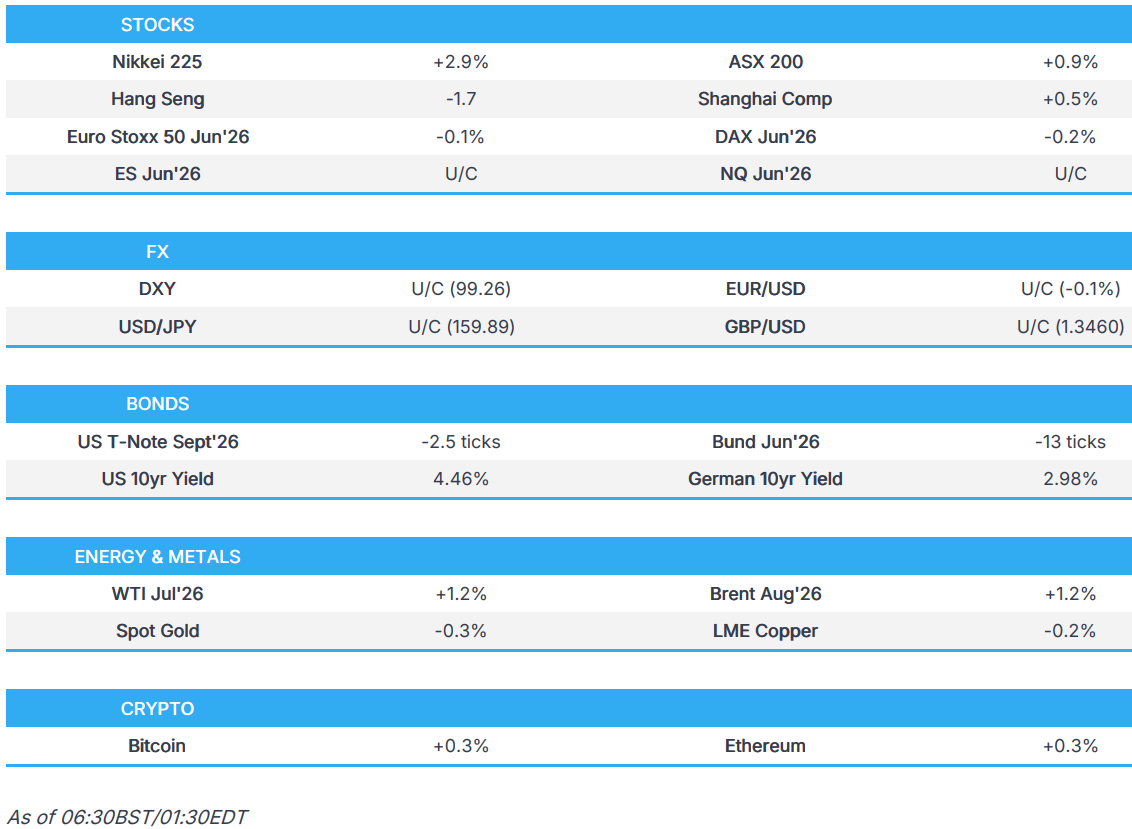
IRAN CONFLICT
- Explosions were heard near Qeshm Island in Iran on Wednesday morning.
- Kuwait’s Army announced its air defences were intercepting hostile missile and drone attacks, while reports noted that two US bases were targeted in Kuwait, with explosions in the Ali al-Salem and Arifjan bases where US soldiers are stationed. Furthermore, air raid sirens sounded in the UAE and Saudi Arabia, with explosions also reported in Saudi Arabia, while explosions were heard in Qamishli, Syria, and earlier reports noted multiple explosions in the centre of Iraqi Kurdistan with the headquarters of anti-Iranian separatist groups targeted.
- IRGC said the US attacked Qeshm Island, and in response, Iran carried out precise and intensive missile strikes on US bases in Kuwait, while it warned further US aggression will be met with a seismic, crushing and decisive response.
- IRGC said the headquarters of the US 5th Fleet in Bahrain was attacked by missiles and drones from the IRGC Aerospace Force, while it targeted a US-affiliated vessel named Panaya with missiles and clarified the recent attack was in retaliation for the US targeting an IRGC communications tower in the south of Qeshm Island.
- US CENTCOM said Iran launched several ballistic missiles towards neighbours and that forces successfully defeated multiple Iranian missiles, while US forces had conducted strikes on Qeshm Island in response to attempted attacks by Iran. CENTCOM stated that forces shot down three one-way attack drones launched by Iran toward civilian mariners that were rightfully transiting regional waters, and US forces also conducted self-defence strikes on an Iranian military ground control station on Qeshm Island. Furthermore, it denied IRGC claims that Iran struck the 5th Fleet HQ in Bahrain and a US airbase in the region, and stated that all Iranian attacks on US forces failed.
- US CENTCOM says forces disabled a Botswana-flagged unladen oil tanker that was attempting to sail toward an Iranian port on the Arabian Gulf on June 2nd. Says: US aircraft disabled the vessel by firing a Hellfire missile into the ship’s engine room, preventing the tanker from reaching Iran.
- US President Trump said reports that Iran and the US stopped speaking a few days ago were false, and conversations had been ongoing continuously. Trump added “Where they lead, one never knows, but as I told Iran, ‘It’s time, one way or another, for you to make a Deal.’”
- US President Trump is pushing Iran to make firmer nuclear commitments and wants nuclear concessions in writing from Iran, according to ABC News.
- US Secretary of State Rubio said that Iran has mined large segments of the Hormuz Strait. Rubio stated that nuclear negotiations with Iran were highly complicated and technical, which would therefore take time, while he added that the war with Iran had made interactions with Tehran more complicated, but also commented that the “war in Iran is over”.
- US issues fresh Iran-related sanctions.
- Iranian senior political source told Amwaj Media there had not been any halt in communication with the US via intermediaries. The source added that Qatar and other regional intermediaries had been working intensively behind the scenes to contain a potential re-escalation of war over Lebanon, while movement on multiple parallel tracks suggested there could be significant developments approaching.
- Israel and Lebanon’s delegations have not yet been able to reach decisive points regarding the ceasefire issue, according to Sky News Arabia citing a Lebanese source.
- Israeli Broadcasting Authority, cited sources, stating that negotiations between Israel and Lebanon were progressing well, while US forces would train and equip the Lebanese army.
- Israeli official, cited by the Israeli Broadcasting Authority, said there was American approval for the Israeli army to remain inside the security zone in southern Lebanon. It was also stated that there were not necessarily restrictions on Israeli military operations in southern Lebanon.
- Iranian Deputy Foreign Minister Gharibabadi told Tehran Times that Iran will take “proportionate” measures if Israel continues strikes in Lebanon.
- Hezbollah will not accept a “partial ceasefire” deal with Israel, according to AFP.
- Hezbollah attacked an Israeli command post in southern Lebanon with a drone strike, which wounded eight Israeli soldiers, according to SNN.
- Israeli artillery shelling was reported on the town of Blat in southern Lebanon.
US TRADE
EQUITIES
- US stocks closed higher on Tuesday, with the Russell 2000 outperforming as it rebounded from Monday’s losses, while the S&P 500 and Nasdaq also posted modest gains. Sector performance was broadly positive, with Utilities and Energy leading the advance. Communication Services was the clear laggard, weighed down by Alphabet (GOOGL, -4%) after it announced plans to raise USD 80bln for AI infrastructure. Elsewhere, Marvell (MRVL) surged after Nvidia’s CEO suggested it could become the next trillion-dollar company, while Hewlett Packard Enterprise (HPE) rallied following a strong earnings report.
- SPX +0.13% at 7,610, NDX +0.48% at 30,661, DJI +0.45% at 51,313, RUT +0.90% at 2,932.
- Click here for a detailed summary.
TARIFFS/TRADE
- US Trade Representative made findings and proposed action on 60 economies under Section 301 investigations relating to failures to take action on trade in forced labour goods. Furthermore, the 60 economies involved included Australia, China, India, Japan, the UK, the EU, Mexico, Canada and many others.
- US Appeals Trade Court reportedly ordered broad IEEPA tariff refunds.
- US Deputy Agriculture Secretary said China has started placing orders for soybeans that are being planted right now across the US, according to WSJ.
- Canadian Minister Responsible for Canada-US Trade Dominic LeBlanc said they had a positive meeting with USTR Greer, while he raised issues on US autos, steel, aluminium and softwood lumber tariffs. LeBlanc also stated that he will be in touch with USTR Greer next week and said they’re holding bilateral talks with Mexico on the US-Mexico-Canada agreement.
- Mexico recommended extending the USMCA agreement for 16 years.
NOTABLE HEADLINES
- White House said President Trump signed an executive order promoting advanced AI innovation and security, with the US to have access to AI “frontier models” before their release and will select trusted AI partners within 60 days. Furthermore, it emphasises building up cyber defence across the government and directs US agencies to develop cybersecurity standards for advanced AI models.
- Fed Chair Warsh told staff he will conduct clear-eyed discussions about reform while upholding the best of the Fed’s traditions, according to a memo.
- Fed Chair Warsh tapped two outside associates, Paul Winfree and Daniel Heil, to advise him while he settles into the job, according to WSJ citing sources.
- US Senate GOP leaders indicated to Republicans at lunch that they’re trying to fast-track the reconciliation bill, according to Punchbowl citing sources.
- US Acting Attorney General Blanche confirmed the Trump administration is not moving forward with the weaponisation fund.
APAC TRADE
EQUITIES
- APAC stocks mostly gained as the region took its cue from Wall St, where the S&P 500, Dow and Nasdaq 100 printed fresh record highs, which has helped regional bourses shrug off the geopolitical escalation, in which the US struck Qeshm Island, and Iran targeted US bases in neighbouring countries.
- ASX 200 was led by outperformance in materials, mining and resources sectors, but with gains capped as tech, telecoms and defensives lagged, while participants also digested weaker-than-expected GDP data.
- Nikkei 225 took inspiration from US peers and printed a fresh all-time high after climbing above 68,000 for the first time.
- Hang Seng and Shanghai Comp were mixed, with the Hong Kong benchmark dragged lower by profit-taking following recent earnings and mixed fortunes among the key tech stocks, while the mainland found support from the better-than-expected Chinese RatingDog Services PMI data.
- US equity futures were rangebound and paused overnight after recent advances.
- European equity futures indicate a marginally lower cash market open with Euro Stoxx 50 futures down 0.1% after the cash market closed with gains of 1.2% on Tuesday.
FX
- DXY marginally strengthened amid higher oil prices but with gains capped following yesterday’s mixed performance against G10 peers and alongside the positive risk environment. Elsewhere, recent Fed rhetoric did little to shift the dial with Chair Warsh telling staff that he will conduct clear-eyed discussions about reform, while upholding the best of the Fed’s traditions.
- EUR/USD traded flat after the limited reaction in the single currency to yesterday’s Eurozone inflation numbers, as a rate hike by the ECB this month remained almost fully priced in. As for Bank commentary, ECB’s Wunsch noted that an Iran peace deal won’t derail the case for a rate hike.
- GBP/USD price action was rangebound amid the relatively quiet data calendar for the UK this week. Monday saw commentary via BoE Governor Bailey, who stated that policymakers were facing a trade-off between growth and inflation and that the Middle East conflict entirely explained the inflation overshoot. He also noted that the outlook was for slower growth rather than a recession.
- USD/JPY returned to flat territory after climbing to within a whisker of the 160.00 level, while Japanese Finance Minister Katayama reiterated they are prepared to respond appropriately on forex as needed, and continued to refrain from commenting on specific FX levels.
- Antipodeans were choppy but ultimately softened with AUD/USD briefly pressured by disappointing GDP data for Q1, which was then followed by better-than-expected Chinese RatingDog Services PMI data.
- PBoC set USD/CNY mid-point at 6.8184 vs exp. 6.7673 (prev. 6.8187).
FIXED INCOME
- 10yr UST futures lacked direction after yesterday’s flattening as rising oil prices continued to direct trade, while the recent expectation-topping JOLTS data only briefly contributed to the upside in yields.
- Bund futures lingered near the prior day’s trough as the upside in oil stoked inflationary pressures.
- 10yr JGB futures faded recent advances amid the gains in oil, and as money markets continue to price in around a 74% chance of a BoJ rate hike this month.
COMMODITIES
- Crude futures extended on the prior day’s gains as price action remained at the whim of geopolitical headlines amid reports of the US and Iran conducting fresh strikes against each other with the US targeting a tanker and sites on Qeshm Island, while Iran targeted a couple of US bases in Kuwait and launched several ballistic missiles towards its neighbours with explosions and air raid sirens reported in Kuwait, Bahrain, UAE, Saudi Arabia and Syria.
- US Private Inventory Data (bbls): Crude -6.8mln (exp. -3.6mln), Distillates -0.2mln (exp. -0.6mln), Gasoline +3.5mln (exp. -0.1mln), Cushing -0.3mln.
- White House economic advisor Hassett commented that gasoline prices are expected to decrease as the US receives additional oil supplies from the Gulf.
- White House is looking at a possible plan to offer discounts on oil drilling licenses and/or fees on military and/or public lands in exchange for a percentage of the oil drilled being sent to the SPR, while the plan is still being considered and not yet finalised, according to FBN’s Lawrence.
- Iraq plans to increase crude oil exports via pipelines from 220k BPD to 770k BPD in two phases over two and a half months, while it plans to raise crude exports by truck to neighbouring countries to 420k BPD in three phases.
- Spot gold was choppy after trickling beneath the USD 4,500 level, and with downside seen in the metals complex as oil prices climbed on the geopolitical escalation between the US and Iran.
- Copper futures slightly eased back after climbing yesterday in tandem with the upside in stocks.
CRYPTO
- Bitcoin declined overnight and dipped beneath the USD 66,000 level before partially recovering.
NOTABLE ASIA-PAC HEADLINES
- PBoC open market operations amounted to zero today.
DATA RECAP
- Chinese RatingDog Services PMI (May) 54.4 vs. Exp. 52.3 (Prev. 52.6)
- Chinese RatingDog Composite PMI (May) 54.0 (Prev. 53.1)
- Australian GDP Growth Rate QQ (Q1) 0.3% vs. Exp. 0.5% (Prev. 0.8%)
- Australian GDP Growth Rate YY (Q1) 2.5% vs. Exp. 2.7% (Prev. 2.6%)
GEOPOLITICS
RUSSIA-UKRAINE
- Russia said it downed three drones and continued repelling a drone attack over the Leningrad region.
OTHER
- Chinese envoy Liu Xiaoming met with Russia’s Vice Foreign Minister for discussions, including regarding the Korean peninsula.
EU/UK
NOTABLE HEADLINES
- ECB’s Wunsch said an Iran peace deal won’t derail the case for an ECB rate hike, according to FT.
2.NORTH AND SOUTH KOREA AND JAPAN
JAPAN
3 CHINA
CHINA/USA
4. EUROPEAN AND SCANDINAVIAN COMMENTARIES PLUS NATO
UK/
White Girls Raped By Dogs, Whisky Bottles, & 100s Of Men: Britain’s Migrant Grooming-Gang Scandal Exposed
Wednesday, Jun 03, 2026 – 03:30 AM
Restore Britain leader Rupert Lowe used a Westminster Hall debate on Monday to confront MPs with harrowing testimony from White girls and women who were raped, tortured, trafficked, and degraded by migrant grooming gangs, and abandoned by the very authorities that should have protected them.

The debate was secured after 260,974 Brits signed a petition calling for Parliament to address the rape gang scandal. Lowe opened by thanking the signatories and welcoming survivors who were sitting in the hall, saying the debate was not about politics, but about them.
“I want the world to hear what we heard during the two weeks of our independent rape gang inquiry hearings, an inquiry that should never have needed to happen,” Lowe said.
He then read out a series of graphic testimonies that exposed the scale of the abuse suffered by almost exclusively White girls.
One survivor said she was only “about 12, nearly 13” when a man raped her before forcing an empty Jack Daniel’s bottle inside her and breaking the glass. Another described being held down by groups of men as they took turns to rape her, before beating her and threatening to kill her and harm her loved ones if she ever spoke out.
Lowe told MPs that the evidence heard by his inquiry included repeated allegations that White British girls were deliberately targeted.
One survivor said abusers made constant references to “White girls” and “Christian girls,” claiming they had “fewer morals or lower values,” while Muslim girls were described as having “dignity and higher moral standing.”
Another alleged victim said race “did play a part” in the selection of victims, adding that the girls she encountered during her exploitation were “almost exclusively White.”
The testimony also included claims that children in care were effectively handed over to abusers. One survivor said men would sound a car horn outside a children’s home before a staff member brought a child to the front door. Another said, “It was all of the White girls in every home that I went to.”
In one of the most disturbing accounts read to MPs, a survivor recalled seeing the back of a van opened to reveal “15, 20 girls locked in dog cages.” Another said dogs were brought in during an attack while men stood around filming, laughing, and betting on what would happen. She said she had nowhere to move and was raped by a dog while a man held her face and stared into her eyes because “he wanted to see me break.”
Lowe also read testimony from a survivor who said she was raped by “probably about six or seven hundred different men” over three years after the abuse began when she was 13. Another said abuse escalated around Eid and holidays, when parties became “bigger, worse, and “more violent,” with more men and more girls involved.
The Restore Britain leader claimed that institutions had repeatedly failed victims. One girl said she went to hospital at 15, bleeding, swollen, and unable to sit down after an assault, but was given tablets and discharged after telling staff her drink had been spiked because she was too frightened to say what had really happened. “They did not ask any questions,” she said.
Another survivor alleged that she was raped by multiple police officers in different parts of the country. A further testimony claimed a man put a cigarette out on a baby’s face.
Lowe said the abuse was also used to attack the faith and identity of victims. One Christian survivor said her cross was used as a way to break her down, with abusers asking, “Where is your God now? Has your God forsaken you?”
The politician said he could have continued reading testimony “for hours and hours,” warning that Parliament no longer had any excuse for inaction.
“All of us in this building have a responsibility to finally act. Not to talk, but to act,” he said. “Our Rape Gang Inquiry report will be released in the coming days. It will change Britain for good.”
Lowe launched his own independent inquiry before the U.K. government announced a statutory national investigation into grooming gangs, a probe that identified evidence of child sexual exploitation across dozens of local authority areas.
.END
UK/WALES
Welsh Police Officers Ordered To Log Anti-Islam Comments In Chilling Free Speech Crackdown
Wednesday, Jun 03, 2026 – 05:00 AM
Authored by Steve Watson via Modernity.news,
Britain’s free speech traditions face fresh erosion as South Wales Police directs officers to record conversations and comments about Islam that stray beyond what the force deems “legitimate” discussion.

The policy, exposed in recent social media posts, risks logging lawful criticism as hostility incidents that could surface in future employment checks.
This move builds directly on the Labour government’s March definition of “anti-Muslim hostility” and exposes how public bodies are “gold-plating” safeguards meant to protect open debate.
South Wales Police has told staff to log anything exceeding its view of ‘acceptable’ talk on Islam. The Free Speech Union immediately challenged the guidance, warning it hands officers unchecked power to decide acceptable speech and creates a chilling effect on expression.
The FSU post laid it out plainly, noting “South Wales Police are zealously enforcing their own definition of Islamophobia in a way that threatens free speech.”
“This subjective definition gives officers the power to decide what constitutes acceptable speech and risks having a chilling effect on free expression,” the FSU adds.
The FSU has written to South Wales Police calling on them to withdraw the guidance. “If they fail to do so, we have threatened legal action by way of judicial review,” it further notes.
FSU General Secretary Lord Young said South Wales Police risked “penalising people for expressing misgivings about Islam”, contrary to free speech protections enshrined in law. Britain’s blasphemy laws were abolished by Parliament in 2008.
Lord Young added: “The Government was careful to include free speech safeguards in its official definition of anti-Muslim hostility, making clear that it was not intended to inhibit criticism of Islam or Islamic religious practices, such as ritual public prayer.”
“Our concern is that police forces and other public bodies adopting the definition will gold-plate it, ignoring those safeguards and penalising people for expressing misgivings about Islam, even when those views are rooted in evidence rather than prejudice,” Young further urged.
He continued, “In particular, we are concerned that the default police response to reports of anti-Muslim hostility – even where they clearly fall outside the definition – will be to record them as ‘anti-social behaviour incidents’, the new name for ‘non-crime hate incidents’. Those records may then be disclosed in enhanced DBS checks.”
The Government announced its official definition of “anti-Muslim hostility” in March, alongside plans to appoint an Islamophobia tsar.
END
EUROPE/USA
Opposite Of Drawdown: US Mulls Expanding Nuclear Weapons Deployments In Europe
Wednesday, Jun 03, 2026 – 04:15 AM
The White House has been talking about reducing America’s military presence across the European continent, amid long-running Trump complaints over lack of NATO burden-sharing. There are even plans to draw down 5,000 US troops from Germany on a permanent basis (though for now it appears thousands are just being moved to Poland).
Such a military ‘reduction’ would be welcomed by Moscow, however, as is usual when Washington signals de-escalation in force posture, the result ends up being the opposite. Washington is reportedly preparing to scatter more nuclear tripwires across the European continent, all while claiming a draw down of forces and footprint.

According to a Financial Times report published Tuesday, the US is actively discussing whether to deploy nuclear weapons in more NATO states.
Citing three people briefed on the internal discussions, American officials have signaled distinct openness to additional deployments well beyond the six nations that currently host the Pentagon’s nuclear-capable bombers.
Under NATO’s legacy nuclear sharing program, only six allies including Belgium, Germany, Italy, the Netherlands, Turkey, and the United Kingdom – are approved to host US supplied dual-capable aircraft and “forward-deployed” nuclear bombs.
And yet that exclusive club may be about to get a lot larger, and even closer to Moscow’s doorstep. Unsurprisingly, the nations highest on the list are located along NATO’s eastern flank, with Poland and various Baltic states already aggressively expressing interest in hosting the bases required to house the aircraft.
But as even Ukrainian media points out, this violates prior high level agreements between the Western alliance and Moscow:
The 1997 NATO-Russia agreement said NATO had no plans to place nuclear weapons in new member states. However, some countries that joined NATO later, including Poland, have since said they would be open to hosting US nuclear weapons, especially after Russia’s invasion of Ukraine.
The FT report suggests that while an agreement to expand nuclear hosting is not imminent, high-level discussions are happening at the highest levels of NATO.
The proposal seems to be Washington’s carrot offered alongside the ‘stick’ of renewed financial arm-twisting over lack of European defense spending.

As we featured last week, some recent reports have dubbed the new vision for European defense as “NATO 3.0” – wherein Washington would expect European allies to assume responsibility for the continent’s entire conventional defense, and the nuclear arsenal would be maintained by the United States. Lately France’s Macron has introduced the possibility of a French nuclear umbrella, apparently as an alternative.
END
5. RUSSIAN AND MIDDLE EASTERN AFFAIRS//
ISRAEL/USA VS IRAN//TUESDAY EVENING
Iran Sends Missiles, Drones Targeting Airbases Across Gulf After US Nighttime Attack On Qeshm Island
Tuesday, Jun 02, 2026 – 07:05 PM
Summary:
- Two bases come under fresh missile attack in Kuwait, Fars and Reuters report. Iran state media says retaliation for night US attack on Qeshm Island.
- Explosions & air raid sirens also being reported in Saudi Arabia, UAE, and Bahrain. It seems that war is popping off once again.
- rump insists reports that Iran & US have not been talking for days is ‘fake news’; Rubio also tells Congress talks are ongoing, despite fresh Iranian denials, and even claims the nuclear file is part of it.
- Washington has seen the Lebanon partial truce as opportunity enough to press forward on broader talks, with Trump saying he expects a broader Iran deal “over the next week”.
- But Fars denies this Tuesday: “exchange of messages between Iran & the US has been stopped for at least a few days” on MOU.
* * *
War Returns? More Missiles Fired On Kuwait, Sirens & Explosions In KSA, UAE
In the overnight hours local time, Kuwait is reporting inbound missiles and drones, with Fars reporting that two American bases were targeted. Explosions and air raid sirens also being reported in Saudi Arabia, UAE, and Bahrain. It seems that war is popping off once again.
Per a breaking Reuters report:
Kuwait’s army says that air defenses are intercepting hostile missile and drone attacks and urges the public to follow security and safety instructions issued by the relevant authorities.
Any sounds of explosions heard are the result of interceptions, the army adds.
Tasnim: “Blasts reported at Kuwait’s Ali al-Salem US airbase” after three missiles were fired. And the latest from CNN:
Kuwait says it is intercepting enemy missile and drone attacks. While it has not yet identified who it believes is behind the attack, the news comes shortly after Iranian media reported “explosion-like sounds” near Iran’s Qeshm island. Meanwhile, the US military said it “disabled” an oil tanker heading for an Iranian port by striking it with a Hellfire missile.
Unconfirmed emerging footage:
Sirens have also been activated in Bahrain, for unknown cause. New IRGC statement:
US Military Fires on Non-compliant vessel
In fresh action CENTCOM has announced it has fired on another vessel which was non-compliant to the US blockade:
- CENTCOM SAYS DISABLED NON-COMPLIANT VESSEL IN ARABIAN GULF
- CENTCOM: DISABLED VESSEL W/ HELLFIRE MISSILE TO ENGINE ROOM
Trump: It’s ‘Fake News’ That Iran & US Stopped Speaking Days Ago
President Trump in a fresh Truth Social post has again insisted that Washington and Tehran are talking again. “The conversations between us have been going on continuously… where they lead, one never knows, but as I told Iran, ‘It’s time, one way or another, for you to make a Deal.'”

Throughout the morning Secretary of State Marco Rubio was fielding questions on Capitol Hill. He too insisted that talks are ongoing, despite a Tuesday Iranian denial. He claimed the regime is ‘fragmented’ and because of this, back-and-forth messaging is extremely slow-going. “Iranian people would make a deal tomorrow if it were up to them,” Rubio said. “The Supreme Leader and the IRGC are a bit more immune to pressures.”
He also generally acknowledged that Iran has effectively shut down the Strait of Hormuz, and then said this justified the US naval blockade of Iranian ports in turn. There was also this interesting exchange when he echoed Trump’s line that the war is actually ‘over’ at this point…
Hawks like Ted Cruz want to know of any other regime change tactics going on…
A potential new nuclear framework regarding Iran was also a central topic to Tuesday’s Congressional testimony:
Big if true, there is still too much smoke and noise:
Secretary of State Marco Rubio said Tuesday that Iran has agreed to discuss previously off-limits aspects of its nuclear program, raising hopes that ongoing negotiations could pave the way for the reopening of the Strait of Hormuz and a broader diplomatic breakthrough.
Speaking at a Senate Foreign Relations Committee hearing on the State Department’s budget request, Rubio said: “We are in talks… There is the prospect before us, which could happen today, it could happen tomorrow, it could happen next week, that for the first time, certainly in my memory, they have agreed to negotiate aspects of their nuclear program.”
He said the U.S. hopes such negotiations could lead to a broader understanding that would include the reopening of the strategic waterway.
“We’re hopeful that something like that could happen, in which the straits would reopen, we would enter into a period of negotiations on very specific topics, delineated negotiations, in the hope of reaching an outcome that’s acceptable to us and something they would be able to do as well,” he said.
The above was spoken with a few too many caveats… “which could happen today, it could happen tomorrow, it could happen next week...”
Rubio in the hot seat over Iran war:
END
JERUSALEM POST //LATER TUESDAY EVENING;
US strikes Iranian military control station, intercepts projectiles launched at Bahrain, Kuwait
CENTCOM described the strikes on the Qeshm Island control center as “self-defense strikes,” ordered after American forces shot down three Iranian one-way attack drones aimed at nearby vessels.

Guided-missile destroyer USS Mason sails in the US CENTCOM area of responsibility in an undated picture, published April 29, 2026.(photo credit: SCREENSHOT X/ @CENTCOM)ByGOLDIE KATZJUNE 3, 2026 00:14Updated: JUNE 3, 2026 03:16
The United States struck an Iranian military ground control site and combated multiple Iranian missile and drone attacks aimed at Kuwait and Bahrain on Tuesday, US Central Command (CENTCOM) announced.
CENTCOM described the strikes on the Qeshm Island control center as “self-defense strikes,” ordered after American forces shot down three Iranian one-way attack drones aimed at vessels transiting regional waters.
In retaliation, Iran launched multiple missiles at Bahrain and Kuwait. Three were intercepted by US and Bahrain air defenses, and two that were aimed at Kuwait failed before hitting their targets.
US disables tanker headed for Iranian port
Earlier on Tuesday, the US disabled an empty oil tanker attempting to reach an Iranian port, firing a missile into the ship’s engine after the crew failed to comply with directions in the Persian Gulf.
According to US Central Command (CENTCOM), American forces issued repeated warnings to the crew of the Botswana-flagged vessel over the course of 24 hours as it sailed towards Iran’s Kharg Island.
ISRAEL USA VS IRAN/WEDNESDAY MORNING
MAJOR ESCALATION!!
Major Iranian Attack On Kuwait International Airport Leaves One Dead, 63 Injured
Wednesday, Jun 03, 2026 – 08:30 AM
Kuwait International Airport has come under Iranian missile and drone attack on Wednesday, in a significant strike that killed one person and left 63 people injured – according to the country’s health ministry, with several of the victims being seriously wounded.
A passenger terminal was directly struck, damaging facilities including diplomatic missions at the airport, Kuwaiti authorities have said. Area hospitals conducted seven major emergency surgeries following the incident, underscoring that it was a mass casualty event.

Kuwaiti defense ministry spokesperson Brig Gen Saud Abdulaziz Al-Atwan described the attack as “criminal Iranian aggression which resulted in significant material damage to the building and injuries.” It confirmed engaging 13 missiles and 17 drones total which were fired from Iran.
Civil aviation authorities immediately suspended traffic and transferred arriving flights to separate unaffected airports after “terminal one came under Iranian attacks causing casualties and damage.”
The cross-border airport attack came after violent exchanges of fire between the US and Iran, which at first looked like limited one-off incidents, but then became an extended tit-for-tat.
Overnight, the US military deployed a Hellfire missile to disable a tanker attempting to bypass the American blockade in the Strait of Hormuz. Following the intercept, American forces engaged in a wider kinetic exchange, stating they repelled subsequent Iranian reprisal strikes across the region and launched retaliatory attacks against military sites on Iran’s Qeshm Island.
In response, Iran’s Islamic Revolutionary Guards Corps (IRGC) claimed it launched a missile and drone barrage targeting the U.S. Fifth Fleet headquarters in Bahrain – an assertion that Central Command (CENTCOM) has explicitly denied. The IRGC had also sent several missiles on two US bases in Kuwait, which were said to have been intercepted.
Serous damage and chaos at Kuwait International Airport:
The Gulf Cooperation Council has in response slammed Iran for their “ongoing aggression” against member states Bahrain and Kuwait, denouncing the “cowardly attacks on civilian objects” which mark a “dangerous and unprecedented escalation.”
But Tehran is not backing down and is instead issuing further hardline warnings and threats, per Al Jazeera citing state media:
Iran’s Revolutionary Guard says retaliatory strikes “should serve as a lesson” for the United States after it fired a barrage of missiles and drones at Kuwait and Bahrain.
While Iran’s foreign ministry is warning that the overnight US assault on Qeshm Island continues a severe breach of the ceasefire, President Trump is saying that “conversations between us have been going on continuously” – in reference to the Iranians.
* * *
More latest developments via Newsquawk…
- Explosions were heard near Qeshm Island in Iran on Wednesday morning.
- Kuwait’s Army announced its air defences were intercepting hostile missile and drone attacks, while reports noted that two US bases were targeted in Kuwait, with explosions in the Ali al-Salem and Arifjan bases where US soldiers are stationed. Furthermore, air raid sirens sounded in the UAE and Saudi Arabia, with explosions also reported in Saudi Arabia, while explosions were heard in Qamishli, Syria, and earlier reports noted multiple explosions in the centre of Iraqi Kurdistan with the headquarters of anti-Iranian separatist groups targeted.
- IRGC said the US attacked Qeshm Island, and in response, Iran carried out precise and intensive missile strikes on US bases in Kuwait, while it warned further US aggression will be met with a seismic, crushing and decisive response.
- IRGC said the headquarters of the US 5th Fleet in Bahrain was attacked by missiles and drones from the IRGC Aerospace Force, while it targeted a US-affiliated vessel named Panaya with missiles and clarified the recent attack was in retaliation for the US targeting an IRGC communications tower in the south of Qeshm Island.
- US CENTCOM said Iran launched several ballistic missiles towards neighbours and that forces successfully defeated multiple Iranian missiles, while US forces had conducted strikes on Qeshm Island in response to attempted attacks by Iran. CENTCOM stated that forces shot down three one-way attack drones launched by Iran toward civilian mariners that were rightfully transiting regional waters, and US forces also conducted self-defence strikes on an Iranian military ground control station on Qeshm Island. Furthermore, it denied IRGC claims that Iran struck the 5th Fleet HQ in Bahrain and a US airbase in the region, and stated that all Iranian attacks on US forces failed.
- US CENTCOM says forces disabled a Botswana-flagged unladen oil tanker that was attempting to sail toward an Iranian port on the Arabian Gulf on June 2nd. Says: US aircraft disabled the vessel by firing a Hellfire missile into the ship’s engine room, preventing the tanker from reaching Iran.
- US President Trump is pushing Iran to make firmer nuclear commitments and wants nuclear concessions in writing from Iran, according to ABC News.
- US Secretary of State Rubio said that Iran has mined large segments of the Hormuz Strait. Rubio stated that nuclear negotiations with Iran were highly complicated and technical, which would therefore take time, while he added that the war with Iran had made interactions with Tehran more complicated, but also commented that the “war in Iran is over”.
- Iran’s Foreign Ministry condemned the US attacks on Iranian tanker and Qeshm island. The Foreign Ministry “notes the direct and clear responsibility of the rulers of Kuwait and Bahrain for last night’s aggressive acts.”
- Hardline Iranian lawmaker called for stronger military response to US strikes, Al Jazeera reported.
- Kuwait’s General Civil Aviation Authority said an emergency plan at Kuwait International Airport was activated after Terminal 1 was targeted by Iranian drones and missiles.
- Hezbollah attacked an Israeli command post in southern Lebanon with a drone strike, which wounded eight Israeli soldiers, according to SNN.
ISRAEL/IRAN AND USA/WEDNESDAY AFTERNOON
IRGC Says Trump Ongoing Talks Narrative ‘Not Reality’ After Most Intense Clashes Since April
Wednesday, Jun 03, 2026 – 12:15 PM
Summary
- GCC blasts ‘cowardly attacks’ after Kuwait International Airport rocked by Iranian missiles: one dead, 63 injured.
- Overnight saw US-Iran exchange fire in Strait of Hormuz – as US attacked Qeshm Island – and Iran unleashed more projectiles on Gulf states. Most intense fighting since April.
- IRGC via state media: Tehran has frozen all back-channel communication with Washington over Israeli operations in Lebanon, calls Trump narrative a fantasy.
- Trump says Iran has agreed not to pursue a nuclear weapon, while saying talks are still ongoing. Tells NYP he believes the crisis in the Strait of Hormuz will “resolve itself fairly quickly.“
* * *
State Media Still Insists Talks Are Frozen, Amid Most Intense Fighting Since April
State media statement on Wednesday:
IRGC-linked Tasnim claims Tehran has frozen all back-channel communication with Washington over Israeli operations in Lebanon, directly contradicting Trump’s assertion that messages are arriving daily from Iran. Tasnim: “Trump’s claim that Iran is confirming the issue is completely different from reality.”
Iran’s Foreign Minister is meanwhile articulating that Iran will lay down some new red lines via military strikes, which he has dubbed ‘self-defense’ in nature…
President Donald Trump is still trying to present some bright spots, telling NY Post he believes the situation in the Strait of Hormuz will “resolve itself fairly quickly” and went so far to say he expects to meet with Iran’s supreme leader “at some point.”
Major Attack on Kuwait International Airport: One Dead, 63 Injured
Kuwait International Airport has come under Iranian missile and drone attack on Wednesday, in a significant strike that killed one person and left 63 people injured – according to the country’s health ministry, with several of the victims being seriously wounded.
A passenger terminal was directly struck, damaging facilities including diplomatic missions at the airport, Kuwaiti authorities have said. Area hospitals conducted seven major emergency surgeries following the incident, underscoring that it was a mass casualty event.
Kuwaiti defense ministry spokesperson Brig Gen Saud Abdulaziz Al-Atwan described the attack as “criminal Iranian aggression which resulted in significant material damage to the building and injuries.” It confirmed engaging 13 missiles and 17 drones total which were fired from Iran.
Civil aviation authorities immediately suspended traffic and transferred arriving flights to separate unaffected airports after “terminal one came under Iranian attacks causing casualties and damage.” The cross-border airport attack came after violent exchanges of fire between the US and Iran, which at first looked like limited one-off incidents, but then became an extended tit-for-tat.
The Overnight Catalyst: US-Iran Exchange Fire in Hormuz
Overnight, the US military deployed a Hellfire missile to disable a tanker attempting to bypass the American blockade in the Strait of Hormuz. Following the intercept, American forces engaged in a wider kinetic exchange, stating they repelled subsequent Iranian reprisal strikes across the region and launched retaliatory attacks against military sites on Iran’s Qeshm Island.
In response, Iran’s Islamic Revolutionary Guards Corps (IRGC) claimed it launched a missile and drone barrage targeting the U.S. Fifth Fleet headquarters in Bahrain – an assertion that Central Command (CENTCOM) has explicitly denied. The IRGC had also sent several missiles on two US bases in Kuwait, which were said to have been intercepted.
Serous damage and chaos at Kuwait International Airport:
GCC Blasts ‘Cowardly Attacks’
The Gulf Cooperation Council has in response slammed Iran for their “ongoing aggression” against member states Bahrain and Kuwait, denouncing the “cowardly attacks on civilian objects” which mark a “dangerous and unprecedented escalation.”
But Tehran is not backing down and is instead issuing further hardline warnings and threats, per Al Jazeera citing state media:
Iran’s Revolutionary Guard says retaliatory strikes “should serve as a lesson” for the United States after it fired a barrage of missiles and drones at Kuwait and Bahrain.
While Iran’s foreign ministry is warning that the overnight US assault on Qeshm Island continues a severe breach of the ceasefire, President Trump is saying that “conversations between us have been going on continuously” – in reference to the Iranians.
Overnight Headlines
More latest developments via Newsquawk…
- Explosions were heard near Qeshm Island in Iran on Wednesday morning.
- Kuwait’s Army announced its air defences were intercepting hostile missile and drone attacks, while reports noted that two US bases were targeted in Kuwait, with explosions in the Ali al-Salem and Arifjan bases where US soldiers are stationed. Furthermore, air raid sirens sounded in the UAE and Saudi Arabia, with explosions also reported in Saudi Arabia, while explosions were heard in Qamishli, Syria, and earlier reports noted multiple explosions in the centre of Iraqi Kurdistan with the headquarters of anti-Iranian separatist groups targeted.
- IRGC said the US attacked Qeshm Island, and in response, Iran carried out precise and intensive missile strikes on US bases in Kuwait, while it warned further US aggression will be met with a seismic, crushing and decisive response.
- IRGC said the headquarters of the US 5th Fleet in Bahrain was attacked by missiles and drones from the IRGC Aerospace Force, while it targeted a US-affiliated vessel named Panaya with missiles and clarified the recent attack was in retaliation for the US targeting an IRGC communications tower in the south of Qeshm Island.
- US CENTCOM said Iran launched several ballistic missiles towards neighbours and that forces successfully defeated multiple Iranian missiles, while US forces had conducted strikes on Qeshm Island in response to attempted attacks by Iran. CENTCOM stated that forces shot down three one-way attack drones launched by Iran toward civilian mariners that were rightfully transiting regional waters, and US forces also conducted self-defence strikes on an Iranian military ground control station on Qeshm Island. Furthermore, it denied IRGC claims that Iran struck the 5th Fleet HQ in Bahrain and a US airbase in the region, and stated that all Iranian attacks on US forces failed.
- US CENTCOM says forces disabled a Botswana-flagged unladen oil tanker that was attempting to sail toward an Iranian port on the Arabian Gulf on June 2nd. Says: US aircraft disabled the vessel by firing a Hellfire missile into the ship’s engine room, preventing the tanker from reaching Iran.
- US President Trump is pushing Iran to make firmer nuclear commitments and wants nuclear concessions in writing from Iran, according to ABC News.
- US Secretary of State Rubio said that Iran has mined large segments of the Hormuz Strait. Rubio stated that nuclear negotiations with Iran were highly complicated and technical, which would therefore take time, while he added that the war with Iran had made interactions with Tehran more complicated, but also commented that the “war in Iran is over”.
- Iran’s Foreign Ministry condemned the US attacks on Iranian tanker and Qeshm island. The Foreign Ministry “notes the direct and clear responsibility of the rulers of Kuwait and Bahrain for last night’s aggressive acts.”
- Hardline Iranian lawmaker called for stronger military response to US strikes, Al Jazeera reported.
- Kuwait’s General Civil Aviation Authority said an emergency plan at Kuwait International Airport was activated after Terminal 1 was targeted by Iranian drones and missiles.
- Hezbollah attacked an Israeli command post in southern Lebanon with a drone strike, which wounded eight Israeli soldiers, according to SNN.
LATE AFTERNOON:
Iran Issues 4-Stage Proposal For Deal With US, After Most Intense Overnight Clashes Since April
Wednesday, Jun 03, 2026 – 01:50 PM
Summary
- State media issues four-stage proposal for deal with US, says indirect talks are ‘ongoing’.
- GCC blasts ‘cowardly attacks’ after Kuwait International Airport rocked by Iranian missiles: one dead, 63 injured.
- Overnight saw US-Iran exchange fire in Strait of Hormuz – as US attacked Qeshm Island – and Iran unleashed more projectiles on Gulf states. Most intense fighting since April.
- IRGC via state media: Tehran has frozen all back-channel communication with Washington over Israeli operations in Lebanon, calls Trump narrative a fantasy.
- Trump says Iran has agreed not to pursue a nuclear weapon, while saying talks are still ongoing. Tells NYP he believes the crisis in the Strait of Hormuz will “resolve itself fairly quickly.“
* * *
Fars: Outline of Iran’s 4-Stage Proposal For Deal With US
Fars Politics on Telegram has issued the following outline on Wednesday (machine translated). Also, somewhat contradicting reports from other state media outlets, Fars has stated that indirect talks with Washington are still ongoing, but that no final decision on a MOU has yet been made.
Phase 1: Ending war and halting military actions.
Phase 2: Tangible measures, including: The issue of the strait and the mechanisms related to it,
Lifting the blockade, Removing restrictions and oil sanctions, Releasing part of Iran’s frozen assets and blocked financial resources.Phase 3: Dedicated to discussions on sanctions and the nuclear file.
Phase 4: Involves establishing a supervisory committee to oversee implementation of the understanding and monitor the commitments of all parties.
Saeed Ajorlou, a member of the media team of the negotiating delegation provided the following commentary via Fars:
Phase One is ending the war and achieving a complete halt to military actions. This must encompass all parties and all fronts—whether Iran and the United States or the so-called Resistance Axis.
After Phase One is stabilized, the focus shifts to practical and tangible measures. In this phase, four key issues must be addressed:
- The issue of the strait and the mechanisms related to it
- Lifting the blockade,
- Removing restrictions and oil sanctions,
- Releasing part of Iran’s frozen assets and blocked financial resources.
Phase Three is dedicated to discussions on sanctions and the nuclear file. At this stage, after concrete and verifiable measures have been implemented, negotiations will begin on broader sanctions relief as well as issues related to the nuclear program.
Phase Four involves establishing a supervisory committee to oversee implementation of the understanding and monitor the commitments of all parties. The members of this committee have not yet been finalized, but Iran is seeking to include friendly and aligned countries in the mechanism so that the implementation process has sufficient backing and support.
By the looks of the above proposal, the warring sides seem very much still at square one.
State Media Still Insists Talks Are Frozen, Amid Most Intense Fighting Since April
State media statement on Wednesday:
IRGC-linked Tasnim claims Tehran has frozen all back-channel communication with Washington over Israeli operations in Lebanon, directly contradicting Trump’s assertion that messages are arriving daily from Iran. Tasnim: “Trump’s claim that Iran is confirming the issue is completely different from reality.”
Iran’s Foreign Minister is meanwhile articulating that Iran will lay down some new red lines via military strikes, which he has dubbed ‘self-defense’ in nature…
President Donald Trump is still trying to present some bright spots, telling NY Post he believes the situation in the Strait of Hormuz will “resolve itself fairly quickly” and went so far to say he expects to meet with Iran’s supreme leader “at some point.”
END
ISRAEL TBN/
HEZBOLLAH
Israel-Lebanon talks resume, Hezbollah keeps fighting in violation of agreement with Trump – report
“Our logic is to contain the fighting in Lebanon and not make it an issue in negotiations,” a US administration source said.

Yechiel Leiter (far L), Israeli Ambassador to the US, and Nada Hamadeh (far R), Lebanese Ambassador to the US, attend a meeting hosted by the United States at the State Department in Washington, DC, on June 2, 2026. Leading the US delegation are Deputy National Security Advisor Mike Needham (C)(photo credit: Kent NISHIMURA / AFP via Getty Images)ByDANYA SAPERSTEIN, AMICHAI STEINJUNE 2, 2026 22:39
During talks between Israel and Lebanon on Tuesday, senior members of the Israeli delegation said that Hezbollah did not stop fighting, despite promising US President Donald Trump to do so on Monday.
Delegations from both Lebanon and Israel met at the US State Department on Tuesday to begin a scheduled two-day resumption of negotiations.
Members of the Israeli delegation also said that Hezbollah publicly rejected the equation of a ceasefire in southern Lebanon in exchange for a ceasefire in northern Israel.
The US is also forming a plan in which US forces will train their Lebanese counterparts to deal with Hezbollah in Beirut, KAN News reported on Tuesday.
“Our logic is to contain the fighting in Lebanon and not make it an issue in negotiations,” a US administration source told KAN.
The negotiations come a day after Prime Minister Benjamin Netanyahu canceled a strike on Beirut at the urging of Trump, with Iranian officials warning that military action taken by Israel against Lebanon would cause a halt in communication between Iran and the US.

Rubio: Iran trying to stymie Israel-Lebanon talks
US Secretary of State Marco Rubio said that while the US is trying to view the Lebanon-Israeli talks as separate and distinct from Iran, Iran wants to “mix it all together.”
Iran is currently attempting to interfere with the talks between Lebanon and Israel “so that if an arrangement is reached at some point in the future, they can claim credit for having forced it through leverage,” Rubio said.
Rubio also reaffirmed the US’s support for “demilitarizing and defanging Hezbollah, while at the same time strengthening the legitimate government of Lebanon.”
END
HEZBOLLAH
Netanyahu says he and Trump share goal to disarm Hezbollah, demilitarize Lebanon
By AFPToday, 6:47 pm
Prime Minister Benjamin Netanyahu says that he and US President Donald Trump are aligned on the goal of disarming Hezbollah in order to achieve peace between Israel and Lebanon.
Hezbollah “is an Iranian proxy that puts all the citizens of Lebanon at gunpoint and uses Lebanon as a platform to launch terror missiles into our cities, to launch killer drones against our civilians,” Netanyahu says in an interview with CNBC.
“And so if we want to save Lebanon, if we want to get a Lebanese-Israeli peace, as I do, we have to disarm Hezbollah and we have to demilitarize Lebanon. And I know that this is a goal that the president and I share, and that’s what we have to do.”
He also says Iran is “playing with fire” after the Islamic Republic carried out an attack on Kuwait.
“Iran surely knows what the president has said, that if necessary, there’ll be a full-scale return to military action,” Netanyahu says.
Asked if there is still a ceasefire following recent attacks on Kuwait and Bahrain, Netanyahu states, “You know, it’s the president’s decision. Israel is ready and the US forces are ready. I think Iran should take that into account. I think they are taking it into account, but they’re playing with fire, that’s clear.”
OMAN/IRAN/USA
US Warns Ally Oman That It Better Pick The ‘Right’ Side In Hormuz Standoff
Wednesday, Jun 03, 2026 – 02:45 AM
The saga of rare Washington pressure on its longtime regional ally Oman continues, with on Tuesday The Wall Street Journal reporting that US officials are growing “increasingly frustrated” with Muscat’s neutral stance, which they now view as hostile to US interests.
Oman has stood accused of cooperating with Iran on a proposed toll collection scheme which would benefit Tehran and circumvent America’s aims for the region.

“In recent days, the Trump administration has threatened to sanction and even bomb Oman, after a new intelligence assessment concluded that Muscat was planning to join Iran in tolling vessels in the strategic Strait of Hormuz, according to another U.S. official,” WSJ writes. “Oman has repeatedly denied that it plans to do so.”
Interestingly, Oman actually provided some level of military assistance to the US even as it launched an unprovoked attack on the Islamic Republic alongside Israel.
“Omani territory was used to provide some logistical supplies to the U.S. military at the start of the war, say Arab and U.S. officials,” notes the report. “But the U.S. official said the military assistance was small.”
During a cabinet meeting last week, President Trump made clear that Muscat must align with US-backed ‘international norms’ or face consequences, warning, “Oman will behave just like everybody else, or we’ll have to blow them up.”
Omani Information Minister Abdulla al-Harrasi has recently emphasized that the Sultanate remains “ready to work with the United States and all responsible partners to promote stability” and protect mutual interests.
The small strategically located Arabian peninsula country has sought to walk a fine line, but Washington is angered as it has yet to explicitly condemn Iran, even after weeks of attacks on Gulf states (at the height of Operation Epic Fury):
Since the war started, Oman has assisted ships, including from the U.S., by providing navigational guidance, search-and-rescue services and medical assistance to ship crews, said a person familiar with the matter.
Harrasi said the country remained committed to the free flow of commerce and energy through the strait. “Any threat to freedom of navigation in these waters would harm the interests of the entire international community, including the United States,” he said.
In May, Oman was the only Persian Gulf country that refused to sign an Emirati-led U.N. statement condemning Iran’s move to charge tolls in Hormuz.
Some have called Oman the “Switzerland of the Middle East” – a status that Omani diplomats are proud of. Likely they are also very wary of being seen as is America’s or Israel’s corners – especially before their domestic Arab population.
One analyst quoted in the WSJ has summarized where things stand: Oman’s approach to Tehran so far has “opened the door to criticism and unwelcome scrutiny of a country that has long prided itself on its impartial foreign policy.”
Meanwhile, via Financial Times on Tuesday: “Greek shipping tycoon Evangelos Marinakis ready to pay Strait of Hormuz transit fees.”
If this trend of different shipping companies and nations approaching Tehran to do separate deal-making to transit the strait continues, we could see Iran placed in a stronger position globally than before the war began.
IRAN/USA
US Treasury Sanctions Iran’s Largest Crypto Exchange
Tuesday, Jun 02, 2026 – 08:30 PM
Peace talks appear stalled, or even halted completely – despite President Trump’s denials – and the US Department of Treasury is still swinging hard, as part of the ongoing effort to bring about economic collapse in Iran and ‘solve’ the Hormuz Strait shipping crisis.
In the latest installment of Washington’s economic whac-a-mole, the US on Tuesday unveiled sanctions on Iran’s biggest cryptocurrency exchange – and several others, for allegedly enabling the Iranian government and blacklisted state institutions to thwart US and EU sanctions.
The largest platform, identified as Nobitex, is believed to have assisted in allowing hundreds of millions of dollars to pour into Iran’s central bank and the Islamic Revolutionary Guard Corps (IRGC), as a sanctions work-around and parallel financial system.

“While Iran’s economy is in free fall, the regime has chosen to co-opt digital asset technologies for its own corrupt agenda, including evading sanctions and transferring wealth out of the country,” Treasury Secretary Scott Bessent stated in announcing the new action.
“Following the commencement of U.S. combat operations in Iran, Nobitex played a role in protecting and moving assets and funds out of Iran to shield regime wealth despite internet blackouts,” the statement added.
Nobitex rejected that it has direct government connections and denied that it has been assisting state institutions. It also said it did nothing to conceal the identities of the owners.
As for ownership, Reuters has documented:
…Nobitex is controlled by two brothers from one of Iran’s most powerful families, with close ties to the new supreme leader. The two are members of the Kharrazi family, one of the most influential dynasties in the Islamic Republic. Corporate records show that when the exchange started, the brothers were listed under a surname rarely used by members of the family.
The brothers were named by the Treasury as Seyed Mohammad Ali Aghamir Mohammad Ali and Seyed Mohammad Aghamir Mohammad Ali, who were also subject to individual sanctions, along with the exchange’s chief executive officer, Amir Hossein Rad.
Last Friday Bessent detailed how the US has seized a total of $1 billion in Iranian cryptocurrency assets to date as part of the economic component of President Trump’s Operation Epic Fury.
During a speech before the Reagan National Economic Forum, Bessent stated:
“Just outright grabbed the wallets. Some of them may be typing in right now and might not realize their wallet had been grabbed.”
Assets are held “on behalf of the Iranian people” – he described, while framing that the Iranian government had ‘stolen’ the money from the Iranian populace.
Did this action help fuel BTC’s crashing well below $68K on Tuesday?

As we’ve featured before, for ordinary Iranians – roughly one in six of the population – crypto served as a vital lifeline. Facing relentless rial depreciation (down nearly 90 percent since 2018), chronic inflation of 40 to 50 percent, and frequent power blackouts or internet shutdowns during protests, citizens turned to Bitcoin and stablecoins like U.S. dollar-pegged stablecoins (USDT) on the Tron network to hedge savings, facilitate remittances, and move value when traditional banking failed. Spikes in Bitcoin withdrawals to personal wallets often coincided with domestic unrest and regional conflicts.
Yet this parallel financial system has also become a powerful tool for the state. The Islamic Revolutionary Guard Corps (IRGC) steadily tightened its grip on Iran’s crypto flows. IRGC-linked addresses received more than $3 billion in 2025—up from over $2 billion in 2024—with their share rising to more than 50 percent of total Iranian crypto inflows by the end of 2025. These figures represent conservative lower bounds based only on identified and sanctioned wallets.
Washington in the meantime is still entertaining dreams of sparking some kind of anti-regime uprising based on applying the economic squeeze to the Iranian system, but apart from unrest back in January, this has utterly failed to materialize.
END
KUWAIT/IRAN
Kuwait diverts flights after Iranian missile, drone attacks damage airport terminal, cause injuries
Iranian drones and missiles attacked Kuwait and Bahrain on Tuesday, causing US CENTCOM to strike an Iranian military ground control sites, attempt to intercept incoming munitions.

Passengers arrive at Kuwait International Airport, June 1, 2026; illustrative.(photo credit: Yasser al-Zayyat/AFP via Getty Images)ByJAMES GENN, GOLDIE KATZJUNE 3, 2026 00:14Updated: JUNE 3, 2026 11:38
Kuwait’s Civil Aviation Authority suspended all air traffic and diverted flights away from Kuwait International Airport after Iranian missiles and drones hit Terminal 1, wounding several and causing structural damage, Kuwaiti state media confirmed on Wednesday morning.
A Kuwaiti Defense Ministry spokesperson said that “enemy drones” targeted the airport’s Terminal 1, causing “significant material damage, and wounding several individuals who received the necessary medical care.”
Technical teams are inspecting and assessing damage, Kuwait’s official KUNA said.
US strikes Iranian missile sites following regime’s attacks on Kuwait, Bahrain, CENTCOM confirms
This follows on from the US striking an Iranian military ground control site and combated multiple Iranian missile and drone attacks aimed at Kuwait and Bahrain on Tuesday, US Central Command (CENTCOM) confirmed.
CENTCOM described the strikes on the Qeshm Island control center as “self-defense strikes,” ordered after American forces shot down three Iranian one-way attack drones aimed at vessels transiting regional waters.
In retaliation, Iran launched multiple missiles at Bahrain and Kuwait. Three were intercepted by US and Bahrain air defenses, and two that were aimed at Kuwait failed before hitting their targets.
Bahrain’s military says it was responsible for intercepting three missiles and several drones in a post on its official X account. Bahrain’s official statement made no mention of US involvement.
A short while later, Iran launched another wave of drones intended to attack US forces in Kuwait. CENTCOM announced that it successfully downed several drones, and no US personnel or assets were harmed during the incident.
US disables tanker headed for Iranian port
Earlier on Tuesday, the US disabled an empty oil tanker attempting to reach an Iranian port, firing a missile into the ship’s engine after the crew failed to comply with directions in the Persian Gulf.
According to CENTCOM, US forces issued repeated warnings to the crew of the Botswana-flagged vessel over the course of 24 hours as it sailed towards Iran’s Kharg Island.
\
To stop the tanker from reaching Iran, a US aircraft fired a missile into the vessel’s engine room, disabling it.
In a statement on X/Twitter, CENTCOM asserted that this is the sixth commercial vessel disabled by US forces since the blockade of Iranian ports along the Strait of Hormuz went into effect on April 13.
Iran says Kuwait, Bahrain bear responsibility for US attacks, vows self-defense
Iran’s Foreign Ministry condemned on Wednesday what it described as US attacks on an Iranian oil tanker in the Strait of Hormuz and a telecommunications tower on Qeshm Island, saying they violated a ceasefire understanding and international law.
The ministry said Kuwait and Bahrain bore “direct and clear responsibility” for the attacks, alleging their territory and facilities had been used to support US military operations against Iran.
Tehran said it reserved the right to self-defense and would use all available means to respond, including by targeting the source of any future attacks.
CENTCOM enforces US blockade on Strait of Hormuz
On Friday, CENTCOM took similar measures against a Gambia-flagged vessel in the Gulf of Oman attempting to reach an Iranian port.
In that incident, over 20 warnings were issued to the vessel’s crew before the ship was disabled with a Hellfire missile.
CENTCOM has also recently struck Iranian targets located along the Strait of Hormuz in retaliation for Iran’s downing of a US drone over international waters.
On Monday, CENTCOM announced that it had struck Iranian radar sites and drone command and control sites in Goruk and on Qeshm Island. In the same strikes, American forces also destroyed two one-way attack drones that posed a threat to vessels transiting nearby waters.
Reuters contributed to this story.
END
RUSSIA VS UKRAINE
THIS WAR IS INSANE!
Ukrainian Drone Smashes Into Russian Passenger Bus, Killing 8 Civilians
Wednesday, Jun 03, 2026 – 10:55 AM
The last 48 hours have seen massive, devastating Russian missile and drone attacks on the Ukrainian capital and other cities, which left at 18 dead and over 100 injured. Russia said this was in response to the Starobelsk dormitory attack of last month and other drone attacks targeting Russian territory.
But Ukrainian forces have upped the ante once again, this time with a mass casualty event in Russian-control Donetsk region. “A Ukrainian drone strike killed seven people and wounded 11 others in the occupied Donetsk region after crashing into a passenger bus, Kremlin-installed authorities said Wednesday morning, as overnight attacks killed at least two people in Russia,” The Moscow Times reports. State media later revised the death toll up to eight killed.

The strike happened in the town of Yenakiieve, while the group was being bussed to Simferopol in Crimea, all the way from Moscow on a long-distance route.
“According to preliminary reports, seven civilians were killed,” Denis Pushilin, the Kremlin-installed head of the Donetsk People’s Republic (DPR), wrote on Telegram. “At least eight people have been killed and 11 others wounded,” RT later cited him as indicating.
“The Ukrainian fascists have committed another act of unprecedented, inhumane aggression,” Pushilin additionally said. The bus itself was subsequently shown to be utterly destroyed and left as a burned, charred shell.
Perhaps seeking to preempt possible Ukrainian explanations of the bus attack being ‘unintentional’ – officials have insisted it could not have been an accident:
Russia’s human rights commissioner, Yana Lantratova, asserted that the attack was “not a tragic accident” but rather a “vile, deliberate, and inhumane crime” against non-combatants.
“There are no military objectives that could justify the bloodshed of civilians. There are no arguments that can absolve those who issue and execute such criminal orders from responsibility,” she stressed.
This could invite even greater airstrikes on Kiev, after it has already been hit hard in the latest attacks.
Russian embassies and foreign ministry-connected channels have circulated footage of the attack aftermath:
President Putin and top military brass had last month said strikes would be initiated against “decision-making centers” in response to the dorm attack in the Russia’s Lugansk People’s Republic on May 22, which killed 21 people – mostly teenage girls – and injured 70 others.
Kremlin officials now say that Russian forces have “a right to dismantle any infrastructure that supports terrorism.” This new bus attack strongly suggests there’s no off-ramp or de-escalation on the horizon, but that tit-for-tat strikes will only grow and become more violent.
6/.GLOBAL ISSUES, COVID ISSUES, VACCINE INJURIES/HEALTH ISSUES
High-Dose Vitamin D Lowers Diabetes Risk In Some People
Tuesday, Jun 02, 2026 – 08:55 PM
Authored by George Citroner via The Epoch Times,
A specific variation in the vitamin D receptor gene may determine whether high-dose supplementation lowers diabetes risk in prediabetic people.Illustration by The Epoch Times, Shutterstock
Nearly 115 million Americans are on the road to diabetes. New research suggests an inexpensive, widely available supplement could slow that journey, but only for some of them.
A genetic quirk in roughly 70 percent of prediabetic adults may determine whether high-dose vitamin D can meaningfully lower their risk of developing Type 2 diabetes, according to a study published in JAMA Network Open.
The research builds on the D2d trial. More than 2,000 U.S. adults living with prediabetes were randomized to either take 4,000 units of vitamin D or a placebo for up to 3.5 years. Initially, the trial did not find any significant changes across the participants. The recommended daily allowance is 600 to 800 units for average adults.
However, when scientists analyzed participants’ DNA, a more nuanced picture emerged: those carrying specific variations – known as AC or CC – in a gene called ApaI responded strongly to supplementation. Over the 3.5 years of the study, participants carrying the AC or CC variant had a 19 percent lower chance of developing diabetes. The roughly 30 percent with the AA variation saw no benefit at all.
“Diabetes has so many serious complications that develop slowly over years,” study lead researcher Bess Dawson-Hughes said in a statement. “If we can delay the time a person spends living with diabetes, we can reduce some of those harmful side effects or lessen their severity.”
The distinction matters because prediabetes – defined by higher-than-normal blood sugar that hasn’t yet crossed into diabetes territory – affects more than two in five U.S. adults, and often progresses silently. Identifying who stands to benefit from vitamin D intervention could allow clinicians to target supplementation far more precisely than current blanket guidelines allow.
1 Gene Affects How Your Body Responds To Vitamin D
Vitamin D in the blood is converted into its active form in the body. Vitamin D receptors are highly prevalent and present in many cells throughout the body.
When vitamin D binds to cell receptors, it helps cells do what they are supposed to do. In pancreatic cells, vitamin D facilitates the release of insulin to regulate blood sugar.
People with the AC and CC variations were responsive to vitamin D and, therefore, derived more benefits from supplementation.
* * *
[ZH: We sell high-dose Vitamin D + K2, which massively helps with calcium absorption. Pick some up here.]
* * *
The findings could help develop a personalized approach to preventing Type 2 diabetes, senior author Anastassios Pittas, a professor at Tufts University School of Medicine, said in the statement. “Part of what makes vitamin D appealing as a potential preventive tool is that it is inexpensive, widely available, and easy for people to take.”
However, researchers emphasized that more research is needed to determine which individuals might benefit from higher doses of vitamin D, with Dawson-Hughes noting that future testing could involve a simple, affordable genetic test to identify those most likely to benefit from supplementation.
Recommendations For Vitamin D Levels
The first step is to have your 25-hydroxyvitamin D level tested, Diana Cusa, senior registered dietitian at Plainview Hospital in New York, and not involved in the study, told The Epoch Times.
“If your levels are found to be deficient, you may consider supplementation and review your dietary intake and sun exposure habits,” she said.
Cusa recommended that those who choose supplements should take 600 to 800 international units (IU) daily of vitamin D3 for general health. “Higher doses may be needed if a deficiency is noted or for any targeted prevention trials,” she added.
Current guidelines recommend 600 IU per day for people up to 70 years of age and 800 IU for those older than 70. Excessive vitamin D intake can be harmful and has been linked to increased risks of falls and fractures among older adults.
Sunlight, Cusa pointed out, is one of the most effective natural sources of vitamin D, and spending time outdoors can help boost your levels. “However, it’s important to be cautious – not to spend too long in the sun without proper sunscreen, as excessive exposure increases the risk of skin cancer,” she cautioned.
While you cannot overdose on vitamin D from sun exposure, she added, taking high-dose supplements can lead to toxicity, “so supplementation should be approached carefully and ideally under medical guidance.”
Natural sources of vitamin D include fatty fish such as salmon, tuna, mackerel, sardines, and rainbow trout. Other good sources are beef liver, mushrooms, egg yolks, and cod liver oil. “These foods, which are rich in protein and healthy fats, can help support stable blood glucose levels when consumed in moderation,” Cusa said.
GLOBAL ISSUES//
MARK CRISPIN MILLER
DR PAUL ALEXANDER
RABOBANK/MICHAEL EVERY/OR OR PICTON/GIFFIN OR RABOBANK EXECUTIVE/COMMENTARY ON WORLDLY AFFAIRS
“Next Month, Next Quarter, Next Year”
Wednesday, Jun 03, 2026 – 10:20 AM
By Molly Schwartz, cross-asset macro strategist at Rabobank
In a tense Congressional Hearing before the foreign relations committee, Marco Rubio defended the Trump Administration’s war in Iran, praising the success of US military operations destroying Iranian military and nuclear facilities. He also said that a deal with Iran could happen “today, tomorrow, or next week.” However, the recent military escalations between the US and Iran, the refusal of Israel and Hezbollah to cooperate, and reports of Pezeshkian’s resignation — leaving Iran in the hands of the IRGC — mean that a deal seems to lie more on the horizon of next month, next quarter, or maybe even next year.
Our base case that we see passage through the Strait disrupted for at least three more months still stands as we have yet to see any tangible headlines to suggest an accelerated timeline. The negotiations currently lie in Iran’s hands, as Bloomberg reports Iran’s Mehr news saying that “officials in Tehran are discussing their ‘final text’ to send to the US.” One might be hesitant to truly deem this text as “final” (if it even exists), as it may be more of a “final_v3.doc”, or a “final_FINAL_v6.doc”, or even a “final_FINAL_totallyforrealthistime.doc”.
The most promising resolution right now is that the IRGC remains in power, but enriched uranium is handed over to an executor, like China, though we have yet to see any confirmed updates that this is a feasible solution that Iran would actually agree to at this juncture. The extended 60-day ceasefire is still ongoing, while both the US and Iran are dedicated to keeping the Strait closed and exchanging fire. CENTCOM posted on X today to show off the USS Abraham Lincoln enforcing the US blockade, which has apparently redirected 122 vessels to “ensure compliance.”
Yesterday, Trump slammed Vulcan’s Hammer on the AI industry, signing an executive order, “Promoting Advanced Artificial Intelligence Innovation and Security.” The executive order lauds how the administration has “unleashed tremendous technological growth and economic investment in AI by slashing the bureaucratic constraints that the prior administration placed on America’s AI developers and researchers, and by instead encouraging AI innovation and accelerating responsible AI adoption across government and industry.”
Part of the executive order is intended to support the AI industry, seeking to utilize AI in federal cybersecurity programs, and utilize AI models (potentially Mythos?) to pinpoint vulnerabilities. However, the order also seeks to impose new restrictions, likely in response to the emergency meeting triggered by Mythos a few months ago. This includes lots of classified processes and frameworks to make sure that an evil AI model, the likes of that in a Philip K. Dick novel, doesn’t usurp the American government as the presiding force leading the world’s global hegemon (or more likely, making sure these models can’t be used to hack into sensitive government websites). The process is referred to as a “voluntary framework” so that AI developers can submit their new models to the government 30 days before release to the public. Though the order also clarifies that “nothing in this section shall be construed to authorize the creation of a mandatory governmental licensing, preclearance, or permitting requirement for the development, publication, release, or distribution of new AI models, including frontier models.”
While innovation in the US is so hot that the government is now pulling in the reins a bit, officials in Canada are turning a blind eye to sluggish growth. Last week it was announced that Canadian GDP shrunk by 0.1% in Q1 of 2026, marking the second consecutive quarter of contraction and signalling a technical recession. Worse yet, the Q1 GDP estimate missed expectations of seeing growth at 1.5%, suggesting that the health of the Canadian economy has been overestimated by economists for the past few months.
Prime Minister Carney partially attributed the contraction to “uneven data” as the Canadian government “has been in the process of laying the foundations for a stronger, more resilient, more independent Canadian economy.” But at the same time, this comes less than a week after Carney celebrated close US-Canadian economic ties when speaking to the Economic Club of New York, saying that “Canada Strong will help make America great again.”
Bank of Canada Deputy Governor, Carolyn Rogers, has also brushed off the technical recession, saying that we need to “look past technical recession indicators” in favor of more leading economic indicators. But for some, the technical recession is a flashing red light, screaming that the current trade situation with the US is unsustainable and it’s time to sit down at the negotiating table.
Canadian trade minister LeBlanc sat with USTR representative Greer yesterday in Washington to discuss the USMCA. Prior to their sitdown, LeBlanc sent a letter to both Greer, and Mexico’s economy secretary Ebrard, asking to see the USMCA renewed for another sixteen years, as the USMCA review is currently underway. While the likelihood of the USMCA being renewed in its current form is slim to none—which LeBlanc is likely painfully aware of—he highlighted that conversations pertaining to the sectoral tariffs (Section 232 hitting steel, aluminum, automobiles, etc.) will be “essential.”
7. OIL AND NATURAL GAS ISSUES
Oil Prices Hold Gains As Gasoline Stocks Hit 12 Year Lows, Cushing ‘Tank Bottoms’ Loom
Wednesday, Jun 03, 2026 – 10:39 AM
Brent crude prices are rising back toward $100 per barrel this morning following the latest flare-up in fighting to threaten the U.S.-Iran ceasefire
Prices rose after the U.S. military said Iran fired missiles toward Kuwait and Bahrain, which failed to hit their targets.
The United States said it then struck an Iranian military ground control station on an island in the Strait of Hormuz.
API:
- Crude: -6.8MM
- Cushing: -279k
- Gasoline: +3.5M
- Distillate: -214k
DOE:
- Crude: -7.97mm – biggest draw since Feb
- Cushing: -583k
- Gasoline: +3.36mm – biggest build since Jan
- Distillate: +1.50mm
US crude stocks fell for the sixth straight week with Cushing inventories testing tank bottoms once again. The week saw an unexpected jump in product inventories with Gasoline’s biggest build since January…

Source: Bloomberg
Today’s rise in gasoline stocks lifts them off their lowest level for this time of year since 2014…

Source: Bloomberg
Cushing ‘tank bottoms’ are in sight once again…

Source: Bloomberg
The Strategic Petroleum Reserve saw another huge drawdown this week (down 58mm barrels since the start of the war)…

Source: Bloomberg
Rig counts are on the rise as US crude production drifts back towards record highs…

Source: Bloomberg
US crude and product exports jumped back towards record highs…

Source: Bloomberg
WTI was trading around $95 ahead of the official data…

Finally, economists at Macquarie wrote in a note this morning that crude oil’s muted reaction to the closure of Hormuz has mainly been a function of the oversupply seen before the war, .
The analysts suggested that “the market will be ok for another month or two, especially given commercial crude stocks have been cushioned by SPR/product draws.”
However, if the Strait remains closed at the end of the northern summer (Labor Day is Sept. 7), physical availability will tighten materially.
“If the Strait reopens soon, we expect prices to fall sharply. However, with stocks drawing rapidly, if the Strait remains closed, at some point prices will need to move much higher.”
‘Tank Bottoms’ are in sight around the world.
8. EMERGING MARKETS//AUSTRALIA NEW ZEALAND ISSUES
YOUR EARLY CURRENCY/GOLD AND SILVER PRICING/ASIAN CLOSING MARKETS AND EUROPEAN BOURSE OPENING AND CLOSING/ INTEREST RATE SETTINGS WEDNESDAY MORNING 6;30AM//OPENING AND CLOSING
OPENING LEVELS OF CURRENCIES// AND CLOSING ASIAN STOCK MARKET AND OPENING EUROPEAN STOCKS:6 AM EST
EURO VS USA DOLLAR: 1.1613 DOWN 0.0009
USA/ YEN 159.68 DOWN 0.320 NOW TARGETS INTEREST RATE AT 1.75% AS IT WILL BUY UNLIMITED BONDS TO GETS TO THAT LEVEL…//YEN STILL FALLS//END OF YEN CARRY TRADE BEGINS AGAIN DEC 2024/Bank of Japan raises rates by .25% TO 1.75 ..TAKAICHI NEW PM AS YIELDS RISE//JAPAN DEEPLY IN TROUBLE WITH RISING RATES AND A FALLING YEN!!
GBP/USA 1.3452 DOWN 0.0005 OR 5 BASIS PTS
USA/CAN DOLLAR: 1.3855 UP 0.0009 //CDN DOLLAR DOWN 9 BASIS PTS//
Last night Shanghai COMPOSITE CLOSED UP 8.87 PTS OR 0.22%
Hang Seng CLOSED DOWN 405.11 PTS OR 1.56%
AUSTRALIA CLOSED DOWN 0.02%
// EUROPEAN BOURSE: ALL MOSTLY RED
Trading from Europe and ASIA
I) EUROPEAN BOURSES: ALL MOSTLY RED
2/ CHINESE BOURSES / :Hang SENG CLOSED DOWN 405/11 PTS OR 1.56%
/SHANGHAI CLOSED UP 8.87 OR 0.22%
AUSTRALIA BOURSE CLOSED DOWN 0.02%
(Nikkei (Japan) CLOSED UP 1742.76 PTS OR 2.41%
INDIA’S SENSEX IN THE RED
Gold very early morning trading: $4456.00
silver:$74.20
USA DOLLAR VS TRY (TURKISH LIRA): 45.96 PLUS 3 BASIS PTS AND NOW WE SEE THEIR STUPIDITY OF SELLING SOME OF THEIR GOLD AND ALL OF THEIR USA DOLLAR RESERVES. THE COUNTRY IS IN BIG FINANCIAL TROUBLE
USA DOLLAR VS RUSSIAN ROUBLE: 72.93 ROUBLE// DOWN 0 ROUBLE AND 7 BASIS PTS. WOULD YOU BELIEVE THAT THE RUSSIAN ROUBLE AND THE ISRAEL SHEKEL ARE THE STRONGEST CURRENCIES BESIDES THE DOLLAR .
UK 10 YR BOND YIELD: 4.9040 UP 6 BASIS PTS
UK 30 YR BOND YIELD: 5.592 UP 5 BASIS PTS
CDN 10 YR BOND YIELD: 3.415 DOWN 1 BASIS PTS
CDN 5 YR BOND YIELD; 3.075 DOWN 1 BASIS PTS
USA dollar index early WEDNESDAY MORNING: 99.34 UP 16 BASIS POINTS FROM TUESDAY’s CLOSE
WEDNESDAY MORNING NUMBERS ENDS
And now your closing WEDNESDAY NUMBERS 10.00 AM
Portuguese 10 year bond yield: 3.377% UP 4 in basis point(s) yield
JAPANESE BOND 10 yr YIELD: +2.640% UP 7 FULL POINTS BASIS POINTS /JAPAN losing control of its yield curve/
JAPAN 30 YR: 3.850 UP 1 BASIS PTS//
SPANISH 10 YR BOND YIELD: 3.433 UP 4 in basis points yield
ITALY 10 YR BOND: 3.752 UP 6 points in basis points yield ./ THE ECB IS QE’ ING ITALIAN BONDS (
GERMAN 10 YR BOND YIELD: 3.0104 UP 4 BASIS PTS
IMPORTANT CURRENCY CLOSES : MID DAY WEDNESDAY
Closing currency crosses for day /USA DOLLAR INDEX/USA 10 YR BOND YIELD/10:00 AM
Euro/USA 1.1603 DOWN 0.0019 OR 19 basis points
USA/Japan: 159.98 UP 0.005 OR YEN IS DOWN 5 BASIS PTS// HIGHLY INFLATIONARY TO JAPAN
Great Britain 10 YR RATE 4.9160 UP 6 BASIS POINTS //
GREAT BRITAIN 30 YR BOND; 5.6000 UP 7 BASIS POINTS.
Canadian dollar DOWN 26 BASIS pts to 1.3872
xxxxxxxxxxxxxxxxxxxxxxxxxxxxxxxxxxxxxxxxxxxxxxxxxxxxxxxxxxxxxxxxxxxxxxxxxxxxxxxx
The USA/Yuan CNY DOWN TO 6.7695// ON SHORE ..
THE USA/YUAN OFFSHORE// CNH DOWN TO 6.7714
TURKISH LIRA: 45.96 EXTREMELY DANGEROUS LEVEL/DEATH WATCH/HYPERINFLATION TO BEGIN.//
Your closing 10 yr US bond yield UP 3 in basis points from TUESDAY at 4.483.% //trading well ABOVE the resistance level of 2.27-2.32%)
USA 30 yr bond yield 4.994 UP 3 basis points /10:00 AM
USA 2 YR BOND YIELD: 4.082 UP 3 BASIS PTS.
GOLD AT 10;00 AM 4445.10
SILVER AT 10;00: 73.63
Your 11:00 AM bourses for Europe and the Dow along with the USA dollar index closing and interest rates WEDNESDAY CLOSING TIME 10:00 AM///
London: CLOSED DOWN 33.76 PTS OR 0.33%
GERMAN DAX: CLOSED DOWN 314.52 OR 1.25%
FRANCE: CLOSED DOWN 45.45 PTS PTS PTS OR 0.55%
Spain IBEX CLOSED DOWN 63.50 PTS OR 0.35 %
Italian MIB: CLOSED DOWN 397.59 PTS OR 0.79%
WTI Oil price 94.53 10.00 EST/
Brent Oil: 97.54 10:00 EST
USA /RUSSIAN ROUBLE /// AT: 73.85 ROUBLE DOWN 0 AND 85 / 100
CDN 10 YEAR RATE: 3.428 DOWN 0 BASIS PTS.
CDN 5 YEAR RATE: 3.087 UP 1 BASIS PTS
CLOSING NUMBERS: 4 PM
Euro vs USA 1.1598 DOWN 0.0023 OR 23 BASIS POINTS//
British Pound: 1.3418 DOWN 0.0034 OR 34 basis pts/
BRITISH 10 YR GILT BOND YIELD: 4.9400 UP 6 FULL BASIS PTS//
BRITISH 30 YR BOND YIELD: 5.624 UP 8 IN BASIS PTS.
JAPAN 10 YR YIELD: 2.648 UP 7 FULL BASIS PTS (DANGEROUS TO THEIR ECONOMY
JAPANESE 30 YR BOND: 3.858 UP 1 PTS AND STILL VERY DANGEROUS TO THEIR ECONOMY
USA dollar vs Japanese Yen: 160.03 UP 0.050 OR YEN DOWN 5 BASIS PTS//GETTING CLOSER TO 160.00
USA dollar vs Canadian dollar: 1.3894 UP 0.0059 PTS// CDN DOLLAR DOWN 59 BASIS PTS
West Texas intermediate oil: 95.94
Brent OIL: 97.93
USA 10 yr bond yield UP 4 BASIS pts to 4.496
USA 30 yr bond yield: UP 2 PTS to 4.991%
USA 2 YR BOND 4.082 UP 4 PTS
CDN 10 YR RATE 3.455 UP 4 BASIS PTS
CDN 5 YEAR RATE: 3.089 UP 2 BASIS PTS
USA dollar index: 99.50 UP 32 BASIS POINTS
USA DOLLAR VS TURKISH LIRA: 45.96 GETTING QUITE CLOSE TO BLOWING UP/IDIOTS SOLD GOLD
USA DOLLAR VS RUSSIA//// ROUBLE: 73.81 DOWN 1 AND 81/100 roubles //
GOLD $4448.90 3:30 PM)
SILVER: 73/36 3;30 PM)
XX
DOW JONES INDUSTRIAL AVERAGE: DOWN 617.09 OR 1.28%
NASDAQ 100 DOWN 89.37 PTS OR 0.29%
VOLATILITY INDEX 16.02 UP .25 PTS OR 1.59%
GLD: $ 407,91 DOWN 4.04 PTS OR 0.98%
SLV/ $66.21 PTS DOWN 1.78 OR OR 2.62%
TORONTO STOCK INDEX// TSX INDEX: CLOSED DOWN 331.57 PTS 0.94%
end
TRADING today ZEROHEDGE 4 PM: HEADLINE NEWS/TRADING
Stocks Go Down! Historic S&P Win-Streak Ends As US Macro Soars
WRAP UP
USA DATA RELEASE/
ADP Reports US Economy Added The Most Jobs In 16 Months In May
Wednesday, Jun 03, 2026 – 08:23 AM
Following a shockingly strong JOLTS report, ADP just reported a stronger than expected rise in jobs added in May.
ADP says 122k jobs were added in May – better than the 120k expected – and the biggest monthly addition since January 2025

Source: Bloomberg
“Hiring was more broad-based in May than we’ve seen in the last few years,” said Dr. Nela Richardson, Chief Economist, ADP.
“The labor market continues to show sustained momentum going into the summer hiring season.”
Small businesses added the most jobs…

The Trade & Transportation industry added the most jobs while Information services suffered the biggest losses (AI?)…

Year-over-year pay growth for job-stayers was steady at 4.4 percent. For job-changers, the pace of growth slowed slightly, to 6.5 percent from 6.6 percent in April.

And yet amid all this… we are supposed to believe (according to UMich) that Americans’ consumer sentiment is at record lows?
END
US Services Surveys Send Mixed Growth Signals, Prices Keep Rising
Wednesday, Jun 03, 2026 – 10:07 AM
Following the dramatically better than expected rise in US Manufacturing PMI surveys, analysts expected stability in the Services side of the economy in May.
They were somewhat correct but the message was mixed with one survey improving while the other deteriorated…
- S&P Global US Services PMI dropped from 51.0 (April) to 50.9 (flash May) to 50.7 (final May) – dropping back towards March lows.
- ISM US Services PMI rose from 53.6 to 54.5 (better than 53.8 exp)

Source: Bloomberg
Under the hood, both surveys signaled rising prices with employment weaker and a mixed picture for orders (ISM higher, S&P lower)…

Source: Bloomberg
“While the US manufacturing economy is reporting a surge in demand as war-related supply and price worries drive precautionary stock building, it’s a different story in the service sector,” says Chris Williamson, Chief Business Economist at S&P Global Market Intelligence.
“Demand for services has been largely stalled over the past three months, losing the strength seen earlier in the year.”

The sluggish services economy is acting as drag on overall economic growth, which the PMI data signal to be running at a modest annualized pace of just above 1% so far in the second quarter…

Williamson notes that consumer-facing service sectors were the hardest hit, where orders are now falling at the steepest pace since the pandemic in 2020, with respondents blaming the decline on a combination of squeezed spending power from energy prices hikes and customers pushing back on higher prices being charged for services.
However, business services are also seeing reduced order book growth compared to earlier in the year and financial services firms are coming under pressure from higher interest rates.
“Rising costs and cooling demand are meanwhile causing service companies to cut staff at the fastest rate seen since the early months of the pandemic,” warns Williamson.
The increase in input cost inflation being signaled by the PMI points to a further rise in consumer price inflation in the coming months, but, Williamson notes that, on the other hand the “weakening of demand growth and downturn in the labor market being indicated could help allay concerns over any inflation spike becoming more entrenched.”
END
BEIGE BOOK//K SHAPED ECONOMY:
Latest Fed Beige Book Underscores “K-Shaped” Split Of US Economy
Wednesday, Jun 03, 2026 – 02:55 PM
Economic activity increased at a “slight to moderate” pace for ten of the twelve Federal Reserve Districts, while one District reported a slight decline and one reported no change, according to the latest Fed Beige Book.
The just released Beige Book – prepared at the Federal Reserve Bank of Kansas City based on information collected on or before May 27, 2026, and is the second one to capture the effect of the war on the US economy – found that consumer spending remained mixed across districts and increasingly bifurcated across income groups amid affordability pressures, the latest confirmation of the K-shaped economy.

In keeping with an increasingly fractured economy, the anecdotes highlighted moments of weakness that indicated far more weakness that the headline assessment indicated, to wit:
- higher-income households remained resilient and less sensitive to price increase, while middle-income households were described as “squeezing more life out of every dollar before deciding to spend it,” and low-income consumers showed greater financial strain. Said strain led to reports of increased credit card usage, fewer retail visits, and stronger demand for necessities.
- Auto dealers reported softer new vehicle demand tied to affordability and fuel costs, alongside substitution toward used and hybrid vehicles.
- By contrast, manufacturing activity increased at a modest to strong pace for nine of the Districts and only one noted a slight decline from the previous period.
- Banking conditions were stable across most Districts; however, residential mortgages, consumer, and agricultural loan delinquencies were noted as rising in several of the Districts.
- Agriculture conditions were unchanged or declined for most of the Districts, with cost pressures intensifying from fuel and fertilizer spikes.
- Energy activity increased in two of the markets, but Districts reported that the outlook remains highly uncertain leading producers to hold off on materially expanding activity.
- More broadly, business outlooks for the next six months were reported to have little change in anticipated growth, as elevated uncertainty and signs of weakening consumer spending weighed on sentiment.
In terms of labor markets, the Beige Book said the following:
- Employment showed little to no change across eleven Districts, while one District experienced modest growth.
- Manufacturing hiring was the strongest sector in several Districts, supported by defense-related activity and rising data center demand.
- Wage growth generally remained modest to moderate and largely in line with inflation. That said, Districts reported more frequent wage adjustments and cost-of-living increases to manage increasing fuel and other household cost pressures.
- Most Districts described a low-hire, low-fire environment, with workers increasingly reluctant to change jobs because of economic uncertainty.
- Hiring remained selective and primarily focused on critical roles or attrition replacement.
- Professional services occupations had mixed demand conditions, partly reflecting shifts in technological and operational changes.
As for prices, they “increased at a moderate to strong pace” overall, with most Districts reporting higher inflation than the previous report.
- Districts noted that energy-related costs tied to the conflict in the Middle East were the primary driver of inflationary pressures, with spillovers into shipping, packaging, groceries, and fertilizer.
- Non-labor input costs continued to rise faster than selling prices, contributing to broader concerns about margin compression.
- The ability to pass on higher costs remained mixed across sectors, particularly among consumer-facing firms.
- Consumer uncertainty and concerns about fuel prices impacting households were noted by several Districts.
- Several regions highlighted inflation mitigation strategies of firms that ranged from supply-chain optimization, product adjustments, reduced offerings, and temporarily absorbing higher costs to preserve customer demand.
Finally, here are the main highlights by Fed districts
- Boston: Economic activity grew slightly overall. Employment was unchanged, but hiring activity picked up in places, and wages showed slight gains. Cost pressures linked to the Middle East conflict remained elevated, although output prices rose only slightly overall. Consumer spending edged higher, despite the strain on household budgets from elevated gas prices. The outlook was mixed.
- New York: Regional economic activity increased slightly after a sustained period of weakness. Manufacturing activity grew strongly, consumer spending increased moderately, and housing activity picked up. Employment edged up, and wage growth eased somewhat but remained modest. Selling price increases rose to the high end of the moderate range, and input prices rose strongly, driven by rising energy costs. Businesses generally expected modest improvement.
- Philadelphia: Business activity declined slightly in the current period, down from a slight increase in the last period. Employment declined somewhat, as manufacturers and nonmanufacturers reported declines in jobs overall. Wage inflation held steady at a modest pace, and firm price inflation was moderate. Expectations for future growth rose at a strong pace for manufacturers but remained below the long-run average for nonmanufacturers.
- Cleveland: Fourth District business activity increased moderately, with similar growth anticipated in the months ahead. Manufacturing demand rose robustly, while retailers faced dampened demand from higher fuel prices. Home sales continued to improve, and data center buildouts drove commercial construction demand. Employment increased modestly. While wage pressures remained moderate, increases in nonlabor costs and selling prices were robust.
- Richmond: The regional economy continued to grow modestly this cycle. Modest growth was reported for consumer spending, financial services, and nonfinancial business services. Manufacturing activity increased moderately amid continued concerns about economic stability. Employment was unchanged, on balance, and wage growth was modest. Price growth remained in a moderate range despite many comments about increased input costs.
- Atlanta: Economic activity grew at a modest pace. Employment levels were flat and wages rose slowly. Prices and costs rose at a moderate pace. While retail sales grew modestly, travel activity slowed. Commercial and residential real estate were flat to down. Transportation and manufacturing activity expanded modestly. Energy demand rose moderately.
- Chicago: Economic activity in the Seventh District increased slightly over the reporting period. Manufacturing demand rose moderately; consumer spending, employment, and construction and real estate activity increased slightly; business spending was flat on balance; and nonbusiness contacts saw no change in economic activity. Prices rose rapidly, wages were up modestly, and financial conditions tightened slightly. Farm income expectations for 2026 were unchanged.
- St. Louis: Economic activity has slightly increased. Employment was unchanged and wage growth remained moderate. Prices have risen at a robust pace due to widespread higher nonlabor and energy costs. The outlook has slightly deteriorated, with contacts citing ongoing uncertainty, supply chain disruptions, and rising fuel costs linked to the conflict in the Middle East.
- Minneapolis: The District expanded modestly. Prices increased sharply and input pressures were especially high. Employment grew slightly and wage growth was modest to moderate. Services, manufacturing, and construction activity grew. Oil and gas contacts reported little change in activity or plans despite oil price shocks.
- Kansas City: Economic activity in the Tenth District increased slightly, though consumer-facing firms continued to report softer demand and margin compression. Restaurants noted middle-income households have become increasingly cautious with discretionary spending. Firms also reported rising input costs, with non-energy expenses exerting the greatest upward pressure.
- Dallas: Economic activity in the Eleventh District rose modestly. Growth resumed in the service sector and picked up pace in manufacturing and banking. Retail sales weakened, energy activity ticked up, and the real estate sector was mixed. Employment was largely flat. Outlooks were tepid amid heightened uncertainty stemming from the Middle East conflict and sharply higher transportation costs.
- San Francisco: Economic activity was stable. Employment levels were unchanged on net. Prices rose moderately, and wages grew slightly. Retail sales were roughly flat. Manufacturing activity improved somewhat, while conditions in agriculture and residential real estate weakened slightly. Activity in consumer and business services, commercial real estate, and finance was steady.
USA ECONOMIC REPORTS
Cliffwater Private Credit Fund Gates Investors For Second Straight Quarter After Redemption Requests Soar To 17%
Tuesday, Jun 02, 2026 – 10:44 PM
The market may be in full-blown face-ripping bubble mode, and software stocks are now gripped in by a category 5 gamma squeeze hurricane, but not even that is helping the ongoing debacle that is private credit.
The flagship private credit fund of Cliffwater, a fund which has was slammed by redemption requests in the past quarter as the private credit crisis came to a fore, has again gated investors by capping redemptions at 5% in the second quarter after investors looked to pull more than three times that amount, or 17% of shares, Bloomberg reported, in a sign of relentless pressure on the $1.8 trillion market.
The $31 billion Cliffwater Corporate Lending Fund informed shareholders Tuesday that they’d get about one-third of their requested money back, according to a letter seen by Bloomberg. The prior quarter, investors got back around half of the roughly 14% they asked for, with the vehicle choosing to cap withdrawals at 7%.

Shortly after Cliffwater’s decision in March, S&P Global Ratings lowered its outlook on the interval fund to negative from stable, warning that the 5% redemption threshold is “an important guardrail.”
“Our repurchase program is intentionally designed to provide shareholders with periodic liquidity that aligns with the fund’s long-term investment strategy and its underlying assets,” Cliffwater CEI Stephen Nesbitt said in the letter to investors. And by periodic liquidity he meant far less liquidity than investors hoped to recovery.
The firm previously said that the fund, which has delivered a roughly 9.4% annualized net return since it was formed in 2019, has enough liquidity to meet 5% redemptions for more than a year without selling a position or an asset. After a second straight quarter of gating that may be tested very soon.
Cliffwater has become something of an unlikely giant in the private credit market by raising money at a rapid clip and deploying it across both direct loans and funds that do such lending themselves. Other non-traded business development companies are set to report the results of their second-quarter tender offers in the coming weeks. In the previous period, some like Blackstone’s BCRED went to extraordinary lengths to let investors cash out (all for nothing as the looming redemption flood will overrun even the giant fund), while other funds at Apollo Global, BlackRock and Blue Owl enforced their 5% caps.
END
Rabo On Regime-Change At The Fed: What Warsh Can (And Should) Do First
Wednesday, Jun 03, 2026 – 11:55 AM
The honeymoon period for Warsh is over.
The FOMC could have given him the professional courtesy of allowing him to settle in, but in recent weeks several Committee participants have staked out their position.
They want to drop the FOMC’s easing bias and instead take a more neutral stance.
This means it will be more difficult for Warsh to convince the Committee of cutting rates anytime soon.

Against that internal pressure, WSJ’s Fed whisperer, Nick Timaraos reports that Warsh has tapped two outside associates to advise him while he settles into the job, one of whom previously helped write a conservative blueprint that recommended a radical restructuring of the central bank.
The manifesto drew attention for floating ideas well outside the mainstream of monetary policy, including a menu of overhauls whose top-ranked option was “free banking” – effectively abolishing the Fed in favor of privately issued, commodity-backed currency.
The report included a disclaimer that said the ideas shouldn’t be attributed to any individual and instead synthesized the views of a panel of contributors.
Winfree later distanced himself from the chapter’s more provocative proposals.
“I do think the Fed should be reformed,” he told Roll Call in 2024. “But I would not subscribe to the idea of nuking the Fed.”
As Rabobank details below, the shifting dynamics in the FOMC cannot be seen separately from the developments in the Strait of Hormuz.
As the conflict drags on, energy prices will remain elevated and high inflation sustained for longer.
We flagged repeatedly that given the developments in the Middle East, we were more likely to drop a rate cut from our forecast for 2026 than add one.
Because of the shifting FOMC dynamics and their changed house view of the conflict and its resolution, Rabobank is now adjusting our Fed view.
Shifting FOMC dynamics
As we noted last week, in just a few months, the situation into which Warsh is parachuted has changed dramatically.
At the start of the year, we still expected that the new Chair could convince the FOMC of making three rate cuts before the year had ended.
After the outbreak of the war with Iran, we dropped one rate cut from our forecast.
However, the Strait of Hormuz is still disrupted today and gasoline prices and inflation have continued to rise.
Therefore, we repeatedly flagged that because of the developments in the Middle East, we were more likely to drop a rate cut from our forecast for 2026 than add one. Meanwhile, nonfarm payroll growth has been solid and the unemployment rate has remained at 4.3%.
As a result, the center of the FOMC has moved away from rate cuts.

What’s more, in recent weeks several Committee participants staked out their position.
Governor Waller’s conversion was the most notable. Last summer, he positioned himself as a Trump-loyalist, leading the charge to cut rates, because of increased downside risks to the labor market. After losing out to Warsh in the race for Fed Chair, he is shapeshifting again. Coincidentally, Waller jumped ship on the same day that Warsh was sworn in, making Warsh’s mission even more difficult than it already was.
Moreover, by staying on as Governor, Powell is effectively blocking the addition of another Trump-loyal Governor.
To the new Fed Chair it may feel as if he has been dropped behind enemy lines.
More inflation and less room to cut
Not completely unrelated, the situation in the Strait of Hormuz has dragged on.
RaboResearch has changed its view of the conflict and its resolution and now thinks that the Strait will be closed until September.
This has led to an upward adjustment of our energy price forecasts, which also means that we will adjust our forecasts for US inflation. More details will be provided in our Monthly Outlook next week. With our outlook for inflation higher and more persistent and the FOMC taking defensive positions against the new Chair, we now change our Fed view as well.
Instead of a rate cut in September 2026 and another in December 2026, we now forecast the first cut in October 2026 and the second in January 2027.
So we shift our expected rate cuts one meeting into the future. This means that we now forecast only one rate cut in 2026, instead of two.
At the same time, we add a rate cut to 2027 (previously none). The reason why we still expect the Fed to cut before the end of the year is that the conclusion by many Fed speakers that the labor market has stabilized may be a bit premature. After all, we have only just seen the first back-to-back positive nonfarm payroll growth figures in almost a year. What’s more, the fallout from the war with Iran could have negative repercussions on the real economy, even in the US. It is still a long way to the end of the year and we could easily see a return of downside risk to the labor market before we are there. In this case, the FOMC may reintroduce its easing bias.
For example, in his May 22 speech, Governor Waller said: “With regard to future rate cuts, I am going to need to see improvement on inflation or a significant deterioration in the labor market before I would consider reducing the policy rate.”
Note that he uses “or” instead of “and”, which implies that even without improvement on inflation, the labor market could be a reason to cut.
The Fed may be talking tough now, but they have a history of getting wobbly knees when the economy starts to falter. The reason why we do not shift the previous September cut beyond October, is the midterm election.
If downside risks to the labor market rise in Q3, Warsh will have a strong incentive to push for a rate cut prior to Election Day.
Therefore, the October meeting is his last chance to help boost the chances of the Republican candidates for the Senate and the House of Representatives by cutting rates and giving the stock market a lift.
Conclusion
Instead of delivering the rate cut that President Trump would have preferred, Warsh will likely have to remove the easing bias from the Fed statement at his first FOMC meeting as chair.
A sensible approach for Warsh would be to refrain from pushing for rate cuts in June and July, but instead introduce the analytical framework that will allow the FOMC to resume its prewar path of rate cutting later in the year.
If the current surge in inflation is purely a supply shock, the Fed should be able to look through the high headline inflation figures and focus on core inflation and inflation expectations.
If core inflation picks up substantially and inflation expectations become unanchored, then inflation pressures could become persistent.
However, if we see only a modest rise in core inflation and long-run inflation expectations remain stable, the Fed could resume its pre-war interest rate path, which was sloping downward.
Our forecast is now that the Fed will cut in October 2026 and January 2027, instead of September 2026 and December 2026.

So we move the rate cuts one meeting into the future.
This will still get the federal funds rate to what the median FOMC participant sees as the neutral level, only a little later.
The direction of Warsh’s mission is clear, but he may get there later than the administration might like.
60 COUNTRIES: CANADA FORCED LABOUR?
(ZEROHEDGE)
Trump Team Proposes New Tariff Round On 60 Countries Over Forced Labor Practices
Wednesday, Jun 03, 2026 – 07:45 AM
The U.S. Trade Representative has issued an overnight statement and proposed a new round of tariffs of at least 10% on imports from 60 trading partners, marking the administration’s largest attempt yet to rebuild its tariff empire after the Supreme Court struck down earlier levies.
The new duties stem from Section 301 of the Trade Act of 1974, which investigates whether trading partners are failing to block products made with forced labor – or slave labor.
Those tariffs would apply to Canada, Mexico, the EU, Taiwan, and the UK, while goods from China, India, Japan, South Korea, Brazil, and Switzerland would face a higher 12.5% rate. The USTR explained that the higher rate targets countries that have failed to impose or effectively enforce forced-labor import bans.

“The failure of our most important trading partners to address the importation of goods made with forced labor is unacceptable. This creates a dynamic where American workers are forced to compete globally on an unlevel playing field,” U.S. Trade Representative Jamieson Greer wrote in a statement.
Greer added, “We will no longer tolerate this disparity. Some trading partners have taken initial steps to prevent the importation of forced labor goods, including through the USMCA and commitments in Agreements on Reciprocal Trade. However, each of our trading partners must do more to ensure that trade does not perversely encourage and entrench forced labor globally.”
The proposed new levies will enter public review in the coming weeks, with hearings scheduled for June 22. Written comments are due by July 6, and public hearings will begin on July 7.
Deborah Elms, head of trade policy at the Hinrich Foundation in Singapore, told Bloomberg in response to the development that “trading partners will be understandably upset by this determination.”
“You’ve opened a door now for a whole lot of new tariff and non-tariff adjustments,” Elms said.
She added, “It’s very impactful because Section 301 is an extremely powerful tool, and it’s unlikely to be overturned.”
In February, President Trump’s protectionist trade agenda to rebuild America’s industrial core suffered a sharp blow when the Supreme Court struck down levies he imposed under the International Emergency Economic Powers Act, ruling that the statute did not authorize the president to impose sweeping tariffs without congressional approval.
Related:
That decision by the High Court forced the Trump team to pivot to longer-lasting but slower trade authorities, such as Section 122 and Section 301 of the Trade Act of 1974. Section 122 can be used to impose temporary import duties, while Section 301 requires investigations into unfair foreign trade practices, providing a legal pathway for the forced-labor probe to make tariffs great again.
VICTOR DAVIS HANSON
KING NEWS
| The King Report June 3, 2026 Issue 7755 | Independent View of the News |
| WSJ: Trump and Netanyahu Are Clashing Over How to End the Iran War On Monday, Trump held two tense phone calls with Netanyahu about the impending operation, two people familiar with the matter said. Trump demanded Israel stop attacks on Beirut in both conversations, the people said, leading to heated discussions. But the second call escalated as Netanyahu insisted on attacking Hezbollah… Netanyahu, meanwhile, faces voters demanding tougher action against Hezbollah, whose drone attacks have killed Israeli soldiers and sent residents of northern Israel repeatedly into shelters… Iran moved quickly to exploit the divide, threatening through state media on Monday to abandon talks with Washington if Israel expanded strikes on Hezbollah strongholds in Beirut’s southern suburbs… https://www.wsj.com/world/middle-east/trump-netanyahu-iran-war-lebanon-8fdba5cb?st=X4Px3B&reflink=desktopwebshare_permalink Due to Alphabet/Google’s massive $80 billion offering of stock over the next few weeks and months, ESMs and NQMS opened modestly lower on Monday night and proceeded to decline sharply. ESMs hit a low of 7576.50 (-39.75) and NQMs hit a low of 30317.75 (-248.50) at 23:18 ET. Both then rallied sharply. ESMs hit a peak of 7610.50 at 4:02 ET; NQMs hit a peak of 30586.0 at 5:50 ET. They then fell sharply into the NYSE opening. Both soared on aggressive buying as the usual suspects eagerly bought the dip again. The AI bubble inflated while Fangs traded sharply lower early due to Google. However, the usual suspects eventually aggressively bought Fangs. By the 11:30 ET European close, the New York Fang Index was only down modestly. ESMs hit a daily high of 7632.00 (+18.75) at 11:22 ET. NQMs hit a daily high of 30713.25 (+147.00) at 12:07 ET. ESMs retreated to 7614.75 (+1.50) at 14:38 ET; NQMs fell to 30598.50 (+32.25) at 14:40 ET. The late manipulation, and the desire to keep both futures possible, forced ESMs to 7630.00 and NQMs to 70762.75 at 16:05 ET. The main equity theme on Tuesday: The usual suspects did a manic rotation out of some Fangs and into AI Bubble Stocks. @faststocknewss: Trump signs executive order promoting AI innovation and security. Key directives: – Build up cyber defense across government – Develop cybersecurity standards for advanced AI models – Establish a cybersecurity clearinghouse in voluntary collaboration with AI industry and critical infrastructure operators – Cybersecurity tests would be voluntary for AI companies https://www.whitehouse.gov/presidential-actions/2026/06/promoting-advanced-artificial-intelligence-innovation-and-security/ Marvell Soars After Nvidia CEO Says Chipmaker Is Headed for Trillion-Dollar Club (Yet Fed sees no evil bubble!) https://www.zerohedge.com/markets/pumpmaxxing-marvell-soars-after-nvidia-ceo-says-chipmaker-headed-trillion-dollar-club Oil Spikes as Iran Denies Progress Despite Hasty Lebanon Truce: US Talks Halted for ‘At Least a Few Days’ https://www.zerohedge.com/geopolitical/hezbollah-idf-trade-fire-amid-nominal-ceasefire-trump-says-iran-deal-coming-over-next April JOLTS Job Openings 7.618m, 6.857m exp, prior to 6.887m from 6.866m; Quits 2.977m, 3.12m exp; Quits Rate 2.0%, 1.9% exp; Layoffs 1.692m, 1.898m exp; Layoff Rate 1.1%, 1.2% exp. In 2013, we were invited to Paris to speak at a symposium of the largest European money managers. IMF, World Banks, and central bankers were in attendance. One of our pitches was that new technology initially creates beaucoup jobs. But history shows that the tech boom eventually kills even more jobs, including tech companies great and small due to the wider-spread implementation of new technologies. When we traded tech stocks on the block desk back in 1983-1984, these were the big/premier names: IBM, HP, Digital Equipment, Cray, Burroughs, NCR, Wang, Unisys, Quantum, Diebold, and NEC. Lesser names: Commodore, Atari, Tandy, Convergent Technology, and Osborne. Scores of computer peripheral firms steadily died over the ensuing two decades (floppy and hard disc, modems, printers, etc.) Activist short seller convicted of securities fraud for trades tied to Nvidia, Tesla and more (But the blatant manipulators to the upside are tolerated, even encouraged) https://trib.al/PdlbXUN Positive aspects of previous session AI-related bubble stocks inflated further; the SOX Index was +5.4% at its peak. The S&P 500, DJIA, Nasdaq, and the Nas 100 hit all-time highs. USMs were +10/32 at the NYSE close. Negative aspects of previous session Stock breadth was poor: S&P 500: 262 Advances vs. 239 Declines; Nasdaq: 1269 Advs vs 1624 Declines Fangs declined moderately on Google. The S&P 500 peaked at 11:22 ET on the manipulation for the European close. Oil and gasoline rallied smartly. Ambiguous aspects of previous session Who is the chump in the US-Iran talks? First Hour/Last Hour NYSE Action [S&P 500 Index]: 1st Hour: Up; Last Hour: Up Pivot Point for S&P 500 Index [above/below indicates daily trend to day traders]: 7604.56 Previous session (S&P 500 Index) High/Low: 7620.90 (11:22 ET); 7582.99 (9:39 ET) @N12News: Mossad Chief Transition Ceremony | PM Benjamin Netanyahu: “The Iranian regime will eventually pass from the world – and we will help it reach that goal – it will no longer threaten our existence”; Incoming Mossad Chief Roman Gofman: “The strategic reversal we brought about to the Iranian axis and the ‘plan to destroy Israel’ changed the power equation throughout the region. The Shiite axis, which set out to destroy our state – was dealt a severe blow. But the task is not yet complete.” N12 News’ @AmitSegal: EXCLUSIVE: According to a very senior official on the PM’s team on the late-night Netanyahu-Trump call, the Axios report is inaccurate. Trump did not make personal remarks about jail or claim Netanyahu is hated globally. Instead, the tense call focused on conflicting social media posts: Trump felt Netanyahu implied the war was continuing at full intensity, while Netanyahu felt Trump implied a total ceasefire. Trump did note that defending Israel’s global position is difficult and breeds hatred. Ultimately, the call ended with an understanding: Israel will hold off on striking Beirut if it is not attacked within its own borders. In a Biden-like egregiously inappropriate decision, Trump appointed a BFF and fellow Mar-a-Lago crony, Bill Pulte, to be Acting Director of Intelligence. Homebuilding scion Pulte is the director of the Federal Housing Finance Agency. Pulte has NO intel or military experience; but he is an unabashed DJT loyalist. @MarkHalperin: This one is going to get a lot of scrutiny, including from Hill Republicans. Shows, among other things, the value of a Mar-a-Lago membership. @Bannons_WarRoom: BANNON: President Trump appointing William “Bill” Pulte as Acting Director of National Intelligence is: A middle finger to Republican members of the Senate – An “F U” to the deep state – A wake-up call to the White House staff https://x.com/Bannons_WarRoom/status/2061814655756927245 GOP Sen. Lindsey Graham: In Trump 1, it was a clearly stated policy that Iran should not be allowed to continue to support terrorist organizations like Hamas and Hezbollah without consequences. I would urge Trump 2 to continue that policy. Any deal that does not punish Iran in the future for supporting groups like Hezbollah — whose stated goal is to destroy Israel and control Lebanon through force of arms — would be a tremendous, missed opportunity. Iran is the weakest they’ve ever been since 1979, but they can still project power through Hezbollah and other proxies. Iran’s ability to generate future October 7-style attacks are not connected to their nuclear program, but rather their unending desire to disrupt the region and eventually destroy Israel through their proxies. ANY DEAL WITH IRAN MUST CLEARLY STATE THAT IF IRAN PROVIDES FUTURE SUPPORT TO TERRORIST ORGANIZATIONS LIKE HEZBOLLAH, IT WILL RESULT IN CRIPPLING SANCTIONS AND OTHER PUNITIVE MEASURES. Trump is reeling from a serious of losses over the past few weeks: Iran, Hezbollah, the WH Ballroom, the termination of his ill-advised ‘Weaponization Fund,’ inflation, real wages for the masses, etc. @MauiBoyMacro: “Goldman economists found that real personal income per worker declined 0.6% over the past year. That’s a pace they describe as ‘rarely seen outside of recession.’” https://fortune.com/2026/06/02/goldman-sachs-real-income-paycheck-recession-pace-tariffs-energy/ Record Extremes, Alternative Investments, and the Hippo – John Huffman The U.S. equity market has again pushed to the most extreme valuations in history, on the measures we find best correlated with actual subsequent market returns across a century of market cycles. The chart below shows our most reliable gauge of market valuations in data since 1928: the ratio of nonfinancial market capitalization to gross value-added (MarketCap/GVA). Gross value-added is the sum of corporate revenues generated incrementally at each stage of production, so MarketCap/GVA might… be viewed as an economy-wide, apples-to-apples price/revenue multiple for U.S. nonfinancial corporations… There are only four times, including a recent session, when we’ve seen more than 55 warning flags kick in a single day. Those instances, which include the tech bubble peak on March 24, 2000, are shown as red bars. The grey bars show sessions with more than 32 warning flags on the same day. There are more bars, but they generally emerge in clusters. Recent market action is no exception – we’ve seen six such days in the past two weeks. The chart below shows a different set of warning flags that we maintain in weekly data. The record high was 40 the week of March 24, 2000. The past two weeks have been consecutive counts of 36… The S&P 500 Information Technology Index presently trades at a price/earnings multiple of 45, on earnings that benefit from a record operating profit margin of 30%, well over three times the historical norm in prior market cycles… https://www.hussmanfunds.com/comment/mc260601/ U.S. Central Command @CENTCOM on Tuesday night: U.S., Partner Forces Defend Against Aggressive Iranian Behavior – U.S. forces successfully defeated multiple Iranian ballistic missiles and drones, and conducted self-defense strikes on Qeshm Island in response to attempted attacks by Iran across the Middle East, June 2. Iran launched several ballistic missiles toward regional neighbors; however, all failed to hit their intended targets. Two Iranian missiles fired at Kuwait fell short or broke apart enroute, and three missiles launched at Bahrain were immediately intercepted by U.S. and Bahrain air defense forces. Moments earlier, U.S. Central Command (CENTCOM) forces shot down three one-way attack drones launched by Iran toward civilian mariners that were rightfully transiting regional waters. American forces also conducted self-defense strikes on an Iranian military ground control station on Qeshm Island. No U.S. personnel were harmed. CENTCOM forces remain vigilant and ready to defend against unwarranted Iranian aggression during the ongoing ceasefire. @rawsalerts: Explosions reportedly heard across Iraq, Bahrain, Erbil, & Kuwait — IRGC claims to be targeting US bases. @no_itsmyturn: IRGC-linked channels: the UAE is now under attack. @Faytuks: IRGC statement: The US attacked Qeshm Island – In response, Iran has carried out “precise and intensive missile strikes” on US bases in Kuwait – Further US aggression will be met with a “seismic, crushing, and decisive response” Sequence of recent events: Hezbollah attacks Israel with drones & missiles; Israel strikes back; Iran whines to Trump and says talks are off; DJT on Monday says he doesn’t care; hours later he f-bombs and excoriates Bibi; Team Trump leaks that DJT treated Bibi like Schiff; Iran attacks US bases on Tuesday night; US responds mildly. If you’re in a poker game negotiation and you cannot figure out who the patsy is in 30 minutes days, you’re the patsy! MAGA says DJT is just playing 4D chess. Today – From Tuesday’s King Report: Will the usual suspects, great and small, absorb the liquidation of trading sardines and AI bubble stocks? Or will ‘they’ be overwhelmed? The action today should be very, very revealing. Plus, will Trump-Iran roulette spin for us? Despite the Iran news, US equity futures are only modesty lower on Tuesday night. Traders are conditioned to buy drops on bad Iran news, and Trump routinely TACOs. So, traders remain very jiggy. ESMs are -2.25; NQMs are -34.25; WTI is +$1.37; gasoline is +0.70¢; USMs are -1/32 at 21:57 ET. Expected impact economic data: May ADP Employment Change 120k; May S&P Global US Services PMI 51, Composite 51.7; April Factory orders 4.6% ex-Trans 0.6%; May ISM services 53.8; Prices Paid 72.3; New Orders 53.4; Employment 48.8; April Durable Goods Orders 7.9%; ex-Transports 1.1%; Nondef Ex-Air -1.1%; Shipments 0.4%; Fed Beige Book 14:00 ET; Fed Governor Barr 9 ET S&P Index 50-day MA: 7100; 100-day MA: 6979; 150-day MA: 6924; 200-day MA: 6842 DJIA 50-day MA: 48,784;100-day MA: 48,763; 150-day MA: 48,414; 200-day MA: 47,800 (Green is positive slope; Red is negative slope) S&P 500 Index (7609.78 close) – BBG trading model Trender and MACD for key time frames Monthly: Trender and MACD are positive – a close below 6078.33 triggers a sell signal Weekly: Trender and MACD are positive – a close below 6795.95 triggers a sell signal Daily: Trender and MACD are positive – a close below 7508.00 triggers a sell signal Hourly: Trender is positive; but MACD is negative– a close below 7595.97 triggers a sell signal Trump: Illegal Immigrants and Foreign Fraudsters steal BILLIONS every year from the American Taxpayer. As part of my Administration’s Historic effort to end FRAUD and reverse MASS ILLEGAL IMMIGRATION, I recently signed a powerful new Executive Order, which will be led by the Treasury Department, to stop Banks, Credit Cards, and Financial Institutions from being used to facilitate Human Smuggling, Drug Trafficking, Illegal Immigration, and the Criminal Cartels who orchestrate these activities. Access to our Nation’s Financial Systems must be limited to those who have a Legal Right to be here, and who are engaged in Lawful and Legitimate Commerce. Bank Accounts being used to enable Illegal Immigration, or to store the Welfare received by Illegal Aliens, will be shut down, and funds will ultimately face Impoundment and Seizure so they can to be returned to Taxpayers. It is not ludicrous, but profoundly dangerous, that any Illegal Alien can simply present a Blue State Driver’s License, or Biden Border Document, and have unrestricted access to the U.S. Financial System. This also sends a clear message to the anti-ICE rioters that your violent disruptions are only strengthening our resolve. My Executive Order will also allow us to stop Billions in leaving our Country in all manner of criminal activity. It has been said this measure we are taking is the most effective means of reversing Biden’s Border Invasion. We shall soon find out!… @javiernegre10: The English are pouring out en masse in Southampton to burn the streets, the city where the 18-year-old boy was stabbed 9 times by an Indian and the police handcuffed him and threw themselves on top of him. The demonstrations are taking place after the police recording was revealed where the boy was begging for help and stating that he was drowning, and couldn’t breathe; the police didn’t call an ambulance until after he had died. https://x.com/javiernegre10/status/2061927578009768147 @SpeechUnion: Henry Nowak… was stabbed with a 21cm ceremonial knife. As he lay bleeding to death on a gravel driveway, police officers arrived and handcuffed him. They chose to focus on an allegation that Henry had used a racial slur rather than the fact that he had been stabbed. When Henry told officers he could not breathe and that he had been stabbed, one replied: “I don’t think you have, mate.” Instead of trying to save his life, they arrested him…. (Elon Musk: Show me the incentives [we will add ‘punishments’]; and I’ll show you the outcomes.) @libsoftiktok: Hampshire Police just deleted this post (Claim the police “quickly switched to life saing mode…” after the bodycam footage was released showing Henry telling police he was stabbed and begging for help while they handcuffed him and let him bleed out. https://x.com/libsoftiktok/status/2061878869062287694 One of the police officers responsible for arresting Henry Nowak as he was dying of a stab wound has RESIGNED. Three other officers involved are still employed with the police force. Reform UK Leader @Nigel_Farage: I am addressing the nation on the shocking case of Henry Nowak’s murder. White lives matter too… The fear of being called racist was greater than dealing with Henry Nowak’s murder. We should respond to this with pure cold rage. Britain’s historic way of life is being thrown away… @RawsGlobal: Full-scale riots have erupted in Southampton UK… Demonstrators are demanding justice for Henry Nowak… https://x.com/RawsGlobal/status/2061901378679628024 @JackHadders: At the Southampton protest, @LozzaFox told me the death of Henry Nowak was “the most disgusting thing” he ever witnessed. “If this was a young black man, the country would be on fire,” he said, adding the police “are your enemy… not your friend.” @greg_price11: “A case that has been increasingly politicized.” That’s how the New York Times has chosen to frame the story of a white kid dying in police custody after being stabbed by a migrant who lied to police about being a victim of racism. (Just like George Floyd was NOT politicized!) @greg_price11: There’s still a near total blackout in American media about the story of Henry Nowak. @elonmusk: Legacy medias lies both by promoting false stories and by ignoring true ones. Mystery of how Bible’s Garden of Eden River was formed unlocked in major geological discovery According to the study, conducted by this iconic river (Euphrates) was formed from the convergence of two rivers flowing from Türkiye to the then-arid Mediterranean Basin between 3.6 million and 1.6 million years ago. The groundbreaking discovery occurred somewhat serendipitously in 2014, when Chevron geologist Andrew Madof, was searching for natural gas off the coast of Lebanon… They found that the area once housed two giant rivers — the Paleo-Karasu and the Paleo-Murat — which dated back to 16.5 million years ago and between 8.6 million and 5.9 million years old respectively… These twin tributaries only emptied onto the dried-out Mediterranean for “about 120,000 years… https://nypost.com/2026/06/02/science/scientists-find-origins-of-garden-of-edens-euphrates-river/ | |
SWAMP STORIES FOR YOU TONIGHT
Woman Fatally Stabbed “Two Dozen Times” In Brazen Daytime Attack On Atlanta’s MARTA Train
b
Tuesday, Jun 02, 2026 – 06:00 PM
A woman riding a MARTA train in Atlanta was killed in a brutal daytime attack Saturday, suffering nearly 20 stab wounds in what investigators say was a seemingly random act of violence, according to the NY Post.
Police allege that 25-year-old John Elijah Matthews approached 66-year-old Margaret Swan after boarding the train Saturday morning. Surveillance video reportedly shows him lingering near Swan before pulling out a knife and attacking her. According to court documents, Swan cried out and attempted to get away, but the suspect allegedly restrained her and repeatedly stabbed her.
Investigators say the assault continued as the train neared Oakland City Station. Matthews allegedly forced Swan to the floor and remained over her while she lay gravely injured.

The NY Post writes that after the attack, authorities say the suspect exited the train carrying the knife, leaving Swan motionless inside the rail car. Responding officers and emergency personnel tried to save her, but she was pronounced dead. The knife believed to have been used in the attack was later recovered.
Witness descriptions helped MARTA police quickly locate and arrest Matthews on the station platform shortly after the incident.
In a statement, MARTA officials described the killing as a senseless tragedy and extended condolences to Swan’s family, as well as those who witnessed the violence firsthand.
The fatal stabbing came just days after another passenger was attacked at Georgia State Station, raising fresh concerns about safety across the transit system. Some riders argued that recent changes to fare collection have made it easier for unauthorized individuals to access trains and stations, though officials have not linked the policy to either incident.
Matthews, who reportedly has no fixed address, remains in custody at the Fulton County Jail. He has been charged with felony murder and was scheduled to appear in court Monday.
GREG HUNTER…


