EXCHANGE: COMEX
CONTRACT: JUNE 2026 COMEX 100 GOLD FUTURES
SETTLEMENT: 4,436.700000000 USD
INTENT DATE: 06/03/2026 DELIVERY DATE: 06/05/2026
FIRM ORG FIRM NAME ISSUED STOPPED
099 H DEUTSCHE BANK AG 104
118 C MACQUARIE FUTURES US 1
167 H MAREX 1
190 H BMO CAPITAL MARKETS 17
323 C HSBC 189
363 H WELLS FARGO SECURITI 481
435 H SCOTIA CAPITAL (USA) 977
555 C BNP PARIBAS SEC CORP 1600
661 C JP MORGAN SECURITIES 1105 107
686 C STONEX FINANCIAL INC 6
737 C ADVANTAGE FUTURES 1
880 C CITIGROUP 2
905 C ADM 37
TOTAL: 2,314 2,314
MONTH TO DATE: 27,659
GOLD: NUMBER OF NOTICES FILED FOR JUNE/2026: 2314CONTRACTs NOTICES FOR 231,400 OZ or 7.197 TONNES
total notices so far: 27,659 contracts FOR 2,765,900 OZ OR 86.031 TONNES
SILVER NOTICES: 77 NOTICE(S) FILED FOR 0.385 MILLION OZ /
total number of notices filed so far this month : 1994 CONTRACTS (NOTICES) for 9.970 million oz
SILVER//OUTLINE
INITIAL STANDING FOR JANUARY: 22.915 MILLION OZ FOLLOWED BY TODAY’S 1.185 MILLION OZ QUEUE JUMP//NEW NORMAL STANDING ADVANCES TO 49.445 MILLION OZ// TO WHICH WE ADD OUR FIRST EXCHANGE FOR RISK FOR .100 MILLION OZ//NEW STANDING ADVANCES TO 49.545 MILLION OZ!!
INTIAL STANDING FOR FEBRUARY/SILVER: 13.505 MILLION OZ FOLLOWED BY TODAY’S HUGE 0.005 MILLION OZ QUEUE JUMP / : NEW STANDING FOR SILVER AT THE COMEX ADVANCES TO 25.180 MILLION OZ. BUT WE MUST ADD OUR FIRST EXCHANGE FOR RISK OF 25 CONTRACTS FOR .125 MILLION OZ AND THEN OUR SECOND EXCHANGE FOR RISK OF .0600 MILLION OZ TO OUR THIRD HUGE 2.825 MILLION OZ EXCHANGE FOR RISK!!
INITIAL STANDING FOR MARCH: A SURPRISINGLY LOW 31.076 MILLION OZ/ FOLLOWED BY A TINY QUEUE JUMP OF 1 CONTRACTS OR 0.005 MILLION OZ/NEW STANDING ADVANCES TO 46.060 MILLION OZ
INITIAL STANDING FOR APRIL: 7.120 MILLION OZ FOLLOWED BY TODAY’S 1 CONTRACT QUEUE JUMP WHERE 5,000 OZ WILL TAKE DELIVERY OVER ON THIS SIDE OF THE POND. NEW STANDING FOR SILVER AT THE COMEX THUS ADVANCES SLIGHTLY TO 16.565 MILLION OZ PLUS WE MUST ADD OUR 4TH EXCHANGE FOR RISK ISSUANCE OF 17 CONTRACTS OR 0.085 MILLION OZ. THESE WILL BE ADDED TO OUR OTHER 3 ISSUANCES //NEW TOTAL EXCHANGE FOR RISK//1.165 MILLION OZ// NEW TOTAL SILVER STANDING 17.730 MILLION OZ//
INITIAL STANDING FOR MAY: 31.495 MILLION OZ FOLLOWED BY ANOTHER 3 CONTRACT EXCHANGE FOR PHYSICAL JUMP TO LONDON FOR 0.015 MILLION OZ// AND THEN TO BOOT WE HAD OUR FIRST EXCHANGE FOR RISK ISSUANCE FOR 51 CONTRACTS OR 255,000 OZ MAY 21./STANDING BEFORE EXCHANGE FOR RISK: 32.070 MILLION OZ/NEW STANDING THUS REDUCES TO 32.325 MILLION OZ/.//(32.070 MILLION OZ NORMAL STANDING PLUS .255 MILLION OZ EXCHANGE FOR RISK = 32.325 MILLION OZ)
JUNE INITIAL STANDING FOR SILVER:10.935 MILLION OZ TO WHICH WE ADD OUR NEXT QUEUE JUMP OF 20,000 OZ//NEW STANDING ADVANCES TO 11.155 MILLION OZ//
SUMMARY OF OUR JUNE 2026 COMEX CONTRACT MONTH:
JULY: 50.925 MILLION OZ (QUITE SMALL)
AUGUST: 59.455 MILLION OZ (QUITE SMALL)
SEPT. 50.510 MILLION OZ.(QUITE SMALL)
OCT; 82.020 MILLION OZ (WILL BE STRONG THIS MONTH)/ OCC WANTS TO REIN IN THESE ISSUANCES!
NOVEMBER: 36.425 MILLION OZ
DEC: 45.765 MILLION OZ
JANUARY 2026: 134.270 MILLION OZ (WILL BE A VERY STRONG MONTH FOR EXCHANGE FOR PHYSICAL!)
FEB : 82.130 MILLION OZ
MARCH: 56.075 MILLION OZ
APRIL; 44.44 MILLION OZ//FINAL.. SMALL THIS MONTH.
MAY 59.79 MILLION OZ
JUNE..12.980 MILION OZ
AND JULY: 46.720 MILLION OZ//
AUGUST: 4.70 MILLION OZ INITIAL STANDING PLUS TODAY;S 5,000 OZ QUEUE JUMP //NEW STANDING ADVANCES TO 10.960 MILLION OZ
SEPTEMBER: 68.040 MILLION OZ NORMAL DELIVERY(INCLUDES ALL QUEUE JUMPING AND EXCHANGE FOR PHYSICAL TRANSFERS) PLUS 3.0 MILLION OZ EX FOR RISK = 71.040 MILLION OZ. (THIS IS THE FIRST AND ONLY ISSUANCE OF EXCHANGE FOR RISK FOR SILVER SINCE MAY.)
OCTOBER: 39.565 MILLION OZ OF NORMAL DELIVERY INCLUDES ALL QUEUE JUMPING
PLUS
2.110 MILLION OZ EXCHANGE FOR RISK//TOTAL OZ STANDING IN OCT ADVAN
NOVEMBER: INITIAL STANDING AT 11.575 MILLION OZ FOLLOWED BY TODAY’S 195,000 OZ QUEUE JUMP WHICH FOLLOWS ALL OTHER QUEUE JUMPS OF 9.155 MILLION OZ//STANDING ADVANCES TO 19.670 MILLION OZ/
DECEMBER: INITIAL AMOUNT STANDING FOR DELIVERY: 49.33 MILLION OZ// FOLLOWED BY ANOTHER STRONG 835,000OZ QUEUE JUMP+ DEC. FIRST EXCHANGE FOR RISK 0F .850 MILLION OZ + LAST WEEK.S 495,000 OZ EXCHANGE FOR RISK AND THEN A 3RD ISSUANCE IF 1.00MILLION OZ THEN FINALLY DEC 249ISSUANCE OF 1.35 MILLION OZ EXCHANGE FOR RISK//NEW TOTAL EX FOR RIS IS 3.685 MILLION OZ // STANDING ADVANCES TO 68.415 MILLION OZ//
JANUARY: INITIAL STANDING 22.915 MILLION OZ FOLLOWED BY TODAY’S 1.185 MILLION OZ QUEUE JUMP//NORMAL STANDING ADVANCES TO 49.445 MILLION OZ// TO WHICH WE ADD OUR FIRST EXCHANGE FOR RISK OF 0.100 MILLLION OZ//NEW STANDING ADVANCES TO 49.545 MILLION OZ
FEB: 13.399 MILLION OZ IS OUR INITIAL STANDING FOR SILVER! TO WHICH WE ADD OUR NEXT QUEUE JUMP FOR 5,000 OZ AND THEN ADD OUR 3 EXCHANGE FOR RISK FOR 3.010 MILLION OZ STANDING ADVANCES TO 28.190 MILLION OZ!!
MARCH: INITIAL AMOUNT OF SILVER STANDING IS 31.076 MILLION OZ FOLLOWED BY A FINAL 0.210 MILLION OZ QUEUE JUMP //NEW TOTAL STANDING ADVANCES TO 46.060 MILLION OZ
APRIL 2026: INITITAL AMOUNT OF SILVER STANDING 7.120 MILLION OZ FOLLOWED BY TODAY’S 5,000 OZ QUUE JUMP //NEW STANDING ADVANCES TO 16.565MILLION OZ PLUS 1.165 MILLION OZ EXCHANGE FOR RISK.NEW TOTALS 17.730 MILLION OZ
MAY: INITIAL AMOUNT OF SILVER WILLING TO STAND; 31.495 MILLION OZ/ TO WHICH WE ADD OUR NEXT EXCHANGE FOR PHYSICAL JUMP OF 15,000 OZ//NEW STANDING REDUCES TO 32.070 MILLION OZ//(FOLLOWING MANY EXCHANGE FOR PHYSICAL TRANSFERS TO LONDON DURING THIS MAY DELIVERY MONTH). THERE SEEMS TO BE A SCARCITY OF SILVER OVER AT THE COMEX). THEN WE ADD OUR FIRST EXCHANGE FOR RISK OF 51 CONTRACTS FOR 255,000 OZ//STANDING ADVANCES TO 32.325 MILLION OZ//
JUNE: INITIAL AMOUNT OF SILVER WILLING TO STAND: 10.935 MILLION OZ PLUS OUR NEXT QUEUE JUMP OF 20,000 OZ//NEW STANDING ADVANCES TO: 11.155 MILLION OZ
1.MAY SUMMARY FOR MAY TONNES WHICH STOOD FOR DELIVERY:
4. AUGUST: 60.547 TONNES OF INITIAL GOLD FIRST DAY NOTICE FOLLOWED BY THE NET MONTH’S QUEUE JUMP OF 47.2312 TONNES TO WHICH WE ADD THE FOLLOWING EXCHANGE FOR RISK ISSUANCE RECEIVED FOR THE MONTH: 5.4432 TONNES EX FOR RISK/AUG 7 , AUG 11: 2.413 TONNES EX FOR RISK AND AUG. 12 OF 2.
5.SEPT: INITIAL 8.093 TONNES OF GOLD PLUS TODAY’S QUEUE JUMP OF 0.4883 TONNES PLUS 2.2827 TONNES OF EXCHANGE FOR RISK TODAY//NEW TOTAL EX. FOR RISK/MONTH = 22.923//NEW TOTAL STANDING FOR GOLD SEPT ADVANCES TO = 48.801 TONNES!!
6.OCTOBER: 90.012 TONNES OF INITIAL GOLD STANDING WITH TODAY’S TINY 0.00311 TONNES QUEUE JUMP WHICH FOLLOWS ALL OTHER QUEUE JUMPS DURING OCT OF 76.1656 TONNES
THEN WE MUST ADD OUR 14.553 TONNES OF OUR ISSUANCE OF EXCHANGE FOR RISK/6 OCCASIONS//NEW TOTAL OF GOLD STANDING ADVANCES TO 197.5141 TONNES OF GOLD.
7.NOVEMBER BEGINS WITH 15.651 TONNES INITIALLY STANDING FOR DELIVERY FOLLOWED BY TODAY’S QUEUE JUMP OF 2.323 TONNES FOLLOWED BY ALL PREVIOUS QUEUE JUMPS IN OF OF 21.3775 TONNES TO WHICH WE ADD OUR TWO EXCHANGE FOR RISK ISSUANCE OF 4.5596 TONNES//NEW STANDING ADVANCES TO 43.9716 TONNES OF GOLD.
8. DECEMBER BEGINS WITH INITIAL STANDING OF 83.813 TONNES OF GOLD FOLLOWED BY TODAY’S 0.0TONNE QUEUE JUMP WHICH FOLLOWS ALL OTHER QUEUE JUMPS OF: 37.163 TONNES//NEW STANDING ADVANCES TO 115.390 TONNES TO WHICH WE ADD OUR 4 EXCHANGE FOR RISK FOR DECEMBER OF 6.587 TONNES/NEW STANDING ADVANCES TO 121.977 TONNES
9. JANUARY: INITITAL STANDING: 13.785 TONNES TO WHICH WE ADD OUR FIRST EXCHANGE FOR PHYSICAL TRANSFER OF 0.08709 TONNES WHICH FOLLOWS ALL OTHER QUEUE JUMPS OF 30.7117TONNES //NEW TOTAL QUEUE JUMPS 30.7117//NORMAL DELIVERY OF GOLD ADVANCES TO 36.8958 TONNES TO WHICH WE ADD OUR SIX EXCHANGE FOR RISK OF 22.315 TONNES//NEW STANDING ADVANCES TO 59.2108 TONNES.
FEB; INITIAL AMOUNT OF GOLD STANDING FOR DELIVERY: 93.567 TONNES OF GOLD TO WHICH WE ADD OUR NEXT 0.0248 TONNES 0.1555 TONNES QUEUE JUMP TO 41.2082 TONNES/ NEW NET QUEUE JUMP INCREASES TO 41.233 TONNES// AND THEN WE ADD OUR SIX EXCHANGE FOR RISK: 10,080 CONTRACTS OR 31.251 TONNES//NEW STANDING REDUCES TO 157.878 TONNES
MARCH:: INITIAL AMOUNT OF GOLD STANDING FOR DELIVERY: 8.099 TONNES TO WHICH WE ADD TODAY’S FAIR 4600 OZ QUEUE JUMP (0.2320 TONNES) AND THEN WE ADD OUR THREE EXCHANGE FOR RISK OF 22.3818 TONNES //NEW STANDING ADVANCES TO 67.6648 TONNES/
APRIL: INITIAL AMOUNT OF GOLD STANDING FOR DELIVERY: 52.600 TONNES FOLLOWED BY OUR 345 CONTRACT QUEUE JUMP FOR 34,500 OZ/ (1.073 TONNES)/NEW STANDING ADVANCES TO 70.286 TONNES TO WHICH WE ADD OUR 2ND EXCHANGE FOR RISK OF 1498 CONTRACTS FOR 149800 OZ OR 4.659 TONNES. THE NEW TOTAL EXCHANGE FOR RISK FOR THE MONTH OF APRIL IS 2239 CONTRACTS OR 223900 OZ OR 6.964 TONNES AND THIS WILL BE ADDED TO OUR NORMAL DELIVERY TOTALS (70.762 TONNES) TO GIVE US WHAT WILL STAND IN APRIL (77.726 TONNES)
MAY: INITIAL AMOUNT OF GOLD WILLING TO STAND: 12.24 TONNES OF GOLD TO WHICH WE ADD OUR NEXT QUEUE JUMP OF 345 CONTRACTS OR 34500 OZ (1.073 TONNES) TO WHICH WE ADD OUR FIVE EXCHANGE FOR RISK ISSUANCES FOR 24.635 TONNES/STANDING NOW ADVANCES TO 51.554 TONNES OF GOLD.
JUNE; INITIAL AMOUNT OF GOLD WILLING TO STAND; 64.496 TONNES.(CME CORRECTED) TO WHICH WE ADD OUR NEXT HUGE 7.1446 TONNES OF A QUEUE JUMP/NEW STANDING ADVANCES TO 88.774 TONNES
STANDING FOR THE LAST 5 MONTHS JANUARY TO MAY:
FINAL STANDING FOR GOLD, JANUARY CONTRACT AT 59.2108 TONNES OF GOLD
FEBRUARY: INITIAL STANDING FOR GOLD: 157.878 TONNES!! WHICH INCLUDES ALL QUEUE JUMPING, THREE EXCHANGE FOR PHYSICAL TRANSFERS TO LONDON AND OUR SIX ISSUANCES EXCHANGE FOR RISK!!
MARCH: INITIAL STANDING AT 8.099 TONNES TO WHICH WE ADD OUR FINAL DAY: 0.2320 TONNES QUEUE JUMP AND THEN ADD +22.3818 TONNES EXCHANGE FOR RISK//NEW STANDING ADVANCES TO 67.6648 TONNES
APRIL: INITIAL STANDING 52.600 TONNES PLUS 27,800 OZ QUEUE JUMP (0.8648TONNES): NEW STANDING ADVANCES TO 70.286 TONNES PLUS OUR TWO EXCHANGE FOR RISK FOR 223,900 OZ OR 6.964 TONNES/NEW STANDING: 77.726 TONNES
MAY: INITIAL AMOUNT OF GOLD WILLING TO STAND; 12.24 TONNES TO WHICH WE ADD OUR NEXT QUEUE JUMP FOR 345 CONTRACTS/34,500 OZ// 1.073 TONNES/ THEN WE MUST ADD OUR EXCHANGE FOR RISK ISSUANCE: TOTAL EXCHANGE FOR RISK MAY// 5 OCCASIONS: 24.635 TONNES///NEW STANDING NOW ADVANCES TO 51.554 TONNES
JUNE: INITIAL AMOUNT OF GOLD WILLING TO STAND: 64.496 TONNES TO WHICH WE ADD OUR NEXT QUEUE JUMP OF 7.1446 TONNES//NEW STANDING ADVANCES TO 88.774 TONNES
JAN. 2025: 257.919 TONNES (ISSUANCE WILL BE PRETTY GOOD THIS MONTH BUT MUCH LOWER THAN LAST MONTH)
FEB: 207.21 TONNES//EX FOR PHYSICAL ISSUANCE (WILL BE A FAIR SIZED ISSUANCE THIS MONTH)
MARCH 130.84 TONNES//QUITE SMALL THIS MONTH.
APRIL; 208.57 TONNES. STRONG THIS MONTH
MAY: 113.499 TONNES OF GOLD EFP ISSUANCE//QUITE SMALL THIS MONTH
JUNE: 97.79 TONNES OF GOLD EFP ISSUANCE/EXTREMELY SMALL
JULY : 150.877 TONNES// QUITE SMALL
AUGUST: 175.86 TONNES A LOT LARGER THIS MONTH.
SEPT. 116.13 TONNES VERY SMALL
OCT. 252.72 TONNES//CERTAINLY MUCH LARGER THIS MONTH/VERY STRONG
NOV: 124.74 TONNES
DEC: 190.04 TONNES//GOOD SIZED THIS MONTH FINAL.
TOTAL EXCHANGE FOR PHYSICAL ISSUED FOR YEAR 2025: 2,026.20 TONNES (LOWER THAN LAST YR 2,569.00 TONNES
JANUARY: 209.08 TONNES ( (WILL BE A STRONG MONTH FOR EXCHANGE FOR PHYSICAL)
FEB. 176.35 TONNES (WHICH IS A FAIR ISSUANCE)
MARCH: 214.67 TONNES//WILL BE STRONG ISSUANCE THIS MONTH
APRIL; 88.00 TONNES// WILL BE VERY SMALL THIS MONTH
MAY 118.430 TONNES
JUNE: 33.253 TONNES
HERE IS A BRIEF SYNOPSIS OF HOW THE CROOKS FLEECE UNSUSPECTING LONGS
YOU WILL ALSO NOTICE THAT THE COMEX OPEN INTEREST STARTS TO RISE BUT SO IS THE OPEN INTEREST OF SPREADERS. THE OPEN INTEREST IN WILL CONTINUE TO RISE UNTIL ONE WEEK BEFORE FIRST DAY NOTICE OF AN UPCOMING ACTIVE DELIVERY MONTH (OCT), AND THAT IS WHEN THE CROOKS SELL THEIR SPREAD POSITIONS BUT NOT AT THE SAME TIME OF THE DAY. THEY WILL USE THE SELL SIDE OF THE EQUATION TO CREATE THE CASCADE (ALONG WITH THEIR COLLUSIVE FRIENDS) AND THEN COVER ON THE BUY SIDE OF THE SPREAD SITUATION AT THE END OF THE DAY. THEY DO THIS TO AVOID POSIT
WHAT IS ALARMING TO ME, ACCORDING TO OUR LONDON EXPERT ANDREW MAGUIRE IS THAT THESE EFP’S ARE BEING TRANSFERRED TO WHAT ARE CALLED SERIAL FORWARD CONTRACT OBLIGATIONS AND THESE CONTRACTS ARE LESS THAN 14 DAYS. ANYTHING GREATER THAN 14 DAYS, THESE MUST BE RECORDED AND SENT TO THE COMPTROLLER, GREAT BRITAIN TO MONITOR RISK TO THE BANKING SYSTEM. IF THIS IS INDEED TRUE, THEN THIS IS A MASSIVE CONSPIRACY TO DEFRAUD AS WE NOW WITNESS A MONSTROUS TOTAL EFP’S ISSUANCE AS IT HEADS INTO THE STRATOSPHERE.
The crooks also use the spread in the TAS account (trade at settlement). They buy the spot TAS (e.g. June) and sell the future TAS two months out (e.g. August). Then they unload the front month (i.e. unload the buy side first so the price of gold/silver falls. This occurs in the middle of the front delivery month cycle. They unload the sell side of the equation, two months down the road. The crooks violate position limits as the OCC refuse to hear our complaints.
First, here is an outline of what will be discussed tonight:
SILVER:
1.TODAY WE HAD THE OPEN INTEREST AT THE COMEX IN SILVER ROSE BY A STRONG 424 CONTRACTS TO AN OI OF 103.233.
EFP ISSUANCE 800 CONTRACTS
OUR CUSTOMARY MIGRATION OF COMEX LONGS CONTINUE TO MORPH INTO LONDON FORWARDS AS OUR BANKERS USED THEIR EMERGENCY PROCEDURE TO ISSUE:
JULY 800 CONTRACTS and 0 ALL OTHER MONTHS: ZERO. TOTAL EFP ISSUANCE: 0 CONTRACTS. EFP’S GIVE OUR COMEX LONGS A FIAT BONUS PLUS A DELIVERABLE PRODUCT OVER IN LONDON. IF WE TAKE THE COMEX OI GAIN OF 426 CONTRACTS AND ADD TO THE 800 E.FP. ISSUED
WE OBTAIN A MEGA HUGE GAIN OF 1224 OI OPEN INTEREST CONTRACTS FROM OUR TWO EXCHANGES DESPITE OUR LOSS OF $2.00
THUS IN OUNCES, THE GAIN ON THE TWO EXCHANGES TOTALS 6.120 MILLION PAPER OZ
OCCURRED DESPITE OUR LOSS IN PRICE.OF $2.00
2.ASIAN AFFAIRS JUNE 4 /2025
SHANGHAI CLOSED DOWN 26.19 PTS OR 0.64%
HANG SENG CLOSED DOWN 379.81 PTS OR 1.48%
Nikkei CLOSED DOWN 926.13 PTS OR 1.35%
//Australia’s all ordinaries CLOSED DOWN 0.65%
//Chinese yuan (ONSHORE) CLOSED DOWN TO 6.7739
/ OFFSHORE CLOSED DOWN AT 6.7747 Oil DOWN TO 94.95 dollars per barrel for WTI and BRENT DOWN TO 96.47 Stocks in Europe OPENED ALL MOSTLY MIXED
ONSHORE USA/ YUAN// WITH YUAN TRADING DOWN (6.7732) OFFSHORE YUAN TRADING DOWN TO 6.7747 ONSHORE YUAN TRADING ABOVE LEVEL OF OFF SHORE AND DOWN ON THE DOLLAR// / AND THUS WEAKER/OFF SHORE YUAN TRADING DOWN AGAINST US DOLLAR/ AND THUS WEAKER
XXXXXXXXXXXXXXXXXXXXXXXXXXXXXXXXX
1. COMEX DATA//AMOUNTS STANDING//VOLUME OF TRADING/INVENTORY MOVEMENTS
LET US BEGIN:
THE TOTAL COMEX GOLD OPEN INTEREST ROSE BY A FAIR 1974 CONTRACTS TO 328,020 RISING FROM ITS NEW ALL TIME LOW OF 326,052 OI SET YESTERDAY JUNE 3, SURPASSING THE PREVIOUS ALL TIME LOW OF 345,705 SET (MAY 28) AND SURPASSING THE PREVIOUS ALL TIME LOW IN OI OF 353,490 SET MAY 27.. PREVIOUS TO THAT THE ALL TIME LOW IN OI WAS 390,000 SET IN THE YEAR 2001 WHEN GOLD WAS TRADING $260.00. THE CME SHOULD BE PROUD OF THEMSELVES AS MANY HAVE ABANDONED THIS CROOKED ARENA!!THUS OUR NEW ALL TIME LOW OF COMEX OI HAS NOW BEEN SET AT 326,052 WITH GOLD AT AN EXTREMELY HIGH $4,450.00 WHICH MAKES ABSOLUTELY NO SENSE!!!
WE HAD HUGE T.A.S. LIQUIDATION DURING FRIDAY’S OP =EX TRADING (OTC/LONDON OPTIONS EXPIRY TRADING) AND YESTERDAY!!. IT SEEMS THAT SOME OF THE SPECULATORS CONTINUED AGAIN TO GO MASSIVELY ON THE SHORT SIDE BUT WITH THE BANKERS NOW TAKING THE LONG SIDE,AND CENTRAL BANKS SUPPLYING THE NECESSARY PAPER, AS WELL AS COVERING THEIR SHORTFALL.
CENTRAL BANKS ALSO TENDERED THEIR NEW LONG CONTRACTS AT THE END OF THE DAY FOR PHYSICAL GOLD. YOU CAN VISUALIZE THIS WITH THE STRONG AMOUNT OF GOLD STANDING AT THE COMEX FOR THIS MAY CONTRACT MONTH!!
THE STRONG SIZED GAIN ON OUR TWO EXCHANGES OCCURRED DESPITE OUR LOSS IN PRICE IN GOLD (DOWN $51.80).
WE THUS HAD A STRONG SIZED GAIN IN OI ON BOTH OF OUR EXCHANGES, THE COMEX AND LONDON’S EXCHANGE FOR PHYSICAL EQUATING TO 4520 CONTRACTS (OR 12.74 TONNES) DESPITE OUR LOSS IN PRICE, AS WE WERE INFORMED OF A FAIR CONTRACT EXCHANGE FOR PHYSICAL ISSUANCE, EQUATING TO 2546 CONTRACTS.
THEN WE WERE NOTIFIED TODAY OF A 0 CONTRACT FOR RISK ISSUANCE IN GOLD CONTRACTS FOR 0 OZ OR 0 TONNES OF GOLD. ON FRIDAY, BY FAR WE HAD THE HIGHEST EVER EXCHANGE FOR RISK EVER ISSUED AT ONE TIME BEATING THE PREVIOUS SINGLE HIGHEST ISSUE BY ONE TONNE. THUS MAY 22 RECORDS THE HIGHEST EVER EXCHANGE FOR RISK AT 12.4416 TONNES. WE HAD OUR FIRST ISSUANCE FOR EXCHANGE FOR RISK IN THE MONTH OF MAY ON MAY 7, THEN OUR 2ND ISSUANCE FOR OUR MAY GOLD MONTH ON MAY 12. THE THIRD ON MAY 18 , THEN MAY 21 OUR 4TH ISSUANCE AND THEN FINALLY FRIAY, OUR 5TH ISSUANCE. THIS GOLD WILL BE ADDED TO OUR NORMAL MAY DELIVERIES TO GIVE US OUR FINAL AMOUNT OF GOLD WILLING TO STAND AT THE COMEX..
HISTORY OF EXCHANGE FOR RISK ISSUANCE THIS YEAR: FEBRUARY THROUGH MAY
FEBRUARY:
DURING THE MIDDLE OF THE FEBRUARY CONTRACT MONTH, WE HAD TWO IDENTICAL MONSTER 3,000 CONTRACT ISSUED FOR THE SAME 9.33 TONNES OF GOLD, AND THESE WERE THE HIGHEST EVER IN TONNAGE EVER ISSUED BY THE COMEX. ALTOGETHER THE TOTAL ISSUANCE FOR FEB TOTALLED SIX.(31.251 TONNES).
MARCH:
THURSDAY MARCH 17 WE RECEIVED ITS INITIAL 2000 CONTRACT EXCHANGE FOR RISK ISSUANCE FOR 6.22 TONNES. LAST FRIDAY: 0 ISSUANCE OF EXCHANGE FOR RISK. BUT ON MONDAY MARCH 23 WE RECEIVED NOTICE OF OUR SECOND EXCHANGE FOR RISK ISSUANCE FOR 2,200 CONTRACTS (220,000 OZ OR 6.843 TONNES) AND NOW FRIDAY WITH A MONSTER 2996 CONTRACTS FOR 9.3138 TONNES. THESE THREE ISSUANCES WILL NOW BE ADDED TO THE REGULAR AMOUNT OF GOLD STANDING, I.E. 22.3818 TONNES TO OUR NORMAL GOLD STANDING TO GIVE US WHAT WILL STAND FOR PHYSICAL GOLD FOR MARCH!
APRIL;: 2 EXCHANGE FOR RISK SO FAR, I.E. 2239 CONTRACTS FOR 223,900 OZ OR 6.964 TONNES AND THIS TOTAL TONNES WILL BE ADDED TO OUR NORMAL DELIVERY TO GIVE US WHAT WILL STAND IN APRIL
MAY: FIVE ISSUANCES SO FAR FOR 7920 CONTRACTS OR 792,000 OZ OR 24.635 TONNES.
XXXXXXXXXXXXXXXXXXXXXXXXXXXXXXXXX
A LITTLE HISTORY OF EXCHANGE FOR RISK DECEMBER THROUGH TO MAY:
IN DECEMBER WE HAVE RECORDED 5 ISSUANCES OF EXCHANGE FOR RISK/4 FOR DEC AND THE LAST ONE ON DEC 31 FOR JANUARY. WE NOW HAVE 3 CHOICES FOR THE RECIPIENT OF THIS ISSUANCE AND IT MUST BE A CENTRAL BANK. YOU WILL RECALL THAT THE BUYER ASSUMES THE RISK OF THAT DELIVERY. (THUS TOTAL EXCHANGE FOR RISK FOR THE MONTH OF DECEMBER IS 6.56 TONNES/4 OCCASIONS.
MONTH OF JANUARY/EXCHANGE FOR RISK
IN JANUARY THEY HAVE 6 TOTAL ISSUANCE : 3.446 TONNES EARLY, THEN JAN 9 ISSUANCE OF 9,331 TONNES AND THEN JAN 16: 0.1996 TONNES JAN 26: 1.499 TONNES, JAN 27: 3.160 AND FINALLY JAN 29: 4.659 TONNES TONNES//TOTAL EXCHANGE FOR RISK JANUARY 22.315 TONNES WHICH WAS ADDED TO OUR NORMAL DELVERIES.
AND FEBRUARY:
FEB EXCHANGE FOR RISK: NOW 6 ISSUANCES: 10,080 CONTRACTS FOR 1,008,000 OZ OR 31.251 TONNES!
HERE ARE THE CHOICES FOR THE RECIPIENT OF THOSE ISSUANCES:
1 THE CENTRAL BANK OF ENGLAND. BUT THEY RECEIVED CLEARANCE THAT THEIR GOLD IS BACK SO IT IS NOT LIKELY THAT THEY WOULD LIKE TO ADD TO THEIR RESERVES.
2. THE CENTRAL BANK OF THE USA: THE FED. LOGICAL CHOICE AS THEY CLAMOUR TRYING TO REDUCE THEIR 106+ TONNES OF SHORTAGE. HOWEVER THEY SEEM NOT TO BE IN A HURRY TO COVER THEIR HUGE SHORTFALL
3. THE CENTRAL BANK OF CHINA AS THEY BATTLE WITS WITH THE USA.
TOTAL EXCHANGE FOR RISK FOR DECEMBER IS 6.56 TONNES AND THIS WAS ADDED TO OUR NORMAL DELIVERY TOTALS..
THE JANUARY ISSUANCE OF 17.656 TONNES WAS ADDED TO OUR DAILY DELIVERY TOTALS!!
FEBRUARY ISSUANCES 6 FOR; 31.251 TONNES !! AND THIS WAS ADDED TO OUR DELIVERY TOTALS FOR THIS MONTH.
MARCH: CME ANNOUNCES ITS FIRST EXCHANGE FOR RISK FOR 2000 CONTRACTS FOR 200,000 OZ OR 6.22 TONNES OF GOLD DURING THE FIRST WEEK OF MARCH, AND THEN MONDAY, MARCH 22, WE RECEIVED ITS SECOND NOTICE ISSUANCE OF 2200 CONTRACTS OR 220000 OZ (6.843 TONNES). THEN FINALLY WE RECEIVED NOTICE OF OUR THIRD EXCHANGE FOR RISK OF 2996 CONTRACTS OR 9.3188 TONNES. TOGETHER ALL 3 ISSUANCES TOTAL 22.3818 TONNES WHICH WILL BE ADDED TO OUR NORMAL DELIVERY SCHEDULE.
APRIL: 2 EXCHANGE FOR RISK SO FAR FOR 223,900 OZ OR 6.964 TONNES. AND THIS TOTAL WILL BE ADDED TO OUR NORMAL DELIVERY TO GIVE US WHAT WILL STAND FOR APRIL!!
MAY: FIVE ISSUANCES SO FAR FOR 7920 CONTRACTS, 792,000 OZ OR 24.635 TONNES OF GOLD. THIS TOTAL WILL BE ADDED TO OUR NORMAL DELIVERIES IN MAY TO GIVE US WHAT WILL STAND IN MAY.
JUNE: ZERO SO FAR
DETAILS ON OUR NEW JUNE COMEX CONTRACT MONTH//
IN TOTAL WE HAD A STRONG GAIN ON OUR TWO EXCHANGES OF 4520 CONTRACTS DESPITE OUR LOSS IN PRICE ($51.80). HOWEVER, OUR FRIENDLY PHYSICAL LONDON BOYS HAD ANOTHER FIELD DAY AGAIN THROUGHOUT THIS WEEK AS THEY WERE READY FOR THE FRBNY.S CONTINUED ORCHESTRATED ATTACKS VERY EARLY IN THE COMEX SESSIONS AS THEY TRIED TO ABSORB EVERYTHING IN SIGHT FROM THEIR DAILY ATTACKS. LONDONERS EXERCISED THEIR BOUGHT CONTRACTS FOR PHYSICAL GOLD VIA THE EXCHANGE FOR PHYSICAL ROUTE AND THANKED THE FRBNY AND OUR SHORT SPECULATORS FOR THEIR THOUGHTFULNESS.
LONDON ANNOUNCED EARLY IN THE YEAR (AND SCARCITY CONTINUES TO THIS DAY) THAT THEY WERE OUT OF GOLD. WRONGLY IT WAS ATTRIBUTED TO THEIR SHIPPING PHYSICAL GOLD TO COMEX FOR STORAGE DUE TO TRUMP’S INITIATION OF TARIFFS. THE TRUTH OF THE MATTER IS THAT THIS GOLD LEFT LONDON TO OTHER CENTRAL BANKS, AND COMEX BANKS HAVE BEEN PAPERING THEIR LOSSES (DERIVATIVE) WITH KILOBAR ENTRIES. BOTH COMEX AND LBMA ARE WITNESSING MASSIVE AMOUNTS OF GOLD LEAVING THEIR VAULTS.
THE LIQUIDATION OF T.A.S. CONTRACTS THROUGHOUT THE MONTHS OF JUNE THROUGH MAY/ CONTINUES TO DISTORT OPEN INTEREST NUMBERS GREATLY ALTHOUGH THE T.A.S. ISSUANCES IN GOLD HAVE GENERALLY BEEN ON THE LOW SIDE COMPARED TO SILVER WHICH HAVE BEEN HUGE. TODAY’S NUMBER HOWEVER IS A SMALL SIZED T.A.S ISSUANCE CONTRACTS .THE CME NOTIFIES US THAT THEY HAVE ISSUED 676 T.A.S CONTRACTS. THESE ARE GENERALLY USED FOR RAID PURPOSES TO STOP GOLD’S RISE AND TO TEMPER HUGE LOSSES IN OTC DERIVATIVE BETS
IT SURE LOOKS LIKE THE BIS HAS SOMEHOW LOOKED THE OTHER WAY WITH ITS GOLD SWAPS WITH THE FRBNY AS THIS ENTITY FOR THE FED REFUSES THE BIS MARCHING ORDERS TO COVER AND THAT MAY EXPLAIN THE STRONG NUMBER OF T.A.S. ISSUANCES IN DECEMBER , JANUARY AND THROUGHOUT FEBRUARY TO GO ALONG WITH OUR HUGE NUMBER OF EXCHANGE FOR RISK ISSUED DURING THESE MONTHS INCLUDING FEBRUARY’S 6 EXCHANGE FOR RISK WHICH ALSO INCLUDED TWO MONSTER 9.3312 TONNE ISSUANCE (FEB 10 AND FEB 12). TOTAL EXCHANGE FOR RISK/FEB EQUALS 31.251 TONNES!! AND MARCH’S THREE ISSUANCES FOR 22.3818 TONNES! OTHER CENTRAL BANKS ARE PAYING ATTENTION AS THEY TAKE DELIVERY OF HUGE AMOUNTS OF PHYSICAL GOLD. APRIL HAD 2 EXCHANGE FOR RISK ISSUANCES FOR 6.694 TONNES. AND NOW MAY WITH ITS 5TH ISSUANCE FOR 12.4436 TONNES///TOTAL EXCHANGE FOR RISK FOR MAY: 24.635 TONNES ISSUED MAY 6 ,MAY 12, MAY 18 MAY 21 AND NOW MAY 22..
WE MUST ALSO REMEMBER THAT THE FRBNY IS SHORT 134+ TONNES OF GOLD, THIS COMMENCED ON JAN 2 2023 AS THEY REFUSE TO COVER DESPITE THE BIS’S PLEA TO DO SO. WE WILL KNOW IN JUNE WHETHER THEY COVERED ANY OF THEIR SHORTFALL.
HERE IS A SUMMARY OF GOLD STANDING FOR DELIVERY ON OUR LAST 12 MONTHS:
1.APRIL AT 209 TONNES
2. AND THIS CONTINUED INTO MAY WITH FINAL STANDING AT 90.23 TONNES.
3. JUNE WHICH IS A HUGE DELIVERY MONTH , FINAL STANDING WAS RECORDED AT A STRONG 93.085 TONNES. //(TOTAL NET QUEUE JUMPING FOR THE JUNE MONTH: 31.027 TONNES.)
4. IN JULY WE HAD HUGE DELIVERY NOTICES ESPECIALLY FOR A NON ACTIVE DELIVERY MONTH WITH INITIAL STANDING AT 17.947 TONNES PLUS MANY QUEUE JUMPS + 3.75 TONNES EX FOR RISK = 41.106 TONNES OF GOLD // FINAL TOTAL TONNES STANDING JULY: 41.106 TONNES
5. FOR THE MONTH OF AUGUST:
INITIAL AMOUNT OF GOLD STANDING FOR AUGUST: 60.547 TONNES PLUS THE MONTHS HUGE QUEUE JUMPS OF 47.2312 TONNES +44.696 TONNES EX FOR RISK (7 ISSUANCES) //NEW STANDING 152.208 TONNES WHICH IS MONSTROUS!!!
6. FINAL AMOUNT OF GOLD STANDING FOR SEPT; INITIAL STANDING; 2,602 CONTRACTS OR 260,200 OZ FOR 8.093 TONNES OF GOLD FOLLOWED BY TODAY’S 0.4883 TONNES QUEUE JUMP TO GO ALONG WITH TODAY’S 1.244 TONNES OF EXCHANGE FOR RISK ISSUANCE TODAY AND // TOTAL EXCHANGE FOR RISK ISSUANCE SEPT: 22.923 TONNES//NEW TOTALS STANDING ADVANCES TO 48.801 TONNES OF GOLD!!!
7. OCTOBER:
OCTOBER: INITIAL STANDING FOR GOLD: 90.164 TONNES TO WHICH WE ADD OUR LATEST OCT 30 QUEUE JUMP OF 0.00311 TONNES WHICH FOLLOWS OCT 29 QUEUE JUMP OF .4096 WHICH FOLLOWS; OCT 28 QUEUE JUMP OF .5069 TONNES WHICH FOLLOWS OCT 27 OF 0.3048 TONNES WHICH FOLLOWS: OCT 24 OF 0.8615 TONNES, FOLLOWING OCT 23 QUEUE JUMP OF 1.695 TONNES OCT 22 JUMP OF 8.622 TONNES WHICH FOLLOWS OCT 21: 3.8600 TONNES TO OCT 20 QUEUE JUMP OF 7.695 TONNE
SUMMARY FOR OCTOBER STANDING:
NOVEMBER WHERE INITIAL AMOUNT OF GOLD STANDING IS REGISTERED AT 15.651 TONNES OF GOLD FOLLOWED BY TODAY’S QUEUE JUMP OF 2 TONNES AND FOLLOWED BY ALL OTHER NOV QUEUE JUMPS OF 21.3775 TONNES TO WHICH WE ADD OUR TWO EXCHANGE FOR RISK ISSUANCE FOR 4.5596 TONNES.
/STANDING ADVANCES TO 43.9716 TONNES OF GOLD.
DECEMBER: INITIAL AMOUNT OF GOLD STANDING FOR DELIVERY IN THIS ACTIVE MONTH IS 83.813 TONNES FOLLOWED BY TODAY’S 0.05 TONNES QUEUE JUMP. THIS FOLLOWS ALL OTHER QUEUE JUMPING: 37.163 TONNES//NEW STANDING ADVANCES TO 115.390 TONNES TO WHICH WE ADD OUR FOUR EXCHANGE FOR RISK ISSUANCE OF 6.559 TONNES//NEW STANDING THUS INCREASES TO 121.977 TONNES
JANUARY: INITITAL STANDING: 13.785 TONNES TO WHICH WE ADD OUR QUEUE JUMP OF 0.000 TONNES WHICH FOLLOWS ALL OTHER QUEUE JUMPS OF 30.7117TONNES //NEW TOTAL QUEUE JUMPS 30.7117//NORMAL DELIVERY OF GOLD ADVANCES TO 36.8958 TONNES TO WHICH WE ADD OUR SIX EXCHANGE FOR RISK OF 22.315 TONNES//NEW STANDING ADVANCES TO 59.2108 TONNES.
FEBRUARY: . FEBRUARY: INITIAL STANDING: 93.566 TONNES TO WHICH WE ADD OUR NEXT QUEUE JUMP OF 0.0248 TONNES WHICH MUST BE ADDED ALL OTHER QUEUE JUMPS OF 41.2087 TONNES QUEUE JUMP//TOTAL QUEUE JUMP FOR FEB::ADVANCES TO 41.233 TONNES///STANDING ADVANCES TO 126.628 TONNES TO WHICH WE ADD OUR SIX EXCHANGE FOR RISK OF 31.251 TONNES/NEW STANDING RISES TO 157.879 TONNES
MARCH: INITIAL STANDING FOR GOLD: 8.099 TONNES TO WHICH WE ADD OUR NEXT QUEUE JUMP OF 0.2320 TONNES AND THEN WE ADD OUR THREE EXCHANGE FOR RISK OF 22.3818 TONNES////NEW STANDING FOR GOLD ADVANCES TO: 67.6648TONNES WHICH IS ABSOLUTELY HUGE FOR A NON ACTIVE DELIVERY MONTH!!
APRIL 2026: INITIAL STANDING FOR GOLD: 52.20 TONNES FOLLOWED BY TODAY’S SMALL 500 OZ QUEUE JUMP/ TO WHICH WE ADD OUR TWO EXCHANGE FOR RISK ISSUANCES TOTALLING 223,900 OZ OR 6.964 TONNES//STANDING ADVANCES TO 77.726 TONNES WHICH IS ABSOLUTELY HUGE
MAY: INITIAL AMOUNT OF GOLD WILLING TO STAND: 12.24 TONNES OF GOLD TO WHICH WE ADD OUR NEXT HUGE QUEUE JUMP OF 34,500 OZ (1.073 TONNES) TO WHICH WE ADD OUR FIVE EXCHANGE FOR RISK ISSUANCE FOR 792,000 OZ OR 24.635 TONNES////NEW TOTALS STANDING FOR GOLD ADVANCES TO 51.554 TONNESS
JUNE: INITIAL AMOUNT OF GOLD WILLING TO STAND: 64.496 TONNES (CME CORRECTED) TO WHICH WE ADD OUR NEXT HUGEQUEUE JUMP OF 7.1446 TONNES//NEW STANDING ADVANCES TO 88.774 TONNES//
HERE ARE THE AMOUNTS THAT STOOD FOR DELIVERY IN THE PRECEDING 48 MONTHS 2021-2024
DEC 2021: 112.217 TONNES
NOV. 8.074 TONNES
OCT. 57.707 TONNES
SEPT: 11.9160 TONNES
AUGUST: 80.489 TONNES
JULY 7.2814 TONNES
JUNE: 72.289 TONNES
MAY 5.77 TONNES
APRIL 95.331 TONNES
MARCH 30.205 TONNES
FEB ’21. 113.424 TONNES
JAN ’21: 6.500 TONNES.
TOTAL YEAR 2021 (JAN- DEC): 601.213 TONNES
YEAR 2022: STANDING FOR GOLD/COMEX
JANUARY 2022 17.79 TONNES
FEB 2022: 59.023 TONNES
MARCH: 36.678 TONNES
APRIL: 85.340 TONNES FINAL.
MAY: 20.11 TONNES FINAL
JUNE: 74.933 TONNES FINAL
JULY 29.987 TONNES FINAL
AUGUST:104.979 TONNES//FINAL
SEPT. 38.1158 TONNES
OCT: 77.390 TONNES/ FINAL
NOV 27.110 TONNES/FINAL
Dec. 64.000 tonnes
(TOTAL YEAR 656.076 TONNES)
JAN/2023: 20.559 tonnes
FEB 2023: 47.744 tonnes
MAR: 19.0637 TONNES
APRIL: 75.676 tonnes
MAY: 19.094 TONNES + 1.244 tonnes of exchange for risk = 20.338
JUNE: 64.354 TONNES
JULY: 10.2861 TONNES
AUGUST: 38.855 TONNES(INCLUDING .6842 EXCHANGE FOR RISK)
SEPT: 15.281 TONNES FINAL
OCT. 35.869 TONNES + 1.665 EXCHANGE FOR RISK =37.0355 tonnes
NOV: 18.7122 TONNES + 16.2505 EX. FOR RISK = 34.9627 TONNES
DEC. 47.073 + 4.634 TONNES OF EXCHANGE FOR RISK = 51.707 TONNES
TOTAL 2023 YEAR : 436.546 TONNES
2024/STANDING FOR GOLD/COMEX
JAN ’24. 22.706 TONNES
FEB. ’24: 66.276 TONNES (INCLUDES 1.723 TONNES EX. FOR RISK)
MARCH: 18.8398 TONNES + 1.1695 EX FOR RISK = 20.093 TONNES
APRIL: 2024: 53.673TONNES FINAL
MAY/ 2024 8.5536 TONNES + 3.3716 TONNES EX FOR RISK/= 11.9325
JUNE; 95.578 TONNES. + 1.045 TONNES EXCHANGE FOR RISK =96.623 THIS IS THE HIGHEST RECORDED GOLD STANDING SINCE AUGUST 2022
JULY: 11.692 TONNES
AUGUST 69.602 TONNES//FINAL STANDING
SEPT. 13.164 TONNES.
OCT 39.474 TONNES + + 20.917 TONNES EXCHANGE FOR RISK =60.391 TONNES
NOV . 11.265 TONNES +4.665 TONNES EXCHANGE FOR RISK/TUESDAY + 3.11 TONNES OF EX. FOR RISK/PRIOR = 19.0425 TONNES
DEC: 80.4230 TONNES PLUS DEC MONTH EXCHANGE FOR RISK TOTAL 14.6836 TONNES EQUALS 95.1066 TONNES
total year 2024: 540.30 tonnes
COMEX GOLD TRADING BEGINNING JUNE,. CONTRACT;
THE SPECS/HFT WERE SUCCESSFUL IN LOWERING GOLD’S PRICE( IT FELL BY $51.80)
WE HAD HUGE T.A.S. SPREADER LIQUIDATION WEDNESDAY // COMEX SESSION// WITH OUR LOSS IN PRICE , OUR LONG SPECULATORS STILL REMAIN RELENTLESS POURING INTO THE COMEX
OTHER EASTERN CENTRAL BANKS TENDERED FOR PHYSICAL EVERY NIGHT WHICH ALSO EXPLAINS THE HUGE NUMBER OF TONNES OF GOLD THAT STOOD FOR GOLD DURING THESE PAST SEVERAL MONTHS
WEDNESDAY NIGHT//THURSDAY MORNING
THE CROOKS COULD NOT STOP OTHER CENTRAL BANK LONGS, SEIZING THE MOMENT, THEY EXERCISED AGAIN FOR PHYSICAL IN A BIG WAY TENDERING FOR PHYSICAL WEDNESDAY EVENING THURSDAY MORNING AND THUS OUR HUGE NUMBER OF GOLD CONTRACTS STANDING FOR DELIVERY AT THE COMEX. CENTRAL BANKERS WAIT PATIENTLY FOR THE GOLD
ALL OF THIS WAS ACCOMPLISHED WITH OUR LOSS IN PRICE TO THE TUNE OF $51.80
WE HAD A SMALL 47 CONTRACTS REMOVED FROM THE COMEX TRADES TO OPEN INTEREST (CROOKS)//PRELIMINARY TO FINAL.
NET GAIN ON THE TWO EXCHANGES : 4520 CONTRACTS OR 452,000 OZ OR 12.94 TONNES
MAY DELIVERY MONTH
JUNE 4
| Gold | Ounces |
| Withdrawals from Dealers Inventory in oz | nil |
| Withdrawals from Customer Inventory in oz | 3 ENTRIES i) Out of Brinks 321.513 ox (10 kilobars) ii) Out of Loomis: 65,813.097 oz (2047 kilobars) iii) Out of Stonex: 34,402.358 ooz total withdrawal: 010,542.965 oz 3.127 tonnes |
| Deposit to the Dealer Inventory in oz | 0 ENTRY oz |
| Deposits to the Customer Inventory, in oz | DEPOSITS/CUSTOMER//gold ENTRY:1 i) Into Loomis: 1157.436 oz (36 kilobars) xxxxxxxxxxxxxxxx |
| No of oz served (contracts) today | 2314 CONTRACTS OR 231,400 OZ 7.197 TONNES OF GOLD |
| No of oz to be served (notices) | 882 Contracts 88,200 OZ 2.777TONNES |
| Total monthly oz gold served (contracts) so far this month | 27,659 notices 2,765,900 oz 86.031 TONNES |
| Total accumulative withdrawals of gold from the Dealers inventory this month | NIL oz |
| Total accumulative withdrawal of gold from the Customer inventory this month |
dealer deposits: 0
DEPOSITS/CUSTOMER
ENTRY: 1
i) Into Loomis 1157.436 oz
36 kilobars
xxxxxxxxxxxxxxxxxx
comex withdrawal
3 ENTRIES
i) Out of Brinks 321.513 ox
(10 kilobars)
ii) Out of Loomis: 65,813.097 oz
(2047 kilobars)
iii) Out of Stonex: 34,402.358 ooz
total withdrawal: 010,542.965 oz
3.127 tonnes
adjustments: 1// dealer: to customer
a) 1639.701 oz
COMEX IS DRAINING GOLD
chaos inside the comex
THE FRONT MONTH OF JUNE OI STANDS AT 3196 CONTRACTS HAVING A GAIN OF 1987 CONTRACTS.
WE HAD 310 CONTRACTS SERVED ON WEDNESDAY, SO WE GAINED A MASSIVE 2297 CONTRACTS OR 229,700 OZ. (7.1446 TONNES) EXERCISED A QUEUE JUMP WHERE THEY WILL TAKE PHYSICAL GOLD ON THIS SIDE OF THE POND. THIS IS NO DOUBT A CENTRAL BANK STANDING FOR PHYSICAL GOLD.
JULY LOST 242 CONTRACTS DOWN TO 2978 CONTRACTS.
AUGUST LOST 394 CONTRACTS DOWN TO AN OI OF 262,500
.
We had 2314 contracts filed for today representing 231,400oz
Today, 0 notice(s) were issued from J.P.Morgan dealer and 1103 notices issued from their client or customer account. The total of all issuance by all participants equate to 2314 contract(s) of which 0 notices were stopped (received) by j.P. Morgan dealer and 157 notice(s) was (were) stopped (received) by J.P.Morgan//customer account
To calculate the INITIAL total number of gold ounces standing for JUNE. /2026. contract month, we take the total number of notices filed so far for the month (27,659) to which we add the difference between the open interest for the front month of JUNE(3196 CONTRACTS) minus the number of notices served upon today 2314 x 100 oz per contract) equals 2,854,100 OZ OR (88.724Tonnes of gold)
THUS: INITIAL total number of gold ounces standing for JUNE. /2026. contract month, we take the total number of notices filed so far for the month (27,659) to which we add the difference between the open interest for the front month of JUNE( 3196 CONTRACTS) minus the number of notices served upon today 2314 x 100 oz per contract) equals 2,854,100 OZ OR (88.724Tonnes of gold)
new total of gold standing in JUNE becomes 88.724 TONNES//
TOTAL COMEX GOLD STANDING FOR JUNE 88.724 TONNES TONNES WHICH IS NOW REALLY HUGE FOR THIS ACTIVE DELIVERY MONTH OF JUNE.
confirmed volume WEDNESDAY confirmed 119,880// extremely poor// many have left the arena
COMEX GOLD INVENTORIES/CLASSIFICATION
NEW PLEDGED GOLD:
241,794.285 oz NOW PLEDGED /HSBC 5.94 TONNES
204,937.290 OZ PLEDGED MANFRA 3.08 TONNES
83,657.582 PLEDGED JPMorgan no 1 1.690 tonnes
265,999.054, oz JPM No 2
1,152,376.639 oz pledged Brinks/
Manfra: 33,758.550 oz
Delaware: 193.721 oz
International Delaware:: 11,188.542 oz
total pledged gold: 1,984,988.022 oz 62.05 tonnes pledged gold lowers
total inventories in gold declining rapidly
total pledged gold: 1,984,988.022 tonnes oz 62.05 tonnes
TOTAL OF ALL GOLD ELIGIBLE AND REGISTERED GOLD 28,228,811.372oz
TOTAL REGISTERED GOLD 15,297,994.987 tonnes (475.831 tonnes)
TOTAL OF ALL ELIGIBLE GOLD 12,930,816.375 oz//eligible gold leaving hand over fist
REGISTERED GOLD THAT CAN BE SERVED UPON 13,313,006 oz ((REG GOLD- PLEDGED GOLD)=
414.090 Tonnes //
total inventories in gold declining rapidly
SILVER COMEX
JUNE DELIVERY MONTH
JUNE 4
JUNE DELIVERY MONTH
| Silver | Ounces |
| Withdrawals from Dealers Inventory | NIL oz |
| Withdrawals from Customer Inventory | one entry i) CNT 60,381.880 oz total withdrawal: 60,381.880 oz |
| Deposits to the Dealer Inventory | 0 entries |
| Deposits to the Customer Inventory | DEPOSIT ENTRIES/CUSTOMER ACCOUNT DEPOSIT ENTRIES/CUSTOMER ACCOUNT 1 entries i) Into HSBC 600,056.052 oz total deposit: 600,056.052 oz |
| No of oz served today (contracts) | 77 CONTRACT(S) (385,000 OZ) |
| No of oz to be served (notices) | 237 Contract (1.185 MILLIONoz) |
| Total monthly oz silver served (contracts) | 1994 contracts 9.970 MILLION oz |
| Total accumulative withdrawal of silver from the Dealers inventory this month | NIL oz |
| Total accumulative withdrawal of silver from the Customer inventory this month |
DEPOSITS INTO DEALER ACCOUNTS
0 entries
DEPOSIT ENTRIES/CUSTOMER ACCOUNT
ENTRY:1
i) Into Loomis: 1157.436 oz
(36 kilobars)
xxxxxxxxxxxxxxxxxxxxxxxxx
withdrawals: customer side/eligible
one entry
i) CNT 60,381.880 oz
total withdrawal: 60,381.880 oz
adjustments 1 customer to dealer
i) Manfra 274,501.814 oz
xxxxxxxxxxxxxx
TOTAL REGISTERED SILVER: 84.808 MILLION OZ//.TOTAL REG + ELIGIBLE. 319.217 Million oz
registered silver dropping in numbers
CALCULATIONS FOR THE NEW STANDING FOR SILVER FOR JUNE
silver open interest data:
FRONT MONTH OF JUNE /2026 OI: 314 OPEN INTEREST CONTRACTS FOR A LOSS OF 0 CONTRACTS.
WE HAD 4 NOTICES SERVED ON WEDNESDAY SO WE GAINED 4 CONTRACTS OR AN ADDITIONAL 20,000 OZ WILL STAND AS A QUEUE JUMP AT THE SILVER COMEX.
JULY SAW A LOSS OF 1182 CONTRACTS DOWN TO 69,327 CONTRACTS.
AUGUST SAW A GAIN OF 6 CONTRACTS UP TO 784…
TOTAL NUMBER OF NOTICES FILED FOR TODAY: 77 or 385,000 oz
CONFIRMED volume WEDNESDAY; 42,978// poor volume
XXX
AND NOW JUNE. DELIVERIES:
To calculate the number of silver ounces that will stand for delivery in JUNE. we take the total number of notices filed for the month so far at 1994 X5,000 oz = 9.970 MILLION oz
to which we add the difference between the open interest for the front month of JUNE( 314) AND the number of notices served upon today (77 )x (5000 oz)
Thus the standings for silver for the JUNE 2026 contract month: (1994 )Notices served so far) x 5000 oz + OI for the front month of JUNE (314) minus number of notices served upon today (77)x 5000 oz equals silver standing for the JUNE..contract month equating to 11.155 MILLION OZ.+
We must also keep in mind that there is considerable silver standing in London coming from our longs
There are ONLY 84.808 million oz of registered silver
JPMorgan as a percentage of total silver: 140.287/319.217 million: 43.85
The record level of silver open interest is 234,787 contracts set on April 21./2017 with the price on that day at $18.42.
The previous record was 224,540 contracts with the price at that time of $20.44.
BOTH GLD AND SLV ARE MASSIVE FRAUD
JUNE 4 /2026/WITH GOLD UP $39.25 TODAY/HUGE CHANGES IN GOLD AT THE GLD:A WITHDRAWAL OF 1.143 TONNES OF GOLD FROM THE GLD// ./ //:/INVENTORY RESTS AT 1026.857 TONNES
JUNE 3 /2026/WITH GOLD DOWN $51.80 TODAY/HUGE CHANGES IN GOLD AT THE GLD:A WITHDRAWAL OF 0.856 TONNES OF GOLD FROM THE GLD// ./ //:/INVENTORY RESTS AT 1028.000 TONNES
JUNE 2 /2026/WITH GOLD UP $7.45 TODAY/HUGE CHANGES IN GOLD AT THE GLD:A WITHDRAWAL OF 3.712 TONNES OF GOLD FROM THE GLD// ./ //:/INVENTORY RESTS AT 1028.856 TONNES
JUNE 1 /2026/WITH GOLD DOWN $79.30 TODAY/NO CHANGES IN GOLD AT THE GLD: ./ //:/INVENTORY RESTS AT 1032.568 TONNES
MAY 29 /2026/WITH GOLD UP $59.20 TODAY/HUGE CHANGES IN GOLD AT THE GLD: A WITHDRAWAL OF 2.285 TONNES OF GOLD FROM THE GLD ./ //:/INVENTORY RESTS AT 1032.568 TONNES
MAY 28 /2026/WITH GOLD UP $52.00 TODAY/NO CHANGES IN GOLD AT THE GLD: ./ //:/INVENTORY RESTS AT 1034.853 TONNES
MAY 27 /2026/WITH GOLD DOWN $51.00 TODAY/NO CHANGES IN GOLD AT THE GLD: ./ //:/INVENTORY RESTS AT 1034.853 TONNES
MAY 26 /2026/WITH GOLD DOWN $25.45 TODAY/HUGE CHANGES IN GOLD AT THE GLD:A WITHDRAWAL OF 1.9988 TONNES OUT OF THE GLD ./ //:/INVENTORY RESTS AT 1034.853 TONNES
MAY 22 /2026/WITH GOLD DOWN $13.45 TODAY/NO CHANGES IN GOLD AT THE GLD: ./ //:/INVENTORY RESTS AT 1036.851 TONNES
MAY 21 /2026/WITH GOLD UP $7.60 TODAY/NO CHANGES IN GOLD AT THE GLD: ./ //:/INVENTORY RESTS AT 1036.851 TONNES
GLD INVENTORY: 1026.857 TONNES, TONIGHTS TOTAL GOLD INVENTORY
SILVER
JUNE 4 WITH SILVER UP $0.52: HUGE CHANGES IN SILVER INVENTORY AT THE SLV >> A WITHDRAWAL OF 1.432 MILLION OZ FROM THE SLV/./ // :INVENTORY RESTS AT 483.423 MILLION OZ
JUNE 3 WITH SILVER DOWN $2.55: NO CHANGES IN SILVER INVENTORY AT THE SLV >> /./ // :INVENTORY RESTS AT 483.423 MILLION OZ
JUNE 2 WITH SILVER UP $0.25: HUGE CHANGES IN SILVER INVENTORY AT THE SLV >> A WITHDRAWAL OF 1.2222 MILLION OZ FROM THE SLV/./ // :INVENTORY RESTS AT 484.855 MILLION OZ
JUNE 1 WITH SILVER DOWN $0.52: HUGE CHANGES IN SILVER INVENTORY AT THE SLVA WITHDRAWAL OF 1.9 MILLION OZ FORM THE SLV/./ // :INVENTORY RESTS AT 486.077 MILLION OZ
MAY 29 WITH SILVER DOWN $0.03: NO CHANGES IN SILVER INVENTORY AT THE SLV/ // :INVENTORY RESTS AT 487.977 MILLION OZ
MAY 28 WITH SILVER UP $1.02: NO CHANGES IN SILVER INVENTORY AT THE SLV/ // :INVENTORY RESTS AT 487.977 MILLION OZ
MAY 27 WITH SILVER DOWN $1.61: HUGE CHANGES IN SILVER INVENTORY AT THE SLV: A WITHDRAWAL OF 1.176 MILLION OZ OUT OF THE SLV/ // :INVENTORY RESTS AT 487.977 MILLION OZ
MAY 26 WITH SILVER DOWN $0.14: HUGE CHANGES IN SILVER INVENTORY AT THE SLV: A DEPOSIT OF 1.131 OF 0.315 MILLION OZ INTO THE SLV/ // :INVENTORY RESTS AT 489.153 MILLION OZ
MAY 22 WITH SILVER DOWN $0.26: SMALL CHANGES IN SILVER INVENTORY AT THE SLV: A WITHDRAWAL OF 0.315 MILLION OZ FROM THE SLV/ // :INVENTORY RESTS AT 488.022 MILLION OZ
MAY 21 WITH SILVER UP $0.64: NO CHANGES IN SILVER INVENTORY AT THE SLV:/ // :INVENTORY RESTS AT 488.338 MILLION OZ
CLOSING INVENTORY 483.423 MILLION OZ OF SILVER
GOLD COMMENTARIES:
1.PETER SCHIFF
2. MATHEW PIEPENBERG/EGON VON GREYERZ
ALASDAIR MACLEOD..
3. CHRIS POWELL AND HIS GATA DISPATCHES
4.ANDREW MAGUIRE LIVE FROM THE VAULT 275 and 274
5. COMMODITY REPORT//GOLD
Gold Dethrones The King: ECB Confirms Barbarous Relic Has Overtaken Treasuries As Top Global Reserve Asset
Wednesday, Jun 03, 2026 – 04:40 PM
In what can only be described as the latest humiliating blow to the crumbling Pax Americana, gold has officially overtaken US government bonds as the world’s top reserve asset.

The FT reports that, according to a fresh report from the European Central Bank released Tuesday, bullion now accounts for 27% of global central bank reserves at the end of 2025 – up sharply from 20% the prior year.
US Treasuries, once the untouchable king of the reserve world, have been knocked down to 22% from 25%. The euro’s share remained flat at 15%.
This isn’t some organic portfolio rebalancing. It’s a full-scale de-dollarization revolt years in the making, turbocharged by Washington’s own weaponization of the dollar.

“Geopolitical tensions continue to drive strong central bank demand for gold,” wrote ECB President Christine Lagarde in the report – in the driest possible bureaucrat speak while watching the system she helped build slowly circle the drain.
Central banks are now sitting on more than 36,000 tonnes of gold — nearly matching the peak hoarding levels seen during the final days of the Bretton Woods system (38,000 tonnes). You know, back when money was still somewhat tethered to reality.
The message from the periphery is crystal clear: trust in the US dollar as the ultimate reserve currency is eroding fast.
The catalyst? The same one we have been screaming about for years – the reckless weaponization of SWIFT and dollar reserves.
After Washington froze Russia’s FX reserves following the 2022 Ukraine invasion, every finance minister from Brasília to Beijing got the memo: Never let them do this to us.
The numbers tell the story of quiet desperation.
China, Poland, Turkey, and India have been the most aggressive gold stackers since 2022.

Even Tether, the stablecoin giant, became the single largest buyer in 2025, slurping up over 100 tonnes.

Because nothing says “we believe in the system” like parking your balance sheet in physical gold while issuing dollar-pegged liabilities.
Of course, there are cracks in the narrative.
Turkey – after aggressively buying 220 tonnes post-2022 – executed one of the largest reserve drawdowns in recent memory in early 2026, selling or lending out 130 tonnes amid the fallout from the Iran war.

Even gold bugs sometimes need liquidity when things get spicy.
Still, the broader trend is unmistakable.
While dollar-denominated assets still make up 42% of reserves overall, the trajectory is brutally obvious to anyone not drinking the mainstream financial media Kool-Aid.
Gold’s surge wasn’t just about central bank buying (which slowed modestly to 850 tonnes in 2025 after multiple 1,000+ tonne years). It was supercharged by the metal’s explosive rally, smashing through $5,500 per ounce earlier this year.
Meanwhile, the ECB couldn’t resist patting itself on the back, noting the euro’s “gradual but steady” gains in international usage, with euro-denominated debt issuance hitting record highs and massive capital inflows into euro assets.
Translation: At least someone still wants our funny money… for now.
The bond market’s loss is gold’s gain – and history suggests this kind of shift rarely ends with a whimper. When central banks themselves start treating Treasuries like a fading brand and gold like the ultimate insurance policy, the writing is on the wall for the dollar’s exorbitant privilege.
The only question left is how much longer the music can keep playing.
END
GOLD/CENTRAL BANK BUYING
Central Bank Gold Buying Rebounds In April From Dramatic March Selloff
Wednesday, Jun 03, 2026 – 06:50 PM
First the good news: according to the latest World Gold Council update, central banks, a key pillar of the bullish case for gold, have returned to adding holdings in April after notable selling in March sent the price of the precious metal tumbling. The 17 ton purchase represents a turnaround from steep sales in March, which at nearly 30 tons were the largest monthly gold sales in years, driven almost entirely by Turkey. Poland remained the top buyer in the month, while China accelerated its pace of purchases.

According to WGC, Poland remained be the top buyer in the month (14t), while China intensified its pace of purchases: its 8t net purchase was the highest since December 2024 and extends its current buying run to 18 consecutive months. The Czech Republic shows similar consistency in purchases, having bought 3t in April, its 38th consecutive monthly purchase. Meanwhile, Russia continues its sales streak this month (6t), with y-t-d sales of 22t.

Reported activity in April and y-t-d was concentrated in:
- National Bank of Poland drove much of April’s buying activity, having bought 14t. This brings Poland’s y-t-d gold purchases to 45t with its gold reserves at595t or about 30% of its total reserves.
- People’s Bank of China added 8t to its gold reserves during the month, highest since December 2024. Official gold reserves now stand at 9% of total reserves or around 2,322t. China has been consistently purchasing gold over the past 18 consecutive months.
- Czech National Bank’s modest but consistent 2t net purchases in April brings its gold reserves to 79t or 6% of its total reserves.
- Meanwhile, Central Bank of Uzbekistan sold 1t this month, though on a y-t-d basis, it remains a net purchaser (24t) and is second only to Poland. Uzbekistan’s reserves make up 88% of its total reserves or around 414t.
- Central Bank of Russia continued it recent streak of net sales for the fourth month with reported April net sales of 6t.
- March’s top seller, Central Bank of the Republic of Turkey reported virtually flat gold reserves in April, with weekly data showing that short-term gold/USD swaps matured in April, leaving only longer-term (1-3 month) gold/USD swaps outstanding. More on Turkey’s recent reserve management operations can be found in our recently published Gold Demand Trends Q1 2026.
- Eastern European and Asian central banks continue to dominate gold purchases with consistent purchases. Over the past 36 months, both regions have purchased 12t and 11t per month on average collectively. Global central banks activity shows average net purchases of 29t over the same period (Chart 2).

Now the bad news: according to Goldman, even as the rebound signals a return to sturdy central bank demand, it’s trending at a fraction of last year’s average pace. Meanwhile, the driver of last year’s tremendous move higher which pushed gold above $5000, has yet to return: the furious ETF buying that characterized the meltup phase in gold, is not there; in fact, ETFs continue to sell as all momentum-chasing liquidity has landed in such areas as chip and memory stocks.

That underscores that the market is currently more focused on the near-term headwinds for the bullion rather than its structural tailwinds.
Meanwhile, with Treasury yields and the dollar grinding higher as the US economy proves surprisingly resilient in the face of elevated oil prices, and with positioning on the back foot, the path ahead for gold remains challenged.
END
Since 2022 Just A Handful Of Countries Have Driven All Sovereign Gold Demand
Thursday, Jun 04, 2026 – 06:55 AM
The 2008 financial crisis marked a structural shift in central bank behaviour
Back in January, UBS showed that most of last year’s increase in gold prices was driven by US policy shocks boosting private demand.

Running in parallel, however, has been a more gradual but persistent rise in official sector gold holdings. A common narrative, one which was started largely on this website, is that this shift began with the Russia–Ukraine conflict, when the freezing of Russia’s foreign exchange reserves heightened incentives for countries to diversify into assets such as gold. (Russia, for example, confirmed in 2021 that its gold reserves are fully held domestically.)
While that is true, UBS chief economist Arendy Kapteyn notes that the true turning point in official sector gold demand came well before 2022. The increase in official sector gold holdings began around the global financial crisis in 2008, not in 2022 (roughly 85% of the increase occurred between August 2008 and February 2022, and about 15% since then).

While sanctions risk has clearly accelerated and reinforced the trend – Russia also stepped up purchases after Crimea in 2014 – but it is likely not the root cause. As highlighted in this IMF paper, the GFC led emerging markets to reassess the safety of advanced-economy assets, given stresses in banking systems and sovereign balance sheets, making gold an attractive hedge.
At the same time, rapid reserve accumulation in the 2000s left many countries heavily exposed to a narrow set of “safe” assets, raising both concentration and correlation risks. In addition, post GFC policies (QE and ultra-low yields) sharply reduced the opportunity cost of holding gold.
What is perhaps most notable is how concentrated – across a universe of roughly 200 countries – the buying has been. Between 2008 and 2022, just six countries — Russia, China, Turkey, India, Poland, and Kazakhstan — accounted for almost the entire increase in official gold holdings. But since 2022, a slightly different group — China, Poland, India, Iraq, Czechia, and Qatar — has driven essentially all net purchases.

See here and here for more detail, for pro subs.
END
Collateral War: Dollar Milkshake or Gold?

by VBL
Thursday, Jun 04, 2026 – 10:12
Authored by GoldFix
Vince sat down with Jon Lindau of Silvertrade to talk through the argument at the center of the new book — that the international monetary system is no longer really a contest between currencies. It is a contest over collateral. Gold’s repricing, silver’s coming move, and the bimetallic frame that follows: we get into all of it.
The international monetary system is not built on currencies. It is built on collateral.
If you’ve been following the threads here on GoldFix — the official-sector buying, the reserve-asset re-weighting, the silver setup — this conversation ties them into one frame. Watch the full interview above, and read Jon’s writeup at Silvertrade for the surrounding context.
Read the full writeup at Silvertrade: https://silvertrade.com/news/precious-metals/gold-news/as-good-as-gold-the-return-of-real-money-vince-lanci/
Continues here
END
YOUR EARLY CURRENCY VALUES/GOLD AND SILVER PRICING/ASIAN AND EUROPEAN BOURSE MOVEMENTS/AND INTEREST RATE SETTINGS THURSDAY MORNING.7:30 AM
SHANGHAI CLOSED DOWN 26.19 PTS OR 0.64%
HANG SENG CLOSED DOWN 379.81 PTS OR 1.48%
Nikkei CLOSED DOWN 926.13 PTS OR 1.35%
//Australia’s all ordinaries CLOSED DOWN 0.65%
//Chinese yuan (ONSHORE) CLOSED DOWN TO 6.7739
/ OFFSHORE CLOSED DOWN AT 6.7747 Oil DOWN TO 94.95 dollars per barrel for WTI and BRENT DOWN TO 96.47 Stocks in Europe OPENED ALL MOSTLY MIXED
ONSHORE USA/ YUAN// WITH YUAN TRADING DOWN (6.7732) OFFSHORE YUAN TRADING DOWN TO 6.7747 ONSHORE YUAN TRADING ABOVE LEVEL OF OFF SHORE AND DOWN ON THE DOLLAR// / AND THUS WEAKER/OFF SHORE YUAN TRADING DOWN AGAINST US DOLLAR/ AND THUS WEAKER
XXXXXXXXXXXXXXXXXXXXXXXXXXXXXXXXXXXXX
YOUR EARLY CURRENCY VALUES/GOLD AND SILVER PRICING/ASIAN AND EUROPEAN BOURSE MOVEMENTS/AND INTEREST RATE SETTINGS THURSDAY MORNING.7:30 AM
ONSHORE YUAN: CLOSED DOWN 6.7739
OFFSHORE YUAN: DOWN TO 6.7747
1.HANG SANG CLOSED DOWN 379.81 PTS OR 1.48%
2. Nikkei closed DOWN 926.13 PTS OR 1.35%
WEST TEXAS INTERMEDIATE OIL UP TO 94.95
BRENT; 96.47
3. Europe stocks SO FAR: ALL MOSTLY MIXED
USA dollar INDEX DOWN TO 99.26/// EURO RISES TO 1.1633 UP 24 BASIS PTS
3b Japan 10 YR bond yield:RISES TO. +2.674 UP 3 FULL BASIS PTS/ VERY TROUBLESOME//Japan buying 100% of bond issuance)/Japanese YEN vs USA cross now at 159.87… JAPANESE YEN NOW FALLING AS WE HAVE NOW REACHED THE ENDING OF THE YEN CARRY TRADE AGAIN AND THE REPATRIATION OF YEN DENOMINATED BONDS TRADING IN THE USA/EUROPE. JAPAN 30 YR BOND YIELD: 3.888 UP 3 FULL BASIS PTS
3c Nikkei now ABOVE 17,000
3d USA/Yen rate now well ABOVE the important 120 barrier this morning
3e Gold UP /JAPANESE Yen UP CHINESE ONSHORE YUAN: DOWN( 6.7739 AND OFFSHORE: DOWN AT 6.7747
3f Japan is to buy INFINITE TRILLION YEN worth of BONDS. Japan’s GDP equals 5 trillion USA
Japan to buy 100% of all new Japanese debt and NOW they will have OVER 50% of all Japanese debt.
3g Oil DOWN for WTI and BRENT DOWN this morning
3h European bond buying continues to push yields HIGHER on all fronts in the EMU. German 10yr bund YIELD UP TO +3.0347// Italian 10 Yr bond yield UP to 3.788// SPAIN 10 YR BOND YIELD UP TO 3.466%
3i Greek 10 year bond yield UP TO 3.712%
3j Gold at $4476.60 //Silver at: 75.50 1 am est) SILVER NEXT RESISTANCE LEVEL AT $100.00
3k USA vs Russian rouble;// Russian rouble DOWN 0 AND 51/ 100 roubles/74.31
3m oil (WTI) into the 94 dollar handle for WTI and 96 handle for Brent/
3n Higher foreign deposits moving out of China// huge risk of outflows and a currency depreciation. This can spell financial disaster for the rest of the world/
JAPAN ON JAN 29.2016 CONTINUES NIRP. THIS MORNING RAISES AMOUNT OF BONDS THAT THEY WILL PURCHASE UP TO .5% ON THE 10 YR BOND///YEN TRADES TO 159.87 // 10 YEAR YIELD AFTER FIRST BREAKING .54% LAST YEAR NOW EXCEEDS THAT LEVEL TO 2.674% UP 3 BASIS PTS STILL ON CENTRAL BANK (JAPAN) INTERVENTION//YEN CARRY TRADE NOW UNWINDING//YEN BOND TRADING OVERSEAS REPATRIATED.//JAPAN 30 YR: 3.888 UP 3 PTS..: USA/SF this 0.7893 as the Swiss Franc . Euro vs SF: 0.9187
USA 10 YR BOND YIELD: 4.477 DOWN 2 BASIS PTS…
USA 30 YR BOND YIELD: 4.984 DOWN 1 BASIS PTS/
USA 2 YR BOND YIELD: 4.056 DOWN 3 BASIS PTS
USA DOLLAR VS TURKISH LIRA: 45.98 UP 3 BASIS PTS/LIRA GETTING KILLED//IDIOTS FOR SELLING GOLD AND USA DOLLAR RESERVES.
10 YR UK BOND YIELD: 4.9250 UP 2 PTS
30 YR UK BOND YIELD: 5.611 UP 1 BASIS PTS
10 YR CANADA BOND YIELD: 3.423 DOWN 1 BASIS PTS
5 YR CANADA BOND YIELD: 3.076 DOWN 0 BASIS PTS.
Futures Slide After Broadcom Forecast Miss Chills Tech Euphoria
Thursday, Jun 04, 2026 – 08:23 AM
US equity futures are weaker, dragged lower by Tech after a disappointing outlook from Broadcom triggered doubts that the blistering rally in technology shares had gone too far, a move exacerbated by euphoric positioning. As of 8:00am ET, S&P futures dropped 0.4%, while Nasdaq futures slumped 1.2%. Broadcom, which added around $150 billion in market value just this week, slumped 13% in US premarket trading after its forecast for artificial-intelligence semiconductor revenue in the current quarter fell short of expectations. CrowdStrike shares also drop 10% after their revenue projection failed to impress investors. Semis are under pressure following AVGO’s earnings, while Mag7 are bid led by AAPL (+1%). Parts of Cyclicals and Defensives are bid as portions of the AI Theme are weaker pointing to a potential de-risking or the very early stages a rotation. Given the sell off in APAC and EU bid, it appears to be the former rather than the latter. Bond yields are lower as the curve bull steepens, and USD weakens. Commodities are lower as Energy sells-off on news that Israel / Lebanon will resume their conditional ceasefire within 24 hours (although Hezbollah was notably not mentioned); but, precious metals are a notable outperformer. Today’s macro data focus is on Challenge Job Cuts, Initial Claims, and Continuing Claims, with NFP coming tomorrow.

In premarket trading, Mag 7 stocks are mixed (Microsoft +0.8%, Amazon +1.1%, Apple +1%, Alphabet +0.4%, Nvidia -1%, Meta Platforms -0.7%, Tesla -0.8%.
- Broadcom (AVGO) is down 14% after the chipmaker gave an outlook that was seen as underwhelming, given the industry’s AI-related demand. Analysts note that AI sales and margins for the current quarter are weaker than expected. AI-linked companies fall after Broadcom’s outlook for AI chip revenue failed to impress investors. Decliners include Intel (INTC), which is down about 4%, and Lumentum (LITE), which is falling 3%.
- Cryptocurrency-linked stocks fall as Bitcoin extended losses for a fifth consecutive session after renewed clashes in the Middle East weighed on market sentiment.
- Ciena (CIEN) falls 5% after the maker of equipment used by telecom companies posted quarterly results.
- CrowdStrike (CRWD) falls 10% as the security software company’s first-quarter beat wasn’t strong enough to lift the stock that has more than doubled from a March low.
- Five Below (FIVE) falls 10% after the retailer reported results, and while the quarter was a “standout,” the growth rate might be peaking, according to Jefferies.
- Netskope (NTSK) tumbles 19% after the cloud security firm reported an adjusted loss of 6 cents per share in the first quarter.
- Petco (WOOF) falls 12% after the pet health and wellness company’s adjusted Ebitda forecast for the second quarter came in below the average analyst estimate.
- PVH (PVH) slides 22% after reaffirmed adjusted earnings-per-share guidance from the owner of the Calvin Klein and Tommy Hilfiger brands missed consensus estimates. Analysts note sustained pressures from the Middle East conflict.
- UnitedHealth (UNH) rises 2% after BofA Global Research upgraded the health insurer to buy, citing improving medical cost trends.
In other corporate news, Eli Lilly and BioNTech joined a growing chorus of drugmakers warning that proposed healthcare reforms in Germany risk undermining investment in Europe’s biggest economy. Some members of the billionaire Glazer family have been debating whether to sell their stake in Manchester United FC, after more than 20 years of ownership. Netflix is using AI to help customers cut through the noise of content overload. In other news, Alphabet upsized its equity raise to $84.75 billion from the $80 billion it announced just two days earlier. Mike O’Rourke at Jonestrading said a recent Alphabet investor presentation “sounds like bragging about plans to spend beyond free cash flow generation.” He questioned what he called “a bold spending stance at such an early juncture” in the competitive industry. Elsewhere, SpaceX is seeking to raise $75 billion in a record IPO to fund expansion of its AI, rocket launch and satellite infrastructure. Based on the SEC filing, it would have a market value of almost $1.77 trillion.
Broadcom reminded upside-chasing investors that risk still exists in markets, with its shares tanking 12% in premarket trading after it issued a disappointing forecast for full-year sales of its AI chips. Still, if the stock opens at similar levels in the cash market, it’ll only be back to where it was trading last Thursday. Those earnings followed weeks of “great-to-amazing results from its competitors and partners, which meant the bar was extremely high (some would say impossibly high),” notes Vital Knowledge founder Adam Crisafulli. The stock had soared 65% from its 2026 trough on March 30, making it the third-biggest point contributor to the S&P 500’s 20% surge.

The downturn extended to other corners of the tech trade, with cybersecurity firm Crowdstrike Holdings Inc. dropping 10% even after raising its revenue forecast. The sector also fueled losses in Asia, where South Korea’s Kospi index fell 1.8% while the Korean Won tumbled to the lowest since 2009. Europe’s benchmark was down 0.2%.
Tech and AI will remain in focus for traders: earnings are due from Ciena premarket and AI pioneers are due to speak at Bloomberg Tech — while TSMC reminds us that chip supply won’t meet AI-fueled demand for years. Chipmaker Cerebras Systems said it plans to cooperate with a wide variety of suppliers of AI data center components, except Nvidia.
Concern over the AI trade threatens to dent a record-breaking rally that has seen global gauges shake off worries about the biggest disruption to oil markets in history. The risk-off tone comes even as Brent heads for its first daily retreat of the week, trading 1.4% lower at about $96.40 a barrel.
“Valuations are looking slightly frothy in pockets of the market which have seen the strongest gains over recent weeks,” said Wolf von Rotberg, equity strategist at Bank J Safra Sarasin. “A leadership change in equities is not unlikely at this point, with less powerful drivers than tech taking over.”
In hedge fund news, D.E. Shaw is extending the time it will take investors to fully exit two of its biggest hedge funds, as it joins peers such as Millennium and Citadel in seeking to keep client cash for longer.
In politics, the Republican-led House voted to halt the US war with Iran, breaking with President Donald Trump on an unpopular conflict. Trump announced that he planned to soon make Todd Blanche “permanent attorney general” months after he assumed that post in an acting capacity.
European stocks have fared better as oil prices retreat, with the Stoxx 600 little changed. The Stoxx 600 was up 0.2%, led by consumer stocks which were boosted by positive earnings from Remy Cointreau. The artificial intelligence trade took a breather following a disappointing outlook from Broadcom. Here are the biggest movers Thursday:
- Remy Cointreau shares rose as much as 15%, the most since January 2024, after the French alcoholic drink maker reported earnings that slightly beat consensus profit expectations
- CMC Markets shares rose as much as 18% to highest since August 2021, after the online trading platform guided to stronger-than-expected FY27 revenue and highlighted accelerating growth across its partnerships and institutional businesses
- Abivax shares climbed as much as 14% in Paris, extending a rally after the stock plunged due to cancer cases in a crucial clinical trial
- Puuilo shares rose as much as 6.3%, the most since March, after DNB Carnegie predicted that upcoming first-quarter earnings would show the Finnish retail group started the year on a “solid footing,” helped by improving consumption
- Partners Group shares rose as much as 1.8%, attempting to recover from the previous day’s record 16% drop that was triggered by the Swiss investment firm’s decision to cap withdrawals from one of its private equity funds
- Universal Music shares fell as much as 7.6% on Thursday morning to €17.74 after Bill Ackman sold his €1.42 billion ($1.65 billion) stake in the record label just days after the Amsterdam-listed company rejected a takeover bid by the hedge fund billionaire
- Tech hardware stocks in Europe fall on Thursday and pare their year-to-date gains after US-listed Broadcom gave an outlook for artificial intelligence revenue that missed more bullish expectations
- Pirelli shares declined as much as 13% as Grizzly Research said it’s short the Italian tire maker, citing concerns regarding the company’s exposure to Russia
- Burckhardt Compression shares fell as much as 13%, the largest daily drop in over six years, after the Swiss industrial manufacturer’s full-year results showed a significant drop in order intake
- Intrum fell as much as 19%, the most in a month, after the Swedish credit management firm announced the terms of its SEK7.5 billion capital raise
Asian stocks are poised to snap a four-day winning streak as the artificial intelligence rally that drove a regional benchmark to record highs lost steam, following Broadcom’s underwhelming forecast. The MSCI Asia Pacific Index fell as much as 1.8%, on pace for its worst day since May 15. Chip-related companies including Samsung, SK Hynix and TSMC were among the biggest drags. Most markets in the region slipped, led by South Korea, Indonesia and Taiwan. The blistering rally in Asian chip stocks has left them exposed to any doubts about the durability of the AI boom. Broadcom’s weaker-than-expected guidance rattled investor confidence, sparking declines in shares that had benefited from high expectations for sustained tech hardware spending.
In FX, the Swedish krona is the best performing G-10 currency, rising 0.6% against the greenback after CPI surprised to the upside. The South Korean won fell to the lowest since 2009 even as the government pledged to curb excessive volatility.
In rates, treasuries trade near session highs in early US session, with modest gains led by front-end tenors amid oil price declines. Yields in 2-year sector yields are nearly 4bp lower on the day. Treasuries outperform bunds and gilts, with Bank of England Governor slated to speak at 11:40am New York time.US yields are 1bp to 3bp richer across a steeper curve, leaving 5s30s spread 2bp wider on the day near session highs; 10-year near 4.47% is 2bp lower, outperforming bunds and gilts in the sector by more than 1bp
In commodities, WTI crude oil futures are down more than 2% following three straight increases; Washington and Tehran have a framework to extend a truce agreement by two months, reopening the Strait of Hormuz, but an agreement hasn’t been reached and sporadic attacks have resumed.Oil prices and yields extended declines in early US trading after US President Donald Trump said negotiations to end the war in Iran were in final stages, repeating a comment he’s made at least twice since mid-May. Precious metals advance while Bitcoin falls to the lowest since before the Iran war began.
US economic data calendar includes 1Q final productivity and unit labor costs and weekly jobless claims (8:30am). Fed speaker slate includes Barkin (8:30am), Bowman (10am), Daly (11:40am, 1:10pm) and Schmid (1pm)
Market Snapshot

Top Overnight News
- An informed source to Al Arabiya said the agreement on the release of frozen Iranian funds in its final stages, but the search continues for a mechanism on frozen funds. However, US President Trump informed the mediators of his refusal to release funds to Iran before signing the agreement.
- Israel and Lebanon agreed to a ceasefire in US-brokered talks, with the ceasefire contingent on Hezbollah’s evacuation from the Litani. Despite this, there have been reports of continuing attacks in Southern Lebanon.
- House backed a resolution curbing Trump’s Iran war powers with the House voting 215 to 208 to pass the War Powers resolution.
- Nasdaq Futures Tumble as Broadcom Tests AI Trade: BBG
- SpaceX Seeks $75 Billion in Record IPO to Fund AI, Launch: BBG
- Challenger Job Cuts (May) 97.006K (Prev. 83.387K); May Job Cuts Rise 16% from April, the highest May total since 2020.
- Trump is to announce nearly USD 700mln in coal support and to use the Defence Production Act for the coal sector: Axios.
- Trump Says He Plans to Make Blanche ‘Permanent Attorney General’: WSJ
- Agricultural Secretary Rollins announced additional USDA personnel deployment to South Texas, and urged livestock producers to remain vigilant, while she stated that potential New World screwworm detection is being fully contained and is not a harm to US food supply or safety.
Iran War News
- US President Trump said they have been hitting Iran pretty hard and Iran negotiations are going well, while he suggested a deal could happen over the weekend and said anything can happen when you are dealing with Iran, but also stated it could go another two or three weeks. Trump also stated he would rather not use the military in Iran, and would rather not wipe Iran out, as well as noted that they are close to signing papers in theory. Furthermore, Trump said they are trying to separate Iran and Lebanon issues, while he responded that in that part of the world, a ceasefire is when you’re shooting in a more moderate manner, when questioned about the ceasefire.
- US President Trump told aides privately that he would consider ending the ceasefire with Iran if US troops are killed, according to WSJ.
- An informed source to Al Arabiya said the agreement on the release of frozen Iranian funds in its final stages but the search continues for a mechanism on frozen funds. US President Trump informed the mediators of his refusal to release funds to Iran before signing the agreement. The source notes that the main obstacle relates to the mechanism for disposing of part of the frozen Iranian funds and there is a proposal to create a special fund for depositing frozen Iranian funds that is under discussion.
- Sources noted that the first phase of the interim agreement between the US and Iran involves cessation of direct military operations, phase 2 is a full reopening of maritime traffic, phase 3 includes limited easing of some sanctions and phase 4 includes major issues such as the Iranian nuclear program, according to Al Hadath.
- Pakistani Foreign Minister, on reports of halted US-Iran talks, said “Our dialogue process continues”, Pakistani journalist Mallick posted.
- Israel and Lebanon agreed to a ceasefire in US-brokered talks, with the ceasefire contingent on Hezbollah’s evacuation from the Litani, while Lebanese armed forces will take control of pilot zones, and Israel and Lebanon agreed to reconvene negotiations in the week of 22nd June.
- US State Department confirmed Israel and Lebanon agreed to the implementation of a ceasefire and that the sides agreed with guidance of the US to swiftly advance creation of pilot zones in which Lebanese armed forces will take exclusive control of the territory. Israel and Lebanon also reaffirmed they have no hostile intent towards one another and are committed to continuing negotiations.
- Lebanese President said the implementation of the ceasefire could begin within 24 hours of final approval, Arab News reported.
- The Israeli army has begun withdrawing its forces from Dibbin in southern Lebanon, Al Hadath reported.
- Israeli Defence Minister said the IDF will continue its operations on the ground in Lebanon at this stage, Al Hadath reported. “The Lebanese will not return to the south and we will continue to destroy infrastructure.”
- Israeli military said fighting in Southern Lebanon continues.
- Israeli airstrikes were reported in several areas in southern Lebanon, according to SNN.
- Hezbollah attacked Israeli positions in southern Lebanon.
A more detailed look at global markets courtesy of Newsquawk
APAC stocks were lower following the negative handover from the US, where risk sentiment was weighed on by the recent retaliatory attacks between the US and Iran, as well as weakness in tech stocks. ASX 200 was pressured by underperformance in the mining and materials industries, while most sectors were subdued aside from the resilience in defensives. Nikkei 225 retreated from record levels and briefly tested the 67,000 level to the downside amid intervention risks following FX comments from Japanese PM Takaichi, while comments from BoJ Governor Ueda signalled the central bank could resume rate normalisation this month. On that front, hawkish BoJ sources noted the central bank is to mull a hike this month, with another possible in 2026. Hang Seng and Shanghai Comp conformed to the downbeat mood amid tech-related headwinds and with the PBoC refraining from open market operations for a second consecutive day.
Top Asian News
- Australian Balance of Trade (Apr) 1.791B vs. Exp. -1.61B (Prev. -1.841B).
- Australian Imports MoM (Apr) M/M 0.8% (Prev. 14.1%).
- Australian Exports MoM (Apr) M/M 7.2% (Prev. -2.7%).
European bourses (STOXX 600 +0.1%) started the European morning on a positive footing, as markets digested positive geopolitical updates from President Trump and a Lebanon-Israel ceasefire. However, markets have since soured amidst reports that Israel were conducting operations in Lebanon, and following the negative action seen across the pond. European sectors are mixed. Retail (+1.7%) continues to gain following the earnings by Inditex on Wednesday. Consumer Products & Services (+1.7%) and Travel & Leisure (+1.2%) round out the top 3. The laggards include Telecoms (-1.6%), Media (-1.6%) and Basic Resources (-1.1%).
Top European News
- UK PM Starmer is considering watering down plans to boost defence spending by GBP 18bln over concerns that they are unaffordable, according to The Times.
FX
- The Buck is lower this morning vs initially starting the European morning flat. Not really any geopolitical market-moving headlines overnight; however, the Buck was pushed lower after hawkish BoJ sources (see below). In terms of Fed speak since the close, Williams said he sees no obvious direction for rates and no reason to change them. Logan said higher rates could be needed later this year. Ahead, Daly, Bowman & Barkin are slated to speak.
- JPY is slightly firmer and trading in line with most G10s. Sources told Bloomberg and Reuters that the BoJ would raise rates at the June meeting, with the Bloomberg piece suggesting more tightening was possible in 2026. Markets assign 20bps of tightening in June (80% probability), with an additional 20bps implied by year-end. The BBG report saw a 35-pip move lower in USD/JPY over ten minutes, which ultimately proved fleeting, with Yen fundamentals remaining bearish and two hikes close to being fully priced this year. A strategist at SMBC Nikko Securities said: “Even if the BoJ raises rates in June, any rebound in the yen will be limited”. USD/JPY trades higher by 0.1%, a touch below the 160.00 mark.
- CHF is performing well against the Euro and Buck after CPI metrics from Switzerland. Although a cooler-than-expected report is unlikely to shift the dial for policymakers at the SNB. This is because the headline remains towards the lower half of the 0-2% target band, and the SNB continues to make clear that inflation meets its medium-term stability objective. As such, policy is expected to remain at the ZLB for the foreseeable future. EUR/CHF -0.1% at 0.9181, USDCHF -0.3% at 0.7896.
Central Banks
- Fed’s Logan (2026 voter) said she is increasingly concerned higher interest rates could be necessary later this year and monetary policy is not restraining the economy, while she added that inflation is taking too long to return to 2%, economic activity remains strong and corporate earnings are ‘going gangbusters’. Logan said financial conditions are accommodative, and the labour market is stable, but separately noted that the higher price of gas is feeding through to prices of other goods and services. Furthermore, she stated that mildly restrictive policy is needed and that the current monetary policy looks neutral or loose.
- RBA Governor Bullock said the RBA expects inflation to increase further in the near term and notes flow of data and development since May has not been materially different to our expectations. She notes that inflation is too high, and the board will do what it considers necessary to achieve its mandate of delivering price stability and full employment. Some signs of tightening impact already seen, but full effects to take 1 to 2 years.
- BoJ is said to mull a June rate hike with another possible in 2026 and sees less need to cut bond buys at the same pace in FY27, according to Bloomberg source reported. Reuters then corroborated this report.
Fixed Income
- Global fixed benchmarks are mixed as energy prices cool a touch after President Trump said Iran negotiations are going well, while he suggested a deal could happen over the weekend. Though noted that it could go another two or three weeks. Separately, reports suggest that Israel and Lebanon agreed to a ceasefire, though recent reports have suggested that the Israeli army is continuing its operations in the region. This uncertainty has led to the tentative action across fixed paper this morning.
- USTs (+4 ticks) are slightly firmer and trade within a narrow 109-12+ to 109-19+ range. Really not much driving the action this morning aside from geopolitics, but domestic data will likely garner some attention later. To recap, ISM Manufacturing & Services indicate a solid activity picture, with labour market reports (ADP/JOLTS) also pushing back on near-term rate cut expectations. Ahead, focus will be on: Jobless Claims (May/30), Revelio PLS (May), and Chicago Fed Labor Market Indicators Final (May).
- JGBs (-20 ticks) are on the back foot this morning for two key reasons: a) hawkish BoJ reports, b) an enhanced-liquidity auction. Delving into the report, Bloomberg first reported that the BoJ is mulling a hike in June, and potentially one more this year. Moreover, a source said that the Bank sees less need to pare back its bond purchasing plans. This was later corroborated by a Reuters piece, where a source said, “Unless there’s a severe escalation in the conflict, the BOJ will probably hike rates in June”. Before the sources piece, markets already expected the Bank to hike in June; therefore, the pressure in JGBs this morning stems from comments related to the plans later in the year.
- Bunds and Gilts follow the tentative action seen in USTs, but are lower by a handful of ticks. Domestic updates for EZ have been lacking this morning, but traders will eye Retail Sales. Irrespective of the report, the ECB is set to hike at the June meeting – money markets assign a 96% chance of such a decision; another hike is then priced in for October.
- France sells EUR 13.998bln vs exp. EUR 12-14bln 3.70% 2036, 4.00% 2038, 3.60% 2042, 4.40% 2057 OAT.
- Spain sells EUR 4.973bln vs exp. EUR 4.5-5.5bln 2.35% 2029, 3.10% 2031 and 3.50% 2041 Bono and EUR 0.593bln vs exp. EUR 0.25-0.75bln 2.05% 2039 I/L Bono.
Commodities
- Crude markets are on a softer footing amid ongoing mediation efforts to broker some sort of US-Iran deal following two flare-ups earlier this week. In terms of the major updates, US President Trump said negotiations with Iran were progressing and suggested a deal could come within days, although talks could also continue for several more weeks. Meanwhile, US Secretary of State Rubio said the US is awaiting Iran’s final sign-off on negotiations surrounding Tehran’s nuclear programme. On the other side, Iranian officials outlined a four-stage framework for a potential agreement with the US. The four-stage proposal for a deal with the US includes: 1) Ending the war, 2) tangible measures re. the Strait, 3) sanctions and nuclear issues, 4) the establishment of a supervisory committee. More recently, Al Arabiya reported that the agreement on the release of frozen Iranian funds is in its final stages, albeit the search continues for a mechanism for frozen funds. The sources added that Trump informed the mediators of his refusal to release funds to Iran before signing the agreement. Elsewhere, Israel and Lebanon agreed to implement a US-brokered ceasefire framework and continue negotiations, although since the ceasefire, Hezbollah and IDF continued to exchange fire in the south of Lebanon.
- WTI Jul and Brent Aug futures are subdued in USD 94.06-95.91/bbl and USD 95.61-97.44/bbl ranges, respectively, at the time of writing, with fleeting downside seen on the aforementioned Al Arabiya sources. Dutch TTF ekes mild gains (+0.2%) but trades choppy on either side of EUR 49/MWh. “Positioning data for TTF continues to show that investment funds have been somewhat unfazed by ongoing LNG supply disruptions in the Middle East amid optimism over a resumption of LNG flows through the Strait of Hormuz”, analysts at ING write.
- Spot gold and silver are firmer after yesterday’s losses, with the yellow metal finding support this morning at its 200 DMA (USD 4,423/oz) before rebounding to trade in a current USD 4,423-4,484/oz range. Spot silver trades in a USD 72.45-73.91/oz range, still some way off yesterday’s peak at USD 75.33/oz.
- Base metals are mostly lower amid the broader cautious risk tone. 3M LME copper ekes mild gains but remains under USD 14,000/t in a USD 13,701.13- 13,849.00/t at the time of writing.
- Russian Deputy PM Novak said Russia expects to reach its OPEC+ oil production quota this year. The oil market has not yet fully seen the consequences of the Middle East conflict, and stockpiles are being used. There has been no oil production lower than the start of the year due to “unscheduled maintenance” at refineries.
- Russian Deputy PM Novak said OPEC+ countries do not plan to share the UAE’s oil output quota.
- Russia’s Investment Fund Head Dmitriev said the EU is already going to make a number of concessions to Russia on energy as they need this for survival, TASS reported.
- China to lower retail gasoline prices by CNY 525 per metric ton from June 5th.
US Event Calendar
- 8:30 am: May 30 Initial Jobless Claims, est. 215k, prior 215k
8:30 am: May 23 Continuing Claims, est. 1780k, prior 1786k - 8:30 am: Fed’s Barkin in Fireside Chat
- 10:00 am: Fed’s Bowman Testifies Before House Financial Services Committ
- 11:40 am: Fed’s Daly Appears on Bloomberg TV
- 1:00 pm: Fed’s Schmid Speaks in Fireside Chat
- 1:10 pm: Fed’s Daly at Bloomberg Technology Summit
DB’s Jim Reid concludes the overnight wrap
The geopolitical headlines have become slightly more positive this morning, with oil prices falling back after the US said that Israel and Lebanon agreed to a ceasefire. That ceasefire is conditional on Hezbollah also stopping fighting, but in theory, the news helps to take out a key sticking point in the US-Iran talks that was holding up a deal. So that’s seen oil prices reverse a run of three consecutive gains, with Brent crude down -0.96% to $96.87/bbl. And given the news, the 10yr Treasury yield (-1.4bps) has also fallen back to 4.48%.
Nevertheless, even as the geopolitical news looks more positive, equities have taken a hit this morning after Broadcom’s forecast for AI chip revenue was beneath estimates, which pushed their share price down over -13% in overnight trading. Those concerns around AI have extended more broadly too, with S&P 500 futures down -0.37% this morning. And in Asia overnight, all the major indices have lost ground, including the Nikkei (-1.73%), the KOSPI (-1.17%), the Hang Seng (-1.39%), the CSI 300 (-0.58%) and the Shanghai Comp (-0.43%). Moreover, there’s been a broader slide in risk assets, with Bitcoin at a 3-month low this morning of $64,593.
Before that, markets had already struggled yesterday, as growing doubt about a US-Iran peace deal pushed Brent crude (+1.89%) up for a third consecutive session, closing at $97.81/bbl. And with the Strait of Hormuz still blocked and no clear sign of a resolution, there were even mounting expectations about a potential Fed rate hike this year, with market pricing for that up to 81% by the close. So that pushed bond yields higher, with a fresh dose of momentum from another round of strong US data, which added to the rate hike speculation. So it was a tough day all round, with the S&P 500 (-0.74%) finally ending a run of 9 consecutive gains, whilst the 10yr Treasury yield (+5.1bps) was back up to 4.49%.
In terms of the Middle East, events there were still dominating the market agenda, with few obvious signs that a peace deal was imminent. For instance, as we went to press yesterday, Bahrain said they’d intercepted three missiles and several drones, whilst Kuwait had to suspend air traffic briefly after an Iranian attack. Meanwhile, Iran’s foreign minister Abbas Araghchi posted that “Any hostile act will be met with an immediate, decisive response” and also said that “no tangible progress” had been made in talks with the US.
There was little clarity from Trump himself, who said the negotiations could complete over the weekend but could go on another two, three weeks. So tensions seemed to be ratcheting up again, and hopes for a durable peace deal continued to decline. Meanwhile, CNN reported yesterday that one of the key sticking points was monetary compensation for Iran. Otherwise, the US House of Representatives did vote against the Iran war in a 215-208 vote yesterday, after four Republicans joined with the Democrats. But in practice that won’t end the military conflict, as the Senate would also need to pass it, and Trump could issue a veto as well.
That backdrop meant that oil prices posted a fresh increase yesterday, with Brent crude up +1.89% to $97.81/bbl. Indeed, we can see from the Polymarket odds that there’s growing scepticism about a return to normality in the Strait of Hormuz. For instance, the probability of a return to normal traffic by the end of July was down to 34% yesterday, having been 39% the previous day. And it was clear investors were pricing the longer conflict scenarios as well, with the 6-month Brent crude future (+1.07%) up to $86.91/bbl.
With oil prices rising again, that led to a renewed bout of concerns around inflation on both sides of the Atlantic. For instance, the US 1yr inflation swap (+6.8bps) was back up to 3.18%, whilst the Euro 1yr inflation swap (+6.5bps) was up to 3.05%. So that led to a fresh round of pressure on sovereign bonds, with the 10yr Treasury yield (+5.2bps) up to 4.50%, whilst yields on 10yr bunds (+6.0bps), OATs (+7.7ps) and BTPs (+8.5bps) saw even bigger increases.
The rise in bond yields got even more momentum from another strong batch of US data, which added to expectations of a Fed rate hike this year. For example, the ISM services index rose by more than expected in May, up to 54.5 (vs. 53.8 expected). Moreover, we also had the ADP’s report of private payrolls, before the US jobs report tomorrow. That ADP release pointed to a robust labour market in May, with private payrolls up by a 16-month high of +122k (vs. +120k expected).
With that data in hand, the probability of a Fed rate hike by December was up to 81% at the close, up from 71% the previous day. And similarly in Europe, the number of ECB hikes priced by December was up to 68bps, up from 65bps the previous day. Meanwhile in Japan, markets have also priced in a growing chance of a rate hike, as BoJ Governor Ueda signalled in a speech yesterday that it may need to be considered. For instance, he said that if “upside risks to prices outweigh downside risks to economic activity, it will be necessary to thoroughly discuss the pros and cons of raising the policy interest rate”.
That combination of negative geopolitical headlines and more hawkish rates pricing meant US equities finally stumbled after a long run of gains. So the S&P 500 (-0.74%) and the NASDAQ (-0.89%) both fell back after 9 consecutive moves higher. The declines were fairly broad, with the equal-weighted S&P 500 (-0.42%) also seeing a decent pull back. But it was the Magnificent 7 (-1.25%) that saw a particular underperformance, dragging US equities more broadly, even as the Philly Semiconductor index (+1.39%) reached another record high.
Over in Europe, there were more broad-based equity declines, with the STOXX 600 (-0.66%) falling back, alongside losses for the DAX (-1.31%), the CAC 40 (-0.71%) and the FTSE MIB (-1.07%). But as in the US, the latest data also pointed in a slightly better direction than expected. So the final composite PMI for the Euro Area was revised up a point from the flash reading to 48.5. Admittedly, that was still beneath the 50-mark separating expansion from contraction, but it suggested the economy wasn’t deteriorating as rapidly as previously thought given the energy shock. Peter Sidorov published his latest global PMI monitor yesterday, where the data shows the global economy adapting to the energy shock, albeit with some signs of rising employment risks.
Looking at the day ahead now, data releases include the May construction PMIs for Germany and the UK, along with Euro Area retail sales for April, and the US weekly initial jobless claims. Otherwise, central bank speakers include ECB President Lagarde, BoE Governor Bailey, and the Fed’s Barkin, Bowman and Daly.
1b European opening report
Dollar and Crude pull back, ES and NQ weighed on by AVGO and CRWD earnings – Newsquawk US Market Open

Thursday, Jun 04, 2026 – 06:18 AM
- An informed source to Al Arabiya said the agreement on the release of frozen Iranian funds in its final stages, but the search continues for a mechanism on frozen funds. However, US President Trump informed the mediators of his refusal to release funds to Iran before signing the agreement.
- Israel and Lebanon agreed to a ceasefire in US-brokered talks, with the ceasefire contingent on Hezbollah’s evacuation from the Litani. Despite this, there have been reports of continuing attacks in Southern Lebanon.
- US equities mixed as disappointing AVGO and CRWD earnings weigh on NQ and ES.
- Fixed income benchmarks gain by a handful of ticks ahead of Friday’s NFP.
- DXY softened; JPY saw fleeting strength following hawkish BoJ reports, CHF firmer despite softer CPI data.
- Crude slips as efforts for a US-Iran deal continue.
- Looking ahead, highlights include Jobless Claims (May/30), Revelio PLS (May), Chicago Fed Labor Market Indicators Final (May), Speakers include BoE’s Bailey, Fed’s Daly, Bowman & Barkin, Earnings from Docusign, lululemon & Ciena.
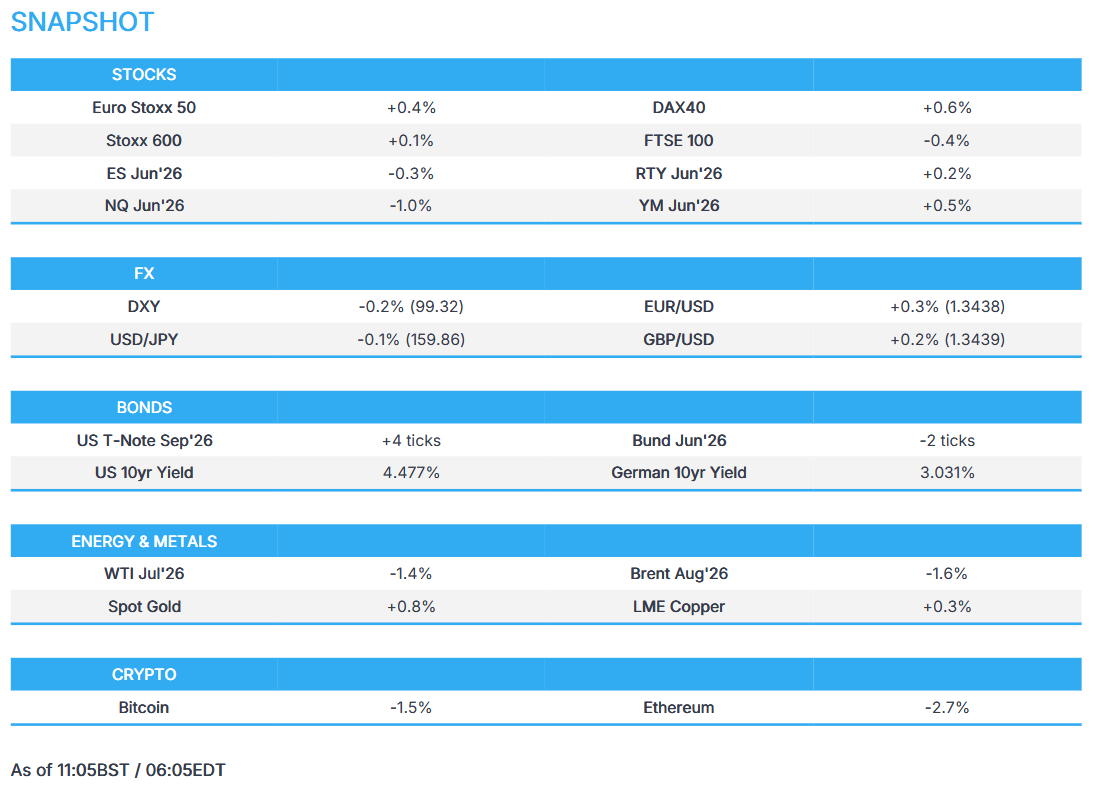
Newsquawk in 3 steps:
1. Subscribe to the free premarket movers reports
2. Listen to this report in the market open podcast (available on Apple and Spotify)
3. Trial Newsquawk’s premium real-time audio news squawk box for 7 days
IRAN CONFLICT
- US President Trump said they have been hitting Iran pretty hard and Iran negotiations are going well, while he suggested a deal could happen over the weekend and said anything can happen when you are dealing with Iran, but also stated it could go another two or three weeks. Trump also stated he would rather not use the military in Iran, and would rather not wipe Iran out, as well as noted that they are close to signing papers in theory. Furthermore, Trump said they are trying to separate Iran and Lebanon issues, while he responded that in that part of the world, a ceasefire is when you’re shooting in a more moderate manner, when questioned about the ceasefire.
- US President Trump told aides privately that he would consider ending the ceasefire with Iran if US troops are killed, according to WSJ.
- An informed source to Al Arabiya said the agreement on the release of frozen Iranian funds in its final stages but the search continues for a mechanism on frozen funds. US President Trump informed the mediators of his refusal to release funds to Iran before signing the agreement. The source notes that the main obstacle relates to the mechanism for disposing of part of the frozen Iranian funds and there is a proposal to create a special fund for depositing frozen Iranian funds that is under discussion.
- Sources noted that the first phase of the interim agreement between the US and Iran involves cessation of direct military operations, phase 2 is a full reopening of maritime traffic, phase 3 includes limited easing of some sanctions and phase 4 includes major issues such as the Iranian nuclear program, according to Al Hadath.
- Pakistani Foreign Minister, on reports of halted US-Iran talks, said “Our dialogue process continues”, Pakistani journalist Mallick posted.
- Israel and Lebanon agreed to a ceasefire in US-brokered talks, with the ceasefire contingent on Hezbollah’s evacuation from the Litani, while Lebanese armed forces will take control of pilot zones, and Israel and Lebanon agreed to reconvene negotiations in the week of 22nd June.
- US State Department confirmed Israel and Lebanon agreed to the implementation of a ceasefire and that the sides agreed with guidance of the US to swiftly advance creation of pilot zones in which Lebanese armed forces will take exclusive control of the territory. Israel and Lebanon also reaffirmed they have no hostile intent towards one another and are committed to continuing negotiations.
- Lebanese President said the implementation of the ceasefire could begin within 24 hours of final approval, Arab News reported.
- The Israeli army has begun withdrawing its forces from Dibbin in southern Lebanon, Al Hadath reported.
- Israeli Defence Minister said the IDF will continue its operations on the ground in Lebanon at this stage, Al Hadath reported. “The Lebanese will not return to the south and we will continue to destroy infrastructure.”
- Israeli military said fighting in Southern Lebanon continues.
- Israeli airstrikes were reported in several areas in southern Lebanon, according to SNN.
- Hezbollah attacked Israeli positions in southern Lebanon.
EUROPEAN TRADE
EQUITIES
- European bourses (STOXX 600 +0.1%) started the European morning on a positive footing, as markets digested positive geopolitical updates from President Trump and a Lebanon-Israel ceasefire. However, markets have since soured amidst reports that Israel were conducting operations in Lebanon, and following the negative action seen across the pond.
- European sectors are mixed. Retail (+1.7%) continues to gain following the earnings by Inditex on Wednesday. Consumer Products & Services (+1.7%) and Travel & Leisure (+1.2%) round out the top 3. The laggards include Telecoms (-1.6%), Media (-1.6%) and Basic Resources (-1.1%).
- US equity futures trade mixed, with losses in Broadcom (-12% pre-market) and CrowdStrike (-11% pre-market) weighing on the NQ (-1.0%) and ES (-0.3%), while RTY (+0.3%) and YM (+0.5%) print modest gains.
- Click for the sessions European pre-market equity newsflow
- Click for the additional news
FX
- The Buck is lower this morning vs initially starting the European morning flat. Not really any geopolitical market-moving headlines overnight; however, the Buck was pushed lower after hawkish BoJ sources (see below). In terms of Fed speak since the close, Williams said he sees no obvious direction for rates and no reason to change them. Logan said higher rates could be needed later this year. Ahead, Daly, Bowman & Barkin are slated to speak.
- JPY is slightly firmer and trading in line with most G10s. Sources told Bloomberg and Reuters that the BoJ would raise rates at the June meeting, with the Bloomberg piece suggesting more tightening was possible in 2026. Markets assign 20bps of tightening in June (80% probability), with an additional 20bps implied by year-end. The BBG report saw a 35-pip move lower in USD/JPY over ten minutes, which ultimately proved fleeting, with Yen fundamentals remaining bearish and two hikes close to being fully priced this year. A strategist at SMBC Nikko Securities said: “Even if the BoJ raises rates in June, any rebound in the yen will be limited”. USD/JPY trades higher by 0.1%, a touch below the 160.00 mark.
- CHF is performing well against the Euro and Buck after CPI metrics from Switzerland. Although a cooler-than-expected report is unlikely to shift the dial for policymakers at the SNB. This is because the headline remains towards the lower half of the 0-2% target band, and the SNB continues to make clear that inflation meets its medium-term stability objective. As such, policy is expected to remain at the ZLB for the foreseeable future. EUR/CHF -0.1% at 0.9181, USDCHF -0.3% at 0.7896.
FIXED INCOME
- Global fixed benchmarks are mixed as energy prices cool a touch after President Trump said Iran negotiations are going well, while he suggested a deal could happen over the weekend. Though noted that it could go another two or three weeks. Separately, reports suggest that Israel and Lebanon agreed to a ceasefire, though recent reports have suggested that the Israeli army is continuing its operations in the region. This uncertainty has led to the tentative action across fixed paper this morning.
- USTs (+4 ticks) are slightly firmer and trade within a narrow 109-12+ to 109-19+ range. Really not much driving the action this morning aside from geopolitics, but domestic data will likely garner some attention later. To recap, ISM Manufacturing & Services indicate a solid activity picture, with labour market reports (ADP/JOLTS) also pushing back on near-term rate cut expectations. Ahead, focus will be on: Jobless Claims (May/30), Revelio PLS (May), and Chicago Fed Labor Market Indicators Final (May).
- JGBs (-20 ticks) are on the back foot this morning for two key reasons: a) hawkish BoJ reports, b) an enhanced-liquidity auction. Delving into the report, Bloomberg first reported that the BoJ is mulling a hike in June, and potentially one more this year. Moreover, a source said that the Bank sees less need to pare back its bond purchasing plans. This was later corroborated by a Reuters piece, where a source said, “Unless there’s a severe escalation in the conflict, the BOJ will probably hike rates in June”. Before the sources piece, markets already expected the Bank to hike in June; therefore, the pressure in JGBs this morning stems from comments related to the plans later in the year.
- Bunds and Gilts follow the tentative action seen in USTs, but are lower by a handful of ticks. Domestic updates for EZ have been lacking this morning, but traders will eye Retail Sales. Irrespective of the report, the ECB is set to hike at the June meeting – money markets assign a 96% chance of such a decision; another hike is then priced in for October.
- France sells EUR 13.998bln vs exp. EUR 12-14bln 3.70% 2036, 4.00% 2038, 3.60% 2042, 4.40% 2057 OAT.
- Spain sells EUR 4.973bln vs exp. EUR 4.5-5.5bln 2.35% 2029, 3.10% 2031 and 3.50% 2041 Bono and EUR 0.593bln vs exp. EUR 0.25-0.75bln 2.05% 2039 I/L Bono.
COMMODITIES
- Crude markets are on a softer footing amid ongoing mediation efforts to broker some sort of US-Iran deal following two flare-ups earlier this week. In terms of the major updates, US President Trump said negotiations with Iran were progressing and suggested a deal could come within days, although talks could also continue for several more weeks. Meanwhile, US Secretary of State Rubio said the US is awaiting Iran’s final sign-off on negotiations surrounding Tehran’s nuclear programme. On the other side, Iranian officials outlined a four-stage framework for a potential agreement with the US. The four-stage proposal for a deal with the US includes: 1) Ending the war, 2) tangible measures re. the Strait, 3) sanctions and nuclear issues, 4) the establishment of a supervisory committee. More recently, Al Arabiya reported that the agreement on the release of frozen Iranian funds is in its final stages, albeit the search continues for a mechanism for frozen funds. The sources added that Trump informed the mediators of his refusal to release funds to Iran before signing the agreement. Elsewhere, Israel and Lebanon agreed to implement a US-brokered ceasefire framework and continue negotiations, although since the ceasefire, Hezbollah and IDF continued to exchange fire in the south of Lebanon.
- WTI Jul and Brent Aug futures are subdued in USD 94.06-95.91/bbl and USD 95.61-97.44/bbl ranges, respectively, at the time of writing, with fleeting downside seen on the aforementioned Al Arabiya sources. Dutch TTF ekes mild gains (+0.2%) but trades choppy on either side of EUR 49/MWh. “Positioning data for TTF continues to show that investment funds have been somewhat unfazed by ongoing LNG supply disruptions in the Middle East amid optimism over a resumption of LNG flows through the Strait of Hormuz”, analysts at ING write.
- Spot gold and silver are firmer after yesterday’s losses, with the yellow metal finding support this morning at its 200 DMA (USD 4,423/oz) before rebounding to trade in a current USD 4,423-4,484/oz range. Spot silver trades in a USD 72.45-73.91/oz range, still some way off yesterday’s peak at USD 75.33/oz.
- Base metals are mostly lower amid the broader cautious risk tone. 3M LME copper ekes mild gains but remains under USD 14,000/t in a USD 13,701.13- 13,849.00/t at the time of writing.
- Russian Deputy PM Novak said Russia expects to reach its OPEC+ oil production quota this year. The oil market has not yet fully seen the consequences of the Middle East conflict, and stockpiles are being used. There has been no oil production lower than the start of the year due to “unscheduled maintenance” at refineries.
- Russian Deputy PM Novak said OPEC+ countries do not plan to share the UAE’s oil output quota.
- Russia’s Investment Fund Head Dmitriev said the EU is already going to make a number of concessions to Russia on energy as they need this for survival, TASS reported.
- China to lower retail gasoline prices by CNY 525 per metric ton from June 5th.
TRADE/TARIFFS
- China’s MOFCOM said the US abuse of export controls is disrupting stability in the global semiconductor production and supply chain and opposes US trade restrictions on China justified by “forced labour”.
NOTABLE EUROPEAN HEADLINES
- UK PM Starmer is considering watering down plans to boost defence spending by GBP 18bln over concerns that they are unaffordable, according to The Times.
NOTABLE EUROPEAN DATA RECAP
- EU Retail Sales MoM (Apr) M/M -0.4% vs. Exp. -0.3% (Prev. -0.1%, Low. -0.5%, High. 0.4%).
- EU Retail Sales YoY (Apr) Y/Y 1.0% (Prev. 1.2%).
- Swiss Inflation Rate YoY (May) Y/Y 0.6% vs. Exp. 0.8% (Prev. 0.6%, Low. 0.7%, High. 1%).
- Swiss Inflation Rate MoM (May) M/M 0.2% vs. Exp. 0.3% (Prev. 0.3%, Low. 0.2%, High. 0.5%).
- Swedish CPIF YoY Prel (May) Y/Y 1.5% vs. Exp. 1.2% (Prev. 0.8%).
- Swedish CPIF MoM Prel (May) M/M 0.9% vs. Exp. 0.6% (Prev. -0.6%).
- Swedish Inflation Rate YoY Prel (May) Y/Y 0.8% vs. Exp. 0.5% (Prev. -0.1%).
- Swedish Inflation Rate MoM Prel (May) M/M 1.0% vs. Exp. 0.7% (Prev. -0.6%).
CENTRAL BANKS
- Fed’s Logan (2026 voter) said she is increasingly concerned higher interest rates could be necessary later this year and monetary policy is not restraining the economy, while she added that inflation is taking too long to return to 2%, economic activity remains strong and corporate earnings are ‘going gangbusters’. Logan said financial conditions are accommodative, and the labour market is stable, but separately noted that the higher price of gas is feeding through to prices of other goods and services. Furthermore, she stated that mildly restrictive policy is needed and that the current monetary policy looks neutral or loose.
- RBA Governor Bullock said the RBA expects inflation to increase further in the near term and notes flow of data and development since May has not been materially different to our expectations. She notes that inflation is too high, and the board will do what it considers necessary to achieve its mandate of delivering price stability and full employment. Some signs of tightening impact already seen, but full effects to take 1 to 2 years.
- BoJ is said to mull a June rate hike with another possible in 2026 and sees less need to cut bond buys at the same pace in FY27, according to Bloomberg source reported. Reuters then corroborated this report.
NOTABLE US HEADLINES
- US Challenger Job Cuts (May) 97.006K (Prev. 83.387K); May Job Cuts Rise 16% from April, the highest May total since 2020.
- US House backed a resolution curbing Trump’s Iran war powers with the House voting 215 to 208 to pass the War Powers resolution.
- US President Trump is to announce nearly USD 700mln in coal support and to use the Defence Production Act for the coal sector, according to Axios.
- US President Trump is expected to nominate acting AG Blanche as Attorney General.
- US Agricultural Secretary Rollins announced additional USDA personnel deployment to South Texas, and urged livestock producers to remain vigilant, while she stated that potential New World screwworm detection is being fully contained and is not a harm to US food supply or safety.
GEOPOLITICS
OTHER
- North Korean leader Kim plans to significantly boost the nation’s national nuclear capabilities, according to KCNA.
CRYPTO
- Bitcoin continues to slump and is set for its worst week since the start of 2025, slipping below the USD 63k handle.
APAC TRADE
- APAC stocks were lower following the negative handover from the US, where risk sentiment was weighed on by the recent retaliatory attacks between the US and Iran, as well as weakness in tech stocks.
- ASX 200 was pressured by underperformance in the mining and materials industries, while most sectors were subdued aside from the resilience in defensives.
- Nikkei 225 retreated from record levels and briefly tested the 67,000 level to the downside amid intervention risks following FX comments from Japanese PM Takaichi, while comments from BoJ Governor Ueda signalled the central bank could resume rate normalisation this month. On that front, hawkish BoJ sources noted the central bank is to mull a hike this month, with another possible in 2026.
- Hang Seng and Shanghai Comp conformed to the downbeat mood amid tech-related headwinds and with the PBoC refraining from open market operations for a second consecutive day.
NOTABLE APAC DATA RECAP
- Australian Balance of Trade (Apr) 1.791B vs. Exp. -1.61B (Prev. -1.841B).
- Australian Imports MoM (Apr) M/M 0.8% (Prev. 14.1%).
- Australian Exports MoM (Apr) M/M 7.2% (Prev. -2.7%).
1c) Asian opening report
Europe primed for a quiet open as Crude pulls back from recent highs – Newsquawk EU Market Open
Thursday, Jun 04, 2026 – 02:16 AM
- US President Trump said they have been hitting Iran pretty hard and Iran negotiations are going well, while he suggested a deal could happen over the weekend. Though noted that it could go another two or three weeks, Brent Aug’26 -0.7%.
- Talks between Iran and the US were reportedly still ongoing, and no final decision had been made, according to Fars, citing a member of Tehran’s negotiating team.
- An Iranian negotiating delegation media team member outlined a four-stage proposal for a deal with the US. 1) Ending the war, 2) tangible measures re. the Strait, 3) sanctions and nuclear issues, 4) the establishment of a supervisory committee.
- APAC stocks traded lower following a negative handover from the US; European bourses are indicative of a softer open.
- G10s are mostly slightly firmer against the USD; JPY gains slightly on reports that the BoJ is to mull a hike this month, with another possible this year.
- Looking ahead, highlights include Swedish CPIF (May), Swiss CPI (May), EU Retail Sales (Apr), US Challenger Layoffs (May), Jobless Claims (May/30), Revelio PLS (May), and Chicago Fed Labor Market Indicators Final (May). Supply from Spain & France. Earnings from Docusign, lululemon & Ciena.
- Speakers include BoE’s Bailey, ECB’s Lagarde, Fed’s Daly, Bowman & Barkin.
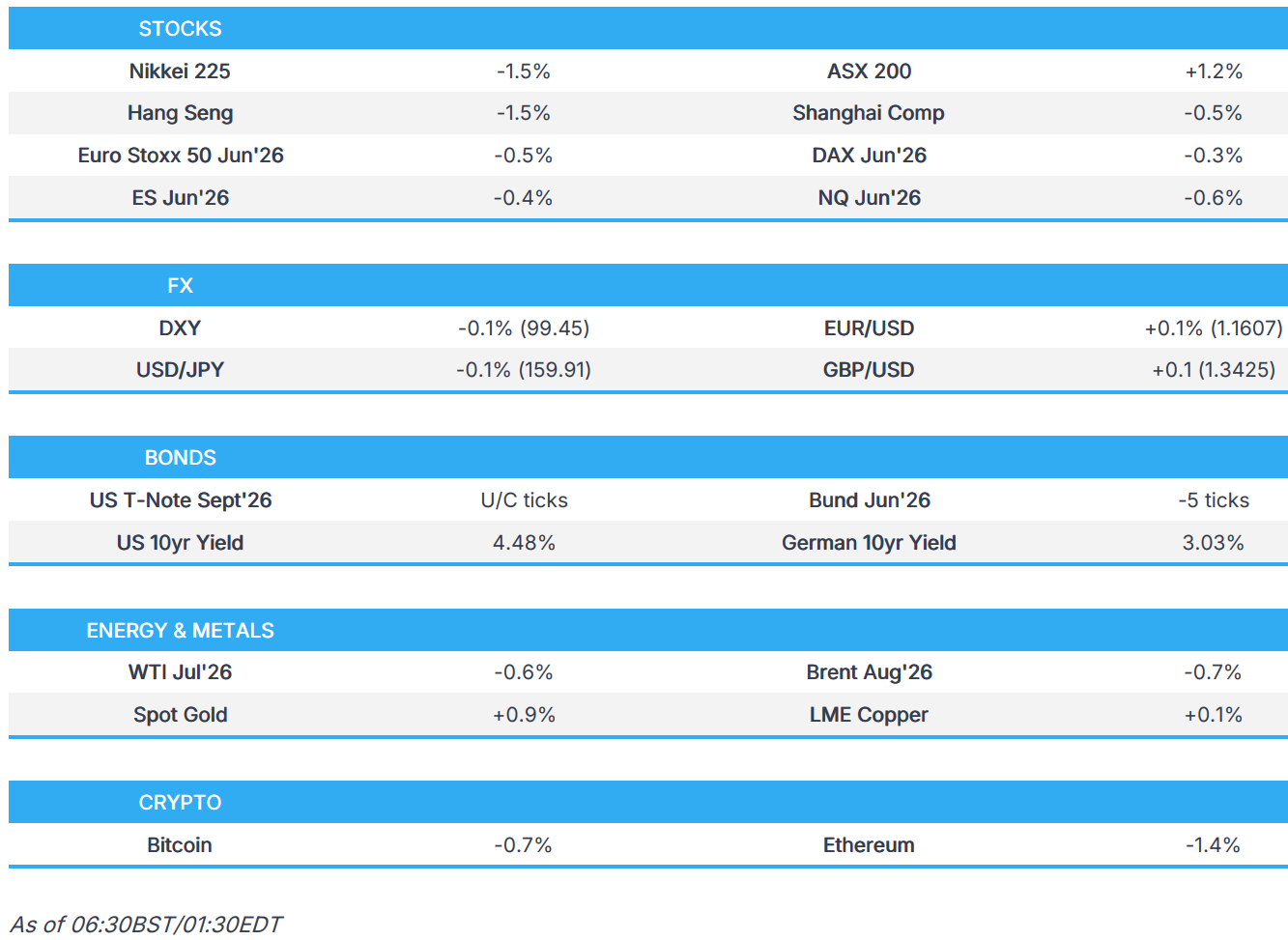
Newsquawk in 3 steps:
1. Subscribe to the free premarket movers reports
2. Listen to this report in the market open podcast (available on Apple and Spotify)
3. Trial Newsquawk’s premium real-time audio news squawk box for 7 days
IRAN CONFLICT
- US President Trump said they have been hitting Iran pretty hard and Iran negotiations are going well, while he suggested a deal could happen over the weekend and said anything can happen when you are dealing with Iran, but also stated it could go another two or three weeks. Trump also stated he would rather not use the military in Iran, and would rather not wipe Iran out, as well as noted that they are close to signing papers in theory. Furthermore, Trump said they are trying to separate Iran and Lebanon issues, while he responded that in that part of the world, a ceasefire is when you’re shooting in a more moderate manner, when questioned about the ceasefire.
- US President Trump told aides privately that he would consider ending the ceasefire with Iran if US troops are killed, according to WSJ.
- US Secretary of State Rubio told Congress that the US is waiting for Iran’s “final sign-off” on negotiations surrounding Tehran’s nuclear programme.
- Talks between Iran and the US were reportedly still ongoing, and no final decision had been made, according to Fars citing a member of Tehran’s negotiating team. The report added that the first phase of the Islamabad talks was unsuccessful because of Iran’s refusal to enter nuclear negotiations. Furthermore, Iran would not enter an agreement in which Lebanon is ignored, while if finalised and agreed, the MoU between the US and Iran would go through a four-stage mechanism.
- US House backed a resolution curbing Trump’s Iran war powers with the House voting 215 to 208 to pass the War Powers resolution.
- Iranian negotiating delegation media team member outlined a four-stage proposal for a deal with the US in which Phase 1 involves ending the war and halting military actions, while Phase 2 includes tangible measures involving the Strait of Hormuz, such as lifting the blockade, removing restrictions and oil sanctions, as well as releasing part of Iran’s frozen assets and blocked financial resources. Furthermore, Phase 3 would focus on sanctions and the nuclear file, while Phase 4 would establish a supervisory committee to oversee implementation and monitor commitments of all parties, according to Fars Politics.
- Sources noted that the first phase of the interim agreement between the US and Iran involves cessation of direct military operations, phase 2 is a full reopening of maritime traffic, phase 3 includes limited easing of some sanctions and phase 4 includes major issues such as the Iranian nuclear program, according to Al Hadath.
- There are discussions about creating a fund that would provide Iran with billions of dollars once a final agreement is reached, according to sources cited by CNN, although sources stated Trump told his advisers he would not sign any agreement in which the US provides direct money to Iran.
- Iranian Foreign Minister Araghchi told Al Mayadeen that Iran and the US are studying the texts that were exchanged, while there is no established method for negotiations now, but messages are being exchanged with the Americans. Araghchi separately commented “Our Armed Forces are conducting self-defence strikes on sites the US is permitted to use to attack civilian shipping and violate the ceasefire”, as well as warned that “any hostile act will be met with an immediate, decisive response” and that “what sanctions and war failed to achieve won’t be won with more war.”
- IRGC spokesperson said the destruction of the passenger terminal at Kuwait Airport was caused by an error in American Patriot systems attempting to intercept an Iranian missile, according to Tasnim. However, US CENTCOM denied the claims by Iran that Kuwait Airport was damaged by a US missile interceptor, and said Iran struck the civilian airport with drones in a deliberate, calculated, and unjustified attack.
- Iran targeted a US military ship hosting a control and command centre approaching Iranian territorial waters in the Gulf of Oman, according to state media. However, US CENTCOM denied Iran’s claim that it attacked a US Navy destroyer in the Gulf of Oman.
- Israel and Lebanon agreed to a ceasefire in US-brokered talks, with the ceasefire contingent on Hezbollah’s evacuation from the Litani, while Lebanese armed forces will take control of pilot zones, and Israel and Lebanon agreed to reconvene negotiations in the week of 22nd June.
- US State Department confirmed Israel and Lebanon agreed to the implementation of a ceasefire and that the sides agreed with guidance of the US to swiftly advance creation of pilot zones in which Lebanese armed forces will take exclusive control of the territory. Israel and Lebanon also reaffirmed they have no hostile intent towards one another and are committed to continuing negotiations.
- Israeli airstrikes were reported in several areas in southern Lebanon, according to SNN.
- Hezbollah attacked Israeli positions in southern Lebanon.
US TRADE
EQUITIES
- US stocks declined on what was a geopolitical risk-off session with all major indices in the red, although the Nasdaq outperformed and closed down just 0.2% versus a 1.4% decline in the Russell 2000. Sector performance was mixed, with Energy and Health Care outperforming, while Consumer Discretionary, Financials and Technology lagged. Energy stocks benefited from higher crude prices after the US and Iran exchanged attacks overnight, with the US striking Iran’s Qeshm Island and Iran targeting US military bases in the Middle East. Oil prices briefly pared some gains after President Trump said the US is working on a deal with Iran and that Tehran had agreed not to pursue nuclear weapons, although Iranian media pushed back on those claims, while Iran’s Foreign Minister later said communication channels remain open but that no meaningful progress had been made in negotiations, helping support crude into the settlement.
- SPX -0.71% at 7,556, NDX -0.29% at 30,571, DJI -1.21% at 50,688, RUT -1.31% at 2,894.
- Click here for a detailed summary.
TARIFFS/TRADE
- China’s Ministry of Commerce said industrial subsidies comply with WTO rules, while it added that the recent OECD report on subsidies lacked clear definitions and is biased.
NOTABLE HEADLINES
- Fed’s Logan (2026 voter) said she is increasingly concerned higher interest rates could be necessary later this year and monetary policy is not restraining the economy, while she added that inflation is taking too long to return to 2%, economic activity remains strong and corporate earnings are ‘going gangbusters’. Logan said financial conditions are accommodative, and the labour market is stable, but separately noted that the higher price of gas is feeding through to prices of other goods and services. Furthermore, she stated that mildly restrictive policy is needed and that the current monetary policy looks neutral or loose.
- Fed Beige Book (June) stated that economic activity increased at a slight to moderate pace in ten of the twelve Federal Reserve Districts, while one District reported a slight decline and one reported no change.
- US President Trump is to announce nearly USD 700mln in coal support and to use the Defence Production Act for the coal sector, according to Axios.
- US President Trump is expected to nominate acting AG Blanche as Attorney General.
- US Agricultural Secretary Rollins announced additional USDA personnel deployment to South Texas, and urged livestock producers to remain vigilant, while she stated that potential New World screwworm detection is being fully contained and is not a harm to US food supply or safety.
- USDA confirmed a flesh-eating parasite New World screwworm case in Texas and estimated a USD 1.8bln potential impact from the outbreak, while the report also noted that a US cattle ban from Mexico pressures beef prices.
APAC TRADE
EQUITIES
- APAC stocks were lower following the negative handover from the US, where risk sentiment was weighed on by the recent retaliatory attacks between the US and Iran, as well as weakness in tech stocks.
- ASX 200 was pressured by underperformance in the mining and materials industries, while most sectors were subdued aside from the resilience in defensives.
- Nikkei 225 retreated from record levels and briefly tested the 67,000 level to the downside amid intervention risks following FX comments from Japanese PM Takaichi, while comments from BoJ Governor Ueda signalled the central bank could resume rate normalisation this month. On that front, hawkish BoJ sources noted the central bank is to mull a hike this month, with another possible in 2026.
- Hang Seng and Shanghai Comp conformed to the downbeat mood amid tech-related headwinds and with the PBoC refraining from open market operations for a second consecutive day.
- US equity futures remained subdued following the prior day’s tech-related losses and were also not helped by pressure in Broadcom and CrowdStrike post-earnings.
- European equity futures indicate a lower cash market open with Euro Stoxx 50 futures down 0.4% after the cash market closed with losses of 0.9% on Wednesday.
FX
- DXY slightly softened overnight as it took a breather after advancing yesterday amid the risk-off mood and higher oil prices, while recent data releases were mostly better-than-expected but took a back seat to the geopolitical headlines. Furthermore, the latest Fed Beige Book and comments from Fed’s Logan, who stated she is increasingly concerned higher interest rates could be necessary later this year and that monetary policy is not restraining the economy, did little to spur price action.
- EUR/USD rebounded off the prior day’s trough and reclaimed the 1.1600 level, but with price action limited amid light newsflow outside of geopolitics, while participants also await Lagarde comments and EU Retail Sales.
- GBP/USD attempted to nurse some losses after declining yesterday alongside the weakness in cyclical peers due to the risk-off mood.
- USD/JPY pulled back after briefly breaching through the psychological 160.00 level, with intervention risk and rate hike expectations among potential headwinds. There was a bout of selling seen due to a source report that the BoJ is said to mull a June rate hike with another possible in 2026, although this was pared moments after.
- Antipodeans were rangebound after recent declines and with little impact seen from the latest Australian trade data.
- PBoC set USD/CNY mid-point at 6.8203 vs exp. 6.7770 (prev. 6.8184).
FIXED INCOME
- 10yr UST futures rebounded as oil pulled back, as Treasury trade continues to be driven by energy markets, while recent data from the US was mostly encouraging, but has taken a back seat to geopolitics.
- Bund futures gradually recouped some lost ground but with the recovery limited amid a lack of pertinent drivers, while participants await EU Retail Sales data and comments from ECB’s Lagarde.
- 10yr JGB futures traded indecisively following a recent slide and hawkish commentary from BoJ Governor Ueda. Late pressure was seen following the enhanced-liquidity auction for longer-dated JGBs and a source report that the BoJ is said to mull a June rate hike with another possible in 2026.
COMMODITIES
- Crude futures pulled back overnight after advancing yesterday due to the recent fresh geopolitical escalation between the US and Iran. Moreover, there were some encouraging comments from US President Trump, who suggested a deal with Iran could come ‘over the weekend’ and reportedly told aides that he won’t resume all-out war with Iran unless US troops are killed. It was also reported that Israel and Lebanon agreed to implement a ceasefire and establish security zones, though it is contingent on Hezbollah halting its attacks.
- Spot gold rebounded from a weekly trough and got some reprieve after suffering alongside the recent dollar strength and higher oil prices.
- Copper futures continued to retreat amid the downbeat risk appetite across the global markets.
CRYPTO
- Bitcoin was choppy but ultimately recovered from a 2000+ point intraday slump and returned to above the USD 64,000 level.
NOTABLE ASIA-PAC HEADLINES
- PBoC open market operations were at zero for a second consecutive day.
- Chinese analysts stated that China’s market liquidity will remain stable and ample in June despite the PBoC skipping open market operations.
- BoJ is said to mull a June rate hike with another possible in 2026, according to sources.
- South Korea’s ruling party candidate Cheong concedes defeat to incumbent Oh Se-hoon in the Seoul mayoral election.
- RBA Governor Bullock says RBA expects inflation to increase further in the near term, notes flow of data and development since May has not been materially different to our expectations. Inflation is too high, and the board will do what it considers necessary to achieve its mandate of delivering price stability and full employment. Having raised the cash rate three times, monetary policy is well placed to respond to developments. Will carefully monitor conditions to assess how the combined effects of higher interest rates and the energy price shock are playing out. Some signs of tightening impact already seen, but full effects to take 1 to 2 years.
- RBA Deputy Governor Hunter says monetary policy is somewhat restrictive; Q1 GDP was in line with RBA expectations.
DATA RECAP
- Australian Balance of Trade (Apr) 1.8B vs. Exp. -1.6B (Prev. -1.8B)
- Australian Exports MM (Apr) 7.2% (Prev. -2.7%)
- Australian Imports MM (Apr) 0.8% (Prev. 14.1%)
GEOPOLITICS
RUSSIA-UKRAINE
- Germany, France and the UK are reportedly sketching out a plan to engage Russian President Putin in peace talks.
OTHER
- North Korean leader Kim plans to significantly boost the nation’s national nuclear capabilities, according to KCNA.
EU/UK
NOTABLE HEADLINES
- UK PM Starmer is considering watering down plans to boost defence spending by GBP 18bln over concerns that they are unaffordable, according to The Times.
- UK Labour Party is likely to back a second attempt to reform benefits provided new funding is allocated to help claimants into work, according to The i Paper.
2.NORTH AND SOUTH KOREA AND JAPAN
JAPAN
3 CHINA
CHINA/USA
4. EUROPEAN AND SCANDINAVIAN COMMENTARIES PLUS NATO
EUROPE
EU Could Lose 1.3 Million Jobs Due To Energy Price Surge From Iran War
Thursday, Jun 04, 2026 – 02:45 AM
Up to 1.3 million jobs across the EU are at risk because of the ongoing war in the Middle East, European Commissioner for jobs Roxana Mînzatu said on Wednesday.
“Due to the war in the Middle East, up to 1.3 million jobs are at risk, particularly in energy-intensive industries,” Mînzatu said at a press conference.

“Let me also underline that increased energy costs will have a particular negative impact on lower-income households in Europe, which is why we recommend that all member states take targeted measures so that they can support vulnerable groups,” the Commissioner added.
According to the report, the EU automotive sector could face the biggest layoffs of up to 600,000. Construction, metals, chemicals, transport could lose 56,000 jobs. Some 85,000 jobs in battery projects could be at risk and 58,852 jobs in solar manufacturing. Another 4,500 jobs could go in the steel sector because of low-carbon measures.
In a stagflationary double whammy, Low-income households could spend an additional 1.4% of income on transport fuel.
As Euronews reports, the warning came during the presentation of the 2026 Spring Semester Package, a bi-annual publication by the EU executive that provides guidance to the 27 member states on the bloc’s economic priorities.
The conflict has already had tangible effects on the European economy, with energy prices surging as a result. According to the latest European economic forecasts published in May, the war has slowed European growth while pushing inflation higher. Yesterday we learned that Euro Area inflation topped 3% for the first time since 2023, cementing an ECB rate hike next week.

Economic data on growth and inflation vary sharply across the EU, a disparity the Commission considers a threat to competitiveness.
Key priorities
The package dedicates significant space to employment, focusing on the promotion of quality jobs and how EU countries can tackle persistent shortages of skilled workers in strategically important sectors.
“Improving educational outcomes and better aligning people’s skills with labor market needs remain key priorities, also to address labour and skills shortages which are particularly acute in strategic sectors such as cybersecurity, quantum, artificial intelligence and semiconductors,” the Semester Package states.
At the press conference, Mînzatu said that 77% of European companies report that skill shortages remain a significant barrier to investment. She identified poor working conditions as the main driver of those shortages.
“We cannot attract talent, we cannot reduce shortages, we cannot improve people’s earnings without making sure we have good working conditions,” the Commissioner said.
Since the beginning of this mandate, European Commission President Ursula von der Leyen has made competitiveness one of the Commission’s highest priorities as geopolitical uncertainties mount.
The latest Semester Package reflects this, focusing on how Europe can strengthen its position on the global stage.
In particular, the bloc wants to reduce economic barriers in the single market, create a more business-friendly environment for companies and capital, and minimise strategic dependencies – especially on China and the US.
To that end, the Commission is pushing member states towards a more robust industrial policy, greater investment in capital markets, and a simplification agenda that would, among other things, reduce administrative burdens both in the private and public sector.
In parallel, the Commission is working to accelerate economic reforms at the EU level, though progress relies heavily on the willingness of member states to act – a longstanding coordination challenge.
END
EUROPE
UBS Warns El Nino May Intensify Food Inflation Across Asia
Thursday, Jun 04, 2026 – 05:45 AM
By now, readers have a clear understanding that the Gulf-driven energy shock is on course to collide with a potential super El Niño weather event, creating what could be a dangerous second-order shock to food supply chains around the world.
The concern is that extreme heat and disrupted rainfall patterns could hit top agricultural growing belts, dent harvest output, and amplify existing supply stress. Even before those weather-driven impacts fully materialize, global food prices are already rising, suggesting that fertilizer and elevated diesel prices are beginning to be transmitted through the broader food supply chain.

Our Tuesday note on Thailand white rice, a regional Asian benchmark, surging 20% in May, the largest monthly increase in data going back to 2008, is another warning signal that the price action in the grain feeding half the world has entered a new upward impulse.

The troubling move in rice prices, including a 15% surge in Chicago rice futures last month, indicates that food-inflation pressures are already materializing. The concern is that these pressures could materially worsen once El Niño-driven weather disruptions begin affecting key growing regions.
UBS analysts led by Leigha Miyata published a note titled “Food Inflation & El Niño Evidence Check,” confirming what we have been tracking for months: the Middle East-driven fertilizer shock is now moving through the global food supply chain just as El Niño risks rise, creating the potential for an inflation surge across Asia later this year into 2027.
Miyata noted that El Niño odds currently stand around 82% for May to June and 96% for December into early 2027, raising the risk of hotter, drier conditions across South and Southeast Asia that could pressure harvests.
Via Miyata …
El Niño likelihood raised to 82%; expect Asia to be hotter and have less rain:
The El Niño is likely to emerge soon (82% chance in May-July 2026) and continue through Northern Hemisphere winter 2026-27 (96% chance in Dec 2026-Feb 2027, NOAA). Historical patterns show higher temperatures in Indonesia and northern Australia (Figure 1). Temperatures are normally lower in South Korea and Japan, though a “super El Niño” could reverse this, bringing intense heat and rainfall. Precipitation is lower in South and Southeast Asia, posing risks to harvests (Figure 2). Other El Niño impacts include higher power demand, lower supply, and increased disease risk (see p3).


Fertilizer Prices – Urea prices correcting, now +23% since the Iran conflict started:
Though nitrogen supply remains tight, we have seen diverging trends in the last few weeks on the product level. Ammonia pricing has been stable to higher, UAN pricing has been stable, while urea pricing has seen downward corrections, $190/MT (~23%) lower than its peak level in April. Overall the UBS chemicals team see this pointing to the market having moved past peak seasonal tightness, with 2Q likely marking the high point. We believe structurally tight supply from restricted trade flows and constrained production will continue to support the pricing outlook for 2H26/2027 above the cost curve however, and note that physical market flows have yet to improve (full report).
Gov’t measures have been helpful, but inflation is rising across Asia:
The FAO Food Price Index averaged 130.7 points in April 2026, up 1.6% from March, marking a third consecutive rise but at a slower pace. Gains in vegetable oils, meat, and cereals were partly offset by declines in sugar and dairy. The index was 2.0% higher year-on-year but remained 18.4% below its March 2022 peak. Inflation across all major Asian economies is increasing with the exception of Indonesia and Japan, and corn futures for 2026/2027 are up ~4%/5% since the Iran conflict started. UBS economists explain that inflation was likely lower in many Asian economies due to quick policy-action post Iran conflict, but that inflation will likely rise going forward (full report). In the Philippines, the level of inflation has shot up from 2.3%/3.9% in Feb/Mar to 7.1% in Apr. In Thailand, deflation in Feb/Mar has shifted to 2.9% inflation in April (Figure 5). For Japan, there are no clear signs yet of strong inflationary pressure from Middle East tensions. However, we expect national CPI for May to pick up slightly to 1.5% from 1.4% in April, suggesting April was likely the trough. Food inflation in Japan decelerated from 4.6% YoY in April to 4.1% YoY in May, though on a MoM basis, food inflation rose 0.3% (full report).

Packaging and freight costs are up; El Niño in 2026-27, fertilizer impact in 2027:
Plastic packaging prices in Japan are reported to be up 20 to 30%. This together with transport costs are expected to raise food prices, but this is not yet visible in the data for Japan. If El Niño materializes, we may see drought impact the harvests in Sep 2026- and Apr 2027- in South and Southeast Asia. Higher fertilizer costs may also affect harvests from April 2027 onwards.
UBS views on El Niño impacts
1. Agri-business: Tightening global balances and large speculative shorts mean an El Niño-driven disruption to India’s monsoon could reduce sugar production by ~3–8mn tons YoY and trigger price spikes.
2. Agriculture & Inflation (India): El Niño-driven weak monsoon risks (forecast ~92% of normal rainfall) could lift food inflation, though only ~21% of CPI is directly impacted, limiting first-round effects but raising second-round risks if shocks persist.
3. Health Care (Brazil): El Niño-driven changes in mosquito patterns could increase dengue cases, with prior events (2023/24) coinciding with record infections (~6.6mn cases).
4. Thermal coal / Power demand: A potential “super El Niño” could drive extreme heat across Asia, boosting electricity demand (especially for cooling) and increasing coal demand and imports, tightening seaborne markets.
5. Hydropower / Power supply: El Niño-related rainfall shifts could reduce hydro generation in LatAm and Africa, further supporting demand for thermal coal.
6. Insurance / Reinsurance: El Niño conditions are associated with below-average hurricane activity, which could improve insurers’ near-term book value but pressure pricing due to increased capital supply. In Australia, El Niño years tend to have lower catastrophe losses, though drought and bushfire risks rise.
Figure 6: Real GDP growth %y/y: pre- and post-Iran conflict

Figure 7: Asia’s inflation likely to pick up on base effects

Figure 12: Energy/fertilizer shock impact chain

Figure 13: Thailand and India are likely to be negatively impacted in APAC. All importers, including Japan will face higher prices

Related:
- We Are 6 Months From Global Food Shortages Because Farmers Are Facing A Quadruple Whammy Crisis
- Everyone Talks About The Cost Of Gasoline… Soon Everyone Will Be Talking About The Cost Of Food
Last month, ZeroHedge Debates held a roundtable to ask, “How bad will the food inflation mess get?”
Professional subscribers can read the full “Food Inflation & El Niño Evidence Check” here at our new Marketdesk.ai port.
END
EUROPE/UK
After Murder Of Henry Nowak, Amnesty International Condemns Right Wing ‘Political Commentary’
Thursday, Jun 04, 2026 – 03:30 AM
Amnesty International’s reaction to the murder of Henry Nowak has prompted outrage, with the organization having nothing to say about the atrocious and inhumane actions of the police during the incident, but sharply condemning the “political commentary” in the wake of Nowak’s death.
“At a time when hate crimes are rising, and violence and fear are becoming a daily reality for people of colour and migrants, calls for ‘cold, hard rage’ are completely reckless. Henry Nowak’s murder is an awful tragedy and his family have said “we do not want his death to be used to create further division, hatred or tension”. The very least politicians can do is respect that,” wrote Amnesty International.

Not everyone is happy about Amnesty International’s remarks on the case, which has up until now, said nothing about the manner in which the police handcuffed a dying Nowak as he bled out from eight stab wounds.
Swedish MEP Charlie Weimers wrote on X, “Amnesty has been morally bankrupt for a long time. A pure left-wing organization.”
He was responding to a comment from Lauren Chen, who wrote:
“Incredible statement from Amnesty International UK on Henry Nowak: Not a single word of conveying outrage or horror over the brutal murder, or of how police left him to die without dignity. Instead, their statement is about policing the political commentary around the case. I kid you not. What a grotesque betrayal of any moral purpose.These NGOs aren’t just useless – they actively despise you. They are hostile to everything you value and everything you hold dear.”
Amnesty International, however, is known for its pro-migration and left-wing stances and has a long history of funding from the Open Society Foundation of George Soros. Nevertheless, the organization is often critical of police conduct, which makes it all the more remarkable that the organization has nothing to say about the police’s actions in this case.
The Southampton officers in the case disregarded Nowak’s pleas for help while immediately taking the claims of Vickrum Digwa, who said Nowak made racist comments to him, at face value. Notably, Nowak told the police multiple times that he had been stabbed and warned them: “I can’t breathe.” When he told the officer he had been stabbed, the officer replied, “I don’t think you have, mate.”
At the same time, the murder weapon was given to his mother, and police later found it at the family home along with more than 20 other weapons. His mother is due to be sentenced for removing the murder weapon from the crime scene.
The Nowak case has many parallels with the George Floyd case, where Police Officer Derek Chauvin was controversially convicted for murdering Floyd after placing him in handcuffs and kneeling on his back while Floyd said, “I can’t breathe.” Although the left weaponized the case, sparking mass riots the resulted in billions of damage across the United States, Amnesty International never condemned the left’s political rhetoric in the Floyd case. The Soros-funded organization also never condemned the mass riots, which left stores and homes burned out across major American cities.
If anything, Amnesty International’s “political commentary” around the case only served to inflame tensions and put vulnerable communities under further threat.
This double standard has not been lost on English protesters, who gathered in the streets and chanted “I can’t breathe,” at police officers in Southhampton yesterday, before unrest broke out. Notably, no shops were burned and no businesses harmed during the small-scale unrest — a far cry from the mass riots following Floyd’s death.
The murder of Nowak had sparked anger across Britain, but parties on the right, in particular, have been the most critical. Amnesty International appears unhappy that political commentators are pointing out the racial double-standard at work, including the police immediately taking the side of the murderer because he cried, “racist.”
Meanwhile, the leader of Restore Britain, Rupert Lowe, is making headlines for his call to return the death penalty for killers like Digwa.
His proposal has now received backing from Elon Musk.
All of this explains Amnesty’s position and why that organization will never try to hold the police accountable for their actions in the Nowak murder case.
END
BBC
BBC Sinks To A New Low…
Thursday, Jun 04, 2026 – 05:00 AM
Authored by Steve Watson via Modernity,
The BBC has once again demonstrated its role as a partisan propaganda machine rather than a neutral public broadcaster.

On its flagship evening news show Newsnight, presenter Matt Chorley repeatedly claimed Reform UK leader Nigel Farage called for a “white cold rage” in response to the murder of 18-year-old student Henry Nowak.
Yet Farage said no such thing. He called for “pure cold rage” – a measured, determined pushback against institutional failures and anti-white bias in policing and justice.
Chorley repeated the fabricated racial angle three times. The insertion was no accident. It transformed a call for equal justice and accountability into something that could be painted as divisive racial incitement.
When caught, Chorley issued a tepid apology on X, claiming a “misremembering” while insisting it “didn’t change the content of the interview.”
Critics across the board rejected that claim outright.
Pure cold rage became “white cold rage” because the institutional mindset equates any pushback against two-tier standards with whiteness.
A full on-air correction and explanation of what Farage actually said is the minimum standard for any credible outlet. The pattern of one-directional “mistakes” – always inflating racial angles against critics of mass immigration, DEI, or institutional bias – tells its own story.
The Henry Nowak case has exploded back into the headlines following the release of the horrible Bodycam footage of the incident and the trial of his murderer. Nowak lay on the ground bleeding heavily, repeatedly telling officers “I’ve been stabbed” and “I can’t breathe.” Instead of providing urgent medical aid, officers dragged him across gravel, handcuffed him, and initially treated him as a suspect based on Digwa’s false racism allegations and minor complaints about a swollen eye.
Digwa was not handcuffed at the scene. His family stood over the dying victim pushing the race narrative. Hampshire Police’s initial statement claiming quick life-saving measures was later deleted once the footage emerged. Protests followed the footage release. Some turned violent in Southampton last night, with clashes injuring officers.
This latest incident fits the established pattern of BBC editorial choices that downplay or twist stories challenging progressive narratives on policing, identity politics, and institutional bias. Previous coverage on the same programme saw presenter Victoria Derbyshire act surprised when an ex-cop refused to excuse the initial response to Nowak. The discomfort was palpable as facts about prioritising a false racism claim over a dying victim’s pleas were laid out.
An ex-police officer appearing on BBC Newsnight described the response as “unfathomable.” Basic procedure demands prioritising medical assessment for anyone reporting stab wounds and bleeding out, not handcuffing or accepting unverified claims from the attacker. The Independent Office for Police Conduct is investigating. Nowak’s father demanded transparency, stating his son “did not die with dignity” and that being read his rights was among the last things he heard while dying.
The BBC consistently frames cases involving white victims and minority perpetrators through a lens that protects DEI-influenced institutions while pathologising any demand for colour-blind standards.
The “white cold rage” fabrication is the latest example of this reflexive racialisation – turning legitimate fury over two-tier policing into a smear. It mirrors broader BBC output that has portrayed Islamist issues sympathetically, pushed contested social agendas, and faced lawsuits over distorted editing, including the ongoing Trump case. The organisation’s charter obligations on impartiality appear secondary to its institutional worldview.
Farage’s actual words on the Nowak case called for cold, principled determination to restore equal treatment before the law – not hot-headed violence or racial payback. The BBC’s version injected race where Farage spoke of universal standards trashed by fear of labels. That single word change reveals more about the presenter’s and the organisation’s priors than about Farage.
We also knew this would be the leftist establishment playbook in the Nowak case when it finally received the attention it warranted.
Public trust in the BBC continues to erode precisely because of episodes like this. Licence fee payers subsidise an outlet that treats one side of the political spectrum as requiring constant racial vetting while giving institutional failures a pass.
Reform voices and ordinary citizens demanding accountability for the Nowak case and similar incidents are not the problem. The problem is an entrenched media class that cannot report straight when the facts challenge their worldview.
The weak apology changes nothing substantive. Full transparency, on-air correction, and serious consequences for editorial failures would be the start of rebuilding credibility. Until then, the BBC remains what its actions show it to be: a publicly funded vehicle for advancing selective narratives rather than pursuing truth.
Those who value free speech, equal justice, and genuine accountability know the only long-term answer involves stripping away its compulsory funding and letting it compete in the open market like every other outlet.
END
5. RUSSIAN AND MIDDLE EASTERN AFFAIRS//
ISRAEL/USA VS IRAN//
Trump Downplays Iran’s Attacks Targeting US Bases In Kuwait & Bahrain: ‘They Were Slightly Provoked’
Thursday, Jun 04, 2026 – 08:45 AM
Authored by Dave DeCamp via AntiWar.com,
President Trump on Wednesday downplayed Iranian attacks that targeted US bases in Kuwait and Bahrain, saying they may have been “slightly provoked” since the US launched strikes against Iran beforehand.
“There’s a reason for everything, and we hit them pretty hard last night,” the president told reporters in the Oval Office. “Some people would say they were slightly provoked because we took a strong action for a different reason, so they were reciprocating.”

Iran launched the missile and drone attacks after the US bombed a commercial ship attempting to reach Iran and launched strikes on Iran’s Qeshm island.
During the Iranian attack on Kuwait, a passenger terminal at Kuwait’s international airport was hit, and at least one person was killed, and more than 60 were injured. Local officials said the terminal was hit by Iranian drones, which Iran denied, claiming that it was struck by an errant US Patriot missile interceptor.
Kuwait’s aviation authority later released a video of the strike that appeared to show a drone striking the terminal.
US Central Command denied Iran’s allegation in a statement that came after it claimed that Iranian missiles fired at Kuwait “fell short or broke apart en route” and a second wave of Iranian drones failed to hit their intended targets.
“An additional wave of Iranian drones attempting to attack US forces in Kuwait failed to impact intended targets tonight. US Central Command air defenses successfully downed multiple drones and ensured no American personnel or assets were harmed,” CENTCOM said.
Despite the casualties at the Kuwait airport, Trump said the Iranian attacks were “not a big deal” and that the US “nipped it in the bud very quickly.” When asked if the ceasefire was still in place, he said, “In that part of the world, ‘ceasefire’ is when you’re shooting in a more moderate manner.”
Iran’s attacks were its most significant response yet to US violations of the ceasefire, representing a new Iranian strategy to avoid more “tit-for-tat” strikes. Iranian Foreign Minister Abbas Araghchi vowed on Wednesday that Tehran would continue to have a strong response to any US attacks.
“Our Armed Forces are conducting self-defense strikes on sites the US is permitted to use to attack civilian shipping and violate the ceasefire,” Araghchi wrote on X in a post that included a video of US Secretary of State Marco Rubio praising the UAE and Kuwait for being cooperative with US military operations.
“Any hostile act will be met with an immediate, decisive response. What sanctions and war failed to achieve won’t be won with more war,” the top Iranian diplomat added.
ISRAEL VS IRAN/THURSDAY MORNING
Hezbollah Chief Rejects US-Mediated Israel Truce; Trump To Maintain Ceasefire With Iran Unless American Troops Killed
Thursday, Jun 04, 2026 – 08:30 AM
Summary
- Hezbollah chief rejects outcome of Lebanon-Israel talks, insisting that a truce must encompass whole country.
- WSJ reports that the White House intends to maintain a ceasefire with Iran unless American troops are killed; oil drops also after Trump states on TS
- Trump lashes out after House War Powers votes passes Wednesday evening, attacking especially four Republicans who voted in favor.
- Trump downplayed Iran’s attacks on US bases in Kuwait & Bahrain, saying “they were slightly provoked…so they were reciprocating.”
* * *
Hezbollah Rejects Outcome of Lebanon-Israel Talks: Secretary General
Hezbollah Secretary General Naim Qassem in new speech rejects the Washington-mediated conclusion to direct Lebanon-Israel talks:
Naim Qassem has warned that Israeli areas across the border will remain under threat as long as the Lebanese people and villages come under attack from the Israeli army.
He also rejected attempts to tie the group’s deployment to wider political arrangements, saying the group refuses any link between Hezbollah’s presence and a ceasefire, or Israel’s withdrawal.
Some highlights from Qassem’s address:
- ‘The revolution in Iran was launched from an Islamic background on the principles of resisting injustice and occupation, and it announced that it is neither Eastern nor Western”
- ‘The West and America will not accept Iran as a model of righteousness and justice; rather, they want it to be subordinate to their interests and their tyranny.”
- ‘Thanks to Iran for helping us to regain our land and our right to confront the Israeli-American aggression despite its major confrontations”; describes direct negotiations as “absurd and humiliating” for Lebanon.
- As long as Israel is in Lebanon, resistance will continue.
- Northern Israel will remain at risk as long as Lebanese villages are being bombed.
- “We are only concerned with ending the comprehensive aggression—with a ceasefire and the withdrawal of “Israel””
- As long as the occupation exists, the resistance will continue.
- “We have not given any commitment to anyone not to resist the aggression and respond to it. And as long as the aggression continues, we will confront it with all the power we have.”
- “The main objective must be the withdrawal from Lebanese territories so that the army spreads in the south of the Litani River and the liberation of the detainees”
- “We do not accept any link between the existence of the resistance, the cessation of aggression and the withdrawal of “Israel”
Iran’s foreign ministry is also still insisting that the broader US-Iran ceasefire must incorporate Lebanon.
Oil Prices Fall As Trump to Maintain Iran Ceasefire Unless American Troops Are Killed
President Trump in an early Thursday morning Truth Social post has said the United States is “in the middle of my final negotiations to end the War” – while blasting the Republicans who voted the night prior to limit war powers “GRANDSTANDERS” and “unpatriotic”.
Even though Iran is denying that any direct negotiations are taking place, following a big flare-up this week in new tit-for-tat fighting which involved Iran sending more missiles and drones on Gulf states, especially Kuwait, the reference to ‘final negotiations’ was possibly enough to get oil prices to react, with a drop in crude. There was also a report that the White House intends to maintain a ceasefire with Iran unless American troops are killed.

Trump’s new apparent strategy to just wait things out with no new planned military attacks has been featured in The Wall Street Journal as follows:
President Trump has told aides privately that he would consider ending the ceasefire with Iran if Tehran kills American troops, U.S. officials said, insisting that the weekslong pause in airstrikes remains intact despite a steady stream of violent skirmishes.
The president’s reluctance to reignite the war suggests he might be willing to withstand smaller flare-ups for weeks—or even months—to avoid a broader conflict in the Middle East.
And Rubio appeared to second this in fielding questions about this week’s violence:
Secretary of State Marco Rubio described the tit-for-tat attacks as purely defensive in nature and not a renewed outbreak of full-scale war.
“They are happening in response to an Iranian action,” Rubio said in a House hearing Wednesday. “If they don’t shoot at those ships, we don’t shoot, but we have to respond.”
More evidence of Trump’s apparently high tolerance for what he deems a violation of ceasefire:
House War Powers Vote Wed. Evening
As for the House vote, it was seen as a rare direct rebuke of Trump and the fact that this war – which the American public was promised would be a ‘short’ military action of possibly a few ‘days’ or ‘weeks’ – is now approaching 100 days, and the war powers passed 215-208, with the four Republicans joining all Democrats in voting yes being Brian Fitzpatrick of Pennsylvania, Thomas Massie of Kentucky, Tom Barrett of Michigan and Warren Davidson of Ohio.

Pushing Lebanon Truce Toward Goal Line
In Lebanon, there is some remotely positive news, with Lebanon and Israel saying had agreed to implement a ceasefire during talks in Washington and overseen by the US; however, once again the deal is contingent on Hezbollah agreeing to the ceasefire.
“That cease-fire is conditional on Hezbollah also stopping fighting, but in theory, the news helps to take out a key sticking point in the U.S.-Iran talks that was holding up a deal. So that’s seen oil prices reverse a run of three [days of] consecutive gains,” Deutsche Bank analyst Henry Allen stated in a research note.
Trump rages at House’s successful War Powers vote, which could portend a political shake-up going into this Fall’s midterm elections:
Some More Latest Developments
via Al Jazeera:
- Hezbollah boss warns north Israel won’t be safe if Lebanon bombed
- Several people have been wounded in an Israeli drone attack on a vehicle after Israel and Lebanon officials agreed to halt the war during a series of meetings in Washington, DC.
- Before the truce announcement, Hezbollah said it launched a “salvo of rockets” at Israeli soldiers in southern Lebanon’s Qantara, and fired drones at troops near the strategic Beaufort Castle.
- The US House of Representatives passed a resolution to rein in President Donald Trump’s powers to attack Iran without congressional authorisation in a vote of 215 to 208.
- Overnight Israeli air strikes on an apartment block in Gaza City killed at least nine Palestinians with four children among the dead.
- Iran’s foreign policy a ‘consensus’ process but supreme leader gets final say
end
ISRAEL TBN
end
IRAN VS USA MISSILE ATTACK YESTERDAY:
Satellite Imagery Appears To Show Damage At US Airbase In Kuwait After Iranian Attack
Thursday, Jun 04, 2026 – 01:20 PM
Satellite imagery appears to show damage to a US air base in Kuwait following Iranian strikes on Wednesday.
New imagery of the site released by Soar Atlas seems to show a destroyed shelter at the US Ali Al Salem Air Base, despite US Central Command (CENTCOM) insisting that all the missiles and drones targeting the site were “defeated”.

Soar Atlas noted that the area surrounding the base “appears charred, with multiple impact craters visible nearby”.
In a statement, Centcom said that Iran had fired “several ballistic missiles toward regional neighbors”, but claimed that “all failed to hit their intended targets”.
It added that the two missiles fired at Kuwait “fell short or broke apart enroute” and that three missiles launched at Bahrain “were immediately intercepted” by air defences.
Kuwait’s foreign ministry said on Wednesday that a volley of Iranian missiles had struck the country’s international airport and diplomatic missions. Local officials reported that one person was killed in the attack – who was later identified as an Indian citizen – and another 60 injured.
DropSite News: New Soar Atlas satellite imagery appears to show damage at the U.S. Ali Al Salem Air Base in Kuwait following yesterday’s Iranian attacks.
Video footage from the airport showed extensive damage, with fires raging in terminal one, a collapsed roof and billowing clouds of smoke.
After the attacks, Kuwaiti defence ministry spokesperson Brigadier General Saud al-Otayan condemned what he described as “criminal Iranian aggression”.
Iran on Wednesday said that the strikes on Kuwait’s airport were the result of a US Patriot missile interceptor hit, a claim that Centcom immediately denied.
Iran’s Tasnim news agency cited the Iranian Revolutionary Guard Corps (IRGC) as saying that they did not fire at Kuwait airport.
The US said that claim was false and that Iran targeted the airport in a “deliberate, calculated and unjustified attack”.
HEZBOLLAH
Hezbollah threatens to target Tel Aviv, Haifa, if Israel strikes again in Beirut
The deputy head of Hezbollah’s political council, Mahmoud Kamati, stated that “The equation of Dahiyeh against settlements in the north cannot be accepted in any way.”

Hezbollah flag mural provides backdrop for gun-wielding shadows.(photo credit: SHUTTERSTOCK)ByTZVI JASPERJUNE 4, 2026 05:33
A prominent Hezbollah official threatened Israel that, if the IDF renews its strikes in Beirut, the terror organization would launch retaliatory fire towards central Israeli cities such as Haifa and Tel Aviv.
In an interview with Qatari outlet Al Araby, the deputy head of Hezbollah‘s political council, Mahmoud Kamati, stated that “The equation of Dahiyeh against settlements in the north cannot be accepted in any way.”
“It is not possible for the firing towards the north to stop in exchange for Dahiyeh not being attacked,” he added. “From the start, the campaign is in full swing, and the horizon is open.”
Instead, Kamati threatened, the “equation” would be between Dahiyeh and Beirut on the one side, and Haifa and Tel Aviv on the other.
Houthis threaten Israel if it remains in Lebanon
Meanwhile, the Yemeni Houthi terror group has also threatened retaliation against Israel if it should continue to attack in Lebanon.
In a post on X/Twitter, Mohammed Alfrah, a member of the Houthi’s Political Bureau, said that Israel “must realize that any breach will be met with a response and that its soldiers in the south will remain vulnerable to daily killing until the withdrawal.”
“What most whetted the appetite of the Israeli enemy is the 15-month period during which it was bombing Lebanon without response, and it is the period of negotiations with the Lebanese authority,” Alfrah declared.
end
LEBANON/ISRAEL
Israel, Lebanon agree to renew truce, create ‘pilot’ zones where Hezbollah is banned
After talks in DC, Lebanon agrees its army will take full control of areas, though unclear how they will be created; sides agree ceasefire relies on halt to Hezbollah activity
By AP, Emanuel Fabian Follow
and ToI Staff
Today, 4:26 am

United States Ambassador to Israel Mike Huckabee, second from left, is joined by third from left: State Department Chief of Staff Dan Holler, Sr., State Department Counselor and Director, Office of Policy Planning Michael A. Needham and United States Ambassador to Lebanon Michel Issa, as they meet with Israeli Ambassador to the United States Yechiel Leiter and Lebanese Ambassador to the United States Nada Hamadeh, at the State Department, June 2, 2026, in Washington. (AP Photo/Rod Lamkey, Jr.)
BEIRUT, Lebanon — Israel and Lebanon agreed on Wednesday to renew their fragile ceasefire and create a number of “pilot” security zones inside Lebanon from which Hezbollah terrorists would be banned.
In a joint statement released after a fourth round of US-mediated talks at the State Department, the two sides said the ceasefire “is contingent on a complete cessation of Hezbollah fire and the evacuation of all Hezbollah operatives” from areas south of the Litani River. It was not immediately clear how the security zones would be established, but the agreement calls for the Lebanese army to take full control of those areas.
“These steps will enable progress towards a comprehensive peace and security agreement,” the statement says. “All countries reaffirmed that the future of the relationship between Israel and Lebanon must be decided by the two sovereign governments. They rejected any attempt, by any state or non-state actor, to hold Lebanon’s future hostage.”
The latter is a reference to Iran, which supports Hezbollah and has insisted that Israeli attacks on Lebanon be halted as part of a tentative agreement with the US to end the conflict with Iran. Hezbollah is not part of the Israel-Lebanon talks.
The two countries do not have ties and have been in a state of war since 1948. Israel and the US want to see Hezbollah disarmed, an objective shared by the Lebanese government but rejected by the Iran-backed terror group.
The fresh announcement suggested that Trump’s declaration on Monday that Washington had brokered a fresh truce between Israel and Hezbollah, after the one reached in April unraveled, did not extend beyond halting Israel’s planned operations in Beirut, as strikes continued in southern Lebanon, while the Iran-backed terror group continued launching projectiles at Israel.

Israeli leaders had threatened that the Israel Defense Forces would target Beirut’s southern suburbs, a Hezbollah stronghold, if the Iran-backed terror group targets Israeli communities.
The new announcement also appears to attempt to separate efforts to reach a deal to end the conflict with Lebanon and the war with Iran. Tehran has insisted on tying the two, as it seeks to protect its Hezbollah proxy and continue influencing events in Lebanon. While the US and Israel have pushed back against such linkage, Washington’s effort on Monday to secure another Lebanon truce announcement just hours after Tehran threatened to abandon talks appeared to undercut those efforts.
Washington’s push for a new ceasefire came as the previous ceasefire brokered on April 16 had largely evaporated, with Hezbollah keeping up its relentless rocket and drone attacks and the Israel Defense Forces pushing ahead with an expanded ground operation and widening airstrikes.
Before the announcement, IDF Chief of Staff Lt. Gen. Eyal Zamir said that in Lebanon, “there is no ceasefire for our forces,” during a visit to the Haifa Naval Base on Wednesday.
“We are working to maximize the freedom of action that has been granted to us and will seize every opportunity to remove threats to the citizens of Israel and to our forces,” he said, in remarks provided by the IDF.
Zamir also said that the Israeli Navy is becoming “an additional long-range strategic arm” of the military.
“Upon assuming my position, I directed the strengthening of the Navy as an additional long-range strategic arm of the IDF. We are now accelerating the implementation of the operational concept,” he said.

Zamir said the Navy has been operating “across all combat fronts, in challenging maritime arenas near and far, and in operations that cannot yet be disclosed to the public.”
“The IDF, across all its branches, is prepared to immediately return to combat against the Iranian terror regime. The Navy plays a decisive role in our ability to once again strike the terror regime with force, as we have done in the past,” he added.
Meanwhile, Col. Ayub Kayuf took charge of the IDF’s Golani Brigade from Col. Adi Gonen, during a handover ceremony held this morning at the Beaufort Castle in southern Lebanon.
Kayuf previously commanded the Israeli Air Force’s elite Shaldag Unit, the Menashe Regional Brigade in the West Bank, and the Operations Department in the Operations Directorate.
Golani troops captured the strategic Beaufort Castle earlier this week, as the military appeared to be expanding its operations in southern Lebanon due to the incessant Hezbollah attacks.

Hezbollah, meanwhile, published a video showing a first-person view (FPV) drone with a night-vision camera flying around the castle, ostensibly on Monday. However, no Israeli troops are visible in the footage.
The latest round of fighting between Israel and Hezbollah began on March 2, when Hezbollah fired rockets into northern Israel two days after the US and Israel attacked its main backer, Iran. Since then, 26 IDF soldiers and one Defense Ministry civilian contractor have been killed in southern Lebanon, 14 of them since a ceasefire was introduced on April 16. Two civilians were also killed by Hezbollah rockets, and an Israeli civilian was mistakenly killed in the north by Israeli artillery shelling.
In Lebanon, the Israeli military has said that it has killed over 2,500 Hezbollah operatives, including hundreds of members of the terror group’s elite Radwan Force, since early March.
Since March 2, Hezbollah has fired some 5,500 rockets at IDF troops operating in the south of the country, as well as around 2,500 at Israel, according to the military. There were at least 75 rocket impact sites in Israel.
In addition, Hezbollah launched around 300 drones, of which 25 struck Israel, according to the IDF.
The IDF believes Hezbollah still possesses thousands of short-range rockets, along with hundreds of longer-range projectiles. The IDF has said that Hezbollah is launching most of its attacks from deeper within southern Lebanon, north of the Litani River, and not from areas close to the border.
END
LEBANON/ISRAEL: MORE DETAILS ON THE STORY ABOVE:
US mediates unprecedented Israel-Lebanon deal, introduces exclusive zones – analysis
The key parts of the deal are the ceasefire, the creation of “pilot zones” for the Lebanese army to take control, and also movement toward a comprehensive deal.

Explosions and smoke rise following Israeli airstrikes in southern Lebanon, as seen from the Israel-Lebanon border, June 01, 2026.(photo credit: AYAL MARGOLIN/FLASH90)BySETH J. FRANTZMANJUNE 4, 2026 09:12
Israel and Lebanon appear headed toward a complex ceasefire after a new round of talks in the US. The latest agreement is supposed to be “contingent on a complete cessation of Hezbollah fire and the evacuation of all Hezbollah operatives,” according to a joint statement reported by Arab News in Saudi Arabia.
The key parts of the deal are the ceasefire, the creation of “pilot zones” for the Lebanese army to take control, and also movement toward a comprehensive deal.
This is the fourth round of US-backed talks between Israel and Lebanon. In some ways, this is unprecedented because of all these long meetings between Israeli and Lebanese officials.
The US push for this has made it possible. US officials are focused on making this work. US President Donald Trump has personally sought to de-escalate fighting in Lebanon, pressuring Israel not to strike in southern Beirut.
How did we get here? Israel’s increased strikes on Hezbollah between September and November 2024 led to a ceasefire deal. Then the Assad regime fell in December, depriving Hezbollah of a key ally.

The rise of a new president, Joseph Aoun, and a new prime minister in Lebanon led to a drive to disarm “armed groups” in Lebanon. The government wanted to deal with Hezbollah but has been wary of doing so. The Lebanese Army has not been willing to confront the group. Instead, Beirut disarmed a few Palestinian refugee camps.
New deal: pilot security zones; end to strikes
Lebanon’s failure to abide by the demands of the ceasefire led to more fighting in March 2026 after the Iran war began. This led to another ceasefire in April, but fighting continued. Israel has begun what some see as a phased approach of limited ground offensives in Lebanon over the years.
This has led to the razing of villages in southern Lebanon, similar to how Israel razed parts of Gaza. This is supposed to punish Hezbollah, but so far, it is unclear if it has worked.
The goal of the new agreement is to prod Lebanon into doing more about Hezbollah. The agreement discusses the need to prevent “any state or non-state actor” from holding Lebanon’s future hostage. This refers to Iran and Hezbollah without naming them. The lack of naming the problem has always been an issue in these previous ceasefires. If you don’t name Hezbollah, how do you get rid of it?
One innovation of the new deal is the concept of “pilot security zones” in Lebanon. The concept is to create areas where Hezbollah is absent. At the same time, the new deal is supposed to end Hezbollah attacks and get it to withdraw north of the Litani. It was supposed to do this since the 1980s. This was a key element of the 2006 deal to end the war that year. However, Hezbollah didn’t leave, and the UN force called UNIFIL didn’t prevent Hezbollah from building up its power.
It’s not clear if Israel will withdraw from some of the areas it has taken in Lebanon, such as the Beaufort castle.
“The two sides agreed, with the guidance of the United States, to swiftly advance the creation of pilot zones in which the Lebanese Armed Forces will take exclusive control of the territory to the exclusion of all non-state actors,” the statement in Washington said, according to Arab News.
In theory, the four rounds of talks and this deal are supposed to lead to a comprehensive peace and security agreement. In theory, this is supposed to give Lebanon the support to also end Iran’s meddling in the country.
For instance, Iran’s ambassador has refused to leave Lebanon. Iran has sought to tie the Lebanon ceasefire to a new deal with the US.
It’s not clear yet if the deal will end Hezbollah’s attacks on Israel and also Israeli strikes on the group.
Trump had pressed for Israel not to strike Beirut and also had pressed Hezbollah to end attacks inside Israel. It’s possible the new deal leads to low-level clashes in southern Lebanon, but larger attacks will end. Currently, there are tensions in Tyre, where Israel has threatened more strikes and where the Lebanese Armed Forces have deployed.
Hiba Nasr, Washington Bureau Chief of Asharq News, posted key parts of the agreement. It’s worth reiterating them.
First, there is the implementation of the ceasefire. “The ceasefire is contingent on a complete cessation of Hizbollah fire and the evacuation of all Hizbollah operatives from the South Litani Sector.”
Second is the creation of the “pilot zones in which the Lebanese Armed Forces will take exclusive control of the territory to the exclusion of all non-state actors.” Third comes the move toward a “comprehensive peace and security agreement.”
Lebanon’s era as a hostage state must end
Lastly, is the mention of rejecting any other “state or non-state actor, to hold Lebanon’s future hostage.”
There is supposed to be a security framework, which references earlier discussions at the Pentagon on May 29. “This includes the dismantlement of non-state armed groups, and the prevention of their re-emergence.” It does not mention Hezbollah specifically. The US will continue to support the Lebanese Armed Forces (LAF), “with the aim of improving their capacity and enabling the effective exercise of sovereignty throughout Lebanese territory.”
US Secretary of State Marco Rubio discussed earlier this year the possibility of the US supporting a vetted LAF unit that might receive training or support from the US.
The deal also says that “Lebanon committed to enhancing the capacity of the Lebanese Armed Forces, with U.S. support, to assert effective control throughout the country.”
HAMAS
IRAN/USA
not going to happen
(JerusalemPost)
Iran demanding frozen assets be released in initial phase of deal with US, leading to stalemate
The dispute has emerged as one of the central obstacles preventing progress toward a memorandum of understanding between Tehran and Washington, which would be just the first step.
Iranian Rial banknotes over a backdrop of the Iranian flag; illustration.(photo credit: Shutterstock/Mehaniq)ByAMICHAI STEINJUNE 4, 2026 04:58
Negotiations between the United States and Iran have reached a significant stalemate, with Tehran insisting that billions of dollars in frozen Iranian assets be released during the very first phase of any MOU agreement, according to two sources familiar with the discussions who spoke to The Jerusalem Post.
The dispute has emerged as one of the central obstacles preventing progress toward a memorandum of understanding between Tehran and Washington, which would be just the first step towards a broader nuclear agreement. In recent days, regional mediators attempted to bridge the gap, proposing several compromise formulas. One of the option raised was a humanitarian fund of several billion dollars which would be only for the use of buying medicine, food and agricultural goods to Iran, one of the sources said.
However, Iranian negotiators are demanding immediate access to liquid funds as part of Phase A of a memorandum of understanding agreement, before implementing any substantive measures on the ground.

US officials have rejected the demand, arguing that sanctions relief and the unfreezing of funds must be tied directly to verifiable Iranian actions.
Washington will not release funds without Iranian concessions
Senior administration officials have communicated to mediators that Washington will not release any significant funds at the outset of an agreement without concrete Iranian concessions regarding its nuclear program and security arrangements related to the Strait of Hormuz.
US officials fear the unfreezing funds before would cause the US to lose a significant leverage, and make it harder to reach a concrete agreement on Iran nuclear program.
end
IRAN// CHINA
Iran To Deepen Ties With ‘Principal Strategic Partner’ China: Ghalibaf
Thursday, Jun 04, 2026 – 02:00 AM
Iranian Parliament Speaker and special representative for China affairs, Mohammad Bagher Ghalibaf, held the first joint meeting with key economic officials on Wednesday to align Tehran’s economic strategy toward Beijing.
The session in Tehran included the ministers of economy, oil, and industry, alongside the central bank governor and the head of the Plan and Budget Organization.

The assembly focused on establishing a unified government approach to elevate bilateral relations and coordinate the administration’s economic priorities. During the proceedings, officials evaluated China’s economic conduct amid the US-Israeli war on Iran and the closure of the Strait of Hormuz to the US and Israel.
Participants agreed to submit formal proposals to Ghalibaf to resolve outstanding challenges and deepen cooperation.
This coordination effort supports a developing strategy to position China as Iran’s “principal strategic partner” while expanding collaboration on regional and international issues.
Roughly 30 China-linked vessels crossed the Strait of Hormuz in a single day in mid-May under the supervision of Iran’s Islamic Revolutionary Guard Corps (IRGC) Navy.
These transits follow a “management protocol” established after Iran restricted the waterway to US and Israeli-linked vessels in February.
While the strait remains largely closed, passage is permitted for commercial ships that comply with Iranian naval procedures and utilize designated corridors
In parallel, since the ‘illegal’ US blockade on Iranian ports was implemented in April, Iran has tripled its rail exports of oil and liquefied petroleum gas (LPG) to China in an effort to bypass the economic stranglehold.
Freight trains on the 10,400-kilometer corridor now depart every three to four days, a significant increase from the previous weekly schedule, and halve traditional sea transit times to roughly 15 days.
Despite this, rail capacity remains a modest alternative to maritime shipping; one train carries 60,000 to 70,000 barrels of oil, while large tankers can transport upwards of 2 million barrels.
END
IRAN
ROBERT H..
Eric Daugherty on X: “

JUST IN: The FBI has just RAIDED a $35 MILLION mansion in Southern California after an Iranian tech boss allegedly secretly supplied US military hardware to IRAN’S *MILITARY AND NUCLEAR PROGRAMS* Wow. This is HUGE, @FBIDirectorKash!

Jamshid Ghomi has been ARRESTED by https://t.co/rDFpwqkswJ” / X
As the cycle of war turns up, we will see more of this. Loose immigration over years has spawned people who will be on both sides of a conflict.
During WWII even in Canada Japanese Canadians were interned in camps losing their property simply because they were of Japanese descent.
In the same thought process where the poor are being recruited the world over to fight in armies to escape debt and lack of jobs leading to a meaningful future=.
All that happens is that history repeats.
In America a bill is introduced to ban Canadians with Chinese cars from entry. One might imagine that it is not beyond the realm of reality that having a Chinese phone or laptop might one day be seized at the border. All such symptoms are indications or a world order in flux. It is no longer about the most efficient or feature rich products but about politics and governments under siege.
RUSSIA VS UKRAINE
‘Putin’s Davos’ Forum Opens Under Heavy Ukrainian Drone Attack, With Candace Owens & Trump Official In Attendance
Wednesday, Jun 03, 2026 – 11:00 PM
Ukraine’s President Zelensky has freshly stated that he’s ready for direct talks with his Russian counterpart Vladimir Putin in order to end the war, but he also warned that the alternative is for Ukraine to increase its retaliatory strikes on Russia,
The head of Ukraine’s Presidential Office, Kyrylo Budanov, stated this week: “Zelensky has instructed officials to try to end this war as quickly as possible, preferably before winter.” But the ground war reality as well the escalating tit-for-tat air campaigns, tell a different story of a brutal and largely stalemated conflict which is likely to just grind on for the foreseeable future.

The last 24 hour period has seen a significant drone wave rain down on Russia’s second largest city of St. Petersburg.
The attack seemed to be met with little in the way of anti-air defenses, with circulating local footage showing security forces trying to shoot down inbound drones only with small arms. Local authorities later said there were several injuries across the region, but no one was killed.
The new attack seemed intentionally timed for the city’s major economic forum designed to attract foreign investment into the country. Putin is scheduled to oversee the three-day St. Petersburg International Economic Forum (SPIEF) and will give a keynote address.
The forum has been dubbed as ‘Putin’s Davos’ – and according to CNN:
Ukrainian drones rained down on St. Petersburg late Tuesday, striking infrastructure and wounding several people, just hours before Russian President Vladimir Putin’s signature economic forum opened in the city.
Hundreds of drones hit several other Russian cities overnight, with Kyiv claiming to have struck a naval warship and other key assets in a major attack reaching as far as Moscow.
Three districts of St. Petersburg were targeted in the overnight Ukrainian drone assault, according to its governor Aleksandr Beglov. The city is this week hosting the St. Petersburg International Economic Forum, often dubbed Putin’s version of Davos.
In the below, the WSJ’s foreign chief correspondent has moved from journalist to advocate:
Broke black plumes of smoke rose over St. Petersburg just as thousands of guests from 130 countries were due to attend. Importantly, this has included ‘low level’ Trump administration delegation.
BBC writes, “Mobile internet was disrupted and St Petersburg’s Pulkovo Airport was temporarily closed, while some regions of nearby Latvia and Estonia also issued air raid alerts.” Dozens of regional flights were also delayed.
President Zelensky boastfully owned up to it, after Kiev has already come under heavy Russian bombardment this week. Zelensky commented Wednesday: “Ukraine’s plan for long-range sanctions is being implemented exactly as needed to bring peace closer.”
He tweeted footage of the aftermath of Ukrainian drones hitting the St. Petersburg Oil Terminal. Nearby Kronstadt, home to the headquarters base of the Russian Navy’s Baltic Fleet, also reportedly suffered attack.
Among the dignitaries attending this year’s SPEIF conference is Rodney Mims Cook Jr., who is overseeing President Trump’s controversial planned White House ballroom.
“The attendance of Cook, the chairman of the U.S. Commission of Fine Arts, has been portrayed by Russian officials as representing the first official U.S. delegation to SPIEF after years of boycotts,” The Washington Post writes. “Cook has said his participation was approved by the State Department; however, he did not appear to be part of an official delegation appointed by President Donald Trump.”
Also interesting is that Candace Owns is in attendance, and expected to speak at a session on “balancing parenthood in a large family with a successful career.”
One aspect to the forum is Russia asserting itself as a more traditionalist, family-oriented society, compared to the progressiveness and ‘wokeness’ of the West.
Online ‘influencer’ brothers Andrew and Tristan Tate have also filmed themselves arriving in Russia, though did not initially confirm whether they planned to attend the forum in St. Petersburg.
Some of the attacks landed in the daylight hours, startling onlookers among St. Petersburg streets…
From the forum venue itself: large black plumes can be seen enveloping the skyline…
A burning oil terminal in Saint Petersburg, in the background of the SPIEF, while Russia tries to sell its economic resilience.
President Putin and top military brass had last month said strikes would be initiated against “decision-making centers” in response to the dorm attack in the Russia’s Lugansk People’s Republic on May 22, which killed 21 people – mostly teenage girls – and injured 70 others.
Kremlin officials now say that Russian forces have “a right to dismantle any infrastructure that supports terrorism.” This new bus attack strongly suggests there’s no off-ramp or de-escalation on the horizon, but that tit-for-tat strikes will only grow and become more violent. And the fresh attack on St. Petersburg is certainly not going to help matters.
END
UKRAINE USA/RUSSIA
RIDICULOUS!!
House Defies Trump By Advancing $8BN New Ukraine Aid Package
Thursday, Jun 04, 2026 – 11:40 AM
Late Wednesday saw President Trump receive a rare and much belated rebuke from the House of Representatives as it voted to pass a war powers resolution related to Iran. The passed resolution directs the withdrawal of US troops from armed hostilities with Iran, in a closely divided 215–208 vote, aided by four Republicans.
But this wasn’t the only Trump-defying vote that took place Wednesday, as The Hill reports: “Six Republicans joined Democrats on Wednesday to push through a vote on military aid for Ukraine, a blow to President Trump’s handling of Russia’s war against the country and his withdrawal of U.S. support for Kyiv.”

“The House voted 218-204 in a procedural motion that clears the way for a vote on the Ukraine Support Act, authored by Rep. Gregory Meeks (D-N.Y.), the ranking member of the House Foreign Affairs Committee,” the report adds.
So interestingly, and in a bit of a blaring contradiction, the House has shown itself to be dovish on the Iran war but hawkish on Russia-Ukraine.
Or rather, they are ‘pro’ Ukraine war but ‘anti’ Iran war, strangely enough.
“This vote is not a process vote, it’s a statement on whether this Congress and all of its members stand with and support Ukraine and the people of Ukraine, and its fight for freedom, its fight for democracy, and its fight for liberty,” Meeks said on the floor after the vote.
There was no mention of using this massive funding for diplomacy, and to get Ukrainian and Russian negotiators back to the table:
It provides $8 billion in military financing loans to Ukraine, extends the Ukraine Security Assistance Initiative (USAI) through 2027, which allows for the U.S. to send Ukraine weapons directly from Pentagon stockpiles, additional sanctions against Russia, among other provisions.
Instead, there was the usual simplistic black-and-white moral posturing in a Bush-style “with us or against us” kind of way. “It’s between Ukraine or Putin, I choose Ukraine,” Republican Rep. Joe Wilson stated.
Late last month Ukraine and Russia moved on from a brief ceasefire and resumed blasting each other. Russia has continued to make gradual progress in taking control of both the Luhansk and Donetsk oblasts which together comprise the Donbas region. Moscow is insisting that Ukraine’s ceding of the last parts of the Donbas is a precondition to resumed peace talks.
Not accounting for more billions in taxpayer dollars thrown into the Ukraine war — to say nothing of the money pit that is the US-Israeli war on Iran — the US government was in February projected to post a fiscal-year 2026 deficit of $1.9 trillion. Not that anyone in Washington cares.
6/.GLOBAL ISSUES, COVID ISSUES, VACCINE INJURIES/HEALTH ISSUES
oh no!!
ROBERT h
BREAKING: Pfizer Whistleblower Found Dead Hours After Publishing Explosive COVID Vaccine Fraud Allegations
Makes you sit up
GLOBAL ISSUES//
Scientists Warn Lingering COVID-19 Virus, Viral Fragments and Blood Clots Are Triggering Sudden Fatal Heart Events – Thailand Medical New
Insane
MARK CRISPIN MILLER
In memory of those who “died suddenly” in the United States and worldwide, May 25-June 1, 2026
Actress Kelly Curtis (Jamie Lee Curtis’ sister); Star Wars editor Marcia Lucas (C); blues guitarist Doug Shaw (43); R&Ber Foster Sylvers; music exec John McClain; pro skateboarder Marc Johnson; & more
| Mark Crispin MillerJun 3 |
A survey of the likely global toll of COVID “vaccination,” based on the reports collected by our worldwide team of researchers this past week.
To help support our work, consider subscribing or making a donation.
UNITED STATES (82)
Kelly Curtis, actress and sister of Jamie Lee Curtis, dies at 69
May 30, 2026

Kelly Curtis, the actress and eldest daughter of Tony Curtis and Janet Leigh, has died. She was 69. The actress’ sister, Jamie Lee Curtis, announced that her sibling died at her home on Saturday. She did not provide a cause of death. “A warm aloha to my older sister, Kelly Lee Curtis,” the Halloween star wrote on Instagram. “She passed away this morning. In her home. In nature. At peace.”
‘Star Wars’ Family Suffers Heartbreaking Loss
May 30, 2026

Marcia Lucas, an Oscar-winning editor for Star Wars and the ex-wife of George Lucas, is dead at 80. On Wednesday, May 27, Marcia died at her vacation home in Rancho Mirage, California, following a battle with cancer. “I love film editing,” Marcia told Time back in 1983. “I have an innate ability to take good material and make it better, and to take bad material and make it fair. I think I’m even an editor in life.”
Doug Shaw (Highlife, Gang Gang Dance, Janka Nabay) Dead At 43
May 29, 2026

Doug Shaw, a veteran of New York’s underground indie scene, has died. His former Gang Gang Dance bandmate Lizzi Bougatsos confirmed his death on social media today, as did many other friends and admirers. No cause of death has been reported, but Shaw was 43. “Sleepy” Doug Shaw was born in London on November 25, 1982. In 2003, he moved to New York and began performing, and went on to share stages with Lou Reed, Mdou Moctar, Sonic Youth, Bonnie “Prince” Billy, and more.
Former Child Star, Multi-Instrumentalist, and Memphis, Tennessee, Native Dead at 64
May 31, 2026

Foster Sylvers has sadly passed away at the age of 64. He is best known for being the main star of the 1970s family R&B group The Sylvers. According to Foster’s brother, Leon Sylvers III, Foster passed away in a hospice. He’d been battling stage four pancreatic cancer.
Michael Jackson estate co-executor John McClain dead at 71
May 27, 2026

John McClain, a co-executor of Michael Jackson’s estate, died Tuesday at the age of 71, Page Six can confirm. We’re told the veteran music executive had major health issues and was sick for a long time, with one source claiming he had cancer. According to TMZ, who was first to report the news, he died in Malibu, California. McClain and entertainment attorney John Branca were named co-executors of Jackson’s estate following the King of Pop’s death in July 2009.
One of our beloved sound engineers, Jack O’Hara, has passed away
May 31, 2026
It is with a heavy heart that we announce that one of our beloved sound engineers, Jack O’Hara, has passed away. He was loved by all the musicians, customers, and staff alike. A gentleman through and through, he knew the ins and outs of how to get the most out of a band. He was also an unbelievable musician himself. If you’ve never checked out his band, “Eggs Over Easy”, they had quite a reputation in swinging London back in the 70’s. He was working with us right up to the end of February when he took a break for what he thought was just back pain. When the doctors checked him out they found cancer in his lungs, which had already started spreading throughout his body. As a dedicated sound engineer, right up to the first week of May, Jack told us that he would be back at work by June. But, the cancer got aggressive and there was nothing the doctors could do. Rest in peace Jack. Thank you for everything.
Researcher’s note – O’Hara was working in NYC music venues during the time COVID “vaccination” was required by both the “Key to NYC” mandate (August 2021 – March 2022), and the private-sector employee mandate (December 2021 – November 2022). There was no option to test: https://www.jacksonlewis.com/insights/new-york-city-issues-order-guidance-covid-19-vaccine-requirement-private-sector-businesses
No age reported.
Legendary skateboarder Marc Johnson dies aged 49 as fellow pro details tragic last meeting & his ‘excitement for future’
May 27, 2026

SKATEBOARDING legend Marc Johnson has died aged 49. The pro skater, hailed as one of the most creative riders of his generation, passed away on Tuesday. Johnson’s death was announced in an emotional statement written by longtime friend and fellow skateboard star Louie Barletta. No cause of death has yet been revealed.
Jay Silva dead at 45: Former UFC star dies just a year after last fight as heartbreaking tributes flood in
June 1, 2026

FORMER UFC star Jay Silva has tragically passed away aged 45. Silva’s death was announced by Fame MMA, the promotion in which he most recently competed, on Monday. The cause of Silva’s tragic passing has yet to be announced.
Gretjen Clausing, popular longtime media arts programmer and founding executive director of PhillyCAM, has died at 62
May 29, 2026

For 40 years, beginning in 1986, Gretjen Clausing was a community media activist, TV and radio programmer, production consultant, producer, filmmaker, radio host, mentor, and volunteer. On Saturday, May 23, Gretjen Clausing died suddenly at her family cabin in the Catskill Mountains in New York. The cause of her death has not been determined. She was 62.
A publisher “died suddenly”:
Iya Morrissey, 46
June 1, 2026

Easton, MA – Iya A (Maurer) Morrissey, 46, died unexpectedly on Sunday May 24, 2026. Iya was the founding publisher of Easton Living magazine and also the Program Director for the Easton Chamber of Commerce. In her free time she loved to travel with her husband to Russia, Europe, Spain and Thailand and around the US. Iya also loved fashion.
No cause of death reported.
Influencer Estee Williams’ 8-Month-Old Daughter Dies After Being Considered Ineligible for Heart Transplant
May 31, 2026

Influencer Estee Williams is mourning the death of her 8-month-old daughter, Estelle. The content creator, 29, announced Estelle’s death on her Instagram Stories on Saturday, May 30, alongside a photo cradling her baby girl at home. Williams confirmed to PEOPLE that her daughter Estelle – who was born with the congenital heart defect ventricular septal defect (VSD) – died from multiple organ failure, having spent months hooked to hospital machines. Williams and her husband, Conner, welcomed their daughter, Estelle, on Sept. 5, 2025. The infant was diagnosed with VSD two days after birth.
A finance CEO “died suddenly”:
Ondo Finance Founder Nathan Allman Dies Unexpectedly
May 26, 2026

Tokenized real-world assets firm Ondo Finance has reported that its founder, Nathan Allman, has passed away unexpectedly, without disclosing the cause of death. Ian De Bode, the company’s longtime president who has overseen strategy, product, and daily operations, becomes chief executive with the support of the leadership team. Allman, a Brown University graduate and former member of Goldman Sachs’ digital assets team, founded Ondo in 2021 and led its growth into a pioneer in the field of tokenized real-world assets, boasting $3.5 billion in total assets under management and products including the USDY stablecoin and the OUSG Treasury fund. The company stated that it would continue building upon what Allman started, viewing this as the most meaningful way to honor him.
No age reported.
Stanford Mayor Wendell Miller dies after two-year-long fight against colon cancer
May 31, 2026
STANFORD, Ky. – After a two-year-long fight against stage four colon cancer, Stanford Mayor Wendell Dalton Miller has tragically died, Lincoln County Judge Executive Woods Adams announced via Facebook Sunday afternoon. Miller has served as the mayor of Stanford for six years. Two years ago, as LEX News previously reported, Miller was diagnosed with stage four colon cancer. He initially underwent chemotherapy, but the cancer eventually spread into his lungs at an alarming rate.
No age reported.
Wasco County mourns passing of Commissioner Phil Brady
May 27, 2026
THE DALLES, OR – Friends and colleagues are remembering the life of the 70-year-old former science teacher, who was devoted to public service and offered constant, curious invitations to stand in awe of the natural world. Brady passed away after a heart attack on Election Day, May 19, as ballots streamed back to the Wasco County Clerk’s Office selecting him as the frontrunner in his bid for a second term as county commissioner at 36%.
Metropolis community mourns death of city alderman
May 30, 2026
METROPOLIS, IL – The community is mourning the sudden death of Alderman Chad Lewis, local officials announced Saturday afternoon. The city gives heartfelt condolences to Chad’s family, friends and loved ones during this difficult time and asks the community to keep them in their thoughts and prayers as they mourn this loss.
No age or cause of death reported.
A cleric “died suddenly”:
Reverend Judy Lynn Strayer, 65
May 26, 2026<table class=”image-wrapper” width=”100%” border=”0″ cellspacing=”0″ cellpadding=”0″ data-component-name=”Image2ToDOMStatic” style=”mso-pa
DR PAUL ALEXANDER
RABOBANK/MICHAEL EVERY/OR OR PICTON/GIFFIN OR RABOBANK EXECUTIVE/COMMENTARY ON WORLDLY AFFAIRS
The United States Of Austrian Economics
Thursday, Jun 04, 2026 – 10:45 AM
By Molly Schwartz, cross-asset macro strategist at Rabobank
Earlier in the week, on Monday, Axios reported that “Iran threatened to abandon the negotiations with the US over Israel’s actions in Lebanon,” with inside sources suggesting that Trump called Netanyahu “crazy.” While Trump did not comment on the exact language, he did confirm the use of “expletives” in an interview with the New York Post on Wednesday that he and Netanyahu haven’t exactly been seeing eye-to-eye: “I was a little perturbed at his constantly fighting with Lebanon. You know, at some point, I said, ‘Bibi, we gotta stop this. You gotta stop it.’” Since then, the US has announced a ceasefire between Israel and Lebanon, “contingent on a complete cessation of fire by Hezbollah and evacuation of operatives from Lebanese territory south of the Litani River.” However, if one looks at the state of the current ceasefire between the US and Iran, one may be tempted to manage their expectations with regards to how long the ceasefire will last, and if this will set a foundation for meaningful negotiations between Washington and Tehran. More importantly, Hezbollah, who operates independently from (and often against the interests of) the Lebanese Government, has not yet indicated that they agree to the terms of the ceasefire. After the announcement, brent crude oil 1-month futures dropped a little more than $1 to $96.7/bbl.
According to Bloomberg, the International Atomic Energy Agency (IAEA) has published a “restricted” document which reveals that the nuclear risk posed by Iran is now higher today than it was before the war began. Specifically, prior to the war, the IAEA was allowed to inspect Iranian enriched uranium, but such inspections have since largely halted. However, it should be noted that the IAEA was always only inspected where the IRGC told them they were allowed to, and many suspected that nuclear proliferation was happening behind the scenes, in facilities that were not accessible to the IAEA.
Tariff headlines are once again entering the news circuit. Trump has lowered the benchmark of US-content necessary for a copper product to be considered “US-made” and therefore exempt from the 50% Section 232 tariffs. However, there was also bad news for some US trading partners, as the USTR has announced proposed tariffs of 10-12.5% under Section 301. There is also the proposal of 25% tariffs on Brazil, which President Lula responded to by saying “he could not accept the treatment” his country had received.
Kevin Warsh appointed Paul Winfree and Daniel Heil to support him as Fed Chair. Winfree was working at the Heritage Foundation when Project 2025 was published in 2022, and contributed the chapter dedicated to the Federal Reserve. While Warsh has criticized the Fed himself, citing an article he wrote, published in the Wall Street Journal in November of 2025 called “The Federal Reserve’s Broken Leadership,” Warsh’s criticism is aimed at the how the Fed was being run. Some of Winfree’s comments echo those of Warsh (or perhaps Warsh echoed Winfree, given the chronology), such as critiques of mission creep, like how “political pressure has led the Federal Reserve to use its power to regulate banks as a way to promote politically favorable initiatives including those aligned with ESG objectives.” However, the bulk of Winfree’s manifesto takes aim at the Fed as an institution, arguing that it “lacks both operational effectiveness and political independence.” Winfree offers several recommendations, including the following:
- Eliminate the dual mandate: Winfree argues that expansive monetary policy (the labor mandate) may “inadvertently contribute to recessions” as it provides “easy money” which “causes the clustering of failures that can lead to a recession.” He advocates instead of a focus on dollar protection and managing low and stable inflation.
- Eliminate the Federal Reserve’s lender-of-last-resort function: Winfree believes that the lender of last resort function acts as a conduit for moral hazard. This is an especially interesting point as it lies in partial opposition to a strategy laid out by Stephen Miran (and friends) in his article, “A User’s Guide to Reducing the Federal Reserve’s Balance Sheet.” While their respective arguments do not lie in total opposition, Miran’s argument is that there should be more communication to lessen the stigma often associated with using the Fed as a lender-of-last-resort, as it “makes banks reluctant to access the [discount] window even when genuinely needed, leading them to hold larger precautionary reserve buffers than rely on the discount window as intended” and “has played a meaningful role in driving up demand for reserves.” See more in Winfree, next recommendation below:
- Wind down the Federal Reserve’s balance sheet: Winfree, Miran, and Kevin Warsh are aligned on the goal of shrinking the Fed’s balance sheet. However, the methods for doing so are clearly controversial (see above). Miran’s report highlights many (many) strategies for reducing the balance sheet, so further discussion on one component is likely not a dealbreaker.
However, the aforementioned recommendations are overshadowed by his “monetary rule reform options,” the first of which, is free banking. Straight out of the Austrian School, Winfree advocates for the functional abolition of the Federal Reserve altogether, claiming that “potential downsides of free banking stem from its greatest benefit: It has massive political hurdles to clear,” saying that “transitioning to free banking would require political authorities, including Congress and the President, to coordinate on multiple reforms simultaneously.” Recall that this was published in 2022—before the GOP got Trump in the White House, Bessent in the Treasury, and a majority in both Congressional Houses. Naming a self-proclaimed free banker, who supports the dissolution of the Fed, as an advisor to the Chair of the Fed sets the stage for a potential dramatic restructuring of how monetary policy is conducted in the US. Winfree also argues in favor of either restoring the gold standard, or enforcing Milton Friedman’s “K-percent rule,” where the Federal Reserve creates money at a fixed rate.
As discussed by Rabobank’s Jane Foley in yesterday’s FX Strategy report, USD/JPY pulled back sharply as PM Takaichi spoke, hinting at potentially another round of MoF intervention. JPY dipped 0.37% to yesterday’s low, but that move retraced through to the NY close, ending the day 0.09% higher, and breaking the 160 level at 160.08. Meanwhile, Bank of Japan Governor Ueda suggested that an interest rate hike at the June 16 meeting is likely, though not officially set in stone, and the Japanese OIS curve is pricing in close to 90% of a hike.
7. OIL AND NATURAL GAS ISSUES
8. EMERGING MARKETS//AUSTRALIA NEW ZEALAND ISSUES
INDIA
India Throws Open The Bond Gates: Modi Slashes Foreign Investor Taxes In Scramble To Halt Rupee Collapse
Wednesday, Jun 03, 2026 – 05:20 PM
Having spent the better part of a decade assuring the world that the Indian growth miracle was self-sustaining, structurally sound, and impervious to the “fragile five” indignities of yesteryear, New Delhi has quietly arrived at the only conclusion that ever follows a currency in freefall: print incentives, slash taxes, and beg foreigners to please, please come back.
According to Bloomberg, India is poised to announce a suite of measures to lure foreign capital – reducing taxes and removing ownership caps on certain bonds – possibly as soon as this week. The cabinet is expected to consider a “significant cut” in the taxes global funds pay on Indian bonds, with officials reportedly weighing whether to eliminate the 20% levy on bond interest income entirely, or shave it down to what the people familiar described as “a bare minimum.” Translation: foreigners weren’t biting, and somebody in the Finance Ministry finally noticed.
Separately, the Reserve Bank of India is likely to designate some long-tenor sovereign notes as “fully accessible,” allowing overseas investors to load up without limits. Readers will recall that the last tweak to this so-called Fully Accessible Route (FAR) came in 2024, when the RBI removed 14- and 30-year bonds from the list. So to recap the master plan: pull the long bonds out in 2024, watch the currency crater, then shove them back in 2026 and call it reform. Smart.
Meanwhile, the rupee printed an all-time low of 96.9650 on May 20, capping a year in which it became the second-worst-performing currency in Asia, down more than 6% against the dollar. This is the same currency that the consensus crowd spent 2024 lauding as “among the least volatile in emerging markets,” back when foreign funds were piling into FAR bonds ahead of the JPMorgan index inclusion to the tune of nearly $10 billion. As we noted at the time, that “stability” was the entire allure… but stability built on hot money flows has a nasty habit of evaporating precisely when you need it.

It evaporated. The official list of culprits reads like a greatest-hits compilation of things that were supposedly “priced in”: US trade tariffs, record foreign fund outflows, and an oil shock courtesy of the Iran war that detonated India’s import bill. Modi himself was reduced to publicly imploring citizens to conserve foreign exchange – a phrase that should send a chill down the spine of anyone who remembers 2013, when New Delhi slapped capital controls on its own residents and restricted gold imports as the rupee buckled. Back then, those measures “raised concerns of outright capital controls” that would further undermine the confidence of foreign investors. History doesn’t repeat, but it sure does rhyme, in Hindi.
The rupee has since clawed back from the 96.97 abyss to close at 95.71 per dollar, helped by the central bank “stepping up support” (read: torching reserves) and oil easing on renewed US-Iran peace overtures (read: rapid strategic reserve drain). The 10-year yield ticked up a single basis point to 7.02%. Markets, naturally, are treating the prospect of tax-cut-fueled inflows as salvation – the same way they treated index inclusion as salvation, right before the biggest bond selloff in a year hit the moment the currency wobbled.
The government is also expected to notify a plan permitting “persons resident outside India” – PROIs, because just like in the West, every desperate measure needs a cheerful acronym – to buy shares in listed Indian companies via the portfolio investment scheme. More doors, more access, more pleading.
The deeper irony is the one nobody in New Delhi will say out loud: a country that genuinely believed in its own growth story wouldn’t need to bribe foreigners with tax exemptions to hold its paper. You cut taxes on bond interest when the organic bid has gone missing and the marginal buyer has to be paid to show up.
We’ve seen this movie before: in 2013, in 2024, and now again in 2026. The rupee makes a record low, the foreigners head for the exits, the central bank empties the tank defending the line, and then the politburo “discovers” the virtues of liberalization at exactly the moment of maximum weakness. Reform by panic. As always, the gates open widest right when the people inside are most eager to leave.
END
SOMALIALAND
US Formally Rejects Somaliland Sovereignty In Blow To Israel
Wednesday, Jun 03, 2026 – 11:25 PM
The US has reaffirmed “the sovereignty and territorial integrity” of Somalia, in a move seen as a blow to Somaliland, the breakaway region recently recognized by Israel and close to the United Arab Emirates. In a report to Congress on “Potential Areas for Improved United States Engagement with Somaliland”, the US State Department stated that Somaliland was included in the Federal Republic of Somalia.
“Within that framework, the United States maintains a positive, constructive relationship with Somaliland and continues to explore additional opportunities for engagement with Somaliland authorities,” the report says. Israel became the first country in the world to formally recognize Somaliland on December 26 last year.

The month before, Somaliland President Abdirahman Abdullahi Mohamed secretly visited Israel, meeting with Israeli Prime Minister Benjamin Netanyahu and other “top officials”, according to multiple sources in Somalia and Somaliland.
Those other officials included Mossad chief David Barnea and Foreign Minister Gideon Saar, who visited Somaliland immediately after Israel formally recognised the former British colony’s sovereignty.
‘Recognition is bigger than anything else. Do you have an alternative for us?’
– Rooble Mohamed, Somaliland government adviser
Somaliland has since recognized Jerusalem as Israel’s capital, establishing an embassy there as meetings between Somaliland and Israeli ministers have continued and pro-Israel figures in the media have taken up the cause of independence for the breakaway Somali region.
Jake Wallis Simons, former editor of the Jewish Chronicle, and Andrew Fox, an associate fellow at the right-wing Henry Jackson Society, were flown out to Somaliland for the May 18th self-declared independence day celebrations in Hargeisa, the region’s capital. Both men are ardent supporters of Israel. The UK’s former defence minister, Conservative MP Gavin Williamson, another keen supporter of Somaliland, was also part of the trip.
Somaliland is hoping that Israel’s recognition will be followed by the UAE, with Ethiopia, India, Cyprus and Georgia also in its sights.
Trump not expected to recognize Somaliland
A congressional source told Middle East Eye they did not expect US President Donald Trump’s administration to recognise Somaliland. Though lobbyists, including former Trump officials Tibor Nagy and Peter Pham, had raised the hopes of Somalilanders over US recognition, “there was never a sign that the president would go through with it,” the source said.
Trump has persistently singled out Somalia and Somali Americans for abuse during his second term in office. He has referred to Somalis as “low IQ people” and said that all Somalis are “crooked as hell”. He has said that Somali American congresswoman Ilhan Omar “is garbage”, and that “her friends are garbage”.
A Somali analyst and policy adviser, who could not be named as he works with officials in both Somalia and Somaliland, told MEE he thought the report to Congress was “a consequential announcement that may effectively close the door on any lingering hopes of US recognition for Somaliland”.
“From a strategic perspective, why settle for part of the cake when the whole cake remains within reach,” he said, referring to US ambitions across the whole of Somalia.
Asked if he agreed with this analysis, Rooble Mohamed, who is a consultant for the Somaliland communications ministry, told MEE: “The United States does not currently recognize Somaliland, so unless there is a formal recognition, such a statement is the reality for now. “The US does not officially recognize Taiwan as a sovereign state but has its own arrangements with it as a separate entity from China. This proposal seems to be the same.”
Somaliland’s strategic importance for Israel, UAE and US
Somaliland and its location on the Red Sea have become more strategically important to the US, Israel and its allies with the rise of the Houthis in Yemen, the war on Iran and threats to shipping in one of the world’s busiest sea lanes. After it entered the war in Yemen, the UAE began building a ring of bases to control the Gulf of Aden.
This was done with the help of Israeli military and intelligence officers, even before relations between the two countries were normalised as part of the Abraham Accords in 2020. Berbera, Somaliland’s main port, was part of this circle of bases, which is no longer fully intact following the rift between the UAE and its coalition partner in Yemen, Saudi Arabia.
The State Department’s report to Congress is clear on this matter. “Somaliland’s strategic location near Yemen and the Bab al-Mandab Strait positions it as a potential partner on shared security interests, including freedom of commercial and military navigation from the Red Sea to the Indian Ocean,” it says.
Israeli and Somaliland officials are in talks about the establishment of an Israeli base at Berbera. The UAE’s DP World also runs its own port there, which is co-owned by the British government through its foreign investment arm.
“Somaliland authorities have encouraged US investment in minerals and outlined priorities in infrastructure, trade, and economic growth,” the report to Congress says. Somaliland officials have said their soil is rich in lithium, coltan and other sought-after resources, and they have suggested that US access to these riches could come alongside recognition.
The State Department report also mentions the “ongoing development” of Berbera’s airport and seaports “into a trade and transportation hub for Somaliland and landlocked Ethiopia”, saying this could “create increased opportunities” for the US. However, the report concludes, “regional security concerns and the dispute over Somaliland’s status, including its refusal to cooperate with national authorities, present challenges for investment, banking, and trade.”
Asked if he thought Israel’s recognition was doing Somaliland more harm than good, given the genocide in Gaza and Israel’s plummeting popularity worldwide and particularly in the Muslim world, Rooble Mohamed said the government in Hargeisa had “no alternatives”.
“Recognition is bigger than anything else. Do you have an alternative for us? We are one of the Muslim countries of the world, I don’t think we are different. I think it’s normal to have a relationship with Israel,” Mohamed said. “It does not mean the Palestinians are our enemies.”
END
YOUR EARLY CURRENCY/GOLD AND SILVER PRICING/ASIAN CLOSING MARKETS AND EUROPEAN BOURSE OPENING AND CLOSING/ INTEREST RATE SETTINGS THURSDAY MORNING 6;30AM//OPENING AND CLOSING
OPENING LEVELS OF CURRENCIES// AND CLOSING ASIAN STOCK MARKET AND OPENING EUROPEAN STOCKS:6 AM EST
EURO VS USA DOLLAR: 1.1633 UP 0.0024
USA/ YEN 159.87 DOWN 0.076 NOW TARGETS INTEREST RATE AT 1.75% AS IT WILL BUY UNLIMITED BONDS TO GETS TO THAT LEVEL…//YEN STILL FALLS//END OF YEN CARRY TRADE BEGINS AGAIN DEC 2024/Bank of Japan raises rates by .25% TO 1.75 ..TAKAICHI NEW PM AS YIELDS RISE//JAPAN DEEPLY IN TROUBLE WITH RISING RATES AND A FALLING YEN!!
GBP/USA 1.3440 UP 0.0014 OR 14 BASIS PTS
USA/CAN DOLLAR: 1.3898 UP 0.0028 //CDN DOLLAR DOWN 28 BASIS PTS//
Last night Shanghai COMPOSITE CLOSED DOWN 26.19 PTS OR 0.64%
Hang Seng CLOSED DOWN 379.81 PTS OR 1.48%
AUSTRALIA CLOSED DOWN 0.65%
// EUROPEAN BOURSE: ALL MOSTLY MIXED
Trading from Europe and ASIA
I) EUROPEAN BOURSES: ALL MOSTLY MIXED
2/ CHINESE BOURSES / :Hang SENG CLOSED DOWN 379.81 PTS OR 1.48%
/SHANGHAI CLOSED DOWN 26.19 OR 0.64%
AUSTRALIA BOURSE CLOSED DOWN 0.65%
(Nikkei (Japan) CLOSED DOWN 926.13 PTS OR 1.35%
INDIA’S SENSEX IN THE GREEN
Gold very early morning trading: $4472.00
silver:$73.43
USA DOLLAR VS TRY (TURKISH LIRA): 45.98 PLUS 3 BASIS PTS AND NOW WE SEE THEIR STUPIDITY OF SELLING SOME OF THEIR GOLD AND ALL OF THEIR USA DOLLAR RESERVES. THE COUNTRY IS IN BIG FINANCIAL TROUBLE
USA DOLLAR VS RUSSIAN ROUBLE: 74.31 ROUBLE// DOWN 0 ROUBLE AND 51 BASIS PTS. WOULD YOU BELIEVE THAT THE RUSSIAN ROUBLE AND THE ISRAEL SHEKEL ARE THE STRONGEST CURRENCIES BESIDES THE DOLLAR .
UK 10 YR BOND YIELD: 4.92500 DOWN 1 BASIS PTS
UK 30 YR BOND YIELD: 5.600 DOWN 1 BASIS PTS
CDN 10 YR BOND YIELD: 3.423 DOWN 1 BASIS PTS
CDN 5 YR BOND YIELD; 3.076 DOWN 2 BASIS PTS
USA dollar index early THURSDAY MORNING: 99.26 DOWN 24 BASIS POINTS FROM WEDNESDAY’s CLOSE
THURSDAY MORNING NUMBERS ENDS
And now your closing THURSDAY NUMBERS 10.00 AM
Portuguese 10 year bond yield: 3.386% UP 1 in basis point(s) yield
JAPANESE BOND 10 yr YIELD: +2.673% UP 3 FULL POINTS BASIS POINTS /JAPAN losing control of its yield curve/
JAPAN 30 YR: 3.890 UP 4 BASIS PTS//
SPANISH 10 YR BOND YIELD: 3.4503 DOWN 1 in basis points yield
ITALY 10 YR BOND: 3.774 DOWN 1 points in basis points yield ./ THE ECB IS QE’ ING ITALIAN BONDS (
GERMAN 10 YR BOND YIELD: 3.0193 UP 1 BASIS PTS
IMPORTANT CURRENCY CLOSES : MID DAY THURSDAY
Closing currency crosses for day /USA DOLLAR INDEX/USA 10 YR BOND YIELD/10:00 AM
Euro/USA 1.1636 UP 0.0027 OR 27 basis points
USA/Japan: 159.86 DOWN 0.084 OR YEN IS DOWN 5 BASIS PTS// HIGHLY INFLATIONARY TO JAPAN
Great Britain 10 YR RATE 4.9010 DOWN 3 BASIS POINTS //
GREAT BRITAIN 30 YR BOND; 5.5880 DOWN 3 BASIS POINTS.
Canadian dollar DOWN 6 BASIS pts to 1.3893
xxxxxxxxxxxxxxxxxxxxxxxxxxxxxxxxxxxxxxxxxxxxxxxxxxxxxxxxxxxxxxxxxxxxxxxxxxxxxxxx
The USA/Yuan CNY DOWN TO 6.7739// ON SHORE ..
THE USA/YUAN OFFSHORE// CNH DOWN TO 6.7744
TURKISH LIRA: 45.97 EXTREMELY DANGEROUS LEVEL/DEATH WATCH/HYPERINFLATION TO BEGIN.//
Your closing 10 yr US bond yield DOWN 4 in basis points from WEDNESDAY at 4.459.% //trading well ABOVE the resistance level of 2.27-2.32%)
USA 30 yr bond yield 4.967 DOWN 2 basis points /10:00 AM
USA 2 YR BOND YIELD: 4.057 DOWN 5 BASIS PTS.
GOLD AT 10;00 AM 4507.60
SILVER AT 10;00: 74.30
Your 11:00 AM bourses for Europe and the Dow along with the USA dollar index closing and interest rates THURSDAY CLOSING TIME 10:00 AM///
London: CLOSED UP 28.02 PTS OR 0.27%
GERMAN DAX: CLOSED UP 149.01 OR 0.60%
FRANCE: CLOSED UP 93.87 PTS PTS PTS OR 1.15%
Spain IBEX CLOSED UP 100.00 PTS OR 0.55 %
Italian MIB: CLOSED UP 137.20 PTS OR 0.27%
WTI Oil price 92.67 10.00 EST/
Brent Oil: 94.95 10:00 EST
USA /RUSSIAN ROUBLE /// AT: 73.15 ROUBLE UP 0 AND 85 / 100
CDN 10 YEAR RATE: 3.411 DOWN 3 BASIS PTS.
CDN 5 YEAR RATE: 3.063 DOWN 3 BASIS PTS
CLOSING NUMBERS: 4 PM
Euro vs USA 1.1612 UP 0.0003 OR 3 BASIS POINTS//
British Pound: 1.3423 DOWN 0.0003 OR 3 basis pts/
BRITISH 10 YR GILT BOND YIELD: 4.8930 DOWN 1 FULL BASIS PTS//
BRITISH 30 YR BOND YIELD: 5.560 DOWN 3 IN BASIS PTS.
JAPAN 10 YR YIELD: 2.669 UP 3 FULL BASIS PTS (DANGEROUS TO THEIR ECONOMY
JAPANESE 30 YR BOND: 3.881 UP 2 PTS AND STILL VERY DANGEROUS TO THEIR ECONOMY
USA dollar vs Japanese Yen: 160.02 UP 0.072 OR YEN DOWN 7 BASIS PTS//GETTING CLOSER TO 160.00
USA dollar vs Canadian dollar: 1.3894 UP 0.0059 PTS// CDN DOLLAR DOWN 59 BASIS PTS
West Texas intermediate oil: 93.14
Brent OIL: 95.06
USA 10 yr bond yield DOWN 2 BASIS pts to 4.476
USA 30 yr bond yield: DOWN 2 PTS to 4.974%
USA 2 YR BOND 4.048 DOWN 4 PTS
CDN 10 YR RATE 3.428 DOWN 1 BASIS PTS
CDN 5 YEAR RATE: 3.083 DOWN 1 BASIS PTS
USA dollar index: 99.50 UP 32 BASIS POINTS
USA DOLLAR VS TURKISH LIRA: 45.97 GETTING QUITE CLOSE TO BLOWING UP/IDIOTS SOLD GOLD
USA DOLLAR VS RUSSIA//// ROUBLE: 73.40 UP 0 AND 40/100 roubles //
GOLD $4478.5 0 3:30 PM)
SILVER: 74.04 3;30 PM)
XX
DOW JONES INDUSTRIAL AVERAGE: UP 872.99 OR 1.72%
NASDAQ 100 DOWN 163.43 PTS OR 0.53%
VOLATILITY INDEX 15.27 DOWN .79 PTS OR 0.92%
GLD: $ 411.27 UP 3.40 PTS OR 0.83%
SLV/ $66.98 PTS UP 0.77 OR OR 1.16%
TORONTO STOCK INDEX// TSX INDEX: CLOSED UP 431.35 PTS 1.24%
end
TRADING today ZEROHEDGE 4 PM: HEADLINE NEWS/TRADING
Banks Bid, Semis Slammed Amid Momo Meltdown As Crude & Crypto Slide
WRAP UP
USA DATA RELEASE
Jobless Claims Jump As US Tech Firms Announce Most Job Cuts In 2 Years
Thursday, Jun 04, 2026 – 08:34 AM
The number of Americans filing for unemployment benefits for the first time jumped to its highest in three months last week at 225k (215k exp), but this remains well within the range of the last five years…

Source: Bloomberg
The biggest increase in initial claims came from California while Texas saw the biggest decline…

Continuing Jobless Claims dipped to 1.777 million Americans (remaining below the 1.8mm Maginot Line), just above two year lows…

Source: Bloomberg
However, despite the seemingly solid claims data, outplacement firm Challenger, Gray & Christmas reports that US tech companies in May announced the most job cuts in nearly two years as they ramp up spending on artificial intelligence.
The tech sector said last month it planned to eliminate 38,242 positions, the most since August 2024.
Total private-sector job cut announcements, meanwhile, were down 7% over the past five months versus the same period a year earlier, reinforcing the picture of an ongoing “low-hire, low-fire” environment in most industries.
In May, Artificial Intelligence (AI) led all reasons for job cuts for the third month in a row, with 38,579 announced cuts.
It is the highest monthly total ever recorded for the reason since Challenger began tracking it in 2023, and it accounted for 40% of all cuts announced in May – up from just 7% in January, 25% in March, and 26% in April.
For the year, AI has been cited in 87,714 cuts, or 22% of all 2026 layoffs, already far surpassing the 54,836 attributed to the reason in all of 2025.

“The labor market is being reshaped by technology in real time,” said Andy Challenger, the company’s chief revenue officer.
“AI is now the leading reason companies give for cutting jobs.”
The figures jibe with recent high-profile, AI-related workforce reduction plans announced by companies including Meta Platforms Inc., Intuit Inc. and Cisco Systems Inc. Filings for unemployment insurance, however, haven’t meaningfully increased despite the slew of layoff announcements, which have mostly been targeted at white-collar positions.
On the bright side, through May 2026, U.S. employers have announced 80,472 planned hires, narrowly topping the 79,741 announced at this point in 2025. However, hiring announcements remain historically low by pre-pandemic standards.
end
USA ECONOMIC COMMENTARIES
SAMSUNG//NEW JERSEY/TEXAS
Samsung Joins Blue-State Exodus, Moves U.S. HQ From New Jersey To Texas
Wednesday, Jun 03, 2026 – 10:10 PM
We’re still trying to settle on a name for the new “Rust Belt” for blue states, where high taxes, de-growth climate policies, permitting paralysis, and an obsession with woke governance have sparked a historic outflow of people, businesses, and capital to red states.
The old Rust Belt was hollowed out by decades of deindustrialization. This new version in blue states is being hollowed out by self-inflicted progressive policy failures after policy failures after policy failures.
The latest, and one of the most abrupt examples, is South Korean tech giant Samsung Electronics shifting its U.S. headquarters from lefty-controlled New Jersey to red-state Texas, which is governed by common sense.
“Samsung Electronics America Inc. is undergoing a business transformation designed to better position our organization for long-term growth and future success. As part of this effort, we are relocating our U.S. headquarters from New Jersey to our existing campus in Plano, Texas, building on our 30-year presence in the state,” the company said in a statement. “The transition, which will be completed by the end of the year, is intended to strengthen alignment across teams and offices, and sharpen our focus on the areas that will drive the greatest impact for our customers, partners, and business.”
The statement by the memory chip giant did not explain why they’re relocating their US headquarters. But we can only guess what it came down to: an unfavorable business environment.
New Jersey has one of the highest corporate tax burdens in the US, coming in at 9% for companies with more than $100,000 in total net income. Smaller companies pay lower rates of 7.5% or 6.5%, depending on income.
For mega corporations, the rate can be even higher. New Jersey added a 2.5% Corporate Transit Fee on businesses with more than $10 million in taxable net income allocated to the state, bringing the effective top rate to 11.5% for those companies.
Samsung’s decision was most likely rooted in Texas’ long-standing policy of no corporate income tax.
“Imagine turning on the morning news in Texas and watching them celebrate jobs leaving New Jersey,” NJ Assembly GOP wrote on X earlier today, adding, “The numbers are damning: New Jersey has the highest corporate tax rate in the nation. Texas has no corporate income tax. We’ve introduced the fixes. Democrats blocked everyone. Texas gets the jobs. New Jersey gets to keep old ribbon-cutting photos.”
Another X user noted, “Whether it’s Samsung, Mercedes-Benz, Hertz, ExxonMobil, or other major employers, the message is becoming impossible to ignore: businesses are voting with their feet. And, the Democrats in the State House are not making it any easier for businesses – the legislation or administrative rules as of late has been so anti-business.”
What is significant here is that Samsung opened its headquarters in New Jersey only eight months ago, suggesting that the state’s political and economic environment has deteriorated since.
Last month, The Economist published an article titled “Texas Is Becoming America Inc.’s Center of Gravity,” pointing out that corporations are voting with their feet and fleeing blue states.

Related:
- Johns Hopkins Finds Blue State Exodus To Persist For Years
- Blue States Are Still Facing A Mass Taxpayer Exodus Long After COVID
Democrats have zero self-awareness that their state-killing policies are only pushing people, companies, and money to red states.
end
FORD
Ford May Sales Plunge -13.6%, But UBS Says 2026 Remains On Track
Thursday, Jun 04, 2026 – 09:00 AM
Ford reported U.S. sales of 190,828 units in May, down 13.6% year over year, bringing year-to-date sales to 826,810 units, down 11%. The declines were broad-based, reflecting ongoing weakness in EV demand and continued portfolio shifts away from certain lower-margin vehicles. EV sales fell nearly 44% during the month, while hybrid sales declined 16%.
Among key nameplates, Mustang Mach-E and F-150 Lightning both posted declines of roughly 45%, while Escape sales fell more than 80% as Ford continues to de-emphasize the model. Offsetting some of the weakness, Bronco, Explorer, Maverick, Transit and Heavy Trucks all delivered year-over-year growth.
The sales results generally appeared consistent with management commentary at the UBS Autos and Auto Tech Conference, where Ford indicated that industry demand trends in May unfolded largely as expected. Executives specifically noted that some of the volume declines associated with products such as Escape were anticipated as the company continues shifting its mix toward higher-margin vehicles.

More importantly, management reiterated that 2026 is tracking in line with expectations outlined during first-quarter earnings. A key focus remains the recovery from the Novelis aluminum supply disruption, which is expected to result in $1.5 billion to $2.0 billion of incremental costs this year. Ford incurred approximately $300 million of those costs during the first quarter and expects the impact to increase during the second and third quarters before easing as Novelis returns to full capacity in the fourth quarter. According to management, the recovery remains largely on track despite some expected unevenness along the way.
The company also remains comfortable absorbing an estimated $2 billion year-over-year commodity headwind, which is fully incorporated into Ford’s $8.5 billion to $10 billion adjusted EBIT guidance. Management additionally pointed to stable pricing conditions, suggesting that recent industry concerns about demand deterioration have yet to materially impact Ford’s business.
Looking beyond 2026, Ford outlined several potential earnings drivers for 2027. The most obvious benefit will be the absence of the Novelis-related costs, but management also highlighted ongoing improvements in warranty performance, material costs and launch expenses as the company moves beyond several major investment cycles. Ford expects these gains to help offset spending associated with future growth initiatives.
Those initiatives continue to center around Battery Energy Storage Systems (BESS) and Ford’s next-generation EV architecture, which management increasingly describes as a broader platform opportunity rather than a single vehicle program. The company plans to invest approximately $1 billion across BESS and the Universal Electric Vehicle (UEV) platform this year, with spending accelerating in the second half.

Ford remains particularly enthusiastic about the UEV platform, which is scheduled to launch in 2027. Management believes the architecture can support feature-rich, technology-focused vehicles at price points around $30,000, potentially allowing EVs to compete directly with internal combustion vehicles rather than just other EVs. Prototype vehicles are already being tested in Michigan, and executives continue to emphasize the platform’s scalability and potential for attractive economics as volumes grow.
The BESS opportunity also appears to be gaining importance in Ford’s long-term strategy. Management highlighted progress toward bringing its 20 GWh facility online by the end of 2027 and expressed confidence regarding eligibility for production tax credits and other incentives. Executives suggested that Ford’s licensing arrangement with CATL provides a unique advantage that may be difficult for competitors to replicate, while also noting that the company sees no current issues regarding supply-chain compliance.
Another potential source of upside is Ford’s Super Duty business. Management indicated that the capacity ramp continues to progress well, providing additional optionality should demand remain strong.
Taken together, the UBS discussion reinforced the view that Ford’s investment story is becoming less about monthly sales fluctuations and more about the earnings framework management is building for the latter part of the decade. While May sales remained under pressure, management’s message was largely unchanged: 2026 is unfolding as expected, the Novelis recovery remains on track, and the company continues to position itself around battery storage, next-generation EVs and a structurally more profitable core business heading into 2027.
END
FIVE BELOW CORPORATION
the K shaped economy is certainly on display here:
(zeroehdge)
Five Below Plunges After Earnings Beat, Warns Consumer Boost From Tax Refunds Is Ending
by Tyler Durden
Thursday, Jun 04, 2026 – 07:45 AM
Five Below’s core customer base is tweens, teens, and value-conscious households. That makes management’s warning on Wednesday’s earnings call particularly notable: the retailer is directly exposed to trends in low-end discretionary spending.
“We’re looking at the world that our customers are living in: with rising fuel costs, with very sticky inflation, with a somewhat—soft labor market. And we think a piece of that pain that they are feeling wasn’t felt in the first quarter purely because of tax proceeds,” CFO Daniel Sullivan told analysts during an earnings call.
“We remain cautious with respect to the macro environment, consumer sentiment and buying behaviors,” Sullivan added.
Shares of Five Below plunged 10% in premarket trading after the discount retailer issued a dismal outlook for the consumer this summer, despite beating first-quarter earnings expectations and raising full-year profit guidance.

Same-store sales surged nearly 23%, exceeding the Bloomberg Consensus estimate of 17.8%, which was mostly helped by viral demand for a “squishy dumpling” toy.
Snapshot of the first quarter results (courtesy of Bloomberg):
- Net sales $1.29 billion, +32% y/y, estimate $1.22 billion
- Adjusted EPS $2.22, estimate $1.75
- EPS $2.21 vs. 75c y/y
- Comparable sales +22.7%, estimate +17.8%
- Total stores 1,970, estimate 1,967
- Net new stores opened 49, estimate 45.94
Five Below also raised its full-year adjusted EPS forecast to $8.65 to $9.05 from $7.74 to $8.25. The Bloomberg Consensus estimate was $8.30. It kept its second-half outlook unchanged, citing deteriorating consumer sentiment amid a very challenging macroeconomic environment as the tax-refund sugar high fades.
Snapshot of full-year forecast (courtesy of Bloomberg):
- Sees net sales $5.40 billion to $5.48 billion, saw $5.20 billion to $5.30 billion, estimate $5.37 billion (Bloomberg Consensus)
- Sees adjusted EPS $8.65 to $9.05, saw $7.74 to $8.25, estimate $8.30
- Sees EPS $8.62 to $9.02, saw $7.69 to $8.20
- Sees comparable sales +6% to +8%, estimate +5.95%
- Sees net income $480 million to $502 million, saw $429 million to $457 million, estimates $455.3 million
Five Below’s concerns about consumers this summer come as working-class families face a cash crunch in the coming months, with Trump-era tax refund tailwinds fading and Iran-related fuel shocks squeezing budgets.
Tax refunds averaging nearly $3,500 have largely helped keep spending resilient, with Walmart, Target, and Lowe’s citing refund-driven support in recent earnings calls.
But some retailers warn that the tax refund boost is only temporary. Target said the tax refund benefit will fade in the back half of the year, while Advance Auto Parts expects sales to slow as the refund tailwind disappears.
Low-cost retailers such as Dollar General and Dollar Tree have reported stronger quarterly earnings as they see trading down from wealthier households seeking discounted items.
“They’re literally running out of money at the end of the month,” Kraft Heinz CEO Steve Cahillane said in a recent interview with the WSJ. “We’re seeing negative cash flows in the lower-income brackets where they’re dipping into savings.”
Earlier this month, we showed that personal spending growth far outpaced personal income.

… the personal savings rate has collapsed to a 3-year low.

Read UBS analyst Mark Paski’s note from last week, which warned about a potential “fiscal cliff” for consumers in the second half of 2026, as excess cash buffers from refunds begin to fade.
END
Lest We Forget, Private Credit Is Still Imploding

by quoth the raven
Thursday, Jun 04, 2026 – 12:00
Submitted by QTR’s Fringe Finance
For months I’ve been arguing that investors are ignoring a growing list of warning signs across the economy and financial markets.
The reasons keep piling up. Michael Saylor is selling bitcoin to make 11.5% dividend payments on preferred stock. SpaceX’s long-awaited IPO is already generating the kind of buzz that historically shows up near market tops. The Federal Reserve remains trapped between stubborn inflation and an equity market that still looks significantly overvalued. Consumers are exhausted, buried under debt, and increasingly unable to fuel another leg of speculative excess.
Meanwhile, the bond market continues calling bullshit on the whole narrative. The 10-year and 30-year Treasury markets have become some of the most important charts in finance. Long-term yields continue pressing higher, and every Treasury auction deserves investors’ attention. Bond investors are demanding compensation for risks that stock investors appear willing to ignore.

Against that fairy tale backdrop, I’ve also spent the better part of the past year documenting what I believe is the implosion of the private credit market. And two major developments that broke last night suggest the stress is not only continuing, but may now be spreading across private markets more broadly.
The first headline comes from Partners Group Holding AG, one of Europe’s largest alternative asset managers. According to Bloomberg, the Swiss firm has been forced to cap withdrawals from its $8.6 billion Global Value SICAV evergreen private equity fund after redemption requests surged to nearly 10% of assets during the second quarter.
Investors will now be limited to redeeming just 5% of net asset value per quarter. This isn’t a distressed debt fund. This isn’t some obscure corner of the market. This is a flagship private equity vehicle operated by one of the largest alternative asset managers in the world…
(READ THIS FULL ANALYSIS HERE).
END
BLACKSTONE: GATING INVESTORS
TROUBLE
Blackstone’s Private Credit Fund Joins Peers In Gating Investors After Surge In Redemptions
Thursday, Jun 04, 2026 – 09:45 AM
The private credit gates are shutting all over again.
After virtually every marquee private credit fund limited withdrawals after being flooded with redemptions requests in Q1, we are seeing more of the same as the second quarter rolls out.
And two days after Cliffwater LLC capped redemptions at 5% after investors requested 17% to be returned, a jump from the 14.0% in Q1 (which was also gated at the 5%) limit, this morning Bloomberg reports that Blackstone has also limited redemptions from its flagship private credit fund for the first time after investors sought to pull 10% of the shares, the latest such fund to cap withdrawals amid a continued investor exodus.
The $79 billion Blackstone Private Credit Fund told shareholders that it would return 5% of its shareholders’ money, according to a filing
Thursday. During the previous quarter, the fund allowed investors to redeem a record 7.9% after tapping senior executives to help finance the withdrawals with hundreds of millions of their own cash.
This time – realizing that the avalanche of redemptions requests will not ease for a long time – the company did not bother with coming up with a creative solution to avoid gating… and gated investors, joining all of its other peers in doing so.
Of course, Blackstone told shareholders that repurchases began to decelerate during the back end of its tender offer period, although as the chart below shows, we will have to wait until Q3 to see if that is true.

Across the $1.8 trillion private credit market, redemption requests are expected to increase this quarter as investors redouble efforts to claw back money after being restricted. What is concerning, is that despite the recent surge in software stocks – driven entirely by positioning and not fundamentals – private credit continues to feel the pain of investor revulsion to BDC’s overreliance on sottware cash flows, suggesting that the recently meltup in software stocks is due to a major pullback as soon as the marketwide gamma squeeze fizzles.
END
CALVIN KLEIN…
“Disappointing Update”: Calvin Klein Owner PVH Crashes Most Since 1987 After Dismal Outlook
Thursday, Jun 04, 2026 – 11:00 AM
The apparel company behind Calvin Klein and Tommy Hilfiger was hammered in early U.S. cash trading, falling as much as 30%, its steepest intraday crash since 1987. Analysts were spooked by sustained pressure across the Europe, Middle East, and Africa region, where the prolonged U.S.-Iran conflict and softer consumer demand are now weighing on its revenue outlook.
PVH reaffirmed its full-year adjusted EPS guidance, which fell short of the Bloomberg Consensus estimate, and cut its revenue outlook amid a deteriorating macroeconomic environment in EMEA.
“Upon first glance, this is a disappointing update from PVH. On one hand, we were encouraged by the healthy sales delivery, particularly in APAC. That said, investor expectations were elevated into the print. This is a surprising update to PVH’s FY outlook, where management significantly lowered operational guidance as a result of Middle East and EMEA consumer macro pressures alongside higher promotions,” Goldman analyst Brooke Roach wrote in a first-take note to clients on Wednesday evening.

PVH posted a better-than-expected first quarter, with adjusted EPS of $2.01 versus estimates of $1.79, revenue of $2.03 billion ahead of expectations, and adjusted EBIT slightly above consensus. Tommy Hilfiger revenue rose 2.8%, while Calvin Klein sales gained 1%, though Calvin Klein missed estimates.
“Calvin Klein and Tommy Hilfiger momentum is improving, but we are concerned that sustained weakness in EMEA could continue to weigh on PVH’s results if the Iran war and softer consumer demand persist,” Bloomberg Intelligence analyst Mary Ross Gilbert noted.
However, the main issue analysts focused on was guidance: PVH still sees adjusted EPS of $11.80 to $12.10 for the year, below the $12.24 consensus estimate, and now expects full-year revenue to be about flat compared to its previous forecast of marginal growth.
Guggenheim analyst Simeon Siegel wrote in a note that while PVH reiterated full-year earnings, it “suggested that pressures from the prolonged conflict in the Middle East and related macroeconomic pressures were negatively impacting the full-year revenue outlook.”
The weaker outlook sent shares crashing 25% in the early U.S. cash session, the largest intraday decline since 1987.

Growth strategy stalled.

Shares have traded mostly sideways since peaking at around $165 in 2018.
END
US Sellers Pull Homes Off Market At Near-Record Pace As Buyers Balk At High Prices
Thursday, Jun 04, 2026 – 01:00 PM
With March home prices across the US sliding sequentially almost 0.2%, and rising just 0.83% YoY, the weakest annual appreciation since July 2023…

… the balance in the real estate market is rapidly shifting away from a sellers’ market. And sellers are not happy.
A near record 5.8% of all US home listings were pulled off the market in April, according to Redfin. That’s tied with December 2025 for the highest share since March 2020, when the onset of the pandemic ground the housing market to a halt and spooked sellers. April delistings surged 3.8% month-over-month, the second straight month in which they have increased. Prior to 2020, delistings were never as common as they are now.

Delistings are on the rise largely because it’s a buyer’s market. Many homeowners want to sell – but only if they can get the price they want. In many cases, prospective sellers test the waters but pull their home off the market when they don’t get the price or terms that make selling worth it. And with most homeowners in possession of sufficient liquidity buffers to avoid the need for liquidation, expect many more delistings as expectations for rapidly rising home prices crash and burn.
“Sellers are still getting used to the post-pandemic normal,” said Patricia Ammann, a Redfin Premier agent in Arlington, VA. “Prices aren’t soaring like they were five years ago–high gas prices and the rising cost of living overall is trickling down to the housing market, making buyers much less likely to bid prices up. Buyers know they have negotiating power, often offering under the asking price and completing inspections, but some sellers just won’t budge.”
The growing flood of AirBnB properties being dumped into a bidless market aside, Ammann noted that the most desirable properties still elicit multiple offers and sell above asking price with no contingencies.
According to Redfin, there are a few forces driving the trend:
- Homes are taking longer to sell. Mortgage rates came down from their recent peak in April, but they were still double pandemic-era lows–and home prices are still rising. Affordability is strained, which has pushed many house hunters to the sidelines. With fewer buyers competing for homes, sellers are more likely to wait weeks or months without a strong offer.
- Inventory is rising faster than demand. In many parts of the country, listings have piled up as more homeowners try to sell as buyer activity slows. That increased competition among sellers means some homes sit unsold, prompting owners to pull them off the market rather than cut their price.
- Some sellers still have pandemic-era price expectations. Homeowners who watched prices soar during 2020-2022 may still expect bidding wars or top-dollar offers. But today’s buyers are more price-sensitive because monthly housing costs are much higher. When sellers don’t receive the offers they anticipated, some choose to delist and wait for conditions to improve.
- Economic uncertainty is making both buyers and sellers cautious. Concerns about the Iran war, inflation, tariffs and job security are causing some homeowners to hesitate about moving unless they can get a strong price.
- Delisting can be a strategic reset. Sellers sometimes remove a stale listing to relaunch it later with a new price, new photos or during a more active season. Others are deciding to rent their homes instead, especially if they have a low mortgage rate they don’t want to give up.
Meanwhile, as the first wave of sellers is delisting, another wave of more motivated sellers – those who delisted their homes previously – are now re-listing them: 2.5% of homes that were on the market in April belonged to sellers who had pulled their listing in the previous 12 months, then relisted. That’s tied with the prior two months for the highest share since mid-2020, when many homeowners were putting their homes back on the market after delisting at the start of the pandemic

Homeowners who pulled their home off the market over the last year are increasingly trying again as they come to terms with today’s buyer’s market. As high mortgage rates and growing inventory continue giving buyers negotiating power, sellers are aligning with the realities of the market.
They were also betting on a stronger spring market, hoping for a bump in homebuying demand after a slow few years that were marked by sky-high mortgage rates. The market did improve in April as rates dipped a bit, though it slowed down again in May as rates jumped.
“Many of last year’s sellers delisted when they couldn’t get the price they wanted. Now, some of them are circling back, willing to price realistically and do what it takes to sell their home,” said Monica DiSchiano, a Redfin Premier agent in Austin, TX. “They’ve realized that if they’re selling for less, the next home they buy will cost less, too.”
Delistings Most Common in Atlanta and San Jose
In Atlanta, one in 10 (10.7%) homes listed in April were pulled off the market–the highest share among the 50 most populous U.S. metros. Next come San Jose, CA (9.3%), Los Angeles (7.8%), Dallas (7.8%) and Seattle (7.7%). Buyers hold the negotiating power in all those metros, meaning they often try to negotiate prices down or get concessions, which can lead sellers to pull their homes off the market instead of hitting lowball bids.
Delistings were least common in Pittsburgh, where 3.5% of April’s listings were pulled off the market. Next came Columbus, OH (3.6%), Chicago (3.6%), Cincinnati (3.7%) and New Brunswick, NJ (4.4%). Chicago and New Brunswick are two of just a few metros in the U.S. that are not buyer’s markets.
Bay Area Homeowners Are Relisting at High Rate
In San Francisco, 4.2% of the homes that were on the market in April were relistings of homes that had been delisted in the prior 12 months. That’s the highest share of the metros analyzed by Redfin. It’s followed by neighboring San Jose, where 4.1% of all listings were relistings. Next came Boston (3.8%), Oakland, CA (3.7%) and Riverside, CA (3.7%).
Relistings are most prevalent in the Bay Area because the local market is hot, fueled largely by the AI boom. Many homeowners are taking advantage of rising demand by putting their houses back on the market. Relistings were least common in Pittsburgh (1.6%), also the metro area where delistings were least common. It’s followed by Virginia Beach, VA (1.7%), Cincinnati (2%), Montgomery County, PA (2%) and New Brunswick, NJ (2.1%).
The list of the 20 US metro areas with the highest delisting rates is shown below.

Source: Redfin
END
VICTOR DAVIS HANSON
KING NEWS
| The King Report June 4, 2026 Issue 7756 | Independent View of the News |
| Alphabet Upsizes Equity Offering to $84.75 Billion for AI Spending – BBG AI Funding Boom Reaches Muni Market with Google Tied Deal – BBG Alphabet is poised to enter the municipal bond markets prepaid energy space by participating in a $1 billion transaction out of California. The transaction will finance the acquisition of a long-term supply of electricity at a discounted price for Pioneer Community Energy and electric provider based in Rockland, California Alphabet Sees 2026 Capital Expenditures $180 to $190 Billion, Significantly Higher in 2027 – FLY “And next year, we expect it to significantly increase compared to 2026. The overwhelming majority of this spend will be in technical infrastructure.” Stocks sank early on Wednesday due to Iran attacks throughout the Middle East. Trump jumped up to halt the stock with another deceitful assertion. Trump says Iran ‘already agreed’ not to have nuclear weapons, he’d ‘like to meet’ supreme leader “We can’t let them have a nuclear weapon. And they’ve already agreed they’re not gonna have a nuclear weapon,” Trump says. “They’ve agreed to that. They can change their mind, but that’s, that was one of the things they had to agree, they agreed to that – that was the big thing,” he says… “We seem to be getting along quite well… I’d like to meet him (Mojtaba Khamenei),” Trump says, adding, “… I’d love to meet everybody. I would like to meet him, and we probably will meet at some point, depending on how it all works out.”… https://www.timesofisrael.com/liveblog_entry/trump-says-iran-already-agreed-not-to-have-nuclear-weapons-hed-like-to-meet-supreme-leader/ Who is going to tell duh Donald that Iran agreed to NOT pursue nuclear weapons for Obama’s JPCOA? IRAN’S FARS CITING MEMBER OF MEDIA TEAM IN TEHRAN’S NEGOTIATING TEAM: REASON THAT FIRST PHASE OF ISLAMABAD TALKS WERE NOT SUCCESSFUL IS IRAN’S REFUSAL TO ENTER INTO NUCLEAR NEGOTIATIONS @Osint613: The fact that the IRGC can demand Israel not finish off Hezbollah as part of a deal shows they have the upper hand. It’s a sad reality. Iran’s Foreign Minister: Our contacts with the US have not been cut off, but no progress has been made in negotiations – Al Mayadeen. @ElectionWiz: Trump on Axios report that he told Netanyahu “you’re f*8king crazy”: “I did… I was a little bit perturbed at him, constantly fighting with Lebanon…. You know, at some point I said we’re going to stop this.” https://x.com/ElectionWiz/status/2062130505152106658 TRUMP: “If there wasn’t me, there would be no Israel right now.” https://x.com/TheChiefNerd/status/2062212305941578165 @TheInsiderPaper: ‘Maybe we’ll never take it down’: Trump compares White House UFC arena to Eiffel Tower, says it could be permanent (Med check time?) https://x.com/TheInsiderPaper/status/2062201417839129064 @RealEJAntoni: Factory orders jumped 4.8% M/M and 13% Y/Y in Apr; PMI and regional Fed bank surveys have indicated there’s been a rush to get orders in ahead of additional price increases, and that seems to be showing up in Census Bureau data now too: (But the Fed claims inflation expectations are well anchored!) https://x.com/RealEJAntoni/status/2062207846230495372 But a large portion of this increase was just higher prices, not more physical stuff being ordered – the real increase was only about 1.8% M/M and 2.3% Y/Y; in fact, the real level is roughly flat since pre-pandemic, only about 1% difference after more than 6 years: https://x.com/RealEJAntoni/status/2062208816540729828 Broadcom opened at 494.775 (+2.8%) on expectations that its results, post close, would be great. It sank to 472.64 (-1.87%) at 9:50 ET. Traders eagerly bought the dip; AVGO rallied to 489.98 at 15:08 ET. Aggressive selling appeared; AVGO sank to 475.07 at 15:59 ET. Manipulation closed AVGO at 479.23. ESMs vacillated between tiny losses and modest gains until they broke lower after 18:45 ET on the Iranian attacks throughout the Mideast. ESM sank to 7602.00(-21.75) at 19:24 ET. They rebounded quickly into positive territory. After a minus modest retreat, ESMs settled into a narrow range that persisted until the Nikkei close at 1:00 ET. ESMs eased into a lower range near 5:40 ET and gently lower until they spiked to 7614.75 at 9:31 ET. The Pro Dump appeared; ESMs tumbled to 7574.00 at 9:48 ET. Conditioned traders eagerly bought the dip; ESMs bounced to 7597.00 at 10:13 ET. After a slow roll over, ESMs commenced a stair step decline that took them to a daily low of 7562.50 (-61.25) at 12: 40 ET. ESMs then stair stepped up to 7887.00 at 14:32 ET. ESMs then sank to 7567.25 at 16:03 ET. Positive aspects of previous session The DJTA rallied modestly in the morning on the relative valuation rotation. AI Bubble stocks declined moderately even though Fangs got clobbered. The AI Bubble lives! Negative aspects of previous session Fangs declined sharply on Google. The DJIA declined smartly. USMs declined moderately. Ambiguous aspects of previous session What is Trump doing? First Hour/Last Hour NYSE Action [S&P 500 Index]: 1st Hour: Down; Last Hour: Down Pivot Point for S&P 500 Index [above/below indicates daily trend to day traders]: 7570.08 Previous session (S&P 500 Index) High/Low: 7605.35 (9:32 ET); 7551.22 (12:42 ET) Iran tech boss arrested at $35M SoCal mansion on charges of selling US hardware to Iranian military and nuclear programs https://trib.al/L2gHIXJ Reuters’ @ErinBanco: SCOOP: The CIA has stopped contributing to some ODNI intelligence assessments, including those related to the Iran war, as a result of a year-long feud between the agencies over turf and mission. (Drain the swamp was DJT’s pledge 10 years ago!) After the close, Broadcom reported Adj EPS 2.44, 2.40 exp; Revenue $21.19B, $22.13B exp. Sees Q3 revenue of ~$29.4B, $28.16B consensus. AVGO sank 8.6% in after-hour trading. CrowdStrike Q1 2027 Adj EPS 1.10 (1.07 exp); Revenue: $1.39B ($1.38B exp); FY Guidance: Revenue: $5.915B-$5.959B ($5.9B exp); CrowdStrike tumbled 10.0% in after-hour trading. Speaking at the WH, Trump claims: “The negotiation itself (with Iran) has gone very well, actually very well…it might not happen, who knows? But if it happens, it could happen, like over the weekend.” https://x.com/RealAmVoice/status/2062272951307665686 @IranIntl_En: “Iran agreed not to have nuclear weapons, not to acquire one and not even purchase one,” Trump said. Trump: Iran has previously agreed to give up nuclear material – BBG 16:22 ET Trump: Will go in sometime in near future to dig out Material – BBG 16:23 ET Trump: Trying to separate Iran Lebanon issues – BBG 16:24 ET Trump on Iran’s enriched uranium says I want to get it – BZG 16:25 ET Trump says Iran talks could yield result this weekend – AFP 16:25 ET Trump Says Iran Close to Signing Deal in ‘Theory’ – BBG 16:26 ET Trump: Blockade has more impact than bombing – BBG 16:26 ET Trump: Hormuz would open quickly when Mou signed – BBG 16:28 ET Trump: US will dig out nuclear material Iran in Iran in near future – BBG 16:29 ET Trump: A deal with Iran could happen over the weekend – NSB 16:34 ET Trump claims to be on verge of peace deal but Iran signals no agreement reached May 29, 2026 https://www.theguardian.com/world/2026/may/29/trump-on-verge-of-approving-peace-deal-with-major-iranian-concessions ‘Full me once, shame on you. Full me twice, shame on me. Full me umpteen times, I’m still MAGA.’ @FaytuksNetwork: Trump says Iranian attack on Kuwait International Airport “wasn’t a big deal” and describes the missile attacks as “moderate” and normal under a ceasefire. (Who still believes this BS?) @Osint613: Reporter: How do you define ceasefire? Trump: In that part of the world, ceasefire is when you’re shooting in a more moderate manner. https://x.com/Osint613/status/2062268282040635616 WSJ Editorial Board: Trump Talks, Iran Escalates The regime fires on U.S. forces and Gulf civilians. What’s a President to do? You’ve heard of the Phony War at the start of World War II, but increasingly it seems the U.S. has a phony cease-fire. Iran keeps firing at U.S. forces, Gulf allies and, via proxy, Israel, while President Trump keeps saying a great deal is around the corner… Iran escalated on Tuesday night and Wednesday morning… https://www.wsj.com/opinion/iran-cease-fire-israel-donald-trump-hezbollah-d91122ac?mod=hp_opin_pos_3 House Passes Iran War Powers Measure (215-208), Rebuking Trump – BBG 17:17 ET Four Republicans joined Democrats in voting to force Trump to end the war… The Powers Resolution of 1973 – the law Democrats used to force the vote – requires presidents to remove US forces from any conflict that Congress is not authorized within 60 days. To reach Trump’s desk, the Senate resolution would require a final vote in the chamber… The House would also need to pass the Senate version before it reached Trump’s desk. Trump would almost certainly veto it forcing the Senate in the House to override his veto with the 2/3 vote in both chambers before the resolution could take effect… The Joint Statement between US, Lebanon and Israel The United States convened the fourth high-level trilateral meeting between Israeli and Lebanese representatives on June 2 and 3, 2026. As a result of the U.S. led negotiations, Israel and Lebanon agreed to the implementation of a ceasefire. The ceasefire is contingent on a complete cessation of Hizbollah fire and the evacuation of all Hizbollah operatives from the South Litani Sector… https://x.com/HibaNasr/status/2062304134230114473 Today – Fangs and AI-related stocks should be under pressure early due to the ugly reaction to the slightly better than expected, but far less than whispered, results. The session depends on traders great and small that are conditioned to buy the dip, especially in AI bubble stocks. ESMs are -34.25; NQMs are -207.25; WTI is -$0.63; gasoline is -0.78¢; USMs are +3/32 at 20:10 ET. Expected impact economic data: Q1 Nonfarm Productivity 0.4%, Unit Labor Costs 2.4%; Initial Jobless Claims 215k, Continuing Claims 1.78m; Richmond Fed Pres Barking 8:30 ET, Fed Gov Bowman 10 ET, SF Fed Pres Daly 13:10 ET at BBG Tech Summit S&P Index 50-day MA: 7120; 100-day MA: 6985; 150-day MA: 6929; 200-day MA: 6848 DJIA 50-day MA: 48,874;100-day MA: 48,778; 150-day MA: 48,435; 200-day MA: 47,829 (Green is positive slope; Red is negative slope) S&P 500 Index (7553.68 close) – BBG trading model Trender and MACD for key time frames Monthly: Trender and MACD are positive – a close below 6078.33 triggers a sell signal Weekly: Trender and MACD are positive – a close below 6795.95 triggers a sell signal Daily: Trender and MACD are positive – a close below 7509.01 triggers a sell signal Hourly: Trender and MACD are negative– a close above 7585.51 triggers a buy signal Dem Sen Chris Coons: The Trump Arch, the Trump Garden of Heroes, the Trump-Kennedy Center. President Donald J Trump Airport, the list goes on. Why should your tax dollars have to pay for an unpopular President’s vanity projects? @FoxNews: A Democrat with terror ties linked to the 1993 World Trade Center bombing is on track to become one of New Jersey’s next congressmen. Adam Hamawy won a crowded Democratic primary in New Jersey’s 12th District and is heavily favored to win the general election in November. The victory is renewing scrutiny of Hamawy’s past relationship with Omar Abdel-Rahman, aka ‘The Blind Sheikh’,” the radical cleric convicted on terrorism-related charges whose followers carried out the 1993 World Trade Center bombing. Hamawy’s critics say voters deserve answers about why a future lawmaker chose to support a figure at the center of one of America’s most infamous terrorism cases. @FinalTelegraph: The primary victory of a candidate linked to the 1993 World Trade Center bombing network is the predictable endgame of progressive identity politics. The modern left has successfully institutionalized a form of moral pathology where vetting is decried as bigotry and self-preservation is labeled as phobia. When an entire political apparatus prioritizes globalist virtue over national security, it invites open subversion. Historically, civilizations fracture when elites actively reward proximity to hostile forces. This represents a literal, ongoing liquidation of Western civic standards, completely validating your diagnosis of terminal civilizational collapse. | |
SWAMP STORIES FOR YOU TONIGHT
GREG HUNTER…INTERVIEWING DR JEROME CORSI
Stop Voter Fraud or Lose the Republic – Dr. Jerome Corsi
By Greg Hunter On June 4, 2026 In Market Analysis, Political Analysis3 Comments
By Greg Hunter’s USAWatchdog.com
Dr. Jerome Corsi says the Democrat election and voter fraud has to keep going or there will be “catastrophic losses” in the November midterm elections. Dr. Corsi contends, “Democrat Voter Fraud in America is Legion.” Dr. Corsi has a Harvard PhD in political science. He has written more than 50 books, and many of them became best-sellers. Look at what is going on in California with election officials still counting votes for many days after the Tuesday primary that just happened. Counting mail-in votes after election day has been ruled unconstitutional recently by the Supreme Court (Bost v. Illinois State Board of Elections), and yet, they are still counting votes after election day in California. Dr. Corsi says, “I think Spencer Pratt has a case right now under that Supreme Court decision. California continuing to allow the votes to be counted is unconstitutional. It violates directly the ‘Bost decision.’ If anybody had any smarts in the Department of Justice, they would be all over this. . .. The Supreme Court decision said it is inherently unfair to keep counting votes after election day, and this needs to be stopped. . .. There are 130 cases all over the country that will start percolating up based on the Bost case.”
Stopping the counting of mail-in ballots after election day will be a top priority for the Trump Administration for November.
Democrats lost another fight recently with another Supreme Court decision on setting up Congressional Districts based on race alone. Dr. Corsi says, “The Supreme Court has already made a major decision on redistricting. It cannot be done by race. This is probably going to cost Democrats in November. They will probably lose 10 or 15 seats in the House of Representatives over that.”
So, with loses already baked into the cake for Dems in November, expect them to fight even harder for voter fraud to keep them in power. Corsi says, “In a country where you can’t enforce the laws, you no longer have a country. I think Donald Trump is realizing this. I think this is leading to an Executive Order on an emergency basis where President Trump says he has to use the power of the Commander in Chief because of the massive cheating in our elections. This includes the 2020 Election being stolen by Joe Biden.”
Does Colorado county clerk Tina Peters’ release from jail play into the voter fraud election narrative? Dr. Corsi says, “She was willing to stand up for her principles and call out the cheating when she saw it. Tina Peters is going to play a major role in one of the key factors in Trump ultimately declaring the need for the elections to be supervised by the federal government. We are also going to hear from Maduro, former President of Venezuela. Venezuela was involved with all the cheating in 2020 with the computers and counting the votes. . .. Go to GodsFiveStones.com and look how we demonstrated how rigged these voter rolls are. Millions and millions of false records can be created. They are hidden in the data base. They can get legitimate state IDs, and they can be used in mail-in ballot schemes. All the structure and mechanics to do voter fraud are still in place. The difference between today and 2020 is the American public is aware of all the cheating going on the Democrat Party. The Democrat Party is now a disgraced party. . .. It is a criminal party. If we don’t enforce our own laws, we are going to lose the Republic one way or the other. We have to have voter integrity as a fundamental right; otherwise, we have no rights at all.”
There is much more in the 33-minute interview.
To get a “Contagion Emergency Kit” from The Wellness Company click here. (Scroll down to the medical kits.) You get $45 off (15%) and free shipping with promo code USAWATCHDOG
Join Greg Hunter of USAWatchdog as he goes one-on-one with Dr. Jerome Corsi of GodsFiveStones.com. Dr. Corsi gives us an update to the real election news and analysis for desperate Dems and their shrinking avenues for voter and election fraud for 6.4.26.
After the Interview:
To donate to fund election integrity by Dr. Corsi and his group, you can make a tax-deductible donation by clicking here. GodsFiveStones.com is a 501(c)(3).
If you go to GodsFiveStones.com, you can see all the election fraud data for free.
You can also donate by snail mail at the address below:
Capstone Legacy Foundation
900 West Valley Road STE 203
Wayne, PA 19087