EXCHANGE: COMEX
CONTRACT: JUNE 2026 COMEX 100 GOLD FUTURES
SETTLEMENT: 4,475.800000000 USD
INTENT DATE: 06/04/2026 DELIVERY DATE: 06/08/2026
FIRM ORG FIRM NAME ISSUED STOPPED
099 H DEUTSCHE BANK AG 5
190 H BMO CAPITAL MARKETS 1
323 C HSBC 80
435 H SCOTIA CAPITAL (USA) 78
555 C BNP PARIBAS SEC CORP 255
657 H MORGAN STANLEY 17
661 C JP MORGAN SECURITIES 8
709 C BARCLAYS 61
737 C ADVANTAGE FUTURES 1
905 C ADM 32
TOTAL: 269 269
MONTH TO DATE: 27,928
GOLD: NUMBER OF NOTICES FILED FOR JUNE/2026: 269CONTRACTs NOTICES FOR 26,900 OZ or 0.836 TONNES
total notices so far: 27,928 contracts FOR 2,792,800 OZ OR 86.867 TONNES
SILVER NOTICES: 90 NOTICE(S) FILED FOR 0.450 MILLION OZ /
total number of notices filed so far this month : 2084 CONTRACTS (NOTICES) for 10.420 million oz
SILVER//OUTLINE
INITIAL STANDING FOR JANUARY: 22.915 MILLION OZ FOLLOWED BY TODAY’S 1.185 MILLION OZ QUEUE JUMP//NEW NORMAL STANDING ADVANCES TO 49.445 MILLION OZ// TO WHICH WE ADD OUR FIRST EXCHANGE FOR RISK FOR .100 MILLION OZ//NEW STANDING ADVANCES TO 49.545 MILLION OZ!!
INTIAL STANDING FOR FEBRUARY/SILVER: 13.505 MILLION OZ FOLLOWED BY TODAY’S HUGE 0.005 MILLION OZ QUEUE JUMP / : NEW STANDING FOR SILVER AT THE COMEX ADVANCES TO 25.180 MILLION OZ. BUT WE MUST ADD OUR FIRST EXCHANGE FOR RISK OF 25 CONTRACTS FOR .125 MILLION OZ AND THEN OUR SECOND EXCHANGE FOR RISK OF .0600 MILLION OZ TO OUR THIRD HUGE 2.825 MILLION OZ EXCHANGE FOR RISK!!
INITIAL STANDING FOR MARCH: A SURPRISINGLY LOW 31.076 MILLION OZ/ FOLLOWED BY A TINY QUEUE JUMP OF 1 CONTRACTS OR 0.005 MILLION OZ/NEW STANDING ADVANCES TO 46.060 MILLION OZ
INITIAL STANDING FOR APRIL: 7.120 MILLION OZ FOLLOWED BY TODAY’S 1 CONTRACT QUEUE JUMP WHERE 5,000 OZ WILL TAKE DELIVERY OVER ON THIS SIDE OF THE POND. NEW STANDING FOR SILVER AT THE COMEX THUS ADVANCES SLIGHTLY TO 16.565 MILLION OZ PLUS WE MUST ADD OUR 4TH EXCHANGE FOR RISK ISSUANCE OF 17 CONTRACTS OR 0.085 MILLION OZ. THESE WILL BE ADDED TO OUR OTHER 3 ISSUANCES //NEW TOTAL EXCHANGE FOR RISK//1.165 MILLION OZ// NEW TOTAL SILVER STANDING 17.730 MILLION OZ//
INITIAL STANDING FOR MAY: 31.495 MILLION OZ FOLLOWED BY ANOTHER 3 CONTRACT EXCHANGE FOR PHYSICAL JUMP TO LONDON FOR 0.015 MILLION OZ// AND THEN TO BOOT WE HAD OUR FIRST EXCHANGE FOR RISK ISSUANCE FOR 51 CONTRACTS OR 255,000 OZ MAY 21./STANDING BEFORE EXCHANGE FOR RISK: 32.070 MILLION OZ/NEW STANDING THUS REDUCES TO 32.325 MILLION OZ/.//(32.070 MILLION OZ NORMAL STANDING PLUS .255 MILLION OZ EXCHANGE FOR RISK = 32.325 MILLION OZ)
JUNE INITIAL STANDING FOR SILVER:10.935 MILLION OZ TO WHICH WE ADD OUR NEXT QUEUE JUMP OF 480,000 OZ//NEW STANDING ADVANCES TO 11.635 MILLION OZ//
SUMMARY OF OUR JUNE 2026 COMEX CONTRACT MONTH:
JULY: 50.925 MILLION OZ (QUITE SMALL)
AUGUST: 59.455 MILLION OZ (QUITE SMALL)
SEPT. 50.510 MILLION OZ.(QUITE SMALL)
OCT; 82.020 MILLION OZ (WILL BE STRONG THIS MONTH)/ OCC WANTS TO REIN IN THESE ISSUANCES!
NOVEMBER: 36.425 MILLION OZ
DEC: 45.765 MILLION OZ
JANUARY 2026: 134.270 MILLION OZ (WILL BE A VERY STRONG MONTH FOR EXCHANGE FOR PHYSICAL!)
FEB : 82.130 MILLION OZ
MARCH: 56.075 MILLION OZ
APRIL; 44.44 MILLION OZ//FINAL.. SMALL THIS MONTH.
MAY 59.79 MILLION OZ
JUNE..14.280 MILION OZ
AND JULY: 46.720 MILLION OZ//
AUGUST: 4.70 MILLION OZ INITIAL STANDING PLUS TODAY;S 5,000 OZ QUEUE JUMP //NEW STANDING ADVANCES TO 10.960 MILLION OZ
SEPTEMBER: 68.040 MILLION OZ NORMAL DELIVERY(INCLUDES ALL QUEUE JUMPING AND EXCHANGE FOR PHYSICAL TRANSFERS) PLUS 3.0 MILLION OZ EX FOR RISK = 71.040 MILLION OZ. (THIS IS THE FIRST AND ONLY ISSUANCE OF EXCHANGE FOR RISK FOR SILVER SINCE MAY.)
OCTOBER: 39.565 MILLION OZ OF NORMAL DELIVERY INCLUDES ALL QUEUE JUMPING
PLUS
2.110 MILLION OZ EXCHANGE FOR RISK//TOTAL OZ STANDING IN OCT ADVAN
NOVEMBER: INITIAL STANDING AT 11.575 MILLION OZ FOLLOWED BY TODAY’S 195,000 OZ QUEUE JUMP WHICH FOLLOWS ALL OTHER QUEUE JUMPS OF 9.155 MILLION OZ//STANDING ADVANCES TO 19.670 MILLION OZ/
DECEMBER: INITIAL AMOUNT STANDING FOR DELIVERY: 49.33 MILLION OZ// FOLLOWED BY ANOTHER STRONG 835,000OZ QUEUE JUMP+ DEC. FIRST EXCHANGE FOR RISK 0F .850 MILLION OZ + LAST WEEK.S 495,000 OZ EXCHANGE FOR RISK AND THEN A 3RD ISSUANCE IF 1.00MILLION OZ THEN FINALLY DEC 249ISSUANCE OF 1.35 MILLION OZ EXCHANGE FOR RISK//NEW TOTAL EX FOR RIS IS 3.685 MILLION OZ // STANDING ADVANCES TO 68.415 MILLION OZ//
JANUARY: INITIAL STANDING 22.915 MILLION OZ FOLLOWED BY TODAY’S 1.185 MILLION OZ QUEUE JUMP//NORMAL STANDING ADVANCES TO 49.445 MILLION OZ// TO WHICH WE ADD OUR FIRST EXCHANGE FOR RISK OF 0.100 MILLLION OZ//NEW STANDING ADVANCES TO 49.545 MILLION OZ
FEB: 13.399 MILLION OZ IS OUR INITIAL STANDING FOR SILVER! TO WHICH WE ADD OUR NEXT QUEUE JUMP FOR 5,000 OZ AND THEN ADD OUR 3 EXCHANGE FOR RISK FOR 3.010 MILLION OZ STANDING ADVANCES TO 28.190 MILLION OZ!!
MARCH: INITIAL AMOUNT OF SILVER STANDING IS 31.076 MILLION OZ FOLLOWED BY A FINAL 0.210 MILLION OZ QUEUE JUMP //NEW TOTAL STANDING ADVANCES TO 46.060 MILLION OZ
APRIL 2026: INITITAL AMOUNT OF SILVER STANDING 7.120 MILLION OZ FOLLOWED BY TODAY’S 5,000 OZ QUUE JUMP //NEW STANDING ADVANCES TO 16.565MILLION OZ PLUS 1.165 MILLION OZ EXCHANGE FOR RISK.NEW TOTALS 17.730 MILLION OZ
MAY: INITIAL AMOUNT OF SILVER WILLING TO STAND; 31.495 MILLION OZ/ TO WHICH WE ADD OUR NEXT EXCHANGE FOR PHYSICAL JUMP OF 15,000 OZ//NEW STANDING REDUCES TO 32.070 MILLION OZ//(FOLLOWING MANY EXCHANGE FOR PHYSICAL TRANSFERS TO LONDON DURING THIS MAY DELIVERY MONTH). THERE SEEMS TO BE A SCARCITY OF SILVER OVER AT THE COMEX). THEN WE ADD OUR FIRST EXCHANGE FOR RISK OF 51 CONTRACTS FOR 255,000 OZ//STANDING ADVANCES TO 32.325 MILLION OZ//
JUNE: INITIAL AMOUNT OF SILVER WILLING TO STAND: 10.935 MILLION OZ PLUS OUR NEXT QUEUE JUMP OF 480,000 OZ//NEW STANDING ADVANCES TO: 11.635 MILLION OZ
GOLD//OUTLINE
1.MAY SUMMARY FOR MAY TONNES WHICH STOOD FOR DELIVERY:
4. AUGUST: 60.547 TONNES OF INITIAL GOLD FIRST DAY NOTICE FOLLOWED BY THE NET MONTH’S QUEUE JUMP OF 47.2312 TONNES TO WHICH WE ADD THE FOLLOWING EXCHANGE FOR RISK ISSUANCE RECEIVED FOR THE MONTH: 5.4432 TONNES EX FOR RISK/AUG 7 , AUG 11: 2.413 TONNES EX FOR RISK AND AUG. 12 OF 2.
5.SEPT: INITIAL 8.093 TONNES OF GOLD PLUS TODAY’S QUEUE JUMP OF 0.4883 TONNES PLUS 2.2827 TONNES OF EXCHANGE FOR RISK TODAY//NEW TOTAL EX. FOR RISK/MONTH = 22.923//NEW TOTAL STANDING FOR GOLD SEPT ADVANCES TO = 48.801 TONNES!!
6.OCTOBER: 90.012 TONNES OF INITIAL GOLD STANDING WITH TODAY’S TINY 0.00311 TONNES QUEUE JUMP WHICH FOLLOWS ALL OTHER QUEUE JUMPS DURING OCT OF 76.1656 TONNES
THEN WE MUST ADD OUR 14.553 TONNES OF OUR ISSUANCE OF EXCHANGE FOR RISK/6 OCCASIONS//NEW TOTAL OF GOLD STANDING ADVANCES TO 197.5141 TONNES OF GOLD.
7.NOVEMBER BEGINS WITH 15.651 TONNES INITIALLY STANDING FOR DELIVERY FOLLOWED BY TODAY’S QUEUE JUMP OF 2.323 TONNES FOLLOWED BY ALL PREVIOUS QUEUE JUMPS IN OF OF 21.3775 TONNES TO WHICH WE ADD OUR TWO EXCHANGE FOR RISK ISSUANCE OF 4.5596 TONNES//NEW STANDING ADVANCES TO 43.9716 TONNES OF GOLD.
8. DECEMBER BEGINS WITH INITIAL STANDING OF 83.813 TONNES OF GOLD FOLLOWED BY TODAY’S 0.0TONNE QUEUE JUMP WHICH FOLLOWS ALL OTHER QUEUE JUMPS OF: 37.163 TONNES//NEW STANDING ADVANCES TO 115.390 TONNES TO WHICH WE ADD OUR 4 EXCHANGE FOR RISK FOR DECEMBER OF 6.587 TONNES/NEW STANDING ADVANCES TO 121.977 TONNES
9. JANUARY: INITITAL STANDING: 13.785 TONNES TO WHICH WE ADD OUR FIRST EXCHANGE FOR PHYSICAL TRANSFER OF 0.08709 TONNES WHICH FOLLOWS ALL OTHER QUEUE JUMPS OF 30.7117TONNES //NEW TOTAL QUEUE JUMPS 30.7117//NORMAL DELIVERY OF GOLD ADVANCES TO 36.8958 TONNES TO WHICH WE ADD OUR SIX EXCHANGE FOR RISK OF 22.315 TONNES//NEW STANDING ADVANCES TO 59.2108 TONNES.
FEB; INITIAL AMOUNT OF GOLD STANDING FOR DELIVERY: 93.567 TONNES OF GOLD TO WHICH WE ADD OUR NEXT 0.0248 TONNES 0.1555 TONNES QUEUE JUMP TO 41.2082 TONNES/ NEW NET QUEUE JUMP INCREASES TO 41.233 TONNES// AND THEN WE ADD OUR SIX EXCHANGE FOR RISK: 10,080 CONTRACTS OR 31.251 TONNES//NEW STANDING REDUCES TO 157.878 TONNES
MARCH:: INITIAL AMOUNT OF GOLD STANDING FOR DELIVERY: 8.099 TONNES TO WHICH WE ADD TODAY’S FAIR 4600 OZ QUEUE JUMP (0.2320 TONNES) AND THEN WE ADD OUR THREE EXCHANGE FOR RISK OF 22.3818 TONNES //NEW STANDING ADVANCES TO 67.6648 TONNES/
APRIL: INITIAL AMOUNT OF GOLD STANDING FOR DELIVERY: 52.600 TONNES FOLLOWED BY OUR 345 CONTRACT QUEUE JUMP FOR 34,500 OZ/ (1.073 TONNES)/NEW STANDING ADVANCES TO 70.286 TONNES TO WHICH WE ADD OUR 2ND EXCHANGE FOR RISK OF 1498 CONTRACTS FOR 149800 OZ OR 4.659 TONNES. THE NEW TOTAL EXCHANGE FOR RISK FOR THE MONTH OF APRIL IS 2239 CONTRACTS OR 223900 OZ OR 6.964 TONNES AND THIS WILL BE ADDED TO OUR NORMAL DELIVERY TOTALS (70.762 TONNES) TO GIVE US WHAT WILL STAND IN APRIL (77.726 TONNES)
MAY: INITIAL AMOUNT OF GOLD WILLING TO STAND: 12.24 TONNES OF GOLD TO WHICH WE ADD OUR NEXT QUEUE JUMP OF 345 CONTRACTS OR 34500 OZ (1.073 TONNES) TO WHICH WE ADD OUR FIVE EXCHANGE FOR RISK ISSUANCES FOR 24.635 TONNES/STANDING NOW ADVANCES TO 51.554 TONNES OF GOLD.
JUNE; INITIAL AMOUNT OF GOLD WILLING TO STAND; 64.496 TONNES.(CME CORRECTED) TO WHICH WE ADD OUR NEXT HUGE 1.878 TONNES OF A QUEUE JUMP/NEW STANDING ADVANCES TO 90.653 TONNES
STANDING FOR THE LAST 5 MONTHS JANUARY TO MAY:
FINAL STANDING FOR GOLD, JANUARY CONTRACT AT 59.2108 TONNES OF GOLD
FEBRUARY: INITIAL STANDING FOR GOLD: 157.878 TONNES!! WHICH INCLUDES ALL QUEUE JUMPING, THREE EXCHANGE FOR PHYSICAL TRANSFERS TO LONDON AND OUR SIX ISSUANCES EXCHANGE FOR RISK!!
MARCH: INITIAL STANDING AT 8.099 TONNES TO WHICH WE ADD OUR FINAL DAY: 0.2320 TONNES QUEUE JUMP AND THEN ADD +22.3818 TONNES EXCHANGE FOR RISK//NEW STANDING ADVANCES TO 67.6648 TONNES
APRIL: INITIAL STANDING 52.600 TONNES PLUS 27,800 OZ QUEUE JUMP (0.8648TONNES): NEW STANDING ADVANCES TO 70.286 TONNES PLUS OUR TWO EXCHANGE FOR RISK FOR 223,900 OZ OR 6.964 TONNES/NEW STANDING: 77.726 TONNES
MAY: INITIAL AMOUNT OF GOLD WILLING TO STAND; 12.24 TONNES TO WHICH WE ADD OUR NEXT QUEUE JUMP FOR 345 CONTRACTS/34,500 OZ// 1.073 TONNES/ THEN WE MUST ADD OUR EXCHANGE FOR RISK ISSUANCE: TOTAL EXCHANGE FOR RISK MAY// 5 OCCASIONS: 24.635 TONNES///NEW STANDING NOW ADVANCES TO 51.554 TONNES
JUNE: INITIAL AMOUNT OF GOLD WILLING TO STAND: 64.496 TONNES TO WHICH WE ADD OUR NEXT QUEUE JUMP OF 1.878 TONNES//NEW STANDING ADVANCES TO 90.653 TONNES
JAN. 2025: 257.919 TONNES (ISSUANCE WILL BE PRETTY GOOD THIS MONTH BUT MUCH LOWER THAN LAST MONTH)
FEB: 207.21 TONNES//EX FOR PHYSICAL ISSUANCE (WILL BE A FAIR SIZED ISSUANCE THIS MONTH)
MARCH 130.84 TONNES//QUITE SMALL THIS MONTH.
APRIL; 208.57 TONNES. STRONG THIS MONTH
MAY: 113.499 TONNES OF GOLD EFP ISSUANCE//QUITE SMALL THIS MONTH
JUNE: 97.79 TONNES OF GOLD EFP ISSUANCE/EXTREMELY SMALL
JULY : 150.877 TONNES// QUITE SMALL
AUGUST: 175.86 TONNES A LOT LARGER THIS MONTH.
SEPT. 116.13 TONNES VERY SMALL
OCT. 252.72 TONNES//CERTAINLY MUCH LARGER THIS MONTH/VERY STRONG
NOV: 124.74 TONNES
DEC: 190.04 TONNES//GOOD SIZED THIS MONTH FINAL.
TOTAL EXCHANGE FOR PHYSICAL ISSUED FOR YEAR 2025: 2,026.20 TONNES (LOWER THAN LAST YR 2,569.00 TONNES
JANUARY: 209.08 TONNES ( (WILL BE A STRONG MONTH FOR EXCHANGE FOR PHYSICAL)
FEB. 176.35 TONNES (WHICH IS A FAIR ISSUANCE)
MARCH: 214.67 TONNES//WILL BE STRONG ISSUANCE THIS MONTH
APRIL; 88.00 TONNES// WILL BE VERY SMALL THIS MONTH
MAY 118.430 TONNES
JUNE: 36.379 TONNES
HERE IS A BRIEF SYNOPSIS OF HOW THE CROOKS FLEECE UNSUSPECTING LONGS
YOU WILL ALSO NOTICE THAT THE COMEX OPEN INTEREST STARTS TO RISE BUT SOIS THE OPEN INTEREST OF SPREADERS. THE OPEN INTEREST IN WILL CONTINUE TO RISE UNTIL ONE WEEK BEFORE FIRST DAY NOTICE OF AN UPCOMING ACTIVE DELIVERY MONTH (OCT), AND THAT IS WHEN THE CROOKS SELL THEIR SPREAD POSITIONS BUT NOT AT THE SAME TIME OF THE DAY. THEY WILL USE THE SELL SIDE OF THE EQUATION TO CREATE THE CASCADE (ALONG WITH THEIR COLLUSIVE FRIENDS) AND THEN COVER ON THE BUY SIDE OF THE SPREAD SITUATION AT THE END OF THE DAY. THEY DO THIS TO AVOID POSIT
WHAT IS ALARMING TO ME, ACCORDING TO OUR LONDON EXPERT ANDREW MAGUIRE IS THAT THESE EFP’S ARE BEING TRANSFERRED TO WHAT ARE CALLED SERIAL FORWARD CONTRACT OBLIGATIONS AND THESE CONTRACTS ARE LESS THAN 14 DAYS. ANYTHING GREATER THAN 14 DAYS, THESE MUST BE RECORDED AND SENT TO THE COMPTROLLER, GREAT BRITAIN TO MONITOR RISK TO THE BANKING SYSTEM. IF THIS IS INDEED TRUE, THEN THIS IS A MASSIVE CONSPIRACY TO DEFRAUD AS WE NOW WITNESS A MONSTROUS TOTAL EFP’S ISSUANCE AS IT HEADS INTO THE STRATOSPHERE.
The crooks also use the spread in the TAS account (trade at settlement). They buy the spot TAS (e.g. June) and sell the future TAS two months out (e.g. August). Then they unload the front month (i.e. unload the buy side first so the price of gold/silver falls. This occurs in the middle of the front delivery month cycle. They unload the sell side of the equation, two months down the road. The crooks violate position limits as the OCC refuse to hear our complaints.
First, here is an outline of what will be discussed tonight:
SILVER:
1.TODAY WE HAD THE OPEN INTEREST AT THE COMEX IN SILVER ROSE BY A STRONG 420 CONTRACTS TO AN OI OF 103,653.
EFP ISSUANCE 260 CONTRACTS
OUR CUSTOMARY MIGRATION OF COMEX LONGS CONTINUE TO MORPH INTO LONDON FORWARDS AS OUR BANKERS USED THEIR EMERGENCY PROCEDURE TO ISSUE:
JULY 260 CONTRACTS and 0 ALL OTHER MONTHS: ZERO. TOTAL EFP ISSUANCE: 0 CONTRACTS. EFP’S GIVE OUR COMEX LONGS A FIAT BONUS PLUS A DELIVERABLE PRODUCT OVER IN LONDON. IF WE TAKE THE COMEX OI GAIN OF 420 CONTRACTS AND ADD TO THE 260 E.FP. ISSUED
WE OBTAIN A HUGE GAIN OF 680 OI OPEN INTEREST CONTRACTS FROM OUR TWO EXCHANGES DESPITE OUR GAIN OF $0.52
THUS IN OUNCES, THE GAIN ON THE TWO EXCHANGES TOTALS 3.4000 MILLION PAPER OZ
OCCURRED WITH OUR GAIN IN PRICE.OF $0.52
2.ASIAN AFFAIRS JUNE 5 /2025
SHANGHAI CLOSED DOWN 30.04 PTS OR 0.74%
HANG SENG CLOSED DOWN 291.45 PTS OR 1.15%
Nikkei CLOSED DOWN 852.69 PTS OR 1.26%
//Australia’s all ordinaries CLOSED DOWN 0.91%
//Chinese yuan (ONSHORE) CLOSED UP TO 6.7674
/ OFFSHORE CLOSED UP AT 6.7670 Oil DOWN TO 92.33 dollars per barrel for WTI and BRENT DOWN TO 94.65 Stocks in Europe OPENED ALL GREEN
ONSHORE USA/ YUAN// WITH YUAN TRADING UP (6.7674) OFFSHORE YUAN TRADING UP TO 6.7670 ONSHORE YUAN TRADING BELOW LEVEL OF OFF SHORE AND UP ON THE DOLLAR// / AND THUS STRONGER/OFF SHORE YUAN TRADING UP AGAINST US DOLLAR/ AND THUS STRONGER
XXXXXXXXXXXXXXXXXXXXXXXXXXXXXXXXX
1. COMEX DATA//AMOUNTS STANDING//VOLUME OF TRADING/INVENTORY MOVEMENTS
LET US BEGIN:
THE TOTAL COMEX GOLD OPEN INTEREST ROSE BY A SMALL 193 CONTRACTS TO 328,219 RISING FROM ITS NEW ALL TIME LOW OF 326,052 OI SET JUNE 3, SURPASSING THE PREVIOUS ALL TIME LOW OF 345,705 SET (MAY 28) AND SURPASSING THE PREVIOUS ALL TIME LOW IN OI OF 353,490 SET MAY 27.. PREVIOUS TO THAT THE ALL TIME LOW IN OI WAS 390,000 SET IN THE YEAR 2001 WHEN GOLD WAS TRADING $260.00. THE CME SHOULD BE PROUD OF THEMSELVES AS MANY HAVE ABANDONED THIS CROOKED ARENA!!THUS OUR NEW ALL TIME LOW OF COMEX OI HAS NOW BEEN SET AT 326,052 WITH GOLD AT AN EXTREMELY HIGH $4,450.00 WHICH MAKES ABSOLUTELY NO SENSE!!!
WE HAD HUGE T.A.S. LIQUIDATION DURING FRIDAY’S OP =EX TRADING (OTC/LONDON OPTIONS EXPIRY TRADING) AND JUNE 3!!. IT SEEMS THAT SOME OF THE SPECULATORS CONTINUED AGAIN TO GO MASSIVELY ON THE SHORT SIDE BUT WITH THE BANKERS NOW TAKING THE LONG SIDE,AND CENTRAL BANKS SUPPLYING THE NECESSARY PAPER, AS WELL AS COVERING THEIR SHORTFALL.
CENTRAL BANKS ALSO TENDERED THEIR NEW LONG CONTRACTS AT THE END OF THE DAY FOR PHYSICAL GOLD. YOU CAN VISUALIZE THIS WITH THE STRONG AMOUNT OF GOLD STANDING AT THE COMEX FOR THIS MAY CONTRACT MONTH!!
THE FAIR SIZED GAIN ON OUR TWO EXCHANGES OCCURRED WITH OUR GAIN IN PRICE IN GOLD (UP $39.25).
WE THUS HAD A FAIR SIZED GAIN IN OI ON BOTH OF OUR EXCHANGES, THE COMEX AND LONDON’S EXCHANGE FOR PHYSICAL EQUATING TO 1198 CONTRACTS (OR 3.726 TONNES) WITH OUR GAIN IN PRICE, AS WE WERE INFORMED OF A FAIR CONTRACT EXCHANGE FOR PHYSICAL ISSUANCE, EQUATING TO 1005 CONTRACTS.
THEN WE WERE NOTIFIED TODAY OF A 0 CONTRACT FOR RISK ISSUANCE IN GOLD CONTRACTS FOR 0 OZ OR 0 TONNES OF GOLD. ON FRIDAY, BY FAR WE HAD THE HIGHEST EVER EXCHANGE FOR RISK EVER ISSUED AT ONE TIME BEATING THE PREVIOUS SINGLE HIGHEST ISSUE BY ONE TONNE. THUS MAY 22 RECORDS THE HIGHEST EVER EXCHANGE FOR RISK AT 12.4416 TONNES. WE HAD OUR FIRST ISSUANCE FOR EXCHANGE FOR RISK IN THE MONTH OF MAY ON MAY 7, THEN OUR 2ND ISSUANCE FOR OUR MAY GOLD MONTH ON MAY 12. THE THIRD ON MAY 18 , THEN MAY 21 OUR 4TH ISSUANCE AND THEN FINALLY FRIAY, OUR 5TH ISSUANCE. THIS GOLD WILL BE ADDED TO OUR NORMAL MAY DELIVERIES TO GIVE US OUR FINAL AMOUNT OF GOLD WILLING TO STAND AT THE COMEX..
HISTORY OF EXCHANGE FOR RISK ISSUANCE THIS YEAR: FEBRUARY THROUGH MAY
FEBRUARY:
DURING THE MIDDLE OF THE FEBRUARY CONTRACT MONTH, WE HAD TWO IDENTICAL MONSTER 3,000 CONTRACT ISSUED FOR THE SAME 9.33 TONNES OF GOLD, AND THESE WERE THE HIGHEST EVER IN TONNAGE EVER ISSUED BY THE COMEX. ALTOGETHER THE TOTAL ISSUANCE FOR FEB TOTALLED SIX.(31.251 TONNES).
MARCH:
THURSDAY MARCH 17 WE RECEIVED ITS INITIAL 2000 CONTRACT EXCHANGE FOR RISK ISSUANCE FOR 6.22 TONNES. LAST FRIDAY: 0 ISSUANCE OF EXCHANGE FOR RISK. BUT ON MONDAY MARCH 23 WE RECEIVED NOTICE OF OUR SECOND EXCHANGE FOR RISK ISSUANCE FOR 2,200 CONTRACTS (220,000 OZ OR 6.843 TONNES) AND NOW FRIDAY WITH A MONSTER 2996 CONTRACTS FOR 9.3138 TONNES. THESE THREE ISSUANCES WILL NOW BE ADDED TO THE REGULAR AMOUNT OF GOLD STANDING, I.E. 22.3818 TONNES TO OUR NORMAL GOLD STANDING TO GIVE US WHAT WILL STAND FOR PHYSICAL GOLD FOR MARCH!
APRIL;: 2 EXCHANGE FOR RISK SO FAR, I.E. 2239 CONTRACTS FOR 223,900 OZ OR 6.964 TONNES AND THIS TOTAL TONNES WILL BE ADDED TO OUR NORMAL DELIVERY TO GIVE US WHAT WILL STAND IN APRIL
MAY: FIVE ISSUANCES SO FAR FOR 7920 CONTRACTS OR 792,000 OZ OR 24.635 TONNES.
XXXXXXXXXXXXXXXXXXXXXXXXXXXXXXXXX
A LITTLE HISTORY OF EXCHANGE FOR RISK DECEMBER THROUGH TO MAY:
IN DECEMBER WE HAVE RECORDED 5 ISSUANCES OF EXCHANGE FOR RISK/4 FOR DEC AND THE LAST ONE ON DEC 31 FOR JANUARY. WE NOW HAVE 3 CHOICES FOR THE RECIPIENT OF THIS ISSUANCE AND IT MUST BE A CENTRAL BANK. YOU WILL RECALL THAT THE BUYER ASSUMES THE RISK OF THAT DELIVERY. (THUS TOTAL EXCHANGE FOR RISK FOR THE MONTH OF DECEMBER IS 6.56 TONNES/4 OCCASIONS.
MONTH OF JANUARY/EXCHANGE FOR RISK
IN JANUARY THEY HAVE 6 TOTAL ISSUANCE : 3.446 TONNES EARLY, THEN JAN 9 ISSUANCE OF 9,331 TONNES AND THEN JAN 16: 0.1996 TONNES JAN 26: 1.499 TONNES, JAN 27: 3.160 AND FINALLY JAN 29: 4.659 TONNES TONNES//TOTAL EXCHANGE FOR RISK JANUARY 22.315 TONNES WHICH WAS ADDED TO OUR NORMAL DELVERIES.
AND FEBRUARY:
FEB EXCHANGE FOR RISK: NOW 6 ISSUANCES: 10,080 CONTRACTS FOR 1,008,000 OZ OR 31.251 TONNES!
HERE ARE THE CHOICES FOR THE RECIPIENT OF THOSE ISSUANCES:
1 THE CENTRAL BANK OF ENGLAND. BUT THEY RECEIVED CLEARANCE THAT THEIR GOLD IS BACK SO IT IS NOT LIKELY THAT THEY WOULD LIKE TO ADD TO THEIR RESERVES.
2. THE CENTRAL BANK OF THE USA: THE FED. LOGICAL CHOICE AS THEY CLAMOUR TRYING TO REDUCE THEIR 106+ TONNES OF SHORTAGE. HOWEVER THEY SEEM NOT TO BE IN A HURRY TO COVER THEIR HUGE SHORTFALL
3. THE CENTRAL BANK OF CHINA AS THEY BATTLE WITS WITH THE USA.
TOTAL EXCHANGE FOR RISK FOR DECEMBER IS 6.56 TONNES AND THIS WAS ADDED TO OUR NORMAL DELIVERY TOTALS..
THE JANUARY ISSUANCE OF 17.656 TONNES WAS ADDED TO OUR DAILY DELIVERY TOTALS!!
FEBRUARY ISSUANCES 6 FOR; 31.251 TONNES !! AND THIS WAS ADDED TO OUR DELIVERY TOTALS FOR THIS MONTH.
MARCH: CME ANNOUNCES ITS FIRST EXCHANGE FOR RISK FOR 2000 CONTRACTS FOR 200,000 OZ OR 6.22 TONNES OF GOLD DURING THE FIRST WEEK OF MARCH, AND THEN MONDAY, MARCH 22, WE RECEIVED ITS SECOND NOTICE ISSUANCE OF 2200 CONTRACTS OR 220000 OZ (6.843 TONNES). THEN FINALLY WE RECEIVED NOTICE OF OUR THIRD EXCHANGE FOR RISK OF 2996 CONTRACTS OR 9.3188 TONNES. TOGETHER ALL 3 ISSUANCES TOTAL 22.3818 TONNES WHICH WILL BE ADDED TO OUR NORMAL DELIVERY SCHEDULE.
APRIL: 2 EXCHANGE FOR RISK SO FAR FOR 223,900 OZ OR 6.964 TONNES. AND THIS TOTAL WILL BE ADDED TO OUR NORMAL DELIVERY TO GIVE US WHAT WILL STAND FOR APRIL!!
MAY: FIVE ISSUANCES SO FAR FOR 7920 CONTRACTS, 792,000 OZ OR 24.635 TONNES OF GOLD. THIS TOTAL WILL BE ADDED TO OUR NORMAL DELIVERIES IN MAY TO GIVE US WHAT WILL STAND IN MAY.
JUNE: ZERO SO FAR
DETAILS ON OUR NEW JUNE COMEX CONTRACT MONTH//
IN TOTAL WE HAD A FAIR GAIN ON OUR TWO EXCHANGES OF 1198 CONTRACTS WITH OUR GAIN IN PRICE ($39.25). HOWEVER, OUR FRIENDLY PHYSICAL LONDON BOYS HAD ANOTHER FIELD DAY AGAIN THROUGHOUT THIS WEEK AS THEY WERE READY FOR THE FRBNY.S CONTINUED ORCHESTRATED ATTACKS VERY EARLY IN THE COMEX SESSIONS AS THEY TRIED TO ABSORB EVERYTHING IN SIGHT FROM THEIR DAILY ATTACKS. LONDONERS EXERCISED THEIR BOUGHT CONTRACTS FOR PHYSICAL GOLD VIA THE EXCHANGE FOR PHYSICAL ROUTE AND THANKED THE FRBNY AND OUR SHORT SPECULATORS FOR THEIR THOUGHTFULNESS.
LONDON ANNOUNCED EARLY IN THE YEAR (AND SCARCITY CONTINUES TO THIS DAY) THAT THEY WERE OUT OF GOLD. WRONGLY IT WAS ATTRIBUTED TO THEIR SHIPPING PHYSICAL GOLD TO COMEX FOR STORAGE DUE TO TRUMP’S INITIATION OF TARIFFS. THE TRUTH OF THE MATTER IS THAT THIS GOLD LEFT LONDON TO OTHER CENTRAL BANKS, AND COMEX BANKS HAVE BEEN PAPERING THEIR LOSSES (DERIVATIVE) WITH KILOBAR ENTRIES. BOTH COMEX AND LBMA ARE WITNESSING MASSIVE AMOUNTS OF GOLD LEAVING THEIR VAULTS.
THE LIQUIDATION OF T.A.S. CONTRACTS THROUGHOUT THE MONTHS OF JUNE THROUGH MAY/ CONTINUES TO DISTORT OPEN INTEREST NUMBERS GREATLY ALTHOUGH THE T.A.S. ISSUANCES IN GOLD HAVE GENERALLY BEEN ON THE LOW SIDE COMPARED TO SILVER WHICH HAVE BEEN HUGE. TODAY’S NUMBER HOWEVER IS A SMALL SIZED T.A.S ISSUANCE CONTRACTS .THE CME NOTIFIES US THAT THEY HAVE ISSUED 497 T.A.S CONTRACTS. THESE ARE GENERALLY USED FOR RAID PURPOSES TO STOP GOLD’S RISE AND TO TEMPER HUGE LOSSES IN OTC DERIVATIVE BETS
IT SURE LOOKS LIKE THE BIS HAS SOMEHOW LOOKED THE OTHER WAY WITH ITS GOLD SWAPS WITH THE FRBNY AS THIS ENTITY FOR THE FED REFUSES THE BIS MARCHING ORDERS TO COVER AND THAT MAY EXPLAIN THE STRONG NUMBER OF T.A.S. ISSUANCES IN DECEMBER , JANUARY AND THROUGHOUT FEBRUARY TO GO ALONG WITH OUR HUGE NUMBER OF EXCHANGE FOR RISK ISSUED DURING THESE MONTHS INCLUDING FEBRUARY’S 6 EXCHANGE FOR RISK WHICH ALSO INCLUDED TWO MONSTER 9.3312 TONNE ISSUANCE (FEB 10 AND FEB 12). TOTAL EXCHANGE FOR RISK/FEB EQUALS 31.251 TONNES!! AND MARCH’S THREE ISSUANCES FOR 22.3818 TONNES! OTHER CENTRAL BANKS ARE PAYING ATTENTION AS THEY TAKE DELIVERY OF HUGE AMOUNTS OF PHYSICAL GOLD. APRIL HAD 2 EXCHANGE FOR RISK ISSUANCES FOR 6.694 TONNES. AND NOW MAY WITH ITS 5TH ISSUANCE FOR 12.4436 TONNES///TOTAL EXCHANGE FOR RISK FOR MAY: 24.635 TONNES ISSUED MAY 6 ,MAY 12, MAY 18 MAY 21 AND NOW MAY 22..
WE MUST ALSO REMEMBER THAT THE FRBNY IS SHORT 134+ TONNES OF GOLD, THIS COMMENCED ON JAN 2 2023 AS THEY REFUSE TO COVER DESPITE THE BIS’S PLEA TO DO SO. WE WILL KNOW IN JUNE WHETHER THEY COVERED ANY OF THEIR SHORTFALL.
HERE IS A SUMMARY OF GOLD STANDING FOR DELIVERY ON OUR LAST 12 MONTHS:
1.APRIL AT 209 TONNES
2. AND THIS CONTINUED INTO MAY WITH FINAL STANDING AT 90.23 TONNES.
3. JUNE WHICH IS A HUGE DELIVERY MONTH , FINAL STANDING WAS RECORDED AT A STRONG 93.085 TONNES. //(TOTAL NET QUEUE JUMPING FOR THE JUNE MONTH: 31.027 TONNES.)
4. IN JULY WE HAD HUGE DELIVERY NOTICES ESPECIALLY FOR A NON ACTIVE DELIVERY MONTH WITH INITIAL STANDING AT 17.947 TONNES PLUS MANY QUEUE JUMPS + 3.75 TONNES EX FOR RISK = 41.106 TONNES OF GOLD // FINAL TOTAL TONNES STANDING JULY: 41.106 TONNES
5. FOR THE MONTH OF AUGUST:
INITIAL AMOUNT OF GOLD STANDING FOR AUGUST: 60.547 TONNES PLUS THE MONTHS HUGE QUEUE JUMPS OF 47.2312 TONNES +44.696 TONNES EX FOR RISK (7 ISSUANCES) //NEW STANDING 152.208 TONNES WHICH IS MONSTROUS!!!
6. FINAL AMOUNT OF GOLD STANDING FOR SEPT; INITIAL STANDING; 2,602 CONTRACTS OR 260,200 OZ FOR 8.093 TONNES OF GOLD FOLLOWED BY TODAY’S 0.4883 TONNES QUEUE JUMP TO GO ALONG WITH TODAY’S 1.244 TONNES OF EXCHANGE FOR RISK ISSUANCE TODAY AND // TOTAL EXCHANGE FOR RISK ISSUANCE SEPT: 22.923 TONNES//NEW TOTALS STANDING ADVANCES TO 48.801 TONNES OF GOLD!!!
7. OCTOBER:
OCTOBER: INITIAL STANDING FOR GOLD: 90.164 TONNES TO WHICH WE ADD OUR LATEST OCT 30 QUEUE JUMP OF 0.00311 TONNES WHICH FOLLOWS OCT 29 QUEUE JUMP OF .4096 WHICH FOLLOWS; OCT 28 QUEUE JUMP OF .5069 TONNES WHICH FOLLOWS OCT 27 OF 0.3048 TONNES WHICH FOLLOWS: OCT 24 OF 0.8615 TONNES, FOLLOWING OCT 23 QUEUE JUMP OF 1.695 TONNES OCT 22 JUMP OF 8.622 TONNES WHICH FOLLOWS OCT 21: 3.8600 TONNES TO OCT 20 QUEUE JUMP OF 7.695 TONNE
SUMMARY FOR OCTOBER STANDING:
NOVEMBER WHERE INITIAL AMOUNT OF GOLD STANDING IS REGISTERED AT 15.651 TONNES OF GOLD FOLLOWED BY TODAY’S QUEUE JUMP OF 2 TONNES AND FOLLOWED BY ALL OTHER NOV QUEUE JUMPS OF 21.3775 TONNES TO WHICH WE ADD OUR TWO EXCHANGE FOR RISK ISSUANCE FOR 4.5596 TONNES.
/STANDING ADVANCES TO 43.9716 TONNES OF GOLD.
DECEMBER: INITIAL AMOUNT OF GOLD STANDING FOR DELIVERY IN THIS ACTIVE MONTH IS 83.813 TONNES FOLLOWED BY TODAY’S 0.05 TONNES QUEUE JUMP. THIS FOLLOWS ALL OTHER QUEUE JUMPING: 37.163 TONNES//NEW STANDING ADVANCES TO 115.390 TONNES TO WHICH WE ADD OUR FOUR EXCHANGE FOR RISK ISSUANCE OF 6.559 TONNES//NEW STANDING THUS INCREASES TO 121.977 TONNES
JANUARY: INITITAL STANDING: 13.785 TONNES TO WHICH WE ADD OUR QUEUE JUMP OF 0.000 TONNES WHICH FOLLOWS ALL OTHER QUEUE JUMPS OF 30.7117TONNES //NEW TOTAL QUEUE JUMPS 30.7117//NORMAL DELIVERY OF GOLD ADVANCES TO 36.8958 TONNES TO WHICH WE ADD OUR SIX EXCHANGE FOR RISK OF 22.315 TONNES//NEW STANDING ADVANCES TO 59.2108 TONNES.
FEBRUARY: . FEBRUARY: INITIAL STANDING: 93.566 TONNES TO WHICH WE ADD OUR NEXT QUEUE JUMP OF 0.0248 TONNES WHICH MUST BE ADDED ALL OTHER QUEUE JUMPS OF 41.2087 TONNES QUEUE JUMP//TOTAL QUEUE JUMP FOR FEB::ADVANCES TO 41.233 TONNES///STANDING ADVANCES TO 126.628 TONNES TO WHICH WE ADD OUR SIX EXCHANGE FOR RISK OF 31.251 TONNES/NEW STANDING RISES TO 157.879 TONNES
MARCH: INITIAL STANDING FOR GOLD: 8.099 TONNES TO WHICH WE ADD OUR NEXT QUEUE JUMP OF 0.2320 TONNES AND THEN WE ADD OUR THREE EXCHANGE FOR RISK OF 22.3818 TONNES////NEW STANDING FOR GOLD ADVANCES TO: 67.6648TONNES WHICH IS ABSOLUTELY HUGE FOR A NON ACTIVE DELIVERY MONTH!!
APRIL 2026: INITIAL STANDING FOR GOLD: 52.20 TONNES FOLLOWED BY TODAY’S SMALL 500 OZ QUEUE JUMP/ TO WHICH WE ADD OUR TWO EXCHANGE FOR RISK ISSUANCES TOTALLING 223,900 OZ OR 6.964 TONNES//STANDING ADVANCES TO 77.726 TONNES WHICH IS ABSOLUTELY HUGE
MAY: INITIAL AMOUNT OF GOLD WILLING TO STAND: 12.24 TONNES OF GOLD TO WHICH WE ADD OUR NEXT HUGE QUEUE JUMP OF 34,500 OZ (1.073 TONNES) TO WHICH WE ADD OUR FIVE EXCHANGE FOR RISK ISSUANCE FOR 792,000 OZ OR 24.635 TONNES////NEW TOTALS STANDING FOR GOLD ADVANCES TO 51.554 TONNESS
JUNE: INITIAL AMOUNT OF GOLD WILLING TO STAND: 64.496 TONNES TO WHICH WE ADD OUR NEXT HUGE QUEUE JUMP OF 1.878 TONNES//NEW STANDING ADVANCES TO 90.653 TONNES//
HERE ARE THE AMOUNTS THAT STOOD FOR DELIVERY IN THE PRECEDING 48 MONTHS 2021-2024
DEC 2021: 112.217 TONNES
NOV. 8.074 TONNES
OCT. 57.707 TONNES
SEPT: 11.9160 TONNES
AUGUST: 80.489 TONNES
JULY 7.2814 TONNES
JUNE: 72.289 TONNES
MAY 5.77 TONNES
APRIL 95.331 TONNES
MARCH 30.205 TONNES
FEB ’21. 113.424 TONNES
JAN ’21: 6.500 TONNES.
TOTAL YEAR 2021 (JAN- DEC): 601.213 TONNES
YEAR 2022: STANDING FOR GOLD/COMEX
JANUARY 2022 17.79 TONNES
FEB 2022: 59.023 TONNES
MARCH: 36.678 TONNES
APRIL: 85.340 TONNES FINAL.
MAY: 20.11 TONNES FINAL
JUNE: 74.933 TONNES FINAL
JULY 29.987 TONNES FINAL
AUGUST:104.979 TONNES//FINAL
SEPT. 38.1158 TONNES
OCT: 77.390 TONNES/ FINAL
NOV 27.110 TONNES/FINAL
Dec. 64.000 tonnes
(TOTAL YEAR 656.076 TONNES)
JAN/2023: 20.559 tonnes
FEB 2023: 47.744 tonnes
MAR: 19.0637 TONNES
APRIL: 75.676 tonnes
MAY: 19.094 TONNES + 1.244 tonnes of exchange for risk = 20.338
JUNE: 64.354 TONNES
JULY: 10.2861 TONNES
AUGUST: 38.855 TONNES(INCLUDING .6842 EXCHANGE FOR RISK)
SEPT: 15.281 TONNES FINAL
OCT. 35.869 TONNES + 1.665 EXCHANGE FOR RISK =37.0355 tonnes
NOV: 18.7122 TONNES + 16.2505 EX. FOR RISK = 34.9627 TONNES
DEC. 47.073 + 4.634 TONNES OF EXCHANGE FOR RISK = 51.707 TONNES
TOTAL 2023 YEAR : 436.546 TONNES
2024/STANDING FOR GOLD/COMEX
JAN ’24. 22.706 TONNES
FEB. ’24: 66.276 TONNES (INCLUDES 1.723 TONNES EX. FOR RISK)
MARCH: 18.8398 TONNES + 1.1695 EX FOR RISK = 20.093 TONNES
APRIL: 2024: 53.673TONNES FINAL
MAY/ 2024 8.5536 TONNES + 3.3716 TONNES EX FOR RISK/= 11.9325
JUNE; 95.578 TONNES. + 1.045 TONNES EXCHANGE FOR RISK =96.623 THIS IS THE HIGHEST RECORDED GOLD STANDING SINCE AUGUST 2022
JULY: 11.692 TONNES
AUGUST 69.602 TONNES//FINAL STANDING
SEPT. 13.164 TONNES.
OCT 39.474 TONNES + + 20.917 TONNES EXCHANGE FOR RISK =60.391 TONNES
NOV . 11.265 TONNES +4.665 TONNES EXCHANGE FOR RISK/TUESDAY + 3.11 TONNES OF EX. FOR RISK/PRIOR = 19.0425 TONNES
DEC: 80.4230 TONNES PLUS DEC MONTH EXCHANGE FOR RISK TOTAL 14.6836 TONNES EQUALS 95.1066 TONNES
total year 2024: 540.30 tonnes
COMEX GOLD TRADING BEGINNING JUNE,. CONTRACT;
THE SPECS/HFT WERE UNSUCCESSFUL IN LOWERING GOLD’S PRICE( IT ROSE $39.25)
WE HAD LITTLE IF ANY, T.A.S. SPREADER LIQUIDATION THURSDAY // COMEX SESSION// WITH OUR GAIN IN PRICE , OUR LONG SPECULATORS STILL REMAIN RELENTLESS POURING INTO THE COMEX
OTHER EASTERN CENTRAL BANKS TENDERED FOR PHYSICAL EVERY NIGHT WHICH ALSO EXPLAINS THE HUGE NUMBER OF TONNES OF GOLD THAT STOOD FOR GOLD DURING THESE PAST SEVERAL MONTHS
THURSDAY NIGHT//FRIDAY MORNING
THE CROOKS COULD NOT STOP OTHER CENTRAL BANK LONGS, SEIZING THE MOMENT, THEY EXERCISED AGAIN FOR PHYSICAL IN A BIG WAY TENDERING FOR PHYSICAL WEDNESDAY EVENING THURSDAY MORNING AND THUS OUR HUGE NUMBER OF GOLD CONTRACTS STANDING FOR DELIVERY AT THE COMEX. CENTRAL BANKERS WAIT PATIENTLY FOR THE GOLD
ALL OF THIS WAS ACCOMPLISHED WITH OUR GAIN IN PRICE TO THE TUNE OF $39.25
WE HAD A FAIR 1140 CONTRACTS REMOVED FROM THE COMEX TRADES TO OPEN INTEREST (CROOKS)//PRELIMINARY TO FINAL.
NET GAIN ON THE TWO EXCHANGES: 3.736 TONNES
(GAIN IN COMEX 193 CONTRACTS AND GAIN IN EXCHANGE FOR PHYSICAL 1005 = 1198 CONTRACTS OR 3.736 TONNES)
MAY DELIVERY MONTH
JUNE 5
| Gold | Ounces |
| Withdrawals from Dealers Inventory in oz | nil |
| Withdrawals from Customer Inventory in oz | 0 ENTRIES |
| Deposit to the Dealer Inventory in oz | 0 ENTRY oz |
| Deposits to the Customer Inventory, in oz | DEPOSITS/CUSTOMER//gold ENTRY:0 xxxxxxxxxxxxxxxx |
| No of oz served (contracts) today | 269 CONTRACTS OR 26,900 OZ 0.836 TONNES OF GOLD |
| No of oz to be served (notices) | 1217 Contracts 121,700 OZ 3.785 TONNES |
| Total monthly oz gold served (contracts) so far this month | 27,928 notices 2,792,800 oz 86.867 TONNES |
| Total accumulative withdrawals of gold from the Dealers inventory this month | NIL oz |
| Total accumulative withdrawal of gold from the Customer inventory this month |
dealer deposits: 0
DEPOSITS/CUSTOMER
ENTRY: 0
xxxxxxxxxxxxxxxxxx
comex withdrawal
0 ENTRIES
adjustments: 3// dealer: to customer
a) BRINKS 16,137.155 OZ
b) JPMORGAN: 14,457.938 OZ
c) Stonex: 6655.257 oz
total adjusted out of the dealer: 37,260.380 oz or1.15 tonnes
COMEX IS DRAINING GOLD
chaos inside the comex
THE FRONT MONTH OF JUNE OI STANDS AT 1486 CONTRACTS HAVING A LOSS OF 1710 CONTRACTS.
WE HAD 2314 CONTRACTS SERVED ON THURSDAY, SO WE GAINED A MASSIVE 604 CONTRACTS OR 60,400 OZ. (1.878 TONNES) EXERCISED A QUEUE JUMP WHERE THEY WILL TAKE PHYSICAL GOLD ON THIS SIDE OF THE POND. THIS IS NO DOUBT CENTRAL BANKS STANDING FOR PHYSICAL GOLD.
JULY GAINED 10 CONTRACTS UP TO 2988 CONTRACTS.
AUGUST GAINED 1412 CONTRACTS UP TO AN OI OF 263,912
.
We had 269 contracts filed for today representing 26,900oz
Today, 0 notice(s) were issued from J.P.Morgan dealer and 9 notices issued from their client or customer account. The total of all issuance by all participants equate to 269 contract(s) of which 0 notices were stopped (received) by j.P. Morgan dealer and 8 notice(s) was (were) stopped (received) by J.P.Morgan//customer account
To calculate the INITIAL total number of gold ounces standing for JUNE. /2026. contract month, we take the total number of notices filed so far for the month (27,928) to which we add the difference between the open interest for the front month of JUNE(1486 CONTRACTS) minus the number of notices served upon today 269 x 100 oz per contract) equals 2,914,500 OZ OR (90.653Tonnes of gold)
THUS: INITIAL total number of gold ounces standing for JUNE. /2026. contract month, we take the total number of notices filed so far for the month (27,928) to which we add the difference between the open interest for the front month of JUNE( 1486 CONTRACTS) minus the number of notices served upon today 269 x 100 oz per contract) equals 2,914,500 OZ OR (90.653Tonnes of gold)
new total of gold standing in JUNE becomes 90.613 TONNES//
TOTAL COMEX GOLD STANDING FOR JUNE 90.613 TONNES TONNES WHICH IS NOW REALLY HUGE FOR THIS ACTIVE DELIVERY MONTH OF JUNE.
confirmed volume THURSDAY confirmed 119,545// extremely poor// many have left the arena
COMEX GOLD INVENTORIES/CLASSIFICATION
NEW PLEDGED GOLD:
241,794.285 oz NOW PLEDGED /HSBC 5.94 TONNES
204,937.290 OZ PLEDGED MANFRA 3.08 TONNES
83,657.582 PLEDGED JPMorgan no 1 1.690 tonnes
265,999.054, oz JPM No 2
1,152,376.639 oz pledged Brinks/
Manfra: 33,758.550 oz
Delaware: 193.721 oz
International Delaware:: 11,188.542 oz
total pledged gold: 1,879,868.269 oz 58.47 tonnes pledged gold lowers
total inventories in gold declining rapidly
total pledged gold: 1,879,868.269 tonnes oz 58.47 tonnes
TOTAL OF ALL GOLD ELIGIBLE AND REGISTERED GOLD 28,228,811.372oz
TOTAL REGISTERED GOLD 15,260,734.647 tonnes (474.672 tonnes)
TOTAL OF ALL ELIGIBLE GOLD 12,968,076.725 oz//eligible gold leaving hand over fist
REGISTERED GOLD THAT CAN BE SERVED UPON 13,380,866 oz ((REG GOLD- PLEDGED GOLD)=
416.201 Tonnes //
total inventories in gold declining rapidly
SILVER COMEX
JUNE DELIVERY MONTH
JUNE 5
JUNE DELIVERY MONTH
| Silver | Ounces |
| Withdrawals from Dealers Inventory | NIL oz |
| Withdrawals from Customer Inventory | one entry i) Delaware: 25,813.470 OZ oz total withdrawal: 25,813.470 oz |
| Deposits to the Dealer Inventory | 0 entries |
| Deposits to the Customer Inventory | DEPOSIT ENTRIES/CUSTOMER ACCOUNT DEPOSIT ENTRIES/CUSTOMER ACCOUNT 0 entries |
| No of oz served today (contracts) | 90 CONTRACT(S) (450,000 OZ) |
| No of oz to be served (notices) | 243 Contract (1.215 MILLIONoz) |
| Total monthly oz silver served (contracts) | 2084 contracts 10.426 MILLION oz |
| Total accumulative withdrawal of silver from the Dealers inventory this month | NIL oz |
| Total accumulative withdrawal of silver from the Customer inventory this month |
DEPOSITS INTO DEALER ACCOUNTS
0 entries
DEPOSIT ENTRIES/CUSTOMER ACCOUNT
ENTRY:0
xxxxxxxxxxxxxxxxxxxxxxxxx
withdrawals: customer side/eligible
1 entry
adjustments dealer to customer Delaware’
one entry
i) Delaware: 25,813.470 OZ oz
total withdrawal: 25,813.470 oz
xxxxxxxxxxxxxx
TOTAL REGISTERED SILVER: 84.808 MILLION OZ//.TOTAL REG + ELIGIBLE. 319.191 Million oz
registered silver dropping in numbers
CALCULATIONS FOR THE NEW STANDING FOR SILVER FOR JUNE
silver open interest data:
FRONT MONTH OF JUNE /2026 OI: 333 OPEN INTEREST CONTRACTS FOR A GAIN OF 19 CONTRACTS.
WE HAD 77 NOTICES SERVED ON THURSDAY SO WE GAINED A HUGE 96 CONTRACTS OR AN ADDITIONAL 480,000 OZ WILL STAND AS A QUEUE JUMP AT THE SILVER COMEX.
JULY SAW A LOSS OF 1041 CONTRACTS DOWN TO 68,286 CONTRACTS.
AUGUST SAW A GAIN OF 47 CONTRACTS UP TO 831…
TOTAL NUMBER OF NOTICES FILED FOR TODAY: 90 or 450,000 oz
CONFIRMED volume THURSDAY; 40,409// poor volume
XXX
AND NOW JUNE. DELIVERIES:
To calculate the number of silver ounces that will stand for delivery in JUNE. we take the total number of notices filed for the month so far at 2084 X5,000 oz = 10.426 MILLION oz
to which we add the difference between the open interest for the front month of JUNE( 333) AND the number of notices served upon today (90 )x (5000 oz)
Thus the standings for silver for the JUNE 2026 contract month: (2084 )Notices served so far) x 5000 oz + OI for the front month of JUNE (333) minus number of notices served upon today (90)x 5000 oz equals silver standing for the JUNE..contract month equating to 11.635 MILLION OZ.+
We must also keep in mind that there is considerable silver standing in London coming from our longs
There are ONLY 84.808 million oz of registered silver
JPMorgan as a percentage of total silver: 140.287/319.191 million: 43.93
The record level of silver open interest is 234,787 contracts set on April 21./2017 with the price on that day at $18.42.
The previous record was 224,540 contracts with the price at that time of $20.44.
BOTH GLD AND SLV ARE MASSIVE FRAUD
JUNE 5 /2026/WITH GOLD DOWN $134;85 TODAY/NO CHANGES IN GOLD AT THE GLD: ./ //:/INVENTORY RESTS AT 1026.857 TONNES
JUNE 4 /2026/WITH GOLD UP $39.25 TODAY/HUGE CHANGES IN GOLD AT THE GLD:A WITHDRAWAL OF 1.143 TONNES OF GOLD FROM THE GLD// ./ //:/INVENTORY RESTS AT 1026.857 TONNES
JUNE 3 /2026/WITH GOLD DOWN $51.80 TODAY/HUGE CHANGES IN GOLD AT THE GLD:A WITHDRAWAL OF 0.856 TONNES OF GOLD FROM THE GLD// ./ //:/INVENTORY RESTS AT 1028.000 TONNES
JUNE 2 /2026/WITH GOLD UP $7.45 TODAY/HUGE CHANGES IN GOLD AT THE GLD:A WITHDRAWAL OF 3.712 TONNES OF GOLD FROM THE GLD// ./ //:/INVENTORY RESTS AT 1028.856 TONNES
JUNE 1 /2026/WITH GOLD DOWN $79.30 TODAY/NO CHANGES IN GOLD AT THE GLD: ./ //:/INVENTORY RESTS AT 1032.568 TONNES
MAY 29 /2026/WITH GOLD UP $59.20 TODAY/HUGE CHANGES IN GOLD AT THE GLD: A WITHDRAWAL OF 2.285 TONNES OF GOLD FROM THE GLD ./ //:/INVENTORY RESTS AT 1032.568 TONNES
MAY 28 /2026/WITH GOLD UP $52.00 TODAY/NO CHANGES IN GOLD AT THE GLD: ./ //:/INVENTORY RESTS AT 1034.853 TONNES
MAY 27 /2026/WITH GOLD DOWN $51.00 TODAY/NO CHANGES IN GOLD AT THE GLD: ./ //:/INVENTORY RESTS AT 1034.853 TONNES
MAY 26 /2026/WITH GOLD DOWN $25.45 TODAY/HUGE CHANGES IN GOLD AT THE GLD:A WITHDRAWAL OF 1.9988 TONNES OUT OF THE GLD ./ //:/INVENTORY RESTS AT 1034.853 TONNES
MAY 22 /2026/WITH GOLD DOWN $13.45 TODAY/NO CHANGES IN GOLD AT THE GLD: ./ //:/INVENTORY RESTS AT 1036.851 TONNES
MAY 21 /2026/WITH GOLD UP $7.60 TODAY/NO CHANGES IN GOLD AT THE GLD: ./ //:/INVENTORY RESTS AT 1036.851 TONNES
GLD INVENTORY: 1026.857 TONNES, TONIGHTS TOTAL GOLD INVENTORY
SILVER
JUNE 5 WITH SILVER DOWN $4.86: NO CHANGES IN SILVER INVENTORY AT THE SLV /./ // :INVENTORY RESTS AT 483.423 MILLION OZ
JUNE 4 WITH SILVER UP $0.52: HUGE CHANGES IN SILVER INVENTORY AT THE SLV >> A WITHDRAWAL OF 1.432 MILLION OZ FROM THE SLV/./ // :INVENTORY RESTS AT 483.423 MILLION OZ
JUNE 3 WITH SILVER DOWN $2.55: NO CHANGES IN SILVER INVENTORY AT THE SLV >> /./ // :INVENTORY RESTS AT 483.423 MILLION OZ
JUNE 2 WITH SILVER UP $0.25: HUGE CHANGES IN SILVER INVENTORY AT THE SLV >> A WITHDRAWAL OF 1.2222 MILLION OZ FROM THE SLV/./ // :INVENTORY RESTS AT 484.855 MILLION OZ
JUNE 1 WITH SILVER DOWN $0.52: HUGE CHANGES IN SILVER INVENTORY AT THE SLVA WITHDRAWAL OF 1.9 MILLION OZ FORM THE SLV/./ // :INVENTORY RESTS AT 486.077 MILLION OZ
MAY 29 WITH SILVER DOWN $0.03: NO CHANGES IN SILVER INVENTORY AT THE SLV/ // :INVENTORY RESTS AT 487.977 MILLION OZ
MAY 28 WITH SILVER UP $1.02: NO CHANGES IN SILVER INVENTORY AT THE SLV/ // :INVENTORY RESTS AT 487.977 MILLION OZ
MAY 27 WITH SILVER DOWN $1.61: HUGE CHANGES IN SILVER INVENTORY AT THE SLV: A WITHDRAWAL OF 1.176 MILLION OZ OUT OF THE SLV/ // :INVENTORY RESTS AT 487.977 MILLION OZ
MAY 26 WITH SILVER DOWN $0.14: HUGE CHANGES IN SILVER INVENTORY AT THE SLV: A DEPOSIT OF 1.131 OF 0.315 MILLION OZ INTO THE SLV/ // :INVENTORY RESTS AT 489.153 MILLION OZ
MAY 22 WITH SILVER DOWN $0.26: SMALL CHANGES IN SILVER INVENTORY AT THE SLV: A WITHDRAWAL OF 0.315 MILLION OZ FROM THE SLV/ // :INVENTORY RESTS AT 488.022 MILLION OZ
MAY 21 WITH SILVER UP $0.64: NO CHANGES IN SILVER INVENTORY AT THE SLV:/ // :INVENTORY RESTS AT 488.338 MILLION OZ
CLOSING INVENTORY 483.423 MILLION OZ OF SILVER
GOLD COMMENTARIES:
1.PETER SCHIFF
2. MATHEW PIEPENBERG/EGON VON GREYERZ
ALASDAIR MACLEOD..
Summer doldrums
Over the last six months, gold and silver are barely changed. Investors are losing patience. It’s time to stand back and examine the big picture and ignore short-term sentiment.
| Alasdair MacleodJun 5 |  |


As our introductory chart shows, gold and silver are barely changed on the year. As a measure of investor sentiment, North American investors sold down 12 tonnes in gold ETFs in the last two weeks of May, according to The World Gold Council. Doubtless, this week they sold some more.
MacleodFinance Substack is a reader-supported publication. To receive new posts and support my work, consider becoming a free or paid subscriber.
 Subscribed
This is one proxy for market sentiment. This indifference is also reflected in open interest on Comex, which has collapsed to the lowest levels for decades, even lower than at the end of the 2011—2016 bear market when sentiment was extremely negative, and from which the current bull market commenced:

Mood swings in markets always lead investors to buying tops and selling bottoms. Market makers know this and exploit investor sentiment ruthlessly. The time to kick an investor hard is when he is down. This is why very few people trade successfully and consistently.
In horse racing, the bookies make lots of money at the expense of the punters. It’s just the same in financial markets. This is why at MacleodFinance we discourage trading gold, insisting on stacking in the knowledge that the risk is in currencies and credit and not gold. Gold is legal money without counterparty risk, and has been remarkably stable in its purchasing power over long periods, as the next chart of the oil price in gold and US dollars demonstrates:

Currently, oil priced in gold is trading at a 40% discount to its stable post-war 1950—1972 Bretton Woods level, whereas in fiat dollars it has risen 25 times with great volatility along the way. This story is repeated for all commodities, reflecting the dollar’s loss of purchasing power, which is now accelerating, made increasingly obvious by the Iran war.
Would you rather have gold, which in times of currency stress is stable, or the fiat dollar with its inherent weaknesses? This is what the dollar is doing relative to gold:

If you had $1,000 in cash in the late-1960s, it would have lost $994 of its purchasing power by now. Furthermore, the rate of this loss is demonstrably accelerating.
The current gold/dollar exchange rate is irrelevant when fundamental factors are leading to a renewed loss of purchasing power for the dollar, misleadingly reported as price inflation. The Gulf war is bringing on the crisis, leading with certainly to an economic slump and rising prices. This is certain to reduce all G7 government revenues while at the same time increasing their spending commitments. From a debt-to-GDP starting point averaging about 120% on average, not only are bond yields set to rise significantly, but G7 government debt will simply become unfundable. Our next chart shows that the US long bond yield is on the verge of breaking higher, with disastrous consequences for financial assets and the dollar itself:

You would think that common sense will intervene and prevent this outcome. But that ignores a simple fact: economic outcomes are driven by politics, not sound economics and certainly not common sense.
Take Japan. Its prime minister thinks she can defend the yen by increasing spending in an attempt to strengthen the economy. In other words, she is having a Liz Truss moment but with a debt to GDP of 250%. And Japan depends almost entirely on imported oil and gas as well as fertilisers etc.
Doubtless, the Bank of Japan is furiously defending the currency against this madness, which is challenging all-time lows, while bond yields are soaring:

Last time this happened, which followed the oil crisis of October 1973, Japan’s CPI inflation rate soared to 25% by spring 1974, while the wholesale price index rose nearly 35%. The situation for Japan today certainly rhymes with 1973—1974. And being the largest source of foreign investment capital for the US and the rest of the world, the inevitable crisis Japan faces will affect us all, particularly the US government because Japan is the largest foreign holder of US treasuries.
In conclusion, current investor sentiment obscures the brutal facts facing the fiat currency world. Anyone who gets upset about losing money day-to-day by holding gold is suffering from extreme myopia and is prey to the real professionals such as central banks and market-makers who play on investor sentiment to get you to sell your gold to them.
Hold Fast!
3. CHRIS POWELL AND HIS GATA DISPATCHES
4.ANDREW MAGUIRE LIVE FROM THE VAULT 275 and 274
5. COMMODITY REPORT//GOLD
Russia’s Missing Gold Tonnes Suddenly Appear

by VBL
Friday, Jun 05, 2026 – 7:44
GFN – MOSCOW: Russia may have mined as much as 485 metric tons of gold in 2025 and could produce up to 500 tons in 2026, according to estimates released by the country’s Natural Resources Ministry, a figure that has surprised analysts and, if confirmed, would place Russia ahead of China as the world’s largest gold producer.
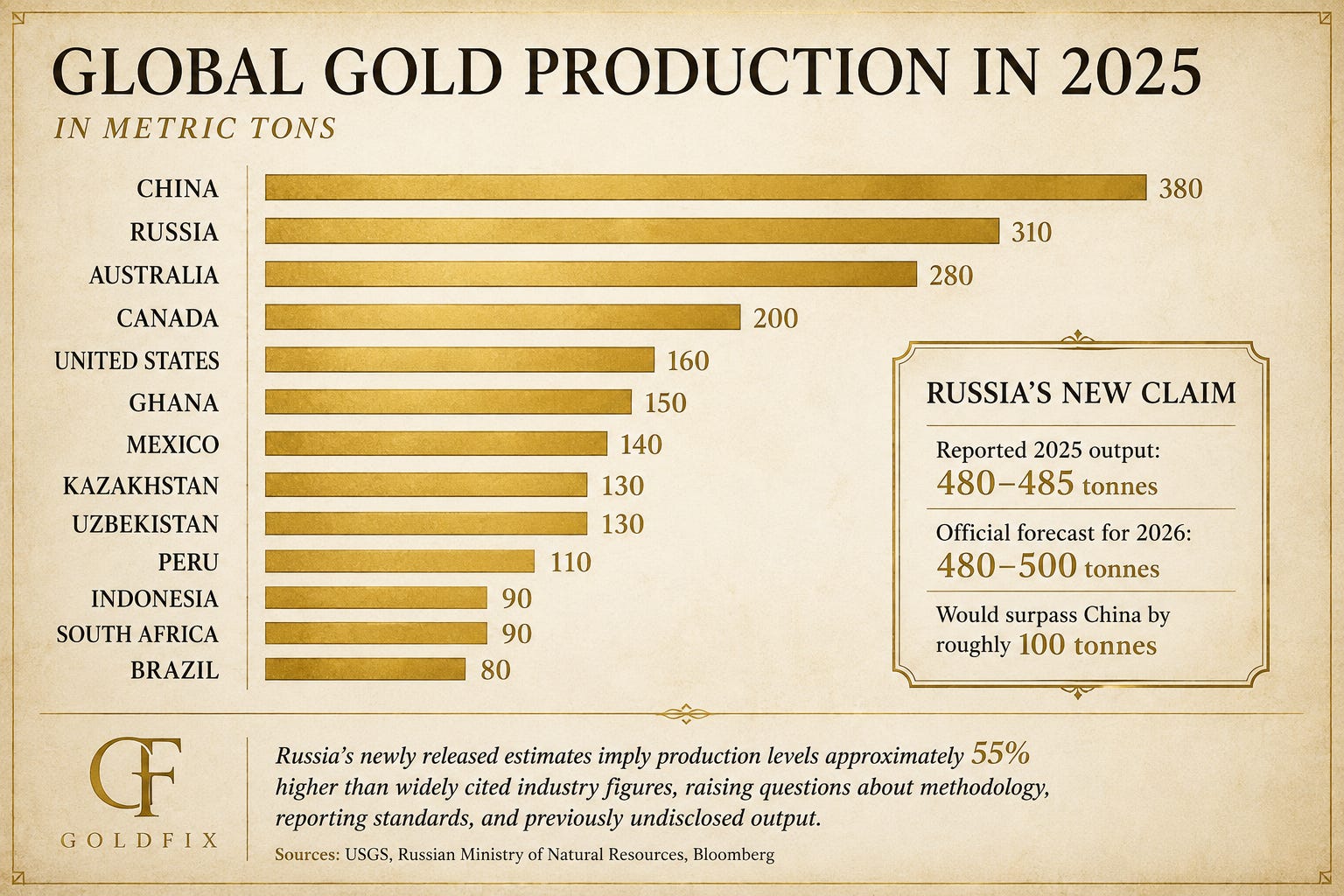
The estimates were disclosed by Natural Resources Minister Alexander Kozlov ahead of the St. Petersburg International Economic Forum. Russia has largely stopped publishing detailed gold production statistics since Western sanctions and bullion market restrictions were imposed following the Ukraine conflict.
According to Kozlov, preliminary calculations suggest Russian gold output reached between 480 and 485 tonnes in 2025, with production expected to range between 480 and 500 tonnes this year. The ministry confirmed the figures refer specifically to mined gold rather than broader production measures.
The numbers have drawn skepticism from mining analysts because publicly available estimates have been significantly lower. The World Gold Council previously estimated Russia mined roughly 330 tonnes in 2024, while independent industry consultants placed output closer to 345 tonnes. A jump toward 500 tonnes would imply an increase of roughly 40% to 50% in only a few years.
Analysts note that few major new mines have entered production recently, making the scale of the reported increase difficult to reconcile with existing industry data. However, the figures highlight the growing strategic importance of gold to Russia as sanctions continue to reshape global commodity markets.
“Gold production will amount to 480-485 tons.”
“The forecast for this year is 480-500 tons of gold.”
If the estimates are accurate, Russia would surpass both its previous production records and China’s reported output of approximately 381 tonnes, reinforcing its position as a dominant force in the global gold market.
Contributor posts published on Zero Hedge do not necessarily represent the views and opinions of Zero Hedge, and are not selected, edited or screened by Zero Hedge editors.
END
YOUR EARLY CURRENCY VALUES/GOLD AND SILVER PRICING/ASIAN AND EUROPEAN BOURSE MOVEMENTS/AND INTEREST RATE SETTINGS FRIDAY MORNING.7:30 AM
SHANGHAI CLOSED DOWN 30.04 PTS OR 0.74%
HANG SENG CLOSED DOWN 291.45 PTS OR 1.15%
Nikkei CLOSED DOWN 852.69 PTS OR 1.26%
//Australia’s all ordinaries CLOSED DOWN 0.91%
//Chinese yuan (ONSHORE) CLOSED UP TO 6.7674
/ OFFSHORE CLOSED UP AT 6.7670 Oil DOWN TO 92.33 dollars per barrel for WTI and BRENT DOWN TO 94.65 Stocks in Europe OPENED ALL GREEN
ONSHORE USA/ YUAN// WITH YUAN TRADING UP (6.7674) OFFSHORE YUAN TRADING UP TO 6.7670 ONSHORE YUAN TRADING BELOW LEVEL OF OFF SHORE AND UP ON THE DOLLAR// / AND THUS STRONGER/OFF SHORE YUAN TRADING UP AGAINST US DOLLAR/ AND THUS STRONGER
XXXXXXXXXXXXXXXXXXXXXXXXXXXXXXXXXXXXX
YOUR EARLY CURRENCY VALUES/GOLD AND SILVER PRICING/ASIAN AND EUROPEAN BOURSE MOVEMENTS/AND INTEREST RATE SETTINGS FRIDAY MORNING.7:30 AM
ONSHORE YUAN: CLOSED UP 6.7677
OFFSHORE YUAN: UP TO 6.7670
1.HANG SANG CLOSED DOWN 291.44 PTS OR 1.15%
2. Nikkei closed DOWN 852.69 PTS OR 1.26%
WEST TEXAS INTERMEDIATE OIL DOWN TO 92.33
BRENT; 94.65
3. Europe stocks SO FAR: ALL GREEN
USA dollar INDEX DOWN TO 99.19/// EURO RISES TO 1.1639 UP 27 BASIS PTS
3b Japan 10 YR bond yield:RISES TO. +2.658 DOWN 1 FULL BASIS PTS/ VERY TROUBLESOME//Japan buying 100% of bond issuance)/Japanese YEN vs USA cross now at 159.92… JAPANESE YEN NOW FALLING AS WE HAVE NOW REACHED THE ENDING OF THE YEN CARRY TRADE AGAIN AND THE REPATRIATION OF YEN DENOMINATED BONDS TRADING IN THE USA/EUROPE. JAPAN 30 YR BOND YIELD: 3.894 UP 1 FULL BASIS PTS
3c Nikkei now ABOVE 17,000
3d USA/Yen rate now well ABOVE the important 120 barrier this morning
3e Gold DOWN /JAPANESE Yen UP CHINESE ONSHORE YUAN: UP( 6.7677 AND OFFSHORE: DOWN AT 6.7670
3f Japan is to buy INFINITE TRILLION YEN worth of BONDS. Japan’s GDP equals 5 trillion USA
Japan to buy 100% of all new Japanese debt and NOW they will have OVER 50% of all Japanese debt.
3g Oil DOWN for WTI and BRENT DOWN this morning
3h European bond buying continues to push yields HIGHER on all fronts in the EMU. German 10yr bund YIELD DOWN TO +3.0231// Italian 10 Yr bond yield DOWN to 3.771// SPAIN 10 YR BOND YIELD DOWN TO 3.448%
3i Greek 10 year bond yield DOWN TO 3.691%
3j Gold at $4464.60 //Silver at: 72.70 1 am est) SILVER NEXT RESISTANCE LEVEL AT $100.00
3k USA vs Russian rouble;// Russian rouble DOWN 0 AND 35/ 100 roubles/73.84
3m oil (WTI) into the 92 dollar handle for WTI and 94 handle for Brent/
3n Higher foreign deposits moving out of China// huge risk of outflows and a currency depreciation. This can spell financial disaster for the rest of the world/
JAPAN ON JAN 29.2016 CONTINUES NIRP. THIS MORNING RAISES AMOUNT OF BONDS THAT THEY WILL PURCHASE UP TO .5% ON THE 10 YR BOND///YEN TRADES TO 159.87 // 10 YEAR YIELD AFTER FIRST BREAKING .54% LAST YEAR NOW EXCEEDS THAT LEVEL TO 2.658% DOWN 1 BASIS PTS STILL ON CENTRAL BANK (JAPAN) INTERVENTION//YEN CARRY TRADE NOW UNWINDING//YEN BOND TRADING OVERSEAS REPATRIATED.//JAPAN 30 YR: 3.894 UP 1 PTS..: USA/SF this 0.7878 as the Swiss Franc . Euro vs SF: 0.9176
USA 10 YR BOND YIELD: 4.463 DOWN 2 BASIS PTS…
USA 30 YR BOND YIELD: 4.974 DOWN 1 BASIS PTS/
USA 2 YR BOND YIELD: 4.037 DOWN 1 BASIS PTS
USA DOLLAR VS TURKISH LIRA: 46.09 UP 12 BASIS PTS/LIRA GETTING KILLED//IDIOTS FOR SELLING GOLD AND USA DOLLAR RESERVES.
10 YR UK BOND YIELD: 4.8910 DOWN 3 PTS
30 YR UK BOND YIELD: 5.581 DOWN 3 BASIS PTS
10 YR CANADA BOND YIELD: 3.437 UP 1 BASIS PTS
5 YR CANADA BOND YIELD: 3.093 UP 1 BASIS PTS.
Futures Drop On Souring Chipmaker Sentiment, Kospi Plunge
Friday, Jun 05, 2026 – 08:27 AM
Futures are lower amid fresh underperformance of tech. If the premarket weakness persists, the S&P 500 is set to break a historic weekly run of gains as the AI trade takes another leg lower this time driven by the cartoonish Kospi index, with investors also expecting payrolls data to affirm that interest rates will stay higher for longer (full payrolls preview here). As of 8:00am ET, S&P futures are down 0.5% while Nasdaq futures slide 1% as chipmakers fall and big tech stocks are lower too, following on from a slump in South Korea’s Kospi. All Mag 7 names are all lower in premarket trading except for MSFT (+0.4%); NVDA fell -1.3%, a continuation of yesterday’s underperformance post AVGO earnings. On news flow, headlines were mostly muted this morning; after yesterday’s non-tech led rebound, we saw more negative sentiment this morning with all three indices lower during the pre-market session. Bond yields are flat to lower, the 10Y yield trading unchanged at 4.47% lower; the USD is also lower. WTI crude fell -0.2% to $92.86; both base and precious metals are lower while the bitcoin mauling shows no signs of ending. Today, the key focus is NFP; see our full preview here.

In premarket trading, Mag 7 stocks are mostly lower (Nvidia -1.3%, Microsoft +0.4%, Tesla +0.1%, Apple -0.1%, Alphabet -0.4%, Amazon -0.2%, Meta -0.2%, Nvidia -1.3%)
- Argan (AGX) rises 11% after the power-plant construction company reported first-quarter revenue above what analysts expected.
- Chipotle (CMG) is up about 2% after JPMorgan upgraded to overweight, citing a “rare valuation opportunity” for the stock.
- Cooper Cos (COO) gains 6% after the lens maker posted second quarter sales and profit that topped estimates.
- Docusign Inc. (DOCU) is down 4% after the company provided an in-line forecast for second quarter revenue. Analysts notes that its still a wait-and-see story as the company ramps Intelligent Agreement Management, its AI-powered platform for contracts.
- G-III Apparel Group (GIII) rises 8% after the clothing company boosted its adjusted earnings per share guidance for the full year.
- Guidewire (GWRE) is down 12% after the midpoint of the software company’s subscription and support revenue forecast for the fourth quarter fell short of the average analyst estimate.
- Lululemon Athletica Inc. (LULU) slides 10% after the company lowered its annual forecast due to deteriorating performance in North America.
- Merlin Inc. (MRLN) soars 29% after the defense technology company announced the successful completion of the critical design review for its C-130J autonomy program with the US Special Operations Command.
- Samsara (IOT) slips 2% after the GPS fleet tracking company posted first-quarter results.
- ServiceTitan (TTAN) jumps 15% after the software solutions firm reported revenue for the first quarter that beat the average analyst estimate.
Stocks are pulling back for a second day after Broadcom’s outlook for chip sales fell short of high expectations, raising questions over whether the rally in the AI trade had run too hard. The lack of progress toward a deal in the Middle East has also stoked worries that oil prices will remain elevated for some time.
“Following a period of upward revisions to earnings expectations across the sector, investors are taking a more selective approach to new information and guidance updates,” said Tomás García-Purriños, senior asset allocation strategist at Santander Asset Management. “We would view the recent weakness primarily as profit-taking and consolidation after a strong run.”
The chase for tech stocks took a further knock after S&P Dow Jones Indices said it would keep its eligibility criteria for benchmarks such as the S&P 500, rejecting proposals that would’ve allowed mega-caps to gain entry more quickly after going public. The decision means companies such as SpaceX, Anthropic PBC and OpenAI would have to wait at least a year for inclusion in the US benchmark after their debut. Fast inclusion in the S&P 500 would’ve led to about $14 billion in forced passive buying for SpaceX.

Friday’s jobs data will likely show a solid increase in payroll numbers, up 88K (if down from 115K in April), suggesting the strong March and April reports reflected underlying momentum rather than just a rebound from earlier weakness, according to Bloomberg Economics. Our preview can be found here. The report may not offer strong direction for stock markets, as a focus on signs of price pressures is keeping investors to expect a rate hike as soon as December. Goldman noted that the implied move of 47 basis points is much lower than the average realized move over the past year, and the lowest since Dec 24.

“Employment figures should not move the needle unless there is a major surprise,” said Roberto Scholtes, head of strategy at Singular Bank. “Instead, the key variables to watch are 10- and 30-year Treasury yields, which are hovering around the 4.5% and 5% ‘pain threshold’ levels.”
Europe’s Stoxx 600 is brushing broader losses off and edging higher, as losses for tech stocks and miners are offset by gains for consumer names.Here are the biggest movers Friday:
- Raspberry Pi shares rise as much as 14%, extending their run and hitting a new all-time high after the British maker of small, low-cost computers said earnings this year will be well ahead of expectations, pointing to robust demand
- Evoke shares rise as much as 17% yet trade about 10% below the value of a recommended all-stock offer from Bally’s Intralot. Berenberg analysts expect the deal to get done on the current terms
- CMC Markets shares rise as much as 7.3%, extending strong gains since the online trading platform guided to a stronger-than-expected FY27 performance on Thursday, as Jefferies upgrades to buy from hold
- Infineon shares slide 5.7% after being downgraded by analysts at MP Capital Markets because the recent strength in the semiconductor stock leaves “limited upside” on the table
- Bodycote shares fall as much as 11%, most since March 2025, after Apollo Management Holdings said it does not intend to make a firm offer, ending discussions that began with a conditional proposal announced on May 22
- Wacker Chemie falls as much as 6%, the most since April 29, after Citi cut its recommendation to sell, saying momentum in upstream chemicals may be moderating, leading to a less compelling risk/reward for Wacker Chemie and Clariant
Asian equities slid for a second day, dragged down by losses in technology hardware shares as enthusiasm for the artificial intelligence trade cools. The MSCI Asia Pacific Index fell as much as 2.3% before paring some of its declines. Heavyweight chipmakers Samsung and SK Hynix were the biggest drags. South Korea’s Kospi led losses around the region, tumbling over 5%. For the week, the regional measure was down about 1.3%. Stocks in Indonesia extended this week’s slump, heading for the lowest close since November 2020. Global tech stocks fell after a weaker-than-expected outlook from US chipmaker Broadcom, indicating investors are nervous about sustainability of the AI rally. Meanwhile a lack of progress in talks between the US and Iran threatened to keep oil prices elevated, raising inflation concerns.
In FX, The Bloomberg Dollar Spot Index is down 0.2%, while the euro is holding its gain despite a downward revision to first-quarter GDP growth, entirely due to a contraction in Ireland. EUR/USD rose 0.2% to 1.1637. USD/JPY inched 0.1% lower to 159.86: Japan Finance Minister Satsuki Katayama reiterated that the government stands ready to respond appropriately to currency moves at any time. USD/CAD fell 0.2% to 1.3880:Friday’s data will include change in nonfarm payrolls, unemployment rate for the US and unemployment rate, net change in employment for Canada as well
In rates, treasuries are mixed ahead of the May jobs report at 8:30am New York time, with oil prices little changed as traders await signs of progress in US-Iran peace talks.US yields remain within a basis point of Thursday’s closing levels with the 10-year near 4.47%. Gilts in the sector outperform slightly while bunds lag by around 1bp. US curve spreads are marginally steeper on the day. WTI crude oil futures down 0.2% underpin Treasuries, while Nasdaq 100 futures are off nearly 1% as tech stocks falter.
Ahead of May jobs report, Fed-dated OIS contracts price in around 17bp of tightening by year-end and fully price in a 25bp hike by the March FOMC meeting. Into the data, Thursday’s activity in Treasury options was active and mixed in direction, while SOFR options flows largely consisted of position liquidation and adjustment, as traders looked reduce risk.
In commodities, Brent edged lower to around $94.80 a barrel.
Cryptocurrencies are under sustained selling pressure, heading for a sixth straight day of losses. Sentiment is hurt by Middle East tensions, expectations of higher U.S. rates, ETF outflows, and Strategy’s reported bitcoin sales for the first time since 2022. Bitcoin falls 2% to $62,292, Ether drops 5.8% to $1,669, and Solana declines 4.1% to $66.20, all near multi-month or multi-year lows.
Today’s US economic data calendar includes May jobs report (8:30am) and April consumer credit (3pm). Fed speaker slate empty for the session. External communications blackout commences Saturday ahead of the June 17 policy announcement
Market Snapshot

Top Overnight News
- US and Iran Show Little Progress in Talks After Week of Clashes: BBG
- Iran has informed Pakistan of its acceptance of transferring part of its uranium to a third country that agrees to it. However, Al Arabiya followed up by stating that the US still refuses Iran’s request to release its frozen funds.
- Senate passes $70 billion ICE funding; fails to ban Trump’s ‘anti-weaponization’ fund: RTRS
- Senate blocks debate on FISA surveillance law days before program ‘goes dark: RTRS
- Anthropic Calls for AI Pause Button to Let Humans Take Stock: BBG
- Apple’s Plan for AI Dominance Rests on Fixing Its Much‑Maligned Chatbot: WSJ
- Point72 Weighs Paying Other Hedge Funds to See Their Trade Ideas: BBG
- Morgan Stanley Sees SpaceX’s Revenue Reaching $3.4 Trillion in 2040: WSJ
- Trump’s trade adviser Navarro said the Fed shouldn’t raise rates into supply shock inflation.
- US officials held preliminary discussions with major AI companies about the potential for the government to acquire some shares in their firms, according to people familiar with the matter cited by NOTUS.
- Banks Curb China Trips, Delay Events After Cross-Border Scrutiny: BBG
- The Anything-Goes Era in Private‑Credit Lending Is Coming to an End: WSJ
- Americans on GLP-1s Are Overwhelming Retailers With Their Nonstop Returns: WSJ
- A weekly flow data shows USD 39bln into bonds (a record inflow), USD 122bln into cash, USD 23.1bln into stocks, USD 2bln out of crypto (biggest since November 2025), USD 3.1bln out of gold (biggest in 10 weeks).
A more detailed look at global markets courtesy of Newsquawk
APAC stocks were mostly lower with the region subdued by recent tech-related pressure, and despite the predominantly positive handover from Wall St, where healthcare helped boost the Dow to a record high. ASX 200 declined as the losses in the mining, materials and resources sectors overshadowed the outperformance in health care. Nikkei 225 retreated amid tech selling but with the index off today’s worst levels after bouncing off a floor beneath the 66,000 level, while data was mostly encouraging as Household Spending and Labour Cash Earnings topped forecasts, which effectively supports the argument for a BoJ rate hike this month. Hang Seng and Shanghai Comp were mixed with Hong Kong pressured after the recent efforts to tighten cross-border capital outflows, including banks suspending opening Hong Kong bank accounts for mainland clients that could be used for overseas investments, while the mainland is marginally positive after the PBoC resumed open market operations.
Top Asian News
- Japanese PM Takaichi said there are pros and cons to a weak yen, while she added that investment strategy will help maintain trust in the yen and that her economic policy is aimed at boosting Japan’s economic capability, not at FX manipulation.
- Japanese Finance Minister Katayama said the direction on sales tax cut hasn’t been decided, adds government will not rely on debt to finance the food sales tax cut.
European bourses (STOXX 600 +0.2) start the last trading session of the week mixed, with the breadth of performance narrow. Global tech continues to sell off, after Broadcom’s AI chip revenue fell short of expectations, weighing on indices that are heavily weighted with tech names (AEX -0.1%, EuroStoxx 50 -0.1%). Sectors point to a neutral bias. Retail (+1.5%) and Media (+1.5%) outperform, while Technology (-1.6%) and Basic Resources (-1.8%) are the clear laggards.
Top European News
- UK MP/PM candidate Burnham has spoken on options for increasing infrastructure spending without breaching the fiscal rules, FT reported citing sources.
- Andy Burnham says he would run in a Labour leadership contest and, if prime minister, urgently tackle social care, taxation and devolution while avoiding a snap election or immediate Brexit rerun, according to the Guardian.
- UK PM spokesperson said Starmer will not walk away from PM job, in response to Andy Burnham’s bid for the leadership, while Burnham confirmed he’ll stand to replace PM Starmer as Labour leader, as he stated that Wes Streeting seems to have launched a leadership contest, which he would seek to join.
- Norway’s Stryke labour union said companies have agreed wage deal for oil workers and that they will not go and strike.
FX
- G10s are all firmer against the Buck, where DXY -0.2% as it respects recent ranges into the US Jobs report. Franc leads, EUR +0.2% and GBP +0.2% also performing well.
- In a quiet morning session, the Buck has trundled lower from a 99.40 peak to a trough just above 99.20. Today sees the release of May US Jobs data, expected to tick lower to 85k from 115k in April. Recent labour market proxies align with expectations of a cooling in the labour market, as initial jobless claims rose to 225k from 212k, above the top end of the forecast range, while Challenger layoffs rose to 97.006k from 83.387k. Aside from macro data, focus remains on geopolitics, where headlines overnight suggested Washington demanded Tehran deliver its response before the end of the week or be hit with strikes. MUFG notes EUR/USD is vulnerable to a stronger employment print citing the OIS curve in Europe, which they believe is now well priced or even overpriced for what the ECB will deliver. Markets currently assign 14bps of tightening by year-end for the Fed.
- EUR performs well on the back of the weaker Buck. The likely catalysts today for the single currency will be the US Jobs report, which is expected to cool on a monthly basis. ING, which has an above consensus expectation (100k vs consensus 85k), contends the US print will support the Buck, and potentially enough to price a 25bp hike from the Fed by year-end, widening rate differentials. EUR/USD +0.2% firmed throughout the morning after rising from the 1.16 mark.
- CHF continues to mark gains against the Euro and Buck in wake of May inflation data. EUR/CHF U/C, USD/CHF -0.2%. Antipodeans firmer, but to a lesser extent than cyclicals as metals are lower across the board and amid the general equity risk tone.
Central Banks
- RBI keeps Repurchase Rate unchanged at 5.25%, as expected, via unanimous decision, while policy stance kept at neutral. RBI Governor Malhotra said the central bank would take steps, if needed, to rein in speculative activity in the FX market.
Fixed Income
- Global fixed benchmarks are slightly firmer this morning alongside some mild pressure in the energy complex. Markets remain on tenterhooks, awaiting the key NFP report and mixed geopolitical updates: 1) Trump said talks with Iran are going well, 2) reports suggest Washington has demanded Iran deliver a response before the end of the week, 3) Hezbollah rejected the US-backed ceasefire between Lebanon and Israel. (Please see the commodities section for details.)
- USTs (+9 ticks) are firmer and trade within a narrow 19-18 to 109-23 range. Tentative action as markets await the US NFP report later today; in brief, the US economy is expected to add 85k nonfarm payrolls in May, vs 115k added in April. The unemployment rate is seen unchanged at 4.3%. Traders will be watching closely for signs of labour market deterioration, given that FOMC officials view employment risks as tilted to the downside, though Fed officials are seemingly more concerned about the inflation side of its mandate, amid the labour market stability.
- US yields are lower across the curve, with some mild underperformance in the belly. The 10yr (4.46%) resides just shy of the key 4.50% mark; a dovish NFP report could see the yield test near-term support at 4.45%, and then a cluster of highs at around the 4.42%. Of course, a hawkish report would see a potential test of 4.50%, and a breach above that mark will bring in near-term highs at 4.53%.
- Bunds (U/C) and Gilts (+17 ticks) also trade incrementally firmer. There has been a lack of pertinent newsflow for either region; UK Halifax House Price Index showed that prices edged a little lower in May due to the Middle East war. Elsewhere, the BoE DMP report was released, which saw 1yr ahead inflation expectations rise, whilst the 3yr was left unchanged. Focus will shift to BoE speak via Dhingra and Bailey this afternoon. Bunds currently hold within a 125.54 to 125.69 range; Gilts hold within a 87.77 to 88.05 range.
Commodities
- In US-Iran news, the biggest setback this week regarding US and Iran talks (in spite of the flare-ups) came in Lebanon, where Hezbollah publicly rejected the latest US-backed Israel-Lebanon ceasefire framework, saying it required Hezbollah concessions without an Israeli withdrawal, and vowed to continue resistance while Israeli forces remain in Lebanese territory. An Israel-Hezbollah ceasefire remains a key Iranian demand for broader peace talks. Washington reportedly demanded Tehran respond by the end of the week and warned of either an agreement or military action. More recently, Al Hadath reported that Iran has informed Pakistan of its acceptance of transferring part of its uranium to a third country that agrees to it, which resulted in fleeting downside in energy benchmarks.
- Crude futures are off their worst levels with little in terms of notable geopolitical headlines this morning. Following Hezbollah’s rejection yesterday, Israeli army issued evacuation warnings for 9 villages in southern Lebanon. Note, this morning, there were reports of a marine drone exploding in Romania, although the Romanian defence ministry later clarified that this was a Romanian army drone. WTI Jul resides in a USD 91.50-USD 93.54/bbl range while Brent Aug sits in a USD 93.64-95.90/bbl range. Dutch TTF trades higher by around 1%, just north of the EUR 49/MWh level.
- Spot gold has rebounded after finding support at its 200 DMA for a second day in a row (200 DMA at USD 4428/oz today). The yellow metal still trades with modest intraday losses and within a USD 4429-4482/oz range, within yesterday’s 4424-4515/oz parameter. Traders look ahead to the US NFP later today for impetus (full preview available on Newsquawk).
- Base metals are lower across the board but to varying degrees after trickling lower in APAC alongside the mostly downbeat overnight risk sentiment. 3M LME copper resides in a USD 13,711.70-13,893.30/t range at the time of writing.
- Petroleum Development Oman said operations at the Mina Al Fahal port are proceeding normally after oil loadings were suspended following an explosion due to an alleged drone attack.
Trade/Tariffs
- US President Trump said automakers sought no tariff changes in their meeting and that talks focused mostly on car repair.
- China International Trade Council says it opposes proposed US tariffs and criticised the plan for 12.5% tariffs on Chinese goods.
Geopolitics: Middle East
- Iran has informed Pakistan of its acceptance of transferring part of its uranium to a third country that agrees to it, Al-Hadath reported. However, Al Arabiya followed up by stating that the US still refuses Iran’s request to release its frozen funds.
- US President Trump said they do not need help from European countries regarding Hormuz and noted that Iran talks are going well, while he reiterated that almost all of Iran’s leadership has been wiped out and that Iran has no navy or air force. Trump said if Iran killed US troops, it would restart the war quickly, and the Israel-Lebanon conflict is interconnected with Iran. Trump also stated he thinks progress has been made on Lebanon, and he would be honoured to meet Iran’s Supreme Leader if a deal is made.
- Iranian Foreign Minister Araghchi said they have many documents and evidence that show Kuwaiti skies have been used regularly against Iran. Araghchi also commented that Iran and Oman will regulate the management of the Strait of Hormuz based on international law standards, while they will exchange views and ideas about the management of the Strait with the Persian Gulf countries, but ultimately the decision will be made between Iran and Oman.
- Iran’s Supreme Leader advisor Rezaei said US President Trump wants to pressure Iran to accept his conditions and keep Iran in a vague state, while he added that the current draft has ambiguities that have to be clarified. Rezaei also said that Iran will stand firmly with Hezbollah in Lebanon and that Iran will have no hesitation in defending its interests and security.
- Pakistan’s interior minister was reported to return to Tehran to push negotiations.
- Israeli army issued evacuation warnings for 9 villages in southern Lebanon, Sky News Arabia reported.
- Hezbollah claimed drone and missile attacks on Israeli bases, while it also stated that six Merkav tanks were destroyed in Lebanon, according to Fars.
- US House rejected a war powers resolution on Lebanon in a 92 vs 324 vote.
Geopolitics: Ukraine
- US House voted 226 to 195 to approve the Ukraine aid package and Russia sanctions bill after more than a dozen GOP lawmakers voted against party lines.
Geopolitics: Other
- US sanctioned Cuba’s President Miguel Diaz-Canel, while President Trump said sanctions are not meant to accelerate a collapse, and stated they will handle Cuba after they take care of Iran.
- Marine drone explosion has been reported in Romanian Black Sea Port of Constanta-Digi 24. Romania’s Defence Ministry later said that the Romanian Army maritime drone found at Constanța civilian port self-detonated, causing no casualties, and was not linked to recent Black Sea exercises.
US Event Calendar
- 8:30 am: May Change in Nonfarm Payrolls, est. 88k, prior 115k
- 8:30 am: May Change in Manufact. Payrolls, est. 2k, prior -2k
- 8:30 am: May Unemployment Rate, est. 4.3%, prior 4.3%
DB’s Jim Reid concludes the overnight wrap
As we hit another payrolls Friday in the US, Asian markets are seeing some decent sized tech losses in what seems to be a hangover from Wednesday night’s Broadcom results where forecasts weren’t as elevated as some of the more optimistic predictions hoped. The KOSPI is down -5.02% with the Nikkei -1.27% lower. The latter is also influenced by the increasing view that the Bank of Japan will have to raise rates over the coming year. The meeting on the 16th of this month now sees a 96% probability of a hike according to futures. In our World Outlook our economist forecast a hike a quarter over the next year. This is more hawkish than the consensus.
The Hang Seng (-0.84%) is also trading lower on tech losses with the ASX -0.63%. S&P 500 (-0.59%) and NASDAQ 100 (-1.07%) futures are also weak for this time of the day. Bucking the trend is the Shanghai Composite (+0.43%). European stock futures are only down just over a tenth of a percent given their low tech weighting.
Early morning data revealed that Japan’s real wages rose by +1.9% in April (compared to +1.7% anticipated) y/y, contributing to a smaller-than-expected decline in household spending. Average nominal wages, or total cash earnings, increased by +3.5% year-on-year (against +3.1% expected). This figure represents the fastest wage growth since December 2024, following a revised increase of +3.1% in March. The April data marks the first instance in over 34 years where wage growth has surpassed 3% for three consecutive months. In a separate report, Japan’s household spending decreased by -0.5% year-on-year in April, a less severe decline than the expected drop of -1.5%, following a -2.9% decrease in the previous month. This decline has extended the trend of falling consumer spending to five consecutive months.
Before these overnight moves, markets stabilised yesterday amidst growing hopes for some sort of US-Iran deal. So Brent crude oil prices (-2.84%) fell back to $95.03/bbl, reversing course after three consecutive gains, which in turn helped to ease fears about a stagflationary shock. As a result, markets followed the usual pattern of the last three months, where lower oil prices meant bond yields also fell back, with investors pricing in a more dovish path for central banks too. Meanwhile, equities recovered, including the S&P 500 (+0.41%), although it wasn’t all good news for risk assets yesterday, with Bitcoin (-2.06%) falling to its lowest level since early February, at $63,575.
In terms of the latest from the Middle East, there wasn’t much in the way of fresh news. However, oil prices saw a clear move lower after Trump issued a post criticising the vote in the House of Representatives against the Iran conflict. That was because Trump’s post said the vote was “right in the middle of my final negotiations to end the War”. So that suggested talks were still happening and a deal might be near. Oil prices did rebound a bit during the US session as Lebanon’s Hezbollah militia rejected the US-brokered ceasefire, but overall this didn’t derail the more optimistic mood following the ceasefire announcement by Israel and the Lebanese government the previous evening.
And investors also priced out the chance of a longer conflict, with the 6-month Brent future (-2.15%) also falling to $85.04/bbl. So that helped to ease concerns about inflation, with the 1yr US inflation swap (-9.2bps) falling to 3.09%, whilst the 1yr Euro inflation swap (-5.5bps) fell to 2.99%.
With easing fears around inflation, markets dialled back the chance of a rate hike from the Federal Reserve this year. Indeed, the probability of a hike by December was down to 68% by the close, having been at 81% the previous day. Moreover, those dovish expectations got further support from some weaker US data, with the weekly initial jobless claims rising to their highest since early February. They hit 225k in the week ending May 30 (vs. 215k expected), and even though the Memorial Day holiday could have created volatility, the 4-week moving average also reached a 3-month high of 214.75k. So the release leant against the more positive US data in recent days, and it helped Treasury yields to decline across the curve. For instance, the 2yr yield (-3.8bps) fell back to 4.04%, whilst the 10yr yield (-2.1bps) fell back to 4.47%, roughly where we are this morning as I type.
Looking forward, US data will stay in the spotlight today, as we’ll get the May jobs report at 13:30 London time. This will be an important one for the Fed, as the strong labour market data of recent weeks has fuelled the speculation about a potential rate hike. Indeed, we’ve just had back-to-back payrolls above +100k in March and April, which is the first time that’s happened since 2024. And so long as the labour market stays in decent shape, that will keep the focus on the inflation side of the Fed’s mandate, which has moved increasingly above target given the energy shock. In terms of today’s report, our US economists expect payrolls to come in at +50k (consensus +88k), with the unemployment rate remaining at 4.3%. So if realised, that would be a slowdown from the last couple of months, but would still mark 3 consecutive positive readings for the first time in a year. Our economists’ lower than consensus forecast is not necessarily a structural story, more a slowdown in some sectors that have recently seen outsized gains. Our economists have been more optimistic on the labour market than their peers in recent months.
Ahead of that, US equities also regained momentum before this morning’s futures sell-off, with the S&P 500 (+0.41%) paring back the previous day’s losses and still looking to post a 10th consecutive weekly increase for the first time since 1985. We are at +0.06% so far this week but futures are lower so we’ll see what happens.
Most constituents in the index put in a solid performance yesterday, with 363 advancers – the most since April – and with the equal-weighted S&P 500 (+0.79%) rising to an all-time high. Chipmakers were the major exception to that, and Broadcom (-12.59%) was the second-biggest decliner in the index after their earnings the previous day. That included a forecast for AI chip revenue that was beneath expectations, which led to broader concerns around the sector. The Philly semiconductor index fell by -2.15% but it did recover from as much as -6.29% down early in the session. And the broader tech mood wasn’t as negative, with six of the Mag-7 (+1.06%) moving higher.
Earlier in Europe, markets had put in a positive session across bonds and equities, benefiting from the fall in oil prices and being less exposed to semiconductor stocks. So the STOXX 600 (+0.52%) put in a decent performance, alongside gains for the DAX (+0.60%), the CAC 40 (+1.15%) and the FTSE MIB (+0.27%). Moreover, European rates rallied too, with yields on 10yr bunds (-1.0bps), OATs (-1.5bps) and BTPs (-1.8bps) all falling.
Looking at the day ahead, data releases include the US jobs report for May, French industrial production for April, and the third release of Q1 GDP for the Euro Area. Central bank speakers include BoE Governor Bailey and the BoE’s Dhingra.
1b European opening report
1 c Asian opening report
Europe primed for a quiet open, Stateside futures lower into NFP – Newsquawk EU Market Open

Friday, Jun 05, 2026 – 02:24 AM
- US President Trump said that Iran talks are going well. He reiterated that almost all of Iran’s leadership has been wiped out; Brent Aug’26 +0.4%.
- Washington has demanded that Tehran deliver its response before the end of the week, and stated no progress in negotiations between Iran and the US, Al Hadath reports, citing Israeli Channel 12. Washington warned Tehran, “either an agreement or a military strike”.
- Ukrainian President Zelensky sent a letter to Russian President Putin, which said that the choice is yours; “Enough of war, Ukraine proposes to end this war”.
- APAC stocks were mostly lower, subdued by tech-related pressure stateside; European equity futures are indicative of a slightly lower open.
- DXY is slightly lower, awaiting the key US NFP report; G10s trade lacklustre, whilst USD/JPY lingers around 160.00.
- Looking ahead, highlights include French Balance of Trade (Apr), BoE DMP (May), EU Employment Change Final (Q1), GDP 3rd Estimate (Q1), Italian Retail Sales (Apr), Canadian Jobs Report (May), US Jobs Report (May).
- Speakers include RBA’s Hauser, BoE’s Bailey & Dhingra.
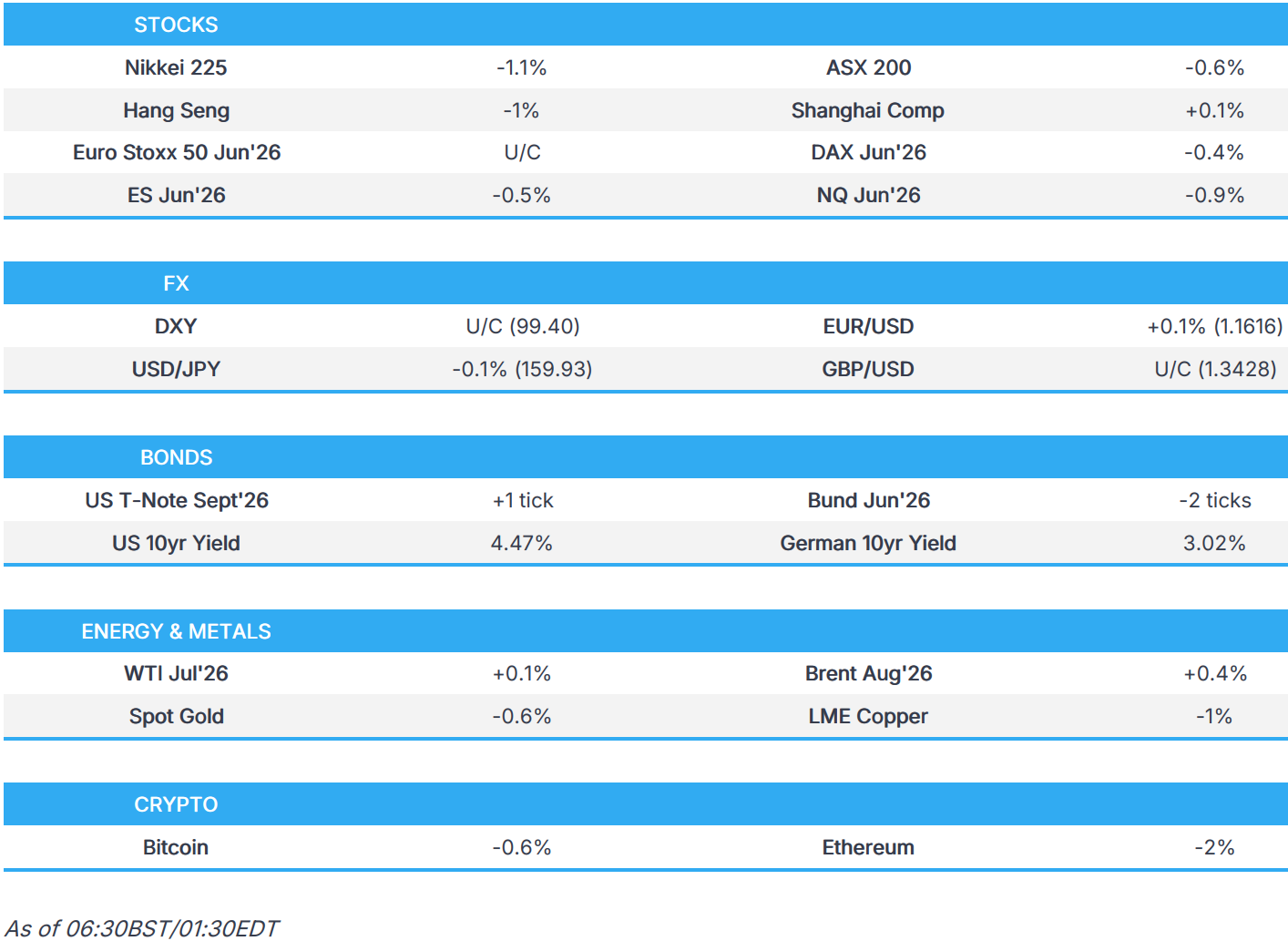
Newsquawk in 3 steps:
1. Subscribe to the free premarket movers reports
2. Listen to this report in the market open podcast (available on Apple and Spotify)
3. Trial Newsquawk’s premium real-time audio news squawk box for 7 days
IRAN CONFLICT
- US President Trump said they do not need help from European countries regarding Hormuz and noted that Iran talks are going well, while he reiterated that almost all of Iran’s leadership has been wiped out and that Iran has no navy or air force. Trump said if Iran killed US troops, it would restart the war quickly, and the Israel-Lebanon conflict is interconnected with Iran. Trump also stated he thinks progress has been made on Lebanon, and he would be honoured to meet Iran’s Supreme Leader if a deal is made.
- Washington has demanded that Tehran deliver its response before the end of the week, and stated no progress in negotiations between Iran and the US, according to Al Hadath, citing Israeli Channel 12. Washington informed Tehran that the signing ceremony for the agreement with it will take place in Switzerland, while it warned Tehran “either an agreement or a military strike”. Furthermore, the Israeli Broadcasting Authority quoted an Israeli official as saying Washington “will understand our position” if the agreement with Lebanon is not implemented.
- US State Department issued a security alert for all Middle Eastern countries due to the “potential for hostilities”.
- Iranian Foreign Minister Araghchi said they have many documents and evidence that show Kuwaiti skies have been used regularly against Iran. Araghchi also commented that Iran and Oman will regulate the management of the Strait of Hormuz based on international law standards, while they will exchange views and ideas about the management of the Strait with the Persian Gulf countries, but ultimately the decision will be made between Iran and Oman.
- Iranian Foreign Minister Araghchi said the Hormuz Strait is in the territorial waters of Iran and Oman, while he stated that US bases in the region are targets for retaliation.
- Iranian Ministry of Foreign Affairs Deputy for Legal and International Affairs Gharibabadi said Iran insists 50% of frozen assets must be made available to Iran at the same time as the signing of an MOU.
- Iran’s Supreme Leader advisor Rezaei said US President Trump wants to pressure Iran to accept his conditions and keep Iran in a vague state, while he added that the current draft has ambiguities that have to be clarified. Rezaei also said that Iran will stand firmly with Hezbollah in Lebanon and that Iran will have no hesitation in defending its interests and security.
- Iran’s IRGC, in response to recent events in Lebanon, said Iran’s initial condition for accepting a ceasefire in the regional war was a ceasefire on all fronts, including Lebanon. IRGC also stated the region would never be stable unless Israel withdraws from Lebanon, according to Tasnim.
- Pakistan’s interior minister was reported to return to Tehran to push negotiations.
- Oman suspended crude oil loading at Mina Al-Fahal terminal following an explosion, according to sources, while a drone attack was suspected to be the cause of the explosion.
- US official told Al Jazeera the ceasefire with Iran is in place, but they will continue to protect their forces and impose a blockade on ports, while the official stated there is an open shipping route through the Strait of Hormuz, but it is up to the ships to decide whether to transit, and approximately 1,000 ships have crossed the Strait of Hormuz since the ceasefire with Iran went into effect on April 8th.
- Nearly 40 ships previously stranded in the Persian Gulf have exited through the Strait of Hormuz over the past three weeks as vessels quietly coordinate with the US Navy, according to Lloyd’s List Intelligence via CNBC.
- Israeli forces struck a tent shelter in Khan Younis, which killed one person.
- Hezbollah informed Lebanese authorities of its rejection of the Washington agreement between Lebanon and Israel, according to Al Araby TV citing the Hezbollah leader.
- Hezbollah claimed drone and missile attacks on Israeli bases, while it also stated that six Merkav tanks were destroyed in Lebanon, according to Fars.
- US House rejected a war powers resolution on Lebanon in a 92 vs 324 vote.
US TRADE
EQUITIES
- US stocks ultimately closed somewhat mixed but with most major indices in the green, while the Nasdaq underperformed despite finishing well off session lows. The tech-heavy index came under pressure after Broadcom (AVGO) reported a revenue miss and disappointing semiconductor revenue guidance for the next quarter. The results weighed on semiconductor and AI-linked names that have been among the market’s strongest performers in recent weeks, driving early weakness in the sector. However, although Broadcom remained sharply lower, much of the broader technology complex recovered through the session, helping the Nasdaq pare losses. Beneath the surface, market breadth was stronger than the headline indices suggested, and most sectors closed in positive territory, led by Health Care, Financials and Communication Services, while Technology and Consumer Staples were the only sectors to finish lower. Crude prices were lower after President Trump described US-Iran negotiations as being in their “final stages”, while the decline in oil supported Treasuries, particularly at the front-end, resulting in a bull steepening move as traders pared Fed rate hike expectations.
- SPX +0.41% at 7,585, NDX -0.54% at 30,408, DJI +1.73% at 51,562, RUT +1.46% at 2,936.
- Click here for a detailed summary.
TARIFFS/TRADE
- US President Trump said automakers sought no tariff changes in their meeting and that talks focused mostly on car repair.
- China International Trade Council says it opposes proposed US tariffs and criticised the plan for 12.5% tariffs on Chinese goods.
NOTABLE HEADLINES
- US President Trump confirmed a USD 700mln announcement on coal plants.
- US President Trump said he is interviewing people for the intelligence chief, and that Pulte’s position is not permanent.
- US President Trump’s trade adviser Navarro said the Fed shouldn’t raise rates into supply shock inflation.
- US officials held preliminary discussions with major AI companies about the potential for the government to acquire some shares in their firms, according to people familiar with the matter cited by NOTUS.
APAC TRADE
EQUITIES
- APAC stocks were mostly lower with the region subdued by recent tech-related pressure, and despite the predominantly positive handover from Wall St, where healthcare helped boost the Dow to a record high.
- ASX 200 declined as the losses in the mining, materials and resources sectors overshadowed the outperformance in health care.
- Nikkei 225 retreated amid tech selling but with the index off today’s worst levels after bouncing off a floor beneath the 66,000 level, while data was mostly encouraging as Household Spending and Labour Cash Earnings topped forecasts, which effectively supports the argument for a BoJ rate hike this month.
- Hang Seng and Shanghai Comp were mixed with Hong Kong pressured after the recent efforts to tighten cross-border capital outflows, including banks suspending opening Hong Kong bank accounts for mainland clients that could be used for overseas investments, while the mainland is marginally positive after the PBoC resumed open market operations.
- US equity futures trickled lower as overnight sentiment was soured by tech weakness.
- European equity futures indicate a marginally lower open with Euro Stoxx 50 futures down 0.1% after the cash market closed with gains of 0.8% on Thursday.
FX
- DXY kept to within tight ranges as traders awaited the incoming US NFP report, while the recent labour market proxies disappointed as initial jobless claims rose to 225k from 212k, above the top end of the forecast range, while Challenger layoffs rose to 97.006k from 83.387k. There was also recent Fed commentary with Fed’s Daly noting that policy was in a good place, and the central bank was prepared to respond either way, while known hawk Schmid said the issue was whether the Fed needed to raise rates to “tamp this thing down” and meet the inflation target.
- EUR/USD traded little changed after recent price swings and with very light newsflow from the bloc.
- GBP/USD lacked direction as the data calendar for the UK remained light, while comments from BoE Governor Bailey provided little incrementally, in which he noted that markets had been orderly but stretched at times, and that leverage in debt markets raised questions over vulnerabilities.
- USD/JPY lingered around the 160.00 level as participants digested data, including firmer-than-expected Labour Cash Earnings and Household Spending, although Foreign Reserves dropped by the most on record since the data series began in 2000. There were also some comments from Japanese PM Takaichi, who said there are pros and cons to a weak yen, as well as stated that investment strategy will help maintain trust in the yen and her economic policy is aimed at boosting Japan’s economic capability, not at FX manipulation.
- Antipodeans marginally softened amid the mostly negative tone and recent declines in commodities.
- PBoC set USD/CNY mid-point at 6.8157 vs exp. 6.7735 (prev. 6.8203).
FIXED INCOME
- 10yr UST futures traded little changed after bull steepening yesterday as falling crude prices eased inflation concerns and reduced Fed rate hike pricing, while participants await the key US jobs data.
- Bund futures lacked direction following recent indecision and in the absence of pertinent catalysts.
- 10yr JGB futures remained afloat after the prior day’s decline in oil prices, but with the upside in JGBs capped as participants also digested several data releases in which Labour Cash Earnings and Household Spending topped forecasts.
COMMODITIES
- Crude futures traded sideways with demand constrained after prices fell yesterday amid the ongoing mediation efforts towards a US–Iran peace deal following recent flare-ups and retaliatory strikes, while Trump stated that the US is “in the middle of my final negotiations to end the War”.
- US Energy Secretary Wright issued an emergency order to keep a Florida coal plant online, with the emergency order for the Stanton coal plant effective through September 1st.
- Norway’s Stryke labour union said it agreed to a wage deal for oil workers and that they will not go on strike
- Spot gold resumed the recent pullback from the USD 4,500/oz level, with downside also seen amid the broader selling in the metals complex.
- Copper futures continued to trickle lower alongside the mostly downbeat overnight risk sentiment.
CRYPTO
- Bitcoin declined overnight to beneath the USD 63,000 level.
NOTABLE ASIA-PAC HEADLINES
- RBI kept the Repurchase Rate unchanged at 5.25%, as expected, via unanimous decision, while the policy stance was maintained at neutral. RBI Governor Malhotra said monetary policy has turned more cautious and noted considerable risks to inflation and growth, as well as noted that domestic demand remains resilient; however, elevated energy prices and supply constraints are having an adverse impact on economic activity. Malhotra said the food price outlook remains uncertain and risks of higher inflation have been amplified, while he stated it is prudent to wait for greater clarity to emerge and that the RBI will remain data dependent.
- PBoC injected CNY 215bln via 7-day reverse repos with rate maintained at 1.40%.
- Japanese PM Takaichi said there are pros and cons to a weak yen, while she added that investment strategy will help maintain trust in the yen and that her economic policy is aimed at boosting Japan’s economic capability, not at FX manipulation.
- Japan may have tapped its foreign securities holdings, including US Treasuries, to fund last month’s record currency market intervention, potentially attracting scrutiny from Washington, Bloomberg reported.
DATA RECAP
- Japanese Household Spending MM (Apr) 1.6% vs. Exp. 0.8% (Prev. -1.3%)
- Japanese Household Spending YY (Apr) -0.5% vs. Exp. -1.5% (Prev. -2.9%)
- Japanese Average Cash Earnings YY (Apr) 3.5% vs. Exp. 3.2% (Prev. 2.7%)
- Japanese Overtime Pay YY (Apr) 4.20% vs. Exp. 3.2% (Prev. 1.9%)
- Japanese Foreign Exchange Reserves (May) 1305.9B (Prev. 1383B)
GEOPOLITICS
RUSSIA-UKRAINE
- US President Trump said it would be great if Ukrainian President Zelensky and Russian President Putin met, while he is glad Russia and Ukraine are talking about meeting and noted they will both make compromises.
- US House voted 226 to 195 to approve the Ukraine aid package and Russia sanctions bill after more than a dozen GOP lawmakers voted against party lines.
- US Pentagon is expected to cancel a plan to send Tomahawk missiles to Germany partly because officials are concerned Russia will view it as an escalation, which is a startling reversal of a long-planned agreement with one of America’s biggest allies, according to POLITICO.
- Ukrainian President Zelensky sent a letter to Russian President Putin stating the choice is yours; “Enough of war, Ukraine proposes to end this war”, while Zelensky is proposing a meeting.
- Ukrainian forces were reportedly utilising high-definition, near real-time commercial satellite imagery to identify and strike Russian military assets, according to WSJ.
- Russian President Putin said Trump’s peace proposals could be a basis for peace deals with Ukraine and that Trump sincerely seeks to resolve the Ukrainian crisis, but still has to persuade Ukraine. Putin also said there is no need to stop fighting to start talks with Ukraine.
- Russian Foreign Minister Lavrov said Western nations have consistently pursued a strategy aimed at suppressing and partitioning Russia, according to an interview with Izvestia, while he stated that Russia sees no signs of US efforts to persuade Kyiv on peace and that there was no progress on a Ukraine settlement since the Anchorage summit.
OTHER
- US sanctioned Cuba’s President Miguel Diaz-Canel, while President Trump said sanctions are not meant to accelerate a collapse, and stated they will handle Cuba after they take care of Iran.
- Russian President Putin said Russia had always cooperated with China in the military sphere and would continue to do so, while he stated the two countries were on friendly terms. Putin also commented that Russia and China were not against anyone, but acted in each other’s interests, and that Russia and China would soon make the global energy market happy with new agreements.
EU/UK
NOTABLE HEADLINES
- BoE Governor Bailey said markets had been orderly but stretched at times, while noting that leverage in debt markets raised questions over vulnerabilities.
- UK PM spokesperson said Starmer will not walk away from PM job, in response to Andy Burnham’s bid for the leadership, while Burnham confirmed he’ll stand to replace PM Starmer as Labour leader, as he stated that Wes Streeting seems to have launched a leadership contest, which he would seek to join.
- Andy Burnham discussed with a leading economist how he might boost infrastructure spending without breaking Labour’s fiscal rules and spooking the markets, according to FT.
- Andy Burnham says he would run in a Labour leadership contest and, if prime minister, urgently tackle social care, taxation and devolution while avoiding a snap election or immediate Brexit rerun, according to the Guardian.
2.NORTH AND SOUTH KOREA AND JAPAN
JAPAN
3 CHINA
CHINA/USA
4. EUROPEAN AND SCANDINAVIAN COMMENTARIES PLUS NATO
UK
Now deeper in trouble!!
Britain’s Borrowing Outlook Darkens As Energy Shock Deepens
Friday, Jun 05, 2026 – 06:30 AM
Via City AM,
- The OBR says it underestimated the fiscal damage from the 2022 energy shock and will apply those lessons to the latest Middle East-driven price surge.
- Higher oil and gas prices could increase UK borrowing through debt interest, welfare payments, and pressure on departmental budgets.
- The Bank of England has warned that a severe energy shock could push inflation above 6% and force tighter monetary policy.
Chancellor Rachel Reeves has been warned that government borrowing is set to spike as a result of the Iran war, as the Office for Budget Responsibility admitted it had underestimated the effects of the last energy price shock.

In a review of its forecasting models, the OBR suggested it had learned lessons from Russia’s full-scale invasion of Ukraine, which led to gas prices rising by around five times.
It said the overall impact on public finances “was to significantly increase government borrowing and debt” despite some government revenue being raised by taxes on energy companies’ profits and higher wage growth.
The surge in government borrowing was driven by a rise in debt interest costs, welfare benefits, and the maintenance of real-terms increases to departmental budgets, according to analysis.
The OBR concluded that it would apply the lessons from its forecast review to the energy price shock caused by the Iran war in this year’s Budget.
The analysis suggests that the OBR could take a more pessimistic view on government borrowing, with oil prices jumping by around 40 per cent since the beginning of the war in March and wholesale European gas prices doubling.
Economists have warned that stalled peace negotiations will lead to prolonged disruption across the Strait of Hormuz, a critical global trading route for oil tankers and large ships.
The Bank of England warned in a worst-case scenario analysis that continued disruption would push inflation above six per cent and force it to undo all interest rate cuts made in the last two years.
OBR builds on previous analysis
In 2024, when Iran and Israel appeared to be close to an all-out war, the OBR conducted an initial analysis of what disruption could mean for UK public finances.
The OBR then estimated that the UK government would have to borrow an average of £23.1bn more a year if there were a cut to energy supplies “comparable to the 1973 oil embargo”, City AM found.
Economists have widely suggested that the current blockade on the Strait of Hormuz, triggered by the Iran war, is the worst global oil supply shock recorded in history. International Energy Agency chief Fatih Birol said it was more serious than supply shocks in “1973, 1979 and 2022 together”.
Under the OBR’s assumption, oil and wholesale gas prices would remain 75 per cent higher over the course of a year.
Peace talks between the US, Israel and Iran appear to be on ice after Israel restarted attacks in Lebanon against an Iranian-backed militant group. Israel then paused its attacks on Hizbollah as President Trump reportedly told Prime Minister Netanyahu, “everybody hates Israel because of this”.
The Brent Crude Oil price fell to $85 per barrel on news of a possible return to peace negotiations, although trading prices have been volatile due to uncertainty over possible peace terms. The price climbed as high as $114 per barrel last month.
Reeves’ package to have minimal effect
Alongside assessments of the Iran war’s impact on the UK economy, the OBR is also expected to update forecasts based on any energy support package unveiled by Reeves or any following Chancellor.
Analysis by JP Morgan found that initial action to offer families discounts and to freeze a fuel duty hike would strip 0.2 percentage points off inflation.
The OBR said on Tuesday it would also tweak its models for forecasting business tax receipts and local authority expenditure.
It will also revise the link between higher unemployment and benefits.
Economists at the independent body also hit back at Labour MPs who suggested that models for forecasting the growth effects of extra public expenditure were skewed, claiming it was “unlikely” that calculations were misguided, given that the UK economy had underperformed despite a surge in government spending.
FRANCE
He is lying of course;
The French Never Wanted Mass Immigration
(REMIX)
Friday, Jun 05, 2026 – 03:30 AM
French leaders know how to manipulate their voters, but the voters are also apparently easily manipulated. Every leader from French President Emmanuel Macron to François Mitterrand in the 1980s has decried immigration numbers and promised a crackdown, all while allowing immigration numbers to continuously climb year after year.

Here are just some relevant quotes:
Emmanuel Macron said in 2023: “There is an immigration problem in France.”
In 2016, then French President François Hollande said, “There are too many arrivals, immigration that shouldn’t be there.”
In 2023, then leader Nicolas Sarkozy said: “There are too many immigrants in France.”
In 1991, former leader Jacques Chirac said, “We must stop family reunification. We must completely revise the right of asylum. We must open the debate on the right of all foreigners to social benefits.”
In 1989, the famous leader François Mitterrand said, “On immigration matters, we have crossed the tolerance threshold.”
The age-old adage is that “nobody voted for this.”
It is true that the specific question of mass immigration never came to a referendum, but it is also fair to say that some very pro-migrant candidates, such as Macron, have continuously made it into office.
Still, one would assume that in a democratic system, with leader after leader calling for a halt to immigration, that immigration levels would tend to trend lower. However, this is not how Western democracy has worked over the last decades. The same developments have been seen in the United Kingdom, Germany, and the United States. Leaders know the masses are unhappy about immigration, so they make proclamations against immigration to placate the masses, all while actual policy serves an entirely different purpose.
Macron is arguably the worst offender the French have ever seen when it comes to migration. In 2023, he said France must reduce immigration, beginning with legal entrants in a wide-ranging interview with weekly political magazine Le Point. Macron’s remark comes after he said in 2022 that migration “is part of France’s DNA” and oversaw a record increase in immigrants in 2022.
What has his record been since then?
Well, Macron was lying, as this chart clearly shows:

The foreign population has soared year after year, reaching record after record. In 2025, a record number of first-time legal residence permits were issued, totaling 384,000. In short, France is being buried in a wave of mass immigration that only a minority of French actually wanted. The estimates of how many foreigners are now living in France varies wildly, with some figures going as high as 9 million. However, there are also millions of legal French citizens who also have a migration background, which has led to a massive demographic shift.
Poll after poll has shown the French are remarkably opposed to mass immigration.
In a CSA poll for CNews in 2023, 64 percent of French said “we should stop non-European immigration to France.”
In a CSA poll for Europe 1 in 2024, 48 percent of French people said they wanted zero immigrants coming to the country, including 53 percent of women respondents.
In an Ifop poll in 2026, 60 percent of French people said they believe France is witnessing “a replacement of the French population by non-European populations, mainly from the African continent.”
In a poll from Odoxa-Backbone Consulting for Le Figaro in 2023, 74 percent of French said they believe there are too many migrants in France and 72 percent said they want a referendum on immigration.
In a CSA poll for CNews in 2023, 80 percent of French said they support a total ban on more immigration.
Meanwhile, in communist China, where there is not even an illusion of a democratic vote, foreigners only make up 0.06 percent of the population of 1.4 billion people. It may be hard to believe for many, but there are now fewer foreigners in all of China, at 845,000, than there are in just one European city, Berlin.
The political leaders that have governed the West have lied every step of the way on immigration, and in the process, they have gravely imperiled democracy. Many looking to authoritarian China see a country on the rise, where high-speed trains and critical infrastructure are quickly and efficiently erected, where crime is low, and social cohesion generally high.
Meanwhile, Europe is throwing up protectionist barriers against China at a time when China is pulling ahead in green energy, automobile manufacturing, machine tools, and AI.
Mass immigration has been an unmitigated economic, educational, security, and budget disaster for the West.
Democracy itself should not necessarily be condemned, however. Japan, Taiwan, and South Korea, all thriving democracies, have managed to keep their borders almost entirely closed to mass immigration while growing their economies, all based on the will of the people.
In the end, it may have something to do with Europeans themselves and their culture of guilt, self-righteousness, and virtue signaling, which are attitudes that tend to dominate amongst European populations. The trend has been remarkably uniform across the Western world. It is not only France, but also the Netherlands, Germany, Spain, and the United Kingdom, all marching in lockstep. While we can point our fingers at the mass media and academia, we also have to look at ourselves in the mirror and ask how we collectively allowed this to happen.
end
SWITZERLAND
UBS CEO Warns Swiss Population Cap Is An ‘Extreme’ Measure
Friday, Jun 05, 2026 – 02:45 AM
A proposal headed for a June 14 vote in Switzerland made headlines for seeking to place a hard cap on the country’s permanent resident population at 10 million through 2050.
The vote is also being watched as a referendum on immigration pressure in Europe more broadly. UBS CEO Sergio Ermotti has caught the vapors over the idea, describing it as an “extreme” measure that fails to address the country’s underlying challenges.UBS CEO Sergio Ermotti (photo: Chiara Zocchetti )
“I do worry about these extreme initiatives,” Ermotti said, speaking from the Swiss Economic Forum in Interlaken on Thursday. “Switzerland has 30% of foreign-born people, almost like in Australia, twice as Germany. And that leads to certain frustration within society. But it’s not a way to solve the problem.”
Switzerland’s population stood at approximately 9.1 million at the end of 2025. Since 2000, it has grown by about 1.9 million people, with roughly four-fifths of that increase attributable to net international migration. Swiss federal authorities measure the increase since the introduction of free movement of persons in 2002 at around 1.7 million.
Foreign nationals now make up about 27% of the resident population, while migration-background shares are higher. In 2024, 41% of Switzerland’s permanent resident population aged 15 and over had a migration background, including first-generation and second-generation residents. Ermotti highlighted the scale of the demographic shift, noting that Switzerland’s foreign-born share is comparable to Australia’s and roughly double Germany’s.
The “No to a Switzerland with 10 Million” initiative, backed by the right-wing Swiss People’s Party (SVP), would enshrine a hard population limit in the Federal Constitution. If passed, it would require Switzerland’s permanent resident population to remain below 10 million until 2050. If the population exceeds 9.5 million before then, the Federal Council and Parliament would have to take measures, particularly in asylum and family reunification.
If the 10 million threshold is exceeded, Switzerland would also have to renegotiate or terminate international agreements that contribute to population growth, including the EU Agreement on the Free Movement of Persons after two years. That would also put the broader Bilateral Agreements I with the EU at risk. Supporters point to real pressures: housing shortages and rising rents in cities like Zurich and Geneva, strained infrastructure, overcrowded public transport, and concerns over long-term social cohesion in a small, mountainous nation.
UBS’s High Stakes In The Debate
UBS, one of Switzerland’s largest private-sector employers with more than 30,000 employees in the country and a heavily international workforce, has significant skin in the game. The bank relies on global talent to sustain its operations in finance, a sector where skilled foreign workers fill critical roles. A rigid population cap, critics including business leaders argue, could exacerbate labor shortages in an already aging society with a fertility rate of around 1.3 children per woman.
Ermotti’s comments come as Switzerland grapples with balancing economic dynamism against quality-of-life concerns. Opponents of the cap, including the Federal Council and business groups, argue that Switzerland needs foreign workers in companies and public institutions such as hospitals and care homes, and that a constitutional ceiling would create uncertainty around Swiss-EU relations. Recent net immigration has moderated somewhat, falling for a second consecutive year in 2025, but remains high by historical standards.
The UBS chief stressed the need for evidence-based policymaking. “The discussions need to be balanced,” he said, urging authorities to ground decisions “on fact rather than emotion and scaremongering.”
Parallel Battles Over Capital Rules
Ermotti’s remarks on the population initiative coincided with ongoing tensions over Switzerland’s proposed capital requirements for UBS. The government is pushing to increase the common equity capital UBS must hold domestically against its foreign operations to 100% of each unit’s equity value, from 60% currently. The bank estimates this would require an additional roughly $20 billion in CET1 capital for its Swiss entity, a move it warns would damage its business model and, by extension, the broader domestic economy.
Parliament continues to debate the core package, with the process expected to last until next year. Ermotti’s call for fact-based deliberation applies equally here, as the bank awaits clarity on reforms that were partially watered down in April but remain demanding.
A Defining Moment For Swiss Identity And Economy
The referendum remains contested, though the latest reported polling shows opposition ahead, with 52% against the initiative and 45% in favor. It taps into broader European debates over low native fertility, labor needs, infrastructure limits, and national character. Switzerland’s direct democracy hands the ultimate choice to voters, making the outcome a potential bellwether for how high-income nations navigate sustained immigration.
END
GERMANY
AFD
(remix)
Support For Germany’s AfD ‘Firewall’ Plummets As Voters Call To Bring Party In From The Cold
Friday, Jun 05, 2026 – 02:00 AM
Germany’s long-running “firewall” that sees the country’s legacy parties exclude cooperation with the right-wing Alternative for Germany (AfD) is moving further out of step with a large section of the electorate, with new polling showing voters now evenly divided over the governing CDU’s refusal to work with the nationalist party.Alice Weidel (AfD), federal chairwoman and parliamentary group leader, walks past Federal Chancellor Friedrich Merz (CDU) in the plenary session of the German Bundestag. (Photo by Lilli Förter/picture alliance via Getty Images)
According to the latest Deutschlandtrend survey by Infratest Dimap for ARD and Welt, 47 percent of Germans now say the CDU’s exclusion of cooperation with the AfD is not right, while the same proportion say it is right. That marks a significant shift since September 2024, with opposition to the stance rising by 12 points and support falling by 13 points.
The figures come as the AfD remains Germany’s strongest party in the national polling. Infratest Dimap puts the AfD unchanged on 27 percent, ahead of the CDU/CSU on 23 percent, with the Greens on 14 percent, the SPD on 13 percent, and the Left Party on 10 percent. The FDP and BSW would both remain below the five-percent threshold for entering parliament.
The CDU’s position still has clearer backing among its own voters, with 62 percent of CDU/CSU supporters saying the exclusion of cooperation with the AfD is right. However, the wider national picture suggests the policy is no longer backed by a clear public majority.
The east-west divide is particularly stark on the AfD question. In western Germany, a narrow majority still supports excluding cooperation with the AfD, 50 percent in favor to 45 percent against. In the east, where the AfD has built some of its strongest support, a clear majority opposes the CDU’s stance, 58 percent against to 38 percent in favor.
The poll also points to a deeper crisis of confidence in Germany’s established parties. Only half of respondents said they support their preferred party out of conviction, while 46 percent said their choice was driven by disappointment with the alternatives. When the same question was asked in 2018, 61 percent said conviction was the main reason for their party preference.
That disappointment is especially pronounced among AfD voters. The poll found that 57 percent of AfD supporters are motivated primarily by frustration with other parties, although the party also scores strongly on its political program among its own base.
The findings come after a series of strong results and polling boosts for the AfD, particularly in eastern Germany. Last month, AfD politician René Stadtkewitz won a snap mayoral election in Zehdenick, Brandenburg, with 58.4 percent of the vote, becoming the party’s first directly elected full-time mayor in the state. Separate regional polling has also shown the party on the cusp of absolute majorities in Saxony and Saxony-Anhalt.
AfD co-leader Alice Weidel has presented the trend as part of a broader political realignment, writing after earlier polling gains: “The political shift is inevitable – we will put the interests of our country and our citizens back at the forefront!”
The pressure on the CDU is being intensified by deep dissatisfaction with Chancellor Friedrich Merz and the federal government. According to the Deutschlandtrend figures cited by Welt, only 16 percent of Germans are satisfied with Merz’s performance, while 82 percent are dissatisfied. Overall, just 12 percent are satisfied or very satisfied with the federal government, compared with 87 percent who are less satisfied or not satisfied at all.
Economic pessimism is also weighing heavily on the political landscape. The economy is now the top issue for voters, ahead of refugees and migration. Only 13 percent describe Germany’s economic situation as good, while 85 percent rate it as less good or bad. Just six percent expect to be better off in a year’s time, while 38 percent expect things to worsen.
END
5. RUSSIAN AND MIDDLE EASTERN AFFAIRS//
ISRAEL/USA VS IRAN//THURSDAY NIGHT
Trump Softens Red Line: ‘No Reason’ To Retrieve Iran’s Nuclear ‘Dust’ As It’s Effectively ‘Entombed’
Thursday, Jun 04, 2026 – 03:59 PM
Summary
- Trump remarks suggest the fate of Iran’s stockpile of enriched uranium is no longer be the central issue it once was.
- Hezbollah chief rejects outcome of Lebanon-Israel talks, insisting that a truce must encompass whole country.
- WSJ reports that the White House intends to maintain a ceasefire with Iran unless American troops are killed; oil drops also after Trump states on TS
- Trump lashes out after House War Powers votes passes Wednesday evening, attacking especially four Republicans who voted in favor.
- Trump downplayed Iran’s attacks on US bases in Kuwait & Bahrain, saying “they were slightly provoked…so they were reciprocating.”
* * *
Trump Suggests Enriched Uranium No Longer a Central Issue for Him
Trump’s Thursday late afternoon remarks to reporters suggested that the fate of Iran’s stockpile of enriched uranium may no longer be the central issue it once was. Asked about reports that the US could attempt to seize or recover Iran’s remaining nuclear material, Trump repeatedly downplayed the prospect, saying there was “no reason” to retrieve what he called Iran’s nuclear “dust” because it is now effectively “entombed.”
The president stressed that Washington is “not considering” any covert operation to seize Iran’s uranium, adding that the US already has “powerful cameras watching Iran’s uranium” and remains confident in its ability to monitor the situation. While Trump at one point boasted that America and China are the only countries capable of recovering the material and suggested “we’ll get Iran’s nuclear dust,” his broader message now seems that the stockpile no longer represents an urgent concern. Instead, Trump framed the dispute around a much simpler objective: ensuring that Iran never obtains a nuclear weapon. He reiterated that the “main part” of any agreement would be that Iran “can’t have a nuclear weapon,” while adding that a broader deal could also include guarantees regarding the Strait of Hormuz remaining open to global commerce.
Expressing optimism about diplomacy, Trump again said talks with Tehran are “going well” and suggested that a successful agreement could even lead to a personal meeting with Iran’s supreme leader. “I would be honored to meet the Ayatollah,” he remarked, adding that if a deal is reached, Iran “won’t have a nuclear weapon.”
At the same time, Trump declared in an oddly stated reference that the US would ultimately prevail “on paper, or militarily.” He warned that any future attack resulting in the deaths of American troops would trigger a rapid return to hostilities, while asserting that Iran’s military capabilities have been severely degraded. Trump claimed Tehran has only a handful of missiles remaining, reiterated that Iran effectively has “no navy” and “no air force,” and even said the US possesses photographs of sunken Iranian vessels. He further boasted that Washington had “wiped out almost all” of Iran’s leadership during the conflict.
On regional tensions, Trump linked developments in Lebanon directly to the broader confrontation with Iran, saying the various fronts are “interconnected.” He disclosed conversations with Israeli Prime Minister Benjamin Netanyahu regarding Lebanon and expressed hope that the country could finally enjoy “some peace.” Trump also claimed that Hezbollah had contacted the United States during the crisis.
IAEA: Iran Nuclear Risk Higher than When War Began
Stating the obvious:
According to Bloomberg, the International Atomic Energy Agency (IAEA) has published a “restricted” document which reveals that the nuclear risk posed by Iran is now higher today than it was before the war began. Specifically, prior to the war, the IAEA was allowed to inspect Iranian enriched uranium, but such inspections have since largely halted. However, it should be noted that the IAEA was always only inspected where the IRGC told them they were allowed to, and many suspected that nuclear proliferation was happening behind the scenes, in facilities that were not accessible to the IAEA.
Hezbollah Rejects Outcome of Lebanon-Israel Talks: Secretary General
Hezbollah Secretary General Naim Qassem in new speech rejects the Washington-mediated conclusion to direct Lebanon-Israel talks:
Naim Qassem has warned that Israeli areas across the border will remain under threat as long as the Lebanese people and villages come under attack from the Israeli army.
He also rejected attempts to tie the group’s deployment to wider political arrangements, saying the group refuses any link between Hezbollah’s presence and a ceasefire, or Israel’s withdrawal.
Some highlights from Qassem’s address:
- ‘The revolution in Iran was launched from an Islamic background on the principles of resisting injustice and occupation, and it announced that it is neither Eastern nor Western”
- ‘The West and America will not accept Iran as a model of righteousness and justice; rather, they want it to be subordinate to their interests and their tyranny.”
- ‘Thanks to Iran for helping us to regain our land and our right to confront the Israeli-American aggression despite its major confrontations”; describes direct negotiations as “absurd and humiliating” for Lebanon.
- As long as Israel is in Lebanon, resistance will continue.
- Northern Israel will remain at risk as long as Lebanese villages are being bombed.
- “We are only concerned with ending the comprehensive aggression—with a ceasefire and the withdrawal of “Israel””
- As long as the occupation exists, the resistance will continue.
- “We have not given any commitment to anyone not to resist the aggression and respond to it. And as long as the aggression continues, we will confront it with all the power we have.”
- “The main objective must be the withdrawal from Lebanese territories so that the army spreads in the south of the Litani River and the liberation of the detainees”
- “We do not accept any link between the existence of the resistance, the cessation of aggression and the withdrawal of “Israel”
Iran’s foreign ministry is also still insisting that the broader US-Iran ceasefire must incorporate Lebanon.
Oil Prices Fall As Trump to Maintain Iran Ceasefire Unless American Troops Are Killed
President Trump in an early Thursday morning Truth Social post has said the United States is “in the middle of my final negotiations to end the War” – while blasting the Republicans who voted the night prior to limit war powers “GRANDSTANDERS” and “unpatriotic”.
Even though Iran is denying that any direct negotiations are taking place, following a big flare-up this week in new tit-for-tat fighting which involved Iran sending more missiles and drones on Gulf states, especially Kuwait, the reference to ‘final negotiations’ was possibly enough to get oil prices to react, with a drop in crude. There was also a report that the White House intends to maintain a ceasefire with Iran unless American troops are killed.

Trump’s new apparent strategy to just wait things out with no new planned military attacks has been featured in The Wall Street Journal as follows:
President Trump has told aides privately that he would consider ending the ceasefire with Iran if Tehran kills American troops, U.S. officials said, insisting that the weekslong pause in airstrikes remains intact despite a steady stream of violent skirmishes.
The president’s reluctance to reignite the war suggests he might be willing to withstand smaller flare-ups for weeks—or even months—to avoid a broader conflict in the Middle East.
And Rubio appeared to second this in fielding questions about this week’s violence:
Secretary of State Marco Rubio described the tit-for-tat attacks as purely defensive in nature and not a renewed outbreak of full-scale war.
“They are happening in response to an Iranian action,” Rubio said in a House hearing Wednesday. “If they don’t shoot at those ships, we don’t shoot, but we have to respond.”
More evidence of Trump’s apparently high tolerance for what he deems a violation of ceasefire:
House War Powers Vote Wed. Evening
As for the House vote, it was seen as a rare direct rebuke of Trump and the fact that this war – which the American public was promised would be a ‘short’ military action of possibly a few ‘days’ or ‘weeks’ – is now approaching 100 days, and the war powers passed 215-208, with the four Republicans joining all Democrats in voting yes being Brian Fitzpatrick of Pennsylvania, Thomas Massie of Kentucky, Tom Barrett of Michigan and Warren Davidson of Ohio.

Pushing Lebanon Truce Toward Goal Line
In Lebanon, there is some remotely positive news, with Lebanon and Israel saying had agreed to implement a ceasefire during talks in Washington and overseen by the US; however, once again the deal is contingent on Hezbollah agreeing to the ceasefire.
“That cease-fire is conditional on Hezbollah also stopping fighting, but in theory, the news helps to take out a key sticking point in the U.S.-Iran talks that was holding up a deal. So that’s seen oil prices reverse a run of three [days of] consecutive gains,” Deutsche Bank analyst Henry Allen stated in a research note.
Trump rages at House’s successful War Powers vote, which could portend a political shake-up going into this Fall’s midterm elections:
Some More Latest Developments
via Al Jazeera:
- Hezbollah boss warns north Israel won’t be safe if Lebanon bombed
- Several people have been wounded in an Israeli drone attack on a vehicle after Israel and Lebanon officials agreed to halt the war during a series of meetings in Washington, DC.
- Before the truce announcement, Hezbollah said it launched a “salvo of rockets” at Israeli soldiers in southern Lebanon’s Qantara, and fired drones at troops near the strategic Beaufort Castle.
- The US House of Representatives passed a resolution to rein in President Donald Trump’s powers to attack Iran without congressional authorisation in a vote of 215 to 208.
- Overnight Israeli air strikes on an apartment block in Gaza City killed at least nine Palestinians with four children among the dead.
- Iran’s foreign policy a ‘consensus’ process but supreme leader gets final say
- END
END
ISRAEL/USA VS IRAN//FRIDAY MORNING
GOING NOWHERE ON THEIR DEAL!!
Iran FM Warns American Bases Are Legitimate Targets, Cites ‘No Tangible Progress’ In Talks
Friday, Jun 05, 2026 – 07:20 AM
At a moment it’s become more than clear that the US and Iran are not anywhere closer to the negotiating table, and after they’ve shown little progress after a week of clashes – as one Friday morning Bloomberg headline reads, Tehran has again putting US bases in the region on notice, while admitting “no tangible progress” in negotiations on ending the conflict.
Iran’s Foreign Minister Abbas Araghchi in fresh remarks has said that “standing against the world’s greatest power, equipped with nuclear weapons, for 40 days is no joke,” and that “the world has realized the true power of the Iranian nation.”
Araghchi also again issued a direct warning to regional Gulf states: “We warned regional states that US bases used for any aggression against Iran are legitimate targets” – he was quoted Friday by Islamic Republic of Iran Broadcasting (IRIB) as saying.

However, the Iranian foreign minister also cautioned that there is a way forward, stressing that despite conflict, “We are committed to fostering sustainable, constructive ties with Saudi Arabia.”
The war is fast approaching the 100-day milestone, which comes Sunday, since Trump first initiated his Operation Epic Fury. He had in the opening ‘assured’ the American public of only a short conflict lasting but a few days or weeks.
Iran’s supreme leader too has been signaling defiance while apparently in hiding, saying that the US and Israel had been dealt a “decisive blow”
Ayatollah Mojtaba Khamenei’s message was read out by a prayer leader at a ceremony marking the anniversary of the death of the Islamic republic’s founder on Thursday:
In his message, Khamenei said his country’s enemies, after “facing a decisive blow,” were now “experiencing a deeply meaningful and profound humiliation.”
He went on to accuse them of seeking to “plant the seeds of doubt, despair, fear, mistrust and division” among the public, calling for unity to “neutralize their sinister plot.”
Tehran is still seeking to integrate the Lebanon situation into a broader US-Iran peace deal. But in Lebanon itself, sporadic fighting has raged despite declaration of a ceasefire – of which Hezbollah has declared itself not part of.
On Friday, “The Israeli military’s Arabic-language spokesman Avichay Adraee on Friday warned residents of six towns and villages including south Lebanon’s Sarafand, a town on the coastal road between Tyre and Sidon, to immediately evacuate,” according to CBS.
More reports of mystery explosions in Strait of Hormuz, off Oman…
New: Oman has suspended oil loading operations at the Mina al Fahal terminal after an explosion near its offshore berths, according to Reuters. Two sources familiar with the matter said the blast, which occurred between two single-buoy moorings, was believed to have been caused by a drone attack. Mina al Fahal is Oman’s primary crude oil export terminal, located near Muscat, and handles most of the country’s oil exports.
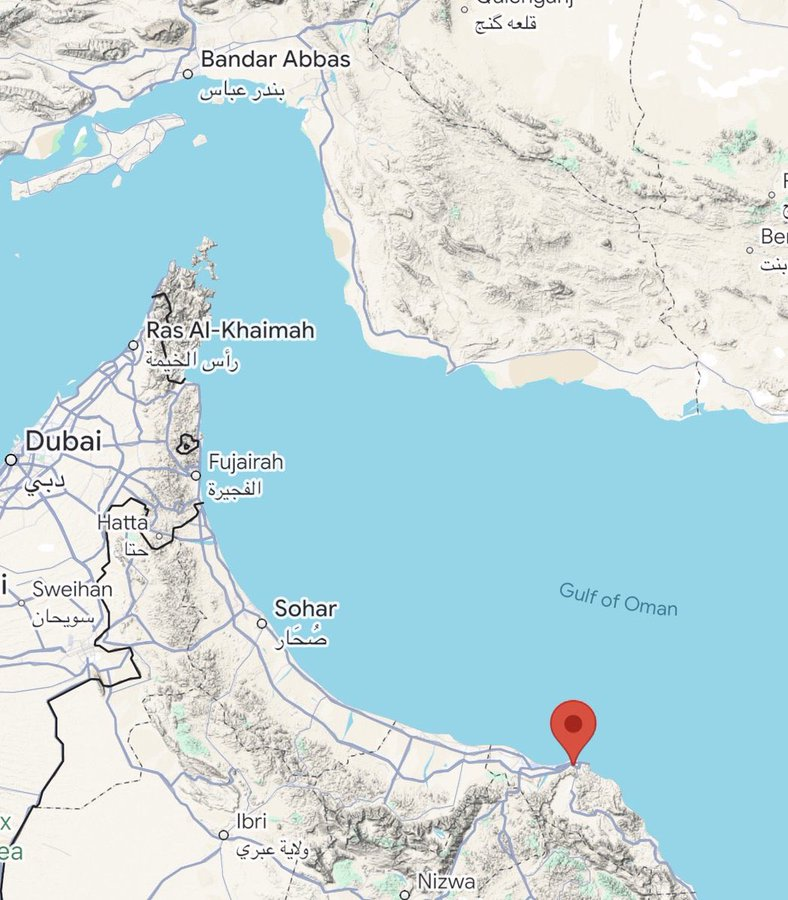
·
“Lebanon’s state-run National News Agency reported mass displacement from the three villages named in the warning, and it subsequently reported a strike on one of the villages, Arqoun,” the report continues.
And Al Jazeera also reports Friday that “Israel’s deadly strikes continue across Lebanon, killing at least six today, despite the announcement of a new US-brokered ceasefire agreed between Lebanese and Israeli officials in Washington, DC.”
Public is increasingly pessimistic that a ceasefire can be a achieved anytime soon, even as Trump has seemed to soften on the issue of retrieving highly enriched uranium:https://embed.polymarket.com/market?market=us-x-iran-permanent-peace-deal-by-june-30-2026-837-641-896-877-363-892-537-597&height=300US x Iran permanent peace deal by June 30, 2026?
Yes 24% · No 77%
View full market & trade on Polymarket
Peace Talks Stall: U.S. Denies Iranian Claims Of Warning Shots At Destroyers
Friday, Jun 05, 2026 – 09:45 AM
Summary:
- U.S. CENTCOM Denies Report
- Iran Military Fires “Warning Missiles” At US Destroyers In Gulf of Oman
- Iran FM Warns American Bases Are Legitimate Targets, Cites ‘No Tangible Progress’ In Talks
Polymarket
https://embed.polymarket.com/market?market=us-x-iran-permanent-peace-deal-by-june-30-2026-837-641-896-877-363-892-537-597&height=300US x Iran permanent peace deal by June 30, 2026?
Yes 25% · No 76%
View full market & trade on Polymarkethttps://embed.polymarket.com/market?market=strait-of-hormuz-traffic-returns-to-normal-by-end-of-june&height=300Strait of Hormuz traffic returns to normal by end of June?
Yes 18% · No 83%
View full market & trade on Polymarket
Iran Military Fires “Warning Missiles” At US Destroyers In Gulf of Oman
AFP is reporting that Iranian military forces fired “warning missiles” at two U.S. Navy destroyers transiting the Gulf of Oman, citing Iranian state media.
“In continuation of operations to counter maritime misconduct and harassment, as well as the hijacking of commercial vessels and oil tankers by the terrorist naval forces of the United States, following the firing of warning missiles, the hostile destroyers DDG-103 and DDG-8 have left the Gulf of Oman towards the Indian Ocean,” Iranian military forces wrote in a statement published by state news agency IRNA.
Meanwhile…
- US DENIES REPORT IRAN ATTACKED OR FIRED AT US NAVAL SHIPS
Most Important Headlines (courtesy of Bloomberg):
Military Confrontation
- Iran’s army fired warning shots using Qadir missiles and drones at two US Navy destroyers (DDG-103 and DDG-87) in the Sea of Oman on Friday, forcing them to retreat to the northern Indian Ocean, according to Iranian military statements
- Iran fired missiles and drones at Kuwait and Bahrain on Wednesday, killing one person and injuring dozens at Kuwait’s main airport, after the US struck an oil tanker headed to Iran
Peace Talks
- The US and Iran have made little progress in talks over an interim peace deal this week, with Iranian Foreign Minister Abbas Araghchi saying no tangible progress has been achieved
- President Trump said ceasefire talks are in the ‘final’ stages despite the stalled negotiations
- Iran’s Foreign Minister dismissed the idea of Supreme Leader meeting Trump after the US president expressed openness to such a meeting
U.S. Congressional Opposition
- The Republican-led House voted 215-208 on Wednesday to halt the US war with Iran, breaking with President Trump
- Trump called the House vote against the Iran war ‘meaningless’ and ‘unpatriotic’ in a Truth Social post
Regional Impact
- Lebanon’s Prime Minister told Iran to stop treating the country as a ‘bargaining chip’ on Friday
- Hezbollah rejected a US-brokered truce proposal in Lebanon, though attacks on northern Israel have eased
- The US said Israel and Lebanon agreed to a ceasefire contingent on Hezbollah stopping attacks and evacuating operatives from southern Lebanon
Nuclear
- Iran permitted UN atomic watchdog monitors to visit its Bushehr nuclear power plant this week while stonewalling inspectors’ demands to verify its enriched uranium stockpile.
Iran FM Warns American Bases Are Legitimate Targets, Cites ‘No Tangible Progress’ In Talks
At a moment it’s become more than clear that the US and Iran are not anywhere closer to the negotiating table, and after they’ve shown little progress after a week of clashes – as one Friday morning Bloomberg headline reads, Tehran has again putting US bases in the region on notice, while admitting “no tangible progress” in negotiations on ending the conflict.
Iran’s Foreign Minister Abbas Araghchi in fresh remarks has said that “standing against the world’s greatest power, equipped with nuclear weapons, for 40 days is no joke,” and that “the world has realized the true power of the Iranian nation.”
Araghchi also again issued a direct warning to regional Gulf states: “We warned regional states that US bases used for any aggression against Iran are legitimate targets” – he was quoted Friday by Islamic Republic of Iran Broadcasting (IRIB) as saying.
However, the Iranian foreign minister also cautioned that there is a way forward, stressing that despite conflict, “We are committed to fostering sustainable, constructive ties with Saudi Arabia.”
The war is fast approaching the 100-day milestone, which comes Sunday, since Trump first initiated his Operation Epic Fury. He had in the opening ‘assured’ the American public of only a short conflict lasting but a few days or weeks.
Iran’s supreme leader too has been signaling defiance while apparently in hiding, saying that the US and Israel had been dealt a “decisive blow”
Ayatollah Mojtaba Khamenei’s message was read out by a prayer leader at a ceremony marking the anniversary of the death of the Islamic republic’s founder on Thursday:
In his message, Khamenei said his country’s enemies, after “facing a decisive blow,” were now “experiencing a deeply meaningful and profound humiliation.”
He went on to accuse them of seeking to “plant the seeds of doubt, despair, fear, mistrust and division” among the public, calling for unity to “neutralize their sinister plot.”
Tehran is still seeking to integrate the Lebanon situation into a broader US-Iran peace deal. But in Lebanon itself, sporadic fighting has raged despite declaration of a ceasefire – of which Hezbollah has declared itself not part of.
On Friday, “The Israeli military’s Arabic-language spokesman Avichay Adraee on Friday warned residents of six towns and villages including south Lebanon’s Sarafand, a town on the coastal road between Tyre and Sidon, to immediately evacuate,” according to CBS.
More reports of mystery explosions in Strait of Hormuz, off Oman
ISRAEL TBN
HEZBOLLAH/ISRAEL
Capt. Eitan Shmuel Lemberg killed in combat in southern Lebanon
According to Army Radio, Lemberg was killed when a Hezbollah terrorist fired an anti-tank missile at an IDF tank north of the Litani River.

CAPTAIN EITAN Shmuel Lemberg, 21, from Mishmar HaShiv’a, killed in southern Lebanon, June 4, 2026.(photo credit: IDF SPOKESPERSON’S UNIT)ByJERUSALEM POST STAFFJUNE 4, 2026 22:15Updated: JUNE 4, 2026 23:30
Captain Eitan Shmuel Lemberg, aged 21, from Mishmar HaShiv’a, was killed in combat in southern Lebanon, the IDF announced on Thursday.
Lemberg was an officer in the 7th Armored Brigade’s 75th Battalion.
According to Army Radio, Lemberg was killed when a Hezbollah terrorist fired an anti-tank missile at an IDF tank north of the Litani River.

Immediately after the incident, the Israeli Air Force and ground forces using artillery struck at Hezbollah infrastructure in the area.
Prime Minister Benjamin Netanyahu issued a statement on Thursday evening offering condolences to Lemberg’s family.
“Our hearts ache over the fall of Armored Corps officer Capt. Eitan Shmuel Lemberg, of blessed memory, who fell in battle in southern Lebanon,” Netanyahu wrote. “Together with all citizens of Israel, my wife and I send our deepest condolences to his family and share in their profound grief. We will always remember his heroism and his sacrifice. May his memory be blessed and cherished in our hearts forever.”
Four IDF soldiers were killed in one week
Lemberg is the fourth Israeli soldier to have been killed this week.
Staff-Sergeant Michael Tyukin was killed by an exploding Hezbollah drone in southern Lebanon, the IDF announced on Sunday morning.
On Monday, the IDF announced that two soldiers had been killed in southern Lebanon: Captain Doctor Ori Yosef Silvester was killed in combat, while Staff-Sergeant Adam Tzarfati was killed in a Hezbollah drone explosion.
END
ISRAEL/USA/BEN GURION
Israelis Complain US Military Has Turned Ben Gurion Airport Into ‘Its Own Base’
Friday, Jun 05, 2026 – 04:15 AM
In a deep irony, Israelis are increasingly complaining the United States military has effectively taken over Israel’s international travel hub.
Media reports this week are going so far as to call Tel Aviv’s Ben Gurion Airport a “US military base” – as the prominent local newspaper Haaretz does:
The US refueling aircraft and other military assets, which have been stationed at Tel Aviv’s Ben Gurion Airport for months, are causing congestion and may result in flight cancellations, Israeli officials and media reports have said, calling the facility a “US military base.”

The report complains that “U.S. Air Force refueling aircraft have been stationed at Ben Gurion International Airport for three months, occupying parking spots, taking up takeoff and landing slots and worsening congestion at Israel’s main international gateway since the war with Iran erupted in late February, officials say.”
Haaretz tallies that “Some 75 U.S. refueling planes occupy more than half of Ben-Gurion Airport’s parking spots and fill up takeoff and landing slots” and cites airport officials who warn: “For lack of a solution, 1.5 million passengers may have their flights canceled this summer.”
Again, a central irony here is that it has largely been US military assets protecting Israel the whole time, going all the way back from last year’s June war, from Iranian ballistic missile and drone attacks.
The Netanyahu government is perceived by many to be a prime reason the US and Iran are at war in the first place, and so the Pentagon might argue that it’s only fair that Israel host its large fleet of military planes and refueling aircraft.
One traveler told The National: “They are turning it into a military base. At some point this is going to be as hard as any checkpoint between the West Bank and Israel.”
And Israeli commentator Noga Tarnopolsky wrote on X: “The only international airport in Israel, now a US airbase. Switzerland, with a similar population, has three international airports. At least two additional airports were budgeted over the years, and it would be interesting to know where that money went.”
A senior airport official was cited in the same report as saying, “What’s happening at the airport is insane. I haven’t seen anything like this in 35 years.”
“They’ll be cancelling thousands of flights for people here in the coming weeks,” the official added. “All the routes, all the destinations. The only place left to get out a bit and clear your head is a huge base and one where you can stay for a long time. Get ready.”
END
TRUMP AND NETANYAHU
OPINION
The rant and the reality: Trump’s outbursts at Netanyahu follow a familiar pattern
DIPLOMATIC AFFAIRS: Trump’s latest expletive-laced outburst at Netanyahu generated predictable predictions of rupture. The record suggests otherwise.

‘DISAGREEMENTS BETWEEN Jerusalem and Washington are not unusual. Nor are disagreements between Trump and Netanyahu. What is striking is how often these episodes are portrayed as evidence of an impending rupture, only for the relationship to return to its previous equilibrium.’
(photo credit: Hazem Bader/AFP via Getty Images
ByHERB KEINONJUNE 5, 2026 12:51
Call it the presidential rant heard round the world.
On Monday, Axios reported that US President Donald Trump unloaded on Prime Minister Benjamin Netanyahu during a phone call, telling him he was “f***ing crazy,” that “you’d be in prison if it weren’t for me,” and that Israeli actions in Lebanon were threatening his negotiations with Iran.
The Prime Minister’s Office quickly disputed the report. But two days later, when asked directly on a New York Post podcast whether he had called Netanyahu “effing crazy” and told him that he had helped keep him out of jail, Trump answered simply: “I did.”
That admission immediately fueled another round of speculation that relations between Trump and Netanyahu had reached a breaking point. The assumption behind much of the coverage was familiar: an angry Trump phone call must mean a crisis in US-Israel relations, that Netanyahu had lost Trump, and that the party was over.
History suggests otherwise.

Disagreements between Jerusalem and Washington are not unusual. Nor are disagreements between Trump and Netanyahu. What is striking is how often these episodes are portrayed as evidence of an impending rupture, only for the relationship to return to its previous equilibrium hours, days, or weeks later.
Netanyahu alluded to this reality in a CNBC interview after Trump confirmed the call.
Trump: We can have ‘tactical disagreements’
“Sometimes we have, as in the best of families, tactical disagreements,” he said. “We always find a way to work them out, and we do so as great friends. We can disagree in the morning, and by the afternoon, we have common actions.”
Ordinarily, comments like that might be dismissed as boilerplate damage control. In this case, however, there is a substantial body of evidence supporting the thesis.
Three patterns emerge from this latest drama.
First, Trump periodically vents his frustrations at Netanyahu in very blunt and salty language.
Second, those outbursts are routinely interpreted as evidence of a strategic rupture.
And third, the relationship repeatedly proves more resilient than the headlines suggest.
Let’s start with the first pattern.
This is hardly the first time Trump has exploded at Netanyahu. In fact, the closest parallel to this week’s incident took place just a year ago.
On June 24, 2025, the last day of the 12-Day War with Iran, after Trump announced a ceasefire between Israel and Iran, Tehran fired ballistic missiles at Israel. Netanyahu wanted to send an unmistakable message to Iran that Jerusalem would not tolerate any violation of the ceasefire, and dispatched fighter planes to bomb Tehran.
Trump, who brokered the ceasefire, was furious and called Netanyahu, ordering him to call off the attack. He then erupted before boarding Marine One.
“We basically have two countries that have been fighting so long and so hard that they don’t know what the f*** they’re doing,” he said, stressing that he was “not happy with Israel.”
The reaction was as predictable as it was immediate. Headlines focused on Trump’s anger. Pundits warned of a serious breach with Netanyahu.
Yet shortly afterward, Trump spoke with the prime minister, the Trump-brokered ceasefire held, and the working relationship continued as though the outburst had never happened.
In retrospect, that episode looks less like the beginning of a rupture and more like a preview of what would happen again this week.
Nor was that outburst the first one.
Trump’s earlier outbursts at Netanyahu
In December 2021, Barak Ravid, the same journalist who reported on Monday’s phone call, published excerpts from an interview with Trump conducted for a book on the Abraham Accords.
The then-former president was still furious over Netanyahu’s decision to congratulate Joe Biden after the 2020 election.
“The first person who congratulated him was Bibi Netanyahu,” Trump said. “The man that I did more for than any other person I dealt with.”
Then came the line that captured headlines around the world: “He was very early. Like earlier than most. I haven’t spoken to him since. F*** him.”
Those comments were widely interpreted as proof that the relationship forged during Trump’s first term had collapsed. And why wouldn’t they be?
Here was the president who moved the US Embassy to Jerusalem, recognized Israeli sovereignty over the Golan Heights, withdrew from the Iran nuclear deal, and brokered the Abraham Accords. If he was now cursing out Netanyahu in this manner, surely something fundamental in the relationship had changed.
That assumption was reinforced two years later when, just five days after October 7, Trump – while campaigning for president – revisited the 2020 assassination of Iranian Quds Force commander Qasem Soleimani and accused Netanyahu of backing away from participation at the last minute.
“Israel was going to do this with us,” Trump said at a campaign rally. “The night before it happened, I got a call that Israel will not be participating in this attack.”
Then he added stinging criticism: “I’ll never forget that Bibi Netanyahu let us down. We were disappointed by that. Very disappointed. But we did the job ourselves, with absolute precision… and then Bibi tried to take credit for it.”
Again, headlines proclaimed a breach. Again, commentators – and the prime minister’s political opponents – speculated that Trump had turned on Netanyahu, and that if Trump returned to the White House, relations with Israel would not be the same. Again, they were wrong.
When Trump returned to the White House, Netanyahu was the first foreign leader he invited to Washington. Since then, Netanyahu has spent more time with Trump than with any other foreign leader.
Which brings us to the second pattern.
There is a tendency, regardless of who occupies the White House, to magnify disagreements and conflate policy disputes with a crisis in the relationship itself.
More than a decade ago, during the often-tense Obama-Netanyahu years, similar warnings were commonplace.
One week, it concerned settlements. Next, it was Iran. Then came disputes over the peace process, diplomatic snubs, leaked insults, and public criticism delivered through the media.
Each episode generated a fresh round of predictions that US-Israel relations were entering unprecedented turmoil.
Yet the relationship endured.
The reason is simple: observers often confuse tensions between leaders with the broader relationship between countries. The former can be rocky. The latter is usually far more resilient.
Even at the height of the Obama-Netanyahu disagreements, security cooperation continued, intelligence ties remained close, military aid expanded, and support for Israel in Congress remained strong (something that has changed since).
As one “crisis” followed another, the word itself began to lose much of its meaning.
What was frequently described as a rupture was often something far more mundane: two allies with overlapping interests, but not identical ones, because they are separate countries, disagreeing over particular policy while continuing to cooperate on a wide array of matters of strategic importance.
The latest Trump-Netanyahu confrontation fits comfortably into that tradition.
Ironically, Trump’s latest rant comes at a moment when US-Israel strategic coordination is arguably closer than ever. The two countries recently fought side by side – literally – against a common enemy. The military and intelligence cooperation is unprecedented.
Yet it is precisely at this moment that every report of tension generates great anxiety in Israel, and the reason is easy to understand.
Israel’s standing among large segments of the American public has deteriorated dramatically since October 7. Public opinion trends are swiftly moving in the wrong direction. So if Netanyahu has somehow lost Trump, then what remains? If he has lost the president as well as much of the American public, Israel could find itself in a far more precarious diplomatic position.
That fear helps explain why every report of tension is immediately magnified. It is also an argument that will certainly be used against the prime minister in the upcoming election campaign.
And this brings us to the third pattern.
Trump’s outbursts often occur when he believes Netanyahu is jeopardizing a diplomatic achievement that the president views as his own.
The common denominator in the June 2025 ceasefire episode and this week’s Lebanon dispute is that in both cases, Trump believed Israeli military actions were threatening an initiative in which he was personally invested.
Last year, it was the Iran ceasefire. This week, efforts focused on stabilizing the situation in Lebanon while pursuing broader diplomatic objectives related to Iran.
All of this is not to imply that the disagreements are meaningless. Trump’s anger is real. The tensions are real. The differences are real.
But equally real is the fact that the Trump-Netanyahu relationship has repeatedly demonstrated an ability to absorb public spats, personal insults, and periods of apparent estrangement without fundamentally breaking down.
Indeed, in the very same New York Post interview in which Trump confirmed calling Netanyahu “crazy,” he also said this: “I have a very good relationship with him… I like Bibi a lot. And I’ve worked very well with him.”
Trump’s outbursts toward Netanyahu are not indicators of a lasting breach but rather snapshots of a particular moment.
The president vents, sometimes profanely, when he believes Israel is complicating a diplomatic initiative he values. Then, more often than not, he reaffirms the relationship and moves on to the next crisis.
The June 2025 ceasefire dispute – the last time Trump used the f-word in relation to Israel – followed that script. The latest presidential rant will likely do the same.
END
ISRAEL/HEZBOLLAH
Live Updates: IDF kills senior Hezbollah explosives engineer as Trump says he spoke to group about ceasefire
Israel to continue Lebanon operations • Trump does not ‘need deal’ to reach Iran’s uranium, he says • Netanyahu backs GOP plan to phase out US military aid to Israel

US President Donald Trump delivers remarks in the Memorial Amphitheater during a Memorial Day event at Arlington National Cemetery, Arlington, Virginia, May 25, 2026.(photo credit: REUTERS/Nathan Howard)
June 5, 12:06 PM
IDF kills head of Hezbollah’s engineering unit
The IDF killed Abed Harb, the commander of Hezbollah’s engineering unit, in a strike last week, the military confirmed on Friday.
Harb’s unit is responsible for “assembling and deploying explosives intended to harm IDF soldiers in southern Lebanon,” according to the IDF.
Additionally, the military struck and destroyed a Hezbollah rocket launcher on Thursday night, the military added.
AND
IDF issues evacuation warning for six towns, villages, near Sidon, Lebanon
The IDF issued an evacuation warning for six towns and villages near Sidon, southern Lebanon, on Friday morning, IDF Arabic Spokesperson Col. (res.) Avichay Adraee confirmed on X/Twitter.
The residents were advised to avoid Hezbollah operatives and infrastructure, and evacuate north of the Zahrani Rive
END
‘It’s not your country’: Lebanese President Aoun hits out at Hezbollah, Iran in CNN interview
During his interview with Christiane Amanpour, Aoun asked Israelis if they truly want to live in “perpetual war.” He then said that negotiations are a “huge opportunity” for both countries.

Lebanese President Joseph Aoun attends a joint press conference with French President Emmanuel Macron, at the Elysee Palace in Paris, France, March 28, 2025.(photo credit: REUTERS/SARAH MEYSSONNIER)ByJERUSALEM POST STAFFJUNE 5, 2026 18:39Updated: JUNE 5, 2026 20:30
Lebanese President Joseph Aoun slammed Hezbollah and Iran in an interview with CNN on Friday, saying that his country’s people “are not [Hezbollah leader] Naim Qassem’s people.”
Aoun told CNN’s Christiane Amanpour that he spoke to a diverse number of Lebanese civilians, who have told him that they are “fed up” with the war between Hezbollah and Israel.
“They deserve not seeing their homes destroyed every five to ten years,” Aoun said, describing the war as “futile.”
Regarding Iran, Aoun accused the Islamic Republic of using Lebanon “for the sake of your [Iran’s] own interest.”
“You are not trying to help us,” said Aoun. “The people of Lebanon are paying the price.”

He then criticized statements by Iran’s Islamic Revolutionary Guard Corps (IRGC) connecting Lebanon to a potential US-Iran ceasefire, saying the regime is “using Lebanon as a bargaining chip in their negotiation.”
“It’s unacceptable,” he said. “It’s not your country, it’s our country.”
Lebanese PM: Iran bringing ‘destruction and ruin’ to Lebanon
Lebanese Prime Minister Nawaf Salam concurred with Aoun’s assessment of Iran, further accusing the Islamic regime of bringing “destruction and ruin” to Lebanon.
On Friday, Salam spoke of Iran’s rejection of the recent ceasefire framework, calling it “proof that this is not our war, but one that is being waged on our land and at the expense of our residents.”
President Aoun also discussed Israel with CNN, emphasizing that he believed that only negotiations would bring safety and security to the region.
He directed a question to the Israeli people, asking them if they truly want to live in “perpetual war.”
“We are ready, we are willing, we are committed [to negotiations],” he said. “If you [Israel] are not, you will never live in peace, safety, and security.”
Aoun claimed that both Lebanese citizens and Israelis are “fed up with war,” and added that the negotiations are a “huge opportunity” for both countries.
Israel, Lebanon reach ceasefire, which Hezbollah refuses to recognize
This comes after representatives from the US, Israel, and Lebanon met in Washington this week for another round of ceasefire talks.
The US State Department said on Thursday that Israel and Lebanon had agreed to implement a ceasefire following US-led negotiations between the parties.
According to the State Department, the ceasefire agreement was contingent on Hezbollah completely stopping its attacks and evacuating from the area south of the Litani River.
On Thursday, Hezbollah leader Qassem said that talks between Israel and Lebanon were tantamount to “surrender,” rejected by “broad segments of the Lebanese people.”
Qassem rejected the US-backed ceasefire as “a roadmap for the annihilation of a section of the Lebanese people and the enslavement of the rest.”
“As long as the occupation exists, the resistance will continue,” he said in a written statement.
During talks on Tuesday, senior members of the Israeli delegation said that Hezbollah did not stop fighting, despite promising US President Donald Trump to do so on Monday.
Under the framework discussed by parties in Washington DC, “pilot zones” would be established in which the Lebanese army would have exclusive control, with no non-state actors present.
The framework would “enable progress towards a comprehensive peace and security agreement,” the State Department said.
Notably, Aoun told CNN that he would only meet with Prime Minister Benjamin Netanyahu after an agreement was reached in the negotiations.
Idan Kweller, Tzvi Jasper, and Reuters contributed to this report.
END
HAMAS
Gov’t allocates over NIS 1 billion to prosecute October 7 terrorists in military tribunals
Lawmakers who sponsored the bill likened it to the Eichmann trials in 1961, which broadcast live and recorded testimonies of Holocaust survivors throughout the world before the execution.

Terrorists from Hamas’s Nukhba Force being held at Ofer Prison near Jerusalem, August 28, 2024.(photo credit: Chaim Goldberg/Flash90)ByKESHET NEEVJUNE 4, 2026 22:28
The government approved a budget of over one billion new shekels on Tuesday to carry out military tribunals for terrorists who participated in the October 7 Hamas massacre in 2023.
The legislation to prosecute terrorists involved in the October 7 massacre was passed in May, granting authority to impose the death penalty and conduct public trials for the perpetrators of the attacks at a Jerusalem military court. The law’s proposal consists of a broad framework for implementing the trials.
The Defense Ministry and the Finance Ministry stated that the framework of over a billion shekels was approved for the years 2026-2029, and that the funds will be allocated to the Defense Ministry and the IDF.
The approved budget is intended for establishing numerous buildings to implement the law, the Defense and Finance Ministries stated.
The infrastructure to be built for the trials includes a court complex, prosecution offices, and an IDF headquarters facility.

(credit: OREN BEN HAKOON/FLASH90)
The allocated budget is also said to be used to cover the necessary manpower recruitment, salary costs, and the maintenance and upkeep of buildings.
The funds would further go toward computer and communications systems, broadcasting, catering, medical services, transportation, and other services, the ministries added.
Possible to advance preparations
The ministers stated that it was now possible to advance all necessary preparations to carry out the judicial proceedings, with government approval and budget allocation in place.
Though the legislation was already approved in the Knesset, the large sum of over a billion shekels to be directed to the initiative had reportedly been disputed by government ministries.
Defense Minister Israel Katz said after the approval that Israel will “ensure justice is served against the perpetrators of the most brutal massacre committed against the Jewish people since the Holocaust, and will send a clear and unequivocal message to all our enemies: whoever massacres, murders, rapes, and kidnaps Israeli civilians will pay the full price.”
Finance Minister Bezalel Smotrich added that the budget was being allocated “to advance this moral obligation and to ensure that all those who wish us harm know their fate and what awaits them.”
The legislation to prosecute the terrorists includes ensuring that key moments of the trial for the military courts would be filmed and broadcast on a dedicated website.
It establishes provisions concerning judicial panels, public access to proceedings, audiovisual documentation of hearings, and the broadcasting of parts of the proceedings to the public.
The law further proposes establishing specific arrangements for appointing judges to the court, including sitting and retired judges.
It calls for establishing special arrangements regarding victims’ rights, legal representation for defendants, and the conduct of hearings via video conference.
The legislation also proposes to create a special guard unit to secure the military court in Jerusalem.
It mandates administrative preparations for conducting the proceedings, periodic reporting to the Knesset, and the promulgation of regulations concerning the implementation of death sentences.
Trail video, audio to be preserved in State Archives
Additionally, the bill includes provisions to preserve video and audio documentation of the trials in the State Archives.
END
RUSSIA VS UKRAINE
6/.GLOBAL ISSUES, COVID ISSUES, VACCINE INJURIES/HEALTH ISSUES
GLOBAL ISSUES
MARK CRISPIN MILLER
DNI Tulsi Gabbard steps down due to husband’s bone cancer; Rod Stewart cancels 2 shows in Vegas; UK: Zayn Malik cancels US tour; IR: Coronas cancel Limerick gig; NZ: STATIC-X cancels this year’s tour
UK: Labour’s Tom Watson on leave of absence with 2nd prostate cancer; NO: Queen Sonja in ICU due to “heart failure”; AU: rugby’s Jai Arrow, 30, retires, diagnosed with motor neurone disease; more
| Mark Crispin MillerJun 4 |
A survey of the likely global toll of COVID “vaccination,” based on the reports collected by our worldwide team of researchers this past week.
To help support our work, consider subscribing or making a donation.
Cancelations
UNITED STATES
Tulsi Gabbard resigning as director of national intelligence, citing husband’s cancer diagnosis
May 22, 2026

Washington, DC – Tulsi Gabbard said Friday that she is resigning as the director of national intelligence, stepping aside after her husband was diagnosed with a rare form of bone cancer. In a letter to President Trump, Gabbard said her resignation would be effective June 30. “My husband, Abraham [47], has recently been diagnosed with an extremely rare form of bone cancer. He faces major challenges in the coming weeks and months. At this time, I must step away from public service to be by his side and fully support him through this battle,” she said. “I cannot in good conscience ask him to face this fight alone while I continue in this demanding and time-consuming position.”
News from Underground by Mark Crispin Miller is a reader-supported publication. To receive new posts and support my work, consider becoming a free or paid subscriber.
Rod Stewart cancels Las Vegas concert hours before showtime on doctor’s orders
May 30, 2026

Rod Stewart canceled two shows in Las Vegas just hours before he was set to take the stage. The rock legend, 81, was set to perform at the Colosseum at Caesars Palace on May 29 and 30, but before the doors opened, the event was scrapped. A representative for Stewart told Las Vegas Review, “Following his doctor’s advice, Rod Stewart has regretfully canceled his performances at The Colosseum at Caesars Palace in Las Vegas on May 29 and 30, but is scheduled to return with shows beginning June 2.” An additional statement from Stewart himself read, “My apologies to my family of fans. I am on vocal rest as I recover from a sinus infection. I look forward to seeing you at a future show at Caesars Palace or on tour this summer.”
UNITED KINGDOM
Zayn Malik shares major health update after emergency hospital visit
May 16, 2026

Zayn Malik has finally shared an update on his health days after being hospitalized. “Big love to everyone that took the time to make this,” the 33-year-old singer penned on Instagram while sharing a picture of cards he received from his fans. “Feeling a lot better,” Zayn added, confirming to his fans that he has recovered from the mysterious health issue. Zayn Malik shares major health update after emergency hospital visit. The Sideways musician’s health update comes just 2 weeks after he cancelled his US tour.
Former Labour Deputy Leader Tom Watson Faces Renewed Cancer Diagnosis
May 29, 2026

Lord Tom Watson [59], the fiercely influential former Labour deputy leader, has announced a formal leave of absence from the House of Lords following the aggressive recurrence of his prostate cancer. Watson, who previously served as a heavyweight minister under both Sir Tony Blair and Gordon Brown, was initially diagnosed with non-aggressive prostate cancer in March 2023. Following rigorous medical intervention, he was declared free of the disease later that year. However, in a startlingly candid Substack post published on Friday, the political veteran revealed that medical professionals informed him earlier this year that the cancer had aggressively returned.
IRELAND
The Coronas halt Limerick gig after guitarist suffers medical emergency
May 29, 2026

A medical emergency halted a major concert by The Coronas seconds after it started at King John’s Castle in Limerick city on Friday night. Thousands of revellers had flocked to the venue near Limerick city centre on Friday night for the ‘Live at the Castle’ gig which was due to kick-start the Bank Holiday weekend festivities. However, shortly after the Corona’s took to stage, guitarist Lar Kaye suffered a medical emergency. While the gig was suspended for a time, lead singer Danny O’Reilly thanked the audience for their patience and confirmed the concert would be postponed until July. He said: “First of all, we really appreciate you being here tonight and hanging around, and we want to keep going and do the show, but until we know 100 per cent that Lar (Kaye, guitarist) is okay, it just doesn’t feel right. I did speak to Lar a minute ago and, you know, he’s a bit shook and he’s embarrassed that everyone saw him fall. But as I say, until we get the all-clear, it just… we were talking about it, it just wouldn’t feel right for us being up here trying to sing music when we don’t know what’s going on.”
NORWAY
Queen Sonja of Norway, 88, is hospitalised due to ‘heart failure’ in latest health shock for royal family
May 28, 2026

Another royal has been hit with a health emergency, as Queen Sonja of Norway, 88, has been hospitalised due to heart problems. Late in the evening of 27 May, the Royal Court announced that the wife of King Harald had been admitted to the National Hospital. A statement from the Palace read: ‘The Queen has heart fibrillation and heart failure, and will be hospitalised for a few days for examinations and observation.’ It comes after Queen Sonja was forced to cancel a number of royal engagements, including lunch with Indian Prime Minister Narendra Modi. The Palace explained at the time that this was due to heart fibrillation, assuring the public that ‘for now, only today’s programme is affected.’ Unfortunately, the queen was deemed too unwell to join King Harald on a scheduled trip to Etne on 26 May. Queen Sonja has suffered from atrial fibrillation, a cardiac rhythm disorder, for a number of years. In January 2025, she was hospitalised during a skiing holiday and scheduled a surgery to implant a pacemaker upon her return to Oslo.
Researcher’s note – Norway’s King Harald and Queen Sonja have been fully vaccinated [sic] against the coronavirus: https://norwaytoday.info/news/norways-king-harald-and-queen-sonja-have-been-fully-vaccinated-against-the-coronavirus/
AUSTRALIA
Rugby player Jai Arrow announces immediate retirement after receiving devastating motor neurone disease diagnosis
May 20, 2026

South Sydney forward Jai Arrow has announced his immediate retirement from the NRL after being diagnosed with motor neurone disease (MND). The Rabbitohs confirmed the heartbreaking news on Wednesday, revealing the 30-year-old had been investigated throughout “months of testing and treatment”. Arrow said his symptoms had begun to affect “different parts of his everyday life” and thanked supporters and teammates for their ongoing support during what he described as an “incredibly hard situation.”
NEW ZEALAND
More surgery for All Blacks skipper
May 27, 2026

Auckland – All Blacks [rugby] captain Scott Barrett is set to miss the inaugural Nations Championship tests and tour of South Africa while sidelined for up to five months to recover from back surgery. His Super Rugby Pacific team, the Crusaders, confirmed the 32-year-old lock would go under the knife by the end of the week after non-invasive treatments had failed. New Zealand kick off their season against France on July 4 before hosting Italy and Ireland in the Nations Championship. They head to South Africa in August for a four-test tour against the world champions. Barrett started the season on a non-playing sabbatical and had surgery on a troublesome ankle and Achilles problem. His plan to return to action for defending champions Crusaders in late April was put on ice due to the back struggles. Crusaders coach Rob Penney said Barrett was frustrated by it all. “But he’s got his head around it now, a pretty special trip to South Africa that he’s going to miss, and some other bits and pieces,” Penney told New Zealand media today.
STATIC-X Cancels Remaining 2026 Tour Dates ‘Due To Serious Medical Issues’
May 18, 2026

STATIC-X has canceled its remaining tour dates for 2026 “due to serious medical issues” affecting one or more undisclosed members of the band. Earlier today (Monday, May 18), STATIC-X released the following message via social media: “Due to serious medical issues, STATIC-X will be forced to cancel our remaining tour dates in 2026. The situation is unavoidable and requires immediate attention. We are very sorry for the inconvenience, and we promise to return to the stage, bigger, stronger and faster in 2027. We appreciate your continued love and support and look forward to seeing you all again very soon! Sincerely, STATIC-X”.
DR PAUL ALEXANDER
CANADA/USA RELATIONS:
MAJOR BREAKING: Trump just signed an executive order that will functionally wall off the Canadian export economy from the United States.
Every Canadian company shipping to the US now must:
-Post much higher per shipment bonds
-Be CTPAT validated by US customs
-Disclose beneficial ownership & domestic assets
-Provide foreign tax IDs & detailed supply chain data
-Lose access to “informal entry” for low value shipments entirely
The reason?
Foreign importers can’t be trusted to comply with US law.
The trigger?
Canada’s documented failure to enforce its own forced labour ban.
80% of our exports go south.
The Prime Minster yesterday said “we expected this”
Canadians who export to the US sure as hell didn’t.
END
RABOBANK/MICHAEL EVERY/OR OR PICTON/GIFFIN OR RABOBANK EXECUTIVE/COMMENTARY ON WORLDLY AFFAIRS
The Atomic Crab
Friday, Jun 05, 2026 – 10:55 AM
By Benjamin Picton, senior market strategist at Rabobank
The Atomic Crab
The Dow Jones hit a fresh all-time high yesterday, surging 1.73% to close at 51,562. The S&P500 posted more modest gains while the NASDAQ closed slightly lower as investors rotated out of some growth-oriented tech names and back towards healthcare and financials with more of a value or cyclical flavor.
Treasuries traded in a narrow range to close with yields little changed, while European sovereigns mostly saw modest declines in yields with the slightest hint of bull steepening evident in some curves. The Bloomberg Dollar spot index was down slightly but is inching higher again in early trade this morning.
Oil markets continue to be a point of focus. Front-month Brent futures closed 2.84% lower yesterday as markets remain of a Pollyanna state of mind over the status of the Strait of Hormuz. Dated Brent went the other way to post a (very) small gain yesterday after a 3.61% lift on Wednesday. The Singapore gasoil for spot delivery index was down 4.45% to $136.57/bbl.
Scuttlebutt over the status of US-Iran peace talks continued to dominate headlines yesterday. Following Donald Trump’s announcement of a Israel/Lebanon ceasefire that was contingent on Hezbollah ceasing its attacks on Israel we had confirmation this morning that Hezbollah has no intention of halting strikes. Hezbollah leader Naim Qassem made a statement on Thursday saying that “as long as the occupation exists, the resistance will continue” and calling the negotiations between the Lebanese government and Israel “absurd, humiliating and shameful.”
For Israel’s part, defence minister Katz has said that Israeli attacks in Southern Lebanon will continue and that the IDF will maintain “freedom of action” including in Beirut – which has been a red line for the Americans. Benjamin Netanyahu has recently faced criticism at home for being seen to be too compliant with American demands over strikes in Lebanon. Netanyahu faces an election in October, which polling suggests he may lose. Peace on all fronts was an Iranian condition precedent for reopening Hormuz and commencing the 60-day nuclear talks, but it seems that neither belligerent is interested.
Meanwhile, Donald Trump’s language on the Iran peace talks has gone from “deal imminent”, to “a deal soon, maybe” to “actually, we really don’t need a deal”. Trump showed signs of crabwalking away from a key demand that Iran hand over its stockpile of highly enriched uranium by saying that he does not need a deal with Iran to secure the uranium, but that there was no reason to send US troops into Iran to do so because the uranium is “entombed”.
Regular readers will recall that RaboResearch updated our Iran war baseline forecast two weeks ago to say that we didn’t think a meaningful deal would stick in the short term, and that the Strait of Hormuz would consequently remain functionally closed until September at least. The incompatibility of the two parties’ nuclear demands was a key factor in this judgement, so it is significant that Trump is now showing hints of softening his position on this point. However, capitulation on the highly enriched uranium or the limits of Iran’s nuclear enrichment program shifts the needle back towards US strategic defeat, with potentially grave consequences for all who have prospered under 80-years of Pax Americana.
We noted here yesterday that Bloomberg had reported that the IAEA had published a restricted document arguing that the nuclear risk posed by Iran is now higher than it was prior to the war. Subsequently, Bloomberg has reported that Iran has permitted IAEA monitors to inspect its Bushehr nuclear plant within the last week, but that Iran has steadfastly refused to comply with requests to verify the condition and location of its highly enriched uranium.
Needless to say, while the US-Iran stalemate continues global oil and oil products stocks continue to run down towards dangerously low levels. Vitol board member Tom Baker recently said that the oil trader estimated global demand destruction at about 4 million barrels a day, mostly from emerging Asia and Africa. China alone has reportedly reduced daily imports by close to 4 million barrels, while strategic reserve releases coordinated by the IEA have also been running close to 4 million barrels a day.

It’s not entirely clear whether or not there is some double counting in the Vitol estimates and China import drop-off, but the back of the napkin calculation gets us somewhere close to the ~12mbbl/day estimated supply loss from the Hormuz closure, and goes some way toward explaining why oil prices have remained remarkably low. Nevertheless, this remains a stocks to flows problem, and the cracks cannot be papered over indefinitely without supply tightness also being felt materially in developed markets.
While China’s reduction in oil imports helps planet earth rebalance energy flows, movements are afoot in Australia to counter Chinese monopsony power over the iron ore trade. China recently formed the state-owned China Mineral Resources Group to coordinate purchases of iron ore cargoes for China’s steel industry and exert market power to ensure that suppliers are paid in CNY, rather than USD. Australian firms supply more than 50% of global iron ore, but those firms have seen their market power eroded by alternative supply coming online in west Africa and an inability to coordinate to counter Chinese market power.
The Australian Financial Review this morning reports overtures from iron ore majors to the Australian government to counter monopsony buying power and give producers more say over how much they are paid and in which currency. Could we see state-backed single desk iron ore marketing in the land down under? Australia’s second-closest neighbour Indonesia recently did just that for coal, palm oil and ferroalloys, and has the world’s largest reserves of nickel – a critical input for Chinese stainless steel and EV battery production.
Elsewhere, there are again renewed hopes for peace prospects in Ukraine as Kyiv’s long-range drone strikes continue to cause havoc deep inside Russia. Vladimir Putin’s St Petersburg International Economic Forum (a kind of Davos for dictators) was recently interrupted by Ukrainian drone strikes on nearby Russian oil infrastructure – prompting Putin to vow that Russia will bolster its defenses against Ukrainian air attacks.
At the same time, Russia’s spring/summer offensive appears to have stalled and news outlets are reporting that Putin is signalling openness to a compromise on Ukraine in line with discussions held with President Trump in Alaska. Putin says that Ukraine needs to accept those compromises, but might there be some wiggle room for Ukraine to extract a better deal given the changed battlefield calculus? For his part, Zelenskyy is pushing for face-to-face talks with Putin to reach peace terms, but Putin says that he will only meet once terms have already been agreed, and that he will only meet in a neutral third-party country, which rules out EU member states in his view.
7. OIL AND NATURAL GAS ISSUES
Iran Oil Exports Plunge To Four Year Low As Blockade Tightens, While Inflation Soars To World War 2 Levels
Friday, Jun 05, 2026 – 08:05 AM
If it was indeed Trump’s intention to starve Iran’s economy of oil export revenue, the plan may just be working: Iran’s oil exports fell to their lowest level in at least six years in May as the US naval blockade has succeeded in choking off crude shipments and leave tens of millions of barrels stranded at sea.
According to shipping data from Vortexa, Iran exported just 209,000 barrels per day of crude oil and condensate in May, down from 1.34 million bpd in April and nearly 1.9 million bpd in March. Kpler had estimated May exports slightly higher at 260,000 bpd, but still the lowest level since the height of the Trump administration’s “maximum pressure” campaign in 2019-2020.

When the blockade first took effect in April, analysts expected Tehran to lean on floating storage while waiting for an opportunity to move barrels, which it did with ease as it had control of the strait thanks to its own blockade (much to our surprise, as we asked back in early March why the US didn’t do the same). But storage is no longer growing. According to Kpler, floating inventories have fallen from roughly 190 million barrels in late April to about 147 million barrels today as cargoes continue trickling into China and production slows.

Meanwhile, another problem for Tehran is that China’s appetite for oil is not only not growing, it is crashing just as Iran needs buyers most (see “Traders Puzzled As Physical Oil Prices Tumble Amid Surging Chinese Crude Sales, Plunging Imports“).
Chinese imports of Iranian crude fell to 1.1 million bpd in May, the lowest level since 2022.

Independent Chinese refiners have begun cutting processing rates amid weak margins and comfortable fuel inventories, reducing demand for sanctioned barrels.

That shift has already pushed Iranian Light crude from a premium to a discount. As Reuters notes, plunging demand from Iran’s top crude buyer, China, has dragged Iranian flagship oil prices into discounts to ICE Brent for the first time in two months, trade sources told Reuters on Thursday, noting that Iranian Light crude is offered at discounts ranging from $0.50 to $1 per barrel to ICE Brent for delivery in June into the province of Shandong, the home of the teapots. As recently as a month ago, Iranian Light cargoes were sold at premiums of $1–2 per barrel over ICE Brent in April and May.
Meanwhile, roughly 67 million barrels of Iranian crude and condensate remain stranded inside the Gulf and Gulf of Oman, according to Kpler estimates.
Worse, analysts say time may be running short. Kpler’s Homayoun Falakshahi warned that if the blockade remains in place for another two months, Iran could effectively run out of available oil to ship to China.
The market implications extend beyond Iran. Every barrel removed from export markets tightens an already strained global supply picture at a time when Middle East disruptions have already slashed regional exports. For now, fewer tankers leaving Iran means fewer barrels reaching buyers. Eventually, it will mean fewer barrels being produced.
But the implications certainly also impact Iran, whose economy is now imploding, as a decline of 1 million barrels from the 1.3 million April daily average translates into a roughly $80 million drop in export revenues per day, or $2.5 billion per month, which Iran’s IRGC leadership no longer collects to control the population and the local army.
As a result, inflation in Iran reached a level in May unseen since World War II, underlining the economic pain average Iranians face as the Islamic Republic worries about the war with Israel and the United States restarting.
A report Monday by Iran’s Central Bank represents the first official acknowledgment of what Iranians shopping, paying for a taxi or visiting a medical clinic already know: The rial currency is being crushed by the war and uncertainty around it resuming.
Iran’s Central Bank said the consumer price index reached 77.2% in May compared to the year before. It added the rate is 8.5% higher than in April. Inflation in daily and general needs – like medicine, taxi fares, tobacco and communication fees – rose 113.8% from the year before. May as well call it hyperinflation: the rial, which traded at 32,000 to $1 in 2015, now trades at over 1.7 million to $1.
“We will definitely have higher prices,” Iranian President Masoud Pezeshkian warned in May. “We are fighting and we must accept this hardship.”
Iran only saw worse inflation in 1942 during World War II, sparked by the British and Soviets invading the country and taking over its railway, disrupting food supplies. The lack of food, worsened by a poor harvest, sparked hyperinflation and a famine. Hunger and a typhus outbreak killed many.
A private economic think tank in Iran, the Bamdad Institute of Economic Studies, described the current figures as “an unprecedented rate since World War II.” Iran’s Central Bank did not acknowledge the significance of the figures.
Which begs the question: is Iran about to have another round of violent protests? In 2017 into 2018, soaring food prices sparked demonstrations that killed over 20 people and saw hundreds arrested. An increase in government-subsidized gasoline prices caused protests that saw over 300 people reportedly killed.
Then came the protests over the rial at the start of this year, the most intense demonstrations to shake the Islamic Republic since its 1979 revolution and chaotic years that followed.
Tehran-based economist Saeed Leilaz, speaking to The Associated Press, warned that annual inflation in Iran could reach 80%.
“Iran’s society cannot tolerate above 25%” annual inflation, he warned.
END
8. EMERGING MARKETS//AUSTRALIA NEW ZEALAND ISSUES
INDIA
YOUR EARLY CURRENCY/GOLD AND SILVER PRICING/ASIAN CLOSING MARKETS AND EUROPEAN BOURSE OPENING AND CLOSING/ INTEREST RATE SETTINGS FRIDAY MORNING 6;30AM//OPENING AND CLOSING
OPENING LEVELS OF CURRENCIES// AND CLOSING ASIAN STOCK MARKET AND OPENING EUROPEAN STOCKS:6 AM EST
EURO VS USA DOLLAR: 1.1639 UP 0.0027
USA/ YEN 159.92 DOWN 0.075 NOW TARGETS INTEREST RATE AT 1.75% AS IT WILL BUY UNLIMITED BONDS TO GETS TO THAT LEVEL…//YEN STILL FALLS//END OF YEN CARRY TRADE BEGINS AGAIN DEC 2024/Bank of Japan raises rates by .25% TO 1.75 ..TAKAICHI NEW PM AS YIELDS RISE//JAPAN DEEPLY IN TROUBLE WITH RISING RATES AND A FALLING YEN!!
GBP/USA 1.3443 UP 0.0004 OR 4 BASIS PTS
USA/CAN DOLLAR: 1.3878 DOWN 0.0028 //CDN DOLLAR UP 28 BASIS PTS//
Last night Shanghai COMPOSITE CLOSED DOWN 30.04 PTS OR 0.74%
Hang Seng CLOSED DOWN 291.45 PTS OR 1.15%
AUSTRALIA CLOSED DOWN 0.91%
// EUROPEAN BOURSE: ALL GREEN
Trading from Europe and ASIA
I) EUROPEAN BOURSES: ALL GREEN
2/ CHINESE BOURSES / :Hang SENG CLOSED DOWN 291.45 PTS OR 1.15%
/SHANGHAI CLOSED DOWN 30.04 OR 0.74%
AUSTRALIA BOURSE CLOSED DOWN 0.91%
(Nikkei (Japan) CLOSED DOWN 852.69 PTS OR 1.26%
INDIA’S SENSEX IN THE RED
Gold very early morning trading: $4461.40
silver:$72.65
USA DOLLAR VS TRY (TURKISH LIRA): 46.09 PLUS 12 BASIS PTS AND NOW WE SEE THEIR STUPIDITY OF SELLING SOME OF THEIR GOLD AND ALL OF THEIR USA DOLLAR RESERVES. THE COUNTRY IS IN BIG FINANCIAL TROUBLE
USA DOLLAR VS RUSSIAN ROUBLE: 73.84 ROUBLE// DOWN 0 ROUBLE AND 55 BASIS PTS. WOULD YOU BELIEVE THAT THE RUSSIAN ROUBLE AND THE ISRAEL SHEKEL ARE THE STRONGEST CURRENCIES BESIDES THE DOLLAR .
UK 10 YR BOND YIELD: 4.8910 DOWN 3 BASIS PTS
UK 30 YR BOND YIELD: 5.581 DOWN 2 BASIS PTS
CDN 10 YR BOND YIELD: 3.437 UP 1 BASIS PTS
CDN 5 YR BOND YIELD; 3.093 UP 2 BASIS PTS
USA dollar index early THURSDAY MORNING: 99.19 DOWN 19 BASIS POINTS FROM THURSDAY’s CLOSE
FRIDAY MORNING NUMBERS ENDS
And now your closing FRIDAY NUMBERS 10.00 AM
Portuguese 10 year bond yield: 3.408% UP 2 in basis point(s) yield
JAPANESE BOND 10 yr YIELD: +2.664% UP 0 FULL POINTS BASIS POINTS /JAPAN losing control of its yield curve/
JAPAN 30 YR: 3.898 UP 1 BASIS PTS//
SPANISH 10 YR BOND YIELD: 3.473 UP 2 in basis points yield
ITALY 10 YR BOND: 3.809 UP 3 points in basis points yield ./ THE ECB IS QE’ ING ITALIAN BONDS (
GERMAN 10 YR BOND YIELD: 3.0408 UP 3 BASIS PTS
IMPORTANT CURRENCY CLOSES : MID DAY FRIDAY
Closing currency crosses for day /USA DOLLAR INDEX/USA 10 YR BOND YIELD/10:00 AM
Euro/USA 1.1592 DOWN 0.0020 OR 20 basis points
USA/Japan: 160.15 UP 0.157 OR YEN IS DOWN 16 BASIS PTS// HIGHLY INFLATIONARY TO JAPAN
Great Britain 10 YR RATE 4.9110 UP 1 BASIS POINTS //
GREAT BRITAIN 30 YR BOND; 5.594 UP 1 BASIS POINTS.
Canadian dollar DOWN 0 BASIS pts to 1.3890
xxxxxxxxxxxxxxxxxxxxxxxxxxxxxxxxxxxxxxxxxxxxxxxxxxxxxxxxxxxxxxxxxxxxxxxxxxxxxxxx
The USA/Yuan CNY DOWN TO 6.7658// ON SHORE ..
THE USA/YUAN OFFSHORE// CNH DOWN TO 6.7774
TURKISH LIRA: 46.08 EXTREMELY DANGEROUS LEVEL/DEATH WATCH/HYPERINFLATION TO BEGIN.//
Your closing 10 yr US bond yield UP 6 in basis points from THURSDAY at 4.540.% //trading well ABOVE the resistance level of 2.27-2.32%)
USA 30 yr bond yield 5.010 UP 3 basis points /10:00 AM
USA 2 YR BOND YIELD: 4.113 UP 8 BASIS PTS.
GOLD AT 10;00 AM 4413.50
SILVER AT 10;00: 71.07
Your 11:00 AM bourses for Europe and the Dow along with the USA dollar index closing and interest rates FRIDAY CLOSING TIME 10:00 AM///
London: CLOSED UP 7.73 PTS OR 0.07%
GERMAN DAX: CLOSED DOWN 185.90 OR 0.75%
FRANCE: CLOSED DOWN 26.05 PTS PTS PTS OR 0.32%
Spain IBEX CLOSED DOWN 68.80 PTS OR 0.38 %
Italian MIB: CLOSED DOWN 281.31 PTS OR 0.56%
WTI Oil price 91.88 10.00 EST/
Brent Oil: 94.47 10:00 EST
USA /RUSSIAN ROUBLE /// AT: 74.33 ROUBLE DOWN 0 AND 94 / 100
CDN 10 YEAR RATE: 3.520 UP 8 BASIS PTS.
CDN 5 YEAR RATE: 3.113 UP 3 BASIS PTS
CLOSING NUMBERS: 4 PM
Euro vs USA 1.1520 DOWN 0.0092 OR 92 BASIS POINTS//
British Pound: 1.3332 DOWN 0.0091 OR 91 basis pts/
BRITISH 10 YR GILT BOND YIELD: 4.8810 DOWN 1 FULL BASIS PTS//
BRITISH 30 YR BOND YIELD: 5.554 DOWN 1 IN BASIS PTS.
JAPAN 10 YR YIELD: 2.652 DOWN 1 FULL BASIS PTS (DANGEROUS TO THEIR ECONOMY
JAPANESE 30 YR BOND: 3.882 UP 0 PTS AND STILL VERY DANGEROUS TO THEIR ECONOMY
USA dollar vs Japanese Yen: 160.17 UP 0.169 OR YEN DOWN 17 BASIS PTS//GETTING CLOSER TO 160.00
USA dollar vs Canadian dollar: 1.3948 UP 0.0042 PTS// CDN DOLLAR DOWN 42 BASIS PTS
West Texas intermediate oil: 90.13
Brent OIL: 92.85
USA 10 yr bond yield UP 7 BASIS pts to 4.547
USA 30 yr bond yield: UP 3 PTS to 5.005%
USA 2 YR BOND 4.164 UP 12 PTS
CDN 10 YR RATE 3.477 UP 4 BASIS PTS
CDN 5 YEAR RATE: 3.145 DOWN 5 BASIS PTS
USA dollar index: 100.06 UP 67 BASIS POINTS
USA DOLLAR VS TURKISH LIRA: 46.08 GETTING QUITE CLOSE TO BLOWING UP/IDIOTS SOLD GOLD
USA DOLLAR VS RUSSIA//// ROUBLE: 73.91 DOWN 0 AND 51/100 roubles //
GOLD $4323.50 3:30 PM)
SILVER: 68.07 3;30 PM)
XX
DOW JONES INDUSTRIAL AVERAGE: DOWN 690.16 OR 1.34%
NASDAQ 100 DOWN 1,450.21 PTS OR 4.77%
VOLATILITY INDEX 20.36 UP 4.96 PTS OR 32.18%
GLD: $ 396.33 DOWN 14.94 PTS OR 3.63%
SLV/ $61.87 PTS DOWN 5.41 OR OR 8.08%
TORONTO STOCK INDEX// TSX INDEX: CLOSED DOWN 813.41 PTS 2.31%
end
TRADING today ZEROHEDGE 4 PM: HEADLINE NEWS/TRADING
Historic Win-Streak Ends Abruptly As Strong Jobs Report Sparks Market Stampede
WRAP UP
Stocks hit as tech rout deepens with Dollar bid on stellar US jobs report – Newsquawk US Market Wrap
Friday, Jun 05, 2026 – 04:22 PM
- SNAPSHOT: Equities down, Treasuries down, Crude down, Dollar up, Gold down
- REAR VIEW: Stellar US and Canadian job reports; Axios reports gaps between US/Iran are narrow; Frozen Iranian funds are sticking point; Meta mulling tens of billions of stock sales; Mixed reports about transferring Iran Uranium to a third country; Hammack said it is reasonable to keep rates steady for now; US, Mexico and Canada poised to miss July 1 USMCA renewal deadline
- WEEK IN FOCUS: Highlights include US CPI, OPEC, AAPL WWDC, BoC, ECB, UK GDP and Chinese inflation. To download the report, please click here
More Newsquawk in 2 steps:
- 1. Subscribe to the free premarket movers reports
- 2. Trial Newsquawk’s premium real-time audio news squawk box for 7 days
MARKET WRAP
US indices were hit hard on Friday, with the Nasdaq-100 the clear laggard, falling more than 4% as technology stocks remained under pressure. Broadcom (AVGO) extended losses following its earnings report earlier in the week, while additional weakness came after the FT reported that Meta (META) is considering raising tens of billions of dollars through a stock offering. As a result, Technology was the clear sectoral laggard, followed by Consumer Discretionary and Communication Services.
However, the main macro driver of the session was the stronger-than-expected US jobs report, which set the tone for trading throughout the day and reinforced expectations that the Federal Reserve may need to maintain a restrictive policy stance for longer. Nonfarm payrolls rose by 172k in May, well above the 85k consensus forecast, while April was revised higher to 179k from the initially reported 115k. The report prompted a hawkish repricing in rates markets, with traders now fully pricing a 25bp Fed rate hike by year-end, compared with around 16bps of tightening priced before the release. As a reminder, the Fed enters its blackout period this evening ahead of the June 17th meeting.
The stronger labour market data drove broad Dollar strength, weighing on most G10 currencies. The Antipodes underperformed amid both the stronger Dollar and weaker risk sentiment, while the Canadian Dollar was among the outperformers following its own strong employment report.
Treasuries bear flattened in response to the payrolls data as traders boosted Fed hike expectations, while precious metals came under notable pressure from the combination of higher yields and a stronger Dollar.
Meanwhile, crude prices softened amid the absence of any fresh escalation between the US and Iran heading into the weekend. Negotiations remain ongoing, with reports continuing to point to disagreements over key issues, although Axios suggested the remaining gaps between the two sides are narrowing.
US
US NFP (FRI): The US payrolls report for May was notably stronger than expected, with non-farm payrolls rising by 172k (exp. 85k), above the top end of the consensus range. April’s figure was revised up to 179k from 115k, while March was revised up by 29k to 214k. This left the two-month net revisions +93k (prev. -16k). The unemployment rate was unchanged at 4.3%, in line with expectations, while the participation rate also held steady at 61.8%. Looking at the breakdown, private payrolls surged 120k (exp. 85k, prev. 177k), Government rose 52k (prev. 2k), and manufacturing was little changed at 7k (exp. 2k prev. 0k). Leisure and hospitality added 70k jobs in May, well above the average monthly gain of 14,000 over the prior 12 months, likely due to the World Cup. Earnings metrics were in line with St. consensus, M/M at +0.3% (prev. +0.2%) and Y/Y at 3.4% (prev. 3.6%). For the Fed, the report is unlikely to materially alter expectations for the 17th of June meeting, where policymakers are widely expected to leave rates unchanged. However, it strengthens the case that the next move in rates would be higher rather than lower. That shift has already been reflected in money market pricing, with markets now pricing in a 25bps rate increase by year-end, compared with 16bps before the data. The Fed has remained more focused on inflation risks than labour market weakness, particularly given the resilience of employment conditions, and this report is likely to reinforce that view. The 17th of June meeting will also be Kevin Warsh’s first as Fed chair following his appointment by Trump, who has repeatedly expressed a preference for lower interest rates.
HAMMACK (voter): It is reasonable to keep rates steady for now, but if recent trends continue it could be appropriate to act against high inflation. Hammack added, while she never makes too much of any one data point, today’s jobs report reaffirms that the labour market appears to be roughly in balance, and u/e rate remaining stable at 4.3% is right around her definition of full employment. The Cleveland Fed President noted, by contrast, inflation is telling a different story… it is high, moving higher, and believe persistently high inflation is the bigger concern. Ahead, Hammack noted for today, it’s reasonable to keep rates steady given the uncertainties around the economic outlook. But if recent trends continue, it may soon be appropriate to act.
FIXED INCOME
T-NOTE FUTURES (M6) SETTLED 16+ TICKS LOWER AT 109-02+
T-notes bear flatten on stellar US jobs report as traders boost Fed rate hike bets. At settlement, 2-year +11.7bps at 4.162%, 3-year +11.4bps at 4.213%, 5-year +9.5bps at 4.281%, 7-year +8.2bps at 4.409%, 10-year +6.7bps at 4.542%, 20-year +4.5bps at 5.026%, 30-year +3.0bps at 5.008%.
THE DAY: T-notes were sold across the curve on Friday, with the front-end leading the move lower and the yield curve bear flattening. The rise in yields came despite softer oil prices, with the primary driver of the session being the US nonfarm payrolls report—a welcome change after Treasury markets have spent much of the recent months taking direction from energy prices.
The US economy added 172k jobs in May, comfortably above the 85k consensus expectation. April payrolls were revised higher to 179k from 115k, while March was revised up by 28k to 214k. The report reinforces the Fed’s recent assessment that labour market conditions have stabilised. Some may argue the 70k gain in leisure and hospitality employment was boosted by World Cup-related hiring, but even excluding that component the report still points to a healthy jobs market. The unemployment rate was unchanged at 4.3%, providing further evidence of labour market resilience.
The data supports the view held by many FOMC participants that inflation remains the more pressing challenge. Money markets are now fully pricing one 25bp rate hike in 2026, compared with around 16bps of tightening priced before the report. By October, markets are assigning a roughly 64% probability of a 25bp hike.The combination of resilient labour market data and recent upside inflation surprises strengthens the case for removing the easing bias at the next FOMC meeting, which will be the first chaired by Warsh, with Powell remaining on the Board of Governors.
Elsewhere, the geopolitical backdrop was more constructive. Axios reported that only narrow gaps remain between the US and Iran, while mixed reporting continued regarding the transfer of Iran’s enriched uranium and the status of frozen Iranian funds. The more optimistic tone helped crude prices settle lower.
Risk sentiment remained weak overall, however, with equities extending losses following Broadcom’s (AVGO) disappointing earnings earlier in the week. The Nasdaq fell more than 4% on Friday, while reports also suggested Meta (META) may be considering a sizable equity issuance following Alphabet’s (GOOGL) recent capital raise.
Looking ahead, focus turns to next week’s CPI and PPI reports, which will help determine whether higher energy costs are feeding through more broadly into the economy and further shape the Fed’s reaction function. Treasury supply will also remain in focus.
SUPPLY
Notes
- US Treasury to sell USD 58bln of 3-year notes on June 9th, USD 39bln of 10-year notes on June 10th and USD 22bln of 30-year bonds on June 11th
Bills
- US to sell USD 65bln of 6-week bills on June 9th
- US to sell USD 89bln of 13-week bills and 77bln of 26-week bills on June 8th
- US to sell USD 590bln of 52-week bills on June 9th.
STIRS/OPERATIONS
- Fed Pricing: 27.5bps (prev. Dec 16.3bps)
- EFFR at 3.62% (prev. 3.62%), volumes at USD 121bln (prev. USD 119bln) on June 4th
- SOFR at 3.62% (prev. 3.61%), volumes at USD 3.147tln (prev. USD 3.098tln) on June 4th
- NY Fed RRP op demand at 0.76bln (prev. 1.12bln) across 5 counterparties (prev. 18) on June 5th
CRUDE
WTI (N6) SETTLED USD 2.50 LOWER AT 90.54/BBL; BRENT (Q6) SETTLED USD 1.94 LOWER AT 93.09/BBL
The crude complex was lower to end the week, as there was no new escalation between US/Iran heading into the weekend. Middle Eastern updates were actually fairly sparse, with not too much new, although desks continued to note the differences between the two nations, amid conflicting reports. Iranian press said that Iran has informed Pakistan of its acceptance of transferring part of its uranium to a third country that agrees to it, but Tehran later denied these claims. Al Hadath added the main gap in the negotiations is the release of frozen Iranian funds. America still refuses Iran’s request to release frozen funds, while Iran has reportedly demanded the release of at least 50% as soon as an interim agreement is signed with the US. Axios highlighted how US is waiting for the Iranian response still, but sources suggest gaps are relatively narrow.
Elsewhere, US Energy Secretary Wright said US is to add 40mln bbls to SPR after Iran conflict is over, while in the weekly Baker Hughes rig count, oil rose 2 to 431, Nat gas fell 1 to 124, leaving the total up 1 to 563. WTI traded between USD 89.68-93.63/bbl and Brent USD 92.67-95.60/BBL.
EQUITIES
CLOSES: SPX -2.64% at 7,384, NDX -4.77% at 28,958, DJI -1.35% at 50,872, RUT -3.47% at 2,834
SECTORS: Consumer Staples +1.64%, Utilities +0.80%, Real Estate +0.69%, Health +0.65%, Financials +0.13%, Industrials -1.10%, Communication Services -1.65%, Energy -1.77%, Materials -2.04%, Consumer Discretionary -2.43%, Technology -5.78%
EUROPEAN CLOSES: Euro Stoxx 50 -0.76% at 6,057, DAX -0.75% at 24,759, FTSE 100 +0.07% at 10,368, CAC 40 -0.32% at 8,218, AEX -0.55% at 1,041, IBEX 35 +0.38% at 18,345, FTSE MIB -0.56% at 49,893, SMI +0.35% at 13,388, PSI +0.13% at 8,932.
STOCK SPECIFICS:
- Meta (META) is considering raising tens of billions of dollars in a stock offering as it seeks new sources of capital to fund Mark Zuckerberg’s vast ambitions in AI, following the launch of Google’s record USD 85bln share deal this week, reports FT.
- SpaceX enters a Cloud service agreement with Google (GOOGL), the deal includes 110,000 Nvidia (NVDA) GPUs, CPUs, and memory
- US states are preparing a lawsuit to block Paramount’s (PSKY) acquisition of Warner Bros (WBD), according to source reports
- Tesla (TSLA) is pushing a planned public demo for its long-awaited next gen Roadster to August or later, The Information reports
- JPMorgan (JPM) CEO Dimon reportedly on the prowl to further expand the nation’s largest bank – possibly by snapping up a wealth-management firm or a private credit business, via NY Post citing bankers
- Boeing (BA) CEO says it will begin building new 737 Max airplanes on July 6th at a final assembly line it’s opening north of Seattle, via CNBC
- Alphabet (GOOGL): Google Cloud has reportedly quietly cut staff
- Tesla (TSLA): Upgraded at JPMorgan
- Broadcom (AVGO): Weakness continues following losses of 12.6% on Thursday after a disappointing earnings report
- Lululemon Athletica (LULU): Cut FY guidance alongside downbeat commentary
- G-III Apparel Group (GIII): Shallower loss per share than expected, revenue beat and raised FY profit view
- The Cooper Companies (COO): EPS and revenue topped
- Unity Software (U): Upgraded to ‘Outperform’ at Edgewater Research
FX
The Dollar was firmer on Friday, and supported by the strong US jobs report, which bolstered the likelihood of Federal Reserve rate hikes this year, with now 25bps priced in by year-end vs. 16bps pre-data. Looking at the data, the headline surged to 172k from 179k (revised from initial 115k), way above the expected 85k and outside the top end of the forecast range. In addition, the Fed goes on blackout this evening ahead of the June 17th confab.
G10 FX saw weakness against the Dollar, given the Greenback’s strength, as opposed to anything currency-specific. Antipodeans were the underperformers, and saw a double whammy from risk-off sentiment, given the extensive losses seen in US indices. Swissy was one of the next worst performers, and also pared back some of Thursday’s outperformance. For the Pound, BoE’s Dhingra remarked it is very hard to say what her future rate decisions will be, it depends on energy prices.
JPY and CAD were the two relative G10 outperformers, albeit still seeing slight losses vs. the Buck. The Loonie was supported by a stellar domestic jobs report of its own, whereby the Canadian economy added 87.8k jobs in May, far above the expected 10k and April’s loss of 17.7k jobs. On the trade footing, US, Mexico, and Canada are reportedly poised to miss July 1st USMCA renewal deadline. USD/JPY hovered around 160, and continues to trade off its own intervention worries, and post US jobs report, the Yen saw a sharp bout of strength, and although the move swiftly pared, it prompting some intervention and/or rate-check speculation. Overnight, PM Takaichi said there are pros and cons to a weak Yen, adds investment strategy will help maintain trust in the yen and her economic policy is aimed at boosting Japan’s economic capability, not at FX manipulation.
USA DATA RELEASE
jobs report//phony report
US Jobs Soar By 172K In May, Smashing Estimates In 4 Sigma Beat; Unemployment Rate Remains At 4.3%
Friday, Jun 05, 2026 – 08:49 AM
With Wall Street expecting a strong – not great – number, and a modest decline from April’s 115K, moments ago the BLS reported a shocker: in May the US added 172K jobs…

… not only a 4-sigma beat to the median estimate of 88K, but also above the highest estimate of 125K.

The change in total nonfarm payroll employment for March was revised up by 29,000, from +185,000 to +214,000, and the change for April was revised up by 64,000, from +115,000 to +179,000. With these revisions, employment in March and April combined is 93,000 higher than previously reported.

Turning to the Household survey, unlike previous months, we saw the number of employed people rise from 162.622K to 162.771K, a 149K increase.

The unemployment rate held at 4.3%, in line with expectations. Among the major worker groups, the unemployment rates showed little or no change in May for adult men (4.0%), adult women (3.8%), teenagers (14.7% ), and people who are White (3.8%), Black (6.6%), Asian (3.8%), or Hispanic (5.0%).

The labor force participation rate held at 61.8% in May, and the employment-population ratio changed little at 59.2 percent. These measures showed little change over the year, after accounting for annual population control adjustments.

Average hourly earnings for all employees on private nonfarm payrolls rose by 12 cents or 0.3%, in line with estimates. Over the year, average hourly earnings have increased by 3.4%, also in line with estimates. In May, average hourly earnings of private-sector production and nonsupervisory employees rose by 8 cents, or 0.2 percent, to $32.31

Some more details from the report:
- The number of people jobless less than 5 weeks declined by 286,000 to 2.2 million in May, largely offsetting an increase in the prior month. The number of long-term unemployed (those jobless for 27 weeks or more) was little changed over the month at 2.0 million but is up by 524,000 over the year. The long-term unemployed accounted for 27.5 percent of all unemployed people in May.
- The number of people employed part time for economic reasons, at 4.8 million, changed little in May. These individuals would have preferred full-time employment but were working part time because their hours had been reduced or they were unable to find full-time jobs.
- In May, the number of people not in the labor force who currently want a job changed little at 6.2 million. These individuals were not counted as unemployed because they were not actively looking for work during the 4 weeks preceding the survey or were unavailable to take a job.
- Among those not in the labor force who wanted a job, the number of people marginally attached to the labor force changed little at 1.7 million in May. These individuals wanted and were available for work and had looked for a job sometime in the prior 12 months but had not looked for work in the 4 weeks preceding the survey. The number of discouraged workers, a subset of the marginally attached who believed that no jobs were available for them, was 486,000 in May, essentially unchanged from the previous month.
Taking a closer look at the Establishment survey, job gains occurred in leisure and hospitality, local government, and health care. Employment in financial activities declined.
- Leisure and hospitality added 70,000 jobs in May, well above the average monthly gain of 14,000 over the prior 12 months. Over the month, food services and drinking places added 48,000 jobs.
- In May, employment in local government rose by 55,000, largely reflecting a gain in local government, excluding education (+44,000).
- Health care added 35,000 jobs in May, in line with the average monthly gain of 38,000 over the prior 12 months. Over the month, ambulatory health care services added 26,000 jobs, including a gain of 11,000 in home health care services. Employment continued to trend up in hospitals (+6,000).
- Social assistance employment continued to trend up in May (+12,000), mostly in individual and family services (+10,000). Over the prior 12 months, social assistance had added an average of 17,000 jobs per month.
- Employment in mining, quarrying, and oil and gas extraction increased by 5,000 in May and is up by 10,000 since February.
- Financial activities employment declined by 22,000 in May and is down by 107,000 since a recent peak in May 2025. Over the month, job losses occurred in insurance carriers and related activities (-11,000) and commercial banking (-3,000).
- Employment in transportation and warehousing was essentially unchanged in May (+1,000) but is down by 92,000 since reaching a peak in February 2025. Over the month, transit and ground passenger transportation (+9,000) and warehousing and storage (+6,000) added jobs. Air transportation lost 9,000 jobs, largely reflecting a business closure.
- Employment showed little change over the month in other major industries, including construction, manufacturing, wholesale trade, retail trade, information, professional and business services, and other services.
And visually:

One notable thing about the composition was the unexpected surge in Local Government jobs, which surged by 55K, the biggest jump since March 2024. It is unclear what prompted this.

in kneejerk reaction, today’s very hot print immediately pushed rate hike odds higher, with traders now fully pricing in a quarter point rate hike by year-end. According to Adam Crisafulli, “This jobs report will make life even harder for Warsh as his preferred dovish policy pathway is even more difficult to justify.”
As for the market, it is unclear how traders read this. As a reminder, JPM said that any number above 130k, could lead to SPX loses 1% to gains 50bp, depending on the internals. And now the narrative begins to nudge said internals in a bullish direction.
END
AND THIS IS WHY THIS IS PHONY
Latest US Jobs Report (May 2026, released June 5, 2026):
bls.gov
- Nonfarm payroll employment rose by 172,000 in May (similar to the revised +179,000 in April). This beat expectations (around +85,000). tradingeconomics.com
- Unemployment rate held steady at 4.3%.
- Key job gains: Leisure & hospitality (+70k, driven by food services/drinking places), local government (+55k), and health care (+35k). Losses in financial activities (-22k). bls.gov
- Revisions were positive: March revised up to +214k (from +185k), April to +179k (from +115k). bls.gov
Birth/Death Adjustment (Net Birth-Death Model):
bls.govThe BLS uses this model in the Current Employment Statistics (CES) survey to estimate net employment changes from new businesses (births) opening and existing ones closing (deaths), since the sample doesn’t immediately capture new firms. It has two parts: imputing trends for deaths and an ARIMA model for residual net effects.
bls.gov
- For May 2026, the total nonfarm net birth-death adjustment was +158,000 (preliminary). bls.gov
- This is part of the not-seasonally-adjusted estimates and contributes to the final reported payroll figure. Note that these are not seasonally adjusted and vary by month/season.
For context from the same BLS table (in thousands):
bls.gov
- April 2026: +391k
- Recent prior months show variability (e.g., positive in spring/summer months, sometimes negative).
- END
Trump will never learn: massive manipulation; there were no job gains
“Stocks Should Go Up, Not Down”: Trump Rages At Market Reaction To ‘Great’ Jobs Report
Friday, Jun 05, 2026 – 10:40 AM
Global capital markets are a mess following this morning’s hotter than expected rise in US employment.
Nasdaq is down 2%…

Yields are spiking dramatically…

The dollar is rampaging higher…

And Gold (and bitcoin) are getting clubbed like a baby seal…

All of which prompted President Trump to exclaim that “stocks should go up, not down” on the back of a strong jobs report:

It appears the President has not been watching for the last couple of decades as The Fed has become a mainstay and ‘good’ news removes their pillar of support…

…meaning ‘bad’ news for stocks.
end
USA ECONOMIC REPORTS
Lights Out For Sleep Number, Shares Crash On Potential Bankruptcy Filing
Thursday, Jun 04, 2026 – 02:40 PM
Sleep Number Corporation shares crashed after multiple outlets, including The Wall Street Journal and Bloomberg, reported that the mattress and bedding retailer is preparing to file for Chapter 11 bankruptcy.
WSJ said that Sleep Number is “expected to use the Chapter 11 process to restructure its balance sheet while continuing operations. The reorganization could also include a potential sale of the business.”
As of late 2024, Sleep Number had 640 retail stores across the US, with a footprint actively shrinking in recent years.
The company has been hit hard by a confluence of factors – think higher interest rates have reduced demand for big-ticket items, like a $5,000 bed, industry pressure, and tariffs. Plus, let’s not forget that all the demand was pulled forward during the easy-money bubble of the Covid era.
Revenue fell 16% in 2025 to $1.4 billion …

… while the stock has plunged about 97% over the past four months to roughly 32 cents.

WSJ noted that Sleep Number recently hired Guggenheim Securities to evaluate opportunities to strengthen its balance sheet and improve liquidity. The struggling retailer has secured $55 million in additional liquidity through a new $25 million term loan and $30 million in added flexibility from existing lenders.
Our read-through: another consumer discretionary story has collapsed, with demand for big-ticket home goods continuing to sink under elevated interest rates and a tapped-out consumer nearing the end of the tax-refund sugar high.
END
Obamacare Fraud Estimated To Cost $25 Billion This Year: Report
Thursday, Jun 04, 2026 – 04:20 PM
Authored by Lawrence Wilson via The Epoch Times,
Taxpayers will foot the bill for up to $25 billion in improper Obamacare payments due to organized fraud and improper enrollments in 2026, according to a June 3 report from Paragon Health Institute.

Some 6.2 million enrollments in the healthcare exchanges during the most recent open-enrollment period were improper, the report said, accounting for 27 percent of all enrollments.
The conservative think tank has studied fraud in the Obamacare program since 2024.
The problem of improper enrollments persists despite recent attempts to curtail it, and appears to involve organized efforts by unscrupulous insurance brokers, the report concluded.
Meanwhile, some industry groups have criticized the findings.
Incentives For Fraud
Obamacare’s premium subsidies, which cover 100 percent of the health coverage policy for many beneficiaries, and referral bonuses offer an incentive for both enrollees and brokers to abuse the system, the report concluded.
Researchers identified improper enrollments by comparing Obamacare data to Census Bureau population estimates. The improper enrollments were calculated by a state-by-state comparison of enrollments in the lowest income category to the number of people having that income level in the state.
The lowest income category is 100 percent to 150 percent of the federal poverty level, or about $16,000 to $24,000 per year for an individual or about $27,000 to $41,000 for a family of three.
Enrollees with incomes at that level receive the highest subsidies. During the 2026 open enrollment period, 29 percent of enrollees chose a plan with a $0 premium.
That gives enrollees and the agents who sign people up for Obamacare an incentive to misstate their income, the report concluded.
The American Hospital Association has said Paragon’s research results are not valid due to flawed methodology. “The Census uses different income and household size definitions than the Marketplace so there is no possibility of the data matching,” the group said in an August 2025 statement. The association also said the Census relies on reported income but Obamacare asks for projected income.
The total value of Obamacare subsidies to be paid in 2026 is $88 billion, according to the Congressional Budget Office.
Agents who enroll individuals or families in Obamacare earn a commission averaging around $20 per enrollee per month for as long as the policy is active.
Obamacare received more than 23 million enrollments during the 2026 open enrollment period.
Subsidies and commissions are paid on “effectuated” enrollments, meaning enrollees who selected a plan and paid the initial premium.
The number of effectuated enrollments for 2026 has not yet been released, though about 96 percent of signups became effectuated enrollments in 2025.
Weak Controls
Congress allowed Obamacare’s enhanced subsidies to expire in 2025, which reduced the number of people eligible for a 100 percent subsidy.
Yet improper enrollments persist in part because of automatic re-enrollment, said Brian Blase, Paragon’s founder and president.
“Automatic re-enrollment remains pervasive. Nearly 40 percent of 2026 exchange enrollees were automatically re-enrolled,” Blase told The Epoch Times by email.
That allows previous improper enrollments to carry over from year to year.
Congress and the Trump administration have taken actions to strengthen checks on improper enrollment, but most are not yet in effect.
Enacted law will require annual income eligibility verification. That takes effect in 2028.
The administration implemented stricter verification rules in May 2026, but they did not impact the 2026 open enrollment, which ended Jan. 15.
Legal Action Center, a human rights advocacy group, has opposed mandatory re-enrollment and income verification because it places an administrative burden on those dealing with substance abuse, mental health conditions, or criminal convictions.
“There is an ongoing need for an automatic re-enrollment mechanism, given that some people do not actively return to the Marketplace to make plan choices during open enrollment,” the group wrote to Secretary Robert F. Kennedy Jr. in April 2025. Rather than requiring action on the part of enrollees, Legal Action Center urged the federal government to verify continued eligibility using existing data such as the Social Security Administration and state unemployment databases.
Bad Actors
Unscrupulous brokers appear to have contributed to improper enrollments by steering consumers toward plans that pay larger commissions, Blase said. And the report suggests that some agents have created fictitious enrollments.
“Some brokers and agents continue steering low-income enrollees into $0-premium plans,” Blase said, even though it may not provide them the best value.
Bronze plans have no premium for an enrollee at 100 percent of the federal poverty level. But the out-of-pocket costs could total nearly $7,500 per year, according to Paragon.
The same individual could qualify for a silver plan for which the enrollee premium plus out-of-pocket costs totaled $415.
“One plausible explanation is that brokers moved enrollees into $0-premium bronze or gold plans because some consumers will only enroll if coverage is free,” Blase said. “And phantom enrollees cannot pay premiums.”
Paragon defines phantom enrollments as those that are fictitious, or unaware they are enrolled, or are enrolled in other coverage.
In 2024, 35 percent of Obamacare enrollments reported no medical claims. “The percentage of zero-claim enrollees in the exchanges is dramatically higher than observed in the broader private market and strongly suggests a substantial number of phantom enrollees.”
Also, about half of all enrollees reported unknown race or ethnicity in 2026, a trend that began in 2024, according to the report. Researchers say this could indicate that the agents had little contact with the enrollees.
“These findings suggest that a substantial portion of recent ACA exchange enrollment growth may not reflect legitimate increases in insured individuals,” the report stated.
America’s Health Insurance Plans, an association of health insurers, has been critical of Paragon’s previous research on phantom enrollees.
“A ‘no-claims’ year is evidence that a consumer stayed healthy or only had a few months of coverage – not that taxpayer money was misdirected or that their policy was illegitimate,” the group said in an August 2025 statement.
end
LULULEMON
Lululemon Bear Market Deepens After Guidance Cut Spooks Wall Street
Friday, Jun 05, 2026 – 06:55 AM
Lululemon tumbled in New York premarket trading as its multi-year bear market deepened, with shares on track to revisit levels last seen since 2018 after a guidance cut.

The struggling athleticwear company now expects full-year revenue of $11 billion to $11.15 billion, below the Bloomberg Consensus estimate of $11.49 billion, while its second-quarter sales and profit forecasts also missed the mark.
Full Year Forecast (courtesy of Bloomberg):
- Sees net revenue $11 billion to $11.15 billion, saw $11.35 billion to $11.5 billion, estimates $11.49 billion (Bloomberg Consensus)
- Sees EPS $10.95 to $11.15, saw $12.10 to $12.30, estimate $12.38
Second Quarter Forecast (courtesy of Bloomberg):
- Sees net revenue $2.45 billion to $2.48 billion, estimates $2.6 billion
- Sees EPS $1.76 to $1.81, estimate $2.69
Lululemon’s first-quarter results showed modest top-line growth but continued weakness in underlying demand, especially in the Americas.
EPS $1.69 vs. $2.60 y/y, estimate $1.69
Net revenue $2.47 billion, +4.3% y/y, estimate $2.44 billion
Total comp sales constant currency -2%, estimate -0.23%
- Americas comp sales in constant currency -6%, estimate -7.14%
- International Comp Sales Ex-Fx +8%, estimate +13.2%
Gross margin 54.2%, estimate 54.6%
Operating margin 11.2%, estimate 11.5%
Inventory $1.69 billion, estimate $1.8 billion
Total location count 816, estimate 818
“We experienced a solid start to 2026 as our teams executed with speed, agility, and discipline. Our work to drive improvements in North America resulted in some positive signals in the quarter, including a sequential improvement in full-price sales,” Meghan Frank, Interim Co-CEO and Chief Financial Officer, wrote in a press release.
Frank then pointed out, “More recently, we have been navigating headwinds that have led us to adjust our outlook for the full year. We have assessed the business and are taking additional actions to reposition where needed and further strengthen our product engine. We remain confident in our path forward.”
The dismal forecast adds pressure on incoming CEO Heidi O’Neill to orchestrate a proper turnaround. The former Nike executive takes the helm in September with a mandate to restore Lululemon’s momentum amid brand drift, market-share losses, and product-release fiascos.
Shares plunged 12% in premarket trading, tagging levels not seen since 2018. The stock is nearing double-digit territory after falling from grace, having peaked around $500 a share in late 2023.

Wall Street analyst commentary:
Bloomberg Intelligence analyst Poonam Goyal
- “Lululemon’s 1Q sales beat consensus but were still below historical standards and, coupled with weaker guidance, suggest headwinds from markdowns and tariffs”
- “Backlash from negative commentary toward the end of 1Q put downward pressure on results globally but trends have since improved”
Barclays analyst Adrienne Yih (equal weight, PT to $113 from $161 )
- While Lululemon’s 1Q earnings met expectations, its forecast for 2Q26/FY26 disappointed
- “Traffic trends weakened at the end of April and into May due to bad press and product issues”
Piper Sandler analyst Anna Andreeva (neutral, PT to $110 from $130)
- After an in-line quarter, Lululemon “saw conversion drop off into April”
- “For 2H26, LULU expects sales trends relatively consistent with 2Q26, although lowered guidance still embeds EPS improvement
Wall Street analysts tracked by Bloomberg are mostly neutral on the stock.

In recent weeks, Lululemon settled a proxy fight with founder Chip Wilson, ending one of the year’s top proxy battles. The deal gives Wilson two board nominees and includes a commitment to find another mutually agreed-upon director at a future date.
Wilson has been highly critical of the company as its North American sales weaken, competition from Alo and Vuori intensifies, and its market capitalization has evaporated over the last few years.
END
THE WOKE UNIVERSITY OF OREGON
THEY ARE IN TROUBLE WITH THEIR WOKENESS//MANY LEFT THIS UNIVERSITY
(JONATHAN TURLEY)
University Of Oregon Grapples With Budget Crisis After Years Of Woke Excess
Friday, Jun 05, 2026 – 01:40 PM
It appears that being unrelentingly woke means that you need fewer dormitories. The University of Oregon is facing a major budget crisis and will cut $65 million from its budget and close dorms due to low enrollment. That growing crisis, however, did not stop Oregon from burning almost a million dollars fighting against free speech. It also did not induce its faculty to offer greater intellectual diversity and tolerance to prospective students. Oregon is a cautionary tale for a generation of academic social warriors, but also an opportunity for those who want to restore balance in higher education.

Oregon has long been an example of academic orthodoxy. While most state schools begrudgingly yield to First Amendment demands and offer better free speech alternatives to private universities, Oregon is known as a hardened silo for the far left in teaching.
We previously discussed how Portland State University Professor Bruce Gilley, who was blocked from the Twitter account of the University of Oregon’s Division of Equity and Inclusion after tweeting “All men are created equal.” Oregon spent almost a million dollars fighting to bar such speech.
Such controversies have plagued the university for years, with no sign of self-examination by administrators or academics. The university was criticized for its monitoring of social media to punish errant thoughts or microaggressions. The law school’s law review was accused of anti-Israel discrimination.
The school previously gave special recognition to University of California (Santa Barbara) Professor Mireille Miller-Young, who criminally assaulted pro-life advocates on the campus of the University of California at Santa Barbara. At the University of Oregon, she was honored as a featured speaker at the University of Oregon’s Department of Women’s, Gender, and Sexuality Studies. Part of its “black feminist speaker series,” Miller-Young’s work was highlighted by the College of Arts and Sciences and the Department of English to show “the radical potential of black feminism in the work that we do on campus and in our everyday lives.”
Now, the school is facing declining revenues and enrollments.
President Karl Scholz recently announced that this was due to lower out-of-state first-year enrollment, which means lower tuition revenue, increased costs, and a loss of grant funding.
Strangely, while closing dorms, the school is still building two new dorms.
Putting aside the school’s past budget judgment and discipline, the university’s reputation for intellectual orthodoxy deters many who do not want to pay tuition for their children to be indoctrinated or silenced. Even with plunging trust in higher education, administrators and faculty cannot resist the temptation to exclude opposing voices.
Oregon is not the only school facing such shortfalls. Some woke institutions have closed entirely. The irony is that faculty would seem to prefer to see their institutions die than restore balance to their departments. However, this may offer a real opportunity for legislators and donors to force real changes in the culture of these schools.
As I have previously written, parents and students who value free speech must increasingly look to public universities where faculty are subject to constitutional guarantees. Public universities may be the final line of defense for free-speech advocates.
We now largely have two systems of higher education for those seeking education with a diversity of opinions and viewpoints. Except for outliers like the University of Chicago and other private universities holding the line on free speech, the orthodoxy found at private universities remains a barrier to many conservative and independent thinkers.
If we are to protect these bastions of free speech, legislatures will need to play a more active role in addressing the exclusion of both faculty candidates and speakers on public campuses. Too many faculty members continue to take the view that citizens are a captive audience expected to continue funding their departments, while excluding conservative or dissenting views held by many, if not most, citizens in a given state.
If faculty members want to continue maintaining echo chambers for their own viewpoints, they should have to seek private donors to sustain such intolerance and orthodoxy.
Legislatures can demand evidence that schools are maintaining intellectually diverse faculties in determining the level of continued support from citizens.
When some of us have argued for such campaigns, academics hypocritically claim that we are calling for political litmus tests or hiring based on political parties. It is an absurd argument that I have previously addressed, including in my book “The Indispensable Right: Free Speech in an Age of Rage.”
The call is for donors and legislators to withhold funding until they see real reforms, including greater diversity on faculties. They are not directing the hiring but looking at the results. The faculty members objecting to such calls have watched passively (or actively supported) the purging of conservative or libertarian faculty from universities and colleges.
When confronted by their own obvious ideological litmus tests, they shrug. Some acknowledge that their departments are overwhelmingly liberal, but insist that they just cannot find “competent” or “intellectually promising” conservatives. A few will admit that they do not believe that conservative views have a place in their departments.
It is impossible to deny the purging of faculties to create an academic echo chamber. If a large corporation effectively eliminated women or minorities while claiming no conscious discrimination, they would be trounced in court.
For years, I have raised concerns about the intolerance in higher education and surveys showing that many departments no longer have a single Republican as faculty members replicate their own views and values. There is no evidence that any faculty members (including those acknowledging the loss of virtually all faculty from the right of center) are honestly willing to reform their schools.
That ideological echo chamber is hardly an enticement for many facing rising tuition costs and relatively little hope of being taught by faculty with opposing views.
A Georgetown study recently found that only nine percent of law school professors identify as conservative at the top 50 law schools — almost identical to the percentage of Trump voters found in the new poll.
There is little evidence that faculty members are interested in changing this culture or creating greater diversity at schools. In places like North Carolina State University a study found that Democrats outnumbered Republicans 20 to 1.
As college and university presidents face these shortfalls, it is time for legislators and donors to demand real proof of diversity in hiring and a change in the culture of these institutions. Otherwise, schools like Oregon will continue to close dorms as they push wokeness over wisdom.
VICTOR DAVIS HANSON
KING NEWS
| The King Report June 5, 2026 Issue 7757 | Independent View of the News |
| Hezbollah continues attacks on Israeli forces in southern Lebanon The Lebanese armed group says its fighters targeted a gathering of Israeli soldiers with drones in the vicinity of the town of Yohmor al-Shaqif and in the town of Rashaf. Hezbollah chief vows resistance to continued Israeli occupation of Lebanon We just heard from Naim Qassem, the secretary general of Hezbollah, who issued a statement criticising the coordination and the direct negotiations between the Lebanese government and Israel. He was also criticising and refusing the idea of having the disarmament of “the resistance”, as he said – Hezbollah – in return for this ceasefire. He said a ceasefire should be a complete ceasefire on Lebanese territory and a complete Israeli withdrawal… No Sign of Progress in US-Iran Talks as Hezbollah Rejects Truce – BBG Trump has repeatedly claimed a deal is close even as Iran refuses to give in to his demands on its nuclear program and his terms of reopening the Strait of Hormuz… Iran’s IRGC says ‘no peace in region’ without Israeli withdrawal from Lebanon “Our initial condition for accepting a ceasefire in the regional war has been a ceasefire on all fronts, including Lebanon,” the IRGC said in a statement shared by Iran’s Tasnim news agency. “The enemy must urgently stop its attacks on the Lebanese people, and immediately withdraw behind international borders by evacuating the occupied territories of Lebanon, and recognise the territorial integrity of Lebanon.”… https://www.aljazeera.com/news/liveblog/2026/6/4/iran-war-live-tensions-simmer-after-latest-us-iran-clashes-in-gulf ‘They Were Slightly Provoked’: Trump Downplays Iran’s Attacks Targeting US Bases in Kuwait and Bahrain – At least one person was killed, and dozens were injured during Iran’s attack on Kuwait (Trump’s gaslighting has become farcical and deplorable!) https://news.antiwar.com/2026/06/03/they-were-slightly-provoked-trump-downplays-irans-attacks-targeting-us-bases-in-kuwait-and-bahrain/ WSJ: Trump Tells Aides He Won’t Resume All-Out War with Iran Unless U.S. Troops Are Killed The president’s reluctance to reignite the war suggests he might be willing to withstand smaller flare-ups for weeks—or even months… (Who looks desperate for a deal now?) https://www.wsj.com/world/middle-east/trump-iran-ceasefire-strait-of-hormuz-14d0d265 @Osint613: U.S. Senator John Fetterman (D-PA) says he is growing increasingly concerned that President Donald Trump may make a deal with Iran. “Nuclear dust, that’s the reason why we’re here. This is why I was reasoned and ok with setting myself politically on fire to be the only Democrat for the last 90 days voting against these war powers acts. Presidents always talk about their legacy. At this point, if you cave just for political convenience, what kind of legacy is that?” BBG: Iran says no progress in US talks as Lebanon sees more clashes 4:18 ET Thursday @Tasnimnews_EN: Iran and Russia have signed a $25 billion memorandum of understanding for cooperation in the nuclear sector, Iran’s ambassador to Moscow said, highlighting expanding collaboration between the two countries on major nuclear energy projects. Iran atomic risk seen higher than before Trump attacks began – BBG The International Atomic Energy Agency has warned… about new nuclear proliferation dangers posed by Iran’s large inventory of near-bomb-grade uranium… Before the June 2025 air assault that began a 12-day-war, that material was subject to weekly IAEA inspection to ensure it wasn’t diverted for weapons. That’s no longer the case… Now, the agency “can’t draw any conclusion regarding this nuclear material,”… https://www.msn.com/en-us/news/world/iran-nuclear-risk-seen-higher-than-before-trump-attacks-began/ar-AA24JKaa Fangs and AI related stocks, most notably semiconductors, got hammered on Thursday morning. However, traders and investors cannot tolerate not being fully invested or being inactive. So, they poured into DJIA stocks and to a lesser degree DJTA stocks. Oil and gasoline declined sharply on the WSJ report that Trump is determined to keep the ceasefire with Iran at almost any cost. Precious metals rallied moderately Bonds rallied modestly. ESMs opened sharply lower on Wednesday night due to the after-hour tumbles in Broadcom and CrowdStrike. Traders kept buying the dips, but ESMs kept falling until they hit the daily low of 7524.50 (-47.25) at 7:35 ET. Then, traders great and small manically bought; ESMs soared to a daily high of 7611.50 (+39.75) at 15:33 ET. Late liquidation pushed ESMs down to 7587.50 at 16:26 ET. The ESM rally was intractable with only a few minor retreats during its sojourn to an all-time high. Trump says he does not need deal with Iran to get enriched uranium – Reuters “… there’s no reason to. It’s entombed,” he told reporters in the Oval Office… @ElizHagedorn: Trump says he considered but ruled out a military operation to extract Iran’s HEU: “I didn’t want to be Jimmy Carter.” Trump also said, “We are monitoring Iranian nuclear sites from space and anyone who approaches them will be dealt with accordingly.” @elinashirazi: President Trump just now in the Oval Office with another U-turn on Iran’s new Supreme Leader: ‘I don’t want to meet, but if I did meet, I’d be honored to meet him… I wouldn’t say I’m his favorite person, but with that being said, he’s probably a professional. I don’t know, he’s probably a professional in some circles. He has a very good reputation, actually.’ (And another TACO!) @GuntherEagleman: PRESIDENT TRUMP DROPS BOMBSHELL ON CUBA: “Cuba has collapsed. We will handle that as soon as we take care of the Islamic Republic of Iran… then on our way back, we’ll make a little brief stop.” Trump says 95% of Cubans voted for him… “These are unbelievable people. Energetic. Entrepreneurial. Some of the richest people in Miami are Cuban. We will take good care of them. We will let them go back to their land, invest in Cuba, and be with their families. We have very good plans.” (Pausing Iran War to deal with Cuba? Might make sense) https://x.com/GuntherEagleman/status/2062635072147132860 Q1 Nonfarm Productivity 0.3%, 0.4% exp; Unit Labor Costs 1.8%, 2.4% exp May Challenger Job Cuts Total 97,006 (+3.4% y/y), prior 83,387; 397,755 YTD West 43,645; East 14,805; Midwest 11,202; South 27,354 US tech sector announces most job cuts in nearly two years – BBG 38,242 positions, the most since August 2020 with 123,653 cuts announced so far this year… Initial Jobless Claims 225k, 215k exp; Continuing Claims 1.77m, 1.78m exp Jobless Claims Jump as US Tech Firms Announce Most Job Cuts in 2 Years Outplacement firm Challenger, Gray & Christmas reports that US tech companies in May announced the most job cuts in nearly two years as they ramp up spending on artificial intelligence. The tech sector said last month it planned to eliminate 38,242 positions, the most since August 2024… https://www.zerohedge.com/markets/jobless-claims-jump-us-tech-firms-announce-most-job-cuts-2-years Cloudflare CEO @eastdakota: Welp, that happened faster than I predicted. Thought it would be end of 2027, then early 2027, but agentic (non-human) traffic growing so fast that bots have now passed human traffic online for the first time in the Internet’s history. @gnoble79: NVIDIA IS BUYING ITS OWN CHIPS AND CALLING IT REVENUE This scheme is literally straight out of the Enron playbook… In January 2026, a special purpose vehicle called Valor Compute Infrastructure was created with one purpose: Buy Nvidia’s chips so Nvidia could book the sale as revenue. Valor raised $5.4 billion and purchased over 100,000 of Nvidia’s GB200 GPUs. But $1.9 billion of that money came FROM Nvidia itself. Nvidia invested $1.9 billion into the shell company, then sold that same shell company $5.4 billion worth of its own chips and booked every dollar as revenue… https://x.com/gnoble79/status/2062616388963844440 Positive aspects of previous session The DJIA rallied as much as 1.87%; the DJTA rallied as much as 1.76%. Oil and gasoline sank on the WSJ report on DJT’s desperation to keep the ceasefire with Iran. Negative aspects of previous session Fangs and AI bubble stocks got hammered. The DJTA peaked at 12:09 ET; the DJIA peaked at 12:22 ET. Ambiguous aspects of previous session What will Israel do if Trump stays wobbly on Iran? First Hour/Last Hour NYSE Action [S&P 500 Index]: 1st Hour: Up; Last Hour: Down Pivot Point for S&P 500 Index [above/below indicates daily trend to day traders]: 7566.35 Previous session (S&P 500 Index) High/Low: 7598.19 (15:32 ET); 7516.54 (9:30 ET) Ex-Israel official @DavidMKeyes: Iran deal is nearly finalized. Only details left to solve are Iran’s undying commitment to killing infidels, destroying Israel, killing Trump, crippling the West, sparking Armageddon to bring the Hidden Imam back, and imposing Islam on the entire world. We’re so close!! Fed balance sheet: +$7.112B on T-Bills +$ 6.576B; Reserves: -$ 52.658B Today –The usual suspects will play for the Friday Rally. For the past few months, seasoned traders feared being long over the weekend due to the possibility of negative news regarding Iran. Now that Trump’s actions and media reports indicate that DJT has little appetite to attack Iran, more traders and operators will be willing to stay long over the weekend. The May jobs report should have little effect. ESMs are -31.25; NQMs are -247.75; WTI is -$0.10; gasoline is +0.67¢; USMs are -1/32 at 20:05 ET. Expected economic data: May NFP 88k (97k Whisper #), 2-month revision -16k, Mfg. 2k, Wages 0.3% m/m & 3.4% y/y, Rate 4.3%, Labor Force Participation Rate 61.8%; April Consumer Credit +$17.67B S&P Index 50-day MA: 7140; 100-day MA: 6991; 150-day MA: 6934; 200-day MA: 6853 DJIA 50-day MA: 48,982;100-day MA: 48,798; 150-day MA: 48,460; 200-day MA: 47,862 (Green is positive slope; Red is negative slope) S&P 500 Index (7553.68 close) – BBG trading model Trender and MACD for key time frames Monthly: Trender and MACD are positive – a close below 6078.33 triggers a sell signal Weekly: Trender and MACD are positive – a close below 6795.95 triggers a sell signal Daily: Trender and MACD are positive – a close below 7509.01 triggers a sell signal Hourly: Trender and MACD are positive – a close below 7567.33 triggers a sell signal David Barnea’s Mossad revolution: How the spy agency became a war-fighting juggernaut – exclusive – Israeli sources have accused American officials within the White House – many point to US Vice President JD Vance, who has voiced doubts about the 2026 war with Iran – of leaking the plan to Erdogan to help the Turkish president get to Trump in time to stop the operation before it could be rolled out… Why hasn’t the US or Israel attacked the Pickaxe Mountain nuclear facility?… The Post understands that top American generals have pressed Trump not to try a ground operation to seize the uranium. They believe this operation could take months and be far more dangerous, involving far more American soldiers who would be vulnerable to attack… https://www.jpost.com/israel-news/defense-news/article-898365 Police Officers Admit DEI Training Pressured Them to Ignore Dying White Teen Henry Nowak Anti-white indoctrination and two-tier priorities left an 18-year-old bleeding out while officers believed his attacker’s racism claim Officers from the force that failed Henry Nowak have now admitted they felt “controlled and pressured to feel certain ways” after mandatory DEI sessions that hammered home ‘white privileged’ and unconscious bias. The trainer outsourced to deliver the course was described as “deeply hateful of white people and British culture.” Serving and former Hampshire officers told former Home Secretary Suella Braverman they were furious but stayed silent out of fear for their careers. https://modernity.news/2026/06/04/police-officers-admit-dei-training-pressured-them-to-ignore-dying-white-teen-henry-nowak/ @RNCResearch: Democrat Senator Ruben Gallego at WelcomeFest: “God it’s a lot of white people here…” https://x.com/RNCResearch/status/2062228038226448435 GOP Rep. @realBrandonGill: Contempt for white people is the glue that holds the Democrat Party together. | |
SWAMP STORIES FOR YOU TONIGHT
GREG HUNTER…


 harveyorganblog.com