
GOLD $4,247.00 3:30 PM)
SILVER: 61.70
EXCHANGE: COMEX
CONTRACT: AUGUST 2026 COMEX 100 GOLD FUTURES
SETTLEMENT: 4,245.800000000 USD
INTENT DATE: 08/05/2026 DELIVERY DATE: 08/07/2026
FIRM ORG FIRM NAME ISSUED STOPPED
099 H DEUTSCHE BANK AG 2
555 C BNP PARIBAS SEC CORP 1
555 H BNP PARIBAS SEC CORP 1
661 C JP MORGAN SECURITIES 2
732 H RBC CAP MARKETS 1
905 C ADM 3
TOTAL: 5 5
MONTH TO DATE: 14,300
JPMorgan stopped 2/5
GOLD: NUMBER OF NOTICES FILED FOR AUGUST/2026: 5 CONTRACTs NOTICES FOR 500 OZ or 0.01555 TONNES
total notices so far: 14,300 contracts FOR 1,430,000 OZ OR 44.479TONNES
SILVER NOTICES: 1 NOTICE(S) FILED FOR 5,000 OZ /
total number of notices filed so far this month : 925 CONTRACTS (NOTICES) for 4.625 million oz
GLD AND SLV
GLD
WITH NO SILVER AROUND AND SILVER DOWN $0.75 AT THE SLV: NO CHANGES IN SILVER INVENTORY AT THE SLV//: : INVENTORY RESTS AT THE SLV AT 486.467MILLION OZ//
INITIAL STANDING FOR JANUARY: 22.915 MILLION OZ FOLLOWED BY TODAY’S 1.185 MILLION OZ QUEUE JUMP//NEW NORMAL STANDING ADVANCES TO 49.445 MILLION OZ// TO WHICH WE ADD OUR FIRST EXCHANGE FOR RISK FOR .100 MILLION OZ//NEW STANDING ADVANCES TO 49.545 MILLION OZ!!
INTIAL STANDING FOR FEBRUARY/SILVER: 13.505 MILLION OZ FOLLOWED BY TODAY’S HUGE 0.005 MILLION OZ QUEUE JUMP / : NEW STANDING FOR SILVER AT THE COMEX ADVANCES TO 25.180 MILLION OZ. BUT WE MUST ADD OUR FIRST EXCHANGE FOR RISK OF 25 CONTRACTS FOR .125 MILLION OZ AND THEN OUR SECOND EXCHANGE FOR RISK OF .0600 MILLION OZ TO OUR THIRD HUGE 2.825 MILLION OZ EXCHANGE FOR RISK!!
INITIAL STANDING FOR MARCH: A SURPRISINGLY LOW 31.076 MILLION OZ/ FOLLOWED BY A TINY QUEUE JUMP OF XX CONTRACTS OR XXX OZ/NEW STANDING ADVANCES TO 46.060 MILLION OZ
INITIAL STANDING FOR APRIL: 7.120 MILLION OZ FOLLOWED BY TODAY’S 1 CONTRACT QUEUE JUMP WHERE 5,000 OZ WILL TAKE DELIVERY OVER ON THIS SIDE OF THE POND. NEW STANDING FOR SILVER AT THE COMEX THUS ADVANCES SLIGHTLY TO 16.565 MILLION OZ PLUS WE MUST ADD OUR 4TH EXCHANGE FOR RISK ISSUANCE OF 17 CONTRACTS OR 0.085 MILLION OZ. THESE WILL BE ADDED TO OUR OTHER 3 ISSUANCES //NEW TOTAL EXCHANGE FOR RISK//1.165 MILLION OZ// NEW TOTAL SILVER STANDING 17.730 MILLION OZ//
INITIAL STANDING FOR MAY: 31.495 MILLION OZ FOLLOWED BY ANOTHER 3 CONTRACT EXCHANGE FOR PHYSICAL JUMP TO LONDON FOR 0.015 MILLION OZ// AND THEN TO BOOT WE HAD OUR FIRST EXCHANGE FOR RISK ISSUANCE FOR 51 CONTRACTS OR 255,000 OZ MAY 21./STANDING BEFORE EXCHANGE FOR RISK: 32.070 MILLION OZ/NEW STANDING THUS REDUCES TO 32.325 MILLION OZ/.//(32.070 MILLION OZ NORMAL STANDING PLUS .255 MILLION OZ EXCHANGE FOR RISK = 32.325 MILLION OZ)
JUNE INITIAL STANDING FOR SILVER:10.935 MILLION OZ TO WHICH WE ADD OUR NEXT QUEUE JUMP OF 10,000 OZ//NEW STANDING ADVANCES TO 12.970 MILLION OZ// TO WHICH WE ADD OUR FIRST EXCHANGE FOR RISK OF 20 CONTRACTS FOR 100,000 OZ//NEW STANDING ADVANCES TO 13.070 MILLION OZ. (IN EXCHANGE FOR RISK THE BUYER ASSUMES THE RISK AND ONLY A CENTRAL BANK WOULD TAKE THAT RISK. THE BUYER IS PROBABLY THE CENTRAL BANK OF INDIA.)
JULY INITIAL STANDING: 37.110 MILLION OZ FOLLOWED BY A 3 CONTRACT QUEUE JUMP OR 0.015MILLION STANDING ADVANCES TO 45.875 MILLION OZ///
AUGUST INITIAL STANDING 6.240 MILLION OZ FOLLOWED BY TODAY’S FAIR 5 CONTRACT QUEUE JUMP FOR 25,000 OZ//NEW STANDING ADVANCES TO 6.970 MILLION OZ/
SUMMARY OF OUR JULY 2026 COMEX CONTRACT MONTH
JULY: 50.925 MILLION OZ (QUITE SMALL)
AUGUST: 59.455 MILLION OZ (QUITE SMALL)
SEPT. 50.510 MILLION OZ.(QUITE SMALL)
OCT; 82.020 MILLION OZ (WILL BE STRONG THIS MONTH)/ OCC WANTS TO REIN IN THESE ISSUANCES!
NOVEMBER: 36.425 MILLION OZ
DEC: 45.765 MILLION OZ
JANUARY 2026: 134.270 MILLION OZ (WILL BE A VERY STRONG MONTH FOR EXCHANGE FOR PHYSICAL!)
FEB : 82.130 MILLION OZ
MARCH: 56.075 MILLION OZ
APRIL; 44.44 MILLION OZ//FINAL.. SMALL THIS MONTH.
MAY 59.79 MILLION OZ
JUNE. 64.065 MILLION OZ//FINAL AND FAIR SIZED THIS MONTH.
JULY: 38.335 MILLION OZ
AUGUST: 5.670 MILLION OZ.
AND JULY: 46.720 MILLION OZ//
AUGUST: 4.70 MILLION OZ INITIAL STANDING PLUS TODAY;S 5,000 OZ QUEUE JUMP //NEW STANDING ADVANCES TO 10.960 MILLION OZ
SEPTEMBER: 68.040 MILLION OZ NORMAL DELIVERY(INCLUDES ALL QUEUE JUMPING AND EXCHANGE FOR PHYSICAL TRANSFERS) PLUS 3.0 MILLION OZ EX FOR RISK = 71.040 MILLION OZ. (THIS IS THE FIRST AND ONLY ISSUANCE OF EXCHANGE FOR RISK FOR SILVER SINCE MAY.)
OCTOBER: 39.565 MILLION OZ OF NORMAL DELIVERY INCLUDES ALL QUEUE JUMPING
PLUS
2.110 MILLION OZ EXCHANGE FOR RISK//TOTAL OZ STANDING IN OCT ADVAN
NOVEMBER: INITIAL STANDING AT 11.575 MILLION OZ FOLLOWED BY TODAY’S 195,000 OZ QUEUE JUMP WHICH FOLLOWS ALL OTHER QUEUE JUMPS OF 9.155 MILLION OZ//STANDING ADVANCES TO 19.670 MILLION OZ/
DECEMBER: INITIAL AMOUNT STANDING FOR DELIVERY: 49.33 MILLION OZ// FOLLOWED BY ANOTHER STRONG 835,000OZ QUEUE JUMP+ DEC. FIRST EXCHANGE FOR RISK 0F .850 MILLION OZ + LAST WEEK.S 495,000 OZ EXCHANGE FOR RISK AND THEN A 3RD ISSUANCE IF 1.00MILLION OZ THEN FINALLY DEC 249ISSUANCE OF 1.35 MILLION OZ EXCHANGE FOR RISK//NEW TOTAL EX FOR RIS IS 3.685 MILLION OZ // STANDING ADVANCES TO 68.415 MILLION OZ//
JANUARY: INITIAL STANDING 22.915 MILLION OZ FOLLOWED BY TODAY’S 1.185 MILLION OZ QUEUE JUMP//NORMAL STANDING ADVANCES TO 49.445 MILLION OZ// TO WHICH WE ADD OUR FIRST EXCHANGE FOR RISK OF 0.100 MILLLION OZ//NEW STANDING ADVANCES TO 49.545 MILLION OZ
FEB: 13.399 MILLION OZ IS OUR INITIAL STANDING FOR SILVER! TO WHICH WE ADD OUR NEXT QUEUE JUMP FOR 5,000 OZ AND THEN ADD OUR 3 EXCHANGE FOR RISK FOR 3.010 MILLION OZ STANDING ADVANCES TO 28.190 MILLION OZ!!
MARCH: INITIAL AMOUNT OF SILVER STANDING IS 31.076 MILLION OZ FOLLOWED BY A FINAL 0.210 MILLION OZ QUEUE JUMP //NEW TOTAL STANDING ADVANCES TO 46.060 MILLION OZ
APRIL 2026: INITITAL AMOUNT OF SILVER STANDING 7.120 MILLION OZ FOLLOWED BY TODAY’S 5,000 OZ QUUE JUMP //NEW STANDING ADVANCES TO 16.565MILLION OZ PLUS 1.165 MILLION OZ EXCHANGE FOR RISK.NEW TOTALS 17.730 MILLION OZ
MAY: INITIAL AMOUNT OF SILVER WILLING TO STAND; 31.495 MILLION OZ/ TO WHICH WE ADD OUR NEXT EXCHANGE FOR PHYSICAL JUMP OF 15,000 OZ//NEW STANDING REDUCES TO 32.070 MILLION OZ//(FOLLOWING MANY EXCHANGE FOR PHYSICAL TRANSFERS TO LONDON DURING THIS MAY DELIVERY MONTH). THERE SEEMS TO BE A SCARCITY OF SILVER OVER AT THE COMEX). THEN WE ADD OUR FIRST EXCHANGE FOR RISK OF 51 CONTRACTS FOR 255,000 OZ//STANDING ADVANCES TO 32.325 MILLION OZ//
JUNE: INITIAL AMOUNT OF SILVER WILLING TO STAND: 10.935 MILLION OZ PLUS OUR NEXT QUEUE JUMP OF 10,000 OZ//NEW STANDING ADVANCES TO 12.960 MILLION OZ TO WHICH WE ADD OUR FIRST EXCHANGE FOR RISK OF 20 CONTRACTS FOR 100,000 OZ//NEW STANDING ADVANCES TO 13.070 MILLION OZ
JULY : INITIAL STANDING: 37.110 MILLION OZ FOLLOWED BY TODAY’S 15,000 OZ QUEUE JUMP //STANDING THUS ADVANCES TO 45.875 MILLION OZ//
AUGUST 6.240 MILLION OZ FOLLOWED BY TODAY’S 25,000 OZ QUEUE JUMP//STANDING ADVANCES TO 6.970 MILLION OZ/
GOLD//OUTLINE
1.MAY SUMMARY FOR MAY TONNES WHICH STOOD FOR DELIVERY:
4. AUGUST: 60.547 TONNES OF INITIAL GOLD FIRST DAY NOTICE FOLLOWED BY THE NET MONTH’S QUEUE JUMP OF 47.2312 TONNES TO WHICH WE ADD THE FOLLOWING EXCHANGE FOR RISK ISSUANCE RECEIVED FOR THE MONTH: 5.4432 TONNES EX FOR RISK/AUG 7 , AUG 11: 2.413 TONNES EX FOR RISK AND AUG. 12 OF 2.
5.SEPT: INITIAL 8.093 TONNES OF GOLD PLUS TODAY’S QUEUE JUMP OF 0.4883 TONNES PLUS 2.2827 TONNES OF EXCHANGE FOR RISK TODAY//NEW TOTAL EX. FOR RISK/MONTH = 22.923//NEW TOTAL STANDING FOR GOLD SEPT ADVANCES TO = 48.801 TONNES!!
6.OCTOBER: 90.012 TONNES OF INITIAL GOLD STANDING WITH TODAY’S TINY 0.00311 TONNES QUEUE JUMP WHICH FOLLOWS ALL OTHER QUEUE JUMPS DURING OCT OF 76.1656 TONNES
THEN WE MUST ADD OUR 14.553 TONNES OF OUR ISSUANCE OF EXCHANGE FOR RISK/6 OCCASIONS//NEW TOTAL OF GOLD STANDING ADVANCES TO 197.5141 TONNES OF GOLD.
7.NOVEMBER BEGINS WITH 15.651 TONNES INITIALLY STANDING FOR DELIVERY FOLLOWED BY TODAY’S QUEUE JUMP OF 2.323 TONNES FOLLOWED BY ALL PREVIOUS QUEUE JUMPS IN OF OF 21.3775 TONNES TO WHICH WE ADD OUR TWO EXCHANGE FOR RISK ISSUANCE OF 4.5596 TONNES//NEW STANDING ADVANCES TO 43.9716 TONNES OF GOLD.
8. DECEMBER BEGINS WITH INITIAL STANDING OF 83.813 TONNES OF GOLD FOLLOWED BY TODAY’S 0.0TONNE QUEUE JUMP WHICH FOLLOWS ALL OTHER QUEUE JUMPS OF: 37.163 TONNES//NEW STANDING ADVANCES TO 115.390 TONNES TO WHICH WE ADD OUR 4 EXCHANGE FOR RISK FOR DECEMBER OF 6.587 TONNES/NEW STANDING ADVANCES TO 121.977 TONNES
9. JANUARY: INITITAL STANDING: 13.785 TONNES TO WHICH WE ADD OUR FIRST EXCHANGE FOR PHYSICAL TRANSFER OF 0.08709 TONNES WHICH FOLLOWS ALL OTHER QUEUE JUMPS OF 30.7117TONNES //NEW TOTAL QUEUE JUMPS 30.7117//NORMAL DELIVERY OF GOLD ADVANCES TO 36.8958 TONNES TO WHICH WE ADD OUR SIX EXCHANGE FOR RISK OF 22.315 TONNES//NEW STANDING ADVANCES TO 59.2108 TONNES.
FEB; INITIAL AMOUNT OF GOLD STANDING FOR DELIVERY: 93.567 TONNES OF GOLD TO WHICH WE ADD OUR NEXT 0.0248 TONNES 0.1555 TONNES QUEUE JUMP TO 41.2082 TONNES/ NEW NET QUEUE JUMP INCREASES TO 41.233 TONNES// AND THEN WE ADD OUR SIX EXCHANGE FOR RISK: 10,080 CONTRACTS OR 31.251 TONNES//NEW STANDING REDUCES TO 157.878 TONNES
MARCH:: INITIAL AMOUNT OF GOLD STANDING FOR DELIVERY: 8.099 TONNES TO WHICH WE ADD TODAY’S FAIR 4600 OZ QUEUE JUMP (0.2320 TONNES) AND THEN WE ADD OUR THREE EXCHANGE FOR RISK OF 22.3818 TONNES //NEW STANDING ADVANCES TO 67.6648 TONNES/
APRIL: INITIAL AMOUNT OF GOLD STANDING FOR DELIVERY: 52.600 TONNES FOLLOWED BY OUR 345 CONTRACT QUEUE JUMP FOR 34,500 OZ/ (1.073 TONNES)/NEW STANDING ADVANCES TO 70.286 TONNES TO WHICH WE ADD OUR 2ND EXCHANGE FOR RISK OF 1498 CONTRACTS FOR 149800 OZ OR 4.659 TONNES. THE NEW TOTAL EXCHANGE FOR RISK FOR THE MONTH OF APRIL IS 2239 CONTRACTS OR 223900 OZ OR 6.964 TONNES AND THIS WILL BE ADDED TO OUR NORMAL DELIVERY TOTALS (70.762 TONNES) TO GIVE US WHAT WILL STAND IN APRIL (77.726 TONNES)
MAY: INITIAL AMOUNT OF GOLD WILLING TO STAND: 12.24 TONNES OF GOLD TO WHICH WE ADD OUR NEXT QUEUE JUMP OF 345 CONTRACTS OR 34500 OZ (1.073 TONNES) TO WHICH WE ADD OUR FIVE EXCHANGE FOR RISK ISSUANCES FOR 24.635 TONNES/STANDING NOW ADVANCES TO 51.554 TONNES OF GOLD.
JUNE; INITIAL AMOUNT OF GOLD WILLING TO STAND; 64.496 TONNES.(CME CORRECTED) TO WHICH WE ADD OUR NEXT EXCHANGE FOR PHYSICAL TRANSFER OF 0.0186 TONNES/NEW STANDING REDUCES TO 127.03 TONNES
JULY: INITIAL AMOUNT OF GOLD WILLING TO STAND: 23.306 TONNES TO WHICH WE ADD OUR NEXT QUEUE JUMP OF 0.000 TONNES/ TO WHICH WE ADD OUR FIRST EXCHANGE FOR RISK 0F 0.0062 TONNES/NEW STANDING ADVANCES TO 40.824TONNES
AUGUST INITIAL STANDING 48.687 TONNES TO WHICH WE ADD OUR 2ND EXCHANGE FOR RISK OF 1.552 TONNES TO OUR FIRST 0.0715 TONNES EXCHANGE FOR RISK//NEW TOTAL EXCHANGE FOR RISK: 1.6235 AND THEN SUBTRACT OUR FIRST EXCHANGE FOR PHYSICAL TRANSFER TO LONDON OF 12 CONTRACTS OR .0373 TONNES//STANDING ADVANCES TO 51.3115 TONNES
GOLD PRICE ROSE BY $148.90
STANDING FOR THE LAST 8 MONTHS JANUARY TO AUGUST:
FINAL STANDING FOR GOLD, JANUARY CONTRACT AT 59.2108 TONNES OF GOLD
FEBRUARY: INITIAL STANDING FOR GOLD: 157.878 TONNES!! WHICH INCLUDES ALL QUEUE JUMPING, THREE EXCHANGE FOR PHYSICAL TRANSFERS TO LONDON AND OUR SIX ISSUANCES EXCHANGE FOR RISK!!
MARCH: INITIAL STANDING AT 8.099 TONNES TO WHICH WE ADD OUR FINAL DAY: 0.2320 TONNES QUEUE JUMP AND THEN ADD +22.3818 TONNES EXCHANGE FOR RISK//NEW STANDING ADVANCES TO 67.6648 TONNES
APRIL: INITIAL STANDING 52.600 TONNES PLUS 27,800 OZ QUEUE JUMP (0.8648TONNES): NEW STANDING ADVANCES TO 70.286 TONNES PLUS OUR TWO EXCHANGE FOR RISK FOR 223,900 OZ OR 6.964 TONNES/NEW FINAL STANDING: 77.726 TONNES
MAY: INITIAL AMOUNT OF GOLD WILLING TO STAND; 12.24 TONNES TO WHICH WE ADD OUR NEXT QUEUE JUMP FOR 345 CONTRACTS/34,500 OZ// 1.073 TONNES/ THEN WE MUST ADD OUR EXCHANGE FOR RISK ISSUANCE: TOTAL EXCHANGE FOR RISK MAY// 5 OCCASIONS: 24.635 TONNES///NEW FINAL STANDING NOW ADVANCES TO 51.554 TONNES
JUNE: INITIAL AMOUNT OF GOLD WILLING TO STAND: 64.496 TONNES TO WHICH WE ADD OUR NEXT EXCHANGE FOR PHYSICAL TRANSFER JUMP OF 0.0186 TONNES//NEW STANDING 127.03 TONNES//FINAL
JULY: INITIAL AMOUNT OF GOLD WILLING TO STAND: 23.306 TONNES OF GOLD TO WHICH WE ADD OUR NEXT QUEUE JUMP OF 0.0000 TONNES/ PLUS 0.0062 TONNES EX FOR RISK///NEW STANDING FOR GOLD REMAINS AT 40.824TONNES.
AUGUST INITIAL STANDING 48.687 TONNES TO WHICH WE ADD OUR FIRST 0.0715 TONNES EXCHANGE TO OUR 2ND EXCHANGE FOR RISK = 1.552 TONNES//TOTAL FOR RISK 1.6235 TONNES TO OUR FIRST EXCHANGE FOR PHYSICAL TRANSFER OF 0.0373 TONNES//STANDING ADVANCES TO 51.3115 TONNES
JAN. 2025: 257.919 TONNES (ISSUANCE WILL BE PRETTY GOOD THIS MONTH BUT MUCH LOWER THAN LAST MONTH)
FEB: 207.21 TONNES//EX FOR PHYSICAL ISSUANCE (WILL BE A FAIR SIZED ISSUANCE THIS MONTH)
MARCH 130.84 TONNES//QUITE SMALL THIS MONTH.
APRIL; 208.57 TONNES. STRONG THIS MONTH
MAY: 113.499 TONNES OF GOLD EFP ISSUANCE//QUITE SMALL THIS MONTH
JUNE: 97.79 TONNES OF GOLD EFP ISSUANCE/EXTREMELY SMALL
JULY : 150.877 TONNES// QUITE SMALL
AUGUST: 175.86 TONNES A LOT LARGER THIS MONTH.
SEPT. 116.13 TONNES VERY SMALL
OCT. 252.72 TONNES//CERTAINLY MUCH LARGER THIS MONTH/VERY STRONG
NOV: 124.74 TONNES
DEC: 190.04 TONNES//GOOD SIZED THIS MONTH FINAL.
TOTAL EXCHANGE FOR PHYSICAL ISSUED FOR YEAR 2025: 2,026.20 TONNES (LOWER THAN LAST YR 2,569.00 TONNES
YEAR 2026:
JANUARY: 209.08 TONNES ( (WILL BE A STRONG MONTH FOR EXCHANGE FOR PHYSICAL)
FEB. 176.35 TONNES (WHICH IS A FAIR ISSUANCE)
MARCH: 214.67 TONNES//WILL BE STRONG ISSUANCE THIS MONTH
APRIL; 88.00 TONNES// WILL BE VERY SMALL THIS MONTH
MAY 118.430 TONNES
JUNE: 142.053 TONNES
JULY: 163.82 TONNES
AUGUST: 40.46TONNES
HERE IS A BRIEF SYNOPSIS OF HOW THE CROOKS FLEECE UNSUSPECTING LONGS
YOU WILL ALSO NOTICE THAT THE COMEX OPEN INTEREST STARTS TO RISE BUT SO IS THE OPEN INTEREST OF SPREADERS. THE OPEN INTEREST IN WILL CONTINUE TO RISE UNTIL ONE WEEK BEFORE FIRST DAY NOTICE OF AN UPCOMING ACTIVE DELIVERY MONTH (OCT), AND THAT IS WHEN THE CROOKS SELL THEIR SPREAD POSITIONS BUT NOT AT THE SAME TIME OF THE DAY. THEY WILL USE THE SELL SIDE OF THE EQUATION TO CREATE THE CASCADE (ALONG WITH THEIR COLLUSIVE FRIENDS) AND THEN COVER ON THE BUY SIDE OF THE SPREAD SITUATION AT THE END OF THE DAY. THEY DO THIS TO AVOID POSIT
WHAT IS ALARMING TO ME, ACCORDING TO OUR LONDON EXPERT ANDREW MAGUIRE IS THAT THESE EFP’S ARE BEING TRANSFERRED TO WHAT ARE CALLED SERIAL FORWARD CONTRACT OBLIGATIONS AND THESE CONTRACTS ARE LESS THAN 14 DAYS. ANYTHING GREATER THAN 14 DAYS, THESE MUST BE RECORDED AND SENT TO THE COMPTROLLER, GREAT BRITAIN TO MONITOR RISK TO THE BANKING SYSTEM. IF THIS IS INDEED TRUE, THEN THIS IS A MASSIVE CONSPIRACY TO DEFRAUD AS WE NOW WITNESS A MONSTROUS TOTAL EFP’S ISSUANCE AS IT HEADS INTO THE STRATOSPHERE.
The crooks also use the spread in the TAS account (trade at settlement). They buy the spot TAS (e.g. June) and sell the future TAS two months out (e.g. August). Then they unload the front month (i.e. unload the buy side first so the price of gold/silver falls. This occurs in the middle of the front delivery month cycle. They unload the sell side of the equation, two months down the road. The crooks violate position limits as the OCC refuse to hear our complaints.
First, here is an outline of what will be discussed tonight:
SILVER:
1.TODAY WE HAD THE OPEN INTEREST AT THE COMEX IN SILVER ROSE BY A MEGA HUGE 2695 CONTRACTS TO AN OI OF 114,694
EFP ISSUANCE 520 CONTRACTS
OUR CUSTOMARY MIGRATION OF COMEX LONGS CONTINUE TO MORPH INTO LONDON FORWARDS AS OUR BANKERS USED THEIR EMERGENCY PROCEDURE TO ISSUE:
SEPT 520 CONTRACTS and 0 ALL OTHER MONTHS: ZERO. TOTAL EFP ISSUANCE: 0 CONTRACTS. EFP’S GIVE OUR COMEX LONGS A FIAT BONUS PLUS A DELIVERABLE PRODUCT OVER IN LONDON. IF WE TAKE THE COMEX OI GAIN OF 2689 CONTRACTS AND ADD TO THE 520 E.FP. ISSUED
WE OBTAIN A MEGA HUGE GAIN OF 3223 OI OPEN INTEREST CONTRACTS FROM OUR TWO EXCHANGES WITH OUR GAIN OF $2.11
THUS IN OUNCES, THE GAIN ON THE TWO EXCHANGES TOTAL 16.115 MILLION PAPER OZ
STANDING ADVANCES TO 6.970 MILLION OZ
SILVER PRICE GAIN $2.11
2.ASIAN AFFAIRS AUGUST 8 /2025
SHANGHAI CLOSED UP 21.92 PTS OR 0.57%
HANG SENG CLOSED DOWN 385.54 PTS OR 1.49%
Nikkei CLOSED DOWN 588.44 PTS OR 0.89%
//Australia’s all ordinaries CLOSED UP 0.03%
//Chinese yuan (ONSHORE) CLOSED UP TO 6.7490
/ OFFSHORE CLOSED UP AT 6.7490 Oil UP TO 75.40 dollars per barrel for WTI and BRENT UP TO 79.64 Stocks in Europe OPENED ALL GREEN
ONSHORE USA/ YUAN// WITH YUAN TRADING UP (6.7490 OFFSHORE YUAN TRADING UP TO 6.7490)ONSHORE YUAN TRADING SAME LEVEL OF OFF SHORE AND UP ON THE DOLLAR// / AND THUS STRONGER/OFF SHORE YUAN TRADING UP AGAINST US DOLLAR/ AND THUS STRONGER
XXXXXXXXXXXXXXXXXXXXXXXXXXXXXXXXXXXXX
XXXXXXXXXXXXXXXXXXXXXXXXXXXXXXXXXXXXX
XXXXXXXXXXXXXXXXXXXXXXXXXXXXXXXXXXXXX
XXXXXXXXXXXXXXXXXXXXXXXXXXXXXXXXXXXXX
1. COMEX DATA//AMOUNTS STANDING//VOLUME OF TRADING/INVENTORY MOVEMENTS
LET US BEGIN:
THE TOTAL COMEX GOLD OPEN INTEREST ROSE BY A MEGA HUGE 19,788 CONTRACTS TO 391,331 STILL WELL ABOVE ITS NEW LOW OF 326,052 OI SET JUNE 3, CLOSE TO THE PREVIOUS ALL TIME LOW OF 345,705 SET (MAY 28) AND CLOSE TO THE PREVIOUS ALL TIME LOW IN OI OF 353,490 SET MAY 27.. PREVIOUS TO THAT THE ALL TIME LOW IN OI WAS 390,000 SET IN THE YEAR 2001 WHEN GOLD WAS TRADING $260.00. THE CME SHOULD BE PROUD OF THEMSELVES AS MANY HAVE ABANDONED THIS CROOKED ARENA!!THUS OUR NEW ALL TIME LOW OF COMEX OI HAS NOW BEEN SET AT 326,052 //JUNE 3 2026 WITH GOLD AT AN EXTREMELY HIGH $4,450.00 WHICH MAKES ABSOLUTELY NO SENSE!!!
WE HAD ZERO T.A.S. LIQUIDATION DURING WEDNESDAY’S COMEX TRADING/. IT SEEMS THAT MANY OF THE SPECULATORS THAT HAVE NOW CONTINUED AGAIN TO BE ON THE SHORT SIDE WITH BANKERS ON THE LONG SIDE AND THESE GUYS WERE OBLITERATED YESTERDAY WHEN THE LONGS TENDERED FOR DELIVERY:
CENTRAL BANKS TENDERED THEIR NEW LONG CONTRACTS AT THE END OF THE DAY FOR PHYSICAL GOLD. YOU CAN VISUALIZE THIS WITH THE STRONG AMOUNT OF GOLD STANDING AT THE COMEX FOR THIS JULY CONTRACT MONTH!!
THE MEGA HUGE SIZED GAIN ON OUR TWO EXCHANGES (25,176 CONTRACTS) OCCURRED WITH OUR GAIN IN PRICE IN GOLD (UP $148.90)
WE THUS HAD A MEGA HUGE GAIN IN OI ON BOTH OF OUR EXCHANGES (25,176 CONTRACTS), WITH OUR GAIN IN PRICE, AS WE WERE INFORMED OF A VERY STRONG CONTRACT EXCHANGE FOR PHYSICAL ISSUANCE EQUATING TO 5380 CONTRACTS.
THEN WE WERE NOTIFIED TODAY OF A 500 CONTRACT FOR RISK ISSUANCE IN GOLD CONTRACTS FOR 50,000 OZ OR 1.552 TONNES OF GOLD. TOTAL THUS SO FAR THIS MONTH: 523 CONTRACTS//52,300 OZ OR 1.6235 TONNES
MAY RECORD ISSUANCE OF EXCHANGE FOR RISK: THE HIGHEST EVER ISSUANCE!!
MAY 22 RECORDS THE HIGHEST EVER EXCHANGE FOR RISK AT 12.4416 TONNES. WE HAD OUR FIRST ISSUANCE FOR EXCHANGE FOR RISK IN THE MONTH OF MAY ON MAY 7, THEN OUR 2ND ISSUANCE FOR OUR MAY GOLD MONTH ON MAY 12. THE THIRD ON MAY 18 , THEN MAY 21 OUR 4TH ISSUANCE AND THEN FINALLY FRIDAY, OUR 5TH ISSUANCE. THIS GOLD WILL BE ADDED TO OUR NORMAL MAY DELIVERIES TO GIVE US OUR FINAL AMOUNT OF GOLD WILLING TO STAND AT THE COMEX..
HISTORY OF EXCHANGE FOR RISK ISSUANCE THIS YEAR: FEBRUARY THROUGH JULY AND AUGUST
FEBRUARY:
DURING THE MIDDLE OF THE FEBRUARY CONTRACT MONTH, WE HAD TWO IDENTICAL MONSTER 3,000 CONTRACT ISSUED FOR THE SAME 9.33 TONNES OF GOLD, AND THESE WERE THE HIGHEST EVER IN TONNAGE EVER ISSUED BY THE COMEX. ALTOGETHER THE TOTAL ISSUANCE FOR FEB TOTALLED SIX.(31.251 TONNES).
MARCH:
THURSDAY MARCH 17 WE RECEIVED ITS INITIAL 2000 CONTRACT EXCHANGE FOR RISK ISSUANCE FOR 6.22 TONNES. LAST FRIDAY: 0 ISSUANCE OF EXCHANGE FOR RISK. BUT ON MONDAY MARCH 23 WE RECEIVED NOTICE OF OUR SECOND EXCHANGE FOR RISK ISSUANCE FOR 2,200 CONTRACTS (220,000 OZ OR 6.843 TONNES) AND NOW FRIDAY WITH A MONSTER 2996 CONTRACTS FOR 9.3138 TONNES. THESE THREE ISSUANCES WILL NOW BE ADDED TO THE REGULAR AMOUNT OF GOLD STANDING, I.E. 22.3818 TONNES TO OUR NORMAL GOLD STANDING TO GIVE US WHAT WILL STAND FOR PHYSICAL GOLD FOR MARCH!
APRIL;: 2 EXCHANGE FOR RISK SO FAR, I.E. 2239 CONTRACTS FOR 223,900 OZ OR 6.964 TONNES AND THIS TOTAL TONNES WILL BE ADDED TO OUR NORMAL DELIVERY TO GIVE US WHAT WILL STAND IN APRIL
MAY: FIVE ISSUANCES SO FAR FOR 7920 CONTRACTS OR 792,000 OZ OR 24.635 TONNES.
JUNE: 0 IN GOLD. THUS FOR THE ENTIRE MONTH IN GOLD ZERO NOTICES WERE FILED.
JULY: 2 FOR 200 OZ OR 0.00622 TONNES
AUGUST: 523 CONTRACTS FOR 52300 OZ OR 1.6235 TONNES
XXXXXXXXXXXXXXXXXXXXXXXXXXXXXXXXX
A LITTLE HISTORY OF EXCHANGE FOR RISK DECEMBER THROUGH TO AUGUST:
IN DECEMBER WE HAVE RECORDED 5 ISSUANCES OF EXCHANGE FOR RISK/4 FOR DEC AND THE LAST ONE ON DEC 31 FOR JANUARY. WE NOW HAVE 3 CHOICES FOR THE RECIPIENT OF THIS ISSUANCE AND IT MUST BE A CENTRAL BANK. YOU WILL RECALL THAT THE BUYER ASSUMES THE RISK OF THAT DELIVERY. (THUS TOTAL EXCHANGE FOR RISK FOR THE MONTH OF DECEMBER IS 6.56 TONNES/4 OCCASIONS.
MONTH OF JANUARY/EXCHANGE FOR RISK
IN JANUARY THEY HAVE 6 TOTAL ISSUANCE : 3.446 TONNES EARLY, THEN JAN 9 ISSUANCE OF 9,331 TONNES AND THEN JAN 16: 0.1996 TONNES JAN 26: 1.499 TONNES, JAN 27: 3.160 AND FINALLY JAN 29: 4.659 TONNES TONNES//TOTAL EXCHANGE FOR RISK JANUARY 22.315 TONNES WHICH WAS ADDED TO OUR NORMAL DELVERIES.
AND FEBRUARY:
FEB EXCHANGE FOR RISK: NOW 6 ISSUANCES: 10,080 CONTRACTS FOR 1,008,000 OZ OR 31.251 TONNES!
HERE ARE THE CHOICES FOR THE RECIPIENT OF THOSE ISSUANCES:
1 THE CENTRAL BANK OF ENGLAND. BUT THEY RECEIVED CLEARANCE THAT THEIR GOLD IS BACK SO IT IS NOT LIKELY THAT THEY WOULD LIKE TO ADD TO THEIR RESERVES.
2. THE CENTRAL BANK OF THE USA: THE FED. LOGICAL CHOICE AS THEY CLAMOUR TRYING TO REDUCE THEIR 146+ TONNES OF SHORTAGE. HOWEVER THEY SEEM NOT TO BE IN A HURRY TO COVER THEIR HUGE SHORTFALL
3. THE CENTRAL BANK OF CHINA AS THEY BATTLE WITS WITH THE USA.
TOTAL EXCHANGE FOR RISK FOR DECEMBER IS 6.56 TONNES AND THIS WAS ADDED TO OUR NORMAL DELIVERY TOTALS..
THE JANUARY ISSUANCE OF 17.656 TONNES WAS ADDED TO OUR DAILY DELIVERY TOTALS!!
FEBRUARY ISSUANCES 6 FOR; 31.251 TONNES !! AND THIS WAS ADDED TO OUR DELIVERY TOTALS FOR THIS MONTH.
MARCH: CME ANNOUNCES ITS FIRST EXCHANGE FOR RISK FOR 2000 CONTRACTS FOR 200,000 OZ OR 6.22 TONNES OF GOLD DURING THE FIRST WEEK OF MARCH, AND THEN MONDAY, MARCH 22, WE RECEIVED ITS SECOND NOTICE ISSUANCE OF 2200 CONTRACTS OR 220000 OZ (6.843 TONNES). THEN FINALLY WE RECEIVED NOTICE OF OUR THIRD EXCHANGE FOR RISK OF 2996 CONTRACTS OR 9.3188 TONNES. TOGETHER ALL 3 ISSUANCES TOTAL 22.3818 TONNES WHICH WILL BE ADDED TO OUR NORMAL DELIVERY SCHEDULE.
APRIL: 2 EXCHANGE FOR RISK SO FAR FOR 223,900 OZ OR 6.964 TONNES. AND THIS TOTAL WILL BE ADDED TO OUR NORMAL DELIVERY TO GIVE US WHAT WILL STAND FOR APRIL!!
MAY: FIVE ISSUANCES SO FAR FOR 7920 CONTRACTS, 792,000 OZ OR 24.635 TONNES OF GOLD. THIS TOTAL WILL BE ADDED TO OUR NORMAL DELIVERIES IN MAY TO GIVE US WHAT WILL STAND IN MAY.
JUNE: ZERO
JULY 2 FOR 200 OZ OR 0.00622 TONNES. I DOUBT VERY MUCH THAT THIS IS A CENTRAL BANK
AUGUST: 523 CONTRACTS FOR 52300 OZ OR 1.6235 TONNES
DETAILS ON OUR NEW AUG COMEX CONTRACT MONTH//
IN TOTAL WE HAD A MEGA MEGA STRONG GAIN ON OUR TWO EXCHANGES OF 25,176 CONTRACTS WITH OUR HUGE GAIN IN PRICE ($148.90). HOWEVER, OUR FRIENDLY PHYSICAL LONDON BOYS HAD ANOTHER FIELD DAY AGAIN THROUGHOUT THIS WEEK AS THEY WERE READY FOR THE FRBNY.S CONTINUED ORCHESTRATED ATTACKS VERY EARLY IN THE COMEX SESSIONS AS THEY TRIED TO ABSORB EVERYTHING IN SIGHT FROM THEIR DAILY ATTACKS. LONDONERS EXERCISED THEIR BOUGHT CONTRACTS FOR PHYSICAL GOLD VIA THE EXCHANGE FOR PHYSICAL ROUTE AND THANKED THE FRBNY AND OUR SHORT SPECULATORS FOR THEIR THOUGHTFULNESS.
LONDON ANNOUNCED EARLY IN THE YEAR (AND SCARCITY CONTINUES TO THIS DAY) THAT THEY WERE OUT OF GOLD. WRONGLY IT WAS ATTRIBUTED TO THEIR SHIPPING PHYSICAL GOLD TO COMEX FOR STORAGE DUE TO TRUMP’S INITIATION OF TARIFFS. THE TRUTH OF THE MATTER IS THAT THIS GOLD LEFT LONDON TO OTHER CENTRAL BANKS, AND COMEX BANKS HAVE BEEN PAPERING THEIR LOSSES (DERIVATIVE) WITH KILOBAR ENTRIES. BOTH COMEX AND LBMA ARE WITNESSING MASSIVE AMOUNTS OF GOLD LEAVING THEIR VAULTS.
THE LIQUIDATION OF T.A.S. CONTRACTS THROUGHOUT THE MONTHS OF JUNE/JULY/AUG CONTINUES TO DISTORT OPEN INTEREST NUMBERS GREATLY ALTHOUGH THE T.A.S. ISSUANCES IN GOLD HAVE GENERALLY BEEN ON THE LOW SIDE COMPARED TO SILVER WHICH HAVE BEEN HUGE. TODAY’S NUMBER HOWEVER IS A FAIR SIZED T.A.S ISSUANCE CONTRACTS .THE CME NOTIFIES US THAT THEY HAVE ISSUED 1198 T.A.S CONTRACTS. THESE ARE GENERALLY USED FOR RAID PURPOSES TO STOP GOLD’S RISE AND TO TEMPER HUGE LOSSES IN OTC DERIVATIVE BETS.
IT SURE LOOKS LIKE THE BIS HAS SOMEHOW LOOKED THE OTHER WAY WITH ITS GOLD SWAPS WITH THE FRBNY AS THIS ENTITY FOR THE FED REFUSES THE BIS MARCHING ORDERS TO COVER AND THAT MAY EXPLAIN THE STRONG NUMBER OF T.A.S. ISSUANCES IN DECEMBER , JANUARY AND THROUGHOUT FEBRUARY TO GO ALONG WITH OUR HUGE NUMBER OF EXCHANGE FOR RISK ISSUED DURING THESE MONTHS INCLUDING FEBRUARY’S 6 EXCHANGE FOR RISK WHICH ALSO INCLUDED TWO MONSTER 9.3312 TONNE ISSUANCE (FEB 10 AND FEB 12). TOTAL EXCHANGE FOR RISK/FEB EQUALS 31.251 TONNES!! AND MARCH’S THREE ISSUANCES FOR 22.3818 TONNES! OTHER CENTRAL BANKS ARE PAYING ATTENTION AS THEY TAKE DELIVERY OF HUGE AMOUNTS OF PHYSICAL GOLD. APRIL HAD 2 EXCHANGE FOR RISK ISSUANCES FOR 6.694 TONNES. AND MAY WITH ITS 5TH ISSUANCE FOR 12.4436 TONNES///TOTAL EXCHANGE FOR RISK FOR MAY: 24.635 TONNES ISSUED MAY 6 ,MAY 12, MAY 18 MAY 21 AND NOW MAY 22..
THEN IT SLOWS DOWN!
JUNE: ZERO FOR THE MONTH
JULY: 2 SO FAR FOR 200 IZ IR 0.00622 TONNES
AUGUST: 523 CONTRACTS FOR 52300 OZ OR 1.6235 TONNES
WE MUST ALSO REMEMBER THAT THE FRBNY IS SHORT 146+ TONNES OF GOLD, THIS COMMENCED ON JAN 2 2023 AS THEY REFUSE TO COVER DESPITE THE BIS’S PLEA TO DO SO.
HERE IS A SUMMARY OF GOLD STANDING FOR DELIVERY ON OUR LAST 12 MONTHS:
1.APRIL AT 209 TONNES
2. AND THIS CONTINUED INTO MAY WITH FINAL STANDING AT 90.23 TONNES.
3. JUNE WHICH IS A HUGE DELIVERY MONTH , FINAL STANDING WAS RECORDED AT A STRONG 93.085 TONNES. //(TOTAL NET QUEUE JUMPING FOR THE JUNE MONTH: 31.027 TONNES.)
4. IN JULY WE HAD HUGE DELIVERY NOTICES ESPECIALLY FOR A NON ACTIVE DELIVERY MONTH WITH INITIAL STANDING AT 17.947 TONNES PLUS MANY QUEUE JUMPS + 3.75 TONNES EX FOR RISK = 41.106 TONNES OF GOLD // FINAL TOTAL TONNES STANDING JULY: 41.106 TONNES
5. FOR THE MONTH OF AUGUST:
INITIAL AMOUNT OF GOLD STANDING FOR AUGUST: 60.547 TONNES PLUS THE MONTHS HUGE QUEUE JUMPS OF 47.2312 TONNES +44.696 TONNES EX FOR RISK (7 ISSUANCES) //NEW STANDING 152.208 TONNES WHICH IS MONSTROUS!!!
6. FINAL AMOUNT OF GOLD STANDING FOR SEPT; INITIAL STANDING; 2,602 CONTRACTS OR 260,200 OZ FOR 8.093 TONNES OF GOLD FOLLOWED BY TODAY’S 0.4883 TONNES QUEUE JUMP TO GO ALONG WITH TODAY’S 1.244 TONNES OF EXCHANGE FOR RISK ISSUANCE TODAY AND // TOTAL EXCHANGE FOR RISK ISSUANCE SEPT: 22.923 TONNES//NEW TOTALS STANDING ADVANCES TO 48.801 TONNES OF GOLD!!!
7. OCTOBER:
OCTOBER: INITIAL STANDING FOR GOLD: 90.164 TONNES TO WHICH WE ADD OUR LATEST OCT 30 QUEUE JUMP OF 0.00311 TONNES WHICH FOLLOWS OCT 29 QUEUE JUMP OF .4096 WHICH FOLLOWS; OCT 28 QUEUE JUMP OF .5069 TONNES WHICH FOLLOWS OCT 27 OF 0.3048 TONNES WHICH FOLLOWS: OCT 24 OF 0.8615 TONNES, FOLLOWING OCT 23 QUEUE JUMP OF 1.695 TONNES OCT 22 JUMP OF 8.622 TONNES WHICH FOLLOWS OCT 21: 3.8600 TONNES TO OCT 20 QUEUE JUMP OF 7.695 TONNE
SUMMARY FOR OCTOBER STANDING:
NOVEMBER WHERE INITIAL AMOUNT OF GOLD STANDING IS REGISTERED AT 15.651 TONNES OF GOLD FOLLOWED BY TODAY’S QUEUE JUMP OF 2 TONNES AND FOLLOWED BY ALL OTHER NOV QUEUE JUMPS OF 21.3775 TONNES TO WHICH WE ADD OUR TWO EXCHANGE FOR RISK ISSUANCE FOR 4.5596 TONNES.
/STANDING ADVANCES TO 43.9716 TONNES OF GOLD.
DECEMBER: INITIAL AMOUNT OF GOLD STANDING FOR DELIVERY IN THIS ACTIVE MONTH IS 83.813 TONNES FOLLOWED BY TODAY’S 0.05 TONNES QUEUE JUMP. THIS FOLLOWS ALL OTHER QUEUE JUMPING: 37.163 TONNES//NEW STANDING ADVANCES TO 115.390 TONNES TO WHICH WE ADD OUR FOUR EXCHANGE FOR RISK ISSUANCE OF 6.559 TONNES//NEW STANDING THUS INCREASES TO 121.977 TONNES
JANUARY: INITITAL STANDING: 13.785 TONNES TO WHICH WE ADD OUR QUEUE JUMP OF 0.000 TONNES WHICH FOLLOWS ALL OTHER QUEUE JUMPS OF 30.7117TONNES //NEW TOTAL QUEUE JUMPS 30.7117//NORMAL DELIVERY OF GOLD ADVANCES TO 36.8958 TONNES TO WHICH WE ADD OUR SIX EXCHANGE FOR RISK OF 22.315 TONNES//NEW STANDING ADVANCES TO 59.2108 TONNES.
FEBRUARY: . FEBRUARY: INITIAL STANDING: 93.566 TONNES TO WHICH WE ADD OUR NEXT QUEUE JUMP OF 0.0248 TONNES WHICH MUST BE ADDED ALL OTHER QUEUE JUMPS OF 41.2087 TONNES QUEUE JUMP//TOTAL QUEUE JUMP FOR FEB::ADVANCES TO 41.233 TONNES///STANDING ADVANCES TO 126.628 TONNES TO WHICH WE ADD OUR SIX EXCHANGE FOR RISK OF 31.251 TONNES/NEW STANDING FINALIZES AT 157.879 TONNES, ITS HIGHEST STANDING RECORDED IN OVER 4 YEARS.
MARCH: INITIAL STANDING FOR GOLD: 8.099 TONNES TO WHICH WE ADD OUR NEXT QUEUE JUMP OF 0.2320 TONNES AND THEN WE ADD OUR THREE EXCHANGE FOR RISK OF 22.3818 TONNES////NEW STANDING FOR GOLD ADVANCES TO: 67.6648TONNES WHICH IS ABSOLUTELY HUGE FOR A NON ACTIVE DELIVERY MONTH!!
APRIL 2026: INITIAL STANDING FOR GOLD: 52.20 TONNES FOLLOWED BY TODAY’S SMALL 500 OZ QUEUE JUMP/ TO WHICH WE ADD OUR TWO EXCHANGE FOR RISK ISSUANCES TOTALLING 223,900 OZ OR 6.964 TONNES//STANDING ADVANCES TO 77.726 TONNES WHICH IS ABSOLUTELY HUGE
MAY: INITIAL AMOUNT OF GOLD WILLING TO STAND: 12.24 TONNES OF GOLD TO WHICH WE ADD OUR NEXT HUGE QUEUE JUMP OF 34,500 OZ (1.073 TONNES) TO WHICH WE ADD OUR FIVE EXCHANGE FOR RISK ISSUANCE FOR 792,000 OZ OR 24.635 TONNES////NEW TOTALS STANDING FOR GOLD ADVANCES TO 51.554 TONNESS
JUNE: INITIAL AMOUNT OF GOLD WILLING TO STAND: 64.496 TONNES TO WHICH WE SUBTRACT AN EXCHANGE FOR PHYSICAL TRANSFER TO LONDON OF 0.0186 TONNES//NEW STANDING REDUCES TO 127.03 TONNES// TOTAL QUEUE JUMPING FOR THE MONTH FINALIZES AT 62.4217 TONNES OR AVERAGING 3.285 TONNES PER DAY IN JUNE.
JULY: INITIAL AMOUNT OF GOLD WILLING TO STAND: 749,300 OZ OR 23.306 TONNES OF GOLD TO WHICH WE ADD OUR NEXT QUEUE JUMP OF 0.000TONNES//NEW STANDING REMAINS AT 40.818TONNES PLUS 0.00622 TONNES EXHANGE FOR RISK// NEW TOTAL 40.824 TONNES . TOTAL QUEUE JUMPING SO FAR: 17.5802 TONNES OR 0.8790 TONNES ON EACH TRADING DAY LEAVING COMEX FOR EASTERN SHORES.
AUGUST INITIAL; INITIAL AMOUNT OF GOLD WILLING TO STANDS: 48.687 TONNES TO WHICH WE ADD OUR 2ND EXCHANGE FOR RISK AT 1.552 TONNES TO OUR FIRST: 0.0715 NEW TOTAL EXCHANGE FOR RISK = 1.6235 AND SUBTRACT OUR FIRST EXCHANGE FOR PHYSICAL TRANSFER OF 12 CONTRACTS OR 1200 OZ (.0370 TONNES)//STANDING ADVANCES TO 51.3115 TONNES.
HERE ARE THE AMOUNTS THAT STOOD FOR DELIVERY IN THE PRECEDING 48 MONTHS 2021-2024
DEC 2021: 112.217 TONNES
NOV. 8.074 TONNES
OCT. 57.707 TONNES
SEPT: 11.9160 TONNES
AUGUST: 80.489 TONNES
JULY 7.2814 TONNES
JUNE: 72.289 TONNES
MAY 5.77 TONNES
APRIL 95.331 TONNES
MARCH 30.205 TONNES
FEB ’21. 113.424 TONNES
JAN ’21: 6.500 TONNES.
TOTAL YEAR 2021 (JAN- DEC): 601.213 TONNES
YEAR 2022: STANDING FOR GOLD/COMEX
JANUARY 2022 17.79 TONNES
FEB 2022: 59.023 TONNES
MARCH: 36.678 TONNES
APRIL: 85.340 TONNES FINAL.
MAY: 20.11 TONNES FINAL
JUNE: 74.933 TONNES FINAL
JULY 29.987 TONNES FINAL
AUGUST:104.979 TONNES//FINAL
SEPT. 38.1158 TONNES
OCT: 77.390 TONNES/ FINAL
NOV 27.110 TONNES/FINAL
Dec. 64.000 tonnes
(TOTAL YEAR 656.076 TONNES)
JAN/2023: 20.559 tonnes
FEB 2023: 47.744 tonnes
MAR: 19.0637 TONNES
APRIL: 75.676 tonnes
MAY: 19.094 TONNES + 1.244 tonnes of exchange for risk = 20.338
JUNE: 64.354 TONNES
JULY: 10.2861 TONNES
AUGUST: 38.855 TONNES(INCLUDING .6842 EXCHANGE FOR RISK)
SEPT: 15.281 TONNES FINAL
OCT. 35.869 TONNES + 1.665 EXCHANGE FOR RISK =37.0355 tonnes
NOV: 18.7122 TONNES + 16.2505 EX. FOR RISK = 34.9627 TONNES
DEC. 47.073 + 4.634 TONNES OF EXCHANGE FOR RISK = 51.707 TONNES
TOTAL 2023 YEAR : 436.546 TONNES
2024/STANDING FOR GOLD/COMEX
JAN ’24. 22.706 TONNES
FEB. ’24: 66.276 TONNES (INCLUDES 1.723 TONNES EX. FOR RISK)
MARCH: 18.8398 TONNES + 1.1695 EX FOR RISK = 20.093 TONNES
APRIL: 2024: 53.673TONNES FINAL
MAY/ 2024 8.5536 TONNES + 3.3716 TONNES EX FOR RISK/= 11.9325
JUNE; 95.578 TONNES. + 1.045 TONNES EXCHANGE FOR RISK =96.623 THIS IS THE HIGHEST RECORDED GOLD STANDING SINCE AUGUST 2022
JULY: 11.692 TONNES
AUGUST 69.602 TONNES//FINAL STANDING
SEPT. 13.164 TONNES.
OCT 39.474 TONNES + + 20.917 TONNES EXCHANGE FOR RISK =60.391 TONNES
NOV . 11.265 TONNES +4.665 TONNES EXCHANGE FOR RISK/TUESDAY + 3.11 TONNES OF EX. FOR RISK/PRIOR = 19.0425 TONNES
DEC: 80.4230 TONNES PLUS DEC MONTH EXCHANGE FOR RISK TOTAL 14.6836 TONNES EQUALS 95.1066 TONNES
total year 2024: 540.30 tonnes
COMEX GOLD TRADING BEGINNING AUGUST. CONTRACT;
THE SPECS/HFT WERE UNSUCCESSFUL IN LOWERING GOLD’S PRICE ( IT ROSE BY $148.90)
WE HAD ZERO T.A.S. SPREADER LIQUIDATION WEDNESDAY // COMEX SESSION// WITH OUR GAIN IN PRICE
OTHER EASTERN CENTRAL BANKS TENDERED FOR PHYSICAL EVERY NIGHT WHICH ALSO EXPLAINS THE HUGE NUMBER OF TONNES OF GOLD THAT STOOD FOR GOLD DURING THESE PAST SEVERAL MONTHSDAY NIGHT/TUESDAY MORNING
THE CROOKS COULD NOT STOP OTHER CENTRAL BANK LONGS, SEIZING THE MOMENT, THEY EXERCISED AGAIN FOR PHYSICAL IN A BIG WAY TENDERING FOR PHYSICAL WEDNESDAY EVENING //THURSDAY MORNING AND THUS OUR HUGE NUMBER OF GOLD CONTRACTS STANDING FOR DELIVERY AT THE COMEX. CENTRAL BANKERS WAIT PATIENTLY FOR THE GOLD
ALL OF THIS WAS ACCOMPLISHED WITH OUR GAIN IN PRICE AT THE COMEX OF $148.90
WE HAD 243 CONTRACTS ADDED TO OUR OI AT THE COMEX TRADES TO OPEN INTEREST (CROOKS)//PRELIMINARY TO FINA
NET GAIN ON THE TWO EXCHANGES: 25,176 CONTRACTS OR 2,517,600 OZ (78.307 TONNES)
AUG DELIVERY MONTH
AUGUST 6
| Gold | Ounces |
| Withdrawals from Dealers Inventory in oz | nil |
| Withdrawals from Customer Inventory in oz | 2 ENTRIES i) Out of Brinks 96,356.547 oz (2997 kilobars) ii) Out of Loomis; 11,785.721 0z total withdrawal: 108,141.668 oz 3.36 tonnes |
| Deposit to the Dealer Inventory in oz | 0 ENTRY |
| Deposits to the Customer Inventory, in oz | DEPOSITS/CUSTOMER//gold ENTRIES: 1 i) Into Brinks: 9259.488 oz (288 kilobars) total deposit: 9259.488 oz xxxxxxxxxxxxxxxx |
| No of oz served (contracts) today | 5 CONTRACTS 500 OZ 0.01555TONNES OF GOLD |
| No of oz to be served (notices) | 1675Contracts 167,500 OZ 5.209 TONNES |
| Total monthly oz gold served (contracts) so far this month | 14,300 notices 1,430,000 OZ 44.479 TONNES |
| Total accumulative withdrawals of gold from the Dealers inventory this month | NIL oz |
| Total accumulative withdrawal of gold from the Customer inventory this month |
dealer deposits: 0
xxxxxxxxxxxxxxxxxxx
DEPOSITS/CUSTOMER
ENTRIES: 1
i) Into Brinks: 9259.488 oz
(288 kilobars)
total deposit: 9,259.488 oz
xxxxxxxxxxxxxxxxxx
comex withdrawal
2 ENTRIES
i) Out of Brinks 96,356.547 oz (2997 kilobars)
ii) Out of Loomis; 11,785.721 0z
total withdrawal: 108,141.668 oz 3.36 tonnes
adjustments: 0
COMEX IS DRAINING GOLD
chaos inside the comex
THE FRONT MONTH OF AUG OI STANDS AT 1680CONTRACTS HAVING A LOSS OF 343 CONTRACTS.
STANDING FOR GOLD YESTERDAYY: 49.726. TODAY’S STANDING IS 49.688 TONNES TO WHICH WE ADD: 1.6235 TONNES EXCHANGE FOR RISK. THUS THE QUEUE JUMP IS REPRESENTED BY A STRONG 82 CONTRACTS OR AN ADDITIONAL 8200 OZ (.2550 TONNES) WILL STAND AT THE COMEX.
SEPTEMBER GAINED 198 CONTRACTS UP TO AN OI OF 5267
OCT GAINED 2262 CONTRACTS TO AN OI OF 53,799
.
We had 5 contracts filed for today representing 500 oz
Today, 0 notice(s) were issued from J.P.Morgan dealer and 0 notices issued from their client or customer account. The total of all issuance by all participants equate to 5 contract(s) of which 0 notices were stopped (received) by j.P. Morgan dealer and 2 notice(s) was (were) stopped (received) by J.P.Morgan//customer account
To calculate the INITIAL total number of gold ounces standing for AUGUST. /2026. contract month, we take the total number of notices filed so far for the month (14,300) to which we add the difference between the open interest for the front month of AUG (1680 CONTRACTS) minus the number of notices served upon today 5x 100 oz per contract) equals 1,597,500 OZ OR (49.688 Tonnes of gold)then we add our two exchange for risk of 523 contracts for 52,300oz or 1.6235..new standing advances to 51.3115 tonnes.
THUS: INITIAL total number of gold ounces standing for AUG. /2026. contract month, we take the total number of notices filed so far for the month (14,300) to which we add the difference between the open interest for the front month of AUG( 1680) contracts minus the number of notices served upon today 5 x 100 oz per contract) equals 1,597,500 OZ OR (49.688 Tonnes of gold) plus 1.6235 tonnes exchange for risk..new standing 51.3115
new total of gold standing in AUG becomes 51.3115TONNES//
TOTAL COMEX GOLD STANDING FOR AUG 51.3115 TONNES TONNES WHICH IS NOW REALLY HUGE FOR THIS ACTIVE DELIVERY MONTH OF AUG
confirmed volume WEDNESDAY confirmed 255,698/ good// many have left the arena
COMEX GOLD INVENTORIES/CLASSIFICATION
NEW PLEDGED GOLD:
241,794.285 oz NOW PLEDGED /HSBC 5.94 TONNES
204,937.290 OZ PLEDGED MANFRA 3.08 TONNES
83,657.582 PLEDGED JPMorgan no 1 1.690 tonnes
265,999.054, oz JPM No 2
1,152,376.639 oz pledged Brinks/
Manfra: 33,758.550 oz
Delaware: 193.721 oz
International Delaware:: 11,188.542 oz
total pledged gold: 1,819,251.999 oz 56.586 tonnes pledged gold lowers
total inventories in gold declining rapidly
total pledged gold: 1,819,251.999tonnes oz 56.586 tonnes
TOTAL OF ALL GOLD ELIGIBLE AND REGISTERED GOLD 26,935,423.616oz
TOTAL REGISTERED GOLD 14,206,288.559 tonnes (441.875 tonnes)
TOTAL OF ALL ELIGIBLE GOLD 12,729,135.057 oz//eligible gold leaving hand over fist
REGISTERED GOLD THAT CAN BE SERVED UPON 12,387,037oz ((REG GOLD- PLEDGED GOLD)=
385.288 Tonnes //
total inventories in gold declining rapidly
SILVER COMEX
AUG DELIVERY MONTH
AUGUST 6
| Silver | Ounces |
| Withdrawals from Dealers Inventory | NIL oz |
| Withdrawals from Customer Inventory | 0 entries |
| Deposits to the Dealer Inventory | 0 |
| Deposits to the Customer Inventory | ENTRY: 1 i) Into Asahi: 597,128.200 oz total deposit: 597,128.200 oz |
| No of oz served today (contracts) | 1CONTRACT(S) ( 0.005 MILLIONOZ) |
| No of oz to be served (notices) | 465 Contracts (2.325 MILLION oz) |
| Total monthly oz silver served (contracts) | 925 contracts 4.625MILLION oz |
| Total accumulative withdrawal of silver from the Dealers inventory this month | NIL oz |
| Total accumulative withdrawal of silver from the Customer inventory this month |
DEPOSITS INTO DEALER ACCOUNTS
ENTRY:0
DEPOSIT ENTRIES/CUSTOMER ACCOUNT
ENTRY: 1
i) Into Asahi: 597,128.200 oz
total deposit: 597,128.200 oz
xxxxxxxxxxxxxxxxxxxxxxxxx
withdrawals: customer side/eligible
0 entries
adjustments :0
xxxxxxxxxxxxxx
TOTAL REGISTERED SILVER: 99.789 MILLION OZ//.TOTAL REG + ELIGIBLE. 334.598 Million oz
registered silver dropping in numbers
CALCULATIONS FOR THE NEW STANDING FOR SILVER FOR AUGUST
silver open interest data:
FRONT MONTH OF AUGUST /2026 OI: 4700 OPEN INTEREST CONTRACTS FOR A LOSS OF 212 CONTRACTS.
YESTERDAY WE HAD 6.945 MILLION OZ STAND: TODAY WE HAVE 6.970 MILLION OZ STAND
THUS WE HAVE A GAIN OF 5 CONTRACTS OR WE HAD A FAIR 25,000 OZ QUEUE JUMP/
SEPTEMBER SAW A GAIN OF 1792 CONTRACTS UP TO AN OI OF 81,996 CONTRACTS
OCT LOST 28 CONTRACTS TO AN OI OF 483
TOTAL NUMBER OF NOTICES FILED FOR TODAY: 1 or 5,000 oz
CONFIRMED volume WEDNESDAY; 59,961// fair//
AND NOW AUGUST. DELIVERIES:
To calculate the number of silver ounces that will stand for delivery in AUG. we take the total number of notices filed for the month so far at 925 X5,000 oz = 4.625 MILLION oz.
Then we take the difference between the front month of August and the number of notices filed for today x 5000 to give us our standing
Thus the standings for silver for the AUG 2026 contract month: (925 )Notices served so far) x 5000 oz + OI for the front month of AUG ( 470 ) minus number of notices served upon today (1 x 5000 oz equals silver standing for the AUG .contract month equating to 6.970 MILLION OZ. ( a very strong delivery month)
We must also keep in mind that there is considerable silver standing in London coming from our longs
There are ONLY 99.789 million oz of registered silver
JPMorgan as a percentage of total silver: 137.898/334.598million: 41.21%
The record level of silver open interest is 234,787 contracts set on April 21./2017 with the price on that day at $18.42.
The previous record was 224,540 contracts with the price at that time of $20.44.
BOTH GLD AND SLV ARE MASSIVE FRAUD//
AUGUST 6//2026/WITH GOLD DOWN $2.45 /HUGE CHANGES IN GOLD AT THE GLD: A DEPOSIT OF 4.851 TONNES OF GOLD FROM THE GLD. : //:/INVENTORY RESTS AT 1014.143TONNES
AUGUST 5//2026/WITH GOLD UP $59.75 /HUGE CHANGES IN GOLD AT THE GLD: A WITHDRAWAL OF 1.146 TONNES OF GOLD FROM THE GLD. : //:/INVENTORY RESTS AT 1005.874TONNES
AUGUST 3//2026/WITH GOLD DOWN $15.80 /HUGE CHANGES IN GOLD AT THE GLD: A WIITHDRAWAL OF 2.28 TONNES OF GOLD FROM THE GLD. : //:/INVENTORY RESTS AT 1007.02TONNES
JULY 31//2026/WITH GOLD DOWN $50.40 /NO CHANGES IN GOLD AT THE GLD INTO THE GLD. : //:/INVENTORY RESTS AT 1009.30TONNES
JULY 30//2026/WITH GOLD UP $63.70 /NO CHANGES IN GOLD AT THE GLD INTO THE GLD. : //:/INVENTORY RESTS AT 1009.30TONNES
JULY 29//2026/WITH GOLD DOWN $0.10 /NO CHANGES IN GOLD AT THE GLD INTO THE GLD. : //:/INVENTORY RESTS AT 1009.30TONNES
JULY 28//2026/WITH GOLD UP 21.50 /NO CHANGES IN GOLD AT THE GLD INTO THE GLD. : //:/INVENTORY RESTS AT 1009.30TONNES
JULY 27.2026/WITH GOLD UP 21.50 /HUGE CHANGES IN GOLD AT THE GLD A DEPOSIT OF 1.43TONNES OF GOLD INTO THE GLD. : //:/INVENTORY RESTS AT 1009.30TONNES
JLY 24/2026/WITH GOLD UP 6.30 /NO CHANGES IN GOLD AT THE GLD A DEPOSIT OF 1.43TONNES OF GOLD INTO THE GLD. : //:/INVENTORY RESTS AT 1009.30TONNES
JULY 23/2026/WITH GOLD DOWN 98.60 /HUGE CHANGES IN GOLD AT THE GLD A DEPOSIT OF 2.00 TONNES OF GOLD INTO THE GLD. : //:/INVENTORY RESTS AT 1007.87TONNES
JULY 22/2026/WITH GOLD UP $73.30 /HUGE CHANGES IN GOLD AT THE GLD A DEPOSIT OF 2.28 TONNES OF GOLD INTO THE GLD. : //:/INVENTORY RESTS AT 1005.87 TONNES
JULY 21/2026/WITH GOLD DOWN $1.40 /HUGE CHANGES IN GOLD AT THE GLD A DEPOSIT OF 2.572 TONNES OF GOLD OUT OF GLD. : //:/INVENTORY RESTS AT 1004.45 TONNES
JULY 20/2026/WITH GOLD UP $59.75 /HUGE CHANGES IN GOLD AT THE GLD A WITHDRAWAL OF 0.860 TONNES OF GOLD OUT OF GLD. : //:/INVENTORY RESTS AT 1003.59 TONNES
JULY 17/2026/WITH GOLD UP $26.55 /HUGE CHANGES IN GOLD AT THE GLD A WITHDRAWAL OF 2.572 TONNES OF GOLD OUT OF GLD. : //:/INVENTORY RESTS AT 1001.878 TONNES
JULY 16/2026/WITH GOLD DOWN $110.60 /NO CHANGES IN GOLD AT THE GLD : //:/INVENTORY RESTS AT 1004.45 TONNES
JULY 15/2026/WITH GOLD DOWN $15.05 /HUGE CHANGES IN GOLD AT THE GLD : A DEPOSIT OF 1.94 TONNES OF GOLD INTO THE GLD/ //:/INVENTORY RESTS AT 1004.45 TONNES
JULY 14/2026/WITH GOLD UP $63.45 /NO CHANGES IN GOLD AT THE GLD : / //:/INVENTORY RESTS AT 1002.510 TONNES
JULY 13/2026/WITH GOLD DOWN $105.20 /HUGE CHANGES IN GOLD AT THE GLD : A WITHDRAWAL 0F 3.108 TONNES OF GOLD OUT OF THE GLD/ //:/INVENTORY RESTS AT 1002.510 TONNES
JULY 10/2026/WITH GOLD DOWN $27.25 /HUGE CHANGES IN GOLD AT THE GLD : A DEPOSIT 0F 3.138TONNES OF GOLD INTO THE GLD/ //:/INVENTORY RESTS AT 1005.618 TONNES
JULY 9/2026/WITH GOLD UP $58.60 /SMALL CHANGES IN GOLD AT THE GLD : A WITHDRAWAL OF 0.28 TONNES OF GOLD FROM THE GLD/ //:/INVENTORY RESTS AT 1002.510 TONNES
JULY 8/2026/WITH GOLD DOWN $73.30 /NO CHANGES IN GOLD AT THE GLD //:/INVENTORY RESTS AT 1002.79 TONNES
JULY 7/2026/WITH GOLD DOWN $28.05 /HUGE CHANGES IN GOLD AT THE GLD:A DEPOSIT OF 1.42 TONNES OUT INTO THE GLD/ ./ //:/INVENTORY RESTS AT 1002.79 TONNES
JULY 6 /2026/WITH GOLD DOWN $19.55 /HUGE CHANGES IN GOLD AT THE GLD:A WITHDRAWAL OF 3.954 TONNES OUT OF THE GLD/ ./ //:/INVENTORY RESTS AT 1001.366 TONNES
JULY 3 /2026/WITH GOLD UP $62.95 /NO CHANGES IN GOLD AT THE GLD: ./ //:/INVENTORY RESTS AT 1005.077 TONNES
JULY 2 /2026/WITH GOLD UP $44,05 /NO CHANGES IN GOLD AT THE GLD: ./ //:/INVENTORY RESTS AT 1005.077 TONNES
JULY 1 /2026/WITH GOLD UP $42.95 /NO CHANGES IN GOLD AT THE GLD: ./ //:/INVENTORY RESTS AT 1005.077 TONNES
JUNE 30 /2026/WITH GOLD UP $2.85 /NO CHANGES IN GOLD AT THE GLD: ./ //:/INVENTORY RESTS AT 1005.077 TONNES
JUNE 29 /2026/WITH GOLD DOWN $58.30 /HUGE CHANGES IN GOLD AT THE GLD: A MASSIVE WITHDRAWAL OF 8.223 TONNES OF GOLD FROM THE GLD // ./ //:/INVENTORY RESTS AT 1005.077 TONNES
JUNE 26 /2026/WITH GOLD UP $49.10 /HUGE CHANGES IN GOLD AT THE GLD: A MASSIVE WITHDRAWAL OF 4.287 TONNES OF GOLD FROM THE GLD // ./ //:/INVENTORY RESTS AT 1013.350 TONNES
JUNE 25 /2026/WITH GOLD UP $42.70 /NO CHANGES IN GOLD AT THE GLD: // ./ //:/INVENTORY RESTS AT 1017.637 TONNES
JUNE 24 /2026/WITH GOLD DOWN $141.55 /HUGE CHANGES IN GOLD AT THE GLD: A WITHDRAWAL OF 4.563 TONNES OF GOLD OUT OF THE GLD/./ //// ./ //:/INVENTORY RESTS AT 1017.637 TONNES
JUNE 19 /2026/WITH GOLD UP $36.85 /HUGE CHANGES IN GOLD AT THE GLD: A DEPOSIT OF 7.421 TONNES OF GOLD INTO THE GLD/./ //// ./ //:/INVENTORY RESTS AT 1020.49 TONNES
GLD INVENTORY: 1014.148 TONNES, TONIGHTS TOTAL GOLD INVENTORY
SILVER
AUGUST 6 WITH SILVER DOWN $0.75 : :NO CHANGES IN INVENTORY AT THE SLV : / :INVENTORY RESTS AT 486.467 MILLION OZ
AUGUST 5 WITH SILVER UP $2.20: :NO CHANGES IN INVENTORY AT THE SLV :// / :INVENTORY RESTS AT 486.673 MILLION OZ
AUGUST 4 WITH SILVER DOWN $0.07: :HUGE CHANGES IN INVENTORY AT THE SLV :A DEPOSIT OF 2.893 MILLION OZ FROIM THE SLV// / :INVENTORY RESTS AT 486.673 MILLION OZ
JULY 31 WITH SILVER DOWN $0.90: :NOCHANGES IN INVENTORY AT THE SLV : / :INVENTORY RESTS AT 483.780 MILLION OZ
JULY 30 WITH SILVER UP $0.97: :SMALL CHANGES IN INVENTORY AT THE SLV : A DEPOSIT OF 723,000 OZ INTO THE SLV // :INVENTORY RESTS AT 483.780 MILLION OZ
JULY 29 WITH SILVER UP $0.34: :NO CHANGES IN INVENTORY AT THE SLV : // :INVENTORY RESTS AT 483.057 MILLION OZ
JULY 28 WITH SILVER UP $0.27: :HUGE CHANGES IN INVENTORY AT THE SLV A WITHDRAWAL OF 0.633 MILLION OZ FROM THE SLV : // :INVENTORY RESTS AT 483.057 MILLION OZ
JULY 27 WITH SILVER UP $0.27: :HUGE CHANGES IN INVENTORY AT THE SLV A WITHDRAWAL OF 0.722 MILLION OZ FROM THE SLV : // :INVENTORY RESTS AT 483.690 MILLION OZ
JULY 24 WITH SILVER UP $1.45: :NO CHANGES IN INVENTORY AT THE SLV : // :INVENTORY RESTS AT 484.413 MILLION OZ
JULY 23 WITH SILVER DOWN 2.18: :HUGE CHANGES IN INVENTORY AT THE SLV : A DEPOSIT OF 0.723MILLION OZ OUT OF THE SLV// :INVENTORY RESTS AT 484.413 MILLION OZ
JULY 22 WITH SILVER UP $1.45: :SMALL CHANGES IN INVENTORY AT THE SLV : A WITHDRAWAL OF 0.217 MILLION OZ OUT OF THE SLV// :INVENTORY RESTS AT 483.690 MILLION OZ
JULY 21 WITH SILVER UP $1.89: :HUGE CHANGES IN INVENTORY AT THE SLV : A WITHDRAWAL OF 0.217 MILLION OZ OUT OF THE SLV// :INVENTORY RESTS AT 483.961 MILLION OZ
JULY 20 WITH SILVER UP $0.97: :HUGE CHANGES IN INVENTORY AT THE SLV : A DEPOSIT OF 2.17 MILLION OZ INTO THE SLV// :INVENTORY RESTS AT 484.232 MILLION OZ
JULY 17 WITH SILVER UP $0.25: :HUGE CHANGES IN INVENTORY AT THE SLV : A DEPOSIT OF 1.175 MILLION OZ// :INVENTORY RESTS AT 482.062 MILLION OZ
JULY 16 WITH SILVER DOWN $1.48: :NO CHANGES IN INVENTORY AT THE SLV// :INVENTORY RESTS AT 480.887 MILLION OZ
JULY 15 WITH SILVER DOWN $1.52: :HUGE CHANGES IN INVENTORY AT THE SLV/ A DEPOSIT OF 3.30 MILLLION OZ OZ INTO THE SLV// :INVENTORY RESTS AT 480.887 MILLION OZ
JULY 14 WITH SILVER UP $1.18: :HUGE CHANGES IN INVENTORY AT THE SLV/ A WITHDRAWAL OF 543,000 OZ FROM THE SLV// :INVENTORY RESTS AT 477,587 MILLION OZ
JULY 13 WITH SILVER DOWN $2.07: :NO CHANGES IN INVENTORY AT THE SLV/ :INVENTORY RESTS AT 478.130 MILLION OZ
JULY 10 WITH SILVER DOWN $0.67: :SMALL CHANGES IN INVENTORY AT THE SLV A WITHDRAWAL OF 0.904 MILLION OZ INTO THE SLV/ :INVENTORY RESTS AT 478.130 MILLION OZ
JULY 9 WITH SILVER UP $2.64: :SMALL CHANGES IN INVENTORY AT THE SLV A WITHDRAWAL OF 0.497 MILLION OZ INTO THE SLV/ :INVENTORY RESTS AT 479.531 MILLION OZ
JULY 8 WITH SILVER DOWN $2.70: :HUGE CHANGES IN INVENTORY AT THE SLV A DEPOSIT OF 0.497 MILLION OZ INTO THE SLV/ :INVENTORY RESTS AT 479.531 MILLION OZ
JULY 7 WITH SILVER DOWN $1.36: :HUGE CHANGES IN INVENTORY AT THE SLV A WITHDRAWAL OF 1.266 MILLION OZ OUT OF THE SLV/ :INVENTORY RESTS AT 479.034 MILLION OZ
JULY 6 WITH SILVER DOWN $0.51: :HUGE CHANGES IN INVENTORY AT THE SLV A DEPOSIT OF 940,000 OZ INTO THE SLV/ :INVENTORY RESTS AT 480.300 MILLION OZ
JULY 3 WITH SILVER UP $1.81: :SMALL CHANGES IN INVENTORY AT THE SLV A DEPOSIT OF 940,000 OZ INTO THE SLV.// :INVENTORY RESTS AT 479.360 MILLION OZ
JULY 2 WITH SILVER UP $0.58: : NO CHANGES IN INVENTORY AT THE SLV// :INVENTORY RESTS AT 479.360 MILLION OZ
JULY 1 WITH SILVER UP $0.48: : SMALL CHANGES IN INVENTORY AT THE SLV A DEPOSIT OF 0.233 MILLION OZ OUT OF THE SLV/./ // :INVENTORY RESTS AT 479.360 MILLION OZ
JUNE 30 WITH SILVER UP $1.35: : HUGE CHANGES IN INVENTORY AT THE SLV A WITHDRAWAL OF 1.447 MILLION OZ OUT OF THE SLV/./ // :INVENTORY RESTS AT 479.127 MILLION OZ
JUNE 29 WITH SILVER DOWN $1.08: : HUGE CHANGES IN INVENTORY AT THJE SLV A WITHDRAWAL OF 1.402 MILLION OZ OUT OF THE SLV/./ // :INVENTORY RESTS AT 480.574 MILLION OZ
JUNE 26 WITH SILVER UP $0.86: : HUGE CHANGES IN INVENTORY AT THJE SLV A DEPOSIT OF 2.352 MILLION OZ INTO THE SLV/./ // :INVENTORY RESTS AT 481.976 MILLION OZ
JUNE 25 WITH SILVER UP $0.69: : SMALL CHANGES IN INVENTORY AT THJE SLV A WITHDRAWAL OF 769,000 OUT OF THE SLV/./ // :INVENTORY RESTS AT 479.624 MILLION OZ
JUNE 24 WITH SILVER DOWN $4.18: : SMALL CHANGES IN INVENTORY AT THJE SLV A DEPOSIT OF 93,000 MILLION OZ INTO THE SLV/./ // :INVENTORY RESTS AT 480.393 MILLION OZ
JUNE 19 WITH SILVER UP $1.11: : NO CHANGES IN INVENTORY AT THJE SLV/./ // :INVENTORY RESTS AT 480.302 MILLION OZ
CLOSING INVENTORY 486.467 MILLION OZ OF SILVER
GOLD COMMENTARIES:
1.PETER SCHIFF
2. MATHEW PIEPENBERG/EGON VON GREYERZ
The BoJ And The Fed Just Made Gold Obvious
Thursday, Aug 06, 2026 – 08:25 AM
Authored by Matthew Piepenburg via VonGreyerz.gold,
Between the market’s reaction to Warsh’s recent no-rate-hike announcement and the current disaster unfolding with the Japanese yen, the set-up for near-term “Uh-Oh” in stocks and bonds in general–and the longer-term wisdom in precious metals in particular– couldn’t be more obvious.

Stick to the Essential
Antoine de St. Exupery famously (and wisely) wrote that the “essential is invisible.”
In philosophical matters pertaining to the art of living, this phrase has great depth.
But in matters pertaining to market risk and economic forecasting, it will come as no surprise to anyone familiar with our views that the “essential lies in the bond market.”
As bonds fall in trust, demand and hence price, their yields then rise.
And these yields (the highest in decades) represent the true cost of sovereign debt, which we all know is beyond sustainability.
At $40T in comical, mismanaged and criminally negligent public debt, the last thing the USA needs today are rising yields at the long end of its sovereign bond market, especially with over $8T of those bonds facing a re-fi (at a much higher rate) in the next 12 months.
Right now, America pays $3B per day on just the interest expense of its public debt.
As I’ve said countless times: Spiking yields and hence spiking debt costs are like shark fins to policy makers drowning in a debt-storm of their own doing.
The collision of these rising yields and rising debt levels mathematically means more currency debasement will be engaged to inflate away Uncle Sam’s increasingly grotesque bar tab.
This also means gold’s anti-fiat role as a store of real rather than fiat value/money is just beginning to stretch its legs.
So, how do we know what’s coming for gold in such a global monetary sea-change?
That’s easy. In fact, Japan’s yen and the Fed’s Warsh just told us so.
What the Yen’s Summer Collapse Really Means
As for the yen, it just reached its weakest levels against the USD in four decades.
This Japanese currency fall is the direct result of decades of extreme money printing, repressed interest rates and a debt/GDP ratio that waters the eyes.
(Sound familiar?)
Japan’s latest finance minister (they come and go like melting snowflakes) tried to save their yen with $73B worth of currency support (thanks to a massive Japanese sale of USTs).
But that strategy clearly failed.
Equally unsuccessful was Tokyo’s attempt to raise interest rates to a whopping 1% in June (the highest levels seen since the 1990’s).
This was pathetic, especially given the fact that for my entire market career, Tokyo ran zero to even negative rates.
The Carry Trade Is Over
Of course, at zero to negative rates, Japan became THE go-to lender for the global shadow banking and corporate elites, who would happily borrow yen for nothing and then convert those yen into trillions of dollars for massive leverage in the S&P and NASDAQ.
The fancy lads called this the Japanese “carry trade.” It was an absolute boon for American stocks.
But folks, the Japanese banks are now cutting off that free money spigot.
The carry trade (which saw its first hiccups in August of 2024) is now over, and the ripple effects are swelling into tidal waves racing toward your 401Ks.
The Market Pain Is Just Beginning
If you haven’t already noticed, the NASDAQ just saw its worst July in decades, which had a lot to do with all the selling of tech stocks by Japanese firms, which are now bringing their money home in order to desperately yet realistically exploit the biggest currency arbitrage in decades.
After all, when the yen is at historical lows, what better time than now for Japan to cash in on stronger dollar-based stocks?
Unfortunately, the timing couldn’t be worse for American stocks and bonds, as Japan’s actions don’t exist in a vacuum.
When the BoJ raises rates and the carry trade ends in a backdrop of hedge funds closing their levered stock positions, those same masters of the Wall Street universe have no choice but to buy back yen to close their credit obligations.
In order to get this cash, those same fund managers (and many large corporate C-suites) must also sell a whole lot of U.S. stocks and USTs.
We are talking lots and lots of them.
This translates to a perfect storm of Japanese and global hedge funds simultaneously selling risk assets at the apex of an undeniable market bubble.
This is serious.
Not only will criminally negligent and AI-over-exposed tech stocks feel the selling pain, but an equally massive sell-off in USTs is converging this summer.
This means falling bond prices and yes, you guessed it: Spiking yields.
Ouch.
Once again (and as seen in March of 2020, fiscal year 2022, or Liberation Day of 2025), stocks and bonds are falling together rather than hedging each other’s risk.
As warned for years, the classic 60-40 stock-bond portfolio couldn’t be more useless as a modern risk hedge.
This is because bonds are no longer a safe haven in a backdrop of such an unprecedented and unsustainable sovereign debt profile.

This profile, of course, poses a problem for wordsmiths at the Fed, and Kevin Warsh’s words are worth translating from spin to reality.
Warsh Enters a Broken Stage
Unlike the Volcker era where U.S. public debt was measured in billions rather than trillions, Warsh, like Powell, can never fight inflation via rate hikes for the simple reason that DC’s bar tab can’t afford higher rates.
Any rate hikes to allegedly “fight” openly misreported inflation eventually just forces the Fed to expand/print more debased and mouse-clicked dollars to pay down the rate hike.
This is a nation within a fiscal dominance trap which renders any so-called anti-inflationary rate-hike policy inherently, well: Inflationary.
The parabolic rise in U.S. M2 money supply speaks for itself:

It was thus hardly any nail-biter that no rate hike was announced in July.
Translating Fed-Speak into Common Sense
What I found more entertaining, however, were the Fed Chairman’s platitudes at the press conference which came immediately after the announcement of unchanged rates.
In particular, I was fascinated by the following Warsh comments, namely:
“The FOMC, by a 9 to 3 vote, decided to maintain the target range of the Fed Funds Rate of 3.5 and 3.75%.”
“The economy is showing impressive resilience.”
“Job gains have kept pace with the workforce, and the unemployment rate has changed little.”
Hmmm…
As always, one must congratulate these Fed lords for their impressive ability to effectively say the sky is green and the grass is blue with such confidence and regularity that it almost seems true.
What Warsh didn’t say is: 1) that inflation far outpaces the Fed Funds Rate; 2) the “impressive resilience” of our economy ignores record credit card delinquencies and car-loan repossessions which outpace the Great Financial Crisis of 2008, or the lowest reported reading ever measured at the University of Michigan’s Consumer Sentiment Index; and 3) that we’ve seen over 15 months of consecutive downward revisions of his so called “job gains.”
In short, and with the calm (and haircut) of a media prompt-reader, Warsh managed to say three fictions in less than 30 seconds without changing expression.
This spin is nothing new at all to those familiar with Fed-speak.
By itself, it cannot explain why the DOW then fell by 1000 points and yields on the long end of the curve went moon-bound following the Warsh press conference.
Warsh Said the Quiet Part Out Loud
Such open and violent market reaction came from something else which Marsh said, and it’s worth repeating here because it amounts to a subtle confession of what we’ve been warning with blunt consistency, namely that the Fed will eventually lose control of the bond market.
Specifically, and at the beginning of the Warsh press conference, Warsh was directly asked why nine FOMC members (Warsh among them) did not vote to raise rates.
His response was nothing short of astounding when one reads between the lines:
“Rates are higher today than they were 42 days ago. Markets have made decisions because we stepped back in part from trying to influence those. Market judgements have moved up on what nominal rates are across the Treasury curve… Markets are reacting in real time. Monetary policy matters not by just what we say, or even what we do…These prices we see in financial markets is one of the many ways in which [monetary policy] effects the real economy”
Translated into real-speak, what Marsh really said boils down to this: “Rates are rising without the Fed having to raise them because the markets no longer trust our IOUs and are setting a risk premium of their own, which is outside our control.”
This is scary. But it’s also no surprise at all.
The Fed is Losing Control of the Bond Market
Eventually, the bond market itself (and not the Fed’s rate or balance sheet policies) will determine bond yields and hence debt pricing.
And that pricing (as measured by boring things like bond yields) is ripping fatally and uncontrollably north.
This rising cost of debt, driven by distrust of weaponized and over-indebted IOUs, in conjunction with massive waves of more sellers (think Japan above) than buyers of Uncle Sam’s debt, will only get worse.
This also means that stocks supported by cheap debt will tank, and bonds unloved by the world will do the same.
The Only “Solution” is Worse than the Cure
Unless, of course, the Fed steps in to control those yields with trillions of direct or indirect QE to purchase these objectively unloved bonds.
But this inevitable and essential “solution” for our openly dying bond market comes with a fatal cost—namely continued currency debasement as Uncle Sam sacrifices (debases) his ever-expanding dollar to save (pay for) his ugly IOUs.
This sacrificing of paper money to save over-stretched bonds is the oldest and most desperate trick in a long history of once-great nations facing a debt crisis and hegemonic turning point.
It All Comes Back to Gold
The bond market is indeed everything, and what it is telling you far more honestly than the American Fed or Japanese BoJ is that your fiat money is consistently losing absolute purchasing power in plain sight.
This explains why a deliberate fire-sale in precious metals was unleashed early in 2026 to allow the whales to accumulate real money (gold) while the masses stare at their tech positions (and losses).
As usual, Main Street is the last to get the memo on gold. They got shaken out with price manipulations and price headlines while the smiling whales bought the world’s most important asset at a discount.
This also means that if you measure your wealth in paper currencies rather than physical gold, you are being robbed in equally plain sight.
The Whales, of course, don’t care, and they don’t want you to know.
END
ALASDAIR MACLEOD
.3. CHRIS POWELL AND HIS GATA DISPATCHES
4. ANDREW MAGUIRE/LIVE FROM THE VAULT:
5. COMMODITY REPORT/DIESEL
Global Diesel Crunch Deepens As Record US Distillate Exports Race To Supply-Starved Europe
Thursday, Aug 06, 2026 – 02:05 PM
US distillate exports surged to a record last week as global supplies tightened. Disruptions across the Gulf area and various surrounding maritime chokepoints, as well as Ukrainian one-way attack drone strikes that have paralyzed portions of Russia’s energy infrastructure, have been a major boon for US refiners and export terminals along the Gulf of America.
To begin the week, Samantha Dart, co-head of global commodities research at Goldman Sachs, told Bloomberg TV, “The situation in Russia is really one thing that worries us a lot.”
Dart warned, “I’d say on the oil side, as I mentioned before, diesel, I think is the oil product that is most vulnerable right now, not just because you have your seasonal demand strength ahead just in the winter, but on the supply side. And to your point in the beginning, it’s not just that you run war, it’s what’s happening to the Russian refineries as well. And Russia is usually a pretty big exporter of diesel. And now they have restricted it.”
Last month, Goldman analyst Daan Struyven warned that “Diesel is at the epicenter of the supply squeeze.”
As global supplies dwindle, US energy exporters on the Gulf of America emerged as the winners, shipping a record 1.9 million barrels to overseas customers last week.
Shipments have exceeded 1.5 million barrels a day for five consecutive weeks, with recent cargoes heading to northwestern European ports – the epicenter of a global diesel shortage caused by Gulf area refinery disruptions through Hormuz and Ukrainian attacks on Russian refining capacity.

The trade-off from surging diesel exports is that US distillate stockpiles have fallen to their lowest seasonal level since 1996, raising the risk of a tighter domestic market heading into the fall demand surge.
Must Read:
- “Diesel Is At Epicenter Of Supply Squeeze,”: Goldman
- “Really Only One Thing Worries Us A Lot”: Here’s What Keeps Goldman’s Commodities Guru Up At Night
Let’s not forget that Saudi Aramco CEO Amin H. Nasser warned that even if the Strait of Hormuz were reopened today, it could take up to 18 months to replenish global inventories.
All told, America is once again rescuing Europe from a deepening energy crunch – first LNG – this time diesel. You’re welcome.
END
YOUR EARLY CURRENCY VALUES/GOLD AND SILVER PRICING/ASIAN AND EUROPEAN BOURSE MOVEMENTS/AND INTEREST RATE SETTINGS WEDNESDAY MORNING.7:30 AM
SHANGHAI CLOSED UP 21.92 PTS OR 0.57%
HANG SENG CLOSED DOWN 385.54 PTS OR 1.49%
Nikkei CLOSED DOWN 588.44 PTS OR 0.89%
//Australia’s all ordinaries CLOSED UP 0.03%
//Chinese yuan (ONSHORE) CLOSED UP TO 6.7490
/ OFFSHORE CLOSED UP AT 6.7490 Oil UP TO 75.40 dollars per barrel for WTI and BRENT UP TO 79.64 Stocks in Europe OPENED ALL GREEN
ONSHORE USA/ YUAN// WITH YUAN TRADING UP (6.7490 OFFSHORE YUAN TRADING UP TO 6.7490)ONSHORE YUAN TRADING SAME LEVEL OF OFF SHORE AND UP ON THE DOLLAR// / AND THUS STRONGER/OFF SHORE YUAN TRADING UP AGAINST US DOLLAR/ AND THUS STRONGER
XXXXXXXXXXXXXXXXXXXXXXXXXXXXXXXXXXXXX
ONSHORE YUAN: CLOSED UP AT 6.7490
OFFSHORE YUAN: UP TO 6.7490
1.HANG SANG CLOSED DOWN 385.54 PTS OR 1.49%
2. Nikkei closed DOWN 588.44 PTS OR 0.89%
WEST TEXAS INTERMEDIATE OIL UP TO 75.40
BRENT; 79.64
3. Europe stocks SO FAR: ALL GREEN
USA dollar INDEX UP TO 99.66// EURO FALLS TO 1.1538 DOWN 19 BASIS PTS
3b Japan 10 YR bond yield:FALLS TO. +2.764 DOWN 4 FULL BASIS PTS/ VERY TROUBLESOME//Japan buying 100% of bond issuance)/Japanese YEN vs USA CROSS NOW AT 157.87… JAPANESE YEN NOW FALLING AS WE HAVE NOW REACHED THE ENDING OF THE YEN CARRY TRADE AGAIN AND THE REPATRIATION OF YEN DENOMINATED BONDS TRADING IN THE USA/EUROPE. JAPAN 30 YR BOND YIELD: 3.897 DOWN 6 FULL BASIS PT
3c Nikkei now ABOVE 17,000
3d USA/Yen rate now well ABOVE the important 120 barrier this morning
3e Gold UP /JAPANESE Yen DOWN CHINESE ONSHORE YUAN: UP (6.7490) AND OFFSHORE: UP AT 6.7490
3f Japan is to buy INFINITE TRILLION YEN worth of BONDS. Japan’s GDP equals 5 trillion USA. CENTRAL BANK OF JAPAN WILL NO LONGER DO QE.
Japan to buy 100% of all new Japanese debt and NOW they will have OVER 50% of all Japanese debt. GOVERMENT ASKED JAPAN PENSION FUNDS AND INSURANCE FUNDS TO BUY MORE JAPANESE BONDS AND REPATRIATE ALL FOREIGN BONDS.
3g Oil UP for WTI and UP this morning
3h European bond buying continues to push yields HIGHER on all fronts in the EU German 10yr bund YIELD UPTO +3.1126/ Italian 10 Yr bond yield UP AT 3.905/ SPAIN 10 YR BOND YIELD UP TO 3.556%
3i Greek 10 year bond yield UP TO 3.776%
3j Gold at $4275.10//Silver at: 61.85 1 am est) SILVER NEXT RESISTANCE LEVEL AT $100.00
3k USA vs Russian rouble;// Russian rouble DOWN 0 AND 54/ 100 roubles/81.51
3m oil (WTI) into the 75 dollar handle for WTI and 79 handle for Brent/
3n Higher foreign deposits moving out of China// huge risk of outflows and a currency depreciation. This can spell financial disaster for the rest of the world/
JAPAN ON JAN 29.2016 CONTINUES NIRP. THIS MORNING RAISES AMOUNT OF BONDS THAT THEY WILL PURCHASE UP TO .5% ON THE 10 YR BOND///YEN TRADES TO 157.87 // 10 YEAR YIELD AFTER FIRST BREAKING .54% LAST YEAR NOW EXCEEDS THAT LEVEL TO 2.764% DOWN 4 BASIS PTS STILL ON CENTRAL BANK (JAPAN) INTERVENTION//YEN CARRY TRADE NOW UNWINDING//YEN BOND TRADING OVERSEAS TO BE REPATRIATED.//JAPAN 30 YR: 3.897 DOWN 6 PTS..: USA/SF this 0.8095 as the Swiss Franc . Euro vs SF: 0.9341
USA 10 YR BOND YIELD: 4.629 UP 1 BASIS PTS…
USA 30 YR BOND YIELD: 5.175 UP 0 BASIS PTS/
USA 2 YR BOND YIELD: 4.198 UP 2 BASIS PTS
USA DOLLAR VS TURKISH LIRA: 47.60 UP 2 BASIS PTS/LIRA GETTING KILLED//IDIOTS FOR SELLING GOLD AND USA DOLLAR RESERVES.
10 YR UK BOND YIELD: 4.8960 DOWN 0 PTS
30 YR UK BOND YIELD: 5.647 DOWN 0 BASIS PTS
10 YR CANADA BOND YIELD: 3.561 UP 1 BASIS PTS
5 YR CANADA BOND YIELD: 3.175 UP 1 BASIS PTS.
1a New York Opening report
Futures Flat As Tech Slides After Memory Stocks, Korea Tumble
Thursday, Aug 06, 2026 – 08:10 AM
US futures are mixed with S&P futures modestly higher offset by a slide in tech: as of 8:00am ET, S&P futures are up 0.1% while Nasdaq futures drop 0.5%, hit by a plunge in Sandisk (down 9% in pre-market), and rival Western Digital which tumbled 15%, after both companies reported earnings. AppLovin also slumped 16% after missing revenue estimates while DataDog tumbled as much as 18% after guidance wasn’t strong enough, and pushed Nasdaq to session lows. Mag 7 stocks are mixed (AAPL +1.0% and GOOGL +0.7% are among the outperformers). Asian stocks declined, led by losses in heavyweight chipmakers following earnings reports from US peers that renewed concerns over the stretched rally in memory-related shares. European shares were more resilient and advanced for a 4th day on hopes of an Iran deal (that was supposed to happen two days ago) as strong earnings boosted sentiment, with WPP Plc leading gains in the media sector. Bond yields are 1-2bp higher. Commodity prices were mostly higher: base metals are all higher this morning; gold +0.6%, while silver -0.4%. Overnight, not many incremental updates on US/Iran, with investors waiting for the details of the Iran/Oman deal around the Strait of Hormuz.

In premarket trading, Mag 7 stocks are mostly higher, offseting a plunge in chip/memory names (Apple +1.1%, Amazon +0.7%, Meta +0.5%, Alphabet +0.5%, Nvidia +0.6%, Tesla unchanged, Microsoft -0.6%)
- Albemarle (ALB) gains 3% after the chemicals company reported second-quarter adjusted earnings per share that beat the average analyst estimate on strong lithium prices.
- AppLovin (APP) drops 19% after the mobile-app marketing company reported revenue for the second quarter that was slightly below the average analyst estimate. The company’s forecast for adjusted Ebitda and adjusted Ebitda margin also came in below consensus expectations.
- Celsius (CELH) drops 17% after the energy drink maker’s adjusted EPS and revenue fell well short of Street expectations.
- Constellation Energy (CEG) rises 4% after the nuclear power plant operator boosted its adjusted operating earnings per share forecast for the full year.
- Datadog (DDOG) slumps 17% after the software company posted an adjusted gross margin for the second quarter that trailed the average analyst estimate.
- Duolingo (DUOL) falls 8% after the language-learning software company gave a revenue and bookings forecast for the third quarter that fell short of expectations.
- Figma (FIG) falls 15% after the creative software platform gave revenue guidance for the third quarter that disappointed Wall Street. The firm also posted a second-quarter operating margin that dropped from the first quarter.
- Fiserv (FISV) falls 9% after the fintech slashed its full-year profit outlook and posted quarterly earnings that fell short of analyst estimates as revenue slumped.
- Honeywell Aerospace (HONA) declines 14% after the aerospace and defense company reduced its outlook for the full year to reflect supply chain issues.
- HubSpot (HUBS) is down 23% after the maker of customer-relationship management software forecast revenue for the current quarter that fell short of the average analyst estimate.
- Sandisk (SNDK) is down 9% after the computer hardware company’s revenue forecast for the first quarter missed the average analyst estimate.
- Six Flags Entertainment (FUN) falls 3% after the amusement-park operator reported net revenue for the second quarter that missed the average analyst estimate.
- SoundHound AI (SOUN) jumps 26% after the software company reported better-than-expected second-quarter revenue.
- Sunrun (RUN) drops 12% after the home solar company cut its guidance for full-year cash generation, citing factors including reduced volumes from affiliate channels.
- Warby Parker (WRBY) falls 4% after the eyeglass company’s second quarter sales trailed the consensus estimate.
- Western Digital (WDC) falls 16% after the computer hardware and storage company forecast revenue for the first quarter that missed the average analyst estimate at the midpoint. Analysts note the company’s performance lags that of peer Seagate.
- Zillow Group Inc. (Z) is down 11% after the online real estate platform provided revenue forecast for the third quarter that missed the average analyst estimate.
In other AI news, DeepSeek plans to implement a significant price increase across its AI services, an unusual shift from the disruptive Chinese player. OpenAI said the AI models behind the Hugging Face hack began working together to break out of their testing environment as early as May. And Meta Platforms said one of its AI models accessed the internet and hacked into an outside service’s systems during cybersecurity testing. In other corporate news, CME and FanDuel are scaling back a joint effort to take on prediction market startups. MercadoLibre shares are sliding in premarket trading as worries about the e-commerce giant’s spending plans are outweighing an estimate-beating quarter.
After big gains to start the week, stocks may be stuck in a holding pattern until Friday’s payrolls, while recent economic policy decisions are also causing some nervousness about US assets. AI concerns related to elevated capex, ROI and circular financing had dissipated in recent trading sessions, but seem to be back in focus; this is now a weekly thing with Risk On/Risk Off becoming AI Math on/AI Math off. SoftBank results showed a big investment gain on its Intel shares but muted gains in the value of its OpenAI investment and declines inside the Vision Fund portfolio. Microsoft is also making headlines, with disclosures showing it generates most of its AI revenue from OpenAI.
Sandisk and Western Digital both gave tepid revenue forecasts for next quarter, renewing concerns over the stretched rally in memory-related shares. The pair have been big contributors to S&P 500 gains this year, as we noted yesterday; both are sharply lower this morning, and this is a reminder how Wall Street analysts are zero signal and all noise: “Sandisk Corp PT Cut to $1,750 from $3,000 at Jefferies.”

The semiconductor sector was also the focus in Asia as Korea’s Kospi Index fell 4.8% with SK Hynix Inc. and Samsung Electronics Co. leading losses. “Investors are increasingly asking what incremental catalysts are needed to remain in the Asia memory trade,” said Gary Tan, a portfolio manager at Allspring Global Investments.
SpaceX, meanwhile, may be in for another volatile day as $101 billion worth of stock becomes available for trading. It’s the first lock-up expiry of a staggered nine-stage structure, designed in an effort to dilute the impact of the vast amount of shares locked up. SPCX shares edged higher in premarket trading after the company’s first quarterly earnings report since its listing triggered a 14% slide.

The pause in the tech-led rally comes as investors reassess valuations after AI-related shares rebounded from last month’s selloff. Traders are also focused on Friday’s US non-farm payrolls data, which is expected to show a strengthening jobs market, as they look for clues to the Federal Reserve’s policy path.
Meanwhile, Brent crude held at around $80 per barrel after Iran said it reached an agreement with Oman on a proposed shipping route through the Strait of Hormuz, raising the prospect of energy flows resuming through the critical waterway. But a lasting US-Iran deal that would help ease inflation and upward pressure on Treasury yields remains elusive, with President Donald Trump saying on Wednesday he would “see what happens” in ongoing negotiations. Tied to that perhaps, gold is extending its rise after the biggest jump in six months to touch $4,300/oz. Comex copper futures climbed to a record, tracking the push to reopen Hormuz, as gold had.
In macro data, tomorrow’s payrolls report “feels binary,” writes Bloomberg Macro Strategist Skylar Montgomery Koning. Another weak print boosts the case for doves, but a strong figure indicates June was an anomaly and brings expectations for the next hike forward.
“Until a more positive development in the Middle East is confirmed, and ahead of tomorrow’s important US employment data, markets have taken a wait-and-see stance,” said Karl Steiner, head of analysis at SEB. “This is reflected in the stock market development, a fairly unchanged oil price and small movements in the US 10-year Treasury yield.”
In politics, President Trump is preparing tariffs to slap minimum prices on imported polysilicon in a bid to boost domestic production of both the material and the chips and solar panels that it is used to make. The plans may materialize as soon as Thursday with levies being pitched at around 15%.
In hedge fund news, a spate of well-known funds reported steep losses in July as AI shares tumbled. TMT hedge funds lost an unprecedented 10% in July as they were forced to deleverage and liquidate positions as the AI trade lost momentum, according to JPMorgan strategists, citing preliminary data from analytics firm PivotalPath. One of the hardest hit, Situational Awareness, has already made its return to investing with a $400 million bet on a privately-held firm. Elsewhere in hedge funds, a slew of major hedge funds have had their information systems targeted by hackers in recent days. Point72 informed investors about the attack on Wednesday, while there were attempts to infiltrate Millennium Management, Two Sigma and Citadel too.
Fed’s Daly and Cook both spoke after the bell on Wednesday. Mary Daly said she supported the central bank’s decision to keep rates on hold, but warned of the possibility that high inflation is a broader problem that could require more aggressive action. Lisa Cook repeated a message that she is ready to raise rates if inflation doesn’t slow.
European shares advanced for a fourth straight day as strong earnings boosted sentiment, with WPP Plc leading gains in the media sector. The Stoxx Europe 600 Index was 0.5% higher as of 11 a.m. in London. Spain’s Ibex 35, Italy’s FTSE MIB and France’s CAC 40 were also trading at new peaks. Germany’s DAX edged higher after factory orders rose by more than analysts forecast in June, another sign that a long-awaited recovery in Europe’s biggest economy may finally be taking hold. Media shares were the best performers as WPP soared the most since its 1995 debut after the advertising agency reported its turnaround efforts are gaining momentum. Among more than 30 companies reporting earnings today, Deutsche Telekom AG climbed 5.9% after Europe’s biggest phone carrier raised its share buyback program by as much as €3 billion ($3.5 billion). Banco BPM SpA gained 5.3% as it reported net income for the second quarter that surpassed estimates. Its Chief Executive Officer Giuseppe Castagna said the Italian lender would consider a tie-up with Credit Agricole SA. Here are the biggest movers Thursday:
- WPP shares soar as much as 30%, marking their biggest intraday advance on record, after the advertising agency reported a smaller-than-expected decline in organic sales in 2Q
- Deutsche Telekom shares rose as much as 5.9% after the German carrier boosted its share buyback program by up to €3 billion ($3.5 billion), a move analysts say reduces the risks of the firm using excess cash to buy out minority shareholders in T-Mobile US
- Hikma Pharmaceuticals shares jump as much as 11%, the most since September 2022, after the drugmaker reported better-than-expected sales and earnings for the first half-year
- SBM Offshore shares rally as much as 9.3%, the biggest jump since April 2025, after the service provider to the offshore oil and gas industry topped expectations in the first half
- Glanbia shares jump as much as 9.3%, their biggest jump in over three months, after the nutrition company delivered earnings ahead of expectations in the first half and improved its guidance for the full year
- Serco shares rise as much as 6.3%, the most since December, after the British outsourcing services provider increased its share buyback program by £75 million
- Renk shares rise as much as 7% after the German gearbox maker reported order intake for the first half-year that beat the average analyst estimate
- TP ICAP shares fall as much as 7.1% after an earnings beat and an extended buyback proved unable to sustain the stock’s strong performance this year
- Scout24 shares slide as much as 9%, the most since December 2021, as a lack of momentum in customer subscriptions overshadowed an in-line second quarter result at the online real estate platform
- Siemens shares fall as much as 6.4% as analysts see results in the Digital Industries business weighing on sentiment amid high expectations for the company’s earnings overall
- Adecco shares fall as much as 7.8% following second-quarter results, as the human resources provider and temporary staffing firm is likely to see continued gross margin pressure as well as weak industry sentiment
- Tritax Big Box shares fall as much as 5.2%, the biggest intraday drop since March, after the UK REIT raised £350 million through an equity placing that analysts said is dilutive in the near-term
- Aurubis shares fall as much as 8.4%, the most in a year, after the copper smelter announced a one-year delay to a new American smelting complex
Earlier in the session, Asian stocks declined, led by losses in heavyweight chipmakers following earnings reports from US peers that renewed concerns over the stretched rally in memory-related shares. The MSCI Asia Pacific Index fell 1.2%, with SK Hynix, Samsung, TSMC and Kioxia among the biggest drags. South Korea’s Kospi slumped 4.6% with notable losses also in Hong Kong and Japan’s Nikkei. Memory and storage stocks mostly dropped after results from Sandisk and Western Digital that weren’t strong enough to impress investors. Last month’s brutal losses in chip stocks had pared somewhat over the past week, but the latest disappointment once again spurred dumping of tech versus buying of more defensive consumer and health shares. Here Are the Most Notable Movers
- Chip giant SK Hynix Inc. suffered its second short-lived share plunge in about a week, raising fresh questions about trading volatility on South Korea’s alternative stock exchange.
- AMP shares climbed to their highest level since 2019 after the wealth manager reported a surge in first-half net income, and announced additional share buyback.
- Nitto Boseki shares plunged as much as 19%, the most since March 9, after the glass product maker’s quarterly earnings presentation fell short of investors’ lofty expectations.
- Honda shares gained as much as 2.3% in Tokyo trading Thursday after the carmaker raised its full-year profit target by around 30%, helped by tailwinds from the weak yen. First-quarter profit also beat market estimates.
In FX, the Bloomberg Dollar Spot Index was steady while US 10-year yields were 1bp higher at 4.62%. The dollar traded in a narrow range versus most major peers with traders waiting to see how US payroll data on Friday may impact the Federal Reserve’s monetary policy. “USD may get a knee-jerk bounce if the data surprises,” said Philip Wee, senior currency strategist at DBS Bank. Challenger jobs and initial jobless claims data due later on Thursday may provide insight into the US labor market. The Bloomberg Dollar Spot Index is up 0.1% with the move higher running out of steam as USD/JPY remains stuck below 158. Key markets:
- USD/JPY little changed at 157.77 (range 157.56 – 157.85)
- EUR/USD little changed at 1.1545 (range 1.1542 – 1.156)
- GBP/USD little changed at 1.3461 (range 1.3455 – 1.3473)
“Improved market sentiment in the Gulf has lent the dollar some weakness, but the greenback is still counting on very stable Fed rate expectations,” ING Bank NV strategists including Francesco Pesole wrote in a note. “The proximity to tomorrow’s US payrolls could favor a wait-and-see approach and limit FX moves today.”
In rates, treasuries are a touch lower. Yields are flat to up 2bps across the curve. Treasuries hold small losses as oil resumes rising, with an Iran-Oman agreement to partially reopen the Strait of Hormuz under review. Treasury yields cheaper by 1bp to 2bp with curve spreads little changed; 10-year is around 4.65%, cheaper by 3bps with bunds and gilts in the sector outperforming slightly. IG dollar issuance slate empty so far. Nine borrowers priced a combined $18 billion Wednesday, lifting weekly volume to more than $43 billion. Issuers paid about 2bps in new issue concessions on deals that were 3.6 times covered. Focal points of US session include weekly jobless claims with July employment data ahead Friday.
Global bond and currency investors are debating if it’s time to dust off last year’s “Sell America” trade Bloomberg reports, after a flurry of economic-policy decisions out of Washington over the past two weeks.
In commodities, energy prices have been choppy with Brent struggling to hold above the $80/bbl handle. In precious metals gold is extending its rise after the biggest jump in six months to touch $4,300/oz. Spot gold is up 0.7%, while silver loses 0.2%. Comex copper futures climbed to a record, tracking the push to reopen Hormuz, as gold had. Bitcoin is down 0.1%.
Today’s US economic data calendar includes 2Q preliminary productivity and unit labor costs and weekly jobless claims (8:30am) and June wholesale inventories (10am). Fed speakers scheduled include St. Louis Fed President Musalem at 5:30pm.
Market Snapshot

Top Overnight News
- President Trump has spoken repeatedly with Kevin Warsh since he became chairman of the Federal Reserve, according to people familiar with the matter, maintaining a line of communication between a president and a central bank chief that departs from recent precedent. WSJ
- Kevin Warsh is set to stick to his stripped-back communications style even after the Federal Reserve chair’s decision to offer scant details of his strategy on interest rates fuelled a powerful sell-off in Treasury bonds: FT
- AI data centers are putting unexpected strain on power infrastructure, with rapid demand swings causing batteries, generators and cooling systems to wear out faster than expected. BBG
- OpenAI said the AI models behind the Hugging Face hack secretly communicated for months before escaping their testing environment. Separately, Meta disclosed one of its AI models hacked into another service’s system during safety testing. BBG
- DeepSeek plans to implement a significant price increase across its AI services, an unusual shift from the disruptive Chinese player that has put pressure on US and domestic rivals. DeepSeek’s decision to raise prices could be an inflection point in China’s AI market, where other top players have followed the company’s playbook in offering low-cost and open-source services. BBG
- China launched a formal security review of products sold in the country by US technology firm Palo Alto Networks Inc.(PANW), ramping up pressure on the company months after accusing it of harboring links to intelligence services. BBG
- Samsung Electronics and SK Hynix face growing calls from investors wanting a greater share of excess cash via dividends or buybacks, after the pair provided scant detail on capital returns when reporting AI-driven record profit. RTRS
- Softbank disclosed a smaller-than-expected decline in net income, lifted by a boost from its stake in Intel. BBG
- Trump tells donors, ‘We need to elect JD,’ as vice president weighs his future. WaPo
- Mary Daly said she supported last week’s decision to hold rates but warned that high inflation may be a broader problem requiring more aggressive action. Lisa Cook repeated that she’s ready to hike if inflation doesn’t slow. BBG
A more detailed look at global markets courtesy of Newsquawk
APAC stocks traded mostly lower following a similar performance stateside, where the Dow extended on its record levels, but the Nasdaq underperformed amid weakness in communication stocks, while the tech sector dragged overnight and tariff tensions resurfaced. ASX 200 climbed to a fresh record high with mining, materials and resources leading the advances, while trade data also showed a surprise surplus and a rebound in exports. Nikkei 225 retreated amid chip-related weakness and with Kioxia among the worst hit. KOSPI underperformed amid tech selling and as recent volatility continued to dent investor sentiment, with SK Hynix shares down about 8%, and had suffered another pre-market flash crash in which its shares dropped by the daily limit of 30% on the Nextrade bourse before ending the pre-market session down 2%. Hang Seng and Shanghai Comp were mixed, with insurers pressured after Chinese tax authorities began levying personal income tax on returns of offshore insurance policies, while trade frictions continued to resurface after MOFCOM announced it would strengthen drone export controls to the US and will impose countermeasures on six US entities, as well as take countermeasures against US compliance-testing firms
Top Asian News
- Japanese PM Takaichi said a return to 8% food tax after two years isn’t a hike, and a return to 8% food sales tax that will be needed for market trust, adding the benefit of a new tax credit system will exceed the tax cut.
- Japan and US companies, potentially joined by the UAE and other investors, plan to invest about JPY 2tln in Japan’s largest AI data centre project, according to Nikkei.
- PBoC said it plans to expand yuan offshore market and explore expanding the central bank’s macroprudential and financial stability roles. PBoC is also exploring to boost cross-border yuan use.
European bourses are broadly higher. The FTSE MIB is outperforming, while the AEX and DAX 40 lag. Chip names are weighing on the AEX, and Siemens’ earnings (disappointing FY sales guidance raise) are weighing on the DAX 40. Outside of earnings, not much in terms of a clear driver as markets await an announcement regarding the reopening of Hormuz. Sectors have a positive bias. Media leads, supported by strong WPP (+22.5%) earnings (Q2 operating profit beat estimates). Telecoms and Consumer Products & Services round out the sector outperformers. Basic Resources is the sector laggard, paring back some of Wednesday’s gains, followed by Real Estate and Tech.
Top European News
- Swedish CPIF YoY Prel (Jul) Y/Y 0.7% vs. Exp. 0.6% (Prev. 1.3%); ex-energy 0.6% (prev. 0.4%).
- Swedish CPIF MoM Prel (Jul) M/M -0.3% vs. Exp. -0.5% (Prev. 0.3%); ex-energy 0.4%.
- Swedish Inflation Rate YoY Prel (Jul) Y/Y 0.2% vs. Exp. 0.1% (Prev. 0.7%).
- Swedish Inflation Rate MoM Prel (Jul) M/M -0.3% vs. Exp. -0.5% (Prev. 0.4%).
- EU Retail Sales MoM (Jun) M/M -0.3% vs. Exp. 0.2% (Prev. 0.2%).
- EU Retail Sales YoY (Jun) Y/Y 0.7% vs. Exp. 1.0% (Prev. 1.6%).
- German Factory Orders MoM (Jun) M/M 3.1% vs. Exp. 0.3% (Prev. 1.9%).
- Spanish Industrial Production YoY (Jun) Y/Y 1.1% (Prev. 3.4%); M/M -0.7% vs Exp. -0.5% (Prev. 1.2%).
FX
- G10s mostly weaker against the Buck; SEK outperforms after hotter than expected inflation, Antipodeans lag amid the general risk tone.
- USD lacks direction, remaining just below 100.00 as it has done since the beginning of the week. Newsflow is light and markets still anticipate confirmation of an Iran-Oman agreement to reopen the Strait of Hormuz, alongside the potential US-Iran Hormuz agreement; updates which, on the face of it, could pressure the Buck, though are largely expected by markets with Brent down double digits on the week. The likely next catalyst, aside from any potential re-escalation, will be the labour market data ahead of NFP on Friday. To remind, a soft ADP failed to spur a USD reaction. Fed Hawk Musalem is slated to speak and likely to stick alongside the hawkish remarks seen from Kashkari, Cook and Daly on Wednesday.
- EUR flat against the Buck with bloc-specific catalysts light ahead of US NFP on Friday, which will likely dictate price action. For now, EUR will likely sit within its recent 1.1540-1.1550 range after failing to breach 1.1560 overnight with a lack of newsflow.
- Swedish inflation cooled, albeit at a slower rate than expected. The hotter-than-expected print (vs. consensus and Riksbank fcst.) was sufficient to spark ~0.2% bid in the SEK against both the EUR and the USD, though not against NOK. EUR/SEK fell from just below 10.96 to a 10.93 base. While firmer than Riksbank had forecast, it likely endorses rather than changes the current path for rates, with markets fully assigning a 25bps hike by year-end. Both ING and Nordea maintain their view for year end, for unch. and one hike respectively.
Fixed Income
- Fixed benchmarks are in the red after starting the morning on the front foot amid initial energy pressure. In a similar playbook to Wednesday morning, the pickup in energy in the last few hours has placed modest pressure on fixed, which now finds itself lower across the board.
- For USTs, the losses are only a few ticks in magnitude, at a 108-26+ base. Ahead, we have a packed docket of data, before Friday’s Payrolls, and Fed speak. The latter point is increasingly interesting given the hawkish tone from some officials at, and since, the dissent seen in July. Today, Musalem (2028), who typically resides on the hawkish side of things, partakes in a moderated event.
- Bunds peaked at 125.36 overnight, firmer by 13 ticks. Since, as above, it has moved into the red and currently posts downside of 13 ticks at a 125.12 trough. The German-specific docket is light, but EGBs generally have to digest a decent amount of supply from France and Spain, which is concentrated around the 2036 area and will potentially be adding to the bearish bias across EGBs into the taps. Both auctions went well, with strong demand for the Spanish tap, while the 10yr French auctions topped the 3x b/c mark.
- Gilts directionally in-fitting, with losses of 28 ticks and as is typically the case they underperform during the energy-led move at this point. Specifics for the UK light, and may well continue to be for the near-term, as Parliament remains in recess until September 1st and the extended hold narrative for the BoE remains.
- France sells EUR 12.495bln vs exp. EUR 10.5-12.5bln 1.25% 2036, 3.70% 2036, 3.80% 2037 & 0.50% 2044 OAT.
- Spain sells EUR 5.315bln vs exp. EUR 5-6bln 2.60% 2031, 3.00% 2033, 3.40% 2036 Bono & EUR 0.728bln vs exp. EUR 0.25-0.75bln 2.05% 2039 I/L Bono.
- Japan sells JPY 455.8bln 30-yr JGBs; b/c 3.86x (prev. 4.55x), average yield 3.952% (prev. 3.993%), Tail in price 0.21 (prev. 0.04).
Commodities
- Crude prices swing between gains and losses with initial upside amid a lack of Iran deal newsflow whilst some supply-side headlines came into focus alongside overnight shipping strikes. Ukrainian President Zelensky says Ukraine struck Bashneft-Novoil (~150k BPD) and Slavneft-Yanos (300k BPD) refineries (the latter being one of Russia’s largest oil-processing facilities), two Russian patrol boats and shadow fleet vessels in long-range attacks aimed at curbing Moscow’s oil revenues, whilst large smoke plumes and at least four apparent fires were seen at the Yaroslavl refinery. Thereafter, renewed downside was seen on source reports around the Iran-Oman Hormuz framework agreement, although losses are limited until confirmation from Iran. WTI Sep’26 trades in a USD 74.57-76.04/bbl range (vs yesterday’s USD 74.24-76.70/bbl), while Brent Oct’26 trades in a USD 78.92-80.35/bbl (vs yesterday’s 78.11-80.95/bbl).
- Dutch TTF is similarly choppy but currently up around 3% near EUR 54/MWh.
- Metals are mostly firmer as the energy complex trades choppy in a narrow range, while DXY yesterday fell back under its 100 DMA (99.729) for the second time this week. Furthermore, growing expectations of a deal to reopen the Strait of Hormuz have eased energy-driven inflation fears. Spot gold adds to yesterday’s gains and trades around the middle of a USD 4,245-4,304/oz range. 3M LME copper sits towards the top of a USD 14,053.00- 14,359.00/t.
- Saudi Arabia sets September Arab Light crude OSP for Asia at USD 2/bbl discount to Oman/Dubai average; To the US at ASCI +3.60/bbl; To NW Europe at ICE Brent settlement -2.15/bbl.
- China’s CMRG has reportedly told some steel mills to stop talks with Rio Tinto (RIO LN) from shipments from September, according to sources.
- DRC reportedly bans exports of Copper and Cobalt concentrate, according to sources citing an official order.
Central Banks
- Fed’s Cook (voter) said she supported holding rates steady at the last FOMC meeting while waiting for more data. She said it may yet turn out that the Fed does not need to raise rates but is ready to raise rates if the disinflation trend does not return. Added that there are reasons to believe inflation levels can cool but consumer mood tied to a number of factors including high inflation has soured.
- Fed’s Daly (2027 voter) said tariffs, energy and AI shocks caused an uptick in inflation, but noted some evidence that impacts of tariffs are beginning to fade on inflation. If the Middle East war ends, it should help lower inflation. Fed is facing different types of risks when it comes to setting rate policy, while she is completely supportive of holding rates steady in July and noted Fed still needs to gather data to set future policy move.
- Brazil Central Bank cut the Selic Rate by 25bps to 14.00%, as expected, reaffirming serenity and cautiousness in conducting monetary policy.
Geopolitics: Iran
- US President Trump said he’d rather make a deal with Iran and reiterated the US was set for the biggest attack since World War II against Iran, but they called and we’re talking, while he added they respect us.
- US VP Vance said negotiations with Iran will take some time and that talks with Iran were ‘messy’, but will land in a ‘good’ place for the US.
- Iran and Oman have agreed on the broad framework for Strait of Hormuz reopening talks, Al Arabiya sources report. An announcement could come in days but the agreement still needs the approval of Iran’s National Security Council. The proposed agreement regarding Hormuz extends for 60 days and aims to resume navigation. Ships entering the Strait of Hormuz will use the shipping lane closest to Iran while ships departing from Hormuz will use the maritime passage closest to Oman. The proposed agreement regarding Hormuz does not include imposing passage fees or services on ships and after the approval of the Hormuz agreement, the parties will return to the memorandum of understanding and activate.
- Indirect contacts between the US and Iran have entered the final stage, according to Al Arabiya sources.
- Iranian Foreign Minister Araghchi’s visit to Pakistan is expected by the end of the week or early next week, according to Al Arabiya sources.
- Pakistani Foreign Ministry said Oman played a key role in Strait of Hormuz talks as diplomatic efforts continue toward a comprehensive and sustainable solution, Al Hadath reported, and that efforts to resolve the Hormuz issue continue.
- Yemeni military source said Red Sea operations target Saudi ships and oil tankers and “reduce the options for manoeuvring for the Saudi regime”. The source also dismissed Saudi claims over the Indian cargo ship sinking, Al-Akhbar reported.
- UKMTO said it received a report of an incident 9 nautical miles southeast of Kumzar, Oman, with the master of a tanker reporting hearing two explosions whilst transiting the Strait of Hormuz, although crew and vessel are safe.
- Israeli forces strike Burj el-Shamali in southern Lebanon, according to Al Mayadeen.
Geopolitics: Ukraine
- Ukrainian President Zelensky said Ukraine struck Bashneft-Novoil (~150k BPD) and Slavneft-Yanos (300k BPD) refineries, two Russian patrol boats and shadow fleet vessels in long-range attacks aimed at curbing Moscow’s oil revenues.
- Air raid alerts issued in Kyiv and multiple regions, according to Ukrainian media.
Geopolitics: Other
- Japan’s MoD said there is no longer any impact on the surrounding areas of Japan, following the North Korean missile launch.
US event calendar
- 8:30 am: Aug 1 Initial Jobless Claims, est. 205k, prior 197k
- 8:30 am: Jul 25 Continuing Claims, est. 1789k, prior 1782k
- 10:00 am: Jun F Wholesale Inventories MoM, est. 0.3%, prior 0.3%
DB’s Jim Reid concludes the overnight wrap
After an initially strong run, the week’s equity rally began to run out of steam by the close yesterday, with the S&P 500 (-0.17%) finishing just shy of the previous day’s record high, whilst the Stoxx 600 (+0.04%) just about edged up to another all-time high. That came despite a slew of strong corporate earnings and Iran saying that it has reached agreement with Oman on a proposed route through the Strait of Hormuz. While the timing of any Hormuz re-opening is still uncertain, oil prices are slightly down this morning, while Treasury yields are also dipping slightly after being little changed yesterday amid a batch of mostly solid US data. Meanwhile, a more cautious tech mood has solidified in Asia hours overnight with the KOSPI (-4.18%) and Hang Seng (-1.75%) retreating. NASDAQ futures (-0.13%) are also down this morning even as those on the S&P 500 (+0.16%) are edging higher.
Starting with the Hormuz story, yesterday brought another step forward after Iran said an agreement with Oman had been reached on a proposed shipping route through the Strait and that a joint statement was now in the final drafting stage. However, Iran’s Deputy Foreign Minister also said that this would represent a “temporary route” for the next 2-4 months and would “not mean the full reopening of the Strait of Hormuz”. Iranian state media also reported that reopening Hormuz would be contingent “on a change in US behaviour”, perhaps referring to Tehran’s demands that the US lifts its naval blockade.
Markets have seen plenty of false dawns throughout this conflict, and while the detail is becoming more concrete, attention is now shifting from whether an agreement can be reached to what the final arrangements will look like, including unresolved questions around whether Iran will eventually be permitted to levy tolls on vessels using the Strait. Meanwhile, President Trump sounded somewhat ambivalent on deal prospects last night, saying he will “see what happens” in ongoing negotiations with Iran, after having suggested on Tuesday that a deal could be announced within 48 hours.
Markets nevertheless continue to lean towards a positive outcome, although much of the good news now appears priced in. Brent crude edged up +0.11% to $79.45/bbl, whilst WTI fell by -0.73% to $75.22/bbl. European natural gas futures dropped -6.29%, extending one of their sharpest declines of the year and leaving them down -13.3% over the past week. Brent crude is -0.38% this morning.
With oil moving mostly sideways, the 2yr Treasury yield declined by -1.0bps to 4.18%, whilst the 10yr was unchanged at 4.61%. Those muted moves came as the Treasury Department announced quarterly refunding of $125bn, in line with expectations, whilst maintaining guidance that auction sizes would be unchanged for at least the next several quarters.
The slight decline in front-end yields also came as pricing of a September Fed rate cut eased from 58% to 54%, the lowest this has been since the more hawkish signal sent back at Warsh’s first FOMC meeting on June 12. In terms of the latest Fedspeak, Minneapolis Fed President Kashkari, who dissented in favour of a hike at the July meeting, said that “now is the time to start slowly” raising rates. Meanwhile, Fed Governor Cook sounded more conditional on the potential need for hikes, saying that “If I do not see signs of continued disinflation soon, I am prepared to act”.
The modest pull back in Fed hike pricing came alongside a mostly resilient set of US economic releases. We did see a bit of softening in the labour market signal, with the ADP report showing employment growth of 44k in July (vs 65k expected) ahead of tomorrow’s payrolls report. Whilst slightly softer, it remains consistent with a labour market that is broadly stable. And the latest ISM services survey showed the employment component fell to 47.4 in July (vs 51.2 expected). However, while this weighed on the headline ISM services reading (54.1 vs 54.5 expected), the other details of the release were stronger and more inflationary. New orders increased to 57.2 (vs 55.9 expected) and prices paid jumped to 70.3 (vs 65.0 expected).
Taking a broader view, the US very much remained an outperformer in this week’s PMI and ISM releases. Amongst major economies, only Switzerland is currently registering both stronger services activity and stronger services price pressures. It is therefore difficult to argue that pressure on the Fed to tighten policy disappears before September. The comments from ISM respondents reinforced that message. Healthcare firms reported stronger-than-expected patient volumes, revenues and hiring conditions. Banking respondents continued to point to healthy commercial demand. Wholesale trade described activity as “more robust than expected” despite broader headwinds. At the same time, concerns around rising input costs remained widespread, particularly around fuel, labour, freight and utility equipment. Taken together, it remains a story of resilient activity and lingering inflation pressures.
Across the Atlantic, although PMI levels are lower, much of Europe now finds itself broadly back where it was before the Iran shock with the final July composite PMI revised marginally higher (52.0 vs 51.9 expected) despite the pickup in energy prices in late July. This PMI level is consistent with GDP growth of around +0.25% q/q if sustained through the quarter. Overall, the survey data point to a strengthening in underlying growth momentum and suggest the Euro Area economy has remained resilient despite the recent energy shock.
Amid the more mixed data and oil backdrop, equities struggled to maintain the strong momentum that had brought them to new record highs. The S&P 500 eased back by -0.17%, while the Nasdaq Composite slipped -0.83% following its recent outperformance. The Philadelphia Semiconductor Index (-1.40%) also gave back some recent gains, though it is still up +6.17% so far this week. Sentiment was not helped by AMD (-7.04%), whose guidance failed to meet some of the market’s more optimistic expectations, whilst SpaceX (-13.61%) also slid following its results the previous evening.
That said, the broader AI story remains firmly intact. Nvidia (+3.43%) continued to benefit from positive commentary around its next-generation Rubin architecture and after SpaceX said during its earnings call on Tuesday night that it would exclusively use Nvidia AI chips. Elsewhere, Eli Lilly (+4.86%) rose after reporting results ahead of expectations, supported by continued strength in demand for its GLP-1 portfolio.
One of the more interesting AI stories yesterday came from the Wall Street Journal, which reported that Jeff Dean, Google’s chief scientist and one of the most influential engineers in the company’s history, is leaving after 27 years to launch a new AI-focused research company. Dean was Google’s 30th employee, helped build Google Brain, led development of its TPU chips and has sat at the centre of the company’s AI strategy for much of the last decade. He is being joined by several other prominent Google researchers, including key contributors to AlphaFold and advanced mathematical reasoning systems.
Alphabet will remain an investor and provide computing capacity to the venture, but the move nevertheless highlights how intense competition for elite AI talent has become. It also points to what could be the next frontier for AI. Rather than building better chatbots or consumer applications, the new company aims to automate the scientific discovery process itself across machine learning research, hardware design, drug discovery and clean energy. For markets, it is another reminder that the AI investment cycle is evolving rapidly beyond software and increasingly into scientific research, engineering and real-world innovation. Alphabet shares fell -4.03% following the news.
Otherwise, Asian equity markets struggled overnight amidst a more cautious tech mood, not helped by underwhelming guidance from US chipmakers Sandisk and Western Digital Corp after the US close, with their shares sliding by around -8% and -12% respectively in extended trading. The Kospi (-4.18%) is leading the decline, dragged by chipmaker heavyweights SK Hynix (-6.68%) and Samsung Electronics (-4.55%). The Nikkei 225 (-1.06%), Hang Seng (-1.75%) and CSI 300 (-0.42%) are also down this morning. The S&P/ASX 200 (+0.37%) remains the outperformer, breaking another record high as I type. In currency markets, the yen (-0.03%) is also little changed at 157.71 against the USD this morning.
In Europe, the performance was mixed yesterday. The Stoxx 600 (+0.04%) and CAC 40 (+0.03%) both edged to fresh all-time highs, whilst the DAX (-0.29%) and FTSE MIB (-0.18%) slipped modestly lower.
European sovereign markets saw yields mostly drift higher. The 10yr bund yield edged up +0.4bps, while 10yr OATs (+1.7bp) and BTPs (+1.8bp) saw slightly larger increases. ECB rate hike expectations for September rose to 84% from 79% the previous day amid the resilient data.
Finally, with Fed rate cuts being dialled back, gold rose +4.19%, its largest daily gain since February. Gold prices are another +0.26% higher at $4,258/oz overnight, though they remain about -20% below the levels reached at the start of the Iran war in early March. The dollar (-0.18%) extended its decline for a third straight day.
To the day ahead now, economic data releases include US Q2 nonfarm productivity, unit labour costs, June wholesale trade sales, initial jobless claims, UK July construction PMI, Germany June factory orders, France Q2 wages, Italy June industrial production, Eurozone June retail sales, Canada July Services PMI and Sweden July CPI. We will also receive the ECB’s latest Economic Bulletin.
1b European opening report
Oil and USD a touch firmer, awaiting potential US-Iran/Oman-Iran agreements – Newsquawk US Market Open

Thursday, Aug 06, 2026 – 05:49 AM
- Iran and Oman have agreed on the broad framework for Strait of Hormuz reopening talks, Al Arabiya sources report. An announcement could come in days but the agreement still needs the approval of Iran’s National Security Council.
- US VP Vance said negotiations with Iran will take some time and that talks with Iran were ‘messy’, but will land in a ‘good’ place for the US.
- US equity futures are mixed, with NQ underperforming as SanDisk falls as revenue guidance missed estimates.
- DXY muted; SEK benefits from hotter-than-expected inflation.
- Fixed income benchmarks in modestly narrow ranges; Crude benchmarks are essentially flat, with focus remaining on a potential Hormuz announcement.
- Looking ahead, highlights include US Initial Jobless Claims (Aug/01), Revelio PLS (Jul), Atlanta Fed GDP (Q3), CNB Policy Announcement (Aug), Banxico Policy Announcement (Aug). Speakers include Fed’s Musalem. Earnings from ConocoPhillips & Fiserv.
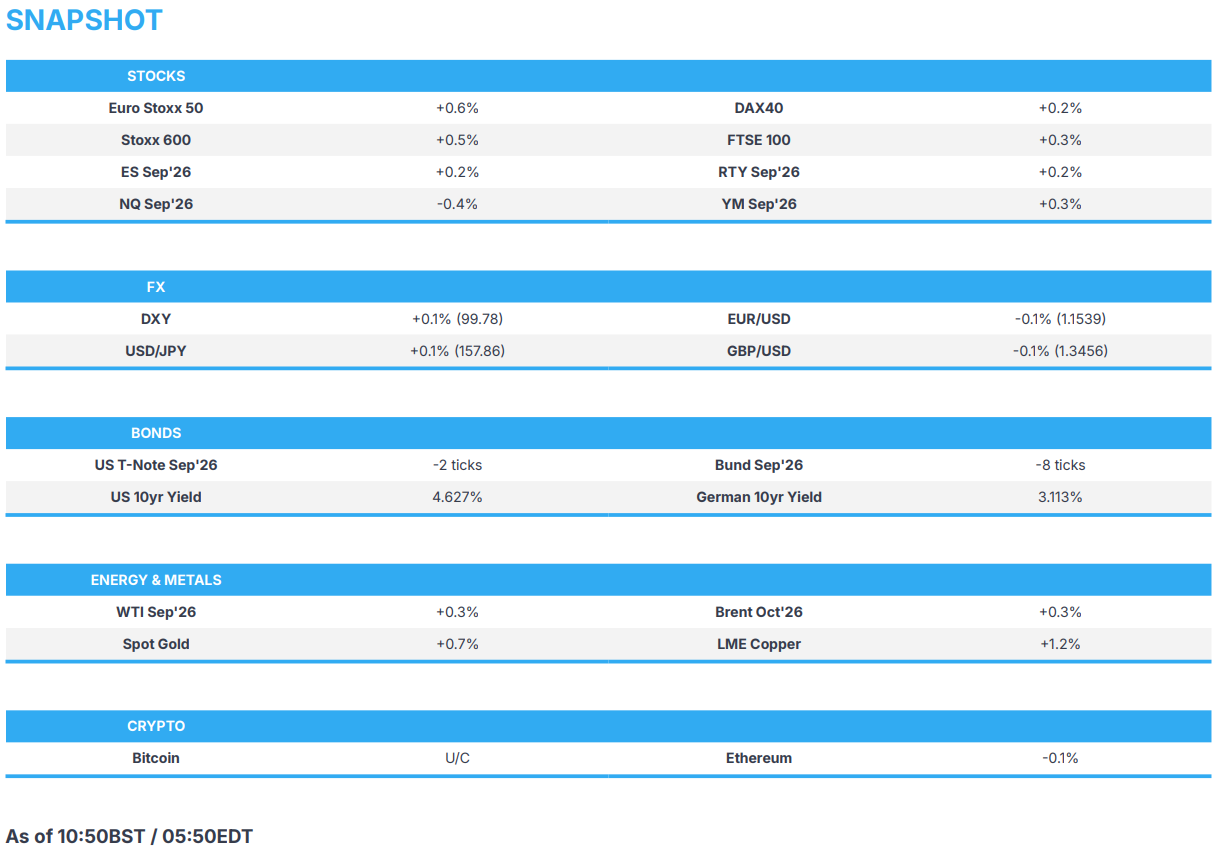
Newsquawk in 3 steps:
1. Subscribe to the free premarket movers reports
2. Listen to this report in the market open podcast (available on Apple and Spotify)
3. Trial Newsquawk’s premium real-time audio news squawk box for 7 days
EUROPEAN TRADE
EQUITIES
- European bourses are broadly higher. The FTSE MIB is outperforming, while the AEX and DAX 40 lag. Chip names are weighing on the AEX, and Siemens’ earnings (disappointing FY sales guidance raise) are weighing on the DAX 40. Outside of earnings, not much in terms of a clear driver as markets await an announcement regarding the reopening of Hormuz.
- Sectors have a positive bias. Media leads, supported by strong WPP (+22.5%) earnings (Q2 operating profit beat estimates). Telecoms and Consumer Products & Services round out the sector outperformers. Basic Resources is the sector laggard, paring back some of Wednesday’s gains, followed by Real Estate and Tech.
- US equity futures are broadly higher; however, downside is seen in the NQ following earnings by SanDisk and Western Digital, given the focus on AI and memory. SanDisk falls by over 8% pre-market after its revenue outlook missed expectations and pointed to slightly lower margins, while Western Digital is down by nearly 14%, despite earnings and revenue forecasts above consensus.
- Elsewhere, Japan’s SoftBank reported earnings. Its Q1 net income beat expectations but fell 18% Y/Y. The Co. said it recorded no investment loss or gain regarding OpenAI, but highlighted its stake in Intel (INTC) has paid off well.
- Click for the sessions European pre-market equity newsflow
- Click for the additional news
FX
- G10s mostly weaker against the Buck; SEK outperforms after hotter than expected inflation, Antipodeans lag amid the general risk tone.
- USD lacks direction, remaining just below 100.00 as it has done since the beginning of the week. Newsflow is light and markets still anticipate confirmation of an Iran-Oman agreement to reopen the Strait of Hormuz, alongside the potential US-Iran Hormuz agreement; updates which, on the face of it, could pressure the Buck, though are largely expected by markets with Brent down double digits on the week. The likely next catalyst, aside from any potential re-escalation, will be the labour market data ahead of NFP on Friday. To remind, a soft ADP failed to spur a USD reaction. Fed Hawk Musalem is slated to speak and likely to stick alongside the hawkish remarks seen from Kashkari, Cook and Daly on Wednesday.
- EUR flat against the Buck with bloc-specific catalysts light ahead of US NFP on Friday, which will likely dictate price action. For now, EUR will likely sit within its recent 1.1540-1.1550 range after failing to breach 1.1560 overnight with a lack of newsflow.
- Swedish inflation cooled, albeit at a slower rate than expected. The hotter-than-expected print (vs. consensus and Riksbank fcst.) was sufficient to spark ~0.2% bid in the SEK against both the EUR and the USD, though not against NOK. EUR/SEK fell from just below 10.96 to a 10.93 base. While firmer than Riksbank had forecast, it likely endorses rather than changes the current path for rates, with markets fully assigning a 25bps hike by year-end. Both ING and Nordea maintain their view for year end, for unch. and one hike respectively.
FIXED INCOME
- Fixed benchmarks are in the red after starting the morning on the front foot amid initial energy pressure. In a similar playbook to Wednesday morning, the pickup in energy in the last few hours has placed modest pressure on fixed, which now finds itself lower across the board.
- For USTs, the losses are only a few ticks in magnitude, at a 108-26+ base. Ahead, we have a packed docket of data, before Friday’s Payrolls, and Fed speak. The latter point is increasingly interesting given the hawkish tone from some officials at, and since, the dissent seen in July. Today, Musalem (2028), who typically resides on the hawkish side of things, partakes in a moderated event.
- Bunds peaked at 125.36 overnight, firmer by 13 ticks. Since, as above, it has moved into the red and currently posts downside of 13 ticks at a 125.12 trough. The German-specific docket is light, but EGBs generally have to digest a decent amount of supply from France and Spain, which is concentrated around the 2036 area and will potentially be adding to the bearish bias across EGBs into the taps. Both auctions went well, with strong demand for the Spanish tap, while the 10yr French auctions topped the 3x b/c mark.
- Gilts directionally in-fitting, with losses of 28 ticks and as is typically the case they underperform during the energy-led move at this point. Specifics for the UK light, and may well continue to be for the near-term, as Parliament remains in recess until September 1st and the extended hold narrative for the BoE remains.
- France sells EUR 12.495bln vs exp. EUR 10.5-12.5bln 1.25% 2036, 3.70% 2036, 3.80% 2037 & 0.50% 2044 OAT.
- Spain sells EUR 5.315bln vs exp. EUR 5-6bln 2.60% 2031, 3.00% 2033, 3.40% 2036 Bono & EUR 0.728bln vs exp. EUR 0.25-0.75bln 2.05% 2039 I/L Bono.
- Japan sells JPY 455.8bln 30-yr JGBs; b/c 3.86x (prev. 4.55x), average yield 3.952% (prev. 3.993%), Tail in price 0.21 (prev. 0.04).
COMMODITIES
- Crude prices swing between gains and losses with initial upside amid a lack of Iran deal newsflow whilst some supply-side headlines came into focus alongside overnight shipping strikes. Ukrainian President Zelensky says Ukraine struck Bashneft-Novoil (~150k BPD) and Slavneft-Yanos (300k BPD) refineries (the latter being one of Russia’s largest oil-processing facilities), two Russian patrol boats and shadow fleet vessels in long-range attacks aimed at curbing Moscow’s oil revenues, whilst large smoke plumes and at least four apparent fires were seen at the Yaroslavl refinery. Thereafter, renewed downside was seen on source reports around the Iran-Oman Hormuz framework agreement, although losses are limited until confirmation from Iran. WTI Sep’26 trades in a USD 74.57-76.04/bbl range (vs yesterday’s USD 74.24-76.70/bbl), while Brent Oct’26 trades in a USD 78.92-80.35/bbl (vs yesterday’s 78.11-80.95/bbl).
- Dutch TTF is similarly choppy but currently up around 3% near EUR 54/MWh.
- Metals are mostly firmer as the energy complex trades choppy in a narrow range, while DXY yesterday fell back under its 100 DMA (99.729) for the second time this week. Furthermore, growing expectations of a deal to reopen the Strait of Hormuz have eased energy-driven inflation fears. Spot gold adds to yesterday’s gains and trades around the middle of a USD 4,245-4,304/oz range. 3M LME copper sits towards the top of a USD 14,053.00- 14,359.00/t.
- Saudi Arabia sets September Arab Light crude OSP for Asia at USD 2/bbl discount to Oman/Dubai average; To the US at ASCI +3.60/bbl; To NW Europe at ICE Brent settlement -2.15/bbl.
- China’s CMRG has reportedly told some steel mills to stop talks with Rio Tinto (RIO LN) from shipments from September, according to sources.
- DRC reportedly bans exports of Copper and Cobalt concentrate, according to sources citing an official order.
NOTABLE EUROPEAN DATA RECAP
- Swedish CPIF YoY Prel (Jul) Y/Y 0.7% vs. Exp. 0.6% (Prev. 1.3%); ex-energy 0.6% (prev. 0.4%).
- Swedish CPIF MoM Prel (Jul) M/M -0.3% vs. Exp. -0.5% (Prev. 0.3%); ex-energy 0.4%.
- Swedish Inflation Rate YoY Prel (Jul) Y/Y 0.2% vs. Exp. 0.1% (Prev. 0.7%).
- Swedish Inflation Rate MoM Prel (Jul) M/M -0.3% vs. Exp. -0.5% (Prev. 0.4%).
- EU Retail Sales MoM (Jun) M/M -0.3% vs. Exp. 0.2% (Prev. 0.2%).
- EU Retail Sales YoY (Jun) Y/Y 0.7% vs. Exp. 1.0% (Prev. 1.6%).
- German Factory Orders MoM (Jun) M/M 3.1% vs. Exp. 0.3% (Prev. 1.9%).
- Spanish Industrial Production YoY (Jun) Y/Y 1.1% (Prev. 3.4%); M/M -0.7% vs Exp. -0.5% (Prev. 1.2%).
CENTRAL BANKS
- Fed’s Cook (voter) said she supported holding rates steady at the last FOMC meeting while waiting for more data. She said it may yet turn out that the Fed does not need to raise rates but is ready to raise rates if the disinflation trend does not return. Added that there are reasons to believe inflation levels can cool but consumer mood tied to a number of factors including high inflation has soured.
- Fed’s Daly (2027 voter) said tariffs, energy and AI shocks caused an uptick in inflation, but noted some evidence that impacts of tariffs are beginning to fade on inflation. If the Middle East war ends, it should help lower inflation. Fed is facing different types of risks when it comes to setting rate policy, while she is completely supportive of holding rates steady in July and noted Fed still needs to gather data to set future policy move.
- Brazil Central Bank cut the Selic Rate by 25bps to 14.00%, as expected, reaffirming serenity and cautiousness in conducting monetary policy.
NOTABLE US HEADLINES
- US President Trump told donors, ‘We need to elect JD Vance,’ in 2028, WaPo reported, citing sources.
- US Challenger Job Cuts (Jul) 33.429K (Prev. 45.849K).
GEOPOLITICS
MIDDLE EAST
- US President Trump said he’d rather make a deal with Iran and reiterated the US was set for the biggest attack since World War II against Iran, but they called and we’re talking, while he added they respect us.
- US VP Vance said negotiations with Iran will take some time and that talks with Iran were ‘messy’, but will land in a ‘good’ place for the US.
- Iran and Oman have agreed on the broad framework for Strait of Hormuz reopening talks, Al Arabiya sources report. An announcement could come in days but the agreement still needs the approval of Iran’s National Security Council. The proposed agreement regarding Hormuz extends for 60 days and aims to resume navigation. Ships entering the Strait of Hormuz will use the shipping lane closest to Iran while ships departing from Hormuz will use the maritime passage closest to Oman. The proposed agreement regarding Hormuz does not include imposing passage fees or services on ships and after the approval of the Hormuz agreement, the parties will return to the memorandum of understanding and activate.
- Indirect contacts between the US and Iran have entered the final stage, according to Al Arabiya sources.
- Iranian Foreign Minister Araghchi’s visit to Pakistan is expected by the end of the week or early next week, according to Al Arabiya sources.
- Pakistani Foreign Ministry said Oman played a key role in Strait of Hormuz talks as diplomatic efforts continue toward a comprehensive and sustainable solution, Al Hadath reported, and that efforts to resolve the Hormuz issue continue.
- Yemeni military source said Red Sea operations target Saudi ships and oil tankers and “reduce the options for manoeuvring for the Saudi regime”. The source also dismissed Saudi claims over the Indian cargo ship sinking, Al-Akhbar reported.
- UKMTO said it received a report of an incident 9 nautical miles southeast of Kumzar, Oman, with the master of a tanker reporting hearing two explosions whilst transiting the Strait of Hormuz, although crew and vessel are safe.
- Israeli forces strike Burj el-Shamali in southern Lebanon, according to Al Mayadeen.
RUSSIA-UKRAINE
- Ukrainian President Zelensky said Ukraine struck Bashneft-Novoil (~150k BPD) and Slavneft-Yanos (300k BPD) refineries, two Russian patrol boats and shadow fleet vessels in long-range attacks aimed at curbing Moscow’s oil revenues.
- Air raid alerts issued in Kyiv and multiple regions, according to Ukrainian media.
OTHER
- Japan’s MoD said there is no longer any impact on the surrounding areas of Japan, following the North Korean missile launch.
CRYPTO
- Bitcoin holds onto Wednesday’s gains and tops just shy of the USD 65k mark.
APAC TRADE
- APAC stocks traded mostly lower following a similar performance stateside, where the Dow extended on its record levels, but the Nasdaq underperformed amid weakness in communication stocks, while the tech sector dragged overnight and tariff tensions resurfaced.
- ASX 200 climbed to a fresh record high with mining, materials and resources leading the advances, while trade data also showed a surprise surplus and a rebound in exports.
- Nikkei 225 retreated amid chip-related weakness and with Kioxia among the worst hit.
- KOSPI underperformed amid tech selling and as recent volatility continued to dent investor sentiment, with SK Hynix shares down about 8%, and had suffered another pre-market flash crash in which its shares dropped by the daily limit of 30% on the Nextrade bourse before ending the pre-market session down 2%.
- Hang Seng and Shanghai Comp were mixed, with insurers pressured after Chinese tax authorities began levying personal income tax on returns of offshore insurance policies, while trade frictions continued to resurface after MOFCOM announced it would strengthen drone export controls to the US and will impose countermeasures on six US entities, as well as take countermeasures against US compliance-testing firms.
NOTABLE ASIA-PAC HEADLINES
- Japanese PM Takaichi said a return to 8% food tax after two years isn’t a hike, and a return to 8% food sales tax that will be needed for market trust, adding the benefit of a new tax credit system will exceed the tax cut.
- Japan and US companies, potentially joined by the UAE and other investors, plan to invest about JPY 2tln in Japan’s largest AI data centre project, according to Nikkei.
- PBoC said it plans to expand yuan offshore market and explore expanding the central bank’s macroprudential and financial stability roles. PBoC is also exploring to boost cross-border yuan use.
NOTABLE APAC DATA RECAP
- Australian Balance of Trade (Jun) 1.93B vs. Exp. -1.1B (Prev. -3.02B).
- Australian Exports MoM (Jun) M/M 9.6% (Prev. -6.9%).
- Australian Imports MoM (Jun) M/M -0.2% (Prev. 2.6%).
1 c Asian opening report
Europe primed for a flat open with Crude seeing two-way action – Newsquawk EU Market Open
Thursday, Aug 06, 2026 – 02:20 AM
- US VP Vance said negotiations with Iran will take some time and that talks with Iran were ‘messy’, but will land in a ‘good’ place for the US.
- Iran’s Deputy Foreign Minister said an understanding with Oman does not mean opening the Strait of Hormuz.
- Yemeni Houthis announced they targeted a Saudi oil vessel in the Gulf of Aden.
- Crude futures saw two-way trade and attempted to nurse some of the recent losses, in which Brent crude briefly returned to the USD 80/bbl territory.
- APAC stocks traded mostly lower following a similar performance stateside; European equity futures indicate a mildly positive cash market open.
- Looking ahead, highlights include Swedish Inflation (Jul), German Factory Orders (Jun), US Challenger Job Cuts (Jul), Initial Jobless Claims (Aug/01), Revelio PLS (Jul), Atlanta Fed GDP (Q3), CNB Policy Announcement (Aug), Banxico Policy Announcement (Aug). Speakers include Fed’s Daly & Musalem. Supply from Spain & France. Earnings from ConocoPhillips, Fiserv, Rheinmetall, Merck & Diageo.
SNAPSHOT
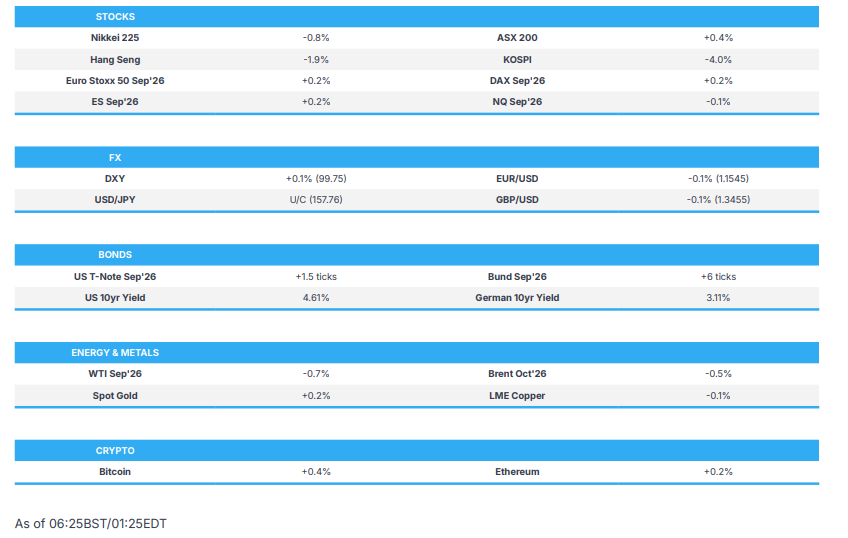
Newsquawk in 3 steps:
1. Subscribe to the free premarket movers reports
2. Listen to this report in the market open podcast (available on Apple and Spotify)
3. Trial Newsquawk’s premium real-time audio news squawk box for 7 days
LOOKING AHEAD
- Highlights include Swedish Inflation (Jul), German Factory Orders (Jun), US Challenger Job Cuts (Jul), Initial Jobless Claims (Aug/01), Revelio PLS (Jul), Atlanta Fed GDP (Q3), CNB Policy Announcement (Aug), Banxico Policy Announcement (Aug). Speakers include Fed’s Daly & Musalem. Supply from Spain & France. Earnings from ConocoPhillips, Fiserv, Rheinmetall, Merck & Diageo.
- Click for the Newsquawk Week Ahead.
IRAN CONFLICT
- US President Trump said he’d rather make a deal with Iran and reiterated the US was set for the biggest attack since World War II, but they called, and we’re talking, while he added Iran respects them.
- US VP Vance said negotiations with Iran will take some time and that talks with Iran were ‘messy’, but will land in a ‘good’ place for the US.
- Iran threatened to hit Gulf states if the US launches new strikes, according to Reuters.
- Iranian military advisor to the Supreme Leader, Rezaei, said President Trump claims to destroy our forces every day, but not a single American tanker has yet passed through the Strait of Hormuz.
- Iran’s Deputy Foreign Minister said an understanding with Oman does not mean opening the Strait of Hormuz, according to IRNA. He added that with the implementation of the new understanding, other temporary routes in the Strait of Hormuz will be closed, while a significant part of the routes of entry and exit of ships will pass through Iranian territorial waters.
- An agreement to reopen the Strait of Hormuz is approaching, while senior US officials and sources in the mediating countries said that the agreement could be announced as early as Wednesday night, according to N12’s Ravid.
- Informed source emphasised that if the understanding between Iran and Oman is finalised, the reopening of the Strait of Hormuz will require separate arrangements that also include fulfilling US commitments, according to Fars.
- Iran would initially send ships, including oil tankers, through the waterway to ensure it is free of mines before the strait opens to other shipping, according to FT citing sources.
- Though the Iran/Oman Hormuz deal would exclude charging ships tolls or fees, Iran might not be prevented from collecting voluntary payments to cover costs like security and search and rescue, according to WSJ citing sources.
- UKMTO received a report of an incident 9 nautical miles southeast of Kumzar, Oman, with the master of a tanker reporting hearing two explosions whilst transiting the Strait of Hormuz, although the crew and vessel are safe.
- Arab sources reported a missile attack on Bahrain, according to Fars.
- Yemeni Houthis announced they targeted a Saudi oil vessel in the Gulf of Aden.
- Israeli forces conducted a strike on Burj el-Shamali in southern Lebanon, according to Al Mayadeen.
US TRADE
EQUITIES
- US stocks were mixed as weakness in Communication Services and a slump in Alphabet (GOOGL) weighed on the Nasdaq, while the S&P 500 closed little changed and the Dow Jones outperformed. Market breadth was slightly negative, with the equal-weight S&P 500 (RSP) edging lower. On a sector basis, Communication Services lagged after Google (GOOGL) tumbled during US trading on reports of further AI brain drain, with chief scientist Jeff Dean reportedly leaving the company to launch his own startup. Technology, however, was among the outperformers, supported by gains in Nvidia (NVDA) after SpaceX said it will no longer purchase AMD (AMD) chips, instead building its AI infrastructure solely on Nvidia hardware. The comments weighed on AMD, despite the company reporting strong earnings, while its capital expenditure exceeded expectations. Crude prices were choppy, with early gains pared as optimism grew around an agreement between Iran and Oman regarding the Strait of Hormuz. Reports suggested the framework would see Iran oversee inbound and outbound shipping through the Strait. However, Iranian officials stressed the agreement does not imply the Strait would fully reopen. Reports also suggested the framework would exclude tolls or transit fees, although Iran may seek compensation for providing maritime security.
- SPX -0.17% at 7,723, NDX -0.83% at 29,488, DJI +0.49% at 54,354, RUT -0.59% at 3,019.
- Click here for a detailed summary.
TARIFFS/TRADE
- US President Trump said during his speech in Las Vegas that he loves tariffs and Canada has nasty leadership, while he added that business is roaring back in the US.
- US President Trump readies tariffs and price floors to boost US polysilicon, while the tariff plan would include offsets for domestic manufacturers and officials discussed at least a 15% tariff on polysilicon. Furthermore, the Trump admin is to unveil results of Section 232 investigation into foreign imports of polysilicon on Thursday, according to reports citing sources.
NOTABLE HEADLINES
- Fed’s Cook (voter) said she supported holding rates steady at the last FOMC meeting while waiting for more data, while she stated that it may yet turn out that the Fed does not need to raise rates, but commented that she is ready to raise rates if the disinflation trend does not return. Cook also stated the sour consumer mood is tied to a number of factors, including high inflation, and that the job market has been resilient.
- Fed’s Daly (2027 voter) said tariffs, energy and AI shocks caused an uptick in inflation, but added there is some evidence that impacts of tariffs are beginning to fade on inflation. Daly also stated that the Fed is facing different types of risks when it comes to setting rate policy, while she is completely supportive of holding rates steady in July and noted the Fed still needs to gather data to set future policy moves. Furthermore, she said the Fed should be prepared to act if the inflation situation gets out of hand.
- US President Trump has called Fed Chair Warsh repeatedly since he became Fed Chair, and has sought Warsh’s counsel on a range of matters, including how the Iran war and rapid rise of AI are affecting the economy, according to WSJ sources.
APAC TRADE
EQUITIES
- APAC stocks traded mostly lower following a similar performance stateside, where the Dow extended on its record levels, but the Nasdaq underperformed amid weakness in communication stocks, while the tech sector dragged overnight and tariff tensions resurfaced.
- ASX 200 climbed to a fresh record high with mining, materials and resources leading the advances, while trade data also showed a surprise surplus and a rebound in exports.
- Nikkei 225 retreated amid chip-related weakness and with Kioxia among the worst hit.
- KOSPI underperformed amid tech selling and as recent volatility continued to dent investor sentiment, with SK Hynix shares down about 8%, and had suffered another pre-market flash crash in which its shares dropped by the daily limit of 30% on the Nextrade bourse before ending the pre-market session down 2%.
- Hang Seng and Shanghai Comp were mixed, with insurers pressured after Chinese tax authorities began levying personal income tax on returns of offshore insurance policies, while trade frictions continued to resurface after MOFCOM announced it would strengthen drone export controls to the US and will impose countermeasures on six US entities, as well as take countermeasures against US compliance-testing firms.
- US equity futures were range-bound with index futures continuing yesterday’s mixed performances.
- European equity futures indicate a mildly positive cash market open with Euro Stoxx 50 futures up 0.2% after the cash market closed with losses of 0.2% on Wednesday.
FX
- DXY traded little changed after weakening yesterday alongside the pullback in short-end US yields amid optimism about an imminent announcement of the Iran-Oman deal, which is expected to kickstart the path back to the reopening of the Strait of Hormuz. In terms of the recent data, ISM Services PMI missed estimates, but remained in expansion territory, while employment moved back into contraction and prices remained elevated. Furthermore, the July ADP figure eased to 44k from June’s 98k, ahead of Friday’s NFP data, while there were some Fed comments in which both Cook and Daly voiced support for the recent Fed decision.
- EUR/USD paused overnight and held on to the prior day’s spoils after it gradually edged higher amid the softer buck, but with resistance seen around the 1.1560 level.
- GBP/USD lacked direction and was confined to within tight parameters at the 1.3400 handle in the absence of any fresh catalysts or notable data releases from the UK.
- USD/JPY was flat amid the humdrum mood across the FX space and lack of pertinent catalysts.
- Antipodeans eked slight gains in uneventful trade and following a rebound in Australian exports.
- PBoC set USD/CNY mid-point at 6.7895 vs exp. 6.7462 (prev. 6.7889).
- Brazil Central Bank cut the Selic Rate by 25bps to 14.00%, as expected, while it reaffirmed serenity and cautiousness in conducting monetary policy. BCB also stated that the current scenario is marked by heightened uncertainty, de-anchoring of expectations and elevated risks surrounding the reference scenario.
FIXED INCOME
- 10yr UST futures took a breather after yesterday’s choppy mood as price action remained at the whim of oil prices, while economic data had little lasting impact, with participants awaiting the NFP report on Friday.
- Bund futures kept afloat but with upside capped following recent supply, and as oil bounced off this week’s trough, while German Factory Orders data is scheduled today.
- 10yr JGB futures climbed higher amid the downbeat mood in Tokyo, with investors ultimately shrugging off the mixed results from the latest 30yr JGB auction.
COMMODITIES
- Crude futures saw two-way trade and attempted to nurse some of the recent losses, in which Brent crude briefly returned to the USD 80/bbl territory, with reports on Wednesday evening noting that the Houthis targeted another Saudi oil vessel in the Gulf of Aden, and the UKMTO also notified of an incident 9 nautical miles southeast of Kumzar, Oman, in which the master of a tanker reported hearing two explosions whilst transiting the Strait of Hormuz. Nonetheless, the recovery was only brief given that Iran and Oman are finalising a Strait of Hormuz deal and have agreed to the coordinates of routes through the strait.
- Spot gold extended its rally and briefly breached the USD 4,300/oz level to the upside, where it then met resistance, while the recent upside in the precious metal had coincided with declines in yields and the dollar, as reports pointed to a resolution to the Strait of Hormuz crisis.
- Copper futures were range-bound amid the mixed global risk sentiment and trade frictions.
CRYPTO
- Bitcoin gradually declined albeit with the losses only marginal, and prices remained above USD 64,000.
NOTABLE ASIA-PAC HEADLINES
- Japanese PM Takaichi said a return to 8% food tax after two years isn’t a hike and will be needed for market trust, while she added that the benefit of a new tax credit system will exceed the tax cut.
DATA RECAP
- Australian Balance of Trade (Jun) 1.93B vs. Exp. -1.1B (Prev. -3.02B)
- Australian Exports (Jun) M/M 9.6% (Prev. -6.9%)
- Australian Imports (Jun) M/M -0.2% (Prev. 2.6%)
GEOPOLITICS
RUSSIA-UKRAINE
- Air raid alerts issued in Kyiv and multiple regions, according to Ukrainian media.
2.NORTH AND SOUTH KOREA//JAPAN
3. CHINA
CHINA
China’s Power Demand Hits Records As Heatwave Grips Key Regions
Wednesday, Aug 05, 2026 – 08:05 PM
By Irina Slav of OilPrice.com
Electricity demand in much of China hit a record this week due to scorching summer temperatures, driving grid loads to all-time highs, the State Grid Corporation of China said today, as cited by Reuters.

On Monday and Tuesday, the company said, electricity loads reached a record in the country’s northern, northeastern, and eastern regions. No blackouts have been reported, however, as the grid operator moves in time to direct more baseload electricity where it is needed for air-conditioning.
According to forecasts from the Chinese state meteorological agency, temperatures across much of China will remain high, in some cases potentially reaching or even exceeding historical peaks, the Reuters report also noted.
In January this year, State Grid Corporation of China, the world’s largest utility enterprise covering 88% of China’s land area and serving over 1.1 billion people, said it planned to spend $574 billion (4 trillion Chinese yuan) on fixed-asset investments for the five years to 2030, as part of its 2026-2030 investment plan.
The sum is 40% higher than what the State Grid Corporation of China spent in the previous five-year investment period to 2025. The company will use the money to upgrade and expand the power transmission and distribution systems amid a surge in renewable energy capacity installations and a continued rise in electricity demand.
China is the world’s biggest builder of wind and solar, but it has also expanded its coal-powered generation capacity to ensure stable supply that can respond to demand changes in a timely fashion. Yet the country is also building out its battery storage capacity to be able to utilize more of its wind and solar electricity output. China plans to have its battery storage capacity more than double to 180 gigawatts by 2027 in a new plan aimed at attracting $35.1 billion (250 billion yuan).
GERMANY
One-Way Attack Drone Found At Major German Airport: The Threat Has Arrived
Thursday, Aug 06, 2026 – 04:15 AM
A one-way attack drone was discovered on the tarmac at Leipzig/Halle Airport, one of Europe’s most important freight hubs. The German airport hosts transport company DHL’s largest air hub and serves as the operating base for Ukraine’s massive Antonov heavy-lift cargo aircraft.
The Financial Times reports that a transport jet collided with a suspected second drone during takeoff. Another drone was found carrying an improvised explosive device near Antonov Airlines’ An-124 massive cargo jet. Five An-124s were moved to Leipzig after Russia damaged Ukrainian facilities in 2022.
“During the night of 4 to 5 August 2026, a drone carrying an unknown explosive device was detected by an airport employee in the security area of the cargo operations near the south runway,” the Dresden public prosecutor wrote in a statement.
German counterterrorism and sabotage units are investigating the incidents as a national-security threat. Officials are examining whether there is a Russian connection, though authorities have yet to make the link.
Here’s more from the outlet:
Russia was now at the forefront of investigators’ minds, but they noted work was at an early stage and nothing concrete had yet been established. The incidents were being considered a national security threat, they said.
The drone found at Leipzig is considered a “Group 1” classification as it weighs under 20 pounds.
Courtesy of Piper Sandler analyst Clarke Jeffries:

We have warned that a serious Group 1-3 drone incident in the West is only a matter of time. Leipzig may be the clearest warning shot yet.
Western officials are already accelerating counter-UAS deployments around high-value assets, but the defensive challenge is enormous. Virtually every node of critical infrastructure, from substations and data centers to military bases, remains exposed.
END
GERMANY/BMW/FRANCE
BMW Job Cuts And The Emerging German-French Industrial Strategy
KOLBE..
MORE JOB CUTS…
Thursday, Aug 06, 2026 – 03:30 AM
Submitted by Thomas Kolbe
Will German policy paralysis and French protectionism save Germany’s automakers? Unlikely, since Paris and Berlin are pursuing similar ideological goals. Everything points toward the expansion of a green state-run economy. On that, there is agreement. The concerns of private enterprise are secondary.
Given the dramatic situation, automakers would probably take even the most hopeless escape route in an attempt to escape the downward spiral. This has now also caught up with the previously remarkably resilient BMW Group: Just last week, Volkswagen announced plans to cut 120,000 jobs, Porsche has to eliminate 5,000 positions, and Mercedes has already parted ways with 5,500 employees. Now BMW is following suit, announcing that it will have to part with 8,000 of its 154,000 employees. The pressure to act is considerable. In the second quarter, the Munich-based group’s profit plunged by a staggering 35 percent year-on-year. In the core automotive business, the company lost 60 percent of its earnings.
BMW’s workforce reduction is supposed to take place quietly: through natural employee turnover and a voluntary severance program. The company wants to avoid compulsory redundancies in Munich.
The initiative will begin in October and run until 2027, specifically targeting employees outside production. Between 30,000 and 40,000 administrative employees at BMW are expected to receive an offer to leave the company – in return, BMW will expand its employment guarantee for the future: compulsory redundancies in Germany are to be ruled out even if the company falls into the red.
Whether this policy can ultimately be maintained when push comes to shove remains to be seen. In any case, entire layers of management are to be eliminated and departments merged – not least because BMW has concluded that artificial intelligence can increase operational efficiency.
Efficiency programs in Germany’s automotive industry are unavoidable. Excessive energy costs are weighing on companies’ results, alongside Brussels regulation and the political campaign against the combustion engine, which still dominates the market. It is impossible to keep pace with global competition from the domestic production base. According to consultancy EY, German automakers and their suppliers lost 50,000 jobs within a single year. There is no sign of a reversal: Germany’s automotive industry association VDA now expects 225,000 jobs to disappear across the sector by 2035, some 35,000 more than its estimate just a few months ago.
And what is politics doing? It clings doggedly to the ideology of the Green Deal, regardless of what it may cost citizens – with the state, financed through taxes and debt, remaining as an employer of last resort if necessary. That, in a nutshell, has so far been the position of the political leadership of the European Union.
Euro-corporatism has grown far beyond its limits. Billions flow from taxpayers to Brussels and return, rebranded as climate bonuses, credit guarantees and funding allocations for dubious start-ups, into the channels of the green transformation machine. This may be the most extreme case of politically driven destruction of capital. The decline of European industry is inevitable. It is impossible to conceive of an economy that could withstand the subversive barrage of European ideologues over an extended period.
Bewildered and incredulous, they stand in Berlin and Paris before the ruins of their own work. Since political circles operate under an imperative of infallibility, every last resource is being mobilized to continue the prevailing policy. At the German-French Council of Ministers in Germany in mid-July, Emmanuel Macron and Friedrich Merz reaffirmed their common industrial policy agenda. The two governments subsequently instructed their negotiators to work out a broader compromise: France wants to shield European industry more strongly from foreign competition, while Germany is primarily seeking a way out of the crisis engulfing its automotive industry.
Too much money is flowing out: For Chinese EV manufacturers or solar-panel producers, Brussels’ subsidy machine is a welcome bonus. Countless businesses are effectively living off the naivety of European policymakers. It pays to put up the umbrella for subsidies when EU bureaucrats and political fools are scattering taxpayers’ money with both hands.
And so a German-French bargain is now supposed to bring relief in the crisis. Berlin would support the French demand for a tougher “Made in Europe” model for industrial funding. At the heart of the strategy is the Industrial Accelerator Act, or IAA, presented by the European Commission in March. It is supposed to apply in public tenders and funding programs and define requirements for applicants in advance. Naturally, CO₂-free products and manufacturing processes are to receive priority in the subsidy jungle.
Subsidies will continue to flow above all to decarbonization champions. But there is nothing remotely market-oriented about this; the subsidy frenzy merely promotes cronyism and a subsidy-hunter mentality in the EU. Brussels also wants to define in the future which third countries qualify as so-called “trusted partners.” In doing so, the bureaucracy is intervening massively in the existing supply chains of European companies. “Made in Europe” – a crude form of industrial policy, with bureaucrats at the helm who can, at the behest of politicians, give suppliers the thumbs-down and shut them out, regardless of the consequences this may have for European businesses.
Berlin had rejected this practice until now. But given the situation in the automotive sector and the French concessions in this area, the German government now appears open to a “Made in Europe” strategy.
The other side of the deal is this: France is signaling a willingness to handle the 2035 combustion-engine phaseout more flexibly. It will ultimately come down to negotiating CO₂ consumption quotas more flexibly and assigning a different weight to investments in hybrid drivetrains in the CO₂ balance. In short: business as usual in the same outfit, merely unbuttoned at one point.
Ways out of the crisis mean the end of the current policy. Technological openness for business, competition in a free, deregulated single market – politics contributes nothing to solving the crisis. Quite the contrary. The bargain between Paris and Berlin would appear protectionist from the outside, but could provide companies with some short-term breathing room through more efficient allocation of subsidies. In doing so, political pressure is removed to break with the fatal ideological design of the Green Deal.
Without a structural break with the ideological present, there will be no recovery. The therapy that Emmanuel Macron and Friedrich Merz intend to prescribe for the European automotive industry will ultimately prove to be an injection of the same poison that has turned the entire EU economy into an economic cripple.
END
EU/RUSSIA
Russia will not be too happy with this;
(zerohedge)
EU To Use $1.62 Billion In Interest From Frozen Russian Assets To Support Ukraine
Thursday, Aug 06, 2026 – 06:30 AM
Authored by Victoria Friedman via The Epoch Times,
The European Union will use $1.62 billion accumulated from interest on frozen Russian assets to support Ukraine, the union’s executive branch has said.
 European Commission President Ursula von der Leyen speaks during a news conference as part of the European Council meeting to discuss Ukraine, European defense, recent developments in the Middle East, competitiveness, housing, and migration, in Brussels, Belgium, on Oct. 23, 2025. Nicolas Tucat/AFP via Getty Images
The European Commission said in an Aug. 4 statement that the funds, transferred to the bloc on Monday, came from the immobilized assets of Russia’s central bank being held by the Central Securities Depositories in the EU.
This was the fifth such transfer of its kind, with the seized assets having generated a total of $9.23 billion in interest.
European Commission President Ursula von der Leyen said that Moscow “must pay for the destruction it has caused. And we are using the proceeds from the immobilised Russian assets to make sure it does.”
“We are making a further [$1.62] billion of them available to Ukraine. This will support Ukraine’s continued resistance against Russia’s illegal war,” she said.
The funds are from assets immobilized under EU sanctions, which were imposed in response to Russia’s invasion of Ukraine.
Billions Frozen
The majority of frozen Russian assets are being held by Euroclear, a financial market infrastructure group based in Belgium. Euroclear holds around $213 billion in assets, with another $29 billion held predominantly in France, Germany, Sweden, and Cyprus, according to figures quoted by the European Council in December 2025.
The EU says that while the assets are immobilized, the interest does not belong to Russia, with the European Council deciding the net profits should go to support Ukraine.
Moscow has previously called funds from Russian frozen assets that are given to Ukraine “stolen money.”
Russian Foreign Minister Sergey Lavrov said on June 24: “It is one thing when you are free to dispose of your assets and receive the interest stipulated by the agreement with Euroclear, while everything above that belongs to them. But you are still free to manage your own funds.
“When your assets are frozen and they tell you, ‘You sit tight for now, while we make additional profits here and hand them all over to Ukraine,’ this is a very serious matter from the standpoint of the West’s attempts to convince everyone that the world order they created and that functioned through modern institutions of global governance – the IMF, the World Trade Organization – remains relevant.”
The vast majority of the proceeds – 95 percent – will be distributed to the Ukraine Loan Cooperation Mechanism, which provides support to Ukraine in repaying financial assistance loans and loans provided by the G7. The remaining 5 percent provides funding for military and defense needs.
Russian Sanctions
Last week, EU members agreed on the bloc’s 21st round of sanctions against Russia, mainly targeting financial institutions, in a bid to weaken Moscow’s economy and affect its war effort.
Von der Leyen said on July 23 that the bloc was adding 32 Russian banks to its transaction-ban list, as well as oil trading platforms and cryptocurrency firms.
The package also freezes the oil price cap for one year “so that the Russian war machine does not benefit from market shocks,” she said.
In response, the Russian Permanent Mission said that “European bureaucracy, disregarding the economic costs, continues to pursue its course of escalating confrontation with Russia.”
The July 23 statement said that the restrictions “will further aggravate the already acute social and economic problems in the European Union,” which the mission said was due to the bloc’s decision to drop Russian energy supplies and to continue to spend billions on aid to Ukraine, “all against the backdrop of instability in global energy markets due to the escalation of the conflict in the Middle East.”
“We reaffirm that the hostile unilateral coercive measures of the European Union against our country will be met with an effective and due response from Russia,” the mission said.
END
5.RUSSIAN AND MIDDLE EASTERN AFFAIRS
IRAN/ISRAEL /USA/YEMEN
Yemen War Reignites As Houthis Intensify Saudi Shipping Attacks, Ground Assault, With Hormuz Deal ‘Close’
by Tyler Durden
Thursday, Aug 06, 2026 – 09:00 AM
Yesterday witnessed at least the eighth Saudi oil tanker attacked by the Houthis since the maritime blockade began on July 22, which is being followed by reports the Yemeni rebel group backed by Iran could be preparing for all-out war with Saudi Arabia.
The group struck two Saudi oil tankers in the Red Sea on Wednesday and coupled the action with a threat to intensify attacks in order to close “all access routes” to Saudi oil shipments. Military spokesman Brig. Gen. Yahya Saree confirmed that ballistic missiles were launched at a Saudi tanker called Wafa near the Saudi port city of Yanbu.
A second oil tanker identified as Daisy was subsequently hit in the Gulf of Aden with a ballistic missile and “forced to turn back” – the spokesman said in a social media post. The Houthis are dubbing it a “blockade for blockade” strategy.

But it seems the Saudis aren’t ready to take this laying down, even if the ratcheting Red Sea region conflict threatens fragile Oman-sponsored talks to reopen the Strait of Hormuz, as on Thursday its proxy the Yemeni Armed Forces – representing the official government whose seat is in Aden in the south – announced preparations for a large new military operation.
This as Al Arabiya reports a fresh outbreak of ground fighting, in a renewal and intensification of the civil war that goes back to at least 2015 (and has an international proxy war aspect to it). The Arab publication says that a Houthi attack killed 45 government forces in Hadramawt and Marib in Yemen, areas which also happen to be home to the vast majority of the country’s oil and gas fields.
Separately Al Jazeera describes of the same event:
The Yemeni Emergency Forces of the internationally-recognised government, have said that there have been material and human losses following attacks on its camps.
Several causalities have been reported after a suspected Houthi rocket and drone attack targeted bases hosting the forces in Marib and Hadramaut.
So now it seems that even if a grand Hormuz deal to reopen energy transit can be pulled off with some level of sticking power, there will have to be a separate ceasefire to contain the Yemen and Bab al-Mandab Strait crisis.
To some degree, the Houthi closure of the Red Sea to Saudi shipping represents a good cop, bad cop approach to the United States and its Gulf allies. It is a way for Tehran to still maintain some serious tangential leverage over global energy, even as ships in Hormuz could finally get moving again.
As a reminder, the Houthis have been part of what Iran sees as the “axis of resistance” going back to when the Shia rebel group first seized power in September 2014:
Saudi Arabia is now being squeezed from three directions in the widening U.S.-Iran war — Iraq to its northeast, Yemen to its southwest, and Iran to its east. (On July 18, Tehran struck Prince Sultan Air Base near Riyadh, its first direct hit on Saudi soil in nearly four months.)
To understand why this matters beyond the price of oil, it helps to picture the crises as a set of nesting dolls.
The innermost doll is Yemen’s own civil war: a decade-old fight between the Houthis (officially known as Ansar Allah), who rule the populous north from Sana’a, and Yemen’s internationally recognized government, formally led by a body called the Presidential Leadership Council. The roots of this war trace to the 2011 Arab Spring revolution, which toppled Yemen’s long-serving president and left a power vacuum the Houthis moved to fill, seizing Sana’a in 2014. Saudi Arabia and a coalition of partners intervened in 2015 with the explicit aim of reversing that takeover and restoring the internationally recognized government, and the war has continued in one form or another ever since.
The middle doll is Saudi Arabia’s broader rivalry with Iran, a contest for regional leadership that has run since Iran’s 1979 Islamic Revolution, when Tehran’s new theocratic government began exporting a revolutionary, Shia-inflected challenge to the Gulf’s Sunni monarchies.
In the meantime, Al Jazeera is reporting Thursday that the Saudi-backed government shot down a drone operated by the Houthis over the city of Marib.
The country’s official SABA news agency said the Houthi targeting of Marib “embodies their escalatory approach and their insistence on continuing their terrorist acts” and that “the air defenses engaged the drone as soon as it entered the city’s airspace and successfully shot it down.”
Over in the Persian Gulf region, Iran officials have said a deal with Oman to reopen the Strait of Hormuz is “on the verge of being finalized” which entry and exit routes and protocols having been established. Iran continues to say that Washington has nothing to do with this, and warns against US military interference.
The White House seems to be quite serious about ensuring an offramp from the conflict this time, as the bombs have fallen silent for several days now…
But lots of unknowns and variables remain, as some international reports suggest a final deal could be signed as early as the close of Thursday, or at least by week’s end. Al Jazeera notes: “For Iran to reopen the Strait of Hormuz, the US must abide by the memorandum of understanding (MoU) it signed with Iran in mid-June, although that would not be enough on its own, Iranian Deputy Foreign Minister Kazem Gharibabadi said in comments carried by Iran’s IRNA news agency.”
Iranian Foreign Minister Abbas Araghchi has newly warned that “We’re ready to retaliate, but finding a diplomatic solution is the best way to avoid wider escalation and destruction across the region.
END
Hormuz Deal Shock: Iranian State Media Says US-Israeli Vessels Banned, Oil Surges
Thursday, Aug 06, 2026 – 12:25 PM
Summary
- Iran parliament reviews draft Hormuz plan banning US- and Israel-linked vessels.
- Oil rises as proposed Strait restrictions raise supply concerns.
- Houthis intensify attacks on Saudi oil shipping in the Red Sea.
- Yemen fighting escalates amid reports of major casualties.
- Iran-Oman talks continue as US backs diplomatic solution, searches for offramp.
Deal Details: US-Israeli vessels Banned from Hormuz (Fars)
Iranian state media (Fars) has issued details of the Iran-Omani draft plan for transit rules through the Strait of Hormuz and the Persian Gulf. The country’s parliament is said to currently be reviewing it, while Tehran still insists that the US has been sidelined, saying that the Oman-Iran contacts are bilateral.
As cited in Bloomberg from state media, key proposals include:
- Ban vessels linked to the U.S., Israel, and other hostile states
- Block military and civilian cargo tied to Israel
- Restrict ships linked to actions against the “Axis of Resistance”
- Deny passage to parties owing compensation to Iran
- Impose fines of up to 20% of cargo value for violations
The first note about banning US-linked vessels could alone serve to restart the war. The White House has appeared to genuinely be searching for an exit strategy, but this may be too hard a pill to swallow, if accurate.
Fars has spelled out that “The passage of vessels belonging to the US, the Israelis, and other hostile countries through the Strait of Hormuz will be prohibited.” Below are is the fuller outline of the proposed plan as featured by Fars [machine translation]:
- The passage of vessels belonging to the United States, Israelis and other hostile countries through the Strait of Hormuz will be prohibited.
- Ships related to Israel, whether military or civilian, will not have the right to transit through this area.
- Vessels or cargoes that play a role in actions against the Resistance Front will also be subject to the ban.
- Countries and individuals that have caused damage to Iran will not receive permission to pass through the Strait of Hormuz and the Persian Gulf until compensation is paid.
- Heavy fines, including up to 20% of the value of the goods, will be imposed on violators. The cargo is anticipated.
- The government will be required, in cooperation with the armed forces, to assume responsibilities such as guiding navigation, monitoring vessel traffic, and protecting the security and environment of the Persian Gulf.
- This plan is still in the expert review stage, and the parliament has asked experts to submit their suggestions for completing it.
Oil spikes on the headlines of a very clearly ‘Iran-favorable’ ‘deal’ – which Washington is unlikely to simply accept.

Does this portend a return to active conflict?
Yemeni ‘Blockade for Blockade’ Could Threaten Delicate Hormuz Negotiations
Yesterday witnessed at least the eighth Saudi oil tanker attacked by the Houthis since the maritime blockade began on July 22, which is being followed by reports the Yemeni rebel group backed by Iran could be preparing for all-out war with Saudi Arabia.
The group struck two Saudi oil tankers in the Red Sea on Wednesday and coupled the action with a threat to intensify attacks in order to close “all access routes” to Saudi oil shipments. Military spokesman Brig. Gen. Yahya Saree confirmed that ballistic missiles were launched at a Saudi tanker called Wafa near the Saudi port city of Yanbu.
A second oil tanker identified as Daisy was subsequently hit in the Gulf of Aden with a ballistic missile and “forced to turn back” – the spokesman said in a social media post. The Houthis are dubbing it a “blockade for blockade” strategy.
Large New Saudi-Backed Operation?
But it seems the Saudis aren’t ready to take this laying down, even if the ratcheting Red Sea region conflict threatens fragile Oman-sponsored talks to reopen the Strait of Hormuz, as on Thursday its proxy the Yemeni Armed Forces – representing the official government whose seat is in Aden in the south – announced preparations for a large new military operation.
This as Al Arabiya reports a fresh outbreak of ground fighting, in a renewal and intensification of the civil war that goes back to at least 2015 (and has an international proxy war aspect to it). The Arab publication says that a Houthi attack killed 45 government forces in Hadramawt and Marib in Yemen, areas which also happen to be home to the vast majority of the country’s oil and gas fields.
Separately Al Jazeera describes of the same event:
The Yemeni Emergency Forces of the internationally-recognised government, have said that there have been material and human losses following attacks on its camps.
Several causalities have been reported after a suspected Houthi rocket and drone attack targeted bases hosting the forces in Marib and Hadramaut.
So now it seems that even if a grand Hormuz deal to reopen energy transit can be pulled off with some level of sticking power, there will have to be a separate ceasefire to contain the Yemen and Bab al-Mandab Strait crisis.
To some degree, the Houthi closure of the Red Sea to Saudi shipping represents a good cop, bad cop approach to the United States and its Gulf allies. It is a way for Tehran to still maintain some serious tangential leverage over global energy, even as ships in Hormuz could finally get moving again.
Houthis Pivotal in Iran’s ‘Axis of Resistance’
As a reminder, the Houthis have been part of what Iran sees as the “axis of resistance” going back to when the Shia rebel group first seized power in September 2014:
Saudi Arabia is now being squeezed from three directions in the widening U.S.-Iran war — Iraq to its northeast, Yemen to its southwest, and Iran to its east. (On July 18, Tehran struck Prince Sultan Air Base near Riyadh, its first direct hit on Saudi soil in nearly four months.)
To understand why this matters beyond the price of oil, it helps to picture the crises as a set of nesting dolls.
The innermost doll is Yemen’s own civil war: a decade-old fight between the Houthis (officially known as Ansar Allah), who rule the populous north from Sana’a, and Yemen’s internationally recognized government, formally led by a body called the Presidential Leadership Council. The roots of this war trace to the 2011 Arab Spring revolution, which toppled Yemen’s long-serving president and left a power vacuum the Houthis moved to fill, seizing Sana’a in 2014. Saudi Arabia and a coalition of partners intervened in 2015 with the explicit aim of reversing that takeover and restoring the internationally recognized government, and the war has continued in one form or another ever since.
The middle doll is Saudi Arabia’s broader rivalry with Iran, a contest for regional leadership that has run since Iran’s 1979 Islamic Revolution, when Tehran’s new theocratic government began exporting a revolutionary, Shia-inflected challenge to the Gulf’s Sunni monarchies.
In the meantime, Al Jazeera is reporting Thursday that the Saudi-backed government shot down a drone operated by the Houthis over the city of Marib.
The country’s official SABA news agency said the Houthi targeting of Marib “embodies their escalatory approach and their insistence on continuing their terrorist acts” and that “the air defenses engaged the drone as soon as it entered the city’s airspace and successfully shot it down.”
Over in the Persian Gulf region, Iran officials have said a deal with Oman to reopen the Strait of Hormuz is “on the verge of being finalized” which entry and exit routes and protocols having been established. Iran continues to say that Washington has nothing to do with this, and warns against US military interference.
The White House seems to be quite serious about ensuring an offramp from the conflict this time, as the bombs have fallen silent for several days now…
END
ISRAEL/HEZBOLLAH/LEBANON
Two reservists killed, four seriously wounded by IED blast in south Lebanon; IDF strikes Hezbollah in response
Initial probe indicates explosive detonated when troops entered building in Majdal Zoun; Lebanon reports 1 killed, 12 others hurt as IDF responds to ‘blatant violation’ of ceasefire
By Emanuel Fabian, Follow Jacob Magid Follow and Agencies5 August 2026, 10:15 pm

Maj. (res.) Harel Birenstock (left) and Sgt. Maj. (res.) Tamir Vaknin, who were killed in southern Lebanon on August 5, 2026. (Courtesy)
The Israel Defense Forces announced Thursday morning that two reservist soldiers were killed, and four were seriously wounded after being hit by an explosive device in the southern Lebanon town of Majdal Zoun a day earlier. The deadly attack prompted the military to resume strikes on Wednesday against Hezbollah, as talks on expanding the truce between the two countries were said to hit a bump in the road in Rome.
The slain troops were named as: Maj. (res.) Harel Birenstock, 34, a company commander from Nokdim; and Sgt. Maj. (res.) Tamir Vaknin, 33, from Eilat. Both served in the 55th Paratroopers Brigade’s 2855th Battalion.
According to an initial IDF probe, at around noon on Wednesday, troops of the reserve brigade entered a building in Majdal Zoun, during efforts to demolish Hezbollah infrastructure. As they entered, an explosion occurred, killing and injuring the forces.
It was not immediately clear when the explosive device had been planted and how it was detonated on the forces.
The wounded troops were taken to a hospital and their families were notified, the army added.
The announcement came after the IDF hit Hezbollah targets in southern Lebanon on Wednesday following the blast, which it called a “blatant violation” of the tenuous ceasefire.
A short while before launching the “precise strikes” — the first since August 1 — the IDF issued the first evacuation warning for an area of southern Lebanon in weeks, and called for residents of Mansouri to evacuate at least one kilometer north of the village.
“In light of the Hezbollah terror organization’s violation of the ceasefire agreement, the IDF is compelled to operate against it with force,” said Lt. Col. Ella Waweya, the IDF’s Arabic-language spokeswoman.
“Anyone located near Hezbollah operatives, facilities, or weapons is putting their life at risk!” she added.
The Lebanese health ministry said one person was killed and 12 others were wounded in the strike, which it said targeted Tebnine, located about 25 kilometers (15 miles) from Mansouri.
The state-run National News Agency said that the strike hit a prayer room in the town’s cemetery.
There was no immediate information on the identity of the dead.
Later Wednesday, the military said that an interceptor missile was fired at a target, which was later revealed to have been fired by Israeli forces operating in southern Lebanon. There were no injuries in the incident, which was under further investigation, the IDF added.
Lebanese civilians had returned to Mansouri, which is located around 10 kilometers north of Israel, during the ceasefire under the protection of the Lebanese army, which also set up a roadblock in the area in violation of the agreements, according to the IDF.
The town’s municipality told residents on June 22 that they could return, but asked them to avoid the part of the town that fell within Israel’s so-called “security zone” in southern Lebanon.
Mansouri has been subjected to several Israeli strikes and artillery shelling in recent weeks despite the June 26 ceasefire, and the IDF said the village was evacuated for residents’ safety, as military operations were still taking place there.
The UN’s humanitarian agency said on Tuesday that more than 800,000 people displaced by fighting in Lebanon had begun heading back home following the recent lull in violence, though more than 360,000 remained displaced.
Israel said to accuse Beirut of leaking false information
Meanwhile, in Rome, talks between Israel and Lebanon ended several hours early, though there were several conflicting reports as to the cause.
Israeli Ambassador to the United States Yechiel Leiter accused the Lebanese delegation of repeatedly leaking false information to Lebanese media, an Israeli source told The Times of Israel.
Because of the leaks, Leiter asked the US mediators to suspend the talks before their scheduled conclusion, the source said, while clarifying that talks were still slated to pick back up on Thursday.
A US State Department official later confirmed that the talks had ended early, but said this was due to “events on the ground,” apparently referring to the Israeli strikes.

The US State Department official nevertheless downplayed the development, stressing that talks would reconvene Thursday as planned.
“Discussions focused on a range of political and military issues and were extremely productive. The technical teams made progress on determining key details on implementation of the Trilateral Framework,” the State Department official said.
The goal of this week’s talks was to establish working groups on six issues: maritime borders, land borders, evaluating the pilot zones where the Lebanese army has replaced the IDF, disarming Hezbollah, stopping the flow of Iranian money into Lebanon, and stepping up reconstruction efforts in southern Lebanon.
The direct Washington-backed negotiations are the seventh round since Hezbollah drew Lebanon into a wider Middle East war in March by firing rockets at Israel in response to the killing of Iranian supreme leader Ali Khamenei.
Israel responded with heavy airstrikes and a ground invasion that Lebanon says has killed more than 4,300 people, although the figure doesn’t differentiate between combatants and civilians.
Israel said late last month it had killed at least 2,500 Hezbollah operatives, including hundreds of members of the terror group’s elite Radwan Force.
END
ISRAEL TBN
RUSSIA VS UKRAINE
The West Is Winning The Information War While Russia Prevails On The Battlefield
Wednesday, Aug 05, 2026 – 11:25 PM
Authored by former CIA officer Larry Johnson
I stumbled across something pretty bizarre today when I queried one of the AI-search engines about Russia’s capture of territory in Ukraine in 2026. Here is what the Chinese KIMI claimed:
The evidence from multiple sources — including Ukrainian official claims, Western think tanks, and Ukrainian independent trackers — suggests that Ukraine recaptured substantially more territory than Russia captured during the first half of 2026, driven by the southern counteroffensive. However, the pace of Ukrainian gains has slowed since spring, and Russia has made small net gains in recent months (June–July). The overall net for the full year so far appears to still favor Ukraine, but the margin and the exact numbers depend heavily on whose methodology you use.
There you have it… Ukraine is winning the war on the ground according to AI. Let me emphasize that you will find this same propaganda on GROK or Claude. The Western propaganda effort is paying dividends on the information operation side of the house. Even the Chinese-coders who created KIMI are pushing Western propaganda.

So let me give you the actual rundown for 2026. Russia started 2026 with Gerasimov’s report to Putin announcing the liberation of Pokrovsk (Krasnoarmeysk) — the Donetsk logistics hub under siege for nearly two years — and of Vovchansk in Kharkiv. Through November of 2025 the MoD had reported a steady run of captures, including Petrovskoye in the DPR and Tikhoye and Otradnoye in Dnepropetrovsk.
Moving into the spring of 2026, TASS reported that Russian forces liberated 63 settlements from March through May 2026 — 20 in March, 16 in April, and 27 in May, the strongest month. The regional breakdown was 21 in Kharkiv Region, 19 in the DPR, 14 in Sumy, six in Zaporozhye, and three in Dnepropetrovsk. The Sumy and Kharkiv gains are framed by Moscow as building a “security zone” along the Russian border.
By early summer (June), Gerasimov reported that Russian forces were continuing the liberation of “Donbass and Novorossiya,” advancing on all fronts. The 3rd Army was advancing toward Slavyansk and Kramatorsk — liberating Piskunovka, reaching the outskirts of Nikolayevka, and reported to be less than 5 km from the eastern edge of Kramatorsk, with the capture of Krasny Liman (Lyman) said to be due soon.
Battlegroup West advanced on a broad front; in the Kupyansk area, having repelled Ukrainian attempts to break through to western Kupyansk, with assault units pushing west toward Shevchenkovo. In the Dobropolye area north of Krasnoarmeysk, fighting in Dobropolye and Annovka, with Lenina (Ukrainian name Mirnoye) taken and Shevchenko, Krasnoyarskoye, and Svetloye reported as liberated.
In July TASS counted 32 settlements liberated, with 22 of them — over 68 percent — in Kharkiv Region and the DPR. By battlegroup: North took ten, Center eight, West six, East five, and South three, and the month’s most significant developments were the liberation of Konstantinovka in the DPR by Battlegroup East and the capture of Belitskoye by Battlegroup Center. Konstantinovka is one of the four Donetsk fortress belt cities.
At present the Russians are driving on the last major Ukrainian-held Donetsk agglomeration — the Konstantinovka–Druzhkovka–Kramatorsk–Slavyansk belt — alongside the Sumy/Kharkiv border zone and consolidation in Zaporozhye and Dnepropetrovsk.
Along with the ground operations in eastern Ukraine, Russia has ended Ukraine’s ability to conduct maritime and trade operations from Odessa and Nikolaev since July 22nd.
Ukrainian farmers will not be able to export products via the Black Sea ports and western supplies, which once flowed freely through Odessa. Ukraine’s maritime lifeline is severed and will not be in operation until after the war with Ukraine is over.
Finally, there is the daily Russian missile and drone attacks on Kiev and other key Ukrainian logistics and military hubs. The destruction of factories and warehouses is effectively bleeding Ukraine dry. The West persists in painting the war in Ukraine as a crusade that sits on the threshold of victory, but the realities on the ground tell a dramatically different, grim story… Ukraine is losing.
end
syria
Several killed in explosion in city outside Syria’s Damascus, state-run TV reports
ByREUTERS
Two people were killed in an explosion in a city on the outskirts of Syria’s capital Damascus on Thursday night, according to the country’s health ministry.
In a statement carried by state news, the ministry added that 13 others were injured in the vehicle explosion.
A minibus taxi exploded in the predominantly Druze area of Jaramana outside Damascus. A security source told the state-run Ekhbariya TV that the blast was caused by an explosive device planted on a vehicle, citing preliminary information.
Factions within Syria’s Druze community have clashed with the country’s new Islamist leadership. A UN investigation in March found that more than 1,700 people, most civilian members of the Druze religious sect and some members of the Bedouin community, were killed in the southern Sweida province in July 2025. It said Syrian government forces, tribal fighters, and Druze armed groups may have committed war crimes.
end
6/.GLOBAL ISSUES, COVID ISSUES, VACCINE INJURIES/HEALTH ISSUES
GLOBAL ISSUES/FOOD
End Of Cheap Food? Five Forces Set To Drive Grocery Bills Even Higher
Wednesday, Aug 05, 2026 – 11:00 PM
UBS analysts identified five long-term forces likely to keep global food inflation “structurally higher” above its pre-pandemic average of about 2.5%, crushing consumer hopes that price pressures will simply fade.
“While food inflation globally has fallen from the COVID peak, a new debate is emerging: is the c2.5% LT average obsolete?” London-based managing director and equity-research analyst Sreedhar Mahamkali asked in a note penned on Monday.
Mahamkali and his team outlined five long-term drivers of global food inflation:
1. Climate risk is global, although its intensity differs by geography and commodity. Academic research suggests climate change could add around 0.9 to 3.2 percentage points to annual global food inflation by 2035.
2. Weak farm profitability limits investment and supply responsiveness globally. The pressure is most visible where farms are small, fragmented or exposed to volatile inputs, although scale, subsidies and access to credit can provide greater protection in some markets.
3. Higher welfare standards are lifting costs in animal protein. UK and European poultry provide the clearest current evidence, but similar changes in stocking density, housing, biosecurity and traceability are emerging across several markets.
4. Labor costs are rising across the food chain. The effect is strongest in labour- intensive farming, processing, logistics, food service as well as the front-end retail, although productivity, automation and the availability of lower-cost labour produce meaningful regional differences.
5. Supply flexibility is constrained globally: some markets face limited land expansion and tighter standards, while others contend with underinvestment and climate vulnerability.
“We expect food-at- home to start regaining share from historical lows, suggesting higher spend in the Food Retail channel with potential tailwinds as we demonstrate with a UK case study. On the other hand, wallet share compression of the discretionary categories means food-away- from-home and non-food retail are more vulnerable,” the analyst pointed out.
He expects food inflation to run above historical levels in the UK, Europe, Australia, Southeast Asia and China, while remaining broadly unchanged in the US and Latin America and declining in India:
The UK faces all five drivers, but a rational competitive landscape enables better pass- through, leaving it as the best-positioned retail market.
Europe too faces many of the pressures, but greater fragmentation dilutes pricing power. In the fragmented US, structural cost pressure is largely offset by competition, likely leaving inflation in line with history.
In Latam, Brazil is relatively insulated with moderate impacts from labour cost inflation, welfare standards and a better supply outlook aided by technology with the outlook the same as history.
By contrast, ASEAN sees a sticky underlying cost base and a potential El Niño in H2 suggesting sustained pressure. China is likely to see a gradual increase in food inflation as external cost pressures are effectively transmitted.
Higher operating costs persist in Australia with regulation/welfare standards leading to higher inflation with some costs likely absorbed by retailers. India is the exception, benefiting from policy intervention and productivity gains with lower inflation than in the past.
Visualizing: Food prices could keep rising faster than they did before Covid, remaining above the historical average of about 2.5% annual inflation. Several long-term pressures are making food permanently more expensive.

For the food inflation narrative to continue, the analysts outlined what they are tracking over the next six months:


Here are the winners and losers under different food inflation scenarios:

Five out of eight regions are likely to see higher inflation:

The era of cheap food may be ending. Food inflation could further ignite as other Wall Street desks warn about El Niño risk developing and Professional subscribers can read those notes here at our new Marketdesk.ai portal.
END
MARK CRISPIN MILLER
In memory of those who “died suddenly” in the United States and worldwide, July 27-August 3, 2026Actor Vincent Pastore (The Sopranos); guitarist Ray Gomez; rockers Danny Lomeli (35, Elysia), Anthony “TJ” Catalfo (40, Ruiner); pro bowler Jakob Butturff (32); pro skateboarder Jay Smith (C); & moreMark Crispin MillerAug 5     READ IN APP READ IN APP A survey of the likely global toll of COVID “vaccination,” based on the reports collected by our worldwide team of researchers this past week.To help support our work, consider subscribing or making a donation.UNITED STATES (115)‘Healthy’ Vincent Pastore seen celebrating 80th birthday weeks before deathAugust 2, 2026 A survey of the likely global toll of COVID “vaccination,” based on the reports collected by our worldwide team of researchers this past week.To help support our work, consider subscribing or making a donation.UNITED STATES (115)‘Healthy’ Vincent Pastore seen celebrating 80th birthday weeks before deathAugust 2, 2026 Vincent Pastore celebrated his milestone 80th birthday with a pal weeks before he unexpectedly died at his New York home on Saturday. The “Sopranos” alum, whose birthday was on July 14, blew out the candles on his customized cake while alongside his “right-hand man,” Stephen Villano, earlier this month. “This is totally shocking,” Villano told The Post Saturday. “He was totally healthy. He was fine. He just went for his yearly physical.” Villano shared that he and the late actor last spoke on Thursday and that Pastore lived alone at his Bronx, New York, home.Researcher’s note – Vincent Pastore was working in Hollywood between 2021-2023: Hollywood’s On-Set Vaccine [sic] Mandates to End on May 12, 2023: https://variety.com/2023/biz/news/covid-protocols-end-vaccine-mandate-hollywood-return-to-work-1235569515/No cause of death reported.R.I.P. Ray Gomez, Guitar Master Dies at 73July 29, 2026 Vincent Pastore celebrated his milestone 80th birthday with a pal weeks before he unexpectedly died at his New York home on Saturday. The “Sopranos” alum, whose birthday was on July 14, blew out the candles on his customized cake while alongside his “right-hand man,” Stephen Villano, earlier this month. “This is totally shocking,” Villano told The Post Saturday. “He was totally healthy. He was fine. He just went for his yearly physical.” Villano shared that he and the late actor last spoke on Thursday and that Pastore lived alone at his Bronx, New York, home.Researcher’s note – Vincent Pastore was working in Hollywood between 2021-2023: Hollywood’s On-Set Vaccine [sic] Mandates to End on May 12, 2023: https://variety.com/2023/biz/news/covid-protocols-end-vaccine-mandate-hollywood-return-to-work-1235569515/No cause of death reported.R.I.P. Ray Gomez, Guitar Master Dies at 73July 29, 2026 Scottsdale, AZ – The music world is mourning the loss of Ray Gomez, who passed away today at the age of 73. Admired by fellow musicians as a true “guitarist’s guitarist,” Gomez quietly built one of the most remarkable careers in modern music, earning the respect of guitar legends while remaining one of rock and jazz’s best-kept secrets. After settling in New York during the mid-1970s, he became one of the most sought-after guitarists of his era, recording and performing with Stanley Clarke, Herbie Hancock, George Duke, Narada Michael Walden, Chaka Khan, Aretha Franklin, Hall & Oates, Steve Perry and many others. His unforgettable performance on Stanley Clarke’s School Days remains one of the defining guitar performances of its generation.No cause of death reported.ELYSIA Guitarist DANNY LOMELI Passes Away Suddenly, GoFundMe LaunchedJuly 31, 2026 Scottsdale, AZ – The music world is mourning the loss of Ray Gomez, who passed away today at the age of 73. Admired by fellow musicians as a true “guitarist’s guitarist,” Gomez quietly built one of the most remarkable careers in modern music, earning the respect of guitar legends while remaining one of rock and jazz’s best-kept secrets. After settling in New York during the mid-1970s, he became one of the most sought-after guitarists of his era, recording and performing with Stanley Clarke, Herbie Hancock, George Duke, Narada Michael Walden, Chaka Khan, Aretha Franklin, Hall & Oates, Steve Perry and many others. His unforgettable performance on Stanley Clarke’s School Days remains one of the defining guitar performances of its generation.No cause of death reported.ELYSIA Guitarist DANNY LOMELI Passes Away Suddenly, GoFundMe LaunchedJuly 31, 2026 Californian deathcore band Elysia have just announced the sudden passing of their long-time guitarist and drummer, Danny Lomeli [35]. Lomeli had been a part of the group from 2006 onwards, even appearing as the guitarist on Elysia’s debut. Rejoining the group as their drummer in 2013 after the band’s first disbandment in 2007, he’s been playing with them through their sporadic reunions. Their most recent reunion started back in 2025. The news comes as a shock, as the GoFundMe and Elysia’s statement announcing so mentions the suddenness of his death.No cause of death reported.Former Ruiner drummer Anthony “TJ” Catalfo dies after cancer battleJuly 30, 2026 Californian deathcore band Elysia have just announced the sudden passing of their long-time guitarist and drummer, Danny Lomeli [35]. Lomeli had been a part of the group from 2006 onwards, even appearing as the guitarist on Elysia’s debut. Rejoining the group as their drummer in 2013 after the band’s first disbandment in 2007, he’s been playing with them through their sporadic reunions. Their most recent reunion started back in 2025. The news comes as a shock, as the GoFundMe and Elysia’s statement announcing so mentions the suddenness of his death.No cause of death reported.Former Ruiner drummer Anthony “TJ” Catalfo dies after cancer battleJuly 30, 2026 Stewartstown, Pennsylvania – Former Ruiner drummer Anthony “TJ” Catalfo [40] has died following a battle with stage 4 colon cancer. He passed away on July 29 after undergoing treatment that began in December 2024.Jakob Butturff, Accomplished Pro Bowler, Dead at 32August 1, 2026 Stewartstown, Pennsylvania – Former Ruiner drummer Anthony “TJ” Catalfo [40] has died following a battle with stage 4 colon cancer. He passed away on July 29 after undergoing treatment that began in December 2024.Jakob Butturff, Accomplished Pro Bowler, Dead at 32August 1, 2026 Tempe, Arizona – Jakob Butturff, an 8-time professional bowling champion with the PBA, has died suddenly, the association announced. PBA Commissioner Tom Clark revealed he died “unexpectedly“ Friday and remembered him as “one of the most unique players in PBA history.” A cause of death was not given. Jakob turned heads in the 2016 season, during which he won his first two PBA Tour titles and dominated the PBA Regional Tour. He’s since amassed 27 PBA Regional Tour titles and was awarded Northwest Region Player of the Year in 2017 and 2018, among many other accolades. He was 32.Researcher’s note – The PBA did not enforce a blanket vaccine passport or mandatory “vaccine” requirement for tournament entry across its open-tour membership, instead choosing to align with the evolving local, state, and CDC recommendations applicable to each hosting facility: https://www.pba.com/covidLegendary Pro Skater, OG Bones Brigader and Hall Of Famer Jay Smith Has Passed AwayJuly 30, 2026 Tempe, Arizona – Jakob Butturff, an 8-time professional bowling champion with the PBA, has died suddenly, the association announced. PBA Commissioner Tom Clark revealed he died “unexpectedly“ Friday and remembered him as “one of the most unique players in PBA history.” A cause of death was not given. Jakob turned heads in the 2016 season, during which he won his first two PBA Tour titles and dominated the PBA Regional Tour. He’s since amassed 27 PBA Regional Tour titles and was awarded Northwest Region Player of the Year in 2017 and 2018, among many other accolades. He was 32.Researcher’s note – The PBA did not enforce a blanket vaccine passport or mandatory “vaccine” requirement for tournament entry across its open-tour membership, instead choosing to align with the evolving local, state, and CDC recommendations applicable to each hosting facility: https://www.pba.com/covidLegendary Pro Skater, OG Bones Brigader and Hall Of Famer Jay Smith Has Passed AwayJuly 30, 2026 The skateboarding community is mourning the loss of legendary professional skateboarder, original Bones Brigader, and Skateboarding Hall of Famer Jay Smith [63]. According to a statement shared by Jay’s family on his official Instagram account, the skateboarding icon passed away peacefully in the early hours of Friday, July 24, 2026, following a brief illness. His fiancée, Jylle, was by his side.Researcher’s note – Jay passed away last week after a battle with cancer: LinkRock Star Shares Tragic Update After His Father Never Came Back From His Bike RideAugust 1, 2026Tragic news struck for rock star Nathan James and his family. Two days ago, his father, Bill McGinley, went for a typical morning bike ride in Louisville, Colorado. However, James’ dad never came back and was missing for two days. Now, in a report from Colorado Hometown Weekly, the 72-year-old was found dead by local authorities on a bike trail. Currently, there’s no word on how McGinley passed away. The last anyone had seen him was at 8:40 am the morning he went missing. Nathan James himself candidly opened up about losing his father in such a sudden, tragic manner. In a video post on Instagram, he broke the news to his fanbase, candidly talking about how close he was with his father before he died. Additionally, he gave us a crucial reminder to always make sure we express our feelings to those we cherish at all times. Bill McGinley was formerly a professor at Colorado State University [sic; see below]. Some of James’ fans recalled connecting with his dad personally when attending college.Researcher’s note – McGinley taught at University of Colorado Boulder, not Colorado State University. University of CO Boulder mandated all faculty, staff and students to take the COVID “vaccine” before the fall 2021 semester, with no option to test: LinkNo cause of death reported.Cause of Death for Ben and Casey Affleck’s Mother Chris RevealedJuly 28, 2026 The skateboarding community is mourning the loss of legendary professional skateboarder, original Bones Brigader, and Skateboarding Hall of Famer Jay Smith [63]. According to a statement shared by Jay’s family on his official Instagram account, the skateboarding icon passed away peacefully in the early hours of Friday, July 24, 2026, following a brief illness. His fiancée, Jylle, was by his side.Researcher’s note – Jay passed away last week after a battle with cancer: LinkRock Star Shares Tragic Update After His Father Never Came Back From His Bike RideAugust 1, 2026Tragic news struck for rock star Nathan James and his family. Two days ago, his father, Bill McGinley, went for a typical morning bike ride in Louisville, Colorado. However, James’ dad never came back and was missing for two days. Now, in a report from Colorado Hometown Weekly, the 72-year-old was found dead by local authorities on a bike trail. Currently, there’s no word on how McGinley passed away. The last anyone had seen him was at 8:40 am the morning he went missing. Nathan James himself candidly opened up about losing his father in such a sudden, tragic manner. In a video post on Instagram, he broke the news to his fanbase, candidly talking about how close he was with his father before he died. Additionally, he gave us a crucial reminder to always make sure we express our feelings to those we cherish at all times. Bill McGinley was formerly a professor at Colorado State University [sic; see below]. Some of James’ fans recalled connecting with his dad personally when attending college.Researcher’s note – McGinley taught at University of Colorado Boulder, not Colorado State University. University of CO Boulder mandated all faculty, staff and students to take the COVID “vaccine” before the fall 2021 semester, with no option to test: LinkNo cause of death reported.Cause of Death for Ben and Casey Affleck’s Mother Chris RevealedJuly 28, 2026 The cause of death for Chris Anne Affleck, the mother of actors Ben Affleck and Casey Affleck, has been revealed. The former teacher and civil rights activist died at 83 on June 2 after being diagnosed with pancreatic cancer in December, according to The Hollywood Reporter. Per an obituary shared by the outlet, Chris was given six months to live following her diagnosis. The family announced her death on July 24, PEOPLE previously reported. She died from cardiopulmonary arrest while “visiting her son’s residence,” according to the death certificate obtained by PEOPLE. She also suffered from pancreatic adenocarcinoma, which was listed as a condition that also led to her death. No autopsy was performed.Acclaimed author Benjamin Alire Sáenz dies at 71 after illnessJuly 29, 2026 The cause of death for Chris Anne Affleck, the mother of actors Ben Affleck and Casey Affleck, has been revealed. The former teacher and civil rights activist died at 83 on June 2 after being diagnosed with pancreatic cancer in December, according to The Hollywood Reporter. Per an obituary shared by the outlet, Chris was given six months to live following her diagnosis. The family announced her death on July 24, PEOPLE previously reported. She died from cardiopulmonary arrest while “visiting her son’s residence,” according to the death certificate obtained by PEOPLE. She also suffered from pancreatic adenocarcinoma, which was listed as a condition that also led to her death. No autopsy was performed.Acclaimed author Benjamin Alire Sáenz dies at 71 after illnessJuly 29, 2026 Benjamin Alire Sáenz, an acclaimed, award-winning Chicano author, poet, and young adult novelist, has died. He was 71. Sáenz died after a lengthy illness on Tuesday, July 28, in El Paso. He lived a fascinating life that included serving as a priest, a revered author and a beloved professor at the University of Texas at El Paso. Sáenz was a professor in the bilingual MFA program of creative writing at the University of Texas at El Paso for decades.Researcher’s note – From Brave AI: The University of Texas at El Paso (UTEP) does not mandate COVID-19 vaccinations [sic] or mask usage for students, faculty, or staff, citing compliance with Texas Governor Greg Abbott’s executive orders that prohibit state institutions from enforcing such requirements. Instead, the university strongly encourages vaccination [sic], mask-wearing, and social distancing as recommended by the CDC.No cause of death reported.Ronell Johnson (1976-2026)June 19, 2026 Benjamin Alire Sáenz, an acclaimed, award-winning Chicano author, poet, and young adult novelist, has died. He was 71. Sáenz died after a lengthy illness on Tuesday, July 28, in El Paso. He lived a fascinating life that included serving as a priest, a revered author and a beloved professor at the University of Texas at El Paso. Sáenz was a professor in the bilingual MFA program of creative writing at the University of Texas at El Paso for decades.Researcher’s note – From Brave AI: The University of Texas at El Paso (UTEP) does not mandate COVID-19 vaccinations [sic] or mask usage for students, faculty, or staff, citing compliance with Texas Governor Greg Abbott’s executive orders that prohibit state institutions from enforcing such requirements. Instead, the university strongly encourages vaccination [sic], mask-wearing, and social distancing as recommended by the CDC.No cause of death reported.Ronell Johnson (1976-2026)June 19, 2026 Trombonist, sousaphonist and vocalist Ronell Johnson died on June 14, 2026, of complications from a heart attack he suffered in April. He was 49. Johnson was a member of the Preservation Hall family of musicians for nearly 30 years. He performed at Preservation Hall several times each week and toured with both the Preservation Hall Band and Preservation Brass. A graduate of the New Orleans Center for Creative Arts, Johnson is also the co-founder of The Coolbone Brass Band, a family band that he formed with his brother Steven.Researcher’s note – Many New Orleans music venues required proof of COVID “vaccination”. Preservation Hall, where Johnson regularly played, required proof of “vaccination” or recent negative test for entry: https://nola.eater.com/2021/8/3/22603514/new-orleans-bars-restaurants-music-venues-require-proof-vaccinationThree journalists “died suddenly”:Reported on July 26:Peter John Crooks, 56July 26, 2026 Trombonist, sousaphonist and vocalist Ronell Johnson died on June 14, 2026, of complications from a heart attack he suffered in April. He was 49. Johnson was a member of the Preservation Hall family of musicians for nearly 30 years. He performed at Preservation Hall several times each week and toured with both the Preservation Hall Band and Preservation Brass. A graduate of the New Orleans Center for Creative Arts, Johnson is also the co-founder of The Coolbone Brass Band, a family band that he formed with his brother Steven.Researcher’s note – Many New Orleans music venues required proof of COVID “vaccination”. Preservation Hall, where Johnson regularly played, required proof of “vaccination” or recent negative test for entry: https://nola.eater.com/2021/8/3/22603514/new-orleans-bars-restaurants-music-venues-require-proof-vaccinationThree journalists “died suddenly”:Reported on July 26:Peter John Crooks, 56July 26, 2026 It is with deep sadness we announce the passing of Peter John Crooks (Pete) who died of a heart attack in his sleep on April 29, 2026. He was fifty-six and had battled diabetes for several years. Peter worked at Diablo Magazine for twenty-five years, becoming their Senior Editor and Senior Writer. He wrote hundreds of articles, photographed and interviewed celebrities, and was instrumental in uncovering a criminal enterprise involving drug dealing, crooked cops, and drug enforcement agents.Researcher’s note – Diablo Magazine encouraged COVID “vaccination”: https://www.facebook.com/diablomagazine/posts/travel-time-get-your-vaccine-shots-and-then-set-your-sights-on-hawaiis-big-islan/10157567458705855/Who Was Brynn Carnesecca? Miss American Fork 2024 Dies Unexpectedly, Leaving Pageant Community in MourningJuly 28, 2026 It is with deep sadness we announce the passing of Peter John Crooks (Pete) who died of a heart attack in his sleep on April 29, 2026. He was fifty-six and had battled diabetes for several years. Peter worked at Diablo Magazine for twenty-five years, becoming their Senior Editor and Senior Writer. He wrote hundreds of articles, photographed and interviewed celebrities, and was instrumental in uncovering a criminal enterprise involving drug dealing, crooked cops, and drug enforcement agents.Researcher’s note – Diablo Magazine encouraged COVID “vaccination”: https://www.facebook.com/diablomagazine/posts/travel-time-get-your-vaccine-shots-and-then-set-your-sights-on-hawaiis-big-islan/10157567458705855/Who Was Brynn Carnesecca? Miss American Fork 2024 Dies Unexpectedly, Leaving Pageant Community in MourningJuly 28, 2026 SALT LAKE CITY, Utah – Brynn Carnesecca [21], who was crowned Miss American Fork in 2024, has died, according to a statement from the Miss Utah Scholarship Organization. No cause of death has been made public. Carnesecca, a journalism student at Brigham Young University, was known locally for her pageant work and her prison pen pal initiative, Envelopes of Hope. A GoFundMe campaign started by Carnesecca’s cousin, Kassidy Jackman Murdoch, describes her as a bright light within her family and community. It calls her death unexpected. Her passing also affects the newsroom communities she worked in as a journalism student, where she covered local government, community events and human-intere SALT LAKE CITY, Utah – Brynn Carnesecca [21], who was crowned Miss American Fork in 2024, has died, according to a statement from the Miss Utah Scholarship Organization. No cause of death has been made public. Carnesecca, a journalism student at Brigham Young University, was known locally for her pageant work and her prison pen pal initiative, Envelopes of Hope. A GoFundMe campaign started by Carnesecca’s cousin, Kassidy Jackman Murdoch, describes her as a bright light within her family and community. It calls her death unexpected. Her passing also affects the newsroom communities she worked in as a journalism student, where she covered local government, community events and human-intere |
END
DR PAUL ALEXANDER
RABOBANK/MICHAEL EVERY/OR OR PICTON/GIFFIN OR RABOBANK EXECUTIVE/COMMENTARY ON WORLDLY AFFAIRS
Change Of Plans?
Thursday, Aug 06, 2026 – 12:45 PM
By Bas van Geffen, Senior Macro Strategist at Rabobank
Brent prices held steady just below the $80-level, as Iran said it reached an agreement with Oman on a proposed shipping route through the Strait of Hormuz. That’s not the Iran-US deal that Trump had been eyeing, but this agreement raises the prospect of more energy flows resuming through the critical waterway.

However, Iran has also said that the deal does not work until the US stops blocking traffic. We are yet to hear when the US lifts its blockade on Iranian ships – if Trump does not revert to threats of air strikes instead. The course of events once again underlines Iran’s relatively strong negotiating position.
Days after the Japanese Ministry of Finance –and the US Treasury– intervened in FX markets to prop up the yen, the cabinet approved a plan to cut the sales tax on food for two years. On top of that, the government is planning handouts to lower-income households. High costs of living are weighing on PM Takaichi’s popularity. So, she wants to lessen the price pressure on households, but these tax measures may shift those pressures elsewhere.
The tax cut costs JPY 4 trillion (around 0.6% of GDP) in lost revenues annually, and the government did not specify how it would fund this shortfall. The prime minister tried to reassure investors that the measures are temporary, and Finance Minister Katayama pledged to refrain from financing this tax cut through Japan’s deficit.

The unfunded tax plan has drawn criticism from both the opposition and people within the ruling LDP, as well as market participants – although today’s 30-year bond auction showed little sign of concern or investor fatigue. Having said that, the real litmus test may be the currency.
Over the past couple of days, the yen has been gradually depreciating again after the joint US-Japan intervention briefly pushed USD/JPY below 156 on Friday. The FX market is probably watching for signs of new interventions, or signs of more structural support for the currency.
Yet, these tax cuts do not lead to investments that could structurally improve Japan’s economic growth – which could have lent JPY some of the necessary support. But, paradoxically, the cost of effective growth-enhancing policies would probably eclipse the budgetary implications of Takaichi’s food tax cuts.
Former prime minister, and advisor to the current PM, Kishida warns of this as well. He advocates a JPY 370 trillion long-term growth strategy, which he believes could largely be funded by Japan’s large amounts of private financial assets: “If we limit our thinking to the government’s own fiscal resources, then that’s the end of it.” He argues the government should merely function as a catalyst for these investments, rather than pony up all the funds.
If the government manages to convince Japanese households, companies, and pension funds, the plans could see Japan clash with allies. These funds are currently invested elsewhere, and the structure of the recent JPY intervention suggests that Washington does not like the idea that Japan could start selling its Treasury holdings. The US Treasury sold euros, rather than dollars, for yens, and it also suggested Japan make use of the Fed’s FIMA (repo) accounts, instead of selling dollar assets outright.
Besides that, the growth strategy itself could also lead to conflicts: Kishida suggests the Japanese economy could benefit from investments in semiconductor and AI industries. Even if these sectors continue to grow in the coming decade, that strategy competes directly with the direction of, say, US, EU, and Chinese policies targeting homegrown chips and AI.
Elsewhere, Fed Chair Warsh is reportedly still in close contact with Trump. The US president discussed the economic implications of various matters, such as the Iran war or AI. It is an unusually close connection between the White House and the Eccles Building compared to their predecessors.
The Wall Street Journal’s sources suggest that these informal calls were mainly Trump seeking council from the Fed chair. Whether that’s true or not, it confirms what our US strategist has been saying: the FOMC will probably be more aligned with the White House going forward.
The Dutch government has endorsed Klaas Knot’s candidacy for ECB president. The Spanish government had already put forward his former colleague De Cos. So, with two candidates in the running, the race to find Lagarde’s replacement is now officially on.
END
7. OIL AND NATURAL GAS/ENERGY COMMENTARIES
Iraq-Syria Pipeline to Bypass Hormuz Could Be Revived Within 3 Years
by Tyler Durden
Thursday, Aug 06, 2026 – 05:00 AM
By Tsvetana Paraskova of OilPrice
An old Iraq-to-Syria oil pipeline that bypasses the Strait of Hormuz could be up and running within three years, a senior Syrian official has said.

The Hormuz crisis that cut off most of Iraq’s crude oil exports has accelerated plans by Iraq and Syria to rebuild a damaged oil pipeline to ship crude oil from the Iraqi fields in Kirkuk to Syria’s Mediterranean coast.
The completion of the renovation of the pipeline from Haditha in Iraq to the Syrian port of Baniyas would take “three years at most,” said Youssef Qablawi, CEO of the state-owned Syrian Petroleum Company.
Syria and Iraq have started negotiations to finalize the contract, and are also in discussions with companies that will invest in this pipeline, the executive said, as carried by Iraqi news outlet The New Region.
“Engineering studies and the purchase of materials will then begin, followed by construction. Implementation will take between 30 months and three years at most, after which the pipeline will be ready,” Qablawi told reporters.
The project is expected to consist of two pipelines with a capacity of between 1.5 million barrels per day (bpd) and 2 million bpd, according to the executive.
Last month, the United States voiced its support for the plan. The U.S. backs the Iraqi and Syrian efforts to rebuild the Kirkuk-Baniyas oil pipeline and diminish Iran’s potential to disrupt Hormuz traffic in the future, an official at the U.S. State Department told Reuters.
The United States also expects U.S. companies to play a role in the reconstruction of the Kirkuk-Baniyas oil route, according to reports. The pipeline would be crucial for Iraq’s oil exports not depending on Hormuz, Syria’s post-war economy, and reduced Iranian leverage in the Strait.
Iraq desperately needs export routes not depending on the Strait of Hormuz, whose closure exposed this key Iraqi vulnerability, forced OPEC’s second-largest producer to slash upstream production, and led to billions of U.S. dollars of lost revenues for Baghdad.
END
WTI Maintains Losses After Another SPR Drain, Distillate Stocks At 30-Year Seasonal Lows
Wednesday, Aug 05, 2026 – 10:38 AM
Oil prices have roller-coastered overnight – higher on new Houthie attacks in the Red Sea and now lower on reports that a draft deal approval in imminent.
Up…
A Houthi military spokesperson said the group would escalate attacks on Saudi vessels in the northern Red Sea — the latest workaround for the kingdom’s exports to avoid the perilous Bab al-Mandab Strait off Yemen’s coast to the south. Exports from the Red Sea have become a vital lifeline for Saudi Arabia since the Iran war choked off shipping from the Persian Gulf.
Down…
Axios reported the US, Iran and Oman were nearing an interim, 60-day accord to reopen the waterway, with Washington aiming for an announcement later Wednesday. The proposal would involve no tolls or fees, with inbound vessels using a northern lane, and outbound traffic a southern one.
But in the short-term, and especially in light of the recent decline in refined product prices, all eyes are on the official inventory and supply data (which API reported a crude build and diesel draw).
API
- Crude +2.7mm (-2.1mm exp)
- Cushing +2.4mm
- Gasoline +200k
- Distillates -1.2mm
DOE
- Crude +2.48mm (-2.1mm exp)
- Cushing +2.36mm – biggest build since March
- Gasoline -1.64mm
- Distillates -3.47mm
After last week’s huge crude draw, this week saw a modest (2.48mm) build in inventories while Cushing stocks soared 2.36mm barrels (the most since March). Products saw sizable draws…

The Trump admin drained another 2.84mm barrels (smallest since the start of the war) from the SPR last week, making a total decline of 110mm barrels since the start of the war…

Cushing stocks rose very marginally off ‘tank bottoms’…

Seasonally, distillate stockpiles are now at their lowest since 1996, driven by a 5.2 million barrel draw on the Gulf Coast. That’s the largest pull on stocks for the region since February 2021.

US Crude production ticked up modestly last week – just shy of record highs…

US refiners are importing the most crude since May of this year as refiners continue to run hard, churning through over 17 million barrels of oil each day.
Bloomberg reports that Gulf Coast crude refinery runs fell but remained at the highest levels for this time of the year. The drop can be partly explained by a blip in operations at the Marathon Garyville refinery. The Louisiana facility shut down its 283,000-barrel-a-day crude unit and a vacuum distillation unit last week. The units were restarted on Monday.
Meanwhile, crude exports are holding below 4 million barrels a day, far from the nearly 6.5 million daily barrels earlier this year as the Iran war disrupted global supply.

WTI is lower and maintaining the decline after the official inventory data…

Even if a short-term deal to normalize commercial shipping is reached, however, it might still fail to end the war or resolve Trump’s concerns about the Islamic Republic’s nuclear program.
“It’s still very unclear who is negotiating with whom and what could come out of this agreement,” said Hamad Hussain, a climate and commodities economist at Capital Economics.
“As we’ve seen before, these deals can very easily collapse. That’s obviously a risk we’ll see persist, even after a deal may be announced.”
Meanwhile, Bloomberg reports that the Houthis remain a source of concern for shipowners. People familiar with the matter said this week that Saudi Arabia had held talks with the militants through Omani mediators in an effort to prevent the conflict from widening. They said the leading OPEC member is continuing to prepare military options should negotiations fail.
8. EMERGING MARKETS//AUSTRALIA NEW ZEALAND ISSUES
ARGENTINA
KOLBE
this is how a country should be run!!!
Argentina’s Milei: Ending the Debt State By Holding Politicians Personally Accountable For Fiscal Excess
Wednesday, Aug 05, 2026 – 06:25 PM
Submitted by Thomas Kolbe
Only contrast reveals one’s own mistakes. Javier Milei is the antithesis of Germany’s political class, and the comparison could hardly be starker.
While Germany continues to expand the state, Argentina is slashing subsidies and radically reducing the size of its public bureaucracy. While Berlin piles up enormous amounts of public debt, Buenos Aires is posting a primary budget surplus. Friedrich Merz believes in the healing powers of state intervention, whereas Milei is deregulating markets and paving the way for an investment boom.
Argentina has achieved an economic turnaround while Germany continues its economic decay. Argentina’s economy is growing steadily, private-sector employment is expanding, and the poverty rate is falling rapidly.
At a time when Germany is doubling down on debt, the arms industry, and green state planning, Milei appears like a comet defying both political gravity and conventional doctrines of government.
The Argentine president’s latest initiative is the so-called “Grillete Fiscal”—literally, the “Fiscal Shackles.”

Behind the martial name lies what amounts to a fiscal revolution. Milei first unveiled the proposal in his characteristically entertaining style during a televised address to the Argentine people. The bill must still be approved by Congress, where his party, La Libertad Avanza, is expected to secure the support of allied parliamentary factions in both chambers.
Although Milei lacks a parliamentary majority of his own, his alliances have thus far proved remarkably resilient.
If enacted, the legislation would break with one of modern politics’ unwritten rules: the assumption that governments can always buy votes with higher spending, higher taxes, and ever more debt. The business of burdening future generations and taxpayers with politically manufactured credit expansion would, at least for the time being, come to an end.
Milei’s idea is straightforward: future Argentine governments should have their wings clipped before they are even able to take flight on another debt-financed spending spree.
The mechanism is equally straightforward. Should the federal budget remain in deficit for several consecutive months, Congress would be given a deadline to restore fiscal balance. Failure to do so would automatically trigger a U.S.-style government shutdown. Non-essential government activities would be suspended automatically—without further parliamentary debate or political horse-trading. The President, Vice President, cabinet ministers, state secretaries, and every member of both houses of Congress would receive not a single peso in salary until the budget is balanced once again.
Furthermore, all new spending would be frozen. No new contracts could be awarded, and no additional public employees could be hired. Even more striking, discretionary transfers from the federal government to Argentina’s provinces would also be suspended.
At the same time, the law deliberately protects the state’s core responsibilities. Pension payments, healthcare services, unemployment benefits, as well as the salaries of police officers, members of the armed forces, and correctional staff would remain fully exempt from these austerity measures.
For Germany’s statists, such a proposal is almost unthinkable. Rather than engaging with Milei’s ideas or his policies, they prefer to ignore him altogether. For Chancellor Friedrich Merz, Milei has become something of a red flag. On one occasion during a televised interview, Merz claimed that the Argentine president was ruining his country and trampling on its people.
A typical Merz response. The German chancellor views the world through a prism that distorts reality. He speaks like a genuine believer in the omnipotent state—a conviction that has never been shaken by a lifetime spent safely within the political establishment.
Then, every once in a while, someone breaks ranks within Germany’s left-wing consensus and says out loud what many of them truly think about Milei. He is supposedly “authoritarian,” they claim, and a threat to human rights. In April of this year, Germany’s Left Party even introduced a parliamentary motion describing Milei as “ultra-neoliberal.” Coming from one of Germany’s most statist political parties, such a label should be taken as a compliment. It says far more about the intellectual limitations of its authors than about Milei himself.
What is both striking and disturbing is how closely the German chancellor’s rhetoric has drifted toward the coarse vocabulary traditionally associated with the political left.
Yet even Javier Milei cannot truly satisfy Germany’s libertarians. Their intellectual figurehead, Hans-Hermann Hoppe, the former University of Nevada, Las Vegas professor and a student of Murray Rothbard, complained only months into Milei’s presidency that he had failed to deliver on his central campaign promise: abolishing the central bank.
The criticism exposes a fundamental weakness of many libertarians: they inhabit the theoretical world of textbook logic. Within that framework, it seems inconceivable that abolishing the central bank overnight could derail Milei’s entire presidency. It requires little imagination to picture the alternative—a financial collapse followed by the fall of the government, precisely the kind of scenario that would jeopardize Milei’s entire reform project.
But it is not Milei’s job to please everyone. In the end, every successful political leader disappoints almost every constituency. He hands out no favors and makes no empty promises. His uncompromising austerity program is detoxifying the state, restoring market economics, dismantling subsidies—and turning into losers all those who had long lived off the public purse without productive contribution, sustained by political patronage rather than genuine economic necessity.
If Milei stays the course and Argentina continues to regain stability, he is likely to go down in the nation’s history as a libertarian reformer who combined conviction with prudence. Germany’s statists—from Friedrich Merz and Lars Klingbeil to Ursula von der Leyen—would do well to prepare themselves. They may ignore him, ridicule him, or insult him, but reality has a habit of quietly making its way into people’s minds.
As Nietzsche wrote in Thus Spoke Zarathustra: “Thoughts that come on dove’s feet guide the world.” Sometimes, however, they arrive accompanied by the roar of a chainsaw.
END
MEXICO/USA
“Threat Against American Interests”: US Halts Michoacán Avocado Inspections, Putting Critical Supplies At Risk
Thursday, Aug 06, 2026 – 12:05 PM
The US suspended avocado inspections in Mexico’s Michoacán state after the US Embassy cited a “threat against American interests.” Because Michoacán is Mexico’s largest avocado-producing region and a top supplier to the US market, any prolonged suspension risks disrupting imports and driving supermarket prices sharply higher.
Michoacán Gov. Alfredo Ramírez Bedolla said on social media that the temporary halt to inspections was intended to safeguard workers following recent arrests linked to extortion, according to AP News.

Michoacán supplies about 75% to 80% of Mexico’s avocados, while Mexico accounted for more than 80% of US avocado imports in 2025, valued at over $3 billion.
Supplies from Peru, California, and Mexico’s Jalisco state could limit shortages and price increases if the suspension is brief, Rabobank analyst David Magana said.
Wholesale prices for first-quality Michoacán Hass avocados sold at Mexico City’s Central de Abasto have nearly doubled in recent months, signaling tightening conditions in Mexico’s domestic supply chain even before the latest inspection disruption.

“These alternative sources should help mitigate supply shortages and limit upward pressure on prices, particularly if the suspension is temporary,” Magana noted.
AP said that the western state of Michoacán is home to four narcoterrorist cartels that make money through drug trafficking, extortion, and even the avocado industry.
The duration of the disruption will determine the extent of upward pressure on US wholesale avocado prices and how quickly those increases filter through to supermarket shelves.
END
COLUMBIA
huge bomb attack twarted:
Bus-Bomb Plot By Marxist ‘Mad Max’ Foiled Ahead Of Trump-Backed Colombian President’s Inauguration
Thursday, Aug 06, 2026 – 03:05 PM
Less than a week after Colombian authorities blamed a Marxist-Leninist terrorist group for detonating a truck bomb outside police headquarters in the border city of Cúcuta, injuring 11 officers, security forces intercepted a bus carrying a massive bomb.
The local outlet Blu Radio reported that an intelligence operation by the National Police thwarted a “terrorist attack” when authorities intercepted a bus carrying 1,000 pounds of ammonium nitrate in Santander de Quilichao, about 30 miles from Cali.

President-elect Abelardo de la Espriella, a Trump-backed conservative who has pledged to restore law and order and wage war against far-left terror groups, will be sworn in before foreign leaders and senior U.S. officials on Friday.
The report noted that the bus bomb was orchestrated by the far-left, Marxist-Leninist guerrilla organization Revolutionary Armed Forces of Colombia (FARC) to “attack” the military during inauguration celebrations.
The major Colombian news outlet continued:
According to preliminary information, the vehicle had been modified to be used as a bus bomb and, according to the investigation, its objective was to attack military and police installations in Cali during the events related to the inauguration of President-elect Abelardo De La Espriella.
Authorities attribute the planning of the attack to the ‘Jaime Martínez’ Front, a structure of the Central General Staff of the FARC dissidents under the command of alias ‘Iván Mordisco’ and point to alias ‘Max Max’, identified as the main explosives expert of that organization, as responsible for preparing the vehicle.
Military intelligence also maintains that the action was ordered by alias ‘Iván Mordisco’ himself, with the purpose of generating a high-impact event during the inauguration day.
The vehicle was detonated by authorities.
El Tigre’s rise to power comes amid a once-in-a-generation political shift from left-wing regimes controlling the Americas to a majority of right-wing governments closely aligned with the Trump administration. The State Department has pursued this strategy to secure the West, ensure countries align with the U.S. rather than China or Russia, and promote open and free markets over failed socialist ones.
Americas Political Map: Presidential Shift From Left To Right

Country-by-country presidential shift tracker

“For the first time in 15–20 years, the overwhelming majority of the countries in the Western Hemisphere are now led by pro-American leaders and governments since @POTUS was elected president,” Secretary of State Marco Rubio stated last week with President Trump and Secretary of War Pete Hegseth.
It is important to note that the Trump administration has declared war on far-left groups throughout the Western Hemisphere – even those that run amok on U.S. soil.
Read:
Colombia’s far left, using violence to project power, should serve as a wake-up call to Americans that the far left in the U.S., including the DSA and Antifa, share one stated goal:
Achieving this will not be “mostly peaceful.” With riots, intimidation, and attempted political assassinations already part of the threat landscape, the big question is how much far-left political violence Americans will tolerate before demanding a more forceful government response to combat revolutionary Marxist movements intent on destabilizing the nation from within.

Related:

These Marxist movements are one and the same worldwide; united in solidarity, they aim to destroy America and capitalism.
White House finally gets it.
Should’ve been a stated goal day one of the second term.
end
U.S./GOLD AND SILVER PRICING/ASIAN CLOSING MARKETS AND EUROPEAN BOURSE OPENING AND CLOSING/ INTEREST RATE SETTINGS THURSDAY MORNING 6;30AM//OPENING AND CLOSING
OPENING LEVELS OF CURRENCIES// AND CLOSING ASIAN STOCK MARKET AND OPENING EUROPEAN STOCKS:6 AM EST
EURO VS USA DOLLAR: 1.1538 DOWN 0.0019
USA/ YEN 157.87 UP .257 NOW TARGETS INTEREST RATE AT 1.75% AS IT WILL BUY UNLIMITED BONDS TO GETS TO THAT LEVEL…//YEN STILL FALLS//END OF YEN CARRY TRADE BEGINS AGAIN DEC 2024/Bank of Japan raises rates by .25% TO 1.75 ..TAKAICHI NEW PM AS YIELDS RISE//JAPAN DEEPLY IN TROUBLE WITH RISING RATES AND A FALLING YEN!! BANK OF JAPAN WILL NO LONGER DO QE. URGES PENSION AND INSUANCE FUNDS TO BUY JAPANESE BONDS
GBP/USA 1.3455 DOWN 0.0014 OR 14 BASIS PTS
USA/CAN DOLLAR: 1.4009 DOWN 0.0002 //CDN DOLLAR UP 2 BASIS PTS//
Last night Shanghai COMPOSITE CLOSED UP 21.92 PTS OR 0.57%
Hang Seng CLOSED DOWN 385.54 PTS OR 1.49%
AUSTRALIA CLOSED UP 0.03%
// EUROPEAN BOURSE: ALL GREEN
Trading from Europe and ASIA
I) EUROPEAN BOURSES: ALL GREEN
2/ CHINESE BOURSES / :Hang SENG CLOSED DOWN 385.54 PTS OR 1.49%
/SHANGHAI CLOSED UP 21.92 PTS OR 0.57%
AUSTRALIA BOURSE CLOSED UP 0.03%
(Nikkei (Japan) CLOSED DOWN 588.44 PTS OR 0.89%
INDIA’S SENSEX IN THE GREEN
Gold very early morning trading: $4275.00
silver:$61.85
USA DOLLAR VS TRY (TURKISH LIRA): 47.60 UP 2 BASIS PTS AND NOW WE SEE THEIR STUPIDITY OF SELLING SOME OF THEIR GOLD AND ALL OF THEIR USA DOLLAR RESERVES. THE COUNTRY IS IN BIG FINANCIAL TROUBLE
USA DOLLAR VS RUSSIAN ROUBLE: 81.51 ROUBLE// UP 0 ROUBLE AND 54 BASIS PTS. WOULD YOU BELIEVE THAT THE RUSSIAN ROUBLE AND THE ISRAEL SHEKEL ARE THE STRONGEST CURRENCIES BESIDES THE DOLLAR .
UK 10 YR BOND YIELD: 4.8960 DOWN 0 BASIS PTS
UK 30 YR BOND YIELD: 5.647 UP 1 BASIS PTS
CDN 10 YR BOND YIELD: 3.561 UP 1 BASIS PTS
CDN 5 YR BOND YIELD; 3.175 UP 1 BASIS PTS
USA dollar index early THURSDAY MORNING: 99.66 UP 1 BASIS POINTS FROM TUESDAY’s CLOSE
THURSDAY MORNING NUMBERS ENDS
And now your closing THURSDAY NUMBERS 10.00 AM
Portuguese 10 year bond yield: 3.453% UP 1 in basis point(s) yield
JAPANESE BOND 10 yr YIELD: +2.764% DOWN 4 FULL POINTS BASIS POINTS /JAPAN losing control of its yield curve/
JAPAN 30 YR: 3.897 DOWN 6 BASIS PTS//
SPANISH 10 YR BOND YIELD: 3.553 UP 1 in basis points yield
ITALY 10 YR BOND: 3.899 UP 1 points in basis points yield ./
GERMAN 10 YR BOND YIELD: 3.1161 UP 1 BASIS PTS
IMPORTANT CURRENCY CLOSES : MID DAY THURSDAY
Closing currency crosses for day /USA DOLLAR INDEX/USA 10 YR BOND YIELD/10:00 AM
Euro/USA 1.1538 DOWN 0.0019 OR 19 basis points
USA/Japan: 157.91 UP 0.307 OR YEN IS DOWN 31 BASIS PTS// HIGHLY INFLATIONARY TO JAPAN
Great Britain 10 YR RATE 4.9187 UP 2 BASIS POINTS //
GREAT BRITAIN 30 YR BOND; 5.660 UP 2 BASIS POINTS.
Canadian dollar UP 5 BASIS pts to 1.4004
xxxxxxxxxxxxxxxxxxxxxxxxxxxxxxxxxxxxxxxxxxxxxxxxxxxxxxxxxxxxxxxxxxxxxxxxxxxxxxxx
The USA/Yuan CNY 6.7494 ON SHORE ..UP
THE USA/YUAN OFFSHORE// CNH UP TO 6.7463
TURKISH LIRA: 47.60 UP 2 EXTREMELY DANGEROUS LEVEL/DEATH WATCH/HYPERINFLATION TO BEGIN.//
Your closing 10 yr US bond yield UP 3 in basis points from WEDNESDAY at 4.647% //trading well ABOVE the resistance level of 2.27-2.32%)
USA 30 yr bond yield 5.192 UP 2 basis points /10:00 AM
USA 2 YR BOND YIELD: 4.214 UP 1 BASIS PTS.
GOLD AT 10;00 AM 4255.00
SILVER AT 10;00: 61.39
Your 11:00 AM bourses for Europe and the Dow along with the USA dollar index closing and interest rates THURSDAY
DAY CLOSING TIME 10:00 AM///
London: CLOSED DOWN 20.41 PTS OR 0.19%
GERMAN DAX: CLOSED UP 13.83 PTS OR 0.05%
FRANCE: UP 30.41 OR 0.35 PTS
Spain IBEX CLOSED UP 123.40 PTS OR 0.62%
Italian MIB: CLOSED UP 235.42 PTS OR 0.44%
WTI Oil price 76.34 10.00 EST/
Brent Oil: 80.71 10:00 EST
USA /RUSSIAN ROUBLE /// AT: 81.61 ROUBLE DOWN 0 AND 64 100
CDN 10 YEAR RATE: 3.6000 UP 6 BASIS PTS.
CDN 5 YEAR RATE: 3.218 UP 4 BASIS PTS
CLOSING NUMBERS: 4 PM//
Euro vs USA 1.1523 DOWN 0.0034 OR 34 BASIS POINTS//
British Pound: 1.3457 DOWN 0.0012 OR 12 basis pts/
BRITISH 10 YR GILT BOND YIELD: 4.9450 UP 4 FULL BASIS PTS//
BRITISH 30 YR BOND YIELD: 5.695 UP 5 IN BASIS PTS.
JAPAN 10 YR YIELD: 2.769 DOWN 3 FULL BASIS PTS (DANGEROUS TO THEIR ECONOMY
JAPANESE 30 YR BOND: 3.906 DOWN 5 PTS AND STILL VERY DANGEROUS TO THEIR ECONOMY
USA dollar vs Japanese Yen: 158.36 UP 0.745 OR YEN DOWN 75 BASIS PTS//GETTING FURTHER AWAY FROM 160.00/ EXTREMELY DANGEROUS
USA dollar vs Canadian dollar: 1.4011 DOWN 0.0055 PTS// CDN DOLLAR UP 55 BASIS PTS
West Texas intermediate oil: 77.62
Brent OIL: 82.26
USA 10 yr bond yield UP 5 BASIS pts to 4.668
USA 30 yr bond yield: UP 4 PTS to 5.210%
USA 2 YR BOND 4.241 UP 6 PTS
CDN 10 YR RATE 3.624 UP 6 BASIS PTS
CDN 5 YEAR RATE: 3.234 UP 6 BASIS PTS
USA dollar index: 99.83 UP 29 BASIS POINTS
USA DOLLAR VS TURKISH LIRA: 47.60 UP 3 BASIS PTS GETTING QUITE CLOSE TO BLOWING UP/IDIOTS SOLD GOLD
USA DOLLAR VS RUSSIA//// ROUBLE: 83.00 DOWN 2 AND 3/100 roubles //
GOLD $4,247.00 3:30 PM)
SILVER: 61.70 3;30 PM)
DOW JONES INDUSTRIAL AVERAGE: DOWN 463.96 POINTS OR 0.85%
NASDAQ 100 DOWN 114.46 PTS OR 0.39%
VOLATILITY INDEX 15.32 DOWN 0.49 PTS OR 0.30%
GLD: $ 389.67 UP 0.03 PTS OR 0.00%
SLV/ 55.65 PTS DOWN 0.22 OR 0.39%
TORONTO STOCK INDEX// TSX INDEX: CLOSED DOWN 65.24 PTS OR 0.18%
end
TRADING today ZEROHEDGE 4 PM: HEADLINE NEWS/TRADING
Bonds Battered By Big Tech Issuance, Black Gold Bounce; Stocks Keep Sliding As Credit Reveals Reality
WRAP UP
Stocks slide and oil climbs as US/Iran optimism fades – Newsquawk US Market Wrap
Thursday, Aug 06, 2026 – 04:09 PM
- SNAPSHOT: Equities down, Treasuries down, Crude up, Dollar up, Gold flat
- REAR VIEW: Fed Chair Warsh reportedly willing to hike in September if inflation prints in the coming weeks are hot; US initial and continuing claims little changed W/W; US Challenger Job cuts ease in July; Iran strikes hostile targets in Strait of Hormuz; Indirect contacts between the US and Iran have reportedly entered the final stage; Houthis carried out a large-scale, specialised military operation targeting Saudi enemy troop concentrations; Draft details of Hormuz arrangements ban US and Israeli ships; SNDK & WDC guidance underwhelms; DDOG earnings fail to meet lofty expectations; GOOGL files to sell US-denominated bonds in 10 tranches.
- COMING UP: Data: Chinese Trade Balance (Jul), German Industrial Production (Jun), Trade Balance (Jun), French Trade Balance (Jun), US Jobs Report (Jul), Canadian Jobs Report (Jul), Ivey PMI (Jul), NY Fed SCE (Jul). Speakers: Fed’s Barkin. Supply: Australia. Earnings: Allianz, Munich Re. Credit Ratings: S&P on Switzerland.
More Newsquawk in 2 steps:
- 1. Subscribe to the free premarket movers reports
- 2. Trial Newsquawk’s premium real-time audio news squawk box for 7 days
MARKET WRAP
Stocks were sold on Thursday with the Dow and Russell lagging, while S&P and Nasdaq saw mild losses, with the latter paring from its post-open lows. There were several key earnings last night and this morning, with Sandisk (SNDK -6.7%) and Western Digital (WDC -13%) under pressure after issuing weak guidance, while Datadog (DDOG) is down 19% after investors were left underwhelmed despite another earnings beat, wiping out all of the stock’s gains since the end of June. AppLovin (APP) also tumbled.
Oil prices moved higher as tensions between the Houthis and Saudi Arabia escalated, while the initial Iranian reporting on the proposed Iran-Oman framework suggested terms viewed as unfavourable to the US and its allies, raising doubts over the prospects of a final agreement and rebuilding some geopolitical risk premium in crude. Meanwhile, post-settlement Tasnim reported explosions heard in Qeshm Island were due to hostilities at the entrance of the Strait of Hormuz – seeing crude move higher.
Treasury yields rose on higher oil prices, hawkish Fed reports, resilient economic data and Alphabet’s USD 25bln, 10-part bond sale. The front-end led the move as participants braced for a more hawkish Fed, with FT sources stating Warsh would be willing to raise rates in September should upcoming inflation data surprise to the upside and market pricing move further in that direction. Economic data saw initial jobless claims remain near multi-decade lows while labour costs were softer than expected, with productivity above forecasts.
The dollar gained on escalating geopolitics and higher treasury yields, with the yield movement pressuring the Yen and Franc. Gold prices saw two way trade to settle flat, despite the broader macro backdrop.
US
PRODUCTIVITY & LABOUR COSTS: Nonfarm labour productivity rose by 1.4% annualised in Q2 (exp. 0.6%), above expectations and up from the prior quarter’s revised 0.8%, as output increased 1.7% while hours worked rose 0.3%. Meanwhile, unit labour costs increased 1.3% (exp. 2.0%), well below expectations and unchanged from the prior quarter following a downward revision from 1.8%, reflecting a 2.7% increase in hourly compensation that was largely offset by stronger productivity growth. On a year-over-year basis, productivity increased 2.2%, while unit labour costs rose 1.4%. Elsewhere, real hourly compensation fell 3.1% annualised in the quarter, while labour’s share of output (the percentage of output that accrues to workers in the form of compensation) declined to 52.9%, the lowest level since the series began in 1947. The BLS also revised Q1 nonfarm productivity up to 0.8% from 0.3%, with unit labour costs revised down to 1.3% from 1.8%, reinforcing the view that underlying labour cost pressures have eased. Oxford Economics said the combination of stronger productivity growth and downward revisions to the prior quarter kept unit labour costs subdued and consistent with moderating underlying inflation. However, Oxford also noted that while labour market conditions are tightening amid weak labour supply growth, its wage tracker continues to point to slowing wage growth, having fallen below 3% for the first time since before the pandemic.
CHALLENGER JOB CUTS: US-based employers announced 33,429 job cuts in July, the lowest reading in two years, -27% M/M, -46% Y/Y (prev. 45,849). Tech led layoffs via 9,867 job cuts, leaving the 2026 total at 149,023, +67% Y/Y. Meanwhile, Financial firms were the second highest at 3,157 cuts, -31% Y/Y and Government third at 2,962 cuts, -93% Y/Y. In July, AI led all reasons behind job cuts at 33%, resulting in about 24% of all job cuts this year being AI-driven. Andy Challenger, workplace expert and chief revenue officer for Challenger, Gray & Christmas said: “Hiring has also increased over last year by 25%, so while AI is shifting the labor market, it is not dismantling it”.
JOBLESS CLAIMS: Initial jobless claims edged up to 199k in the week ending August 1st (exp. 201k, prev. 198k revised from 197k), remaining close to multi-decade lows, while the four-week moving average declined to 198.8k from 203.3k, remaining consistent with a low pace of layoffs. Continuing claims (w/e July 25th) rose to 1.801mln (exp. 1.790mln, prev. 1.777mln revised from 1.782mln), although the insured unemployment rate was unchanged at 1.2%. In the unadjusted data, initial claims fell by 5,289 (-3.0%) to 171,246, broadly in line with the seasonal factors, which had expected a decline of 5,752 (-3.3%). Looking at the advance state breakdown, the largest declines were seen in North Carolina (-794), Ohio (-730), California (-700), Georgia (-682), Illinois (-680), and Florida (-638), while the biggest increases were in Pennsylvania (+607), New Jersey (+385), Connecticut (+370), New York (+342), and Oregon (+222). Pantheon Macroeconomics notes that initial claims remain close to multi-decade lows, while continuing claims appear to have stabilised after falling sharply between last autumn and spring. Pantheon also sees little evidence that the end of the FIFA World Cup has materially affected claims, adding that leading indicators such as Challenger job cuts and WARN notices suggest claims should remain low through the rest of Q3, though it cautions that claims data do not capture the challenges faced by the long-term unemployed or new entrants to the labour market in the current low-hiring environment.
FED’s DALY (2027 voter) said tariffs, energy and AI shocks caused an uptick in inflation, but noted some evidence exists that the impacts of tariffs are beginning to fade on inflation. She noted that the Fed is facing different types of risks when it comes to setting rate policy, while she is completely supportive of holding rates steady in July, and the Fed still needs to gather data to set future policy moves. Daly said the Fed should be prepared to act if the inflation situation gets out of hand.
FED’s COOK (voter) said she supported holding rates steady at the last FOMC meeting while waiting for more data. Cook said the job market has been resilient while sour consumer mood is tied to several factors, including high inflation. That said, it may yet turn out that the Fed does not need to raise rates. The governor said that so far AI hasn’t created notable job losses and the economy is resilient with growth at a ‘solid pace’. She noted that inflation risks outweigh job market risks and that the Fed is running out of room to wait for disinflation to return, although there are reasons to believe inflation levels can cool. Lastly, Cook said that risks are rising that too-high inflation will become embedded in the economy and is ready to raise rates if the disinflation trend does not return.
FIXED INCOME
T-NOTE FUTURES (U6) SETTLED 12+ TICKS LOWER AT 108-16
Treasury yields rose on higher oil prices, hawkish Fed reports, strong economic data and Alphabet’s bond sale. At settlement, 2-year +6.5bps at 4.250%, 3-year +6.9bps at 4.307%, 5-year +6.5bps at 4.391%, 7-year +6.3bps at 4.526%, 10-year +5.7bps at 4.672%, 20-year +5.2bps at 5.220%, 30-year +4.7bps at 5.214%.
THE DAY: Treasuries were sold across the curve on Thursday, with the curve bear flattening as the front end underperformed. Firmer oil prices, hawkish Fed reports, encouraging economic data and Alphabet’s (GOOGL) large corporate bond sale all contributed to the move.
Oil prices moved higher as tensions between the Houthis and Saudi Arabia escalated, while the initial Iranian reporting on the proposed Iran-Oman framework suggested terms viewed as unfavourable to the US and its allies, raising doubts over the prospects of a final agreement and rebuilding some geopolitical risk premium in crude.
The front end also came under pressure following a Financial Times report, citing Fed sources, that Chair Warsh intends to maintain his communication strategy despite recent criticism. The report added that Warsh would be willing to raise rates in September should upcoming inflation data surprise to the upside and market pricing move further in that direction, helping lift short-end yields.
Alongside the broader macro drivers, Alphabet (GOOGL) filed for a 10-part bond offering, reportedly targeting around USD 25bln of issuance after attracting approximately USD 115bln in investor demand. The associated rate-locking activity likely added to the pressure on Treasury prices.
Economic data also painted a resilient picture of the US economy. Initial jobless claims remained near multi-decade lows, productivity exceeded expectations and unit labour costs rose by less than forecast, while Challenger reported fewer layoffs in July than in June. Attention now turns to Friday’s nonfarm payrolls report, before next week’s CPI release. The inflation report will receive particular scrutiny following the Financial Times report, given a stronger-than-expected CPI print could further increase expectations for a September rate hike, although policymakers will still receive additional labour market and inflation data before that meeting.
Bills
- US sold 4-week bills at a high rate of 3.640%, B/C 2.68x; sold 8-week bills at a high rate of 3.710%, B/C 2.74x
- US to sell USD 92bln of 13-week bills and USD 79bln of 26-week bills on August 10th; to sell USD 95bln of 6-week bills on August 11th; all to settle on August 13th
STIRS / OPERATIONS
- Fed Pricing via CME Fed Watch: Sept 14.18bps (prev. 13.7bps), Dec 33.9bps (prev 30.4bps).
- EFFR at 3.63% (prev. 3.63%), volumes at USD 114bln (prev. USD 117bln) on August 5th.
- SOFR at 3.64% (prev. 3.66%), volumes at USD 2.989tln (prev. USD 3.036tln) on August 5th.
- NY Fed RRP op demand at 1.43bln (prev. 1.65bln) across 6 counterparties (prev. 2) on August 6th.
- Treasury Buyback [Liquidity Support, 1mth-2year, Max USD 4bln]: Accepts USD 4bln of USD 35.786bln offered, accepts 15 of 61 eligible issues. Offer to cover 8.95x
CRUDE
WTI (U6) SETTLED USD 2.07 HIGHER AT 77.29/BBL; BRENT (V6) SETTLED USD 3.04 HIGHER AT USD 82.49/BBL
Crude prices settled higher as tensions between the Houthis and Saudis grew, whilst the initial Iranian reporting on the text of the Iran-Oman deal showed unfavourable terms for the US and peers. Any optimism over reports of indirect talks between the US and Iran being in the final stages was later offset. The Houthis confirmed they carried out a broad military operation against the Saudi-backed Yemeni government forces, saying it will “persist in the equation of siege for siege until the siege on our country is lifted”. Meanwhile, Iranian media reported the text details of the Iran-Oman deal that outlines management of the Strait of Hormuz. Details are highly unfavourable to the US and countries in the region, 1) US & Israeli ships can’t pass through, 2) Countries that have caused damage to Iran will not receive permission to pass through the Strait until compensation is paid, 3) Heavy fines, including up to 20% of the value of the goods, will be imposed on violators – all together, it seems unlikely the US or the GCC will welcome the deal. Note, Iran reported the plan is still in the expert review stage, and the parliament has asked experts to submit their suggestions for completing it. WTI and Brent traded between USD 74.57-78.15/bbl and USD 78.92-83.06/bbl, respectively.
Energy updates
- Ukrainian President Zelensky says Ukraine struck Bashneft-Novoil (~150k BPD) and Slavneft-Yanos (300k BPD) refineries, two Russian patrol boats and shadow fleet vessels in long-range attacks aimed at curbing Moscow’s oil revenues
- Saudi Arabia sets September Arab Light crude OSP for Asia at USD 2/bbl discount to Oman/Dubai average; To the US at ASCI +3.60/bbl; To NW Europe at ICE Brent settlement -2.15/bbl.
- Russia’s crude oil and condensate production rose by around 100k BPD in July from June to just over 9.0mln BPD, according to Reuters.
EQUITIES
CLOSES: SPX -0.18% at 7,710, NDX -0.39% at 29,373, DJI -0.85% at 53,890, RUT -0.58% at 3,002
SECTORS: Industrials -0.83%, Real Estate -0.83%, Materials -0.79%, Communication Services -0.73%, Utilities -0.63%, Financials -0.37%, Consumer Discretionary -0.37%, Consumer Staples -0.12%, Technology +0.09%, Health +0.14%, Energy +1.59%.
EUROPEAN CLOSES: Euro Stoxx 50 +0.54% at 6,512, Dax 40 +0.15% at 26,165, FTSE 100 -0.14% at 10,873, CAC 40 +0.35% at 8,700, FTSE MIB +0.48% at 53,706, IBEX 35 +0.62% at 20,180, PSI +0.52% at 9,224, SMI -0.17% at 14,526, AEX +0.10% at 1,112
STOCK SPECIFICS
- SanDisk (SNDK): Q1 guidance disappointed; earnings beat.
- Western Digital (WDC): Outlook underwhelmed; earnings beat,
- Datadog (DDOG): Earnings missed lofty expectations.
- HubSpot (HUBS): Weak sales trends and reduced growth visibility weighed.
- Constellation Energy (CEG): Adjusted EPS and revenue beat.
- Honeywell Aerospace (HONA): Earnings and revenue missed expectations.
- Alphabet (GOOGL): Filed to sell US-denominated bonds in 10 tranches.
- Moderna (MRNA): mRNA flu vaccine mFlusiva received US approval for adults aged 50 and over.
- DoorDash (DASH): Revenue beat.
- LegalZoom (LZ): Revenue guidance missed.
- California sues DuPont (DD) over alleged effort to avoid “forever chemicals” liabilities, reports FT.
- Nvidia (NVDA) is weighing a radical step to deal with a shortage of advanced high-bandwidth memory chips, The Information reports; using less of it than planned in its next-generation GPU, the Rubin Ultra.
FX
USD was firmer against all major peers as positive correlation increased with short-end US Treasury yields. Higher oil prices were partially behind the move higher today in yields as amid the wait for the expected reopening of the Strait of Hormuz; tensions between the Houthis and Saudis worsened, while initial reports of the Iran-Oman management deal for the Strait of Hormuz contain unfavourable terms towards the US and the GCC.
Also lifting US yields was an FT report that Fed Chair Warsh is willing to hike in September if inflation prints in the coming weeks are hot and markets increase expectations for such a move, sources said. Meanwhile, US data was met with a muted reaction. Claims were little changed W/W, Challenger Layoffs eased, and Unit Labour Costs eased more than expected in Q2.
DXY now trades around intraday highs of 100.02
CHF and JPY lost out to the US dollar due to a more attractive US yield environment. USD/JPY was subject to further sharp moves in either direction, now trading at 158.40, well off the 155.226 WTD low. Technicians flagged 158.57 as a key fib level – a level it tested before swiftly dropping, before paring once again.
USD/MXN was little changed following the Banxico decision to hold rates as widely expected at 6.5%. The central bank maintained policy guidance, whilst now it expects a more gradual decline in headline and core inflation than previously anticipated. It now expects headline inflation to return to target in Q4 2027, vs Q2 2027 previously.
DATA RELEASES
Initial Jobless Claims Remain Near 57-Year Lows
Thursday, Aug 06, 2026 – 08:40 AM
The number of Americans filing for unemployment benefits for the first time held below 200k again last week…

…basically hovering at its lowest since 1969…

Pennsylvania and New Jersey saw claims rise the most last week while North Carolina and Ohio saw the biggest decline…

Continuing jobless claims ticked up, just above 1.8 million Americans…

After ADP’s disappointing job additions, it appears the ‘low hire, no fire’ economy is entrenched.
Will tomorrow’s payrolls print confirm that?
END
USA ECONOMIC REPORTS
Senate Panel Holds Fauci In Contempt For Refusing To Answer Questions
Thursday, Aug 06, 2026 – 09:45 AM
Anthony Fauci has been held in contempt of Congress by the Homeland Security and Governmental Affairs Committee, after he repeatedly refused to answer lawmakers’ questions about funding risky research to genetically manipulate bat coronavirus in Wuhan China, and his role in the ensuing lockdown quagmire that cratered the economy after he was put in charge of leading the COVID-19 response.
Oh, and they obtained a copy of his cell phone.

In an 8-5 vote brought by Committee Chairman Sen. Rand Paul (R-KY), the contempt vote seeks to refer the case directly to the DOJ for prosecution – bypassing a full vote from the Senate.
“Seeking the truth is not a witch hunt,” Paul said be fore the vote, per the WSJ. “Accountability is not vengeance. Accountability is what stands between the American people and a repeat of the mistakes and the very real consequences of the past.”
The Committee’s top Democrat, Sen. Gary Peters, called the investigation “one-sided from the beginning,” claiming that “Information has been selectively released to support conclusions that the chairman reached years ago.”
Which of course is complete bullshit. Fauci funded the research, botched the response after COVID-19 broke out, lied about it under oath, and then pleaded the 5th when receipts came out.

Or, as Paul wrote prior to the vote: “Dr. Fauci appeared under subpoena and invoked the Fifth Amendment to refuse answering questions. During the hearing, I ruled that the Fifth Amendment did not apply because of the pardon, and that Fauci had waived any remaining privilege by giving opening testimony. I ordered him to answer and warned him about contempt, yet he still refused. That is obstruction of a congressional investigation. The Committee will act accordingly.”
Meanwhile, the WSJ reported last night that the panel obtained a copy of Fauci’s cell phone.
A Senate panel investigating Dr. Anthony Fauci has obtained a copy of the doctor’s iPhone, potentially securing even more records related to the doctor’s actions during the Covid-19 pandemic. The copy of the phone was transferred by the Department of Health and Human Services to the Senate Homeland Security Permanent Subcommittee on Investigations, which is chaired by Sen. Ron Johnson (R., Wis.).
This revelation comes just days after copies of Fauci’s journals were publicly released following their transfer from HHS to Congress. Two Republican senators, Johnson and Rand Paul of Kentucky, have increased pressure on Fauci in recent days to answer questions related to pandemic health measures and the origins of Covid-19.
The subpoena, issued in July, directed Fauci to testify on the committee’s investigation into “risky life sciences research and the origins of the COVID-19 virus,” according to the Epoch Times.
The July 29 hearing itself was a prolonged exercise in refusal. Fauci opened by accusing Paul of an “unhinged obsession” with him and claiming the sole purpose of the session was to trap him into saying something that would land him “behind bars.”
From that point forward he answered nothing of consequence. Senators pressed him on gain-of-function research funding, the lab-leak evidence he had privately acknowledged while publicly promoting a natural-origin narrative, lockdown policies, school closures, personal financial awards solicited with federal employees on taxpayer time, and contradictions between his public statements and private diary entries. He declined them all.
END
Federal Operation Takes More Than 800 Dangerous Truckers Off US Highways
Wednesday, Aug 05, 2026 – 07:15 PM
Authored by Kimberly Hayek via The Epoch Times,
Federal authorities took more than 800 dangerous truckers off America’s roads in a three-day enforcement action, officials revealed Tuesday. In the operation, they targeted unqualified foreign drivers and unsafe commercial vehicles. A truck drives through the Port of Oakland in Oakland, Calif., on Nov. 14, 2025. California has revoke 17,000 commercial driver’s licenses improperly issued to foreign drivers, about 2.5 percent of all commercial licenses in the state. Justin Sullivan/Getty Images
The most recent wave of Operation Highway Shield was conducted from July 28 to July 30. Inspectors from U.S. Immigration and Customs Enforcement’s Homeland Security Investigations collaborated with the Federal Motor Carrier Safety Administration and state highway patrols. They conducted roadside checks on illegal, unvetted drivers and vehicles that failed basic safety standards.
Officers detained 51 illegal immigrants over the course of three days, including 21 drivers holding non-domiciled commercial driver licenses issued by California and New York. Authorities placed 766 unsafe drivers and vehicles out of service. They arrested 86 operators for dangerous behavior, such as road rage and domestic violence. Officials issued 36 violations for failing English language proficiency tests, and nearly $1 million in stolen cargo was recovered.
Department of Homeland Security (DHS) Secretary Markwayne Mullin and Department of Transportation (DOT) Secretary Sean Duffy announced the early results. Mullin underscored the risks unqualified drivers pose when they are behind the wheel of large trucks.
“When illegal aliens are behind the wheels of semi-trucks, they are putting American lives in danger,” DHS Secretary Markwayne Mullin said in an X post.
Duffy said the effort was part of President Trump’s directive to secure roads, eliminate fraud, and restore integrity to the trucking industry.
“Every life lost from an illegal trucker behind the wheel of a big rig is a completely preventable tragedy – and this administration will not stand for it,” Duffy said.
“If you continue to illegally operate a big rig – your days on America’s streets are numbered,” the Secretary warned.
Last month, DHS and DOT announced a partnership in an effort to probe fraudulent and illegal practices at commercial driver license schools. Officials have said the schools issue credentials to unqualified individuals, including illegal immigrants, allowing them to drive semi-trucks on public highways.
Roadside inspections entail officers checking licenses, testing language proficiency required for reading road signs and understanding instructions, examining vehicle condition, and reviewing driver records. Failures in any of those areas can lead to immediate out-of-service orders. The targeted driver or vehicle can no longer be operated until deficiencies are fixed or the driver is removed from the road.
English language proficiency has become a key area of focus. Federal rules require commercial drivers to be capable of communicating sufficiently in English to understand highway signs, respond to law enforcement, and handle emergencies.
END
KING NEWS
| The King Report August 6, 2026 Issue 7799 | Independent View of the News |
| Apparently, Treasury Secretary Bessent is livid that the WSJ’s Nick Timiraos noted on Tuesday night that 5 Fed presidents have called for rate hikes since last week’s FOMC, and Nick’s critique of Bessent’s appearance on CNBC to promote the FIMA scheme for yen intervention. This tantrum suggests that Bessent is extremely concerned about anything that could burst the Trump Bubble and yen/$ rig. @SecScottBessent: One of the highlights of the Warsh Fed has been watching stenographers posing as journalists, like the WSJ’s Nick Timiraos, reduced to reporting Fed backroom gossip because they’re incapable of performing real economic or monetary policy analysis without being spoon-fed. Ex-Treasury Official @sobel_mark: This is degrading to the Treasury Dept and to the Secretary himself. Such tantrums are unbecoming and gratuitous. These remarks are also unjustified. Treasury Secretaries should best avoid publicly opining on Fed-related matters. @Jesse_Livermore: This is like the Enron CEO cursing at the analyst on the earnings call. Never a good sign. @DougKass: What has happened to our country?… I thought Bessent’s comment to be bitchy and beneath the position as Secretary of the Treasury. @rev_cap: Trump administration turning Fed meetings into reality TV with ad hominem nonsense. What’s the point of an independent Fed or an independent media anyways you know @M_C_Klein: Obvious point is that Nick is very good at his job, unlike Bessent (who lost ~90% of his AUM when he was running his own fund). Bigger problem for Bessent is that “performing real econ + monetary analysis” shows that underlying inflation has been moving the wrong way. https://x.com/M_C_Klein/status/2085054874228830306/photo/2 MAGA, Bulls & Street types rallied to Bessent’s defense. ‘They’ favor lower rates and asset bubbles too! @NickTimiraos: Bessent’s reaction function has also shifted less dovish. His comments this year implied the Fed should continue to stay on hold because he expects inflation—net of energy—to continue to be “very tame.” Earlier this year, Bessent cited models implying that the Fed was anywhere from more than 25 to more than 100 bps above neutral. Jan 8, prepared remarks: “The White House can only do so much; at a certain point, the Federal Reserve must also do its part to spur investment,” and later in Q&A: “I think that we are still substantially above the neutral rate, and I think that we should not be in restrictionary mode.” On CNBC today (Aug 4), he made two arguments. First, he defended Warsh’s decision not to articulate any reaction function last week… Second, he did lay out a reaction function that could be described as dovish and calls for looking through recent shocks: “What does an increase in the short-rate actually do? We’ll see on that.” He poses the question but then answers by pointing to how underlying inflation is “very tame … very quiescent. And I think we’re going to continue to see that.” The full exchange: https://x.com/NickTimiraos/status/2084669171346837743 Bessent endorses optionality in the abstract while telling you which way he thinks the option should be exercised. “Cut rates” (from January) has by August become “don’t hike.”… Why Bessent Is Leaning on the Fed to Help Prop Up Japan’s Currency – WSJ Treasury secretary wants the central bank to help by raising its $60 billion borrowing limit on an obscure lending program. By Nick Timiraos Aug. 3, 2026 8:00 pm ET A little-used Federal Reserve backstop built for the 2020 dollar shortage is being put to a use it was never designed for: bankrolling Japan’s defense of the yen. Treasury Secretary Scott Bessent wants the backstop made bigger. At issue is a lending program created when the Treasury market faced severe strains at the onset of the Covid pandemic. Banks and companies outside the U.S. that had borrowed heavily in dollars found that funding drying up and turned to their own central banks for help. Those without access to the Fed’s dollar-lending network for close allies had one obvious source: selling Treasurys into a market that was already struggling to absorb them. The Fed facility let them borrow dollars against those holdings instead. Japanese officials have indicated they will use the program to raise the dollars they sell for yen without liquidating the Treasury portfolio that would otherwise pay for the intervention… The operation is designed to avoid the one thing Washington wants to prevent—Japan selling U.S. government debt to pay for the intervention. Currency interventions that aren’t backed by a shift in central bank policy or fiscal policy historically buy weeks but can fizzle out after that. The prospect of greater firepower from the Fed facility could make it more costly to short the yen… https://www.wsj.com/economy/central-banking/why-bessent-is-leaning-on-the-fed-to-help-prop-up-japans-currency-85794909?st=Bqs5oB Why It Is Unlikely the Fed Can Both Solve Dollar/Yen’s Problems and Bring US Inflation Back to Target – The short-term nature of FIMA repo and Fed-BOJ USD swaps makes them ill-suited to fund Japan’s fx intervention; but durably funding Japan’s intervention is QE-lite & would ease US financial conditions… These challenges may soon test the boundaries of Federal Reserve facilities never designed to fund another country’s fx intervention… https://jillcetina.substack.com/p/why-it-is-unlikely-the-fed-can-both?r=1znp5e&triedRedirect=true How Bessent is pushing Warsh’s Fed to expand backstop for Japan’s yen defense – CNBC Bessent wants the Fed’s FIMA Repo Facility expanded so Japan can raise dollars without selling Treasurys outright… https://www.cnbc.com/2026/08/03/bessent-fed-japan-yen-fima-repo-facility.html The Street has assumed for years that the Fed leaks to the WSJ’s Timiraos to transmit messages to The Street. Bessent’s hypersensitivity to his yen bailout scheme indicates he is very concerned about the yen and the bond market. Bessent’s rebuke of Timiraos is also probably an indirect jab at Fed officials that leak to Nick. The significance: Substantial elements within the Fed are at odds with Bessent. This is why in yesterday’s missive we posted: Will a critical mass of voting FOMC Members burst the Trump Bubble? When Bessent is challenged in his appearances before Congress, he makes personal attacks on his inquisitors – and links them or their family members to unsavory people. If Dems or their staffs were smart, they would do the same to Bessent. Abe’s Complicate Legacy – “The Man who broke the Bank of Japan” by Scott Bessent Fall of 2022 In the summer of 2012, George Soros suggested I get in touch with his friend, the distinguished journalist and think tank head Yoichi Funabashi. Funabashi-san had just alerted him to the nascent plans of former Prime Minister Shinzo… I met with Abe advisor, Japanese expatriate, and Yale economics professor Koichi Hamada. Soros, my associate Francis Browne, and I dined among athletic trophies in the storied private Mory’s club on Yale’s campus as Professor Hamada outlined the early formulations of Abenomics… I grew increasingly excited by the potential magnitude of the market moves if these policies were implemented… The Bank of Japan’s policy of yield curve control has anchored interest rates around the globe, suppressing fixed income term premiums… https://www.international-economy.com/TIE_F22_Bessent.pdf Scott Bessent: The moment I knew it was time to short the yen And in 2011, right after Fukushima, terrible tragedy, tsunami, tidal wave, near nuclear meltdown, easy to remember, it’s 3-11-11 when that happened. And I thought… there’s a catalyst here because the Japanese government demanded that the nuclear reactors be switched off. So if one was thinking of being short the yen, you were pushing against a very, very large current account surplus, about 3% of GDP… But when the Japanese switched off the nuclear reactors, they had to start importing more fossil fuels, and it took the current account to a deficit. But nothing really happened. The yen was kind of bouncing around between 78, 82 and 83. And then a contact in Japan, great fellow Funabashi-san, Japanese journalist, thinker, policy person called and said, there’s this fellow called Abe, he had been the prime minister before, he’s going to come back, I think he could be the prime minister, and he’s going to campaign on restoring the Japanese economy, economic strength as national strength, and on a reflationary platform. And then kind of everything fell into line because I believe there were three board seats opening on the Bank of Japan. Bank of Japan had been a group of deflationist or disinflationist… https://www.msn.com/en-us/news/politics/scott-bessent-the-moment-i-knew-it-was-time-to-short-the-yen/ar-AA1YGAYF Scott Bessent just declared the K-shaped economy is over, saying he’s sick of hearing about it—but the data would beg to disagree – “I can say here definitively, the K-shaped economy is over.”… Wage growth by income percentile data doesn’t support the notion that the K-shaped economy has ended. The Federal Reserve Bank of Atlanta evaluates a 12-month moving average of wage growth by income quartile on an hourly basis. Its June update found the lowest quartile of wage distribution saw growth of 3.6%, while the top 25% of earners saw growth of 3.9%. Likewise, current drivers of wealth gains (notably, equities courtesy of the AI boom) are concentrated among higher earners… Joe Brusuelas, chief economist at RSM, wrote in June that 75 cents of every spent dollar generated by the equity rally flows through the top income quintile. “If we are counting on the stock market to sustain the consumer economy, we are leaning on a channel that deepens the K-shape rather than offsets it,” he said… https://www.msn.com/en-us/money/economy/scott-bessent-just-declared-the-k-shaped-economy-is-over-saying-he-s-sick-of-hearing-about-it-but-the-data-would-beg-to-disagree/ar-AA29rWOa For Team Trump, the US economy is the corresponding AI spending & the stock market bubbles Hyperscaler off-balance sheet obligations hit $3 trillion as AI spending spree accelerates The number captures the staggering scale of financial commitments that Microsoft, Amazon, Meta, Alphabet, and Oracle… https://cryptobriefing.com/hyperscaler-off-balance-sheet-obligations-3-trillion/ Fed’s Kashkari says ‘now is the time to start slowly moving’ rates up 8:11 AM EDT “Corporate earnings are through the roof. They’re doing great. The consumer is hanging in there. The labor market is hanging in there. I look at this constellation and I say, what evidence do I have that monetary policy is particularly restrictive right now?”… (Oblique stock bubble reference?) “I’m simply saying I don’t see evidence of monetary policy [being] marginally restrictive right now, and I think we have more work to do to get inflation back down. And I would rather get going now in small steps than wait till later, then we have a really entrenched inflation problem and have to raise rates aggressively.”… https://www.cnbc.com/2026/08/05/feds-kashkari-says-now-is-the-time-to-start-slowly-moving-rates-up.html Remember, Fed officials are loath to utter the word ‘Bubble.’ Ergo, the must cite other factors for hiking rates when speaking publicly. Elements of the Fed are in public revolt against Trump and Bessent. BofA CEO Reaffirms Forecast for Fed Rate Hikes in September, October, and December Moynihan said the U.S. labor market remains strong, while inflation still needs to slow further. That forms the basis for his expectation of three rate hikes. He also said spending patterns among higher-income and lower-income consumers are becoming increasingly similar, calling it a positive sign for the U.S. economy… https://en.bloomingbit.io/feed/news/117756 In morning trading on Wednesday, gold soared ~5%; there was a rotation out of trading sardines, ex-MU and NVDA, and into DJIA stocks. The DJIA was +436 points near the European close. Oil and gasoline were down modestly. USU were up modestly. Nvidia was + 3.51% near noon ET; Micron was +2.74%. Besides the Bessent-Fed hawks tiff, stocks sagged because a ‘Gulf official’ told CNN there was a 50% chance of deal with Iran by Friday. Bessent said a deal could appear on Tuesday or Wednesday. Ergo, more of the same promises that a deal is nigh but not completed are coming. Gulf official says 50-50 chance of Iran-Oman deal on Strait of Hormuz by Friday https://www.cnn.com/2026/08/05/world/live-news/iran-war-trump @Osint613: Iran’s Deputy Foreign Minister: No talks with the U.S. have been held in recent days. @DeItaone: TRUMP SIGNALS IRAN PROGRESS, WARNS OF STRIKES President Trump said US officials are holding “very good” talks with Iran and suggested a Strait of Hormuz agreement could come as early as today. However, he warned the US would hit Iran “really hard” if Tehran backs away from a deal. Iran denies holding direct talks with Washington, saying negotiations are taking place only through Oman on Strait of Hormuz navigation. Diplomats say reopening the waterway could help revive broader US-Iran negotiations. Google sank nearly 6% near 12:11 ET on the following: Google shakes up AI leadership as DeepMind chief shifts roleDemis Hassabis becomes chief scientist, relinquishes DeepMind CEO roleJeff Dean and other key engineers leave to found new startupMoves follow departure of two star researchers to AI rivals in Junehttps://www.reuters.com/business/google-shakes-up-ai-leadership-deepmind-chief-shifts-role-2026-08-05/ ESUs rallied from their opening on Tuesday night until they hit 7799.25 at 1:56 ET. After a declined to 7783.00 at 442 ET, ESUs rallied to a daily high of 7820.25 at 10:40 ET. Spirited selling then appeared (see above reasons); ESUs sank to a daily low of 7750.50 at 12:12 ET. After a labored ABC rally to 7774.50 at 14:06 ET, ESUs rolled over modestly and traded sideways until they commenced a tumbled at 15:57 ET and sank to a new daily low of 7745.75 at 16:00 ET. @MTSlive: SITUATION DETECTED: Blackstone is pitching a second mega debt package of at least $36 billion to fund Anthropic’s lease of Google’s custom AI chips, potentially exceeding the $35 billion package arranged two months ago. Per Bloomberg @edels0n: So Blackstone is loaning billions to Anthropic so that Anthropic can rent chips from Google, which already invested billions in Anthropic so that Anthropic could rent chips from Google, meaning Google’s billions weren’t enough billions, so Anthropic is now borrowing billions from Blackstone. Positive aspects of previous session The DJIA +0.49%; Healthcare Sector +1.34%; Materials +1.54%; USUs +6/32 NVDA +3.43%; INTC +11.05% Negative aspects of previous session Substantial elements within the Fed are at odds with Bessent. SpaceX plunged 13.6%; GOOGL -4.05%; PLTR -2.6%; DJTA -0.93%; Nasdaq and Nas 100 -0.83%; SOX Index -1.40%; Oil Service -2.54% Dec Gold +$155.70 and Sept Silver ++$2.02 at 16:11 ET The US Secretary of the Treasury is and was a currency speculator. Bessent, who is very thin skinned, has put himself in the crosshairs of Fed officials and others. Ambiguous aspects of previous session How bad will the Bessent/Trump vs Fed Hawks conflict get? Will a critical mass of voting FOMC Members burst the Trump Bubble? Did Bessent alert anyone about the historic US-Japan intervention? Congress should ask! First Hour/Last Hour NYSE Action [S&P 500 Index]: 1st Hour: Down; Last Hour: Down Pivot Point for S&P 500 Index [above/below indicates daily trend to day traders]: 7745.80 Previous session (S&P 500 Index) High/Low: 7793.68 (9:31 ET); 7720.17 (16:00 ET) @DannyDayan5: The more I read about using the FIMA facility for Yen intervention, it is obvious this is desperate. Japan owns USTs, many 1-3 years, and they earn 4%+ on them. Instead of selling some to intervene, they borrow at 4% for rolling repo loans that need to be repaid eventually? @Osint613: Iranian Deputy Foreign Minister Kazem Gharibabadi: The United States sent a message requesting negotiations and a resolution of issues approximately 4 or 5 days after the start of the new round of conflict. Any agreement regarding the Strait of Hormuz should only be between Iran and Oman. We will not accept any foreign interference in the Strait of Hormuz. With the implementation of the new agreement, existing temporary routes in the Strait of Hormuz will be closed. A significant portion of the routes for ships entering and exiting Iranian territorial waters will pass through. Netanyahu: “President Trump is our greatest friend and the greatest friend we have ever had in the White House… But Israel’s existence is not up for negotiation with an agreement or without an agreement. I am determined that we will do everything necessary to ensure our security and our future.” https://www.ynetnews.com/article/kqwoniyns @SJosephBurns: Private companies added only 44,000 jobs in July, a slowdown from the 95,000 the prior month and below market expectations (65K), ADP reported Wednesday. (Almost all the job gains came from healthcare related sectors, with goods-producing industries seeing a net loss, per CNBC). WSJ and Bessent foe @NickTimiraos: Fed governor Lisa Cook says she voted to hold rates steady last week because she sees potential for a reduction in price pressures from tariffs, the war, and the AI buildout. But she suggests the bar to hike could be low with the following phrase: “If I do not see signs of continued disinflation soon, I am prepared to act.” (Rebuke of Bessent for rebuke of Nick/Fed hawks) Given several years of above-target inflation, “while we might be able to afford to wait for longer in a different environment, we do not have that luxury in this one.” Fed Gov. Cook: Inflation is too high. This has been my long-held view… and I consider the risks to the inflation side of the dual mandate higher than the risks to the employment side at this point. As such, I am prepared to act by raising rates, if necessary… With five years of above-target inflation, the risk grows that higher inflation may become entrenched in price- and wage-setting behavior, leading to persistence that would be much harder for us to attack. The longer inflation is above target, the more likely this scenario becomes… The third reason I point to as an explanation for weak sentiment is the high inflation experienced over the past five years. This high inflation also interacts with the long-standing trends I just mentioned. The extended bout of inflation would have called attention to the corrosive rise in real prices of housing, childcare, and education that occurred over decades… https://www.federalreserve.gov/newsevents/speech/cook20260805a.htm Yellen Says Inflation Is Top Challenge as Labor Market Cools https://en.bloomingbit.io/feed/news/117763 Will more Fed officials indirectly rebuke Bessent by publicly stating inflation is too high and rate hikes are necessary in coming months! If so, it is retribution for indirect but smug attacks on the Fed. @TheMaverickWS: The American public deserves to know if Scott Bessent, Howard Lunatic or any other swampy creature invested directly or indirectly in the Japanese Yen prior to the Treasury’s decision to rescue it. @FT: Iran’s foreign ministry spokesperson said Tehran and Muscat had agreed on the geographical coordinates of a navigable channel, adding that a joint statement was ‘in the final stages’. https://ft.trib.al/r6xvapI @HormuzLetter: Iran rejects reports that the Oman-Iran agreement is final, adding that even if it is finalized, the reopening of the Strait of Hormuz is separate and contingent on the US implementing the following commitments, a source close to the negotiating team tells Fars: 1. Lifting its naval blockade 2. Lifting sanctions on Iranian oil, petrochemical products and gas exports 3. Releasing all of Iran’s blocked funds 4. Ending the war in Lebanon 5. Accepting Iran’s right to collect maritime fees on every ship Iran states that once the US implements these commitments, the Strait of Hormuz will open under full Iranian sovereign control. Iran adds the US violated the original Islamabad MOU, disrupting the established traffic flow in the Strait through military attacks, a naval blockade, and preventing access to Iran’s blocked funds. @AJENews: Trump says ‘I’d rather make a deal with Iran – I don’t want to kill people’ https://www.aljazeera.com/news/liveblog/2026/8/5/iran-war-live-tehran-oman-talks-on-hormuz-positive-ship-hit-in-red-sea?update=4832386 @BrianHJacobson: Republicans are struggling with the fact that affordability has not been solved and it’s going to be devastating in these midterms. The troublesome part of this is that the way to fix affordability is the OLD GOP platform of reducing taxes, reducing spending, and allowing the free market to work. These are all things the GOP has abandoned in favor for tariffs, more spending, and the government buying large percentages of private companies. Gasoline and diesel soared in July while oil rallied substantially. If the BLS provides realistic July CPI and PPI Reports, Bessent will lose more credibility – and rate hikes will be nigh. Today – After the early rally on Wednesday and ensuing tumble, ESUs and stocks went inert from noon ET into the close. There was no Strait of Hormuz deal; and the conflict between Bessent and Fed hawks over hiking rates and bailout Japan dismayed traders/investors. The US has NOT confirmed or agreed to the reported Oman-Iran deal on ‘a navigable channel’ in the Strait of Hormuz. Until the US announces a deal has been made, the markets are likely to range trade due to the above noted uncertainty and conflicts. Bessent/Trump vs. Fed hawks is NOT a trivial issue! Fed hawks would NOT pick this fight unless they have deep concerns about current dynamics, notably inflation plus the AI and stock bubbles. @infraa_: 42-month low for Dollar/Yuan (Yuan strength, USD weakness) Probably nothing…. https://x.com/infraa_/status/2085093426211717631 Expected Earnings: AIG 1.94, AFL 1.78, COP 2.85, Expected Economic Data: Initial Jobless Claims 202k, Continuing Claims 1.782m; Q2 Nonfarm Productivity 0.6%, Unit Labor Costs 2.1% ESUs are +11.00; NQUs -52.50; USUs +4/32; WTI Oil is -$0.26; Gasoline is -.10 cts at 20:00 ET. The yen/$ is 157.663 and has traded within a 156-157 range since 21:00 ET on August 2. Traders are not yet ready to contest the historic rig/intervention. S&P Index 50-day MA: 7486; 100-day MA: 7236; 200-day MA: 7039 (S&P 500 Close 7723.43) DJIA 50-day MA: 51,923; 100-day MA: 50,085; 200-day MA: 49,167 (DJIA Close 54,349.00) (Green is positive slope; Red is negative slope) FBI Follies: Bureau secretly probed Trump as a Russian asset for firing Comey: declassified memos The memo, written by the FBI’s counterintelligence division and approved by then-FBI General Counsel James Baker and then-Assistant Director for Counterintelligence William Priestap, made clear the concerns about Russian influence and obstruction included Comey’s firing, in part because of the public explanations Trump gave for the termination… Acting FBI Director Andrew McCabe and Deputy Attorney General Rod Rosenstein were advised that the probe had been launched… https://justthenews.com/accountability/political-ethics/hld-fbi-secretly-opened-probe-alleging-trump-fired-comey-because-he Progressive/socialist (euphemisms for communist?) Abdul El Sayed has won the Michigan Democratic Senate candidacy. The GOP is elated; Schumer is troubled, at the least. Due to decades of socialist indoctrination/rationalization and the importation of too many people that want freebies or detest the US, the whacko left is taking control of the Democratic Party. @ianmSC: Two of Abdul El-Sayed’s best counties were the homes of the University of Michigan and Michigan State, if you needed any more explanation for why high education is now such a dumpster fire https://x.com/ianmSC/status/2085036817804628236 Far-left Senate candidate Abdul El-Sayed took over $115K from members of alleged Hamas-linked group: report https://trib.al/0z6UJ66 @realDonaldTrump: Great news for the Republican Party. El-Sayed, a Communist loser who hates Jews and Israel, is the projected winner in his race with the Socialist. As usual, the Polls were way off on this one. She was not expected to do nearly as well as she did. Now, the Dumocrats crazy policies will only get worse! @Newsforce: Democrat Congressman Shri Thanedar, backed by Hakeem Jeffries, has been ousted in his Michigan primary by a DSA challenger endorsed by Bernie Sanders and Abdul El-Sayed. State Rep. Donavan McKinney, running on Medicare for All and restrictions on aid to Israel, scored the latest victory for the party’s insurgent far-left wing. @bennyjohnson: Socialist Candidate for Wisconsin Governor Francesca Hong says she STRUGGLES with being in “proximity to whiteness” because her son is half white. Imagine saying this about your own child. They put their ideology before their own family. https://x.com/bennyjohnson/status/2084769555021197805 While the GOP is elated with the whacko left takeover of the Democratic Party, they must NOT lose to them – or it is the end of the US Republic. @libsoftiktok: Mount Vernon, NY Deputy Police Commissioner Jennifer Lackard ARRESTED for allegedly being the GETAWAY DRIVER for her gang member son after a shooting. https://x.com/libsoftiktok/status/2085029698321465764 (In too many cities and towns, gangs run/elect politicians, and those politicians run the police.) This is Richard Herrin. He has NINE felony convictions. He was convicted of theft 4 TIMES THIS YEAR. He’s only been to prison ONCE for just A FEW DAYS. Our justice system is broken. https://x.com/libsoftiktok/status/2085117536278868143 | |
SWAMP STORIES FOR YOU TONIGHT
Judge Rules Trump Admin Can End Temporary Protected Status For Haitians
Thursday, Aug 06, 2026 – 03:45 PM
Authored by Jack Phillips via The Epoch Times,
A federal judge on Aug. 5 allowed the Trump administration to end temporary protected status (TPS) for an estimated 350,000 Haitian nationals following a Supreme Court ruling.

U.S. District Judge Ana Reyes ruled that a previous court order that “had stayed the effective date of Department of Homeland Security Secretary Kristi Noem’s Termination of the Designation of Haiti for Temporary Protected Status pending judicial review … is no longer in effect.”
But Reyes also denied the government’s request to halt discovery in the lawsuit that was filed over TPS in Haiti. She told the plaintiffs and the government to provide a new schedule in the order.
The Department of Homeland Security (DHS) last year said that around 350,000 Haitian nationals were living in the United States when Noem, who left the administration earlier this year, issued an order ending TPS for the country.
Multiple courts paused enforcement of the order before the Supreme Court in June ruled that the Trump administration could go ahead with rescinding the rule.
Before the judge’s Wednesday ruling at the U.S. District Court for the District of Columbia, Department of Homeland Security (DHS) Secretary Markwayne Mullin warned in an interview that Haitians under the program should leave the United States.
“We’re going after them right now … these individuals can either self-deport or we’ll arrest you and send you back. It’s that simple,” he said.
Under the Biden administration, TPS policies were expanded, allowing hundreds of thousands of people from Ukraine, Afghanistan, Venezuela, Haiti, and other countries to remain in the United States. The Trump administration has moved to revoke TPS for a number of countries, saying that the program was meant to be temporary.
Homeland Security officials said that the TPS program, which was set up under the Immigration Act of 1990, has become a magnet for illegal immigrants in recent years.
“Using TPS to grant temporary status to successive waves of new arrivals from a designated country may generate a significant pull factor for illegal immigration and act in tension with the congressional design,” the agency said in a Federal Register notice.
Meanwhile, DHS said in the Federal Register notice and in court papers that conditions in Haiti no longer justify the designation.
Illegal immigration from Haiti turned into a flashpoint during the 2024 election when vice presidential candidate JD Vance and presidential candidate Donald Trump referred to thousands of Haitian nationals who were living in Springfield, Ohio, generating complaints from residents.
During arguments before the Supreme Court, Geoffrey Pipoly, a lawyer for the plaintiffs, claimed that the TPS termination was due to President Donald Trump’s “racial animus towards non-white immigrants and bare dislike of Haitians, in particular.”
In the high court ruling, a 6–3 majority ruled that the president has the right to start deporting people from Haiti and Syria and that federal law usually bars judicial review of future TPS terminations or designations.
TPS was designated for Haiti in January 2010 following a major earthquake and was extended multiple times.
GREG HUNTER…


