
EXCHANGE: COMEX
CONTRACT: SEPTEMBER 2026 COMEX 100 GOLD FUTURES
SETTLEMENT: 4,431.100000000 USD
INTENT DATE: 08/31/2026 DELIVERY DATE: 09/02/2026
FIRM ORG FIRM NAME ISSUED STOPPED
072 H GOLDMAN 14
099 H DEUTSCHE BANK AG 40
118 C MACQUARIE FUTURES US 48
152 C DORMAN TRADING, LLC 1
363 H WELLS FARGO SECURITI 71
365 C MAREX CAPITAL MARKET 280
661 C JP MORGAN SECURITIES 123
709 C BARCLAYS 7
732 C RBC CAP MARKETS 5
905 C ADM 1
TOTAL: 295 295
MONTH TO DATE: 2,047
GOLD: NUMBER OF NOTICES FILED FOR SEPT./2026: 295 CONTRACTs NOTICES FOR 29,500 OZ or 5.449 TONNES
total notices so far: 2047 contracts FOR 204,700 OZ OR 6.3670 TONNES
SILVER NOTICES: 408 NOTICE(S) FILED FOR 2.040 MILLION OZ /
total number of notices filed so far this month : 4238 CONTRACTS (NOTICES) for 21.190 million oz
GLD
SEPT: INITIAL STANDING: 24.172 MILLION OZ//FOLLOWED BY TODAY’S STRONG 113 CONTRACT OR 563,000 OZ QUEUE JUMP//STANDING ADVANCES TO 24.785 MILLION OZ//
SEPT: INITIAL STANDING 8.756 MILLION OZ//FOLLOWED BY TODAY’S 563,000 OZ QUEUE JUMP//STANDING ADVANCES TO 24.735 MILLION OZ
GOLD COMEX OUTLINE;
1.MAY SUMMARY FOR MAY TONNES WHICH STOOD FOR DELIVERY:
4. AUGUST: 60.547 TONNES OF INITIAL GOLD FIRST DAY NOTICE FOLLOWED BY THE NET MONTH’S QUEUE JUMP OF 47.2312 TONNES TO WHICH WE ADD THE FOLLOWING EXCHANGE FOR RISK ISSUANCE RECEIVED FOR THE MONTH: 5.4432 TONNES EX FOR RISK/AUG 7 , AUG 11: 2.413 TONNES EX FOR RISK AND AUG. 12 OF 2.
5.SEPT: INITIAL 8.093 TONNES OF GOLD PLUS TODAY’S QUEUE JUMP OF 0.4883 TONNES PLUS 2.2827 TONNES OF EXCHANGE FOR RISK TODAY//NEW TOTAL EX. FOR RISK/MONTH = 22.923//NEW TOTAL STANDING FOR GOLD SEPT ADVANCES TO = 48.801 TONNES!!
6.OCTOBER: 90.012 TONNES OF INITIAL GOLD STANDING WITH TODAY’S TINY 0.00311 TONNES QUEUE JUMP WHICH FOLLOWS ALL OTHER QUEUE JUMPS DURING OCT OF 76.1656 TONNES
THEN WE MUST ADD OUR 14.553 TONNES OF OUR ISSUANCE OF EXCHANGE FOR RISK/6 OCCASIONS//NEW TOTAL OF GOLD STANDING ADVANCES TO 197.5141 TONNES OF GOLD.
7.NOVEMBER BEGINS WITH 15.651 TONNES INITIALLY STANDING FOR DELIVERY FOLLOWED BY TODAY’S QUEUE JUMP OF 2.323 TONNES FOLLOWED BY ALL PREVIOUS QUEUE JUMPS IN OF OF 21.3775 TONNES TO WHICH WE ADD OUR TWO EXCHANGE FOR RISK ISSUANCE OF 4.5596 TONNES//NEW STANDING ADVANCES TO 43.9716 TONNES OF GOLD.
8. DECEMBER BEGINS WITH INITIAL STANDING OF 83.813 TONNES OF GOLD FOLLOWED BY TODAY’S 0.0TONNE QUEUE JUMP WHICH FOLLOWS ALL OTHER QUEUE JUMPS OF: 37.163 TONNES//NEW STANDING ADVANCES TO 115.390 TONNES TO WHICH WE ADD OUR 4 EXCHANGE FOR RISK FOR DECEMBER OF 6.587 TONNES/NEW STANDING ADVANCES TO 121.977 TONNES
9. JANUARY: INITITAL STANDING: 13.785 TONNES TO WHICH WE ADD OUR FIRST EXCHANGE FOR PHYSICAL TRANSFER OF 0.08709 TONNES WHICH FOLLOWS ALL OTHER QUEUE JUMPS OF 30.7117TONNES //NEW TOTAL QUEUE JUMPS 30.7117//NORMAL DELIVERY OF GOLD ADVANCES TO 36.8958 TONNES TO WHICH WE ADD OUR SIX EXCHANGE FOR RISK OF 22.315 TONNES//NEW STANDING ADVANCES TO 59.2108 TONNES.
FEB; INITIAL AMOUNT OF GOLD STANDING FOR DELIVERY: 93.567 TONNES OF GOLD TO WHICH WE ADD OUR NEXT 0.0248 TONNES 0.1555 TONNES QUEUE JUMP TO 41.2082 TONNES/ NEW NET QUEUE JUMP INCREASES TO 41.233 TONNES// AND THEN WE ADD OUR SIX EXCHANGE FOR RISK: 10,080 CONTRACTS OR 31.251 TONNES//NEW STANDING REDUCES TO 157.878 TONNES
MARCH:: INITIAL AMOUNT OF GOLD STANDING FOR DELIVERY: 8.099 TONNES TO WHICH WE ADD TODAY’S FAIR 4600 OZ QUEUE JUMP (0.2320 TONNES) AND THEN WE ADD OUR THREE EXCHANGE FOR RISK OF 22.3818 TONNES //NEW STANDING ADVANCES TO 67.6648 TONNES/
APRIL: INITIAL AMOUNT OF GOLD STANDING FOR DELIVERY: 52.600 TONNES FOLLOWED BY OUR 345 CONTRACT QUEUE JUMP FOR 34,500 OZ/ (1.073 TONNES)/NEW STANDING ADVANCES TO 70.286 TONNES TO WHICH WE ADD OUR 2ND EXCHANGE FOR RISK OF 1498 CONTRACTS FOR 149800 OZ OR 4.659 TONNES. THE NEW TOTAL EXCHANGE FOR RISK FOR THE MONTH OF APRIL IS 2239 CONTRACTS OR 223900 OZ OR 6.964 TONNES AND THIS WILL BE ADDED TO OUR NORMAL DELIVERY TOTALS (70.762 TONNES) TO GIVE US WHAT WILL STAND IN APRIL (77.726 TONNES)
MAY: INITIAL AMOUNT OF GOLD WILLING TO STAND: 12.24 TONNES OF GOLD TO WHICH WE ADD OUR NEXT QUEUE JUMP OF 345 CONTRACTS OR 34500 OZ (1.073 TONNES) TO WHICH WE ADD OUR FIVE EXCHANGE FOR RISK ISSUANCES FOR 24.635 TONNES/STANDING NOW ADVANCES TO 51.554 TONNES OF GOLD.
JUNE; INITIAL AMOUNT OF GOLD WILLING TO STAND; 64.496 TONNES.(CME CORRECTED) TO WHICH WE ADD OUR NEXT EXCHANGE FOR PHYSICAL TRANSFER OF 0.0186 TONNES/NEW STANDING REDUCES TO 127.03 TONNES
JULY: INITIAL AMOUNT OF GOLD WILLING TO STAND: 23.306 TONNES TO WHICH WE ADD OUR NEXT QUEUE JUMP OF 0.000 TONNES/ TO WHICH WE ADD OUR FIRSST EXCHANGE FOR RISK 0F 0.0062 TONNES/NEW STANDING ADVANCES TO 40.824TONNES
AUGUST INITIAL STANDING 48.687 TONNES TO WHICH WE ADD OUR 5TH EXCHANGE FOR RISK OF 5 CONTRACTS FOR 500 OZ OR 0.0155 TONNESS TO OUR 4TH EXCHANGE FOR RISK OF 200 CONTRACTS OR 20,000 OZ OR 6.220 TONNES TO OUR 3RD EXCHANGE FOR RISK OF 1.7045 TONNES TO OUR 2ND EXCHANGE FOR RISK OF 1.552 TONNES TO OUR FIRST 0.0715 TONNES EXCHANGE FOR RISK//NEW TOTAL EXCHANGE FOR RISK: 3.9688 AND THEN ADD OUR NEXT QUEUE JUMP OF 39 CONTRACTS FOR 3,900 OZ OR 0.1213 TONNES//STANDING THUS ADVANCES TO 67.2441 TONNES
SEPT: INITIAL STANDING: 8.756 TONNES OF GOLD FOLLOWED BY TODAY’S 53 CONTRACT OR 5300 OZ QUEUE JUMP (.1648 TONNES)//STANDING ADVANCES TO 8.9206 TONNES..
IN ESSENCE WE HAVE A FAIR LOSS IN TOTAL CONTRACTS IN GOLD ON THE TWO EXCHANGES OF 2,936 CONTRACTS WITH 3,440 CONTRACTS DECREASED AT THE COMEX// AND A SMALL SIZED 504 EXCHANGE FOR PHYSICAL OI CONTRACT ISSUANCE WHICH NAVIGATED OVER TO LONDON.
THUS TOTAL OI LOSS ON THE TWO EXCHANGES OF 2,936 CONTRACTS.. WE HAD THE FOLLOWING TAS CONTRACTS INITIATED (ISSUED): A FAIR SIZED AND CRIMINAL 1207 CONTRACTS AND THESE ISSUANCES ARE GENERALLY USED TO INITIATE A RAID WHEN CALLED UPON .
GOLD PRICE FELL BY $48.20
STANDING FOR THE LAST 8 MONTHS JANUARY TO AUGUST:
FINAL STANDING FOR GOLD, JANUARY CONTRACT AT 59.2108 TONNES OF GOLD
FEBRUARY: INITIAL STANDING FOR GOLD: 157.878 TONNES!! WHICH INCLUDES ALL QUEUE JUMPING, THREE EXCHANGE FOR PHYSICAL TRANSFERS TO LONDON AND OUR SIX ISSUANCES EXCHANGE FOR RISK!!
MARCH: INITIAL STANDING AT 8.099 TONNES TO WHICH WE ADD OUR FINAL DAY: 0.2320 TONNES QUEUE JUMP AND THEN ADD +22.3818 TONNES EXCHANGE FOR RISK//NEW STANDING ADVANCES TO 67.6648 TONNES
APRIL: INITIAL STANDING 52.600 TONNES PLUS 27,800 OZ QUEUE JUMP (0.8648TONNES): NEW STANDING ADVANCES TO 70.286 TONNES PLUS OUR TWO EXCHANGE FOR RISK FOR 223,900 OZ OR 6.964 TONNES/NEW FINAL STANDING: 77.726 TONNES
MAY: INITIAL AMOUNT OF GOLD WILLING TO STAND; 12.24 TONNES TO WHICH WE ADD OUR NEXT QUEUE JUMP FOR 345 CONTRACTS/34,500 OZ// 1.073 TONNES/ THEN WE MUST ADD OUR EXCHANGE FOR RISK ISSUANCE: TOTAL EXCHANGE FOR RISK MAY// 5 OCCASIONS: 24.635 TONNES///NEW FINAL STANDING NOW ADVANCES TO 51.554 TONNES
JUNE: INITIAL AMOUNT OF GOLD WILLING TO STAND: 64.496 TONNES TO WHICH WE ADD OUR NEXT EXCHANGE FOR PHYSICAL TRANSFER JUMP OF 0.0186 TONNES//NEW STANDING 127.03 TONNES//FINAL
JULY: INITIAL AMOUNT OF GOLD WILLING TO STAND: 23.306 TONNES OF GOLD TO WHICH WE ADD OUR NEXT QUEUE JUMP OF 0.0000 TONNES/ PLUS 0.0062 TONNES EX FOR RISK///NEW STANDING FOR GOLD REMAINS AT 40.824TONNES.
AUGUST INITIAL STANDING 48.687 TONNES TO WHICH WE ADD OUR FIRST 0.0715 TONNES EXCHANGE TO OUR 2ND EXCHANGE FOR RISK = 1.552 TONNES TO OUR 3RD EXCHANGE FOR RISK OF: 1.7045//TOTAL FOR EXCHANGE FOR RISK 3.3312 TONNES TO OUR 4TH EXCHANGE FOR RISK OF 200 CONTRACTS FOR 0.6220 TONNES/TO OUR 5TH EXCHANGE FOR RISK OF 0.0155 TONNES//TOTALL EXCHANGE FOR RISK: 3.9688 TONNES TO OUR NEXT QUEUE JUMP OF 0.1213 TONNES//STANDING ADVANCES TO 67.2441 TONNES
SEPT: INITIAL STANDING FOR GOLD: 8.756 TONNES FOLLOWED BY TODAY’S 5300 OZ QUEUE JUMP (.1648 TONNES)//STANDING ADVANCES TO 8.9206 TONNES.
JAN. 2025: 257.919 TONNES (ISSUANCE WILL BE PRETTY GOOD THIS MONTH BUT MUCH LOWER THAN LAST MONTH)
FEB: 207.21 TONNES//EX FOR PHYSICAL ISSUANCE (WILL BE A FAIR SIZED ISSUANCE THIS MONTH)
MARCH 130.84 TONNES//QUITE SMALL THIS MONTH.
APRIL; 208.57 TONNES. STRONG THIS MONTH
MAY: 113.499 TONNES OF GOLD EFP ISSUANCE//QUITE SMALL THIS MONTH
JUNE: 97.79 TONNES OF GOLD EFP ISSUANCE/EXTREMELY SMALL
JULY : 150.877 TONNES// QUITE SMALL
AUGUST: 175.86 TONNES A LOT LARGER THIS MONTH.
SEPT. 116.13 TONNES VERY SMALL
OCT. 252.72 TONNES//CERTAINLY MUCH LARGER THIS MONTH/VERY STRONG
NOV: 124.74 TONNES
DEC: 190.04 TONNES//GOOD SIZED THIS MONTH FINAL.
TOTAL EXCHANGE FOR PHYSICAL ISSUED FOR YEAR 2025: 2,026.20 TONNES (LOWER THAN LAST YR 2,569.00 TONNES
YEAR 2026:
JANUARY: 209.08 TONNES ( (WILL BE A STRONG MONTH FOR EXCHANGE FOR PHYSICAL)
FEB. 176.35 TONNES (WHICH IS A FAIR ISSUANCE)
MARCH: 214.67 TONNES//WILL BE STRONG ISSUANCE THIS MONTH
APRIL; 88.00 TONNES// WILL BE VERY SMALL THIS MONTH
MAY 118.430 TONNES
JUNE: 142.053 TONNES
JULY: 163.82 TONNES
AUGUST: 151.107 TONNES
SEPT: 1.5675 TONNES
XXXXXXXXXXXXXXXXXXXXXXXXXX
SHANGHAI CLOSED DOWN 6.41 PTS OR 0.16%
HANG SENG CLOSED DOWN 237.26 PTS OR 0.92%
Nikkei CLOSED DOWN 123.93 PTS OR 0.19%
//Australia’s all ordinaries CLOSED DOWN 0.39%
//Chinese yuan (ONSHORE) CLOSED DOWN TO 6.7228
/ OFFSHORE CLOSED DOWN AT 6.7248 Oil UP TO 87.73 dollars per barrel for WTI and BRENT UP TO 92.34 Stocks in Europe OPENED ALL RED
ONSHORE USA/ YUAN// WITH YUAN TRADING DOWN (6.7228 OFFSHORE YUAN TRADING DOWN TO 6.7243 ONSHORE YUAN TRADING ABOVE LEVEL // OFF SHORE AND UP ON THE DOLLAR)// / AND THUS WEAKER/OFF SHORE YUAN TRADING UP AGAINST US DOLLAR/ AND THUS WEAKER
HERE IS A BRIEF SYNOPSIS OF HOW THE CROOKS FLEECE UNSUSPECTING LONGS
YOU WILL ALSO NOTICE THAT THE COMEX OPEN INTEREST STARTS TO RISE BUT SO IS THE OPEN INTEREST OF SPREADERS. THE OPEN INTEREST IN WILL CONTINUE TO RISE UNTIL ONE WEEK BEFORE FIRST DAY NOTICE OF AN UPCOMING ACTIVE DELIVERY MONTH (OCT), AND THAT IS WHEN THE CROOKS SELL THEIR SPREAD POSITIONS BUT NOT AT THE SAME TIME OF THE DAY. THEY WILL USE THE SELL SIDE OF THE EQUATION TO CREATE THE CASCADE (ALONG WITH THEIR COLLUSIVE FRIENDS) AND THEN COVER ON THE BUY SIDE OF THE SPREAD SITUATION AT THE END OF THE DAY. THEY DO THIS TO AVOID POSITION LIMITS
WHAT IS ALARMING TO ME, ACCORDING TO OUR LONDON EXPERT ANDREW MAGUIRE IS THAT THESE EFP’S ARE BEING TRANSFERRED TO WHAT ARE CALLED SERIAL FORWARD CONTRACT OBLIGATIONS AND THESE CONTRACTS ARE LESS THAN 14 DAYS. ANYTHING GREATER THAN 14 DAYS, THESE MUST BE RECORDED AND SENT TO THE COMPTROLLER, GREAT BRITAIN TO MONITOR RISK TO THE BANKING SYSTEM. IF THIS IS INDEED TRUE, THEN THIS IS A MASSIVE CONSPIRACY TO DEFRAUD AS WE NOW WITNESS A MONSTROUS TOTAL EFP’S ISSUANCE AS IT HEADS INTO THE STRATOSPHERE.
The crooks also use the spread in the TAS account (trade at settlement). They buy the spot TAS (e.g. June) and sell the future TAS two months out (e.g. August). Then they unload the front month (i.e. unload the buy side first so the price of gold/silver falls. This occurs in the middle of the front delivery month cycle. They unload the sell side of the equation, two months down the road. The crooks violate position limits as the OCC refuse to hear our complaints.
First, here is an outline of what will be discussed tonight:
SILVER:
1.TODAY WE HAD THE OPEN INTEREST AT THE COMEX IN SILVER FELL BY A MEGA STRONG 3850 CONTRACTS TO AN OI OF 104,412
EFP ISSUANCE 2 CONTRACTS
OUR CUSTOMARY MIGRATION OF COMEX LONGS CONTINUE TO MORPH INTO LONDON FORWARDS AS OUR BANKERS USED THEIR EMERGENCY PROCEDURE TO ISSUE:
DEC 2 CONTRACTS and 0 ALL OTHER MONTHS: ZERO. TOTAL EFP ISSUANCE: 0 CONTRACTS. EFP’S GIVE OUR COMEX LONGS A FIAT BONUS PLUS A DELIVERABLE PRODUCT OVER IN LONDON. IF WE TAKE THE COMEX OI LOSS OF 3850 CONTRACTS AND ADD TO THE 2 E.FP. ISSUED
WE OBTAIN A STRONG LOSS OF 3848 OI OPEN INTEREST CONTRACTS FROM OUR TWO EXCHANGES WITH OUR LOSS OF $0.97
THUS IN OUNCES, THE LOSS ON THE TWO EXCHANGES TOTAL 19.240 MILLION PAPER OZ
STANDING SEPT AT 24.785 MILLION OZ
SILVER PRICE LOSS OF $0.97
XXXXXXXXXXXXXXXXXXXXXXXXXXXXXXXXXXXXX
1. COMEX DATA//AMOUNTS STANDING//VOLUME OF TRADING/INVENTORY MOVEMENTS
LET US BEGIN:
THE TOTAL COMEX GOLD OPEN INTEREST FELL BY A FAIR 3,440 CONTRACTS TO 419,328 STILL WELL ABOVE ITS NEW LOW OF 326,052 OI SET JUNE 3, CLOSE TO THE PREVIOUS ALL TIME LOW OF 345,705 SET (MAY 28) AND CLOSE TO THE PREVIOUS ALL TIME LOW IN OI OF 353,490 SET MAY 27.. PREVIOUS TO THAT THE ALL TIME LOW IN OI WAS 390,000 SET IN THE YEAR 2001 WHEN GOLD WAS TRADING $260.00. THE CME SHOULD BE PROUD OF THEMSELVES AS MANY HAVE ABANDONED THIS CROOKED ARENA!!THUS OUR NEW ALL TIME LOW OF COMEX OI HAS NOW BEEN SET AT 326,052 //JUNE 3 2026 WITH GOLD AT AN EXTREMELY HIGH $4,450.00 WHICH MAKES ABSOLUTELY NO SENSE!!!
WE HAD HUGE T.A.S. LIQUIDATION DURING FRIDAY’S COMEX TRADING//RAID. IT SEEMS THAT MANY OF THE SPECULATORS THAT HAVE NOW CONTINUED AGAIN TO BE ON THE SHORT SIDE WITH BANKERS ON THE LONG SIDE AND THESE GUYS WERE AGAIN OBLITERATED YESTERDAY WHEN THE LONGS TENDERED FOR DELIVERY:
CENTRAL BANKS TENDERED THEIR NEW LONG CONTRACTS AT THE END OF THE DAY FOR PHYSICAL GOLD. YOU CAN VISUALIZE THIS WITH THE STRONG AMOUNT OF GOLD STANDING AT THE COMEX FOR THIS JULY CONTRACT MONTH!!
WE HAD A FAIR SIZED LOSS ON OUR TWO EXCHANGES (2,936 CONTRACTS) OCCURRED WITH OUR LOSS IN PRICE IN GOLD (DOWN $48.20)
WE THUS HAD A FAIR LOSS IN OI ON BOTH OF OUR EXCHANGES (2,936 CONTRACTS), WITH OUR LOSS IN PRICE, AS WE WERE INFORMED OF A SMALL CONTRACT EXCHANGE FOR PHYSICAL ISSUANCE EQUATING TO 504 CONTRACTS.
THEN WE WERE NOTIFIED TODAY OF A 0 CONTRACT FOR RISK ISSUANCE IN GOLD CONTRACTS FOR 0 OZ OR 0.0000 TONNES OF GOLD. TOTAL THUS SO FAR THIS MONTH: 1276 CONTRACTS//127,600 OZ OR 3.9688 TONNES (5 OCCASIONS)
MONTH OF MAY RECORD ISSUANCE OF EXCHANGE FOR RISK: THE HIGHEST EVER ISSUANCE!!
MAY 22 RECORDS THE HIGHEST EVER EXCHANGE FOR RISK AT 12.4416 TONNES. WE HAD OUR FIRST ISSUANCE FOR EXCHANGE FOR RISK IN THE MONTH OF MAY ON MAY 7, THEN OUR 2ND ISSUANCE FOR OUR MAY GOLD MONTH ON MAY 12. THE THIRD ON MAY 18 , THEN MAY 21 OUR 4TH ISSUANCE AND THEN FINALLY FRIDAY, OUR 5TH ISSUANCE. THIS GOLD WILL BE ADDED TO OUR NORMAL MAY DELIVERIES TO GIVE US OUR FINAL AMOUNT OF GOLD WILLING TO STAND AT THE COMEX..
HISTORY OF EXCHANGE FOR RISK ISSUANCE THIS YEAR: FEBRUARY THROUGH JULY AND AUGUST
FEBRUARY:
DURING THE MIDDLE OF THE FEBRUARY CONTRACT MONTH, WE HAD TWO IDENTICAL MONSTER 3,000 CONTRACT ISSUED FOR THE SAME 9.33 TONNES OF GOLD, AND THESE WERE THE HIGHEST EVER IN TONNAGE EVER ISSUED BY THE COMEX. ALTOGETHER THE TOTAL ISSUANCE FOR FEB TOTALLED SIX.(31.251 TONNES).
MARCH:
THURSDAY MARCH 17 WE RECEIVED ITS INITIAL 2000 CONTRACT EXCHANGE FOR RISK ISSUANCE FOR 6.22 TONNES. LAST FRIDAY: 0 ISSUANCE OF EXCHANGE FOR RISK. BUT ON MONDAY MARCH 23 WE RECEIVED NOTICE OF OUR SECOND EXCHANGE FOR RISK ISSUANCE FOR 2,200 CONTRACTS (220,000 OZ OR 6.843 TONNES) AND NOW FRIDAY WITH A MONSTER 2996 CONTRACTS FOR 9.3138 TONNES. THESE THREE ISSUANCES WILL NOW BE ADDED TO THE REGULAR AMOUNT OF GOLD STANDING, I.E. 22.3818 TONNES TO OUR NORMAL GOLD STANDING TO GIVE US WHAT WILL STAND FOR PHYSICAL GOLD FOR MARCH!
APRIL;: 2 EXCHANGE FOR RISK SO FAR, I.E. 2239 CONTRACTS FOR 223,900 OZ OR 6.964 TONNES AND THIS TOTAL TONNES WILL BE ADDED TO OUR NORMAL DELIVERY TO GIVE US WHAT WILL STAND IN APRIL
MAY: FIVE ISSUANCES SO FAR FOR 7920 CONTRACTS OR 792,000 OZ OR 24.635 TONNES.
JUNE: 0 IN GOLD. THUS FOR THE ENTIRE MONTH IN GOLD ZERO NOTICES WERE FILED.
JULY: 2 FOR 200 OZ OR 0.00622 TONNES
AUGUST: 1276 CONTRACTS FOR 127,600 OZ OR 3.9688 TONNES (5 OCCASIONS THIS MONTH)
XXXXXXXXXXXXXXXXXXXXXXXXXXXXXXXXX
A LITTLE HISTORY OF EXCHANGE FOR RISK DECEMBER THROUGH TO AUGUST:
IN DECEMBER WE HAVE RECORDED 5 ISSUANCES OF EXCHANGE FOR RISK/4 FOR DEC AND THE LAST ONE ON DEC 31 FOR JANUARY. WE NOW HAVE 3 CHOICES FOR THE RECIPIENT OF THIS ISSUANCE AND IT MUST BE A CENTRAL BANK. YOU WILL RECALL THAT THE BUYER ASSUMES THE RISK OF THAT DELIVERY. (THUS TOTAL EXCHANGE FOR RISK FOR THE MONTH OF DECEMBER IS 6.56 TONNES/4 OCCASIONS.
MONTH OF JANUARY/EXCHANGE FOR RISK
IN JANUARY THEY HAVE 6 TOTAL ISSUANCE : 3.446 TONNES EARLY, THEN JAN 9 ISSUANCE OF 9,331 TONNES AND THEN JAN 16: 0.1996 TONNES JAN 26: 1.499 TONNES, JAN 27: 3.160 AND FINALLY JAN 29: 4.659 TONNES TONNES//TOTAL EXCHANGE FOR RISK JANUARY 22.315 TONNES WHICH WAS ADDED TO OUR NORMAL DELVERIES.
AND FEBRUARY:
FEB EXCHANGE FOR RISK: NOW 6 ISSUANCES: 10,080 CONTRACTS FOR 1,008,000 OZ OR 31.251 TONNES!
HERE ARE THE CHOICES FOR THE RECIPIENT OF THOSE ISSUANCES:
1 THE CENTRAL BANK OF ENGLAND. BUT THEY RECEIVED CLEARANCE THAT THEIR GOLD IS BACK SO IT IS NOT LIKELY THAT THEY WOULD LIKE TO ADD TO THEIR RESERVES.
2. THE CENTRAL BANK OF THE USA: THE FED. LOGICAL CHOICE AS THEY CLAMOUR TRYING TO REDUCE THEIR 131+ TONNES OF SHORTAGE. HOWEVER THEY SEEM NOT TO BE IN A HURRY TO COVER THEIR HUGE SHORTFALL
3. THE CENTRAL BANK OF CHINA AS THEY BATTLE WITS WITH THE USA.
TOTAL EXCHANGE FOR RISK FOR DECEMBER IS 6.56 TONNES AND THIS WAS ADDED TO OUR NORMAL DELIVERY TOTALS..
THE JANUARY ISSUANCE OF 17.656 TONNES WAS ADDED TO OUR DAILY DELIVERY TOTALS!!
FEBRUARY ISSUANCES 6 FOR; 31.251 TONNES !! AND THIS WAS ADDED TO OUR DELIVERY TOTALS FOR THIS MONTH.
MARCH: CME ANNOUNCES ITS FIRST EXCHANGE FOR RISK FOR 2000 CONTRACTS FOR 200,000 OZ OR 6.22 TONNES OF GOLD DURING THE FIRST WEEK OF MARCH, AND THEN MONDAY, MARCH 22, WE RECEIVED ITS SECOND NOTICE ISSUANCE OF 2200 CONTRACTS OR 220000 OZ (6.843 TONNES). THEN FINALLY WE RECEIVED NOTICE OF OUR THIRD EXCHANGE FOR RISK OF 2996 CONTRACTS OR 9.3188 TONNES. TOGETHER ALL 3 ISSUANCES TOTAL 22.3818 TONNES WHICH WILL BE ADDED TO OUR NORMAL DELIVERY SCHEDULE.
APRIL: 2 EXCHANGE FOR RISK SO FAR FOR 223,900 OZ OR 6.964 TONNES. AND THIS TOTAL WILL BE ADDED TO OUR NORMAL DELIVERY TO GIVE US WHAT WILL STAND FOR APRIL!!
MAY: FIVE ISSUANCES SO FAR FOR 7920 CONTRACTS, 792,000 OZ OR 24.635 TONNES OF GOLD. THIS TOTAL WILL BE ADDED TO OUR NORMAL DELIVERIES IN MAY TO GIVE US WHAT WILL STAND IN MAY.
JUNE: ZERO
JULY 2 FOR 200 OZ OR 0.00622 TONNES. I DOUBT VERY MUCH THAT THIS IS A CENTRAL BANK
AUGUST: 1276 CONTRACTS FOR 127,600 OZ OR 3.9688 TONNES//5 OCCASIONS
SEPT: 0 SO FAR
DETAILS ON OUR NEW AUG COMEX CONTRACT MONTH//
IN TOTAL WE HAD A FAIR LOSS ON OUR TWO EXCHANGES OF 2,936 CONTRACTS WITH OUR LOSS IN PRICE (DOWN $48.20). HOWEVER, OUR FRIENDLY PHYSICAL LONDON BOYS HAD ANOTHER FIELD DAY AGAIN THROUGHOUT THIS WEEK AS THEY WERE READY FOR THE FRBNY.S CONTINUED ORCHESTRATED ATTACKS VERY EARLY IN THE COMEX SESSIONS AS THEY TRIED TO ABSORB EVERYTHING IN SIGHT FROM THEIR DAILY ATTACKS. LONDONERS EXERCISED THEIR BOUGHT CONTRACTS FOR PHYSICAL GOLD VIA THE EXCHANGE FOR PHYSICAL ROUTE AND THANKED THE FRBNY AND OUR SHORT SPECULATORS FOR THEIR THOUGHTFULNESS.
LONDON ANNOUNCED EARLY IN THE YEAR (AND SCARCITY CONTINUES TO THIS DAY) THAT THEY WERE OUT OF GOLD. WRONGLY IT WAS ATTRIBUTED TO THEIR SHIPPING PHYSICAL GOLD TO COMEX FOR STORAGE DUE TO TRUMP’S INITIATION OF TARIFFS. THE TRUTH OF THE MATTER IS THAT THIS GOLD LEFT LONDON TO OTHER CENTRAL BANKS, AND COMEX BANKS HAVE BEEN PAPERING THEIR LOSSES (DERIVATIVE) WITH KILOBAR ENTRIES. BOTH COMEX AND LBMA ARE WITNESSING MASSIVE AMOUNTS OF GOLD LEAVING THEIR VAULTS.
THE LIQUIDATION OF T.A.S. CONTRACTS THROUGHOUT THE MONTHS OF JUNE/JULY/AUG CONTINUES TO DISTORT OPEN INTEREST NUMBERS GREATLY ALTHOUGH THE T.A.S. ISSUANCES IN GOLD HAVE GENERALLY BEEN ON THE LOW SIDE COMPARED TO SILVER WHICH HAVE BEEN HUGE. TODAY’S NUMBER HOWEVER IS A FAIR SIZED T.A.S ISSUANCE CONTRACTS .THE CME NOTIFIES US THAT THEY HAVE ISSUED 1207 T.A.S CONTRACTS. THESE ARE GENERALLY USED FOR RAID PURPOSES TO STOP GOLD’S RISE AND TO TEMPER HUGE LOSSES IN OTC DERIVATIVE BETS.
IT SURE LOOKS LIKE THE BIS HAS SOMEHOW LOOKED THE OTHER WAY WITH ITS GOLD SWAPS WITH THE FRBNY AS THIS ENTITY FOR THE FED REFUSES THE BIS MARCHING ORDERS TO COVER AND THAT MAY EXPLAIN THE STRONG NUMBER OF T.A.S. ISSUANCES IN DECEMBER , JANUARY AND THROUGHOUT FEBRUARY TO GO ALONG WITH OUR HUGE NUMBER OF EXCHANGE FOR RISK ISSUED DURING THESE MONTHS INCLUDING FEBRUARY’S 6 EXCHANGE FOR RISK WHICH ALSO INCLUDED TWO MONSTER 9.3312 TONNE ISSUANCE (FEB 10 AND FEB 12). TOTAL EXCHANGE FOR RISK/FEB EQUALS 31.251 TONNES!! AND MARCH’S THREE ISSUANCES FOR 22.3818 TONNES! OTHER CENTRAL BANKS ARE PAYING ATTENTION AS THEY TAKE DELIVERY OF HUGE AMOUNTS OF PHYSICAL GOLD. APRIL HAD 2 EXCHANGE FOR RISK ISSUANCES FOR 6.694 TONNES. AND MAY WITH ITS 5TH ISSUANCE FOR 12.4436 TONNES///TOTAL EXCHANGE FOR RISK FOR MAY: 24.635 TONNES ISSUED MAY 6 ,MAY 12, MAY 18 MAY 21 AND NOW MAY 22..
THEN IT SLOWS DOWN!
JUNE: ZERO FOR THE MONTH
JULY: 2 SO FAR FOR 200 IZ IR 0.00622 TONNES
AUGUST: 1276 CONTRACTS FOR 127,600 OZ OR 3.9688 TONNES
SEPT: 0 SO FAR
WE MUST ALSO REMEMBER THAT THE FRBNY IS SHORT 131+ TONNES OF GOLD, THIS COMMENCED ON JAN 2 2023 AS THEY REFUSE TO COVER DESPITE THE BIS’S PLEA TO DO SO.
HERE IS A SUMMARY OF GOLD STANDING FOR DELIVERY ON OUR LAST 16 MONTHS:
1.APRIL AT 209 TONNES
2. AND THIS CONTINUED INTO MAY WITH FINAL STANDING AT 90.23 TONNES.
3. JUNE WHICH IS A HUGE DELIVERY MONTH , FINAL STANDING WAS RECORDED AT A STRONG 93.085 TONNES. //(TOTAL NET QUEUE JUMPING FOR THE JUNE MONTH: 31.027 TONNES.)
4. IN JULY WE HAD HUGE DELIVERY NOTICES ESPECIALLY FOR A NON ACTIVE DELIVERY MONTH WITH INITIAL STANDING AT 17.947 TONNES PLUS MANY QUEUE JUMPS + 3.75 TONNES EX FOR RISK = 41.106 TONNES OF GOLD // FINAL TOTAL TONNES STANDING JULY: 41.106 TONNES
5. FOR THE MONTH OF AUGUST 2025
INITIAL AMOUNT OF GOLD STANDING FOR AUGUST: 60.547 TONNES PLUS THE MONTHS HUGE QUEUE JUMPS OF 47.2312 TONNES +44.696 TONNES EX FOR RISK (7 ISSUANCES) //NEW STANDING 152.208 TONNES WHICH IS MONSTROUS!!!
6. FINAL AMOUNT OF GOLD STANDING FOR SEPT; INITIAL STANDING; 2,602 CONTRACTS OR 260,200 OZ FOR 8.093 TONNES OF GOLD FOLLOWED BY TODAY’S 0.4883 TONNES QUEUE JUMP TO GO ALONG WITH TODAY’S 1.244 TONNES OF EXCHANGE FOR RISK ISSUANCE TODAY AND // TOTAL EXCHANGE FOR RISK ISSUANCE SEPT: 22.923 TONNES//NEW TOTALS STANDING ADVANCES TO 48.801 TONNES OF GOLD!!!
7. OCTOBER:
OCTOBER: INITIAL STANDING FOR GOLD: 90.164 TONNES TO WHICH WE ADD OUR LATEST OCT 30 QUEUE JUMP OF 0.00311 TONNES WHICH FOLLOWS OCT 29 QUEUE JUMP OF .4096 WHICH FOLLOWS; OCT 28 QUEUE JUMP OF .5069 TONNES WHICH FOLLOWS OCT 27 OF 0.3048 TONNES WHICH FOLLOWS: OCT 24 OF 0.8615 TONNES, FOLLOWING OCT 23 QUEUE JUMP OF 1.695 TONNES OCT 22 JUMP OF 8.622 TONNES WHICH FOLLOWS OCT 21: 3.8600 TONNES TO OCT 20 QUEUE JUMP OF 7.695 TONNE
SUMMARY FOR OCTOBER STANDING:
NOVEMBER WHERE INITIAL AMOUNT OF GOLD STANDING IS REGISTERED AT 15.651 TONNES OF GOLD FOLLOWED BY TODAY’S QUEUE JUMP OF 2 TONNES AND FOLLOWED BY ALL OTHER NOV QUEUE JUMPS OF 21.3775 TONNES TO WHICH WE ADD OUR TWO EXCHANGE FOR RISK ISSUANCE FOR 4.5596 TONNES.
/STANDING ADVANCES TO 43.9716 TONNES OF GOLD.
DECEMBER: INITIAL AMOUNT OF GOLD STANDING FOR DELIVERY IN THIS ACTIVE MONTH IS 83.813 TONNES FOLLOWED BY TODAY’S 0.05 TONNES QUEUE JUMP. THIS FOLLOWS ALL OTHER QUEUE JUMPING: 37.163 TONNES//NEW STANDING ADVANCES TO 115.390 TONNES TO WHICH WE ADD OUR FOUR EXCHANGE FOR RISK ISSUANCE OF 6.559 TONNES//NEW STANDING THUS INCREASES TO 121.977 TONNES
JANUARY: INITITAL STANDING: 13.785 TONNES TO WHICH WE ADD OUR QUEUE JUMP OF 0.000 TONNES WHICH FOLLOWS ALL OTHER QUEUE JUMPS OF 30.7117TONNES //NEW TOTAL QUEUE JUMPS 30.7117//NORMAL DELIVERY OF GOLD ADVANCES TO 36.8958 TONNES TO WHICH WE ADD OUR SIX EXCHANGE FOR RISK OF 22.315 TONNES//NEW STANDING ADVANCES TO 59.2108 TONNES.
FEBRUARY: . FEBRUARY: INITIAL STANDING: 93.566 TONNES TO WHICH WE ADD OUR NEXT QUEUE JUMP OF 0.0248 TONNES WHICH MUST BE ADDED ALL OTHER QUEUE JUMPS OF 41.2087 TONNES QUEUE JUMP//TOTAL QUEUE JUMP FOR FEB::ADVANCES TO 41.233 TONNES///STANDING ADVANCES TO 126.628 TONNES TO WHICH WE ADD OUR SIX EXCHANGE FOR RISK OF 31.251 TONNES/NEW STANDING FINALIZES AT 157.879 TONNES, ITS HIGHEST STANDING RECORDED IN OVER 4 YEARS.
MARCH: INITIAL STANDING FOR GOLD: 8.099 TONNES TO WHICH WE ADD OUR NEXT QUEUE JUMP OF 0.2320 TONNES AND THEN WE ADD OUR THREE EXCHANGE FOR RISK OF 22.3818 TONNES////NEW STANDING FOR GOLD ADVANCES TO: 67.6648TONNES WHICH IS ABSOLUTELY HUGE FOR A NON ACTIVE DELIVERY MONTH!!
APRIL 2026: INITIAL STANDING FOR GOLD: 52.20 TONNES FOLLOWED BY TODAY’S SMALL 500 OZ QUEUE JUMP/ TO WHICH WE ADD OUR TWO EXCHANGE FOR RISK ISSUANCES TOTALLING 223,900 OZ OR 6.964 TONNES//STANDING ADVANCES TO 77.726 TONNES WHICH IS ABSOLUTELY HUGE
MAY: INITIAL AMOUNT OF GOLD WILLING TO STAND: 12.24 TONNES OF GOLD TO WHICH WE ADD OUR NEXT HUGE QUEUE JUMP OF 34,500 OZ (1.073 TONNES) TO WHICH WE ADD OUR FIVE EXCHANGE FOR RISK ISSUANCE FOR 792,000 OZ OR 24.635 TONNES////NEW TOTALS STANDING FOR GOLD ADVANCES TO 51.554 TONNESS
JUNE: INITIAL AMOUNT OF GOLD WILLING TO STAND: 64.496 TONNES TO WHICH WE SUBTRACT AN EXCHANGE FOR PHYSICAL TRANSFER TO LONDON OF 0.0186 TONNES//NEW STANDING REDUCES TO 127.03 TONNES// TOTAL QUEUE JUMPING FOR THE MONTH FINALIZES AT 62.4217 TONNES OR AVERAGING 3.285 TONNES PER DAY IN JUNE.
JULY: INITIAL AMOUNT OF GOLD WILLING TO STAND: 749,300 OZ OR 23.306 TONNES OF GOLD TO WHICH WE ADD OUR NEXT QUEUE JUMP OF 0.000TONNES//NEW STANDING REMAINS AT 40.818TONNES PLUS 0.00622 TONNES EXHANGE FOR RISK// NEW TOTAL 40.824 TONNES . TOTAL QUEUE JUMPING SO FAR: 17.5802 TONNES OR 0.8790 TONNES ON EACH TRADING DAY LEAVING COMEX FOR EASTERN SHORES.
AUGUST INITIAL; INITIAL AMOUNT OF GOLD WILLING TO STANDS: 48.687 TONNES TO WHICH WE ADD OUR 5TH EXCHANGE FOR RISK OF 5 CONTRACTS FOR 500 OZ OR 0.0155 TONNES TO OUR 4TH EXCHANGE FOR RISK OF 220 CONTRACTS FOR 20,000 OZ OR 0.6220 TONNES TO OUR 3RD EXCHANGE FOR RISK AT 1.7045 TONNES TO OUR 2ND EXCHANGE FOR RISK AT 1.552 TONNES TO OUR FIRST: 0.0715 NEW TOTAL EXCHANGE FOR RISK = 3.9688 TONNES AND THEN ADD OUR NEXT QUEUE JUMP OF 39 CONTRACTS OR 3900 OZ (0.1213 TONNES)//STANDING, IN TOTAL, THUS ADVANCES HUGELY TO 67.2441 TONNES.
INITIAL STANDING FOR SEPT/2026: 8.756 TONNES//FOLLOWED BY TODAY’S QUEUE JUMP OF 5300 OZ OR .1648 TONNES//NEW STANDING ADVANCES TO 8.9206 TONNES
HERE ARE THE AMOUNTS THAT STOOD FOR DELIVERY IN THE 4 YEARS 2021-2024
DEC 2021: 112.217 TONNES
NOV. 8.074 TONNES
OCT. 57.707 TONNES
SEPT: 11.9160 TONNES
AUGUST: 80.489 TONNES
JULY 7.2814 TONNES
JUNE: 72.289 TONNES
MAY 5.77 TONNES
APRIL 95.331 TONNES
MARCH 30.205 TONNES
FEB ’21. 113.424 TONNES
JAN ’21: 6.500 TONNES.
TOTAL YEAR 2021 (JAN- DEC): 601.213 TONNES
YEAR 2022: STANDING FOR GOLD/COMEX
JANUARY 2022 17.79 TONNES
FEB 2022: 59.023 TONNES
MARCH: 36.678 TONNES
APRIL: 85.340 TONNES FINAL.
MAY: 20.11 TONNES FINAL
JUNE: 74.933 TONNES FINAL
JULY 29.987 TONNES FINAL
AUGUST:104.979 TONNES//FINAL
SEPT. 38.1158 TONNES
OCT: 77.390 TONNES/ FINAL
NOV 27.110 TONNES/FINAL
Dec. 64.000 tonnes
(TOTAL YEAR 656.076 TONNES)
JAN/2023: 20.559 tonnes
FEB 2023: 47.744 tonnes
MAR: 19.0637 TONNES
APRIL: 75.676 tonnes
MAY: 19.094 TONNES + 1.244 tonnes of exchange for risk = 20.338
JUNE: 64.354 TONNES
JULY: 10.2861 TONNES
AUGUST: 38.855 TONNES(INCLUDING .6842 EXCHANGE FOR RISK)
SEPT: 15.281 TONNES FINAL
OCT. 35.869 TONNES + 1.665 EXCHANGE FOR RISK =37.0355 tonnes
NOV: 18.7122 TONNES + 16.2505 EX. FOR RISK = 34.9627 TONNES
DEC. 47.073 + 4.634 TONNES OF EXCHANGE FOR RISK = 51.707 TONNES
TOTAL 2023 YEAR : 436.546 TONNES
2024/STANDING FOR GOLD/COMEX
JAN ’24. 22.706 TONNES
FEB. ’24: 66.276 TONNES (INCLUDES 1.723 TONNES EX. FOR RISK)
MARCH: 18.8398 TONNES + 1.1695 EX FOR RISK = 20.093 TONNES
APRIL: 2024: 53.673TONNES FINAL
MAY/ 2024 8.5536 TONNES + 3.3716 TONNES EX FOR RISK/= 11.9325
JUNE; 95.578 TONNES. + 1.045 TONNES EXCHANGE FOR RISK =96.623 THIS IS THE HIGHEST RECORDED GOLD STANDING SINCE AUGUST 2022
JULY: 11.692 TONNES
AUGUST 69.602 TONNES//FINAL STANDING
SEPT. 13.164 TONNES.
OCT 39.474 TONNES + + 20.917 TONNES EXCHANGE FOR RISK =60.391 TONNES
NOV . 11.265 TONNES +4.665 TONNES EXCHANGE FOR RISK/TUESDAY + 3.11 TONNES OF EX. FOR RISK/PRIOR = 19.0425 TONNES
DEC: 80.4230 TONNES PLUS DEC MONTH EXCHANGE FOR RISK TOTAL 14.6836 TONNES EQUALS 95.1066 TONNES
total year 2024: 540.30 tonnes
COMEX GOLD TRADING BEGINNING AUGUST. CONTRACT;
THE SPECS/HFT WERE SUCCESSFUL IN LOWERING GOLD’S PRICE ( IT FELL BY $119.00)
WE HAD HUGE T.A.S. SPREADER LIQUIDATION MONDAY // COMEX SESSION// WITH OUR LOSS IN PRICE
OTHER EASTERN CENTRAL BANKS TENDERED FOR PHYSICAL EVERY NIGHT WHICH ALSO EXPLAINS THE HUGE NUMBER OF TONNES OF GOLD THAT STOOD FOR GOLD DURING THESE PAST SEVERAL MONTHS
THE CROOKS COULD NOT STOP OTHER CENTRAL BANK LONGS, SEIZING THE MOMENT, THEY EXERCISED AGAIN FOR PHYSICAL IN A BIG WAY TENDERING FOR PHYSICAL MONDAY EVENING /TUESDAY MORNING AND THUS OUR HUGE NUMBER OF GOLD CONTRACTS STANDING FOR DELIVERY AT THE COMEX. CENTRAL BANKERS WAIT PATIENTLY FOR THE GOLD
ALL OF THIS WAS ACCOMPLISHED WITH OUR LOSS IN PRICE AT COMEX OF $48.20
WE HAD 218 CONTRACTS REMOVED FROM PRELIMINARY NUMBERS TO FINAL COMEX NUMBERS.
NET LOSS ON THE TWO EXCHANGES: 2,936 CONTRACTS OR 293,600 OZ 9.134 TONNES)
SEPT DELIVERY MONTH
SEPT 1
| Gold | Ounces |
| Withdrawals from Dealers Inventory in oz | nil |
| Withdrawals from Customer Inventory in oz | 1 ENTRIES i) Out of Manfra 96.453 oz (3 kilobars) total withdrawal 96.453 oz |
| Deposit to the Dealer Inventory in oz | 1 ENTRIES i) Into Manfra dealer: 28,043.678 oz total deposit: 28,043.678 oz |
| Deposits to the Customer Inventory, in oz | DEPOSITS/CUSTOMER//gold 1 ENTRIES i) Into Manfra: 17,151.883 oz total deposit: 17,151.883 oz xxxxxxxxxxxxxxxx |
| No of oz served (contracts) today | 295 CONTRACTS 29,500 OZ 0.9175 TONNES OF GOLD |
| No of oz to be served (notices) | 821 Contracts 82,100 OZ 2.554 TONNES |
| Total monthly oz gold served (contracts) so far this month | 2047 notices 204,700 OZ 6.3470 TONNES |
| Total accumulative withdrawals of gold from the Dealers inventory this month | NIL oz |
| Total accumulative withdrawal of gold from the Customer inventory this month |
dealer deposits: 1
i) Into Manfra dealer: 28,043.678 oz
total deposit: 28,043.678 oz
xxxxxxxxxxxxxxxxxxx
DEPOSITS/CUSTOMER
ENTRIES: 1
i) Into Manfra: 17,151.883 oz
total deposit: 17,151.883 oz
xxxxxxxxxxxxxxxxxx
comex withdrawal
1 ENTRIES
i) Out of Manfra 96.453 oz
(3 kilobars)
total withdrawal 96.453 oz
adjustments: 0//
COMEX IS DRAINING GOLD
chaos inside the comex
THE FRONT MONTH OF SEPT OI STANDS AT 1116 CONTRACTS HAVING A LOSS OF 1699 CONTRACTS.
YESTERDAY WE HAD 281,500 OZ STAND //TODAY: 286,800 OZ STAND. THUS A GAIN OF 5300 OZ(1648 TONNES) OR 53 CONTRACT UNDERWEIGHT A QUEUE JUMP.
OCT LOST 972 CONTRACTS TO AN OI OF 48,333
NOVEMBER GAINED 0 CONTRACTS REMAINING AT 621
.
We had 295 contracts filed for today representing 29,500 oz
Today, 0 notice(s) were issued from J.P.Morgan dealer and 0 notices issued from their client or customer account. The total of all issuance by all participants equate to 295 contract(s) of which 0 notices were stopped (received) by j.P. Morgan dealer and 123 notice(s) was (were) stopped (received) by J.P.Morgan//customer account
To calculate the INITIAL total number of gold ounces standing for SEPT /2026. contract month, we take the total number of notices filed so far for the month (2047) to which we add the difference between the open interest for the front month of SEPT (1116 CONTRACTS) minus the number of notices served upon today 295 x 100 oz per contract) equals 286,800 OZ OR (8.9206 Tonnes of gold)
THUS: INITIAL total number of gold ounces standing for SEPT. /2026. contract month, we take the total number of notices filed so far for the month (2047) to which we add the difference between the open interest for the front month of SEPT( 1116) contracts minus the number of notices served upon today 295 x 100 oz per contract) equals 286,800 OZ OR (8.9206 Tonnes of gold)
new total of gold standing in SEPT becomes 8.9206 TONNES//
TOTAL COMEX GOLD STANDING FOR SEPT 8.9206 TONNES TONNES WHICH IS NOW GOOD FOR THIS NON ACTIVE DELIVERY MONTH OF SEPT
confirmed volume TUESDAY confirmed 176,442/ excellent//
COMEX GOLD INVENTORIES/CLASSIFICATION
NEW PLEDGED GOLD:
241,794.285 oz NOW PLEDGED /HSBC 5.94 TONNES
204,937.290 OZ PLEDGED MANFRA 3.08 TONNES
83,657.582 PLEDGED JPMorgan no 1 1.690 tonnes
265,999.054, oz JPM No 2
1,152,376.639 oz pledged Brinks/
Manfra: 33,758.550 oz
Delaware: 193.721 oz
International Delaware:: 11,188.542 oz
total pledged gold: 1,666,759.925 oz 51.843 tonnes pledged gold lowers
total inventories in gold declining rapidly
total pledged gold: 1,666,759.925 tonnes oz 51.843 tonnes
TOTAL OF ALL GOLD ELIGIBLE AND REGISTERED GOLD 27,345,948.270 oz
TOTAL REGISTERED GOLD 14,938,907.799 tonnes (464.662 tonnes)
TOTAL OF ALL ELIGIBLE GOLD 12,407,040.471 oz. Lots of eligible gold leaving the comex
REGISTERED GOLD THAT CAN BE SERVED UPON 13,272,148 oz ((REG GOLD- PLEDGED GOLD)=
412.819 Tonnes //
total inventories in gold declining rapidly
SILVER COMEX
SEPT DELIVERY MONTH
SEPT 1
| Silver | Ounces |
| Withdrawals from Dealers Inventory | NIL oz |
| Withdrawals from Customer Inventory | 1 entries i) Out of Delaware 980.100 oz total withdrawal: 980.100 oz |
| Deposits to the Dealer Inventory | 0 |
| Deposits to the Customer Inventory | ENTRIES: 1 i) Into Loomis 598,600.700 oz total deposit; 598,600.700 oz |
| No of oz served today (contracts) | 408 CONTRACT(S) ( 2.040 MILLION OZ) |
| No of oz to be served (notices) | 669 Contracts (3.345 MILLION oz) |
| Total monthly oz silver served (contracts) | 4238 contracts 21.190 MILLION oz |
| Total accumulative withdrawal of silver from the Dealers inventory this month | NIL oz |
| Total accumulative withdrawal of silver from the Customer inventory this month |
DEPOSITS INTO DEALER ACCOUNTS
ENTRY:0
DEPOSIT ENTRIES/CUSTOMER ACCOUNT
ENTRIES: 1
i) Into Loomis 598,600.700 oz
total deposit; 598,600.700 oz
xxxxxxxxxxxxxxxxxxxxxxxxx
withdrawals:
one entry
i) Out of Delaware 980.100 oz
total withdrawal: 980.100 oz
adjustments : 2
Asahi:: customer to dealer: 2,048,665.300 oz
CNT dealer to customer; 4,933.300 oz
xxxxxxxxxxxxxx
TOTAL REGISTERED SILVER: 101.302 MILLION OZ//.TOTAL REG + ELIGIBLE. 338.113 Million oz
registered silver dropping in numbers
CALCULATIONS FOR THE NEW STANDING FOR SILVER FOR SEPT
FRONT MONTH: SILVER OPEN INTEREST CONTRACTS: 1077 FOR A LOSS OF 3856 CONTRACTS.
YESTERDAY WE HAD 24.172 MILLION OZ STAND: TODAY 24.735 MILLION OZ FOR A GAIN OF 563,000 OZ OR A QUEUE JUMP OF 113 CONTRACTS.
OCT GAINED 54 CONTRACTS TO AN OI OF 2681
NOVEMBER LOST 5 CONTRACTS UP TO AN OI OF 316
TOTAL NUMBER OF NOTICES FILED FOR TODAY: 408 or 2.040 MILLION oz
CONFIRMED volume TUESDAY; 43,881// excellent/
AND NOW AUGUST. DELIVERIES:
To calculate the number of silver ounces that will stand for delivery in SEPT. we take the total number of notices filed for the month so far at 4238 X5,000 oz = 21.190 MILLION oz.
Then we take the difference between the front month of September and the number of notices filed for today x 5000 to give us our standing
Thus the standings for silver for the Sept 2026 contract month: (4238 )Notices served so far) x 5000 oz + OI for the front month of SEPT (1077) minus number of notices served upon today ( 408x 5000 oz) equals silver standing for the SEPT .contract month equating to 24.735 MILLION OZ. ( a very strong delivery month)
We must also keep in mind that there is considerable silver standing in London coming from our longs
There are ONLY 101.302 million oz of registered silver
JPMorgan as a percentage of total silver: 137.898/338.113million: 40.71%
The record level of silver open interest is 234,787 contracts set on April 21./2017 with the price on that day at $18.42.
The previous record was 224,540 contracts with the price at that time of $20.44.
BOTH GLD AND SLV ARE MASSIVE FRAUD/
SEPT 1//2026/WITH GOLD DOWN $80.25 /NO CHANGES IN GOLD AT THE GLD:// ////:/INVENTORY RESTS AT 1042.36 TONNES
AUGUST 31//2026/WITH GOLD DOWN $48.20 /HUGE CHANGES IN GOLD AT THE GLD:A WITHDRAWAL OF 4.25 TONNES OF GOLD FROM THE GLD// ////:/INVENTORY RESTS AT 1042.36 TONNES
AUGUST 28//2026/WITH GOLD DOWN $119.00 /HUGE CHANGES IN GOLD AT THE GLD:A WITHDRAWAL OF 1.71 TONNES OF GOLD FROM THE GLD// ////:/INVENTORY RESTS AT 1046.64 TONNES
AUGUST 27//2026/WITH GOLD UP $11.35 /NO CHANGES IN GOLD AT THE GLD: ////:/INVENTORY RESTS AT 1048.950 TONNES
AUGUST 26//2026/WITH GOLD DOWN $75.35 /HUGE CHANGES IN GOLD AT THE GLD: // A STRONG WITHDRAWAL OF 1/138 TONNES OF GOLD OUT OF THE GLD//:/INVENTORY RESTS AT 1048.950 TONNES
AUGUST 25//2026/WITH GOLD FLAT /HUGE CHANGES IN GOLD AT THE GLD: // A STRONG DEPOSIT OF 2.279 TONNES OF GOLD INTO THE GLD//:/INVENTORY RESTS AT 1049.489 TONNES
AUGUST 24//2026/WITH GOLD UP $15.30 /HUGE CHANGES IN GOLD AT THE GLD: // A MASSIVE DEPOSIT OF 12.50 TONNES OF GOLD INTO THE GLD//:/INVENTORY RESTS AT 1047.21 TONNES
AUGUST 21//2026/WITH GOLD UP $103.98 /NO CHANGES IN GOLD AT THE GLD: //:/INVENTORY RESTS AT 1034.65 TONNES
AUGUST 20//2026/WITH GOLD UP $29.30 /HUGE CHANGES IN GOLD AT THE GLD: A MASSIVE DEPOSIT OF 9.41 TONNES OF GOLD INTO THE GLD: //:/INVENTORY RESTS AT 1034.65 TONNES
AUGUST 19//2026/WITH GOLD UP $123.70 /HUGE CHANGES IN GOLD AT THE GLD: A MASSIVE WITHDRAWAL OF 5.42 TONNES OF GOLD OUT OF THE GLD: //:/INVENTORY RESTS AT 1025.24 TONNES
AUGUST 18//2026/WITH GOLD DOWN $51.50 /HUGE CHANGES IN GOLD AT THE GLD: A MASSIVE DEPOSIT OF 7.13 TONNES OF GOLD INTO THE GLD: //:/INVENTORY RESTS AT 1030.66 TONNES
AUGUST 17//2026/WITH GOLD UP $36.70 /HUGE CHANGES IN GOLD AT THE GLD: A WITHDRAWAL OF 2.28 TONNES OF GOLD FORM THE GLD: //:/INVENTORY RESTS AT 1023.53 TONNES
AUGUST 14//2026/WITH GOLD UP $16.55 /NO CHANGES IN GOLD AT THE GLD: : //:/INVENTORY RESTS AT 1025.80 TONNES
AUGUST 13//2026/WITH GOLD DOWN $43.05 /HUGE CHANGES IN GOLD AT THE GLD: A DEPOSIT OF 3,139 TONNES OF GOLD INTO THE GLD. : //:/INVENTORY RESTS AT 1025,80TONNES
AUGUST 12//2026/WITH GOLD UP $24.55 /HUGE CHANGES IN GOLD AT THE GLD: A DEPOSIT OF 2.562 TONNES OF GOLD INTO THE GLD. : //:/INVENTORY RESTS AT 1022.672TONNES
AUGUST 11//2026/WITH GOLD UP $20.25 /HUGE CHANGES IN GOLD AT THE GLD: A DEPOSIT OF 2.52 TONNES OF GOLD INTO THE GLD. : //:/INVENTORY RESTS AT 1020.06TONNES
AUGUST 10//2026/WITH GOLD UP $22.00 /HUGE CHANGES IN GOLD AT THE GLD: A DEPOSIT OF 2.82 TONNES OF GOLD INTO THE GLD. : //:/INVENTORY RESTS AT 1017. 540TONNES
/AUGUST 7//2026/WITH GOLD UP $98.00 /HUGE CHANGES IN GOLD AT THE GLD: A DEPOSIT OF 0.57 TONNES OF GOLD INTO THE GLD. : //:/INVENTORY RESTS AT 1014.720TONNES
AUGUST 6//2026/WITH GOLD DOWN $2.45 /HUGE CHANGES IN GOLD AT THE GLD: A DEPOSIT OF 4.851 TONNES OF GOLD FROM THE GLD. : //:/INVENTORY RESTS AT 1014.143TONNES
AUGUST 5//2026/WITH GOLD UP $59.75 /HUGE CHANGES IN GOLD AT THE GLD: A WITHDRAWAL OF 1.146 TONNES OF GOLD FROM THE GLD. : //:/INVENTORY RESTS AT 1005.874TONNES
AUGUST 3//2026/WITH GOLD DOWN $15.80 /HUGE CHANGES IN GOLD AT THE GLD: A WIITHDRAWAL OF 2.28 TONNES OF GOLD FROM THE GLD. : //:/INVENTORY RESTS AT 1007.02TONNES
JULY 31//2026/WITH GOLD DOWN $50.40 /NO CHANGES IN GOLD AT THE GLD INTO THE GLD. : //:/INVENTORY RESTS AT 1009.30TONNES
JULY 30//2026/WITH GOLD UP $63.70 /NO CHANGES IN GOLD AT THE GLD INTO THE GLD. : //:/INVENTORY RESTS AT 1009.30TONNES
JULY 29//2026/WITH GOLD DOWN $0.10 /NO CHANGES IN GOLD AT THE GLD INTO THE GLD. : //:/INVENTORY RESTS AT 1009.30TONNES
JULY 28//2026/WITH GOLD UP 21.50 /NO CHANGES IN GOLD AT THE GLD INTO THE GLD. : //:/INVENTORY RESTS AT 1009.30TONNES
JULY 27.2026/WITH GOLD UP 21.50 /HUGE CHANGES IN GOLD AT THE GLD A DEPOSIT OF 1.43TONNES OF GOLD INTO THE GLD. : //:/INVENTORY RESTS AT 1009.30TONNES
JLY 24/2026/WITH GOLD UP 6.30 /NO CHANGES IN GOLD AT THE GLD A DEPOSIT OF 1.43TONNES OF GOLD INTO THE GLD. : //:/INVENTORY RESTS AT 1009.30TONNES
JULY 23/2026/WITH GOLD DOWN 98.60 /HUGE CHANGES IN GOLD AT THE GLD A DEPOSIT OF 2.00 TONNES OF GOLD INTO THE GLD. : //:/INVENTORY RESTS AT 1007.87TONNES
JULY 22/2026/WITH GOLD UP $73.30 /HUGE CHANGES IN GOLD AT THE GLD A DEPOSIT OF 2.28 TONNES OF GOLD INTO THE GLD. : //:/INVENTORY RESTS AT 1005.87 TONNES
GLD INVENTORY: 1042.36 TONNES, TONIGHTS TOTAL GOLD INVENTORY
SILVER
SEPT1 WITH SILVER DOWN $1.43 : :NO CHANGES IN INVENTORY AT THE SLV:// / :INVENTORY RESTS AT 493.832 MILLION OZ
AUGUST 31 WITH SILVER DOWN $0.97 : :SMALL CHANGES IN INVENTORY AT THE SLV:A DEPOSIT OF 0.452 MILLION OZ INTO THE SLV// / :INVENTORY RESTS AT 493.832 MILLION OZ
AUGUST 28 WITH SILVER DOWN $2.44 : :SMALL CHANGES IN INVENTORY AT THE SLV:A WITHDRAWAL OF 0.543,000 MILLION OZ FROM THE SLV// / :INVENTORY RESTS AT 493.380 MILLION OZ
AUGUST 27 WITH SILVER UP $1.33 : :NO CHANGES IN INVENTORY AT THE SLV: / :INVENTORY RESTS AT 493.923 MILLION OZ
AUGUST 26 WITH SILVER DOWN $0.60 : :HUGE CHANGES IN INVENTORY AT THE SLV: A WITHDRAWAL OF 1.174 MILLION OZ OUT OF THE SLV / :INVENTORY RESTS AT 493.923 MILLION OZ
AUGUST 25 WITH SILVER UP $0.43 : :HUGE CHANGES IN INVENTORY AT THE SLV: A DEPOSIT OF 3.9786 MILLION OZ INTO THE SLV / :INVENTORY RESTS AT 495.097 MILLION OZ
AUGUST 24 WITH SILVER DOWN $1.08 : :HUGE CHANGES IN INVENTORY AT THE SLV: A DEPOSIT OF 0.633 MILLION OZ INTO THE SLV / :INVENTORY RESTS AT 491.754 MILLION OZ
AUGUST 21 WITH SILVER UP $1.48 : :NO CHANGES IN INVENTORY AT THE SLV. / :INVENTORY RESTS AT 491.121 MILLION OZ
AUGUST 20 WITH SILVER UP $2.92 : :HUGE CHANGES IN INVENTORY AT THE SLV A WITHDRAWAL OF 2.169 MILLION OZ OZ OUT OF THE SLV. / :INVENTORY RESTS AT 491.121 MILLION OZ
AUGUST 19 WITH SILVER UP $1.72 : :HUGE CHANGES IN INVENTORY AT THE SLV A DEPOSIT OF 2.259 MILLION OZ OZ INTO THE SLV. / :INVENTORY RESTS AT 493.290 MILLION OZ
AUGUST 18 WITH SILVER DOWN $2.02 : :SMALL CHANGES IN INVENTORY AT THE SLV A WITHDRAWAL OF 768,000 OZ OUT OF THE SLV. / :INVENTORY RESTS AT 492.296 MILLION OZ
AUGUST 17 WITH SILVER UP $1.11 : :SMALL CHANGES IN INVENTORY AT THE SLV A WITHDRAWAL OF 768,000 OZ OUT OF THE SLV. / :INVENTORY RESTS AT 492.296 MILLION OZ
AUGUST 14 WITH SILVER UP $0.19 : :SMALL CHANGES IN INVENTORY AT THE SLV A DEPOSIT OF 720,000 OZ INTO THE SLV. / :INVENTORY RESTS AT 493.064 MILLION OZ
AUGUST 13 WITH SILVER DOWN $0.92 : :NO CHANGES IN INVENTORY AT THE SLV / :INVENTORY RESTS AT 492.341 MILLION OZ
AUGUST 12 WITH SILVER UP $0.75 : :HUGE CHANGES IN INVENTORY AT THE SLV;A DEPOSIT OF 3.434 MILLION OZ INTO THE SLV / :INVENTORY RESTS AT 492.341 MILLION OZ
AUGUST 11 WITH SILVER DOWN $0.39 : :HUGE CHANGES IN INVENTORY AT THE SLV;A DEPOSIT OF 1.085 MILLION OZ INTO THE SLV / :INVENTORY RESTS AT 488.907 MILLION OZ
AUGUST 10 WITH SILVER UP $1.83 : :NO CHANGES IN INVENTORY AT THE SLV; / :INVENTORY RESTS AT 487.822 MILLION OZ
AUGUST 7 WITH SILVER UP $2.00 : :HUGE CHANGES IN INVENTORY AT THE SLV; A DEPOSIT OF 1.355 MILLION OZ INTO THE SLV : / :INVENTORY RESTS AT 487.822 MILLION OZ
AUGUST 6 WITH SILVER DOWN $0.75 : :NO CHANGES IN INVENTORY AT THE SLV : / :INVENTORY RESTS AT 486.467 MILLION OZ
AUGUST 5 WITH SILVER UP $2.20: :NO CHANGES IN INVENTORY AT THE SLV :// / :INVENTORY RESTS AT 486.673 MILLION OZ
AUGUST 4 WITH SILVER DOWN $0.07: :HUGE CHANGES IN INVENTORY AT THE SLV :A DEPOSIT OF 2.893 MILLION OZ FROIM THE SLV// / :INVENTORY RESTS AT 486.673 MILLION OZ
JULY 31 WITH SILVER DOWN $0.90: :NOCHANGES IN INVENTORY AT THE SLV : / :INVENTORY RESTS AT 483.780 MILLION OZ
JULY 30 WITH SILVER UP $0.97: :SMALL CHANGES IN INVENTORY AT THE SLV : A DEPOSIT OF 723,000 OZ INTO THE SLV // :INVENTORY RESTS AT 483.780 MILLION OZ
JULY 29 WITH SILVER UP $0.34: :NO CHANGES IN INVENTORY AT THE SLV : // :INVENTORY RESTS AT 483.057 MILLION OZ
JULY 28 WITH SILVER UP $0.27: :HUGE CHANGES IN INVENTORY AT THE SLV A WITHDRAWAL OF 0.633 MILLION OZ FROM THE SLV : // :INVENTORY RESTS AT 483.057 MILLION OZ
JULY 27 WITH SILVER UP $0.27: :HUGE CHANGES IN INVENTORY AT THE SLV A WITHDRAWAL OF 0.722 MILLION OZ FROM THE SLV : // :INVENTORY RESTS AT 483.690 MILLION OZ
JULY 24 WITH SILVER UP $1.45: :NO CHANGES IN INVENTORY AT THE SLV : // :INVENTORY RESTS AT 484.413 MILLION OZ
JULY 23 WITH SILVER DOWN 2.18: :HUGE CHANGES IN INVENTORY AT THE SLV : A DEPOSIT OF 0.723MILLION OZ OUT OF THE SLV// :INVENTORY RESTS AT 484.413 MILLION OZ
JULY 22 WITH SILVER UP $1.45: :SMALL CHANGES IN INVENTORY AT THE SLV : A WITHDRAWAL OF 0.217 MILLION OZ OUT OF THE SLV// :INVENTORY RESTS AT 483.690 MILLION OZ
CLOSING INVENTORY 493.832 MILLION OZ OF SILVER
GOLD COMMENTARIES:
1.PETER SCHIFF//JOHN RUBINO
xxxxxxxxxxxxxx
2. MATHEW PIEPENBERG/EGON VON GREYERZ//ALASDAIR MACLEOD. JAMES RICKARDS.
ALASDAIR MACLEOD…
CHRIS POWELL AND HIS GATA DISPATCHES
Singapore removes 5% cap on gold held by investment funds
Submitted by admin on Fri, 2026-08-28 09:57 Section: Daily Dispatches
By Benicia Tan and Jean Low
The Straits Times, Singapore
Tuesday, August 25, 2026
When gold prices hit a record high of around US$5,500 an ounce in January, certain family offices and fund managers were forced to reduce their holdings in order to continue enjoying tax incentives.
Since Aug. 1 they have no longer faced such a constraint.
The Monetary Authority of Singapore announced the removal of the 5% cap on holdings of physical precious metals for investment funds and family offices who come under the Section 13O and Section 13U tax-exemption schemes.
While some funds and family offices are targeting to raise their precious metals holdings above 5%, others are not yet planning a significant increase.
However, they noted that the removal of the cap is likely to improve investment flexibility amid geopolitical uncertainty, and boost Singapore’s competitiveness as a regional gold-trading hub. …
For the remainder of the report:
Thailand plans closer gold market supervision to curb misuse
Submitted by admin on Mon, 2026-08-31 07:33 Section: Daily Dispatches
By Anuchit Nguyen
Bloomberg News
Sunday, August 30, 2026
Thailand plans to tighten oversight of the gold-trading industry, including online transactions and physical bullion, as the government seeks to curb money laundering, scams, and other financial crimes.
The Finance Ministry is working with the Bank of Thailand on legislation that would strengthen supervision of the industry and increase transparency over transactions, Vinit Visessuvanapoom, director-general of the Fiscal Policy Office and a ministry spokesman, told reporters Friday.
The government plans to move gold trading toward a fully digital system, allowing authorities to trace the source and destination of funds. The initiative is intended to close regulatory gaps and help identify suspicious activity and verify trades. …
… For the remainder of the report:
Stuart Englert: The fiat dollar’s inflationary decline prophesizes its demise
Submitted by admin on Mon, 2026-08-31 07:55 Section: Daily Dispatches
By Stuart Englert
Stuart Englert’s Substack
Friday, August 28, 2026
… Last week I was pressed to provide a mechanism and timeline for failure of the fiat U.S. dollar. Coincidentally, the online individual who insisted I provide answers was wise enough not to offer his own estimate — or timetable — hen the unbacked dollar would cease to function as a viable currency.
His prodding, however, got me thinking and reading once more about the world’ failed currencies, why they decline and destruct, and how they end up on the trash heap of history unless they undergo significant monetary reform, renewal and revaluation.
History is littered with the corpses of hundreds of failed and defunct currencies, including those represented by tangible items or backed by physical metals such as gold and silver, and those that weren’t. …
… For the remainder of the commentary:
END
Why Hong Kong may finally succeed in becoming gold’s trading hub
Submitted by admin on Mon, 2026-08-31 20:25 Section: Daily Dispatches
By Julie Zhang
South China Morning Post, Hong Kong
Monday, August 31, 2026
For decades, Hong Kong has been a hub for gold jewelry. Brands such as Chow Tai Fook and Chow Sang Sang have drawn buyers from the world over, aided by the city’s duty-free status and its proximity to one of the world’s largest gold-consuming markets.
Two years ago, when officials set the goal of making Hong Kong a global gold trading hub comparable to New York and London, it was met with scepticism. Similar efforts in the past had ended in failure.
The doubts, however, began to fade in early July, when the city announced the launch of a central clearing and settlement system, alongside a delivery connect with the Shanghai Gold Exchange.
“Hong Kong’s unique value is to be the superconnector and super value-adder between mainland China’s gold market and international bullion markets,” said Stephen Law Cheuk-kin, president of the Hong Kong Institute of Certified Public Accountants.
“The mainland is one of the world’s most important gold-consuming, importing, and producing markets, while Hong Kong provides international capital, global banks, insurers, commodity traders, sophisticated legal and professional services, and multi-currency funding and hedging capabilities.”
… Tensions send gold prices soaring
Hong Kong’s gold ambition has resurfaced at a time when geopolitical tensions — from Russia’s invasion of Ukraine in 2022 to the U.S.-Israel war on Iran launched in February — have profoundly transformed views on gold, long used as currency and a hedge in uncertain times.
Stephen Innes, managing partner at SPI Asset Management, wrote in a blog post on August 11 that the freezing of Russia’s US$300 billion reserves by the U.S. and its allies in 2022 in response to the invasion of Ukraine was “not some obscure footnote in the history of sanctions.”
He added: “A dollar asset held offshore may be liquid, deep, and backed by the world’s largest economy, but under extreme circumstances it is still somebody else’s liability sitting within somebody else’s financial architecture.
“Gold is nobody else’s liability.”
Central banks, many of which hold U.S. dollar assets such as Treasuries, have increasingly turned to gold. Net purchases reached 289 tonnes in the second quarter of 2026, the strongest second quarter on record, compared with 166.5 tonnes a year earlier.
The global surge in gold demand had been accelerated by worries over expanding U.S. sovereign debt, volatile U.S. Treasuries yield, fluctuating Federal Reserve inflation policies, and the economic landscape under the Trump administration, analysts said.
For Beijing, concerns about Washington’s weaponisation of the U.S. dollar have persisted for years, and gold has become one way to diversify its foreign exchange reserves and support the yuan’s overseas use.
The People’s Bank of China raised its gold reserves to 76.08 million ounces, valued at US$306.35 billion, at the end of July after adding 640,000 ounces — the largest monthly increase since late 2023 and the 21st consecutive monthly purchase.
China also cut its U.S. Treasury holdings to a near 18-year low in June to U..S$633.4 billion.
After retreating from its January peak price of more than U.S.$5,600 per ounce — an all-time record — gold has rebounded on market worries over rising U.S. Treasury yields, with 30-year tranches now approaching a panic level of 5.2%.
The metal’s price rose to about U.S.$4,607 per ounce on Friday, extending a rally after the U.S. Treasury said on August 19 that it would at least double the size of its liquidity-support buy-back operations for long-dated bonds.
… Hong Kong builds a gold ecosystem
Hong Kong’s gold ambitions have gained momentum as Asian powers emerge as pillars of demand. China and India are the world’s largest gold jewelry consumers, while central banks have added strong institutional support.
The city’s role as an international financial centre — with global standards and financial infrastructure, free capital flows, and legal protections — has buoyed the push.
Guy Wolf, global head of market analytics at London-headquartered global commodities broker Marex, said Hong Kong’s new gold clearing system was complementary to London and New York rather than a competitor.
“It enhances regional liquidity and settlement efficiency, and provides Asian clients with a local time-zone solution, helping to generate additional global gold market flows rather than displacing existing activity,” he said.
The new system, operated by the wholly government-owned Hong Kong Precious Metals Central Clearing, has drawn 11 Chinese and international banks, with plans to expand participation.
Law of the Hong Kong accountants group said it could facilitate cross-border physical settlement and make Hong Kong a practical location for trading, storing, financing, and delivering gold with clearer links to demand in mainland China.
Hong Kong Exchanges and Clearing (HKEX), in its fourth attempt since the 1980s to build a viable gold derivatives venue, relaunched its U.S. dollar gold futures contract on July 6. To boost liquidity, HKEX paired the launch with a market-wide waiver of its U.S.$1 per contract trading fee until June 30, 2027.
The biggest support came from Beijing, which introduced the initial phase of delivery connect between the Hong Kong and Shanghai gold exchanges in July.
Unlike paper gold trading in many Western markets, physical bar delivery is handled in Hong Kong through HKEX’s approved depository. On final settlement, ownership of the gold moves from the seller’s vault account to the buyer.
The Shanghai Gold Exchange’s first offshore certified vault in Hong Kong, launched last year, supports yuan-denominated gold trading and works alongside Hong Kong’s central clearing system to link mainland China and international bullion markets.
Making gold a core asset class aligns with China’s 15th five-year plan and “acts as a powerful catalyst for renminbi internationalization” through expanded yuan-denominated gold trading, settlement, and delivery, said Ming Lam, divisional councillor of the Greater China division at CPA Australia.
The London Bullion Market Association’s suspension of qualified delivery status for some Chinese gold companies blacklisted by the U.S. Department of Homeland Security could further lift Hong Kong’s role, market analysts said.
On August 19, the China Gold Association said the measures “lack any factual basis, violate market-oriented principles, and disrupt the stability of the global gold industry chain.”
On the same day, HKEX reported record physical deliveries and a surge in its U.S. dollar-denominated futures trading, with 145kg (320lbs) delivered — the highest single-day tally since the product’s launch.
… Foreign institutions join in
Hong Kong’s gold dream has won confidence from foreign banks and institutions. Eleven banks including ANZ, JPMorgan, Standard Chartered Hong Kong, HSBC, and UBS have joined the new clearing and settlement system.
“Attracting more internationally held gold to Hong Kong could help build the physical inventory and market depth required for a successful regional gold hub,”said Bernard Sin, regional director of Greater China at MKS PAMP Hong Kong. The Swiss company, one of the world’s largest refiners and traders of precious metals, set up its regional headquarters in Hong Kong last November.
“Greater availability of physical metal can support trading, financing, lending,and delivery activity and, in turn, help develop liquidity across the wider market,” Sin said.
The city’s government agencies have begun lobbying regional central banks, financial institutions,and others to make Hong Kong their reserve-storage destination.
Economies involved in the Belt and Road Initiative “look to diversify reserve assets and mitigate geopolitical risks, and Hong Kong provides a trusted venue for [gold] trading, storage, clearing,and delivery in the Asian time zone,”said a spokesman for the Financial Services and the Treasury Bureau (FSTB) in a written reply.
Where and how central banks store their reserves has become a pressing question amid global polarisation.
In May, FSTB promoted Hong Kong’s gold-market opportunities at the Asian Development Bank’s annual conference in Uzbekistan, attended by heads of central banks of member countries.
In July, the bureau signed a collaboration with Laos to create a framework to channel accredited Lao gold into Hong Kong.
Benjamin Wong, head of transport, logistics and industrials at InvestHK, the Hong Kong government’s investment promotion arm, said the agency was working closely with the FSTB to identify potential companies from mainland China and overseas.
This partnership was aimed at “promoting Hong Kong’s gold initiatives across the entire value chain from refining and transport to storage, trading,and insurance,” Wong said, while expanding gold fund and financial product offerings.
The latest push came in mid-July, when Secretary for Financial Services and the Treasury Christopher Hui Ching-yu met Malaysian officials in Kuala Lumpur to explore closer collaboration in financial and gold markets.
… The vault rush
As Hong Kong positions itself as Asia’s answer to London in gold trading, leading global companies are quietly investing in warehouses and manufacturing sites across the city to capture the bullion boom.
The Hong Kong Airport Authority has repeatedly expanded the capacity of the airport’s precious metals depository, most recently setting a target of more than 2,000 tonnes within three years, up from its initial capacity of 150 tonnes.
Still, that remains a fraction of the 5,500 tonnes held in the Bank of England’s gold vault, the world’s second largest after the Federal Reserve Bank of New York.
“A lot of the physical gold bought by central banks is a kind of static position. They buy it and hold it for quite some time,” said Vikas Gupta, head of trading, Asia currencies and emerging markets at JPMorgan Chase.
“It is important to attract gold inventory that can provide a base for active trading and settlement.”
Non-monetary gold imports to Hong Kong rose to 242kg in July, up from 112kg in January, according to data released by the Census and Statistics Department.
China’s largest courier, SF Express, was setting up a gold vault in Tsing Yi this year, according to a government list provided to the South China Morning Post. The site is in western Hong Kong, an area home to container yards and logistics warehouses.
Industrial and Commercial Bank of China, the mainland’s largest state-owned lender by assets, was developing a precious-metals storage facility, according to the list.
Shenzhen-based Chow Tai King was building a gold refinery in Hung Hom and could further expand its Hong Kong operations, while Point Gold was moving into the city after acquiring a site for a gold refinery at Tai Po InnoPark last year, which it aimed to bring into operation by the end of 2026.
Standard Chartered Hong Kong said it planned to build its first gold storage facility in the city.
… Investment on the rise
The average daily trading volume of HKEX gold futures reached 9,974 contracts between July 6 and August 19, with total value hitting U.S.$1.35 billion. More than 30 participants had engaged with the contract since its relaunch, according to HKEX data.
Gold futures could help investors hedge against price risk and gain leveraged exposure without holding the physical metal, said Tom Chan Pak-lam, honorary president of the Institute of Securities Dealers.
Hong Kong’s ambition to build a comprehensive gold ecosystem is underpinned by its cross-border wealth management business, ranked the world’s largest at U.S.$2.95 trillion, according to InvestHK, with the financial sector driving demand for gold funds and gold-related products.
The government is also planning new tax incentives for hedge funds and family offices trading gold as an asset class.
“Family offices’ interest in gold has been broadening, even through a volatile year” as they seek to “hold something that sits outside any single financial system when geopolitics turns unpredictable”, said William Chow, deputy group CEO of Raffles Family Office.
The allocations have become “steadier and more deliberate, rather than speculative buying,” he added. They need a “trusted gold clearing and settlement, secure storage, deep liquidity, and a reference price they can rely on during Asian trading hours.”
JPMorgan Chase’s Gupta said linking demand and supply through Hong Kong was expected to result in “better price discovery.”
Law of the accountants group, who is also a member of the Chinese People’s Political Consultative Conference, said Hong Kong should improve transparency, liquidity, and interoperability of the pricing relationship between yuan-denominated gold prices and international U.S. dollar benchmarks, providing a “more credible” offshore platform for economies seeking to diversify currency and commodity-risk management.
Hong Kong’s role must cover the full value chain — physical trading, storage, refining, logistics, clearing, risk management, and investment products — rather than simply establish another venue, Law said.
Over time, the objective should not be to force a single “Hong Kong price” or immediately displace London or New York, he added.
END
4. ANDREW MAGUIRE//KINESIS LIVE FROM THE VAULT/287
END
5. COMMODITY REPORT: TUNGSTEN:
What Happens When A Metal The West Can’t Live Without Runs Short
Tuesday, Sep 01, 2026 – 07:45 AM
At the end of last week, the Trump administration’s halt to tungsten scrap exports took effect, as the U.S. and its allies confront a deepening supply crisis and race to find new supplies.
China’s export restrictions are accelerating the West’s campaign to secure ex-China supplies, reinforcing our U.S.-China decoupling theme and placing a major spotlight on the largest Western tungsten miner: Almonty Industries.

The miner operates in Portugal and is ramping up its prized Sangdong Mine in South Korea, which is expected to account for roughly 40% of Western tungsten production once it reaches full capacity.
To understand the global tungsten crisis, readers must first remember the metal’s critical importance to the modern economy.
Tungsten is essential to defense systems, industrial tooling, semiconductors, automobiles, energy infrastructure, electronics, artificial intelligence, and the power-grid buildout. Put simply, it is one of the building blocks of the industrial economy, yet its supply chain remains fractured and heavily exposed to China.

Almonty CEO Lewis Black’s latest snapshot of the global tungsten market, the severity of the supply crisis, and the West’s race to secure ex-China supplies deserves close attention.
Almonty is emerging as the leading pure-play Western tungsten miner and a critical supplier capable of helping break Beijing’s grip on the market.
Here is CEO Black’s assessment:
Everyone keeps asking me when the tungsten price falls back. I understand the instinct, but it’s a distraction from the thing that matters: what happens when a metal you can’t do without becomes hard to buy. The last two weeks gave a few answers to that.
As of last week, no American can export tungsten scrap without a license. All of it – 100 percent – stays home, at least for the next year.
The plants that turn that scrap into something useful are already sitting in the United States, most of them European or Japanese owned. We collect it here, process it here, and the midstream product goes on to Europe. That cycle carries on exactly as before, and the country is in no danger of drowning in a pile of metal it can’t handle.
So why the rule, with all its talk of national defense? Because a handful of American operators had found a tidier deal: sell the scrap straight to China at a premium – the very country the rule is built to shut out. That’s the door Washington just shut. Who said patriotism was dead?
Those businesses know who they are. And so do we.
Tungsten markets
Michael Dornhofer, ISBP – assessment as of 28 August, 2026
For the situation on the tungsten market, a Chinese associate, with whom I spoke this week, found the right words, “off-season sleep”. So, prices in China and in the west are stable. APT CIF Rotterdam/Baltimore is still around 3000 USD/mtu WO3 for APT; concentrate prices are between 2400 and 2600. Anyhow, while some downstream customers hope (or should I say dream) that prices might drop soon, other stakeholders see a persisting supply problem in all western countries.

Why can one see the situation so differently? It is a fact that tungsten prices in China are now significantly below western prices, and it is widely understood that China had set the world market price for several decades. What’s different now is that since February 2025, for each individual export of intermediates, the Chinese Ministry of Commerce has to grant an export license. And as they are very restrictive (only 28 t APT could be exported in first half 2026!) there is now a firewall between Chinese domestic market and rest of the world.
Everyone understands that, as China stood for 80 per cent of the tungsten world market, without APT/Oxide from China, there is a shortage on tungsten raw material in the west. And if there is not enough tungsten raw material, coming from new sources, there is no logic argument that prices should drop significantly.
Of course, after the tungsten price went up eightfold in just over one year, there can always be a technical correction, but in principle, prices cannot go back, even close to levels, seen previously.
Michael Dornhofer is founder of ISBP (Independent Supply Business Partner) in Graz, Austria. He has spent more than 20 years in tungsten, including 13 years at Wolfram Bergbau und Hütten, Sandvik’s tungsten business, and has worked as an independent agent and consultant to the tungsten and hard metal industry since 2019.
The buyback, and the thinking behind it
Last week the board approved buying back up to $300m of our own shares – about five percent of the company – over three years.
It comes out of Sangdong’s earnings, spread across those three years, so the balance sheet stays intact. The convertible we priced in June dilutes existing shareholders by a little over 7 percent if it converts. Buy back 5 percent, and most of that dilution goes away. We priced the convert with the stock around $21, so anywhere below that, buying our own stock is the smartest money we can spend.
Yes, it can look like money in one door and out the other. But it comes in from the mine and goes back to the people who own the mine. That’s where it belongs.
The alternative was buying a boat. An institutional shareholder asked what I’d do with the cash; I admitted I’d been eyeing up a superyacht. He asked if he could use it. Two weeks a year, I said. He wanted to know whether the SEC would allow it. Nobody’s tested that, as far as I know – but the upkeep would have ruined me anyway. So my dream of a floating company vehicle will have to wait. (Edit from David Hanick – Almonty’s in-house counsel: Please note that this is said in jest. Mr Black is most definitely not buying a superyacht.)
Down on volume, up on margin
Panasqueira’s output dropped this quarter, and that was the plan. When the tungsten price is this high, we go after the low-grade ore – the material we’d ignore in a normal market because it wouldn’t pay. High prices make it pay. So we mine it and bank the margin, and the good grades stay in the ground for another day. Fewer tonnes come out of the mine. More money goes in the till. And because we’re taking ore we’d otherwise have left alone, the reserve lasts longer.
That’s the difference between an operator and a junior sitting on someone else’s money. A junior takes what the market gives it. An operator decides what to mine and when. The number that matters came in at a little over 60 percent – gross margin for the quarter. On a 136-year-old mine, running a fifth of the grade we have waiting in Korea. Show me another mine that does that.
What I’m reading
The auto industry’s China crisis
Honda’s chief executive Toshihiro Mibe went to China to see how its carmakers build so fast, and left rattled. New models there take under two years – half the time Honda needs. Xiaomi, a phone maker that started building cars two years ago, has swapped the assembly line for robots and single-piece castings and turns out a thousand cars a day. Honda’s own sales in China have gone from 1.6mn in 2020 to 640,000. “We have no chance against this,” said Mibe. His answer: pull thousands of engineers into a revived R&D arm and hope they can close the gap. Being the giant counts for nothing when someone hungrier builds faster.
For when the screen goes dark
Europe pays for everything by phone now, and yet weirdly the value of banknotes in circulation keeps climbing. Cash is vanishing from the checkout and piling up in drawers and safes instead. When a blackout knocked out power across Spain and Portugal last year and the card terminals died, the only money that still worked was the paper kind. The European Central Bank has drawn the obvious lesson and now treats cash as resilience – the backup for the day the network falls over. Or the zombie apocalypse finally comes.
Buying from yourself
Nvidia is putting up to $105bn behind a new data center for OpenAI – which OpenAI will then fill with Nvidia’s own chips. Money goes out as investment and comes back as revenue. The market calls it circular financing, and it’s nervous about it. The figure started at a reported $250bn and shrank to $105bn once investors saw the shape of it. Nvidia’s boss insists it’s nothing of the sort, and that OpenAI will pay its own way. Maybe. But if the customer needs the chipmaker to fund the purchase, you have to ask whether it can stand on its own.
Opinion
Everyone forecasts the West staying short of tungsten for years. On the face of it, that’s everything a producer like me could want: high prices, customers with nowhere else to go. For the most part, it is. But it also comes with challenges.
Most shortages destroy demand through price. Something gets too expensive, so people use less or design it out. Tungsten doesn’t work that way. You use so little in any finished product, whether a cutting tool, a gearbox or a semiconductor, that the price could double and nobody would stop building the thing.
What kills tungsten demand is absence. When a manufacturer can’t get the material at all, the line stops and the product goes unbuilt, and a shuttered plant rarely reopens. And you can’t engineer around it: in the work tungsten does, nothing else has the hardness or takes the heat. So a shortage suits me right until it starts shutting Western factories for want of material. I’m better off with more tungsten reaching those factories, not less – even if it comes from my rivals. A starved supply chain loses the demand I depend on.
In the media
Hot again, apparently. The Wall Street Journal ran the numbers this week under the headline “Tungsten Stocks Are Hot (Again),” with us on track for our best month in over a year. What I liked was the “again” – the paper remembers when tungsten was a curiosity, a metal people bought in little cubes for the novelty of the weight.
The retail crowd is paying attention too. Michael Sikand – an investor with a good nose for these things – put out a long interview the two of us did. His three-line version for his audience: no AI chips and no missiles without tungsten, the price up roughly sevenfold since China pulled back, and Sangdong capable of around 40 percent of the world’s non-China supply. Not a bad summary of a story that took me a decade to build.
A defense take on the shortage. National Security News set out why Western militaries are exposed on tungsten: 30 years with barely any US production, and a Pentagon rule that from January turns away Chinese-origin metal. They quoted me saying what I’ve said for years – America walked away from tungsten and left China to it.
A television crew went down Sangdong. Korean broadcast news took its cameras underground – blasting in the dark, tungsten glowing blue under UV light, 4.7 kilometers of tunnels – and came up with the same conclusion we keep making: a mine the West wrote off 30 years ago is now one of the few places outside China that can actually supply the metal, with most of its output already spoken for by the United States.
Watch Here: Sangdong At Center Of Western Race To Secure Tungsten
. . .
YOUR EARLY CURRENCY VALUES/GOLD AND SILVER PRICING/ASIAN AND EUROPEAN BOURSE MOVEMENTS/AND INTEREST RATE SETTINGS TUESDAY MORNING.7:30 AM
SHANGHAI CLOSED DOWN 6.41 PTS OR 0.16%
HANG SENG CLOSED DOWN 237.26 PTS OR 0.92%
Nikkei CLOSED DOWN 123.93 PTS OR 0.19%
//Australia’s all ordinaries CLOSED DOWN 0.39%
//Chinese yuan (ONSHORE) CLOSED DOWN TO 6.7228
/ OFFSHORE CLOSED DOWN AT 6.7248 Oil UP TO 87.73 dollars per barrel for WTI and BRENT UP TO 92.34 Stocks in Europe OPENED ALL RED
ONSHORE USA/ YUAN// WITH YUAN TRADING DOWN (6.7228 OFFSHORE YUAN TRADING DOWN TO 6.7243 ONSHORE YUAN TRADING ABOVE LEVEL // OFF SHORE AND UP ON THE DOLLAR)// / AND THUS WEAKER/OFF SHORE YUAN TRADING UP AGAINST US DOLLAR/ AND THUS WEAKER
XXXXXXXXXXXXXXXXXXXXXXXXXXXXXXXXXXXXX
ONSHORE YUAN: CLOSED DOWN AT 6.7228
OFFSHORE YUAN: DOWN TO 6.7243
1.HANG SANG CLOSED DOWN 237.26 PTS OR 0.92%
2. Nikkei closed DOWN 123.93 PTS OR 0.19%
WEST TEXAS INTERMEDIATE OIL UP TO 87.73
BRENT; 92.34
3. Europe stocks SO FAR: ALL RED
USA dollar INDEX UP 14 BASIS PTS TO 99.52// EURO FALLS TO 1.1597 DOWN 22 BASIS PTS
3b Japan 10 YR bond yield:RISE TO. +2.986 UP 5 FULL BASIS PTS/ VERY TROUBLESOME//Japan buying 100% of bond issuance)/Japanese YEN vs USA CROSS NOW AT 159.97… JAPANESE YEN NOW FALLING AS WE HAVE NOW REACHED THE ENDING OF THE YEN CARRY TRADE AGAIN AND THE REPATRIATION OF YEN DENOMINATED BONDS TRADING IN THE USA/EUROPE. JAPAN 30 YR BOND YIELD: 4.179 UP 6 FULL BASIS PTS
3c Nikkei now ABOVE 17,000
3d USA/Yen rate now well ABOVE the important 120 barrier this morning
3e Gold DOWN /JAPANESE Yen DOWN CHINESE ONSHORE YUAN: DOWN (6.728) AND OFFSHORE: DOWN AT 6.7243
3f Japan is to buy INFINITE TRILLION YEN worth of BONDS. Japan’s GDP equals 5 trillion USA. CENTRAL BANK OF JAPAN WILL NO LONGER DO QE.
Japan to buy 100% of all new Japanese debt and NOW they will have OVER 50% of all Japanese debt. GOVERMENT ASKED JAPAN PENSION FUNDS AND INSURANCE FUNDS TO BUY MORE JAPANESE BONDS AND REPATRIATE ALL FOREIGN BONDS.
3g Oil UP for WTI and UP for Brent this morning
3h European bond buying continues to push yields HIGHER on all fronts in the EU German 10yr bund YIELD UP TO +3.3548/ Italian 10 Yr bond yield UP AT 4.217/ SPAIN 10 YR BOND YIELD UP TO 3.821%
3i Greek 10 year bond yield UP TO 4.055%
3j Gold at $4371.70/Silver at: 64.63 1 am est) SILVER NEXT RESISTANCE LEVEL AT $100.00
3k USA vs Russian rouble;// Russian rouble UP AND 5/ 100 roubles/86.81
3m oil (WTI) into the 87 dollar handle for WTI and 92 handle for Brent/
3n Higher foreign deposits moving out of China// huge risk of outflows and a currency depreciation. This can spell financial disaster for the rest of the world/
JAPAN ON JAN 29.2016 CONTINUES NIRP. THIS MORNING RAISES AMOUNT OF BONDS THAT THEY WILL PURCHASE UP TO .5% ON THE 10 YR BOND///YEN TRADES TO 159.97 // 10 YEAR YIELD AFTER FIRST BREAKING .54% LAST YEAR NOW EXCEEDS THAT LEVEL TO 2.986% UP 5 BASIS PTS STILL ON CENTRAL BANK (JAPAN) INTERVENTION//YEN CARRY TRADE NOW UNWINDING//YEN BOND TRADING OVERSEAS TO BE REPATRIATED.//JAPAN 30 YR: 4.179 UP 6 PTS..: USA/SF this 0.8097 as the Swiss Franc . Euro vs SF: 0.9389
USA 10 YR BOND YIELD: 4.7890 UP 3 BASIS PTS…DANGEROUSLY CLOSE TO 5.00%
USA 30 YR BOND YIELD: 5.2770 UP 3 BASIS PTS/REFUSES TO GO DOWN WITH BESSENT’S QE TWIST
USA 2 YR BOND YIELD: 4.360 UP 1 BASIS PTS
USA DOLLAR VS TURKISH LIRA: 48.28 UP 4 BASIS PTS/LIRA GETTING KILLED//IDIOTS FOR SELLING GOLD AND USA DOLLAR RESERVES.
10 YR UK BOND YIELD: 5.2485 UP 11 PTS
30 YR UK BOND YIELD: 5.8933 UP 11 BASIS PTS
10 YR CANADA BOND YIELD: 3.729 UP 1 BASIS PTS
5 YR CANADA BOND YIELD: 3.339 UP 1 BASIS PTS.
1a New York Opening report
Futures Tumble As Global Yields Hit Multi-Year HIgh, Oil Jumps On Iran Escalation
Tuesday, Sep 01, 2026 – 08:35 AM
Stock futures are set to start the new month on the backfoot – having weathered a variety of challenges to post a gain for August – with tech lagging as a global selloff pushes yields to the highest level since 2008. As of 8:00am ET, S&P futures are down 0.6%, while Nasdaq futures slide 1.2% following a reports of a strike by Micron’s labor unions in Taiwan, sending the stock 2% lower in pre-market. Semis / Memory are down 1.4% and 2.2%, respectively, with neither Mag7 nor Software seeing a pre-mkt bid. Defensives and Energy are poised to outperform today as small-caps lead large-caps, despite the meltup in rates and oil. Treasury Yields are 2-4 bps higher as part of a general steepening of the curve which has sent US 10Y yield to 4.79% and 10Y JGBs above 3.00% for the first time since 1996. The Dollar is stronger, too. Reports of two supertankers being hit by projectiles are driving oil prices sharply higher and pushing WTI above $87, the highest since July 27. Metals are weaker with Precious metals lagging Base; gold is off ~6% from its Aug high and is 9% above its $4k major support. Ags remain bid after returning ~13% in Aug: the BCOMAG Index is making multi-year highs, last seen in 2022/23. Today’s macro data focus is on ISM-Mfg and JOLTS, with ISM the more important to make sure the growth story remains intact and supportive of the broadening trade. Keep an eye on the ISM Prices Paid as inflation is more critical to markets than growth, going into the Sep 16 Fed Mtg.

In premarket trading, Mag 7 names are all lower (Apple -0.1%, Alphabet -0.7%, Amazon -1.3%, Meta -1%, Microsoft -1.1%, Nvidia -1.3%, Tesla -1.2%
- Capricor Therapeutics (CAPR) rises 4% after Piper Sandler upgraded the biotech company to overweight, optimistic about the prospects for deramiocel, a treatment for Duchenne muscular dystrophy
- Charter Communications (CHTR) inches 1% lower after the cable operator said CFO Jessica Fischer will step down in mid October to relocate for another professional opportunity.
- Duolingo (DUOL) is up 6% after Evercore ISI upgraded the language-learning software company to outperform, noting investor opportunity following severe weakness in the stock, which is down more than 70% off a peak hit in mid-2025.
- Fervo Energy (FRVO) jumps 13% on a Wall Street Journal report that the geothermal company has signed a deal to sell power to Alphabet’s Google.
- GoPro (GPRO) soars 76%, with the stock set to extend gains after rallying more than 46% Monday.
- Kroger (KR) slips 1% after Citi analyst Paul Lejuez cut his price target on the grocer to a Street-low $57 from $61, and adds a downside 30-day catalyst watch on the stock ahead of Kroger’s Sept. 11 earnings report.
- Medtronic (MDT) gains 4% after the medical device maker boosted its organic revenue forecast for the full year.
- Micron Technology (MU) dips about 2% after the Taipei-based Liberty Times reported that Micron will deliver its highest incentive pay plan to its Taiwan-based employees in response to a potential strike by its labor union.
- NIO ADRs (NIO) slip 1% after the carmaker reported vehicle deliveries for August that were largely flat from the previous month.
- Robinhood Markets (HOOD) rises 2% after Morgan Stanley raised its recommendation on the exchange to overweight on growth from prediction markets.
In other corporate news, Western Union and its Australian division are being investigated by the country’s financial crimes agency over concerns about whether its anti-money laundering and terrorism financing controls are effective. Airbnb is testing taking a smaller cut of rental fees from hosts, seeking to fight back against a trend of customers booking directly outside of its platform. Apple claimed in a court filing that OpenAI is actively destroying crucial evidence in an escalation of its legal battle against the AI company.
A global bond selloff has sent global yields to the highest level in years and was most pronounced in Asia, where 10-year Japanese yields hit the highest level this century.
The move came as US Treasury Secretary Scott Bessent pressed the Bank of Japan to tighten policy amid fresh weakness in the yen. US Treasuries also fell across the curve, with the 10-year rate touching its highest since January 2025. Thirty-year yields extended their stint above 5%, already the longest since 2006. UK gilts sharply underperformed in Europe.
The bond selloff was further pressured by the ascent in energy prices: continued disruptions to energy flows through the Strait of Hormuz sent Brent crude above $92. In the latest escalation in the Middle East, two oil supertankers were struck by unknown projectiles in quick succession while transiting the waterway, according to maritime security consultants Marisks.
Investors are demanding ever greater compensation to hold bonds as concerns about government spending, persistent inflation and surging corporate borrowing to finance the AI buildout intensify. Against this backdrop, traders now price the odds of a September Fed hike at around 70%. Equity investors “should be much more worried about rising long-term bond yields, particularly in the US,” said Joachim Klement, a strategist at Panmure Liberum. “Continued inflation pressures and the more hawkish stance of Kevin Warsh in Jackson Hole last week all point to continued increases.”
The risk-off start to September doesn’t bode well for what is historically the year’s toughest month for the S&P 500. The index has lost 0.88% on average in September over the past three decades.

Positioning, performance dispersion and seasonality make for a tricky setup in the weeks to come. Recent risk events including Nvidia earnings and the Fed’s Jackson Hole symposium kept market sentiment mixed and eroded breadth without derailing the uptrend. Citadel Securities’ Scott Rubner notes near-term asymmetry for US equities has changed into September. He describes a summer characterized by exceptional earnings, a clean up of leverage and positioning, a collapse in volatility, the return of retail investors and systematic investors rebuilding exposure. Rubner views the month ahead as an opportunity to reduce exposure and add cheap protection, but not the beginning of a broader bearish tilt.
Short-term S&P 500 option volatility has fallen to near the lows of the past year. Meanwhile longer term contracts are signaling a bit more concern, with the spread on 1-year and 1-month volatility widening to the 96% percentile over the past year.
Ahead of Friday’s US payrolls report, job openings data for July due later Tuesday are expected to reaffirm the picture of a stable labor market, with limited layoffs. Next week’s inflation data will be more significant for the Fed’s next steps after Warsh made clear that the central bank’s focus for now is on the price-stability side of its mandate, according to Laura Cooper at Nuveen.
The rise in real yields has “a little bit more room to run,” Cooper told Bloomberg TV. “The key catalyst going forward will be that August inflation print. Payrolls are less of a concern.”
Elsewhere, companies are rushing to file for IPOs before Anthropic’s megadeal, which is expected to absorb market attention in coming weeks. Sticking with Anthropic, it’s said to have agreed to a $35 billion computing deal with Lambda, a cloud provider backed by Nvidia, part of an effort to quickly expand its AI capacity.

Inflationary pressures continue to surface – “foodflation” as measured by the Bloomberg Agriculture Spot Index just posted the biggest monthly gain since July 2012. Goldman Sachs’s Robert Kaplan says he would be raising interest rates in September assuming there aren’t any surprises, though he would strive to keep an open mind. Trump called for a federal tax credit to benefit the movie and television industry, saying it would help bring the production of Hollywood blockbusters back to the US.
Tuesday’s weakness extended to Europe, where declines in auto stocks and mining shares put the Stoxx 600 on course for its lowest close since July. Euro-area inflation quickened to the highest level in almost three years, cementing the case for a rate hike next week. Here are the biggest movers Tuesday:
- Novartis gains as much as 5.6%, the most since April 2025, after the Swiss drugmaker showed positive trial data for its experimental multiple sclerosis pill, which analysts say holds blockbuster potential if other trials play out well
- Drax Group shares rally as much as 5.6% after securing their second upgrade in a week as Goldman Sachs raises its recommendation to buy from neutral, citing “an attractive cash generation story with options for upside”
- Reckitt Benckiser rises as much as 5.9% after a US jury sided with the company’s Mead Johnson unit in a bellwether trial among a group of cases alleging that formula for premature babies is linked to a deadly bowel disease
- Air Liquide shares gain as much as 4.2% after activist investor Elliott Investment Management built a stake in the industrial gas supplier as it pushes the firm to improve margins, according to people familiar with the matter
- Technip Energies shares rise as much as 9.2%, the most since March, after a report said the French engineering group is taking part in a tender organized by SpaceX to build a rocket fuel production plant in Louisiana
- DFDS rises as much as 6.6%, the most since mid-August, as RBC sets a new Street-high price target on the shipping and logistics firm and says there’s “further recovery potential ahead”
- Dormakaba shares rise as much as 6.4%, briefly hitting their highest level since April, after the maker of security systems reported results and outlined plans to simplify the group’s ownership structure
- Bodycote shares rise as much as 4.8% and trade at their highest level in five years after Veritas agreed to buy the company with a bid that surpassed a rival offer from CVC. Shares are trading above the latest offer price
- Partners Group shares fall as much as 8.6% after the private markets company lowered its FY26 guidance for performance income and appointed Roberto Cagnati and Juri Jenkner as co-CEOs, effective Jan. 1, 2027
- Ashtead Technology drops as much as 4.9%, to the lowest since mid January, after the oil field services provider releases first-half resultsn which Panmure Liberum says confirm issues raised in recent profit warning
- Standard Life drops as much as 3.7% after being downgraded to neutral at UBS following what the broker says has been a “justified” period of outperformance versus UK life peers and the wider European insurance sector
Asian stocks rose, poised for their longest daily winning streak since January, as MediaTek climbed on a new investment deal with Nvidia. The MSCI Asia Pacific Index advanced as much as 0.6% before paring more than half of its gains. It’s still on track to rise for a sixth straight day. MediaTek shares jumped by about 10% after Nvidia announced a $3.5 billion investment in the Taiwanese chip designer. TSMC, SK Hynix and Toyota also helped boost the regional gauge. Taiwan’s Taiex climbed 1.8%. Japan’s Topix also rose, along with key indexes in the Philippines and Indonesia. Stocks slumped across rest of the region with global bond yields climbing back to the highest level in almost two decades on inflation concerns and bets on Federal Reserve rate hikes. Renewed fighting in the Middle East has driven oil prices higher again and weighed on sentiment. Traders have boosted the odds of a September Fed rate hike to 66% from just 34% after Fed Chair Kevin Warsh spoke about reining in inflation on Friday, according to data compiled by Bloomberg based on swaps. Japan’s Finance Minister Satsuki Katayama played down reports of Bessent’s pressure on the BOJ.
In FX, the Bloomberg Dollar Spot Index is up 0.1% with the greenback firmer versus almost all G10 peers.
In rates, the US 10-year yield is at its highest level since January 2025, with borrowing costs up across the curve, as treasuries hold curve-steepening losses in early US session — with 5- and 10-year yields reaching YTD highs — as oil prices add to Monday’s increases on growing concern about supply disruptions in the Strait of Hormuz. US yields are 1bp-3bp cheaper across tenors with 2s10s curve steeper by about 1.6bp, 5s30s by less than a basis point; 5-year topped 4.53%, 10-year 4.79%, highest levels since January 2025. IG dollar issuance slate already includes several deals following several moribund sessions at the end of August, including Monday’s single offering. Dealers expected about $10 billion this week and around $215 billion for September. The selling pressure in Europe has been pronounced with the German 10-year yield at its highest level since 2011 on a day where Eurozone inflation printed its highest reading in almost three years. The UK equivalent yield is at levels not seen since 2008. Bunds have similar losses while gilts, reopening after Monday’s UK holiday, tumble as traders price in two 25bp hikes by the Bank of England by February. Focal points of US session include ISM manufacturing and JOLTS job openings reports and potential for a heavy slate of new corporate bonds.
In commodities, Brent is up 2% following a report that two oil supertankers hit by projectiles in the Strait of Hormuz. This has sapped enthusiasm for risk assets with US futures lower across the board. WTI crude oil futures are up about 2.5% near session highs as hostilities resume between the US and Iran. Gold is down 1.5% and hovering just above its 100DMA. Bitcoin is down 1.2%.
Today’s economic data calendar includes August final S&P Global US manufacturing PMI (9:45am), August ISM manufacturing and July construction spending and JOLTS job openings (10am) and August Dallas Fed services activity (10:30am). The Fed speaker slate includes Governor Barr on economic outlook and financial inclusion at 9:05am.
Market Snapshot

Top Overnight News
- Global bond yields surged Tuesday as renewed tension between the U.S. and Iran reinforced inflation expectations, which increased the prospect of interest-rate hikes in the coming months. The 10-year U.S. Treasury yield rose to 4.792%, the highest since January 2025, according to LSEG data. 30-Year Treasuries are on their worst run since 2006. The 10-year Japanese government bond yield crossed 3% to hit a 30-year high. The 10-year German Bund yield reached 3.364%, unseen since 2011. WSJ / BBG
- Two oil supertankers attempting to exit the Strait of Hormuz were struck late Monday by projectiles in quick succession, maritime security consultant Marisks said, the latest sign of renewed hostilities around the critical waterway. BBG
- Iranian President Masoud Pezeshkian told the Shanghai Cooperation Organization Summit on Tuesday that Tehran would immediately reciprocate if Washington agreed to return to its commitments under the interim deal signed in June. CNBC
- Anthropic has signed a cloud-computing deal worth $35 billion with Nvidia backed cloud provider Lambda, with Nvidia itself holding the lease on the data center, according to people familiar with the deal. The data center is being developed by Hut 8, a bitcoin miner and data-center developer, in Nueces County, Texas. Nvidia signed an agreement with Hut 8 a few weeks ago to secure the capacity, the people said. WSJ
- China’s factory activity expanded more than forecast in August after three straight months of slowdown, according to a private survey, showing resilience among the country’s export-oriented firms despite a broader slowdown in the economy. The RatingDog China manufacturing purchasing managers index rose to 51.5 from 50.9 in July, according to a statement on Tuesday. It’s been above the 50-threshold separating expansion from contraction for nine months, the longest upswing in five years. BBG
- South Korea’s exports for Aug came in ahead of expectations at +68.7% (vs. the Street +63%). BBG
- South Korea’s key policy chief Kim Yong-beom resigned. He had drawn criticism over the rapid introduction of single-stock leveraged ETFs and his proposal for a citizen dividend from the AI boom. BBG
- Eurozone CPI was inline w/the Street on the headline at +3.3% (up from +2.9% in Jul), but core ran a bit cooler at +2.4% (vs. the Street +2.5% and down from +2.5% in Jul). BBG
- Micron’s Taiwanese labour unions are reportedly moving toward a possible strike unless the Co. agrees to reform its bonus system.
- Shipping costs at risk of rising further as the White House escalates its crackdown on immigrant commercial truck drivers Both the Department of Homeland Security and the Transportation Department are demanding licensing data across the U.S. about immigrants driving trucks, in a hunt for what they say is a rash of drivers with improper certifications. WSJ
- “Diesel remains at the epicenter of the rally, accounting for over 40% of the $40/bbl increase in average global refined product wholesale prices since February…Global exports of refined products declined 6mb/d (25%) year-over-year (yoy), with the Persian Gulf and Russia accounting for 75% of the decline.” – Goldman Delta One
Middle East News
- Two oil supertankers were reportedly hit by projectiles in the Strait of Hormuz, according to Marisks. Bloomberg reported that the VLCC Sidr was hit, and the Senegal Prosperity was also struck, transiting north-east and east of Khasab, Oman, respectively. Earlier, UKMTO noted that it received a report of an incident 17nm east of Khasab, Oman, in which a tanker reported being struck by three unknown projectiles while completing outbound transit of the Strait of Hormuz. UKMTO also received a report of an incident involving a tanker and military forces in the Indian ocean.
- The Iranian President said that “we will abide by the agreement if America does and that Iran will immediately reciprocate if the US fulfils its commitments under an interim deal signed in June”, Al Jazeera reported citing ISNA.
- Iran’s Foreign Ministry spokesperson Baghaei said Europe cannot claim strategic autonomy while following Washington’s orders, stressing that true autonomy means making independent decisions.
- Pakistan’s Deputy PM and Foreign Minister met with Iran’s Foreign Minister Araghchi in an informal manner in Bishek at the holding room of the SCO Council of Head of States, according to journalist Anas Mallick.
- Gulf Corporation Council condemned Iran’s attacks on Jordan, saying they pose a direct threat to the security and stability of the region, according to Al Jazeera.
- Yemeni armed forces targeted early on Tuesday the bases of Saudi and Emirati mercenaries in Al Makha and Al Khuwakh located in the southwest of the country, according to IRIB.
- Hapag-Lloyd’s (HLAG GY) CEO said it is reasonable to expect the Strait of Hormuz will remain blocked for the foreseeable future.
A more detailed look at global markets courtesy of Newsquawk
APAC stocks traded with a mild negative bias amid higher prices and yields following the recent geopolitical flare-up, although some of the losses were stemmed as participants also digested recent data. ASX 200 was pressured amid underperformance in the consumer, tech and telecom sectors, while Australia’s 10yr yield was at its highest since 2011, but with downside in the index stemmed amid strength in the commodity-related industries and after better-than-expected data. Nikkei 225 traded indecisively but was off earlier lows and briefly turned positive as headwinds from higher yields were partially offset by better-than-expected Company Sales and Profits data, while a Ministry of Finance senior official said the BoJ is expected to steer monetary policy aligned with the economy and not influenced by the US, in response to a recent report that US Treasury Secretary Bessent told Japanese officials that rate hikes are needed. KOSPI initially dropped but then gradually returned to flat territory amid light pertinent newsflow and with indecisive performances in the tech heavyweights. Hang Seng and Shanghai Comp were somewhat mixed as the Hong Kong benchmark underperformed amid weakness in some big platform names and property stocks, while sentiment was also not helped by a weak debut for fast fashion retailer Shein. Conversely, the downside in the mainland was cushioned by stronger-than-expected RatingDog Manufacturing PMI data.
Top Asian News
- US Treasury Secretary Bessent told Japanese officials that rate hikes are needed, according to NHK.
- A Japanese MoF senior official said they expect the BoJ to steer monetary policy aligned with the economy and not influenced by the US.
- Japanese Chief Cabinet Secretary Kihara said he is closely watching market moves and that rising interest rate costs risks fiscal rigidity. Will re-examine the fiscal scale and control the annual issuance of JGBs.
- Japan’s Economy Minister Kiuchi said he aims to appropriately control total bond issuance, adding that he cannot yet provide details on next fiscal year’s budget and declines to comment on foreign officials’ remarks.
- Fitch said China’s mortgage easing is unlikely to significantly revive housing demand as high inventories and weak buyer confidence continue to weigh on the property market.
- China issued new guidelines requiring automakers operating overseas to price vehicles and components lawfully.
- Chinese Finance Ministry is to set a 20% tax level on foreign individuals’ dividend income.
European bourses are underwater on Tuesday (Euro Stoxx 50 -0.9%) as the continued rise in global bond yields weigh on equities. The upside in energy prices isn’t helping either, with the latest that two supertankers were hit in the Strait of Hormuz. These confluence of factors (rising yields and energy prices) have constantly been seen throughout the Iran war, which has resulted in European underperformance. Sectors have a negative bias. Energy, unsurprisingly, tops the sector pile. Optimised Personal Care and Chemicals round out the sector leaders. To the downside is Travel & Leisure, with Financial Services and Basic Resources completing the sector laggards.
Top European News
- UK PM Burnham will signal fresh measures to help voters with the cost of living on Tuesday, while decisions on welfare are likely to be delayed into next year, according to FT.
FX
- Yields driving action across FX today with all major currencies weaker against the Buck (DXY +0.2%). Recent updates sparked a typical geopolitical risk-off reaction with DXY reaching a new 99.63 peak and looking to return to that 99.70 peak seen after Warsh on Friday. The driver was reports via Maritime Risk firm Marisks, which said two oil supertankers were hit by projectiles in the Strait of Hormuz. Despite the number of bullish USD factors today, downside risks could emerge again via renewed USD debasement fears, Treasury action to curtail yields, or a soft Payrolls print this Friday.
- Continued upside in energy benchmarks (TTF Oct’26 at EUR 71/MWh) continue to weigh on European currencies with all CEE, Euro and Sterling weaker against the Buck. No EUR move to this morning’s Final EZ Manufacturing PMIs, which saw the EZ majors confirmed in expansion while headline inflation ticked higher to 3.3% as expected. EUR/USD looking to return to the 1.1577 trough which it printed post-Warsh; should this breach, the 100DMA @1.1570 could be tested. For CEE, ING writes this morning that recent hawkish repricing should limit further weakening vs. EUR.
- Cable stopped just short of 1.3530, a zone which has proven support since mid-Aug; the pair also falling through the 21DMA for the third session in a row. All other significant DMAs are below, around the 1.3450 zone.UK yields are in focus with the 10yr at highs of 5.23%, well above the OBR’s March assumption of 4.5%. A former Treasury official notes that these moves, if applied across the curve, are a GBP 6bln increase in debt interest by 2029/30. Parliament is back from recess today with the PM’s Spokesperson scheduled at noon and Burnham himself after 15:30 BST, though no major policy announcements are expected.
Fixed Income
- Global fixed benchmarks are in the red this morning, continuing the action seen on Monday. Overnight, JGBs were hit amidst higher energy prices, ongoing fiscal concerns and after Treasury Sec Bessent directly urged the BoJ to hike in September. Despite all this, the 10yr auction was well received, with a 3% yield seemingly enough to feed investor appetite, at least for now.
- USTs (-5 ticks) are off by a handful of ticks, Bunds (-46 ticks) follow suit whilst Gilts (-105 ticks) are the clear underperformer on its return from holiday – in catchup trade to peers. In the European morning, the move lower has extended, with energy prices taking another leg higher on reports that two oil supertankers were hit by projectiles.
- As mentioned above, global yields have soared to multi-year highs amid higher oil prices, and hawkish Fed repricing. This has spurred somewhat of a negative feedback loop, with higher yields only exacerbating fiscal/debt concerns. The US10yr resides beyond the 4.75% mark (highest since Jan’25), whilst the GE10yr (3.36%) holds at multi-decade highs.
- Aside from energy-dynamics, Bunds have had domestic data to digest. In the morning, German Retail Sales fell more than expected – though spurred little reaction at the time. Thereafter, the EZ-wide Manufacturing PMI saw an incremental revision lower. The report suggested that “a further softening of producer price increases, even in the midst of sustained oil market volatility, helps to alleviate broader inflation worries. That said, the pace of disinflation is starting to level off”. The inflation picture continues to support an ECB rate hike in September, with headline inflation ticking higher to 3.3% Y/Y from 2.9%.
- In the UK, Gilts are the clear underperformer this morning; the UK10yr (5.25%) has reached levels not seen since the GFC. This would be a significant worry heading into the Autumn Budget, which local press is beginning to increase its coverage on. An ex-Treasury official suggested that the 20yr Gilt is 70bps above what is assumed at the Spring Forecast. They noted that if this increase was applied across the curve, it would result in a GBP 6bln debt increase by 2029/30. Therefore, it is clear that PM Burnham and his Chancellor Healey will require a significant decline in yields soon, to allow them to implement some of their key commitments; energy relief, cost of living measures and transport caps. To remind, the Autumn budget will be delivered on 28 October 2026.
- Germany sells EUR 4.281bln vs exp. EUR 5.5bln 2.90% 2031 Bobl: b/c 1.56x (prev. 1.48x), average yield 3.09% (prev. 2.89%), retention 22.16% (prev. 24.1%).
- Japan sells JPY 1.99tln 10yr JGBs, b/c 3.29x (prev. 2.56x), average yield 2.995% (prev. 2.840%), Tail in price 0.12 vs prev. 0.46.
- Australia sells AUD 300mln in 4.75% June 2054 bonds: avg. yield 5.6657%, b/c 3.68x.
Commodities
- Crude futures remain underpinned after yesterday’s gains on the weekend US-Iran flare-up. Price action this morning has been supported by further shipping-related developments. Yesterday, the UKMTO reported an incident involving a tanker and military forces in the Indian Ocean off Oman, while this morning reports citing Marisks suggested that two oil supertankers had been hit by projectiles in the Strait of Hormuz, although details remain limited. On the diplomatic front, some downside in oil was seen earlier after the Iranian President struck a less escalatory tone and suggested that “Iran will immediately reciprocate if the US fulfils its commitments under an interim deal signed in June”.
- WTI Oct and Brent Nov futures have ultimately been on a steady grind higher, barring the aforementioned dip on the Iranian President’s comments. WTI resides towards the top of a USD 86.13-88.13/bbl range (vs Monday’s USD 84.11-86.79/bbl band), while Brent sits towards the upper band of USD 90.70-92.55/bbl (vs yesterday’s 89.03-91.52/bbl range).
- Dutch TTF has also been on an upward trajectory after initially finding resistance just under EUR 71.25/MWh, before encountering support near EUR 69.75/MWh, and then moving back to highs.
- Precious metals have been hampered as DXY rises with oil prices once again, whilst demand is likely not helped by Bloomberg reports that Indian PM Modi has told Indians to avoid buying gold unless necessary. Spot gold fell under yesterday’s low (USD 4,396/oz) and trades near a current intraday trough at USD 4,370/oz (vs high 4,461/oz), just above its 100 DMA (4,366/oz). Spot silver is back around USD 65/oz after hitting recent highs of USD 71.17/oz two trading sessions ago.
- Base metals are more mixed as the LME returns from its long weekend and plays catch-up. 3M LME copper has been edging lower to trade towards the bottom end of a USD 14,262.43- 14,450.13/t, with price action in line with global peers as COMEX copper posts intraday losses of some 0.7% at the time of writing.
- US President Trump said they will fill up the strategic reserve and will want to do it with Venezuelan oil.
- Venezuelan oil company North American Blue Energy Partners plans to dispatch over 50 drilling rigs in Venezuela in the next few years, according to WSJ.
- Iraq set the floor prices for crude oil cargoes offered via tender for September loadings outside of Hormuz, according to a pricing document.
- Indian PM Modi has told Indians to avoid buying gold unless necessary, Bloomberg reported.
Trade/Tariffs
- US VP Vance said we want to have a positive relationship with China, adding we also recognise that China is a competitor, according to Fox News.
- Brazilian and US officials spoke virtually to discuss tariffs imposed by the Trump administration and agreed to hold further meetings at a later date, according to Reuters
Central Banks
- ECB’s Kocher said that an ECB hike is needed if upside risks are confirmed in the projection.
- ECB’s Rehn warned that conflict of attrition in Iran could keep inflation high, according to FT.
Geopolitics
- US Treasury Secretary Bessent told Russia’s Finance Minister Siluanov the US will not provide Russia with economic relief until the Ukraine war ends, according to a source familiar with the bilateral meeting.
- The UK government said Chancellor Healey called on allies to step up their pressure on Russia and set out new action to stop Russian President Putin evading sanctions to fund his illegal war. The Chancellor will double the maximum fine available to the OFSI from 50% to 100% of the value of a sanctions breach.
- Russian Foreign Ministry said a Black Sea ceasefire would only push prospects for a peaceful settlement further away, IFX reported.
- Ukraine said Russia struck port infrastructure in the southern Odessa area.
- Explosions were reportedly heard in Ukraine’s capital of Kyiv.
- Ukraine’s Air Force said UAVs were detected heading towards Zaporizhzhia.
- Poland intercepted a Russian reconnaissance plane over the Baltic Sea.
- Russia’s Foreign Ministry said Moscow will take countermeasures if US weapons are deployed in Japan, Al Jazeera reported.
- Iran and Chinese Foreign Ministers reportedly held talks in Kyrgyzstan during the Shanghai Cooperation Organization summit, Al Jazeera reported.
US Event Calendar
DB’s Jim Reid concludes the overnight wrap
As it’s the start of the month, Henry will shortly release our usual review on how markets fared in August. Recent years have often brought a late-summer wobble, but this August was the exception, as robust data took risk assets to new heights. That meant the S&P 500 hit fresh records, but it wasn’t all plain sailing, with longer-dated bond yields reaching multi-year highs. In part, that was thanks to the wider risk-on tone. But inflation concerns also played a role, particularly given the lack of progress on reopening the Strait of Hormuz. And as all that was happening, concerns about financial repression also saw gold prices (+9.67%) bounce back as well. See the full report in your inboxes shortly.
Markets finished August on a softer note with equities and bonds weighed down on Monday by the weekend escalation between the US and Iran, having also lost ground last Friday following a hawkish speech from Fed Chair Warsh at Jackson Hole. This pushed 10yr Treasury yields to their highest since January 2025 at 4.75% by yesterday’s close, and 10yr yields are trading another +3.4bps higher overnight. With a September Fed hike now two-thirds priced, US rates will see their next major test with the US August jobs report on Friday, while this week’s other highlights include the ISM indices (today and Thursday) for the US and today’s August inflation print for the Eurozone.
The bond sell-off has also been a global affair. This morning 10yr JGB yields have touched the 3% level for the first time since 1996 (+5.5bps to 2.99% as I type) while 10yr Aussie bonds are +9.5bps higher at a post-2011 high of 5.18%. Meanwhile, yesterday saw 10yr bund yields rise to their highest since 2011 (+4.6bps to 3.32%) and 10yr OAT yields to their highest since 2008 (+5.0bps to 4.18%).
In terms of the drivers of higher yields, yesterday’s main culprit was the weekend escalation in the Middle East that saw the US and Iran exchange strikes for the first time since late July. The US struck IRGC targets on Larak island in the Strait of Hormuz, with Iran responding with attacks on the UAE and Jordan. Trump said yesterday that the US would respond to Iran’s latest attacks against US facilities in the region, though he also sought to downplay the escalation, saying that strikes against Iran will be limited and that “this is a relatively little war for us”. Meanwhile, Iran’s foreign minister Araghchi said that the US must return to the terms of the June memorandum of understanding if the sides are to “exit this situation”.
With resolution between the US and Iran looking increasingly distant, Brent crude rose +2.71% yesterday to $90.49/bbl. It is trading another +1.09% higher this morning. Meanwhile, European natural gas prices (+4.23%) rose to their highest level since January 2023 at €69.81/MWh, adding to the pressure on EGB yields mentioned above.
In the US, Monday’s rise in yields came as Treasury Secretary Bessent suggested that “we’ll be talking… more in the coming weeks or months” about a fiscal consolidation package, having previously suggested the administration could unveil a new fiscal proposal by this week. Bessent also played down the view that he “was trying to change direction of bonds”. Monday’s +3.1bps rise in 10yr Treasury yields followed a +4.3bps increase on Friday, while 2yr yields (-0.2bps) were stable on Monday after spiking by +11.2bps on Friday following Fed Chair Warsh’s speech at the Jackson Hole symposium.
Warsh’s Jackson Hole speech marked a notable communication shift, delivering greater specificity in terms of views on the economy and a decidedly hawkish lean. The Fed Chair corrected the arguable July press conference missteps, reaffirming 2% PCE as the target, fed funds as the primary policy tool and the Fed’s ability to act despite ongoing task forces. Notably, his inflation assessment focused on several specific hawkish points, while he also acknowledged that there were “few signs of policy restraint” and concluded by saying that “we have work to do” unless “underlying inflation is moving to our objective, clearly and at sufficient speed”.
Fed funds futures repriced hawkishly in response to Warsh’s comments, with September Fed hike pricing rising from just 36% last Thursday to 58% on Friday and to 67% this morning, while 60bps of hikes are now priced by next June. Our US economists believe the burden is on incoming data to surprise meaningfully to the downside to avoid a 25bp rate hike in September. In turn, they continue to expect that the Fed will hike 50bps this year, with increases at the September and December meetings. See their Jackson Hole reaction here.
Following on the heels of Warsh’s forceful Jackson Hole speech, the data docket picks up this week with the main event being Friday’s August employment report in the US. Our US economists expect headline payrolls to rebound to +65k after the -23k decline in July, and see the unemployment rate staying at 4.1%, with average hourly earnings rising by +0.4% MoM (+0.1% in July). Other labour market indicators due include today’s July JOLTS report, which should continue to paint the picture of a “low hiring / low firing” environment, and ADP private payrolls tomorrow.
We’ll also get the latest signal on economic activity, with the final August manufacturing PMIs (today) and services PMIs (Thursday), which will be accompanied by the respective ISM readings in the US. Note that the ISM surveys have been pointing to strong economic momentum in the US, with the one notable exception being weakness in the ISM services employment component.
The August PMI data out of Asia this morning showed China’s private manufacturing sector expanding at a faster pace in August, with the Caixin Manufacturing PMI rising to a two-month high of 51.5, up from 50.9 in July (51.0 expected). Stronger output and an increase in new orders pointed to improving demand conditions across the sector. Meanwhile, the S&P Global Australia Manufacturing PMI was unchanged at 52.0.
Over in Europe, this week’s data highlight comes with today’s Eurozone August HICP print. Based on the country releases so far, which included a +2.9% print for Germany yesterday (vs. +3.1% expected), our European economists see the Eurozone headline HICP print tracking at +3.36% YoY. In other releases, we’ll have Germany’s retail sales (Tuesday) and factory orders (Friday) for July, while on the central bank side we’ll see decisions in Canada and New Zealand (Wednesday).
Monday’s challenging geopolitical backdrop weighed on equities on both sides of the Atlantic, with the S&P 500 falling -0.33% after a -0.36% decline Friday, while Europe’s Stoxx 600 slumped by -0.62% (after +0.51% Friday). Tech stocks saw a slightly better performance yesterday, with the Nasdaq down -0.12% after -0.52% Friday, which was thanks to a stabilization in the Philly semiconductor index (+0.57%) after its -3.47% slump on Friday. Remaining tech earnings this week include Palo Alto Networks and Dell today, as well as Broadcom and Snowflake tomorrow.
Cautious risk sentiment has largely carried over into Asian markets overnight with major indices posting modest declines. As I check my screens, the Hang Seng (-1.00%) is the biggest underperformer while the KOSPI (-0.08%), Nikkei (-0.26%), the CSI 300 (-0.06%) and the S&P/ASX 200 (-0.32%) are all trading slightly in the red as well. Meanwhile, in the FX space we’ve seen a notable milestone this morning with the Japanese yen trading above 160 against the US dollar for the first time since the end of July, before recovering to 159.86 (-0.08%) as I type.
1b European opening report
Surging yields weigh on equities and USD firms against all G10 peers – Newsquawk US Market Open

Tuesday, Sep 01, 2026 – 05:41 AM
- US Treasury Secretary Bessent told Japanese officials that rate hikes are needed, according to NHK; a Japanese MoF official expects the BoJ to act on the economy and not on US influence.
- European and US equity futures are pressured by elevated yields; US 10yr (4.78%) holds at highs, whilst the UK 10yr (5.25%) resides at levels not seen since the GFC.
- USD firmer against all G10 currencies with yields rallying on continued energy upside.
- Crude futures continue recent strength; UKMTO received a report of an incident involving a tanker and military forces in the Indian Ocean off Oman. Marisks reported that two oil supertankers were hit by projectiles.
- Looking ahead, highlights include US S&P Manufacturing PMI Final (Aug), ISM Manufacturing PMI (Aug), JOLTS Job Openings (Jul), Atlanta Fed GDP (Q3), US Midterm Primary Elections in Massachusetts, Speakers include Fed’s Barr & ECB’s Vujcic. Earnings from Dell & Palo Alto.
SNAPSHOT

Newsquawk in 3 steps:
1. Subscribe to the free premarket movers reports
2. Listen to this report in the market open podcast (available on Apple and Spotify)
3. Trial Newsquawk’s premium real-time audio news squawk box for 7 days
EUROPEAN TRADE
EQUITIES
- European bourses are underwater on Tuesday (Euro Stoxx 50 -0.9%) as the continued rise in global bond yields weigh on equities. The upside in energy prices isn’t helping either, with the latest that two supertankers were hit in the Strait of Hormuz. These confluence of factors (rising yields and energy prices) have constantly been seen throughout the Iran war, which has resulted in European underperformance.
- Sectors have a negative bias. Energy, unsurprisingly, tops the sector pile. Optimised Personal Care and Chemicals round out the sector leaders. To the downside is Travel & Leisure, with Financial Services and Basic Resources completing the sector laggards.
- US equity futures are also under pressure this morning, in line with its European peers. Focus will be on Dell and Palo Alto earnings after-hours.
- Click for the sessions European pre-market equity newsflow
- Click for the additional news
FX
- Yields driving action across FX today with all major currencies weaker against the Buck (DXY +0.2%). Recent updates sparked a typical geopolitical risk-off reaction with DXY reaching a new 99.63 peak and looking to return to that 99.70 peak seen after Warsh on Friday. The driver was reports via Maritime Risk firm Marisks, which said two oil supertankers were hit by projectiles in the Strait of Hormuz. Despite the number of bullish USD factors today, downside risks could emerge again via renewed USD debasement fears, Treasury action to curtail yields, or a soft Payrolls print this Friday.
- Continued upside in energy benchmarks (TTF Oct’26 at EUR 71/MWh) continue to weigh on European currencies with all CEE, Euro and Sterling weaker against the Buck. No EUR move to this morning’s Final EZ Manufacturing PMIs, which saw the EZ majors confirmed in expansion while headline inflation ticked higher to 3.3% as expected. EUR/USD looking to return to the 1.1577 trough which it printed post-Warsh; should this breach, the 100DMA @1.1570 could be tested. For CEE, ING writes this morning that recent hawkish repricing should limit further weakening vs. EUR.
- Cable stopped just short of 1.3530, a zone which has proven support since mid-Aug; the pair also falling through the 21DMA for the third session in a row. All other significant DMAs are below, around the 1.3450 zone.UK yields are in focus with the 10yr at highs of 5.23%, well above the OBR’s March assumption of 4.5%. A former Treasury official notes that these moves, if applied across the curve, are a GBP 6bln increase in debt interest by 2029/30. Parliament is back from recess today with the PM’s Spokesperson scheduled at noon and Burnham himself after 15:30 BST, though no major policy announcements are expected.
FIXED INCOME
- Global fixed benchmarks are in the red this morning, continuing the action seen on Monday. Overnight, JGBs were hit amidst higher energy prices, ongoing fiscal concerns and after Treasury Sec Bessent directly urged the BoJ to hike in September. Despite all this, the 10yr auction was well received, with a 3% yield seemingly enough to feed investor appetite, at least for now.
- USTs (-5 ticks) are off by a handful of ticks, Bunds (-46 ticks) follow suit whilst Gilts (-105 ticks) are the clear underperformer on its return from holiday – in catchup trade to peers. In the European morning, the move lower has extended, with energy prices taking another leg higher on reports that two oil supertankers were hit by projectiles.
- As mentioned above, global yields have soared to multi-year highs amid higher oil prices, and hawkish Fed repricing. This has spurred somewhat of a negative feedback loop, with higher yields only exacerbating fiscal/debt concerns. The US10yr resides beyond the 4.75% mark (highest since Jan’25), whilst the GE10yr (3.36%) holds at multi-decade highs.
- Aside from energy-dynamics, Bunds have had domestic data to digest. In the morning, German Retail Sales fell more than expected – though spurred little reaction at the time. Thereafter, the EZ-wide Manufacturing PMI saw an incremental revision lower. The report suggested that “a further softening of producer price increases, even in the midst of sustained oil market volatility, helps to alleviate broader inflation worries. That said, the pace of disinflation is starting to level off”. The inflation picture continues to support an ECB rate hike in September, with headline inflation ticking higher to 3.3% Y/Y from 2.9%.
- In the UK, Gilts are the clear underperformer this morning; the UK10yr (5.25%) has reached levels not seen since the GFC. This would be a significant worry heading into the Autumn Budget, which local press is beginning to increase its coverage on. An ex-Treasury official suggested that the 20yr Gilt is 70bps above what is assumed at the Spring Forecast. They noted that if this increase was applied across the curve, it would result in a GBP 6bln debt increase by 2029/30. Therefore, it is clear that PM Burnham and his Chancellor Healey will require a significant decline in yields soon, to allow them to implement some of their key commitments; energy relief, cost of living measures and transport caps. To remind, the Autumn budget will be delivered on 28 October 2026.
- Germany sells EUR 4.281bln vs exp. EUR 5.5bln 2.90% 2031 Bobl: b/c 1.56x (prev. 1.48x), average yield 3.09% (prev. 2.89%), retention 22.16% (prev. 24.1%).
- Japan sells JPY 1.99tln 10yr JGBs, b/c 3.29x (prev. 2.56x), average yield 2.995% (prev. 2.840%), Tail in price 0.12 vs prev. 0.46.
- Australia sells AUD 300mln in 4.75% June 2054 bonds: avg. yield 5.6657%, b/c 3.68x.
COMMODITIES
- Crude futures remain underpinned after yesterday’s gains on the weekend US-Iran flare-up. Price action this morning has been supported by further shipping-related developments. Yesterday, the UKMTO reported an incident involving a tanker and military forces in the Indian Ocean off Oman, while this morning reports citing Marisks suggested that two oil supertankers had been hit by projectiles in the Strait of Hormuz, although details remain limited. On the diplomatic front, some downside in oil was seen earlier after the Iranian President struck a less escalatory tone and suggested that “Iran will immediately reciprocate if the US fulfils its commitments under an interim deal signed in June”.
- WTI Oct and Brent Nov futures have ultimately been on a steady grind higher, barring the aforementioned dip on the Iranian President’s comments. WTI resides towards the top of a USD 86.13-88.13/bbl range (vs Monday’s USD 84.11-86.79/bbl band), while Brent sits towards the upper band of USD 90.70-92.55/bbl (vs yesterday’s 89.03-91.52/bbl range).
- Dutch TTF has also been on an upward trajectory after initially finding resistance just under EUR 71.25/MWh, before encountering support near EUR 69.75/MWh, and then moving back to highs.
- Precious metals have been hampered as DXY rises with oil prices once again, whilst demand is likely not helped by Bloomberg reports that Indian PM Modi has told Indians to avoid buying gold unless necessary. Spot gold fell under yesterday’s low (USD 4,396/oz) and trades near a current intraday trough at USD 4,370/oz (vs high 4,461/oz), just above its 100 DMA (4,366/oz). Spot silver is back around USD 65/oz after hitting recent highs of USD 71.17/oz two trading sessions ago.
- Base metals are more mixed as the LME returns from its long weekend and plays catch-up. 3M LME copper has been edging lower to trade towards the bottom end of a USD 14,262.43- 14,450.13/t, with price action in line with global peers as COMEX copper posts intraday losses of some 0.7% at the time of writing.
- US President Trump said they will fill up the strategic reserve and will want to do it with Venezuelan oil.
- Venezuelan oil company North American Blue Energy Partners plans to dispatch over 50 drilling rigs in Venezuela in the next few years, according to WSJ.
- Iraq set the floor prices for crude oil cargoes offered via tender for September loadings outside of Hormuz, according to a pricing document.
- Indian PM Modi has told Indians to avoid buying gold unless necessary, Bloomberg reported.
TRADE/TARIFFS
- US VP Vance said we want to have a positive relationship with China, adding we also recognise that China is a competitor, according to Fox News.
- Brazilian and US officials spoke virtually to discuss tariffs imposed by the Trump administration and agreed to hold further meetings at a later date, according to Reuters
NOTABLE EUROPEAN HEADLINES
- UK PM Burnham will signal fresh measures to help voters with the cost of living on Tuesday, while decisions on welfare are likely to be delayed into next year, according to FT.
NOTABLE EUROPEAN DATA RECAP
- European HICP (Aug YY) 3.3% vs. Exp. 3.3% (Prev. 2.9%); Services 3.0% (prev. 3.3%).
- European HICP (Aug MM) 0.4% (Prev. 0.2%).
- European HICP Supercore (Aug YY) 2.4% vs. Exp. 2.5% (Prev. 2.5%).
- European CPI Ex Food & Energy (Aug Y/Y) 2.1% (exp. 2.3%, prev. 2.2%).
- European S&P Global Manufacturing PMI Final (Aug) 52.7 vs. Exp. 52.8 (Prev. 51.9).
- UK S&P Global Manufacturing PMI Final (Aug) 51.7 vs. Exp. 51.5 (Prev. 51.9).
- German S&P Global Manufacturing PMI Final (Aug) 54.3 vs. Exp. 54.1 (Prev. 52.2).
- French S&P Global Manufacturing PMI Final (Aug) 51.1 vs. Exp. 51.5 (Prev. 49.8).
- Italian S&P Global Manufacturing PMI (Aug) 49.6 vs. Exp. 51.5 (Prev. 51.3).
- Italian CPI Prel (Aug YY) 3.3% (Prev. 2.9%).
- Italian CPI Prel (Aug MM) 0.5% vs. Exp. 0.2% (Prev. 0.3%).
- Italian HICP Preliminary (Aug YY) 3.2% vs. Exp. 3.2% (Prev. 2.9%).
- Italian HICP Preliminary (Aug MM) 0.1% (Prev. -1.0%).
- Spanish S&P Global Manufacturing PMI (Aug) 49.5 vs. Exp. 50.1 (Prev. 50.2).
- UK BRC Shop Price Inflation (Aug) 1.5% (Prev. 0.9%).
CENTRAL BANKS
- ECB’s Kocher said that an ECB hike is needed if upside risks are confirmed in the projection.
- ECB’s Rehn warned that conflict of attrition in Iran could keep inflation high, according to FT.
NOTABLE US HEADLINES
- Micron’s (MU) Taiwanese labour unions are reportedly moving toward a possible strike unless the Co. agrees to reform its bonus system.
GEOPOLITICS
MIDDLE EAST
- Two oil supertankers were reportedly hit by projectiles in the Strait of Hormuz, according to Marisks. Bloomberg reported that the VLCC Sidr was hit, and the Senegal Prosperity was also struck, transiting north-east and east of Khasab, Oman, respectively. Earlier, UKMTO noted that it received a report of an incident 17nm east of Khasab, Oman, in which a tanker reported being struck by three unknown projectiles while completing outbound transit of the Strait of Hormuz. UKMTO also received a report of an incident involving a tanker and military forces in the Indian ocean.
- The Iranian President said that “we will abide by the agreement if America does and that Iran will immediately reciprocate if the US fulfils its commitments under an interim deal signed in June”, Al Jazeera reported citing ISNA.
- Iran’s Foreign Ministry spokesperson Baghaei said Europe cannot claim strategic autonomy while following Washington’s orders, stressing that true autonomy means making independent decisions.
- Pakistan’s Deputy PM and Foreign Minister met with Iran’s Foreign Minister Araghchi in an informal manner in Bishek at the holding room of the SCO Council of Head of States, according to journalist Anas Mallick.
- Gulf Corporation Council condemned Iran’s attacks on Jordan, saying they pose a direct threat to the security and stability of the region, according to Al Jazeera.
- Yemeni armed forces targeted early on Tuesday the bases of Saudi and Emirati mercenaries in Al Makha and Al Khuwakh located in the southwest of the country, according to IRIB.
- Hapag-Lloyd’s (HLAG GY) CEO said it is reasonable to expect the Strait of Hormuz will remain blocked for the foreseeable future.
RUSSIA-UKRAINE
- US Treasury Secretary Bessent told Russia’s Finance Minister Siluanov the US will not provide Russia with economic relief until the Ukraine war ends, according to a source familiar with the bilateral meeting.
- The UK government said Chancellor Healey called on allies to step up their pressure on Russia and set out new action to stop Russian President Putin evading sanctions to fund his illegal war. The Chancellor will double the maximum fine available to the OFSI from 50% to 100% of the value of a sanctions breach.
- Russian Foreign Ministry said a Black Sea ceasefire would only push prospects for a peaceful settlement further away, IFX reported.
- Ukraine said Russia struck port infrastructure in the southern Odessa area.
- Explosions were reportedly heard in Ukraine’s capital of Kyiv.
- Ukraine’s Air Force said UAVs were detected heading towards Zaporizhzhia.
- Poland intercepted a Russian reconnaissance plane over the Baltic Sea.
OTHER
- Russia’s Foreign Ministry said Moscow will take countermeasures if US weapons are deployed in Japan, Al Jazeera reported.
- Iran and Chinese Foreign Ministers reportedly held talks in Kyrgyzstan during the Shanghai Cooperation Organization summit, Al Jazeera reported.
CRYPTO
- Bitcoin remains contained within Monday’s range of USD 77.75k-79.2k. Investors highlight the gap between BTC prices on South Korean exchanges and global markets, known as the “Kimchi premium”. The gap currently shows a 1% premium, indicating that appetite for risk has returned into the crypto market.
APAC TRADE
- APAC stocks traded with a mild negative bias amid higher prices and yields following the recent geopolitical flare-up, although some of the losses were stemmed as participants also digested recent data.
- ASX 200 was pressured amid underperformance in the consumer, tech and telecom sectors, while Australia’s 10yr yield was at its highest since 2011, but with downside in the index stemmed amid strength in the commodity-related industries and after better-than-expected data.
- Nikkei 225 traded indecisively but was off earlier lows and briefly turned positive as headwinds from higher yields were partially offset by better-than-expected Company Sales and Profits data, while a Ministry of Finance senior official said the BoJ is expected to steer monetary policy aligned with the economy and not influenced by the US, in response to a recent report that US Treasury Secretary Bessent told Japanese officials that rate hikes are needed.
- KOSPI initially dropped but then gradually returned to flat territory amid light pertinent newsflow and with indecisive performances in the tech heavyweights.
- Hang Seng and Shanghai Comp were somewhat mixed as the Hong Kong benchmark underperformed amid weakness in some big platform names and property stocks, while sentiment was also not helped by a weak debut for fast fashion retailer Shein. Conversely, the downside in the mainland was cushioned by stronger-than-expected RatingDog Manufacturing PMI data.
NOTABLE ASIA-PAC HEADLINES
- US Treasury Secretary Bessent told Japanese officials that rate hikes are needed, according to NHK.
- A Japanese MoF senior official said they expect the BoJ to steer monetary policy aligned with the economy and not influenced by the US.
- Japanese Chief Cabinet Secretary Kihara said he is closely watching market moves and that rising interest rate costs risks fiscal rigidity. Will re-examine the fiscal scale and control the annual issuance of JGBs.
- Japan’s Economy Minister Kiuchi said he aims to appropriately control total bond issuance, adding that he cannot yet provide details on next fiscal year’s budget and declines to comment on foreign officials’ remarks.
- Fitch said China’s mortgage easing is unlikely to significantly revive housing demand as high inventories and weak buyer confidence continue to weigh on the property market.
- China issued new guidelines requiring automakers operating overseas to price vehicles and components lawfully.
- Chinese Finance Ministry is to set a 20% tax level on foreign individuals’ dividend income.
NOTABLE APAC DATA RECAP
- Chinese RatingDog Manufacturing PMI (Aug) 51.5 vs. Exp. 51.0 (Prev. 50.9).
- Japanese S&P Global Manufacturing PMI Final (Aug) 54.9 vs. Exp. 55.1 (Prev. 55.1).
- Japanese Consumer Confidence (Aug) 35.5 vs. Exp. 35 (Prev. 34.9).
- Japanese Capital Spending (Q2 YY) 1.6% vs. Exp. -0.2% (Prev. 0.0%).
- Australian S&P Global Manufacturing PMI Final (Aug) 52.0 vs. Exp. 52.0 (Prev. 52.0).
- South Korean Trade Balance (Aug) 34.75B vs. Exp. 30.7B (Prev. 30.32B).
- South Korean Exports (Aug YY) 68.7% vs. Exp. 62.6% (Prev. 63.0%).
- South Korean Imports (Aug YY) 22.5% vs. Exp. 24.7% (Prev. 26.5%).
1 c Asian opening report
Global yields surge as oil prices remain firmer, reigniting fiscal concerns – Newsquawk Europe Market Open
Tuesday, Sep 01, 2026 – 02:47 AM
- US Treasury Secretary Bessent told Japanese officials that rate hikes are needed, according to NHK; a Japanese MoF official expects the BoJ to act on the economy and not on US influence.
- Nikkei 225 traded indecisively; USD/JPY traded rangebound, and 10yr JGB futures followed the declines in global peers.
- Crude futures remained underpinned after gaining yesterday; UKMTO received a report of an incident involving a tanker and military forces in the Indian Ocean off Oman.
- APAC stocks traded with a mild negative bias amid higher prices and yields; European equity futures indicate a lower cash market open.
- Looking ahead, highlights include German Retail Sales (Jul), Global S&P Manufacturing PMI Final (Aug), EZ CPI Prelim (Aug), US ISM Manufacturing PMI (Aug), JOLTS Job Openings (Jul), Atlanta Fed GDP (Q3), US Midterm Primary Elections in Massachusetts, Speakers include Fed’s Barr & ECB’s Vujcic. Supply from Germany. Earnings from Dell & Palo Alto.
SNAPSHOT
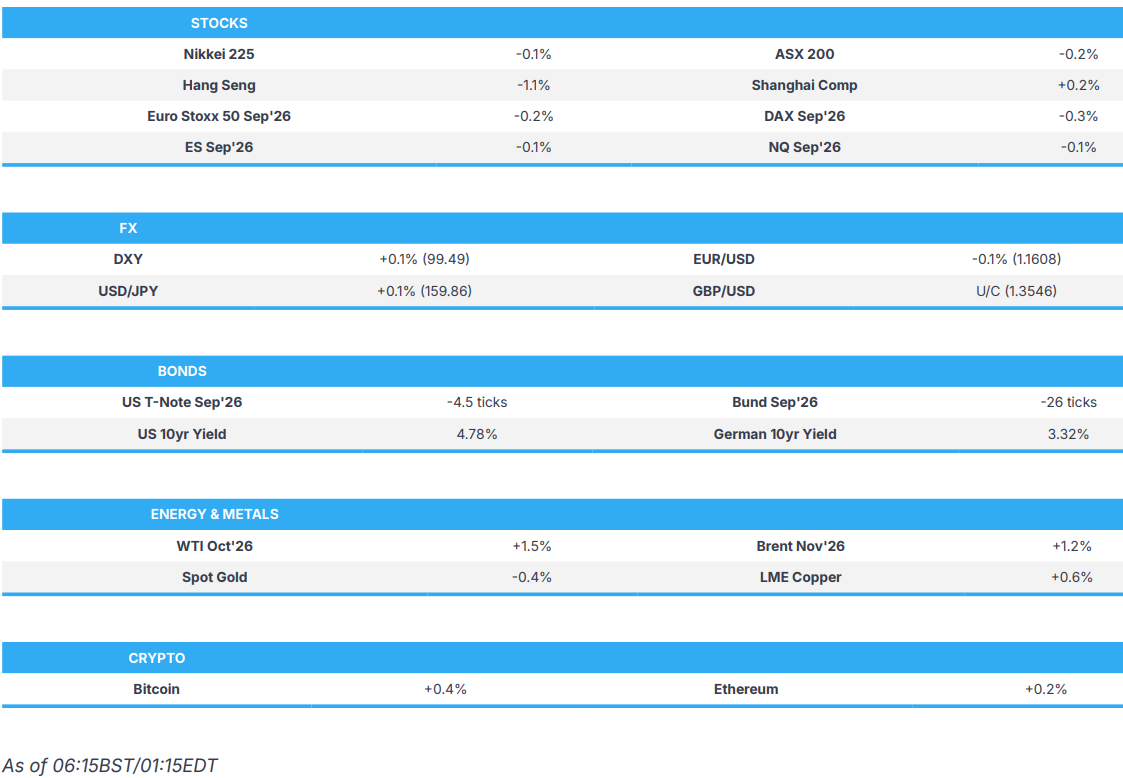
Newsquawk in 3 steps:
1. Subscribe to the free premarket movers reports
2. Listen to this report in the market open podcast (available on Apple and Spotify)
3. Trial Newsquawk’s premium real-time audio news squawk box for 7 days
LOOKING AHEAD
- Highlights include German Retail Sales (Jul), Global S&P Manufacturing PMI Final (Aug), EZ CPI Prelim (Aug), US ISM Manufacturing PMI (Aug), JOLTS Job Openings (Jul), Atlanta Fed GDP (Q3), US Midterm Primary Elections in Massachusetts, Speakers include Fed’s Barr & ECB’s Vujcic. Supply from Germany. Earnings from Dell & Palo Alto.
- Click for the Newsquawk Week Ahead.
IRAN CONFLICT
- US President Trump said Iran strikes will be limited and that the Strait of Hormuz is in extremely good shape. Trump added that a lot of oil is coming out of Hormuz and they are averaging 30 ships a night out of Hormuz, while he said we’ll see what happens regarding Iran.
- Iran’s Foreign Minister Araghchi said the US must return to its commitments and adhere to the provisions of the MoU.
- Iran’s Foreign Ministry spokesperson Baghaei said Europe cannot claim strategic autonomy whilst following US orders, stressing that true autonomy means making independent decisions.
- IRGC said its defences shot down an enemy MQ-9 drone east of the Strait of Hormuz.
- Gulf Cooperation Council condemned Iran’s attacks on Jordan, stating they pose a direct threat to the security and stability of the region, according to Al Jazeera
- UKMTO received a report of an incident involving a tanker and military forces in the Indian Ocean off Oman, while it was reported that a Saudi VLCC stopped while passing through the southern corridor of the Strait of Hormuz, according to IRIB.
- Yemen military sources said government forces destroyed a Houthi Katyusha rocket launcher south of Hodeidah. It was also reported that Yemeni armed forces targeted the bases of Saudi and Emirati mercenaries in Al Makha and Al Khuwakh located in southwest of the country.
US TRADE
EQUITIES
- US stocks started the week predominantly lower as resumed US-Iran strikes over the weekend increased geopolitical and growth risk for the market, although the Nasdaq 100 rallied into the close to settle with marginal gains. Oil prices rose, which added further upward pressure to the belly and long-end yields, with the 10yr yield at its highest since January 2025, while sectors were mostly in the red, except Energy, which benefited from higher oil prices, and Tech, which eked out marginal strength, with Nvidia holding onto post-earnings gains from last week. Utilities underperformed after bearish sentiment built from Friday’s news that California lawmakers blocked proposed wildfire liability reforms, and PG&E (PCG -20%) received multiple downgrades.
- SPX -0.33% at 7,686, NDX +0.08% at 29,457, DJI -0.70% at 53,191, RUT -0.54% at 2,956.
- Click here for a detailed summary.
TARIFFS/TRADE
- US VP Vance said they want to have a positive relationship with China, while he added that they also recognise that China is a competitor, according to Fox News.
NOTABLE HEADLINES
- US President Trump said Fed Chair Warsh will do what he has to do and that interest rates are too high, while Trump announced new drug-pricing agreements, with nine new pharma companies committing to low prices.
- US President Trump posted “I am going to suggest that Republicans and Democrats get together, and immediately craft Legislation to save the Movie, Television, and Entertainment Business in America. Congress should approve, immediately, a Federal Production Incentive to create Entertainment Jobs in America.”
- US Treasury Secretary Bessent made a case for lighter financial regulation at the G20 finance ministers gathering on Monday, arguing to CEOs that post-crisis rules have squeezed small banks, according to Axios.
APAC TRADE
EQUITIES
- APAC stocks traded with a mild negative bias amid higher prices and yields following the recent geopolitical flare-up, although some of the losses were stemmed as participants also digested recent data.
- ASX 200 was pressured amid underperformance in the consumer, tech and telecom sectors, while Australia’s 10yr yield was at its highest since 2011, but with downside in the index stemmed amid strength in the commodity-related industries and after better-than-expected data.
- Nikkei 225 traded indecisively but was off earlier lows and briefly turned positive as headwinds from higher yields were partially offset by better-than-expected Company Sales and Profits data, while a Ministry of Finance senior official said the BoJ is expected to steer monetary policy aligned with the economy and not influenced by the US, in response to a recent report that US Treasury Secretary Bessent told Japanese officials that rate hikes are needed.
- KOSPI initially dropped but then gradually returned to flat territory amid light pertinent newsflow and with indecisive performances in the tech heavyweights.
- Hang Seng and Shanghai Comp were somewhat mixed as the Hong Kong benchmark underperformed amid weakness in some big platform names and property stocks, while sentiment was also not helped by a weak debut for fast fashion retailer Shein. Conversely, the downside in the mainland was cushioned by stronger-than-expected RatingDog Manufacturing PMI data.
- US equity futures were rangebound after recent headwinds from higher yields and oil prices.
- European equity futures indicate a lower cash market open with Euro Stoxx 50 futures down 0.2% after the cash market closed with losses of 1.0% on Monday.
FX
- DXY eked slight gains but with the upside limited in rangebound trade amid a lack of major fresh catalysts and following the prior day’s losses, while attention remained on geopolitics after US President Trump’s threat to hit Iran hard following the latter’s retaliation to the first US strikes in a month.
- EUR/USD marginally pulled back overnight after the single currency recently benefitted from the softer dollar and reclaimed the 1.1600 handle, while participants now await EU PMIs and inflation data.
- GBP/USD lacked demand with price action contained following the recent holiday closure, while there was little reaction to the acceleration in UK shop price inflation, and to reports that PM Burnham will signal fresh cost of living measures.
- USD/JPY traded rangebound but on a firm footing on the 159.00 handle, with the Japanese currency nearing intervention watch levels, while Japanese Finance Minister Katayama held a bilateral meeting with US Treasury Secretary Bessent and discussed how smooth forex moves are crucial for US and global markets, as well as shared an understanding with Bessent on the significance of joint FX intervention
- Antipodeans were mixed and somewhat choppy, albeit within tight parameters, with little reaction seen to the slightly better-than-expected Australian data ahead of tomorrow’s GDP numbers, and with the RBNZ widely expected to deliver a back-to-back hike at its meeting tomorrow.
- PBoC set USD/CNY mid-point at 6.7809 vs exp. 6.7170 (prev. 6.7828).
FIXED INCOME
- 10yr UST futures continued to trickle lower after upside in long-end yields as money market pricing leans towards a September Fed rate hike, and with Treasuries also facing headwinds from higher oil prices.
- Bund futures extended declines with Bund futures testing 123.00 to the downside and are at their lowest level in 15 years, while participants await supply and looming data.
- 10yr JGB futures followed the declines in global peers as the Japanese 10yr yield hit the 3.00% level for the first time since 1996, with markets gearing up for a potential BoJ rate hike this month, while prices were not helped by the mixed 10yr JGB auction results and reports that US Treasury Secretary Bessent told Japanese officials that rate hikes are needed.
COMMODITIES
- Crude futures remained underpinned after gaining yesterday on the US-Iran geopolitical flare-up and with US President Trump vowing to hit Iran hard in response to Iran’s retaliation, while there were also reports that a Saudi VLCC stopped after it was struck by projectiles in the Strait of Hormuz.
- US President Trump said they will fill up the strategic reserve and he wants to do it with Venezuelan oil, while he said it is up to Venezuela regarding leaving OPEC.
- US President Trump’s administration granted oil refineries the biggest amount of exemptions from mandates requiring them to blend renewable fuels since 2017.
- Stocks of crude oil in the US SPR fell by about 3.1mln barrels to 286.6mln barrels last week.
- Venezuelan oil company North American Blue Energy Partners, which was recently backed by the Trump administration, plans to dispatch over 50 drilling rigs in Venezuela in the next few years.
- Spot gold was mildly lower in quiet trade beneath the USD 4,500/oz level after the prior day’s uneventful performance which coincided with recent upside in yields and prior softening of the dollar.
- Copper futures edged higher despite the mostly subdued overnight mood, while Chinese RatingDog Manufacturing PMI data provided some encouragement with a 10th consecutive month of expansion.
CRYPTO
- Bitcoin eked slight gains in rangebound trade beneath the USD 79,000 level.
NOTABLE ASIA-PAC HEADLINES
- US Treasury Secretary Bessent told Japanese officials that rate hikes are needed, according to NHK.
- Japanese Finance Minister Katayama said she held a bilateral meeting with US Treasury Secretary Bessent and discussed how smooth forex moves are crucial for the US and global markets, as well as a need for cooperation between the two countries. She also shared an understanding with Bessent on the significance of joint FX intervention, while she told the G20 that Japan is investing in strategic areas to boost economic growth, and that arbitrary export controls are bad for the economy and must be scrapped.
- Japan Ministry of Finance senior official said they expect the BoJ to steer monetary policy aligned with the economy and not influenced by the US.
- South Korean President Lee said an interest rate increase is unavoidable and that fiscal policy should play a role amid rising interest rates.
DATA RECAP
- Chinese RatingDog Manufacturing PMI (Aug) 51.5 vs. Exp. 51.0 (Prev. 50.9)
- Japanese Capital Spending YY (Q2) 1.6% vs. Exp. -0.2% (Prev. 0.0%)
- Japanese Company Profits YY (Q2) 24.6% vs Exp. 15.2% (Prev. 14.6%)
- Japanese Company Sales YY (Q2) 5.9% (Prev. 1.1%)
- Australian Building Permits MM (Jul P) -3.6% vs. Exp. -4.8% (Prev. 7.2%)
- Australian Current Account (Q2) -27.2B vs. Exp. -30B (Prev. -27.1B)
- Australian Net Exports Contribution to GDP (Q2) 0.1% vs. Exp. 0.1% (Prev. -0.8%)
GEOPOLITICS
MIDDLE EAST
- Israeli forces advanced further into Syria’s Deraa province, according to Al Jazeera.
RUSSIA-UKRAINE
- Explosions were heard in Ukraine’s capital of Kyiv, while Ukraine’s Air Force announced that UAVs were detected heading towards Zaporizhzhia. There were also reports that a fire broke out in the port area of Russia’s Ust-Luga due to a drone attack, according to the local governor.
- Ukrainian President Zelensky said he had a good call with President Trump’s representatives Witkoff and Kushner, while they are discussing setting a date for visiting Ukraine.
- Poland intercepted a Russian reconnaissance plane over the Baltic Sea.
- US Treasury Secretary Bessent told Russia’s Finance Minister Siluanov on the sidelines of the G20 that the US will not provide Russia with economic relief until the Ukraine war ends, while he said no agreements with Russia are possible until the war ends, according to a source familiar with the meeting.
- UK government said Chancellor Healey called on allies to step up their pressure on Russia and set out new action to stop Russian President Putin evading sanctions to fund his illegal war, while the Chancellor will double the maximum fine available to the Office for Financial Sanctions Implementation from 50% to 100% of the value of a sanctions breach.
- Germany’s Vice Chancellor Klingbeil said he made it clear during Europeans’ preliminary meeting that he would not stand together with the Russian Finance Minister for a joint photograph, while he used the opportunity in the plenary session to address the Russian Finance Minister directly in which he told him to his face that the Russian government must end the war, what its consequences are, and that Germany stands on the side of Ukraine.
EU/UK
NOTABLE HEADLINES
- UK PM Burnham will signal fresh measures to help voters with the cost of living on Tuesday, while decisions on welfare are likely to be delayed into next year, according to FT.
- UK PM Burnham will tell MPs that bringing essential services such as water, energy and transport under greater public control is key to boosting economic growth and cutting household costs, while the government is considering measures to make it easier to bring struggling utilities such as Thames Water into public ownership.
- UK government said British businesses can now access the full benefits of the UK’s membership in the Comprehensive and Progressive Agreement for Trans-Pacific Partnership.
- ECB’s Rehn warned that conflict of attrition in Iran could keep inflation high, according to FT.
DATA RECAP
- UK BRC Shop Price Inflation (Aug) 1.5% (Prev. 0.9%)
2.NORTH AND SOUTH KOREA/
SOUTH KOREA//NORTH KOREA
SOUTH KOREA
JAPAN
3. CHINA/
CHINA/ET AL
ROBERT H…
Interesting perspective
While everyone writes cherry-picking data this chap is no different he makes a good point. China simply makes business and this trade which brings in the wake of war by America which destroys America since there is no wealth creation through war.
America has forgotten that what made America great was focus on business not war.
Today this is forgotten. And war will not make America great. War is not a substitute for business. Besides America lost the technology war long ago and needs both time and money and sense of efficiency ( very much lacking ) to play catch up over time.
Yes balderdash can baffle brains for a time. However rising rates for debt will suggest that the bond markets globally speak a different tune. It is why all SOvereign debt will fund itself repriced for risk. With an inability to retire debt the concept of debt rollovers will one day in the future come to a halt. And the globe will see a financial crisis.
4. EUROPEAN AND SCANDINAVIAN COMMENTARIES PLUS NATO
GERMANY
Is Germany Preparing To Unveil A Wealth Tax?
Tuesday, Sep 01, 2026 – 02:00 AM
Submitted by Thomas Kolbe
Will 2027 be the year the wealth register is introduced? Labor Minister Bärbel Bas confirmed this week on Bild that her ministry plans a representative survey of citizens next year on their assets and their views on distributive justice. A classic about-face by this government: just three weeks earlier, Bas had categorically ruled out any such plans.
Concretely, a tax-funded data collection effort involving roughly 5,000 citizens is planned. The rollout will run through an external research institute as part of an EU-wide tender, whose bidding deadline closes September 1.
“Survey experiment on wealth inequality in the population” is the innocuous-sounding name for this study — likely nothing more than a first step toward a comprehensive wealth register.
Cloaked in the mantle of scientific inquiry, politics is edging, step by step, toward the sensitive issue that has hung over the political debate for years like a sword of Damocles: the wealth register. This register — one of numerous European Union projects — is ultimately meant to enable seamless, individualized wealth assessments: the perfect tax base for the perfectly transparent citizen.
What’s new here isn’t really the format: similar wealth surveys have already been conducted every four years by institutes like Berlin’s DIW. What’s truly new is the explicit political framing and normative interpretation of the results.
Of course wealth distribution in Germany is unequal — a natural outcome of a free-market order, and an integral part of a system rooted in the principle that reward should follow performance.
The survey design and the interpretation of its results dock directly onto this inequality, and are meant to legitimize policy options such as introducing a wealth tax, raising inheritance taxes, or other redistributive measures. At least Berlin still bothers to maintain a veneer of scientific reasoning before executing its brazen raid on the middle class’s savings.
That the German government has done more than merely glance at citizens’ wealth became apparent, at the latest, this past Monday. The Federal Statistical Office reported a nationwide deficit of €71.3 billion for the first half of the year — an increase of €36.6 billion over the same period last year. The need is dire. The damage that Berlin’s and Brussels’ ideological policies have inflicted on the economy in recent years threatens to melt down the tax coffers.
Just a week earlier, the ifo Institute had warned of a fiscal tipping point. Economists concluded that tax revenue could actually shrink going forward, putting an end to Berlin’s cornucopia politics. As possible countermeasures, Berlin is now clearly planning tax hikes as well as an expansion of the tax base to include citizens’ wealth.
The situation is dire: cyclically sensitive taxes such as corporate and trade tax have shown a negative trend for several quarters now, and the wave of insolvencies sweeping the country, the growing number of business closures, and rising unemployment give no indication that this trend will reverse anytime soon.
From the citizen’s perspective, the situation looks like this: given the towering fiscal burdens an ever-expanding state apparatus imposes on him, a sovereign risks becoming a tax vassal — if he hasn’t already become one.
A state that cannot get its own budget under control tends toward fiscal highway robbery — and will not hesitate to slap heavy levies on the already multiply-taxed wealth of families and businesses.
You know the drill: it’s all done in the name of social justice. Reasons can always be found — but under this kind of policy, what erodes is the remaining sovereignty of civil society itself, the very engine of prosperity, social stability, and republicanism.
Friedrich August von Hayek would likely have judged: Germany is on the road to serfdom — and has already traveled a good stretch of it.
And anyone who still believes the reach for wealth, inheritances, and land will stop at the supposedly rich is in for a rude awakening: the truly wealthy escape the fiscal raid precisely because of their high geographic mobility.
No – the state has its sights set on those who cannot get out of its way: the classic middle class, the Mittelstand, those bound to the land, so to speak – to put it in neo-feudal terms.
The opposite of feudal would be an unrestricted right to private property — one that, naturally, also includes wealth accumulation, entirely without political debate. People are not sovereign when the sword of Damocles of arbitrary taxation hangs over them: once the state can seize assets at will, private property becomes borrowed possession — and the citizen becomes a tax serf. This is precisely why envy-fueled debates over wealth taxes and distributive justice are so dangerous: they shift power from the citizen to the state apparatus, which by its very nature knows no limits — and by now no longer even bothers to hide it.
In the end, only one bitter realization remains: a state that shamelessly lays its citizens bare, and strips away the sanctity of private property along with the last refuges of the once-sovereign citizen using a cheap, resentment-laden argument, has already broken the bond of trust between state and citizen. Wealth as the citizen’s last line of defense simply evaporates.
END
GERMANY
Merz Warns Right-Wing Victory Will Hurt Germany, But Nomura Says Investors Aren’t Buying It
Tuesday, Sep 01, 2026 – 04:15 AM
German Chancellor Friedrich Merz spent Sunday fearmongering on public broadcaster ARD, warning that a potential victory for Alternative for Germany in next Sunday’s Saxony-Anhalt election could inflict economic damage on the region.
Merz’s assessment conflicts with Nomura’s political analysis, which suggests investors no longer reflexively fear right-wing victories. Instead, markets are increasingly focused on the economic consequences of left-wing policies, particularly deindustrialization, elevated energy costs, and uncontrolled mass migration, all of which have been nothing short of nation-killing.
“If things turn out the way the polls suggest, this federal state will face significant problems,” Merz told broadcaster ARD. He questioned whether international companies would invest or build factories in a state governed by an AfD premier.
Polls show the AfD attracting more than 40% support, potentially double the roughly 20% backing for Merz’s Christian Democratic Union. The center-right party has governed Saxony-Anhalt for more than two decades.
“The state will suffer considerable damage if the scenario we currently fear comes to pass,” Merz said during the interview.
An AfD victory this coming weekend could produce Germany’s first state government led by the right-wing party.
Merz’s fearmongering comes as his approval ratings are the lowest recorded for any postwar German chancellor. Economic troubles have rocked Europe’s largest economy, while voters have grown increasingly frustrated with Berlin.
Andrzej Szczepaniak, a senior European economist and executive director at Nomura, wrote last week about “the seeds of political change” and noted that “politics in Europe is lurching towards more populism.”
Szczepaniak said, “Five years ago, financial markets would not have seemed so at ease with such a prospect. But then again, these populist right-wing political parties were previously not as fiscally prudent as they are perceived to be today. Indeed, Italy’s Giorgia Meloni is the standard-bearer for financial markets of how a populist right-wing political party can govern: fiscally prudent enough to show investors that the party can govern responsibly while focusing heavily on social issues, including immigration and culture wars, to keep grassroots supporters happy.”
He added, “Financial markets are much more concerned about populist left-wing parties being elected due to their desire to increase spending, often paid for through higher borrowing or higher taxes, which are likely to shut the engine off of already stuttering economies.”

Looking ahead, Szczepaniak noted that right-wing parties are positioned to make significant gains across Germany, France, Spain, Switzerland, and the UK over the next 18 months.

END
FRANCE
Le Pen Would Beat Every Rival In 2027, Major French Poll Finds
Tuesday, Sep 01, 2026 – 02:45 AM
Marine Le Pen would win France’s 2027 presidential election against every major rival now being measured, according to a major survey by Elabe published on August 29 for BFMTV and La Tribune Dimanche.

France elects its president in two rounds: a crowded first round on April 18 cuts the field to the top two – no one will win outright – and the survivors meet again on May 2. Elabe has Le Pen at 34% to 35.5% in round one depending on who else runs, far clear of the pack, then beating every potential runoff opponent it tested. The new poll comes on the heels of a Nomura report which showed Le Pen with a commanding first-round lead.
The rest of the field is fighting over second place. Édouard Philippe, the former prime minister and the most plausible face of the post-Macron center, leads that pack at about 17% when he stands alone. Jean-Luc Mélenchon is on 14% to 14.5%, having lost his summer lift. Raphaël Glucksmann, now in the race, is between 11.5% and 14%. Gabriel Attal’s presence mainly splits the moderate vote.
According to the poll, here’s Le Pen:
- versus Philippe: 52.5% to 47.5%
- versus Attal or Glucksmann: 57% to 43%
- versus Mélenchon: 69.5% to 30.5%
For a generation, French presidential politics assumed a front républicain: a cross-party second-round squeeze that would keep the National Rally out of the Élysée. It elected Chirac 82-18 over her father in 2002 and Macron twice over her; yet the margin has narrowed every time. According to the Elabe poll, that squeeze is no longer automatic. Le Pen is not only first in April. She is ahead in May against every opponent Elabe put up. Even against Philippe, the closest of them, she leads by five points.
Le Pen’s popularity has perhaps been boosted by her status as a martyr – created by what some might consider establishment efforts to throw her off track. On July 7 the Paris court of appeal upheld her embezzlement conviction in the European Parliament assistants case. It shortened the ban on holding office enough for her to stand and imposed a year of house arrest with an electronic tag. Her appeal to the Cour de Cassation freezes that sentence while she campaigns. The court has said it aims to rule before the first round. A confirmed tag would not take her off the April ballot. It would frame the May runoff. Le Pen herself has said she could not campaign tagged – though sentence remission could free her by early 2027 either way. Jordan Bardella remains the party’s designated stand-in.
At the summer gathering of MEDEF (France’s main employers’ federation) at Roland-Garros on August 27 she set out a €125 billion savings path and a plan to let long-tenure workers retire at 60 to 62, costed at about €9 billion and described as a “societal choice.” French banks are still wary of financing National Rally campaigns. On these numbers, voters are less so.
Bond markets are pricing the wider strain – as French 10-year yields have been near 4.1%, their highest since late 2008. The extra yield over German Bunds is about 80 basis points, the wide end of a 59-to-85 range over the past year. That premium reflects a hung Assembly, a government that has already stumbled on the budget, a 2027 finance bill due in October that may not pass in ordinary form, a deficit still near 5% of GDP, and IMF debt figures already around 118.5% this year and through 120% in 2027.
The working rule of French politics was that Le Pen could reach the steps of the Élysée and not the door – but rules were made to be broken.
END
5.RUSSIAN AND MIDDLE EASTERN AFFAIRS
IRAN/VS ISRAEL/USA/TUESDAY MORNING
Projectiles Hit Two Supertankers Exiting Hormuz As Brent Tops $92, Diesel Crack Breaches $100
Tuesday, Sep 01, 2026 – 06:55 AM
Pezeshkian: We’ll Return to Ceasefire if US Does
Iranian President Masoud Pezeshkian on Tuesday reiterated his country’s willingness to return to talks with the US, but made clear that Washington must return to its prior commitments made.
“I state explicitly that if the United States returns to its commitments under the … memorandum of understanding, the Islamic Republic of Iran will immediately take reciprocal action,” Pezeshkian said on the sidelines of the Shanghai Cooperation Organisation (SCO) summit in Bishkek, Kyrgyzstan.
It is significant that he’s there in person, receiving a welcome from the likes of Putin, Xi, Erdogan, the UN’s Guterres, and others.
Pezeshkian still blasted the US for “reneging on its commitments” under the agreement, which unraveled in June – leading to various weeks of sporadic tit-for-tat attacks – the latest which occurred just at the start of this week.
President Trump yesterday told reporters in the Oval Office that there will be a “response” to the Iranian attacks, but also cautioned that this would not mean a return to full-scale war.
US officials have talked about “mowing the grass” with a series of indefinite strikes, while ironically having an aversion to anyone applying the label “forever war”.
Two Supertankers Hit
Two oil supertankers were struck by unknown projectiles while transiting the Strait of Hormuz early Tuesday, signaling yet another sharp escalation in hostilities along the world’s most critical energy chokepoint.
The attacks follow President Trump’s warning Monday that additional strikes against Iran remain possible. Traders are pricing in a further war risk premium, pushing Brent crude futures above $92 a barrel, while US diesel crack spreads have breached the critical $100-a-barrel threshold.
Maritime security consultant Marisks reports that Saudi shipping giant Bahri’s VLCC Sidr was hit northeast of Khasab, Oman. The Sinokor-operated Senegal Prosperity was reportedly struck by three projectiles farther east. Both tankers were exiting the maritime chokepoint.
UK Maritime Trade Operations separately confirmed that a tanker completing an outbound transit of Hormuz reported three projectile strikes but did not identify the vessel.
Brent crude futures ripped higher during Asian and European trading on the news, with the benchmark firmly above $92 as of 0600 ET.

More US Strikes on Table, Trump Warns
“President Donald Trump warned Monday that further strikes are possible, pushing Brent back above $91/bbl and driving another bear-steepening move across global bond markets,” UBS analyst George Redman wrote earlier.
US diesel crack spreads were above $100 as of 0600 ET.

As we’ve extensively detailed, the energy crisis is not necessarily in crude itself but in refined products. Gulf diesel and gasoline shipments have declined amid disruptions in the Strait of Hormuz, while damage to Russian energy infrastructure from Ukrainian one-way attack drones has created a perfect storm in global refining markets in late summer.
‘Diesel at Epicenter of Supply Squeeze’
Goldman’s energy expert Daan Struyven warned in his most recent note that “diesel is at the epicenter of the supply squeeze.”
“Rising strikes on refineries in the Middle East and Russia have further constrained already-stretched global refining capacity, pushing refined-products margins to new highs,” Struyven and Yulia Zhestkova Grigsby wrote in the note, adding, “Diesel remains at the epicenter of the rally.”
Struyven and his team estimate that global refinery runs are down 7 million barrels per day from last year and have averaged nearly 6 million barrels per day below seasonal norms since March, around the time the US launched Operation Epic Fury and Ukraine ramped up one-way drone attacks against Russia’s energy infrastructure.

Meanwhile, there may be some diplomatic traction in the Gulf area, with Iranian President Masoud Pezeshkian saying on state TV: “I state unequivocally that should the US return to its commitments under the aforementioned Memorandum of Understanding, the Islamic Republic of Iran will also take reciprocal action immediately.”
Treasury Secretary Scott Bessent’s “Operation Economic Outcast” is also ramping up as the Trump administration deploys sanctions to pressure Tehran into submission.
More Latest Developments
via Newsquawk…
- Iran’s Foreign Ministry spokesperson Baghaei said Europe cannot claim strategic autonomy while following Washington’s orders, stressing that true autonomy means making independent decisions.
- Pakistan’s Deputy PM and Foreign Minister met with Iran’s Foreign Minister Araghchi in an informal manner in Bishek at the holding room of the SCO Council of Head of States, according to journalist Anas Mallick.
- Gulf Corporation Council condemned Iran’s attacks on Jordan, saying they pose a direct threat to the security and stability of the region, according to Al Jazeera.
- Yemeni armed forces targeted early on Tuesday the bases of Saudi and Emirati mercenaries in Al Makha and Al Khuwakh located in the southwest of the country, according to IRIB.
- Hapag-Lloyd’s (HLAG GY) CEO said it is reasonable to expect the Strait of Hormuz will remain blocked for the foreseeable future.
END
Iran Will ‘Immediately’ Return To MoU Deal If US Does, Pezeshkian Says, After Two Supertankers Struck In Hormuz
Tuesday, Sep 01, 2026 – 08:35 AM
Summary
- Iran offers conditional ceasefire: Pezeshkian says Iran will return to talks if the US honors prior commitments, which Tehran says it has violated.
- US threatens further strikes: Trump warned of more action but ruled out necessarily returning to full-scale war.
- Tankers hit in Strait of Hormuz: Two supertankers struck exiting Hormuz, escalating energy-market risks.
- Oil prices surge: Brent crude rose above $92/barrel.
- Diesel supply squeezed: Refinery disruptions are driving diesel prices and margins sharply higher.
* * *
Pezeshkian: We’ll Teturn to Ceasefire if US Does
Iranian President Masoud Pezeshkian on Tuesday reiterated his country’s willingness to return to talks with the US, but made clear that Washington must return to its prior commitments made.
“I state explicitly that if the United States returns to its commitments under the … memorandum of understanding, the Islamic Republic of Iran will immediately take reciprocal action,” Pezeshkian said on the sidelines of the Shanghai Cooperation Organisation (SCO) summit in Bishkek, Kyrgyzstan.
It is significant that he’s there at the Kyrgyzstan-hosted summit in person, receiving a welcome from the likes of Putin, Xi, Erdogan, the UN’s Guterres, and others.
Pezeshkian still blasted the US for “reneging on its commitments” under the agreement, which unraveled in June – leading to various weeks of sporadic tit-for-tat attacks – the latest which occurred just at the start of this week.
President Trump yesterday told reporters in the Oval Office that there will be a “response” to the Iranian attacks, but also cautioned that this would not mean a return to full-scale war.
US officials have talked about “mowing the grass” with a series of indefinite strikes, while ironically having an aversion to anyone applying the label “forever war”.
Two Supertankers Hit
Two oil supertankers were struck by unknown projectiles while transiting the Strait of Hormuz early Tuesday, signaling yet another sharp escalation in hostilities along the world’s most critical energy chokepoint.
The attacks follow President Trump’s warning Monday that additional strikes against Iran remain possible. Traders are pricing in a further war risk premium, pushing Brent crude futures above $92 a barrel, while US diesel crack spreads have breached the critical $100-a-barrel threshold.
Maritime security consultant Marisks reports that Saudi shipping giant Bahri’s VLCC Sidr was hit northeast of Khasab, Oman. The Sinokor-operated Senegal Prosperity was reportedly struck by three projectiles farther east. Both tankers were exiting the maritime chokepoint.
UK Maritime Trade Operations separately confirmed that a tanker completing an outbound transit of Hormuz reported three projectile strikes but did not identify the vessel.
Brent crude futures ripped higher during Asian and European trading on the news, with the benchmark firmly above $92 as of 0600 ET.
More US Strikes on Table, Trump Warns
“President Donald Trump warned Monday that further strikes are possible, pushing Brent back above $91/bbl and driving another bear-steepening move across global bond markets,” UBS analyst George Redman wrote earlier.
US diesel crack spreads were above $100 as of 0600 ET.
As we’ve extensively detailed, the energy crisis is not necessarily in crude itself but in refined products. Gulf diesel and gasoline shipments have declined amid disruptions in the Strait of Hormuz, while damage to Russian energy infrastructure from Ukrainian one-way attack drones has created a perfect storm in global refining markets in late summer.
‘Diesel at Epicenter of Supply Squeeze’
Goldman’s energy expert Daan Struyven warned in his most recent note that “diesel is at the epicenter of the supply squeeze.”
“Rising strikes on refineries in the Middle East and Russia have further constrained already-stretched global refining capacity, pushing refined-products margins to new highs,” Struyven and Yulia Zhestkova Grigsby wrote in the note, adding, “Diesel remains at the epicenter of the rally.”
Struyven and his team estimate that global refinery runs are down 7 million barrels per day from last year and have averaged nearly 6 million barrels per day below seasonal norms since March, around the time the US launched Operation Epic Fury and Ukraine ramped up one-way drone attacks against Russia’s energy infrastructure.
Meanwhile, there may be some diplomatic traction in the Gulf area, with Iranian President Masoud Pezeshkian saying on state TV: “I state unequivocally that should the US return to its commitments under the aforementioned Memorandum of Understanding, the Islamic Republic of Iran will also take reciprocal action immediately.”
Treasury Secretary Scott Bessent’s “Operation Economic Outcast” is also ramping up as the Trump administration deploys sanctions to pressure Tehran into submission.
More Latest Developments
via Newsquawk…
- Iran’s Foreign Ministry spokesperson Baghaei said Europe cannot claim strategic autonomy while following Washington’s orders, stressing that true autonomy means making independent decisions.
- Pakistan’s Deputy PM and Foreign Minister met with Iran’s Foreign Minister Araghchi in an informal manner in Bishek at the holding room of the SCO Council of Head of States, according to journalist Anas Mallick.
- Gulf Corporation Council condemned Iran’s attacks on Jordan, saying they pose a direct threat to the security and stability of the region, according to Al Jazeera.
- Yemeni armed forces targeted early on Tuesday the bases of Saudi and Emirati mercenaries in Al Makha and Al Khuwakh located in the southwest of the country, according to IRIB.
- Hapag-Lloyd’s (HLAG GY) CEO said it is reasonable to expect the Strait of Hormuz will remain blocked for the foreseeable future.
END
Bessent Says Hormuz Will Be A “Worthless Piece Of Water” In Two Years
Tuesday, Sep 01, 2026 – 10:30 AM
Summary
- Bessent Says Hormuz Will Be “Worthless Piece of Water” In Two Years
- Iran offers conditional ceasefire: Pezeshkian says Iran will return to talks if the US honors prior commitments, which Tehran says it has violated.
- US threatens further strikes: Trump warned of more action but ruled out necessarily returning to full-scale war.
- Tankers hit in Strait of Hormuz: Two supertankers struck exiting Hormuz, escalating energy-market risks.
- Oil prices surge: Brent crude rose above $92/barrel.
- Diesel supply squeezed: Refinery disruptions are driving diesel prices and margins sharply higher.
* * *
Bessent Says Hormuz Will Be “Worthless Piece of Water” In Two Years
Treasury Secretary Scott Bessent told the audience at the Group of 20 finance ministers’ meeting in Asheville, North Carolina, that Iran’s ability to weaponize the Strait of Hormuz will be reduced to zero because “oil will be going through pipelines across the land.”
“Iranians are trying to use the Strait of Hormuz as a chokepoint. It’s not a chokepoint for the US, but it is for many other countries. That will be bypassed in 2 years. In 2 years, the Strait of Hormuz will be a worthless piece of water. The oil will be going through pipelines across the land,” Bessent said.
Bessent’s comments this morning should come as no surprise to readers, since we’ve detailed the existing pipelines that bypass Hormuz and the new pipeline projects planned by allied Gulf producers.

Also read Goldman’s latest energy flow data through the Hormuz (here).
Pezeshkian: We’ll Return to Ceasefire if US Does
Iranian President Masoud Pezeshkian on Tuesday reiterated his country’s willingness to return to talks with the US, but made clear that Washington must return to its prior commitments made.
“I state explicitly that if the United States returns to its commitments under the … memorandum of understanding, the Islamic Republic of Iran will immediately take reciprocal action,” Pezeshkian said on the sidelines of the Shanghai Cooperation Organization (SCO) summit in Bishkek, Kyrgyzstan.
It is significant that he’s there at the Kyrgyzstan-hosted summit in person, receiving a welcome from the likes of Putin, Xi, Erdogan, the UN’s Guterres, and others.
Pezeshkian still blasted the US for “reneging on its commitments” under the agreement, which unraveled in June – leading to various weeks of sporadic tit-for-tat attacks – the latest which occurred just at the start of this week.
President Trump yesterday told reporters in the Oval Office that there will be a “response” to the Iranian attacks, but also cautioned that this would not mean a return to full-scale war.
US officials have talked about “mowing the grass” with a series of indefinite strikes, while ironically having an aversion to anyone applying the label “forever war”.
Two Supertankers Hit
Two oil supertankers were struck by unknown projectiles while transiting the Strait of Hormuz early Tuesday, signaling yet another sharp escalation in hostilities along the world’s most critical energy chokepoint.
The attacks follow President Trump’s warning Monday that additional strikes against Iran remain possible. Traders are pricing in a further war risk premium, pushing Brent crude futures above $92 a barrel, while US diesel crack spreads have breached the critical $100-a-barrel threshold.
Maritime security consultant Marisks reports that Saudi shipping giant Bahri’s VLCC Sidr was hit northeast of Khasab, Oman. The Sinokor-operated Senegal Prosperity was reportedly struck by three projectiles farther east. Both tankers were exiting the maritime chokepoint.
UK Maritime Trade Operations separately confirmed that a tanker completing an outbound transit of Hormuz reported three projectile strikes but did not identify the vessel.
Brent crude futures ripped higher during Asian and European trading on the news, with the benchmark firmly above $92 as of 0600 ET.
More US Strikes on Table, Trump Warns
“President Donald Trump warned Monday that further strikes are possible, pushing Brent back above $91/bbl and driving another bear-steepening move across global bond markets,” UBS analyst George Redman wrote earlier.
US diesel crack spreads were above $100 as of 0600 ET.
As we’ve extensively detailed, the energy crisis is not necessarily in crude itself but in refined products. Gulf diesel and gasoline shipments have declined amid disruptions in the Strait of Hormuz, while damage to Russian energy infrastructure from Ukrainian one-way attack drones has created a perfect storm in global refining markets in late summer.
‘Diesel at Epicenter of Supply Squeeze’
Goldman’s energy expert Daan Struyven warned in his most recent note that “diesel is at the epicenter of the supply squeeze.”
“Rising strikes on refineries in the Middle East and Russia have further constrained already-stretched global refining capacity, pushing refined-products margins to new highs,” Struyven and Yulia Zhestkova Grigsby wrote in the note, adding, “Diesel remains at the epicenter of the rally.”
Struyven and his team estimate that global refinery runs are down 7 million barrels per day from last year and have averaged nearly 6 million barrels per day below seasonal norms since March, around the time the US launched Operation Epic Fury and Ukraine ramped up one-way drone attacks against Russia’s energy infrastructure.
Meanwhile, there may be some diplomatic traction in the Gulf area, with Iranian President Masoud Pezeshkian saying on state TV: “I state unequivocally that should the US return to its commitments under the aforementioned Memorandum of Understanding, the Islamic Republic of Iran will also take reciprocal action immediately.”
Treasury Secretary Scott Bessent’s “Operation Economic Outcast” is also ramping up as the Trump administration deploys sanctions to pressure Tehran into submission.
END
Reports Of US Unleashing New Attacks On Southern Iran Sends Oil Soaring
Tuesday, Sep 01, 2026 – 12:30 PM
Summary
- Reports of fresh US strike wave on southern Iran, oil soars
- Bessent Says Hormuz Will Be “Worthless Piece of Water” In Two Years
- Iran offers conditional ceasefire: Pezeshkian says Iran will return to talks if the US honors prior commitments, which Tehran says it has violated.
- Tankers hit in Strait of Hormuz: Two supertankers struck exiting Hormuz, escalating energy-market risks.
- Oil prices surge: Brent crude rose above $92/barrel.
- Diesel supply squeezed: Refinery disruptions are driving diesel prices and margins sharply higher.
* * *
Early reports of US Strikes on Southern Iran Send Oil Soaring
Rare US strikes against Iran in the middle of US trading hours? Bold move if so. Some breaking headlines:
- REPORTS OF BLASTS ACROSS IRAN’S SOUTHERN REGIONS: STATE TV
- PENTAGON UNLEASHES FRESH ATTACKS On SOUTHERN IRAN
- Al Arabiya: ‘DEFENSIVE’ BOMBING — source to Faytuks
- EXPLOSIONS REPORTED IN KONARAK IN SOUTHEASTERN IRAN: FARS
Oil prices shooting up on the new apparent ‘shoot-up’, which has been previewed in various reports this week. Trump is now pulling the trigger on Hegseth’s plan, it seems:
WTI nears $90…

US attacks on Iran have almost always come in nighttime and overnight hours – and typically only after US market hours close, so a daytime attack is very rare indeed…
Bessent Says Hormuz Will Be “Worthless Piece of Water” In Two Years
Treasury Secretary Scott Bessent told the audience at the Group of 20 finance ministers’ meeting in Asheville, North Carolina, that Iran’s ability to weaponize the Strait of Hormuz will be reduced to zero because “oil will be going through pipelines across the land.”
“Iranians are trying to use the Strait of Hormuz as a chokepoint. It’s not a chokepoint for the US, but it is for many other countries. That will be bypassed in 2 years. In 2 years, the Strait of Hormuz will be a worthless piece of water. The oil will be going through pipelines across the land,” Bessent said.
Bessent’s comments this morning should come as no surprise to readers, since we’ve detailed the existing pipelines that bypass Hormuz and the new pipeline projects planned by allied Gulf producers.
However, these new ‘alternative energy route’ initiatives are wrought with an array of unknowns – especially in terms of security and infrastructure/construction protection in an obviously volatile region, cooperation among transit states (in overland routes), as well as immense cost notwithstanding. For but one recent headline example:
Iraq-Syria Pipeline To ‘Bypass’ Hormuz Likely To Take Four Years, $15BN To Build
And with both these named countries coming out of recent decades-long ‘forever wars’, and with especially Syria still being largely destroyed and fragmented, efforts to bring to fruition Bessent’s anticipated bypass system “across the land” – as he says – will more likely be something that drags on far longer than the Trump administration itself is in power.
Also read Goldman’s latest energy flow data through the Hormuz (here).
Pezeshkian: We’ll Return to Ceasefire if US Does
Iranian President Masoud Pezeshkian on Tuesday reiterated his country’s willingness to return to talks with the US, but made clear that Washington must return to its prior commitments made.
“I state explicitly that if the United States returns to its commitments under the … memorandum of understanding, the Islamic Republic of Iran will immediately take reciprocal action,” Pezeshkian said on the sidelines of the Shanghai Cooperation Organization (SCO) summit in Bishkek, Kyrgyzstan.
It is significant that he’s there at the Kyrgyzstan-hosted summit in person, receiving a welcome from the likes of Putin, Xi, Erdogan, the UN’s Guterres, and others.
Pezeshkian still blasted the US for “reneging on its commitments” under the agreement, which unraveled in June – leading to various weeks of sporadic tit-for-tat attacks – the latest which occurred just at the start of this week.
President Trump yesterday told reporters in the Oval Office that there will be a “response” to the Iranian attacks, but also cautioned that this would not mean a return to full-scale war.
US officials have talked about “mowing the grass” with a series of indefinite strikes, while ironically having an aversion to anyone applying the label “forever war”.
Two Supertankers Hit
Two oil supertankers were struck by unknown projectiles while transiting the Strait of Hormuz early Tuesday, signaling yet another sharp escalation in hostilities along the world’s most critical energy chokepoint.
The attacks follow President Trump’s warning Monday that additional strikes against Iran remain possible. Traders are pricing in a further war risk premium, pushing Brent crude futures above $92 a barrel, while US diesel crack spreads have breached the critical $100-a-barrel threshold.
Maritime security consultant Marisks reports that Saudi shipping giant Bahri’s VLCC Sidr was hit northeast of Khasab, Oman. The Sinokor-operated Senegal Prosperity was reportedly struck by three projectiles farther east. Both tankers were exiting the maritime chokepoint.
UK Maritime Trade Operations separately confirmed that a tanker completing an outbound transit of Hormuz reported three projectile strikes but did not identify the vessel.
Brent crude futures ripped higher during Asian and European trading on the news, with the benchmark firmly above $92 as of 0600 ET.
More US Strikes on Table, Trump Warns
“President Donald Trump warned Monday that further strikes are possible, pushing Brent back above $91/bbl and driving another bear-steepening move across global bond markets,” UBS analyst George Redman wrote earlier.
US diesel crack spreads were above $100 as of 0600 ET.
As we’ve extensively detailed, the energy crisis is not necessarily in crude itself but in refined products. Gulf diesel and gasoline shipments have declined amid disruptions in the Strait of Hormuz, while damage to Russian energy infrastructure from Ukrainian one-way attack drones has created a perfect storm in global refining markets in late summer.
‘Diesel at Epicenter of Supply Squeeze’
Goldman’s energy expert Daan Struyven warned in his most recent note that “diesel is at the epicenter of the supply squeeze.”
“Rising strikes on refineries in the Middle East and Russia have further constrained already-stretched global refining capacity, pushing refined-products margins to new highs,” Struyven and Yulia Zhestkova Grigsby wrote in the note, adding, “Diesel remains at the epicenter of the rally.”
Struyven and his team estimate that global refinery runs are down 7 million barrels per day from last year and have averaged nearly 6 million barrels per day below seasonal norms since March, around the time the US launched Operation Epic Fury and Ukraine ramped up one-way drone attacks against Russia’s energy infrastructure.
Meanwhile, there may be some diplomatic traction in the Gulf area, with Iranian President Masoud Pezeshkian saying on state TV: “I state unequivocally that should the US return to its commitments under the aforementioned Memorandum of Understanding, the Islamic Republic of Iran will also take reciprocal action immediately.”
Treasury Secretary Scott Bessent’s “Operation Economic Outcast” is also ramping up as the Trump administration deploys sanctions to pressure Tehran into submission.
More Latest Developments
via Newsquawk…
- Iran’s Foreign Ministry spokesperson Baghaei said Europe cannot claim strategic autonomy while following Washington’s orders, stressing that true autonomy means making independent decisions.
- Pakistan’s Deputy PM and Foreign Minister met with Iran’s Foreign Minister Araghchi in an informal manner in Bishek at the holding room of the SCO Council of Head of States, according to journalist Anas Mallick.
- Gulf Corporation Council condemned Iran’s attacks on Jordan, saying they pose a direct threat to the security and stability of the region, according to Al Jazeera.
- Yemeni armed forces targeted early on Tuesday the bases of Saudi and Emirati mercenaries in Al Makha and Al Khuwakh located in the southwest of the country, according to IRIB.
- Hapag-Lloyd’s (HLAG GY) CEO said it is reasonable to expect the Strait of Hormuz will remain blocked for the foreseeable future.
END
THEN LATE AFTERNOON;
Trump: ‘Large & Powerful Strikes’ In Iran Ongoing As ‘Retaliation’ For Mining Hormuz Strait
Tuesday, Sep 01, 2026 – 01:35 PM
Summary
- Reports of fresh US strike wave on southern Iran, oil soars
- Bessent Says Hormuz Will Be “Worthless Piece of Water” In Two Years
- Iran offers conditional ceasefire: Pezeshkian says Iran will return to talks if the US honors prior commitments, which Tehran says it has violated.
- Tankers hit in Strait of Hormuz: Two supertankers struck exiting Hormuz, escalating energy-market risks.
- Oil prices surge: Brent crude rose above $92/barrel.
- Diesel supply squeezed: Refinery disruptions are driving diesel prices and margins sharply higher.
* * *
Trump: ‘Large & Powerful Strikes’ in ‘Retaliation’ For Mining Hormuz Strait
Confirmation from the President, describing these new airstrikes as ongoing and “large and powerful”… He added that this is retaliation for the Iranians mining the Strait of Hormuz. The full Truth Social post:

Notably he is warning the Iranians will get hit again “much harder” if they don’t cooperate with Washington demands.
END
NOW AT CLOSING
Iran Begins Retaliation Amid Trump’s ‘Large & Powerful Strikes’ – Explosions Heard In Jordan
Tuesday, Sep 01, 2026 – 03:55 PM
Summary
- Explosions in Jordan reported amid initial Iranian retaliation.
- Reports of fresh US strike wave on southern Iran, oil soars
- Bessent Says Hormuz Will Be “Worthless Piece of Water” In Two Years
- Iran offers conditional ceasefire: Pezeshkian says Iran will return to talks if the US honors prior commitments, which Tehran says it has violated.
- Tankers hit in Strait of Hormuz: Two supertankers struck exiting Hormuz, escalating energy-market risks.
- Oil prices surge: Brent crude rose above $92/barrel.
- Diesel supply squeezed: Refinery disruptions are driving diesel prices and margins sharply higher.
* * *
Iranian Retaliation on regional Bases Begins
Iran is already hitting back, according to some early reports of what looks to be their latest retaliation, despite President Trump having earlier warned the Islamic Republic will be hit harder if it responds.
“If the failed Nation of Iran retaliates for this very justified attack, they will be hit again at a much harder and higher level, but it will not be the biggest attack of them all, that is waiting in the wings and, when it is over, there will be very little left of the Islamic Republic of Iran!” he stated earlier.
The White House indicated it is focused on taking out IRGC targets. But this has triggered the expected reaction:
- Fars: Some Arab sources report that an explosion was heard in Jordan; several explosions were heard from American bases in Jordan
- IRGC says US attacks will tighten the lock on the Strait of Hormuz
- Explosion heard in Erbil, Iraq, reports Fars
The last tit-for-tat instances also saw US bases in Jordan targeted.
One Atlantic Council analyst points out the obvious – today’s action is yet another indication that the administration still does not understand how the Iranian government and leadership thinks (unless the intent is actual runaway escalation). Danny Citrinowicz writes:
Threatening Tehran with even more devastating strikes if it retaliates is unlikely to prevent an Iranian response. In fact, it may do the opposite. From Tehran’s perspective, failing to respond to a direct U.S. attack would undermine the very deterrence equation Iran has spent months trying to establish. The Iranian leadership believes it must demonstrate that American military action carries a price. That means Iran is likely to retaliate and it may even conclude that a broader or more painful response is necessary precisely to rebuild deterrence against future U.S. attacks.
This is the fundamental problem with Washington’s approach: it assumes that sufficiently strong threats will convince Iran to back down. But Tehran may draw exactly the opposite conclusion, meaning that backing down under threat would invite additional American strikes. Threats will not solve this problem. If Washington wants to prevent another cycle of retaliation and counter-retaliation, it needs a political strategy for ending the confrontation. Otherwise, each side will continue using force to restore deterrence after the previous round — creating an escalation cycle that becomes increasingly difficult to control.
The latest Pentagon leaks to the Washington Post happened days ago, and now this:
More latest via AJ:
- The United States military says it is striking targets in Iran over attempted attacks on shipping as Iranian media reports explosions in Asaluyeh, Jiroft, Bandar Abbas, Qeshm Island, Konarak, Chabahar, Jask, Sirik and Lavan.
- Iran’s army and IRGC promise the US will regret and face “severe punishment” for the aggression.
- US President Donald Trump says “if the failed Nation of Iran retaliates for this very justified attack, they will be hit again at a much harder and higher level”.
Trump: ‘Large & Powerful Strikes’ in ‘Retaliation’ For Mining Hormuz Strait
Confirmation from the President, describing these new airstrikes as ongoing and “large and powerful”… He added that this is retaliation for the Iranians mining the Strait of Hormuz. The full Truth Social post:
Notably he is warning the Iranians will get hit again “much harder” if they don’t cooperate with Washington demands.
ISRAEL TBN.
END
TURKEY
‘Let’s hope they’ll decide to be helpful’: Huckabee tells ‘Post’ about Turkey’s role – interview
“I don’t think we know the full extent of it – whether they are helpful or not,” the US ambassador told the Post in an interview, ahead of the US Embassy in Israel’s 250th Independence Day event.

US Ambassador to Israel Mike Huckabee in Jerusalem on June 17, 2026.(photo credit: MARC ISRAEL SELLEM)ByAMICHAI STEIN, RUTH MARKS EGLASHAUGUST 31, 2026 20:21Updated: AUGUST 31, 2026 22:48
US Ambassador to Israel Mike Huckabee is hopeful that Turkey will decide to become a stabilizing force in the Middle East.
“I don’t think we know the full extent of it – whether they are helpful or not,” he told The Jerusalem Post in an interview on Monday. “Let’s hope that they will decide to be helpful.”
Israel attacked Syria’s Abu al-Duhur airbase on August 18, shortly before Turkish troops and air-defense systems were deployed there.
Following the airstrike, Prime Minister Benjamin Netanyahu said: “Israel will continue to act forcefully against any attempts by Turkey to undermine stability in the region and against any threat to its security.”
The full interview with Huckabee will be published in the Post’s Frontlines section on Friday, ahead of the US Embassy in Israel’s 250th Independence Day event, which is set to take place at Jerusalem’s Museum of Tolerance.

Huckabee described the airstrike as a warning.
“For those who are familiar with American baseball, I’ll give you an analogy,” he said. “When the batter steps up to the plate and he crowds it, which means he gets a little closer than he really should be, a pitcher, particularly in the major leagues, who knows how to control the ball will throw one that’ll come right across his chest and sometimes touch his jersey… The point he’s making is, back away from the plate. You’ve proven your point, but I’m about to prove mine. If you don’t step back from the plate, the next one is going to hit you hard.”
Since Israel did not kill anyone or destroy significant infrastructure – only the airport’s runway was hit – Huckabee said the airstrike was “sort of like the pitcher in baseball brushing the batter back and saying, ‘Okay, you’re moving into an area you’re not supposed to be in, and we don’t think it’s a good idea for you to encroach closer and closer to us. So, here’s a warning.’ And like in baseball, the message is: ‘Now back up, and let’s continue the game.’”
Turkey’s criticism of Israel on the rise
In recent months, senior Turkish officials, including President Recep Tayyip Erdogan, have sharply criticized Israel. Among other statements, Turkey’s Foreign Minister Hakan Fidan said Israel is “a problem for all of humanity,” and it has become “a burden and a weight that humanity can no longer bear.”
“Certainly, we have concerns when we hear some of the comments that come out of Turkish officials,” Huckabee told the Post.
“There’s also genuine concern about the avenue of financing that comes through Turkey to Hamas in Gaza,” he said. “That’s a serious issue that we monitor and care deeply about. The last thing anyone in the Middle East needs is anything to give it a greater level of destabilization.”
US President Donald Trump is attempting to bridge the differences between the two countries, Huckabee said.
“He has good relations with President Erdogan; they seem to have a good rapport,” he said. “But President Trump has an excellent relationship with Prime Minister Netanyahu. He bridges that gap somehow.”
US working to open dialogue between Israel, Turkey, and Syria
Since the airstrike, the US administration, led by US Ambassador to Turkey Tom Barrack, who is also the special envoy for Syria, has been working to establish a mechanism aimed at easing tensions between Israel, Turkey, and Syria.
Last week, Mossad Director Roman Gofman met with Syrian Foreign Minister Asaad Hassan al-Shaibani to prevent further tensions and resume dialogue between the two countries.
“The last thing anyone in the Middle East needs is anything to give it a greater level of destabilization,” Huckabee told the Post. “So, everyone is working hard to try to keep people talking to each other.”
When tensions arise, he said, de-escalation requires the establishment of a mechanism, “which now we’ve done, so that there’s communication between Israel, Turkey, the United States, Syria, and Lebanon, making sure that before things spin out of control, there are conversations that hopefully bring the temperature down.”
END
ISRAEL HAMAS
IDF captures Hamas’s Head of General Security Apparatus in latest Gaza strikes, source tells ‘Post’
Separately, there were reports of smoke shells being fired in the Shati refugee camp in western Gaza City, along the coast.

Palestinians inspect the site of an Israeli strike on a house that was pre-warned by the Israeli military to evacuate before the strike was carried out late on Wednesday, in Al-Nuseirat refugee camp, in the central Gaza Strip, July 16, 2026.(photo credit: REUTERS/Mahmoud Issa)ByYONAH JEREMY BOB, AVI ASHKENAZI , AMICHAI STEINSEPTEMBER 1, 2026 12:07Updated: SEPTEMBER 1, 2026 14:50
Defense Minister Israel Katz on Tuesday confirmed that the IDF had successfully captured a senior Hamas terrorist while carrying out strikes on several targets in the Gaza Strip in response to threats against Israeli forces.
An Israeli official told The Jerusalem Post that the terrorist who was captured was Mu’in al-Arabid, Hamas’s Head of the General Security Apparatus.
“A short time ago, a senior Hamas terrorist was arrested, and this is our policy: We do not wait for threats. Instead, we pursue Hamas terrorists, thwart them, and destroy their terrorist infrastructure. We have built a strong and unprecedented security zone in Gaza to protect residents and IDF soldiers,” Katz said.
“Nearly 70% of the Gaza Strip has been destroyed, with no residents, no tunnels, and no homes, and the IDF controls the territory. We are not leaving Gaza until the Strip is demilitarized, Hamas is disarmed, and all terrorist tunnels are destroyed. Even after that, the IDF will remain in Gaza along defensive lines and ensure the security of the western Negev communities. Any attempt to bypass the security zone through aerial launches will be met with a harsh response.”
It was unclear what strategic change could be achieved in the standoff with Hamas through the operation, though its daring and the entrance of Israeli-aligned forces deeper into a Hamas area were bound to grab the public’s attention mid-election more than the regular airstrikes, which barely register in the media most days.
Following the strikes, the IDF stated that there had been no Israeli casualties.

Initially, Al Hadath reported that the IDF had coordinated with Gazan militias to attempt to “kidnap a figure near the Red Cross headquarters in Gaza.”
According to Al Hadath, the strikes occured after the operation was exposed.
IDF sources would not deny foreign reports that Israel worked alongside Gazan militias to arrest the senior Hamas official.
However, on the record, the IDF only referred to its extremely vague statement about removing Hamas threats.
Ten explosions were heard in the Gaza City area as a result of the strikes, Palestinian sources reported. Al Jazeera reported that Israeli military aircraft were flying at low altitude over the area, while Al Hadath reported that drones continued to drop a large number of bombs in the area.
IDF special forces reportedly entered American Hospital area
Additionally, reports claimed that IDF special forces had entered the area of the American Hospital in the al-Katiba area of western Gaza City.
Palestinian reports described exchanges of fire and shooting involving special forces in western Gaza City. There were also reports of a large number of casualties among Gazans as a result of the strikes.
Separately, there were reports of smoke shells being fired in the Shati refugee camp in western Gaza City, along the coast.
Local gangs contribute, but are not primary drivers of toppling Hamas
Political leaks suggesting that Gaza’s local gangs have any chance of taking over Gaza from Hamas in the near or medium term are divorced from reality.
Each of these groups can only survive now with clear IDF protection and can only confront Hamas for small and limited operations.
If their numbers range between the dozens and a couple of hundred, Hamas still has thousands or more foot soldiers.
Put differently, these local gangs might contribute over the long term to Hamas’s fall, but they will not be a central component of it.
Rather, most experts agree that either some arm of the Palestinian Authority or a hybrid of the PA, Egypt, the ISF, and some outside IDF support would be needed to overcome Hamas in the long term.
Jerusalem Post Staff contributed to this report
END
RUSSIA VS UKRAINE UPDATES
Former US Intel Officials: Dangerous Talk Of Putin’s ‘Loss’ In Ukraine
Tuesday, Sep 01, 2026 – 03:30 AM
Authored by Veteran Intelligence Professionals for Sanity
MEMORANDUM FOR: The President
FROM: Veteran Intelligence Professionals for Sanity (VIPS)
SUBJECT: Dangerous Talk of Putin’s ‘Loss’ in Ukraine
VIPS tells President Trump that once apprised of the reality on the ground (and in the air) by his intelligence advisors, he might choose to do what is in his power to end the disaster in Ukraine.
Dear President Trump:
The New York Times is reporting that the outlook for Russia in Ukraine is “bleak.” C.I.A. Director John Ratcliffe is said to have explained that to the Russians while in Moscow Tuesday. He reportedly urged them “to cut a deal before their military and economic situation gets worse.”
We write you on the chance you may be taken in by this latest song and dance. We believe it is orchestrated by the same kind of geniuses who told President Joe Biden to announce on July 13, 2023, in a major speech in Helsinki, that the Russians had “already lost the war” in Ukraine.
We suggest that you “kick the tires,” if they try to sell you that same car. Nothing could be further from the truth. Your predecessor was ill-served by intelligence. We suspect you are getting the same tendentious treatment from your own advisers. Indeed, many of them seem unconscionably relaxed about risking wider war with Russia over Ukraine.

We offer you, as we offered Biden, the following jogs to memory:
— December 3, 2022: “Russia is using up ammunition quite quickly. It’s pretty extraordinary. Our sense is that Russia is not capable of indigenously producing what they are expending at this stage.” (National Intelligence Director Avril Haines)
— March 18, 2022: “Russia has lost in Ukraine. The West should recognize this Russian defeat.” (Anatol Lieven, Quincy Institute)
— July 1 & July 7, 2023: “Putin’s war has already been a strategic failure for Russia – its military weaknesses laid bare; its economy badly damaged for years to come.” (C.I.A. Director William Burns)
The Church of Latter-Day Pundits
Two NY Times journalists who specialize in intelligence matters report Thursday that this latest version of the Russia-has-already-lost story is “the current C.I.A. director’s assessment.” They warn somewhat quizzically that, despite this, President Putin might ignore it “and choose to keep fighting.” But why would Putin do that?
Indeed, the Gray Lady and her intelligence sources seem quite baffled by why Putin would keep trying when, according to U.S. officials and pundits, he started losing three and a half years ago and continues to lose. Could it possibly be that it was they that were wrong – terribly wrong?
Dismissing that as a possibility, they perform a somersault, straighten up, and chose to blame Putin’s advisers who, the Times says, have not “given Putin honest assessments of the war’s trajectory and toll.”
If Black Humor is at work here, we do not find it funny. The slaughter in Ukraine brings hundreds of victims daily.
Russia is methodically advancing in Donbass along a thousand-mile front, it is weathering drone attacks on its oil and civilian infrastructure with enhanced interception and has enforced a virtual blockade on Ukraine’s largest port, Odessa, with withering aerial attacks. Ukraine’s manpower and interceptor shortages make it impossible for it to ever recover its lost territory, as you acknowledged after your meeting with President Putin in Alaska.
Mr. President, if you were given access to reality-based, honest intelligence, you would be able to decide for yourself whose advisers have gotten it right over these past five years. And, once apprised of the reality on ground (and in the air), you might choose to do what is in your power to end the disaster in Ukraine.
Déjà Vu
This is not the first time we advised a president to seek unbiased advice with a view toward avoiding unnecessary, catastrophic war. We did that just a few hours after Colin Powell’s deceptive presentation to the U.N. Security Council on February 5, 2003.
Today, we strongly suggest that you broaden your circle of advisers, as we urged President George W. Bush to do then, in our first VIPS Memorandum, which ended with this recommendation:
“After watching Secretary Powell today, we are convinced that you would be well served if you widened the discussion beyond the circle of those advisers clearly bent on a war for which we see no compelling reason and from which we believe the unintended consequences are likely to be catastrophic.”
FOR THE STEERING GROUP, VETERAN INTELLIGENCE PROFESSIONALS FOR SANITY (VIPS)
- Fulton Armstrong, former National Intelligence Officer (ret.)
- Marshall Carter-Tripp, Foreign Service Officer (ret.); Division Director, State Department Bureau of Intelligence and Research
- Philip Giraldi, C.I.A., Operations Officer (ret.)
- Matthew Hoh, former Capt., USMC, Iraq and Foreign Service Officer, Afghanistan (associate VIPS)
- Larry C. Johnson, former C.I.A. and State Department Counter Terrorism officer
- John Kiriakou, former C.I.A. Counterterrorism Officer and former senior investigator, Senate Foreign Relations Committee
- Karen Kwiatkowski, former Lt. Col., U.S. Air Force (ret.), at Office of Secretary of Defense watching the manufacture of lies on Iraq, 2001-2003
- Douglas MacGregor, Colonel, USA (ret.) (associate VIPS)
- Ray McGovern, former U.S. Army infantry/intelligence officer & C.I.A. analyst; C.I.A. Presidential briefer (ret.)
- Elizabeth Murray, former Deputy National Intelligence Officer/NE, National Intelligence Council & C.I.A. political analyst (ret.)
- Scott Ritter, former MAJ, USMC; former U.N. Weapons Inspector, Iraq
- Coleen Rowley, FBI Special Agent and former Minneapolis Division Legal Counsel (ret.)
- Sarah G. Wilton, CDR, USNR, (ret.); Defense Intelligence Agency (ret.)
- Ann Wright, retired U.S. Army reserve colonel and former U.S. diplomat who resigned in 2003 in opposition to the Iraq War
END
Lavrov Says NATO Military Activity In Arctic Threatens Russia’s Security
Tuesday, Sep 01, 2026 – 05:00 AM
Authored by Chris Summers via The Epoch Times,
NATO military activity in the Arctic poses a direct threat to Russia’s security and could lead to disastrous consequences, Russian Foreign Minister Sergei Lavrov wrote in an article published by the Russian Foreign Ministry on Monday.

In February, NATO conducted Arctic Sentry, a large-scale military exercise in the Arctic and High North regions, amid concerns over the threat posed by both Russia and China. Russia, which has a naval fleet in the Arctic that includes nuclear-armed submarines dating back to the Soviet era, has long viewed the region as its sphere of interest.
“Intensive military preparations are underway in close proximity to our northern borders,” Lavrov said. “NATO is conducting large-scale military exercises involving non-regional countries and introducing new components of its command-and-control system.”
He said such activity increases the “risk of incidents that could trigger an armed confrontation with potentially disastrous consequences.”
NATO Secretary-General Mark Rutte said in February that Arctic Sentry was launched as a result of “Russia’s increased military activity, and China’s growing interest in the High North.”
Lavrov said the West was also attempting to undermine Russia’s international cooperation in the Arctic with countries from the “Global Majority,” a term the Kremlin often uses to describe African and Asian countries.
Last month, at the NATO summit in Turkey, U.S. President Donald Trump again pressed for the United States to take control of Greenland, which he said has become a national security concern because of increasing Russian and Chinese influence in the Arctic.
‘Landmark’ Shipping Voyage
Moscow is keen on developing the Northern Sea Route, an Arctic shipping corridor that creates a shortcut between Europe and Northeast Asian markets, including China, South Korea and Japan. It could cut the time for a container ship by 10 days compared with the regular route via the Indian Ocean and the Suez Canal, according to the Korea Institute for International Economic Policy.
In his article, Lavrov said a “landmark event” in Arctic shipping occurred on Aug. 19.
“For the first time, a container ship from China arrived at the port of Murmansk via the Northern Sea Route, a vital part of the Trans-Arctic Transport Corridor,” he said.
The Barents Observer reported that the vessel was the Xin Xin Hai-1, a cargo ship that sails under a Hong Kong flag.
Lavrov said the Arctic contributed at least 10 percent of Russia’s GDP and was home to more than 2.5 million Russian citizens.

He said Moscow was ready to cooperate with other nations over the development of the region.
“There are prospects for interaction in the Far North with Brazil, Indonesia, Iran and other BRICS countries,” Lavrov said, referring to an economic bloc which also includes India, Egypt, and Ethiopia.
“The vast resource, transport, and logistics potential of the Far North, its unique natural and climatic features, long-standing traditions of regional cooperation, and the rich cultural heritage of its indigenous peoples offer broad opportunities for advantageous partnership.”
Russia’s neighbor Norway said on Aug. 20 that it had expanded its Arctic brigade with an artillery battalion, an anti-aircraft battery, and a joint company.
“Russia’s illegal war of aggression against Ukraine and the worsening security situation underline the need to build up the Finnmark Brigade as quickly as possible,” the Norwegian Armed Forces stated.
Norway will also ignore the European Union’s demands for a moratorium on hydrocarbon exploration in the Arctic Circle and continue drilling for oil and gas in the Barents Sea, the country’s energy minister said last week.
The Russian invasion of Ukraine in February 2022 has led to increased fear among NATO member countries in Scandinavia, the Baltic, and eastern Europe that Russia poses a renewed threat, and there has been an uptick in defense spending as a result.
Moscow has previously dismissed allegations that it poses a threat to NATO.
Reuters contributed to this report.
END
RUSSIA/UKRAINE
Russia Turns Up The Heat On Ukraine’s Odesa As Port Strikes Intensify
Tuesday, Sep 01, 2026 – 10:20 AM
Throughout most of the more than four-year long Russia-Ukraine war, Russian forces have largely held off from any sustained and large-scale attack against the key southern port city of Odesa, but this restraint has clearly changed.
Odesa since Monday has been getting pounded, with Ukrainian officials describing that Ukrainian port infrastructure and a border crossing with Romania was targeted overnight. This vital economic, food, grain, and trade lifeline to the outside world is under threat – and is the result of leaders in Kiev deciding to recently escalate long-range drone attacks against Russian territory.

President Zelensky also said the strikes “deliberately damaged a border crossing point on the border with Romania, as well as export infrastructure.”
One person was confirmed injured in the attack, which also resulted in a fire at a residential building as well as energy infrastructure coming under fresh attack.
Specifically, the strikes damaged a checkpoint for ferry services at Orlivka on the border with Romania. “Processing of citizens and vehicles through this checkpoint has been temporarily suspended,” Ukraine’s border service announced in a statement.
The tempo of strikes on Odesa has most definitely escalated this month, as Reuters details, “The Odesa region faced more than 300 air-raid alerts in August, lasting a combined 238 hours, according to a monitoring service.”
Ukrainian-bound cargo ships also continue to be attacked off the coast in the Black Sea. Some new weapons systems are reportedly being demonstrated with deadly effect there.
“Behind the strikes is Russia’s new Banderol cruise missile, which has turned Ukraine’s Black Sea coast into a deadly no-go zone for cargo ships and hammered its ports since it entered serial production at the end of last month,” writes The Telegraph.
“Cheap, fast and carrying a 114kg high-explosive fragmentation warhead, Banderols are launched from Russian-occupied Crimea, often by Mi-28 attack helicopters,” the report describes. According to more of its specs:
Translated as “small parcel” in English, it can reach speeds of up to 400mph and can hit targets more than 300 miles away. They are stored at Dzhankoi district, Kirovske airfield, and Simferopol airfield in Crimea.
Another result of the overnight attack on Odesa was more widespread power outages in the region, amid a broader increasingly national infrastructure strain headed toward winter.
More broadly across Ukraine and especially the capital region, Russian drone and missile strikes have been sustained for at least five consecutive days, leading to significant casualties nationwide:
At least 16 people were killed and 54 others injured in Russian attacks across Ukraine over the past day, according to local authorities.
The heaviest toll was reported in Kyiv and the surrounding oblast, where Russia’s fifth consecutive day of attacks killed at least 12 people and injured 21 others.
Six of those killed were Ukrainian Railways employees, who died when a ballistic missile struck railway facilities, the company said.
So clearly Russia is continuing to hammer away at Ukraine’s national energy, power, and logistics/transport infrastructure.
While this tactic is nothing new, there does seem to be a ramped-up ferocity, which the Kremlin sees as retaliation for the Ukrainians escalating in the same way – likely with the help of Western intelligence. Zelensky has recently boasted that he is in effect ‘taking the war to Russia’ and its population, hoping to pressure Putin to make deep compromise at future negotiations.
6/.GLOBAL ISSUES, COVID ISSUES, VACCINE INJURIES/HEALTH ISSUES
GLOBAL ISSUES
COVID INJURY REPORTS: MARK CRISPIN MILLER
DR PAUL ALEXANDER..
RABOBANK/MICHAEL EVERY/OR OR PICTON/GIFFIN OR RABOBANK EXECUTIVE/COMMENTARY ON WORLDLY AFFAIRS
G20 Plans “Death By A Thousand Cuts” For China’s Economy
Tuesday, Sep 01, 2026 – 10:40 AM
By Benjamin Picton, senior market strategist at Rabobank
The Natural Equilibrium
G20 finance ministers, central bank governors and a handful of high-profile CEOs gathered in Asheville, North Carolina, yesterday. Treasury Secretary Scott Bessent held court, telling allies that the only way out of heavy debt loads is growth, and that they needed to do more to confront China on its structural trade imbalances.
The latter point is particularly salient as Bessent prosecutes new restrictions against trade with Iran under Operation Economic Outcast. China has been Iran’s most important trading partner and the major market for cut-price Iranian oil that had given Chinese industry a cost advantage over buyers observing existing sanctions. Bessent is now telling allies that they will need to examine their terms of trade with China. The “or else” post-script to that message is left unsaid for now, but just ask a Canadian trade negotiator whether the US is developing sharper elbows on this point in recent times.
Even without US pressure, the realization seems to be dawning that Ricardian comparative advantage isn’t actually a utility-maximising strategy when not everyone plays by the rules. Ursula von der Leyen recently said that if trade negotiations do not materially reduce the EU’s record trade deficit with China, the former will need to solve the problem via regulatory tools, including its famed ‘trade bazooka’ anti-coercion instrument. There are no free traders in a foxhole.
There are other signs of deathbed conversions among hitherto free trade evangelists. Australia just imposed new tariffs on Chinese-manufactured train wheels to protect local industry, while an alliance of aluminum extruders in New Zealand are furiously lobbying the government to restrict imports of Chinese aluminum products that they say are being dumped into the local market at prices well below cost of production ever since other markets (the USA, EU and Australia) placed tariffs on those goods to protect their own industry.
Combined with the US’s systematic shutting down of China’s low-cost energy flows from Iran and Venezuela, the promulgation of barriers to entry for Chinese goods is starting to look like death by a thousand cuts for China’s economy. Bessent yesterday pointed to China’s trade surplus equivalent to 1% of global GDP, saying that China is trying to export its way out of a problem of weak domestic demand. Official PMI figures released yesterday showed a slight improvement in China’s manufacturing sector but further deterioration in non-manufacturing, and both sectors remained below the threshold between contraction and expansion.

Unofficial figures released today showed manufacturing expanding and at a faster rate than anticipated by surveyed economists. If that is a true reflection of what is going on, China’s problem with weak domestic demand and a large exportable surplus that needs to be soaked up by demand elsewhere is only exacerbated. If it is not a true reflection, even the export engine is seeing the walls closing in and the official growth target is in serious question.
While recent trade restrictions imposed by other developed nations looks like a meeting of minds, it would be a mistake to interpret this as G20 countries all being on the same page. As much was clear when a number of European finance ministers claimed that they were blindsided by the attendance of Russian finance minister Siluanov and threatened to boycott the ‘family photo’ unless the Russian was excluded. Very clearly, points of divergence remain in the perceived interests of Western nations, which was perhaps highlighted further by a vote in Iceland rejecting a proposal to restart talks on joining the EU even as Canada attempts to deepen EU ties and rebuffed a recent US trade deal to leave itself the option of preferential trade with China.
Another possible point of friction emerged when Bessent seemingly urged the Bank of Japan to get busy raising interest rates even as the Japanese government has been keen to discourage haste. The Treasury Secretary said that he wasn’t going to tell the BOJ what to do, but then indicated that he thought the reflationary policies of Abenomics have run their course and that coordinated intervention in FX markets could only go so far. “I can’t affect the natural equilibrium. What I can do is send a signal and, as I’ve said, I have information that the market doesn’t have.”
Meanwhile, 10-year borrowing costs in Australia just hit their highest levels since 2011 only a day after 10-year yields in France hit their highest level since 2008. 10-year Treasury yields are making new multi-decade highs and the yield on the 30-year is once again threatening the level that it reached before Bessent jawboned it lower by indicating that the Treasury would at least double the size of long end purchases, presumably funded by higher short-end issuance that will require Kevin Warsh and the Fed to provide an assist to keep US borrowing costs relatively low.
In a de-globalising world the West is facing a security-driven imperative to re-industrialize with national debts already at wartime levels and commodity supply chains are increasingly subject to statecraft power plays. These interventions mean that commodity supplies can either be very constrained (as is currently the case for oil and refined fuels) or in a glut, or sometimes both simultaneously in difference parts of the world with new trade barriers preventing goods from flowing and markets from clearing. Glut conditions are currently the case for China-backed nickel processing in Indonesia, and may be the case for US energy in the future if the recent deal to secure control over Venezuelan oil supplies delivers on its promise.
In this environment of market dislocation finding a “natural equilibrium” is going to be harder to do, and it will be impossible for anyone who leans exclusively on models assuming free trade while forgetting to factor in power politics.
7. OIL AND NATURAL GAS/ENERGY COMMENTARIES
USA/VENEZUELA/EUROPE
KOLBE
Trump’s Venezuela Energy Gambit A ‘Major Problem’ For Europe
Tuesday, Sep 01, 2026 – 06:30 AM
Submitted by Thomas Kolbe
In the end, it happened as it had to: The United States will likely play a decisive role in the future development and marketing of Venezuela’s oil and gas reserves.
On Friday, U.S. President Donald Trump announced a corresponding deal on his Truth Social platform, describing it himself as “THE BIGGEST OIL DEAL IN WORLD HISTORY.” According to the U.S. president, the United States secured “majority U.S. control” over more than 65 billion barrels of proven oil reserves in Venezuela, spread across 17 oil fields – and, as Trump emphasized, “at no cost to the American taxpayer.”
Venezuela has the world’s largest oil reserves. The overwhelming majority, however, consists of extra-heavy and heavy crude, which must be diluted and processed through an elaborate procedure. Particularly in Texas, there is refinery capacity specifically designed for this type of processing – a circumstance that further reinforces America’s role as the world’s largest oil producer. Around 20 percent of the world’s oil reserves are located in Venezuelan territory, making the country the largest member of the Organization of the Petroleum Exporting Countries, OPEC, in terms of reserves.
OPEC is entering one of its most severe phases of erosion as a result of the agreement with the United States: In April, the United Arab Emirates had already announced its withdrawal from the cartel, effective May 1 – now Venezuela, a second founding member dating back to 1960, threatens to undermine the cartel’s common production logic. The agreement was negotiated with the Washington-backed transitional government under President Delcy Rodríguez in Caracas. Rodríguez, a former vice president of the country, is serving as interim president after Nicolás Maduro was arrested by U.S. special forces in January 2026 and taken to the United States, where he has been held ever since on drug-related charges.
What could the deal look like in practice? Little is known, but it can be assumed that the United States will establish a special-purpose company with participation from major oil producers such as ExxonMobil, ConocoPhillips or Chevron, the only U.S. company with an operational presence in the country. The agreement still rests on shaky constitutional ground, however, since the Venezuelan constitution requires state control over the core activities of the oil industry. Will Caracas therefore first have to reform its laws?
Economically, the project sounds interesting. According to Rodríguez, the agreement is expected to initiate around $100 billion in investment in Venezuela’s oil sector. Caracas will also benefit: Over the 25-year term of the agreement, the country expects at least $209 billion in tax revenues – a gigantic leap forward, considering that the socialists under Maduro had also run this crucial economic sector into the ground, turning it into a self-service machine of corruption and cronyism.
The decision was announced just weeks before Chinese President Xi Jinping’s state visit, which is expected to take place in Washington on September 24. Xi therefore faces a fait accompli: The two important sources of oil for China – Venezuela and now Iran as well – appear to be blocked and are coming under U.S. political control. Donald Trump is thus creating facts in the rivalry between the two superpowers – control over oil is a bargaining chip, measured in millions of barrels of daily oil production.
With regard to the conflict with China and the increasingly difficult relationship with the EU, Trump’s geopolitics follows the logic of the sledgehammer: America First, debates are unwelcome. One can criticize this strategy; one may even have to. However, in order to obtain a complete picture, one should view the events from the American perspective: Until the energy-policy shift, the deregulation of fossil fuels and the unleashing of the fossil resources available in the United States, EU climate policy dominated in Washington. Above all, it was Barack Obama who, in 2009, submitted to the CO₂ diktat of ideological desk-bound technocrats from Davos, Brussels and Berlin. Since Trump’s return to the White House, the motto has been: Drill, Baby, Drill – now also by means of a state agreement covering Venezuela’s oil and gas fields.
The United States divides the world into Manichean categories – those who stand by its side are good, whether in the conflict with Iran, in gaining access to Greenland’s rare earths, or in removing the dictator Maduro in Venezuela. Those who refuse to submit are bad. The European Union undoubtedly belongs to the latter category and is increasingly perceived in Washington as an enemy.
For the EU, which is heavily dependent on energy imports, Trump’s aggressive energy policy could become a major problem.
Having fallen out with Russia and virtually powerless in the face of the crisis in the Strait of Hormuz, Europe is dependent on American liquefied natural gas supplies. This is precisely why the question must be asked: What prevents Europeans from activating their own energy reserves? A rhetorical question: Brussels and Berlin have become trapped in ideological delusion and in the hope that the specter in the White House will be gone again in two and a half years and that they can return to business as usual. In this case, “business as usual” means that the United States will once again submit to European climate rules as it did before.
But that is still a long way off.
And the role of the eternal childish antagonist does not suit the Germans particularly well. Destructive climate and energy policy, whose provisional climax will be the flooding of the coal mines of the Ruhr region, appears childish in an international context – economically, it is simply a catastrophe. All of this weighs heavily – it burdens the country’s political culture, it tears its economy apart and exposes the ever-deeper divide between citizens and politics. In retrospect, it proves tragic that the country’s decisive affairs of state, its energy policy and the economy in general were placed in the hands of left-green degrowth fanatics and socialists.
It is hardly surprising that the path to the future technology of nuclear power appears blocked, and that no one dares to pursue fracking or the development of Germany’s own gas fields in the North and Baltic Seas. The country is intellectually and ideologically paralyzed and is now paying the economic price for its pre-Enlightenment ideology.
end
Tropical Storm Edouard Takes Aim At America’s Largest Refinery Hub
Tuesday, Sep 01, 2026 – 11:15 AM
The National Hurricane Center has issued a hurricane watch for parts of the Texas and Louisiana coasts as Tropical Storm Edouard strengthens in the Gulf of America and tracks directly toward one of America’s most critical refining and LNG corridors.
Edouard was approximately 90 miles southeast of Port Arthur, Texas, early Tuesday, with maximum sustained winds of 40 mph, according to the latest NHC update. The storm is expected to make landfall near the Texas-Louisiana border later Tuesday and could approach hurricane strength before reaching the coast.
“Tropical Storm Edouard Advisory 4A (7 AM CDT, Tue Sep 1): Air Force Hurricane Hunters Investigating Edouard. Significant Strengthening is Forecast Before Edouard Reaches the Northwestern Gulf Coast Later Today,” the NHC wrote on X.
Edouard’s cone of uncertainty extends over Port Arthur, a major center for US oil refining, natural gas processing and energy exports. The region is home to Motiva Enterprises’ Port Arthur complex, the largest refinery in the US, as well as facilities operated by Valero Energy, TotalEnergies and BASF.

Edouard is the fifth named storm of the Atlantic season following an unusually quiet opening linked to El Niño conditions in the Pacific, which have increased wind shear across the Atlantic Basin and disrupted tropical development.
The threat Edouard poses to the heart of the US Gulf Coast refining and LNG complex is particularly troubling given the worldwide refining crisis, with US diesel crack spreads topping $103 per barrel.
END
DIESEL
As Diesel Crack Explodes Higher, DNB Warns Beijing Has “Little Reason” To Rescue The West
Tuesday, Sep 01, 2026 – 02:00 PM
Bloomberg’s NYMEX one-month heating-oil/crude spread, tracked on the Terminal as the HOCL1 Index, breached $100 per barrel early Tuesday before surging to nearly $106 by late morning.

The historic blowout is a major warning that refinery outages in Russia (read Goldman’s latest diesel warning), restrictions on industrial fuel exports, and continued disruptions through the Strait of Hormuz are deepening a crisis concentrated in finished fuels rather than in crude availability.
Larger time frame:

We first warned:
The latest snapshot of the worldwide refined-products squeeze came Tuesday morning from Kelly Chen, a senior economist at DNB Carnegie specializing in China, emerging markets, and energy markets.
Chen noted that China is one of the few countries with enough spare refining capacity to provide meaningful relief to the increasingly strained global market.
However, Chen pointed out that Beijing appears to have little economic or strategic incentive to rescue Western fuel markets.
“Some clients ask us if China can be a potential source of relief for the product markets,” the senior economist wrote in the note.
She continued, “As product exports through the Strait of Hormuz remain heavily disrupted and Ukrainian attacks have constrained Russian refining, China is one of the few regions with room to materially raise refinery throughput and exports quickly.”

“Beijing did increase its refined product export quotas in July, but they remain well below 2025 levels. The question is whether the authorities have an incentive to raise product exports further,” she said.
Chen argued that China is unlikely to rescue global diesel markets, writing, “If US pressure forces China to reduce or halt purchases of Iranian oil, China would have to either compete more aggressively for scarce crude oil barrels or draw further on its own strategic inventories. Either option would weaken China’s own energy security to ease a shortage elsewhere. China has already tapped its own buffers to absorb the disruption to crude oil and may not have appetite to do much more. Furthermore, high road-fuel prices could boost global demand for Chinese electric vehicles/energy technologies. Thus, until crude oil supplies become less disrupted, we suspect Chinese authorities have little reason to significantly raise product exports.”
Professional subscribers can read the full note here at our new Marketdesk.ai portal.
8. EMERGING MARKETS//AUSTRALIA NEW ZEALAND ISSUES
CANADA/.USA
Russia Hoaxers Quiet About Canadian Election Interference
Monday, Aug 31, 2026 – 10:35 PM
Authored by J.B. Shurk via American Thinker,
As President Trump has repeatedly pointed out, the Canadian government embraces a peculiar notion of national sovereignty: It depends upon the U.S. military for security and expects to sell its domestic products to Americans as if Canada were just another U.S. state. At the same time, it insists on censoring American sources of news, restricting the flow of American goods into Canada, and rebuking American foreign policy decisions.
When former Prime Minister Justin Trudeau flew to Mar-a-Lago to meet with President Trump following his 2024 re-election, the Canadian leader’s foremost concern was to prevent the new Trump administration from seeking fair and reciprocal trade (actual free trade) between the two countries – a goal that the president and his economic team had pursued during Trump’s first term and which ultimately resulted in the replacement of the North American Free Trade Agreement (NAFTA) with the U.S.-Mexico-Canada Agreement (USMCA). From Trump’s point of view, USMCA did not resolve decades-long trade imbalances between Canada and the United States, but it did kill NAFTA and put the U.S. in a legal position to recalibrate its economic relationship with Canada by 2026. Trudeau and the Canadians needed for the old system to endure, and he told Trump that Canada could not economically survive if Canada were forced to remove its own trade barriers against the U.S. This is when Trump suggested to Trudeau that if Canada cannot exist without American welfare, then it is operating as a de facto American state.
Trump’s unvarnished truth-telling created an international brouhaha. Never one for pretending or backing down, the president spent the next several months advising Canada to make its dependence upon the American Union official by becoming the fifty-first state. Canadians from British Columbia to Newfoundland took great offense, and the Canadian Establishment used the issue as a catalyst for installing central banker Mark Carney as prime minister, under the rationale that the former governor of both the Bank of Canada and the Bank of England was the ideal candidate for taking on President Trump.

Since his premiership began, Carney has been on a mission to ruffle Trump’s feathers and cause friction between Canada and the U.S. He has worked to strengthen Canada’s economic bonds with communist China. He has repeatedly described Canada as an extension of Old Europe, rather than part of the New World. He has promised to “defend” Greenland from any American attempts to assert dominion over the island. He has pledged additional Canadian support for Ukraine in a war against Russia that President Trump wishes to end. He has used every public speech to insult the United States as an unreliable and dangerous nation that cannot be trusted. He has declared Canada to be in an economic “war” with the U.S. and has encouraged Canadian citizens to be obnoxiously hostile toward Americans.
These provocative stances and statements might make sense if Canada were not so economically and militarily dependent upon the United States. If Carney wishes to strengthen communist China at America’s expense, he cannot expect the U.S. to give Canada the most favorable trade terms of any nation in the world. Nor can he expect America to protect Canada as an ally if Canada allies itself with America’s principal geopolitical foe. If Carney wishes to fight Americans so that the Kingdom of Denmark can continue to lay claim to a North American territory whose 56,000 residents are nearly all Inuit, then he should not expect the U.S. military to defend Canada from invasion. Furthermore, Carney should not expect the U.S. to protect Canada under a Golden Dome missile defense system for North America that depends upon having operational control of Greenland. He certainly shouldn’t expect American taxpayers to foot the bill for Canada’s national security when Canada is working to provoke a direct U.S.-Russia conflict over Ukraine. He also shouldn’t expect preferential treatment from the United States when he undermines American strategic objectives around the world.
Canada’s flamboyant pomposity is obscene.
Canada’s Hillary Clinton, Chrystia Freeland, was the trade negotiator who tried to keep Canada’s one-way tariffs intact during President Trump’s first term. She’s currently serving as an unpaid “infrastructure reconstruction” advisor (or what some might call, “the CEO of wartime money-laundering in Europe”) to Ukraine’s holdover-president, Volodymyr Zelenskyy. She popped her head up from Ukraine’s funny money operations last week to denounce the United States for treating Canada as a “vassal state.”
Since Canada is not economically or militarily viable without enormous welfare assistance from the U.S., Canada is a vassal state; pretending otherwise is absurd.
But here’s the thing: Central banker Mark Carney and the Canadian Establishment have chosen to fight back against President Trump’s efforts for reciprocal trade by binding Canada to communist China, the United Kingdom, and the European Union. Carney can’t beg for help from General Secretary Xi Jinping, King Charles III, and Queen Ursula von der Leyen without making Canada a vassal state of communist China and Old Europe.
Canada is not a “middle power” because it has no power. It has squandered its natural resources and economic wealth by pursuing foolish “climate change” policies that have no effect on the weather. Sovereign nations capable of militarily defending themselves do not indulge costly, “woke” delusions. Only vassal states commit economic suicide while puffing out their chests and acting tough. Why? Because real nation states stand behind and take care of them.
It is also fascinating how Chrystia Freeland publicly argues that the best way to fight back against the Trump administration is to assist Democrats in the upcoming midterm elections. Calling it the “Donut Strategy,” Freeland says that the Canadian government must go around the White House and manipulate the American people. Canada’s minister of industry, Mélanie Joly, is doing exactly that by strategizing with prominent Democrats around the country on the best ways to undermine President Trump’s trade policies. Ontario Premier Doug Ford not only pledged to interfere in the U.S. midterm elections but also told Trump to “kiss his ass.” Central banker Mark Carney and his globalist friends are coordinating an information war against American voters. In other words, all the Canadians who whine about President Trump not respecting Canadian sovereignty have absolutely no respect for American sovereignty.
Prominent members of the Canadian government nonchalantly admit to interfering in American elections, and corporate news talking heads just nod and smile. Do you remember when news media spent years lecturing Americans about “foreign election interference” after Trump clobbered Hillary in the 2016 election? All we heard during the president’s first term was, “Russia, Russia, Russia!” Now Canadian officials admit to manipulating American voters in past elections and promise to do so again this year, and not a single pundit is even whispering, “Canada, Canada, Canada.” After Hillary Clinton’s campaign and Barack Obama’s intelligence agencies used the Russian Collusion Hoax to perpetrate a fraud against the American people, Democrats collude openly with the Canadian government to manipulate elections. Do you think that “foreign election interference” might have been just another propaganda press talking point to advance another anti-Trump narrative?
Along with Canada, the United Kingdom seems to play a central role in sabotaging Trump’s government. It was MI6 spy Christopher Steele who put together Hillary’s fake dossier on Donald Trump that triggered Robert Mueller’s two-year special counsel investigation into the president. Later, British “Russia expert” Fiona Hill testified against the president when Democrats (and Mitt Romney) turned a Biden Family corruption scandal involving Ukraine into a Trump impeachment. During her testimony, Hill insisted that Russia “meddled” in the 2016 election. Now King Charles III’s North American prime minister, Mark Carney, is openly meddling in the 2026 midterms. Will Chris Steele and Fiona Hill return to testify about Canada’s election interference? Let’s not hold our breath.
We publish a variety of perspectives. Nothing written here is to be construed as representing the views of ZeroHedge.
U.S./GOLD AND SILVER PRICING/ASIAN CLOSING MARKETS AND EUROPEAN BOURSE OPENING AND CLOSING/ INTEREST RATE SETTINGS TUESDAY MORNING 6;30AM//OPENING AND CLOSING
OPENING LEVELS OF CURRENCIES// AND CLOSING ASIAN STOCK MARKET AND OPENING EUROPEAN STOCKS:6 AM EST
EURO VS USA DOLLAR: 1.1597 DOWN 0.0022
USA/ YEN 159.97 UP 0.216 NOW TARGETS INTEREST RATE AT 1.75% AS IT WILL BUY UNLIMITED BONDS TO GETS TO THAT LEVEL…//YEN STILL FALLS//END OF YEN CARRY TRADE BEGINS AGAIN DEC 2024/Bank of Japan raises rates by .25% TO 1.75 ..TAKAICHI NEW PM AS YIELDS RISE//JAPAN DEEPLY IN TROUBLE WITH RISING RATES AND A FALLING YEN!! BANK OF JAPAN WILL NO LONGER DO QE. URGES PENSION AND INSUANCE FUNDS TO BUY JAPANESE BONDS
GBP/USA 1.3544 DOWN 0.0004 OR 4 BASIS PTS
USA/CAN DOLLAR: 1.3869 UP 0.0016 //CDN DOLLAR DOWN 16 BASIS PTS//
Last night Shanghai COMPOSITE CLOSED DOWN 6.41 PTS OR 0.16%
Hang Seng CLOSED DOWN 237.26 PTS OR 0.92%
AUSTRALIA CLOSED DOWN 0.39%
// EUROPEAN BOURSE: ALL RED
Trading from Europe and ASIA
I) EUROPEAN BOURSES: ALL RED
2/ CHINESE BOURSES / :Hang SENG CLOSED DOWN 237.26 PTS OR 0.96%
/SHANGHAI CLOSED DOWN 6.41 PTS OR 0.16%
AUSTRALIA BOURSE CLOSED DOWN .39%
(Nikkei (Japan) CLOSED DOWN 123.93 PTS OR 0.19%
INDIA’S SENSEX IN THE RED
Gold very early morning trading: $4372.30
silver:$64.70
USA DOLLAR VS TRY (TURKISH LIRA): 48.28 UP 3 BASIS PTS AND NOW WE SEE THEIR STUPIDITY OF SELLING SOME OF THEIR GOLD AND ALL OF THEIR USA DOLLAR RESERVES. THE COUNTRY IS IN BIG FINANCIAL TROUBLE
USA DOLLAR VS RUSSIAN ROUBLE: 86.81 ROUBLE// UP 0 ROUBLE AND 5 BASIS PTS.
UK 10 YR BOND YIELD: 5.2485 UP 11 BASIS PTS
UK 30 YR BOND YIELD: 5.8933 UP 12 BASIS PTS
CDN 10 YR BOND YIELD: 3.739 UP 2 BASIS PTS
CDN 5 YR BOND YIELD; 3.339 UP 1 BASIS PTS
USA dollar index early TUESDAY MORNING: 99.52 UP 14 BASIS POINTS FROM MONDAY’s CLOSE
TUESDAY MORNING NUMBERS ENDS
And now your closing TUESDAY NUMBERS 10.00 AM
Portuguese 10 year bond yield: 3.693% UP 6 in basis point(s) yield
JAPANESE BOND 10 yr YIELD: +2.988% UP 5 FULL POINTS BASIS POINTS /JAPAN losing control of its yield curve/
JAPAN 30 YR: 4.189 UP 7 BASIS PTS//
SPANISH 10 YR BOND YIELD: 3.795 UP 3 in basis points yield
ITALY 10 YR BOND: 4.183 UP 2 points in basis points yield ./
GERMAN 10 YR BOND YIELD: 3.3409 UP 2 BASIS PTS
IMPORTANT CURRENCY CLOSES : MID DAY TUESDAY
Closing currency crosses for day /USA DOLLAR INDEX/USA 10 YR BOND YIELD/10:00 AM
Euro/USA 1.1592 DOWN 0.0026 OR 26 basis points
USA/Japan: 160.18 UP 0.431 OR YEN IS DOWN 43 BASIS PTS// HIGHLY INFLATIONARY TO JAPAN
Great Britain 10 YR RATE 5.2196 UP 11 BASIS POINTS //
GREAT BRITAIN 30 YR BOND; 5.8629 UP 9 BASIS POINTS.
CANADIAN DOLLAR DOWN 29 BASIS PTS TO 1.3881
xxxxxxxxxxxxxxxxxxxxxxxxxxxxxxxxxxxxxxxxxxxxxxxxxxxxxxxxxxxxxxxxxxxxxxxxxxxxxxxx
The USA/Yuan CNY 6.7223 ON SHORE ..DOWN
THE USA/YUAN OFFSHORE// CNH DOWN TO 6.7238
TURKISH LIRA: 48.27 UP 3 EXTREMELY DANGEROUS LEVEL/DEATH WATCH/HYPERINFLATION TO BEGIN.//
Your closing 10 yr US bond yield UP 3 in basis points from MONDAY at 4.7860% //trading well ABOVE the resistance level of 2.27-2.32%)
USA 30 yr bond yield 5.269 UP 2 basis points /10:00 AM
USA 2 YR BOND YIELD: 4.360 UP 1 BASIS PTS.
GOLD AT 10;00 AM $4352.90
SILVER AT 10;00: $64.60
Your 11:00 AM bourses for Europe and the Dow along with the USA dollar index closing and interest ratesTUESDAY
DAY CLOSING TIME 10:00 AM///
London: CLOSED DOWN 31.49 PTS OR 0.29%
GERMAN DAX: CLOSED DOWN 299.80 PTS OR 1.14%
FRANCE: DOWN 41.21 OR 0.49 PTS
Spain IBEX CLOSED DOWN 158.60 PTS OR 0.29%
Italian MIB: CLOSED DOWN 681.51 PTS OR 1.30%
WTI Oil price 87.88 10.00 EST/
Brent Oil: 92.43 10:00 EST
USA /RUSSIAN ROUBLE: 86.88 /// ROUBLE DOWN 0 AND 58/ 100
CDN 10 YEAR RATE: 3.743 UP 0 BASIS PTS.
CDN 5 YEAR RATE: 3.361 UP 2 BASIS PTS
CLOSING NUMBERS: 4 PM//
Euro vs USA 1.1589 DOWN 0.0030 OR 30 BASIS POINTS//
British Pound: 1.3510 DOWN 0.0038 OR 38 basis pts/
BRITISH 10 YR GILT BOND YIELD: 5.2650 12 FULL BASIS PTS//
BRITISH 30 YR BOND YIELD: 5.8830 UP 12 IN BASIS PTS.
JAPAN 10 YR YIELD: 3.005 UP 6 FULL BASIS PTS (DANGEROUS TO THEIR ECONOMY
JAPANESE 30 YR BOND: 4.184 UP 6 PTS AND STILL VERY DANGEROUS TO THEIR ECONOMY
USA dollar vs Japanese Yen: 160.23 UP 0.483 OR YEN DOWN 48 BASIS PTS//GETTING FURTHER AWAY FROM 160.00/ EXTREMELY DANGEROUS
USA dollar vs Canadian dollar: 1.3896 UP 0.0044 PTS// CDN DOLLAR DOWN 44 BASIS PTS
West Texas intermediate oil: 90.62
Brent OIL: 95.21
USA 10 yr bond yield UP 4 BASIS pts to 4.795
USA 30 yr bond yield: UP 2 PTS to 5.265%
USA 2 YR BOND 4.396 UP 5 PTS
CDN 10 YR RATE 3.747 UP 1 BASIS PTS
CDN 5 YEAR RATE: 3.349 UP 1 BASIS PTS
USA dollar index: 99.65 UP 26 BASIS POINTS
USA DOLLAR VS TURKISH LIRA: 48.28 UP 2 BASIS PTS GETTING QUITE CLOSE TO BLOWING UP/IDIOTS SOLD GOLD
USA DOLLAR VS RUSSIA//// ROUBLE: 86.83 DOWN 0 AND 53/100 roubles //
GOLD $4,325.50 3:30 PM)
SILVER: 64.00 3;30 PM)
DOW JONES INDUSTRIAL AVERAGE: DOWN 419.12 POINTS OR 0.79%
NASDAQ 100 DOWN 379.75 PTS OR 1.29%
VOLATILITY INDEX 16.32 UP 1.40 PTS OR 9.38%
GLD: $ 396.75 DOWN 11.67 PTS OR 2.86%
SLV/ 57.92 PTS DOWN 2.21 OR 3.68%
TORONTO STOCK INDEX// TSX INDEX: CLOSED DOWN 444.75 PTS OR 1.23%
end
TRADING today ZEROHEDGE 4 PM: HEADLINE NEWS/TRADING
‘
Rate-Spike Hedgers Go “Bonkers” As Iran Attacks Spike Oil; Stocks, Gold, & Crypto All Tank
WRAP US
Treasuries and stocks decline as oil rallies on intensifying US/Iran strikes – Newsquawk US Market Wrap
Tuesday, Sep 01, 2026 – 04:13 PM
- SNAPSHOT: Equities down, Treasuries down, Crude up, Dollar up, Gold down
- REAR VIEW: US launches fresh strikes in Iran; Iranian sources say response to US strikes will be extensive; Trump said if Iran respond, they’ll be hit much harder; US ISM Mfg. PMI falls more than expected; US JOLTS rise less than anticipated; Two oil supertankers were reportedly hit by projectiles in the Strait of Hormuz; Fed’s Barr said if inflation doesn’t moderate soon, will be time for an interest rate hike; USTR Greer stated Canada may face additional tariffs; Bessent told Japanese officials that rate hikes are needed.
- COMING UP: Data: Australian GDP (Q2), South Korean Inflation (Aug), US Factory Orders (Jul), ADP Employment Change (Aug), New Zealand Terms of Trade (Q2). Events: RBNZ Announcement, BoC Announcement, Fed Beige Book. Speakers: ECB’s Nagel; BoJ’s Takata; RBNZ’s Bremen; BoC’s Macklem, Rogers. Supply: Australia. Earnings: Broadcom, Hewlett Packard Enterprise, Snowflake
More Newsquawk in 2 steps:
- 1. Subscribe to the free premarket movers reports
- 2. Trial Newsquawk’s premium real-time audio news squawk box for 7 days
MARKET WRAP
Stocks closed lower as this week’s theme continues to be dominated by higher yields, oil prices, and continuing hostilities in the Middle East. Today, Iran fired on tankers transiting the Strait of Hormuz, the US responded with fresh strikes on IRGC targets/radars near the Strait, and in turn, the Iranians fired back at the US. As such, oil prices settled USD 4+ higher per barrel, short-end and belly yields hit new YTD highs, the dollar was firmer, whilst gold’s positive correlation with geopolitical risk in August has continued to unwind, now trading down to USD 4,335/oz from 4,458 seen at the start of the week. Trump didn’t seem keen on a call with Fox News to pursue diplomacy, “I think an agreement with them isn’t worth the paper it’s written on. He warned, if Iran responds, they will be ‘totally wiped out as a country’.
Sectors were generally in the red. Consumer Discretionary was the worst performer as heavyweights Amazon and Tesla both traded lower. Industrials and Materials also faced losses; meanwhile, Energy outperformed on higher oil prices. Utilities also saw gains, helped by a moderate rebound in PG&E (PCG +6.0%) and Equinix (EIX +8.9%) after reports that the California Assembly will kill the wildfire liability plan that the California Legislature and Gov. Newsom agreed to days ago. Given the influence on recent geopolitical developments over price action across assets, US data took the backseat. ISM Mfg PMI fell short on the headline, with prices remaining elevated, whilst JOLTS increased less than expected. At the Fed, Governor Barr said if inflation doesn’t moderate soon, it will be time for an interest rate hike.
US
ISM MANUFACTURING (AUG): ISM Manufacturing for August fell to 54.6 from 55.6, and below the forecasted 55.2. Looking at the sub-components, Employment declined to 51.2 (exp. 52.5, prev. 52.8), while Prices was unchanged M/M at 71.1, but above the expected 70.5. New orders tumbled to 53.7 (exp. 56.8, prev. 56.7). Supplier deliveries ticked up to 59.3 from 58.9, while Inventories edged down to 50.6 from 51.2. Backlog of orders fell, but remained above 50; export orders ticked up while imports declined. In the August report, 42% of the comments were positive, and 58% were negative, with pricing volatility mentioned in 57% of negative comments, the Iran war 30%, increasing lead times 46% and tariffs 29%. Overall, the past relationship between the Manufacturing PMI and the overall economy indicates that the headline corresponds to a 2.4% increase in real GDP on an annualised basis. ING writes that another firm ISM mfg. index boosts confidence in the durability of the recovery in the sector, fuelled by the ongoing surge in tech-related capex. However, ING adds, the economy continues to create limited numbers of jobs, with wage pressures remaining remarkably benign.
JOLTS (JUL): US JOLTS job openings rose to 7.271mln in July from 7.182mln, but below the expected 7.330mln. Quits rate ticked lower to 1.9% from 2.0% M/M, while vacancy rate was unchanged at 4.4%. Hiring rate fell to 3.2% in July from 3.4% in June, and declined in several industries, led by a larger 0.8% fall for professional and business services. Labour turnover is also softening in the AI-exposed information sector again, supporting Oxford Economics opinion that AI is so far having only a modest impact on the jobs market, in aggregate. Overall, OxEco writes that the JOLTS report reinforced the story of a no-hire, no-fire labour market, and the labour market conditions are balanced because weak hiring is being matched by fewer workers seeking jobs.
FED’s BARR (voter): If inflation doesn’t moderate soon, it will be time for an interest rate hike. He added that inflation remains too high, though he favours steady rates if confident inflation is moderating. However, Barr noted persistence of inflation above target creates risk. The Governor said that the labour market is stable with low unemployment, and that the economy is growing ‘solidly’, boosted by AI investment.
FIXED INCOME
T-NOTE FUTURES (Z6) SETTLED 9 TICKS LOWER AT 107-20
US yields track oil prices higher as US-Iran strikes continue. At settlement, 2-year +4.6bps at 4.392%, 3-year +5.1bps at 4.458%, 5-year +4.9bps at 4.553%, 7-year +4.8bps at 4.665%, 10-year +4.0bps at 4.794%, 20-year +2.6bps at 5.270%, 30-year +1.7bps at 5.264%.
THE DAY: Treasuries were once again sold, with the yields on the short end and belly continuing to set new YTD highs. The move comes amid continued inflationary concerns due to higher oil prices amid firing in the Middle East. Today, Iran fired on tankers transiting the Strait of Hormuz, the US responded with fresh strikes on IRGC targets/radars near the Strait, and in turn, the Iranians fired back at the US. As it stands, the strikes are ongoing, with no signals from the US President of a preference for diplomacy: “I think an agreement with them isn’t worth the paper it’s written on,” he said to Fox News. That said, Monday afternoon, Trump said the strikes would be limited, but today warned Iran will be ‘totally wiped out as a country’ if it retaliates and “if they do respond, they’ll be hit much harder”.
US data had resulted in a limited fixed-income reaction given the current geopolitical influence. ISM Manufacturing PMI fell short on the headline, weighed by declines in employment, new orders, inventories, and backlog of orders, with the prices component remaining sticky at elevated levels. At the same time, JOLTS fell short of forecasts, accompanied by a slight move lower in the quits rate and an unchanged vacancy rate.
Elsewhere, US Treasury Secretary Bessent said bond yields are showing that inflation expectations are flat to down. Meanwhile, we heard from Fed Governor Barr, who noted that if inflation doesn’t moderate soon, it will be time for an interest rate hike; however, if confident inflation is moderating, he favours steady rates.
SUPPLY
- US sold 6-wk bills at high-rate 3.735%, B/C 2.85x; sold 1-yr bills at high-rate 3.980%, B/C 3.61x
- US to sell USD 72bln of 17-wk bills on September 2nd; to sell USD 85bln of 8-wk bills and USD 90bln of 4-wk bills on September 3rd; all to settle Sept. 8th
STIRS / OPERATIONS
- Fed Hike Pricing via CME FedWatch: Sept 17.1bps (prev. 16.5bps), Dec 39.4bps (prev. 37.4bps)
- EFFR at 3.63% (prev. 3.63%), volumes at USD 105bln (prev. USD 123bln) on August 31st
- SOFR at 3.68% (prev. 3.65%), volumes at USD 3.056tln (prev. USD 2.808tln) on August 31st
- NY Fed RRP op demand at 0.725bln (prev. 6.726bln) across 2 counterparties (prev. 4) on September 1st
CRUDE
WTI (V6) SETTLED USD 4.46 HIGHER AT USD 90.22/BBL; BRENT (X6) SETTLED USD 4.16 HIGHER AT USD 94.65/BBL
The crude complex rallied and settled at highs as US/Iran traded further strikes alongside punchy rhetoric. As such, benchmarks hit troughs in the European morning before moving higher throughout the US session, as sparked by numerous headline catalysts in the US afternoon. In the EU morning, oil saw upside amid reports that two oil supertankers were hit by projectiles in the Strait of Hormuz. Nonetheless, the upside began as the US attacked Iran, with CENTCOM and Trump confirming they did; some reports suggested that explosions were heard in Bandar Abbas, Qeshm Island, and Chabahar. Explosions were also heard at the gas plant complex in Aslawiya. Trump added that if Iran retaliates, they will be hit again at a much harder and higher level. Following the US strikes, some suggested Iran launched missiles, with other sources suggesting that they will respond to the attacks in many ways and will be multiple times the US attack. Latest reports noted that Iran launched its retaliatory attacks against US bases and interests. WTI hit a peak of USD 90.55/bbl from an earlier low of USD 86.13/bbl, while Brent moved up to USD 95.09/bbl from USD 90.70. Aside from focus on any response or further escalation, we also get the weekly private inventory metrics after-hours.
EQUITIES
CLOSES: SPX -0.71% at 7,632, NDX -1.29% at 29,077, DJI -0.79% at 52,772, RUT -1.23% at 2,920
SECTORS: Consumer discretionary -1.89%, Industrials -1.39%, Materials -1.36%, Technology -1%, Financials -0.88%, Communication services -0.53%, Real estate flat, Consumer staples +0.23%, Health +0.67%, Utilities +0.85%, Energy +1.54%
EUROPEAN CLOSES: Euro Stoxx 50 -0.81% at 6,368, Dax 40 -1.14% at 25,958, FTSE 100 -0.32% at 10,789, CAC 40 -0.39% at 8,302, FTSE MIB -1.33% at 51,915, IBEX 35 -0.79% at 19,816, PSI +0.44% at 9,478, SMI +0.34% at 14,335, AEX -0.35% at 1,102
STOCK SPECIFICS:
- Micron’s (MU) Taiwan unions threaten strike over bonus dispute.
- Nio (NIO) shallower loss per shr. than exp. while rev. missed.
- Fervo Energy (FRVO) secured its largest power agreement to supply nearly 400MW of electricity to Google.
- Medtronic (MDT) EPS & rev. topped w/ FY outlook better than exp.
- Novartis (NVS) positive trial data for its multiple sclerosis drug; remibrutinib “significantly” reduced relapse rates in MS patients relative to other treatments.
- Robinhood (HOOD) upgraded at MS.
- GoPro (GPRO) entered into a definitive agreement to merge with Starman Optical and deal value of USD 1.14/shr/USD 285mln.
- US President Trump pleased to announce that Pastor Darrell Scott will be serving my Administration and me as an Advisor for tobacco health issues on the ACD in the CDC; to focus on tobacco health issues and harm reduction; MO and PM saw some pressure.
- The California Assembly will kill the wildfire liability plan CAL eg & Gov. Newsom agreed to it days ago, according to Ashley Zavala, citing multiple sources; PCG and EIX gained on the news.
FX
The Dollar Index saw gains on Tuesday as Middle East tensions once again escalated as the US confirmed it launched attacks inside Iran, with an Iranian military source saying they will respond to US attacks in multiple ways and will be multiple times their attacks. As such, following all the US/Iran updates, the dollar saw strength, as did oil, while Treasuries, spot gold, and US indices all sold off in typical risk-off trade. Overnight, desks will await any response and any retort from the US, given President Trump warned Iran will be ‘totally wiped out as a country’ if it retaliates, and “if they do respond, they’ll be hit much harder”. Away from geopolitics, US data came in the form of ISM Mfg. PMI and JOLTS; the former slightly disappointed, although prices were underneath consensus, while JOLTS declined and was underneath Wall St. expected; the quits rate edged lower while the vacancy rate was unchanged M/M. Lastly, Fed Governor Barr remarked that if inflation doesn’t moderate soon, it will be time for an interest rate hike.
G10 FX was lower against the Greenback and predominantly due to the aforementioned Dollar strength and the geopolitical turmoil, as opposed to any currency-specific newsflow. Despite saying that, the Yen weakened and was subject to headlines; overnight, US Treasury Secretary Bessent told Japanese officials that rate hikes are needed, according to NHK, and a Japanese MoF official expects the BoJ to act on the economy and not on US influence. Further reporting through the day said that BoJ Governor Ueda likely met Bessent on the sidelines of the G20 finance leaders’ meeting on Sunday.
Elsewhere, currency-specific newsflow was sparse; no EUR move was seen on Final EZ Manufacturing PMIs, which were mostly revised lower, while headline inflation ticked higher to 3.3% as expected. On the central bank footing, ECB’s Simkus said a hike in September is “not going to be enough”, and a 50bps hike is not needed, while BoE’s Mann stated it is better for interest rates to be a little bit too high and then of course, correct if necessary.
Overnight is the RBNZ meeting, whereby the central bank is expected to hike rates 25bps to 2.75%; the hike is very widely expected, and markets are fully pricing in the move, so the impact on the Kiwi will be highly dependent on whether the statement will still include firmly hawkish guidance, and on updated rate/economic projections.
USA DATA RELEASES
Ugly JOLTs Report Hints At Another Negative Payrolls Print On Friday
Tuesday, Sep 01, 2026 – 10:58 AM
After five straight months of JOLTS beats, including two blowout prints for April and May and zero misses since 2025, last month’s JOLTS report was a surprising miss (despite the previously discussed surge in government job openings). Fast forward to today when the latest JOLTS report made it two misses for two, with the BLS announcing moments ago that in July, the US had 7.271 million job openings, up from a downward revised 7.182 million…

… and missing the consensus estimate of 7.313 for the second month in a row.

What is more notable, however, is the revision: the June number was smashed, and revised lower by almost 200K, from 7.359MM, to 7.182MM, the biggest negative revision since 2025.

This is what the BLS said about the massive negative revisions: “The number of job openings for June was revised down by 177,000 to 7.2 million, the number of hires was revised down by 16,000 to 5.3 million, and the number of total separations was revised down by 14,000 to 5.3 million. Within separations, the number of quits was revised down by 19,000 to 3.2 million, and the number of layoffs and discharges was revised up by 19,000 to 1.8 million.”
Going back to this month’s report (which will surely be revised lower too in the coming months), where did the openings come from? According to the BLS the number and rate of job openings were little changed at 7.3 million and 4.4 percent, respectively, in July. The jump in job openings was most pronounced in durable goods manufacturing (+76,000). Taking a closer look shows declines in job openings in Trade and Transportation, Professional Services, Leisure and Hospitality, offset by an increase in job openings in Information, Private Education…

… but just like a month ago, the biggest increase continues to be in government, where the number of job openings surged again, from 762K to 810K and back to the highest level in the past year.

The July rise in job openings was juxtaposed with an overall drop in July employment, which meant that after 9 months of labor surplus which ended in March, we now have a fourth consecutive month of more job openings than unemployed workers, and in June the surplus was 355K, the biggest surplus since the 566K in Jan 2025, and a concerning development for the broader labor market which according to most other measures continues to fire on all cylinders.

The latest JOLTS data also means that after falling back to 0.9x in March, in April the ratio of job openings rose over 1.1x for the first time since January 2025.

While the job openings number was weaker than expected for the second time this year, in July we also saw continued weakness in both hires and quits, In July the number of Quits – or the “take his job and shove it” indicator – dropped by 157K to 3.056MM from 3.213MM indicating a drop in confidence that better jobs await elsewhere; at the same time hires also dropped by 278K, from 5.332MM to 5.054MM, the lowest since February.

It goes without saying that disappointing job openings (which only rose due to a massive downward revision to historical data) while hires and quits slump at a time when payrolls may have posted their second negative print in a row (as we will find out on Friday), leads one to scratch their head how weak the labor market truly is.
In any case, since this hires number feeds directly into the payrolls calculations (after netting out separations) this explains why the July payrolls report dropped by 23K. And since the JOLTS implied number is far weaker than that, having printed negative for a third month in a row, we fully expect the August payrolls report this Friday to be a catch up, and may very well print negative once again.

Overall, this was a weak JOLTS report, with weakness in openings offset by revisions (and a continued growth in job openings), yet both hires and quits tumbled, and shows that after some significant strength in the early part of of 2026, US labor market is now hitting an air pocket and this could translate into another notable miss in this Friday jobs report.
From ‘Conflict’ To ‘Crowding Out’, Global Bond Yields Soar To 2008 Highs
AI
Global bond yields have climbed to their highest levels since mid-2008, driven by a combination of geopolitical conflict (especially Middle East/oil-related pressures) and fiscal “crowding out” concerns from heavy government debt issuance.
zerohedge.com
A Bloomberg gauge of global sovereign bonds reached about 3.72% after rising for a fourth straight session, the highest since mid-2008. This reflects a broader selloff in government debt across major markets.
finance.yahoo.comKey Drivers
- Conflict and energy prices: Renewed hostilities (notably involving the US and Iran, with risks to the Strait of Hormuz) have pushed oil higher. This has revived inflation concerns, leading investors to demand higher yields as compensation for potential sticky or rising prices. bloomberg.com
- Hawkish central bank signals: Federal Reserve Chairman Kevin Warsh’s recent Jackson Hole comments emphasized that inflation remains above the 2% target (with PCE readings elevated) and that the Fed has “work to do” if underlying trends do not improve sufficiently. This raised expectations for rate hikes or “higher for longer” policy. forbes.com
- Crowding out / fiscal pressures: Large and persistent government deficits and debt issuance (in the US, UK, Japan, and elsewhere) have increased the supply of sovereign bonds. Investors are demanding greater compensation to hold longer-maturity debt amid worries that heavy public borrowing competes with private-sector needs and raises long-term rates. finance.yahoo.com
Notable Market Moves
- Japan: 10-year government bond yields hit 3% for the first time since 1996.
- Australia: Benchmark (10-year) yields rose to levels last seen around 2011 (near 5.19% in reports).
- US: 10-year Treasury yields moved to multi-month or higher highs (reports cited levels around the highest since early 2025 in some data); longer-dated yields have also been elevated.
- Europe/UK: German and French longer yields reached multi-year highs; UK 30-year gilt yields hit levels not seen since the late 1990s in some references. business-standard.com
This continues a multi-month/global trend of rising long-term yields, previously pushed higher by inflation expectations, energy shocks, and fiscal concerns. Higher yields increase government borrowing costs, can pressure equity valuations and private investment (classic crowding-out effects), and raise financing costs more broadly. Markets are pricing a higher path for policy rates in the US and elsewhere, though the bond market itself is described as repricing rather than fully “imploding.”The ZeroHedge piece matching the exact headline frames the shift from conflict-driven pressures to broader crowding-out dynamics as yields hit these multi-decade marks (the article itself is largely paywalled). Developments remain fluid with oil, central bank communication, and fiscal data as key variables.
END
USA ECONOMIC REPORTS
Restaurants Face GLP-1 Squeeze As Adopt-Or-Die Inflection Arrives
Tuesday, Sep 01, 2026 – 05:45 AM
Bernstein’s latest GLP-1 tracker has Eli Lilly’s Mounjaro leading script growth, with downstream effects compounding pressure on the restaurant industry already facing weakening consumer confidence, as gas prices nationwide remain above a politically sensitive $4 a gallon in late summer.
Turning to UBS’s latest note on the restaurant industry, Dennis Geiger, who covers U.S. restaurants and consumer discretionary names, wrote in a note on Sunday that restaurant investors are struggling to identify opportunities across the space amid sharp share-price volatility, weakening consumer confidence, growing uncertainty over the second-half outlook, and increasing GLP-1 adoption.
He points to a widening divide across the industry:
- Fast casual: Cava and Chipotle remain preferred, while Wingstop is attracting interest after its selloff. Investors see the NFL season, easier comparisons, and new value promotions as potential catalysts for Wingstop.
- Casual dining: Brinker International and Cheesecake Factory remain favored because of resilient sales momentum. Sentiment toward Darden is more cautious amid signs of slowing Olive Garden same-store sales.
- Quick service: McDonald’s faces the most negative sentiment among large global chains as weak U.S. trends collide with difficult comparisons. Domino’s is attracting more interest because of its depressed valuation and expectations for improving sales.
Geiger’s note touched on not just an increasingly bifurcated U.S. consumer environment and dismal University of Michigan consumer sentiment, but also pointed out that quick-service chains face a particularly difficult combination of sluggish traffic, persistent inflation, and GLP-1 adoption.
Geiger cited a new survey from the National Restaurant Association that showed GLP-1 impacts: users are ordering smaller portions and fewer indulgent items after starting the wonder anti-fat drug, with Gen X cutting desserts and portion size most aggressively and Gen Z more likely to swap entrees for appetizers, add fiber, and drink less alcohol. The result is pressure on check averages and mix, especially desserts, sugary drinks, alcohol, and oversized entrees, rather than an immediate collapse in visits.
He expanded:
While GLP-1 users are less frequently going out to eat at restaurants, ordering takeout and using delivery, users are purchasing a meal / snack / beverage from a restaurant / coffee shop / snack place more often than non GLP-1 users, according to a recent webinar from the National Restaurant Association (NRA). GLP-1 users skew toward a higher-income cohort that is likely to eat out more frequently, but as GLP-1s become more accessible (w/ lower prices and oral forms), adoption across income cohorts should be more balanced. We note the NRA also indicated: a high percentage of GLP-1 users agree that healthy menu items are available at restaurants; GLP-1 users enjoy going out to restaurants; and users indicate going out to eat is a way to socialize, suggesting changing eating habits do not greatly affect affinity for dining out. Additionally, a high percentage of users indicate better communication of healthy options and portion size options is preferred at restaurants. The NRA highlights 1) value is not just the amount of food for a low price, but can include high protein, other nutrients, or health benefits for a low price, 2) growth in snacking and smaller portions among GLP-1 users, 3) lower ticket averages for users offset by increased visit frequency, add-on, and upcharges, and 4) beverage consumption away from alcohol, towards non- alcoholic options. The NRA also called out select brands with menu changes that have responded to GLP-1 preferences, including Chipotle, Olive Garden, and Shake Shack.
Figure 1: After starting GLP-1 drugs, users increasingly order smaller portions and less indulgent items.

The second chart shows why consumers are pulling back on alcohol at restaurants, citing mostly personal preferences and health concerns.
Figure 2: Reduction in alcohol consumption is driven by personal preferences and health reasons.

Traders are still searching for winners inside an increasingly pressured restaurant complex as several headwinds hit at once: weakening confidence, $4 gasoline, a bifurcated consumer, and rising GLP-1 adoption.
No Direction in S&P500 1500 Restaurant Index

UBS’s Geiger and the NRA survey only suggest that consumers are trading down, ordering smaller portions, skipping desserts and sugary items, and drinking less alcohol – more selective, not necessarily boycotting visits. This is a lower-ticket issue that restaurants must adapt to.
END
not a good idea for Warsh to raise short term rates: economy is now faltering!1
“Worse Under The Hood”: Goldman Warns Consumer Stocks Cracking As Hedge Fund Exposure Tanks
Tuesday, Sep 01, 2026 – 12:00 PM
With the US national average for gasoline above the politically sensitive $4-per-gallon level and the University of Michigan Consumer Sentiment Index signaling waning household confidence as summer enters its final innings, pressure is building across the consumer complex.
Goldman Sachs’ Scott Feiler warned Tuesday that consumer stocks have suffered several difficult weeks of underperformance, while investor exposure to the sector has collapsed to multi-year lows.
Feiler explained:
Worse Under the Hood: Consumer stocks have had a tough run the last few weeks. The Retail group was -6.5% in August and underperformed the market by over 5%. It has felt a bit worse than that under the surface, given many of the historically owned/quality/growth names have seen sell-offs of 10% to 50%. A list of 10 of these stocks and a few tactical thoughts on each are below…
More importantly, Feiler cited Goldman’s prime brokerage data, which show that gross exposure to retail stocks has plunged to a multi-year low, signaling that hedge funds have reduced their exposure this year. The reduction in exposure likely stems from higher gasoline and diesel prices at the pump, combined with elevated inflation, dampening household confidence.

The 10 pullbacks from peak summer prices highlighted by Feiler include:
- Dick’s Sporting Goods: -45%
- Burlington Stores: -32%
- On Holding: -30%
- Tapestry: -26%
- Walmart: -23%
- Viking Holdings: -22%
- TJX Companies: -21%
- Ralph Lauren: -19%
- Hilton Worldwide: -14%
- Ross Stores: -13%
Goldman consumer stocks versus AAA retail gasoline

For more on Feiler’s tactical views on the 10 names above, Professional subscribers can read the full note here at our new Marketdesk.ai portal.
The Long Shadow Of Judge Indira Talwani
Monday, Aug 31, 2026 – 08:55 PM
Authored by Jonathan Turley via Jonathan Turley,
Below is my column in The Hill on the latest controversy from the chambers of Judge Indira Talwani. While the court could be upheld in halting the executive order on mail-in balloting in this case, Talwani is one of a number of jurists who have been habitual blockers of executive reforms and policies. Talwani has been criticized in the past as something of a one-stop option for forum-shoppers. Her record reaffirms the rationale for justices in using the emergency docket, or so-called “shadow docket,” to deter gaming the system.

Here is the column:
This week, the Trump administration found itself in a familiar position: facing an injunction from Judge Indira Talwani of the U.S. District Court for the District of Massachusetts. Indeed, it had just secured an order from the Supreme Court on its emergency docket lifting her earlier injunction on the U.S. Postal Service requiring voting lists to confirm U.S. citizenship.
The case against the executive order on mail-in ballots has reasonable arguments on both sides, although (as I have said previously) the challengers are likely to prevail in defeating the rule or at least delaying the policy until after the midterm elections. The Constitution gives states the primary responsibility over “the times, places, and manner of holding elections.”
However, the U.S. Postal Service is a federal agency, and the federal government does have a role in the funding and regulation of federal elections. More importantly, the Trump administration is arguing that it is not barring mail-in voting but merely imposing “modest informational requirements.” Non-citizens cannot vote in federal elections, and the new rule “does not displace a single state election law. And it need not and should not prevent a single voter from voting by mail.”
The controversy over Talwani is not necessarily the merits of her decision that the rule convenes the constitutional framework. Indeed, the Supreme Court did not rule on the merits and could well rule in favor of her interpretation.
The controversy is the pattern of sweeping injunctions by Talwani and a few other judges.
Litigants have been accused of forum-shopping by going to liberal, Democratically appointed judges to prevent Trump policies from being implemented in a wide array of areas, including immigration, elections, reduction in government bureaucracies, and foreign aid.
Like her colleague in Boston, U.S. District Court Judge Brian Murphy, Talwani is viewed by many as a one-stop-shop judge for forum-shopping. Both have issued hair-trigger injunctions, and both have been repeatedly reversed.
Talwani was reversed on Aug. 24 for imposing an injunction against the mail-in balloting policy. Her injunction was taken to be premature and without a legal injury, since the administration had not issued a formal rule. The truth is, the challengers had her at hello. She did not wait for a showing of a cognizable injury before issuing another injunction, because the decision appeared made before the case hit her own docket.
Previously, Talwani showed the same inclination in other cases.
For example, she issued an injunction against revoking the humanitarian parole program for hundreds of thousands of immigrants from Cuba, Haiti, Nicaragua and Venezuela. Her order was lifted on appeal.
She also issued an injunction to stop the Trump Administration from defunding Planned Parenthood. That order was also set aside on appeal.
Regardless of the outcome of this latest injunction, Talwani has offered the strongest case in favor of the expanded use of the emergency docket, also known as the “shadow docket.” Liberal law professors and litigants have bewailed the expanded use of this docket at the Supreme Court to resolve cases without the need for a long briefing and oral argument. However, judges like Talwani have created legitimate concerns over the use of the appellate system to slow or freeze new policies. This is why the “shadow docket” has become more prominent.
This year, confidential memoranda were leaked from the court on the use of the emergency docket and published by the New York Times. It was only the latest such strategic leak from a court that was once the paragon of confidentiality and civility.
The internal exchanges of the justices were illuminating as to the majority’s underlying reason for allowing this fast-track review. The immediate issue was a move by the Environmental Protection Agency to impose unlawful regulatory burdens on electric utilities despite a countervailing earlier ruling in Michigan v. EPA. Chief Justice Roberts believed (as did many) that the EPA was using the ongoing litigation to force utilities to spend billions of dollars to comply with new regulations that the Supreme Court had already rejected.
“In other words,” Roberts wrote, “the absence of stay allowed the agency to effectively implement an important program we held to be contrary to law.”
As with the national injunctions that plagued the Trump administration in its first year, this tactic was all too familiar. Litigants would go to liberal judges in Washington, Boston, and other blue cities to secure injunctions that would take years to fully litigate. That approach effectively allowed individual judges to pursue their own preferred policies or to prevent a president from carrying out promises made during an election. At most, the president might have a year left after these cases slogged through the conventional appellate process. It is an administrative version of the old adage that “justice delayed is justice denied.”
What concerned the justices was that many of these injunctions directly contravened earlier precedent, exposing the cynical purpose of these orders. For a president to be able to carry out major changes, he had to run a gauntlet of hundreds of judges, any one of whom could effectively negate reforms. In response, the Supreme Court ramped up the use of the emergency docket and cracked down on national injunctions, quickly reversing the rapidly increasing number of injunctions against the Trump administration.
With the midterm elections rapidly approaching, the odds favor challengers in either running out the clock or prevailing on the merits on the mail-in ballots. But Talwani and some other judges have reinforced suspicions of the Roberts court that some courts are willing allies of partisan groups in seeking to gum up the system.
Ironically, Roberts is one of the most likely conservative justices to be concerned with the Trump administration’s effort to force election integrity reforms on the states. Either way, it is the shadow of these judges, not the docket, that is casting the most ominous concern for many of the Supreme Court justices.
Jonathan Turley is a law professor and the best-selling author of “Rage and the Republic: The Unfinished Story of the American Revolution.”
END
Knife-Wielding Maniac Woman Shot Dead In Times Square
Tuesday, Sep 01, 2026 – 08:20 AM
Unhinged middle-aged women are hitting the news feeds hard this month. NYC police were forced to shoot a woman dead this week after she pulled two knives from a shopping bag in the middle of Times Square and went on a random stabbing spree.
At least one 68-year-old man was severely injured and another 32-year-old female victim was killed after being stabbed in the abdomen.

The shooting happened just before 4:30 p.m. next to a New York Police Department substation, just outside One Times Square, the building that hosts the city’s annual New Year’s Eve ball drop celebration. It is one of the most heavily trafficked and policed spots in all of New York.
Police first deployed tasers, but they were ineffective. The women, who remains unnamed by city authorities, charged at officers while swinging the knives wildly. No possible motive for the attack has been given, though, these days, it’s often the case that there is no coherent motive.
The attacker’s name has not been officially released, though some sources identify her as Pamela Cisneros. Such info could be withheld for 48 hours or more if authorities have trouble finding and informing family members. Confirmation of identity could also be delayed due to the woman’s immigration status.
Police did not say if the stabbing victims were tourists or residents. Videos posted on social media show a group of at least 10 officers gathered around the woman. Officers tried to convince her to drop the knives for several minutes before using a Taser.
The woman told them: “I’m not dropping anything, I would rather kill both of you…”
A similar incident occurred in July in the Upper West Side when Raul Morales, 51, was charged with randomly stabbing two men. Witnesses said he yelled “Allahu Akbar” during the attack. Mental health was cited and the event was swept under the rug by the media.
END
KING NEWS
| The King Report September 1, 2026 Issue 7817 | Independent View of the News |
| Trump posts AI-generated video of Iran’s Kharg Island ‘blown to smithereens’ hours after first US strikes in a month – Meanwhile, Treasury Secretary Scott Bessent is set to host two days of meetings of the Group of 20 finance ministers in Asheville, NC, beginning Monday as Washington pressures other countries to help the US economically isolate Iran… https://trib.al/XaovCuz @realDonaldTrump: Iran is officially a Failed Nation. IT IS DEAD! They have no Navy, they have no Air Force, they have no currency, they are not paying their soldiers or police, Inflation is at 300%, and their leadership is in total disarray and incapable of properly representing the country. The only thing they have is FAKE NEWS from the USA, a willingness to kill their protesters (now over 100,000 people dead. They must be tried for war crimes against humanity!), and a good line of “BULL**IT.”… Bessent taunts Canada amid trade war: ‘What are they going to do, take their two submarines and sic them on us?’ https://trib.al/4Qy3np8 WSJ: Bessent: Druckenmiller Probably Lost Money Before Critical Op-Ed Treasury Secretary Scott Bessent said he spoke with Stanley Druckenmiller after the legendary hedge-fund investor criticized Bessent’s move to intervene in the U.S. bond market. Bessent, who considers Druckenmiller a mentor, said the conversation went fine. “Stan’s a great investor,” Bessent said in an interview Monday on CNBC. “He changes his mind a lot. And he doesn’t like losing money. I think he lost money the day he sent in the editorial.”… @SquawkStreet: “If there were a problem in the bond market, Sara, then people would be selling U.S. bonds and buying other countries’ bonds. (Total BS!) But we are the best-performing market.” … from the G20 Finance Meeting: https://x.com/SquawkStreet/status/2094456358305214823 WSJ’s @NickTimiraos: In Monday’s interview, Bessent reframed trying to move the underlying price of Treasurys and recast the recent debt-management policy changes as an effort to counter trades that create disorderly momentum. This is a narrower rationale than the one offered Aug. 20, when he said yields didn’t “reflect the underlying fundamentals.” On Monday he characterized the change instead as an effort to slow the speed of certain moves. “I don’t believe that I can change the equilibrium price, but nothing is ever in equilibrium. You’re either moving from equilibrium or away from equilibrium. And financial journalists’ … job and hedge fund managers’ job is to speed things up. Mine is to speed things down and make sure that everything is fact-based, to let market participants know that things maybe aren’t a one-way trip.” (Re: yen/$) He challenged the idea that it hadn’t worked (“I’ll give you the counterfactual…what if I hadn’t done it?”) and said he was “fine” with where the market had landed. “The market is the market. Like I said, I’m not trying to change — I can’t change the equilibrium.” In mid-day trading, yields on the 10-year note moved up above 4.76% to the highest level of both the past year and since Trump became president in Jan 2025. Bessent reiterated that he has info that the market does not have, implying traders should ape him. Bessent telling the Fed to NOT hike rates: “It is my belief that we’ve seen a supply shock. And traditionally, you don’t raise into a supply shock unless you see second- or third-order effects, and we are seeing the core inflation has remained very, very restrained.” (More abject BS) Trump: “I have a lot of respect for [Warsh] and he’ll do what he has to do… I think our interest rates are too high.” @realDonaldTrump: The only reason that communities throughout the U.S.A. should not want Data Centers is if they want to end up being backwards and poor. If they want to be successful and rich, with far lower taxes and jobs all over the place, let Data Reign. The good news is that there are plenty of other places that want them. If we kill the Golden Goose, you will only have yourselves to blame. China could not be happier with this anti Data Center movement. Actually, they can’t believe it is happening!.. Trump doubles down on data centers as polling shows majority of Americans oppose them https://trib.al/JC1poad (How about building a great ‘big beautiful’ Data Center on or adjacent to Mar-a-Lago? Or on/next to the Trump estate in Bedminster, NJ?) Instead of the usual Monday Rally, the S&P 500 gap-opened lower (-12.38) on renewed Iran strikes and belligerent rhetoric. After opening at 7697.52, the S&P 500 Index sank to 7665.06 (-44.84) at 10:26 ET. After a bounce to7681,61 at 10:57 ET, the index retreated into sideways trading on Iran and Fed uncertainty plus the lethargy characteristic of the last weekend of conventional summer. Precious metals declined smartly with AU Gold being -$46.50 at 12:14 ET. Oct WTI oil +$2.07; Oct Brent +$2.15; Oct Diesel +14.82c; Oct Gasoline 2.42c at the time. USUs hit a low of 108 29/32, -25/32, at 10:06 ET. Mr. Bond is not enamored or cowed by Bessent’s arrogance and ad hominem attack defense. So the US 10-year hit yield hit 4.76%, the highest yield since January 2025, which marked the start of Trump’s 2nd term. S&P 00 Sectors near 12:15 ET: Energy +1.08%; Comm Services -1.75%, Industrials -1.23%, Real Estate -1.13%, Utes -1/0%, Materials -0.9%, Financials -0.64%, Health Care -0.42%, Cons Discr -0.41%, Info Tech -0.2%, Cons Staples -0.16%; the SOX Index -0.06%. Key stocks near 13:25 ET: TSLA +4.82%, NVDA +0.9(%, MU +1.52%, SNDK +0.86%, SPCX +0.63%, APPL -1.78%, MSFT -0.52%, INTC -0.03%, AMD +0.47%, META -1.21% Fangs were sold and AI bubble stocks were bought as part of August performance gaming. The sideways equity action ended when the manipulation to illegally embellish August performance commenced near 13:40 ET. The S&P 500 Index jumped to 7685.73 at 14:20 ET. It suddenly sank to 7671.38 at 14:42 ET. But ‘they’ needed to game August performance, and this administration encourages boosting stock prices. So, the S&P 500 Index jumped to 7696.33 at 15:59 ET. But it closed at 7686.14. @barchart: Japan Japan’s 2-Year Yield jumps to 1.77%, the highest level in more than 31 years https://x.com/Barchart/status/2094245966895288713 Germany’s 10-Year Yield jumps to highest level in more than 15 years (3.2922%) https://x.com/Barchart/status/2094287915605962784 France’s 10-Year Bond Yield hits highest level since the Global Financial Crisis (4.1724%) https://x.com/Barchart/status/2094510434262888880 @macropaperr: EUROPEAN BOND MARKET IS IMPLODING France’s 10Y bond yield hits 4.16%, the highest since 2008. Germany’s 10Y bond yield hits 3.31%, the highest since 2011. Portugal’s 10Y bond yield hits 3.665%, the highest since 2023. Italy’s 10Y bond yield hits 4.15%, the highest since 2024. Spain’s 10Y bond yield hits 3.76%, the highest since 2024… First Japan, then the US, and now Europe, the bond market is indicating a major global crisis is imminent. https://x.com/macropaperr/status/2094407220092174492 Japan’s 10-year hit 2.95% the highest yield since 1996. Positive aspects of previous session The yen/$ rose to 159.73 at the NYSE close on fear of intervention above the 160 handle. SP Energy +2.1%; Info Tech +0.3%, SOX +0.57% and Nas 100 +0.08% on August performance gaming. Negative aspects of previous session S&P 500 -0.33%, DJIA -0.7%, Nasdaq -0.12%, DJTA -0.36%, DJUA -1.4% Comm Services -1.63%, Industrials -1.16%, Real Estate -0.77%, Utes -1.18%, Materials -0.84%, Financials -0.71%, Health Care -0.42%, Cons Discr -0.72%, Info Tech -0.2%, Cons Staples -0.33% USUs -19/32; Oct WTI +$2.67, Oct Brent +$2.41, Oct Diesel +18.42¢; Oct Gas +5.02¢ at 16:20 ET The gap-down S&P 500 Index opening was the daily high. Ambiguous aspects of previous session Oct WTI Oil settled at $83.40 a barrel, -$0.13, – 0.16%, while gasoline and diesel rallied sharply. Oct Brent settled at $89.31, -$.039, -0.43%. First Hour/Last Hour NYSE Action [S&P 500 Index]: 1st Hour: Down; Last Hour: Up Pivot Point for S&P 500 Index [above/below indicates daily trend to day traders]: 7682.91 Previous session (S&P 500 Index) High/Low: 7697.52 (9:30 ET); 7665.06 (10:26 ET) Today – Traders will play for a Turnaround Tuesday, abetted by the upward bias to start September and the expectation of intervention in global bond markets and/or the yen/$ with G20 underway. ESUs +6.25, NQUs +2.25, USUs +3/32, Oct WTI +$0.92, Oct Gasoline flat, Yen/$ 159.79 at 20:10 ET. S&P 500 50-eay MA: 7568; 100-day MA: 7442; 200-day MA: 7122 (S&P 500 Close 7686.14) DJIA 50-day MA: 52,830; 100-day MA: 51,385; 200-day MA: 49,741 (DJIA Close 53,185.90) (Green is positive slope; Red is negative slope) @realDonaldTrump: Kristen Welker, the Unpopular “Hostess” of the once great Meet the Press, now considered Meet the Fake Press, just stated that Donald Trump has “mixed results” on his Endorsements of Candidates, when the recent WINS of Darline Graham and Mike Mazzei, stand at 100% for the U.S. Senate, and 98% for the U.S. House, recently and over the long term. How can anyone be allowed to say this, working for freely given Public Airwaves? Results are attached. Because of this purposeful inaccuracy, she will be reported to the FCC for rebuke or punishment. Unfortunately, she is not the only one. The Radical Left News is going out of their way to harass, demean, and libel anything “TRUMP.” Their new weapon is to say that my 99% SUCCESS Rate on Endorsements, 100% on Senatorial Endorsements (Many of whom were not even given a shot of winning until I Endorsed!), is either a mixed result, or not very good. In actuality, it is, without question, the strongest Endorsement in the History of Politics. If it were not, I would be the first to admit it. Darline Graham’s run for the Senate was the biggest story in all of Politics, because she wasn’t expected to win, and then, when I Endorsed her, and she easily won, the story of her Victory was hardly covered by anybody. Likewise, the future Governor of Oklahoma, who was behind in every Poll, I Endorsed him, he won, and the story was barely covered! The Press is a Disgrace to our Nation, and I hope that Chairman Brendan Carr, and the fine people of his Commission, will take this Threat to our Country very seriously… ZH: According to a transcript of “Meet the Press,” Welker did not make the comment about “mixed results” on Sunday’s program. Trump did not say in his social media post where he heard the comment. Welker made the comment during a recent appearance on the NBC 4 Washington local affiliate station, reported Mediaite… https://www.zerohedge.com/political/trump-says-nbcs-kristen-welker-will-be-reported-fcc-over-endorsement-comments Daily Mail: Mistress who turned in treacherous FBI spy Charles McGonigal is mysteriously found DEAD: Her haunting final texts revealed… as grieving dad insists she ‘would never’ take her own life https://www.dailymail.com/news/article-16093493/allison-guerriero-mistress-FBI-spy-Charles-McGonigal-dead-russia.html Microsoft 365, Outlook and ChatGPT users report outages Monday. https://www.houstonchronicle.com/news/houston-texas/trending/article/outlook-microsoft-365-chatgpt-outages-22411318.php We had no email via MSFT until about 19:20 ET. -END- | |
SWAMP STORIES FOR YOU TONIGHT
SCOTUS Rules Trump Can Build White House Ballroom, Roberts Joins Dissenting Liberals
Monday, Aug 31, 2026 – 05:20 PM
The U.S. Supreme Court just issued an order allowing construction of President Trump’s White House ballroom project to continue while the administration contests a lower court order that would block much of the development.

The justices voted 5–4 (with Chief Justice Roberts joining the three ‘liberal’ judges in dissent) to grant the federal government’s request to stay a lower court’s order halting above-ground construction of the ballroom while a lawsuit against the project by a historic preservation group plays out.
“We do not pass upon the legality” of the project, the court said in an unsigned eight-page decision from five of the court’s six Republican-appointed justices.
As The Wall Street Journal reports, two lower courts had declared the ballroom project illegal and said construction must be halted.
But a judge’s stop-work order was put on hold while the administration pursued appeals.
The Supreme Court’s ruling keeps that order on hold indefinitely, effectively giving a green light to one of Trump’s most visibly audacious projects, which critics see as the latest instance of the president ignoring Congress and flouting norms.
Writing for the dissenters, Roberts said the project is “likely unlawful.”
“The White House is an iconic American building whose symbolism and history are wrapped up in its architecture,” Roberts wrote, adding that it is critical to “ensure that those responsible follow the rules in deciding what to tear down and what to build up at the People’s House.”
Roberts had already blocked the stop-work order from kicking in on Aug. 22 with a temporary measure that gave the justices more time to deliberate.
In his emergency appeal to the high court, the solicitor general warned that stopping work now would leave the half-built project “susceptible to strong winds during extreme weather, and vulnerable to erosion, water, foundation damage, and other setbacks that will fundamentally compromise the integrity of everything currently built.”
The green light means the project could largely be completed before a final ruling on its legality.
Construction on the project, which calls for building a 90,000-square-foot ballroom, began in September 2025.
Building it required demolishing the East Wing, which Trump said was too small and in poor shape.
The facility is now expected to accommodate 1,000 guests, up from the initial 650 people projected, and its original $200 million price tag has doubled, though the true cost of the project is unknown.
Trump has pledged the project will be paid for entirely with private donations, but taxpayers could help fund security-related upgrades if a GOP-led Congress approves it.
Developing…
GREG HUNTER…..


