SEPT 2/GOLD CLOSED UP $19.25 TO $4370.00//SILVER CLOSED UP $0.15 TO $64.95//PLATINUM WAS DOWN $2.50 TO $1758.00 WHILE PALLADIUM WAS UP $42.00 TO $1353.00//COMMODITY REPORTS TONIGHT ON THE AGRICULTURAL COMPLEX AND GOLD ITSELF//GOLD COMMENTARIES COURTESY OF JOHN RUBINO//PETER SCHIFF /ALASDAIR MACLEOD…AND LUKE GROMEN////COMMENTARIES TONIGHT FROM ASIA ON CHINA AND JAPAN//EUROPEAN REPORTS ON GERMANY, SPAIN AND THE UK//ISRAEL/USA VS IRAN UPDATES//ISRAEL TBN//RUSSIA VS UKRAINE UPDATES//COVID INJURY REPORTS: MARK CRISPIN MILLER/HOWARD LUTNICK ON THE PLIGHT OF THE GLOBALISTS (DAVOS CROWD)//OIL REPORTS ON THE ECONOMICS OF VENEZUELA OIL//AND OTHER OIL REPORTS PLUS DIESEL//CANADA VS USA UPDATES//USA DATA RELEASES: PRIVATE ADP JOBS REPORT: DISMAL//USA ECONOMIC REPORTS//SWAMP STORIES FOR YOU TONIGHT/GREG HUNTER INTERVIEW DANE WIGINTON//
099 H DEUTSCHE BANK AG 70 118 C MACQUARIE FUTURES US 49 323 C HSBC 82 363 H WELLS FARGO SECURITI 130 555 C BNP PARIBAS SEC CORP 344 661 C JP MORGAN SECURITIES 161 709 C BARCLAYS 3 10 732 C RBC CAP MARKETS 8 905 C ADM 1
TOTAL: 429 429 MONTH TO DATE: 2,476
JPMorgan stopped 161/429
GOLD: NUMBER OF NOTICES FILED FOR SEPT./2026: 429 CONTRACTs NOTICES FOR 42,900 OZ or 1.334 TONNES
total notices so far: 2476 contracts FOR 247,600 OZ OR 7.7013 TONNES
SILVER NOTICES: 666 NOTICE(S) FILED FOR 3.33 MILLION OZ /
total number of notices filed so far this month : 4904 CONTRACTS (NOTICES) for 24.520 million oz
Click here if you wish to send a donation. I sincerely appreciate it as this site takes a lot of preparation
GLD AND SLV
BOTH GLD AND SLV ARE FRAUDULENT VEHICLES//THEY ARE NOW RAIDING GLD AND SLV FOR PHYSICAL
GLD
THE CROOKS ARE STEALING GOLD AND SILVER FROM THE GLD/SLV AND REPLACING THE PHYSICAL WITH PAPER DOLLARS.
WITH GOLD UP $19.25 INVESTORS SWITCHING TO SPROTT PHYSICAL (PHYS) INSTEAD OF THE FRAUDULENT GLD//HUGE CHANGES IN GOLD INVENTORY AT THE GLD:/// A DEPOSIT OF 4.28 TONNES INTO THE GLD
INVENTORY RESTS AT 1046.64 TONNES
SLV/
WITH NO SILVER AROUND AND SILVER UP $0.15 AT THE SLV: NO CHANGES IN SILVER INVENTORY AT THE SLV////
CLOSING INVENTORY: 493.832 MILLION OZ
SILVER//OUTLINE
SILVER COMEX OI FELL A TINY 32 CONTRACTS TO AN OI OF 104,362 STILL HIGHER FROM ITS NEW RECORD LOW OF 95,999 SET MAY 1/2026. THE RECORD HIGH OI FOR SILVER IS 244,710, SET FEB 25/2020, AND THIS TINY LOSS IN COMEX OI WAS ACCOMPLISHED WITH OUR HUGE LOSS OF $1.43 IN SILVER PRICING AT THE COMEX WITH RESPECT TO TUESDAY’S TRADING. ON THE FIRST OF MAY, WE REACHED OUR RECORD LOW OI OF 95,999 SURPASSING EVERY DAY NEW OI LOWS SET DURING THE LAST WEEK OF APRIL 2026.
NOW ON A NET BASIS OUR SPECULATORS HAVE REVERTED BACK TO GOING SHORT. THE FRBNY ON A NET BASIS IS PROVIDING THE NECESSARY PAPER TO OUR LONG BANKERS AND THEN TENDER FOR PHYSICAL AT 4 PM EACH NIGHT. BECAUSE OF THE HUGE SHORTFALL IN PHYSICAL SILVER IN LONDON THERE IS A LOTTERY TO SEE WHO GETS ANY OF THE PHYSICAL SILVER AVAILABLE THAT WHICH THEY ARE OBLIGATED TO DELIVER. THEY WAIT PATIENTLY FOR THEIR PHYSICAL METAL AND IF NOBODY GETS ANY THEY THEN COME BACK THE NEXT DAY AND SO ON. THIS IS IN LONDON, THE HOME OF PHYSICAL SILVER!! THE FACT THAT WE ARE WITNESSING MANY EXCHANGE FOR PHYSICAL TRANSFERS TO LONDON HIGHLIGHTS THE FACT THAT THE COMEX IS OUT OF SILVER AS WELL.
WE ARE NOW MOVING TO A MUCH LOWER BASE IN SILVER PRICING BREAKING MAJOR SUPPORT LEVEL OF $70.00. SHORTLY WE WILL REVERT BACK TO NUMBERS GREATER THAN 70 DOLLARS PER OZ.
WE HAVE A HUGE GAIN OF 953 TOTAL CONTRACTS ON OUR TWO EXCHANGES AS THE CME NOTIFIED US OF A HUGE SIZED ISSUANCE OF 985 CONTRACT EXCHANGE FOR PHYSICAL ISSUANCE , WE HAD HUGE LIQUIDATION OF T.A.S. CONTRACTS IN COMEX TRADING WITH RESPECT TO TUESDAY TRADING// WE HAD A HUGE SIZED 814 CONTRACT T.A.S. ISSUANCE!! / THEY DESPERATELY AGAIN TODAY TRYING TO CONTAIN SILVER’S PRICE GAIN FOR THE PAST SEVERAL WEEKS (WHERE RAIDS ARE CALLED UPON AGAIN AND AGAIN TRYING TO STOP THE RISE IN SILVER’S PRICE TO ABOVE $100.00 AND TO QUELL ADDITIONAL DERIVATIVE LOSSES TO OUR BANKERS’ MASSIVE TOTALS). THEY SUCCEEDED ON TUESDAY WITH SILVER’S LOSS IN PRICE.
THE PRICE STILL FINISHED BELOW THE MAGIC NUMBER OF $70.00 SILVER SPOT PRICE AND STILL WELL BELOW THE $100.00 MARK CLOSING AT $64.84 DOWN $1.43. WE ARE NOW WITNESSING HAVING MANY HUGE T.A.S ISSUANCES // TODAY’S WE HAD A HUGE SIZED 814 T.A.S. CONTRACTS !!. THE CROOKS ARE BECOMING MORE DESPERATE TO STOP SILVER BREAKING ABOVE THE 100.00 DOLLAR MARK!! AND NOW THE HUGE SUPPORT LEVEL OF 70 DOLLARS HAS BEEN BROKEN// //.MAMMOTH SIZE T.A.S ISSUANCES ARE BECOMING THE NORM AT THE COMEX NOW!!
THERE IS NO NEXT LINE IN THE SAND ONCE THE 100.00 DOLLAR SILVER IS PIERCED AGAIN. WE HAD A HUGE SIZED 953 CONTRACT EXCHANGE FOR PHYSICAL ISSUANCE ACCOMPANIED BY OUR VERY HUGE SIZED 642 CONTRACT T.A.S ISSUANCE WHICH WILL BE USED FOR RAID PURPOSES LIKE TODAY//AS THEY PLAY AN INTEGRAL PART IN OUR COMEX TRADING TRYING TO CONTAIN ANY SILVER PRICE RISE
IN ESSENCE WE HAD A HUGE GAIN OF 953 CONTRACTS ON OUR TWO EXCHANGES WITH OUR LOSS IN PRICE OF $1.43. WE HAD CONSIDERABLE GOVERNMENT (FRBY) COMEX CONTRACTS TRADING ALL WEEK AND A MAJOR PORTION WILL BE REMOVED BY DAYS END. (I RECORD THIS FOR YOU ON A DAILY BASIS). THE STICKY SPECULATOR LONGS STILL REMAIN STOIC. OUR SILVER SHORT SPECS GOT SLAUGHTERED TO BITS THIS PAST WEEK.
CRAIG HEMKE HAS POINTED OUT THAT THE CROOKS USE THE MID MONTH FOR MANIPULATION AS THEY SELL THEIR BUY SIDE OF THE CALENDAR SPREAD FIRST AND THEN KEEP THE SELL SIDE TO LIQUIDATE AT A LATER DATE.
THUS WE HAVE TWO VEHICLES THE CROOKS USE FOR MANIPULATION AND BOTH ARE SPREADERS: 1)MONTH’S END/SPREADERS COMEX AND 2/ TAS SPREADERS, THROUGHOUT MONTH. TOTAL TAS ISSUED ON TUESDAY NIGHT/WEDNESDAY MORNING: A HUGE SIZED 814 CONTRACTS. DESPITE MANY COMPLAINTS THAT THESE CROOKS HAVE VIOLATED POSITION LIMITS DUE TO THE FACT THAT THE TAS ISSUED HAVE A VALUE OF ZERO (AS TO POSITION LIMITS FOR OUR CROOKED FRBNY BANKERS).
THE PROBLEM OF COURSE IS THAT THE CROOKS DO NOT LIQUIDATE THE TAS AS ONE UNIT, BUT SELL THE SHORT SIDE FIRST AND THEN LIQUIDATE THE LONG SIDE TWO MONTHS HENCE. IT IS OBVIOUS MANIPULATION TO THE HIGHEST DEGREE BUT IT NATURALLY FELL ON DEAF EARS WITH OUR REGULATORS (OCC) WHEN THEY RECEIVED OUR COMPLAINTS. IT NOW SEEMS THAT THE OCC HAS NOW ORDERED THE BANKS TO REDUCE ITS NEW LEVEL OF 1.1 TRILLION DOLLDOLLARS IN GOLD/SILVER DERIVATIVES.
THUS:
INITIAL STANDING FOR JANUARY: 22.915 MILLION OZ FOLLOWED BY TODAY’S 1.185 MILLION OZ QUEUE JUMP//NEW NORMAL STANDING ADVANCES TO 49.445 MILLION OZ// TO WHICH WE ADD OUR FIRST EXCHANGE FOR RISK FOR .100 MILLION OZ//NEW STANDING ADVANCES TO 49.545 MILLION OZ!!
INTIAL STANDING FOR FEBRUARY/SILVER: 13.505 MILLION OZ FOLLOWED BY TODAY’S HUGE 0.005 MILLION OZ QUEUE JUMP / : NEW STANDING FOR SILVER AT THE COMEX ADVANCES TO 25.180 MILLION OZ. BUT WE MUST ADD OUR FIRST EXCHANGE FOR RISK OF 25 CONTRACTS FOR .125 MILLION OZ AND THEN OUR SECOND EXCHANGE FOR RISK OF .0600 MILLION OZ TO OUR THIRD HUGE 2.825 MILLION OZ EXCHANGE FOR RISK!!
INITIAL STANDING FOR MARCH: A SURPRISINGLY LOW 31.076 MILLION OZ/ FOLLOWED BY A TINY QUEUE JUMP OF XX CONTRACTS OR XXX OZ/NEW STANDING ADVANCES TO 46.060 MILLION OZ
INITIAL STANDING FOR APRIL: 7.120 MILLION OZ FOLLOWED BY TODAY’S 1 CONTRACT QUEUE JUMP WHERE 5,000 OZ WILL TAKE DELIVERY OVER ON THIS SIDE OF THE POND. NEW STANDING FOR SILVER AT THE COMEX THUS ADVANCES SLIGHTLY TO 16.565 MILLION OZ PLUS WE MUST ADD OUR 4TH EXCHANGE FOR RISK ISSUANCE OF 17 CONTRACTS OR 0.085 MILLION OZ. THESE WILL BE ADDED TO OUR OTHER 3 ISSUANCES //NEW TOTAL EXCHANGE FOR RISK//1.165 MILLION OZ// NEW TOTAL SILVER STANDING 17.730 MILLION OZ//
INITIAL STANDING FOR MAY: 31.495 MILLION OZ FOLLOWED BY ANOTHER 3 CONTRACT EXCHANGE FOR PHYSICAL JUMP TO LONDON FOR 0.015 MILLION OZ// AND THEN TO BOOT WE HAD OUR FIRST EXCHANGE FOR RISK ISSUANCE FOR 51 CONTRACTS OR 255,000 OZ MAY 21./STANDING BEFORE EXCHANGE FOR RISK: 32.070 MILLION OZ/NEW STANDING THUS REDUCES TO 32.325 MILLION OZ/.//(32.070 MILLION OZ NORMAL STANDING PLUS .255 MILLION OZ EXCHANGE FOR RISK = 32.325 MILLION OZ)
JUNE INITIAL STANDING FOR SILVER:10.935 MILLION OZ TO WHICH WE ADD OUR NEXT QUEUE JUMP OF 10,000 OZ//NEW STANDING ADVANCES TO 12.970 MILLION OZ// TO WHICH WE ADD OUR FIRST EXCHANGE FOR RISK OF 20 CONTRACTS FOR 100,000 OZ//NEW STANDING ADVANCES TO 13.070 MILLION OZ. (IN EXCHANGE FOR RISK THE BUYER ASSUMES THE RISK AND ONLY A CENTRAL BANK WOULD TAKE THAT RISK. THE BUYER IS PROBABLY THE CENTRAL BANK OF INDIA.)
JULY INITIAL STANDING: 37.110 MILLION OZ FOLLOWED BY A 3 CONTRACT QUEUE JUMP OR 0.015MILLION STANDING ADVANCES TO 45.875 MILLION OZ///
AUGUST INITIAL STANDING 6.240 MILLION OZ FOLLOWED BY TODAY’S 9 CONTRACT QUEUE JUMP FOR 45,000 OZ//NEW STANDING ADVANCES TO 8.760 MILLION OZ/
SEPT: INITIAL STANDING: 24.172 MILLION OZ//FOLLOWED BY TODAY’S STRONG 496 CONTRACT OR 2.48 MILLION OZ QUEUE JUMP//STANDING ADVANCES TO 27.215 MILLION OZ//
SUMMARY OF OUR JULY 2026 COMEX CONTRACT MONTH
WE HAD:
/ MEGA HUGE COMEX LOSS+// A TINY SIZED EFP ISSUANCE CONTRACTS AT 2 CONTRACTS // A HUGE NUMBER OF T.A.S. CONTRACT ISSUANCE 642 CONTRACTS
I AM NOW RECORDING THE DIFFERENTIAL IN OI FROM PRELIMINARY TO FINAL: REMOVED 27 CONTRACTS OF OI SILVER //
HISTORICAL ACCUMULATION OF EXCHANGE FOR PHYSICALS SEPT.. ACCUMULATION
TOTAL CONTRACTS for 2 DAY(S), total 990 contracts: OR 4.950 MILLION OZ (495 CONTRACTS PER DAY)
TOTAL EFP’S FOR THE MONTH SO FAR: 4.950 MILLION OZ
LAST 48 MONTHS TOTAL EFP CONTRACTS ISSUED IN MILLIONS OF OZ:
MAY 137.83 MILLION
JUNE 149.91 MILLION OZ
JULY 129.445 MILLION OZ
AUGUST: MILLION OZ 140.120
SEPT. 28.230 MILLION OZ//
OCT: 94.595 MILLION OZ
NOV: 131.925 MILLION OZ
DEC: 100.615 MILLION OZ
YEAR 2022
JAN 2022-DEC 2022
JAN 2022// 90.460 MILLION OZ
FEB 2022: 72.39 MILLION OZ//
MARCH 2022: 207.140 MILLION OZ//A NEW RECORD FOR EFP ISSUANCE
APRIL: 114.52 MILLION OZ FINAL//LOW ISSUANCE
MAY: 105.635 MILLION OZ//
JUNE: 94.470 MILLION OZ
JULY : 87.110 MILLION OZ
AUGUST: 65.025 MILLION OZ
SEPT. 74.025 MILLION OZ///FINAL
OCT. 29.017 MILLION OZ FINAL
NOV: 134.290 MILLION OZ//FINAL
DEC, 61.395 MILLION OZ FINAL
TOTALS YR 2022: 1135.767 MILLION OZ (1.1356 BILLION OZ)
JAN 2023/// 53.070 MILLION OZ //FINAL
FEB: 2023: 100.105 MILLION OZ/FINAL//MUCH STRONGER ISSUANCE VS THE LATTER TWO MONTHS.
MARCH 2023: 112.58 MILLION OZ//FINAL//STRONG ISSUANCE
APRIL 111.035 MILLION OZ(SLIGHTLY GREATER THAN THAN LAST MONTH)
MAY 66.120 MILLION OZ/INITIAL (MUCH SMALLER THIS MONTH)
JUNE: 110.395 MILLION OZ//MUCH LARGER THAN LAST MONTH
JULY 85.745 MILLION OZ (SMALLER THAN LAST MONTH)
AUGUST: 171.43 MILLION OZ (THIS MONTH IS GOING TO BE HUGE //2ND HIGHEST ON RECORD
SEPT: 72.705 MILLION OZ (SMALLER THIS MONTH)
OCT: 97.455 MILLION OZ
NOV. 50.050 MILLION OZ
DEC. 66.140 MILLION OZ//
TOTAL 2023: 1,104.10 MILLION OZ/
JAN ’24 : 78.655 MILLION OZ//
FEB /2024 : 66.135 MILLION OZ./FINAL
MARCH: 143.750 MILLION OZ// 4TH HIGHEST ON RECORD.
APRIL: 161.770 MILLION OZ (THIS MONTH WILL BE A WHOPPER OF ISSUANCE OF EFPS//3RD HIGHEST EVER RECORDED FOR A MONTH)
MAY: 135.995 MILLION OZ //WILL BE A STRONG MONTH FOR EXCHANGE FOR PHYSICAL ISSUANCE
JUNE 110.575 MILLION OZ ( WILL BE ANOTHER STRONG MONTH ISSUANCE)
JULY: 108.870 MILLION OZ (WILL BE A STRONG ISSUANCE MONTH/ A TOUCH OVER 100 MILLION OZ/)
AUGUST; 99.740 MILLION OZ//THIS MONTH WILL BE STRONG FOR ISSUANCE BUT LESS THAN JULY.
SEPT: 112.415 MILLION OZ//WILL BE A HUGE MONTH FOR EXCHANGE FOR PHYSICAL ISSUANCE
OCT; 97.485 MILLION OZ (WILL BE SMALLER ISSUANCE THIS MONTH )
NOV. 115.970 MILLION OZ ( HUGE THIS MONTH)
DEC: 132.54 MILLION OZ (THIS MONTH WILL BE A HUMDINGER FOR ISSUANCE BUT ISSUANCE SLOWED DRAMATICALLY THESE PAST FIVE DAYS/// WILL NOT EXCEED MARCH 2022 RECORD OF 209 MILLION OZ
YEAR 2024 TOTAL: 1363.84 MILLION OR 1.363 BILLION OZ
JANUARY 2025: 67.230 MILLION OZ///(THIS MONTH’S ISSUANCE OF EXCHANGE FOR PHYSICAL WILL BE SMALL)
FEB. 58.260 MILLION OZ//EXCHANGE FOR PHYSICAL ISSUANCE/FINAL
MARCH: 67.020 MILLION OZ///QUITE SMALL AND BECOMING SMALLER EACH AND EVERY MONTH.
APRIL: 100.895 MILLION OZ///AVERAGE SIZE ISSUANCE
MAY: 28.975 MILLION OZ (ISSUANCE WILL BE QUITE SMALL THIS MONTH)
JUNE: 81.065 MILLION OZ
JULY: 50.925 MILLION OZ (QUITE SMALL)
AUGUST: 59.455 MILLION OZ (QUITE SMALL)
SEPT. 50.510 MILLION OZ.(QUITE SMALL)
OCT; 82.020 MILLION OZ (WILL BE STRONG THIS MONTH)/ OCC WANTS TO REIN IN THESE ISSUANCES!
NOVEMBER: 36.425 MILLION OZ
DEC: 45.765 MILLION OZ
2026:
JANUARY 2026: 134.270 MILLION OZ (WILL BE A VERY STRONG MONTH FOR EXCHANGE FOR PHYSICAL!)
FEB : 82.130 MILLION OZ
MARCH: 56.075 MILLION OZ
APRIL; 44.44 MILLION OZ//FINAL.. SMALL THIS MONTH.
MAY 59.79 MILLION OZ
JUNE. 64.065 MILLION OZ//FINAL AND FAIR SIZED THIS MONTH.
JULY: 38.335 MILLION OZ
AUGUST: 4.905. MILLION OZ.
RESULT: WE HAD A TINY SIZED DECREASE IN COMEX OI SILVER COMEX CONTRACTS OF 5 CONTRACTS DESPITE OUR HUGE LOSS IN PRICE OF $1.43 IN SILVER PRICING AT THE COMEX// TUESDAY,. THE CME NOTIFIED US THAT WE HAD A HUGE SIZED CONTRACT EFP ISSUANCE OF 985 CONTRACTS ISSUED FOR SEPT, AND 0 CONTRACTS ISSUED FOR ALL OTHER MONTHS).
INITIAL STANDING: 8.756 MILLLION OZ FOLLOWED BY TODAY’S 496 CONTRACT QUEUE JUMP FOR 2.48 MILLION OZ OZ//STANDING ADVANCES TO 27.215 MILLION OZ//
LAST 17 MONTHS OF SILVER DELIVERIES
WE FINISHED APRIL WITH A STRONG SILVER OZ STANDING OF 16.050 MILLION OZ NORMAL DELIVERY , PLUS OUR 4.00 MILLION EX FOR RISK
FINAL STANDING APRIL: 19.965 MILLION OZ
AND MAY:
NEW STANDING FOR MAY FINISHES AT: 75.615 MILLION OZ. (INCLUDES 5,000 OZ EFP TRANSFER TO LONDON + 12.93 MILLION OZ EXCHANGE FOR RISK ISSUANCE/PRIOR.//NEW TOTAL STANDING 88.540 MILLION OZ
AND JUNE: FINAL 16.995 MILLION OZ
AND JULY: 46.720 MILLION OZ//
AUGUST: 4.70 MILLION OZ INITIAL STANDING PLUS TODAY;S 5,000 OZ QUEUE JUMP //NEW STANDING ADVANCES TO 10.960 MILLION OZ
SEPTEMBER: 68.040 MILLION OZ NORMAL DELIVERY(INCLUDES ALL QUEUE JUMPING AND EXCHANGE FOR PHYSICAL TRANSFERS) PLUS 3.0 MILLION OZ EX FOR RISK = 71.040 MILLION OZ. (THIS IS THE FIRST AND ONLY ISSUANCE OF EXCHANGE FOR RISK FOR SILVER SINCE MAY.)
OCTOBER: 39.565 MILLION OZ OF NORMAL DELIVERY INCLUDES ALL QUEUE JUMPING
PLUS
2.110 MILLION OZ EXCHANGE FOR RISK//TOTAL OZ STANDING IN OCT ADVAN
NOVEMBER: INITIAL STANDING AT 11.575 MILLION OZ FOLLOWED BY TODAY’S 195,000 OZ QUEUE JUMP WHICH FOLLOWS ALL OTHER QUEUE JUMPS OF 9.155 MILLION OZ//STANDING ADVANCES TO 19.670 MILLION OZ/
DECEMBER: INITIAL AMOUNT STANDING FOR DELIVERY: 49.33 MILLION OZ// FOLLOWED BY ANOTHER STRONG 835,000OZ QUEUE JUMP+ DEC. FIRST EXCHANGE FOR RISK 0F .850 MILLION OZ + LAST WEEK.S 495,000 OZ EXCHANGE FOR RISK AND THEN A 3RD ISSUANCE IF 1.00MILLION OZ THEN FINALLY DEC 249ISSUANCE OF 1.35 MILLION OZ EXCHANGE FOR RISK//NEW TOTAL EX FOR RIS IS 3.685 MILLION OZ // STANDING ADVANCES TO 68.415 MILLION OZ//
JANUARY: INITIAL STANDING 22.915 MILLION OZ FOLLOWED BY TODAY’S 1.185 MILLION OZ QUEUE JUMP//NORMAL STANDING ADVANCES TO 49.445 MILLION OZ// TO WHICH WE ADD OUR FIRST EXCHANGE FOR RISK OF 0.100 MILLLION OZ//NEW STANDING ADVANCES TO 49.545 MILLION OZ
FEB: 13.399 MILLION OZ IS OUR INITIAL STANDING FOR SILVER! TO WHICH WE ADD OUR NEXT QUEUE JUMP FOR 5,000 OZ AND THEN ADD OUR 3 EXCHANGE FOR RISK FOR 3.010 MILLION OZ STANDING ADVANCES TO 28.190 MILLION OZ!!
MARCH: INITIAL AMOUNT OF SILVER STANDING IS 31.076 MILLION OZ FOLLOWED BY A FINAL 0.210 MILLION OZ QUEUE JUMP //NEW TOTAL STANDING ADVANCES TO 46.060 MILLION OZ
APRIL 2026: INITITAL AMOUNT OF SILVER STANDING 7.120 MILLION OZ FOLLOWED BY TODAY’S 5,000 OZ QUUE JUMP //NEW STANDING ADVANCES TO 16.565MILLION OZ PLUS 1.165 MILLION OZ EXCHANGE FOR RISK.NEW TOTALS 17.730 MILLION OZ
MAY: INITIAL AMOUNT OF SILVER WILLING TO STAND; 31.495 MILLION OZ/ TO WHICH WE ADD OUR NEXT EXCHANGE FOR PHYSICAL JUMP OF 15,000 OZ//NEW STANDING REDUCES TO 32.070 MILLION OZ//(FOLLOWING MANY EXCHANGE FOR PHYSICAL TRANSFERS TO LONDON DURING THIS MAY DELIVERY MONTH). THERE SEEMS TO BE A SCARCITY OF SILVER OVER AT THE COMEX). THEN WE ADD OUR FIRST EXCHANGE FOR RISK OF 51 CONTRACTS FOR 255,000 OZ//STANDING ADVANCES TO 32.325 MILLION OZ//
JUNE: INITIAL AMOUNT OF SILVER WILLING TO STAND: 10.935 MILLION OZ PLUS OUR NEXT QUEUE JUMP OF 10,000 OZ//NEW STANDING ADVANCES TO 12.960 MILLION OZ TO WHICH WE ADD OUR FIRST EXCHANGE FOR RISK OF 20 CONTRACTS FOR 100,000 OZ//NEW STANDING ADVANCES TO 13.070 MILLION OZ
JULY : INITIAL STANDING: 37.110 MILLION OZ FOLLOWED BY TODAY’S 15,000 OZ QUEUE JUMP //STANDING THUS ADVANCES TO 45.875 MILLION OZ//
AUGUST 6.240 MILLION OZ FOLLOWED BY TODAY’S 45,000 OZ QUEUE JUMP//STANDING ADVANCES TO 8.805 MILLION OZ/
SEPT: INITIAL STANDING 8.756 MILLION OZ//FOLLOWED BY TODAY’S 2.48 MILLION OZ QUEUE JUMP//STANDING ADVANCES TO 27.215 MILLION OZ
THE NEW TAS ISSUANCE FOR TODAY (814) WILL BE PUT INTO “THE BANK” TO BE COLLUSIVELY USED NO DOUBT WITH FUTURE TRADING//.
WE HAD 666 NOTICE(S) FILED TODAY FOR 3.33 MILLION OZ
THE SILVER COMEX IS NOW BEING ATTACKED FOR METAL BY BANK OF INDIA
GOLD COMEX OUTLINE;
IN GOLD, THE COMEX OPEN INTEREST FELL BY A STRONG SIZED 4,132 OI CONTRACTS DOWN TO 415,196 CONTRACT OI AND THIS OI STILL SURPASSES BY A CONSIDERABLE MARGIN THE ALL TIME LOW AT 326,052 SET JUNE3/2026 AND THIS OI IS MUCH FURTHER FROM THE RECORD HIGH (SET JAN 24/2020) AT 799,105 AND PREVIOUS TO THAT: (SET JAN 6/2020) AT 797,110. WE HAVE NOW ADVANCED PAST THE PREVIOUS ALL TIME LOWS OF 357,136 SET APRIL 2/.2026AND 354,581 SET AT THE END OF APRIL 2026. WE ARE STILL QUITE A WAY FROM OUR TWO DECADES OLD: 390,000 CONTRACTS LOW SET IN THE YEAR OF 2001 WITH TRADING FOR GOLD AT $260.00. THUS DURING EARLY APRIL WE HAD AN ALL TIME LOW OI IN COMEX (354,531) BUT WITH AN EXTREMELY HIGH PRICE OF GOLD. IN MAY: RECORD LOW OI OF 326,052 WITH A GOLD PRICE OF $4,460 THE SHORT RATS ARE ABANDONING THE COMEX SHIP, NOBODY WANT TO PLAY IN THIS CROOKED CASINO!! (AND THIS CORRELATES WITH SILVER’S LOW OI OF 104,154 CONTRACTS WITH A MUCH HIGHER SILVER PRICE BASE//$58.00)
THE DIFFERENTIAL FROM PRELIMINARY OI TO FINAL OI IN GOLD TODAY: ADDED 62 OI CONTRACTS //.
WE HAD A TINY LOSS OF 106 CONTRACTS ON OUR TWO EXCHANGES DESPITE THE HUGE LOSS IN PRICE OF $80.25
LAST 17 MONTHS OF GOLD DELIVERIES: (MAY 2025 THROUGH TO /AUGUST 2026)
1.MAY SUMMARY FOR MAY TONNES WHICH STOOD FOR DELIVERY:
FINAL STANDING FOR MAY: 70.174 TONNES OF GOLD TO WHICH WE ADD 1. MONDAY’S (MAY 19) 6.221 TONNES EXCHANGE FOR RISK , 2. THEN WE ADD: 1.35 TONNES TO LAST WEEK”S. THEN WE ADD 3. 1.55 TONNES TO EQUAL 9.591 TONNES// NEW EXCHANGE FOR RISK = 9.591 TONNES WHICH MUST BE ADDED TO OUR NORMAL DELIVERY SCHEDULE OF 80.644 TONNES. THUS STANDING FOR MAY INCREASES TO 90.235 TONNES OF GOLD
2 JUNE CONTRACT MONTH: 93.085 TONNES OF GOLD (WHICH INCLUDES ALL QUEUE JUMPING AND 0 EX FOR RISK)
3.JULY INITIIAL STANDING FIRST DAY NOTICE: 17.847 TONNES. PLUS TODAY’S 0 TONNES QUEUE JUMP + 1.555 TONNES EX FOR RISK + 2.195 TONNES EX FOR RISK TODAY = 41.106 TONNES STANDING
4. AUGUST: 60.547 TONNES OF INITIAL GOLD FIRST DAY NOTICE FOLLOWED BY THE NET MONTH’S QUEUE JUMP OF 47.2312 TONNES TO WHICH WE ADD THE FOLLOWING EXCHANGE FOR RISK ISSUANCE RECEIVED FOR THE MONTH: 5.4432 TONNES EX FOR RISK/AUG 7 , AUG 11: 2.413 TONNES EX FOR RISK AND AUG. 12 OF 2.
5.SEPT: INITIAL 8.093 TONNES OF GOLD PLUS TODAY’S QUEUE JUMP OF 0.4883 TONNES PLUS 2.2827 TONNES OF EXCHANGE FOR RISK TODAY//NEW TOTAL EX. FOR RISK/MONTH = 22.923//NEW TOTAL STANDING FOR GOLD SEPT ADVANCES TO = 48.801 TONNES!!
6.OCTOBER: 90.012 TONNES OF INITIAL GOLD STANDING WITH TODAY’S TINY 0.00311 TONNES QUEUE JUMP WHICH FOLLOWS ALL OTHER QUEUE JUMPS DURING OCT OF 76.1656 TONNES
THEN WE MUST ADD OUR 14.553 TONNES OF OUR ISSUANCE OF EXCHANGE FOR RISK/6 OCCASIONS//NEW TOTAL OF GOLD STANDING ADVANCES TO 197.5141 TONNES OF GOLD.
7.NOVEMBER BEGINS WITH 15.651 TONNES INITIALLY STANDING FOR DELIVERY FOLLOWED BY TODAY’S QUEUE JUMP OF 2.323 TONNES FOLLOWED BY ALL PREVIOUS QUEUE JUMPS IN OF OF 21.3775 TONNES TO WHICH WE ADD OUR TWO EXCHANGE FOR RISK ISSUANCE OF 4.5596 TONNES//NEW STANDING ADVANCES TO 43.9716 TONNES OF GOLD.
8. DECEMBER BEGINS WITH INITIAL STANDING OF 83.813 TONNES OF GOLD FOLLOWED BY TODAY’S 0.0TONNE QUEUE JUMP WHICH FOLLOWS ALL OTHER QUEUE JUMPS OF: 37.163 TONNES//NEW STANDING ADVANCES TO 115.390 TONNES TO WHICH WE ADD OUR 4 EXCHANGE FOR RISK FOR DECEMBER OF 6.587 TONNES/NEW STANDING ADVANCES TO 121.977 TONNES
9. JANUARY: INITITAL STANDING: 13.785 TONNES TO WHICH WE ADD OUR FIRST EXCHANGE FOR PHYSICAL TRANSFER OF 0.08709 TONNES WHICH FOLLOWS ALL OTHER QUEUE JUMPS OF 30.7117TONNES //NEW TOTAL QUEUE JUMPS 30.7117//NORMAL DELIVERY OF GOLD ADVANCES TO 36.8958 TONNES TO WHICH WE ADD OUR SIX EXCHANGE FOR RISK OF 22.315 TONNES//NEW STANDING ADVANCES TO 59.2108 TONNES.
FEB; INITIAL AMOUNT OF GOLD STANDING FOR DELIVERY: 93.567 TONNES OF GOLD TO WHICH WE ADD OUR NEXT 0.0248 TONNES 0.1555 TONNES QUEUE JUMP TO 41.2082 TONNES/ NEW NET QUEUE JUMP INCREASES TO 41.233 TONNES// AND THEN WE ADD OUR SIX EXCHANGE FOR RISK: 10,080 CONTRACTS OR 31.251 TONNES//NEW STANDING REDUCES TO 157.878 TONNES
MARCH:: INITIAL AMOUNT OF GOLD STANDING FOR DELIVERY: 8.099 TONNES TO WHICH WE ADD TODAY’S FAIR 4600 OZ QUEUE JUMP (0.2320 TONNES) AND THEN WE ADD OUR THREE EXCHANGE FOR RISK OF 22.3818 TONNES //NEW STANDING ADVANCES TO 67.6648 TONNES/
APRIL: INITIAL AMOUNT OF GOLD STANDING FOR DELIVERY: 52.600 TONNES FOLLOWED BY OUR 345 CONTRACT QUEUE JUMP FOR 34,500 OZ/ (1.073 TONNES)/NEW STANDING ADVANCES TO 70.286 TONNES TO WHICH WE ADD OUR 2ND EXCHANGE FOR RISK OF 1498 CONTRACTS FOR 149800 OZ OR 4.659 TONNES. THE NEW TOTAL EXCHANGE FOR RISK FOR THE MONTH OF APRIL IS 2239 CONTRACTS OR 223900 OZ OR 6.964 TONNES AND THIS WILL BE ADDED TO OUR NORMAL DELIVERY TOTALS (70.762 TONNES) TO GIVE US WHAT WILL STAND IN APRIL (77.726 TONNES)
MAY: INITIAL AMOUNT OF GOLD WILLING TO STAND: 12.24 TONNES OF GOLD TO WHICH WE ADD OUR NEXT QUEUE JUMP OF 345 CONTRACTS OR 34500 OZ (1.073 TONNES) TO WHICH WE ADD OUR FIVE EXCHANGE FOR RISK ISSUANCES FOR 24.635 TONNES/STANDING NOW ADVANCES TO 51.554 TONNES OF GOLD.
JUNE; INITIAL AMOUNT OF GOLD WILLING TO STAND; 64.496 TONNES.(CME CORRECTED) TO WHICH WE ADD OUR NEXT EXCHANGE FOR PHYSICAL TRANSFER OF 0.0186 TONNES/NEW STANDING REDUCES TO 127.03 TONNES
JULY: INITIAL AMOUNT OF GOLD WILLING TO STAND: 23.306 TONNES TO WHICH WE ADD OUR NEXT QUEUE JUMP OF 0.000 TONNES/ TO WHICH WE ADD OUR FIRSST EXCHANGE FOR RISK 0F 0.0062 TONNES/NEW STANDING ADVANCES TO 40.824TONNES
AUGUST INITIAL STANDING 48.687 TONNES TO WHICH WE ADD OUR 5TH EXCHANGE FOR RISK OF 5 CONTRACTS FOR 500 OZ OR 0.0155 TONNESS TO OUR 4TH EXCHANGE FOR RISK OF 200 CONTRACTS OR 20,000 OZ OR 6.220 TONNES TO OUR 3RD EXCHANGE FOR RISK OF 1.7045 TONNES TO OUR 2ND EXCHANGE FOR RISK OF 1.552 TONNES TO OUR FIRST 0.0715 TONNES EXCHANGE FOR RISK//NEW TOTAL EXCHANGE FOR RISK: 3.9688 AND THEN ADD OUR NEXT QUEUE JUMP OF 39 CONTRACTS FOR 3,900 OZ OR 0.1213 TONNES//STANDING THUS ADVANCES TO 67.2441 TONNES
SEPT: INITIAL STANDING: 8.756 TONNES OF GOLD FOLLOWED BY TODAY’S 86 CONTRACT OR 8600 OZ QUEUE JUMP (.2674 TONNES) TO WHICH WE ADD OUR FIRST 1000 CONTRACT EXCHANGE FOR RISK FOR 1000,000 OZ OR 3.1104 TONNES////STANDING ADVANCES TO 12.2984 TONNES..
E.F.P. ISSUANCE/FOR OPENING SEPT GOLD CONTRACT
THE CME RELEASED THE DATA FOR EFP ISSUANCE AND IT TOTALED A FAIR SIZED 4134 CONTRACTS:
The NEW COMEX OI FOR THE GOLD COMPLEX RESTS AT 415,196 SURPASSING THE PREVIOUS ALL TIME LOW OF 326,052 SET JUNE 3 AND RISING FROM OUR PREVIOUS RECORD LOW//MAY 28.2026 WE HAVE THUS RECORD LOW COMEX OI WITH A HIGH PRICE OF GOLD
SILVER ALSO HAS AN ULTRA SMALL SIZED AND EXTREMELY LOW COMEX OI OF 104,362 CONTRACTS// STILL ABOVE FROM PREVIOUS ALL TIME LOWS SET DURING THE MONTH OF APRIL AND MAY FIRST.
IN ESSENCE WE HAVE A TINY LOSS IN TOTAL CONTRACTS IN GOLD ON THE TWO EXCHANGES OF 106 CONTRACTS WITH 4132 CONTRACTS DECREASED AT THE COMEX// AND A VERY STRONG SIZED 4026 EXCHANGE FOR PHYSICAL OI CONTRACT ISSUANCE WHICH NAVIGATED OVER TO LONDON.
THUS TOTAL OI LOSS ON THE TWO EXCHANGES OF 106 CONTRACTS.. WE HAD THE FOLLOWING TAS CONTRACTS INITIATED (ISSUED): A FAIR SIZED AND CRIMINAL 4026 CONTRACTS AND THESE ISSUANCES ARE GENERALLY USED TO INITIATE A RAID WHEN CALLED UPON .
GOLD PRICE FELL BY $80.25
CALCULATIONS ON GAIN/LOSS ON OUR TWO EXCHANGES
WE HAD A VERY STRONG SIZED ISSUANCE IN EXCHANGE FOR PHYSICALS CONTRACT (4026) ACCOMPANYING THE STRONG LOSS IN COMEX OI OF 4,194 CONTRACTS/TOTAL LOSS FOR OUR THE TWO EXCHANGES 168 CONTRACTS!! WITH THE LOSS IN PRICE.
WE HAVE 1) NOW REVERTED TO OUR FORMAT OF BANKER (FRBNY) GOING ON THE LONG SIDE AND HUGE NUMBERS OF NEWBIE SPECULATORS GOING TO THE SHORT SIDE LED BY THE NOSE BY OUR HIGH FREQUENCY TRADERS.. IT WAS OUR SHORT SPECULATORS THAT WILL BE BRUTALIZED WHEN OUR CENTRAL BANKS TENDER FOR PHYSICAL GOLD WITH THEIR NEWLY BOUGHT GOLD FROM THE SPECS THIS MORNING. THE SPECS WILL BE SCRAMBLING LOOKING FOR PHYSICAL GOLD TO DELIVER TO OUR LONG CENTRAL BANKS.
STANDING FOR THE LAST 8 MONTHS JANUARY TO AUGUST:
FINAL STANDING FOR GOLD, JANUARY CONTRACT AT 59.2108 TONNES OF GOLD
FEBRUARY: INITIAL STANDING FOR GOLD: 157.878 TONNES!! WHICH INCLUDES ALL QUEUE JUMPING, THREE EXCHANGE FOR PHYSICAL TRANSFERS TO LONDON AND OUR SIX ISSUANCES EXCHANGE FOR RISK!!
MARCH: INITIAL STANDING AT 8.099 TONNES TO WHICH WE ADD OUR FINAL DAY: 0.2320 TONNES QUEUE JUMP AND THEN ADD +22.3818 TONNES EXCHANGE FOR RISK//NEW STANDING ADVANCES TO 67.6648 TONNES
APRIL: INITIAL STANDING 52.600 TONNES PLUS 27,800 OZ QUEUE JUMP (0.8648TONNES): NEW STANDING ADVANCES TO 70.286 TONNES PLUS OUR TWO EXCHANGE FOR RISK FOR 223,900 OZ OR 6.964 TONNES/NEW FINAL STANDING: 77.726 TONNES
MAY: INITIAL AMOUNT OF GOLD WILLING TO STAND; 12.24 TONNES TO WHICH WE ADD OUR NEXT QUEUE JUMP FOR 345 CONTRACTS/34,500 OZ// 1.073 TONNES/ THEN WE MUST ADD OUR EXCHANGE FOR RISK ISSUANCE: TOTAL EXCHANGE FOR RISK MAY// 5 OCCASIONS: 24.635 TONNES///NEW FINAL STANDING NOW ADVANCES TO 51.554 TONNES
JUNE: INITIAL AMOUNT OF GOLD WILLING TO STAND: 64.496 TONNES TO WHICH WE ADD OUR NEXT EXCHANGE FOR PHYSICAL TRANSFER JUMP OF 0.0186 TONNES//NEW STANDING 127.03 TONNES//FINAL
JULY: INITIAL AMOUNT OF GOLD WILLING TO STAND: 23.306 TONNES OF GOLD TO WHICH WE ADD OUR NEXT QUEUE JUMP OF 0.0000 TONNES/ PLUS 0.0062 TONNES EX FOR RISK///NEW STANDING FOR GOLD REMAINS AT 40.824TONNES.
AUGUST INITIAL STANDING 48.687 TONNES TO WHICH WE ADD OUR FIRST 0.0715 TONNES EXCHANGE TO OUR 2ND EXCHANGE FOR RISK = 1.552 TONNES TO OUR 3RD EXCHANGE FOR RISK OF: 1.7045//TOTAL FOR EXCHANGE FOR RISK 3.3312 TONNES TO OUR 4TH EXCHANGE FOR RISK OF 200 CONTRACTS FOR 0.6220 TONNES/TO OUR 5TH EXCHANGE FOR RISK OF 0.0155 TONNES//TOTALL EXCHANGE FOR RISK: 3.9688 TONNES TO OUR NEXT QUEUE JUMP OF 0.1213 TONNES//STANDING ADVANCES TO 67.2441 TONNES
SEPT: INITIAL STANDING FOR GOLD: 8.756 TONNES FOLLOWED BY TODAY’S 8600 OZ QUEUE JUMP (.2674 TONNES) TO WHICH WE ADD OUR FIRST 1000 CONTRACT EXCHANGE FOR RISK//100,000 OZ OR 3.1104 TONNES//STANDING ADVANCES TO 12.2984 TONNES.
3)HUGE T.A.S. LIQUIDATION IN THE COMEX SESSION// A HUGE GOVT LIQUIDATION // WITH A STRONG LOSS OF EQUITY SHARES/AUGUST 28 HAVING 1)A COMEX GOLD PRICE LOSS OF 80.25 DOLLARS AND WE HAD 2) SPEC PILING HUGELY ON THE SHORT SIDE // /// +3. EASTERN CENTRAL BANKERS ALSO PILING INTO THE LONG SIDE. WE HAD A TINY LOSS OF 106 CONTRACTS ON OUR TWO EXCHANGES AND AS WELL A STRONG AMOUNT OF GOLD WILL STILL STAND FOR DELIVERY IN SEPT (12.2984 TONNES). THE SHORT SPECS CONTINUED TO PILE INTO THE SHORT SIDE AND WERE SLAUGHTERED.//, CENTRAL BANKERS THE LONG SIDE AND THEY THEN TENDERED FOR PHYSICAL WITH THEIR PURCHASES OF CONTRACTS../ ALSO, 3)STICKY GOLD’S LONGS WERE REWARDED TUESDAY EVENING AS THEY EXERCISED EFP’S FROM LONDON TO TAKE DELIVERY OF BADLY NEEDED PHYSICAL
4)A STRONG SIZED COMEX OI LOSS 5) V) A STRONG SIZED ISSUANCE OF EXCHANGE FOR PHYSICAL GOLD(4026) AND 6. A FAIR T.A.S. ISSUANCE (1324) FOR RAID PURPOSES.!!!
ACCUMULATION OF EFP’S GOLD AT J.P. MORGAN’S HOUSE OF BRIBES: (EXCHANGE FOR PHYSICAL) FOR THE MONTH OF SEPT :
TOTAL EFP CONTRACTS ISSUED: 4530 CONTRACTS OR 453,000 OZ OR 14.090 TONNES IN 2 TRADING DAY(S) AND THUS AVERAGING: 2265 EFP CONTRACTS PER TRADING DAY
TO GIVE YOU AN IDEA AS TO THE SIZE OF THESE EFP TRANSFERS : THIS MONTH IN2 TRADING DAY(S) IN TONNES: 14.090 TONNES
TOTAL ANNUAL GOLD PRODUCTION, 2025, THROUGHOUT THE WORLD EX CHINA EX RUSSIA: 3555 TONNES
THUS EFP TRANSFERS REPRESENTS 14.090 TONNES DIVIDED BY 3550 x 100% TONNES = 0.397% OF GLOBAL ANNUAL PRODUCTION
SEPT 142.12 TONNES FINAL ISSUANCE ( LOW ISSUANCE)_
OCT: 141.13 TONNES FINAL ISSUANCE (LOW ISSUANCE)
NOV: 312.46 TONNES FINAL ISSUANCE//NEW RECORD!! (INCREASING DRAMATICALLY)//SIGN OF REAL STRESS//SURPASSING THE MARCH 2021 RECORD OF 276.50 TONNES OF EFP
DEC. 175.62 TONNES//FINAL ISSUANCE//
TOTALS: 2,578.08 TONNES/2021
JAN:2023 247.25 TONNES //FINAL
FEB: 196.04 TONNES//FINAL
MARCH/2022: 409.30 TONNES //FINAL( THIS IS NOW A RECORD EFP ISSUANCE FOR MARCH AND FOR ANY MONTH.
APRIL: 169.55 TONNES (FINAL VERY LOW ISSUANCE MONTH)
MAY: 247.44 TONNES FINAL//
JUNE: 238.13 TONNES FINAL
JULY: 378.43 TONNES FINAL/SECOND HIGHEST ON RECORD
AUGUST: 180.81 TONNES FINAL
SEPT. 193.16 TONNES FINAL
OCT: 177.57 TONNES FINAL ( MUCH SMALLER THAN LAST MONTH)
NOV. 223.98 TONNES//FINAL ( MUCH LARGER THAN PREVIOUS MONTHS//comex running out of physical)
DEC: 185.59 tonnes // FINAL
TOTAL: 2,847,25 TONNES/2022
JAN 2024: 228.49 TONNES FINAL//HUGE AMOUNT OF EFP’S ISSUED THIS MONTH!!
FEB: 151.61 TONNES/FINAL
MARCH: 280.09 TONNES/INITIAL (ANOTHER STRONG MONTH FOR EFP ISSUANCE)
APRIL: 197.42 TONNES
MAY: 236.67 TONNES (A VERY STRONG ISSUANCE FOR THIS MONTH)
JUNE: 172.667 TONNES (WEAKER ISSUANCE THIS MONTH)
JULY: 151.69 TONNES (WEAKER THAN LAST MONTH)
AUGUST: 195.28 TONNES (A STRONGER MONTH)//FINAL
SEPT: 254.709 TONNES (WILL BE LARGER THAN LAST MONTH AND A STRONG MONTH)
OCT. 248.09 TONNES. LIKE SILVER, THIS MONTH IS GOING TO BE A STRONG E.F.P. ISSUANCE.
NOV. 239.16 TONNES//WILL BE STRONG THIS MONTH,
DEC. 213.704 TONNES. A STRONG MONTH//
TOTAL FOR YEAR 2023: 2,569.57 TONNES
2025: AND NOW 2026
JAN. 2025: 257.919 TONNES (ISSUANCE WILL BE PRETTY GOOD THIS MONTH BUT MUCH LOWER THAN LAST MONTH)
FEB: 207.21 TONNES//EX FOR PHYSICAL ISSUANCE (WILL BE A FAIR SIZED ISSUANCE THIS MONTH)
MARCH 130.84 TONNES//QUITE SMALL THIS MONTH.
APRIL; 208.57 TONNES. STRONG THIS MONTH
MAY: 113.499 TONNES OF GOLD EFP ISSUANCE//QUITE SMALL THIS MONTH
JUNE: 97.79 TONNES OF GOLD EFP ISSUANCE/EXTREMELY SMALL
JULY : 150.877 TONNES// QUITE SMALL
AUGUST: 175.86 TONNES A LOT LARGER THIS MONTH.
SEPT. 116.13 TONNES VERY SMALL
OCT. 252.72 TONNES//CERTAINLY MUCH LARGER THIS MONTH/VERY STRONG
NOV: 124.74 TONNES
DEC: 190.04 TONNES//GOOD SIZED THIS MONTH FINAL.
TOTAL EXCHANGE FOR PHYSICAL ISSUED FOR YEAR 2025: 2,026.20 TONNES (LOWER THAN LAST YR 2,569.00 TONNES
YEAR 2026:
JANUARY: 209.08 TONNES ( (WILL BE A STRONG MONTH FOR EXCHANGE FOR PHYSICAL)
FEB. 176.35 TONNES (WHICH IS A FAIR ISSUANCE)
MARCH: 214.67 TONNES//WILL BE STRONG ISSUANCE THIS MONTH
APRIL; 88.00 TONNES// WILL BE VERY SMALL THIS MONTH
MAY 118.430 TONNES
JUNE: 142.053 TONNES
JULY: 163.82 TONNES
AUGUST: 151.107 TONNES
SEPT: 14.097 TONNES
XXXXXXXXXXXXXXXXXXXXXXXXXX
EARLY ASIA TRADING FRIDAY SEPT 2
SHANGHAI CLOSED DOWN 38.50 PTS OR 0.97%
HANG SENG CLOSED DOWN 18.52 PTS OR 0.07%
Nikkei CLOSED DOWN 1964.34 PTS OR 2.96%
//Australia’s all ordinaries CLOSED UP 0.08%
//Chinese yuan (ONSHORE) CLOSED DOWN TO 6.7223
/ OFFSHORE CLOSED DOWN AT 6.7240 Oil UP TO 90.13 dollars per barrel for WTI and BRENT UP TO 94.31 Stocks in Europe OPENED ALL RED
ONSHORE USA/ YUAN// WITH YUAN TRADING DOWN (6.7223 OFFSHORE YUAN TRADING DOWN TO 6.7240 ONSHORE YUAN TRADING ABOVE LEVEL // OFF SHORE AND DOWN ON THE DOLLAR)// / AND THUS WEAKER/OFF SHORE YUAN TRADING DOWN AGAINST US DOLLAR/ AND THUS WEAKER
SPREADERS:
HERE IS A BRIEF SYNOPSIS OF HOW THE CROOKS FLEECE UNSUSPECTING LONGS
YOU WILL ALSO NOTICE THAT THE COMEX OPEN INTEREST STARTS TO RISE BUT SO IS THE OPEN INTEREST OF SPREADERS. THE OPEN INTEREST IN WILL CONTINUE TO RISE UNTIL ONE WEEK BEFORE FIRST DAY NOTICE OF AN UPCOMING ACTIVE DELIVERY MONTH (OCT), AND THAT IS WHEN THE CROOKS SELL THEIR SPREAD POSITIONS BUT NOT AT THE SAME TIME OF THE DAY. THEY WILL USE THE SELL SIDE OF THE EQUATION TO CREATE THE CASCADE (ALONG WITH THEIR COLLUSIVE FRIENDS) AND THEN COVER ON THE BUY SIDE OF THE SPREAD SITUATION AT THE END OF THE DAY. THEY DO THIS TO AVOID POSITION LIMITS
WHAT IS ALARMING TO ME, ACCORDING TO OUR LONDON EXPERT ANDREW MAGUIRE IS THAT THESE EFP’S ARE BEING TRANSFERRED TO WHAT ARE CALLED SERIAL FORWARD CONTRACT OBLIGATIONS AND THESE CONTRACTS ARE LESS THAN 14 DAYS. ANYTHING GREATER THAN 14 DAYS, THESE MUST BE RECORDED AND SENT TO THE COMPTROLLER, GREAT BRITAIN TO MONITOR RISK TO THE BANKING SYSTEM. IF THIS IS INDEED TRUE, THEN THIS IS A MASSIVE CONSPIRACY TO DEFRAUD AS WE NOW WITNESS A MONSTROUS TOTAL EFP’S ISSUANCE AS IT HEADS INTO THE STRATOSPHERE.
The crooks also use the spread in the TAS account (trade at settlement). They buy the spot TAS (e.g. June) and sell the future TAS two months out (e.g. August). Then they unload the front month (i.e. unload the buy side first so the price of gold/silver falls. This occurs in the middle of the front delivery month cycle. They unload the sell side of the equation, two months down the road. The crooks violate position limits as the OCC refuse to hear our complaints.
First, here is an outline of what will be discussed tonight:
SILVER:
1.TODAY WE HAD THE OPEN INTEREST AT THE COMEX IN SILVER FELL BY A TINY 32 CONTRACTS TO AN OI OF 104,362
EFP ISSUANCE 985 CONTRACTS
OUR CUSTOMARY MIGRATION OF COMEX LONGS CONTINUE TO MORPH INTO LONDON FORWARDS AS OUR BANKERS USED THEIR EMERGENCY PROCEDURE TO ISSUE:
DEC 985 CONTRACTS and 0 ALL OTHER MONTHS: ZERO. TOTAL EFP ISSUANCE: 0 CONTRACTS. EFP’S GIVE OUR COMEX LONGS A FIAT BONUS PLUS A DELIVERABLE PRODUCT OVER IN LONDON. IF WE TAKE THE COMEX OI LOSS OF 32 CONTRACTS AND ADD TO THE 985 E.FP. ISSUED
WE OBTAIN A STRONG GAIN OF 953 OI OPEN INTEREST CONTRACTS FROM OUR TWO EXCHANGES WITH OUR LOSS OF $1.43
THUS IN OUNCES, THE GAIN ON THE TWO EXCHANGES TOTAL 4.765 MILLION PAPER OZ
STANDING SEPT AT 27.215 MILLION OZ
SILVER PRICE LOSS OF $1.43
XXXXXXXXXXXXXXXXXXXXXXXXXXXXXXXXXXXXX
1. COMEX DATA//AMOUNTS STANDING//VOLUME OF TRADING/INVENTORY MOVEMENTS
GOLD
LET US BEGIN:
THE TOTAL COMEX GOLD OPEN INTEREST FELL BY A STRONG 4,132 CONTRACTS TO 415,134 STILL WELL ABOVE ITS NEW LOW OF 326,052 OI SET JUNE 3, CLOSE TO THE PREVIOUS ALL TIME LOW OF 345,705 SET (MAY 28) AND CLOSE TO THE PREVIOUS ALL TIME LOW IN OI OF 353,490 SET MAY 27.. PREVIOUS TO THAT THE ALL TIME LOW IN OI WAS 390,000 SET IN THE YEAR 2001 WHEN GOLD WAS TRADING $260.00. THE CME SHOULD BE PROUD OF THEMSELVES AS MANY HAVE ABANDONED THIS CROOKED ARENA!!THUS OUR NEW ALL TIME LOW OF COMEX OI HAS NOW BEEN SET AT 326,052 //JUNE 3 2026 WITH GOLD AT AN EXTREMELY HIGH $4,450.00 WHICH MAKES ABSOLUTELY NO SENSE!!!
WE HAD HUGE T.A.S. LIQUIDATION DURING TUESDAY’S COMEX TRADING//RAID. IT SEEMS THAT MANY OF THE SPECULATORS THAT HAVE NOW CONTINUED AGAIN TO BE ON THE SHORT SIDE WITH BANKERS ON THE LONG SIDE AND THESE GUYS WERE AGAIN OBLITERATED YESTERDAY WHEN THE LONGS TENDERED FOR DELIVERY:
CENTRAL BANKS TENDERED THEIR NEW LONG CONTRACTS AT THE END OF THE DAY FOR PHYSICAL GOLD. YOU CAN VISUALIZE THIS WITH THE STRONG AMOUNT OF GOLD STANDING AT THE COMEX FOR THIS JULY CONTRACT MONTH!!
WE HAD A TINY SIZED LOSS ON OUR TWO EXCHANGES (106 CONTRACTS) OCCURRED WITH OUR LOSS IN PRICE IN GOLD (DOWN $80.25)
WE THUS HAD A TINY LOSS IN OI ON BOTH OF OUR EXCHANGES (106 CONTRACTS), WITH OUR LOSS IN PRICE, AS WE WERE INFORMED OF A STRONG CONTRACT EXCHANGE FOR PHYSICAL ISSUANCE EQUATING TO 4026 CONTRACTS.
THEN WE WERE NOTIFIED TODAY OF A MONSTER 1000 CONTRACT FOR RISK ISSUANCE IN GOLD CONTRACTS FOR 100,000 OZ OR 3.1101 TONNES OF GOLD. TOTAL THUS SO FAR THIS MONTH: 1000 CONTRACTS//100,000 OZ OR 3.1104 TONNES (1 OCCASION)
MONTH OF MAY RECORD ISSUANCE OF EXCHANGE FOR RISK: THE HIGHEST EVER ISSUANCE!!
MAY 22 RECORDS THE HIGHEST EVER EXCHANGE FOR RISK AT 12.4416 TONNES. WE HAD OUR FIRST ISSUANCE FOR EXCHANGE FOR RISK IN THE MONTH OF MAY ON MAY 7, THEN OUR 2ND ISSUANCE FOR OUR MAY GOLD MONTH ON MAY 12. THE THIRD ON MAY 18 , THEN MAY 21 OUR 4TH ISSUANCE AND THEN FINALLY FRIDAY, OUR 5TH ISSUANCE. THIS GOLD WILL BE ADDED TO OUR NORMAL MAY DELIVERIES TO GIVE US OUR FINAL AMOUNT OF GOLD WILLING TO STAND AT THE COMEX..
HISTORY OF EXCHANGE FOR RISK ISSUANCE THIS YEAR: FEBRUARY THROUGH JULY AND AUGUST
FEBRUARY:
DURING THE MIDDLE OF THE FEBRUARY CONTRACT MONTH, WE HAD TWO IDENTICAL MONSTER 3,000 CONTRACT ISSUED FOR THE SAME 9.33 TONNES OF GOLD, AND THESE WERE THE HIGHEST EVER IN TONNAGE EVER ISSUED BY THE COMEX. ALTOGETHER THE TOTAL ISSUANCE FOR FEB TOTALLED SIX.(31.251 TONNES).
MARCH:
THURSDAY MARCH 17 WE RECEIVED ITS INITIAL 2000 CONTRACT EXCHANGE FOR RISK ISSUANCE FOR 6.22 TONNES. LAST FRIDAY: 0 ISSUANCE OF EXCHANGE FOR RISK. BUT ON MONDAY MARCH 23 WE RECEIVED NOTICE OF OUR SECOND EXCHANGE FOR RISK ISSUANCE FOR 2,200 CONTRACTS (220,000 OZ OR 6.843 TONNES) AND NOW FRIDAY WITH A MONSTER 2996 CONTRACTS FOR 9.3138 TONNES. THESE THREE ISSUANCES WILL NOW BE ADDED TO THE REGULAR AMOUNT OF GOLD STANDING, I.E. 22.3818 TONNES TO OUR NORMAL GOLD STANDING TO GIVE US WHAT WILL STAND FOR PHYSICAL GOLD FOR MARCH!
APRIL;: 2 EXCHANGE FOR RISK SO FAR, I.E. 2239 CONTRACTS FOR 223,900 OZ OR 6.964 TONNES AND THIS TOTAL TONNES WILL BE ADDED TO OUR NORMAL DELIVERY TO GIVE US WHAT WILL STAND IN APRIL
MAY: FIVE ISSUANCES SO FAR FOR 7920 CONTRACTS OR 792,000 OZ OR 24.635 TONNES.
JUNE: 0 IN GOLD. THUS FOR THE ENTIRE MONTH IN GOLD ZERO NOTICES WERE FILED.
JULY: 2 FOR 200 OZ OR 0.00622 TONNES
AUGUST: 1276 CONTRACTS FOR 127,600 OZ OR 3.9688 TONNES (5 OCCASIONS THIS MONTH)
SEPT: 1000 CONTRACTS FOR 100,000 OZ OR 3.1104 TONNESS (ONE OCCASION)
XXXXXXXXXXXXXXXXXXXXXXXXXXXXXXXXX
A LITTLE HISTORY OF EXCHANGE FOR RISK DECEMBER THROUGH TO AUGUST:
IN DECEMBER WE HAVE RECORDED 5 ISSUANCES OF EXCHANGE FOR RISK/4 FOR DEC AND THE LAST ONE ON DEC 31 FOR JANUARY. WE NOW HAVE 3 CHOICES FOR THE RECIPIENT OF THIS ISSUANCE AND IT MUST BE A CENTRAL BANK. YOU WILL RECALL THAT THE BUYER ASSUMES THE RISK OF THAT DELIVERY. (THUS TOTAL EXCHANGE FOR RISK FOR THE MONTH OF DECEMBER IS 6.56 TONNES/4 OCCASIONS.
MONTH OF JANUARY/EXCHANGE FOR RISK
IN JANUARY THEY HAVE 6 TOTAL ISSUANCE : 3.446 TONNES EARLY, THEN JAN 9 ISSUANCE OF 9,331 TONNES AND THEN JAN 16: 0.1996 TONNES JAN 26: 1.499 TONNES, JAN 27: 3.160 AND FINALLY JAN 29: 4.659 TONNES TONNES//TOTAL EXCHANGE FOR RISK JANUARY 22.315 TONNES WHICH WAS ADDED TO OUR NORMAL DELVERIES.
AND FEBRUARY:
FEB EXCHANGE FOR RISK: NOW 6 ISSUANCES: 10,080 CONTRACTS FOR 1,008,000 OZ OR 31.251 TONNES!
HERE ARE THE CHOICES FOR THE RECIPIENT OF THOSE ISSUANCES:
1 THE CENTRAL BANK OF ENGLAND. BUT THEY RECEIVED CLEARANCE THAT THEIR GOLD IS BACK SO IT IS NOT LIKELY THAT THEY WOULD LIKE TO ADD TO THEIR RESERVES.
2. THE CENTRAL BANK OF THE USA: THE FED. LOGICAL CHOICE AS THEY CLAMOUR TRYING TO REDUCE THEIR 131+ TONNES OF SHORTAGE. HOWEVER THEY SEEM NOT TO BE IN A HURRY TO COVER THEIR HUGE SHORTFALL
3. THE CENTRAL BANK OF CHINA AS THEY BATTLE WITS WITH THE USA.
TOTAL EXCHANGE FOR RISK FOR DECEMBER IS 6.56 TONNES AND THIS WAS ADDED TO OUR NORMAL DELIVERY TOTALS..
THE JANUARY ISSUANCE OF 17.656 TONNES WAS ADDED TO OUR DAILY DELIVERY TOTALS!!
FEBRUARY ISSUANCES 6 FOR; 31.251 TONNES !! AND THIS WAS ADDED TO OUR DELIVERY TOTALS FOR THIS MONTH.
MARCH: CME ANNOUNCES ITS FIRST EXCHANGE FOR RISK FOR 2000 CONTRACTS FOR 200,000 OZ OR 6.22 TONNES OF GOLD DURING THE FIRST WEEK OF MARCH, AND THEN MONDAY, MARCH 22, WE RECEIVED ITS SECOND NOTICE ISSUANCE OF 2200 CONTRACTS OR 220000 OZ (6.843 TONNES). THEN FINALLY WE RECEIVED NOTICE OF OUR THIRD EXCHANGE FOR RISK OF 2996 CONTRACTS OR 9.3188 TONNES. TOGETHER ALL 3 ISSUANCES TOTAL 22.3818 TONNES WHICH WILL BE ADDED TO OUR NORMAL DELIVERY SCHEDULE.
APRIL: 2 EXCHANGE FOR RISK SO FAR FOR 223,900 OZ OR 6.964 TONNES. AND THIS TOTAL WILL BE ADDED TO OUR NORMAL DELIVERY TO GIVE US WHAT WILL STAND FOR APRIL!!
MAY: FIVE ISSUANCES SO FAR FOR 7920 CONTRACTS, 792,000 OZ OR 24.635 TONNES OF GOLD. THIS TOTAL WILL BE ADDED TO OUR NORMAL DELIVERIES IN MAY TO GIVE US WHAT WILL STAND IN MAY.
JUNE: ZERO
JULY 2 FOR 200 OZ OR 0.00622 TONNES. I DOUBT VERY MUCH THAT THIS IS A CENTRAL BANK
AUGUST: 1276 CONTRACTS FOR 127,600 OZ OR 3.9688 TONNES//5 OCCASIONS
SEPT: 1000 CONTRACTS FOR 100,000 OZ OR 3.1104 TONNES/ONE OCCASION
DETAILS ON OUR NEW AUG COMEX CONTRACT MONTH//
IN TOTAL WE HAD A TINY LOSS ON OUR TWO EXCHANGES OF 106 CONTRACTS WITH OUR LOSS IN PRICE(DOWN $80.25). HOWEVER, OUR FRIENDLY PHYSICAL LONDON BOYS HAD ANOTHER FIELD DAY AGAIN THROUGHOUT THIS WEEK AS THEY WERE READY FOR THE FRBNY.S CONTINUED ORCHESTRATED ATTACKS VERY EARLY IN THE COMEX SESSIONS AS THEY TRIED TO ABSORB EVERYTHING IN SIGHT FROM THEIR DAILY ATTACKS. LONDONERS EXERCISED THEIR BOUGHT CONTRACTS FOR PHYSICAL GOLD VIA THE EXCHANGE FOR PHYSICAL ROUTE AND THANKED THE FRBNY AND OUR SHORT SPECULATORS FOR THEIR THOUGHTFULNESS.
LONDON ANNOUNCED EARLY IN THE YEAR (AND SCARCITY CONTINUES TO THIS DAY) THAT THEY WERE OUT OF GOLD. WRONGLY IT WAS ATTRIBUTED TO THEIR SHIPPING PHYSICAL GOLD TO COMEX FOR STORAGE DUE TO TRUMP’S INITIATION OF TARIFFS. THE TRUTH OF THE MATTER IS THAT THIS GOLD LEFT LONDON TO OTHER CENTRAL BANKS, AND COMEX BANKS HAVE BEEN PAPERING THEIR LOSSES (DERIVATIVE) WITH KILOBAR ENTRIES. BOTH COMEX AND LBMA ARE WITNESSING MASSIVE AMOUNTS OF GOLD LEAVING THEIR VAULTS.
THE LIQUIDATION OF T.A.S. CONTRACTS THROUGHOUT THE MONTHS OF JUNE/JULY/AUG CONTINUES TO DISTORT OPEN INTEREST NUMBERS GREATLY ALTHOUGH THE T.A.S. ISSUANCES IN GOLD HAVE GENERALLY BEEN ON THE LOW SIDE COMPARED TO SILVER WHICH HAVE BEEN HUGE. TODAY’S NUMBER HOWEVER IS A FAIR SIZED T.A.S ISSUANCE CONTRACTS .THE CME NOTIFIES US THAT THEY HAVE ISSUED 1207 T.A.S CONTRACTS. THESE ARE GENERALLY USED FOR RAID PURPOSES TO STOP GOLD’S RISE AND TO TEMPER HUGE LOSSES IN OTC DERIVATIVE BETS.
IT SURE LOOKS LIKE THE BIS HAS SOMEHOW LOOKED THE OTHER WAY WITH ITS GOLD SWAPS WITH THE FRBNY AS THIS ENTITY FOR THE FED REFUSES THE BIS MARCHING ORDERS TO COVER AND THAT MAY EXPLAIN THE STRONG NUMBER OF T.A.S. ISSUANCES IN DECEMBER , JANUARY AND THROUGHOUT FEBRUARY TO GO ALONG WITH OUR HUGE NUMBER OF EXCHANGE FOR RISK ISSUED DURING THESE MONTHS INCLUDING FEBRUARY’S 6 EXCHANGE FOR RISK WHICH ALSO INCLUDED TWO MONSTER 9.3312 TONNE ISSUANCE (FEB 10 AND FEB 12). TOTAL EXCHANGE FOR RISK/FEB EQUALS 31.251 TONNES!! AND MARCH’S THREE ISSUANCES FOR 22.3818 TONNES! OTHER CENTRAL BANKS ARE PAYING ATTENTION AS THEY TAKE DELIVERY OF HUGE AMOUNTS OF PHYSICAL GOLD. APRIL HAD 2 EXCHANGE FOR RISK ISSUANCES FOR 6.694 TONNES. AND MAY WITH ITS 5TH ISSUANCE FOR 12.4436 TONNES///TOTAL EXCHANGE FOR RISK FOR MAY: 24.635 TONNES ISSUED MAY 6 ,MAY 12, MAY 18 MAY 21 AND NOW MAY 22..
THEN IT SLOWS DOWN!
JUNE: ZERO FOR THE MONTH
JULY: 2 SO FAR FOR 200 IZ IR 0.00622 TONNES
AUGUST: 1276 CONTRACTS FOR 127,600 OZ OR 3.9688 TONNES
SEPT: 1000 CONTRACTS SO FAR FOR 100,000 OZ OR 3.1104 TONNES (ONE OCCASION)
WE MUST ALSO REMEMBER THAT THE FRBNY IS SHORT 131+ TONNES OF GOLD, THIS COMMENCED ON JAN 2 2023 AS THEY REFUSE TO COVER DESPITE THE BIS’S PLEA TO DO SO.
HERE IS A SUMMARY OF GOLD STANDING FOR DELIVERY ON OUR LAST 16 MONTHS:
1.APRIL AT 209 TONNES
2. AND THIS CONTINUED INTO MAY WITH FINAL STANDING AT 90.23 TONNES.
3. JUNE WHICH IS A HUGE DELIVERY MONTH , FINAL STANDING WAS RECORDED AT A STRONG 93.085 TONNES. //(TOTAL NET QUEUE JUMPING FOR THE JUNE MONTH: 31.027 TONNES.)
4. IN JULY WE HAD HUGE DELIVERY NOTICES ESPECIALLY FOR A NON ACTIVE DELIVERY MONTH WITH INITIAL STANDING AT 17.947 TONNES PLUS MANY QUEUE JUMPS + 3.75 TONNES EX FOR RISK = 41.106 TONNES OF GOLD // FINAL TOTAL TONNES STANDING JULY: 41.106 TONNES
5. FOR THE MONTH OF AUGUST 2025
INITIAL AMOUNT OF GOLD STANDING FOR AUGUST: 60.547 TONNES PLUS THE MONTHS HUGE QUEUE JUMPS OF 47.2312 TONNES +44.696 TONNES EX FOR RISK (7 ISSUANCES) //NEW STANDING 152.208 TONNES WHICH IS MONSTROUS!!!
6. FINAL AMOUNT OF GOLD STANDING FOR SEPT; INITIAL STANDING; 2,602 CONTRACTS OR 260,200 OZ FOR 8.093 TONNES OF GOLD FOLLOWED BY TODAY’S 0.4883 TONNES QUEUE JUMP TO GO ALONG WITH TODAY’S 1.244 TONNES OF EXCHANGE FOR RISK ISSUANCE TODAY AND // TOTAL EXCHANGE FOR RISK ISSUANCE SEPT: 22.923 TONNES//NEW TOTALS STANDING ADVANCES TO 48.801 TONNES OF GOLD!!!
7. OCTOBER:
OCTOBER: INITIAL STANDING FOR GOLD: 90.164 TONNES TO WHICH WE ADD OUR LATEST OCT 30 QUEUE JUMP OF 0.00311 TONNES WHICH FOLLOWS OCT 29 QUEUE JUMP OF .4096 WHICH FOLLOWS; OCT 28 QUEUE JUMP OF .5069 TONNES WHICH FOLLOWS OCT 27 OF 0.3048 TONNES WHICH FOLLOWS: OCT 24 OF 0.8615 TONNES, FOLLOWING OCT 23 QUEUE JUMP OF 1.695 TONNES OCT 22 JUMP OF 8.622 TONNES WHICH FOLLOWS OCT 21: 3.8600 TONNES TO OCT 20 QUEUE JUMP OF 7.695 TONNE
SUMMARY FOR OCTOBER STANDING:
NOVEMBER WHERE INITIAL AMOUNT OF GOLD STANDING IS REGISTERED AT 15.651 TONNES OF GOLD FOLLOWED BY TODAY’S QUEUE JUMP OF 2 TONNES AND FOLLOWED BY ALL OTHER NOV QUEUE JUMPS OF 21.3775 TONNES TO WHICH WE ADD OUR TWO EXCHANGE FOR RISK ISSUANCE FOR 4.5596 TONNES.
/STANDING ADVANCES TO 43.9716 TONNES OF GOLD.
DECEMBER: INITIAL AMOUNT OF GOLD STANDING FOR DELIVERY IN THIS ACTIVE MONTH IS 83.813 TONNES FOLLOWED BY TODAY’S 0.05 TONNES QUEUE JUMP. THIS FOLLOWS ALL OTHER QUEUE JUMPING: 37.163 TONNES//NEW STANDING ADVANCES TO 115.390 TONNES TO WHICH WE ADD OUR FOUR EXCHANGE FOR RISK ISSUANCE OF 6.559 TONNES//NEW STANDING THUS INCREASES TO 121.977 TONNES
JANUARY: INITITAL STANDING: 13.785 TONNES TO WHICH WE ADD OUR QUEUE JUMP OF 0.000 TONNES WHICH FOLLOWS ALL OTHER QUEUE JUMPS OF 30.7117TONNES //NEW TOTAL QUEUE JUMPS 30.7117//NORMAL DELIVERY OF GOLD ADVANCES TO 36.8958 TONNES TO WHICH WE ADD OUR SIX EXCHANGE FOR RISK OF 22.315 TONNES//NEW STANDING ADVANCES TO 59.2108 TONNES.
FEBRUARY: . FEBRUARY: INITIAL STANDING: 93.566 TONNES TO WHICH WE ADD OUR NEXT QUEUE JUMP OF 0.0248 TONNES WHICH MUST BE ADDED ALL OTHER QUEUE JUMPS OF 41.2087 TONNES QUEUE JUMP//TOTAL QUEUE JUMP FOR FEB::ADVANCES TO 41.233 TONNES///STANDING ADVANCES TO 126.628 TONNES TO WHICH WE ADD OUR SIX EXCHANGE FOR RISK OF 31.251 TONNES/NEW STANDING FINALIZES AT 157.879 TONNES, ITS HIGHEST STANDING RECORDED IN OVER 4 YEARS.
MARCH: INITIAL STANDING FOR GOLD: 8.099 TONNES TO WHICH WE ADD OUR NEXT QUEUE JUMP OF 0.2320 TONNES AND THEN WE ADD OUR THREE EXCHANGE FOR RISK OF 22.3818 TONNES////NEW STANDING FOR GOLD ADVANCES TO: 67.6648TONNES WHICH IS ABSOLUTELY HUGE FOR A NON ACTIVE DELIVERY MONTH!!
APRIL 2026: INITIAL STANDING FOR GOLD: 52.20 TONNES FOLLOWED BY TODAY’S SMALL 500 OZ QUEUE JUMP/ TO WHICH WE ADD OUR TWO EXCHANGE FOR RISK ISSUANCES TOTALLING 223,900 OZ OR 6.964 TONNES//STANDING ADVANCES TO 77.726 TONNES WHICH IS ABSOLUTELY HUGE
MAY: INITIAL AMOUNT OF GOLD WILLING TO STAND: 12.24 TONNES OF GOLD TO WHICH WE ADD OUR NEXT HUGE QUEUE JUMP OF 34,500 OZ (1.073 TONNES) TO WHICH WE ADD OUR FIVE EXCHANGE FOR RISK ISSUANCE FOR 792,000 OZ OR 24.635 TONNES////NEW TOTALS STANDING FOR GOLD ADVANCES TO 51.554 TONNESS
JUNE: INITIAL AMOUNT OF GOLD WILLING TO STAND: 64.496 TONNES TO WHICH WE SUBTRACT AN EXCHANGE FOR PHYSICAL TRANSFER TO LONDON OF 0.0186 TONNES//NEW STANDING REDUCES TO 127.03 TONNES// TOTAL QUEUE JUMPING FOR THE MONTH FINALIZES AT 62.4217 TONNES OR AVERAGING 3.285 TONNES PER DAY IN JUNE.
JULY: INITIAL AMOUNT OF GOLD WILLING TO STAND: 749,300 OZ OR 23.306 TONNES OF GOLD TO WHICH WE ADD OUR NEXT QUEUE JUMP OF 0.000TONNES//NEW STANDING REMAINS AT 40.818TONNES PLUS 0.00622 TONNES EXHANGE FOR RISK// NEW TOTAL 40.824 TONNES . TOTAL QUEUE JUMPING SO FAR: 17.5802 TONNES OR 0.8790 TONNES ON EACH TRADING DAY LEAVING COMEX FOR EASTERN SHORES.
AUGUST INITIAL; INITIAL AMOUNT OF GOLD WILLING TO STANDS: 48.687 TONNES TO WHICH WE ADD OUR 5TH EXCHANGE FOR RISK OF 5 CONTRACTS FOR 500 OZ OR 0.0155 TONNES TO OUR 4TH EXCHANGE FOR RISK OF 220 CONTRACTS FOR 20,000 OZ OR 0.6220 TONNES TO OUR 3RD EXCHANGE FOR RISK AT 1.7045 TONNES TO OUR 2ND EXCHANGE FOR RISK AT 1.552 TONNES TO OUR FIRST: 0.0715 NEW TOTAL EXCHANGE FOR RISK = 3.9688 TONNES AND THEN ADD OUR NEXT QUEUE JUMP OF 39 CONTRACTS OR 3900 OZ (0.1213 TONNES)//STANDING, IN TOTAL, THUS ADVANCES HUGELY TO 67.2441 TONNES.
SEPT/2026. INITIAL STANDING : 8.756 TONNES//FOLLOWED BY TODAY’S QUEUE JUMP OF 8,600 OZ OR .2674 TONNES TO WHICH WE ADD THIS TO OUR FIRST EXCHANGE FOR RISK OF 1,000 CONTRACTS/100,000 OZ OR 3.1104 TONNES:/NEW STANDING ADVANCES TO 12.2984 TONNES
HERE ARE THE AMOUNTS THAT STOOD FOR DELIVERY IN THE 4 YEARS 2021-2024
DEC 2021: 112.217 TONNES
NOV. 8.074 TONNES
OCT. 57.707 TONNES
SEPT: 11.9160 TONNES
AUGUST: 80.489 TONNES
JULY 7.2814 TONNES
JUNE: 72.289 TONNES
MAY 5.77 TONNES
APRIL 95.331 TONNES
MARCH 30.205 TONNES
FEB ’21. 113.424 TONNES
JAN ’21: 6.500 TONNES.
TOTAL YEAR 2021 (JAN- DEC): 601.213 TONNES
YEAR 2022: STANDING FOR GOLD/COMEX
JANUARY 2022 17.79 TONNES
FEB 2022: 59.023 TONNES
MARCH: 36.678 TONNES
APRIL: 85.340 TONNES FINAL.
MAY: 20.11 TONNES FINAL
JUNE: 74.933 TONNES FINAL
JULY 29.987 TONNES FINAL
AUGUST:104.979 TONNES//FINAL
SEPT. 38.1158 TONNES
OCT: 77.390 TONNES/ FINAL
NOV 27.110 TONNES/FINAL
Dec. 64.000 tonnes
(TOTAL YEAR 656.076 TONNES)
2023:STANDING FOR GOLD/COMEX
JAN/2023: 20.559 tonnes
FEB 2023: 47.744 tonnes
MAR: 19.0637 TONNES
APRIL: 75.676 tonnes
MAY: 19.094 TONNES + 1.244 tonnes of exchange for risk = 20.338
JUNE: 64.354 TONNES
JULY: 10.2861 TONNES
AUGUST: 38.855 TONNES(INCLUDING .6842 EXCHANGE FOR RISK)
SEPT: 15.281 TONNES FINAL
OCT. 35.869 TONNES + 1.665 EXCHANGE FOR RISK =37.0355 tonnes
DEC. 47.073 + 4.634 TONNES OF EXCHANGE FOR RISK = 51.707 TONNES
TOTAL 2023 YEAR : 436.546 TONNES
2024/STANDING FOR GOLD/COMEX
JAN ’24. 22.706 TONNES
FEB. ’24: 66.276TONNES (INCLUDES 1.723 TONNES EX. FOR RISK)
MARCH: 18.8398 TONNES + 1.1695 EX FOR RISK = 20.093 TONNES
APRIL: 2024: 53.673TONNES FINAL
MAY/ 2024 8.5536 TONNES + 3.3716 TONNES EX FOR RISK/= 11.9325
JUNE; 95.578 TONNES. + 1.045 TONNES EXCHANGE FOR RISK =96.623 THIS IS THE HIGHEST RECORDED GOLD STANDING SINCE AUGUST 2022
JULY: 11.692 TONNES
AUGUST 69.602 TONNES//FINAL STANDING
SEPT. 13.164 TONNES.
OCT 39.474 TONNES + + 20.917 TONNES EXCHANGE FOR RISK =60.391 TONNES
NOV . 11.265 TONNES +4.665 TONNES EXCHANGE FOR RISK/TUESDAY + 3.11 TONNES OF EX. FOR RISK/PRIOR = 19.0425 TONNES
DEC: 80.4230 TONNES PLUS DEC MONTH EXCHANGE FOR RISK TOTAL 14.6836 TONNES EQUALS 95.1066 TONNES
total year 2024: 540.30 tonnes
COMEX GOLD TRADING BEGINNING AUGUST. CONTRACT;
THE SPECS/HFT WERE SUCCESSFUL IN LOWERING GOLD’S PRICE ( IT FELL BY $80.25)
WE HAD HUGE T.A.S. SPREADER LIQUIDATION TUESDAY // COMEX SESSION// WITH OUR LOSS IN PRICE
OTHER EASTERN CENTRAL BANKS TENDERED FOR PHYSICAL EVERY NIGHT WHICH ALSO EXPLAINS THE HUGE NUMBER OF TONNES OF GOLD THAT STOOD FOR GOLD DURING THESE PAST SEVERAL MONTHS
THE CROOKS COULD NOT STOP OTHER CENTRAL BANK LONGS, SEIZING THE MOMENT, THEY EXERCISED AGAIN FOR PHYSICAL IN A BIG WAY TENDERING FOR PHYSICAL TUESDAY EVENING /WEDNESDAY MORNING AND THUS OUR HUGE NUMBER OF GOLD CONTRACTS STANDING FOR DELIVERY AT THE COMEX. CENTRAL BANKERS WAIT PATIENTLY FOR THE GOLD
ALL OF THIS WAS ACCOMPLISHED WITH OUR LOSS IN PRICE AT COMEX OF $80.25
WE HAD 62 CONTRACTS ADDED // PRELIMINARY NUMBERS TO FINAL COMEX NUMBERS.
NET LOSS ON THE TWO EXCHANGES: 106 CONTRACTS OR 10600 OZ 0.3287 TONNES)
Total monthly oz gold served (contracts) so far this month
2476 notices 247,600 OZ
7.7013 TONNES
Total accumulative withdrawals of gold from the Dealers inventory this month
NIL oz
Total accumulative withdrawal of gold from the Customer inventory this month
dealer deposits: 0
xxxxxxxxxxxxxxxxxxx
DEPOSITS/CUSTOMER
ENTRIES: 0
xxxxxxxxxxxxxxxxxx
comex withdrawal
1 ENTRIES
i) Out of Manfra 289.359 oz (9 kilobars)
total withdrawal 289.359 oz
adjustments: 2//
DEALER TO CUSTOMER:
a) JPMorgan 14,660.856 oz
CUSTOMER TO DEALER
b) Malca: 179,492.392 oz
COMEX IS DRAINING GOLD
chaos inside the comex
THE FRONT MONTH OF SEPT OI STANDS AT 907 CONTRACTS HAVING A LOSS OF 209 CONTRACTS.
YESTERDAY WE HAD NORMAL STANDING AT 286,800 OZ //TODAY: 295,400 OZ STAND. THUS A GAIN OF 8600 OZ(0.2674 TONNES) OR 86 CONTRACT UNDERWENT A QUEUE JUMP.
OCT LOST 173 CONTRACTS TO AN OI OF 48,506
NOVEMBER LOST 9 CONTRACTS FALLING TO 612
.
We had 429 contracts filed for today representing 42,900 oz
Today, 0 notice(s) were issued from J.P.Morgan dealer and 0 notices issued from their client or customer account. The total of all issuance by all participants equate to 429 contract(s) of which 0 notices were stopped (received) by j.P. Morgan dealer and 161 notice(s) was (were) stopped (received) by J.P.Morgan//customer account
To calculate the INITIAL total number of gold ounces standing for SEPT /2026. contract month, we take the total number of notices filed so far for the month (2476) to which we add the difference between the open interest for the front month of SEPT (907 CONTRACTS) minus the number of notices served upon today 429 x 100 oz per contract) equals 295,400 OZ OR (9.188 Tonnes of gold) to which we add our first exchange for risk, a monster 1000 contracts or 100,000 oz (3.1104 tonnes)//standing thus advances to 12.2984 tonnes
THUS: INITIAL total number of gold ounces standing for SEPT. /2026. contract month, we take the total number of notices filed so far for the month (2476) to which we add the difference between the open interest for the front month of SEPT( 907) contracts minus the number of notices served upon today 429 x 100 oz per contract) equals 295,400 OZ OR (9/188 Tonnes of gold) to which we add our first exchange for risk of 3.1104 tonnes/new standing advances to 12.2984 tonnes
new total of gold standing in SEPT becomes 12.2984TONNES//
TOTAL COMEX GOLD STANDING FOR SEPT 12.2984 TONNES TONNES WHICH IS NOW VERY STRONG FOR THIS NON ACTIVE DELIVERY MONTH OF SEPT
total pledged gold: 1,666,759.925 oz 51.843 tonnes pledged gold lowers
total inventories in gold declining rapidly
total pledged gold: 1,666,759.925 tonnes oz 51.843 tonnes
TOTAL OF ALL GOLD ELIGIBLE AND REGISTERED GOLD 27,345,658.911 oz
TOTAL REGISTERED GOLD 15,103,739.335 tonnes (469.78 tonnes)
TOTAL OF ALL ELIGIBLE GOLD 12,241.919.576 oz. Lots of eligible gold leaving the comex
REGISTERED GOLD THAT CAN BE SERVED UPON 13,436,980 oz ((REG GOLD- PLEDGED GOLD)=
417.946 Tonnes //
total inventories in gold declining rapidly
SILVER COMEX
SEPT DELIVERY MONTH
SEPT 2
Silver
Ounces
Withdrawals from Dealers Inventory
NIL oz
Withdrawals from Customer Inventory
0 entries
Deposits to the Dealer Inventory
1 ENTRY
i) Into the dealer Asahi: 39,551.800 oz
total deposit: 39,551.800 oz
Deposits to the Customer Inventory
ENTRIES: 1
i) Into the customer account of Asahi; 562,457.200 oz
total deposit; 562,457.200 oz
No of oz served today (contracts)
666 CONTRACT(S) ( 3.33 MILLION OZ)
No of oz to be served (notices)
539 Contracts (2.695 MILLION oz)
Total monthly oz silver served (contracts)
4904 contracts 24.520 MILLION oz
Total accumulative withdrawal of silver from the Dealers inventory this month
NIL oz
Total accumulative withdrawal of silver from the Customer inventory this month
DEPOSITS INTO DEALER ACCOUNTS
ENTRY:1
i) Into the dealer Asahi: 39,551.800 oz
total deposit: 39,551.800 oz
DEPOSIT ENTRIES/CUSTOMER ACCOUNT
1 ENTRY:
i) Into the customer account of Asahi;
562,457.200 oz
total deposit; 562,457.200 oz
ENTRIES: 0
xxxxxxxxxxxxxxxxxxxxxxxxx
withdrawals:
0 entry
adjustments : 5
dealer to customer accounts
a) Brinks 321,744.000 oz
b) JPMorgan: 1,458,280.600 oz
c) Stonex 589,500.110 oz
customer to dealer
d) Loomis: 200,036.000 oz
e) Manfra: 142,410.200 oz
xxxxxxxxxxxxxx
TOTAL REGISTERED SILVER: 99.314 MILLION OZ//.TOTAL REG + ELIGIBLE. 338.715 Million oz
registered silver dropping in numbers
CALCULATIONS FOR THE NEW STANDING FOR SILVER FOR SEPT
FRONT MONTH: SILVER OPEN INTEREST CONTRACTS: 1205 FOR A GAIN OF 128 CONTRACTS.
YESTERDAY WE HAD 24.735 MILLION OZ STAND: TODAY 27.215 MILLION OZ FOR A GAIN OF 2.48 MILLION OZ OR A QUEUE JUMP OF 496 CONTRACTS.
OCT LOST 29 CONTRACTS TO AN OI OF 2652
NOVEMBER LOST 12 CONTRACTS UP TO AN OI OF 304
TOTAL NUMBER OF NOTICES FILED FOR TODAY: 666 or 3.333 MILLION oz
CONFIRMED volume TUESDAY; 59,376// good/
AND NOW AUGUST. DELIVERIES:
To calculate the number of silver ounces that will stand for delivery in SEPT. we take the total number of notices filed for the month so far at 4904 X5,000 oz = 24.520 MILLION oz.
Then we take the difference between the front month of September and the number of notices filed for today x 5000 to give us our standing
Thus the standings for silver for the Sept 2026 contract month: (4904 )Notices served so far) x 5000 oz + OI for the front month of SEPT (1205) minus number of notices served upon today ( 666x 5000 oz) equals silver standing for the SEPT .contract month equating to 27.215 MILLION OZ. ( a very strong delivery month)
We must also keep in mind that there is considerable silver standing in London coming from our longs
There are ONLY 99.314 million oz of registered silver
JPMorgan as a percentage of total silver: 137.898/338.715million: 40.82%
The record level of silver open interest is 234,787 contracts set on April 21./2017 with the price on that day at $18.42.
The previous record was 224,540 contracts with the price at that time of $20.44.
BOTH GLD AND SLV ARE MASSIVE FRAUD/
SEPT 2//2026/WITH GOLD UP $19.25 /HUGE CHANGES IN GOLD AT THE GLD:A DEPOSIT OF 4.28 TONNES OF GOLD INTO THE GLD/ ////:/INVENTORY RESTS AT 1046.64 TONNES
SEPT 1//2026/WITH GOLD DOWN $80.25 /NO CHANGES IN GOLD AT THE GLD:// ////:/INVENTORY RESTS AT 1042.36 TONNES
AUGUST 31//2026/WITH GOLD DOWN $48.20 /HUGE CHANGES IN GOLD AT THE GLD:A WITHDRAWAL OF 4.25 TONNES OF GOLD FROM THE GLD// ////:/INVENTORY RESTS AT 1042.36 TONNES
AUGUST 28//2026/WITH GOLD DOWN $119.00 /HUGE CHANGES IN GOLD AT THE GLD:A WITHDRAWAL OF 1.71 TONNES OF GOLD FROM THE GLD// ////:/INVENTORY RESTS AT 1046.64 TONNES
AUGUST 27//2026/WITH GOLD UP $11.35 /NO CHANGES IN GOLD AT THE GLD: ////:/INVENTORY RESTS AT 1048.950 TONNES
AUGUST 26//2026/WITH GOLD DOWN $75.35 /HUGE CHANGES IN GOLD AT THE GLD: // A STRONG WITHDRAWAL OF 1/138 TONNES OF GOLD OUT OF THE GLD//:/INVENTORY RESTS AT 1048.950 TONNES
AUGUST 25//2026/WITH GOLD FLAT /HUGE CHANGES IN GOLD AT THE GLD: // A STRONG DEPOSIT OF 2.279 TONNES OF GOLD INTO THE GLD//:/INVENTORY RESTS AT 1049.489 TONNES
AUGUST 24//2026/WITH GOLD UP $15.30 /HUGE CHANGES IN GOLD AT THE GLD: // A MASSIVE DEPOSIT OF 12.50 TONNES OF GOLD INTO THE GLD//:/INVENTORY RESTS AT 1047.21 TONNES
AUGUST 21//2026/WITH GOLD UP $103.98 /NO CHANGES IN GOLD AT THE GLD: //:/INVENTORY RESTS AT 1034.65 TONNES
AUGUST 20//2026/WITH GOLD UP $29.30 /HUGE CHANGES IN GOLD AT THE GLD: A MASSIVE DEPOSIT OF 9.41 TONNES OF GOLD INTO THE GLD: //:/INVENTORY RESTS AT 1034.65 TONNES
AUGUST 19//2026/WITH GOLD UP $123.70 /HUGE CHANGES IN GOLD AT THE GLD: A MASSIVE WITHDRAWAL OF 5.42 TONNES OF GOLD OUT OF THE GLD: //:/INVENTORY RESTS AT 1025.24 TONNES
AUGUST 18//2026/WITH GOLD DOWN $51.50 /HUGE CHANGES IN GOLD AT THE GLD: A MASSIVE DEPOSIT OF 7.13 TONNES OF GOLD INTO THE GLD: //:/INVENTORY RESTS AT 1030.66 TONNES
AUGUST 17//2026/WITH GOLD UP $36.70 /HUGE CHANGES IN GOLD AT THE GLD: A WITHDRAWAL OF 2.28 TONNES OF GOLD FORM THE GLD: //:/INVENTORY RESTS AT 1023.53 TONNES
AUGUST 14//2026/WITH GOLD UP $16.55 /NO CHANGES IN GOLD AT THE GLD: : //:/INVENTORY RESTS AT 1025.80 TONNES
AUGUST 13//2026/WITH GOLD DOWN $43.05 /HUGE CHANGES IN GOLD AT THE GLD: A DEPOSIT OF 3,139 TONNES OF GOLD INTO THE GLD. : //:/INVENTORY RESTS AT 1025,80TONNES
AUGUST 12//2026/WITH GOLD UP $24.55 /HUGE CHANGES IN GOLD AT THE GLD: A DEPOSIT OF 2.562 TONNES OF GOLD INTO THE GLD. : //:/INVENTORY RESTS AT 1022.672TONNES
AUGUST 11//2026/WITH GOLD UP $20.25 /HUGE CHANGES IN GOLD AT THE GLD: A DEPOSIT OF 2.52 TONNES OF GOLD INTO THE GLD. : //:/INVENTORY RESTS AT 1020.06TONNES
AUGUST 10//2026/WITH GOLD UP $22.00 /HUGE CHANGES IN GOLD AT THE GLD: A DEPOSIT OF 2.82 TONNES OF GOLD INTO THE GLD. : //:/INVENTORY RESTS AT 1017. 540TONNES
/AUGUST 7//2026/WITH GOLD UP $98.00 /HUGE CHANGES IN GOLD AT THE GLD: A DEPOSIT OF 0.57 TONNES OF GOLD INTO THE GLD. : //:/INVENTORY RESTS AT 1014.720TONNES
AUGUST 6//2026/WITH GOLD DOWN $2.45 /HUGE CHANGES IN GOLD AT THE GLD: A DEPOSIT OF 4.851 TONNES OF GOLD FROM THE GLD. : //:/INVENTORY RESTS AT 1014.143TONNES
AUGUST 5//2026/WITH GOLD UP $59.75 /HUGE CHANGES IN GOLD AT THE GLD: A WITHDRAWAL OF 1.146 TONNES OF GOLD FROM THE GLD. : //:/INVENTORY RESTS AT 1005.874TONNES
AUGUST 3//2026/WITH GOLD DOWN $15.80 /HUGE CHANGES IN GOLD AT THE GLD: A WIITHDRAWAL OF 2.28 TONNES OF GOLD FROM THE GLD. : //:/INVENTORY RESTS AT 1007.02TONNES
JULY 31//2026/WITH GOLD DOWN $50.40 /NO CHANGES IN GOLD AT THE GLD INTO THE GLD. : //:/INVENTORY RESTS AT 1009.30TONNES
JULY 30//2026/WITH GOLD UP $63.70 /NO CHANGES IN GOLD AT THE GLD INTO THE GLD. : //:/INVENTORY RESTS AT 1009.30TONNES
JULY 29//2026/WITH GOLD DOWN $0.10 /NO CHANGES IN GOLD AT THE GLD INTO THE GLD. : //:/INVENTORY RESTS AT 1009.30TONNES
JULY 28//2026/WITH GOLD UP 21.50 /NO CHANGES IN GOLD AT THE GLD INTO THE GLD. : //:/INVENTORY RESTS AT 1009.30TONNES
JULY 27.2026/WITH GOLD UP 21.50 /HUGE CHANGES IN GOLD AT THE GLD A DEPOSIT OF 1.43TONNES OF GOLD INTO THE GLD. : //:/INVENTORY RESTS AT 1009.30TONNES
JLY 24/2026/WITH GOLD UP 6.30 /NO CHANGES IN GOLD AT THE GLD A DEPOSIT OF 1.43TONNES OF GOLD INTO THE GLD. : //:/INVENTORY RESTS AT 1009.30TONNES
JULY 23/2026/WITH GOLD DOWN 98.60 /HUGE CHANGES IN GOLD AT THE GLD A DEPOSIT OF 2.00 TONNES OF GOLD INTO THE GLD. : //:/INVENTORY RESTS AT 1007.87TONNES
JULY 22/2026/WITH GOLD UP $73.30 /HUGE CHANGES IN GOLD AT THE GLD A DEPOSIT OF 2.28 TONNES OF GOLD INTO THE GLD. : //:/INVENTORY RESTS AT 1005.87 TONNES
GLD INVENTORY: 1046.64 TONNES, TONIGHTS TOTAL GOLD INVENTORY
SILVER
SEPT2 WITH SILVER UP $0.15 : :NO CHANGES IN INVENTORY AT THE SLV:// / :INVENTORY RESTS AT 493.832 MILLION OZ
SEPT1 WITH SILVER DOWN $1.43 : :NO CHANGES IN INVENTORY AT THE SLV:// / :INVENTORY RESTS AT 493.832 MILLION OZ
AUGUST 31 WITH SILVER DOWN $0.97 : :SMALL CHANGES IN INVENTORY AT THE SLV:A DEPOSIT OF 0.452 MILLION OZ INTO THE SLV// / :INVENTORY RESTS AT 493.832 MILLION OZ
AUGUST 28 WITH SILVER DOWN $2.44 : :SMALL CHANGES IN INVENTORY AT THE SLV:A WITHDRAWAL OF 0.543,000 MILLION OZ FROM THE SLV// / :INVENTORY RESTS AT 493.380 MILLION OZ
AUGUST 27 WITH SILVER UP $1.33 : :NO CHANGES IN INVENTORY AT THE SLV: / :INVENTORY RESTS AT 493.923 MILLION OZ
AUGUST 26 WITH SILVER DOWN $0.60 : :HUGE CHANGES IN INVENTORY AT THE SLV: A WITHDRAWAL OF 1.174 MILLION OZ OUT OF THE SLV / :INVENTORY RESTS AT 493.923 MILLION OZ
AUGUST 25 WITH SILVER UP $0.43 : :HUGE CHANGES IN INVENTORY AT THE SLV: A DEPOSIT OF 3.9786 MILLION OZ INTO THE SLV / :INVENTORY RESTS AT 495.097 MILLION OZ
AUGUST 24 WITH SILVER DOWN $1.08 : :HUGE CHANGES IN INVENTORY AT THE SLV: A DEPOSIT OF 0.633 MILLION OZ INTO THE SLV / :INVENTORY RESTS AT 491.754 MILLION OZ
AUGUST 21 WITH SILVER UP $1.48 : :NO CHANGES IN INVENTORY AT THE SLV. / :INVENTORY RESTS AT 491.121 MILLION OZ
AUGUST 20 WITH SILVER UP $2.92 : :HUGE CHANGES IN INVENTORY AT THE SLV A WITHDRAWAL OF 2.169 MILLION OZ OZ OUT OF THE SLV. / :INVENTORY RESTS AT 491.121 MILLION OZ
AUGUST 19 WITH SILVER UP $1.72 : :HUGE CHANGES IN INVENTORY AT THE SLV A DEPOSIT OF 2.259 MILLION OZ OZ INTO THE SLV. / :INVENTORY RESTS AT 493.290 MILLION OZ
AUGUST 18 WITH SILVER DOWN $2.02 : :SMALL CHANGES IN INVENTORY AT THE SLV A WITHDRAWAL OF 768,000 OZ OUT OF THE SLV. / :INVENTORY RESTS AT 492.296 MILLION OZ
AUGUST 17 WITH SILVER UP $1.11 : :SMALL CHANGES IN INVENTORY AT THE SLV A WITHDRAWAL OF 768,000 OZ OUT OF THE SLV. / :INVENTORY RESTS AT 492.296 MILLION OZ
AUGUST 14 WITH SILVER UP $0.19 : :SMALL CHANGES IN INVENTORY AT THE SLV A DEPOSIT OF 720,000 OZ INTO THE SLV. / :INVENTORY RESTS AT 493.064 MILLION OZ
AUGUST 13 WITH SILVER DOWN $0.92 : :NO CHANGES IN INVENTORY AT THE SLV / :INVENTORY RESTS AT 492.341 MILLION OZ
AUGUST 12 WITH SILVER UP $0.75 : :HUGE CHANGES IN INVENTORY AT THE SLV;A DEPOSIT OF 3.434 MILLION OZ INTO THE SLV / :INVENTORY RESTS AT 492.341 MILLION OZ
AUGUST 11 WITH SILVER DOWN $0.39 : :HUGE CHANGES IN INVENTORY AT THE SLV;A DEPOSIT OF 1.085 MILLION OZ INTO THE SLV / :INVENTORY RESTS AT 488.907 MILLION OZ
AUGUST 10 WITH SILVER UP $1.83 : :NO CHANGES IN INVENTORY AT THE SLV; / :INVENTORY RESTS AT 487.822 MILLION OZ
AUGUST 7 WITH SILVER UP $2.00 : :HUGE CHANGES IN INVENTORY AT THE SLV; A DEPOSIT OF 1.355 MILLION OZ INTO THE SLV : / :INVENTORY RESTS AT 487.822 MILLION OZ
AUGUST 6 WITH SILVER DOWN $0.75 : :NO CHANGES IN INVENTORY AT THE SLV : / :INVENTORY RESTS AT 486.467 MILLION OZ
AUGUST 5 WITH SILVER UP $2.20: :NO CHANGES IN INVENTORY AT THE SLV :// / :INVENTORY RESTS AT 486.673 MILLION OZ
AUGUST 4 WITH SILVER DOWN $0.07: :HUGE CHANGES IN INVENTORY AT THE SLV :A DEPOSIT OF 2.893 MILLION OZ FROIM THE SLV// / :INVENTORY RESTS AT 486.673 MILLION OZ
JULY 31 WITH SILVER DOWN $0.90: :NOCHANGES IN INVENTORY AT THE SLV : / :INVENTORY RESTS AT 483.780 MILLION OZ
JULY 30 WITH SILVER UP $0.97: :SMALL CHANGES IN INVENTORY AT THE SLV : A DEPOSIT OF 723,000 OZ INTO THE SLV // :INVENTORY RESTS AT 483.780 MILLION OZ
JULY 29 WITH SILVER UP $0.34: :NO CHANGES IN INVENTORY AT THE SLV : // :INVENTORY RESTS AT 483.057 MILLION OZ
JULY 28 WITH SILVER UP $0.27: :HUGE CHANGES IN INVENTORY AT THE SLV A WITHDRAWAL OF 0.633 MILLION OZ FROM THE SLV : // :INVENTORY RESTS AT 483.057 MILLION OZ
JULY 27 WITH SILVER UP $0.27: :HUGE CHANGES IN INVENTORY AT THE SLV A WITHDRAWAL OF 0.722 MILLION OZ FROM THE SLV : // :INVENTORY RESTS AT 483.690 MILLION OZ
JULY 24 WITH SILVER UP $1.45: :NO CHANGES IN INVENTORY AT THE SLV : // :INVENTORY RESTS AT 484.413 MILLION OZ
JULY 23 WITH SILVER DOWN 2.18: :HUGE CHANGES IN INVENTORY AT THE SLV : A DEPOSIT OF 0.723MILLION OZ OUT OF THE SLV// :INVENTORY RESTS AT 484.413 MILLION OZ
JULY 22 WITH SILVER UP $1.45: :SMALL CHANGES IN INVENTORY AT THE SLV : A WITHDRAWAL OF 0.217 MILLION OZ OUT OF THE SLV// :INVENTORY RESTS AT 483.690 MILLION OZ
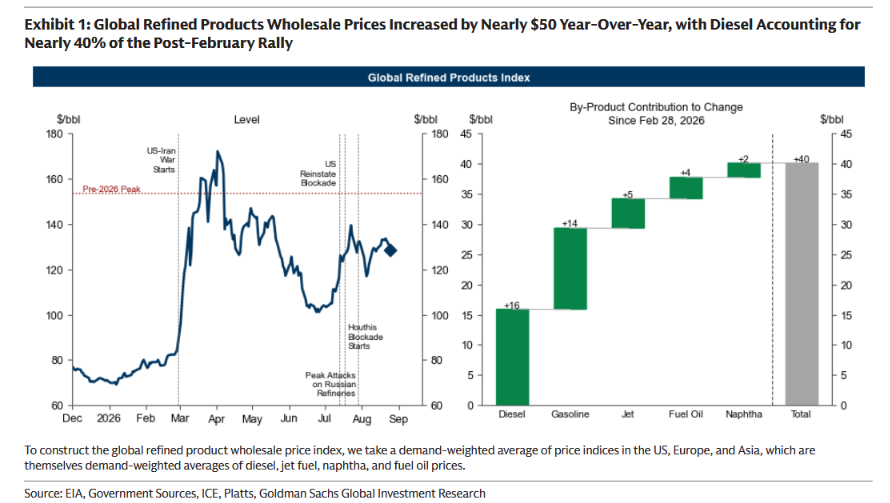
Crude oil prices grab the headlines every day, yet the more important signal is happening further on down the chain.
On Monday 17th August 2026, the U.S. diesel crack spread (the premium of ultra-low sulfur diesel over West Texas Intermediate aka WTI), hit a high of $102.20.
Tracy Shuchart made a fair point that the extreme reading from 17th August may have partly reflected the regional U.S. shortages of refining capacity and pipelines.
I’ve added the NYMEX Monthly chart below for good measure. This was inserted after market close on Monday 31st August 2026. It shows the crack spread futures at $99.98.
All that being said, the broader picture is pretty clear. Diesel cracks are elevated, the trend is still rising (look at the simple 200-day moving average on the chart above), and the market is flashing a big red warning.
First of all, what is a diesel crack spread?
A diesel crack spread is the profit margin refiners make by turning crude oil into diesel fuel.
Refineries buy crude oil (WTI, Brent etc) which is classed as the raw material, and then ‘‘crack’’ it down through refining, and out pops the usable products such as gasoline (petrol), diesel etc.
As mentioned above, the diesel crack spread therefore is the difference between the selling price of diesel and the cost of the crude oil.
It’s normally quoted in U.S. Dollars per barrel.
I.e. Diesel = $200
Crude = $100
Crack Spread = $100 because $200 – $100 = $100
The challenge with a higher spread is that diesel is the power of the real economy.
Diesel and inflation
Diesel is the economy. Think farming, airline industries, construction machinery, rail, shipping and most industrial activity to name a few. Higher crack spreads normally signal that diesel supplies are tight relative to demand, thus pushing up prices.
This then gets passed onto the producer, and ultimately the consumer. This is a critical contributor of the inflation process. From a Central Bank point of view, inflation becomes even more problematic if there are high diesel crack spreads.
4 potential key drivers include:
1) Geopolitical disruptions from conflicts i.e. refining capacity decreases and/or export bans
2) Very low inventories
3) Seasonal demand peaks (i.e. agricultural harvest).
4) Limited ability to quickly ramp up global refining capacity to replace lost barrels.
The last point is particularly salient as supply challenges are something that are often mentioned on The Contrarian Capitalist. You simply cannot magic up new refining capacity overnight.
The nature of the constraint
Diesel and middle distillates power the machinery of the real economy. Unlike gasoline, diesel demand is deeply embedded in production and logistics and is less price-elastic in the short run.
U.S. distillate inventories (diesel plus heating oil) were around 107 million barrels in early August. This is the lowest for this time of year since 1996. Refineries are already running hard and exporting large volumes, yet stocks are not rebuilding.
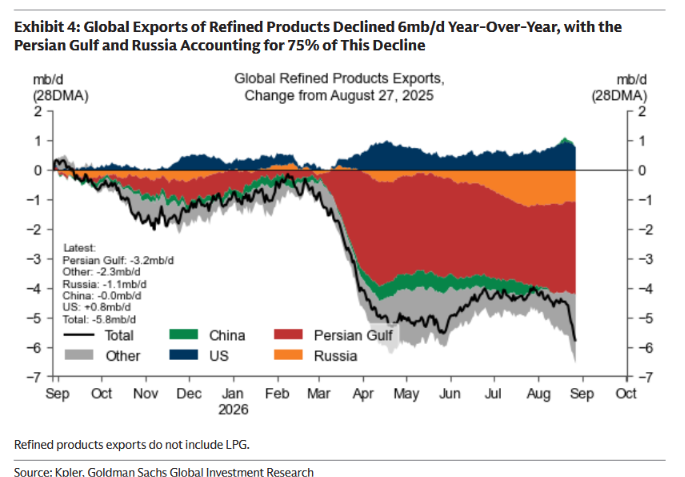
As per point 1 above, global refining capacities have been severely disrupted by ongoing conflicts such as between Russia & Ukraine and also in the Middle East.
China has the largest pool of spare capacity in the world, but export quotas have limited how much of that capacity actually reaches the global market. The result is a structural bottleneck in refined products.
The following analysis breaks down the Fed balance sheet in detail. It shows different parts of the balance sheet and how those amounts have changed. It also shows historical interest rate trends.
Breaking Down the Balance Sheet
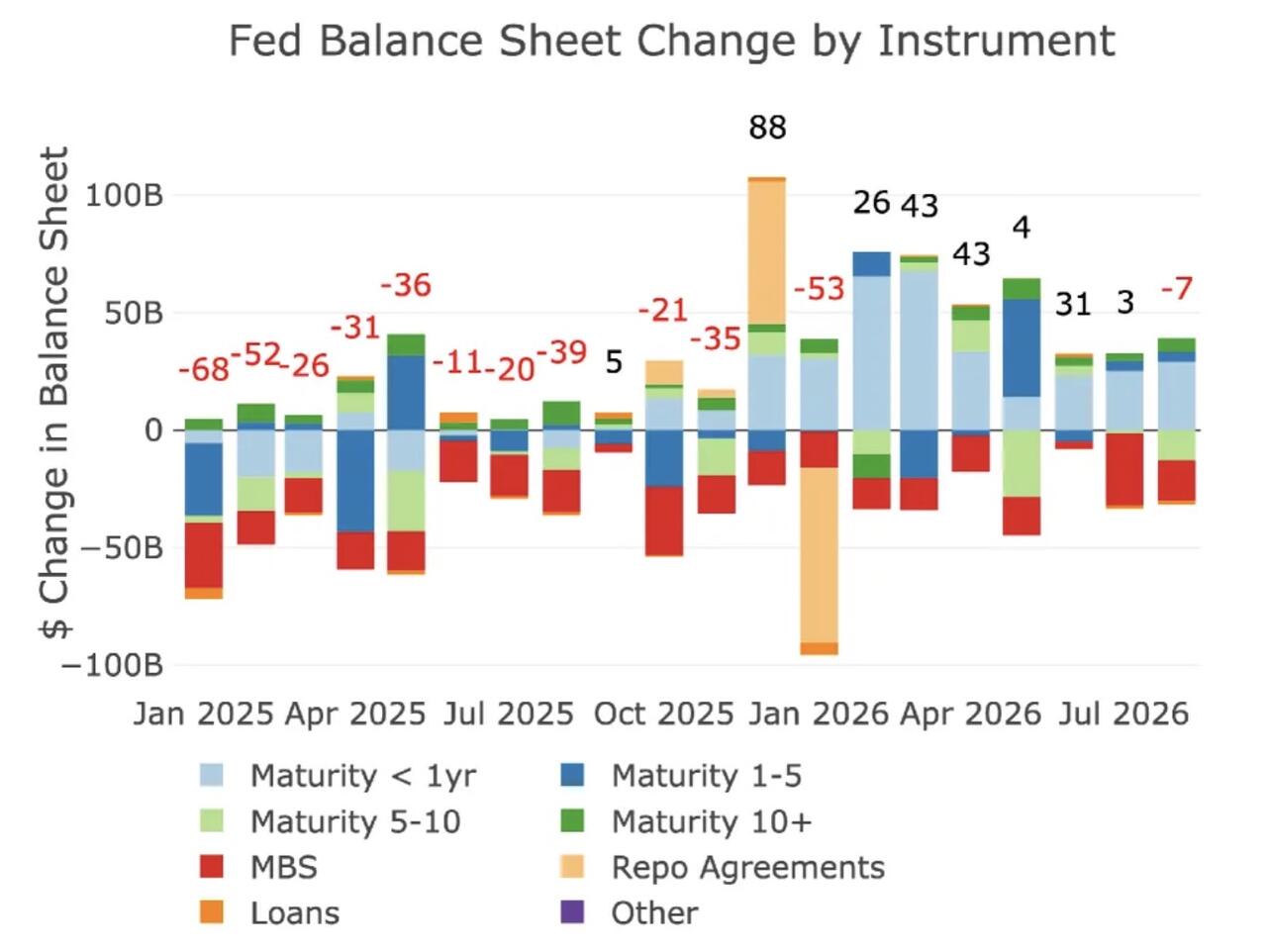
The Fed has quietly been doing Quantitative Easing since February. The pace of accumulation has slowed in recent months, and was even negative in August. When QE was turned back on, it was intended for purchases of Bills to keep liquidity high. As shown below, this is still happening with the Fed accumulating $29B of Bills in August. The net drop came from MBS and 5-10 year notes rolling off.
Figure: 1 Monthly Change by Instrument
Zooming out to 10 years and grouping the data by year shows the next chart. What you should notice is how quickly the Fed will un-do all the “hard work” in reducing the balance sheet during the next crisis. It took 4 years to reduce the balance sheet about $2.2T. However, in 2020, it took a few months to grow the balance sheet by $3T and 2 years to grow it by $4.5T.
So far this year, the Fed has increased the balance sheet by $90B. While this is a small increase relative to past years, it should be noted that the balance sheet is growing and not shrinking. This makes it harder for inflation to come down.
The next time provides more detail on the Fed’s activities and its recent efforts to manage the balance sheet.
The biggest thing to notice is how the Fed has increased the holdings of Bills by $344B over the last year! That is an increase that should not go unnoticed. Why is the Fed focused on buying Bills? Bills are typically the most liquid asset in the Treasury issuance list, so it’s confusing why the Fed has stepped in for…
Treasury Secretary Bessent tried to beat Mr Market by suppressing bond yields. He should know that it can’t be done, and it is being proved not possible yet again.
In recent days, the yield on the 10-year US treasury note has broken out above its three-year consolidation phase, confirmed by its short- and longer-term moving averages in bullish sequence: that is to say, bearish for the price. This is despite Bessent’s intervention at the 4.7% yield level on the 10-year note.
While the yield has yet to exceed the 5% level, it appears to be a hurdle which will be easily overcome because these chart formations, commonly termed pennants after their shape, tend to mark the half-way point in an ongoing trend. This is best illustrated in the chart of the long bond, which is already embarking on the next leg higher. This is next:
Note that this chart is on a logarithmic value scale, illustrating how the percentage move of 250% from the 1.9% low to 5% could run to well over 10% from the breakout over the same brief timescale. The fundamental justification is a combination of the Hormuz and Bab el-Mandab blockades, the debt trap sprung on US government finances, the end of the petrodollar leading to surplus dollar balances in foreign hands, and the global loss of confidence in the dollar from an American geopolitical defeat.
This move to far higher bond yields will almost certainly trigger massive selling of the dollar, a point addressed later in this article. It is a racing certainty that the Secretary Bessent will order the suspension of trading in bonds and equities, as his predecessor William MacAdoo did in July 1914. That time, Wall Street remained shut until the following December. A prolonged market closure today to stop foreign and domestic selling is a real possibility. Don’t get trapped, because if it happens, markets will open considerably lower and investors will face large losses on their investments and on the currency as well.
I shall write about this possibility in a future post.
US fiscal policy is in crisis
In September 1992, Bessent was an intern for George Soros when the British government tried to beat the market by supporting sterling within the ERM snake. With some help from Soros and others, Prime Minister John Major and his Chancellor Norman Lamont were forced to back down and sterling immediately fell 15% against the German mark to which it had been pegged.
Bessent is now in the position of Norman Lamont, who some say was forced against his judgement to follow the orders of his prime minister. Today should be an acute case of déjà vu for Bessent.
This time, Bessent was trying to suppress his borrowing costs by buying long maturity bonds in order to escape a debt trap, brought on by his president’s frankly senseless and unnecessary attack on Iran. It is leading to a complete failure of US foreign policy in the widest geopolitical terms, an inescapable slump in global trade, and substantial foreign liquidation of dollars in foreign hands. The consequences are the triggering of debt traps for the dollar and other G7 currencies; particularly Japan’s yen, Britain’s pound, and the EU’s euro. There is everything at stake.
What is a debt trap?
Anyone who has borrowed money will tell you that you must meet the interest payments to stay out of trouble. And if interest rates rise, you must also be able to meet the extra cost. Failure to do so leads to Micawber’s misery, and probably bankruptcy. What is true for ordinary folk and businesses is also fundamentally true for governments.
Conventionally, government debt-to-GDP is used as a debt comparison. But to judge national creditworthiness, debt-to-GDP estimates should use the private-sector tax base as the proper basis for assessing debt affordability, because debt interest must be covered by tax revenues. The chart below illustrates the position for the G7 member states adjusted for private sector tax bases to give a better perspective for assessing debt affordability. Bond risk is significantly higher than commonly thought due to higher debt ratios.
In the case of the US, government debt has recently crossed the $40 trillion mark, and interest payments have risen to about $1.25 trillion. And instead of debt to GDP of 125%, the US adjusted rate for the private sector which pays the taxes to pay the interest becomes 200%. Obviously, if an economy is no longer growing and tax revenue is declining, bond holders and investors will require greater risk premiums.
The next chart shows the history of growth in government revenues in recent years compared with the growth in outstanding debt to be financed:
There was significant volatility in revenues over the covid crisis, but by 2024 that had settled down. However, in 2026 — the fiscal year ending this month — debt is beginning to grow more rapidly than the revenue available to fund it. Mr Micawber and his warning about financial misery is beginning to be relevant, and you can see why Bessent should be panicking over funding difficulties. It is the fundamental reason for bond yields to start rising again. But the problem with an increase in interest rates is that it worsens the borrower’s debt difficulties: the higher they go the worse it gets. So, we can see how bond yields could soar even further, with each step rise worsening the situation and justifying further yield increases.
This is before the Hormuz debacle hits US corporations and consumers. The headline price of oil has been suppressed by drawdowns from US strategic reserves, which cannot supply much more without risking structural damage to underground storage. But people don’t use crude oil, they use diesel for nearly all land logistics, kerosine for jet fuel, and diesel-like fuel for ship bunkers. Separate them out, and they add up to substantial premiums over the cost of a barrel of oil. The shortages are designated acute with premiums at $70 per barrel compared with normal cracked spreads of $10—$20:
With the cracked components at a premium of nearly $70 over crude, that puts crude at closer to $140 rather than $90 for WTI and $94 for Brent currently. But that is not all. Missing from the Persian Gulf are other vital supplies including fertilisers, sulphuric acid, helium, etc. Making things even worse is China’s understandable decision to stop exporting fertilisers and sulphuric acid as well as other oil derivatives to protect her own supplies. And that’s before we consider other factors driving shortages, such as Ukraine’s successful drone attacks on Russia’s refining facilities causing Russia to cease her diesel exports, having been a major global supplier.
In addition, drought conditions in Europe have stunted cereal yields, and exports from Ukraine of wheat and other cereals have ceased due to their Black Sea ports being blockaded by Russia. Food prices are already heading higher. The chart below is of wheat:
Economic consequences for the US
Clearly, the blockades in the Persian Gulf are not going to be resolved soon and private sector activities are heading for an economic slump. Higher borrowing costs will cause overindebted businesses to fail, and the consequences of significantly higher mortgage rates will undermine property values. The equity market bubble will certainly collapse and putting it altogether, personal wealth will suffer greatly.
At the same time, government finances will face a combined hit of declining tax revenues and rising welfare costs. Lending risk to governments and their private sectors will surely increase almost exponentially, bringing forward the full horrors of a debt trap.
Central banks face a choice: do they just stand aside and watch the carnage unfold while attempting to preserve their currencies’ values? Or do they do what they can to support failing businesses, stop financial markets from collapsing, and bail their governments out?
There is little doubt that politics will demand bailouts, so their currencies will take the hit. It is too late for remedial action. Dumping a currency nearly always starts with foreign sellers. Onshore in the US, they have about $48 trillion tied up in investments and bank deposits:
In addition, there are a further $14 trillion in offshore eurobond markets, and according to a Bank for International Settlements 2022 survey, a further $82 trillion tied up in foreign exchange transactions at any one time. For an economy estimated to have a GDP of $32 trillion, this is a lot of footloose currency overhanging it.
So what do foreign holders of dollars sell them for? The other G7 currencies are in a similar situation to the dollar. In collapsing financial markets, the remedy is usually to buy back into your currency of account, despite its outlook, and buy some gold. Additionally, stockpiles of needed commodities make sense for industrial entities.
But where are the buyers of dollars? They simply don’t exist in any scale, because US holdings of foreign financial assets tend to be denominated in dollars and not other currencies. The consequences for the dollar’s exchange rate in gold and real goods are likely to be catastrophic.
Therefore, we can assume that the fall in the dollar’s value measured in terms of real things is set to become precipitous. Led by the dollar, other fiat currencies are sure to follow. In the light of debt traps and their consequences, we can see why it is that the major fiat currencies are losing value at an accelerating rate measured in gold, which has no counterparty risk:
Getting out of credit and into real physical money has never been so urgent. As a footnote, there was a similar scare at the outbreak of WW1, when foreign selling of some $4 billion in US investments was feared when the banking system had only $1 billion in gold reserves. Treasury Secretary William MacAdoo addressed this fear by ordering the closure of the stock exchange on 31st July 2014, not reopening until that December. We can see this happening again.
END
CHRIS POWELL AND HIS GATA DISPATCHES
4. ANDREW MAGUIRE//KINESIS LIVE FROM THE VAULT/287
END
5. COMMODITY REPORT: GOLD
LUKE GROMEN: (FROM ROBERT LAMBOURNE TO US)
:Luke Gromen on X: “@NorthstarCharts Nothing more bullish for gold and silver than rates rising on an insolvent government that has a printing press” / X
Inbox
Robert Lambourne
3:06 AM (53 minutes ago)
to Chris, me
The chart here is evidence, in my opinion, of 40 years of gold price suppression.
It’s unbelievable that this still seems to be the knee jerk policy of choice when fighting restarts in the Iran conflict.
I read that the USA has probably already lost another $1 billion on interceptors fired at Iranian missiles targeting the bases in Jordan in recent days. So an eventual gold price reset will have to cover writing off even more $ debt.
@NorthstarCharts Nothing more bullish for gold and silver than rates rising on an insolvent government that has a printing press
Bloomberg Agri Index Posts Biggest Monthly Jump Since Arab Spring Riots As Food-Crisis Risks Mount
Wednesday, Sep 02, 2026 – 08:35 AM
The Bloomberg Agriculture Spot Index (BCOMAGSP) posted its largest monthly gain since the chaotic days of the Arab Spring riots and is nearing a breakout above its 2023 highs, signaling a broad-based acceleration in agricultural commodity prices. The upside momentum comes as Wall Street increasingly warns that a perfect storm of factors, from El Niño and higher fertilizer and diesel prices to disruptions in the Black Sea and the Strait of Hormuz, could push the global food system toward another crisis.
From veteran commodities strategist Jeff Currie turning bullish and UBS urging clients last week to “position for a commodity upcycle” to warnings from Barclays analyst Craig Rye and JPMorgan analyst Nora Szentivanyi, the message from Wall Street is becoming increasingly harder and harder to ignore: Agricultural prices are breaking out, raising the risk that today’s physical commodity squeeze develops into a worldwide food crisis next year.
For August, BCOMAGSP logged an impressive 13.5% gain, its largest monthly increase since July 2012’s 14.3% gain – around the time of Arab Spring spread across Egypt, Libya, Yemen, Syria, and Bahrain.
BCOMAGSP is up 39% from its 2024 low. If the upside momentum continues, the index, which tracks major crops and soft commodities, is poised to take out its 2023 highs.
1. Hormuz tanker strikes send Brent above $92. Two oil tankers were struck in the Strait of Hormuz overnight. Brent traded around $92.20, up roughly 2%, while WTI traded between $87.80 and $88.00, up approximately 2.3% to 2.6%.
2. Gold falls below $4,400 as the 10-year yield approaches 4.79%. Spot and futures gold traded between approximately $4,370 and $4,400, down roughly 1.3% to 1.9% following Warsh’s hawkish Jackson Hole remarks. Markets are pricing in approximately 60% odds of a September hike.
3. Silver breaks into the $65 range, while palladium fares worse. Silver traded between approximately $64.70 and $65.40, down 2.4% to 2.7%; palladium traded around $1,340, down roughly 2.8%; and platinum traded around $1,768, down approximately 1.5%. Gold and silver are selling off together with rising yields, suggesting this is not an isolated gold ETF liquidation.
4. Chinese refiners bid ESPO to a $7 premium over Brent.
6. Long-term uranium hits another all-time high at approximately $96.50 per pound. The blended UxC and TradeTech long-term U3O8 price reached $96.50, while the UxC long-term price rose $2 to $96. Spot uranium traded between approximately $89.60 and $89.75, up roughly $3.
7. Distillate tightness remains the underreported oil story. Heating oil traded around $4.46, up 1.1%, while gasoline gained only 0.4% to approximately $3.09. Older but still relevant research continues to circulate showing US distillate inventories at 23-year lows and 13% to 14% below seasonal norms. Crude inventories are 6% below the five-year average following an eight-week, 47.5-million-barrel draw.
8. US Henry Hub remains weak at $2.92, while TTF and UK gas surge. NYMEX natural gas traded around $2.92, down 0.3%; TTF traded around €71.50, up 2.4%; and UK gas surged approximately 7%. US natural gas remains the orphan of the energy complex.
10. Copper slips roughly 1% despite the oil shock, highlighting the split between growth concerns and physical tightness. COMEX copper traded between approximately $6.51 and $6.61, down roughly 1.2%. Prices remain near cycle highs, with an August peak of approximately $6.75 and LME copper near $14,400 per ton. The physical-tightness and US inventory-migration story from August is fading into a rates- and growth-driven market.
11. Long-term breakouts in wheat and soybeans remain in play. Chicago wheat gained approximately 1.5% to 2%, trading between roughly 772 and 785, while soybeans gained around 1%, trading between approximately 1,288 and 1,301. Soft-commodity commentary indicates that wheat, soybeans and sugar have made long-term bullish breakouts, while cotton remains offered.
12. The ISM Manufacturing PMI is today’s key event risk for the entire commodity complex. Foreign-exchange and commodity desks have flagged the ISM report as the session’s primary catalyst on top of Warsh and Hormuz. A strong print could increase the odds of another rate hike, inflicting further pain on gold and silver while producing a mixed response in copper. A weak print could trigger a risk-off move that still lifts oil if interpreted as stagflationary.
13. Trump’s SPR-for-Venezuelan-oil proposal and the country’s 65 billion barrels of reserves.
14. UAE refinery returns to full capacity after sustaining wartime damage.
15. Ukraine strikes the Ust-Luga oil terminal on the Baltic Sea.
16. Retail investors continue buying the gold dip, while CTAs and broader positioning appear offered.
END
COMMODITY TUNGSTEN: UPDATES
The West’s Answer To Break China’s Tungsten Stranglehold Before Historic Rearmament Cycle Ramps
Wednesday, Sep 02, 2026 – 12:40 PM
New reports emerged late Tuesday during the US cash session that the US military had struck targets inside Iran. If confirmed, the operation would mark a rare instance of US strikes occurring during regular market hours. Market(ing) tactics aside, the now six-month military campaign against Iran has also exposed a critical operational vulnerability: the US military is facing an alarming shortage of advanced missiles and interceptors.
However, the crisis extends well beyond procuring replacement missiles from major defense firms. The deeper vulnerability lies farther upstream, where the rare earths and critical materials required for guidance systems, seekers, propulsion components, warheads, and interceptors remain scarce and heavily concentrated in China, even as Beijing increasingly weaponizes export controls of metals against the West.
On Monday, the Department of War said it had secured seven-year agreements with General Dynamics Ordnance and Tactical Systems and Lockheed Martin to rapidly expand US missile-production capacity and replenish depleted inventories.
The agreements are intended to increase output and accelerate deliveries of critical missile subcomponents supporting the Terminal High Altitude Area Defense (THAAD) system and the Patriot Advanced Capability-3 Missile Segment Enhancement interceptor.
A separate report from AP News highlighted another driver of defense demand: the US Army’s new Precision Strike Missile, or PrSM, is intended to replace the Army Tactical Missile System, or ATACMS, which has served as the service’s primary deep-strike weapon for decades. The PrSM’s fragmentation warhead requires large quantities of tungsten pellets.
Tungsten is extremely effective as a penetrator because it combines one of the highest densities of any metal with the highest melting point. When a PrSM warhead detonates above its target, thousands of small, lethal tungsten pellets are dispersed at extreme speeds. The metal’s density and ability to retain its shape enable those fragments to penetrate building walls, vehicle panels, equipment housings, and many forms of advanced armor after the initial blast wave has dissipated like a shotgun blast.
This is where the DoW’s historic weapons rearmament cycle collides with a critical materials supply crisis spreading across the Western world.
The State Department and DoW already understand the vulnerability. Tungsten, one of the most strategically important metals used across the defense-industrial base, is entering what investment research firm The Oregon Grouphas described as a major structural supply crisis.
A frantic effort is now underway across the West to secure non-Chinese tungsten. China accounted for about 79% of global mined tungsten production in 2025 and controls roughly 85% of refining capacity. Meanwhile, Chinese mine output has dropped 10% year over year, even as Beijing restricted tungsten exports to Western markets since early 2025.
The Oregon Group highlighted one of the clearest warnings yet: Even if every announced tungsten project ex-China reaches production by 2030, the global market could still face a massive structural deficit.
“Eleven announced mine projects are forecast to add nearly 20,000 tonnes of annual capacity by 2030, lifting accessible ex-China supply to an estimated 34,000 tonnes WO₃, against projected primary demand of roughly 50,000 tonnes after recycling, which would leave the market facing a deficit of 16,000 tonnes WO₃,” the research firm stated in a new report.
That tightening physical market picture brings us to Almonty Industries, which controls the Sangdong mine in South Korea, one of the largest and highest-grade tungsten deposits outside China, as well as Panasqueira Mine in central Portugal, which is considered one of Europe’s largest and oldest continuously operating tungsten and tin mines.
With Sangdong ramping toward full production, Almonty has transitioned from a junior mining company into an increasingly important supplier to the Western defense-industrial base, one which is on the radar of the Trump administration.
At planned Phase II capacity, Sangdong could produce roughly 4,000 tons of tungsten annually. That would represent about 4% to 5% of global mine production and around 20% of current tungsten output outside China.
In its latest investor deck, Almonty said it is “targeting to become the leading Western producer of tungsten by reaching expected full-scale production after completion of Sangdong Phase II and the Panasqueira L4 extension” by mid-2027.
Almonty CEO Lewis Black has previously said, “Almonty controls one of the largest and highest-grade tungsten deposits outside of China at precisely the moment Western governments and defense manufacturers are rebuilding their critical-minerals supply chains around non-Chinese sources.”
The timing of Sangdong’s planned move toward full-scale production by mid-2027 is significant because the DoW’s supply clock is already ticking. The West’s effort to break China’s stranglehold over critical materials is colliding with a historic military rearmament cycle.
Tungsten demand extends well beyond defense, including as a critical building block in AI chips (read here).
That convergence places Almonty at the center of the emerging conflict-free tungsten supply chain and could transform Sangdong and Panasqueira mines into one of the world’s most important sources of non-Chinese tungsten.
Almonty is one of the handful of pure-play publicly traded miners positioned for the accelerating decoupling from Chinese critical materials . Among all publicly traded global tungsten miners, it’s the only US-listed producer.
Any post-Trump-Xi summit escalation next month, including potential sanctions against Chinese banks (Politico warns), could trigger further metal restrictions and sharply increase the value of tungsten currently priced above $3,000 a ton.
That makes Almonty more than a tungsten trade.
Almonty is a pure-play bet on the West’s first real shot at breaking China’s 79% grip on mined tungsten before the rearmament cycle ramps up and before further possible export controls turn an already tight market into a severe shortage. Sangdong is already producing, Phase II begins next year, and the balance sheet is funded. This is a concentrated bet that one producer can help break Beijing’s grip and become the swing supplier the US and its allies can rely on.
And in a preview of what is to come, Jefferies just initiated coverage (full report available to pro subscribers) on Almonty today with a Buy rating and a $26.25 price target, more than 50% upside from today’s price.
END
YOUR EARLY CURRENCY VALUES/GOLD AND SILVER PRICING/ASIAN AND EUROPEAN BOURSE MOVEMENTS/AND INTEREST RATE SETTINGS WEDNESDAY MORNING.7:30 AM
SHANGHAI CLOSED DOWN 38.50 PTS OR 0.97%
HANG SENG CLOSED DOWN 18.52 PTS OR 0.07%
Nikkei CLOSED DOWN 1964.34 PTS OR 2.96%
//Australia’s all ordinaries CLOSED UP 0.08%
//Chinese yuan (ONSHORE) CLOSED DOWN TO 6.7223
/ OFFSHORE CLOSED DOWN AT 6.7240 Oil UP TO 90.13 dollars per barrel for WTI and BRENT UP TO 94.31 Stocks in Europe OPENED ALL RED
ONSHORE USA/ YUAN// WITH YUAN TRADING DOWN (6.7223 OFFSHORE YUAN TRADING DOWN TO 6.7240 ONSHORE YUAN TRADING ABOVE LEVEL // OFF SHORE AND DOWN ON THE DOLLAR)// / AND THUS WEAKER/OFF SHORE YUAN TRADING DOWN AGAINST US DOLLAR/ AND THUS WEAKER
XXXXXXXXXXXXXXXXXXXXXXXXXXXXXXXXXXXXX
ONSHORE YUAN: CLOSED DOWN AT 6.7223
OFFSHORE YUAN: DOWN TO 6.7240
1.HANG SANG CLOSED DOWN 18.52 PTS OR 0.07%
2. Nikkei closed DOWN 1964.34 PTS OR 2.96%
WEST TEXAS INTERMEDIATE OIL UP TO 90.13
BRENT; 94.81
3. Europe stocks SO FAR: ALL RED
USA dollar INDEX UP 7 BASIS PTS TO 99.71// EURO FALLS TO 1.1581 DOWN 9 BASIS PTS
3b Japan 10 YR bond yield:RISE TO. +3.004 UP 1 FULL BASIS PTS/ VERY TROUBLESOME//Japan buying 100% of bond issuance)/Japanese YEN vs USA CROSS NOW AT 159.72… JAPANESE YEN NOW FALLING AS WE HAVE NOW REACHED THE ENDING OF THE YEN CARRY TRADE AGAIN AND THE REPATRIATION OF YEN DENOMINATED BONDS TRADING IN THE USA/EUROPE. JAPAN 30 YR BOND YIELD: 4.152 DOWN 3 FULL BASIS PTS
3c Nikkei now ABOVE 17,000
3d USA/Yen rate now well ABOVE the important 120 barrier this morning
3e Gold DOWN /JAPANESE Yen UP CHINESE ONSHORE YUAN: DOWN (6.723) AND OFFSHORE: DOWN AT 6.7240
3f Japan is to buy INFINITE TRILLION YEN worth of BONDS. Japan’s GDP equals 5 trillion USA. CENTRAL BANK OF JAPAN WILL NO LONGER DO QE.
Japan to buy 100% of all new Japanese debt and NOW they will have OVER 50% of all Japanese debt. GOVERMENT ASKED JAPAN PENSION FUNDS AND INSURANCE FUNDS TO BUY MORE JAPANESE BONDS AND REPATRIATE ALL FOREIGN BONDS.
3g Oil UP for WTI and UP for Brent this morning
3h European bond buying continues to push yields HIGHER on all fronts in the EU German 10yr bund YIELD UP TO +3.3842/ Italian 10 Yr bond yield UP AT 4.236/ SPAIN 10 YR BOND YIELD UP TO 3.8430%
3i Greek 10 year bond yield UP TO 4.075%
3j Gold at $4320.70/Silver at: 63.96 1 am est) SILVER NEXT RESISTANCE LEVEL AT $100.00
3k USA vs Russian rouble;// Russian rouble UP AND 0/ 100 roubles/86.81
3m oil (WTI) into the 90 dollar handle for WTI and 94 handle for Brent/
3n Higher foreign deposits moving out of China// huge risk of outflows and a currency depreciation. This can spell financial disaster for the rest of the world/
JAPAN ON JAN 29.2016 CONTINUES NIRP. THIS MORNING RAISES AMOUNT OF BONDS THAT THEY WILL PURCHASE UP TO .5% ON THE 10 YR BOND///YEN TRADES TO 159.72 // 10 YEAR YIELD AFTER FIRST BREAKING .54% LAST YEAR NOW EXCEEDS THAT LEVEL TO 3.004% UP 1 BASIS PTS STILL ON CENTRAL BANK (JAPAN) INTERVENTION//YEN CARRY TRADE NOW UNWINDING//YEN BOND TRADING OVERSEAS TO BE REPATRIATED.//JAPAN 30 YR: 4.152 DOWN 3 PTS..: USA/SF this 0.8144 as the Swiss Franc . Euro vs SF: 0.9432
USA 10 YR BOND YIELD: 4.805 UP 2 BASIS PTS…DANGEROUSLY CLOSE TO 5.00%
USA 30 YR BOND YIELD: 5.2790 UP 1 BASIS PTS/REFUSES TO GO DOWN WITH BESSENT’S QE TWIST
USA 2 YR BOND YIELD: 4.398 UP 2 BASIS PTS
USA DOLLAR VS TURKISH LIRA: 48.30 UP 2 BASIS PTS/LIRA GETTING KILLED//IDIOTS FOR SELLING GOLD AND USA DOLLAR RESERVES.
10 YR UK BOND YIELD: 5.2686 UP 4 PTS
30 YR UK BOND YIELD: 5.8950 UP 2 BASIS PTS
10 YR CANADA BOND YIELD: 3.748 UP 1 BASIS PTS
5 YR CANADA BOND YIELD: 3.353 UP 1 BASIS PTS.
1a New York Opening report
Futures Swing As Global Bond Yields Follow Oil Tick For Tick
Wednesday, Sep 02, 2026 – 08:18 AM
US equity futures are lower with Tech underperforming as oil prices / bond yields move higher (although off session highs), both in response to an acceleration in “kinetic hostilities” in the Middle East. As of 8:00am ET, S&P futures are down 0.1%, off session lows, while Nasdaq futures rise 0.4% after Dell shares jumped after the company boosted its annual sales forecast by $25 billion. In premarket trading, Semis / Memory are weaker and AVGO is -53bp with earnings after the Close today. Mag7 are mostly lower as are Software names with Hardware buoyed by earnings. Defensives and Energy gain while Cyclicals drop. According to JPM’s Market Intel team, which on Monday turned Neutral on stocks (from Bullish), equities will continue to struggle until crude / rates stabilize. Europe’s Stoxx 600 retreated 0.7%, while Asian stocks fell the most in two weeks. WTI trades around $90/bbl as the yield curve steepens, having erased gains from Bessent’s “Treasury Twist”. The Dollar is also higher as the Debasement trade continues to struggle. Commodities are mostly lower with Energy the lone bright spot and Ags underperforming Metals; keep an eye on gold to see if $4,300 acts as support. Today’s macro data focus is on the August ADP employment change (8:15am) and July factory orders (10am). Fed calendar is blank apart from Beige Book release at 2pm
In premarket trading Mag 7 stocks are mixed (Alphabet +0.1%, Apple +0.2%, Tesla +0.1%, Nvidia -0.1%, Meta -0.2%, Amazon -0.2%, Microsoft -0.4%)
Credo Technology (CRDO) falls 9%, suggesting that the communications equipment company’s second-quarter revenue forecast beat was not good enough to impress investors after the stock’s 44% rally this year.
Dell Technologies (DELL) jumps 8% after the company boosted its annual sales forecast by $25 billion due to surging demand for servers to run artificial intelligence tasks.
EyePoint (EYPT) slips 3% after TD Cowen downgraded the drug developer to hold, citing a challenging regulatory path following a trial failure for an eye disease drug.
FuelCell (FCEL) tumbles 15% after the power plant builder reported revenue for the third quarter that missed the average analyst estimate.
G-III Apparel (GIII) falls 10% after the clothing company posted disappointing second quarter sales and provided a third quarter revenue forecast that also missed expectations.
GitLab (GTLB) surges 21% after the software company boosted its revenue guidance for the full year, beating the average analyst estimate.
Knife River (KNF) falls 2% after JPMorgan analyst Adrian Huerta cut the recommendation on the building materials company to underweight, writing that he doesn’t expect a “meaningful change” in public funding in Oregon, its largest market.
MongoDB (MDB) is down 12%, with growth in the software company’s Atlas product seen coming in below elevated expectations. However, analysts are broadly positive on the results overall, which topped expectations, while the full-year forecast was raised.
Sprinklr (CXM) falls about 2% after reported second-quarter revenue that was slightly weaker than expected; the software company’s stock has soared about 55% off a June low, as of its last close.
In other corporate news, Nvidia is in advanced talks to acquire artificial intelligence startup Hugging Face in a transaction that may total about $14 billion. Artificial intelligence coding startup Cognition AI is set to close a new round of funding that would vault its valuation to about $47 billion. GitLab shares rally as much as 20% in premarket trading after the software company beat second-quarter expectations and boosted its full-year forecast.
Brent crude hovered near $94 a barrel and WTI traded around $90 (although it has since dipped below) after Washington carried out its second round of attacks against Iran in three days. US diesel prices hit the highest since April. Bonds fell in most major markets, with the 30-year Treasury yield trading at 5.28%, near the 19-year high hit before Treasury Secretary Scott Bessent’s recent intervention. Chipmakers were under pressure in premarket trading even after Dell surged on a strong revenue forecast.
The latest rally in energy prices is compounding worries about persistent inflation, pushing up the premium traders demand for bonds already straining under heavy government spending and corporate demand. Traders put the odds of rate hikes this month at more than 50% for three major central banks, including nearly 70% for the Fed.
“The new baseline seems to be that the Fed will, after all, hike rates in September,” wrote Chris Turner at ING Groep NV. “Fed Chair Kevin Warsh has made it reasonably clear that inflation is not falling quickly enough to target and, given a reasonably strong economy, the Fed will need to act.”
While the selloff in bonds is showing few signs of letting up, the relatively modest moves in yields have offered traders some assurance. The retreat has been orderly and broad-based, rather than driven by credit risks or liquidity stress, said Stephan Kemper at BNP Paribas Wealth Management Germany.
“It suggests the market is pricing a higher-for-longer rate path, not a credit event or recession,” Kemper said. The key to lower yields lies in inflation expectations, he said, adding that any relief on longer-dated rates could “trigger a strong move higher in equities as fundamentals remain very strong.”
Dell became the latest company to reinforce optimism around the AI trade. The company increased its annual sales forecast by $25 billion in a further sign of surging demand for servers to run AI tasks. The stock — already the third-biggest boost to the S&P 500 after a 240% rally this year — jumped another 9.3% in premarket. Shares of HP Enterprise, which reports earnings after the market close, also rose, advancing 5.2%.
Yet, there are signs that investors are addressing lingering worries about high AI-linked valuations by expanding exposure. Around 115 S&P 500 stocks are on Evercore ISI’s “negative beta” list, where the rolling six-month one-day percentage change is inverse to the benchmark. The share has crossed levels last seen in the dot-com bust in 2000-2001, suggesting that “investors have proactively sought diversification” rather than waiting for a “bubble burst,” strategist Julian Emanuel writes.
Robust signals from Corporate America are offering equities a measure of support. Corporate cash piles are back to record highs despite the surge in AI spending, according to analysis by Societe Generale SA. Investors have also continued to pour money into equities, with global stocks attracting about $1.1 trillion this year, the strongest inflows since 2021, according to data from HSBC Holdings Plc.
While stock markets have remained relatively resilient, “that’s likely going to change once Treasury yields and Japanese yields break through current resistance levels,” said Patrik Lang at Global Gate Asset Management. “Positioning is a bit stretched, and short-term indicators are at overbought levels,” he said. “All of that points, regardless of the fundamental situation, to consolidation in the coming weeks.”
Elsewhere, governing Council member Joachim Nagel indicated that the European Central Bank will raise borrowing costs next week, though he stayed wary on what comes after that. Bank of Japan Board Member Hajime Takata, one of the bank’s most hawkish members, also left the door open for an outsized interest-rate increase.
European stocks are heading for a third day of declines, while futures are also pointing to a lower open on Wall Street as rising bond yields continue to deter investors. Higher oil prices continue to play a role, with Brent crude futures at around $95 a barrel. European natural gas futures have risen close to 3%. Here are the biggest movers Wednesday:
Deutsche Bank shares rise as much as 2.5% to trade at a new 15-year high after Goldman Sachs analysts upgraded the German lender to buy, predicting it to deliver faster earnings growth than the wider sector from 2027
InterContinental Hotels shares gain as much as 2.4% after UBS upgraded the hotelier to buy, to reflect an “attractive opportunity,” with the stock now trading at a discount or a lower-than-historical premium to certain peers
Syensqo rises as much as 3.7% as private equity firms including Blackstone and Apollo Global Management consider bids for the chemical company’s performance and care division, according to people familiar with the matter
TT Electronics jumps as much as 13% after the maker of electronic components for performance-critical applications posted stronger 1H profit growth than expected and said annual earnings are expected to be above current expectations
PGE rises as much as 2.8% after Poland’s largest utility posted strong preliminary 2Q earnings that confirmed it’s benefiting from rising power prices, and its large coal production is helping insulate it from gas supply risks
Lottomatica shares fall as much as 11.5%, the biggest intraday drop since May 2023, after the Italian gaming group announced an all-share deal to acquire Spanish rival Cirsa
GEA Group shares fall as much as 3.6% after the company’s biggest shareholder, Kuwait Investment Authority, offered part of its stake in the German firm at a discount to the previous close
GB Group shares tumble as much as 5.7%, briefly hitting their lowest level since 2014, after being downgraded at Berenberg in wake of the identity verification and fraud prevention company lowering its guidance last month
Asian stocks fell, following US peers lower as renewed concerns over rising oil prices and global bond yields fueled worries about the outlook for interest rates. The MSCI Asia Pacific Index dropped as much as 2.1%, snapping a six-day rally, with technology driving broad-based declines. South Korea’s Kospi slid 4% and Japan’s Nikkei fell 2.9% while benchmarks fell 1% or more in Taiwan, China and Australia. New Zealand stocks bucked the region’s broader losses and rose after the nation’s central bank raised its key interest rate for a second straight meeting in an effort to head off inflation. A rate decision is due Thursday in Malaysia.
Nick Ferres, chief investment officer at Vantage Point Asset Management, sees reason for caution. “Our sense is that the level of rates is near the point where it starts to pressure public, private balance sheets and equity valuations,” he said. “There is downside risk to risk assets in the near term.”
In FX, The Bloomberg Dollar Spot Index is up almost 0.1%. The yen is outperforming, rising 0.2% against the greenback after BOJ’s Hajime Takata left the door open for an outsized interest-rate increase.
Treasury futures edge higher in early US session, paring small declines that lifted 2- to 10-year yields to fresh YTD highs. US 10-year yield is little changed around 4.80%, earlier rising just shy of 4.82%, with German and UK counterparts higher by 4bp and 5bp respectively; US 2s10s spread is around 1bp steeper on the day, near middle of Tuesday’s range. Bunds and gilts remain under pressure following Treasuries’ late Tuesday slide: UK 10-year yields are up ~6 bps to 5.28%, the highest since 2007, and German 10-year yields are nearing 3.4%, having not topped that level since 2011. Muting Wednesday’s price action so far, oil’s advance stalled as investors weigh latest breakout of US-Iran hostilities. Japanese front-end yields climbed during Asia session after BOJ board member Hajime Takata left the door open for an outsized interest-rate increase as well as back-to-back hikes. IG dollar issuance slate includes several deals already; five offerings totaled $6 billion on Tuesday.
In commodities, WTI crude oil futures are down 0.5%, S&P 500 futures 0.2% as intensifying US-Iran hostilities support oil near top of recent ranges. Precious metals and Bitcoin are down.
US economic data calendar includes August ADP employment change (8:15am) and July factory orders (10am). Fed calendar is blank apart from Beige Book release at 2pm
Market Snapshot
Top Overnight News
Iran has gone about seven weeks without shipping meaningful crude exports through the Strait of Hormuz, as a U.S. naval blockade succeeds where years of sanctions failed by cutting off one of Tehran’s main sources of foreign-currency earnings. Unlike previous sanctions campaigns, when Iranian crude continued reaching buyers despite restrictions, the current blockade has stopped fresh crude cargoes reaching China, Tehran’s only major remaining oil customer, increasing pressure on government finances and foreign-currency reserves. Reuters
Fighting between the US and Iran over control of the Strait of Hormuz intensified after a period of relative calm, triggering a fresh jump in oil prices. The US military carried out strikes targeting radar systems and mine-laying capabilities along Iran’s southern coast, and Iran retaliated with drone and missile volleys on US bases across the Middle East: BBG
The U.S.-Canada trade standoff is threatening to stretch past the midterm elections. The White House is shrugging off the threat. With a week to go before Canada imposes its retaliatory tariffs, aimed at key industries in states like Ohio and Texas with competitive Senate elections, tensions between Washington and Ottawa are at a steady simmer, with no sign of de-escalation. Politico
Russia since 2023 has been helping Iran develop advanced supersonic cruise missiles, and Putin has vowed to continue to provide support to Iran. FT/Washington Post
Bank of Japan Board Member Hajime Takata, one of the central bank’s most hawkish members, left the door open for an outsized interest-rate increase as well as back-to-back hikes, indicating he might push for a faster pace of tightening. The BOJ has raised its benchmark interest rate in quarter-point increments in the most recent three moves, while spacing the moves roughly six months apart. The size and frequency may change as circumstances evolve. BBG
Governor Kazuo Ueda said on Tuesday that the Bank of Japan will debate raising interest rates including in September with a focus on whether inflationary risks were heightening, signaling a strong chance of a hike this month. Reuters
The Reserve Bank of New Zealand raised interest rates Wednesday, warning that risks for higher inflation remain in play for the economy. The central bank raised the official cash rate by 25 basis points to 2.75%, in line with market expectations. BBG
A closely followed measure of artificial intelligence token prices touched fresh lows this week, the latest sign of deflating prices in an increasingly competitive landscape.
Anthropic is releasing a new version of its powerful Fable artificial intelligence model that it says is better at coding and science tasks, as well as more economical. BBG
OpenAI is to restrict Astra model after rating it a critical cyber risk: WSJ.
Dell became the latest company to reinforce optimism around the AI trade. The company increased its annual sales forecast by $25 billion in a further sign of surging demand for servers to run AI tasks. BBG
Iran News
US President Trump posted “I’m not trying to force Iran to the bargaining table, as ABC Fake News reported. I couldn’t care less if they sign a worthless, to them, agreement. I like our position now much better, with almost total control of the Hormuz Strait, and their economy totally collapsing. They are just playing out the inevitable.”
US Treasury Secretary Bessent said Iran doesn’t control the Strait of Hormuz and the US took out Iranian radar along the strait, as well as got 17mln bbls of crude out on Monday. Bessent said that China pays Iran in yuan and when yuan cannot be converted to dollars, Iran starves, while he said they are in an acceleration phase of Iran bankruptcy and maybe Iran will lash out more kinetically.
US Central Command said forces successfully completed a wave of strikes against Iranian military targets on September 1st in which they struck targets including air defence sites, radar systems, maritime assets and facilities, mine laying capabilities, and communications sites.
US strikes on Iranian targets on Tuesday included two Iranian government tankers under a new ‘tanker for tanker’ approved by US President Trump to deter Iranian attacks on tankers, according to Axios. Furthermore, US officials said around 100 targets were attacked during the strikes, while it was separately reported that the US assessed Iran was planning to expand attacks against commercial ships.
Pakistan’s foreign ministry said Army Chief Munir visited Tehran and generated substantial momentum on the Strait of Hormuz issue and that Pakistan is positive about all parties returning to the negotiating table.
Iran’s IRGC said two tankers were blown up and stopped a few hours ago after striking mines in the Strait of Hormuz. IRGC also warns of additional penalties for shipping companies.
IRGC said it targeted US bases in Erbil, Iraq with missiles and drones. Iran’s army also launched drone attacks on the US base in Bahrain, while Kuwaiti air defences confronted attacks by hostile drones. Additionally, the IRGC said it attacked a US Marines base in Jordan known as Camp Tibtain with missiles and claimed that a large number of US forces were killed in the attack. However, US and Jordan officials reported no casualties.
Russia has been secretly helping Iran develop advanced supersonic cruise missiles, according to FT.
A more detailed look at global markets courtesy of Newsquawk
APAC stocks were pressured as the risk-off mood persisted following a surge in oil prices and upside in yields, triggered by the latest exchange of US-Iran strikes, while President Trump warned that the “biggest attack of them all… is waiting in the wings” and that there will be very little left of Iran. ASX 200 was dragged lower by underperformance in miners, materials, resources and tech stocks, while better-than-expected GDP data was overshadowed by the geopolitical escalation in the Middle East. Nikkei 225 fell amid pressure from mining and tech, while there were comments from US Treasury Secretary Bessent, who called on Japan to stop reflation and shift from Abenomics to Takaichi-nomics. KOSPI led the declines in the region with tech stocks hit alongside the higher yield environment. Hang Seng and Shanghai Comp conformed to the broad downbeat mood amid weakness in some auto names following monthly sales updates and with the mainland not helped after the PBoC’s open market operations amount was at zero.
Top Asian News
US Treasury Secretary Bessent said he emphasised the importance of sound formulation and communication of monetary policy to anchor inflation expectations in a meeting with BoJ Governor Ueda. Furthermore, he expressed strong support for Japan’s decisive market and monetary steps to address the substantial undervaluation of the yen, while he noted the role of yen weakness in contributing to domestic inflationary pressures in Japan.
US Treasury Secretary Bessent said Japan should stop the reflation now and that Abenomics is done, stating that Abenomics has worked and it is time for Takaichi-nomics. Bessent also commented that Japan is one of the most vibrant economies of the world now and that it succeeded in reflating, but now needs to shift.
European bourses trade lower again on Wednesday, as the US and Iran exchange strikes for a second consecutive night. US CENTCOM said forces successfully completed a wave of strikes against Iranian military targets, while Iran’s IRGC said it targeted US bases in Iraq and launched drone attacks on the US base in Bahrain. Sectors have a slight negative tilt. Banks top the sector pile, with Travel & Leisure and Telecoms rounding out the sector outperformers. To the downside is Autos, followed by Media and Retail. An update from STOXX is lifting Nokia (+1.0%) this morning, after announcing that the Finnish telecom giant, alongside Engie (-0.3%), will join the Euro Stoxx 50. This will be effective September 21st, replacing Volkswagen (-2.7%) and Wolters Kluwer (-2.7%) in Europe’s blue chip index.
Top European News
Spanish Unemployment Change (Aug) 44.419K vs. Exp. 15.4K (Prev. 19.517K).
FX
Mixed action in FX today with G10s continuing the bias seen throughout the week, USD is stronger against most peers as yields fail to moderate, NZD to the greatest extent but JPY outperforming (USD/JPY -0.4%).
JPY is stronger in all major crosses with performance pronounced in EUR/JPY after pressure in the early European morning. The cross fell to a 184.55 base before paring some of the move back above the 21 and 59 DMA. No specific headline driver but known hawk Takata implied that the BoJ could possibly hike 50bps in September or deliver back-to-back hikes “need to consider a broad range of options, not just a 25bps hike each time”. However, it is worth putting these remarks in the context of Takata being a hawkish dissenter and him wanting a policy rate of 2.00% at a rapid pace; such an outcome would be unlikely to sway the rest of the board. On top of this, Governor Ueda provided some remarks overnight. He more-or-less provided two-way commentary, and ultimately did not dissuade market bets of a hike in September.
RBNZ failed to impress hawkish expectations in its policy meeting where the OCR was raised by 25bps to 2.75% as expected. While flagging further tightening, the bank highlighted downside risks to the economy and rate projections showed less expected tightening than markets expect, with the OCR projection for December 2026 seen at 2.81% (OIS Implied Rate: 2.99%), September 2027 at 3.12% (OIS Implied Rate: 3.48%) and December 2027 3.15% (OIS Implied Rate 3.75%). As such, NZD was pressured against all G10 currencies, NZD/USD -1.1% to a 0.5825 base just below the 50DMA and will likely look to the 13th August low @0.5821, NZD could remain offered in this dim risk environment, especially if market pricing narrows compared to MPC rate projections.
AUD was lifted after stronger-than-expected Australian GDP data, albeit remains weaker against the stronger Buck. AUD/NZD +1% testing the 1.2258 June high at the time of writing.
Fixed Income
Global fixed benchmarks are mixed this morning. USTs (-1 tick) are mildly pressured, whilst Bunds (-52 ticks) and Gilts (-60 ticks) extend on recent pressure. Whilst USTs appear to be taking a breather following the recent downside, Bunds and Gilts continue to be subject to hefty selling, amidst higher energy prices and ongoing fears surrounding fiscal/debt sustainability.
USTs currently hold within a 107-09 to 107-14 range. For the short-end, focus will no doubt be on key domestic data which will help decide between whether the Fed opts to hold or hike at its September meeting. The US Jobs Report is due this Friday, and the CPI late next week; a hot report on both fronts will likely see money markets extend their bets of a hike this month (currently seen at 68%).
The US yield curve is ever-so-slightly steeper this morning. The US10yr (4.80%) remains at elevated levels, with focus on whether it can move towards the 5.00% mark. That would likely require a significant escalation on the geopolitical front and/or hawkish NFP/CPI reports to cement a September move. Even if that does not come to fruition, the 10yr may remain above the 4.75% mark until the geopolitical situation materially improves.
Bunds and Gilts are ultimately pressured by elevated European gas prices, which are the highest in three years. There has been a lack of material newsflow dictating price action this morning, with only ECB’s Makhlouf and Nagel on the wires. The former said that the ECB should be ready to lift rates further, adding that inflation and growth metrics make him “uneasy”.
For Gilts, the first PMQs under PM Burnham draws focus, for potential updates on the cost of living, fiscal space and other key themes.
Australia sells AUD 900mln in 1.25% May 2032 bonds: b/c 4.21x, avg. yield 4.8949%.
Commodities
WTI Oct and Brent Nov futures are flat/subdued following the prior day’s ~5% rise. WTI resides towards the bottom of a USD 89.92-92.29/bbl range (vs yesterday’s USD 86.13-90.97/bbl band), while Brent sits towards the lower end of a USD 94.53-97.04/bbl range (vs yesterday’s USD 90.70-95.45/bbl range). Aside from geopolitics (summarised below), data from the API also showed that US crude inventories reportedly drew down by 2.6mln bbls in the latest week (exp. -0.8mln), which would mark the first decline in five weeks.
Dutch TTF remains elevated as Europe continues stockpiling for winter against the backdrop of supply issues from the Middle East, with the front-month contract towards the lower end of a EUR 73.20-75.33/MWh range (vs yesterday’s EUR 69.69-74.40/MWh band). European gas storage is said to be about 65% full, the lowest seasonal level in records dating to 2009.
Metals feel no reprieve from the subdued intraday oil prices, which remain at elevated levels, whilst DXY also holds an upward bias. Gold has extended its decline as higher oil prices, bond yields and inflation concerns lifted Fed tightening bets. Spot gold is off lows as oil eases but remains under its 100 DMA (USD 4,361/oz) in a USD 4,283-4,336/oz range at the time of writing. Copper falls for a second day as higher oil prices and renewed geopolitical tensions raised global growth concerns. 3M LME copper remains above 14k/t in a current USD 14,098.55-14,226.00/t range.
In geopolitics, US-Iran tensions escalated sharply after the US launched a fresh wave of strikes on around 100 Iranian military targets near the Strait of Hormuz. Iran responded with missile and drone strikes against US bases across various regions. On diplomacy this morning, Pakistan’s Foreign Ministry remains positive about all parties returning to the negotiating table. More recently, Iran’s IRGC said two tankers were blown up and stopped a few hours ago after striking mines in the Strait of Hormuz – although this prompted no reaction at the time of writing.
US Private Inventory Data (bbls): Crude -2.6mln (exp. -0.8mln), Gasoline +0.3mln (exp. -2.4mln), Distillate -0.3mln (exp. -1.3mln), Cushing +0.2mln.
US Energy Secretary Wright said 17mln bbls of oil transited through the Strait of Hormuz on Monday.
Russia reportedly suspended grain export duties through 2026, RIA reported.
Trade/Tariffs
US Treasury Secretary Bessent said at the G20 press conference that the days of settling for sub-par growth are over and he had hoped to announce a unanimous joint communique, although all but China reached a consensus. Furthermore, he said it is unsustainable to have a non-market economy export surge and that it is clear China was the dissenter at G20.
G20 Chair statement was issued after China opposed joint communique language on trade policy, while the statement noted that the global economy remained resilient in the face of multiple shocks, including ongoing wars and conflicts, while the G20 is concerned by continued disruptions to energy trade and stress-free navigation through the Strait of Hormuz. It also stated that advancing growth is a key priority across G20 economies and working to address impediments to growth, including regulatory and administrative burdens, while G20 finance leaders urged countries to avoid unnecessary export restrictions to ensure supply chains function normally.
Central banks
BoJ Governor Ueda said he discussed with central banks the need to communicate for appropriate monetary policy to achieve price stability as the global environment changes, while he said he held talks with Bessent, but did not comment on the details of their meeting and stated they held productive discussions on various topics. Ueda also refrained from commenting on day-to-day market moves or on markets pricing a strong chance of a September rate hike, although he stated that data released since the July meeting has been broadly in line with the projections in the quarterly report and that their basic monetary policy stance is largely unchanged from July. Furthermore, he said monetary conditions remain accommodative, so we would like to continue increasing rates, and stated that they have raised the policy rate five times so far, so need to carefully assess how the cumulative impact could affect the economy, but will also take upside price risks into account when deliberating policy.
BoJ’s Takata (hawkish dissenter) said he believes the BoJ needs to conduct rate hikes nimbly after gauging the degree of accommodation in domestic financial conditions, in addition to examining developments overseas. Takata also commented on the need to take a flexible approach to policy and that Middle East pressures could push inflation above target. Takata later stated that they need to consider a broad range of options, not just a 25bps hike each time while a different response is needed from the normal semi-annual pace of tightening.
RBNZ raised the OCR by 25bps to 2.75%, as expected, with the MPC reaching a consensus on the decision, while the Committee judged that gradually removing monetary stimulus is appropriate to return inflation to the 2% target mid-point while supporting growth and employment. RBNZ said the decision reduces the risk that the OCR needs to increase by more later and that future policy decisions will depend on the Committee’s judgement of the balance of risks to medium-term inflation. In terms of the projections, the OCR is seen at 2.81% in December 2026 (prev. 2.84%), 3.12% in September 2027 (prev. 3.11%), 3.15% in December 2027 (prev. 3.15%) and at 3.28% in September 2029. RBNZ Minutes stated that the future OCR path is not pre-determined and indicators of medium-term inflation are consistent with inflation returning to the target.
RBNZ Governor Breman said she expects economic growth to strengthen and broaden, while she noted that OCR projections are relatively in line with prior forecasts and that they are moving the OCR up towards neutral and it is still accommodative, but noted uncertainty regarding the neutral rate. Furthermore, she said they may need to take some time to assess the stance of policy and are not on a preset course, with the rate hike timing highly uncertain, although stated there will likely be a further OCR increase and will assess the impact of hikes already done.
ECB’s Makhlouf said the central bank must be prepared to lift interest rates further and that the combination of eurozone inflation above 3% and robust growth makes him uneasy, according to FT.
ECB’s Nagel said that markets see a more than 95% chance of a September rate hike and that markets understand rather well the ECB’s way of reacting.
Geopolitics
Russian President Putin said Russia has blocked a large enemy force in eastern Ukraine and keeps striking Ukrainian ports and energy facilities, while it is preparing massive strikes on Ukraine’s energy targets. Putin also commented that Ukrainian President Zelensky’s threat to close Russian airspace is state terrorism and that Moscow will respond, as well as noted that Ukrainian strikes caused real damage, but it is not critical. Furthermore, he said rumours that Russia is planning a new mobilisation to expand the army for Ukraine are utter nonsense.
Russia attacked Ukraine’s Odessa and damaged infrastructure, according to an official.
Russia’s Deputy Security Council Chairman Medvedev said “Germany deserves a direct strike on military equipment production for Kyiv”, RIA reported.
US Event calendar
7:00 am: United States Aug 28 MBA Mortgage Applications, prior -1%
8:15 am: United States Aug ADP Employment Change, est. 47k, prior 44k
10:00 am: United States Jul Factory Orders, est. 0.7%, prior -0.3%
10:00 am: United States Jul F Durable Goods Orders, est. 1.1%, prior 1.1%
10:00 am: United States Jul F Durables Ex Transportation, est. 0.4%, prior 0.4%
Central Bank Speakers
2:00 pm: United States Fed Releases Beige Book
DB’s Jim Reid concludes the overnight wrap
Hot days and light mornings have suddenly morphed into chilly and dark ones as I write the first EMR back from holidays. We had a lovely time hiking, zip-wiring, white water-rafting, golfing and abundantly eating. I’m not sure if the final activity has influenced the fact that none of the new school clothes we ordered for them fit. Ahead of tomorrow’s back to school this is a problem I’ve left my wife to resolve today! As a stone-cold boast, the best news for me this summer happened the day before we went on holiday. After 42 years of playing golf, I finally became a scratch golfer with a 2 under par round at Wentworth! This was the culmination of a 17-year journey where I moved out of London specifically to get back into golf which had proved tough living in the centre of London. It’s only cost me 2 serious back operations, a couple of shoulder ones, various neck injuries, plenty of arm nerve damage, near permanent golfers’ elbow, and not to mention the stress its caused on knees that have had 7 operations in 12 years. The only thing that has miraculously survived this major obsession/mid-life crisis is my marriage… just. Fingers crossed I can maintain my new +0.2 handicap and marriage for as long as possible.
As meteorological autumn begun yesterday, a chill swept through markets as rising geopolitical risk, oil prices and bond yields created a risk off start to September. It’s worth starting by running through some of the fresh multi-year bond yield highs seen around the world to start the month. We saw the 10yr bund yield (+1.9bps) hitting a post-2011 high of 3.34%, the 10yr OAT yield (+3.0bps) hitting a post-2008 high of 4.20%, and the 10yr gilt yield (+8.1bps) reaching a post-2008 high of 5.22%. Meanwhile in the US, the 10yr Treasury (+4.8bps) hit a post-2023 high of 4.80%, and in Japan 10yr yields have crossed 3% for the first time in 30 years. With nominal and real yields rising, that meant equities took a decent hit as well, with the S&P 500 (-0.71%) and Stoxx 600 (-0.56%) both falling yesterday. Asia has continued the declines with the Nikkei (-2.95%) and the Kospi (-3.79%) leading losses.
The fresh catalyst for the sell-off over the last 24 hours was the jump in energy prices. That follows the latest strikes at the start of the week between the US and Iran, and it meant Brent crude (+4.60%) was up to $94.65/bbl by the close, its highest level since July, whilst European natural gas futures (+3.30%) hit a 3-year high of €72.22/MWh. This morning, oil prices are further +0.67% higher trading at $95.28/bbl as we go to print.
In terms of the latest on Iran, we heard shortly after yesterday’s European close that US was carrying out strikes on Iranian targets around the Strait of Hormuz. The US had earlier warned of retaliation for Iranian missiles launched against a US military base in Jordan over the weekend and Trump posted that if “Iran retaliates for this very justified attack, they will be hit again at a much harder and higher level”. Iran then responded with what it called a “decisive operation” against US bases in the region, with local media reporting more missile interceptions in Jordan. As a reminder, the renewed escalation has come as Iran has tried to target ships transiting the Strait of Hormuz by going dark, with the US in turn seeking to degrade Iran’s ability to disrupt these flows.
The latest commodity moves came despite Treasury Secretary Bessent yesterday saying during the G20 summit that the Strait of Hormuz will be “bypassed” in two years given that oil will be going on land pipelines, and not via Hormuz. Bessent also revealed more about his plans for economic sanctions, saying that the US knows which British Virgin accounts are tied to Iran, and that the administration will be looking at airline leasing companies in its efforts to economically isolate Iran. On Iran’s side, we heard from a foreign ministry spokesman yesterday, who said that current situation doesn’t allow for return to an MoU with the US, with the reason being that the US side had violated the agreement.
Amidst the latest developments in the Middle East, as discussed at the top, bond markets extended their losses from Monday. So in the US, the 10yr (+4.8bps to 4.80%) Treasury yield reached its highest level since October 2023, while 2yr (+5.8bps to 4.40%) reached its highest level since July 2024, shortly before the Fed began its easing cycle. And investors also priced in an increasingly hawkish Fed profile for the year ahead, with the number of hikes priced by the June 2027 meeting up +5.1bps on the day to 64bps and the pricing of a September hike up to 69%. We traded as low as 27% when I started my holiday on August 17th.
That hawkish newsflow was reinforced by Fed Governor Barr yesterday, who said the Fed should raise rates in September if “inflation appears not to be moderating sufficiently.” His comments suggested he could support a hike unless inflation showed clearer signs of easing. So on top of Chair Warsh’s comments at Jackson Hole, more centrist officials also appear to be moving towards a near-term hike.
The bond selloff did temporarily ease earlier yesterday thanks to the latest batch of US data. That included a weaker-than-expected ISM manufacturing print, which fell to 54.6 in August (vs. 55.2 expected). And the components softened also, with new orders down to 53.7 (from 56.7), and employment down to 51.2 (from a post-2022 high of 52.8). Moreover, the JOLTS report of job openings also showed a weaker picture than previously thought, with job openings only at 7.271m in July (vs. 7.313m expected). In addition, the quits rate of those voluntarily leaving their role unexpectedly fell to 1.9% (vs. 2.0% expected).
Back in Europe, worries of inflation and higher energy prices continued to dominate market moves. Gilts led the losses, but that was primarily a catch-up from the previous day’s bank holiday. So the 10yr gilt yield was up +8.1bps on the day to 5.22%. Meanwhile, the 30yr gilt yield (+7.6bps) hit a post-1998 high of 5.86% with lots of talk about the government’s buffer against its own fiscal rules being slashed with the recent rise in yields. All ahead of the new leadership’s first budget on October 28th.
Staying with fixed-income related themes, we also saw the Euro Area-wide flash CPI print for August yesterday. That came in at 3.3% as expected, though we already had the releases from the biggest member states except for Italy (+3.2% vs +3.4% expected) beforehand. However, Euro Area core CPI was slightly on the downside at +2.4% (vs. +2.5% expected). Interestingly, the ECB’s Simkus said in an interview that “this September hike is not going to be enough” based on the current data, suggesting that more of the ECB Governing Council members are open to keeping a hawkish signal following the hike that is fully priced for next week. Expectations of ECB hikes by December rose by +3.6bps to 49bps yesterday.
The combination of higher yields and commodities also meant that equities took a hit yesterday, with stocks falling on both sides of the Atlantic. In the US that was led by the Philadelphia Semiconductor Stock Exchange Index (-2.14%), followed by the Nasdaq (-1.03%) and Mag 7 (-0.72%). In Europe, markets closed before the news of new US strikes against Iran, so the Stoxx 600 (-0.56%), FTSE 100 (-0.32%) and CAC 40 (-0.39%) posted more moderate declines while the DAX (-1.10%) underperformed. Stoxx futures are down around half a percent as I type this morning.
In Asia, as mentioned at the top, the Nikkei and Kospi are sharply lower with the S&P/ASX 200 (-1.04%) also trading notably weaker, with stronger-than-expected GDP data reinforcing expectations of another RBA rate hike later this year. Additionally, the CSI 300 (-1.25%), the Shanghai Composite (-0.82%) and the Hang Seng (-0.96%) are also lower as I type. S&P (-0.10%) and Nasdaq (-0.26%) futures are lower following last night’s sell-off.
On the monetary policy front, the Reserve Bank of New Zealand (RBNZ) raised its official cash rate by 25bps to 2.75%, marking its second consecutive rate increase as it continues its efforts to curb inflation. The move was largely anticipated amid growing concerns over renewed energy-price-driven inflation pressures. Updated RBNZ projections suggest the possibility of one additional 25bp rate hike before year-end. The central bank now expects inflation to ease to 3.9% in Q3, higher than its previous estimate of 3.3%, and forecasts inflation will return to the 2% midpoint of its target range in early 2028, later than the previously expected Q3 2027. In Australia, the economy expanded 0.4% quarter-on-quarter in Q2, surpassing expectations of 0.3% growth. On an annual basis, GDP rose 2.1%, ahead of the consensus estimate of 1.8%. Following the data release, the Australian dollar was little changed against the US dollar, while the yield on policy-sensitive three-year government bond is currently +7.5bps to 4.79%, as investors increased bets that the RBA’s tightening cycle could extend into next year.
Yesterday, Japan borrowing costs remained in the spotlight when Bessent stated that he preferred the BoJ to raise interest rates to help the yen, rather than see repeated inventions in the market. Additionally, the BOJ Governor Kazuo Ueda also indicated that the central bank would continue to consider rate increases and assess whether economic and price developments remained consistent with its outlook. 2yr JGBs are around +5bp higher this morning.
Finally, in terms of other Europe data, we did get final PMI figures, with the Euro Area manufacturing revised marginally lower (52.7 vs 52.8 prevs). A downward revision from the flash reading in France and somewhat weaker outcomes in Italy and Spain were mostly offset by an upward revision in Germany. The data further reinforces the view that recent improvement in Euro Area manufacturing remains primarily a German story, which registered the highest manufacturing output index in the region.
To the day ahead now, economic data include the US August ADP report, July factory orders, and Italy July PPI. Central Bank events include the BoC decision and Fed’s Beige Book. Broadcom and Hewlett Packard Enterprise are among the notable earnings events
1 b) European opening report
Stocks primed for weaker open as Bond rout deepens; USD firms against all G10s bar JPY – Newsquawk US Market Open
Wednesday, Sep 02, 2026 – 06:02 AM
US Central Command said forces successfully completed a wave of strikes against Iranian military targets on September 1st.
IRGC said it targeted US bases in Iraq, with missiles and drones. Iran’s army also launched drone attacks on the US base in Bahrain while the IRGC added that two tankers were blown up after striking mines in the Strait.
Global equities continue to pull back, with NQ futures falling below 29k.
USD firms against most peers; NZD underperforms after RBNZ fails to impress hawks, JPY outperforms after BoJ hawk Takata.
USTs are flat, whilst Bunds and Gilts are pressured by elevated gas prices.
Crude takes a breather following another night of US-Iran hostilities; metals feel no reprieve.
Looking ahead, highlights include US Factory Orders (Jul), ADP Employment Change (Aug), New Zealand Terms of Trade (Q2), BoC Announcement, Fed Beige Book. Comments from Fed’s Williams, BoC’s Macklem & Rogers. Earnings from Broadcom, Hewlett Packard Enterprise & Snowflake.
2. Listen to this report in the market open podcast (available on Apple and Spotify)
3. Trial Newsquawk’s premium real-time audio news squawk box for 7 days
EUROPEAN TRADE
EQUITIES
European bourses trade lower again on Wednesday, as the US and Iran exchange strikes for a second consecutive night. US CENTCOM said forces successfully completed a wave of strikes against Iranian military targets, while Iran’s IRGC said it targeted US bases in Iraq and launched drone attacks on the US base in Bahrain.
Sectors have a slight negative tilt. Banks top the sector pile, with Travel & Leisure and Telecoms rounding out the sector outperformers. To the downside is Autos, followed by Media and Retail.
An update from STOXX is lifting Nokia (+1.0%) this morning, after announcing that the Finnish telecom giant, alongside Engie (-0.3%), will join the Euro Stoxx 50. This will be effective September 21st, replacing Volkswagen (-2.7%) and Wolters Kluwer (-2.7%) in Europe’s blue chip index.
US equity futures are slightly lower this morning, following the negative bias seen in Europe. Shares of Dell (+9%) are surging pre-market after the Co. beat quarterly estimates and sharply raised its FY outlook. This is also supporting HPE, who are expected to report earnings after-hours.
Mixed action in FX today with G10s continuing the bias seen throughout the week, USD is stronger against most peers as yields fail to moderate, NZD to the greatest extent but JPY outperforming (USD/JPY -0.4%).
JPY is stronger in all major crosses with performance pronounced in EUR/JPY after pressure in the early European morning. The cross fell to a 184.55 base before paring some of the move back above the 21 and 59 DMA. No specific headline driver but known hawk Takata implied that the BoJ could possibly hike 50bps in September or deliver back-to-back hikes “need to consider a broad range of options, not just a 25bps hike each time”. However, it is worth putting these remarks in the context of Takata being a hawkish dissenter and him wanting a policy rate of 2.00% at a rapid pace; such an outcome would be unlikely to sway the rest of the board. On top of this, Governor Ueda provided some remarks overnight. He more-or-less provided two-way commentary, and ultimately did not dissuade market bets of a hike in September.
RBNZ failed to impress hawkish expectations in its policy meeting where the OCR was raised by 25bps to 2.75% as expected. While flagging further tightening, the bank highlighted downside risks to the economy and rate projections showed less expected tightening than markets expect, with the OCR projection for December 2026 seen at 2.81% (OIS Implied Rate: 2.99%), September 2027 at 3.12% (OIS Implied Rate: 3.48%) and December 2027 3.15% (OIS Implied Rate 3.75%). As such, NZD was pressured against all G10 currencies, NZD/USD -1.1% to a 0.5825 base just below the 50DMA and will likely look to the 13th August low @0.5821, NZD could remain offered in this dim risk environment, especially if market pricing narrows compared to MPC rate projections.
AUD was lifted after stronger-than-expected Australian GDP data, albeit remains weaker against the stronger Buck. AUD/NZD +1% testing the 1.2258 June high at the time of writing.
FIXED INCOME
Global fixed benchmarks are mixed this morning. USTs (-1 tick) are mildly pressured, whilst Bunds (-52 ticks) and Gilts (-60 ticks) extend on recent pressure. Whilst USTs appear to be taking a breather following the recent downside, Bunds and Gilts continue to be subject to hefty selling, amidst higher energy prices and ongoing fears surrounding fiscal/debt sustainability.
USTs currently hold within a 107-09 to 107-14 range. For the short-end, focus will no doubt be on key domestic data which will help decide between whether the Fed opts to hold or hike at its September meeting. The US Jobs Report is due this Friday, and the CPI late next week; a hot report on both fronts will likely see money markets extend their bets of a hike this month (currently seen at 68%).
The US yield curve is ever-so-slightly steeper this morning. The US10yr (4.80%) remains at elevated levels, with focus on whether it can move towards the 5.00% mark. That would likely require a significant escalation on the geopolitical front and/or hawkish NFP/CPI reports to cement a September move. Even if that does not come to fruition, the 10yr may remain above the 4.75% mark until the geopolitical situation materially improves.
Bunds and Gilts are ultimately pressured by elevated European gas prices, which are the highest in three years. There has been a lack of material newsflow dictating price action this morning, with only ECB’s Makhlouf and Nagel on the wires. The former said that the ECB should be ready to lift rates further, adding that inflation and growth metrics make him “uneasy”.
For Gilts, the first PMQs under PM Burnham draws focus, for potential updates on the cost of living, fiscal space and other key themes.
Australia sells AUD 900mln in 1.25% May 2032 bonds: b/c 4.21x, avg. yield 4.8949%.
COMMODITIES
WTI Oct and Brent Nov futures are flat/subdued following the prior day’s ~5% rise. WTI resides towards the bottom of a USD 89.92-92.29/bbl range (vs yesterday’s USD 86.13-90.97/bbl band), while Brent sits towards the lower end of a USD 94.53-97.04/bbl range (vs yesterday’s USD 90.70-95.45/bbl range). Aside from geopolitics (summarised below), data from the API also showed that US crude inventories reportedly drew down by 2.6mln bbls in the latest week (exp. -0.8mln), which would mark the first decline in five weeks.
Dutch TTF remains elevated as Europe continues stockpiling for winter against the backdrop of supply issues from the Middle East, with the front-month contract towards the lower end of a EUR 73.20-75.33/MWh range (vs yesterday’s EUR 69.69-74.40/MWh band). European gas storage is said to be about 65% full, the lowest seasonal level in records dating to 2009.
Metals feel no reprieve from the subdued intraday oil prices, which remain at elevated levels, whilst DXY also holds an upward bias. Gold has extended its decline as higher oil prices, bond yields and inflation concerns lifted Fed tightening bets. Spot gold is off lows as oil eases but remains under its 100 DMA (USD 4,361/oz) in a USD 4,283-4,336/oz range at the time of writing. Copper falls for a second day as higher oil prices and renewed geopolitical tensions raised global growth concerns. 3M LME copper remains above 14k/t in a current USD 14,098.55-14,226.00/t range.
In geopolitics, US-Iran tensions escalated sharply after the US launched a fresh wave of strikes on around 100 Iranian military targets near the Strait of Hormuz. Iran responded with missile and drone strikes against US bases across various regions. On diplomacy this morning, Pakistan’s Foreign Ministry remains positive about all parties returning to the negotiating table. More recently, Iran’s IRGC said two tankers were blown up and stopped a few hours ago after striking mines in the Strait of Hormuz – although this prompted no reaction at the time of writing.
US Private Inventory Data (bbls): Crude -2.6mln (exp. -0.8mln), Gasoline +0.3mln (exp. -2.4mln), Distillate -0.3mln (exp. -1.3mln), Cushing +0.2mln.
US Energy Secretary Wright said 17mln bbls of oil transited through the Strait of Hormuz on Monday.
Russia reportedly suspended grain export duties through 2026, RIA reported.
TRADE/TARIFFS
US Treasury Secretary Bessent said at the G20 press conference that the days of settling for sub-par growth are over and he had hoped to announce a unanimous joint communique, although all but China reached a consensus. Furthermore, he said it is unsustainable to have a non-market economy export surge and that it is clear China was the dissenter at G20.
G20 Chair statement was issued after China opposed joint communique language on trade policy, while the statement noted that the global economy remained resilient in the face of multiple shocks, including ongoing wars and conflicts, while the G20 is concerned by continued disruptions to energy trade and stress-free navigation through the Strait of Hormuz. It also stated that advancing growth is a key priority across G20 economies and working to address impediments to growth, including regulatory and administrative burdens, while G20 finance leaders urged countries to avoid unnecessary export restrictions to ensure supply chains function normally.
NOTABLE EUROPEAN DATA RECAP
Spanish Unemployment Change (Aug) 44.419K vs. Exp. 15.4K (Prev. 19.517K).
CENTRAL BANKS
BoJ Governor Ueda said he discussed with central banks the need to communicate for appropriate monetary policy to achieve price stability as the global environment changes, while he said he held talks with Bessent, but did not comment on the details of their meeting and stated they held productive discussions on various topics. Ueda also refrained from commenting on day-to-day market moves or on markets pricing a strong chance of a September rate hike, although he stated that data released since the July meeting has been broadly in line with the projections in the quarterly report and that their basic monetary policy stance is largely unchanged from July. Furthermore, he said monetary conditions remain accommodative, so we would like to continue increasing rates, and stated that they have raised the policy rate five times so far, so need to carefully assess how the cumulative impact could affect the economy, but will also take upside price risks into account when deliberating policy.
BoJ’s Takata (hawkish dissenter) said he believes the BoJ needs to conduct rate hikes nimbly after gauging the degree of accommodation in domestic financial conditions, in addition to examining developments overseas. Takata also commented on the need to take a flexible approach to policy and that Middle East pressures could push inflation above target. Takata later stated that they need to consider a broad range of options, not just a 25bps hike each time while a different response is needed from the normal semi-annual pace of tightening.
RBNZ raised the OCR by 25bps to 2.75%, as expected, with the MPC reaching a consensus on the decision, while the Committee judged that gradually removing monetary stimulus is appropriate to return inflation to the 2% target mid-point while supporting growth and employment. RBNZ said the decision reduces the risk that the OCR needs to increase by more later and that future policy decisions will depend on the Committee’s judgement of the balance of risks to medium-term inflation. In terms of the projections, the OCR is seen at 2.81% in December 2026 (prev. 2.84%), 3.12% in September 2027 (prev. 3.11%), 3.15% in December 2027 (prev. 3.15%) and at 3.28% in September 2029. RBNZ Minutes stated that the future OCR path is not pre-determined and indicators of medium-term inflation are consistent with inflation returning to the target.
RBNZ Governor Breman said she expects economic growth to strengthen and broaden, while she noted that OCR projections are relatively in line with prior forecasts and that they are moving the OCR up towards neutral and it is still accommodative, but noted uncertainty regarding the neutral rate. Furthermore, she said they may need to take some time to assess the stance of policy and are not on a preset course, with the rate hike timing highly uncertain, although stated there will likely be a further OCR increase and will assess the impact of hikes already done.
ECB’s Makhlouf said the central bank must be prepared to lift interest rates further and that the combination of eurozone inflation above 3% and robust growth makes him uneasy, according to FT.
ECB’s Nagel said that markets see a more than 95% chance of a September rate hike and that markets understand rather well the ECB’s way of reacting.
NOTABLE US HEADLINES
OpenAI is to restrict Astra model after rating it a critical cyber risk, according to WSJ.
GEOPOLITICS
MIDDLE EAST
US President Trump posted “I’m not trying to force Iran to the bargaining table, as ABC Fake News reported. I couldn’t care less if they sign a worthless, to them, agreement. I like our position now much better, with almost total control of the Hormuz Strait, and their economy totally collapsing. They are just playing out the inevitable.”
US Treasury Secretary Bessent said Iran doesn’t control the Strait of Hormuz and the US took out Iranian radar along the strait, as well as got 17mln bbls of crude out on Monday. Bessent said that China pays Iran in yuan and when yuan cannot be converted to dollars, Iran starves, while he said they are in an acceleration phase of Iran bankruptcy and maybe Iran will lash out more kinetically.
US Central Command said forces successfully completed a wave of strikes against Iranian military targets on September 1st in which they struck targets including air defence sites, radar systems, maritime assets and facilities, mine laying capabilities, and communications sites.
US strikes on Iranian targets on Tuesday included two Iranian government tankers under a new ‘tanker for tanker’ approved by US President Trump to deter Iranian attacks on tankers, according to Axios. Furthermore, US officials said around 100 targets were attacked during the strikes, while it was separately reported that the US assessed Iran was planning to expand attacks against commercial ships.
Pakistan’s foreign ministry said Army Chief Munir visited Tehran and generated substantial momentum on the Strait of Hormuz issue and that Pakistan is positive about all parties returning to the negotiating table.
Iran’s IRGC said two tankers were blown up and stopped a few hours ago after striking mines in the Strait of Hormuz. IRGC also warns of additional penalties for shipping companies.
IRGC said it targeted US bases in Erbil, Iraq with missiles and drones. Iran’s army also launched drone attacks on the US base in Bahrain, while Kuwaiti air defences confronted attacks by hostile drones. Additionally, the IRGC said it attacked a US Marines base in Jordan known as Camp Tibtain with missiles and claimed that a large number of US forces were killed in the attack. However, US and Jordan officials reported no casualties.
Russia has been secretly helping Iran develop advanced supersonic cruise missiles, according to FT.
RUSSIA-UKRAINE
Russian President Putin said Russia has blocked a large enemy force in eastern Ukraine and keeps striking Ukrainian ports and energy facilities, while it is preparing massive strikes on Ukraine’s energy targets. Putin also commented that Ukrainian President Zelensky’s threat to close Russian airspace is state terrorism and that Moscow will respond, as well as noted that Ukrainian strikes caused real damage, but it is not critical. Furthermore, he said rumours that Russia is planning a new mobilisation to expand the army for Ukraine are utter nonsense.
Russia attacked Ukraine’s Odessa and damaged infrastructure, according to an official.
Russia’s Deputy Security Council Chairman Medvedev said “Germany deserves a direct strike on military equipment production for Kyiv”, RIA reported.
CRYPTO
Bitcoin continues to pull back from Friday’s peak but remains comfortably above the USD 76k handle.
APAC TRADE
APAC stocks were pressured as the risk-off mood persisted following a surge in oil prices and upside in yields, triggered by the latest exchange of US-Iran strikes, while President Trump warned that the “biggest attack of them all… is waiting in the wings” and that there will be very little left of Iran.
ASX 200 was dragged lower by underperformance in miners, materials, resources and tech stocks, while better-than-expected GDP data was overshadowed by the geopolitical escalation in the Middle East.
Nikkei 225 fell amid pressure from mining and tech, while there were comments from US Treasury Secretary Bessent, who called on Japan to stop reflation and shift from Abenomics to Takaichi-nomics.
KOSPI led the declines in the region with tech stocks hit alongside the higher yield environment.
Hang Seng and Shanghai Comp conformed to the broad downbeat mood amid weakness in some auto names following monthly sales updates and with the mainland not helped after the PBoC’s open market operations amount was at zero.
NOTABLE ASIA-PAC HEADLINES
US Treasury Secretary Bessent said he emphasised the importance of sound formulation and communication of monetary policy to anchor inflation expectations in a meeting with BoJ Governor Ueda. Furthermore, he expressed strong support for Japan’s decisive market and monetary steps to address the substantial undervaluation of the yen, while he noted the role of yen weakness in contributing to domestic inflationary pressures in Japan.
US Treasury Secretary Bessent said Japan should stop the reflation now and that Abenomics is done, stating that Abenomics has worked and it is time for Takaichi-nomics. Bessent also commented that Japan is one of the most vibrant economies of the world now and that it succeeded in reflating, but now needs to shift.
NOTABLE APAC DATA RECAP
Australian GDP Growth Rate QQ (Q2) 0.4% vs. Exp. 0.3% (Prev. 0.3%).
Australian GDP Growth Rate YY (Q2) 2.1% vs. Exp. 1.8% (Prev. 2.5%).
South Korean CPI (Aug YY) 3.1% vs. Exp. 3.2% (Prev. 2.8%).
South Korean CPI (Aug MM) 0.2% vs. Exp. 0.3% (Prev. -0.2%).
1c) Asian opening report
Bond rout continues as energy futures surge; NZD underperforms after RBNZ – Newsquawk EU Market Open
Wednesday, Sep 02, 2026 – 02:43 AM
US Central Command said forces successfully completed a wave of strikes against Iranian military targets on September 1st.
IRGC said it targeted US bases in Iraq, with missiles and drones. Iran’s army also launched drone attacks on the US base in Bahrain, while Kuwaiti air defences confronted attacks by hostile drones.
Crude futures continued to rally after surging by at least 5% yesterday as the US and Iran exchanged a fresh wave of strikes.
NZD/USD underperformed after the RBNZ hiked the OCR by 25bps to 2.75%, which was widely expected, although the central bank refrained from any major hawkish surprises.
APAC stocks were pressured as the risk-off mood persisted following a surge in oil prices and upside in yields; European equity futures indicate a lower cash market open.
Looking ahead, highlights include US Factory Orders (Jul), ADP Employment Change (Aug), New Zealand Terms of Trade (Q2), BoC Announcement, Fed Beige Book. Comments from ECB’s Nagel, BoC’s Macklem & Roger. Earnings from Broadcom, Hewlett Packard Enterprise & Snowflake.
US President Trump said the US was striking Iranian targets near the Strait of Hormuz, while he stated the strikes were larger and more powerful and were in retaliation for Iran’s failed attempt to add sea mines to the Strait and attacks on the US base in Jordan. Trump added “If the failed Nation of Iran retaliates for this very justified attack, they will be hit again at a much harder and higher level, but it will not be the biggest attack of them all, that is waiting in the wings and, when it is over, there will be very little left of the Islamic Republic of Iran!”
US President Trump warned that if Iran responded, it would be hit much harder, while he commented that they conducted a very big hit and “If it goes a third time, they’re going to be totally wiped out as a country.” Trump also commented that he thinks an agreement with Iran isn’t worth the paper it’s written on and said they gave Iran a lot of chances.
US President Trump posted “I’m not trying to force Iran to the bargaining table, as ABC Fake News reported. I couldn’t care less if they sign a worthless, to them, agreement. I like our position now much better, with almost total control of the Hormuz Strait, and their economy totally collapsing. They are just playing out the inevitable.”
US Treasury Secretary Bessent said Iran doesn’t control the Strait of Hormuz and the US took out Iranian radar along the strait, as well as got 17mln bbls of crude out on Monday. Bessent said that China pays Iran in yuan and when yuan cannot be converted to dollars, Iran starves, while he said they are in an acceleration phase of Iran bankruptcy and maybe Iran will lash out more kinetically.
US Central Command said forces successfully completed a wave of strikes against Iranian military targets on September 1st in which they struck targets including air defence sites, radar systems, maritime assets and facilities, mine laying capabilities, and communications sites. CENTCOM stated that the strikes follow recent attempted attacks by the IRGC against commercial shipping in the Strait of Hormuz and against American service members, while it added that more than 50,000 US service members are currently operating across the Middle East and remain vigilant, lethal, and prepared to continue executing operations directed by the Commander in Chief.
US strikes on Iranian targets on Tuesday included two Iranian government tankers under a new ‘tanker for tanker’ approved by US President Trump to deter Iranian attacks on tankers, according to Axios. Furthermore, US officials said around 100 targets were attacked during the strikes, while it was separately reported that the US assessed Iran was planning to expand attacks against commercial ships.
Iran launched missiles in retaliatory attacks against US bases and interests, while it later commented that attacks on US forces will continue until they regret their crimes.
Iranian President Pezeshkian said they absolutely do not want war and believe it is not in anyone’s interest, according to Al Jazeera.
Yesterday, a military source told Tasnim that Iran would respond to US attacks in multiple ways and that the response would be multiple times their attacks.
IRGC spokesperson said severe punishment awaits the aggressors and the US will regret its new attacks, while the IRGC said it attacked a US Marines base in Jordan and claimed that a large number of US forces were killed in the attack. However, US officials denied any US casualties from the Iranian attack in Jordan so far, and Jordan’s military also reported no casualties from the incident.
Several explosions were heard in Iran’s Bandar Abbas, Qeshm, Chabahar, Jask and Sirik, while the IRGC said it targeted US bases in Erbil, Iraq with missiles and drones. Iran’s army also launched drone attacks on the US base in Bahrain, while Kuwaiti air defences confronted attacks by hostile drones.
IRGC said the US attacks will tighten the lock on the Strait of Hormuz.
Russia was secretly helping Iran develop advanced supersonic cruise missiles, according to FT.
US TRADE
EQUITIES
US stocks closed lower as this week’s theme continued to be dominated by higher yields and oil prices amid the continuing hostilities in the Middle East. Today, Iran fired on tankers transiting the Strait of Hormuz, the US responded with fresh strikes on IRGC targets/radars near the Strait, and in turn, the Iranians fired back at the US. As such, oil prices settled USD 4+ higher per barrel, short-end and belly yields hit new YTD highs, the dollar was firmer, while gold declined. Furthermore, Trump didn’t seem keen to pursue diplomacy and said he thinks an agreement with Iran isn’t worth the paper it’s written on, and warned if Iran responds, they will be ‘totally wiped out as a country’.
SPX -0.71% at 7,632, NDX -1.29% at 29,077, DJI -0.79% at 52,772, RUT -1.23% at 2,920.
US President Trump posted, “Very productive and positive conversations were had today at the G20 Finance Ministers Meeting in Asheville”.
US Treasury Secretary Bessent said at the G20 press conference that the days of settling for sub-par growth are over and he had hoped to announce a unanimous joint communique, although all but China reached a consensus. Furthermore, he said it is unsustainable to have a non-market economy export surge and that it is clear China was the dissenter at G20.
G20 Chair statement was issued after China opposed joint communique language on trade policy, while the statement noted that the global economy remained resilient in the face of multiple shocks, including ongoing wars and conflicts, while the G20 is concerned by continued disruptions to energy trade and stress-free navigation through the Strait of Hormuz. It also stated that advancing growth is a key priority across G20 economies and working to address impediments to growth, including regulatory and administrative burdens, while G20 finance leaders urged countries to avoid unnecessary export restrictions to ensure supply chains function normally.
Mexican President Sheinbaum said US tariffs are creating difficulties, yet the economy is still resilient.
NOTABLE HEADLINES
US President Trump announced sending millions of dollars to several states to support recovery efforts following storms, winds, tornadoes and floods.
US House voted 370-48 to pass a short-term funding bill to avert a government shutdown and provide funding through December 11th, which goes to US President Trump for signing.
APAC TRADE
EQUITIES
APAC stocks were pressured as the risk-off mood persisted following a surge in oil prices and upside in yields, triggered by the latest exchange of US-Iran strikes, while President Trump warned that the “biggest attack of them all… is waiting in the wings” and that there will be very little left of Iran.
ASX 200 was dragged lower by underperformance in miners, materials, resources and tech stocks, while better-than-expected GDP data was overshadowed by the geopolitical escalation in the Middle East.
Nikkei 225 fell amid pressure from mining and tech, while there were comments from US Treasury Secretary Bessent, who called on Japan to stop reflation and shift from Abenomics to Takaichi-nomics.
KOSPI led the declines in the region with tech stocks hit alongside the higher yield environment.
Hang Seng and Shanghai Comp conformed to the broad downbeat mood amid weakness in some auto names following monthly sales updates and with the mainland not helped after the PBoC’s open market operations amount was at zero.
US equity futures were lacklustre after declining alongside the continued geopolitical escalation.
European equity futures indicate a lower cash market open with Euro Stoxx 50 futures down 0.4% after the cash market closed with losses of 0.8% on Tuesday.
FX
DXY kept afloat after gaining alongside higher oil prices and yields as Middle East tensions escalated with the US launching attacks inside Iran and with Iran retaliating, while US President Trump had warned that if Iran responded, they would be ‘totally wiped out as a country’. Elsewhere, there was little reaction to the recent US data and to comments by Fed’s Barr, who stated if inflation does not moderate soon, it will be time for an interest rate hike, but also said he favours steady rates if confident inflation is moderating.
EUR/USD marginally weakened after returning to sub-1.1600 territory amid a firmer dollar and with little reaction to EU inflation data, while hawkish comments from ECB officials did little to shift the dial.
GBP/USD tested the 1.3500 level to the downside and failed to benefit from recent comments from BoE’s Mann, who said it is better for interest rates to be a little bit too high and then correct if necessary.
USD/JPY saw two-way trade with USD/JPY at the 160.00 level after Japan’s currency was pressured amid higher oil prices and US yields, putting participants on intervention alert, while it was reported that BoJ Governor Ueda met US Treasury Secretary Bessent on the sidelines of the G20 on Sunday and discussed monetary policy, although Ueda refrained from divulging the details of the discussions, while Bessent separately called for Japan to stop reflationism and shift from Abenomics to Takaichi-nomics.
Antipodeans were somewhat varied, with AUD/USD briefly supported by stronger-than-expected Australian GDP data, while NZD/USD underperformed after the RBNZ hiked the OCR by 25bps to 2.75%, which was widely expected, although the central bank refrained from any major hawkish surprises and the latest rate projections were little changed from the previous.
PBoC set USD/CNY mid-point at 6.7829 vs exp. 6.7238 (prev. 6.7809)
FIXED INCOME
10yr UST futures slightly dipped beneath the prior day’s trough after yields climbed alongside continued upside in oil prices as geopolitics dominated the tape.
Bund futures remained pressured amid higher energy prices and recent hawkish ECB comments.
10yr JGB futures tracked losses in global peers, with US Treasury Secretary Bessent providing more opinions on Japanese policy in which he noted that they should stop the reflation now and that Abenomics has worked, but added that it is time for Takaichi-nomics and that Japan needs to shift. There were also comments from BoJ Governor Ueda, who noted that monetary conditions remain accommodative so they would like to continue increasing rates, but refrained from commenting regarding the details of his recent discussion with Bessent, and on the market pricing of a strong chance of a rate hike this month.
COMMODITIES
Crude futures continued to rally after surging by at least 5% yesterday as the US and Iran exchanged a fresh wave of strikes, while US President Trump even warned that if Iran responded, they’ll be hit much harder and that they’re going to be totally wiped out as a country.
US Private Inventory Data (bbls): Crude -2.6mln (exp. -0.8mln), Gasoline +0.3mln (exp. -2.4mln), Distillate -0.3mln (exp. -1.3mln), Cushing +0.2mln.
US Energy Secretary Wright said 17mln bbls of oil transited the Strait of Hormuz on Monday.
US official said the next phase of talks regarding the transition in Venezuela will resume in the middle of the month and that the US will continue to push for private-sector US investment. Furthermore, the official said Chevron (CVX) will announce expanding operations in Venezuela, while Energy Secretary Wright was heading to Venezuela for signings.
Venezuela’s total oil exports were almost unchanged in August at 1.17mln bpd.
Spot gold continued to decline amid a firmer dollar and higher-yield environment, which saw prices dip beneath the USD 4,300/oz level.
Copper futures remained pressured with global risk sentiment spooked by the geopolitical escalation in the Middle East.
CRYPTO
Bitcoin was choppy and heads into the European session relatively flat around the USD 77,500 level.
NOTABLE ASIA-PAC HEADLINES
US Treasury Secretary Bessent said he emphasised the importance of sound formulation and communication of monetary policy to anchor inflation expectations in a meeting with BoJ Governor Ueda. Furthermore, he expressed strong support for Japan’s decisive market and monetary steps to address the substantial undervaluation of the yen, while he noted the role of yen weakness in contributing to domestic inflationary pressures in Japan.
US Treasury Secretary Bessent said Japan should stop the reflation now and that Abenomics is done, stating that Abenomics has worked and it is time for Takaichi-nomics. Bessent also commented that Japan is one of the most vibrant economies of the world now and that it succeeded in reflating, but now needs to shift.
BoJ Governor Ueda said he discussed with central banks the need to communicate for appropriate monetary policy to achieve price stability as the global environment changes, while he said he held talks with Bessent, but did not comment on the details of their meeting and stated they held productive discussions on various topics. Ueda also refrained from commenting on day-to-day market moves or on markets pricing a strong chance of a September rate hike, although he stated that data released since the July meeting has been broadly in line with the projections in the quarterly report and that their basic monetary policy stance is largely unchanged from July. Furthermore, he said monetary conditions remain accommodative, so we would like to continue increasing rates, and stated that they have raised the policy rate five times so far, so need to carefully assess how the cumulative impact could affect the economy, but will also take upside price risks into account when deliberating policy.
BoJ’s Takata (hawkish dissenter) said he believes the BoJ needs to conduct rate hikes nimbly after gauging the degree of accommodation in domestic financial conditions, in addition to examining developments overseas. Takata also commented on the need to take a flexible approach to policy and that Middle East pressures could push inflation above target.
RBNZ raised the OCR by 25bps to 2.75%, as expected, with the MPC reaching a consensus on the decision, while the Committee judged that gradually removing monetary stimulus is appropriate to return inflation to the 2% target mid-point while supporting growth and employment. RBNZ said the decision reduces the risk that the OCR needs to increase by more later and that future policy decisions will depend on the Committee’s judgement of the balance of risks to medium-term inflation. In terms of the projections, the OCR is seen at 2.81% in December 2026 (prev. 2.84%), 3.12% in September 2027 (prev. 3.11%), 3.15% in December 2027 (prev. 3.15%) and at 3.28% in September 2029.RBNZ Minutes stated that the future OCR path is not pre-determined and indicators of medium-term inflation are consistent with inflation returning to the target.
RBNZ Governor Breman said she expects economic growth to strengthen and broaden, while she noted that OCR projections are relatively in line with prior forecasts and that they are moving the OCR up towards neutral and it is still accommodative, but noted uncertainty regarding the neutral rate. Furthermore, she said they may need to take some time to assess the stance of policy and are not on a preset course, with the rate hike timing highly uncertain, although stated there will likely be a further OCR increase and will assess the impact of hikes already done.
DATA RECAP
Australian GDP Growth Rate QQ (Q2) 0.4% vs. Exp. 0.3% (Prev. 0.3%)
Australian GDP Growth Rate YY (Q2) 2.1% vs. Exp. 1.8% (Prev. 2.5%)
GEOPOLITICS
RUSSIA-UKRAINE
Russian President Putin said Russia has blocked a large enemy force in eastern Ukraine and keeps striking Ukrainian ports and energy facilities, while it is preparing massive strikes on Ukraine’s energy targets. Putin also commented that Ukrainian President Zelensky’s threat to close Russian airspace is state terrorism and that Moscow will respond, as well as noted that Ukrainian strikes caused real damage, but it is not critical. Furthermore, he said rumours that Russia is planning a new mobilisation to expand the army for Ukraine are utter nonsense.
Russia attacked Ukraine’s Odesa and damaged infrastructure, according to an official.
German Interior Minister said Russia was involved in the attempted drone attack on a Ukrainian cargo plane at Leipzig/Halle airport.
EU/UK
NOTABLE HEADLINES
ECB’s Makhlouf said the ECB must be prepared to lift interest rates further and the combination of Eurozone inflation above 3% and robust growth makes him uneasy, according to FT.
2.NORTH AND SOUTH KOREA/
SOUTH KOREA//NORTH KOREA
SOUTH KOREA
JAPAN
Yen Suddenly Spikes Sparking Intervention Chatter
Wednesday, Sep 02, 2026 – 09:35 AM
Having broken hand held above 160/USD, this morning (as the G20 meeting comes to an end), the yen is suddenly spiking higher, prompting desk chatter of another intervention…
“The market remains on high intervention alert,” said Alex Cohen, a foreign-exchange strategist at Bank of America.
There was no obvious news or macro catalyst for such a move, and for now, there is no follow through but it appears 160 is the new line in the sand for the Bessent/BoJ plunge protectors.
Some traders suggested it was a simple stop-hunt (which could still be instigated by ‘authorities’).
“We hear rumors that this is intervention, but I am skeptical based on the size of the move,” said Andrew Hazlett, a foreign-exchange trader at Monex Inc.
Still, the moves in the yen against the dollar and euro “could not be explained otherwise.”
The magnitude of the move, however, fell short of those seen about a month ago, when Tokyo and Washington joined forces to support the yen to a degree unseen in decades, raising the stakes for anyone betting against the currency. Their first coordinated yen-buying operation since 1998 sparked a rally of about 5% from the weakest level in around four-decades near 164 per dollar, with both governments signaling further joint action if needed.
END
3. CHINA/
Solar Overtakes Coal As China’s Largest Power Source
Solar power has just become the single largest electricity capacity source in China, toppling coal in a landmark achievement of the Chinese renewable energy rollout.
Solar power capacity in China stood at 1,286 gigawatts (GW) at the end of July, Chinese media cited the country’s National Energy Administration as saying on Tuesday.
Thus, solar capacity accounted for 31.5% of total installed power generation in China as of July 31.
In July, Chinese authorities said that China would have more installed solar power capacity than coal-fired generation capacity as early as this quarter.
As of the end of June, solar power capacity stood at 1,274 GW, just below the total coal-fired installed capacity of 1,275 GW.
The solar capacity has now risen to 1,286 GW, exceeding coal as the single biggest electricity capacity.
Official Chinese data showed earlier in July that the share of coal in China’s electricity output fell in the first half of 2026 to below 50% for the first time on record, in a landmark achievement of the Chinese policy to boost non-fossil power sources.
The share of coal averaged 49.7% of China’s total electricity output in the first half of this year, official data showed.
As the share of coal slipped, electricity generation from renewable energy rose by about 9% from a year earlier, according to the data from China’s National Energy Administration (NEA).
Renewable energy accounted for 41.2% of China’s total electricity generation in the first half of 2026, with wind and solar combined generating almost 25% of the total power output.
Despite the milestone of reducing coal power output to below 50% of total generation for the first time ever, China continues to rely on coal for power for industry and to maintain the reliability of the power grids.
Moreover, the renewable energy boom has slowed in recent months amid policy changes, while grid constraints and rising coal-fired generation have led to soaring curtailment rates of solar and wind power generation.
END
CHINA/USA ET AL
Bessent Blames China For Derailing G20 Joint Communique
Wednesday, Sep 02, 2026 – 07:20 AM
The Group of 20 finance meetings in Asheville, North Carolina, concluded on Tuesday after four days of discussions among finance ministers and central bank chiefs on global trade. The news late Tuesday was that China had derailed the group’s efforts to issue a joint communiqué by refusing to endorse specific language targeting trade surpluses and export-dependent economic models.
“The country with the world’s largest and unsustainable current account surplus, the People’s Republic of China, was the dissenter,” Treasury Secretary Scott Bessent told reporters.
Bessent added, “Non-market-based economies pushing out a never-ending spring of cheap exports is not sustainable.”
US and European officials told the Financial Times that Beijing objected to language intended to support the smooth functioning of global supply chains for energy, food, fertilizer and critical minerals.
Asked why China had opposed the language agreed upon by the group, a senior US official explained: “They are guilty. If we are worried about persistent distortions, they are the worst offenders. For the G20 to have something at 19-1 is unbelievable.”
The dispute over the communiqué, an official joint statement agreed to by all G20 members after a meeting that typically summarizes areas of agreement, economic concerns, policy commitments or priorities, and areas requiring further cooperation, offers another glimpse into the widening economic fracture between Beijing and the West. China’s staggering $1.2 trillion trade surplus in 2025 was up 20% from the previous year, as its heavily subsidized exports flood the West, such as cheap EVs produced by BYD Motors.
What the breakdown suggests is that Beijing remains unwilling to rebalance an economic model built around industrial overcapacity, state-directed financing, weak household consumption and relentless exports. For the US and Europe, the concern is becoming a national security priority as industrial bases are hollowedout while governments attempt to rebuild domestic supply chains.
“It came down to a few words. As we have seen with the Chinese, they try to slow things down and methodically change the nomenclature. We’re not going for that,” a senior US official told the FT. “They need to seriously reconsider this. If they can’t even agree on words, they certainly won’t be able to deliver on any action.”
China also objected to any mention of “critical minerals,” according to the officials.
Last year, Beijing introduced sweeping new global export controls on critical materials after Trump slapped tariffs on China. Two critical materials subject to export restrictions, tungsten and germanium, among others, have only led to severe tightening across global physical markets.
President Donald Trump and President Xi Jinping are set to meet on Sept. 24 in Washington, DC, as increasing hostilities have already emerged over Bessent’s economic campaign against Iran and sanctions against Chinese entities. A Politico report last week detailed how US lawmakers are pressing Bessent to target large Chinese banks over Iran. Any such effort could come after the Trump-Xi meeting.
If Bessent targeted Chinese banks over their involvement with Tehran, we would expect Beijing to further tighten supplies of critical materials to the West, which is why we launched our decoupling theme, focusing on the top ex-China miner.
END
4. EUROPEAN AND SCANDINAVIAN COMMENTARIES PLUS NATO
GERMANY
KORYBKO…
The Leipzig Incident Has All The Hallmarks Of A False Flag
It was carried out to justify the German economy’s evolution to war footing, distract from the resultant problems, and legitimize a future serious escalation against Russia.
Germany blamed Russia for last month’s incident in Leipzig when one explosives-laden drone was found on the tarmac in proximity to Ukrainian cargo planes, another reportedly collided with a separate cargo plane as it tried to land but failed to explode, and a third was later found close to the premises. Putin condemned their claim, shared his opinion that it was a false flag due to them planting evidence, and speculated that the motive was to distract from domestic problems by fearmongering about Russia.
While skeptics might roll their eyes, the Leipzig incident has all the hallmarks of a false flag.
For starters, Germany is implying cartoonish incompetence on the part of Russia. The public is supposed to believe that the most skilled drone operators in the world, who were tasked with what would have been the most sensational HybridWar attack on NATO ever, left a drone on the tarmac, got unlucky when another failed to explode after it hit a landing cargo plane, and left another nearby. That’s difficult to believe.
The second point to make in support of Putin’s hypothesis is that something similar happened last fall when unknown drones forced major airports in Scandinavia to temporarily ground all flights. Zelensky predictably blamed Russia and called for closing the Danish Straits to its shipping. As with the Leipzig incident, no evidence was ever shared in support of that claim, but it served as the precedent to blame Russia for mysterious drone-related incidents in Europe in order to justify more escalations against it.
And finally, while Zelensky’s proposed escalation ultimately never came to fruition (most likely to avoid a hot NATO-Russian war), an escalation of some sort might follow the Leipzig incident. It was argued here in late August that NATO would expect to gain more from a serious escalation with Russia than the inverse, which could take the form of resuming summer’s failed drone campaign against Russia at scale indefinitely in pursuit of its deindustrialization and demilitarization. That might be attempted next year.
To recap the explanation of Putin’s false flag hypothesis, last fall’s Russian drone scare in Scandinavia served as the pretext for blaming the Kremlin for future such incidents without evidence, which Germany has now done with the Leipzig one. The narrative of Russian drone operators’ incompetence is difficult to believe, however, but it’s still being pushed to justify the Germany economy’s evolution to war footing, distract from the resultant problems, and legitimize a future serious escalation against Russia.
As was written, this could take the form of resuming summer’s failed drone campaign against Russia at scale indefinitely in pursuit of its deindustrialization and demilitarization, but that risks crossing Russia’s nuclear threshold per its updated doctrine. At the very least, Putin would once again mildly “escalate to de-escalate” against Ukraine, but there’s always a chance that everything spirals out of control. It would therefore be best for Germany to eschew escalation just like the Scandinavian states ultimately did.
END
SPAIN
what is this world becoming?
Judge Frees Illegal Migrant Caught Mid-Rape By Police
A 27-year-old Moroccan construction worker in an irregular immigration situation in Spain was released from custody on Monday after being caught in the act of raping a 22-year-old woman on Valencia’s Malvarrosa beach. The duty judge cited the victim’s failure to appear in court to formalize a complaint as the reason for granting him provisional liberty – a Spanish procedural requirement that is relatively unusual compared with many other Western countries.
The incident took place around 6:45 a.m. on Sunday, Aug. 30, near the Akuarela night club. According to Spanish media reports drawing on police sources, the young woman had been in the sea and was lying on the sand when the man approached her. He initially made complimentary remarks before suddenly lunging at her, violently tearing off her dress and forcing penetrative sex while covering her mouth with his hand to stifle her screams. She resisted and cried for help.
A passerby walking along the shoreline spotted the assault from a distance and alerted authorities. Four officers from the Valencia Local Police’s Security, Support and Prevention Unit (USAP), two of them in plain clothes, were already patrolling nearby, according to Spanish news outlet OKDiaro.
They heard the screams and arrived quickly. The suspect tried to flee across the sand. Officers caught him after a short chase. He resisted arrest and punched one officer several times in the face, causing injuries that required medical attention. The officers handcuffed him and handed him over to the National Police. The victim’s mobile phone, found nearby, was also recovered.
Several reports noted the victim was in a state of intoxication, with one account describing her as having left a nearby nightclub for fresh air. Police later found her showing clear signs of alcohol consumption. She was taken to Hospital La Fe, where she received gynecological care and gave an initial statement to officers from the gender-violence victim assistance unit.
The man, identified as a 27-year-old Moroccan construction worker living in Spain without legal papers, was charged with sexual assault involving penetration and assault on an agent of authority. Authorities have confirmed his irregular status.
On Monday, the duty magistrate of the Violence Against Women section of Valencia’s Court of First Instance ordered his provisional release.
The decision, taken in agreement with the public prosecutor, followed the police’s inability to locate the victim so she could appear and ratify a formal complaint.
Spain has some rather unusual rules in regards to this criminal charge. Under Article 191 of the Spanish Penal Code, a complaint from an adult victim is required to pursue sexual offense of this type. Other European nations, like France and Germany, do not require a victim to file a criminal complaint to move forward with criminal proceedings.
Remarkably, even in a case where the woman gave a police statement about the rape and the fact that officers caught the man in the middle of penetrative rape, authorities still released the suspect.
The court opened preliminary proceedings and instructed police to continue searching for the woman. Officials said her situation could change immediately if she is found and decides to proceed. The assault on the police officer is being handled separately and can still be pursued criminally.
Meanwhile, the case has drawn attention on social media due to the man being released within hours and the unique procedural requirements involved in the case.
Remarkably, these were exactly the causes blamed in many tabletop exercises, including Food Chain Reaction Game 2015 – keynoted by none other than John Podesta – which, unsurprisingly, demanded “better global governance.”
But the genesis of this “new” food crisis, being used to justify an acceleration of gene-edited crops and other unpopular measures advancing the technocratic takeover of food, lies not in Russian aggression or CO2, but in bad policies and economic warfare against farmers for generations.
The Food Crisis is Coming from Inside the House
Though several novels could be dedicated to the systematic strangulation of British agriculture, I will highlight only a select few to paint the rough picture:
Inheritance Tax
While the UK’s general inheritance tax (IHT) sits at 40%, farms historically have been shielded from this by an “Agricultural Property Relief” policy. Family farms were handed down from one generation to the next, as has been done by humans since the dawn of time.
That ended on April 6, 2026.
IHT relief for agricultural property was capped this year to £2.5 million – which really doesn’t go far considering the value of farmland and requisite equipment. Everything thereafter is subject to an effective IHT of 20% on farm land and assets that are already running on a very thin margin. This is how a cash-poor, asset-rich farm gets sold to pay the tax bill.
This is staggeringly bad policy, forcing experienced farmers off their land. It is also, in my view, wholly immoral – but we’ll set that aside.
Unplugging the Life Support
The UK has cut off financial support from farms. Britain once paid farmers to grow food. The EU turned that into a land cheque called the Basic Payment Scheme (BPS). After Brexit, this subsidy to producers (now called ‘delinked payments’) was set to expire gradually over time, shifting instead to a “Sustainable Farming Incentive.”
While the BPS began at £180-£230/ha, resulting in an average payment of £28,400/year, the delinked payments are this year (2026) capped at £600. Yetthe SFI “replacing” it was shut down in 2025 when its budget was exhausted. Thousands of producers were left out to dry:
“We’d spent months putting the application together, we’d paid over £1,000 in agent’s fees, we were just doing the final checks. Then the government shut the applications down, without any warning.
“For us it is tens of thousands of pounds of lost income. We now have a massive black hole in our budget for this year,” added Mrs Godwin.
These payments to farmers to ensure food security, which began post-WW2 and upon which farmers became dependent, have been unceremoniously eroded. This, alone, has been a disaster for British producers, pushing many into a cash flow crisis.
Shutting Down Farms
Now that the farms were unprofitable, the UK went further, actively incentivizing some producers to stop farming their land and shed their livestock. This was achieved through a new Land Use plan which even the Guardian was forced to summarize as “taking farms out of food production:”
The January 2025 blueprint set specific goals: more than 10% of England’s farmland should stop producing food by 2050, with grassland for livestock taking the largest cut. Farms were incentivized to transition to hosting agritourism activities like glamping (glamour camping) or, worse yet, solar farms.
Right about now you might be shaking your head, “They set a goal of stopping farms from growing food?” Yes. Yes, they did.
The Knepp Castle Estate is one such example. Their homepage tells the story quite clearly. Where once winter wheat, barley, oats, maize were grown, and 600 dairy cows and sheep were raised, now one finds yurts available for rental:
Food security explicitly took a backseat to the 30×30 plan, as adopted at COP15, and the idea that land should be released back to nature and “rewilded.”
But … Putin’s Carbon Footprint!
Now, with yields indeed at historic lows, we see the headlines blaming Russia and climate change. We hear the National Farmers’ Union president Tom Bradshaw saying it “does feel like there is going to be some shortages,” and, in the same breath, that many producers may not have the cash to plant next year.
And yet, somehow, this entirely relevant backstory is lost, eclipsed by the administration’s rush to adopt gene-edited food and drone-surveilled precision agriculture.
They did not need to ban traditional farming. They simply made the farm economically unviable, paid producers to do anything other than produce, and are now calling the missing food a “climate emergency.”
While the British have been quite explicit about the process, fundamentally their actions have been unexceptional:
Don’t let them call this climate change. This food crisis was engineered through policy, and is now being marketed as weather.
And that is all the more reason we should be growing more food and redoubling efforts at creating lasting food security for our families and communities.
END
5.RUSSIAN AND MIDDLE EASTERN AFFAIRS
IRAN/VS ISRAEL/USA/TUESDAY NIGHT
Iran Targets Marine Barracks In Jordan, Claims ‘Heavy US Casualties,’ After Trump Ordered New Strikes
Tuesday, Sep 01, 2026 – 05:03 PM
Summary
Explosions in Jordan reported amid initial Iranian retaliation.
Reports of fresh US strike wave on southern Iran, oil soars
Bessent Says Hormuz Will Be “Worthless Piece of Water” In Two Years
Iran offers conditional ceasefire: Pezeshkian says Iran will return to talks if the US honors prior commitments, which Tehran says it has violated.
Tankers hit in Strait of Hormuz: Two supertankers struck exiting Hormuz, escalating energy-market risks.
Oil prices surge: Brent crude rose above $92/barrel.
Diesel supply squeezed: Refinery disruptions are driving diesel prices and margins sharply higher.
Iranian state media is saying that the military retaliation is ongoing, with the Islamic Revolutionary Guard Corps (IRGC) Aerospace Force announcing that it launched a heavy ballistic missile attack targeting the US Marine barracks at Camp Titin, located near the Gulf of Aqaba in Jordan – which is at a significant distance, in the country’s far southwest corner. State media sources further detail:
According to the IRGC, the strike destroyed multiple military installations and attack helicopters, inflicting heavy casualties on U.S. forces. The operation was executed as the second wave of retaliatory actions under the code name “Ya Rasul Allah.”
And more via state WANA News Agency: “The IRGC stated that the action was carried out in retaliation for a U.S. strike on a residential home during a wedding ceremony in Sirik, which resulted in nearly 50 civilians killed or injured, including children.”
Iranian claims of US casualties will as usual be hard to verify, and the Pentagon has yet to give any confirmation or assessment.
In the wake of the US CENTCOM campaign, which may still be ongoing, Iran’s Hormozgan grid is under blackout. Further damage is likely to be assessed and publicized in the coming hours.
Initial unconfirmed footage now widely circulating of alleged IRGC attack on Jordan base…
Iran is already hitting back, according to some early reports of what looks to be their latest retaliation, despite President Trump having earlier warned the Islamic Republic will be hit harder if it responds.
“If the failed Nation of Iran retaliates for this very justified attack, they will be hit again at a much harder and higher level, but it will not be the biggest attack of them all, that is waiting in the wings and, when it is over, there will be very little left of the Islamic Republic of Iran!” he stated earlier.
The White House indicated it is focused on taking out IRGC targets. But this has triggered the expected reaction:
Fars: Some Arab sources report that an explosion was heard in Jordan; several explosions were heard from American bases in Jordan
IRGC says US attacks will tighten the lock on the Strait of Hormuz
Explosion heard in Erbil, Iraq, reports Fars
The last tit-for-tat instances also saw US bases in Jordan targeted.
One Atlantic Council analyst points out the obvious – today’s action is yet another indication that the administration still does not understand how the Iranian government and leadership thinks (unless the intent is actual runaway escalation). Danny Citrinowicz writes:
Threatening Tehran with even more devastating strikes if it retaliates is unlikely to prevent an Iranian response. In fact, it may do the opposite. From Tehran’s perspective, failing to respond to a direct U.S. attack would undermine the very deterrence equation Iran has spent months trying to establish. The Iranian leadership believes it must demonstrate that American military action carries a price. That means Iran is likely to retaliate and it may even conclude that a broader or more painful response is necessary precisely to rebuild deterrence against future U.S. attacks.
This is the fundamental problem with Washington’s approach: it assumes that sufficiently strong threats will convince Iran to back down. But Tehran may draw exactly the opposite conclusion, meaning that backing down under threat would invite additional American strikes. Threats will not solve this problem. If Washington wants to prevent another cycle of retaliation and counter-retaliation, it needs a political strategy for ending the confrontation. Otherwise, each side will continue using force to restore deterrence after the previous round — creating an escalation cycle that becomes increasingly difficult to control.
The latest Pentagon leaks to the Washington Post happened days ago, and now this:
The United States military says it is striking targets in Iran over attempted attacks on shipping as Iranian media reports explosions in Asaluyeh, Jiroft, Bandar Abbas, Qeshm Island, Konarak, Chabahar, Jask, Sirik and Lavan.
Iran’s army and IRGC promise the US will regret and face “severe punishment” for the aggression.
US President Donald Trump says “if the failed Nation of Iran retaliates for this very justified attack, they will be hit again at a much harder and higher level”.
Trump: ‘Large & Powerful Strikes’ in ‘Retaliation’ For Mining Hormuz Strait
Confirmation from the President, describing these new airstrikes as ongoing and “large and powerful”… He added that this is retaliation for the Iranians mining the Strait of Hormuz. The full Truth Social post:
Notably he is warning the Iranians will get hit again “much harder” if they don’t cooperate with Washington demands.
END
The ‘Great Satan’ Strikes, The ‘Snake’ Bites Back: Damage Assessed From Iran Flare-Up After Deadly US Attacks
Wednesday, Sep 02, 2026 – 09:05 AM
Iran is assessing the aftermath in terms of casualties and damage in the wake of the new flare-up in fighting, after the US launched a series of deadly attacks on the Islamic Republic Tuesday, focused in the south and Hormuz Strait area, and Tehran in expected fashion retaliated with drone-and-missile strikes against Gulf nations and Jordan.
Iran says the total death toll from the new American assault has risen to 18, especially following a an alleged mass casualty strike at a wedding celebration. It reportedly happened in happened Hormozgan province Tuesday night, with authorities having announced five were killed, including a child, and with at least 50 more wounded.
Regional media reports, “Six-year-old Amir Mohammad Karimi was among those killed, it said, adding that those wounded had been transferred to hospital in the nearby city of Minab.”
“Earlier, Reza Shahidiyan, the governor of Sirik county, told the IRIB state broadcaster that 63 people had been injured, including 50 women and children,” the report continues. “Other Iranian reporting has cited as many as 68 wounded.”
Tehran officials, as well as Iran’s Red Crescent Society, have made formal requests to global bodies, including the International Criminal Court, to take legal action for the civilian deaths and alleged war crimes.
BBC has cited the Pentagon as saying it is aware of reports about the strike but that US forces never targeted civilians.
As for known targets from the Iranian response, which saw an initial ballistic missile wave target US bases in Jordan, some of the following has emerged:
Camp Titin & Prince Hassan Base (Jordan): ballistic strikes.
Erbil Bases (Iraq): Combined missile/drone.
Ali Al Salem (Kuwait): HQs & drone ramps hit.
US Naval Base (Bahrain): Casualties & destroyed aircraft reported.
Videos which purport to show some of these strikes, particularly against NSA Bahrain (certainly not for the first time, as it’s already suffered significant damage), have been widely circulating but remain unconfirmed.
In the Strait of Hormuz, the Revolutionary Guard has announced that two foreign oil tankers hit sea mines and are on fire after attempting to transit the waterway earlier in the day Wednesday. The IRGC said it occurred while the vessels used an “illegal route” through the the strait, state TV reports. Simultaneously Al Jazeera issued the following:
Bahri, a shipping company in Saudi Arabia, says two Filipino crew members were killed on board the SIDR vessel in an “incident” while transiting Hormuz.
As for the broader US naval blockade on Iranian ports, Reuters outlines that “Iran has gone about seven weeks without shipping meaningful crude exports through the Strait of Hormuz, as a U.S. naval blockade succeeds where years of sanctions failed by cutting off one of Tehran’s main sources of foreign-currency earnings.”
The commentary adds: “Unlike previous sanctions campaigns, when Iranian crude continued reaching buyers despite restrictions, the current blockade has stopped fresh crude cargoes reaching China, Tehran’s only major remaining oil customer, increasing pressure on government finances and foreign-currency reserves.”
The world is now witnessing the seventh month of a “3-4 week” war, and the White House is still pushing this ‘the Iranian people will rise up’ narrative. According to a late Tuesday Trump Truth Social Post:
I’m not trying to force Iran to the bargaining table, as ABC Fake News reported. I couldn’t care less if they sign a worthless, to them, agreement. I like our position now much better, with almost total control of the Hormuz Strait, and their economy totally collapsing. They are just playing out the inevitable. When are the Iranian people going to rise up and fight? President DJT
In the opening days of Operation Epic Fury it must be recalled that Trump claimed “help is on the way!” – and yet now amid a stalemated situation US bases across the region have been degraded and destroyed.
Where is Secretary of State Marco Rubio these days?…
US Treasury Secretary Scott Bessent is meanwhile touting that the US is ‘cutting off the head of the snake.’
“When I was a kid in South Carolina, we lived near a swamp, and as a result, we’d end up with a lot of poison snakes in our yard. And you would take either a rake or a machete, or a paddle from a boat, and you cut the head off,” he said Tuesday.
“But the snake, the tail kept wiggling, and you had to bury the head of the snake because the head of the snake was still poisonous, and there was venom there. So we are burying the head of the Iranian snake,” he continued. “The snake doesn’t know it’s dead yet, but it will stop wiggling when the sun goes down.” But as yet, there are no signs of a rapidly collapsing state system, and there are no masses rising up in the streets.
Iranian leadership is vowing not to back down, but to continue inflicting pain on Washington, on the military, economic, and political fronts.
Iranian Parliament Speaker Ghalibaf on Wednesday has declared Iran does not reject negotiations but views them as a tool in its broader confrontation with the US and Israel, Tasnim reports. He is reiterating US must fulfill its commitments before Iran “takes steps” to reopen Hormuz – which suggests Tehran has not altogether abandoned the possibility of getting back to the negotiating table.
More Latest Developments
US President Trump posted “I’m not trying to force Iran to the bargaining table, as ABC Fake News reported. I couldn’t care less if they sign a worthless, to them, agreement. I like our position now much better, with almost total control of the Hormuz Strait, and their economy totally collapsing. They are just playing out the inevitable.”
US Treasury Secretary Bessent said Iran doesn’t control the Strait of Hormuz and the US took out Iranian radar along the strait, as well as got 17mln bbls of crude out on Monday. Bessent said that China pays Iran in yuan and when yuan cannot be converted to dollars, Iran starves, while he said they are in an acceleration phase of Iran bankruptcy and maybe Iran will lash out more kinetically.
US Central Command said forces successfully completed a wave of strikes against Iranian military targets on September 1st in which they struck targets including air defence sites, radar systems, maritime assets and facilities, mine laying capabilities, and communications sites.
US strikes on Iranian targets on Tuesday included two Iranian government tankers under a new ‘tanker for tanker’ approved by US President Trump to deter Iranian attacks on tankers, according to Axios. Furthermore, US officials said around 100 targets were attacked during the strikes, while it was separately reported that the US assessed Iran was planning to expand attacks against commercial ships.
Pakistan’s foreign ministry said Army Chief Munir visited Tehran and generated substantial momentum on the Strait of Hormuz issue and that Pakistan is positive about all parties returning to the negotiating table.
Iran’s IRGC said two tankers were blown up and stopped a few hours ago after striking mines in the Strait of Hormuz. IRGC also warns of additional penalties for shipping companies.
IRGC said it targeted US bases in Erbil, Iraq with missiles and drones. Iran’s army also launched drone attacks on the US base in Bahrain, while Kuwaiti air defences confronted attacks by hostile drones. Additionally, the IRGC said it attacked a US Marines base in Jordan known as Camp Tibtain with missiles and claimed that a large number of US forces were killed in the attack. However, US and Jordan officials reported no casualties.
Russia has been secretly helping Iran develop advanced supersonic cruise missiles, according to FT.
END
IRAN/VS ISRAEL/USA/WEDNESDAY
The ‘Great Satan’ Strikes, The ‘Snake’ Bites Back: Damage Assessed From Iran Flare-Up After Deadly US Attacks
026 – 09:05 AM
Iran is assessing the aftermath in terms of casualties and damage in the wake of the new flare-up in fighting, after the US launched a series of deadly attacks on the Islamic Republic Tuesday, focused in the south and Hormuz Strait area, and Tehran in expected fashion retaliated with drone-and-missile strikes against Gulf nations and Jordan.
Iran says the total death toll from the new American assault has risen to 18, especially following a an alleged mass casualty strike at a wedding celebration. It reportedly happened in happened Hormozgan province Tuesday night, with authorities having announced five were killed, including a child, and with at least 50 more wounded.
Regional media reports, “Six-year-old Amir Mohammad Karimi was among those killed, it said, adding that those wounded had been transferred to hospital in the nearby city of Minab.”
“Earlier, Reza Shahidiyan, the governor of Sirik county, told the IRIB state broadcaster that 63 people had been injured, including 50 women and children,” the report continues. “Other Iranian reporting has cited as many as 68 wounded.”
Tehran officials, as well as Iran’s Red Crescent Society, have made formal requests to global bodies, including the International Criminal Court, to take legal action for the civilian deaths and alleged war crimes.
BBC has cited the Pentagon as saying it is aware of reports about the strike but that US forces never targeted civilians.
As for known targets from the Iranian response, which saw an initial ballistic missile wave target US bases in Jordan, some of the following has emerged:
Camp Titin & Prince Hassan Base (Jordan): ballistic strikes.
Erbil Bases (Iraq): Combined missile/drone.
Ali Al Salem (Kuwait): HQs & drone ramps hit.
US Naval Base (Bahrain): Casualties & destroyed aircraft reported.
Videos which purport to show some of these strikes, particularly against NSA Bahrain (certainly not for the first time, as it’s already suffered significant damage), have been widely circulating but remain unconfirmed.
In the Strait of Hormuz, the Revolutionary Guard has announced that two foreign oil tankers hit sea mines and are on fire after attempting to transit the waterway earlier in the day Wednesday. The IRGC said it occurred while the vessels used an “illegal route” through the the strait, state TV reports. Simultaneously Al Jazeera issued the following:
Bahri, a shipping company in Saudi Arabia, says two Filipino crew members were killed on board the SIDR vessel in an “incident” while transiting Hormuz.
As for the broader US naval blockade on Iranian ports, Reuters outlines that “Iran has gone about seven weeks without shipping meaningful crude exports through the Strait of Hormuz, as a U.S. naval blockade succeeds where years of sanctions failed by cutting off one of Tehran’s main sources of foreign-currency earnings.”
The commentary adds: “Unlike previous sanctions campaigns, when Iranian crude continued reaching buyers despite restrictions, the current blockade has stopped fresh crude cargoes reaching China, Tehran’s only major remaining oil customer, increasing pressure on government finances and foreign-currency reserves.”
The world is now witnessing the seventh month of a “3-4 week” war, and the White House is still pushing this ‘the Iranian people will rise up’ narrative. According to a late Tuesday Trump Truth Social Post:
I’m not trying to force Iran to the bargaining table, as ABC Fake News reported. I couldn’t care less if they sign a worthless, to them, agreement. I like our position now much better, with almost total control of the Hormuz Strait, and their economy totally collapsing. They are just playing out the inevitable. When are the Iranian people going to rise up and fight? President DJT
In the opening days of Operation Epic Fury it must be recalled that Trump claimed “help is on the way!” – and yet now amid a stalemated situation US bases across the region have been degraded and destroyed.
Where is Secretary of State Marco Rubio these days?…
US Treasury Secretary Scott Bessent is meanwhile touting that the US is ‘cutting off the head of the snake.’
“When I was a kid in South Carolina, we lived near a swamp, and as a result, we’d end up with a lot of poison snakes in our yard. And you would take either a rake or a machete, or a paddle from a boat, and you cut the head off,” he said Tuesday.
“But the snake, the tail kept wiggling, and you had to bury the head of the snake because the head of the snake was still poisonous, and there was venom there. So we are burying the head of the Iranian snake,” he continued. “The snake doesn’t know it’s dead yet, but it will stop wiggling when the sun goes down.” But as yet, there are no signs of a rapidly collapsing state system, and there are no masses rising up in the streets.
Iranian leadership is vowing not to back down, but to continue inflicting pain on Washington, on the military, economic, and political fronts.
Iranian Parliament Speaker Ghalibaf on Wednesday has declared Iran does not reject negotiations but views them as a tool in its broader confrontation with the US and Israel, Tasnim reports. He is reiterating US must fulfill its commitments before Iran “takes steps” to reopen Hormuz – which suggests Tehran has not altogether abandoned the possibility of getting back to the negotiating table.
More Latest Developments
US President Trump posted “I’m not trying to force Iran to the bargaining table, as ABC Fake News reported. I couldn’t care less if they sign a worthless, to them, agreement. I like our position now much better, with almost total control of the Hormuz Strait, and their economy totally collapsing. They are just playing out the inevitable.”
US Treasury Secretary Bessent said Iran doesn’t control the Strait of Hormuz and the US took out Iranian radar along the strait, as well as got 17mln bbls of crude out on Monday. Bessent said that China pays Iran in yuan and when yuan cannot be converted to dollars, Iran starves, while he said they are in an acceleration phase of Iran bankruptcy and maybe Iran will lash out more kinetically.
US Central Command said forces successfully completed a wave of strikes against Iranian military targets on September 1st in which they struck targets including air defence sites, radar systems, maritime assets and facilities, mine laying capabilities, and communications sites.
US strikes on Iranian targets on Tuesday included two Iranian government tankers under a new ‘tanker for tanker’ approved by US President Trump to deter Iranian attacks on tankers, according to Axios. Furthermore, US officials said around 100 targets were attacked during the strikes, while it was separately reported that the US assessed Iran was planning to expand attacks against commercial ships.
Pakistan’s foreign ministry said Army Chief Munir visited Tehran and generated substantial momentum on the Strait of Hormuz issue and that Pakistan is positive about all parties returning to the negotiating table.
Iran’s IRGC said two tankers were blown up and stopped a few hours ago after striking mines in the Strait of Hormuz. IRGC also warns of additional penalties for shipping companies.
IRGC said it targeted US bases in Erbil, Iraq with missiles and drones. Iran’s army also launched drone attacks on the US base in Bahrain, while Kuwaiti air defences confronted attacks by hostile drones. Additionally, the IRGC said it attacked a US Marines base in Jordan known as Camp Tibtain with missiles and claimed that a large number of US forces were killed in the attack. However, US and Jordan officials reported no casualties.
Russia has been secretly helping Iran develop advanced supersonic cruise missiles, according to FT.
ISRAEL TBN
END
END
Dersh V Dave: Lawyer And Libertarian To Face Off Tonight On Iran War
Wednesday, Sep 02, 2026 – 12:00 PM
Tonight at 7pm ET, two prominent voices on opposite ends of the Iran debate will face off as constitutional lawyer and professor Alan Dershowitz debates the world’s most famous libertarian, Dave Smith, over the U.S.-Israeli war with Iran.
Just days ago was the six month-mark for the conflict that has become considerably larger than the initial strikes on Iran’s nuclear program in June of last year during “Midnight Hammer”.
After Israel and the United States launched their offensive in February, with major reporting (including in Israel) suggesting that it was Israel who killed Iran’s Supreme Leader, the conflict has expanded into a prolonged war that has severely disrupted shipping out of the Strait of Hormuz for now over half a year. While actual bombing intensity has fluctuated as several peace attempts lapsed, it has picked up in recent days.
Dershowitz: “Bomb Iran”
Dershowitz had been making the case for military action against Iran’s nuclear facilities well before the current war began.
He argued on his podcast “Dershow” in April 2025 (before Midnight Hammer) that bombing Iran’s nuclear facilities was “absolutely essential to saving lives and to promoting peace in the Middle East and around the world.”
Dershowitz argued that allowing Iran to acquire nuclear weapons would trigger a regional arms race and that Israel could not safely rely on deterrence. While he preferred a negotiated agreement, he ultimately concluded that military action was the only realistic alternative if Iran would not accept a deal permanently eliminating its nuclear capabilities.
“Bomb, bomb Iran. Not the people of Iran, not the people of Tehran, just the military targets, just the areas where they’re developing nuclear weapons.”
Months later, that debate is no longer hypothetical, so we look forward to hearing from Dershowitz specifically what Trump should do now?
Dave Smith And Anti-war Crowd Break With Trump
Smith backed Trump in 2024, in significant part because he believed Trump represented a better alternative to the interventionist foreign policy establishment (exemplified by Liz Cheney campaigning with Kamala Harris). But the Iran war fractured the coalition of anti-war voters who supported Trump.
By March, Smith was publicly arguing alongside Joe Rogan and Tucker Carlson that Trump had betrayed his base by taking the country into another Middle Eastern war.
For Smith, Iran was the final break. For Dershowitz, it was not only justified but something he had explicitly advocated before the first bombs fell.
Tonight at 7pm ET, they’ll debate whether the war was necessary, what it has accomplished, and where President Trump should go from here. Watch live on the ZeroHedge homepage, X feed, and YouTube channel.
END
RUSSIA VS UKRAINE UPDATES
this certainly escalates things!!
(zerohedge)
“State Terrorism”: Putin Blasts Zelensky After Wild Threat Of Drone Attacks To ‘De Facto Close’ Russian Airspace
Tuesday, Sep 01, 2026 – 06:00 PM
Ukraine’s President Volodymyr Zelensky just issued a crazy and unexpected threat which portends a major escalation in the war. Certainly it will provoke the Kremlin into even more uncontrolled escalation and massive strikes, such as has been (somewhat unusually) happening on Odesa portas well as the capital city of late.
He has vowed moving forward to de facto close Russia’s skies, and has put Russian airlines, insurers, and foreign governments on notice. Zelensky is in effect warning that airlines could be shot out of the sky – though he stopped short of voicing this directly.
“Today we want to warn every airline that uses Russian airspace, every insurer, everyone who still uses key Russian airports – Russian skies are becoming completely dangerous,”Zelensky stated.
“Although the Russian authorities do not report this as it should, the Russian sky will de facto be closed,” he added.
As justification for the alarming announcement and threat, the Ukrainian leader pointed to the last several days of Moscow’s heightened aerial assault on Ukraine which has left dozens of casualties. On Tuesday alone at least 12 were killed and another 21 injured in Ukraine’s capital due to Russian missile and drone attacks.
“This is purely Russian terror against civilians. Since the beginning of the full-scale invasion, Russia has tried to block our ports, and due to Russian strikes on Ukraine, our skies are closed to civilian aviation,” he added.
Though he emphasized that Russian airspace “will be de facto closed” because of Ukrainian drones, and that foreign governments and insurers must take this into account, Zelensky still sought to highlight that this does not constitute a threat to civilian aviation.
He also tried to present Western calls for restraint as folly, which he apparently will not listen to anymore, saying additionally:
“When the United States contacted us, asking us not to strike Moscow and St. Petersburg, we paused, and then we were attacked. When our partners contact us for negotiations, we are ready to ensure a period of calm in the Russian airspace. However, for the duration of the war, the Russian airspace is currently for Ukrainian drones, not for civilian aviation.”
Invoking Russia’s two largest cities, which are also major international travel hubs, is sure to get Kremlin leaders’ attention. Both have come under increasingly drone attacks in the last several months. Dozens of airports across Russia have many times suffered forced closures, or else severe flight delays, due to the long-running drone war.
Russian President Putin just responded to Zelensky’s wild threat, accusing Ukraine’s leader of declaring “state terrorism” for warning airlines that Kyiv’s drone offensive against Russia made that country’s airspace unsafe.
“If this was said out loud, then it is simply a declaration of state terrorism,” Putin said in a televised news conference.
“They are asking us to resume negotiations… but you don’t negotiate with terrorists.”
Interestingly, Zelensky also suggested he had paused such attacks for the sake of CIA Director John Ratcliffe’s August 25 ‘secretive’ trip to Moscow.
“Therefore, for the sake of diplomacy, for the sake of negotiations — when our partners turn to us about this — we will ensure that the Russian sky is cleared of drones for certain periods of time and in certain directions,” he noted.
In the past, President Putin has not shown a willingness to back down in the face of such threats – instead he has often escalated in turn. The war is likely to get a lot worse before it gets better at this stage, with not even a hint of peace talks anywhere on the horizon.
Meanwhile, via Newsquawk late Tuesday, a new Putin warning: “Russian President Putin says Russia has blocked a large enemy force in eastern Ukraine and it keeps striking Ukrainian ports and energy facilities; is preparing massive strikes on Ukraine’s energy targets.”
END
RUSSIA/UKRAINE
Zelensky Is Determined To Create World War III Threatens Commercial Airlines | Armstrong Economic
ROBERT H…
When I was a little boy of 10 years my grandfather started to tell me many stories of times from when he was young and the history of the family going back generations. He also in great detail outlined events that his eyes saw from a Finishing School in Moscow to the hunger that stalked the Ukraine after the revolution. In addition he spoke at length of WWII and did my grandmother. And the horrors of war that one lives through in order to survive. They held nothing back from their experience. They explained about how they employed Jewish people in their cheese factory and dairy to save them by calling them Ukrainians and many more.details. They spoke of the Ukrainians who came at night to kill. They explained that religion is not a reason to discriminate, we are all humans who bleed the same. Their stories of history and events were only that what their eyes saw not what historians have written. I have come to understand they knew things I did not. Nor was I going to be taught the truth by reading or in school. My grandfather over 50 years ago told of events happening in Canada and Europe that I see occurring now. What I do believe what they attempted to teach was to recognize events and trends in order to take decisions that cause survival and not acceptance.
Over time, I have extensively studied the history of WWII etc and have concluded in reading the Nuremberg records of what Bandera did that historical writings have covered up the horror that was committed. I have also seen many pictures of what was done to Polish, Jewish people etc by the demented bunch.
Today we are witness to the same or greater horror. What we are not told is that many so called Neocons are real Nazi types and war criminals whose parentage has been covered up ( too long to explain here) and even Covid has its’ roots far deeper and further back than people know or even suspect. Many nations who allowed the Rat lines to exist after WWII did not know the creation of what they did. Today those decisions haunt and rule. Even the decision to destroy nations has its’ roots far further back than people suspect. And traitors of nations often are its’ own citizens who perceive grievances worth the cause. And today parade in this farce called Ukraine from external nations.
Know that war is coming as I have written many a time. We cannot stop the Events that are under way. What we can do is choose how we can muddle through them or be devoured by them.
The share of people aged 65 and older is projected to rise from 10.5% in 2025 to 19.6% in 2060. A major demographic milestone has already occurred. Between 2020 and 2025, older adults outnumbered children aged 5 and younger for the first time in recorded history.
In 2025, 18.9% of the U.S. population was aged 65 or older, ranking the country 48th oldest among 227 countries. By 2060, that share is expected to reach 23.4%. Despite this increase, the United States is projected to fall to 110th place as populations in many other countries age even faster.
Japan had the world’s oldest population in 2025, with 29.7% aged 65 and older. By 2060, South Korea is expected to take the lead, with older adults representing about 41% of its population.
Europe remains the world’s oldest region, with its population aged 65 and older projected to grow from 21% in 2025 to 30.8% in 2060. However, Africa is expected to surpass Europe in the total number of older adults. By 2060, Africa could have 249 million people aged 65 and older, compared with 214 million in Europe.
The report notes that falling birth rates, longer life expectancy, improved healthcare, better education and economic development are driving this demographic transformation. The shift is expected to place growing pressure on healthcare systems, government finances, employment and long term care.
Health is a particularly important concern. People are living longer, but healthy life expectancy is not increasing at the same pace. In the United States, an estimated 73% of adults aged 65 and older had at least two chronic health conditions between 2016 and 2019. Alzheimer’s disease and other dementias are also among the five leading causes of death globally for people aged 60 and older.
Aging populations could also increase financial pressure on governments. Across OECD countries, government health spending is projected to grow at roughly twice the rate of government revenues over the next decade. Pension systems vary significantly as well, with retirement benefits replacing more than 90% of average wages in some countries but only about half in others, including the United States.
Caregiving presents another challenge. Unpaid care provided by relatives and friends remains the primary source of long term support for older adults worldwide, with women providing a large share of that care. The COVID 19 pandemic further exposed vulnerabilities among older people, including social isolation, disrupted healthcare, job losses and limited digital access.
At the same time, older adults continue to make important economic and social contributions. Labor force participation among people aged 65 and older has increased in many high income countries, while volunteering remains significant in some nations.
The Census Bureau’s findings show that population aging is no longer limited to a handful of wealthy countries. It is becoming a worldwide demographic shift that will reshape healthcare, employment, pensions, caregiving and social policy for decades to come.
An Aging World: 2025 is the sixth edition of the U.S. Census Bureau’s global aging series, first published in 1987. The report draws on the Census Bureau’s International Database and data from organizations including the World Bank, International Labour Organization and OECD.
END
GLOBALISM//EUROPE
GLOBALISM JUST DIED IN DAVOS
Howard Lutnick just walked into the lion’s den — and told the World Economic Forum exactly what they didn’t want to hear. “Globalism has failed.”
Not whispered. Not softened.
Declared — on their own stage. He dismantled the entire WEF doctrine in minutes: • Offshoring hollowed out the West • Cheap labor destroyed innovation • Net Zero made Europe dependent on China • Sovereignty begins with borders • Nations must control their industry, energy, and medicine Then came the line that shook the room: “Why would Europe agree to Net Zero when they don’t even make a battery?” That’s the truth globalists can’t answer. Green agendas without industry. Climate pledges without sovereignty. Moral posturing while outsourcing power to Beijing. America First isn’t isolation. It’s independence. And Lutnick made it crystal clear: The old model is finished. The globalist experiment has failed. And the future belongs to nations that put their people first. Davos just heard the obituary — live.
Actors Samuel Monroe Jr., Debbie Clark; B’way set designer Anna Louizos; rocker David Fair; baseballers Rich Rowland, Larry Christenson; hoopster Jason Klotz; skier Holden Parazette (26); & more
Samuel Monroe Jr., who made his acting debut in 1993’s Menace II Society and went on to appear in Tales from the Hood, The Players Club and various TV roles, died Wednesday, August 26, months after first battling a severe case of meningitis and MRSA pneumonia. He was 52. His mother Joyce Patton announced his death in a Facebook post today. “I want to thank all of my Facebook family and friends new and old for praying for Samuel Monroe, Jr., my son,” she wrote. “But today God called him home. Please honor my final request to pray for the family, especially his 3 children.”
Debbie Clark, known for her role as “Storm” on American Gladiators, died on Monday at the age of 61. Clark’s brother Steven confirmed her death to TMZ, telling them she diedat her home in Boston after her pacemaker gave out. She died in her son Crayton Clark’s arms as they waited for paramedics to arrive. Paramedics tried to resuscitate her but it was too late. Crayton believes Debbie was overworking herselfanddiedfromcardiac arrest.
Tony-nominated scenic designer Anna Louizos [right] died suddenly on Tuesday, August 25, at the age of 69. Louizos had multiple myeloma, and her death followed a series of health setbacks following a horseback riding accident in 2025. News of Louizos’s passing was reported on social media by friends and colleagues, including Lin-Manuel Miranda and David Zinn, and was confirmed by the Broadway Design Exchange, an online marketplace she founded 15 years ago. She came to prominence in 2003 with her shape-shifting set for Avenue Q, which was followed by Golda’s Balcony. She quickly became prolific, earning Tony nominations for In the Heights, High Fidelity, and The Mystery of Edwin Drood, as well as designing School of Rock, Holiday Inn, Dames at Sea, It Shoulda Been You, Honeymoon in Vegas, Rodgers & Hammerstein’s Cinderella, The Performers, and White Christmas, among many others.
David Fair, co-founder of the influential long-running experimental rock band Half Japanese, has died. David co-founded Half Japanese with his brother Jad Fair in the mid-’70s. On Sunday morning, David’s late-’00s label Thick Syrup Records and his longtime friend Jeff Feuerzeig, director of the 1993 documentary Half Japanese: The Band That Would Be King, announced his passing on social media. Jad posted a childhood photo of the brothers on Facebook, and friends are sharing condolences in the comments. Jad confirmed to Rolling Stone that the cause was cancer. He was 74.
Former MLB catcher Rich Rowland has died at the age of 62. His son, Robby, shared the news in an emotional Instagram post, calling his father his “hero, best friend and role model.” No cause of death has been disclosed for the California-born baseball star, who made his MLB debut with Detroit in September 1990. Rowland appeared in 98 games over six seasons, playing for the Tigers from 1990 to 1993 before joining the Red Sox for the 1994 and 1995 seasons. According to his Society for American Baseball Research biography, Rowland spent his post-baseball years working in the timber industry and doing woodworking with redwood.
Larry Christenson, the former Philadelphia Phillies right-hander who helped anchor the franchise’s rise in the late 1970s and went 5-1 in 14 starts for the Phillies’ first World Series championship club in 1980, died Friday while on a fishing trip in Washington state. He was 72. The Phillies announced Christenson’s death in a statement on Friday. The club did not specify a medicalcause of death.
Former University of Texas center Jason Klotz died this week at 44 years old. Officials at Texas confirmed the death to the Houston Chronicle on Thursday. No cause of death has been revealed. The former Klein Forest High School standout played five years at Texas. He played on three straight Sweet 16 teams from 2003 to 2005. Klotz played on the Longhorns team with T.J. Ford that reached the Final Four. After college, Klotz played on the Orlando Magic summer league team, but never appeared in the NBA. He spent the rest of his six-year playing career overseas with stops in China, Japan, Spain, Turkey, Holland and Uruguay.
A beloved U.S. skier was tragically found dead in a hot tub at 26 years old. U.S. skier Holden Parazette was found dead in Huntington Beach, California. His family is saying that their beloved son died in a hot tub accident. They believe that alcohol and drugs were not involved. The beloved U.S. skier has been competing for most of his life. He joined the Jackson Hole Ski and Snowboard Club when he was 6 years old. He continued to compete through high school and after college. He won a slalom championship race at the Junior Nationals. Holden graduated with a degree in physics from Middlebury College in Vermont. He later joined the University of Utah. An investigation into his death is underway.
Researcher’s note – Between 2021- 2023, Parazette was a student at Middlebury College in Vermont, competing for their alpine ski team. Middlebury mandated all students take the COVID “vaccine”, and “booster”, with no option to test: Link
Liberty, Mo. – A William Jewell College football player died after suffering a medical emergency on the sideline during the team’s season opener Saturday, school officials confirmed. MicahJo Barnett [21], a junior and running back, had a medical emergency around 12:20 p.m. Saturday. Paramedics with the Liberty Fire Department rushed to his aid and took him to a local hospital, where he was pronounced dead.
Researcher’s note – Jewell’s “vaccinaton” mandate: Link
Former Fresno [CA] State football player Nate Maier died Tuesday. He was 21. The cause of death or where he died was not immediately known. Maier joined the Bulldogs football program after playing at Rim of the World High School in Lake Arrowhead. In 2021, he helped the team finish with an 8-2 overall record and a 4-0 league record.
Brad Johns, the influential New York hair colorist whose dimensional blondes and signature “chunking” technique helped define the look of the 1990s, died Thursday at his home in West Hollywood, Calif. He was 70. Johns had been battling prostate cancer for several years, according to close friends. Over a career spanning more than four decades, Johns became one of the beauty industry’s best-known colorists, working with Christy Turlington, Carolyn Bessette Kennedy, Kate Moss, Johnny Depp, Natasha Richardson, Vanessa Redgrave, Lucille Ball, Matthew Modine and Cindy Sherman, among others.
On Friday, August 28, The Hollywood Reporter reported that the creative executive at Ryan Reynolds’ production and marketing company Maximum Effort died suddenly at the age of 40. According to the company, Thiot passed away on August 24 at his home in Orem, Utah. They also shared that his cause of deathwaspulmonary embolism. “A pulmonary embolism (PE) is a blood clot that travels to your lungs from somewhere else in your body and blocks blood flow. Usually, the clot starts in a vein in your leg or pelvis. It breaks free and moves through your bloodstream until it reaches your lungs, where it gets stuck in a blood vessel and obstructs the passage of blood,” as per Cleveland Clinic. Pierce Thiot was an American creative director and advertising professional. Having studying advertising at Brigham Young University (BYU) between 2004 and 2011, he built his professional life in Los Angeles. According to his LinkedIn account, Thiot was a two-time Emmy-nominated Creative Director, marking a major accomplishment for him.
RABOBANK/MICHAEL EVERY/OR OR PICTON/GIFFIN OR RABOBANK EXECUTIVE/COMMENTARY ON WORLDLY AFFAIRS
7. OIL AND NATURAL GAS/ENERGY COMMENTARIES
USA/VENEZUELA/
Chevron Nears Deal To Expand Venezuela Oil Operations
Tuesday, Sep 01, 2026 – 07:40 PM
Venezuela could soon become a much bigger part of Chevron’s global oil business, according to Bloomberg.
The company is reportedly nearing an agreement to take control of operations at two large crude-producing areas in the country’s Carabobo region, adding access to substantial heavy-oil resources.
The potential expansion comes as Washington seeks to attract more American capital to Venezuela’s energy sector and boost the country’s output. Chevron already has an established presence there through a partnership with state oil company PDVSA, making it the only major US producer currently active in Venezuela.
Bloomberg reported that Chevron has also been discussing investment conditions with the government of acting President Delcy Rodríguez. Any new arrangement could improve the economics of committing additional capital to Venezuelan production.
The expected deal is unrelated to separate talks involving possible direct US government participation in Venezuelan oil assets. Chevron has not publicly commented on the negotiations.
The development marks a major shift in the US-Venezuela relationship after years of hostility. Washington imposed sweeping sanctions on Venezuela’s oil industry during Nicolás Maduro’s rule, sharply limiting the country’s access to US markets and restricting American companies’ ability to operate there. Chevron remained a notable exception, continuing limited activities under US government authorization.
Relations entered a new phase following Maduro’s capture by US forces. The Trump administration has since sought greater influence over Venezuela’s energy sector, viewing the country’s enormous petroleum reserves as both an economic opportunity and a strategic asset.
For Venezuela, renewed US involvement could bring badly needed investment and technical expertise to an oil industry weakened by years of underinvestment, sanctions and deteriorating infrastructure. For Washington, expanding American participation could help increase Venezuelan production while giving the US greater influence over how the country’s oil resources are developed and sold.
END
Feedstock Is Not Fuel: Why Venezuelan Crude Is No Near-Term Fix
My friend, Karl Miller, is out with a great piece that exposes Trump’s claims about Venezuelan oil as a massive case of gaslighting. I am summarizing his piece, which is titled,“Venezuela Oil: The Physical Barrel and the Capital Bill,” because it is not publicly available via a link.
On August 27 2026, President Trump announced what he called the biggest oil deal in world history — a US-Venezuela agreement giving the United States majority control of more than 65 billion barrels of Venezuelan reserves, which he said would “substantially lower Gas Prices for all Americans.” The pitch landed with gasoline near $4.09 a gallon, about 27% higher than a year earlier and on track for the most expensive August on record, as a six-month Iran war and the Hormuz disruption kept a fifth of world supply under strain — and with the midterms two months away.
Independent analysts noted the arithmetic fails on that timeline: the 30 to 50 million barrels Trump floated is less than half a day of global consumption, the 65 billion is an in-ground estimate rather than available supply, and any price effect would take years. Miller’s briefing goes underneath that objection to the more fundamental one: Venezuelan crude is the wrong substance to fix the shortage Americans feel at the pump. It is not a magical fix. In the near term it is not a fix at all.
The point most likely to be missed
The shortage that bites right now is in product — diesel and jet fuel — and extra-heavy Venezuelan crude is not product. It is refinery feedstock. You cannot relieve a middle-distillate shortage with a barrel that still has to be diluted, blended, upgraded, coked, and hydroprocessed before it yields a usable gallon of anything.
This is why the “turn Venezuela on” reflex fails on its own terms. Even setting aside whether Caracas can produce more, the barrels that already exist do not add supply where the market is tight. Prompt US cargoes would largely be diverted from Venezuela’s current buyers — China, India, Europe — not created on top of global production. That reshuffles refinery slates and trade routes; it does not repair a physical shortage. A barrel moved from a Chinese refiner to a US one is a change of address, not a new barrel, and certainly not a new gallon of jet fuel.
Why the feedstock gap is binding
The nature of the crude is the reason. Roughly three-quarters of Venezuelan production through 2028 is expected to be heavy, extra-heavy, or bitumen, with the Orinoco Belt supplying about 60%. That material is the raw input at the very front of the conversion process; the finished distillate barrel sits many capital-intensive steps downstream — coking and hydroprocessing capacity, hydrogen, refinery uptime, yields, distribution — none of which a cargo of Merey crude supplies.
The price tells the same story: Merey 16 averaged $67.36/bbl in July 2026, about $12.35 under the OPEC basket, the market pricing in the cost of converting this crude into something useful. Venezuela cannot repair a current crude or middle-distillate shortage, because the missing piece was never the crude.
The supply side only reinforces it
Nor can the volume be conjured quickly. July 2026 output was near 1.1 million b/d — about a third of the 3.4 million b/d peak of 1998 — and the system that would lift it has been hollowed out: the EIA documents pipelines over 50 years old, power outages, constrained diluent, and impaired refineries, with PDVSA estimating some $8 billion for pipelines alone. Rystad puts full-cycle breakevens at $70–$80/bbl or higher and its base case adds only about 194,000 b/d through 4Q 2028; a return toward 3 million b/d would take well over $150 billion across 10–15 years.
Large in-ground reserves, Miller stresses, are not deliverable supply — and the 65 billion barrels in the President’s announcement is exactly that kind of number: a resource estimate, not a delivery schedule.
The revealed preference: what the majors already told the White House
The strongest confirmation is not a model but the behavior of the companies that would have to fund the rebuild. At the White House on January 9 2026, shortly after the US removal of Maduro, Trump insisted the industry would spend more than $100 billion to rebuild Venezuela’s oil sector. The room did not agree. ExxonMobil’s Darren Woods told the President to his face that Venezuela is, as it stands, “uninvestable” — that durable legal frameworks, commercial terms, and stability must come first, and that Exxon would send only a technical team to assess. ConocoPhillips’ Ryan Lance said the system needs major restructuring first; both firms had their assets expropriated under Chávez, and by 30 January both Exxon and Chevron said they had no plans to raise Venezuela spending that year. The figures put before that meeting matched Miller’s: Rystad estimated roughly $110 billion merely to double output by 2030, and closer to $185 billion to climb back toward 2000-era levels.
Also, Paul Saladino: “We have to deal with all the issues of collapsed infrastructure and a failed state.”
The one enthusiast underscores the point. Chevron — the sole US major already producing there, at nearly 250,000 b/d under a special license — says it could raise flows about 50% in under two years, but even that lifts Venezuela’s total only to just above 1.1 million b/d, against a peak near 4 million. Smaller entrants like Hunt Oil and SLB signed the first fresh PDVSA deals in August, but the supermajors best equipped to finance a rebuild are, on the record, declining to write the checks. When the people holding the capital call a resource uninvestable, it is not a near-term supply solution.
Venezuela is a long-duration heavy-crude redevelopment option, not an emergency supply source — and specifically not a fuel solution. Existing cargoes can be rerouted, but that changes trade maps without adding a net barrel or a finished gallon; meaningful new production is years and well over a hundred billion dollars away, and the firms who would fund it have said so out loud. Whatever the “biggest oil deal in world history” is worth over a decade, it will not lower the price of diesel or jet fuel this year. The distillate shortage will not be solved in Caracas.
end
DIESEL
Diesel Disaster Looms After Gas Price-Spike
by VBL
Tuesday, Sep 01, 2026 – 14:51
The exploding cost of energy is most obviously being felt at the gasoline pumps for Americans as evidenced in this Visual Capitalist graphic where prices in some states are up over 60% in six months in the wake of the Iran war.
While Gasoline is the biggest visible causality of the war, the even bigger one as we shall see is Diesel prices at the pump. The thing is, diesel is more prevalent in use globally and factors into many things that will be seeing increased costs in 2027 like food (Wheat is up over 50% this year) and finished goods. Here then is Goldman’s take on the diesel disaster we are in the middle of right now.
Siphoning off the SPR to keep oil prices down has limited success of late. But there is no way to keep crack spreads down when refining capacity is maxed out and the economy needs diesel .
Diesel markets entered September under renewed pressure after further US-Iran strikes pushed Brent crude above $91 a barrel and US diesel crack spreads back toward $100. The move extends a refined-products shortage that has been building since spring, as disruptions across the Persian Gulf and Russia reduce the world’s ability to convert crude oil into diesel, gasoline and jet fuel.
In an Aug. 28 report titled “Higher Product Margins for Longer on Higher Outages and Lower Stocks,” Goldman analysts Yulia Zhestkova Grigsby, Filippo Cuscito and Daan Struyven argue that geopolitical disruptions have intensified an existing shortage of refining capacity. They expect product margins to remain elevated through 2027 as refinery outages restrict production, inventories decline and geopolitical uncertainty adds a security premium to prices.
Diesel Leads the Product Rally
Global refined-product prices remain nearly $50 higher than a year ago after doubling during the first two months of the US-Iran war. Diesel contributed more than 40% of the $40-per-barrel increase in average wholesale product prices since the end of February, making it the largest driver of the rally.
“Diesel remains at the epicenter of the rally.”
The supply losses are concentrated in regions that produce high volumes of diesel and jet fuel. Middle Eastern and Russian refineries have relatively high middle-distillate yields, while much of the disrupted crude supply involves heavier grades that are particularly suitable for diesel production. Seasonal demand should also favor diesel as gasoline consumption weakens after summer and heating demand strengthens into winter.
Refined-Product Supply Falls Faster Than Crude
The larger rise in product margins relative to crude reflects a sharper contraction in refined-product supply. Diesel and jet fuel margins are approximately three times their year-earlier levels, while dated Brent has risen 34%.
Global refined-product exports have declined by 6 million barrels a day, or 25%, from a year earlier, with the Persian Gulf and Russia responsible for three-quarters of the reduction. Although Gulf crude exports have recovered to an estimated 70% to 80% of prewar levels, the region’s product exports remain at only 40%. Russian refinery runs have also fallen following repeated strikes, contributing to restrictions on most Russian gasoline and diesel exports through February.
Outages Push Inventories Lower
Global refinery outages are running approximately 60% above seasonal norms. Disrupted crude deliveries to Asia and restrictions on Chinese product exports have further limited the supply response, even as high margins encourage operating refineries to raise production.
US Diesel At Pump Nears April War High As Global Refining Crisis Deepens
Wednesday, Sep 02, 2026 – 01:20 PM
A diesel-price shock may be approaching Western economies.
That’s because the industrial fuel sits at the epicenter of freight, agriculture, construction, and heavy industry; soaring prices ripple quickly through supply chains, raising transportation and construction costs, reigniting food inflation, weakening consumer sentiment, and intensifying margin pressure on small and medium-sized businesses.
The latest AAA data show that the nationwide average retail price reached $5.69 per gallon. That leaves diesel just below its April peak, which marked the highest price since mid-2022.
The renewed surge comes as the US-Iran conflict has deepened so far this week with tit-for-tat attacks, further disrupting any full near-term normalization of the Strait of Hormuz. The US is currently operating the Oman shipping corridor. Beyond the Gulf disruptions, Ukrainian attacks on Russian refineries are constraining exports from one of the world’s largest fuel suppliers. The simultaneous shocks are rippling through the global refining complex, which was already plagued by limited spare capacity.
Earlier this week, President Trump summoned top US refining executives for a closed-door meeting and leaned on them to increase diesel and gasoline production, with diesel creeping toward $6 per gallon nationally and gasoline rising above the politically sensitive level of $4 ahead of November’s midterm elections.
Bloomberg’s NYMEX one-month heating-oil/crude spread, tracked on the BBG Terminal as the HOCL1 Index, breached $100 per barrel early Tuesday before surging to $108 overnight. It was trading at $104 early Wednesday morning.
“A choppy start to the month so far, with oil and yields continuing to rise, while volatility is also gradually picking up. This comes after President Trump downplayed hopes of a new deal with Iran. Brent is off its overnight highs of approximately $97,” UBS analyst Justinus Steinhorst wrote in an earlier note to clients.
At the start of the week, Goldman commodity expert Daan Struyven warned that global refinery runs are down 7 million barrels per day from last year and have averaged nearly 6 million barrels per day below seasonal norms since March.
Kelly Chen, a senior economist at DNB Carnegie, wrote in a note on Tuesday that China is one of the few countries with enough spare refining capacity to provide meaningful relief to the increasingly strained global market.
However, Chen pointed out that Beijing appears to have little economic or strategic incentive to rescue Western fuel markets (read that note here).
END
REPORTS ON WTI AND CUSHING OK.//SPR
WTI At $90 As US-Iran Fighting Resumes; US Production At Record High As Cushing & The SPR Hit ‘Tank Bottoms’
Wednesday, Sep 02, 2026 – 10:45 AM
Oil prices were volatile but are trading around unchanged this morning, but still near the highest closing level in five weeks (WTI topped $92 overnight) as hostilities broke out again between the US and Iran, renewing the threat to energy exports from the Middle East.
The US conducted a second day of strikes on the Islamic Republic overnight, with President Donald Trump threatening more attacks if Tehran responded. Within hours, Iran retaliated against Jordan, Bahrain and Kuwait, countries that host American forces.
“The market is now clearly pricing in a direct military confrontation, while the prospect of a negotiated solution has diminished,” said Arne Lohmann Rasmussen, chief analyst at Global Risk Management in Copenhagen.
“This is a worse combination for the energy market than the situation we faced just a few days ago and even in April. Today, inventories are even more depleted.”
Priecs pared some gains this morning on Venezuela news and more much-debated news from Secretary Wright about ‘shadow’ flows through the Strait.
API
Crude -2.6mm
Cushing
Gasoline +348k
Distillates -265k
DOE
Crude -4.45mm (+60k exp)
Cushing +80k
Gasoline -1.17mm
Distillates +796k
US Crude stocks declined for the first time in five weeks (more than expected and more than API reported) while Gasoline stocks continued to drawdown and Cushing saw a de minimus build. Distillates stocks did see a build (good news) for the first time in five weeks…
Distillate supplies on the East Coast are now at record lows, while supplies on the West Coast are the lowest since May 2025. The vast majority of heating oil demand in the US occurs in the Northeast, so this is less than ideal with just a month to go before heating season starts.
Another brutal week for gasoline imports, which fell to 370,000 barrels a day last week. That’s below levels for the same time in 2020. There’s just not a lot of relief for markets desperate for more supply.
Amid all the clamor that Venezuela will be used to refill it, the SPR saw yet another drawdown last week (-3.12mm barrels) for the biggest overall crude draw since July…
The SPR is now at its lowest level since 1982…
US Crude production surged back to record highs…
Refinery crude refinery runs soared to the highest in seven years, as oil processing in both the Gulf Coast and Midwest moved higher, with the Midwest at an all-time record high. Runs on the Gulf Coast are the highest for this time of the year.
WTI holding around $90…
The return to a hot war has once again thrust shipping through the vital Strait of Hormuz into jeopardy, as the two sides remain at loggerheads and diplomatic efforts yield few results.
END
8. EMERGING MARKETS//AUSTRALIA NEW ZEALAND ISSUES
CANADA/.USA
Visualizing Canada’s Biggest Export Partners
Wednesday, Sep 02, 2026 – 04:15 AM
More than two-thirds of Canada’s merchandise exports flow to the United States – its most significant trading partner, which makes the ongoing tit-for-tat tariff spat with the Trump administration a serious threat to their economy.
In the first half of 2026, Canada sent $214.8 billion (C$298.2 billion) in goods to the U.S. – roughly 68% of its total merchandise exports. The UK came in second at 9.2%, which was heavily influenced by precious metals transactions. China came in third at 5%.
As Gilbert notes further; Japan, Mexico, and South Korea followed at 1.5%, 1.2%, and under 1%, respectively. Together, those five markets received $45.8 billion (C$63.6 billion) over six months, roughly 21 cents for every dollar shipped to the U.S.
The United Kingdom Number Needs a Caveat
The dataset places the United Kingdom second overall at 9.2%, or $28.9 billion (C$40.1 billion).
Statistics Canada notes that the UK figure includes significant precious metals transactions, a pattern confirmed by Global Affairs Canada’s State of Trade 2025 report, which identifies gold exports as the primary driver of Canada’s UK shipment growth.
This helps explain why the UK’s 9.2% share is so high relative to Canada’s broader trade relationship with the country. Excluding precious metals, the EU and China are larger destinations for Canadian exports.
Why Tariffs Matter Despite Covering Just 5% of Exports
Canada-U.S. trade negotiations broke down in August 2026, with 50% tariffs now in effect on a range of Canadian goods. Canada’s reliance on a single dominant export market limits how quickly affected trade can be redirected elsewhere.
The new duties cover roughly C$28 billion worth of Canadian exports, about 5% of what Canada ships to the U.S. annually, according to BMO senior economist Robert Kavcic. BMO estimates the tariffs could cut half a percentage point from Canada’s GDP growth.
That estimate highlights the broader risk of trade concentration. The EU and China each absorb only about 5% of Canadian exports, meaning even substantial growth in those markets would replace only a fraction of the volume currently sent south.
Canada is the largest export partner of 25 states, so the trade exposure runs both ways. However, with more than two-thirds of Canadian exports destined for the U.S., Canada has considerably more at stake in any disruption to cross-border trade.
While the Canadian dollar has enjoyed a two-month rise, additional U.S. tariffs have halted its momentum and could cause it to slide further.
The United States imposed new 50 percent tariffs on Canada on Aug. 22 after trade talks collapsed the day before. The country then on Aug. 24 threatened more steep tariffs to come, on Canadian automobiles and steel starting Jan. 1, 2027, after Ottawa announced counter-tariffs set to take effect Sept. 8.
While the new U.S. tariffs are likely to put increased downward pressure on the Canadian dollar and a potential increase in U.S. interest rates likely to add to it, economists say the loonie’s value is unlikely to fall dramatically.
“My sense is that we’re in such unprecedented territory that there’ll be some slight moderation, but it’s not like the Canadian dollar is going to fall to 60 cents U.S. or something like that,” said Eric Miller, president of Rideau Potomac Strategy Group.
Jack Mintz, president’s fellow at the University of Calgary’s School of Public Policy, said the larger risk to the Canadian dollar is not the U.S. tariffs themselves but the impact they could have on investor confidence in Canada.
Steve Ambler, professor emeritus of economics at University of Quebec, said that while a lower Canadian dollar will help with Canada’s exports by lowering their price relative to other countries’ goods, it will also make imports into Canada more expensive, adding to cost-of-living pressure for individuals and higher costs for businesses.
Rise and Fall of the Loonie
The loonie’s value in comparison to the U.S. dollar has fluctuated over the past few years, but it is now 72 cents, around two cents lower than it was at the end of August 2024.
The loonie’s valuefell from 75 cents at the beginning of 2024 to 69 cents at the end of 2024, as the Bank of Canada began cutting interest rates—weakening the value of the Canadian dollar—and then-President-elect Donald Trump threatened to impose tariffs on Canada.
The loonie’s value then rose to about 73 cents in April 2025 as the White House announced “Liberation Day” tariffs on nearly every country. Canada was excluded from these tariffs because other duties had already been imposed on the country a month earlier over border security and fentanyl trafficking concerns. The loonie then steadily declined about 2 cents from May to July 2026, reaching around 70 cents, as the U.S. dollar strengthened.
The two-month decline also came as Canada entered a technical recession in the first quarter of 2026, due to two consecutive quarters of declining GDP on an annualized basis, amid rising expectations that the U.S. Federal Reserve could raise interest rates.
While Trump first threatened additional 50 percent tariffs on Canada on July 21, the loonie dropped only by 1/5 of one cent before continuing to rise. The rise of the Canadian dollar came as the prices of oil, a key Canadian export, also rose.
While it looked like Ottawa and Washington would reach a deal on Aug. 21, talks fell apart at the 11th hour, and the loonie’s value fell by nearly half of one cent.
Tariffs’ Impact on the Dollar
Washington imposed 50 percent tariffs on US$20 billion (CA$27.6 billion) worth of Canadian goods on Aug. 22. In response, Ottawa announced that it will impose dollar-for-dollar, rate-for-rate counter-tariffs on $27.6 billion worth of U.S. imports starting Sept. 8.
Trump then said he will impose new 50 percent tariffs on all Canadian cars, trucks, and auto parts effective Jan. 1, 2027. Current tariffs on Canadian autos are 25 percent. The president also included Canadian steel in the announcement, which, along with aluminum and copper, is already tariffed at 50 percent.
Miller said the loonie was on an “upward trajectory” before Canada–U.S. trade talks broke down, and the momentum has since reversed. “We’re in some sense in such unknown territory that markets are not really sure how to think about this and how to react to this. … We’re probably not going to see major gyrations, at least in the shorter term,” he said of the Canadian dollar.
Miller said the full impact of the tariffs on the Canadian dollar is difficult to know for certain, and Sept. 8 will be “a place to watch,” given that Canadian counter-tariffs are set to take effect that day.
He added that unforeseen developments could weaken the Canadian dollar, such as the United States and Mexico reaching a bilateral trade deal, while rising investor concerns over U.S. debt could weaken the U.S. dollar and strengthen the loonie.
Additionally, Miller said a lower Canadian dollar would benefit Canadian exporters by making products more economically attractive, and could even offset some of the costs of U.S. tariffs. However, he said it would make imports more expensive, which would be “very poor for purchases of capital equipment and capacity growth.”
Ambler said U.S. tariffs and Canadian counter-tariffs are likely “baked into” the exchange rate, and suggested that the current tariffs will not dramatically alter the loonie’s value in the short term.
However, Ambler said more U.S. tariffs in response to Canada’s counter-tariffs could lower the loonie’s value further. “Sometimes there’s a change which makes predictions about the future more certain, whereas in this particular case, I think it’s made predictions about the future much less certain,” he said.
Mintz said that while the impact of U.S. tariffs on the Canadian economy could be limited, given that they only apply to around 7 or 8 percent of Canadian imports, the larger damage to the Canadian dollar could come from lower investor confidence.
“I think the concern is really kind of about the future, and investors may be less willing to invest money into Canada given these uncertainties that are now playing havoc, and so that could also impact the Canadian dollar,” Mintz said.
Interest Rate Uncertainty
What could have even more of an impact on the value of the loonie is interest rate decisions in Canada and the United States, but the trajectory of both central banks is more uncertain.
Ambler said the Bank of Canada is facing a “bit of a dilemma” over whether to raise or lower interest rates, given that the country is facing both higher inflationary pressures and U.S. tariffs potentially weakening Canadian economic activity. He said that while the central bank had been projected to raise interest rates, which would have strengthened the loonie, the new U.S. tariffs had lowered the chances of this happening.
The Bank of Canada is widely expected to keep its key interest rate at 2.25 percent on Sept. 2.
South of the border, Ambler noted that Federal Reserve Chair Kevin Warsh had recently given a press conference where he cited concerns with stubbornly high inflation, which indicated a higher chance that the Fed will raise interest rates. That would, in turn, strengthen the U.S. dollar and weaken the Canadian loonie.
Miller noted that Warsh is also facing political pressure from Trump to cut interest rates, which may lead the Federal Reserve to hold rates steady until after the November mid-term elections.
“There’s always the risk of external events, but I think the Fed is going to do everything in their power to do nothing between now and the midterms. So you’re really looking at rate adjustments in January,” Miller said.
END
U.S./GOLD AND SILVER PRICING/ASIAN CLOSING MARKETS AND EUROPEAN BOURSE OPENING AND CLOSING/ INTEREST RATE SETTINGS WEDNESDAY MORNING 6;30AM//OPENING AND CLOSING
OPENING LEVELS OF CURRENCIES// AND CLOSING ASIAN STOCK MARKET AND OPENING EUROPEAN STOCKS:6 AM EST
EURO VS USA DOLLAR: 1.1581 DOWN 0.0009
USA/ YEN 159.72 DOWN 0.477 NOW TARGETS INTEREST RATE AT 1.75% AS IT WILL BUY UNLIMITED BONDS TO GETS TO THAT LEVEL…//YEN STILL FALLS//END OF YEN CARRY TRADE BEGINS AGAIN DEC 2024/Bank of Japan raises rates by .25% TO 1.75 ..TAKAICHI NEW PM AS YIELDS RISE//JAPAN DEEPLY IN TROUBLE WITH RISING RATES AND A FALLING YEN!! BANK OF JAPAN WILL NO LONGER DO QE. URGES PENSION AND INSUANCE FUNDS TO BUY JAPANESE BONDS
GBP/USA 1.3511 DOWN 0.0002 OR 2 BASIS PTS
USA/CAN DOLLAR: 1.3933 UP 0.0037 //CDN DOLLAR DOWN 37 BASIS PTS//
Last night Shanghai COMPOSITE CLOSED DOWN 38.50 PTS OR 0.97%
Hang Seng CLOSED DOWN 18.52 PTS OR 0.07%
AUSTRALIA CLOSED UP 0.08%
// EUROPEAN BOURSE: ALL RED
Trading from Europe and ASIA
I) EUROPEAN BOURSES: ALL RED
2/ CHINESE BOURSES / :Hang SENG CLOSED DOWN 18.52 PTS OR 0.07%
/SHANGHAI CLOSED DOWN 38.50 PTS OR 0.97%
AUSTRALIA BOURSE CLOSED UP .08%
(Nikkei (Japan) CLOSED DOWN 1964.34 PTS OR 2.96%
INDIA’S SENSEX IN THE RED
Gold very early morning trading: $432250
silver:$64.06
USA DOLLAR VS TRY (TURKISH LIRA): 48.30 UP 2 BASIS PTS AND NOW WE SEE THEIR STUPIDITY OF SELLING SOME OF THEIR GOLD AND ALL OF THEIR USA DOLLAR RESERVES. THE COUNTRY IS IN BIG FINANCIAL TROUBLE
USA DOLLAR VS RUSSIAN ROUBLE: 86.81 ROUBLE// UP 0 ROUBLE AND 0 BASIS PTS.
UK 10 YR BOND YIELD: 5.2686 UP 4 BASIS PTS
UK 30 YR BOND YIELD: 5.8950 UP 4 BASIS PTS
CDN 10 YR BOND YIELD: 3.748 UP 1 BASIS PTS
CDN 5 YR BOND YIELD; 3.353 UP 1 BASIS PTS
USA dollar index early WEDNESDAY MORNING: 99.71 UP 7 BASIS POINTS FROM TUESDAY’s CLOSE
WEDNESDAY MORNING NUMBERS ENDS
And now your closing WEDNESDAY NUMBERS 10.00 AM
Portuguese 10 year bond yield: 3.727% UP 3 in basis point(s) yield
JAPANESE BOND 10 yr YIELD: +3.000% DOWN 1 FULL POINTS BASIS POINTS /JAPAN losing control of its yield curve/
JAPAN 30 YR: 4.159 DOWN 3 BASIS PTS//
SPANISH 10 YR BOND YIELD: 3.824 UP 4 in basis points yield
ITALY 10 YR BOND: 4.227 UP 5 points in basis points yield ./
GERMAN 10 YR BOND YIELD: 3.3761 UP 4 BASIS PTS
IMPORTANT CURRENCY CLOSES : MID DAY TUESDAY
Closing currency crosses for day /USA DOLLAR INDEX/USA 10 YR BOND YIELD/10:00 AM
Euro/USA 1.1580 DOWN 0.0009 OR 26 basis points
USA/Japan: 159.57 UP 0.626 OR YEN IS DOWN 63 BASIS PTS// HIGHLY INFLATIONARY TO JAPAN
Great Britain 10 YR RATE 5.2427 UP 3 BASIS POINTS //
GREAT BRITAIN 30 YR BOND; 5.879 UP 2 BASIS POINTS.
REAR VIEW: US completes wave of attacks against Iranian military targets; Iran responded to US strikes on US air bases; Saudi Foreign Ministry urged all parties to remain calm, halt escalations and return to negotiations; Fed’s Williams said rates are in a good place; BoC holds rates as expected; RBNZ hike fails to impress hawkish expectations; Fresh JPY speculation emerge; Bessent and Lutnick speak on bond yields
COMING UP: Data: Chinese RatingDog Services PMI (Aug), Australian Trade Balance (Jul), Swiss CPI (Aug), GDP (Aug), Global S&P Services and Composite PMI Final (Aug), EU PPI (Jul), US Challenger Layoffs (Aug), Trade Balance (Jul), Jobless Claims, ISM Services PMI (Aug), Atlanta Fed GDP (Q3), Canadian Trade Balance (Jul). Speakers: Fed’s Waller, Hammack, Goolsbee; RBA’s Jones, Hunter. Supply: Japan, Spain, France.
2. Trial Newsquawk’s premium real-time audio news squawk box for 7 days
MARKET WRAP
Stocks gained on Wednesday, with the Russell 2000 outperforming while the Nasdaq underperformed. The vast majority of sectors finished in the green, although Consumer Discretionary was flat and Real Estate closed lower amid ongoing concerns around elevated yields, albeit the Treasury curve itself was little changed on the session.
The Treasury curve saw a marginal steepening, with front-end yields edging lower while the belly and long end were broadly flat as attention turns towards Friday’s NFP report. Administration officials continued to be quizzed on elevated bond yields, with Commerce Secretary Lutnick saying rates will come back down and the market will stabilise, adding that he is not concerned. Treasury Secretary Bessent meanwhile said the goal of the buyback operations is to avoid a bad market outcome, noting that buybacks free up balance-sheet capacity and make room for banks to participate more at Treasury auctions.
Oil prices settled in the green amid elevated US-Iran tensions, although US President Trump said the renewed campaign against Iran will not continue for too long and that oil prices will come down. However, Trump also said he is prepared to launch another attack on Iran. Meanwhile, the Saudi Foreign Ministry urged all parties to remain calm, halt escalation, respect international law and return to negotiations.
In FX, the Yen outperformed amid intervention watch following some sizeable Yen buying, while Treasury Secretary Bessent added to the move by saying, “I know what Japan are doing”. The CAD also strengthened following the BoC, which left rates unchanged but placed greater emphasis on its inflation mandate amid rising upside risks, while Governor Macklem acknowledged the bluntness of monetary policy in addressing the impact of US-Canada tariffs. The NZD lagged after the RBNZ hiked rates as expected overnight, although its OCR projections were lower than forecast. Elsewhere, Gold and Silver posted solid gains, while Bitcoin was broadly flat.
NORTH AMERICA
BoC: The Bank of Canada left rates on hold at 2.25%, as expected, and acknowledged recent developments with the US/Iran conflict and fresh tariff announcements from the US and Canada. It noted that upside risks to inflation have increased, while new tariffs make growth prospects more certain – noting both developments remain fluid. The explicit mention of rising inflation risks, and commentary from Macklem stating that inflation data will guide policy decisions – adding that multiple rate increases could be needed if they felt that inflation is a problem, lead to a hawkish reaction. The governor also acknowledged that monetary policy cannot offset the effects of tariffs or influence global energy prices, but what they can do is ensure global developments don’t jeopardize price stability in Canada. Meanwhile, the statement acknowledged an improvement in labour market conditions and strengthening Canadian economic activity with solid consumption. Given these references, it appears the BoC are somewhat more concerned about the inflation side of its mandate with rising inflation risks, but it acknowledged little evidence of higher energy prices spreading to other components of inflation. Money market pricing now assigns a c. 75% probability of a rate hike vs 64% beforehand for a rate hike this year, but Oxford Economics expects the BoC to keep rates on hold until late 2027 and possibly into 2028 – citing recent escalation of US/Canada trade war. It calls market pricing of three 25bp hikes by mid 2027 overly ambitious.
FED’S WILLIAMS: Said that rates are in a good place to balance the Fed’s dual mandate and reiterated his support for the previous decision to hold, with future policy dependent on the totality of incoming data. On inflation, he identified tariffs and the Middle East conflict as the main sources of price pressure, alongside some services inflation, but sees no evidence of second-round effects and noted that inflation expectations remain well anchored. Recent inflation trends have been encouraging, and he sees inflation moving lower, although the Fed still needs confidence it is on a path back to 2%, while the labor market remains stable and solid. Williams attributed much of the rise in Treasury yields to the strong economy and surge in AI-related investment rather than inflation concerns, noting that higher investment could ultimately boost productivity and the neutral rate, although current data is not yet signalling a meaningful rise in the neutral rate.
ADP: ADP national employment rose 38k in August from a revised lower 44k in July, and shy of the expected 47k. Job-stayers median change in annual pay was unchanged at 4.4%, while job-changers was 7.3% from July’s 7.5%. Private employers posted their slowest pace of job creation since January. Manufacturing, professional services, and information shed jobs, while education and health care, construction, and leisure and hospitality all showed solid hiring. ADP chief economist Richardson said that “Pay can tell us a lot about today’s choppy hiring. To understand hiring patterns, you have to look deeply into where pay growth is accelerating, where it’s slowing, and for whom. Once-predictable wage growth has been overtaken by the complexities of demographic change, persistent inflation, and AI’s effects on jobs.”
FIXED INCOME
T-NOTE FUTURES (Z6) SETTLED 1 TICK HIGHER AT 107-13
Yield curve marginally steepens as eyes turn to ISM Services and Waller on Thursday before NFP on Friday. At settlement, 2-year -1.2bps at 4.388%, 3-year -0.8bps at 4.455%, 5-year -0.6bps at 4.553%, 7-year unchanged at 4.669%, 10-year unchanged at 4.796%, 20-year +0.6bps at 5.277%, 30-year +0.3bps at 5.270%.
THE DAY: The Treasury curve marginally steepened on Wednesday, with front-end yields edging lower while the belly and long end were little changed. Price action was relatively subdued despite a decent amount of newsflow, although the elevated yield environment continued to attract attention from administration officials, with both Lutnick and Bessent commenting on recent moves in the Treasury market.
Lutnick was asked about higher global bond yields and potential Treasury intervention, saying he believes the market will stabilise in a more significant way than people expect. He said he is optimistic the bond market will “treat us well”, although it may take a couple of months for rates to stabilise, adding that he remains comfortable with current levels. Bessent meanwhile discussed the Treasury’s buyback operations, saying the aim is to avoid bad market outcomes and help prices return towards equilibrium. He added that buybacks free up dealer balance sheets and create additional capacity for banks to participate at Treasury auctions.
The data highlight was the August ADP Employment report ahead of Friday’s NFP. Private payrolls rose by 38k, below the 47k forecast and slowing from the prior 44k, although the report provides an imperfect read-across to the official payrolls data. The median annual pay increase for job stayers accelerated to 4.4%, while pay growth for job changers eased to 7.3% from 7.5%. Elsewhere, Factory Orders rose 0.9%, above the 0.6% forecast and rebounding from the prior 0.2% decline.
Fed speak saw Williams argue that recent bond market moves have been driven primarily by the strength of the US economy and significant AI-related investment rather than the inflation outlook or financial conditions. He also said Treasury buybacks do not complicate monetary policy. On the neutral rate, Williams noted that the current real interest rate is around 1% and that an environment of stronger investment and productivity could imply a higher real neutral rate, although he stressed that the data are not yet clearly signalling that neutral has risen.
Elsewhere, oil prices edged higher as recent geopolitical escalation continued to provide support, although Trump suggested the renewed campaign would not last much longer. Meanwhile, agreements were announced between the US and Venezuela, including with Chevron (CVX), giving the US significant influence over Venezuelan oil reserves.
Looking ahead, Thursday sees remarks from Fed Governor Waller, Hammack and Goolsbee ahead of the FOMC blackout period beginning Saturday. Data highlights include ISM Services, weekly Initial Jobless Claims and final Q2 Productivity and Unit Labour Costs, before attention turns firmly to Friday’s US NFP report.
THE DAY:
SUPPLY
US sold 17-week bills at a high rate of 3.855%, B/C 2.78x
US to sell USD 85bln of 8-wk bills and USD 90bln of 4-wk bills on September 3rd; all to settle Sept. 8th
STIRS / OPERATIONS
Fed Hike Pricing via CME FedWatch: Sept 16.1bps (prev. 16.8bps), Dec 38.4bps (prev. 39.7bps).
EFFR at 3.63% (prev. 3.63%), volumes at USD 114bln (prev. USD 105bln) on September 1st
SOFR at 3.66% (prev. 3.68%), volumes at USD 2.912tln (prev. USD 3.056tln) on September 1st
NY Fed RRP op demand at 0.53bln (prev. 0.72bln) across 1 counterparties (prev. 2) on September 2nd
CRUDE
WTI (V6) SETTLED USD 0.79 HIGHER AT 91.01/BBL; BRENT (X6) SETTLED USD 0.98 HIGHER AT 95.63/BBL
The crude complex extended on its weekly gains as Wednesday’s US/Iran headlines did little to shift the overall backdrop. Following the strikes from both sides on Tuesday, Iran reiterated that it does not reject negotiations but said the US must fulfil its commitments before Tehran takes steps to reopen Hormuz, while a US source said the latest strikes were pre-emptive and targeted an alleged Iranian plot against submarine cables in the Strait. Trump later remarked that the strikes were due to Iran trying to build a rocket that drops mines, so they took it out. As Trump spoke, benchmarks saw two-way action as he noted renewed campaign against Iran will not continue for too long and oil prices will come down, but then added that he is prepared to do another attack on Iran. Further on this footing, Saudi Foreign Ministry said it has urged all parties to remain calm, halt escalations and respect international law and return to negotiations.
Away from the Middle East, the weekly EIA data saw a larger draw than expected in crude stocks, as seen in the private figures last night, while gasoline was a shallower than anticipated draw; distillates noticed an unexpected build. Weekly crude production was up 19k W/W to 13.862mln. Note, little move was seen on the dataset. WTI traded between USD 88.97-92.29/bbl and Brent USD 93.52-97.04/bbl.
EQUITIES
CLOSES: SPX +0.48% at 7,668, NDX +0.23% at 29,143, DJI +0.56% at 53,062, RUT +1.23% at 2,956.
SECTORS: Materials +1.54%, Communication Services +1.16%, Health +0.79%, Financials +0.78%, Technology +0.33%, Energy +0.33%, Consumer Staples +0.20%, Utilities +0.19%, Consumer Discretionary +0.19%, Industrials +0.02%, Real Estate -0.78%.
EUROPEAN CLOSES: Euro Stoxx 50 -0.10% at 6,363, DAX -0.47% at 25,837, CAC 40 -0.26% at 8,281, FTSE 100 -0.29% at 10,758, SMI +0.10% at 14,350, FTSE MIB -0.24% at 51,793, IBEX 35 -0.20% at 19,775, PSI -0.77% at 9,405, AEX +0.16% at 1,104.
Gitlab (GTLB): Quarterly metrics beat with strong FY guidance.
Uber (UBER): Said to be cutting 3.3k jobs amid an overall to cut management layers.
SiriusXM (SIRI): Upgraded at Deutsche Bank.
Thoma Bravo’s Proofpoint reportedly in talks to acquire Varonis (VRNS), according to sources.
FX
The Dollar Index saw very modest losses, but performance against G10 counterparts was mixed (more details below). For the Dollar specifically, geopolitics continues to dominate the tape while Dollar-specific newsflow was still pretty light. NY Fed President Williams said that rates are in a good place to balance the Fed’s dual mandate and reiterated his support for the previous decision to hold, with future policy dependent on the totality of incoming data. Next on the Fed docket is the influential Waller due to speak on Thursday ahead of NFP on Friday.
Yen was the clear G10 outperformer, and saw large bouts of strength through the afternoon with headline driver behind the move. Highlighting this, USD/JPY tumbled from 159.58 to a low of 158.21, before reversing some of the move. Prior to this, BoJ hawkish dissenter Takata overnight said that they need to consider a broad range of options, not just a 25bps hike each time. Adds, a different response is needed from the normal semi-annual pace of tightening. Further more, and seeing another bout of downside in USD/JPY was after US Treasury Secretary Bessent stated that “I know what the Japanese are planning on doing”.
Kiwi was the distinct laggard post-RBNZ overnight. Overall, the central bank failed to impress hawkish expectations in its policy meeting where the OCR was raised by 25bps to 2.75%, as expected. While flagging further tightening, the bank highlighted downside risks to the economy and rate projections showed less expected tightening than markets expect, with the OCR projection for December 2026 seen at 2.81% (OIS Implied Rate: 2.99%), September 2027 at 3.12% (OIS Implied Rate: 3.48%) and December 2027 3.15% (OIS Implied Rate 3.75%).
Lastly on the central bank footing, the USD/CAD fell from c. 1.3902 to 1.3883, despite them holding rates at 2.25%, as expected. The statement brought attention to the risks surrounding the Middle East and US-Canada tariff situation, noting “upside risks to inflation have increased, while new tariffs make growth prospects more uncertain”. However, Macklem acknowledged the limits of monetary policy in dealing with the tariff fall out – putting more focus on inflation. As such, Canadian swap markets price a 75% probability of a hike this year vs. 64% prior to the confab.
USA DATA RELEASES
ADP Reports August Saw Weakest Job Growth Since January, Wage Growth Dips
Wednesday, Sep 02, 2026 – 08:25 AM
Following a weak JOLTS report (and mixed manufacturing PMI employment reports), ADP was expected to report a modest 47k increase in American jobs in August.
It disappointed with only 37K jobs added in August (while July’s 44k addition was revised up modestly to 46k)…
This is the weakest monthly addition since January.
Goods Producers shed jobs at the fastest pace since October…
Manufacturing, professional services, and information shed jobs.
Education and health care, construction, and leisure and hospitality all showed solid hiring.
Base Pay growth for job-stayers was unchanged at 3 percent, while pay growth for job-changers edged down…
Gross Pay growth for job-stayers was unchanged at 4.4 percent, while pay growth for job-changers slowed from 7.5 percent to 7.3 percent.
“Pay can tell us a lot about today’s choppy hiring,” said Dr. Nela Richardson Chief Economist, ADP.
“To understand hiring patterns, you have to look deeply into where pay growth is accelerating, where it’s slowing, and for whom.”
Notably, Richardson concludes that “Once-predictable wage growth has been overtaken by the complexities of demographic change, persistent inflation, and AI’s effects on jobs.“
This doesn’t bode well for Friday’s payrolls report, and raises the question of whether The Fed will really hike rates with such weak employment data? Or is it all about its inflation-fighting credibility now?
USA ECONOMIC REPORTS
McElligott: Someone Is Blowing Up In Vol
Nomura’s Charlie McElligott is flagging an “epic” collapse/capitulation in equity volatility, with signs that someone (or some desks) long optionality/skew are getting stopped out and that options market makers/dealers are facing large PNL losses.
zerohedge.com
In a recent note (highlighted today on ZeroHedge under the exact headline matching your query), McElligott notes that he normally avoids over-commenting on low-participation end-of-summer markets to avoid creating noise. He is making an exception here because the moves are notable and could amplify larger future swings in both equity and rates vol.
zerohedge.com
Key points from the available details:
Equity implied vol has collapsed sharply. Example: IWM 3-month ATM implied vol has fallen to the 0.2nd percentile.
Recent trading action looks like outright stop-outs of long-vol/long-skew positions.
Anyone (or any strategies) that has been long optionality or skew has been “bled out.”
This suggests options market makers and dealers are absorbing heavy losses on those positions.
McElligott anticipates possible headlines in the coming days about major trading losses being realized/crystallized. zerohedge.com
This fits McElligott’s long-running focus on modern market structure, where volatility itself acts as an “exposure toggle” for many systematic, vol-control, VaR-based, and dealer-driven flows. Extreme low realized and implied vol can encourage leverage and positioning that later amplifies moves when conditions shift.The full note is behind ZeroHedge’s paywall, but the publicly visible summary captures the core warning: the vol crush has reached extreme levels that point to forced liquidations and dealer pain, with potential follow-on effects.
END
5 Warning Signs That America’s Systems Are Under Strain
Most people carry a mental image of collapse that looks like a movie scene. Tanks rolling through streets. Banks locking their doors overnight. Crowds panicking in front of empty stores. These dramatic moments do happen, but they’re usually the endpoint of a much longer process, not the beginning. By the time things get visibly chaotic, the foundations have already shifted in ways that are harder to see but easier to prepare for.
Real change tends to move slowly. It accumulates in the spaces between news cycles, in the gradual adjustment of expectations, in the slow realization that the systems we counted on have changed their nature without announcing the shift. You don’t usually get a memo when your society enters a transitional phase. You just notice, gradually, that things that used to work smoothly now require more effort, more patience, more improvisation.
If you look carefully at the American landscape right now, you can spot patterns that suggest we are living through one of these transitional periods. Not a sudden collapse, but a gradual reconfiguration of how things work. The signs are there for those willing to see them, though they require looking past the noise of daily politics and economic headlines.
Here are the key observations that frame what follows:
Debt has become a permanent feature, not a temporary bridge – Federal obligations now exceed $34 trillion, with annual interest payments consuming resources that once funded actual services. This isn’t a projection of future danger; it’s the current reality that shapes every budget decision.
Emergency guidance has shifted from “we will help” to “prepare to help yourself” – Federal agencies now routinely advise citizens to maintain 72-hour emergency supplies, not as supplemental caution but as acknowledgment that immediate response may not arrive.
Supply systems function on razor-thin margins – The efficiency that brings us cheap goods has eliminated the redundancy that ensures those goods remain available when conditions strain. Our logistical infrastructure assumes nothing goes seriously wrong, which is a risky assumption.
Trust in major institutions has entered freefall – Polling data across decades shows consistent decline in confidence toward government, media, corporations, and educational establishments. This isn’t partisan dissatisfaction; it’s structural delegitimation.
Local services are quietly degrading – Cities and counties face fiscal pressures that manifest in slower emergency response, deferred maintenance, and reduced staffing in essential functions. These failures hit home immediately and personally.
What comes next is uncertain, but preparation is possible – Recognition of vulnerability doesn’t require surrender to fear. Understanding these patterns allows for prudent adaptation without panic.
These observations aren’t predictions of doom. They’re diagnostic markers, like checking the oil in a car or reading blood pressure. They tell us something about the current condition of the systems we navigate daily.
Sign One: When Money Buys Less Every Week
There’s a moment in every inflationary cycle that people miss because it doesn’t look like crisis. It looks like ordinary life getting slightly harder. Your grocery bill creeps up five dollars, then ten. The gas pump shuts off a few dollars earlier than it used to. The rent increase notice arrives, and you negotiate a compromise that leaves you with less discretionary income than before.
These moments feel personal. They feel like individual financial management challenges. You tell yourself you need to budget better, pick up extra shifts, or find a side hustle. What you don’t recognize – what most people miss – is that these personal moments are actually signals of systemic monetary stress. Your shrinking purchasing power isn’t a reflection of your work ethic or intelligence. It’s the visible surface of a much deeper process.
Federal Reserve data puts the national debt at over thirty-four trillion dollars. That number is so large it becomes abstract, like trying to visualize the distance to distant galaxies. But the meaning becomes concrete when you look at where federal spending actually goes. An increasing percentage of the budget doesn’t build roads, fund schools, or maintain infrastructure. It services interest on money borrowed years ago. It pays for past consumption with present revenue, leaving less available for current needs.
This creates a feedback loop that’s difficult to escape. When interest payments consume budget space, governments face unpopular choices. They can raise taxes, which slows economic activity and angers voters. They can cut services, which angers voters and reduces quality of life. Or they can expand the money supply, which feels painless in the moment but shows up later as rising prices.
Historically, governments almost always choose the third option. It’s the path of least immediate resistance. Roman emperors debased their coinage, mixing copper into silver denarii until the currency became worthless. Weimar Germany printed marks until the paper was worth more than the purchasing power printed on it. More recently, Venezuela and Zimbabwe provided object lessons in how quickly monetary confidence can evaporate when governments treat currency as an unlimited resource.
American monetary policy operates through more sophisticated mechanisms than ancient coin-clipping, but the underlying dynamic remains similar. Quantitative easing, stimulus packages, and deficit spending all expand the money supply. When more dollars chase the same amount of goods and services, prices rise. This isn’t conspiracy theory; it’s basic economics that predates modern politics by centuries.
What makes this sign particularly insidious is how slowly it unfolds and how quickly people normalize it. Inflation doesn’t arrive as a sudden shock that triggers immediate response. It arrives as a series of small disappointments that accumulate over years. You adjust your expectations downward. You learn to do without. You tell yourself this is just how things are now.
But historical patterns suggest that monetary deterioration follows predictable trajectories. Early stages involve steady price increases that outpace wage growth. Middle stages see savings losing value and fixed-income populations falling into hardship. Late stages can involve rapid currency collapse, though that’s not inevitable and depends on policy responses.
Right now, we’re somewhere in the early-to-middle phase. You can see it in the way people talk about housing costs, in the proliferation of “side hustle” culture as people scramble to cover basic expenses, in the way grocery shopping has become a strategic exercise in cost comparison that previous generations didn’t need to practice.
The people who feel this pressure first are usually those without assets to appreciate alongside currency depreciation. Retirees on fixed incomes watch their purchasing power erode monthly. Renters see housing costs absorb increasing percentages of their wages. Workers in industries without strong bargaining power find their raises lagging behind price increases.
Meanwhile, those with tangible assets – property, productive equipment, commodity reserves – often weather monetary instability better because these things retain utility regardless of what happens to currency values. A house provides shelter whether dollars are strong or weak. A fruit tree produces food regardless of exchange rates. This isn’t investment advice; it’s historical observation about what happens when monetary systems stress.
The response from authorities typically involves reassurance that inflation is “transitory” or “manageable,” accompanied by statistical measurements that exclude the categories rising fastest. Official inflation metrics often don’t capture the reality of grocery bills or rent increases because they’re designed to measure something different – general price levels across the entire economy, including categories like electronics that tend to decrease in price due to technological advancement.
This creates a disconnect between official narrative and lived experience. You hear that inflation is two percent while your grocery bill has increased twenty percent over three years. Both can be true simultaneously, but only one matches your daily reality.
What’s happening beneath the surface is a slow transfer of wealth from those holding currency to those holding debt, since debt can be repaid in devalued dollars. It’s a quiet redistribution that never appears on ballots or in legislative debates, yet it shapes economic outcomes more profoundly than many explicit policy choices.
Understanding this sign doesn’t require predicting collapse. It simply requires noticing that the relationship between work and purchasing power has shifted in ways that make life harder for millions of people simultaneously. When that happens across an entire economy, it’s not a personal failing – it’s a systemic signal worth recognizing.
Sign Two: When Officials Start Suggesting You Handle It Yourself
Language matters. Not just in poetry or literature, but in the dry prose of government documents and emergency guidelines. When official messaging changes, it often reveals shifts in institutional thinking that aren’t announced in press conferences.
Consider how emergency preparedness guidance has evolved over the past two decades. Previously, the implicit message from federal agencies was: “We have this covered.” Emergency management existed to coordinate response, mobilize resources, and restore normalcy. Citizens might be advised to have basic supplies, but the underlying assumption was that professional systems would handle serious crises.
Contemporary guidance tells a different story. FEMA now routinely recommends that households maintain seventy-two hours of self-sufficiency – food, water, medications, emergency supplies. The Red Cross suggests two weeks of preparation for certain scenarios. Local emergency management offices increasingly emphasize “community resilience” and “neighbor helping neighbor” rather than centralized response capabilities.
On the surface, this looks like sensible caution. Preparation is good. Self-reliance is virtuous. But the shift in emphasis matters. A system confident in its capacity doesn’t need to constantly remind citizens that help might not arrive immediately. The frequency and urgency of these messages suggests something beyond standard precaution.
Look at the lessons drawn from recent disasters. Hurricane Katrina in 2005 revealed that federal logistics couldn’t quickly reach everyone who needed help. Thousands waited on rooftops and in overcrowded shelters while supplies sat undistributed in warehouses. The system didn’t just move slowly; in places it broke entirely under the weight of demand.
Hurricane Maria in 2017 showed similar patterns in Puerto Rico. Months passed before full electrical restoration. Clean water access remained problematic for extended periods. Medical supply chains failed. These weren’t remote historical events; they happened within recent memory and involved territories under federal jurisdiction.
The Texas winter storm of 2021 provided perhaps the clearest demonstration of infrastructure fragility. A modern American state, rich in energy resources, saw its electrical grid collapse under weather conditions that other regions handle routinely. Millions lost power during freezing temperatures. Water treatment plants failed. People died in their homes from hypothermia, a cause of death that shouldn’t occur in a developed nation with functioning infrastructure.
After each of these events, official messaging adjusted. Not dramatically, not through announced policy changes, but through gradual recalibration of expectations. The new normal involves acknowledging that help may be delayed, that citizens should prepare for initial self-sufficiency, that systems have limits.
This represents a significant psychological shift in the relationship between governed and governing. For most of the modern era, the social contract in developed nations included an assumption that serious emergencies would trigger institutional response. Police, fire departments, medical services, and logistical support would arrive. The question was when, not if.
Current messaging suggests a more qualified understanding. Response will come, but perhaps not immediately. Systems will function, but perhaps not completely. Help is available, but citizens should be prepared to bridge gaps.
For individuals, this shift has practical implications. It changes how people think about their relationship to systems. When you internalize the possibility that you might be on your own for seventy-two hours or longer, your behavior changes. You stock supplies. You learn basic emergency skills. You build relationships with neighbors that might prove crucial if external support is delayed.
Historically, when governments begin emphasizing citizen self-reliance, it often signals institutional capacity constraints. Late Soviet emergency protocols increasingly emphasized local organization as central capacity contracted. Pre-revolutionary French provincial administrations distributed self-help guides as royal authority weakened. These weren’t admissions of failure in those contexts either; they were adaptations to reality.
The modern American version involves “resilience” as a buzzword. Community resilience. Infrastructure resilience. Economic resilience. The word sounds positive, but its prevalence suggests awareness that brittleness exists and needs mitigation.
What’s striking is how quickly populations adapt to these lowered expectations. Within a few years, having emergency supplies shifts from “prepper” eccentricity to mainstream prudence. Discussing grid failure possibilities moves from conspiracy theory to dinner table conversation. The normalization happens gradually enough that people don’t notice their expectations have shifted.
This sign matters because it changes the psychology of crisis. When people assume help will arrive quickly, they wait. When they assume delays are possible, they act. This affects everything from evacuation compliance to resource hoarding behavior. It can make communities more resilient in some ways – better prepared, more connected – but also more fragmented in others, as trust in institutional response diminishes.
The shift also reflects fiscal reality. Maintaining emergency response capacity sufficient for simultaneous major disasters is expensive. As municipal and federal budgets face pressure from pension obligations, debt service, and deferred infrastructure maintenance, emergency preparedness often faces cuts. It’s easier to advise citizens to prepare themselves than to maintain the stockpiles and personnel for comprehensive response.
Understanding this sign means recognizing that the safety net has developed holes, and official guidance now implicitly acknowledges those holes. It doesn’t mean abandonment – emergency services still exist and still respond. But the assumption of comprehensive coverage has given way to a more qualified understanding that individuals bear initial responsibility for their own safety.
Sign Three: Supply Chains That Assume Perfect Weather
Walk through any major retailer and you’ll see the miracle of modern logistics. Thousands of products from around the world, arranged in neat rows, available for immediate purchase at prices that would have seemed miraculous to previous generations. Fresh produce in winter. Electronics from Asia. Clothing from multiple continents. The abundance feels permanent, inevitable, natural.
But this abundance rests on a specific set of conditions: stable energy prices, functioning ports, available trucking capacity, international trade agreements, and complex software systems coordinating movement across thousands of miles. When these conditions hold, the system delivers efficiency that previous eras couldn’t imagine. When they falter, the system reveals its fragility.
The 2021 supply chain disruptions provided a glimpse of this brittleness. During the pandemic’s peak disruption, Americans encountered empty shelves, delayed deliveries, and shortages of basic goods. Baby formula became scarce enough to constitute a crisis for families with infants. Automobile production halted due to semiconductor shortages despite adequate assembly facilities and labor. Construction projects stalled as lumber prices tripled.
Official explanations attributed these disruptions to pandemic-specific factors: factory closures, labor shortages, shipping bottlenecks. The implied promise was that once conditions normalized, the system would restore itself. To some extent, this happened. Shelves restocked. Shipping resumed. Prices stabilized, though often at higher levels than before.
What didn’t happen was fundamental structural change. The supply chain architecture that created those vulnerabilities remains largely intact. If anything, efficiency pressures have made systems even leaner, removing buffer inventory that might provide resilience against future shocks.
Modern supply chains operate on “just-in-time” principles. Inventory is expensive to store, so companies minimize stockpiles, coordinating delivery to arrive precisely when needed. This works beautifully in stable environments. It fails catastrophically when disruptions occur, because there’s no slack in the system. A delay in one component halts entire production lines. A port closure ripples through continental distribution networks.
Geographic concentration creates additional vulnerability. Critical manufacturing for pharmaceuticals, electronics, and industrial components is concentrated in specific regions, often in East Asia. Rare earth elements essential for batteries and renewable energy technology come from limited sources. Major ports handle percentages of national imports that suggest dangerous centralization.
Climate volatility increasingly tests these systems. Drought conditions on the Mississippi River recently reduced barge traffic, threatening agricultural exports and domestic commodity movement. Canadian wildfires disrupted air freight across North America. Texas freeze events affected chemical production facilities whose outputs serve national manufacturing.
Cyber vulnerabilities present another attack surface. The Colonial Pipeline ransomware attack demonstrated how digital infiltration translates immediately into physical shortage – fuel distribution ceasing across entire regions not from mechanical failure but from software compromise. Similar attacks against meatpacking facilities, port operating systems, and agricultural processors suggest adversaries have identified these logistical vulnerabilities.
What makes this sign particularly concerning is the interconnection between different supply systems. Energy shortages affect fertilizer production, which affects agricultural yields, which affects food prices, which affects social stability. Financial stress triggers credit contraction, which triggers inventory reduction, which triggers employment reduction. These connections create cascade risks where problems in one sector amplify across others.
The margin between abundance and absence has narrowed to invisibility. Grocery stores typically maintain about three days of inventory under normal consumption patterns. Hospital pharmaceutical supplies increasingly depend on daily deliveries rather than stockpiled reserves. Electrical grids operate without surge capacity sufficient for demand spikes that previously would have been considered within normal variation.
Historical parallels are instructive. Pre-industrial societies maintained local food reserves because they understood harvests could fail. Modern societies have traded this redundancy for efficiency, assuming that global markets will always provide. This assumption holds until it doesn’t.
The psychological impact of supply disruption shouldn’t be underestimated. Populations accustomed to immediate availability experience empty shelves as existential threats even when actual hunger isn’t imminent. The sight of bare grocery cases triggers panic buying, which creates further shortages in self-fulfilling cycles.
Understanding this sign means recognizing that apparent abundance masks structural fragility. It means understanding that “just-in-time” is also “just-barely” and that the system assumes nothing goes seriously wrong in multiple places simultaneously. When those assumptions fail, the transition from abundance to scarcity can happen faster than institutional responses can manage.
Sign Four: Institutions Running on Fumes of Trust
Trust is the invisible infrastructure of modern society. It doesn’t appear on balance sheets or infrastructure maps, but without it, complex systems simply stop working. When people trust institutions – courts, media, scientific bodies, electoral mechanisms – they cooperate with decisions they might not fully understand or support. When that trust erodes, cooperation becomes grudging or absent, and systems that looked stable suddenly require constant enforcement.
Long-term polling data from Gallup and other survey organizations reveals a steady, decades-long decline in public confidence across virtually every major American institution. Congress, the presidency, the Supreme Court, banks, big business, newspapers, television news, organized religion – all have experienced significant drops in public trust since the mid-twentieth century.
This isn’t a recent phenomenon tied to any particular administration or scandal. It’s a structural trend that spans generations and political alignments. The decline has been gradual enough that it doesn’t generate headlines, but the cumulative effect is profound. Institutions that once commanded automatic respect now face automatic skepticism.
The consequences extend beyond political inconvenience. Modern societies depend heavily on voluntary compliance. Laws alone can’t regulate every interaction; systems assume people will generally follow rules because they believe the system is legitimate. When that belief weakens, coordination becomes harder even if the formal structure remains intact.
You can see this in how people respond to public health guidance, financial advice, or educational recommendations. When institutional trust is high, people follow guidance even when it requires sacrifice. When trust is low, people filter information through suspicion, looking for hidden agendas or incompetence behind official statements.
The causes of this erosion are complex and debated. Some point to the Vietnam War and Watergate as moments when establishment credibility suffered lasting damage. Others cite the democratization of information through the internet, which eliminated elite monopoly over narrative construction. Still others note that institutional performance has, in some cases, genuinely declined, with failures in financial regulation, military intervention, and public health response providing evidence for skepticism.
Whatever the causes, the effects are visible in daily life. Conspiracy theories flourish not because people are stupid, but because they no longer trust official sources to provide accurate information. Partisan polarization increases as people retreat into information ecosystems that confirm their existing suspicions. Voluntary associations decline as people withdraw from civic engagement that feels futile or corrupt.
Historical parallels suggest this is a dangerous trajectory. Pre-revolutionary France experienced similar fragmentation, with Enlightenment philosophy undermining religious authority while court culture maintained aristocratic pretensions increasingly disconnected from rural reality. Late-stage Soviet society operated through official narratives that virtually no citizen believed, yet everyone publicly affirmed – creating a society of pure performance where reality existed only in whispered kitchens.
The American version involves parallel information ecosystems where identical events receive contradictory interpretation. Climate change, election integrity, medical guidance, economic data – all become contested territories where “truth” depends on tribal affiliation rather than empirical evidence. This makes coordinated response to shared problems nearly impossible, since there’s no agreement on what the problems actually are.
What makes this sign particularly concerning is how it affects crisis response. During emergencies, systems rely on rapid population compliance: evacuation orders, emergency instructions, resource rationing. If large portions of the population no longer trust the sources issuing these instructions, compliance becomes unpredictable. People may reject legitimate warnings based on previous false alarms, or conversely panic based on misinformation that official sources lack credibility to correct.
The breakdown also affects economic behavior. Financial systems depend on confidence – hence the term “confidence game.” When people lose faith in banking institutions, they withdraw deposits, which can trigger the very failures they feared. When investors doubt regulatory oversight, they demand higher returns to compensate for perceived risk, which raises capital costs throughout the economy.
Rebuilding trust is difficult because it requires both institutional reform and cultural shift. Institutions must demonstrate competence and integrity over extended periods to earn back credibility. Populations must remain open to the possibility that institutions can improve, despite accumulated evidence of failure. Both requirements face significant headwinds in current conditions.
Understanding this sign means recognizing that the social fabric is fraying in ways that make collective action harder. It means understanding that even accurate information from official sources may be rejected simply because of its source. And it means recognizing that this skepticism, while often justified by genuine institutional failures, creates vulnerabilities when coordinated response is actually necessary.
Sign Five: Local Services Reaching Breaking Points
National politics dominates headlines and attention, but daily life happens locally. The water that comes from your tap, the roads you drive on, the police and fire protection available in emergencies, the schools your children attend – these are municipal functions. When local systems degrade, the impact is immediate and personal in ways that abstract federal debates rarely achieve.
Across the United States, cities and counties face fiscal pressures that increasingly force hard choices between competing necessities. Pension obligations incurred during more prosperous decades consume growing percentages of operating budgets. Infrastructure maintenance deferred across generations now requires attention that crowds out current services. Tax bases erode as commercial real estate values decline and residents migrate to lower-tax jurisdictions.
Chicago provides a stark example. Decades of structural deficits have produced credit ratings approaching junk status despite the city’s economic significance. Basic services – street maintenance, snow removal, public lighting – experience visible degradation. Police response times have extended to durations that render emergency calling functionally symbolic for crimes in progress. The city’s fiscal situation constrains options in ways that affect daily life for millions of residents.
Detroit’s municipal bankruptcy in 2013 provided a template for potential futures. Streetlights extinguished across neighborhoods. Emergency services operated with skeleton crews. Assets were privatized to satisfy creditor demands. While Detroit has since stabilized, the experience demonstrated how quickly major American cities can reach breaking points under sustained fiscal pressure.
Similar pressures manifest in smaller jurisdictions. Harrisburg, Pennsylvania; Stockton, California; and dozens of other municipalities have faced insolvency requiring state intervention or bankruptcy proceedings. These aren’t isolated failures; they’re early indicators of widespread structural stress affecting local government across the country.
Rural areas experience parallel but distinct deterioration. County sheriff departments cover territories requiring hours for emergency response. Volunteer fire departments face recruitment crises as demographic shifts reduce available personnel. Hospital closures eliminate emergency medical access across entire regions, requiring ambulance transport across county lines for basic trauma care.
Staffing shortages in essential services have reached critical thresholds. Police departments nationwide report recruitment deficits that force overtime dependency, accelerating burnout and retirement. Nursing shortages close hospital wings regardless of capital availability. Teaching vacancies force classroom consolidation that degrades educational outcomes, producing generational capability deficits.
Infrastructure maintenance backlogs grow geometrically. Water main breaks flood intersections with increasing frequency. Bridge weight restrictions force commercial detours that increase transportation costs. Electrical grid components operate beyond designed lifespans, increasing failure probability during stress periods.
What distinguishes current local deterioration from previous cyclical downturns is its systemic nature. Post-industrial urban decline previously occurred within functioning national contexts – individual cities struggled while federal transfers and regional adaptation provided cushions. Contemporary fiscal stress manifests simultaneously across diverse jurisdictions, suggesting macro-economic causes rather than local policy failures.
The psychological impact of local service degradation proves more profound than abstract national concerns. When streetlights extinguish and remain dark, when 911 calls receive automated apologies rather than dispatched assistance, when water quality degrades visibly from taps – citizens encounter government failure in immediate, visceral ways. These experiences erode social contract foundations more effectively than any political rhetoric.
Local systems are also where early warning signs tend to appear first. When resources become limited, central systems often remain stable for longer while local systems absorb pressure. But over time, that pressure builds downward. When local systems begin to fail in multiple regions simultaneously, it signals not isolated inefficiency but widespread strain.
The response from residents typically involves private adaptation. People install generators when grid reliability declines. They hire private security when police response times lengthen. They drill private wells when municipal water quality degrades. Each adaptation represents rational individual response to collectively experienced system failure.
Understanding this sign means recognizing that the infrastructure of daily life is showing wear in ways that affect safety, convenience, and quality of life. It means understanding that “government” isn’t just the federal institutions that dominate news coverage; it’s the local systems that handle waste, water, safety, and streets. And it means recognizing that these systems are under stress that manifests in delayed response, deferred maintenance, and reduced capacity.
Living With Uncertainty: What These Patterns Mean Together
Taken individually, each of these signs can be explained away or dismissed as temporary. Monetary stress is just inflation. Emergency guidance is just prudent caution. Supply chain fragility is just pandemic aftermath. Trust erosion is just partisan politics. Local fiscal stress is just specific mismanagement.
Together, they form a pattern that appears historically whenever systems move from stability toward strain. The pattern doesn’t predict specific outcomes – history is too contingent for that – but it suggests that current conditions involve structural pressures that won’t resolve without significant adaptation or transformation.
What’s important is maintaining clarity without surrendering to either panic or denial. Panic paralyzes useful action and destroys quality of life before any crisis actually arrives. Denial prevents preparation and leaves people vulnerable when pressures actually materialize. The middle path involves recognition and prudent preparation.
This means different things for different people depending on circumstances. For some, it means building financial resilience through diverse assets and reduced debt. For others, it means developing practical skills – gardening, basic repair, emergency medical knowledge – that increase self-sufficiency. For many, it means strengthening local community relationships that provide mutual aid when systems falter.
It also means participating in civic life to advocate for the changes that might address these structural issues. Monetary policy, infrastructure investment, emergency preparedness, and institutional reform are all subject to democratic influence, however imperfect. Abandoning the field to those with narrower interests guarantees worse outcomes.
Historical experience suggests that systems rarely collapse completely and suddenly. More often, they transform, with some functions continuing while others degrade. The transition period can last years or decades, during which people adapt to new normals gradually enough that they don’t notice how much has changed.
The goal of recognizing these signs isn’t to predict catastrophe but to navigate uncertainty with eyes open. Those who understand the patterns can make better decisions about where to live, how to structure their finances, what skills to develop, and how to build communities that can weather stress. Those who ignore the signs risk being caught unprepared when the systems they assumed would always function begin to falter.
The future remains unwritten. These signs suggest vulnerability and pressure, but they don’t determine outcomes. Human societies have faced similar pressures before and emerged transformed but intact. They’ve also sometimes collapsed into darker periods. The difference often lies in whether enough people recognized the patterns early enough to make adjustments.
Awareness is the first step. What follows depends on choices – individual and collective – that haven’t been made yet.
END
KING NEWS
The King Report September 2, 2026 Issue 7818
Independent View of the News
Euro zone inflation rises above 3%, cementing ECB rate hike betshttps://reut.rs/3SJORHX Inflation in the 21 nations sharing the euro accelerated to 3.3% in August from 2.9% in July, driven almost entirely by higher energy costs as crude oil and natural gas prices both rose…
Japan’s 10-year went above 3% (3.005%) for the first time since 1996. Japan’s 30-year hi 4.186%, its highest yield in history
@Deltaone: 30-YEAR TREASURY YIELD ERASES INTERVENTION DROP The 30-year Treasury yield surged as high as 5.286%, its highest since August 18. That’s near levels seen before Treasury Secretary Scott Bessent’s bond-market intervention last month, which temporarily pushed yields lower. The impact has proved short-lived, with the 30-year yield recently trading just below 5.26%, signaling renewed pressure on long-term U.S. borrowing costs.
The US 30-year hit 5.288% at 8:11 ET. The UA 10-year hit 4.798%, the highest since October 2023. The 2-year hit 4.389%, the highest since January 6, 2025.
The S&P 500 Index gapped down on its opening again. Mr. Bond was the culprit.
After opening at 7635.47 (-50.67) and quickly falling to a daily low of 7629.01 (-57.13) seconds later, the index did an ABC rally to a daily high of 7663.17 (-22.97) at 11:49 ET.
USUs hit a daily low of 108 18/32, -18/32 at 8:11 ET but rallied on a rotation out of stocks and into bonds, a defensive asset allocation.
Oct WTI Oil was +$2.55; Oct Brent +$2.10; Oct Diesel 21.32c; and Oct Gasoline +2.03c at 11:52 ET. The yen/$ was 160.043 and was as low as 160.207.
S&P Sectors near noon ET: Consumer Staples +0.87%, Energy +0.62%, Health Care +0.58%, Utes +0.38%, Real Estate +0.21%, Communication Services -0.07%, Info Tech -0.35%, Financials -0.43%, Materials -1.0%, Industrials -1.17%, Consumer Discretionary -1.43%
At midday all major equity indices, ex-Utility indices, were modestly to moderately negative. The DJ Commodity Index was up 0.85% and was only 14 handles below the May 13, 2026 high of 1744.93. Energy and agri-commodities led the rally. Corn has been leading the grains higher.
The S&P 500 Index sank when the afternoon arrived and fell to a new daily low of 7611.20 at 14:46 ET. Buying for the late rally/manipulation pushed the S&P 500 Index to 7632.13 at 15:16 ET. The index rolled over and fell to 7621.80 at 15:53 ET. Modest buying lifted the index to close at 7631.47.
Trump: The United States is, as we speak, striking Iranian Targets near the Strait of Hormuz. The strikes are large and powerful, and in retaliation for the Iranians’ failed attempt at adding sea mines to the Strait, which currently has no mines (They have been completely removed or detonated!), and the Iranians shooting eight missiles, all successfully knocked down, at our Military Base in Jordan. If the failed Nation of Iran retaliates for this very justified attack, they will be hit again at a much harder and higher level, but it will not be the biggest attack of them all, that is waiting in the wings and, when it is over, there will be very little left of the Islamic Republic of Iran!… Sep 01, 2026, 13:25 PM
Chief Energy Advisor, Gulf Oil @TomKloza: The spot diesel price in New York Harbor has now surpassed $200/barrel. With about 20 minutes left in the trading day, you’ll have to pay $4.765/gal for a barge or pipeline load, which works out to $200.13/barrel. West Coast is north of $200/bbl as well.
SEC. SCOTT BESSENT JUST SENT A CHILLING WARNING DIRECTLY TO IRAN’S REGIME – Treasury Secretary Scott Bessent says the U.S. knows where Iranian regime officials are allegedly hiding their wealth — and is coming for it. “We KNOW WHERE in the British Virgin Islands your accounts are… We know the hundred million dollar houses you have around the world. WE ARE GOING TO CLOSE ALL THAT DOWN.” Bessent says the administration will target assets he says were “stolen from the Iranian people” and pursue them for victims of terrorism. Then came the warning: “After 47 years — IT IS OVER.”… https://x.com/RealAmVoice/status/2094830966808191380
@EricLDaugh: President Trump says US GDP growth could be up to +20% PERCENT if the Fed just got out of the way. “We could have a GDP of 14, 15, 16 and 20. But every time you do well, we just announced great numbers and so now they’re talking about raising interest rates, it’s RIDICULOUS because success and growth do not cause inflation!” “If we announced good numbers, interest rates went DOWN. Now if you announce good numbers, interest rates go UP because they’re so afraid of inflation!” “But what they’re doing is they’re really saying you can never do, you can never really step on the gas.” https://x.com/EricLDaugh/status/2094514787212562483
Positive aspects of previous session SP Energy +1.54%; DJUA +0.88%; Heath Care 0.66%, Cons Staples +0.23%
Negative aspects of previous session Oct Brent settled +$4.16, +4.6%; Oct WTI settled at $90.2 +$4.46, +5.20%. Oct Diesel settled at $4.6773, +26.67c; Oct Gasoline settled $3.1351, +6.89c S&P 500 -0.71%, DJIA -0.79%, Nasdaq -1.03%, Nas 100 -1.29%; DJTA -2.51%; SOX -2.14% Comm Services -0.53%, Industrials -1.39%, Real Estate -0.11%, Materials -01.36%, Financials -0.88%, Cons Discr -1.89%, Info Tech -1.0%; USUs -18/32 at low, -11/32 at 16:32 ET Tesla, which jumped 5.5% on Monday for the 9/3 Cybercab event, sank 3.22%. The DJTA breached its July low and is at the lowest level since May. Dow Theory Sell beckons! https://x.com/MarkNewtonCMT/status/2094937401495863342/photo/1
Ambiguous aspects of previous session Precious metals declined on higher interest rates and fear of Fed rate hikes due to commodity inflation.
First Hour/Last Hour NYSE Action [S&P 500 Index]: 1st Hour: Up; Last Hour: UpDown
Pivot Point for S&P 500 Index [above/below indicates daily trend to day traders]: 7682.91 Previous session (S&P 500 Index) High/Low: 7663.17 (11:49 ET); 7611.20 (14:46 ET)
WSJ: Bond Yields Around the World Soar in Challenge to Government Borrowing The runup in interest rates has profound consequences for the global economy, heaping pressure on everyone from home buyers to governments. (Debt crisis is nigh cuz a critical mass acknowledges it!)
WSJ Editorial Board: Hurray for the Bond Market Higher yields aren’t yet a crisis. They could be if the politicians in Washington don’t listen.
Today depends on Mr. Bond. If he behaves, or is forced to obey via an intervention, stocks should rally. If Mr. Bond is unhappy again, stocks should suffer; it’s only a question of the degree of suffering.
Iran attacked US bases in Kuwait on Tuesday night.
ESUs +2.25, NQUs +4.50, USUs +1/32, Oct WTI +$0.84, Oct Gasoline +2.2c, Yen/$ 160.20 at 20:15 ET.
S&P 500 50-eay MA: 7568; 100-day MA: 7442; 200-day MA: 7122 (S&P 500 Close 7631.47) DJIA 50-day MA: 52,830; 100-day MA: 51,385; 200-day MA: 49,741 (DJIA Close 53,185.90) (Green is positive slope; Red is negative slope)
SWAMP STORIES FOR YOU TONIGHT
NY Prosecutor Says He Was Told To ‘Find Crimes’ To Target Trump Allies
Tuesday, Sep 01, 2026 – 02:40 PM
A veteran prosecutor in New York Attorney General Letitia James’ office says he was ordered to find crimes to pin on people connected to President Donald Trump, and the fallout left him on paid leave within days.
Daniel Wiesenfeld, a former Brooklyn prosecutor who moved into James’ Investor Protection Bureau, sent an email to roughly 2,000 colleagues on Friday laying out what he says happened inside the office. The email disappeared from inboxes not long after it went out, but the Times-Unionobtained a copy before it was deleted.
Wiesenfeld wrote that Bureau Chief Shamiso Maswoswe directed him to build cases against “Trump himself, Truth Social, Hewlett Packard (DOJ approved merger)… without having a credible reason for targeting this organizations and individuals [sic].”
The Hewlett Packard matter goes back to a $14 billion merger between Hewlett Packard Enterprise and Juniper Networks that the federal government approved. Wiesenfeld says his bureau chief wanted him to dig into a transaction that Washington had cleared. In his account, the office picked the target based on who stood to benefit rather than the merits of any case.
Wiesenfeld drew the comparison James’ office would rather nobody draw. He wrote in the email, “If you believe Trump is using the [Department of Justice] attorneys to prosecute his enemies and further his political interests, you should find it equally troubling that Tish [James] is doing exactly the same thing.”
He asked his colleagues to reconsider their role, writing, “I ask you that you not serve as Tish’s personal attorneys by targeting her political enemies. Instead, I hope you choose to prosecute crimes and find the individuals accountable, rather than targeting individuals and then finding crimes.“
Wiesenfeld pointed his colleagues toward work he considers worth the office’s time, urging them to focus on “rampant nonprofit homeless shelter fraud and antisemitic crimes in and around synagogues” instead of chasing James’ political enemies. He accused her of burning “significant public taxpayer dollars to target convenient public enemies.”
The office placed Wiesenfeld on paid administrative leave once the email surfaced. A spokesperson for James dismissed the episode as “a personnel matter” in a statement to the Times-Union.
James’ office issued a broader denial too, calling itself “committed to upholding New York’s laws and protecting the rights and freedoms of all New Yorkers, regardless of political beliefs,” and adding, “We strongly reject any assertion to the contrary.”
However, this denial conflicts with James’ own actions. In December 2018, a month after she was elected attorney general, she promised to ‘prosecute the president for crimes committed in New York State.’ After she took office, she certainly carried out that promise. In 2024, her office obtained a $364 million civil fraud judgment against Trump, his sons, and his company, on the grounds that he had inflated the values of his properties and misrepresented his wealth to obtain loans from Deutsche Bank. During the trial, David Williams, Deutsche Bank’s own managing director, testified in Trump’s defense, undermining James’ assertion that Trump had defrauded the bank. The appeals court confirmed the original verdict but canceled the huge financial penalty.
For Republicans in the state, Wiesenfeld’s email was confirmation of what they have argued for years.
“Letitia James weaponized the attorney general’s office into a political hit squad and then tried to cover up her tracks. She is utterly unfit to serve.” New York State Republican Committee Chairman Ed Cox told the New York Post. “New Yorkers deserve an attorney general who prosecutes criminals, preserves public records and enforces the law without fear or favor.”
Nicole Kiprilov, spokesperson for Republican attorney general candidate Saritha Komatireddy, said, “When Saritha is attorney general, she will instruct her attorneys to lock up repeat offenders, build residential treatment for the homeless, and root out fraud – not target people because of their politics.” She added, “It’s good to see that even the rank-and-file in the AG’s office agree that this is the right way forward. Let’s work together – across partisan lines – and create a safer, more affordable New York.”
Komatireddy built her resume for exactly this argument, spending years in the U.S. Attorney’s Office for the Eastern District of New York in Brooklyn as chief of International Narcotics and Money Laundering, deputy chief of Appeals, and deputy chief of General Crimes. She also clerked for then-Circuit Judge Brett Kavanaugh on the U.S. Court of Appeals.
But what’s really telling is that even James’ fellow Democrats aren’t rushing to her defense.
Melissa DeRosa, a former aide to former Gov. Andrew Cuomo, wrote on X that James “has been abusing her office for political gain for years.” DeRosa followed with a line that cuts both ways, writing, “Don’t criticize Trump’s use of DOJ if you’re not going to call out hers -/ it’s wrong when either side does it.”
END
CALIFORNIA
California Let 400,000 Voters Register Without Providing Any ID
Tuesday, Sep 01, 2026 – 09:20 PM
On Monday, the Trump administration’s top federal prosecutor in Los Angeles revealed that California’s voter ID rules are so lax that nobody was checking whether voters were American citizens, with what he says is at least half a million voters on the rolls who never provided documentary proof of identification.
The prosecutor, Bill Essayli, first assistant U.S. Attorney for the Central District of California, made the case in an interview with Bill Melugin on Fox News. He said the state runs voter registration on the honor system, with no one in government confirming citizenship and the state accepting an applicant’s word instead. Essayli’s interview came in the wake of the arrest of Darwin Rivera Flores, a Honduran national, on charges of illegally registering to vote in California.
Fox News co-anchor Bill Melugin walked through the case with Essayli. Rivera is a noncitizen born in Honduras, and prosecutors at the Department of Justice obtained the voter registration form he filed last year. On it, Rivera checked the box attesting he was a U.S. citizen born in the United States. He signed the form under penalty of perjury.
Prosecutors say Rivera never actually cast a ballot; the registration itself, and the citizenship attestation on it, are the charged crimes.
“There’s no one checking this, right? It’s entirely the honor system, unless the Feds check it,” Melugin asked.
“This case really highlights the vulnerability in California’s voter rolls,” Essayli said. “They basically allow anybody to register to vote on the honor system. There’s nobody in government that is checking to confirm you’re a citizen, and in fact, in this case, he, on the form, [put] down a California driver’s license and a Social Security [number], which he had, because he has a visa, [but] that does not prove you’re a citizen. And according to the Secretary of State, they say at least half a million people don’t even provide that information when they register to vote.”
In a post on X, he put the exact number at 400,000 California voters who registered without providing any identifying information at all.
According to Newsweek, 36 states require some form of identification at the polls, whereas 14 states and Washington, D.C. verify voter identity by other means. The requirements range from strict rules on photo IDs to alternative methods, such as signed affidavits or election officials verifying the information. In California, no proof of citizenship is required, no passport is needed, and no birth certificate is necessary in order to register to vote. People applying for the right to vote must provide their California driver’s license or state ID number, or the last four digits of their Social Security number. A unique identifier is given to anyone who provides neither of these. Immigration status is not included in the process.
The registration process leaves little room for scrutiny. An applicant can list a fake address, check a box stating they have no ID, check another stating they have no Social Security number, and the state processes the form regardless.
A driver’s license or Social Security number might sound like sufficient proof. Rivera had both. He obtained them through a visa, and neither document establishes citizenship. The documentation the state accepts does not answer the question the state is supposed to be asking.
California Attorney General Rob Bonta fired back, accusing Essayli of ignoring election-interference accusations aimed at his own boss.
“While ICE Homeland Security Investigations is not able to comment on any active investigations, HSI is actively rooting out and investigating election fraud wherever it can be found,” a DHS spokesperson told Newsweek. “We have repeatedly demonstrated that illegal aliens can and do vote in our elections. Under President Trump, HSI is committed to restoring integrity to our election systems and ensuring that American citizens and only American citizens are electing American leaders.”
END
Federal Judge Blocks New York From Enforcing $75 Billion Climate Superfund Law
A federal judge ruled on Monday that New York cannot enforce a 2024 state law that sought to impose an estimated $75 billion in charges on carbon-emitting companies for allegedly causing climate damage between 2000 and 2018.
Chief U.S. District Judge Brenda Sannes in Syracuse, New York, sided with 22 Republican state attorneys general, as well as industry groups including the U.S. Chamber of Commerce, in finding the state measure preempted by federal law. The judge said the Clean Air Act, which gave the federal Environmental Protection Agency authority to regulate carbon dioxide emissions, did not authorize states to adopt emissions compensation schemes.
New York Gov. Kathy Hochul signed the Climate Change Superfund Act into law in December 2024. It required about three dozen covered fossil-fuel companies to pay a combined $3 billion annually for 25 years, or $75 billion in total. The funds would have been earmarked for infrastructure work, including coastal wetlands, stormwater systems, roads, bridges, and responses to extreme weather.
Sannes said enforcing the law risked upsetting the balance of protecting the environment, “a project that necessarily requires national standards and global participation,” and promoting economic growth, energy production, foreign policy interests, and national security.
West Virginia Attorney General John McCuskey led the coalition of states challenging the legislation in a February 2025 lawsuit. The attorneys general said at the time that New York’s law was politically motivated “overreach” that punished traditional energy companies, including West Virginia-based coal and natural gas companies, that now comply with applicable laws. They said payouts from coal, oil, and natural gas producers could wipe out thousands of jobs if the producers were forced to shut down.
“We were the first to challenge this law because we saw it for what it was – a money grab by the elites in New York, who want to punish West Virginians for doing the jobs that enable them to heat their homes and build their cities,” McCuskey said in an Aug. 31 statement.
Hochul’s office is reviewing the decision to determine possible next steps, spokesperson Ken Lovett said.
“Taxpayers shouldn’t have to foot the bill for damages caused by polluters,” he said.
New York was the second U.S. state to establish a superfund requiring major fossil-fuel companies to help finance infrastructure projects such as flood mitigation and coastal protection.
The U.S. Chamber of Commerce and the American Petroleum Institute sued Vermont on Dec. 30 to block that state’s superfund. That case remains pending.
Principal Deputy Assistant Attorney General Adam Gustafson from the Justice Department’s Energy and Natural Resources Division welcomed Monday’s decision.
“New York’s law would have expropriated $75 billion from energy companies around the world during an energy emergency and in direct defiance of American foreign policy and federal law,” Gustafson said. “We will continue to fight for affordable, reliable energy for all Americans.”
END
‘Operation Rotten Apple’: Nearly 2,200 Illegal Immigrants Arrested In New York
The Department of Homeland Security (DHS) arrested nearly 2,200 illegal immigrants during an enforcement sweep in New York dubbed “Operation Rotten Apple,” officials announced Sept. 1.
Immigration and Customs Enforcement (ICE) officers participated in the operation from from July 27 to Aug. 29, arresting 2,197 illegal aliens across the state, including murderers, rapists, pedophiles, drug traffickers, and violent assailants, according to DHS.
“Thanks to the hard work of the men and women of ICE and our federal partners, Operation Rotten Apple did what sanctuary politicians in New York City and the state of New York refuse to do: made the Empire State safer,” said Secretary Markwayne Mullin said in a statement.
New York Field Office Director Kenneth Genalo said federal immigration officers were harassed, threatened, targeted, and terrorized during the operation by local residents and community members.
The state’s sanctuary policies allow criminals to be released back into the community instead of being handed over to federal immigration agencies, Genalo said during a press conference on Sept. 1. This forces federal immigration officers to locate the immigrants in their neighborhoods, at work, or in public spaces, he said.
“Local and state politicians continue to stand at podiums like this one and mislead the public about what these policies do,” Genalo said. “And when elected officials excuse, minimize, or even celebrate the behavior, as they did in this case, they place a target on the back of the officers doing their jobs. ICE officers will not be intimidated by political rhetoric, sanctuary policies or street-level threats. Public safety is not optional. It is our duty.”
New York’s sanctuary policies have resulted in the release of 13,621 criminal illegal immigrants back onto the streets of New York, according to DHS.
Gov. Kathy Hochul rejected the accusations made by federal officials.
“New York works with federal law enforcement every day to take dangerous criminals off the streets,” Hochul posted on X. “So spare us the theatrics.”
Hochul also accused the federal government of not fully funding law enforcement in the state.
The illegal immigrants arrested included Bogdan Detrovich Gren from Ukraine. Gren was convicted of kidnapping, abduction resulting in death, criminal possession of a weapon, and murder.
Columbia national Andreas Bernal Chiquito was also arrested. His criminal history includes arrests for sexual conduct against a child and injury to a child less than 17.
Noel Celestino Lopez Martinez, an illegal alien from Mexico, was arrested. Martinez’s history includes an arrest for first-degree rape and forcible compulsion.
Palvinder Singh, an illegal immigrant from India, was arrested during the operation as well. His criminal past includes a rape conviction in Germany.
Carlos Mendez-Acosta, an illegal alien from Venezuela, was arrested. His has been convicted of rape in the past.
Also arrested was Chhun Kim Pril, a Cambodia national who has a past conviction for drug trafficking.
END
GREG HUNTER…INTERVIEWING DAND WIGINTON
Earth Heading for a Cascading Collapse – Dane Wigington
Is planet Earth under attack? Wigington says, “That is the only thing you can call it. The intentional intervention in the planet’s life support system can only be considered a form of warfare.”
Most all of the countries on Earth, be friend or foe, are working quietly together
to modify the climate all over the planet. Wigington says, “Documents from 1978 outline the scope and scale of these programs back that far. They refer to the intergovernmental cooperation between otherwise adversarial nations because of cross-border ramifications. You can’t just geoengineer over your own country without affecting the whole world’s weather system. Now, there is not enough to go around, as we see infighting with power structure cartels around the world. . .. The atmosphere, mathematically speaking, is as thin as the skin on an apple . . . and we are treating it with total contempt. If that continues, we won’t be here much longer. . .. Climate engineering . . . without question, is the single largest causal factor that is blocking precipitation from the West. ‘High pressure heat domes,’ we never heard the term 20 or 30 years ago, and that is all we hear now. That is the signature of ionospheric heater induced. . .. This allows them to steer the Jetstream, keeping some areas cooler and wetter and other areas to bake and burn.”
The human health toll of Geoengineering is not well known by the public. Wigington says, “What’s wrong with the public? What is wrong with populations that want to remain apathetically comatose at the wheel while these assaults are coming from every single direction? We are in a fight for life right here and right now. It’s not just the water in the Southwest. The Danube River in Europe is all but dried up. . .. When you have nuclear power plants on the Danube River, as in the case of Romania where nuclear power provides half of the electricity, they are desperate to cool that power plant. They sank barges to dam up the river to get enough water to cool that nuclear plant. What happens when they don’t have enough water to cool that plant? . . . What happens when we have Fukushimas all over the world when nuke power plants go into meltdown?”
Wigington also warns about the so-called data centers that will suck up resources like massive amounts of water and power to operate them.
In closing, Wigington says, “What we see are societies are free-falling to imminent impact, and nobody is responding. When there was legislation passed to ban geoengineering, which is the primary reason it is not raining in the west, Arizona Governor Katy Hobbs vetoes that after it passed both houses in Arizona. So, it’s not hard to see who is controlling people like this.”
Wigington is still holding out hope that people will start bonfires of awareness to turn the ship around before it’s too late.