
EXCHANGE: COMEX
EXCHANGE: COMEX
CONTRACT: SEPTEMBER 2026 COMEX 100 GOLD FUTURES
SETTLEMENT: 4,366.300000000 USD
INTENT DATE: 09/02/2026 DELIVERY DATE: 09/04/2026
FIRM ORG FIRM NAME ISSUED STOPPED
099 H DEUTSCHE BANK AG 6
118 C MACQUARIE FUTURES US 4
323 C HSBC 35
363 H WELLS FARGO SECURITI 11
661 C JP MORGAN SECURITIES 13
709 C BARCLAYS 1
TOTAL: 35 35
MONTH TO DATE: 2,511
SEPT 3
GOLD: NUMBER OF NOTICES FILED FOR SEPT./2026: 35 CONTRACTs NOTICES FOR 3500 OZ or 0.1080 TONNES
total notices so far: 2511 contracts FOR 25,100 OZ OR 7.810 TONNES
SILVER NOTICES: 72 NOTICE(S) FILED FOR 0.395 MILLION OZ /
total number of notices filed so far this month : 4983 CONTRACTS (NOTICES) for 24.915 million oz
GLD
SEPT: INITIAL STANDING: 24.172 MILLION OZ//FOLLOWED BY TODAY’S SMALL 19 CONTRACT OR 95,000 OZ QUEUE JUMP//STANDING ADVANCES TO 27.310 MILLION OZ//
SEPT: INITIAL STANDING 8.756 MILLION OZ//FOLLOWED BY TODAY’S 95,000 OZ QUEUE JUMP//STANDING ADVANCES TO 27.310 MILLION OZ
GOLD COMEX OUTLINE;
1.MAY SUMMARY FOR MAY TONNES WHICH STOOD FOR DELIVERY:
4. AUGUST: 60.547 TONNES OF INITIAL GOLD FIRST DAY NOTICE FOLLOWED BY THE NET MONTH’S QUEUE JUMP OF 47.2312 TONNES TO WHICH WE ADD THE FOLLOWING EXCHANGE FOR RISK ISSUANCE RECEIVED FOR THE MONTH: 5.4432 TONNES EX FOR RISK/AUG 7 , AUG 11: 2.413 TONNES EX FOR RISK AND AUG. 12 OF 2.
5.SEPT: INITIAL 8.093 TONNES OF GOLD PLUS TODAY’S QUEUE JUMP OF 0.4883 TONNES PLUS 2.2827 TONNES OF EXCHANGE FOR RISK TODAY//NEW TOTAL EX. FOR RISK/MONTH = 22.923//NEW TOTAL STANDING FOR GOLD SEPT ADVANCES TO = 48.801 TONNES!!
6.OCTOBER: 90.012 TONNES OF INITIAL GOLD STANDING WITH TODAY’S TINY 0.00311 TONNES QUEUE JUMP WHICH FOLLOWS ALL OTHER QUEUE JUMPS DURING OCT OF 76.1656 TONNES
THEN WE MUST ADD OUR 14.553 TONNES OF OUR ISSUANCE OF EXCHANGE FOR RISK/6 OCCASIONS//NEW TOTAL OF GOLD STANDING ADVANCES TO 197.5141 TONNES OF GOLD.
7.NOVEMBER BEGINS WITH 15.651 TONNES INITIALLY STANDING FOR DELIVERY FOLLOWED BY TODAY’S QUEUE JUMP OF 2.323 TONNES FOLLOWED BY ALL PREVIOUS QUEUE JUMPS IN OF OF 21.3775 TONNES TO WHICH WE ADD OUR TWO EXCHANGE FOR RISK ISSUANCE OF 4.5596 TONNES//NEW STANDING ADVANCES TO 43.9716 TONNES OF GOLD.
8. DECEMBER BEGINS WITH INITIAL STANDING OF 83.813 TONNES OF GOLD FOLLOWED BY TODAY’S 0.0TONNE QUEUE JUMP WHICH FOLLOWS ALL OTHER QUEUE JUMPS OF: 37.163 TONNES//NEW STANDING ADVANCES TO 115.390 TONNES TO WHICH WE ADD OUR 4 EXCHANGE FOR RISK FOR DECEMBER OF 6.587 TONNES/NEW STANDING ADVANCES TO 121.977 TONNES
9. JANUARY: INITITAL STANDING: 13.785 TONNES TO WHICH WE ADD OUR FIRST EXCHANGE FOR PHYSICAL TRANSFER OF 0.08709 TONNES WHICH FOLLOWS ALL OTHER QUEUE JUMPS OF 30.7117TONNES //NEW TOTAL QUEUE JUMPS 30.7117//NORMAL DELIVERY OF GOLD ADVANCES TO 36.8958 TONNES TO WHICH WE ADD OUR SIX EXCHANGE FOR RISK OF 22.315 TONNES//NEW STANDING ADVANCES TO 59.2108 TONNES.
FEB; INITIAL AMOUNT OF GOLD STANDING FOR DELIVERY: 93.567 TONNES OF GOLD TO WHICH WE ADD OUR NEXT 0.0248 TONNES 0.1555 TONNES QUEUE JUMP TO 41.2082 TONNES/ NEW NET QUEUE JUMP INCREASES TO 41.233 TONNES// AND THEN WE ADD OUR SIX EXCHANGE FOR RISK: 10,080 CONTRACTS OR 31.251 TONNES//NEW STANDING REDUCES TO 157.878 TONNES
MARCH:: INITIAL AMOUNT OF GOLD STANDING FOR DELIVERY: 8.099 TONNES TO WHICH WE ADD TODAY’S FAIR 4600 OZ QUEUE JUMP (0.2320 TONNES) AND THEN WE ADD OUR THREE EXCHANGE FOR RISK OF 22.3818 TONNES //NEW STANDING ADVANCES TO 67.6648 TONNES/
APRIL: INITIAL AMOUNT OF GOLD STANDING FOR DELIVERY: 52.600 TONNES FOLLOWED BY OUR 345 CONTRACT QUEUE JUMP FOR 34,500 OZ/ (1.073 TONNES)/NEW STANDING ADVANCES TO 70.286 TONNES TO WHICH WE ADD OUR 2ND EXCHANGE FOR RISK OF 1498 CONTRACTS FOR 149800 OZ OR 4.659 TONNES. THE NEW TOTAL EXCHANGE FOR RISK FOR THE MONTH OF APRIL IS 2239 CONTRACTS OR 223900 OZ OR 6.964 TONNES AND THIS WILL BE ADDED TO OUR NORMAL DELIVERY TOTALS (70.762 TONNES) TO GIVE US WHAT WILL STAND IN APRIL (77.726 TONNES)
MAY: INITIAL AMOUNT OF GOLD WILLING TO STAND: 12.24 TONNES OF GOLD TO WHICH WE ADD OUR NEXT QUEUE JUMP OF 345 CONTRACTS OR 34500 OZ (1.073 TONNES) TO WHICH WE ADD OUR FIVE EXCHANGE FOR RISK ISSUANCES FOR 24.635 TONNES/STANDING NOW ADVANCES TO 51.554 TONNES OF GOLD.
JUNE; INITIAL AMOUNT OF GOLD WILLING TO STAND; 64.496 TONNES.(CME CORRECTED) TO WHICH WE ADD OUR NEXT EXCHANGE FOR PHYSICAL TRANSFER OF 0.0186 TONNES/NEW STANDING REDUCES TO 127.03 TONNES
JULY: INITIAL AMOUNT OF GOLD WILLING TO STAND: 23.306 TONNES TO WHICH WE ADD OUR NEXT QUEUE JUMP OF 0.000 TONNES/ TO WHICH WE ADD OUR FIRSST EXCHANGE FOR RISK 0F 0.0062 TONNES/NEW STANDING ADVANCES TO 40.824TONNES
AUGUST INITIAL STANDING 48.687 TONNES TO WHICH WE ADD OUR 5TH EXCHANGE FOR RISK OF 5 CONTRACTS FOR 500 OZ OR 0.0155 TONNESS TO OUR 4TH EXCHANGE FOR RISK OF 200 CONTRACTS OR 20,000 OZ OR 6.220 TONNES TO OUR 3RD EXCHANGE FOR RISK OF 1.7045 TONNES TO OUR 2ND EXCHANGE FOR RISK OF 1.552 TONNES TO OUR FIRST 0.0715 TONNES EXCHANGE FOR RISK//NEW TOTAL EXCHANGE FOR RISK: 3.9688 AND THEN ADD OUR NEXT QUEUE JUMP OF 39 CONTRACTS FOR 3,900 OZ OR 0.1213 TONNES//STANDING THUS ADVANCES TO 67.2441 TONNES
SEPT: INITIAL STANDING: 8.756 TONNES OF GOLD FOLLOWED BY TODAY’S 17 CONTRACT OR 1700 OZ QUEUE JUMP (.0578 TONNES) TO WHICH WE ADD OUR FIRST 1000 CONTRACT EXCHANGE FOR RISK FOR 1000,000 OZ OR 3.1104 TONNES////STANDING ADVANCES TO 12.3514 TONNES..
IN ESSENCE WE HAVE A FAIR LOSS IN TOTAL CONTRACTS IN GOLD ON THE TWO EXCHANGES OF 1193 CONTRACTS WITH 3409 CONTRACTS DECREASED AT THE COMEX// AND A FAIR SIZED 2216 EXCHANGE FOR PHYSICAL OI CONTRACT ISSUANCE WHICH NAVIGATED OVER TO LONDON.
THUS TOTAL OI LOSS ON THE TWO EXCHANGES OF 452 CONTRACTS.. WE HAD THE FOLLOWING TAS CONTRACTS INITIATED (ISSUED): A FAIR SIZED AND CRIMINAL 1014 CONTRACTS AND THESE ISSUANCES ARE GENERALLY USED TO INITIATE A RAID WHEN CALLED UPON .
GOLD PRICE ROSE BY $19,25
STANDING FOR THE LAST 8 MONTHS JANUARY TO AUGUST:
FINAL STANDING FOR GOLD, JANUARY CONTRACT AT 59.2108 TONNES OF GOLD
FEBRUARY: INITIAL STANDING FOR GOLD: 157.878 TONNES!! WHICH INCLUDES ALL QUEUE JUMPING, THREE EXCHANGE FOR PHYSICAL TRANSFERS TO LONDON AND OUR SIX ISSUANCES EXCHANGE FOR RISK!!
MARCH: INITIAL STANDING AT 8.099 TONNES TO WHICH WE ADD OUR FINAL DAY: 0.2320 TONNES QUEUE JUMP AND THEN ADD +22.3818 TONNES EXCHANGE FOR RISK//NEW STANDING ADVANCES TO 67.6648 TONNES
APRIL: INITIAL STANDING 52.600 TONNES PLUS 27,800 OZ QUEUE JUMP (0.8648TONNES): NEW STANDING ADVANCES TO 70.286 TONNES PLUS OUR TWO EXCHANGE FOR RISK FOR 223,900 OZ OR 6.964 TONNES/NEW FINAL STANDING: 77.726 TONNES
MAY: INITIAL AMOUNT OF GOLD WILLING TO STAND; 12.24 TONNES TO WHICH WE ADD OUR NEXT QUEUE JUMP FOR 345 CONTRACTS/34,500 OZ// 1.073 TONNES/ THEN WE MUST ADD OUR EXCHANGE FOR RISK ISSUANCE: TOTAL EXCHANGE FOR RISK MAY// 5 OCCASIONS: 24.635 TONNES///NEW FINAL STANDING NOW ADVANCES TO 51.554 TONNES
JUNE: INITIAL AMOUNT OF GOLD WILLING TO STAND: 64.496 TONNES TO WHICH WE ADD OUR NEXT EXCHANGE FOR PHYSICAL TRANSFER JUMP OF 0.0186 TONNES//NEW STANDING 127.03 TONNES//FINAL
JULY: INITIAL AMOUNT OF GOLD WILLING TO STAND: 23.306 TONNES OF GOLD TO WHICH WE ADD OUR NEXT QUEUE JUMP OF 0.0000 TONNES/ PLUS 0.0062 TONNES EX FOR RISK///NEW STANDING FOR GOLD REMAINS AT 40.824TONNES.
AUGUST INITIAL STANDING 48.687 TONNES TO WHICH WE ADD OUR FIRST 0.0715 TONNES EXCHANGE TO OUR 2ND EXCHANGE FOR RISK = 1.552 TONNES TO OUR 3RD EXCHANGE FOR RISK OF: 1.7045//TOTAL FOR EXCHANGE FOR RISK 3.3312 TONNES TO OUR 4TH EXCHANGE FOR RISK OF 200 CONTRACTS FOR 0.6220 TONNES/TO OUR 5TH EXCHANGE FOR RISK OF 0.0155 TONNES//TOTALL EXCHANGE FOR RISK: 3.9688 TONNES TO OUR NEXT QUEUE JUMP OF 0.1213 TONNES//STANDING ADVANCES TO 67.2441 TONNES
SEPT: INITIAL STANDING FOR GOLD: 8.756 TONNES FOLLOWED BY TODAY’S 1700 OZ QUEUE JUMP (.0578 TONNES) TO WHICH WE ADD OUR FIRST 1000 CONTRACT EXCHANGE FOR RISK//100,000 OZ OR 3.1104 TONNES//STANDING ADVANCES TO 12.3514 TONNES.
JAN. 2025: 257.919 TONNES (ISSUANCE WILL BE PRETTY GOOD THIS MONTH BUT MUCH LOWER THAN LAST MONTH)
FEB: 207.21 TONNES//EX FOR PHYSICAL ISSUANCE (WILL BE A FAIR SIZED ISSUANCE THIS MONTH)
MARCH 130.84 TONNES//QUITE SMALL THIS MONTH.
APRIL; 208.57 TONNES. STRONG THIS MONTH
MAY: 113.499 TONNES OF GOLD EFP ISSUANCE//QUITE SMALL THIS MONTH
JUNE: 97.79 TONNES OF GOLD EFP ISSUANCE/EXTREMELY SMALL
JULY : 150.877 TONNES// QUITE SMALL
AUGUST: 175.86 TONNES A LOT LARGER THIS MONTH.
SEPT. 116.13 TONNES VERY SMALL
OCT. 252.72 TONNES//CERTAINLY MUCH LARGER THIS MONTH/VERY STRONG
NOV: 124.74 TONNES
DEC: 190.04 TONNES//GOOD SIZED THIS MONTH FINAL.
TOTAL EXCHANGE FOR PHYSICAL ISSUED FOR YEAR 2025: 2,026.20 TONNES (LOWER THAN LAST YR 2,569.00 TONNES
YEAR 2026:
JANUARY: 209.08 TONNES ( (WILL BE A STRONG MONTH FOR EXCHANGE FOR PHYSICAL)
FEB. 176.35 TONNES (WHICH IS A FAIR ISSUANCE)
MARCH: 214.67 TONNES//WILL BE STRONG ISSUANCE THIS MONTH
APRIL; 88.00 TONNES// WILL BE VERY SMALL THIS MONTH
MAY 118.430 TONNES
JUNE: 142.053 TONNES
JULY: 163.82 TONNES
AUGUST: 151.107 TONNES
SEPT: 20.982 TONNES
XXXXXXXXXXXXXXXXXXXXXXXXXX
SHANGHAI CLOSED UP 0.70 PTS OR 0.02%
HANG SENG CLOSED DOWN 97.90 PTS OR 0.39%
Nikkei CLOSED DOWN 117.64 PTS OR 0.18%
//Australia’s all ordinaries CLOSED UP 0.24%
//Chinese yuan (ONSHORE) CLOSED UP TO 6.7190
/ OFFSHORE CLOSED UP AT 6.7205 Oil UP TO 92.62 dollars per barrel for WTI and BRENT UP TO 97.14 Stocks in Europe OPENED ALL MOSTLY GREEN
ONSHORE USA/ YUAN// WITH YUAN TRADING UP (6.7190 OFFSHORE YUAN TRADING UP TO 6.7205 ONSHORE YUAN TRADING ABOVE LEVEL // OFF SHORE AND UP ON THE DOLLAR)// / AND THUS STRONGER/OFF SHORE YUAN TRADING UP AGAINST US DOLLAR/ AND THUS STRONGER
HERE IS A BRIEF SYNOPSIS OF HOW THE CROOKS FLEECE UNSUSPECTING LONGS
YOU WILL ALSO NOTICE THAT THE COMEX OPEN INTEREST STARTS TO RISE BUT SO IS THE OPEN INTEREST OF SPREADERS. THE OPEN INTEREST IN WILL CONTINUE TO RISE UNTIL ONE WEEK BEFORE FIRST DAY NOTICE OF AN UPCOMING ACTIVE DELIVERY MONTH (OCT), AND THAT IS WHEN THE CROOKS SELL THEIR SPREAD POSITIONS BUT NOT AT THE SAME TIME OF THE DAY. THEY WILL USE THE SELL SIDE OF THE EQUATION TO CREATE THE CASCADE (ALONG WITH THEIR COLLUSIVE FRIENDS) AND THEN COVER ON THE BUY SIDE OF THE SPREAD SITUATION AT THE END OF THE DAY. THEY DO THIS TO AVOID POSITION LIMITS
WHAT IS ALARMING TO ME, ACCORDING TO OUR LONDON EXPERT ANDREW MAGUIRE IS THAT THESE EFP’S ARE BEING TRANSFERRED TO WHAT ARE CALLED SERIAL FORWARD CONTRACT OBLIGATIONS AND THESE CONTRACTS ARE LESS THAN 14 DAYS. ANYTHING GREATER THAN 14 DAYS, THESE MUST BE RECORDED AND SENT TO THE COMPTROLLER, GREAT BRITAIN TO MONITOR RISK TO THE BANKING SYSTEM. IF THIS IS INDEED TRUE, THEN THIS IS A MASSIVE CONSPIRACY TO DEFRAUD AS WE NOW WITNESS A MONSTROUS TOTAL EFP’S ISSUANCE AS IT HEADS INTO THE STRATOSPHERE.
The crooks also use the spread in the TAS account (trade at settlement). They buy the spot TAS (e.g. June) and sell the future TAS two months out (e.g. August). Then they unload the front month (i.e. unload the buy side first so the price of gold/silver falls. This occurs in the middle of the front delivery month cycle. They unload the sell side of the equation, two months down the road. The crooks violate position limits as the OCC refuse to hear our complaints.
First, here is an outline of what will be discussed tonight:
SILVER:
1.TODAY WE HAD THE OPEN INTEREST AT THE COMEX IN SILVER FELL BY A HUGE 732 CONTRACTS TO AN OI OF 103,630
EFP ISSUANCE 280 CONTRACTS
OUR CUSTOMARY MIGRATION OF COMEX LONGS CONTINUE TO MORPH INTO LONDON FORWARDS AS OUR BANKERS USED THEIR EMERGENCY PROCEDURE TO ISSUE:
DEC 280 CONTRACTS and 0 ALL OTHER MONTHS: ZERO. TOTAL EFP ISSUANCE: 0 CONTRACTS. EFP’S GIVE OUR COMEX LONGS A FIAT BONUS PLUS A DELIVERABLE PRODUCT OVER IN LONDON. IF WE TAKE THE COMEX OI LOSS OF 732 CONTRACTS AND ADD TO THE 280 E.FP. ISSUED
WE OBTAIN A HUGE LOSS OF 508 OI OPEN INTEREST CONTRACTS FROM OUR TWO EXCHANGES DESPITE OUR GAIN OF $0.19
THUS IN OUNCES, THE LOSS ON THE TWO EXCHANGES TOTAL 2.260 MILLION PAPER OZ
STANDING SEPT AT 27.310 MILLION OZ
SILVER PRICE GAIN OF $0.19
XXXXXXXXXXXXXXXXXXXXXXXXXXXXXXXXXXXXX
1. COMEX DATA//AMOUNTS STANDING//VOLUME OF TRADING/INVENTORY MOVEMENTS
LET US BEGIN:
THE TOTAL COMEX GOLD OPEN INTEREST FELL BY A STRONG 3,409 CONTRACTS TO 411,787 STILL WELL ABOVE ITS NEW LOW OF 326,052 OI SET JUNE 3, CLOSE TO THE PREVIOUS ALL TIME LOW OF 345,705 SET (MAY 28) AND CLOSE TO THE PREVIOUS ALL TIME LOW IN OI OF 353,490 SET MAY 27.. PREVIOUS TO THAT THE ALL TIME LOW IN OI WAS 390,000 SET IN THE YEAR 2001 WHEN GOLD WAS TRADING $260.00. THE CME SHOULD BE PROUD OF THEMSELVES AS MANY HAVE ABANDONED THIS CROOKED ARENA!!THUS OUR NEW ALL TIME LOW OF COMEX OI HAS NOW BEEN SET AT 326,052 //JUNE 3 2026 WITH GOLD AT AN EXTREMELY HIGH $4,450.00 WHICH MAKES ABSOLUTELY NO SENSE!!!
WE HAD LITTLE T.A.S. LIQUIDATION DURING WEDNESDAY’S COMEX TRADING//RAID. IT SEEMS THAT MANY OF THE SPECULATORS THAT HAVE NOW CONTINUED AGAIN TO BE ON THE SHORT SIDE WITH BANKERS ON THE LONG SIDE AND THESE GUYS WERE AGAIN OBLITERATED YESTERDAY WHEN THE LONGS TENDERED FOR DELIVERY:
CENTRAL BANKS TENDERED THEIR NEW LONG CONTRACTS AT THE END OF THE DAY FOR PHYSICAL GOLD. YOU CAN VISUALIZE THIS WITH THE STRONG AMOUNT OF GOLD STANDING AT THE COMEX FOR THIS JULY CONTRACT MONTH!!
WE HAD A FAIR SIZED LOSS ON OUR TWO EXCHANGES (1458 CONTRACTS) OCCURRED DESPITE OUR GAIN IN PRICE IN GOLD (UP $19.25)
WE THUS HAD A FAIR LOSS IN OI ON BOTH OF OUR EXCHANGES (1458 CONTRACTS), WITH OUR GAIN IN PRICE, AS WE WERE INFORMED OF A FAIR CONTRACT EXCHANGE FOR PHYSICAL ISSUANCE EQUATING TO 2216 CONTRACTS.
THEN WE WERE NOTIFIED TODAY OF A ZERO CONTRACT FOR RISK ISSUANCE IN GOLD CONTRACTS FOR 0 OZ OR 0 TONNES OF GOLD. TOTAL THUS SO FAR THIS MONTH: 1000 CONTRACTS//100,000 OZ OR 3.1104 TONNES (1 OCCASION)
MONTH OF MAY RECORD ISSUANCE OF EXCHANGE FOR RISK: THE HIGHEST EVER ISSUANCE!!
MAY 22 RECORDS THE HIGHEST EVER EXCHANGE FOR RISK AT 12.4416 TONNES. WE HAD OUR FIRST ISSUANCE FOR EXCHANGE FOR RISK IN THE MONTH OF MAY ON MAY 7, THEN OUR 2ND ISSUANCE FOR OUR MAY GOLD MONTH ON MAY 12. THE THIRD ON MAY 18 , THEN MAY 21 OUR 4TH ISSUANCE AND THEN FINALLY FRIDAY, OUR 5TH ISSUANCE. THIS GOLD WILL BE ADDED TO OUR NORMAL MAY DELIVERIES TO GIVE US OUR FINAL AMOUNT OF GOLD WILLING TO STAND AT THE COMEX..
HISTORY OF EXCHANGE FOR RISK ISSUANCE THIS YEAR: FEBRUARY THROUGH JULY AND AUGUST
FEBRUARY:
DURING THE MIDDLE OF THE FEBRUARY CONTRACT MONTH, WE HAD TWO IDENTICAL MONSTER 3,000 CONTRACT ISSUED FOR THE SAME 9.33 TONNES OF GOLD, AND THESE WERE THE HIGHEST EVER IN TONNAGE EVER ISSUED BY THE COMEX. ALTOGETHER THE TOTAL ISSUANCE FOR FEB TOTALLED SIX.(31.251 TONNES).
MARCH:
THURSDAY MARCH 17 WE RECEIVED ITS INITIAL 2000 CONTRACT EXCHANGE FOR RISK ISSUANCE FOR 6.22 TONNES. LAST FRIDAY: 0 ISSUANCE OF EXCHANGE FOR RISK. BUT ON MONDAY MARCH 23 WE RECEIVED NOTICE OF OUR SECOND EXCHANGE FOR RISK ISSUANCE FOR 2,200 CONTRACTS (220,000 OZ OR 6.843 TONNES) AND NOW FRIDAY WITH A MONSTER 2996 CONTRACTS FOR 9.3138 TONNES. THESE THREE ISSUANCES WILL NOW BE ADDED TO THE REGULAR AMOUNT OF GOLD STANDING, I.E. 22.3818 TONNES TO OUR NORMAL GOLD STANDING TO GIVE US WHAT WILL STAND FOR PHYSICAL GOLD FOR MARCH!
APRIL;: 2 EXCHANGE FOR RISK SO FAR, I.E. 2239 CONTRACTS FOR 223,900 OZ OR 6.964 TONNES AND THIS TOTAL TONNES WILL BE ADDED TO OUR NORMAL DELIVERY TO GIVE US WHAT WILL STAND IN APRIL
MAY: FIVE ISSUANCES SO FAR FOR 7920 CONTRACTS OR 792,000 OZ OR 24.635 TONNES.
JUNE: 0 IN GOLD. THUS FOR THE ENTIRE MONTH IN GOLD ZERO NOTICES WERE FILED.
JULY: 2 FOR 200 OZ OR 0.00622 TONNES
AUGUST: 1276 CONTRACTS FOR 127,600 OZ OR 3.9688 TONNES (5 OCCASIONS THIS MONTH)
SEPT: 1000 CONTRACTS FOR 100,000 OZ OR 3.1104 TONNESS (ONE OCCASION)
XXXXXXXXXXXXXXXXXXXXXXXXXXXXXXXXX
A LITTLE HISTORY OF EXCHANGE FOR RISK DECEMBER THROUGH TO AUGUST:
IN DECEMBER WE HAVE RECORDED 5 ISSUANCES OF EXCHANGE FOR RISK/4 FOR DEC AND THE LAST ONE ON DEC 31 FOR JANUARY. WE NOW HAVE 3 CHOICES FOR THE RECIPIENT OF THIS ISSUANCE AND IT MUST BE A CENTRAL BANK. YOU WILL RECALL THAT THE BUYER ASSUMES THE RISK OF THAT DELIVERY. (THUS TOTAL EXCHANGE FOR RISK FOR THE MONTH OF DECEMBER IS 6.56 TONNES/4 OCCASIONS.
MONTH OF JANUARY/EXCHANGE FOR RISK
IN JANUARY THEY HAVE 6 TOTAL ISSUANCE : 3.446 TONNES EARLY, THEN JAN 9 ISSUANCE OF 9,331 TONNES AND THEN JAN 16: 0.1996 TONNES JAN 26: 1.499 TONNES, JAN 27: 3.160 AND FINALLY JAN 29: 4.659 TONNES TONNES//TOTAL EXCHANGE FOR RISK JANUARY 22.315 TONNES WHICH WAS ADDED TO OUR NORMAL DELVERIES.
AND FEBRUARY:
FEB EXCHANGE FOR RISK: NOW 6 ISSUANCES: 10,080 CONTRACTS FOR 1,008,000 OZ OR 31.251 TONNES!
HERE ARE THE CHOICES FOR THE RECIPIENT OF THOSE ISSUANCES:
1 THE CENTRAL BANK OF ENGLAND. BUT THEY RECEIVED CLEARANCE THAT THEIR GOLD IS BACK SO IT IS NOT LIKELY THAT THEY WOULD LIKE TO ADD TO THEIR RESERVES.
2. THE CENTRAL BANK OF THE USA: THE FED. LOGICAL CHOICE AS THEY CLAMOUR TRYING TO REDUCE THEIR 131+ TONNES OF SHORTAGE. HOWEVER THEY SEEM NOT TO BE IN A HURRY TO COVER THEIR HUGE SHORTFALL
3. THE CENTRAL BANK OF CHINA AS THEY BATTLE WITS WITH THE USA.
TOTAL EXCHANGE FOR RISK FOR DECEMBER IS 6.56 TONNES AND THIS WAS ADDED TO OUR NORMAL DELIVERY TOTALS..
THE JANUARY ISSUANCE OF 17.656 TONNES WAS ADDED TO OUR DAILY DELIVERY TOTALS!!
FEBRUARY ISSUANCES 6 FOR; 31.251 TONNES !! AND THIS WAS ADDED TO OUR DELIVERY TOTALS FOR THIS MONTH.
MARCH: CME ANNOUNCES ITS FIRST EXCHANGE FOR RISK FOR 2000 CONTRACTS FOR 200,000 OZ OR 6.22 TONNES OF GOLD DURING THE FIRST WEEK OF MARCH, AND THEN MONDAY, MARCH 22, WE RECEIVED ITS SECOND NOTICE ISSUANCE OF 2200 CONTRACTS OR 220000 OZ (6.843 TONNES). THEN FINALLY WE RECEIVED NOTICE OF OUR THIRD EXCHANGE FOR RISK OF 2996 CONTRACTS OR 9.3188 TONNES. TOGETHER ALL 3 ISSUANCES TOTAL 22.3818 TONNES WHICH WILL BE ADDED TO OUR NORMAL DELIVERY SCHEDULE.
APRIL: 2 EXCHANGE FOR RISK SO FAR FOR 223,900 OZ OR 6.964 TONNES. AND THIS TOTAL WILL BE ADDED TO OUR NORMAL DELIVERY TO GIVE US WHAT WILL STAND FOR APRIL!!
MAY: FIVE ISSUANCES SO FAR FOR 7920 CONTRACTS, 792,000 OZ OR 24.635 TONNES OF GOLD. THIS TOTAL WILL BE ADDED TO OUR NORMAL DELIVERIES IN MAY TO GIVE US WHAT WILL STAND IN MAY.
JUNE: ZERO
JULY 2 FOR 200 OZ OR 0.00622 TONNES. I DOUBT VERY MUCH THAT THIS IS A CENTRAL BANK
AUGUST: 1276 CONTRACTS FOR 127,600 OZ OR 3.9688 TONNES//5 OCCASIONS
SEPT: SO FAR: 1000 CONTRACTS FOR 100,000 OZ OR 3.1104 TONNES/ONE OCCASION
DETAILS ON OUR NEW AUG COMEX CONTRACT MONTH//
IN TOTAL WE HAD A FAIR LOSS ON OUR TWO EXCHANGES OF 1193 CONTRACTS DESPITE OUR GAIN IN PRICE (UP $19.25). HOWEVER, OUR FRIENDLY PHYSICAL LONDON BOYS HAD ANOTHER FIELD DAY AGAIN THROUGHOUT THIS WEEK AS THEY WERE READY FOR THE FRBNY.S CONTINUED ORCHESTRATED ATTACKS VERY EARLY IN THE COMEX SESSIONS AS THEY TRIED TO ABSORB EVERYTHING IN SIGHT FROM THEIR DAILY ATTACKS. LONDONERS EXERCISED THEIR BOUGHT CONTRACTS FOR PHYSICAL GOLD VIA THE EXCHANGE FOR PHYSICAL ROUTE AND THANKED THE FRBNY AND OUR SHORT SPECULATORS FOR THEIR THOUGHTFULNESS.
LONDON ANNOUNCED EARLY IN THE YEAR (AND SCARCITY CONTINUES TO THIS DAY) THAT THEY WERE OUT OF GOLD. WRONGLY IT WAS ATTRIBUTED TO THEIR SHIPPING PHYSICAL GOLD TO COMEX FOR STORAGE DUE TO TRUMP’S INITIATION OF TARIFFS. THE TRUTH OF THE MATTER IS THAT THIS GOLD LEFT LONDON TO OTHER CENTRAL BANKS, AND COMEX BANKS HAVE BEEN PAPERING THEIR LOSSES (DERIVATIVE) WITH KILOBAR ENTRIES. BOTH COMEX AND LBMA ARE WITNESSING MASSIVE AMOUNTS OF GOLD LEAVING THEIR VAULTS.
THE LIQUIDATION OF T.A.S. CONTRACTS THROUGHOUT THE MONTHS OF JUNE/JULY/AUG CONTINUES TO DISTORT OPEN INTEREST NUMBERS GREATLY ALTHOUGH THE T.A.S. ISSUANCES IN GOLD HAVE GENERALLY BEEN ON THE LOW SIDE COMPARED TO SILVER WHICH HAVE BEEN HUGE. TODAY’S NUMBER HOWEVER IS A FAIR SIZED T.A.S ISSUANCE CONTRACTS .THE CME NOTIFIES US THAT THEY HAVE ISSUED 1014 T.A.S CONTRACTS. THESE ARE GENERALLY USED FOR RAID PURPOSES TO STOP GOLD’S RISE AND TO TEMPER HUGE LOSSES IN OTC DERIVATIVE BETS.
IT SURE LOOKS LIKE THE BIS HAS SOMEHOW LOOKED THE OTHER WAY WITH ITS GOLD SWAPS WITH THE FRBNY AS THIS ENTITY FOR THE FED REFUSES THE BIS MARCHING ORDERS TO COVER AND THAT MAY EXPLAIN THE STRONG NUMBER OF T.A.S. ISSUANCES IN DECEMBER , JANUARY AND THROUGHOUT FEBRUARY TO GO ALONG WITH OUR HUGE NUMBER OF EXCHANGE FOR RISK ISSUED DURING THESE MONTHS INCLUDING FEBRUARY’S 6 EXCHANGE FOR RISK WHICH ALSO INCLUDED TWO MONSTER 9.3312 TONNE ISSUANCE (FEB 10 AND FEB 12). TOTAL EXCHANGE FOR RISK/FEB EQUALS 31.251 TONNES!! AND MARCH’S THREE ISSUANCES FOR 22.3818 TONNES! OTHER CENTRAL BANKS ARE PAYING ATTENTION AS THEY TAKE DELIVERY OF HUGE AMOUNTS OF PHYSICAL GOLD. APRIL HAD 2 EXCHANGE FOR RISK ISSUANCES FOR 6.694 TONNES. AND MAY WITH ITS 5TH ISSUANCE FOR 12.4436 TONNES///TOTAL EXCHANGE FOR RISK FOR MAY: 24.635 TONNES ISSUED MAY 6 ,MAY 12, MAY 18 MAY 21 AND NOW MAY 22..
THEN IT SLOWS DOWN!
JUNE: ZERO FOR THE MONTH
JULY: 2 SO FAR FOR 200 IZ IR 0.00622 TONNES
AUGUST: 1276 CONTRACTS FOR 127,600 OZ OR 3.9688 TONNES
SEPT: 1000 CONTRACTS SO FAR FOR 100,000 OZ OR 3.1104 TONNES (ONE OCCASION)
WE MUST ALSO REMEMBER THAT THE FRBNY IS SHORT 131+ TONNES OF GOLD, THIS COMMENCED ON JAN 2 2023 AS THEY REFUSE TO COVER DESPITE THE BIS’S PLEA TO DO SO.
HERE IS A SUMMARY OF GOLD STANDING FOR DELIVERY ON OUR LAST 16 MONTHS:
1.APRIL AT 209 TONNES
2. AND THIS CONTINUED INTO MAY WITH FINAL STANDING AT 90.23 TONNES.
3. JUNE WHICH IS A HUGE DELIVERY MONTH , FINAL STANDING WAS RECORDED AT A STRONG 93.085 TONNES. //(TOTAL NET QUEUE JUMPING FOR THE JUNE MONTH: 31.027 TONNES.)
4. IN JULY WE HAD HUGE DELIVERY NOTICES ESPECIALLY FOR A NON ACTIVE DELIVERY MONTH WITH INITIAL STANDING AT 17.947 TONNES PLUS MANY QUEUE JUMPS + 3.75 TONNES EX FOR RISK = 41.106 TONNES OF GOLD // FINAL TOTAL TONNES STANDING JULY: 41.106 TONNES
5. FOR THE MONTH OF AUGUST 2025
INITIAL AMOUNT OF GOLD STANDING FOR AUGUST: 60.547 TONNES PLUS THE MONTHS HUGE QUEUE JUMPS OF 47.2312 TONNES +44.696 TONNES EX FOR RISK (7 ISSUANCES) //NEW STANDING 152.208 TONNES WHICH IS MONSTROUS!!!
6. FINAL AMOUNT OF GOLD STANDING FOR SEPT; INITIAL STANDING; 2,602 CONTRACTS OR 260,200 OZ FOR 8.093 TONNES OF GOLD FOLLOWED BY TODAY’S 0.4883 TONNES QUEUE JUMP TO GO ALONG WITH TODAY’S 1.244 TONNES OF EXCHANGE FOR RISK ISSUANCE TODAY AND // TOTAL EXCHANGE FOR RISK ISSUANCE SEPT: 22.923 TONNES//NEW TOTALS STANDING ADVANCES TO 48.801 TONNES OF GOLD!!!
7. OCTOBER:
OCTOBER: INITIAL STANDING FOR GOLD: 90.164 TONNES TO WHICH WE ADD OUR LATEST OCT 30 QUEUE JUMP OF 0.00311 TONNES WHICH FOLLOWS OCT 29 QUEUE JUMP OF .4096 WHICH FOLLOWS; OCT 28 QUEUE JUMP OF .5069 TONNES WHICH FOLLOWS OCT 27 OF 0.3048 TONNES WHICH FOLLOWS: OCT 24 OF 0.8615 TONNES, FOLLOWING OCT 23 QUEUE JUMP OF 1.695 TONNES OCT 22 JUMP OF 8.622 TONNES WHICH FOLLOWS OCT 21: 3.8600 TONNES TO OCT 20 QUEUE JUMP OF 7.695 TONNE
SUMMARY FOR OCTOBER STANDING:
NOVEMBER WHERE INITIAL AMOUNT OF GOLD STANDING IS REGISTERED AT 15.651 TONNES OF GOLD FOLLOWED BY TODAY’S QUEUE JUMP OF 2 TONNES AND FOLLOWED BY ALL OTHER NOV QUEUE JUMPS OF 21.3775 TONNES TO WHICH WE ADD OUR TWO EXCHANGE FOR RISK ISSUANCE FOR 4.5596 TONNES.
/STANDING ADVANCES TO 43.9716 TONNES OF GOLD.
DECEMBER: INITIAL AMOUNT OF GOLD STANDING FOR DELIVERY IN THIS ACTIVE MONTH IS 83.813 TONNES FOLLOWED BY TODAY’S 0.05 TONNES QUEUE JUMP. THIS FOLLOWS ALL OTHER QUEUE JUMPING: 37.163 TONNES//NEW STANDING ADVANCES TO 115.390 TONNES TO WHICH WE ADD OUR FOUR EXCHANGE FOR RISK ISSUANCE OF 6.559 TONNES//NEW STANDING THUS INCREASES TO 121.977 TONNES
JANUARY: INITITAL STANDING: 13.785 TONNES TO WHICH WE ADD OUR QUEUE JUMP OF 0.000 TONNES WHICH FOLLOWS ALL OTHER QUEUE JUMPS OF 30.7117TONNES //NEW TOTAL QUEUE JUMPS 30.7117//NORMAL DELIVERY OF GOLD ADVANCES TO 36.8958 TONNES TO WHICH WE ADD OUR SIX EXCHANGE FOR RISK OF 22.315 TONNES//NEW STANDING ADVANCES TO 59.2108 TONNES.
FEBRUARY: . FEBRUARY: INITIAL STANDING: 93.566 TONNES TO WHICH WE ADD OUR NEXT QUEUE JUMP OF 0.0248 TONNES WHICH MUST BE ADDED ALL OTHER QUEUE JUMPS OF 41.2087 TONNES QUEUE JUMP//TOTAL QUEUE JUMP FOR FEB::ADVANCES TO 41.233 TONNES///STANDING ADVANCES TO 126.628 TONNES TO WHICH WE ADD OUR SIX EXCHANGE FOR RISK OF 31.251 TONNES/NEW STANDING FINALIZES AT 157.879 TONNES, ITS HIGHEST STANDING RECORDED IN OVER 4 YEARS.
MARCH: INITIAL STANDING FOR GOLD: 8.099 TONNES TO WHICH WE ADD OUR NEXT QUEUE JUMP OF 0.2320 TONNES AND THEN WE ADD OUR THREE EXCHANGE FOR RISK OF 22.3818 TONNES////NEW STANDING FOR GOLD ADVANCES TO: 67.6648TONNES WHICH IS ABSOLUTELY HUGE FOR A NON ACTIVE DELIVERY MONTH!!
APRIL 2026: INITIAL STANDING FOR GOLD: 52.20 TONNES FOLLOWED BY TODAY’S SMALL 500 OZ QUEUE JUMP/ TO WHICH WE ADD OUR TWO EXCHANGE FOR RISK ISSUANCES TOTALLING 223,900 OZ OR 6.964 TONNES//STANDING ADVANCES TO 77.726 TONNES WHICH IS ABSOLUTELY HUGE
MAY: INITIAL AMOUNT OF GOLD WILLING TO STAND: 12.24 TONNES OF GOLD TO WHICH WE ADD OUR NEXT HUGE QUEUE JUMP OF 34,500 OZ (1.073 TONNES) TO WHICH WE ADD OUR FIVE EXCHANGE FOR RISK ISSUANCE FOR 792,000 OZ OR 24.635 TONNES////NEW TOTALS STANDING FOR GOLD ADVANCES TO 51.554 TONNESS
JUNE: INITIAL AMOUNT OF GOLD WILLING TO STAND: 64.496 TONNES TO WHICH WE SUBTRACT AN EXCHANGE FOR PHYSICAL TRANSFER TO LONDON OF 0.0186 TONNES//NEW STANDING REDUCES TO 127.03 TONNES// TOTAL QUEUE JUMPING FOR THE MONTH FINALIZES AT 62.4217 TONNES OR AVERAGING 3.285 TONNES PER DAY IN JUNE.
JULY: INITIAL AMOUNT OF GOLD WILLING TO STAND: 749,300 OZ OR 23.306 TONNES OF GOLD TO WHICH WE ADD OUR NEXT QUEUE JUMP OF 0.000TONNES//NEW STANDING REMAINS AT 40.818TONNES PLUS 0.00622 TONNES EXHANGE FOR RISK// NEW TOTAL 40.824 TONNES . TOTAL QUEUE JUMPING SO FAR: 17.5802 TONNES OR 0.8790 TONNES ON EACH TRADING DAY LEAVING COMEX FOR EASTERN SHORES.
AUGUST INITIAL; INITIAL AMOUNT OF GOLD WILLING TO STANDS: 48.687 TONNES TO WHICH WE ADD OUR 5TH EXCHANGE FOR RISK OF 5 CONTRACTS FOR 500 OZ OR 0.0155 TONNES TO OUR 4TH EXCHANGE FOR RISK OF 220 CONTRACTS FOR 20,000 OZ OR 0.6220 TONNES TO OUR 3RD EXCHANGE FOR RISK AT 1.7045 TONNES TO OUR 2ND EXCHANGE FOR RISK AT 1.552 TONNES TO OUR FIRST: 0.0715 NEW TOTAL EXCHANGE FOR RISK = 3.9688 TONNES AND THEN ADD OUR NEXT QUEUE JUMP OF 39 CONTRACTS OR 3900 OZ (0.1213 TONNES)//STANDING, IN TOTAL, THUS ADVANCES HUGELY TO 67.2441 TONNES.
SEPT/2026. INITIAL STANDING : 8.756 TONNES//FOLLOWED BY TODAY’S QUEUE JUMP OF 1700 OZ OR .0528 TONNES TO WHICH WE ADD THIS TO OUR FIRST EXCHANGE FOR RISK OF 1,000 CONTRACTS/100,000 OZ OR 3.1104 TONNES:/NEW STANDING ADVANCES TO 12.3514 TONNES
HERE ARE THE AMOUNTS THAT STOOD FOR DELIVERY IN THE 4 YEARS 2021-2024
DEC 2021: 112.217 TONNES
NOV. 8.074 TONNES
OCT. 57.707 TONNES
SEPT: 11.9160 TONNES
AUGUST: 80.489 TONNES
JULY 7.2814 TONNES
JUNE: 72.289 TONNES
MAY 5.77 TONNES
APRIL 95.331 TONNES
MARCH 30.205 TONNES
FEB ’21. 113.424 TONNES
JAN ’21: 6.500 TONNES.
TOTAL YEAR 2021 (JAN- DEC): 601.213 TONNES
YEAR 2022: STANDING FOR GOLD/COMEX
JANUARY 2022 17.79 TONNES
FEB 2022: 59.023 TONNES
MARCH: 36.678 TONNES
APRIL: 85.340 TONNES FINAL.
MAY: 20.11 TONNES FINAL
JUNE: 74.933 TONNES FINAL
JULY 29.987 TONNES FINAL
AUGUST:104.979 TONNES//FINAL
SEPT. 38.1158 TONNES
OCT: 77.390 TONNES/ FINAL
NOV 27.110 TONNES/FINAL
Dec. 64.000 tonnes
(TOTAL YEAR 656.076 TONNES)
JAN/2023: 20.559 tonnes
FEB 2023: 47.744 tonnes
MAR: 19.0637 TONNES
APRIL: 75.676 tonnes
MAY: 19.094 TONNES + 1.244 tonnes of exchange for risk = 20.338
JUNE: 64.354 TONNES
JULY: 10.2861 TONNES
AUGUST: 38.855 TONNES(INCLUDING .6842 EXCHANGE FOR RISK)
SEPT: 15.281 TONNES FINAL
OCT. 35.869 TONNES + 1.665 EXCHANGE FOR RISK =37.0355 tonnes
NOV: 18.7122 TONNES + 16.2505 EX. FOR RISK = 34.9627 TONNES
DEC. 47.073 + 4.634 TONNES OF EXCHANGE FOR RISK = 51.707 TONNES
TOTAL 2023 YEAR : 436.546 TONNES
2024/STANDING FOR GOLD/COMEX
JAN ’24. 22.706 TONNES
FEB. ’24: 66.276 TONNES (INCLUDES 1.723 TONNES EX. FOR RISK)
MARCH: 18.8398 TONNES + 1.1695 EX FOR RISK = 20.093 TONNES
APRIL: 2024: 53.673TONNES FINAL
MAY/ 2024 8.5536 TONNES + 3.3716 TONNES EX FOR RISK/= 11.9325
JUNE; 95.578 TONNES. + 1.045 TONNES EXCHANGE FOR RISK =96.623 THIS IS THE HIGHEST RECORDED GOLD STANDING SINCE AUGUST 2022
JULY: 11.692 TONNES
AUGUST 69.602 TONNES//FINAL STANDING
SEPT. 13.164 TONNES.
OCT 39.474 TONNES + + 20.917 TONNES EXCHANGE FOR RISK =60.391 TONNES
NOV . 11.265 TONNES +4.665 TONNES EXCHANGE FOR RISK/TUESDAY + 3.11 TONNES OF EX. FOR RISK/PRIOR = 19.0425 TONNES
DEC: 80.4230 TONNES PLUS DEC MONTH EXCHANGE FOR RISK TOTAL 14.6836 TONNES EQUALS 95.1066 TONNES
total year 2024: 540.30 tonnes
COMEX GOLD TRADING BEGINNING SEPT CONTRACT;
THE SPECS/HFT WERE UNSUCCESSFUL IN LOWERING GOLD’S PRICE ( IT ROSE BY $19.25)
WE HAD LITTLE T.A.S. SPREADER LIQUIDATION WEDNESDAY // COMEX SESSION// WITH OUR GAIN IN PRICE
OTHER EASTERN CENTRAL BANKS TENDERED FOR PHYSICAL EVERY NIGHT WHICH ALSO EXPLAINS THE HUGE NUMBER OF TONNES OF GOLD THAT STOOD FOR GOLD DURING THESE PAST SEVERAL MONTHS
THE CROOKS COULD NOT STOP OTHER CENTRAL BANK LONGS, SEIZING THE MOMENT, THEY EXERCISED AGAIN FOR PHYSICAL IN A BIG WAY TENDERING FOR PHYSICAL WEDNESDAY EVENING /THURSDAY MORNING AND THUS OUR HUGE NUMBER OF GOLD CONTRACTS STANDING FOR DELIVERY AT THE COMEX. CENTRAL BANKERS WAIT PATIENTLY FOR THE GOLD
ALL OF THIS WAS ACCOMPLISHED WITH OUR GAIN IN PRICE AT COMEX OF $19.25
WE HAD 265 CONTRACTS ADDED // PRELIMINARY NUMBERS TO FINAL COMEX NUMBERS.
NET LOSS ON THE TWO EXCHANGES: 1193 CONTRACTS OR 119,300 OZ 3.710 TONNES)
SEPT DELIVERY MONTH
SEPT 3
| Gold | Ounces |
| Withdrawals from Dealers Inventory in oz | nil |
| Withdrawals from Customer Inventory in oz | 1 ENTRIES i) Out of Manfra 192.906 oz (6 kilobars) total withdrawal 192.906 oz |
| Deposit to the Dealer Inventory in oz | 0 ENTRIES |
| Deposits to the Customer Inventory, in oz | DEPOSITS/CUSTOMER//gold 1 ENTRIES i) Into Brinks: 32,151.000 oz (1000 kilobars) total deposit: 32,151.000 oz xxxxxxxxxxxxxxxx |
| No of oz served (contracts) today | 35 CONTRACTS 3,500 OZ 0.1080 TONNES OF GOLD |
| No of oz to be served (notices) | 460 Contracts 46,000 OZ 1.430 TONNES |
| Total monthly oz gold served (contracts) so far this month | 2511 notices 251,100 OZ 7.810 TONNES |
| Total accumulative withdrawals of gold from the Dealers inventory this month | NIL oz |
| Total accumulative withdrawal of gold from the Customer inventory this month |
dealer deposits: 0
xxxxxxxxxxxxxxxxxxx
DEPOSITS/CUSTOMER
ENTRIES: 1
i) Into Brinks: 32,151.000 oz
(1000 kilobars)
total deposit: 32,151.000 oz
xxxxxxxxxxxxxxxxxx
comex withdrawal
1 ENTRIES
i) Out of Manfra 192.906 oz
(6 kilobars)
total withdrawal 192.906 oz
adjustments: 1//
CUSTOMER TO DEALER
a) Manfra: 2026.054 oz
COMEX IS DRAINING GOLD
chaos inside the comex
THE FRONT MONTH OF SEPT OI STANDS AT 495 CONTRACTS HAVING A LOSS OF 412 CONTRACTS.
YESTERDAY WE HAD NORMAL STANDING AT 295,400 OZ //TODAY: 297,100 OZ STAND. THUS A GAIN OF 1700 OZ(0.0528 TONNES) OR 17 CONTRACT UNDERWENT A QUEUE JUMP.
OCT GAINED 295 CONTRACTS TO AN OI OF 48,801
NOVEMBER GAINED 14 CONTRACTS RISING TO 626
.
We had 35 contracts filed for today representing 3500 oz
Today, 0 notice(s) were issued from J.P.Morgan dealer and 0 notices issued from their client or customer account. The total of all issuance by all participants equate to 35 contract(s) of which 0 notices were stopped (received) by j.P. Morgan dealer and 13 notice(s) was (were) stopped (received) by J.P.Morgan//customer account
To calculate the INITIAL total number of gold ounces standing for SEPT /2026. contract month, we take the total number of notices filed so far for the month (2511) to which we add the difference between the open interest for the front month of SEPT (xxx CONTRACTS) minus the number of notices served upon today 35 x 100 oz per contract) equals 297,100 OZ OR (9.241Tonnes of gold) to which we add our first exchange for risk, a monster 1000 contracts or 100,000 oz (3.1104 tonnes)//standing thus advances to 12.3514 tonnes
THUS: INITIAL total number of gold ounces standing for SEPT. /2026. contract month, we take the total number of notices filed so far for the month (2511) to which we add the difference between the open interest for the front month of SEPT(495) contracts minus the number of notices served upon today 35 x 100 oz per contract) equals 297,100 OZ OR (9.241 Tonnes of gold) to which we add our first exchange for risk of 3.1104 tonnes/new standing advances to 12.3514 tonnes
new total of gold standing in SEPT becomes 12.3514TONNES//
TOTAL COMEX GOLD STANDING FOR SEPT 12.3514 TONNES TONNES WHICH IS NOW VERY STRONG FOR THIS NON ACTIVE DELIVERY MONTH OF SEPT
confirmed volume WEDNESDAY confirmed 211,,258/ fair//
COMEX GOLD INVENTORIES/CLASSIFICATION
NEW PLEDGED GOLD:
241,794.285 oz NOW PLEDGED /HSBC 5.94 TONNES
204,937.290 OZ PLEDGED MANFRA 3.08 TONNES
83,657.582 PLEDGED JPMorgan no 1 1.690 tonnes
265,999.054, oz JPM No 2
1,152,376.639 oz pledged Brinks/
Manfra: 33,758.550 oz
Delaware: 193.721 oz
International Delaware:: 11,188.542 oz
total pledged gold: 1,666,759.925 oz 51.843 tonnes pledged gold lowers
total inventories in gold declining rapidly
total pledged gold: 1,666,759.925 tonnes oz 51.843 tonnes
TOTAL OF ALL GOLD ELIGIBLE AND REGISTERED GOLD 27,377,617.005 oz
TOTAL REGISTERED GOLD 15,105,765.419 tonnes (469.85 tonnes)
TOTAL OF ALL ELIGIBLE GOLD 12,271,851.586 oz. Lots of eligible gold leaving the comex
REGISTERED GOLD THAT CAN BE SERVED UPON 13,439,006 oz ((REG GOLD- PLEDGED GOLD)=
418.005 Tonnes //
total inventories in gold declining rapidly
SILVER COMEX
SEPT DELIVERY MONTH
SEPT 3
| Silver | Ounces |
| Withdrawals from Dealers Inventory | NIL oz |
| Withdrawals from Customer Inventory | 1 entries i) Out of Manfra: 9992.901 oz total withdrawal: 9992.901 oz |
| Deposits to the Dealer Inventory | 1 ENTRY i) Into the dealer Brinks: 307,765.517 oz total deposit: 307,765.517 oz |
| Deposits to the Customer Inventory | ENTRIES: 0 |
| No of oz served today (contracts) | 79 CONTRACT(S) ( 0.395 MILLION OZ) |
| No of oz to be served (notices) | 479 Contracts (2.395 MILLION oz) |
| Total monthly oz silver served (contracts) | 4953 contracts 24.915 MILLION oz |
| Total accumulative withdrawal of silver from the Dealers inventory this month | NIL oz |
| Total accumulative withdrawal of silver from the Customer inventory this month |
DEPOSITS INTO DEALER ACCOUNTS
ENTRY:1
i) Into the dealer Brinks: 307,765.517 oz
total deposit: 307,765.517 oz
DEPOSIT ENTRIES/CUSTOMER ACCOUNT
0 ENTRY:
ENTRIES: 0
xxxxxxxxxxxxxxxxxxxxxxxxx
1 entries
i) Out of Manfra: 9992.901 oz
total withdrawal: 9992.901 oz
adjustments : 1
dealer to customer accounts
a) JPMoefN 58,683.517 OZ
xxxxxxxxxxxxxx
TOTAL REGISTERED SILVER: 99.563 MILLION OZ//.TOTAL REG + ELIGIBLE. 339.012 Million oz
registered silver dropping in numbers
CALCULATIONS FOR THE NEW STANDING FOR SILVER FOR SEPT
FRONT MONTH: SILVER OPEN INTEREST CONTRACTS: 558 FOR A LOSS OF 648 CONTRACTS.
YESTERDAY WE HAD 27.215 MILLION OZ STAND: TODAY 27.310 MILLION OZ FOR A GAIN OF 0.095 MILLION OZ (95,000 OZ OR A QUEUE JUMP OF 19 CONTRACTS.
OCT GAIEND 153 CONTRACTS TO AN OI OF 2805
NOVEMBER GAINED 2 CONTRACTS UP TO AN OI OF 306
TOTAL NUMBER OF NOTICES FILED FOR TODAY: 79 or 0.395 MILLION oz
CONFIRMED volume WEDNESDAY; 44,232// POOR/
AND NOW AUGUST. DELIVERIES:
To calculate the number of silver ounces that will stand for delivery in SEPT. we take the total number of notices filed for the month so far at 4983 X5,000 oz = 24.915 MILLION oz.
Then we take the difference between the front month of September and the number of notices filed for today x 5000 to give us our standing
Thus the standings for silver for the Sept 2026 contract month: (4983 )Notices served so far) x 5000 oz + OI for the front month of SEPT (558) minus number of notices served upon today ( 79x 5000 oz) equals silver standing for the SEPT .contract month equating to 27.310 MILLION OZ. ( a very strong delivery month)
We must also keep in mind that there is considerable silver standing in London coming from our longs
There are ONLY 99.563 million oz of registered silver
JPMorgan as a percentage of total silver: 137.898/339.012million: 40.64%
The record level of silver open interest is 234,787 contracts set on April 21./2017 with the price on that day at $18.42.
The previous record was 224,540 contracts with the price at that time of $20.44.
BOTH GLD AND SLV ARE MASSIVE FRAUD/
SEPT 3//2026/WITH GOLD UP $141.55 /HUGE CHANGES IN GOLD AT THE GLD:A DEPOSIT OF 9.98 TONNES OF GOLD INTO THE GLD/ ////:/INVENTORY RESTS AT 1056.62 TONNES
SEPT 2//2026/WITH GOLD UP $19.25 /HUGE CHANGES IN GOLD AT THE GLD:A DEPOSIT OF 4.28 TONNES OF GOLD INTO THE GLD/ ////:/INVENTORY RESTS AT 1046.64 TONNES
SEPT 1//2026/WITH GOLD DOWN $80.25 /NO CHANGES IN GOLD AT THE GLD:// ////:/INVENTORY RESTS AT 1042.36 TONNES
AUGUST 31//2026/WITH GOLD DOWN $48.20 /HUGE CHANGES IN GOLD AT THE GLD:A WITHDRAWAL OF 4.25 TONNES OF GOLD FROM THE GLD// ////:/INVENTORY RESTS AT 1042.36 TONNES
AUGUST 28//2026/WITH GOLD DOWN $119.00 /HUGE CHANGES IN GOLD AT THE GLD:A WITHDRAWAL OF 1.71 TONNES OF GOLD FROM THE GLD// ////:/INVENTORY RESTS AT 1046.64 TONNES
AUGUST 27//2026/WITH GOLD UP $11.35 /NO CHANGES IN GOLD AT THE GLD: ////:/INVENTORY RESTS AT 1048.950 TONNES
AUGUST 26//2026/WITH GOLD DOWN $75.35 /HUGE CHANGES IN GOLD AT THE GLD: // A STRONG WITHDRAWAL OF 1/138 TONNES OF GOLD OUT OF THE GLD//:/INVENTORY RESTS AT 1048.950 TONNES
AUGUST 25//2026/WITH GOLD FLAT /HUGE CHANGES IN GOLD AT THE GLD: // A STRONG DEPOSIT OF 2.279 TONNES OF GOLD INTO THE GLD//:/INVENTORY RESTS AT 1049.489 TONNES
AUGUST 24//2026/WITH GOLD UP $15.30 /HUGE CHANGES IN GOLD AT THE GLD: // A MASSIVE DEPOSIT OF 12.50 TONNES OF GOLD INTO THE GLD//:/INVENTORY RESTS AT 1047.21 TONNES
AUGUST 21//2026/WITH GOLD UP $103.98 /NO CHANGES IN GOLD AT THE GLD: //:/INVENTORY RESTS AT 1034.65 TONNES
AUGUST 20//2026/WITH GOLD UP $29.30 /HUGE CHANGES IN GOLD AT THE GLD: A MASSIVE DEPOSIT OF 9.41 TONNES OF GOLD INTO THE GLD: //:/INVENTORY RESTS AT 1034.65 TONNES
AUGUST 19//2026/WITH GOLD UP $123.70 /HUGE CHANGES IN GOLD AT THE GLD: A MASSIVE WITHDRAWAL OF 5.42 TONNES OF GOLD OUT OF THE GLD: //:/INVENTORY RESTS AT 1025.24 TONNES
AUGUST 18//2026/WITH GOLD DOWN $51.50 /HUGE CHANGES IN GOLD AT THE GLD: A MASSIVE DEPOSIT OF 7.13 TONNES OF GOLD INTO THE GLD: //:/INVENTORY RESTS AT 1030.66 TONNES
AUGUST 17//2026/WITH GOLD UP $36.70 /HUGE CHANGES IN GOLD AT THE GLD: A WITHDRAWAL OF 2.28 TONNES OF GOLD FORM THE GLD: //:/INVENTORY RESTS AT 1023.53 TONNES
AUGUST 14//2026/WITH GOLD UP $16.55 /NO CHANGES IN GOLD AT THE GLD: : //:/INVENTORY RESTS AT 1025.80 TONNES
AUGUST 13//2026/WITH GOLD DOWN $43.05 /HUGE CHANGES IN GOLD AT THE GLD: A DEPOSIT OF 3,139 TONNES OF GOLD INTO THE GLD. : //:/INVENTORY RESTS AT 1025,80TONNES
AUGUST 12//2026/WITH GOLD UP $24.55 /HUGE CHANGES IN GOLD AT THE GLD: A DEPOSIT OF 2.562 TONNES OF GOLD INTO THE GLD. : //:/INVENTORY RESTS AT 1022.672TONNES
AUGUST 11//2026/WITH GOLD UP $20.25 /HUGE CHANGES IN GOLD AT THE GLD: A DEPOSIT OF 2.52 TONNES OF GOLD INTO THE GLD. : //:/INVENTORY RESTS AT 1020.06TONNES
AUGUST 10//2026/WITH GOLD UP $22.00 /HUGE CHANGES IN GOLD AT THE GLD: A DEPOSIT OF 2.82 TONNES OF GOLD INTO THE GLD. : //:/INVENTORY RESTS AT 1017. 540TONNES
/AUGUST 7//2026/WITH GOLD UP $98.00 /HUGE CHANGES IN GOLD AT THE GLD: A DEPOSIT OF 0.57 TONNES OF GOLD INTO THE GLD. : //:/INVENTORY RESTS AT 1014.720TONNES
AUGUST 6//2026/WITH GOLD DOWN $2.45 /HUGE CHANGES IN GOLD AT THE GLD: A DEPOSIT OF 4.851 TONNES OF GOLD FROM THE GLD. : //:/INVENTORY RESTS AT 1014.143TONNES
AUGUST 5//2026/WITH GOLD UP $59.75 /HUGE CHANGES IN GOLD AT THE GLD: A WITHDRAWAL OF 1.146 TONNES OF GOLD FROM THE GLD. : //:/INVENTORY RESTS AT 1005.874TONNES
AUGUST 3//2026/WITH GOLD DOWN $15.80 /HUGE CHANGES IN GOLD AT THE GLD: A WIITHDRAWAL OF 2.28 TONNES OF GOLD FROM THE GLD. : //:/INVENTORY RESTS AT 1007.02TONNES
JULY 31//2026/WITH GOLD DOWN $50.40 /NO CHANGES IN GOLD AT THE GLD INTO THE GLD. : //:/INVENTORY RESTS AT 1009.30TONNES
JULY 30//2026/WITH GOLD UP $63.70 /NO CHANGES IN GOLD AT THE GLD INTO THE GLD. : //:/INVENTORY RESTS AT 1009.30TONNES
JULY 29//2026/WITH GOLD DOWN $0.10 /NO CHANGES IN GOLD AT THE GLD INTO THE GLD. : //:/INVENTORY RESTS AT 1009.30TONNES
JULY 28//2026/WITH GOLD UP 21.50 /NO CHANGES IN GOLD AT THE GLD INTO THE GLD. : //:/INVENTORY RESTS AT 1009.30TONNES
JULY 27.2026/WITH GOLD UP 21.50 /HUGE CHANGES IN GOLD AT THE GLD A DEPOSIT OF 1.43TONNES OF GOLD INTO THE GLD. : //:/INVENTORY RESTS AT 1009.30TONNES
JLY 24/2026/WITH GOLD UP 6.30 /NO CHANGES IN GOLD AT THE GLD A DEPOSIT OF 1.43TONNES OF GOLD INTO THE GLD. : //:/INVENTORY RESTS AT 1009.30TONNES
JULY 23/2026/WITH GOLD DOWN 98.60 /HUGE CHANGES IN GOLD AT THE GLD A DEPOSIT OF 2.00 TONNES OF GOLD INTO THE GLD. : //:/INVENTORY RESTS AT 1007.87TONNES
JULY 22/2026/WITH GOLD UP $73.30 /HUGE CHANGES IN GOLD AT THE GLD A DEPOSIT OF 2.28 TONNES OF GOLD INTO THE GLD. : //:/INVENTORY RESTS AT 1005.87 TONNES
GLD INVENTORY: 1056.62 TONNES, TONIGHTS TOTAL GOLD INVENTORY
SILVER
SEPT3 WITH SILVER UP $2.20 : :HUGE CHANGES IN INVENTORY AT THE SLV:A WITHDRAWAL OF 1.293 MILLION OZ FROM THE SLV//// / :INVENTORY RESTS AT 492.539 MILLION OZ
SEPT2 WITH SILVER UP $0.15 : :NO CHANGES IN INVENTORY AT THE SLV:// / :INVENTORY RESTS AT 493.832 MILLION OZ
SEPT1 WITH SILVER DOWN $1.43 : :NO CHANGES IN INVENTORY AT THE SLV:// / :INVENTORY RESTS AT 493.832 MILLION OZ
AUGUST 31 WITH SILVER DOWN $0.97 : :SMALL CHANGES IN INVENTORY AT THE SLV:A DEPOSIT OF 0.452 MILLION OZ INTO THE SLV// / :INVENTORY RESTS AT 493.832 MILLION OZ
AUGUST 28 WITH SILVER DOWN $2.44 : :SMALL CHANGES IN INVENTORY AT THE SLV:A WITHDRAWAL OF 0.543,000 MILLION OZ FROM THE SLV// / :INVENTORY RESTS AT 493.380 MILLION OZ
AUGUST 27 WITH SILVER UP $1.33 : :NO CHANGES IN INVENTORY AT THE SLV: / :INVENTORY RESTS AT 493.923 MILLION OZ
AUGUST 26 WITH SILVER DOWN $0.60 : :HUGE CHANGES IN INVENTORY AT THE SLV: A WITHDRAWAL OF 1.174 MILLION OZ OUT OF THE SLV / :INVENTORY RESTS AT 493.923 MILLION OZ
AUGUST 25 WITH SILVER UP $0.43 : :HUGE CHANGES IN INVENTORY AT THE SLV: A DEPOSIT OF 3.9786 MILLION OZ INTO THE SLV / :INVENTORY RESTS AT 495.097 MILLION OZ
AUGUST 24 WITH SILVER DOWN $1.08 : :HUGE CHANGES IN INVENTORY AT THE SLV: A DEPOSIT OF 0.633 MILLION OZ INTO THE SLV / :INVENTORY RESTS AT 491.754 MILLION OZ
AUGUST 21 WITH SILVER UP $1.48 : :NO CHANGES IN INVENTORY AT THE SLV. / :INVENTORY RESTS AT 491.121 MILLION OZ
AUGUST 20 WITH SILVER UP $2.92 : :HUGE CHANGES IN INVENTORY AT THE SLV A WITHDRAWAL OF 2.169 MILLION OZ OZ OUT OF THE SLV. / :INVENTORY RESTS AT 491.121 MILLION OZ
AUGUST 19 WITH SILVER UP $1.72 : :HUGE CHANGES IN INVENTORY AT THE SLV A DEPOSIT OF 2.259 MILLION OZ OZ INTO THE SLV. / :INVENTORY RESTS AT 493.290 MILLION OZ
AUGUST 18 WITH SILVER DOWN $2.02 : :SMALL CHANGES IN INVENTORY AT THE SLV A WITHDRAWAL OF 768,000 OZ OUT OF THE SLV. / :INVENTORY RESTS AT 492.296 MILLION OZ
AUGUST 17 WITH SILVER UP $1.11 : :SMALL CHANGES IN INVENTORY AT THE SLV A WITHDRAWAL OF 768,000 OZ OUT OF THE SLV. / :INVENTORY RESTS AT 492.296 MILLION OZ
AUGUST 14 WITH SILVER UP $0.19 : :SMALL CHANGES IN INVENTORY AT THE SLV A DEPOSIT OF 720,000 OZ INTO THE SLV. / :INVENTORY RESTS AT 493.064 MILLION OZ
AUGUST 13 WITH SILVER DOWN $0.92 : :NO CHANGES IN INVENTORY AT THE SLV / :INVENTORY RESTS AT 492.341 MILLION OZ
AUGUST 12 WITH SILVER UP $0.75 : :HUGE CHANGES IN INVENTORY AT THE SLV;A DEPOSIT OF 3.434 MILLION OZ INTO THE SLV / :INVENTORY RESTS AT 492.341 MILLION OZ
AUGUST 11 WITH SILVER DOWN $0.39 : :HUGE CHANGES IN INVENTORY AT THE SLV;A DEPOSIT OF 1.085 MILLION OZ INTO THE SLV / :INVENTORY RESTS AT 488.907 MILLION OZ
AUGUST 10 WITH SILVER UP $1.83 : :NO CHANGES IN INVENTORY AT THE SLV; / :INVENTORY RESTS AT 487.822 MILLION OZ
AUGUST 7 WITH SILVER UP $2.00 : :HUGE CHANGES IN INVENTORY AT THE SLV; A DEPOSIT OF 1.355 MILLION OZ INTO THE SLV : / :INVENTORY RESTS AT 487.822 MILLION OZ
AUGUST 6 WITH SILVER DOWN $0.75 : :NO CHANGES IN INVENTORY AT THE SLV : / :INVENTORY RESTS AT 486.467 MILLION OZ
AUGUST 5 WITH SILVER UP $2.20: :NO CHANGES IN INVENTORY AT THE SLV :// / :INVENTORY RESTS AT 486.673 MILLION OZ
AUGUST 4 WITH SILVER DOWN $0.07: :HUGE CHANGES IN INVENTORY AT THE SLV :A DEPOSIT OF 2.893 MILLION OZ FROIM THE SLV// / :INVENTORY RESTS AT 486.673 MILLION OZ
JULY 31 WITH SILVER DOWN $0.90: :NOCHANGES IN INVENTORY AT THE SLV : / :INVENTORY RESTS AT 483.780 MILLION OZ
JULY 30 WITH SILVER UP $0.97: :SMALL CHANGES IN INVENTORY AT THE SLV : A DEPOSIT OF 723,000 OZ INTO THE SLV // :INVENTORY RESTS AT 483.780 MILLION OZ
JULY 29 WITH SILVER UP $0.34: :NO CHANGES IN INVENTORY AT THE SLV : // :INVENTORY RESTS AT 483.057 MILLION OZ
JULY 28 WITH SILVER UP $0.27: :HUGE CHANGES IN INVENTORY AT THE SLV A WITHDRAWAL OF 0.633 MILLION OZ FROM THE SLV : // :INVENTORY RESTS AT 483.057 MILLION OZ
JULY 27 WITH SILVER UP $0.27: :HUGE CHANGES IN INVENTORY AT THE SLV A WITHDRAWAL OF 0.722 MILLION OZ FROM THE SLV : // :INVENTORY RESTS AT 483.690 MILLION OZ
JULY 24 WITH SILVER UP $1.45: :NO CHANGES IN INVENTORY AT THE SLV : // :INVENTORY RESTS AT 484.413 MILLION OZ
JULY 23 WITH SILVER DOWN 2.18: :HUGE CHANGES IN INVENTORY AT THE SLV : A DEPOSIT OF 0.723MILLION OZ OUT OF THE SLV// :INVENTORY RESTS AT 484.413 MILLION OZ
JULY 22 WITH SILVER UP $1.45: :SMALL CHANGES IN INVENTORY AT THE SLV : A WITHDRAWAL OF 0.217 MILLION OZ OUT OF THE SLV// :INVENTORY RESTS AT 483.690 MILLION OZ
CLOSING INVENTORY 492.539 MILLION OZ OF SILVER
GOLD COMMENTARIES:
1.PETER SCHIFF//JOHN RUBINO
2. MATHEW PIEPENBERG/EGON VON GREYERZ//ALASDAIR MACLEOD.
ALASDAIR MACLEOD….
CHRIS POWELL AND HIS GATA DISPATCHES
4. ANDREW MAGUIRE//KINESIS LIVE FROM THE VAULT/287
END
5. COMMODITY REPORT: WHEAT
War Premium Evaporates: Wheat Plunges As Putin Signals Black Sea Peace
Thursday, Sep 03, 2026 – 11:40 AM
The most-active Chicago wheat contract has plunged nearly 7% since peaking late Wednesday morning, extending losses overnight after Bloomberg reported that Russian President Vladimir Putin had signaled the possibility of constructive peace talks with Ukraine. The recent bid across agricultural commodities has been driven by a confluence of Black Sea maritime disruptions and mounting super El Niño-related crop risks across major agricultural regions worldwide.

Putin’s remarks at the Eastern Economic Forum in Vladivostok earlier today raised the prospect of peace in the Black Sea after both sides traded tit-for-tat airstrikes against port infrastructure and cargo ships this summer. Those attacks placed a war-risk premium on wheat and other agricultural commodities, but the steep overnight decline erased some of that premium.
“The Black Sea situation is responsible for 80% to 90% of the wheat rally last month,” ETG Commodities senior portfolio manager Sarunas Cebelis said, adding that any prospect of peace would trigger profit-taking.
Russia and Ukraine account for more than a quarter of global wheat exports, along with shipments of barley, corn and sunflower oil. Any peace agreement could restore trade flows and release more grain onto global markets, potentially easing food supplies risks for next year.
Last month, the Bloomberg Agriculture Spot Index (BCOMAGSP) posted its largest monthly gain since the chaotic days of the Arab Spring riots amid Black Sea disruptions and El Niño risks. After a dramatic summer run, the index has run into resistance overnight on Thursday.

Several Wall Street desks, including Barclays and JPMorgan, have warned about mounting food-supply risks next year.
END
5. COMMODITY GERMANIUM
Ukraine’s Drone Warfare Devouring 4% Of Global Germanium Demand As China Chokes Supplies
Thursday, Sep 03, 2026 – 05:45 AM
Our coverage of rare earths dates back to President Trump’s first trade war, when we warned that “Rare Earths Are China’s Most Potent Weapon In A Trade War.”
What followed was predictable. During the 2025 trade war, Beijing steadily tightened its control over exports of gallium, germanium, antimony, tungsten and a growing list of other critical industrial metals to the West and its allies. These restrictions represent another weapon in Beijing’s economic-warfare toolkit, aimed squarely at the most vulnerable chokepoints in Western defense, semiconductor and advanced-manufacturing supply chains.
The latest signals suggest that bilateral tensions are once again deteriorating. China was the sole G20 holdout on language addressing trade imbalances and an unsustainable export-oriented economic model, while Treasury has widened its Iran sanctions campaign to include Chinese entities, refiners and shipping networks.
The response from the Trump administration and other Western governments has been to accelerate efforts to restart dormant mines, expand processing capacity and build critical minerals supply chains outside Beijing’s control.
Our coverage of this trade began with an April 2024 note titled “Next Big Mineral Trade Revealed By Morgan Stanley,” which identified MP Materials as one of the miners best positioned to benefit from the Trump-era push to restore domestic critical material supply chains.
By early July 2025, we again highlighted MP Materials as one of the clearest stocks for positioning around this decoupling theme. Just weeks later, shares of the rare earth miner surged from around $30 toward triple-digit territory.
Wall Street may not fully recognize the decoupling theme until regulatory restrictions translate into physical shortages. Some analysts are beginning to understand the grim outlook facing the West. But Beijing does not need to announce a formal trade embargo to shock markets into a crisis. Slowing export approvals, restricting volumes, or denying shipments to select end users have already made it clear that the West must rebuild critical supply chains outside China, either domestically or through friend-shoring.
Another indication that Western critical material supply chains could become a major decoupling theme for Wall Street is the emerging global rearmament cycle.
BMO analyst George Heppel noted that the Russia-Ukraine war is expected to account for more than 4% of global germanium demand this year, with an estimated 15 million drones set to be deployed in an environment where China has weaponized critical materials supply chains, given its control of much of the space.
“With a staggering 15 million drones estimated to be deployed in the Russia-Ukraine war this year, it is safe to say that the world has entered the era of mass drone warfare,” Heppel said.
Heppel explained: “Our analysis suggests that gallium, germanium and NdFeB magnets are the most important enablers of drone warfare, with gallium and germanium (alongside heavy rare earths) also being vital components required for counterdrone systems.”
“Consequently, we expect gallium, germanium and rare earth supply security to continue to be a major priority in the West in the face of this growing threat,” he added.
Heppel said the massive deployment of drones has opened a new front in the global scramble for germanium, gallium and rare earth magnets. These critical materials are used throughout the drone and counter-drone parts ecosystem, including in systems designed to detect, track, jam and destroy one-way attack drones.
The numbers surrounding drone-driven demand for critical materials are staggering:
- Drones now account for more than 80% of enemy targets destroyed by Ukrainian forces.
- Governments and military alliances have pledged roughly $150 billion for drone and counter-drone capabilities since 2025.
- About one-third of that planned spending is directed toward counter-drone systems.
- Drone warfare could consume 4.3% of global germanium demand this year.
Heppel said this is only the beginning of a “high-volume, high-precision” era of warfare that combines industrial-scale drone production with precision-strike capabilities. The transition in warfare technology is making militaries increasingly dependent on these obscure metals, much of whose production and processing is controlled by China. That represents a major vulnerability for the West.

Heppel estimates that the average FPV drone contains 46 grams of neodymium-iron-boron magnet material, 0.1 gram of gallium and 1 gram of germanium. Across 15 million drones, this translates into annual battlefield demand of roughly:
- 690 metric tons of NdFeB magnets
- 1.5 tons of gallium
- 15 tons of germanium

Global germanium demand was estimated at just 343 tons in 2025, meaning the Russia-Ukraine battlefield could consume more than 4% of worldwide supply this year. That source of demand did not exist before the war.
The Squeeze On Prices…

Germanium is used in thermal-imaging lenses and in the fiber-optic cables attached to tethered one-way attack drones.

China’s grip on germanium supply is becoming increasingly alarming (read here) as the US and allied governments commit an estimated $150 billion to drone and counter-drone capabilities.
Heppel told clients that several publicly traded companies offer exposure to the critical minerals theme:
- MP Materials (MP-NYSE; $54.75; Outperform rated by Max Yerrill and Raj Ray) stands out for its NdPr magnet materials business, production of strategic rare earths such as samarium and gadolinium, and efforts to support drone manufacturing through Project Swarm.
- Neo Performance Materials (NEO-TSX; $31.38; Outperform rated) provides downstream exposure through rare earth separation, magnet production and refined gallium products.
- Energy Fuels (UUUU-NYSE; $14.75; Outperform rated) offers leverage to the redevelopment of a domestic US rare earth supply chain.
- For gallium, Rio Tinto (RIO-LSE; £76.74; Outperform rated) and Alcoa (AA-NYSE; $49.95; Market Perform rated) are emerging as prospective Western suppliers, although gallium is unlikely to become a major revenue driver for either company.
- For germanium, Teck Resources (TECK.B-TSX; $94.51; Restricted) remains a key non-Chinese producer and is evaluating a capacity expansion. Ivanhoe Mines (IVN-TSX; $12.11; Outperform rated) provides indirect exposure through the germanium- and gallium-bearing Kipushi deposit and its potential role in future US critical-mineral supply chains.
“As a result, we expect drone and counterdrone technologies to become another important driver of government efforts to secure domestic production, strengthen processing capacity, and reduce dependence on vulnerable foreign supply chains,” Heppel explained.
We have already highlighted Piper Sandler’s coverage of LightPath Technologies, whose germanium-free infrared materials offer a synthetic alternative for the West as Chinese export restrictions tighten the global germanium market.
Beyond the critical materials covered by Heppel, Jefferies analysts initiated coverage on several critical minerals companies earlier Wednesday, including Almonty Industries. Jefferies assigned Almonty a “Buy” rating, highlighting the miner’s direct public-market exposure to Western tungsten supply.
END
GOLD
A NOTHINGBURGER..
they had enough with USA and Canada and yet they put the gold into London?
‘Crisis Preparedness’: Dutch Move Billions In Gold Out Of US As Goldman Warns Of ‘Geographic Concentration Risk’
Thursday, Sep 03, 2026 – 02:20 PM
The Netherlands’ central bank transferred nearly 90 metric tons of gold bars from the United States and Canada to Britain amid growing concerns of “increasing geopolitical unrest,” according to CNBC.
“With this relocation, we have improved the tradability of our gold reserves. We expect that we will never need to use them, but we do need to strengthen our resilience and preparedness,” DNB Governor Olaf Sleijpen said of the development.
Roughly 25% of the gold reserves stored in New York and Ottawa were moved to London over the summer.

CNBC reports:
The transferred gold is now stored with the Bank of England because gold stored there must meet international trade standards and is recognized as “the world’s most easily tradable gold,” DNB said, adding that the move strengthens its “crisis preparedness.”
By contrast, DNB said the gold bars held in the U.S. and Canada could not be utilized as quickly and directly in a crisis situation.
The bank holds 30.8% of its 612.4 tons of gold reserves at its cash center in Zeist, southeast of Amsterdam.

“Keeping a larger share of the gold reserves in London strengthens the function of gold as an anchor of trust,” the Dutch central bank said.
Preparations to move the gold were not disclosed until the process was completed because it was a matter of vital public interest, Finance Minister Eelco Heinen said in a statement.
The Dutch central bank is not the first major European institution to shift gold out of the U.S. in recent years.
In 2025, France’s central bank pulled 129 metric tons of gold, then valued at $15 billion, from U.S. vaults and replaced it with newer, high-quality bullion held in Paris. At the time, Francois Villeroy de Galhau, then-governor of the Banque de France, claimed that the move was not politically motivated.
“The residual portion of the stock, amounting to 129 tonnes or 5% of the total, which was held in New York, did not meet this standard. Rather than embarking on a lengthy and risky logistical operation, the simplest solution was to sell this gold and then buy back gold of the highest standard in Europe,” the French central banker said in a statement.
“The sale of these US gold bars generated an exceptional capital gain of EUR 11 billion in 2025. This capital gain was duly recorded in the Banque de France’s accounts and therefore belongs, along with the Bank’s very sound net equity (EUR 283 billion), to all French citizens. France’s gold reserves stand at 2,437 tonnes and will remain unchanged.”
Meanwhile, advocacy groups in other major EU countries have voiced similar ambitions. Michael Jager, who heads the European Taxpayers Association, has pushed for Germany to bring its gold home, saying “Trump is unpredictable” and that the metal was “no longer safe” in the U.S., according to the New York Post.
The sums involved are substantial.
The Bundesbank holds roughly 3,350 metric tons of gold, of which 1,236 tons, roughly 37%, sit in New York.
However, Bundesbank President Joachim Nagel has dismissed the notion that the New York holdings are at risk.
“I have no doubt that the gold is safely stored at the Federal Reserve in New York,” he said in an interview with WELT earlier this year.
“Eventually, the US would hurt itself most if it were to call that legal status into question in any way and thereby put the confidence of financial markets at risk.”
The recent acceleration in geographical shifts of the location of central banks’ precious metal hordes has not been lost on Goldman Sachs who recently noted that “The location of central bank’s gold holdings appears increasingly top of mind for reserve managers.”
In an excellent note from Lina Thomas (available here in full for pro subs), she begins by noting that “the location of central bank’s gold holdings appears increasingly top of mind for reserve managers.”
The Bank of England remains the most popular custodian (preferred by 57% of reserve managers in the World Gold Council survey), with the New York Fed also important, because gold there sits in the main settlement networks and can be used for swaps, leasing, and immediate market access.

The trade-off is political risk – freezing or restricted access, as with Venezuela’s gold at the BoE in 2018.

Thomas also notes that full repatriation is not the default solution: domestic vaults are costly for smaller banks and swap one set of risks for another.
Instead, many banks are spreading holdings across jurisdictions (BoE, NY Fed, BIS, Banque de France, and increasingly China) to keep liquidity while reducing single-jurisdiction exposure.
However, amid all this location-shifting, it remains clear that central banks are anxiously holding on to (if not adding to) their gold hordes and Goldman Sachs’ NowCast puts June central-bank buying at 57 tonnes (about 100 tonnes a month on a 3-month seasonally adjusted basis, versus a pre-2022 average of 17 tonnes), with China the largest identifiable buyer.

A 32-tonne inflow of monetary gold into London looks more like a custody transfer than sales, given a 98-tonne rise in foreign official holdings at the BoE.
With all that said, Goldman maintains its $4,900/oz end-2026 forecast, assuming roughly 50 tonnes a month of official buying in 2026 and 40 tonnes in 2027, driven by EM reserve diversification after the 2022 freeze of Russia’s assets.

YOUR EARLY CURRENCY VALUES/GOLD AND SILVER PRICING/ASIAN AND EUROPEAN BOURSE MOVEMENTS/AND INTEREST RATE SETTINGS THURSDAY MORNING.7:30 AM
SHANGHAI CLOSED UP 0.70 PTS OR 0.02%
HANG SENG CLOSED DOWN 97.90 PTS OR 0.39%
Nikkei CLOSED DOWN 117.64 PTS OR 0.18%
//Australia’s all ordinaries CLOSED UP 0.24%
//Chinese yuan (ONSHORE) CLOSED UP TO 6.7190
/ OFFSHORE CLOSED UP AT 6.7205 Oil UP TO 92.62 dollars per barrel for WTI and BRENT UP TO 97.14 Stocks in Europe OPENED ALL MOSTLY GREEN
ONSHORE USA/ YUAN// WITH YUAN TRADING UP (6.7190 OFFSHORE YUAN TRADING UP TO 6.7205 ONSHORE YUAN TRADING ABOVE LEVEL // OFF SHORE AND UP ON THE DOLLAR)// / AND THUS STRONGER/OFF SHORE YUAN TRADING UP AGAINST US DOLLAR/ AND THUS STRONGER
XXXXXXXXXXXXXXXXXXXXXXXXXXXXXXXXXXXXX
ONSHORE YUAN: CLOSED UP AT 6.7190
OFFSHORE YUAN: UP TO 6.7205
1.HANG SANG CLOSED DOWN 97.90 PTS OR 0.39%
2. Nikkei closed DOWN 117.64 PTS OR 0.18%
WEST TEXAS INTERMEDIATE OIL UP TO 92.62
BRENT; 97.14
3. Europe stocks SO FAR: ALL MOSTLY GREEN
USA dollar INDEX DOWN 34 BASIS PTS TO 99.22// EURO RISES TO 1.1602 UP 17 BASIS PTS
3b Japan 10 YR bond yield:FALLS TO. +2.964 DOWN 4 FULL BASIS PTS/ VERY TROUBLESOME//Japan buying 100% of bond issuance)/Japanese YEN vs USA CROSS NOW AT 156.27… JAPANESE YEN NOW FALLING AS WE HAVE NOW REACHED THE ENDING OF THE YEN CARRY TRADE AGAIN AND THE REPATRIATION OF YEN DENOMINATED BONDS TRADING IN THE USA/EUROPE. JAPAN 30 YR BOND YIELD: 4.096 DOWN 6 FULL BASIS PTS
3c Nikkei now ABOVE 17,000
3d USA/Yen rate now well ABOVE the important 120 barrier this morning
3e Gold UP /JAPANESE Yen UP CHINESE ONSHORE YUAN: UP (6.7190) AND OFFSHORE: UP AT 6.7205
3f Japan is to buy INFINITE TRILLION YEN worth of BONDS. Japan’s GDP equals 5 trillion USA. CENTRAL BANK OF JAPAN WILL NO LONGER DO QE.
Japan to buy 100% of all new Japanese debt and NOW they will have OVER 50% of all Japanese debt. GOVERMENT ASKED JAPAN PENSION FUNDS AND INSURANCE FUNDS TO BUY MORE JAPANESE BONDS AND REPATRIATE ALL FOREIGN BONDS.
3g Oil UP for WTI and UP for Brent this morning
3h European bond buying continues to push yields LOWER on all fronts in the EU German 10yr bund YIELD DOWN TO +3.3670/ Italian 10 Yr bond yield DOWN AT 4.206/ SPAIN 10 YR BOND YIELD DOWN TO 3.8170%
3i Greek 10 year bond yield DOWN TO 4.063%
3j Gold at $4325.00/Silver at: 65.66 1 am est) SILVER NEXT RESISTANCE LEVEL AT $100.00
3k USA vs Russian rouble;// Russian rouble UP AND 32/ 100 roubles/86.58
3m oil (WTI) into the 92 dollar handle for WTI and 97 handle for Brent/
3n Higher foreign deposits moving out of China// huge risk of outflows and a currency depreciation. This can spell financial disaster for the rest of the world/
JAPAN ON JAN 29.2016 CONTINUES NIRP. THIS MORNING RAISES AMOUNT OF BONDS THAT THEY WILL PURCHASE UP TO .5% ON THE 10 YR BOND///YEN TRADES TO 156.27 // 10 YEAR YIELD AFTER FIRST BREAKING .54% LAST YEAR NOW EXCEEDS THAT LEVEL TO 2.969% DOWN 3 BASIS PTS STILL ON CENTRAL BANK (JAPAN) INTERVENTION//YEN CARRY TRADE NOW UNWINDING//YEN BOND TRADING OVERSEAS TO BE REPATRIATED.//JAPAN 30 YR: 4.063 DOWN 6 PTS..: USA/SF this 0.8094 as the Swiss Franc . Euro vs SF: 0.9389
USA 10 YR BOND YIELD: 4.785 DOWN 2 BASIS PTS…DANGEROUSLY CLOSE TO 5.00%
USA 30 YR BOND YIELD: 5.260 DOWN 1 BASIS PTS/REFUSES TO GO DOWN WITH BESSENT’S QE TWIST
USA 2 YR BOND YIELD: 4.373 DOWN 2 BASIS PTS
USA DOLLAR VS TURKISH LIRA: 48.32 UP 2 BASIS PTS/LIRA GETTING KILLED//IDIOTS FOR SELLING GOLD AND USA DOLLAR RESERVES.
10 YR UK BOND YIELD: 5.2038 DOWN 4 PTS
30 YR UK BOND YIELD: 5.838 DOWN 4 BASIS PTS
10 YR CANADA BOND YIELD: 3.797 UP 0 BASIS PTS
5 YR CANADA BOND YIELD: 3.418 UP 0 BASIS PTS.
1a New York Opening report
Futures Flat As Yields Ignore Oil Meltup
Thursday, Sep 03, 2026 – 08:30 AM
Futures are flats with Tech in line and small caps lagging even as bond yields dip 1bp across the curve, ignoring the continued rise in oil. In a quiet session ahead of tomorrow’s jobs report, Japan remains the standout, with the yen strengthening on more hawkish BOJ repricing and intervention speculation, pressuring exporters. Risk is modestly bid after yesterday’s reprieve in energy and rates (although Korean memory has faded again and only buybacks prop up the Korean market with retail now puking daily). As of 8:00am ET, S&P futures are unchanged, while Nasdaq futures down 0.1% with memory lagging with both Mag7 and Software (SNOW surging) higher. Cyclicals are higher led by Indus / Materials but there are also bids to HC / Staples. The Dollar is weaker, too, giving a sense of the return to the Debasement trade as US stocks lag EU and DM bonds are outperforming US. Crude prices are up but fuel prices are lower. Metals are bid led by Iron and Precious as Ags are under pressure. Today’s US economic data calendar includes July trade balance, 2Q final productivity and unit labor costs and weekly jobless claims (8:30am), August final S&P Global US services PMI (9:45am) and August ISM services (10am), Fed speaker slate includes Waller (8:30am), Hammack (3pm) and Goolsbee (3:55pm). The risk comes from inflation (Prices Paid index) as investors consider a Fed rate hike with market-implied odds of a hike ~64%.

In premarket trading, Mag 7 stocks are mostly higher: Meta released its most powerful artificial intelligence model yet. Shares are up about 0.7%; elsewhere Tesla +1.2%, Alphabet +0.3%, Amazon +0.2%, Microsoft +0.5%, Nvidia -0.4%, Apple -0.2%
- Advasa (ADBT) falls 11% after the Japan-based financial technology company, which is listed in the US, said CFO Katharyn Field had resigned.
- Argan (AGX) rises 6% after the construction company reported revenue for the second quarter that beat the average analyst estimate.
- Broadcom (AVGO) falls 3% after the chipmaker’s results and forecast were seen as underwhelming. The company predicted a boom in artificial intelligence chip sales over the next two years.
- Campbell’s (CPB) falls 5% after the food company cut its dividend and provided disappointing guidance.
- Ciena (CIEN) rises 1% after the maker of equipment used by telecom companies posted third quarter results.
- Envista (NVST) climbs 2% after JPMorgan upgraded the dental company to overweight, saying the firm is entering its investor day event later this month from a position of improved execution.
- Hewlett Packard Enterprise (HPE) falls 4% after reporting increasing sales that didn’t meet high expectations from investors.
- NetApp (NTAP) is down 8%, even after the data storage and management company raised its full-year forecast. The stock has been a strong performer this year, up nearly 70% as of its last close.
- Snowflake (SNOW) jumps 24% after the software company’s second-quarter results beat expectations and the company raised its full-year forecast for product revenue. Analysts note another quarter of product revenue acceleration driven by AI demand.
- Ultragenyx Pharmaceutical (RARE) plunges 44% after the biotech’s experimental drug aimed at treating a rare genetic disorder failed to meet its primary endpoint in a study. The disappointment prompted several brokerages to downgrade their ratings on the stock.
- Victoria’s Secret (VSXY) falls 18% after the company boosted guidance but showed a slower pace of growth.
In other corporate news Elliott has built a stake in Deutsche Telekom and indicated the company should ditch a potential merger with T-Mobile US. A unit of Jefferies won a worldwide freezing order against Radiant World and its founder Pinkesh Nahar. Ultragenyx Pharmaceutical plunged in premarket trading after the biotech said apazunersen (GTX-102), its experimental drug to treat a rare genetic disorder, failed to meet its primary endpoint.
Stocks are headed for a flat open despite resumption in oil’s advance, which will not calm the inflation angst that’s been driving yields higher. There was some reassurance for AI bulls as Broadcom predicts a boom in demand for its chips that support the technology, although how the company has visibility into 2028 (like Nvidia) remains a mystery. Anyway, all is fair to get that last marginal bid we suppose. Volumes remain light in equity trading, as does volatility. The latter might be set to change, with VIX reactivity likely in closer focus over coming weeks given a seasonally elevated period and as investors once again assess the value of convex hedges.
As Bloomberg notes, Thursday’s nervy moves come after a cautious start to September, when global bond yields soared as renewed fighting in Iran drove oil higher, fueling inflation concerns and bets on a Federal Reserve interest-rate hike this month. With earnings season largely over, attention is shifting to Friday’s jobs report for clues on the US economy and the policy outlook.
“There’s no structural trend in the direction of travel and the market typically follows short-term moves on oil,” said Nadege Dufosse, head of multi-asset at Candriam. “It’s a market which is complicated to navigate.”
Broadcom said it expects AI chip revenue will double to about $115 billion in fiscal 2027 and soar to $230 billion the following year. CEO Hock Tan’s discussion of customer mix is noteworthy, with Google expected to move down the pecking order. Anthropic is projected to become the biggest customer for custom chips in 2027, with OpenAI emerging as the second biggest. Broadcom needs to allow its customers to grow into product deliveries, while Nvidia “has the ability to pull demand forward since it offers financing along with the sale,” notes JonesTrading chief strategist Mike O’Rourke.
Speaking of AI, 80% of enterprise revenues at OpenAI and Anthropic come from 1% of their customers, a level of concentration risk unseen in any other software category according to Ramp data. Snowflake touted rapid adoption of its AI-assisted coding tool, suggesting AI-driven consumption trends are coming through. Positioning, according to Goldman Sachs’s Prime Desk, paints a picture of short and hedge positions being added faster than longs. Today’s Taking Stock explores how the setup leaves the market primed for a potential to melt-up, regardless of volatility.
In other assets, a month of gradual decline in the yen has reversed sharply over the past 24 hours as intervention risk weighs on the minds of traders. And, sift through the filings of pension funds and insurers around the world and one thing stands out — some of the biggest holders of US assets have little protection against a weaker dollar. In geopolitics, G20 members agreed to adopt guidelines proposed by the US that call for a lighter touch toward governing AI and other emerging technologies. A disagreement between Chinese and US officials at the G20 meeting revolved around the phrase “non-market” in a sentence addressing trade imbalances.
Attention turned again on the yen, which was on track for its best day since Tokyo and Washington entered the market to prop up the currency just over a month ago. Investors have turned their focus on factors supporting the currency, after weeks of questioning the long-term effectiveness of intervention to support it. Speculation that the nation’s biggest pension fund may boost its allocation to Japanese bonds also supported gains. The yen briefly pared its advance after Bloomberg News reported that BOJ officials are leaning toward raising the benchmark rate by a quarter point this month, cooling bets on a bigger hike.
“Any sustainable turn lower in USD/JPY now probably requires a much more hawkish Bank of Japan and some new initiatives to encourage domestic investment in Japan,” said Chris Turner, head of foreign exchange strategy at ING Bank.
European stocks gain slightly in early Thursday trading as oil and bond markets stabilized, as the Stoxx 600 rises 0.3% to 647.58. Deutsche Telekom advances on news that activist investor Elliott Investment Management has built a sizeable stake. Here are the biggest movers:
- Soitec surges as much as 15%, the most since July 23, as the French chip material company lifted its revenue guidance, citing accelerating Photonics-SOI demand
- Deutsche Telekom shares rise as much as 2.3%, with analysts saying a move into the stock by Elliott Investment Management could reduce the chances of a T-Mobile US merger and boost shareholder payouts
- Publicis shares in Paris rise as much as 3.8%, most since Aug. 14, following gains in its US-listed shares, after beverage giant PepsiCo announced it’s shifting its $1.7 billion global media account to the advertising agency
- Clas Ohlson gains as much as 7.2%, the most since March, after the Swedish retail group’s latest earnings, which DNB Carnegie described as impressive, noting strong Ebit growth and better-than-expected gross margins
- Hilton Food Group rises as much as 14%, the most since January 2023, as Peel Hunt says the meat producer’s first-half results and guidance upgrade demonstrate improved visibility
- Transgene surges as much as 23% after the French biotech company published a report showing that all 16 patients treated with TG4050 remained disease-free at three years in a Phase 1 trial in head and neck cancer
- CD Projekt Red rises as much as 4.7% in early trading in Warsaw following strong 2Q earnings, supported by a new IP licensing revenue stream and an upbeat outlook for The Witcher 3 expansion
- Jet2 shares rise as much as 4.1%, the most in five weeks after the budget airline said it hopes to move its shares to the main market of the London Stock Exchange before the end of the fiscal year
- Fuchs advances as much as 3.3%, to the highest since October 2025, as Kepler Cheuvreux removes the only negative analyst rating on the German manufacturer of automotive and industrial lubricants, moving to hold from reduce
- Dunelm Group shares rise as much as 4.7%, rebounding from a seven-week low, after Deutsche Bank upgraded the homeware retailer, saying it has received “little credit” for earnings upside potential from faster store openings
- Crest Nicholson plunges as much as 14% and hit a new all-time low after the UK housebuilder said it now expects to report an Ebit loss this year and warned of some “slippage” in the timetable of refinancing talks with lenders
- Voltalia shares sink as much as 21%, to the lowest since Feb. 2014, after the electricity generator said it now expects to record a net loss in 2026, with Morgan Stanley noting Voltalia expects a net loss in 2H as well
- Intercos shares drop as much as 8.4% after CP7 Beauty Luxco Sarl, a shareholder in the Italian cosmetics manufacturer, placed shares at a discount
Asian stocks rose in line with overnight gains in the US market, led by advances in financials as wagers on interest-rate hikes grew. The MSCI Asia Pacific Index climbed as much as 1.2% before paring some of those gains, with Mitsubishi UFJ Financial, TSMC and Mitsubishi Corp. among the biggest contributors. An Asian financial stocks gauge rallied to a record on expectations that rising rates would boost bank margins. The technology sector lost momentum during the session with Korea’s Kospi erasing almost all of its gains. The move in financials came after Bank of Japan Governor Kazuo Ueda hinted Wednesday that an interest-rate hike is likely when the board meets later this month. Boomberg News reported on Thursday that the BOJ is leaning toward raising its benchmark rate by a quarter point this month. Bank stocks in the US rallied Wednesday, sending KBW Bank Index up the most since early July. Asian equity markets also rebounded as concerns over developed-market government bond yields eased and risk appetite returned, said Song Zhe, senior investment specialist at BNP Paribas Asset Management. Most markets in the region edged higher, led by Jakarta’s 1.1% in Indonesia. Taiwan and Hong Kong fell.
In FX, the Bloomberg Dollar Spot Index falls 0.3%. The Japanese yen continued its ascent, rising 1.4% against the greenback and dragging USD/JPY below 157 for the first time in around four weeks, a more than 1% gain. It did trim gains briefly after Bloomberg reported the Bank of Japan is leaning toward raising its benchmark interest rate by a quarter point this month. The Swiss franc is the other notable mover, rising 0.5% after Swiss inflation surprised to the upside.
In rates, treasuries are little changed after erasing gains, lagging European bonds despite higher oil prices. US yields are back within a basis point of Wednesday’s closing levels after erasing declines, trailing European bonds despite oil benchmarks having risen at least 2% toward early-June levels. US 10-year yields are around 4.77%, with curve spreads steady, 2s10s around 41bp, 5s30s around 72bp. IG dollar issuance slate includes one deal so far. Two names priced just over $1 billion on Wednesday, leaving this week on track to be the slowest two-week period of the year. Other focal points of Thursday’s US session include weekly jobless claims data and ISM services gauge and three Fed officials scheduled to speak.
In commodities, Brent crude futures are higher rising above $97 a barrel having erased an earlier fall. Precious metals advance as does Bitcoin. Meanwhile, natural gas futures in Europe gained for a fourth day to head for the highest close since early 2023. US retail diesel prices hit the highest since mid-2022, topping a peak seen during the early stages of the Iran war to approach a record. The national average pump price climbed to $5.783 a gallon on Wednesday. Base metals prices also advanced, with copper in London trading less than $300 a ton below the record set in January. Gold rose 1% to about $4,427 an ounce.
Today’s US economic data calendar includes July trade balance, 2Q final productivity and unit labor costs and weekly jobless claims (8:30am), August final S&P Global US services PMI (9:45am) and August ISM services (10am), Fed speaker slate includes Waller (8:30am), Hammack (3pm) and Goolsbee (3:55pm)
Market Snapshot

Top Overnight news
- US Secretary of War Hegseth will extend troop deployments in the Middle East through 2027, increasing strain on US forces: WSJ.
- The US and Iran have intensified tit-for-tat military strikes, with Iran hitting merchant vessels and the US striking Islamic Revolutionary Guard Corps sites: BBG
- Trump aides seek ‘quiet’ in Iran war but say attacks may intensify after November elections: RTRS
- Putin cites chance of peace deal, Ukraine sees ‘new dynamic’: RTRS
- The Bank of Japan is leaning toward raising its benchmark interest rate by a quarter point this month in response to upward price risks: BBG
- Nvidia Corp. has agreed to acquire artificial intelligence startup Hugging Face in a transaction valued at about $13 billion.
- A lender alleged in a filing to Singapore’s High Court that iron ore trader Radiant World used Glencore invoices that had already been paid, supported by fake contracts, to raise $31.7 million: BBG
- Norway seizes Russian ship to enforce $4.2 billion claim by Ukrainian energy firm: RTRS
- Chinese Warships Are Cruising Too Close for Comfort Off Japan’s Shores: WSJ
- A US judge blocked the Trump administration from enforcing the executive order restricting birthright citizenship.
- UK Business Secretary Reynolds seeks to quell fears of an exit tax on companies spun out from UK universities that move abroad: FT.
- Kennedy asked to remove Pennsylvania measles death from CDC tally: RTRS
- White House confirmed that US President Trump signed a stopgap funding bill into law, funding the government to December 11th.
- Hundreds of Colleges Are Sending Acceptance Letters to Kids Who Didn’t Even Apply: WSJ
A more detailed look at global markets courtesy of Nesquawk
APAC stocks eventually traded mixed after initially posting gains. The stocks lost steam heading into the European open despite a lack of newsflow at the time. ASX 200 was led by outperformance in the top-weighted financial sector and miners, but with further gains capped amid quiet newsflow and mixed trade data. Nikkei 225 initially traded with cautious gains before faltering amid recent currency moves and hawkish BoJ rate hike bets following the recent commentary from BoJ Governor Ueda and hawkish dissenter Takata. KOSPI outperformed early in the session with some tech and energy names among the notable gainers. The index fell into red later in the session. Hang Seng and Shanghai Comp were mixed with some encouragement from stronger-than-expected Chinese RatingDog Services PMI data, although the PBoC’s open market operations amount remained at zero. Both indices then traded in the red.
Top Asian News
- Japan’s GPIF’s unusual August management committee meeting has fuelled speculation it may raise its 25% domestic bond allocation target, Bloomberg reported.
- Japan’s government is reportedly looking to convene an extraordinary Diet session in early October, Asahi reported, with the focus expected to be on consumption tax cuts and a reduction in the number of seats.
- BoJ accounts show there was no large-scale yen intervention on Wednesday.
- Japan’s Top Currency Diplomat Mimura said they continue to stand ready on FX but declined to comment on if rate checks were conducted.
- Japanese Finance Minister Katayama said no direct requests to do anything has been given from US Treasury Secretary Bessent.
- Japan Chief Secretary Kihara said there has been no change to PM Takaichi government policies about attaining a strong economy and fiscal sustainability
- BoJ will hold a meeting on market operations scheduled for October 14th 2026.
- China Prelim Retail Passenger Vehicle Sales (Aug) +11% M/M (prev. -8.8%); -4% Y/Y (prev. -20.9%) .
European bourses hold a slight positive tilt. Spain’s IBEX 35 outperforms while the AEX is modestly lower. Updates on the Middle East conflict have been light thus far, however, Reuters reported that Iran threatened the US with a large-scale attack if Israel launches an attack on the Ali al-Taher ridge in southern Lebanon. The more pronounced move came following comments by Russian President Putin, in which he said there is an opportunity to reach a peace agreement with Ukraine and that contacts with the US continue. Sectors point slightly higher. Media tops the sector pile, with Telecoms and Basic Resources completing the sector outperformers. To the downside lies Consumer Products & Services, followed by Energy and Utilities. US equity futures are mixed, but ultimately trade on either side of the unchanged mark. Focus after-hours was on Broadcom (-2.1% pre-market) earnings, in which they reported Q3 metrics that beat estimates, however its Q4 revenue and margin outlooks came in below expectations.
Top European News
- UK Business Secretary Reynolds seeks to quell fears of an exit tax on companies spun out from UK universities that move abroad, according to FT.
- Germany’s IFW lifted its 2026 GDP forecast to 1.3% (prev. saw 0.8%) and leaves 2027 GDP at 1%, citing acceleration in economic activity and improving business confidence.
- German Ifo raised its 2026 growth forecast to 1.4% (prev. 0.8%) and 1.2% in 2027 (prev. 0.8%).
FX
- Further Yen strength which has led to the Buck underperforming against all G10 peers.
- JPY sees outperformance vs USD with the pair halted just short of 156.00 from a peak above 160 on Wednesday. The move comes absent of a headline driver, but there are several factors which weigh on the pair at the moment. Some suggest potential intervention/rate checks, however price action is more gradual, therefore not consistent with previous bouts, while others say the GPIF’s meeting has fuelled speculation it may raise domestic allocation targets. Other factors which have weighed in the past weeks are the clearer US influence on Japanese policy after Bessent met with various Japanese officials, this hawkish intent also evident in Ueda and Takata’s remarks, the latter more so. This morning however, Bloomberg sources said the BoJ is set to favour a 25bps hike and a “flexible” future pace in policy; a report which sparked a dead cat bounce in USD/JPY which lifted back above 157.00.
- DXY (-0.3%) is being driven by JPY moves today with the index falling to a 99.16 trough before paring some of the move after the aforementioned Bloomberg sources. Some of that pressure can also be attributed to falling domestic yields.
- CHF is the second best performer, after hotter than expected GDP and CPI data. Following the inflation print, USD/CHF moved lower by 15 pips within a minute then extended the move to c. 25 pips within ten minutes at a 0.8083 low following the release. GDP also indicated a hot Swiss economy in Q2, albeit caveated by the chemical and pharma metrics which surged +10.5% during the period.
Fixed Income
- Global fixed income benchmarks are firmer this morning, rebounding from recent losses as the yield situation attempts to improve.
- USTs (+3+ ticks) are stronger this morning, holding at the top end of a 107-15+ to 107-21 range. Elsewhere, Bunds (+20 ticks) and Gilts (+51 ticks) benefit from cooling energy prices. The geopolitical situation remains tense; however, focus has been on comments from President Trump. He stated that their renewed campaign against Iran will not continue for too long. Separately, the WSJ reported that Trump is said to be having discussions with senior aides regarding whether to call the Iran war over – the piece suggests he is favouring the idea. US yields have moved off their multi-year peaks, with the 10yr (4.77%) holding off the 4.81% high made on Wednesday.
- JGBs (+40 ticks) are firmer this morning, with an accumulation of factors helping sentiment for the region. As mentioned earlier, oil prices are helping global yields lower; focus has also been on a surprise GPIF management committee, which Bloomberg opined has helped raise speculation that it may raise its 25% domestic bond allocation target. Elsewhere, a 30-year auction overnight was relatively well received, further boding well for the benchmark. On the monetary policy front, money markets have continued to up their bets of a BoJ rate hike this month. This was further corroborated by a Bloomberg sources piece earlier, which highlighted that the Bank is favouring a 25bps hike and a flexible future pace.
- Bunds and Gilts follow the bullish bias, benefiting from lower oil prices. Most recently, constructive comments from Russian President Putin spurred another bout of pressure in the oil complex – which in turn helped to lift the fixed income space. He stated that there is an opportunity to reach a peace agreement with Ukraine, adding that there are contacts with them. Bunds (U26) jumped c. 10 ticks to make a fresh peak at 122.95.
- France sells EUR 13.497bln vs exp. EUR 11.5-13.5bln 1.25% 2036, 3.70% 2036, 0.50% 2040 and 4.10% 2046 OAT.
- Spain sells EUR 5.634bln vs exp. EUR 5-6bln 2.35% 2029, 2.60% 2031 and 3.30% 2036 Bono and EUR 0.639bln vs exp. EUR 0.25-0.75bln 2.05% 2039 I/L Bono.
- UK sells GBP 900mln 1.875% I/L Gilt: b/c 3.58x (prev. 3.20x), real yield 2.496% (prev. 2.165%).
- Japan sells JPY 456.2bln 30-yr JGBs; b/c 3.79x (prev. 3.86x), average yield 4.079% (prev. 3.952%), Tail in price 0.28 vs prev. 0.21.
Commodities
- Crude futures have pulled back from extremes following a three-day rally and amid a lack of military action overnight. On Wednesday, President Trump said renewed Iran strikes would likely be brief, and officials pointed towards steady Strait of Hormuz flows. That being said, Trump added the US was prepared to conduct another attack on Iran. Meanwhile, US Treasury Secretary Bessent said Ukrainian strikes on Russian energy assets and the Iran conflict are driving a global energy shock and higher prices. Meanwhile, some weakness was seen across the crude complex after Russian President Putin struck a more conciliatory tone as he suggested Russia and Ukraine should agree first and that there is an opportunity to reach a peace agreement. Brent Nov trades in a USD 94.03-96.20/bbl range (vs yesterday’s 93.52-97.04/bbl range) while WTI Oct resides in a USD 89.57-91.53/bbl parameter (vs yesterday’s 88.97-92.29/bbl band).
- Dutch TTF prices are also on a softer footing but off worst levels, with the front-month contract remaining elevated above EUR 72.50/MWh where the support was found before moving north of EUR 73/MWh. Analysts at ING suggested in yesterday’s note “Escalation in the Persian Gulf pushes back hopes of any recovery in LNG exports from the region. This remains a concern for Europe, given lower-than-usual storage levels. LNG netbacks favour sending spot LNG to Europe over Asia. But as we move closer to the Northern Hemisphere winter, competition between the two regions is likely to pick up, particularly if Qatari LNG remains largely absent from the market through year-end”.
- Metals are mixed, with precious metals cheering the pullback in the USD as they attempt to trim recent losses. Spot gold resides in a USD 4,381-4,443/oz range after topping its 100 DMA (USD 4,358/oz) yesterday. Spot silver resides in a relatively narrow USD 65.21-66.25/oz range, still under Tuesday’s USD 67.08/oz high and below the 100 DMA (USD 67.64/oz). Base metals fail to benefit from the USD pullback as elevated energy prices weigh on the growth picture, whilst hawkish central banks also cap gains for the complex. 3M LME copper trades in a tight USD 14,208.88- 14,278.00/t range at the time of writing.
- Kazakhstan’s August oil and gas condensate production rose 11% M/M, according to sources.
- Russian Deputy PM Novak said OPEC’s role in the market remains important and will continue to exert significant influence on the oil market because of its high output. Novak added that Russia is to slightly lower oil output in 2026.
Trade/Tariffs
- US House Republicans pressed USTR Greer on Wednesday on Capitol Hill about the harm a trade war with Canada could do to their local economies, according to Politico citing sources.
- US Commerce Secretary Lutnick said a further easing of US export curbs is not on the table and that relaxing tech export controls for China is not necessary.
- India’s Trade Minister said a final trade agreement between US and India will be published as soon as the US can provide India with tariff advantages.
Central banks
- BoJ is reportedly favouring 25bps hike and a flexible future pace, sources suggest.
- RBNZ Governor Breman said a gradual removal of monetary stimulus is appropriate to return inflation to target while still supporting growth and employment. Breman said she sees risk of more indirect inflation from fuel and stated there is real risk that unless we respond in monetary policy, inflation expectations will get out of hand.
Geopolitics: Middle East
- US President Trump said regarding Iran that the US is winning that one very big and controls the Hormuz Strait.
- US Secretary of State Rubio instructed all US embassies around the world earlier this week to send an official diplomatic demarche about Operation Economic Outcast to the most senior level of their host governments, according to Axios citing US officials.
- US Ambassador to NATO Whitaker said Iran is a bankrupt country and will not be able to pay anyone in its military, civil service or government, nor subsidise its society. He stated the people of Iran will not be happy with the current state of affairs and should blame their government and regime, adding that they should ask for change and a different way forward.
- US Envoy Witkoff met last weekend with the UAE’s national security adviser to discuss next steps on Iran, according to Axios. The report added that “One of the officials said a special message was sent to U.S. diplomatic posts in Abu Dhabi, Muscat, Hong Kong, Doha, London, Berlin and several Central Asian capitals. The missive instructed them to demand that their host governments shut down all branches of Iran’s Melli and Saderat banks that are affiliated with the IRGC.”
- Iran reportedly threatened the US with a large-scale attack if Israel launches an attack on the Ali al-Taher ridge in southern Lebanon, Reuters reported citing sources.
- Iranian Chairman of the National Security and Foreign Policy Commission said the Strait of Hormuz cannot be opened without Iran’s will, IRIB reported.
- Kuwait Army said it was repelling missile and hostile drone attacks, while local news outlets were attributing the attacks to Iranian aggression and Arab sources said the US base in Kuwait was hit by a strike with smoke reported.
- A senior Yemeni official said Yemen’s armed forces are conducting new military drills in the Red Sea to prepare for a possible confrontation with Israel and the US, IRNA reported.
- Military sources said clashes broke out between Yemeni government forces and Houthis in the Al-Kadha area west of Taizz, Yemen.
Geopolitics: Ukraine
- Russian President Putin said that Russia and Ukraine should agree first and noted that there is an opportunity to reach a peace agreement. Putin added that contacts with the US continue, adding that Russia is in favour of restoration of relations with the US. He said US President Trump is ready for positive and constructive works and that there are contacts with Ukraine.
- Russian President Putin said attacks on three oil refineries have been repelled, adding that Russia must respond in kind.
- US Ambassador to NATO Whitaker said Russia’s aggressive actions, invasion of Ukraine and prior annexation of Crimea lead the US to believe that Russia can be unpredictable and could be willing to take action against a NATO country. Furthermore, he said recent statements by Russian President Putin do not leave him optimistic, while he added that Ukraine needs to be able to defend itself as long as it takes until the war can be brought to an end.
US Event Calendar
- 8:30 am: Jul Trade Balance, est. -90.2b, prior -73.3b
- 8:30 am: Aug 29 Initial Jobless Claims, est. 205k, prior 203k
- 8:30 am: Aug 22 Continuing Claims, est. 1783.5k, prior 1778k
- 9:45 am: Aug F S&P Global US Services PMI, est. 56.8, prior 56.8
- 9:45 am: Aug F S&P Global US Composite PMI, est. 56.05, prior 56
- 10:00 am: Aug ISM Services Index, est. 54.05, prior 54.1
Central bank speakers
- 8:30 am: Fed’s Waller in Moderated Conversation
- 3:00 pm: Fed’s Hammack Gives Opening Remarks
- 3:55 pm: Fed’s Goolsbee Gives Closing Remarks
DB’s Jim Reid concludes the overnight wrap
If you listen carefully enough at around 8:30am this morning you may hear my wife let out an almighty cheer as the kids go back to school after 2 months of screaming, fighting, incessant talking and general all-round chaos. The odd, pleasant memory can be interspersed with the above. What won’t be remembered well is 3 separate outbreaks of headlice that the whole family suffered from apart from me (bald) and the dog. This must be the most powerful strain in history as we’ve spent a fortune on three separate shampoos treatments with the associated painstaking application process. As I mentioned before hols it even involved my wife being blinded for a few days after accidentally getting some in her eye. So that was scary. So hopefully that’s one summer visitor that’s gone for good now.
Apologies if you’re now itching on the way to work. To distract you, markets put in a divergent performance yesterday, with a sharp contrast on either side of the Atlantic. In the US it was actually a decent session, with Treasury yields coming down a bit from their Tuesday highs, whilst the S&P 500 (+0.46%) stabilised after three consecutive declines. But for Europe it was a very different story, as the continent’s exposure to natural gas prices meant bonds and equities took a fresh hit. Indeed, yields climbed to fresh records across the board, with the 10yr bund yield (+3.2bps) at another post-2011 high of 3.37%, whilst France’s 10yr OAT yield (+4.4bps) hit a post-2008 high of 4.25%.
We’ll start with Europe, where the relentless rise in natural gas prices showed no sign of easing. In fact, yesterday saw the front-month future (+1.96%) close at €73.60/MWh, which is its highest level since January 2023. And that was echoed further out the futures curve too, with the 6-month future (+2.54%) up to €67.43/MWh, also its highest level since 2023. So with investors pricing in a protracted period of high gas prices, that had knock-on effects for assets across Europe, which faces much higher natural gas prices than the US. The recent flareup between the US and Iran has led to fresh scepticism that energy flows through the Strait of Hormuz will normalise anytime soon. And that comes as Northern European countries are struggling to refill their gas reserves in time for the heating season after they had fallen to historically low levels following the cold winter last year.
For now, the situation remains a long way from what happened in 2022, back when gas prices spent the entirety of Q3 above €150/MWh. But prices are now more than double their levels of a year ago. And with both headline and core inflation still lingering above target, that’s raised fears about a more forceful ECB response. So yesterday saw markets fully price in 3 more ECB hikes by the time of the June 2027 meeting, which if realised would take their deposit rate back up to 3% again.
That backdrop was very problematic for European sovereign bonds, with yields hitting multi-year highs across the continent. In Germany for example, the 10yr yield (+3.2bps) was up to 3.37%, and the 30yr yield (+1.9bps) reached 3.83%, which was the highest since 2011 for both. And it was a similar story for real yields too, with Germany’s 10yr real yield (+1.7bps) at a post-2011 high of 0.99%, suggesting this wasn’t just a story of high inflation expectations. Then in France, the 10yr yield (+4.4bps) hit a post-2008 high of 4.25%, whilst the 30yr yield (+3.2bps) even moved above 5% on an intraday basis, before closing slightly beneath that at a post-2008 high of 4.98%.
As all that was going on, the geopolitical situation remained volatile in the Middle East, with no sign of the US or Iran de-escalating. Indeed, US Secretary of State Marco Rubio said that the US would continue targeting Iran over its shipping attacks. But there were no major new developments, while Trump said he didn’t think the renewed strikes against Iran would last too long. Initially, oil prices had moved sharply higher after the previous night’s attacks, with Brent crude peaking above $97/bbl in the small hours of yesterday. However, they then came down through the session, but ultimately still settled +1.04% higher at $95.63/bbl. This morning we’re -0.39% lower at $95.29/bbl.
The turnaround from the highs in oil was sufficient for US Treasuries to finally stabilise yesterday. The 10yr yield was down -0.9bps by the close at 4.77% while the 2yr was -0.4bps at 4.37%. The pullback in yields was helped by a softer ADP release of private payrolls, which rose by +38k in August (vs. +47k expected), leading to questions about whether tomorrow’s jobs report might also come in on the softer side. So that led to a bit more doubt about whether the Fed might hike in a couple of weeks’ time, with market pricing for a September hike down on the day from 68% to 63%. In addition, we also heard some more dovish comments from NY Fed President Williams, who said “I am actually seeing the trend in inflation moving slowly down as some of the effects of the tariffs move into the rearview mirror.”
With that in mind, US equities finally stabilised yesterday, with the S&P 500 (+0.46%) recovering after 3 consecutive declines. That was lifted by a decent rally for the Mag 7 (+0.76%) which in turn were lifted by Nvidia (+3.21%) and Meta (+2.47%). But it was a different story in Europe, where the STOXX 600 (-0.24%) hit a five-week low, alongside declines for the DAX (-0.50%), the CAC 40 (-0.26%) and the FTSE 100 (-0.30%).
In Asia, sentiment is more positive with the KOSPI (+1.52%) leading gains, with technology names benefiting from the positive read-through from Broadcom’s aggressive outlook for chip sales overnight. This offset a slightly tepid current quarter for the US chipmaker. Meanwhile, the Nikkei (+0.34%), CSI 300 (+0.48%), Shanghai Composite (+0.42%), and S&P/ASX 200 (+0.43%) are all edging higher. US and European futures are all up less than a tenth of a percent.
In terms of overnight data, Japan’s services sector expanded at its fastest pace in five months in August, adding to evidence of resilient domestic activity and potentially strengthening the case for further BOJ policy tightening.
This and intervention fears is bleeding through into the Japanese yen, which is up +0.55% against the US Dollar this morning following a sharp +0.93% jump yesterday. It first rose yesterday after the BoJ’s Takata had suggested there could be a bigger hike than usual, saying that a 25bp hike “is not necessarily set in stone”. Then later in the session, there was a fresh surge that led to questions about whether there’d been some kind of intervention or rate check. Nothing has materialised but now the market is on watch with chatter that intervention could occur around the thin trading conditions of the “Silver Week” holidays that see markets closed for three days immediately after the BoJ meeting concludes on Friday September 18th. The narrative has helped 10-year JGB yields ease about -4bps to 2.97% this morning, after briefly crossing the 3% threshold earlier this week for the first time since 1996.
Other early morning data showed that China’s services sector expanded faster than expected in August, supported by stronger business activity and new orders, while employment increased for a fourth consecutive month, signaling a modest improvement in domestic demand. The RatingDog Services PMI rose to 51.4 in August from 50.4 in July, surpassing market expectations of 50.6. However, the reading remained the second-lowest level in the past 14 months, highlighting that the pace of expansion is still relatively moderate. Meanwhile, the Composite PMI increased to 52.1 from 50.8, pointing to an acceleration in overall private-sector activity.
Elsewhere, Australia’s trade surplus came in above expectations in July, although the surplus narrowed from the previous month as exports fell more sharply than imports. The country posted a trade surplus of A$1.92 billion, above the consensus forecast of A$1.50 billion, but down from a revised surplus of A$2.34 billion in June. Exports fell -3.3% m/m, reversing June’s +9.6% increase, while imports decreased -2.5%, following a 0.7% decline in the prior month. These will be followed later today by the services PMIs across Europe and the US, as well as the ISM reading in the latter.
In yesterday’s other news, the Bank of Canada kept their policy rate at 2.25%, in line with expectations. However, the decision was received hawkishly, as their statement said that “the upside risks to inflation have increased”, and investors dialled up their expectations for a rate hike later this year. So that helped the Canadian dollar strengthen +0.39% against the US Dollar, whilst the 10yr yield surged +4.8bps yesterday to 3.79%. That was a bigger increase than 10yr yields saw in other G7 countries yesterday, and left the level of yields at its highest since April 2024.
Looking at the day ahead, US data releases include the ISM services index for August, the weekly initial jobless claims, and the July trade balance. Otherwise, we’ll get the final services and composite PMIs for August from the US and Europe, along with the Euro Area PPI reading for July. From central banks, we’ll hear from the Fed’s Waller, Hammack and Goolsbee.
end
1b) European opening report
JPY rallies to the detriment of USD and yields a touch softer across the board into Fed’s Waller – Newsquawk US Market Open

Thursday, Sep 03, 2026 – 06:35 AM
- US President Trump said regarding Iran that the US is winning that one very big and controls the Hormuz Strait.
- Russian President Putin said that Russia and Ukraine should agree first and noted that there is an opportunity to reach a peace agreement.
- Global equities broadly firmer; Broadcom slips after Q4 revenue and margin outlooks missed estimates.
- DXY lower; JPY outperforms, CHF strengthens after hotter-than-expected inflation.
- Fixed income benchmarks steady; however, US 10yr holds above 4.75%.
- Energy benchmarks reverse earlier downside following constructive Putin comments.
- Looking ahead, highlights include US Trade Balance (Jul), Jobless Claims, S&P Services and Composite PMI Final (Aug), ISM Services PMI (Aug), Atlanta Fed GDP (Q3), Canadian Trade Balance (Jul). Speakers include Fed’s Waller, Hammack & Goolsbee.
SNAPSHOT
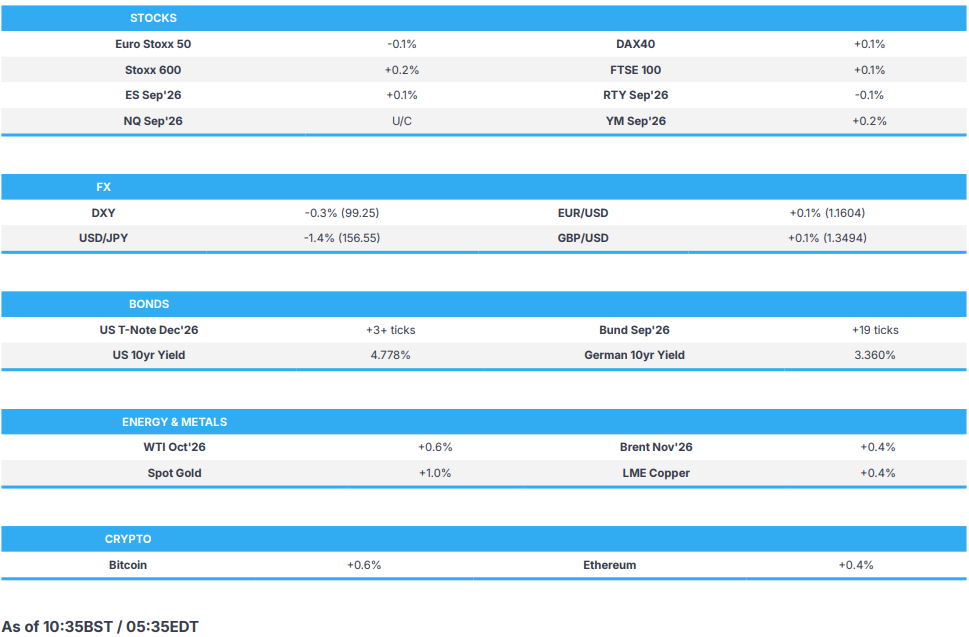
Newsquawk in 3 steps:
1. Subscribe to the free premarket movers reports
2. Listen to this report in the market open podcast (available on Apple and Spotify)
3. Trial Newsquawk’s premium real-time audio news squawk box for 7 days
EUROPEAN TRADE
EQUITIES
- European bourses hold a slight positive tilt. Spain’s IBEX 35 outperforms while the AEX is modestly lower. Updates on the Middle East conflict have been light thus far, however, Reuters reported that Iran threatened the US with a large-scale attack if Israel launches an attack on the Ali al-Taher ridge in southern Lebanon. The more pronounced move came following comments by Russian President Putin, in which he said there is an opportunity to reach a peace agreement with Ukraine and that contacts with the US continue.
- Sectors point slightly higher. Media tops the sector pile, with Telecoms and Basic Resources completing the sector outperformers. To the downside lies Consumer Products & Services, followed by Energy and Utilities.
- US equity futures are mixed, but ultimately trade on either side of the unchanged mark. Focus after-hours was on Broadcom (-2.1% pre-market) earnings, in which they reported Q3 metrics that beat estimates, however its Q4 revenue and margin outlooks came in below expectations.
- Click for the sessions European pre-market equity newsflow
- Click for the additional news
FX
- Further Yen strength which has led to the Buck underperforming against all G10 peers.
- JPY sees outperformance vs USD with the pair halted just short of 156.00 from a peak above 160 on Wednesday. The move comes absent of a headline driver, but there are several factors which weigh on the pair at the moment. Some suggest potential intervention/rate checks, however price action is more gradual, therefore not consistent with previous bouts, while others say the GPIF’s meeting has fuelled speculation it may raise domestic allocation targets. Other factors which have weighed in the past weeks are the clearer US influence on Japanese policy after Bessent met with various Japanese officials, this hawkish intent also evident in Ueda and Takata’s remarks, the latter more so. This morning however, Bloomberg sources said the BoJ is set to favour a 25bps hike and a “flexible” future pace in policy; a report which sparked a dead cat bounce in USD/JPY which lifted back above 157.00.
- DXY (-0.3%) is being driven by JPY moves today with the index falling to a 99.16 trough before paring some of the move after the aforementioned Bloomberg sources. Some of that pressure can also be attributed to falling domestic yields.
- CHF is the second best performer, after hotter than expected GDP and CPI data. Following the inflation print, USD/CHF moved lower by 15 pips within a minute then extended the move to c. 25 pips within ten minutes at a 0.8083 low following the release. GDP also indicated a hot Swiss economy in Q2, albeit caveated by the chemical and pharma metrics which surged +10.5% during the period.
FIXED INCOME
- Global fixed income benchmarks are firmer this morning, rebounding from recent losses as the yield situation attempts to improve.
- USTs (+3+ ticks) are stronger this morning, holding at the top end of a 107-15+ to 107-21 range. Elsewhere, Bunds (+20 ticks) and Gilts (+51 ticks) benefit from cooling energy prices. The geopolitical situation remains tense; however, focus has been on comments from President Trump. He stated that their renewed campaign against Iran will not continue for too long. Separately, the WSJ reported that Trump is said to be having discussions with senior aides regarding whether to call the Iran war over – the piece suggests he is favouring the idea. US yields have moved off their multi-year peaks, with the 10yr (4.77%) holding off the 4.81% high made on Wednesday.
- JGBs (+40 ticks) are firmer this morning, with an accumulation of factors helping sentiment for the region. As mentioned earlier, oil prices are helping global yields lower; focus has also been on a surprise GPIF management committee, which Bloomberg opined has helped raise speculation that it may raise its 25% domestic bond allocation target. Elsewhere, a 30-year auction overnight was relatively well received, further boding well for the benchmark. On the monetary policy front, money markets have continued to up their bets of a BoJ rate hike this month. This was further corroborated by a Bloomberg sources piece earlier, which highlighted that the Bank is favouring a 25bps hike and a flexible future pace.
- Bunds and Gilts follow the bullish bias, benefiting from lower oil prices. Most recently, constructive comments from Russian President Putin spurred another bout of pressure in the oil complex – which in turn helped to lift the fixed income space. He stated that there is an opportunity to reach a peace agreement with Ukraine, adding that there are contacts with them. Bunds (U26) jumped c. 10 ticks to make a fresh peak at 122.95.
- France sells EUR 13.497bln vs exp. EUR 11.5-13.5bln 1.25% 2036, 3.70% 2036, 0.50% 2040 and 4.10% 2046 OAT.
- Spain sells EUR 5.634bln vs exp. EUR 5-6bln 2.35% 2029, 2.60% 2031 and 3.30% 2036 Bono and EUR 0.639bln vs exp. EUR 0.25-0.75bln 2.05% 2039 I/L Bono.
- UK sells GBP 900mln 1.875% I/L Gilt: b/c 3.58x (prev. 3.20x), real yield 2.496% (prev. 2.165%).
- Japan sells JPY 456.2bln 30-yr JGBs; b/c 3.79x (prev. 3.86x), average yield 4.079% (prev. 3.952%), Tail in price 0.28 vs prev. 0.21.
COMMODITIES
- Crude futures have pulled back from extremes following a three-day rally and amid a lack of military action overnight. On Wednesday, President Trump said renewed Iran strikes would likely be brief, and officials pointed towards steady Strait of Hormuz flows. That being said, Trump added the US was prepared to conduct another attack on Iran. Meanwhile, US Treasury Secretary Bessent said Ukrainian strikes on Russian energy assets and the Iran conflict are driving a global energy shock and higher prices. Meanwhile, some weakness was seen across the crude complex after Russian President Putin struck a more conciliatory tone as he suggested Russia and Ukraine should agree first and that there is an opportunity to reach a peace agreement. Brent Nov trades in a USD 94.03-96.20/bbl range (vs yesterday’s 93.52-97.04/bbl range) while WTI Oct resides in a USD 89.57-91.53/bbl parameter (vs yesterday’s 88.97-92.29/bbl band).
- Dutch TTF prices are also on a softer footing but off worst levels, with the front-month contract remaining elevated above EUR 72.50/MWh where the support was found before moving north of EUR 73/MWh. Analysts at ING suggested in yesterday’s note “Escalation in the Persian Gulf pushes back hopes of any recovery in LNG exports from the region. This remains a concern for Europe, given lower-than-usual storage levels. LNG netbacks favour sending spot LNG to Europe over Asia. But as we move closer to the Northern Hemisphere winter, competition between the two regions is likely to pick up, particularly if Qatari LNG remains largely absent from the market through year-end”.
- Metals are mixed, with precious metals cheering the pullback in the USD as they attempt to trim recent losses. Spot gold resides in a USD 4,381-4,443/oz range after topping its 100 DMA (USD 4,358/oz) yesterday. Spot silver resides in a relatively narrow USD 65.21-66.25/oz range, still under Tuesday’s USD 67.08/oz high and below the 100 DMA (USD 67.64/oz). Base metals fail to benefit from the USD pullback as elevated energy prices weigh on the growth picture, whilst hawkish central banks also cap gains for the complex. 3M LME copper trades in a tight USD 14,208.88- 14,278.00/t range at the time of writing.
- Kazakhstan’s August oil and gas condensate production rose 11% M/M, according to sources.
- Russian Deputy PM Novak said OPEC’s role in the market remains important and will continue to exert significant influence on the oil market because of its high output. Novak added that Russia is to slightly lower oil output in 2026.
TRADE/TARIFFS
- US House Republicans pressed USTR Greer on Wednesday on Capitol Hill about the harm a trade war with Canada could do to their local economies, according to Politico citing sources.
- US Commerce Secretary Lutnick said a further easing of US export curbs is not on the table and that relaxing tech export controls for China is not necessary.
- India’s Trade Minister said a final trade agreement between US and India will be published as soon as the US can provide India with tariff advantages.
NOTABLE EUROPEAN HEADLINES
- UK Business Secretary Reynolds seeks to quell fears of an exit tax on companies spun out from UK universities that move abroad, according to FT.
- Germany’s IFW lifted its 2026 GDP forecast to 1.3% (prev. saw 0.8%) and leaves 2027 GDP at 1%, citing acceleration in economic activity and improving business confidence.
- German Ifo raised its 2026 growth forecast to 1.4% (prev. 0.8%) and 1.2% in 2027 (prev. 0.8%).
NOTABLE EUROPEAN DATA RECAP
- European PPI (Jul MM) 1.6% vs. Exp. 1.2% (Prev. -0.3%).
- European PPI (Jul YY) 5.8% (Prev. 4.6%).
- European S&P Global Services PMI Final (Aug) 51.6 vs. Exp. 51.7 (Prev. 51.7).
- European S&P Global Composite PMI Final (Aug) 52.0 vs. Exp. 52.1 (Prev. 52.0).
- German S&P Global Services PMI Final (Aug) 49.7 vs. Exp. 48.5 (Prev. 49.8).
- German S&P Global Composite PMI Final (Aug) 51.8 vs. Exp. 51.0 (Prev. 51.3).
- Italian S&P Global Services PMI (Aug) 55.2 vs. Exp. 53.6 (Prev. 52.5).
- Italian S&P Global Composite PMI (Aug) 53.6 (Prev. 52.5).
- Spanish S&P Global Services PMI (Aug) 57.8 vs. Exp. 59 (Prev. 58.3).
- UK S&P Global Services PMI Final (Aug) 52.5 vs. Exp. 52.8 (Prev. 52.1).
- UK S&P Global Composite PMI Final (Aug) 52.5 vs. Exp. 52.5 (Prev. 52.2).
- Spanish S&P Global Composite PMI (Aug) 55.8 (Prev. 56.5).
- Swiss CPI (Aug YY) 0.8% vs. Exp. 0.5% (Prev. 0.4%).
- Swiss CPI (Aug MM) 0.4% vs. Exp. 0% (Prev. -0.1%).
- Swiss GDP Growth Rate Final (Q2 QQ) 1.9% vs. Exp. 1.6% (Prev. 0.6%).
- Swiss GDP Growth Rate (Q2 YY) 2.8% (Prev. 0.5%).
CENTRAL BANKS
- BoJ is reportedly favouring 25bps hike and a flexible future pace, sources suggest.
- RBNZ Governor Breman said a gradual removal of monetary stimulus is appropriate to return inflation to target while still supporting growth and employment. Breman said she sees risk of more indirect inflation from fuel and stated there is real risk that unless we respond in monetary policy, inflation expectations will get out of hand.
NOTABLE US HEADLINES
- White House confirmed that US President Trump signed a stopgap funding bill into law, funding the government to December 11th.
- US Secretary of War Hegseth will extend troop deployments in the Middle East through 2027, increasing strain on US forces, according to WSJ.
- A US judge blocked the Trump administration from enforcing the executive order restricting birthright citizenship.
- Bank of America Total Card Spending (w/e Aug 29) +3.7% Y/Y (prev. +5% in July); adding that, on balance, the robust spending growth in August is consistent with the view that the slump in July was a blip.
GEOPOLITICS
MIDDLE EAST
- US President Trump said regarding Iran that the US is winning that one very big and controls the Hormuz Strait.
- US Secretary of State Rubio instructed all US embassies around the world earlier this week to send an official diplomatic demarche about Operation Economic Outcast to the most senior level of their host governments, according to Axios citing US officials.
- US Ambassador to NATO Whitaker said Iran is a bankrupt country and will not be able to pay anyone in its military, civil service or government, nor subsidise its society. He stated the people of Iran will not be happy with the current state of affairs and should blame their government and regime, adding that they should ask for change and a different way forward.
- US Envoy Witkoff met last weekend with the UAE’s national security adviser to discuss next steps on Iran, according to Axios. The report added that “One of the officials said a special message was sent to U.S. diplomatic posts in Abu Dhabi, Muscat, Hong Kong, Doha, London, Berlin and several Central Asian capitals. The missive instructed them to demand that their host governments shut down all branches of Iran’s Melli and Saderat banks that are affiliated with the IRGC.”
- Iran reportedly threatened the US with a large-scale attack if Israel launches an attack on the Ali al-Taher ridge in southern Lebanon, Reuters reported citing sources.
- Iranian Chairman of the National Security and Foreign Policy Commission said the Strait of Hormuz cannot be opened without Iran’s will, IRIB reported.
- Kuwait Army said it was repelling missile and hostile drone attacks, while local news outlets were attributing the attacks to Iranian aggression and Arab sources said the US base in Kuwait was hit by a strike with smoke reported.
- A senior Yemeni official said Yemen’s armed forces are conducting new military drills in the Red Sea to prepare for a possible confrontation with Israel and the US, IRNA reported.
- Military sources said clashes broke out between Yemeni government forces and Houthis in the Al-Kadha area west of Taizz, Yemen.
RUSSIA-UKRAINE
- Russian President Putin said that Russia and Ukraine should agree first and noted that there is an opportunity to reach a peace agreement. Putin added that contacts with the US continue, adding that Russia is in favour of restoration of relations with the US. He said US President Trump is ready for positive and constructive works and that there are contacts with Ukraine.
- Russian President Putin said attacks on three oil refineries have been repelled, adding that Russia must respond in kind.
- US Ambassador to NATO Whitaker said Russia’s aggressive actions, invasion of Ukraine and prior annexation of Crimea lead the US to believe that Russia can be unpredictable and could be willing to take action against a NATO country. Furthermore, he said recent statements by Russian President Putin do not leave him optimistic, while he added that Ukraine needs to be able to defend itself as long as it takes until the war can be brought to an end.
OTHER
- North Korea stripped references to “peaceful unification” with South Korea from the charter of its ruling Workers’ Party of Korea, according to Yonhap.
CRYPTO
- Bitcoin extends above USD 77k and briefly topped above USD 78k amid a weaker USD.
APAC TRADE
- APAC stocks eventually traded mixed after initially posting gains. The stocks lost steam heading into the European open despite a lack of newsflow at the time.
- ASX 200 was led by outperformance in the top-weighted financial sector and miners, but with further gains capped amid quiet newsflow and mixed trade data.
- Nikkei 225 initially traded with cautious gains before faltering amid recent currency moves and hawkish BoJ rate hike bets following the recent commentary from BoJ Governor Ueda and hawkish dissenter Takata.
- KOSPI outperformed early in the session with some tech and energy names among the notable gainers. The index fell into red later in the session.
- Hang Seng and Shanghai Comp were mixed with some encouragement from stronger-than-expected Chinese RatingDog Services PMI data, although the PBoC’s open market operations amount remained at zero. Both indices then traded in the red.
NOTABLE ASIA-PAC HEADLINES
- Japan’s GPIF’s unusual August management committee meeting has fuelled speculation it may raise its 25% domestic bond allocation target, Bloomberg reported.
- Japan’s government is reportedly looking to convene an extraordinary Diet session in early October, Asahi reported, with the focus expected to be on consumption tax cuts and a reduction in the number of seats.
- BoJ accounts show there was no large-scale yen intervention on Wednesday.
- Japan’s Top Currency Diplomat Mimura said they continue to stand ready on FX but declined to comment on if rate checks were conducted.
- Japanese Finance Minister Katayama said no direct requests to do anything has been given from US Treasury Secretary Bessent.
- Japan Chief Secretary Kihara said there has been no change to PM Takaichi government policies about attaining a strong economy and fiscal sustainability
- BoJ will hold a meeting on market operations scheduled for October 14th 2026.
- China Prelim Retail Passenger Vehicle Sales (Aug) +11% M/M (prev. -8.8%); -4% Y/Y (prev. -20.9%) .
NOTABLE APAC DATA RECAP
- Chinese RatingDog Services PMI (Aug) 51.4 vs. Exp. 50.6 (Prev. 50.4).
- Chinese RatingDog Composite PMI (Aug) 52.1 (Prev. 50.8).
- Japanese S&P Global Services PMI Final (Aug) 52.5 vs. Exp. 52.3 (Prev. 51.2).
- Japanese S&P Global Composite PMI Final (Aug) 53.50 vs. Exp. 53.4 (Prev. 52.70).
- Australian S&P Global Services PMI Final (Aug) 53.2 vs. Exp. 52.9 (Prev. 53.6).
- Australian S&P Global Composite PMI Final (Aug) 52.70 vs. Exp. 52.5 (Prev. 53.20).
- Australian Trade Balance (Jul) 1.923B vs. Exp. 1.40B (Prev. 1.929B).
- New Zealand Terms of Trade (Q2 QQ) -9.0% vs. Exp. -2.2% (Prev. -2.0%).
1c) Asian opening report
USD/JPY continues losses below 158 on BoJ hike bets; Fixed income continues rebound – Newsquawk EU Market Open
Thursday, Sep 03, 2026 – 01:51 AM
- US President Trump said the renewed campaign against Iran would not continue for too long and that oil prices would come down; Trump added the US was prepared to conduct another attack on Iran.
- US President Trump said he has very productive things to talk about with China President Xi, adding it “Will be very exciting and great”.
- Crude futures lacked firm direction after marginally gaining in two-way trade yesterday amid somewhat mixed comments from US President Trump.
- USD/JPY extended on the prior day’s decline with the pair breaching the 158.00 level to the downside after the Japanese currency was supported on Wednesday.
- APAC stocks eventually traded mixed after initially posting gains; European equity futures indicate a marginally negative open.
- Looking ahead highlights include Swiss CPI (Aug), GDP (Aug), Global S&P Services and Composite PMI Final (Aug), EU PPI (Jul), US Challenger Layoffs (Aug), Trade Balance (Jul), Jobless Claims, ISM Services PMI (Aug), Atlanta Fed GDP (Q3), Canadian Trade Balance (Jul). Speakers include Fed’s Waller, Hammack & Goolsbee, RBA’s Jones & Hunter. Supply from Spain & France.
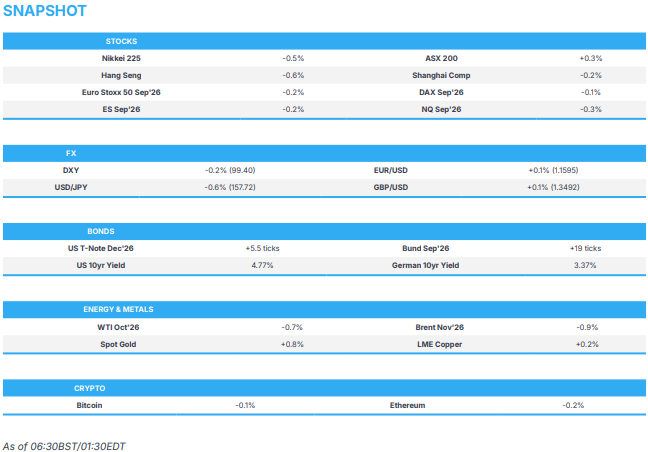
Newsquawk in 3 steps:
1. Subscribe to the free premarket movers reports
2. Listen to this report in the market open podcast (available on Apple and Spotify)
3. Trial Newsquawk’s premium real-time audio news squawk box for 7 days
LOOKING AHEAD
- Highlights include Swiss CPI (Aug), GDP (Aug), Global S&P Services and Composite PMI Final (Aug), EU PPI (Jul), US Challenger Layoffs (Aug), Trade Balance (Jul), Jobless Claims, ISM Services PMI (Aug), Atlanta Fed GDP (Q3), Canadian Trade Balance (Jul). Speakers include Fed’s Waller, Hammack & Goolsbee, RBA’s Jones & Hunter. Supply from Spain & France.
- Click for the Newsquawk Week Ahead.
IRAN CONFLICT
- US President Trump said the renewed campaign against Iran would not continue for too long and that oil prices would come down, while he said Iran was trying to build a rocket that drops mines and that the US took it out. Trump added that the US was prepared to conduct another attack on Iran but said he did not think the Iran war would last much longer.
- US President Trump said regarding Iran that the US is winning that one very big and controls the Hormuz Strait.
- US President Trump said Israel should not worry about a renewed war with Iran.
- Israeli PM Netanyahu said “We will defeat the regime in Iran – it will fall. All of our systems are working to overthrow the regime.” He added that if Iran chooses to attack Israel, “they know it will be one of their last decisions”.
- US Secretary of War Hegseth will extend troop deployments in the Middle East through 2027, according to WSJ.
- US Ambassador to NATO Whitaker says Iran is a bankrupt country and will not be able to pay anyone in its military, civil service or government, nor subsidise its society. He stated the people of Iran will not be happy with the current state of affairs and should blame their government and regime, adding that they should ask for change and a different way forward.
- US Secretary of State Rubio instructed all US embassies around the world earlier this week to send an official diplomatic demarche about Operation Economic Outcast to the most senior level of their host governments, according to Axios citing US officials.
- US Envoy Witkoff met last weekend with the UAE’s national security adviser to discuss next steps on Iran, according to Axios. The report added that “One of the officials said a special message was sent to U.S. diplomatic posts in Abu Dhabi, Muscat, Hong Kong, Doha, London, Berlin and several Central Asian capitals. The missive instructed them to demand that their host governments shut down all branches of Iran’s Melli and Saderat banks that are affiliated with the IRGC.”
- Kuwait Army said it was repelling missile and hostile drone attacks, while local news outlets were attributing the attacks to Iranian aggression and Arab sources said the US base in Kuwait was hit by a strike with smoke reported.
- Iran’s Strait of Hormuz management body added to a list of ships that face action if they try to pass through the chokepoint, taking the total to more than 50.
- Military sources said clashes broke out between Yemeni government forces and Houthis in the Al-Kadha area west of Taizz, Yemen.
US TRADE
EQUITIES
- US stocks gained on Wednesday, with the Russell 2000 outperforming while the Nasdaq lagged but finished in the green. The vast majority of sectors were higher, although Consumer Discretionary was flat and Real Estate closed lower amid ongoing concerns around elevated yields, albeit the Treasury curve itself was little changed on the session. The Treasury curve saw a marginal steepening, with front-end yields edging lower while the belly and long end were broadly flat as attention turns towards Friday’s NFP report. Administration officials continued to be quizzed on elevated bond yields, with Commerce Secretary Lutnick saying rates will come back down and the market will stabilise, adding that he is not concerned. Meanwhile, Treasury Secretary Bessent said the goal of the buyback operations is to avoid a bad market outcome, noting that buybacks free up balance-sheet capacity and make room for banks to participate more at Treasury auctions.
- SPX +0.48% at 7,668, NDX +0.23% at 29,143, DJI +0.56% at 53,062, RUT +1.23% at 2,956.
- Click here for a detailed summary.
TARIFFS/TRADE
- US President Trump said he has very productive things to talk about with China President Xi, adding it “Will be very exciting and great”. Trump said Canada had been ripping the US off for decades and that Canada takes advantage of airlines, while he added that Canada is tougher to deal with than China or Vietnam and that Canada had felt emboldened. Furthermore, Trump said the US had a good relationship with Brazil.
- US President Trump plans a state dinner for Chinese President Xi, according to sources cited by MS Now.
- US Treasury Secretary Bessent said China engages in financial repression on its savers, while he added that Chinese products were heavily subsidised, and he was working to get the US budget deficit to GDP down.
- US Commerce Secretary Lutnick said a further easing of US export curbs is not on the table and that relaxing tech export controls for China is not necessary.
- US House Republicans pressed USTR Greer on Wednesday on Capitol Hill about the harm a trade war with Canada could do to their local economies, according to Politico citing sources.
NOTABLE HEADLINES
- Fed’s Beige Book stated that economic activity increased modestly since early July, while employment rose slightly overall and prices increased moderately in eight Districts.
- White House confirmed that US President Trump signed a stopgap funding bill into law.
- US judge blocked the Trump administration from enforcing the executive order restricting birthright citizenship.
APAC TRADE
EQUITIES
- APAC stocks eventually traded mixed after initially posting gains. The stocks lost steam heading into the European open despite a lack of newsflow at the time.
- ASX 200 index was led by outperformance in the top-weighted financial sector and miners, but with further gains capped amid quiet newsflow and mixed trade data.
- Nikkei 225 initially traded with cautious gains before faltering amid recent currency moves and hawkish BoJ rate hike bets following the recent commentary from BoJ Governor Ueda and hawkish dissenter Takata.
- KOSPI outperformed early in the session with some tech and energy names among the notable gainer. The index fell into red later in the session.
- Hang Seng and Shanghai Comp were mixed with some encouragement from stronger-than-expected Chinese RatingDog Services PMI data, although the PBoC’s open market operations amount remained at zero. Both indices then traded in the red.
- US equity futures traded on either side of the unchanged mark following the prior day’s Wall Street rebound and easing of short-term yields.
- European equity futures indicate a marginally negative open with Euro Stoxx 50 futures down 0.2% after the cash market closed with losses of 0.1% on Wednesday.
FX
- DXY remained lacklustre after recent mild losses and the ultimately mixed performance against G10 counterparts, while there were few fresh drivers as geopolitical headlines remained in focus and dollar-specific newsflow was still pretty light. Nonetheless, Fed’s Williams said that rates are in a good place to balance the Fed’s dual mandate and reiterated his support for the previous decision to hold, with future policy dependent on the totality of incoming data, while participants look ahead to comments from Fed’s Waller due later ahead of tomorrow’s key NFP report.
- EUR/USD eked modest gains and retested the 1.1600 level, albeit with upside limited following the prior day’s indecision and with very little in the way of pertinent catalysts to drive the single currency.
- GBP/USD edged slightly higher in range-bound trade following previous oscillations through the 1.3500 level and with price action not helped by the continued lack of UK data.
- USD/JPY extended on the prior day’s decline with USD/JPY breaching the 158.00 level to the downside after the Japanese currency was supported on Wednesday despite no obvious news catalysts, leading to some speculation of intervention, although there have been increased BoJ rate hike bets and some jawboning from US Treasury Secretary Bessent, who said that he knows what the Japanese are planning on doing.
- Antipodeans price action was range-bound with AUD/USD trading sideways, while NZD/USD clawed back some of its post-RBNZ losses.
FIXED INCOME
- 10yr UST futures continued its gradual rebound from contract lows after the 10yr yield slightly eased back from the highest level in nearly 3 years, and with the curve steepening, while attention turns to Fed’s Waller later ahead of Friday’s NFP.
- Bund futures nursed some of the recent losses although remained beneath the 123.00 level, with the rebound limited as energy prices remain elevated, providing inflationary-related headwinds.
- 10yr JGB futures rebounded overnight as yields pulled back from multi-decade highs, including the 10yr yield which returned to below 3.00%, although prices are off intraday highs following the slightly weaker than previous 30yr JGB auction.
COMMODITIES
- Crude futures lacked firm direction after marginally gaining in two-way trade yesterday amid somewhat mixed comments from US President Trump, who said the renewed campaign against Iran would not continue for too long, but also stated that the US was prepared to conduct another attack on Iran. Nonetheless, there were reports overnight that the US base in Kuwait was hit by a strike, which ultimately risks triggering another round of tit-for-tat retaliations.
- US escorted 40 commercial vessels through the Strait of Hormuz on Tuesday, which carried 18mln bbls of oil.
- Venezuelan government and Chevron (CVX) confirmed they had signed agreements for oil expansion projects, while the government and Italy’s Eni (ENI IM) also signed agreements for oil expansion projects.
- Spot gold extended on the prior day’s rebound and returned to above the USD 4,400/oz level after benefiting from dollar weakness and as yields eased back from recent peaks.
- Copper futures traded with modest gains alongside the mostly positive risk sentiment.
CRYPTO
- Bitcoin eked out mild gains after finding early support at the USD 77,000 level.
NOTABLE ASIA-PAC HEADLINES
- RBNZ Governor Breman said a gradual removal of monetary stimulus is appropriate to return inflation to target while still supporting growth and employment. Breman said she sees risk of more indirect inflation from fuel and stated there is real risk that unless we respond in monetary policy, inflation expectations will get out of hand.
- US Treasury Secretary Bessent said “I know what the Japanese are planning on doing”.
DATA RECAP
- Chinese RatingDog Services PMI (Aug) 51.4 vs. Exp. 50.6 (Prev. 50.4)
- Chinese RatingDog Composite PMI (Aug) 52.1 (Prev. 50.8)
- Australian Trade Balance (Jul) 1.923B vs. Exp. 1.40B (Prev. 1.929B)
- Australian Exports (Jul MM) -3.3% (Prev. 9.6%)
- Australian Imports (Jul MM) -2.5% (Prev. -0.2%)
GEOPOLITICS
RUSSIA-UKRAINE
- Ukrainian President Zelensky reportedly plans to visit Canada next week, although the trip is yet to be finalised, according to The Globe and Mail citing sources.
- US President Trump said regarding Russia’s war in Ukraine that they have got to stop that war, while he wants to do a summit with Russian President Putin when they are ready to do a peace deal on Ukraine.
- US Ambassador to NATO Whitaker said Russia’s aggressive actions, invasion of Ukraine and prior annexation of Crimea lead the US to believe that Russia can be unpredictable and could be willing to take action against a NATO country. Furthermore, he said recent statements by Russian President Putin do not leave him optimistic, while he added that Ukraine needs to be able to defend itself as long as it takes until the war can be brought to an end.
OTHER
- China’s Ministry of Natural Resources reportedly organises a marine survey of waters east of Taiwan, while China’s Coast Guard also said it conducts routine law enforcement patrols in those waters.
- Venezuela’s Interim President said the US and Venezuela are working to lift US sanctions on Venezuela.
EU/UK
NOTABLE HEADLINES
- UK Business Secretary Reynolds seeks to quell fears of an exit tax on companies spun out from UK universities that move abroad, according to FT.
end
2.NORTH AND SOUTH KOREA/
SOUTH KOREA//NORTH KOREA
SOUTH KOREA
As Korean Retail Investors Flee, Only Record Buybacks Are Preventing A Kospi Market Crash
Retail investors in South Korea have significantly pulled back from aggressive dip-buying following recent market volatility, pivoting instead toward profit-taking or exiting on minor rallies.
Key Dynamics Behind the Shift
- Retail Trader Fatigue: After a sharp market rout and bubble bursting earlier in the summer, local retail momentum traders—who previously drove high transaction volumes—have curtailed their active participation.
- Shift in Cash Flows: Flow analysis from Goldman Sachs highlights a clear pivot in retail behavior from aggressive “buy-the-dip” strategies to break-even profit-taking on brief price rebounds.
- Corporate Share Buybacks: The primary factor stabilizing the KOSPI and cushioning it against deeper sell-offs has been record-level corporate share buybacks, which are absorbing supply as individual investors exit.
end
JAPAN
Yen Suddenly Surges To Bessent Intervention Highs… No One Knows Who/Why…
Thursday, Sep 03, 2026 – 08:27 AM
Yesterday we noted the sudden spike in JPY which prompted numerous desks to speculate on an intervention.
It wasn’t large – which made many suggest it wasn’t or that it was a tester for liquidity.
Today, we are seeing something different – a steady bid for the Japanese currency lifting it to post-Bessent/BoJ highs…

The slope (not entirely vertical) made some reject the idea of an intervention…
“I don’t think the move was an intervention or rate check, but there is a lot of caution around the 160 level,” said Marito Ueda, president of SBI FX Trade.
But maybe they have a new method of intervention rather than just dump a few billion dollars all at once and rip through all the stops.
The move “shows how sensitive positioning has become,” said Nathan Thooft at Manulife Investment Management.
“The market got the message that the authorities want a stronger yen.”
The yen began strengthening earlier on Wednesday, after a BOJ board member raised the possibility of outsize or back-to-back interest-rate hikes.
Overnight index swaps are now more than fully pricing in a standard 25 basis point rate hike at the BOJ’s September meeting. Pricing suggests only a very low likelihood of a 50 basis point move.
“The yen’s gains followed comments from reliably hawkish BOJ board member Takata,” said Tony Sycamore, an analyst at IG Australia.
“It’s possible we saw some pre-positioning going through for a weak nonfarm payrolls report tomorrow night,” said Sycamore.
“I am skeptical based on the size of the move,” said Andrew Hazlett, a foreign-exchange trader at Monex Inc., referring to the possibility of intervention on Wednesday.
There is no official comment from either the US Treasury of Bank of Japan.
end
3. CHINA/
4. EUROPEAN AND SCANDINAVIAN COMMENTARIES PLUS NATO
EU/UKRAINE
EU’s Kallas Says No Progress On Zelensky’s Cash Infusion For Patriot Missiles
Thursday, Sep 03, 2026 – 04:15 AM
On Wednesday EU leadership revealed that the Zelensky government has formally asked the European Commission to provide several billion euros from the EU’s €90 billion ($105 billion) support loan to purchase US-made Patriot air defense missiles.
European Commission President Ursula von der Leyen announced just ahead of a meeting with NATO Secretary General Mark Rutte, “It is worth several billion euros and would cover Ukraine’s air defense needs, including high-end PAC-3 air defense systems.”

At the same time, the EU’s top foreign affairs official, Kaja Kallas, is coming off a meeting of the bloc’s defense ministers wherein she cited no progress made on the Patriot funding plan.
“There were calls and talks about these missiles but there was, unfortunately, no concrete success today regarding this,” the EU top diplomat had spelled out Tuesday. “Patriot missiles about to expire [by Nato standards] should be sent to Ukraine.”
Looking back further, the last time that Ukrainian President Volodymyr Zelensky was in the White House, he pleaded with President Trump for a “winter package” of 300 Patriot missiles.
Zelensky has long been warning that cities remain largely unprotected against Russia’s more advanced ballistic missile arsenal – a problem that only mass supplies of Patriots can remedy.
Ukraine’s supply have run dry, with batteries sitting in some locations, unable to be fired.
In mid-August, here’s what a CNN team observed on the ground in Ukraine:
CNN was the first media outlet to be given access to a Patriot on Ukrainian territory so Ukrainian officials could reveal one fact: the country has pretty much run out of interceptors. CNN agreed not to reveal details of the Patriot model or its location.
The 16 tubes of the system that CNN saw show signs of regular use, but its chief engineer in Ukraine, who gave only his first name Dmytro for security reasons, said he had not seen a Patriot launcher fire for six weeks. Ukraine has been reluctant to specify exactly how many interceptors, if any, it has left – President Volodymyr Zelensky says the country needs 5% of the US stockpile to survive the winter, but currently only has 1%.
There have notoriously been immense backlogs when it comes to Patriot production, and there’s said to be great global demand among US allies, especially given depletions which have come as a result of the Iran war.
Taking it back? Trump earlier talked about giving Ukraine a license to make Patriot systems…
Trump had announced in July that Washington would give Ukraine “the right to make Patriots” – after Zelensky had for at least six months been relentless in requesting this, framing it as urgent and for the protection of cities and civilians. But such local production would take years to tool and set up, with the reality of a nightly air war making the prospect daunting.
END
UK
UK Government To Fund School Forcing Seven-Year-Olds Into Hijabs
Thursday, Sep 03, 2026 – 05:00 AM
Authored by Steve Watson via Modernity News,
A Labour-run London council has put an Islamic primary school that makes girls as young as seven wear the hijab onto the public payroll.

From 1 September, Barnet Hill Academy in West Hendon stops being a fee-paying independent and becomes a voluntary-aided school – almost entirely funded by the taxpayer, legally free to pick every pupil and every teacher by religion, and still listing a white hijab as compulsory from Year 3.
Barnet Council called the uniform “legally compliant” and the school’s policies representative of “equality of opportunity.” The National Secular Society called it appalling.
Barnet Hill Academy has operated as an independent Islamic day school since 2006, but until this week families paid more than £6,500 a year. Those fees will now vanish, as the Dedicated Schools Grant takes over.
Voluntary-aided status is the mechanism. The local authority maintains the school and pays the bills. The governing body keeps the religious character, employs the staff and sets the admissions rules. Faith designation lets a VA school give priority to 100 per cent of places on religious grounds and appoint teachers by faith.
The school’s own uniform page is blunt. For girls in Years 3 and 4 a white hijab sits in the same list as the branded pinafore, black shoes and book bag. In Years 5 and 6 the hijab remains, with a jilbab or ankle-length skirt as the alternative lower garment.
Notes on the page state that full uniform is compulsory and the hijab must be “plain white ONLY.” Year 3 in English primary schools is seven years old.
Stephen Evans, chief executive of the National Secular Society, wrote to John Anthony, the council’s executive director of children’s services, stating “It is appalling that taxpayers are being asked to fund a school that forces girls as young as seven to wear the hijab. Women should be free to choose religious dress; young girls should not have it imposed upon them.”
He added: “State-funded schools should bring children together, not divide them by faith and, by extension, ethnicity. The council must pause the implementation of this decision and subject this proposal to proper public and democratic scrutiny.”
In the same letter he said the society was “deeply concerned both by the substance of this decision and by the procedure through which it was reached.”
Barnet’s reply is the standard diversity script. A spokesman said the borough prided itself on “the diverse nature of our school landscape” and that the uniform policy was legally compliant. The written judgment claimed there was “a very limited level” of state-funded Islamic primary provision across London, “unevenly spread and primarily concentrated outside of Barnet.”
It added that the school’s “inclusive policies” support the “elimination of discrimination” and the “advancement of equality of opportunity.”
There are already 15 voluntary-aided Church of England schools in the borough. Barnet Hill will be the first VA Muslim school. The 2021 Census counted 47,700 Muslim residents in Barnet – just over 12 per cent.
The council’s argument is that Islam was “not represented within the state-funded education sector” and that “Muslim families do not have the same opportunity as those of other faiths to access a school aligned with their religious ethos.”
Evans responded that the NSS “failed to understand how a school very likely to be made up entirely of pupils from one religious background and which discriminates against pupils who don’t share its faith can be considered ‘inclusive’.”
Campaigners have said for years that making primary-age girls cover their hair treats childhood as a prelude to sexual availability. The hijab, in the conservative reading the school is enforcing, marks modesty before men. Imposing it at seven is not a fashion choice. It is a theological statement paid for by people who never signed up to that theology.
NSS research in 2017 found the hijab compulsory in eight state-funded Islamic schools in England, three of them primaries. The Telegraph reported that a handful of state-funded schools still run the same rule in 2026.
Barnet is not a one-off experiment. It is the latest conversion of a private religious enclosure into a public one, with the dress code intact and the admissions sieve intact.
The classroom numbers around that enclosure have already flipped. A Telegraph analysis of the school census found White British children are now the minority in one in four schools in England. In 72 schools the census recorded no White British pupils at all.
In 454 they were under 2 per cent. In every London borough except Bromley, White British children are a minority; in Newham the figure was 5 per cent, in Harrow 7 per cent.
The same paper has shown White British pupils down to 46 per cent of grammar-school rolls and White students in the minority at 27 universities.
That is the country into which Barnet has just poured a faith-selective, hijab-compulsory primary and told the rest of the borough to call it inclusion.
Meanwhile, in yet another example of the parallel society of the UK now, Cardiff Council has spent more than £2 million of council-tax money over recent years translating and interpreting for people who do not speak English.
The five-year bill published by GB News came to £2,047,975: £1.14 million on pre-booked interpretation, £506,000 on instant interpretation, £396,000 on document translation, across more than 60 languages. Arabic alone accounted for £314,446.
The 2025/26 year logged 13,000 instances of support. A council spokesman said Cardiff is “a proudly diverse, multicultural and multilingual city” and that translations help residents “access essential council services.”
Conservative councillor Calum Davies asked why a city “running out of money under Labour” was “frittering away millions on translation and interpretation, indulging a broken immigration system and failing integration policy.” William Yarwood of the TaxPayers’ Alliance said ratepayers face record bills “yet councils continue to subsidise foreign families that don’t bother to learn the language.”
The same state that will not require English will require a seven-year-old girl to cover her hair if she wants a desk in the new VA school. The same state that lectures the native majority about cohesion builds the institutions that make cohesion optional.
The pattern extends to other areas of society. In July the Home Office was shown to have handed Skilled Worker sponsorship powers to Islamic bookshops stocking Sayyid Qutb’s Milestones – the text that argues for toppling secular governments by “physical power and jihad” – alongside works flagged for antisemitism and Bilal Philips’s The Fundamentals of Tawheed, which UK prison inspectors ordered out of jails in 2016 over wife-beating guidance.https://modernity.news/2026/07/28/uk-hands-skilled-visa-powers-to-islamic-bookshops-selling-jihad-texts-wife-beating-guides/embed/
Reform UK’s Lee Anderson called it “a perfect illustration of 14 years of Tory failure: rather than doctors and engineers, we brought in staff for Islamic shops selling books on jihad.”
In March, Labour-run councils in Leeds, Calderdale, Oldham, Wakefield, Sefton and Tameside circulated “Sharing the Journey” guidance warning schools that children’s drawings of human figures or prophets “could be blasphemous” under some Islamic interpretations.
Music, dance, drama and mixed PE were listed as potential flashpoints. The text told staff it was “very important that the school understands this and is also careful not to ask its students to reproduce images of Jesus, the Prophet Mohammed or other figures considered to be prophets in Islam.”https://modernity.news/2026/03/11/uk-councils-tell-schools-childrens-drawings-could-be-blasphemous-under-islamic-law/embed/
The same week Whitehall urged schools to monitor and report “anti-Muslim hostility” under a new non-statutory definition. Communities Secretary Steve Reed said the definition gave “a clear explanation of unacceptable prejudice, discrimination and hatred targeting Muslims, so we can take action to stop it.”https://modernity.news/2026/03/10/uk-govt-urges-schools-to-snitch-on-anti-muslim-hostility-in-orwellian-crackdown/embed/
Critics including Jonathan Hall KC and the Free Speech Union warned it would chill legitimate criticism of Islamism. An “anti-Muslim hostility tsar” was promised for schools and universities.
The leaked social-cohesion draft that sat behind that drive branded the Union Flag and the St George’s Cross as potential “tools of hate” the “extreme right” had tried to turn from “symbols of pride.” Reform’s Richard Tice called the paper “divisive nonsense that should be consigned to the bin.”https://modernity.news/2026/03/07/uk-government-brands-union-flag-a-tool-of-hate-in-leaked-social-cohesion-strategy/embed/
By late August the two-tier was no longer a draft. Birmingham City Council sought a High Court injunction against “unauthorised” England and Union flags on lampposts, with breach carrying unlimited fines and up to two years in prison.
Pakistan, India, Bangladesh and Palestine flags were confirmed as exempt. Palestinian flags had flown for months after 7 October 2023 without an injunction. Raise the Colours co-founder Ryan Bridge said he would carry on: “If I go to jail for it, so be it.” Robert Jenrick called it “blatant two-tier bias against the British people.”https://modernity.news/2026/08/29/fly-british-flags-in-uk-and-face-jail-but-pakistan-and-palestine-flags-get-a-pass/embed/
The state will now bankroll a school that sorts children by mosque attendance and covers girls at seven. It will translate council forms into sixty languages so nobody has to learn English. It will license bookshops that sell jihad primers to sponsor visas. It will tell teachers a child’s drawing might be a blasphemy incident. It will build a snitch channel for “anti-Muslim hostility.” And it will treat the national flag as a hate exhibit and leave foreign flags on the lampposts.
If this isn’t evidence of a completely hostile cultural takeover, then what on earth is?
Your support is crucial in helping us defeat mass censorship. Please consider donating via Locals or check out our unique merch. Follow us on X @ModernityNews.
END
SPAIN/GREECE
Spain & Greece Have The Best Pension/Salary Replacement Rate In The World
Thursday, Sep 03, 2026 – 02:45 AM
How much of your paycheck would a pension replace in retirement?
Depending on the country, the answer ranges from more than 80% to less than 20%.
This graphic, via Visual Capitalist’s Dorothy Neufeld, ranks countries by their projected gross pension replacement rate, based on data from the OECD. The rate compares pension benefits with pre-retirement earnings, with both measured before taxes and contributions.

Estimates are for an average earner entering the workforce at age 22 in 2024 and include mandatory public and private pensions, but exclude voluntary private retirement savings.
Spain Leads the Ranking
Southern European countries dominate the top of the ranking, with Spain, Greece, Portugal, and Italy all placing in the top 10. Spain and Greece stand out at 80.4% and 79.6%, respectively.
| Rank | Country | Pension Replacement Rate |
|---|---|---|
| 1 | 🇪🇸 Spain | 80.4% |
| 2 | 🇬🇷 Greece | 79.6% |
| 3 | 🇱🇺 Luxembourg | 75.6% |
| 4 | 🇨🇴 Colombia | 74.8% |
| 5 | 🇳🇱 Netherlands | 74.7% |
| 6 | 🇦🇹 Austria | 74.1% |
| 7 | 🇩🇰 Denmark | 72.7% |
| 8 | 🇵🇹 Portugal | 72.4% |
| 9 | 🇮🇹 Italy | 70.6% |
| 10 | 🇲🇽 Mexico | 69.6% |
| 11 | 🇹🇷 Türkiye | 69.1% |
| 12 | 🇨🇷 Costa Rica | 65.7% |
| 13 | 🇸🇪 Sweden | 63.7% |
| 14 | 🇸🇰 Slovakia | 58.0% |
| 15 | 🇫🇮 Finland | 57.8% |
| 16 | 🇫🇷 France | 56.6% |
| 17 | 🇭🇺 Hungary | 51.9% |
| 18 | 🇨🇱 Chile | 49.7% |
| 19 | 🇳🇴 Norway | 46.1% |
| 20 | 🇸🇮 Slovenia | 45.9% |
| 21 | 🇬🇧 UK | 44.7% |
| 22 | 🇨🇿 Czechia | 44.2% |
| 23 | 🇮🇸 Iceland | 43.9% |
| 24 | 🇧🇪 Belgium | 43.5% |
| 25 | 🇮🇱 Israel | 42.8% |
| 26 | 🇨🇭 Switzerland | 42.4% |
| 27 | 🇩🇪 Germany | 42.1% |
| 28 | 🇦🇺 Australia | 40.8% |
| 29 | 🇺🇸 U.S. | 39.7% |
| 30 | 🇳🇿 New Zealand | 39.5% |
| 31 | 🇱🇻 Latvia | 38.7% |
| 32 | 🇨🇦 Canada | 37.1% |
| 33 | 🇯🇵 Japan | 36.5% |
| 34 | 🇰🇷 S. Korea | 33.4% |
| 35 | 🇪🇪 Estonia | 29.3% |
| 36 | 🇵🇱 Poland | 28.6% |
| 37 | 🇮🇪 Ireland | 24.3% |
| 38 | 🇱🇹 Lithuania | 17.4% |
| — | 🌐 OECD Average | 52.0% |
National prosperity is not a reliable predictor of pension replacement rates. Mexico and Türkiye are both near 70%, while Germany stands at 42.1% and the U.S. at 39.7%, reflecting substantial differences in how national retirement systems are structured.
At the bottom, Lithuania’s replacement rate is just 17.4%, less than one-quarter of Spain’s 80.4%. South Korea and Japan also rank relatively low, at 33.4% and 36.5%, respectively.
Where Low Pensions Meet High Senior Poverty
A low replacement rate does not automatically mean high senior poverty, but several countries near the bottom of the pension ranking also have elevated old-age poverty rates. In Lithuania, more than 20% of people aged 65 and older live in relative income poverty.
The pattern extends across the Baltics. Old-age poverty exceeds 30% in Estonia and Latvia, compared with an OECD average of 14.8%. In the U.S., the rate is also relatively high at 22.9%.
At the other extreme, the Netherlands combines a 74.7% replacement rate with an old-age poverty rate of just 4.6%. Denmark, Finland, and Norway also have poverty rates at or below 5%.
Replacement rates are only one part of retirement security, but these comparisons show how differently pension systems replace workers’ earnings across the OECD.
To learn more about this topic, check out this graphic on the annual cost of retirement by state.
END
SPAIN
MADRID
“Save Us From Our Traitor Gov’t”: Massive Madrid Protests Erupt Over Socialist Regime’s Handling Of Ceuta Invasion
Thursday, Sep 03, 2026 – 07:20 AM
Spain’s Ceuta border invasion has morphed into a major political headache for Socialist Prime Minister Pedro Sánchez. Tens of thousands of Spaniards took to the streets of Madrid to protest the government’s handling of the crisis, potentially accelerating the political shift identified by Nomura analysts, who expect right-wing populist movements to gain traction across Europe during the next 18-month election cycle.
About 72,000 migrants, many reportedly military-age men, invaded the Spanish enclave from neighboring Morocco in late July. The scale and apparent coordination of the invasion raised concerns that Ceuta had been targeted through weaponized migration flows. The influx plunged the enclave, which has a population of approximately 84,000, into utter chaos for weeks.
By mid-August, a second wave of military-age men attempted to storm the Ceuta border, but that effort largely fell flat.
Although most of the migrants were quickly returned or repatriated, the surge overwhelmed local resources, left at least 90 people dead and sparked serious questions about Madrid’s open border policies. Italy’s continued border checks on arrivals from Spain further show how the Ceuta crisis is reverberating well beyond Spain’s borders.
About a month and a half after the first migrant wave, the political backlash against Sánchez and the Socialists in Madrid is mounting. AP News reported that more than 50,000 protesters demonstrated against the Socialists over the lack of border enforcement on Wednesday.
Waving Spanish flags, demonstrators shouted, “A united Ceuta will never be defeated,” “Sánchez to prison” and “Invaders, go home!” referring to the thousands of migrants still in the city.
Reuters reported that the number of Spaniards who demonstrated against the Socialist government was closer to 80,000. The protest coincided with the annual Ceuta Day. Demonstrators waved Spanish flags and blew whistles as they chanted, “Ceuta is not for sale; Ceuta must be defended.”
One demonstrator’s sign read, “SOS. Europe, save us from our traitor government,” while some demanded that authorities “expel the invaders” and others called for Sánchez to resign.
“The response has been inadequate, late and, to top it all, has involved a complete dereliction of duty on the part of the government. We cannot be second-class citizens, and our border must not be sidelined,” said David Hernandez, a 45-year-old teacher who demonstrated yesterday.
Sánchez told lawmakers on Thursday that there was no evidence that the border invasion had been orchestrated or carried out by Moroccan authorities.
“I can assure you that no institution, not the diplomatic service, the European Commission or any international body, has provided the Spanish government with any solid evidence that Morocco planned or carried out the incident. None whatsoever,” Sánchez said.
The growing outrage against Sánchez and the Socialists in Madrid only builds on the expanding backlash across Europe. Nomura analyst Andrzej Szczepaniak now expects right-wing parties to make significant gains across Germany, France, Spain, Switzerland and the UK over the next 18 months.

The right-wing Alternative for Germany is poised to win Germany’s Saxony-Anhalt election this Sunday, while other polling data show that Marine Le Pen has a good chance of winning the French election next year.
The blowback against left-wing governments in Europe has also been spreading like wildfire across South America. Right-wing Sen. Flávio Bolsonaro is neck and neck with Socialist President Luiz Inácio Lula da Silva ahead of next month’s election. Much of South America has already rejected socialism, including in Colombia’s recent presidential election, which ushered in a Trump-backed president.
By mid-2026, South America had already flipped. Argentina under Milei, Chile under Kast, Colombia under de la Espriella, Peru under Keiko Fujimori, Ecuador under Noboa, Bolivia under Paz and Paraguay under Peña all sit on the political right.
The larger theme is that nation-killing socialism is being rejected.
END
HOLLAND
‘Horrible Violence’: Quiet Dutch Village Turns Into A Battlefield
Thursday, Sep 03, 2026 – 02:00 AM
Authored by – Remix News Staff – via Remix News,
A suspected underworld revenge attack linked to fugitive drug trafficker Jos Leijdekkers, known as “Bolle Jos,” left a security guard dead and two police officers wounded in the quiet Dutch village of Overasselt in the early hours of Sept. 1, 2026.

Surveillance cameras captured vans full of masked men carrying assault rifles during the attack, which is raising fears that Netherlands is devolving into a narco-state.
Around 4:00 a.m., two vans pulled up and a large group approached a farmhouse previously tied to a drug lab. The surveillance footage shows the group approaching a parked car with its interior light on. Five shots were then fired, according to the Dutch police report on the incident.
A 51-year-old man from nearby Wijchen, hired as a security guard after an earlier attack on the property, was murdered. Neighbors reported hearing dozens of shots, with one neighbor telling Dutch media he heard 37 shots before police arrived.
The first officers responding to a report of a suspicious situation came under immediate fire. Colleagues dragged the wounded officers to safety while still being shot at. One officer initially suffered life-threatening injuries; both were later reported out of danger.
Police launched a nationwide manhunt involving helicopters, dogs, special intervention units, and roadblocks on the A73 and A76. Warning shots were fired during searches of cornfields, gardens, and other sites. The operation led to the arrest of 34 suspects at multiple locations, including a cornfield near the scene, Nijmegen train station, and highways in Limburg. The suspects included Dutch, Belgian, French, and Algerian nationals. Weapons, vehicles, and data carriers were seized. A large-scale investigation team (TGO) has now been formed, with all detainees remaining in custody.
The incredible violence has sparked reactions all the way from local police officials to the country’s justice minister.
Deputy Police Chief of the East Netherlands unit Jolanda Aalbers described the night as “indescribable.”
“For colleagues this is a truly intense incident. Colleagues were wounded and they were brought to safety by other colleagues at risk to their own lives. It was a real act of heroism. We are grateful that the wounded colleagues are out of life-threatening condition.”
Justice Minister David van Weel condemned “horrible violence” and said “we do not tolerate this,” according to Dutch news outlet NOS. He also described the scale of the violence as “unprecedented” for the Netherlands. “The fact that you have hordes of dozens of young people walking through the streets of a village and immediately opening fire on the police is unprecedented and new,” he said. He spoke of a suspected criminal settling of accounts involving international drug cartels that operate across borders.
Deputy Chief Prosecutor Monique Vinkesteijn called it a “long-running conflict.” She said that suspects face charges including murder or manslaughter, attempted murder, conspiracy, and preparation of a kidnapping. She described ten different crime scenes, underlining the sprawling and complex nature of the crime. She said investigators were working to link each suspect to specific locations.
Mayor Joerie Minses of Heumen municipality, which includes Overasselt, called the violence “un-Dutch,” “completely unacceptable,” and something that “goes beyond all bounds.”
“What happened last night does not fit Overasselt,” he stated.
He now says he may want to close the farmhouse entirely, which has a documented history of trouble.
In 2019, a professional drug lab was found in shipping containers near the farmhouse after a fire. In 2024, armed men were found at the gate of the house.
In July 2025, an attacker fired at least 25 rounds from an AK-47-style rifle at the house, resulting in the conviction of a 21-year-old from Amsterdam. Residents then hired private security.
What sparked the latest attack?
There are now questions about what prompted such a large-scale attack from the drug gangs. Dutch media, citing police sources, linked the attack to a dispute over an 812-kilogram cocaine shipment seized on Aug. 29 at the French-Spanish border. The drugs were in a Dutch-registered truck traveling from Africa via Portugal.
The masked gang members may have been seeking a missing portion of the load or confronting an intermediary connected to Leijdekkers’ network. Leijdekkers, one of the Netherlands’ most-wanted fugitives, has been convicted in both the Netherlands and Belgium, including a 14-year sentence in the Belgian Costa case involving Antwerp port cocaine trafficking. He faces decades in prison for other crimes as well. He is believed to be in West Africa. Police have not officially confirmed the Leijdekkers link.
END
5.RUSSIAN AND MIDDLE EASTERN AFFAIRS
IRAN/VS ISRAEL/USA/WEDNESDAY NIGHT
Trump Proclaims War Won’t Last ‘Too Long’ After Yesterday ‘Love-Tap’ On US Bases By Iran
Wednesday, Sep 02, 2026 – 03:59 PM
Summary
- Trump warns of more strikes, but failed to mention tonight: Says US can hit Iran “at any time” but expects the war to end soon.
- Iran retaliation: Missile and drone strikes hit U.S.-linked sites across Jordan, Iraq, Kuwait and Bahrain.
- Civilian toll rises: Iran reports a wedding was targeted.
- Hormuz escalates: Two tankers reportedly hit mines, killing two crew members.
- No regime collapse, despite Trump urging ‘rebellion’: Despite US claims, Iran shows no clear signs of imminent collapse and says negotiations remain possible.
Trump Wide-ranging Comments from Oval
Trump again reiterated in afternoon comments to reporters that the military campaign against Iran won’t last too long. Of course, we’ve heard this many times before, also amid reports that White House aides are urging ‘quiet’ related to the Iran conflict until at least after November midterm elections, after which operations could ramp up again.
“We blew up much more than their radar last night, it was a very heavy attack last night. And we’re prepared to do another one any time we want,” he stated.
“We hit them last night because they took a shot at our base in Jordan,” he continued, confirming the Iranian retaliation. “We hit them hard last night. They gave a little love-tap, but we hit them hard.”
He also described that “some defensive, some offensive” Iranian radars and capabilities along the Strait of Hormuz were taken out.
Trump says that while the US is ready to strike Iran “at any time”, he doesn’t expect the renewed fighting to last “too long”.
Another interesting moment below… these numbers keep getting inflated, despite there not being any evidence of large-scale protests and violent suppression on the ground in recent months:
And there’s this via CBS:
Trump in Oval described Iranian actions against protesters. They use “machine guns and sometimes the snipers. They like the snipers better because all they do is have a crowd of 200,000 people, and a person goes down here right between the eyes, and they’ll have three snipers doing it, and it’s a horrible thing to watch.”
What’s the timeline on this? What is he talking about?
Netanyahu has also joined in from Israel, on Wednesday saying that Mossad continues to be active in Iran, and that the goal is regime collapse.

Iran on Deadly Wedding Attack
Iran is assessing the aftermath in terms of casualties and damage in the wake of the new flare-up in fighting, after the US launched a series of deadly attacks on the Islamic Republic Tuesday, focused in the south and Hormuz Strait area, and Tehran in expected fashion retaliated with drone-and-missile strikes against Gulf nations and Jordan.
Iran says the total death toll from the new American assault has risen to 18, especially following a an alleged mass casualty strike at a wedding celebration. It reportedly happened in happened Hormozgan province Tuesday night, with authorities having announced five were killed, including a child, and with at least 50 more wounded.

Regional media reports, “Six-year-old Amir Mohammad Karimi was among those killed, it said, adding that those wounded had been transferred to hospital in the nearby city of Minab.”
“Earlier, Reza Shahidiyan, the governor of Sirik county, told the IRIB state broadcaster that 63 people had been injured, including 50 women and children,” the report continues. “Other Iranian reporting has cited as many as 68 wounded.”
Tehran officials, as well as Iran’s Red Crescent Society, have made formal requests to global bodies, including the International Criminal Court, to take legal action for the civilian deaths and alleged war crimes.
BBC has cited the Pentagon as saying it is aware of reports about the strike but that US forces never targeted civilians.
US Sites Attacked by Iran
As for known targets from the Iranian response, which saw an initial ballistic missile wave target US bases in Jordan, some of the following has emerged:
- Camp Titin & Prince Hassan Base (Jordan): ballistic strikes.
- Erbil Bases (Iraq): Combined missile/drone.
- Ali Al Salem (Kuwait): HQs & drone ramps hit.
- US Naval Base (Bahrain): Casualties & destroyed aircraft reported.
Videos which purport to show some of these strikes, particularly against NSA Bahrain (certainly not for the first time, as it’s already suffered significant damage), have been widely circulating but remain unconfirmed.
In the Strait of Hormuz, the Revolutionary Guard has announced that two foreign oil tankers hit sea mines and are on fire after attempting to transit the waterway earlier in the day Wednesday. The IRGC said it occurred while the vessels used an “illegal route” through the the strait, state TV reports. Simultaneously Al Jazeera issued the following:
Bahri, a shipping company in Saudi Arabia, says two Filipino crew members were killed on board the SIDR vessel in an “incident” while transiting Hormuz.
Trump Latest Bravado
As for the broader US naval blockade on Iranian ports, Reuters outlines that “Iran has gone about seven weeks without shipping meaningful crude exports through the Strait of Hormuz, as a U.S. naval blockade succeeds where years of sanctions failed by cutting off one of Tehran’s main sources of foreign-currency earnings.”
Meanwhile, this is real…

The commentary adds: “Unlike previous sanctions campaigns, when Iranian crude continued reaching buyers despite restrictions, the current blockade has stopped fresh crude cargoes reaching China, Tehran’s only major remaining oil customer, increasing pressure on government finances and foreign-currency reserves.”
The world is now witnessing the seventh month of a “3-4 week” war, and the White House is still pushing this ‘the Iranian people will rise up’ narrative. According to a late Tuesday Trump Truth Social Post:
I’m not trying to force Iran to the bargaining table, as ABC Fake News reported. I couldn’t care less if they sign a worthless, to them, agreement. I like our position now much better, with almost total control of the Hormuz Strait, and their economy totally collapsing. They are just playing out the inevitable. When are the Iranian people going to rise up and fight? President DJT
In the opening days of Operation Epic Fury it must be recalled that Trump claimed “help is on the way!” – and yet now amid a stalemated situation US bases across the region have been degraded and destroyed.
Where is Secretary of State Marco Rubio these days?…
Bessent: ‘Snake’
US Treasury Secretary Scott Bessent is meanwhile touting that the US is ‘cutting off the head of the snake.’
“When I was a kid in South Carolina, we lived near a swamp, and as a result, we’d end up with a lot of poison snakes in our yard. And you would take either a rake or a machete, or a paddle from a boat, and you cut the head off,” he said Tuesday.
“But the snake, the tail kept wiggling, and you had to bury the head of the snake because the head of the snake was still poisonous, and there was venom there. So we are burying the head of the Iranian snake,” he continued. “The snake doesn’t know it’s dead yet, but it will stop wiggling when the sun goes down.” But as yet, there are no signs of a rapidly collapsing state system, and there are no masses rising up in the streets.
Iranian leadership is vowing not to back down, but to continue inflicting pain on Washington, on the military, economic, and political fronts.
Parliament speaker goes off…
Iranian Parliament Speaker Ghalibaf on Wednesday has declared Iran does not reject negotiations but views them as a tool in its broader confrontation with the US and Israel, Tasnim reports. He is reiterating US must fulfill its commitments before Iran “takes steps” to reopen Hormuz – which suggests Tehran has not altogether abandoned the possibility of getting back to the negotiating table.
More Latest Developments
- US President Trump posted “I’m not trying to force Iran to the bargaining table, as ABC Fake News reported. I couldn’t care less if they sign a worthless, to them, agreement. I like our position now much better, with almost total control of the Hormuz Strait, and their economy totally collapsing. They are just playing out the inevitable.”
- US Treasury Secretary Bessent said Iran doesn’t control the Strait of Hormuz and the US took out Iranian radar along the strait, as well as got 17mln bbls of crude out on Monday. Bessent said that China pays Iran in yuan and when yuan cannot be converted to dollars, Iran starves, while he said they are in an acceleration phase of Iran bankruptcy and maybe Iran will lash out more kinetically.
- US Central Command said forces successfully completed a wave of strikes against Iranian military targets on September 1st in which they struck targets including air defence sites, radar systems, maritime assets and facilities, mine laying capabilities, and communications sites.
- US strikes on Iranian targets on Tuesday included two Iranian government tankers under a new ‘tanker for tanker’ approved by US President Trump to deter Iranian attacks on tankers, according to Axios. Furthermore, US officials said around 100 targets were attacked during the strikes, while it was separately reported that the US assessed Iran was planning to expand attacks against commercial ships.
- Pakistan’s foreign ministry said Army Chief Munir visited Tehran and generated substantial momentum on the Strait of Hormuz issue and that Pakistan is positive about all parties returning to the negotiating table.
- Iran’s IRGC said two tankers were blown up and stopped a few hours ago after striking mines in the Strait of Hormuz. IRGC also warns of additional penalties for shipping companies.
- IRGC said it targeted US bases in Erbil, Iraq with missiles and drones. Iran’s army also launched drone attacks on the US base in Bahrain, while Kuwaiti air defences confronted attacks by hostile drones. Additionally, the IRGC said it attacked a US Marines base in Jordan known as Camp Tibtain with missiles and claimed that a large number of US forces were killed in the attack. However, US and Jordan officials reported no casualties.
- Russia has been secretly helping Iran develop advanced supersonic cruise missiles, according to FT.
IRAN VS ISRAEL/USA THURSDAY
Iranian missile, drone attack in Kuwait targets US military bases – report
Local sources told IRIB that a US base in Kuwait had been struck, claiming that smoke was rising from the site. Neither the US nor Kuwait have confirmed such reports.

Still from a video purporting to show an Iranian drone launch, released by Iran August 31, 2026.(photo credit: SCREENSHOT/X/@IRANinMumbai)ByESTHER DAVISSEPTEMBER 3, 2026 05:28
Kuwaiti air defenses are confronting hostile missile and drone attacks from Iran, the Kuwait Armed Forces confirmed in a post on X/Twitter on Thursday morning.
end
Iran Unleashes Fresh Attack Waves On Kuwait, UAE As Trump Signals De-escalation Ahead Of Midterms
Thursday, Sep 03, 2026 – 09:30 AM
Iran’s retaliatory attacks on US bases and the regional countries hosting them actually continued overnight into Thursday, despite CENTCOM having on Wednesday announced the cessation of the US bombing operation.
This week’s round of US attacks saw six Iranian navy personnel killed, Tasnim is reporting, with Iran’s Health Ministry stating that 18 Iranians were killed and over 140 wounded since August 30. The ministry also indicates most of the casualties were women and children, especially due to the reported US bombing of a wedding in the coastal town of Kuhestak along the Strait of Hormuz in southern Iran.

Many of the victims’ funerals have commenced on Thursday, regional media reports. The NY Times and other Western media have been seeking to verify details amid ongoing investigations. “Dozens of guests, according to a witness and accounts in local news media, had already arrived at the Malahi family’s home and surrounding buildings in the southern city of Kuhestak to celebrate a young bride and groom,” NYT writes.
“Around 9:30 p.m. on Tuesday, the wedding was struck by a bomb that, according to a weapons expert and a visual analysis by The New York Times, had been released by American forces as they carried out intense attacks in southern Iran,” the report continues. “At least five wedding guests were killed, including a 6-year-old boy, and at least 67 other people were wounded, according to Iran’s Red Crescent Society, a humanitarian aid group.”
President Trump and his Treasury Secretary Scott Bessent have meanwhile expressed dismay over why the Iranians don’t ‘rise up’ – but rarely do populations under assault want to openly side with the country attacking them and bombing weddings, hospitals, and girls schools. This is certainly not a strategy for ‘winning over’ the population.
As for the latest military action, while Iran launched ballistic missiles and/or drones on Bahrain and Jordan on Wednesday as part of the initial salvo, the Kuwaiti government is confirming that its territory has alco come under attack Thursday:
Sirens sounded in Kuwait early Thursday, where air defenses intercepted missile and drones during a “blatant Iranian aggression,” the Ministry of Defense said on X.
Kuwait’s foreign ministry promptly condemned this the latest attack that began before dawn – slamming the flagrant violation of its sovereignty and a direct threat to its security.
“The continuation of these brazen assaults reflects a hostile approach and constitutes a dangerous escalation that threatens the security and stability of the region,” the ministry state. It added that “the attacks represented a systematic undermining of diplomatic efforts aimed at de-escalation and calm” – and said it reserves the right to respond.
Crucially, Tehran is also saying Thursday that it targeted UAE, in a rarity – though it’s unclear if there have been any impacts, or the nature of the attack wave. According to a Tasnim press release of the Iranian Army statement [machine translated]:
- In retaliation for the blood of innocent people and the brave men of the armed forces, early this morning the Islamic Republic of Iran’s Army struck the satellite communications systems, equipment storage facilities, and fighter aircraft hangars of the U.S. military at Ahmad al-Jaber Air Base in Kuwait with missiles and attack drones.
- These attacks caused damage to the communications systems and fighter aircraft hangars.
- Also, as part of this powerful operation, the troop deployment areas and radar systems of the U.S. military at Al Minhad Air Base in the UAE came under attack by missiles and drones launched by the Army.
- Ahmad al-Jaber Air Base plays a central role in the logistics and support of the U.S. military in West Asia and has a major role in the country’s aerial and surveillance operations.
- Al Minhad Air Base is also considered one of the important centers for the logistical support and air transportation of foreign forces.
- The response of the brave men of the Army to any attack by the terrorist U.S. military will be harsh…
UAE Strongly Condemns Hostile Iranian Attack on Kuwait, but has not initially confirmed if its own territory was hit as well
As for the Trump administration’s moves from here, or the ‘what’s next?’ – Bloomberg on Thursday states the obvious (which is a headline that might as well have been on repeat throughout the whole summer): ‘We Are Stalled’: US-Iran Conflict Stuck With No End in Sight. The below headline also hints at what could be a conflict lull ahead of midterms, now that each side perhaps ‘escalated to de-escalate’ this week…
Also, Goldman Sachs Delta One Desk offers the following analysis and market angle [emphasis zh]:
The most important headline overnight may be the WSJ report that “Privately, Trump is having discussions with senior aides about whether to declare the Iran war over, U.S. officials said, noting Trump has said he favors the idea.” Trump said, “I like our position now much better, with almost total control of the Hormuz Strait, and their economy totally collapsing.” That feels like US reflexivity becoming explicit. Oil >$90, product markets are tight, gasoline matters politically and interceptor inventories are reportedly stretched. My bias remain that this is an escalate to de-escalate… that on the other side of Labor day there might be a different approach. Perhaps optimistically, that makes me think we are closer to the high end than the low end of the near term energy range.
On the other side of the conflict, the Iranians have shown a keen understanding of how energy markets and the growing unpopularity of the war among the American public factor into the November midterms.
Al Jazeera highlights the view from Tehran, offering the analysis of Sultan Barakat, Professor of Public Policy at Hamad bin Khalifa University in Qatar:
“I think Iran is just holding their breath to see what happens with the midterm elections in the United States,” Barakat told Al Jazeera. “If that election goes against what Trump wishes, then you could see the president being impeached. I think the Democrats will probably ask for a halt on the war and go back to negotiation.”
While, “impeached” is a highly unlikely scenario and a bit strong in this context, Barakat pointed out that this is “major gambling on the Iranian side,” since “Trump has nothing to lose now. He can actually take actions that were not anticipated in the past, or maybe were far-fetched in the past.” Trump himself on Wednesday brushed off midterm election concerns:
Prof. Barakat continued by saying “the ultimate losers, really, are still the Gulf States” now “past six months” into the economic strain, and yet still with no unified effort or momentum “to talk directly to the Iranians to come with a solution to the current problem.”
More Latest Developments
…via Newsquawk
- US President Trump said regarding Iran that the US is winning that one very big and controls the Hormuz Strait.
- US Secretary of State Rubio instructed all US embassies around the world earlier this week to send an official diplomatic demarche about Operation Economic Outcast to the most senior level of their host governments, according to Axios citing US officials.
- US Ambassador to NATO Whitaker said Iran is a bankrupt country and will not be able to pay anyone in its military, civil service or government, nor subsidise its society. He stated the people of Iran will not be happy with the current state of affairs and should blame their government and regime, adding that they should ask for change and a different way forward.
- US Envoy Witkoff met last weekend with the UAE’s national security adviser to discuss next steps on Iran, according to Axios. The report added that “One of the officials said a special message was sent to U.S. diplomatic posts in Abu Dhabi, Muscat, Hong Kong, Doha, London, Berlin and several Central Asian capitals. The missive instructed them to demand that their host governments shut down all branches of Iran’s Melli and Saderat banks that are affiliated with the IRGC.”
- Iran reportedly threatened the US with a large-scale attack if Israel launches an attack on the Ali al-Taher ridge in southern Lebanon, Reuters reported citing sources.
- Iranian Chairman of the National Security and Foreign Policy Commission said the Strait of Hormuz cannot be opened without Iran’s will, IRIB reported.
- Kuwait Army said it was repelling missile and hostile drone attacks, while local news outlets were attributing the attacks to Iranian aggression and Arab sources said the US base in Kuwait was hit by a strike with smoke reported.
- A senior Yemeni official said Yemen’s armed forces are conducting new military drills in the Red Sea to prepare for a possible confrontation with Israel and the US, IRNA reported.
- Military sources said clashes broke out between Yemeni government forces and Houthis in the Al-Kadha area west of Taizz, Yemen.
- Geopolitics: Ukraine
- Russian President Putin said that Russia and Ukraine should agree first and noted that there is an opportunity to reach a peace agreement. Putin added that contacts with the US continue, adding that Russia is in favour of restoration of relations with the US. He said US President Trump is ready for positive and constructive works and that there are contacts with Ukraine.
- Russian President Putin said attacks on three oil refineries have been repelled, adding that Russia must respond in kind.
- US Ambassador to NATO Whitaker said Russia’s aggressive actions, invasion of Ukraine and prior annexation of Crimea lead the US to believe that Russia can be unpredictable and could be willing to take action against a NATO country. Furthermore, he said recent statements by Russian President Putin do not leave him optimistic, while he added that Ukraine needs to be able to defend itself as long as it takes until the war can be brought to an end.
Bessent: Iran in ‘death throes,’ US allies will support efforts to economically ‘asphyxiate’ IRGC
The operation has been met with “a great show of support,” Bessent told reporters. “What I can tell you is many of our allies came forward and said we will do whatever is necessary.”

US Treasury Secretary Scott Bessent speaks during a press conference, as finance ministers and central bank governors from G20 countries meet in Asheville, North Carolina, US, September 1, 2026.(photo credit: REUTERS/SAM WOLFE)ByESTHER DAVISSEPTEMBER 3, 2026 02:06
Allies of the US will support the country’s efforts to “economically asphyxiate” Iran, US Treasury Secretary Scott Bessent announced on Tuesday morning.
Iran is in “economic death throes,” and will soon be ready to make a deal with the US, he added.
Speaking at the conclusion of the G20 meeting, Bessent explained that he used the opportunity to push allies to join the American effort to completely isolate Iran’s economy through Operation Economic Outcast.
met with “a great show of support,” Bessent told reporters. “What I can tell you is many of our allies came forward and said we will do whatever is necessary.”
He didn’t provide further details as to what the support would look like.

Chinese cooperation on Operation Economic Outcast
The treasury secretary said that conversations with Chinese officials had been “productive.” He emphasized that the US and China agree on more than they disagree on with regards to Iran, adding that both wish to prevent Iran for obtaining a nuclear weapon.
Bessent said that discussions with Chinese officials were “intentionally quiet.”
Although both parties want free trade to resume in the Starit of Hormuz, Bessent made it clear that they had not yet reached a specific agreement regarding the strait.
He also emphasized that the US doesn’t need Chinese support for Operation Economic Outcast to succeed, telling reporters that the US will block Iran from converting Chinese yuan into USD.
“When that money cannot be converted to dollars, then the Iranian regime will starve.”
end
ISRAEL TBN
END
ISRAEL// HEZBOLLAH
Iran warns US of major retaliation if Israel attacks Hezbollah-held Lebanon ridge – report
The message, delivered last month, highlights Iran’s continued direct involvement in the ground fighting in southern Lebanon and its readiness to retaliate against Israeli attacks there.

Split screen of two videos of blasts, one shot in thermal imaging, that show the IDF destroying underground infrastructure used by Hezbollah, in Majdal Zoun, southern Lebanon. Videos released June 28.(photo credit: Israeli Military/Handout via REUTERS)ByREUTERSSEPTEMBER 3, 2026 10:22Updated: SEPTEMBER 3, 2026 10:26
Iran has warned the United States that it would respond forcefully to an Israeli offensive on a mountainous ridge in southern Lebanon where Iranian military personnel are holed up alongside Hezbollah terrorists, three officials briefed on the message told Reuters.
The message, delivered last month, highlights Iran’s continued direct involvement in the ground fighting in southern Lebanon and its readiness to retaliate against Israeli attacks there as the regional war enters its seventh month.
Hezbollah is believed to have built an underground command center and weapons stores within the Ali al-Taher ridge, which has a commanding view of southeastern Lebanon, according to Lebanese security sources, and has become one of the most contested pieces of ground in the Israel-Hezbollah war.
Hezbollah has said in public statements that it controls the hill and will confront any Israeli advances. Its officials have referred to a “facility” there, but have declined to provide details.
The IDF has occupied swathes of territory to Ali al-Taher’s south and has identified the ridge as one of its “primary operational focuses” in public statements.

In its message to Washington, Tehran threatened that any full-fledged Israeli offensive on the ridge would be met with a large-scale Iranian attack, said the three officials in the region, who spoke to Reuters on condition of anonymity.
Hezbollah declined to comment on whether Iranian forces were present in Ali al-Taher. In response to Reuters questions about the message, or whether the US had put pressure on Israel not to attack Ali al-Taher, a White House official said, “this is not accurate.” There was no immediate comment from Iran’s permanent mission in Geneva, the US Defense Department, or Oman’s foreign ministry. The Israeli military declined to comment.
IRGC forces holed up, officials say
Two of the officials said the message was delivered via Oman, which has played a mediating role. Those two regional officials, briefed by Tehran, said over a dozen members of the Islamic Revolutionary Guards Corps, including at least two senior officers, were with Hezbollah fighters.
The third source, a foreign official with direct knowledge of the message, said it was delivered around mid-August and that as a result of US pressure, Israel had put off storming Ali al-Taher.
Contacted by Reuters, Hezbollah’s media office neither confirmed nor denied Iran’s message but said it was a “natural conclusion” that such a warning would have been sent about the ridge.
“Iran considers any Israeli move on the ground in southern Lebanon, especially territorial expansion, a major violation of the Islamabad Agreement,” Hezbollah’s media office said, referring to the June US-Iran memorandum of understanding that included a Lebanon ceasefire.
Iran fired missiles towards Israel in early June in retaliation for attacks on Hezbollah on the Lebanese capital’s outskirts.
Israel seeks to besiege Hezbollah fighters
Despite a ceasefire announced in June, the Israeli military has said Hezbollah is still operating around the ridge and twice over the last week launched explosive drones towards Israeli troops near the ridge.
In July, it said it had launched an air strike on a Hezbollah fighter near an access shaft to the underground site at Ali al-Taher and vowed not to allow Hezbollah to operate in the area or pose a threat to Israeli soldiers.
An Israeli military official, speaking on the condition of anonymity, told Reuters in June that Hezbollah fighters were stuck underground without food or water. Israeli newspaper Maariv, citing a military source, said on Thursday that the Israeli military assessed there were no IRGC forces in Ali al-Taher and that some Hezbollah fighters had died without food and water.
The third official said Israel’s military was trying to smoke out Hezbollah and IRGC personnel by besieging them, shooting down attempted drone deliveries of food and water to the ridge.
“What we have seen over the past month is Israeli pressure to besiege Ali al-Taher in order to impose a reality within this facility that renders it uninhabitable. This approach, and the absence of a large-scale attack, means that it is possible a message was conveyed through several countries — this is a natural conclusion,” Hezbollah’s media office told Reuters.
Hezbollah threatens retaliation
A Lebanese source briefed by Hezbollah said the group’s fighters can still access their positions through the ridge’s northern side.
Reuters could not independently confirm the military situation at Ali al-Taher, which Israel’s military has included in a self-declared security zone occupied by its troops and off-limits to Lebanese.
Despite Iran’s warning, the Lebanese source and a senior Lebanese security official said an Israeli military operation to capture the ridge was still possible in the coming weeks.
Hezbollah said any large-scale attack on Ali al-Taher would mean a return to full-blown war, and could see missiles landing on northern Israeli communities.
EGYPT/CHINA/MIDDLE EAST:
seems that China wants to help clear the strait:
(zerohedge)
Xi In Rare Egypt Visit Blasts ‘External Interference’ In Mideast, As Iran War Drags On
Wednesday, Sep 02, 2026 – 10:10 PM
Chinese President Xi Jinping in a rare trip to the Cairo told his Egyptian counterpart on Wednesday that “external interference” in the Middle East should be opposed, Chinese state media reported.
Talks in the Egyptian capital between Xi and Egyptian President Abdel Fattah El-Sisi were a first in a decade. Interestingly, Xi at one point pledged Beijing was willing to help protect maritime shipping – though it’s anything but clear what specifics would look like, or what bodies of water he had in mind.

“China stands ready to work with countries in the region to safeguard the security of international shipping lanes, advance development cooperation… and eliminate the breeding grounds for conflict,” Xi said as quoted in Xinhua.
Ironically the ‘offer’ comes months after President Trump urged international powers to do just that, but which was met by resounding silence, even among European leaders. Naturally they don’t want to get bogged down in yet another US foreign adventure, especially when there’s been lack of strategy coupled with repeat contradictions along the way.
As for his remarks about non-interference, Xi clearly had in mind the still-raging US-Iran war, which has turned into a bit of a quagmire for the US, having hit the six-month mark just this week:
“We must uphold the principle that the people of the Middle East are the masters of their own affairs, oppose external interference [and] support regional countries in strengthening dialogue on peace and security.”
The other irony on display is that Egypt’s is essentially a military government which is bought and paid for by the United States to the tune of around $2 billion or more in bilateral foreign assistance each year. This goes back to the historic peace with Israel, and the Egyptian ‘deep state’ has been closely cooperative with US intelligence ever since.
Along with talk of how to advance diplomacy related to the Iran war, the two sides signed a significant Suez Canal investment deal:
The talks covered the six-month US-Iran conflict, with both presidents urging “diplomatic solutions” to reach a “comprehensive agreement to end the war”, according to a statement from Sisi’s spokesperson.
Sisi’s office also said the two BRICS members signed an agreement to launch the third phase of the Egyptian-Chinese industrial zone at the Suez Canal, which officials say already hosts 200 companies and investments worth around $4 billion.
The new investments – for which Egypt has not announced a figure – give Beijing even greater influence in the canal zone, a critical artery of global trade, as conflict in the region chokes other conduits.
Regarding the White House’s Economic D-Day sanctions on Iran, Beijing last month rejected cooperation with the policy meant to strangle the Islamic Republic.
Egypt stays committed to ‘One China’…
China has been pushing back against Trump administration pressure to be part of the “toughest sanctions in history” which has marked a new phase of conflict focused on extended economic warfare, as a military solution has proven increasingly unrealistic and unlikely.
“Regarding the Iran issue, sanctions and pressure do not help resolve the problem,” Reuters quoted a representative of the Chinese Embassy in Washington as saying in late August. The White House’s recent plan hinges on on external countries imposing extreme isolation on the Islamic Republic.
RUSSIA VS IRAN
Russia Accused Of Helping Iran Develop Carrier-Killing Supersonic Cruise Missiles
Wednesday, Sep 02, 2026 – 07:40 PM
Yet another major allegation against Russia has emerged this week in the pages of the London-based Financial Times, which says that Moscow has been helping Iran develop supersonic cruise missiles, in a clandestine program that has been ongoing throughout the war with the US and Israel.
Early in the conflict, it was widely reported that advanced and ultra-fast weapons were used against Israel, which might help explain why the small Mediterranean country suffered so much damage.

The FT cited as part of its journalistic investigation internal Russian evidence it has uncovered including correspondence, travel records and military patents.
The secretive program is being described as “one of the most significant known transfers of strategic military technology from Moscow to Tehran.“
At the center of the new reporting is Russia’s state arms exporter Rosoboronexport, overseeing a project codenamed “C430L” – and also involving the US-sanctioned NPO Mashinostroyenia, a rocket design company.
Officials from both entities reportedly started frequently traveling to Iran in 2023, with the program having continued into June 2026 – though it’s unclear whether the war with the United States has paused or halted it.
The missile reportedly under development would fly at multiple times the speed of sound, and could be an ‘aircraft killer’. It should be noted there are entire Reddit threads focused on questions like: Is there any realistic way for a carrier to destroy a super-sonic “carrier killer” cruise missile?
Jim Lamson, a former CIA military analyst focused on Iran, issued a statement to FT explaining, “For the Iranians, this would give them a qualitatively new strategic weapon system that could threaten US Navy vessels.”
Another interesting insight is from Fabian Hinz, a senior analyst with Conflict Armament Research. “This is the transfer of a highly strategically sensitive military technology from Russia that the Iranians have wanted to acquire for decades,” he told the FT.
“A program like this would require political clearance from the very top in Russia,” he added.
There of course remains the looming question of whether this is all propaganda, designed to put even more Western pressure on so-called ‘rogue’ actors Moscow and Tehran. It could be, but sharing such technology would also be consistent with recent defense and economic pacts the two sides have inked. This part has been no secret. They are also already deeply involved in drone transfers.
Already Russia witnessed a many years-long push to topple the Assad government in Syria, leading to a broad Russian troop withdrawal from the Levant, and certainly the Kremlin doesn’t want to see US-imposed regime change in Tehran as well.
6/.GLOBAL ISSUES, COVID ISSUES, VACCINE INJURIES/HEALTH ISSUES
BALTIC DRY INDEX// important
Baltic Dry Index Nears Breakout As “Perfect Storm” In Global Shipping Emerges
Thursday, Sep 03, 2026 – 01:40 PM
The daily benchmark measuring the cost of shipping raw materials across major global maritime routes is breaking out to a nearly three-year high this week, as Bloomberg reports that typhoons are squeezing the supply of Capesize vessels just as mining companies increase iron ore shipments across the Pacific and Atlantic.
The Baltic Dry Index, which tracks freight rates for several vessel classes, including Capesize, Panamax and Supramax vessels, jumped 5.5% to 3,331 points in London on Wednesday, its highest level since December 2023. The index is nearing a technical breakout as analysts at brokerage Thurlestone Shipping warn that a “perfect storm” is developing.

“We see the current surge as something of a perfect storm, with vessel supply tightening and demand firing in both basins at the same time,” Thurlestone Shipping analysts said.

Maritime operations in the Pacific have been disrupted by a series of typhoons this summer, delaying vessels and reducing the amount of effective tonnage available to exporters. At the same time, Australian miners are ramping up shipments as maintenance programs wind down, while upgraded transshipment operations are boosting ore flows from Guinea’s giant Simandou deposit.
The BDI’s ascent comes as dry-bulk carrier stocks have soared, outperforming even tanker operators as investors price in stronger freight earnings and widening maritime bottlenecks.
The best tactical trade on rising BDI is the BDRY ETF.

“The market enters the latter part of the third quarter with a relatively high freight-rate floor just as Pacific typhoon activity typically becomes more disruptive to port operations,” said Wilson Wirawan, head of dry-bulk shipping research at BRS Shipbrokers. He added, “Resulting delays and vessel inefficiencies, if any, could further tighten effective tonnage availability, adding another layer of support to an already firm Capesize market.”
The world’s major maritime shipping routes are tightening again. Weather disruptions, longer voyages and surging demand are boosting freight costs, delivering a windfall to shipowners while pushing up transportation costs for iron ore, coal and grain.
end
GLOBAL ISSUES
LIBERTY: MISES
The Two Lineages Of Liberty
Wednesday, Sep 02, 2026 – 11:25 PM
Authored by Philippe Lemieux via Mises Institute,
Liberty’s history is often presented as a direct consequence of the Enlightenment: inherited authority was subjected to reason, persecution gave way to toleration, monarchy to constitutional government, and privilege to individual rights. In this account, classical liberalism leads naturally to Austrian economics and modern libertarianism. That sequence is useful but incomplete.
Liberty developed through the convergence of two lineages. The first is the modern lineage of Enlightenment criticism, which required political power to justify itself before reason. The second is an older realist tradition, running from Aristotle and Thomas Aquinas through the School of Salamanca, Richard Cantillon, Carl Menger, Eugen von Böhm-Bawerk, Ludwig von Mises, and Murray Rothbard. These thinkers did not form a single school, nor did they agree on every question. What connects them is a shared orientation: reality has an intelligible order, human action has a structure, and political power cannot be abolished either by command.
The relevant difference is not between the Enlightenment as a whole and an older tradition, nor between reason and faith. Important currents within the Enlightenment, especially the Scottish Enlightenment, recognized that custom, law, money, and markets could arise without deliberate design. The deeper conflict is between a constructivist current within modern thought and an older causal-realist approach to social order. Friedrich Hayek identified the pinnacle of this constructivism as the “fatal conceit,” the erroneous belief that man is able to shape the world around him according to his wishes. The realist tradition emphasizes the intelligibility and causal structure of social phenomena, while the constructivist tendency places greater confidence in deliberate organization and direction.
The danger appeared when criticism of inherited institutions hardened into confidence in consciously-designed ones. Locke was not Marx, and constitutional government was not socialism. The continuity lies in method: once social order is treated primarily as an artifact of design, political disagreement increasingly turns on the identity of the designer, the objective of the plan, and the permitted range of control. This tendency appears in social planning, price controls, central banking, licensing, regulation, and the administrative management of economic life.
The older lineage begins from a different premise. Aristotle started with beings as they are and the ends toward which they tend. Human beings choose, deliberate, employ means, form households, exchange goods, and enter associations. Thomas Aquinas carried this realism into law and politics. A command does not become just simply because a ruler issues it. Human law derives its normative order from principles that political authority does not itself create.
Many late Scholastics, particularly the Spanish Scholastics associated with Salamanca, extended this framework to property, exchange, money, and political authority. They increasingly identified the just price with common estimation, shaped by utility, scarcity, and market conditions, rather than with an objective measure of production costs. By situating economic phenomena within moral agency and commutative justice, they placed limits on the arbitrary exercise of political authority in economic life. Within this tradition, thinkers such as Juan de Mariana also articulated strong limits on taxation, confiscation, and monetary debasement.
Richard Cantillon advanced this analysis by placing entrepreneurship, uncertainty, production, and market-price formation near the center of economic life. Merchants and retailers bought at known or fixed prices and later sold at prices they could not foresee, while farmers committed themselves to fixed rents without knowing what their output would command. Profit, loss, and bankruptcy therefore arose from judgment under changing conditions of demand, competition, weather, and consumer preference.
Carl Menger marked a decisive transition within the Austrian tradition. Much of British classical economics, especially in the Ricardian tradition, explained long-run exchange value primarily through labor and production costs. Menger instead began with human needs and with the economizing individual’s knowledge of, and command over, goods capable of satisfying those needs. Value was not a substance stored inside an object; it arose from the relation between an individual, his needs, and the goods available to him. Market phenomena therefore had to be traced to individual judgments, choices, and exchanges. Prices, money, and other social institutions could emerge from economizing activity even when no one intended the resulting order.
Böhm-Bawerk extended the analysis to capital and time. For him, social or productive capital consists of intermediate goods used in time-consuming processes of production before final consumer goods become available.
Mises generalized the Austrian insight through praxeology, making economics part of a broader science of human action. The starting point was not an aggregate, a class, or a governmental objective; it was the acting individual employing scarce means to attain chosen ends. Exchange, prices, profit, loss, money, capital, and production are intelligible only within this structure of purposeful conduct. Mises presented praxeology as an a priori science grounded in the category of human action, with implications that could be developed through deductive reasoning independently of particular historical experience.
The extent to which this epistemology should be understood as Kantian, however, is contested. Jörg Guido Hülsmann has argued that Mises is better understood as a representative of Aristotelian realism. Although Mises employed the language of the a priori, Hülsmann points to the method of Mises’s actual economic analysis, which repeatedly seeks to identify the nature and necessary relations of economic phenomena. Hülsmann therefore places him within the broader Austrian realist tradition of Menger and Böhm-Bawerk, arguing that his affinities with Kant should not be overstated. On this reading, Mises occupies an intermediate position within the lineage developed here: his epistemological vocabulary is partly Kantian, while the substance of his economic analysis retains an important Aristotelian-realist character.
Mises’s critique of socialism demonstrated the practical consequences of this method. Socialist calculation does not fail merely because officials are corrupt, uninformed, or unintelligent. It fails because abolishing private ownership in the means of production eliminates genuine exchange in capital goods. Without exchange, there are no market prices through which planners can compare competing uses of resources by means of monetary calculation.
A planning authority may collect technical information, issue targets, and assign accounting figures. Such figures, however, are not exchange ratios generated by transactions among separate owners. A statistical table can describe quantities, but it cannot determine whether steel should be used for bridges, machinery, railways, or buildings in a way that responds to consumer demand and alternative costs. The defect is not located in the personality of the planner; it is built into the institutional structure of the system.
Rothbard brought this lineage to its most systematic political conclusion. He combined Austrian value theory, capital theory, and economic calculation with a broader theory of natural law, natural rights, property, and the state. His philosophical foundation differed from Mises’s. Rothbard retained the praxeological method of deduction but interpreted the action axiom from an Aristotelian-Thomistic epistemological standpoint, grounding it in the nature of reality rather than in Mises’s neo-Kantian conception of the action axiom as an a priori category of thought.
Rothbard also rejected the convenient story that economics began with Adam Smith and advanced in a straight line toward modern science. In his history of economic thought, he restored the Spanish Scholastics, Cantillon, the French liberal tradition, and other neglected thinkers to a central place, arguing that their contributions had been obscured by the later dominance of British classical economics.
The administrative state shows what happens when the emancipatory language of the Enlightenment is separated from the limits imposed by human action, scarcity, property, and economic calculation. It speaks the language of rights while turning rights into permissions. It recognizes property and permits markets while reserving the power to direct their use through zoning, licensing, taxation, monetary policy, and regulation. It preserves elections while transferring decisions to agencies, central banks, and experts. The system remains liberal in vocabulary and managerial in operation. Failure is treated not as evidence of institutional limits but as proof that the machinery requires another adjustment, a new rule, a larger staff, or a wider jurisdiction.
The history of liberty, therefore, is not the story of one Enlightenment becoming more consistent, but of two converging lineages. One challenged inherited authority; the other emphasized the limits that human action, causality, property, and economic calculation impose on deliberate construction. Austrian economics stands where they meet. Social order emerges through individual action, exchange, calculation, and cooperation under conditions that no central authority can fully command.
END
COVID VACCINE INJURY REPORT/MARK CRISPIN MILLER
Lionel Richie cancels shows; Phoebe Bridgers cancels UK tour; Kehlani cancels 2 shows; Violet Grohl cancels 2 UK shows; UK: legendary session man Chris Spedding sidelined by lymphoma
JA: comic Mikio Date takes break after stroke diagnosis; AU: Rose Tattoo frontman Gary “Angry” Anderson suffers cardiac arrest during European tour
| Mark Crispin MillerSep 3 |  |
A survey of the likely global toll of COVID “vaccination,” based on the reports collected by our worldwide team of researchers this past week.
To help support our work, consider subscribing or making a donation.
Cancelations
UNITED STATES
Lionel Richie hospitalized
August 31, 2026

Lionel Richie was hospitalized Monday in St. Louis after a concert stop over the weekend at The Muny in Forest Park. Circumstances surrounding his hospitalization were not immediately known. Richie, 77, suffered a number of health scares over the summer, which forced him to cancel a string of shows. One week prior, Richie was forced to postpone shows from falling “dizzy“ during his tour-opener in Minnesota. The United Center announced at the time that Richie’s scheduled concerts in Chicago, and Columbus, Ohio, would no longer take place due to doctors’ orders. A St. Paul Fire Department public information officer confirmed to Fox News Digital last month that an individual was “transported from Grand Casino Arena late on June 24, 2026, to a local hospital by Saint Paul Fire-EMS.” The “American Idol” judge was nearly an hour into his concert at the Grand Casino Arena when fans noticed a change in Richie. While performing his upbeat classic “Dancing on the Ceiling,” Richie paused and took a seat on a platform before later revealing to the crowd that he was feeling lightheaded, according to the Minnesota Star Tribune.
News from Underground by Mark Crispin Miller is a reader-supported publication. To receive new posts and support my work, consider becoming a free or paid subscriber.
4-Time Grammy Winner Was Recently Hospitalized for Appendicitis
August 27, 2026

Phoebe Bridgers is canceling her upcoming U.K. performances after being diagnosed with appendicitis. The singer-songwriter, who turned 32 on Aug. 17, shared the health update on Instagram Stories Wednesday, Aug. 19, according to PEOPLE. Along with her announcement, Bridgers posted a photo of herself in a hospital bed with an IV in her arm. “I got appendicitis for my birthday,” she wrote alongside the image, adding that the unexpected diagnosis forced her to cancel her upcoming U.K. shows. While she did not provide additional details about her condition or treatment, she assured ticket holders that she intends to make it up to them.
Researcher’s note – Bridgers moved her fall 2021 tour outdoors, and still required proof of “vaccination”, only accepting negative tests in states that didn’t allow “vaccine” mandates: https://news.pollstar.com/2021/08/23/phoebe-bridgers-moves-indoor-shows-to-outdoor-venues-pixies-fall-tour-canceled
Grammy Winner Forced to Cancel Shows 3 Hours Before Hitting the Stage: ‘Unable to Swallow’
August 27, 2026

Kehlani (31) has issued an apology after being forced to cancel two of her upcoming shows due to health issues. The singer, who won the Grammys for Best R&B Performance and Best R&B Song for her hit song “Folded,” shared an update on Instagram on Aug. 26—just hours before she was scheduled to go on stage. “After two off days feeling completely normal, I’ve been up all night unable to swallow & in so much pain,” her Instagram post read. “I just left the hospital & am not cleared to sing for the next two shows. I’m so sorry Camden & DC. My team is working on a solution. Breaks my heart to ever do this. I do everything I’m supposed to to ensure my health stays up to par & it still isn’t guaranteed. We will pick back up in Virginia.”
Researcher’s note – Kehlani is included in this list of celebrities who have taken the COVID “vaccine”: https://gorich.co.uk/2021/08/30/whos-had-the-covid-19-vaccine/
Dave Grohl’s nepo-baby daughter Violet cancels two UK shows hours before she’s due onstage after falling ill
August 26, 2026

Dave Grohl’s nepo-baby daughter Violet cancelled two UK shows hours before being due on stage – after falling ill. Violet, 20, has followed in Foo Fighters star Dave’s footsteps by also becoming a singer. She had been scheduled to perform at Manchester’s Band On The Wall on Tuesday, as well as King Tut’s Wah Wah Hut in Glasgow on Wednesday. Taking to Instagram hours before Tuesday’s show, Violet revealed neither gig would go ahead. She penned: “Hey everyone, really f***** bummed to have to let yall know I’m canceling tonight and tomorrow’s shows in Manchester and Glasgow. I don’t have a voice right now and it pains me to make this decision, but I just can’t perform.” Violet debuted as a professional musician back in 2018, when she was just 12 years old.
Researcher’s note – Dave Grohl was strongly pro-“vaccination”, insisting his band be fully “vaccinated”, which likely killed drummer Taylor Hawkins, and played shows for “vaccinated” only audiences: https://www.howardstern.com/news/2021/06/08/dave-grohl-announces-foo-fighters-will-rock-madison-square-garden-with-june-concert/
UNITED KINGDOM
Session legend Chris Spedding – known for work with Elton John and Paul McCartney – diagnosed with lymphoma
August 25, 2026

Chris Spedding – a legendary session guitarist who has played alongside the likes of Elton John, Paul McCartney, Tom Waits and Roxy Music – has been diagnosed with lymphoma, it has been revealed. The 82-year-old guitarist has now begun a nine-month process of chemotherapy, which will render him unable to work and tour, so his wife Jody and campaign organiser Eden Cale have set up a GoFundMe to cover his essential living and medical costs during this time.
JAPAN
Japan comedy duo Sandwichman’s Date takes break after stroke diagnosis
August 29, 2026

TOKYO – Mikio Date of Sandwichman, one of the most popular comedy duos in Japan, will take a break to focus on treatment after he was diagnosed with a cerebral infarction, his agency said Friday. Date, 51, who won Japan’s top double act comedy title at the M-1 Grand Prix in 2007 with his partner Takeshi Tomizawa, sought medical care after feeling unwell. But the agency said Date’s condition is not serious, and he is currently receiving inpatient treatment.
AUSTRALIA
ROSE TATTOO Frontman ANGRY ANDERSON Suffered Cardiac Arrest During European Tour
August 31, 2026

Gary “Angry” Anderson, the iconic frontman of Australian hard rock legends ROSE TATTOO, has been hospitalized after suffering a cardiac arrest. The update on Anderson’s medical condition comes three weeks after it was announced that all remaining shows of ROSE TATTOO’s summer 2026 European tour were being canceled due to a “medical issue“ affecting the 79-year-old singer. In a statement released on Sunday (August 30), Angry’s ROSE TATTOO bandmates thanked fans for their “overwhelming messages of support, love and kind words” in the 20 days since Anderson’s hospitalization. “We would like to let everyone know that Angry suffered a cardiac arrest and is currently in hospital receiving treatment and the care he needs,” ROSE TATTOO’s statement reads. At the time of Angry’s hospitalization, ROSE TATTOO had nine shows remaining on the “One Last Ride” tour, with the trek set to conclude on August 21 in Busdorf, Germany. ROSE TATTOO is scheduled to play several farewell shows in Australia in September, including in Melbourne, Sydney, Perth, Adelaide and Brisbane. It is not presently clear if those gigs will go ahead.
END
DR PAUL ALEXANDER
Influenza vaccine failure! Uemura 2023 (Japan study report) shows us what we have been saying all along that the flu shot is WORTHLESS & never worked & will never! McCullough leads on this with strong
reporting in his stack that ‘the massive effort on flu vaccination in the general population is a waste of time and effort; the frail and elderly get no overal reduction death, hospitalization
| Dr. Paul AlexanderSep 3 |  |


Key finding:
‘study identified moderate vaccine effectiveness in preventing the incidence of influenza in the Japanese elderly. Vaccine effectiveness showed a trend of gradual attenuation. Clinicians should suspect influenza infection even in those vaccinated, especially in elderly individuals who had received vaccination more than 4 or 5 months previously.’
Alexander COVID News-Dr. Paul Elias Alexander’s Newsletter is a reader-supported publication. To receive new posts and support my work, consider becoming a free or paid subscriber.
McCullough’s conclusion:
‘These data suggest the massive effort on vaccination in the general population is a waste of time and effort. If the frail and elderly get no overall direct reduction in hospitalization and death, influenza vaccination should be individualized based on pulmonary and systemic risks.’
‘Used a linked database of healthcare administrative claims data and vaccination records maintained by the municipality of a city in Kanto region of Japan…
studied individuals who were aged 65 years or older at baseline and were followed up between April 1, 2014 to March 31, 2020.
Results
identified an analysis population of 83,146 individuals, of which 7,401 (8.9%) had experienced influenza and 270 (0.32%) underwent influenza-related hospitalization.
Individuals who were vaccinated during the first season (n = 47,338) were older than non-vaccinated individuals (n = 35,808) (average age, 75.8 vs. 74.1 years, respectively). The multivariable analysis showed a lower incidence of influenza in vaccinated individuals (hazard ratio [HR], 0.47; 95% confidence interval [CI], 0.43–0.51; P < 0.001), while the incidence of hospitalization for influenza did not differ significantly by vaccination status (HR, 0.79; 95% CI, 0.53–1.18; P = 0.249)…
Conclusions
study identified moderate vaccine effectiveness in preventing the incidence of influenza in the Japanese elderly. Vaccine effectiveness showed a trend of gradual attenuation. Clinicians should suspect influenza infection even in those vaccinated, especially in elderly individuals who had received vaccination more than 4 or 5 months previously.’
Uemura K, Ono S, Michihata N, Yamana H, Yasunaga H. Duration of influenza vaccine effectiveness in the elderly in Japan: A retrospective cohort study using large-scale population-based registry data. Vaccine. 2023 May 5;41(19):3092-3098. doi: 10.1016/j.vaccine.2023.03.066. Epub 2023 Apr 10. PMID: 37045684.
Excellent scholarship and substack by Peter McCullough covering the key influenza shot issues:
 Courageous Discourse™ with Dr. Peter McCullough & John Leake
Influenza Vaccine Fails to Stop Hospitalization and Death
By Peter A. McCullough, MD, MPH Influenza vaccination has become a mainstay in American medicine largely as measure to protect the elderly. However in recently decades the FluShot has been pushed on healthcare workers, the general adult public, and starting in 2017 the CDC ACIP Panel stated: “Routine annual influenza vaccination is recommended for all…
END
RABOBANK/MICHAEL EVERY/OR OR PICTON/GIFFIN OR RABOBANK EXECUTIVE/COMMENTARY ON WORLDLY AFFAIRS
7. OIL AND NATURAL GAS/ENERGY COMMENTARIES
UAE/QATAR
Qatar And UAE Turn To Rare LNG Ship Transfers As Hormuz Crisis Drags On
Wednesday, Sep 02, 2026 – 10:35 PM
By Tsvetana Paraskova of OilPrice.com
Three LNG carriers loaded from Qatar and the United Arab Emirates in the Persian Gulf have transferred their cargoes onto other vessels outside the Strait of Hormuz in the past month, a move that’s highly unusual for LNG cargoes but one that could raise the crippled LNG shipments from the region.

LNG traffic at the Strait of Hormuz nevertheless remains at a standstill, even though oil flows are estimated to have rebounded in recent weeks.
However, unlike crude oil, it’s much more difficult to shuttle-ship LNG through Hormuz and then reload it via a ship-to-ship (STS) transfer as Persian Gulf producers, including Qatar, have been doing in recent months to ship oil to customers.
The UAE and Qatar appear to have done this with three LNG cargoes in August, Reuters reported on Wednesday, citing vessel-tracking data from Vortexa and Kpler.
The three LNG carriers in question include Greek-owned GasLog Shanghai, which was involved in an “incident” in the Strait of Hormuz at the end of July, and transferred its cargo onto GasLog Savannah offshore Oman outside the Strait in late August.
Qatar-owned Al Rekayyat, hit by a projectile near the Strait of Hormuz in early July, also conducted an STS transfer with Qatar-owned tanker Tembek in mid-August, according to the data compiled by Reuters.
The cargo on the Tembek was delivered to India on August 31.
ADNOC’s Mraweh LNG carrier also made an STS onto LNG Enugu outside the Strait offshore Oman in the middle of August, and is en route to deliver the cargo to Japan, according to the data.
The lack of meaningful recovery of LNG flows from the Persian Gulf and Qatar’s extended force majeure on deliveries combined with the U.S.-Iran re-escalation to hike Asia’s spot LNG prices to a five-month high and Europe’s benchmark natural gas prices to a three-and-a-half-year high this week.
END
8. EMERGING MARKETS//AUSTRALIA NEW ZEALAND ISSUES
CANADA/.USA
BRAZIL
In South America many nations are turning conservative including Brazil:
Brazil’s Socialist President Sees Lead Evaporating, New Poll Shows
Wednesday, Sep 02, 2026 – 06:00 PM
Brazilian socialist President Luiz Inácio Lula da Silva’s lead over right-wing Sen. Flávio Bolsonaro continues to narrow, according to new polling data released early Wednesday. The latest polling extends the trend we highlighted last week, showing that the narrowing margin between the two candidates has transformed October’s presidential election a coin toss.

According to a Quaest poll commissioned by TV Globo, Lula leads Bolsonaro 42% to 41% in a potential runoff. The one-point gap is within the survey’s two-point margin of error and marks a decline from Lula’s three-point advantage in the previous poll released in mid-August.
A separate BTG Pactual/Nexus poll published at the start of the week also placed Lula ahead by only one point. An AtlasIntel survey conducted for Bloomberg showed the president leading by 4.5 points, although that advantage narrowed slightly from July.
The shrinking gap comes as federal authorities investigate allegations of corruption and influence peddling involving Lula’s son, Fábio Luís Lula da Silva, known as Lulinha. The probe focuses on cannabis programs linked to Brazil’s Health Ministry.
Lulinha has denied wrongdoing. Lula has not been implicated and has said he will not shield his son from investigators, although he believes Lulinha is innocent.
AtlasIntel’s findings show that the corruption probe has inflicted political damage on the socialist president, threatening to turn the election into a coin toss.
Last Friday, Alexandre de Ázara, a managing director and chief economist for Brazil at UBS, told clients that “the gap is closing” in Brazil’s presidential race as Bolsonaro pulls within striking distance of President Lula.
Polymarket odds show that Bolsonaro is closing in on Lula.

A Flávio Bolsonaro win in October would not start a right turn in South America. It would effectively close it.
By mid-2026, South America had already flipped. Argentina (Milei), Chile (Kast), Colombia (de la Espriella), Peru (Keiko Fujimori), Ecuador (Noboa), Bolivia (Paz), and Paraguay (Peña) sit on the right.

The remaining large left-wing governments are Brazil and Uruguay. Brazil accounts for about half of South America’s GDP and population. If Brazil goes right, the region would be entirely aligned with the Trump administration and would be on track to rid itself of nation-killing socialism and other failed progressive experiments.
END
U.S./GOLD AND SILVER PRICING/ASIAN CLOSING MARKETS AND EUROPEAN BOURSE OPENING AND CLOSING/ INTEREST RATE SETTINGS THURSDAY MORNING 6;30AM//OPENING AND CLOSING
OPENING LEVELS OF CURRENCIES// AND CLOSING ASIAN STOCK MARKET AND OPENING EUROPEAN STOCKS:6 AM EST
EURO VS USA DOLLAR: 1.1602 UP 0.0017
USA/ YEN 156.27 DOWN 2.618 (HUGE INTERVENTION)NOW TARGETS INTEREST RATE AT 1.75% AS IT WILL BUY UNLIMITED BONDS TO GETS TO THAT LEVEL…//YEN STILL FALLS//END OF YEN CARRY TRADE BEGINS AGAIN DEC 2024/Bank of Japan raises rates by .25% TO 1.75 ..TAKAICHI NEW PM AS YIELDS RISE//JAPAN DEEPLY IN TROUBLE WITH RISING RATES AND A FALLING YEN!! BANK OF JAPAN WILL NO LONGER DO QE. URGES PENSION AND INSUANCE FUNDS TO BUY JAPANESE BONDS
GBP/USA 1.3493 UP 0.0010 OR 10 BASIS PTS
USA/CAN DOLLAR: 1.3809 DOWN 0.0036 //CDN DOLLAR UP 36 BASIS PTS//
Last night Shanghai COMPOSITE CLOSED UP 0.70 PTS OR 0.02%
Hang Seng CLOSED DOWN 97.90 PTS OR 0.39%
AUSTRALIA CLOSED UP 0.24%
// EUROPEAN BOURSE: ALL MOSTLY GREEN
Trading from Europe and ASIA
I) EUROPEAN BOURSES: ALL MOSTLY GREEN
2/ CHINESE BOURSES / :Hang SENG CLOSED DOWN 97.90 PTS OR 0.39%
/SHANGHAI CLOSED UP 0.70 PTS OR 0.02%
AUSTRALIA BOURSE CLOSED UP .24%
(Nikkei (Japan) CLOSED DOWN 117.64 PTS OR 0.18%
INDIA’S SENSEX IN THE RED
Gold very early morning trading: $4422.15
silver:$65.48
USA DOLLAR VS TRY (TURKISH LIRA): 48.32 UP 2 BASIS PTS AND NOW WE SEE THEIR STUPIDITY OF SELLING SOME OF THEIR GOLD AND ALL OF THEIR USA DOLLAR RESERVES. THE COUNTRY IS IN BIG FINANCIAL TROUBLE
USA DOLLAR VS RUSSIAN ROUBLE: 86.88 ROUBLE// UP 0 ROUBLE AND 32 BASIS PTS.
UK 10 YR BOND YIELD: 5.2038 DOWN 4 BASIS PTS
UK 30 YR BOND YIELD: 5.8380 DOWN 4 BASIS PTS
CDN 10 YR BOND YIELD: 3.797 UP 0 BASIS PTS
CDN 5 YR BOND YIELD; 3.418 UP 0 BASIS PTS
USA dollar index early THURSDAY MORNING: 99.22 DOWN 34 BASIS POINTS FROM WEDNESDAY’s CLOSE
THURSDAY MORNING NUMBERS ENDS
And now your closing THURSDAY NUMBERS 10.00 AM
Portuguese 10 year bond yield: 3.672% DOWN 6 in basis point(s) yield
JAPANESE BOND 10 yr YIELD: +2,967% DOWN 4 FULL POINTS BASIS POINTS /JAPAN losing control of its yield curve/
JAPAN 30 YR: 4.090 DOWN 6 BASIS PTS//
SPANISH 10 YR BOND YIELD: 3.779 DOWN 5 in basis points yield
ITALY 10 YR BOND: 4.162 DOWN 5 points in basis points yield ./
GERMAN 10 YR BOND YIELD: 3.3348 DOWN 4 BASIS PTS
IMPORTANT CURRENCY CLOSES : MID DAY THURSDAY
Closing currency crosses for day /USA DOLLAR INDEX/USA 10 YR BOND YIELD/10:00 AM
Euro/USA 1.1626 UP 0.0041 OR 41 basis points
USA/Japan: 155.62 DOWN 3.280 OR YEN IS UP 328 BASIS PTS// HIGHLY INFLATIONARY TO JAPAN
Great Britain 10 YR RATE 5.1500 DOWN 9 BASIS POINTS //
GREAT BRITAIN 30 YR BOND; 5.790 DOWN 9 BASIS POINTS.
CANADIAN DOLLAR UP 56 BASIS PTS TO 1.3791
xxxxxxxxxxxxxxxxxxxxxxxxxxxxxxxxxxxxxxxxxxxxxxxxxxxxxxxxxxxxxxxxxxxxxxxxxxxxxxxx
The USA/Yuan CNY 6.7186 ON SHORE ..UP
THE USA/YUAN OFFSHORE// CNH UP TO 6.7176
TURKISH LIRA: 48.32 UP 2 EXTREMELY DANGEROUS LEVEL/DEATH WATCH/HYPERINFLATION TO BEGIN.//
Your closing 10 yr US bond yield DOWN 5 in basis points from WEDNESDAY at 4.740% //trading well ABOVE the resistance level of 2.27-2.32%)
USA 30 yr bond yield 5.228 DOWN 4 basis points /10:00 AM
USA 2 YR BOND YIELD: 4.315 DOWN 7 BASIS PTS.
GOLD AT 10;00 AM $4490.00
SILVER AT 10;00: $66.63
Your 11:00 AM bourses for Europe and the Dow along with the USA dollar index closing and interest ratesWEDNESDAY
DAY CLOSING TIME 10:00 AM///
London: CLOSED UP 75.07 PTS OR 0.70%
GERMAN DAX: CLOSED UP 163.49 PTS OR 0.63%
FRANCE: UP 5/77 OR 0.07 PTS
Spain IBEX CLOSED UP 221/20 PTS OR 1.12%
Italian MIB: CLOSED UP 453.37 PTS OR 0.88%
WTI Oil price 91.97 10.00 EST/
Brent Oil: 96.21 10:00 EST
USA /RUSSIAN ROUBLE: 86.56 /// ROUBLE UP 0 AND 56/ 100
CDN 10 YEAR RATE: 3.757 DOWN 4 BASIS PTS.
CDN 5 YEAR RATE: 3.379 DOWN 4 BASIS PTS
CLOSING NUMBERS: 4 PM//
Euro vs USA 1.1627 UP 0.0042 OR 42 BASIS POINTS//
British Pound: 1.3525 UP 0.0042 OR 42 basis pts/
BRITISH 10 YR GILT BOND YIELD: 5.1478 DOWN 9 FULL BASIS PTS//
BRITISH 30 YR BOND YIELD: 5.8080 UP 2 IN BASIS PTS.
JAPAN 10 YR YIELD: 2.948 DOWN 6 FULL BASIS PTS (DANGEROUS TO THEIR ECONOMY
JAPANESE 30 YR BOND: 4.067 DOWN 9 PTS AND STILL VERY DANGEROUS TO THEIR ECONOMY
USA dollar vs Japanese Yen: 155.80 DOWN 3.105 OR YEN UP 310 BASIS PTS//GETTING FURTHER AWAY FROM 160.00/ EXTREMELY DANGEROUS
USA dollar vs Canadian dollar: 1.3793 DOWN 0.0052 PTS// CDN DOLLAR UP 52 BASIS PTS
West Texas intermediate oil: 91/59
Brent OIL: 95.40
USA 10 yr bond yield DOWN 2 BASIS pts to 4.770
USA 30 yr bond yield: DOWN 2 PTS to 5.249%
USA 2 YR BOND 4.338 DOWN 5 PTS
CDN 10 YR RATE 3.797 DOWN 1 BASIS PTS
CDN 5 YEAR RATE: 3.422 DOWN 1 BASIS PTS
USA dollar index: 98.96 DOWN 59 BASIS POINTS
USA DOLLAR VS TURKISH LIRA: 48.31 UP 1 BASIS PTS GETTING QUITE CLOSE TO BLOWING UP/IDIOTS SOLD GOLD
USA DOLLAR VS RUSSIA//// ROUBLE: 86.86 UP 0 AND 34/100 roubles //
GOLD $4,475.55 3:30 PM)
SILVER: 66.96 3;30 PM)
DOW JONES INDUSTRIAL AVERAGE: UP 623.57 POINTS OR 1.18%
NASDAQ 100 UP 338.99 PTS OR 1.16%
VOLATILITY INDEX 14.36 DOWN 0.84 PTS OR 5.53%
GLD: $ 410.22 UP 7.44 PTS OR 1.85%
SLV/ 60.55PTS UP 1.48 OR 2.51%
TORONTO STOCK INDEX// TSX INDEX: CLOSED UP 563.69 PTS OR 1.56%
end
TRADING today ZEROHEDGE 4 PM: HEADLINE NEWS/TRADING
‘
Everything Rips As Rate-Hike Odds Dip On Dovish Waller & Dumping Dollar Ahead Of Payrolls
WRAP US
Dovish Waller sends stocks and bonds higher – Newsquawk US Market Wrap
Thursday, Sep 03, 2026 – 03:59 PM
- SNAPSHOT: Equities up, Treasuries up, Crude up, Dollar down, Gold up
- REAR VIEW: Waller leans dovish; ISM Services PMI tops expectations; US initial and continuing jobless claims little changed; BoJ reportedly favouring 25bps hike and a flexible future pace; Houthis launched a large-scale offensive on all fronts along the western coast; Hotter-than-expected Swiss CPI; AVGO rev. guide misses; SNOW surges on earnings beat.
- COMING UP: Data: German Factory Orders (Jul), EZ Retail Sales (Jul), US Jobs Report (Aug), Canadian Jobs Report (Aug). Speakers: BoE Governor Bailey; ECB’s Lane. Supply: Australia.
More Newsquawk in 2 steps:
- 1. Subscribe to the free premarket movers reports
- 2. Trial Newsquawk’s premium real-time audio news squawk box for 7 days
MARKET WRAP
US indices rallied on Thursday, with gains broad-based, although the Nasdaq outperformed. Sectors predominantly finished in the green, led by Consumer Discretionary, Communication Services and Financials, while Technology also rallied. Materials and Energy were the only sectors to close lower.
T-notes were firmer across the curve, particularly at the front end, after dovish remarks from Fed Governor Waller, who kept the door open to a September hold following hawkish commentary from Chair Warsh last week. The influential Governor was optimistic on inflation, noting that if disinflation continues, he would support holding rates steady at the next meeting. However, he cautioned that a hot inflation print would see him consider a hike.
The remarks saw money markets pare back September rate-hike bets, with markets now pricing the decision as roughly a coin toss. However, key risks remain ahead, including Friday’s NFP report and next week’s CPI and PPI data, which should help cement expectations for the September FOMC.
In response to the shift in Fed pricing, the Dollar was sold and underperformed, while the Yen outperformed amid ongoing intervention speculation. CHF gained after hot inflation this morning. The dovish shift in rate expectations also supported Gold and Silver.
Elsewhere, US data showed jobless claims remaining low and stable, while the ISM Services PMI beat expectations, although the prices component accelerated and employment was little changed. Meanwhile, Challenger job cuts accelerated M/M but declined Y/Y.
Crude prices were bid, albeit with few fresh catalysts. The NY Post reported that Oman has quietly rejected Iran’s request to jointly charge service fees on commercial ships passing through the Strait of Hormuz, following threats from US President Trump. Meanwhile, the Houthis reportedly launched a large-scale offensive across multiple fronts along the western coast, according to Sky News Arabia citing Yemeni military sources.
US
FED’S WALLER: The Fed Governor came in dovish, showing a preference to hold rates over hiking in September, “to support holding rates steady” if Aug inflation data shows continued progress vs. if inflation comes in hot, “would consider a hike”. Waller holds an optimistic view on inflation, saying he sees signs of disinflation, adding that underlying inflation is doing better than the core numbers suggest, and whilst he sees “some” upside risk to inflation, he claims wage growth is consistent with inflation returning to 2%. Waller noted that they can give disinflation a chance: “There is little cost to waiting one meeting”. On inflation gauges, he said he focuses on core inflation as the headline tends to be a bit noisy, and both headline and core PCE are not the best guide for where inflation is. On August inflation, he said he doesn’t want to put any numbers on it, but if the 3-month number gets to 2.8, that is fine. That said, he suggested it may not take much inflation acceleration to support tighter policy.
ISM: Services PMI rose to 55.4 from 54.1, above the expected 54.1. Employment rose to 47.8 from 47.4, but shy of the forecasted 48.3, while new orders jumped to 60.9 (exp. 56.0, prev. 57.2) and business activity to 61.7 from 59.1. The inflationary gauge of prices rose to 72.3 from 70.3. Supplier Deliveries dipped to 51.3 (prev. 52.8), while inventories and backlog rose to 56.7 (prev. 51.4) and 55.6 (prev. 50.9). In the respondents’ survey, tariffs and the Middle East conflict returned as the most cited issues impacting respondents’ supply chains, but encouragingly there was a slight reduction in the share of companies cutting staff levels. The rise in the headline confirms that activity in the service sector remains solid, and Oxford Economics writes that lagging employment is consistent with their view that the economy is in a mostly jobless expansion. With the prices index lifting back to its highest level since August 2022, alongside the simultaneous uptick in order backlogs, it suggests that broader supply chain stress, in addition to elevated energy prices, is contributing to price pressures.
CHALLENGER LAYOFFS (AUG): Challenger layoffs rose to 52,881 in August, up from 33,429 job cuts in July, marking the lowest August total since 2022. Consumer Products led all sectors with 10,057 cuts, driven by announcements at Procter & Gamble and Estée Lauder, while Tech “only” announced 6,103, its lowest monthly total in 2026 to date. Overall, Technology leads all industries with 155,126 cuts announced YTD, followed by Transportation with 42,279, and Health Care/Products with 35,637. In August, restructuring led all reasons for layoffs, and for the first time since February, AI did not lead. Challenger writes, “What they’d like to see with low layoffs is an increase in hiring activity. While companies are making plans to hire more workers than last year, according to our numbers, it doesn’t appear those positions are being filled quickly”. Employers announced plans to hire 12,325 workers in August (prev. 16,095 in July), and Challenger added that employers are making plans to add workers, with 46% of those plans coming from manufacturing industries. The questions are: how long will it take employers to actually fill these roles, and will they find workers with the requisite skills.
JOBLESS CLAIMS: Initial jobless claims (w/e Aug 29th) ticked marginally higher to 206k from 204k, broadly in line with the expected 205k. As a result, the 4-wk average edged up to 207.25k from 205.75k. Continuing claims (w/e Aug 22nd) printed 1.779mln from 1.771mln. For initial claims, the unadjusted figure was 170,626, unchanged W/W, while the seasonal factors had expected a decline of 0.7% W/W, or 1.2k. The breakdown for the unadjusted figures saw the largest gains in New York (4,566), Hawaii (482), and California (431), with the largest decreases in New Jersey (-915), Pennsylvania (-599), and Ohio (-571). Overall, the numbers are consistent with recent averages and are consistent with an unchanged low unemployment rate in August.
FIXED INCOME
T-NOTE FUTURES (Z6) SETTLED 8 TICKS HIGHER AT 107-21
T-notes rally across the curve after Waller keeps September hold in play. At settlement, 2-year -3.7bps at 4.334%, 3-year -3.1bps at 4.405%, 5-year -2.5bps at 4.511%, 7-year -2.4bps at 4.627%, 10-year -1.6bps at 4.764%, 20-year -2.0bps at 5.244%, 30-year -1.6bps at 5.244%.
THE DAY: The Treasury curve bull steepened on Thursday, predominantly in response to a dovish set of remarks from Fed Governor Waller.
Governor Waller said he would support holding the policy rate steady at the September FOMC if the August inflation data, due next week, shows continued progress. In the Q&A, he added that the Fed can afford to wait one meeting to give disinflation a chance. The remarks saw money markets move back towards a 50/50 split between a September hike and hold, unwinding some of the hawkish repricing seen after Chair Warsh last week, when he said the Fed has more work to do unless officials are confident underlying inflation is moving towards the 2% goal. Markets had priced a near-70% probability of a September hike earlier this week following Warsh’s remarks and the latest US-Iran escalation. Although Waller’s comments were dovish, his view remains heavily dependent on next week’s inflation data; he warned that a hot print could warrant a rate hike, but said he is optimistic on inflation and is seeing signs of disinflation.
Elsewhere, oil prices extended recent gains, perhaps limiting some of the rally in Treasuries, amid reports that the Houthis had launched a large-scale offensive on multiple fronts along the western coast, according to Sky, citing sources. Meanwhile, Oman reportedly rejected Iran’s request to jointly charge service fees on commercial ships passing through the Strait of Hormuz, following threats from US President Trump.
Away from Waller, US data saw the ISM Services PMI beat expectations, although the prices component accelerated while employment was little changed. Jobless claims remained low, while Challenger layoffs accelerated and the US trade deficit widened, albeit by slightly less than expected.
Attention now turns to Friday’s Nonfarm Payrolls report for further direction on September Fed expectations, before the focus shifts to US CPI and PPI next week.
SUPPLY
Notes
- US to sell USD 58bln of 3-year notes on September 8th, USD 39bln of 10-year notes on September 9th and USD 22bln of 30-year bonds on September 10th; all to settle September 15th
Bills
- US sold 4-week bills at a high rate of 3.700%, B/C 2.97x; sold 8-week bills at a high rate of 3.750%, B/C 3.02x
- US to sell USD 75bln of 6-week bills, USD 92bln of 13-week bills, USD 79bln of 26-week bills, on September 8th; all to settle Sept 10th.
STIRS / OPERATIONS
- Fed Hike Pricing via CME FedWatch: Sept 12.6bps (prev. 16.1bps), Dec 32.5bps (prev. 38.4bps).
- EFFR at 3.63% (prev. 3.63%), volumes at USD 114bln (prev. USD 114bln) on September 2nd
- SOFR at 3.65% (prev. 3.66%), volumes at USD 2.882tln (prev. USD 2.912tln) on September 2nd
- NY Fed RRP op demand at 0.70bln (prev. 0.53bln) across 4 counterparties (prev. 1) on September 3rd
- Treasury Buyback [Cash management, 1mth to 2yr, max USD 12.5bln]: Accepts USD 12.5bln of 28.272bln offers; Accepts 24/45 eligible issues
CRUDE
WTI (V6) SETTLED USD 0.29 HIGHER AT USD 91.30/BBL; BRENT (X6) SETTLED USD 0.11 LOWER AT USD 95.52/BBL
The crude complex settled mixed, seeing two-way action through the session. Overnight and through the European morning, WTI and Brent ground lower to hit troughs of USD 89.57/bbl and 94.03/bbl, respectively, after Russian President Putin remarked that Russia and Ukraine should agree first and that there is an opportunity to reach a peace agreement. Adding to geopolitical risk, Houthis have launched a large-scale offensive on all fronts along the western coast, according to Sky News Arabia, citing Yemeni military sources. Thereafter, benchmarks pared all losses to move to highs, but with no headline catalyst behind the moves, as Middle East headlines, for a change, were light. The main macro driver on Thursday was dovish comments from the influential Fed Governor Waller, who remarked he supports holding the policy rate steady at the September FOMC meeting if August inflation data shows continued progress.
A muted reaction was seen in response to an NYP report that Oman has quietly rejected Iran’s request to jointly charge service fees on commercial ships in the Strait of Hormuz. Elsewhere, Russian Deputy PM Novak said OPEC’s role in the market remains important and will continue to exert significant influence on the oil market because of its high output. As a reminder, sources on Wednesday reported that the OPEC+ meeting on Sunday will not make any oil output policy decisions and will focus on discussing market conditions.
EQUITIES
CLOSES: SPX +1.06% at 7,748, NDX +1.16% at 29,482, DJI +1.18% at 53,691, RUT +0.51% at 2,968
SECTORS: Energy -0.72%, Materials -0.46%, Consumer staples flat, Health +0.19%, Utilities +0.85%, Industrials +1.04%, Technology +1.25%, Real estate +1.26%, Communication services +1.51%, Financials +1.55%, Consumer discretionary +1.58%
EUROPEAN CLOSES: Euro Stoxx 50 +0.27% at 6,379, DAX +0.65% at 26,008, CAC 40 +0.07% at 8,286, FTSE 100 +0.70% at 10,832, SMI +0.22% at 14,395, FTSE MIB +0.88% at 52,245, IBEX 35 +1.12% at 20,000, PSI -0.04% at 9,402, AEX +0.09% at 1,105.
STOCK SPECIFICS:
- Microsoft (MSFT) will begin disclosing quarterly Azure sales.
- Broadcom (AVGO): Next Q rev. & margin outlooks light, outweighing stronger Q results & raised longer-term AI rev. forecast.
- Hewlett Packard Enterprise (HPE): Solid results & lifted outlook but a FY27 earnings growth view miss, and persistent supply constraints, particularly in memory & other components, weigh.
- Snowflake (SNOW): Strong Q metrics alongside raising FY rev. & margin outlook.
- PVH (PVH): Top & bottom line surpassed Wall St. exp.
- Ciena (CIEN): EPS & rev. beat w/ solid FY top line outlook.
- Victoria’s Secret (VSXY): Rev. slightly missed.
- Campbell’s (CPB): Top & bottom line slightly short, cut Q div. & guided FY27 below est.
- Tyson Foods (TSN) cuts its FY26 revenue outlook to +1.5-2% (prev. +2.5-3.5%), citing additional pressure in its beef segment in Q4.
- Cliffwater Private Credit fund sees 16% redemption requests.
FX
USD was broadly weaker against peers, weighed by Fed Governor Waller’s speech dampening Sept hike bets. Also, additional Yen strength following intervention speculation on Wednesday added further pressure to the DXY. Back to the Fed, Waller showed an inclination towards holding over hiking in September, “to support holding rates steady” if Aug inflation data shows continued progress vs. if inflation comes in hot, “would consider a hike”. Waller’s inflation outlook is benign when compared to the hawkish dissenters. He only sees “some” upside risk to inflation, with wage growth consistent for him with an inflation return to 2%. He’s also willing to allow for another pause to allow for disinflation, citing little cost to waiting one meeting. DXY has largely erased last week’s gains, as money markets return to pricing 50/50 of a hold/hike in September.
US data saw the ISM Services PMI beat expectations, while the prices component accelerated further, with employment little changed. Initial and continuing claims confirmed a low-layoff environment, further highlighted by the Challenger Layoffs in August printing 52,881, -39% Y/Y. Ahead of NFP on Friday (exp. +56k), Revelio Labs Nonfarm Payrolls came in at +36.5k.
Havens JPY and CHF were the best performers on Thursday. The former, boosted by optimism over MOF support for the currency, saw USD/JPY hit lows of 155.30 against a Wednesday high of 160.39. Meanwhile, the CHF was supported by a hotter-than-expected August CPI reading, +0.8% Y/Y (exp. 0.5%, prev. 0.4%), +0.4% M/M (exp. 0.0%, prev. -0.1%). USD/CHF hit lows of 0.8052 before trimming to 0.8076. CHF/JPY dropped to 192.12, a level last seen in November 2025.
USA DATA RELEASES
‘Low Hire, Ho Fire’ Economy Confirmed By Latest Jobless Claims Data
Thursday, Sep 03, 2026 – 08:33 AM
The number of Americans filing for unemployment benefits for the first time remains near multi-decade lows at 206k last week in line with expectations and flat to the prior month…

Continuing jobless claims ticked up modestly but remain near two-year lows, below the 1.8mm Maginot line…

However, surveys (Conference Board) remain sure it is ‘hard to get a job’ in this labor market…

But, the official data (BLS) shows that the American workforce is growing…

So, today’s data reinforces the ‘low hire, no fire’ economy – hardly a regime that warrants rate-hikes as it seems CEOs are on tenterhooks for what comes next and tightening financial conditions doesn’t seem like a positive path… in fact it could be the straw that breaks the camel’s back for many firms.
END
PMI
US PMI Surveys Signal Growth Rebound In Q3, Strongest Among Global Peers, But…
Thursday, Sep 03, 2026 – 10:05 AM
Following the mixed/weak Manufacturing PMI survey data earlier in the week, today’s Services PMIs were expected to be just as mixed with S&P Global higher and ISM flat.
- S&P Global Services PMI for August rose from 54.6 to 56.5 (below the preliminary 56.8 but still up bigly) – the highest since Dec 2024
- ISM Services PMI for August rose from 54.1 to 55.4 (better than the 54.1 exp) – the highest since Feb 2026
These improvements come as hard data languishes…

The S&P Global US Composite PMI recorded 56.0 in August, up from 54.5 in July and pushed the index to a 52-month high. A stronger rise in services activity coincided with sustained, albeit slower growth in manufacturing. This puts the US economy ahead of the rest of the world based on survey data…

“Business activity growth across the private sector accelerated in August, marking a clear shift in gear for the US economy,” said Usamah Bhatti, Economist at S&P Global Market Intelligence.
Survey data now point to GDP growing at an annualized rate of 3.0% in the third quarter, up solidly from the meagre 1.5% recorded in the previous quarter…

Alongside a renewed improvement in new business intakes, growth appears likely to continue at least in the near term.
“There was also a welcome acceleration in jobs growth during August, with employers becoming more confident across both the manufacturing and service sectors.
Job creation was commonly linked to efforts to keep pace with demand requirements, but also to prepare for future growth as concerns regarding the conflict in the Middle East started to fade.”
That said, Bhatti points out that “supply delays remained elevated, notably for manufacturers, while aggregate price pressures also stayed above their historical average.“
Prices are a problem – the highest since July 2022…

Most commodity prices were higher (and fuel was both higher and lower?)…

Everything may be awesome at the headline survey index levels but reading the respondents comments makes it clear that it’s not all rainbows and unicorns:
- “The memory shortage is continually getting worse. For devices requiring (memory) cards, inventory is low and prices are high.” [Retail Trade]
- “General business conditions are positive. The challenges lie in managing through the dynamic nature of the administration’s policies — tariffs and Middle East conflict — that have caused numerous input cost headwinds for suppliers and us.” [Accommodation & Food Services]
- “The bond market pushed 30-year mortgage rates up to 6.67 percent, reducing affordability and moving prospective buyers back to the sidelines. The new-build housing market continues to slow with the selling season coming to a close and the start of the new school year. Rate buydowns and discounts have become the norm instead of the tool to drive traffic.” [Construction]
- “The conflict in Iran and strain on the oil supplies has resulted in our paying higher cost for fuel. Locally, our economy continues to perform well, and our housing market is solid. We expect our enrollment to remain steady as long as the local economy stays strong.” [Educational Services]
- “Rising health-care costs, regulatory complexity and reimbursement pressure continue to drive a cautious purchasing environment within health insurers. Focus remains on cost management, supplier performance, operational efficiency and risk mitigation, resulting in increased scrutiny of supplier value, contract commitments and strategic investments.” [Finance & Insurance]
- “The stacked Section 301 duties plus the newer forced-labor related tariffs are keeping landed costs elevated and forcing constant TCO recalculation. We are actively dual-sourcing and evaluating nearshoring options, but qualified capacity, lead times and quality consistency are limited for certain specialty materials and components. The results are higher inventory buffers, longer planning cycles, and margin pressure that we can only partially pass through. On the positive side, Florida ports (especially Port Everglades and the broader South Florida gateway) remain relatively fluid compared with the congestion spikes earlier in the year on the West Coast and in Europe.” [Professional, Scientific & Technical Services]
- “We received a few communications regarding tariffs that are being refunded. Fewer materials being back-ordered at this time.” [Health Care & Social Assistance]
- “Concerns about market trends, reduced hospital sources of revenue and increasing debt management creating reluctance of our customers to expand.” [Management of Companies & Support Services]
There are some positive notes:
- “Business is picking up and forecast to increase over the next six months.” [Other Services]
- “The electrical distribution industry volume demand and opportunities remain very strong. Commodities-based products of materials like copper, aluminum and polyvinyl chloride continue to have price increases and adjustments on a weekly basis. Geopolitical issues like tariffs continue to impact pricing as well. Supplier capacities are still strained due high market demands.” [Wholesale Trade]
Finally, Bhatti notes that growth momentum appears to have shifted from manufacturing to services, with the latter seeing the pace of expansion surge to the highest since the end of 2024.
“Manufacturing growth, meanwhile, was unchanged as both output and new orders rose at weaker rates.”
Is strong growth and elevated prices enough to trigger Warsh to pull the trigger in two weeks? Waller’s comments this morning dampened the market’s enthusiasm for a hike.
USA ECONOMIC REPORTS
Fed’s Waller Pushed Rate-Hike Hopes Lower After Stating The Obvious
Thursday, Sep 03, 2026 – 08:45 AM
A top Federal Reserve official said he would be “inclined” to keep interest rates on hold, highlighting divisions among the US central bank’s governors as they prepare for a crucial vote this month.
Outspoken Fed Governor Chris Waller clarified this morning what many knew… that he would support holding rates steady at the central bank’s meeting in two weeks if August inflation data continue the recent progress seen in June and July, but that he could favor a rate increase if that progress reverses.
Recent data have shown signs of improvement on inflation, and “if this continues in the data due over the next two weeks, I would be inclined to support holding the target for the federal funds rate at its current setting,” Waller said in remarks during a Reuters virtual event.
Additionally, he offered some optimism that price pressures were showing signs of improvement.
“While inflation remains meaningfully above the Federal Open Market Committee’s 2% goal, recent data suggest we are finally seeing some signs of disinflation,” he said.
The remarks marked a slight shift in tone from July, when Waller said the Fed was at “a crossroads” and, sounding less patient, said the central bank would need to consider tightening if evidence materialized of firmer inflation
And that slight shift pushed rate-hike odds for September back to a coin-flip…

Market bets on a rate rise moved dramatically after a hawkish speech at Jackson Hole by Fed chair Kevin Warsh last week.
Warsh said the Fed had “work to do” unless there was swift progress in bringing prices under control.
Three of the 12 voters on the FOMC backed a quarter-point rate rise at the central bank’s last meeting in July.
Interestingly, Waller said by communicating his outlook, businesses and households are offered a clearer picture of where policy may be headed. He also said there is a role for forward guidance.
“I agree with Chairman Warsh that forward guidance isn’t appropriate now or in many other situations,” Waller said.
“But when it is truly needed, I believe it should be used.”
Waller’s remarks also pushed stocks up modestly and yields down more notably (especially at the short-end)…

Gold and Bitcoin also gained.
So, everything hings of August’s inflation data (CPI next Friday).
end
ED DOWD..
Dowd: Lower Yields Are Coming… And Nobody Will Like Why
Thursday, Sep 03, 2026 – 09:45 AM
Authored by Ed Dowd via ‘Beyond the Narrative’ substack,
On August 19th the Treasury announced it would increase the size of its nominal long-end liquidity support buybacks beginning September 9. The long end yields declined on the headline. Cue the usual chorus of X hot takes: stealth QE, yield-curve control lite, money printing etc.
The reality is much less bombastic…it is mostly a jawboning exercise.
The Treasury Is Not the Fed…The Treasury Cannot Create Money
Buybacks of this type are a recycling operation. You issue more bills and notes on the front end and you take some longer paper off the street. You can tidy up liquidity in off-the-run issues. You can send a signal that you would prefer the 30-year not print a fresh multi-decade highs on a Tuesday. What you cannot do is print reserves, expand the monetary base, or run a proper balance sheet policy the way the Federal Reserve can. Confusing the two is how people talk themselves into thinking a few billion of “liquidity support” is 2020 all over again.
The size tells the story. Coupon supply at the long end is still large. Doubling a buyback program that was already small relative to annual issuance is, at best, a band-aid. Markets gave it a day. Then they remembered the calendar. The signal from Bessent is not nothing but it is not as big as it seems in the broader picture.
Who is actually in charge of the long end of the yield curve? It is not the Fed. It is not Scott Bessent’s operations desk. It is priced by growth expectations and inflation expectations or said differently the boom/bust cycle.
Who is in charge of that? The laws of nature and God.

Bessent Will Get Lower Yields…He Won’t Like Why
Bessent will get lower long end yields eventually, however he won’t like the reasons why. That is not a shot at the man. It is a description of the cycle. You can rearrange the maturity mix. You can jawbone fiscal consolidation.
You can tell reporters that yields do not reflect fundamentals. None of that overrides a growth scare once the growth scare arrives. That reality is not what Bessent or Trump want to manifest especially before the midterm elections.
Look at China if you want the preview: bond yields collapsing because the economy is in a disinflationary grind, not because Beijing discovered a clever buyback program.

Three Pillars of Risk: Growth Scare Ahead
At Phinance Technologies we put our US economic outlook on paper in January. An Emerging slowdown with yields set to drop starting in 2026. A deflationary scare is on the horizon. The risks outlined below are not exotic.

They are the white swans sitting on the lawn.
- Housing: Roughly 20% of GDP. Forty percent of CPI when you let the shelter component speak. Home prices still too high…call it 30% on our work. New home data has been ugly for months. Builders talking about persistent headwinds with high rates, affordability and cautious buyers. The border closing removed a bid that was quietly holding up rents and prices in a lot of metros. That floor is unwinding slowly, which is how housing always dies…not a bang…a rollover. Southeast first, then the map fills in. A frozen housing market is a frozen chunk of the real economy whether the S&P is making a high or not.
- The AI bubble peaking: In my post on July 23rd I outlined that the AI Capex party was approaching closing time. First the private credit market is undergoing flow issues and credit stress making financing more expensive. Since that post Nvidia confirmed those issues on their recent earnings call by disclosing that their balance sheet exploded with extra commitments to suppliers and sweeter payment terms to their customers. They want to become a bank to their customers much like Lucent did in the dotcom days, which did not end well for Lucent. Second Enterprise demand is cracking with ROI skepticism and token pricing backlash. Third power constraints are hitting hard with the grid needing massive additional supply that won’t be ready in time for the proposed amount of datacenter projects announced. Finally there is open-source pricing pressure as many users are embracing cheaper models. They call them capex cycles for a reason. The order book always gets inflated near the top, credit is always the disciplinarian.
- China entering acute phase of crisis: Factory of the world with fixed-asset investment falling, construction in contraction, real estate still working off a multi-year start collapse, and demographics that do not bottom until 2032. Contagion does not need a press conference. It eventually shows up in Asian supply chains, commodity demand, and the global credit impulse decelerating.
Bottom Line
Put those three looming risks on the table at the same time and Bessent will get lower long-end US yields. This is currently not consensus thinking but as the risks manifest themselves and the business cycle exerts its natural downturn the narrative will quickly change. The US long bond is the scoreboard and we believe soon it will begin to respond to these headwinds as we roll through the rest of the year and into the next. In hindsight the current Bessent intervention will be seen as ironic.
The Treasury is not the Fed. The Fed is not the long end. The long end is the cycle.
The signs are not hiding. They are just inconvenient for the people who need the narratives to keep the party going.
END
BILL BONNER…
All Bubbles End In Deflation
Thursday, Sep 03, 2026 – 02:40 PM
Authored by Bill Bonner via DailyReckoning.com,
We begin this week’s perambulations with a stroll into the future.
So far…the Bubble in the US is broader than any in history. It has been inflating everything it touched for the last 30 years.

All bubbles pop, of course. How they pop is the confusing whirlwind we enter today.
But don’t worry. Even in the worst crash, real wealth doesn’t disappear, it just changes hands. When the stock market goes down, those with stocks have less paper wealth…and less of a claim on real wealth. They are ‘poorer.’ That leaves those without stocks relatively richer. They have a bigger claim on the real goods and services the economy produces.
The feds and their elite cronies have a good racket going…diddling markets so as to shift more and more wealth away from the public and towards themselves. They own most of the capital assets…and they control the US budget. Pressuring interest rates lower, and backing up the stock market with bailouts and ‘put’ options…they’ve gotten richer and richer. As we saw last week, at today’s prices the stockholding class can theoretically buy twice the GDP…and have $10 trillion left over.
It wasn’t capitalism that made them so rich; it was a corrupt money system. And if the dogs of capitalism were unleashed, they’d have their fake money fortunes for dinner. Interest rates would be set by honest savers and borrowers — not by Fed policy decisions. Prices would be determined by buyers and sellers; the budget would be balanced; the debt would be cleaned up; the troops would come home; inflation would disappear; and the Baltimore O’s would win the World Series.
But of course, we’re dreaming.
Sticking to the real world…
Our high confidence guess is that the bubble will deflate. Everything will fall in price. Then, the feds will panic. They will do ‘whatever it takes’ to stop markets from doing their work — with more fake money, lower interest rates, yield curve control, quantitative easing. And probably some tricks we haven’t heard of yet.
After an initial sell-off, gold will go up. It will sniff out what is coming — more inflation. Other real asset prices too — from hot dogs to hotels — will get a whiff of the coming price hikes. Consumer prices will rise as ‘inflation expectations’ increase.
The feds really only have one tool — fake money. In a crisis, they will produce more of it…a lot more. And, in addition to the quantity of money coming into the economy, there’s another key inflation variable: the velocity of money. A dollar spent two times in a year is counted twice.
When people think the feds are going to print money, the dollar becomes a hot potato. They aim to get rid of it as soon as possible. Sales go up in the short run. In the longer run, the economy is destroyed.
And here’s an important addendum. We say ‘inflate or die.’ But those are just policy choices. In the long run, you can inflate all you want. The bubble will still die — a later, more gruesome death.
In the fight between markets on one side…and politicians, grifters, fixers and central planners on the other…markets always win, eventually. They win by deflation.
Even in an inflationary blow off — with prices soaring — real prices fall. Consumer prices rise, in nominal currency. But gold — real money — typically rises even more…so that in gold terms, real things actually become cheaper. Prices deflate in real terms.
Observers in Germany’s record-setting hyperinflation remarked that foreigners were able to use dollars — then, backed by gold — to buy things at absurdly low prices. By November, 1923, a dollar was equal to 4.2 trillion marks. This made American visitors trillionaires (in marks) allowing them to buy whole houses for the price of a magazine subscription. In real terms, prices had deflated down to almost nothing.
We witnessed it, ourselves, in Argentina. In pesos, consumer prices more than doubled every twelve months…but dollars (even with a dodgy dollar) made them cheaper than ever. We would go to a restaurant, for example, and feel guilty about paying so little for such a good meal.
The same phenomenon is already taking place in America, too. Housing has gotten much more expensive, right? And the stock market is much higher too, right? But looked at in terms of gold, stocks are less than half of what they were worth in 1999…and the Case-Shiller Home Price Index, expressed in gold, shows house prices down about 80% over the last quarter century.

The Case Shiller Home Price Index, in gold terms, has fallen around 80% in the last 25 years.
In real terms, all bubbles deflate…but you need real money to see it.
KING NEWS
| The King Report September 3, 2026 Issue 7819 | Independent View of the News |
| WSJ: Fed’s Williams: Case for a Rate Hike Isn’t Yet Firm “New York Fed President John Williams indicated that he doesn’t see clear-cut evidence right now that the Fed must raise interest rates to respond to persistent inflation” The NY Fed is owned by Wall Street. Financial center presidents almost always want low rates. Plus, Williams was SF Fed President. ‘They’ brought him to the NY Fed for a reason. WSJ’s @NickTimiraos: Bessent says he expects interest rates will fall once “we get on the other side” of the Iran conflict, and that today’s AI investments could be “extremely disinflationary” with results showing up “in the next six months.” (We remember when the Internet would be hugely inflationary!) “The economy here is very, very strong and I think we’re accelerating. And this is in the face of this Iran conflict. Interest rates will come down when we get on the other side of this. The economy will accelerate. And I would add too that right now we have what Alan Greenspan would’ve called a conundrum, that we have large borrowings by AI institutions that are businesses that are meeting these incredible CapEx needs. At a point, as we heard from our private sector partners yesterday, this CapEx will turn into productivity and that will be extremely disinflationary. So I would guess that in the next six months, we will start seeing the benefits of that.” Secretary of the Treasury Scott Bessent Delivers Remarks at the G20 Ministerial Press Conference https://x.com/USTreasury/status/2094901024993501454 Bessent Blames China for Derailing G20 Joint Communiqué The news late Tuesday was that China had derailed the group’s efforts to issue a joint communiqué by refusing to endorse specific language targeting trade surpluses and export-dependent economic models. “The country with the world’s largest and unsustainable current account surplus, the People’s Republic of China, was the dissenter,” Treasury Secretary Scott Bessent told reporters. Bessent added, “Non-market-based economies pushing out a never-ending spring of cheap exports is not sustainable.” US and European officials told the Financial Times that Beijing objected to language intended to support the smooth functioning of global supply chains for energy, food, fertilizer and critical minerals. Asked why China had opposed the language agreed upon by the group, a senior US official explained: “They are guilty. If we are worried about persistent distortions, they are the worst offenders. For the G20 to have something at 19-1 is unbelievable.”… https://www.zerohedge.com/markets/bessent-blame-china-derailing-g20-joint-communique The yen/$ had a quick ~1.36% spike (160.392 to 158.216) amid speculation of a minor intervention and a signal to forex traders that a 160 yen/$ is the Maginot Line. @GlobalMktObserv: Defending the Yen has become an UNPRECEDENTED expense for Japan: Japan spent $96.4 billion, or ¥15.4 trillion, propping up the Yen from July 30th through August 26th, the largest monthly intervention on record. https://x.com/GlobalMktObserv/status/2095235888481497099 Gold rallied over $50 on the apparent yen/$ intervention and Ny Fed Pres Williams verbal intervention. Traders (and algos) poured into AI bubble stocks and related trading sardines, of course. SP Sectors near 11:15 ET: Cons Discr +0.16%, Cons Staples +0.39%, Energy -0.22%, Financials +1.26%, Health Care +0.81%, Industrials +0.11%, Info Tech +0.42%, Materials +1.7%, Real Estate -0.67%, Comm Srvs+1.34%, Utes -0.37%; PHLX SOX Index +0.43%, PHLX Oil Service +1.41% USUs had a range of 109 5/32, +13/32, and 108 13/32, -11/32, and were unch at 11:00 ET. Oct WTI hit 92.29, +$2.07, Oct Diesel jumped as much as 11c and Oct Gasoline rallied as much as 7c. After peaking near 21:00 ET, energy commodities fell until they hit daily lows near 10:00 ET. They then had a moderate bounce. The S&P 500 Index gapped modestly higher on the opening and jumped to 7681.00 at 10:45 ET. After a modest retreat, the index rallied and made an effective double top of 7681.19 at 11:30 ET. The S&P then rolled over into a down channel that ended near 13:44 ET (7663.67) when Trump said, during afternoon remarks, “the stock market will go up.” Numerous pundits opined that an intervention was nigh. The Trump boost only produced a rally to 7669.17 at 14:18 ET. Thew S&P 500 rolled over and traded sideways to its 7666.60 close. U.S. Mint debuts $1 Trump coin While former U.S. presidents have appeared on coins before, Trump is the first to do so while in office. The Mint has previously issued coins of all deceased former presidents, save for Jimmy Carter. https://justthenews.com/politics-policy/us-mint-debuts-1-trump-coin @realDonaldTrump: Now that we have it under U.S.A. control, should we change the name Hormuz Strait to TRUMP STRAIT??? Like America itself, it would be “hotter” than ever before!… Why not ‘The United States of Trump,’ ‘Planet Earth Trump,’ ‘The Milky Trumpian Way’ and the Uni Trumpverse? Positive aspects of previous session Intervention, real and/or imagined boosted stocks and bonds. USUs +5/32 at NYSE close. S&P +0.46%, DJIA +0.56%, Nasdaq +0.45%, Nas 100 +0.23%, SOX Index +0.45% SP Materials +1.53%, Comm Serv +1.16%, Health Care +0.79%, Financials +0.78%, Cons Staples +0.19%, Energy +0.33%, Info Tech +0.33%, Utes +0.19%, Cons Discretionary +0.19%, Indust +0.02% Negative aspects of previous session Oct Brent settled +$4.16, +4.6%; Oct WTI settled at $90.2 +$4.46, +5.20%. Oct Diesel settled at $4.6773, +26.67c; Oct Gasoline settled $3.1351, +6.89c DJTA -0.26%; SOX -2.14%; SP Real Estate -0.79% Ambiguous aspects of previous session Energy commodities closed modestly higher after being substantially higher overnight. First Hour/Last Hour NYSE Action [S&P 500 Index]: 1st Hour: Up; Last Hour: Up Pivot Point for S&P 500 Index [above/below indicates daily trend to day traders]: 7660.47 Previous session (S&P 500 Index) High/Low: 7681.19 (11:30 ET); 7633.62 (9:32 ET) @faststocknewss: Snowflake Q2 ADJ EPS $0.62 VS $0.45 EST; Revenue: $1.55B vs $1.48B est; Product revenue: $1.4919B; Product gross profit: $1.0574B; Operating income: -$263M; EPS: -$0.55 Snowflake soared 24.05% as of 16:18 ET. Broadcom stock drops on Q4 guidance miss even as AI semiconductor revenue triples https://www.proactiveinvestors.com/companies/news/1098005/broadcom-stock-drops-on-q4-guidance-miss-even-as-ai-semiconductor-revenue-triples-1098005.html Broadcom (AVGO) Q3 Adj. EPS: $3.32, $3.24 exp’; Rev $29.6B, $29.36Bexp; Q4 Guidance: Revenue: $34.8B; $35.03B exp JPMorgan curbed lending to Jane Street as trading firm muscled into bond market -FT Wall Street bank’s move last year came after trading specialist began making markets in US Treasuries Jane Street generated $40bn in trading revenues last year, just $1bn below the amount JPMorgan recorded. The trading house has posted revenues of about $40bn in the year to August, partly by making the types of bets banks have tended to avoid following the 2008 financial crisis… https://www.ft.com/content/07e849ac-ea87-4227-81d4-7f18b0d7d473?syn-25a6b1a6=1 Today – Barring news or intervention, trading should be lackluster due to heightened absenteeism for the Labor Day Weekend and caution ahead of the August Employment Report on Friday. Stocks, notably AI-related issues and trading sardines should be strong early on Snowflake’s results and monster rally in after-hour trading. Expected Economic Data: Initial Jobless Claims 205k, Continuing Claims 1.778m; Aug S&P Global US Services PMI 56.8, Composite PMI 56; Aug ISM Services 54.3 ESUs -3.50, NQUs -25.25, USUs -3/32, Oct WTI -$0.33, Oct Gasoline -0.09c, Yen/$ 158.63 at 21:10 ET. S&P 500 50-eay MA: 7577; 100-day MA: 7458; 200-day MA: 7131 (S&P 500 Close 7666.60) DJIA 50-day MA: 52,879; 100-day MA: 51,482; 200-day MA: 49,791 (DJIA Close 53,061.95) (Green is positive slope; Red is negative slope) @RyanPaganetti: I went through more than a decade of TV broadcasts and uncovered a diabolically clever piece of Patriots gamesmanship. (AKA Cheating!) When opposing kickers lined up at Gillette Stadium, the video board displayed a reverse view of the kick, placing a second, offset set of yellow uprights directly behind the real ones. In windy conditions, even the orange streamers on the video board appeared to point in the opposite direction from those atop the physical uprights, making the illusion even more disorienting. I found dozens of examples. In the same games, I reviewed 52 Patriots field goal attempts. The illusion appeared on Patriots kicks exactly zero times. We actually tried copying the idea when I was in Philadelphia, but the location of the video boards at Lincoln Financial Field made it nearly useless. It is the perfect encapsulation of the Patriots dynasty. No detail was too small, and no possible edge was left unexplored… https://x.com/RyanPaganetti/status/2094942142758010963 Don’t hold your breath waiting for the NFL to investigate and discipline the NE Patriots. Pat’s owner Kraft is a BFF of NFL Commissioner Goodell. | |
SWAMP STORIES FOR YOU TONIGHT
Trump Rages Against ‘Treasonous Scum’ In Media For Iran War Coverage
Thursday, Sep 03, 2026 – 03:15 PM
President Trump took to Truth Social on Thursday to rage against US media coverage of the Iran war (not for the first time), following Treasury Scott Bessent giving similar scathing remarks earlier this week.
Trump particularly singled out recent and ongoing reports of US missile and interceptor shortages, which he has slammed as false. He called out the “treasonous SCUM” in the media for issuing supposedly inaccurate reports on “our Military Operation in Iran” – claiming that the US has “virtually unlimited amounts of Mid to High Grade Ammunition”.
But also notably, and in a seeming implicit contradiction, he said the USA is not at the moment “selling them to others” but is producing and stockpiling at “levels never seen before.” This is amid an ongoing scramble for Europe to find an avenue to transfer more Patriots to Ukraine, as Zelensky is essentially betting for more missiles.

Trump once again further blamed the prior Biden administration for handing “hundreds of Billions of Dollars” to Ukraine and NATO “free of charge” in connection with the war with Russia.
From think tanks to NY Times to Wall Street Journal to independent media, pundits, journalists and officials have been raising the alarm on the issue.
This also comes after Trump told journalists in the Oval Office on Monday that the “older stuff” can always be used, when he was pressed over whether the United States is running out of standoff munitions:
Q: Several military leaders have reportedly told Hegseth that a prolonged, large-scale operation in Iran weakens our ability to confront threats elsewhere, including the homeland. Have you heard that?
TRUMP: We’re very respected. Nobody else would be crazy enough to do it… We have unlimited amounts of… older stuff.
And then on Wednesday in formal remarks Treasury Secretary Scott Bessent blasted the media for its recent coverage. He went so far as to scold the media for being the best allies that the Iranians have. Pentagon chief Pete Hegseth has over the past months made similar remarks, invoking themes of ‘treason’.
“One of the best allies that the Iranians have on this is the media because the media immediately publishes all the lies that they say,” Bessent had proclaimed at the G20 meeting in Asheville.
“Everyone in this audience and every news outlet should be ashamed for publishing that, taking a lying regime at face value,” Bessent added.
Bessent has given other statements this week advancing Bush-style “you are either with us or against us” talking points related to the Iran war.
The Iran war this week reached the six-month mark, after White House officials initially repeatedly sought to ‘assure’ Americans it would be a four to six week operation.
All the way back in May, Trump rebuked a well-known NY Times reporter for a line of questioning that the president framed as “treasonous” coverage of the “victory” accomplished by the United States.
“I had a total military victory. But the fake news, guys like you, write incorrectly. You’re a fake guy. We had a total military victory. I actually think it’s sort of treasonous what you write. You should be ashamed of yourself. I actually think it’s treason,” Trump had told David Sanger at the time aboard Air Force One.
DIMETHYLMERCURY (CH3)2-HG
deadly
MIT Student Claims To Make One Of The World’s Deadliest Chemicals, Sparking HAZMAT Response
Wednesday, Sep 02, 2026 – 09:20 PM
A potentially dangerous laboratory incident at MIT triggered a hazmat response last week after a graduate student told medical personnel he believed he had created dimethylmercury, a highly toxic mercury compound, according to the NY Post.
The student, who has not been publicly identified, went to a local emergency room and reported the possible synthesis. That claim was serious enough to prompt MIT to close Building 18, part of its chemistry complex, while emergency crews and university officials assessed the situation.
MIT later said the student was not authorized to work with dimethylmercury and that the substance was unrelated to his approved research.
As a precaution, the university also took steps outside the laboratory. Shared spaces in the student’s residence hall were professionally cleaned, while the student’s own room was sealed during the investigation.

The NY Post writes that by Saturday, however, the situation had become less clear. MIT said new information had raised doubts about whether dimethylmercury had actually been produced. The university also said the student’s first blood test showed no evidence of mercury exposure, although the student remained under medical observation.
Testing and investigative work continued through the weekend, with Building 18 remaining closed through Sunday.
Dimethylmercury is considered an exceptionally hazardous substance because even a very small exposure can be deadly. The chemical is perhaps best known for the 1997 death of Dartmouth chemistry professor Karen Wetterhahn, who was exposed when a tiny amount reached her hand despite the gloves she was wearing.
The compound has also surfaced in at least one criminal case. It was reportedly used in the 2012 killing of a German labor union official.
MIT has not yet said definitively whether the student succeeded in making the chemical, leaving the central question of the incident unresolved even after the emergency response and cleanup.
end
PORTLAND OREGON
Man Accused Of Trying To Set Portland Record Store On Fire After They Wouldn’t Buy His Records
Wednesday, Sep 02, 2026 – 11:00 PM
A dispute over a record sale escalated into threats and an alleged attempt to set a Portland record shop on fire, according to prosecutors.
Adrian Orange, 40, is accused of confronting the owner of Vinyl Resting Place in St. Johns on Aug. 27 after the store declined to purchase records he brought in, according to KATU ABC. Court documents say Orange threatened the owner, calling him a “dead man.”
Investigators say Orange later returned after the door had been locked, placed newspaper beneath the entrance, poured lighter fluid on it and ignited it.
A woman from a neighboring business intervened and extinguished the flames after Orange walked away. Authorities say he threatened her as well.

The KATU report says about 15 minutes later, Orange allegedly returned and kicked the store’s door while making additional threats, including, “One way or another, I’m getting to you.”
Police later located Orange outside a nearby bar. He acknowledged visiting the record shop earlier to sell records and had a lighter with him when officers found him.
Orange was arraigned on attempted arson, two burglary counts, coercion and menacing. A judge ordered him held without bail pending a preventive detention hearing.
Afterward, the store owner wrote on social media about his frustration with the broader mental health crisis, saying he felt he had exhausted his options for dealing with the problem.
GREG HUNTER…


