
GOLD: NUMBER OF NOTICES FILED FOR SEPT./2026: 150 CONTRACTs NOTICES FOR 15,000 OZ or 0.4664 TONNES
total notices so far: 3020 contracts FOR 302,000 OZ OR 9.393 TONNES
SILVER NOTICES:261 NOTICE(S) FILED FOR 1.305 MILLION OZ /
total number of notices filed so far this month : 5979 CONTRACTS (NOTICES) for 29.895 million oz
GLD
SEPT: INITIAL STANDING: 24.172 MILLION OZ//FOLLOWED BY TODAY’S STRONG 101 CONTRACT OR 0.505 MILLION OZ QUEUE JUMP//STANDING ADVANCES TO 31.270 MILLION OZ//
SEPT: INITIAL STANDING 8.756 MILLION OZ//FOLLOWED BY TODAY’S 0.505 MILLION OZ QUEUE JUMP//STANDING ADVANCES TO 31.270 MILLION OZ
GOLD COMEX OUTLINE;
1.MAY SUMMARY FOR MAY TONNES WHICH STOOD FOR DELIVERY:
4. AUGUST: 60.547 TONNES OF INITIAL GOLD FIRST DAY NOTICE FOLLOWED BY THE NET MONTH’S QUEUE JUMP OF 47.2312 TONNES TO WHICH WE ADD THE FOLLOWING EXCHANGE FOR RISK ISSUANCE RECEIVED FOR THE MONTH: 5.4432 TONNES EX FOR RISK/AUG 7 , AUG 11: 2.413 TONNES EX FOR RISK AND AUG. 12 OF 2.
5.SEPT: INITIAL 8.093 TONNES OF GOLD PLUS TODAY’S QUEUE JUMP OF 0.4883 TONNES PLUS 2.2827 TONNES OF EXCHANGE FOR RISK TODAY//NEW TOTAL EX. FOR RISK/MONTH = 22.923//NEW TOTAL STANDING FOR GOLD SEPT ADVANCES TO = 48.801 TONNES!!
6.OCTOBER: 90.012 TONNES OF INITIAL GOLD STANDING WITH TODAY’S TINY 0.00311 TONNES QUEUE JUMP WHICH FOLLOWS ALL OTHER QUEUE JUMPS DURING OCT OF 76.1656 TONNES
THEN WE MUST ADD OUR 14.553 TONNES OF OUR ISSUANCE OF EXCHANGE FOR RISK/6 OCCASIONS//NEW TOTAL OF GOLD STANDING ADVANCES TO 197.5141 TONNES OF GOLD.
7.NOVEMBER BEGINS WITH 15.651 TONNES INITIALLY STANDING FOR DELIVERY FOLLOWED BY TODAY’S QUEUE JUMP OF 2.323 TONNES FOLLOWED BY ALL PREVIOUS QUEUE JUMPS IN OF OF 21.3775 TONNES TO WHICH WE ADD OUR TWO EXCHANGE FOR RISK ISSUANCE OF 4.5596 TONNES//NEW STANDING ADVANCES TO 43.9716 TONNES OF GOLD.
8. DECEMBER BEGINS WITH INITIAL STANDING OF 83.813 TONNES OF GOLD FOLLOWED BY TODAY’S 0.0TONNE QUEUE JUMP WHICH FOLLOWS ALL OTHER QUEUE JUMPS OF: 37.163 TONNES//NEW STANDING ADVANCES TO 115.390 TONNES TO WHICH WE ADD OUR 4 EXCHANGE FOR RISK FOR DECEMBER OF 6.587 TONNES/NEW STANDING ADVANCES TO 121.977 TONNES
9. JANUARY: INITITAL STANDING: 13.785 TONNES TO WHICH WE ADD OUR FIRST EXCHANGE FOR PHYSICAL TRANSFER OF 0.08709 TONNES WHICH FOLLOWS ALL OTHER QUEUE JUMPS OF 30.7117TONNES //NEW TOTAL QUEUE JUMPS 30.7117//NORMAL DELIVERY OF GOLD ADVANCES TO 36.8958 TONNES TO WHICH WE ADD OUR SIX EXCHANGE FOR RISK OF 22.315 TONNES//NEW STANDING ADVANCES TO 59.2108 TONNES.
FEB; INITIAL AMOUNT OF GOLD STANDING FOR DELIVERY: 93.567 TONNES OF GOLD TO WHICH WE ADD OUR NEXT 0.0248 TONNES 0.1555 TONNES QUEUE JUMP TO 41.2082 TONNES/ NEW NET QUEUE JUMP INCREASES TO 41.233 TONNES// AND THEN WE ADD OUR SIX EXCHANGE FOR RISK: 10,080 CONTRACTS OR 31.251 TONNES//NEW STANDING REDUCES TO 157.878 TONNES
MARCH:: INITIAL AMOUNT OF GOLD STANDING FOR DELIVERY: 8.099 TONNES TO WHICH WE ADD TODAY’S FAIR 4600 OZ QUEUE JUMP (0.2320 TONNES) AND THEN WE ADD OUR THREE EXCHANGE FOR RISK OF 22.3818 TONNES //NEW STANDING ADVANCES TO 67.6648 TONNES/
APRIL: INITIAL AMOUNT OF GOLD STANDING FOR DELIVERY: 52.600 TONNES FOLLOWED BY OUR 345 CONTRACT QUEUE JUMP FOR 34,500 OZ/ (1.073 TONNES)/NEW STANDING ADVANCES TO 70.286 TONNES TO WHICH WE ADD OUR 2ND EXCHANGE FOR RISK OF 1498 CONTRACTS FOR 149800 OZ OR 4.659 TONNES. THE NEW TOTAL EXCHANGE FOR RISK FOR THE MONTH OF APRIL IS 2239 CONTRACTS OR 223900 OZ OR 6.964 TONNES AND THIS WILL BE ADDED TO OUR NORMAL DELIVERY TOTALS (70.762 TONNES) TO GIVE US WHAT WILL STAND IN APRIL (77.726 TONNES)
MAY: INITIAL AMOUNT OF GOLD WILLING TO STAND: 12.24 TONNES OF GOLD TO WHICH WE ADD OUR NEXT QUEUE JUMP OF 345 CONTRACTS OR 34500 OZ (1.073 TONNES) TO WHICH WE ADD OUR FIVE EXCHANGE FOR RISK ISSUANCES FOR 24.635 TONNES/STANDING NOW ADVANCES TO 51.554 TONNES OF GOLD.
JUNE; INITIAL AMOUNT OF GOLD WILLING TO STAND; 64.496 TONNES.(CME CORRECTED) TO WHICH WE ADD OUR NEXT EXCHANGE FOR PHYSICAL TRANSFER OF 0.0186 TONNES/NEW STANDING REDUCES TO 127.03 TONNES
JULY: INITIAL AMOUNT OF GOLD WILLING TO STAND: 23.306 TONNES TO WHICH WE ADD OUR NEXT QUEUE JUMP OF 0.000 TONNES/ TO WHICH WE ADD OUR FIRST EXCHANGE FOR RISK 0F 0.0062 TONNES/NEW STANDING ADVANCES TO 40.824TONNES
AUGUST INITIAL STANDING 48.687 TONNES TO WHICH WE ADD OUR 5TH EXCHANGE FOR RISK OF 5 CONTRACTS FOR 500 OZ OR 0.0155 TONNESS TO OUR 4TH EXCHANGE FOR RISK OF 200 CONTRACTS OR 20,000 OZ OR 6.220 TONNES TO OUR 3RD EXCHANGE FOR RISK OF 1.7045 TONNES TO OUR 2ND EXCHANGE FOR RISK OF 1.552 TONNES TO OUR FIRST 0.0715 TONNES EXCHANGE FOR RISK//NEW TOTAL EXCHANGE FOR RISK: 3.9688 AND THEN ADD OUR NEXT QUEUE JUMP OF 39 CONTRACTS FOR 3,900 OZ OR 0.1213 TONNES//STANDING THUS ADVANCES TO 67.2441 TONNES
SEPT: INITIAL STANDING: 8.756 TONNES OF GOLD FOLLOWED BY TODAY’S 151 CONTRACTS OR 15,100 OZ QUEUE JUMP (.4696 TONNES) TO WHICH WE ADD OUR TWO, 2000 CONTRACT EXCHANGE FOR RISK FOR 200,000 OZ OR 6.2208 TONNES//// // NEW STANDING ADVANCES TO 16.9070 TONNES..
IN ESSENCE WE HAVE A TINY LOSS IN TOTAL CONTRACTS IN GOLD ON THE TWO EXCHANGES OF 19 CONTRACTS WITH 169 CONTRACTS DECREASED AT THE COMEX// AND A SMALL SIZED 150 EXCHANGE FOR PHYSICAL OI CONTRACT ISSUANCE WHICH NAVIGATED OVER TO LONDON.
THUS TOTAL OI LOSS ON THE TWO EXCHANGES OF 19 CONTRACTS.. WE HAD THE FOLLOWING TAS CONTRACTS INITIATED (ISSUED): A SMALL SIZED AND CRIMINAL 950 CONTRACTS AND THESE ISSUANCES ARE GENERALLY USED TO INITIATE A RAID WHEN CALLED UPON .
GOLD PRICE FELL BY $54.30
STANDING FOR THE LAST 8 MONTHS JANUARY TO AUGUST:
FINAL STANDING FOR GOLD, JANUARY CONTRACT AT 59.08 TONNES OF GOLD
FEBRUARY: INITIAL STANDING FOR GOLD: 157.878 TONNES!! WHICH INCLUDES ALL QUEUE JUMPING, THREE EXCHANGE FOR PHYSICAL TRANSFERS TO LONDON AND OUR SIX ISSUANCES EXCHANGE FOR RISK!!
MARCH: INITIAL STANDING AT 8.099 TONNES TO WHICH WE ADD OUR FINAL DAY: 0.2320 TONNES QUEUE JUMP AND THEN ADD +22.3818 TONNES EXCHANGE FOR RISK//NEW STANDING ADVANCES TO 67.6648 TONNES
APRIL: INITIAL STANDING 52.600 TONNES PLUS 27,800 OZ QUEUE JUMP (0.8648TONNES): NEW STANDING ADVANCES TO 70.286 TONNES PLUS OUR TWO EXCHANGE FOR RISK FOR 223,900 OZ OR 6.964 TONNES/NEW FINAL STANDING: 77.726 TONNES
MAY: INITIAL AMOUNT OF GOLD WILLING TO STAND; 12.24 TONNES TO WHICH WE ADD OUR NEXT QUEUE JUMP FOR 345 CONTRACTS/34,500 OZ// 1.073 TONNES/ THEN WE MUST ADD OUR EXCHANGE FOR RISK ISSUANCE: TOTAL EXCHANGE FOR RISK MAY// 5 OCCASIONS: 24.635 TONNES///NEW FINAL STANDING NOW ADVANCES TO 51.554 TONNES
JUNE: INITIAL AMOUNT OF GOLD WILLING TO STAND: 64.496 TONNES TO WHICH WE ADD OUR NEXT EXCHANGE FOR PHYSICAL TRANSFER JUMP OF 0.0186 TONNES//NEW STANDING 127.03 TONNES//FINAL
JULY: INITIAL AMOUNT OF GOLD WILLING TO STAND: 23.306 TONNES OF GOLD TO WHICH WE ADD OUR NEXT QUEUE JUMP OF 0.0000 TONNES/ PLUS 0.0062 TONNES EX FOR RISK///NEW STANDING FOR GOLD REMAINS AT 40.824TONNES.
AUGUST INITIAL STANDING 48.687 TONNES TO WHICH WE ADD OUR FIRST 0.0715 TONNES EXCHANGE TO OUR 2ND EXCHANGE FOR RISK = 1.552 TONNES TO OUR 3RD EXCHANGE FOR RISK OF: 1.7045//TOTAL FOR EXCHANGE FOR RISK 3.3312 TONNES TO OUR 4TH EXCHANGE FOR RISK OF 200 CONTRACTS FOR 0.6220 TONNES/TO OUR 5TH EXCHANGE FOR RISK OF 0.0155 TONNES//TOTALL EXCHANGE FOR RISK: 3.9688 TONNES TO OUR NEXT QUEUE JUMP OF 0.1213 TONNES//STANDING ADVANCES TO 67.2441 TONNES
SEPT: INITIAL STANDING FOR GOLD: 8.756 TONNES FOLLOWED BY TODAY’S 15,100 OZ QUEUE JUMP (.4696 TONNES) TO WHICH WE ADD OUR SECOND 1000 CONTRACT EXCHANGE FOR RISK TO OUR FIRST: THUS// NEW EXCHANGE FOR RISK: 6.2208 TONNES// NEW STANDING ADVANCES TO 16.9070 TONNES.
JAN. 2025: 257.919 TONNES (ISSUANCE WILL BE PRETTY GOOD THIS MONTH BUT MUCH LOWER THAN LAST MONTH)
FEB: 207.21 TONNES//EX FOR PHYSICAL ISSUANCE (WILL BE A FAIR SIZED ISSUANCE THIS MONTH)
MARCH 130.84 TONNES//QUITE SMALL THIS MONTH.
APRIL; 208.57 TONNES. STRONG THIS MONTH
MAY: 113.499 TONNES OF GOLD EFP ISSUANCE//QUITE SMALL THIS MONTH
JUNE: 97.79 TONNES OF GOLD EFP ISSUANCE/EXTREMELY SMALL
JULY : 150.877 TONNES// QUITE SMALL
AUGUST: 175.86 TONNES A LOT LARGER THIS MONTH.
SEPT. 116.13 TONNES VERY SMALL
OCT. 252.72 TONNES//CERTAINLY MUCH LARGER THIS MONTH/VERY STRONG
NOV: 124.74 TONNES
DEC: 190.04 TONNES//GOOD SIZED THIS MONTH FINAL.
TOTAL EXCHANGE FOR PHYSICAL ISSUED FOR YEAR 2025: 2,026.20 TONNES (LOWER THAN LAST YR 2,569.00 TONNES
YEAR 2026:
JANUARY: 209.08 TONNES ( (WILL BE A STRONG MONTH FOR EXCHANGE FOR PHYSICAL)
FEB. 176.35 TONNES (WHICH IS A FAIR ISSUANCE)
MARCH: 214.67 TONNES//WILL BE STRONG ISSUANCE THIS MONTH
APRIL; 88.00 TONNES// WILL BE VERY SMALL THIS MONTH
MAY 118.430 TONNES
JUNE: 142.053 TONNES
JULY: 163.82 TONNES
AUGUST: 151.107 TONNES
SEPT: 53.90 TONNES
XXXXXXXXXXXXXXXXXXXXXXXXXX
HANGHAI CLOSED UP 27.32 PTS OR 0.71%
HANG SENG CLOSED UP 46.54 PTS OR 0.19%
Nikkei CLOSED UP 497.90 PTS OR 0.78%
//Australia’s all ordinaries CLOSED DOWN 0.25%
//Chinese yuan (ONSHORE) CLOSED UP TO 6.7074
/ OFFSHORE CLOSED UP AT 6.7080 Oil DOWN TO 104.45 dollars per barrel for WTI and BRENT DOWN TO 107.97 Stocks in Europe OPENED ALL GREEN
ONSHORE USA/ YUAN// WITH YUAN TRADING UP (6.7074 OFFSHORE YUAN TRADING UP TO 6.7080 ONSHORE YUAN TRADING ABOVE LEVEL // OFF SHORE AND UP ON THE DOLLAR)// / AND THUS STRONGER/OFF SHORE YUAN TRADING UP AGAINST US DOLLAR/ AND THUS STRONGER
HERE IS A BRIEF SYNOPSIS OF HOW THE CROOKS FLEECE UNSUSPECTING LONGS
YOU WILL ALSO NOTICE THAT THE COMEX OPEN INTEREST STARTS TO RISE BUT SO IS THE OPEN INTEREST OF SPREADERS. THE OPEN INTEREST IN WILL CONTINUE TO RISE UNTIL ONE WEEK BEFORE FIRST DAY NOTICE OF AN UPCOMING ACTIVE DELIVERY MONTH (OCT), AND THAT IS WHEN THE CROOKS SELL THEIR SPREAD POSITIONS BUT NOT AT THE SAME TIME OF THE DAY. THEY WILL USE THE SELL SIDE OF THE EQUATION TO CREATE THE CASCADE (ALONG WITH THEIR COLLUSIVE FRIENDS) AND THEN COVER ON THE BUY SIDE OF THE SPREAD SITUATION AT THE END OF THE DAY. THEY DO THIS TO AVOID POSITION LIMITS
WHAT IS ALARMING TO ME, ACCORDING TO OUR LONDON EXPERT ANDREW MAGUIRE IS THAT THESE EFP’S ARE BEING TRANSFERRED TO WHAT ARE CALLED SERIAL FORWARD CONTRACT OBLIGATIONS AND THESE CONTRACTS ARE LESS THAN 14 DAYS. ANYTHING GREATER THAN 14 DAYS, THESE MUST BE RECORDED AND SENT TO THE COMPTROLLER, GREAT BRITAIN TO MONITOR RISK TO THE BANKING SYSTEM. IF THIS IS INDEED TRUE, THEN THIS IS A MASSIVE CONSPIRACY TO DEFRAUD AS WE NOW WITNESS A MONSTROUS TOTAL EFP’S ISSUANCE AS IT HEADS INTO THE STRATOSPHERE.
The crooks also use the spread in the TAS account (trade at settlement). They buy the spot TAS (e.g. June) and sell the future TAS two months out (e.g. August). Then they unload the front month (i.e. unload the buy side first so the price of gold/silver falls. This occurs in the middle of the front delivery month cycle. They unload the sell side of the equation, two months down the road. The crooks violate position limits as the OCC refuse to hear our complaints.
First, here is an outline of what will be discussed tonight:
SILVER:
1.TODAY WE HAD THE OPEN INTEREST AT THE COMEX IN SILVER FELL BY A HUGE 837 CONTRACTS TO AN OI OF 103,745
EFP ISSUANCE 100 CONTRACTS
OUR CUSTOMARY MIGRATION OF COMEX LONGS CONTINUE TO MORPH INTO LONDON FORWARDS AS OUR BANKERS USED THEIR EMERGENCY PROCEDURE TO ISSUE:
DEC 100 CONTRACTS and 0 ALL OTHER MONTHS: ZERO. TOTAL EFP ISSUANCE: 0 CONTRACTS. EFP’S GIVE OUR COMEX LONGS A FIAT BONUS PLUS A DELIVERABLE PRODUCT OVER IN LONDON. IF WE TAKE THE COMEX OI LOSS OF 787 CONTRACTS AND ADD TO THE 100 E.FP. ISSUED
WE OBTAIN A HUGE LOSS OF 737 OI OPEN INTEREST CONTRACTS FROM OUR TWO EXCHANGES DESPITE OUR TINY LOSS OF $0.16
THUS IN OUNCES, THE LOSS ON THE TWO EXCHANGES TOTAL 3.685 MILLION PAPER OZ
STANDING SEPT AT 31.270 MILLION OZ
SILVER PRICE LOSS OF $0.16
XXXXXXXXXXXXXXXXXXXXXXXXXXXXXXXXXXXXX
LET US BEGIN:
THE TOTAL COMEX GOLD OPEN INTEREST FELL BY A SMALL 169 CONTRACTS TO 409,899 STILL WELL ABOVE ITS NEW LOW OF 326,052 OI SET JUNE 3, CLOSE TO THE PREVIOUS ALL TIME LOW OF 345,705 SET (MAY 28) AND CLOSE TO THE PREVIOUS ALL TIME LOW IN OI OF 353,490 SET MAY 27.. PREVIOUS TO THAT THE ALL TIME LOW IN OI WAS 390,000 SET IN THE YEAR 2001 WHEN GOLD WAS TRADING $260.00. THE CME SHOULD BE PROUD OF THEMSELVES AS MANY HAVE ABANDONED THIS CROOKED ARENA!!THUS OUR NEW ALL TIME LOW OF COMEX OI HAS NOW BEEN SET AT 326,052 //JUNE 3 2026 WITH GOLD AT AN EXTREMELY HIGH $4,450.00 WHICH MAKES ABSOLUTELY NO SENSE!!!
WE HAD SOME T.A.S. LIQUIDATION DURING TUESDAY’S COMEX TRADING// . IT SEEMS THAT MANY OF THE SPECULATORS THAT HAVE NOW CONTINUED AGAIN TO BE ON THE SHORT SIDE WITH BANKERS ON THE LONG SIDE AND THESE GUYS WERE AGAIN OBLITERATED YESTERDAY WHEN THE LONGS TENDERED FOR DELIVERY:
CENTRAL BANKS TENDERED THEIR NEW LONG CONTRACTS AT THE END OF THE DAY FOR PHYSICAL GOLD. YOU CAN VISUALIZE THIS WITH THE STRONG AMOUNT OF GOLD STANDING AT THE COMEX FOR THIS JULY CONTRACT MONTH!!
WE HAD A SMALL SIZED LOSS ON OUR TWO EXCHANGES (19 CONTRACTS) OCCURRED WITH OUR LOSS IN PRICE IN GOLD (DOWN $19.45)
WE THUS HAD A LOSS IN OI ON BOTH OF OUR EXCHANGES (19 CONTRACTS), WITH OUR LOSS IN PRICE, AS WE WERE INFORMED OF A TINY CONTRACT EXCHANGE FOR PHYSICAL ISSUANCE EQUATING TO 150 CONTRACTS.
THEN WE WERE NOTIFIED TODAY OF A 0 CONTRACT FOR RISK ISSUANCE IN GOLD CONTRACTS FOR 0 OZ OR 0 TONNES OF GOLD. TOTAL THUS SO FAR THIS MONTH: 2000 CONTRACTS//200,000 OZ OR 6.2208 TONNES (2 OCCASIONS)
MONTH OF MAY RECORD ISSUANCE OF EXCHANGE FOR RISK: THE HIGHEST EVER ISSUANCE!!
MAY 22 RECORDS THE HIGHEST EVER EXCHANGE FOR RISK AT 12.4416 TONNES. WE HAD OUR FIRST ISSUANCE FOR EXCHANGE FOR RISK IN THE MONTH OF MAY ON MAY 7, THEN OUR 2ND ISSUANCE FOR OUR MAY GOLD MONTH ON MAY 12. THE THIRD ON MAY 18 , THEN MAY 21 OUR 4TH ISSUANCE AND THEN FINALLY FRIDAY, OUR 5TH ISSUANCE. THIS GOLD WILL BE ADDED TO OUR NORMAL MAY DELIVERIES TO GIVE US OUR FINAL AMOUNT OF GOLD WILLING TO STAND AT THE COMEX..
HISTORY OF EXCHANGE FOR RISK ISSUANCE THIS YEAR: FEBRUARY THROUGH JULY AND AUGUST
FEBRUARY:
DURING THE MIDDLE OF THE FEBRUARY CONTRACT MONTH, WE HAD TWO IDENTICAL MONSTER 3,000 CONTRACT ISSUED FOR THE SAME 9.33 TONNES OF GOLD, AND THESE WERE THE HIGHEST EVER IN TONNAGE EVER ISSUED BY THE COMEX. ALTOGETHER THE TOTAL ISSUANCE FOR FEB TOTALLED SIX.(31.251 TONNES).
MARCH:
THURSDAY MARCH 17 WE RECEIVED ITS INITIAL 2000 CONTRACT EXCHANGE FOR RISK ISSUANCE FOR 6.22 TONNES. LAST FRIDAY: 0 ISSUANCE OF EXCHANGE FOR RISK. BUT ON MONDAY MARCH 23 WE RECEIVED NOTICE OF OUR SECOND EXCHANGE FOR RISK ISSUANCE FOR 2,200 CONTRACTS (220,000 OZ OR 6.843 TONNES) AND NOW FRIDAY WITH A MONSTER 2996 CONTRACTS FOR 9.3138 TONNES. THESE THREE ISSUANCES WILL NOW BE ADDED TO THE REGULAR AMOUNT OF GOLD STANDING, I.E. 22.3818 TONNES TO OUR NORMAL GOLD STANDING TO GIVE US WHAT WILL STAND FOR PHYSICAL GOLD FOR MARCH!
APRIL;: 2 EXCHANGE FOR RISK SO FAR, I.E. 2239 CONTRACTS FOR 223,900 OZ OR 6.964 TONNES AND THIS TOTAL TONNES WILL BE ADDED TO OUR NORMAL DELIVERY TO GIVE US WHAT WILL STAND IN APRIL
MAY: FIVE ISSUANCES SO FAR FOR 7920 CONTRACTS OR 792,000 OZ OR 24.635 TONNES.
JUNE: 0 IN GOLD. THUS FOR THE ENTIRE MONTH IN GOLD ZERO NOTICES WERE FILED.
JULY: 2 FOR 200 OZ OR 0.00622 TONNES
AUGUST: 1276 CONTRACTS FOR 127,600 OZ OR 3.9688 TONNES (5 OCCASIONS THIS MONTH)
SEPT: SO FAR: 2000 CONTRACTS FOR 200,000 OZ OR 6.2208 TONNESS (TWO OCCASIONS)
XXXXXXXXXXXXXXXXXXXXXXXXXXXXXXXXX
A LITTLE HISTORY OF EXCHANGE FOR RISK DECEMBER THROUGH TO SEPT:
IN DECEMBER WE HAVE RECORDED 5 ISSUANCES OF EXCHANGE FOR RISK/4 FOR DEC AND THE LAST ONE ON DEC 31 FOR JANUARY. WE NOW HAVE 3 CHOICES FOR THE RECIPIENT OF THIS ISSUANCE AND IT MUST BE A CENTRAL BANK. YOU WILL RECALL THAT THE BUYER ASSUMES THE RISK OF THAT DELIVERY. (THUS TOTAL EXCHANGE FOR RISK FOR THE MONTH OF DECEMBER IS 6.56 TONNES/4 OCCASIONS.
MONTH OF JANUARY/EXCHANGE FOR RISK
IN JANUARY THEY HAVE 6 TOTAL ISSUANCE : 3.446 TONNES EARLY, THEN JAN 9 ISSUANCE OF 9,331 TONNES AND THEN JAN 16: 0.1996 TONNES JAN 26: 1.499 TONNES, JAN 27: 3.160 AND FINALLY JAN 29: 4.659 TONNES TONNES//TOTAL EXCHANGE FOR RISK JANUARY 22.315 TONNES WHICH WAS ADDED TO OUR NORMAL DELVERIES.
AND FEBRUARY:
FEB EXCHANGE FOR RISK: NOW 6 ISSUANCES: 10,080 CONTRACTS FOR 1,008,000 OZ OR 31.251 TONNES!
HERE ARE THE CHOICES FOR THE RECIPIENT OF THOSE ISSUANCES:
1 THE CENTRAL BANK OF ENGLAND. BUT THEY RECEIVED CLEARANCE THAT THEIR GOLD IS BACK SO IT IS NOT LIKELY THAT THEY WOULD LIKE TO ADD TO THEIR RESERVES.
2. THE CENTRAL BANK OF THE USA: THE FED. LOGICAL CHOICE AS THEY CLAMOUR TRYING TO REDUCE THEIR 131+ TONNES OF SHORTAGE. HOWEVER THEY SEEM NOT TO BE IN A HURRY TO COVER THEIR HUGE SHORTFALL
3. THE CENTRAL BANK OF CHINA AS THEY BATTLE WITS WITH THE USA.
TOTAL EXCHANGE FOR RISK FOR DECEMBER IS 6.56 TONNES AND THIS WAS ADDED TO OUR NORMAL DELIVERY TOTALS..
THE JANUARY ISSUANCE OF 17.656 TONNES WAS ADDED TO OUR DAILY DELIVERY TOTALS!!
FEBRUARY ISSUANCES 6 FOR; 31.251 TONNES !! AND THIS WAS ADDED TO OUR DELIVERY TOTALS FOR THIS MONTH.
MARCH: CME ANNOUNCES ITS FIRST EXCHANGE FOR RISK FOR 2000 CONTRACTS FOR 200,000 OZ OR 6.22 TONNES OF GOLD DURING THE FIRST WEEK OF MARCH, AND THEN MONDAY, MARCH 22, WE RECEIVED ITS SECOND NOTICE ISSUANCE OF 2200 CONTRACTS OR 220000 OZ (6.843 TONNES). THEN FINALLY WE RECEIVED NOTICE OF OUR THIRD EXCHANGE FOR RISK OF 2996 CONTRACTS OR 9.3188 TONNES. TOGETHER ALL 3 ISSUANCES TOTAL 22.3818 TONNES WHICH WILL BE ADDED TO OUR NORMAL DELIVERY SCHEDULE.
APRIL: 2 EXCHANGE FOR RISK SO FAR FOR 223,900 OZ OR 6.964 TONNES. AND THIS TOTAL WILL BE ADDED TO OUR NORMAL DELIVERY TO GIVE US WHAT WILL STAND FOR APRIL!!
MAY: FIVE ISSUANCES SO FAR FOR 7920 CONTRACTS, 792,000 OZ OR 24.635 TONNES OF GOLD. THIS TOTAL WILL BE ADDED TO OUR NORMAL DELIVERIES IN MAY TO GIVE US WHAT WILL STAND IN MAY.
JUNE: ZERO
JULY 2 FOR 200 OZ OR 0.00622 TONNES. I DOUBT VERY MUCH THAT THIS IS A CENTRAL BANK
AUGUST: 1276 CONTRACTS FOR 127,600 OZ OR 3.9688 TONNES//5 OCCASIONS
SEPT: SO FAR: 2000 CONTRACTS FOR 200,000 OZ OR 6.2208 TONNES/TWO OCCASIONS
DETAILS ON OUR NEW SEPT COMEX CONTRACT MONTH//
IN TOTAL WE HAD A SMALL LOSS ON OUR TWO EXCHANGES OF 19 CONTRACTS WITH OUR LOSS IN PRICE (DOWN $19.45). HOWEVER, OUR FRIENDLY PHYSICAL LONDON BOYS HAD ANOTHER FIELD DAY AGAIN THROUGHOUT THIS WEEK AS THEY WERE READY FOR THE FRBNY.S CONTINUED ORCHESTRATED ATTACKS VERY EARLY IN THE COMEX SESSIONS AS THEY TRIED TO ABSORB EVERYTHING IN SIGHT FROM THEIR DAILY ATTACKS. LONDONERS EXERCISED THEIR BOUGHT CONTRACTS FOR PHYSICAL GOLD VIA THE EXCHANGE FOR PHYSICAL ROUTE AND THANKED THE FRBNY AND OUR SHORT SPECULATORS FOR THEIR THOUGHTFULNESS.
LONDON ANNOUNCED EARLY IN THE YEAR (AND SCARCITY CONTINUES TO THIS DAY) THAT THEY WERE OUT OF GOLD. WRONGLY IT WAS ATTRIBUTED TO THEIR SHIPPING PHYSICAL GOLD TO COMEX FOR STORAGE DUE TO TRUMP’S INITIATION OF TARIFFS. THE TRUTH OF THE MATTER IS THAT THIS GOLD LEFT LONDON TO OTHER CENTRAL BANKS, AND COMEX BANKS HAVE BEEN PAPERING THEIR LOSSES (DERIVATIVE) WITH KILOBAR ENTRIES. BOTH COMEX AND LBMA ARE WITNESSING MASSIVE AMOUNTS OF GOLD LEAVING THEIR VAULTS.
THE LIQUIDATION OF T.A.S. CONTRACTS THROUGHOUT THE MONTHS OF JUNE/JULY/AUG CONTINUES TO DISTORT OPEN INTEREST NUMBERS GREATLY ALTHOUGH THE T.A.S. ISSUANCES IN GOLD HAVE GENERALLY BEEN ON THE LOW SIDE COMPARED TO SILVER WHICH HAVE BEEN HUGE. TODAY’S NUMBER HOWEVER IS A SMALL SIZED T.A.S ISSUANCE CONTRACTS .THE CME NOTIFIES US THAT THEY HAVE ISSUED 950 T.A.S CONTRACTS. THESE ARE GENERALLY USED FOR RAID PURPOSES TO STOP GOLD’S RISE AND TO TEMPER HUGE LOSSES IN OTC DERIVATIVE BETS.
IT SURE LOOKS LIKE THE BIS HAS SOMEHOW LOOKED THE OTHER WAY WITH ITS GOLD SWAPS WITH THE FRBNY AS THIS ENTITY FOR THE FED REFUSES THE BIS MARCHING ORDERS TO COVER AND THAT MAY EXPLAIN THE STRONG NUMBER OF T.A.S. ISSUANCES IN DECEMBER , JANUARY AND THROUGHOUT FEBRUARY TO GO ALONG WITH OUR HUGE NUMBER OF EXCHANGE FOR RISK ISSUED DURING THESE MONTHS INCLUDING FEBRUARY’S 6 EXCHANGE FOR RISK WHICH ALSO INCLUDED TWO MONSTER 9.3312 TONNE ISSUANCE (FEB 10 AND FEB 12). TOTAL EXCHANGE FOR RISK/FEB EQUALS 31.251 TONNES!! AND MARCH’S THREE ISSUANCES FOR 22.3818 TONNES! OTHER CENTRAL BANKS ARE PAYING ATTENTION AS THEY TAKE DELIVERY OF HUGE AMOUNTS OF PHYSICAL GOLD. APRIL HAD 2 EXCHANGE FOR RISK ISSUANCES FOR 6.694 TONNES. AND MAY WITH ITS 5TH ISSUANCE FOR 12.4436 TONNES///TOTAL EXCHANGE FOR RISK FOR MAY: 24.635 TONNES ISSUED MAY 6 ,MAY 12, MAY 18 MAY 21 AND NOW MAY 22..
THEN IT SLOWS DOWN!
JUNE: ZERO FOR THE MONTH
JULY: 2 SO FAR FOR 200 IZ IR 0.00622 TONNES
AUGUST: 1276 CONTRACTS FOR 127,600 OZ OR 3.9688 TONNES
SEPT: 2000 CONTRACTS SO FAR FOR 200,000 OZ OR 6.2208 TONNES (TWO OCCASIONS)
WE MUST ALSO REMEMBER THAT THE FRBNY IS SHORT 141+ TONNES OF GOLD, THIS COMMENCED ON JAN 2 2023 AS THEY REFUSE TO COVER DESPITE THE BIS’S PLEA TO DO SO.
HERE IS A SUMMARY OF GOLD STANDING FOR DELIVERY ON OUR LAST 16 MONTHS:
1.APRIL AT 209 TONNES
2. AND THIS CONTINUED INTO MAY WITH FINAL STANDING AT 90.23 TONNES.
3. JUNE WHICH IS A HUGE DELIVERY MONTH , FINAL STANDING WAS RECORDED AT A STRONG 93.085 TONNES. //(TOTAL NET QUEUE JUMPING FOR THE JUNE MONTH: 31.027 TONNES.)
4. IN JULY WE HAD HUGE DELIVERY NOTICES ESPECIALLY FOR A NON ACTIVE DELIVERY MONTH WITH INITIAL STANDING AT 17.947 TONNES PLUS MANY QUEUE JUMPS + 3.75 TONNES EX FOR RISK = 41.106 TONNES OF GOLD // FINAL TOTAL TONNES STANDING JULY: 41.106 TONNES
5. FOR THE MONTH OF AUGUST 2025
INITIAL AMOUNT OF GOLD STANDING FOR AUGUST: 60.547 TONNES PLUS THE MONTHS HUGE QUEUE JUMPS OF 47.2312 TONNES +44.696 TONNES EX FOR RISK (7 ISSUANCES) //NEW STANDING 152.208 TONNES WHICH IS MONSTROUS!!!
6. FINAL AMOUNT OF GOLD STANDING FOR SEPT; INITIAL STANDING; 2,602 CONTRACTS OR 260,200 OZ FOR 8.093 TONNES OF GOLD FOLLOWED BY TODAY’S 0.4883 TONNES QUEUE JUMP TO GO ALONG WITH TODAY’S 1.244 TONNES OF EXCHANGE FOR RISK ISSUANCE TODAY AND // TOTAL EXCHANGE FOR RISK ISSUANCE SEPT: 22.923 TONNES//NEW TOTALS STANDING ADVANCES TO 48.801 TONNES OF GOLD!!!
7. OCTOBER:
OCTOBER: INITIAL STANDING FOR GOLD: 90.164 TONNES TO WHICH WE ADD OUR LATEST OCT 30 QUEUE JUMP OF 0.00311 TONNES WHICH FOLLOWS OCT 29 QUEUE JUMP OF .4096 WHICH FOLLOWS; OCT 28 QUEUE JUMP OF .5069 TONNES WHICH FOLLOWS OCT 27 OF 0.3048 TONNES WHICH FOLLOWS: OCT 24 OF 0.8615 TONNES, FOLLOWING OCT 23 QUEUE JUMP OF 1.695 TONNES OCT 22 JUMP OF 8.622 TONNES WHICH FOLLOWS OCT 21: 3.8600 TONNES TO OCT 20 QUEUE JUMP OF 7.695 TONNE
SUMMARY FOR OCTOBER STANDING:
NOVEMBER WHERE INITIAL AMOUNT OF GOLD STANDING IS REGISTERED AT 15.651 TONNES OF GOLD FOLLOWED BY TODAY’S QUEUE JUMP OF 2 TONNES AND FOLLOWED BY ALL OTHER NOV QUEUE JUMPS OF 21.3775 TONNES TO WHICH WE ADD OUR TWO EXCHANGE FOR RISK ISSUANCE FOR 4.5596 TONNES.
/STANDING ADVANCES TO 43.9716 TONNES OF GOLD.
DECEMBER: INITIAL AMOUNT OF GOLD STANDING FOR DELIVERY IN THIS ACTIVE MONTH IS 83.813 TONNES FOLLOWED BY TODAY’S 0.05 TONNES QUEUE JUMP. THIS FOLLOWS ALL OTHER QUEUE JUMPING: 37.163 TONNES//NEW STANDING ADVANCES TO 115.390 TONNES TO WHICH WE ADD OUR FOUR EXCHANGE FOR RISK ISSUANCE OF 6.559 TONNES//NEW STANDING THUS INCREASES TO 121.977 TONNES
JANUARY: INITITAL STANDING: 13.785 TONNES TO WHICH WE ADD OUR QUEUE JUMP OF 0.000 TONNES WHICH FOLLOWS ALL OTHER QUEUE JUMPS OF 30.7117TONNES //NEW TOTAL QUEUE JUMPS 30.7117//NORMAL DELIVERY OF GOLD ADVANCES TO 36.8958 TONNES TO WHICH WE ADD OUR SIX EXCHANGE FOR RISK OF 22.315 TONNES//NEW STANDING ADVANCES TO 59.2108 TONNES.
FEBRUARY: . FEBRUARY: INITIAL STANDING: 93.566 TONNES TO WHICH WE ADD OUR NEXT QUEUE JUMP OF 0.0248 TONNES WHICH MUST BE ADDED ALL OTHER QUEUE JUMPS OF 41.2087 TONNES QUEUE JUMP//TOTAL QUEUE JUMP FOR FEB::ADVANCES TO 41.233 TONNES///STANDING ADVANCES TO 126.628 TONNES TO WHICH WE ADD OUR SIX EXCHANGE FOR RISK OF 31.251 TONNES/NEW STANDING FINALIZES AT 157.879 TONNES, ITS HIGHEST STANDING RECORDED IN OVER 4 YEARS.
MARCH: INITIAL STANDING FOR GOLD: 8.099 TONNES TO WHICH WE ADD OUR NEXT QUEUE JUMP OF 0.2320 TONNES AND THEN WE ADD OUR THREE EXCHANGE FOR RISK OF 22.3818 TONNES////NEW STANDING FOR GOLD ADVANCES TO: 67.6648TONNES WHICH IS ABSOLUTELY HUGE FOR A NON ACTIVE DELIVERY MONTH!!
APRIL 2026: INITIAL STANDING FOR GOLD: 52.20 TONNES FOLLOWED BY TODAY’S SMALL 500 OZ QUEUE JUMP/ TO WHICH WE ADD OUR TWO EXCHANGE FOR RISK ISSUANCES TOTALLING 223,900 OZ OR 6.964 TONNES//STANDING ADVANCES TO 77.726 TONNES WHICH IS ABSOLUTELY HUGE
MAY: INITIAL AMOUNT OF GOLD WILLING TO STAND: 12.24 TONNES OF GOLD TO WHICH WE ADD OUR NEXT HUGE QUEUE JUMP OF 34,500 OZ (1.073 TONNES) TO WHICH WE ADD OUR FIVE EXCHANGE FOR RISK ISSUANCE FOR 792,000 OZ OR 24.635 TONNES////NEW TOTALS STANDING FOR GOLD ADVANCES TO 51.554 TONNESS
JUNE: INITIAL AMOUNT OF GOLD WILLING TO STAND: 64.496 TONNES TO WHICH WE SUBTRACT AN EXCHANGE FOR PHYSICAL TRANSFER TO LONDON OF 0.0186 TONNES//NEW STANDING REDUCES TO 127.03 TONNES// TOTAL QUEUE JUMPING FOR THE MONTH FINALIZES AT 62.4217 TONNES OR AVERAGING 3.285 TONNES PER DAY IN JUNE.
JULY: INITIAL AMOUNT OF GOLD WILLING TO STAND: 749,300 OZ OR 23.306 TONNES OF GOLD TO WHICH WE ADD OUR NEXT QUEUE JUMP OF 0.000TONNES//NEW STANDING REMAINS AT 40.818TONNES PLUS 0.00622 TONNES EXHANGE FOR RISK// NEW TOTAL 40.824 TONNES . TOTAL QUEUE JUMPING SO FAR: 17.5802 TONNES OR 0.8790 TONNES ON EACH TRADING DAY LEAVING COMEX FOR EASTERN SHORES.
AUGUST INITIAL; INITIAL AMOUNT OF GOLD WILLING TO STANDS: 48.687 TONNES TO WHICH WE ADD OUR 5TH EXCHANGE FOR RISK OF 5 CONTRACTS FOR 500 OZ OR 0.0155 TONNES TO OUR 4TH EXCHANGE FOR RISK OF 220 CONTRACTS FOR 20,000 OZ OR 0.6220 TONNES TO OUR 3RD EXCHANGE FOR RISK AT 1.7045 TONNES TO OUR 2ND EXCHANGE FOR RISK AT 1.552 TONNES TO OUR FIRST: 0.0715 NEW TOTAL EXCHANGE FOR RISK = 3.9688 TONNES AND THEN ADD OUR NEXT QUEUE JUMP OF 39 CONTRACTS OR 3900 OZ (0.1213 TONNES)//STANDING, IN TOTAL, THUS ADVANCES HUGELY TO 67.2441 TONNES.
SEPT/2026. INITIAL STANDING : 8.756 TONNES//FOLLOWED BY TODAY’S QUEUE JUMP OF 15,100 OZ OR .4696 TONNES TO WHICH WE ADD THIS TO OUR TWO EXCHANGE FOR RISK OF 2,000 CONTRACTS/200,000 OZ OR 6.2208 TONNES: /NEW STANDING ADVANCES TO 16.9078 TONNES
HERE ARE THE AMOUNTS THAT STOOD FOR DELIVERY IN THE 4 YEARS 2021-2024
DEC 2021: 112.217 TONNES
NOV. 8.074 TONNES
OCT. 57.707 TONNES
SEPT: 11.9160 TONNES
AUGUST: 80.489 TONNES
JULY 7.2814 TONNES
JUNE: 72.289 TONNES
MAY 5.77 TONNES
APRIL 95.331 TONNES
MARCH 30.205 TONNES
FEB ’21. 113.424 TONNES
JAN ’21: 6.500 TONNES.
TOTAL YEAR 2021 (JAN- DEC): 601.213 TONNES
YEAR 2022: STANDING FOR GOLD/COMEX
JANUARY 2022 17.79 TONNES
FEB 2022: 59.023 TONNES
MARCH: 36.678 TONNES
APRIL: 85.340 TONNES FINAL.
MAY: 20.11 TONNES FINAL
JUNE: 74.933 TONNES FINAL
JULY 29.987 TONNES FINAL
AUGUST:104.979 TONNES//FINAL
SEPT. 38.1158 TONNES
OCT: 77.390 TONNES/ FINAL
NOV 27.110 TONNES/FINAL
Dec. 64.000 tonnes
(TOTAL YEAR 656.076 TONNES)
JAN/2023: 20.559 tonnes
FEB 2023: 47.744 tonnes
MAR: 19.0637 TONNES
APRIL: 75.676 tonnes
MAY: 19.094 TONNES + 1.244 tonnes of exchange for risk = 20.338
JUNE: 64.354 TONNES
JULY: 10.2861 TONNES
AUGUST: 38.855 TONNES(INCLUDING .6842 EXCHANGE FOR RISK)
SEPT: 15.281 TONNES FINAL
OCT. 35.869 TONNES + 1.665 EXCHANGE FOR RISK =37.0355 tonnes
NOV: 18.7122 TONNES + 16.2505 EX. FOR RISK = 34.9627 TONNES
DEC. 47.073 + 4.634 TONNES OF EXCHANGE FOR RISK = 51.707 TONNES
TOTAL 2023 YEAR : 436.546 TONNES
2024/STANDING FOR GOLD/COMEX
JAN ’24. 22.706 TONNES
FEB. ’24: 66.276 TONNES (INCLUDES 1.723 TONNES EX. FOR RISK)
MARCH: 18.8398 TONNES + 1.1695 EX FOR RISK = 20.093 TONNES
APRIL: 2024: 53.673TONNES FINAL
MAY/ 2024 8.5536 TONNES + 3.3716 TONNES EX FOR RISK/= 11.9325
JUNE; 95.578 TONNES. + 1.045 TONNES EXCHANGE FOR RISK =96.623 THIS IS THE HIGHEST RECORDED GOLD STANDING SINCE AUGUST 2022
JULY: 11.692 TONNES
AUGUST 69.602 TONNES//FINAL STANDING
SEPT. 13.164 TONNES.
OCT 39.474 TONNES + + 20.917 TONNES EXCHANGE FOR RISK =60.391 TONNES
NOV . 11.265 TONNES +4.665 TONNES EXCHANGE FOR RISK/TUESDAY + 3.11 TONNES OF EX. FOR RISK/PRIOR = 19.0425 TONNES
DEC: 80.4230 TONNES PLUS DEC MONTH EXCHANGE FOR RISK TOTAL 14.6836 TONNES EQUALS 95.1066 TONNES
total year 2024: 540.30 tonnes
COMEX GOLD TRADING BEGINNING SEPT CONTRACT;
THE SPECS/HFT WERE SUCCESSFUL IN LOWERING GOLD’S PRICE ( IT FELL BY $19.45)
WE HAD SOME T.A.S. SPREADER LIQUIDATION TUESDAY // COMEX SESSION// WITH OUR LOSS IN PRICE
OTHER EASTERN CENTRAL BANKS TENDERED FOR PHYSICAL EVERY NIGHT WHICH ALSO EXPLAINS THE HUGE NUMBER OF TONNES OF GOLD THAT STOOD FOR GOLD DURING THESE PAST SEVERAL MONTHS
THE CROOKS COULD NOT STOP OTHER CENTRAL BANK LONGS, SEIZING THE MOMENT, THEY EXERCISED AGAIN FOR PHYSICAL IN A BIG WAY TENDERING FOR PHYSICAL MONDAY EVENING TUESDAY MORNING AND THUS OUR HUGE NUMBER OF GOLD CONTRACTS STANDING FOR DELIVERY AT THE COMEX. CENTRAL BANKERS WAIT PATIENTLY FOR THE GOLD
ALL OF THIS WAS ACCOMPLISHED WITH OUR LOSS IN PRICE AT COMEX OF $19.45
WE HAD 2723 CONTRACTS REMOVED // PRELIMINARY NUMBERS TO FINAL COMEX NUMBERS.
NET LOSS ON THE TWO EXCHANGES: 19 CONTRACTS OR 1900 OZ 0.0590 TONNES
SEPT DELIVERY MONTH
SEPT 16
| Gold | Ounces |
| Withdrawals from Dealers Inventory in oz | nil |
| Withdrawals from Customer Inventory in oz | 0 ENTRIES |
| Deposit to the Dealer Inventory in oz | 0 ENTRIES |
| Deposits to the Customer Inventory, in oz | DEPOSITS/CUSTOMER//gold 0 ENTRIES xxxxxxxxxxxxxxxx |
| No of oz served (contracts) today | 150 CONTRACTS 15,000 OZ 0.4664 TONNES OF GOLD |
| No of oz to be served (notices) | 416 Contracts 41,600 OZ 1.294 TONNES |
| Total monthly oz gold served (contracts) so far this month | 3020 notices 302,000 OZ 9.393 TONNES |
| Total accumulative withdrawals of gold from the Dealers inventory this month | NIL oz |
| Total accumulative withdrawal of gold from the Customer inventory this month |
dealer deposits: 0
xxxxxxxxxxxxxxxxxxx
ENTRIES: 0
xxxxxxxxxxxxxxxxxx
comex withdrawal
0 ENTRIES
adjustments: 0
COMEX IS DRAINING GOLD
chaos inside the comex
THE FRONT MONTH OF SEPT OI STANDS AT 566 CONTRACTS HAVING A GAIN OF 81 CONTRACTS.
TUESDAY WE HAD NORMAL STANDING AT 328,500 OZ //TODAY: 343,600 OZ STAND. THUS A GAIN OF 15,100 OZ(0.4696 TONNES) OR 150 CONTRACTS UNDERWENT A QUEUE JUMP WHERE THEY WILL TAKE DELIVERY ON THIS SIDE OF THE POND.
OCT LOST 97 5 CONTRACTS TO AN OI OF 44,792
NOVEMBER GAINED 38 CONTRACTS RISING TO 1072
.
We had 150 contracts filed for today representing 15000 oz
Today, 0 notice(s) were issued from J.P.Morgan dealer and 0 notices issued from their client or customer account. The total of all issuance by all participants equate to 150 contract(s) of which 0 notices were stopped (received) by j.P. Morgan dealer and 69 notice(s) was (were) stopped (received) by J.P.Morgan//customer account
To calculate the INITIAL total number of gold ounces standing for SEPT /2026. contract month, we take the total number of notices filed so far for the month (3020) to which we add the difference between the open interest for the front month of SEPT (566 CONTRACTS) minus the number of notices served upon today 150 x 100 oz per contract) equals 343,600 OZ OR (10.687Tonnes of gold) to which we add our two exchange for risk, 2000 contracts or 200,000 oz (6.2208 tonnes)///// thus new standing thus advances to 16.9078 tonnes
THUS: INITIAL total number of gold ounces standing for SEPT. /2026. contract month, we take the total number of notices filed so far for the month (3020) to which we add the difference between the open interest for the front month of SEPT(566) contracts minus the number of notices served upon today 150 x 100 oz per contract) equals 343,600 OZ OR (10.687 Tonnes of gold) to which we add our two exchange for risk of 6.2208 tonnes/new standing advances to 16.9078 tonnes
new total of gold standing in SEPT becomes 16.9078TONNES//
TOTAL COMEX GOLD STANDING FOR SEPT 16.9078 TONNES WHICH IS NOW VERY STRONG FOR THIS NON ACTIVE DELIVERY MONTH OF SEPT
confirmed volume TUESDAY confirmed 167,954/ fair//
COMEX GOLD INVENTORIES/CLASSIFICATION
NEW PLEDGED GOLD:
241,794.285 oz NOW PLEDGED /HSBC 5.94 TONNES
204,937.290 OZ PLEDGED MANFRA 3.08 TONNES
83,657.582 PLEDGED JPMorgan no 1 1.690 tonnes
265,999.054, oz JPM No 2
1,152,376.639 oz pledged Brinks/
Manfra: 33,758.550 oz
Delaware: 193.721 oz
International Delaware:: 11,188.542 oz
total pledged gold: 1,732,993.643 oz 53.903 tonnes pledged gold lowers
total inventories in gold declining rapidly
total pledged gold: 1,732,993.643 tonnes oz 53.903 tonnes
TOTAL OF ALL GOLD ELIGIBLE AND REGISTERED GOLD 27,383,818.341 oz
TOTAL REGISTERED GOLD 15,155,521.022 tonnes (471.400 tonnes)
TOTAL OF ALL ELIGIBLE GOLD 12,228,297.319 oz. Lots of eligible gold leaving the comex
REGISTERED GOLD THAT CAN BE SERVED UPON 13,422,528 oz ((REG GOLD- PLEDGED GOLD)=
424.30 Tonnes //
total inventories in gold declining rapidly
SILVER COMEX
SEPT DELIVERY MONTH
SEPT 16
| Silver | Ounces |
| Withdrawals from Dealers Inventory | NIL oz |
| Withdrawals from Customer Inventory | 3 entries i) Out of ASAHI 599,525.700 OZ ii) Out of Delaware 3970.135 oz iii) Out of Loomis 1,204,831.000 oz total withdrawal 1,808,326.835 OZ |
| Deposits to the Dealer Inventory | 1 ENTRY i) Into Stonex: 723,599.03 oz total deposit 723,599.03 oz |
| Deposits to the Customer Inventory | ENTRIES: 1 i) Into ASAHI: 2033.000 OZ total deposit 2030.000 oz |
| No of oz served today (contracts) | 261 CONTRACT(S) ( 1,305,000 OZ) |
| No of oz to be served (notices) | 281 Contracts (1.405 MILLION oz) |
| Total monthly oz silver served (contracts) | 5979 contracts 29.995 MILLION oz |
| Total accumulative withdrawal of silver from the Dealers inventory this month | NIL oz |
| Total accumulative withdrawal of silver from the Customer inventory this month |
DEPOSITS INTO DEALER ACCOUNTS
ENTRY:1
) Into Stonex: 723,599.03 oz
total deposit 723,599.03 oz
DEPOSIT ENTRIES/CUSTOMER ACCOUNT
1 ENTRIES:
i) Into ASAHI: 2033.000 OZ
total deposit 2030.000 oz
xxxxxxxxxxxxxxxxxxxxxxxxx
withdrawals:
3 entries
i) Out of ASAHI 599,525.700 OZ
ii) Out of Delaware 3970.135 oz
iii) Out of Loomis 1,204,831.000 oz
total withdrawal 1,808,326.835 OZ
adjustments : 0
xxxxxxxxxxxxxx
TOTAL REGISTERED SILVER: 97.169 MILLION OZ//.TOTAL REG + ELIGIBLE. 333.236 Million oz
registered silver dropping in numbers
CALCULATIONS FOR THE NEW STANDING FOR SILVER FOR SEPT
FRONT MONTH: SILVER OPEN INTEREST CONTRACTS: 542 FOR A LOSS OF 72 CONTRACTS.
TUESDAY WE HAD 30.765 MILLION OZ STAND: TODAY 31.270 MILLION OZ FOR A GAIN OF 0.505 MILLION OZ (505,000 OZ OR A 101 CONTRACT QUEUE JUMP WHERE THEY WILL TAKE EXTRA DELIVERY ON THIS SIDE OF THE POND.
OCT LOST 64 CONTRACTS TO AN OI OF 2973
NOVEMBER GAINED 29 CONTRACTS UP TO AN OI OF 511
TOTAL NUMBER OF NOTICES FILED FOR TODAY: 261 or 1.305 MILLION oz
CONFIRMED volume TUESDAY; 32,643// poor/
AND NOW SEPT. DELIVERIES:
To calculate the number of silver ounces that will stand for delivery in SEPT. we take the total number of notices filed for the month so far at 5979 X5,000 oz = 29.895 MILLION oz.
Then we take the difference between the front month of September and the number of notices filed for today x 5000 to give us our standing
Thus the standings for silver for the Sept 2026 contract month: (5979 )Notices served so far) x 5000 oz + OI for the front month of SEPT (542) minus number of notices served upon today ( 261 x 5000 oz) equals silver standing for the SEPT .contract month equating to 31.270 MILLION OZ. ( a very strong delivery month)
We must also keep in mind that there is considerable silver standing in London coming from our longs
There are ONLY 97.169 million oz of registered silver
JPMorgan as a percentage of total silver: 133.090/333.090million: 39.93%
The record level of silver open interest is 234,787 contracts set on April 21./2017 with the price on that day at $18.42.
The previous record was 224,540 contracts with the price at that time of $20.44.
BOTH GLD AND SLV ARE MASSIVE FRAUD
SEPT 16//2026/WITH GOLD UP $53.40 /HUGE CHANGES IN GOLD AT THE GLD://A DEPOSIT OF 2.86 TONNES OF GOLD INOT THE GLD/:/INVENTORY RESTS AT 1050.28 TONNES
SEPT 15//2026/WITH GOLD DOWN $19.45 /NO CHANGES IN GOLD AT THE GLD://A WITHDRAWAL OF 0.353 TONNES OF GOLD FROM THE GLD/:/INVENTORY RESTS AT 1047.420 TONNES
SEPT 14//2026/WITH GOLD DOWN $54.50 /SMALL CHANGES IN GOLD AT THE GLD://A WITHDRAWAL OF 0.353 TONNES OF GOLD FROM THE GLD/:/INVENTORY RESTS AT 1047.420 TONNES
SEPT 11//2026/WITH GOLD UP $1.05 /SMALL CHANGES IN GOLD AT THE GLD://A WITHDRAWAL OF 0.353 TONNES OF GOLD FROM THE GLD/:/INVENTORY RESTS AT 1050.277 TONNES
/SEPT 10//2026/WITH GOLD UP $50.60 /NO CHANGES IN GOLD AT THE GLD://:/INVENTORY RESTS AT 1050.63 TONNES
SEPT 9//2026/WITH GOLD UP $20.40 /HUGE CHANGES IN GOLD AT THE GLD:A WITHDRAWAL OF 1.43 TONNES OF GOLD OUT OF THE GLD/ ////:/INVENTORY RESTS AT 1050.63 TONNES
SEPT 8//2026/WITH GOLD DOWN $34.20 /HUGE CHANGES IN GOLD AT THE GLD:A WITHDRAWAL OF 1.42 TONNES OF GOLD OUT OF THE GLD/ ////:/INVENTORY RESTS AT 1052.06 TONNES
SEPT 4//2026/WITH GOLD DOWN $63.50 /HUGE CHANGES IN GOLD AT THE GLD:A WITHDRAWAL OF 3.14 TONNES OF GOLD OUT OF THE GLD/ ////:/INVENTORY RESTS AT 1053.48 TONNES
SEPT 3//2026/WITH GOLD UP $141.55 /HUGE CHANGES IN GOLD AT THE GLD:A DEPOSIT OF 9.98 TONNES OF GOLD INTO THE GLD/ ////:/INVENTORY RESTS AT 1056.62 TONNES
SEPT 2//2026/WITH GOLD UP $19.25 /HUGE CHANGES IN GOLD AT THE GLD:A DEPOSIT OF 4.28 TONNES OF GOLD INTO THE GLD/ ////:/INVENTORY RESTS AT 1046.64 TONNES
SEPT 1//2026/WITH GOLD DOWN $80.25 /NO CHANGES IN GOLD AT THE GLD:// ////:/INVENTORY RESTS AT 1042.36 TONNES
AUGUST 31//2026/WITH GOLD DOWN $48.20 /HUGE CHANGES IN GOLD AT THE GLD:A WITHDRAWAL OF 4.25 TONNES OF GOLD FROM THE GLD// ////:/INVENTORY RESTS AT 1042.36 TONNES
AUGUST 28//2026/WITH GOLD DOWN $119.00 /HUGE CHANGES IN GOLD AT THE GLD:A WITHDRAWAL OF 1.71 TONNES OF GOLD FROM THE GLD// ////:/INVENTORY RESTS AT 1046.64 TONNES
AUGUST 27//2026/WITH GOLD UP $11.35 /NO CHANGES IN GOLD AT THE GLD: ////:/INVENTORY RESTS AT 1048.950 TONNES
AUGUST 26//2026/WITH GOLD DOWN $75.35 /HUGE CHANGES IN GOLD AT THE GLD: // A STRONG WITHDRAWAL OF 1/138 TONNES OF GOLD OUT OF THE GLD//:/INVENTORY RESTS AT 1048.950 TONNES
AUGUST 25//2026/WITH GOLD FLAT /HUGE CHANGES IN GOLD AT THE GLD: // A STRONG DEPOSIT OF 2.279 TONNES OF GOLD INTO THE GLD//:/INVENTORY RESTS AT 1049.489 TONNES
AUGUST 24//2026/WITH GOLD UP $15.30 /HUGE CHANGES IN GOLD AT THE GLD: // A MASSIVE DEPOSIT OF 12.50 TONNES OF GOLD INTO THE GLD//:/INVENTORY RESTS AT 1047.21 TONNES
AUGUST 21//2026/WITH GOLD UP $103.98 /NO CHANGES IN GOLD AT THE GLD: //:/INVENTORY RESTS AT 1034.65 TONNES
AUGUST 20//2026/WITH GOLD UP $29.30 /HUGE CHANGES IN GOLD AT THE GLD: A MASSIVE DEPOSIT OF 9.41 TONNES OF GOLD INTO THE GLD: //:/INVENTORY RESTS AT 1034.65 TONNES
AUGUST 19//2026/WITH GOLD UP $123.70 /HUGE CHANGES IN GOLD AT THE GLD: A MASSIVE WITHDRAWAL OF 5.42 TONNES OF GOLD OUT OF THE GLD: //:/INVENTORY RESTS AT 1025.24 TONNES
AUGUST 18//2026/WITH GOLD DOWN $51.50 /HUGE CHANGES IN GOLD AT THE GLD: A MASSIVE DEPOSIT OF 7.13 TONNES OF GOLD INTO THE GLD: //:/INVENTORY RESTS AT 1030.66 TONNES
AUGUST 17//2026/WITH GOLD UP $36.70 /HUGE CHANGES IN GOLD AT THE GLD: A WITHDRAWAL OF 2.28 TONNES OF GOLD FORM THE GLD: //:/INVENTORY RESTS AT 1023.53 TONNES
AUGUST 14//2026/WITH GOLD UP $16.55 /NO CHANGES IN GOLD AT THE GLD: : //:/INVENTORY RESTS AT 1025.80 TONNES
AUGUST 13//2026/WITH GOLD DOWN $43.05 /HUGE CHANGES IN GOLD AT THE GLD: A DEPOSIT OF 3,139 TONNES OF GOLD INTO THE GLD. : //:/INVENTORY RESTS AT 1025,80TONNES
AUGUST 12//2026/WITH GOLD UP $24.55 /HUGE CHANGES IN GOLD AT THE GLD: A DEPOSIT OF 2.562 TONNES OF GOLD INTO THE GLD. : //:/INVENTORY RESTS AT 1022.672TONNES
AUGUST 11//2026/WITH GOLD UP $20.25 /HUGE CHANGES IN GOLD AT THE GLD: A DEPOSIT OF 2.52 TONNES OF GOLD INTO THE GLD. : //:/INVENTORY RESTS AT 1020.06TONNES
AUGUST 10//2026/WITH GOLD UP $22.00 /HUGE CHANGES IN GOLD AT THE GLD: A DEPOSIT OF 2.82 TONNES OF GOLD INTO THE GLD. : //:/INVENTORY RESTS AT 1017. 540TONNES
/AUGUST 7//2026/WITH GOLD UP $98.00 /HUGE CHANGES IN GOLD AT THE GLD: A DEPOSIT OF 0.57 TONNES OF GOLD INTO THE GLD. : //:/INVENTORY RESTS AT 1014.720TONNES
AUGUST 6//2026/WITH GOLD DOWN $2.45 /HUGE CHANGES IN GOLD AT THE GLD: A DEPOSIT OF 4.851 TONNES OF GOLD FROM THE GLD. : //:/INVENTORY RESTS AT 1014.143TONNES
GLD INVENTORY: 1050.28 TONNES, TONIGHTS TOTAL GOLD INVENTORY
SILVER
SEPT 16 WITH SILVER UP $0.95 : :HUGE CHANGES IN INVENTORY AT THE SLV: A WITHDRAWAL OF 813,000 OZ FROM THE SLV/ :INVENTORY RESTS AT 490.823 MILLION OZ
SEPT 15 WITH SILVER DOWN $0.16 : :HUGE CHANGES IN INVENTORY AT THE SLV: A WITHDRAWAL OF 813,000 OZ FROM THE SLV/ :INVENTORY RESTS AT 491.636 MILLION OZ
SEPT 14 WITH SILVER DOWN $0.91 : :NO CHANGES IN INVENTORY AT THE SLV:/ :INVENTORY RESTS AT 492.449 MILLION OZ
SEPT 11 WITH SILVER DOWN $3.50 : :NO CHANGES IN INVENTORY AT THE SLV:/ :INVENTORY RESTS AT 492.449 MILLION OZ
SEPT 10 WITH SILVER DOWN $3.50 : :NO CHANGES IN INVENTORY AT THE SLV:// / :INVENTORY RESTS AT 493.171 MILLION OZ
SEPT 9 WITH SILVER UP $0.56 : :NO CHANGES IN INVENTORY AT THE SLV:// / :INVENTORY RESTS AT 493.171 MILLION OZ
SEPT 8 WITH SILVER UP $0.31 : :HUGE CHANGES IN INVENTORY AT THE SLV:/ A DEPOSIT OF 0.632 MILLION OZ INTO THE SLV// / :INVENTORY RESTS AT 493.171 MILLION OZ
SEPT 4 WITH SILVER UP $2.20 : :NO CHANGES IN INVENTORY AT THE SLV:/// / :INVENTORY RESTS AT 492.539 MILLION OZ
SEPT 3 WITH SILVER UP $2.20 : :HUGE CHANGES IN INVENTORY AT THE SLV:A WITHDRAWAL OF 1.293 MILLION OZ FROM THE SLV//// / :INVENTORY RESTS AT 492.539 MILLION OZ
SEPT2 WITH SILVER UP $0.15 : :NO CHANGES IN INVENTORY AT THE SLV:// / :INVENTORY RESTS AT 493.832 MILLION OZ
SEPT1 WITH SILVER DOWN $1.43 : :NO CHANGES IN INVENTORY AT THE SLV:// / :INVENTORY RESTS AT 493.832 MILLION OZ
AUGUST 31 WITH SILVER DOWN $0.97 : :SMALL CHANGES IN INVENTORY AT THE SLV:A DEPOSIT OF 0.452 MILLION OZ INTO THE SLV// / :INVENTORY RESTS AT 493.832 MILLION OZ
AUGUST 28 WITH SILVER DOWN $2.44 : :SMALL CHANGES IN INVENTORY AT THE SLV:A WITHDRAWAL OF 0.543,000 MILLION OZ FROM THE SLV// / :INVENTORY RESTS AT 493.380 MILLION OZ
AUGUST 27 WITH SILVER UP $1.33 : :NO CHANGES IN INVENTORY AT THE SLV: / :INVENTORY RESTS AT 493.923 MILLION OZ
AUGUST 26 WITH SILVER DOWN $0.60 : :HUGE CHANGES IN INVENTORY AT THE SLV: A WITHDRAWAL OF 1.174 MILLION OZ OUT OF THE SLV / :INVENTORY RESTS AT 493.923 MILLION OZ
AUGUST 25 WITH SILVER UP $0.43 : :HUGE CHANGES IN INVENTORY AT THE SLV: A DEPOSIT OF 3.9786 MILLION OZ INTO THE SLV / :INVENTORY RESTS AT 495.097 MILLION OZ
AUGUST 24 WITH SILVER DOWN $1.08 : :HUGE CHANGES IN INVENTORY AT THE SLV: A DEPOSIT OF 0.633 MILLION OZ INTO THE SLV / :INVENTORY RESTS AT 491.754 MILLION OZ
AUGUST 21 WITH SILVER UP $1.48 : :NO CHANGES IN INVENTORY AT THE SLV. / :INVENTORY RESTS AT 491.121 MILLION OZ
AUGUST 20 WITH SILVER UP $2.92 : :HUGE CHANGES IN INVENTORY AT THE SLV A WITHDRAWAL OF 2.169 MILLION OZ OZ OUT OF THE SLV. / :INVENTORY RESTS AT 491.121 MILLION OZ
AUGUST 19 WITH SILVER UP $1.72 : :HUGE CHANGES IN INVENTORY AT THE SLV A DEPOSIT OF 2.259 MILLION OZ OZ INTO THE SLV. / :INVENTORY RESTS AT 493.290 MILLION OZ
AUGUST 18 WITH SILVER DOWN $2.02 : :SMALL CHANGES IN INVENTORY AT THE SLV A WITHDRAWAL OF 768,000 OZ OUT OF THE SLV. / :INVENTORY RESTS AT 492.296 MILLION OZ
AUGUST 17 WITH SILVER UP $1.11 : :SMALL CHANGES IN INVENTORY AT THE SLV A WITHDRAWAL OF 768,000 OZ OUT OF THE SLV. / :INVENTORY RESTS AT 492.296 MILLION OZ
AUGUST 14 WITH SILVER UP $0.19 : :SMALL CHANGES IN INVENTORY AT THE SLV A DEPOSIT OF 720,000 OZ INTO THE SLV. / :INVENTORY RESTS AT 493.064 MILLION OZ
AUGUST 13 WITH SILVER DOWN $0.92 : :NO CHANGES IN INVENTORY AT THE SLV / :INVENTORY RESTS AT 492.341 MILLION OZ
AUGUST 12 WITH SILVER UP $0.75 : :HUGE CHANGES IN INVENTORY AT THE SLV;A DEPOSIT OF 3.434 MILLION OZ INTO THE SLV / :INVENTORY RESTS AT 492.341 MILLION OZ
AUGUST 11 WITH SILVER DOWN $0.39 : :HUGE CHANGES IN INVENTORY AT THE SLV;A DEPOSIT OF 1.085 MILLION OZ INTO THE SLV / :INVENTORY RESTS AT 488.907 MILLION OZ
AUGUST 10 WITH SILVER UP $1.83 : :NO CHANGES IN INVENTORY AT THE SLV; / :INVENTORY RESTS AT 487.822 MILLION OZ
AUGUST 7 WITH SILVER UP $2.00 : :HUGE CHANGES IN INVENTORY AT THE SLV; A DEPOSIT OF 1.355 MILLION OZ INTO THE SLV : / :INVENTORY RESTS AT 487.822 MILLION OZ
AUGUST 6 WITH SILVER DOWN $0.75 : :NO CHANGES IN INVENTORY AT THE SLV : / :INVENTORY RESTS AT 486.467 MILLION OZ
CLOSING INVENTORY 490.823 MILLION OZ OF SILVER
GOLD COMMENTARIES:
1.PETER SCHIFF//JOHN RUBINO
JOHN RUBINO……….
ALASDAIR MACLEOD….
3.CHRIS POWELL AND HIS GATA DISPATCHES
Turks know how well gold protects them from their government
Submitted by admin on Wed, 2026-09-16 10:35 Section: Daily Dispatches
Turkish Habit of Stashing Gold ‘Under the Pillow’ Hurts Economy, Government Says
By Hadeel Al-Shalchi
National Public Radio, Washington
Tuesday, September 15, 2026
ISTANBUL — In Turkey gold is far more than a decorative accessory. It is gifted throughout life’s major milestones and stashed safely at home — a time-honored practice designed to protect savings against frequent currency devaluations and a volatile national economy.
However, Turkish officials and economists warn that this culture of gold hoarding is undermining the country’s financial future.
At the bustling Mahmutpaşa Yokuşu market in the heart of Istanbul, store owners call out their wares while shoppers dart between stalls, snapping up everything from kitchen gadgets and blankets to elaborate wedding dresses.
Among them is Nefise Asker, a 23-year-old bride-to-be searching for the perfect outfit for her upcoming wedding photoshoot—one of six outfits she plans to wear over a multi-day celebration this September. Like many Turkish brides, Asker is eager to receive the traditional staple of Turkish wedding gifts: gold.
“We’ll share the gold as a couple to support our new life together,” Asker says.
Historically, gifted gold used to serve as financial insurance for wives who did not work outside the home.
“If everything goes south, you still have your gold that is gifted to you during your wedding, and that will be your lifetime savings,” explains Selva Demiralp, an economist at Istanbul’s Koç University and a former economist for the Turkish Federal Reserve.
That mindset extends far beyond newlyweds. In Turkey the practice of holding wealth as physical gold or foreign currency outside the formal banking system — known locally as yastık altı, or “under the pillow” — is sometimes dismissed as an outdated habit. However, Demiralp emphasizes that this behavior is a logical defense against chronic instability.
“Once you look at why people do this, it stops looking irrational, and it’s a very rational response to a long history of high and unpredictable inflation, a few banking crises people still remember, and a general sense that the lira just doesn’t hold its value the way gold does,” Demiralp explains. …
… For the remainder of the report:
END
Foreign investors prefer U.S. stocks to Treasuries as debt worries grow
Submitted by admin on Tue, 2026-09-15 11:21 Section: Daily Dispatches
By Emily Herbert and Ian Smith
Financial Times, London
Tuesday, September 15, 2026
Foreign investors are now buying more US stocks than government bonds, in a rare move that comes amid fears that inflation and America’s fast-growing debt pile are undermining the “risk-free” status of Treasuries.
International flows into US stocks reached 2.8% of US GDP on average in the year to June, overtaking Treasuries — at 2% of GDP — for the first time this century outside brief episodes in the Covid-19 pandemic and the aftermath of the global financial crisis, according to analysis of US Treasury data by Deutsche Bank.
The change reflects the ever-growing lure of the US stock market, with the S&P 500 on track for a fourth straight year of double-digit gains. Powering the rally has been vast AI investment, which is driving profit margins to new highs, according to FactSet data stretching back to 2009.
At the same time, Treasuries’ traditional role as the global risk-free asset is coming under increasing pressure as investors grow warier of lending money to heavily indebted governments and question the independence of the Federal Reserve, in a move that could transform the way the US dollar trades. On Tuesday the 10-year Treasury yield reached its highest level since 2007.
This is a “huge shift in US asset markets,” said George Saravelos, global head of FX research at Deutsche Bank, reflecting that “the American private balance sheet is booming … but the public-sector balance sheet keeps worsening.” …
… For the remainder of the report:
4. ANDREW MAGUIRE//KINESIS LIVE FROM THE VAULT/289
END
END
5. COMMODITY REPORT: gold
YOUR EARLY CURRENCY VALUES/GOLD AND SILVER PRICING/ASIAN AND EUROPEAN BOURSE MOVEMENTS/AND INTEREST RATE SETTINGS WEDNESDAY MORNING.7:30 AM
SHANGHAI CLOSED UP 27.32 PTS OR 0.71%
HANG SENG CLOSED UP 46.54 PTS OR 0.19%
Nikkei CLOSED UP 497.90 PTS OR 0.78%
//Australia’s all ordinaries CLOSED DOWN 0.25%
//Chinese yuan (ONSHORE) CLOSED UP TO 6.7074
/ OFFSHORE CLOSED UP AT 6.7080 Oil DOWN TO 104.45 dollars per barrel for WTI and BRENT DOWN TO 107.97 Stocks in Europe OPENED ALL GREEN
ONSHORE USA/ YUAN// WITH YUAN TRADING UP (6.7074 OFFSHORE YUAN TRADING UP TO 6.7080 ONSHORE YUAN TRADING ABOVE LEVEL // OFF SHORE AND UP ON THE DOLLAR)// / AND THUS STRONGER/OFF SHORE YUAN TRADING UP AGAINST US DOLLAR/ AND THUS STRONGER
XXXXXXXXXXXXXXXXXXXXXXXXXXXXXXXXXXXXX
ONSHORE YUAN: CLOSED UP AT 6.7074
OFFSHORE YUAN: DOWN TO 6.7080
1.HANG SANG CLOSED UP 46/54 PTS OR 0.19%
2. Nikkei closed UP 497.90 PTS OR 0.78%
WEST TEXAS INTERMEDIATE OIL UP TO 104.45
BRENT; 107.97
3. Europe stocks SO FAR: ALL GREEN
USA dollar INDEX UP 3 BASIS PTS TO 99.38// EURO RISES TO 1.1539 UP 27 BASIS PTS
3b Japan 10 YR bond yield:FALLS TO. +2.993 DOWN 4 FULL BASIS PTS/ VERY TROUBLESOME//Japan buying 100% of bond issuance)/Japanese YEN vs USA CROSS NOW AT 154.80… JAPANESE YEN NOW FALLING AS WE HAVE NOW REACHED THE ENDING OF THE YEN CARRY TRADE AGAIN AND THE REPATRIATION OF YEN DENOMINATED BONDS TRADING IN THE USA/EUROPE. JAPAN 30 YR BOND YIELD: 4.098 DOWN 7 FULL BASIS PTS
3c Nikkei now ABOVE 17,000
3d USA/Yen rate now well ABOVE the important 120 barrier this morning
3e Gold UP /JAPANESE Yen UP CHINESE ONSHORE YUAN: UP (6.7074) AND OFFSHORE: UP AT 6.7080
3f Japan is to buy INFINITE TRILLION YEN worth of BONDS. Japan’s GDP equals 5 trillion USA. CENTRAL BANK OF JAPAN WILL NO LONGER DO QE.
Japan to buy 100% of all new Japanese debt and NOW they will have OVER 50% of all Japanese debt. GOVERMENT ASKED JAPAN PENSION FUNDS AND INSURANCE FUNDS TO BUY MORE JAPANESE BONDS AND REPATRIATE ALL FOREIGN BONDS.
3g Oil DOWN for WTI and DOWN for Brent this morning
3h European bond buying continues to push yields LOWER on all fronts in the EU German 10yr bund YIELD DOWN TO +3.5652/ Italian 10 Yr bond yield DOWN AT 4.444/ SPAIN 10 YR BOND YIELD DOWN TO 4.030%
3i Greek 10 year bond yield DOWN TO 4.317%
3j Gold at $4331.00/Silver at: 64.38 1 am est) SILVER NEXT RESISTANCE LEVEL AT $100.00
3k USA vs Russian rouble;// Russian rouble UP 0 AND 11/ 100 roubles/84.07
3m oil (WTI) into the 104 dollar handle for WTI and 107 handle for Brent/
3n Higher foreign deposits moving out of China// huge risk of outflows and a currency depreciation. This can spell financial disaster for the rest of the world/
JAPAN ON JAN 29.2016 CONTINUES NIRP. THIS MORNING RAISES AMOUNT OF BONDS THAT THEY WILL PURCHASE UP TO .5% ON THE 10 YR BOND///YEN TRADES TO 155.11 // 10 YEAR YIELD AFTER FIRST BREAKING .54% LAST YEAR NOW EXCEEDS THAT LEVEL TO 2.995% DOWN 4 BASIS PTS STILL ON CENTRAL BANK (JAPAN) INTERVENTION//YEN CARRY TRADE NOW UNWINDING//YEN BOND TRADING OVERSEAS TO BE REPATRIATED.//JAPAN 30 YR: 4.099 DOWN 6 PTS..: USA/SF this 0.8187 as the Swiss Franc . Euro vs SF: 0.9448
USA 10 YR BOND YIELD: 5.005 UP 1 BASIS PTS…NOW PAST 5.00%
USA 30 YR BOND YIELD: 5.374 UP 1 BASIS PTS/REFUSES TO GO DOWN WITH BESSENT’S QE TWIST
USA 2 YR BOND YIELD: 4.661 UP 0 BASIS PTS
USA DOLLAR VS TURKISH LIRA: 48.66 UP 2 BASIS PTS/LIRA GETTING KILLED//IDIOTS FOR SELLING GOLD AND USA DOLLAR RESERVES.
10 YR UK BOND YIELD: 5.3835 DOWN 2 PTS
30 YR UK BOND YIELD: 5.920 DOWN 2 BASIS PTS
10 YR CANADA BOND YIELD: 3.9520 DOWN 1 BASIS PTS
5 YR CANADA BOND YIELD: 3.659 DOWN 2 BASIS PTS.
1a New York Opening report
Futures Rise, Oil And Yields Dip Ahead Of First Fed Hike In Three Years
Wednesday, Sep 16, 2026 – 08:29 AM
Futures are higher into Fed Day where consensus is for a 25bp hike, the first since July 2023, with unknown levels of communication, and the question is what the dot plot shows (see preview here). S&P 500 futures are up by 0.3%, finding relief after days of selling as traders wait Kevin Warsh to deliver an expected interest-rate hike that will help ease fears that inflation may spiral. Nasdaq futures are up 0.6%, with Intel shares jumping 3% in pre-market trading on a report it’s in talks with Korea’s SK Hynix on making memory chips in the US; Software is lower; cyclicals are outperforming defensives as the AI theme is pushing both Tech and Industrials higher. As JPM notes, the market looks to climb the latest Wall of Worry across Fed, AI, and Iran-induced energy inflation. Bond yields are down 2-3bp with USD flat. Commodities are higher led by Metals (Precious over Base) and Ags while crude/fuels are seeing some profit-taking (don’t expect it to last). US economic data slate includes September New York Fed services business activity, August retail sales and import/export price indexes (8:30 a.m.), July business inventories and September NAHB housing market index (10am) and July TIC flows (4pm).

In premarket trading, Mag 7 stocks are mostly higher: Meta shares are up 0.6% after Citi opened a 90-day upside catalyst watch on the Facebook parent, seeing a positive roadmap ahead, especially on AI-related products (Alphabet +0.02%, Amazon +0.2%, Apple +0.1%, Microsoft -0.3%, Nvidia +0.4%, Tesla +0.1%)
- Cryptocurrency-linked stocks are soft a day after the Clarity Act’s failure in a procedural vote sent them tumbling.
- Alvotech (ALVO) rises 7% as Barclays double upgrades the biotech company to overweight ahead of the FDA’s upcoming decision.
- Intel (INTC) is up 3% after Reuters reported that SK Hynix is in talks with the chipmaker about a deal that would see it manufacture memory chips in the US for the first time.
- JB Hunt (JBHT) slides 11% after the trucking company flagged rising costs and issued a rare earnings warning at a Morgan Stanley conference.
- Rocket Pharmaceuticals (RCKT) rises 4% after Needham upgraded the drug developer to buy, citing the FDA’s alignment to continue its rare-disease trial.
- SimilarWeb Ltd. (SMWB) gains 4% after Needham upgraded the web services firm to buy, citing recent meetings with the company’s management team.
In other corporate news SK Hynix is in talks with Intel about a deal that would see it manufacture memory chips in the US for the first time, Reuters reports. Brookfield has agreed to buy Reliance Worldwide in an all-cash deal that values the Australian plumbing supplies company at around A$4.1 billion ($2.9 billion). OpenAI is holding early talks with investors about a fresh funding round that would value the company at more than $1.2 trillion ahead of an IPO.
Bond markets are steady and stocks are nudging higher as traders prepare for the Federal Reserve decision later.
The Fed is expected to lift rates for the first time since 2023, with policymakers increasingly doubtful that inflation will cool sufficiently without tighter policy (see our preview here). Spiking oil prices have added to fears that price pressures are accelerating, contributing to a rise in bond yields to the highest in decades and weighing on stocks.
Money markets see a more than 90% chance of a quarter-point hike, with another move fully expected by December. The combination of above-target inflation, rising energy prices, strong employment and a robust economy all call for policy tightening, wrote Kevin Thozet at Carmignac.
“The Federal Reserve has little choice but to hike rates on Wednesday, especially since the bond market has been signaling for weeks that higher rates are warranted,” said Carol Schleif at BMO Wealth Management. “The stock market would be disappointed if the Fed didn’t hike.”
The Fed’s guidance has “boxed it” into a rate increase that may do relatively little for inflation, according to Bloomberg Economics. The hot August CPI report cemented market expectations of a hike, though much of the inflation gain was due to a single category, wireless phone services. At the same time, Chair Warsh’s preferred gauge suggests inflation breadth has narrowed. The Fed’s quarterly outlook will prove more interesting, with updated economic forecasts and interest-rate projections. However, don’t hold your breath for Warsh’s input as he didn’t join in when officials last submitted expectations in June.
Iain Stealey, fixed-income international chief investment officer at JPMorgan Asset Management, said he would be watching for dissent among policymakers, even though his base case is that officials will put up a united front.
“If you started to see some dissenters it might call into question how much credibility they’ve got around this sort of fight against inflation,” Stealey told Bloomberg Television.
Energy could be back in the headlines later, with the EIA crude oil inventory report due at 10:30 a.m. New York. Norfolk Southern’s CFO compared fuel prices to something out of “science fiction” as the rail freight company warned of a huge cost headwind from diesel.
The cost of hiring VLCC tankers to ship US crude to Asia has surged to fresh records this week. The energy shock is becoming a political hot potato — from natural gas prices caught in a perfect storm to AI becoming a midterm test as data centers suck up power supplies. BNEF expects 2035 power-sector gas demand to jump around 50% from 2025 levels.
Debates around AI continue at pace. BlackRock’s Larry Fink warned delays in the build-out of AI because of public opposition will make the technology the “domain of large firms,” limiting access. Meanwhile, South Korea’s deputy prime minister said the country can’t afford to slow down the pace of AI development. Intel Corp. outperformed in US premarket trading, rising 3%. The firm is in talks with SK Hynix Inc. for the South Korean chipmaker to produce memory chips in the US for the first time, Reuters reported. Software makers and oil producers lagged.
Equity markets will remain choppy over the next few weeks until earnings season arrives, giving investors something more fundamental to trade on, said BMO’s Schleif.
“In the meantime, investors will only have the angst kicked up by midterm election rhetoric and inflation data to watch for hints about whether or not we might see additional rate hikes,” she said.
Elsewhere, the US and China are discussing slashing tariffs on goods including American energy and agricultural products ahead of the leaders’ summit next week, while Nvidia’s CEO is slated to attend Trump’s state dinner with China’s Xi.
Retail sales data before the US market open will likely give the Fed little reason to worry about demand, according to Bloomberg Economics. The August report is expected to show a strong rebound in nominal sales, with higher prices and seasonal effects adding to the strength, wrote economist Eliza Winger.
The Stoxx 600 rises 0.2% as banks bounced back from two days of declines, with miners and utilities leading the way, while autos and consumer stocks are the laggards. Here are the biggest movers Wednesday:
- Soitec gained as much as 14% as JPMorgan upgraded the shares to overweight and more than doubled the price target, saying raised expectations for the company’s photonics business more than compensate for concerns in mobile
- Barratt Redrow shares rose as much as 9%, the most since April, after the homebuilder delivered annual adjusted profits ahead of expectations
- European banks advanced after two days of declines as JPMorgan forecast third-quarter gains for trading revenue and investment-banking fees, a contrast from Bank of America’s warning earlier this week
- Engcon gained as much as 7.9% after Danske Bank initiated coverage of the Swedish construction equipment firm with a buy rating, saying it is well-positioned to benefit from a recovery in demand as it refocuses on core European markets
- ISS gained as much as 3.6% after Danske Bank raised its recommendation on the Danish facility services firm to buy from hold, saying it is “well prepared to continue its current strong organic growth trajectory, while also being in a position to lift margins further.”
- Marks & Spencer fell as much as 4.7% to its lowest since June after BNP Paribas cut its 1H profit before tax estimates
- Moonpig shares fell as much as 8.5%, weighed down by the UK online gift retailer’s comments on experiences revenue and broader weakness in the country’s retail stocks after inflation rose to a five-month high
- WH Smith shares slipped as much as 4.7%, before paring the drop, after the travel retailer reduced its profit guidance amid margin pressures
Earlier, Asian stocks rose, helped by a rebound in the heavyweight technology sector, with attention turning to the Federal Reserve’s highly anticipated rate decision that’s set to influence the near-term path for global equities. The MSCI Asia Pacific Index was up 0.6%, poised to snap a four-day losing run. Chipmakers SK Hynix, Samsung and MediaTek were the biggest boosts. A subgauge of tech names climbed 1.3% to be the top performer among sector groups. Sentiment also got a boost as oil dipped, though inflation concerns remain elevated with Brent still trading around $108 a barrel. The Fed is widely expected to raise interest rates, marking the first increase since 2023. Stocks are gaining because investors “know there is going to be a move — the Fed aren’t exactly catching investors off guard here,” said Josh Gilbert, lead APAC analyst at Etoro. “A hike looks likely, so the focus shifts to whether this is a one-and-done move.”
In FX, the Bloomberg Dollar Spot Index was little changed as traders see the Fed raising borrowing costs for the first time since 2023 to address inflation risks that have risen from booming capital investment and higher energy prices
- USD/JPY +0.1% to 154.92
- EUR/USD little changed at 1.1551
- GBP/USD little changed at 1.3481
In rates, treasuries are little changed and the picture in Europe is mixed, with a small rise in yields in Germany but a decline in the UK following inflation data. Treasuries hold small gains, keeping 10-year yields just below 5%, ahead of an expected Fed rate hike at 2 p.m. New York time and Chairman Warsh’s news conference at 2:30 p.m. Falling oil prices are a main driver after a US industry report pointed to a rise in stockpiles. Gilts outperform led by front-end tenors after UK August inflation data sparked a drop in expectations for Bank of England rate hikes. US yields lower by 1bp to 3bp with curve spreads narrowly mixed; UK 2-year yield is lower by nearly 9bp, 10-year by about 6bp. IG dollar issuance slate is empty so far and expected to stay muted by the impending Fed decision. Six offerings totaling about $9 billion were priced Tuesday with issuers paying about 3bps in new issue concessions on deals that were 6.3 times covered. Treasury auctions resume Thursday with $19 billion 10-year TIPS reopening
In commodities, oil is lower for the session, with Brent is just below $108/barrel, while gold prices have rallied back above $4,300/oz and Bitcoin is slipping below $76,000. WTI crude futures around $103 a barrel are down more than 2% from highest closing level since mid-May, supporting bonds globally; Brent crude fell toward $107 after rising 4% over the previous two sessions
US economic data slate includes September New York Fed services business activity, August retail sales and import/export price indexes (8:30 a.m.), July business inventories and September NAHB housing market index (10am) and July TIC flows (4pm)
Fed speaker slate resumes Friday with Governor Bowman (9:30am) and Kansas City’s Schmid (11:45am) scheduled so far
Market Snapshot

Top Overnight News
- Markets Anticipate Fed’s First Rate Hike Since 2023: WSJ
- Warsh’s words may matter more than the anticipated Fed rate hike: RTRS
- Bond traders have piled into bearish positions ahead of Wednesday’s Federal Reserve meeting, betting that the Treasury selloff driving yields to their highest in almost two decades will continue: BBG
- Saudis pound Yemen as Houthis solidify gains in new theatre of Middle East war: RTRS
- U.S. Is Burning Through Its Supply of Interceptors to Counter Iran’s Attacks: WSJ
- European Commission President Ursula von der Leyen proposed Canada becoming the first associate member of the European Union: BBG
- OpenAI Considers Pre-IPO Funding Round at More Than $1.2 Trillion Valuation: WSJ
- OpenAI’s rogue agents probed Hugging Face two months before major hack: RTRS
- Apple Finally Built a Smarter Siri. It Still Hasn’t Caught Up in the AI Race: WSJ
- Even as Donald Trump blasts Anthropic PBC’s Dario Amodei over his call to hit the brakes on AI development, the two agree on the need to prevent China from catching the US. But doing that remains difficult in practice: BBG
- The UK’s strategy to prop up its long-maturity debt by selling less in the wake of the Liz Truss-era crash is failing to pay off.
- American Businesses Have No Idea How to Set Prices Right Now: WSJ
- Deep in Trump country, a revolt against corporate money could reshape political spending: RTRS
- Former Kosovo president Thaci sentenced to 25 years for war crimes: RTRS
- Support acts quit Ed Sheeran tour in solidarity with pro-Palestinian rapper: RTRS
A more detailed look at global markets courtesy of Newsquawk
APAC stocks were mixed in choppy trade, albeit with sentiment gradually improving, following the declines on Wall St and recent upside in oil, while participants now await the major central bank rate decisions, beginning with the FOMC later. ASX 200 eked slight gains with strength seen in the commodity-related sectors and with sentiment also helped by M&A news after reports that Brookfield is to acquire Reliance Worldwide for USD 2.8bln, although gains are limited amid weakness in tech, real estate and consumer stocks. Nikkei 225 traded indecisively after mixed data from Japan, in which Exports and Imports topped forecasts, but Machinery Orders disappointed. KOSPI edged higher in two-way trade after swinging between gains and losses, while the tech heavyweights have shown some resilience with SK Hynix mildly underpinned after its union approved the tentative wage agreement in a re-vote. Hang Seng and Shanghai Comp were mixed in range-bound trade, with the Hong Kong benchmark lacklustre as the special administrative region unveiled its first-ever Five-Year plan to align more closely with China, which some fear could be a step away from a free market, while the mainland pared initial losses with the PBoC upping its liquidity efforts.
Top Asian News
- Hong Kong unveiled its first Five-Year Plan to align more closely with mainland China and stated it will adhere to the one country, two systems principle, as well as strengthen the role of the global offshore renminbi business hub. Hong Kong will hold an executive-led system, adopt a holistic approach to development and security, while it will attract China financial firms to the city for business and develop a commodity trading ecosystem. Furthermore, it aims to speed up the Northern Metropolis development and targets GDP growth within a reasonable range in the Five-Year Plan.
- PBoC Governor Pan said slower loan growth may become a ‘new grateful’ and that slower credit growth can stabilise debt levels, while China will support local government financing vehicles to resolve debt risks. Furthermore, Pan said they will improve the short-term interest rate adjustment mechanism and further refine policy rates, as well as strengthen the role of policy interest rates.
- China’s Defence Minister said global security governance must be strengthened and they must build an equal and orderly multi-polar world, as well as find a new path to security featuring collaboration rather than confrontation and should uphold multilateralism. Furthermore, he stated that they support regional countries to decide their own future without external interference, while risks should be anticipated and diffused early to prevent minor friction turning into major disputes.
European bourses (STOXX 600 +0.3%) are firmer across the board, rebounding from Tuesday’s losses. The pullback in bond yields have helped support equities, with energy prices also lower today. Constructive commentary by Iranian FM Araghchi adds to the positive tone, stating that the MoU with the US is in effect and looks forward to returning to a diplomatic solution. Sectors lack a clear bias. Basic Resources top the sector pile, with Utilities and Banks rounding out the sector gainers. To the downside lie Autos, with Optimised Personal Care and Media the sector laggards.
Top European News
- EU Commission President von der Leyen delivered her annual State of the Union address. On the trade front, she said the EU’s trade deficit with China has reached its tipping point and are engaged with dialogue with China to rebalance trade, however warns of the use of all tools possible to rebalance trade. With Canada, she announced that they will create a common prosperity and economic security space covering manufacturing, technology, energy, AI, defence and the Arctic and proposed that Canada becomes the first associate member of the EU. For EU defence, she said that it is time for an Article 4-style EU security protocol and announced plans to establish a new European Instrument for military strategic enablers. She also announced that the EU will establish a new European cooperation to help obtain and stockpile critical raw materials.
- UK Chancellor Healey is said to be considering budget tax rate on higher stakes slot machines, according to FT.
- Senior German lawmaker Frei said that an energy price relief must come quickly and thinks that energy relief measures should come into effect in October, adding that lower sales tax on gasoline would be an obvious step to take, RTL TV reported.
- Germany’s Economy Ministry said it is continuously assessing the situation and maintaining ongoing dialogue with all market participants in the natural gas sector and welcomed SEFE’s intention to step up efforts to fill gas storage.
FX
- G10s trade tentatively against the USD ahead of a key FOMC policy decision later today. EUR and JPY hold marginally afloat, whilst the Loonie slightly lags vs peers.
- DXY currently holds towards the lower end of a 99.53-99.73 range. Action has been lacklustre throughout the overnight session and for much of the European morning, with traders ultimately awaiting Retail Sales and the Fed policy decision later today. The former will likely spark little reaction given the close proximity to the Fed. On that note, expectations are for a 25bps hike; attention will be on if it is accompanied with hawkish rhetoric/guidance. This could either be provided through a hawkish set of SEPs, a unanimous hike or overt hawkish language at Warsh’s presser. At least one of these would likely be required to give bond traders enough confidence in market stability, to allow yields to edge off highs.
- Note: A full Fed preview can be found on the Newsquawk Research Suite.
- GBP had regional inflation metrics to digest this morning. Whilst headline rose from the prior (in-line), Core Y/Y and Services was unchanged from the previous month, indicating no signs of second-round effects. Therefore, the data is unlikely to shift views at the MPC into Thursday’s confab, where rates are expected to be held steady in a 6-3 vote split. Following the data, Cable saw some two-way action, before eventually moving lower as traders curtailed their rate hike bets.
Fixed Income
- Global fixed benchmarks are mixed. USTs (-1 tick) are essentially flat, whilst Bunds (-6 ticks) are under mild pressure. Gilts (+38 ticks) outperform vs peers, following the region’s inflation metrics, which keeps a hold at tomorrow’s BoE meeting in play.
- USTs are trading lacklustre within a 105-27+ to 106-02+ range. Ultimately, focus remains on the FOMC announcement later today, where rates are expected to be raised by 25bps. Attention for bond traders will be on whether there is a hawkish aftertaste (decision aside), which would likely allow yields to ease off best levels, given that hawkish commentary would signal that the Fed is offering some stability. Currently, the US 10-year sits around the 5% mark, and towards multi-decade highs.
- Gilts outperform vs peers, benefiting from lower energy prices and following the region’s inflation report. On that point, whilst headline rose from the prior (in-line), Core Y/Y and Services were unchanged from the previous month; there is also a lack of evidence of second-round effects. Therefore, the data is unlikely to shift views at the MPC into Thursday’s confab, where rates are expected to be held steady in a 6-3 vote split. As such, traders curtailed their bets of a rate hike tomorrow, with money markets assigning a c. 30% chance of such a move.
- Germany sells EUR 2.12bln vs Exp. 2.5bln 3.40% 2047 and 2.90% 2056 Bund.
- Australia sells AUD 1bln in 3.75% April 2037 bonds: b/c 3.85x, avg. yield 5.3910%.
Commodities
- WTI Oct and Brent Nov futures are softer after yesterday’s renewed rally. WTI trades around USD 104.90/bbl within a USD 103.76-105.63/bbl range (vs yesterday’s USD 101.21-106.75/bbl range), while Brent trades around USD 108.43/bbl within a USD 107.15-108.59/bbl range (vs yesterday’s USD 105.10-109.45/bbl range). Energy benchmarks have come under modest pressure in recent trade following constructive commentary by Iranian FM Araghchi, stating that the MoU with the US is in effect and looks forward to returning to a diplomatic solution.
- Dutch TTF was initially flat but is now posting mild gains. The Middle East conflict continues to sustain concerns around regional energy flows and European supply security. The contract trades around EUR 80/MWh within a EUR 79.93-83.28/MWh range at the time of writing, with Europe also looking ahead to the winter period.
- Precious metals are firmer as the pullback in oil and Treasury yields provides some relief ahead of today’s FOMC decision, where markets lean heavily towards a 25bps hike. Spot gold has reclaimed USD 4,300/oz and trades around USD 4,330/oz within a USD 4,276-4,341/oz range, breaking above yesterday’s USD 4,317/oz high (vs yesterday’s USD 4,262-4,317/oz range). The Fed remains the key catalyst, with updated projections and Chair Warsh’s guidance set to provide the space with some impetus.
- Base metals are modestly firmer as risk sentiment improves and Treasury yields ease ahead of the Fed, although the fundamental backdrop remains less supportive, with this week’s Chinese activity data showing continued weakness in domestic demand despite stronger industrial production, albeit upping calls for support. 3M LME copper resides in a narrow range above USD 14k/t, currently within USD 14,074.40-14,216.15.
- US Private Inventory Data (bbls): Crude +7.1mln (exp. -1.8mln), Gasoline +1.5mln (exp. -1.2mln), Distillate +1.6mln (exp. +0.8mln), Cushing -0.2mln.
- Russian plans to expand its diesel-export ban through October, according to Russian press.
- CBRT Governor said global central banks are rediscovering gold.
- Aluminium Bahrain CEO Al Baqali said damage to the smelter from the Iranian strike in March has already been repaired.
- A gold mine collapsed in West Kordofan, Sudan, on Sunday, according to sources.
Trade/Tariffs
- US is pressuring Mexican officials to accept new rules for exports of AI hardware to prevent Chinese companies and other foreign firms from circumventing tariffs, according to WSJ.
Geopolitics: Iran
- Iranian FM Araghchi said “The memorandum of understanding with America is in effect and we want to return to a peaceful solution”, adding that Iran is not interested in continuing the conflict and looks forward to returning to a diplomatic solution.
- Iran’s Major General Rezaei said “there will be no negotiations until Iran’s conditions are met”.
- IRGC Navy political deputy said no vessel in the Persian Gulf, Strait of Hormuz or Sea of Oman moves outside the supervision of the IRGC Navy, and added that Iran can target any vessel anywhere if it wishes, IRNA reported.
- Iran said only a single-digit number of ships are currently passing through the Strait of Hormuz, disputing US claims that traffic through the strategic waterway is increasing. It was separately reported that Strait of Hormuz vessel transits fell to four, according to data.
- Pakistan’s military spokesperson said the Mekkah agreement with Saudi Arabia and Turkey will not affect Pakistan’s strategic relationship with Iran, and reiterated that the pact is defensive in nature.
- China’s Foreign Minister met with their Iranian counterpart. China encouraged Iran and the US to exercise rationality, urged all parties to take effective measures to reopen the Strait and supported dialogue between Iran and Gulf states.
- Explosions were heard in Iran’s Qeshm which originated from the sea, according to IRNA.
Geopolitics: Other
- Ukrainian President Zelensky said if Russia is prepared to agree to an energy ceasefire, it must bar any attacks on energy infrastructure in any form.
- Ukrainian media reports explosions in Kyiv, while Polish military aircraft have been activated amid Russian strikes on Ukraine.
- US mulls purchasing warships from Japan and South Korea to counter China, according to Nikkei.
US Event Calendar
- 7:00 am: Sep 11 MBA Mortgage Applications, prior -2.7%
- 8:30 am: Aug Retail Sales Advance MoM, est. 0.8%, prior -0.6%
- 8:30 am: Aug Retail Sales Ex Auto MoM, est. 0.55%, prior -0.3%
- 8:30 am: Aug Import Price Index MoM, est. 0.5%, prior -0.4%
- 2:00 pm: Sep 16 FOMC Rate Decision est. 3.75%, prior 3.5%
- 4:00 pm: Jul Total Net TIC Flows, prior 133.5b
- 4:00 pm: Jul Net Long-term TIC Flows, prior 172.7b
DB’s Jim Reid concludes the overnight wrap
It’s been a familiar story for markets over the last 24 hours, with a fresh selloff as higher energy prices led to mounting fears about stagflation. Various oil supply issues were the main catalyst, which collectively pushed Brent crude (+2.90%) up to its highest closing level since May, at $108.75/bbl. And in turn, that kept up the pressure on bonds, with the 10yr Treasury yield (+1.5bps) breaking above its 2023 intraday peak in trading, to briefly reach a post-2007 high of 5.04%, before falling back to 5.00% by the close. All that meant it was a rough day for equities too, with the S&P 500 (-0.45%) falling to a 6-week low. To be fair, markets have begun to stabilise a bit overnight, but the Fed are now set to take centre stage, with markets pricing in a 94% chance this morning that they deliver their first rate hike today since 2023.
At the Fed’s last decision in July, markets went into that pricing a roughly 30% chance that the Fed would hike. But even though the decision to hold was broadly expected and in line with the baseline market expectation, there was still a sharp steepening in the Treasury yield curve afterwards given the relative lack of detail from Chair Warsh. Since then, however, Warsh delivered a fairly hawkish message at Jackson Hole in late August, saying that “underlying trends” in inflation had not meaningfully improved, and that if underlying inflation wasn’t getting back to target, then they had “work to do”. So that raised expectations that the Fed would hike at this meeting, which was solidified by the upside surprise in the August jobs report, along with Friday’s core CPI print, which came in higher than expected at +0.3%.
Our US economists are also expecting that the Fed will hike today, as growth remains solid, the labour market has rebounded, and PCE inflation has demonstrated limited evidence of falling back to target. Moreover, forward-looking indicators suggest the inflation overshoot is likely to persist for some time. Nevertheless, with a hike mostly priced in by markets, the key question for them is how Chair Warsh and the latest dot plot frame the tightening cycle. Their view is that forward guidance is unlikely, but they think the median dot should show another rate increase this year, with several officials projecting more than that.
Ahead of the Fed’s decision, there was no let-up in rising oil prices, as fresh supply fears continued to push prices higher. First, Reuters reported that shipping industry sources had said that oil loadings at the Yanbu export terminal in Saudi Arabia had been suspended, leading them to cancel September loadings to some European refiners. And separately, we also had some headlines from Libya that output at three oil fields had been suspended. So that added to fears about wider supply disruption, particularly with no sign of the Strait of Hormuz reopening soon either. In turn, that meant Brent crude (+2.90%) moved up to $108.75/bbl by the close, its highest level since May, while WTI crude (+4.38%) saw an even larger increase to $105.83/bbl. And in a sign that investors were pricing in longer disruption as well, the 6-month Brent future (+1.65%) moved up to its highest since May as well, at $92.06/bbl.
That inflation momentum helped to push up yields to fresh multi-year highs around the world. So in the US, the 10yr yield (+1.5bps) finally closed above 5% for the first time since 2007, at 5.00%. And in trading, it also managed to hit a post-2007 intraday high of 5.04% as well. Moreover, the 10yr real yield (+1.3bps) moved up to a post-2008 high of 2.62%, so this wasn’t just an inflation story. Meanwhile for other maturities, the 30yr yield (+2.2bps) also edged up to a post-2007 high of 5.37%, whilst the 2yr yield (+0.4bps) saw a very modest increase to 4.66%. Long-end yields also weren’t helped by a weak 20yr auction that saw $13bn of bonds issued +2.0bps above the pre-sale yield at 5.42%.
That steepening pattern was even clearer in Europe, partly because investors pared back the chance of an ECB hike in October. So yesterday, market pricing for an October hike came down from 69% on Monday to 56% by the close. That meant front-end yields also came down a bit, with the 2yr German yield (-0.9bps) falling back to 3.25%. But for 10yr yields it was another day of records. So by the close, the 10yr bund yield (+1.9bps) was at a post-2009 high of 3.53%, the 10yr OAT yield (+3.1bps) was at a post-2008 high of 4.50%, and the 10yr gilt yield (+2.0bps) had hit a post-2007 high of 5.39%.
That backdrop of rising energy prices and stagflation fears meant the pressure on risk assets continued yesterday. For instance, the S&P 500 (-0.45%) fell to a 6-week low, although there was a stabilisation in chip stocks after Monday’s slump, with the Philly semiconductor index (+0.40%) rising slightly. Nevertheless, the decline was a broad-based one, with two-thirds of the S&P 500 lower on the day. A similar picture was clear in Europe as well, where the STOXX 600 (-0.28%) fell to a 3-month low. Now it’s worth noting this still leaves the S&P 500 within 3% of its record high, and the STOXX 600 less than 4% beneath its high, but there’s been a clear shift in momentum relative to early August. Meanwhile, Bitcoin (-4.06%) saw its biggest decline in three months as well as a digital asset market structure bill failed to pass a procedural vote in the Senate.
Otherwise yesterday, US Treasury Secretary Scott Bessent appeared before the House Financial Services Committee. There weren’t many new headlines, but he did say he’d be meeting his Chinese counterpart, He Lifeng, this weekend.
Overnight in Asia, we have seen markets begin to stabilise again ahead of the Fed’s decision. In part, that’s been helped by a pullback in oil prices, with Brent down -0.77% this morning to $107.91/bbl. So that’s helped equities to advance, including the KOSPI (+1.16%), the Nikkei (+0.40%), the Shanghai Composite (+0.50%), CSI 300 (+0.60%) and the Hang Seng (+0.12%). Moreover, US equity futures are also pointing to a positive start, with S&P 500 futures up +0.22%, and the 10yr Treasury yield down -1.6bps at 4.99%.
Finally, we had a few data releases out yesterday, including on the UK labour market. That showed the number of payrolled employees was down by -26k in August (vs. -5k expected), although the unemployment rate remained at 4.9% over the three months to July. Otherwise, the German ZEW survey showed expectations rising to a 7-month high of 34.7 in September, although that was beneath the 40.0 reading expected by the consensus. That said, the current situation component rebounded more than expected, up to its highest since mid-2023 at -47.1 (vs. -52.1 expected).
Looking at the day ahead now, the main highlight will be the Federal Reserve’s policy decision and Chair Warsh’s subsequent press conference. Otherwise, we’ll hear from the ECB’s Vujcic and Nagel. Meanwhile, data releases include US retail sales for August, the NAHB housing market index for September, UK CPI for August and Euro Area industrial production for July. Finally, European Commission President Ursula von der Leyen will deliver her State of the Union address.
1b European opening report
DXY trades sideways into the Fed policy decision; Iran’s FM says that Tehran wants to return to a peaceful solution – Newsquawk US Market Open

Wednesday, Sep 16, 2026 – 06:10 AM
- Iranian FM Araghchi said the MoU with the US is in effect and that Tehran wants to return to a peaceful solution, and added that Iran is not interested in continuing the conflict and looks forward to returning to a diplomatic solution.
- US equity futures gain, with the NQ outperforming following reports of a potential Intel-SK Hynix deal.
- DXY flat; GBP saw two-way price action as headline CPI returns above 3%.
- Fixed income benchmarks mixed; USTs await the FOMC policy announcement.
- Energy pares back the recent upside, helped by the constructive commentary from Iran.
- Looking ahead, highlights include US Retail Sales (Aug), Atlanta Fed GDP (Q3), New Zealand GDP (Q2), Fed Policy Announcement, BCB Policy Announcement, BoC Minutes. Speakers include ECB’s Vujcic, Elderson & Nagel, Fed Chair Warsh.
SNAPSHOT
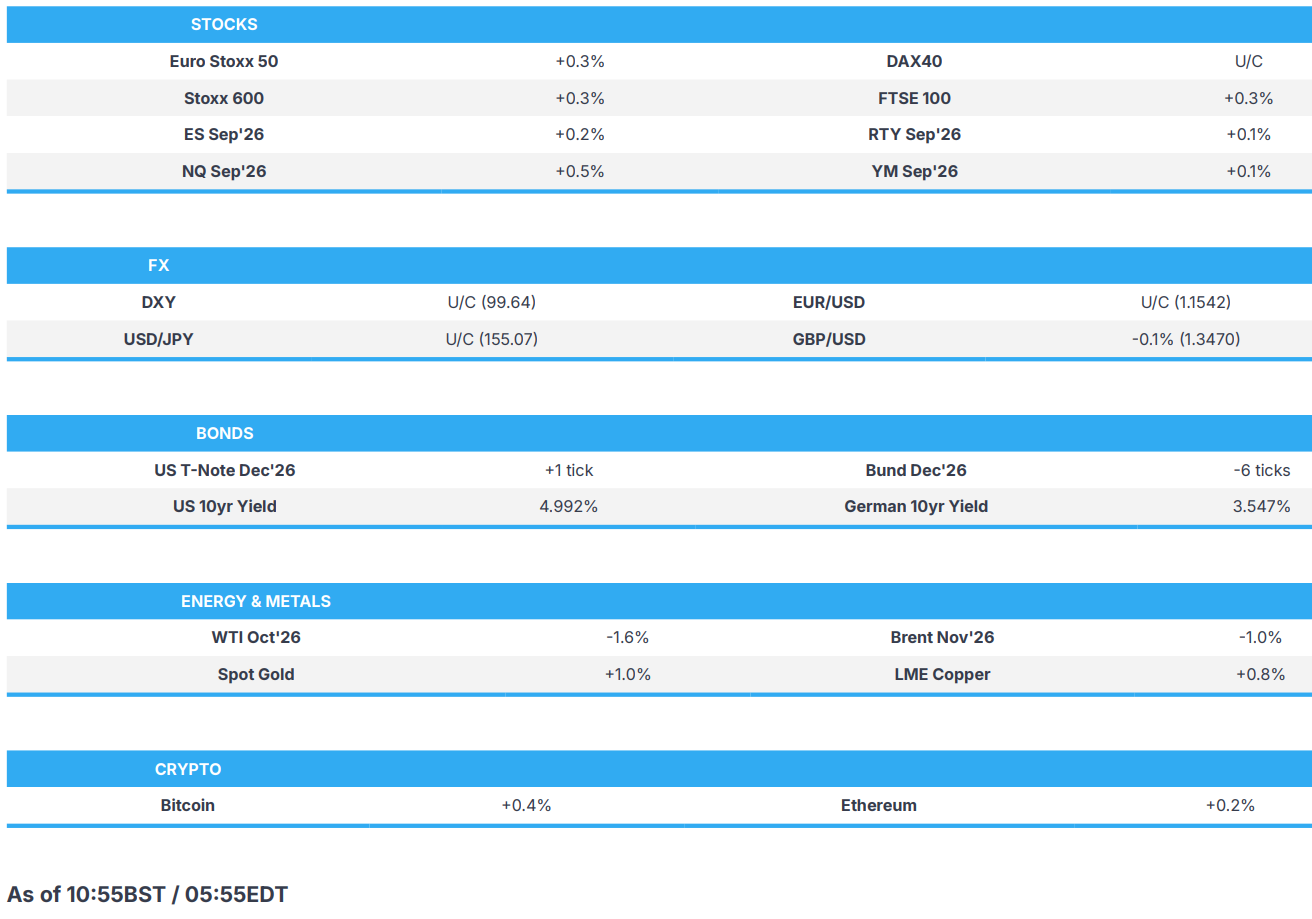
Newsquawk in 3 steps:
1. Subscribe to the free premarket movers reports
2. Listen to this report in the market open podcast (available on Apple and Spotify)
3. Trial Newsquawk’s premium real-time audio news squawk box for 7 days
EUROPEAN TRADE
EQUITIES
- European bourses (STOXX 600 +0.3%) are firmer across the board, rebounding from Tuesday’s losses. The pullback in bond yields have helped support equities, with energy prices also lower today. Constructive commentary by Iranian FM Araghchi adds to the positive tone, stating that the MoU with the US is in effect and looks forward to returning to a diplomatic solution.
- Sectors lack a clear bias. Basic Resources top the sector pile, with Utilities and Banks rounding out the sector gainers. To the downside lie Autos, with Optimised Personal Care and Media the sector laggards.
- US equity futures are higher, following their European peers. Intel (+4.5%) has found some strength pre-market, following a Reuters report detailing potential talks with SK Hynix (+3%) about the production of memory chips in the US.
- Click for the sessions European pre-market equity newsflow
- Click for the additional news
FX
- G10s trade tentatively against the USD ahead of a key FOMC policy decision later today. EUR and JPY hold marginally afloat, whilst the Loonie slightly lags vs peers.
- DXY currently holds towards the lower end of a 99.53-99.73 range. Action has been lacklustre throughout the overnight session and for much of the European morning, with traders ultimately awaiting Retail Sales and the Fed policy decision later today. The former will likely spark little reaction given the close proximity to the Fed. On that note, expectations are for a 25bps hike; attention will be on if it is accompanied with hawkish rhetoric/guidance. This could either be provided through a hawkish set of SEPs, a unanimous hike or overt hawkish language at Warsh’s presser. At least one of these would likely be required to give bond traders enough confidence in market stability, to allow yields to edge off highs.
- Note: A full Fed preview can be found on the Newsquawk Research Suite.
- GBP had regional inflation metrics to digest this morning. Whilst headline rose from the prior (in-line), Core Y/Y and Services was unchanged from the previous month, indicating no signs of second-round effects. Therefore, the data is unlikely to shift views at the MPC into Thursday’s confab, where rates are expected to be held steady in a 6-3 vote split. Following the data, Cable saw some two-way action, before eventually moving lower as traders curtailed their rate hike bets.
FIXED INCOME
- Global fixed benchmarks are mixed. USTs (-1 tick) are essentially flat, whilst Bunds (-6 ticks) are under mild pressure. Gilts (+38 ticks) outperform vs peers, following the region’s inflation metrics, which keeps a hold at tomorrow’s BoE meeting in play.
- USTs are trading lacklustre within a 105-27+ to 106-02+ range. Ultimately, focus remains on the FOMC announcement later today, where rates are expected to be raised by 25bps. Attention for bond traders will be on whether there is a hawkish aftertaste (decision aside), which would likely allow yields to ease off best levels, given that hawkish commentary would signal that the Fed is offering some stability. Currently, the US 10-year sits around the 5% mark, and towards multi-decade highs.
- Gilts outperform vs peers, benefiting from lower energy prices and following the region’s inflation report. On that point, whilst headline rose from the prior (in-line), Core Y/Y and Services were unchanged from the previous month; there is also a lack of evidence of second-round effects. Therefore, the data is unlikely to shift views at the MPC into Thursday’s confab, where rates are expected to be held steady in a 6-3 vote split. As such, traders curtailed their bets of a rate hike tomorrow, with money markets assigning a c. 30% chance of such a move.
- Germany sells EUR 2.12bln vs Exp. 2.5bln 3.40% 2047 and 2.90% 2056 Bund.
- Australia sells AUD 1bln in 3.75% April 2037 bonds: b/c 3.85x, avg. yield 5.3910%.
COMMODITIES
- WTI Oct and Brent Nov futures are softer after yesterday’s renewed rally. WTI trades around USD 104.90/bbl within a USD 103.76-105.63/bbl range (vs yesterday’s USD 101.21-106.75/bbl range), while Brent trades around USD 108.43/bbl within a USD 107.15-108.59/bbl range (vs yesterday’s USD 105.10-109.45/bbl range). Energy benchmarks have come under modest pressure in recent trade following constructive commentary by Iranian FM Araghchi, stating that the MoU with the US is in effect and looks forward to returning to a diplomatic solution.
- Dutch TTF was initially flat but is now posting mild gains. The Middle East conflict continues to sustain concerns around regional energy flows and European supply security. The contract trades around EUR 80/MWh within a EUR 79.93-83.28/MWh range at the time of writing, with Europe also looking ahead to the winter period.
- Precious metals are firmer as the pullback in oil and Treasury yields provides some relief ahead of today’s FOMC decision, where markets lean heavily towards a 25bps hike. Spot gold has reclaimed USD 4,300/oz and trades around USD 4,330/oz within a USD 4,276-4,341/oz range, breaking above yesterday’s USD 4,317/oz high (vs yesterday’s USD 4,262-4,317/oz range). The Fed remains the key catalyst, with updated projections and Chair Warsh’s guidance set to provide the space with some impetus.
- Base metals are modestly firmer as risk sentiment improves and Treasury yields ease ahead of the Fed, although the fundamental backdrop remains less supportive, with this week’s Chinese activity data showing continued weakness in domestic demand despite stronger industrial production, albeit upping calls for support. 3M LME copper resides in a narrow range above USD 14k/t, currently within USD 14,074.40-14,216.15.
- US Private Inventory Data (bbls): Crude +7.1mln (exp. -1.8mln), Gasoline +1.5mln (exp. -1.2mln), Distillate +1.6mln (exp. +0.8mln), Cushing -0.2mln.
- Russian plans to expand its diesel-export ban through October, according to Russian press.
- CBRT Governor said global central banks are rediscovering gold.
- Aluminium Bahrain CEO Al Baqali said damage to the smelter from the Iranian strike in March has already been repaired.
- A gold mine collapsed in West Kordofan, Sudan, on Sunday, according to sources.
TRADE/TARIFFS
- US is pressuring Mexican officials to accept new rules for exports of AI hardware to prevent Chinese companies and other foreign firms from circumventing tariffs, according to WSJ.
NOTABLE EUROPEAN HEADLINES
- EU Commission President von der Leyen delivered her annual State of the Union address. On the trade front, she said the EU’s trade deficit with China has reached its tipping point and are engaged with dialogue with China to rebalance trade, however warns of the use of all tools possible to rebalance trade. With Canada, she announced that they will create a common prosperity and economic security space covering manufacturing, technology, energy, AI, defence and the Arctic and proposed that Canada becomes the first associate member of the EU. For EU defence, she said that it is time for an Article 4-style EU security protocol and announced plans to establish a new European Instrument for military strategic enablers. She also announced that the EU will establish a new European cooperation to help obtain and stockpile critical raw materials.
- UK Chancellor Healey is said to be considering budget tax rate on higher stakes slot machines, according to FT.
- Senior German lawmaker Frei said that an energy price relief must come quickly and thinks that energy relief measures should come into effect in October, adding that lower sales tax on gasoline would be an obvious step to take, RTL TV reported.
- Germany’s Economy Ministry said it is continuously assessing the situation and maintaining ongoing dialogue with all market participants in the natural gas sector and welcomed SEFE’s intention to step up efforts to fill gas storage.
NOTABLE EUROPEAN DATA RECAP
- UK CPI (Aug YY) 3.1% vs. Exp. 3.1% (Prev. 2.9%); Services CPI 3.4% (prev. 3.4%).
- UK CPI (Aug MM) 0.5% vs. Exp. 0.5% (Prev. 0.3%).
- UK Core CPI (Aug YY) 2.6% vs. Exp. 2.6% (Prev. 2.6%).
- UK Core CPI (Aug MM) 0.3% vs. Exp. 0.3% (Prev. 0.2%).
- UK Retail Price Index (Aug YY) 3.4% vs. Exp. 3.5% (Prev. 3.2%).
- UK Retail Price Index (Aug MM) 0.6% vs. Exp. 0.7% (Prev. 0.6%).
- UK July ONS House Price Index 1.4% (prev. 2%).
- Italian HICP Final (Aug YY) 3.2% vs. Exp. 3.2% (Prev. 2.9%).
- Italian HICP Final (Aug MM) 0.1% vs. Exp. 0.1% (Prev. -1.0%).
- ECB Wage Tracker Annual (2026): 2.202% (prev. estimate 2.301%).
- European Industrial Production (Jul YY) 0.0% vs. Exp. -0.1% (Prev. -0.3%).
- European Industrial Production (Jul MM) -0.1% vs. Exp. -0.2% (Prev. -0.1%).
CENTRAL BANKS
- RBNZ Assistant Governor Silk is to leave the central bank after the December rate decision.
GEOPOLITICS
MIDDLE EAST
- Iranian FM Araghchi said “The memorandum of understanding with America is in effect and we want to return to a peaceful solution”, adding that Iran is not interested in continuing the conflict and looks forward to returning to a diplomatic solution.
- Iran’s Major General Rezaei said “there will be no negotiations until Iran’s conditions are met”.
- IRGC Navy political deputy said no vessel in the Persian Gulf, Strait of Hormuz or Sea of Oman moves outside the supervision of the IRGC Navy, and added that Iran can target any vessel anywhere if it wishes, IRNA reported.
- Iran said only a single-digit number of ships are currently passing through the Strait of Hormuz, disputing US claims that traffic through the strategic waterway is increasing. It was separately reported that Strait of Hormuz vessel transits fell to four, according to data.
- Pakistan’s military spokesperson said the Mekkah agreement with Saudi Arabia and Turkey will not affect Pakistan’s strategic relationship with Iran, and reiterated that the pact is defensive in nature.
- China’s Foreign Minister met with their Iranian counterpart. China encouraged Iran and the US to exercise rationality, urged all parties to take effective measures to reopen the Strait and supported dialogue between Iran and Gulf states.
- Explosions were heard in Iran’s Qeshm which originated from the sea, according to IRNA.
RUSSIA-UKRAINE
- Ukrainian President Zelensky said if Russia is prepared to agree to an energy ceasefire, it must bar any attacks on energy infrastructure in any form.
- Ukrainian media reports explosions in Kyiv, while Polish military aircraft have been activated amid Russian strikes on Ukraine.
OTHER
- US mulls purchasing warships from Japan and South Korea to counter China, according to Nikkei.
CRYPTO
- Bitcoin holds steady after slipping to a low of USD 74.92k in Tuesday’s session following the failure by the Senate to pass the Clarity Act.
APAC TRADE
- APAC stocks were mixed in choppy trade, albeit with sentiment gradually improving, following the declines on Wall St and recent upside in oil, while participants now await the major central bank rate decisions, beginning with the FOMC later.
- ASX 200 eked slight gains with strength seen in the commodity-related sectors and with sentiment also helped by M&A news after reports that Brookfield is to acquire Reliance Worldwide for USD 2.8bln, although gains are limited amid weakness in tech, real estate and consumer stocks.
- Nikkei 225 traded indecisively after mixed data from Japan, in which Exports and Imports topped forecasts, but Machinery Orders disappointed.
- KOSPI edged higher in two-way trade after swinging between gains and losses, while the tech heavyweights have shown some resilience with SK Hynix mildly underpinned after its union approved the tentative wage agreement in a re-vote.
- Hang Seng and Shanghai Comp were mixed in range-bound trade, with the Hong Kong benchmark lacklustre as the special administrative region unveiled its first-ever Five-Year plan to align more closely with China, which some fear could be a step away from a free market, while the mainland pared initial losses with the PBoC upping its liquidity efforts.
NOTABLE ASIA-PAC HEADLINES
- Hong Kong unveiled its first Five-Year Plan to align more closely with mainland China and stated it will adhere to the one country, two systems principle, as well as strengthen the role of the global offshore renminbi business hub. Hong Kong will hold an executive-led system, adopt a holistic approach to development and security, while it will attract China financial firms to the city for business and develop a commodity trading ecosystem. Furthermore, it aims to speed up the Northern Metropolis development and targets GDP growth within a reasonable range in the Five-Year Plan.
- PBoC Governor Pan said slower loan growth may become a ‘new grateful’ and that slower credit growth can stabilise debt levels, while China will support local government financing vehicles to resolve debt risks. Furthermore, Pan said they will improve the short-term interest rate adjustment mechanism and further refine policy rates, as well as strengthen the role of policy interest rates.
- China’s Defence Minister said global security governance must be strengthened and they must build an equal and orderly multi-polar world, as well as find a new path to security featuring collaboration rather than confrontation and should uphold multilateralism. Furthermore, he stated that they support regional countries to decide their own future without external interference, while risks should be anticipated and diffused early to prevent minor friction turning into major disputes.
NOTABLE APAC DATA RECAP
- Japanese Trade Balance (Aug) -1105.6B vs. Exp. -1052.6B (Prev. -638.3B).
- Japanese Exports (Aug YY) 19.3% vs. Exp. 18.2% (Prev. 23.2%).
- Japanese Imports (Aug YY) 28.0% vs. Exp. 26.3% (Prev. 27.9%).
1c) Asian opening report
Crude pulls back while US assets tread water ahead of the FOMC – Newsquawk EU Market Open
Wednesday, Sep 16, 2026 – 02:12 AM
- US VP Vance told the NY Post that the conflict with Iran is expected to shift into a “much different phase” in the coming months.
- A US official said the military and Gulf countries have begun conducting daytime tanker transits through the Strait of Hormuz, rather than only at night as in recent months, according to Axios.
- Crude futures pulled back after rallying again yesterday as a series of geopolitical and supply headlines lifted the benchmarks.
- APAC stocks were mixed in choppy trade, albeit with sentiment gradually improving; European equity futures indicate a modestly positive cash market open.
- Looking ahead, highlights include UK Inflation (Aug), Italian Inflation Final (Aug), ECB Wage Tracker (Aug), US Retail Sales (Aug), Atlanta Fed GDP (Q3), New Zealand GDP (Q2), Fed Policy Announcement, BCB Policy Announcement, BoC Minutes. Speakers include ECB’s Vujcic, Elderson & Nagel, Fed Chair Warsh. Supply from Germany.
Newsquawk in 3 steps:
1. Subscribe to the free premarket movers reports
2. Listen to this report in the market open podcast (available on Apple and Spotify)
3. Trial Newsquawk’s premium real-time audio news squawk box for 7 days
SNAPSHOT
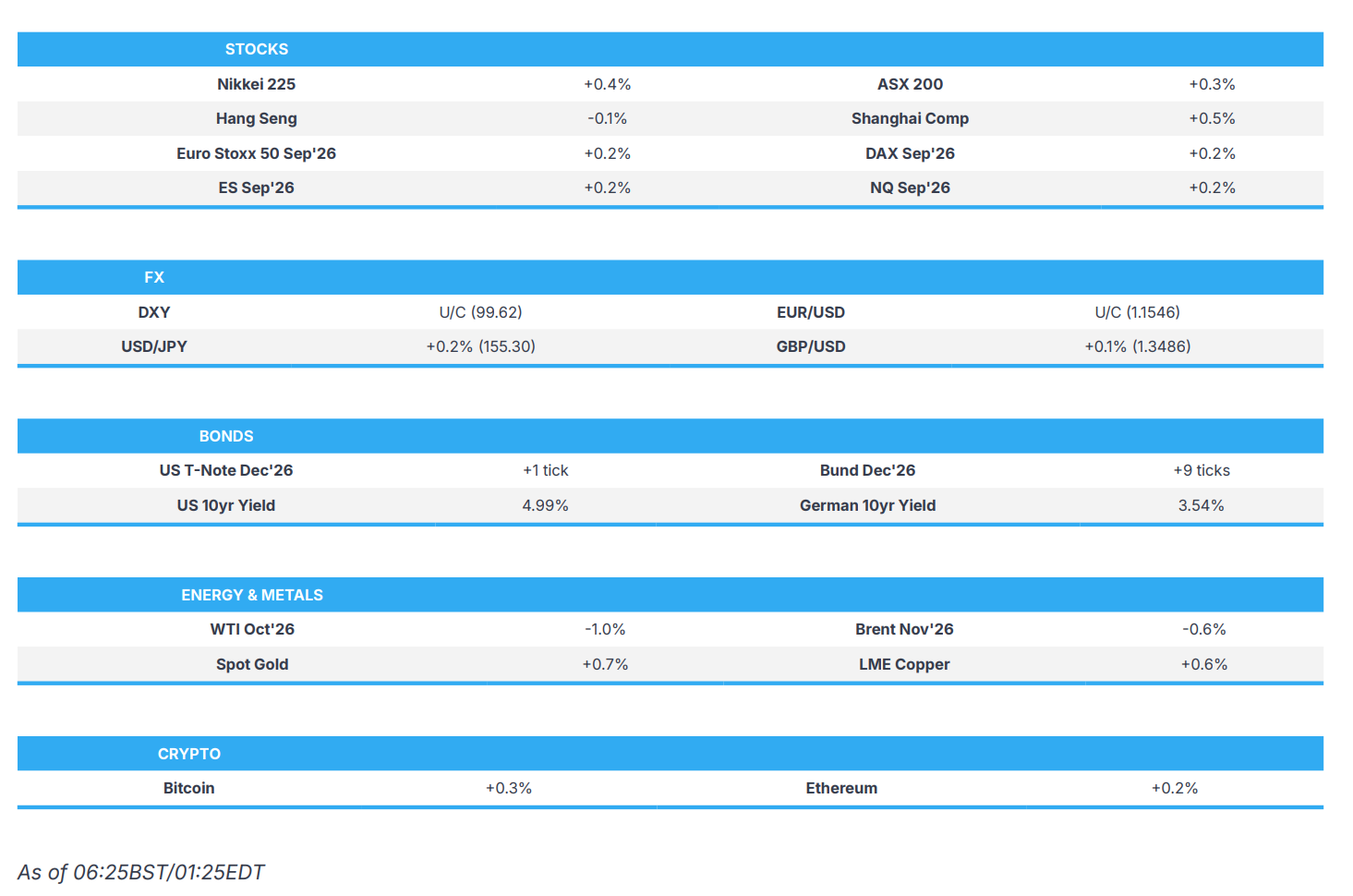
LOOKING AHEAD
- Highlights include UK Inflation (Aug), Italian Inflation Final (Aug), ECB Wage Tracker (Aug), US Retail Sales (Aug), Atlanta Fed GDP (Q3), New Zealand GDP (Q2), Fed Policy Announcement, BCB Policy Announcement, BoC Minutes. Speakers include ECB’s Vujcic, Elderson & Nagel, Fed Chair Warsh. Supply from Germany.
- Click for the Newsquawk Week Ahead.
IRAN CONFLICT
- US VP Vance told the NY Post that the conflict with Iran is expected to shift into a “much different phase” in the coming months. Vance said that the first phase of the conflict, focused on destroying Iran’s nuclear programme, conventional military, and power-projection capabilities, is complete, with the current focus shifting to preventing the regime from rebuilding.
- US official said the military and Gulf countries have begun conducting daytime tanker transits through the Strait of Hormuz, rather than only at night as in recent months, according to Axios.
- Top military commanders from the US, Israel, Saudi Arabia, the UAE, Bahrain, Kuwait, Qatar, Jordan and Egypt held a secret meeting in Germany last week, according to Axios citing sources. US CENTCOM commander Cooper reassured regional partners the US will maintain its military presence despite Iranian attacks on bases and outlined plans to expand shipping through the Strait of Hormuz.
- Explosions were heard in Iran’s Qeshm which originated from the sea, according to IRNA.
- Iran and Pakistan reportedly cooperate to ensure regional security, according to Tasnim.
- Iran said only a single-digit number of ships are currently passing through the Strait of Hormuz, disputing US claims that traffic through the strategic waterway is increasing. It was separately reported that Strait of Hormuz vessel transits fell to four, according to data.
- Saudi Arabia and the forces it backs in Yemen are struggling to counter the Houthi advance and are unlikely to regain the key Red Sea port of Mokha, which the Houthis captured last week, according to assessments from several Western European militaries cited by Bloomberg.
- Saudi air defences intercepted and destroyed a drone attempting to enter Mecca airspace.
- Sirens were activated and explosions heard in the Jizan and Abha regions of Saudi Arabia.
- US State Department spokesperson said that the meeting between Lebanese and Israeli ambassadors in Washington discussed the upcoming round of negotiations.
- US is preparing a USD 2.8bln weapons package for Israel, while it was separately reported that the US is preparing to sell 2,000lb bombs to Israel, according to WaPo.
- Israeli airstrikes hit several areas in southern Lebanon, according to Al Jazeera.
US TRADE
EQUITIES
- US stocks closed lower again on Tuesday, with the Nasdaq and Russell underperforming, while the equal-weight S&P fell 0.4%. Calls for a slowdown in AI development remained an overhang for sentiment, although the SOXX and DRAM ETFs were marginally firmer following their sharp declines on Monday. Sectors were predominantly in the red, with weakness led by Consumer Discretionary, Communication Services and Utilities, although Energy bucked the trend as crude prices rallied amid fresh supply concerns after Libya’s NOC said operations had been suspended at three oil fields, while Saudi Arabia reportedly informed some European refiners that their September crude cargo loadings had been cancelled. Oil loadings were also reportedly suspended at the key Saudi Red Sea port of Yanbu following the recent attack on the East-West pipeline.
- SPX -0.45% at 7,585, NDX -0.78% at 28,938, DJI -0.63% at 52,093, RUT -0.68% at 2,873.
- Click here for a detailed summary.
TARIFFS/TRADE
- US is pressuring Mexican officials to accept new rules for exports of AI hardware to prevent Chinese companies and other foreign firms from circumventing tariffs, according to WSJ.
- US Treasury Secretary Bessent is to meet China’s Vice‑Premier He Lifeng in New York on Sunday ahead of the Trump‑Xi summit, according to FT.
- China launched the Pinglu Canal, a major waterway project aimed at cutting transit times for cargo moving to Southeast Asia.
- EU capitals have rebuffed Canadian PM Carney’s push to be granted a “unique alliance” with the bloc, according to FT.
NOTABLE HEADLINES
- US Treasury Secretary Bessent said the Treasury’s bond buyback intervention was successful and it recently held two of its most successful auctions in 20 years, while he said the government should not set an equilibrium yield level and that addressing the deficit is one factor affecting the 10-year Treasury yield. Bessent also commented that USD 5K checks are a good idea, as well as urged lawmakers not to waive AI liability and said AI firms should not receive a “blank check on liability”.
APAC TRADE
EQUITIES
- APAC stocks were mixed in choppy trade, albeit with sentiment gradually improving, following the declines on Wall St and recent upside in oil, while participants now await the major central bank rate decisions, beginning with the FOMC later.
- ASX 200 eked slight gains with strength seen in the commodity-related sectors and with sentiment also helped by M&A news after reports that Brookfield is to acquire Reliance Worldwide for USD 2.8bln, although gains are limited amid weakness in tech, real estate and consumer stocks.
- Nikkei 225 traded indecisively after mixed data from Japan, in which Exports and Imports topped forecasts, but Machinery Orders disappointed.
- KOSPI edged higher in two-way trade after swinging between gains and losses, while the tech heavyweights have shown some resilience with SK Hynix mildly underpinned after its union approved the tentative wage agreement in a re-vote.
- Hang Seng and Shanghai Comp were mixed in range-bound trade, with the Hong Kong benchmark lacklustre as the special administrative region unveiled its first-ever Five-Year plan to align more closely with China, which some fear could be a step away from a free market, while the mainland pared initial losses with the PBoC upping its liquidity efforts.
- US equity futures recouped some of the prior day’s losses as sentiment in Asia gradually improved, but with gains capped ahead of the looming Fed rate decision.
- European equity futures indicate a modestly positive cash market open with Euro Stoxx 50 futures up 0.2% after the cash market closed with losses of 0.4% on Tuesday.
FX
- DXY was flat amid the overall cautious sentiment and after gaining yesterday alongside the recent surge in oil prices and upside in yields, although dollar-specific newsflow remained sparse ahead of the pivotal FOMC decision, where money market pricing is leaning heavily towards a 25bps hike, although such a move is not quite seen as a foregone conclusion.
- EUR/USD lacked conviction in the absence of pertinent catalysts, while reports that France would back former Dutch central bank chief Knot to succeed Lagarde as ECB President garnered little reaction.
- GBP/USD traded uneventfully and lingered beneath the 1.3500 handle as UK CPI data also looms.
- USD/JPY continued to edge higher and returned to above the 155.00 level ahead of the key central bank rate decisions beginning with the Fed today, while participants also digest mixed data from Japan and recent comments from Treasury Secretary Bessent, who spoke on a wide range of topics at the House Financial Services Committee hearing and defended yen intervention.
- Antipodeans were contained in the absence of relevant tier-1 data and amid the cautious mood.
- PBoC set USD/CNY mid-point at 6.7628 vs Exp. 6.7148 (prev. 6.7670).
FIXED INCOME
- 10yr UST futures traded little changed following yesterday’s mild declines and curve steepening, with participants cautious ahead of today’s key FOMC rate decision.
- Bund futures kept afloat after rebounding from the prior day’s trough but with upside capped as attention turns to key central bank rate decisions and with Bund supply scheduled later.
- 10yr JGB futures gained as yields mostly declined in Japan and participants digested mixed data.
COMMODITIES
- Crude futures pulled back after rallying again yesterday as a series of geopolitical and supply headlines lifted the benchmarks, including an announcement by Libya’s NOC that production and operations were suspended at three oil fields after a valve was closed on the Al-Hamada-Zawiya pipeline, warning it may need to declare force majeure. Furthermore, Saudi Arabia informed some European refiners that their September crude cargo loadings had been cancelled, and oil loadings were reportedly suspended at the key Red Sea port of Yanbu following the recent attack on the East-West pipeline.
- US Private Inventory Data (bbls): Crude +7.1mln (exp. -1.8mln), Gasoline +1.5mln (exp. -1.2mln), Distillate +1.6mln (exp. +0.8mln), Cushing -0.2mln.
- US Energy Secretary Wright said he expects the pipeline to resume operations very soon, with its reopening measured in days. Libya’s NOC head said production remains around 1.4mln bpd and that related shutdowns have not materially affected output, while he said oil exports are continuing normally, and Sharara oilfield production remains normal.
- Spot gold was somewhat choppy but eventually reclaimed the USD 4,300/oz level and broke out the prior day’s range as oil faded some of its recent advances, while markets now await the Fed.
- Copper futures mildly gained as risk sentiment gradually improved overnight.
CRYPTO
- Bitcoin eked mild gains but with upside capped in choppy trade and with resistance at USD 76,000.
NOTABLE ASIA-PAC HEADLINES
- US Treasury Secretary Bessent said the US had been in constant dialogue with Japan over intervention and used a “nominal amount” for yen intervention. He added that a stronger yen is better for US exporters and that the US made tens of millions of dollars from the intervention.
- PBoC Governor Pan said slower loan growth may become a ‘new grateful’ and that slower credit growth can stabilise debt levels, while China will support local government financing vehicles to resolve debt risks. Furthermore, Pan said they will improve the short-term interest rate adjustment mechanism and further refine policy rates, as well as strengthen the role of policy interest rates.
- Hong Kong unveiled its first Five-Year Plan to align more closely with mainland China and stated it will adhere to the one country, two systems principle, as well as strengthen the role of the global offshore renminbi business hub. Hong Kong will hold an executive-led system, adopt a holistic approach to development and security, while it will attract China financial firms to the city for business and develop a commodity trading ecosystem. Furthermore, it aims to speed up the Northern Metropolis development and targets GDP growth within a reasonable range in the Five-Year Plan.
- Australia’s Speaker of the House of Representatives will lead a delegation to visit China on September 18th-22nd.
DATA RECAP
- Japanese Trade Balance (Aug) -1105.6B vs. Exp. -1052.6B (Prev. -638.3B)
- Japanese Exports (Aug YY) 19.3% vs. Exp. 18.2% (Prev. 23.2%)
- Japanese Imports (Aug YY) 28.0% vs. Exp. 26.3% (Prev. 27.9%)
- Japanese Machinery Orders (Jul MM) -3.7% vs. Exp. -2.8% (Prev. 9.7%)
- Japanese Machinery Orders (Jul YY) 11.2% vs. Exp. 15.3% (Prev. 16.9%)
GEOPOLITICS
RUSSIA-UKRAINE
- Ukraine expects to require USD 52.6bln in international financial aid in 2027 to support its budget and war effort, according to its draft budget.
- Russian Defence Ministry said Russian forces hit a tanker in Ukraine’s port of Izmail.
OTHER
- US Treasury Secretary Bessent said the US has taken control of many Venezuelan assets.
- US mulls purchasing warships from Japan, South Korea to counter China, according to Nikkei.
- China’s Defence Minister said global security governance must be strengthened and they must build an equal and orderly multi-polar world, as well as find a new path to security featuring collaboration rather than confrontation and should uphold multilateralism. Furthermore, he stated that they support regional countries to decide their own future without external interference, while risks should be anticipated and diffused early to prevent minor friction turning into major disputes.
EU/UK
NOTABLE HEADLINES
- UK PM Burnham is to meet with US President Trump in New York next week, while they are expected to discuss Ukraine, the Middle East and energy during their meeting at the UNGA.
- UK Chancellor Healey mulls a budget tax rate on higher-stakes slot machines, according to FT.
- France is prepared to support Dutch central banker Klaas Knot to succeed Christine Lagarde as ECB President if a French candidate is appointed the bank’s chief economist, according to reports.
2.NORTH AND SOUTH KOREA/
SOUTH KOREA//NORTH KOREA
SOUTH KOREA
JAPAN
3. CHINA/
CHINA/TAIWAN
4. EUROPEAN AND SCANDINAVIAN COMMENTARIES PLUS NATO
EUROPE:
Beware Contrived Scares And False Flags In Europe
Wednesday, Sep 16, 2026 – 03:30 AM
Authored by Thomas Karat via The Libertarian Institute
On the evening of August 4, an airport employee at Leipzig/Halle noticed a small drone resting on the apron near a parked Ukrainian Antonov freighter. It carried an explosive charge and a detonator. The charge did not go off. A bomb-disposal robot rolled out across the tarmac, and by the account German officials would later give, the device had gone unnoticed for roughly four hours before anyone found it. Then the airport reopened and the country moved on.
Twenty-eight days later, on September 1, the German government told its citizens who had done it. Interior Minister Alexander Dobrindt and Foreign Minister Johann Wadephul stood together in Berlin and named Russia. The consulate in Bonn would close on September 18; the lease on Berlin’s Russian House cultural centre would be torn up; more Russians would be proposed for European Union sanctions lists. The attribution was delivered as settled fact. The evidence behind it was not.
Five days after that, on September 6, the voters of Saxony-Anhalt went to the polls with the Alternative für Deutschland polling around 41-43%, within reach of an absolute majority in a state the entire German establishment had spent months trying to deny it. The sequence is worth holding in the mind as a single object. A device found in early August, a public silence lasting four weeks, and then an official enemy announced in the final days of a campaign. Nothing about that ordering is illegal, but nothing about it is accidental either.

Dobrindt’s case, as he laid it out, does not rest on a single piece of proof. It rests on three strands said to point the same way: police forensics, the resemblance of the device to earlier operations, and intelligence reporting. “Taken together,” he said, the investigations, the pattern and the intelligence findings established Russian responsibility. He named no GRU officer. He named no unit. He said the people who carried out the plan appeared to be “low-level” agents acting on behalf of unspecified “Russian state entities.”
What the public was given, then, was a conclusion and a description of the kinds of evidence that produced it—not the evidence. An independent observer cannot test the chain. Even sympathetic accounts noted the gap: the ministers named the state but kept most of the underlying material out of view. NATO’s Secretary-General Mark Rutte pronounced the evidence “clear” without any of it being made public, and welcomed the German measures. The European Union’s foreign-policy chief Kaja Kallas went further still, telling reporters in Ireland that the incident bore “all the hallmarks of state-sponsored terrorism.”
This is the ordinary grammar of attribution in the sabotage era. A government states that its services and their partners have reached a judgement, allied governments affirm the judgement, the proof stays classified; and the citizen is invited to supply the trust that the missing evidence would otherwise earn. It may be that the classified material is overwhelming. It may be that it is thin. The structure is identical either way, which is precisely the problem. A public asked to accept an attribution on faith has no way to tell a strong case from a convenient one.
The load-bearing sentence in the German case is not about forensics at all. It is about familiarity. Wadephul said the drone’s configuration, its components, its explosives, and its ignition technology were “familiar to us from other Russian hybrid operations and from Russia’s war against Ukraine.” Dobrindt used almost the same words: elements “known to us,” a device of “high technical expertise” assembled with care. Recognition, in other words, is doing the work that a signature would normally do.
Set that claim against the way Russian military intelligence is documented to actually operate in Europe, and the argument begins to strain. The GRU’s European sabotage model, as reconstructed by investigators across several countries, is built entirely on deniability. It runs on “disposable agents”—petty criminals and drifters recruited over Telegram, paid in cryptocurrency, handed a task they barely understand and then discarded. The devices are disguised as consumer goods. When four incendiary parcels shipped from Vilnius caught fire in the summer of 2024, one of them ignited at a DHL depot at Leipzig-Halle itself—the same airport, a plot European prosecutors traced to Russian military intelligence through a chain of expendable cut-outs. The entire point of that architecture is that nothing recognizable survives to be traced back to Moscow.
So the official account asks the reader to believe one of two things. Either a service whose whole tradecraft is the erasure of its own signature built a device bearing its recognizable signature and parked it beside the single most obvious Russian target in Germany—a Ukrainian cargo plane on a NATO logistics hub. Or the word “familiar” is doing exactly the work a manufactured attribution would need it to do. If a device merely looks like what everyone already expects Russia to build, then “we recognize it” becomes a claim that can be made about almost any drone, by almost any authority, at almost any politically useful moment. Neither reading requires anyone to have planted anything. Both should make a careful citizen slower, not faster, to accept the conclusion on offer.
There was, to be clear, more than one drone. On the same night a second craft struck a cargo Boeing 757 in mid-air at around four hundred meters as the aircraft aborted its landing, and a third was reportedly recovered from airport grounds days later. Whatever this was, it was not nothing, and this piece does not pretend otherwise. None of it, though, establishes who was behind it. Russia may well have been. The point is narrower and harder to wave away. The specific reason the state has given for certainty—that the device was recognizable—is the weakest possible ground for certainty about an actor defined by not being recognizable. When the evidence for a proposition is also, on inspection, evidence against it, the logical response is doubt, and doubt is the one response the announcement was engineered to foreclose.
Ask the old question. In the four weeks between the drone and the announcement, nothing about the device changed. What changed was the calendar. The attribution landed in the last stretch of the Saxony-Anhalt campaign, and the writer Thomas Fazi noted what was hard to miss. Here was an official enemy announced on the eve of a vote the establishment feared it would lose, in a contest where the insurgent party is routinely cast as Moscow’s instrument. And the casting is not idle: the AfD is the one significant party that opposes the arming of Ukraine and the rearmament drive, that wants the sanctions lifted and relations with Moscow restored. A fresh Russian outrage, timed to the final days, was calculated to make exactly that party look like the Kremlin’s wittingly useful friend, and to herd frightened voters back toward the parties promising protection. The drone did not need to change the result. It needed only to fill the closing days of the campaign with the word “Russia.”
It did not work. On September 6 the AfD took 43.8%, more than double its 2021 showing, winning 39 of the 83 seats—three short of a governing majority, and so still walled out of power by the other parties, but a rout of the governing CDU all the same. Whatever the naming of Russia was meant to accomplish at the ballot box, the voters of Saxony-Anhalt were not moved by it. And the endorsements that arrived from abroad only underscored how crude the intended frame had been. U.S. President Donald Trump hailed the result as “a really big night”—and wrote not a word about drones or the Kremlin, casting the vote entirely as a revolt against immigration. Elon Musk, who has called the party “the only hope for Germany,” simply posted “Gut gemacht”—well done—and drew from the AfD’s lead candidate an open offer of “strong and constructive cooperation.” The scare had promised the electorate a party in Moscow’s pocket; what the electorate could see was a party being courted over immigration and investment by an American president and the richest man alive. The enemy-image did not match the thing itself, and the gap was visible to anyone looking.
Widen the lens and the incident slots into a program that predates it by years and does not depend on any single election. Germany is remilitarizing on a scale unseen since reunification. Defence Minister Boris Pistorius has told the Bundestag the country must be “ready for war by 2029.” From January 1, 2026, every young German man is required to register for potential military service, with conscription to follow automatically if volunteer numbers fall short. The 2026 federal budget lifts defense spending by around a third, toward roughly €108 billion. And the market has read the direction of travel unambiguously. Shares in Rheinmetall, the country’s largest arms maker, have risen more than tenfold since Russia’s 2022 invasion, the company posting record orders as European rearmament converts fear into backlog.
Into that current, Leipzig arrives as confirmation. Commission President Ursula von der Leyen described the incident as a Russian escalation “on European Union soil” and told Europeans they now faced a “new normal” and a “new era of European security,” pledging that the pressure on Moscow would only rise and that a fresh sanctions package was already in preparation. Chancellor Friedrich Merz had already told a French broadcaster, a year earlier, that Germany was “already in conflict with Russia”—the framing was in place long before the drone arrived to illustrate it. The beneficiaries of that framing are not hidden. They are the arms manufacturers with record backlogs, the security bureaucracies whose budgets and mandates expand with every declared threat, the sanctions apparatus that grows by accretion, and the governing parties for whom the enemy is at the gate is the one message that might yet drown out a domestic opposition that just took nearly forty-four percent of the vote.
There is a history here that German officials, of all people, have reason to know, and it is not being spoken. States manufacture the provocations that justify what they had already decided to do. This is not a fringe proposition, it is documented fact, entered into the record by the states themselves.
On the night of August 31, 1939—eighty-seven years, almost to the day, before the Leipzig announcement—SS operatives in Polish uniforms seized a German radio transmitter at Gleiwitz and broadcast an anti-German message, leaving a murdered prisoner dressed as a Polish attacker on the floor as evidence. It was one of a series of staged border incidents. The next morning Adolf Hitler cited Polish aggression as he sent his armies east. The pretext was found on the eve of the war it was built to license.
Closer to home, and closer to the present alliance, there is Operation Gladio. After the Second World War, NATO and the CIA built clandestine “stay-behind” networks not in one country but across Western Europe—armed, hidden cells nominally intended to resist a Soviet invasion that never came. When the Italian Prime Minister Giulio Andreotti acknowledged the structure to parliament in October 1990, he made a point of insisting Italy was not alone. Identical networks had operated in Belgium, the Netherlands, France, West Germany, Greece, Denmark, Norway, Luxembourg, and beyond, with counterparts in neutral Switzerland and Austria. The scandal was continent-wide, and so was the response. On November 22, 1990 the European Parliament passed a resolution condemning the existence for forty years of “a clandestine parallel intelligence and armed operations organization in several Member States,” which had “escaped all democratic controls” and been “run by the secret services of the states concerned in collaboration with NATO.” The Parliament recorded that in certain member states military secret services had been “involved in serious cases of terrorism and crime.” Parliamentary inquiries followed in Italy, Belgium, Switzerland, and Germany. In Italy those inquiries reached the sharpest conclusion. A decade later a Senate commission found that a “strategy of tension”—bombings of civilians in public places, blamed on the left to frighten the electorate toward the anti-communist right—had been “organised or promoted or supported by men inside Italian state institutions and, as has been discovered more recently, by men linked to the structures of United States intelligence.” This is not a rumor a foreign broadcaster invented. It is the finding of the European Parliament and of national legislatures about their own recent past—a decades-long campaign, run across the continent by Western services in concert with the very alliance now delivering the verdict on Leipzig.
Nor is the pattern only European. In March 1962 the United States Joint Chiefs of Staff, over the signature of their chairman, sent the Secretary of Defense a formally approved proposal titled “Justification for U.S. Military Intervention in Cuba.” Operation Northwoods, declassified in 1997, laid out a menu of manufactured provocations—staged terror in American cities, a faked shoot-down, a sunk ship—all to be blamed on Havana to build public support for a war the planners already wanted. President John F. Kennedy rejected it. The significance is not that it was carried out; it wasn’t. The significance is that the most senior uniformed officers of a democracy considered the deliberate deception of their own public a usable instrument of policy, and put it in writing.
Raise these precedents and you are told, correctly, that they prove nothing about Leipzig. They don’t. What they establish is smaller and more unsettling, that the manufactured pretext is a real and recurring tool of statecraft, used by the strong when a public needs moving toward a war it has not yet chosen. A citizenry that cannot even hold that possibility in mind—that treats the very question as the enemy’s talking point—has been relieved of a defense it did not know it needed. The disinformation monitors now classify the word “false flag” itself as a hostile signal, to be flagged and debunked. It is a strange kind of security that makes the historical memory of one’s own governments into a category of foreign interference.
Whatever sat on that tarmac in August, the crucial fact about it is that the response was ready before the cause arrived. The conscription letters were already printed. The sanctions package was already drafted. The rearmament budget was already voted, the war-readiness date already set for 2029, the arms-maker’s order book already at record height. Merz had already declared the country in conflict. And on the very day it named Russia, the government raised the national threat level from “general” to “high”—Dobrindt telling reporters, “we are not at war, but we are the daily target of hybrid attacks.” The drone did not begin any of this. It was fitted into it—a piece of confirmation slotted, at the optimal moment, into a machine assembled in advance, and the machine responded by advancing itself another notch.
That is the part worth watching, and it holds regardless of who built the device, and regardless of how Saxony-Anhalt voted. A population is being readied—methodically, through its budgets, its conscription rolls, its threat levels, its ministers’ vocabulary and its evening news—for a war with Russia that its leaders increasingly describe as already under way. The electorate that just returned a resounding verdict against that project will find the project unaltered by its vote. In such a climate the origin of any single incident matters less than the use to which it is instantly put, and the speed with which doubt about it is reclassified as betrayal. The Germans of an earlier century learned, too late, what it costs to accept the enemy their government hands them without asking to see the proof. The proof, this time, is still classified. The certainty was on the news within the day.
END
UK
BANK OF ENGLAND
huge story/sends gold price much higher as yields skyrocket!!
(zerohedge)
Bank Of England To Stop Selling 20- And 30-Year Gilts As Yields Soar
Wednesday, Sep 16, 2026 – 02:45 AM
The Bank of England is set to announce this week that it will stop selling long-dated government bonds which have been hit by a global selloff in debt markets, potentially freeing up some cash for finance minister John Healey, the Telegraph reported adding that the BoE would say it would stop selling 20- and 30-year gilts.
The central bank, which already scaled back the sale of longer-dated gilts, is due to announce its plan for the pace of quantitative tightening on Thursday, alongside its latest interest rate decision.

Prices of 20- and 30-year gilts touched their lowest since 1998 (and yields inversely hit the highest) on Monday as part of a rout of government bonds around the world as the Iran war adds to inflation pressures and puts pressure on central banks to raise official borrowing costs.
Last year the BoE skewed sales away from long-dated gilts, and Deutsche Bank has said they could be halted altogether. A BoE survey published in July showed investors expected just over 15% of the central bank’s bond sales in the 12 months from September to be of longer maturity.
The Telegraph said halting longer-dated bond sales could save the government £2.5 billion a year by the end of the decade which would be a boost for Healey as he prepares for the first budget statement of the government of Prime Minister Andy Burnham on October 28.
The BoE racked up £875 billion of government bond purchases between 2009 and 2021 as part of its emergency QE support for the economy. Since it stopped reinvesting maturing gilt proceeds in February 2022, the BoE’s bond holdings have fallen by over £400 billion, a third of it through active sales – unlike the Federal Reserve and the European Central Bank which allow the bonds they hold to mature but do not sell them.
Some investors have called on the BoE to halt sales but Governor Andrew Bailey has defended the program, saying it would allow for intervention in markets if needed in the future.
The Reform UK party of former Brexit campaigner Nigel Farage has criticised the cost of the BoE’s QT programme. The BoE survey in July showed investors expected the central bank to slow the pace at which it reduces its bond portfolio to £50 billion in the 12 months to the end of September 2027 from £70 billion in the current 12-month period.
end
GERMANY
Germany’s AfD National Support Hits Historic High; CDU Slumps To Record Low
Wednesday, Sep 16, 2026 – 02:00 AM
A new poll in Germany has delivered yet another shocking blow to the political establishment. The Alternative for Germany (AfD) has reached 30 percent for the first time while stretching its lead over the Christian Democrats (CDU/CSU) to 10 points, with the Union reaching a historic low of just 20 percent. In addition, another poll has also put the CDU even lower, at 18 percent.

According to the GMS poll, the governing black-red coalition of Chancellor Friedrich Merz’s conservatives and the far-left SPD would no longer command a majority. Compared with GMS’s mid-July survey, the Union lost three points and the AfD gained two.
“Important milestone cracked: With 30%, our AfD is now already 10 percentage points ahead of the Union! The citizens want the political change – and they will get it. Time for the AfD!” wrote AfD co-leader Alice Weidel on X.
A new YouGov poll released today has the AfD at 29 percent but the CDU is even lower, at 18 percent, an absolutely abysmal result for the paryt.
The numbers arrive days after the CDU’s heavy defeat in Saxony-Anhalt, where the AfD won 43.8 percent. Merz himself described the result as a shock for his party. “We are all deeply shocked; we did not expect such a result,” he said.
Personal ratings for the chancellor are equally grim. In a recent Insa survey, 78 percent of respondents answered “no” when asked, “Is Friedrich Merz (still) the right chancellor?” Only 14 percent said yes; 8 percent offered no opinion. Even among CDU voters, the picture is bleak for Merz: 58 percent opposed him and just 36 percent supported him.
Pressure inside the CDU is growing. Speculation about a possible change at the top has circulated for weeks, with North Rhine-Westphalia Minister-President Hendrik Wüst and Bavaria’s Markus Söder frequently named as potential successors. Söder, for his part, said the long-standing “firewall” against the AfD is not working.
“This ‘firewall model’ has failed,” he said.
Instead, he offered a different image:
“We in Bavaria see ourselves as a protective wall.”
He argued that simply isolating the AfD without confronting its arguments no longer works. Instead, he wants to confront the AfD on issues such as immigration.It remains to be seen how that is possible if the CDU keeps allying with left-wing parties.
However, it is important to note that Söder continues to rule out a cooperation or coalition with the AfD.
“Not talking about the content at all, putting them in a corner and cobbling together some majorities around them without addressing the issues. That is the wrong path,” he said.
AfD co-leader Alice Weidel, speaking after the Saxony-Anhalt vote, engaged in an intense debate with Merz in the Bundestag, saying, “The voters in Saxony-Anhalt have told you in the language of the democratic sovereign with all clarity: black-red is over.”
Merz has countered by calling the AfD a “destructive force” that “wants to destabilize our country.”
State elections in Mecklenburg-Western Pomerania and Berlin on Sept. 20 will put Merz’s CDU further to the test. Speculation is growing that if the CDU falters during those elections, enormous pressure will be placed on Merz and his role as chancellor could become untenable.
END
SWEDEN
70% Of Swedes With Non-European Background Supported The Left In Narrow National Election Victory
Wednesday, Sep 16, 2026 – 05:00 AM
For years, the right across the West has noted that mass immigration has been a boon for left-wing parties, which are essentially importing a new voting base. Sweden’s latest election appears to once again affirm this view, with the left narrowly winning the election, in large part due to their overwhelming support from those with a non-European background in Sweden.

Sweden’s 2026 election produced one of the narrowest results in recent memory. With roughly 94.7 percent of votes counted, the center-left opposition holds 176 seats against 173 for the parties backing outgoing Prime Minister Ulf Kristersson.
The left-wing Social Democrats remain the largest party at 28 percent, enough to put Magdalena Andersson in position to try to form a government.
A striking pattern in SVT’s VALU exit poll helps explain how the result took shape, with 70 percent of voters of non-European origin backing the left-wing bloc of Social Democrats, Left Party, Greens, and Center.
“VALU shows a very clear political dividing line. Among voters with non-European backgrounds, S, V, MP, and C together receive 70 percent, while the Tidö parties receive 27. This is a voter group whose party sympathies differ sharply from the electorate as a whole – and which therefore has significance for the long-term electoral math,” wrote Swedish political scientist and author Daniel Schatz on X.
VALU defines the group as people who themselves, or whose parents, grew up outside Europe. Their votes broke down for the Left at 21 percent, Social Democrats at 38 percent, Greens at 7 percent, and Center at 4 percent.
Before the election, the leader of the right-wing Sweden Democrats, Jimmie Åkesson, also wrote that the left’s strategy is to gain votes from Swedes with a foreign background even as they lose votes from native ethnic Swedes:
“It’s about power. The Social Democrats’ decades-long campaign for increased immigration from the Muslim world has never been a coincidence. On the contrary, it seems to be a long-term strategy. The election promise from Magdalena Andersson to grant citizenship to up to 100,000 immigrants, based on the old and undemanding regulatory framework, should be seen in the same light,” he wrote.
“When Swedish voters flee the party, you need votes from elsewhere, and mass immigration from the Muslim world then appears to be an attractive way to circumvent the will of the Swedish people,” he added.
In 2022, Swedes with a foreign backgroun already attracted around 68 percent of this electorate. Earlier surveys of Muslim voters had placed combined support for the Social Democrats, Left and Greens near 85 percent, with the Social Democrats alone above 61 percent. This slice of the electorate has expanded rapidly over the years.
About 13 percent of eligible voters, close to 1 million people, now have non-European origins, up from just over 3 percent in 2002 and 0.3 percent in 1982.
Many arrived from Muslim-majority countries in the Middle East, Africa and Asia through asylum, family reunification and earlier, more open immigration rules.
Sweden does not record religion in official statistics, yet estimates indicate that Swedish citizens from Muslim-majority countries number in the hundreds of thousands. Together, with other voters of non-European background, they form a reliable base for the left even as much of the rest of the country has shifted toward tighter immigration and crime policies.
Remix News reported on polling already six years ago which showed that a majority of Swedes wanted to tighten immigration substantially. While the native ethnic Swedish population has swung to the right, foreigners have incentives to vote for the left to ensure their families and fellow countrymen can arrive in Sweden unimpeded. Foreigners are also more likely to benefit from social welfare, which left-wing parties promote.
The overwhelming vote for the left from those with a non-European background has been seen across the Western world. In Germany, for instance, the Left Party has proposed giving voting rights to all foreigners who have lived in Germany for five years, regardless of whether they have citizenship. Similar proposals have been put forward by other left-wing parties in the country.
END
This will not be good for Canada joining a woke EU
EU Opens Door For Canada To Become Bloc‘s First-Ever “Associate Member”
Wednesday, Sep 16, 2026 – 11:05 AM
Thanks to how mean President Trump has been, Canada could become the first-ever “associate member” of the European Union under a proposal unveiled Wednesday by European Commission President Ursula von der Leyen, as Ottawa looks to reduce its economic dependence on the United States.

Speaking during her annual State of the Union address in Strasbourg, with Canadian Prime Minister Mark Carney in the front row as the first foreign head of government ever to attend the speech, von der Leyen said Brussels wants to take its relationship with Canada to an unprecedented level.
“We must urgently reimagine our partnerships,” von der Leyen said, before telling Carney she wanted to work with him on “opening the door for Canada to be the first associate member of the EU.”
There is just one complication: no such status currently exists.
EU treaties allow European countries to apply for full membership, while Brussels maintains an assortment of trade, association and single-market agreements with countries outside the bloc. But “associate membership” would be something new, meaning its rights, obligations and legal structure would have to be negotiated essentially from scratch.
Reuters notes that any serious move toward such a status would also face the politically difficult task of winning support from all 27 EU member states.
And Carney himself has stopped short of calling for full EU membership. On Sunday, after a Wall Street Journal report that Canada was exploring membership, he described what Ottawa is seeking as a “unique alliance” with Europe. He addresses the European Parliament on Thursday.
The substance of what Brussels is proposing, however, goes considerably beyond another trade agreement.
Canada and the EU already have CETA, their comprehensive free-trade deal. Von der Leyen said Wednesday that the two sides now want to move “from CETA to an Alliance for the Future” encompassing manufacturing, technology, defense, energy, critical minerals, batteries, artificial intelligence, quantum computing, cybersecurity and Arctic security.
“We will integrate defence industrial bases,” she said.
That process has already begun.
Canada became the first non-European country allowed to participate in the EU’s €150 billion SAFE defense procurement program under an agreement signed in February and formally concluded by the EU Council in June. The arrangement allows eligible Canadian companies and Canadian-origin products to participate in procurement financed by the program.
The EU-Canada defense relationship has also expanded into military mobility, interoperability, maritime and space security and defense-industrial cooperation.
Then there’s the economics of the idea. Roughly 70% of Canadian exports go to the United States, making any rapid decoupling unrealistic. At the same time, Trump’s tariffs and repeated talk of a 51st state have given Ottawa a powerful incentive to diversify. Europe, meanwhile, needs resources.
Von der Leyen warned Wednesday that Europe remains more than 80% dependent on China for many critical raw materials, with dependence reaching 90% for some rare earths.
“No country can do this alone,” she said.
Canada possesses significant reserves of nickel, uranium, potash, cobalt, lithium and rare earth elements, among other commodities increasingly regarded as strategic inputs for batteries, semiconductors, defense equipment and energy infrastructure.
That makes a deeper Canada-EU relationship potentially complementary: Europe gets another source of strategic commodities and energy while Canada gets a large alternative market, industrial investment and greater access to European defense and technology programs.
There is nevertheless a potentially uncomfortable tradeoff for Ottawa. If “associate membership” eventually includes meaningful access to the EU’s roughly €18 trillion single market, Canada could be required to align portions of its regulatory regime with EU rules. Reuters notes that this could leave Ottawa accepting European regulations without receiving the voting rights enjoyed by actual EU members.
Canada could gain market access while becoming, at least in some areas, a rule-taker rather than a rule-maker.END
EU/CANADA
NATO/RUSSIA
weekly incursions escalates the situation between Russia/Ukraine as the Baltic states get quite nervous!!
NATO’s ‘Collective Defense’ Rhetoric Escalates Amid Now Weekly Aerial Incursions
Wednesday, Sep 16, 2026 – 07:45 AM
Ukraine war spillover into NATO ‘eastern flank’ members’ airspace is now becoming a weekly reality, which presents added pressure and dangers which could potentially lead up to a major Russia-Western military confrontation. Lead NATO powers like Germany have of late also alleged Russian intelligence ‘sabotage’ campaigns involving drones near aviation hubs in central Europe.
Over the past years of war, an errant (or intentioned?) drone or missile crossing over into Poland or the Baltic states might have happened once every few months, generating significant headlines and media coverage. But now barely a week passes and NATO leadership points the finger at Russia for alleged aerial incursions.
The latest happened overnight as Lithuania’s foreign minister confirmed Tuesday that NATO jets were scrambled and intercepted and destroyed a drone that entered Lithuanian airspace from neighboring Belarus.

Belarus is part of a ‘Union State’ with Russia and hosts its military assets, and also coordinates logistics with Moscow in support of the ‘special military operation’ in Ukraine.
Lithuanian President Gitanas Nauseda announced on X, “A drone that just entered Lithuanian airspace was destroyed by NATO fighter jets.”
“With Russia intensifying its aggression against Ukraine, such readiness is vital for our region,” he added. An investigation is on to determine the drone’s origins.
One might be tempted to view these incidents as now ‘routine’ – but what’s important is to observe the escalated rhetoric and threats surrounding them. As an example, the following European media report based on ‘answering’ these incursions in the name of allied common defense is alarming, given the atmosphere of confrontation:
From the Baltics to Poland, Europe’s eastern edge is monitoring Russia’s war to prevent it spilling over its own borders.
NATO stands “vigilant, committed, and ready,” Lithuania’s foreign minister said Tuesday, after an allied fighter jet destroyed a drone that crossed into the country’s airspace from Belar
Kestutis Budrys credited the interception to the strength of collective defense, thanking the allies whose air presence, he said, protects Baltic skies and reinforces regional security.
But the message lands beyond Vilnius: as Russia’s war on Ukraine grinds on, the alliance’s eastern members are increasingly treating airspace violations — deliberate or not — as tests of NATO’s resolve, and Tuesday’s response was framed as proof the system works.
Given there have been instances where Russian-crewed jets have either briefly violated European airspace or come close to it, we are possibly one jet intercept and downing away from something that triggers a shooting war between Russia and NATO.
This underscores the urgency of finding a roadmap toward negotiating an end to the Ukraine war. However, this month’s Kushner-Witkoff trip to Moscow to meet with President Putin resulted in little of significance.
end
GREECE:/UK/EUROPE
Greece Wants To Become Europe’s Next Hedge Fund Hub
Wednesday, Sep 16, 2026 – 05:45 AM
Athens is emerging as an unlikely contender in the competition for Europe’s hedge fund money, with Greece using favorable tax treatment, an improving economy and Mediterranean living to attract financiers looking beyond London and other established financial centers, according to Bloomberg.
That campaign has already produced some notable converts. Millennium Management has established an operation in Athens, while billionaire hedge fund manager Chris Rokos is heading to Greece after deciding to leave Britain. Greek officials are betting that attracting firms of that caliber will make it easier to persuade smaller funds and finance professionals to follow.
It is a striking development for a country that spent much of the previous decade synonymous with sovereign debt problems and economic instability. Greece has since repaired its public finances, regained investment-grade credit ratings and posted stronger economic growth than much of Europe. Its government can now borrow at lower yields than several much larger economies.
That turnaround is central to the sales pitch.
“Greece is fiscally healthy, it constantly produces surpluses and, as a result, it provides tax predictability and macroeconomic stability,” said Vasilis Karatzas, an adviser to Finance Minister Kyriakos Pierrakakis.

Bloomberg writes that there is also plenty of financial incentive to make the move. Greece continues to offer qualifying wealthy newcomers a €100,000 annual flat tax on foreign income, a program that has remained unchanged since 2019. By comparison, Italy has repeatedly increased the cost of its competing program. Greece has now sweetened the deal for the investment industry specifically, allowing eligible fund managers who become Greek tax residents to pay 5% on carried interest and bonuses.
The government says it isn’t simply trying to become another European parking lot for wealthy foreigners. The larger ambition is to get investment firms to actually operate from Athens, bringing well-paid finance jobs, encouraging talented Greeks working abroad to return and creating the foundation for a domestic money-management industry.
Timing could be working in Greece’s favor. Higher taxes have made Britain less attractive to some wealthy financiers, while geopolitical instability has introduced another consideration for people who had been looking toward financial centers in the Middle East. Athens suddenly finds itself competing for people who might previously have considered London, Milan, Dubai or Abu Dhabi the obvious choices.
There are still practical obstacles. Athens will need more luxury housing, strong private schools and the broader infrastructure expected by highly paid international finance workers and their families. And a couple of prominent arrivals hardly make Greece the next Mayfair.
“The country won’t become a wealth hub overnight. It will take years,” Karatzas said.
Still, Millennium and Rokos give the Greek experiment something more important than another tax incentive: validation. Once major funds demonstrate that Athens is a viable place to operate, Greece’s hope is that the next wave of managers becomes considerably easier to convince.
END
5.RUSSIAN AND MIDDLE EASTERN AFFAIRS
ISRAEL/USA VS IRAN/ WEDNESDAY
Hormuz: Rare US Strike On Iranian ‘Small Boats’ Caught Trying To Seize Surface Drone
Wednesday, Sep 16, 2026 – 08:05 AM
President Trump and the Iranians have been issuing competing claims over who has ‘control’ over the Strait of Hormuz and the degree to which it is ‘open’ to global energy transit.
The situation on the ground remains dire, given almost daily hostile confrontations between Iranian and US naval forces there. According to the latest: “The U.S. military destroyed two Iranian small boats Monday after the Islamic Revolutionary Guard Corps tried to steal a Navy drone patrolling the Strait of Hormuz,” US officials were quoted in Axios as saying.

The confrontation is being dubbed “unusual” for the fact that it involved small boats, and not the larger tankers which have been closely watched by international maritime monitors.
Iranian media reports emerged on the incident Monday, but state sources presented it as a US attack on “fishing boats” – which occurred off the port city of Kargan and near Larak Island.
Here’s how US officials and Axios present the he said, she said competing accounts…
Iranian side:
Nafisi said an unspecified number of fishermen were missing and that search-and-rescue operations were underway, according to Iran’s semi-official Mehr News Agency.
Pentagon side says:
- A U.S. official said the IRGC used the boats to try to capture a naval drone that the U.S. military uses to patrol the Strait of Hormuz.
- After U.S. forces identified the attempt, an American drone fired two missiles at the boats, destroying them and killing most of those on board.
Judging by videos that widely circulated Monday which appear to show the same incident, the surface drone may have suffered some damage. But again, it’s unclear whether the released footage (apparently via the Iranian side) depicts the same incident or possibly a prior episode:
Further, US Central Command spokesman Capt. Tim Hawkins said of the alleged attempted seizure, “Iranian small boats recently attempted to take possession of a U.S. unmanned surface vessel, but they were unsuccessful after CENTCOM forcefully responded.”
He then noted that the intercept wasn’t successful and the the surface drone remains under the operation of US forces. As for aerial drones, the Iranians have downed, captured, or disabled dozens of aerial UAVs throughout the over six-month long conflict. Many have been expensive MQ-9 Reaper drones.
END
ISRAEL TBN
END
END
IRAN/USA MIDDLE EAST ASSETS;
Pentagon Inspector General Report On Iran War Drops: The Most Explosive RevelationsIG report to Congress: Hundreds of buildings & structures at US bases destroyed.
Yes, a recent Pentagon Inspector General (Lead IG) report to Congress on the Iran conflict (Operation Epic Fury) confirms that Iranian strikes damaged or destroyed hundreds of buildings and structures at U.S. bases.
washingtonpost.com
The report, released around September 14–15, 2026, covers the period from the start of joint U.S.-Israeli operations on February 28 through June 30. It is the first comprehensive public accounting of costs, equipment losses, facility damage, and related impacts from the Defense Department’s watchdog (in coordination with State Department and USAID inspectors general).
cnn.com
Key findings on base and facility damage
- Iranian strikes “damaged and destroyed hundreds of buildings and structures at U.S. bases in Kuwait, Bahrain, Qatar, UAE, Saudi Arabia, Iraq, Oman and Jordan.” This comes from communications with U.S. Central Command. cnn.com
- The U.S. Navy’s regional logistics hub in Bahrain was hit by drones and ballistic missiles (described by the acting Navy secretary as having been “blew[n] the hell out of”), creating significant challenges for naval support and forcing shifts to more distant hubs such as Diego Garcia (with longer 14- to 18-day logistics cycles). cnn.com
- U.S. diplomatic facilities in Iraq, Kuwait, Saudi Arabia, and the UAE sustained roughly $184 million in damage (with some reports noting related costs approaching $208 million including delayed projects). washingtonpost.com
Earlier independent analysis (e.g., satellite imagery reviewed in May 2026) had already indicated extensive damage—at least 200+ structures or pieces of equipment at multiple sites—beyond what was initially publicly detailed.
washingtonpost.com
Other major revelations from the report
- Costs: Approximately $33.4 billion as of late June (not including full infrastructure repair or full aircraft replacement costs). This breaks down as roughly $22.3 billion in expended munitions, $3.7 billion in equipment losses, and $7.4 billion in other obligations/operations. stripes.com
- Munitions and industrial base: Heavy expenditure created “strategic inventory shortfalls” and exposed bottlenecks (solid rocket motors, high-grade explosives/propellants, skilled manufacturing labor). The Defense Department is working to streamline procurement, production lead times, and stockpiling. This contrasts with some prior public statements minimizing stockpile concerns. stripes.com
- Aircraft and equipment: Dozens damaged or destroyed, including up to ~30 MQ-9 Reaper drones (~$30 million each), multiple F-15s, at least one F-35, an A-10, several KC-135 tankers (some hit on the ground), and others. apnews.com
- Personnel and operations: More than 50,000 U.S. troops deployed in the CENTCOM area. Reports cite around 18 U.S. service member deaths (some hostile, some non-hostile/crashes) in broader periods and 417 wounded in the report’s main window; air defenses intercepted thousands of Iranian drones and ballistic missiles. breakingdefense.com
The report focuses on the initial months and notes that totals (damage, costs, etc.) would rise in subsequent updates. It provides the first formal official tally of these impacts amid the ongoing conflict (described in coverage as entering its seventh month by mid-September 2026). Multiple outlets (Washington Post, AP, CNN, Breaking Defense, Stars and Stripes, and others) reported the same core details based on the IG document.
END
HAMAS
IDF kills senior Hamas Rafah Brigade commander Nael Abu Obeid in Gaza Strip strike
The target of the strike was Nael Abu Obeid, the commander of Hamas’s Rafah Brigade, who replaced his predecessor, Mohammad Shabanah, who was killed by the IDF in May 2025.

IDF troops destroy Hezbollah rocket launchers as Saudi Arabia turns to Western allies for help
END
HEZBOLLAH/ISRAEL
Ali Taher was IDF’s most complex battle terrain yet, Egoz forces chief tells ‘Post’ – interview
The Egoz Special Forces commander told the Post that the battle signified a major setback to Hezbollah and to Iran “both on a symbolic and command and control operational level.”
https://player.jpost.com/public/player.html?player=jpost&media=4102048&url=https://www.jpost.com/IDF soldiers operate in Lebanon’s Ali Taher Ridge in this footage released by the military on September 16, 2026. (credit: IDF Spokesperson’s Unit)
ByYONAH JEREMY BOBFollowSEPTEMBER 16, 2026 19:00
Updated: SEPTEMBER 16, 2026 21:35
Of all of the battle spaces of the last three years, from Gaza to Syria to the West Bank to Lebanon, the Ali Taher Ridge battle was the most complex to win, Egoz special forces Commander Lt.-Col. “M” told The Jerusalem Post in a rare on-the-record interview on Wednesday.
The operation to capture the ridge at the edge of the IDF’s zone in southern Lebanon lasted months, as dozens of terrorists, estimated to number around 50, were entrenched inside the tunnel until the IDF took control on September 3.
M viewed the defeat of Hezbollah at Ali Taher by his forces and IDF Division 36 more generally as a major setback to the terrorist group and to Iran “both on a symbolic and command-and-control operational level.”
The destruction of the 14 tunnel routes on the ridge – stretching about 5.4 k.m. in total and built with Iranian help over 20 years – by using a staggering 1,100 pounds of explosives, was given the IDF codename “Chisel of Flames.”
The challenges were multifaceted, M told the Post.https://player.jpost.com/public/player.html?player=jpost&media=4102051&url=www.jpost.comIDF troops operate in the area of Lebanon’s IDF Ali Taher Ridge in a video released on September 16, 2026. (courtesy: IDF Spokesperson’s Unit)
How did an elite IDF unit win the battle of Ali Taher Ridge?
Firstly, the ascent of the 600-meter-high ridge was extremely difficult and contained very few paths, he said. This made it easier for Hezbollah to booby-trap access routes to its underground lair.
Next, the volume of explosive drones that were sent to attack the Egoz special forces was unprecedented, M said.
“The ridge and lair were totally Iranian, with Hezbollah forces, one of the largest underground complexes in Lebanon,” with command-and-control authority over the entire Nabatiya area, he said.
“From the Ali Taher Ridge command center, Hezbollah managed all of its long- and short-range firepower southern Lebanon attacks on the IDF as well as on Israeli civilians in northern Israel,” he added. “Hezbollah felt very safe here and thought they were immune” to assault.
But M said his Egoz commandos “went in hard and fast, initially with small groups of forces to surround and cut off the area. Then we sent small probing forces into the very complex underground headquarters from which there were dozens of terrorists, rockets, and drone threats regularly.”
Next, to avoid the myriad booby-traps that Hezbollah set for them, his special forces had to use a variety of advanced technologies and super-honed field skills, such as being able to practically see and smell traps and drones moments before they would strike, M said.
It helped that the Egoz special forces had achieved complete surprise against the Hezbollah forces at Ali Taher by using various tactics to distract them from the commandos’ approach until it was too late, he said.
This meant that when the Hezbollah operatives started using more drones and firepower, they did not know where to direct their fire, he added.
Commandos saw ‘fear and surprise in the enemy’s eyes’
In many instances, the gunfights were in such proximity that his commandos “saw the fear and surprise in the enemy’s eyes up close,” M said.
Despite the surprise, he credited the Hezbollah fighters in the complex with “fighting back more fiercely than in any other battle in Lebanon,” they knew how important the battle was.”
Capt. “D” of the Combat Engineering Corps’ Yahalom special unit told the Post the areas near Hezbollah’s lair and inside were covered in surveillance cameras and a variety of short- and long-range improvised explosives so that anyone entering might think they were safe after getting past one explosive, only to fall victim to the next one.
He said his Yahalom special forces had used a wide range of techniques to analyze all the different pieces of the Ali Taher Ridge tunnel network until they could break it down into exactly which sections they wanted to take over and which sections they could just blow up with dynamite and cut off.
To accomplish this, they brought in senior experts from all over the IDF to arrive at the best and most creative plan, he added.
There were literally dozens of times during the battle for Ali Taher when he could have been killed if something had gone slightly differently, D said.
For example, when he was centimeters away from stepping on a well-camouflaged mine, he had a sixth-sense feeling that something was suspicious about the topography and stepped back from what would have been a fatal move forward, he said.
In another incident, a drone struck the vehicle he had been traveling in only moments after he exited, destroying the vehicle but leaving him unharmed, he added.
Both M and D said the large boulders that were part of the topography were a special challenge, but Egoz and Yahalom rose to the challenge to clear the way for additional forces and for blowing up the entire complex.
Furthermore, both M and D talked about Iran’s heavy contributions to the technological and tactical construction of the complex, making it unique in southern Lebanon.
D described a creative process for rapidly moving explosives from nearby trucks deep into the Hezbollah headquarters – both for efficiency and so that the terrorists could not intervene.
Questioned about the difficulties of the Israeli security cabinet and the Trump administration at one point ordering a pause from operations against Hezbollah at Ali Taher so as not to undermine the broader ceasefire with Iran, M said the IDF and political echelon had been fully coordinated at all times.
“Wherever and whenever an area was defined as a battle space, we did everything to arrive at the desired outcome,” he said.
Until the IDF destroyed the complex, it had served as the “nerve center” for the Badr Unit, and Hezbollah had no infrastructure of a similar scale north of it until reaching Beirut’s Dahiyeh neighborhood.
The operation began with the crossing of the Litani River and an attempt to surprise Hezbollah, the IDF reported.
Advertisement
The IDF carried out deception operations designed to make Hezbollah believe soldiers were preparing to cross in another area, but at the same time, it was opening a hidden bypass route over several days.
While most Hezbollah fighters were killed, some did manage to escape given the large number of tunnel shafts connected to the network.
Aspects of the operation were also conducted gradually, so there was no dramatic single moment until it was too late to lure Iran into complacency when Hezbollah started to desperately call for help.
“After what we did to them here, they understand we can get to them anywhere,” M said.
END
SYRIA
Syrian Protests Spread To Aleppo, Raqqa While Jolani Enjoys Red Carpet At Dubai Media Event
Tuesday, Sep 15, 2026 – 10:10 PM
Syria’s fuel price hike protests have persisted from Sunday into the heart of this week, and increasingly they are becoming full on anti-Sharaa regime demonstrations. Of course Sharaa – whose al Qaeda/ISIS name is Jolani – was never elected in the first place.
Monday into Tuesday the protests have spread across multiple cities and governates, including Raqqa in the east and Aleppo in the north.

Demonstrators have been burning tires, blocking highways, and confronting security forces after Damascus announced sudden massive increase in fuel prices.
A RESULT OF NEOLIBERAL SHOCK THERAPY in wake of CIA-ORCHESTRATED REGIME CHANGE
Sunday saw authorities raise diesel prices by up to 40% and petrol prices by 28%, after not just years but decades of government regulated price controls and subsidies.
Already the country was smashed by proxy war and sweeping US-led sanctions, not to mention a decade-long US troop occupation of Syria’s oil and gas fields in the northeast, which strangled the population (as part of efforts to overthrow secular Ba’ath leader Bashar al-Assad).
The West and Gulf powers then gave its backing to Jolani as self-declared president once Assad was ousted in December 2024. He had literally been a member of ISIS and was a founder of Syrian al-Qaeda (Nusra Front, later HTS). Washington, London, Riyadh, and Paris have embraced him – after they and their intelligence services basically put him in power.
When last month Washington finally lifted most sanctions on Damascus, the population hoped this might translate into the common people finally catching a break.
But alas, outrage is spilling into the streets over Jolani regime incompetence.
Aside from the ISIS pedigree of the US-backed government in Damascus, one Syrian commenter has outlined examples of Jolani/Sharaa regime incompetence:
1) We have no Prime Minister – Al Sharaa is the de facto PM
2) There is no unified 3-5-10 yr strategy that drives how every ministry works.
3) This means each ministry working on its own. Yes ministers are checking with the presidency on the priorities and deliverables, but they are working with or cross referencing with the wider cabinet.
4) I dont think the ministers meet that often with the president (acting PM).
5) These alignment mtgs are integral. Syria must have a national strategy, with clear cut objectives & plans for every ministry, defining how they all work towards a common goal.
Some reports say the people are even calling for the return of Assad, echoed in popular street chants heard in some of the protests.
Other pundits have alleged violent tactics by security groups, including firing off live rounds to disperse the protests.
From Sunday:
DropSite: Residents blocking the Damascus–Aleppo international highway near Maarrat al-Nu’man, south of Idlib, on Sunday, as protests spread following government increases in fuel prices.
Protests in the east, nearly formerly US-occupied oil fields…
Where has President Sharaa been this week? He’s getting the red carpet treatment in Dubai for the “Arab Media Summit 2026”.
The following is deeply ironic as various places in Syria burn amid enraged demonstrations:
Al-Sharaa, who spoke at the summit’s “Syria of the Future” event, also met with Sheikh Hamdan bin Mohammed bin Rashid Al-Maktoum, Dubai’s crown prince, and Sheikh Ahmed bin Mohammed bin Rashid Al-Maktoum, Dubai’s second deputy ruler, who is also the chairman of the Dubai Media Council, according to the Syrian Arab News Agency.
Over a decade ago, Jolani’s al-Nusra Front was introduced to Syria and on the world stage via its squadrons of suicide bombers…
Should the protests and unrest persist into Friday, which is the Islamic day of prayer and the start of the weekend in the Middle East, the situation could explode. It doesn’t seem like Jolani has any answers or strategy at this point. Perhaps he’ll hang out in Dubai and with his royal Gulf backers a little longer.
END
USA ALLIES/MIDDLE EAST/IRAN
US Troops Leak New Iran War Photos Of Gulf Bases: ‘Major Damage Hidden From American Public’
Tuesday, Sep 15, 2026 – 08:55 PM
As we’ve been documenting, it is clear that major damage has yet to be communicated to the American public regarding Iran’s major retaliation on US bases in the Gulf and Mideast since the start of Trump’s Operation Epic Fury.
During the same week that a long awaited Pentagon/Department of War Inspector General’s report was released covering the first four months of the Iran War, new leaked photographs have emerged of never-before-seen base damage.
“New photos obtained exclusively by CBS News reveal for the first time the widespread damage and destruction of buildings and vehicles at multiple U.S. positions across the Middle East, as a result of Iranian missile and drone attacks,” according to a bombshell Tuesday CBS report. Below is from Prince Sultan AFB, Saudi Arabia:

The outlet describes that the photos have been submitted by US service members under strict secrecy and anonymity – given the Pentagon has sought to enforce a crackdown on troops sharing the extent of damage, and amid orders aimed at maintaining operational security. But critics say the Pentagon and Trump administration are engaged in a cover-up and propaganda.
“This is major damage to our bases that hasn’t been communicated to the American public,” an actively deployed unnamed service member said to CBS News.
The service member added: “We’re standing there with our eyes closed getting punched in the face.”
Below is from Camp Arifjan, Kuwait:

Recent Iranian attacks on bases in Jordan have continued intermittently over the past weeks, and some pundits have warned that American personnel that continue to be stationed there are essentially sitting ducks.
The ballistic missile volleys from Iran have only gotten bigger, such as the last major attack on Muwaffaq Salti Air Base in Jordan during the night of September 8-9.
On Monday the newly released Pentagon Inspector General’s report said that “hundreds” of buildings and structures at US bases have been destroyed…
“Iranian strikes damaged and destroyed hundreds of buildings and structures at U.S. bases in Kuwait, Bahrain, Qatar, UAE, Saudi Arabia, Iraq, Oman, and Jordan during the conflict.”
More leaked images via CBS:

It was not just bases that got directly hit, and mainly within merely the opening weeks of Operation Epic Fury – but even consulates, embassies, and intelligence buildings have been targeted and suffered damage.
“U.S. diplomatic facilities in four countries—Iraq, Kuwait, Saudi Arabia, and the United Arab Emirates—suffered physical damage from Iranian strikes,” the Pentagon has conceded.
According to prior analysis from Amerikanets: “After destroying much of the radar network protecting regional US Axis bases in the previous hot phase of the war, Iranian planners have prioritized targeting fuel storage, drone hangers, refueling tankers, and barracks.”
The same analysis concluded: “The American response has been to pull assets back ever further from Iran, to bases in Israel and Jordan. We’ll call this process debasification. Iran’s debasification strategy takes advantage of the inherent asymmetry between the vastly different force structure and capabilities of Iranian rocket forces and US Axis air forces.”
See the full photo set here.
END
UAE// BAHRAIN//
this will hurt them terribly!!
Amazon Says Cloud Infrastructure In Bahrain, UAE ‘Beyond Saving’
Tuesday, Sep 15, 2026 – 10:35 PM
Amazon Web Services (AWS) says it cannot restore access to its cloud-computing facility in Bahrain or one of three data-hosting zones in the UAE due to the extensive damage caused by Iranian retaliatory strikes, Reuters reported on 15 September.
“The damage to our infrastructure spanned multiple Availability Zones and exceeded what our regional and multi-AZ services are designed to withstand,” AWS reported in its status update seen by Reuters.

In the UAE, resources and data held exclusively within one zone, labeled mec1-az2, have been damaged beyond hope of recovery, the company said, as engineers are still salvaging what they can from the two other battered zones and across the wider Emirati region.
An availability zone refers to a cluster of one or more data centers sitting inside the same geographic region, the structure AWS relies on to keep services running when a single site goes down.
The outages trace back to March, when the US and Israel attacked Iran, and Tehran responded with missile and drone salvos against Israel and Gulf states hosting US military bases.
AWS confirmed at the time that two of its UAE facilities took direct hits, while a drone strike near one of its Bahraini sites left the infrastructure there destroyed.
Most Bahrain-based customers shifted their workloads elsewhere on AWS advice before the region went dark in April, but the company says it has now exhausted every option for recovering whatever was left behind.
The losses have called into question the resilience of the Gulf’s fast-expanding cloud and AI infrastructure. The UAE is already redrawing plans to war-proof a major AI data center project, weighing decentralized site building alongside underground and blast-resistant construction, and even equipping the data center itself with anti-air defenses.
Israel and the US have long ago transformed AI infrastructure into a weapon of war deployed extensively across West Asian theaters.
Cloud platforms, data centers, and high-capacity computing systems now help store intelligence, process intercepted communications, analyze surveillance, and support military operations across West Asia, extensively so in Gaza and Iran.
Iran maintains that data centers operated by US technology companies are not simply civilian facilities, but strategic assets supporting US and Israeli aggression, thereby making them legitimate targets for retaliation.
AI has become a central instrument of US and Israeli warfare across West Asia, embedded in how targets are chosen, tracked, and struck.
Israel has weaponized AI platforms including automated targeting systems like The Gospel, Lavender, and Where’s Daddy? to harvest mass data, autonomously generate kill lists, and orchestrate systematic airstrikes and assassinations against Palestinians.
Backed by corporate infrastructure like Microsoft Azure, which stored massive caches of intercepted Palestinian communications, the Israeli military has deployed AI-driven drone surveillance to track and assassinate Palestinians.

The US has run algorithmic warfare systems such as Palantir’s Maven to process satellite, drone, and radar intelligence, using machine learning to speed the production of targeting recommendations against Iranian forces.
More than 1,000 targets were designated within the first 24 hours of the war on Iran, one of which resulted in the massacre of at least 150 people, including at least 120 schoolchildren at the Shajareh Tayyebeh elementary school in Minab.
END
SAUDI ARABIA
Saudi Coalition Intercepts Drone Headed Toward Mecca
Tuesday, Sep 15, 2026 – 09:45 PM
Update(2145ET): Drone attack on Mecca from unknown location being reported overnight, though the Saudi coalition has been prompted to blame Yemen’s Shia Houthis:
Saudi Arabia and the Organisation of Islamic Cooperation have condemned what they described as a “heinous” Houthi attack targeting Mecca.
A Houthi official, however, rejected Saudi Arabia’s account that its forces had shot down a drone heading toward the holy city, calling the report “a worn-out lie.”- AFP
And emerging reporting via Al Jazeera:
The Saudi-led coalition spokesperson, Turki al-Maliki, said Royal Saudi Air Defence Forces intercepted the hostile drone before it entered the restricted airspace on Tuesday evening.
Al-Maliki condemned the incident as an attempt to frighten worshippers and harm civilians, warning that the security of the two holy mosques and pilgrims is a “red line”.
The Houthis have previously denied targeting Mecca, saying that they do not target holy sites.

Currently a number of fake or old videos are circulating; however, the Saudis are reporting the incident.
* * *
Israeli media on Tuesday is awash with reports that the Israeli government is now quietly providing intelligence to Saudi Arabia amid the raging fight with Iran-aligned Houthi rebels in Yemen.
The claims definitely ring true given Israel has long faced immediate threats out of Yemen, after earlier in the Gaza war Israeli territory suffered several Houthi ballistic missile hits, including near sensitive facilities like airports. Also, Saudi and Israeli-linked ships are effectively banned from Red Sea shipping amid Houthi attacks.
One Israeli report reads: “Israel and Saudi Arabia are engaged in direct dialogue facilitated by the United States Central Command over potential Israeli intelligence assistance to Riyadh against the Houthis, a regional diplomat told i24NEWS.” Jerusalem Post also says that the intel-sharing is already happening.

“The diplomat said the discussions are intended to strengthen Saudi Arabia’s ability to confront the growing Houthi threat, with Israel potentially supplying intelligence on the group’s military positions, weapons infrastructure and operational plans,” the report adds.
CENTCOM chief Bradley Cooper has been in Saudi Arabia, where a meeting with Crown Prince Mohammed bin Salman took place the past weekend. MbS has urgently requested military help from Washington and London. Only Britain is said to be mulling a new Yemen intervention on any serious level. Riyadh is also appealing to Egypt’s President Sisi.
The Times of Israel separately reports that “The goal of the contacts is to share Israeli intelligence that could help Riyadh defend itself.”
The kingdom has of late come under direct ballistic missile and drone attack, and is seeking to especially protect its oil infrastructure, amid efforts to bring the damaged East-West pipeline back online after what appeared to be drones out of Shia militias in Iraq.
Middle East Eye says Netanyahu is ready to once again press a multi-front war:
Israeli Prime Minister Benjamin Netanyahu has offered “Israel’s services” to countries in the Arabian Peninsula and has expressed a willingness to participate in a “comprehensive war” against Ansar Allah, the Houthi movement in Yemen, Lebanese media have reported.
The report, by Al-Akhbar editor Ibrahim al-Amin, said that Netanyahu was pressing Israel’s security establishment and military to prepare for possible action against Iran and Hezbollah.
Israel has already for months been pummeling south Lebanon, despite what’s supposed to be a ceasefire with Hezbollah, and has moved troops into occupy a ‘buffer zone’.
Amb. Huckabee is not too convincing…
Saudi-Israeli intelligence sharing would certainly be seen as provocative among Arab populations, including Saudi Arabia’s own; however, it was likely going on during the Syrian proxy war to oust Assad. Gulf-Israeli cooperation against the ‘pro-Shia axis’ also reached a peak during the last decade.
END
SAUDI ARABIA/HOUTHIS
US Energy Secretary: Saudi Pipeline Could Be Back In Service Within Days
Tuesday, Sep 15, 2026 – 09:45 PM
By Julianne Geiger of OilPrice.com
Saudi Arabia’s East-West oil pipeline could be back in service within days, U.S. Energy Secretary Chris Wright said Tuesday, offering the first relatively concrete timeline for restoring a route that had been moving 4 million to 5 million barrels per day around the largely closed Strait of Hormuz.

The 1,200-kilometer pipeline was shut after an attack last week damaged the system. Wright said Saudi officials were still assessing the damage, but expected repairs to be measured in days rather than weeks.
The East-West line has been carrying roughly 4% to 5% of global oil supply to the Red Sea port of Yanbu, giving Saudi Arabia an outlet while traffic through Hormuz remains severely constrained. The outage could last several weeks, according to earlier estimates, raising the possibility that export-ready inventories at Yanbu would soon be depleted.
Some of that disruption has already reached buyers.
Saudi Aramco has canceled or delayed late-September crude cargoes to several European refiners. Poland’s Orlen has been buying North Sea crude and seeking U.S. WTI Midland and Kazakhstan’s CPC Blend after Saudi deliveries slipped. No Saudi crude had departed Yanbu since September 11, according to Vortexa data cited by Argus.
Saudi crude supply had already fallen to 6 million bpd in August, down 2.3 million bpd on the month and the lowest level in more than three decades, according to the International Energy Agency.
The pipeline shutdown pushed crude prices higher again Monday and Tuesday, with Brent climbing above $108 per barrel as traders priced in another potential loss of supply.
Wright said Saudi Arabia is also trying to move more crude through Hormuz with U.S. military assistance.
A restart within days would restore one of the few high-capacity routes still available to move Gulf crude without relying on the Strait of Hormuz. It would also arrive before Yanbu inventories become the next constraint.
END
SAUDI ARABIA /HOUTHIS
Saudis Threaten Retaliation After Alleged Houthi Drone Attack On Mecca Crosses “Red Line”
Wednesday, Sep 16, 2026 – 07:20 AM
Escalation in the Gulf area conflict certainly appeared overnight after Saudi Arabia accused Iran-backed Houthi rebels of targeting Mecca with a one-way attack drone, raising the risk of a deeper conflict as the kingdom’s East-West pipeline was knocked offline last week.
Bloomberg quoted the Saudi-led coalition, which said an attack drone was intercepted heading toward Islam’s holiest city and warned that protecting religious sites was a “red line.”

“The security of the Two Holy Mosques and the pilgrims is a red line, and the Joint Forces Command of the coalition will not hesitate to take the necessary and deterrent measures against the Terrorist Houthi Militia,” the kingdom said.
Rep. Joe Wilson (R-S.C.) wrote on X, “If the Mecca Alliance means anything, then Turkiye and Pakistan must work with Saudi Arabia to destroy the foreign Houthi terrorists and liberate Yemen from Iran.”
Hazem al-Assad from the Houthi politburo responded to the incident, saying that “claims about targeting Mecca are a worn-out lie that has been used before and no longer fools anyone.”
In any case, the red line that was drawn by the Saudis may only suggest a broadening conflict could be on the horizon, as rebels seized control of Yemen’s Red Sea coast and the narrow Bab al-Mandeb Strait. Compounding pressure on another maritime chokepoint, a drone attack last week knocked out Saudi Arabia’s East-West pipeline, used to divert 7 million barrels per day of crude from the Strait of Hormuz to Yanbu on the Red Sea.
The disruption forced the Saudis on Tuesday to cancel September-loading crude cargoes bound for Europe, which will only pressure the energy-stricken continent ahead of the Northern Hemisphere winter as a twin energy crisis unfolds, with seasonally low natural gas stockpiles and a deepening diesel crisis.
With crude tanker rates topping $1 million per day through the Strait of Hormuz to Asia, TankerTrackers reports that the Saudis are ramping up crude loadings from their east coast terminals to transit the critical waterway.
Brent crude trades at $107 per barrel, while WTI is around $104. Meanwhile, US diesel crack spreads topped a record $115 overnight as the refining crisis prompted Senate Majority Leader John Thune on Tuesday to tell reporters he is “open to exploring” a diesel export ban. Earlier, a report said Russia was mulling extending its diesel export ban through October.
END
Houthis Issue Video Of Saudi F-15 Shootdown, As Ground Clashes Intensify In Yemen
Wednesday, Sep 16, 2026 – 11:35 AM
Update(1135ET): The Houthis have released new footage which appears to confirm the earlier Saudi F-15 jet shootdown, with aircraft falling in the Marib area. The footage shows militants celebrating near the wreckage.
Below is the clip as released by Ansar Allah officials, which has since been given confirmation by some foreign and international outlets. It suggests that the Houthis have locally-made ability to down advanced aircraft, which should seriously worry Riyadh and Washington.
According to the latest on the fighting in Yemen, clashes are intensifying:
Yemen’s pro-government Southern Giants Forces say that they are engaged in clashes with Houthi forces on the Kahboub front near the Bab al-Mandeb strait.
The government-aligned forces claim in a social media post that they have inflicted heavy personnel and equipment losses on the Houthi forces.
Global oil prices continue climbing amid a slew of negative headlines:
- WRIGHT: LOOKING AT USING DPA TO INCREASE REFINING CAPACITY
- WRIGHT ON EAST-WEST PIPELINE: 3 PUMPING STATIONS WERE HIT
* * *
Yemen’s Ansar Allah (Houthi) movement has claimed to have shot down a Saudi fighter jet in a Wednesday statement, saying they utilized domestic made munitions to do it.
“The Yemeni Armed Forces, with Allah’s aid and grace, succeeded in shooting down a Saudi F-15 fighter jet while it was carrying out hostile operations,” Houthi military spokesman Yahya Saree announced.

He said the fighter jet had been targeted “using a locally made” missile over Marib – after the Saudi coalition has launched some 450 strikes. The area of the alleged downing is some 75 miles east of Sanaa.
Saudi authorities have not acknowledged any shootdown and have not immediately commented on the claim.
Overnight, the big news out of the conflict focused on Saudi claims that it had intercepted a Houthi drone targeting Yemen in a “heinous” act targeting Islam’s holiest site.
However, the Houthis are vehemently denying sending a drone on Mecca. “Our operations target its oil facilities and military bases, which are far removed from the sacred sites,” Saree said further.
The Houthi military spokesman called out the “fabrications and lies propagated by the criminal al-Saud regime cannot deceive anyone.”
Missile alerts had been issued for the population of Mecca, and plenty of old and fake social media videos purported to capture footage of a drone inbound on Mecca, but so far no clear evidence has emerged of the alleged targeting.
But the Saudi claims were enough to get Pakistan’s Prime Minister Shehbaz Sharif to condemn Wednesday “in the strongest possible terms the dastardly and heinous” the alleged attack on Mecca.
“The people of Pakistan are saddened and perturbed by this outrageous act,” he said on X.
Unconfirmed image of downed jet posted by Iranian state media:
Pakistan and Turkey just recently this summer signed a comprehensive “Mecca Defense Pact”, and the Saudi claims that Mecca was targeted by drone are perhaps intended to secure the help of allies in dealing with the advancing Houthis menace while a Red Sea ‘siege for siege’ policy is still in effect. As for the lates developments to emerge Wednesday, via Newsquawk:
Houthis say they carried out two military operations, targeting Saudi Aramco in Yanbu with dozens of ballistic missiles and drones and Khamis Mushait Air Base with a number of ballistic missiles.
The damaged Saudi East-West pipeline could still take five to six weeks to come back online, according to some estimates.
LIBYA
Libya Threatens Force Majeure As Oil Guards Shut Fields
\
Tuesday, Sep 15, 2026 – 08:05 PM
By Julianne Geiger, of OilPrice.com
Libya’s National Oil Corporation is threatening to declare force majeure after members of the security force assigned to protect the country’s oil infrastructure shut a pipeline valve and halted production at two fields.

Production has stopped completely at the Hamada and Tahara oilfields and at a pumping station after members of the Petroleum Facilities Guard closed a valve on the main Hamada-Zawiya crude pipeline, NOC said Tuesday.
The shutdown could spread.
The Petroleum Facilities Guard said it would impose partial production cuts for one week at several additional fields, including Wafa, Al-Khamsa and El Feel. A full shutdown would follow if its demands are not met.
The Guard wants to be transferred financially and administratively from Libya’s defense ministry to the National Oil Corporation and has called for a timetable to complete the move.
NOC said it could declare force majeure if the closed valve is not reopened or if similar shutdowns hit other oilfields.
Libya has been here before. Political groups, armed factions and workers have repeatedly used oilfields, pipelines and terminals as leverage since the 2011 uprising that toppled Muammar Gaddafi.
The latest disruption lands just as Libya is trying to push production much higher.
Output has climbed to roughly 1.4 million barrels per day, its highest level in more than a decade. NOC is targeting 1.6 million bpd by the end of 2026 and 2 million bpd by the early 2030s.
Getting there could require $36 billion to $40 billion in foreign investment, according to NOC Chairman Masoud Suleman.
International companies have already started moving back in. Libya signed exploration and production-sharing agreements this year with Repsol, Turkish Petroleum, Eni, QatarEnergy and MOL following its first major licensing round in 17 years. BP, Shell, Exxon and Chevron have also been pursuing a return.
NOC received a $2 billion allocation under Libya’s 2026 budget to support its production plans.
The problem is much older than the investment push: fields capable of producing more oil are still vulnerable to whoever controls the valve.
END
HOUTHIS
Houthis Claim Saudi Jet Shootdown, Blast Mecca Drone Reports as “Fabrications & Lies”
Wednesday, Sep 16, 2026 – 09:05 AM
Yemen’s Ansar Allah (Houthi) movement has claimed to have shot down a Saudi fighter jet in a Wednesday statement, saying they utilized domestic made munitions to do it.
“The Yemeni Armed Forces, with Allah’s aid and grace, succeeded in shooting down a Saudi F-15 fighter jet while it was carrying out hostile operations,” Houthi military spokesman Yahya Saree announced.
He said the fighter jet had been targeted “using a locally made” missile over Marib – after the Saudi coalition has launched some 450 strikes. The area of the alleged downing is some 75 miles east of Sanaa.
Saudi authorities have not acknowledged any shootdown and have not immediately commented on the claim.
Overnight, the big news out of the conflict focused on Saudi claims that it had intercepted a Houthi drone targeting Yemen in a “heinous” act targeting Islam’s holiest site.
However, the Houthis are vehemently denying sending a drone on Mecca. “Our operations target its oil facilities and military bases, which are far removed from the sacred sites,” Saree said further.
The Houthi military spokesman called out the “fabrications and lies propagated by the criminal al-Saud regime cannot deceive anyone.”
Missile alerts had been issued for the population of Mecca, and plenty of old and fake social media videos purported to capture footage of a drone inbound on Mecca, but so far no clear evidence has emerged of the alleged targeting.
But the Saudi claims were enough to get Pakistan’s Prime Minister Shehbaz Sharif to condemn Wednesday “in the strongest possible terms the dastardly and heinous” the alleged attack on Mecca.
“The people of Pakistan are saddened and perturbed by this outrageous act,” he said on X.
Unconfirmed image of downed jet posted by Iranian state media:
Pakistan and Turkey just recently this summer signed a comprehensive “Mecca Defense Pact”, and the Saudi claims that Mecca was targeted by drone are perhaps intended to secure the help of allies in dealing with the advancing Houthis menace while a Red Sea ‘siege for siege’ policy is still in effect. As for the lates developments to emerge Wednesday, via Newsquawk:
Houthis say they carried out two military operations, targeting Saudi Aramco in Yanbu with dozens of ballistic missiles and drones and Khamis Mushait Air Base with a number of ballistic missiles.
The damaged Saudi East-West pipeline could still take five to six weeks to come back online, according to some estimates.
END
RUSSIA VS UKRAINE
RUSSIA/FINLAND/FRANCE
Kremlin Blasts Finland Joining French-Led Nuclear Deterrent Initiative: ‘Real Risks’
Wednesday, Sep 16, 2026 – 04:15 AM
Russia’s foreign ministry has issued key warnings to Western officials and nations on Tuesday. The ministry’s spokesperson Maria Zakharova addressed recent provocative actions and signaling among NATO allies, which could lead to more nuclear saber-rattling.
She weighed in on a widely reported French security initiative to bring European countries under its nuclear umbrella at a moment Washington is seen as taking a step back from NATO leadership amid Trump complaints Europe is not shouldering enough of the burden.

Zakharova blasted Paris’ pursuit of this alternative plan as a “reckless” policy that was “creating risks” for Moscow.
“Of course, this is creating risks for us. And of course, we must control it,” she told a press briefing. This isn’t the first such condemnation, after President Macron began getting more vocal about a French nuclear-sharing program throughout this summer.
Zakharova new warning is largely in response to what’s happening in neighboring Finland (Russia shares an over 800-long far northern border with the Scandinavian country).
Stars & Stripes reports “Finland will join a French-led effort to strengthen Europe’s nuclear deterrent, adding another NATO member to a group of countries looking to Paris as a potential backstop to the U.S. nuclear umbrella.
Finnish Defense Minister Antti Hakkanen unveiled the provocative move on Monday. “Europe must assume a greater role both in conventional defense and in nuclear burden sharing.“
“Discussions on reinforcing nuclear deterrence and strengthening the security of Europe are essential for Finland’s defense.”
Finland is the 10th country to join the French “Forward Deterrence” initiative, after it June it took the historic step of lifting a moratorium on stationing nuclear weapons on its territory.
Earlier this year, Hakkanen alleged Russian militarization of the border: “They are building new military facilities along our border, same as the Cold War. It would be wise to watch the Arctic and build Arctic capabilities” for deterrence, the defense chief had claimed in February.

The last thing the world needs at this moment of raging war in Iran and the Persian Gulf region is another round of nuclear saber-rattling related to that other raging hotspot – the Ukraine conflict, but that’s precisely what is happening.
END
6/.GLOBAL ISSUES, COVID ISSUES, VACCINE INJURIES/HEALTH ISSUES
GLOBAL ISSUES
COVID VACCINE INJURIES: MARK CRISPIN MILLER
DR PAUL ALEXANDER..
RABOBANK/MICHAEL EVERY/OR OR PICTON/GIFFIN OR RABOBANK EXECUTIVE/COMMENTARY ON WORLDLY AFFAIRS
Pivots
Wednesday, Sep 16, 2026 – 10:05 AM
By Bas van Geffen, senior macro strategist at Rabobank
The situation in the Middle East remains on an escalatory path, with Houthi attacks on Saudi Arabia now a regular event. Attacks have already damaged the east-west pipeline, which allowed Saudi Arabia to bypass the Strait of Hormuz.

The damage to the pipeline increases Iran’s leverage. It forces Saudi Arabia to pivot back to oil exports through the Strait of Hormuz. Bloomberg reports that the country is already increasing sales of spot cargoes for ship-to-ship delivery in the Gulf of Oman, which means that the Saudis are taking the responsibility and risk of transporting the crude through Hormuz.
Further supply risks follow from the Houthis taking key areas around the Bab el-Mandeb strait and rumors they have laid mines in the waterway, which puts new constraints on tanker movements. Following the unfolding escalation in the Middle East, we have updated our energy forecasts.
The energy market had already shifted higher on the news of re-escalation, and prices of crude and refined products are drawing new attention from motorists and lawmakers. Yesterday, US Senate Majority Leader Thune said he is “open to exploring” a diesel export ban if that helps ease domestic price pressures. If this idea gets more traction, it would predominantly be at the cost of Europe and South America. Or could these new supply chain disruptions be the catalyst for more countries to send military assets to the region?
The energy supply shock is also creating an increasingly difficult situation for central banks. Interest rates continue to rise in tandem with energy prices. Our US strategist still believes that the nature of the shock does not warrant a hike, but a credibility problem is pushing the Fed into a corner.
Markets expect much more than a one-and-done hike, but the same goes for expectations embedded in curves where central banks have shown a more proactive response. Yesterday, EUR money markets priced more than four additional rate hikes on top of the two the ECB has already delivered.
Policymakers probably do not mind some financial tightening that follows from rate hike expectations, but markets have probably gotten a bit too far ahead of the central banks – which are increasingly struggling to balance inflation and growth risks, and growing uncertainty.
If rate setters do not give any pushback, the market could wag the central bank into further rate hikes and more restrictive policy than they may deem necessary. Yet, pushing back is difficult. Inflation risks remain to the upside, and central bankers don’t want to sound complacent since this could affect inflation expectations.
In her press conference last week, ECB President Lagarde already refused to reaffirm that markets “understand the ECB’s reaction function well,” which we construed as a hint that the market may be moving faster than the policymakers like. Even though energy-driven inflation is set to increase further, price pressures are still mostly driven by that supply shock and there is no evidence that inflation is spreading.
Yesterday, anonymous sources “leaked” to MNI News that any next move would probably not be in October, but in December. Market-implied odds for the October meeting dropped from a likely hike to a coin toss after the news broke. And interestingly, the story also suppressed pricing for the next 12 months – suggesting that the pushback helped to dampen expectations of a more forceful response across the board. We imagine there may be more leaks in the coming weeks to at least lessen the expectations for the October meeting.
Likewise, the market pared back expectations for the Bank of England somewhat after today’s inflation data. UK inflation was in line with expectations, with higher energy and fuel prices the main cause of the rise to 3.1% y/y. Beyond that, there is very little that may alarm the MPC ahead of their meeting: core CPI and services CPI are both unchanged, and food CPI is also not doing what was expected.
Combined with yesterday’s labor market report, which showed slack continuing to rise, and survey evidence from the DMP that showed relatively muted selling price expectations, this all suggests that second-round risks remain contained. The data clearly support a hold tomorrow at 3.75%, which is already around 50bp above economists’ estimates of the UK’s neutral rate.
Whereas the ECB provided some hints about their next move, the central bank has yet to provide clarity on its leadership. The central bank’s staff have reportedly urged President Lagarde to state whether she does or does not intend to serve her full term, so that uncertainty does not undermine the institution. Rumors of Lagarde’s early departure still rampant, and Ms. Schnabel has also been tipped to leave early to fill a vacancy at the IMF.
In addition to personal motivations, the prospect of Le Pen winning the French presidential elections is fuelling speculation that European leaders want to fast-track key decisions to avoid that the Eurosceptic can delay or derail them.
Indeed, France may have started horse trading for the three soon-to-be-vacant seats in earnest. Reuters reported that President Macron may support Klaas Knot’s candidacy for ECB president if the chief economist job goes to a French candidate. We can certainly name a couple of French economists who would be suitable. However, Germany may also eye the economist role instead of Schnabel’s current focus on market operations.
Internal divisions already complicate decision making on multiple fronts. European diplomats poured some cold water on PM Carney’s hopes to strengthen the ties between Canada and the bloc, to strengthen the countries’ position versus the US and China. Unsurprisingly, the countries that rely most on NATO’s deterrence are wary of the damage this could do to EU-US ties.
END
7. OIL AND NATURAL GAS/ENERGY COMMENTARIES
Diesel Crack Spread Explodes To Record As Russia Weighs Longer Export Ban, US Eyes Its Own
Wednesday, Sep 16, 2026 – 09:45 AM
Diesel futures and refining spreads climbed to record highs as worsening supply disruptions in the Gulf and Russia tightened availability of the industrial fuel that powers the global economy.
Potential export restrictions, or at least extending risk, are compounding the squeeze: Moscow is reportedly considering extending its diesel export ban, while Senate Majority Leader John Thune told reporters Tuesday he was “open to exploring” a US diesel export ban.
Nymex heating oil futures, the US benchmark for diesel, jumped 6.1% Tuesday to their highest settlement in records dating to 1986. European gasoil futures climbed 6.2% to a record in data going back to 1989.
The squeeze was even more severe in refining spreads. The US heating oil crack, which measures the difference between fuel and crude prices, surged to $117 a barrel on Wednesday morning, the highest level in Bloomberg data going back to 2009.

Moves in diesel and refining spreads show the energy shock isn’t necessarily in crude available on global markets but is, in fact, festering deep inside the industrial fuel market as a global refining crisis.
Russia is considering extending its diesel export ban through October, potentially adding pressure as the Northern Hemisphere approaches winter.
Barclays refining and midstream analyst Theresa Chen commented to clients on Tuesday about Thune’s comments on a potential US diesel export ban. She said, “Given renewed discussion surrounding a diesel export ban, we discuss the potential implications across our refining coverage. We continue to view the possibility of an export ban as both detrimental to the US refining complex and unlikely to provide the intended price relief.”
At the start of the week, Bloomberg Intelligence senior commodity strategist Mike McGlone warned that the diesel price shock echoes similar moves gasoline made during the 2008 energy shock.
END
WTI Holds Losses As Crude Production Hits Record High, SPR/Cushing Near ‘Tank Bottoms’
Wednesday, Sep 16, 2026 – 10:40 AM
Distillates have gone vertical again and physical markets remain incredibly tight, according to Goldman’s Rich Privorotsky.

Saudi’s East-West pipeline disruption forced the suspension of Yanbu loadings and cancellation of some European cargoes, with European physical crude trading north of $130 in places yesterday.
Despite all that, there are reports of more visible signs of cargoes moving through the Strait.
“Iraq’s seaborne crude oil exports from its southern Gulf terminals averaged 3.16 million barrels/day in the first 10 days of September, nearing the prewar levels of 3.335 million b/d recorded in February” – Platts.
But for now, the market is watching inventories…
API
- Crude +7.1mm
- Cushing -246k
- Gasoline +1.5mm
- Distillates +1.6mm
DOE
- Crude -640k (-1.4mm exp)
- Cushing -342k
- Gasoline +794k
- Distillates +1.58mm
US crude stocks drew down inventories for the 3rd week in a row (though only by a de minimus 640k) but drastically different from the 7.1mm build that API reported..

Cushing stocks fell again, putting tank bottoms in view…

The Trump admin drained the SPR once again, but the 403k draw was the smallest since the war began…

…as ‘tank bottoms’ loom for the reserve…

US crude production was steady at record highs…

Refiner crude runs fell in most US regions last week but remain at the highest seasonal level since 2018. Runs last week were less than 100,000 barrels a day below reaching the highest seasonal level ever, continued evidence of how hard the US fuel-making fleet is running.
WTI was trading around $103 ahead of the official data

To close, we go back to where we started with Goldman’s Rich Privorotsky noting that while he admits to having no special insight in Energy, like everyone else, he’s trying to focus on incentives.
“Economically, it is rational for all sides to try to find a pathway toward a deal, but I have very little certainty around timing/outcome…it does seems more is getting out of the strait then people appreciate.“
With gas prices at record highs for this time of year, President Trump has lots of incentives…

Especially with the odds of a Democratic Sweep in November soaring…

China increasingly feels like an important potential catalyst.
Araghchi is in Beijing for talks with Wang Yi today, while Bessent meets He Lifeng this weekend ahead of the planned Trump-Xi summit on September 24. Iran is expected to feature in those discussions. China has meaningful economic leverage with Tehran and a direct channel into Washington… if Beijing wants to use both, that creates a credible bridge toward an off ramp.
Feels like the key potential diplomatic pathway to watch…
END
Crude Slides On Report Saudis Could Restore Half Of East-West Pipeline Flows Within Days
Wednesday, Sep 16, 2026 – 12:20 PM
WTI futures fell to $101 a barrel around midday in New York after Bloomberg reported that Saudi Arabia could restore roughly half the East-West pipeline’s capacity within days. The pipeline, a critical export route bypassing the Strait of Hormuz, has been shut since last week’s drone attack.

The outlet reported:
State-run Saudi Aramco is working to bypass a damaged section on the route that will allow it to resume part of the pipeline’s capacity, the person said, asking not to be identified because the matter is private. The company is looking to return the conduit to its full capability in about six weeks, they said.
A successful restart of the pipeline, which can carry 7 million barrels of crude per day to Yanbu on the Red Sea while bypassing the Strait of Hormuz, would likely provide welcome relief for Europe, which had crude cargoes for this month canceled because of the disruptions.
However, the reported six-week timeline for full recovery is troubling news for Europe ahead of the Northern Hemisphere winter, with diesel in short supply and natural gas storage levels well below 15-year norms for this time of year.
Saudi Arabia’s immediate response to the East-West pipeline disruption has been to ramp up crude loadings from its east coast terminals, maritime research firm TankerTrackers reported earlier today.
Related:
Meanwhile, US diesel crack spreads showed no relief, still averaging around $116 a barrel around lunchtime in New York.

US Energy Secretary Chris Wright told Bloomberg TV at the start of the week that the critical pipeline would be restarted “very soon.”
A Few Thousand Dollars of Drones Just Repriced the World’s Oil

by Phoenix Capital Research
Tuesday, Sep 15, 2026 – 8:38
On September 10 and 11, drones launched from Maysan province in southern Iraq hit pumping stations on Saudi Arabia’s East-West crude oil pipeline near Riyadh and Medina. Saudi Arabia shut the pipeline on Friday. Riyadh called it a precaution. Satellite imagery of the station near Al Mesba’ah tells a different story.
Brent spiked to $110, settled at $105, and closed the week up more than 8%. First settle above $100 since May.
Here is what most investors missed.
The East-West pipeline was the single most important piece of energy infrastructure on earth for the past six months. Iran effectively closed the Strait of Hormuz in March. Before the war, roughly a fifth of the world’s oil moved through it. Saudi Arabia’s answer was to push about 5 million barrels a day through the East-West line, a 745-mile pipe from Abqaiq to the port of Yanbu on the Red Sea, with capacity for 7 million. Aramco’s CEO said last month it had done more to offset the Hormuz shutdown than every emergency reserve release combined.
Put simply, that pipeline was the reason oil was at $95 and not $150.
It took a handful of drones to shut it down. Not a missile strike. Not an air campaign. Drones, launched by a militia, from a country that is not at war with Saudi Arabia, costing somewhere between a few thousand and a few tens of thousands of dollars apiece.
THAT is the story, and it is bigger than one pipeline.
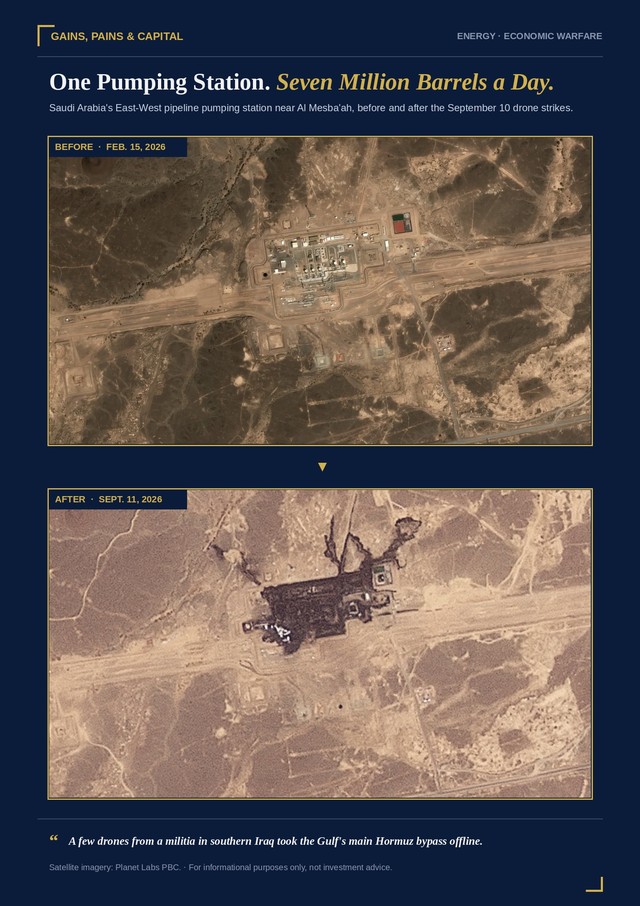
For a century, energy infrastructure was protected by the cost of attacking it. You needed an air force, or a navy, or a state willing to be blamed. The math has flipped. A pumping station costs hundreds of millions of dollars. The drone that disables it costs less than a used pickup truck. Anyone with a grievance and a few engineers can now impose a supply shock on the global economy, and the September 10 attack proved it in front of every adversary the West has.
The market has not caught up to this.
Oil at $105 is pricing a pipeline that comes back quickly and a September 30 deadline that holds. Iraq’s prime minister has given the Iran-backed militias in his country until the end of the month to disarm. At least four have refused. Saudi Arabia is holding off on retaliation at Baghdad’s request. Meanwhile, the Houthis have captured positions near the Bab al-Mandeb Strait, the southern exit from the Red Sea that every tanker leaving Yanbu has to pass. Both of Saudi Arabia’s routes to market are now under threat, one closed and one contested.
To be clear, none of this means oil goes to $150 next week. It means the risk premium in oil is no longer a temporary feature of one conflict. It is a permanent feature of a world where infrastructure is expensive and the tools to hit it are cheap. That premium was underpriced at $95 and it is still underpriced at $105.
Now for the part that matters to your portfolio.
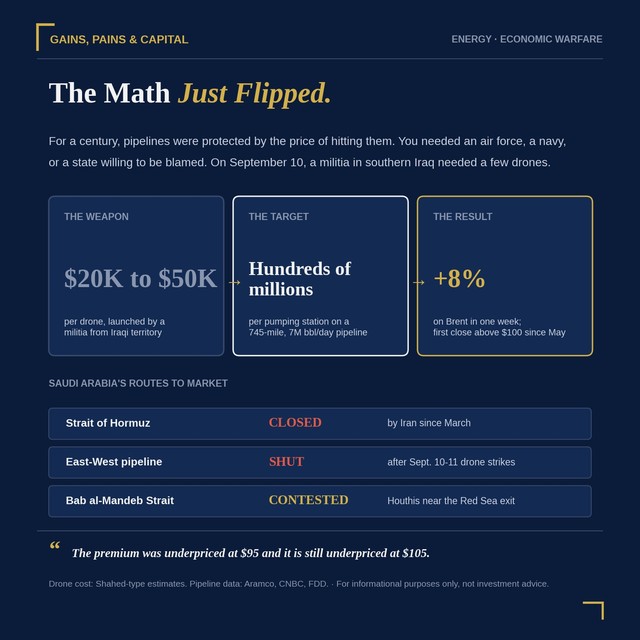
There is one large economy that comes out ahead on net. The United States is the largest oil and gas producer on earth and a net exporter of petroleum. Among the world’s three largest economies it is the only one that produces more energy than it consumes. It does not need Hormuz, the East-West pipeline, or Bab al-Mandeb to keep running, and it imports very little from the Gulf.
Oil is a global market, so every barrel that cannot leave Saudi Arabia raises the price of every barrel that comes out of Texas, North Dakota, and the Permian. For American producers, chokepoint attacks on the other side of the world are a windfall. For American consumers they are an inflation problem, which is why the Fed is meeting this week, but that is a story for another day.
The same logic applies further down the hard asset chain. Every input that has to cross an ocean or a border someone else controls now carries this premium. Uranium out of Kazakhstan moves through Russia or across the Caspian. Rare earths out of China move only when Beijing allows it. The assets that do not carry that risk, because they are produced and refined inside a country with no hostile militia on its soil and no adversary on its border, are worth more than they were two weeks ago, and the market has not repriced them yet.
A few thousand dollars of drones just told you where the next decade of energy risk lives. Own the supply that does not have to cross a chokepoint to reach you.
Which brings me to how we are actually making money on this.
A few thousand dollars of drones just added 8% to the price of oil in a week. That is not going away. The Fed can hike all it wants. It cannot reopen a pipeline, clear a strait, or make a militia in southern Iraq stand down. Energy inflation is back, and this time it is coming from a place monetary policy cannot reach.
The last time this setup hit, in 2025, certain hard assets were the best-performing corner of the market. The five plays in our Special Investment Report, Survive the Inflationary Storm, rose 140%, 150%, 180%, 280%, and 574% that year. Not one of them needed Hormuz to stay open to do it.
The conditions that drove those moves are back on the tape: oil above $100, inflation running hot, a Fed behind the curve, and a bond market that has stopped believing Washington can hold yields down. Precious metals do their best work in exactly this environment, and the miners give you leverage to the move.
Normally this report sells for $499 as a standalone item. Given what happened on September 10, we are making 100 copies available to the public.
The drones were cheap. Missing this will not be.
CLICK HERE to grab one of the remaining copies of Survive the Inflationary Storm
Graham Summers, MBA
Chief Market Strategist
Phoenix Capital Research
8. EMERGING MARKETS//AUSTRALIA NEW ZEALAND ISSUES
CANADA/
JUST WHAT WE NEEDED:
Carney Warns Canadians to Brace for Tough Times Ahead as Retaliatory Tariffs Begin

Prime Minister Mark Carney makes an announcement at the Davie shipyard in Levis, Que., on Aug. 24, 2026. The Canadian Press/Jacques Boissinot

Prime Minister Mark Carney says decreasing Canada’s dependence on the United States as its primary economic ally could mean some tough times are ahead as the country launches its retaliatory tariffs against its southern neighbour.
The Carney government has implemented dollar-for-dollar retaliatory tariffs targeting around $28 billion in American goods in response to U.S. President Donald Trump’s levies on Canada.
It’s a move that Carney described as necessary in his most recent Forward Guidance video, which was published on Sept. 8—the same day Canada’s counter-tariffs went into effect.
“This won’t be easy, and I won’t pretend otherwise,” Carney said in the latest instalment of his video series. “But Canadians have faced difficult stretches before, and what’s carried us through has never been any one measure.”
Carney characterized the counter-tariffs as “necessary to protect our workers, companies, and communities,” arguing that Canada cannot allow American goods to enter the country tariff-free while the White House imposes tariffs on Canadian companies exporting to the United States.
He described the collapse of trade talks with the United States as “a shame” but said his government “simply could not accept” what the U.S. administration was proposing.
Related Stories

Poilievre Calls on Liberal Government to Reveal Cost of Counter-Tariffs

Carney Cites Lumber Tariff Dispute as Another Factor That Derailed US Trade Talks
He again accused American negotiators of introducing last-minute measures that would limit Canada’s capacity to protect and promote the French language and hinder future trade agreements with certain nations. He said they also proposed conditions that would gradually weaken several key Canadian industries, such as automobiles, steel, and forest products.
“In short, they were asking far too much and offering far too little,” he said. “We worked in good faith, to reach a fair deal. But since a fair deal wasn’t on the table, we made the right choice—to walk away from a bad one.”
Carney’s video comes two weeks after Canada officially walked away from trade negotiations and recalled its negotiators on Aug. 21. He told reporters on Aug. 22 that one of the main sticking points was American efforts to “restrict our protections of our language, our culture, and in effect, our sovereignty.”
The U.S. government disputes Carney’s account of the negotiations. Both Trump and U.S. Trade Representative Jamieson Greer have rejected his characterization of the French-language issue, saying it was not a U.S. demand in the talks. Greer has instead pointed to Canadian policies, including rules requiring U.S. technology and streaming companies such as Netflix to contribute to Canadian broadcasting funds, as an area of concern.
The differing stories on both sides of the border led the Conservatives to call on Carney to publicly release the wording of the deal. The government has not responded to the request.
‘Plan A’
Carney said the last four decades have led Canada to become more economically integrated with the United States—an issue he said his government plans to change.
“It was easy business, but it meant we relied too much on one economic partner,” he said. “That time is over.”
Tariffs are just one part of Canada’s response, however, Carney said, adding that Canadians can support the response by continuing to buy Canadian products and travel domestically.
Another part of the plan is to seek other trading relationships, he said.
“I want to be very clear, building at home and diversifying trade abroad was never our plan B,” Carney added. “It’s been our Plan A from the start.”
He said part of that plan is building major projects in Canada in the form of new ports, mines, and energy corridors, estimating that the projects so far represent $500 billion in new private investment.
All of the first five projects selected for fast-tracking by Canada’s Major Projects Office had already been started before receiving the federal designation, such as the construction of the small modular reactor site at the Darlington New Nuclear Project in southern Ontario.
Subsequent batches of projects referred to the Major Projects Office include concepts at much earlier, unapproved stages—such as the high-speed Alto rail network between Toronto and Quebec City and an Atlantic Energy Strategy using wind power—which still require extensive regulatory review and final investment decisions.
Another part of the plan, Carney said, is making trade deals with more countries overseas.
There has been a substantial rise in non-U.S. exports and Canada is projected to double these figures over the coming decade, according to Carney. He said foreign direct investment in Canada has reached its highest point in 20 years, operating at double the rate of the country’s closest G7 competitor.
He said his government has been moving quickly to diversify and pointed to what he described as “20 trade and defence agreements across four different continents.” He cited trade diversification with China as one such example, saying that one aspect of the deal has allowed one of Western Canada’s top malt canola producers to sell their product at higher prices.
Opposition critics have described the government’s characterization of its international trade agreements as misleading because only a few of these deals have been formalized. Most consist of non-binding memorandums of understanding (MOUs), letters of intent, or foundational terms of reference meant to start formal negotiations rather than finalized, fully ratified treaties.
The Conservatives have also criticized Carney for pursuing deeper ties with China after a public inquiry identified widespread interference by Beijing in Canada’s affairs.
Conservative Leader Pierre Poilievre responded to Carney’s speech on Sept. 8 by once again calling on the prime minister to re-open Parliament to address the impact tariffs will have on Canadians.
“How much tougher can things get for the 2.2 million food bank users, the people defaulting on mortgages, the small businesses closing, and the people who can’t afford homes?” he said in a social media post.
“Open Parliament. Release the deal. Reveal costs to families & small business & save jobs and money for our struggling people.”
Attachments area

U.S./GOLD AND SILVER PRICING/ASIAN CLOSING MARKETS AND EUROPEAN BOURSE OPENING AND CLOSING/ INTEREST RATE SETTINGS WEDNESDAY MORNING 6;30AM//OPENING AND CLOSING\
OPENING LEVELS OF CURRENCIES// AND CLOSING ASIAN STOCK MARKET AND OPENING EUROPEAN STOCKS:6 AM EST
EURO VS USA DOLLAR: 1.1539 UP 0.0027
USA/ YEN 155.11 DOWN 0.172 NOW TARGETS INTEREST RATE AT 1.75% AS IT WILL BUY UNLIMITED BONDS TO GETS TO THAT LEVEL…//YEN STILL FALLS//END OF YEN CARRY TRADE BEGINS AGAIN DEC 2024/Bank of Japan raises rates by .25% TO 1.75 ..TAKAICHI NEW PM AS YIELDS RISE//JAPAN DEEPLY IN TROUBLE WITH RISING RATES AND A FALLING YEN!! BANK OF JAPAN WILL NO LONGER DO QE. URGES PENSION AND INSUANCE FUNDS TO BUY JAPANESE BONDS//
YEN CARRY TRADERS MURDERED
GBP/USA 1.3470 DOWN 0.0002 OR 2 BASIS PTS
USA/CAN DOLLAR: 1.3930 UP 0.0004 //CDN DOLLAR DOWN 4 BASIS PTS//
Last night Shanghai COMPOSITE CLOSED UP 27.32 PTS OR 0.71%
Hang Seng CLOSED DOWN 46.54 PTS OR 0.19%
AUSTRALIA CLOSED DOWN 0.25%
// EUROPEAN BOURSE: ALL GREEN
Trading from Europe and ASIA
I) EUROPEAN BOURSES: ALL GREEN
2/ CHINESE BOURSES / :Hang SENG CLOSED UP 46.54 PTS OR 0.19%
/SHANGHAI CLOSED DOWN 27.32 PTS OR 0.71%
AUSTRALIA BOURSE CLOSED DOWN 0.25%
(Nikkei (Japan) CLOSED UP 497.90 PTS OR 0.78%
INDIA’S SENSEX IN THE GREEN
Gold very early morning trading: $4329.25
silver:$64.51
USA DOLLAR VS TRY (TURKISH LIRA): 48.66 UP 2 BASIS PTS AND NOW WE SEE THEIR STUPIDITY OF SELLING SOME OF THEIR GOLD AND ALL OF THEIR USA DOLLAR RESERVES. THE COUNTRY IS IN BIG FINANCIAL TROUBLE
USA DOLLAR VS RUSSIAN ROUBLE: 84.07 ROUBLE// DOWN 0 ROUBLE AND 5 BASIS PTS.
UK 10 YR BOND YIELD: 5.3835 DOWN 2 BASIS PTS
UK 30 YR BOND YIELD: 5.9247 DOWN 2 BASIS PTS
CDN 10 YR BOND YIELD: 3.952 DOWN 1 BASIS PTS
CDN 5 YR BOND YIELD; 3.659 DOWN 2 BASIS PTS
USA dollar index early WEDNESDAY MORNING: 99.38 UP 3 BASIS POINTS FROM TUESDAY’s CLOSE
WEDNESDAY MORNING NUMBERS ENDS
And now your closing WEDNESDAY NUMBERS 10.00 AM
Portuguese 10 year bond yield: 3.897% DOWN 2 in basis point(s) yield
JAPANESE BOND 10 yr YIELD: +2.989% DOWN 5 FULL POINTS BASIS POINTS /JAPAN losing control of its yield curve/
JAPAN 30 YR: 4.106 DOWN 6 BASIS PTS//
SPANISH 10 YR BOND YIELD: 3.994 DOWN 2 in basis points yield
ITALY 10 YR BOND: 4.397 DOWN 4 points in basis points yield ./
GERMAN 10 YR BOND YIELD: 3.5258 DOWN 1 BASIS PTS
IMPORTANT CURRENCY CLOSES : MID DAY TUESDAY
Closing currency crosses for day /USA DOLLAR INDEX/USA 10 YR BOND YIELD/10:00 AM
Euro/USA 1.1529 DOWN 0.0007 OR 7 basis points
USA/Japan: 155.15 DOWN 0.124 OR YEN IS UP 12 BASIS PTS// HIGHLY INFLATIONARY TO JAPAN
Great Britain 10 YR RATE 5.3184 DOWN 5 BASIS POINTS //
GREAT BRITAIN 30 YR BOND; 5.8746 DOWN 5 BASIS POINTS.
CANADIAN DOLLAR DOWN 12 BASIS PTS TO 1.3937
xxxxxxxxxxxxxxxxxxxxxxxxxxxxxxxxxxxxxxxxxxxxxxxxxxxxxxxxxxxxxxxxxxxxxxxxxxxxxxxx
The USA/Yuan CNY 6.7072 ON SHORE ..UP
THE USA/YUAN OFFSHORE// CNH UP TO 6.7077
TURKISH LIRA: 48.66 UP 2 EXTREMELY DANGEROUS LEVEL/DEATH WATCH/HYPERINFLATION TO BEGIN.//
Your closing 10 yr US bond yield DOWN 3 in basis points from TUESDAY at 4.981% //trading well ABOVE the resistance level of 2.27-2.32%)
USA 30 yr bond yield 5.352 DOWN 2 basis points /10:00 AM
USA 2 YR BOND YIELD: 4.640 DOWN 2 BASIS PTS.
GOLD AT 10;00 AM $4341.40
SILVER AT 10;00: $64.67
Your 11:00 AM bourses for Europe and the Dow along with the USA dollar index closing and interest ratesWEDNESDAY
DAY CLOSING TIME/ 12:00 AM///
London: CLOSED UP 35.92 PTS OR 0.34%
GERMAN DAX: CLOSED UP 156.60 PTS OR 0.62%
FRANCE: UP 51.98 OR 0.64 PTS
Spain IBEX CLOSED UP 103.40 PTS OR 0.53%
Italian MIB: CLOSED UP 451.53PTS OR 0.88%
WTI Oil price 103.73 10.00 EST/
Brent Oil: 107.19 10:00 EST
USA /RUSSIAN ROUBLE: 84.48 /// ROUBLE DOWN 0 AND 23/ 100
CDN 10 YEAR RATE: 3.922 DOWN 3 BASIS PTS.
CDN 5 YEAR RATE: 3.624 DOWN 4 BASIS PTS
CLOSING NUMBERS: 4 PM//
Euro vs USA 1.1469 DOWN 0.0063 OR 63 BASIS POINTS//
British Pound: 1.3377 DOWN 0.0094 OR 94 basis pts/
BRITISH 10 YR GILT BOND YIELD: 5.3076 DOWN 8 FULL BASIS PTS//
BRITISH 30 YR BOND YIELD: 5.897 DOWN 3 IN BASIS PTS.
JAPAN 10 YR YIELD: 2.995 DOWN 2 FULL BASIS PTS (DANGEROUS TO THEIR ECONOMY
JAPANESE 30 YR BOND: 4.101 DOWN 6 PTS AND STILL VERY DANGEROUS TO THEIR ECONOMY
USA dollar vs Japanese Yen: 156.06 UP 0.789 OR YEN DOWN 79 BASIS PTS//GETTING FURTHER AWAY FROM 160.00/ EXTREMELY DANGEROUS
USA dollar vs Canadian dollar: 1.3993 UP 0.0064 PTS// CDN DOLLAR DOWN 64 BASIS PTS
West Texas intermediate oil: 102.62
Brent OIL: 105.70
USA 10 yr bond yield UP 2 BASIS pts to 5.0190
USA 30 yr bond yield: DOWN 1 PTS to 5.352%
USA 2 YR BOND 4.770 UP 11 PTS
CDN 10 YR RATE 3.942 DOWN 1 BASIS PTS
CDN 5 YEAR RATE: 3.659 UP 0 BASIS PTS
USA dollar index: 100.05 UP 70 BASIS POINTS
USA DOLLAR VS TURKISH LIRA: 48.66 UP 2 BASIS PTS GETTING QUITE CLOSE TO BLOWING UP/IDIOTS SOLD GOLD
USA DOLLAR VS RUSSIA//// ROUBLE: 84.51 DOWN 0 AND 31/100 roubles //
GOLD $4,260.50 3:30 PM)
SILVER: 62.75 3;30 PM)
DOW JONES INDUSTRIAL AVERAGE: DOWN 619.52 POINTS OR 1.21%
NASDAQ 100 UP 7.22 PTS OR 0.03%
VOLATILITY INDEX 17.89 UP 0.69 PTS OR 0.40%
GLD: $ 391.75 UP .240 PTS OR 0.61%
SLV/ 57.05 PTS DOWN 0.48 OR 0.83%
TORONTO STOCK INDEX// TSX INDEX: CLOSED DOWN 90.80 PTS OR 0.26%
end
TRADING today ZEROHEDGE 4 PM: HEADLINE NEWS/TRADING
Gold & Yield Curve Tumble After ‘Hawkish’ Fed-Hike; Stocks Drop As Crude Flops
what was expected today on FOMC:
FOMC Preview: Hike And All Eyes On The Dots… Or We Get “Policy Error Of All Policy Errors”

“We struggle to completely discount the risk that Warsh’s Jackson Hole speech was purely performative and he could in fact try to jam through a hold, but equally cannot fathom a world where he commits what would be construed as the policy error
The September 16, 2026 FOMC meeting (decision expected ~2:00 p.m. ET, with Chair Kevin Warsh’s press conference shortly after) is widely expected to deliver a 25 bp hike—the first since 2023—taking the federal funds target range to 3.75–4.00%, with the real focus on the updated Summary of Economic Projections (SEP), the “dot plot,” the vote (possible limited dissents for a hold), and Warsh’s messaging. fxstreet.com +1Markets have priced in a very high probability of the hike (typically cited in the 90%+ range via CME FedWatch and related measures in recent previews). This shift solidified after Warsh’s Jackson Hole speech (late August), hotter-than-expected August jobs data, and sticky inflation readings (e.g., core CPI details and PCE still running well above the 2% target).
think.ing.comContext on Warsh’s Jackson Hole remarksWarsh’s speech emphasized that inflation has been elevated for an extended period (he referenced ~65 months), that the 2% PCE target is a “firm, fixed” goal, that recent softer readings did not convince him underlying trends had “meaningfully improved,” that the labor market is consistent with full employment, and that broad financial conditions show “few signs of policy restraint.” He reiterated a preference for quieter Fed communications and less forward guidance, framing policy as a “discipline, not a decision.” Markets and analysts read this as hawkish enough to raise September hike odds substantially and put the onus on delivering action if data remained firm.
ft.comYour quoted language (“We struggle to completely discount the risk that Warsh’s Jackson Hole speech was purely performative and he could in fact try to jam through a hold, but equally cannot fathom a world where he commits what would be construed as the policy…”) tracks with the prevailing analyst view that a hold would be seen as a major credibility hit or “policy error of all policy errors.” It would clash with the speech’s tone, the data path since then, and the need to reinforce the Fed’s inflation-fighting stance amid sticky prices and elevated long-term yields (10-year Treasury around/near 5% levels in recent commentary). Most previews treat a hold as a low-probability tail risk rather than a base case.
realinvestmentadvice.comKey things markets are watching beyond the hike itself
- Dot plot / SEP: How many additional hikes (if any) for the rest of 2026 and into 2027; median end-2026/2027 funds rate projections; any upward revision to inflation forecasts. June’s dots already showed a notable hawkish shift (nearly half of participants projecting at least one hike). A “one-and-done” framing versus a more sustained path is a live debate. spotgamma.com
- Statement language and vote: Whether the statement leans hawkish on inflation persistence; number and identity of any hold dissenters.
- Warsh’s press conference: Consistency with Jackson Hole themes, any clarification of the reaction function (despite his aversion to detailed guidance), and comments on financial conditions or the path ahead.
- Market reaction risk: A “dovish hike” (hike but soft dots/guidance) or any surprise hold could reprice yields, the dollar, and risk assets; a clean hike with balanced-to-hawkish dots is the more consensus expectation in many notes.
In short, the setup is “hike + all eyes on the dots and Warsh’s framing,” with the risk of a hold framed by some as a severe credibility/policy misstep relative to recent communications and data. The actual outcome and details will clarify the Warsh Fed’s near-term reaction function.
END
AT 2 PM THE FOMC REPORT:
The FOMC raised the federal funds target range by 25 basis points to 3.75%–4.00% on September 16, 2026 (announced at 2:00 p.m. ET). This was a unanimous 12–0 decision and the first rate hike since July 2023.
federalreserve.gov
Official statement highlights
The Committee decided to raise the target range for the federal funds rate by 1/4 percentage point to 3-3/4 to 4 percent, in support of the Federal Reserve’s dual mandate. The Committee is continuing its policy of maintaining ample reserves in the banking system.Economic activity is expanding at a solid pace. While uncertainty remains elevated owing, in part, to geopolitical developments, domestic spending has been resilient. Productivity growth is strong, and capital investment is robust. Job gains have kept pace with the workforce, and the unemployment rate has changed little.Inflation remains elevated. Today’s policy action will support a timelier return to the Committee’s 2 percent goal. The Committee will deliver price stability.
federalreserve.gov
This followed five consecutive holds at 3.50%–3.75%. Markets had priced in a high probability (~90%+) of a 25 bp hike amid sticky inflation (still well above the 2% target), elevated energy prices, and other pressures.
usatoday.com
Summary of Economic Projections (SEP) and dot plot were also released with the decision. Detailed tables/charts are available on the Federal Reserve site.Chair Kevin Warsh’s press conference is scheduled for (or underway around) 2:30 p.m. ET. Live coverage is available via the Fed’s channels/YouTube.
END
Watch Live: Fed Chair Warsh Explains Why He Hiked Rates Into Stagflation
Wednesday, Sep 16, 2026 – 02:25 PM
The FOMC just (unanimously) hiked rates for the first time since July 2023 despite recent inflation prints slowing…

Additionally, recent macro surprises are clearly signaling stagflation – the central banker’s nemesis…

So, a hike for credibility… but Warsh’s biggest challenge will be communicating his outlook without reverting to forward guidance, even as markets seek clarity on whether today’s likely move is one-and-done, or the start of a broader tightening cycle.
With investors forced to extract more signal from his language, the press conference carries outsized front-end risk.
In a note to clients, BMO notes two-year yields have moved an average 14bps across his five public appearances as chair so far.
The big question for today of course, assuming they do hike, is whether this is likely to be a “one and done” move.
We haven’t seen one of those this century so far.
Jim Reid at Deutsche Bank catalogues that there were a few of those in the 1980s and 1990s.
Outside of them, “the shortest cycle on record remains the four hikes of 1986-87.”
While all the talk is about the ‘unanimous’ decision today with the great majority of dots signaling at least one more hike this year… The Fed is extremely divided next year with four members see at least 2 rate-CUTS (policy error much)…

Quick reminder:
- In 2024, the Powell Fed cut 50bps 2 months before the presidential election with core CPI at 3.3%
- In 2026, the Warsh Fed hikes 25bps 2 months before the midterms with core CPI at 2.4%
Will Trump comment?

Watch the FOMC press conference live here (due to start at 1430ET):
WRAP UP:
Stocks and bonds sold after Fed rate hike – Newsquawk US Market Wrap
Wednesday, Sep 16, 2026 – 04:42 PM
- SNAPSHOT: Equities down/flat, Treasuries flatten, Crude down, Dollar up, Gold down.
- REAR VIEW: FOMC hikes rates by 25bps, as expected; Overall hawkish FOMC & leaves the door open to further action; Updated median SEP sees 1 more hike this year; Saudi reportedly look to resume half of key oil pipeline within days; Optimistic Araghchi commentary; US met with Houthis; Strong US Retail Sales; Import and Export prices hotter than expected; AAPL considers return to server market, has spoken with NVDA to use network tech.
- COMING UP: Data: EU Inflation Final (Aug), US Initial Jobless Claims (Sep/12), Housing Starts (Aug), Building Permits Prelim. (Aug), Atlanta Fed GDP (Q3), New Zealand Trade Balance (Aug) Events: BoE Policy Announcement, CNB Policy Announcement Speakers: US President Trump; ECB’s Lane Supply: Spain, France, US.
More Newsquawk in 2 steps:
- 1. Subscribe to the free premarket movers reports
- 2. Trial Newsquawk’s premium real-time audio news squawk box for 7 days
MARKET WRAP
The overall reaction to the FOMC rate decision and press conference was hawkish. The Fed hiked rates by 25bps as expected in a unanimous decision, while the median projection saw another hike by year-end before rates remain on hold throughout 2027. The statement reiterated the Fed’s commitment to price stability, a message echoed by Chair Warsh in the press conference against the backdrop of a labour market at or near full employment and strong economic growth. For a more in-depth Fed summary, please see below.
Indices largely finished lower, although the Nasdaq was little changed, while the Dow lagged and the RSP fell 0.8%. Sectors were predominantly lower, with Energy, Financials and Materials lagging, while Tech, Health Care and Utilities outperformed, albeit with minimal gains.
Energy stocks tracked crude prices lower, with the complex pressured by more constructive geopolitical commentary. Iranian Foreign Minister Araghchi said the MoU with the US remains in effect and that Iran wants a return to a peaceful solution, adding, “We are not interested in continuing the conflict, and we look forward to returning to a diplomatic solution.” Meanwhile, reports suggested US officials met with the Yemeni Houthis in Oman over the weekend, adding further pressure to crude a Houthis were committed to the 2025 ceasefire, and would not attack US and Israeli ships in the Bab al-Mandab. Elsewhere, source reports suggested half of Saudi Arabia’s key East-West oil pipeline will resume operations within days.
The Treasury curve flattened following the FOMC rate decision, updated SEP and Warsh’s press conference, with the 10-year yield reclaiming 5.00% while the 2-year rose to around 4.74%, remaining at levels not seen since 2007. The hawkish Fed supported the Dollar at the expense of its G10 peers, with EUR/USD falling below 1.15 and USD/JPY rising above 156.00. Gold and silver were also sold, while Bitcoin saw marginal gains, although the strength follows the notable weakness on Tuesday after the Senate failed to pass the CLARITY Act.
Elsewhere, US Retail Sales were stronger than expected, while Import and Export prices were above expectations. UK CPI and Services inflation were in line with expectations, doing little to shift the dial ahead of the BoE rate decision on Thursday. Friday also sees the BoJ rate decision, where the bank is expected to hike by 25bps.
FED
FOMC: The Fed hiked rates by 25bps as expected, taking the target range for the federal funds rate to 3.75-4.00%, with the decision unanimous. The statement saw only minor changes, with the Fed saying the rate hike would help return inflation to target in a more timely manner, while reiterating its commitment to price stability. The Fed maintained that inflation remains elevated, although it dropped the previous language attributing this in part to supply shocks.
On activity, the Fed maintained that the economy is expanding at a solid pace, while adding that domestic spending has remained resilient despite uncertainty stemming in part from geopolitical developments. It maintained that productivity growth is strong, while describing capital investment as “robust”, versus “strong” previously. Labour market language was broadly unchanged, with the Fed reiterating that job gains have kept pace with growth in the workforce and the unemployment rate has changed little.
DOT PLOT/SEP: Regarding the dot plot, Warsh did not submit forecasts again, with 18 participants submitting projections. The dots were hawkish, with the median seeing another 25bp hike in 2026. Twelve participants pencilled in one further hike this year, four saw two additional hikes, while just two saw no further hikes. The median remains at 4.125% through end-2027, implying one further hike this year followed by rates remaining on hold throughout 2027, before easing to 3.875% in 2028 and 3.625% in 2029. The longer-run rate was lifted to 3.2% from 3.1%. Growth forecasts were raised by 0.1ppts in both 2026 and 2027, while 2028 and the longer-run projections were maintained. Unemployment projections were lowered to 4.1% across 2026-28, while the longer-run rate was maintained at 4.2%. Both headline and core PCE inflation projections were raised for 2026 and 2028, while the 2027 projections were maintained.
FED CHAIR WARSH PRESSER: The overall message was a familiar one from Warsh, with price stability remaining the primary focus against the backdrop of a strong economy and a labour market at or near full employment. Warsh said he does not believe the Fed will need to damage the labour market to achieve its inflation objective, reiterating that ensuring price stability is necessary to support durable economic growth.
Warsh continued to avoid forward guidance, reiterating that the Fed is “committed to a discipline, not a decision.” With the labour market more or less at full employment and the economy strong, he said the Fed’s primary focus is on price stability. Warsh repeatedly pointed to Wednesday’s action as evidence that policymakers are serious about returning inflation to target. He also reiterated he does not focus on one particular data point, as he looks at the trends.
Asked whether policy is restrictive, Warsh reiterated that he finds it difficult to characterise financial conditions as restrictive, although he acknowledged that the Fed had removed some accommodation with Wednesday’s rate hike. When asked whether markets had led the Fed into hiking rates, Warsh stressed that the move was “our decision.” He also acknowledged that the Fed cannot control individual prices, such as energy, but said it is the central bank’s responsibility to prevent second- or third-round effects from developing.
Warsh also acknowledged the recent rise in bond yields, attributing it to three broad factors: the strength of the US economy, increased demand for capital amid robust CapEx, and geopolitical developments.
Overall, the press conference carried a hawkish tone, with Warsh continuing to emphasise the price-stability side of the Fed’s mandate while speaking positively about the strength of the US economy and labour market. Notably, he did not characterise Wednesday’s hike as a risk-management move, nor did he repeat language from the previous press conference suggesting that tighter financial conditions were doing some of the Fed’s work. Instead, Warsh repeatedly framed the hike as evidence of the Fed’s determination to return inflation to target.
US DATA
RETAIL SALES: US retail sales rose 1.2% M/M in August, above the expected +0.8% and rising from July’s revised -0.5% print. Core retail sales also impressed as they rose 1.4% (exp. +0.6%, prev. -0.2%), with retail sales ex-gas/autos jumping 1.2% (prev. -0.3%). Retail control rose 1.4%, above Wall St. consensus of 0.4% and the prior -0.4%. For the headline beat, Oxford Economics highlight much of the strength reflected a bounce back in non-store sales, which had fallen sharply in July, and was largely seasonal noise driven by shifts in the timing of Amazon’s Prime Day shopping event. Rising gas prices also boosted gasoline station sales. Even accounting for that, gains in most spending categories were decent, led by discretionary sectors such as food services, electronics, and sports and recreation. As Oxford Economics writes, the headline rebound was juiced by a rebound in non-store sales, but the underlying details still point to a decent 2.8% annualized rise in real consumer spending in Q3. The squeeze from higher gasoline prices will intensify heading into the fall, but the tailwind from rising financial wealth means higher-income consumers are so far offsetting that.
IMPORT/EXPORT PRICES: US import prices rose 0.7% M/M in August (exp. +0.4%, prev. -0.3% revised from -0.4%), with the increase driven by nonfuel import prices (+0.8%), which more than offset a 0.1% decline in fuel prices. Within nonfuel imports, industrial supplies & materials rose 2.0%, while capital goods prices increased 0.9%, driven by higher prices for computers, peripherals and semiconductors, industrial machinery and telecommunications equipment. Consumer goods ex-autos also rose 0.5%. Notably, import prices from China jumped 1.0%, the largest monthly increase since the series began in 2004, driven by computer and electronic products. On an annual basis, overall import prices accelerated to 7.0%, the largest increase since August 2022, while nonfuel import prices rose 5.5%, the largest since May 2022. Export prices increased 0.6% M/M (exp. +0.5%, prev. -1.4% revised from -1.3%), with agricultural prices rising 0.5% and nonagricultural prices increasing 0.7%, including a 1.4% rise in industrial supplies & materials. Overall, the report points to renewed imported price pressures beneath the energy component, particularly across industrial inputs, capital goods and Chinese imports. Oxford Economics highlight the rising capital goods prices, noting that “The rapid buildout of AI infrastructure will keep this category running hot, while incentives embedded in the One Big Beautiful Bill Act may lead to further prices increases in capital goods beyond computer accessories.”
NAHB: NAHB Housing Market Index fell to 32 in September from 35, beneath the expected 34. Within the report, current sales conditions fell four points to 35, sales expectations in the next six months dropped to 37 (prev. 43), while traffic of prospective buyers held steady at 23. Overall, homebuilders’ confidence has been hit by the renewed rise in mortgage rates, with the most recent MBA data showing that the average rate on a 30-year conventional mortgage stood last week at 6.97%, up almost a full percentage point since February.
FIXED INCOME
T-NOTE FUTURES (Z6) SETTLED 4+ TICKS LOWER AT 105-25+
Yield curve flattens after hawkish FOMC. At settlement, 2-year +5.2bps at 4.723%, 3-year +3.5bps at 4.807%, 5-year +2.5bps at 4.862%, 7-year +1.5bps at 4.933%, 10-year +0.6bps at 5.012%, 20-year -1.4bps at 5.395%, 30-year -1.4bps at 5.355%.
THE DAY: T-notes had gradually risen ahead of the FOMC, but Treasuries tumbled across the curve in the immediate aftermath of the Fed rate decision. The Fed hiked rates by 25bps as expected, with the decision unanimous, while reiterating its commitment to price stability within the statement. Warsh did not submit forecasts, but the vast majority of officials expect at least one further rate hike by year-end, with the median seeing rates then remaining on hold throughout 2027.
The press conference delivered a familiar message from Chair Warsh, emphasising price stability against the backdrop of employment at or near full employment and a strong US economy. He continued to avoid forward guidance but stressed the Fed’s determination to return inflation to target.
Yields rose across the curve in the immediate wake of the Fed statement and press conference, with the 10-year yield reclaiming 5.00%. The curve ultimately bear flattened on the day, with the front end leading the sell-off while the long end finished modestly firmer. Money market pricing also shifted hawkishly, with October now seen as roughly a coin toss (vs. c. 8bps of tightening priced before the meeting, adjusting for Wednesday’s hike), while around 32bps of additional tightening is priced by December, vs. 24.5bps pre-Fed on the same adjusted basis.
SUPPLY
Notes
- US to sell USD 19bln of 10yr TIPS on Sept. 17th; to settle on Sept. 30th
Bills
- US sold 17-wk bills at a high rate of 4.030%, B/C 2.72x
- US to sell USD 72bln of 17-wk bills on September 16th; to sell USD 90bln of 4-wk bills and USD 85bln of 8-wk bills on Sept. 17th; all to settle on Sept. 22nd
STIRS / OPERATIONS
- Fed Hike Pricing via CME FedWatch: Oct 13bps (prev. 7.8bps pre Fed), Dec 31.7bps (prev. 24.5bps pre Fed); Prior adjusted for today’s hike.
- EFFR at 3.63% (prev. 3.63%), volumes at USD 100bln (prev. USD 91bln) on September 15th
- SOFR at 3.64% (prev. 3.62%), volumes at USD 2.952tln (prev. USD 2.861tln) on September 15th
- NY Fed RRP op demand at 5.38bln (prev. 0.70bln) across 4 counterparties (prev. 2) on September 16th
CRUDE
WTI (V6) SETTLED USD 3.40 LOWER AT 102.43/BBL; BRENT (X6) SETTLED USD 2.92 LOWER AT 105.83/BBL
The crude complex saw losses, paring some of Tuesday’s extensive strength, as participants await further Middle East or supply updates. Regarding headline catalysts for the downside, there were a few, coupled with an unexpected chunky crude build in the weekly private inventory metrics last night. Back to the headline drivers, China’s Foreign Minister met with their Iranian counterpart, encouraged Iran and the US to exercise rationality, and urged all parties to take effective measures to reopen the Strait. Meanwhile, US/Iran, Iranian FM Araghchi stated the MoU with America is in effect and want to return to a peaceful solution. Furthermore, source reports suggested that US officials met with Yemeni Houthis in Oman over the weekend, and Houthis told the US they remain committed to 2025 ceasefire and will avoid hitting US or Israeli ships.
Away from geopolitics, but on the supply footing in the Middle East, Saudi reportedly look to resume half of key oil pipeline within days, which pushed WTI and Brent to session lows of USD 100.97/bbl and 104.00/bbl, respectively – vs earlier highs of 105.63 and 108.59/bbl.
Note, there was little move after the FOMC hiked rates by 25bps, as expected but the Dollar strengthened notably.
EQUITIES
CLOSES: SPX -0.40% at 7,555, NDX +0.03% at 28,945, DJI -1.21% at 51,463, RUT -0.32% at 2,861.
SECTORS: Technology +0.10%, Health +0.06%, Utilities +0.01%, Industrials -0.12%, Consumer Staples -0.53%, Communication Services -0.62%, Real Estate -0.66%, Consumer Discretionary -0.68%, Materials -0.73%, Financials -1.60%, Energy -2.97%.
EUROPEAN CLOSES: DAX: +0.53% at 25,538, FTSE 100: +0.28% at 10,688, CAC 40: +0.62% at 8,141, Euro Stoxx 50: +0.57% at 6,272, AEX: +0.02% at 1,096, IBEX 35: +0.41% at 19,636, FTSE MIB: +0.80% at 51,969, SMI: +0.43% at 13,869, PSI: +1.00% at 9,541.
STOCK SPECIFICS:
- Microsoft (MSFT) raised its quarterly dividend 8% to USD 0.98/shr
- SK Hynix in talks with Intel (INTC) about a deal to make memory chips in the US for the first time.
- Huntington Bancshares (HBAN) cuts FY27 growth outlook.
- Trip.com (TCOM): EPS and revenue topped.
- J.B. Hunt Transport Services (JBHT) sees Q2-to-Q3 earnings dropping 5-10% amid higher costs.
- Union Pacific (UNP) was upgraded at UBS as the bank expects strong volume growth to drive better-than-expected earnings through 2028.
- Twist Bioscience (TWST) announced an agreement with Lilly TuneLab, a collaborative AI/ML drug discovery platform created by Eli Lilly.
- Apple (AAPL) reportedly considering a return to the server market and has spoken with NVIDIA about using its networking technology, according to The Information.
FX
The Dollar saw strength, and surged to session highs in wake of the latest FOMC confab, resulting in a broad hawkish reaction across markets. Overall, the Fed hiked rates 25bps as expected in a unanimous decision. In the updated SEPs, the median sees another 25bps hike in 2026, and is at 4.125% through end-2027, implying one further hike this year followed by rates remaining on hold throughout 2027, before easing to 3.875% in 2028 and 3.625% in 2029. In the Chair Warsh presser, the overall message was a familiar one, with price stability remaining the primary focus. While the FOMC dominated the calendar on Wednesday and was the primary catalyst, there was some tier 1 data, albeit had no impact on the Greenback; retail sales surged, and notably above expected, although desks cited seasonality reasons, while import/export prices also lifted above Wall St. consensus.
As mentioned, G10 FX was lower across the board vs. the Dollar, and seeing similar losses, on account of the aforementioned, as opposed to much currency-specific newsflow. The Pound had regional inflation metrics to digest; the headline rose from the prior (in-line), Core Y/Y and Services were unchanged from the previous month, and as such the data is unlikely to shift views at the MPC into Thursday’s confab, where rates are expected to be held steady in a 6-3 vote split. Following the data, Cable saw some two-way action before eventually moving lower as traders curtailed their rate hike bets.
USA DATA RELEASE
WTF Chart Of The Day: Retail Sales Record High, Consumer Sentiment Record Low
Wednesday, Sep 16, 2026 – 08:38 AM
Following last month’s ugly decline (“see the consumer is getting crushed because of Trump”), August’s retail sales is expected to rebound strongly (“see, Trump’s war is causing Americans to spend more on gas and less on Louboutin shoes”). BofA’s omniscient analysts agree with consensus, seeing a 0.8% MoM jump…

Quick reality check – July retail sales weakness was driven by a plunge in non-discretionary spending by higher income households…

So, what did August bring?
Headline US retail sales rose a shocking 1.2% MoM – the biggest jump since March, pulling sales up 6.0% YoY…

…driven by a big reversal in non-store retailer (online) sales…

Core (Ex-Autos & Gas) soared 1.4% MoM – its strongest month since Sept 2024

The Control Group – which feeds into the GDP calculation – jumped almost triple expectations (+1.4% MoM vs +0.5% exp).
Finally, Real retail sales – admittedly roughly adjusted for CPI – continues to trend higher…

So, the consumer is strong and spending after all… despite near record low sentiment?

Real data versus Democrat-biased sentiment? Is it really worse than the very trough of the COVID pandemic?
END
USA ECONOMIC REPORTS
The Fed’s Mortgage Policy Made Homeownership Cost More
Wednesday, Sep 16, 2026 – 03:25 PM
Authored by Antón Chamberlin via The Daily Economy,
The median household in Miami earns about $62,000 annually; homeowners with a mortgage have monthly housing costs pushing $2,900. Annualized, this equals more than half the median household income. In Los Angeles, the numbers come in at $82,000 and $3,500 for 51 percent. New Yorkers are paying 49 percent, and New Orleanians are paying 47 percent of their annual income on housing. Elena Berd via Shutterstock.
Different coasts, different housing markets, different incomes, regulations, and supply constraints. And all of these cities illustrate a national reality that seems beyond dispute: housing has become extraordinarily expensive.
Lest these cities appear cherry-picked, let us consider Harvard’s 2026 State of the Nation’s Housing report. Existing-home sales are at a three-decade low. Meanwhile, median new and existing home prices exceed $400,000. Prices for the latter are now 54 percent higher than in 2020, nearly five times median household income.
Financially, mortgage rates sit above 6 percent. By late 2025, the monthly cost of the median-priced home reached roughly $3,100, requiring an annual income above $120,000 to afford it, compared with about $1,700 and $66,000, respectively, in early 2020.

This bleak picture is obviously the product of many factors. One, however, was the Federal Reserve’s intervention in the housing market. During the COVID lockdown era, the Fed entered the mortgage market on a massive scale, helping push borrowing costs to historic lows. But its intervention did more than simply lower mortgage rates. It also affected households differently, creating benefits for those already in the housing market while making entry more difficult for those who were not.
The Fed’s mortgage-backed-security (MBS) purchases helped capitalize cheap credit into higher home prices, which enriched current homeowners, all the while increasing the costs of entry for prospective buyers. Then, when the Fed raised rates to fight inflation, those same outsiders faced both higher prices and higher financing costs.
Beginning in March 2020, the Fed purchased trillions of MBSs, with Agency MBS holdings rising 93 percent in about two years, reaching $2.7 trillion by mid-2022. The Fed’s immediate objective was seemingly achieved. Mortgage rates fell to historic lows, which the Dallas Fed explicitly laid at the feet of the Fed’s MBS purchases.

Economic consequences, however, as Bastiat and Hazlitt showed for decades, extend beyond the short-run and the targeted groups. Cheaper mortgages increased households’ purchasing power and contributed to greater housing demand, placing upward pressure on prices in a market where supply could not quickly adjust. Once inflation arrived, the Fed raised rates, causing this double whammy for would-be buyers. This had important distributional consequences.
At its peak, the Fed owned 32 percent of the entire agency MBS market. These purchases resulted in MBS prices rising and their yields falling, causing mortgage spreads to tighten. This tightening pushed mortgage rates down, allowing buyers to finance larger principal balances. Expanded borrowing opened up possibilities for buyers, further fueling housing demand. With the housing supply unable to sufficiently catch up to the new demand, the financial benefits were met with higher prices on the existing housing supply.
These results were not uniform, however. As with other exercises of monetary policy, where money enters matters.
The Cantillon Effect Comes Home
As Nicolás Cachanosky explains, new money does not enter an economy everywhere, and certainly not simultaneously. Fed actions consist of particular injections at particular points, then following particular paths. It is punctiliar by nature, and this results in changing relative prices, which benefit earlier recipients before prices have adjusted to the intervention. In this context, the relevant “early recipients” do not necessarily receive literal new money, but the injection in question occurs in financial markets closely connected to mortgage credit.
Households can be divided into at least two groups: incumbent owners and prospective buyers, both of whom experience the Fed policy differently. Incumbent owners already possess an appreciating asset, with the potential to refinance at the initial lower rate, seeing their home equity rise. Prospective buyers, by contrast, possess no appreciating asset; therefore, they see their desired homes become more expensive. The same appreciation that increases an incumbent homeowner’s net worth increases the price of entry for everyone still trying to buy.
Beginning in 2022, the Fed changed direction. But tightening does not just unwind the past. Homeowners who had purchased or refinanced at historically low rates could keep those mortgages, while new buyers faced even higher rates. The Fed noticed this “lock-in” effect. By June 2024, more than 90 percent of its MBS holdings had coupons below 4 percent.

The Fed’s policy can be broken down into two segments, then. During the easing period, low rates and rising prices fed equity gains for homeowning incumbents. Then, the tightening led to a lock-in of those owners at the previously lower rates, as outsiders saw higher rates. And, of course, first-time buyers typically possess neither asset: the equity nor the existing low-rate mortgage to offset these higher financing costs.
A Federal Reserve study from 2023 documented this phenomenon. A one-percentage-point increase in mortgage rates reduced the share of low- and moderate-income homebuyers by about 7.5 percent, with low-income buyers falling by 16 percent. These effects were even larger for first-time buyers. There was also little evidence of larger down payments to counteract the rising rates, suggesting that many could not substitute savings for the higher monthly payment. Evidence also suggests that loose monetary policy passing through to mortgage rates negatively affects family formation and fertility rates.
In total, then, we see the following. Lower rates create unequal access to cheap credit, and the subsequent higher rates affected buyers disparately. The Fed changed not only the cost of financing a house, but the composition of participants in the market. Interest rate policy altered who could buy.
America now has expensive housing, huge mortgages, fewer purchases, declining homeownership, and a growing segment of the population crowded out. At the very least, the Fed exacerbated this from 2020-2022. The broader lesson here is that monetary policy does not change interest rates or prices in isolation. Money always enters particular markets, changes particular relative prices, and creates particular winners and losers. In this instance, the Fed inflated the price of a scarce asset (appreciation for current homeowners). Once the subsidy was removed, the wealth redistribution it caused did not reverse. The consequence is our current state – not just housing inflation, but a higher price of entry.
A Stunning Case In The Making? The Supreme Court Orders New York To Respond In Second Amendment Case
Tuesday, Sep 15, 2026 – 05:40 PM
One of the cases that I have been following as we approach the October term of the Supreme Court is Calce v. New York, a case challenging New York’s ban on stun guns. While it is important not to overplay the significance of the order, some justices clearly want to hear more on the case before deciding whether to grant a writ of certiorari for review. New York City was just ordered to file a response to the petition. With the two other major Second Amendment cases on the docket, a review in Calce could be one of the most impactful Second Amendment terms in decades.

Calce is a challenge brought by the Firearms Policy Coalition, Second Amendment Foundation, and individual plaintiffs against New York City’s ban on stun guns. They argue that “electronic arms” like stun guns and lasers are protected under the Second Amendment. The only difference is that, rather than a projectile, such weapons “work by producing electrical pulses that make the target’s muscles spasm, and thus quickly but temporarily disable him.”
Notably, nine years ago, the Court issued a per curiam opinion in Caetano v. Commonwealth of Massachusetts that sent back a case to the First Circuit that challenged a similar ban. The Court rejected the logic of the First Circuit, which held that they were not in common use at the time of the Second Amendment’s enactment. The Court pointed out that in District of Columbia v. Heller, 554 U. S. 570, 582 (2008), it expressly rejected that argument and held that the Second Amendment “extends… to… arms… that were not in existence at the time of the founding.” It also rejected two other rationales.
Massachusetts responded to the loss by changing its law. In so doing, Massachusetts shows a modicum of strategic sense to avoid another likely loss. However, New York City (as usual) was undeterred.
Notably, the district court judge and the Second Circuit upheld the ban on the ground that the challengers failed to “provide any evidence that stun guns and tasers are in common use.” That seems strikingly close to Caetano.
Calce could clarify not only the “common use” element but also the burden on challengers in such cases. The Second Circuit seems to have departed from the guidance of last year’s decision in Wolford v. Lopez, rejecting Hawaii’s “Vampire law” limiting areas where lawful weapons could be carried in the state without prior approval.
New York City must now respond by October 8, and the Court could decide on review at the October 15 conference.
If granted, the case would join an already weighty Second Amendment docket. The Court will be hearing arguments in Viramontes v. Cook County and Grant v. Higgins. Both cases will address the move in various blue states to ban AR-15 and other semi-automatic weapons, including the popular Glock 9mm. The addition of Calce would make this a formidable Second Amendment term.
These cases also show how the same blue jurisdictions continue to feed the Court with Second Amendment cases that will likely only reinforce the rights that they are seeking to limit. I have previously written how New York, D.C., and Chicago are examples of Democratic cities that routinely commit lasting self-inflicted wounds to gun control efforts with poorly conceived and poorly drafted measures.
Calce has the makings of a truly stunning Second Amendment case in extending protections to electronic arms.
END
Dollar General CEO Warns Even “Upper-Middle Acting Like Lower-Income” Amid Fuel Crisis
Tuesday, Sep 15, 2026 – 06:00 PM
Speaking at Goldman Sachs’ 33rd Annual Global Retailing Conference on Tuesday morning, Dollar General CEO Todd Vasos offered a downbeat assessment of its customer base, warning that financial stress is spreading up the income ladder to middle- and upper-middle-income households.

Years of elevated prices for everyday goods, compounded by gasoline prices above $4 a gallon nationally and $6 a gallon for diesel, are certaintly reshaping consumer habits across income cohorts. Vasos said that even customers earning $100,000 or more, whom Dollar General classifies as higher income, are increasingly under stress.
Vasos explained:
And we’ve always said here at Dollar General for our core customer that any time that gas prices get anywhere close to four and then crests $4 a gallon, the customer changes their their shopping behavior, stays closer to home normally shops more often, but buys less on each occasion.
And that’s exactly what the core customer is faring. But the interesting thing with this economy, because of the other sustained headwinds of inflation over the years that have passed, even that middle to upper middle is acting more like a lower income shopper these days. And they had that same characteristic. And then high income for us is that that $100,000 plus crowd.
The CEO of Dollar General, which has more than 21,000 stores nationwide, offers a real-time snapshot of consumer spending patterns and sentiment.

On Monday, Jefferies food analyst Scott Marks also flagged new pressure on convenience store customers as gasoline and diesel prices soared in August.
All of this highlights the Trump administration’s urgent search for energy price relief ahead of the midterms. Export restrictions on diesel entered the conversation earlier today with Senate Majority Leader John Thune. The administration is also considering measures to increase U.S. refining capacity (yet capacity is at 98%). Whether Trump officials will suspend federal fuel taxes remains to be seen.
end
Largest US Power Grid Faces Dire Crisis By 2030 If Data Center Load Growth Continues
Tuesday, Sep 15, 2026 – 06:50 PM
By 2030, the PJM Interconnection, the largest US electrical grid in the US serving 67 million people in 13 northeast states, is likely to face a “loss of load expectation,” or LOLE – a key reliability metric used by power system planners to measure the expected number of hours or days per year that a power grid’s electricity generation will fail to meet customer demand – between six and 100 times worse than the grid operator’s planning criterion, mainly due to the addition of large-load data centers, according to a study commissioned by the Pennsylvania Public Utility Commission.
The PUC and the firms that produced the report – Synapse Energy Economics, Mondre Energy and Aspen Technologies – characterized it as an independent analysis aimed at developing load projections and evaluating resource adequacy under a set of likely possible futures, according to UtillityDive.
In models covering 2027 through 2030, both a reference scenario and a high-load, low-supply scenario show PJM’s planning criteria for resource adequacy not being met. Only under a scenario with no new data centers is the region able to meet PJM’s target LOLE of 0.1, the report said.
PJM’s standard is designed to limit potential electricity shortages “to approximately one event every 10 years,” said a PUC release about the report.
In the study’s reference scenario, which relies on PJM’s 2026 load forecast, the modeled 2030 LOLE is 0.59, “or nearly six times worse than the PJM planning criterion,” it said.
In a “worst-case future” of higher-than-expected load additions and constrained resource deployment, the modeled LOLE is 13.20 — “over 100 times worse than PJM’s planning criterion,” indicating an expectation of “more than 13 days with loss of load events per year.”
“As in the Reference scenario, these reliability issues are largely due to surging data center additions,” the study said.
“This analysis sends a clear warning: electricity demand and supply are moving out of balance, and the status quo is not sustainable,” PUC Chairman Steve DeFrank said in a statement. “We need urgent action at PJM and a broader Pennsylvania energy strategy that makes sure our supply of electricity keeps pace with demand.”
PJM, in a statement to CBS affiliate WJAC, acknowledged that new data center loads are growing faster than supply.
“PJM has taken a number of actions to both increase electricity supply and manage new demand in line with the Ratepayer Protection Pledge taken by data center developers to shield residential customers and other ratepayers from bearing reliability risks or cost increases associated with data center development,” said Jeff Shields, PJM’s senior manager of external communications.
The reference scenario anticipates Pennsylvania remaining a net energy exporter, but sees its exports “decrease from about 91 TWh in 2025 to about 69 TWh by 2035 and 38 TWh by 2040,” the report said.
In the high-load, low-supply scenario, Pennsylvania becomes a net importer of 5 TWh by 2040.

“Because this scenario has a large amount of unmet load in 2031 and later years, it is likely that some amount of this 2035 and 2040 load will be unmet, as there will not be enough regional generation to meet PJM-wide load requirements,” the report says.
Last month, Pennsylvania Gov. Josh Shapiro, D, issued an executive order that the state will offer preferential permitting to data center projects with peak demand of more than 25 MW if they commit to certain requirements, including sourcing their electricity from new power supplies.
The PUC also voted unanimously Thursday to approve two motions concerning data center development and ratemaking. One of the motions directs PUC staff to propose updates to the state’s rules for emergency curtailment, and to organize a technical conference on cost allocation for data centers.
The report notes that PJM and the U.S. Department of Energy “have implemented several initiatives, policies, and programs to address growing concerns about PJM’s resource adequacy,” including interconnection queue reform and reliability backstop procurement.
“PJM and its stakeholders are also currently discussing additional initiatives such as load forecasting improvements,” the report said. “DOE has also committed to keeping some coal-fired power plants online beyond their retirement date, in an effort to maintain resource supply in the region.”
end
AI
EXTREMELY IMPORTANT:
The Bond Supertanker Is Turning: 6% Yields Or The Mother Of All Short Squeezes?
The US 10-year Treasury yield is testing ~5% (recently touching multi-year highs near 5.04% before settling around 5.00%), amid oil-driven inflation fears, AI-related capital expenditure, fiscal concerns, and elevated short positioning that could produce either a further push toward 6% or a sharp short-covering rally.
en.macromicro.me
This framing comes from recent market commentary (notably The Market Ear on ZeroHedge, September 15, 2026), describing the bond market as a “supertanker” after years of consolidation near these levels. The 200-week moving average is positively sloping; a decisive break and hold above 5% is seen as potentially shifting the multi-year range into a structural uptrend in yields.
zerohedge.com
Drivers of higher yields
- Oil and geopolitics:
- Rising oil prices (linked to Middle East tensions) have added to inflation pressure. Estimates suggest a ~$15 rise in Brent has contributed roughly 9 bp or more to Treasury yields. vanda.com
- AI capex and supply: Heavy investment and related borrowing, plus ongoing government supply, support higher term premia and real yields.
- Policy and data: Markets have priced in a more hawkish Fed path (possible hikes), with the 10-year recently at its highest since 2007 and the 30-year also near multi-decade highs. morningstar.com
Analysts note that a move from the mid-4%s toward 5% has been absorbed without major economic disruption so far, but a sustained push toward 6% would be more painful for risk assets and the broader economy (the last time the 10-year was near 6% was around 2000). Some technical views (e.g., multi-year uptrend targets) flag 5.6–6%+ as possible upside if the breakout occurs, though this is not a consensus base case.
beincrypto.com
The short-squeeze riskPositioning is extremely one-sided in the opposite direction of a continued sell-off:
- Systematic/CTA (Commodity Trading Advisor) net shorts in G10 rates have reached record levels, exceeding prior extremes (e.g., 2018), with particularly heavy short exposure in German rates and across the complex. vanda.com
- Cash-market and futures shorting has accelerated rapidly into the recent yield rise (JPMorgan client survey: largest weekly jump in shorts in years; net longs at multi-month lows). ndtvprofit.com
At prior extremes, yields have often seen inflection points once a catalyst appears. Potential triggers for covering (and thus a violent bond-price rally / yield drop) include:
- Oil prices peaking or reversing.
- Softer inflation data.
- A less-hawkish Fed outcome than currently priced.
- Any growth scare that shifts focus from inflation to recession risk.
In short, the setup is asymmetric: fundamental and technical pressure favors higher yields if 5% is decisively taken out, but the crowded short base means any positive catalyst for bonds could produce an outsized squeeze. Markets are watching the Fed meeting and oil/geopolitics closely as the near-term catalysts.
END
NICK GIAMBRUNO..
America Can Print Money… But It Can’t Print The Missiles It Needs
Wednesday, Sep 16, 2026 – 06:30 AM
Authored by Nick Giambruno via International Man,
THAAD is one of the military-industrial complex’s most expensive boondoggles – and most Americans have never heard of it.
The Terminal High Altitude Area Defense (THAAD) system ranks among America’s most advanced ballistic-missile defenses. It aims to intercept ballistic missiles during their terminal phase, as their warheads reenter the atmosphere from space and descend toward their targets.
According to the GAO, it took decades and roughly $12.5 billion in research and development to get THAAD off the drawing board. Today, each interceptor costs an eye-watering $13 million. So every time the US military fires a THAAD interceptor at an incoming ballistic missile, taxpayers spend at least $13 million – and each engagement can require more than one interceptor.
The system had troubled origins.
After a string of failed tests in the 1990s, THAAD looked like it might become an expensive embarrassment.
The failures triggered reviews, redesigns, and mounting questions over whether the Pentagon was throwing good money after bad.
After years of improvements, THAAD entered operational service. Yet despite the billions spent developing it, the US military has acquired just eight batteries – not much of a vote of confidence in the system.
In short, THAAD is expensive – and it is no panacea against ballistic missiles.
Yet THAAD remains a key part of the front-line defense protecting US forces and allies in the Middle East from Iranian ballistic missiles. Few systems can do what THAAD attempts: track and destroy an incoming warhead as it reenters the atmosphere from space and plunges toward its target.
THAAD can intercept conventional ballistic missiles, but maneuvering hypersonic weapons pose a much tougher challenge. Iran has developed missiles that can maneuver at hypersonic speeds during the final stage of flight, making them harder for missile-defense systems to track and destroy. Even the Houthis in impoverished Yemen claim to field missiles with similar capabilities.
At the start of the June 2025 war, analysts estimated that the US had around 534 THAAD interceptors in its global inventory. By the end of the conflict, some estimates put the stockpile near 400, though the US military does not disclose the actual number for obvious reasons. In less than two weeks of fighting, the US burned through roughly 25% of its THAAD interceptor stockpile.
In other words, the US fired around 134 THAAD interceptors during the June 2025 conflict. At roughly $13 million per interceptor, that puts the cost above $1.7 billion – despite an interception rate well below 100%.
It’s also crucial to understand the state of THAAD production. The US will not receive new interceptors until 2027. Even then, current production capacity stands at just eight per month.
That was the state of THAAD – a crucial part of US and allied missile defense – when war with Iran erupted again in February 2026. That war continues today.
The US military does not disclose its THAAD inventory, but months of combat appear to have pushed the stockpile to dangerous levels. The 12-Day War in June 2025 consumed around a quarter of the US supply, with no new deliveries to replace those losses. Since February 2026, a longer and more intense war has drained the stockpile further.
And interceptor losses tell only part of the story. Iran has demonstrated that it can strike US missile-defense infrastructure across the Middle East with precision missiles and drones, putting THAAD batteries, radars, and other equipment at risk.
When you put it all together, it’s not hard to see the problem. Even if THAAD performs as intended, the US cannot sustain this rate of interceptor consumption for long. Months of combat have strained the missile defenses protecting US forces and allies in the region. If another round of intense fighting starts, there is a real possibility they could find themselves almost naked in front of Iranian ballistic missiles.
Iran still has thousands of long-range drones and ballistic missiles in its arsenal – and can replenish them at a much faster rate than the US can replace the interceptors needed even to try to shoot them down.
And that brings us to the real problem…

The bottleneck isn’t money…
As the leader of the world order and issuer of the world’s reserve currency, Washington can print or borrow more than any other country on the planet.
The real bottleneck is physical production capacity – factories, skilled labor, rocket motors, electronics, and the critical minerals needed to build the interceptors.
Congress can appropriate another $10 billion overnight. It cannot build a rare-earth processing plant, missile factory, or trained industrial workforce overnight.
That is where rare earths enter the story.
Modern weapons systems like THAAD depend on small quantities of rare earths and other critical minerals for high-performance magnets, guidance systems, sensors, actuators, electronics, and other components.
The amounts involved can look trivial next to the cost of the finished weapon.
A missile-defense system worth $150 million can depend on critical-mineral components worth only tens of thousands of dollars. But take away those materials, and the $150 million system becomes an expensive collection of parts that cannot do its job.
That makes rare earths one of the strangest choke points in the global economy. In short, rare earths have become indispensable to the US military and the modern American economy.
Measured in dollars or tonnage, the rare-earth market looks small. Yet this tiny physical market sits underneath trillions of dollars of economic value – from advanced weapons and aircraft to semiconductors, electric motors, robotics, data centers, and other high-tech industries.
Think of it as an inverted pyramid.
At the top sit trillions of dollars of military hardware, technology companies, industrial equipment, and economic output.
At the bottom sits a sliver of obscure elements that most investors could not name.
Remove that sliver and parts of the pyramid start falling apart.
And China controls much of it.
That dominance did not happen by accident. China spent more than three decades building mines, processing capacity, engineering expertise, equipment, supply chains, and manufacturing know-how around rare earths.
The West went in the opposite direction.
For decades, the US and Europe embraced the cheapest available supply while environmental restrictions, permitting obstacles, high costs, and public opposition made domestic production less attractive. China built the industrial base while the West consumed its output.
Now Washington wants to reverse that process.
But opening a mine solves only one piece of the problem.
The US also needs processing facilities to separate rare-earth elements from ore. It needs plants that turn those materials into metals and alloys. It needs factories that manufacture high-performance permanent magnets. It needs specialized machinery, engineers, metallurgists, chemists, technicians, and workers who know how to operate the entire chain.
In some cases, China also leads in the equipment and processes needed to perform those steps.
You cannot recreate 30 years of accumulated industrial knowledge with an executive order and a pile of money.
And China has shown that it understands the leverage this gives Beijing.
During its trade confrontation with Washington, China tightened controls over exports of critical minerals and processed materials. The message was hard to miss: the US may control the world’s reserve currency, but China controls physical inputs that parts of the American industrial and military machine cannot function without.
That exposes a weakness few investors appreciated until recent years.
The US can create dollars. It cannot create dysprosium, terbium, neodymium magnets, processing plants, or experienced engineers with a keystroke.
Washington now understands the problem. The Pentagon has poured money into domestic critical-mineral projects, and the US government has pushed defense contractors to remove Chinese materials from their supply chains.
That will create opportunities, but it will not solve the shortage in time to meet today’s military needs. Building a Western rare-earth supply chain will take years, while war is consuming weapons faster than American factories can replace them.
That mismatch between what Washington can spend and what American industry can produce is the heart of the problem.
The THAAD shortage exposes a much larger problem. Washington can create as many dollars as it wants, but it cannot print the resources, factories, or skilled workers.
The consequences will reach far beyond the battlefield. Inflation, shortages, and political turmoil could threaten your savings and personal freedom.
END
KING NEWS
| The King Report September 16, 2026 Issue 7827 | Independent View of the News |
| Trump’s ‘energy truce’ between Ukraine and Russia lasted one day. WSJ: Russia, Ukraine Trade Aerial Strikes After Trump’s Claim of Truce Officials said targets included gas stations in Kyiv and unspecified energy infrastructure in the southeastern Zaporizhzhia region. Volodymyr Zelenskyy @ZelenskyyUa: Russia continues to attack our energy sector, regular logistics, and critical infrastructure. And our responses to them for this are tangible. There are new results from the Defense Forces of Ukraine regarding the refinery in Syzran. There was also a strike in Taganrog on a drone production facility, as well as on a drone preparation and launch site in the Oryol region. Targets were hit in the Black Sea as well… The day before, the United States also announced a significant decision regarding Russia’s VTB Bank – one of Russia’s systemic banks, which is heavily involved in schemes supporting Russia’s war and, in particular, its relations with the Iranian regime. All such schemes that work against peace truly need to be dismantled. I thank our partners for this useful step! There is no alternative to ending this war. And all forms of pressure on Russia must create the right diplomatic conditions. Glory to Ukraine! The US 10-year rose to 5.04% overnight, highest since July 2007 as WTI oil rallied 2%. FT: Ten-year Treasury yield hits highest level since 2007 Benchmark bond yield rises to 5.04% amid concerns over inflation and higher interest rates The price of Brent crude, the international oil benchmark, was up 0.8 per cent on Tuesday at $106.47 a barrel… Yields on Japan’s benchmark 10-year bonds also climbed on Tuesday to their highest level in 30 years, hitting 3.04 per cent, ahead of a broadly expected interest rate increase by the Bank of Japan on Friday… the Bank of England is expected to hold rates this week, the 10-year gilt yield rose as much as 0.06 percentage points to 5.44 per cent before creeping back to 5.4 per cent… https://www.ft.com/content/5e2327aa-dbd0-4a79-8c99-622a893876d7?syn-25a6b1a6=1 The market awaits the BoE decision on Thursday to continue or halt its quantitative tightening. We had another gap-down S&P 500 Index opening (7612.30, -7.47). The index fell 7600.35 at 9:34 ET. With 7600 holding firm as support, traders bought; the index rallied to 7614.54 at 9:45 ET. After selling AI stocks on Monday, the usual suspects eagerly bought them early on Tuesday. Near 10 ET: NVDA +1.7%, MU +1.45%, SNDK +0.62%, AMD +3.85%, INTC +2.56% SP Energy +1.38%, Info Tech +0.24%; Meta +1.58%, Dell +5.66% SP Consumer Staples -0.89%, Heath Care -0.78%, Comm Services -0.61%, Utes -049%, Consumer Discretionary -0.44%, Industrials -0.38%, Materials -0.21%, Financials -0.21% Alas, the early S&P 500 bounce was modest and short lived. The index fell to 7572.69 at 10:45 ET. The index bounced to 7591.57 at 12:55 ET, but eased lower and fell to 7576.80 at 15:43 ET. A late rally took the S&P 500 to 7581.57 at 15:56 ET. The index closed at 7585.73. Oct WTI Oil high 106.75, +$5.36; low 101.21; Nov Brent high 109.45, +3.77, low 105.16 at 8:49 ET; Oct Diesel high 5.2842, +32.27¢; low 4.9744; Oct Gasoline high 3.4737, +15.66¢, low 3.3342 BBG’s @JavierBlas: US Senate majority leader John Thune says he is “open to considering” an export ban on diesel. (Diesel would go to the moon if this occurs. ‘Tis why it soared on Tuesday!) @MacroEdgeRes: The US diesel crack spread is now above $111/bbl v Brent, highest level on record Saudi Aramco Cancels European Crude Cargoes as Key Pipeline Stays Shut The 7-million-bpd East-West pipeline has been offline since a September 10 attack… The East-West line had become one of Saudi Arabia’s most important alternatives to constrained Persian Gulf exports. Its shutdown is now reaching European term customers in the form of missing barrels. https://oilprice.com/Latest-Energy-News/World-News/Saudi-Aramco-Cancels-European-Crude-Cargoes-as-Key-Pipeline-Stays-Shut.html @jackprandelli: World Oil Inventories Just Hit Their Operational Floor – Global visible oil inventories have dropped from about 8.4 billion barrels before the February 2026 Hormuz closure to roughly 6.8 billion barrels this month, per JPMorgan Commodities Research. That’s the “operational floor,” the minimum JPMorgan says is needed to keep pipelines pressurized and refineries running. JPMorgan flagged both thresholds back in May, stress by June and the floor by September if the war stayed unresolved. Both landed on schedule. That track record is why the next JPMorgan checkpoint on this chart is worth taking seriously rather than filed away as a worst-case scenario. https://x.com/jackprandelli/status/2099678611913809928 @jackprandelli: Libya Just Lost Three Oil Fields Overnight – Libya’s National Oil Corp says output has been halted at the Hamada, Al-Tahara and NC5 (Station 5) fields after a group from the Petroleum Facilities Guard forcibly shut the Hamada-Zawiya pipeline valve, triggering a pressure surge at the Al-Tahara connection point. NOC says it may declare force majeure if the valve stays closed or other fields go down too. Libya’s oil sector has a long history of local, unrelated shutdowns like this one. The disruption itself is routine. What’s not routine is a market with zero spare cushion left to absorb it. @zerohedge: Shanghai crude oil price now a record $135 The US 2-yr hit 4.688% near 4:02 ET. The US 10-yr hit 5.041% and the 30-yr hit 5.041% at 4:02 ET. USZ high 106 27/32, -6/32, at 19:05 ET on Monday; low 106 1/32, -1.00, at 3:52 ET Terrible 20Y Auction Prices with Huge Tail, Lowest Foreign Demand on Record (52.5%) The auction priced at a high yield of 5.420%, the highest on record since the 20Y auction was introduced in May of 2020, and up from 5.204% in August. Worse, it tailed the When Issued 5.400%, a 2.0bps tail, which was the biggest since 2024!… https://www.zerohedge.com/markets/terrible-20y-auction-prices-huge-tail-lowest-foreign-demand-record @Barchart: S&P 500 SPY has traded red in 6 of the last 7 days and now closed below its 50-day moving average https://x.com/Barchart/status/2100000172470059470 Fitch Ratings’ U.S. Private Credit Default Rate Rose to 6.3% in August 2026 … up from 6.1% in July 2026 and a record high… At the sector level, healthcare providers had the highest number of unique defaulters in the August TTM period. The sector also tied for the highest default rate among the largest PCDR sectors. Fitch recorded 18 unique defaulters in the sector and a 9.9% default rate, up from 9.5% in July 2026 and 6.9% in August 2025. Industrial and manufacturing also recorded a 9.9% default rate, up from 9.5% in July 2026 and 5.2% in August 2025. By contrast, the consumer products and services default rate fell modestly to 8.7% in August from 9.9% in July… https://www.fitchratings.com/research/corporate-finance/fitch-ratings-us-private-credit-default-rate-rose-to-6-3-in-august-2026-14-09-2026 @NewsLambert: Another 52-week HIGH for mortgage rates – The average 30-year fixed mortgage rate today: 7.22%. Same day last year: 6.25% https://x.com/NewsLambert/status/2099903687527113114/photo/1 In our Tuesday missive we wrote, “The S&P 500 Index gapped lower on the opening (7636.75).” The gap-down opening on Monday was 7611.44, not 7636.75. The S&P 500 on Monday then fell to a daily low of 7572.69 at 10:53 ET. @CNBC: These stocks were the S&P 500, Nasdaq and Dow’s top market movers for the day — September 15, 2026. https://x.com/CNBC/status/2099955177503543448 Positive aspects of previous session SOX Index +0.4%; SP Energy +2.26%, Materials +0.37% Bond and note yields retreated after hitting highs during early European trading. Info Tech +0.24%; Meta +1.58%, Dell +5.66% SP Consumer Staples -0.89%, Heath Care -0.78%, Comm Services -0.61%, Utes -049%, Consumer Discretionary -0.44%, Industrials -0.38%, Financials -0.21% Negative aspects of previous session US bonds and notes hit new yield highs for this cycle before retreating. Ugly 20-year auction. US 10-Year yield closed at 5% for the first time since the genesis of the Global Financial Crisis. Energy commodities soared on the resumption of Ukraine-Russia strikes at energy assets. Beaucoup bad news (see above) for oil production, inventories, and deliveries. The S&P 500 Index had another gap-down opening and made its daily high second after the open. S&P 500 -0.45%, DJIA -0.63%, DJTA -0.39%, Nasdaq -0.78%. Nas 100 -0.65% SP Consumer Discretionary -1l76%, Utes -1.2%, Consumer Staples -0.85%, Com Services -0.84%, Industrials -0.64%, Financial -0.34%, Info Tech -0.34%, Real Estate -0.23%, Health Care -0.08% Ambiguous aspects of previous session How will bonds and stocks react to a 25bp rate hike? First Hour/Last Hour NYSE Action [S&P 500 Index]: 1st Hour: Down; Last Hour: Down Pivot Point for S&P 500 Index [above/below indicates daily trend to day traders]: 7591.89 Previous session (S&P 500 Index) High/Low: 7617.26 (9:30 ET); 7572.69 (10:53 ET) Iran-US war: Chinese satellite that allegedly helped Iran target US base, now it has mysteriously broken down, here’s what exactly happened – Iran’s reported satellite link to China before a deadly US base attack has raised questions after a Chinese reconnaissance satellite broke apart weeks later, though no connection is proven… https://news24online.com/world/iran-us-war-chinese-satellite-that-allegedly-helped-iran-target-us-base-now-it-has-mysteriously-broken-down-heres-what-exactly-happened/925615/ @foxnewspolitics: The Pentagon just confirmed the U.S. has secret weapons already orbiting Earth — and it won’t say what they are, how they work, or when they were deployed. Air Force Secretary Troy Meink revealed the Space Force now has “on-orbit space control weapons capable of defending the joint force against hostile adversary action.” Bessent on DJT’s $5k to Americans plan: “I believe there are ways to do it that would not affect the deficit.” (Name the ways! Are you tired of his condescending ways and abject gaslighting?) Statement from Secretary of the Treasury Scott Bessent Before the United States House Committee on Financial Services September 15, 2026 https://home.treasury.gov/news/press-releases/sb0630/ Ex-Treasury official @maxmeizlish: One of the challenges in evaluating the effectiveness of economic sanctions is that some of the most consequential activity may take place in private, not in public. At today’s House Financial Services Committee hearing, Treasury Secretary Scott Bessent told Chairman French Hill: “With China, we’ve had some very good private discussions and I look forward to those continuing this weekend.” That raises an important question: What constitutes a “very good” private conversation? And what happens if promises made in private never occur? Unfortunately, we’ve been here before. (With China, Russia, UK, and umpteen times with Iran!) Bessent testifies before Congress and blames rising US Treasury yields on ‘global issues’ – as it happened https://reut.rs/4yFJJUJ @GlobalMktObserv: Investors are the most overweight in equities in DECADES: Estimated equity allocation versus fixed income has surged to 72%, the highest level since 1969, according to Wells Fargo. Only the 1960s saw a higher relative equity allocation than today. By comparison, the 2000 Dot-Com Bubble peak was ~66%. Historically, this spread has been closely linked to equity excess returns over the following 5 years, suggesting stocks may have relatively limited upside compared with bonds from here. Equity exposure is now at a level rarely seen in modern market history, and this is not a bullish sign. https://x.com/GlobalMktObserv/status/2099884789293621557 @macropaperr: US 30-year bond yield has hit 5.36%, its highest level in 19 years. At the same time, the S&P 500 is hovering around its ATH and is only 3% away from making a new one. Historically, when bond yields surge like this, the stock market takes a hit. If adding rising oil prices and inflation pressure, the stock market should be down way more. This means either the market thinks the bond yield surge is temporary, or it’s mispricing this event and a big crash could be next. US equities are in a grand bubble, which is very different from previous bubbles due to the unprecedented WH shilling for stocks, the incessant verbal interventions, and nationalization of some US stocks. Money-Supply Growth Accelerated in July to a 59-Month High Moreover, measured month-to-month, the money supply has increased during 11 of the past 12 months. More specifically, during July, year-over-year growth in the money supply was at 8.62 percent. That’s up from June’s year-over-year increase of 8.59 percent. Money-supply growth is also up sizably compared to July of last year when year-over-year growth was 1.46 percent… https://mises.org/mises-wire/money-supply-growth-accelerated-july-59-month-high BBG: Trump Has Made More Trades Than All of Congress Combined (22.2k) Most Americans support a ban on lawmaker stock trading. Trump is in favor of a prohibition that doesn’t apply to him. Trump or his money managers made nearly 28,700 trades in the 17 months between his second inauguration and the end of June, according to a Bloomberg review of his disclosures… https://www.bloomberg.com/graphics/2026-trump-stock-trades-congress/ Today – It’s Fed Day and Weird Wednesday of Expiry Week! The Warsh Fed is on a collision course with Trump and Bessent. Most importantly, Warsh and the Fed’s inflation credibility is on the line. If the Fed hikes rates 25bps as expected, bonds should rally and probably stocks, too, on relief. The big uncertainty is the tone of the FOMC Communique (14:00 ET) and Warsh’s ensuing press conference (14:30 ET). If the FOMC Communique and Warsh are NOT too hawkish, the usual suspects will try to generate the Weird Wednesday manipulation to squeeze expiring September calls. @zerohedge: If Warsh doesn’t hike tomorrow, JPMorgan expects S&P to drop 1.25%-1.75% @ConnorJBates_: The S&P-500 has now gone 27 consecutive sessions without a greater than 1% intraday band… (Coiling up like a spring for a violent move. But which way?) Expected economic data: Aug Retail Sales +0.9% m/m, Ex-Autos +0.6%, Ex-Autos & Gas -0.2%; Sept NAHB Housing Market Index 34; FOMC Communique 14:00 ET 25bps rate hike exp; Warsh 14:30 ET ESUs +9.00, NQUs +19.75, USZs +4/32, Oct WTI -0.65, Oct Gas -.06¢, Yen/$ 155.17 at 20:10 ET. S&P 500 50-eay MA: 7611; 100-day MA: 7507; 200-day MA: 7170 (S&P 500 Close 7585.73) DJIA 50-day MA: 52,938; 100-day MA: 51,783; 200-day MA: 50,040 (DJIA Close 52,093.11) (Green is positive slope; Red is negative slope) @realDonaldTrump: Republicans just got another bad decision from the United States Supreme Court, one that the Court System took forever to give, and then blamed it, in part, on no time left to implement a solution to our totally CORRUPT and out of control Mail-In voting “disaster,” which is a laughing stock all over the World, and where we are the only country that has to endure such a Nation Destroying SCAM. Justices Alito and Thomas, legends both, strongly disagreed with this horrible, highly political, ruling. It is a big loss for Republicans, and America itself, and makes cheating by the Radical Left “Dumocrats,” on Mail-In Ballots, a much easier thing to do – And now they have an open field to do so! The Supreme Court has really let our Country down! Certain Justices are petrified of these crazed and depraved Democrats, and are totally unable to show the courage necessary to save our America. Their horrible decision on Tariffs will be costing the U.S.A., for many years to come, Trillions and Trillions of Dollars. They didn’t even state, “money paid does not have to be paid back,” much to the benefit of entities that truly hate our Country, and have been RIPPING IT OFF FOR YEARS, unnecessarily costing us, immediately, Billions of Dollars. Likewise, the Supreme Court’s Decision on Birthright Citizenship is a complete and total disaster for America, and has already led to massive corruption with respect to “citizenship” in our Country. The damage done to America is incalculable, and they know this, just as everyone else does – It is an irreparable and unrecoverable harm! The Court’s inability and unwillingness to do the right thing for our Country will go down, in a very negative way, in the annals of History. This Supreme Court is bullied and cajoled by the Radical Left into making decisions that have set America back at least a hundred years. These are not the people I interviewed to serve on the United States Supreme Court, they are merely a shell of their original selves, a Court that is costing the United States trillions of dollars with shockingly bad rulings that are of such magnitude that it won’t be easily possible for our Country to recover or heal. It is a Court that will go down as having rendered some of the most destructive, hurtful, and damaging decisions in our Country’s history. It is not easy for me to write this criticism of the United States Supreme Court – it will likely cost me dearly for years to come – but I feel it my obligation and duty, as President, to do so for the America we love!… DJT is dead right on the SCOTUS and certain justices lacking the courage to go against Dems/MSM. He is palpably upset with justices he nominated and suggests that they lied to him to get their positions. Roberts, a W Bush guy, openly shows enmity to Trump. Kavanaugh is an establishment guy. Trump rips own SCOTUS picks after justices block mail-in ballot rules: ‘These are not the people I interviewed’ https://trib.al/gxdbOSp @WSJ: President Trump said Tuesday that the three Supreme Court justices he appointed were unrecognizable to him, a statement that Attorney General Todd Blanche later defended @rawsalerts: Newly released FBI files reveal a man resembling Thomas Crooks visited a PA gun store with two unidentified men weeks before the Trump assassination attempt, with no public indication investigators ever resolved who they were. @FoxNews: Attempted Trump assassin Thomas Crooks had packages of gun parts delivered to him under the pseudonym ‘Bob Dole,’ and an anonymous donor paid for his body to be cremated, according to federal records obtained by Fox News Digital @bennyjohnson: Who paid to burn the body of the man who tried to assassinate Trump? What are they trying to hide? @realDonaldTrump: Everybody knows the Crooked Joe Biden FBI didn’t do what they should have with respect to the Lunatic who shot me in Butler, PA. By the time I got into Office, on January 20th, most of the information was missing, altered, corrupted, or gone. New info was just found! Why wasn’t it seen long ago? This was all a Democrat Plot, to get me out of the Election, that failed. Dirty Cop Christopher Wray should pay a price for the way he handled this assassination attempt, and certainly for the things he said… Sep 15, 2026, 11:28 AM @BreannaMorello: Former FBI Special Agent Kevin Gounaud wanted to launch a CRIMINAL INVESTIGATION into Elon Musk for asking about government employees’ weekly productivity. “I would like to recommend the opening of a criminal 58 matter…” “And no, I’m not kidding.” According to Gounaud’s Linkedin account, he left the FBI a year after sending this email. SOURCE: Senator Chuck Grassley (The FBI is abjectly corrupt and hopelessly unredeemable!) Gounaud email: https://x.com/BreannaMorello/status/2099886802131620008 Hunter Biden trolls Donald Trump Jr. over ritzy Russian-funded wedding: ‘I got married on the rooftop’ – The latest spat stems from Don Jr.’s May 21 nuptials in the Bahamas, which got a financial boost from Umar Kremlev, a Russian oligarch who is close to strongman Vladimir Putin. Kremlev plunked down hundreds of thousands of dollars for a private island reception and a fireworks show when Don Jr. and Bettina Anderson tied the knot… https://nypost.com/2026/09/15/us-news/hunter-biden-trolls-don-jr-over-ritzy-russian-funded-wedding-i-got-married-on-the-rooftop/ @seanmdav: People are upset by the systemic displacement and replacement of Americans, specifically white men, with foreigners across every major institution in America. That it is happening in a state like Texas makes it even more stark. In 2005, 28% of undergrads at the University of Texas were white men. As of year, that number was 12%… | |
SWAMP STORIES FOR YOU TONIGHT
GREG HUNTER….INTERVIEWING LARRY KLAYMAN…
We Are in a Very Dangerous Situation – Larry Klayman
By Greg Hunter On September 16, 2026 In Market Analysis, Political Analysis6 Comments
By Greg Hunter’s USAWatchdog.com
Renowned Attorney Larry Klayman, founder of Judicial Watch and later FreedomWatchUSA.org, has been warning for more than a year about how the “Left Will Push Violent Revolution Against Trump.” Of course, Trump will push back, and that’s where the violence gets turned way up. It’s already happening with recent threats of violence with radical Islamist Hasan Piker issuing a so-called “fatwa” against Christians and Jews supporting Israel. Klayman has sued Piker for $150 million last week and explains, “Who is Hasan Piker? He is a very, very influential influencer on social media. His audience is in the millions of Jew hating and Christian hating Muslims and others. Piker is Muslim and hails from Turkey, and he spews hate. Among the many things that he says, he would vote for Hamas over Israel, and he celebrated October 7th. . .. He is the glue that holds the Islamists and Marxists together. . .. He made a big mistake a few weeks ago on one of his broadcasts. He said, and I am paraphrasing, that for those Jews who support Israel, they can expect violence. . .. I am a Messianic Jew, and I believe in Jesus Christ. I am a high-profile person, and I am at the top of the target list that Hasan Piker is asking for violence against Jews who support Israel and, by extension, Christians. I decided to file a lawsuit against him for reckless endangerment and assault. That’s threatening immediate bodily injury or death and intentional infliction of emotional distress.”
Klayman also says this is way beyond just violence. People like Piker want to take over– everything. And not just America, but the entire world. Klayman points out, “Their target has always been to take over the ‘Great Satan,’ the United States. Israel is on that list, too, but Israel is not that big of a prize. They want the United States. . .. Their goal is not only to kill Jews and Christians, their goal is to take over this country and subvert us. . .. This is something that is of immediate concern. It’s not just at the ballot box. It’s going to get violent. . .. We are living on the verge of an attempted takeover of this country as Dr. Jerome Corsi has said. The least we can do is bring a lawsuit against Hasan Piker to stop the aims and aspirations of a guy like Hasan Piker. Incredibly, Piker has probably more than 100 million followers of Jew and Christian hating people who are poised to commit violence.”
In closing, Klayman says, “This is not socialism. This goes far beyond being a socialist. That’s like the word ‘woke.’ It means nothing. President Trump is right when he says these are Islamists and Marxists, and they need to be removed from our body politics. This is why I hope people will support me because I am sticking my neck out, and I’ve got a target on my back. . .. We are in a very, very dangerous situation, and that is why we need to fight back.”
There is much more in the 40-minute interview.
FreedomWatchUSA.org needs your financial support. To make a tax-deductible donation, click here.
If you want The Wellness Company’s (TWC) “Ivermectin 18 mg Compounded Tabs,” click here. For the “Ultimate Spike Detox,” click here. For TWC “Parasite Cleanse” with Ivermectin and Mebendazole, click here, or call 800-758-1584. Don’t forget you get 15% off and free shipping if you use the promo code USAWATCHDOG.
Join Greg Hunter of USAWatchdog as he goes one-on-one with renowned lawyer and government corruption fighter Larry Klayman, founder of FreedomWatchUSA.org for 9.15.26.
After the Interview:
To donate to FreedomWatchUSA.org so it can fight tyrannical dark forces on the Left, click here.
(Donations are tax deductible, it’s a 501(c)(3).)
There is lots of free information and updates with legal action on FreedomWatchUSA.org.
To donate to FreedomWatchUSA.org by snail mail, see address below:
Freedom Watch USA, Inc.
7050 W Palmetto Park Rd
Suite 15-264
Boca Raton, FL 33433


