
GOLD: NUMBER OF NOTICES FILED FOR SEPT./2026: 0 CONTRACTs NOTICES FOR 0 OZ or 0.000 TONNES
total notices so far: 3224 contracts FOR 322,400 OZ OR 10.027 TONNES
SILVER NOTICES:110 NOTICE(S) FILED FOR 550,000 OZ /
total number of notices filed so far this month : 6115 CONTRACTS (NOTICES) for 30.575 million oz
GLD
SEPT: INITIAL STANDING: 24.172 MILLION OZ//FOLLOWED BY TODAY’S STRONG 108 CONTRACT OR 540,000 OZ QUEUE JUMP//STANDING ADVANCES TO 31.870 MILLION OZ//
SEPT: INITIAL STANDING 8.756 MILLION OZ//FOLLOWED BY TODAY’S 0.540 MILLION OZ QUEUE JUMP//STANDING ADVANCES TO 31.870 MILLION OZ
GOLD COMEX OUTLINE;
1.MAY SUMMARY FOR MAY TONNES WHICH STOOD FOR DELIVERY:
4. AUGUST: 60.547 TONNES OF INITIAL GOLD FIRST DAY NOTICE FOLLOWED BY THE NET MONTH’S QUEUE JUMP OF 47.2312 TONNES TO WHICH WE ADD THE FOLLOWING EXCHANGE FOR RISK ISSUANCE RECEIVED FOR THE MONTH: 5.4432 TONNES EX FOR RISK/AUG 7 , AUG 11: 2.413 TONNES EX FOR RISK AND AUG. 12 OF 2.
5.SEPT: INITIAL 8.093 TONNES OF GOLD PLUS TODAY’S QUEUE JUMP OF 0.4883 TONNES PLUS 2.2827 TONNES OF EXCHANGE FOR RISK TODAY//NEW TOTAL EX. FOR RISK/MONTH = 22.923//NEW TOTAL STANDING FOR GOLD SEPT ADVANCES TO = 48.801 TONNES!!
6.OCTOBER: 90.012 TONNES OF INITIAL GOLD STANDING WITH TODAY’S TINY 0.00311 TONNES QUEUE JUMP WHICH FOLLOWS ALL OTHER QUEUE JUMPS DURING OCT OF 76.1656 TONNES
THEN WE MUST ADD OUR 14.553 TONNES OF OUR ISSUANCE OF EXCHANGE FOR RISK/6 OCCASIONS//NEW TOTAL OF GOLD STANDING ADVANCES TO 197.5141 TONNES OF GOLD.
7.NOVEMBER BEGINS WITH 15.651 TONNES INITIALLY STANDING FOR DELIVERY FOLLOWED BY TODAY’S QUEUE JUMP OF 2.323 TONNES FOLLOWED BY ALL PREVIOUS QUEUE JUMPS IN OF OF 21.3775 TONNES TO WHICH WE ADD OUR TWO EXCHANGE FOR RISK ISSUANCE OF 4.5596 TONNES//NEW STANDING ADVANCES TO 43.9716 TONNES OF GOLD.
8. DECEMBER BEGINS WITH INITIAL STANDING OF 83.813 TONNES OF GOLD FOLLOWED BY TODAY’S 0.0TONNE QUEUE JUMP WHICH FOLLOWS ALL OTHER QUEUE JUMPS OF: 37.163 TONNES//NEW STANDING ADVANCES TO 115.390 TONNES TO WHICH WE ADD OUR 4 EXCHANGE FOR RISK FOR DECEMBER OF 6.587 TONNES/NEW STANDING ADVANCES TO 121.977 TONNES
9. JANUARY: INITITAL STANDING: 13.785 TONNES TO WHICH WE ADD OUR FIRST EXCHANGE FOR PHYSICAL TRANSFER OF 0.08709 TONNES WHICH FOLLOWS ALL OTHER QUEUE JUMPS OF 30.7117TONNES //NEW TOTAL QUEUE JUMPS 30.7117//NORMAL DELIVERY OF GOLD ADVANCES TO 36.8958 TONNES TO WHICH WE ADD OUR SIX EXCHANGE FOR RISK OF 22.315 TONNES//NEW STANDING ADVANCES TO 59.2108 TONNES.
FEB; INITIAL AMOUNT OF GOLD STANDING FOR DELIVERY: 93.567 TONNES OF GOLD TO WHICH WE ADD OUR NEXT 0.0248 TONNES 0.1555 TONNES QUEUE JUMP TO 41.2082 TONNES/ NEW NET QUEUE JUMP INCREASES TO 41.233 TONNES// AND THEN WE ADD OUR SIX EXCHANGE FOR RISK: 10,080 CONTRACTS OR 31.251 TONNES//NEW STANDING REDUCES TO 157.878 TONNES
MARCH:: INITIAL AMOUNT OF GOLD STANDING FOR DELIVERY: 8.099 TONNES TO WHICH WE ADD TODAY’S FAIR 4600 OZ QUEUE JUMP (0.2320 TONNES) AND THEN WE ADD OUR THREE EXCHANGE FOR RISK OF 22.3818 TONNES //NEW STANDING ADVANCES TO 67.6648 TONNES/
APRIL: INITIAL AMOUNT OF GOLD STANDING FOR DELIVERY: 52.600 TONNES FOLLOWED BY OUR 345 CONTRACT QUEUE JUMP FOR 34,500 OZ/ (1.073 TONNES)/NEW STANDING ADVANCES TO 70.286 TONNES TO WHICH WE ADD OUR 2ND EXCHANGE FOR RISK OF 1498 CONTRACTS FOR 149800 OZ OR 4.659 TONNES. THE NEW TOTAL EXCHANGE FOR RISK FOR THE MONTH OF APRIL IS 2239 CONTRACTS OR 223900 OZ OR 6.964 TONNES AND THIS WILL BE ADDED TO OUR NORMAL DELIVERY TOTALS (70.762 TONNES) TO GIVE US WHAT WILL STAND IN APRIL (77.726 TONNES)
MAY: INITIAL AMOUNT OF GOLD WILLING TO STAND: 12.24 TONNES OF GOLD TO WHICH WE ADD OUR NEXT QUEUE JUMP OF 345 CONTRACTS OR 34500 OZ (1.073 TONNES) TO WHICH WE ADD OUR FIVE EXCHANGE FOR RISK ISSUANCES FOR 24.635 TONNES/STANDING NOW ADVANCES TO 51.554 TONNES OF GOLD.
JUNE; INITIAL AMOUNT OF GOLD WILLING TO STAND; 64.496 TONNES.(CME CORRECTED) TO WHICH WE ADD OUR NEXT EXCHANGE FOR PHYSICAL TRANSFER OF 0.0186 TONNES/NEW STANDING REDUCES TO 127.03 TONNES
JULY: INITIAL AMOUNT OF GOLD WILLING TO STAND: 23.306 TONNES TO WHICH WE ADD OUR NEXT QUEUE JUMP OF 0.000 TONNES/ TO WHICH WE ADD OUR FIRST EXCHANGE FOR RISK 0F 0.0062 TONNES/NEW STANDING ADVANCES TO 40.824TONNES
AUGUST INITIAL STANDING 48.687 TONNES TO WHICH WE ADD OUR 5TH EXCHANGE FOR RISK OF 5 CONTRACTS FOR 500 OZ OR 0.0155 TONNESS TO OUR 4TH EXCHANGE FOR RISK OF 200 CONTRACTS OR 20,000 OZ OR 6.220 TONNES TO OUR 3RD EXCHANGE FOR RISK OF 1.7045 TONNES TO OUR 2ND EXCHANGE FOR RISK OF 1.552 TONNES TO OUR FIRST 0.0715 TONNES EXCHANGE FOR RISK//NEW TOTAL EXCHANGE FOR RISK: 3.9688 AND THEN ADD OUR NEXT QUEUE JUMP OF 39 CONTRACTS FOR 3,900 OZ OR 0.1213 TONNES//STANDING THUS ADVANCES TO 67.2441 TONNES
SEPT: INITIAL STANDING: 8.756 TONNES OF GOLD FOLLOWED BY TODAY’S 1 CONTRACTS OR 100 OZ EXCHANGE FOR PHYSICAL TRANSFER TO LONDON (.00311 TONNES) TO WHICH WE ADD OUR TWO, 2000 CONTRACT EXCHANGE FOR RISK FOR 200,000 OZ OR 6.2208 TONNES//// // NEW STANDING REDUCES TO 17.4488 TONNES..
IN ESSENCE WE HAVE A SMALL LOSS IN TOTAL CONTRACTS IN GOLD ON THE TWO EXCHANGES OF 209 CONTRACTS WITH 609 CONTRACTS DECREASED AT THE COMEX// AND A SMALL SIZED 400 EXCHANGE FOR PHYSICAL OI CONTRACT ISSUANCE WHICH NAVIGATED OVER TO LONDON.
THUS TOTAL OI LOSS ON THE TWO EXCHANGES OF 209 CONTRACTS.. WE HAD THE FOLLOWING TAS CONTRACTS INITIATED (ISSUED): A SMALL SIZED AND CRIMINAL 724 CONTRACTS AND THESE ISSUANCES ARE GENERALLY USED TO INITIATE A RAID WHEN CALLED UPON .
GOLD PRICE ROSE BY $14/05
STANDING FOR THE LAST 8 MONTHS JANUARY TO AUGUST:
FINAL STANDING FOR GOLD, JANUARY CONTRACT AT 59.08 TONNES OF GOLD
FEBRUARY: INITIAL STANDING FOR GOLD: 157.878 TONNES!! WHICH INCLUDES ALL QUEUE JUMPING, THREE EXCHANGE FOR PHYSICAL TRANSFERS TO LONDON AND OUR SIX ISSUANCES EXCHANGE FOR RISK!!
MARCH: INITIAL STANDING AT 8.099 TONNES TO WHICH WE ADD OUR FINAL DAY: 0.2320 TONNES QUEUE JUMP AND THEN ADD +22.3818 TONNES EXCHANGE FOR RISK//NEW STANDING ADVANCES TO 67.6648 TONNES
APRIL: INITIAL STANDING 52.600 TONNES PLUS 27,800 OZ QUEUE JUMP (0.8648TONNES): NEW STANDING ADVANCES TO 70.286 TONNES PLUS OUR TWO EXCHANGE FOR RISK FOR 223,900 OZ OR 6.964 TONNES/NEW FINAL STANDING: 77.726 TONNES
MAY: INITIAL AMOUNT OF GOLD WILLING TO STAND; 12.24 TONNES TO WHICH WE ADD OUR NEXT QUEUE JUMP FOR 345 CONTRACTS/34,500 OZ// 1.073 TONNES/ THEN WE MUST ADD OUR EXCHANGE FOR RISK ISSUANCE: TOTAL EXCHANGE FOR RISK MAY// 5 OCCASIONS: 24.635 TONNES///NEW FINAL STANDING NOW ADVANCES TO 51.554 TONNES
JUNE: INITIAL AMOUNT OF GOLD WILLING TO STAND: 64.496 TONNES TO WHICH WE ADD OUR NEXT EXCHANGE FOR PHYSICAL TRANSFER JUMP OF 0.0186 TONNES//NEW STANDING 127.03 TONNES//FINAL
JULY: INITIAL AMOUNT OF GOLD WILLING TO STAND: 23.306 TONNES OF GOLD TO WHICH WE ADD OUR NEXT QUEUE JUMP OF 0.0000 TONNES/ PLUS 0.0062 TONNES EX FOR RISK///NEW STANDING FOR GOLD REMAINS AT 40.824TONNES.
AUGUST INITIAL STANDING 48.687 TONNES TO WHICH WE ADD OUR FIRST 0.0715 TONNES EXCHANGE TO OUR 2ND EXCHANGE FOR RISK = 1.552 TONNES TO OUR 3RD EXCHANGE FOR RISK OF: 1.7045//TOTAL FOR EXCHANGE FOR RISK 3.3312 TONNES TO OUR 4TH EXCHANGE FOR RISK OF 200 CONTRACTS FOR 0.6220 TONNES/TO OUR 5TH EXCHANGE FOR RISK OF 0.0155 TONNES//TOTALL EXCHANGE FOR RISK: 3.9688 TONNES TO OUR NEXT QUEUE JUMP OF 0.1213 TONNES//STANDING ADVANCES TO 67.2441 TONNES
SEPT: INITIAL STANDING FOR GOLD: 8.756 TONNES FOLLOWED BY TODAY’S 100 OZ EXCHANGE FOR PHYSICAL JUMP TO LONDON (.00311 TONNES) TO WHICH WE ADD OUR SECOND 1000 CONTRACT EXCHANGE FOR RISK TO OUR FIRST: THUS// NEW EXCHANGE FOR RISK: 6.2208 TONNES// NEW STANDING REDUCES TO 17.4488 TONNES.
JAN. 2025: 257.919 TONNES (ISSUANCE WILL BE PRETTY GOOD THIS MONTH BUT MUCH LOWER THAN LAST MONTH)
FEB: 207.21 TONNES//EX FOR PHYSICAL ISSUANCE (WILL BE A FAIR SIZED ISSUANCE THIS MONTH)
MARCH 130.84 TONNES//QUITE SMALL THIS MONTH.
APRIL; 208.57 TONNES. STRONG THIS MONTH
MAY: 113.499 TONNES OF GOLD EFP ISSUANCE//QUITE SMALL THIS MONTH
JUNE: 97.79 TONNES OF GOLD EFP ISSUANCE/EXTREMELY SMALL
JULY : 150.877 TONNES// QUITE SMALL
AUGUST: 175.86 TONNES A LOT LARGER THIS MONTH.
SEPT. 116.13 TONNES VERY SMALL
OCT. 252.72 TONNES//CERTAINLY MUCH LARGER THIS MONTH/VERY STRONG
NOV: 124.74 TONNES
DEC: 190.04 TONNES//GOOD SIZED THIS MONTH FINAL.
TOTAL EXCHANGE FOR PHYSICAL ISSUED FOR YEAR 2025: 2,026.20 TONNES (LOWER THAN LAST YR 2,569.00 TONNES
YEAR 2026:
JANUARY: 209.08 TONNES ( (WILL BE A STRONG MONTH FOR EXCHANGE FOR PHYSICAL)
FEB. 176.35 TONNES (WHICH IS A FAIR ISSUANCE)
MARCH: 214.67 TONNES//WILL BE STRONG ISSUANCE THIS MONTH
APRIL; 88.00 TONNES// WILL BE VERY SMALL THIS MONTH
MAY 118.430 TONNES
JUNE: 142.053 TONNES
JULY: 163.82 TONNES
AUGUST: 151.107 TONNES
SEPT: 60.330 TONNES
XXXXXXXXXXXXXXXXXXXXXXXXXX
SHANGHAI CLOSED UP 36.27 PTS OR 0.94%
HANG SENG CLOSED UP 146.40 PTS OR 0.60%
Nikkei CLOSED UP 977.75 PTS OR 1.52%
//Australia’s all ordinaries CLOSED DOWN 0.96%
//Chinese yuan (ONSHORE) CLOSED UP TO 6.6979
/ OFFSHORE CLOSED UP AT 6.6966 Oil DOWN TO 100.89 dollars per barrel for WTI and BRENT DOWN TO 104.33 Stocks in Europe OPENED ALL GREEN
ONSHORE USA/ YUAN// WITH YUAN TRADING UP (6.6979 OFFSHORE YUAN TRADING UP TO 6.6966 ONSHORE YUAN TRADING BELOW LEVEL // OFF SHORE AND UP ON THE DOLLAR)// / AND THUS STRONGER/OFF SHORE YUAN TRADING UP AGAINST US DOLLAR/ AND THUS STRONGER
HERE IS A BRIEF SYNOPSIS OF HOW THE CROOKS FLEECE UNSUSPECTING LONGS
YOU WILL ALSO NOTICE THAT THE COMEX OPEN INTEREST STARTS TO RISE BUT SO IS THE OPEN INTEREST OF SPREADERS. THE OPEN INTEREST IN WILL CONTINUE TO RISE UNTIL ONE WEEK BEFORE FIRST DAY NOTICE OF AN UPCOMING ACTIVE DELIVERY MONTH (OCT), AND THAT IS WHEN THE CROOKS SELL THEIR SPREAD POSITIONS BUT NOT AT THE SAME TIME OF THE DAY. THEY WILL USE THE SELL SIDE OF THE EQUATION TO CREATE THE CASCADE (ALONG WITH THEIR COLLUSIVE FRIENDS) AND THEN COVER ON THE BUY SIDE OF THE SPREAD SITUATION AT THE END OF THE DAY. THEY DO THIS TO AVOID POSITION LIMITS
WHAT IS ALARMING TO ME, ACCORDING TO OUR LONDON EXPERT ANDREW MAGUIRE IS THAT THESE EFP’S ARE BEING TRANSFERRED TO WHAT ARE CALLED SERIAL FORWARD CONTRACT OBLIGATIONS AND THESE CONTRACTS ARE LESS THAN 14 DAYS. ANYTHING GREATER THAN 14 DAYS, THESE MUST BE RECORDED AND SENT TO THE COMPTROLLER, GREAT BRITAIN TO MONITOR RISK TO THE BANKING SYSTEM. IF THIS IS INDEED TRUE, THEN THIS IS A MASSIVE CONSPIRACY TO DEFRAUD AS WE NOW WITNESS A MONSTROUS TOTAL EFP’S ISSUANCE AS IT HEADS INTO THE STRATOSPHERE.
The crooks also use the spread in the TAS account (trade at settlement). They buy the spot TAS (e.g. June) and sell the future TAS two months out (e.g. August). Then they unload the front month (i.e. unload the buy side first so the price of gold/silver falls. This occurs in the middle of the front delivery month cycle. They unload the sell side of the equation, two months down the road. The crooks violate position limits as the OCC refuse to hear our complaints.
First, here is an outline of what will be discussed tonight:
SILVER:
1.TODAY WE HAD THE OPEN INTEREST AT THE COMEX IN SILVER ROSE BY A HUGE 1295 CONTRACTS TO AN OI OF 105,075
EFP ISSUANCE 280 CONTRACTS
OUR CUSTOMARY MIGRATION OF COMEX LONGS CONTINUE TO MORPH INTO LONDON FORWARDS AS OUR BANKERS USED THEIR EMERGENCY PROCEDURE TO ISSUE:
DEC 280 CONTRACTS and 0 ALL OTHER MONTHS: ZERO. TOTAL EFP ISSUANCE: 0 CONTRACTS. EFP’S GIVE OUR COMEX LONGS A FIAT BONUS PLUS A DELIVERABLE PRODUCT OVER IN LONDON. IF WE TAKE THE COMEX OI GAIN OF 1295 CONTRACTS AND ADD TO THE 280 E.FP. ISSUED
WE OBTAIN A MEGA HUGE GAIN OF 1575 OI OPEN INTEREST CONTRACTS FROM OUR TWO EXCHANGES WITH OUR GAIN OF $1.10
THUS IN OUNCES, THE GAIN ON THE TWO EXCHANGES TOTAL 7.875 MILLION PAPER OZ
STANDING SEPT AT 31.870 MILLION OZ
SILVER PRICE GAIN OF $1.10
XXXXXXXXXXXXXXXXXXXXXXXXXXXXXXXXXXXXX
LET US BEGIN:
THE TOTAL COMEX GOLD OPEN INTEREST FELL BY A SMALL 609 CONTRACTS TO 411,080 STILL WELL ABOVE ITS NEW LOW OF 326,052 OI SET JUNE 3, CLOSE TO THE PREVIOUS ALL TIME LOW OF 345,705 SET (MAY 28) AND CLOSE TO THE PREVIOUS ALL TIME LOW IN OI OF 353,490 SET MAY 27.. PREVIOUS TO THAT THE ALL TIME LOW IN OI WAS 390,000 SET IN THE YEAR 2001 WHEN GOLD WAS TRADING $260.00. THE CME SHOULD BE PROUD OF THEMSELVES AS MANY HAVE ABANDONED THIS CROOKED ARENA!!THUS OUR NEW ALL TIME LOW OF COMEX OI HAS NOW BEEN SET AT 326,052 //JUNE 3 2026 WITH GOLD AT AN EXTREMELY HIGH $4,450.00 WHICH MAKES ABSOLUTELY NO SENSE!!! REMEMBER THAT THE RAID OCCURRED AT 2 PM AFTER THE COMEX GOLD PRICE CLOSED.
WE HAD ZERO T.A.S. LIQUIDATION DURING THURSDAY’S COMEX TRADING HOURS// . IT SEEMS THAT MANY OF THE SPECULATORS THAT HAVE NOW CONTINUED AGAIN TO BE ON THE SHORT SIDE WITH BANKERS ON THE LONG SIDE AND THESE GUYS WERE AGAIN OBLITERATED YESTERDAY WHEN THE LONGS TENDERED FOR DELIVERY:
CENTRAL BANKS TENDERED THEIR NEW LONG CONTRACTS AT THE END OF THE DAY FOR PHYSICAL GOLD. YOU CAN VISUALIZE THIS WITH THE STRONG AMOUNT OF GOLD STANDING AT THE COMEX FOR THIS JULY CONTRACT MONTH!!
WE HAD A SMALL SIZED LOSS ON OUR TWO EXCHANGES (209 CONTRACTS) OCCURRED WITH OUR GAIN IN PRICE IN GOLD (UP $14.05)
WE THUS HAD A SMALL LOSS IN OI ON BOTH OF OUR EXCHANGES (209 CONTRACTS), WITH OUR GAIN IN PRICE, AS WE WERE INFORMED OF A SMALL CONTRACT EXCHANGE FOR PHYSICAL ISSUANCE EQUATING TO 400 CONTRACTS.
THEN WE WERE NOTIFIED TODAY OF A 0 CONTRACT FOR RISK ISSUANCE IN GOLD CONTRACTS FOR 0 OZ OR 0 TONNES OF GOLD. TOTAL THUS SO FAR THIS MONTH: 2000 CONTRACTS//200,000 OZ OR 6.2208 TONNES (2 OCCASIONS)
MONTH OF MAY RECORD ISSUANCE OF EXCHANGE FOR RISK: THE HIGHEST EVER ISSUANCE!!
MAY 22 RECORDS THE HIGHEST EVER EXCHANGE FOR RISK AT 12.4416 TONNES. WE HAD OUR FIRST ISSUANCE FOR EXCHANGE FOR RISK IN THE MONTH OF MAY ON MAY 7, THEN OUR 2ND ISSUANCE FOR OUR MAY GOLD MONTH ON MAY 12. THE THIRD ON MAY 18 , THEN MAY 21 OUR 4TH ISSUANCE AND THEN FINALLY FRIDAY, OUR 5TH ISSUANCE. THIS GOLD WILL BE ADDED TO OUR NORMAL MAY DELIVERIES TO GIVE US OUR FINAL AMOUNT OF GOLD WILLING TO STAND AT THE COMEX..
HISTORY OF EXCHANGE FOR RISK ISSUANCE THIS YEAR: FEBRUARY THROUGH JULY AND AUGUST
FEBRUARY:
DURING THE MIDDLE OF THE FEBRUARY CONTRACT MONTH, WE HAD TWO IDENTICAL MONSTER 3,000 CONTRACT ISSUED FOR THE SAME 9.33 TONNES OF GOLD, AND THESE WERE THE HIGHEST EVER IN TONNAGE EVER ISSUED BY THE COMEX. ALTOGETHER THE TOTAL ISSUANCE FOR FEB TOTALLED SIX.(31.251 TONNES).
MARCH:
THURSDAY MARCH 17 WE RECEIVED ITS INITIAL 2000 CONTRACT EXCHANGE FOR RISK ISSUANCE FOR 6.22 TONNES. LAST FRIDAY: 0 ISSUANCE OF EXCHANGE FOR RISK. BUT ON MONDAY MARCH 23 WE RECEIVED NOTICE OF OUR SECOND EXCHANGE FOR RISK ISSUANCE FOR 2,200 CONTRACTS (220,000 OZ OR 6.843 TONNES) AND NOW FRIDAY WITH A MONSTER 2996 CONTRACTS FOR 9.3138 TONNES. THESE THREE ISSUANCES WILL NOW BE ADDED TO THE REGULAR AMOUNT OF GOLD STANDING, I.E. 22.3818 TONNES TO OUR NORMAL GOLD STANDING TO GIVE US WHAT WILL STAND FOR PHYSICAL GOLD FOR MARCH!
APRIL;: 2 EXCHANGE FOR RISK SO FAR, I.E. 2239 CONTRACTS FOR 223,900 OZ OR 6.964 TONNES AND THIS TOTAL TONNES WILL BE ADDED TO OUR NORMAL DELIVERY TO GIVE US WHAT WILL STAND IN APRIL
MAY: FIVE ISSUANCES SO FAR FOR 7920 CONTRACTS OR 792,000 OZ OR 24.635 TONNES.
JUNE: 0 IN GOLD. THUS FOR THE ENTIRE MONTH IN GOLD ZERO NOTICES WERE FILED.
JULY: 2 FOR 200 OZ OR 0.00622 TONNES
AUGUST: 1276 CONTRACTS FOR 127,600 OZ OR 3.9688 TONNES (5 OCCASIONS THIS MONTH)
SEPT: SO FAR: 2000 CONTRACTS FOR 200,000 OZ OR 6.2208 TONNESS (TWO OCCASIONS)
XXXXXXXXXXXXXXXXXXXXXXXXXXXXXXXXX
A LITTLE HISTORY OF EXCHANGE FOR RISK DECEMBER THROUGH TO SEPT:
IN DECEMBER WE HAVE RECORDED 5 ISSUANCES OF EXCHANGE FOR RISK/4 FOR DEC AND THE LAST ONE ON DEC 31 FOR JANUARY. WE NOW HAVE 3 CHOICES FOR THE RECIPIENT OF THIS ISSUANCE AND IT MUST BE A CENTRAL BANK. YOU WILL RECALL THAT THE BUYER ASSUMES THE RISK OF THAT DELIVERY. (THUS TOTAL EXCHANGE FOR RISK FOR THE MONTH OF DECEMBER IS 6.56 TONNES/4 OCCASIONS.
MONTH OF JANUARY/EXCHANGE FOR RISK
IN JANUARY THEY HAVE 6 TOTAL ISSUANCE : 3.446 TONNES EARLY, THEN JAN 9 ISSUANCE OF 9,331 TONNES AND THEN JAN 16: 0.1996 TONNES JAN 26: 1.499 TONNES, JAN 27: 3.160 AND FINALLY JAN 29: 4.659 TONNES TONNES//TOTAL EXCHANGE FOR RISK JANUARY 22.315 TONNES WHICH WAS ADDED TO OUR NORMAL DELVERIES.
AND FEBRUARY:
FEB EXCHANGE FOR RISK: NOW 6 ISSUANCES: 10,080 CONTRACTS FOR 1,008,000 OZ OR 31.251 TONNES!
HERE ARE THE CHOICES FOR THE RECIPIENT OF THOSE ISSUANCES:
1 THE CENTRAL BANK OF ENGLAND. BUT THEY RECEIVED CLEARANCE THAT THEIR GOLD IS BACK SO IT IS NOT LIKELY THAT THEY WOULD LIKE TO ADD TO THEIR RESERVES.
2. THE CENTRAL BANK OF THE USA: THE FED. LOGICAL CHOICE AS THEY CLAMOUR TRYING TO REDUCE THEIR 131+ TONNES OF SHORTAGE. HOWEVER THEY SEEM NOT TO BE IN A HURRY TO COVER THEIR HUGE SHORTFALL
3. THE CENTRAL BANK OF CHINA AS THEY BATTLE WITS WITH THE USA.
TOTAL EXCHANGE FOR RISK FOR DECEMBER IS 6.56 TONNES AND THIS WAS ADDED TO OUR NORMAL DELIVERY TOTALS..
THE JANUARY ISSUANCE OF 17.656 TONNES WAS ADDED TO OUR DAILY DELIVERY TOTALS!!
FEBRUARY ISSUANCES 6 FOR; 31.251 TONNES !! AND THIS WAS ADDED TO OUR DELIVERY TOTALS FOR THIS MONTH.
MARCH: CME ANNOUNCES ITS FIRST EXCHANGE FOR RISK FOR 2000 CONTRACTS FOR 200,000 OZ OR 6.22 TONNES OF GOLD DURING THE FIRST WEEK OF MARCH, AND THEN MONDAY, MARCH 22, WE RECEIVED ITS SECOND NOTICE ISSUANCE OF 2200 CONTRACTS OR 220000 OZ (6.843 TONNES). THEN FINALLY WE RECEIVED NOTICE OF OUR THIRD EXCHANGE FOR RISK OF 2996 CONTRACTS OR 9.3188 TONNES. TOGETHER ALL 3 ISSUANCES TOTAL 22.3818 TONNES WHICH WILL BE ADDED TO OUR NORMAL DELIVERY SCHEDULE.
APRIL: 2 EXCHANGE FOR RISK SO FAR FOR 223,900 OZ OR 6.964 TONNES. AND THIS TOTAL WILL BE ADDED TO OUR NORMAL DELIVERY TO GIVE US WHAT WILL STAND FOR APRIL!!
MAY: FIVE ISSUANCES SO FAR FOR 7920 CONTRACTS, 792,000 OZ OR 24.635 TONNES OF GOLD. THIS TOTAL WILL BE ADDED TO OUR NORMAL DELIVERIES IN MAY TO GIVE US WHAT WILL STAND IN MAY.
JUNE: ZERO
JULY 2 FOR 200 OZ OR 0.00622 TONNES. I DOUBT VERY MUCH THAT THIS IS A CENTRAL BANK
AUGUST: 1276 CONTRACTS FOR 127,600 OZ OR 3.9688 TONNES//5 OCCASIONS
SEPT: SO FAR: 2000 CONTRACTS FOR 200,000 OZ OR 6.2208 TONNES/TWO OCCASIONS
DETAILS ON OUR NEW SEPT COMEX CONTRACT MONTH//
IN TOTAL WE HAD A SMALL LOSS ON OUR TWO EXCHANGES OF 209 CONTRACTS DESPITE OUR GAIN IN PRICE (UP $14.05). HOWEVER, OUR FRIENDLY PHYSICAL LONDON BOYS HAD ANOTHER FIELD DAY AGAIN THROUGHOUT THIS WEEK AS THEY WERE READY FOR THE FRBNY.S CONTINUED ORCHESTRATED ATTACKS VERY EARLY IN THE COMEX SESSIONS AS THEY TRIED TO ABSORB EVERYTHING IN SIGHT FROM THEIR DAILY ATTACKS. LONDONERS EXERCISED THEIR BOUGHT CONTRACTS FOR PHYSICAL GOLD VIA THE EXCHANGE FOR PHYSICAL ROUTE AND THANKED THE FRBNY AND OUR SHORT SPECULATORS FOR THEIR THOUGHTFULNESS.
LONDON ANNOUNCED EARLY IN THE YEAR (AND SCARCITY CONTINUES TO THIS DAY) THAT THEY WERE OUT OF GOLD. WRONGLY IT WAS ATTRIBUTED TO THEIR SHIPPING PHYSICAL GOLD TO COMEX FOR STORAGE DUE TO TRUMP’S INITIATION OF TARIFFS. THE TRUTH OF THE MATTER IS THAT THIS GOLD LEFT LONDON TO OTHER CENTRAL BANKS, AND COMEX BANKS HAVE BEEN PAPERING THEIR LOSSES (DERIVATIVE) WITH KILOBAR ENTRIES. BOTH COMEX AND LBMA ARE WITNESSING MASSIVE AMOUNTS OF GOLD LEAVING THEIR VAULTS.
THE LIQUIDATION OF T.A.S. CONTRACTS THROUGHOUT THE MONTHS OF JUNE/JULY/AUG CONTINUES TO DISTORT OPEN INTEREST NUMBERS GREATLY ALTHOUGH THE T.A.S. ISSUANCES IN GOLD HAVE GENERALLY BEEN ON THE LOW SIDE COMPARED TO SILVER WHICH HAVE BEEN HUGE. TODAY’S NUMBER HOWEVER IS A SMALL SIZED T.A.S ISSUANCE CONTRACTS .THE CME NOTIFIES US THAT THEY HAVE ISSUED 759 T.A.S CONTRACTS. THESE ARE GENERALLY USED FOR RAID PURPOSES TO STOP GOLD’S RISE AND TO TEMPER HUGE LOSSES IN OTC DERIVATIVE BETS.
IT SURE LOOKS LIKE THE BIS HAS SOMEHOW LOOKED THE OTHER WAY WITH ITS GOLD SWAPS WITH THE FRBNY AS THIS ENTITY FOR THE FED REFUSES THE BIS MARCHING ORDERS TO COVER AND THAT MAY EXPLAIN THE STRONG NUMBER OF T.A.S. ISSUANCES IN DECEMBER , JANUARY AND THROUGHOUT FEBRUARY TO GO ALONG WITH OUR HUGE NUMBER OF EXCHANGE FOR RISK ISSUED DURING THESE MONTHS INCLUDING FEBRUARY’S 6 EXCHANGE FOR RISK WHICH ALSO INCLUDED TWO MONSTER 9.3312 TONNE ISSUANCE (FEB 10 AND FEB 12). TOTAL EXCHANGE FOR RISK/FEB EQUALS 31.251 TONNES!! AND MARCH’S THREE ISSUANCES FOR 22.3818 TONNES! OTHER CENTRAL BANKS ARE PAYING ATTENTION AS THEY TAKE DELIVERY OF HUGE AMOUNTS OF PHYSICAL GOLD. APRIL HAD 2 EXCHANGE FOR RISK ISSUANCES FOR 6.694 TONNES. AND MAY WITH ITS 5TH ISSUANCE FOR 12.4436 TONNES///TOTAL EXCHANGE FOR RISK FOR MAY: 24.635 TONNES ISSUED MAY 6 ,MAY 12, MAY 18 MAY 21 AND NOW MAY 22..
THEN IT SLOWS DOWN!
JUNE: ZERO FOR THE MONTH
JULY: 2 SO FAR FOR 200 IZ IR 0.00622 TONNES
AUGUST: 1276 CONTRACTS FOR 127,600 OZ OR 3.9688 TONNES
SEPT: 2000 CONTRACTS SO FAR FOR 200,000 OZ OR 6.2208 TONNES (TWO OCCASIONS)
WE MUST ALSO REMEMBER THAT THE FRBNY IS SHORT 141+ TONNES OF GOLD, THIS COMMENCED ON JAN 2 2023 AS THEY REFUSE TO COVER DESPITE THE BIS’S PLEA TO DO SO.
HERE IS A SUMMARY OF GOLD STANDING FOR DELIVERY ON OUR LAST 16 MONTHS:
1.APRIL AT 209 TONNES
2. AND THIS CONTINUED INTO MAY WITH FINAL STANDING AT 90.23 TONNES.
3. JUNE WHICH IS A HUGE DELIVERY MONTH , FINAL STANDING WAS RECORDED AT A STRONG 93.085 TONNES. //(TOTAL NET QUEUE JUMPING FOR THE JUNE MONTH: 31.027 TONNES.)
4. IN JULY WE HAD HUGE DELIVERY NOTICES ESPECIALLY FOR A NON ACTIVE DELIVERY MONTH WITH INITIAL STANDING AT 17.947 TONNES PLUS MANY QUEUE JUMPS + 3.75 TONNES EX FOR RISK = 41.106 TONNES OF GOLD // FINAL TOTAL TONNES STANDING JULY: 41.106 TONNES
5. FOR THE MONTH OF AUGUST 2025
INITIAL AMOUNT OF GOLD STANDING FOR AUGUST: 60.547 TONNES PLUS THE MONTHS HUGE QUEUE JUMPS OF 47.2312 TONNES +44.696 TONNES EX FOR RISK (7 ISSUANCES) //NEW STANDING 152.208 TONNES WHICH IS MONSTROUS!!!
6. FINAL AMOUNT OF GOLD STANDING FOR SEPT; INITIAL STANDING; 2,602 CONTRACTS OR 260,200 OZ FOR 8.093 TONNES OF GOLD FOLLOWED BY TODAY’S 0.4883 TONNES QUEUE JUMP TO GO ALONG WITH TODAY’S 1.244 TONNES OF EXCHANGE FOR RISK ISSUANCE TODAY AND // TOTAL EXCHANGE FOR RISK ISSUANCE SEPT: 22.923 TONNES//NEW TOTALS STANDING ADVANCES TO 48.801 TONNES OF GOLD!!!
7. OCTOBER:
OCTOBER: INITIAL STANDING FOR GOLD: 90.164 TONNES TO WHICH WE ADD OUR LATEST OCT 30 QUEUE JUMP OF 0.00311 TONNES WHICH FOLLOWS OCT 29 QUEUE JUMP OF .4096 WHICH FOLLOWS; OCT 28 QUEUE JUMP OF .5069 TONNES WHICH FOLLOWS OCT 27 OF 0.3048 TONNES WHICH FOLLOWS: OCT 24 OF 0.8615 TONNES, FOLLOWING OCT 23 QUEUE JUMP OF 1.695 TONNES OCT 22 JUMP OF 8.622 TONNES WHICH FOLLOWS OCT 21: 3.8600 TONNES TO OCT 20 QUEUE JUMP OF 7.695 TONNE
SUMMARY FOR OCTOBER STANDING:
NOVEMBER WHERE INITIAL AMOUNT OF GOLD STANDING IS REGISTERED AT 15.651 TONNES OF GOLD FOLLOWED BY TODAY’S QUEUE JUMP OF 2 TONNES AND FOLLOWED BY ALL OTHER NOV QUEUE JUMPS OF 21.3775 TONNES TO WHICH WE ADD OUR TWO EXCHANGE FOR RISK ISSUANCE FOR 4.5596 TONNES.
/STANDING ADVANCES TO 43.9716 TONNES OF GOLD.
DECEMBER: INITIAL AMOUNT OF GOLD STANDING FOR DELIVERY IN THIS ACTIVE MONTH IS 83.813 TONNES FOLLOWED BY TODAY’S 0.05 TONNES QUEUE JUMP. THIS FOLLOWS ALL OTHER QUEUE JUMPING: 37.163 TONNES//NEW STANDING ADVANCES TO 115.390 TONNES TO WHICH WE ADD OUR FOUR EXCHANGE FOR RISK ISSUANCE OF 6.559 TONNES//NEW STANDING THUS INCREASES TO 121.977 TONNES
JANUARY: INITITAL STANDING: 13.785 TONNES TO WHICH WE ADD OUR QUEUE JUMP OF 0.000 TONNES WHICH FOLLOWS ALL OTHER QUEUE JUMPS OF 30.7117TONNES //NEW TOTAL QUEUE JUMPS 30.7117//NORMAL DELIVERY OF GOLD ADVANCES TO 36.8958 TONNES TO WHICH WE ADD OUR SIX EXCHANGE FOR RISK OF 22.315 TONNES//NEW STANDING ADVANCES TO 59.2108 TONNES.
FEBRUARY: . FEBRUARY: INITIAL STANDING: 93.566 TONNES TO WHICH WE ADD OUR NEXT QUEUE JUMP OF 0.0248 TONNES WHICH MUST BE ADDED ALL OTHER QUEUE JUMPS OF 41.2087 TONNES QUEUE JUMP//TOTAL QUEUE JUMP FOR FEB::ADVANCES TO 41.233 TONNES///STANDING ADVANCES TO 126.628 TONNES TO WHICH WE ADD OUR SIX EXCHANGE FOR RISK OF 31.251 TONNES/NEW STANDING FINALIZES AT 157.879 TONNES, ITS HIGHEST STANDING RECORDED IN OVER 4 YEARS.
MARCH: INITIAL STANDING FOR GOLD: 8.099 TONNES TO WHICH WE ADD OUR NEXT QUEUE JUMP OF 0.2320 TONNES AND THEN WE ADD OUR THREE EXCHANGE FOR RISK OF 22.3818 TONNES////NEW STANDING FOR GOLD ADVANCES TO: 67.6648TONNES WHICH IS ABSOLUTELY HUGE FOR A NON ACTIVE DELIVERY MONTH!!
APRIL 2026: INITIAL STANDING FOR GOLD: 52.20 TONNES FOLLOWED BY TODAY’S SMALL 500 OZ QUEUE JUMP/ TO WHICH WE ADD OUR TWO EXCHANGE FOR RISK ISSUANCES TOTALLING 223,900 OZ OR 6.964 TONNES//STANDING ADVANCES TO 77.726 TONNES WHICH IS ABSOLUTELY HUGE
MAY: INITIAL AMOUNT OF GOLD WILLING TO STAND: 12.24 TONNES OF GOLD TO WHICH WE ADD OUR NEXT HUGE QUEUE JUMP OF 34,500 OZ (1.073 TONNES) TO WHICH WE ADD OUR FIVE EXCHANGE FOR RISK ISSUANCE FOR 792,000 OZ OR 24.635 TONNES////NEW TOTALS STANDING FOR GOLD ADVANCES TO 51.554 TONNESS
JUNE: INITIAL AMOUNT OF GOLD WILLING TO STAND: 64.496 TONNES TO WHICH WE SUBTRACT AN EXCHANGE FOR PHYSICAL TRANSFER TO LONDON OF 0.0186 TONNES//NEW STANDING REDUCES TO 127.03 TONNES// TOTAL QUEUE JUMPING FOR THE MONTH FINALIZES AT 62.4217 TONNES OR AVERAGING 3.285 TONNES PER DAY IN JUNE.
JULY: INITIAL AMOUNT OF GOLD WILLING TO STAND: 749,300 OZ OR 23.306 TONNES OF GOLD TO WHICH WE ADD OUR NEXT QUEUE JUMP OF 0.000TONNES//NEW STANDING REMAINS AT 40.818TONNES PLUS 0.00622 TONNES EXHANGE FOR RISK// NEW TOTAL 40.824 TONNES . TOTAL QUEUE JUMPING SO FAR: 17.5802 TONNES OR 0.8790 TONNES ON EACH TRADING DAY LEAVING COMEX FOR EASTERN SHORES.
AUGUST INITIAL; INITIAL AMOUNT OF GOLD WILLING TO STANDS: 48.687 TONNES TO WHICH WE ADD OUR 5TH EXCHANGE FOR RISK OF 5 CONTRACTS FOR 500 OZ OR 0.0155 TONNES TO OUR 4TH EXCHANGE FOR RISK OF 220 CONTRACTS FOR 20,000 OZ OR 0.6220 TONNES TO OUR 3RD EXCHANGE FOR RISK AT 1.7045 TONNES TO OUR 2ND EXCHANGE FOR RISK AT 1.552 TONNES TO OUR FIRST: 0.0715 NEW TOTAL EXCHANGE FOR RISK = 3.9688 TONNES AND THEN ADD OUR NEXT QUEUE JUMP OF 39 CONTRACTS OR 3900 OZ (0.1213 TONNES)//STANDING, IN TOTAL, THUS ADVANCES HUGELY TO 67.2441 TONNES.
SEPT/2026. INITIAL STANDING : 8.756 TONNES//FOLLOWED BY TODAY’S EXCHANGE FOR PHYSICAL TRANSFER TO LONDON OF 100 OZ OR .00311 TONNES TO WHICH WE ADD THIS TO OUR TWO EXCHANGE FOR RISK OF 2,000 CONTRACTS/200,000 OZ OR 6.2208 TONNES: /NEW STANDING REDUCES TO 17.4488 TONNES
HERE ARE THE AMOUNTS THAT STOOD FOR DELIVERY IN THE 4 YEARS 2021-2024
DEC 2021: 112.217 TONNES
NOV. 8.074 TONNES
OCT. 57.707 TONNES
SEPT: 11.9160 TONNES
AUGUST: 80.489 TONNES
JULY 7.2814 TONNES
JUNE: 72.289 TONNES
MAY 5.77 TONNES
APRIL 95.331 TONNES
MARCH 30.205 TONNES
FEB ’21. 113.424 TONNES
JAN ’21: 6.500 TONNES.
TOTAL YEAR 2021 (JAN- DEC): 601.213 TONNES
YEAR 2022: STANDING FOR GOLD/COMEX
JANUARY 2022 17.79 TONNES
FEB 2022: 59.023 TONNES
MARCH: 36.678 TONNES
APRIL: 85.340 TONNES FINAL.
MAY: 20.11 TONNES FINAL
JUNE: 74.933 TONNES FINAL
JULY 29.987 TONNES FINAL
AUGUST:104.979 TONNES//FINAL
SEPT. 38.1158 TONNES
OCT: 77.390 TONNES/ FINAL
NOV 27.110 TONNES/FINAL
Dec. 64.000 tonnes
(TOTAL YEAR 656.076 TONNES)
JAN/2023: 20.559 tonnes
FEB 2023: 47.744 tonnes
MAR: 19.0637 TONNES
APRIL: 75.676 tonnes
MAY: 19.094 TONNES + 1.244 tonnes of exchange for risk = 20.338
JUNE: 64.354 TONNES
JULY: 10.2861 TONNES
AUGUST: 38.855 TONNES(INCLUDING .6842 EXCHANGE FOR RISK)
SEPT: 15.281 TONNES FINAL
OCT. 35.869 TONNES + 1.665 EXCHANGE FOR RISK =37.0355 tonnes
NOV: 18.7122 TONNES + 16.2505 EX. FOR RISK = 34.9627 TONNES
DEC. 47.073 + 4.634 TONNES OF EXCHANGE FOR RISK = 51.707 TONNES
TOTAL 2023 YEAR : 436.546 TONNES
2024/STANDING FOR GOLD/COMEX
JAN ’24. 22.706 TONNES
FEB. ’24: 66.276 TONNES (INCLUDES 1.723 TONNES EX. FOR RISK)
MARCH: 18.8398 TONNES + 1.1695 EX FOR RISK = 20.093 TONNES
APRIL: 2024: 53.673TONNES FINAL
MAY/ 2024 8.5536 TONNES + 3.3716 TONNES EX FOR RISK/= 11.9325
JUNE; 95.578 TONNES. + 1.045 TONNES EXCHANGE FOR RISK =96.623 THIS IS THE HIGHEST RECORDED GOLD STANDING SINCE AUGUST 2022
JULY: 11.692 TONNES
AUGUST 69.602 TONNES//FINAL STANDING
SEPT. 13.164 TONNES.
OCT 39.474 TONNES + + 20.917 TONNES EXCHANGE FOR RISK =60.391 TONNES
NOV . 11.265 TONNES +4.665 TONNES EXCHANGE FOR RISK/TUESDAY + 3.11 TONNES OF EX. FOR RISK/PRIOR = 19.0425 TONNES
DEC: 80.4230 TONNES PLUS DEC MONTH EXCHANGE FOR RISK TOTAL 14.6836 TONNES EQUALS 95.1066 TONNES
total year 2024: 540.30 tonnes
COMEX GOLD TRADING BEGINNING SEPT CONTRACT;
THE SPECS/HFT WERE UNSUCCESSFUL IN LOWERING GOLD’S PRICE ( IT ROSE BY $14.05).
WE HAD ZERO T.A.S. SPREADER LIQUIDATION THURSDAY // COMEX SESSION// WITH OUR GAIN IN PRICE.
OTHER EASTERN CENTRAL BANKS TENDERED FOR PHYSICAL EVERY NIGHT WHICH ALSO EXPLAINS THE HUGE NUMBER OF TONNES OF GOLD THAT STOOD FOR GOLD DURING THESE PAST SEVERAL MONTHS
THE CROOKS COULD NOT STOP OTHER CENTRAL BANK LONGS, SEIZING THE MOMENT, THEY EXERCISED AGAIN FOR PHYSICAL IN A BIG WAY TENDERING FOR PHYSICAL THURSDAY EVENING FRIDAY MORNING AND THUS OUR HUGE NUMBER OF GOLD CONTRACTS STANDING FOR DELIVERY AT THE COMEX. CENTRAL BANKERS WAIT PATIENTLY FOR THE GOLD
ALL OF THIS WAS ACCOMPLISHED WITH OUR GAIN IN PRICE AT COMEX OF $14.05
WE HAD A HUGE 3524 CONTRACTS REMOVED // PRELIMINARY NUMBERS TO FINAL COMEX NUMBERS.
NET LOSS ON THE TWO EXCHANGES: 209 CONTRACTS OR 20,900 OZ 0.6500 TONNES
SEPT DELIVERY MONTH
SEPT 18
| Gold | Ounces |
| Withdrawals from Dealers Inventory in oz | nil |
| Withdrawals from Customer Inventory in oz | 0 ENTRIES |
| Deposit to the Dealer Inventory in oz | 0 ENTRIES |
| Deposits to the Customer Inventory, in oz | DEPOSITS/CUSTOMER//gold 0 ENTRIES xxxxxxxxxxxxxxxx |
| No of oz served (contracts) today | 0 CONTRACTS 0 OZ 0.000 TONNES OF GOLD |
| No of oz to be served (notices) | 386 Contracts 38,600 OZ 1.200 TONNES |
| Total monthly oz gold served (contracts) so far this month | 3224 notices 322,400 OZ 10.027 TONNES |
| Total accumulative withdrawals of gold from the Dealers inventory this month | NIL oz |
| Total accumulative withdrawal of gold from the Customer inventory this month |
dealer deposits: 0
xxxxxxxxxxxxxxxxxxx
ENTRIES: 0
xxxxxxxxxxxxxxxxxx
comex withdrawal
0 ENTRIES
adjustments: 0
COMEX IS DRAINING GOLD
chaos inside the comex
THE FRONT MONTH OF SEPT OI STANDS AT 369 CONTRACTS HAVING A GAIN OF 82 CONTRACTS.
THURSDAY WE HAD NORMAL STANDING AT 361,100 OZ //TODAY: 361,000 OZ STAND. THUS A LOSS OF 100 OZ(0.00311 TONNES) OR 1 CONTRACT UNDERWENT AN EXCHANGE FOR PHYSICAL TRANSFER TO LONDON.
OCT LOST 1495 CONTRACTS TO AN OI OF 43,073
NOVEMBER GAINED 19 CONTRACTS RISING TO 1100
.
We had 0 contracts filed for today representing 0 oz
Today, 0 notice(s) were issued from J.P.Morgan dealer and 0 notices issued from their client or customer account. The total of all issuance by all participants equate to 0 contract(s) of which 0 notices were stopped (received) by j.P. Morgan dealer and 0 notice(s) was (were) stopped (received) by J.P.Morgan//customer account
To calculate the INITIAL total number of gold ounces standing for SEPT /2026. contract month, we take the total number of notices filed so far for the month (3224) to which we add the difference between the open interest for the front month of SEPT (386 CONTRACTS) minus the number of notices served upon today 0 x 100 oz per contract) equals 361,000 OZ OR (11.2280 Tonnes of gold) to which we add our two exchange for risk, 2000 contracts or 200,000 oz (6.2208 tonnes)///// thus new standing thus advances to 17.4488 tonnes
THUS: INITIAL total number of gold ounces standing for SEPT. /2026. contract month, we take the total number of notices filed so far for the month (3224) to which we add the difference between the open interest for the front month of SEPT(386) contracts minus the number of notices served upon today 0 x 100 oz per contract) equals 361,000 OZ OR (11.2280 Tonnes of gold) to which we add our two exchange for risk of 6.2208 tonnes/new standing advances to 17.4488 tonnes
new total of gold standing in SEPT becomes 17.4488TONNES//
TOTAL COMEX GOLD STANDING FOR SEPT.: 17.4488 TONNES WHICH IS NOW VERY STRONG FOR THIS NON ACTIVE DELIVERY MONTH OF SEPT
confirmed volume THURSDAY confirmed 189,617/ fair//
COMEX GOLD INVENTORIES/CLASSIFICATION
NEW PLEDGED GOLD:
241,794.285 oz NOW PLEDGED /HSBC 5.94 TONNES
204,937.290 OZ PLEDGED MANFRA 3.08 TONNES
83,657.582 PLEDGED JPMorgan no 1 1.690 tonnes
265,999.054, oz JPM No 2
1,152,376.639 oz pledged Brinks/
Manfra: 33,758.550 oz
Delaware: 193.721 oz
International Delaware:: 11,188.542 oz
total pledged gold: 1,732,993.643 oz 53.903 tonnes pledged gold lowers
total inventories in gold declining rapidly
total pledged gold: 1,732,993.643 tonnes oz 53.903 tonnes
TOTAL OF ALL GOLD ELIGIBLE AND REGISTERED GOLD 27,383,818.341 oz
TOTAL REGISTERED GOLD 15,156,292.646 tonnes (471.424 tonnes)
TOTAL OF ALL ELIGIBLE GOLD 12,227,525,095 oz. Lots of eligible gold leaving the comex
REGISTERED GOLD THAT CAN BE SERVED UPON 13,422,528 oz ((REG GOLD- PLEDGED GOLD)=
424.30 Tonnes //
total inventories in gold declining rapidly
SILVER COMEX
SEPT DELIVERY MONTH
SEPT 18
| Silver | Ounces |
| Withdrawals from Dealers Inventory | NIL oz |
| Withdrawals from Customer Inventory | 4 entries i) Out of ASAHI 601,729.560 OZ ii) Out of Loomis 636,776,160 oz iii) Out of Brinks 602,423.773 oz iv) Out of Manfra 200,415.408 oz total withdrawal 2,041,345.301 OZ |
| Deposits to the Dealer Inventory | 0 ENTRY |
| Deposits to the Customer Inventory | ENTRIES: 1 i) Into Asahi: 598,433.200 oz total deposit 598,433.200 oz |
| No of oz served today (contracts) | 110 CONTRACT(S) ( 550,000 OZ) |
| No of oz to be served (notices) | 259 Contracts (1.295 MILLION oz) |
| Total monthly oz silver served (contracts) | 6115 contracts 30.575 MILLION oz |
| Total accumulative withdrawal of silver from the Dealers inventory this month | NIL oz |
| Total accumulative withdrawal of silver from the Customer inventory this month |
DEPOSITS INTO DEALER ACCOUNTS
ENTRY:0
DEPOSIT ENTRIES/CUSTOMER ACCOUNT
1 ENTRIES:
i) Into Asahi: 598,433.200 oz
total deposit 598,433.200 oz
xxxxxxxxxxxxxxxxxxxxxxxxx
withdrawals:
4 entries
i) Out of ASAHI 601,729.560 OZ
ii) Out of Loomis 636,776,160 oz
iii) Out of Brinks 602,423.773 oz
iv) Out of Manfra 200,415.408 oz
total withdrawal 2,041,345.301 OZ
adjustments : 0
xxxxxxxxxxxxxx
TOTAL REGISTERED SILVER: 97.285 MILLION OZ//.TOTAL REG + ELIGIBLE. 330.083 Million oz
registered silver dropping in numbers
CALCULATIONS FOR THE NEW STANDING FOR SILVER FOR SEPT
FRONT MONTH: SILVER OPEN INTEREST CONTRACTS: 369 FOR A GIN OF 82 CONTRACTS.
THURSDAY WE HAD 31.330 MILLION OZ STAND: TODAY 31.870 MILLION OZ FOR A GAIN OF 0.540 MILLION OZ (6540,000 OZ OR A 108 CONTRACT QUEUE JUMP WHERE THEY WILL TAKE EXTRA DELIVERY ON THIS SIDE OF THE POND.
OCT LOST 65 CONTRACTS TO AN OI OF 2929
NOVEMBER GAINED 18 CONTRACTS UP TO AN OI OF 511
TOTAL NUMBER OF NOTICES FILED FOR TODAY: 110 or 0.575 MILLION oz
CONFIRMED volumeTHURSDAY;97,285// excellent/
AND NOW SEPT. DELIVERIES:
To calculate the number of silver ounces that will stand for delivery in SEPT. we take the total number of notices filed for the month so far at 6115 X5,000 oz = 30.575 MILLION oz.
Then we take the difference between the front month of September and the number of notices filed for today x 5000 to give us our standing
Thus the standings for silver for the Sept 2026 contract month: (6115 )Notices served so far) x 5000 oz + OI for the front month of SEPT (369) minus number of notices served upon today ( 110 x 5000 oz) equals silver standing for the SEPT .contract month equating to 31.870 MILLION OZ. ( a very strong delivery month)
We must also keep in mind that there is considerable silver standing in London coming from our longs
There are ONLY 97.285 million oz of registered silver
JPMorgan as a percentage of total silver: 133.090/330.083million: 40.30%
The record level of silver open interest is 234,787 contracts set on April 21./2017 with the price on that day at $18.42.
The previous record was 224,540 contracts with the price at that time of $20.44.
BOTH GLD AND SLV ARE MASSIVE FRAUD
SEPT 18//2026/WITH GOLD UP $26.45 /HUGE CHANGES IN GOLD AT THE GLD://A DEPOSIT OF 0.85 TONNES OF GOLD INTO THE GLD/:/INVENTORY RESTS AT 1052.84 TONNES
SEPT 17//2026/WITH GOLD UP $14.05 /HUGE CHANGES IN GOLD AT THE GLD://A DEPOSIT OF 1.71 TONNES OF GOLD INOT THE GLD/:/INVENTORY RESTS AT 1051.99 TONNES
SEPT 16//2026/WITH GOLD UP $53.40 /HUGE CHANGES IN GOLD AT THE GLD://A DEPOSIT OF 2.86 TONNES OF GOLD INOT THE GLD/:/INVENTORY RESTS AT 1050.28 TONNES
SEPT 15//2026/WITH GOLD DOWN $19.45 /NO CHANGES IN GOLD AT THE GLD://A WITHDRAWAL OF 0.353 TONNES OF GOLD FROM THE GLD/:/INVENTORY RESTS AT 1047.420 TONNES
SEPT 14//2026/WITH GOLD DOWN $54.50 /SMALL CHANGES IN GOLD AT THE GLD://A WITHDRAWAL OF 0.353 TONNES OF GOLD FROM THE GLD/:/INVENTORY RESTS AT 1047.420 TONNES
SEPT 11//2026/WITH GOLD UP $1.05 /SMALL CHANGES IN GOLD AT THE GLD://A WITHDRAWAL OF 0.353 TONNES OF GOLD FROM THE GLD/:/INVENTORY RESTS AT 1050.277 TONNES
/SEPT 10//2026/WITH GOLD UP $50.60 /NO CHANGES IN GOLD AT THE GLD://:/INVENTORY RESTS AT 1050.63 TONNES
SEPT 9//2026/WITH GOLD UP $20.40 /HUGE CHANGES IN GOLD AT THE GLD:A WITHDRAWAL OF 1.43 TONNES OF GOLD OUT OF THE GLD/ ////:/INVENTORY RESTS AT 1050.63 TONNES
SEPT 8//2026/WITH GOLD DOWN $34.20 /HUGE CHANGES IN GOLD AT THE GLD:A WITHDRAWAL OF 1.42 TONNES OF GOLD OUT OF THE GLD/ ////:/INVENTORY RESTS AT 1052.06 TONNES
SEPT 4//2026/WITH GOLD DOWN $63.50 /HUGE CHANGES IN GOLD AT THE GLD:A WITHDRAWAL OF 3.14 TONNES OF GOLD OUT OF THE GLD/ ////:/INVENTORY RESTS AT 1053.48 TONNES
SEPT 3//2026/WITH GOLD UP $141.55 /HUGE CHANGES IN GOLD AT THE GLD:A DEPOSIT OF 9.98 TONNES OF GOLD INTO THE GLD/ ////:/INVENTORY RESTS AT 1056.62 TONNES
SEPT 2//2026/WITH GOLD UP $19.25 /HUGE CHANGES IN GOLD AT THE GLD:A DEPOSIT OF 4.28 TONNES OF GOLD INTO THE GLD/ ////:/INVENTORY RESTS AT 1046.64 TONNES
SEPT 1//2026/WITH GOLD DOWN $80.25 /NO CHANGES IN GOLD AT THE GLD:// ////:/INVENTORY RESTS AT 1042.36 TONNES
AUGUST 31//2026/WITH GOLD DOWN $48.20 /HUGE CHANGES IN GOLD AT THE GLD:A WITHDRAWAL OF 4.25 TONNES OF GOLD FROM THE GLD// ////:/INVENTORY RESTS AT 1042.36 TONNES
AUGUST 28//2026/WITH GOLD DOWN $119.00 /HUGE CHANGES IN GOLD AT THE GLD:A WITHDRAWAL OF 1.71 TONNES OF GOLD FROM THE GLD// ////:/INVENTORY RESTS AT 1046.64 TONNES
AUGUST 27//2026/WITH GOLD UP $11.35 /NO CHANGES IN GOLD AT THE GLD: ////:/INVENTORY RESTS AT 1048.950 TONNES
AUGUST 26//2026/WITH GOLD DOWN $75.35 /HUGE CHANGES IN GOLD AT THE GLD: // A STRONG WITHDRAWAL OF 1/138 TONNES OF GOLD OUT OF THE GLD//:/INVENTORY RESTS AT 1048.950 TONNES
AUGUST 25//2026/WITH GOLD FLAT /HUGE CHANGES IN GOLD AT THE GLD: // A STRONG DEPOSIT OF 2.279 TONNES OF GOLD INTO THE GLD//:/INVENTORY RESTS AT 1049.489 TONNES
AUGUST 24//2026/WITH GOLD UP $15.30 /HUGE CHANGES IN GOLD AT THE GLD: // A MASSIVE DEPOSIT OF 12.50 TONNES OF GOLD INTO THE GLD//:/INVENTORY RESTS AT 1047.21 TONNES
AUGUST 21//2026/WITH GOLD UP $103.98 /NO CHANGES IN GOLD AT THE GLD: //:/INVENTORY RESTS AT 1034.65 TONNES
AUGUST 20//2026/WITH GOLD UP $29.30 /HUGE CHANGES IN GOLD AT THE GLD: A MASSIVE DEPOSIT OF 9.41 TONNES OF GOLD INTO THE GLD: //:/INVENTORY RESTS AT 1034.65 TONNES
AUGUST 19//2026/WITH GOLD UP $123.70 /HUGE CHANGES IN GOLD AT THE GLD: A MASSIVE WITHDRAWAL OF 5.42 TONNES OF GOLD OUT OF THE GLD: //:/INVENTORY RESTS AT 1025.24 TONNES
AUGUST 18//2026/WITH GOLD DOWN $51.50 /HUGE CHANGES IN GOLD AT THE GLD: A MASSIVE DEPOSIT OF 7.13 TONNES OF GOLD INTO THE GLD: //:/INVENTORY RESTS AT 1030.66 TONNES
AUGUST 17//2026/WITH GOLD UP $36.70 /HUGE CHANGES IN GOLD AT THE GLD: A WITHDRAWAL OF 2.28 TONNES OF GOLD FORM THE GLD: //:/INVENTORY RESTS AT 1023.53 TONNES
AUGUST 14//2026/WITH GOLD UP $16.55 /NO CHANGES IN GOLD AT THE GLD: : //:/INVENTORY RESTS AT 1025.80 TONNES
AUGUST 13//2026/WITH GOLD DOWN $43.05 /HUGE CHANGES IN GOLD AT THE GLD: A DEPOSIT OF 3,139 TONNES OF GOLD INTO THE GLD. : //:/INVENTORY RESTS AT 1025,80TONNES
AUGUST 12//2026/WITH GOLD UP $24.55 /HUGE CHANGES IN GOLD AT THE GLD: A DEPOSIT OF 2.562 TONNES OF GOLD INTO THE GLD. : //:/INVENTORY RESTS AT 1022.672TONNES
AUGUST 11//2026/WITH GOLD UP $20.25 /HUGE CHANGES IN GOLD AT THE GLD: A DEPOSIT OF 2.52 TONNES OF GOLD INTO THE GLD. : //:/INVENTORY RESTS AT 1020.06TONNES
AUGUST 10//2026/WITH GOLD UP $22.00 /HUGE CHANGES IN GOLD AT THE GLD: A DEPOSIT OF 2.82 TONNES OF GOLD INTO THE GLD. : //:/INVENTORY RESTS AT 1017. 540TONNES
/AUGUST 7//2026/WITH GOLD UP $98.00 /HUGE CHANGES IN GOLD AT THE GLD: A DEPOSIT OF 0.57 TONNES OF GOLD INTO THE GLD. : //:/INVENTORY RESTS AT 1014.720TONNES
AUGUST 6//2026/WITH GOLD DOWN $2.45 /HUGE CHANGES IN GOLD AT THE GLD: A DEPOSIT OF 4.851 TONNES OF GOLD FROM THE GLD. : //:/INVENTORY RESTS AT 1014.143TONNES
GLD INVENTORY: 1052.84 TONNES, TONIGHTS TOTAL GOLD INVENTORY
SILVER
SEPT 18 WITH SILVER UP $1.04 : :NO CHANGES IN INVENTORY AT THE SLV: :INVENTORY RESTS AT 489.558 MILLION OZ
SEPT 17 WITH SILVER UP $1.10 : :HUGE CHANGES IN INVENTORY AT THE SLV: A WITHDRAWAL OF 1.265 MILLION OZ FROM THE SLV/ :INVENTORY RESTS AT 489.558 MILLION OZ
SEPT 16 WITH SILVER UP $0.95 : :HUGE CHANGES IN INVENTORY AT THE SLV: A WITHDRAWAL OF 813,000 OZ FROM THE SLV/ :INVENTORY RESTS AT 490.823 MILLION OZ
SEPT 15 WITH SILVER DOWN $0.16 : :HUGE CHANGES IN INVENTORY AT THE SLV: A WITHDRAWAL OF 813,000 OZ FROM THE SLV/ :INVENTORY RESTS AT 491.636 MILLION OZ
SEPT 14 WITH SILVER DOWN $0.91 : :NO CHANGES IN INVENTORY AT THE SLV:/ :INVENTORY RESTS AT 492.449 MILLION OZ
SEPT 11 WITH SILVER DOWN $3.50 : :NO CHANGES IN INVENTORY AT THE SLV:/ :INVENTORY RESTS AT 492.449 MILLION OZ
SEPT 10 WITH SILVER DOWN $3.50 : :NO CHANGES IN INVENTORY AT THE SLV:// / :INVENTORY RESTS AT 493.171 MILLION OZ
SEPT 9 WITH SILVER UP $0.56 : :NO CHANGES IN INVENTORY AT THE SLV:// / :INVENTORY RESTS AT 493.171 MILLION OZ
SEPT 8 WITH SILVER UP $0.31 : :HUGE CHANGES IN INVENTORY AT THE SLV:/ A DEPOSIT OF 0.632 MILLION OZ INTO THE SLV// / :INVENTORY RESTS AT 493.171 MILLION OZ
SEPT 4 WITH SILVER UP $2.20 : :NO CHANGES IN INVENTORY AT THE SLV:/// / :INVENTORY RESTS AT 492.539 MILLION OZ
SEPT 3 WITH SILVER UP $2.20 : :HUGE CHANGES IN INVENTORY AT THE SLV:A WITHDRAWAL OF 1.293 MILLION OZ FROM THE SLV//// / :INVENTORY RESTS AT 492.539 MILLION OZ
SEPT2 WITH SILVER UP $0.15 : :NO CHANGES IN INVENTORY AT THE SLV:// / :INVENTORY RESTS AT 493.832 MILLION OZ
SEPT1 WITH SILVER DOWN $1.43 : :NO CHANGES IN INVENTORY AT THE SLV:// / :INVENTORY RESTS AT 493.832 MILLION OZ
AUGUST 31 WITH SILVER DOWN $0.97 : :SMALL CHANGES IN INVENTORY AT THE SLV:A DEPOSIT OF 0.452 MILLION OZ INTO THE SLV// / :INVENTORY RESTS AT 493.832 MILLION OZ
AUGUST 28 WITH SILVER DOWN $2.44 : :SMALL CHANGES IN INVENTORY AT THE SLV:A WITHDRAWAL OF 0.543,000 MILLION OZ FROM THE SLV// / :INVENTORY RESTS AT 493.380 MILLION OZ
AUGUST 27 WITH SILVER UP $1.33 : :NO CHANGES IN INVENTORY AT THE SLV: / :INVENTORY RESTS AT 493.923 MILLION OZ
AUGUST 26 WITH SILVER DOWN $0.60 : :HUGE CHANGES IN INVENTORY AT THE SLV: A WITHDRAWAL OF 1.174 MILLION OZ OUT OF THE SLV / :INVENTORY RESTS AT 493.923 MILLION OZ
AUGUST 25 WITH SILVER UP $0.43 : :HUGE CHANGES IN INVENTORY AT THE SLV: A DEPOSIT OF 3.9786 MILLION OZ INTO THE SLV / :INVENTORY RESTS AT 495.097 MILLION OZ
AUGUST 24 WITH SILVER DOWN $1.08 : :HUGE CHANGES IN INVENTORY AT THE SLV: A DEPOSIT OF 0.633 MILLION OZ INTO THE SLV / :INVENTORY RESTS AT 491.754 MILLION OZ
AUGUST 21 WITH SILVER UP $1.48 : :NO CHANGES IN INVENTORY AT THE SLV. / :INVENTORY RESTS AT 491.121 MILLION OZ
AUGUST 20 WITH SILVER UP $2.92 : :HUGE CHANGES IN INVENTORY AT THE SLV A WITHDRAWAL OF 2.169 MILLION OZ OZ OUT OF THE SLV. / :INVENTORY RESTS AT 491.121 MILLION OZ
AUGUST 19 WITH SILVER UP $1.72 : :HUGE CHANGES IN INVENTORY AT THE SLV A DEPOSIT OF 2.259 MILLION OZ OZ INTO THE SLV. / :INVENTORY RESTS AT 493.290 MILLION OZ
AUGUST 18 WITH SILVER DOWN $2.02 : :SMALL CHANGES IN INVENTORY AT THE SLV A WITHDRAWAL OF 768,000 OZ OUT OF THE SLV. / :INVENTORY RESTS AT 492.296 MILLION OZ
AUGUST 17 WITH SILVER UP $1.11 : :SMALL CHANGES IN INVENTORY AT THE SLV A WITHDRAWAL OF 768,000 OZ OUT OF THE SLV. / :INVENTORY RESTS AT 492.296 MILLION OZ
AUGUST 14 WITH SILVER UP $0.19 : :SMALL CHANGES IN INVENTORY AT THE SLV A DEPOSIT OF 720,000 OZ INTO THE SLV. / :INVENTORY RESTS AT 493.064 MILLION OZ
AUGUST 13 WITH SILVER DOWN $0.92 : :NO CHANGES IN INVENTORY AT THE SLV / :INVENTORY RESTS AT 492.341 MILLION OZ
AUGUST 12 WITH SILVER UP $0.75 : :HUGE CHANGES IN INVENTORY AT THE SLV;A DEPOSIT OF 3.434 MILLION OZ INTO THE SLV / :INVENTORY RESTS AT 492.341 MILLION OZ
AUGUST 11 WITH SILVER DOWN $0.39 : :HUGE CHANGES IN INVENTORY AT THE SLV;A DEPOSIT OF 1.085 MILLION OZ INTO THE SLV / :INVENTORY RESTS AT 488.907 MILLION OZ
AUGUST 10 WITH SILVER UP $1.83 : :NO CHANGES IN INVENTORY AT THE SLV; / :INVENTORY RESTS AT 487.822 MILLION OZ
AUGUST 7 WITH SILVER UP $2.00 : :HUGE CHANGES IN INVENTORY AT THE SLV; A DEPOSIT OF 1.355 MILLION OZ INTO THE SLV : / :INVENTORY RESTS AT 487.822 MILLION OZ
AUGUST 6 WITH SILVER DOWN $0.75 : :NO CHANGES IN INVENTORY AT THE SLV : / :INVENTORY RESTS AT 486.467 MILLION OZ
CLOSING INVENTORY 489.558 MILLION OZ OF SILVER
GOLD COMMENTARIES:
1.PETER SCHIFF//JOHN RUBINO
JOHN RUBINO……….
We Just Passed Another “Death Spiral” Threshold
| John RubinoSep 18 |  |


There are numbers, and then there are NUMBERS that represent ominous thresholds. And over the past few decades, the US has been crossing such lines with increasing frequency. Some examples:
Debt exceeds 90% of GDP
In 2010, the US government’s debt exceeded 90% of GDP, a level that some researchers believed was the point where debt begins to impair growth.

Debt exceeds 120% of GDP
The “90% is deadly” thesis was controversial, so the government ignored it, eventually running its obligations up to the current 120% of GDP. This level of indebtedness is much more widely accepted as a problem.

Interest expense exceeds defense budget
In 2025, the interest on the government’s debt exceeded its military budget, which a reasonable observer would say is problematic for a global military empire.

Interest and entitlements exceed tax revenue
In 2026, interest + entitlements (Social Security, Medicare, etc.) will exceed government tax revenue. That means everything else the US spends — on war, infrastructure, foreign aid, etc. — will have to be borrowed.
Future historians will tell us which thresholds were, in retrospect, signs of a financial death spiral. But it’s a safe bet that some of the above will be on the list.
END
QUOTH THE RAVEN……
Gold At $155,000 An Ounce
The wild idea that could turn America’s gold into a $40 trillion asset.
QUOTH THE RAVEN….
The fellas over at Zero Hedge put up a Tweet last week that floated a wild monetary thought experiment: they said Treasury Secretary Scott Bessent could theoretically “buy back” our roughly $40 trillion in U.S. government debt using cash from the Treasury General Account.
There would just be one small detail standing in the way…the government would first have to re-mark its gold reserves to somewhere around $155,000 per ounce.

If you’re not familiar with the concept, it probably sounds outright insane. But the basic idea is actually simple, and once you follow it through to its logical conclusion, things get interesting pretty quickly.
The United States owns roughly 261.5 million ounces of gold, giving it the largest official reserves in the world. Yet the government still carries that gold at a statutory price of just $42.22 per ounce, even though gold trades at about 100x that price.

At $42.22, the government’s entire gold hoard is officially valued at only about $11 billion. In the real world, it’s worth well north of $1 trillion. It’s roughly the equivalent of somebody who bought a Manhattan apartment for $25,000 decades ago insisting that it is still worth $25,000 today because that’s what the original paperwork says.
As a gold bull, naturally, I love the idea of finally marking this gold to market. But the attraction goes well beyond watching the government admit that gold is worth considerably more than $42. Revaluation could once again formally elevate gold’s importance as a monetary asset, something gold investors have been arguing for years could and should happen, while central banks around the world have quietly continued accumulating.

There’s also a practical reason Washington could eventually find the idea appealing. Treasury owns the gold and already has a mechanism for issuing gold certificates against it to the Federal Reserve. In exchange, Treasury can receive a credit to its account at the Fed. In other words, there is already plumbing in place that allows the government to monetize the value of its gold. The problem is that the current system is tied to that absurd $42.22 statutory valuation, meaning Congress would likely need to change the law before a major revaluation could take place.
A reasonable scenario would be relatively straightforward. Congress changes the valuation and brings Treasury’s gold much closer to something resembling reality. At $5,000 per ounce, America’s 261.5 million ounces would be valued at roughly $1.3 trillion. At $10,000, we’re talking about approximately $2.6 trillion.
Suddenly, an asset officially carried at about $11 billion becomes a source of potentially trillions of dollars of balance-sheet capacity. Treasury wouldn’t have to load up trucks at Fort Knox either. The gold could remain exactly where it is while the government monetized some portion of the higher official valuation through the existing certificate framework.
The Federal Reserve has studied official reserve revaluations and looked at examples of governments around the world using gains on reserve assets for fiscal purposes. So while the specific details of how America might do it remain hypothetical, the broader concept isn’t unprecedented.

That’s the relatively sane version. Now for the Fringe version…
Suppose Washington doesn’t revalue gold to $5,000 or $10,000. Suppose policymakers decide they’re going to establish an entirely new official valuation for gold and pick something truly ridiculous. Say $100,000 per ounce. Or roughly $155,000 per ounce, which would put America’s gold reserves at around $40 trillion, roughly enough, on paper, to match the national debt.
At $100,000, America’s roughly 261.5 million ounces of gold would carry an official value of about $26.15 trillion. At $155,000, you’re north of $40 trillion. Now we’re talking about numbers Washington can actually get excited about.
Under a hypothetical legal framework allowing it, Treasury could issue vastly more gold certificates against that revalued gold, with the Federal Reserve crediting Treasury’s account in return. That’s essentially how the existing system already works, except today the certificates are limited by law to the hilariously outdated statutory gold price of $42.22 per ounce.
Taken to its extreme, you eventually arrive at the idea that sent me down this rabbit hole in the first place: could the United States use Fort Knox to retire a gigantic portion, theoretically even something approaching all, of the national debt?
On paper, you can construct something resembling that scenario. Unfortunately, there’s one small problem: revaluing the gold doesn’t actually create $40 trillion of new wealth. What it could create is an enormous amount of new financing capacity for Treasury.
Changing the official price of an ounce of gold from $42 to $155,000 doesn’t give America more factories, houses, data centers, oil, electricity, farmland or productive capacity. We still have the same economy and the same 261.5 million ounces of gold. We’ve simply assigned an enormously larger number of dollars to that gold and, under this hypothetical framework, allowed Treasury to monetize that higher valuation.
If Treasury then started using that money to retire government debt, the Treasury securities could disappear, but the people and institutions holding them don’t disappear. They get paid. In effect, Washington would be replacing enormous quantities of interest bearing Treasury securities with money and other monetary liabilities in the financial system.
And that’s where the thought experiment gets really interesting, because the ultimate consequence could show up in the value of the dollar itself.

The act of revaluing gold wouldn’t automatically dump $40 trillion into the economy or instantly destroy the dollar. Treasury would first have a vastly larger balance at the Fed. The real monetary event begins as Treasury actually uses that money. And if Washington attempted to deploy tens of trillions of dollars to retire debt without the Federal Reserve somehow offsetting the resulting liquidity, we’re talking about monetary expansion on a scale that has essentially no modern American precedent.
You haven’t made America $40 trillion richer. You’ve potentially created an enormous number of additional dollars and dollar like claims against essentially the same underlying economy.
Maybe the best way to understand $155,000 gold isn’t that Washington has suddenly decided an ounce of yellow metal is magically 30 or 40 times more valuable. Maybe it’s that Washington has decided it now takes vastly more dollars to represent the same ounce of gold.
In other words, the crazy number may tell you as much about the dollar as it does about the gold.
And if trillions upon trillions of those newly available dollars were actually deployed, the adjustment could eventually appear through some combination of a weaker dollar, higher inflation, rising nominal asset prices, higher inflation expectations and changes in interest rates. The exact outcome would depend enormously on how the operation was structured and how aggressively the Federal Reserve responded.
So there’s no magic trick here. You can’t make tens of trillions of dollars of government obligations disappear without something changing somewhere else in the system.
That’s the part of this thought experiment that should make gold investors’ ears perk up. A $155,000 official gold price could be viewed less as Washington declaring that gold suddenly became extraordinarily valuable and more as Washington implicitly acknowledging that the dollar has become extraordinarily cheap relative to gold.
You could potentially retire an enormous amount of nominal Treasury debt this way. You could make the government’s debt statistics look dramatically better. You might even reduce future Treasury interest expense substantially…but you haven’t eliminated the underlying economic cost. You’ve changed the form in which that cost is expressed.
 |
Dollar purchasing power as of August 2026
Instead of carrying tens of trillions of dollars of Treasury securities, you’ve potentially pushed some of the adjustment into the monetary system itself, into liquidity, inflation, interest rates, asset prices and, ultimately, the purchasing power of the currency. So the really crazy part of $155,000 gold isn’t necessarily imagining gold becoming that expensive. It’s imagining what a dollar might be worth in a world where Washington decided it needed gold to be worth $155,000.
The debt gets smaller, the number of dollars potentially gets much bigger…and then those dollars may buy a hell of a lot less.
And setting an official government price of $100,000 wouldn’t automatically force gold to trade for $100,000 in New York, London or anywhere else. The government can choose an accounting value, but it can’t simply order the global market to agree with it. The signal, however, would be impossible to ignore.
The country responsible for issuing the world’s primary reserve currency would essentially be announcing that gold was important enough to use as a tool for restructuring its own sovereign balance sheet. Every central bank, sovereign wealth fund and large institutional investor on Earth would immediately have to consider what that meant.
If the United States itself suddenly decided gold deserved a dramatically higher monetary valuation, why wouldn’t other countries want more of it?
And if you’re running a central bank somewhere, the question becomes increasingly uncomfortable: how much of your reserves do you want sitting in dollars and Treasury bonds versus the asset Washington itself just decided was valuable enough to help address its fiscal problems?
A sufficiently large revaluation could amount to an admission that gold never really left the monetary system in the first place. We just spent decades pretending it did while central banks continued stacking bars in vaults.
I’m not predicting $100,000 gold. That number is intentionally ridiculous because it demonstrates how powerful the mechanism becomes when taken to its extreme. But the current $42.22 valuation is arguably even more ridiculous in its own way.
Eventually, Bessent or somebody at Treasury is going to look at 261.5 million ounces of gold, look at the government’s fiscal situation and ask why one of America’s most valuable financial assets is still being carried at a price that hasn’t had anything to do with reality for more than half a century…especially at a time when we are desperate to clean up our fiscal house…
The interesting question isn’t whether $42 makes sense. It clearly doesn’t. The question is what price will Scott Bessent arrive at that does make sense.
ALASDAIR MACLEOD….
Central banks understate inflation
The dilemma facing central banks is becoming visible. The Fed raised its funds rate by ¼%, Bessent suppresses bond yields, and the G7’s monetary establishment holds its breath.
Mere ¼%-step increases are unlikely to achieve price stability, because they will never catch up with the developing squeeze on fuel and food supplies. It is reminiscent of the 1970s, when the reluctance of the authorities to raise rates sufficiently to deal with the inflation problems of the day simply fuelled the price of gold.

After three weeks of being on pause, the Fed’s increase of its key interest rate by ¼% on Wednesday to a 3.75-4% band was the signal for precious metals to resume their new upward trend. The Fed’s move was a mirror of the ECB’s ¼% rate increase on 10th September but was not followed yesterday by the Bank of England which decided yesterday to keep its rate on hold.
A narrative that consumer price rises are muted despite oil supply disruption was developed as justification for the BoE’s wait-and-see policy. More likely, both the Fed and the Bank of England are taking political considerations into account — the Fed faced by a president demanding lower rates, and Bailey at the Bank of England deciding not to rock new-boy Burnham’s boat ahead of Healey’s late-October budget.

Meanwhile, there’s an ominous silence in media commentary over developments in the Middle East. The Houthis have taken full control of the Bab el-Mandab pinch-point and bombed or sabotaged the Saudis’ east-west pipeline, which has stopped its oil exports entirely. This does not seem to be taken seriously enough yet by the mainstream media, which appears to think that the Houthis are just unsophisticated terrorists. This is far from the truth.
More serious and well-informed observations point to a regional disintegration of the status quo ante, whereby sectoral and tribal factors are being unleased even threatening the existence of the Gulf’s royal houses. The closure of Hormuz and Bab el-Mandeb is only Act 1 of this tragedy.
It matters, because it is apparent even to Panglossian central bankers that what’s evolving is worse than their worst nightmares. Shortages of diesel, kerosene, and ships’ bunkers will persist as far into the future as can be seen, disrupting all logistics by land, air, and sea. Summer’s drought adds to the consumer price problem, which together with the most disruptive El Niño in recent times will guarantee serious food shortages while cereal supplies from Ukraine are cut off from world markets.
It is leading to a slump in business activity, but at the same time significantly higher prices for essentials such as energy and food. It will undermine government finances and eliminate any headroom for government interventions. Government debt-to-GDPs are set to soar from already excessive levels, due to a lethal combination of falling private sector GDPs and rapidly increasing budget deficits.
No wonder bond yields are threatening to go significantly higher. No wonder the US treasury secretary is trying to cap long bond yields. No wonder central bankers are desperate not to rock the boat.
And little wonder that gold, silver, and the entire commodity complex are seen as an escape from government and private-sector credit. And technically, gold looks like it is turning a corner.

Just a little higher, and chartists will get excited. And now that the immediate uncertainty over interest rate policy has past, it looks like gold and silver are resuming a new, upward trend. But because they are under-owned, buyers are many and sellers are few.
end
3.CHRIS POWELL AND HIS GATA DISPATCHES
Adam Sharp: Gold and silver vs. the Fed
Submitted by admin on Thu, 2026-09-17 17:49Section: Daily Dispatches
By Adam Sharp
Daily Reckoning, Baltimore
Thursday, September 17, 2026
Yesterday the Federal Reserve increased interest rates by 0.25%.
During the press conference, Fed Chairman Kevin Warsh conveyed a hawkish message (meaning the Fed is likely to hike more).
Gold and silver fell immediately after the Fed decision to hike. Here’s a chart posted by our buddy Sean Ring yesterday in the Paradigm app. See that red candle down at the end? That’s when the Fed announced the rate increase.
It wasn’t a big move. We went from being up around 1.5% to flat. But the timing was unmistakable. As soon as the hike in fed funds rate hit, precious metals dumped.
So is it as simple as “higher interest rates = lower precious metals prices?” The theory is that when yields on U.S. Treasuries rise, gold becomes less attractive.
But it’s not really true, as we will explore.
Because today, gold spiked 2.4% higher to $4,387 per ounce. Silver jumped 4.29% to $66.56. Now that’s a nice move. …
… For the remainder of the analysis:
END
China continues to dump USA dollars\
(London Financial Times)
China’s US Treasury holdings fall to lowest level since 2008
Submitted by admin on Thu, 2026-09-17 11:28Section: Daily Dispatches
By Arjun Neil Alim and Haohsiang Ko
Financial Times, London
Thursday, September 17, 2026
China’s holdings of US Treasuries have fallen to the lowest since August 2008, underlining a shift in Beijing’s management of its reserves and a deepening rift between the world’s two largest economies.
The value of US government debt held by Chinese investors, as recorded by US banks and custodians, fell to $618 billion in July, according to data released by the US Treasury. At its peak in November 2013, China held more than $1.3 trillion in US sovereign debt.
The 18-year low in official Chinese holdings underscores a widening divergence between the two countries, which are grappling with starkly different economic pressures. The US is running huge fiscal deficits in the face of higher inflation, while China is battling slowing economic growth and deflationary pressures as it registers record trade surpluses.
In the past, such surpluses were in large part rolled into US Treasuries.
China’s falling US Treasury holdings were part of “a global trend of diversification into gold … and agency bonds, as well as other assets like equities, especially with the AI boom,” said Wei Li, head of multi-asset investments for BNP Paribas Securities in China. …
… For the remainder of the report:
END
SINGAPORE WILL ALSO BE A BIG GOLD HUB LIKE HONG KONG AND SHANGHAI
(Bloomberg News)
Singapore’s gold hub plan gets lift with DBS vault expansion
Submitted by admin on Thu, 2026-09-17 09:24Section: Daily Dispatches
By Yihui Xie
Bloomberg News
via The Straits Times, Singapore
Thursday, September 17, 2026
SINGAPORE — Singapore’s push to become a major gold hub is gaining momentum, with DBS Group Holdings adding bullion storage capacity and other banks considering similar moves.
DBS, Southeast Asia’s largest lender, increased its vaulting space in 2026 to support growing demand from both private wealth and institutional clients, the bank said in an e-mailed response to Bloomberg’s request for comment on Sept 16.
OCBC Bank has also approached precious metal storage providers about securing more space, according to people with knowledge of the matter.
Deutsche Bank is similarly considering an expansion, said another person. The scale of vault growth for the banks is under discussion, and plans are subject to change, the sources said, asking not to be named because the conversations are private.
Banks typically contract logistics providers to manage the storage and movement of gold, though some, including UOB, operate their own vaults. The third parties lease space at private facilities such as Le Freeport, a high-security site in Singapore dubbed Asia’s Fort Knox and which is owned by a crypto billionaire. …
… For the remainder of the report:
END
end
this is deadly!! no doubt that this gold is gone!!
Stablecoin issuer Tether lends its gold
Submitted by admin on Thu, 2026-09-17 08:52Section: Daily Dispatches
How many places can Tether’s gold occupy at the same time and how much imaginary supply can it create?
* * *
Tether Gold Loans Swell With $1.5 Billion for US Bullion Dealer
By Jack Ryan
Bloomberg News
Wednesday, September 16, 2026
Tether has emerged as a major bullion lender, providing about $1.5 billion in financing to a top US gold dealer after amassing one of the world’s largest private hoards of the precious metal.
The crypto giant accounted for the majority of the $1.7 billion of precious-metal leases outstanding at Gold.com Inc. by the end of June, according to the dealer’s annual report. Tether, which bought a stake in the platform earlier this year, was owed $1.45 billion in payables and advances from Gold.com at the end of the reported period.
Tether grabbed headlines in the gold market last year with a purchasing spree that made it one of the world’s largest buyers, surpassing almost every central bank. Its holdings stood at 146 tons in June, worth about $20 billion at current prices.
Much of the crypto firm’s firepower comes from USDT, the world’s largest dollar-pegged stablecoin, which Tether issues in exchange for dollars it can invest in assets like Treasuries and gold.
Tether paid $150 million for a 13% stake in Gold.com earlier this year, and the two companies have also struck agreements to buy and sell precious metals from each other, as well as a deal for Tether to store metal in Gold.com’s Las Vegas facility. The dealer owns some of the largest bullion brands in the US, including A-Mark Precious Metals and JM Bullion. …
… For the remainder of the report:
4. ANDREW MAGUIRE//KINESIS LIVE FROM THE VAULT/289
END
END
5. COMMODITY REPORT: DIESEL/DR LACALLE
a must view and must read this article!!
Dr Lacalle
The Great Diesel Crisis – How Policy Choices Made The West Vulnerable
Friday, Sep 18, 2026 – 06:30 AM
How taxes, regulation, refinery closures, sanctions and declining domestic production turned a geopolitical shock into a diesel-price crisis

Do not blame diesel prices on the Iran war or the disruption of the Strait of Hormuz. The geopolitical risk premium attached to oil prices is relevant, but the market was already weakened by policy choices.
Europe has taxed motor fuels heavily, imposed escalating regulatory and carbon costs across the supply chain, closed refining capacity, sanctioned major sources of refined-product supply, and discouraged investment in domestic oil and gas production. Today’s refined product system is smaller, less flexible and more import-dependent, and, as such, every geopolitical disruption produces a larger price shock.
Diesel prices rise faster than crude because diesel suffers its own supply constraints, and these are politically imposed, not due to a war.
In the United States, retail diesel reached an all-time high of $5.85 per gallon on 4 September 2026. At the same time, the U.S. Gulf Coast diesel crack spread, the benchmark measure of diesel relative to crude, surged to multi-year highs. Therefore, the problem was more the availability of middle distillates rather than crude alone. U.S. refineries were operating at about 98% utilisation, leaving little spare capacity to offset another outage.
Globally, the impact is significant. Current supply losses include refinery disruption in the Middle East linked to the Iran war and reduced Russian diesel availability following Ukrainian attacks on refining infrastructure and export restrictions. All these elements add to the geopolitical risk premium, but they are magnified by the absence of spare refining capacity and the limits to regional supply.
Middle Eastern refinery disruptions have risen to almost 3.0 million barrels per day. Saudi Arabia’s Jizan refinery, with a capacity of 400,000 barrels per day, was one of the facilities where exports slumped. Additionally, Russian exports have plummeted. Russia was one of the world’s largest diesel exporters, but its seaborne diesel exports in June 2026 fell to 426,000 barrels per day from 827,000 barrels per day a year earlier. Refinery damage, domestic-supply priorities and export restrictions all affected the stability of an already fragile market.
However, these disruptions explain the timing of the latest surge, but they do not explain why importing economies entered the shock with so little capacity to absorb it. That is where interventionist policies have created the biggest damage.
European motorists do not pay diesel prices driven by crude, refining and logistics costs. The biggest driver is a tax-and-regulation-heavy final price. Direct taxes alone represented an average of 52.1% of the final price of Euro-super 95 petrol in the European Union, with several countries above 55%. Consumers pay more in fuel taxation than for the crude oil, refining and logistical components combined.
Diesel taxation varies by country, but the same structural tax burden remains. When we add excise duties and VAT, governments have created a large, rigid fiscal floor to fuel prices. When crude rises, the tax-inclusive base increases the final bill. However, when crude falls, large fixed tax components mean that the price paid by households and businesses does not fall proportionately.
The real policy burden is wider than the excise duty displayed at the service station. Costs are accumulated throughout the chain. From royalties and taxes on production; environmental compliance; energy costs and carbon charges at refineries; corporate and local taxes; regulated fees for storage and infrastructure; labour levies; financing costs created by regulatory uncertainty; and compliance costs for distribution and retail, the energy chain is a massive cash machine for governments. Many of these costs are not always shown as “fuel tax,” but they are passed through to the final price. Furthermore, the effect is cumulative.
Europe has not merely taxed fuels at the point of sale, it has piled fiscal and quasi-fiscal costs from exploration and importation through refining, storage, transport and retail distribution. That makes the retail price structurally less responsive to lower crude prices and more vulnerable to supply shocks.
The second structural problem is the loss of refining capacity.
The United States did not lose refining flexibility because of one executive order or one EPA rule. It was a cumulative policy tsunami. Obama’s air-quality regulations and renewable-fuel mandates added compliance and capital costs, while Biden retained and expanded renewable-fuel obligations, restricted small-refinery relief and reinforced a policy environment in which long-lived petroleum investments faced greater regulatory risk and higher costs. The clearest consequence has appeared in California, where stringent state regulation, expensive compliance and mandated energy-transition policies have coincided with the closure of major refineries. The result is not lower dependence on fuels in the short term, but less domestic capacity to produce them, and greater vulnerability when global diesel supply is disrupted. Fortunately, the United States is not suffering an enormous diesel shortage problem as Europe’s, because total U.S. crude-oil refining capacity did not fall between 2008 and 2026, standing at 18.16 million barrels per day.
In Europe, on comparable tax-inclusive retail prices, the EU average is about $8.90 per U.S. gallon, versus $5.97 per gallon in the United States, or 49% higher. Several European markets were close to $10.70-$10.90 per gallon as of September 11th, 2026.
Between 2020 and 2024, European refining capacity fell from about 15.3 million barrels per day to 14.7 million barrels per day, a reduction of nearly 600,000 barrels per day. Europe has lost more than 20% of its refining capacity since 2009. Refineries have been shut, converted to import terminals or biorefineries, reducing conventional crude-processing capacity just when global diesel supply has become more problematic.
A refinery may appear unnecessary during periods of large imports and open trade routes. However, it becomes strategic when imported diesel is disrupted. Closing a refinery does not eliminate domestic demand for diesel. It converts domestic production capacity into an additional need for imported product and foreign refining capacity.
The EU’s decision to restrict Russian petroleum products did not eliminate Europe’s demand for transport, agricultural and industrial fuel. Now diesel must be delivered from more distant suppliers, with longer routes, high freight costs and more exposure to congestion in the Red Sea or the Strait of Hormuz. Sanctions may have created an indirect boomerang effect, making Europe more dependent. In January 2026, the EU also banned imports of petroleum products refined from Russian crude in third countries, closing the so-called refining loophole. That restricted available supply even more.
Sanctions are justified as a geopolitical tool. But they became very expensive, especially when the EU’s policy framework disincentivizes refining investment at home. Restricting a key supplier while shrinking local refining capacity is a dangerous combination, and governments cannot expect consumers and businesses to be shielded from a global refined-products shock. Thus, the EU has created a suicidal combination instead of a security of supply strategy.
Another important aspect is the limits to North Sea production. The North Sea is a mature basin, and its production decline is a reality. UK North Sea oil and gas production fell by 72% between 1999 and 2025. However, natural decline does not make policy irrelevant. High windfall taxation, uncertainty over fiscal terms, restrictions on new licensing and the broader political message that hydrocarbon investment is not desirable reduce incentives to maintain infrastructure, pursue incremental projects, explore and develop viable resources. Such policies may not change next month’s global diesel price by themselves, but they have an important impact on supply, investment and infrastructure available.
UK government policy confirmed a ban on new licences for new North Sea oil and gas fields, while allowing some exceptions linked to existing fields and infrastructure. The strategic impact is still clear. A country facing declining production and shrinking refining capacity becomes more dependent on imported oil and refined products at the time when global trade routes are closing.
Domestic crude is not the same as domestic diesel. However, domestic output is essential, as it reduces import needs, supports regional infrastructure and refining optionality, improves the balance of supply during disruption and limits exposure to external suppliers. Thus, abandoning this capacity without a truly scalable substitute is a policy decision with massive security-of-supply consequences.
Europe’s policy framework adds more restrictions. Refining is capital-intensive, energy-intensive and emissions-intensive. Carbon taxes, environmental mandates, compliance obligations, high electricity and gas costs, and regulatory risk make investment unviable and closures more likely.
Can it get worse? The next step of the EU framework could add another direct challenge. The ETS2 emissions-trading system is scheduled to apply to fuels used in buildings and road transport from 2027, subject to its implementation rules and safeguards. It is designed to place a carbon price on suppliers of those fuels. This makes a market already burdened by high excise duties, VAT and supply constraints will face another structural cost layer.
The Carbon Border Adjustment Mechanism does not directly tax diesel at the forecourt, but it will raise costs for carbon-intensive inputs such as steel, cement, aluminium, fertilisers, hydrogen and imported electricity. Those costs are essential for refinery maintenance, tanks, pipelines, and transport infrastructure. All these political decisions raise the cost of keeping Europe’s energy system functioning.
Diesel is not a discretionary consumer good. It is the engine of the real economy. Without affordable diesel, freight transport, farming equipment, construction machinery, industrial logistics, emergency services, parts of mining and maritime activity, and parts of distribution are going to add more inflationary pressures.
The diesel shock does not end at the service station. Higher diesel costs will raise the cost of moving food from farms to warehouses and supermarkets; carrying inputs to factories; delivering medicines and manufactured goods; and operating machinery at construction sites. Businesses already suffering weak margins will pass those costs into final prices. Policy-created diesel inflation creates an economically disastrous second-round effect. This will hit transport, food, goods and services even after the war ends.
A logical energy policy should be focused on affordability, availability, and security of supply. Dismantling the physical capacity that keeps the economy supplied during an energy transition just demolishes the economy and achieves the opposite of what politicians want. The West becomes more dependent and poorer.
Europe cannot tax, regulate and limit the energy system across every stage of the value chain, close the industrial assets needed to process fuels, limit investment in production and then act surprised when diesel becomes scarce and expensive. Developed economies should preserve and modernize strategic refining capacity rather than treating it as a disposable legacy asset, eliminate the cumulative tax, carbon and regulatory burdens that destroy energy competitiveness, and support domestic energy production.
end
COMMODITY DIESEL:
this will cause USA prices to rise more!
Midwest Braces For Diesel Crisis After Exxon’s Joliet Refinery Suffers Disruption
Friday, Sep 18, 2026 – 06:55 AM
A major refinery in the US Midwest went offline this week after a power outage, adding to global refining disruptions as US diesel prices reach record highs.
Exxon Mobil shut its 275,000-barrel-a-day Joliet refinery in Illinois on Sunday after a power failure triggered the facility’s safety flare, Reuters reported. A Thursday filing also disclosed that floodwater had overwhelmed a pump at the plant.

Exxon traced the power outage to ComEd’s primary and secondary lines supplying the refinery and said it had fully restored electricity by Thursday. Power restoration, however, does not mean fuel production has resumed.
Located about 40 miles southwest of Chicago, Joliet can produce about 11 million gallons of gasoline and diesel daily, primarily for Midwest consumers. Its processing capacity represents roughly 6% of Midwest refining capacity and 1.5% nationally.
A prolonged shutdown would tighten regional fuel availability and risk further price increases across Illinois, Indiana, Ohio, Wisconsin, and Michigan.
“There’s an additional likelihood of further price increases in the Great Lakes. Gas: OH is at *high* risk of largest jump, WI, IN are at *med* risk of moderate jump, MI, IL at low/med risk but could go past $5/gal. diesel: will likely jump in most these areas mod/large jump,” Patrick De Haan, head of petroleum analysis at GasBuddy, wrote on X.
He noted, “spot diesel prices in the Great Lakes are now the highest in the country… $240/bbl.”
Nationwide, the latest AAA data show diesel fuel prices at the pump have jumped to a record $6.45 a gallon.

Goldman Sachs commodity experts Yulia Zhestkova Grigsby and Daan Struyven warned earlier this week that the global diesel crisis could tighten gasoline supplies as refiners prioritize higher-margin diesel production.
Bloomberg Intelligence senior commodity strategist Mike McGlone warned on Monday that “$6 diesel echoes 2008 gasoline shock.”
END
YOUR EARLY CURRENCY VALUES/GOLD AND SILVER PRICING/ASIAN AND EUROPEAN BOURSE MOVEMENTS/AND INTEREST RATE SETTINGS FRIDAY MORNING.7:30 AM
SHANGHAI CLOSED UP 36.27 PTS OR 0.94%
HANG SENG CLOSED UP 146.40 PTS OR 0.60%
Nikkei CLOSED UP 977.75 PTS OR 1.52%
//Australia’s all ordinaries CLOSED DOWN 0.96%
//Chinese yuan (ONSHORE) CLOSED UP TO 6.6979
/ OFFSHORE CLOSED UP AT 6.6966 Oil DOWN TO 100.89 dollars per barrel for WTI and BRENT DOWN TO 104.33 Stocks in Europe OPENED ALL GREEN
ONSHORE USA/ YUAN// WITH YUAN TRADING UP (6.6979 OFFSHORE YUAN TRADING UP TO 6.6966 ONSHORE YUAN TRADING BELOW LEVEL // OFF SHORE AND UP ON THE DOLLAR)// / AND THUS STRONGER/OFF SHORE YUAN TRADING UP AGAINST US DOLLAR/ AND THUS STRONGER
XXXXXXXXXXXXXXXXXXXXXXXXXXXXXXXXXXXXX
ONSHORE YUAN: CLOSED UP AT 6.6979
OFFSHORE YUAN: DOWN TO 6.6966
1.HANG SANG CLOSED UP 146.40 PTS OR 0.60%
2. Nikkei closed UP 997.75 PTS OR 1.52%
WEST TEXAS INTERMEDIATE OIL UP TO 101.62
BRENT; 103.35
3. Europe stocks SO FAR: ALL RED
USA dollar INDEX UP 11 BASIS PTS TO 100.08// EURO RISES TO 1.1485 UP 10 BASIS PTS
3b Japan 10 YR bond yield:FALLS TO. +2.979 DOWN 2 FULL BASIS PTS/ VERY TROUBLESOME//Japan buying 100% of bond issuance)/Japanese YEN vs USA CROSS NOW AT 157.92… JAPANESE YEN NOW FALLING AS WE HAVE NOW REACHED THE ENDING OF THE YEN CARRY TRADE AGAIN AND THE REPATRIATION OF YEN DENOMINATED BONDS TRADING IN THE USA/EUROPE. JAPAN 30 YR BOND YIELD: 4.079 UP 1 FULL BASIS PTS
3c Nikkei now ABOVE 17,000
3d USA/Yen rate now well ABOVE the important 120 barrier this morning
3e Gold UP /JAPANESE Yen DOWN CHINESE ONSHORE YUAN: UP (6.6979) AND OFFSHORE: UP AT 6.6966
3f Japan is to buy INFINITE TRILLION YEN worth of BONDS. Japan’s GDP equals 5 trillion USA. CENTRAL BANK OF JAPAN WILL NO LONGER DO QE.
Japan to buy 100% of all new Japanese debt and NOW they will have OVER 50% of all Japanese debt. GOVERMENT ASKED JAPAN PENSION FUNDS AND INSURANCE FUNDS TO BUY MORE JAPANESE BONDS AND REPATRIATE ALL FOREIGN BONDS.
3g Oil UP for WTI and UP for Brent this morning
3h European bond buying continues to push yields HIGHER on all fronts in the EU German 10yr bund YIELD UP TO +3.5102/ Italian 10 Yr bond yield UP AT 4.3910/ SPAIN 10 YR BOND YIELD UP TO 3.968%
3i Greek 10 year bond yield UP TO 4.266%
3j Gold at $4379.80/Silver at: 66.92 1 am est) SILVER NEXT RESISTANCE LEVEL AT $100.00
3k USA vs Russian rouble;// Russian rouble UP 0 AND 26/ 100 roubles/84.27
3m oil (WTI) into the 101 dollar handle for WTI and 103 handle for Brent/
3n Higher foreign deposits moving out of China// huge risk of outflows and a currency depreciation. This can spell financial disaster for the rest of the world/
JAPAN ON JAN 29.2016 CONTINUES NIRP. THIS MORNING RAISES AMOUNT OF BONDS THAT THEY WILL PURCHASE UP TO .5% ON THE 10 YR BOND///YEN TRADES TO 157.97 // 10 YEAR YIELD AFTER FIRST BREAKING .54% LAST YEAR NOW EXCEEDS THAT LEVEL TO 2.979% DOWN 2 BASIS PTS STILL ON CENTRAL BANK (JAPAN) INTERVENTION//YEN CARRY TRADE NOW UNWINDING//YEN BOND TRADING OVERSEAS TO BE REPATRIATED.//JAPAN 30 YR: 4.079 UP 1 PTS..: USA/SF this 0.8243 as the Swiss Franc . Euro vs SF: 0.9468
USA 10 YR BOND YIELD: 4.960 UP 1 BASIS PTS…NOW BELOW 5.00%
USA 30 YR BOND YIELD: 5.296 DOWN 0 BASIS PTS/REFUSES TO GO DOWN WITH BESSENT’S QE TWIST
USA 2 YR BOND YIELD: 4.713 UP 2 BASIS PTS
USA DOLLAR VS TURKISH LIRA: 48.79 UP 11 BASIS PTS/LIRA GETTING KILLED//IDIOTS FOR SELLING GOLD AND USA DOLLAR RESERVES.
10 YR UK BOND YIELD: 5.2738 UP 3 PTS
30 YR UK BOND YIELD: 5.7577 UP 2 BASIS PTS
10 YR CANADA BOND YIELD: 3.823 DOWN 12 BASIS PTS
5 YR CANADA BOND YIELD: 3.533 DOWN 13 BASIS PTS.
1a New York Opening report
Futures Flat Ahead Of Massive $7 Trillion Quad-Witching As Yields Resume Rise
Friday, Sep 18, 2026 – 08:38 AM
US stock futures are little changed on Friday, with big tech stocks rising while sentiment is supported by another modest decline in oil prices; a near-record $7 trillion quad-witching and index rebalances add to Friday’s set-up. US tariff-delay hopes, a flattening US curve and softer diesel and WTI prices ease inflation concerns, while AI bulls are back in charge. As of 8:00am ET, S&P 500 futures rose 0.1% to 7,713.25, erasing modest gains, while Nasdaq futures rise 0.3% as the market momentum after the risk-on rally yesterday holding well into today’s session with Tech continuing its leadership. In premarket trading, Mag 7 stocks are mostly higher led by GOOG/L (+2.0%); AMZN is flat after the 5% rally yesterday amid a long-term deal with Generac. Meanwhile, Brent crude traded near $104 a barrel. The dollar climbed 0.2%, while gold rose toward $4,400 an ounce. Treasuries resumed losses after a brief rebound, with the 10-year yield up three basis points to 4.97%. Overnight, the BOJ hiked by 25bps as expected, but the vote split skewed dovish as two Takaichi-appointed members dissented, which sent the yen sharply lower (USDJPY breaking above 157 for first time since early Sept) and Japanese stocks rallying (Tech > Banks). The USD is higher post BOJ decision. Oil is unchanged this morning; both precious and base metals are higher. Today’s macro data focus is on Industrial Production and Leading Index which are not expected to be market moving.

In premarket trading, Mag 7 stocks are mostly higher: Alphabet is leading Magnificent 7 peers higher as technology and AI-related stocks boost the US stock futures. Meanwhile, Apple underperforms the cohort (Alphabet +2.4%, Nvidia +0.4%, Apple +0.1%, Tesla +0.5%, Amazon +0.5%, Microsoft -0.1%, Meta +0.7%).
- Cryptocurrency-linked stocks are rallying in premarket trading, set to extend gains, after US SEC greenlit digital versions of securities to start trading in the US.
- European telecom stocks sold off on Friday, following US-listed peers lower, amid concerns over competition from satellite operators and disruptive impact from agentic AI tools.
- Fluence Energy Inc. received another downgrade on Friday, with Jefferies cutting the energy storage company to hold from buy, citing a recent cut to the company’s outlook.
- Intuit shares are little changed in premarket trading, after the tax-preparation software company hosted an investor day where it gave financial targets and discussed its strategy to deliver higher growth. Analysts say the stock remains a show-me story as the company navigates the AI era.
- Macom Technology Solutions Holdings Inc. shares are up 2.1% in premarket trading, after BMO Capital Markets upgraded the semiconductor device company to outperform from market perform, seeing an attractive valuation in the wake of recent weakness.
- Netflix shares drop 2.9% in premarket trading as Wells Fargo Securities downgrades to underweight from equal-weight, citing “worrying” engagement trends.
- Nvidia Corp. Chief Executive Officer Jensen Huang expects to sell twice as many chips in the coming year, fueled by the spread of artificial intelligence across different industries.
- Stubhub shares gain 3.5% in premarket trading as Citi upgrades to buy from neutral, citing “robust” third-quarter trends. .
- Tyson Foods shares are up 1.4% ahead of the bell as JPMorgan upgrades the meat producer to overweight from neutral.
- Xenon shares tumble 27% in premarket trading Friday after the bio-pharmaceutical firm voluntarily paused enrollment in clinical studies of major depressive disorder (MDD) and bipolar depression (BPD).
In other corporate news, Berkshire Hathaway Inc. founder Warren Buffett is stepping down as the company’s chairman to be replaced by his son Howard. SoftBank Group Corp. has increased its margin loan backed by shares of its chip unit Arm Holdings Plc by $5 billion to $25 billion, according to people familiar with the matter. Russia seized control of the local assets of Swiss food giant Nestle SA and French supermarket chain Auchan, placing their stakes in Russian businesses under temporary administration. More than a quarter of Anthropic PBC’s research and development work for artificial intelligence is driven by its Claude chatbot, according to the company. Morgan Stanley and CIBC have won the mandate to advise the Canadian government on selling the operating rights to the country’s four largest airports. Malaysia Airlines’s parent is said to be closing in on an order for Boeing 787 Dreamliners as the carrier seeks to renew its long-haul fleet.
Today’s quieter tone signals a notable shift for markets that started the week with Brent crude at a four-month high, 10-year Treasury yields at levels seen 19 years ago and chipmakers under pressure on concerns that AI poses an existential risk to humanity. Since then, a US interest-rate hike has helped shore up the Federal Reserve’s inflation-fighting credibility, worries over crude supplies from the Middle East have eased and a persistent supply-demand imbalance in chips continues to underpin robust profit outlooks for semiconductor companies.
Friday’s main event saw the Bank of Japan raise its benchmark rate as widely expected, though in a split decision. The yen weakened 1.2% against the dollar after two board members voted against the hike, suggesting the bank may not embark on a series of increases as quickly as initially anticipated.
Developments in the Middle East and the outlook for global rates will be the main steer for traders in the coming weeks, said Roberto Scholtes at Singular Bank. The risk of further energy-supply disruptions from the Iran war came back into view Friday as Saudi Aramco told some refining customers in Europe they won’t be allocated crude next month.
“Energy prices and monetary policy expectations will remain the main market drivers until the third-quarter earnings season begins,” Scholtes said. “The US midterm elections will gradually move into the spotlight, especially if leading candidates put forward bold policy proposals.”
An easing of geopolitical tensions should help both bonds and equities, according to Mohit Kumar at Jefferies. “The first couple of weeks of October could be a sweet spot to get some form of a deal between US and Iran, even if it’s a fudge,” Kumar wrote. “We are at a local peak in geopolitical tensions and see improvement in the coming weeks.”
Friday’s quad-witching option expiration may remove positioning that has dampened realized moves, Citadel Securities says, with about $7 trillion of options notional value set to expire, one of the largest ever. Meanwhile Bloomberg notes that the equity dispersion trade’s golden age may be ending, with single stock volatility’s premium relative to the VIX plunging since July.

With the Fed’s communications blackout ending after Wednesday’s rate decision, focus on the policy outlook will shift back to the views of voting officials. Fed Vice Chair for Supervision Michelle Bowman is scheduled to deliver a speech in London on Friday.
US equity funds had the biggest weekly inflows in three months at $63.8 billion, according to BofA, citing EPFR data through Sept. 16. Index rebalances after the close tonight include Bloom Energy, Illumina and Everpure into the S&P 500 and SpaceX will get a weighting boost from a Nasdaq 100 rebalance.
In poltiics, the US is expected to hold off announcing new tariffs on China and other trading partners until after next week’s summit between Presidents Xi Jinping and Donald Trump. AI is widely expected to be a central topic at the event, with access to advanced US chips and safety standards among key points of contention.
And on the subject of AI, SoftBank increased its margin loan backed by shares of its chip unit Arm Holdings by $5 billion to $25 billion, as the conglomerate finds ways to fund its expanding investments in AI. Software’s recovery, having been left for dead earlier by in the year by perceived imminent AI threats, is the focus of today’s Tech Watch.
Europe’s Stoxx 600 falls 0.4% to 640.2 with Nestlé in the red after a decree from Russia’s President about its operations in the country. The telecom and insurance sectors weigh the most, while technology and healthcare are among the few gainers. Still, the region is set for its first weekly advance in three as oil retreats on optimism about diplomacy between the US and Iran. Here are some of the biggest movers on Friday:
- Infineon shares rise as much as 3.8% after being upgraded at Oddo BHF, which recommends investors return to the stock following a recent de-rating.
- Adecco rises as much as 2.1% as Bank of America says its underperform thesis on the company has played out, with the stock having derated ~40% between August 2023 and June 2026 due to two years of negative EPS revisions.
- Softcat shares fluctuate after the IT reseller raised guidance for FY26 operating profit growth, while announcing an acquisition that was partially funded by an equity raise.
- Nestlé shares drop as much as 1.9% after Russian President Vladimir Putin signed a decree transferring stakes in the firm’s local unit into temporary administration.
- Orange shares fall as much as 4.5% after the carrier was downgraded to underweight by analysts at Morgan Stanley, who see multiple headwinds ahead for the carrier.
Asian stocks rose, driven by gains in chipmakers as tech sentiment got a lift from declines in oil prices and a bullish outlook from Nvidia. Japanese stocks advanced after the nation’s central bank raised rates, as expected. The MSCI Asia Pacific Index climbed as much as 1% before paring some of the gains, with SK Hynix, Samsung and TSMC among the biggest boosts. A Bloomberg gauge of Asian chipmakers rose 3.5%, though most sectors beyond tech declined. South Korea’s Kospi led advances among regional benchmarks, rising 2.7%, while Taiwan, China and Hong Kong also gained. The tech-driven gains underscore the resilience of the AI trade even as the broader backdrop for Asian equities has become more challenging. The Fed Reserve and BOJ have tightened policy, while still-elevated crude and global bond yields have added pressure on financial conditions. Investors are still optimistic that strong tech earnings will help broader equities markets withstand headwinds. Chinese optical technology stocks rose after Huawei said it’s set to ship its first near-packaged optics modules in the coming quarters. Shares of Chinese robotics component suppliers extended gains after a local media report said that Tesla has begun a new round of audits at local firms to support mass production of its Optimus humanoid robot. Elsewhere, Philippines’ benchmark index was the biggest decliner in Asia and dropped the most in three weeks on expectations of higher local energy cost after rising oil prices.
In FX, the yen tumbles to 158 as Bank of Japan Governor Ueda’s comments following a split-vote hike by the central bank failed to meet traders’ hawkish expectations. The Bloomberg Dollar Spot Index is up by 0.1% and currency moves beyond the yen are relatively muted.
In rates, treasuries hold front-end-led losses in early US session, flattening key yield-curve spreads amid similar price action in bunds and gilts. US 2s10s is testing YTD lows reached in June, and 5s30s is lowest since March 2025, extending moves spurred by Wednesday’s Fed meeting.US front-end yields are 4bp-5bp cheaper on the day, flattening 2s10s by 2bp to 24bp, within 1bp of its June low; 5s30s is nearly 4bp flatter near 46bp; the 10-year is higher by 4bp near 4.97% with UK and German counterparts higher by 4.4bp and 2.5bp respectively. IG dollar issuance slate contains a couple of offerings so far; six were priced Thursday totaling $21 billion, with issuer paying about 3bp on deals that were 4.4 times oversubscribed. Dealer expectations for next week’s volume have been in the $35 billion area. Next week’s Treasury auctions include 2-, 5- and 7-year notes commencing Sept. 22.
In commodities, WTI crude oil futures are flat at $96, erasing an earlier drop. Gold is rising, nearing $4,400/oz.
US economic data slate includes August industrial production (9:15 a.m.) and August Leading Index (10 a.m.). Fed speaker slate includes Governor Bowman (9:30 a.m.) and Kansas City’s Schmid (11:45 a.m.).
Market Snapshot

Top Overnight News
- Pakistan’s army chief has urged Iran to try to rein in Houthi attacks on Saudi Arabia, referencing their mutual defense agreement with Riyadh. FT
- China has privately asked Tehran to help rein in Yemen’s Houthis after an appeal to Beijing by Saudi Arabia following the Iran-backed group’s military blitz in the past week. RTRS
- The Trump administration has approved visas for top Iranian officials, including the president and foreign minister, to attend next week’s U.N. General Assembly high-level meeting in New York even as the two countries are locked in a stalemated war. AP
- Amazon said AI models should be released only when “ready and safe,” calling for rigorous testing, safeguards and industry cooperation with government. BBG
- Cyber researchers broke into OpenAI using its key rival Anthropic’s software, highlighting vulnerabilities in the ChatGPT maker’s security as leading AI companies face mounting scrutiny over safety. FT
- The BoJ has raised interest rates to a 31-year high, accelerating monetary policy normalization under mounting pressure from Washington but failing to arrest an ongoing slide in the yen. The BoJ’s policy board on Friday voted for a 0.25 percentage point increase by a 7-2 margin, taking its target rate to about 1.25 percent. FT
- Turkey turned to two major banks to oversee the liquidation of 131 investment funds holding more than $18 billion. The move follows a week of turmoil in Turkey’s fund industry after funds at Tera and Pusula said they were unable to meet some investor redemption requests. BBG
- Reserve Bank of Australia Gov. Michele Bullock warned Friday that the central bank’s concerns regarding stubborn inflation are materializing. Inflation remains “too high” and recent developments suggest that “some upside risks to inflation appear to be materializing,” Bullock said in a testimony before parliament. WSJ
- Strategists are the most bullish on European stocks for September since 2018, a Bloomberg survey showed, as strong earnings help cushion the impact of energy prices and rising bond yields. BBG
- OpenAI CEO Altman, NVIDIA (NVDA) CEO Huang and Qualcomm (QCOM) CEO Amon plan to attend the Trump-Xi dinner next week, with AI expected to be a key focus in the summit on September 24th: Politico
- The US administration is set to announce that all states will see MFN pricing for certain drugs in Medicaid programmes: Semafor
- US Department of Agriculture confirmed a case of New World screwworm in a horse in Grant County, New Mexico, marking the state’s second case since the parasite entered from Mexico in June.
A more detailed look at global markets courtesy of newsquawk
APAC stocks were mostly higher as the region took impetus from the gains on Wall Street, where markets reversed the post-FOMC moves amid a Fed credibility boost and lower oil prices. ASX 200 lagged with the index range-bound trade as gains in tech and miners were counterbalanced by weakness in defensives, telecoms, energy and financials, while there were comments from RBA Governor Bullock that lowering inflation is essential and that the key question is whether the tightening in monetary policy to date will be sufficient to bring inflation back to the target in a reasonable time. Nikkei 225 rallied following the BoJ announcement to hike rates by 25bps, as widely expected, with the decision made by a 7-2 vote as Takaichi-appointed board members Asada and Sato dissented. The language from the central bank reaffirmed a hiking bias but didn’t signal any major urgency, noting it will conduct monetary policy as appropriate from the perspective of sustainably and stably achieving the inflation target, while the latest inflation data from Japan printed softer-than-expected on all key metrics of the report. KOSPI advanced with tech stocks buoyed following the outperformance in the Nasdaq stateside, while South Korean President Lee ruled out sending troops to the Strait of Hormuz. Hang Seng and Shanghai Comp conformed to the broad positive mood, with reports noting that the US is expected to delay announcing excess manufacturing capacity tariffs till after the Trump-Xi summit, while MOFCOM said Chinese and US trade teams remain in close contact over negotiations on mutual tariff reductions covering USD 30bln. In addition, the PBoC conducted 7-day and 14-day reverse repo operations ahead of the National Day holidays in early October.
Top Asian News
- Japanese Finance Minister Katayama said they will work to maintain an orderly FX market and will not hesitate to conduct further coordinated forex intervention. She added that they maintain close communication with financial authorities of other nations on FX and that it is important to maintain order regarding exchange rates and interest rates.
- Japan Economy Minister Kiuchi expects the BoJ to conduct appropriate monetary policy to sustainably and stably achieve its price target while working closely with the government, adding that details of monetary policy are for the BoJ to decide.
European bourses have started the final trading session of the week on the backfoot, despite the constructive risk tone in Asia-Pac equities and the downside seen in energy benchmarks. Optimism in Europe has risen and according to a Bloomberg poll, the STOXX 600 will finish 2026 at 670, implying gains of 5% from Wednesday’s close. HSBC analysts highlight the improving macroeconomic data as a driver for the upbeat tone in Europe, while welcoming any downside in energy prices. Sectors point to a negative bias. Telecoms is the sector laggard, followed by Insurance and Retail. On the other hand, Tech is the sector outperformer, with Health Care and Industrials rounding out the sector gainers.
Top European News
- ECB Consumer Expectations Survey (Aug): 1-year 3.0% (prev. 2.9%), 3-year 2.9% (prev. 2.7%), 5-year 2.5% (prev. 2.4%).
- UK Retail Sales (Aug MM) 0.5% vs. Exp. -0.2% (Prev. -0.5%).
- UK Retail Sales (Aug YY) 2.4% vs. Exp. 1.9% (Prev. 1.2%).
- UK Retail Sales ex Fuel (Aug MM) 0.6% vs. Exp. -0.2% (Prev. -0.9%).
- UK Retail Sales ex Fuel (Aug YY) 2.7% vs. Exp. 1.9% (Prev. 1.8%).
- German PPI (Aug MM) 1.1% vs. Exp. 0.4% (Prev. 1.1%).
- German PPI (Aug YY) 4.6% vs. Exp. 4.1% (Prev. 3.0%).
FX
- Snapshot: G10s are mixed against the USD; the Aussie slightly outperforms, whilst the JPY is the clear laggard following the BoJ’s policy announcement.
- DXY is mildly firmer this morning and currently holds within a fairly narrow 100.19-38 range. The index still remains towards post-FOMC highs, benefiting from higher energy prices and as markets pull forward their calls for further hikes this year.
- The JPY is the clear underperformer this morning, after the BoJ decided to lift rates by 25bps (as expected), with the decision made by a 7-2 vote split. The two dissenters were PM Takaichi “reflationist” members; Asada noted that the economy was not strong enough, whilst Sato believed that price developments had not substantially accelerated. The announcement itself spurred immediate pressure in the JPY, given the two surprise dissenters and after the BoJ avoided any guidance surrounding a faster pace of rate hikes. Governor Ueda’s presser thereafter saw Ueda also strike a dovish tone, where he highlighted that easy monetary conditions are expected to be maintained, adding that rates have tightened, but bank lending and asset markets remain accommodative. USD/JPY is stronger by c. 1.3% on the session so far, and currently holding at the upper end of a 155.87-158.06 range. No doubt, if the theme of widening differentials between the Fed and BoJ returns, USD/JPY will likely head back towards the 158-160 range.
- EUR is mildly firmer this morning, amidst a slew of ECB speak, where a number of members are currently in Ireland for an informal meeting of EU ministers. ECB’s Kaasik and Kazaks struck a hawkish tone, with the latter suggesting that a September hike is unlikely to be the last, “unless we find ourselves in a very different scenario than the baseline”. Elsewhere, President Lagarde reiterated that they are not seeing second-round effects. A recent Bloomberg survey showed that economists believe that the Bank will wait until December before delivering a final interest-rate increase to quell inflation triggered by conflict in the Middle East.
Fixed Income
- Global fixed benchmarks are lower this morning. USTs (-3 ticks) are trading on either side of the unchanged mark, whilst Bunds (-30 ticks) and Gilts (-41 ticks) underperform. Pressure today for the latter two is likely an accumulation of factors: 1) BoJ rate hike, 2) elevated energy prices, 3) paring of recent BoE-related strength, 4) hawkish central bank speak from the ECB.
- JGBs are net firmer today, following the BoJ’s decision to hike rates by 25bps to 1.25%. However, the decision was subject to dovish dissent, which saw PM Takaichi’s “reflationist” appointees vote to hold rates; Asada noted that the economy was not strong enough, whilst Sato believed that price developments had not substantially accelerated. The presser thereafter saw Ueda also strike a dovish tone, where he highlighted that easy monetary conditions are expected to be maintained, adding that rates have tightened, but bank lending and asset markets remain accommodative. The JGB curve is steepening this morning (in contrast to global peers which are flattening), with underperformance in the short end given the dovish tone from the meeting/Ueda.
- USTs are flat, trading on either side of the unchanged mark. Some strength was seen in early morning trade alongside the pressure in energy prices, but this ultimately reversed. Ultimately, USTs are subdued this morning, following global peers with worldwide central banks shifting hawkish – the BoJ the latest to do so. Markets will get clarity out of the Fed later today, with Schmid and Bowman on the docket.
- It is worth highlighting that yields are bear-flattening this morning; this indicates that elevated energy prices and hawkish repricing are the main themes in traders’ minds. The US 2s10s currently holds around 24bps vs 34bps earlier in the week.
- Bunds have had a number of hawkish ECB speeches today, namely Kaasik and Kazaks. This may, in part, be weighing on the benchmark this morning. A recent Bloomberg survey showed that economists believe that the Bank will wait until December before delivering a final interest-rate increase to quell inflation triggered by conflict in the Middle East. Bunds will eye the Mecklenburg-Vorpommern state election, particularly in the context of the AfD’s strong showing in Saxony-Anhalt a few weeks ago.
- Australia sells AUD 1.0bln 1.00% November 2031 bonds: b/c 4.47x, average yield 4.9936%.
Commodites
- Crude benchmarks continue to pull back from its peak seen earlier in the week, with escalatory strikes in the Gulf seemingly slowing down. There were a couple of UKMTO reports, which failed to move markets as traders now focus on next steps over any potential end to the war. Overnight, US President Trump told Axios he is at a “critical juncture” regarding the war in Iran, weighing whether to launch massive new attacks or pursue a different path to end the conflict. Further, this morning, a source close to the Iranian negotiating team said Tehran has informed Washington, via intermediaries, of its conditions for reopening the Strait of Hormuz, with the minimum conditions based on the “Islamabad understanding”, according to Al-Akhbar. WTI Oct’26 rotates in a USD 99.39-101.57/bbl range while Brent Nov’26 trades either side of the USD 103/bbl mark (USD 101.92-104.27/bbl range).
- Precious metals continue to climb post-Fed, with spot gold currently trading at the upper end of its USD 4,334-4,400/oz range. The narrative behind the recent gold upside seems to come from lower yields and energy prices, tempering worries of inflation.
- 3M LME Copper regains the USD 14.5k/t handle and rose to levels just shy of USD 14.6k/t, as the red metal prepares for its 4th consecutive day of gains. Supporting copper gains are signs that Chinese demand is re-entering the market. The Yangshan premium, a gauge of copper demand, rose to its highest level since November 2022 while domestic copper production fell slightly in August.
- Saudi Arabia has sold about 60mln barrels of crude from its Ras Tanura port inside the Strait of Hormuz for loading in September and October, Reuters reported citing sources.
- Venezuela nears an agreement to move USD 4bln gold reserve to New York which would allow the interim government to access funding, according to FT.
Central Banks
- BoJ hiked rates by 25bps to 1.25%, as expected, with the decision made by a 7-2 vote as board members Asada and Sato dissented and voted to hold. BoJ said it will continue to raise rates in response to economic and price developments as well as financial conditions. BoJ said inflation expectations are heightening moderately, with underlying inflation approaching 2%, and it will conduct monetary policy as appropriate from the perspective of sustainably and stably achieving the inflation target. Furthermore, it said the accommodative financial environment will be sustained after the policy rate change, thereby supporting economic activity, and it is necessary to pay attention to the impact of the Middle East situation on financial and FX markets, the economy and prices. In terms of the dissenters, who are both known reflationists appointed by PM Takaichi, BoJ’s Asada considered that with the rate of increase in the core CPI below 2% recently, it could not necessarily be said that the economic situation was strong and it was desirable for the Bank to maintain the guideline for money market operations, while Sato considered current economic and price developments did not appear to have substantially accelerated compared with before, and in this context, it was not appropriate for the Bank to raise the policy interest rate at this time.
- Overall, Ueda’s press conference did not signal any urgency to accelerate the pace of tightening. He mentioned that easy monetary conditions are expected to be maintained, adding that rates have tightened, but bank lending and asset markets remain accommodative. One hawkish aspect of the presser was that Ueda suggested that the BoJ believes the phase of policy has changed. However, he later clarified that this meant that the objective is now to stabilise underlying inflation at around 2%, essentially removing the initial hawkish remark. Ueda also did not mention anything related to increasing the pace of future rate hikes, which further added to the dovish tone.
- RBA’s Governor Bullock said various indicators continue to suggest labour market conditions remain close to, but a little tighter than full employment, while she added that monetary policy is well placed to respond to developments. Bullock said lowering inflation is essential, and the key question is whether the tightening in monetary policy to date will be sufficient to bring inflation back to the target in a reasonable time. Furthermore, she stated they are in a world of higher-for-longer oil prices and that businesses are now more inclined to pass on cost increases.
- ECB President Lagarde, speaking on RTE Radio, said growth is a bit more promising than we thought and that they are not seeing second round effects yet. She also reiterated a meeting-by-meeting approach.
- ECB’s Vujcic said market bets on further ECB rate hikes are being largely driven by higher energy prices and will look at a wider set of economic indicators when deciding the next policy move. Vujcic said higher inflation through Autumn will dampen GDP. On the current rate hike pace, he said it is worth keeping for the time being.
- ECB’s Kazaks, speaking to Bloomberg, said the ECB must do everything to avoid second round effects and that all meetings are live meetings. On the neutral rate, he said they are near the upper end of neutral and that quite likely restrictive policy will be needed. Elsewhere, Kazaks told Econostream that the September hike will unlikely to be the last “unless we find ourselves in a very different scenario than the baseline”. Kazaks highlighted that an October hike would still be consistent with the September projections. On considering the size of the moves, he said that if the move in inflation is very strong or core inflation is moving up, the ECB can take bigger steps.
- ECB’s Kaasik said more tightening needed if inflation risks materialise but that the exact level of neutral rate is not a big concern now.
Geopolitics: Iran
- Source close to the Iranian negotiating team said Tehran has informed Washington, via intermediaries, of its conditions for reopening the Strait of Hormuz, with the minimum conditions based on the “Islamabad understanding”, according to Al-Akhbar.
- US State Department said the US will continue to bar Iranian UN mission officials, visiting officials and their dependents from purchasing wholesale club memberships or luxury goods, and urged New York area retailers to avoid complicity in violations.
- US is reportedly expected to send MQ-9 Reaper drones to South America, CNN reported citing sources. The report added that the plan is part of counternarcotics and counterterror operations and that there are still discussions on whether to send some drones to the Middle East.
- UKMTO received a report of an incident in the Strait of Hormuz. The CSO of a vessel has reported a tanker being hit by an unknown projectile causing a fire, which was extinguished.
- IRGC said Togolese-flagged tanker ‘Trend’ was hit and stopped after a fire, while it stated the tanker violated Hormuz rules and that the US instigated the transit.
- Houthis are reportedly expanding its minefield in Bab al-Mandab and Dhubab, Al Araby reported.
- South Korea President Lee said several countries are deploying military assets near the Strait of Hormuz, and added that they won’t deploy troops to join conflict but limited actions to safeguard South Korean economic interests and citizens are possible.
Geopolitics: Ukraine/Other
- Turkish President Erdogan and US President Trump may discuss initiatives for negotiations on Ukraine in New York, RIA reported citing sources.
- US President Trump is making plans for the first-ever meeting with Venezuela’s interim President Rodriguez as early as next week, although a meeting is not finalised, according to Axios.
- North Korea leader Kim’s sister said there is no change to the course of strengthening nuclear war deterrence and the US-led multinational drills are the main source of worsening tensions on the peninsula.
US Event Calendar
- 9:15 am: August Industrial Production MoM, est 0.3%, prior 0.2%
- 9:15 am: August Manufacturing Production MoM, est 0.3%, prior 0.2%
- 9:15 am: August Capacity Utilization, est 76.4%, prior 76.3%
- 10 am: August Leading Index, est 0.1%, prior 0.2%
DB’s Jim Reid concludes the overnight wrap
Welcome to the end of the week as I hit day 8 of manflu, a variant passed on by my 11-year-old daughter who was ill with it for precisely 18 hours. In other injury news, I’ve slightly sprained my wrist awkwardly cutting up a mango! I’ll add that to the list of ailments my body is currently processing.
Distracting me as I try to type through the slight pain, the main story overnight is that the Bank of Japan have delivered another 25bp rate hike, taking their policy rate up to its highest since 1995, at 1.25%. This is the second of the year and the 6th since they started hiking in March 2024. The move follows on from the Fed’s hike on Wednesday, and the ECB’s hike last week, which leaves us in little doubt we’re in a globally synchronised cycle of rate hikes again, with more likely ahead from all three.
Having said that, it was a more dovish hike than expected, with Ayano Sato and Toichiro Asada calling for a hold on the grounds that Japan’s economic outlook was uncertain. Both dissenters were appointed by Prime Minister Sanae Takaichi to the board. So there is some suggestion that this may infer less political support for the rate hike than has perhaps been indicated by US Treasury Secretary Bessent who has been quite firm on the fact that the US and Japan are aligned.
So although the central bank reiterated that it will continue raising rates if economic and inflation conditions evolve as projected, the market has reacted to the two high profile dissenters. The Yen is -0.72% lower at 157.10, having been at around 153.40 at the start of the week and the JGB curve has steepened, with 2yrs -2.2bps and 30yrs +3.2bps. We’ll see what the BOJ press conference brings at 7:30am London time.
The BOJ decision came just hours after the release of August inflation data, which showed price pressures remaining broadly stable and close to the central bank’s target. Core CPI, which excludes volatile fresh food prices, rose 1.7% year-over-year in August, slightly below market expectations of 1.8% and down marginally from the previous reading. Meanwhile, core-core CPI, a key measure of underlying inflation closely monitored by the BOJ, remained unchanged at 1.9%. Headline CPI also increased 1.9% year-over-year, matching the pace recorded in the previous month and reinforcing the view that inflation remains relatively stable.
The Nikkei (+1.67%) has moved higher on the back of the weaker Yen but Asia is stronger anyway following on from the global rally yesterday. The KOSPI (+2.59%) is leading regional gains, with semiconductor stocks extending yesterday’s rally. Meanwhile, mainland Chinese equities are posting solid advances, with the CSI 300 (+1.05%) and Shanghai Composite (+1.04%) both sharply higher, while the Hang Seng (+0.67%) is recording more modest gains. Elsewhere, the S&P/ASX 200 (-0.02%) is little changed and S&P 500 and Nasdaq futures are both +0.14% higher.
The yuan has strengthened to its highest level in more than four years as the PBOC continue to guide the currency higher ahead of next week’s planned meeting between Chinese President Xi Jinping and US President Donald Trump, where trade relations are expected to be a key focus. The offshore yuan is advancing +0.14% to 6.695 per dollar, marking its strongest level since July 2022. The PBOC also set a firmer daily fixing for the eighth consecutive session, the longest such streak since 2023.
Those overnight developments come after a very strong session yesterday, with markets rallying thanks to a clear drop in oil prices and a decent batch of US data. Indeed, the S&P 500 (+1.14%) posted its best day in over a month, whilst the 10yr Treasury yield (-9.2bps) saw its biggest daily decline since June as it ended a run of eight consecutive increases. So even though the first half of September was very weak, living up to the month’s bearish reputation, yesterday brought a clear shift in momentum and more positivity on the near-term outlook.
The reality is that although seasonals matter, the oil price probably matters more at the moment. And yesterday the oil price decline was the biggest catalyst, with Brent crude having now fallen by more than 3.5% in the last couple of sessions, closing yesterday at $104.82/bbl, and now another -1.35% lower in Asia. In part, the move was supported by the previous day’s news that Saudi Arabia was working to restore the damaged East-West pipeline. But oil then took a further slide after a Reuters report yesterday that China had privately asked Iran to help rein in the Houthis. So that added to hopes that the supply disruption might fade, and Brent crude came down -0.95% on the day.
With inflationary pressures coming down, that helped sovereign bonds to rally on both sides of the Atlantic. That was clearest for US Treasuries, as the Fed’s hike on Wednesday added to hopes that inflation would come down over the months ahead. So the 2yr yield (-7.3bps) was down to 4.66%, the 10yr yield (-9.2bps) fell back to 4.93%, and the 30yr yield (-7.7bps) fell to 5.28%. Interestingly, that now leaves the 2s30s yield curve at its flattest level since March 2025, at 62bps. Remember as well that the Fed’s blackout period around the meeting ends today, so we’ll start to hear from officials again and learn how they’re thinking about future rate hikes in the months ahead.
Whilst Treasuries were rallying, it was also a strong day for equities, which recovered from the previous day’s declines after the Fed. That was partly thanks to lower energy prices, but we also had a strong batch of US labour market data which cemented the view that the economy remained in good shape. For instance, the weekly initial jobless claims fell to 196k in the week ending September 12 (vs. 207k expected). Moreover, the continuing claims for the previous week fell to the lowest since January 2024, at just 1.730m (vs. 1.779m expected). So that kept up the optimism around US growth, and the S&P 500 (+1.14%) bounced back after a run of 3 consecutive declines. Chip stocks led the gains, with the Philly semiconductor index (+3.14%) posting one of the biggest outperformances yesterday, but there was strength across the tech space, with the NASDAQ up +1.69%.
Earlier in Europe, the main story came from the Bank of England, who kept rates on hold at 3.75%. The decision was in line with consensus, and the vote split of 6-3 to hold rather than hike was also expected, so there wasn’t a direct market reaction to that. However, there was a big rally in long-dated gilts after the BoE announced an adjustment in its QT plan, including an end to sales of longer maturity gilts. So they said that the gilts with redemption dates from 2049-2071 would be held to maturity by the Bank, with the purpose of indirectly backing current and future banknote issuance. Moreover, they said that QT sales would be paused until April 2027 as they worked through the operational details for the rest of the plan. So that meant the 30yr yield (-12.1bps) saw its biggest daily decline since May, coming down to 5.74%, whilst the 50yr yield (-17.9bps) saw its biggest decline since February 2023, coming down to 5.20%. Meanwhile, 10yr gilt yields (-7.4bps to 5.22%) extended their two-day move to -16.6bps, the sharpest such decline since last April.
On the rates decision, the BoE statement was clear that the Bank might be edging towards a hike, saying that the risk of second-round effects on inflation “is greater the longer higher energy prices persist or are more volatile.” Moreover, they said that “the risks to the inflation outlook are tilted to the upside, and more so than at the time of the July Monetary Policy Report”. Nevertheless, the fact they held, and the vote split remained at 6-3, suggested there wasn’t immediate momentum for a hike, and market pricing slightly dialled back the chance of a hike by the next meeting in November. So on Wednesday, investors were pricing in a 93% chance of a hike by the time of the November meeting, but that was down to 83% by the close yesterday. In turn, that helped yields at shorter maturities to come down as well, with the 2yr yield (-2.2bps) falling to 4.73%.
Elsewhere in Europe, the picture was also one of solid gains, as the respite on energy prices lifted assets across the continent. So that meant equities rebounded, with the STOXX 600 (+0.86%) posting its best daily performance in over two months. And for bonds, we saw 10yr yields on bunds (-2.9bps), OATs (-2.3bps) and BTPs (-2.4bps) all fall back as well.
Looking at the day ahead, data releases include US industrial production and capacity utilization for August, along with UK retail sales and German PPI for August. We’ll also hear from ECB President Lagarde, the Fed’s Bowman and Schmid, and we’ll get the ECB’s latest Consumer Expectations Survey.
1b European opening report
BoJ lifts rates by 25bps, but Ueda strikes a dovish tone, leading to JPY pressure; US equity futures are firmer – Newsquawk US Market Open

Friday, Sep 18, 2026 – 06:17 AM
- The BoJ hiked rates by 25bps to 1.25%, as expected, with the decision made by a 7-2 vote.
- In the press conference, BoJ Governor Ueda said the BoJ believes the phase of policy has changed but clarified that the objective is now to stabilise underlying inflation at around 2%.
- US equity futures are mixed, with outperformance in tech as gains extend following Nvidia’s Huang comments of doubling chip sales in 2027.
- DXY is slightly firmer; JPY the clear laggard as 2 dissenters give the BoJ a dovish tilt.
- Fixed income benchmarks are lower due to multiple factors which include elevated energy prices and hawkish ECB speak.
- Crude prices pare earlier downside despite a clear driver.
- Looking ahead, highlights include Quad witching, US Industrial/Manufacturing Production (Aug). Speakers include Fed’s Bowman and Schmid. Credit Rating upgrades from Morningstar DBRS on France, Scope Ratings on France, and Moody’s on Germany.
SNAPSHOT
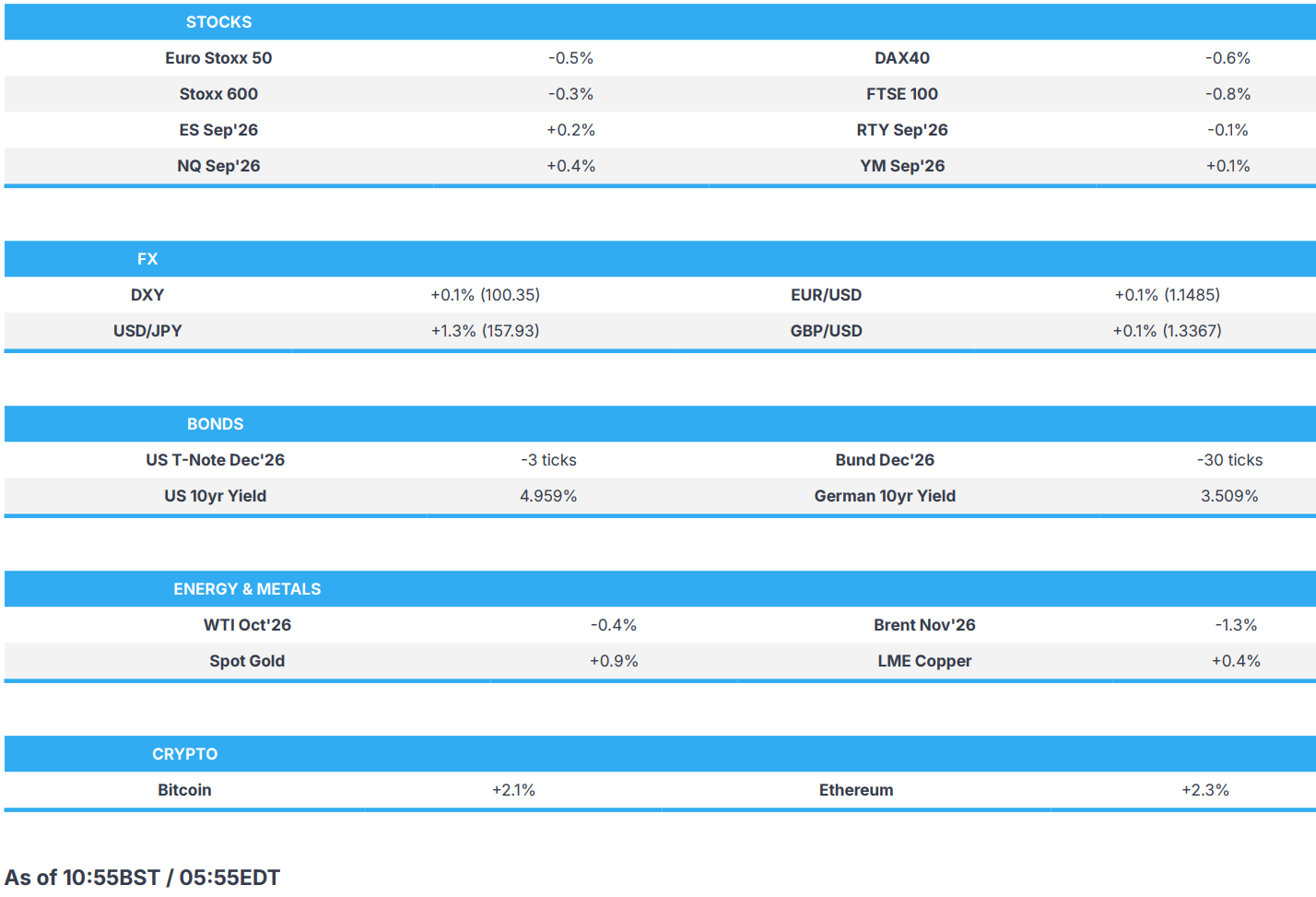
Newsquawk in 3 steps:
1. Subscribe to the free premarket movers reports
2. Listen to this report in the market open podcast (available on Apple and Spotify)
3. Trial Newsquawk’s premium real-time audio news squawk box for 7 days
LOOKING AHEAD
- Highlights include Quad witching, US Industrial/Manufacturing Production (Aug). Speakers include Fed’s Bowman and Schmid. Credit Rating upgrades from Morningstar DBRS on France, Scope Ratings on France, and Moody’s on Germany.
- Click here for the Week Ahead preview
EUROPEAN TRADE
EQUITIES
- European bourses have started the final trading session of the week on the backfoot, despite the constructive risk tone in Asia-Pac equities and the downside seen in energy benchmarks. Optimism in Europe has risen and according to a Bloomberg poll, the STOXX 600 will finish 2026 at 670, implying gains of 5% from Wednesday’s close. HSBC analysts highlight the improving macroeconomic data as a driver for the upbeat tone in Europe, while welcoming any downside in energy prices.
- Sectors point to a negative bias. Telecoms is the sector laggard, followed by Insurance and Retail. On the other hand, Tech is the sector outperformer, with Health Care and Industrials rounding out the sector gainers.
- US equity futures continues its post-FOMC reversal, with the ES extending further above the 7,700 mark. The upside is seemingly driven by chip stocks, following on from comments by Nvidia’s CEO projecting a doubling of chip sales in 2027. Such comments lifted South Korea’s tech giants overnight (SK Hynix +6.4%, Samsung Electronics +3.4%)
- Click for the sessions European pre-market equity newsflow
- Click for the additional news
FX
- Snapshot: G10s are mixed against the USD; the Aussie slightly outperforms, whilst the JPY is the clear laggard following the BoJ’s policy announcement.
- DXY is mildly firmer this morning and currently holds within a fairly narrow 100.19-38 range. The index still remains towards post-FOMC highs, benefiting from higher energy prices and as markets pull forward their calls for further hikes this year.
- The JPY is the clear underperformer this morning, after the BoJ decided to lift rates by 25bps (as expected), with the decision made by a 7-2 vote split. The two dissenters were PM Takaichi “reflationist” members; Asada noted that the economy was not strong enough, whilst Sato believed that price developments had not substantially accelerated. The announcement itself spurred immediate pressure in the JPY, given the two surprise dissenters and after the BoJ avoided any guidance surrounding a faster pace of rate hikes. Governor Ueda’s presser thereafter saw Ueda also strike a dovish tone, where he highlighted that easy monetary conditions are expected to be maintained, adding that rates have tightened, but bank lending and asset markets remain accommodative. USD/JPY is stronger by c. 1.3% on the session so far, and currently holding at the upper end of a 155.87-158.06 range. No doubt, if the theme of widening differentials between the Fed and BoJ returns, USD/JPY will likely head back towards the 158-160 range.
- EUR is mildly firmer this morning, amidst a slew of ECB speak, where a number of members are currently in Ireland for an informal meeting of EU ministers. ECB’s Kaasik and Kazaks struck a hawkish tone, with the latter suggesting that a September hike is unlikely to be the last, “unless we find ourselves in a very different scenario than the baseline”. Elsewhere, President Lagarde reiterated that they are not seeing second-round effects. A recent Bloomberg survey showed that economists believe that the Bank will wait until December before delivering a final interest-rate increase to quell inflation triggered by conflict in the Middle East.
FIXED INCOME
- Global fixed benchmarks are lower this morning. USTs (-3 ticks) are trading on either side of the unchanged mark, whilst Bunds (-30 ticks) and Gilts (-41 ticks) underperform. Pressure today for the latter two is likely an accumulation of factors: 1) BoJ rate hike, 2) elevated energy prices, 3) paring of recent BoE-related strength, 4) hawkish central bank speak from the ECB.
- JGBs are net firmer today, following the BoJ’s decision to hike rates by 25bps to 1.25%. However, the decision was subject to dovish dissent, which saw PM Takaichi’s “reflationist” appointees vote to hold rates; Asada noted that the economy was not strong enough, whilst Sato believed that price developments had not substantially accelerated. The presser thereafter saw Ueda also strike a dovish tone, where he highlighted that easy monetary conditions are expected to be maintained, adding that rates have tightened, but bank lending and asset markets remain accommodative. The JGB curve is steepening this morning (in contrast to global peers which are flattening), with underperformance in the short end given the dovish tone from the meeting/Ueda.
- USTs are flat, trading on either side of the unchanged mark. Some strength was seen in early morning trade alongside the pressure in energy prices, but this ultimately reversed. Ultimately, USTs are subdued this morning, following global peers with worldwide central banks shifting hawkish – the BoJ the latest to do so. Markets will get clarity out of the Fed later today, with Schmid and Bowman on the docket.
- It is worth highlighting that yields are bear-flattening this morning; this indicates that elevated energy prices and hawkish repricing are the main themes in traders’ minds. The US 2s10s currently holds around 24bps vs 34bps earlier in the week.
- Bunds have had a number of hawkish ECB speeches today, namely Kaasik and Kazaks. This may, in part, be weighing on the benchmark this morning. A recent Bloomberg survey showed that economists believe that the Bank will wait until December before delivering a final interest-rate increase to quell inflation triggered by conflict in the Middle East. Bunds will eye the Mecklenburg-Vorpommern state election, particularly in the context of the AfD’s strong showing in Saxony-Anhalt a few weeks ago.
- Australia sells AUD 1.0bln 1.00% November 2031 bonds: b/c 4.47x, average yield 4.9936%.
COMMODITIES
- Crude benchmarks continue to pull back from its peak seen earlier in the week, with escalatory strikes in the Gulf seemingly slowing down. There were a couple of UKMTO reports, which failed to move markets as traders now focus on next steps over any potential end to the war. Overnight, US President Trump told Axios he is at a “critical juncture” regarding the war in Iran, weighing whether to launch massive new attacks or pursue a different path to end the conflict. Further, this morning, a source close to the Iranian negotiating team said Tehran has informed Washington, via intermediaries, of its conditions for reopening the Strait of Hormuz, with the minimum conditions based on the “Islamabad understanding”, according to Al-Akhbar. WTI Oct’26 rotates in a USD 99.39-101.57/bbl range while Brent Nov’26 trades either side of the USD 103/bbl mark (USD 101.92-104.27/bbl range).
- Precious metals continue to climb post-Fed, with spot gold currently trading at the upper end of its USD 4,334-4,400/oz range. The narrative behind the recent gold upside seems to come from lower yields and energy prices, tempering worries of inflation.
- 3M LME Copper regains the USD 14.5k/t handle and rose to levels just shy of USD 14.6k/t, as the red metal prepares for its 4th consecutive day of gains. Supporting copper gains are signs that Chinese demand is re-entering the market. The Yangshan premium, a gauge of copper demand, rose to its highest level since November 2022 while domestic copper production fell slightly in August.
- Saudi Arabia has sold about 60mln barrels of crude from its Ras Tanura port inside the Strait of Hormuz for loading in September and October, Reuters reported citing sources.
- Venezuela nears an agreement to move USD 4bln gold reserve to New York which would allow the interim government to access funding, according to FT.
TRADE/TARIFFS
- UK Chancellor Healey is to urge Brussels on Friday to include the UK in ‘Made in Europe’ policy and will indicate that London is willing to negotiate to reach a ‘reset’ deal, according to FT.
NOTABLE EUROPEAN HEADLINES
- ECB Consumer Expectations Survey (Aug): 1-year 3.0% (prev. 2.9%), 3-year 2.9% (prev. 2.7%), 5-year 2.5% (prev. 2.4%).
NOTABLE EUROPEAN DATA RECAP
- UK Retail Sales (Aug MM) 0.5% vs. Exp. -0.2% (Prev. -0.5%).
- UK Retail Sales (Aug YY) 2.4% vs. Exp. 1.9% (Prev. 1.2%).
- UK Retail Sales ex Fuel (Aug MM) 0.6% vs. Exp. -0.2% (Prev. -0.9%).
- UK Retail Sales ex Fuel (Aug YY) 2.7% vs. Exp. 1.9% (Prev. 1.8%).
- German PPI (Aug MM) 1.1% vs. Exp. 0.4% (Prev. 1.1%).
- German PPI (Aug YY) 4.6% vs. Exp. 4.1% (Prev. 3.0%).
CENTRAL BANKS
- BoJ hiked rates by 25bps to 1.25%, as expected, with the decision made by a 7-2 vote as board members Asada and Sato dissented and voted to hold. BoJ said it will continue to raise rates in response to economic and price developments as well as financial conditions. BoJ said inflation expectations are heightening moderately, with underlying inflation approaching 2%, and it will conduct monetary policy as appropriate from the perspective of sustainably and stably achieving the inflation target. Furthermore, it said the accommodative financial environment will be sustained after the policy rate change, thereby supporting economic activity, and it is necessary to pay attention to the impact of the Middle East situation on financial and FX markets, the economy and prices. In terms of the dissenters, who are both known reflationists appointed by PM Takaichi, BoJ’s Asada considered that with the rate of increase in the core CPI below 2% recently, it could not necessarily be said that the economic situation was strong and it was desirable for the Bank to maintain the guideline for money market operations, while Sato considered current economic and price developments did not appear to have substantially accelerated compared with before, and in this context, it was not appropriate for the Bank to raise the policy interest rate at this time.
- Overall, Ueda’s press conference did not signal any urgency to accelerate the pace of tightening. He mentioned that easy monetary conditions are expected to be maintained, adding that rates have tightened, but bank lending and asset markets remain accommodative. One hawkish aspect of the presser was that Ueda suggested that the BoJ believes the phase of policy has changed. However, he later clarified that this meant that the objective is now to stabilise underlying inflation at around 2%, essentially removing the initial hawkish remark. Ueda also did not mention anything related to increasing the pace of future rate hikes, which further added to the dovish tone.
- RBA’s Governor Bullock said various indicators continue to suggest labour market conditions remain close to, but a little tighter than full employment, while she added that monetary policy is well placed to respond to developments. Bullock said lowering inflation is essential, and the key question is whether the tightening in monetary policy to date will be sufficient to bring inflation back to the target in a reasonable time. Furthermore, she stated they are in a world of higher-for-longer oil prices and that businesses are now more inclined to pass on cost increases.
- ECB President Lagarde, speaking on RTE Radio, said growth is a bit more promising than we thought and that they are not seeing second round effects yet. She also reiterated a meeting-by-meeting approach.
- ECB’s Vujcic said market bets on further ECB rate hikes are being largely driven by higher energy prices and will look at a wider set of economic indicators when deciding the next policy move. Vujcic said higher inflation through Autumn will dampen GDP. On the current rate hike pace, he said it is worth keeping for the time being.
- ECB’s Kazaks, speaking to Bloomberg, said the ECB must do everything to avoid second round effects and that all meetings are live meetings. On the neutral rate, he said they are near the upper end of neutral and that quite likely restrictive policy will be needed. Elsewhere, Kazaks told Econostream that the September hike will unlikely to be the last “unless we find ourselves in a very different scenario than the baseline”. Kazaks highlighted that an October hike would still be consistent with the September projections. On considering the size of the moves, he said that if the move in inflation is very strong or core inflation is moving up, the ECB can take bigger steps.
- ECB’s Kaasik said more tightening needed if inflation risks materialise but that the exact level of neutral rate is not a big concern now.
NOTABLE US HEADLINES
- OpenAI CEO Altman, NVIDIA (NVDA) CEO Huang and Qualcomm (QCOM) CEO Amon plan to attend the Trump-Xi dinner next week, with AI expected to be a key focus in the summit on September 24th, according to POLITICO.
- The US administration is set to announce that all states will see MFN pricing for certain drugs in Medicaid programmes, Semafor reported citing plans shared.
- US House Democrats are pressing the Trump administration for answers on the oil deal struck with Venezuela, Semafor reported citing a letter.
- US Department of Agriculture confirmed a case of New World screwworm in a horse in Grant County, New Mexico, marking the state’s second case since the parasite entered from Mexico in June.
GEOPOLITICS
MIDDLE EAST
- Source close to the Iranian negotiating team said Tehran has informed Washington, via intermediaries, of its conditions for reopening the Strait of Hormuz, with the minimum conditions based on the “Islamabad understanding”, according to Al-Akhbar.
- US State Department said the US will continue to bar Iranian UN mission officials, visiting officials and their dependents from purchasing wholesale club memberships or luxury goods, and urged New York area retailers to avoid complicity in violations.
- US is reportedly expected to send MQ-9 Reaper drones to South America, CNN reported citing sources. The report added that the plan is part of counternarcotics and counterterror operations and that there are still discussions on whether to send some drones to the Middle East.
- UKMTO received a report of an incident in the Strait of Hormuz. The CSO of a vessel has reported a tanker being hit by an unknown projectile causing a fire, which was extinguished.
- IRGC said Togolese-flagged tanker ‘Trend’ was hit and stopped after a fire, while it stated the tanker violated Hormuz rules and that the US instigated the transit.
- Houthis are reportedly expanding its minefield in Bab al-Mandab and Dhubab, Al Araby reported.
- South Korea President Lee said several countries are deploying military assets near the Strait of Hormuz, and added that they won’t deploy troops to join conflict but limited actions to safeguard South Korean economic interests and citizens are possible.
RUSSIA-UKRAINE
- Turkish President Erdogan and US President Trump may discuss initiatives for negotiations on Ukraine in New York, RIA reported citing sources.
OTHER
- US President Trump is making plans for the first-ever meeting with Venezuela’s interim President Rodriguez as early as next week, although a meeting is not finalised, according to Axios.
- North Korea leader Kim’s sister said there is no change to the course of strengthening nuclear war deterrence and the US-led multinational drills are the main source of worsening tensions on the peninsula.
CRYPTO
- Bitcoin steadily climbs and resides at the upper end of its USD 76.2k-78.51k range as the crypto pares completely the losses following the failure of the Clarity Act passage.
APAC TRADE
- APAC stocks were mostly higher as the region took impetus from the gains on Wall Street, where markets reversed the post-FOMC moves amid a Fed credibility boost and lower oil prices.
- ASX 200 lagged with the index range-bound trade as gains in tech and miners were counterbalanced by weakness in defensives, telecoms, energy and financials, while there were comments from RBA Governor Bullock that lowering inflation is essential and that the key question is whether the tightening in monetary policy to date will be sufficient to bring inflation back to the target in a reasonable time.
- Nikkei 225 rallied following the BoJ announcement to hike rates by 25bps, as widely expected, with the decision made by a 7-2 vote as Takaichi-appointed board members Asada and Sato dissented. The language from the central bank reaffirmed a hiking bias but didn’t signal any major urgency, noting it will conduct monetary policy as appropriate from the perspective of sustainably and stably achieving the inflation target, while the latest inflation data from Japan printed softer-than-expected on all key metrics of the report.
- KOSPI advanced with tech stocks buoyed following the outperformance in the Nasdaq stateside, while South Korean President Lee ruled out sending troops to the Strait of Hormuz.
- Hang Seng and Shanghai Comp conformed to the broad positive mood, with reports noting that the US is expected to delay announcing excess manufacturing capacity tariffs till after the Trump-Xi summit, while MOFCOM said Chinese and US trade teams remain in close contact over negotiations on mutual tariff reductions covering USD 30bln. In addition, the PBoC conducted 7-day and 14-day reverse repo operations ahead of the National Day holidays in early October.
NOTABLE ASIA-PAC HEADLINES
- Japanese Finance Minister Katayama said they will work to maintain an orderly FX market and will not hesitate to conduct further coordinated forex intervention. She added that they maintain close communication with financial authorities of other nations on FX and that it is important to maintain order regarding exchange rates and interest rates.
- Japan Economy Minister Kiuchi expects the BoJ to conduct appropriate monetary policy to sustainably and stably achieve its price target while working closely with the government, adding that details of monetary policy are for the BoJ to decide.
NOTABLE APAC DATA RECAP
- Japanese Core CPI (Aug YY) 1.7% vs. Exp. 1.8% (Prev. 1.8%).
- Japanese CPI (Aug YY) 1.9% vs. Exp. 2.0% (Prev. 1.9%).
- Japanese CPI Ex-Food and Energy (Aug YY) 1.9% vs. Exp. 2.0% (Prev. 1.9%).
- New Zealand Trade Balance (Aug) -1349MB vs. Exp. -1.775MB (Prev. -2118MB).
1c Asian opening report
APAC stocks were mostly higher as the region took impetus from the gains on Wall Street; USD/JPY rises post-BoJ – Newsquawk EU Market Open
Friday, Sep 18, 2026 – 01:46 AM
- US President Trump told Axios he is at a “critical juncture” regarding the war in Iran, weighing whether to launch massive new attacks or pursue a different path to end the conflict.
- BoJ hiked rates by 25bps to 1.25%, as expected, with the decision made by a 7-2 vote; USD/JPY outperformed.
- Crude futures were lacklustre after declining yesterday alongside de-escalatory reports.
- APAC stocks were mostly higher as the region took impetus from the gains on Wall Street, where markets reversed the post-FOMC moves amid a Fed credibility boost and lower oil prices.
- European equity futures indicate a lower cash market open, with Euro Stoxx 50 down 0.3% after the cash market closed with gains of 0.9% on Thursday.
- Looking ahead, highlights include Quad witching, German PPI (Aug), UK Retail Sales (Aug), US Industrial/Manufacturing Production (Aug). Speakers include BoJ Governor Ueda, ECB’s Lagarde, Fed’s Bowman and Schmid. Credit Rating upgrades from Morningstar DBRS on France, Scope Ratings on France, and Moody’s on Germany.
Newsquawk in 3 steps:
1. Subscribe to the free premarket movers reports
2. Listen to this report in the market open podcast (available on Apple and Spotify)
3. Trial Newsquawk’s premium real-time audio news squawk box for 7 days
SNAPSHOT
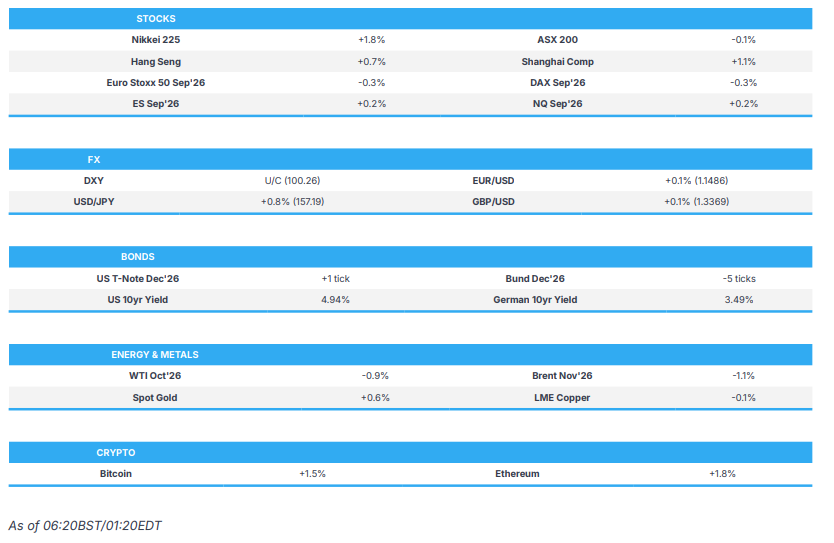
IRAN CONFLICT
- US President Trump told Axios he is at a “critical juncture” regarding the war in Iran, weighing whether to launch massive new attacks or pursue a different path to end the conflict. Trump said he has a big decision coming up and pondered whether he wants to go in and annihilate them or not, while he said anything could happen with him. Trump declined to say whether he will decide on the path forward before or after the midterms, while he and Hegseth have ordered the military to maintain its level of forces in the Middle East until the end of the year to remain ready for a potential return to full-scale combat.
- US senior official said the US is focused on ensuring navigation in the Red Sea and allowing its partners to manage security challenges, while the official stated that the US is in constant communication with Saudi Arabia and the Yemeni government regarding regional stability, and it expects the Houthis to continue adhering to the ceasefire condition.
- US approves visas for top Iranian leaders to attend the UN high-level meeting.
- US State Department said the US will continue to bar Iranian UN mission officials, visiting officials and their dependents from purchasing wholesale club memberships or luxury goods, while it urged New York-area retailers to avoid complicity in violations.
- US State Department said Washington’s new sanctions against the Babak Zanjani network for transferring hundreds of millions of dollars in Bitcoin to the IRGC targeted Iran’s efforts to finance destabilising activities through digital currency networks. It also stated that it remains committed to blocking the Iranian government and the IRGC’s access to resources they use to threaten regional stability, support “terrorism,” and undermine international security.
- US Senator Kaine said the Senate could hold its next vote on Iran war powers early next week, adding there could be more to come before the election.
- US forces began dismantling and transferring air defence systems from their positions in the Kurdistan Region, according to Al Hadath. Sources stated the withdrawal of international coalition forces from Iraq continues, with more than one military convoy departing daily. It was separately reported that most of the remaining US troops in northern Iraq are expected to move to Jordan.
- Satellite images reportedly revealed that Iran was rebuilding a previously bombed nuclear site.
- UKMTO received a report of an incident 75 NM east of Yemen’s Aden, with a westbound tanker reporting that a skiff pursued and attempted to intercept the vessel. UKMTO also said it received a report of a security incident in the Strait of Hormuz 16 NM Northeast of Khasab, Oman.
- IRGC said Togolese-flagged tanker ‘Trend’ was hit and stopped after a fire, while it stated the tanker violated Hormuz rules and that the US instigated the transit.
- South Korean President Lee said several countries are deploying military assets near the Strait of Hormuz, while he won’t deploy troops to join the conflict, but noted that limited actions to safeguard South Korean economic interests and citizens are possible.
- Israeli airstrikes hit two towns in southern Lebanon, according to Mehr News Agency.
- Board of Peace will hold a briefing for representatives from dozens of countries on the sidelines of the UN General Assembly next week to update them on efforts to implement US President Donald Trump’s plan for rebuilding the Gaza Strip.
US TRADE
EQUITIES
- US stocks rallied and the Nasdaq outperformed, although gains were broad-based with the RSP +0.5%, while sectors were predominantly higher with advances led by Technology, Consumer Discretionary and Utilities, although Consumer Staples and Financials underperformed, closing marginally lower. The hawkish Fed reaction seen on Wednesday was broadly pared across markets on Thursday, with participants instead focusing on improved Fed credibility in its efforts to return inflation to target following the rate hike and Chair Warsh’s steadfast commitment to restoring price stability, despite pressure from US President Trump for lower rates. This view helped support lower yields across the curve, resulting in a bull flattening, with the long end outperforming, with lower oil prices also supporting the move in Treasuries.
- SPX +1.14% at 7,638, NDX +1.73% at 29,447, DJI +0.61% at 51,783, RUT +0.55% at 2,875
- Click here for a detailed summary.
TARIFFS/TRADE
- US President Trump and Mexican President Sheinbaum spoke by phone on Wednesday as the two countries close in on a trade deal, according to Politico citing sources, while the conversation was described as “so-so” and “created a bit of noise” as “new topics” were introduced into the leaders’ discussion.
- New Zealand Foreign Minister spokesperson said there are no talks with the EU regarding New Zealand joining as an associate member.
NOTABLE HEADLINES
- US Senate Republicans’ attempt to quickly pass a bipartisan bill to prevent data centre-related utility cost increases failed on Thursday, amid Democratic concerns that it would rely only on voluntary commitments from states and data centre developers.
- US Department of Agriculture confirmed a case of New World screwworm in a horse in Grant County, New Mexico, marking the state’s second case since the parasite entered from Mexico in June.
APAC TRADE
EQUITIES
- APAC stocks were mostly higher as the region took impetus from the gains on Wall Street, where markets reversed the post-FOMC moves amid a Fed credibility boost and lower oil prices.
- ASX 200 lagged with the index range-bound trade as gains in tech and miners were counterbalanced by weakness in defensives, telecoms, energy and financials, while there were comments from RBA Governor Bullock that lowering inflation is essential and that the key question is whether the tightening in monetary policy to date will be sufficient to bring inflation back to the target in a reasonable time.
- Nikkei 225 rallied following the BoJ announcement to hike rates by 25bps, as widely expected, with the decision made by a 7-2 vote as Takaichi-appointed board members Asada and Sato dissented. The language from the central bank reaffirmed a hiking bias but didn’t signal any major urgency, noting it will conduct monetary policy as appropriate from the perspective of sustainably and stably achieving the inflation target, while the latest inflation data from Japan printed softer-than-expected on all key metrics of the report.
- KOSPI advanced with tech stocks buoyed following the outperformance in the Nasdaq stateside, while South Korean President Lee ruled out sending troops to the Strait of Hormuz.
- Hang Seng and Shanghai Comp conformed to the broad positive mood, with reports noting that the US is expected to delay announcing excess manufacturing capacity tariffs till after the Trump-Xi summit, while MOFCOM said Chinese and US trade teams remain in close contact over negotiations on mutual tariff reductions covering USD 30bln. In addition, the PBoC conducted 7-day and 14-day reverse repo operations ahead of the National Day holidays in early October.
- US equity futures paused after clawing back post-FOMC losses yesterday and ahead of quadwitching.
- European equity futures indicate a lower cash market open with Euro Stoxx 50 down 0.3% after the cash market closed with gains of 0.9% on Thursday.
FX
- DXY traded little changed after giving back some of its post-FOMC spoils as yields eased, with some citing improved Fed credibility as markets appeared to take greater confidence in Chair Warsh’s commitment to return inflation to the target. Elsewhere, dollar-specific newsflow remains light despite a slew of US data, which ultimately failed to move the needle, while participants will get to digest rhetoric from Fed speakers following the end of the blackout period.
- EUR/USD eked slight gains and looks to retest near-term resistance ahead of the 1.1500 handle, while there were comments from ECB officials that there were currently no signs of second-round effects of inflation.
- GBP/USD slightly edged higher but lacked conviction after lagging yesterday post-BoE as UK yields eased from their highs after the Bank announced it would pause APF gilt sales until April 2027 and confirmed it would not sell long-dated gilts into the market, while participants look ahead to UK Retail Sales data.
- USD/JPY was underpinned after the BoJ delivered a widely expected rate hike but with dissent from the two Takaichi-appointed, known reflationist board members, while Japan’s CPI data was also softer-than-expected.
- Antipodeans were somewhat varied as AUD kept afloat amid the mostly positive risk appetite and after CNH hit its strongest level in around four years, while NZD/USD was slightly pressured after trade data.
- PBoC set USD/CNY mid-point at 6.7521 vs Exp. 6.7065 (prev. 6.7580)
FIXED INCOME
- 10yr UST futures paused overnight after yesterday’s bull flattening and reversal of the post-Fed move, as Fed credibility received a boost following Wednesday’s rate hike.
- Bund futures price action was range-bound after the recent mild rebound and with a lack of major catalysts for the bloc, while rhetoric from ECB officials provided little to shift the dial.
- 10yr JGB futures initially climbed higher as they tracked the recovery in global peers and with upside also facilitated by softer-than-expected Japanese CPI data, although the gains were then pared after the BoJ delivered a widely expected rate hike.
COMMODITIES
- Crude futures were lacklustre after declining yesterday alongside de-escalatory reports, including China pressing Iran to help rein in the Houthis following a Saudi appeal, while Saudi Arabia was said to have asked Oman to seek a two-week truce with the Houthis, and Pakistan’s Army Chief also urged Iran to convince the Yemeni Houthis not to attack Saudi energy facilities.
- Three pumping stations along Saudi Arabia’s East-West pipeline were damaged in an attack last week (prev. reported as two), while a repair timeline is unclear.
- Oil refinery in Russia’s Yaroslavl region halted crude processing after a drone attack.
- Spot gold was choppy after spending the prior day clawing back all of its post-FOMC losses.
- Venezuela nears an agreement to move USD 4bln gold reserve to New York, which would allow the interim government to access funding, according to FT.
- Copper futures pulled back from a weekly peak after advancing alongside the improved sentiment.
CRYPTO
- Bitcoin steadily gained throughout the session and returned to above the USD 77,000 level.
NOTABLE ASIA-PAC HEADLINES
- BoJ hiked rates by 25bps to 1.25%, as expected, with the decision made by a 7-2 vote as board members Asada and Sato dissented and voted to hold. BoJ said it will continue to raise rates in response to economic and price developments as well as financial conditions. BoJ said inflation expectations are heightening moderately, with underlying inflation approaching 2%, and it will conduct monetary policy as appropriate from the perspective of sustainably and stably achieving the inflation target. Furthermore, it said the accommodative financial environment will be sustained after the policy rate change, thereby supporting economic activity, and it is necessary to pay attention to the impact of the Middle East situation on financial and FX markets, the economy and prices. In terms of the dissenters, who are both known reflationists appointed by PM Takaichi, BoJ’s Asada considered that with the rate of increase in the core CPI below 2% recently, it could not necessarily be said that the economic situation was strong and it was desirable for the Bank to maintain the guideline for money market operations, while Sato considered current economic and price developments did not appear to have substantially accelerated compared with before, and in this context, it was not appropriate for the Bank to raise the policy interest rate at this time.
- RBA’s Governor Bullock said various indicators continue to suggest labour market conditions remain close to, but a little tighter than full employment, while she added that monetary policy is well placed to respond to developments. Bullock said lowering inflation is essential, and the key question is whether the tightening in monetary policy to date will be sufficient to bring inflation back to the target in a reasonable time. Furthermore, she stated they are in a world of higher-for-longer oil prices and that businesses are now more inclined to pass on cost increases.
- China’s MIIT, NDRC and eight other government ministries and agencies jointly issued the pharmaceutical industry’s 15th Five-Year Plan.
DATA RECAP
- Japanese CPI (Aug YY) 1.9% vs. Exp. 2.0% (Prev. 1.9%)
- Japanese Core CPI (Aug YY) 1.7% vs. Exp. 1.8% (Prev. 1.8%)
- Japanese CPI Ex-Food and Energy (Aug YY) 1.9% vs. Exp. 2.0% (Prev. 1.9%)
GEOPOLITICS
RUSSIA-UKRAINE
- US President Trump is expected to sign the Russia-Iran sanctions bill as early as Friday.
OTHER
- US President Trump is making plans for the first-ever meeting with Venezuela’s interim President Rodriguez as early as next week, although a meeting is not finalised, according to Axios.
- US Pentagon reportedly considers withdrawing nearly one-third of US forces from Europe.
- North Korea leader Kim’s sister said there is no change to the course of strengthening nuclear war deterrence and the US-led multinational drills are the main source of worsening tensions on the peninsula.
- North Korea’s Vice Foreign Minister Kim Son-Gyong will attend the UN General Assembly next week.
EU/UK
NOTABLE HEADLINES
- UK Chancellor Healey is to urge Brussels on Friday to include the UK in ‘Made in Europe’ policy and will indicate that London is willing to negotiate to reach a ‘reset’ deal, according to FT.
- French PM Lecornu said ongoing austerity measures this year mean the 2026 deficit should remain well below 5.5% of GDP. Lecornu also stated that the deficit target in the draft budget reaches 5% of GDP for 2027 and that taxes will not be raised.
- ECB’s Zigman said market bets do not determine the ECB’s next steps and noted there is a lot of optimism for growth, while he does not see any major second-round effects and warned that growth is at risk if inflation is not tackled.
2.NORTH AND SOUTH KOREA/
SOUTH KOREA//NORTH KOREA
SOUTH KOREA
JAPAN
TWO IMPORTANT COMMENTARIES;
FIRST: EARLY THIS MORNING
Yen Plunges After Two Dissenters Upstage BOJ’s Rate Hike: Full Wall Street Reaction
Friday, Sep 18, 2026 – 10:10 AM
The yen sank to a two-week low against the dollar on Friday after two policy makers at the Bank of Japan dissented from a widely expected decision to raise interest rates, extinguishing expectations for back-to-back hikes. Governor Kazuo Ueda now needs, at a minimum, to preserve expectations for a December move to prevent markets from unwinding most if note all of the tightening path already priced into rates.
While Japanese policymakers pushed rates to their highest level in 31 years at 1.25%, the move failed to boost the currency as traders felt there was a lack of explicitly hawkish guidance.

As a result of the dovish split, the yen tumbled and the US dollar rose more than 1.2% against the Japanese currency, hitting a a two-week high of 158.07 yen after wavering during BOJ Governor Kazuo Ueda’s press conference. It was set for its biggest daily increase versus the yen since December and the largest weekly rally since September 2024.

Traders had already discounted the equivalent of another hike by year-end before today’s policy meeting, leaving a high bar for any hawkish surprise. The presence of two dissenters signals that support for another rate increase in October is weakening, with OIS assigning around a 20% probability to such an outcome. That leaves Ueda’s press conference carrying the burden of preserving expectations for a December hike and keeping the BOJ on a tightening path that at least matches the Fed’s recent pace.
“They’ve just clearly underwhelmed versus expectations here,” said Ray Attrill, head of FX strategy at National Australia Bank in Sydney. “And I think that one of the more staggering aspects of it was that they couldn’t even get the unanimous vote for that,” he said. “That really raised eyebrows in the market.”
“The statement offered little additional hawkish guidance to support bullish Japanese yen positions,” said Frantisek Taborsky, currency strategist at ING. “The dissent from (Toichiro) Asada and (Ayano) Sato points to resistance against the fastest pace of rate increases in more than three decades and suggests they may increasingly act as a brake on further tightening.”
According to Mizuho strategists, the dissenters raise concerns that further rate hikes become harder to deliver, potentially steepening the JGB yield curve. Senior strategist Masayuki Nakajima said that Friday’s two dissenters were appointed by Prime Minister Sanae Takaichi. Two more members are due to leave the board next year and could potentially be replaced by more dovish policymakers
“Should their successors come from the reflationist camp, four of the nine Board members would become dovish,” he says; “While that would still fall short of a majority, it could reinforce expectations that sustaining the tightening cycle may become more difficult in the future”
“If so, concerns that the BOJ is falling behind the curve could re-emerge, potentially leading to further curve steepening,” he added.
Commenting on the market reaction, Bloomberg’s Ven Ram said that the decision was:
- marred by dissent from two policymakers who voted against the hike;
- there was none who called for a bigger margin of increase;
- and the accompanying statement, while vowing to continue raising rates, failed to signal a sense of urgency by not saying when they will come.
Japan’s benchmark rate still trails the neutral rate by a considerable margin, and without back-to-back interest-rate hikes, the yen will stay weaker for longer. Only the franc carries a lower interest rate in the G-10 economies, with the Swiss central bank due to meet next week. Should that monetary authority reiterate its preference for keeping rates at zero, it will engender low volatility in two of the major exchange rates that represent the preferred funding currencies.
After a slew of central bank meetings and with Brent crude headed for the first weekly decline this month, global bonds that were deeply oversold are finding some respite. Longer-dated gilts received a boost from the Bank of England’s plan to pause bond sales and stop selling securities that mature in 2049 or later. Gilts with a maturity of 30 years stand to benefit considerably, so an immediate follow-through of Thursday’s rally is likely even though the looming autumn budget realities may check the pace of gains.
Here are some other reactions to the split BOJ decision from Wall Street traders:
NAKA MATSUZAWA, CHIEF MACRO STRATEGIST, NOMURA SECURITIES, TOKYO:
“It’s (the yen’s decline) a knee-jerk reaction to the two dissent votes. The bottom line is I think it’s not too hard for the BOJ to keep the currency pricing for market expectations of rate hikes, basically every three months. And I do think that’s what the BOJ wants to keep, not necessarily suggesting an October hike.”
RAY ATTRILL, HEAD OF CURRENCY STRATEGY, NATIONAL AUSTRALIA BANK, SYDNEY:
“They’ve just clearly underwhelmed versus expectations here. And I think that one of the more staggering aspects of it was that they couldn’t even get the unanimous vote for that. I think that really raised eyebrows in the market. (There was) nothing to put the market more firmly on the sense of another increase in Q4. It’s clearly on Governor Ueda to put the market back more firmly on that stance. If he fails to do that, then I think dollar-yen is headed higher. It’s hard to believe that just on the back of one quarter-point the (US) Treasury Secretary is going to be jumping for joy and as willing to replicate what they did in August (by intervening). The risk here is that we’re heading back up to 160.”
BART WAKABAYASHI, BRANCH MANAGER, STATE STREET, TOKYO:
“They raise rates and the currency loses 100 points – I think the market is looking at the BOJ versus the G3 and G10 central banks and the interest rate spread is what is in play. I think it’s important that the six-month cycle has been broken, and that leaves the market to say, hey, these guys are willing to act if they have to.”But there is a factor where they need to keep up (with other central banks)…if (Ueda) is not as hawkish as the Fed (at the news conference), dollar/yen could really take off higher.”
DAVID CHAO, GLOBAL MARKET STRATEGIST FOR ASIA-PACIFIC, INVESCO, SINGAPORE:
“The BOJ has finally shed its long-term status as a monetary policy outlier and is joining the ranks of the other major central banks. The market fully anticipated this rate hike, but it has to be taken in context with what’s going on with the rest of the world. The BOJ, Fed and ECB have all hiked rates in the same month.”
MASAHIKO LOO, SENIOR FIXED INCOME STRATEGIST, STATE STREET INVESTMENT MANAGEMENT, TOKYO:
“Markets should focus less on the statement and more on Ueda’s press conference. Expect a neutral-to-slightly hawkish tone, emphasizing that every meeting remains ‘live’ from here given resilient growth, persistent inflation risks and a policy rate (real yield) that remains accommodative even at 1.25%.More broadly, Japan is increasingly participating in a synchronized global tightening cycle. The debate is no longer whether the BOJ hikes, but how far rates ultimately go as major central banks continue to grapple with sticky inflation, AI-driven investment demand and rising term premium. Combined with higher domestic yields and growing confidence in the BOJ’s normalization path, more capital is likely to stay in Japan rather than flow abroad. The bigger story remains that Japan is gradually ceasing to be a marginal buyer of foreign assets, not because it is selling aggressively, but because domestic alternatives are becoming more attractive.”
CAROL KONG, CURRENCY STRATEGIST, COMMONWEALTH BANK OF AUSTRALIA, SYDNEY:
“The fact that two BOJ board members appointed by Takaichi opposed a hike today suggests the government still leans against BOJ rate hikes. This, together with the lack of guidance on the future pace of tightening in the statement, triggered a sell-off in the JPY. As usual, Governor Ueda’s post-meeting press conference will provide more insights into the rate outlook. The risk is Ueda fails to match markets’ hawkish expectations, fuelling further JPY weakness. We expect a follow-up hike in December.”
YUGO TSUBOI, CHIEF STRATEGIST, DAIWA SECURITIES, TOKYO:
“Overall, the decision is likely to be seen as dovish. There had been some concern, albeit limited, about a 50-basis-point rate hike, but that did not happen. With two dissenting votes, markets likely took the view that it would be difficult to assume the pace of rate hikes will accelerate rapidly. U.S. Treasury Secretary Bessent’s negative comments on reflationary policy had also raised concerns about the potential economic damage from the BOJ becoming more hawkish than previously expected. Those concerns have receded, prompting a rise in stocks.”
SHUN HONG LIU, CHIEF INVESTMENT OFFICER, HONG INVESTMENT ADVISORS, HONG KONG:
“Honestly, it is so hard to have a very strong view in this market, given things are so political everywhere else in the world. Just imagine Japan needing to get consent from the US for intervention—what can be done and what cannot be done will be coordinated by so many politicians. Last week, if you had asked me, I would have answered yes, it is the end of the yen carry trade (after the rate hike). But now I would answer no, as Takaichi confirms a 3.5% military spending target, while people suddenly believe that Warsh is an uber-hawk. So I just keep my eyes open and trade accordingly.”
KANAKO NAKAMURA, ECONOMIST, DAIWA INSTITUTE OF RESEARCH, TOKYO:
“The expected dissent by two members suggests political pressure on the BOJ has not entirely faded. The reappointment of Minister Kiuchi in the cabinet reshuffle also signals continued support for expansionary fiscal policy, raising concerns that fiscal stimulus could add to inflation pressures.”While the BOJ’s statement showed readiness to address upside inflation risks, Governor Ueda’s press conference will be key for assessing the future pace of rate hikes.With producer prices remaining elevated, oil prices rising on Middle East tensions, and a weak yen adding to inflation risks, we do not believe this rate hike alone will be sufficient. We expect the BOJ to accelerate rate hikes to roughly once a quarter.”
PRASHANT NEWNAHA, SENIOR RATES STRATEGIST, TD SECURITIES, SINGAPORE:
“No real surprises from the BOJ decision to hike the target rate 25bps to 1.25%, and neither was the 7-2 split, with recent Takaichi appointees Sato and Asada voting against the hike. The statement retains most of the hawkish tone from the July Statement noting ‘accommodative financial conditions are expected to be maintained’ even after the hike, and the Bank ‘will continue to raise the policy interest rate’. The Bank reiterated its concerns that underlying inflation could deviate upwards from its 2% target, but we don’t see a smoking gun supporting a back to back hike in October. We stick with our call for rate hikes roughly every quarter with the next 25bps hike in December.”
TOHRU SASAKI, CHIEF STRATEGIST, FUKUOKA FINANCIAL GROUP AND FORMER BOJ OFFICIAL, TOKYO:
“It’s a little bit surprising to see that the yen weakened after the announcement. Maybe some market participants were expecting intervention like the last time before and after the BOJ’s decision.Probably some were surprised because two members opposed the decision and maybe some were expecting some mention of a 50 basis point hike. It’s a bit difficult to meet market expectations. Ueda-san has to be very hawkish to keep the yen from depreciating, but I think it’s a bit difficult for him to be so hawkish. He has to say that the BOJ will probably hike the policy rate again within this year. But I think it’s difficult for him to say, so the market will take it as a dovish press conference.”
ANTHONY MALOUF, EBURY, SYDNEY:
“The seven-to-two vote is a touch wider than a clean hawkish consensus would suggest. Dissenters Asada Toichiro and Sato Ayano argued that inflation and growth have not accelerated enough to justify tightening now. The more telling split, though, sits elsewhere. Board members Takata Hajime and Tamura Naoki opposed the outlook language from the opposite direction, arguing underlying inflation has already reached a level consistent with the 2% target, which points to appetite for a faster pace rather than a slower one. The yen sold off after the decision. We interpret this as markets focusing on the two dissents, suggesting the board is less united behind a faster pace than the vote count alone implies, rather than doubting the hike itself. That fits our own view that the BOJ will deliver further hikes at a steady quarterly pace, with the next move in December and another in the first quarter of 2027, taking the policy rate to its neutral level near 1.75%.”
KENTO MINAMI, SENIOR ECONOMIST AT DAIWA SECURITIES, TOKYO:
“The overall impression of the statement was dovish. BOJ’s new board members Ayano Sato and Toichiro Asada dissented from the decision. They were chosen by Prime Minister Sanae Takaichi, which suggests difficulties in raising rates in the future as the BOJ will have new board members going forward. “The statement indicated that the BOJ would raise rates at least once every six months, but this was in line with market expectations that the BOJ would raise rates every three months. These two dissenters were a dovish factor, which is why the yen started falling right after the decision.”
MASATO KOIKE, SENIOR ECONOMIST, SOMPO INSTITUTE PLUS, TOKYO:
“I think the statement was hawkish, but markets had expected something even more hawkish, which is why the yen weakened after the announcement. “What struck me as hawkish was the explicit reference to accommodative financial conditions, and the wording that the BOJ will continue to adjust the degree of monetary easing. It also clearly mentioned upside risks. In addition, the BOJ cited a range of factors — not just crude oil, but price increases linked to AI-related demand, the weaker yen, and the mutually reinforcing mechanism between wages and prices. Those elements made the decision look hawkish overall. I don’t think (Sato joining Asada in dissent) will have an impact when it comes to the pace of rate hikes being delayed. Sato’s dissent was in line with expectations, but I see it as opposition to the timing or pace rather than a blanket objection to rate hikes. It did not come across as outright opposition, which I think is positive for the BOJ as it proceeds with further rate increases.”
HIROFUMI SUZUKI, CHIEF FX STRATEGIST, SMBC, TOKYO:
“The rate hike itself was in line with market expectations, but the two dissenting votes came as a modest surprise, as only some market participants had anticipated them. The outcome has somewhat tempered expectations for further rate hikes and conveyed a dovish impression. The pace of future rate hikes is likely to depend primarily on the views of the BOJ’s leadership. We therefore do not expect the pace to differ significantly from current market expectations.The yen initially weakened following the decision, but attention now turns to Governor Ueda’s inflation outlook and policy stance at the press conference.”
FRED NEUMANN, CHIEF ASIA ECONOMIST, HSBC, HONG KONG:
“The tone of the statement, along with two dissenters on the decision to raise rates, leaves lingering doubts that Japan’s central bank will be cautious in tightening monetary policy further. In addition, new inflation numbers out this morning for August showed that price pressures remained unchanged in August, rather than accelerate. All eyes are now on the press conference to be held by Governor Ueda, with the market looking for hawkish reassurances that the BOJ is prepared to raise rates again soon. While back-to-back hikes appear unlikely, investors will look for clues as to whether officials are prepared to raise interest rates again in December. Given that the Fed has tilted into a more hawkish direction, the pressure remains for the BOJ to follow suit: Governor Ueda will have to follow-up today’s rate hike with by keeping the door open for another hike before the end of the year.”
Sellside reactions aside, Governor Kazuo Ueda said that with the price trend very close to the bank’s 2% target, authorities now need to ensure inflation doesn’t overshoot.
“It has become important to stabilize the rate of price increases at a level of around 2%,” Ueda said in a post-decision briefing. “In that sense, I believe the phase of policy has shifted to a new stage.” The bank should act preemptively to avoid being forced into a situation where rapid hikes might become unavoidable, he added.
Traders also remained alert to the risk of intervention to prop up the currency after Finance Minister Satsuki Katayama said Tokyo won’t hesitate to conduct further coordinated action, following a joint US-Japan move to boost the yen in late July.
The yen rallied sharply in early September to its highest since February as traders bet the BOJ would embark on multiple rate hikes, although those wagers came under question on Friday.
The dollar rally against the yen helped the DXY dollar index climb 0.25% to 100.48, as broader currency markets remained focused on energy prices and the U.S. Federal Reserve. The index, which tracks the currency against six major peers, was up 1.4% for the week to around a six-week high after the US Federal Reserve hiked interest rates on Wednesday and signaled more increases could be coming.
Traders now see a roughly 55% chance of a quarter-point hike at the Fed’s next two-day meeting next month, up from 27% a week ago, according to the CME Group’s FedWatch tool.
Finally, it’s worth noting that the BOJ dissenters directly jeopardized the plan of Steve Bessent for a stronger yen (and thus less fears of TSY selling to prop up the yen through intervention). According to Bloomberg, Warsh should “seriously consider a little Friday afternoon intervention to ensure that this bounce in USD/JPY makes a lower high than the prior ascent to just over 160.”
Of course, the problem with constant meddling in market prices is the risk that the market tests you, forcing ever-more frequent action to keep things in line. At the very least anyone who stayed with the short-dollar trade has received a painful kick in the shin, which arguably will dissuade some punters from staying in the position the next time that the authorities step in.
3. CHINA/
CHINA/
space wars are about to begin?
(zerohedge)
China’s “Dogfighting” Satellites Come Into Focus As US Confirms Space Weapons
Thursday, Sep 17, 2026 – 11:00 PM
The United States has publicly acknowledged that it already has weapons in orbit, adding a new dimension to a military competition increasingly defined by highly maneuverable satellites – and what they could be used for. Air Force Secretary Troy Meink revealed the space weapons in a Monday disclosure at the Air & Space Forces Association’s annual conference.
Among other threats, China’s ‘dogfighting’ satellites have caught the attention of US officials.

In March of last year, Gen. Michael Guetlein, then the Space Force’s vice chief of space operations, described five Chinese objects conducting coordinated maneuvers in low Earth orbit. The service subsequently identified three Shiyan-24C satellites and two Shijian-6 05A/B objects. He said they were “Dogfighting” (not that they had exchanged fire).
More recent activity includes a Chinese spaceplane releasing a small satellite in June. The object looped around another Chinese satellite before moving back toward the spaceplane, according to LeoLabs tracking data reported by Reuters on September 2. That investigation also examined Chinese research into spacecraft pursuit and capture, while noting that the United States operates its own secretive uncrewed spaceplane.
What changed this week was Washington’s willingness to explicitly acknowledge an orbital arsenal. According to Meink, the United States possesses “on-orbit space control weapons capable of defending the joint force against hostile adversary action.” He declined to identify the weapons or describe their technical characteristics, testing or employment.
In a subsequent statement to The War Zone, a Space Force spokesperson said the broader space-control mission includes kinetic and non-kinetic methods of disrupting, degrading or, when necessary, destroying an adversary’s capabilities. The spokesperson said those capabilities can serve offensive or defensive purposes, but would not specify which particular systems are currently deployed.

What we don’t know is whether the deployed weapons are physical interceptors, electronic warfare systems or something else. Nor does a description of the service’s overall mission prove that every type of capability mentioned is already operational in orbit.
This goes way beyond satellites too. Space infrastructure supports communications, intelligence collection, missile warning and weapons guidance, while disruption can also affect civilian and commercial activity. The War Zone’s reporting highlighted those dependencies alongside the service’s acknowledgment.
China has opposed the U.S. announcement, reiterating its position against the weaponization of space. American officials describe their capabilities as necessary to deter attacks and protect forces. Experts interviewed by Reuters warned that secrecy and uncertainty can encourage competing governments to make worst-case assumptions about one another’s intentions.
The 1967 Outer Space Treaty is not a blanket prohibition on conventional weapons in Earth orbit. Its central orbital weapons restriction concerns nuclear weapons and other weapons of mass destruction. Separate provisions prohibit military installations, weapons testing and military maneuvers on the moon and other celestial bodies. An acknowledgment of conventional orbital weapons therefore does not, on its own, establish a treaty violation.
Now for a ‘complicator’ – how do governments distinguish routine operations, surveillance, deterrent signaling and preparations for an attack when much of the relevant hardware and doctrine remains classified?
4. EUROPEAN AND SCANDINAVIAN COMMENTARIES PLUS NATO
GERMANY
this will be a huge problem for Germany in the winter:
Germany Weighs Market Incentives To Boost Record Low Gas Storage Level
Friday, Sep 18, 2026 – 02:00 AM
Authored by Tsvetana Paraskova via OilPrice.com,
Germany is considering expanding a key market incentive to encourage traders to raise gas storage levels ahead of the winter, a government source told Reuters on Wednesday as German gas sites are barely half full at present.

Europe’s biggest economy has the world’s fourth-largest natural gas storage capacity, but this capacity has been only 56% full as of the middle of September, according to data by Gas Infrastructure Europe.
That’s a historically low level, the lowest in at least a decade and a half, as soaring natural gas prices amid the Middle East crisis have deepened the backwardation structure and discouraged holding supply for later deliveries. Backwardation is the market structure in which prompt contracts trade higher than those further out in time, signaling concerns about immediate supply.
As a result of the low storage levels, Germany is risking gas shortages this winter if it turns out to be colder than previous years, the country’s gas storage association, INES, warned last week.
Therefore, the German government is looking to use the existing market tool, the autumn tender for Long Term Options, or LTOs, on a larger scale.
The tender is set to be increased by a yet-to-be-determined volume of gas, according to Reuters’ source.
Germany would rather avoid direct state purchases of gas as it did in 2022, but has agreed with state-held energy firms Uniper and SEFE they would inject more gas into their storage facilities.
Last week, industry association INES warned that refilling has “fallen significantly short of the required pace so far this year” and that “the window for sufficient refill is closing.”
“While it is still technically possible to reach a storage level of around 77%, simply having storage capacities booked is not enough,” INES Managing Director Sebastian Heinermann said.
“Filling storage facilities must be economically viable if market participants are to actually carry it out.”
END
GERMANY/KORYBKO
Putin Explains The Rise Of The AfD As The Consequence Of The EU’s Systemic Errors
Friday, Sep 18, 2026 – 05:00 AM
Authored by Andrew Korybko via Substack,
Putin was asked about the AfD’s recent landslide victory in the German state of Saxony-Anhalt on the sidelines of this year’s BRICS Summit in Delhi. While politely declining to address the topic directly, he nevertheless said that “all that is now happening across Europe as a whole is the consequence of systemic errors committed by the so-called West, or, to be more precise, by the globalist circles of the West, in the political, security and economic spheres.” The rest of his answer elaborated on this.

He described the political errors as a combination of anti-Russian fearmongering and the current German authorities dishonestly invoking the legacy of Helmut Kohl to justify their policies. Putin reminded everyone that Kohl was one of his close friends with whom he often spoke about bilateral ties. According to him, Kohl envisaged the exact opposite of what today’s Germany is doing, namely allying with Russia due to their complementarities in order to preserve Europe’s civilization and sovereignty.
As for the security errors, these concern the continued eastward expansion of NATO, prior backing for terrorism and separatism in the Caucasus, and current support for Neo-Nazis in Ukraine. Putin also warned that the European elites’ plan to deploy troops to Ukraine “would mean war with Russia. And I presume that European citizens understand what is unfolding.” The subtext is that this aggressive, reckless, and possibly apocalyptic policy isn’t supported by average European voters.
Finally, the economic errors concern the EU’s sanctions on Russian energy, which led to the bloc replacing inexpensive long-term gas contracts with Russia with expensive market-priced imports from elsewhere. Prices are now nearly ten times higher than before and “may well rise even further.” Putin also criticized the EU’s gas storage policies for being “unconcerned with the technical condition of these storage facilities and the physical volumes involved.” All of this adversely affects the EU’s economy.
All in all, Putin is arguing that the AfD’s rise is an electoral revolt against these policies, all of which center on Russia. This doesn’t mean that the party or its supporters are “pro-Russian”, let alone “Russian puppets”, just that they understand the importance of pragmatic ties with Russia for their country’s political interests, security, and economic development. Obsessive anti-Russian fearmongering, risking World War III over Ukraine, and dumping inexpensive Russian energy haven’t helped Germany at all.
To the contrary, they respectively serve as a false excuse for why the authorities haven’t prioritized adequately addressing the problems posed by mass migration, could once again lead to Germany’s total destruction, and are raising costs across the board to the detriment of everyone but the economic elite. Simply put, these policies are incredibly unpopular, and the AfD is the largest political force in Germany that’s advocating to change them in line with their sincere understanding of German national interests.
A growing number of Germans agree with them as proven by the party’s rising popularity, which is the direct result of their authorities’ systemic errors over the 4.5 years since the Ukrainian Conflict entered its large-scale phase, but it can also be said that such errors were already being made even before then. Had former Chancellor Angela Merkel and her successors remained true to Kohl’s vision, then the AfD might never have become Germany’s most popular party, so its astronomical rise is entirely their fault.
end
UK
interesting!!
Village Votes To Separate From UK To Fight Government Planned Migrant Invasion
Friday, Sep 18, 2026 – 04:15 AM
Is the tide finally turning against the mass immigration agenda in Europe? Events surrounding the tiny village of Piddington have spread like wildfire concerning UK government plans to relocate and house over 1200 third world migrants. The golden horde will be dropped in the middle of the county of Oxfordshire at an old military base less than a mile from Piddington. The total native population of Piddington is only 350 people.
The immigration action would completely overwhelm the community with foreigners, and, as in most cases where large numbers of migrants are transplanted, the risk of crime will skyrocket. In particular, women fear the constant threat of sexual assault if migrant men greatly outnumber the locals.

Far-left politicians (and fake conservative politicians) in the UK have been pursuing a rapid program of cultural replacement over the past decade. Leftists have consistently complained about the overt “whiteness” of rural communities and have sought to remedy this “problem” by erecting migrant hotels and other facilities right in the middle of quiet villages across the country.
Once these migrant camps are finished, there’s no getting rid of them. In most cases migrants roam freely away from their primary housing and often terrorize the surrounding communities. One need only look at what’s happening in the Spanish enclave of Ceuta to see what happens when smaller towns are overwhelmed by third world groups.
The people of Piddington say no more. Out of the 312 resident voters, 285 (91%) have voted in favor of separating from the UK and becoming a principality. Their goal is to block the establishment of any migrant facilities. The vote, while mostly symbolic, signals a dramatic change in the often passive nature of common citizens.
Not all the residents in Piddington are happy about the vote and the decision to fight back against the migrant invasion. Liberals within these communities complain about “rising racism” while ignoring the numerous examples of crime that commonly follow third worlders as they flood into western countries. UK officials and the media often work to undermine efforts to prevent migrant housing.
In the past, left-wing NGOs have bused in mobs of activists from outside these villages to intimidate them into submission. Public opinion, however, seems to be shifting substantially against the multicultural agenda. England is for the English. Ireland is for the Irish. Scotland is for the Scottish. No foreigner is entitled to access these lands and none of the native people are responsible for taking in the dregs of the third world.
It is clear, though, that UK officials plan to ignore the wishes of these communities and charge forward with their plans. The question is, how far are the people of the UK willing to go to stop this from happening?
Villager Herbert Owen, 76, said after voting this week that the independence referendum “isn’t just about Piddington,” adding: “It means everything our grandparents, our parents fought for. Today is the Battle of Britain.”
Earlier this month, masked demonstrators blocked the port of Dover, in southeast England, and tried to stop a boatload of migrants being taken ashore in Portsmouth on the country’s south coast.
In the UK, as opposed to the US, the vast majority of immigration is “legal” and coordinated by the government. It is an invasion, but an invasion being aided from within. The assumption by leftists is that once the migrants are rooted in the UK there is nothing anyone can do. Efforts of groups like the Restore Party aim to change this by promoting a remigration platform; the position is currently exploding in popularity.
END
UK
insane!!
UK Proposes New Laws Giving Unmarried Women Access To Men’s Assets
Friday, Sep 18, 2026 – 02:45 AM
Men born in the 21st Century have an incredibly difficult uphill battle in front of them in face of a liberal establishment that has declared outright war. One of the key components of this war is the use of feminism as a tool to steal hard earned assets away from men so they can be redistributed to women (and to the government). This has been an ongoing scheme for decades under divorce law, which has led to a steep and dangerous decline in marriages and nuclear families.
In the past five years, men’s movements have quietly but effectively begun opting out of the current paradigm. What some groups call the “red pill” or the “manosphere” is really just an effort to rebalance the scales to counter a system designed to neuter them. The rise of feminist narcissism among modern women has created a cancer within western society, and every aspect of social and political reform has been adjusted to cater to these radical women.

Yet another example of this trend is brewing in the UK, where lawmakers are proposing the most dramatic reforms to family law in decades. Liberal Democrats want the enforcement of “cohabitation laws” which would essentially treat any couple living together for more than three years as if they are married.
At present, unmarried people who live together don’t have many specific rights around finances, property or their children if their relationship breaks down. This could soon change. In England and Wales, there are around 3.5 million couples who are not married or in a civil partnership but live together long-term, known as cohabiting.
These couples could soon fall under similar laws as those who are married as part of a government consultation that has divided opinions. Under the new plans, unmarried couples could gain rights to bring financial claims if they separate.
The problem is, the UK has a 42% divorce rate and 65% of those separations are initiated by women. Furthermore, in 89% of all divorces, men are required to pay alimony, child support and give up a large portion of their pre-existing assets. There is little doubt that the same rules will apply to unmarried couples who break up.
Critics argue that the laws are yet another weapon to squeeze men, stealing their livelihood and labor. And, another tool for giving women more political power and dominance in relationships. If women have all the financial leverage, then men can never truly fulfill their role as head of the household. Instead, they become pay-pigs and slave labor, ever fearful that their homes, their children and their savings will be taken away from them.
Long term live-in relationships have acted as a viable alternative for many men seeking to avoid marriage contracts and the risk of divorce. However, if cohabitation laws are put in place, men will have to avoid allowing women to live with them at all. It is as if leftists are attempting to close one of the few remaining loopholes benefiting men.
Women used to rely on their husbands to protect and provide, but feminism has replaced husbands with governments and corporations. Through DEI hiring practices, divorce law, unfair college admissions and scholarships, etc., these entities take from men to artificially elevate women, making marriage increasingly obsolete.
Men have responded with brutal efficiency. In the span of only a few years, women are discovering the well of available suitors has gone dry. Ladies looking for “high value” partners willing to get married are hitting a brick wall. Surveys now project that 45% of all women ages 25 – 44 in the US will be single and childless by 2030. The female loneliness epidemic has already started.
The reason? Political divides are one cause, but the behavior of feminists in general has led to their downfall. That is to say, for men the juice is no longer worth the squeeze. Over 50 years ago, getting married had benefits; women used to be homemakers and nurturers of family. Today, many women believe that they don’t need to bring anything to the table; simply allowing men to toil in their presence is treated as a privilege.
This attitude has ripped a hole in modern relationships and men are walking away en masse.
With 50% of marriages ending in divorce, marriage has become a get rich quick scheme rather than a lifelong partnership built on mutual respect. Cohabitation would expand this poisonous habit to the extreme. Men will be targeted relentlessly. More and more of them are pushing for prenup agreements, and it is unlikely that many will accept the idea of paying out of pocket every time a woman wants to cut ties.
The laws would also, ostensibly, apply to same sex couples and in some cases women may have to pay, but these cases will be rare. As usual, the goal is to stifle and control men through their bank accounts.
end
UK
Iconic British Children’s Character Used To Push Net Zero Propaganda
Friday, Sep 18, 2026 – 03:30 AM
Authored by Steve Watson via Modernity News,
Bob the Builder, the stop-motion tradesman who once built houses, has been hauled out of retirement to install solar panels, home batteries and “low carbon heating” for German-owned energy giant E.ON. The catchphrase is the same. The product is Net Zero.

The much loved kids’ character is back on screen for the first time in 15 years in a 90-second stop-motion advert for E.ON Next. He no longer spends the day on a construction yard. He enrols at a “Net Zero Training Academy,” swaps his yellow hard hat for an E.ON-branded one, and learns to fit the kit the government says Britain needs for a decarbonised electricity system by 2030.
In the film he explains the gap in his CV. “I downed tools for a while. I got into yoga. Took up bird-watching. Then I packed my bags and went to Australia, where I saw some amazing sights.” Holding a newspaper headlined “UK needs more green skills for clean energy future,” he adds: “When I arrived back home, I saw this in the news and thought: ‘Can we fix it?'”
Then comes the sales pitch. “Now I’m helping with the switch to clean power by using my great new skills so people can take control of their energy and save money too.” A fellow trainee asks the inevitable question. “So, Bob, can we fix it?” He replies: “Yes we can.”
Toby Young flagged the campaign as Net Zero propaganda dressed up as nostalgia.
Reform UK chairman Lee Anderson told The Telegraph the character had been conscripted. “Bob the Builder has been turned into a woke commissar of climate, flogging the same net zero propaganda that’s sent energy bills through the roof in the homes he used to build. This country doesn’t need another army of Net Zero specialists. It needs builders, plumbers and sparkies who can actually keep the lights on. Send Bob back to his proper trade.”
Deputy leader Richard Tice piled on: “Go woke, go broke: Bob the Builder has been missing for years. Did his firm go bust, or has he abandoned Britain by going to China and buying their solar panels?”
Shadow transport minister Greg Smith asked: “Whatever happened to innocent children’s TV, telling fun stories rather than cramming in eco-zealotry and political messaging? Hey, Bob, leave our kids alone.”
E.ON insists the campaign is about skills. Helen Bradbury, the firm’s chief people officer, said: “Bob the Builder has always inspired people to solve problems and build things that matter. Today, those same qualities are needed to help deliver the UK’s transition to clean power.”
A company spokesman added that “simply combining a home battery and time-of-use tariff can save the average household £255 a year.”
Britain already has some of the highest domestic electricity prices in Europe. Net Zero taxes, subsidies and system costs have been estimated at around £22 billion a year. The 2030 clean-power target is the political backdrop. The advert is the soft sell.
This is the same method, applied to a different franchise. Netflix is developing a live-action reboot of Captain Planet, the 1990s cartoon created by Ted Turner that preached environmental panic, multicultural planeteers and population control to children. Leonardo DiCaprio is among the executive producers.
The original treated humanity as the problem requiring global management. The Club of Rome put the strategy in writing in The First Global Revolution: “In searching for a common enemy against whom we can unite, we came up with the idea that pollution, the threat of global warming, water shortages, famine and the like, would fit the bill… The real enemy then is humanity itself.”

Netflix To Reboot 1990s Globalist Propaganda Kids Show “Captain Planet”
Globalist Ted Turner created the show in 1990 as a way to indoctrinate children with global warming hysteria and ideas on population control…
Adults are not spared from the propaganda. BBC naturalist Chris Packham has lobbied for a cameo on soap EastEnders so a flood can hit the fictional Albert Square and he can march through with a placard. He told Radio Times the role “would give me the capacity to communicate to an audience which I don’t talk to in my sphere of work.”
He wants the message “integrated into broader output, so properly into news obviously, properly into weather… but also into dramas.” He said it was “really scary” that some people still “deny” the “gravity of that crisis.”

Eco Loon Lobbies For Cameo In British Soap To Spread Climate Alarmism
Government has a history of using light entertainment for propaganda
The emotional payload of this alarmism has been measured. The Times reported the largest study then available of 16- to 25-year-olds: four in ten were so anxious about climate change they hesitated about having children, and 45 percent said it was affecting daily life.
Naomi Oreskes circulated the underlying Lancet Planetary Health survey under the heading that children and young people are “sad, worried, anxious and angry.”
RTÉ put teenagers in front of a camera to discuss “climate anxiety” for a programme titled The End of the World With Beanz.
The Financial Times has urged parents to cultivate anxiety in their children in the name of “moral clarity,” while skipping scientists who reject the catastrophe script.
Is it any wonder young people are acting like this?
The policy Bob the Builder is now hired to normalise still rests on a tight causal story: CO2 up, temperature up, therefore Net Zero. Research recently published in Nature found atmospheric CO2 and methane broadly stable over three million years of Antarctic ice-core data, while temperatures swung through long cooling and interglacial spikes without a matching greenhouse-gas plot.
One reading of the wider geological record is that no obvious continuous link between CO2 and temperature runs back across hundreds of millions of years.

Research Showing NO LINK Between CO2 And Temperature Over 3 MILLION Years Stumps Net Zero Activists
Establishment voices rushed to save the narrative. Study lead Julia Marks-Peterson said her team was “a bit surprised” and that if the findings hold, “even small changes in greenhouse gas levels could trigger major shifts.”
Carrie Lear of Cardiff University said the work does not “rewrite the role of CO2” and that “today’s rapid CO2 rise is so alarming.” Tim Naish called it “way too early to throw the baby out with the bathwater.” The activism did not pause for the ice.
A generation already primed to treat climate as original sin now watches the builder of their childhood recast as a recruitment officer for the 2030 target.
END
UK
unbelievable!!
Truancy Is Now A Mental Health Condition In Britain
Friday, Sep 18, 2026 – 07:20 AM
Authored by Mary Gilleece via The Daily Sceptic,
Bunking off school used to be called truancy, but now ‘Emotional Based School Avoidance’, or EBSA, has joined the ever-growing list of supposed mental health conditions afflicting the nation’s youth…

What used to be known as ‘truancy’ has had a smart rebrand to EBSA. Pronounced ebbsah, EBSA stands for Emotional Based School Avoidance. It is the latest woolly mental health acronym to proliferate amongst education-dodgers and those seeking to profit from them.
As nearly nine million children return to school in September there are over 200,000 children who remain at home, generally in their bedrooms scrolling on their phone or gaming. In 2025, 2.12% of pupils were severely absent, missing 50% or more of school. It’s a troubling figure that continues to climb.
What was introduced as a term by West Sussex Educational Psychology Service (WSEPS) in 2018, has mushroomed across the education and mental health sectors. WSEPS defined Emotionally Based School Avoidance (EBSA) as: “A broad umbrella term used to describe a group of children and young people who have severe difficulty in attending school due to emotional factors, often resulting in prolonged absences from school.”
Professionals, GPs, parents and social workers now authoritatively state that so-and-so ‘has EBSA’ even though it is not an officially diagnosable medical condition. Though it does not appear in any medically approved diagnostic manual, EBSA has somehow gained the imprimatur of respectability.
Parents of school-avoidant children have enthusiastically embraced this new ‘condition’. Google searches for Emotional Based School Avoidance have increased by a breakout 5,000% in the past five years. The BBC has a parenting tips page dealing with the issue.
The theory around the pseudo-diagnosis of EBSA is that a child is anxious and upset about going to school; attending school is detrimental to his or her mental health; therefore he or she does not attend.
The local authority, however, is still legally obliged to provide education for that child. A wrap-around service of Alternative Provision, Non-School Education Providers or home tutors is arranged. The majority of Alternative Provision providers servicing the needs of so-called EBSA are privately owned, and their employment by county councils has escalated sharply, costing councils billions of pounds.
I work for one such operation. However, the figures for such children attending even these gentle alternatives are even worse than school attendance. Official figures report that overall absence rose in Alternative Provision to 41.35%, up from 40.94% in autumn 2024-25, with both persistent and severe absence continuing to climb.
This tallies with my experience. Every morning I will look at my timetable and see I am set to visit three children that day, but invariably I will receive such messages from parents as: “No session today, she’s feeling overwhelmed.” “He’s still sleeping so won’t be awake for session.” “Not feeling it today.”
The tragedy about the whole non-medical confection around EBSA is that there are indeed a great number of children who are anxious and do not enjoy going to school. They generally have a collection of conditions around them: ADHD (attention deficit and hyperactive disorder), PDA (pathological demand avoidance), ASD (autism spectrum disorder), anxiety and of course EBSA. The children that I work with live very narrow, limited lives within the terrifying space of the internet and their own minds. Their suffering is real even if the description of it is not.
The EBSA enthusiasts have it the wrong way round. The way to improve mental health is to attend rather than avoid school.
A widely ignored study conducted by Loughborough University and the Office for National Statistics revealed that absence from school causes deteriorating mental health. Based on a sample of 1.1 million children, the study reports:
The probability of presenting at hospital with mental health issues more than doubles (increases from 1.82% to 3.77%) when absences increase from 0% to 20%, and nearly triples (increases to 5.27%) at 30% absence.
Rather than saddling children with yet more spurious medical terms, it would be refreshing if educators, GPs, teachers, social workers and parents addressed the real issues that are enabling over 200,000 children to avoid school. Significantly: lack of sleep caused by phones and gaming kit in bedrooms, and insufficient exercise and nourishing food. Most importantly: lack of meaningful connections with real-life human beings. In other words: friends. These can be found at school.
END
GERMANY
Germany Weighs Market Incentives To Boost Record Low Gas Storage Level
Friday, Sep 18, 2026 – 02:00 AM
Authored by Tsvetana Paraskova via OilPrice.com,
Germany is considering expanding a key market incentive to encourage traders to raise gas storage levels ahead of the winter, a government source told Reuters on Wednesday as German gas sites are barely half full at present.
Europe’s biggest economy has the world’s fourth-largest natural gas storage capacity, but this capacity has been only 56% full as of the middle of September, according to data by Gas Infrastructure Europe.
That’s a historically low level, the lowest in at least a decade and a half, as soaring natural gas prices amid the Middle East crisis have deepened the backwardation structure and discouraged holding supply for later deliveries. Backwardation is the market structure in which prompt contracts trade higher than those further out in time, signaling concerns about immediate supply.
As a result of the low storage levels, Germany is risking gas shortages this winter if it turns out to be colder than previous years, the country’s gas storage association, INES, warned last week.
Therefore, the German government is looking to use the existing market tool, the autumn tender for Long Term Options, or LTOs, on a larger scale.
The tender is set to be increased by a yet-to-be-determined volume of gas, according to Reuters’ source.
Germany would rather avoid direct state purchases of gas as it did in 2022, but has agreed with state-held energy firms Uniper and SEFE they would inject more gas into their storage facilities.
Last week, industry association INES warned that refilling has “fallen significantly short of the required pace so far this year” and that “the window for sufficient refill is closing.”
“While it is still technically possible to reach a storage level of around 77%, simply having storage capacities booked is not enough,” INES Managing Director Sebastian Heinermann said.
“Filling storage facilities must be economically viable if market participants are to actually carry it out.”
END
GERMANY
Auto Stocks Slide As VW Cuts Outlook, Industry Urges Trump To Keep BYD Cars Out
Friday, Sep 18, 2026 – 01:20 PM
Earnings pressure and trade-policy uncertainty are weighing on auto stocks on Friday.
Volkswagen shares fell as much as 7.5% after the struggling European automaker lowered its operating-margin forecast, reflecting a write-down on its Porsche stake and weak Chinese demand.
Separately, US auto industry groups urged the Trump administration to maintain restrictions on Chinese vehicles, according to a Bloomberg report.
“Allowing them to open a domestic facility would provide a foothold in the US market at the expense of manufacturers operating here,” the coalition wrote.
Signatories include the Alliance for Automotive Innovation, whose members include Ford, General Motors, Toyota and Volkswagen, alongside Autos Drive America, the American Automotive Policy Council and the National Automobile Dealers Association.
The letter to the White House, seen by Bloomberg, comes less than a week before President Trump meets with Chinese leader Xi Jinping next Thursday. It warns that a flood of Chinese BYD vehicles would undercut and upend domestic automakers and parts suppliers.
Europe’s move to welcome BYD has been nothing but trouble for the continent, which is seeing its industrial base hollowed out further.
The S&P 500 Automobiles & Components Index remains in a descending channel.

In US markets, General Motors shares fell 5% this morning, their steepest intraday decline since June, as selling spread across the auto sector. Ford dropped 4%, while Stellantis’ US-listed shares slid 5%.
5.RUSSIAN AND MIDDLE EASTERN AFFAIRS
ISRAEL/USA VS IRAN/ THURSDAY NIGHT
IRGC Announces Attack On Another Tanker In Hormuz, As Trump Mulls ‘Annihilate Them Or Not’ Decision
Thursday, Sep 17, 2026 – 05:55 PM
Update(1755ET): While the White House has signaled it wishes to see ‘quiet’ in the Strait of Hormuz and de-escalation when it comes to Iran, it doesn’t seem heavily sanctioned-Tehran is yet willing to see it that way. Another foreign vessel has reportedly been hit, via Sepha News:
IRGC says Togolese-flagged tanker ‘Trend’ was hit and stopped after a fire, while it stated the tanker violated Hormuz rules and that the US instigated the transit.
Below is a machine translation of the IRGC statement that was released on Telegram:
Last night, the offending tanker Trend, flying the flag of Togo, attempted an illegal passage through the Strait of Hormuz under the instigation and deception of the child-killing U.S. military; it was struck and came to a halt after a fire broke out on board.
The IRGC Navy warns once again that illegal passage through the Strait of Hormuz will result in nothing other than the destruction of the offending vessel.
President Trump has still insisted the US can negotiate with the Iranians at any time, and that they are “begging” for it.
* * *
Update(1325ET): Some key lines of President Trump given to Axios on Thursday…
He told the outlet he is at a “critical juncture” regarding the war in Iran, weighing whether to launch massive new attacks or pursue a different path to end the conflict.
He has previously indicated his belief that war will continue through the November midterm elections. Trump has newly said:
“I have a big decision coming up. Do I want to go in and annihilate them [the Iranian regime] or do I not? It’s a big decision. Anything could happen with me.”
The war is increasingly unpopular among Americans, and Trump’s rhetoric has appeared a bit more honest on this of late. What’s the end game? After six months of conflict, Epic Fury has looked like a bombing campaign in search of a strategy. According to more of Trump’s talk with Axios:
- Trump declined to say whether he’ll decide on the path forward before or after the midterms.
- Trump and Hegseth have ordered the military to maintain its level of forces in the Middle East until the end of the year, to remain ready for a potential return to full-scale combat.
- The officials say Trump needs to decide soon on the way forward, partly because the US military can’t stay in its current holding pattern much longer. “At some point you have to decide what is the end game“
The situation of global energy transit has over the past week become much more complicated with the Houthis advance across Yemen’s Red Sea coastline, and drone damage to Saudi Arabia’s East-West pipeline. The US looks to be staying on the sidelines of Yemen fighting, for the time being. New via Al Jazeera:
A senior US official told Al Jazeera: We are focused on ensuring navigation in the Red Sea and allowing our partners to manage security challenges.
And yet “partners” like the Saudis and its government in Sanaa are clearly not doing so well.
Oil prices are falling on Thursday on some headlines signaling potential de-escalation moves out of the Saudi-Yemen conflict, both via Reuters:
- China reportedly presses Iran to help rein in the Houthis after Saudi appeal, according to Retuers citing sources
- Oil prices fell on Wednesday after reports that Saudi Arabia was offering additional crude cargoes through Oman eased some concerns about Middle East supply disruptions, while a smaller-than-expected draw in U.S. crude inventories added further downward pressure.

US crude futures have extended their drop to fall back below $100/bbl. This also comes amid continued reports of better-than-expected recovery in Gulf infrastructure, as Saudi Arabia is claiming it is able to restore half the capacity of its East-West pipeline within merely days. The optimism could prove just wishful thinking, however – and the coming week will tell.
Starting last week, when the Houthis made their lightning-fast advance along the Red Sea coast, fragmenting the positions of the Saudi-backed coalition government, Riyadh turned to Beijing for help, the Thursday Reuters report indicates.
“Chinese officials did not issue any explicit threats or indicate that Beijing would seek to pressure Tehran economically if it failed to use its influence over the Houthis, the three Iranian sources said,” the report adds.
The Chinese foreign ministry has responded to knowledge of the diplomatic maneuvering getting out that “China does not wish to see regional tensions further spill over into Yemen and the Red Sea. Escalating regional instability is not in the interests of any party”.
“The sovereignty and security of all countries should be respected, and facilities vital to people’s livelihoods must not be targeted. China calls for an end to actions that further complicate the situation and urges resolving issues through dialogue and negotiation,” it said.
A senior Western diplomat in the region was separately quoted as saying “Beijing is one of the few capitals that can still press Iran to rein in the Houthis.“
Given that the Iran-aligned Shia group has often shown a willingness to cooperate and coordinate action to Tehran’s benefit, Ansar Allah leadership may listen if it gets a signal to de-escalate from Iran.
According to to some Thursday and latest developments via Al Jazeera:
- Yemeni government forces are trying to prevent Houthi advances on several fronts, including the strategic Kahbub mountains near Bab al-Mandeb and Taiz, with Saudi Arabia providing support with air strikes in areas around the city.
- President Donald Trump has told reporters that the US is “hopefully toward the end” of its war on Iran and notes that he has spoken with Iranians “directly”.
- UN Secretary-General Antonio Guterres urges de-escalation and diplomacy in the Middle East as fighting intensifies in Yemen and between the Houthi group and Saudi Arabia.
- Iran’s national security chief Mohsen Rezaei says the US must take practical steps to earn Tehran’s confidence, stressing that the country harbours zero trust in Washington.
- A UN fact-finding mission has found “reasonable grounds” to believe the US was behind two attacks, including the strike against a school in Minab in February, which it says constituted war crimes.
On the Yemen front, Al Jazeera writes, “The fighting is continuing and government forces are claiming that the Ansarullah Houthis have suffered a lot of casualties in the clashes that are occurring on a number of fronts, mainly in western Taiz and also in Kahbub, which is a mountainous area with strategic importance as it overlooks Bab al-Mandeb.”
Throughout the conflict, both the Iranians and the Houthis have at various times said they are willing to grant China and other “friendly” countries like Russia “special considerations” when it comes to water transit and paying “fees” – the latter case related to the Strait of Hormuz.
ISRAEL/USA VS IRAN/FRIDAY
ISRAEL TBN/
SAUDI ARABIA VS HOUTHIS/USA/ISRAEL
Any Saudi F-35 sale must safeguard Israel’s military edge, expert tells ‘Post’
JINSA’s Jonathan Ruhe says Riyadh must prove its commitment to US-led regional security before receiving F-35s, with any deal preserving Israel’s qualitative military edge.

Unveiling of the new F-35 during a rollout ceremony of F-35 fighter jets ordered by Finland at the Lockheed Martin Aeronautics facility in Fort Worth, Texas, US December 16, 2025.(photo credit: REUTERS/
Jeremy Lock)
SEPTEMBER 18, 2026 03:44
WASHINGTON – Any US sale of F-35 fighter jets to Saudi Arabia should account for Israel’s qualitative military edge and Riyadh’s place in a broader US-led regional security architecture before it moves forward, a Washington national-security expert told The Jerusalem Post following the State Department’s approval of a potential $24.3 billion deal.
Jonathan Ruhe, Fellow for American Strategy at the Jewish Institute for National Security of America (JINSA), said two major issues should be resolved before the kingdom receives the advanced stealth fighters – with Israel’s military edge and regional integration at the top of the list.
“The entire F-35 program is designed to support US-led collective defense,” Ruhe told the Post.
“America must show leadership on integrating Saudi Arabia into a new regional security architecture, and Riyadh also needs to show it’s a committed partner before it can obtain F-35s,” he said. “Israel’s QME is a key factor in this regional integration, and should be reflected in any potential F-35 sale to the kingdom.”
The State Department on Thursday approved a possible Foreign Military Sale to Saudi Arabia of 48 F-35A Lightning II Joint Strike Fighters, 49 Pratt & Whitney F135 engines and related equipment, training and support, with an estimated value of $24.3 billion.

The proposed transaction is not yet a completed contract. The State Department has approved the possible sale, which now moves through the US arms-sale process and congressional review. The State Department said the deal would strengthen Saudi Arabia’s ability to deter threats and improve interoperability with US and allied forces, and maintained that it “will not alter the military balance in the region.”
Israel is currently the only country in the Middle East operating the F-35. US policy on Israel’s qualitative military edge, or QME, is more than a political commitment: Congress wrote the requirement into law in 2008, obligating the US government to consider the effect of major regional arms sales on Israel’s ability to counter credible military threats while minimizing casualties and damage.
For Ruhe, preserving that edge should be part of a broader US effort to integrate Saudi Arabia into a regional defense architecture, rather than be treated simply as a technical question about the capabilities installed on individual aircraft.
China is the second test
The second issue, Ruhe said, concerns Riyadh’s defense and technology relationship with Beijing.
“In exchange for US arms sales and other security cooperation, Washington and Riyadh need an overarching, and overdue, agreement that formally ends worrisome Saudi-Chinese defense and technology ties,” he told the Post.
The New York Times reported Wednesday that US intelligence officials have warned in internal assessments that China could potentially obtain sensitive F-35 technology through espionage in Saudi Arabia or through Beijing’s existing military and security relationships with the kingdom.
A Defense Intelligence Agency assessment examined Chinese access to Saudi military facilities, as well as the kingdom’s use of Chinese telecommunications technology, and raised questions about whether sites housing sensitive F-35 systems could be adequately secured, according to the report. US intelligence analysts have also examined whether Riyadh would agree to restrict contact with Chinese military and intelligence personnel and remove certain Chinese telecommunications equipment from sensitive installations.
Those concerns are not entirely new. Similar worries over Chinese ties played a role in the difficulties surrounding a proposed F-35 sale to the United Arab Emirates following the Abraham Accords.
US enters negotiations with more to offer
Ruhe argued that Washington enters those negotiations with substantial leverage.
“The United States has leverage here, since it can offer Saudi Arabia much more than China can,” he said.
The F-35 is among the most sensitive weapons systems the United States exports, combining stealth, advanced sensors, electronic warfare capabilities and networked combat systems. The proposed Saudi package would also include secure communications and cryptographic equipment, electronic warfare database support, training, simulators, software and logistical support.
Lockheed Martin, based in Fort Worth, Texas, would be the principal aircraft contractor, while Pratt & Whitney would provide the engines.
The China question has therefore become intertwined with the question Ruhe places first: whether introducing the region’s second F-35 operator can strengthen a US-led security system without undermining Israel’s military advantage.
“The potential F-35 sale to Saudi Arabia shouldn’t move forward unless two key issues are first resolved,” Ruhe said.
Jonathan Ruhe is JINSA’s Fellow for American Strategy. He previously worked at the Bipartisan Policy Center, focusing on Middle East and former Soviet Union security issues, and his work has appeared in The Wall Street Journal, The Washington Post, Foreign Policy and The Dispatch.
END
ROBERT H:
Tomthunkit™ on X: “

2 MORE REFINERIES DOWN IN SAUDI ARABIA Syzran + Saratov Combined capacity: 15.5M tonnes/year Processing: ZERO THANK YOU MR TRUMP FOR YOUR ATTENTION TO THIS MATTER” /
Irreplaceable production.
SAUDI ARABIA/HOUTHIS
GRAHAM, SUMMERS
Forget the Fed, Iran Just Took Both of Saudi Arabia’s Exits

by Phoenix Capital Research
Friday, Sep 18, 2026 – 8:55
While Wall Street spent the week parsing every word of Warsh’s press conference, something happened on the other side of the world that will matter longer than a 25 basis point hike.
Between September 10 and September 14, Iran’s proxies took position at both of Saudi Arabia’s routes to market. It happened in pieces, across a dozen wire stories, buried under the Fed and the pipeline headlines. Nobody has put it together in one place. So let me.
Saudi Arabia has two ways to get oil to the world.
The first is the Strait of Hormuz, at the mouth of the Persian Gulf. Iran has not closed it with a blockade. It has done something more effective. Since March it has attacked or threatened any ship it chooses, and it has told the world it will keep doing so.
Eighty vessels have been hit near the strait. Twenty seafarers are dead. Insurers have paid out roughly $2 billion in claims. War-risk cover, which cost a quarter of a percent of a ship’s value before the war, now runs 7.5% to 10%, renewable every seven days, and underwriters are increasingly unwilling to write it at any price. Washington has put up $40 billion in reinsurance guarantees to coax ships through. It has barely moved the needle. Fewer than a dozen ships a day are transiting, against close to a hundred before the war, and most of those are dark-fleet tankers running without coverage.
Put simply, Iran does not need to close Hormuz. It only needs to make it uninsurable. And it has done so via the cheapest weapons it has: mines, drones, and fast attack boats that cost a fraction of the tankers they target. Each hit, each threat, each “we will fire on any vessel” announcement from Tehran gets priced into the next week’s war-risk quote. Eighty attacks later, underwriters have done Iran’s work for it. The strait is open on paper. It is closed on the actuarial tables.

The second route Saudia Arabia has to get oil to market is the Red Sea.
Crude moves 745 miles west by pipeline to the port of Yanbu, loads onto tankers, and sails south through the Bab el-Mandeb Strait into the Indian Ocean. That route has carried more than 5 million barrels a day since the spring. It is the only reason Saudi oil has been reaching Asia at all.
As of this week, Iran’s proxies sit on both ends of that route too.
On September 10 and 11, while everyone was freaking out about bond yields and the upcoming Fed rate hike, drones from Iran-backed militias in Iraq hit the East-West pipeline. Saudi Arabia shut it down. Officials briefed on the damage say repairs will take three to five weeks. While that was happening, the Houthis finished a month-long offensive along Yemen’s Red Sea coast. On September 10 they took the port city of Mokha. On September 11, the same day the pipeline burned, they took Dhubab, the mainland town facing the strait, and Perim Island, which sits in the middle of the Bab el-Mandeb at its narrowest point, 18 miles across. On September 14 they took the Greater and Lesser Hanish islands, the last two positions in the strait not under their control.
To be clear, the Houthis have not closed the Bab el-Mandeb. Ships are still transiting. What the Houthis now have is the same thing Iran has at Hormuz: the ability to hit any ship they choose, from positions on both shores and every island in between, and the track record to make insurers believe it. They declared a blockade of Saudi ports in July and have been attacking Saudi-linked tankers since. The Red Sea premium is already rising. The playbook that emptied Hormuz is now set up at the other exit.
This is what a chokepoint strategy looks like when it works.
Iran cannot beat the United States in a shooting war and has not tried. It has spent six months doing something else: making every route the Gulf uses to get oil to market too dangerous to insure, using proxies that cost almost nothing and give Tehran deniability. Hormuz in March. Saudi Red Sea ports blockaded by the Houthis in July. The pipeline hit by Iraqi militias in September. The strait itself occupied the same week. None of it required an Iranian ship or an Iranian soldier. All of it has been done with drones, missiles, and irregulars.
The results are in the numbers. Saudi Arabia produced under 6 million barrels a day in August, down from 8 million in July and against a target of 10.4 million. That is the largest producer in OPEC operating at roughly half its intended output. Kpler estimates the pipeline outage alone removes 120 million barrels from the market per month. Reuters puts the East-West pipeline at 4% of global supply. Brent averaged $67 before the war. It is above $100 now, and the physical market, as I told you Wednesday, is trading closer to $130.
Now, what happens next.

The Saudi crown prince has told Trump this is the moment for military action against the Houthis. The U.S. military is already helping the Saudis develop targets inside Yemen. A former Pentagon official said this week the Houthis on Perim have put themselves in a “kill box,” an 18-mile strait within range of everything the Navy has. That is probably true. It is also true that the Houthis have absorbed years of American and Saudi strikes and are still standing, and that clearing them from the islands does not reopen a pipeline or make Hormuz insurable.
Trump said last week that he expects the conflict to end after the midterms. Read that as an admission that the administration does not want an escalation in the Red Sea before November. Iran’s proxies read it the same way. They have six weeks of running room, and they are using it.
Which brings me to the part that matters for your money.
Iran did not close a single strait. It made two of them uninsurable, and the result is Saudi Arabia pumping at half its target and physical crude trading at $130. That premium reaches the pump in four to eight weeks. It reaches the CPI a month after that. The Fed hiked into inflation built on $95 oil. The inflation built on $130 oil has not arrived yet.
Put simply, the inflationary storm is not something the Fed can hike its way out of, because a rate hike does not clear a militia off an island.
This is the setup our Special Investment Report, Survive the Inflationary Storm, was written for. It details five precious metals mining plays built for exactly this environment: supply-driven inflation, a central bank behind the curve, and a bond market that no longer believes Washington can hold yields down. In 2025, under the same conditions, those positions rose 140%, 150%, 180%, 280%, and 574%.
Not one of them needed Hormuz to stay open. Not one of them cared who held Perim Island.
Normally this report sells for $499 as a standalone item. Given what Iran’s proxies did this week, we are making 100 copies available to the public.
Two exits closed. One report on what to own when that happens.
CLICK HERE to grab one of the remaining copies of Survive the Inflationary Storm.
IRAN/USA/CRYPTO EXCHANGE SANCTION
usa is crippling their finances!!
Treasury Sanctions Crypto Exchange Behind Iran’s Bitcoin Tolls On Hormuz Ships
Friday, Sep 18, 2026 – 09:40 AM
The U.S. Treasury has sanctioned BitBank, naming the Iranian exchange it says carried the Bitcoin that shipping companies paid for safe passage through the Strait of Hormuz.

Since June, the Office of Foreign Assets Control said, the Hormuz Safe Marine Services Authority has used BitBank to pass the payments it collects on to the Iranian regime. That authority was the body charging vessels in Bitcoin for transit rights, a scheme Treasury designated in July.
Between June and July, Treasury says, BitBank was used to move “hundreds of millions of dollars’ worth of Bitcoin” to the Islamic Revolutionary Guard Corps.
BitBank is controlled by Babak Zanjani, an Iranian financier OFAC designated in January. Sentenced to death in Iran in 2016 for embezzling from the National Iranian Oil Company, he had his sentence commuted in 2024 and resurfaced last year backing regime-linked ventures. Treasury says he has been advertising BitBank on his social media accounts since at least 2024.
Four more designations
The action also covers Pishtaz Simorgh Electronic Trade Company, which built BitBank’s software and is a subsidiary of the already-designated Dot One Value Creation Group, along with three Dot One executives: Hossein Ali Zaker Hossein, Mohammad Mahdi Zaker Hossein and Seyed Adel Heidari.
Treasury describes the first as involved in most of Zanjani’s sanctions evasion, including oil exports, and says he has brokered digital asset transactions that ended up with the IRGC.
All five were designated under Executive Order 13902, which the administration extended in August to cover anyone operating in Iran’s digital asset sector. It is the authority Treasury has been using since to work through the network, including the crypto exchanges it designated for laundering Iranian funds.
“Efforts to finance the Iranian regime using cryptocurrencies are not beyond OFAC’s reach,” said Treasury Secretary Scott Bessent.
“If you support the Iranian regime, the Department of the Treasury will sanction you.”
The designations fall under Operation Economic Outcast, the campaign Bessent announced on August 24 and dubbed Economic D-Day, which Treasury says is aimed at severing Iran’s remaining economic lifelines with help from the EU, the UK and Gulf partners.
U.S. assets belonging to the five are blocked, as are any entities they own half or more of, and non-U.S. firms dealing with them risk secondary sanctions.
Traders do not expect the pressure to lift soon. On Myriad, a prediction market developed by Decrypt‘s parent company Dastan, the odds of Washington announcing an end to its naval blockade of Iranian shipping by September 30 have fallen to 10%, down 30 points. Even a December 31 deadline is only a 60% shot.
END
RUSSIA VS UKRAINE
6/.GLOBAL ISSUES, COVID ISSUES, VACCINE INJURIES/HEALTH ISSUES
GLOBAL ISSUES
COVID VACCINE INJURIES: MARK CRISPIN MILLER
CA: model Jessica Grossman has rectal cancer; sportscaster Christine Simpson has breast cancer; UK: Def Leppard’s Vivian Campbell has cancer again; BBC News’ Maryam Moshiri has incurable cancer
IS: Labor leader Shelly Yachimovich has pancreatic cancer; SI: rapper Sheikh Haikel has colon cancer; SK: announcer Park Jaehong collapses, diagnosed with cerebral infarction; many more
| Mark Crispin MillerSep 17 |  |
A survey of the likely global toll of COVID “vaccination,” based on the reports collected by our worldwide team of researchers this past week.
To help support our work, consider subscribing or making a donation.
CANADA
Jessica Grossman: “I can’t believe this is where I’m at” [from William Makis M.D.]
September 1, 2026

36-year-old Toronto Model Jess Grossman, who reacted to her Pfizer COVID-19 mRNA Vaccine within 3 minutes, now has aggressive Stage 4 Rectal Cancer. In Nov. 2025, she was diagnosed with Rectal Cancer which rapidly spread to Stage 4. Her 6 cycles of MFOLFOX6 chemo and 25 rounds of radiation didn’t work. She was deemed operable, but while her mainstream Oncologists fumbled, this happened: “My tumor has spread way too far and she can no longer operate”.
News from Underground by Mark Crispin Miller is a reader-supported publication. To receive new posts and support my work, consider becoming a free or paid subscriber.
Former Sportsnet broadcaster Christine Simpson shares breast cancer diagnosis
September 2, 2026

Former Sportsnet broadcaster Christine Simpson says she has breast cancer. The 61-year-old from London, Ont., shared her diagnosis on social media Wednesday. Simpson says that doctors caught the cancer early and that she’ll be receiving treatment at the Princess Margaret Cancer Centre in downtown Toronto. After doing TV in the United States for a couple of years, she returned to Sportsnet as its hockey features reporter in 2011, leaving the network in 2024.
Researcher’s note – Major professional sports leagues and organizations in Toronto, including the NHL and teams like the Toronto Raptors, implemented strict COVID-19 “vaccination” requirements for staff, workers, and individuals interacting closely with club personnel during the pandemic: https://www.sportsnet.ca/nhl/article/nhl-require-everyone-interacts-club-personnel-vaccinated/
Laval mayor diagnosed with brain tumour
September 7, 2026

Laval [Quebec] Mayor Stéphane Boyer [38] said Monday that he has developed a brain tumour. Boyer, who has been mayor since 2021, reported in a social media post that he’d developed meningioma, a tumour that is typically benign. “I need to wait for the next appointments with a neurosurgeon to know what’s next,” he said in the post. Boyer said he would scale back his public activities over the fall to focus on his health, but will continue his functions as mayor and attend work meetings. “I feel good, my energy is excellent and I retain all my capacities,” the mayor said. The night he received his diagnosis, Boyer said he drove to his parents’ house to tell them the results. “I collapsed into tears when the song Bye Bye Lou by the Cowboys Fringants started to play on the radio,” he said.
Researcher’s note – Laval Mayor Stéphane Boyer helped bring Moderna’s new mRNA “vaccine” manufacturing plant to his city: Link
BRAZIL
Update to our July reports:
Lito Sousa’s wife says influencer has been diagnosed with Creutzfeldt-Jakob disease
August 21, 2026

Lito Sousa’s wife stated in a video posted this Friday that the 59-year-old pilot and influencer is suffering from Creutzfeldt-Jakob disease. In the same post, she asked for information regarding the disease and wrote: “I believe in his cure!” This update marks a change from the medical status reported in July, when Lito was hospitalized at the Albert Einstein Israelite Hospital in São Paulo with a diagnosis of central nervous system (CNS) inflammation. At the time, he was experiencing a loss of some motor function and numbness in his left arm. The new information was shared by the pilot’s wife in an Instagram Reels video.
UNITED KINGDOM
Britain’s Got Talent star rushed to hospital with brain haemorrhage during family holiday
August 23, 2026

BRITAIN’S Got Talent star Mike Newall [45] has been rushed to hospital after suffering a brain haemorrhage. The comedian, who appeared on the ITV show back in 2020, was enjoying a family holiday in Wales when the medical emergency happened. A friend of the star, Peter Vincent, shared the news of his diagnosis in a GoFundMe page online where he asked people to raise funds for Mike and his family amid his recovery. In “encouraging” news, the pal added that Mike was still acting like his comic self. “After various scans, Mike has confirmed that they’ve found 17 brain cells. Here’s hoping he’ll talk a bit faster after all this is over,” the page bio read. “Seriously though, let’s get behind Mike, his family and show him how much the comedy community cares.”
Def Leppard Guitarist Vivian Campbell’s Cancer Has Returned
August 20, 2026

Def Leppard guitarist Vivian Campbell [63] recently told radio station YSKL that he has cancer again. Campbell previously revealed that he was battling Hodgkin’s lymphoma in 2013, which returned in 2015. “There’s only been one time that I felt it was gonna kill me,” Campbell told the El Salvadoran station. “In the winter of 2023, I got really scared about what was happening and the pace at which it was happening. And I realized at that point that I had to do a donor transplant. It was my only hope to survive.… I did that in January of ’25.… Unfortunately, it didn’t stick. So the cancer has returned, and I’m continuing treatments to manage it. I’ll probably have to do another transplant within a few years with another donor to try and see if maybe that would cure me,” he continued. “But in the meantime, I’m certainly not slowing down.”
Malcolm Offord: I had prostate removed after cancer diagnosis
August 20, 2026

Malcolm Offord has revealed that he had his prostate removed last week after learning on the day of the Holyrood election that he had cancer. The leader of Reform UK in Scotland said that May 7 “wasn’t the best day of my life”. After Forde pointed out that he was wearing a hospital wristband, Offord, 61, said: “I just had a procedure last Wednesday to remove my prostate. I got that final confirmation [of the cancer diagnosis] on the 7th of May, which was the Holyrood election. He described the original diagnosis as a scary moment, but said “you get on with it and do your best”, adding: “The good news is that the medics are all over this, they know how to fix this, they can fix it fast. And there’s plenty of life after that. Just get checked.”
MAFS UK star Peggy left ‘looking like Popeye’ as she reveals surgery complications & antibiotics leak
September 4, 2026

Married At First Sight UK star Peggy Rose compared herself to Popeye after explaining her surgery complications and antibiotics leak. Peggy, 34, has been plagued by poor health recently after being diagnosed with chronic endometritis. Earlier this week, Peggy revealed how she was rushed to hospital and had to spend 12 hours in A&E. The reality star explained how she had become unwell while on a Butlins holiday. Peggy outlined how she had been suffering with “really bad abdominal and pelvic pain and feeling really unwell”. The MAFS star told fans she had been “diagnosed with appendicitis” and had been “transferred to another hospital”. Sharing a photo of her bandaged arm, she captioned: “The hospital that keeps on giving… antibiotics leaked into surrounding tissue. I’ll give Popeye a run for his spinach at this point. Just waiting for doctor’s surgery update as they want to discharge me.” Peggy revealed to her followers how the surgery had faced complications. She added: “So far all I know is that my appendix RUPTURED between my CT scan on Monday and surgery yesterday. They left me waiting for surgery all day Tuesday nil by mouth. Now my recovery has gone from one to two weeks to six to eight. And I have excruciating gas pain, zero sleep and a fat elbow.” Peggy said in another update that the surgery went well, but it went from “non-complicated” to “complicated” as her appendix perforated.
Researcher’s notes – 2 Jul 2026: Married At First Sight star Peggy Rose has been rushed into surgery and diagnosed with a chronic illness following complications after her miscarriage. She tragically announced her miscarriage in April before undergoing a surgical procedure earlier this week. Now the E4 star has revealed that the surgery was to remove tissue from her previous pregnancy that hadn’t left her body. Peggy took to Instagram to share a video of herself at the hospital and hooked up to machines.
An Israeli team have done a good study on vaccine [sic] side effects. They found 40% increased risk of Appendicitis 42 days post vax [sic]: https://www.nejm.org/doi/full/10.1056/NEJMoa2110475
Appendicitis has been suggested as an adverse event of special interest post-vaccination [sic] against COVID-19 after a numerical increase in the vaccine [sic] arm of a clinical trial: https://pmc.ncbi.nlm.nih.gov/articles/PMC8565092/
Analysis of over 220K pregnancies in Israel during 2016- 2022 found that mRNA COVID-19 “vaccination” during gestational weeks 8-13 was associated with a higher-than-expected number of eventual fetal losses (miscarriages, abortions & stillbirths): https://www.medrxiv.org/content/10.1101/2025.06.18.25329352v1
BBC News presenter Maryam Moshiri reveals she has incurable cancer – but says gruelling treatment ‘better than dying’
September 6, 2026

BBC News presenter Maryam Moshiri has heartbreakingly revealed she has incurable blood cancer after undergoing gruelling treatment for nearly two years. The 49-year-old was diagnosed with polycythaemia vera (PV) – a rare condition in which bone marrow produces too many red blood cells. The rare condition causes the blood to become unusually thick and can lead to potentially deadly blood clots, heart attacks and strokes if left untreated. There is currently no cure, but the condition can typically be managed as a chronic illness. Maryam, who is perhaps best known accidentally appearing to give the middle finger to the camera, told The Times the treatment “is better than dying”. She added that the disease and its treatment is “something that you have to get your head around”.
Paul Gascoigne’s daughter-in-law Jaimee, 28, diagnosed with terminal cancer
[Message clipped] View entire message
September 1, 2026
DR PAUL ALEXANDER..
RABOBANK/MICHAEL EVERY/OR OR PICTON/GIFFIN OR RABOBANK EXECUTIVE/COMMENTARY ON WORLDLY AFFAIRS
“Good Manners” Have Never Been An Effective Strategy For Retaining Sovereignty
Friday, Sep 18, 2026 – 12:20 PM
By Molly Schwartz, cross-asset macro strategist at Rabobank
10-year Treasury yields slid lower over yesterday’s session, retracing more than 9bps from Wednesday’s post-FOMC high of 5.02, with much of the move seemingly driven by falling oil prices, as Brent crude oil sank $3.5 to intraday lows below $102/bbl before retracing to $104/bbl. The UST yield curve has continued flattening, albeit in a bull-flattening fashion, as 2-year yields were dragged lower by almost 7bp. Given recent US economic data suggestive of a stronger-than-previously-thought labor market and hotter-than-preferred inflation, we maintain that the risk to our FOMC view of continued holds through year-end is skewed in favor of one hike this year, but believe that market-implied pricing of between one and two additional hikes in 2027 is unlikely (Read more about our FOMC view from Rabobank’s Fed whisperer, Philip Marey, here).
Politico reported yesterday that a trade deal is on the horizon between the US and Mexico, as some pointed to a recent call between Trump and Sheinbaum. An unnamed official said that “US-Mexico talks are active and continue to move in a positive direction…any notion that the call didn’t go well is wrong,” though “another person familiar with the call” referred to it as “so-so” and said that it “created a bit of noise.”
To those who have been following the trade negotiations between the US and Canada, this may feel uncomfortably similar to the days before the US-Canada trade relationship deteriorated completely in late August. However, Mexico already seems far better positioned to emerge with a favorable trade deal, simply by avoiding the headlines. While USD/MXN has recently been trading above the 17 level, we believe that trade progress remains constructive for the MXN and see continued resilience.
But the relationship between the US and Canada is only eroding further. Trump recently signed a Presidential Memorandum to “identify and take steps in response to Canada’s measures that have denied US firms access to Canada’s federal and provincial procurement markets.” This comes as Carney spoke to the EU Parliament in Strasbourg yesterday, further clarifying his position on where he sees middle powers fitting in an increasingly bifurcated world. He said that he is “not proposing a third bloc in order to become a great power rival, only with better manners…we are pursuing resilience so that no one, no one, can control our open markets, impair our sovereignty, threaten our territorial integrity, or undermine our freedoms.”
It should be noted that good manners have never been proven to be an effective strategy for retaining sovereignty. Carney also clarified that Canada is not seeking to become a “full member” of the European Union, while Canada’s EU ambassador-designate, Jonathan Wilkinson, asserted that Canada wants to “get as close as [it] possibly can to the EU without giving up significant chunks of sovereignty.”
Speaking of non-EU members, the Bank of England announced its decision to hold Bank Rate unchanged at 3.75% in a 6-3 vote. Rabobank’s BoE whisperer, Stefan Koopman, highlights in a Bank of England Comment that there is a case for the Bank to tighten borrowing conditions further, suggesting that November is a live meeting. Rabobank is forecasting a 25bp hike at the November meeting, assu
7. OIL AND NATURAL GAS/ENERGY COMMENTARIES
SAUDI ARABIA/EUROPE
Winter Is Coming: Saudis Warn European Refiners Of Crude Shipment Disruptions Next Month
Friday, Sep 18, 2026 – 08:25 AM
Hopes earlier this week that Saudi Arabia could restore roughly half the capacity of its East-West pipeline and resume crude loadings for Europe faded by the end of the week. The pipeline bypasses the Strait of Hormuz and carries crude to a Red Sea export terminal, making its recovery critical to restoring disrupted shipments to the energy-stricken continent.
Bloomberg reports that Saudi Aramco told at least two European refiners they would receive no crude deliveries next month, with the decision reportedly extending to all European buyers.
The suspension would force refiners to secure replacement barrels elsewhere and bid up crude in international markets, potentially raising feedstock costs and adding pressure to Europe’s petroleum products market ahead of the Northern Hemisphere winter, when already tight diesel and natural gas supplies leave limited room for further disruptions.
OECD countries in Europe imported 577,000 barrels a day of Saudi crude in June, according to the latest data from the International Energy Agency. That figure illustrates the scale of the disruption.
Some European buyers are already panicking and rushing to cover the shortfall. Poland’s Orlen has issued more than 10 tenders this week seeking alternative supplies, highlighting the urgency of replacing contracted Saudi barrels before winter arrives.
The East-West pipeline shutdown following a drone attack earlier this month has dealt a major blow to an oil market that had already seen Brent crude futures exceed $100 a barrel.

Saudi Arabia had operated the 7 million-barrel-a-day route at full capacity since the start of the US-Iran conflict, as Iranian attacks on shipping brought traffic through the Strait of Hormuz to a near standstill. Those attacks have continued to this week.
The chaos in the Middle East prompted JPM’s head of commodities, Natasha Kaneva, to write a wild note to clients on Thursday, warning:
“For the first time since the start of the Iran conflict, we don’t have a baseline view. We simply don’t know how to model the endgame.”
Brent crude trades around $103 a barrel on Friday morning, while WTI trades at $101.
The US diesel crack spread trades around $112 as the global refining crisis raises the risk of “echoes of the 2008 gasoline shock,” as recently explained by Bloomberg Intelligence senior commodity strategist Mike McGlone.
8. EMERGING MARKETS//AUSTRALIA NEW ZEALAND ISSUES
VENEZUELA/USA
Exxon Eyes Venezuela Return Nearly Two Decades After Nationalization Exit
Friday, Sep 18, 2026 – 07:45 AM
ExxonMobil is negotiating a return to Venezuela’s Orinoco Belt, eyeing the Petromonagas heavy-oil project and neighboring Carabobo assets, Reuters reported Wednesday, citing people familiar with the matter. No deal has been finalized, and Exxon and state oil company PDVSA did not immediately respond to Reuters.

Petromonagas also has a Russian state-owned shareholder – though it remains unclear how that existing interest would affect any transaction.
The talks follow months of caution from Exxon’s leadership. In January, CEO Darren Woods called Venezuela “uninvestable” under its then-existing legal and commercial framework and sought durable investment protections before returning. Exxon and ConocoPhillips had departed following the nationalization of their projects, while Chevron remained through agreements with PDVSA.
The wave of re-entries followed the capture of then-president Nicolas Maduro in January and President Trump’s subsequent push for U.S. companies to invest. ConocoPhillips, for its part, is refusing to negotiate a return until it is paid roughly $11 billion owed by the country and PDVSA from the expropriation of its projects, Reuters reported.
That history makes contract durability central to the investment thesis – as the most important questions are not simply whether oil can be produced, but whether a company can finance a project, retain its agreed economic interest and recover its investment over many years.
Other operators have already moved further along that process.
Chevron and Italy’s Eni signed agreements on September 2 to expand Venezuelan projects. At the time, Reuters put national production at approximately 1.25 million barrels a day, compared with roughly 3 million at its late-1990s peak. The gap illustrates the scale of the potential recovery, but also how far the industry remains from its former output.
Continental Resources added another agreement Wednesday, signing a memorandum of understanding with PDVSA to develop the Ayacucho 2 block in the Orinoco Belt. That is a preliminary framework, not evidence that additional production is already flowing.

These announcements should not be treated as interchangeable. Negotiations, memorandums, definitive contracts, capital spending and completed production increases represent different stages of development. Counting them all as imminent new supply would collapse an investment process into a headline.
Chevron’s financing plan provides another useful distinction.
CEO Mike Wirth said September 11 that its planned $7 billion Venezuelan expansion would be financed entirely with cash generated by existing local joint ventures, rather than money brought in from outside. The company is targeting approximately 600,000 barrels a day by 2031. Wirth also warned that oil buffers which had limited price increases earlier in the Iran conflict had been depleted.
A multiyear production target is not an immediate replacement for disrupted barrels elsewhere. And an investment funded from operating cash flow is different from an equivalent sum arriving upfront: spending capacity depends partly on the ventures’ ability to generate that cash.
There are practical supply-chain requirements as well.
In February, the U.S. Treasury authorized exports and sales of American diluents to Venezuela. Those inputs are needed to produce exportable crude grades, according to the authorization reported by Reuters. The measure illustrates how an oil recovery depends not only on access to reservoirs, but also on the inputs and permissions necessary to turn production into marketable supply.
For oil markets, the useful indicators will therefore be committed spending, operating capacity and sustained export volumes, rather than the number of agreements announced.
Eni CEO Claudio Descalzi made the distinction plainly at the September 2 signing ceremony: “What we need is not just signing papers, we need barrels.”
CANADA /USA
Canada engaging in hostilities to USA? ‘POTUS Trump says Canada-EU associate membership could be ‘hostile act’, what does he mean?
Trump: EU allowing Canada to become associate member could be ‘hostile act’; Carney, Canada’s PM is suggesting this will ‘strengthen our (Canada’s) sovereignty’; does Carney think US will REALLY move
| Dr. Paul AlexanderSep 17 |  |
on Canada? Invade? Force a 51st state etc.? I can see what Carney is saying. I am saddened that the special US-Canada relationship has broken down.
Trump: EU allowing Canada to become associate member could be ‘hostile act’


After further escalating his trade war Wednesday, U.S. President Donald Trump said if Canada becomes the first associate member of the European Union it could be a “hostile act.”
‘Speaking to reporters in North Carolina, the president said if it’s done with “bad intentions” he will “put very heavy tariffs on Europe.”
Trump also called Canada a “terrible trade partner” after earlier Wednesday signing a memorandum directing federal agencies overseeing government procurement in the United States to remove all products of Canadian origin.
“President Trump is taking action to hold Canada accountable for its continued unreasonable and discriminatory treatment of U.S. goods, which has burdened and disadvantaged hard-working Americans,” said a fact sheet from the White House.
A White House official, speaking on background, said that order was not related to the European Union forging closer ties with Canada.’
END
U.S./GOLD AND SILVER PRICING/ASIAN CLOSING MARKETS AND EUROPEAN BOURSE OPENING AND CLOSING/ INTEREST RATE SETTINGS FRIDAY MORNING 6;30AM//OPENING AND CLOSING\
OPENING LEVELS OF CURRENCIES// AND CLOSING ASIAN STOCK MARKET AND OPENING EUROPEAN STOCKS:6 AM EST
EURO VS USA DOLLAR: 1.1485 UP 0.0010
USA/ YEN 157.92 UP 1.761 NOW TARGETS INTEREST RATE AT 1.75% AS IT WILL BUY UNLIMITED BONDS TO GETS TO THAT LEVEL…//YEN STILL FALLS//END OF YEN CARRY TRADE BEGINS AGAIN DEC 2024/Bank of Japan raises rates by .25% TO 1.75 ..TAKAICHI NEW PM AS YIELDS RISE//JAPAN DEEPLY IN TROUBLE WITH RISING RATES AND A FALLING YEN!! BANK OF JAPAN WILL NO LONGER DO QE. URGES PENSION AND INSUANCE FUNDS TO BUY JAPANESE BONDS//
YEN CARRY TRADERS MURDERED
GBP/USA 1.3369 UP 0.0015 OR 15 BASIS PTS
USA/CAN DOLLAR: 1.3997 UP 0.0006 //CDN DOLLAR DOWN 6 BASIS PTS//
Last night Shanghai COMPOSITE CLOSED UP 36.27 PTS OR 0.94%
Hang Seng CLOSED UP 146.42 PTS OR 0.60%
AUSTRALIA CLOSED DOWN 0.96%
// EUROPEAN BOURSE: ALL RED
Trading from Europe and ASIA
I) EUROPEAN BOURSES: ALL RED
2/ CHINESE BOURSES / :Hang SENG CLOSED UP 146.40 PTS OR 0.60%
/SHANGHAI CLOSED UP 36.27 PTS OR 0.94%
AUSTRALIA BOURSE CLOSED DOWN 0.96%
(Nikkei (Japan) CLOSED UP 977/75 PTS OR 1.50%
INDIA’S SENSEX IN THE GREEN
Gold very early morning trading: $4377.50
silver:$67.02
USA DOLLAR VS TRY (TURKISH LIRA): 48.79 UP 11 BASIS PTS AND NOW WE SEE THEIR STUPIDITY OF SELLING SOME OF THEIR GOLD AND ALL OF THEIR USA DOLLAR RESERVES. THE COUNTRY IS IN BIG FINANCIAL TROUBLE
USA DOLLAR VS RUSSIAN ROUBLE: 84.27 ROUBLE// UP 0 ROUBLE AND 24 BASIS PTS.
UK 10 YR BOND YIELD: 5.2738 UP 5 BASIS PTS
UK 30 YR BOND YIELD: 5.7577 UP 2 BASIS PTS
CDN 10 YR BOND YIELD: 3.823 DOWN 12 BASIS PTS
CDN 5 YR BOND YIELD; 3.533 DOWN 13 BASIS PTS
USA dollar index early FRIDAY MORNING: 100.08 UP 11 BASIS POINTS FROM THURSDAY’s CLOSE
FRIDAY MORNING NUMBERS ENDS
And now your closing FRIDAY NUMBERS 10.00 AM
Portuguese 10 year bond yield: 3.879% UP 3 in basis point(s) yield
JAPANESE BOND 10 yr YIELD: +2.996% UP 0 FULL POINTS BASIS POINTS /JAPAN losing control of its yield curve/
JAPAN 30 YR: 4.105 UP 3 BASIS PTS//
SPANISH 10 YR BOND YIELD: 3.974 UP 3 in basis points yield
ITALY 10 YR BOND: 4.401 UP 6 points in basis points yield ./
GERMAN 10 YR BOND YIELD: 3.5000 UP 3 BASIS PTS
IMPORTANT CURRENCY CLOSES : MID DAY THURSDAY
Closing currency crosses for day /USA DOLLAR INDEX/USA 10 YR BOND YIELD/10:00 AM
Euro/USA 1.1493 UP 0.0025 OR 25 basis points
USA/Japan: 157.72 UP 1.567 OR YEN IS DOWN 157 BASIS PTS// HIGHLY INFLATIONARY TO JAPAN
Great Britain 10 YR RATE 5.2808 UP 6 BASIS POINTS //
GREAT BRITAIN 30 YR BOND; 5.7432 UP 1 BASIS POINTS.
CANADIAN DOLLAR UP 11 BASIS PTS TO 1.4009
xxxxxxxxxxxxxxxxxxxxxxxxxxxxxxxxxxxxxxxxxxxxxxxxxxxxxxxxxxxxxxxxxxxxxxxxxxxxxxxx
The USA/Yuan CNY 6.6977 ON SHORE ..UP
THE USA/YUAN OFFSHORE// CNH UP TO 6.7984
TURKISH LIRA: 48.79 UP 11 EXTREMELY DANGEROUS LEVEL/DEATH WATCH/HYPERINFLATION TO BEGIN.//
Your closing 10 yr US bond yield UP 4 in basis points from THURSDAY at 4.981% //trading well ABOVE the resistance level of 2.27-2.32%)
USA 30 yr bond yield 5.313 UP 2 basis points /10:00 AM
USA 2 YR BOND YIELD: 4.730 UP 4 BASIS PTS.
GOLD AT 10;00 AM $4371.40
SILVER AT 10;00: $66.59
Your 11:00 AM bourses for Europe and the Dow along with the USA dollar index closing and interest ratesFRIDAY
DAY CLOSING TIME/ 12:00 AM///
London: CLOSED DOWN 157.01 PTS OR 1.45%
GERMAN DAX: CLOSED DOWN 412.45 PTS OR 1.60%
FRANCE: DOWN 121.91 OR 1.49 PTS
Spain IBEX CLOSED DOWN 318.00 PTS OR 1.60%
Italian MIB: CLOSED DOWN 840.25PTS OR1.600%
WTI Oil price 102.81 10.00 EST/
Brent Oil: 104.26 10:00 EST
USA /RUSSIAN ROUBLE: 84.59/// ROUBLE DOWN 0 AND 7/ 100
CDN 10 YEAR RATE: 3.856 UP 2 BASIS PTS.
CDN 5 YEAR RATE: 3.575 UP 4 BASIS PTS
CLOSING NUMBERS: 4 PM//
Euro vs USA 1.1489 UP 0.0014 OR 14 BASIS POINTS//
British Pound: 1.3396 UP 0.0041 OR 41 basis pts/
BRITISH 10 YR GILT BOND YIELD: 5.2843 UP 3 FULL BASIS PTS//
BRITISH 30 YR BOND YIELD: 5.7552 DOWN 0 IN BASIS PTS.
JAPAN 10 YR YIELD: 2.984 DOWN 2 FULL BASIS PTS (DANGEROUS TO THEIR ECONOMY
JAPANESE 30 YR BOND: 4.078 UP 1 PTS AND STILL VERY DANGEROUS TO THEIR ECONOMY
USA dollar vs Japanese Yen: 156.61 UP 0.458 OR YEN DOWN 46 BASIS PTS//GETTING FURTHER AWAY FROM 160.00/ EXTREMELY DANGEROUS
USA dollar vs Canadian dollar: 1.3988 DOWN 0.0003 PTS// CDN DOLLAR UP 3 BASIS PTS
West Texas intermediate oil: 99.90
Brent OIL: 103.04
USA 10 yr bond yield UP 7 BASIS pts to 5.0040
USA 30 yr bond yield: UP 4 PTS to 5.324%
USA 2 YR BOND 4.745 UP 6 PTS
CDN 10 YR RATE 3.881 UP 6 BASIS PTS
CDN 5 YEAR RATE: 3.599 UP 7 BASIS PTS
USA dollar index: 99.90 DOWN 9 BASIS POINTS
USA DOLLAR VS TURKISH LIRA: 48.78 UP 11 BASIS PTS GETTING QUITE CLOSE TO BLOWING UP/IDIOTS SOLD GOLD
USA DOLLAR VS RUSSIA//// ROUBLE: 84.42 UP 0 AND 10/100 roubles //
GOLD $4,382.00 3:30 PM)
SILVER: 66.51 3;30 PM)
DOW JONES INDUSTRIAL AVERAGE: DOWN 107,67 POINTS OR 0.21%
NASDAQ 100 UP 186.53 PTS OR 0.63%
VOLATILITY INDEX 14.90 DOWN 0.54 PTS OR 3.50%
GLD: $ 401.22 UP 2.86 PTS OR 0.22%
SLV/ 59.93 PTS UP 0.96 OR 1.63%
TORONTO STOCK INDEX// TSX INDEX: CLOSED DOWN 85.17 PTS OR 0.24%
end
TRADING today ZEROHEDGE 4 PM: HEADLINE NEWS/TRADING
Bitcoin & Bullion Bid Amid Wild Week As Energy War Spreads, Bankers Hike, & AI Anxiety Peaks
WRAP UP:
USA DATA RELEASE
Despite ‘Soft’ Survey Strength, US Manufacturing Unexpectedly Tumbled In August
Friday, Sep 18, 2026 – 09:30 AM
US Industrial Production disappointed in August, unchanged MoM vs expectations of a 0.3% MoM rise.

Capacity Utilization was flat MoM (slight disappointment to expectations…

Worse still, manufacturing production seemingly hit an unexpected wall in August, falling 0.3% MoM versus an expectation of rising 0.3% MoM. That was the biggest monthl;y drop since Oct 2025 and dragged growth down to just 0.9% YoY…

This was ‘odd’ since ISM Manufacturing survey data has shown a sizable uptick this year…

…or maybe it’s just another useless survey signal?
USA ECONOMIC REPORTS
GM Delivers Patriot Missile Parts To Lockheed As Rearmament Supercycle Nears
Friday, Sep 18, 2026 – 05:45 AM
A congressional report recently found that the US has “probably used” one-half to two-thirds of its missile-defense interceptors during its Iran conflict so far, intensifying new concerns about readiness for another major conflict.
The US industrial response is already taking shape to ramp up missile and bomb production to replenish depleted stockpiles as the West enters the early innings of a massive rearmament supercycle.
A Wall Street Journal report said Thursday that General Motors has begun supplying components for Lockheed Martin’s Patriot interceptors. This suggests that unused civilian production lines can be retooled for wartime, as they were during World War II, and shows why preserving the auto industrial base is critical in times like these.

Lockheed told the outlet that GM delivered its first batch of missile-housing components for PAC-3 MSE interceptors in August. The automaker produced the parts in three weeks, compared with the months major defense firms would have taken.
At the start of this year, the Department of War directed Lockheed to triple annual Patriot production to over 2,000 missiles by the end of 2030. Meeting that target requires additional output, including, as in this case, tapping automakers like GM.
For GM, retooling production lines for weapons offers another revenue stream during a difficult period for the global auto industry. The CEO told Wall Street analysts earlier this summer that she expected the company’s defense unit to generate $700 million in revenue this year with double-digit margins.
Meanwhile, the rearmament supercyclerearmament supercycle is colliding with a critical materials squeeze supercharged by Chinese export supply restrictions and resource nationalism. Missiles, data centers, and broader reindustrialization depend on many of the same constrained metals. Securing conflict-free and reliable supplies will be paramount for the West.
END
USA DEFENSE STOCKS
Defense Stocks Fall Out Of Favor. Polymarket Might Have The Answer As To Why
Friday, Sep 18, 2026 – 09:20 AM
The S&P Aerospace & Defense Select Industry Index is little changed year to date, despite conflicts across Eurasia and expectations that a coming rearmament cycle will substantially boost missile and bomb production. The muted performance highlights a disconnect between investor appetite and the Trump administration’s anticipated expansion of defense production.
Allyson Gordon, UBS head of Americas sector specialists, explained in a note to clients on Thursday that US aerospace and defense stocks were being weighed down by elevated bond yields and weakness in individual names.
ATI, Carpenter Technology, RTX and Lockheed Martin were among the names drawing attention, Gordon said. She said her trading desk attributed much of the weakness to broader sentiment and investor fatigue with the aerospace trade, rather than a clear deterioration in operating conditions.
“Some investors have pointed to Wednesday’s weakness in Boeing as a possible contributor to today’s pressure on original equipment names, although the desk has not heard anything from recent management meetings that would explain the magnitude of the move. In fact, recent feedback has generally been more constructive. On the aftermarket side, GE was said to have delivered a confident message on demand trends, with no signs of weakness emerging in 2026 or 2027,” the analyst said.
She continued:
Defense shares also struggled, with LMT coming under pressure during management commentary on margins. However, the reaction appeared larger than any incremental change in the company’s message versus Q2. More broadly, the sector has fallen back out of favor following the post-Q2 earnings squeeze, and investors remain reluctant to add exposure despite increasingly reasonable valuations. Feedback around Gavin’s recent LMT upgrade has largely centered on a wait-and-see approach, with many investors preferring to stay on the sidelines until after the midterms.
The desk continues to field questions about whether defense could serve as a relative refuge amid broader market volatility. While that argument reflects a market increasingly driven by a process of elimination, investor interest has recently gravitated more toward select government IT names, where positive reactions to Q2 results have shown greater staying power.
A chart comparing the inverse 30-year Treasury yield with the UBS Aerospace basket highlights how a wide divergence that emerged earlier this summer has now largely closed, underscoring the extent to which aerospace equities have repriced alongside the rates backdrop.

The broader problem for defense bulls is a lack of willing buyers. Following a rally after second-quarter earnings, the sector has slipped out of favor again. Why is that?
One possible explanation is investor concern that a change in Senate control could complicate negotiations over the timing, size, and composition of defense funding. Congress determines appropriations, making congressional negotiations key to the funding process.
Our chart compares Polymarket pricing on Senate control after the midterms with the S&P Aerospace & Defense Select Industry Index, with one series inverted. The comparison may suggest why investors are exiting the trade.

Beyond the repricing of defense stocks due to rising bond yields that Gordon described, uncertainty surrounding post-election defense funding negotiations offers another reasonable explanation for investor caution.
END
KING NEWS
| The King Report September 18, 2026 Issue 7829 | Independent View of the News |
| Axios: Trump to Hold Talks on Iran with Gulf State Leaders Next Week Trump tells Axios he’s approaching major crossroads in Iran war “I have a big decision coming up. Do I want to go in and annihilate them [the Iranian regime] or do I not? It’s a big decision. Anything could happen with me.”… https://www.axios.com/2026/09/17/trump-axios-interview-iran-war DJT did verbal intervention (Iran war to end soon) on Thursday night to boost stocks after a Fed rate hike. China presses Iran to help rein in Houthis after Saudi appeal, sources sayRiyadh sought China’s help as Houthi threat grew, they saySources say it is unclear how Tehran will respondRed Sea escalation threatens energy routes vital to Chinahttps://www.reuters.com/world/china/china-presses-iran-help-rein-houthis-after-saudi-appeal-sources-say-2026-09-17/ Iranian government plane lands in Riyadh amid Houthi-Saudi escalation https://www.turkiyetoday.com/region/iranian-government-plane-lands-in-riyadh-amid-houthi-saudi-escalation-3228177 @OilHeadlineNews: Iranian officials flew to Saudi Arabia yesterday and a government-to-government payment may have been made. What followed was one of the largest prompt crude sales out of the Kingdom, sold via the Strait of Hormuz through ship-to-ship transfer off Sohar and Fujairah for end September and October (So, that’s why oil tanked on Wednesday afternoon and on Thursday!) The US is selling Saudi Arabia forty-eight F-35 fighter jets, worth about $24.3B. This is Saudi Arabia’s first-ever F-35 purchase. Inquiring minds want to know the quid pro quo from the Saudis. Iran’s targeting of US bases may have used Russian spy satellite imagery https://www.yahoo.com/news/us/articles/irans-targeting-us-bases-may-194316040.html Energy commodities fell sharply on Thursday with Brent falling as much as 3+%. This lowered interest rates and generated a rally. As noted in our Thursday missive, traders aggressively bought ESZs and NQZs on Thursday night on DJT (See above) to play for the expiry manipulation. ‘They’ desperately needed to generate a rally because the S&P 500 Index had closed lower in 7 of the past 8 sessions. Trading sardines, notably AI Bubble stocks soared, which is a staple of the Expiry Week Manipulation. The S&P 500 Index gapped sharply higher on its Thursday opening (7631.44, +89.63) and hit a high of 7646.60 (+94.79) seconds later. The index then retreated on a ‘pro dump.’ NQZs (Nas 100 December future) hit a high of 29,753.25 (+496.50) at 8:30 ET, an hour before the open. After the opening buying spree, the S&P 500 Index retreated to 7611.81 at 10:10 ET. After a rebound to 7633.52 at 10:25 ET, the index fell 17 handles and settled into a tight range until it started a rally at 11:15 ET. Alas, the rally thrust was moderate and dissipated 15 minutes later. The index then traded in a tight range with tepid action until the late manipulation appeared at 15:50 ET. The S&P 500 Index made a daily high of 7646.86 at 15:50 ET. It then sank to 7636.12 at 15:59 and closed at 7637.76. The US Strategic Petroleum Reserve (SPR) is at its the lowest Level since November 1982. Positive aspects of previous session DJT verbal intervention and a big decline in energy ignited manic stock buying S&P 500 +1.14%, DJIA +0.61%, DJTA +0.54%, Nasdaq +1.69%. Nas 100 +1.73% SOX Index +3.14%; SP Info Tech +2.2%, Consumer Discretionary +1.43%, Utes +0.86%, Health Care +0.64%, Materials +0.62%, Com Services +0.6%, Energy +0.55%, Real Estate +0.33%, Industrials +0.21% USZs +30/32 at 16:31 ET; 2-year 4.67% (4.74% on Wed) and 10-year 4.94% (5+% Wed) near 16:30 ET. Negative aspects of previous session Early manic buying produced a stock market high near the open and a NQZ high at 8:30 ET. Financial -0.1%, Consumer Staples -0.01%; PHLX Gold/Silver Index +3.42% Energy commodities declined smartly. Ambiguous aspects of previous session What will the expiration of an estimated $9.6 trillion of September derivates bring? First Hour/Last Hour NYSE Action [S&P 500 Index]: 1st Hour: Down a tad; Last Hour: Down Pivot Point for S&P 500 Index [above/below indicates daily trend to day traders]: 7632.18 Previous session (S&P 500 Index) High/Low: 7646.86 (15:50 ET); 7611.81 (10:11 ET) Trump on Thursday: GREAT NEWS! Thanks to the bold leadership of my friend, Karol Nawrocki, President of Poland, major progress is being made toward establishing a U.S. Army base in Poland. If this happens, the location will be announced very soon. This will be a historic step for our Great U.S./Polish Alliance… @business: Polish Prime Minister Donald Tusk warned that Russia plans to launch “hybrid-style” drone and missile strikes against nations supporting Ukraine, including NATO-member Poland, as the war enters its most crucial phase. @carlquintanilla: EISMAN: “These companies (AI) are very nervous. They realize that there are no moats around their business .. they’re trying to manufacture a crisis that will create regulation — that they think they can then manipulate to create .. the duopoly that they want.” https://x.com/carlquintanilla/status/2100715811237196225 Fed Balance Sheet: +$5.929B; Reserves: +$22.484B Today – What will the expiration of an estimated $9.6 trillion of September derivatives bring? The usual suspects want to manipulate stocks and futures to squeeze expiry calls. However, a report that the Houthis struck Saudi Arabia with missiles has created selling in ESZs and NQZs on Thursday night. Normally on option and futures’ expiration, there is buying of stocks at the NYSE opening to replace future contracts that expire and settle on opening prices. Typically, these are large investors. If they decide to NOT replace the expiring contracts with stocks, there is pressure on the downside. Much of the rally on Thursday, and other Thursdays that precedes futures expiration, is traders buying stocks to sell into the expected buying on the NYSE opening. Expected economic data: Aug Industrial Production 0.3% m/m, Mfg. Production 0.3%, Capacity Utilization 76.4%: Aug LEI 0.2 ESUs -6.25, NQUs -44.75, USZs +3/32, Oct WTI -$0.83, Oct Gas -1.61¢, Yen/$ 156.15 at 20:00 ET. S&P 500 50-eay MA: 7615; 100-day MA: 7516; 200-day MA: 7176 (S&P 500 Close 7637.86) DJIA 50-day MA: 52,898; 100-day MA: 51,830; 200-day MA: 50,081 (DJIA Close 51,778.14) (Green is positive slope; Red is negative slope) @nataliegwinters: Judge Boasberg (DJT hater) was a 9-time host for a CCP-founded program run by a Chinese spy front flagged for its efforts to compromise Americans. SIX were during his FISA term—with access to top secret intelligence… https://x.com/nataliegwinters/status/2100652201584591069 Kavanaugh throws Trump ‘a lifeline’ on mail ballot rules despite Supreme Court rejecting restrictions – “In my view, based on the briefing the Court has received at this interim stage, there is at least a fair prospect that the final rule falls within the Postal Service’s statutory authority,” Kavanaugh wrote in his concurring opinion in United States Postal Service, et al. v. California, et al… “I think the biggest surprise was the fact that it came with an unreasoned order, especially right after they granted a stay in Missouri, which was also on an unreasoned order. So, in cases like this, where there’s a lot at stake, you would hope that in a stay opinion that the Supreme Court would explain its reasoning,” Kambil said… (SCOTUS being political and cowardly in NOT issuing reasoned order) “So, I think the biggest thing that surprised me was the lack of explanation, especially given Justice Alito had a pretty methodical dissent explaining all the ways the majority got wrong, and we don’t know exactly how the majority decided to deny the stay,” Kambil told Fox News Digital. https://nypost.com/2026/09/17/us-news/kavanaugh-throws-trump-a-lifeline-on-mail-ballot-rules-despite-supreme-court-loss-before-midterms/ Russian spies orchestrated $40K murder plot in nation’s capital, US alleges The US accused Russian intelligence operatives of orchestrating a murder-for-hire plot targeting a Kremlin critic believed to be living in Washington, DC… The indictment names five alleged members of what prosecutors call the Russian Intelligence Services Network (RIS). They are Yuri Khrameev, a former Russian intelligence colonel known as “Colonel Yuri”; his son, Kirill Khrameev, an officer in Russia’s Federal Security Service (FSB); Oemis Romagoza Durruthy, a Cuban national living in Russia whom prosecutors describe as coordinating attacks for the network; Yaidel Delgado Suarez, known as “Viking,” and Angel Eduardo Castro… https://nypost.com/2026/09/17/us-news/russian-spies-orchestrated-40k-murder-plot-in-washington-dc/ Dragged Off Her Own Porch: York College Students Beaten After Five 911 Calls – And a National Pattern of Youth Street Mobs… Chicago has lived with the pattern for more than a decade… https://www.zerohedge.com/political/dragged-her-own-porch-york-college-students-beaten-after-five-911-calls-and-national @galexybrane: Jurors in the Lindsay Clancy trial should have come to a decision based on the facts. Instead, they brought a therapeutic agenda to the courtroom, rejecting legal standards to “help” Clancy and support the cause of “mental health.” The lone holdout now faces unprecedented demonization and doxxing for refusing to go along with their activism. This smear campaign is the result of a progressive moral inversion that threatens to undermine the jury system. @shellenberger: The holdout juror in the Lindsay Clancy trial behaved badly, say progressives. But he appears to have followed the law & the evidence. Behind these attacks on him is the view that some people are victims of “the system” and those who defend it are perpetrators… But in effectively revealing the juror’s identity, NBC Boston broke with established journalistic norms and made him a target… @EndWokeness: Somehow, it gets worse… Devlin says that mid-trial, the jurors already planned to do one big joint interview about postpartum. Literally activists disguised as jurors. https://x.com/EndWokeness/status/2100668415438377072 | |
SWAMP STORIES FOR YOU TONIGHT
USDA Says Crackdown On SNAP Fraud Prevented $5.8 Billion In Taxpayer Losses
Thursday, Sep 17, 2026 – 07:15 PM
Authored by Savannah Hulsey Pointer via The Epoch Times,
Agriculture Secretary Brooke Rollins announced nearly $6 billion in total savings tied to efforts to eliminate fraud in the government’s Supplemental Nutrition Assistance Program (SNAP).

Rollins outlined the wins in a Sept. 15 post to X, saying that $5.8 billion in taxpayer losses have been prevented by the anti-fraud initiatives implemented during President Donald Trump’s second term.
This was done through the shutdown of nearly 1,840 illegal SNAP devices that processed Electronic Benefit Transfer (EBT) cards and the disqualification of 5,335 fraudulent retailers.
“Those who defraud SNAP are stealing from taxpayers and taking resources away from Americans who genuinely need assistance,” Rollins said. “We have zero tolerance for this abuse, and we will continue pursuing bad actors and protecting the integrity of the program.”
There are several ways an ineligible person can be counted in SNAP, including illegal immigrants being certified in error or by fraud, and deceased household members continuing to receive benefits.
This comes just over three months after the U.S. Department of Agriculture (USDA) released a report in early June about their discovery that 185,986 deceased people in 29 states were receiving food stamps.
Trump issued an executive order in March 2025 directing federal agencies to obtain lawful and “unfettered access” to data from federally-funded programs such as SNAP to facilitate an audit of government spending.
The SNAP integrity team was created in May 2025 to review state SNAP data against federal databases to identify potential fraud.
The maximum monthly food assistance offered through SNAP is set for its annual increase in line with the cost-of-living adjustment in October.
The benefit ceiling for a family of four will reach $1,023 for most of the nation, which is an increase from the current maximum of $994. Total benefits vary based on family size and income. In May 2026, the average monthly benefit received by U.S. households was $344.51.
The overall cost of the monthly SNAP benefits have fallen in recent years, from $13.4 billion in October 2022 to $6.8 billion in May 2026, largely because pandemic emergency allotments largely ended in 2023 and fewer people on the program.
Separate state cost-sharing penalties for high payment-error rates, enacted by the Republican-led Congress in the 2025 One Big Beautiful Bill Act, are scheduled to begin in October 2027. More than 40 states and territories recorded SNAP payment-error rates above 6 percent in fiscal year 2025, the level that triggers the penalty.
Tom Gantert contributed to this report.
END
Task Force Arrests 12 In $10 Million Daycare Fraud Scheme In San Diego
Thursday, Sep 17, 2026 – 09:45 PM
Authored by Jill McLaughlin via The Epoch Times,
A dozen operators of allegedly fake daycare sites in Southern California were arrested last week on suspicion of stealing an estimated $10 million in funding, Justice Department officials announced on Sept. 15.

On Sept. 10, federal agents swarmed the San Diego-area homes listed as daycares by the operators and arrested the suspects, six males and six females.
Nine of the defendants entered the United States as refugees or asylum seekers from Syria, Somalia, Sudan, Afghanistan, and Iraq, according to court records. Eleven have since become naturalized citizens, according to Assistant Attorney General Colin McDonald of the Justice Department’s National Fraud Enforcement Division.
“There were no children. There were no daycares. These daycares were fake and the taxpayers were paying for all of it,” McDonald said during a news conference.
Each defendant was charged with one federal count of wire fraud in Operation Cradle to Grift. If convicted, they face a maximum penalty of 20 years in federal prison and a $500,000 fine.
Some defendants are also charged with money laundering, according to the Department of Justice (DOJ), which carries the same maximum prison term and fine.
“Fraud against these programs is an attack on vulnerable families, and law enforcement will continue to dismantle schemes that exploit them,” McDonald said.
Criminal investigators followed a money train, uncovering more than $10 million in fraudulent billing, according to Chief Jarod Koopman of the IRS’s criminal investigations division.
“This is not a victimless crime,” Koopman said. “It deprived working parents of critical support and eroded trust in programs meant to protect the most vulnerable in our communities.”
The U.S. Department of Health and Human Services sends federal funds to California to help low-income families pay for childcare. In San Diego County, childcare subsidy programs are administered by the county, the nonprofit Child Development Associates, and the YMCA.
When a family qualifies for funding, the childcare providers are paid directly after the provider submits monthly attendance records. The records are signed by the provider and the parents.
California laws prevent schools and childcare centers from collecting or sharing immigration information, allowing all parents to apply for the state’s subsidized and free daycare assistance, which is paid in part by federal grant funding.
State law requires licensed childcare providers to be on site and ensure that children are supervised at all times. The 12 cases investigated in the San Diego area are unrelated, but they allegedly used the same formula, according to the DOJ.
The defendants allegedly were granted a childcare operating license by a California state agency and registered with the local programs.
Investigators accused the defendants of submitting fake attendance records and signing affidavits saying that they were accurate. Using the false records, the programs paid the operators with government funds, according to the allegations.
In one case, Abdulrahman Ayman Alawad, 25, a Syrian who lives in El Cajon, allegedly claimed that he provided childcare to 23 kids in March and 25 in April. He eventually received more than $300,000 in payments from San Diego County, the nonprofit Child Development Associates, and the YMCA in 2025, according to court records.
Alawad allegedly said he provided childcare every day of those two months. Investigators claimed that surveillance footage showed children entering or exiting the facility on just one day during those two months, which was the day a state inspector showed up for an unannounced visit.
Prosecutors also accused Alawad and several other defendants of submitting records claiming to have provided childcare at their homes when border crossing records showed that they were not in the United States.
Each defendant earned $538,000 to $1.2 million during their alleged schemes, which lasted from months to years, prosecutors said.
“Today is a bad day for home daycare fraud,” said Adam Gordon, U.S. attorney for the Southern District of California.
Besides Alawad, the defendants are Fosiya Mohamoud, 50, of El Cajon, from Somalia; Zetun Abdi, 43, of San Diego, from Somalia; Ikramullah Mohmmand, 25, of El Cajon, from Afghanistan; Khetam Haouash, 37, of El Cajon, from Syria; Khatera Hashimi, 39, of El Cajon, from Afghanistan; Mariam Khamis, 42, of San Diego, from Sudan; Mohamad Alawad, 29, of San Diego, from Syria; Mazin Alawad, 22, of San Diego, from Syria; Turkiya Alawad, 63, of San Diego, from Syria; Zaryab Daudzai, 25, of El Cajon, from Afghanistan; and Cezar Yaqoob, 36, of El Cajon, from Iraq.
The operation was the work of the DOJ’s National Fraud Enforcement Division, a task force to eliminate waste, fraud, and abuse in federal benefit programs chaired by Vice President JD Vance.
It was unclear whether the defendants had legal representation. They could not be contacted for comment.
end
PRINCETON UNIVERSITY
complete purge!!
The Purge: Princeton Faculty Reach Perfect Zero Support For Republicans
Friday, Sep 18, 2026 – 10:25 AM
Authored by Jonathan Turley via JonathanTurley.org,
We recently discussed how Yale faculty reached academic nirvana after years of purging departments of conservatives and Republicans. The university finally showed zero political donations to Republicans. Now Princeton can claim that it has succeeded in a similar cleansing, according to a new study by Princetonians for Free Speech (PFS). The study shows that 98% of political donations went to Democrats or Democrat-affiliated groups and 0% went to Republicans or affiliated groups.

Political contributions are one measure that helps gauge the degree of ideological orthodoxy and intolerance in higher education. While some academics simply do not make contributions and may still hold conservative views, the study still offers another insight into the political preferences of those who do make such contributions. The study does not mean that we can assume that the number of academics with conservative or libertarian values is zero. (There are obvious outliers such as Robby George). However, few would dispute that it reaffirms the extreme imbalance of ideological views at this and other universities.
Professors often express shock at the thought that there would be any political or ideological litmus test for hiring. I have also opposed such measures. However, the hypocrisy is crushing. Today’s faculty are responsible for a near-complete ideological purging of their ranks. They have created a hostile environment for anyone with conservative or libertarian viewpoints, including students who rarely have the opportunity to hear from a professor from a center-right perspective at most schools.
Most recently, forty percent of college faculty admitted that they would vote against any Trump supporter seeking an academic position regardless of their scholarship or teaching ability. Keep in mind that this is only the professors willing to admit to such bias.
Some are more open than others.
I had dinner with a Harvard Law Professor, who expressed disbelief that I expected him to vote for any faculty applicants who held views he considered wrong. When I noted that I regularly vote for faculty candidates who hold opposing views, he just shrugged and said that, if he rejects their views, he cannot vote for those views to be taught to students.
There are few remaining conservatives or libertarians on law school faculties, which have been purged of dissenting voices through a biased hiring and promotion system. Despite years of complaints and declining public trust in higher education, faculty members continue to reinforce bias and orthodoxy in our schools.
I wrote about the rise of this new McCarthyism on the left seven years ago.
Recently, I discussed the example of Fordham University School of Law professor John Pfaff, who called for “repercussions” for professors who do not “recant” their view that the 14th Amendment does not protect birthright citizenship.
Not long ago, I debated Professor Randall Kennedy at Harvard Law School about the school’s lack of ideological diversity. I respect Kennedy, and I do not view him as anti-free speech or intolerant. Yet when I noted the statistics on the vanishing number of conservative students and faculty in comparison to the nation, Kennedy responded that Harvard “is an elite university” and does not have to “look like America.”
Of course, the problem is that Harvard does not even look like Massachusetts, which is nearly 30 percent Republican.
At schools like Yale and Princeton, they have achieved near 100% for Democrats (with only a couple of percent going for independent or socialist causes). Yet, if you ask faculty about the purging of their ranks, they will often shrug and say that they just cannot find a conservative or libertarian who is intellectually worthy of an appointment to their schools. It was the same absurd rationalization that was once used to justify not hiring minorities or women.
I just had a debate with a William & Mary law professor who admitted there is no other rational explanation for the virtual absence of conservatives and libertarians than systemic bias. Indeed, if a company were to go to court to say that there was nothing intentional in a virtual absence of minority employees, it would be laughed out of court.
Of course, nothing is laughable about the state of higher education. This generation of administrators and faculty are destroying our educational institutions because they cannot set aside their political bias and intolerance for the benefit of their schools. Higher education has reached record lows in public trust. Yet, these professors and deans are insulated from such public opinion. They are often financially insulated from the economic impact of such isolation. In higher education, the echo chamber works to their personal benefit, increasing their opportunities for writing and conferences. They also do not face opposing views of their scholarship or viewpoints.
Recently, I participated in a debate with the President of the American Association of University Professors (AAUP). He doubled down on his call for universities to pursue more political agendas and activism. AAUP later broke its long-standing apolitical tradition and endorsed Abdul El-Sayed in Michigan.
This is why I have advised university presidents who want to restore intellectual diversity that they cannot rely on faculty members. With enough donor and faculty pressure, deans may add a single conservative, but they have shown they are unwilling to make real changes to the academic echo chamber they have created.
In the same way, I have encouraged state legislatures to tie further public subsidies to real and substantial changes in creating intellectual diversity among faculty.
If we are to protect these bastions of free speech, legislatures will need to play a more active role in addressing the exclusion of both faculty candidates and speakers on public campuses. Too many faculty members still take the view that citizens are a captive audience expected to keep funding their departments, while excluding conservative or dissenting views held by many, if not most, citizens in a given state.
If faculty members want to maintain echo chambers for their own viewpoints, they should seek private donors to sustain such intolerance and orthodoxy.
Legislatures can demand evidence that schools maintain intellectually diverse faculty when determining the level of continued support from citizens. Otherwise, it is ridiculous to expect the public to subsidize their ideological echo chambers of faculty.
For schools like Princeton, donors clearly do not want or expect intellectual diversity. They keep donating to a school that has systematically purged its ranks and now runs from the left to the far left.
As these surveys confirm what we already know about the intellectual intolerance of today’s faculty and administrators, they can at least spare us the performative denials. They should embrace their bias and dogmatism. Own it. This is what they have built through years of ideological agendas and intolerance.
After all, how many academic institutions can claim true perfection? Princeton is effectively a closed shop for Republicans. “Rah rah rah Tiger, tiger, tiger / Sis, sis, sis / Boom, boom, boom, ah! / Princeton! Princeton! Princeton!”
Jonathan Turley is a law professor and the best-selling author of “Rage and the Republic: The Unfinished Story of the American Revolution.”
END
GREG HUNTER…


