EXCHANGE: COMEX
CONTRACT: SEPTEMBER 2026 COMEX 100 GOLD FUTURES
SETTLEMENT: 4,338.900000000 USD
INTENT DATE: 09/22/2026 DELIVERY DATE: 09/24/2026
FIRM ORG FIRM NAME ISSUED STOPPED
099 H DEUTSCHE BANK AG 340
118 C MACQUARIE FUTURES US 44
363 H WELLS FARGO SECURITI 6
661 C JP MORGAN SECURITIES 33
709 C BARCLAYS 8
732 C RBC CAP MARKETS 248
905 C ADM 1
TOTAL: 340 340
MONTH TO DATE
GOLD: NUMBER OF NOTICES FILED FOR SEPT./2026: 340 CONTRACTs NOTICES FOR 34,000 OZ or 1.0575 TONNES
total notices so far: 3867 contracts FOR 386,700 OZ OR 12.024 TONNES
SILVER NOTICES:21 NOTICE(S) FILED FOR 105,000 OZ /
total number of notices filed so far this month : 6311 CONTRACTS (NOTICES) for 31.555 million oz
GLD
SEPT: INITIAL STANDING: 24.172 MILLION OZ//FOLLOWED BY TODAY’S STRONG 14 CONTRACT OR 70,000 OZ QUEUE JUMP//STANDING ADVANCES TO 32.530 MILLION OZ//
SEPT: INITIAL STANDING 8.756 MILLION OZ//FOLLOWED BY TODAY’S 0.070 MILLION OZ QUEUE JUMP//STANDING ADVANCES TO 32.530 MILLION OZ
GOLD COMEX OUTLINE;
1.MAY SUMMARY FOR MAY TONNES WHICH STOOD FOR DELIVERY:
4. AUGUST: 60.547 TONNES OF INITIAL GOLD FIRST DAY NOTICE FOLLOWED BY THE NET MONTH’S QUEUE JUMP OF 47.2312 TONNES TO WHICH WE ADD THE FOLLOWING EXCHANGE FOR RISK ISSUANCE RECEIVED FOR THE MONTH: 5.4432 TONNES EX FOR RISK/AUG 7 , AUG 11: 2.413 TONNES EX FOR RISK AND AUG. 12 OF 2.
5.SEPT: INITIAL 8.093 TONNES OF GOLD PLUS TODAY’S QUEUE JUMP OF 0.4883 TONNES PLUS 2.2827 TONNES OF EXCHANGE FOR RISK TODAY//NEW TOTAL EX. FOR RISK/MONTH = 22.923//NEW TOTAL STANDING FOR GOLD SEPT ADVANCES TO = 48.801 TONNES!!
6.OCTOBER: 90.012 TONNES OF INITIAL GOLD STANDING WITH TODAY’S TINY 0.00311 TONNES QUEUE JUMP WHICH FOLLOWS ALL OTHER QUEUE JUMPS DURING OCT OF 76.1656 TONNES
THEN WE MUST ADD OUR 14.553 TONNES OF OUR ISSUANCE OF EXCHANGE FOR RISK/6 OCCASIONS//NEW TOTAL OF GOLD STANDING ADVANCES TO 197.5141 TONNES OF GOLD.
7.NOVEMBER BEGINS WITH 15.651 TONNES INITIALLY STANDING FOR DELIVERY FOLLOWED BY TODAY’S QUEUE JUMP OF 2.323 TONNES FOLLOWED BY ALL PREVIOUS QUEUE JUMPS IN OF OF 21.3775 TONNES TO WHICH WE ADD OUR TWO EXCHANGE FOR RISK ISSUANCE OF 4.5596 TONNES//NEW STANDING ADVANCES TO 43.9716 TONNES OF GOLD.
8. DECEMBER BEGINS WITH INITIAL STANDING OF 83.813 TONNES OF GOLD FOLLOWED BY TODAY’S 0.0TONNE QUEUE JUMP WHICH FOLLOWS ALL OTHER QUEUE JUMPS OF: 37.163 TONNES//NEW STANDING ADVANCES TO 115.390 TONNES TO WHICH WE ADD OUR 4 EXCHANGE FOR RISK FOR DECEMBER OF 6.587 TONNES/NEW STANDING ADVANCES TO 121.977 TONNES
9. JANUARY: INITITAL STANDING: 13.785 TONNES TO WHICH WE ADD OUR FIRST EXCHANGE FOR PHYSICAL TRANSFER OF 0.08709 TONNES WHICH FOLLOWS ALL OTHER QUEUE JUMPS OF 30.7117TONNES //NEW TOTAL QUEUE JUMPS 30.7117//NORMAL DELIVERY OF GOLD ADVANCES TO 36.8958 TONNES TO WHICH WE ADD OUR SIX EXCHANGE FOR RISK OF 22.315 TONNES//NEW STANDING ADVANCES TO 59.2108 TONNES.
FEB; INITIAL AMOUNT OF GOLD STANDING FOR DELIVERY: 93.567 TONNES OF GOLD TO WHICH WE ADD OUR NEXT 0.0248 TONNES 0.1555 TONNES QUEUE JUMP TO 41.2082 TONNES/ NEW NET QUEUE JUMP INCREASES TO 41.233 TONNES// AND THEN WE ADD OUR SIX EXCHANGE FOR RISK: 10,080 CONTRACTS OR 31.251 TONNES//NEW STANDING REDUCES TO 157.878 TONNES
MARCH:: INITIAL AMOUNT OF GOLD STANDING FOR DELIVERY: 8.099 TONNES TO WHICH WE ADD TODAY’S FAIR 4600 OZ QUEUE JUMP (0.2320 TONNES) AND THEN WE ADD OUR THREE EXCHANGE FOR RISK OF 22.3818 TONNES //NEW STANDING ADVANCES TO 67.6648 TONNES/
APRIL: INITIAL AMOUNT OF GOLD STANDING FOR DELIVERY: 52.600 TONNES FOLLOWED BY OUR 345 CONTRACT QUEUE JUMP FOR 34,500 OZ/ (1.073 TONNES)/NEW STANDING ADVANCES TO 70.286 TONNES TO WHICH WE ADD OUR 2ND EXCHANGE FOR RISK OF 1498 CONTRACTS FOR 149800 OZ OR 4.659 TONNES. THE NEW TOTAL EXCHANGE FOR RISK FOR THE MONTH OF APRIL IS 2239 CONTRACTS OR 223900 OZ OR 6.964 TONNES AND THIS WILL BE ADDED TO OUR NORMAL DELIVERY TOTALS (70.762 TONNES) TO GIVE US WHAT WILL STAND IN APRIL (77.726 TONNES)
MAY: INITIAL AMOUNT OF GOLD WILLING TO STAND: 12.24 TONNES OF GOLD TO WHICH WE ADD OUR NEXT QUEUE JUMP OF 345 CONTRACTS OR 34500 OZ (1.073 TONNES) TO WHICH WE ADD OUR FIVE EXCHANGE FOR RISK ISSUANCES FOR 24.635 TONNES/STANDING NOW ADVANCES TO 51.554 TONNES OF GOLD.
JUNE; INITIAL AMOUNT OF GOLD WILLING TO STAND; 64.496 TONNES.(CME CORRECTED) TO WHICH WE ADD OUR NEXT EXCHANGE FOR PHYSICAL TRANSFER OF 0.0186 TONNES/NEW STANDING REDUCES TO 127.03 TONNES
JULY: INITIAL AMOUNT OF GOLD WILLING TO STAND: 23.306 TONNES TO WHICH WE ADD OUR NEXT QUEUE JUMP OF 0.000 TONNES/ TO WHICH WE ADD OUR FIRST EXCHANGE FOR RISK 0F 0.0062 TONNES/NEW STANDING ADVANCES TO 40.824TONNES
AUGUST INITIAL STANDING 48.687 TONNES TO WHICH WE ADD OUR 5TH EXCHANGE FOR RISK OF 5 CONTRACTS FOR 500 OZ OR 0.0155 TONNESS TO OUR 4TH EXCHANGE FOR RISK OF 200 CONTRACTS OR 20,000 OZ OR 6.220 TONNES TO OUR 3RD EXCHANGE FOR RISK OF 1.7045 TONNES TO OUR 2ND EXCHANGE FOR RISK OF 1.552 TONNES TO OUR FIRST 0.0715 TONNES EXCHANGE FOR RISK//NEW TOTAL EXCHANGE FOR RISK: 3.9688 AND THEN ADD OUR NEXT QUEUE JUMP OF 39 CONTRACTS FOR 3,900 OZ OR 0.1213 TONNES//STANDING THUS ADVANCES TO 67.2441 TONNES
SEPT: INITIAL STANDING: 8.756 TONNES OF GOLD FOLLOWED BY TODAY’S 339 CONTRACTS OR 339,000 OZ QUEUE JUMP (1.0544 TONNES) TO WHICH WE ADD OUR TWO, 2000 CONTRACT EXCHANGE FOR RISK FOR 200,000 OZ OR 6.2208 TONNES//// // NEW STANDING ADVANCES TO 18.8398 TONNES..
IN ESSENCE WE HAVE A FAIR GAIN IN TOTAL CONTRACTS IN GOLD ON THE TWO EXCHANGES OF 1101 CONTRACTS WITH 768 CONTRACTS DECREASED AT THE COMEX// AND A FAIR SIZED 1869 EXCHANGE FOR PHYSICAL OI CONTRACT ISSUANCE WHICH NAVIGATED OVER TO LONDON.
THUS TOTAL OI GAIN ON THE TWO EXCHANGES OF 1101 CONTRACTS.. WE HAD THE FOLLOWING TAS CONTRACTS INITIATED (ISSUED): A SMALL SIZED AND CRIMINAL 802 CONTRACTS AND THESE ISSUANCES ARE GENERALLY USED TO INITIATE A RAID WHEN CALLED UPON LIKE TODAY .
GOLD PRICE FELL BY $6.30
STANDING FOR THE LAST 8 MONTHS JANUARY TO AUGUST:
FINAL STANDING FOR GOLD, JANUARY CONTRACT AT 59.08 TONNES OF GOLD
FEBRUARY: INITIAL STANDING FOR GOLD: 157.878 TONNES!! WHICH INCLUDES ALL QUEUE JUMPING, THREE EXCHANGE FOR PHYSICAL TRANSFERS TO LONDON AND OUR SIX ISSUANCES EXCHANGE FOR RISK!!
MARCH: INITIAL STANDING AT 8.099 TONNES TO WHICH WE ADD OUR FINAL DAY: 0.2320 TONNES QUEUE JUMP AND THEN ADD +22.3818 TONNES EXCHANGE FOR RISK//NEW STANDING ADVANCES TO 67.6648 TONNES
APRIL: INITIAL STANDING 52.600 TONNES PLUS 27,800 OZ QUEUE JUMP (0.8648TONNES): NEW STANDING ADVANCES TO 70.286 TONNES PLUS OUR TWO EXCHANGE FOR RISK FOR 223,900 OZ OR 6.964 TONNES/NEW FINAL STANDING: 77.726 TONNES
MAY: INITIAL AMOUNT OF GOLD WILLING TO STAND; 12.24 TONNES TO WHICH WE ADD OUR NEXT QUEUE JUMP FOR 345 CONTRACTS/34,500 OZ// 1.073 TONNES/ THEN WE MUST ADD OUR EXCHANGE FOR RISK ISSUANCE: TOTAL EXCHANGE FOR RISK MAY// 5 OCCASIONS: 24.635 TONNES///NEW FINAL STANDING NOW ADVANCES TO 51.554 TONNES
JUNE: INITIAL AMOUNT OF GOLD WILLING TO STAND: 64.496 TONNES TO WHICH WE ADD OUR NEXT EXCHANGE FOR PHYSICAL TRANSFER JUMP OF 0.0186 TONNES//NEW STANDING 127.03 TONNES//FINAL
JULY: INITIAL AMOUNT OF GOLD WILLING TO STAND: 23.306 TONNES OF GOLD TO WHICH WE ADD OUR NEXT QUEUE JUMP OF 0.0000 TONNES/ PLUS 0.0062 TONNES EX FOR RISK///NEW STANDING FOR GOLD REMAINS AT 40.824TONNES.
AUGUST INITIAL STANDING 48.687 TONNES TO WHICH WE ADD OUR FIRST 0.0715 TONNES EXCHANGE TO OUR 2ND EXCHANGE FOR RISK = 1.552 TONNES TO OUR 3RD EXCHANGE FOR RISK OF: 1.7045//TOTAL FOR EXCHANGE FOR RISK 3.3312 TONNES TO OUR 4TH EXCHANGE FOR RISK OF 200 CONTRACTS FOR 0.6220 TONNES/TO OUR 5TH EXCHANGE FOR RISK OF 0.0155 TONNES//TOTALL EXCHANGE FOR RISK: 3.9688 TONNES TO OUR NEXT QUEUE JUMP OF 0.1213 TONNES//STANDING ADVANCES TO 67.2441 TONNES
SEPT: INITIAL STANDING FOR GOLD: 8.756 TONNES FOLLOWED BY TODAY’S 339,000 OZ QUEUE JUMP (1.0544TONNES) TO WHICH WE ADD OUR SECOND 1000 CONTRACT EXCHANGE FOR RISK TO OUR FIRST: THUS// NEW EXCHANGE FOR RISK: 6.2208 TONNES// NEW STANDING ADVANCES TO 18.8398 TONNES.
JAN. 2025: 257.919 TONNES (ISSUANCE WILL BE PRETTY GOOD THIS MONTH BUT MUCH LOWER THAN LAST MONTH)
FEB: 207.21 TONNES//EX FOR PHYSICAL ISSUANCE (WILL BE A FAIR SIZED ISSUANCE THIS MONTH)
MARCH 130.84 TONNES//QUITE SMALL THIS MONTH.
APRIL; 208.57 TONNES. STRONG THIS MONTH
MAY: 113.499 TONNES OF GOLD EFP ISSUANCE//QUITE SMALL THIS MONTH
JUNE: 97.79 TONNES OF GOLD EFP ISSUANCE/EXTREMELY SMALL
JULY : 150.877 TONNES// QUITE SMALL
AUGUST: 175.86 TONNES A LOT LARGER THIS MONTH.
SEPT. 116.13 TONNES VERY SMALL
OCT. 252.72 TONNES//CERTAINLY MUCH LARGER THIS MONTH/VERY STRONG
NOV: 124.74 TONNES
DEC: 190.04 TONNES//GOOD SIZED THIS MONTH FINAL.
TOTAL EXCHANGE FOR PHYSICAL ISSUED FOR YEAR 2025: 2,026.20 TONNES (LOWER THAN LAST YR 2,569.00 TONNES
YEAR 2026:
JANUARY: 209.08 TONNES ( (WILL BE A STRONG MONTH FOR EXCHANGE FOR PHYSICAL)
FEB. 176.35 TONNES (WHICH IS A FAIR ISSUANCE)
MARCH: 214.67 TONNES//WILL BE STRONG ISSUANCE THIS MONTH
APRIL; 88.00 TONNES// WILL BE VERY SMALL THIS MONTH
MAY 118.430 TONNES
JUNE: 142.053 TONNES
JULY: 163.82 TONNES
AUGUST: 151.107 TONNES
SEPT: 75.990 TONNES
XXXXXXXXXXXXXXXXXXXXXXXXXX
SHANGHAI CLOSED DOWN 15.61 PTS OR 0.39%
HANG SENG CLOSED DOWN 253.63 PTS OR 1.01%
Nikkei CLOSED
//Australia’s all ordinaries CLOSED DOWN 0.37%
//Chinese yuan (ONSHORE) CLOSED DOWN TO 6.7054
/ OFFSHORE CLOSED DOWN AT 6.7060 Oil DOWN TO 90.19 dollars per barrel for WTI and BRENT DOWN TO 99.49 Stocks in Europe OPENED ALL MIXED
ONSHORE USA/ YUAN// WITH YUAN TRADING DOWN (6.7054 OFFSHORE YUAN TRADING DOWN TO 6.7060 ONSHORE YUAN TRADING ABOVE LEVEL // OFF SHORE AND UP ON THE DOLLAR)// / AND THUS WEAKER/OFF SHORE YUAN TRADING UP AGAINST US DOLLAR/ AND THUS WEAKER
HERE IS A BRIEF SYNOPSIS OF HOW THE CROOKS FLEECE UNSUSPECTING LONGS
YOU WILL ALSO NOTICE THAT THE COMEX OPEN INTEREST STARTS TO RISE BUT SO IS THE OPEN INTEREST OF SPREADERS. THE OPEN INTEREST IN WILL CONTINUE TO RISE UNTIL ONE WEEK BEFORE FIRST DAY NOTICE OF AN UPCOMING ACTIVE DELIVERY MONTH (OCT), AND THAT IS WHEN THE CROOKS SELL THEIR SPREAD POSITIONS BUT NOT AT THE SAME TIME OF THE DAY. THEY WILL USE THE SELL SIDE OF THE EQUATION TO CREATE THE CASCADE (ALONG WITH THEIR COLLUSIVE FRIENDS) AND THEN COVER ON THE BUY SIDE OF THE SPREAD SITUATION AT THE END OF THE DAY. THEY DO THIS TO AVOID POSITION LIMITS
WHAT IS ALARMING TO ME, ACCORDING TO OUR LONDON EXPERT ANDREW MAGUIRE IS THAT THESE EFP’S ARE BEING TRANSFERRED TO WHAT ARE CALLED SERIAL FORWARD CONTRACT OBLIGATIONS AND THESE CONTRACTS ARE LESS THAN 14 DAYS. ANYTHING GREATER THAN 14 DAYS, THESE MUST BE RECORDED AND SENT TO THE COMPTROLLER, GREAT BRITAIN TO MONITOR RISK TO THE BANKING SYSTEM. IF THIS IS INDEED TRUE, THEN THIS IS A MASSIVE CONSPIRACY TO DEFRAUD AS WE NOW WITNESS A MONSTROUS TOTAL EFP’S ISSUANCE AS IT HEADS INTO THE STRATOSPHERE.
The crooks also use the spread in the TAS account (trade at settlement). They buy the spot TAS (e.g. June) and sell the future TAS two months out (e.g. August). Then they unload the front month (i.e. unload the buy side first so the price of gold/silver falls. This occurs in the middle of the front delivery month cycle. They unload the sell side of the equation, two months down the road. The crooks violate position limits as the OCC refuse to hear our complaints.
First, here is an outline of what will be discussed tonight:
SILVER:
1.TODAY WE HAD THE OPEN INTEREST AT THE COMEX IN SILVER ROSE BY A MEGA HUGE 910 CONTRACTS TO AN OI OF 106,474
EFP ISSUANCE 150 CONTRACTS
OUR CUSTOMARY MIGRATION OF COMEX LONGS CONTINUE TO MORPH INTO LONDON FORWARDS AS OUR BANKERS USED THEIR EMERGENCY PROCEDURE TO ISSUE:
DEC 150 CONTRACTS and 0 ALL OTHER MONTHS: ZERO. TOTAL EFP ISSUANCE: 0 CONTRACTS. EFP’S GIVE OUR COMEX LONGS A FIAT BONUS PLUS A DELIVERABLE PRODUCT OVER IN LONDON. IF WE TAKE THE COMEX OI GAIN OF 910 CONTRACTS AND ADD TO THE 150 E.FP. ISSUED
WE OBTAIN A MEGA HUGE GAIN OF 1060 OI OPEN INTEREST CONTRACTS FROM OUR TWO EXCHANGES WITH OUR GAIN OF $0.10
THUS IN OUNCES, THE GAIN ON THE TWO EXCHANGES TOTAL 5.300 MILLION PAPER OZ
STANDING SEPT AT 32.530 MILLION OZ
SILVER PRICE GAIN OF $0.10
XXXXXXXXXXXXXXXXXXXXXXXXXXXXXXXXXXXXX
LET US BEGIN:
THE TOTAL COMEX GOLD OPEN INTEREST FELL BY A SMALL 768 CONTRACTS TO 412,800 STILL WELL ABOVE ITS NEW LOW OF 326,052 OI SET JUNE 3, CLOSE TO THE PREVIOUS ALL TIME LOW OF 345,705 SET (MAY 28) AND CLOSE TO THE PREVIOUS ALL TIME LOW IN OI OF 353,490 SET MAY 27.. PREVIOUS TO THAT THE ALL TIME LOW IN OI WAS 390,000 SET IN THE YEAR 2001 WHEN GOLD WAS TRADING $260.00. THE CME SHOULD BE PROUD OF THEMSELVES AS MANY HAVE ABANDONED THIS CROOKED ARENA!!THUS OUR NEW ALL TIME LOW OF COMEX OI HAS NOW BEEN SET AT 326,052 //JUNE 3 2026 WITH GOLD AT AN EXTREMELY HIGH $4,450.00 WHICH MAKES ABSOLUTELY NO SENSE!!!
WE HAD CONSIDERABLE T.A.S. LIQUIDATION DURING TUESDAY’S COMEX TRADING HOURS// . IT SEEMS THAT MANY OF THE SPECULATORS THAT HAVE NOW CONTINUED AGAIN TO BE ON THE SHORT SIDE WITH BANKERS ON THE LONG SIDE AND THESE GUYS WERE AGAIN OBLITERATED YESTERDAY WHEN THE LONGS TENDERED FOR DELIVERY:
CENTRAL BANKS TENDERED THEIR NEW LONG CONTRACTS AT THE END OF THE DAY FOR PHYSICAL GOLD. YOU CAN VISUALIZE THIS WITH THE STRONG AMOUNT OF GOLD STANDING AT THE COMEX FOR THIS JULY CONTRACT MONTH!!
WE HAD A FAIR SIZED GAIN ON OUR TWO EXCHANGES (1101 CONTRACTS) OCCURRED DESPITE OUR LOSS IN PRICE IN GOLD (DOWN $6.30)
WE THUS HAD A FAIR GAIN IN OI ON BOTH OF OUR EXCHANGES (1101 CONTRACTS), DESPITE OUR LOSS IN PRICE, AS WE WERE INFORMED OF A FAIR CONTRACT EXCHANGE FOR PHYSICAL ISSUANCE EQUATING TO 1869 CONTRACTS.
THEN WE WERE NOTIFIED TODAY OF A 0 CONTRACT FOR RISK ISSUANCE IN GOLD CONTRACTS FOR 0 OZ OR 0 TONNES OF GOLD. TOTAL THUS SO FAR THIS MONTH: 2000 CONTRACTS//200,000 OZ OR 6.2208 TONNES (2 OCCASIONS)
MONTH OF MAY RECORD ISSUANCE OF EXCHANGE FOR RISK: THE HIGHEST EVER ISSUANCE!!
MAY 22 RECORDS THE HIGHEST EVER EXCHANGE FOR RISK AT 12.4416 TONNES. WE HAD OUR FIRST ISSUANCE FOR EXCHANGE FOR RISK IN THE MONTH OF MAY ON MAY 7, THEN OUR 2ND ISSUANCE FOR OUR MAY GOLD MONTH ON MAY 12. THE THIRD ON MAY 18 , THEN MAY 21 OUR 4TH ISSUANCE AND THEN FINALLY FRIDAY, OUR 5TH ISSUANCE. THIS GOLD WILL BE ADDED TO OUR NORMAL MAY DELIVERIES TO GIVE US OUR FINAL AMOUNT OF GOLD WILLING TO STAND AT THE COMEX..
HISTORY OF EXCHANGE FOR RISK ISSUANCE THIS YEAR: FEBRUARY THROUGH JULY AND AUGUST
FEBRUARY:
DURING THE MIDDLE OF THE FEBRUARY CONTRACT MONTH, WE HAD TWO IDENTICAL MONSTER 3,000 CONTRACT ISSUED FOR THE SAME 9.33 TONNES OF GOLD, AND THESE WERE THE HIGHEST EVER IN TONNAGE EVER ISSUED BY THE COMEX. ALTOGETHER THE TOTAL ISSUANCE FOR FEB TOTALLED SIX.(31.251 TONNES).
MARCH:
THURSDAY MARCH 17 WE RECEIVED ITS INITIAL 2000 CONTRACT EXCHANGE FOR RISK ISSUANCE FOR 6.22 TONNES. LAST FRIDAY: 0 ISSUANCE OF EXCHANGE FOR RISK. BUT ON MONDAY MARCH 23 WE RECEIVED NOTICE OF OUR SECOND EXCHANGE FOR RISK ISSUANCE FOR 2,200 CONTRACTS (220,000 OZ OR 6.843 TONNES) AND NOW FRIDAY WITH A MONSTER 2996 CONTRACTS FOR 9.3138 TONNES. THESE THREE ISSUANCES WILL NOW BE ADDED TO THE REGULAR AMOUNT OF GOLD STANDING, I.E. 22.3818 TONNES TO OUR NORMAL GOLD STANDING TO GIVE US WHAT WILL STAND FOR PHYSICAL GOLD FOR MARCH!
APRIL;: 2 EXCHANGE FOR RISK SO FAR, I.E. 2239 CONTRACTS FOR 223,900 OZ OR 6.964 TONNES AND THIS TOTAL TONNES WILL BE ADDED TO OUR NORMAL DELIVERY TO GIVE US WHAT WILL STAND IN APRIL
MAY: FIVE ISSUANCES SO FAR FOR 7920 CONTRACTS OR 792,000 OZ OR 24.635 TONNES.
JUNE: 0 IN GOLD. THUS FOR THE ENTIRE MONTH IN GOLD ZERO NOTICES WERE FILED.
JULY: 2 FOR 200 OZ OR 0.00622 TONNES
AUGUST: 1276 CONTRACTS FOR 127,600 OZ OR 3.9688 TONNES (5 OCCASIONS THIS MONTH)
SEPT: SO FAR: 2000 CONTRACTS FOR 200,000 OZ OR 6.2208 TONNESS (TWO OCCASIONS)
XXXXXXXXXXXXXXXXXXXXXXXXXXXXXXXXX
A LITTLE HISTORY OF EXCHANGE FOR RISK DECEMBER THROUGH TO SEPT:
IN DECEMBER WE HAVE RECORDED 5 ISSUANCES OF EXCHANGE FOR RISK/4 FOR DEC AND THE LAST ONE ON DEC 31 FOR JANUARY. WE NOW HAVE 3 CHOICES FOR THE RECIPIENT OF THIS ISSUANCE AND IT MUST BE A CENTRAL BANK. YOU WILL RECALL THAT THE BUYER ASSUMES THE RISK OF THAT DELIVERY. (THUS TOTAL EXCHANGE FOR RISK FOR THE MONTH OF DECEMBER IS 6.56 TONNES/4 OCCASIONS.
MONTH OF JANUARY/EXCHANGE FOR RISK
IN JANUARY THEY HAVE 6 TOTAL ISSUANCE : 3.446 TONNES EARLY, THEN JAN 9 ISSUANCE OF 9,331 TONNES AND THEN JAN 16: 0.1996 TONNES JAN 26: 1.499 TONNES, JAN 27: 3.160 AND FINALLY JAN 29: 4.659 TONNES TONNES//TOTAL EXCHANGE FOR RISK JANUARY 22.315 TONNES WHICH WAS ADDED TO OUR NORMAL DELVERIES.
AND FEBRUARY:
FEB EXCHANGE FOR RISK: NOW 6 ISSUANCES: 10,080 CONTRACTS FOR 1,008,000 OZ OR 31.251 TONNES!
HERE ARE THE CHOICES FOR THE RECIPIENT OF THOSE ISSUANCES:
1 THE CENTRAL BANK OF ENGLAND. BUT THEY RECEIVED CLEARANCE THAT THEIR GOLD IS BACK SO IT IS NOT LIKELY THAT THEY WOULD LIKE TO ADD TO THEIR RESERVES.
2. THE CENTRAL BANK OF THE USA: THE FED. LOGICAL CHOICE AS THEY CLAMOUR TRYING TO REDUCE THEIR 131+ TONNES OF SHORTAGE. HOWEVER THEY SEEM NOT TO BE IN A HURRY TO COVER THEIR HUGE SHORTFALL
3. THE CENTRAL BANK OF CHINA AS THEY BATTLE WITS WITH THE USA.
TOTAL EXCHANGE FOR RISK FOR DECEMBER IS 6.56 TONNES AND THIS WAS ADDED TO OUR NORMAL DELIVERY TOTALS..
THE JANUARY ISSUANCE OF 17.656 TONNES WAS ADDED TO OUR DAILY DELIVERY TOTALS!!
FEBRUARY ISSUANCES 6 FOR; 31.251 TONNES !! AND THIS WAS ADDED TO OUR DELIVERY TOTALS FOR THIS MONTH.
MARCH: CME ANNOUNCES ITS FIRST EXCHANGE FOR RISK FOR 2000 CONTRACTS FOR 200,000 OZ OR 6.22 TONNES OF GOLD DURING THE FIRST WEEK OF MARCH, AND THEN MONDAY, MARCH 22, WE RECEIVED ITS SECOND NOTICE ISSUANCE OF 2200 CONTRACTS OR 220000 OZ (6.843 TONNES). THEN FINALLY WE RECEIVED NOTICE OF OUR THIRD EXCHANGE FOR RISK OF 2996 CONTRACTS OR 9.3188 TONNES. TOGETHER ALL 3 ISSUANCES TOTAL 22.3818 TONNES WHICH WILL BE ADDED TO OUR NORMAL DELIVERY SCHEDULE.
APRIL: 2 EXCHANGE FOR RISK SO FAR FOR 223,900 OZ OR 6.964 TONNES. AND THIS TOTAL WILL BE ADDED TO OUR NORMAL DELIVERY TO GIVE US WHAT WILL STAND FOR APRIL!!
MAY: FIVE ISSUANCES SO FAR FOR 7920 CONTRACTS, 792,000 OZ OR 24.635 TONNES OF GOLD. THIS TOTAL WILL BE ADDED TO OUR NORMAL DELIVERIES IN MAY TO GIVE US WHAT WILL STAND IN MAY.
JUNE: ZERO
JULY 2 FOR 200 OZ OR 0.00622 TONNES. I DOUBT VERY MUCH THAT THIS IS A CENTRAL BANK
AUGUST: 1276 CONTRACTS FOR 127,600 OZ OR 3.9688 TONNES//5 OCCASIONS
SEPT: SO FAR: 2000 CONTRACTS FOR 200,000 OZ OR 6.2208 TONNES/TWO OCCASIONS
DETAILS ON OUR NEW SEPT COMEX CONTRACT MONTH//
IN TOTAL WE HAD A FAIR GAIN ON OUR TWO EXCHANGES OF 1101 CONTRACTS DESPITE OUR LOSS IN PRICE (DOWN $6.30). HOWEVER, OUR FRIENDLY PHYSICAL LONDON BOYS HAD ANOTHER FIELD DAY AGAIN THROUGHOUT THIS WEEK AS THEY WERE READY FOR THE FRBNY.S CONTINUED ORCHESTRATED ATTACKS VERY EARLY IN THE COMEX SESSIONS AS THEY TRIED TO ABSORB EVERYTHING IN SIGHT FROM THEIR DAILY ATTACKS. LONDONERS EXERCISED THEIR BOUGHT CONTRACTS FOR PHYSICAL GOLD VIA THE EXCHANGE FOR PHYSICAL ROUTE AND THANKED THE FRBNY AND OUR SHORT SPECULATORS FOR THEIR THOUGHTFULNESS.
LONDON ANNOUNCED EARLY IN THE YEAR (AND SCARCITY CONTINUES TO THIS DAY) THAT THEY WERE OUT OF GOLD. WRONGLY IT WAS ATTRIBUTED TO THEIR SHIPPING PHYSICAL GOLD TO COMEX FOR STORAGE DUE TO TRUMP’S INITIATION OF TARIFFS. THE TRUTH OF THE MATTER IS THAT THIS GOLD LEFT LONDON TO OTHER CENTRAL BANKS, AND COMEX BANKS HAVE BEEN PAPERING THEIR LOSSES (DERIVATIVE) WITH KILOBAR ENTRIES. BOTH COMEX AND LBMA ARE WITNESSING MASSIVE AMOUNTS OF GOLD LEAVING THEIR VAULTS.
THE LIQUIDATION OF T.A.S. CONTRACTS THROUGHOUT THE MONTHS OF JUNE/JULY/AUG CONTINUES TO DISTORT OPEN INTEREST NUMBERS GREATLY ALTHOUGH THE T.A.S. ISSUANCES IN GOLD HAVE GENERALLY BEEN ON THE LOW SIDE COMPARED TO SILVER WHICH HAVE BEEN HUGE. TODAY’S NUMBER HOWEVER IS A SMALL SIZED T.A.S ISSUANCE CONTRACTS .THE CME NOTIFIES US THAT THEY HAVE ISSUED 802 T.A.S CONTRACTS. THESE ARE GENERALLY USED FOR RAID PURPOSES TO STOP GOLD’S RISE AND TO TEMPER HUGE LOSSES IN OTC DERIVATIVE BETS.
IT SURE LOOKS LIKE THE BIS HAS SOMEHOW LOOKED THE OTHER WAY WITH ITS GOLD SWAPS WITH THE FRBNY AS THIS ENTITY FOR THE FED REFUSES THE BIS MARCHING ORDERS TO COVER AND THAT MAY EXPLAIN THE STRONG NUMBER OF T.A.S. ISSUANCES IN DECEMBER , JANUARY AND THROUGHOUT FEBRUARY TO GO ALONG WITH OUR HUGE NUMBER OF EXCHANGE FOR RISK ISSUED DURING THESE MONTHS INCLUDING FEBRUARY’S 6 EXCHANGE FOR RISK WHICH ALSO INCLUDED TWO MONSTER 9.3312 TONNE ISSUANCE (FEB 10 AND FEB 12). TOTAL EXCHANGE FOR RISK/FEB EQUALS 31.251 TONNES!! AND MARCH’S THREE ISSUANCES FOR 22.3818 TONNES! OTHER CENTRAL BANKS ARE PAYING ATTENTION AS THEY TAKE DELIVERY OF HUGE AMOUNTS OF PHYSICAL GOLD. APRIL HAD 2 EXCHANGE FOR RISK ISSUANCES FOR 6.694 TONNES. AND MAY WITH ITS 5TH ISSUANCE FOR 12.4436 TONNES///TOTAL EXCHANGE FOR RISK FOR MAY: 24.635 TONNES ISSUED MAY 6 ,MAY 12, MAY 18 MAY 21 AND NOW MAY 22..
THEN IT SLOWS DOWN!
JUNE: ZERO FOR THE MONTH
JULY: 2 SO FAR FOR 200 IZ IR 0.00622 TONNES
AUGUST: 1276 CONTRACTS FOR 127,600 OZ OR 3.9688 TONNES
SEPT: 2000 CONTRACTS SO FAR FOR 200,000 OZ OR 6.2208 TONNES (TWO OCCASIONS)
WE MUST ALSO REMEMBER THAT THE FRBNY IS SHORT 141+ TONNES OF GOLD, THIS COMMENCED ON JAN 2 2023 AS THEY REFUSE TO COVER DESPITE THE BIS’S PLEA TO DO SO.
HERE IS A SUMMARY OF GOLD STANDING FOR DELIVERY ON OUR LAST 16 MONTHS:
1.APRIL AT 209 TONNES
2. AND THIS CONTINUED INTO MAY WITH FINAL STANDING AT 90.23 TONNES.
3. JUNE WHICH IS A HUGE DELIVERY MONTH , FINAL STANDING WAS RECORDED AT A STRONG 93.085 TONNES. //(TOTAL NET QUEUE JUMPING FOR THE JUNE MONTH: 31.027 TONNES.)
4. IN JULY WE HAD HUGE DELIVERY NOTICES ESPECIALLY FOR A NON ACTIVE DELIVERY MONTH WITH INITIAL STANDING AT 17.947 TONNES PLUS MANY QUEUE JUMPS + 3.75 TONNES EX FOR RISK = 41.106 TONNES OF GOLD // FINAL TOTAL TONNES STANDING JULY: 41.106 TONNES
5. FOR THE MONTH OF AUGUST 2025
INITIAL AMOUNT OF GOLD STANDING FOR AUGUST: 60.547 TONNES PLUS THE MONTHS HUGE QUEUE JUMPS OF 47.2312 TONNES +44.696 TONNES EX FOR RISK (7 ISSUANCES) //NEW STANDING 152.208 TONNES WHICH IS MONSTROUS!!!
6. FINAL AMOUNT OF GOLD STANDING FOR SEPT; INITIAL STANDING; 2,602 CONTRACTS OR 260,200 OZ FOR 8.093 TONNES OF GOLD FOLLOWED BY TODAY’S 0.4883 TONNES QUEUE JUMP TO GO ALONG WITH TODAY’S 1.244 TONNES OF EXCHANGE FOR RISK ISSUANCE TODAY AND // TOTAL EXCHANGE FOR RISK ISSUANCE SEPT: 22.923 TONNES//NEW TOTALS STANDING ADVANCES TO 48.801 TONNES OF GOLD!!!
7. OCTOBER:
OCTOBER: INITIAL STANDING FOR GOLD: 90.164 TONNES TO WHICH WE ADD OUR LATEST OCT 30 QUEUE JUMP OF 0.00311 TONNES WHICH FOLLOWS OCT 29 QUEUE JUMP OF .4096 WHICH FOLLOWS; OCT 28 QUEUE JUMP OF .5069 TONNES WHICH FOLLOWS OCT 27 OF 0.3048 TONNES WHICH FOLLOWS: OCT 24 OF 0.8615 TONNES, FOLLOWING OCT 23 QUEUE JUMP OF 1.695 TONNES OCT 22 JUMP OF 8.622 TONNES WHICH FOLLOWS OCT 21: 3.8600 TONNES TO OCT 20 QUEUE JUMP OF 7.695 TONNE
SUMMARY FOR OCTOBER STANDING:
NOVEMBER WHERE INITIAL AMOUNT OF GOLD STANDING IS REGISTERED AT 15.651 TONNES OF GOLD FOLLOWED BY TODAY’S QUEUE JUMP OF 2 TONNES AND FOLLOWED BY ALL OTHER NOV QUEUE JUMPS OF 21.3775 TONNES TO WHICH WE ADD OUR TWO EXCHANGE FOR RISK ISSUANCE FOR 4.5596 TONNES.
/STANDING ADVANCES TO 43.9716 TONNES OF GOLD.
DECEMBER: INITIAL AMOUNT OF GOLD STANDING FOR DELIVERY IN THIS ACTIVE MONTH IS 83.813 TONNES FOLLOWED BY TODAY’S 0.05 TONNES QUEUE JUMP. THIS FOLLOWS ALL OTHER QUEUE JUMPING: 37.163 TONNES//NEW STANDING ADVANCES TO 115.390 TONNES TO WHICH WE ADD OUR FOUR EXCHANGE FOR RISK ISSUANCE OF 6.559 TONNES//NEW STANDING THUS INCREASES TO 121.977 TONNES
JANUARY: INITITAL STANDING: 13.785 TONNES TO WHICH WE ADD OUR QUEUE JUMP OF 0.000 TONNES WHICH FOLLOWS ALL OTHER QUEUE JUMPS OF 30.7117TONNES //NEW TOTAL QUEUE JUMPS 30.7117//NORMAL DELIVERY OF GOLD ADVANCES TO 36.8958 TONNES TO WHICH WE ADD OUR SIX EXCHANGE FOR RISK OF 22.315 TONNES//NEW STANDING ADVANCES TO 59.2108 TONNES.
FEBRUARY: . FEBRUARY: INITIAL STANDING: 93.566 TONNES TO WHICH WE ADD OUR NEXT QUEUE JUMP OF 0.0248 TONNES WHICH MUST BE ADDED ALL OTHER QUEUE JUMPS OF 41.2087 TONNES QUEUE JUMP//TOTAL QUEUE JUMP FOR FEB::ADVANCES TO 41.233 TONNES///STANDING ADVANCES TO 126.628 TONNES TO WHICH WE ADD OUR SIX EXCHANGE FOR RISK OF 31.251 TONNES/NEW STANDING FINALIZES AT 157.879 TONNES, ITS HIGHEST STANDING RECORDED IN OVER 4 YEARS.
MARCH: INITIAL STANDING FOR GOLD: 8.099 TONNES TO WHICH WE ADD OUR NEXT QUEUE JUMP OF 0.2320 TONNES AND THEN WE ADD OUR THREE EXCHANGE FOR RISK OF 22.3818 TONNES////NEW STANDING FOR GOLD ADVANCES TO: 67.6648TONNES WHICH IS ABSOLUTELY HUGE FOR A NON ACTIVE DELIVERY MONTH!!
APRIL 2026: INITIAL STANDING FOR GOLD: 52.20 TONNES FOLLOWED BY TODAY’S SMALL 500 OZ QUEUE JUMP/ TO WHICH WE ADD OUR TWO EXCHANGE FOR RISK ISSUANCES TOTALLING 223,900 OZ OR 6.964 TONNES//STANDING ADVANCES TO 77.726 TONNES WHICH IS ABSOLUTELY HUGE
MAY: INITIAL AMOUNT OF GOLD WILLING TO STAND: 12.24 TONNES OF GOLD TO WHICH WE ADD OUR NEXT HUGE QUEUE JUMP OF 34,500 OZ (1.073 TONNES) TO WHICH WE ADD OUR FIVE EXCHANGE FOR RISK ISSUANCE FOR 792,000 OZ OR 24.635 TONNES////NEW TOTALS STANDING FOR GOLD ADVANCES TO 51.554 TONNESS
JUNE: INITIAL AMOUNT OF GOLD WILLING TO STAND: 64.496 TONNES TO WHICH WE SUBTRACT AN EXCHANGE FOR PHYSICAL TRANSFER TO LONDON OF 0.0186 TONNES//NEW STANDING REDUCES TO 127.03 TONNES// TOTAL QUEUE JUMPING FOR THE MONTH FINALIZES AT 62.4217 TONNES OR AVERAGING 3.285 TONNES PER DAY IN JUNE.
JULY: INITIAL AMOUNT OF GOLD WILLING TO STAND: 749,300 OZ OR 23.306 TONNES OF GOLD TO WHICH WE ADD OUR NEXT QUEUE JUMP OF 0.000TONNES//NEW STANDING REMAINS AT 40.818TONNES PLUS 0.00622 TONNES EXHANGE FOR RISK// NEW TOTAL 40.824 TONNES . TOTAL QUEUE JUMPING SO FAR: 17.5802 TONNES OR 0.8790 TONNES ON EACH TRADING DAY LEAVING COMEX FOR EASTERN SHORES.
AUGUST INITIAL; INITIAL AMOUNT OF GOLD WILLING TO STANDS: 48.687 TONNES TO WHICH WE ADD OUR 5TH EXCHANGE FOR RISK OF 5 CONTRACTS FOR 500 OZ OR 0.0155 TONNES TO OUR 4TH EXCHANGE FOR RISK OF 220 CONTRACTS FOR 20,000 OZ OR 0.6220 TONNES TO OUR 3RD EXCHANGE FOR RISK AT 1.7045 TONNES TO OUR 2ND EXCHANGE FOR RISK AT 1.552 TONNES TO OUR FIRST: 0.0715 NEW TOTAL EXCHANGE FOR RISK = 3.9688 TONNES AND THEN ADD OUR NEXT QUEUE JUMP OF 39 CONTRACTS OR 3900 OZ (0.1213 TONNES)//STANDING, IN TOTAL, THUS ADVANCES HUGELY TO 67.2441 TONNES.
SEPT/2026. INITIAL STANDING : 8.756 TONNES//FOLLOWED BY TODAY’S QUEUE JUMP OF 3900 OZ OR 1.0544 TONNES TO WHICH WE ADD THIS TO OUR TWO EXCHANGE FOR RISK OF 2,000 CONTRACTS/200,000 OZ OR 6.2208 TONNES: /NEW STANDING ADVANCES TO 18.8398 TONNES
HERE ARE THE AMOUNTS THAT STOOD FOR DELIVERY IN THE 4 YEARS 2021-2024
DEC 2021: 112.217 TONNES
NOV. 8.074 TONNES
OCT. 57.707 TONNES
SEPT: 11.9160 TONNES
AUGUST: 80.489 TONNES
JULY 7.2814 TONNES
JUNE: 72.289 TONNES
MAY 5.77 TONNES
APRIL 95.331 TONNES
MARCH 30.205 TONNES
FEB ’21. 113.424 TONNES
JAN ’21: 6.500 TONNES.
TOTAL YEAR 2021 (JAN- DEC): 601.213 TONNES
YEAR 2022: STANDING FOR GOLD/COMEX
JANUARY 2022 17.79 TONNES
FEB 2022: 59.023 TONNES
MARCH: 36.678 TONNES
APRIL: 85.340 TONNES FINAL.
MAY: 20.11 TONNES FINAL
JUNE: 74.933 TONNES FINAL
JULY 29.987 TONNES FINAL
AUGUST:104.979 TONNES//FINAL
SEPT. 38.1158 TONNES
OCT: 77.390 TONNES/ FINAL
NOV 27.110 TONNES/FINAL
Dec. 64.000 tonnes
(TOTAL YEAR 656.076 TONNES)
JAN/2023: 20.559 tonnes
FEB 2023: 47.744 tonnes
MAR: 19.0637 TONNES
APRIL: 75.676 tonnes
MAY: 19.094 TONNES + 1.244 tonnes of exchange for risk = 20.338
JUNE: 64.354 TONNES
JULY: 10.2861 TONNES
AUGUST: 38.855 TONNES(INCLUDING .6842 EXCHANGE FOR RISK)
SEPT: 15.281 TONNES FINAL
OCT. 35.869 TONNES + 1.665 EXCHANGE FOR RISK =37.0355 tonnes
NOV: 18.7122 TONNES + 16.2505 EX. FOR RISK = 34.9627 TONNES
DEC. 47.073 + 4.634 TONNES OF EXCHANGE FOR RISK = 51.707 TONNES
TOTAL 2023 YEAR : 436.546 TONNES
2024/STANDING FOR GOLD/COMEX
JAN ’24. 22.706 TONNES
FEB. ’24: 66.276 TONNES (INCLUDES 1.723 TONNES EX. FOR RISK)
MARCH: 18.8398 TONNES + 1.1695 EX FOR RISK = 20.093 TONNES
APRIL: 2024: 53.673TONNES FINAL
MAY/ 2024 8.5536 TONNES + 3.3716 TONNES EX FOR RISK/= 11.9325
JUNE; 95.578 TONNES. + 1.045 TONNES EXCHANGE FOR RISK =96.623 THIS IS THE HIGHEST RECORDED GOLD STANDING SINCE AUGUST 2022
JULY: 11.692 TONNES
AUGUST 69.602 TONNES//FINAL STANDING
SEPT. 13.164 TONNES.
OCT 39.474 TONNES + + 20.917 TONNES EXCHANGE FOR RISK =60.391 TONNES
NOV . 11.265 TONNES +4.665 TONNES EXCHANGE FOR RISK/TUESDAY + 3.11 TONNES OF EX. FOR RISK/PRIOR = 19.0425 TONNES
DEC: 80.4230 TONNES PLUS DEC MONTH EXCHANGE FOR RISK TOTAL 14.6836 TONNES EQUALS 95.1066 TONNES
total year 2024: 540.30 tonnes
COMEX GOLD TRADING BEGINNING SEPT CONTRACT;
THE SPECS/HFT WERE SUCCESSFUL IN LOWERING GOLD’S PRICE ( IT FELL BY $6.30).
WE HAD CONSIDERABLE T.A.S. SPREADER LIQUIDATION TUESDAY // COMEX SESSION// WITH OUR LOSS IN PRICE.
OTHER EASTERN CENTRAL BANKS TENDERED FOR PHYSICAL EVERY NIGHT WHICH ALSO EXPLAINS THE HUGE NUMBER OF TONNES OF GOLD THAT STOOD FOR GOLD DURING THESE PAST SEVERAL MONTHS
THE CROOKS COULD NOT STOP OTHER CENTRAL BANK LONGS, SEIZING THE MOMENT, THEY EXERCISED AGAIN FOR PHYSICAL IN A BIG WAY TENDERING FOR PHYSICAL TUESDAY EVENING //WEDNESDAY MORNING AND THUS OUR HUGE NUMBER OF GOLD CONTRACTS STANDING FOR DELIVERY AT THE COMEX. CENTRAL BANKERS WAIT PATIENTLY FOR THE GOLD
ALL OF THIS WAS ACCOMPLISHED WITH OUR LOSS IN PRICE AT COMEX OF $6.30
WE HAD A HUGE 1087 CONTRACTS REMOVED // PRELIMINARY NUMBERS TO FINAL COMEX NUMBERS.
NET GAIN ON THE TWO EXCHANGES: 1101 CONTRACTS OR 110,100 OZ 3.424 TONNES
SEPT DELIVERY MONTH
SEPT 23
| Gold | Ounces |
| Withdrawals from Dealers Inventory in oz | nil |
| Withdrawals from Customer Inventory in oz | 1 ENTRIES i) Out of Manfra: 32.151 oz one kilobar |
| Deposit to the Dealer Inventory in oz | 0 ENTRIES |
| Deposits to the Customer Inventory, in oz | DEPOSITS/CUSTOMER//gold 0 ENTRIES xxxxxxxxxxxxxxxx |
| No of oz served (contracts) today | 340 CONTRACTS 34000 OZ 1.0575 TONNES OF GOLD |
| No of oz to be served (notices) | 190 Contracts 19,000 OZ 0.5909 TONNES |
| Total monthly oz gold served (contracts) so far this month | 386700 notices 386,700 OZ 12.028 TONNES |
| Total accumulative withdrawals of gold from the Dealers inventory this month | NIL oz |
| Total accumulative withdrawal of gold from the Customer inventory this month |
dealer deposits: 0
xxxxxxxxxxxxxxxxxxx
ENTRIES: 0
xxxxxxxxxxxxxxxxxx
comex withdrawal
1 ENTRIES
i) Out of brinks: 64.302 oz
2 kilobars
adjustments: 0
COMEX IS DRAINING GOLD
chaos inside the comex
THE FRONT MONTH OF SEPT OI STANDS AT 530 CONTRACTS HAVING A GAIN OF 339 CONTRACTS.
TUESDAY WE HAD NORMAL STANDING AT 371,800 OZ //TODAY: 405,700 OZ STAND. THUS A GAIN OF 33,900 OZ(1.0544 TONNES) OR 339 CONTRACTS UNDERWENT AN EXCHANGE FOR PHYSICAL TRANSFER TO LONDON WHERE THEY WILL TAKE DELIVERY OVER IN LONDON.
OCT LOST 2588 CONTRACTS TO AN OI OF 39,494
NOVEMBER GAINED 68 CONTRACTS RISING TO 1217
.
We had 340 contracts filed for today representing 34000 oz
Today, 0 notice(s) were issued from J.P.Morgan dealer and 0 notices issued from their client or customer account. The total of all issuance by all participants equate to 340 contract(s) of which 0 notices were stopped (received) by j.P. Morgan dealer and 33 notice(s) was (were) stopped (received) by J.P.Morgan//customer account
To calculate the INITIAL total number of gold ounces standing for SEPT /2026. contract month, we take the total number of notices filed so far for the month (3867) to which we add the difference between the open interest for the front month of SEPT (530 CONTRACTS) minus the number of notices served upon today 340 x 100 oz per contract) equals 405,700 OZ OR(12.619 Tonnes of gold) to which we add our two exchange for risk, 2000 contracts or 200,000 oz (6.2208 tonnes)///// thus new standing thus advances to 18.8398 tonnes
THUS: INITIAL total number of gold ounces standing for SEPT. /2026. contract month,we take the total number of notices filed so far for the month (3867) to which we add the difference between the open interest for the front month of SEPT(530) contracts minus the number of notices served upon today 340 x 100 oz per contract) equals 405,700 OZ OR(12.619 Tonnes of gold) to which we add our two exchange for risk of 6.2208 tonnes/new standing advances to 18.8398 tonnes
new total of gold standing in SEPT becomes 18.8398TONNES//
TOTAL COMEX GOLD STANDING FOR SEPT.: 18,8398 TONNES WHICH IS NOW VERY STRONG FOR THIS NON ACTIVE DELIVERY MONTH OF SEPT
confirmed volume TUESDAY confirmed 209,082/ fair//
COMEX GOLD INVENTORIES/CLASSIFICATION
NEW PLEDGED GOLD:
241,794.285 oz NOW PLEDGED /HSBC 5.94 TONNES
204,937.290 OZ PLEDGED MANFRA 3.08 TONNES
83,657.582 PLEDGED JPMorgan no 1 1.690 tonnes
265,999.054, oz JPM No 2
1,152,376.639 oz pledged Brinks/
Manfra: 33,758.550 oz
Delaware: 193.721 oz
International Delaware:: 11,188.542 oz
total pledged gold: 1,715,336.229 oz 53.354 tonnes pledged gold lowers
total inventories in gold declining rapidly
total pledged gold: 1,715,336.229 tonnes oz 53.354 tonnes
TOTAL OF ALL GOLD ELIGIBLE AND REGISTERED GOLD 23,356.390/373 oz//error//no documentation that eligible gold left
TOTAL REGISTERED GOLD 15,185,624.842 tonnes (472.33 tonnes)
TOTAL OF ALL ELIGIBLE GOLD 8,170,796.531 oz. this is an error//no documentation of this gold leaving
REGISTERED GOLD THAT CAN BE SERVED UPON 13,470,288 oz ((REG GOLD- PLEDGED GOLD)=
418.898 Tonnes //
total inventories in gold declining rapidly
SILVER COMEX
SEPT DELIVERY MONTH
SEPT 23
| Silver | Ounces |
| Withdrawals from Dealers Inventory | NIL oz |
| Withdrawals from Customer Inventory | 1 entries i) Out of Delaware: 4032.770 oz total withdrawal 4032.770 OZ |
| Deposits to the Dealer Inventory | 1 ENTRY i) Into Stonex: 9661.200 oz total deposit: 9661.200 oz |
| Deposits to the Customer Inventory | ENTRIES: 2 i) Into Asahi : 591,413.600 oz ii) Into Brinks 10,349.82 oz total deposit 601,763.420 oz |
| No of oz served today (contracts) | 21 CONTRACT(S) ( 105,000 OZ) |
| No of oz to be served (notices) | 195 Contracts (0.975 MILLION oz) |
| Total monthly oz silver served (contracts) | 6311 contracts 31.555 MILLIONoz |
| Total accumulative withdrawal of silver from the Dealers inventory this month | NIL oz |
| Total accumulative withdrawal of silver from the Customer inventory this month |
DEPOSITS INTO DEALER ACCOUNTS
ENTRY:1
i) Into Stonex: 9661.200 oz
total deposit: 9661.200 oz
DEPOSIT ENTRIES/CUSTOMER ACCOUNT
2 ENTRIES:
i) Into Asahi : 591,413.600 oz
ii) Into Brinks 10,349.82 oz
total deposit 601,763.420 oz
xxxxxxxxxxxxxxxxxxxxxxxxx
withdrawals:
1 entries
i) Out of Delaware: 4032.770 oz
total withdrawal 4032.770 OZ
adjustments : 5 all deale to customer
a) Asahi 462,738.520 oz
b) Brinks: 120,705.302 oz
c) JPMorgan 1,134,025.100 oz
d) Loomia: 103,888.730 oz
e) Stonex: 546,169.350 oz
xxxxxxxxxxxxxx
TOTAL REGISTERED SILVER: 95.494 MILLION OZ//.TOTAL REG + ELIGIBLE. 331.374 Million oz
registered silver dropping in numbers
CALCULATIONS FOR THE NEW STANDING FOR SILVER FOR SEPT
FRONT MONTH: SILVER OPEN INTEREST CONTRACTS: 216 FOR A LOSS OF 108 CONTRACTS.
YESTERDAY WE HAD 32.460 MILLION OZ STAND: TODAY 32.530 MILLION OZ FOR A GAIN OF 70,000 OZ ( OR A 14 CONTRACT QUEUE JUMP WHERE THEY WILL TAKE EXTRA DELIVERY ON THIS SIDE OF THE POND.
OCT LOST 18 CONTRACTS TO AN OI OF 2930
NOVEMBER GAINED 123 CONTRACTS UP TO AN OI OF 123
TOTAL NUMBER OF NOTICES FILED FOR TODAY: 21 or 0.105 MILLION oz
CONFIRMED volumeTUESDAY;58,126 // poor/
AND NOW SEPT. DELIVERIES:
To calculate the number of silver ounces that will stand for delivery in SEPT. we take the total number of notices filed for the month so far at 6311 X5,000 oz = 31.555 MILLION oz.
Then we take the difference between the front month of September and the number of notices filed for today x 5000 to give us our standing
Thus the standings for silver for the Sept 2026 contract month: (6311 )Notices served so far) x 5000 oz + OI for the front month of SEPT (216) minus number of notices served upon today ( 21 x 5000 oz) equals silver standing for the SEPT .contract month equating to 32.530 MILLION OZ. ( a very strong delivery month)
We must also keep in mind that there is considerable silver standing in London coming from our longs
There are ONLY 95.494 million oz of registered silver
JPMorgan as a percentage of total silver: 132.672/331.374million: 40.02%
The record level of silver open interest is 234,787 contracts set on April 21./2017 with the price on that day at $18.42.
The previous record was 224,540 contracts with the price at that time of $20.44.
BOTH GLD AND SLV ARE MASSIVE FRAUD
XXXXXXXXXXXXXXXXXXXXXXXXXXXXXXXXXXXXXXXXXXX
SEPT 23//2026/WITH GOLD DOWN $58.00 /HUGE CHANGES IN GOLD AT THE GLD://:/INVENTORY RESTS AT 1055.41 TONNES
SEPT 22//2026/WITH GOLD DOWN $6.30 /HUGE CHANGES IN GOLD AT THE GLD://A DEPOSIT OF 0.31 TONNES OF GOLD INTO THE GLD/:/INVENTORY RESTS AT 1055.41 TONNES
SEPT 21//2026/WITH GOLD DOWN $41.20 /HUGE CHANGES IN GOLD AT THE GLD://A DEPOSIT OF 2.26 TONNES OF GOLD INTO THE GLD/:/INVENTORY RESTS AT 1055.10 TONNES
SEPT 18//2026/WITH GOLD UP $26.45 /HUGE CHANGES IN GOLD AT THE GLD://A DEPOSIT OF 0.85 TONNES OF GOLD INTO THE GLD/:/INVENTORY RESTS AT 1052.84 TONNES
SEPT 17//2026/WITH GOLD UP $14.05 /HUGE CHANGES IN GOLD AT THE GLD://A DEPOSIT OF 1.71 TONNES OF GOLD INOT THE GLD/:/INVENTORY RESTS AT 1051.99 TONNES
SEPT 16//2026/WITH GOLD UP $53.40 /HUGE CHANGES IN GOLD AT THE GLD://A DEPOSIT OF 2.86 TONNES OF GOLD INOT THE GLD/:/INVENTORY RESTS AT 1050.28 TONNES
SEPT 15//2026/WITH GOLD DOWN $19.45 /NO CHANGES IN GOLD AT THE GLD://A WITHDRAWAL OF 0.353 TONNES OF GOLD FROM THE GLD/:/INVENTORY RESTS AT 1047.420 TONNES
SEPT 14//2026/WITH GOLD DOWN $54.50 /SMALL CHANGES IN GOLD AT THE GLD://A WITHDRAWAL OF 0.353 TONNES OF GOLD FROM THE GLD/:/INVENTORY RESTS AT 1047.420 TONNES
SEPT 11//2026/WITH GOLD UP $1.05 /SMALL CHANGES IN GOLD AT THE GLD://A WITHDRAWAL OF 0.353 TONNES OF GOLD FROM THE GLD/:/INVENTORY RESTS AT 1050.277 TONNES
/SEPT 10//2026/WITH GOLD UP $50.60 /NO CHANGES IN GOLD AT THE GLD://:/INVENTORY RESTS AT 1050.63 TONNES
SEPT 9//2026/WITH GOLD UP $20.40 /HUGE CHANGES IN GOLD AT THE GLD:A WITHDRAWAL OF 1.43 TONNES OF GOLD OUT OF THE GLD/ ////:/INVENTORY RESTS AT 1050.63 TONNES
SEPT 8//2026/WITH GOLD DOWN $34.20 /HUGE CHANGES IN GOLD AT THE GLD:A WITHDRAWAL OF 1.42 TONNES OF GOLD OUT OF THE GLD/ ////:/INVENTORY RESTS AT 1052.06 TONNES
SEPT 4//2026/WITH GOLD DOWN $63.50 /HUGE CHANGES IN GOLD AT THE GLD:A WITHDRAWAL OF 3.14 TONNES OF GOLD OUT OF THE GLD/ ////:/INVENTORY RESTS AT 1053.48 TONNES
SEPT 3//2026/WITH GOLD UP $141.55 /HUGE CHANGES IN GOLD AT THE GLD:A DEPOSIT OF 9.98 TONNES OF GOLD INTO THE GLD/ ////:/INVENTORY RESTS AT 1056.62 TONNES
SEPT 2//2026/WITH GOLD UP $19.25 /HUGE CHANGES IN GOLD AT THE GLD:A DEPOSIT OF 4.28 TONNES OF GOLD INTO THE GLD/ ////:/INVENTORY RESTS AT 1046.64 TONNES
SEPT 1//2026/WITH GOLD DOWN $80.25 /NO CHANGES IN GOLD AT THE GLD:// ////:/INVENTORY RESTS AT 1042.36 TONNES
AUGUST 31//2026/WITH GOLD DOWN $48.20 /HUGE CHANGES IN GOLD AT THE GLD:A WITHDRAWAL OF 4.25 TONNES OF GOLD FROM THE GLD// ////:/INVENTORY RESTS AT 1042.36 TONNES
AUGUST 28//2026/WITH GOLD DOWN $119.00 /HUGE CHANGES IN GOLD AT THE GLD:A WITHDRAWAL OF 1.71 TONNES OF GOLD FROM THE GLD// ////:/INVENTORY RESTS AT 1046.64 TONNES
AUGUST 27//2026/WITH GOLD UP $11.35 /NO CHANGES IN GOLD AT THE GLD: ////:/INVENTORY RESTS AT 1048.950 TONNES
AUGUST 26//2026/WITH GOLD DOWN $75.35 /HUGE CHANGES IN GOLD AT THE GLD: // A STRONG WITHDRAWAL OF 1/138 TONNES OF GOLD OUT OF THE GLD//:/INVENTORY RESTS AT 1048.950 TONNES
AUGUST 25//2026/WITH GOLD FLAT /HUGE CHANGES IN GOLD AT THE GLD: // A STRONG DEPOSIT OF 2.279 TONNES OF GOLD INTO THE GLD//:/INVENTORY RESTS AT 1049.489 TONNES
AUGUST 24//2026/WITH GOLD UP $15.30 /HUGE CHANGES IN GOLD AT THE GLD: // A MASSIVE DEPOSIT OF 12.50 TONNES OF GOLD INTO THE GLD//:/INVENTORY RESTS AT 1047.21 TONNES
AUGUST 21//2026/WITH GOLD UP $103.98 /NO CHANGES IN GOLD AT THE GLD: //:/INVENTORY RESTS AT 1034.65 TONNES
AUGUST 20//2026/WITH GOLD UP $29.30 /HUGE CHANGES IN GOLD AT THE GLD: A MASSIVE DEPOSIT OF 9.41 TONNES OF GOLD INTO THE GLD: //:/INVENTORY RESTS AT 1034.65 TONNES
AUGUST 19//2026/WITH GOLD UP $123.70 /HUGE CHANGES IN GOLD AT THE GLD: A MASSIVE WITHDRAWAL OF 5.42 TONNES OF GOLD OUT OF THE GLD: //:/INVENTORY RESTS AT 1025.24 TONNES
AUGUST 18//2026/WITH GOLD DOWN $51.50 /HUGE CHANGES IN GOLD AT THE GLD: A MASSIVE DEPOSIT OF 7.13 TONNES OF GOLD INTO THE GLD: //:/INVENTORY RESTS AT 1030.66 TONNES
AUGUST 17//2026/WITH GOLD UP $36.70 /HUGE CHANGES IN GOLD AT THE GLD: A WITHDRAWAL OF 2.28 TONNES OF GOLD FORM THE GLD: //:/INVENTORY RESTS AT 1023.53 TONNES
AUGUST 14//2026/WITH GOLD UP $16.55 /NO CHANGES IN GOLD AT THE GLD: : //:/INVENTORY RESTS AT 1025.80 TONNES
AUGUST 13//2026/WITH GOLD DOWN $43.05 /HUGE CHANGES IN GOLD AT THE GLD: A DEPOSIT OF 3,139 TONNES OF GOLD INTO THE GLD. : //:/INVENTORY RESTS AT 1025,80TONNES
AUGUST 12//2026/WITH GOLD UP $24.55 /HUGE CHANGES IN GOLD AT THE GLD: A DEPOSIT OF 2.562 TONNES OF GOLD INTO THE GLD. : //:/INVENTORY RESTS AT 1022.672TONNES
AUGUST 11//2026/WITH GOLD UP $20.25 /HUGE CHANGES IN GOLD AT THE GLD: A DEPOSIT OF 2.52 TONNES OF GOLD INTO THE GLD. : //:/INVENTORY RESTS AT 1020.06TONNES
AUGUST 10//2026/WITH GOLD UP $22.00 /HUGE CHANGES IN GOLD AT THE GLD: A DEPOSIT OF 2.82 TONNES OF GOLD INTO THE GLD. : //:/INVENTORY RESTS AT 1017. 540TONNES
/AUGUST 7//2026/WITH GOLD UP $98.00 /HUGE CHANGES IN GOLD AT THE GLD: A DEPOSIT OF 0.57 TONNES OF GOLD INTO THE GLD. : //:/INVENTORY RESTS AT 1014.720TONNES
AUGUST 6//2026/WITH GOLD DOWN $2.45 /HUGE CHANGES IN GOLD AT THE GLD: A DEPOSIT OF 4.851 TONNES OF GOLD FROM THE GLD. : //:/INVENTORY RESTS AT 1014.143TONNES
GLD INVENTORY: 1055.41 TONNES, TONIGHTS TOTAL GOLD INVENTORY
SILVER
SEPT 23 WITH SILVER UP $1.58 : :HUGE CHANGES IN INVENTORY AT THE SLV: A WITHDRAWAL OF 1.716 MILLION OZ FROM THE SLV// :INVENTORY RESTS AT 494.346 MILLION OZ
SEPT 22 WITH SILVER UP $0.10 : :NO CHANGES IN INVENTORY AT THE SLV: :INVENTORY RESTS AT 496.062 MILLION OZ
SEPT 21 WITH SILVER UP $1.04 : :HUGE CHANGES IN INVENTORY AT THE SLV: :INVENTORY RESTS AT 489.558 MILLION OZ
SEPT 18 WITH SILVER UP $1.04 : :NO CHANGES IN INVENTORY AT THE SLV: :INVENTORY RESTS AT 489.558 MILLION OZ
SEPT 17 WITH SILVER UP $1.10 : :HUGE CHANGES IN INVENTORY AT THE SLV: A WITHDRAWAL OF 1.265 MILLION OZ FROM THE SLV/ :INVENTORY RESTS AT 489.558 MILLION OZ
SEPT 16 WITH SILVER UP $0.95 : :HUGE CHANGES IN INVENTORY AT THE SLV: A WITHDRAWAL OF 813,000 OZ FROM THE SLV/ :INVENTORY RESTS AT 490.823 MILLION OZ
SEPT 15 WITH SILVER DOWN $0.16 : :HUGE CHANGES IN INVENTORY AT THE SLV: A WITHDRAWAL OF 813,000 OZ FROM THE SLV/ :INVENTORY RESTS AT 491.636 MILLION OZ
SEPT 14 WITH SILVER DOWN $0.91 : :NO CHANGES IN INVENTORY AT THE SLV:/ :INVENTORY RESTS AT 492.449 MILLION OZ
SEPT 11 WITH SILVER DOWN $3.50 : :NO CHANGES IN INVENTORY AT THE SLV:/ :INVENTORY RESTS AT 492.449 MILLION OZ
SEPT 10 WITH SILVER DOWN $3.50 : :NO CHANGES IN INVENTORY AT THE SLV:// / :INVENTORY RESTS AT 493.171 MILLION OZ
SEPT 9 WITH SILVER UP $0.56 : :NO CHANGES IN INVENTORY AT THE SLV:// / :INVENTORY RESTS AT 493.171 MILLION OZ
SEPT 8 WITH SILVER UP $0.31 : :HUGE CHANGES IN INVENTORY AT THE SLV:/ A DEPOSIT OF 0.632 MILLION OZ INTO THE SLV// / :INVENTORY RESTS AT 493.171 MILLION OZ
SEPT 4 WITH SILVER UP $2.20 : :NO CHANGES IN INVENTORY AT THE SLV:/// / :INVENTORY RESTS AT 492.539 MILLION OZ
SEPT 3 WITH SILVER UP $2.20 : :HUGE CHANGES IN INVENTORY AT THE SLV:A WITHDRAWAL OF 1.293 MILLION OZ FROM THE SLV//// / :INVENTORY RESTS AT 492.539 MILLION OZ
SEPT2 WITH SILVER UP $0.15 : :NO CHANGES IN INVENTORY AT THE SLV:// / :INVENTORY RESTS AT 493.832 MILLION OZ
SEPT1 WITH SILVER DOWN $1.43 : :NO CHANGES IN INVENTORY AT THE SLV:// / :INVENTORY RESTS AT 493.832 MILLION OZ
AUGUST 31 WITH SILVER DOWN $0.97 : :SMALL CHANGES IN INVENTORY AT THE SLV:A DEPOSIT OF 0.452 MILLION OZ INTO THE SLV// / :INVENTORY RESTS AT 493.832 MILLION OZ
AUGUST 28 WITH SILVER DOWN $2.44 : :SMALL CHANGES IN INVENTORY AT THE SLV:A WITHDRAWAL OF 0.543,000 MILLION OZ FROM THE SLV// / :INVENTORY RESTS AT 493.380 MILLION OZ
AUGUST 27 WITH SILVER UP $1.33 : :NO CHANGES IN INVENTORY AT THE SLV: / :INVENTORY RESTS AT 493.923 MILLION OZ
AUGUST 26 WITH SILVER DOWN $0.60 : :HUGE CHANGES IN INVENTORY AT THE SLV: A WITHDRAWAL OF 1.174 MILLION OZ OUT OF THE SLV / :INVENTORY RESTS AT 493.923 MILLION OZ
AUGUST 25 WITH SILVER UP $0.43 : :HUGE CHANGES IN INVENTORY AT THE SLV: A DEPOSIT OF 3.9786 MILLION OZ INTO THE SLV / :INVENTORY RESTS AT 495.097 MILLION OZ
AUGUST 24 WITH SILVER DOWN $1.08 : :HUGE CHANGES IN INVENTORY AT THE SLV: A DEPOSIT OF 0.633 MILLION OZ INTO THE SLV / :INVENTORY RESTS AT 491.754 MILLION OZ
AUGUST 21 WITH SILVER UP $1.48 : :NO CHANGES IN INVENTORY AT THE SLV. / :INVENTORY RESTS AT 491.121 MILLION OZ
AUGUST 20 WITH SILVER UP $2.92 : :HUGE CHANGES IN INVENTORY AT THE SLV A WITHDRAWAL OF 2.169 MILLION OZ OZ OUT OF THE SLV. / :INVENTORY RESTS AT 491.121 MILLION OZ
AUGUST 19 WITH SILVER UP $1.72 : :HUGE CHANGES IN INVENTORY AT THE SLV A DEPOSIT OF 2.259 MILLION OZ OZ INTO THE SLV. / :INVENTORY RESTS AT 493.290 MILLION OZ
AUGUST 18 WITH SILVER DOWN $2.02 : :SMALL CHANGES IN INVENTORY AT THE SLV A WITHDRAWAL OF 768,000 OZ OUT OF THE SLV. / :INVENTORY RESTS AT 492.296 MILLION OZ
AUGUST 17 WITH SILVER UP $1.11 : :SMALL CHANGES IN INVENTORY AT THE SLV A WITHDRAWAL OF 768,000 OZ OUT OF THE SLV. / :INVENTORY RESTS AT 492.296 MILLION OZ
AUGUST 14 WITH SILVER UP $0.19 : :SMALL CHANGES IN INVENTORY AT THE SLV A DEPOSIT OF 720,000 OZ INTO THE SLV. / :INVENTORY RESTS AT 493.064 MILLION OZ
AUGUST 13 WITH SILVER DOWN $0.92 : :NO CHANGES IN INVENTORY AT THE SLV / :INVENTORY RESTS AT 492.341 MILLION OZ
AUGUST 12 WITH SILVER UP $0.75 : :HUGE CHANGES IN INVENTORY AT THE SLV;A DEPOSIT OF 3.434 MILLION OZ INTO THE SLV / :INVENTORY RESTS AT 492.341 MILLION OZ
AUGUST 11 WITH SILVER DOWN $0.39 : :HUGE CHANGES IN INVENTORY AT THE SLV;A DEPOSIT OF 1.085 MILLION OZ INTO THE SLV / :INVENTORY RESTS AT 488.907 MILLION OZ
AUGUST 10 WITH SILVER UP $1.83 : :NO CHANGES IN INVENTORY AT THE SLV; / :INVENTORY RESTS AT 487.822 MILLION OZ
AUGUST 7 WITH SILVER UP $2.00 : :HUGE CHANGES IN INVENTORY AT THE SLV; A DEPOSIT OF 1.355 MILLION OZ INTO THE SLV : / :INVENTORY RESTS AT 487.822 MILLION OZ
AUGUST 6 WITH SILVER DOWN $0.75 : :NO CHANGES IN INVENTORY AT THE SLV : / :INVENTORY RESTS AT 486.467 MILLION OZ
CLOSING INVENTORY 494.346 MILLION OZ OF SILVER
GOLD COMMENTARIES:
1.PETER SCHIFF//JOHN RUBINO
JOHN RUBINO……….
ALASDAIR MACLEOD…
Monetary dilemmas
Central bankers are watching the US bond market closely, praying that the yield on the 10-year UST-note will hold below 5%.
Ever since it was clear that the US/Israeli attempt to destroy Iran has backfired, it was easy to see that the global economy would face an energy crisis. And now it is clear that the effects will be long-lasting, the crisis is intensifying into outright supply disruption which higher prices won’t easily resolve.
The consequences will be to drive economic activity into a serious downturn along with far higher producer costs for energy and energy derivatives, particularly fuel for product distribution and farming. Separately and adding to price pressures is a perfect storm brewing for food prices; a combination of poor crop yields due to drought, Ukraine’s grain exports being cut off, and a vicious el Niño.
It is the worst of worlds for central bankers in the G7. To tackle higher consumer prices, interest rates must be increased: that’s one of their two mandates. But an inevitable slump in business activity and the increase in unemployment requires monetary stimulation and lower interest rates, which is the other mandate. Undoubtedly, some policy committee members are torn over raising interest rates, fearing the latter more or as much as the former.
Monetarists argue that central banks would do better to monitor money supply, which has been ignored. But even that approach is imperfect, because monetary expansion encompasses bad use of credit along with the good, the good being the application of debt for productive purposes and the bad leading to higher consumer prices. Anyone spending a few minutes thinking about this will surely understand the point. But money supply cannot be controlled because G7 currencies and their economics are becoming unstable. Furthermore, in an economic slump, commercial bank credit contracts.
The leading currency and economy to which the other G7s defer is the US and its dollar. Central bankers will be watching US Treasury yields closely, praying that they don’t go any higher. This is because they all face funding problems which are set to become considerably worse as a result of energy supply disruption and debt instability. An example from a nation acutely affected will demonstrate how rapidly government finances can deteriorate.
Saudi Arabia has a debt to GDP recently reckoned to be 33%. As a consequence of their east-west pipeline to the Red Sea being put out of action, government income has collapsed. The Saudi government already runs a budget deficit which was 5.3% in 2025. If the pipeline remains out of action, then GDP will sharply decline, probably by 50%. This may or may not be the figure, but it suffices for the purpose of illustration. That doubles debt to GDP to 66%.
Additionally, government revenues will decline, requiring increased borrowing or liquidation of foreign financial assets. In Saudi’s case, the assets are the property of the ruling family as well as the state, so liquidation of foreign financial assets to cover the entire shortfall cannot be guaranteed. Therefore, borrowing will increase as well, and it can be seen how rapidly 33% debt to GDP becomes 100%.
However, the Saudi riyal is tied to the dollar by a currency board so the danger to the riyal is from factors to do with the dollar itself. With the demise of US influence in the region and the existential threat to the petrodollar plus the perilous state of US government finances the dollar’s future is far from certain and therefore that of the riyal.
It seems that everyone has forgotten that a currency is both a form of credit and an incorporeal commodity. A form of credit depends on its credibility to holders and users for its value. And to a foreigner who doesn’t use it for day-to-day transactions it is to be bought and sold just like any other commodity. For this reason, in turbulent times its value in markets has little to do with changes in its quantity, becoming dependant on faith that it will maintain its value.
History tells us that usually foreigners are the first to lose faith in a currency, selling it because they recognise it is valued too highly. The last to sell it are the masses who are its users. But there comes a time when the masses collectively realise that the reason prices have been rising is that the currency is losing value. The moment that is widely understood, a fiat currency is doomed to fail giving it an effective life of probably no more than six months.
It’s against this background that as the issuer of the dollar the Fed will find itself in an impossible situation. If it raises rates to protect the dollar it will only achieve it if in doing so it convinces foreign holders that as a store of value it is secure. At the minimum that requires the Fed to abandon attempts to deliver on its employment mandate and manage markets, even to the point where it tolerates bubbles being popped, particularly that of the equity market which is already wildly overvalued relative to bond yields.
Politics will almost certainly rule this out. The commitment will be to do whatever it takes to expand credit to counter commercial bank credit contraction in ultra-Keynesian fashion. Seeing this prospect looming foreigners will sell down their dollar holdings, refusing to buy US government debt and liquidating their US equity holdings, currently valued at nearly $25 trillion.
This is why this outcome will be signalled by the yield on the 10-year US treasury note crossing the 5% yield Rubicon. And why it is the most important signal being watched by central bankers around the world.
END
3.CHRIS POWELL AND HIS GATA DISPATCHES
Hong Kong unveils gold, bond, and liquidity plans to drive next phase of yuan adoption
Submitted by admin on Wed, 2026-09-23 09:20Section: Daily Dispatches
By Enoch Yiu
South China Morning Post, Hong Kong
Wednesday, September 23, 2026
Bourse operator Hong Kong Exchanges and Clearing will launch yuan-denominated gold futures early next year, while the city’s de-facto central bank plans to introduce more yuan products and platforms to support the diversification and digitalisation of the currency’s internationalisation, speakers at a banking summit said today.
“We have recently reactivated our gold contract in the US dollar. But in the future, perhaps some time early next year, we will be coming up with a yuan-denominated gold futures contract,” said Gregory Yu, managing director and head of markets at HKEX, at the Treasury Markets Summit 2026, which was attended by hundreds of bankers
“We will continue to build various precious metals and other commodities products denominated in offshore yuan.”
HKEX’s move is aimed at advancing two priorities outlined in the city’s first five-year plan announced last week: promoting yuan internationalisation and developing Hong Kong’s gold market.
The yuan, also known as renminbi, is not yet freely convertible, but Beijing has spent the past decade promoting wider international use of the currency for trade settlement and investment.
The planned launch of the yuan gold futures comes after Chief Executive John Lee Ka-chiu, in his policy address last week, indicated that the Exchange Fund — the city’s reserve used to defend the local currency — would increase investment in local gold products. …
… For the remainder of the report:
END
China spends record amount importing over 1,000 tonnes of gold so far this year
Submitted by admin on Tue, 2026-09-22 08:16Section: Daily Dispatches
By William Sandlund
Financial Times, London
Tuesday, September 22, 2026
HONG KONG — China has spent a record sum importing more than 1,000 tonnes of gold this year as the central bank and local investors pour cash into bullion amid rising geopolitical tensions abroad and poor returns on local assets.
The world’s second-largest economy spent $158.8 billion on gold in the first eight months of the year. That compared with spending of $96.5 billion for all of 2025 on 886 tonnes of gold.
The jump comes after China reined in gold purchases last year during an intense rally that sent bullion prices soaring from about $2,625 a troy ounce at the start of 2025 to a peak of $5,595 in January.
China is also the world’s biggest producer of bullion, with the total for last year standing at 384 tonnes, according to the World Gold Council.
There are signs that Chinese investors are increasing gold purchases as part of broader efforts to diversify their assets. Chinese holdings of U.S. Treasuries fell to $618 billion in July — the lowest level since August 2008.
“Both the central bank and private investors are diversifying their reserves and savings towards an asset with no counterparty risk, as part of a broader long-term wealth preservation strategy,” said Lisa Liu, managing director at Gold Mountains Asset Management, part of Zijin Mining Group — China’s largest gold miner. …
… For the remainder of the report:
END
U.S. to use dollar sanctions to close Iranian airlines
Submitted by admin on Mon, 2026-09-21 19:40Section: Daily Dispatches
U.S. threatens to ground Iranian airlines worldwide tomorrow
From Al Jazeera, Doha, Qatar
Monday, September 21, 2026
United States Treasury Secretary Scott Bessent says Iranian airlines could effectively be shut out of international travel from Wednesday, as Washington threatens foreign companies with secondary sanctions if they continue servicing the country’s carriers.
“On September 23, all the Iranian airlines will be shut down around the world,” Bessent told CNBC today.
The warning is aimed not just at the airlines themselves, but at the airports, fuel suppliers, ticketing companies, and other businesses they rely on to operate abroad.
“If they land, you cannot provide them with fuel, you cannot provide them with landing services, you cannot sell them tickets, or you will be knocked out of the dollar system,” Bessent said.
The threat marks the latest step in President Donald Trump’s administration’s escalating economic campaign against Tehran, which has continued alongside the war between the U.S. and Iran.
Earlier this month the U.S. Treasury imposed sanctions on all remaining Iranian airlines that had not already been targeted, as well as companies outside Iran accused of supporting the country’s aviation sector.
Iran’s aviation industry was already heavily constrained by years of U.S. sanctions, which have made it difficult for carriers to buy new aircraft and obtain spare parts and maintenance services. …
… For the remainder of the report:
END
Ole Hansen: Gold breaks with real yields as fiscal concerns reshape investor demand
Submitted by admin on Mon, 2026-09-21 17:48Section: Daily Dispatches
By Ole Hansen
Head of Commodity Strategy
Saxo Bank, Hellerup, Denmark
Monday, September 21, 2026
U.S. 10-year real yields hit their highest level in more than 20 years on Friday at 2.63%, a 76-basis point increase since the start of the year, while total gold-backed exchange-traded fund holdings continued to recover following a drop in H1 2026.
The divergence highlights an increasingly notable disconnect between gold demand and what historically has been a strong inverse relationship with real yields.
In simple terms, the real yield is the return an investor expects to earn from a bond after accounting for inflation. Historically, it has been regarded as key to determining the direction of gold, as the yellow metal and other hard assets such as silver and platinum do not pay interest or dividends, so higher real yields can make bonds more attractive relative to holding gold. When real yields rise, gold has traditionally faced pressure.
Back in 2022–23, when central banks aggressively raised interest rates and real yields surged, investors — primarily in the West — responded by cutting their exposure to gold through ETFs. Gold prices, however, remained remarkably resilient during that period, supported by strong central-bank buying that helped offset ETF investor selling. In other words, the gold price decoupled from real yields, while ETF holdings did not.
Fast forward to today and the picture has changed again. Real yields are rising, with the 10-year tenor reaching its highest level in 20 years amid sticky inflation and a renewed surge in long-end government bond yields. Yet instead of triggering another wave of ETF liquidation, investor demand for gold is showing resilience. This time, therefore, it is not just the gold price that has decoupled from real yields — ETF holdings are showing signs of doing so as well.
This suggests that the traditional opportunity-cost argument — higher real yields making a non-interest-bearing asset such as gold less attractive — is increasingly being challenged by other considerations. …
… For the remainder of the analysis:
END
Will this review of GATA’s work persuade you to help?
Submitted by admin on Mon, 2026-09-21 13:39Section: Daily Dispatches
1:46p ET Monday, September 21, 2026
Dear Friend of GATA and Gold (and Silver):
Last week Mark Maharrey and GATA’s other friends at Money Metals Exchange generously gave your secretary/treasurer a half hour on their weekly podcast to review GATA’s work over the last 26 years and to remark on recent developments in the monetary metals.
The MME people did a wonderful job with the presentation, summarizing it with text and providing video with graphics, and you can find it here:
One of the points emphasized was that while the prospects for the monetary metals remain excellent, what with many governments and central banks defecting from the longstanding Western policy of gold and silver price suppression, that suppression is not yet over and surreptitious interventions in their markets and related markets continue.
GATA aims to keep exposing those interventions and to publicize developments that governments and central banks want to conceal.
If you’re unfamiliar with GATA’s work, please check out our master compendium of the documentation of gold price suppression policy, a compendium that is the only such work in the world:
Then there are our daily dispatches that keep our supporters informed about important developments in gold and silver:
If you’re not already on our dispatch list, please subscribe. It’s free and “no salesman will call”:
But to continue our work we need your help, especially since much of the monetary metals mining industry remains too timid to help, being so vulnerable to retaliation from government, and since most mainstream financial news organizations, relying on advertising from investment banks and brokerages that themselves are dependent on government favor, don’t dare to touch the market-rigging issue.
We’re still up against enormous undemocratic financial and political power. So please consider supporting GATA financially:
Since GATA is recognized by the U.S. Internal Revenue Service as a nonprofit educational and civil rights organization under Section 501-c-3 of the U.S. Internal Revenue Code, donations are federally tax-deductible in the United States.
Donations of $500 or more will entitle the donor to a beautiful 1-ounce silver round commemorating GATA’s work:
https://www.gata.org/sites/default/files/GATA-silver-round-front.png
That silver round will also commemorate your support for free and transparent markets in the monetary metals and indeed for liberty itself.
So thanks for your consideration.
With good wishes.
CHRIS POWELL, Secretary/Treasurer
Gold Anti-Trust Action Committee Inc.
CPowell@GATA.org
END
4. ANDREW MAGUIRE//KINESIS LIVE FROM THE VAULT/289
END
END
5. COMMODITY REPORT: COPPER
ROBERT LAMBOURNE TO ME:
LUKE GROMEN:
Luke Gromen on X: “Something I heard recently from a US electrical infrastructure manufacturing exec: “I’d rather have copper in my warehouse than cash in the bank, because based on what I’m seeing in supply chains, I’m concerned that cash may not be able to secure me actual copper at some point.”” / X
Harvey and Chris,
This link to some remarks by Luke Gromen about copper arrived yesterday evening.
This suggests not only a real upcoming shortage of copper, but also this pressure for copper repricing should add to the reasons to buy silver and gold. There is a theoretical argument in the original Barsky and Summers paper on Gibson’s Paradox that aligns with this point.
Yet the gold price is not rising currently, despite buying by China, by other central banks and by Tether, supposedly. I wonder who is selling or just accumulating short positions.
We live in interesting times.
Regards, ROBERT
END
COMMODITY DIESEL..
“Definitely Doesn’t Work”: US Energy Sec Rejects Diesel Export Ban, Risks Creating Bigger Supply-Squeeze Later
Wednesday, Sep 23, 2026 – 12:00 PM
President Trump will not be pleased…
US Energy Secretary Chris Wright has publicly opposed calls for a ban on US diesel exports, arguing on Wednesday that the measure would backfire by increasing gasoline and jet fuel prices.
“The blunt tool of banning diesel exports definitely doesn’t work,” Wright said at an event in New York, as reported by Reuters.
Wright said restricting exports would leave refiners with excess diesel inventories, forcing them to cut refinery output.
Lower refinery runs, he warned, would tighten supplies of other fuels, ultimately driving up costs for consumers and businesses.
His comments put him at odds with President Trump, who signaled support for the idea on Tuesday as diesel prices surge to record highs in the US and Europe (and Treasury Secretary Bessent has been assigned to see “if it’s feasible.”
Trump’s comments already sent European pries for the fuel surging.
With flows from the region’s top supplier at risk, Bloomberg reports that European diesel’s premium to Brent crude jumped to more than $95 a barrel on Wednesday, a record in Bloomberg data going back to 2011.
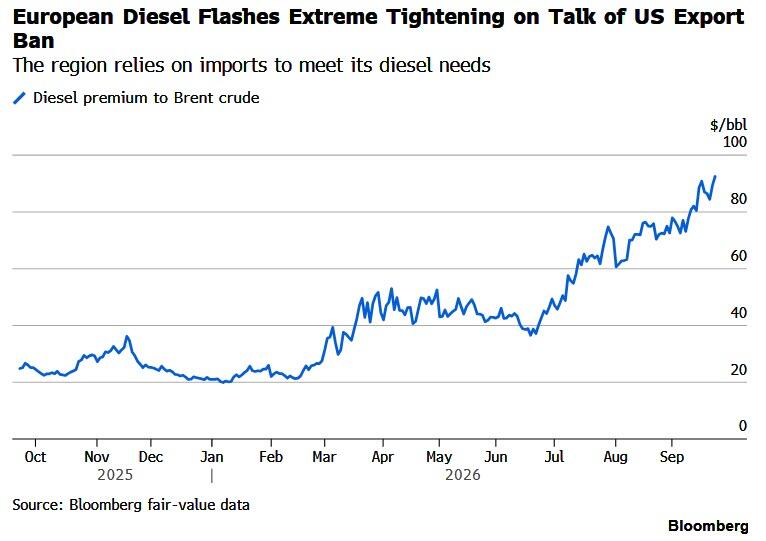
Known as crack spread, the indicator has been keenly watched by central bankers as they seek to tame inflation. The equivalent measure in the US, meanwhile, weakened.
Trump’s threat comes as Europe is already grappling with the loss of diesel shipments from the Middle East, and Russian export curbs have tightened the global fuel market further. The US has become Europe’s main overseas supplier, with American exports of the workhorse fuel surging to a weekly record near 2 million barrels a day last month.
A key US oil industry group cautioned against the move, saying it could lower American fuel production and damage the global economy.
Of the 8 million barrels of diesel traded globally by sea each day, the U.S. supplies about 1.5 million of them – about 20%. An export ban would remove the single largest source of global diesel from the market, and the consequences could be catastrophic.
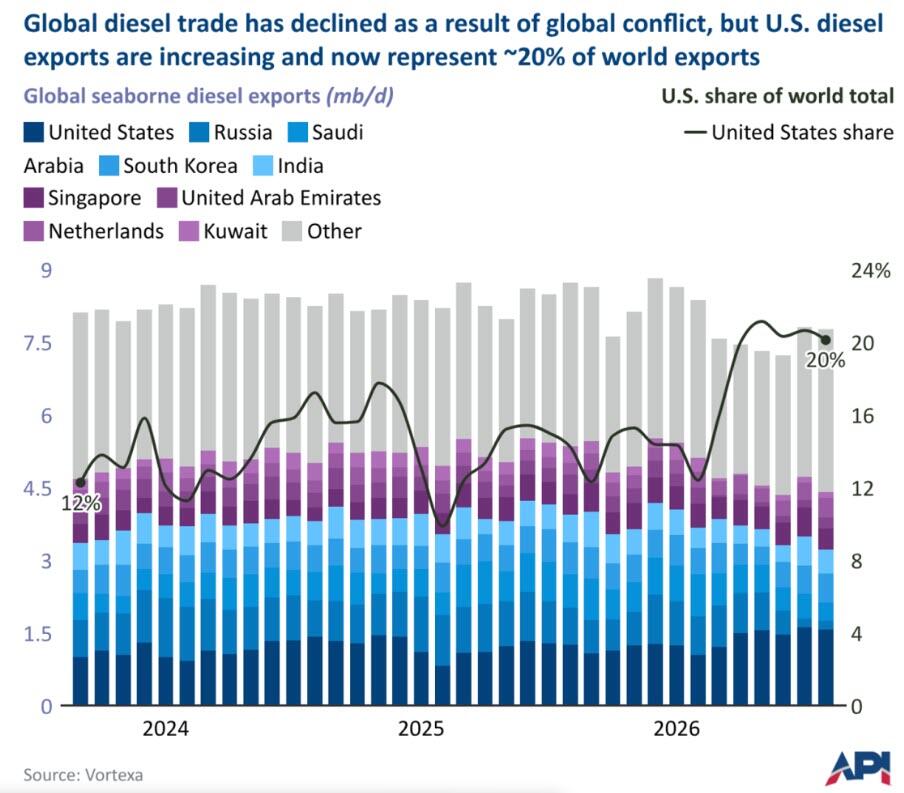
“Restricting exports is not a solution to high prices,” the American Petroleum Institute says.
“Removing US diesel from the market could instead result in reduced refinery runs, global economic damage and even higher US prices.”
Indeed, as Bloomberg macro strategist, Michael Ball, write this morning,while The White House may be able to engineer a brief drop in US diesel prices by limiting exports, it risks creating a bigger supply problem down the road.
With distillate stocks at seasonally record lows…
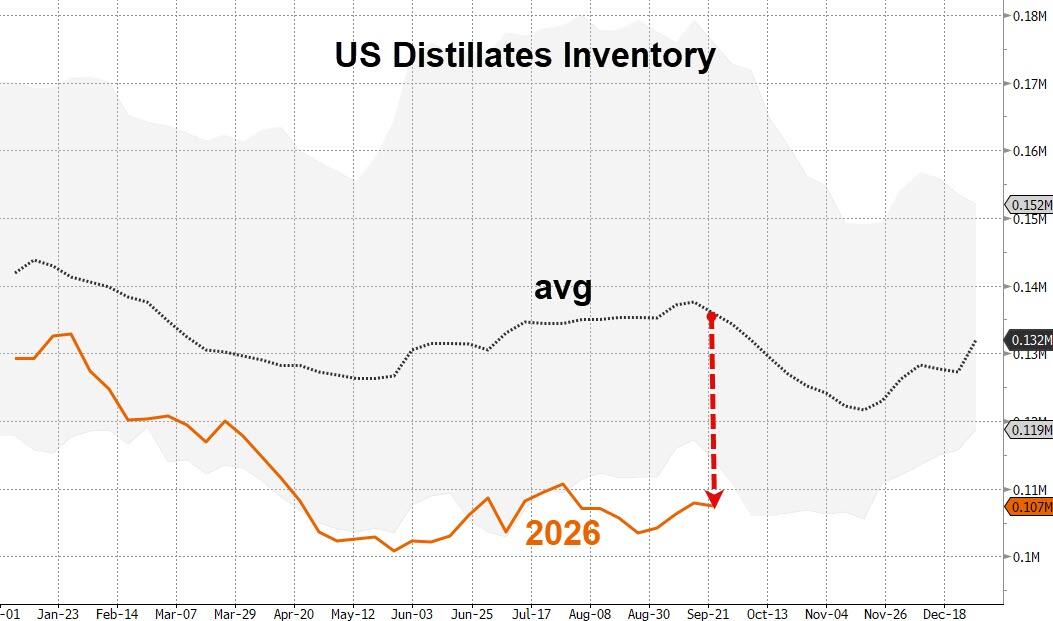
…the appeal is obvious with US diesel above $6.50 a gallon…
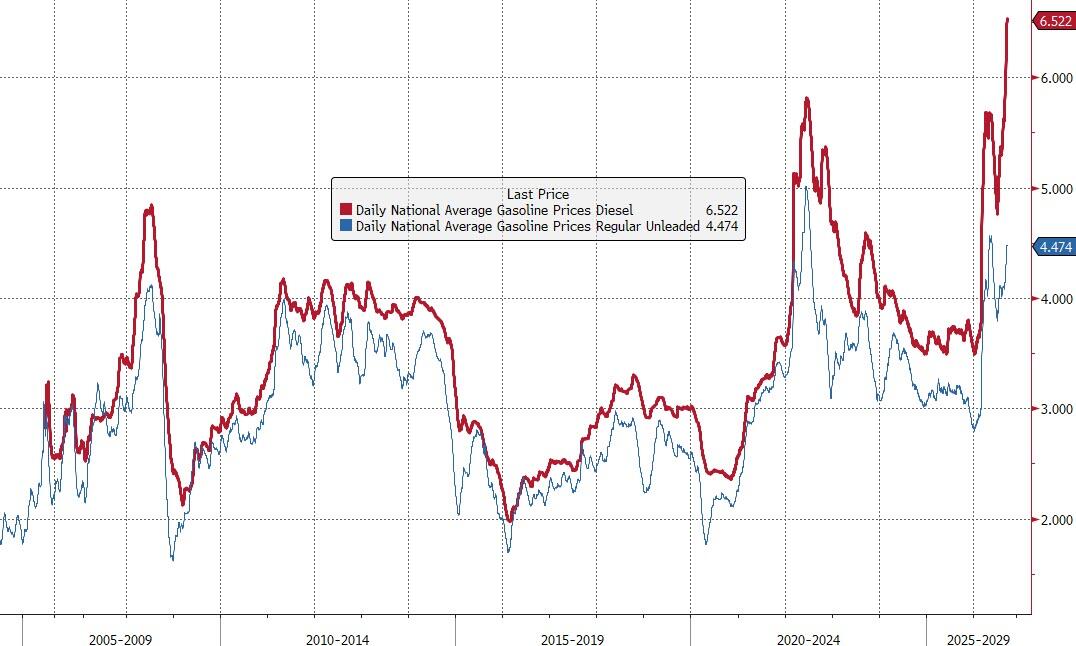
But a broad curb could strand as much as 1.5 million barrels a day, roughly 29% of US diesel output.
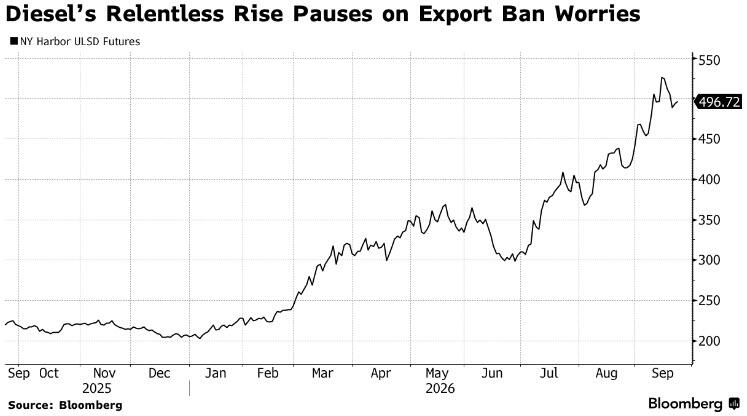
If enacted, Ball writes, the effects would be uneven across the US.
A surplus would build on the Gulf Coast, while pipeline, shipping and fuel-specification constraints limit how easily those barrels can reach tighter East and West Coast markets.
Bloomberg Intelligence estimates Gulf Coast storage could only absorb about three weeks of net diesel exports before constraints bite.
The global impact would be worse.
Kpler argues there is no real replacement for US export volumes, leaving Latin America and Northwest Europe particularly exposed and increasing competition for Indian barrels.
China could compound the squeeze as domestic inventories fall and the risk of renewed export curbs rises.
The response from refiners would create a negative feedback loop.
If trapped barrels crush margins, refiners are incentivized to cut runs and undertake maintenance.
S&P Global Energy estimates crude runs might need to fall by nearly 2 million barrels a day – more than 10% of the current production level – to clear the surplus.
That is the asymmetry: lower US diesel prices first, tighter global product markets follow, and potentially less US fuel supply later.
The more aggressive the restriction, the greater the risk that today’s price relief becomes tomorrow’s supply problem.
END
YOUR EARLY CURRENCY VALUES/GOLD AND SILVER PRICING/ASIAN AND EUROPEAN BOURSE MOVEMENTS/AND INTEREST RATE SETTINGS WEDNESDAY MORNING.7:30 AM
SHANGHAI CLOSED DOWN 15.61 PTS OR 0.39%
HANG SENG CLOSED DOWN 253.63 PTS OR 1.01%
Nikkei CLOSED
//Australia’s all ordinaries CLOSED DOWN 0.37%
//Chinese yuan (ONSHORE) CLOSED DOWN TO 6.7054
/ OFFSHORE CLOSED DOWN AT 6.7060 Oil DOWN TO 90.19 dollars per barrel for WTI and BRENT DOWN TO 99.49 Stocks in Europe OPENED ALL MIXED
ONSHORE USA/ YUAN// WITH YUAN TRADING DOWN (6.7054 OFFSHORE YUAN TRADING DOWN TO 6.7060 ONSHORE YUAN TRADING ABOVE LEVEL // OFF SHORE AND UP ON THE DOLLAR)// / AND THUS WEAKER/OFF SHORE YUAN TRADING UP AGAINST US DOLLAR/ AND THUS WEAKER
XXXXXXXXXXXXXXXXXXXXXXXXXXXXXXXXXXXXX
ONSHORE YUAN: CLOSED DOWN AT 6.7054
OFFSHORE YUAN: DOWN TO 6.7060
1A.HANG SANG CLOSED DOWN 253.63 PTS OR 1.01%
1 B. SHANGHAI CLOSED DOWN 15.61 PTS OR 0.39%
2. Nikkei closed HOLIDAY
WEST TEXAS INTERMEDIATE OIL DOWN TO 90.19
BRENT; 99.49
3. Europe stocks SO FAR: ALL MIXED
USA dollar INDEX UP 18 BASIS PTS TO 100.50// EURO FALLS TO 1.1421 DOWN 27 BASIS PTS
3b Japan 10 YR bond yield:FALLS TO. +2.984 UP 0 FULL BASIS PTS/ VERY TROUBLESOME//Japan buying 100% of bond issuance)/Japanese YEN vs USA CROSS NOW AT 157.82… JAPANESE YEN NOW FALLING AS WE HAVE NOW REACHED THE ENDING OF THE YEN CARRY TRADE AGAIN AND THE REPATRIATION OF YEN DENOMINATED BONDS TRADING IN THE USA/EUROPE. JAPAN 30 YR BOND YIELD: 4.078 UP 0 FULL BASIS PTS
3c Nikkei now ABOVE 17,000
3d USA/Yen rate now well ABOVE the important 120 barrier this morning
3e Gold DOWN /JAPANESE Yen DOWN CHINESE ONSHORE YUAN: DOWN (6.7054) AND OFFSHORE: DOWN AT 6.7060
3f Japan is to buy INFINITE TRILLION YEN worth of BONDS. Japan’s GDP equals 5 trillion USA. CENTRAL BANK OF JAPAN WILL NO LONGER DO QE.
Japan to buy 100% of all new Japanese debt and NOW they will have OVER 50% of all Japanese debt. GOVERMENT ASKED JAPAN PENSION FUNDS AND INSURANCE FUNDS TO BUY MORE JAPANESE BONDS AND REPATRIATE ALL FOREIGN BONDS.
3g Oil DOWN for WTI and DOWN for Brent this morning
3h European bond buying continues to push yields LOWER on all fronts in the EU German 10yr bund YIELD UP TO +3.4595/ Italian 10 Yr bond yield DOWN AT 4.3520/ SPAIN 10 YR BOND YIELD DOWN TO 3.920%
3i Greek 10 year bond yield DOWN TO 4.2312%
3j Gold at $4319.25/Silver at: 65.41 1 am est) SILVER NEXT RESISTANCE LEVEL AT $100.00
3k USA vs Russian rouble;// Russian rouble DOWN 0 AND 8/ 100 roubles/84.33
3m oil (WTI) into the 90 dollar handle for WTI and 99 handle for Brent/
3n Higher foreign deposits moving out of China// huge risk of outflows and a currency depreciation. This can spell financial disaster for the rest of the world/
JAPAN ON JAN 29.2016 CONTINUES NIRP. THIS MORNING RAISES AMOUNT OF BONDS THAT THEY WILL PURCHASE UP TO .5% ON THE 10 YR BOND///YEN TRADES TO 157.82 // 10 YEAR YIELD AFTER FIRST BREAKING .54% LAST YEAR NOW EXCEEDS THAT LEVEL TO 2.984% UP 1 BASIS PTS STILL ON CENTRAL BANK (JAPAN) INTERVENTION//YEN CARRY TRADE NOW UNWINDING//YEN BOND TRADING OVERSEAS TO BE REPATRIATED.//JAPAN 30 YR: 4.078 UP 0 PTS..: USA/SF this 0.8218 as the Swiss Franc . Euro vs SF: 0.9386
USA 10 YR BOND YIELD: 4.960 UP 1 BASIS PTS…NOW BELOW 5.00%
USA 30 YR BOND YIELD: 5.297 DOWN 1 BASIS PTS/REFUSES TO GO DOWN WITH BESSENT’S QE TWIST
USA 2 YR BOND YIELD: 4.769 DOWN 1 BASIS PTS
USA DOLLAR VS TURKISH LIRA: 48.84 UP 2 BASIS PTS/LIRA GETTING KILLED//IDIOTS FOR SELLING GOLD AND USA DOLLAR RESERVES.
10 YR UK BOND YIELD: 5.2305 DOWN 1 PTS
30 YR UK BOND YIELD: 5.7312 DOWN 2 BASIS PTS
10 YR CANADA BOND YIELD: 3.830 DOWN 2 BASIS PTS
5 YR CANADA BOND YIELD: 3.550 DOWN 2 BASIS PTS.
1a New York Opening report
Futures Drop, Yields And Oil Jump Ahead Of Iran’s UN Address As Trump-Xi Summit Looms
Wednesday, Sep 23, 2026 – 08:50 AM
US equity futures are down modestly, but at session lows, as oil reverses earlier losses (crude was on pace for a sixth straight day of declines, its longest losing run in a year) sending Brent back over $100 and pushing 10Y yields back to 4.99%. As of 8:30am, S&P 500 futures were 0.1% lower with Nasdaq 100 futures sliding 0.3%, and also at session lows after hitting a record on Tuesday. In premarket trading, memory and semis are lower as Mag7/software are higher. Within SPX sectors, all of the majors have pockets of strength ex-Materials which are set to lag given the sell off in metals. Rising oil prices have also weighed on European equities, which have pared opening gains and left the Stoxx 600 down 0.5%, also at session lows. In Asia, Chinese and Hong Kong shares declined, trailing regional peers including South Korean and Taiwanese benchmarks. Oil remains the wildcard for stocks and bonds, while Meta’s Muse AI agent is reshaping sector rotation. Yields are notably higher, with 2Y yields rising to a 2 year high of 4.79% as the curve flattens aggressively, as the tactical market narrative seeks more color from UN meetings (US/China; US/Iran; NATO+UKR/Russia) before deciding direction. The USD rally continues with the DXY 75bp away from YTD highs set June 24. Commodities are lower ex-Energy which is seeing a bid within fuels / natgas and Brent is outperforming WTI. Base over Precious and Ags uniformly sold. The US economic calendar includes September S&P Global US manufacturing and services PMIs at 9:45 a.m. Fed speaker slate includes Governor Barr (10:05 a.m.) and Chicago’s Goolsbee (12 p.m.)
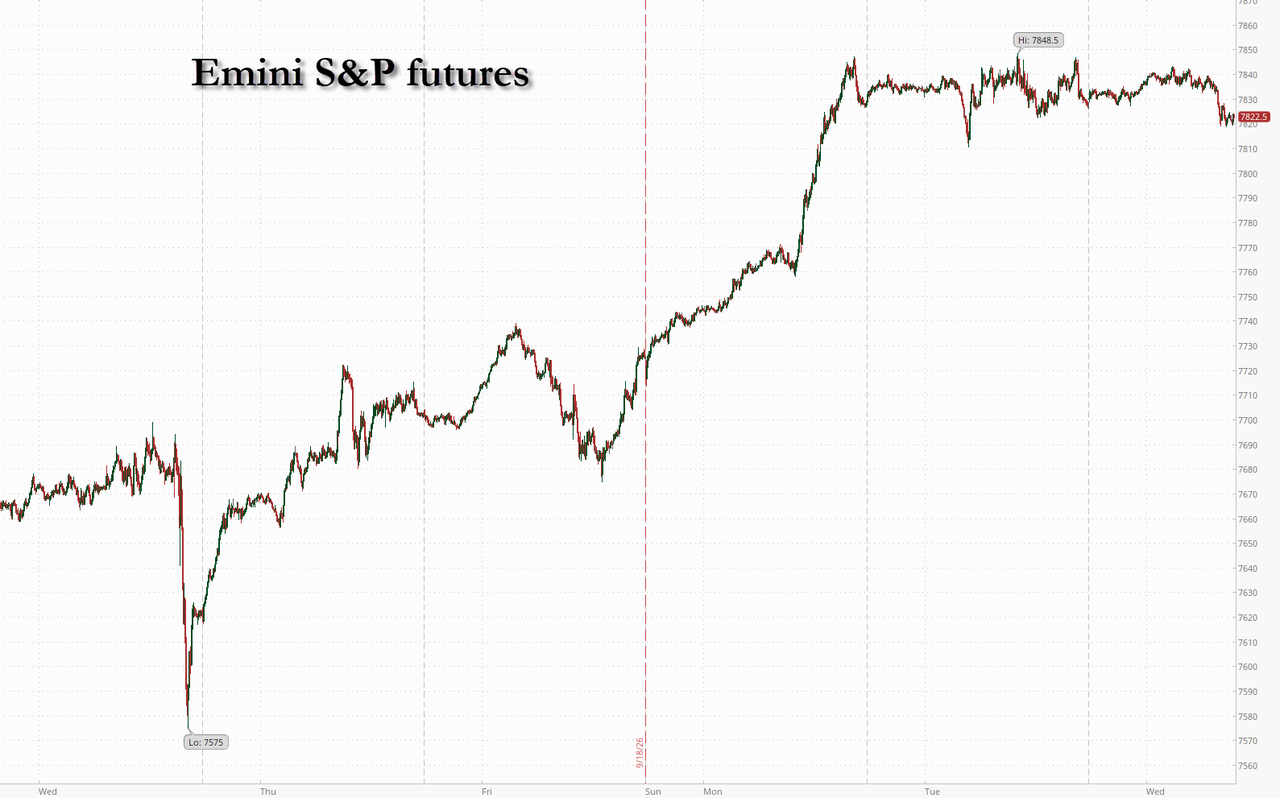
In premarket trading, Mag 7 names are mostly higher: Microsoft received a bullish upgrade from Stifel, which writes that the software giant is “getting back on track.” Shares of Microsoft (MSFT) are up 0.9%. Meta +0.3%, Amazon +0.2%, Alphabet +0.1%, Tesla -0.2%, Apple +0.2%, Nvidia -0.4%
- Cracker Barrel (CBRL) climbs 8% after the restaurant operator reported adjusted earnings per share for the fourth quarter that beat the average analyst estimate.
- IonQ (IONQ) rises 11% after the quantum computing company said it developed the tech industry’s first end-to-end real-time quantum error correction decoder that runs on a single standard off-the-shelf central processing unit.
- Voyager Technologies (VOYG) falls 7% after the space and defense company announced its intention to offer $350 million of convertible senior notes in a private offering.
- Worthington Enterprises (WOR) jumps 16% after the maker of aluminum propane cylinders posted fiscal first quarter earnings and revenue that topped expectations, helped by acquisitions and a tariff refund.
In other corporate news, Six Flags Entertainment shares gain in premarket trading as the Wall Street Journal reports that activist hedge fund Jana Partners is urging the theme-park operator to explore a sale. China’s State-owned Assets Supervision and Administration Commission has been surveying the number of Broadcom switches in state-controlled data centres in recent weeks, the FT reports. The Boeing engineers union recommended the company’s latest contract offer.
While stocks are drifting lower, there is little urgency to the move. A packed agenda could quickly shake futures out of their early lull. As Bloomberg notes, “Investors look ready to re-risk, after the vol-of-vol gauge touched its lowest since December 2024”, however potential geopolitical hurdles, not to mention very sticky high diesel and oil prices, remain. Iranian President Masoud Pezeshkian addresses the UN General Assembly Wednesday.
Geopolitics remain center stage as traders look to a resolution in the Middle East as a catalyst that could pave the way for lower inflation and a brighter growth outlook. President Donald Trump flagged progress in US talks with Iran even after threatening to annihilate the Islamic Republic. Trump said US officials had “very good” talks with Iranian envoys, with another round being planned for the near future. Iran has yet to comment on the meeting. Meanwhile, Saudi Arabia moved to restart a key pipeline.
The Tech-heavy Nasdaq 100 hit a fresh record high Tuesday, while financials closed at their lowest since July on fears that tools such as Meta’s Muse personal AI agent could disrupt businesses that benefit from consumer inertia. That puts Zuckerberg’s keynote scheduled for tonight firmly on investors’ radar. Profit margins are frequently higher for the owner of the end-customer relationship, as Apple has shown with the iPhone. The key question is whether Muse can shift AI economics in that direction: will companies deploying AI generate returns quickly enough to sustain the spending that is currently driving margins further up the supply chain?
“Risk sentiment in equities, but also the outlook for interest rates and inflation is going to trade a lot around expectations and movements in the oil price,” said Emma Moriarty at CG Asset Management. “Brent has fallen, but the overall level is still very high and it probably needs to go some way further.”
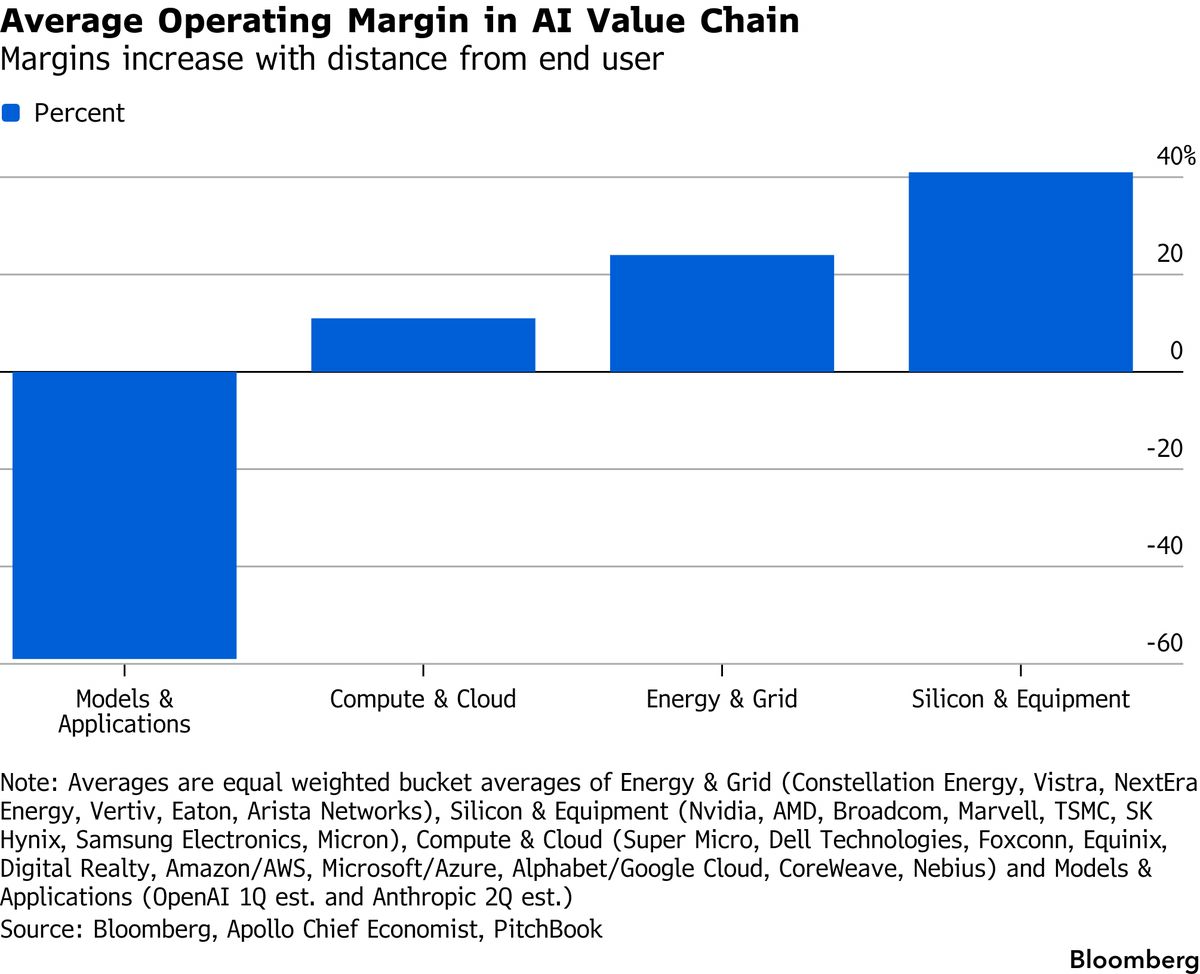
Elsewhere in tech, Softbank is offering record yields on what’s set to be one of the largest corporate junk bond sales ever. Meanwhile, Chinese AI model developer stocks fell after a report that the country’s regulators have opened a probe into startups DeepSeek and Moonshot AI over data security concerns. Today’s Tech Watch looks at how China’s AI trade favors global winners over local champions.
Traders are also looking to the summit between Trump and China’s Xi Jinping later this week for signs of progress on trade and other economic issues. Trump is welcoming Xi to Washington today for a visit focused more on pageantry than policy, with low expectations for breakthroughs on long-standing disputes. The highly anticipated summit will bring together a robust gathering of US corporate leaders, including Mark Zuckerberg, Jensen Huang, and Elon Musk, among others, but no comparable delegation of Chinese executives.
“Neither side looks ready to fundamentally reset the trade relationship, with the threats of restricting critical mineral exports countering the US administration’s desire to turn back to tariffs,” wrote Robert Gilhooly, senior emerging markets economist at Aberdeen Investments.
Preliminary bilateral talks in New York on Sunday were hailed as positive, but failed to reach an agreement on extending a tariff truce expiring in November. “Investors are zeroing in on what’s going to move markets and that’s the coming peace talks and the Xi/Trump summit,” said Josh Gilbert, lead APAC analyst at Etoro. “With Trump, we know that headlines can change on a dime, so there’s a level of taking some risk off the table.”
In politics, fractures within the GOP have widened into open rifts as Trump’s popularity sinks to new polling lows, just six weeks until US midterm elections. The DoJ urged a federal judge to reject a request by CNN, MS Now and Politico for a court order reinstating White House press credentials for their journalists.
In other assets, Apollo is limiting redemptions from a private credit fund for the third straight quarter, as its investors join the rush to pull cash from the $1.8 trillion direct lending market. High-grade data-center bonds offer some of the most compelling investment opportunities in credit, according to CVC Marathon CEO.
SoftBank kicked off what could be one of the largest corporate junk bond sales ever, with the group aiming to raise the equivalent of more than $11 billion. Meantime, Alibaba is accelerating its data center expansion in Europe and the Middle East.
In a week where the economic data calendar is relatively sparse, S&P Global is releasing its preliminary September manufacturing and services purchasing managers’ indexes on Wednesday. For the US, both readings are projected to remain consistent with steady growth.
Rising oil prices also weighed on European equities, which have pared opening gains and left the Stoxx 600 down 0.5% also at session lows, despite better-than-expected PMI data against a backdrop of geopolitical uncertainty. Banks and financial services outperform, insurance and real estate fall. Here are some of the biggest movers on Wednesday:
- Raiffeisen shares gain as much as 4.2% after a Vienna court issued a default judgment against Rasperia Trading, ordering damages of about €3.15b.
- Lakefront Biotherapeutics shares rise as much as 5.4% after analysts at RBC Capital Markets upgraded their view on the company’s ADRs, saying its potential in rare autoimmune diseases is “underappreciated by investors.”
- Renishaw shares rise as much as 4.5% after the electronic components maker reported profits slightly ahead its post-close update and said it will pay a special dividend.
- EFG International shares rise as much as 6.4% after the Swiss private bank settled a legal case and said it sees additional costs of 5 million Swiss francs.
- Arcadis falls as much as 11% in Amsterdam after WSP Global says it won’t pursue a public offer for the engineering consultancy and services firm.
- Grenergy Renovables slides as much as 8.8% as RBC lowers its price target on the stock, saying heavy asset rotation is pressuring the Spanish renewables company’s earnings.
- Ceres Power shares fall as much as 7.2% after the British fuel cell developer reported revenue for the first half-year that missed the average analyst estimate.
- Diageo hares fall as much as 1.6% after the drinkmaker announced a new chief financial officer.
- Sampo shares fall as much as 3.4% after an offering of 70m Class A shares by holder Solidium priced at a 2.8% discount to prior close.
- JD Sports shares drop as much as 2.2% after the sports retailer reported first-half results that Shore Capital said confirmed a challenging trading period.
Asian equities pared gains on caution ahead of President Donald Trump’s highly anticipated summit with China’s Xi Jinping, while Chinese tech selling tempered advances in regional chip stocks. The MSCI Asia Pacific ex-Japan Index rose as much as 0.8% before paring its increase to 0.2%. Tencent and Alibaba fell in Hong Kong as Chinese tech shares came under pressure following a report of a government probe into data security at large-language-model developers DeepSeek and Moonshot. The Asian guage is still on track to eke out gains for a sixth day, its longest winning streak in five weeks. Trump and Xi will meet in Washington this week, but expectations are low for breakthroughs on long-standing feuds between the world’s biggest economies. Preliminary bilateral talks in New York on Sunday were hailed as positive, but failed to reach an agreement on extending a tariff truce expiring in November. South Korea’s Kospi Index was up 0.5% after initially surging 1.9%. Stocks also rose in Taiwan and Indonesia. Japan remains shut for a holiday, with markets set to open on Thursday.
“The focus is turning to the huge geopolitical risk event that is Xi meeting Trump in Washington – could split either way with a fresh trade truce or could see some fresh signs of friction,” Neil Wilson, a strategist at Saxo, wrote in a note. “I don’t think there is going to be some grand bargain emerging from this summit but warm words and good vibes might be sufficient given the bullishness around AI and signs of progress with the US-Iran war.”
In FX, the Bloomberg Dollar Spot Index is extending gains, advanced 0.4% in fourth straight day of gains to levels not seen since late July. The currency has shown resilience in the face of lower energy prices as Federal Reserve officials continue to stress the need for policy vigilance after last week’s US interest-rate hike. Fed Governor Michael Barr and Chicago Fed President Austan Goolsbee are scheduled to speak later Wednesday.
US yields are up 2bps at the front-end and flat across the rest of the curve. Front-end EGB yields have been supported by a solid set of euro-area PMI data, leaving the economic “resilience” narrative intact and the ECB priced for further hikes. UK PMIs were comparably weaker but not enough to dent expectations of a BOE increase in November, which have been providing a floor under front-end yields amid this week’s decline in energy prices.
In commodities, brent crude is flat, having reversed overnight declines, leaving it on track to snap its recent streak of losses. The firmer greenback is placing a squeeze on precious metals, with spot gold down about 1% and silver lower by 2.5%. Bitcoin sheds 0.4%.
In rates, treasuries are narrowly mixed in early US trading, with European bonds lagging after German and French PMI gauges topped forecasts. US yields are within a basis point of Tuesday’s closing levels, the 10-year around 4.96%, outperforming bunds and gilts in the sector by 1.5bp and 0.5bp respectively. Treasury auction cycle continues with $70 billion of 5-year notes at 1 p.m. New York time and concludes Thursday with $44 billion 7-year; Tuesday’s $69 billion 2-year note tailed narrowly. WI 5-year yield near 4.845% is ~45bp cheaper than last month’s auction, which tailed by 0.2bp, the tenor’s ninth consecutive tail. IG dollar issuance slate includes a couple offerings so far; eight were priced Tuesday totaling $18.2 billion, with issuers paying 1bp in new issue concession on deals that were 5 times covered. US manufacturing and services PMIs are ahead Wednesday, along with a 5-year note auction.
In commodities, oil prices have swung between gains and losses as Saudi Arabia moved to restart its East-West pipeline link to the Red Sea by Saturday, while the US flagged progress in talks with Iran to end a war that has disrupted energy markets.
The US economic calendar includes September S&P Global US manufacturing and services PMIs at 9:45 a.m. Fed speaker slate includes Governor Barr (10:05 a.m.) and Chicago’s Goolsbee (12 p.m.)
Market Snapshot
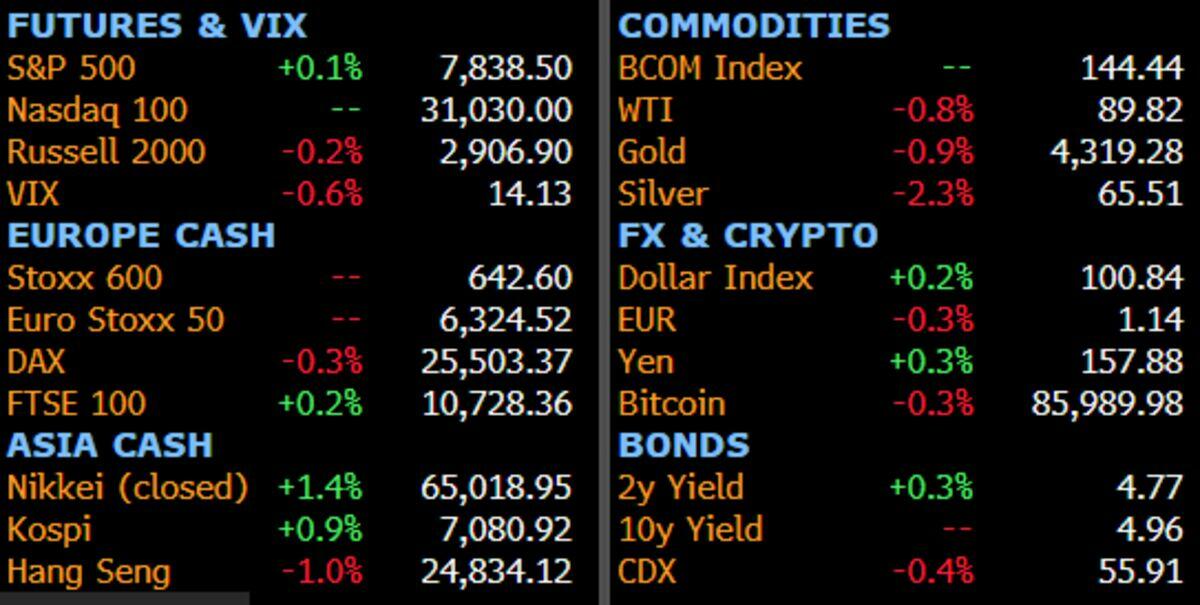
Top Overnight News
- Oil wavered as Brent headed for its longest losing streak in more than a year on hopes for progress in US-Iran talks and higher supplies. Iran said about half of war-hit South Pars’ gas capacity is back online, Fars reported. BBG
- Trump on Tuesday said he backed the idea of a diesel export ban as a way to lower prices that have hit record highs due to a global supply shortage. But analysts and market watchers warn that such a measure would do little to ease high energy prices, and could worsen supply and economic disruptions around the globe. RTRS
- Xi Jinping arrives for a state visit today, with Trump hosting a roster of US corporate leaders but no comparable Chinese business delegation is expected, clouding deal prospects, a senior US official said. The two may find common ground on AI safety, but neither is willing to give ground in the technology race. BBG
- Chinese authorities are examining the use of Broadcom’s hardware in state-backed data centers amid a drive to boost domestic producers and reduce reliance on foreign AI infrastructure. FT
- The US and South Korea are set to unveil an agreement for Seoul to fund a multibillion-dollar gas-fired power plant in Texas, the first project under its $350bn investment deal with the Trump administration, according to people familiar with the matter in Washington and Seoul. FT
- The cost of hiring an oil supertanker has passed $1.2mn a day for the first time on routes between the Middle East and Asia, adding to the spiralling pressure on global energy markets triggered by the war in Iran. FT
- Euro-zone private-sector activity grew at the fastest pace in more than three years as the service sector unexpectedly improved. The Composite PMI increased to 53.1 from 52 in August after both Germany and France exceeded forecasts. BBG
- The Treasury’s cash balance topped $1 trillion for the second time in a month as officials study investing excess funds in repo. BBG
- NY Fed’s Perli said Fed’s Reserve Management purchases are not on a pre-set course and that the central clearing of Fed repo operations would have benefits, while Perli added that the monetary policy toolkit has been working well and the Fed’s reserve forecasting process is robust.
- Punchbowl, citing US lawmakers/advisers, outlined that “the electoral climate for President Donald Trump and Republican leaders have worsened dramatically” over the last few weeks.
- US Democratic Senators are introducing a bill to allow first-time homebuyers to get up to USD 50k for a house down-payment: Axios.
- Novo is open to replacing its ADRs with a direct NYSE listing to raise its profile in the US. FT
A more detailed look at global markets courtesy of Newsquawk
APAC stocks were ultimately mixed following the similar handover from the US, despite the recent decline in oil prices and optimism regarding diplomacy after US President Trump announced that envoys had a ‘very productive’ meeting with the Iranian delegation on the sidelines of the UN General Assembly. However, he also threatened that they may have to blow up Pickaxe Mountain and will attack if they see activity, as well as commented that he has a big decision to make between allowing Iran to rebuild or to “annihilate” Iran. ASX 200 was rangebound with demand contained amid rate hike expectations and following weaker Flash PMI data from Australia, in which headline Manufacturing PMI slipped into contraction territory. KOSPI gained after the tech-related momentum in the US, where the NDX printed an all-time high. Hang Seng and Shanghai Comp were subdued following today’s PBoC liquidity drain and as reports that Chinese President Xi is unlikely to bring Chinese CEOs to his summit with US President Trump temper expectations for major business deals.
Top Asian News
- Hong Kong Finance Secretary Chan affirmed no intention to change HKD peg to USD, adding that Hong Kong will remain an open and free economy, while fixed income will be a very big part of Hong Kong.
- Japan’s PM Takaichi said she agreed with US President Trump regarding further strengthening economic security ties and notes the desire for Japan to host an AI summit, while she is pursuing an ever close alliance with the US.
European bourses (STOXX 600 -0.1%) initially started Wednesday’s trading session entirely in the green but have pared slightly, now pointing to a mixed picture. Traders note the widening of London gasoil/NY Heating Oil spread as a catalyst for the pullback in equities, after US President Trump said he would back a pause to American diesel exports. European gas prices are expected to rise and, as a result, weigh on margins as costs increase.
Sectors lack a clear bias, with breadth quite narrow. Banks top the sector pile, with Financial Services and Energy rounding out the sector gainers. To the downside is Insurance, with Real Estate and Telecoms following closely behind.
Top European News
- OECD 2026 GDP Forecasts: US 2.2% (prev. 2.0%), China 4.5% (prev. 4.5%), EU 1.0% (prev. 0.8%), UK 1.1% (prev. 0.9%), World 2.9% (prev. 2.8%).
- Global banking executives warned against a UK windfall tax and that they will divert investment away from the UK if taxes on the sector are raised, according to FT.
- The European Commission proposed lifting 2022 rule of law protective measures against Hungary, seeking to unlock EUR 4.2 bln in suspended cohesion funding and restore access to Erasmus+ and Horizon Europe.
- The German Finance Ministry is reportedly considering a review of takeover law, with reference to “lowball” or “dumping” offers, according to Handelsblatt.
- Germany’s IG Metall said they demand a 5% pay increase in the electrical sector, with regional talks to start on October 7th and warns of possible strikes from November 1st.
- The Swiss Upper House backed the 90% CET1 foreign unit backing by UBS (UBSG SW).
- Italy reportedly plans to stick with its commitment to keep deficit beneath the EU’s 3% GDP ceiling this year, according to sources.
FX
- G10s are lower against the USD to varying degrees. USD continues to digest expectations of a more hawkish Fed, with the likes of Barkin and Collins putting forward their openness to further hikes. This is reflected in the US 2s10s spread, which has been widening for several sessions now. However, the spread is tightening a touch this morning, with focus on Trump suggesting that he would back a diesel export ban. This would no doubt put pressure on domestic prices in the US, whilst simultaneously lifting prices globally, and hence explains some of the downbeat action seen across G10 peers this morning. DXY currently trades at the upper end of a 100.54 to 100.89 range, and is now heading back to levels not seen since late July.
- The Antipodeans underperform this morning, conforming to the negative risk tone. The EUR appears to be faring a touch better vs peers, but still remains in the red. PMI metrics this morning from France and Germany continue to indicate a resilient European economy, despite the Iran war. The French PMI report highlighted that “The pick-up in the PMI price measures seen in September should, however, be watched closely, particularly as we approach the winter months, as the risk of energy price inflation spreading to other areas of the economy undoubtedly rises”. The EZ-wide report was similarly strong, with the inner report suggesting that the mixture of higher growth and rising inflation could embolden the ECB to hike once again this year.
Fixed Income
- A firmer start for fixed income given the overnight energy moderation after the broadly constructive US-Iran update has given way to mixed performance but with a clear negative skew as WTI and Brent pick up alongside increasing focus on product prices/spreads after US President Trump’s comments regarding a diesel ban; see the Commodity-focused update for more detail.
- Initially, USTs got to a 106-08+ peak with gains of c. seven ticks. Since then, the benchmark has faded to near-enough unchanged over the European morning, hit by the mentioned energy upside as we digest Trump’s commentary and also unverified reports of explosions in the Strait of Hormuz.
- Within Europe, the action and drivers have been the same. Bunds got to an early 121.38 peak, firmer by near 20 ticks, before falling into the red by around half of that and losing the 121.00 handle. Adding to this is a generally strong set of EZ Flash PMIs, though German & French Manufacturing were weak. Further, the series also spoke to fresh inflationary pressures; points that have added to the bearish skew in recent trade.
- Gilts opened with modest gains and then climbed to an 86.04 peak, firmer by just over 30 ticks, before fading as above and moving marginally into the red. No move to the Flash PMIs, where the Manufacturing was strong while both Composite and Services were soft. From the series, the signs of slower growth are notable and one to watch ahead, as it may temper the hawkish impulses that were evident at the last BoE meeting, making the November meeting even more of one to watch.
- Germany sells EUR 1.65bln vs Exp. 2bln 3.40% 2047 and 2.90% 2056 Bund.
- Australia sells AUD 1.0bln 4.75% October 2037 bonds: b/c 4.16x, avg. yield 5.296%.
Commodities
- Focus for energy markets are three-fold. 1) US President Trump suggesting that he would back a ban on diesel exports. 2) A seemingly constructive bilateral meeting between Trump and Zelensky. 3) US envoys meeting with the Iranian delegation, which has been called “very productive”.
- On the first point. Trump has touted that he would back a ban on diesel exports, in a bid to ease domestic prices. Treasury Sec Bessent confirmed that officials were assessing the feasibility of either a partial or full ban of exports. This will impact downstream operations, and therefore, the reaction is made evident in the heating oil spread between Europe vs US; currently at USD 36.50/mt, yesterday’s close at USD -56/mt.
- As for geopolitics, the mood music has been positive on both the Russia-Ukraine, and US-Iran front. On the former, Ukrainian President Zelensky asked Trump to organise a Ukraine-US-Russia trilateral meeting; Trump suggested that Putin is willing to meet. Separately, CNN reported that Ukraine is ready to sign a defence deal with the US this week, but it may be postponed until the US is ready. On the US-Iran front, Trump noted that his top envoys had a constructive meeting with the Iranian delegation. He added that he thinks Iran will do something good. However, some sources familiar with the talks have dampened the recent optimism. Iran has not changed its position, whilst a US source believes that the chance of a deal is limited and major disputes and obstacles remain.
- Given the optimism surrounding geopolitics, crude benchmarks were initially lower this morning, but have since moved off worst levels to trade with incremental losses/flat. WTI is a touch lower and trades towards the upper end of a USD 88.71-90.52/bbl range, whilst Brent trades with incremental gains in a USD 94.08-96.11/bbl range.
- Spot gold is trading with losses of around a percent, and currently holds at the lower end of a USD 4,315.51-4,369.56/oz range. The yellow-metal is currently eyeing its 100-DMA (USD 4,313/oz), and further pressure could see gold hit its 50-DMA at USD 4,306.88/oz, ahead of the key USD 4,300/oz mark. Pressure today comes amidst a stronger USD and elevated front-end yields. Elsewhere, base metals are broadly in the red this morning, conforming to the downbeat risk tone. 3M LME Copper (-0.1%) currently holds towards the mid-point of a USD 14,666.28-14,862/t range.
- US Weekly Private Inventory Data (bbls): Crude +1.8mln (exp. -0.6mln), Gasoline -2.2mln (exp. +0.2mln), Distillate -2.2mln (exp. -0.5mln), Cushing +2.1mln.
- Iraqi Oil Minister said oil export volumes reached 70mln bbls in August and they are currently exporting more than 3mln bpd.
- Iranian Deputy Oil Minister for Planning said that around 50% of damaged capacity at South Pars has returned to service and production has resumed, according to Fars news.
- Ukraine Energy Minister met US Energy Secretary Wright to discuss energy security and the impact of the war, emphasising the importance of diplomatic efforts to achieve an energy truce.
- Spain is reportedly mulling capping gas prices to curb power bills, according to Cinco Dias.
Central Banks
- ECB’s Nagel said oil prices are not the only indicator, but have become more relevant over the past four years, while he is not so concerned by labour market developments and said monetary policy is being conducted between structural ambiguity and forward guidance. Furthermore, he does not see much uncertainty in markets about what drives the ECB’s policymaking decisions, as well as noted that rates are still in neutral territory and cannot exclude needing to go into mildly restrictive territory.
- ECB’s Makhlouf said second-round effects are not being seen yet.
- NBP’s Kotecki said we are approaching a serious discussion about an interest rate hike, possibly in November, adding that if interest rates are increased, it will be in small steps.
Geopolitics: Middle East
- US Envoy Witkoff said mediators will continue their work, and he hopes talks will be constructive and promising, while he confirmed he engaged in lengthy talks with the delegation from Iran.
- A US source attending the Iranian delegation meeting said the chance of a deal is limited and major disputes and obstacles remain between the US and Iranian delegations, according to Al Hadath.
- Diplomatic sources suggest that “Yesterday’s talks between the US and Iran did not achieve the minimum required to resume negotiations”, Hayom reported.
- Iranian Foreign Ministry spokesperson Baghaei said engagement with the US took place through a Qatari mediator to convey Iran’s conditions, Nour news reported.
- Iranian state media noted that Iran’s Foreign Minister Araghchi met with US envoy Witkoff at the UN General Assembly, with Tehran saying that the talk centered on its conditions for reopening the Strait of Hormuz.
- Iranian source said Qatar’s PM is acting as an intermediary between Iran and the US in New York and that the substance of Iran’s position is unchanged amid US dialogue, according to an Amwaj reporter.
- Diplomatic source in Tehran said a meeting between Iranian President Pezeshkian and US President Trump on the sidelines of the UN General Assembly is not on the agenda, journalist Kais reported citing Al-Akhbar.
- Iran’s Foreign Ministry stated that Foreign Minister Araghchi met with his Austrian counterpart and the two sides discussed and exchanged views on the most important international and regional developments, as well as bilateral issues of concern to both countries. Araghchi also met with his Iraqi counterpart and reviewed the progress of cooperation between the two countries in various fields, including economic, trade, consular, and security, and emphasised the continuation of efforts to develop relations in all areas of interest to the two countries.
- Explosions were heard near Iran’s Qeshm Island, which seemed to have originated from the sea, and there was no impact inside the territory of Qeshm Island, according to IRNA.
- French President Macron said France is ready to participate in an international operation of a defensive nature to protect navigation in the Strait of Hormuz, according to ABC News.
Geopolitics: Ukraine
- Russia’s Kremlin said ground for peace talks with Ukraine are still not in place and no concrete details of any plans of a high-level meeting on Ukraine.
- Ukrainian President Zelensky asked US President Trump for a winter arms package and expects an energy ceasefire push, according to WSJ.
- Ukraine is ready to sign a landmark drone defence deal with the United States on the sidelines of the UN General Assembly this week, although it may be at a later date when the US is ready to sign, according to CBS News citing sources.
- Ukrainian President Zelensky said that intelligence information indicates that Russia is preparing a massive attack on Ukraine.
- Russia said its forces hit Ukrainian defence and energy facilities and logistics centres, while Russian forces hit a cargo ship in the Black Sea
Geopolitics: Other
- US President Trump’s Board of Peace will unveil a six-month USD 2.45bln recovery plan for Gaza in its meeting with members on Wednesday, Axios reported citing sources.
- US Secretary of State Rubio said Greenland is critical to US national security and that the US cannot risk China or Russia establishing bases there.
- Taiwan is to maintain close contact with the US on arms sales.
US Event Calendar
- 7:00 am: Sep 18 MBA Mortgage Applications, prior -4.1%
- 9:45 am: Sep P S&P Global US Manufacturing PMI, est. 53.65, prior 53.9
- 9:45 am: Sep P S&P Global US Services PMI, est. 55.8, prior 56.5
- 9:45 am: Sep P S&P Global US Composite PMI, est. 55.25, prior 56
Central Banks
- 10:05 am: Fed’s Barr Speaks on Housing
- 12:00 pm: Fed’s Goolsbee Speaks in Podcast Interview
DB’s Jim Reid concludes the overnight wrap
Morning from Paris where getting around has proved even more difficult than normal due to various road closures ahead of a visit from the Pope on Friday. Markets were a bit like my travel map yesterday. All over the place. But they ultimately ended the session much where they’d begun, with the S&P 500 (+0.00%) flat on the day and 10yr Treasury yields (+1.1bps) edging higher. Brent crude retreated by -1.09% to close below $100/bbl for the first time in over two weeks after intra-day swings driven by a flurry of headlines around the UN General Assembly in New York. A more sanguine take just about dominated in the end amid news suggesting that the gap for achieving de-escalation between the US and Iran might be narrowing.
After reaching $102/bbl early on, Brent crude moved lower with the initial trigger being a Kyodo report that Iran would re-open the Strait of Hormuz within seven days if the US accepted demands including the lifting of its blockade on Iran. We also heard comments from the IRGC, with Iran’s state-run IRNA citing a spokesman who said that “If our national interests require us to negotiate alongside the war, we must negotiate”. And later on, Iran’s state media reported that in a meeting with Trump’s special envoy Witkoff, Iran’s Foreign Minister Araghchi said that Iran’s conditions to reopen the Strait of Hormuz include the lifting of the US naval blockade, release of frozen Iranian assets and the end of war across all ‘resistance’ fronts. So potentially suggesting that Iran might be willing to accept a narrower deal, having previously also demanded elements such as lifting of sanctions and reparations.
Of course, we’ve seen plenty of tentatively optimistic negotiation headlines come to little in recent weeks. Indeed, oil prices gave up some of their decline yesterday as Trump used his UN speech to justify the Iran war. Oil prices did then move lower again on the news of talks between US and Iran officials, which Trump called “very productive”. And aside from the negotiation headlines, we also heard that Saudi Arabia was in the early stages of restarting its East-West pipeline and was aiming for a meaningful if partial restart of flows by Saturday.
So after a round trip, Brent crude closed -1.09% at $99.02/bbl, some way above its low of $97.43/bbl in the European morning but is another -1.2% lower this morning. Meanwhile, European natural gas futures closed -1.96% lower at €71.90/MWh.
Despite the volatile newsflow, equities ended the day little changed, with the S&P 500 down a mere -0.001%. Tech stocks saw a better performance, with the NASDAQ (+0.45%) moving up to a fresh all-time high. That included further strong gains for chip stocks, with the Philly semiconductor index (+2.06%) posting a 6th consecutive gain. Trump himself also commented on AI in his speech at the UN, terming it “super intelligence” and rejecting attempts to control it. By contrast, financials (-1.98%) led the declines within the S&P 500, which appeared to be driven by concerns that AI could erode margins and fees.
In Europe, equities mostly saw modest gains, with the Stoxx 600 (+0.13%), CAC 40 (+0.20%), and DAX (+0.02%) rising. The exception was the UK’s FTSE 100, which fell -0.29%.
In the rates space, US Treasury yields initially followed oil prices lower, but then saw a rise by the close. So the 2yr yield (+0.8bps) inched up to a new two-year high of 4.76%, while the 10yr Treasury yield (+1.1bps) rose to 4.96%. Markets continued to price another 75bps of Fed hikes by next June, with Richmond Fed President Barkin noting the “risk that current elevated levels of inflation could affect future inflation”.
Looking forward to today, investors will be closely watching the US Treasury’s expected buyback announcement ahead of tomorrow’s 20-30yr operation. Last time there was a big market reaction as the operation size was beneath some estimates, leading to a sharp move higher in yields that day. So one to keep an eye on.
Bonds had a softer session in Europe, with yields moving higher across the continent. Yields on 10yr bunds (+0.7bps), OATs (+3.2bps) and BTPs (+1.8bps) all rose. Notably, the 10yr Franco-German spread was also back up to 104bps by the close, just shy of its 105bps peak last week which was the highest it’s been since the Euro crisis. In terms of ECB speakers, later in the evening we heard from Germany’s Nagel, who suggested the ECB may need to move from the current neutral stance “into the mild restrictive territory” if high energy prices persist.
There was also a variety of other geopolitical headlines from the UNGA, notably around Russia-Ukraine. Trump claimed that a Russia-Ukraine peace deal would be happening and Axios reported that US, European and Ukrainian officials were meeting last night to discuss proposals for de-escalation with Russia. It was also confirmed that US Secretary of State Rubio will be meeting with Russia’s foreign minister Lavrov today. While peace prospects appear dim, Ukraine’s President Zelenskiy told the WSJ that he thought Trump “will try to negotiate some energy ceasefire”.
Turning to Asia, markets are mixed this morning. As I check my screens, the KOSPI (+0.45%) is posting a moderate gain, with Japan’s markets still closed until tomorrow. Elsewhere, Chinese equities are under pressure, with the Hang Seng (-0.74%) underperforming both the CSI 300 (-0.50%) and the Shanghai Composite (-0.36%). Meanwhile, Australia’s S&P/ASX 200 (+0.08%) is little changed. US equity futures are also trading near flat, with those on the S&P 500 up +0.09%.
Early data showed Australia’s private sector activity lost momentum in September, with flash PMI figures from S&P Global showing the manufacturing PMI falling to 49.3 from 52.0, while the services PMI eased to 51.4 from 53.2. This pulled the composite PMI down to 50.8 from 52.7. The softer readings suggest a growing impact of elevated energy prices and higher borrowing costs on the economy, as markets widely expect the RBA to deliver another 25bps rate hike at its meeting next week.
To the day ahead, we’ll get September flash PMIs from around the world. Otherwise, central bank speakers include the Fed’s Barr, and the ECB’s Vujcic, Zigman, Kaasik, Cipollone and Lane.
END
1b European opening report
US-Iran mediation efforts to continue, though US sources suggest the chance of a deal is limited; USD gains – Newsquawk US Market Open

Wednesday, Sep 23, 2026 – 06:12 AM
- US Envoy Witkoff said mediators will continue their work, and he hopes talks will be constructive and promising.
- However, US sources told Al Hadath that the chance of a deal is limited and major disputes and obstacles remain.
- US equity futures give back earlier gains as focus turns to the Trump-Xi meeting.
- DXY bids higher despite lower energy prices; EUR little moved following broadly stronger PMI metrics.
- Fixed income benchmarks trade rangebound, as energy lacks a clear direction (Brent +0.3%).
- Looking ahead, highlights include US S&P PMIs Flash (Sep), SARB Policy Announcement. UN Meetings include Trump-Sharif meeting, Senior Iranian leaders-GCC meeting, Iranian President Pezeshkian address. Speakers include ECB’s Cipollone & Lane, Fed’s Barr. Supply from the US.
SNAPSHOT

Newsquawk in 3 steps:
1. Subscribe to the free premarket movers reports
2. Listen to this report in the market open podcast (available on Apple and Spotify)
3. Trial Newsquawk’s premium real-time audio news squawk box for 7 days
EUROPEAN TRADE
EQUITIES
- European bourses (STOXX 600 -0.1%) initially started Wednesday’s trading session entirely in the green but have pared slightly, now pointing to a mixed picture. Traders note the widening of London gasoil/NY Heating Oil spread as a catalyst for the pullback in equities, after US President Trump said he would back a pause to American diesel exports. European gas prices are expected to rise and, as a result, weigh on margins as costs increase.
- Sectors lack a clear bias, with breadth quite narrow. Banks top the sector pile, with Financial Services and Energy rounding out the sector gainers. To the downside is Insurance, with Real Estate and Telecoms following closely behind.
- US equity futures are mixed, with RTY (-0.2%) the modest underperformer. Focus heading towards the latter part of the week will be on the Trump-Xi meeting, scheduled for Thursday.
- Click for the sessions European pre-market equity newsflow
- Click for the additional news
FX
- G10s are lower against the USD to varying degrees. USD continues to digest expectations of a more hawkish Fed, with the likes of Barkin and Collins putting forward their openness to further hikes. This is reflected in the US 2s10s spread, which has been widening for several sessions now. However, the spread is tightening a touch this morning, with focus on Trump suggesting that he would back a diesel export ban. This would no doubt put pressure on domestic prices in the US, whilst simultaneously lifting prices globally, and hence explains some of the downbeat action seen across G10 peers this morning. DXY currently trades at the upper end of a 100.54 to 100.89 range, and is now heading back to levels not seen since late July.
- The Antipodeans underperform this morning, conforming to the negative risk tone. The EUR appears to be faring a touch better vs peers, but still remains in the red. PMI metrics this morning from France and Germany continue to indicate a resilient European economy, despite the Iran war. The French PMI report highlighted that “The pick-up in the PMI price measures seen in September should, however, be watched closely, particularly as we approach the winter months, as the risk of energy price inflation spreading to other areas of the economy undoubtedly rises”. The EZ-wide report was similarly strong, with the inner report suggesting that the mixture of higher growth and rising inflation could embolden the ECB to hike once again this year.
FIXED INCOME
- A firmer start for fixed income given the overnight energy moderation after the broadly constructive US-Iran update has given way to mixed performance but with a clear negative skew as WTI and Brent pick up alongside increasing focus on product prices/spreads after US President Trump’s comments regarding a diesel ban; see the Commodity-focused update for more detail.
- Initially, USTs got to a 106-08+ peak with gains of c. seven ticks. Since then, the benchmark has faded to near-enough unchanged over the European morning, hit by the mentioned energy upside as we digest Trump’s commentary and also unverified reports of explosions in the Strait of Hormuz.
- Within Europe, the action and drivers have been the same. Bunds got to an early 121.38 peak, firmer by near 20 ticks, before falling into the red by around half of that and losing the 121.00 handle. Adding to this is a generally strong set of EZ Flash PMIs, though German & French Manufacturing were weak. Further, the series also spoke to fresh inflationary pressures; points that have added to the bearish skew in recent trade.
- Gilts opened with modest gains and then climbed to an 86.04 peak, firmer by just over 30 ticks, before fading as above and moving marginally into the red. No move to the Flash PMIs, where the Manufacturing was strong while both Composite and Services were soft. From the series, the signs of slower growth are notable and one to watch ahead, as it may temper the hawkish impulses that were evident at the last BoE meeting, making the November meeting even more of one to watch.
- Germany sells EUR 1.65bln vs Exp. 2bln 3.40% 2047 and 2.90% 2056 Bund.
- Australia sells AUD 1.0bln 4.75% October 2037 bonds: b/c 4.16x, avg. yield 5.296%.
COMMODITIES
- Focus for energy markets are three-fold. 1) US President Trump suggesting that he would back a ban on diesel exports. 2) A seemingly constructive bilateral meeting between Trump and Zelensky. 3) US envoys meeting with the Iranian delegation, which has been called “very productive”.
- On the first point. Trump has touted that he would back a ban on diesel exports, in a bid to ease domestic prices. Treasury Sec Bessent confirmed that officials were assessing the feasibility of either a partial or full ban of exports. This will impact downstream operations, and therefore, the reaction is made evident in the heating oil spread between Europe vs US; currently at USD 36.50/mt, yesterday’s close at USD -56/mt.
- As for geopolitics, the mood music has been positive on both the Russia-Ukraine, and US-Iran front. On the former, Ukrainian President Zelensky asked Trump to organise a Ukraine-US-Russia trilateral meeting; Trump suggested that Putin is willing to meet. Separately, CNN reported that Ukraine is ready to sign a defence deal with the US this week, but it may be postponed until the US is ready. On the US-Iran front, Trump noted that his top envoys had a constructive meeting with the Iranian delegation. He added that he thinks Iran will do something good. However, some sources familiar with the talks have dampened the recent optimism. Iran has not changed its position, whilst a US source believes that the chance of a deal is limited and major disputes and obstacles remain.
- Given the optimism surrounding geopolitics, crude benchmarks were initially lower this morning, but have since moved off worst levels to trade with incremental losses/flat. WTI is a touch lower and trades towards the upper end of a USD 88.71-90.52/bbl range, whilst Brent trades with incremental gains in a USD 94.08-96.11/bbl range.
- Spot gold is trading with losses of around a percent, and currently holds at the lower end of a USD 4,315.51-4,369.56/oz range. The yellow-metal is currently eyeing its 100-DMA (USD 4,313/oz), and further pressure could see gold hit its 50-DMA at USD 4,306.88/oz, ahead of the key USD 4,300/oz mark. Pressure today comes amidst a stronger USD and elevated front-end yields. Elsewhere, base metals are broadly in the red this morning, conforming to the downbeat risk tone. 3M LME Copper (-0.1%) currently holds towards the mid-point of a USD 14,666.28-14,862/t range.
- US Weekly Private Inventory Data (bbls): Crude +1.8mln (exp. -0.6mln), Gasoline -2.2mln (exp. +0.2mln), Distillate -2.2mln (exp. -0.5mln), Cushing +2.1mln.
- Iraqi Oil Minister said oil export volumes reached 70mln bbls in August and they are currently exporting more than 3mln bpd.
- Iranian Deputy Oil Minister for Planning said that around 50% of damaged capacity at South Pars has returned to service and production has resumed, according to Fars news.
- Ukraine Energy Minister met US Energy Secretary Wright to discuss energy security and the impact of the war, emphasising the importance of diplomatic efforts to achieve an energy truce.
- Spain is reportedly mulling capping gas prices to curb power bills, according to Cinco Dias.
NOTABLE EUROPEAN HEADLINES
- OECD 2026 GDP Forecasts: US 2.2% (prev. 2.0%), China 4.5% (prev. 4.5%), EU 1.0% (prev. 0.8%), UK 1.1% (prev. 0.9%), World 2.9% (prev. 2.8%).
- Global banking executives warned against a UK windfall tax and that they will divert investment away from the UK if taxes on the sector are raised, according to FT.
- The European Commission proposed lifting 2022 rule of law protective measures against Hungary, seeking to unlock EUR 4.2 bln in suspended cohesion funding and restore access to Erasmus+ and Horizon Europe.
- The German Finance Ministry is reportedly considering a review of takeover law, with reference to “lowball” or “dumping” offers, according to Handelsblatt.
- Germany’s IG Metall said they demand a 5% pay increase in the electrical sector, with regional talks to start on October 7th and warns of possible strikes from November 1st.
- The Swiss Upper House backed the 90% CET1 foreign unit backing by UBS (UBSG SW).
- Italy reportedly plans to stick with its commitment to keep deficit beneath the EU’s 3% GDP ceiling this year, according to sources.
NOTABLE EUROPEAN DATA RECAP
- UK S&P Global Composite PMI Flash (Sep) 51.7 vs. Exp. 52 (Prev. 52.5).
- UK S&P Global Manufacturing PMI Flash (Sep) 52 vs. Exp. 51.5 (Prev. 51.7).
- UK S&P Global Services PMI Flash (Sep) 52 vs. Exp. 52 (Prev. 52.5).
- European S&P Global Composite PMI Flash (Sep) 53.1 vs. Exp. 51.7 (Prev. 52.0).
- European S&P Global Manufacturing PMI Flash (Sep) 52.7 vs. Exp. 52.6 (Prev. 52.7).
- European S&P Global Services PMI Flash (Sep) 53 vs. Exp. 51.5 (Prev. 51.6).
- German S&P Global Composite PMI Flash (Sep) 53.8 vs. Exp. 51.8 (Prev. 51.8).
- German S&P Global Manufacturing PMI Flash (Sep) 53.8 vs. Exp. 54 (Prev. 54.3).
- German S&P Global Services PMI Flash (Sep) 52.9 vs. Exp. 50 (Prev. 49.7).
- French S&P Global Composite PMI Flash (Sep) 51.2 vs Exp. 48.7 (Prev. 48.5).
- French S&P Global Manufacturing PMI Flash (Sep) 50.3 vs. Exp. 50.8 (Prev. 51.1).
- French S&P Global Services PMI Flash (Sep) 51.4 vs. Exp. 48.4 (Prev. 48.0).
CENTRAL BANKS
- ECB’s Nagel said oil prices are not the only indicator, but have become more relevant over the past four years, while he is not so concerned by labour market developments and said monetary policy is being conducted between structural ambiguity and forward guidance. Furthermore, he does not see much uncertainty in markets about what drives the ECB’s policymaking decisions, as well as noted that rates are still in neutral territory and cannot exclude needing to go into mildly restrictive territory.
- ECB’s Makhlouf said second-round effects are not being seen yet.
- NBP’s Kotecki said we are approaching a serious discussion about an interest rate hike, possibly in November, adding that if interest rates are increased, it will be in small steps.
NOTABLE US HEADLINES
- NY Fed’s Perli said Fed’s Reserve Management purchases are not on a pre-set course and that the central clearing of Fed repo operations would have benefits, while Perli added that the monetary policy toolkit has been working well and the Fed’s reserve forecasting process is robust.
- Punchbowl, citing US lawmakers/advisers, outlined that “the electoral climate for President Donald Trump and Republican leaders have worsened dramatically” over the last few weeks.
- US Democratic Senators are introducing a bill to allow first-time homebuyers to get up to USD 50k for a house down-payment, according to Axios.
GEOPOLITICS
MIDDLE EAST
- US Envoy Witkoff said mediators will continue their work, and he hopes talks will be constructive and promising, while he confirmed he engaged in lengthy talks with the delegation from Iran.
- A US source attending the Iranian delegation meeting said the chance of a deal is limited and major disputes and obstacles remain between the US and Iranian delegations, according to Al Hadath.
- Diplomatic sources suggest that “Yesterday’s talks between the US and Iran did not achieve the minimum required to resume negotiations”, Hayom reported.
- Iranian Foreign Ministry spokesperson Baghaei said engagement with the US took place through a Qatari mediator to convey Iran’s conditions, Nour news reported.
- Iranian state media noted that Iran’s Foreign Minister Araghchi met with US envoy Witkoff at the UN General Assembly, with Tehran saying that the talk centered on its conditions for reopening the Strait of Hormuz.
- Iranian source said Qatar’s PM is acting as an intermediary between Iran and the US in New York and that the substance of Iran’s position is unchanged amid US dialogue, according to an Amwaj reporter.
- Diplomatic source in Tehran said a meeting between Iranian President Pezeshkian and US President Trump on the sidelines of the UN General Assembly is not on the agenda, journalist Kais reported citing Al-Akhbar.
- Iran’s Foreign Ministry stated that Foreign Minister Araghchi met with his Austrian counterpart and the two sides discussed and exchanged views on the most important international and regional developments, as well as bilateral issues of concern to both countries. Araghchi also met with his Iraqi counterpart and reviewed the progress of cooperation between the two countries in various fields, including economic, trade, consular, and security, and emphasised the continuation of efforts to develop relations in all areas of interest to the two countries.
- Explosions were heard near Iran’s Qeshm Island, which seemed to have originated from the sea, and there was no impact inside the territory of Qeshm Island, according to IRNA.
- French President Macron said France is ready to participate in an international operation of a defensive nature to protect navigation in the Strait of Hormuz, according to ABC News.
RUSSIA-UKRAINE
- Russia’s Kremlin said ground for peace talks with Ukraine are still not in place and no concrete details of any plans of a high-level meeting on Ukraine.
- Ukrainian President Zelensky asked US President Trump for a winter arms package and expects an energy ceasefire push, according to WSJ.
- Ukraine is ready to sign a landmark drone defence deal with the United States on the sidelines of the UN General Assembly this week, although it may be at a later date when the US is ready to sign, according to CBS News citing sources.
- Ukrainian President Zelensky said that intelligence information indicates that Russia is preparing a massive attack on Ukraine.
- Russia said its forces hit Ukrainian defence and energy facilities and logistics centres, while Russian forces hit a cargo ship in the Black Sea
OTHER
- US President Trump’s Board of Peace will unveil a six-month USD 2.45bln recovery plan for Gaza in its meeting with members on Wednesday, Axios reported citing sources.
- US Secretary of State Rubio said Greenland is critical to US national security and that the US cannot risk China or Russia establishing bases there.
- Taiwan is to maintain close contact with the US on arms sales.
CRYPTO
- Bitcoin extended above USD 87k early in the European session before falling below USD 86k as the session continues amid a firmer dollar.
APAC TRADE
- APAC stocks were ultimately mixed following the similar handover from the US, despite the recent decline in oil prices and optimism regarding diplomacy after US President Trump announced that envoys had a ‘very productive’ meeting with the Iranian delegation on the sidelines of the UN General Assembly. However, he also threatened that they may have to blow up Pickaxe Mountain and will attack if they see activity, as well as commented that he has a big decision to make between allowing Iran to rebuild or to “annihilate” Iran.
- ASX 200 was rangebound with demand contained amid rate hike expectations and following weaker Flash PMI data from Australia, in which headline Manufacturing PMI slipped into contraction territory.
- KOSPI gained after the tech-related momentum in the US, where the NDX printed an all-time high.
- Hang Seng and Shanghai Comp were subdued following today’s PBoC liquidity drain and as reports that Chinese President Xi is unlikely to bring Chinese CEOs to his summit with US President Trump temper expectations for major business deals.
NOTABLE ASIA-PAC HEADLINES
- Hong Kong Finance Secretary Chan affirmed no intention to change HKD peg to USD, adding that Hong Kong will remain an open and free economy, while fixed income will be a very big part of Hong Kong.
- Japan’s PM Takaichi said she agreed with US President Trump regarding further strengthening economic security ties and notes the desire for Japan to host an AI summit, while she is pursuing an ever close alliance with the US.
NOTABLE APAC DATA RECAP
- Australian S&P Global Composite PMI Flash (Sep) 50.8 (Prev. 52.7).
- Australian S&P Global Manufacturing PMI Flash (Sep) 49.3 (Prev. 52.0).
- Australian S&P Global Services PMI Flash (Sep) 51.4 (Prev. 53.2).
- Indian HSBC Composite PMI Flash (Sep) 56.5 (Prev. 54.3).
- Indian HSBC Manufacturing PMI Flash (Sep) 55.7 (Prev. 52.8).
- Indian HSBC Services PMI Flash (Sep) 55.8 (Prev. 54.1).
- Singapore Core CPI (Aug YY) 2.20% vs. Exp. 2.2% (Prev. 2.00%).
- Singapore CPI (Aug YY) 2.3% vs. Exp. 2.3% (Prev. 2.2%).
1c) Asian opening report
Crude benchmarks edge lower as hopes of US-Iran diplomacy rise; European equities set to open slightly firmer – Newsquawk EU Market Open
Wednesday, Sep 23, 2026 – 01:40 AM
- US President Trump said he thinks a settlement will be reached with Iran, and noted that some US-Iran communication has taken place even today and that the relationship with Iran is developing.
- US President Trump said envoys Witkoff and Kushner met with Iran mediators and that there were lots of good thoughts. Trump later commented that he thinks Iran will do something good.
- Trump also warned that they may have to blow up Pickaxe Mountain and that they will attack if they see activity. He reiterated that he thinks the Iran war could end after the Midterms, maybe before.
- Crude futures were subdued overnight after declining yesterday amid hopes for diplomacy following US-Iran talks on the sidelines of the UN General Assembly.
- APAC stocks were ultimately mixed following the similar handover from the US; European equity futures indicate a positive cash market open.
- Looking ahead, highlights include Global S&P PMIs Flash (Sep) and the SARB Policy Announcement. UN Meetings include the Trump-Sharif meeting, Senior Iranian leaders-GCC meeting, and Iranian President’s address. Speakers include ECB’s Vujcic, Cipollone & Lane, Fed’s Barr. Supply from Germany and the US.
SNAPSHOT
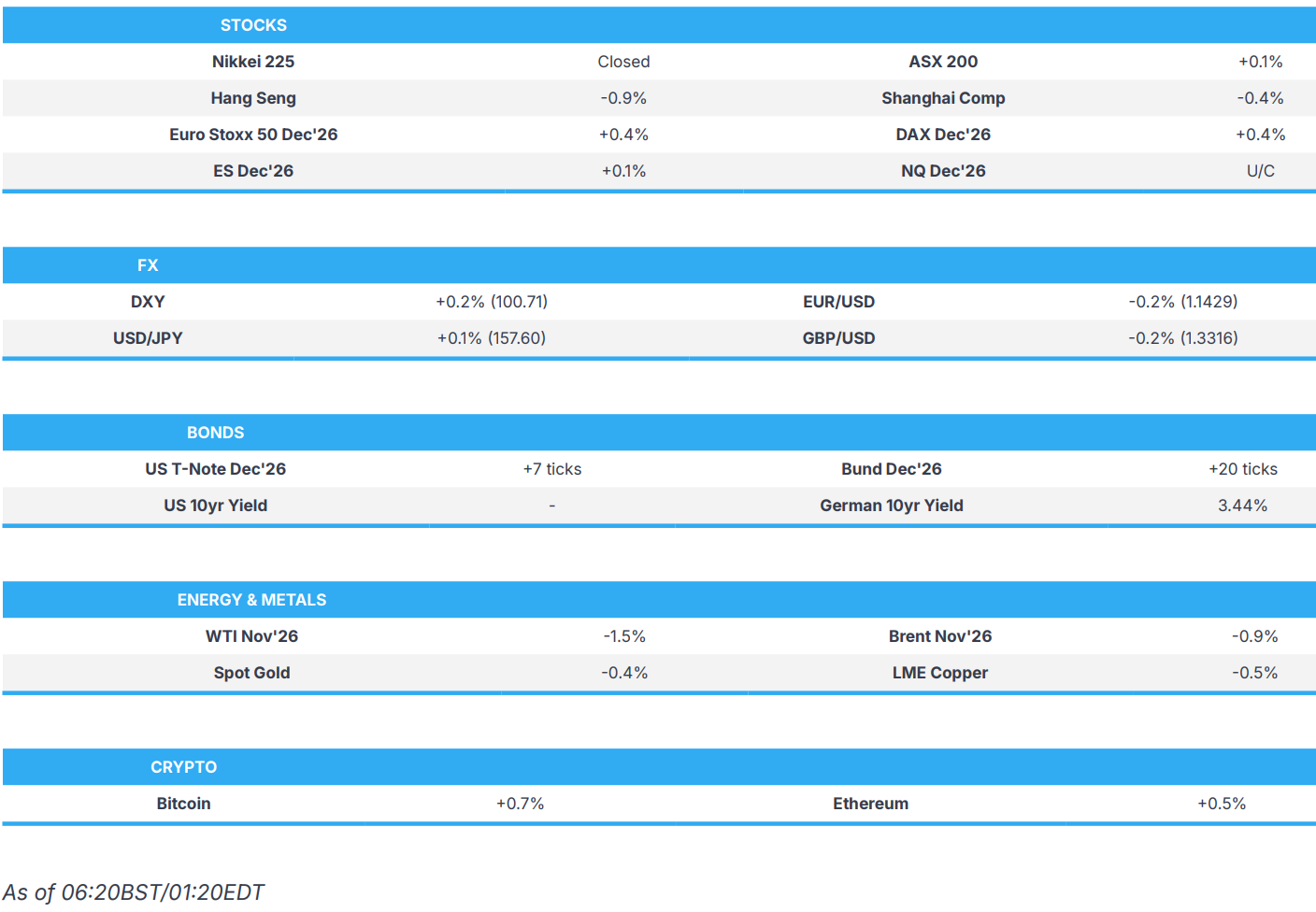
Newsquawk in 3 steps:
1. Subscribe to the free premarket movers reports
2. Listen to this report in the market open podcast (available on Apple and Spotify)
3. Trial Newsquawk’s premium real-time audio news squawk box for 7 days
LOOKING AHEAD
- Highlights include Global S&P PMIs Flash (Sep), SARB Policy Announcement. UN Meetings include Trump-Sharif meeting, Senior Iranian leaders-GCC meeting, Iranian President Pezeshkian address. Speakers include ECB’s Vujcic, Cipollone & Lane, Fed’s Barr. Supply from Germany and the US.
- Click for the Newsquawk Week Ahead.
IRAN CONFLICT
- US President Trump said he thinks a settlement will be reached with Iran, as well as noted that some US-Iran communication has taken place even today and that the relationship with Iran is developing.
- US President Trump said US officials met with the Iranian delegation for three hours and that the meeting went very well and was very productive, with another meeting with Iran scheduled in the near future, while he suggested it is to Iran’s advantage to make a deal and preferable.
- US President Trump said envoys Witkoff and Kushner met with Iran mediators and that there were lots of good thoughts. Trump later commented that he thinks Iran will do something good and there is a lot of momentum for Iran to make a deal, while he thinks Witkoff and Kushner will get this thing ended, but added there will be a time when it’s too late for Iran. Furthermore, he warned that they may have to blow up Pickaxe Mountain and that they will attack if they see activity, as well as reiterated that he thinks the Iran war could end after the Midterms, maybe before.
- US Envoy Witkoff said mediators will continue their work, and he hopes talks will be constructive and promising, while he confirmed he engaged in lengthy talks with the delegation from Iran.
- US source attending the Iranian delegation meeting said the chance of a deal is limited and major disputes and obstacles remain between the US and Iranian delegations.
- A high-ranking source told Al Arabiya that the New York meeting between the American and Iranian delegations broke the deadlock in the negotiations, while a breakthrough between America and Iran is possible, but it requires multiple steps. Furthermore, a separate source said Iran’s announcement of conditions for opening the Strait of Hormuz was the reason for accepting Witkoff’s request for this meeting, while strict conditions were conveyed to the US representative.
- Meeting between the US and Iran was planned in advance, while the talks revolved around conditions for renewing negotiations and opening Hormuz, although no agreement was reached on most of the disputes and another meeting is to be held in the coming days, according to Israel’s Hayom citing US sources.
- Al Jazeera reached out to Iranian sources regarding the potential for further diplomatic engagement between the US and Iran, while they heard from almost all of the sources that Iran has not changed its positions, and a security source said if the US fulfils its commitments based on Iranian demands – and if there are sufficient practical assurances – there would be an opportunity for engagement.
- Iranian President Pezeshkian arrived in New York to take part in the UN General Assembly.
- Iran’s Foreign Ministry stated that Foreign Minister Araghchi met with his Austrian counterpart and the two sides discussed and exchanged views on the most important international and regional developments, as well as bilateral issues of concern to both countries. Araghchi also met with his Iraqi counterpart and reviewed the progress of cooperation between the two countries in various fields, including economic, trade, consular, and security, and emphasised the continuation of efforts to develop relations in all areas of interest to the two countries.
- EU’s Kallas held talks with Iranian Foreign Minister Araghchi and discussed reopening the Strait of Hormuz and ending the US-Iran war, according to Al Jazeera.
- Iranian Parliament’s National Security and Foreign Policy Commission approved new penalties for vessels violating transit regulations in the Strait of Hormuz, according to IRNA. In relevant news, Iran plans to detain ships until a 20% Hormuz fine is paid, according to Fars.
- Iran’s armed forces said US President Trump’s statements regarding Iran at the UNGA are tools of domestic propaganda.
- IRGC spokesman said Iran had “toughened” conditions for ending the war after the collapse of the US deal, while he stated the US broke the agreement and has “no choice” but to accept Iran’s conditions.
- Iranian security source said Iran will only consider talks with the US if Washington fulfils commitments relating to Iranian conditions and provides practical guarantees, according to Al Jazeera. The source said the claim that the Strait of Hormuz would be reopened in return for a reduction in tensions is incorrect, and the strait will not be reopened until the stated conditions are met, while the source noted that Tehran had previously taken positive steps that were not met with a similar US response. Furthermore, Iran’s conditions for resuming talks include an end to the war on all fronts, negotiations on a timeline for Israel’s full withdrawal from southern Lebanon, release of frozen funds, lifting of the naval blockade, removal of newly imposed sanctions, an end to military threats and an oil waiver.
- Explosions were heard near Iran’s Qeshm Island, which seemed to have originated from the sea, and there was no impact inside the territory of Qeshm Island, according to IRNA.
- Qatar’s Emir said the Gulf crisis can be resolved through diplomacy, reopening the Strait of Hormuz and returning to negotiations.
- French President Macron said France is ready to participate in an international operation of a defensive nature to protect navigation in the Strait of Hormuz, according to ABC News.
- 3 commodity vessels transited the Strait of Hormuz on Tuesday vs a 10-day moving average of about 15, according to shipping data.
- Yemeni government forces said they thwarted an attack launched by the Houthis group on the Kahbub front overlooking the Bab al-Mandab.
- Saudi missile strikes reported on northern Yemen’s Saada.
- Arab sources reportedly announced a suspension of operations at Riyadh Airport in Saudi Arabia. It was separately reported that loud explosions were heard in Saudi Arabia’s capital of Riyadh.
- IDF reportedly conducted attacks on southern Lebanon, according to Israel Hayom.
US TRADE
EQUITIES
- US stocks closed mixed on Tuesday, with NDX outperforming amid gains in semiconductors and memory names, although materials was the best-performing sector, followed by staples and healthcare, while financials and energy lagged, which weighed on the SPX’s performance. Energy declined amid downward pressure in crude prices as market optimism builds on a diplomatic solution between the US and Iran, which would bring increased energy supply with it. Trump noted that US officials met with the Iranian delegation, in what was a “very productive” meeting, with his preference for a deal. However, he also threatened Pickaxe Mountain with strikes if the US sees activity taking place there. In response, Al Jazeera reported that Iran’s position has not changed, while Iranian sources refuted recent reports from Kyodo and Reuters that Iran was willing to reopen the Strait of Hormuz if the US lifted its blockade.
- SPX +0.00% at 7,765, NDX +0.82% at 30,732, DJI -0.36% at 51,869, RUT +0.51% at 2,890.
- Click here for a detailed summary.
TARIFFS/TRADE
- UK PM Burnham said he pushed US President Trump on tariffs and that Trump understands the UK position on the Falklands.
- India’s PM Modi expected to visit Canada in December to sign trade deal, according to The Globe and Mail.
NOTABLE HEADLINES
- Fed’s Barkin (2027 voter) said the Fed raised rates last week because risks to inflation outweigh risks to maximum employment, and the rate hike will help restore price stability, while he added “we’ll see” if more hikes are needed. Barkin noted that while it is tempting to blame high inflation on a handful of categories exposed to energy costs or tariffs, much of the personal consumption expenditures index is climbing by more than 3%. Furthermore, he stated the labour market is not overheated or even particularly tight and that he does not see much evidence of stretched consumer balance sheets.
- NY Fed’s Perli said Fed’s Reserve Management purchases are not on a pre-set course and that the central clearing of Fed repo operations would have benefits, while Perli added that the monetary policy toolkit has been working well and the Fed’s reserve forecasting process is robust.
- US Treasury Secretary Bessent is reportedly eyed for Trump’s AI czar, according to Semafor.
APAC TRADE
EQUITIES
- APAC stocks were ultimately mixed following the similar handover from the US, despite the recent decline in oil prices and optimism regarding diplomacy after US President Trump announced that envoys had a ‘very productive’ meeting with the Iranian delegation on the sidelines of the UN General Assembly. However, he also threatened that they may have to blow up Pickaxe Mountain and will attack if they see activity, as well as commented that he has a big decision to make between allowing Iran to rebuild or to “annihilate” Iran.
- ASX 200 was rangebound with demand contained amid rate hike expectations and following weaker Flash PMI data from Australia, in which headline Manufacturing PMI slipped into contraction territory.
- KOSPI gained after the tech-related momentum in the US, where the NDX printed an all-time high.
- Hang Seng and Shanghai Comp were subdued following today’s PBoC liquidity drain and as reports that Chinese President Xi is unlikely to bring Chinese CEOs to his summit with US President Trump temper expectations for major business deals.
- US equity futures traded sideways for most of the session amid the mixed global risk appetite.
- European equity futures indicate a positive cash market open with Euro Stoxx 50 futures up 0.4% after the cash market closed with gains of 0.1% on Tuesday.
FX
- DXY remained firmer and continued the strength from the start of the week as rate hike expectations held, despite the downward pressure in oil prices, while Fed’s Barkin and Collins expressed support for last week’s rate hike and an openness for further increases. Nonetheless, the focus was on the UN General Assembly in New York where US President Trump held talks with several leaders, while he announced that US officials met with the Iranian delegation, adding that the meeting went well and was very productive.
- EUR/USD softened after its recent choppy performance and with little fresh drivers from the bloc, while there were comments from ECB’s Nagel that rates are still in neutral territory and that they cannot exclude needing to go into mildly restrictive territory.
- GBP/USD was subdued and breached through the prior day’s trough, while little reaction was seen from UK PM Burnham’s meeting with US President Trump, where he was said to have pushed Trump on tariffs.
- USD/JPY extended on yesterday’s intraday rebound amid a firmer dollar and the continued absence of Japanese participants, who will be returning from the holiday closures tomorrow.
- Antipodeans trickled lower amid the mixed risk appetite and weaker flash PMI data from Australia.
- PBoC set USD/CNY mid-point at 6.7468 vs Exp. 6.6971 (prev. 6.7459).
FIXED INCOME
- 10yr UST futures edged higher following the recent decline in oil prices, but with further upside capped as overnight cash treasuries trading was shut again due to the Tokyo closure, while participants await a 5yr auction and the next buyback announcement.
- Bund futures benefited following the decline in crude prices and despite looming Bund issuances, while comments from several ECB speakers and Buba’s Mauderer are also scheduled later.
COMMODITIES
- Crude futures were subdued after declining yesterday amid hopes for diplomacy following US-Iran talks on the sidelines of the UN General Assembly, with President Trump noting that the meeting between US envoys and the Iranian delegation went very well and was very productive, while he stated that another meeting with Iran is scheduled in the near future. However, the downside in crude was stemmed as Trump also threatened that they may have to blow up Pickaxe Mountain and that they will attack if they see activity, while there were also reports of loud explosions heard in Saudi Arabia’s capital of Riyadh.
- US Weekly Private Inventory Data (bbls): Crude +1.8mln (exp. -0.6mln), Gasoline -2.2mln (exp. +0.2mln), Distillate -2.2mln (exp. -0.5mln), Cushing +2.1mln.
- US President Trump said he has called for a ban on diesel exports and is currently examining it, while Treasury Secretary Bessent said the administration is also examining the measure.
- US is discussing a USD 10bln joint investment fund with Arab states to repair energy and other infrastructure damaged during the Iran war, according to the FT.
- Iraqi Oil Minister said oil export volumes reached 70mln bbls in August and they are currently exporting more than 3mln bpd.
- Spot gold trickled lower after the prior day’s choppy mood and with mild gains in the dollar as Fed officials continued to voice support for last week’s rate hike and suggested an openness to further increases.
- Copper futures stalled overnight alongside the mixed risk appetite and after the recent rally in prices.
- Chile Escondida union leaders rejected a final wage offer and urged members to vote to strike.
CRYPTO
- Bitcoin climbed higher in a choppy fashion and reapproached the USD 87,000 level.
NOTABLE ASIA-PAC HEADLINES
- US President Trump said Japanese PM Takaichi has done a great job and that Japan is doing well, while he added that he will discuss China-Japan relations with Takaichi.
- Differences between the US and China regarding potential US investments stalled plans for Chinese business leaders to join Chinese President Xi’s visit to the US, according to SCMP.
- Chinese authorities are examining the use of Broadcom’s (AVGO) hardware in state-backed data centres amid efforts to boost domestic producers and cut reliance on foreign AI infrastructure, according to FT.
DATA RECAP
- Australian S&P Global Manufacturing PMI Flash (Sep) 49.3 (Prev. 52.0)
- Australian S&P Global Services PMI Flash (Sep) 51.4 (Prev. 53.2)
- Australian S&P Global Composite PMI Flash (Sep) 50.8 (Prev. 52.7)
GEOPOLITICS
RUSSIA-UKRAINE
- US President Trump said he wants to settle the Russia-Ukraine war and that Russian President Putin should end the conflict. Trump said he has a good relationship with Ukrainian President Zelensky and they are working on a solution to end the war, while he added the US relationship with Ukraine and Europe is very strong, while he thinks Ukraine will make a deal and that Putin is willing to meet to end the war.
- US President Trump’s envoys Witkoff and Kushner were reported to meet with the Ukrainian negotiations team and the national security advisers of the UK, France and Germany on Tuesday night to discuss Ukrainian proposals for a de-escalation deal with Russia, according to Axios.
- Ukrainian President Zelensky warned Russia is preparing a massive attack against Ukraine.
- Ukrainian President Zelensky said he hopes US President Trump will help Ukraine end the war before winter. Zelensky also said Ukraine is ready for any format of an energy ceasefire and he asked Trump to raise the Russia issue with Chinese President Xi.
- Ukraine is ready to sign a landmark drone defence deal with the United States on the sidelines of the UN General Assembly this week, although it may be at a later date when the US is ready to sign, according to CBS News citing sources.
OTHER
- US President Trump said they will have a much more secure relationship after the Greenland deal, while Trump signed the security agreement with Denmark and Greenland.
- US Secretary of State Rubio said Greenland is critical to US national security and that the US cannot risk China or Russia establishing bases there.
- North Korea’s Vice Foreign Minister will participate in the UNGA, according to KCNA.
EU/UK
NOTABLE HEADLINES
- US President Trump said he spoke with UK PM Burnham about Rolls-Royce (RR LN) and energy, adding that the US can do business with Burnham and that trade with the UK is now going well. PM Burnham said the two discussed the Falklands and told Trump the UK is ready to play its part in the Middle East, while he stated UK trade is doing well and relations between the UK and US are improving.
- UK’s Downing Street said PM Burnham spoke to European Commission President von der Leyen this afternoon at the UN General Assembly and discussed initiatives underway to address AI safety.
- UK Labour MPs are urging the government to close stamp duty loopholes, according to FT.
- Global banking executives warned against a UK windfall tax and that they will divert investment away from the UK if taxes on the sector are raised, according to FT
- ECB’s Nagel said oil prices are not the only indicator, but have become more relevant over the past four years, while he is not so concerned by labour market developments and said monetary policy is being conducted between structural ambiguity and forward guidance. Furthermore, he does not see much uncertainty in markets about what drives the ECB’s policymaking decisions, as well as noted that rates are still in neutral territory and cannot exclude needing to go into mildly restrictive territory.
end
2.NORTH AND SOUTH KOREA/
SOUTH KOREA//NORTH KOREA
NORTH KOREA
Kim Jong Un Touts Hypersonic Missile Test: ‘Incurable Headache’ To Enemies
Tuesday, Sep 22, 2026 – 11:00 PM
North Korea has continued to try and instill fear into Washington and Seoul, on Sunday firing two short-range ballistic missiles toward the Sea of Japan.
However, these were apparently new military toys in the arsenal, with state media touting “a new type of weapon” – which Kim Jong Un later described as capable of giving “the enemy an incurable headache and a very cruel and unavoidable blow.”
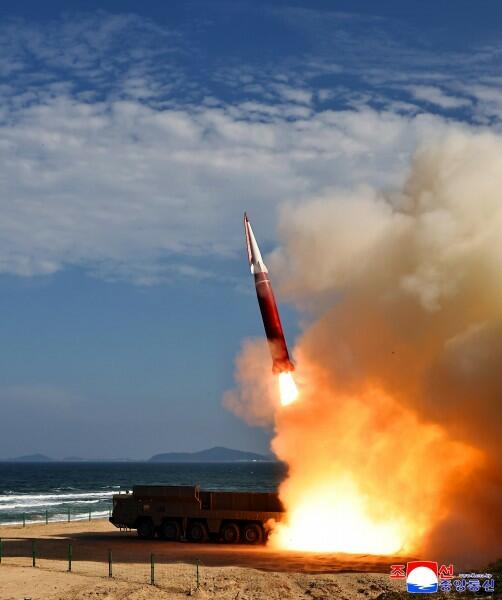
Kim further said the test, which was conducted by North Korea’s Missile Administration, showcased the armed forces’ ability to fight and that “the enemy will know better what such progress means without any explanation.”
As for what makes this a ‘new’ weapon which is special and out of the ordinary, Space.com details:
But photos suggest that it involved a short-range missile topped with a hypersonic warhead, according to NK News, a Seoul-based publication that focuses on happenings in the Hermit Kingdom.
Hypersonic vehicles travel at least five times faster than the speed of sound and are highly maneuverable. They are therefore much harder to track and intercept than ballistic missiles, which, though very fast, follow predictable trajectories.

Kim further hinted at this when talking about his country’s possession of “ultra-modern defense technology.”
The pace North Korean missile tests have been steadily ticking up.
During the first Trump administration, Kim met the US president on a series of occasions. While historic, it didn’t lead to the kind of breakthrough on ‘de-nuclearization’ that Washington and Seoul were hoping for, and Pyongyang has gone back to being on the extreme defensive.
The White House has lately signaled it would like to get back on a direct diplomacy track with Pyongyang, but North Korea has been blistering angry over recent US-South Korea military drills on the peninsula.
END
JAPAN
JAPAN//
3. CHINA
CHINA/USA
China’s DJI Alone Dwarfs Entire US Drone Production
Tuesday, Sep 22, 2026 – 10:10 PM
Two active wars across Eurasia, intensifying resource nationalism, and an energy crisis are adding urgency to US efforts to reduce dependence on China. Concerns about a potential Chinese blockade of Taiwan reinforce the supply chain decoupling theme.
The proliferation of attritable drones and interceptors is reshaping the economics of warfare. Industrial capacity, production costs, and the ability to replace cheap one-way attack drones at scale are becoming key considerations as the US military prepares for a rearmament supercycle.
The challenge for the US is that the industrial base has been hollowed out for decades, and ramping up capacity and building new supply chains will take years. On top of that, China dominates the processing of many critical minerals and will likely hold a quasi-monopoly on the space through the end of the decade. The US is actively seeking to build out new conflict-free critical material supplies, but that will take years.
Together, these dependencies on foreign supply chains could constrain the US rearmament supercycle.
Another uncomfortable reality for the West came in the form of a case study highlighted in a slide deck and shared recently on X, showing that China’s drone production is absolutely running circles around the US.
The slide highlights a massive gap between Chinese and US drone production, comparing DJI alone with the entire American industry:
- DJI reported monthly production: 2.8 million drones
- DJI annualized capacity: 34 million drones
- Estimated annual US production: about 100,000 drones
- US Drone Dominance procurement through 2028: around 340,000 drones
Using those figures, DJI’s annual capacity would be roughly 340 times current US annual output, which the slide rounds to approximately 300 times.
The message is that, as an uncertain and volatile world heads toward greater instability, the US faces an industrial-scale challenge: developing low-cost drones is only part of the problem; manufacturing them at scale is another. Procuring the rare earths needed for motors and sensors is yet another major issue as China chokes off supplies to the West.
end
4. EUROPEAN AND SCANDINAVIAN COMMENTARIES PLUS NATO
DENMARK/USA
USA in control of Greenland;
“The Danes Lied The Most”: What’s Really In The Text Of Trump’s Landmark Deal With Greenland
Wednesday, Sep 23, 2026 – 09:00 AM
Authored by John Weeks via AntiWar.com
US To Establish Two New Military Bases In Greenland
The United States plans to open two new military bases in Greenland, an expansion made possible by a new security agreement between the US, Denmark, and the semi-autonomous Danish territory of Greenland.
On Tuesday, President Donald Trump, Danish Prime Minister Mette Frederiksen, and Greenland Prime Minister Jens-Frederik Nielsen signed the new security agreement during a trilateral ceremony at the United Nations General Assembly in New York.

The “agreement,” which amends a 1951 defense treaty, allows the US “to establish an additional Defense Area at Narsarsuaq and Mestersvig in accordance with modalities and technical details to be mutually agreed by the Parties,” which is where the two new military bases will be created.
Narsarsuaq hosted the US Bluie West One military base in the 1940s and 1950s. Mestersvig is a current military outpost used by the Danish special forces unit called Sirius Dog Sled Patrol.
The agreement also allows the US to “modernize and expand its activities” at its existing Pituffik Space Base in northwestern Greenland, create additional military facilities on the island, and enjoy greater military access by land, air, and sea.
It also bans non-NATO nations from establishing a military presence on Greenland and provides the U.S. with economic privileges (such as “minerals cooperation”) in the resource-rich island.
During a speech to assembled world leaders at the UN before the trilateral ceremony, Trump spoke of the “unprecedented agreement regarding the northern frontier of North America, the large and strategically vital piece of land known as Greenland.“
This rhetoric tracked with Secretary of War Pete Hegseth’s vow in March to establish a “Greater North America.” However, the agreement does not have the US take over Greenland, as leaders on the island, in Denmark, and throughout Europe had feared earlier this year.
Such fears were well placed, considering that the US conquered Venezuela in January, has been working toward regime change in Cuba, and is currently at war with Iran.
What’s in the actual Greenland deal text? Analysis in the following: “The Danes lied the most: Trump is pretty much correct in saying that this new deal grants the US control of Greenland”…
Geopolitical commentator Arnaud Bertrand’s breakdown of the official text and the implications:
1) This is now a permanent arrangement: whereas the existing 1951 deal only lasted as long as NATO existed, this one “does not have an end date and may only be amended by mutual consent.” It even survives a hypothetical future independence of Greenland: in that event, Denmark and Greenland must ensure that the independent Greenlandic state “affirmatively assume[s] all of the rights and obligations of the Kingdom of Denmark specified in this Agreement.”
2) In the 1951 agreement, the US could set up bases only where both governments agreed, and only on the basis of NATO planning. The new deal locks in three bases: the US can “modernize and expand its activities” at Pituffik, its only base in Greenland until now, and “shall be allowed to establish an additional Defense Area at Narsarsuaq and Mestersvig.” Further bases beyond these 3 can be justified by the defense of “the American continent,” a US interest rather than a NATO one. Also, quite subtle but this is interesting: Article IV(iii) says that “the United States may establish additional defense areas in Greenland” and that consultations are then held “to decide implementation details based on mutual agreement.” What this means is that the principle of a new base is automatically granted and only the implementation details require agreement. Article VII also gives the US “the right to raise concerns regarding construction, or change of use” of any building near a US base, after which the parties decide together what to do. Which means that the US has a say over civilian planning around its bases.
3) On US military movement across Greenland, the wording change between the 1951 agreement and this new one is quite funny. The 1951 text said (Art. V(3)): the US “may enjoy… the right of free access to and movement between the defense areas through Greenland, including territorial waters, by land, air and sea,” but only “in accordance with general rules mutually agreed upon and issued by the appropriate Danish authority in Greenland.” The new one says: “the United States of America shall enjoy… the right of free access to and movement between the Defense Areas through Greenland, including the Territorial Waters, by land, air and sea.” That’s it: “May” becomes “shall,” and the US military movement no longer has to follow rules “issued by the appropriate Danish authority in Greenland.” The US also gets something new on top: “undersea access to and movement within the Territorial Waters,” i.e. submarines.
4) Non-NATO exclusion: non-NATO states are barred from military installations or a persistent presence in Greenland unless all three parties approve, giving the US an effective permanent veto. The 1951 deal had no equivalent clause.
5) Investment screening: this is entirely new. “States or investors from a state that is not a member of NATO, a NATO partner, or an EU member state” (i.e. Russia, China, India, the Gulf States, etc.), “shall not be allowed to have (i) control, (ii) significant influence, or (iii) access to non-public information…within Particularly Sensitive Sectors or Activities in the territory of Greenland (including the Territorial Waters), unless agreed between the Parties.” Again, it basically means that the US has a permanent veto over who can invest in strategic sectors in Greenland, as far as non-NATO or EU states are concerned.
6) Lastly, in stark contrast with the 1951 deal, the framing of the deal changes significantly: this new deal is largely framed around the US. The 1951 agreement existed only “for the benefit of the North Atlantic Treaty Organization.” The new one lists the defense of “the American continent” as an objective, celebrates “the irreplaceable role” of the United States military as well as “the United States’ indispensable historical and ongoing contributions to the security and defense of Greenland,” and names the establishment of Trump’s “Golden Dome” missile defense system as a key goal.
During his UN speech, Trump unleashed an extremely aggressive statement aimed at Tehran: “Will a deal be made with Iran that lets them rebuild and create a far greater country than it ever was before, maybe one of the greatest in the Middle East, or even the world? Or do I annihilate the Islamic Republic, and do it quickly, never giving them a chance to kill and destroy people and countries again? Do I drive them into hell with no chance of survival and no hope of future greatness or generations?”
END
UK
Britain To Appoint A Dedicated Tax Agent To Every Single Billionaire
Wednesday, Sep 23, 2026 – 08:05 AM
Submitted by QTR’s Fringe Finance
The United Kingdom is about to discover the part of the Laffer Curve where the billionaire taxpayers simply get on a plane and go somewhere else.
His Majesty’s Revenue and Customs has now assigned a dedicated “compliance manager” to every billionaire it has identified with a UK tax footprint, dramatically expanding the government’s oversight of the country’s richest people, according to a new report from Bloomberg this week.
HMRC is using its own records, public information and data shared by foreign governments to identify billionaires with UK tax exposure and map their connections to businesses, trusts and other entities. “The UK tax authority has assigned a personal compliance manager to every billionaire within its reach as it seeks to get a better grip on the super-rich’s tax liabilities,” the report says.
HMRC says the goal is straightforward, making sure wealthy taxpayers pay what they legally owe, and the government confirmed this month that every billionaire with a UK tax footprint was allocated a Customer Compliance Manager over the summer.
But consider the message Britain is sending: become extraordinarily successful, build companies, accumulate enough capital and pay enough taxes, and eventually the government assigns an individual bureaucrat to keep tabs on you.
At some point, you have to wonder whether the people designing these policies understand that billionaires are among the most geographically mobile people on Earth. They literally are the most mobile people on the planet. They don’t have to stay.
And they won’t. They can live in Dubai. They can establish themselves in Monaco. They can move to Malta or Switzerland or any number of jurisdictions competing aggressively for wealthy residents, investors and entrepreneurs. Their businesses, capital and families are often international already. Moving is inconvenient, but for someone worth several billion dollars it is hardly an insurmountable obstacle.

And Britain isn’t exactly starting from zero here. The country abolished its longstanding non-dom tax regime in April 2025, and several prominent billionaires, including hedge-fund manager Chris Rokos, steel magnate Lakshmi Mittal and businessman Nassef Sawiris, have subsequently left the UK. Billionaire Betfred founder Fred Done, whose family reportedly paid roughly £400 million in taxes last year, recently warned that Britain’s increasingly hostile tax environment is pushing wealthy people and businesses elsewhere.
Now imagine you’re another billionaire watching this unfold. You’ve watched other wealthy residents leave. And now you’re informed that the tax authority has effectively assigned someone specifically to understand your finances, behavior, tax returns and potential compliance risks.
HMRC describes these managers in considerably friendlier language, but its own explanation is revealing. Customer Compliance Managers are tasked with developing an “in-depth understanding” of wealthy taxpayers’ finances and behavior, reviewing their returns alongside intelligence gathered both inside and outside Britain, and challenging taxpayers where HMRC believes the correct amount isn’t being paid.
🔥 85% OFF FOREVER IF YOU SUBSCRIBE TODAY: I am again offering an 85% discount to anyone that wants to become a Fringe Finance annual subscriber today. It’s a discount you can keep and stays applied for as long as you wish to remain a subscriber: Get 85% off forever
Of course billionaires should pay every pound of tax they legally owe. Tax fraud should be prosecuted whether the person committing it has £10,000 or £10 billion.
But there is a meaningful difference between enforcing the tax code and designing an enforcement apparatus around a specific class of people simply because they possess extraordinary wealth. HMRC says the allocation reflects wealth, complexity and risk, and supporters will reasonably argue that complicated international fortunes require more specialized oversight.
My concern is what happens when that philosophy becomes cumulative. Higher taxes. The destruction of preferential regimes intended to attract international wealth. Ever-more aggressive information gathering. There is a point where taxation starts feeling less like collecting revenue and more like abusing success. In the U.S. New York City is turning into a prime example of this.
But unlike ordinary taxpayers, the people being targeted have an escape hatch.
Watch what happens next. I suspect Britain is going to discover that there is a practical limit to how much scrutiny and taxation governments can pile onto extremely mobile capital before that capital simply leaves. Dubai, Monaco, Malta and other wealth-friendly jurisdictions don’t need to persuade every billionaire in Britain to relocate. They only need to make the alternative sufficiently attractive. And it is.

The irony is that driving away even a relatively small number of enormously wealthy taxpayers can undermine the entire exercise.
Britain’s wealthy population generated an estimated £95 billion in PAYE and National Insurance receipts and another £65 billion in other taxes in 2025-26, although those figures cover HMRC’s much broader definition of “wealthy” rather than billionaires specifically.
Governments have a habit of treating wealthy taxpayers like permanent entries on a spreadsheet: raise the tax liability, multiply it by the same number of taxpayers, and assume the resulting revenue simply appears.
But people don’t stay frozen in spreadsheet cells forever. When the cost of remaining in a jurisdiction rises enough, behavior changes. People restructure their finances, move assets, alter investment decisions or, particularly at the very top of the wealth distribution, simply leave.
It’s about as basic a concept as you can get when discussing taxation: changing the tax rate can also change the tax base. Yet fiscal projections can make it look as though the people being taxed will sit still indefinitely while their liabilities keep rising.
As New York City’s Mamdani has just learned the hard way, billionaires, in particular, have an unusual ability to respond to those incentives…sometimes from a private jet. Britain may soon find this out.
Now read:
- US Taxation Is Fueled by Quiet Envy
- Mamdani Is Destroying The Tax Base His Stupid Ideas Desperately Need
- Imagine Your Tax Dollars Bailing Out Bitcoin
END
GERMANY
KOLBE.
Flash In The Pan Already Burned Out: German Economy Loses Its Hormuz Boost
Wednesday, Sep 23, 2026 – 03:30 AM
Submitted by Thomas Kolbe
That Was a Short-Lived Boom.
After just a few weeks, the special economic effect of the closure of the Strait of Hormuz has already evaporated, according to Germany’s Federal Ministry for Economic Affairs. In its monthly report, the ministry states that energy-intensive sectors and companies in German industry benefited from a massive disruption of supply chains in Asia following the closure — a one-time opportunity to temporarily offset the competitive disadvantages at home by shutting out the competition and moving into the business vacuum that had emerged.
Companies in the chemical and metals industries in particular benefited from this special situation, which generated robust growth in the second quarter, the ministry said.
Ultimately, the effect faded faster than expected. After just a few weeks, the German economic miracle was over — and the gray reality has returned. According to the ministry, the German economy continues to lack growth impulses. The stagnation is therefore continuing.
Bad news for the German government, and even worse news for Chancellor Friedrich Merz, who is desperately hoping for economic figures he can use as campaign ammunition rather than going into the next election with completely empty hands when voters hand him another political rebuke in just a few days. Pressure on the unpopular chancellor is also growing within his own party. Merz should actually be delivering something substantial by now — after more than a year of his debt orgy. He should be spreading hope of an impending upswing. Instead, his artificial economy, bloated with ever more debt, keeps collapsing like a soufflé.
The figures from the economy show that this soufflé will not rise again anytime soon. Industrial production is currently 3.3 percent below its level a year ago. Energy-intensive industries in particular, which are falling back into their old apathy after the Iranian special boom, reported a 1.7 percent decline in July. No stimulus can be expected from German consumers — real retail sales fell by 3.4 percent from the previous month in July. Inflation is eating into household purchasing power, and the weak labor market is showing its teeth.
Given the dramatic state of German industry, no one should expect an upswing in the German labor market. A total of 144,000 industrial jobs have been lost in the past twelve months alone. In August, the number of unemployed stood at 3.06 million — although statistical manipulation involving unregistered unemployed people in job-creation programs, short-time work or early retirement conceals the true state of the labor market. The naked truth about the German economy is also hidden in basic income support and other social programs — underemployment is a far greater problem than the statistics allow us to see.
Compared with the previous year, Germany’s job centers count 226,000 fewer people employed in the German economy. The German state’s reforestation program in the public sector will do little more than provide cosmetic relief. The decline is real, and it is reflected in corporate insolvencies, which this year are at their highest level since 2013.
More than 18,500 corporate failures over the past twelve months are now on the books. They are compelling evidence of the structural problems at Germany’s economic location, which could only be eliminated through a political U-turn of 180 degrees. Yet even following a political change, returning to a path of growth would probably be difficult. The collateral damage left behind by political ideologues has simply become too great.
Germany is trapped: cut off from Russian gas, caught in the grip of the emerging diesel-price crisis caused by the Hormuz closure, and dependent on the goodwill of the Americans, who have become its main supplier of fossil fuels — the German economy is stumbling toward a price shock with almost no alternatives.
Once this energy shock works its way through the economic chain and into consumer prices, many German households will be in trouble. They have already been suffering from rising prices for years. Among supporters of degrowth ideology, this fatal combination of circumstances may be cause for celebration. Everyone, however, should be aware that Germany’s deeply divided society needs a boost in prosperity more urgently than ever. And growth is only conceivable in an environment of secure and affordable energy.
Economics is the study of relationships and scarcity. Germany is competing with giants such as China and the United States. Energy prices there are now so significantly below German levels that the bleeding of domestic industry has become inevitable, regardless of how much subsidy money is pumped into the economic body through subsidized industrial electricity prices or direct aid.

Political action in these times appears bizarre. Berlin and Brussels are responding to their own interventionism, the regulatory shackles left behind by low interest rates, climate regulation and energy policy, with further regulation and strangulation of businesses. Are we really surprised by the zombification of large parts of the economy, which now has to compensate for the significant rise in borrowing costs? This policy is dangerous to society. It is destabilizing and could only be prevented by a radical return to the market economy, to a principle of limited government while mobilizing all the forces of society. Until that realization matures, it will be a long and very dangerous road for all supporters of a free society and the market economy.
END
RUSSIA AND ISRAEL AND MIDDLE EASTERN AFFIARS
ISRAEL/USA VS IRAN/WEDNESDAY
Cargo Vessel Struck By Unknown Projectile In Hormuz, Casualties Reported
Wednesday, Sep 23, 2026 – 08:15 AM
Just the day after the White House reported its envoys had a “very productive” 3-hour long meeting with the Iranian side at the UN in New York, and as President Masoud Pezeshkian is readying to address the UN General Assembly on Wednesday, there’s been another tanker attack incident in the Strait of Hormuz.
UKMTO cites in a fresh alert that a cargo vessel has reported being struck by an unknown projectile, resulting in two casualties.
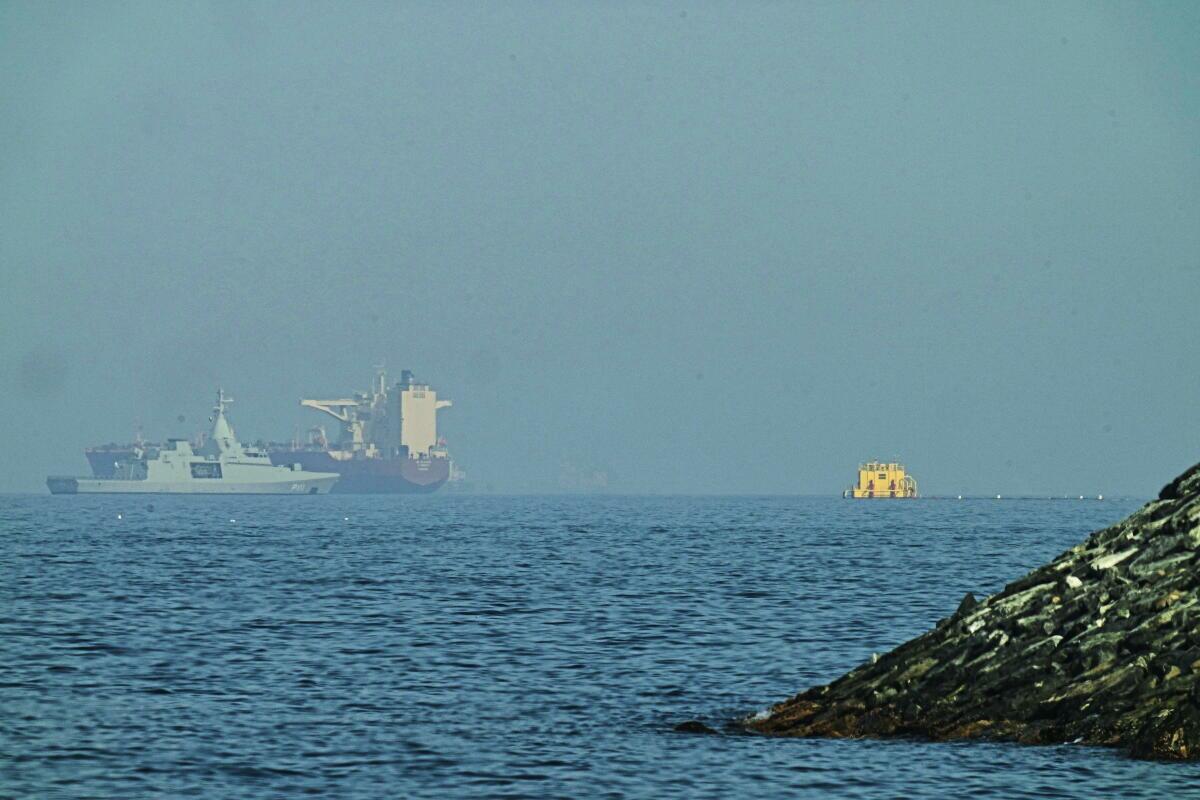
All crew has been evacuated, with the vessel on fire and adrift, in what looked to be a major attack by either a drone or missile. Further, “UKMTO said authorities were investigating the incident and that there was no reported environmental impact.”
Tehran remained defiant after Tuesday’s ultimatum and threats from the UN stage by President Trump. He had posed before the world, provocatively:
“Will a deal be made with Iran that lets them rebuild and create a far greater country than it ever was before — maybe one of the greatest in the Middle East or even the world? Or do I annihilate the Islamic Republic, and do it quickly, never giving them a chance to kill and destroy again?”
“Do I drive them into hell,“ he continued, “with no chance of survival and no hope of future greatness?”
Iranian Ambassador Kazem Jalali has responded by saying that Washington has no choice but to accept what he called the strait’s new legal status. He asserted this will only be decided under the protocol being implemented by Iran and Oman, and only then will US or other foreign ships pass through the waterway.
Further there was a written, albeit indirect, response from the Ayatollah, who is in hiding:
Iranian Supreme Leader Mojtaba Khamenei, though not in direct response to Trump, used similarly combative imagery in a message marking the start of Iran’s academic year, describing knowledge combined with faith and morality as a “sharp sword” capable of cutting off the hands of aggressors.
Iran’s military has also dismissed threat to “annihilate” the Islamic Republic, stating it is ready to hit back with “crushing” attacks far more severe than what marked earlier phases of the war.
This week had kicked off with similar Hormuz incidents on Sept.20 and 21. The ADNOC Shipping & Logistics LPG carrier and tanker, as well as an Isle of Man-flagged tanker, were attacked by the Iranians in those incidents.
END
ISRAEL TBN
END
IRAQ
good luck to him on this!!
Iraqi PM Sets New June 2027 Deadline To Disarm Resistance Factions
Wednesday, Sep 23, 2026 – 02:00 AM
Authored by News Desk via The Cradle,

Iraqi Prime Minister Ali al-Zaidi announced a June 2027 deadline for the disarmament of the country’s resistance factions in comments released on 21 September, extending a previous deadline which had been set for the end of this month.
The announcement came in an interview with the New York Times (NYT), carried out on Saturday, during which Zaidi detailed the disarmament plan that Washington has been pushing so heavily for.
“This is not something that is optional. It is a necessity. Others who spoke of this then backtracked. They yielded to pressure or to other concerns. For me, this issue, along with that of corruption, is a matter of honor,” the Iraqi premier told NYT.
“We wish to build bridges and economic ties between Iraq and the countries of the world. Under this government, Iraq will be a meeting point, not a point of hostility. Arms have to be confined first so you can build a solid economy,” he added.
Zaidi had previously announced a 30 September deadline to disarm the Iraqi factions. Yet this deadline was firmly rejected by the resistance, leading to the extension.
“There would first be a 90-day period during which the militias would not launch any attacks and be assured that they would not be attacked by US forces,” Zaidi said to NYT.
“After that, the [factions] would begin handing over their weapons, with disarmament ending by 30 June, 2027.”
According to NYT, the resistance is “pushing” to have the deadline extended to the end of next year.
The newspaper refers to the new date as ambitious.
“The timeline is extremely precarious” and “impossible to meet during a time of war,” regional diplomats and Iraqi security officials are quoted as saying by the outlet.
Zaidi claims the plan will ensure the resistance factions “cease to exist as independent entities.”
“They will join the Popular Mobilization Units as individuals and integrate into them,” he went on to say.
US President Donald Trump’s administration has adopted a significantly more coercive approach than its predecessors to disarming the Iraqi resistance, stepping up pressure on Baghdad in recent months to dismantle the resistance factions swiftly.
Washington reportedly froze security programs with Baghdad and blocked dollar shipments to the country earlier this year to pressure Iraq into dismantling Iran-backed resistance groups.
Iraqi resistance groups have demanded a full US withdrawal, rather than the “transitional” pullout agreed on between the US and Iraq, which will see Washington shift from a “combat” to an “advisory” role, while still retaining a military presence in the country.
At the height of the illegal US-Israeli war on Iran, these resistance groups inflicted heavy damage on US assets in Iraq.
They have also supported Gaza militarily throughout the genocide and have carried out operations in response to Israeli war crimes in Lebanon.
END
RUSSIA VS UKRAINE
Zelensky Ready For Reciprocal Energy Ceasefire Ahead Of UN Speech
Wednesday, Sep 23, 2026 – 09:15 AM
Major Russian drone attacks pummeled the Ukrainian capital overnight, resulting in two people killed and at least 23 wounded, also unleashing large-scale fires and damage, with plumes of black smoke seen hovering over the city.
Other locations came under attack, which has been a nightly phenomenon, including in southeast Ukraine’s Zaporizhzhia and the Black Sea port of Odesa – the latter where the captain of a cargo ship was tragically killed.

Also, the country’s rail system continues to be under threat, with Ukrainian Railways chief Oleksandr Pertsovsky saying the rail network in the capital area was “under fire” – for which he urged “maximum” vigilance from passengers.
Amid ongoing Russian attacks on Ukrainian exports and imports, Turkey’s President Recep Tayyip Erdoğan told the UN General Assembly in New York on Tuesday: “The recent attacks on commercial vessels in the Black Sea are unacceptable, regardless of who is responsible.”
Ukrainian President Volodymyr Zelensky is meanwhile readying to address to UN General Assembly in New York, with the speech set for the late afternoon session on Wednesday. He’s expected to push Western and global partners to hold the line against Putin, and pledge more support – especially missiles and air defense systems – headed into winter.
Zelensky had forewarned in a Tuesday Telegram post that Russia was planning “a new massive attack” against Ukraine. According to some of the latest from New York in the context of the UNGA:
- Zelenskyy said Ukraine is ready for an “energy ceasefire” with Russia, provided Moscow stops attacks on critical infrastructure.
- Ukraine’s president also urged Trump to organize a trilateral meeting with Putin, saying the leaders should move “as quickly as possible” to end the war.
- Zelenskyy also called on Trump to engage Chinese President Xi Jinping, saying he has influence over Putin, as Kyiv braces for another winter of attacks on its energy infrastructure.
It was only on Monday that President Trump again sought to publicly pressure Zelensky to halt long-range drone strikes on Russia’s refineries, in a bid to calm rising diesel prices especially while the parallel Strait of Hormuz crisis persists.
In a phone call, Zelensky was pressed by Trump over the strikes as Washington wants “Russian supplies to be able to reach the global market to provide relief.“
But now, after the Tuesday Trump meeting:
“We are ready for an energy ceasefire if the Russians do not strike our energy infrastructure,” he said.
According to him, US envoys Steve Witkoff and Jared Kushner will convey Kyiv’s proposal to Moscow. US Secretary of State Marco Rubio is scheduled to meet Russian Foreign Minister Sergey Lavrov in New York City on Wednesday.
Writing later on US social media platform X, Zelenskyy elaborated on the discussions, noting that the leaders discussed “how to end the war.”
Recent efforts to “force” an energy ceasefire in Ukraine have fallen short, given once they are proclaimed it typically takes less than 48 hours for each side to break it. Refineries even in the Moscow area have lately come under major drone barrage, inflicting severe damage.
END
6/.GLOBAL ISSUES, COVID ISSUES, VACCINE INJURIES/HEALTH ISSUES
GLOBAL ISSUES
How do math skills compare around the world?
This graphic, via Visual Capitalist’s Bruno Venditti, ranks participating countries and economies by the average mathematics scores of 15-year-old students in the most recent PISA 2025 study, published in September 2026.
PISA assesses students in mathematics, reading, and science. Its mathematics assessment goes beyond memorizing formulas or procedures, measuring whether students can apply mathematical knowledge and reasoning to real-world problems.
More than 760,000 students took part in PISA 2025 across 91 countries and economies, representing roughly 33 million 15-year-olds worldwide.
China in this ranking represents the participating jurisdictions of Beijing, Shanghai, Jiangsu, and Zhejiang. Uzbekistan is excluded because a comparable mathematics score was not reported.
Why East Asia Stands Out in Math Scores
China leads Singapore by 49 points, while Macao and Taiwan rank third and fourth with scores of 549 and 546, respectively.
| Rank | Country | Average PISA score |
|---|---|---|
| 1 | 🇨🇳 China | 612 |
| 2 | 🇸🇬 Singapore | 563 |
| 3 | 🇲🇴 Macao | 549 |
| 4 | 🇹🇼 Taiwan | 546 |
| 5 | 🇯🇵 Japan | 525 |
| 6 | 🇰🇷 Korea | 522 |
| 6 | 🇭🇰 Hong Kong | 522 |
| 8 | 🇪🇪 Estonia | 508 |
| 9 | 🇨🇭 Switzerland | 499 |
| 10 | 🇬🇧 UK | 488 |
| 11 | 🇨🇦 Canada | 485 |
| 12 | 🇵🇱 Poland | 484 |
| 13 | 🇳🇱 Netherlands | 483 |
| 14 | 🇳🇿 New Zealand | 480 |
| 14 | 🇮🇪 Ireland | 480 |
| 14 | 🇧🇪 Belgium | 480 |
| 17 | 🇦🇺 Australia | 478 |
| 18 | 🇦🇹 Austria | 477 |
| 18 | 🇨🇿 Czechia | 477 |
| 20 | 🇩🇰 Denmark | 471 |
| 21 | 🇱🇹 Lithuania | 470 |
| 22 | 🇫🇮 Finland | 469 |
| 22 | 🇸🇰 Slovakia | 469 |
| 24 | 🇮🇹 Italy | 468 |
| 25 | 🇩🇪 Germany | 464 |
| 25 | 🇸🇪 Sweden | 464 |
| 27 | OECD average | 463 |
| 27 | 🇺🇸 United States | 463 |
| 28 | 🇹🇷 Türkiye | 462 |
| 29 | 🇸🇮 Slovenia | 460 |
| 29 | 🇵🇹 Portugal | 460 |
| 29 | 🇱🇻 Latvia | 460 |
| 32 | 🇭🇺 Hungary | 459 |
| 33 | 🇫🇷 France | 458 |
| 33 | 🇱🇺 Luxembourg | 458 |
| 35 | 🇪🇸 Spain | 457 |
| 36 | 🇭🇷 Croatia | 455 |
| 37 | 🇦🇪 UAE | 453 |
| 38 | 🇳🇴 Norway | 452 |
| 39 | 🇮🇸 Iceland | 450 |
| 40 | 🇻🇳 Vietnam | 443 |
Japan ranks fifth with 525 points, while Korea and Hong Kong are tied at 522. Estonia breaks up the concentration of East Asian education systems at the top, ranking eighth globally with a score of 508 and placing highest among European countries.
Where the U.S. and Canada Rank
The United States ranks 27th with a score of 463, exactly matching the OECD average.
Canada ranks 11th overall with an average mathematics score of 485, putting it 22 points above the OECD average. It also places ahead of several major European economies, including Germany, France, Spain, and Italy.
The United Kingdom ranks 10th with a score of 488. Australia comes in 17th at 478, while New Zealand ties for 14th at 480.
Math Scores Have Fallen Across the OECD
Across OECD countries, average mathematics scores fell by 22 points between 2015 and 2025, equivalent to just over one year of learning. Declines were also recorded among non-OECD participants.
PISA also found an association between heavy digital leisure use and student outcomes. Students spending more than four hours a day on digital leisure activities outside school tended to have lower mathematics scores and a weaker sense of belonging.
By contrast, moderate digital use was associated with better outcomes on both measures than either no use or very high use.
If you enjoyed today’s post, check out Countries by Education Spending as % of GDP on Voronoi.
END
COVID VACCINE INJURIES: MARK CRISPIN MILLER
| In memory of those who “died suddenly” in the United States and worldwide, September 14-21, 2026 Comic Mike Marino (63, C); composer Duncan Sheik; rocker Chad Gilbert (45, C); C&W singer Jeanie Poling (67, C); reporters Rose Friedman (38, C), Brendan Farrington; pitcher Brian Wolfe (45); & moreMark Crispin MillerSep 23      READ IN APP READ IN APP A survey of the likely global toll of COVID “vaccination,” based on the reports collected by our worldwide team of researchers this past week.Note: These reports are not arbitrarily included. For a list of the criteria we use, see this footnote.¹To help support our work, consider subscribing or making a donation.UNITED STATES (128)Beloved Comedian, Known as ‘New Jersey’s Bad Boy of Comedy’, Dead at 63September 15, 2026 A survey of the likely global toll of COVID “vaccination,” based on the reports collected by our worldwide team of researchers this past week.Note: These reports are not arbitrarily included. For a list of the criteria we use, see this footnote.¹To help support our work, consider subscribing or making a donation.UNITED STATES (128)Beloved Comedian, Known as ‘New Jersey’s Bad Boy of Comedy’, Dead at 63September 15, 2026 Mike Marino, known as “New Jersey’s Bad Boy of Comedy,” died at the age of 63 on Tuesday, September 15, his family announced. Marino had been battling brain cancer and was placed in hospice care in the days before his death. In addition to taking the stage at some of the country’s most iconic comedy clubs, Marino lent his talents to shows like As the World Turns, One Life to Live, Becker, Nikki, Frasier and Party of Five. He was inducted into the New Jersey Comedy Hall of Fame in 2008, and earned the USO Bob Hope Comedy Award in 2015.Duncan Sheik, Spring Awakening composer and “Barely Breathing” singer, dies at 56September 18, 2026 Mike Marino, known as “New Jersey’s Bad Boy of Comedy,” died at the age of 63 on Tuesday, September 15, his family announced. Marino had been battling brain cancer and was placed in hospice care in the days before his death. In addition to taking the stage at some of the country’s most iconic comedy clubs, Marino lent his talents to shows like As the World Turns, One Life to Live, Becker, Nikki, Frasier and Party of Five. He was inducted into the New Jersey Comedy Hall of Fame in 2008, and earned the USO Bob Hope Comedy Award in 2015.Duncan Sheik, Spring Awakening composer and “Barely Breathing” singer, dies at 56September 18, 2026 Duncan Sheik, singer of the 1996 hit “Barely Breathing” and Tony Award-winning composer of Spring Awakening, died on Thursday. He was 56 years old. Sheik’s mother, Suzanne, confirmed her son’s death to the New York Times, citing organ failure as the cause. Earlier in the week, the singer and composer had been hospitalized in “critical but stable” condition following an unspecified health incident. A native of New Jersey—who once played in a band with Lisa Loeb while both were attending Brown University—Sheik released his self-titled debut album in 1996.No cause of death reported.New Found Glory’s Chad Gilbert Dies at 45 Just 3 Months After Return to Stage Following Emergency Brain Cancer SurgerySeptember 20, 2026 Duncan Sheik, singer of the 1996 hit “Barely Breathing” and Tony Award-winning composer of Spring Awakening, died on Thursday. He was 56 years old. Sheik’s mother, Suzanne, confirmed her son’s death to the New York Times, citing organ failure as the cause. Earlier in the week, the singer and composer had been hospitalized in “critical but stable” condition following an unspecified health incident. A native of New Jersey—who once played in a band with Lisa Loeb while both were attending Brown University—Sheik released his self-titled debut album in 1996.No cause of death reported.New Found Glory’s Chad Gilbert Dies at 45 Just 3 Months After Return to Stage Following Emergency Brain Cancer SurgerySeptember 20, 2026 Chad Gilbert – guitarist and co-founder of rock band New Found Glory – has died following a years-long cancer journey. He was 45. Gilbert died on Sunday, Sept. 20, his New Found Glory bandmates and wife, Lisa Cimorelli, announced the same day. The rock musician, who had been undergoing treatment for cancer since 2021, had just returned to the stage three months earlier following an emergency brain cancer surgery. Gilbert had been undergoing treatment for his rare adrenal cancer, metastatic pheochromocytoma, since 2021, and underwent emergency brain surgery in February after collapsing at his home. After the operation, he told PEOPLE that his cancer diagnosis had changed to the more dire adrenocortical carcinoma (ACC). Prior to the emergency surgery, Gilbert said his health had been stable, thanks to ongoing immunotherapy treatments and other interventions to treat tumors in his spine, lungs and stomach. Months after the surgery, Gilbert made an emotional return to stage at New Found Glory’s June 8 stop in his Nashville hometown, playing guitar during “Hit or Miss” and “My Friends Over You” from a motorized scooter onstage.Researcher’s note – New Found Glory confirmed in August 2021 that all band members were “vaccinated” against COVID-19: LinkCountry music star Jeanie Poling dead at 67 after battling ‘two rare forms’ of cancerSeptember 16, 2026 Chad Gilbert – guitarist and co-founder of rock band New Found Glory – has died following a years-long cancer journey. He was 45. Gilbert died on Sunday, Sept. 20, his New Found Glory bandmates and wife, Lisa Cimorelli, announced the same day. The rock musician, who had been undergoing treatment for cancer since 2021, had just returned to the stage three months earlier following an emergency brain cancer surgery. Gilbert had been undergoing treatment for his rare adrenal cancer, metastatic pheochromocytoma, since 2021, and underwent emergency brain surgery in February after collapsing at his home. After the operation, he told PEOPLE that his cancer diagnosis had changed to the more dire adrenocortical carcinoma (ACC). Prior to the emergency surgery, Gilbert said his health had been stable, thanks to ongoing immunotherapy treatments and other interventions to treat tumors in his spine, lungs and stomach. Months after the surgery, Gilbert made an emotional return to stage at New Found Glory’s June 8 stop in his Nashville hometown, playing guitar during “Hit or Miss” and “My Friends Over You” from a motorized scooter onstage.Researcher’s note – New Found Glory confirmed in August 2021 that all band members were “vaccinated” against COVID-19: LinkCountry music star Jeanie Poling dead at 67 after battling ‘two rare forms’ of cancerSeptember 16, 2026 A country music star from San Francisco, known as “the human jukebox” has sadly died at the age of 67. The San Francisco Chronicle reported that she died on August 26 after battling two rare forms of cancer for three years. Despite battling ill-health, Jeanie continued to play farmers markets and street fairs, thrilling her fans up until her passing. The singer performed alongside her husband, Chuck Poling, and was “at the heart of San Francisco’s bluegrass scene”.Rose Friedman Dies: NPR Arts Editor & ‘Books We Love’ Co-Creator Was 38September 19, 2026 A country music star from San Francisco, known as “the human jukebox” has sadly died at the age of 67. The San Francisco Chronicle reported that she died on August 26 after battling two rare forms of cancer for three years. Despite battling ill-health, Jeanie continued to play farmers markets and street fairs, thrilling her fans up until her passing. The singer performed alongside her husband, Chuck Poling, and was “at the heart of San Francisco’s bluegrass scene”.Rose Friedman Dies: NPR Arts Editor & ‘Books We Love’ Co-Creator Was 38September 19, 2026 Rose Friedman, an NPR editor and reporter who shaped the public radio network’s arts & culture coverage and co-created its popular reading guide Books We Love, died of cancer Thursday, September 17, at her home in New York City. She was 38. Her death was announced on-air by NPR’s Elizabeth Blair, who called Friedman one of the outlet’s finest journalists. In an obituary and tribute posted on NPR’s website, Blair said, “Rose Friedman was an editor to the end. She said she wanted the second line of her obituary to acknowledge her role as a shop steward for SAG-AFTRA, the union that represents NPR’s editorial workers. She wanted the line to say that her ‘proudest achievement’ was helping convince NPR to increase its paid parental leave.”Researcher’s note – NPR was subject to the Biden adminstration’s OSHA workplace mandate for large companies, requiring employees to either be “vaccinated” or undergo regular testing. Also, NPR was one of the most extreme, and trusted, voices promoting COVID “vaccination” – and lying about jab injuries and the efficacy of early treatment: https://www.npr.org/2021/12/17/1065401498/bidens-osha-vaccine-mandate-test-million-workershttps://www.npr.org/2022/05/23/1100828705/low-dose-covid-vaccine-is-safe-and-effective-for-young-kids-and-babies-pfizer-saPolitical TherapyNPR: Propaganda for ProgressivesThis week is WAMU’s (American University) membership drive in DC. One of their pitches boasts that the most common theme reported by contributors is trust in the accuracy of their news reporting. The NPR brand is trust…Read more4 years ago · 31 likes · 27 comments · Diane Perlman, PhDLongtime AP Florida politics reporter Brendan Farrington dies at 60September 20, 2026 Rose Friedman, an NPR editor and reporter who shaped the public radio network’s arts & culture coverage and co-created its popular reading guide Books We Love, died of cancer Thursday, September 17, at her home in New York City. She was 38. Her death was announced on-air by NPR’s Elizabeth Blair, who called Friedman one of the outlet’s finest journalists. In an obituary and tribute posted on NPR’s website, Blair said, “Rose Friedman was an editor to the end. She said she wanted the second line of her obituary to acknowledge her role as a shop steward for SAG-AFTRA, the union that represents NPR’s editorial workers. She wanted the line to say that her ‘proudest achievement’ was helping convince NPR to increase its paid parental leave.”Researcher’s note – NPR was subject to the Biden adminstration’s OSHA workplace mandate for large companies, requiring employees to either be “vaccinated” or undergo regular testing. Also, NPR was one of the most extreme, and trusted, voices promoting COVID “vaccination” – and lying about jab injuries and the efficacy of early treatment: https://www.npr.org/2021/12/17/1065401498/bidens-osha-vaccine-mandate-test-million-workershttps://www.npr.org/2022/05/23/1100828705/low-dose-covid-vaccine-is-safe-and-effective-for-young-kids-and-babies-pfizer-saPolitical TherapyNPR: Propaganda for ProgressivesThis week is WAMU’s (American University) membership drive in DC. One of their pitches boasts that the most common theme reported by contributors is trust in the accuracy of their news reporting. The NPR brand is trust…Read more4 years ago · 31 likes · 27 comments · Diane Perlman, PhDLongtime AP Florida politics reporter Brendan Farrington dies at 60September 20, 2026 Brendan Farrington, a veteran news reporter who covered Florida politics, hurricanes and quirkiness for The Associated Press for more than 25 years, has died. He was 60. Farrington died Friday at his home in Tallahassee following a brief illness, said Steve Schale, a close friend of the family. Based in the state capital, he was regarded as well-sourced, fair and kind, with a good sense of humor.Researcher’s note – Farrington frequently contributed to articles that framed COVID “vaccines” in a positive light: LinkNo cause of death reported.Two GMA staffers “died suddenly”:‘Good Morning America’ Mourns the Loss of Long-Time StafferSeptember 17, 2026 Brendan Farrington, a veteran news reporter who covered Florida politics, hurricanes and quirkiness for The Associated Press for more than 25 years, has died. He was 60. Farrington died Friday at his home in Tallahassee following a brief illness, said Steve Schale, a close friend of the family. Based in the state capital, he was regarded as well-sourced, fair and kind, with a good sense of humor.Researcher’s note – Farrington frequently contributed to articles that framed COVID “vaccines” in a positive light: LinkNo cause of death reported.Two GMA staffers “died suddenly”:‘Good Morning America’ Mourns the Loss of Long-Time StafferSeptember 17, 2026 George Stephanopoulos led a heartfelt tribute for Good Morning America editor Judd Parson at the end of Thursday’s episode. He and the rest of the show’s anchors–Michael Strahan, Rebecca Jarvis, Lara Spencer, Sam Champion and Ginger Zee–sat on the couch and said Parson’s death has brought back many memories of the beloved editor. The sad news comes soon after another tribute was given to late GMA engineer Francisco Antonio “Fran” Saldaña, who passed at age 70 on August 29. Parson worked the overnight shift, where he edited “thousands” of stories and mentored many producers and editors during nearly 25 years with the show. Parson’s age and cause of death were not revealed.Researcher’s note – As employees of Good Morning America/ABC, owned by Disney, both Parson and Saldaña would have been subject to COVID “vaccine” mandates, with no option to test: LinkGood Morning America heavily promoted COVID “vaccination”: LinkSaldaña, the engineer for GMA, died of congestive heart failure: https://www.megaromemorialhome.com/obituaries/Francisco-A-Saldana?obId=49406300Beloved West Texas news anchor Victor Lopez has passed awaySeptember 17, 2026 George Stephanopoulos led a heartfelt tribute for Good Morning America editor Judd Parson at the end of Thursday’s episode. He and the rest of the show’s anchors–Michael Strahan, Rebecca Jarvis, Lara Spencer, Sam Champion and Ginger Zee–sat on the couch and said Parson’s death has brought back many memories of the beloved editor. The sad news comes soon after another tribute was given to late GMA engineer Francisco Antonio “Fran” Saldaña, who passed at age 70 on August 29. Parson worked the overnight shift, where he edited “thousands” of stories and mentored many producers and editors during nearly 25 years with the show. Parson’s age and cause of death were not revealed.Researcher’s note – As employees of Good Morning America/ABC, owned by Disney, both Parson and Saldaña would have been subject to COVID “vaccine” mandates, with no option to test: LinkGood Morning America heavily promoted COVID “vaccination”: LinkSaldaña, the engineer for GMA, died of congestive heart failure: https://www.megaromemorialhome.com/obituaries/Francisco-A-Saldana?obId=49406300Beloved West Texas news anchor Victor Lopez has passed awaySeptember 17, 2026 MIDLAND, Texas – It is with a heavy heart that we announce that long-time morning anchor Victor Lopez has passed away. Lopez [61] passed away surrounded by friends and family following his long-time battle with cancer. Lopez was diagnosed with Stage 4 colon cancer in August 2024, a journey he described as a marathon of highs and lows. In July 2025, he rang the bell of remission in a moment of celebration, and continued to advocate for early cancer screenings, especially in men. But by September, the cancer had returned and took a toll on his body. In the months since, despite countless rounds of surgery and chemotherapy, Lopez still showed up bright and early to share the latest headlines from across the Permian Basin with his friends and fans.Researcher’s note – Casts and crews on productions will have to show proof of COVID booster [sic] shots under updated guidelines: LinkBowling legend who became TV icon dies as tributes pour in for 13-time champion after the sport is rocked by latest tragedySeptember 16, 2026 MIDLAND, Texas – It is with a heavy heart that we announce that long-time morning anchor Victor Lopez has passed away. Lopez [61] passed away surrounded by friends and family following his long-time battle with cancer. Lopez was diagnosed with Stage 4 colon cancer in August 2024, a journey he described as a marathon of highs and lows. In July 2025, he rang the bell of remission in a moment of celebration, and continued to advocate for early cancer screenings, especially in men. But by September, the cancer had returned and took a toll on his body. In the months since, despite countless rounds of surgery and chemotherapy, Lopez still showed up bright and early to share the latest headlines from across the Permian Basin with his friends and fans.Researcher’s note – Casts and crews on productions will have to show proof of COVID booster [sic] shots under updated guidelines: LinkBowling legend who became TV icon dies as tributes pour in for 13-time champion after the sport is rocked by latest tragedySeptember 16, 2026 Randy Pedersen, a 13-time PBA Tour champion and iconic bowling broadcaster, has died aged 64. Pedersen was an iconic figure in the sport, establishing himself as one of the world’s top players in a 10-year stretch from 1986 to 1995, including winning the PBA National Championship in 1986, his only major. The North Carolina native became the PBA’s 24th millionaire with his last title when he won the 2002 Pepsi Open at age 40, before he carved out a memorable career on TV. He joined ESPN in 2001 and was an instant hit, remaining with the network until it terminated its PBA contract in 2018. He then moved to Fox Sports with the PBA in 2019 and served as an analyst when CBS Sports Network hosted the sport. He was replaced by current PBA professional Kyle Sherman in his analyst role when the PBA’s broadcast deal with Fox ended in 2025 and the sport moved to The CW and CBS. His cause of death has not yet been confirmed.Researcher’s note – Fox News Requires Employees to Report Vaccination [sic] Status, Mandates Masks for Workers in ‘Confined Spaces’: https://variety.com/2021/tv/news/fox-news-vaccination-status-mandate-1235044595/For field production and broadcasting crew members working on-site at external venues (such as NFL stadiums or collegiate arenas), Fox Sports personnel were often subject to the stricter venue-specific or league-mandated health protocols enforced at those locations.Brian Wolfe, former Blue Jays pitcher, dies at 45 after ‘torturous battle’September 17, 2026 Randy Pedersen, a 13-time PBA Tour champion and iconic bowling broadcaster, has died aged 64. Pedersen was an iconic figure in the sport, establishing himself as one of the world’s top players in a 10-year stretch from 1986 to 1995, including winning the PBA National Championship in 1986, his only major. The North Carolina native became the PBA’s 24th millionaire with his last title when he won the 2002 Pepsi Open at age 40, before he carved out a memorable career on TV. He joined ESPN in 2001 and was an instant hit, remaining with the network until it terminated its PBA contract in 2018. He then moved to Fox Sports with the PBA in 2019 and served as an analyst when CBS Sports Network hosted the sport. He was replaced by current PBA professional Kyle Sherman in his analyst role when the PBA’s broadcast deal with Fox ended in 2025 and the sport moved to The CW and CBS. His cause of death has not yet been confirmed.Researcher’s note – Fox News Requires Employees to Report Vaccination [sic] Status, Mandates Masks for Workers in ‘Confined Spaces’: https://variety.com/2021/tv/news/fox-news-vaccination-status-mandate-1235044595/For field production and broadcasting crew members working on-site at external venues (such as NFL stadiums or collegiate arenas), Fox Sports personnel were often subject to the stricter venue-specific or league-mandated health protocols enforced at those locations.Brian Wolfe, former Blue Jays pitcher, dies at 45 after ‘torturous battle’September 17, 2026 |
…
More on the turning of the tide
Peter A. McCullough and Reinette Senum contemplate the hopeful turn that things have taken since Dr. Fauci bit the dust in Congress
| Mark Crispin MillerSep 22 | |

In my post yesterday, I noted several signs that things have changed for much the better since “America’s Doctor” stood exposed as the lethal fraud he’s always been, since the Eighties, when he invented HIV/AIDS to ply gay men with AZT, which killed them. (It wasn’t AIDS that killed them, slowly and horribly.)
News from Underground by Mark Crispin Miller is a reader-supported publication. To receive new posts and support my work, consider becoming a free or paid subscriber.
There’s one such sign that I failed to mention: the dramatic spike in sales of RFK, Jr.’s The Real Anthony Fauci right after the hearings. Pardon me for quoting ChatGPT:
- On July 30, one day after the hearing, the book had returned to Amazon’s overall bestseller list at #69, and by 5 p.m. that day it had climbed to #52. The publisher said the renewed interest followed the hearing.
- By early August, Kennedy was promoting it again, and The New York Times reported that the renewed attention surrounding Fauci appeared to be boosting sales of Kennedy’s book and other Fauci-critical books.
- Most significantly, the nearly five-year-old book returned to the New York Times Hardcover Nonfiction bestseller list. The August 23 list, based on sales for the week ending August 8, included The Real Anthony Fauci.
- Before this new surge, the publisher reported more than 1.4 million lifetime copies sold. That figure is still being used by major retailers, so I haven’t found an updated figure such as “1.45 million” or “1.5 million” that would let us calculate the additional copies accurately.
And then there’s the Allison Inquiry in (of all places) Canada, whose “ripple effect” is the subject of this post by Dr. McCullough:
 FOCAL POINTS (Courageous Discourse™)
 Allison Inquiry Has Ripple Effect Around the World: Awakening to COVID-19 Vaccine Illnesses
By Peter A. McCullough, MD, MPH…

12 hours ago · 54 likes · 8 comments · Peter A. McCullough, MD, MPH
Not long before the rollout of “the virus,” Fairness and Accuracy in Reporting (FAIR) dubbed 2019 “the year of the protest,” noting the massive anti-government and economic demonstrations that had exploded in Hong Kong, Lebanon, Chile, Ecuador, France (the Yellow Vests), Sudan and Puerto Rico. (Some credulous souls would add Bernie Sanders’ following, and the calculated rise of Greta Thunberg.) All that ferment was forgotten when our masters used COVID-19 to lock down and terrorize the whole wide world.
Now that the COVID cult is melting, there’s an even stronger mass reaction to the madness of the past six years, and to the long dismissal of many other genuine dangers as “conspiracy theory.” Reinette Senum has just posted a hopeful survey of this rebirth—or birth?—of mass activism:
 Reinette Senum’s Foghorn Express
They Told Us Nobody Was Listening. Then 2026 Happened.
END
DR PAUL ALEXANDER.
RABOBANK/MICHAEL EVERY/OR OR PICTON/GIFFIN OR RABOBANK EXECUTIVE/COMMENTARY ON WORLDLY AFFAIRS
Where Will This All/Diesel End Up?
Wednesday, Sep 23, 2026 – 11:00 AM
By Michael Every of Rabobank
Underlining how markets are now driven by geopolitics and geoeconomics, it’s all big names, big games, and big trades today. The UN general assembly is in session as the Wall Street Journal notes, ‘World leaders almost all agree on one thing: the UN is failing.’ Xi will also visit Trump: will those talks achieve anything substantive?
Oil is down on hopes for ‘peace in our time.’ The Saudi east-west pipeline will start again at lower capacity, China warned the Houthis not to block the Red Sea, Trump negotiators held a “very productive” three-hour meeting with the Iranians in New York, Iran floated reopening Hormuz in seven days if the US lifts its blockade, and Ukraine’s Zelenskyy stated Kyiv and Washington want that other war to end “before winter” and is ready for an “energy ceasefire.”
Yet elsewhere the question looks like ‘war at what time?’ Iran has hardened its demands for ending the war, and Trump just publicly threatened it with “annihilation”, then met with the Arab states expected to attack Tehran alongside it if that were to occur. Qatar is urging diplomacy as the Gulf enters “one of the most dangerous phases.” Ukraine’s press reports ‘Russia’s rigged election gives Putin a mandate for all-out war’. In Russia, two more oil refineries were just hit, and bomb shelters in Moscow and St Petersburg are quietly being modernized. The US, Greenland, and Denmark signed a security deal that will see expanded US military bases and a larger NATO presence. UK PM Burnham did a U-turn on the Chagos islands deal after being told it was “terrible” by Trump, which is important but not market moving; his refusing to rule out rejoining the EU could be both – and he might notice Argentina considering new submarines and frigates.
The Senate Armed Services Committee chair has criticized the planned pageantry around the Trump-Xi meeting, which was not offered in Beijing in equal measure: but larger questions swirl around tariffs, rare earths, AI, and Taiwan. The Hong Kong press wonders if both men can use their leverage –recall ‘Who has the cards?’ was our 2026 theme this time last year– to make progress. Do recall that in April 2017, when the two men first met in the US to talk trade and North Korea, Trump, over “a beautiful piece of chocolate cake”, told Xi that he had just launched 59 cruise missiles at Syria in response to its government’s use of chemical weapons against its own people. Today, could the US spare 59 missiles for the same level of opponent?
Ahead of that key meeting, speaking to our zeitgeist, Brazil’s President Lula used his UN speech to warn against any foreign interference in his country’s upcoming presidential elections. Much is at stake there in both domestic policy and geostrategic terms.
Trump and Japan’s PM Takaichi met to reaffirm their close geopolitical and geoeconomic alliance. That now encompasses the BOJ and the Yen carry trade too: on which note, Japan’s big banks’ domestic loan share is seeing its first sustained post-1991 bubble burst rise, exactly what the White House and Takaichi want as (defence) industry investment rises.
Nearby, South Korea’s President Lee urged the US to ease North Korea sanctions to encourage it to freeze its nuclear programs; and the EU announced it was moving towards an initial FTA with the Philippines, which sits within the US bloc in Asia – it just received a coastguard vessel from Taiwan, for example.
Where will this all end up? Markets must wait for the results of the big-name big game.
Relatedly, where will diesel end up? That question must be asked again today after Trump backed calls to halt US exports of refined products to address record high prices at home. Treasury Secretary Bessent said officials are now looking into if a total or partial diesel export ban is feasible.
As argued yesterday, in an integrated global energy market, such binary action wouldn’t achieve anything good for the US. However, why assume that backdrop?
The US didn’t export any crude at all from 1975 to 2015: shocking to some, perhaps, but true. Yes, the US wants to use “energy domination” as a strategic tool, which requires sharing it – yet why share with everybody, if to your own detriment? Today, why couldn’t the US opt for a partial, geopolitical diesel export ban and use economic statecraft like the Defence Production Act, to keep up refinery output of the ‘right’ products, more Jones Act waivers, to get fuel from the US Gulf to its west and northeast, and new state-backed mandated land and floating storage facilities at home and even regionally, if needed?
“Because markets?” If that is your answer, please recognize that such ideological thinking, for that is what it is at root, limits the ability to project potential future market outcomes, and sometimes expensively so.
Indeed, note that after Trump floated purchasing cheaper Belarussian potash, ‘elbows up’ liberal-world-order PM Carney floated his country and the US forming a self-reliant bloc for fertilisers. That is exactly what the US wants to do – but for far more than fertilisers, and with more countries than just Canada. For example, Mexico’s President Sheinbaum just had a “very good” call with Trump and touted progress towards a trade deal with what are rumored to be much tighter regional rules of origin.
As such, why not with refined crude products too? That doesn’t mean such a strand of US grand macro strategy would be well implemented – but that fact also doesn’t rule out it ever happening.
Meanwhile, against the above backdrop, the Fed’s Collins stated, “I now see an increased likelihood of future scenarios in which inflation remains notably above 2%.” To repeat what was said yesterday, the big trade is to correctly predict the big-name big game, not what a small-picture thinker like a central banker is saying long after the geopolitical facts were obvious.
If certain deals are struck, if certain countries are struck, if certain market flows are struck, energy prices can change dramatically – and then, suddenly, central bankers will be saying very different things. Those who listen only to them will think they are ahead of the curve rather than seeing they are behind the geopolitical and geoeconomic ones.
END
7. OIL AND NATURAL GAS/ENERGY COMMENTARIES
“Developments Can’t Be Ignored” As Brent Tumbles On Iran Talks, Saudi Pipeline Restart Hopes: UBS
Wednesday, Sep 23, 2026 – 07:45 AM
Brent crude slipped below $99 a barrel, falling as low as $97.77 in the overnight hours, as renewed US-Iran diplomacy and prospects for restored Saudi oil exports eased supply concerns. But as Goldman Sachs energy experts warned on Tuesday, the global refining nightmare will persist through next year.
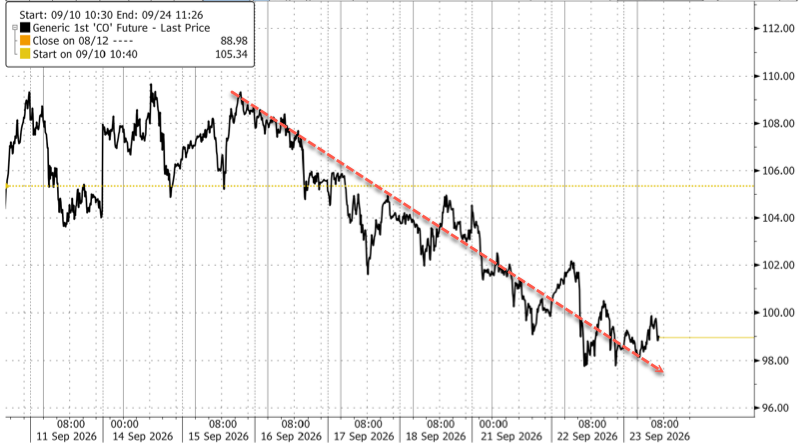
The benchmark has slipped nearly 11% since mid-month after topping out around $109.65. Reports this week of a partial restart of Saudi Arabia’s East-West pipeline and Asian buyers being slated to resume cargo loadings at Yanbu offered some relief to a tight physical market.
Full East-West pipeline repairs could take as long as two months, according to local reports. Even limited operations would ease the immediate supply squeeze.
President Trump said US officials held “very good” talks with Iranian representatives at the United Nations General Assembly in New York on Tuesday.
Special envoy Steve Witkoff and Jared Kushner participated in the three-hour talks with their Iranian counterparts on the sidelines of UNGA.
“I feel very good right now,” Witkoff said after the meeting. He wrote on X late Tuesday that the US hopes the talks “will prove constructive and promising” and the mediators will continue their work.
UBS energy specialist Dominic Ellis provided clients with a full view of what’s driving energy markets so far this week:
Brent is below $99/bbl, down about 3.8% from Tuesday’s high and down under 10% from the $109/bbl hit early last week, as evidence emerged of debottlenecking of Middle East oil exports and of diplomatic progress between the US and Iran.
Saudi Arabia said that flows via the East-West pipeline could partially restart in coming days, and that exports from the port of Yanbu would also restart soon. Full repairs to the pipeline could take up to 8 weeks according to press reports, but even a partial restart would alleviate some of the immediate tightness in oil markets.
Meanwhile, Iran acknowledged that there had been discussions with the US via intermediaries on the sidelines of the UN General Assembly in New York, and said it had shared conditions for a restart of transit via the Strait of Hormuz, which it said could happen in 7 days if conditions were met. President Trump called US talks with Iranian envoys “very good”.
Cynics will note that similar comments from the US in the recent past have not resulted in meaningful progress towards diplomatic goals, and that the US has already rejected calls for an immediate end to its blockade of Iran – one of Iran’s preconditions for an easing of restrictions on the Strait of Hormuz.
Still, the fact that talks are taking place at all is a development which cannot be ignored, and which is likely to keep downward pressure on oil prices until there is evidence that progress has stalled. On the other hand, a breakthrough in talks could push Brent back into the $80s fairly quickly.
The desk’s base case is that the US has a strong incentive to rely on the “carrot” rather than the “stick” in the period leading up to midterm elections in November.
Reports on Tuesday that President Trump has made comments supportive of a US diesel export ban (despite Interior Secretary Burgum’s statement last week that a ban would not likely have the desired effect) show he is growing concerned about elevated fuel prices in the US, and a focus on diplomacy with Iran may be the easiest way to bring oil and refined product prices down in the near term.
In the medium term, however, Iranian conditions are not likely to be acceptable to the US, and we would not be surprised at a return to the low-level conflict we’ve seen over the last month.
Crude’s retreat from triple digit territory is easing pressure at the pump, with AAA data showing the national average for regular gasoline slipping to $4.474 a gallon on Wednesday. But after a 9.3% surge this month, a modest pullback offers limited political relief for the Trump administration. Prices remain well above the politically sensitive $4 threshold, leaving the White House under pressure to turn diplomatic progress into a concrete deal.
Refer back to Goldman energy analyst Nikhil Bhandari’s Tuesday note about the prolonged refining crisis and what it means for gas and diesel prices in 2027 (read here).
END
LNG
LNG Buyers Scramble For Conflict-Free Supplies Beyond Gulf As War Rejiggers Global Energy Flows
Wednesday, Sep 23, 2026 – 06:55 AM
Since the early days of the US-Iran conflict, we have tracked the rewiring of global energy flows. That theme continues today and is accelerating as LNG buyers seek supplies and shipping routes well beyond the Gulf. Before the conflict, roughly one-fifth of global LNG trade transited through the Strait of Hormuz, concentrating risk at a single chokepoint. That vulnerability is now driving buyers to rejigger supply networks.
At last week’s Gastech annual conference and exhibition for natural gas and LNG in Bangkok, Thailand, Reuters cited energy executives, government officials, buyers, traders and investors who discussed the urgency of securing new supplies from conflict-free areas, largely because the Hormuz chokepoint has become a major liability.

Asian governments are pursuing longer-term supply security, while producers and trading houses are broadening their supply networks to include safer regions worldwide.
“A lot of governments are thinking not just diversification of the suppliers, but diversification of supply routes,” Sue-Ern Tan, the head of the International Energy Agency’s regional cooperation center in Singapore, said at Gastech.
Bangladesh, which previously relied on Qatar for most of its LNG imports, is searching for new supplies in Indonesia, Australia and China. Earlier this year, buyers including PetroChina and India’s GAIL secured replacement cargoes outside the Gulf region.
The search for alternatives could support emerging producers including Argentina, East Timor and Tanzania, broadening investment beyond the US and Qatar, which dominate LNG exports.
Thailand’s state-controlled energy group, PTT, is now exploring supplies from Oman, North America and West Africa. Its trading arm recently signed a long-term deal with Norway’s Equinor.
Also at Gastech, Shell executive Tom Summers said new capacity had largely offset the loss of 36 million metric tons of Gulf supply, leaving a net global shortfall this year of about 5 million tons, or 1% to 1.5% of supply.
Takayuki Ueda, CEO of Japanese energy firm Inpex, said that companies were focused on “portfolio resilience, portfolio diversification, diversification of supply sources, and also security for the entire supply chain.”
Paul Marsden, president of engineering firm Bechtel, expects new supplies from East Africa, including projects involving companies such as ExxonMobil.
The latest EIA figures show that US LNG exports surged, averaging 17.4 billion cubic feet per day in the first half of 2026, up 23% from a year earlier. US exporters are helping replace disrupted Gulf supplies as the waters in the Gulf of America remain calm and commercial maritime traffic remains stable.
END
OIL DATA
Oil Holds Highs After Total Crude Stocks Rose, US Production & Gasoline Demand Dipped
Wednesday, Sep 23, 2026 – 10:50 AM
Oil prices reversed initial losses (Brent back above $100) on Wednesday amid persistent Middle East supply risks, as investors weighed the prospect of improved Saudi export flows and U.S.-Iran diplomacy against the potential for further disruptions.
Saudi Arabia has begun testing its East-West pipeline for structural integrity and pressure, a step toward restoring oil flows after attacks knocked out the route earlier this month. Crude exports from the Red Sea port of Yanbu could restart within a couple of days if the tests are successful, The Wall Street Journal reported, citing people familiar with the matter.
U.S. envoy to the Middle East Steve Witkoff said in a post on X that American officials engaged in lengthy talks with the Iranian delegation through mediators on the sidelines of the United Nations General Assembly. The mediators shuttled between the two sides throughout the day and completed a round of discussions that the U.S. hopes will prove constructive and promising, he said.
Reports of fresh attacks this morning didn’t help any diplomatic optimism, but expectations (driven by last night’s API report) suggest crude stocks stabilizing while product stocks are drawing down…
API
- Crude +1.8mm
- Cushing +2.1mm
- Gasoline -2.2mm
- Distillates -2.2mm
DOE
- Crude +2.97mm
- Cushing +2.27mm
- Gasoline -1.69mm
- Distillates -428k
Cushing stocks bounced off ‘tank bottoms’ and crude inventories jumped last week while product stocks both saw modest draws…
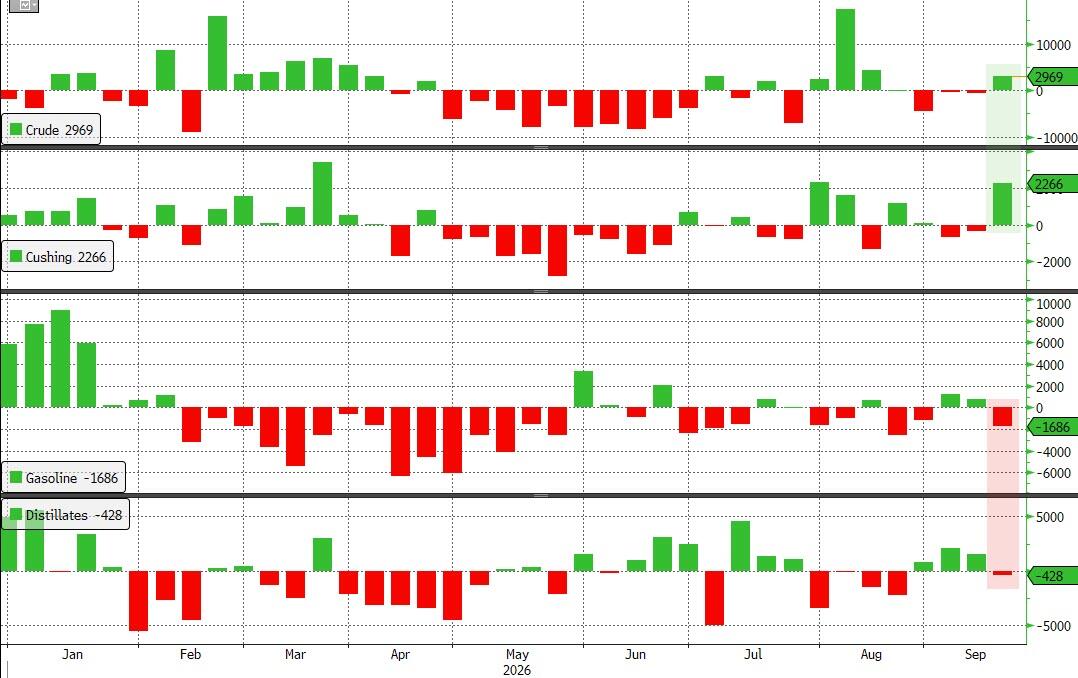
The SPR saw a very modest 405k barrel drain last week – the second tiny drain in a row since the war began. Last week’s sizable Crude build was enbough to offset the drain and create only the second weekly build in total crude stocks since early April…
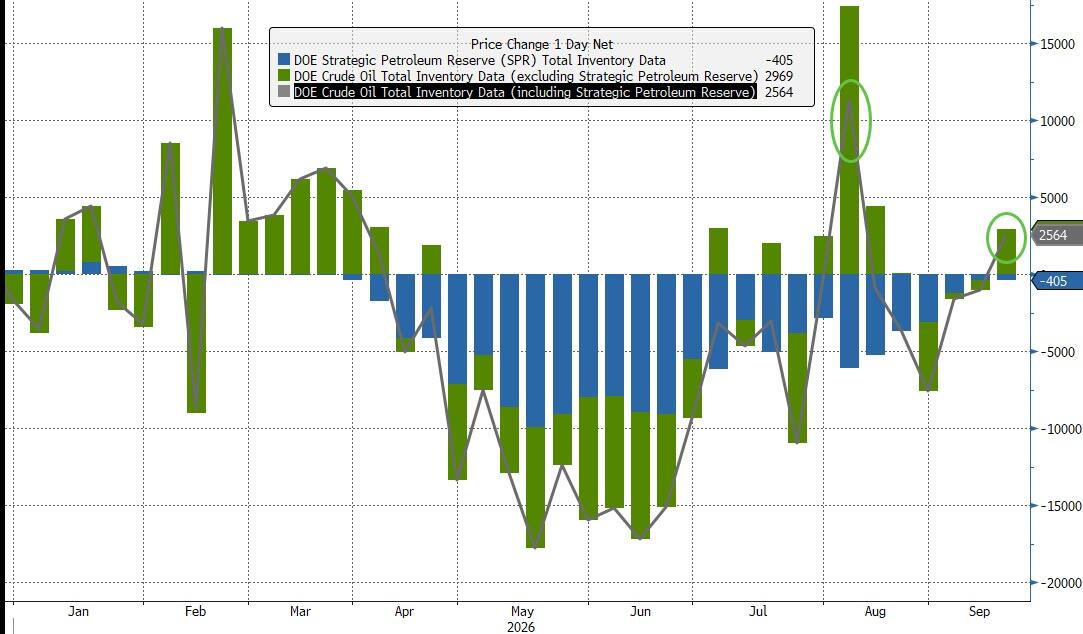
…as the caves hit ‘tank’ bottoms..
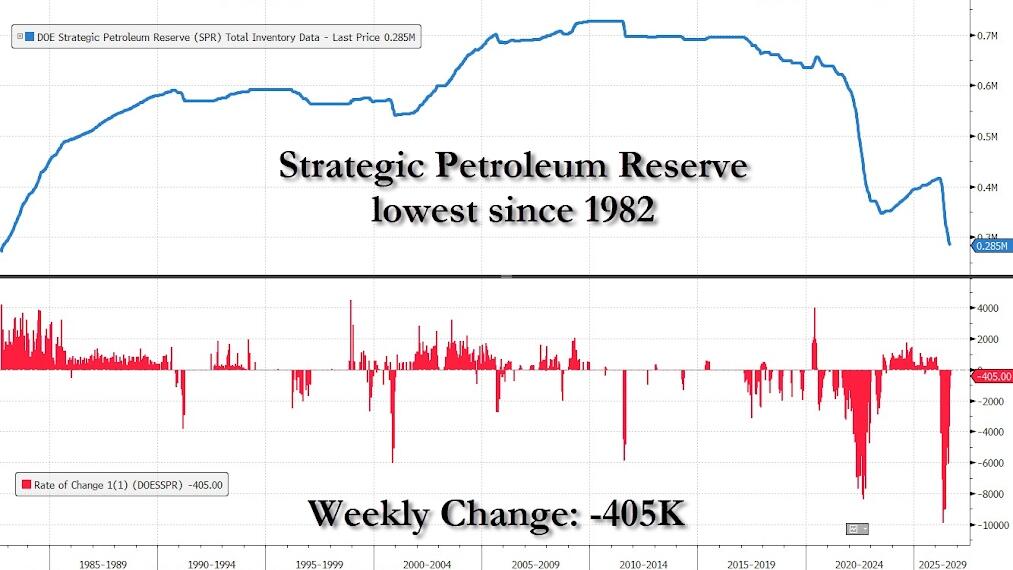
Crude production edged lower to 13.94 million barrels a day last week, down by 5,000 barrels a day from the previous week. The small drop came even as the number of rigs drilling rose for a third straight week, with another two units put into operation, according to Baker Hughes.
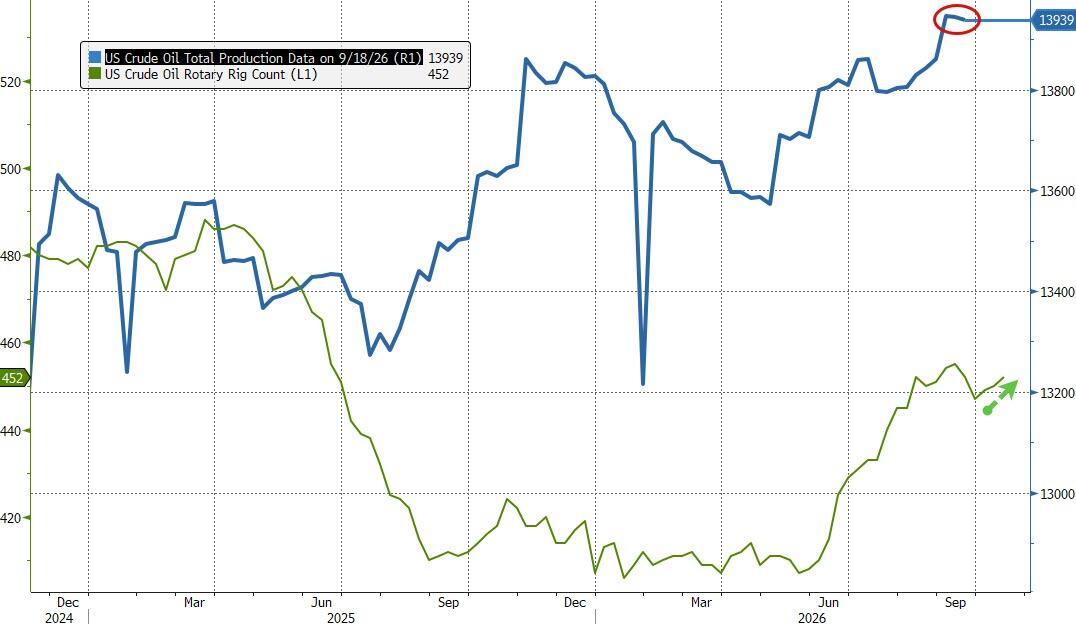
The 4-week moving average for US gasoline demand slipped by 49,000 per day for the EIA week, but remains within seasonal norms…
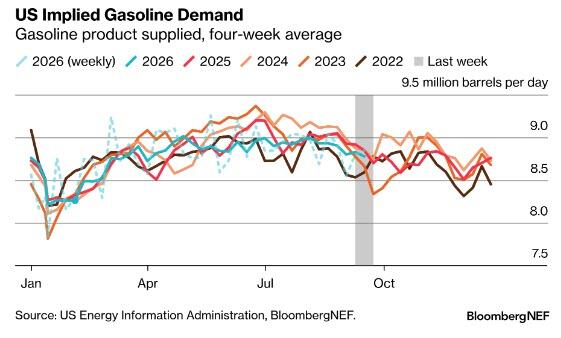
WTI was trading around $92 ahead of the official data and is maintaining those highs since…
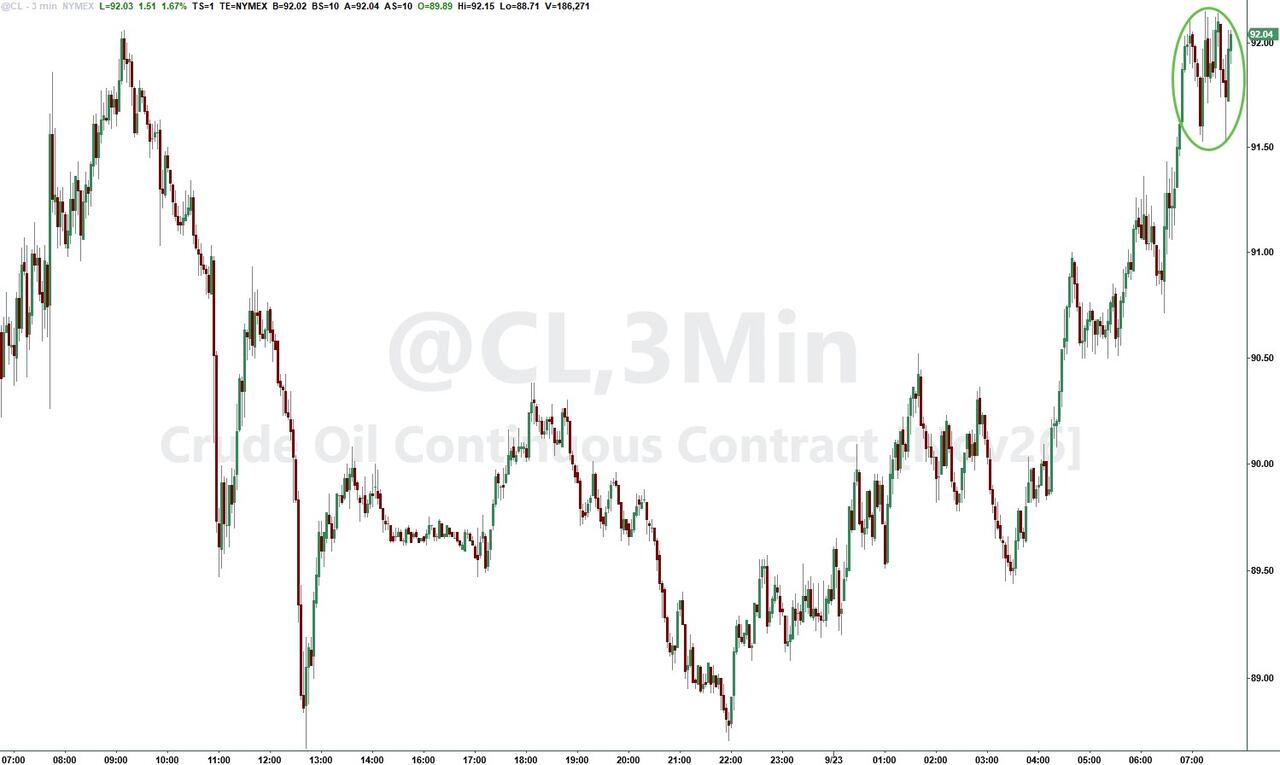
Bank of America raised its Brent forecast for the second half of the year to $95 a barrel from $83, citing the large disruption to crude and refined-product supplies.
Continued skirmishes through year-end are now its most likely scenario, while alternative routes and escorted shipments through the Strait of Hormuz have mitigated some of the shortfall, Francisco Blanch of BofA Global Research said.
Damaged infrastructure and geopolitical tensions make a rapid normalization unlikely, he added.
END
US Diesel Craters, EU Prices Skyrocket As Politico Reports White House Preparing Plan For 90-Day Export Ban
Wednesday, Sep 23, 2026 – 01:40 PM
Summary:
- New Politico Report Suggests White House Preparing For Diesel Export Ban
- “Definitely Doesn’t Work“: U.S. Energy Sec Rejects Diesel Export Ban, Risks Creating Bigger Supply-Squeeze Later
Politico Reports White House Prepares Plan For 90-Day Diesel Exports Ban
Diesel is certainly top of mind in the White House as a global refining crisis has sent prices at the pump for the industrial fuel to record-high levels, so high that Apollo’s chief economist, Torsten Slok, warned earlier that it could spark a core inflation shock.
Policy maneuvering by the White House is limited, and what has been floated by Trump and some top Republicans is a diesel export ban, while top desks on Wall Street have warned that it’s a terrible idea and could exacerbate prices around the world.
Earlier, U.S. Energy Secretary Chris Wright was at odds with Trump’s call for a diesel export ban; Wright said, “The blunt tool of banning diesel exports definitely doesn’t work.”
Around lunchtime in New York, a new Politico report said the White House was preparing a potential 90-day ban on diesel exports ahead of November’s midterm elections.
The report stated that the proposal remains under discussion, with its legal framework unresolved. Politico cited five people familiar with the talks.
“What has overpowered cooler heads [in the White House] is the absolutely, sky-is-falling, we-have-to-do-something concern about prices at the pump” faction, said this person, who was granted anonymity to discuss conversations with White House officials. “That camp has been swept aside by the political camp, which says, ‘dammit, something has to happen.'”
AAA Diesel v. Gas at pump
A White House official commented on the report, calling it “another fake news story from Politico.”
The immediate price action in the fuel markets was:
- US DIESEL FUTURES SINK MORE THAN 7% TO INTRADAY LOW
- EUROPEAN DIESEL FUTURES SURGE OVER 7% TO SESSION HIGH
Here’s what happened:
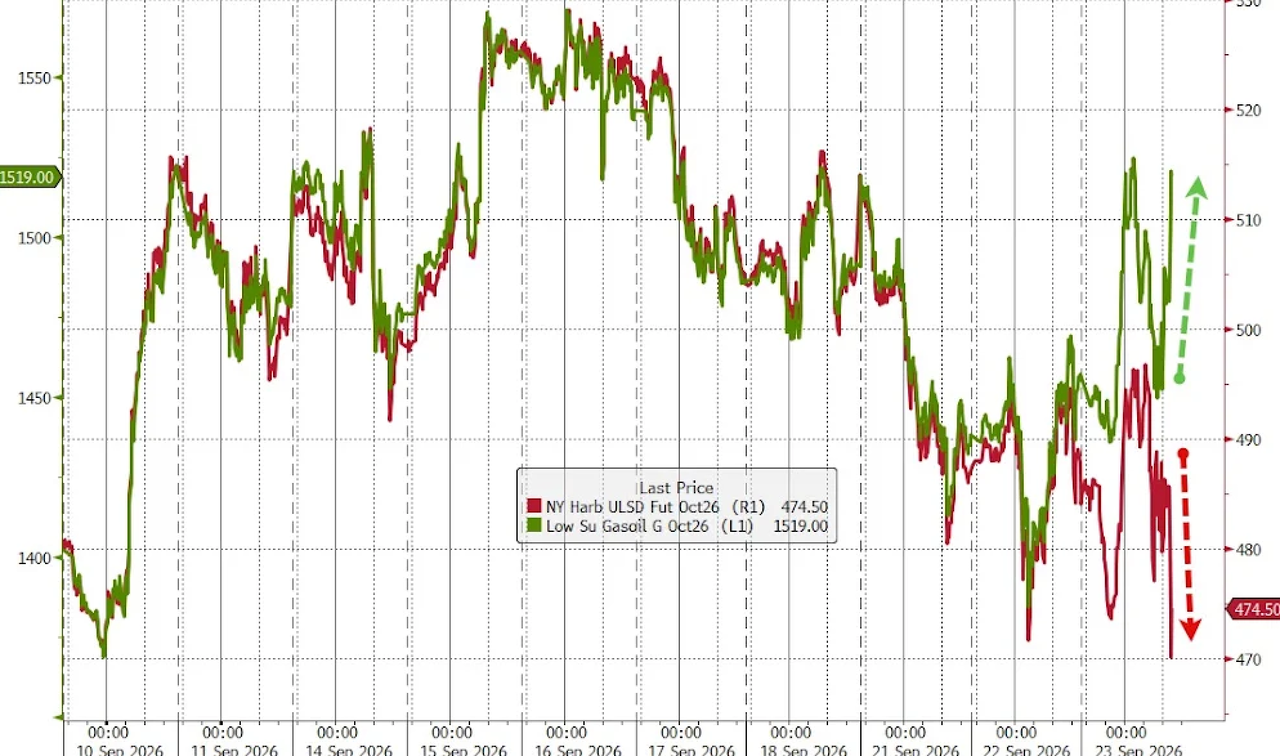
Last week, Barclays refining and midstream analyst Theresa Chen warned clients that a proposed U.S. diesel export ban would be “detrimental to the US refining complex and unlikely to provide the intended price relief.”
Chen outlined one major problem: keeping diesel inside the country does not guarantee it can reach gas pumps.

On Tuesday, Goldman Sachs energy analyst Nikhil Bhandari told clients the global refining system will be stretched through 2027, with diesel and gas prices expected to remain elevated.
The latest EIA data (2025) shows that Mexico is the largest buyer of U.S. diesel, followed by Chile, Brazil, the Netherlands, and the UK.
- Mexico: ~220,000 b/d (17% of total distillate exports). Still #1 but down ~18% from 2024. Mexico imports large volumes of U.S. refined products (gasoline and diesel) while sending heavier crude north.
- Chile: Second-largest destination; volumes rose ~15–16k b/d from 2024.
- Brazil: ~103,000 b/d (third). This is well below earlier peaks near 200k b/d; Brazil has taken more discounted Russian barrels since 2022 sanctions redirected Russian diesel away from Europe.
- Netherlands: ~98,000 b/d (major European trading hub/re-export point).
- United Kingdom: ~89,000 b/d (record annual average).
A case of resource nationalism? Or is the Politico report “another fake news story,” as a White House source cited in the report suggests?
“Definitely Doesn’t Work”: U.S. Energy Sec Rejects Diesel Export Ban, Risks Creating Bigger Supply-Squeeze Later
President Trump will not be pleased…
U.S. Energy Secretary Chris Wright has publicly opposed calls for a ban on U.S. diesel exports, arguing on Wednesday that the measure would backfire by increasing gasoline and jet fuel prices.
“The blunt tool of banning diesel exports definitely doesn’t work,” Wright said at an event in New York, as reported by Reuters.
Wright said restricting exports would leave refiners with excess diesel inventories, forcing them to cut refinery output.
Lower refinery runs, he warned, would tighten supplies of other fuels, ultimately driving up costs for consumers and businesses.
His comments put him at odds with President Trump, who signaled support for the idea on Tuesday as diesel prices surge to record highs in the U.S. and Europe (and Treasury Secretary Bessent has been assigned to see “if it’s feasible.”
Trump’s comments already sent European pries for the fuel surging.
With flows from the region’s top supplier at risk, Bloomberg reports that European diesel’s premium to Brent crude jumped to more than $95 a barrel on Wednesday, a record in Bloomberg data going back to 2011.
Known as crack spread, the indicator has been keenly watched by central bankers as they seek to tame inflation. The equivalent measure in the U.S., meanwhile, weakened.
Trump’s threat comes as Europe is already grappling with the loss of diesel shipments from the Middle East, and Russian export curbs have tightened the global fuel market further. The US has become Europe’s main overseas supplier, with American exports of the workhorse fuel surging to a weekly record near 2 million barrels a day last month.
A key U.S. oil industry group cautioned against the move, saying it could lower American fuel production and damage the global economy.
Of the 8 million barrels of diesel traded globally by sea each day, the U.S. supplies about 1.5 million of them – about 20%. An export ban would remove the single largest source of global diesel from the market, and the consequences could be catastrophic.
“Restricting exports is not a solution to high prices,” the American Petroleum Institute says.
“Removing US diesel from the market could instead result in reduced refinery runs, global economic damage and even higher US prices.”
Indeed, as Bloomberg macro strategist, Michael Ball, write this morning,while The White House may be able to engineer a brief drop in U.S. diesel prices by limiting exports, it risks creating a bigger supply problem down the road.
With distillate stocks at seasonally record lows…
…the appeal is obvious with U.S. diesel above $6.50 a gallon…
But a broad curb could strand as much as 1.5 million barrels a day, roughly 29% of U.S. diesel output.
If enacted, Ball writes, the effects would be uneven across the U.S.
A surplus would build on the Gulf Coast, while pipeline, shipping and fuel-specification constraints limit how easily those barrels can reach tighter East and West Coast markets.
Bloomberg Intelligence estimates Gulf Coast storage could only absorb about three weeks of net diesel exports before constraints bite.
The global impact would be worse.
Kpler argues there is no real replacement for U.S. export volumes, leaving Latin America and Northwest Europe particularly exposed and increasing competition for Indian barrels.
China could compound the squeeze as domestic inventories fall and the risk of renewed export curbs rises.
The response from refiners would create a negative feedback loop.
If trapped barrels crush margins, refiners are incentivized to cut runs and undertake maintenance.
S&P Global Energy estimates crude runs might need to fall by nearly 2 million barrels a day – more than 10% of the current production level – to clear the surplus.
That is the asymmetry: lower U.S. diesel prices first, tighter global product markets follow, and potentially less U.S. fuel supply later.
The more aggressive the restriction, the greater the risk that today’s price relief becomes tomorrow’s supply problem.
END
8. EMERGING MARKETS//AUSTRALIA NEW ZEALAND ISSUES
INDIA/RUSSIA/USA
The West Might Soon Ramp Up Its Pressure On India To Distance Itself From Russia
Tuesday, Sep 22, 2026 – 08:55 PM
Authored by Andrew Korybko via Substack,
The US and France seem to be coordinating a concerted pressure operation against India…

Popular Russian outlet Izvestia raised awareness of a paywalled Bloomberg report alleging that India might reduce its import of Russian oil, which was 45% of its total last month, to avoid US tariffs of up to 100% after Trump recently signed into law a bill empowering him to punish Russia’s top energy partners. Earlier in September, “India’s Top Diplomat Signaled That It’ll Defy Any New US Pressure Over Its Russian Oil Purchases“, which are considered to be indirectly essential to its national security.
Such pressure might soon pile up too, however, as suggested by more than just the aforesaid punitive tariff bill’s passing. The US and China are negotiating an extension to their trade war truce ahead of Xi’s visit later this week. The current disagreements primarily concern its duration according to the Financial Times. In the event that any such extension is ultimately agreed to, then the US presumably won’t impose punitive tariffs on China for its Russian oil purchases, which would draw attention to India’s.
Although the US benefits from India’s Russo-American balancing act since the strategic benefits that India derives most effectively empower it to serve as a counterweight of sorts to China, Trump 2.0 might nevertheless become “geopolitically greedy” and want the US to become India’s senior partner. In that scenario, the threat of punitive tariffs over its Russian oil imports could be leveraged as a Damocles’ sword to pressure India into gradually reducing them in parallel with joining the West’s Hormuz coalition.
About that, the French Foreign Minister proposed jointly working with India on ensuring “freedom of navigation in the Strait of Hormuz and the Bab el-Mandeb Strait” during talks with his counterpart on the sidelines of the UNGA. This coincided with the French and US presidents agreeing to work on the Hormuz dimension according to Emmanuel Macron’s tweet after his talks with Trump. India’s potential participation in the West’s Hormuz coalition, albeit under tariff duress if it happens, would be significant.
For starters, it would signify that the US decided to pressure India over its Russian oil imports while turning a blind eye to China’s for the duration of their likely extended trade war truce, thus suggesting that the US is more comfortable bullying India on this issue than China.
Second, India’s participation would confirm that such tariff-related pressure was successfully weaponized by the US,
…with the third significance being that India joined the coalition in order to unlock alternative oil supplies to Russia’s.
Fourth, Russian policymakers would notice the US’ successful policy of coercing India through tariffs-related pressure into distancing itself from their country, which could lead to them concluding that it’s incapable of functioning as a reliable counterbalance to China.
The implication is that Russia might tighten its embrace of China with all that could entail for ties with India. And finally, India’s association with a Western naval coalition could harm its hard-earned neutral reputation in the Global South’s eyes.
France’s involvement in coordinating what seems to be a concerted pressure campaign by the US against India is notable since it’s now India’s second-largest arms partner and has been eroding Russia’s market share over the past decade. It therefore can’t be ruled out that the US might threaten more CAATSA sanctions against India if its threatened tariffs are successful in order to accelerate the aforesaid trend. India’s participation in the West’s Hormuz coalition might thus bode ill for its future ties with Russia.
END
U.S./GOLD AND SILVER PRICING/ASIAN CLOSING MARKETS AND EUROPEAN BOURSE OPENING AND CLOSING/ INTEREST RATE SETTINGS WEDNESDAY MORNING 6;30AM//OPENING AND CLOSING\
OPENING LEVELS OF CURRENCIES// AND CLOSING ASIAN STOCK MARKET AND OPENING EUROPEAN STOCKS:6 AM EST
EURO VS USA DOLLAR: 1.1421 DOWN 0.0027
USA/ YEN157.82 UP 0.360 NOW TARGETS INTEREST RATE AT 1.75% AS IT WILL BUY UNLIMITED BONDS TO GETS TO THAT LEVEL…//YEN STILL FALLS//END OF YEN CARRY TRADE BEGINS AGAIN DEC 2024/Bank of Japan raises rates by .25% TO 1.75 ..TAKAICHI NEW PM AS YIELDS RISE//JAPAN DEEPLY IN TROUBLE WITH RISING RATES AND A FALLING YEN!! BANK OF JAPAN WILL NO LONGER DO QE. URGES PENSION AND INSUANCE FUNDS TO BUY JAPANESE BONDS//
YEN CARRY TRADERS MURDERED
GBP/USA1.3307 DOWN 0.0037 OR 37 BASIS PTS
USA/CANDOLLAR: 1.4079 UP 0.0013 //CDN DOLLAR DOWN 13 BASIS PTS//
Last night Shanghai COMPOSITE CLOSED DOWN 15.61 PTS OR 0.39%
Hang Seng CLOSED DOWN 253.63 PTS OR 1.01%
AUSTRALIA CLOSED DOWN 0.37%
// EUROPEAN BOURSE: ALL MIXED
Trading from Europe and ASIA
I) EUROPEAN BOURSES: ALL MIXED
2/ CHINESE BOURSES / :Hang SENG CLOSED DOWN 253.63 PTS OR 1.01%
/SHANGHAI CLOSED DOWN 15.61 PTS OR 0.39%
AUSTRALIA BOURSE CLOSED DOWN 0.37%
(Nikkei (Japan) CLOSED HOLIDAY
INDIA’S SENSEX IN THE GREEN
Gold very early morning trading: $4316.75
silver:$65.42
USA DOLLAR VS TRY (TURKISH LIRA): 48.84 UP 2 BASIS PTS AND NOW WE SEE THEIR STUPIDITY OF SELLING SOME OF THEIR GOLD AND ALL OF THEIR USA DOLLAR RESERVES. THE COUNTRY IS IN BIG FINANCIAL TROUBLE
USA DOLLAR VS RUSSIAN ROUBLE: 84.33 ROUBLE// UP 0 ROUBLE AND 8 BASIS PTS.
UK 10 YR BOND YIELD: 5.2305 DOWN 1 BASIS PTS
UK 30 YR BOND YIELD: 5.7312 DOWN 1 BASIS PTS
CDN 10 YR BOND YIELD: 3.830 DOWN 2 BASIS PTS
CDN 5 YR BOND YIELD; 3.550 DOWN 2 BASIS PTS
USA dollar index early WEDNESDAY MORNING: 100.50 UP 18 BASIS POINTS FROM TUESDAY’s CLOSE
WEDNESDAY MORNING NUMBERS ENDS
And now your closing WEDNESDAY NUMBERS 10.00 AM
Portuguese 10 year bond yield: 3.891% UP 6 in basis point(s) yield
JAPANESE BOND 10 yr YIELD: +2.984% DOWN 0 FULL POINTS BASIS POINTS /JAPAN losing control of its yield curve/
JAPAN 30 YR: 4.078 DOWN 0 BASIS PTS//
SPANISH 10 YR BOND YIELD: 3.973 UP 6 in basis points yield
ITALY 10 YR BOND: 4.454 UP 10 points in basis points yield ./
GERMAN 10 YR BOND YIELD: 3.5235 UP 7 BASIS PTS
IMPORTANT CURRENCY CLOSES : MID DAY WEDNESDAY
Closing currency crosses for day /USA DOLLAR INDEX/USA 10 YR BOND YIELD/10:00 AM
Euro/USA 1.1396 DOWN 0.0053 OR 53 basis points
USA/Japan: 158.15 UP 0.693 OR YEN IS DOWN 70 BASIS PTS// HIGHLY INFLATIONARY TO JAPAN
Great Britain 10 YR RATE 5.3144 UP 7 BASIS POINTS //
GREAT BRITAIN 30 YR BOND; 5.8044 UP 6 BASIS POINTS.
CANADIAN DOLLAR DOWN 26 BASIS PTS TO 1.40921
xxxxxxxxxxxxxxxxxxxxxxxxxxxxxxxxxxxxxxxxxxxxxxxxxxxxxxxxxxxxxxxxxxxxxxxxxxxxxxxx
The USA/Yuan CNY 6.7103 ON SHORE ..DOWN
THE USA/YUAN OFFSHORE// CNH DOWN TO 6.7110
TURKISH LIRA: 48.85 UP 3 EXTREMELY DANGEROUS LEVEL/DEATH WATCH/HYPERINFLATION TO BEGIN.//
Your closing 10 yr US bond yield UP 9 in basis points from TUESDAY at 5.040% //trading well ABOVE the resistance level of 2.27-2.32%)
USA 30 yr bond yield 5.345 UP 5 basis points /10:00 AM
USA 2 YR BOND YIELD: 4.833 UP 6 BASIS PTS.
GOLD AT 10;00 AM $4284.65
SILVER AT 10;00: $64.444
Your 11:00 AM bourses for Europe and the Dow along with the USA dollar index closing and interest ratesWEDNESDAY
DAY CLOSING TIME/ 12:00 AM///
London: CLOSED DOWN 3.07 PTS OR 0.03%
GERMAN DAX: CLOSED DOWN 168.22 PTS OR 0.66%
FRANCE: DOWN 31.50 OR 0.30 PTS
Spain IBEX CLOSED DOWN 121.90 PTS OR 0.62%
Italian MIB: CLOSED DOWN 104.34PTS OR 0.21%
WTI Oil price 91/58 10.00 EST/
Brent Oil: 101.42 10:00 EST
USA /RUSSIAN ROUBLE: 84.55/// ROUBLE DOWN 0 AND 31/ 100
CDN 10 YEAR RATE: 3.890 UP 6 BASIS PTS.
CDN 5 YEAR RATE: 3.610 UP 6 BASIS PTS
CLOSING NUMBERS: 4 PM//
Euro vs USA 1.1385 DOWN 0.0063 OR 63 BASIS POINTS//
British Pound: 1.3241 DOWN 0.0102 OR 102 basis pts/
BRITISH 10 YR GILT BOND YIELD: 5.3697 UP 13 FULL BASIS PTS//
BRITISH 30 YR BOND YIELD: 5.8483 UP 11 IN BASIS PTS.
JAPAN 10 YR YIELD: 2.984 DOWN 0 FULL BASIS PTS (DANGEROUS TO THEIR ECONOMY
JAPANESE 30 YR BOND: 4.078 UP 0 PTS AND STILL VERY DANGEROUS TO THEIR ECONOMY
USA dollar vs Japanese Yen: 158.31 UP 0.854 OR YEN DOWN 85 BASIS PTS//GETTING FURTHER AWAY FROM 160.00/ EXTREMELY DANGEROUS
USA dollar vs Canadian dollar: 1.4096 UP 0.0031 PTS// CDN DOLLAR DOWN 31 BASIS PTS
West Texas intermediate oil: 92.34
Brent OIL: 103.36
USA 10 yr bond yield UP 17 BASIS pts to 5.117
USA 30 yr bond yield: UP 0 PTS to 5.400%
USA 2 YR BOND 4.897 UP 12 PTS
CDN 10 YR RATE 3.963 UP 13 BASIS PTS
CDN 5 YEAR RATE: 3.692 UP 14 BASIS PTS
USA dollar index: 100.83 UP 50 BASIS POINTS
USA DOLLAR VS TURKISH LIRA: 48.83 UP 2 BASIS PTS GETTING QUITE CLOSE TO BLOWING UP/IDIOTS SOLD GOLD
USA DOLLAR VS RUSSIA//// ROUBLE: 84.55 DOWN 0 AND31/100 roubles //
GOLD $4,285.10 3:30 PM)
SILVER: 64.40 3;30 PM)
DOW JONES INDUSTRIAL AVERAGE: DOWN 351.27 POINTS OR 0.68%
NASDAQ 100 DOWN 262.10 PTS OR 0.85%
VOLATILITY INDEX 15.23 DOWN 1.02 PTS OR 7.18%
GLD: $ 392.76 DOWN 7.31 PTS OR 1.83%
SLV/ 58.16 PTS DOWN 2.57 OR 4.23%
TORONTO STOCK INDEX// TSX INDEX: CLOSED DOWN 542.86 PTS OR 1.50%
end
TRADING today ZEROHEDGE 4 PM: HEADLINE NEWS/TRADING
Better Data & Energy Angst Spark Bond Bloodbath; Dollar Jumps, Stocks Dump
WRAP UP:
Bond yields rally, weighing on stocks amid a plethora of factors – Newsquawk US Market Wrap
Wednesday, Sep 23, 2026 – 04:09 PM
- SNAPSHOT: Equities down, Treasuries down, Crude up, Dollar up, Gold down
- REAR VIEW: Energy Secretary Wright opposes blanket diesel export ban; Mixed reporting on whether US will go ahead with a temporary diesel export ban; Hotter-than-expected S&P Global Flash PMI; 2nd largest 5yr tail in history; Senior Iranian official reportedly says diplomacy with the US continues, however many differences remain; Fed’s Barr says further rate hikes are likely needed to ensure a timely return to the 2% inflation target; BHP suspends operations at Escondida mine after an accident.
- COMING UP: Data: Japanese S&P PMIs Flash (Sep), Australian Jobs Report (Aug), German IFO (Sep), US Initial Jobless Claims (Sep/19). Events: Chinese President Xi’s state visit to the US, Riksbank Policy Announcement, SNB Policy Announcement, Norges Bank Policy Announcement, Banxico Policy Announcement. Speakers: ECB’s Schnabel, Lane; Fed’s Williams, Barkin, Hammack, Paulson; BoE’s Dhingra, Breeden, Lombardelli; SNB’s Schlegel; Riksbank’s Thedeen; Norges Bank’s Bache. Supply: Italy, US.
More Newsquawk in 2 steps:
- 1. Subscribe to the free premarket movers reports
- 2. Trial Newsquawk’s premium real-time audio news squawk box for 7 days
MARKET WRAP
Stocks were sold on Wednesday as global yields surged. The RUT was the clear underperformer, while the SPX, NDX and DJI were all lower, with the equal-weight S&P (RSP) down 0.7%. Sectors were predominantly lower, with Utilities, Communication Services and Consumer Discretionary lagging, while Energy and Industrials outperformed. Semis and memory names were hit, likely reflecting some reversal of the recent Muse-induced strength following Tuesday’s releases of GPT Astra 6 and Claude Opus 5.5, while Chinese AI firms were pressured overnight following probes into Moonshot and DeepSeek.
The weakness in stocks coincided with a global bond sell-off, with UST yields surging across the curve, particularly at the front end, as participants digested strong and inflationary US Flash PMI data, rising oil prices, further hawkish Fed speak, a very weak 5-year auction and reports surrounding a potential US diesel export ban.
Politico reported that the Trump administration was considering a 90-day ban on diesel exports. The report briefly weighed on diesel prices but raised concerns that such a move could push gasoline prices higher, adding to already elevated inflation concerns. However, a White House official later denied the report, calling it “fake news”. Energy Secretary Wright also appears opposed to an outright export ban, although he has indicated support for voluntary limits on diesel exports.
The Dollar was stronger amid the hawkish Fed speak and robust PMI data, while also finding support from weakness in energy-importing currencies. Concerns that restrictions on US diesel exports could particularly impact economies reliant on imported energy weighed on the Antipodeans, Yen and Pound.
Crude prices settled higher as Iran downplayed Tuesday’s talks with the US, while further incidents were reported in the Strait of Hormuz and Iran continued to demand that its conditions be met before reopening the Strait. However, a senior Iranian official reportedly said Tehran is reviewing the US response to its proposal to end hostilities. Meanwhile, mixed reporting surrounding a potential US diesel export ban contributed to choppy trade. Attention turns to the Trump/Xi meeting tomorrow.
US
S&P GLOBAL FLASH PMI SEP: The report was strongly better-than-expected, with Manufacturing rising to 57.0, above the expected 53.6 (prev. 53.9). Services rose to 58.7 from 56.5 (exp. 56.0), leaving the Composite at 58.4 from 56, a new five-year high. Growth was driven by the service sectors, with its steepest rise in output in over five years. Employment also rose sharply, at a pace not seen for over four years; meanwhile, backlogs of work accelerated and supply chain delays worsened. Of concern, average input costs measured across both goods and services surged higher, hitting the highest since October 2022, blamed widely on higher fuel and transport costs, though wage pressures were also noted to have picked up in many cases. Pantheon Economics wrote that the composite PMI Q3 average reading is consistent with “real final sales to private domestic purchasers—a measure of ‘core’ GDP—rising at an annualised pace of around 4% this quarter”.
FED’s BARR (Voter): Said further rate hikes are likely needed to ensure a timely return to the 2% inflation target. He added that inflation is not clearly trending towards the 2% target in a timely way, with economic growth strong and the labour market solid. Barr noted that the Fed was out of position and made an adjustment in the right direction to reflect risks. Lastly, the Governor said risks to achieving 2% inflation have increased, while risks to the labour market have receded.
FIXED INCOME
T-NOTE FUTURES SETTLED 31 TICKS LOWER AT 105-01
Yields rally after hawkish PMI data, Fed speak and a woeful 5-year auction while global bonds hit by potential US diesel export ban. At settlement, 2-year +15.0bps at 4.897%, 3-year +16.0bps at 4.970%, 5-year +17.0bps at 4.997%, 7-year +16.7bps at 5.051%, 10-year +15.3bps at 5.108%, 20-year +12.6bps at 5.459%, 30-year +10.3bps at 5.398%.
THE DAY: The Treasury market crumbled on Wednesday, with yields surging across the curve and some maturities rising around 20bps at the peak of the move. There were several drivers behind the price action.
From the US, the S&P Global Flash PMI data was strong across the board, with Manufacturing rising to 57.0 from 53.9, above the 53.6 forecast, while Services rose to 58.7 from 56.5, above the 56.0 forecast, taking the Composite to 58.4 from 56.0. Importantly for the rates market, the report noted that input costs surged on the back of higher energy prices, with firms’ input costs rising at the steepest rate for four years, adding further upward pressure on selling prices and inflation in the coming months.
Hawkish Fed speak continued, with Fed Governor Barr noting that further rate hikes are likely needed to ensure a timely return to the 2% inflation target. Barr said inflation is not trending towards target in a timely manner, while economic growth remains strong and the labour market is solid.
The 5-year auction was very weak. The sizeable 3.1bp tail — the second-largest on record — weak bid-to-cover, sharp deterioration in indirect demand and elevated dealer allocation pointed to a very poor reception. Direct demand was strong, but was nowhere near enough to offset the weakness elsewhere. Most notably, the auction struggled despite offering a substantial increase in outright yield versus August, suggesting the significant cheapening was insufficient to entice broader end-user demand.
There was also mixed reporting regarding a potential US diesel export ban after Trump said on Tuesday that the administration was examining the idea. Fears of a diesel export ban likely added to pressure on bonds. While restricting exports could lower domestic diesel prices, it could also push US gasoline prices higher, while removing diesel supply from global markets could raise fuel prices abroad, adding to broader inflation concerns. Global bonds were also heavily sold amid the developments, likely adding to the pressure on Treasuries.
The combination of strong and inflationary PMI data, hawkish Fed speak, concerns surrounding a potential diesel export ban and a very weak 5-year auction created a potent mix for Treasuries to tumble on Wednesday. However, T-notes pared some of their losses after a White House official denied a Politico report that the US was considering a 90-day diesel export ban. At the extremes of the move, the entire curve aside from the 2-year traded above 5%, with the 2-year reaching around 4.94%.
The Treasury also announced a maximum size of USD 6bln for Thursday’s 20-30yr bond buyback operation, matching the 10-20yr sector and in line with expectations from analysts at Wrightson. The announcement had little impact on price action.
Supply
Notes
- US sold USD 70bln of 5yr notes: Tail 3.1bps
- US sold USD 28bln of 2-year FRNs; met with weak demand.
- US to sell USD 44bln of 7yr notes on September 24th.
Bills
- US sold 17-week bills at a high rate of 4.135%, B/C 2.81x
- US to sell USD 90bln of 4-week bills and USD 84bln of 8-week bills on Sept 24th
STIRS / OPERATIONS
- Fed Hike Pricing via CME FedWatch: Oct 17.7bps (prev. 13.9bps), Dec 37.1bps (prev. 33bps).
- EFFR at 3.88% (prev. 3.88%), volumes at USD 103bln (prev. USD 95bln) on September 22nd
- SOFR at 3.87% (prev. 3.85%), volumes at USD 2.94tln (prev. USD 2.912tln) on September 22nd
- NY Fed RRP op demand at 0.46bln (prev. 0.45bln) across 4 counterparties (prev. 8) on September 23rd
CRUDE
WTI (X6) SETTLED USD 1.64 HIGHER AT USD 92.16/BBL; BRENT (Z6) SETTLED USD 2.71 HIGHER AT 98.12/BBL
Crude prices settled higher as substantial progress between the US and Iran remains absent despite further news out of the US pointing towards a positive meeting between the US and Iran. A senior Iranian official speaking to Reuters noted many differences remain, though diplomacy continues. The Iranian President spoke at the UNGA; however, market moves were small through the speech, which was devoid of escalatory or de-escalatory remarks.
The main updates regarded a potential diesel export ban. Net-net, the US Energy Secretary Wright opposed a blanket ban on diesel exports, but is opting for a voluntary cap. Later, Politico reported that the Trump admin is nonetheless preparing a plan to ban exports of diesel for 90 days; however, this was later rejected by a White House official speaking to Reuters. Diesel prices were choppy throughout the constant contradictory headlines, ultimately settling 0.2% lower on Z6.
The weekly EIA report was met with a muted reaction. Commercial crude stocks showed a 2.969mln build, bigger than the 1.8mln build in last night’s private inventory report. The SPR drew by 0.405mln. Gasoline Stocks drew 1.686mln vs. (exp. 0.1mln) and Distillate Stocks drew 0.428mln vs. (exp. -0.6mln). Crude production was little changed at 13.94mln (prev. 13.944mln).
EQUITIES
CLOSES: SPX -0.75% at 7,706, NDX -0.85% at 30,470, DJI -0.68% at 51,517, RUT -1.77% at 2,839
SECTORS: Communication services -1.89%, Utilities -1.88%, Consumer discretionary -1.63%, Real estate -1.48%, Technology -0.66%, Health -0.65%, Materials -0.65%, Financials -0.44%, Consumer staples -0.17%, Industrials -0.11%, Energy +1.04%.
EUROPEAN CLOSES: Euro Stoxx 50 -0.38% at 6,301, Dax 40 -0.59% at 25,427, FTSE 100 -0.03% at 10,705, CAC 40 -0.39% at 8,123, FTSE MIB -0.21% at 51,987, IBEX 35 -0.62% at 19,632, PSI -0.25% at 9,632, SMI -0.23% at 13,922, AEX -0.27% at 1,108
STOCK SPECIFICS
- Chips (INTC, AMD, ARM): All lower in pre-market, adding to downside from late Tuesday after OpenAI announced Astra 6; all three were beneficiaries of Meta’s Muse. SOXX lower in pre-market trade
- Microsoft (MSFT): Plans to increase Copilot discounts as it launches an AI ‘super app’, according to The Information; separately upgraded at Stifel
- Alibaba Group (BABA): Chinese AI stocks fell after a report that regulators opened a data security probe into DeepSeek and Moonshot AI
- Cedar Fair (FUN): Activist investor Jana Partners is urging Six Flags Entertainment to hire banks and explore a sale, according to WSJ
- KB Home (KBH): Reported weaker housing demand, lower deliveries and orders, and softer housing conditions, which outweighed an earnings beat
- General Mills (GIS): Inflation concerns offsetting earnings beat
- Marathon Petroleum (MPC): Paring some of Tuesday’s losses after Trump said he is considering a diesel export ban; WSJ reports Trump’s support for the ban was seen to ‘blindside’ industry officials
- GE HealthCare Technologies (GEHC): Raised quarterly dividend 14% to USD 0.04/shr
- Immunovant (IMVT): Study of IMVT-1402 in cutaneous lupus erythematosus did not achieve statistical significance on the primary endpoint
- Paychex (PAYX): Missed Q1 revenue estimates at its largest segment, management solutions.
- Cintas (CTAS): Top- and bottom-line beat; also raised guidance in line with forecasts.
- Disney+ (DIS) to lift price by 13% to USD 21.49 per month, sources suggest.
- Paramount (PSKY) weighs tapping Musk for equity investment, Semafor reports.
- McDonald’s (MCD) shares fell to four-year lows after the company said US business was expected to be slightly negative in Q3. The company plans about USD 8.5bln in franchisee support through 2036, alongside increased investment in employee training, equipment and technology.
- Anthropic’s biolab reportedly made a discovery it is comparing to CRISPR (CRSP), reports The Verge.
FX
The dollar was firmer today, supported by sharp rises in global yields, stronger-than-expected US data, and growing economic pressure for Europe and APAC FX if the US goes ahead with a US diesel export ban. Additionally, further Fed speak pointed towards another hike, with Governor Barr noting that further rate hikes are likely needed to ensure a timely return to the 2% inflation target.
Concerning data, S&P Global Flash PMI for September was notably better than expected, with the composite index hitting a new five-year high, driven by a surge in business growth and acceleration in job gains; however, input costs saw their steepest increase in four years. US yields marched higher on the report, briefly extending on a poor US 5yr note auction that was met with the second-largest tail on record.
Ahead, focus will remain on the diesel situation, in which Energy Secretary Wright has opposed a blanket ban on diesel exports, opting for a voluntary cap. Thereafter, reporting was mixed on whether the admin would go ahead. Additionally, Trump is set to meet with Xi on Thursday. Recent remarks from both sides suggest AI has been one of the main talking points. DXY hit highs of 101.231 alongside a new YTD high in US 2yr yields of 4.945% as money markets place a ~70% chance of another 25bps rate hike at the Fed’s October meeting.
G10 FX and EMs were all weighed by their own domestic concerns amid rising yields and likely greater downside risks to respective economies if the US goes ahead with a diesel export ban. Amongst the worst performers were those heavily reliant on energy imports (AUD, NZD, GBP, JPY). EUR was still pressured despite French and German PMI metrics showcasing a resilient European economy, despite the Iran war.
USA DATA RELEASE
10 YR SPIKES AFTER BLOWOUT BEATS FOR THE PMIs
10Y Yield Spikes Above 5.00% After Blowout Beats For US PMIs
Wednesday, Sep 23, 2026 – 09:55 AM
With ‘hard’ economic data still somewhat muted, expectations were for a modest retracement in US PMIs from recently optimistic levels in preliminary September data.
Instead, the ‘soft’ survey data soared:
- Flash US Services PMI Business Activity Index: 58.7 vs 55.8 exp (August: 56.5). 59-month high.
- Flash US Manufacturing PMI: 57.0 vs 53.7 exp (August: 53.9). 52-month high.
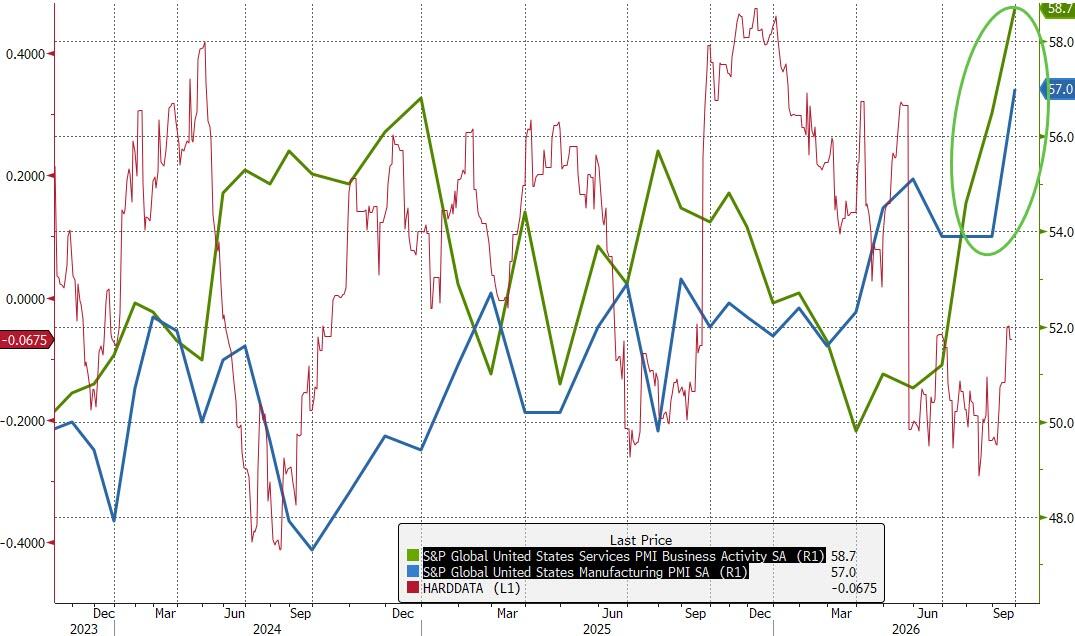
The headline flash S&P Global US PMI Composite Output Index rose from 56.0 in August to 58.4 in September, registering the fastest expansion since July 2021 and an acceleration of growth for a fourth successive month.
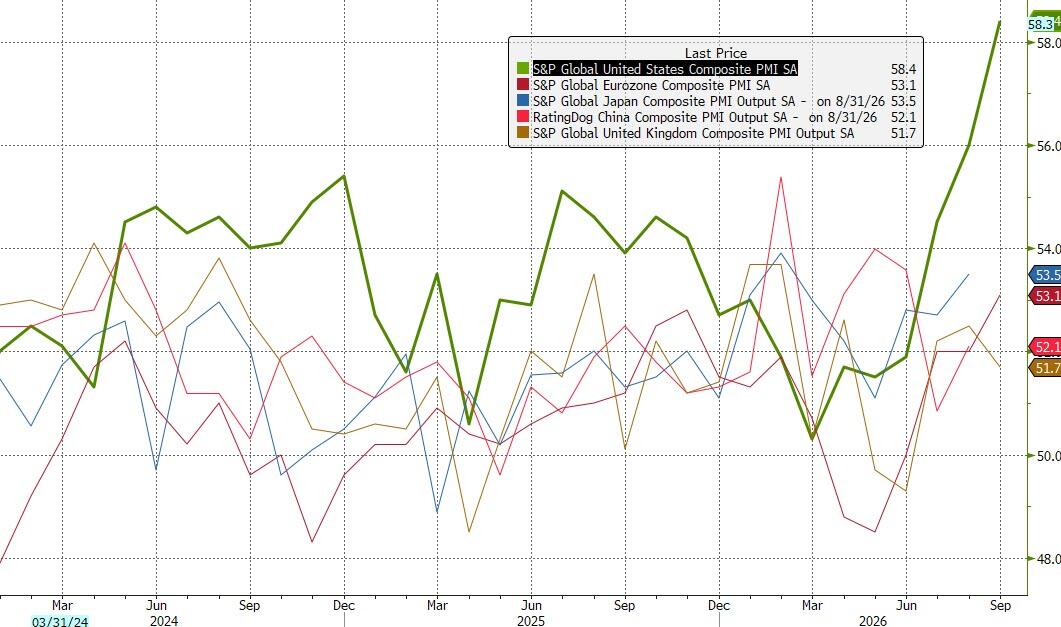
Growth was driven by the service sector, which reported the steepest rise in output for over five years, but a welcome development in September was an accompanying acceleration of manufacturing output growth to the fastest since April 2022. New order inflows also gathered pace in both sectors, with growth reaching the highest since March 2022 in the service sector and the highest since April 2022 in manufacturing. In both cases, demand was buoyed principally by the domestic market, as goods export volumes continued to fall and services exports rose only modestly.
“US business continues to boom, with output growing at the fastest rate for over five years in September,” said Chris Williamson, Chief Business Economist at S&P Global Market Intelligence.
Historical comparisons suggest that the latest survey data point to annualized growth of around 5% with a 4% gain now signalled for the third quarter as a whole…
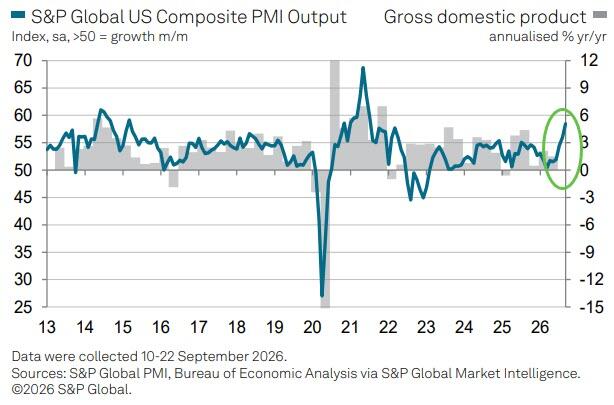
To put the growth surge in context, barring the spike in demand following the opening up of the economy after the COVID-19 lockdowns, the latest improvement in business activity is the greatest recorded since early 2015 with Williamson noting that:
“Business is clearly booming now in both manufacturing and services.”
However, he adds, this growth is being accompanied by some of the most severe supply chain bottlenecks seen in the near-two-decade survey history if the pandemic is excluded, with companies also reporting increasing problems finding suitable staff.
Backlogs of work are consequently rising sharply. While this accumulation of uncompleted orders bodes well for the further expansion of output and capacity in the coming months, it also indicates that companies are developing more pricing power, and hence is a worry for the inflation outlook.
“Firms’ input costs have meanwhile jumped in September at the steepest rate for four years, with fuel and transport costs spiking higher thanks to the rise in oil prices seen during the month, which will add further to the upward pressure on selling prices and inflation in the coming months.”
As a result of all this, 10Y yields have spiked back above 5.00%…
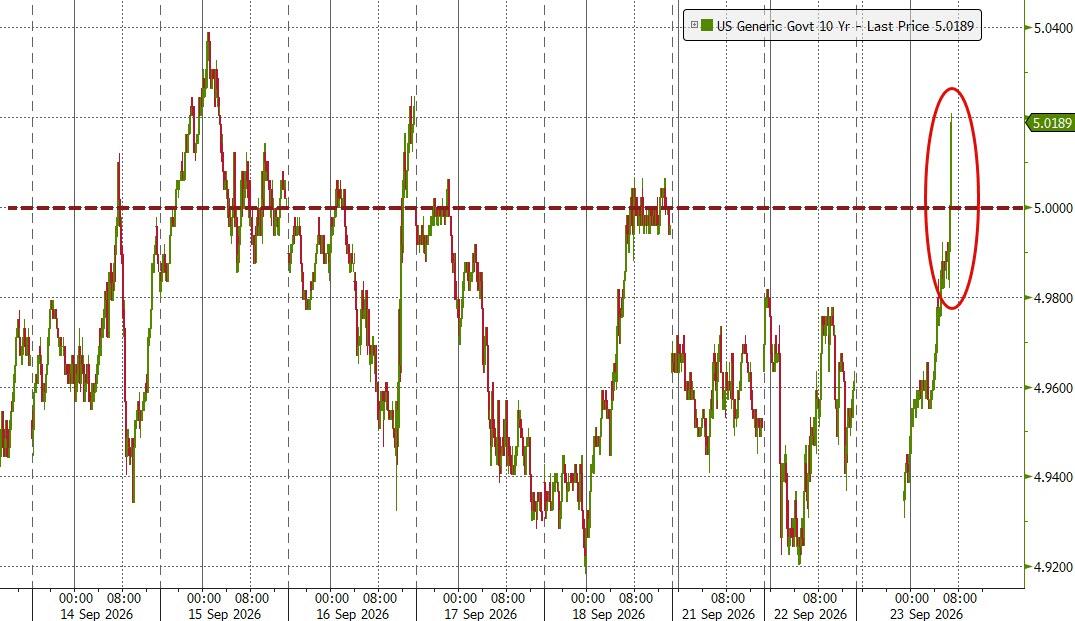
…and rate-hike odds picked up for October.
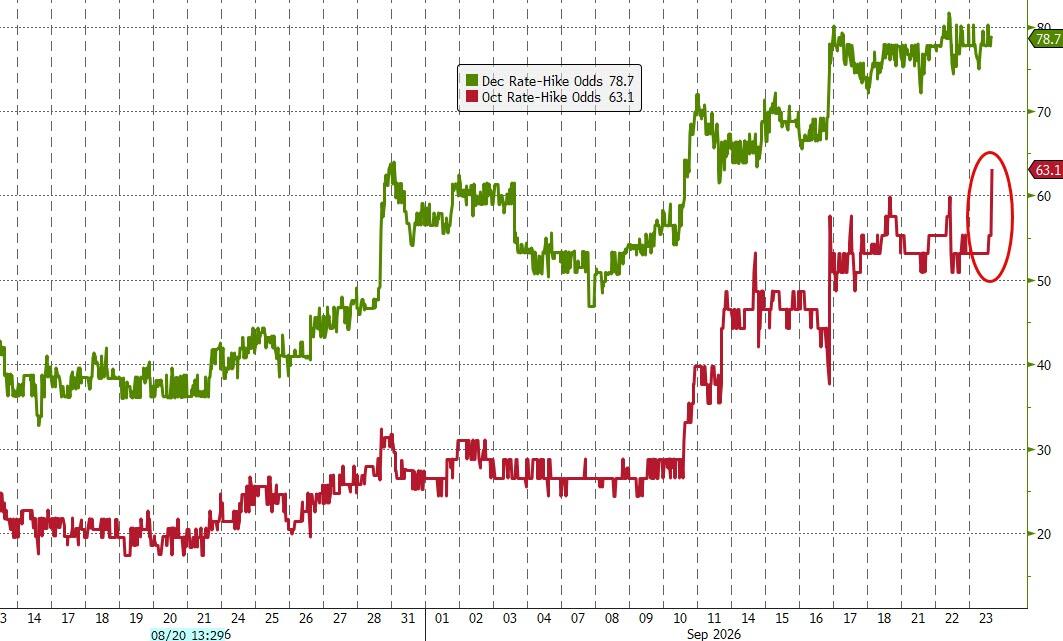
That was quite a shocker!!
USA ECONOMIC REPORTS
CALIFORNIA//WEATHER RELATED STORMS
California Declares State Of Emergency Ahead Of Strong El Niño
Tuesday, Sep 22, 2026 – 06:25 PM
Authored by Aldgra Fredly via The Epoch Times,
California Gov. Gavin Newsom declared a state of emergency on Sept. 21 as the state prepares for what he described as the strongest El Niño storm season on record.

Newsom said the emergency declaration would allow state agencies to act more quickly for potential severe weather, including securing roads and critical infrastructure, positioning emergency supplies, and helping local partners to mitigate flood, landslide, and coastal risks.
“That is what this action is about. Giving communities the support they need, giving first responders the tools to do their jobs, and giving families the confidence that their state is ready,” he said in a statement.
The proclamation directs state agencies to take measures to reduce flood risks and pre-position food-fighting supplies such as sandbags and pumps.
It prepares the California National Guard to assist flood response, search-and-rescue efforts, engineering, and logistics missions when needed, according to the governor’s office.
The governor also instructed state environmental and natural resources agencies to expedite permitting for projects that are focused on addressing flooding, landslides, and debris flows in the state.
“Through the governor’s state of emergency, we’re cutting red tape and fast-tracking the flood-protection and broader preparedness work communities need now,” California Natural Resources Secretary Wade Crowfoot said in a statement.
El Niño is a climate pattern marked by the warming of sea surface temperatures in the central and eastern tropical Pacific Ocean.
Newsom’s office said California could experience repeated rounds of heavy rain, strong winds, landslides, debris flows, and coastal flooding in the coming months due to El Niño.
“We are preparing for this El Niño early because every Californian deserves to be safe in their home, connected to their community, and protected when severe weather comes,” the governor said.
The National Oceanic and Atmospheric Administration (NOAA) forecast a 75 percent chance that this year’s El Niño, expected to occur between October and December, could become a historic event exceeding the strength of previous events recorded in 1950.
“With an event of this magnitude, the chances of experiencing impacts consistent with El Niño are larger, though not guaranteed,” the weather agency said in a Sept. 10 advisory.
NOAA said there is more than a 90 percent chance that El Niño could reach “very strong” levels during the Northern Hemisphere fall and winter.
California has already experienced coastal flooding this year attributed to the phenomenon, as El Niño-driven “Kelvin waves” raise sea levels and offshore Pacific hurricanes send strong waves that batter the California coast, according to the governor’s office, which called on residents to prepare for potential severe weather.
end
More US Homebuyers Apply For Riskier Mortgages As Interest Rates Top 7%

by Tyler Durden
Wednesday, Sep 23, 2026 – 01:45 PM
Authored by Andrew Moran via The Epoch Times,
Higher interest rates pushed prospective homebuyers toward riskier mortgages last week, new industry data show.

The total volume of mortgage applications declined almost 2 percent for the week ending Sept. 18, according to a report released by the Mortgage Bankers Association on Sept. 23. This represented the third consecutive weekly drop.
Applications for a mortgage to purchase a home fell 1 percent and were down 11 percent from the same time a year ago. Refinancing applications also fell to their lowest levels since February 2025, down 3 percent monthly, and were 62 percent lower year over year.
“Applications for both refinance and purchase loans declined further last week, noting that the comparison is to the week that included the Labor Day holiday,” Mike Fratantoni, the group’s senior vice president and chief economist, said in a news release.
Last week’s decline aligned with the sharp increase in interest rates.
Because fixed-rate mortgage costs have accelerated in recent weeks, borrowers sought riskier adjustable-rate mortgages – also known as ARMs – Fratantoni added.
“With fixed rates much higher, more borrowers opted for ARMs, with the ARM share reaching 9.8%, as rates for 5/1 ARMs were more than a percentage point lower than those for fixed rate loans,” he said in a statement.
The average contract interest rate for 30-year fixed-rate mortgages rose to 7.12 percent, from 6.97 percent – the highest since May 2024.
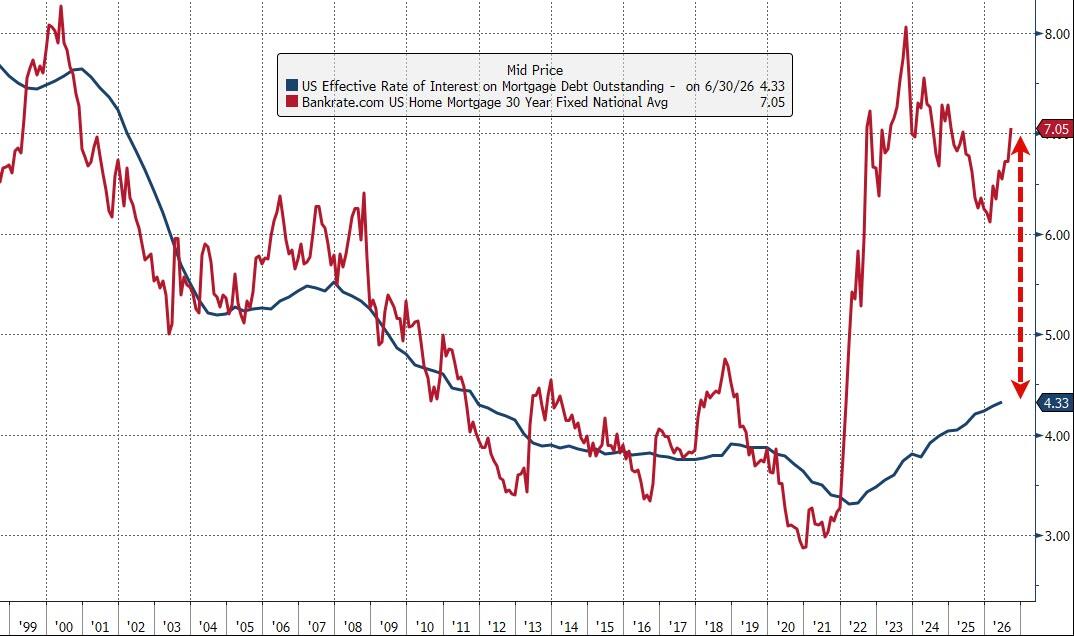
Mortgage rates have increased by more than 100 basis points since the United States and Israel launched a joint military operation against Iran in late February. The conflict, approaching the seven-month mark, has sent Treasury bond yields surging.
The benchmark 10-year Treasury yield reached 5 percent again midweek, up from 3.96 percent before the war in Iran began. The mortgage market generally tracks government bond yields, resulting in higher borrowing costs for prospective buyers.
ARMs start with a lower fixed rate for three to ten years, then change every six months or annually based on market conditions. This product saves borrowers money upfront but can swing higher or lower based on benchmark rates.
Mortgage rates have ticked up slightly so far this week.
As of Sept. 22, the average 30-year fixed rate was 7.17 percent, according to Mortgage News Daily.
Fueling Interest Rates
Global energy markets and inflation data have been the driving forces behind interest rates and will determine the Federal Reserve’s next policy decision, says Jeff DerGurahian, head economist at loanDepot.
“For now, rates appear to be standing at a fork in the road. Softer inflation and lower oil prices could provide relief, while continued energy pressure could keep mortgage rates near or above 7%,” DerGurahian said in a note emailed to The Epoch Times.
Crude prices have fallen sharply this week, with U.S. oil down about 10 percent to around $91 per barrel. Brent, the international benchmark, returned above $100 midweek.
As of Sept. 22, the national average for a gallon of diesel has risen to $6.52, according to the American Automobile Association.
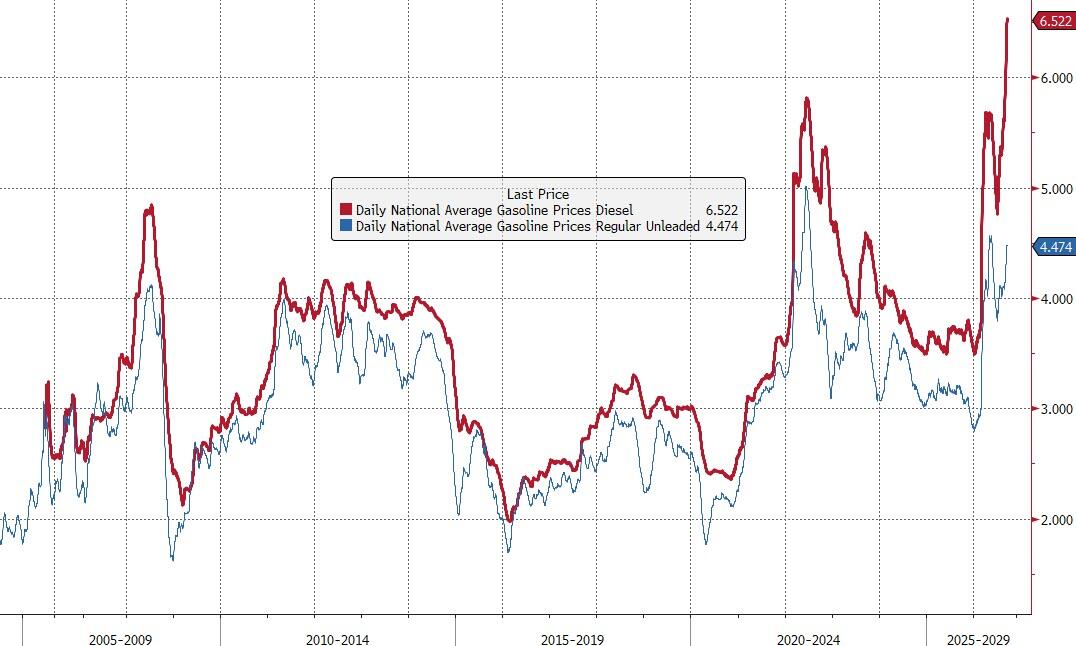
Meanwhile, the next major inflation report will be August’s personal consumption expenditures (PCE) price index, the Fed’s go-to inflation measure.
After that, the September consumer price index report will be released in mid-October.
The Cleveland Fed projects annual headline consumer inflation will jump to 3.5 percent, but core inflation, which strips out volatile energy and food prices, will hold steady at 2.4 percent.
Until then, investors are leaning toward another quarter-point rate hike at the October Federal Open Market Committee policy meeting after the Fed followed through last week on the first increase to the benchmark federal funds rate since July 2023.
“Those expectations are not set in stone though,” DerGurahian said.
“If oil prices move lower or the September core inflation reading comes in softer than expected, the October hike could be pushed further out. Continued improvement could even cause markets to remove one of the three future hikes currently priced in.”
Fed Chairman Kevin Warsh will hold the next two-day meeting on Oct. 27 and 28.
end
Bonds Crash Most Since Liberation Day After Catastrophic 5Y Auction; 2nd Biggest Tail On Record
Wednesday, Sep 23, 2026 – 01:31 PM
Coming into today’s 5Y auction, the bond market was collapsing, with yields across the curve soaring but especially the 5Y exploding a crazy 15bps heading into today’s auction (of 5 Year treasuries), a massive concession which we thought would lead to “lots of demand” for today’s offering.
Boy, were we wrong: moments ago the Treasury published results from today’s auction and there were absolutely disastrous.
The sale of $70 billion priced at the first 5%+ yield since 2007, 5.033% to be specific (which means the first 5% cash coupon for today’s buyers in 19 years), up from 4.391%. But the kicker is that the When Issued traded at 5.001%, meaning the auction tailed by a massive 3.1bps, which is the 2nd highest tail on record.
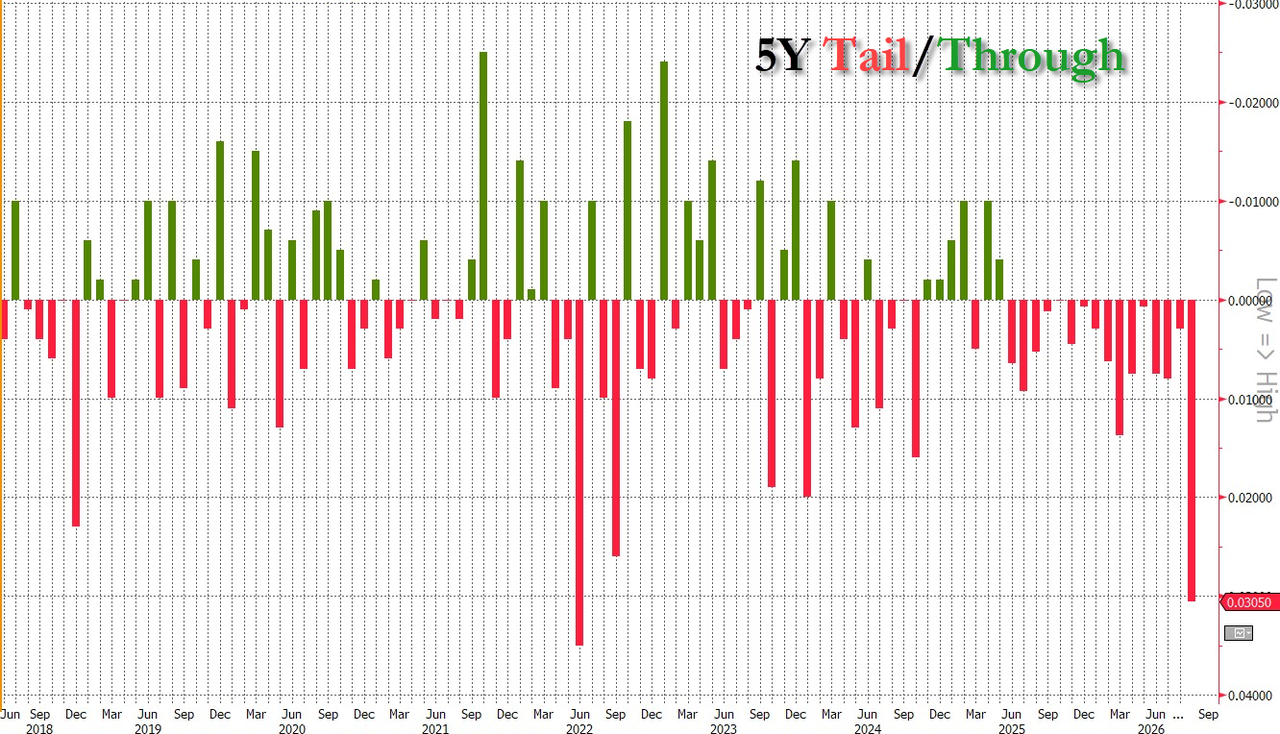
The bid to cover was ugly: down to 2.212 from 2.371, and the lowest since December 2018.
The internals were even worse: Indirects plunged to 54.31% from 61.51%, the lowest since the depths of covid, in March 2020. And withj Directs inexplicably jumping to 29.92%, the highest since December ’25, Dealers were left holding 15.8% of the auction, the most since May 2024.
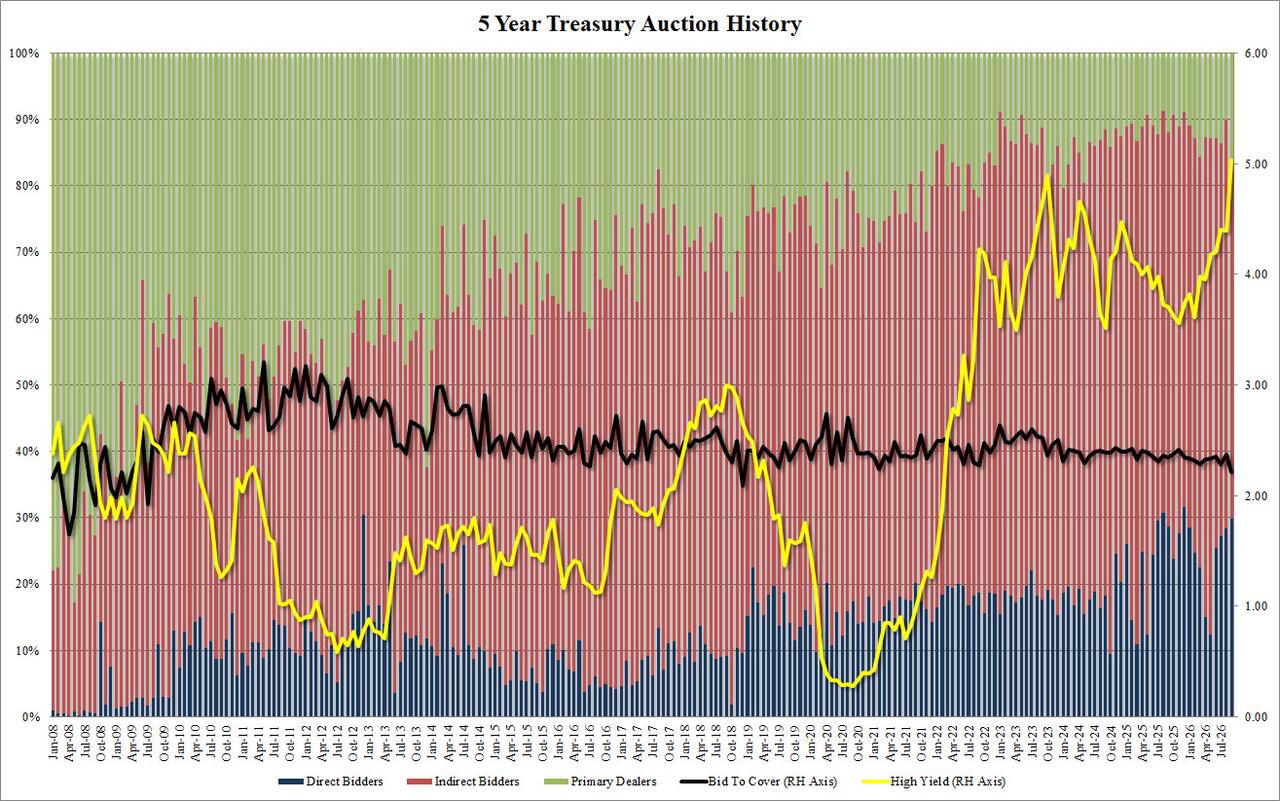
Overall this was a horrific auction, where demand simply was not there contrary to what the When Issued indicated, and the results sparked a fresh rout acorss the curve, with the 10Y last trading just shy of 5.13% in what is shaping up as the worst day for the bond market since Liberation Day.
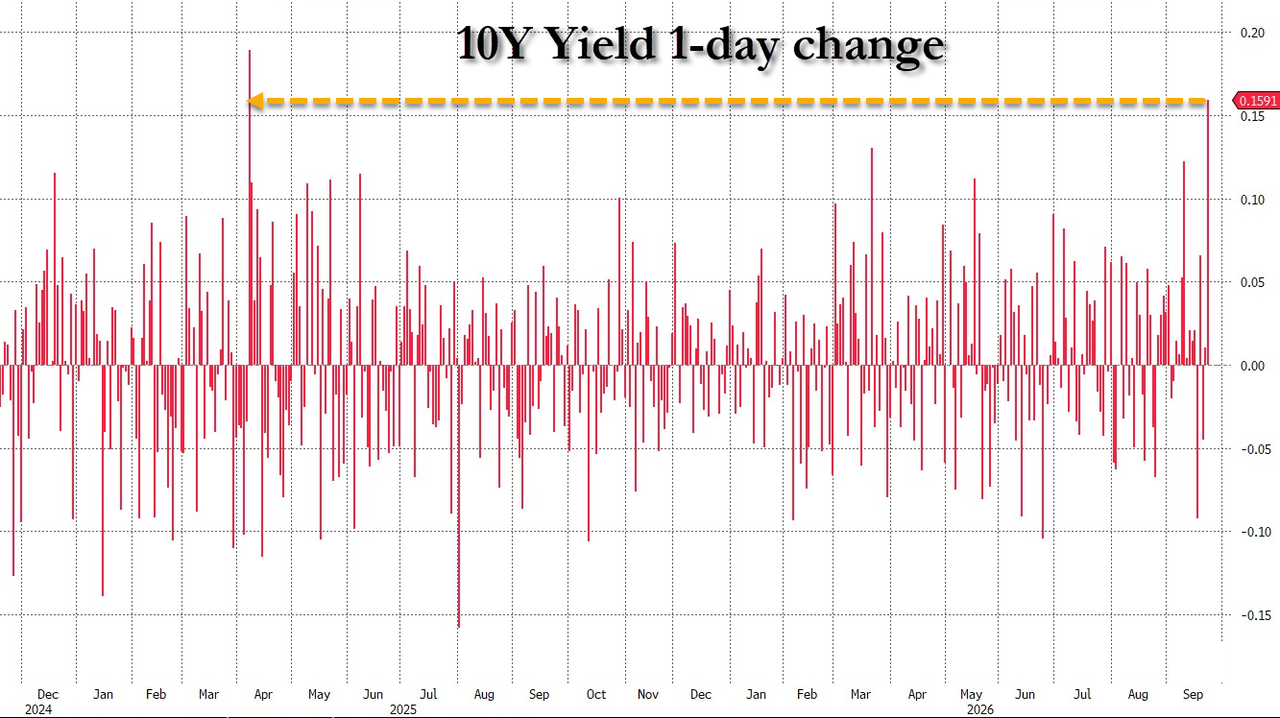
KING NEWS
| The King Report September 23, 2026 Issue 7831 | Independent View of the News |
| Trump says US and Iran will ‘get it done one way or the other’ · US Secretary of State Marco Rubio said on Tuesday Washington was open to hold talks with Iranian officials during the UN General Assembly, although no meeting had been arranged. · Iranian President Masoud Pezeshkian left Tehran for New York on Tuesday to attend the United Nations General Assembly… Oil prices fell more than 2% to a two-week low Tuesday after Iran said it could reopen the Strait of Hormuz within seven days if the United States eases military pressure and lifts its blockade of Iranian ports… Iran and the United States signaled the possibility of reviving negotiations to end the conflict, with both countries’ presidents in New York for the UN General Assembly… France has begun drafting a UN Security Council resolution in coordination with the United States to establish an international mission aimed at restoring shipping through the Strait of Hormuz… https://www.iranintl.com/en/liveblog/202609196155 Fars News denies reports of Iran ready to reopen Strait of Hormuz if US eases blockade Kyodo and Reuters reported earlier, citing Iranian sources, that Tehran could be prepared to reopen the Strait of Hormuz within seven days if the US reduced military pressure and lifted its blockade of Iranian ports. The reports triggered an extended decline in oil prices as markets priced in the possibility of a gradual normalization of crude flows. However, Iranian sources cited by Fars News dismissed the reports as inaccurate and said they did not reflect Tehran’s position… https://investinglive.com/news/fars-news-denies-reports-of-iran-ready-to-reopen-strait-of-hormuz-if-us-eases-blockade/ @bennyjohnson: Trump Gives Iran Ultimatum LIVE To Their Face on the World Stage at the United Nations: ‘Do I Make a Deal or ANNIHILATE Them?’ “I have a big decision to make: Will a deal be made with Iran that lets them rebuild and create a far greater country than it ever was before? Or do I annihilate the Islamic Republic and do it quickly, never giving them a chance to kill and destroy people and countries again? Do I drive them into hell with no chance of survival and no hope of future greatness or generations? But I believe we will make a deal right after the election… They are waiting to see how I do in the election…But I am not running…and will be here for two and a half years…” https://x.com/bennyjohnson/status/2102410315182805406 https://x.com/RealNickMugalli/status/2102411127401468028 CNN: US President Donald Trump told the UN General Assembly a deal with Iran is possible after the midterm elections, but his other choice is to “annihilate the Islamic Republic.” Meanwhile, Trump has told his advisers he would like to arrange a meeting with Iranian officials at UNGA if “conditions are right,” a source said. An engagement with Iran’s delegation is not scheduled, but the US is open to a meeting, Secretary of State Marco Rubio said. https://www.cnn.com/2026/09/22/world/live-news/un-general-assembly-trump?post-id=cmucnmfew00003b6sltnsmihm Iranian delegation began walking out as Trump spoke about Iran.. how he has a choice to make: AP @EYakoby: President Trump reveals that when he took office last year, he immediately opened negotiations with Iran and offered them full economic cooperation in exchange for ending their nuclear program and support for terror, but they refused. https://x.com/EYakoby/status/2102431153760137389 Trump scolds world leaders face-to-face in explosive speech at the UN saying only HE ‘acted’ to confront Iran threat – ‘For 51 years, the fanatical Iranian regime has ruled by bloodshed and mass murder, spreading death and carnage and chaos across the entire Middle East and beyond. They were the bully of the Middle East, but they are the bully no more.’… Trump warned again that ‘failed state’ Cuba will soon fall and taste freedom… At this insult, the Cuban representatives got up and left the room… ‘Unfortunately, it’s unacceptable for the United States to share a 2,000-mile border with a territory controlled by enemy cartels. So Mexico must reclaim control of its soil from the enemies of humanity.’ https://www.dailymail.com/news/article-16151189/Trump-scolds-world-leaders-face-face-explosive-speech-saying-acted-confront-Iran-threat.html In his speech at the UNGA, Trump excoriated Mexico for being “the epicenter of cartel violence” that is “controlled by (drug) cartels.” “I designated the drug cartels as Foreign Terrorist Organizations and unleashed the U.S. Armed Forces to eliminate them. The cartels are the ISIS of the Western Hemisphere… They are enemies at war with civilization, using murder, rape, torture, and extortion as instruments of terror. Like ISIS, they should be KILLED, EXILED, or DETAINED as enemy combatants without the possibility of release.” https://x.com/DOWResponse/status/2102412681437180107 @nicksortor: President Trump just called out the UN globalists for attempting to FORCE mass migration to the west. “With your CEASELESS promotion of mass migration, these globalists are actively DESTROYING the greatest cultures and most extraordinary heritage in all of history.” “They want the worst people to come in from the WORST places on earth and we don’t do it anymore.” “There is NO HUMAN RIGHT to illegal immigration, but there is a right to remain a SOVEREIGN NATION.” https://x.com/nicksortor/status/2102415019824619914 TRUMP: “It’s deeply ironic that the UN has an entire institution devoted to protecting cultural heritage, yet they promote mass migration and are actively destroying the greatest cultures and most extraordinary heritage.” https://x.com/Geiger_Capital/status/2102415503499415902 At the UN on Tuesday, Trump gave the type of speech that many Americans have wanted for decades. Trump said the US will build two large military bases in Greenland: “We will immediately begin the process of developing a large military presence in the appropriate locations. We will be building two very major military bases. This agreement will be signed later today.” @disclosetv: Trump signs trilateral agreement with the PM of Denmark and the PM of Greenland, expanding U.S. military presence in Greenland https://x.com/disclosetv/status/2102423177347363229 The S&P 500 Index gapped higher on the opening (7770.81, +6.11) on carryover euphoria from Monday. Alas, the high for the day (7782.19) appeared by 9:35 ET. Nevertheless, the usual suspects’ conditioned behavior of buying AI bubble stocks and trading sardines appeared. After peaking within 5 minutes of the NYSE opening, the S&P 500 Index fell to 7756.26 at 11:40 ET. At noon ET: MU +3.16%, SNDK +5.77%, MEGA +1.7%, NVDA +0.51%, AMD +1.66%, APPL 0.87%, TSLA +0.36%, MSFT -1.52%, AMZN -1.47%. The S&P 500 was -0.07% and the SOX Index +1.01%. After the 11:40 ET low, the S&P 500 Index had an 11-handle ABC rally to 7767.16 at 13:46 ET. The index then rolled over but jumped high on: Trump: US official met with Iranian delegation for 3 hours – Reuters 13:59 ET “I feel very good after the meeting.” Trump added: “It was a very beneficial meeting. It could lead to the greatness of the nation so I expect they will want to reach a deal.” https://www.ynetnews.com/article/bujzodvw2 The S&P 500 Index spiked to 7773.85 at 14:21 ET. It then fell to 7769.43 at 14:35 ET. The rally to front run the last-hour rally/manipulation took the S&P 500 Index to 7772.22 at 14:44 ET. Sellers appeared; the index fell to 7766.83 at 14:59 ET. The last-hour rally took the S&P 500 Index to 7779.21 at 15:34 ET. The S&P 500 Index fell to 7773.15 at 15:40 ET; the late manipulation forced the index to 7778.88 at 15:52 ET. Traders were too long, the S&P 500 sank to 7763.83 at 15:59 ET and closed at 7764.75. US 2-Year Note Auction ($69B) results: High Yield 4.787% (0.2 bp tail, WI 4.785%), Bid-to-cover 2.63, 33.42% of bids at high, Primary Dealers 13.19%. Direct Bidders 29.02%, Indirect Bidders 57.79% Oil declined about a dollar on Wednesday while Diesel and Gasoline rallied moderately. The end of the Iran War does NOT boost refining capacity. Richmond Fed Pres Fed’s Barkin: It is tempting to blame high inflation on a handful of categories exposed to energy costs or tariffs, but much of the personal consumption expenditures index is rising by more than 3%. NY Fed: Treasury Trading at the Close In past work, we showed that trading in U.S. Treasury securities is becoming increasingly concentrated on the last trading day of each month. In this post, we show that trading is also becoming more concentrated around the designated pricing, or “strike,” times for fixed-income indexes. The concentration is especially pronounced on month-end trading days. We also document a marked shift in trading activity from around 3 p.m. (ET) to around 4 p.m. after a major fixed-income index provider moved its strike time from 3 p.m. to 4 p.m. in January 2021. End-of-Month Trading, Index Rebalancing, and Index Strike Times In an earlier LSE post, we found that overall Treasury security trading volume is about 58 percent higher on the last trading day of the month than on other days. We showed in a related post that this concentration of activity has increased sharply over the past decade or so and is associated with improved market liquidity. We conjecture that the increased concentration of activity may reflect the growth of assets managed relative to fixed-income indexes, many of which are rebalanced at month-end. The Treasury market is over-the-counter and has no exchange-mandated closing time. Instead, index providers have discretion as to what time of day to set their closing prices. Historically, 3 p.m. was the industry standard (among other reasons, open-outcry trading for Treasury futures ended at 3 p.m. and the 3 p.m. strike time allowed for a lead time before mutual funds’ net asset value production time of 4 p.m.). On January 14, 2021, Bloomberg Barclays—one of the largest providers of fixed-income indexes (and now called Bloomberg Fixed Income Indices)—changed the strike time for its U.S. dollar-denominated indexes from 3 p.m. to 4 p.m…. We find that trading activity in the U.S. Treasury market is increasingly concentrated around the end-of-day index strike times. This is especially true on the last trading day of each month when indexes are rebalanced, complementing our earlier findings of sharply increased trading on those days more generally. We further find a marked redistribution of trading activity from around 3 p.m. to around 4 p.m. when a major fixed-income index provider moved its strike time from 3 p.m. to 4 p.m… https://libertystreeteconomics.newyorkfed.org/2026/09/treasury-trading-at-the-close/ Obviously, the NY Fed academics did NOT account for manipulation to boost ‘mark’ and performance. This strongly suggests that they have little or NO trading experience. Positive aspects of previous session Once again, ‘the end of the Iran War is Nigh’ hype pushed stocks higher. Nasdaq +0.45% (record close). Nas 100 +0.82%; SOX +2.06% SP Materials +1.9%, Consum Staples +1.2%, Info Tech +0.63%, Heath Care + 0.54%, Industrials +0.19% Negative aspects of previous session S&P 500 -0.06%, DJIA -0.36%, DJTA -0.42%; SP Financials -1.98%, Energy -1.01%, Comm Services -1.01%, Utes -0.29%, Consum Discretionary -0.19%, Real Estate -0.19% The 2-year note Auction was disappointing. USZs traded modestly lower despite oil’s decline. Oil declined about a dollar on Wednesday while Diesel and Gasoline rallied moderately. The yen/$ hit 157.775. It’s almost time for another intervention! High Grade Copper hit 6.79; its all-time high is 6.8050 on 9/9/26. The S&P 500 Index high occurred within 5 minutes of the opening on manic trader buying. Ambiguous aspects of previous session With the Iran War is about to end card played, what will be the verbal intervention today? First Hour/Last Hour NYSE Action [S&P 500 Index]: 1st Hour: Down; Last Hour: Down Pivot Point for S&P 500 Index [above/below indicates daily trend to day traders]: 7767.70 Previous session (S&P 500 Index) High/Low: 7782.19 (9:35 ET); 7756.26 (11:40 ET) Bloomberg-Backed Climate Group Paying Salaries of Democratic State AG Officials Quietly Shuts Down Amid Congressional, Legal Scrutiny https://freebeacon.com/america/bloomberg-backed-climate-group-paying-salaries-of-democratic-state-ag-officials-quietly-shuts-down-amid-congressional-legal-scrutiny/ @DeepLeaksHQ: Senator Marco Rubio says Americans “They’ve worked here their entire lives. They retire. They get $800, $900, a $1,000 a month from Social Security. — Somebody who just got here from Cuba 3 months ago — is given $1,500 a month” “So imagine if you’ve been working here for 40 years and your Social Security check is smaller than the benefits going to a 28-year-old, able-bodied person who just got here…That’s real. That happens. That’s happening every day. That makes no sense.” https://x.com/DeepLeaksHQ/status/2102397606374801633 @Barchart: Nvidia (MONSTER) Insider Trading Alert – Mark Stevens, board member since 2008 and one of the largest Nvidia shareholders, just dumped $300 million worth of NVDA. @zerohedge: 6th day in a row more 52-week lows than highs https://x.com/zerohedge/status/2102533586565865763 Gulf leaders meet Trump with two fears: more war and less US protection “We may have to blow up another one, Pickaxe Mountain,” Trump said Tuesday during the gathering with Gulf leaders… If the US sees activity there, “we’ll blow it up immediately,” he added… https://www.cnn.com/2026/09/22/middleeast/gulf-leaders-trump-fear-more-war-less-protection-intl Wells Fargo, other bank stocks fall as Meta’s Muse adds fuel to AI fears The moves underscored concerns that artificial intelligence advances could morph into more of a threat than a boost to the financial sector in the long run. Investors’ fears mounted over Muse, Meta’s personal AI agent, ahead of the company’s Meta Connect conference on Wednesday… investors remain skittish around the likelihood that banks’ efforts could fall behind those of nimbler tech companies. The selloff was notable: JPMorgan Chase, the country’s biggest bank, fell 3.4% for its worst day since July. Wells Fargo’s stock dropped 3.9%, the largest decline since May. Meanwhile shares of Bank of America and Citigroup, fell 3% and 2%, respectively… https://www.msn.com/en-us/news/other/wells-fargo-other-bank-stocks-fall-as-meta-s-muse-adds-fuel-to-ai-fears/ar-AA2cMd1g?ocid=BingNewsSerp WSJ: Meta’s Muse Comes for Financial Stocks – The rapid adoption of the new artificial-intelligence agent threatens to disrupt wealth managers, brokerages and insurers Today – Despite the positive Iran news, stocks and bonds struggled. The inculcated buying of AI Bubble stocks and Fangs was the main positive on Tuesday and Monday. Like most sessions of recent years, equity action will depend on the trading sardines, again, today. As noted above, the main caveat is that good news and verbal intervention induced buying on Monday and Tuesday. If there is no verbal intervention, what will keep stocks bubbling on thin air? Meta’s Connect Conference should impact trading. We do NOT know if it will be good or bad. But if it is disappointing, look out below! ESZs +1.25; NQZs +16.25, USZs +5/32, Nov WTI -$0.99, Nov Gasoline -2.3¢, Yen/157.562 at 20:11 ET Expected economic data: Sept S&P Global US Mfg. PMI 53.5, Services 56; US 2-Year FRN (Floating-Rate Note) Auction, $28B; US 5-year note Auction $70B S&P 500 50-day MA: 7626; 100-day MA: 7533; 200-day MA: 7191 (S&P 500 Close 7764.64) Nasdaq 100 50-day MA: 29,218; 100-day MA: 29,325; 200-day MA: 25,280 (S&P 500 Close 30,732.40) DJIA 50-day MA: 52,857; 100-day MA: 51,914; 200-day MA: 50,146 (DJIA Close 51,863.69) (Green is positive slope; Red is negative slope) @SteaknShake: America’s corporate governance system is broken, and it’s killing public companies… Because proxy advisory firms like ISS are corrupt. They blindly rubber-stamp failing boards year after year, protecting the corporate elite while burning shareholder value to the ground. The root of the rot is index funds… Right now, passive funds hold massive, unchecked voting blocks… It is time for a simple rewrite of the rules: We need to index the votes of index fund investors. Passive index funds should be forced to automatically split their votes to proportionately mirror those of retail and active institutional shareholders — the people actually doing the research, risking their capital, and fighting for performance in the companies they hold shares in. No more rubber-stamping. A change like this will immediately strip corrupt gatekeepers like ISS of their toxic influence. True accountability happens when lazy, overpaid boards actually answer to the stakeholders they represent, rather than screwing them over. Actual, logic-driven governance when your money is passive happens when your vote passively follows the voting decisions of the actual market. We need to stop letting passive capital protect active incompetence. By stripping index funds of their arbitrary voting power and empowering engaged investors, we will finally torch corporate cronyism and usher American capital markets into a golden age of capitalism. Feds arrest, indict hundreds in Trump voter fraud crackdown: ‘Catching it all over the country’ “I think there are a lot of nervous election officials because I think some of them know that they’ve been looking the other way when this is happening, and we’re catching it all over the country,” Assistant Attorney General Harmeet Dhillon said Monday night in an interview on the Just the News, No Noise television show… https://justthenews.com/politics-policy/elections/feds-have-arrested-indicted-hundreds-voter-fraud-crackdown-catching-it @Tommy_USA: Never forget that in New York they eliminated the literacy exam in 2017. And this exam wasn’t for students – it was the literacy exam for TEACHERS. Only 61% could pass it! https://x.com/Tommy_USA/status/2102067212525674637 People dependent on the government tend to vote. So, teachers and teacher unions get greased by politicians at the detriment of ‘the children.’ This, of course, shows the hypocrisy of politicians that have for decades justified unwarranted spending by saying it is for ‘the children.’ @ChrisMartzWX: Six years ago, The Washington Post said that Atlantic hurricanes seasons are going to become much worse due to global warming. Stronger storms, especially near the coast. Hyperactive years like 2020 were said to be a “harbinger of the future.” Last week, The Washington Post reported that the lack of hurricanes in the Atlantic this year is also potentially because of global warming… | |
SWAMP STORIES FOR YOU TONIGHT
White House Cancels Coverage For 750,000 ACA Enrollees, Citing Fraud
Tuesday, Sep 22, 2026 – 07:40 PM
Vice President JD Vance said Tuesday that about 750,000 people on Affordable Care Act plans were never entitled to the coverage, and that pulling their subsidies will save taxpayers $2.2 billion. Mehmet Oz, who runs the Centers for Medicare and Medicaid Services, stood with him. The savings number is an administration estimate. The Congressional Budget Office has not scored it.
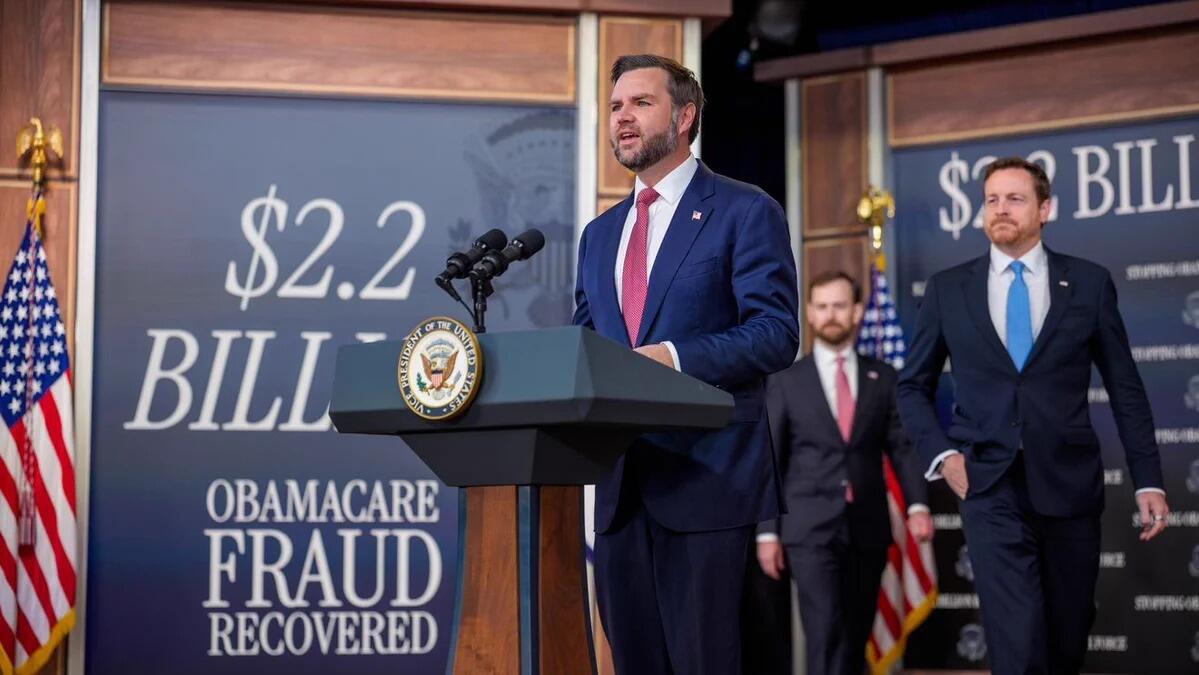
CMS had already acted. Rulemaking documents posted Tuesday in the Federal Register say the agency canceled 315,000 marketplace policies on Aug. 31, covering roughly 760,000 people, which the rule describes as unauthorized enrollments submitted through agents and brokers. Vance’s 750,000 and the 760,000 covered lives are the same purge, counted two ways.
Officials also plan another pass at about 419,000 current enrollees, checking legal residency first and income second. “We are actually making sure that people receiving Obamacare subsidies are actually entitled to receive them,” Vance said. “Amazingly we weren’t doing that before.”
Brokers are next. CMS sent notices of intent to terminate to 569 agents and brokers who filed statistically implausible rates of 2026 applications without identifying information, such as a Social Security number. A separate interim-final rule freezes new agent and broker registrations until Feb. 1, 2027, before the usual comment period runs. Administration officials said 40 brokers accounted for about 50,000 suspect enrollments and $45 million in subsidies. The National Association of Benefits and Insurance Professionals said a blanket freeze punishes licensed agents who did nothing wrong and will leave consumers with fewer people to call during open enrollment.
Centene fell as much as 3.9 percent on the first headlines. Molina dropped as much as 3.5 percent, Elevance 1.9 percent, UnitedHealth 1.4 percent. Those firms write a large share of exchange business. Federal premium tax credits are paid to the insurer, not the enrollee.
How The Administration Is Using The Word
Part of the case is conventional fraud. Brokers collect commissions from insurers. After Congress fattened the premium tax credits, a lot of low-income plans carried a $0 net premium, so a policy could be opened without the customer ever seeing a bill. CMS recorded roughly 275,000 complaints in an eight-month stretch of 2024 from people who said they had been enrolled or switched without consent. In February, a brokerage president and a marketing-company CEO were sentenced to 20 years each for a scheme that sought more than $233 million in subsidies. HHS has separately said more than a million marketplace enrollments listed no Social Security number.
The rest is a verification net the last administration loosened and this one is pulling tight: income attestations, immigration paperwork, employer coverage, automatic re-enrollment onto free plans.
The Government Accountability Office has found the same weak controls and has not signed off on the claim that millions of current enrollees are fake. GAO flagged at least 160,000 federal-marketplace applications in plan year 2024 for likely unauthorized changes, about 1.5 percent of the relevant pool. It found about 68,000 Social Security numbers used for more than a year of subsidized coverage in 2024; one number appeared on 125 policies. About $94 million in subsidies went out on numbers that matched the death file. Undercover testers got fictitious applicants approved at very high rates, and most of the 2025 fakes were still drawing subsidies months later. GAO has described that work as a set of risk indicators, not a census.
HHS and the Paragon Health Institute produce the bigger tallies. Paragon compares people who signed up claiming income between 100 and 150 percent of poverty – the band that unlocked the largest subsidies – with Census estimates of how many people in that band could even qualify. Whatever is left over gets labeled improper. HHS instead measures how many enrollees in that band filed no claims, against historical norms. HHS put the peak at 5.6 million in 2025 and said 2.6 million are still on the books. Paragon’s 2026 figure is about 6.2 million, or 27 percent of open-enrollment selections, with a possible price tag of $25 billion.
Census income is not the projected income the marketplace uses. The survey misses low-income households. People with no claims get counted as phantoms; they are also just people who did not go to the doctor, or who bought a bronze plan with a deductible they never hit. In June, a federal judge in Maryland vacated most of a 2025 rule the administration had justified with Paragon-style estimates, ruling that CMS had overridden the statute. CMS’s own paperwork this week floated a different improper-spending figure for 2026: up to $6.6 billion.
Enrollment Was Already Falling
Exchange enrollment ran from about 12 million early in the Biden term to a peak near 24 million once the extra subsidies landed and verification eased. Congress let those add-on credits expire. Premiums jumped, in some markets doubling. By February, effectuated enrollment was about 19.2 million, down 13 percent from a year earlier and the sharpest drop since the exchanges opened.
The White House credits integrity work. KFF and the Center on Budget and Policy Priorities credit the price spike. A phantom account that never should have existed and a family that quit after the bill hit $200 a month both show up as cancellations.
Open enrollment starts Nov. 1. Midterms are Nov. 3. Earlier this month Trump told a Republican midterm convention in Dallas that his “Great Healthcare Plan” would “stop all government payments to the big insurance companies.”
Some of the 760,000 were never patients. They were names on a file, opened without their knowledge. Killing those policies stops a check to an insurer and a commission to a broker. Some of the 419,000 in the next pass will lose coverage because they cannot produce papers on the new timeline, including people who were eligible. Democrats have been saying that out loud for months: fraud talk as the instrument for a coverage cut Congress already started by killing the extra subsidies.
CMS has stopped payment on the August book and is closing the broker door. It has not released a table that splits the 760,000 into fictitious accounts, unauthorized switches, income or immigration mismatches, and eligible people who missed a form. Without that, $2.2 billion is still an estimate and 750,000 is a cancellation count.
GREG HUNTER…INTERVIEWING BILL HOLTER
Higher Rates Will Blow Everything Up – Bill Holter
By Greg Hunter On September 23, 2026 In Market Analysis, Political AnalysisNo Comments
By Greg Hunter’s USAWatchdog.com
Financial writer and precious metals expert Bill Holter (aka Mr. Gold) has warned for years about what happens in the end when a debt bubble pops. Mr. Gold explains, “This bubble is like any other bubble in mankind’s history. In the 1920s, credit was extremely easy. When credit tightened, it was the wealth effect in reverse. We saw this again in the early 1970s. We saw this again in the 1987 crash. Interest rates went from 7% to over 10% . . . and that bubble popped. We had the emerging market debt problem back in the early 1990s, Long Term Capital in 1998, the Dot Com bubble in 2000, the 2007-2008 Great Financial Crisis, and all you have to do is look at a chart of bond yields and you’ll see that each time yields spiked, those bubbles popped. Right now, interest rates are spiking, and this is the biggest bubble. This is the everything bubble. Everything is in a bubble. The only things that are not in a bubble are gold and silver because they are real money. I think gold and silver are reflecting the risk of the debt structure coming down. From a global standpoint, countries are moving away from the dollar. They don’t want to be trapped in the dollar system. The dollar is the world reserve currency that is issued by an insolvent bankrupt entity. Higher rates, that’s what is going to blow everything up, higher rates.”
Mr. Gold says the rates can fall back down in a hurry if the economy starts to skid. Mr. Gold also says the so-called “reset” you have been hearing about for years is real. It cannot be stopped, but it is an unfolding process right up until the very end. Holter says, “The reset is not a pushed button until the very, very end. That very, very end is going to be a weekend where you go to bed Friday and things look normal, and on Monday morning, the whole world will have changed. . .. Rising interest rated have happened hundreds of times in history. That is not the reset. The reset is when those rising rates affect the existing debt in the system, and that debt fails and collapses. Of course, you can add in derivatives, and the reset is really a wipeout of wealth. It’s the wipeout of the population’s wealth. Along with that goes the ‘Great Taking.’ They started putting these laws on the books in 2014 knowing there was going to be a huge rug pull at some point. They made it legal for brokers, banks and insurance companies to take client assets . . . to save the corporations. What does that do to the population? The population becomes penniless. If you are not protecting yourself, you are going to get swept up in the wave of the Great Reset.”
Holter says the Deep State wants total control, which is why there is a big push to go all digital. Holter says buying gold and silver is not about making money but protecting purchasing power and a defense against the Great Reset. Holter says, “If you lose 50%, you have to make 100% to get back to break even. This is not going to be a time that you lose 50% and then things will start going back up again. Because of the debt all over the world, when the debt breaks, the financial system is going to break. If you have counterparties between you and your capitol, you are going to lose your capitol. People ask, how much do I put into gold and silver, and I say put in what you don’t want to lose. Gold and silver are the only money on the planet that cannot bankrupt in a world that is bankrupting. If you had this (gold) mindset since 2000, you are way ahead of the pack compared to the S&P or the DOW. There was zero default risk. When you bought gold, you got the biggest return and took the lowest risk.”
There is much more in the 44-minute interview.
If you want The Wellness Company’s new “Ivermectin 18 mg Compounded Caps,” click here. If you want the “Ultimate Spike Detox,” click here. Don’t forget you get 15% off and free shipping if you use the promo code USAWATCHDOG. Call 800-758-1584 to talk to a human if you need help and information.
Join Greg Hunter of USAWatchdog as he goes one-on-one with financial writer and precious metals expert Bill Holter/Mr. Gold as he warns of the Great Reset and the Great Taking that will come with it for 9.22.26.
After the Interview:
Bill Holter’s website BillHolter.com keeps growing. There are lots of new free articles including “Grizzly’s Corner” that Holter talked about.
If you need to contact Bill Holter/Mr. Gold, his email is bholter@proton.me