
EXCHANGE: COMEX
CONTRACT: SEPTEMBER 2026 COMEX 100 GOLD FUTURES
SETTLEMENT: 4,281.300000000 USD
INTENT DATE: 09/23/2026 DELIVERY DATE: 09/25/2026
FIRM ORG FIRM NAME ISSUED STOPPED
099 H DEUTSCHE BANK AG 7
118 C MACQUARIE FUTURES US 24
363 H WELLS FARGO SECURITI 7
624 H BOFA SECURITIES 187
661 C JP MORGAN SECURITIES 17
686 C STONEX FINANCIAL INC 1
709 C BARCLAYS 3
732 C RBC CAP MARKETS 138
737 C ADVANTAGE FUTURES 1
905 C ADM 4 7
TOTAL: 198 198
MONTH TO DATE: 4,065
GOLD: NUMBER OF NOTICES FILED FOR SEPT./2026: 198 CONTRACTs NOTICES FOR 19,800 OZ or 0.6158 TONNES
total notices so far: 4065 contracts FOR 406,500 OZ OR 12.644 TONNES
SILVER NOTICES:240 NOTICE(S) FILED FOR 1.200 MILLION OZ /
total number of notices filed so far this month : 6551 CONTRACTS (NOTICES) for 32.755 million oz
GLD
SEPT: INITIAL STANDING: 24.172 MILLION OZ//FOLLOWED BY TODAY’S STRONG 155 CONTRACT OR 775,000 OZ QUEUE JUMP//STANDING ADVANCES TO 33.305 MILLION OZ//
SEPT: INITIAL STANDING 8.756 MILLION OZ//FOLLOWED BY TODAY’S 0.775 MILLION OZ QUEUE JUMP//STANDING ADVANCES TO 33.305 MILLION OZ
GOLD COMEX OUTLINE;
1.MAY SUMMARY FOR MAY TONNES WHICH STOOD FOR DELIVERY:
4. AUGUST: 60.547 TONNES OF INITIAL GOLD FIRST DAY NOTICE FOLLOWED BY THE NET MONTH’S QUEUE JUMP OF 47.2312 TONNES TO WHICH WE ADD THE FOLLOWING EXCHANGE FOR RISK ISSUANCE RECEIVED FOR THE MONTH: 5.4432 TONNES EX FOR RISK/AUG 7 , AUG 11: 2.413 TONNES EX FOR RISK AND AUG. 12 OF 2.
5.SEPT: INITIAL 8.093 TONNES OF GOLD PLUS TODAY’S QUEUE JUMP OF 0.4883 TONNES PLUS 2.2827 TONNES OF EXCHANGE FOR RISK TODAY//NEW TOTAL EX. FOR RISK/MONTH = 22.923//NEW TOTAL STANDING FOR GOLD SEPT ADVANCES TO = 48.801 TONNES!!
6.OCTOBER: 90.012 TONNES OF INITIAL GOLD STANDING WITH TODAY’S TINY 0.00311 TONNES QUEUE JUMP WHICH FOLLOWS ALL OTHER QUEUE JUMPS DURING OCT OF 76.1656 TONNES
THEN WE MUST ADD OUR 14.553 TONNES OF OUR ISSUANCE OF EXCHANGE FOR RISK/6 OCCASIONS//NEW TOTAL OF GOLD STANDING ADVANCES TO 197.5141 TONNES OF GOLD.
7.NOVEMBER BEGINS WITH 15.651 TONNES INITIALLY STANDING FOR DELIVERY FOLLOWED BY TODAY’S QUEUE JUMP OF 2.323 TONNES FOLLOWED BY ALL PREVIOUS QUEUE JUMPS IN OF OF 21.3775 TONNES TO WHICH WE ADD OUR TWO EXCHANGE FOR RISK ISSUANCE OF 4.5596 TONNES//NEW STANDING ADVANCES TO 43.9716 TONNES OF GOLD.
8. DECEMBER BEGINS WITH INITIAL STANDING OF 83.813 TONNES OF GOLD FOLLOWED BY TODAY’S 0.0TONNE QUEUE JUMP WHICH FOLLOWS ALL OTHER QUEUE JUMPS OF: 37.163 TONNES//NEW STANDING ADVANCES TO 115.390 TONNES TO WHICH WE ADD OUR 4 EXCHANGE FOR RISK FOR DECEMBER OF 6.587 TONNES/NEW STANDING ADVANCES TO 121.977 TONNES
9. JANUARY: INITITAL STANDING: 13.785 TONNES TO WHICH WE ADD OUR FIRST EXCHANGE FOR PHYSICAL TRANSFER OF 0.08709 TONNES WHICH FOLLOWS ALL OTHER QUEUE JUMPS OF 30.7117TONNES //NEW TOTAL QUEUE JUMPS 30.7117//NORMAL DELIVERY OF GOLD ADVANCES TO 36.8958 TONNES TO WHICH WE ADD OUR SIX EXCHANGE FOR RISK OF 22.315 TONNES//NEW STANDING ADVANCES TO 59.2108 TONNES.
FEB; INITIAL AMOUNT OF GOLD STANDING FOR DELIVERY: 93.567 TONNES OF GOLD TO WHICH WE ADD OUR NEXT 0.0248 TONNES 0.1555 TONNES QUEUE JUMP TO 41.2082 TONNES/ NEW NET QUEUE JUMP INCREASES TO 41.233 TONNES// AND THEN WE ADD OUR SIX EXCHANGE FOR RISK: 10,080 CONTRACTS OR 31.251 TONNES//NEW STANDING REDUCES TO 157.878 TONNES
MARCH:: INITIAL AMOUNT OF GOLD STANDING FOR DELIVERY: 8.099 TONNES TO WHICH WE ADD TODAY’S FAIR 4600 OZ QUEUE JUMP (0.2320 TONNES) AND THEN WE ADD OUR THREE EXCHANGE FOR RISK OF 22.3818 TONNES //NEW STANDING ADVANCES TO 67.6648 TONNES/
APRIL: INITIAL AMOUNT OF GOLD STANDING FOR DELIVERY: 52.600 TONNES FOLLOWED BY OUR 345 CONTRACT QUEUE JUMP FOR 34,500 OZ/ (1.073 TONNES)/NEW STANDING ADVANCES TO 70.286 TONNES TO WHICH WE ADD OUR 2ND EXCHANGE FOR RISK OF 1498 CONTRACTS FOR 149800 OZ OR 4.659 TONNES. THE NEW TOTAL EXCHANGE FOR RISK FOR THE MONTH OF APRIL IS 2239 CONTRACTS OR 223900 OZ OR 6.964 TONNES AND THIS WILL BE ADDED TO OUR NORMAL DELIVERY TOTALS (70.762 TONNES) TO GIVE US WHAT WILL STAND IN APRIL (77.726 TONNES)
MAY: INITIAL AMOUNT OF GOLD WILLING TO STAND: 12.24 TONNES OF GOLD TO WHICH WE ADD OUR NEXT QUEUE JUMP OF 345 CONTRACTS OR 34500 OZ (1.073 TONNES) TO WHICH WE ADD OUR FIVE EXCHANGE FOR RISK ISSUANCES FOR 24.635 TONNES/STANDING NOW ADVANCES TO 51.554 TONNES OF GOLD.
JUNE; INITIAL AMOUNT OF GOLD WILLING TO STAND; 64.496 TONNES.(CME CORRECTED) TO WHICH WE ADD OUR NEXT EXCHANGE FOR PHYSICAL TRANSFER OF 0.0186 TONNES/NEW STANDING REDUCES TO 127.03 TONNES
JULY: INITIAL AMOUNT OF GOLD WILLING TO STAND: 23.306 TONNES TO WHICH WE ADD OUR NEXT QUEUE JUMP OF 0.000 TONNES/ TO WHICH WE ADD OUR FIRST EXCHANGE FOR RISK 0F 0.0062 TONNES/NEW STANDING ADVANCES TO 40.824TONNES
AUGUST INITIAL STANDING 48.687 TONNES TO WHICH WE ADD OUR 5TH EXCHANGE FOR RISK OF 5 CONTRACTS FOR 500 OZ OR 0.0155 TONNESS TO OUR 4TH EXCHANGE FOR RISK OF 200 CONTRACTS OR 20,000 OZ OR 6.220 TONNES TO OUR 3RD EXCHANGE FOR RISK OF 1.7045 TONNES TO OUR 2ND EXCHANGE FOR RISK OF 1.552 TONNES TO OUR FIRST 0.0715 TONNES EXCHANGE FOR RISK//NEW TOTAL EXCHANGE FOR RISK: 3.9688 AND THEN ADD OUR NEXT QUEUE JUMP OF 39 CONTRACTS FOR 3,900 OZ OR 0.1213 TONNES//STANDING THUS ADVANCES TO 67.2441 TONNES
SEPT: INITIAL STANDING: 8.756 TONNES OF GOLD FOLLOWED BY TODAY’S 2 CONTRACTS OR 200 OZ EXCHANGE FOR PHYSICAL TRANSFER JUMP TO LONDON (0.00622 TONNES) TO WHICH WE ADD OUR TWO, 2000 CONTRACT EXCHANGE FOR RISK FOR 200,000 OZ OR 6.2208 TONNES//// // NEW STANDING REDUCES TO 18.8646 TONNES..
IN ESSENCE WE HAVE A SMALL GAIN IN TOTAL CONTRACTS IN GOLD ON THE TWO EXCHANGES OF 749 CONTRACTS WITH 868 CONTRACTS DECREASED AT THE COMEX// AND A FAIR SIZED 1617 EXCHANGE FOR PHYSICAL OI CONTRACT ISSUANCE WHICH NAVIGATED OVER TO LONDON.
THUS TOTAL OI GAIN ON THE TWO EXCHANGES OF 749 CONTRACTS.. WE HAD THE FOLLOWING TAS CONTRACTS INITIATED (ISSUED): A SMALL SIZED AND CRIMINAL 814 CONTRACTS AND THESE ISSUANCES ARE GENERALLY USED TO INITIATE A RAID WHEN CALLED UPON LIKE TODAY .
GOLD PRICE FELL BY $58.00
STANDING FOR THE LAST 8 MONTHS JANUARY TO AUGUST:
FINAL STANDING FOR GOLD, JANUARY CONTRACT AT 59.08 TONNES OF GOLD
FEBRUARY: INITIAL STANDING FOR GOLD: 157.878 TONNES!! WHICH INCLUDES ALL QUEUE JUMPING, THREE EXCHANGE FOR PHYSICAL TRANSFERS TO LONDON AND OUR SIX ISSUANCES EXCHANGE FOR RISK!!
MARCH: INITIAL STANDING AT 8.099 TONNES TO WHICH WE ADD OUR FINAL DAY: 0.2320 TONNES QUEUE JUMP AND THEN ADD +22.3818 TONNES EXCHANGE FOR RISK//NEW STANDING ADVANCES TO 67.6648 TONNES
APRIL: INITIAL STANDING 52.600 TONNES PLUS 27,800 OZ QUEUE JUMP (0.8648TONNES): NEW STANDING ADVANCES TO 70.286 TONNES PLUS OUR TWO EXCHANGE FOR RISK FOR 223,900 OZ OR 6.964 TONNES/NEW FINAL STANDING: 77.726 TONNES
MAY: INITIAL AMOUNT OF GOLD WILLING TO STAND; 12.24 TONNES TO WHICH WE ADD OUR NEXT QUEUE JUMP FOR 345 CONTRACTS/34,500 OZ// 1.073 TONNES/ THEN WE MUST ADD OUR EXCHANGE FOR RISK ISSUANCE: TOTAL EXCHANGE FOR RISK MAY// 5 OCCASIONS: 24.635 TONNES///NEW FINAL STANDING NOW ADVANCES TO 51.554 TONNES
JUNE: INITIAL AMOUNT OF GOLD WILLING TO STAND: 64.496 TONNES TO WHICH WE ADD OUR NEXT EXCHANGE FOR PHYSICAL TRANSFER JUMP OF 0.0186 TONNES//NEW STANDING 127.03 TONNES//FINAL
JULY: INITIAL AMOUNT OF GOLD WILLING TO STAND: 23.306 TONNES OF GOLD TO WHICH WE ADD OUR NEXT QUEUE JUMP OF 0.0000 TONNES/ PLUS 0.0062 TONNES EX FOR RISK///NEW STANDING FOR GOLD REMAINS AT 40.824TONNES.
AUGUST INITIAL STANDING 48.687 TONNES TO WHICH WE ADD OUR FIRST 0.0715 TONNES EXCHANGE TO OUR 2ND EXCHANGE FOR RISK = 1.552 TONNES TO OUR 3RD EXCHANGE FOR RISK OF: 1.7045//TOTAL FOR EXCHANGE FOR RISK 3.3312 TONNES TO OUR 4TH EXCHANGE FOR RISK OF 200 CONTRACTS FOR 0.6220 TONNES/TO OUR 5TH EXCHANGE FOR RISK OF 0.0155 TONNES//TOTALL EXCHANGE FOR RISK: 3.9688 TONNES TO OUR NEXT QUEUE JUMP OF 0.1213 TONNES//STANDING ADVANCES TO 67.2441 TONNES
SEPT: INITIAL STANDING FOR GOLD: 8.756 TONNES FOLLOWED BY TODAY’S 200 OZ EXCHANGE FOR PHYSICAL TRANSFER JUMP TO LONDON (0.00622TONNES) TO WHICH WE ADD OUR SECOND 1000 CONTRACT EXCHANGE FOR RISK TO OUR FIRST: THUS// NEW EXCHANGE FOR RISK: 6.2208 TONNES// NEW STANDING REDUCES TO 18.8646 TONNES.
JAN. 2025: 257.919 TONNES (ISSUANCE WILL BE PRETTY GOOD THIS MONTH BUT MUCH LOWER THAN LAST MONTH)
FEB: 207.21 TONNES//EX FOR PHYSICAL ISSUANCE (WILL BE A FAIR SIZED ISSUANCE THIS MONTH)
MARCH 130.84 TONNES//QUITE SMALL THIS MONTH.
APRIL; 208.57 TONNES. STRONG THIS MONTH
MAY: 113.499 TONNES OF GOLD EFP ISSUANCE//QUITE SMALL THIS MONTH
JUNE: 97.79 TONNES OF GOLD EFP ISSUANCE/EXTREMELY SMALL
JULY : 150.877 TONNES// QUITE SMALL
AUGUST: 175.86 TONNES A LOT LARGER THIS MONTH.
SEPT. 116.13 TONNES VERY SMALL
OCT. 252.72 TONNES//CERTAINLY MUCH LARGER THIS MONTH/VERY STRONG
NOV: 124.74 TONNES
DEC: 190.04 TONNES//GOOD SIZED THIS MONTH FINAL.
TOTAL EXCHANGE FOR PHYSICAL ISSUED FOR YEAR 2025: 2,026.20 TONNES (LOWER THAN LAST YR 2,569.00 TONNES
YEAR 2026:
JANUARY: 209.08 TONNES ( (WILL BE A STRONG MONTH FOR EXCHANGE FOR PHYSICAL)
FEB. 176.35 TONNES (WHICH IS A FAIR ISSUANCE)
MARCH: 214.67 TONNES//WILL BE STRONG ISSUANCE THIS MONTH
APRIL; 88.00 TONNES// WILL BE VERY SMALL THIS MONTH
MAY 118.430 TONNES
JUNE: 142.053 TONNES
JULY: 163.82 TONNES
AUGUST: 151.107 TONNES
SEPT: 81.02 TONNES
XXXXXXXXXXXXXXXXXXXXXXXXXX
SHANGHAI CLOSED DOWN 48.16 PTS OR 1.22%
HANG SENG CLOSED DOWN 101.62 PTS OR 0.42%
Nikkei CLOSED UP 573.05 PTS OR 0.88%
//Australia’s all ordinaries CLOSED DOWN 0.05%
//Chinese yuan (ONSHORE) CLOSED DOWN TO 6.7135
/ OFFSHORE CLOSED DOWN AT 6.7156 Oil UP TO 94.21 dollars per barrel for WTI and BRENT UP TO 105.74 Stocks in Europe OPENED ALL RED
ONSHORE USA/ YUAN// WITH YUAN TRADING DOWN (6.7135 OFFSHORE YUAN TRADING DOWN TO 6.7156 ONSHORE YUAN TRADING ABOVE LEVEL // OFF SHORE AND UP ON THE DOLLAR)// / AND THUS WEAKER/OFF SHORE YUAN TRADING UP AGAINST US DOLLAR/ AND THUS WEAKER
HERE IS A BRIEF SYNOPSIS OF HOW THE CROOKS FLEECE UNSUSPECTING LONGS
YOU WILL ALSO NOTICE THAT THE COMEX OPEN INTEREST STARTS TO RISE BUT SO IS THE OPEN INTEREST OF SPREADERS. THE OPEN INTEREST IN WILL CONTINUE TO RISE UNTIL ONE WEEK BEFORE FIRST DAY NOTICE OF AN UPCOMING ACTIVE DELIVERY MONTH (OCT), AND THAT IS WHEN THE CROOKS SELL THEIR SPREAD POSITIONS BUT NOT AT THE SAME TIME OF THE DAY. THEY WILL USE THE SELL SIDE OF THE EQUATION TO CREATE THE CASCADE (ALONG WITH THEIR COLLUSIVE FRIENDS) AND THEN COVER ON THE BUY SIDE OF THE SPREAD SITUATION AT THE END OF THE DAY. THEY DO THIS TO AVOID POSITION LIMITS
WHAT IS ALARMING TO ME, ACCORDING TO OUR LONDON EXPERT ANDREW MAGUIRE IS THAT THESE EFP’S ARE BEING TRANSFERRED TO WHAT ARE CALLED SERIAL FORWARD CONTRACT OBLIGATIONS AND THESE CONTRACTS ARE LESS THAN 14 DAYS. ANYTHING GREATER THAN 14 DAYS, THESE MUST BE RECORDED AND SENT TO THE COMPTROLLER, GREAT BRITAIN TO MONITOR RISK TO THE BANKING SYSTEM. IF THIS IS INDEED TRUE, THEN THIS IS A MASSIVE CONSPIRACY TO DEFRAUD AS WE NOW WITNESS A MONSTROUS TOTAL EFP’S ISSUANCE AS IT HEADS INTO THE STRATOSPHERE.
The crooks also use the spread in the TAS account (trade at settlement). They buy the spot TAS (e.g. June) and sell the future TAS two months out (e.g. August). Then they unload the front month (i.e. unload the buy side first so the price of gold/silver falls. This occurs in the middle of the front delivery month cycle. They unload the sell side of the equation, two months down the road. The crooks violate position limits as the OCC refuse to hear our complaints.
First, here is an outline of what will be discussed tonight:
SILVER:
1.TODAY WE HAD THE OPEN INTEREST AT THE COMEX IN SILVER FELL BY A HUGE 886 CONTRACTS TO AN OI OF 105,588
EFP ISSUANCE 59 CONTRACTS
OUR CUSTOMARY MIGRATION OF COMEX LONGS CONTINUE TO MORPH INTO LONDON FORWARDS AS OUR BANKERS USED THEIR EMERGENCY PROCEDURE TO ISSUE:
DEC 59 CONTRACTS and 0 ALL OTHER MONTHS: ZERO. TOTAL EFP ISSUANCE: 0 CONTRACTS. EFP’S GIVE OUR COMEX LONGS A FIAT BONUS PLUS A DELIVERABLE PRODUCT OVER IN LONDON. IF WE TAKE THE COMEX OI LOSS OF 868 CONTRACTSAND ADD TO THE 59 E.FP. ISSUED
WE OBTAIN A HUGE LOSS OF 827 OI OPEN INTEREST CONTRACTS FROM OUR TWO EXCHANGES WITH OUR LOSS OF $1.58
THUS IN OUNCES, THE LOSS ON THE TWO EXCHANGES TOTAL 4.135 MILLION PAPER OZ
STANDING SEPT AT 33.305 MILLION OZ
SILVER PRICE LOSS OF $1.58
XXXXXXXXXXXXXXXXXXXXXXXXXXXXXXXXXXXXX
LET US BEGIN:
THE TOTAL COMEX GOLD OPEN INTEREST FELL BY A SMALL 868 CONTRACTS TO 411,932 STILL WELL ABOVE ITS NEW LOW OF 326,052 OI SET JUNE 3, CLOSE TO THE PREVIOUS ALL TIME LOW OF 345,705 SET (MAY 28) AND CLOSE TO THE PREVIOUS ALL TIME LOW IN OI OF 353,490 SET MAY 27.. PREVIOUS TO THAT THE ALL TIME LOW IN OI WAS 390,000 SET IN THE YEAR 2001 WHEN GOLD WAS TRADING $260.00. THE CME SHOULD BE PROUD OF THEMSELVES AS MANY HAVE ABANDONED THIS CROOKED ARENA!!THUS OUR NEW ALL TIME LOW OF COMEX OI HAS NOW BEEN SET AT 326,052 //JUNE 3 2026 WITH GOLD AT AN EXTREMELY HIGH $4,450.00 WHICH MAKES ABSOLUTELY NO SENSE!!!
WE HAD CONSIDERABLE T.A.S. LIQUIDATION DURING WEDNESDAY’S COMEX TRADING HOURS// . IT SEEMS THAT MANY OF THE SPECULATORS THAT HAVE NOW CONTINUED AGAIN TO BE ON THE SHORT SIDE WITH BANKERS ON THE LONG SIDE AND THESE GUYS WERE AGAIN OBLITERATED YESTERDAY WHEN THE LONGS TENDERED FOR DELIVERY:
CENTRAL BANKS TENDERED THEIR NEW LONG CONTRACTS AT THE END OF THE DAY FOR PHYSICAL GOLD. YOU CAN VISUALIZE THIS WITH THE STRONG AMOUNT OF GOLD STANDING AT THE COMEX FOR THIS JULY CONTRACT MONTH!!
WE HAD A SMALL SIZED GAIN ON OUR TWO EXCHANGES (749 CONTRACTS) OCCURRED DESPITE OUR LOSS IN PRICE IN GOLD (DOWN $58.00)
WE THUS HAD A SMALL GAIN IN OI ON BOTH OF OUR EXCHANGES (749 CONTRACTS), DESPITE OUR LOSS IN PRICE, AS WE WERE INFORMED OF A FAIR CONTRACT EXCHANGE FOR PHYSICAL ISSUANCE EQUATING TO 1617 CONTRACTS.
THEN WE WERE NOTIFIED TODAY OF A 0 CONTRACT FOR RISK ISSUANCE IN GOLD CONTRACTS FOR 0 OZ OR 0 TONNES OF GOLD. TOTAL THUS SO FAR THIS MONTH: 2000 CONTRACTS//200,000 OZ OR 6.2208 TONNES (2 OCCASIONS)
MONTH OF MAY RECORD ISSUANCE OF EXCHANGE FOR RISK: THE HIGHEST EVER ISSUANCE!!
MAY 22 RECORDS THE HIGHEST EVER EXCHANGE FOR RISK AT 12.4416 TONNES. WE HAD OUR FIRST ISSUANCE FOR EXCHANGE FOR RISK IN THE MONTH OF MAY ON MAY 7, THEN OUR 2ND ISSUANCE FOR OUR MAY GOLD MONTH ON MAY 12. THE THIRD ON MAY 18 , THEN MAY 21 OUR 4TH ISSUANCE AND THEN FINALLY FRIDAY, OUR 5TH ISSUANCE. THIS GOLD WILL BE ADDED TO OUR NORMAL MAY DELIVERIES TO GIVE US OUR FINAL AMOUNT OF GOLD WILLING TO STAND AT THE COMEX..
HISTORY OF EXCHANGE FOR RISK ISSUANCE THIS YEAR: FEBRUARY THROUGH JULY AND AUGUST
FEBRUARY:
DURING THE MIDDLE OF THE FEBRUARY CONTRACT MONTH, WE HAD TWO IDENTICAL MONSTER 3,000 CONTRACT ISSUED FOR THE SAME 9.33 TONNES OF GOLD, AND THESE WERE THE HIGHEST EVER IN TONNAGE EVER ISSUED BY THE COMEX. ALTOGETHER THE TOTAL ISSUANCE FOR FEB TOTALLED SIX.(31.251 TONNES).
MARCH:
THURSDAY MARCH 17 WE RECEIVED ITS INITIAL 2000 CONTRACT EXCHANGE FOR RISK ISSUANCE FOR 6.22 TONNES. LAST FRIDAY: 0 ISSUANCE OF EXCHANGE FOR RISK. BUT ON MONDAY MARCH 23 WE RECEIVED NOTICE OF OUR SECOND EXCHANGE FOR RISK ISSUANCE FOR 2,200 CONTRACTS (220,000 OZ OR 6.843 TONNES) AND NOW FRIDAY WITH A MONSTER 2996 CONTRACTS FOR 9.3138 TONNES. THESE THREE ISSUANCES WILL NOW BE ADDED TO THE REGULAR AMOUNT OF GOLD STANDING, I.E. 22.3818 TONNES TO OUR NORMAL GOLD STANDING TO GIVE US WHAT WILL STAND FOR PHYSICAL GOLD FOR MARCH!
APRIL;: 2 EXCHANGE FOR RISK SO FAR, I.E. 2239 CONTRACTS FOR 223,900 OZ OR 6.964 TONNES AND THIS TOTAL TONNES WILL BE ADDED TO OUR NORMAL DELIVERY TO GIVE US WHAT WILL STAND IN APRIL
MAY: FIVE ISSUANCES SO FAR FOR 7920 CONTRACTS OR 792,000 OZ OR 24.635 TONNES.
JUNE: 0 IN GOLD. THUS FOR THE ENTIRE MONTH IN GOLD ZERO NOTICES WERE FILED.
JULY: 2 FOR 200 OZ OR 0.00622 TONNES
AUGUST: 1276 CONTRACTS FOR 127,600 OZ OR 3.9688 TONNES (5 OCCASIONS THIS MONTH)
SEPT: SO FAR: 2000 CONTRACTS FOR 200,000 OZ OR 6.2208 TONNESS (TWO OCCASIONS)
XXXXXXXXXXXXXXXXXXXXXXXXXXXXXXXXX
A LITTLE HISTORY OF EXCHANGE FOR RISK DECEMBER THROUGH TO SEPT:
IN DECEMBER WE HAVE RECORDED 5 ISSUANCES OF EXCHANGE FOR RISK/4 FOR DEC AND THE LAST ONE ON DEC 31 FOR JANUARY. WE NOW HAVE 3 CHOICES FOR THE RECIPIENT OF THIS ISSUANCE AND IT MUST BE A CENTRAL BANK. YOU WILL RECALL THAT THE BUYER ASSUMES THE RISK OF THAT DELIVERY. (THUS TOTAL EXCHANGE FOR RISK FOR THE MONTH OF DECEMBER IS 6.56 TONNES/4 OCCASIONS.
MONTH OF JANUARY/EXCHANGE FOR RISK
IN JANUARY THEY HAVE 6 TOTAL ISSUANCE : 3.446 TONNES EARLY, THEN JAN 9 ISSUANCE OF 9,331 TONNES AND THEN JAN 16: 0.1996 TONNES JAN 26: 1.499 TONNES, JAN 27: 3.160 AND FINALLY JAN 29: 4.659 TONNES TONNES//TOTAL EXCHANGE FOR RISK JANUARY 22.315 TONNES WHICH WAS ADDED TO OUR NORMAL DELVERIES.
AND FEBRUARY:
FEB EXCHANGE FOR RISK: NOW 6 ISSUANCES: 10,080 CONTRACTS FOR 1,008,000 OZ OR 31.251 TONNES!
HERE ARE THE CHOICES FOR THE RECIPIENT OF THOSE ISSUANCES:
1 THE CENTRAL BANK OF ENGLAND. BUT THEY RECEIVED CLEARANCE THAT THEIR GOLD IS BACK SO IT IS NOT LIKELY THAT THEY WOULD LIKE TO ADD TO THEIR RESERVES.
2. THE CENTRAL BANK OF THE USA: THE FED. LOGICAL CHOICE AS THEY CLAMOUR TRYING TO REDUCE THEIR 131+ TONNES OF SHORTAGE. HOWEVER THEY SEEM NOT TO BE IN A HURRY TO COVER THEIR HUGE SHORTFALL
3. THE CENTRAL BANK OF CHINA AS THEY BATTLE WITS WITH THE USA.
TOTAL EXCHANGE FOR RISK FOR DECEMBER IS 6.56 TONNES AND THIS WAS ADDED TO OUR NORMAL DELIVERY TOTALS..
THE JANUARY ISSUANCE OF 17.656 TONNES WAS ADDED TO OUR DAILY DELIVERY TOTALS!!
FEBRUARY ISSUANCES 6 FOR; 31.251 TONNES !! AND THIS WAS ADDED TO OUR DELIVERY TOTALS FOR THIS MONTH.
MARCH: CME ANNOUNCES ITS FIRST EXCHANGE FOR RISK FOR 2000 CONTRACTS FOR 200,000 OZ OR 6.22 TONNES OF GOLD DURING THE FIRST WEEK OF MARCH, AND THEN MONDAY, MARCH 22, WE RECEIVED ITS SECOND NOTICE ISSUANCE OF 2200 CONTRACTS OR 220000 OZ (6.843 TONNES). THEN FINALLY WE RECEIVED NOTICE OF OUR THIRD EXCHANGE FOR RISK OF 2996 CONTRACTS OR 9.3188 TONNES. TOGETHER ALL 3 ISSUANCES TOTAL 22.3818 TONNES WHICH WILL BE ADDED TO OUR NORMAL DELIVERY SCHEDULE.
APRIL: 2 EXCHANGE FOR RISK SO FAR FOR 223,900 OZ OR 6.964 TONNES. AND THIS TOTAL WILL BE ADDED TO OUR NORMAL DELIVERY TO GIVE US WHAT WILL STAND FOR APRIL!!
MAY: FIVE ISSUANCES SO FAR FOR 7920 CONTRACTS, 792,000 OZ OR 24.635 TONNES OF GOLD. THIS TOTAL WILL BE ADDED TO OUR NORMAL DELIVERIES IN MAY TO GIVE US WHAT WILL STAND IN MAY.
JUNE: ZERO
JULY 2 FOR 200 OZ OR 0.00622 TONNES. I DOUBT VERY MUCH THAT THIS IS A CENTRAL BANK
AUGUST: 1276 CONTRACTS FOR 127,600 OZ OR 3.9688 TONNES//5 OCCASIONS
SEPT: SO FAR: 2000 CONTRACTS FOR 200,000 OZ OR 6.2208 TONNES/TWO OCCASIONS
DETAILS ON OUR NEW SEPT COMEX CONTRACT MONTH//
IN TOTAL WE HAD A FAIR GAIN ON OUR TWO EXCHANGES OF 749 CONTRACTS DESPITE OUR LOSS IN PRICE (DOWN $58.00). HOWEVER, OUR FRIENDLY PHYSICAL LONDON BOYS HAD ANOTHER FIELD DAY AGAIN THROUGHOUT THIS WEEK AS THEY WERE READY FOR THE FRBNY.S CONTINUED ORCHESTRATED ATTACKS VERY EARLY IN THE COMEX SESSIONS AS THEY TRIED TO ABSORB EVERYTHING IN SIGHT FROM THEIR DAILY ATTACKS. LONDONERS EXERCISED THEIR BOUGHT CONTRACTS FOR PHYSICAL GOLD VIA THE EXCHANGE FOR PHYSICAL ROUTE AND THANKED THE FRBNY AND OUR SHORT SPECULATORS FOR THEIR THOUGHTFULNESS.
LONDON ANNOUNCED EARLY IN THE YEAR (AND SCARCITY CONTINUES TO THIS DAY) THAT THEY WERE OUT OF GOLD. WRONGLY IT WAS ATTRIBUTED TO THEIR SHIPPING PHYSICAL GOLD TO COMEX FOR STORAGE DUE TO TRUMP’S INITIATION OF TARIFFS. THE TRUTH OF THE MATTER IS THAT THIS GOLD LEFT LONDON TO OTHER CENTRAL BANKS, AND COMEX BANKS HAVE BEEN PAPERING THEIR LOSSES (DERIVATIVE) WITH KILOBAR ENTRIES. BOTH COMEX AND LBMA ARE WITNESSING MASSIVE AMOUNTS OF GOLD LEAVING THEIR VAULTS.
THE LIQUIDATION OF T.A.S. CONTRACTS THROUGHOUT THE MONTHS OF JUNE/JULY/AUG CONTINUES TO DISTORT OPEN INTEREST NUMBERS GREATLY ALTHOUGH THE T.A.S. ISSUANCES IN GOLD HAVE GENERALLY BEEN ON THE LOW SIDE COMPARED TO SILVER WHICH HAVE BEEN HUGE. TODAY’S NUMBER HOWEVER IS A SMALL SIZED T.A.S ISSUANCE CONTRACTS .THE CME NOTIFIES US THAT THEY HAVE ISSUED 814 T.A.S CONTRACTS. THESE ARE GENERALLY USED FOR RAID PURPOSES TO STOP GOLD’S RISE AND TO TEMPER HUGE LOSSES IN OTC DERIVATIVE BETS.
IT SURE LOOKS LIKE THE BIS HAS SOMEHOW LOOKED THE OTHER WAY WITH ITS GOLD SWAPS WITH THE FRBNY AS THIS ENTITY FOR THE FED REFUSES THE BIS MARCHING ORDERS TO COVER AND THAT MAY EXPLAIN THE STRONG NUMBER OF T.A.S. ISSUANCES IN DECEMBER , JANUARY AND THROUGHOUT FEBRUARY TO GO ALONG WITH OUR HUGE NUMBER OF EXCHANGE FOR RISK ISSUED DURING THESE MONTHS INCLUDING FEBRUARY’S 6 EXCHANGE FOR RISK WHICH ALSO INCLUDED TWO MONSTER 9.3312 TONNE ISSUANCE (FEB 10 AND FEB 12). TOTAL EXCHANGE FOR RISK/FEB EQUALS 31.251 TONNES!! AND MARCH’S THREE ISSUANCES FOR 22.3818 TONNES! OTHER CENTRAL BANKS ARE PAYING ATTENTION AS THEY TAKE DELIVERY OF HUGE AMOUNTS OF PHYSICAL GOLD. APRIL HAD 2 EXCHANGE FOR RISK ISSUANCES FOR 6.694 TONNES. AND MAY WITH ITS 5TH ISSUANCE FOR 12.4436 TONNES///TOTAL EXCHANGE FOR RISK FOR MAY: 24.635 TONNES ISSUED MAY 6 ,MAY 12, MAY 18 MAY 21 AND NOW MAY 22..
THEN IT SLOWS DOWN!
JUNE: ZERO FOR THE MONTH
JULY: 2 SO FAR FOR 200 IZ IR 0.00622 TONNES
AUGUST: 1276 CONTRACTS FOR 127,600 OZ OR 3.9688 TONNES
SEPT: 2000 CONTRACTS SO FAR FOR 200,000 OZ OR 6.2208 TONNES (TWO OCCASIONS)
WE MUST ALSO REMEMBER THAT THE FRBNY IS SHORT 141+ TONNES OF GOLD, THIS COMMENCED ON JAN 2 2023 AS THEY REFUSE TO COVER DESPITE THE BIS’S PLEA TO DO SO.
HERE IS A SUMMARY OF GOLD STANDING FOR DELIVERY ON OUR LAST 16 MONTHS:
1.APRIL AT 209 TONNES
2. AND THIS CONTINUED INTO MAY WITH FINAL STANDING AT 90.23 TONNES.
3. JUNE WHICH IS A HUGE DELIVERY MONTH , FINAL STANDING WAS RECORDED AT A STRONG 93.085 TONNES. //(TOTAL NET QUEUE JUMPING FOR THE JUNE MONTH: 31.027 TONNES.)
4. IN JULY WE HAD HUGE DELIVERY NOTICES ESPECIALLY FOR A NON ACTIVE DELIVERY MONTH WITH INITIAL STANDING AT 17.947 TONNES PLUS MANY QUEUE JUMPS + 3.75 TONNES EX FOR RISK = 41.106 TONNES OF GOLD // FINAL TOTAL TONNES STANDING JULY: 41.106 TONNES
5. FOR THE MONTH OF AUGUST 2025
INITIAL AMOUNT OF GOLD STANDING FOR AUGUST: 60.547 TONNES PLUS THE MONTHS HUGE QUEUE JUMPS OF 47.2312 TONNES +44.696 TONNES EX FOR RISK (7 ISSUANCES) //NEW STANDING 152.208 TONNES WHICH IS MONSTROUS!!!
6. FINAL AMOUNT OF GOLD STANDING FOR SEPT; INITIAL STANDING; 2,602 CONTRACTS OR 260,200 OZ FOR 8.093 TONNES OF GOLD FOLLOWED BY TODAY’S 0.4883 TONNES QUEUE JUMP TO GO ALONG WITH TODAY’S 1.244 TONNES OF EXCHANGE FOR RISK ISSUANCE TODAY AND // TOTAL EXCHANGE FOR RISK ISSUANCE SEPT: 22.923 TONNES//NEW TOTALS STANDING ADVANCES TO 48.801 TONNES OF GOLD!!!
7. OCTOBER:
OCTOBER: INITIAL STANDING FOR GOLD: 90.164 TONNES TO WHICH WE ADD OUR LATEST OCT 30 QUEUE JUMP OF 0.00311 TONNES WHICH FOLLOWS OCT 29 QUEUE JUMP OF .4096 WHICH FOLLOWS; OCT 28 QUEUE JUMP OF .5069 TONNES WHICH FOLLOWS OCT 27 OF 0.3048 TONNES WHICH FOLLOWS: OCT 24 OF 0.8615 TONNES, FOLLOWING OCT 23 QUEUE JUMP OF 1.695 TONNES OCT 22 JUMP OF 8.622 TONNES WHICH FOLLOWS OCT 21: 3.8600 TONNES TO OCT 20 QUEUE JUMP OF 7.695 TONNE
SUMMARY FOR OCTOBER STANDING:
NOVEMBER WHERE INITIAL AMOUNT OF GOLD STANDING IS REGISTERED AT 15.651 TONNES OF GOLD FOLLOWED BY TODAY’S QUEUE JUMP OF 2 TONNES AND FOLLOWED BY ALL OTHER NOV QUEUE JUMPS OF 21.3775 TONNES TO WHICH WE ADD OUR TWO EXCHANGE FOR RISK ISSUANCE FOR 4.5596 TONNES.
/STANDING ADVANCES TO 43.9716 TONNES OF GOLD.
DECEMBER: INITIAL AMOUNT OF GOLD STANDING FOR DELIVERY IN THIS ACTIVE MONTH IS 83.813 TONNES FOLLOWED BY TODAY’S 0.05 TONNES QUEUE JUMP. THIS FOLLOWS ALL OTHER QUEUE JUMPING: 37.163 TONNES//NEW STANDING ADVANCES TO 115.390 TONNES TO WHICH WE ADD OUR FOUR EXCHANGE FOR RISK ISSUANCE OF 6.559 TONNES//NEW STANDING THUS INCREASES TO 121.977 TONNES
JANUARY: INITITAL STANDING: 13.785 TONNES TO WHICH WE ADD OUR QUEUE JUMP OF 0.000 TONNES WHICH FOLLOWS ALL OTHER QUEUE JUMPS OF 30.7117TONNES //NEW TOTAL QUEUE JUMPS 30.7117//NORMAL DELIVERY OF GOLD ADVANCES TO 36.8958 TONNES TO WHICH WE ADD OUR SIX EXCHANGE FOR RISK OF 22.315 TONNES//NEW STANDING ADVANCES TO 59.2108 TONNES.
FEBRUARY: . FEBRUARY: INITIAL STANDING: 93.566 TONNES TO WHICH WE ADD OUR NEXT QUEUE JUMP OF 0.0248 TONNES WHICH MUST BE ADDED ALL OTHER QUEUE JUMPS OF 41.2087 TONNES QUEUE JUMP//TOTAL QUEUE JUMP FOR FEB::ADVANCES TO 41.233 TONNES///STANDING ADVANCES TO 126.628 TONNES TO WHICH WE ADD OUR SIX EXCHANGE FOR RISK OF 31.251 TONNES/NEW STANDING FINALIZES AT 157.879 TONNES, ITS HIGHEST STANDING RECORDED IN OVER 4 YEARS.
MARCH: INITIAL STANDING FOR GOLD: 8.099 TONNES TO WHICH WE ADD OUR NEXT QUEUE JUMP OF 0.2320 TONNES AND THEN WE ADD OUR THREE EXCHANGE FOR RISK OF 22.3818 TONNES////NEW STANDING FOR GOLD ADVANCES TO: 67.6648TONNES WHICH IS ABSOLUTELY HUGE FOR A NON ACTIVE DELIVERY MONTH!!
APRIL 2026: INITIAL STANDING FOR GOLD: 52.20 TONNES FOLLOWED BY TODAY’S SMALL 500 OZ QUEUE JUMP/ TO WHICH WE ADD OUR TWO EXCHANGE FOR RISK ISSUANCES TOTALLING 223,900 OZ OR 6.964 TONNES//STANDING ADVANCES TO 77.726 TONNES WHICH IS ABSOLUTELY HUGE
MAY: INITIAL AMOUNT OF GOLD WILLING TO STAND: 12.24 TONNES OF GOLD TO WHICH WE ADD OUR NEXT HUGE QUEUE JUMP OF 34,500 OZ (1.073 TONNES) TO WHICH WE ADD OUR FIVE EXCHANGE FOR RISK ISSUANCE FOR 792,000 OZ OR 24.635 TONNES////NEW TOTALS STANDING FOR GOLD ADVANCES TO 51.554 TONNESS
JUNE: INITIAL AMOUNT OF GOLD WILLING TO STAND: 64.496 TONNES TO WHICH WE SUBTRACT AN EXCHANGE FOR PHYSICAL TRANSFER TO LONDON OF 0.0186 TONNES//NEW STANDING REDUCES TO 127.03 TONNES// TOTAL QUEUE JUMPING FOR THE MONTH FINALIZES AT 62.4217 TONNES OR AVERAGING 3.285 TONNES PER DAY IN JUNE.
JULY: INITIAL AMOUNT OF GOLD WILLING TO STAND: 749,300 OZ OR 23.306 TONNES OF GOLD TO WHICH WE ADD OUR NEXT QUEUE JUMP OF 0.000TONNES//NEW STANDING REMAINS AT 40.818TONNES PLUS 0.00622 TONNES EXHANGE FOR RISK// NEW TOTAL 40.824 TONNES . TOTAL QUEUE JUMPING SO FAR: 17.5802 TONNES OR 0.8790 TONNES ON EACH TRADING DAY LEAVING COMEX FOR EASTERN SHORES.
AUGUST INITIAL; INITIAL AMOUNT OF GOLD WILLING TO STANDS: 48.687 TONNES TO WHICH WE ADD OUR 5TH EXCHANGE FOR RISK OF 5 CONTRACTS FOR 500 OZ OR 0.0155 TONNES TO OUR 4TH EXCHANGE FOR RISK OF 220 CONTRACTS FOR 20,000 OZ OR 0.6220 TONNES TO OUR 3RD EXCHANGE FOR RISK AT 1.7045 TONNES TO OUR 2ND EXCHANGE FOR RISK AT 1.552 TONNES TO OUR FIRST: 0.0715 NEW TOTAL EXCHANGE FOR RISK = 3.9688 TONNES AND THEN ADD OUR NEXT QUEUE JUMP OF 39 CONTRACTS OR 3900 OZ (0.1213 TONNES)//STANDING, IN TOTAL, THUS ADVANCES HUGELY TO 67.2441 TONNES.
SEPT/2026. INITIAL STANDING : 8.756 TONNES//FOLLOWED BY TODAY’S EXCHANGE FOR PHYSICALT TRANSFER TO LONDON JUMP OF 200 OZ OR 0.00622 TONNES TO WHICH WE ADD THIS TO OUR TWO EXCHANGE FOR RISK OF 2,000 CONTRACTS/200,000 OZ OR 6.2208 TONNES: /NEW STANDING REDUCES TO 18.8646 TONNES
HERE ARE THE AMOUNTS THAT STOOD FOR DELIVERY IN THE 4 YEARS 2021-2024
DEC 2021: 112.217 TONNES
NOV. 8.074 TONNES
OCT. 57.707 TONNES
SEPT: 11.9160 TONNES
AUGUST: 80.489 TONNES
JULY 7.2814 TONNES
JUNE: 72.289 TONNES
MAY 5.77 TONNES
APRIL 95.331 TONNES
MARCH 30.205 TONNES
FEB ’21. 113.424 TONNES
JAN ’21: 6.500 TONNES.
TOTAL YEAR 2021 (JAN- DEC): 601.213 TONNES
YEAR 2022: STANDING FOR GOLD/COMEX
JANUARY 2022 17.79 TONNES
FEB 2022: 59.023 TONNES
MARCH: 36.678 TONNES
APRIL: 85.340 TONNES FINAL.
MAY: 20.11 TONNES FINAL
JUNE: 74.933 TONNES FINAL
JULY 29.987 TONNES FINAL
AUGUST:104.979 TONNES//FINAL
SEPT. 38.1158 TONNES
OCT: 77.390 TONNES/ FINAL
NOV 27.110 TONNES/FINAL
Dec. 64.000 tonnes
(TOTAL YEAR 656.076 TONNES)
JAN/2023: 20.559 tonnes
FEB 2023: 47.744 tonnes
MAR: 19.0637 TONNES
APRIL: 75.676 tonnes
MAY: 19.094 TONNES + 1.244 tonnes of exchange for risk = 20.338
JUNE: 64.354 TONNES
JULY: 10.2861 TONNES
AUGUST: 38.855 TONNES(INCLUDING .6842 EXCHANGE FOR RISK)
SEPT: 15.281 TONNES FINAL
OCT. 35.869 TONNES + 1.665 EXCHANGE FOR RISK =37.0355 tonnes
NOV: 18.7122 TONNES + 16.2505 EX. FOR RISK = 34.9627 TONNES
DEC. 47.073 + 4.634 TONNES OF EXCHANGE FOR RISK = 51.707 TONNES
TOTAL 2023 YEAR : 436.546 TONNES
2024/STANDING FOR GOLD/COMEX
JAN ’24. 22.706 TONNES
FEB. ’24: 66.276 TONNES (INCLUDES 1.723 TONNES EX. FOR RISK)
MARCH: 18.8398 TONNES + 1.1695 EX FOR RISK = 20.093 TONNES
APRIL: 2024: 53.673TONNES FINAL
MAY/ 2024 8.5536 TONNES + 3.3716 TONNES EX FOR RISK/= 11.9325
JUNE; 95.578 TONNES. + 1.045 TONNES EXCHANGE FOR RISK =96.623 THIS IS THE HIGHEST RECORDED GOLD STANDING SINCE AUGUST 2022
JULY: 11.692 TONNES
AUGUST 69.602 TONNES//FINAL STANDING
SEPT. 13.164 TONNES.
OCT 39.474 TONNES + + 20.917 TONNES EXCHANGE FOR RISK =60.391 TONNES
NOV . 11.265 TONNES +4.665 TONNES EXCHANGE FOR RISK/TUESDAY + 3.11 TONNES OF EX. FOR RISK/PRIOR = 19.0425 TONNES
DEC: 80.4230 TONNES PLUS DEC MONTH EXCHANGE FOR RISK TOTAL 14.6836 TONNES EQUALS 95.1066 TONNES
total year 2024: 540.30 tonnes
COMEX GOLD TRADING BEGINNING SEPT CONTRACT;
THE SPECS/HFT WERE SUCCESSFUL IN LOWERING GOLD’S PRICE ( IT FELL BY $58.00).
WE HAD CONSIDERABLE T.A.S. SPREADER LIQUIDATION WEDNESDAY // COMEX SESSION// WITH OUR LOSS IN PRICE.
OTHER EASTERN CENTRAL BANKS TENDERED FOR PHYSICAL EVERY NIGHT WHICH ALSO EXPLAINS THE HUGE NUMBER OF TONNES OF GOLD THAT STOOD FOR GOLD DURING THESE PAST SEVERAL MONTHS
THE CROOKS COULD NOT STOP OTHER CENTRAL BANK LONGS, SEIZING THE MOMENT, THEY EXERCISED AGAIN FOR PHYSICAL IN A BIG WAY TENDERING FOR PHYSICAL WEDNESDAY EVENING //THURSDAY MORNING AND THUS OUR HUGE NUMBER OF GOLD CONTRACTS STANDING FOR DELIVERY AT THE COMEX. CENTRAL BANKERS WAIT PATIENTLY FOR THE GOLD
ALL OF THIS WAS ACCOMPLISHED WITH OUR LOSS IN PRICE AT COMEX OF $58.00
WE HAD A SMALL 397 CONTRACTS REMOVED // PRELIMINARY NUMBERS TO FINAL COMEX NUMBERS.
NET GAIN ON THE TWO EXCHANGES: 749 CONTRACTS OR 74900 OZ 2.329 TONNES
SEPT DELIVERY MONTH
SEPT 24
| Gold | Ounces |
| Withdrawals from Dealers Inventory in oz | nil |
| Withdrawals from Customer Inventory in oz | 0 ENTRIES |
| Deposit to the Dealer Inventory in oz | 0 ENTRIES |
| Deposits to the Customer Inventory, in oz | DEPOSITS/CUSTOMER//gold 0 ENTRIES xxxxxxxxxxxxxxxx |
| No of oz served (contracts) today | 198 CONTRACTS 19,800 OZ 0.6158 TONNES OF GOLD |
| No of oz to be served (notices) | 0 Contracts 0 OZ 0.000 TONNES |
| Total monthly oz gold served (contracts) so far this month | 4065 notices 406,500 OZ 12.6438 TONNES |
| Total accumulative withdrawals of gold from the Dealers inventory this month | NIL oz |
| Total accumulative withdrawal of gold from the Customer inventory this month |
dealer deposits: 0
xxxxxxxxxxxxxxxxxxx
ENTRIES: 0
xxxxxxxxxxxxxxxxxx
comex withdrawal
0 ENTRIES
adjustments: 0
COMEX IS DRAINING GOLD
chaos inside the comex
THE FRONT MONTH OF SEPT OI STANDS AT 198 CONTRACTS HAVING A LOSS OF 332 CONTRACTS.
WEDNESDAY WE HAD NORMAL STANDING AT 405,700 OZ //TODAY: 405,500 OZ STAND. THUS A LOSS OF 200 OZ(0.00622 TONNES) OR 2 CONTRACTS UNDERWENT AN EXCHANGE FOR PHYSICAL TRANSFER TO LONDON WHERE THEY WILL TAKE DELIVERY OVER IN LONDON.
OCT LOST 3062 CONTRACTS TO AN OI OF 36,432
NOVEMBER GAINED 44 CONTRACTS RISING TO 1261
.
We had 198 contracts filed for today representing 19,800 oz
Today, 0 notice(s) were issued from J.P.Morgan dealer and 0 notices issued from their client or customer account. The total of all issuance by all participants equate to 198 contract(s) of which 0 notices were stopped (received) by j.P. Morgan dealer and 17 notice(s) was (were) stopped (received) by J.P.Morgan//customer account
To calculate the INITIAL total number of gold ounces standing for SEPT /2026. contract month, we take the total number of notices filed so far for the month (4065) to which we add the difference between the open interest for the front month of SEPT (XXX CONTRACTS) minus the number of notices served upon today 198 x 100 oz per contract) equals 405,500 OZ OR(12.6438 Tonnes of gold) to which we add our two exchange for risk, 2000 contracts or 200,000 oz (6.2208 tonnes)///// thus new standing thus reduces to 18.8646 tonnes
THUS: INITIAL total number of gold ounces standing for SEPT. /2026. contract month,we take the total number of notices filed so far for the month (4065) to which we add the difference between the open interest for the front month of SEPT(198) contracts minus the number of notices served upon today 198 x 100 oz per contract) equals 405,500 OZ OR(12.6438 Tonnes of gold) to which we add our two exchange for risk of 6.2208 tonnes/new standing REDUCES to 18.8638 tonnes
new total of gold standing in SEPT becomes 18.8646TONNES//
TOTAL COMEX GOLD STANDING FOR SEPT.: 18.8646 TONNES WHICH IS NOW VERY STRONG FOR THIS NON ACTIVE DELIVERY MONTH OF SEPT
confirmed volume WEDNESDAY confirmed 162,650/ fair//
COMEX GOLD INVENTORIES/CLASSIFICATION
NEW PLEDGED GOLD:
241,794.285 oz NOW PLEDGED /HSBC 5.94 TONNES
204,937.290 OZ PLEDGED MANFRA 3.08 TONNES
83,657.582 PLEDGED JPMorgan no 1 1.690 tonnes
265,999.054, oz JPM No 2
1,152,376.639 oz pledged Brinks/
Manfra: 33,758.550 oz
Delaware: 193.721 oz
International Delaware:: 11,188.542 oz
total pledged gold: 1,715,336.229 oz 53.354 tonnes pledged gold lowers
total inventories in gold declining rapidly
total pledged gold: 1,715,336.229 tonnes oz 53.354 tonnes
TOTAL OF ALL GOLD ELIGIBLE AND REGISTERED GOLD 23,356.390/373 oz//error//no documentation that eligible gold left
TOTAL REGISTERED GOLD 15,185,624.842 tonnes (472.33 tonnes)
TOTAL OF ALL ELIGIBLE GOLD 8,170,796.531 oz. this is an error//no documentation of this gold leaving
REGISTERED GOLD THAT CAN BE SERVED UPON 13,470,288 oz ((REG GOLD- PLEDGED GOLD)=
418.898 Tonnes //
total inventories in gold declining rapidly
SILVER COMEX
SEPT DELIVERY MONTH
SEPT 24
| Silver | Ounces |
| Withdrawals from Dealers Inventory | NIL oz |
| Withdrawals from Customer Inventory | 2 entries i) Out of ASAHI: 593,140.120 oz ii) Out of Delaware: 5863.620 total withdrawal 599,003.796 OZ |
| Deposits to the Dealer Inventory | 1 ENTRY i) Into Stonex: 594,252.320 oz total deposit: 594,252.320 oz |
| Deposits to the Customer Inventory | ENTRIES: 2 i) Into HSBC : 124,491.561 oz ii) Into Brinks 606,517.086 oz total deposit 731,008.642 oz |
| No of oz served today (contracts) | 240 CONTRACT(S) ( 1,200,000 OZ) |
| No of oz to be served (notices) | 110 Contracts (0.55 MILLION oz) |
| Total monthly oz silver served (contracts) | 6551 contracts 32.755 MILLIONoz |
| Total accumulative withdrawal of silver from the Dealers inventory this month | NIL oz |
| Total accumulative withdrawal of silver from the Customer inventory this month |
DEPOSITS INTO DEALER ACCOUNTS
ENTRY:1
i) Into Stonex: 594,252.320 oz
total deposit: 594,252.320 oz
DEPOSIT ENTRIES/CUSTOMER ACCOUNT
2 ENTRIES:
i) Into HSBC : 124,491.561 oz
ii) Into Brinks 606,517.086 oz
total deposit 731,008.642 oz
xxxxxxxxxxxxxxxxxxxxxxxxx
withdrawals:
2 entries
i) Out of ASAHI: 593,140.120 oz
ii) Out of Delaware: 5863.620
total withdrawal 599,003.796 OZ
adjustments : 1 all dealer to customer
a) Brinks 537,823.020 oz
xxxxxxxxxxxxxx
TOTAL REGISTERED SILVER: 96,621MILLION OZ//.TOTAL REG + ELIGIBLE. 332.100 Million oz
registered silver dropping in numbers
CALCULATIONS FOR THE NEW STANDING FOR SILVER FOR SEPT
FRONT MONTH: SILVER OPEN INTEREST CONTRACTS: 350 FOR A GAIN OF 134 CONTRACTS.
YESTERDAY WE HAD 32.530 MILLION OZ STAND: TODAY 33.305 MILLION OZ FOR A GAIN OF 155,000 OZ ( OR A 155 CONTRACT QUEUE JUMP WHERE THEY WILL TAKE EXTRA DELIVERY ON THIS SIDE OF THE POND.
OCT GAINED 42 CONTRACTS TO AN OI OF 2972
NOVEMBER GAINED 45 CONTRACTS UP TO AN OI OF 748
TOTAL NUMBER OF NOTICES FILED FOR TODAY: 240 or 1.20 MILLION oz
CONFIRMED volumeWEDNESDAY;57,394 // poor/
AND NOW SEPT. DELIVERIES:
To calculate the number of silver ounces that will stand for delivery in SEPT. we take the total number of notices filed for the month so far at 6551 X5,000 oz = 32.755 MILLION oz.
Then we take the difference between the front month of September and the number of notices filed for today x 5000 to give us our standing
Thus the standings for silver for the Sept 2026 contract month: (6551 )Notices served so far) x 5000 oz + OI for the front month of SEPT (350) minus number of notices served upon today ( 240 x 5000 oz) equals silver standing for the SEPT .contract month equating to 33.305 MILLION OZ. ( a very strong delivery month)
We must also keep in mind that there is considerable silver standing in London coming from our longs
There are ONLY 96.621 million oz of registered silver
JPMorgan as a percentage of total silver: 132.672/332.100million: 39.92%
The record level of silver open interest is 234,787 contracts set on April 21./2017 with the price on that day at $18.42.
The previous record was 224,540 contracts with the price at that time of $20.44.
BOTH GLD AND SLV ARE MASSIVE FRAUD
XXXXXXXXXXXXXXXXXXXXXXXXXXXXXXXXXXXXXXXXXXX
SEPT 24//2026/WITH GOLD DOWN $18.70 /HUGE CHANGES IN GOLD AT THE GLD A DEPOSIT OF 1.43 TONNES OF GOLD INTO THE GLD://:/INVENTORY RESTS AT 1056.84 TONNES
SEPT 23//2026/WITH GOLD DOWN $58.00 /HUGE CHANGES IN GOLD AT THE GLD://:/INVENTORY RESTS AT 1055.41 TONNES
SEPT 22//2026/WITH GOLD DOWN $6.30 /HUGE CHANGES IN GOLD AT THE GLD://A DEPOSIT OF 0.31 TONNES OF GOLD INTO THE GLD/:/INVENTORY RESTS AT 1055.41 TONNES
SEPT 21//2026/WITH GOLD DOWN $41.20 /HUGE CHANGES IN GOLD AT THE GLD://A DEPOSIT OF 2.26 TONNES OF GOLD INTO THE GLD/:/INVENTORY RESTS AT 1055.10 TONNES
SEPT 18//2026/WITH GOLD UP $26.45 /HUGE CHANGES IN GOLD AT THE GLD://A DEPOSIT OF 0.85 TONNES OF GOLD INTO THE GLD/:/INVENTORY RESTS AT 1052.84 TONNES
SEPT 17//2026/WITH GOLD UP $14.05 /HUGE CHANGES IN GOLD AT THE GLD://A DEPOSIT OF 1.71 TONNES OF GOLD INOT THE GLD/:/INVENTORY RESTS AT 1051.99 TONNES
SEPT 16//2026/WITH GOLD UP $53.40 /HUGE CHANGES IN GOLD AT THE GLD://A DEPOSIT OF 2.86 TONNES OF GOLD INOT THE GLD/:/INVENTORY RESTS AT 1050.28 TONNES
SEPT 15//2026/WITH GOLD DOWN $19.45 /NO CHANGES IN GOLD AT THE GLD://A WITHDRAWAL OF 0.353 TONNES OF GOLD FROM THE GLD/:/INVENTORY RESTS AT 1047.420 TONNES
SEPT 14//2026/WITH GOLD DOWN $54.50 /SMALL CHANGES IN GOLD AT THE GLD://A WITHDRAWAL OF 0.353 TONNES OF GOLD FROM THE GLD/:/INVENTORY RESTS AT 1047.420 TONNES
SEPT 11//2026/WITH GOLD UP $1.05 /SMALL CHANGES IN GOLD AT THE GLD://A WITHDRAWAL OF 0.353 TONNES OF GOLD FROM THE GLD/:/INVENTORY RESTS AT 1050.277 TONNES
/SEPT 10//2026/WITH GOLD UP $50.60 /NO CHANGES IN GOLD AT THE GLD://:/INVENTORY RESTS AT 1050.63 TONNES
SEPT 9//2026/WITH GOLD UP $20.40 /HUGE CHANGES IN GOLD AT THE GLD:A WITHDRAWAL OF 1.43 TONNES OF GOLD OUT OF THE GLD/ ////:/INVENTORY RESTS AT 1050.63 TONNES
SEPT 8//2026/WITH GOLD DOWN $34.20 /HUGE CHANGES IN GOLD AT THE GLD:A WITHDRAWAL OF 1.42 TONNES OF GOLD OUT OF THE GLD/ ////:/INVENTORY RESTS AT 1052.06 TONNES
SEPT 4//2026/WITH GOLD DOWN $63.50 /HUGE CHANGES IN GOLD AT THE GLD:A WITHDRAWAL OF 3.14 TONNES OF GOLD OUT OF THE GLD/ ////:/INVENTORY RESTS AT 1053.48 TONNES
SEPT 3//2026/WITH GOLD UP $141.55 /HUGE CHANGES IN GOLD AT THE GLD:A DEPOSIT OF 9.98 TONNES OF GOLD INTO THE GLD/ ////:/INVENTORY RESTS AT 1056.62 TONNES
SEPT 2//2026/WITH GOLD UP $19.25 /HUGE CHANGES IN GOLD AT THE GLD:A DEPOSIT OF 4.28 TONNES OF GOLD INTO THE GLD/ ////:/INVENTORY RESTS AT 1046.64 TONNES
SEPT 1//2026/WITH GOLD DOWN $80.25 /NO CHANGES IN GOLD AT THE GLD:// ////:/INVENTORY RESTS AT 1042.36 TONNES
AUGUST 31//2026/WITH GOLD DOWN $48.20 /HUGE CHANGES IN GOLD AT THE GLD:A WITHDRAWAL OF 4.25 TONNES OF GOLD FROM THE GLD// ////:/INVENTORY RESTS AT 1042.36 TONNES
AUGUST 28//2026/WITH GOLD DOWN $119.00 /HUGE CHANGES IN GOLD AT THE GLD:A WITHDRAWAL OF 1.71 TONNES OF GOLD FROM THE GLD// ////:/INVENTORY RESTS AT 1046.64 TONNES
AUGUST 27//2026/WITH GOLD UP $11.35 /NO CHANGES IN GOLD AT THE GLD: ////:/INVENTORY RESTS AT 1048.950 TONNES
AUGUST 26//2026/WITH GOLD DOWN $75.35 /HUGE CHANGES IN GOLD AT THE GLD: // A STRONG WITHDRAWAL OF 1/138 TONNES OF GOLD OUT OF THE GLD//:/INVENTORY RESTS AT 1048.950 TONNES
AUGUST 25//2026/WITH GOLD FLAT /HUGE CHANGES IN GOLD AT THE GLD: // A STRONG DEPOSIT OF 2.279 TONNES OF GOLD INTO THE GLD//:/INVENTORY RESTS AT 1049.489 TONNES
AUGUST 24//2026/WITH GOLD UP $15.30 /HUGE CHANGES IN GOLD AT THE GLD: // A MASSIVE DEPOSIT OF 12.50 TONNES OF GOLD INTO THE GLD//:/INVENTORY RESTS AT 1047.21 TONNES
AUGUST 21//2026/WITH GOLD UP $103.98 /NO CHANGES IN GOLD AT THE GLD: //:/INVENTORY RESTS AT 1034.65 TONNES
AUGUST 20//2026/WITH GOLD UP $29.30 /HUGE CHANGES IN GOLD AT THE GLD: A MASSIVE DEPOSIT OF 9.41 TONNES OF GOLD INTO THE GLD: //:/INVENTORY RESTS AT 1034.65 TONNES
AUGUST 19//2026/WITH GOLD UP $123.70 /HUGE CHANGES IN GOLD AT THE GLD: A MASSIVE WITHDRAWAL OF 5.42 TONNES OF GOLD OUT OF THE GLD: //:/INVENTORY RESTS AT 1025.24 TONNES
AUGUST 18//2026/WITH GOLD DOWN $51.50 /HUGE CHANGES IN GOLD AT THE GLD: A MASSIVE DEPOSIT OF 7.13 TONNES OF GOLD INTO THE GLD: //:/INVENTORY RESTS AT 1030.66 TONNES
AUGUST 17//2026/WITH GOLD UP $36.70 /HUGE CHANGES IN GOLD AT THE GLD: A WITHDRAWAL OF 2.28 TONNES OF GOLD FORM THE GLD: //:/INVENTORY RESTS AT 1023.53 TONNES
AUGUST 14//2026/WITH GOLD UP $16.55 /NO CHANGES IN GOLD AT THE GLD: : //:/INVENTORY RESTS AT 1025.80 TONNES
AUGUST 13//2026/WITH GOLD DOWN $43.05 /HUGE CHANGES IN GOLD AT THE GLD: A DEPOSIT OF 3,139 TONNES OF GOLD INTO THE GLD. : //:/INVENTORY RESTS AT 1025,80TONNES
AUGUST 12//2026/WITH GOLD UP $24.55 /HUGE CHANGES IN GOLD AT THE GLD: A DEPOSIT OF 2.562 TONNES OF GOLD INTO THE GLD. : //:/INVENTORY RESTS AT 1022.672TONNES
AUGUST 11//2026/WITH GOLD UP $20.25 /HUGE CHANGES IN GOLD AT THE GLD: A DEPOSIT OF 2.52 TONNES OF GOLD INTO THE GLD. : //:/INVENTORY RESTS AT 1020.06TONNES
AUGUST 10//2026/WITH GOLD UP $22.00 /HUGE CHANGES IN GOLD AT THE GLD: A DEPOSIT OF 2.82 TONNES OF GOLD INTO THE GLD. : //:/INVENTORY RESTS AT 1017. 540TONNES
/AUGUST 7//2026/WITH GOLD UP $98.00 /HUGE CHANGES IN GOLD AT THE GLD: A DEPOSIT OF 0.57 TONNES OF GOLD INTO THE GLD. : //:/INVENTORY RESTS AT 1014.720TONNES
AUGUST 6//2026/WITH GOLD DOWN $2.45 /HUGE CHANGES IN GOLD AT THE GLD: A DEPOSIT OF 4.851 TONNES OF GOLD FROM THE GLD. : //:/INVENTORY RESTS AT 1014.143TONNES
GLD INVENTORY: 1056.84 TONNES, TONIGHTS TOTAL GOLD INVENTORY
SILVER
SEPT 24 WITH SILVER DOWN $0.96 : :HUGE CHANGES IN INVENTORY AT THE SLV: A WITHDRAWAL OF 0.813 MILLION OZ FROM THE SLV// :INVENTORY RESTS AT 493.533 MILLION OZ
SEPT 23 WITH SILVER UP $1.58 : :HUGE CHANGES IN INVENTORY AT THE SLV: A WITHDRAWAL OF 1.716 MILLION OZ FROM THE SLV// :INVENTORY RESTS AT 494.346 MILLION OZ
SEPT 22 WITH SILVER UP $0.10 : :NO CHANGES IN INVENTORY AT THE SLV: :INVENTORY RESTS AT 496.062 MILLION OZ
SEPT 21 WITH SILVER UP $1.04 : :HUGE CHANGES IN INVENTORY AT THE SLV: :INVENTORY RESTS AT 489.558 MILLION OZ
SEPT 18 WITH SILVER UP $1.04 : :NO CHANGES IN INVENTORY AT THE SLV: :INVENTORY RESTS AT 489.558 MILLION OZ
SEPT 17 WITH SILVER UP $1.10 : :HUGE CHANGES IN INVENTORY AT THE SLV: A WITHDRAWAL OF 1.265 MILLION OZ FROM THE SLV/ :INVENTORY RESTS AT 489.558 MILLION OZ
SEPT 16 WITH SILVER UP $0.95 : :HUGE CHANGES IN INVENTORY AT THE SLV: A WITHDRAWAL OF 813,000 OZ FROM THE SLV/ :INVENTORY RESTS AT 490.823 MILLION OZ
SEPT 15 WITH SILVER DOWN $0.16 : :HUGE CHANGES IN INVENTORY AT THE SLV: A WITHDRAWAL OF 813,000 OZ FROM THE SLV/ :INVENTORY RESTS AT 491.636 MILLION OZ
SEPT 14 WITH SILVER DOWN $0.91 : :NO CHANGES IN INVENTORY AT THE SLV:/ :INVENTORY RESTS AT 492.449 MILLION OZ
SEPT 11 WITH SILVER DOWN $3.50 : :NO CHANGES IN INVENTORY AT THE SLV:/ :INVENTORY RESTS AT 492.449 MILLION OZ
SEPT 10 WITH SILVER DOWN $3.50 : :NO CHANGES IN INVENTORY AT THE SLV:// / :INVENTORY RESTS AT 493.171 MILLION OZ
SEPT 9 WITH SILVER UP $0.56 : :NO CHANGES IN INVENTORY AT THE SLV:// / :INVENTORY RESTS AT 493.171 MILLION OZ
SEPT 8 WITH SILVER UP $0.31 : :HUGE CHANGES IN INVENTORY AT THE SLV:/ A DEPOSIT OF 0.632 MILLION OZ INTO THE SLV// / :INVENTORY RESTS AT 493.171 MILLION OZ
SEPT 4 WITH SILVER UP $2.20 : :NO CHANGES IN INVENTORY AT THE SLV:/// / :INVENTORY RESTS AT 492.539 MILLION OZ
SEPT 3 WITH SILVER UP $2.20 : :HUGE CHANGES IN INVENTORY AT THE SLV:A WITHDRAWAL OF 1.293 MILLION OZ FROM THE SLV//// / :INVENTORY RESTS AT 492.539 MILLION OZ
SEPT2 WITH SILVER UP $0.15 : :NO CHANGES IN INVENTORY AT THE SLV:// / :INVENTORY RESTS AT 493.832 MILLION OZ
SEPT1 WITH SILVER DOWN $1.43 : :NO CHANGES IN INVENTORY AT THE SLV:// / :INVENTORY RESTS AT 493.832 MILLION OZ
AUGUST 31 WITH SILVER DOWN $0.97 : :SMALL CHANGES IN INVENTORY AT THE SLV:A DEPOSIT OF 0.452 MILLION OZ INTO THE SLV// / :INVENTORY RESTS AT 493.832 MILLION OZ
AUGUST 28 WITH SILVER DOWN $2.44 : :SMALL CHANGES IN INVENTORY AT THE SLV:A WITHDRAWAL OF 0.543,000 MILLION OZ FROM THE SLV// / :INVENTORY RESTS AT 493.380 MILLION OZ
AUGUST 27 WITH SILVER UP $1.33 : :NO CHANGES IN INVENTORY AT THE SLV: / :INVENTORY RESTS AT 493.923 MILLION OZ
AUGUST 26 WITH SILVER DOWN $0.60 : :HUGE CHANGES IN INVENTORY AT THE SLV: A WITHDRAWAL OF 1.174 MILLION OZ OUT OF THE SLV / :INVENTORY RESTS AT 493.923 MILLION OZ
AUGUST 25 WITH SILVER UP $0.43 : :HUGE CHANGES IN INVENTORY AT THE SLV: A DEPOSIT OF 3.9786 MILLION OZ INTO THE SLV / :INVENTORY RESTS AT 495.097 MILLION OZ
AUGUST 24 WITH SILVER DOWN $1.08 : :HUGE CHANGES IN INVENTORY AT THE SLV: A DEPOSIT OF 0.633 MILLION OZ INTO THE SLV / :INVENTORY RESTS AT 491.754 MILLION OZ
AUGUST 21 WITH SILVER UP $1.48 : :NO CHANGES IN INVENTORY AT THE SLV. / :INVENTORY RESTS AT 491.121 MILLION OZ
AUGUST 20 WITH SILVER UP $2.92 : :HUGE CHANGES IN INVENTORY AT THE SLV A WITHDRAWAL OF 2.169 MILLION OZ OZ OUT OF THE SLV. / :INVENTORY RESTS AT 491.121 MILLION OZ
AUGUST 19 WITH SILVER UP $1.72 : :HUGE CHANGES IN INVENTORY AT THE SLV A DEPOSIT OF 2.259 MILLION OZ OZ INTO THE SLV. / :INVENTORY RESTS AT 493.290 MILLION OZ
AUGUST 18 WITH SILVER DOWN $2.02 : :SMALL CHANGES IN INVENTORY AT THE SLV A WITHDRAWAL OF 768,000 OZ OUT OF THE SLV. / :INVENTORY RESTS AT 492.296 MILLION OZ
AUGUST 17 WITH SILVER UP $1.11 : :SMALL CHANGES IN INVENTORY AT THE SLV A WITHDRAWAL OF 768,000 OZ OUT OF THE SLV. / :INVENTORY RESTS AT 492.296 MILLION OZ
AUGUST 14 WITH SILVER UP $0.19 : :SMALL CHANGES IN INVENTORY AT THE SLV A DEPOSIT OF 720,000 OZ INTO THE SLV. / :INVENTORY RESTS AT 493.064 MILLION OZ
AUGUST 13 WITH SILVER DOWN $0.92 : :NO CHANGES IN INVENTORY AT THE SLV / :INVENTORY RESTS AT 492.341 MILLION OZ
AUGUST 12 WITH SILVER UP $0.75 : :HUGE CHANGES IN INVENTORY AT THE SLV;A DEPOSIT OF 3.434 MILLION OZ INTO THE SLV / :INVENTORY RESTS AT 492.341 MILLION OZ
AUGUST 11 WITH SILVER DOWN $0.39 : :HUGE CHANGES IN INVENTORY AT THE SLV;A DEPOSIT OF 1.085 MILLION OZ INTO THE SLV / :INVENTORY RESTS AT 488.907 MILLION OZ
AUGUST 10 WITH SILVER UP $1.83 : :NO CHANGES IN INVENTORY AT THE SLV; / :INVENTORY RESTS AT 487.822 MILLION OZ
AUGUST 7 WITH SILVER UP $2.00 : :HUGE CHANGES IN INVENTORY AT THE SLV; A DEPOSIT OF 1.355 MILLION OZ INTO THE SLV : / :INVENTORY RESTS AT 487.822 MILLION OZ
AUGUST 6 WITH SILVER DOWN $0.75 : :NO CHANGES IN INVENTORY AT THE SLV : / :INVENTORY RESTS AT 486.467 MILLION OZ
CLOSING INVENTORY 494.346 MILLION OZ OF SILVER
GOLD COMMENTARIES:
1.PETER SCHIFF//JOHN RUBINO
QUOTH THE RAVEN:
Bonds Are About To Crash The Stock Market
There. I’ve said it.
There. I’ve said it. I’ve gone from pussyfooting around and saying the AI bubble could pop in 6 to 10 months…which I still believe…to the very definitive statement that if the bond market keeps acting like this, the equity markets will get slaughtered. And I mean, wrath of God type shit.
This isn’t even a particularly sophisticated thesis. After all, if I’m delivering it, it can’t be. It’s just math.
Treasuries sold off hard on Wednesday, sending the 10-year yield up roughly 14 basis points to about 5.11%, after touching 5.14% intraday, its highest level since 2007.
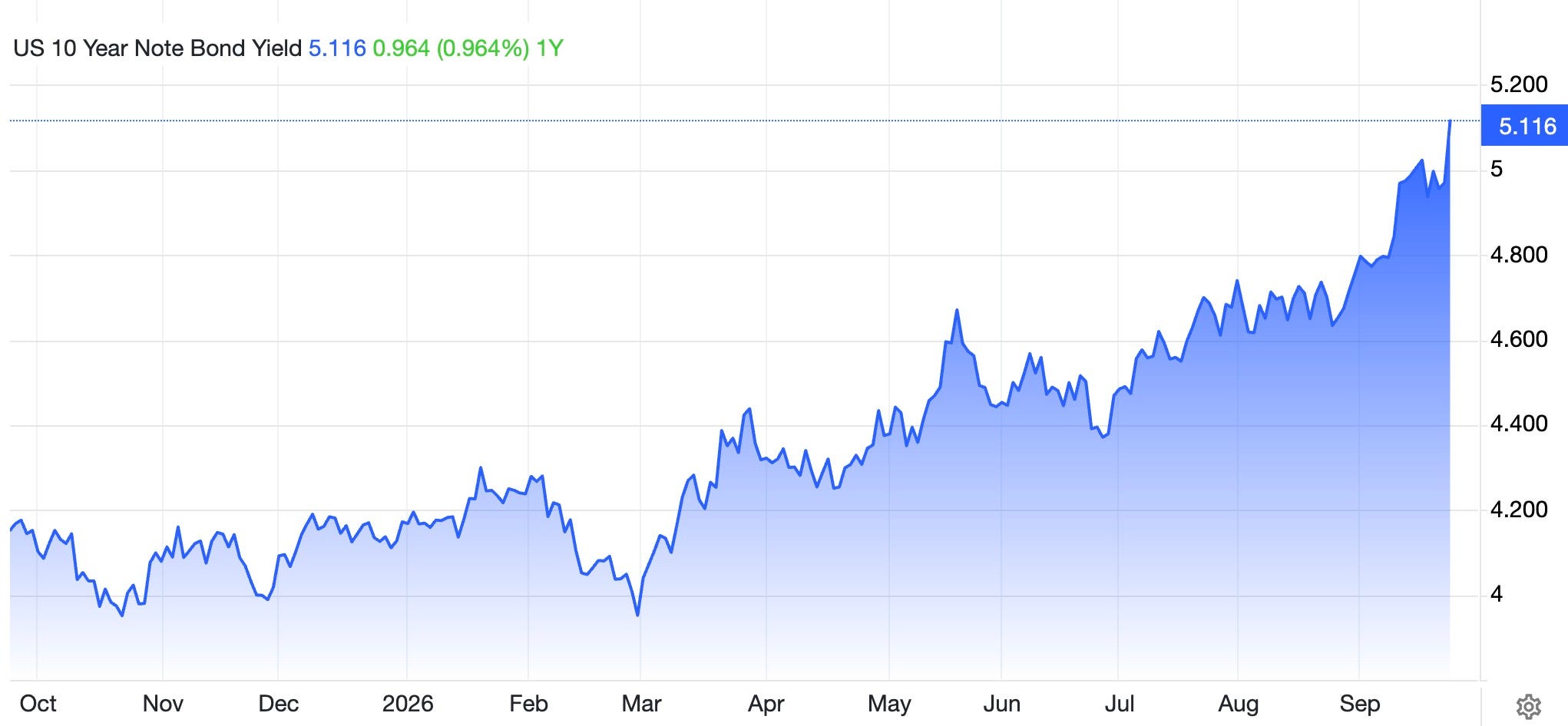
The 30-year climbed to roughly 5.4%, while the 2-year jumped to about 4.9%. This is the latest leg of a bond selloff that has been building for months, with the 10-year alone up roughly 35 basis points in September and long-term borrowing costs now pushing into territory we haven’t consistently dealt with since before the Global Financial Crisis.
Inflation fears, pornographic government borrowing needs, spiking oil prices and expectations for additional Fed hikes are all feeding the move. In other words, the bond market keeps trying to tell everybody something, and equity investors keep sticking their fingers in their ears.
Well, the bond market isn’t the equity market. It can’t be gamed, fucked around with using call options, it can’t be ignored and it can’t be rigged…at least, not without massive consequences. The equity markets in the U.S. are roughly $70 trillion in size, but they ultimately sit on top of the price of money established in the bond market.
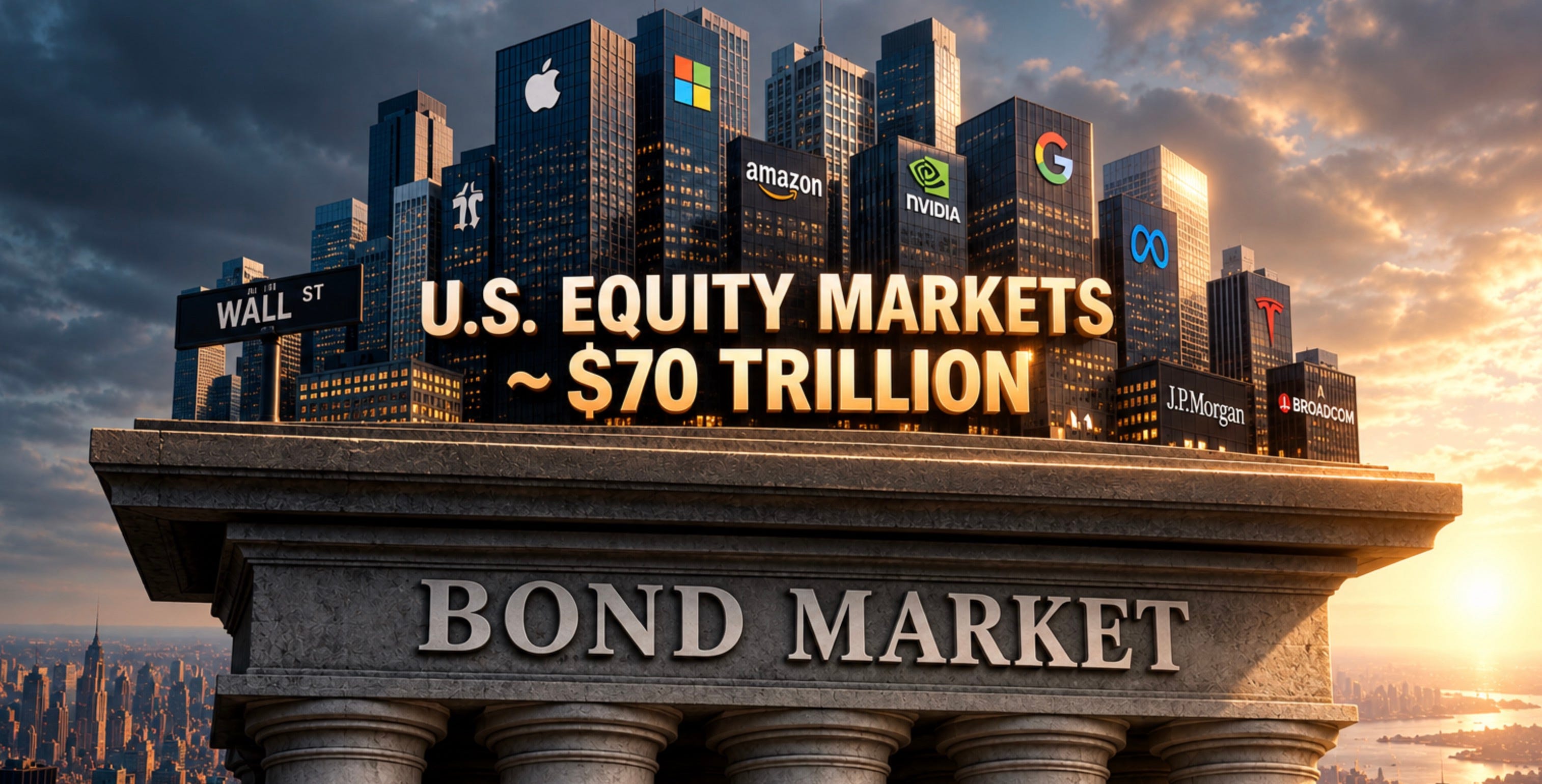
Treasuries alone are more than $30 trillion, and their yields help determine what mortgages cost, what corporations pay to borrow, what private equity can finance, what the government pays on its debt and, ultimately, what investors should be willing to pay for a dollar of future corporate earnings. Stocks can ignore that math for a while. They cannot ignore it forever.
It’s as simple as this: as long-term interest rates continue moving higher, virtually every important piece of financial math gets worse, all at the same time.
The discount rate used to value stocks rises, which makes future earnings worth less today. Mortgages get more expensive. Corporate borrowing gets more expensive. Private equity deals and private credit…much of which is already FUBAR but not showing it yet…become harder to finance. Leveraged companies have to refinance debt at higher rates. Consumers pay more to borrow and the federal government pays more to service its enormous pile of debt.
Rising rates are a slow, methodical wood chipper for anything built on cheap money. Anything like…oh, I don’t know…the entire fucking economy of the last two decades—especially after the Fed went full MythBusters during Covid, rejecting the reality of the economy’s death, and substituting its own by papering over the whole thing with $4 trillion in freshly printed cash.

It’s also a real shit sandwich because bonds become increasingly attractive competitors to stocks. There isn’t a magic yield where a siren goes off and the stock market automatically crashes, but there is a point where enough pressure accumulates that something breaks. If things keep heading in the direction they are in, that point will come before the end of the year undoubtedly, in my opinion.
Lest we forget, we are entering this experiment carrying an almost comical amount of debt. Total U.S. federal debt has crossed $40 trillion. CBO expects the government to run roughly a $1.9 trillion deficit in fiscal 2026, with debt held by the public around 101% of GDP. Net federal interest expense is projected at roughly $1 trillion this year and CBO expects it to reach $2.1 trillion by 2036.
We are already borrowing enormous amounts of money, partly to pay interest on money we previously borrowed, while the rate at which that debt gets refinanced keeps rising. It’s just simple arithmetic.
The Federal Reserve says domestic nonfinancial debt reached roughly $84 trillion in Q2: $21.4 trillion of household debt, $24 trillion of business debt and $38.7 trillion of government debt. Every additional turn of the interest-rate screw matters when you’re applying it to numbers that large.
Then we get to Wall Street, where apparently the response to historically expensive stocks has been: what if we bought even more of them with borrowed money? FINRA margin debt was about $1.45 trillion in August, up roughly 37% from a year earlier, after reaching a record $1.50 trillion in June. Leverage works wonderfully until it doesn’t. Stocks rise, collateral values rise, investors borrow more and that borrowed money can buy still more stocks. Look at margin debt/GDP:
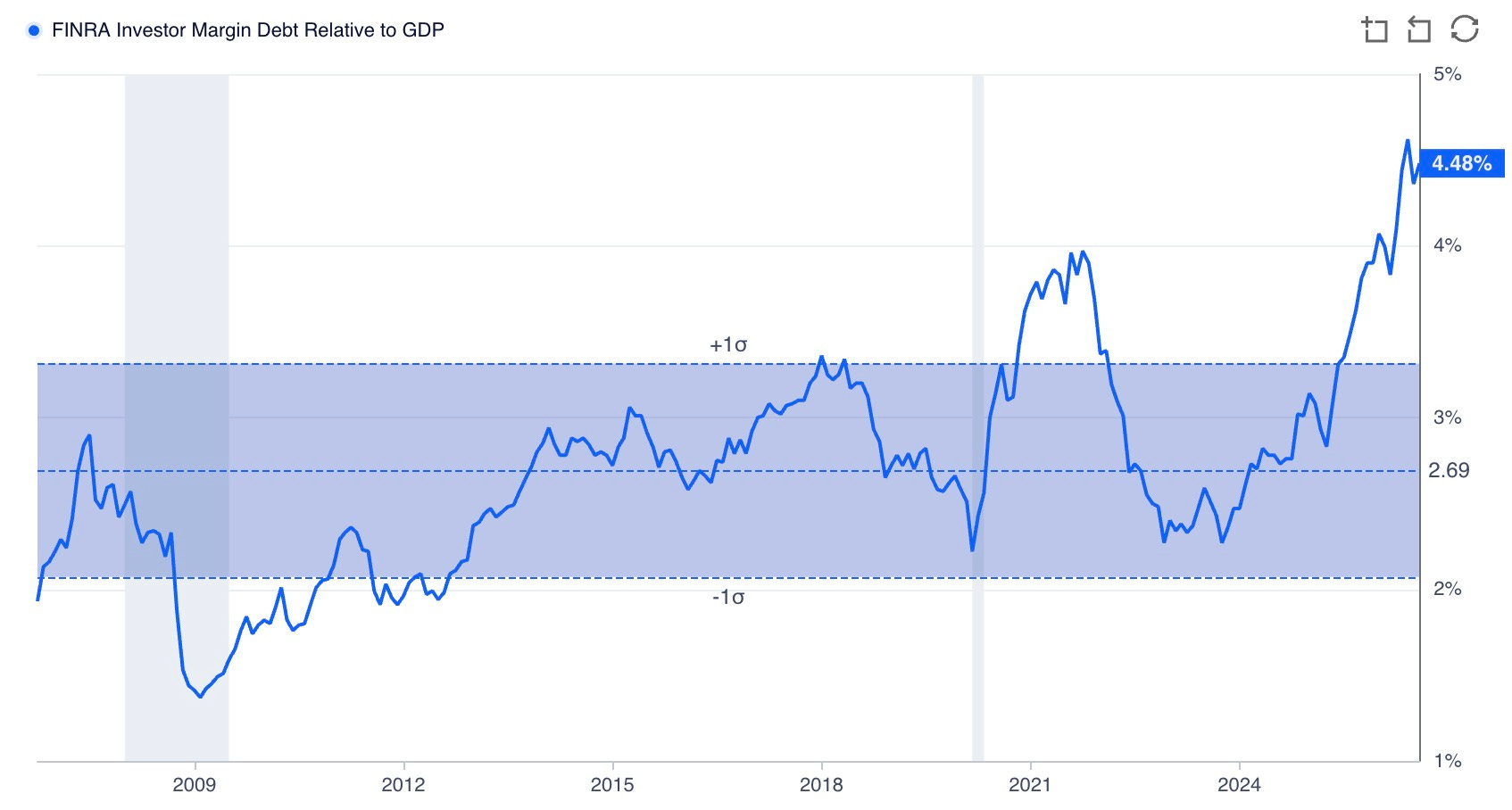
Now, reverse the arrows. Stocks fall, collateral values fall, margin requirements bite and people start selling because they have to. Selling creates more selling. That’s how leverage turns a correction into an avalanche.
And finally here’s where I think people may be making a much larger conceptual mistake. Everybody has spent the last 15 years assuming that eventually we simply return to the financial environment we became accustomed to after the Global Financial Crisis: zero rates, endless liquidity, cheap leverage and central banks standing behind asset prices.
What if we don’t? What if this is the reckoning?
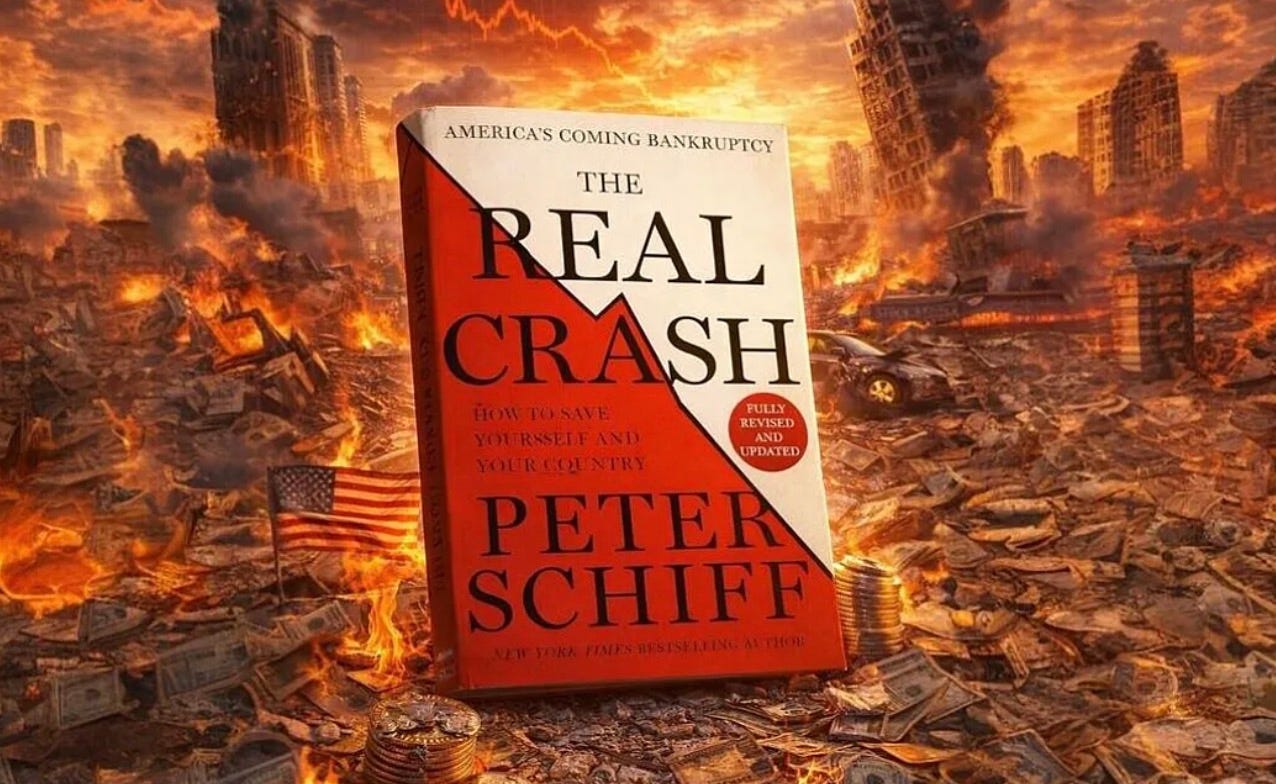
QE1 began in 2008. Then came more QE, zero rates, negative rates overseas, COVID stimulus, trillions in fiscal spending and one of the greatest expansions of financial assets and leverage in history. For years, people like Peter Schiff and other monetary bears have argued that we weren’t eliminating the consequences of excessive debt, we were postponing them. Maybe the bill has finally arrived. Like Schiff says, maybe this will be “The Real Crash”.
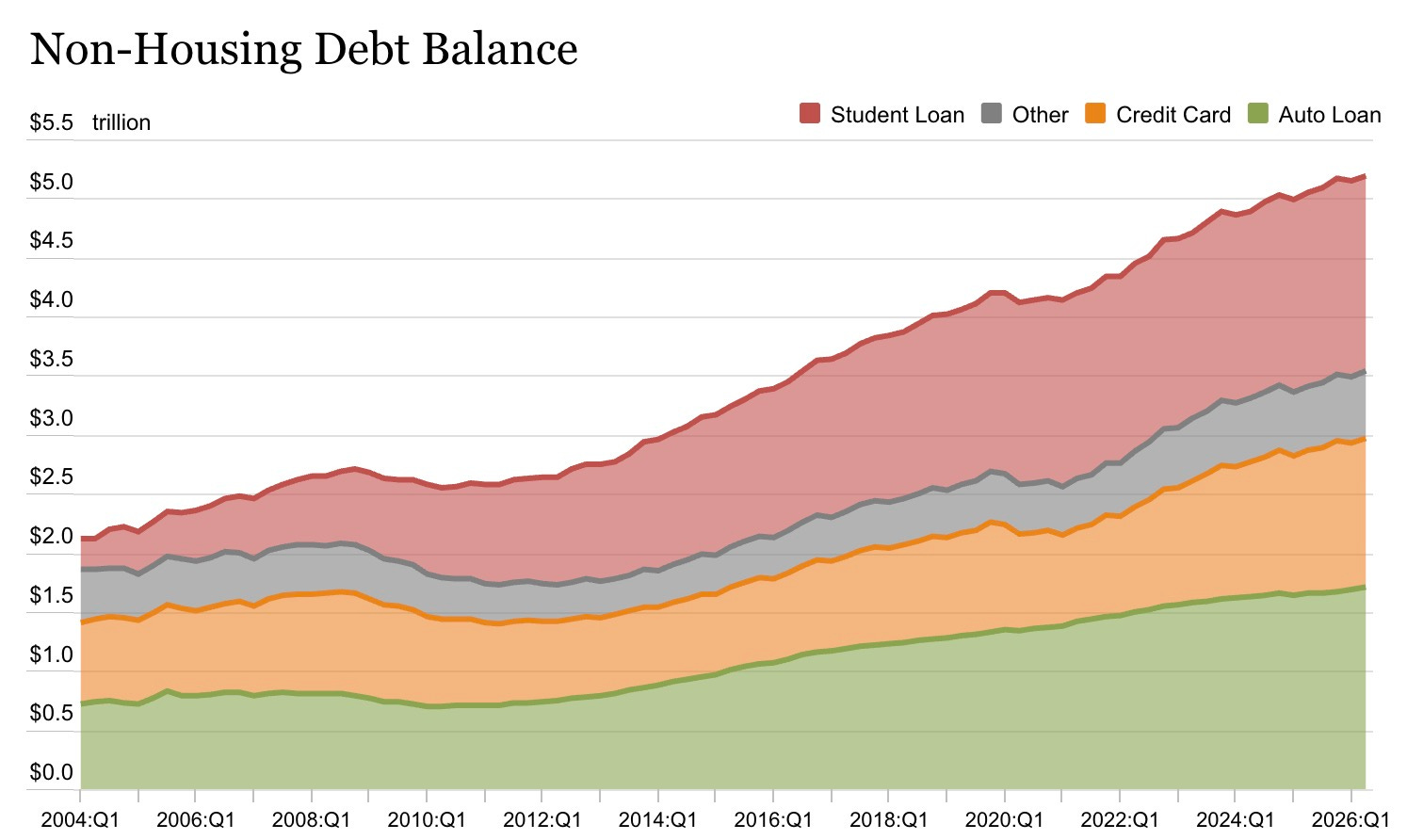
The private-credit market is already giving us little previews. Consumers aren’t exactly sitting on Fort Knox either. Americans have about $18.8 trillion of household debt, including $1.26 trillion of credit-card balances and $1.71 trillion of auto debt. Roughly 7% of current credit-card balances were transitioning into serious delinquency at an annualized rate in Q2. Now pour higher rates on top of that.
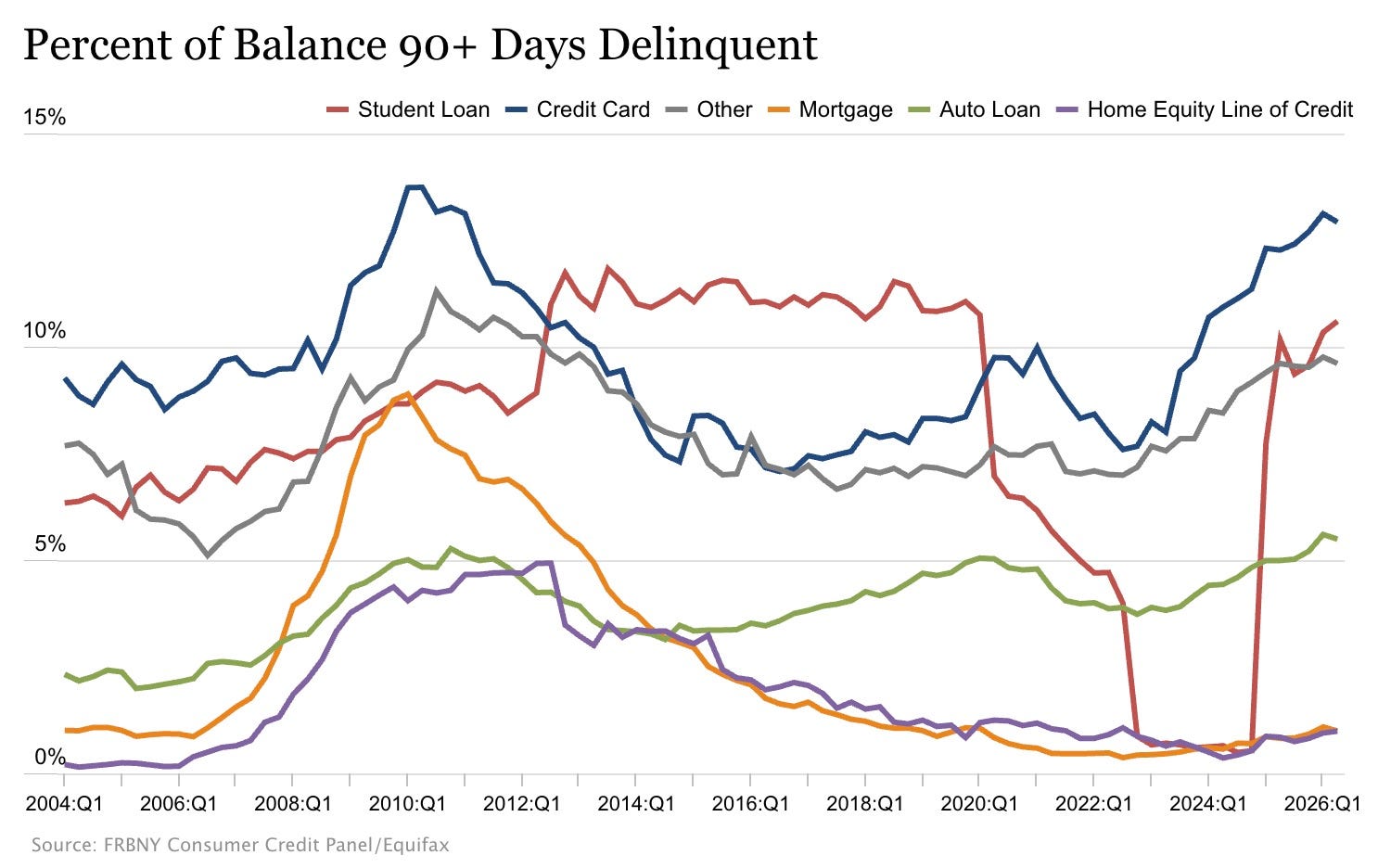
Yet somehow, against this backdrop, financial markets have decided this is an excellent moment to completely lose their minds.
AI infrastructure is increasingly being financed through enormous amounts of debt, leases, guarantees and special-purpose vehicles. Recent reporting has identified hundreds of billions of dollars of AI exposure supported by guarantees that can keep financing off Big Tech balance sheets, while broader estimates of off-balance-sheet obligations tied to the AI ecosystem run into the trillions.
The bond market is already starting to notice. Zero Hedge wrote yesterday that hyperscaler credit default swaps at all new all time wides:
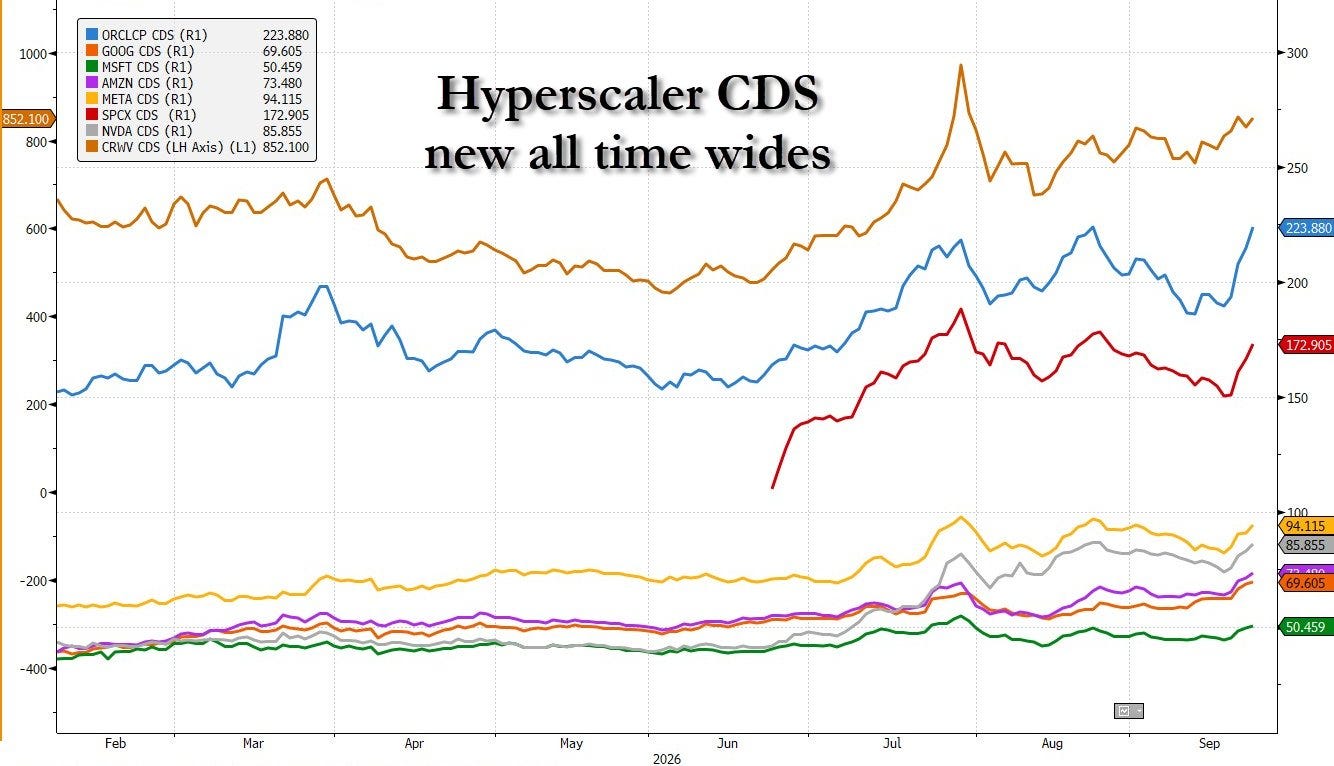
Meanwhile, SpaceX just went public at close to 100x sales. And then there’s crypto, an entire multi-trillion-dollar financial ecosystem whose necessity I remain unable to locate…and whose risks are multi-dimensional in ways I’m not sure everyone has considered yet.
That’s what scares me about the setup. We don’t have cheap stocks, low leverage and pristine balance sheets encountering slightly higher rates. We have enormous government debt, enormous consumer debt, enormous corporate borrowing, record margin leverage, stressed private-credit liquidity, speculative AI financing, crypto, gigantic valuations and investors who have been conditioned for nearly two decades to believe that every meaningful decline will eventually be rescued by the Federal Reserve.
Now raise the risk-free rate underneath all of it. And don’t stop doing raising it. Something has to…and will…give. In fact, if bond yields keep climbing, my view is that eventually a lot of things give at the same time.
This could become wrath-of-God-type stuff. Not because I’m predicting the apocalypse, but because there is an extraordinary amount of leverage sitting on top of asset prices that were built for a world where money was cheap, and the bond market is threatening to make money expensive again.
There is, of course, one enormous caveat: bonds can recover. If inflation falls, economic growth slows and long-term yields retreat substantially, the pressure valve opens. Discount rates fall, refinancing fears ease and equity multiples become easier to defend. The whole process can be postponed again.
But if long rates continue grinding higher and the market starts believing 5%-plus Treasury yields aren’t an aberration but the new regime, I don’t see how the current structure survives.
It’ll be a massive wreck. Maybe a crash the likes of which we haven’t seen before. And then my guess remains that the ultimate destination is some form of yield-curve control or similarly aggressive intervention. If policymakers eventually cap Treasury yields while inflation and fiscal deficits remain problematic, I think gold could go absolutely berserk. My long-term $10,000 gold thesis would become considerably less ridiculous.
But people keep skipping over the important part: you don’t get the rescue until something requires rescuing. That means pain first. Potentially enormous pain.
My thesis has become remarkably simple. If the bond market calms down, we can have another conversation. If yields keep going higher from here, I think a massive stock-market crash becomes increasingly difficult to avoid.
Not because of doomsday saying or permabear “fearmongering”, or because Peter Schiff has been yelling about it for 20 years. Because eventually, no matter how much bullshit Wall Street invents, math still eventually wins
END
JOHN RUBINO……….
2.ALASDAIR MACLEOD…
3. CHRIS POWELL AND HIS GATA DISPATCHES
4. ANDREW MAGUIRE//KINESIS LIVE FROM THE VAULT/291
END
5. COMMODITY REPORT: RARE EARTHS/CHINA
| President Trump Went to the Airport for Xi. Here’s Why, and What He’s Doing About It. |
| By Graham Summers, MBA | Chief Market Strategist |
| I am in Washington this week. Yesterday afternoon Marine One flew over on its way to Joint Base Andrews, with the President on board to meet Xi Jinping’s plane in person. Trump almost never does that. He waits at the White House. And when Trump flew to Beijing in May, Xi did not come to the airport; a vice premier did. Yesterday the President of the United States stood on the tarmac for the man who holds something he needs. |
 |
| Today Trump hosts Xi at the White House, the first state visit by a Chinese leader in more than a decade, followed by a state dinner tonight. By the time you read this, the two men will have spent several hours in a room together, and the wires will be parsing every word of the readout.I want to tell you what to watch, and why the result does not change a single trade. Start with what did not happen in the run-up. Before every previous meeting with Xi, Trump escalated. In 2019 he threatened tariffs on $300 billion of Chinese goods before Osaka. Before Busan last October he threatened a “massive increase” in tariffs and said there was no reason to meet at all. Before the Beijing summit in May he floated a 50% tariff over reports that China was sending air defense systems to Iran. This time, nothing. No tariff threats, no export bans, no leaked demands. And the President went to the airport. Reuters ran an analysis Monday on why the tone has changed, and the answer from every China expert they spoke to was the same: rare earths. |
 |
| Last year Beijing curbed rare earth exports in retaliation for Trump’s tariffs. It slowed licenses to a crawl and let American automakers and defense contractors find out what happens when a single input stops arriving. It did not have to cut supply to zero. It only had to show it could. The result, in the words of Peter Harrell, a White House economic official under Biden, is that the administration now “feels vulnerable to Chinese coercion” and is seeking “stability and secure access to critical minerals” above everything else. Put simply, China turned a supply chain into a weapon, and it worked so well that the President of the United States walked into today’s meeting with less leverage than the man across the table. That is the single most important fact about this summit, and almost nobody will say it that plainly. Here is what is on the table. The rare earth truce from the Busan meeting last October, in which Trump cut tariffs by 10% and shelved export controls on thousands of Chinese companies in exchange for Xi suspending the restrictions and resuming soybean purchases, expires late this year. The U.S. Trade Representative said this week the two sides are still negotiating an extension. Beijing has said it is committed to “safe and stable” supply chains while reserving the right to screen anything dual-use, which is Beijing’s way of saying the weapon stays loaded. The consensus from Bloomberg, Foreign Policy, and the China analysts is that both sides want an extension, neither wants a comprehensive deal, and China keeps its dominance of rare earth processing until at least 2030. So the most likely outcome tonight is a limited extension with warm words. Relief without a resolution. |
 |
| Now, why that does not change the trade. A truce extension buys Washington time, and time is the whole point. Every month of extension is a month the administration uses to build the map I described on Tuesday: the Greenland security deal, the $10 billion Project Vault stockpile that Glencore joined yesterday, the $400 million scandium mine in Australia, the tungsten line from Korea, the refining capacity being funded under the Defense Production Act. Even in the week before the summit, while Trump was holding his tongue on tariffs, Washington quietly banned exports of tungsten scrap. The administration has decided it cannot negotiate its way out of the chokehold, so it is spending its way out, and a truce gives it the calm to do that. That is the reading that matters for your money. If the truce is extended, the odds of a rare earth shock in the next twelve months go down. That takes the panic bid out of the names that more than doubled on Monday because they own a deposit in Greenland that ships in 2029. Nobody needs to pay up for 2029 supply if 2027 supply is flowing from China. Those stocks were pricing a crisis, and a truce postpones the crisis. At the same time, an extension raises the certainty that the funded projects get built. Government loans do not get cancelled because a summit went well. Stockpile purchases do not stop because Xi smiled at dinner. The companies with a Department of War commitment, a price floor, or a permit and customers get twelve more months of calm to pour concrete, and every one of those months moves them closer to the day the truce runs out and the U.S. is no longer negotiating from weakness. The gap between those two groups is the trade. It was the trade on Tuesday, and today’s summit is the proof. One more thing to watch. If Xi leaves with an extension and Trump leaves with nothing else, the market will call it a draw. Look at who set the terms. The man who controls the supply named them, and the man who needs the supply went to the airport to meet him. That is what leverage looks like, and it is exactly why Washington has decided to spend whatever it takes to make sure the next summit looks different. The rare earths will still be in China when Xi’s plane leaves. The mines to replace them are being funded anyway. Which brings me to what I actually do. I am not a stock picker who reads the headlines and reacts. I am a macro and geopolitical strategist. I spend my days in the places where policy gets made, working with the people who write the critical minerals rules, and I have spent twenty years studying how governments behave when they decide a supply chain is a matter of national survival. That is why my private clients were told a deal with Iran was coming before it was in the news, why they were told to wait on the producers instead of chasing them, and why they were positioned in the companies Washington is funding before Greenland, Project Vault, or today’s summit made the case for them. That is the difference. Most newsletters tell you what happened yesterday. Private Wealth Advisory tells you what Washington and Beijing are going to do next, and puts you in the trades before the market figures it out. A 75% win rate. Twice the return of the S&P 500 since 2020. Through a pandemic, a rate shock, an AI mania, and now a war in the Gulf and a chokehold in Beijing. You can see what my private clients see for $2.99.That gets you a 30-day trial of Private Wealth Advisory: four weeks of market updates, multiple investment recommendations, including the critical mineral producer the Department of War funded, up more than 20% since we added it, and a copy of my bestselling book The Everything Bubble. Xi came to Washington holding the only card that matters. My clients already own the companies built to take it away from him. You have thirty days to catch up for a dollar a day. |
END
COMMODITY TUNGSTEN:
Goldman Puts Almonty At “Center” Of Western Tungsten Race
Thursday, Sep 24, 2026 – 11:25 AM
Three weeks after Jefferies chemicals and materials analyst Laurence Alexander initiated coverage of Almonty Industries with a “Buy” rating and a 12-month price target of $26.25, framing it as a play on the “Western Tungsten Re-Shoring Trade,” Goldman Sachs launched coverage early Thursday, describing the miner as “at the center of the Western tungsten investment narrative.”
Goldman metals and steel analyst Nick Cash notes that Chinese policy restrictions have fueled supply concerns and an eightfold increase in tungsten prices since the start of 2025:
ALM sits at the center of the Western tungsten investment narrative as policy actions taken by China have resulted in global supply concerns, causing the price of tungsten to increase 8x since the beginning of 2025.
ALM owns one of the most important tungsten development asset outside China, the Sangdong mine in South Korea
However, we believe the stock is increasingly reflecting a continuation of today’s exceptional tungsten market as well as an aggressive production profile for Sangdong.
Almonty’s Sangdong mine in South Korea is key to conflict-free tungsten supply for the West as Beijing has ramped up restrictions that collide with the upcU.S.ing US rearmament cycle.
He cautioned that his estimates diverge from Wall Street consensus in two areas:
- We expect tungsten prices to normalize as new mine supply, recycling and refining capacity respond to current economics and
- We expect Sangdong’s ramp to progress more gradually than market expectations. While we remain constructive on the strategic value of ALM’s asset base, we believe current valuation already discounts much of that upside potential.
Almonty has moved to expand conflict-free tungsten supplies through a multiyear, take-or-pay offtake agreement with Sandvik Group subsidiary, centered on recovering tungsten from existing tailings at its Los Santos mine in Spain. The miner has also established a strategic partnership with Rwanda’s government, while South Korea approved the miner earlier this week to supply Western markets.
Goldman’s valuation stands well below the broader Street consensus. Bloomberg data show a consensus 12-month price target of $24.73, compared with Nick Cash’s $13 target. Almonty’s analyst coverage now comprises 9 “Buy” ratings and one “Hold” rating following Goldman.
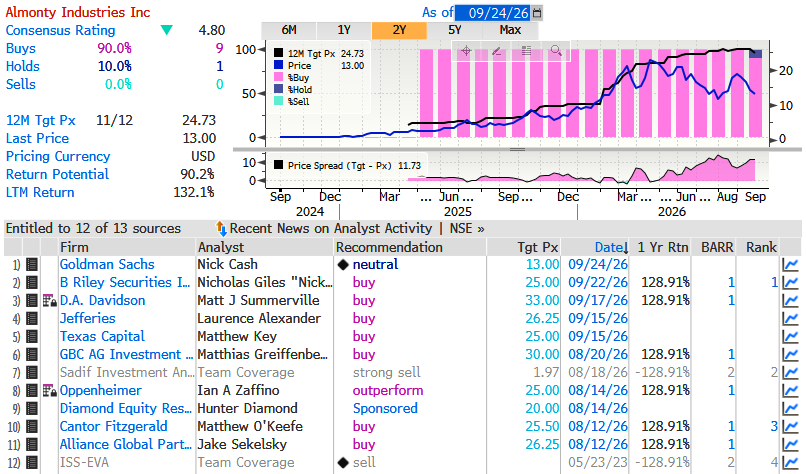
Jefferies’ Alexander noted earlier this month, “Almonty offers long-dated leverage to Western tungsten supply-chain re-shoring through Sangdong, Panasqueira, Browns Lake, and planned downstream oxide capacity. China controls ~80% of supply, while defense procurement restrictions begin in 2027.”
Almonty shares fell 6.5% to around $12.74 on Thursday morning, slightly below Goldman’s 12-month price target. The broader space, viewed through the lens of the VanEck Rare Earth and Strategic Metals ETF (REMX), has also declined in the back half of summer.
END
NATURAL GAS//FORCE MAJEURE
NatGas Spikes As Major West Virginia Pipeline Declares Force Majeure
Thursday, Sep 24, 2026 – 12:10 PM
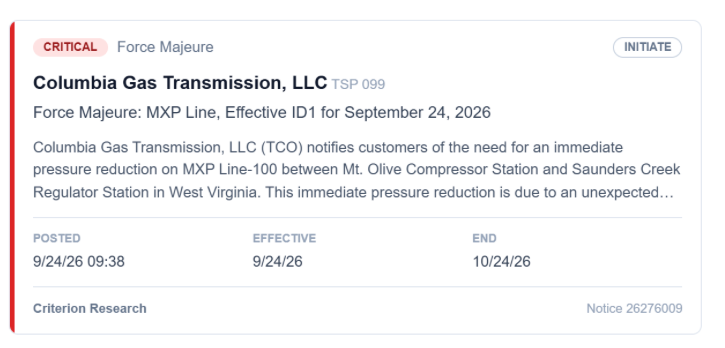
TC Energy’s Columbia Gas Transmission pipeline system issued a notice requiring an “immediate pressure reduction” on Mountaineer XPress Line 100 between the Mt. Olive Compressor Station in Jackson County and the Saunders Creek Regulator Station in Cabell County, West Virginia, warning that an “expected mechanical issue” would reduce scheduled volumes.
Columbia Gas Transmission moves Appalachian NatGas to markets across the Northeast, Mid-Atlantic, Midwest and Southeast, with connections carrying supplies deep south to export terminals on the Gulf of America.
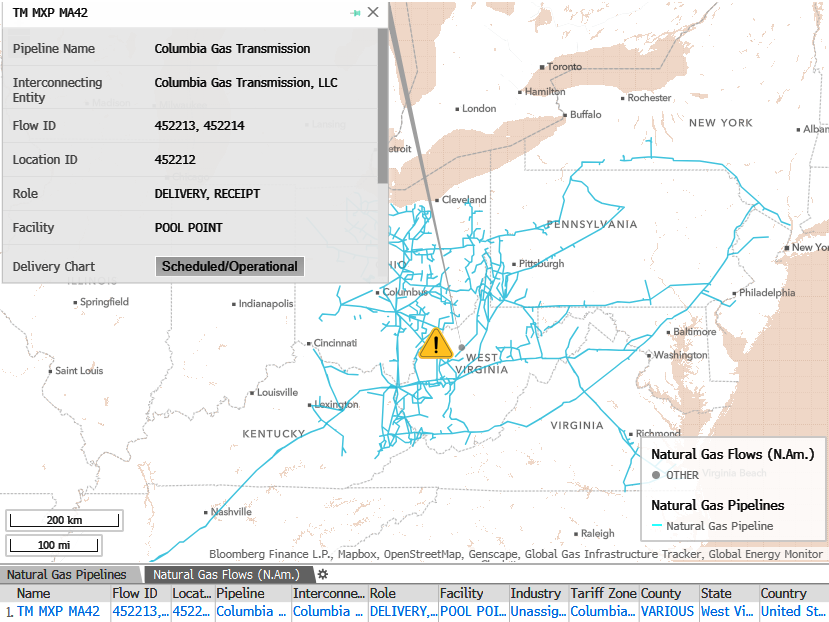
The affected Mountaineer XPress (MXP) pipeline in West Virginia feeds two main outlets:
- Regional markets: Columbia’s TCO trading pool, serving Midwest, Northeast and Mid-Atlantic customers.
- Southern markets: The Leach interconnection in Kentucky, where gas enters Columbia Gulf Transmission for transportation toward the Southeast and Louisiana’s Gulf Coast.
NatGas research firm Criterion Research provided clients earlier today with an update on the outage:
TCO declared force majeure this morning following an unexpected mechanical issue on its Mountaineer XPress (MXP) system between the Mt. Olive Compressor Station and Saunders Creek Regulator Station in West Virginia, with the pipeline set to cut the MXPSEG MA42 constraint to zero beginning with the Sept. 25 Timely Cycle.
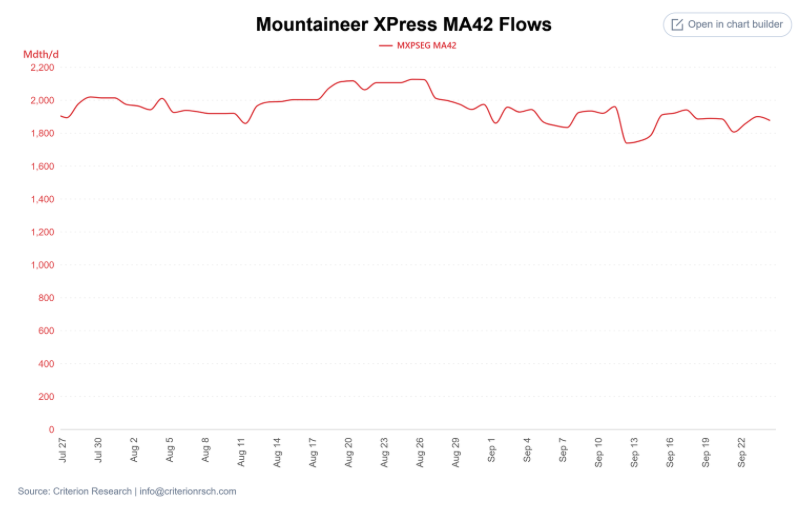
TCO estimates 1.8 MMDth/d of firm service will be affected, roughly matching the 1.88 MMDth/d currently scheduled through MXPSEG.
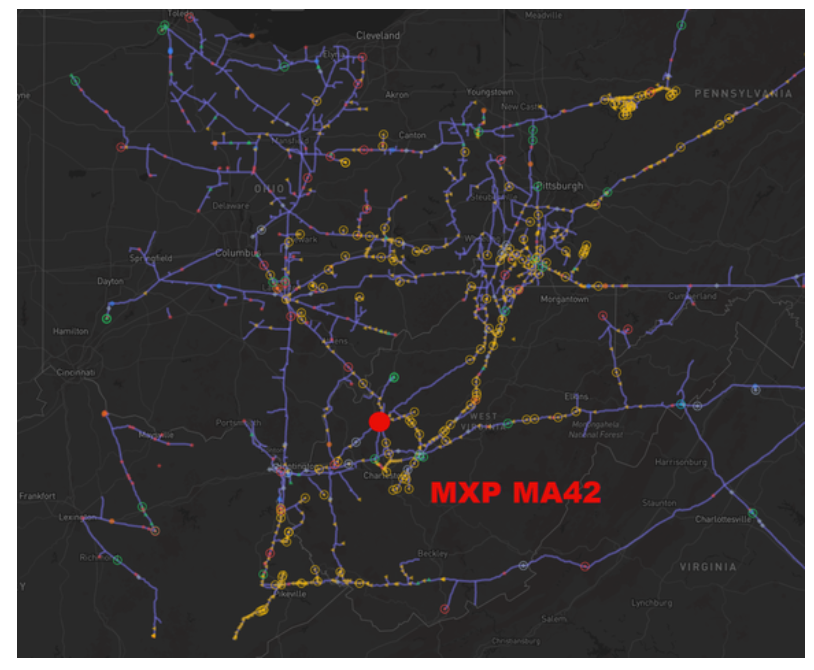
MXP is a 2.7 Bcf/d Appalachian takeaway system moving Marcellus/Utica supply south through West Virginia into TCO’s broader system. Upstream MXP receipts have not yet materially responded, with Sherwood flowing ~714 MDth/d, Corral ~267 MDth/d and Viking ~5 MDth/d today, but the full restriction should begin showing up in tomorrow’s nominations and could force significant rerouting or production cuts if the roughly 1.8 Bcf/d cannot find alternate paths. TCO has not provided a restoration timeline and expects to issue another update Friday morning.
October gas futures climbed 4.5%, or 13.6 cents, to $3.159 per million British thermal units on Nymex as of 11:00 a.m. ET. Prices have jumped more than 12% since early Wednesday.
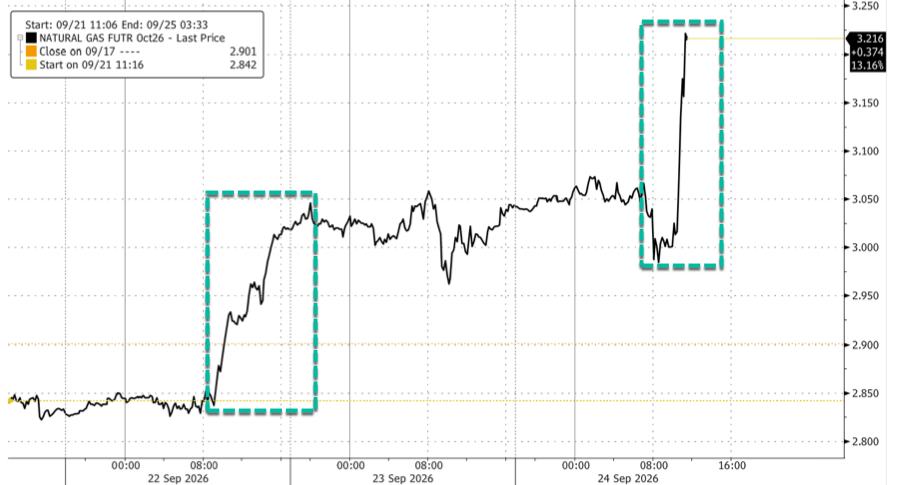
Flow restrictions can tighten downstream supplies even when natural gas remains abundant at producing wells across Appalachia.
END
YOUR EARLY CURRENCY VALUES/GOLD AND SILVER PRICING/ASIAN AND EUROPEAN BOURSE MOVEMENTS/AND INTEREST RATE SETTINGS THURSDAY MORNING.7:30 AM
SHANGHAI CLOSED DOWN 48.16 PTS OR 1.22%
HANG SENG CLOSED DOWN 101.62 PTS OR 0.42%
Nikkei CLOSED UP 573.05 PTS OR 0.88%
//Australia’s all ordinaries CLOSED DOWN 0.05%
//Chinese yuan (ONSHORE) CLOSED DOWN TO 6.7135
/ OFFSHORE CLOSED DOWN AT 6.7156 Oil UP TO 94.21 dollars per barrel for WTI and BRENT UP TO 105.74 Stocks in Europe OPENED ALL RED
ONSHORE USA/ YUAN// WITH YUAN TRADING DOWN (6.7135 OFFSHORE YUAN TRADING DOWN TO 6.7156 ONSHORE YUAN TRADING ABOVE LEVEL // OFF SHORE AND UP ON THE DOLLAR)// / AND THUS WEAKER/OFF SHORE YUAN TRADING UP AGAINST US DOLLAR/ AND THUS WEAKER
XXXXXXXXXXXXXXXXXXXXXXXXXXXXXXXXXXXXX
ONSHORE YUAN: CLOSED DOWN AT 6.7135
OFFSHORE YUAN: DOWN TO 6.7156
1A.HANG SANG CLOSED DOWN 101.62 PTS OR 0.41%
1 B. SHANGHAI CLOSED DOWN 48.16 PTS OR 1.22%
2. Nikkei closed UP 573.05 PTS OR 0.88%
WEST TEXAS INTERMEDIATE OIL UP TO 94.21
BRENT; 105.74
3. Europe stocks SO FAR: ALL RED
USA dollar INDEX UP 5 BASIS PTS TO 100.86// EURO FALLS TO 1.1421 DOWN 27 BASIS PTS
3b Japan 10 YR bond yield:FALLS TO. +3.082 UP 10 FULL BASIS PTS/ VERY TROUBLESOME//Japan buying 100% of bond issuance)/Japanese YEN vs USA CROSS NOW AT 158.43… JAPANESE YEN NOW FALLING AS WE HAVE NOW REACHED THE ENDING OF THE YEN CARRY TRADE AGAIN AND THE REPATRIATION OF YEN DENOMINATED BONDS TRADING IN THE USA/EUROPE. JAPAN 30 YR BOND YIELD: 4.1796 UP 10 FULL BASIS PTS
3c Nikkei now ABOVE 17,000
3d USA/Yen rate now well ABOVE the important 120 barrier this morning
3e Gold DOWN /JAPANESE Yen DOWN CHINESE ONSHORE YUAN: DOWN (6.7135) AND OFFSHORE: DOWN AT 6.7156
3f Japan is to buy INFINITE TRILLION YEN worth of BONDS. Japan’s GDP equals 5 trillion USA. CENTRAL BANK OF JAPAN WILL NO LONGER DO QE.
Japan to buy 100% of all new Japanese debt and NOW they will have OVER 50% of all Japanese debt. GOVERMENT ASKED JAPAN PENSION FUNDS AND INSURANCE FUNDS TO BUY MORE JAPANESE BONDS AND REPATRIATE ALL FOREIGN BONDS.
3g Oil UP for WTI and UP for Brent this morning
3h European bond buying continues to push yields HIGHER on all fronts in the EU German 10yr bund YIELD UP TO +3.5712/ Italian 10 Yr bond yield UP AT 4.5280/ SPAIN 10 YR BOND YIELD UP TO 4.057%
3i Greek 10 year bond yield UP TO 4.4020%
3j Gold at $4265.50 /Silver at: 63.76 1 am est) SILVER NEXT RESISTANCE LEVEL AT $100.00
3k USA vs Russian rouble;// Russian rouble DOWN 0 AND 65/ 100 roubles/85.19
3m oil (WTI) into the 94 dollar handle for WTI and 105 handle for Brent/
3n Higher foreign deposits moving out of China// huge risk of outflows and a currency depreciation. This can spell financial disaster for the rest of the world/
JAPAN ON JAN 29.2016 CONTINUES NIRP. THIS MORNING RAISES AMOUNT OF BONDS THAT THEY WILL PURCHASE UP TO .5% ON THE 10 YR BOND///YEN TRADES TO 158.43 // 10 YEAR YIELD AFTER FIRST BREAKING .54% LAST YEAR NOW EXCEEDS THAT LEVEL TO 3.082% UP 10 BASIS PTS STILL ON CENTRAL BANK (JAPAN) INTERVENTION//YEN CARRY TRADE NOW UNWINDING//YEN BOND TRADING OVERSEAS TO BE REPATRIATED.//JAPAN 30 YR: 4.179 UP 10 PTS..: USA/SF this 0.8276 as the Swiss Franc . Euro vs SF: 0.9422
USA 10 YR BOND YIELD: 5.140 UP 2 BASIS PTS…NOW BELOW 5.00%
USA 30 YR BOND YIELD: 5.436 UP 3 BASIS PTS/REFUSES TO GO DOWN WITH BESSENT’S QE TWIST
USA 2 YR BOND YIELD: 4.895 UP 1 BASIS PTS
USA DOLLAR VS TURKISH LIRA: 48.86 UP 2 BASIS PTS/LIRA GETTING KILLED//IDIOTS FOR SELLING GOLD AND USA DOLLAR RESERVES.
10 YR UK BOND YIELD: 5.3828 UP 13 PTS
30 YR UK BOND YIELD: 5.8658 UP 13 BASIS PTS
10 YR CANADA BOND YIELD: 3.9530 UP 12 BASIS PTS
5 YR CANADA BOND YIELD: 3.685 UP 12 BASIS PTS.
1a New York Opening report
Futures Tumble As Yields Hit Multi-Decade Highs, Oil Surges
Thursday, Sep 24, 2026 – 08:46 AM
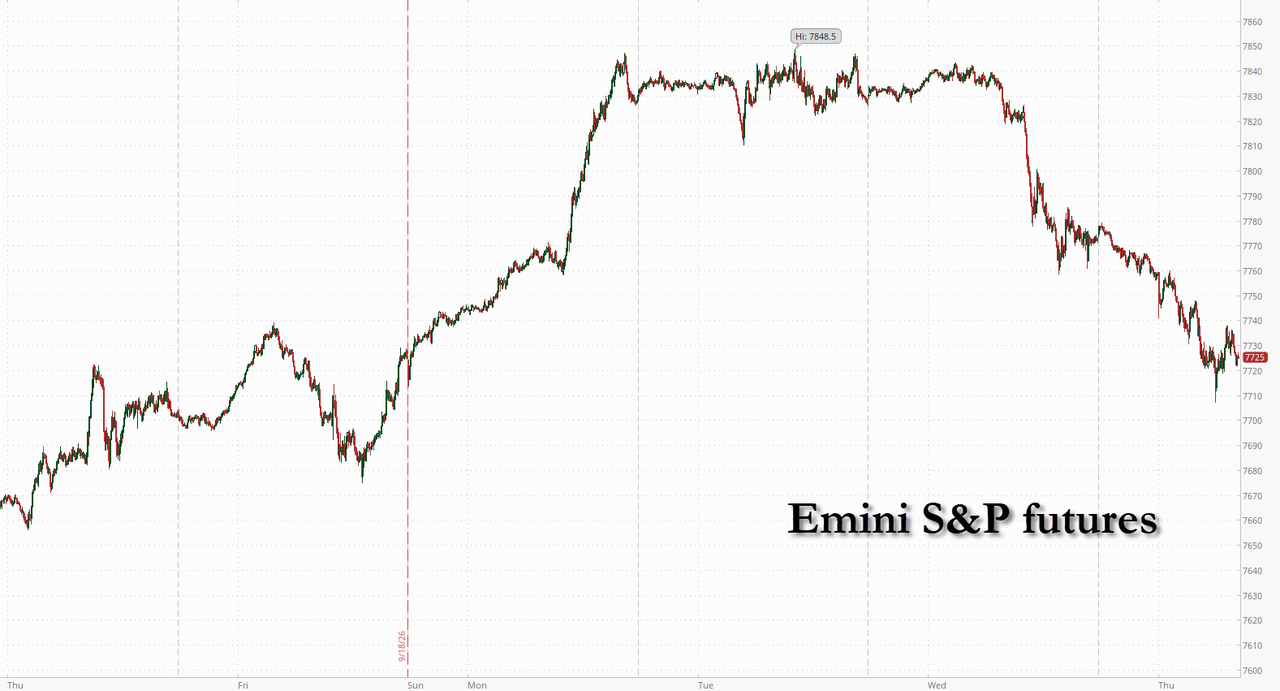
Futures are lower with Tech underperforming as part of a global risk-off tone with few areas of safety, driven by a global bond rout that has sent yields across the globe to levels not seen in a generation. As of 8:00am ET, S&P futures are 0.6% lower with Nasdaq futures sliding 1.0% and reflecting the fallout from Wednesday’s barrage of inflationary signals, which sent stocks in Asia and Europe lower. In premarket trading, semis and memory are lagging the broader tech tape for the 2nd day, with software seeing slight outperformance, but still lower. Defensives and energy are leading cyclicals. The yield curve is bear steepening with the back-end yields making multi-year highs; pushing the 10Y yield to 5.14% and the 30Y yield to the highest since 2004. This follows Wednesday’s US data and auction-led selling in US paper with an ascent in energy prices today driving the moves further. The rout in bonds swept into Asia, with yields in Japan, Australia and New Zealand climbing by more than 10 basis points on Thursday. The USD remains bid and DXY is less than 40bp from its 52-wk high. In commodities, energy and ags resume their leadership as the market reduces its optimism for an imminent solution in the MidEast; metals are weaker with precious lagging ase. The Trump-Xi meeting will be one to watch on today’s calendar, following US Treasury Secretary Bessent’s announcement of a two-month extension to the trade truce which appears to have disappointed markets as it was less than what China expected. US economic data slate includes 2Q current account balance and weekly jobless claims (8:30 a.m.), August new home sales (10 a.m.) and September Kansas City Fed manufacturing activity (11 a.m.)
In premarket trading Magnificent Seven: Alphabet (GOOGL) -0.7%, Amazon (AMZN) -0.9%, Apple (AAPL) unchanged, Microsoft (MSFT) -0.6%, Tesla (TSLA) -1%, Nvidia (NVDA) -1.1%, Meta Platforms (META) -2%
- Darden (DRI) falls 5% after the restaurant-chain operator posted first quarter sales that disappointed.
- Dropbox (DBX) declines 5% after Citi downgraded the file management software company to sell, writing that recent optimism about its AI strategy “derives too much success too early.”
- Etsy Inc. (ETSY) slips 2% after Arete downgraded the online retail platform to neutral, citing concerns over its valuation and growth sustainability.
- Everpure (P) jumps 7% after the data-storage company forecast revenue for 2028 that exceeded the average analyst estimate.
- MGM Resorts International (MGM) is down 9% after Barry Diller’s People Inc. dropped plans to acquire the rest of the casino giant.
- Stitch Fix (SFIX) falls 19% after the online personal styling platform forecast a much weaker full-year 2027 Ebitda that analysts expected.
- Viking Therapeutics (VKTX), which had surged 36% Tuesday on experimental weight-loss drug results, is down 12% after offering $200 million in common shares and another $200 million in convertible notes to help fund clinical development.
In other corporate news, a consortium backed by BlackRock and IFM are said to be closing in on $25 billion deal to buy Stack Infrastructure’s Asia Pacific data centers. Morgan Stanley is working to contain the damage from a leaked deal list after one of its top bankers accidentally sent an email to some clients containing a list of deals the firm was working on and monitoring.
Wednesday’s strong economic data, a weak debt auction, and mounting concerns over diesel prices and policy is rattling both Wall Street and Main Street, driving yields across most maturities to the highest in almost two decades. This has pushed inflation anxiety back to being front and center for investors, with concerns about Brent above $100 and an overheating US economy piling fresh pressure on bond markets. That’s taken the shine away from stocks, pulling the Nasdaq 100 down from a record high.
“Higher bond yields are becoming a more meaningful headwind for equities,” said Simon Wiersma at ING Bank. “Middle East de-escalation could take some pressure off bond markets, but the bigger story is the structural rise in global borrowing needs.”
Futures reflect the fallout from Wednesday’s barrage of inflationary signals. According to BBG, Traders are unlikely to commit fresh capital before tonight’s Trump-Xi summit, despite Bessent saying the US and China have extended their trade truce.
Oil’s latest leg higher came after an Iranian official warned Tehran may expand the war to the Indian Ocean if the US or Israel attacks again. “Now that the war has expanded from the Persian Gulf and the Strait of Hormuz to the Red Sea, it may, in the next phase of a potential conflict, widen further,” Iran’s semi-official Fars cited Yahya Rahim Safavi, who’s also a senior member of the Islamic Revolutionary Guard Corps, as saying.
“Oil prices remain the key driver overall,” said Nadege Dufosse, head of multi-asset at Candriam. “Investors are flying blind as it’s impossible to guess which way the talks between Iran and the US will go.”
Energy Secretary Chris Wright told oil industry leaders to brace for possible US curbs on diesel exports amid an intensifying debate within the Trump administration over that approach. A potential diesel export ban would carry “significant implications” and even have the counterintuitive effect of an increase in gasoline prices if US refiners cut runs, notes Morgan Stanley.
Meanwhile, as extensively noted here, the entwined mix of AI and inflation is causing angst. Debt pressures return with Amazon, Alphabet CDSs topping the year’s highs, and Nvidia insurance costing more amid circular financing concerns.
“Before the year draws to a close, a choice is likely to be needed between inflation and the debt-financed capital expenditure boom,” notes Jonestrading Chief Strategist Mike O’Rourke. “Main Street has paid the price for five-plus years and does not have much left to give,” O’Rourke adds.
Fresh warnings about price pressures were raised at two rate decisions in Europe. The Swiss National Bank lifted its inflation forecast as it dialed down its threat of intervention to support the franc. Norges Bank increased borrowing costs for a second time this year and said it was primed to hike again. For the Fed, swaps fully reflect three quarter-point hikes over the next year, with significant hedging for a fourth.
“A resolution in the Middle East would certainly bring some relief, particularly to European rates given the energy channel, but in the US the story goes beyond oil at this stage,” said Alessandro Gabellone at Bank Degroof Petercam.
“Inflation has been above target for years, while fiscal imbalances and rising interest costs are increasingly part of the discussion around long-term yields,” he said.
Traders will follow the summit between Trump and China’s Xi Jinping later today at a time when tensions between the world’s two biggest economies persist over rare earths, technology curbs and Taiwan. “Super Intelligence” would be a big topic of discussion, Trump said on social media. “I want to leave it exactly where it is. That is China’s position also.”
Treasury Secretary Scott Bessent announced that a trade agreement struck by the leaders last year will now run an additional two months until Jan. 10, clearing the way for two more meetings in the coming months at summits in Shenzhen and Miami.
In Europe, the Stoxx 600 is down 0.4% with the average yield rising to levels not seen in almost two decades. Tech and autos are the worst performers. Energy gains. Here are some of the biggest movers on Thursday:
- Mitchells & Butlers shares rise as much as 3.9% after the pub chain reported a pick-up in like-for-like growth in the final quarter, aided by a strong showing over the August bank holiday weekend.
- Motor Oil Hellas shares rise as much as 1.9% after Goldman Sachs upped its price target on the Greek refiner, predicting it to benefit from higher diesel crack spreads.
- BioGaia gains as much as 5.1% after Danske Bank reiterated its buy rating and raised its price target on the Swedish health additives company, seeing a good risk/reward opportunity going into the company’s third-quarter report, due on Oct. 22.
- Raspberry Pi rises 23% after first-half revenue at the micro-computer maker jumped 90% to $256.9 million.
- OVS shares rose as much as 4% in Milan trading after the Italian fashion retailer’s adjusted net sales grew 11% year on year.
- H&M shares fall as much as 3.7% after US tariff refunds were largely credited for driving a beat in third-quarter profits at the Swedish fast-fashion retailer.
- Tryg shares fall as much as 3.5% after Danske Bank downgraded the Danish insurance firm to hold from buy, predicting headwinds from inflation and rising interest rates.
- Verbio declines as much as 6.9% as Jefferies says that despite a solid finish to the year, the biodiesel and bioethanol fuel producer’s new FY26/27 Ebitda guidance is below consensus.
- Vistry shares drop as much as 11% after the housebuilder reported weak interim results and outlined the findings from the review conducted by its CEO.
Asian stocks declined for a second day amid renewed pressure from elevated oil prices and US bond yields. The MSCI Asia Pacific Index dropped 0.9%, with China the worst performer in the region. Indian equities dropped the most in over two months amid a selloff in the heavyweight financial sector after the nation’s insurance regulator proposed changes that include capping commissions. Japanese stocks were mixed as markets reopened following a three-day holiday. South Korea was shut for a holiday. .
In FX, the Bloomberg Dollar Spot Index continues to carve out fresh multi-month highs, adding 0.2%. The Norwegian Krone leads G10 FX, whilst the Swiss Franc lags after respective rate decisions. USD/JPY has eclipsed its 200DMA for the first time since early September.
In rates, treasuries are mixed in early US session with the yield curve steeper around a little-changed 7-year sector. Front-end tenors unwind some of Wednesday’s steep losses while long-end has added to them, lifting 30-year yield to 5.44%, highest since 2004. 10-year reached 5.15%, highest since 2007. US 2-year yields are lower by around 3bp with long-end yields higher by around 3bp, close to cheapest levels of the day, steepening 2s10s and 5s30s curves by 4bp-5bp. 10-year yield is little changed near 5.125%, with bunds in the sector lagging by 1bp and gilts outperforming by 2bp. European rates are a touch higher with the French-German 10-year spread widening to about 111bps. Higher energy costs have hit sentiment in Europe. $44 billion 7-year note auction at 1 p.m. New York time follows poor demand for Wednesday’s 5-year note sale, which tailed by more than 3bp. WI 7-year yield near 5.055% is ~54bp cheaper than last month’s, which stopped on the screws. IG dollar issuance slate empty so far. Five borrowers priced a combined $5.2b Wednesday, paying about 6bp in new issue concessions on deals that were 1.9 times covered. Weekly volume stands near $33b, about $6.5b short of the $40b projected by dealers. Focal points of US session include weekly jobless claims data and 7-year note auction.
In commodities, WTI crude oil futures are up around 1.4%, off session highs, extending Wednesday’s rally after an IRGC official threatened to expand the war in the Middle East into the Indian Ocean.Brent is higher by 2.5% and up nearly 10% from the week-to-date low as hopes of a US-Iran deal fade and rhetoric remains hostile. Brent gained after US Energy Secretary Chris Wright told oil industry leaders to brace for possible US curbs on diesel exports amid an intensifying debate within the Trump administration over such a move. The firmer greenback is dragging precious metals lower with spot gold down 0.6%. Bitcoin declines nearly 1%.
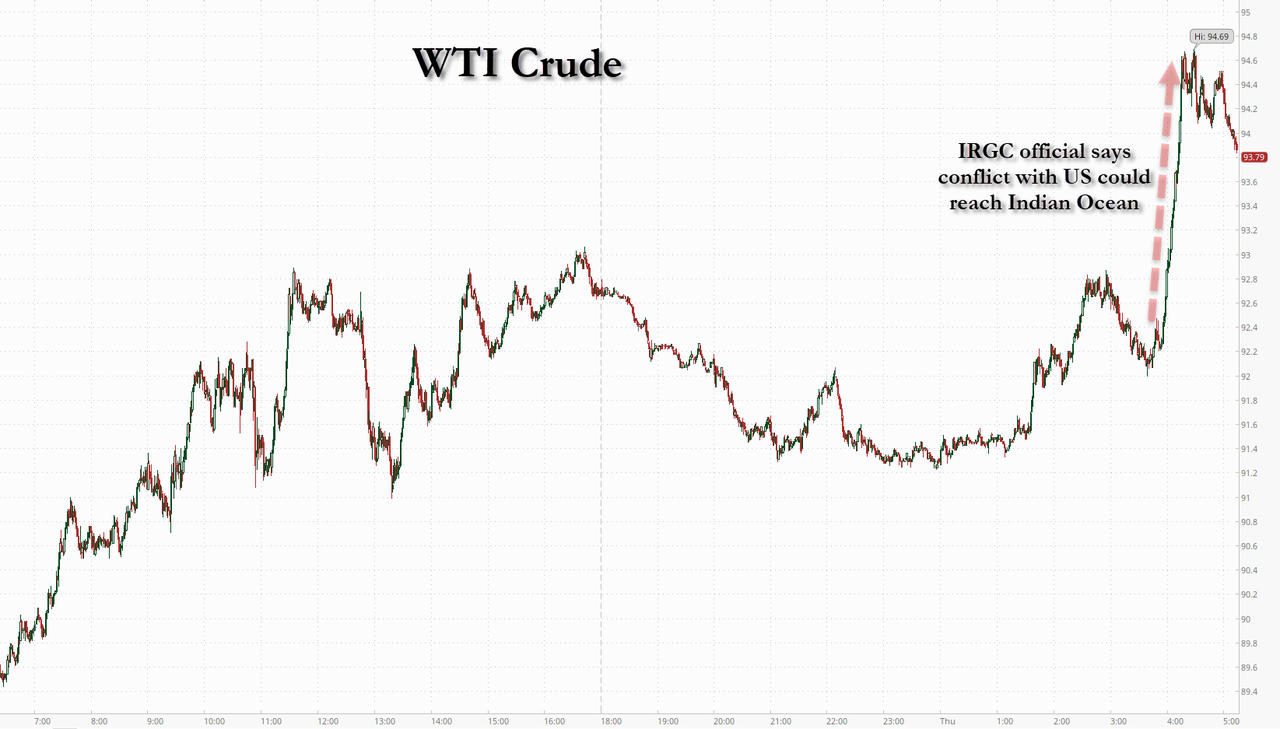
US economic data slate includes 2Q current account balance and weekly jobless claims (8:30 a.m.), August new home sales (10 a.m.) and September Kansas City Fed manufacturing activity (11 a.m.) Fed speaker slate includes Richmond’s Barkin (8:30 a.m.), Cleveland’s Hammack (8:50 a.m.) and Philadelphia’s Paulson (10:10 a.m.). New York President John Williams said in a London event Thursday that more work needs to be done to lower US inflation.
Market Snapshot
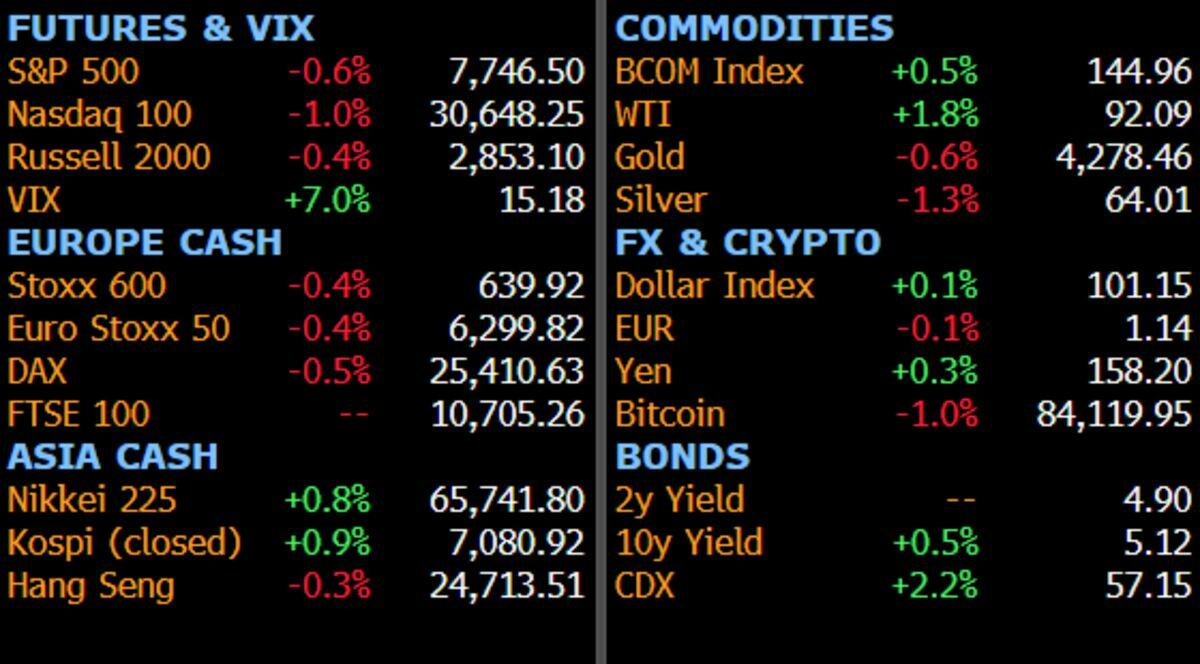
Top Overnight News
- The US 30-year yield climbed to its highest level since 2004 as comments from Iran further stoked oil-driven inflation fears and fiscal concerns. Equity futures fell. BBG
- Brent surged to around $106 after a military adviser to Iran’s supreme leader said Tehran may expand the war to the Indian Ocean if the US or Israel attacks again, further undercutting hopes of a deal. BBG
- Saudi Arabia has sold almost 100 million barrels of oil to Asian buyers since the middle of last week, helping to avert a looming supply crunch in the region. The crude will be sent via the Strait of Hormuz to buyers including Chinese state-run and independent refiners, as well as processors in India, Japan and South Korea. BBG
- President Donald Trump’s strong rapport with Xi Jinping is set to be on display in Washington this week as the Chinese leader makes his first U.S. state visit in more than a decade. But below the surface-level pageantry at the White House, little is likely to be resolved as the world’s two biggest economies continue to spar over trade, Taiwan, AI and more. NBC
- US Treasury Secretary Scott Bessent announced on Wednesday that Washington and Beijing have agreed to extend the trade agreement reached in South Korea for just two months, as Chinese President Xi Jinping arrives in Washington for a state visit. SCMP
- Large cargo ships have recently paid up to $5 million to pass through the Panama Canal, as the global shipping industry reacts to trade disruptions from the Iran war and extreme weather patterns in the Western Hemisphere. WSJ
- The AI build-out is on track to become the biggest economic bet in U.S. history, dwarfing the investments made to fund other huge U.S. infrastructure projects such as the railroads, the highway system and the plumbing for the internet. WSJ
- AI firms are rushing to discount their products as some enterprises express caution about paying full price for all the new tools. The Information
- Sellers are feeling the strain of US mortgage rates around 7%. Nearly one in five homes for sale had a price cut in August, while 45% of sales involved a seller concession, according to Redfin data. BBG
- Mark Carney said he had seriously considered the “extreme tail risk” of a US invasion when asked about the possibility in a NYT interview. BBG
- A US judge issued an order blocking the Trump administration’s White House ban on CNN, MS NOW and Politico.
- US Senate Majority Leader Thune believes President Trump is open to implementing AI guardrails despite his public defiance on the issue: Axios.
- An industry group representing US tech companies is reportedly pushing the US administration to withdraw its proposal to charge for H-1B visas: WSJ.
- BofA Total Card Spending (w/e Sep 19th) +6.9% Y/Y (prev. +5.8% W/W); surging gas prices have opened up a gap in ex-gas spending between higher and lower income households.
A more detailed look at global markets courtesy of Newsquawk
APAC stocks were mostly pressured following on from the declines in global peers alongside the recent bond turmoil and jump in yields, owing to several factors including strong US data, hawkish Fed rhetoric and mixed reports regarding a US diesel export ban.
ASX 200 retreated with the declines led by weakness in miners, real estate and materials, while sentiment was not helped by mixed jobs data including an unexpected rise in the Unemployment Rate to a five-year high. Nikkei 225 outperformed after Japanese participants returned from the long weekend and with tech names playing catch-up to the recent AI-related momentum. Hang Seng and Shanghai Comp retreated despite early optimism from President Xi’s state visit to the US, while a two-month extension to the US-China trade truce until January 10th also failed to spur risk appetite.
Top Asian News
- PBoC will offer lenders a record amount of up to CNY 1tln in overnight funds each day over the upcoming holiday period, according to Bloomberg.
- PBoC to comprehensively use and timely adjust monetary policy tools to keep liquidity ample; to step up counter cyclical adjustments.
- Japan’s Finance Ministry is to consider cutting issuances in liquidity-enhancement auctions for medium-term JGBs, according to sources.
- Japanese Finance Minister Katayama said the principles on forex established since the joint US-Japan intervention remain in effect, while she won’t comment on specific FX levels.
- Japan reportedly plans to finance economic security spending mainly through “bridging bonds”, reducing the need for the issuance of deficit bonds, Nikkei reported citing sources.
European bourses (STOXX 600 -0.3%) opened entirely in the red and has come under a fresh leg of pressure in recent trade amid the upside across the energy space. The source of the move came amid comments by the Senior adviser to Iran’s Supreme Leader Major General Safavi, saying the US conflict could expand further into the Indian Ocean. Sectors highlight the negative bias. Energy, Food, Beverages & Tobacco and Optimised Personal Care are the only sectors in the green. Leading the downside is Tech, followed by Autos and Financial Services.
Top European News
- The UK Treasury is open to smaller fiscal headroom and Chancellor Healey may accept a smaller fiscal buffer to reduce tax rises in next month’s Budget, according to FT.
- German Ifo Expectations (Sep) 90.4 vs. Exp. 89.3 (Prev. 89.1).
- German Ifo Current Conditions (Sep) 89.5 vs. Exp. 89 (Prev. 88.5).
- German Ifo Business Climate (Sep) 89.9 vs. Exp. 89 (Prev. 88.8).
- French Business Confidence (Sep) 101 vs. Exp. 102 (Prev. 101).
- French Consumer Confidence (Sep) 86 vs. Exp. 85 (Prev. 86).
Central Banks
- Norges Bank hiked rates by 25bps to 4.50%. Expectations heading into the announcement were split. The Bank noted that inflation has been above target for several years, and that by raising the rate, it will help reduce inflation and that the policy rate will be elevated for a time. The Committee is prepared to raise the policy rate further if warranted by the inflation outlook. The decision was backed by continued elevated inflation metrics, with the Bank alert to upward risks to the inflation outlook; it stated that “Inflation may then become stickier and harder to bring down again”. Governor Bache suggested that the inflation outlook has not materially changed, as such, stated that the Bank is prepared to deliver further rate hikes to bring inflation down to target. This is reflected in the rate path projection, which does not point to further tightening later this year, but will continue into Q1/Q2’27.
- The Riksbank left rates unchanged at 1.75%, as expected. With the commentary, and particularly the forecasts, a hawkish bias can be seen with the language being that “it is expected that the increases to the policy rate will begin this year”, while the forecasts imply a hike around end-2026/start-2027 and then another one in the Q2/Q3-2026 period, and then thereafter there is some optionality of another hike by Q3-2028, a marked hawkish tilt vs the June projections. Albeit, this is caveated by the assessment that Q2 GDP strength was somewhat due to temporary factors, though the general commentary remains constructive. Overall, the strengthening of the SEK highlighted the overall hawkish tone.
- The SNB left rates unchanged at 0%, as expected. The main update was the tweak to the FX language, which now shows “…willing to be active in the foreign exchange market…” from the June line of “If necessary, the SNB has an increased willingness to intervene in the foreign exchange market”, omitting the “increased” framing. In terms of the Bank’s inflation forecast, they were lifted across 2026, 27 and 28, primarily due to higher energy prices. They also noted that the recent uptick in inflation was attributed to a rise in goods inflation, driven by higher prices for oil products. In an immediate reaction, the CHF weakened given the aforementioned change to the intervention language.
- Fed’s Williams (voter, Neutral) said the big challenge is on inflation and need to get it back to target in a timely manner while stating that it is reasonable to see another rate hike by year-end. He said short-run inflation expectations have been more encouraging, though the longer term they have not. On the economy, Williams said it has been remarkably resilient and downside risk to achieving maximum employment have receded.
- BoE’s Lombardelli said policy is increasingly likely to need to tighten if elevated energy prices persist. On second-round effects, she said the absence of evidence is something but not much, and that it is likely still too early to see evidence in the data. On policy, Lombardelli described it as restrictive and that it is increasingly likely to need to tighten if elevated energy prices persist, absent clear evidence of disinflation or weaker activity.
- BoE’s Dhingra said most of the financial conditions have done a lot of tightening work already in the UK and is encouraged on what pricing is doing. Dhingra added that the labour market looks pretty weak, while highlighting that winter energy prices will be critical for second round effects.
- ECB’s Kocher said the ECB must prevent excessively high inflation from becoming entrenched and that the Eurozone economy remains fragile. Kocher added that there has been signs of somewhat more Eurozone momentum since summer.
- ECB’s Schnabel said the energy shock is much more persistent than thought.
FX
- G10s are mostly lower against the USD, albeit only marginally. The EUR holds afloat, joined by the Kiwi, Loonie and GBP, whilst the CHF underperforms a touch.
- DXY holds within a 101.00 to 101.23 range. The Dollar traded steady throughout overnight and early-European trade, but then moved higher alongside a bout of strength in the energy complex. This came after an IRGC official noted that the “war could expand” to the Indian Ocean or Bab el Mandeb Strait if the US decides to go to war again. More generally, crude benchmarks will be digesting reports that the US dismissed Iran’s Hormuz offer during UN talks, saying Tehran does not control the Strait.
- Fed’s Williams spoke this morning, where he suggested it was reasonable to see another rate hike by year-end. Markets are pricing in a 38.4% chance of one 25bps hike by year-end, with a c. 50% chance of another this year.
- Policy announcements from the SNB, Riksbank and Norges Bank have led to some volatility in the respective currencies. Kicking off with SNB, the Bank opted to hold rates, lifted inflation projections and removed its “increased willingness” for intervention. As such, the CHF moved lower following the announcement. Over in Sweden, the SEK was initially choppy following the Bank’s decision to hold rates. But then gradually strengthened, as the Bank lifted its rate path forecasts to imply a hike towards the end of this year/start of next year. Elsewhere, the only hike today was delivered by Norges Bank. It lifted its Key Policy rate by 25bps to 4.50%, and reiterated its tightening bias. EUR/NOK knee-jerked lower as traders unwound their bets of a hold, before paring around half of that move.
Fixed Income
- The very modest bearish action at the start of the morning has given way to downside of c. 40 ticks in Bunds. Amidst a combination of factors, namely: energy upside on Iranian commentary, hawkish central banks, strong German Ifo & trade/tariff concern ahead of the US-China meeting, and also from Germany via the VDA.
- Unsurprisingly, the bulk of the move was on the Iranian adviser Safavi intimating that the “scope of the war may expand…”, to include the Indian Ocean and other regions. An update that, over the course of around one hour, lifted Brent by over USD 2.00/bbl and pushed the US 30yr yield to its highest in over 20 years.
- Bunds hit a 119.87 trough, nine ticks above Wednesday’s contract low. As mentioned, much of the focus has been on yield action, with upside seen across curves globally and a slightly steepening bias seen.
- For USTs, no real move to Fed’s Williams, though he did note that pricing for another hike by end-2026 is “reasonable”. As it stands, markets imply a 38% chance of one 25bps hike by year-end, and just over a 50% chance of two. At a 104-28 contract low with yields bid across the curve.
- Ahead, the focus remains on central banks with several speakers due, before the Trump-Xi meeting begins and the readout which is scheduled for just after 15:00BST commences. A meeting that is framed by recent remarks from Treasury Secretary Bessent that while the truce has been extended to January 2027, he does not know if a bigger deal can be done.
- Italy sells EUR 2.5bln vs Exp. 2.5-3bln 3.00% 2028 BTP: b/c 1.64x (prev. 1.58x), average yield 3.64% (prev. 3.02%).
Commodities
- WTI Nov and Brent Dec futures started the European morning with only modest gains, but gradually picked up as the session progressed. The bullish bias potentially comes amidst the lack of US-Iran diplomatic progress and after an IRGC official noted that the “war could expand” to the Indian Ocean or Bab el Mandeb Strait if the US decides to go to war again.
- Focus also remains on the potential US diesel export ban, although the White House denied reports that the Trump administration is preparing a 90-day ban. Morgan Stanley warned that such a move, while not its base case, could have significant implications and potentially raise gasoline prices as barred diesel exports fill storage and force refiners to cut runs. The bank estimated refiners could need to reduce runs by around 2mln BPD, in turn cutting gasoline supply by roughly 650k BPD.
- WTI trades around USD 93.70/bbl within a USD 91.23-94.69/bbl range, while Brent trades above USD 100.00/bbl within a USD 97.09-100.94/bbl range. Dutch TTF is firmer, with the contract trading within a EUR 73.39-75.04/MWh range. The Trump-Xi meeting could provide some impact amid reports of potentially reducing or removing China’s 15% tariff on US LNG.
- Precious metals remain subdued following Wednesday’s surge in the USD and global yields, with hawkish Fed rhetoric and strong US data continuing to weigh on the complex. Spot gold trades towards the bottom of a USD 4,254-4,303/oz range, with the 100 DMA at USD 4,309/oz. Spot silver similarly trades around the lower end of a USD 63.52-64.55/oz range.
- Base metals are mixed/rangebound against a subdued risk backdrop, with copper also digesting news that BHP suspended operations at its Escondida mine in Chile following an accident. 3M LME copper resides in a USD 14,575.08-14,677.78/t range.
- Saudi Aramco CEO said that it is studying a “a fourth and a fifth route” for crude oil exports and noted that the Co. can restore disrupted operations within days.
- China’s NDRC raised retail fuel prices in the current bi-monthly cycle, effective September 25th, with gasoline prices up CNY 395/tonne and diesel prices up CNY 385/tonne.
- BHP (BHP AT) said operations at the Escondido mine in Chile were suspended following an accident.
Trade/Tariffs
- US President Trump said it was a great greeting with Xi and that the entire tech and banking world will be at Thursday’s dinner. Trump also stated that he had some great conversations with leaders at the UN General Assembly.
- Chinese President Xi said he looks forward to in-depth exchanges with US President Trump and will expand cooperation between the two countries in various areas, while he is confident the US trip will produce fruitful results. Xi also commented that China and the US must be allies, not adversaries, and he is confident China and the US can find the right path to coexist in a new era.
- US Treasury Secretary Bessent said the US-China trade truce was extended to January 10th, while he doesn’t know if a bigger trade deal can be done with China and could just roll the current deal forward. Furthermore, Bessent said that presidents Trump and Xi are expected to meet four times this year and that China is doing well so far in meeting 2026 pledges.
- China’s MOFCOM said they discussed AI with the US under the bilateral economic and trade consultation mechanism.
- Germany’s VDA is reportedly endorsing new tariffs against China for the first time, according to Handelsblatt.
- India cut import duties on crude palm oil and soybean oil to 5% (prev. 10%).
Geopolitics: Iran
- Senior adviser to Iran’s Supreme Leader Major General Safavi said the scope of the war may expand to the Indian Ocean and other regions, if the US starts a new war.
- Israeli source said an additional round of strikes against Iran seems to be a matter of time, Al Hadath reported. The source added that Iran is intensifying the transfer and fortification of the Natanz nuclear project. Additionally, the source said Israel does not see a real chance of reaching an agreement between the US and Iran, and that the US wants to end the Iran war with a political agreement or a decisive attack that topples the regime. On further strikes, the Israeli source said they will strike Iranian nuclear facilities again if Iran crosses the red lines, with or without US involvement.
- US Treasury Secretary Bessent said they are getting sometimes up to 17mln oil barrels out of Hormuz and noted that probably 80-90% of Iran’s external flights are shut down.
- Chinese Foreign Minister said the Strait of Hormuz conflict must be resolved through dialogue and calls on all parties to seek a peaceful solution, Al Arabiya reported.
- Pakistan’s Foreign Minister told Iran’s Foreign Minister that they must remain committed to dialogue and diplomacy.
- Iran’s Foreign Ministry noted that Iran’s Foreign Minister held a meeting with Pakistani counterpart at the UN General Assembly.
- UK Chancellor Healey said he spoke with US Treasury Secretary Bessent today about stepping up pressure on Iran and how to work together to drive growth in both nations.
- EU’s Costa spoke to Iran’s President Pezeshkian and urged Iran to resume its cooperation with the IAEA, while he also called for an end to Iran’s strikes against its neighbours and a full restoration of freedom of navigation in the Strait of Hormuz.
- Initial reports noted two explosions in Bandar Abbas and one in Sirik, southern Iran, with the explosion in Sirik reportedly coming from near the coast, off to the sea.
Geopolitics: Ukraine
- Russia’s Kremlin said no decision yet has been made on a December summit between US President Trump and Russian President Putin and that discussing a possible agenda is premature.
- Waves of Russian missiles attacked Kyiv and more than a dozen heavy explosions were heard in 30 minutes, according to an FT reporter.
US Event Calendar
- 5:00 am: Aug F Building Permits, prior 1394k
- 8:30 am: 2Q Current Account Balance, est. -257.4b, prior -226.83b
- 8:30 am: Sep 19 Initial Jobless Claims, est. 200k, prior 196k
- 8:30 am: Sep 12 Continuing Claims, est. 1740k, prior 1730k
- 10:00 am: Aug New Home Sales, est. 615.55k, prior 607k
Central Bank Speakers
- 4:10 am: Fed’s Williams Speaks During Moderated Discussion
- 8:30 am: Fed’s Barkin In Fireside Chat With Economic Club of Washington
- 8:50 am: Fed’s Hammack Delivers Opening Remarks at Inflation Conference
- 10:10 am: United States Fed’s Paulson Speaks At Fintech Conference
DB’s Jim Reid concludes the overnight wrap
As we go to press, the main story is still the huge global bond selloff, with yesterday seeing the biggest jump in the 10yr Treasury yield (+15.2bps) since the market turmoil around Liberation Day in April 2025. The main driver was a strong batch of PMIs, along with a rebound in oil prices, which both led to mounting speculation about faster rate hikes. Indeed, futures this morning are pricing a 71% chance of a Fed rate hike at the next meeting in October. So that drove a bunch of records, and we even saw the 5yr Treasury yield (+16.7bps) rise above 5% for the first time since 2007. In addition, there were growing signs of stress in Europe, where the Franco-German 10yr spread (+6.2bps) rose to 110bps by the close, marking its highest level since the Euro crisis in 2012. So it was a rough day all round, and risk assets came under fresh pressure, with the S&P 500 (-0.75%) posting its biggest decline in a month, with futures down another -0.21% this morning.
Those moves had several catalysts, but the biggest were the US flash PMI numbers, where the composite PMI unexpectedly hit a 5-year high of 58.4 in September (vs. 55.3 expected). So that played into the narrative of resilient growth, which in turn would enable the Fed to keep hiking rates to deal with inflation. And significantly, this was part of a global theme, as we found out earlier that the Eurozone composite PMI hit a 3-year high of 53.1 (vs. 51.7 expected). So if anything, the initial signal from the PMIs suggested that growth was accelerating in September across many of the world’s biggest economies.
That positive data drove the hawkish repricing, but it got a further boost thanks to a fresh rebound in oil prices. Indeed, Brent crude (+3.86%) ended a run of 5 consecutive declines yesterday, closing back up at $103.08/bbl. That came amidst growing doubts about the chance of a US-Iran deal, despite the talks at the UN this week. For instance, a spokesman for Iran’s foreign ministry said that Iran had presented a list of conditions to the US for restarting negotiations via Qatari mediation. That included the US accepting a shipping route agreed by Oman and Iran, along with an end to the naval blockade and the release of Iran’s frozen assets. And Iran’s President Pezeshkian struck a defiant tone, saying that Iran would not allow freedom of navigation through Hormuz while the US blockade and sanctions remain in place. So for investors, the sense was that the two sides were still far apart, and the 12-month Brent future (+0.42%) hit a 3-month high of $80.96/bbl by the close. So it was clear that investors were still expecting a protracted period of higher oil prices.
Collectively, that strong data and the oil rebound led to growing speculation about faster rate hikes. But interestingly, this fits into the usual pattern of recent cycles, where investors have tended to underestimate the scale of hikes at the outset, before adjusting in a hawkish direction. We explored this pattern on Monday (link here), where we pointed out several reasons that leant in the direction of faster hikes. For instance, much as inflation is lower than in the 2022 cycle, broader financial conditions are much more accommodative today. Moreover, another historical pattern is that central banks tend to correct for the last crisis, and in 2021-22 they faced criticism for not reacting to inflation fast enough, so we’re already seeing a more hawkish reaction function this time. And looking forward, the latest uptick in commodity prices hasn’t filtered through to the inflation numbers yet either.
This hawkish repricing was clear over the last 24 hours, and when it came to the Fed, market pricing for an October hike rose from 53% on Tuesday, to 69% by last night’s close. Similarly for the ECB, the chance of an October hike rose from 48% on Tuesday to 66% by the close. So in other words, there was a mounting sense that central banks would need to accelerate the hiking cycle, and that hikes at every other meeting might not be enough to get inflation back to target again. Looking beyond the next meeting as well, market pricing also shifted hawkishly. So for year-end, investors are now pricing in 37bps of Fed hikes, implying a near-even chance that they’ll deliver two more hikes before the year is out, which is the most hawkish pricing for December 2026 so far. That backdrop led to another huge bond selloff yesterday, with yields seeing big rises across the board. That was particularly clear for US Treasuries, where the 10yr yield (+15.2bps) saw its biggest daily jump since the market turmoil after Liberation Day in April 2025, taking it up to a post-2007 high of 5.11%. The moves were clear across the curve as well, with the 2yr yield (+14.2bps) jumping to its highest since May 2024, at 4.90%, whilst the 30yr yield (+9.9bps) hit a post-2007 high of 5.40%. A weak 5yr auction also didn’t help matters, with yields up to their intraday highs after $70bn of notes were sold at 5.03%, +3.1bps above the pre-sale yield. And in turn, the rise in US yields saw the dollar index (+0.49%) rise to its highest since July, while gold (-1.68%) had its biggest decline in two weeks.
That selloff was echoed in Europe, where the energy price gains and the strong PMIs drove a hawkish repricing as well. So that pushed bond yields up to fresh multi-year highs, with the 10yr bund yield (+9.2bps) at a post-2009 high of 3.55%, whilst the 10yr OAT yield (+15.4bps) hit a post-2008 high of 4.66%. Notably as well, it also pushed the Franco-German 10yr spread up to 110.4bps, which was a level last seen in July 2012, a few weeks before Mario Draghi delivered his famous “whatever it takes” speech that was a key turning point in resolving the crisis.
All that put a lot of pressure on equities, even though the growth data surprised on the upside. So the S&P 500 (-0.75%) posted its biggest decline in a month, with all the major sector groups apart from energy (+1.04%) losing ground. The NASDAQ (-1.13%) and the small-cap Russell 2000 (-1.77%) saw even larger falls. Meanwhile in Europe, the STOXX 600 (-0.44%) also saw a pullback, alongside declines for the DAX (-0.66%) and the CAC 40 (-0.39%) as well.
Overnight in Asia, the bond selloff has continued, with Japan’s 2yr yield (+4.8bps) up to a post-1995 high of 1.88%, whilst the 10yr yield (+11.1bps) is up to its highest since 1996, at 3.07%. And that’s been echoed in other countries, with Australia’s 10yr yield (+10.4bps) up to 5.32%, whilst New Zealand’s 10yr yield (+14.1bps) is up to 5.04%, the highest since November 2023. So equities have also struggled, with losses for the Hang Seng (-0.52%), the CSI 300 (-1.29%), the Shanghai Comp (-0.93%) and the S&P/ASX 200 (-0.80%). The main exception has been the Nikkei (+0.94%) although that reflects a catch-up after the index has been closed for the previous three days. Meanwhile in South Korea, markets are closed for a public holiday.
Looking forward, a key event today will be the summit between Presidents Trump and Xi. From a market standpoint, the main news was US Treasury Secretary Bessent saying they’d agreed to extend last year’s trade truce by two months, which will now keep tariffs lower until January 10. This extension was shorter than had been floated by US officials beforehand, but does offer more time to potentially reach a longer deal.
Finally, as oil prices were rising, another energy story yesterday was around whether the US might restrict diesel exports. Trump said on Tuesday that he was considering a possible export ban, and US diesel prices then slumped yesterday after Politico reported that the US was preparing a plan for a 90-day export ban. However, Reuters then reported a White House official who said this wasn’t accurate, while US Energy Secretary Wright said that “a full blanket ban or zero exports of diesel” are not being discussed. However, he did say that the administration was working with refiners to voluntarily curb exports of diesel. So despite the rises in crude, US wholesale diesel prices settled -3.35% lower after trading as low as -7.45% intra-day.
Looking at the day ahead now, and US data releases include the weekly initial jobless claims, new home sales for August, and the Kansas City Fed’s manufacturing index for September. Then in Europe, we’ll also get the Ifo’s business climate indicator from Germany for September. Otherwise from central banks, we’ll hear from the Fed’s Williams, Barkin, Hammack and Paulson, the ECB’s Schnabel and Lane, and the BoE’s Dhingra, Breeden and Lombardelli. The ECB will also publish their Economic Bulletin.
1b European opening report
Crude benchmarks gain on punchy IRGC rhetoric, which lifts yields to multi-year highs; US-China meeting ahead – Newsquawk US Market Open

Thursday, Sep 24, 2026 – 06:27 AM
- Senior adviser to Iran’s Supreme Leader Major General Safavi said the scope of the war may expand to the Indian Ocean and other regions, if the US starts a new war.
- US Treasury Secretary Bessent announced a two-month extension to the trade truce with China, extending to January 10th.
- A flurry of Central Bank announcements; SNB and Riksbank hold while the Norges Bank hiked by 25bps to 4.50%.
- Global equities are under pressure amid the hawkish comments by Iranian officials, which has lifted the energy complex (Brent +2.1%).
- DXY makes fresh WTD highs as US yields remain at elevated levels (US 10yr yield 5.15%).
- Looking ahead, highlights include US Initial Jobless Claims, Chinese President Xi’s state visit to the US, Banxico Policy Announcement. Speakers include Fed’s Barkin, Hammack & Paulson, BoE’s Breeden & Lombardelli. Supply from the US.
SNAPSHOT
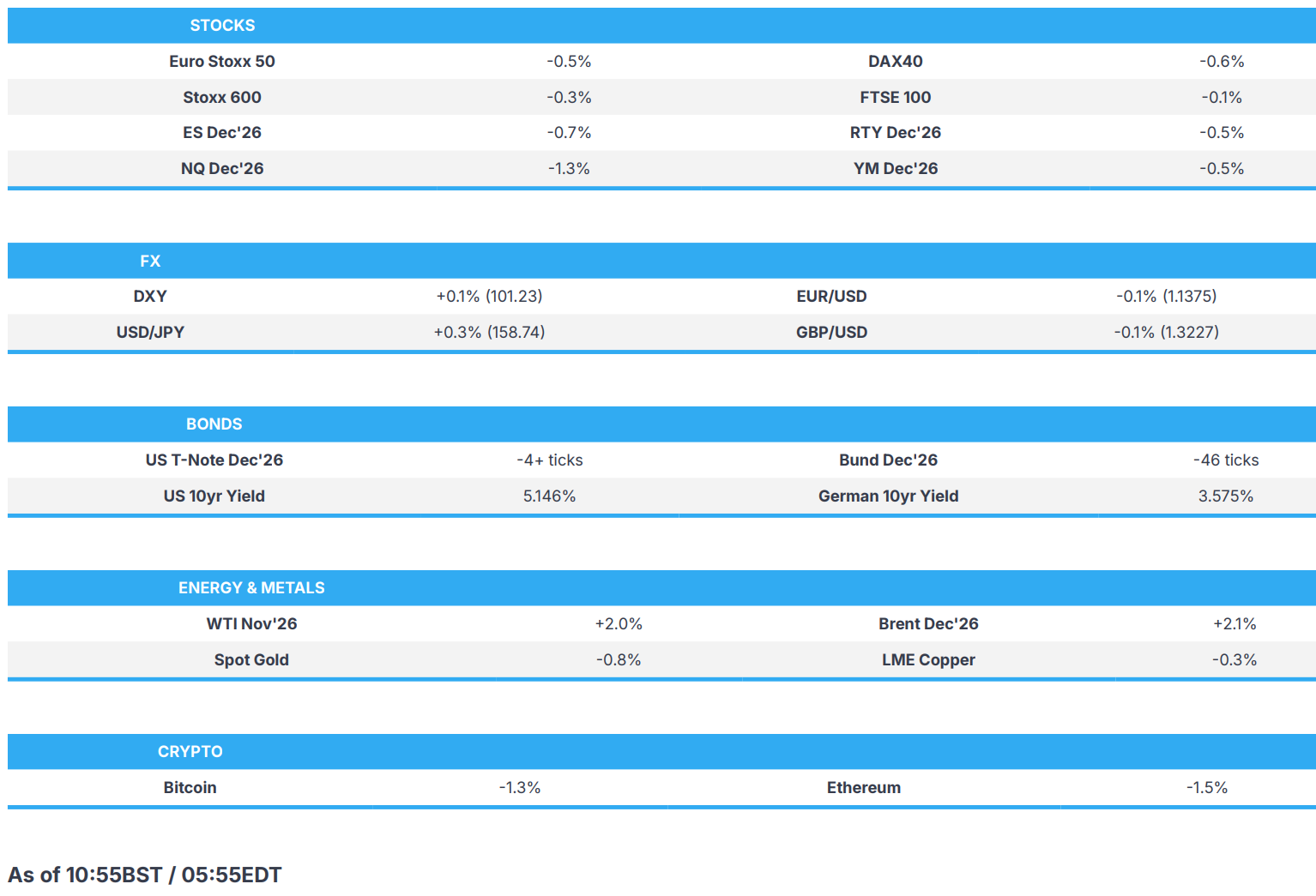
Newsquawk in 3 steps:
1. Subscribe to the free premarket movers reports
2. Listen to this report in the market open podcast (available on Apple and Spotify)
3. Trial Newsquawk’s premium real-time audio news squawk box for 7 days
EUROPEAN TRADE
EQUITIES
- European bourses (STOXX 600 -0.3%) opened entirely in the red and has come under a fresh leg of pressure in recent trade amid the upside across the energy space. The source of the move came amid comments by the Senior adviser to Iran’s Supreme Leader Major General Safavi, saying the US conflict could expand further into the Indian Ocean.
- Sectors highlight the negative bias. Energy, Food, Beverages & Tobacco and Optimised Personal Care are the only sectors in the green. Leading the downside is Tech, followed by Autos and Financial Services.
- US equity futures have extended on Wednesday’s losses, following the broader equity space as sentiment continues to sour. The Trump-Xi meeting will be one to watch on today’s calendar, following US Treasury Secretary Bessent’s announcement of a two-month extension to the trade truce.
- Click for the sessions European pre-market equity newsflow
- Click for the additional news
FX
- G10s are mostly lower against the USD, albeit only marginally. The EUR holds afloat, joined by the Kiwi, Loonie and GBP, whilst the CHF underperforms a touch.
- DXY holds within a 101.00 to 101.23 range. The Dollar traded steady throughout overnight and early-European trade, but then moved higher alongside a bout of strength in the energy complex. This came after an IRGC official noted that the “war could expand” to the Indian Ocean or Bab el Mandeb Strait if the US decides to go to war again. More generally, crude benchmarks will be digesting reports that the US dismissed Iran’s Hormuz offer during UN talks, saying Tehran does not control the Strait.
- Fed’s Williams spoke this morning, where he suggested it was reasonable to see another rate hike by year-end. Markets are pricing in a 38.4% chance of one 25bps hike by year-end, with a c. 50% chance of another this year.
- Policy announcements from the SNB, Riksbank and Norges Bank have led to some volatility in the respective currencies. Kicking off with SNB, the Bank opted to hold rates, lifted inflation projections and removed its “increased willingness” for intervention. As such, the CHF moved lower following the announcement. Over in Sweden, the SEK was initially choppy following the Bank’s decision to hold rates. But then gradually strengthened, as the Bank lifted its rate path forecasts to imply a hike towards the end of this year/start of next year. Elsewhere, the only hike today was delivered by Norges Bank. It lifted its Key Policy rate by 25bps to 4.50%, and reiterated its tightening bias. EUR/NOK knee-jerked lower as traders unwound their bets of a hold, before paring around half of that move.
FIXED INCOME
- The very modest bearish action at the start of the morning has given way to downside of c. 40 ticks in Bunds. Amidst a combination of factors, namely: energy upside on Iranian commentary, hawkish central banks, strong German Ifo & trade/tariff concern ahead of the US-China meeting, and also from Germany via the VDA.
- Unsurprisingly, the bulk of the move was on the Iranian adviser Safavi intimating that the “scope of the war may expand…”, to include the Indian Ocean and other regions. An update that, over the course of around one hour, lifted Brent by over USD 2.00/bbl and pushed the US 30yr yield to its highest in over 20 years.
- Bunds hit a 119.87 trough, nine ticks above Wednesday’s contract low. As mentioned, much of the focus has been on yield action, with upside seen across curves globally and a slightly steepening bias seen.
- For USTs, no real move to Fed’s Williams, though he did note that pricing for another hike by end-2026 is “reasonable”. As it stands, markets imply a 38% chance of one 25bps hike by year-end, and just over a 50% chance of two. At a 104-28 contract low with yields bid across the curve.
- Ahead, the focus remains on central banks with several speakers due, before the Trump-Xi meeting begins and the readout which is scheduled for just after 15:00BST commences. A meeting that is framed by recent remarks from Treasury Secretary Bessent that while the truce has been extended to January 2027, he does not know if a bigger deal can be done.
- Italy sells EUR 2.5bln vs Exp. 2.5-3bln 3.00% 2028 BTP: b/c 1.64x (prev. 1.58x), average yield 3.64% (prev. 3.02%).
COMMODITIES
- WTI Nov and Brent Dec futures started the European morning with only modest gains, but gradually picked up as the session progressed. The bullish bias potentially comes amidst the lack of US-Iran diplomatic progress and after an IRGC official noted that the “war could expand” to the Indian Ocean or Bab el Mandeb Strait if the US decides to go to war again.
- Focus also remains on the potential US diesel export ban, although the White House denied reports that the Trump administration is preparing a 90-day ban. Morgan Stanley warned that such a move, while not its base case, could have significant implications and potentially raise gasoline prices as barred diesel exports fill storage and force refiners to cut runs. The bank estimated refiners could need to reduce runs by around 2mln BPD, in turn cutting gasoline supply by roughly 650k BPD.
- WTI trades around USD 93.70/bbl within a USD 91.23-94.69/bbl range, while Brent trades above USD 100.00/bbl within a USD 97.09-100.94/bbl range. Dutch TTF is firmer, with the contract trading within a EUR 73.39-75.04/MWh range. The Trump-Xi meeting could provide some impact amid reports of potentially reducing or removing China’s 15% tariff on US LNG.
- Precious metals remain subdued following Wednesday’s surge in the USD and global yields, with hawkish Fed rhetoric and strong US data continuing to weigh on the complex. Spot gold trades towards the bottom of a USD 4,254-4,303/oz range, with the 100 DMA at USD 4,309/oz. Spot silver similarly trades around the lower end of a USD 63.52-64.55/oz range.
- Base metals are mixed/rangebound against a subdued risk backdrop, with copper also digesting news that BHP suspended operations at its Escondida mine in Chile following an accident. 3M LME copper resides in a USD 14,575.08-14,677.78/t range.
- Saudi Aramco CEO said that it is studying a “a fourth and a fifth route” for crude oil exports and noted that the Co. can restore disrupted operations within days.
- China’s NDRC raised retail fuel prices in the current bi-monthly cycle, effective September 25th, with gasoline prices up CNY 395/tonne and diesel prices up CNY 385/tonne.
- BHP (BHP AT) said operations at the Escondido mine in Chile were suspended following an accident.
TRADE/TARIFFS
- US President Trump said it was a great greeting with Xi and that the entire tech and banking world will be at Thursday’s dinner. Trump also stated that he had some great conversations with leaders at the UN General Assembly.
- Chinese President Xi said he looks forward to in-depth exchanges with US President Trump and will expand cooperation between the two countries in various areas, while he is confident the US trip will produce fruitful results. Xi also commented that China and the US must be allies, not adversaries, and he is confident China and the US can find the right path to coexist in a new era.
- US Treasury Secretary Bessent said the US-China trade truce was extended to January 10th, while he doesn’t know if a bigger trade deal can be done with China and could just roll the current deal forward. Furthermore, Bessent said that presidents Trump and Xi are expected to meet four times this year and that China is doing well so far in meeting 2026 pledges.
- China’s MOFCOM said they discussed AI with the US under the bilateral economic and trade consultation mechanism.
- Germany’s VDA is reportedly endorsing new tariffs against China for the first time, according to Handelsblatt.
- India cut import duties on crude palm oil and soybean oil to 5% (prev. 10%).
NOTABLE EUROPEAN HEADLINES
- The UK Treasury is open to smaller fiscal headroom and Chancellor Healey may accept a smaller fiscal buffer to reduce tax rises in next month’s Budget, according to FT.
NOTABLE EUROPEAN DATA RECAP
- German Ifo Expectations (Sep) 90.4 vs. Exp. 89.3 (Prev. 89.1).
- German Ifo Current Conditions (Sep) 89.5 vs. Exp. 89 (Prev. 88.5).
- German Ifo Business Climate (Sep) 89.9 vs. Exp. 89 (Prev. 88.8).
- French Business Confidence (Sep) 101 vs. Exp. 102 (Prev. 101).
- French Consumer Confidence (Sep) 86 vs. Exp. 85 (Prev. 86).
CENTRAL BANKS
- Norges Bank hiked rates by 25bps to 4.50%. Expectations heading into the announcement were split. The Bank noted that inflation has been above target for several years, and that by raising the rate, it will help reduce inflation and that the policy rate will be elevated for a time. The Committee is prepared to raise the policy rate further if warranted by the inflation outlook. The decision was backed by continued elevated inflation metrics, with the Bank alert to upward risks to the inflation outlook; it stated that “Inflation may then become stickier and harder to bring down again”. Governor Bache suggested that the inflation outlook has not materially changed, as such, stated that the Bank is prepared to deliver further rate hikes to bring inflation down to target. This is reflected in the rate path projection, which does not point to further tightening later this year, but will continue into Q1/Q2’27.
- The Riksbank left rates unchanged at 1.75%, as expected. With the commentary, and particularly the forecasts, a hawkish bias can be seen with the language being that “it is expected that the increases to the policy rate will begin this year”, while the forecasts imply a hike around end-2026/start-2027 and then another one in the Q2/Q3-2026 period, and then thereafter there is some optionality of another hike by Q3-2028, a marked hawkish tilt vs the June projections. Albeit, this is caveated by the assessment that Q2 GDP strength was somewhat due to temporary factors, though the general commentary remains constructive. Overall, the strengthening of the SEK highlighted the overall hawkish tone.
- The SNB left rates unchanged at 0%, as expected. The main update was the tweak to the FX language, which now shows “…willing to be active in the foreign exchange market…” from the June line of “If necessary, the SNB has an increased willingness to intervene in the foreign exchange market”, omitting the “increased” framing. In terms of the Bank’s inflation forecast, they were lifted across 2026, 27 and 28, primarily due to higher energy prices. They also noted that the recent uptick in inflation was attributed to a rise in goods inflation, driven by higher prices for oil products. In an immediate reaction, the CHF weakened given the aforementioned change to the intervention language.
- Fed’s Williams (voter, Neutral) said the big challenge is on inflation and need to get it back to target in a timely manner while stating that it is reasonable to see another rate hike by year-end. He said short-run inflation expectations have been more encouraging, though the longer term they have not. On the economy, Williams said it has been remarkably resilient and downside risk to achieving maximum employment have receded.
- BoE’s Lombardelli said policy is increasingly likely to need to tighten if elevated energy prices persist. On second-round effects, she said the absence of evidence is something but not much, and that it is likely still too early to see evidence in the data. On policy, Lombardelli described it as restrictive and that it is increasingly likely to need to tighten if elevated energy prices persist, absent clear evidence of disinflation or weaker activity.
- BoE’s Dhingra said most of the financial conditions have done a lot of tightening work already in the UK and is encouraged on what pricing is doing. Dhingra added that the labour market looks pretty weak, while highlighting that winter energy prices will be critical for second round effects.
- ECB’s Kocher said the ECB must prevent excessively high inflation from becoming entrenched and that the Eurozone economy remains fragile. Kocher added that there has been signs of somewhat more Eurozone momentum since summer.
- ECB’s Schnabel said the energy shock is much more persistent than thought.
NOTABLE US HEADLINES
- A US judge issued an order blocking the Trump administration’s White House ban on CNN, MS NOW and Politico.
- US Senate Majority Leader Thune believes President Trump is open to implementing AI guardrails despite his public defiance on the issue, according to Axios.
- BofA Total Card Spending (w/e Sep 19th) +6.9% Y/Y (prev. +5.8% W/W); surging gas prices have opened up a gap in ex-gas spending between higher and lower income households.
- An industry group representing US tech companies is reportedly pushing the US administration to withdraw its proposal to charge for H-1B visas, according to the WSJ.
GEOPOLITICS
MIDDLE EAST
- Senior adviser to Iran’s Supreme Leader Major General Safavi said the scope of the war may expand to the Indian Ocean and other regions, if the US starts a new war.
- Israeli source said an additional round of strikes against Iran seems to be a matter of time, Al Hadath reported. The source added that Iran is intensifying the transfer and fortification of the Natanz nuclear project. Additionally, the source said Israel does not see a real chance of reaching an agreement between the US and Iran, and that the US wants to end the Iran war with a political agreement or a decisive attack that topples the regime. On further strikes, the Israeli source said they will strike Iranian nuclear facilities again if Iran crosses the red lines, with or without US involvement.
- US Treasury Secretary Bessent said they are getting sometimes up to 17mln oil barrels out of Hormuz and noted that probably 80-90% of Iran’s external flights are shut down.
- Chinese Foreign Minister said the Strait of Hormuz conflict must be resolved through dialogue and calls on all parties to seek a peaceful solution, Al Arabiya reported.
- Pakistan’s Foreign Minister told Iran’s Foreign Minister that they must remain committed to dialogue and diplomacy.
- Iran’s Foreign Ministry noted that Iran’s Foreign Minister held a meeting with Pakistani counterpart at the UN General Assembly.
- UK Chancellor Healey said he spoke with US Treasury Secretary Bessent today about stepping up pressure on Iran and how to work together to drive growth in both nations.
- EU’s Costa spoke to Iran’s President Pezeshkian and urged Iran to resume its cooperation with the IAEA, while he also called for an end to Iran’s strikes against its neighbours and a full restoration of freedom of navigation in the Strait of Hormuz.
- Initial reports noted two explosions in Bandar Abbas and one in Sirik, southern Iran, with the explosion in Sirik reportedly coming from near the coast, off to the sea.
RUSSIA-UKRAINE
- Russia’s Kremlin said no decision yet has been made on a December summit between US President Trump and Russian President Putin and that discussing a possible agenda is premature.
- Waves of Russian missiles attacked Kyiv and more than a dozen heavy explosions were heard in 30 minutes, according to an FT reporter.
OTHER
- North Korean Foreign Minister said denuclearisation is an unrealistic delusion and that their nuclear status is irreversible, which will endure forever, while he added that the more the US and its allies advocate denuclearisation, the more they will strengthen their stance towards the US.
CRYPTO
- Bitcoin extends on Wednesday’s trough of USD 83.5k and has fallen to a low of USD 82.7k amid the rise in energy prices.
APAC TRADE
- APAC stocks were mostly pressured following on from the declines in global peers alongside the recent bond turmoil and jump in yields, owing to several factors including strong US data, hawkish Fed rhetoric and mixed reports regarding a US diesel export ban.
- ASX 200 retreated with the declines led by weakness in miners, real estate and materials, while sentiment was not helped by mixed jobs data including an unexpected rise in the Unemployment Rate to a five-year high.
- Nikkei 225 outperformed after Japanese participants returned from the long weekend and with tech names playing catch-up to the recent AI-related momentum.
- Hang Seng and Shanghai Comp retreated despite early optimism from President Xi’s state visit to the US, while a two-month extension to the US-China trade truce until January 10th also failed to spur risk appetite.
NOTABLE ASIA-PAC HEADLINES
- PBoC will offer lenders a record amount of up to CNY 1tln in overnight funds each day over the upcoming holiday period, according to Bloomberg.
- PBoC to comprehensively use and timely adjust monetary policy tools to keep liquidity ample; to step up counter cyclical adjustments.
- Japan’s Finance Ministry is to consider cutting issuances in liquidity-enhancement auctions for medium-term JGBs, according to sources.
- Japanese Finance Minister Katayama said the principles on forex established since the joint US-Japan intervention remain in effect, while she won’t comment on specific FX levels.
- Japan reportedly plans to finance economic security spending mainly through “bridging bonds”, reducing the need for the issuance of deficit bonds, Nikkei reported citing sources.
NOTABLE APAC DATA RECAP
- Australian Employment Change (Aug) 39.5K vs. Exp. 20K (Prev. -15.8K).
- Australian Unemployment Rate (Aug) 4.6% vs. Exp. 4.5% (Prev. 4.5%).
- Australian Participation Rate (Aug) 67.1% vs. Exp. 66.9% (Prev. 66.9%).
- Japanese Global Composite PMI Flash (Sep) 52.5 (Prev. 53.5).
- Japanese S&P Global Manufacturing PMI Flash (Sep) 54.1 vs. Exp. 55 (Prev. 54.9).
- Japanese Global Services PMI Flash (Sep) 51.6 (Prev. 52.5).
1 c Asian opening report
DXY strength pauses for breath ahead of US-China talks; SNB, Riksbank and Norges Bank all due – Newsquawk EU Market Open
Thursday, Sep 24, 2026 – 01:51 AM
- US Treasury Secretary Bessent said the US-China trade truce was extended to January 10th, while he doesn’t know if a bigger trade deal can be done with China and could just roll the current deal forward.
- US reportedly dismissed Iran’s Hormuz offer during UN talks, saying Tehran does not control the Strait, the Times of Israel reported.
- White House official denied Politico reports that the Trump administration is preparing a plan to ban exports of diesel for 90 days.
- Crude futures slightly pulled back overnight, 10yr UST futures lingered near the prior day’s trough, and DXY paused overnight.
- APAC stocks were mostly pressured; Nikkei outperformed on return from holiday, and European equity futures indicate a lower cash market open.
- Looking ahead, highlights include German Ifo, US Initial Jobless Claims, Chinese President Xi’s state visit to the US. Policy announcements from the Riksbank, SNB, Norges Bank, and Banxico. Speakers include ECB’s Schnabel & Lane, Fed’s Williams, Barkin, Hammack & Paulson, BoE’s Dhingra, Breeden & Lombardelli, SNB’s Schlegel, Riksbank’s Thedeen, Norges Bank’s Bache. Supply from Italy & the US.
SNAPSHOT
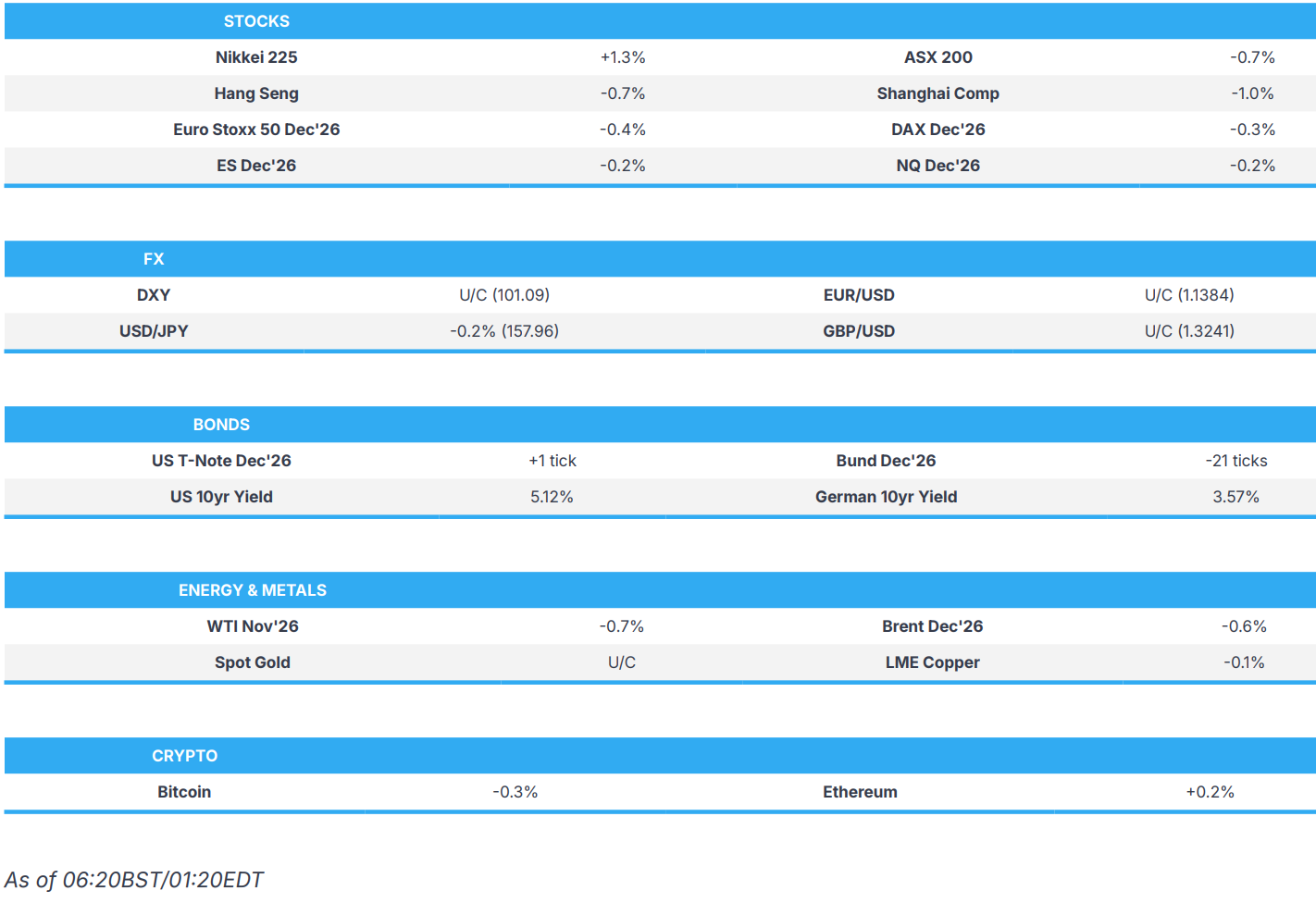
Newsquawk in 3 steps:
1. Subscribe to the free premarket movers reports
2. Listen to this report in the market open podcast (available on Apple and Spotify)
3. Trial Newsquawk’s premium real-time audio news squawk box for 7 days
IRAN CONFLICT
- US reportedly dismissed Iran’s Hormuz offer during UN talks, saying Tehran does not control the Strait, the Times of Israel reported.
- US Treasury Secretary Bessent said they are getting sometimes up to 17mln oil barrels out of Hormuz and noted that probably 80-90% of Iran’s external flights are shut down.
- UK Chancellor Healey said he spoke with US Treasury Secretary Bessent today about stepping up pressure on Iran and how to work together to drive growth in both nations.
- EU’s Costa spoke to Iran’s President Pezeshkian and urged Iran to resume its cooperation with the IAEA, while he also called for an end to Iran’s strikes against its neighbours and a full restoration of freedom of navigation in the Strait of Hormuz.
- Iran’s President Pezeshkian held meetings with regional and European leaders, while he discussed with Iraq’s PM bilateral ties and joint projects.
- Iran’s Foreign Ministry said Iran’s Foreign Minister met with his Pakistani counterpart at the UN General Assembly.
- Iranian Foreign Ministry spokesperson said another round of message exchanges and clarifications took place between Iran and the US via a Qatari mediator on Tuesday, while Iran clarified its conditions for reviving diplomacy during the two-hour process with the US.
- Iran armed forces chief said Iranian President Pezeshkian dealt a blow to the US President at the UN, while he added that revenge for the slain leader and Minab children will continue.
- Initial reports noted two explosions in Bandar Abbas and one in Sirik, southern Iran, with the explosion in Sirik reportedly coming from near the coast, off to the sea.
- Iranian advisers helped the Houthis seize Yemen’s Red Sea coast in less than 48 hours.
- Saudi airstrike reported in Yemen’s Taiz province, according to Tasnim.
- Israeli military carried out several bombings in southern Lebanon, according to Al Masirah.
US TRADE
EQUITIES
- US stocks were sold on Wednesday as global yields surged, with the RUT the clear underperformer, while all major indices finished in the red. Sectors were predominantly lower, with Utilities, Communication Services and Consumer Discretionary lagging, while Energy and Industrials outperformed. Semis and memory names were hit, likely reflecting some reversal of the recent Muse-induced strength following Tuesday’s releases of GPT Astra 6 and Claude Opus 5.5, while Chinese AI firms were pressured overnight following probes into Moonshot and DeepSeek. The weakness in stocks coincided with a global bond sell-off, with UST yields surging across the curve, particularly at the front end, as participants digested strong and inflationary US Flash PMI data, rising oil prices, further hawkish Fed speak, a very weak 5-year auction and reports surrounding a potential US diesel export ban.
- SPX -0.75% at 7,706, NDX -0.85% at 30,470, DJI -0.68% at 51,517, RUT -1.77% at 2,839.
- Click here for a detailed summary.
TARIFFS/TRADE
- US President Trump greeted Chinese President Xi on his arrival at Joint Base Andrews, while Trump said it was a great greeting with Xi and that the entire tech and banking world will be at Thursday’s dinner. Trump also stated that he had some great conversations with leaders at the UN General Assembly.
- Chinese President Xi said he looks forward to in-depth exchanges with US President Trump and will expand cooperation between the two countries in various areas, while he is confident the US trip will produce fruitful results. Xi also commented that China and the US must be allies, not adversaries, and he is confident China and the US can find the right path to coexist in a new era.
- US Treasury Secretary Bessent said the US-China trade truce was extended to January 10th, while he doesn’t know if a bigger trade deal can be done with China and could just roll the current deal forward. Furthermore, Bessent said that presidents Trump and Xi are expected to meet four times this year and that China is doing well so far in meeting 2026 pledges.
- US President Trump administration officials are reportedly weighing rolling back the beef import plan, according to Politico.
NOTABLE HEADLINES
- Fed’s Goolsbee (2027 voter) said it is better to assume that larger negative supply shocks will have a relatively persistent effect on inflation, pointing to tariffs and Covid as examples and saying that may also be happening with oil, adding “we better be careful”.
- US Treasury Secretary Bessent said the private sector is driving America’s economic resurgence. Bessent separately commented that reports he will likely be Trump’s AI czar are probably fake news, while he stated that there is one AI czar and it is President Trump.
- US Senate Majority Leader Thune believes President Trump is open to implementing AI guardrails despite his public defiance on the issue, according to Axios.
- US senators are reportedly seeking to fast-track legislation to ban Chinese vehicles this week.
APAC TRADE
EQUITIES
- APAC stocks were mostly pressured following on from the declines in global peers alongside the recent bond turmoil and jump in yields, owing to several factors including strong US data, hawkish Fed rhetoric and mixed reports regarding a US diesel export ban.
- ASX 200 retreated with the declines led by weakness in miners, real estate and materials, while sentiment was not helped by mixed jobs data including an unexpected rise in the Unemployment Rate to a five-year high.
- Nikkei 225 outperformed after Japanese participants returned from the long weekend and with tech names playing catch-up to the recent AI-related momentum.
- Hang Seng and Shanghai Comp retreated despite early optimism from President Xi’s state visit to the US, while a two-month extension to the US-China trade truce until January 10th also failed to spur risk appetite.
- US equity futures remained subdued after retreating alongside the global bond rout.
- European equity futures indicate a lower cash market open, with Euro Stoxx 50 futures down 0.4% after the cash market closed with losses of 0.4% on Wednesday.
FX
- DXY paused overnight after advancing yesterday alongside sharp rises in global yields, stronger-than-expected US data, and growing economic pressure for Europe and APAC FX if the US goes ahead with a US diesel export ban, while further Fed speak pointed towards another hike, with Governor Barr noting that further rate hikes are likely needed to ensure a timely return to the 2% inflation target.
- EUR/USD was stuck near a monthly low after sliding beneath the 1.1400 handle and with recent comments from ECB officials noting there was no major wage response, nor second-round effects from the energy shock.
- GBP/USD lacked demand after slumping to sub-1.3300 territory alongside recent underperformance in cyclical currencies and with headwinds following the reports of a potential US diesel export ban.
- USD/JPY pulled back beneath the 158.00 level as Japanese participants returned to the market for the first time this week and with Japanese yields rising across the curve.
- Antipodeans were range-bound following recent underperformance and with AUD/USD indecisive after mixed jobs data in which headline Employment Change topped forecast, but was solely fuelled by part-time work, while the Unemployment Rate slightly increased to its highest in around 5 years amid a higher Participation Rate.
- PBoC set USD/CNY mid-point at 6.7489 vs Exp. 6.7184 (prev. 6.7468).
FIXED INCOME
- 10yr UST futures lingered near the prior day’s trough after slumping yesterday as yields rallied amid hawkish PMI data and Fed speak, a woeful 5-year auction, and with global bonds hit by news about a potential US diesel export ban, while participants also look ahead to further supply, including a 7-year note auction.
- Bund futures briefly slumped to sub-120.00 territory amid the global bond sell-off and recent issuances.
- 10yr JGB futures gapped lower on reopen from the silver week holiday closure and following the turmoil in global peers, while there was also recent corporate supply with SoftBank issuing USD 11.1bln in senior notes to fund its OpenAI investment.
COMMODITIES
- Crude futures slightly pulled back overnight after gaining yesterday as substantial progress between the US and Iran remained absent despite the recent positive meeting between US envoys and the Iranian delegation, while there were also conflicting reports regarding a US diesel export ban.
- White House official denied Politico reports that the Trump administration is preparing a plan to ban exports of diesel for 90 days.
- US President Trump emphasised to Venezuela’s Rodriguez the need to keep oil flowing, relations warm, and that elections need to happen, according to Axios citing sources.
- Spot gold was lacklustre amid the recent upside in the dollar and surge in yields, while the precious metal was also contained by near-term resistance at the USD 4,300 level.
- Copper futures traded range-bound alongside the mostly subdued risk sentiment in Asia.
- BHP (BHP AT) said operations at the Escondido mine in Chile were suspended following an accident.
CRYPTO
- Bitcoin ultimately declined in choppy price action and traded both sides of the USD 84,000 level.
- US considers an initiative to promote dollar-backed stablecoin abroad.
NOTABLE ASIA-PAC HEADLINES
- Japanese Finance Minister Katayama said the principles on forex established since the joint US-Japan intervention remain in effect, while she won’t comment on specific FX levels.
- Japan’s Finance Ministry is to consider cutting issuances in liquidity-enhancement auctions for medium-term JGBs, according to sources.
DATA RECAP
- Australian Employment Change (Aug) 39.5K vs. Exp. 20K (Prev. -15.8K)
- Australian Full Time Employment Change (Aug) -6.3K (Prev. 16.3K)
- Australian Part Time Employment Chg (Aug) 45.8K (Prev. -32.2K)
- Australian Unemployment Rate (Aug) 4.6% vs. Exp. 4.5% (Prev. 4.5%)
- Australian Participation Rate (Aug) 67.1% vs. Exp. 66.9% (Prev. 66.9%)
GEOPOLITICS
RUSSIA-UKRAINE
- Waves of Russian missiles attacked Kyiv and more than a dozen heavy explosions were heard in 30 minutes, according to an FT reporter.
- Russian Foreign Minister Lavrov and US Secretary of State Rubio discussed the situation in the Middle East, the Transcaucasus, Latin America and the Caribbean, while they emphasised the need to restore bilateral relations as soon as possible, and an agreement was reached to continue discussions.
- Russian presidential envoy headed to the US for new talks with members of Trump’s administration, according to sources.
OTHER
- US State Department said Secretary of State Rubio met with his Indian counterpart and discussed sanctions that could be levelled against the states that engage economically with Russia and Iran.
- Pakistan conducted precision aerial and drone strikes in Afghanistan on 10 locations used to launch drones towards Pakistan, which were successfully neutralised.
- North Korean Foreign Minister said denuclearisation is an unrealistic delusion and that their nuclear status is irreversible, which will endure forever, while he added that the more the US and its allies advocate denuclearisation, the more they will strengthen their stance towards the US.
- North Korea said it conducted a test firing of updated guided rocket artillery shells on Tuesday.
EU/UK
NOTABLE HEADLINES
- UK Treasury is open to smaller fiscal headroom and Chancellor Healey may accept a smaller fiscal buffer to reduce tax rises in next month’s Budget, according to FT
- ECB’s Lane said there is no major wage response to the energy shock.
2.NORTH AND SOUTH KOREA/
SOUTH KOREA//NORTH KOREA
SOUTH KOREA
Korea Picks A $22 Billion Texas Gas Plant As First Down Payment On Its $350 Billion Pledge To Trump
Wednesday, Sep 23, 2026 – 11:00 PM
Ten months, one tariff threat and several “sleepless nights” later, South Korea has finally found somewhere to put the first piece of the $350 billion it promised to invest in America. The winner is a gas-fired power complex in Encinal, Texas (population 540, where real estate is about to ballistic), and it is built to feed the one thing Washington can never get enough of: electricity for data centers and chip fabs.
According to the FT, Seoul this week chose the proposed $22.3 billion, 6.3-gigawatt complex. The White House could announce it as soon as Wednesday, possibly with Trump announcing it himself, depending on how preparations for Xi Jinping’s arrival in Washington go. Trump and President Lee Jae Myung met for 30 minutes on Tuesday on the sidelines of the UN General Assembly. The deal still needs final US approval.
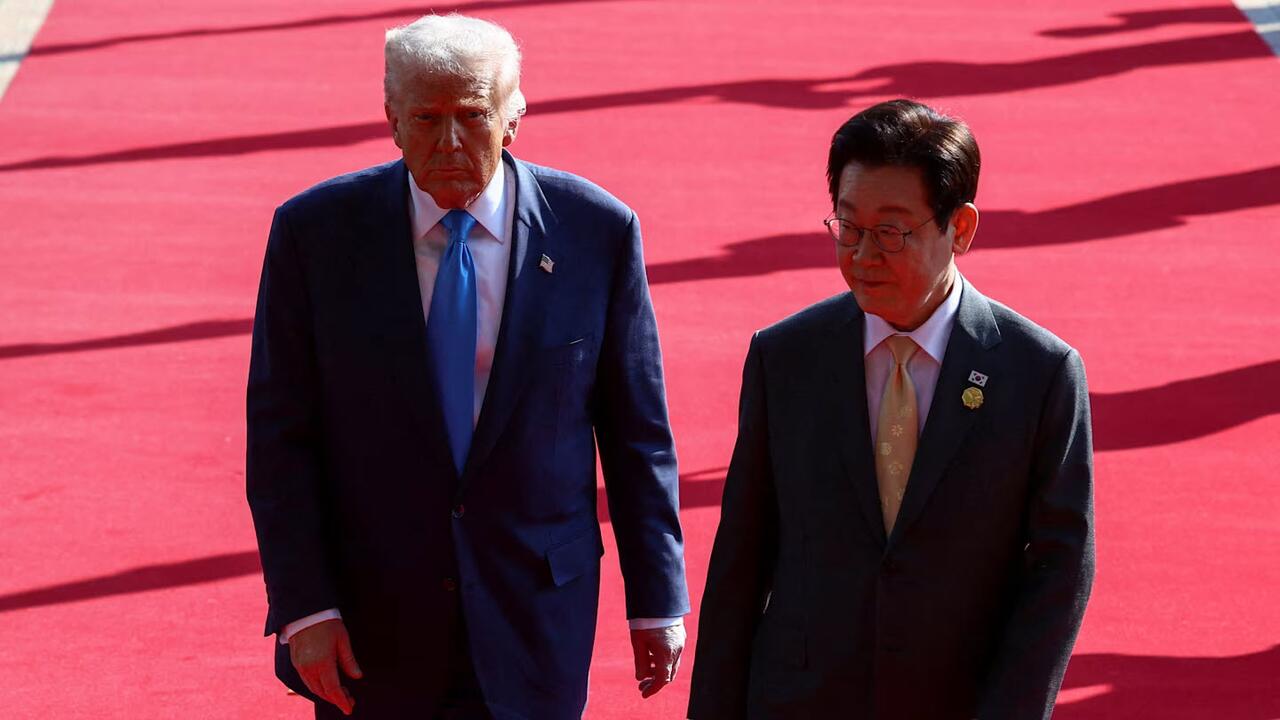
Yonhap reported that the plant will be built in stages: an initial 1.4GW of simple-cycle gas turbines, followed by roughly 4.9GW of more efficient combined-cycle generation. However, in the first whiff of even more vaporware, no customers have been confirmed. Korea’s KED Global adds that there is no power purchase agreement yet, with signing targeted for 2027. It also reports that the Trump administration asked for a roughly 25% increase in the project’s size, which would take it to about $25 billion.
How the money works
Under the November 2025 agreement, Seoul supplies $200 billion in upfront capital for projects in “strategic industries,” capped at $20 billion a year, plus a separate $150 billion for shipbuilding. Project cash flow is split 50/50 with Washington until Korea recovers its principal and interest. After that, Korea’s share drops to 10% and the US takes 90%. It is a generous arrangement, just not for the side putting up the money.
Korean officials told the National Assembly that Encinal could generate $43 billion to $45 billion of revenue over 20 years, which they say is enough to recover principal and interest. Those numbers deserve a closer look:
- $43 billion to $45 billion works out to roughly $2.2 billion a year, or about twice the upfront capital. That is gross revenue. It comes before fuel, operations, maintenance and financing costs, and pretty much everything else… and gas is the main input cost of a gas plant.
- Korea receives only half of the project’s cash flow until it is repaid. On a plain reading, recovering $22 billion plus interest from a 50% share would take distributable cash flow well above the capital invested. Seoul has not yet published a breakdown showing how revenue of about 2x capex achieves that.
- The official line is that every project must be “commercially reasonable.” But as Haeyoon Kim of Korea Tech and Trade Watch told the FT, the US-led Investment Committee decides what counts as commercially reasonable, and Trump makes the final call. Seoul can object, but objecting risks higher tariffs.
Industry Minister Kim Jung-kwan said the government had “been negotiating intensely with the U.S. in order to pursue commercially viable projects,” and that the goal was to expand Korean companies’ entry into the US market. Lee said last week the talks had given him “sleepless nights.”
Following Japan’s lead
Tokyo went first. As we reported in February, the opening $36 billion tranche of Japan’s $550 billion pledge was led by SB Energy’s 9.2GW gas plant in Ohio (which as we reported last night is suddenly having major issues, having delayed its IPO), which Commerce Secretary Lutnick called “the largest natural gas generation facility in history.” Japan has since added up to $40 billion of small modular reactors in Tennessee and Alabama.
If Seoul was looking for a template, it found one. The cost per unit of capacity is almost identical. At $22.3 billion for 6.3GW, Encinal comes to about $3,540 per kilowatt. At about $33 billion for 9.2GW, the Ohio plant comes to about $3,590 per kilowatt. Both are well above what US combined-cycle plants cost before the AI boom, which is what happens when every hyperscaler on earth wants the same megawatts at the same time.
The real constraint: turbines
Money, it turns out, is the easy part. As we detailed earlier this month, large gas turbines are effectively sold out through 2030. Applied Digital’s CEO warned that orders placed today may not arrive until 2032. Some developers are so desperate they are going back to 19th-century technology, boilers and steam, just to get power online sooner. Encinal’s plan, 1.4GW of fast-to-deploy turbines first and then 4.9GW of combined-cycle capacity, means getting in line for the same heavy-duty equipment every hyperscaler is already chasing.
Goldman’s latest research on the power problem (available to pro subscribers) published just hours before the FT story, shows why Washington wants these megawatts. In a Carbonomics note on Wednesday, Michele Della Vigna’s team said that with power availability “emerging as a key constraint on AI infrastructure deployment” and grid connection times in the US and Europe expected to lengthen, they “raise our outlook for BTM [behind-the-meter] power generation from 40GW to 67GW by 2030.”
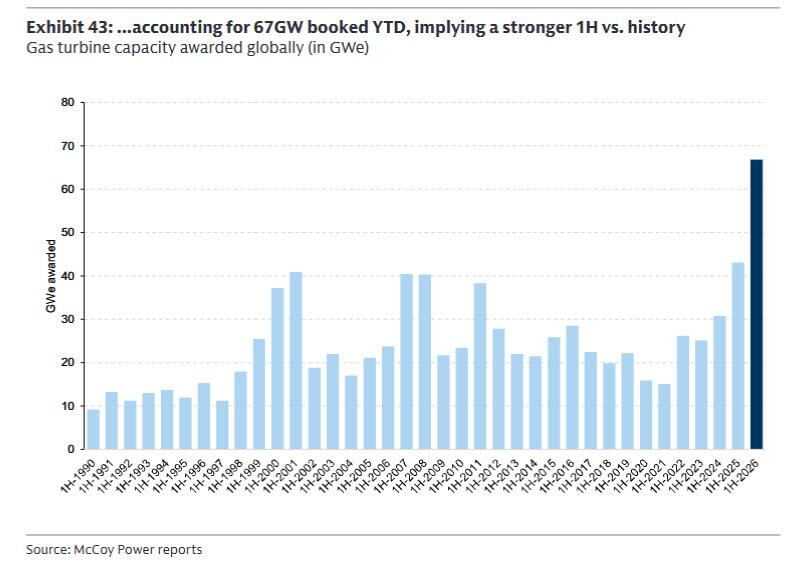
Goldman now expects on-site gas generation to meet about 28% of US data center power demand by 2030. Its preferred beneficiaries of conventional gas generation are GE Vernova, Siemens Energy, Mitsubishi Heavy and INNIO. Not a Korean name among them, which leaves an awkward question for Seoul: how much of the equipment spending on a Korean-funded plant will actually end up with Korean suppliers.
The competition for that equipment is not only American. The same Goldman research flags that Alibaba Cloud is targeting 20GW of data-center power by 2032, which is more than three Encinals for one Chinese cloud provider alone.
Then there is the question of who ends up buying the electricity. The obvious candidates are the hyperscalers, and they are not short of cash to spend. Goldman credit strategist Amanda Lynam last week raised her forecast for hyperscaler investment-grade bond issuance to $420 billion in 2027, “more than a 60% increase vs our full-year 2026 estimate of $250 billion,” with 65% to 75% expected to be placed in the dollar IG market.
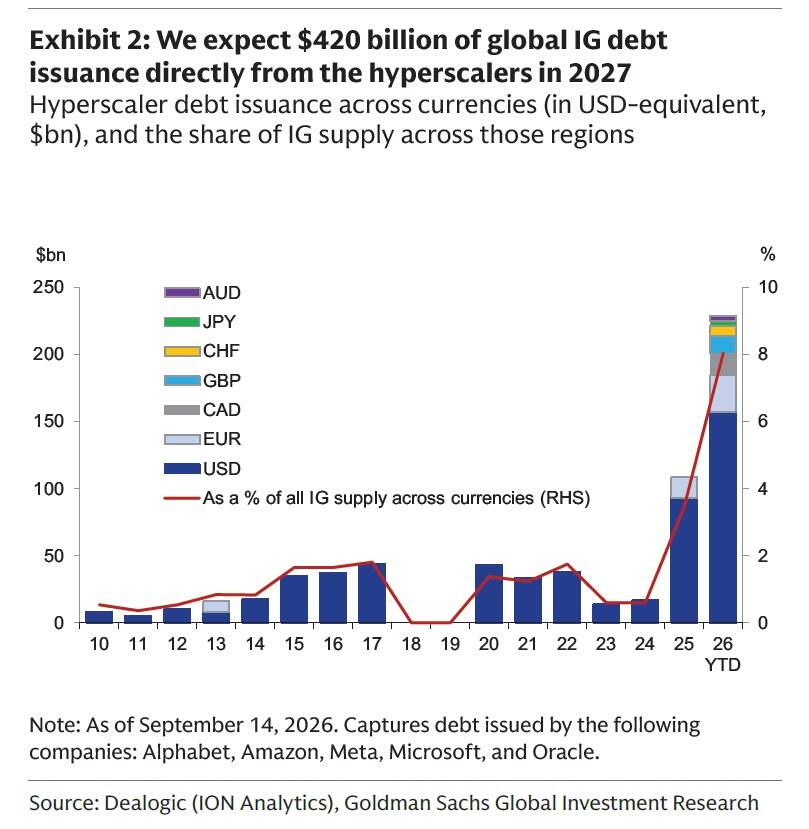
In other words, the would-be customers for Encinal’s power are borrowing record sums to build data centers that need exactly this kind of plant. The bull case for Seoul is that one of them signs a PPA by 2027. The bear case is that Korea has fronted $22 billion on the assumption that someone will, while the AI capex cycle that Goldman’s own economists say has companies “over-earning” is nearing its peak.
The bigger picture
The project comes as the US-Korea relationship is under strain on several fronts:
- Iran: Trump has pressed Seoul for help in the war against Iran, and Lee has ruled out sending forces in a combat role.
- Submarines: Seoul wants US help building nuclear-powered submarines. Washington agreed last year to cooperate on technical requirements and fuel, but there has been almost no progress since.
- Linkage: One Korean official told the FT that US counterparts had signaled further progress on the submarines would come only after Seoul announced some of its promised investments. Pay first, then we talk.
Nuclear projects and a scaled-down Alaska LNG project are expected to follow Encinal. Korea is also negotiating a stake of about 7% in Westinghouse, down from the 15% it originally sought, according to KED. For now, the first check is going to a Texas gas plant with no customers, no power purchase agreement, turbines that may not show up this decade, and revenue projections that still have to be squared with a 50/50 cash-flow split. That leaves $328 billion to go.
END
JAPAN
JAPAN//
A MUST READ
LEBOWITZ/REALINVESTMENTADVICE.COM
Japan Breaks The ‘Debt Causes Inflation’ Narrative
Thursday, Sep 24, 2026 – 08:05 AM
Authored by Michael Lebowitz via RealInvestmentAdvice.com,
A dollar today buys nearly twice as many Japanese yen as it did fifteen years ago. Crude oil, in yen terms, is up roughly 70% year to date. Food prices are similarly elevated. Japan imports most of the energy and much of the food it consumes, paying for it in dollars that keep getting more expensive. Those facts alone should lead us to conclude Japan has an inflation problem.

As if those factors weren’t enough, add their debt overhang, with the narrative that mounting government debt is inflationary. If that logic holds in the US, it should apply with even more force in Japan, where government debt is nearly double ours as a share of the economy, and where the yen carries none of the dollar’s reserve-currency privilege to cushion its borrowing needs.
A collapsing currency, heavy import dependence, and the developed world’s heaviest debt load. Surely that’s a recipe for an inflation crisis. Instead, Japan’s latest data shows headline CPI at 1.9% and core at 1.7%, both below where the US sits today.
Let’s go to Japan and find out why an economy with seemingly every ingredient for runaway inflation has relatively tame inflation. The facts may change how you think about the relationship between government debt and inflation in the US.
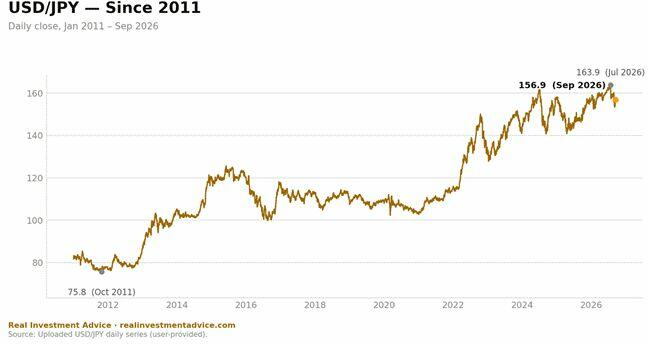
The Data
From 1995 to the present, Japan’s CPI averaged a mere 0.50%, with deflation marking 13 of the 31 years shown below. Since the pandemic, inflation has been above its 2% target. As a result, the Bank of Japan (BOJ) has been slowly raising its policy rate. Today, the policy rate is 1.25%, a departure from zero and negative rates that presided over much of the period shown below.
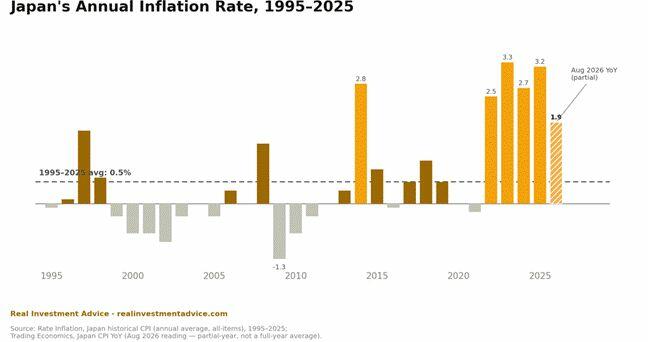
Japan’s recent inflation is certainly higher than the 1995-2020 experience, but it’s still running below America’s, where July CPI and Core CPI were 3.4% and 2.5%, respectively.
| Measure | Japan | United States |
|---|---|---|
| Headline CPI, YoY | 1.9% | 3.4% |
| Core CPI, YoY | 1.7% | 2.4% |
| Policy rate (hiked Sept. 16) | 1.25% | 3.75-4.00% |
A Setup Built for More Inflation, Not Less
Japan self-supplies only 16% of its energy and 37% of its food, meaning most of what heats Japanese homes, runs its factories, and feeds its people is bought abroad, in dollars. Run that through a currency that’s lost nearly half its value against the dollar since 2021 and oil that’s up over 50% year over year, and Japanese wholesale inflation has been affected. To wit, Japan’s corporate goods price index ran at 7.2% year-over-year in April, with import prices in yen up 29% versus 17.7% in the exporter’s own currency. That 11.3% gap is almost entirely related to the yen’s depreciation.
A 7.2% wholesale inflation rate on top of its currency and import exposure is the kind of setup that has produced double-digit consumer inflation in many other countries. Yet, Japan’s consumer inflation is less than 2%.
Some of the lack of inflation pass-through to consumers stems from subsidized energy prices and businesses still absorbing costs rather than passing them through. Aging demographics and a declining population also weigh on consumer demand and inflation. Furthermore, and maybe most importantly, government debt is presenting a strong headwind, as we will discuss next.
The Debt Question
If the “debt and deficits are inflationary” story were true, Japan should be the cautionary tale, not the United States. Its government owes 1.6 times as much, relative to the size of its economy, and finances almost all of it with domestic capital. Very few foreign investors own Japan’s debt, while foreign buyers absorb nearly a third of U.S. Treasuries.
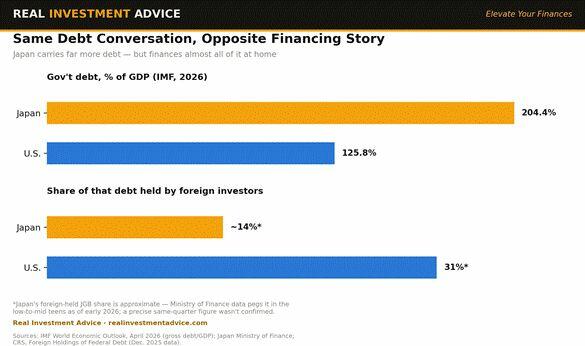
The level of debt does matter, and in Japan’s case it is very problematic, but not in the way most people think. Government debt isn’t free money injected into the economy. Instead, it’s a claim on capital today and when the debt gets serviced and rolled over in the future. Every yen or dollar used to fund the servicing and rollover of existing and new government debt is a yen or dollar a bank, insurer, or pension fund didn’t lend to a business building a factory, hiring workers, investing in R&D, or expanding capacity.
Economists use the term negative growth multiplier to describe the economic impact of most government debt. Because government spending tends to be unproductive, debt servicing typically offsets the initial benefits over time. In aggregate, government debt reduces economic activity and impedes an economy’s ability to become more productive.
This idea was made popular by Reinhart and Rogoff’s 2010 research on debt overhang. They concluded that when government debt exceeds roughly 90% of GDP, each additional dollar of debt-financed spending buys progressively less growth, not more.
Japan Crowds Out Economic Progress
Japan is a real-world test case for Reinhart and Rogoff’s theory. With banks, insurers, pension funds, individuals, and the Bank of Japan (BOJ) absorbing most Japanese debt, that capital isn’t chasing more productive private investment. Furthermore, with little economic growth for the past twenty years and a generally deflationary environment, the desire to invest in private Japanese ventures has been greatly curtailed
To wit, Japanese corporations sit on some of the largest cash hoards in the developed world rather than deploying it domestically. What Japan is witnessing is the crowding-out effect. The result of the government demanding large amounts of capital is not inflation or higher interest rates, but rather capital parked unproductively in Japanese debt instead of investments that can generate organic, demand-pull inflation and economic growth.
Debt, in other words, hasn’t been a demand-side accelerant in Japan. The US, with a lower debt ratio and a captive foreign bid for its debt, is not in the same boat as Japan. However, debt is crowding out investment into more productive uses, and rising interest rates will make the crowding-out effect a bigger drag. This should give pause to anyone claiming more debt equals more inflation.
TFP Tells The Story
Total factor productivity (TFP) measures the output an economy gets beyond what capital and labor add. Think of TFP as the gains from technology, innovations, and smarter capital allocation. Over long-term horizons, TFP is the main driver of per-capita growth as labor and capital have limits. In Japan’s case, its aging population, strict immigration laws, and declining population mean that labor is negatively impacting economic output. Furthermore, as we have been discussing, capital is being misallocated toward the deficit. Thus, its limited TFP is the primary source of growth.
The chart below shows that Japan’s Total Factor Productivity (TFP) has been flatlining around 1%, as has its real GDP growth.
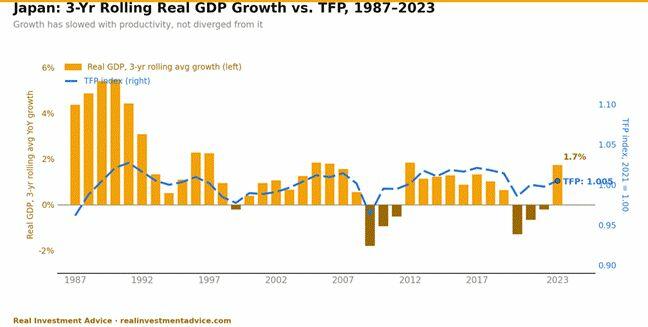
Summary
The simple deficits = inflation story being used to justify buying gold and bitcoin while shedding bonds at all costs is lacking. Instead, we must consider the longer-term implications of government debt and how too much debt inhibits economic demand and limits inflation by reducing investment in more productive uses.
Japan can thank its high debt loads and aging demographics for the inflation restraint. But bear in mind that the cost paid in stagnant growth and diminished prosperity for its citizens has been dear. We do not fear an inflationary spike in the US; instead, we are concerned that the economic doldrum that has infected Japan for over 25 years will slowly work its way here
end
3. CHINA
“Way Shorter Than Beijing Hoped”: China Stocks Tumble As Trade Truce Disappoints
Thursday, Sep 24, 2026 – 08:45 AM
Chinese stocks slipped overnight as the two-month extension of the US-China trade truce fell short of some Wall Street expectations (some desks were hoping for +6 months), offering limited reassurance that today’s talks would deliver a long-lasting trade deal, stabilize bilateral ties, and ease uncertainty over global trade.
The mainland CSI 300 Index dropped 1.7%, while the Hang Seng China Enterprises Index pared losses and closed flat. Broader Asian equities also came under pressure after a global bond selloff gathered pace as investors responded to stronger-than-expected US economic data on Wednesday and weak Treasury auction demand amid increasing fears of further Federal Reserve tightening
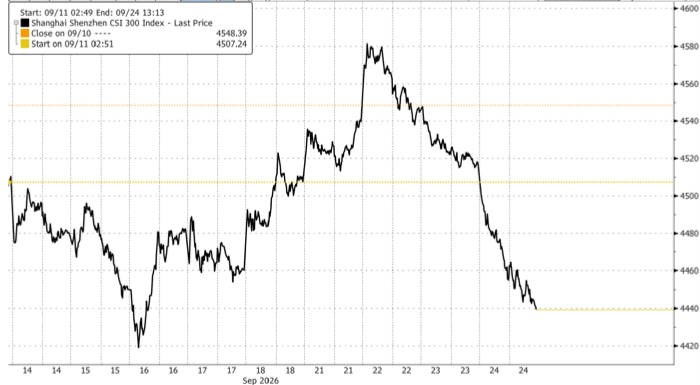
The two-month truce extension through Jan. 10 removes an immediate source of uncertainty but falls short of the three-to-six-month extension some Wall Street desks were hoping for.
As we detailed in an overnight note titled “Mr. Xi Comes To Washington: What Wall Street Banks Are Expecting,” President Trump rolled out the red carpet for President Xi Jinping at Joint Base Andrews on Wednesday.
Xi’s first White House visit since September 2015 includes bilateral talks, a South Lawn ceremony and a black-tie dinner later today with technology executives including Nvidia’s Jensen Huang, Tesla/SpaceX’s Elon Musk and OpenAI’s Sam Altman. Private tea with the Trumps and a National Archives visit are also on the books.
The high-level diplomatic visit comes as unresolved disputes mount. Trade talks center on the duration of the tariff truce, a proposed “Board of Trade” arrangement covering roughly $30 billion in goods on each side, and potential Chinese purchases of soybeans, Boeing aircraft and LNG. Rare earth supplies, technology restrictions, Iran and Taiwan also loom over the summit.
On the AI front, low-cost Chinese open-weight models are pressuring US frontier labs and eroding moats. Restrictions on advanced chips, allegations that Chinese companies distilled US models, and a proposed AI hotline add another layer to negotiations.
The broad expectation across JPMorgan, Deutsche Bank, TD Cowen and Raymond James is that the summit will produce limited breakthroughs. Wall Street’s focus now shifts to how long the truce lasts and whether either side makes concrete concessions.
Earlier this morning, former acting deputy US Trade Representative Wendy Cutler told Bloomberg TV that the temporary US-China trade truce extension signals Trump’s dissatisfaction with Beijing’s rare earth exports and agricultural purchases.
It’s a “way, way shorter time than China had hoped for; China wanted to extend that truce until the end of Trump’s term,” Cutler told Bloomberg’s Heidi Stroud-Watts.
She continued, “We’re at a point in our relationship with China where big deliverables are just no longer possible, and we’re talking about managing the relationship and keeping it stable, but not improving and strengthening it.”
Matt Maley, a veteran Wall Street strategist and chief market strategist at Miller Tabak + Co., wrote in a note that the two-month extension may disappoint investors who were hoping for a longer-term deal and may not bode well for equities. “A lot of investors that I have been speaking to were hoping for a six-month extension,” he said.
Read what JPMorgan, Deutsche Bank, TD Cowen and Raymond James have to say here.
END
CHINA/USA
this is good@!!
(ZEROHEDGE)
China Expands Export Controls On Drug Precursor Chemicals Ahead Of Trump-Xi Talks
Wednesday, Sep 23, 2026 – 09:45 PM
Authored by Aldgra Fredly via The Epoch Times,
China has added more chemicals to its export control list for drug precursor substances ahead of a high-stakes meeting between President Donald Trump and Chinese leader Xi Jinping in Washington.

The Chinese commerce ministry announced on Sept. 22 that it added two new substances to the list of chemicals subject to export controls, requiring exporters to obtain licenses to ship to the United States, Mexico, and Canada.
The move comes ahead of Xi’s state visit to the United States. Xi is due to meet with Trump at the White House on Sept. 24, marking their second meeting this year.
The two leaders last met during Trump’s visit to Beijing in May, when they agreed to build a “constructive relationship of strategic stability on the basis of fairness and reciprocity,” according to the White House.
Following the meeting in Beijing, China expanded its drug precursor export control list by adding three more chemical substances. Its National Narcotics Control Commission also issued a notice warning of eight chemicals that could be used to make synthetic drugs.
The Trump administration has repeatedly urged Beijing to do more to stem the flow of precursor chemicals for synthesizing the deadly opioid fentanyl into the United States.
China is a major source of precursor chemicals used to produce illicit fentanyl. After returning to the White House for a second term last year, Trump imposed fentanyl-related tariffs on China, Mexico, and Canada over their alleged failure to stem the flow of illicit drugs into the United States. The tariffs were subsequently struck down by the U.S. Supreme Court in February.
Fentanyl deaths in the United States rose steeply around 2016. Then deaths skyrocketed from 2021 to 2023 along with a record surge of border crossings, and at its peak, the fentanyl crisis was linked to 76,226 deaths in 2022, more than quadruple the figure from 2016. The United States started seeing a reversal in 2024, coinciding with changed border policies, and fentanyl-linked deaths in 2024 were estimated to be 48,422.
The United States has also been engaging Chinese officials to counter the fentanyl crisis since the mid-2010s, resulting in the restriction of several chemicals over the years.
Notably, Beijing broke off all major engagement with the United States in 2022, citing then-House Speaker Nancy Pelosi’s (D-Calif.) visit to Taiwan, including ceasing cooperation on curbing fentanyl-related exports. It resumed engagement in November 2023 after the United States removed sanctions on the Chinese Ministry of Public Security’s Institute of Forensic Science for human rights abuses in Xinjiang.
In November 2025, Beijing imposed export restrictions on 13 fentanyl precursor chemicals to the United States, Mexico, and Canada after Trump met with Xi on the sidelines of the APEC summit in South Korea.
It remains unclear whether the upcoming meeting in Washington will address the flow of precursor chemicals into the United States, as neither Beijing nor Washington has specified which issues will be on the leaders’ agenda.
U.S. Secretary of State Marco Rubio told reporters after a meeting with Chinese Foreign Minister Wang Yi in Manila, Philippines, on July 22 that he expects Xi to have a positive visit.
Rubio acknowledged the major differences between Washington and Beijing and emphasized that it is their job to manage them to ensure “they never get out of control.”
“We’re, obviously, always going to defend our national interest,” he said at the time. “And I expect they’ll do the same, as they define it. But I think there are some areas of potential cooperation.”
Michael Zhuang, Catherine Yang, and Reuters contributed to this report.
END
4. EUROPEAN AND SCANDINAVIAN COMMENTARIES PLUS NATO
EUROPE/CHINA
China Floods Europe With Cheap Cars, Grabs Record Market Share As Domestic Brands Buckle
Thursday, Sep 24, 2026 – 02:45 AM
Europe is becoming a glaring case study in how globalist leaders can destroy an entire automotive manufacturing base by flooding the continent with cheap Chinese cars and sending domestic automakers spiraling into crisis, while their policies simultaneously spark what Nomura analysts have said will be political blowback over an 18-month election cycle, with shifts toward the right already visible in recent German elections.
Bloomberg News cites new data from Dataforce showing that Chinese automakers captured a record share of Europe’s car market in August by flooding the continent with cheap hybrids that undercut domestic brands.

Chinese brands, including BYD, accounted for nearly 12% of European new-car sales that month, according to Dataforce. The largest surge in sales came from hybrids: one in four sales overall and roughly one in three plug-in hybrids.
Chinese hybrids avoid the additional EU duties imposed on imported EVs, giving BYD a competitive advantage on an energy-stricken continent.
EV and hybrid sales jumped 27% in August, offsetting declines in combustion-only cars and lifting the overall market by 4.6%.
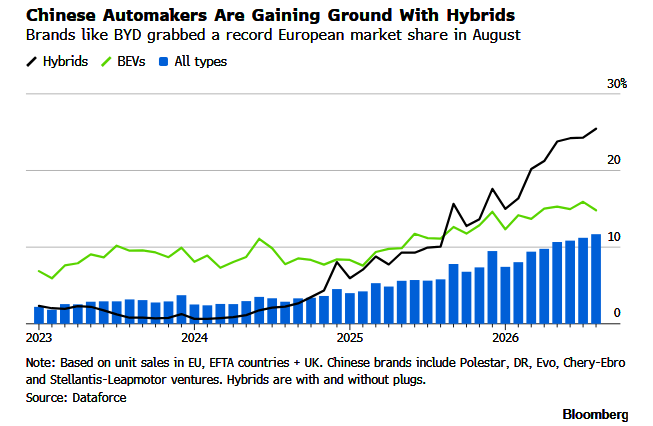
The increasing Chinese auto footprint inside Europe is becoming increasingly alarming when viewed from a Goldman chart posted to clients earlier today.
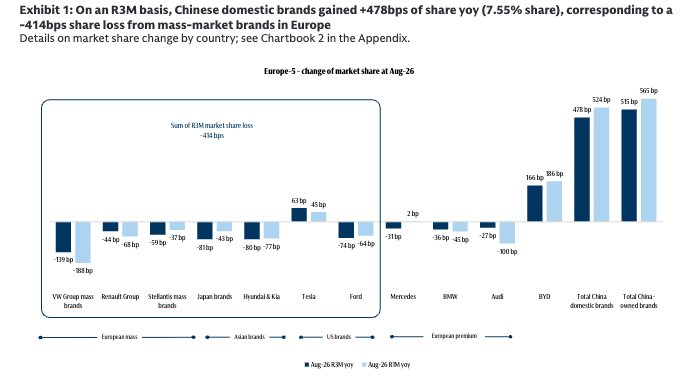
Germany’s auto industry crisis has refused to end as Volkswagen last week lowered its operating-margin forecast, reflecting a write-down on its Porsche stake and soft Chinese demand. Layoffs and production-line wind-downs are also mounting for European automakers.
Stellantis recently planned to halt production of the electric and hybrid Fiat 500 at Italy’s Mirafiori plant during the final two weeks of October. Output could reach 60,000 vehicles this year, compared with an original forecast of around 100,000.
Meanwhile, Germany is preparing economic security proposals that could include tariffs on Chinese hybrids as its auto industrial base remains in turmoil.
The problem with Europe’s auto industrial base, amid what can only be viewed as a planned demolition by the continent’s globalist leaders, is its lack of readiness to retool for wartime, as the US is currently doing (see the GM report from last week), when civilian production quickly converts to weapons manufacturing.
Europe is a case study for the world in what not to do, as its globalist leaders appear to be at the mercy of Beijing.
END
GERMANY
Anti-Immigration AfD Now The Most Popular Party In Key Western German State In A National Vote
Thursday, Sep 24, 2026 – 02:00 AM
The anti-immigration Alternative for Germany (AfD) party is known for its strength in the east of the country, but its popularity in Western Germany is also only growing, including in the country’s most populous state, North Rhine-Westphalia.

This latest Forsa poll points to incredible growth of the AfD in a very short time in the voter-rich Western German state. It is now the most popular party in the entire state when measuring a national vote and would earn 24 percent of the vote.
Meanwhile, the Christian Democrats (CDU) fell four points to 22 percent, the lowest value Forsa has ever recorded for the party in the state. The previous low was 23 percent in December 2021. However, in order to avoid confusion, it must be noted that the Forsa poll asked two very distinct questions. One question asked voters in North Rhine-Westphalia how they would vote at the federal level and also how they would vote at the state level. At the state level, voters in North Rhine-Westphalia would still back the CDU over the AfD; however, the CDU’s advantage over the AfD has narrowed to just seven percentage points ahead of the April state election.
For Minister-President Hendrik Wüst, the drop in support for his CDU party comes at an especially sensitive time. Wüst recently became the only top CDU politician who called for the government to begin the process of investigating a possible ban of the AfD party. He is also seen a strong contender to replace Merz as chancellor.
The latest figures show that if a state election were held this Sunday, the CDU under Wüst would receive 29 percent, down from 32 percent in Forsa’s April survey. The AfD has risen two points to 22 percent. The gap between the two parties has therefore fallen from 12 to seven points in just a few months.
About a year ago, however, the lead was far larger, at 22 percentage points. In July 2025, 38 percent of respondents favored the CDU while the AfD stood at a mere 16 percent.
While this may be of some consolation to Wüst that he is still more popular than the CDU federal branch, the fact that the AfD is now leading in the state at the federal level represents a massive sea change in German politics.
North Rhine-Westphalia is one of the most diverse of all of Germany – outside of the city-states like Berlin – featuring 35 to 38 percent of the population with a migration background. It is also a state with numerous industries hit hard by Germany’s ongoing economic downturn.
The three recent state elections in eastern Germany have become a “turning point” for the CDU after a sharp setback in Saxony-Anhalt, the party’s failure to enter the state parliament in Mecklenburg-Vorpommern two weeks later, and disappointing results in Berlin. Chancellor Friedrich Merz said he was “deeply shocked” about the vote in Saxony-Anhalt and spoke of consequences. He also noted that he took responsibility for the election outcomes but would not resign the chancellorship or his role as chairman of the CDU party.
The question now is whether widespread dissatisfaction with Merz will continue to weaken the CDU’s prospects across Germany.
END
BRANDON SMITH….
Something Has Changed And World War Over Ukraine Is Back On The Table
Wednesday, Sep 23, 2026 – 11:25 PM
Authored by Brandon Smith via Alt-Market.us
The eyes of the world have been fixated on the war in Iran for the past six months, meanwhile, the single-most dangerous flashpoint on the planet has gone mostly ignored. Until, that is, waves of Ukrainian drone strikes activated a run on global diesel markets. Suddenly, everyone is paying attention again…
Russia is the second largest diesel exporter in the world next to the United States, supplying around 12% of total global exports (the US supplies 22% of exports). To put this in perspective, only 10% of global diesel exports pass through the Strait of Hormuz under normal conditions – And that supply is coming from seven different oil producing nations including Iran.
After western sanctions, Russian diesel shipments have gone primarily to Turkey, Brazil, India and China. However, because Russian supplies continued to circulate on global markets, these countries did not have to draw fuel from alternative sources.

Conditions have now changed, and not for the better. Constant Ukrainianian drone strikes on Russian refineries have forced the Kremlin to stop all diesel exports and retain their existing supply for the population and the war effort.
If you want to know why diesel prices have been hit hard since July, Russian export cuts are the reason. Traffic through the Strait of Hormuz has steadily climbed since July according to independent satellite tracking confirmation (anyone using AIS transponder data alone will have a low and inaccurate count). It’s the Russian refinery issue that has inflated diesel prices in recent months.
With Russian sources completely cut off, multiple nations will have to draw from other producers. Meaning, the pie is shrinking, but everyone still wants the same size slice they’ve always had. If the US also stops diesel exports in response, it would be a disaster for foreign markets and result in true supply shortages (Europe would be hard hit; half of their diesel imports come from the US).
In 2024 I questioned why the Ukrainians kept going after odd targets such as nuclear early warning radar stations rather than key resources like oil refineries in order to stop Russia’s attrition strategy. Well, it looks like the Ukrainians finally figured it out.
Russia’s attrition strategy has been highly effective in grinding down Ukraine’s troop strength (to the point that they were recruiting mostly men over 40), but the key flaw of a slow moving front line and a protracted offensive is that it requires a large stockpile of resources. Ukraine’s drone attacks have a low success rate, but if they send a thousand UAVs to attack a refinery and a couple get through, then that’s still a win in the long run because it drags down Russia’s lumbering attrition-based operation.
The Trump Administration has asked Ukraine to stop hitting Russian refineries due to the instability to global markets, but Zelensky has ignored the request. It’s not surprising; they’ve finally found a tactic that works.
Of course, now the rest of the world is being affected by diesel supply shortages when this was not the case a year ago. One would think the Europeans, who have been particularly throttled by price hikes on fuel and energy, would be in a rush to end the war. And maybe they are about to intervene, but not in the way we might hope…
I think it’s fair to say that the Ukraine war would have ended a long time ago had it not been for the interference of European governments propping up Ukraine and encouraging them to NOT make a deal. Ultimately, Russia is going to keep the Donbas region whether Ukraine likes it or not. But Zelensky refuses to accept this outcome, so, the war rages on much longer than it needs to.
The situation gets much more dangerous, though,with the push by European elites to put boots on the ground. They seem to want to start a world war. Beyond the diesel resource problem which puts a timetable on the war for both sides, European governments have increased troop movements to eastern borders and it’s starting to look like they’re getting ready for something big.
Poland has been building extensive trenches and fortifications using German combat engineers on the border of Belarus. Germany has established a 5000-man armored brigade in Lithuania, the first time the Germans have stationed permanent combat troops abroad since 1945. NATO has launched a 9th multinational battle group with regular exercises in Finland near the Russian border. Multiple nations are sending rotating brigades to Latvia, Romania and Estonia. Even the Canadians are sending troops.
Recent weeks have seen repeated Polish and Baltic fighter activations due to alleged drone or aircraft activity near alliance airspace. Allies are pre-positioning equipment and planning much larger stockpiles of ammunition and resources in frontline states. NATO has also published extensive contingency planning for the eastern flank.
There has been a surge in political and civil-preparedness messaging for civilians. Polish warnings about possible disguised drone/missile incidents. French measures to protect critical infrastructure after hybrid-attack briefings. German military-hospital capacity planning. Lithuanian plans for evacuation routes. UK public preparedness bulletins including recommendations for civilians to stock up on food and supplies..
Even Switzerland has been posting security and preparedness messages for citizens, indicating a “deteriorating security situation” in relation to the military build up.
All of this could be viewed as a defensive posture and not necessarily planning for direct engagement with the Russians; but consider for a moment that Russia has not once threatened to attack European or NATO targets and has consistently said that their only interest is Ukraine. Yet, Europe has removed their “trip wire” defense strategy and replaced it with a permanent front. It sure does seem like they are getting ready for an event which might provoke the Russians to strike targets outside of Ukraine.
What would that event be?
To be clear, I’m not a big fan of the Russian government. Evidence suggests that they engage in regular psy-ops in the US and there are far too many conservative influencers who kiss Putin’s ass. That said, I’m not a fan of Ukraine or the Europeans either, and I suspect the EU elites would LOVE to trigger a world war if they thought they could get away with it.
Why? Well, here’s my theory…
Europe has been the primary target of a decade long cultural replacement operation. Mass immigration has been utilized to undermine the stability of economic and social structures. For years I have been warning that these third world migrants are being imported as a mercenary army to control the locals and prevent rebellion against future leftist agendas.
We are already seeing confirmation of this in the UK, where migrants are being integrated into police forces to subdue conservative protesters.
The thing is, this invasion plan has sparked an enormous counter-movement of European patriots in countries like Britain and Germany. Anti-immigration and conservative parties like Restore in the UK and the AFD in Germany are seeing wild success in membership and elections. Meaning, time for leftists/globalists is running out and they need to do something quick before they lose direct governmental power.
A world war sure would come in handy, right? All kinds of restrictions on the populace can be put in place, along with a perfect excuse to delay or eliminate normal elections. Would the progressives actually go that far just to prevent conservatives from taking government? We all know that they would.
So, we have two running clocks that did not exist at the beginning of the Ukraine war: We have a diesel shortage clock, specifically for the Europeans. And, we have an avalanche of conservative movements with major elections happening from 2026 through 2029.
My concern is that the leftists are about to go for broke in an effort to keep power. I don’t think they’re crazy enough to want a nuclear war, and perhaps the Russians want to avoid this as well. If that’s the case, then the result would be a large multi-region conflict that MIGHT turn nuclear if either side feels like they are losing. The main goal of the EU elites at that stage would be to lure the US into the fray.
In any case the aftershocks would be disastrous. Let’s hope that conservative and populist movements in Europe can pull the rug out from under their far-left governments before the situation on the eastern front escalates any further.
END
RUSSIA AND ISRAEL AND MIDDLE EASTERN AFFIARS
ISRAEL/USA VS IRAN/THURSDAY
ISRAEL TBN
END
HOUTHIS
IRAN ET AL
Iran Vows To ‘Paralyze’ Regional Airports Which Prevent Its Flights From Landing
Wednesday, Sep 23, 2026 – 04:40 PM
Facing crippling US sanctions against its aviation sector as part of the Trump/Bessent Economic D-Day initiative, Iran is warning that if regional countries join the sanctions action, their own airports could be targeted.
Iran’s Supreme National Security Council has on Wednesday put neighboring states who are allies of Washington on notice. The statement warned their airports will be “paralyzed” if they cooperate with US attempts to prevent the landing of Iranian airliners.

Treasury Secretary Scott Bessent declared on Monday that by Wednesday. Sept. 23, “all the Iranian airlines will be shut down around the world.“
He warned that any airports or companies providing fuel, landing, and ticketing for sanctioned Iranian entities risk dollar-system exclusion.
Already Turkey has taken the dramatic action of canceling all flights in the foreseeable future for various Iranian carriers.
According to more of the Iranian Supreme National Security Council statement, delivered via its chief, Mohsen Rezaei, “We ask all the countries of the region not to join America’s adventure. If they do not allow Iranian aircraft to travel, their own airports will not be able to have flights either.”
“You are our friends, but you should not join America’s ranks. You should prevent the war from spreading,” he added. Throughout the prior seven months of war with the US, Iran has shown a willingness to target major civilian hubs, particularly in neighboring Kuwait.
Iran is defiantly planning to press forward with its commercial airline operations. While some countries are complying with the US order, China is clearly not…
As for the heavily sanctioned Iranian aviation industry, in recent years the Islamic Republic has suffered some significant aerial disasters, which included the May 19, 2024 death of President Ebrahim Raisi. His military helicopter went down in a rugged, mountainous area of northwestern Iran.
Some speculate that lack of airline parts and aging aircraft, due to the long-standing US targeting of the industry, has only served to increase the chances of aviation disasters.
END
IRAN/ISRAEL/USA THIS AFTERNOON
Tehran Denies Working On Phased US Deal To Reopen Hormuz, Sticks By Conditions
Thursday, Sep 24, 2026 – 01:40 PM
Summary
- US-Iran talks uncertain: as Iran has stuck by its conditions while engaging Kushner-Witkoff in NY at UN.
- Iran threatens escalation beyond Persian Gulf: Tehran warned the conflict could spread to the Indian Ocean if attacked again.
- Yemen front intensifies: Saudi Arabia said it intercepted six Houthi ballistic missiles.
- Oil markets react: Renewed tensions pushed Brent crude to $106/barrel, undermining hopes for a quick deal.
* * *
Denial of Deal Optimism Headlines
Iranian journalist and analyst Mohammad Ghaderi, who often accurately presents Tehran’s point of view or reaction to fast-paced events, has slammed the earlier Reuters report as ‘false’.
That prior report said that the “US and Iran reportedly discuss phased deal to reopen Hormuz and end US blockade, according to Reuters citing sources.” But the reaction from Tehran is below:
Additionally this is via Israel’s i24: “A senior Israeli official says “The chance of an agreement between the US and Iran is ‘small’ – but not impossible’.”
Reuters Headline Signals [Dubious] Return to ‘Deal in Motion’
Crude tumbles on a new Reuters report signaling a return to [dubious?] ‘deal in motion’ headlines: US and Iran reportedly discuss phased deal to reopen Hormuz and end US blockade, according to Reuters citing sources
This seems just a reiteration of Iranian demands, but crude still reacted (per Rtrs):
- A senior Iranian official said the most plausible way to end the impasse would be a phased arrangement, with Iran allowing navigation through Hormuz in return for the US lifting its economic blockade and Tehran potentially gaining access to frozen assets.
- Neither side wants to surrender leverage driving diplomacy
- Iran signals flexibility on fees, not on Strait of Hormuz
- Gulf states reject Iranian control of the strait
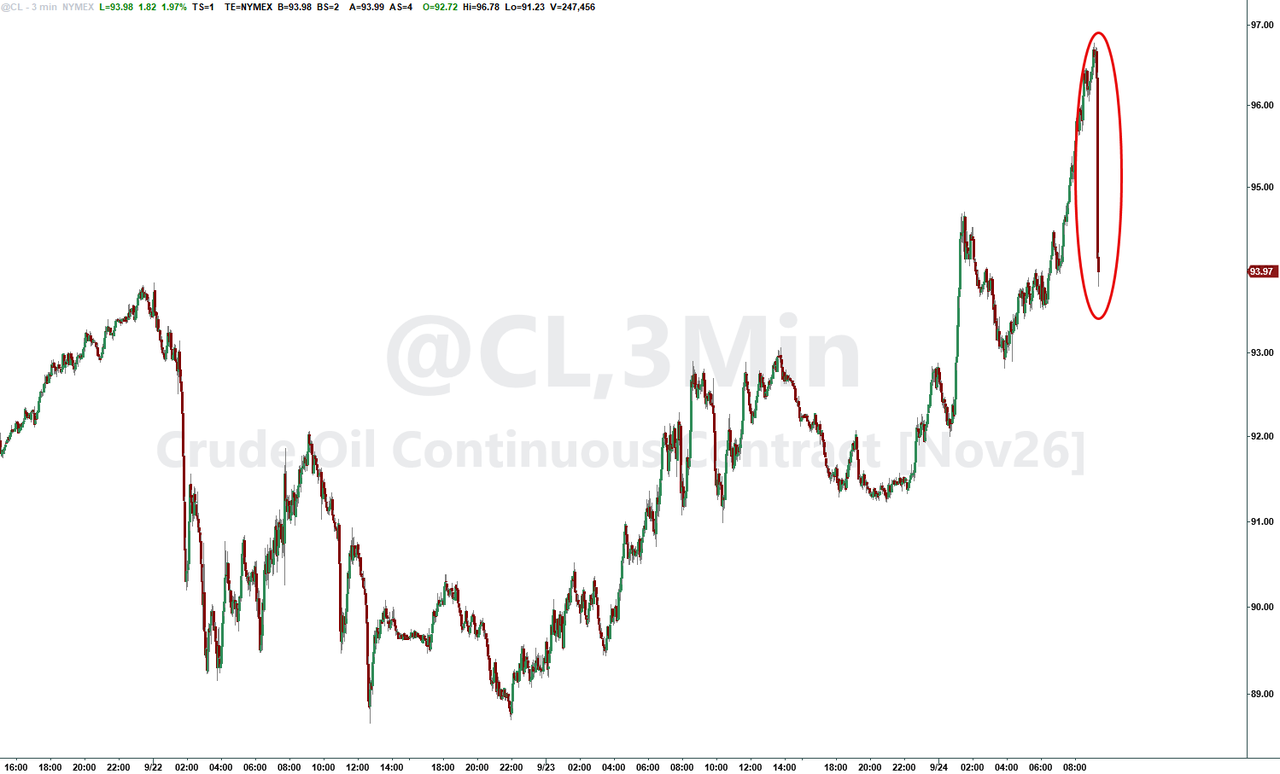
Iran Threatens to Spread War to Indian Ocean
It was just this month which saw the Iran conflict spill over into a renewed fight between the Saudi coalition and Yemen’s Houthi rebels. Now Iran is threatening to expand the fight further, even into the Indian Ocean.
Yahya Rahim Safavi, an adviser to Iran’s Supreme Leader Mojtaba Khamenei, warned Thursday of another significant expanse of the war if the Islamic Republic suffers attack again.
“Since the conflict has spread from the Persian Gulf and Strait of Hormuz to the Red Sea, it is possible that, in response to more war, the front will expand even further, reaching the Indian Ocean and perhaps beyond,” said Safavi in a video published by Iran’s Fars news agency.
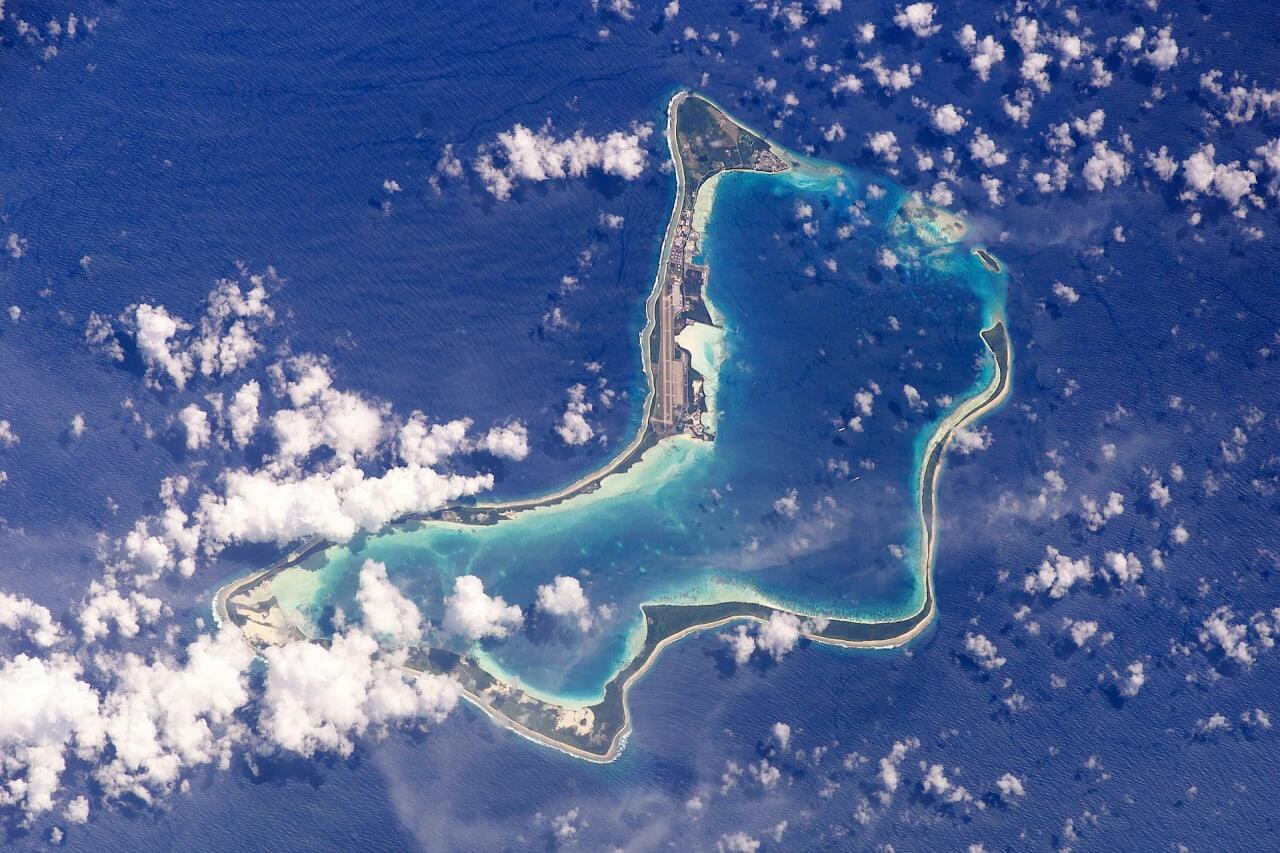
This marks the first time that an adviser to Iran’s supreme leader explicitly mentioned hitting targets in the Indian Ocean as a heightened military threat.
The strategic British military base at Diego Garcia, which is also heavily used by the United States, lies deep in the Indian Ocean – some 2400 miles away.
The Iranians are believed to have actually fired ICBMs on the base at the height of Trump’s Operation Epic Fury.
Diego Garcia was first targeted on March 21st, with The Wall Street Journal at the time reporting that one missile had a mid-flight malfunction, while the other was engaged by an SM-3 interceptor missile fired from a US Navy vessel, though it’s unclear whether this latter projectile ever hit its target.
Brent surged to around $106 after a military adviser to Iran’s supreme leader said Tehran may expand the war to the Indian Ocean if the US or Israel attacks again, further undercutting hopes of a deal. —Bloomberg
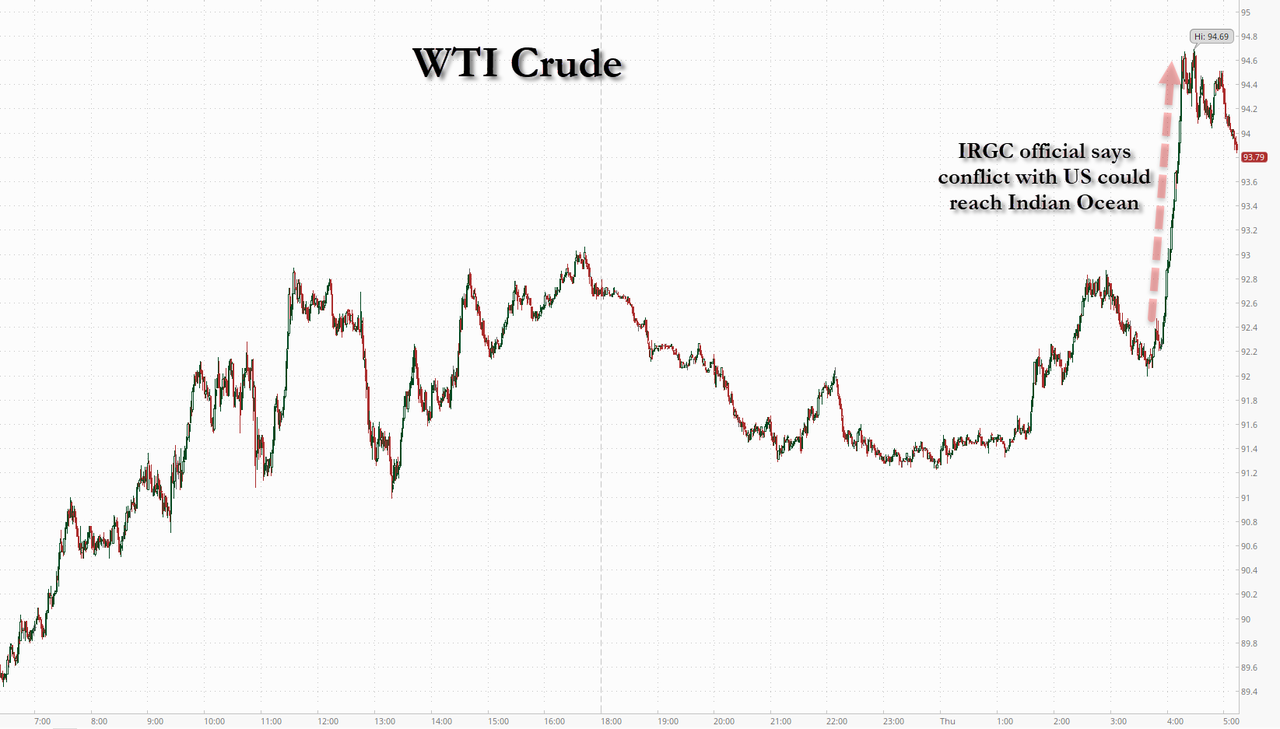
Iranian negotiators are vowing they will not back off Tehran’s firm conditions for ending the war, after this week sitting down with the US team in New York on the sidelines of the UN General Assembly.
IRAN
Senior IRGC commander killed in clash with gunmen near Iran-Pakistan border – report
Brig.-Gen. Hossein Zarifi, commander of the IRGC’s Shahid Sajjad Operational Headquarters, was killed during clashes with gunmen in southeastern Iran.

IRGC Brig.-Gen. Hossein Zarifi(photo credit: SCREENSHOT/X, SECTION 27A COPYRIGHT ACT)ByMAARIV, JAMES GENN, JERUSALEM POST STAFFSEPTEMBER 24, 2026 01:14
A senior Islamic Revolutionary Guard Corps commander was killed during clashes with gunmen in southeastern Iran’s Sistan and Baluchestan Province on Wednesday, Iranian media reported.
Brig.-Gen. Hossein Zarifi, commander of the IRGC’s Shahid Sajjad Operational Headquarters in Saravan, was killed during the fighting, the IRGC Ground Forces’ Quds Regional Headquarters confirmed in a statement carried by Iran’s semi-official Tasnim News Agency.
The clash took place in the Jihadabad area of Saravan, near Iran’s border with Pakistan.
A joint force consisting of the IRGC, the Intelligence Ministry, and police raided a location where an armed cell was believed to be operating.
Iranian authorities claimed the cell was planning an attack and that they located it based on intelligence.

Five members of the cell were killed during the ensuing exchange of fire, while others were arrested, according to Maariv.
The identity and affiliation of the gunmen remained unclear.
Iranian authorities described those involved as “terrorists” but did not identify a specific organization, and no group had claimed responsibility for the clash.
IRGC confirms Zarifi’s death
The IRGC said Zarifi was killed while taking part in the operation alongside his forces.
In its statement, the IRGC praised Zarifi for fighting on the front lines and invoked former IRGC Quds Force commander Qasem Soleimani while discussing the role of commanders in combat.
The IRGC said Zarifi’s death would not create a vacuum in the ranks of its forces and that operations to defend Iran’s borders would continue.
Zarifi had served for more than a decade in Sistan and Baluchestan, according to Maariv.
His funeral is scheduled to take place in Saravan on Friday, according to the IRGC statement carried by Tasnim.
Recent clashes in Sistan and Baluchestan
Sistan and Baluchestan Province is majority Sunni in population and is often the site of anti-regime militant attacks, particularly from Balochi separatist movements.
The province borders both Afghanistan and Pakistan, and militant groups operate across the border areas.
Wednesday’s clash comes less than two weeks after another deadly security operation in Saravan. On September 12, a joint operation involving the IRGC, Intelligence Ministry, and law enforcement targeted an armed cell that Iranian authorities said was planning an assassination.
Four alleged militants were killed in the operation, along with three Iranian intelligence and security personnel, according to the IRGC. Weapons, ammunition, and explosives were also found at the group’s hideout, the IRGC said.
The September 12 operation followed another security operation in Sistan and Baluchestan in late August, when the IRGC said one member of an armed cell was killed and six others were arrested.
That operation was also conducted jointly by the IRGC, Iran’s Intelligence Ministry, and provincial police, The Jerusalem Post previously reported.
\END
RUSSIA VS UKRAINE UPDATES//POLAND/NATO
NATO Jets Scrambled After Russian Military Helicopter Breaches Polish Airspace
Thursday, Sep 24, 2026 – 04:15 AM
Another dangerous border breach incident has occurred involving Russia’s military and a NATO ‘eastern flank’ country.
Polish military officials announced Wednesday that a Russian military helicopter made a brief incursion into Poland’s sovereign airspace from the Russian exclave of Kaliningrad.

Kaliningrad and Poland share a 130-mile heavily fortified frontier border, and tensions have soared ever since the Ukraine war began.
“The Mi-8 helicopter spent 42 seconds in Polish airspace and entered to a maximum depth of about 300 meters (328 yards),” the Polish Army Operational Command stated in a post on X.
Polish or NATO jets went immediately active as a result. “Fighter aircraft were scrambled, and ground-based forces and assets remained on standby. The nature of the incident indicates that Russia is once again testing the readiness of our air defense,” the statement said.
Poland’s military framed the incident as intentional and as part of Moscow’s willingness to ‘test’ Western readiness and resolve:
It said “the nature of the incident indicates that Russia is once again testing the readiness of our air defense“. Moscow did not comment immediately.
Poland and other European Nato members have recently said Russia may be preparing attacks to test their commitment to supporting Ukraine – Moscow denies this.
The Kremlin did not immediately issue comment, but has previously repeatedly denied that there is any intent whatsoever to expand the Ukraine ‘special military operation’ into Europe.
However, earlier this month Foreign Minister Lavrov warned that “If Europe attacks Russia, it will be a completely different war [from that in Ukraine], and it will be very short.”
The suggestion was that Russia is ready do defend itself with strategic forces if it has to, in a veiled warning of nuclear confrontation.
Several ‘incursion’ incidents have already happened this month along the borders of Eastern European NATO member states. Most of these incidents have centered on drones.
Polish Prime Minister Donald Tusk suggested Russia was planning drone and missile strikes against Poland and other countries on NATO’s eastern flank. Polish Prime Minister Donald Tusk said just days ago, “In recent weeks, the Russian hybrid threat against Europeans… has intensified.”
END
RUSSIA VS UKRAINE
Russia Hammers Kiev In Rare Daytime Attacks; Kremlin ‘Appreciates’ US G20 Invite
Thursday, Sep 24, 2026 – 01:15 PM
At a moment Ukrainian President Volodymyr Zelensky is still in New York City Thursday, attending meetings on the sidelines of the United Nations General Assembly, his capital of Kiev has been rocked by fresh Russian strikes, which killed at least two people and wounded over 40 more. The attacks began in the daytime on Wednesday, and appear to have persisted into Thursday.
A missile alert first went out to city residents Wednesday, after which AFP journalists observed hearing over 20 blasts. “Explosions in Kyiv. The capital is under ballistic missile attack. Remain in shelters!” Mayor Vitaly Klitschko wrote on Telegram.

And Zelensky himself wrote: “Once again, the main targets of (the Russian) attack were Kyiv and civilian infrastructure – residential buildings, a maternity hospital, energy facilities and logistics. Two people are already known to have been killed.”
On Wednesday in addressing the UN assembly, Zelensky warned Western partners that they must not let up the sanctions and isolation pressure on Putin, in order to starve Russia’s military machine.
Zelensky on Thursday reiterated further on X that “Russia will not end this war without pressure. As people were sleeping, flashes from explosions lit up the sky. Once again, the main targets of their strike were Kyiv and civilian infrastructure, residential buildings, a maternity hospital, energy infrastructure, and logistics.”
Other deadly overnight attacks occurred beyond the capital area. A Russian strike on a farm in Ukraine’s eastern Kharkiv region killed six people, local officials said.
Meanwhile efforts at getting the warring sides back to the peace table have still appeared stalled. But the Kremlin on Wednesday said it received an invitation from the United States for Putin to attend the December G20 summit in Miami.
Kremlin spokesman Dmitry Peskov said that Moscow and Putin are “grateful for and appreciative of this invitation.” He said, “We will make a decision and work through it via diplomatic channels.”
Washington confirmed that indeed the invitation was extended, no doubt to the consternation of European officials. Secretary of State Marco Rubio has explained: “We’ve invited President Putin to the G20. We think it’s an opportunity for him to engage not just with the president but with other world leaders. We hope that’s an invitation he’ll accept.”
So far the Kremlin has signaled that Putin is unlikely to be in Miami. We wrote at the start of the week:
Both the Kremlin and the White House had recently signaled mutual openness to the idea of President Putin actually attending the G20 Miami Summit which is set for December 14-15. Some reports have recently expressed optimism that some kind of grand Ukraine peace deal could emerge from such an engagement.
However, Bloomberg has poured cold water on this, reporting Monday that “Vladimir Putin is set to travel to China for the Asia-Pacific Economic Cooperation summit hosted by President Xi Jinping but is likely to skip the Group of 20 in the U.S. with Donald Trump.”
He’s previously also stated that he would only meet with Zelensky if a deal had been finalized and was ready to sign.
Trump and Putin last talked face-to-face in August 2025. But since then the war has only escalated, particularly given Ukraine’s long-range strikes on Russian territory and its energy infrastructure, and industrial and retailer sites – with the help of targeting intelligence provided by NATO countries.
END
6/.GLOBAL ISSUES, COVID ISSUES, VACCINE INJURIES/HEALTH ISSUES
COVID NUMBERS RISE DRAMATICALLY THANKS TO NEW VARIANTS
by The Wellness Company

The failed Fauci approach to COVID-19 continues to wreak havoc on our healthcare system. Not only are millions of Americans still dealing with the long-term health impacts from the COVID vaccine, but now COVID – like the flu – is now an unwanted annual guest for tens of millions of Americans all across the country.
For the first time since early spring, COVID numbers are on the rise, and in some places – particularly in the south and on the west coast – the numbers are rising dramatically.
Fauci’s failed approach to combatting COVID-19 back in 2020 and 2021, all but guaranteed that we would be dealing with mutated COVID strands for the foreseeable future – and this year is no different.
One of this year’s variants is known as the “Cicada variant.” According to media reports:
the latest strain is called the “Cicada variant.”
It’s causing significant upper respiratory issues, congestion, coughing and lung inflammation, officials said.
“People are getting pretty sick with a lot of upper respiratory issues, lots and lots of congestion, coughing, wheezing and inflammation in the lungs, and have been getting some secondary infections related to COVID,” said Novant Health family nurse practitioner Alexis Riccone.
It’s Not Just COVID
The return of COVID marks the beginning of the respiratory illness season. In addition to COVID, respiratory illness season means rising rates of the common cold, RSV, and the flu.
These viruses spread through three primary routes:
- Droplet — Coughing and sneezing launch virus-laden particles that land on mucosal surfaces. A single sneeze produces ~40,000 droplets traveling at ~100 mph.
- Fomite — Rhinovirus survives hours on doorknobs, phones, keyboards. You touch, you transfer to eyes/nose/mouth, you’re infected. This is arguably the dominant route for rhinovirus specifically.
- Direct contact — Handshakes, hugs, close-quarters conversations. Skin-to-skin then skin-to-face.
Incubation is typically 24–72 hours. Peak contagiousness occurs during the first 2–3 days of symptoms. Even though there may be more congestion on days 5-7, there is less spread. The average adult logs 2–4 colds annually; children in daycare can hit 6–8.
Not only are the paths of transmission similar, many of the symptoms are so similar that they can be difficult at times to tell one from the other.
Some symptoms are hard to distinguish among illnesses, especially with respiratory viruses. Others are unmistakable.
— The common cold can be caused by several different types of viruses and can cause a runny nose, congestion, cough, sneezing, sore throat, headaches, body aches or low fever for less than a week.
— The flu, caused by influenza viruses that are always changing, leads to fever, chills, cough, sore throat, runny nose, body aches, headaches and feeling tired. Flu symptoms tend to hit more quickly than cold symptoms, and can last anywhere from a few days to two weeks.
— COVID-19 can cause fever, chills, cough, short of breath, sore throat, congestion, loss of smell or taste, fatigue, aches, headache, nausea, or vomiting for several days.
— RSV can cause a runny nose, congestion, coughing, sneezing, wheezing, fever and a loss of appetite for a week or two.
Last Year Trump Stockpiled Medications
As a result of last year’s horrific respiratory illness season, marked by one of the worst flu seasons in decades, President Trump directed the federal government to accumulate essential pharmaceuticals, such as antivirals and the components of more than 80 vital medications.
“To prevent shortages in the future, we are accumulating a six-month supply of essential medications.”
— White House Fact Sheet, September 2025
If the Trump administration thinks stocking up on meds is a good idea, doesn’t it make sense for you to do the same?
Be Prepared
The Wellness Company’s Contagion Emergency Kit is helping thousands of Americans stay protected. Now that respiratory illness season is upon, it is time for you to be prepared to keep your family safe with this must have prescription drug kit.
This is more than just an accessory for your medicine cabinet. It’s a doctor-designed, prescription-grade kit that includes:
✅ Oseltamivir (generic Tamiflu™) – Antiviral
✅ Hydroxychloroquine – Antimalarial & immune support
✅ Ivermectin – Broad-use antiparasitic
✅ Azithromycin (Z-Pak) – Antibiotic
✅ Budesonide + Nebulizer – Inhaled steroid for lung support
It also includes a Medication Guidebook, written by top doctors like Dr. Peter McCullough.
Dr. McCullough is the nation’s leading freedom-loving doctor. We here at Zero Hedge trust Dr. McCullough, because we know that he puts the health of the American people above the profits of big pharma.
GLOBAL ISSUES
COVID VACCINE INJURIES: MARK CRISPIN MILLER
50+ must-read studies & reports on the lethality of “vaccination,” surging miscarriages, dying pilots, turbo cancers, white clots, censorship, and other chilling findings from all around the world
Here is what “the (real) science,” and honest journalism, tell us that affirms what we’ve been demonstrating for the past 4+ years
21 minutes ago
BREAKING: Massive MAHA Coalition Representing 63 Million Followers Sends Open Letter to Trump and RFK Jr. Demanding REMOVAL of the mRNA Platform
September 21, 2026
168 prominent physicians, scientists, lawmakers, and public figures unite behind six demands for sweeping federal action on mRNA policy.

 FOCAL POINTS (Courageous Discourse™)
by Nicolas Hulscher, MPH…
END
DR PAUL ALEXANDER
RABOBANK/MICHAEL EVERY/OR OR PICTON/GIFFIN OR RABOBANK EXECUTIVE/COMMENTARY ON WORLDLY AFFAIRS
A Perfect Storm – Where Are The Umbrellas?
Thursday, Sep 24, 2026 – 10:00 AM
By Michael Every of Rabobank
As the Wall Street Journal puts it today, ‘A perfect storm is raging in the bond market’ as US 10-year yields are at 5.11% vs. 4.93% at yesterday’s close, the largest one-day rise since 2025’s “liberation day”; Canada’s are at 3.95% vs. 3.83%; the UK’s 5.35% vs. 5.20%; Australia’s 5.38% vs. 5.25%; Germany’s 3.55% vs. 3.46%; France’s 4.66% vs. 4.50%, and Japan’s 3.05% vs. 2.98%.
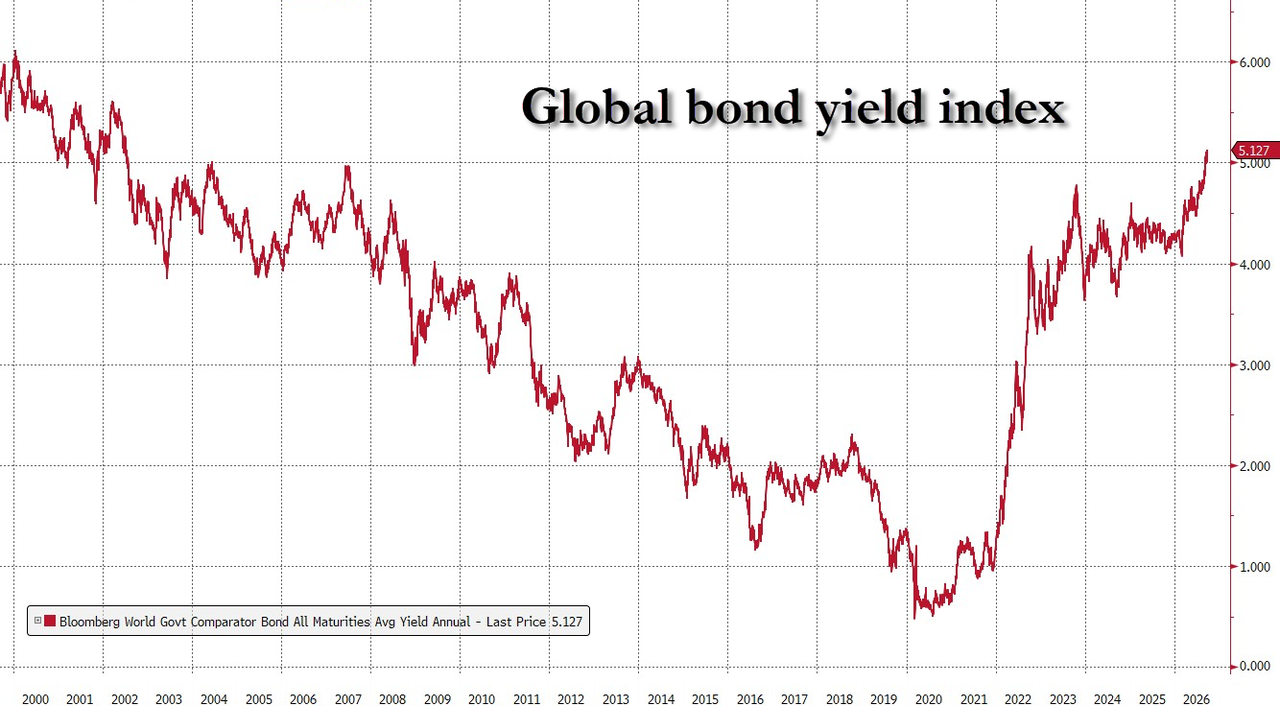
You can blame some of that on yesterday’s data, where the Eurozone services PMI was marginally better than expected at 53.0 and the US manufacturing and services PMIs leaped to 57.0 and 58.7 respectively. It’s great that seven months of Middle East and Russia-Ukraine war with high energy prices haven’t dented growth. The downside is there’s little reason for ‘rate cuts!’ And just imagine if geopolitics gets worse or economies must ‘run hot’ to rearm at pace.
In terms of energy, US Energy Secretary Wright has stated a US diesel export ban won’t work, but Politico says the White House is still preparing plan for 90-day ban even as some GOP lawmakers and oil industry representatives are fighting to stave off the announcement. In short, it’s perhaps not for nothing that European, UK, and Aussie diesel prices have been climbing, and where markets might be in for another battering.
Xi Jinping is at a high-stakes US summit with Trump, where their trade truce has been extended… until 10 January: after that, who knows? Germany, which isn’t present, has surrendered anyway: Euractiv reports Berlin is seeking to loosen the EU’s ‘made in Europe’ rules and “rejects protectionism and discrimination” – not more Chinese imports, apparently.
Yet this is about far more than tariffs: Bloomberg notes China is holding sensitive F-35 parts which were mysteriously diverted to Hong Kong (which brings the security of international shipments of goods into question). And, of course, the Wall Street Journal and Bloomberg claim China backs Iran and the Houthis, while its ‘Russia cannot lose’ stance is already accepted.
Trump and Xi are also discussing AI, as the Australian government saw its websites attacked by a Claude agent, a claim was made that Claude may have cracked the secrets of efficient molecular gene editing, with vast implications, top AI leaders warned the UN of global security risks as such systems grow more powerful, and Mark Zuckerberg unveiled an AI ‘charm’ device that can fit on a keychain – so now there is no escape anywhere. The market impact of this is unclear: the potential coming storm isn’t.
There is still no breakthrough between the US and Iran nor of a settlement in the broader region, where tensions smoulder. Putin said his election turnout shows Russians support his military agenda as Foreign Minister Lavrov told the UN that Moscow will not pause its Ukraine ‘operation’, and Ukraine’s Zelenskyy warned of a “painful winter” for Russia if energy truce talks fail. A Russian military helicopter also violated Polish airspace, seeing Warsaw scramble fighter jets. Tony Blair urged PM Burnham to rejoin the EU, which both British voters and the EU get a say in. Argentina’s President Milei demanded Falklands talks with the UK. “My job is to assume things get worse,” Australia’s new defence chief told the financial press. Stormy enough for you?
Meanwhile, the Financial Times echoes something stressed here regarding Japan: “The threat of appearing as a vassal state is growing ever more real for middle powers.” The depressing global realpolitik is that middle powers are NOT powers, just caught in the middle.
That doesn’t mean they aren’t useful: Japan and South Korea are being looked at by the US to ease its shipbuilding and ammunition bottlenecks. However, that means the US has less tolerance for those not working with it and will exert pressure to get the outcomes it wants. The US Treasury openly pushing the ‘independent’ BOJ to end the Yen Carry Trade via rate hikes, threatening a perfect storm for some assets, in exchange for a strong JPY, cheaper commodity imports, and more Japanese domestic investment into defence industries is one key example.
Another is Canadian PM Carney saying he modelled the “extreme tail risk” of the US invading: his army envisioned insurgency tactics like the Afghan mujahedeen. Canada had plans to invade the US under the British Empire, the US had similar ones to invade Canada, and many militaries have wild scenarios in desk draws. This exercise was undertaken as headlines warned the US might invade Greenland. Instead, we have a peaceful new permanent US-Greenland-Denmark security treaty with a de facto loss of Danish sovereignty – which Canada supports.
The US will not tolerate free trade with a country not sticking to its China tariffs, as the USTR just made clear; nor will it accept a large open border with a country that drifts away from it geopolitically. These are not normative statements but realpolitik facts. Economists can model the win/lose of Canada shifting from the US economy, which supports its true value-added industries, to a Europe which needs far less of them (as Ottawa is already seeking carveouts from the EU’s “burdensome requirements” re: deforestation). Geostrategists don’t need to model the extreme fat tail risks in geopolitics when the government is already showing us a “We can be Afghanistan if necessary” national strategy.
However, the tide seems to be flowing in the other direction in that region. Mexico is close to a new USMCA deal, Venezuela is a US client state, Greenland a US security protectorate, and Brazil’s presidential election might see pro-Trump Bolsonaro, Jr. elected. Moreover, 14 Western hemisphere states joined the US to sign a ‘Joint Statement on Defending Hemispheric Sovereignty’ to enhance economic cooperation, explore investment screening mechanisms, safeguard critical minerals supply chains, promote trusted suppliers for digital infrastructure, and fight “narco-terrorism.” In short, even if we have wild weather in Eastern Europe and the Middle East, and storm clouds may even be gathering over parts of Asia, don’t let headlines cloud your vision over the most likely weather on other fronts.
Regardless, when you look at the conflating global backdrop, unless and until geopolitics provides us with new rays of sunshine, there are not going to be enough umbrellas for those who think, act, or trade like it’s 2005 or 2015.
Australia, which has long been in that camp but usually doesn’t need an umbrella, has just seen its Prime Minister rain on that parade (“The post-1945 world order is no longer fit for purpose.”), as has the RBA Governor (“We’re moving into a new world… Can we afford to be that open now? Can we afford to be so dependent on other countries for certain essentials?”). But what’s the policy prescription going to be then, and when? “What is GDP *for*?” Aussie employment data today were an odd mix that doesn’t help matters. Jobs growth was 39.5K, double estimates, but all part time as full-time positions fell, and unemployment was a whisker shy of 4.7% at an official 4.6%, up from 4.5%.
If you need me, I’ll be by the umbrella stand.

END
7. OIL AND NATURAL GAS/ENERGY COMMENTARIES
Oil Jumps As Iran Warns War Could Expand To Indian Ocean If US Attacks Resume
Thursday, Sep 24, 2026 – 08:15 AM
It was just this month which saw the Iran conflict spill over into a renewed fight between the Saudi coalition and Yemen’s Houthi rebels. Now Iran is threatening to expand the fight further, even into the Indian Ocean.
Yahya Rahim Safavi, an adviser to Iran’s Supreme Leader Mojtaba Khamenei, warned Thursday of another significant expanse of the war if the Islamic Republic suffers attack again.
“Since the conflict has spread from the Persian Gulf and Strait of Hormuz to the Red Sea, it is possible that, in response to more war, the front will expand even further, reaching the Indian Ocean and perhaps beyond,” said Safavi in a video published by Iran’s Fars news agency.
This marks the first time that an adviser to Iran’s supreme leader explicitly mentioned hitting targets in the Indian Ocean as a heightened military threat.
The strategic British military base at Diego Garcia, which is also heavily used by the United States, lies deep in the Indian Ocean – some 2400 miles away.
The Iranians are believed to have actually fired ICBMs on the base at the height of Trump’s Operation Epic Fury.
Diego Garcia was first targeted on March 21st, with The Wall Street Journal at the time reporting that one missile had a mid-flight malfunction, while the other was engaged by an SM-3 interceptor missile fired from a US Navy vessel, though it’s unclear whether this latter projectile ever hit its target.
Brent surged to around $106 after a military adviser to Iran’s supreme leader said Tehran may expand the war to the Indian Ocean if the US or Israel attacks again, further undercutting hopes of a deal. —Bloomberg
Iranian negotiators are vowing they will not back off Tehran’s firm conditions for ending the war, after this week sitting down with the US team in New York on the sidelines of the UN General Assembly. Meanwhile another attack on the Saudi kingdom by the Houthis:
Saudi led coalition in Yemen says it intercepted six ballistic missiles launched by Iran-backed Houthis
“They broke the agreement and committed another vicious act. We have therefore toughened our conditions,” spokesman for the Islamic Revolutionary Guard Corps (IRGC) Brig. Gen. Hossein Mohbi told AFP in an interview this week. He also said that if the US doesn’t change its trajectory, it “will only make things difficult for themselves”.
“We are not their playthings, and they cannot unilaterally violate an agreement they signed whenever they please,” he emphasized.
“We believe we have won this war, and we are currently consolidating that victory into a total deterrent force,“ he added.
END
ARAMCO: A 4 TH OR 5 TH ROUTE?
Aramco CEO Eyes “Fourth & Fifth” Oil Export Routes To Break Hormuz Chokehold
Thursday, Sep 24, 2026 – 07:45 AM
Brent crude futures climbed back above $104 a barrel early Thursday as Iran threatened to widen the Middle East conflict into the Indian Ocean and optimism surrounding yesterday’s meetings between US and Iranian officials on the sidelines of the UN General Assembly faded.
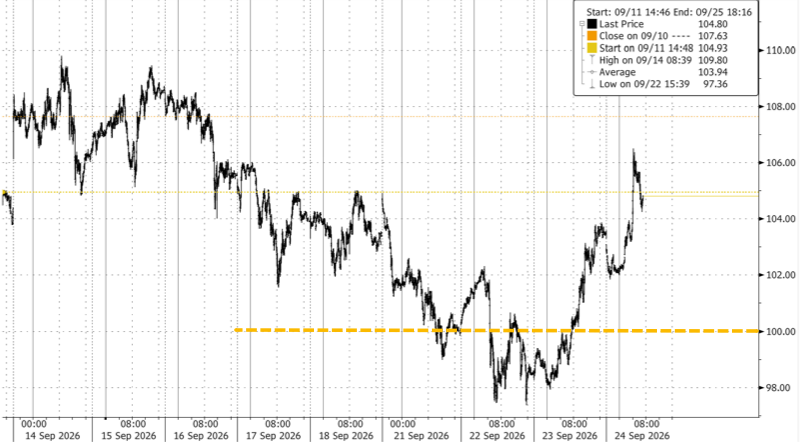
A focal point this morning is Nikkei Asia’s interview with Saudi Aramco CEO Amin Nasser, who said Aramco is studying additional crude export routes to bypass the Strait of Hormuz.
Nasser said Aramco is conducting engineering and feasibility work on “a fourth and a fifth route” for crude exports. He did not disclose their locations.
He warned, “This crisis is not really getting better. The situation will get worse because this interruption is significant. It’s not a small interruption,” adding, “I don’t think things are getting better.”
The plan for two more oil export routes builds on the current three primary routes, one of which passes through the Hormuz chokepoint that Iran has disrupted. This comes after drone attacks earlier this month disrupted Saudi Arabia’s East-West pipeline to the Red Sea, but media reports this week suggest the pipeline could restart soon at half capacity.
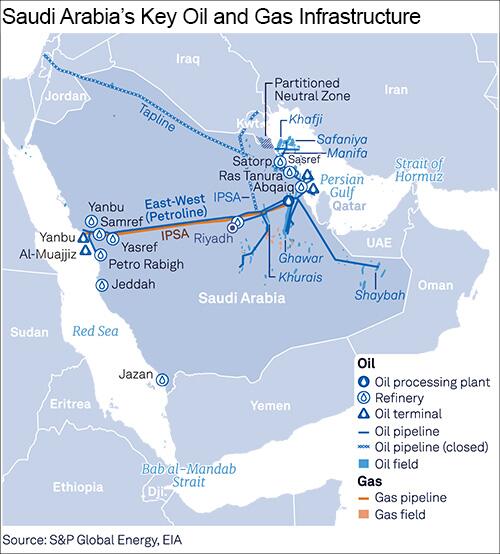
“When people talk about the East-West [pipeline], they think it’s one pipeline. It’s not, it’s multiple lines,” he said. “It’s not easy to interrupt all the lines at the same time. So it gives us the flexibility to respond and cater to our customers.”
Beyond the Hormuz chokepoint and the East-West pipeline, Aramco can move crude north through Egypt’s Sumed pipeline to the Mediterranean, Nasser said.
“People think about interruptions in Hormuz, interruptions in Bab-el-Mandeb, [but] we never stopped. We continue to supply our customers,” he said. “The only thing you do [is] shift more vessels, one way or the other. … We do have this multiple optionality that allows us to meet our customers’ demand.”
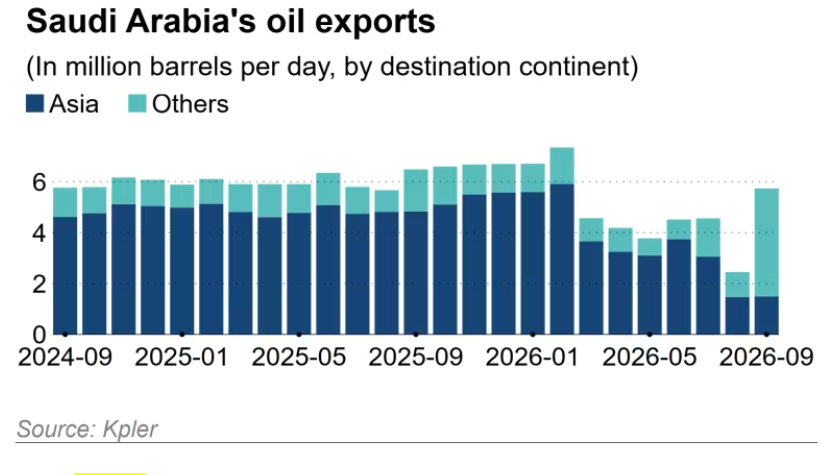
Last weekend, Qatari Energy Minister Saad Al-Kaabi blasted Treasury Secretary Scott Bessent for saying he was “wrong” to claim that the Hormuz chokepoint would be “worthless” to the oil industry in two years.
“I think this is completely wrong,” Saad Al-Kaabi said at the Qatar Economic Forum in New York.
Speaking to Fox Business’s Larry Kudlow on the sidelines of the Group of 20 finance ministers’ summit in North Carolina earlier this month, Bessent said the Hormuz maritime chokepoint, in about “two years will be… a worthless piece of water,” adding that oil “will be going on pipelines across land.”
Bessent has a point. Aramco’s push for new export routes reinforces the outcome we first pointed out at the war’s start: energy flows will reroute around Hormuz, gradually eroding Tehran’s leverage. Iran’s threat to widen the conflict may be an attempt to keep that leverage alive. And it won’t be just the Saudis rewiring energy flows; it’ll be all the Gulf allies with the capability to do so.
END
8. EMERGING MARKETS//AUSTRALIA NEW ZEALAND ISSUES
U.S./GOLD AND SILVER PRICING/ASIAN CLOSING MARKETS AND EUROPEAN BOURSE OPENING AND CLOSING/ INTEREST RATE SETTINGS THURSDAY MORNING 6;30AM//OPENING AND CLOSING\
OPENING LEVELS OF CURRENCIES// AND CLOSING ASIAN STOCK MARKET AND OPENING EUROPEAN STOCKS:6 AM EST
EURO VS USA DOLLAR: 1.1384 UP 0.0003
USA/ YEN158.43 UP 0.162 NOW TARGETS INTEREST RATE AT 1.75% AS IT WILL BUY UNLIMITED BONDS TO GETS TO THAT LEVEL…//YEN STILL FALLS//END OF YEN CARRY TRADE BEGINS AGAIN DEC 2024/Bank of Japan raises rates by .25% TO 1.75 ..TAKAICHI NEW PM AS YIELDS RISE//JAPAN DEEPLY IN TROUBLE WITH RISING RATES AND A FALLING YEN!! BANK OF JAPAN WILL NO LONGER DO QE. URGES PENSION AND INSUANCE FUNDS TO BUY JAPANESE BONDS//
YEN CARRY TRADERS MURDERED
GBP/USA1.3235 DOWN 0.0002 OR 2 BASIS PTS
USA/CAN DOLLAR: 1.4104 UP 0.0007 //CDN DOLLAR DOWN 7 BASIS PTS//
Last night Shanghai COMPOSITE CLOSED DOWN 48.16 PTS OR 1.22%
Hang Seng CLOSED DOWN 101.62 PTS OR 0.42%
AUSTRALIA CLOSED DOWN 0.06%
// EUROPEAN BOURSE: ALL RED
Trading from Europe and ASIA
I) EUROPEAN BOURSES: ALL RED
2/ CHINESE BOURSES / :Hang SENG CLOSED DOWN 101.62 PTS OR 0.42%
/SHANGHAI CLOSED DOWN 48.16 PTS OR 1.22%
AUSTRALIA BOURSE CLOSED DOWN 0.06%
(Nikkei (Japan) CLOSED UP 573.05 PTS OR 0.88%
INDIA’S SENSEX IN THE RED
Gold very early morning trading: $4262.00
silver:$63.67
USA DOLLAR VS TRY (TURKISH LIRA): 48.86 UP 2 BASIS PTS AND NOW WE SEE THEIR STUPIDITY OF SELLING SOME OF THEIR GOLD AND ALL OF THEIR USA DOLLAR RESERVES. THE COUNTRY IS IN BIG FINANCIAL TROUBLE
USA DOLLAR VS RUSSIAN ROUBLE: 85.19 ROUBLE// DOWN 0 ROUBLE AND 68 BASIS PTS.
UK 10 YR BOND YIELD: 5.3828 UP 13 BASIS PTS
UK 30 YR BOND YIELD: 5.8655 UP 13 BASIS PTS
CDN 10 YR BOND YIELD: 3.9530 UP 12 BASIS PTS
CDN 5 YR BOND YIELD; 3.685 UP 12 BASIS PTS
USA dollar index early THURSDAY MORNING: 100.50 UP 18 BASIS POINTS FROM WEDNESDAY’s CLOSE
THURSDAY MORNING NUMBERS ENDS
And now your closing THURSDAY NUMBERS 10.00 AM
Portuguese 10 year bond yield: 3.952% UP 7 in basis point(s) yield
JAPANESE BOND 10 yr YIELD: +3.071% UP 9 FULL POINTS BASIS POINTS /JAPAN losing control of its yield curve/
JAPAN 30 YR: 4.167 UP 9 BASIS PTS//
SPANISH 10 YR BOND YIELD: 4.048 UP 8 in basis points yield
ITALY 10 YR BOND: 4.520 UP 4 points in basis points yield ./
GERMAN 10 YR BOND YIELD: 3.5648 UP 4 BASIS PTS
IMPORTANT CURRENCY CLOSES : MID DAY THURSDAY
Closing currency crosses for day /USA DOLLAR INDEX/USA 10 YR BOND YIELD/10:00 AM
Euro/USA 1.1368 DOWN 0.0013 OR 13 basis points
USA/Japan: 158.81 UP 0.539 OR YEN IS DOWN 54 BASIS PTS// HIGHLY INFLATIONARY TO JAPAN
Great Britain 10 YR RATE 5.3227 UP 1 BASIS POINTS //
GREAT BRITAIN 30 YR BOND; 5.8161 UP 1 BASIS POINTS.
CANADIAN DOLLAR DOWN 31 BASIS PTS TO 1.4135
xxxxxxxxxxxxxxxxxxxxxxxxxxxxxxxxxxxxxxxxxxxxxxxxxxxxxxxxxxxxxxxxxxxxxxxxxxxxxxxx
The USA/Yuan CNY 6.7126 ON SHORE ..DOWN
THE USA/YUAN OFFSHORE// CNH DOWN TO 6.7150
TURKISH LIRA: 48.86 UP 1 EXTREMELY DANGEROUS LEVEL/DEATH WATCH/HYPERINFLATION TO BEGIN.//
Your closing 10 yr US bond yield DOWN 2 in basis points from WEDNESDAY at 5.090% //trading well ABOVE the resistance level of 2.27-2.32%)
USA 30 yr bond yield 5.397 DOWN 1 basis points /10:00 AM
USA 2 YR BOND YIELD: 4.897 DOWN 5 BASIS PTS.
GOLD AT 10;00 AM $4273.50
SILVER AT 10;00: $63.45
Your 11:00 AM bourses for Europe and the Dow along with the USA dollar index closing and interest ratesWEDNESDAY
DAY CLOSING TIME/ 12:00 AM///
London: CLOSED DOWN 25.27 PTS OR 0.24%
GERMAN DAX: CLOSED DOWN 144.10 PTS OR 0.57%
FRANCE: DOWN 41.98 OR 0.52 PTS
Spain IBEX CLOSED DOWN 58.80 PTS OR 0.30%
Italian MIB: CLOSED DOWN 444.04PTS OR 0.45%
WTI Oil price 94.16 10.00 EST/
Brent Oil: 105.51 10:00 EST
USA /RUSSIAN ROUBLE: 85.00/// ROUBLE DOWN 0 AND 46/ 100
CDN 10 YEAR RATE: 3.9350 DOWN 2 BASIS PTS.
CDN 5 YEAR RATE: 3.6560 DOWN 3 BASIS PTS
CLOSING NUMBERS: 4 PM//
Euro vs USA 1.1373 DOWN 0.0009 OR 9 BASIS POINTS//
British Pound: 1.3216 DOWN 0.0023 OR 23 basis pts/
BRITISH 10 YR GILT BOND YIELD: 5.3476 DOWN 2 FULL BASIS PTS//
BRITISH 30 YR BOND YIELD: 5.8708 UP 3 IN BASIS PTS.
JAPAN 10 YR YIELD: 3.085 UP 10 FULL BASIS PTS (DANGEROUS TO THEIR ECONOMY
JAPANESE 30 YR BOND: 4.176 UP 10 PTS AND STILL VERY DANGEROUS TO THEIR ECONOMY
USA dollar vs Japanese Yen: 158.91 UP 0.644 OR YEN DOWN 64 BASIS PTS//GETTING FURTHER AWAY FROM 160.00/ EXTREMELY DANGEROUS
USA dollar vs Canadian dollar: 1.4139 UP 0.0036 PTS// CDN DOLLAR DOWN 36 BASIS PTS
West Texas intermediate oil: 95.42
Brent OIL: 107.47
USA 10 yr bond yield UP 8 BASIS pts to 5.191
USA 30 yr bond yield: UP 7 PTS to 5.473%
USA 2 YR BOND 4.916 UP 2 PTS
CDN 10 YR RATE 3.9850 UP 3 BASIS PTS
CDN 5 YEAR RATE: 3.702 UP 2 BASIS PTS
USA dollar index: 101.02 UP 21 BASIS POINTS
USA DOLLAR VS TURKISH LIRA: 48.86 UP 3 BASIS PTS GETTING QUITE CLOSE TO BLOWING UP/IDIOTS SOLD GOLD
USA DOLLAR VS RUSSIA//// ROUBLE: 85.02 DOWN 0 AND 48 /100 roubles //
GOLD $4,272.25 3:30 PM)
SILVER: 63.70 3;30 PM)
DOW JONES INDUSTRIAL AVERAGE: DOWN 161.70 POINTS OR 0.31%
NASDAQ 100 UP 8.56 PTS OR 0.028%
VOLATILITY INDEX 15.46 UP 0.28 PTS OR 1.84%
GLD: $ 391.73 DOWN 1.15 PTS OR 0.29%
SLV/ 57.62 PTS DOWN 0.54 OR 0.93%
TORONTO STOCK INDEX// TSX INDEX: CLOSED DOWN 36.24 PTS OR 0.10%
end
TRADING today ZEROHEDGE 4 PM: HEADLINE NEWS/TRADING
WRAP UP:
Markets choppy on geopolitics, more Fed speak and ORCL data centre woes – Newsquawk US Market Wrap
Thursday, Sep 24, 2026 – 04:31 PM
- SNAPSHOT: Equities mixed, Treasuries steepen, Crude up, Dollar up, Gold down
- REAR VIEW: US and Iran reportedly discuss phased deal to reopen Hormuz and end US blockade; Weak US 7yr note auction; Fed’s Williams says another rate hike is reasonable by year-end; Fed’s Paulson says may need to raise rates again to lower inflation; Initial claims and continuing claims little changed W/W; Banxico, SNB and Riksbank hold rates as expected, Norges Bank hikes by 25bps; Senior Iranian adviser threatens new scene on the Red Sea and Bab al-Mandeb if US attacks again; ORCL sends force majeure notice over New Mexico data centre
- COMING UP: Holiday: China Mid-Autumn Festival Market Holiday. Data: German GfK Consumer Confidence (Oct), US Durable Goods Orders (Aug), Atlanta Fed GDP (Q3). Speakers: Fed’s Williams, Hammack, Schmid; ECB’s Vujcic; BoE Governor Bailey. Supply: Australia. Credit Ratings: Moody’s on the EU, Italy; Scope Ratings on the EU.
More Newsquawk in 2 steps:
- 1. Subscribe to the free premarket movers reports
- 2. Trial Newsquawk’s premium real-time audio news squawk box for 7 days
MARKET WRAP
Stocks ultimately finished the day mixed in choppy trade. SPX, NDX and RUT were flat, while the DJI sold off and the RSP dropped. Sectors were predominantly lower, with Utilities, Materials and Staples lagging, while Communication Services, Health Care and Energy outperformed. The stock highlight was Oracle (ORCL), which tumbled after declaring force majeure at its New Mexico data centre, also weighing on Bloom Energy (BE) and Blue Owl (OWL), given both have exposure to the project. ORCL pared the majority of its losses but still closed lower by 3%.
Treasuries saw choppy trade, with an initial bull steepening ultimately reversing into bear steepening. T-notes initially tracked gains in European government bonds following Wednesday’s sharp global bond sell-off. However, front-end gains ultimately faded before the long end led the subsequent sell-off. The 7-year auction was soft, while the Treasury’s 20-30yr buyback accepted just USD 4.08bln against a maximum of USD 6bln.
In the US, Fed speak saw FOMC Vice Chair Williams note it is reasonable to see another rate hike by year-end, while Paulson said another hike may be required to curb inflation. Hammack also reiterated her inflation concerns. US data was light, with initial jobless claims remaining below 200k and the four-week average declining to 202.25k from 204k. Meanwhile, the preliminary Chicago Fed unemployment rate nowcast remained at 4.1% ahead of next Friday’s BLS jobs report.
Crude prices settled firmly higher despite fresh reports pointing towards a potential US-Iran deal to reopen the Strait of Hormuz and lift the US blockade. However, escalation risks remained elevated, with Iranian officials warning the conflict could expand across the region, while the Houthis said they would continue their “siege for a siege” approach. Post-settlement, the Houthis announced they had targeted Saudi Aramco facilities in Yanbu and a sensitive target in Riyadh, adding further upside to crude.
In FX, the Dollar strengthened against its peers for a fourth consecutive day this week, supported by continued inflation concerns as US yields and oil prices moved higher. Elsewhere, the SNB held rates at 0% as expected but adjusted its FX intervention language, while the Riksbank held rates alongside hawkish commentary and projections. Norges Bank delivered a 25bps hike against split expectations, while Banxico unanimously left rates unchanged but adjusted its forward guidance.
CLAIMS
Initial jobless claims edged down to 197k in the week ending September 19th (exp. 201k, prev. 198k revised from 196k), while the four-week moving average declined to 202.25k from 204.0k, continuing to point to subdued layoffs. Continuing claims (w/e September 12th) edged up to 1.719mln (exp. 1.750mln, prev. 1.717mln revised from 1.730mln), although they remained comfortably below expectations, while the insured unemployment rate was unchanged at 1.1%. In the unadjusted data, initial claims rose by 10,243 (+6.7%) to 163,811, almost exactly in line with the seasonal factors, which had expected an increase of 10,475 (+6.8%). Looking at the advance non-seasonally adjusted state data, the largest increases were in California (+2,522), Hawaii (+1,540), New York (+1,119), Illinois (+779), and Texas (+676), while the largest declines were in Massachusetts (-508), Arkansas (-329), Kentucky (-327), Washington (-147), and Arizona (-141). Pantheon Macroeconomics said claims continue to point to a stable labour market, and sees an unchanged 4.1% unemployment rate as most likely, albeit with risks skewed to the downside.
FED
WILLIAMS: FOMC Vice Chair Williams said that the big challenge is inflation, and the Fed needs to get it back to target in a timely manner. He said it is reasonable to see another rate hike by year-end, but the time for explicit or very direct forward guidance is over. The NY Fed President noted that the economy has been remarkably resilient and downside risks to achieving maximum employment has receded. Williams acknowledged they are seeing pretty strong demand from AI, and while short-run inflation expectations have been more encouraging, longer-term have not. Williams sees a tug of war between higher trend growth pushing R-Star up and demographics pulling it down. He added that real rate expectations are a large part of higher yields, but no one knows if higher yields will last.
PAULSON (2026 voter): Said the September inflation numbers drove the rate hike and the best you can say about inflation is that it has not got worse. She will support doing what is needed to get inflation back to 2% and notes that the Fed may need to raise interest rates again to lower inflation. Paulson described the labour market as stable, the economy as resilient with signs of increased momentum and underlying inflation remaining stubbornly high.
HAMMACK (2026 voter): Said price stability is the responsibility of central banks. The 2026 voter noted that inflation remains elevated amid solid output demand and the inflation risk is tilted towards the upside. Hammack said supply shocks are a notable challenge for Fed policy right now, and the longer inflation remains high, the harder it is to bring it back to target. Lastly, she said the labour market remains close to full employment.
FIXED INCOME
T-NOTE FUTURES (Z6) SETTLED 5+ TICKS LOWER AT 104-27+
T-notes chop on hawkish Fed speak, volatile geopolitics, weak auction and underwhelming buyback operation. At settlement, 2-year +1.7bps at 4.914%, 3-year +1.8bps at 4.987%, 5-year +4.6bps at 5.043%, 7-year +5.2bps at 5.101%, 10-year +6.9bps at 5.179%, 20-year +7.5bps at 5.532%, 30-year +7.0bps at 5.467%.
THE DAY: The Treasury curve saw two-way trade on Thursday, with initial bull steepening ultimately reversing into bear steepening. The early Treasury upside was led by the front end despite gains in oil and further hawkish Fed commentary, with FOMC Vice Chair Williams saying it is reasonable to see another rate hike by year-end. The morning bull steepening appeared to track gains in European government bonds following Wednesday’s sharp global bond sell-off. However, front-end T-notes ultimately pared their gains, bringing front-end yields back towards unchanged, with the long end leading the sell-off. The curve ultimately settled as a bear steepener, led by the long end.
T-notes briefly moved higher across the curve as oil came under pressure following reports that the US and Iran had discussed a phased deal to reopen the Strait of Hormuz and end the blockade. However, the report included multiple caveats, while an unaffiliated Iranian journalist later pushed back on the report, although official channels have yet to deny it. Meanwhile, NBC News reported that Iranian President Pezeshkian wants a deal with the US before the midterms, ahead of his interview tonight with Fox News. Nonetheless, geopolitical tensions remain elevated, and crude moved higher again post-settlement after the Houthis announced they had targeted Saudi Aramco facilities in Yanbu and a sensitive target in Riyadh.
Elsewhere, the Treasury’s 20-30yr buyback accepted just USD 4.08bln against a maximum of USD 6.0bln, with the underwhelming operation adding to pressure at the long end. The 7-year auction was also weak, producing its largest tail since March, although the reception was less alarming than Wednesday’s woeful 5-year auction. The 0.7bp tail, below-average bid-to-cover and particularly weak indirect participation pointed to a soft reception despite the significant increase in outright yield since August. Strong direct participation provided some support and kept the dealer takedown close to average.
US data saw jobless claims remain low and stable, with another sub-200k initial claims print bringing the four-week average down to 202.25k from 204k. Meanwhile, the preliminary Chicago Fed unemployment rate nowcast was maintained at 4.1% ahead of the BLS report next Friday.
Supply
Notes
- US sold USD 44bln of 7-year T-notes: Tail 0.7bps.
Bills
- US sold 8-week bills at a high rate of 3.990%, B/C 2.76x; sold 4-week bills at a high rate of 3.850%, B/C 2.61x
- US to sell USD 82bln of 26-week bills and USD 95bln of 13-week bills on September 28th; to sell USD 85bln of 6-week bills and USD 54bln of 52-week bills on September 29th; all to settle on October 1st.
STIRS / OPERATIONS
- Fed Hike Pricing via CME FedWatch: Oct 17.7bps (prev. 17.7bps), Dec 38bps (prev. 37.1bps)
- EFFR at 3.88% (prev. 3.88%), volumes at USD 101bln (prev. USD 103bln) on September 23rd
- SOFR at 3.87% (prev. 3.87%), volumes at USD 2.946tln (prev. USD 2.94tln) on September 23rd
- NY Fed RRP op demand at 0.63bln (prev. 0.46bln) across 3 counterparties (prev. 4) on September 24th
CRUDE
WTI (X6) SETTLED USD 2.45 HIGHER AT 94.61/BBL: BRENT (Z6) SETTLED USD 2.10 HIGHER AT 100.22/BBL
Crude prices settled higher despite fresh reports pointing towards a potential US-Iran deal to reopen the Strait of Hormuz and lift the US blockade, as many doubts and hurdles still remain. In the Reuters report, a Senior Iranian official notes the most feasible way would be Iran re-allowing navigation through the waterway in return for the US lifting its blockade and the potential for Iran to regain frozen assets. However, the source noted chances of diplomatic resolve are extremely low given America’s “excessive demands”, and a senior European official described Iran’s demand as a “very long list”. Nonetheless, the report sparked a pullback in crude prices from WTI’s and Brent’s highs of USD 96.78/bbl and USD 102.39/bbl, respectively. In between WTI and Brent settlements, NBC reported that the Iranian President, on the sidelines of the UNGA, noted: “We don’t want it to get to the midterm elections”. He added, “We wish Americans to return to the MOU before the midterms.” More pressure arrived in crude, albeit around half the move has faded at the time of writing. Upside in the European session was in response to the Senior adviser to Iran’s Supreme Leader, linking the Persian Gulf and Red Sea, including the Strait of Hormuz and Bab al-Mandab, could change the battlefield; “The scope of the war may expand to the Indian Ocean and other regions”. Additionally, a Houthi spokesperson said they will continue to enforce the equation of “a siege for a siege” and “an escalation for an escalation”. Post-settlement, the Houthis announced they targeted Saudi Aramco facilities in Yanbu and a sensitive target in Riyadh, adding to further upside.
Energy updates
- US Energy Secretary Chris Wright has contacted executives at several major US refiners to gauge support for voluntarily restricting diesel exports, Reuters reports, according to three people familiar with the discussions.
- Saudi East-West pipeline is reportedly building up crude volumes, though tanker loadings have yet to resume at Yanbu, Reuters reported.
- Saudi Aramco CEO says that it is studying a “a fourth and a fifth route” for crude oil exports; noted that the Co. can restore disrupted operations within days, Nikkei reported.
EQUITIES
CLOSES: SPX -0.02% at 7,704, NDX +0.03% at 30,479, DJI -0.31% at 51,355, RUT -0.11% at 2,836
SECTORS: Utilities -1.02%, Materials -1.01%, Consumer staples -0.96%, Industrials -0.71%, Real estate -0.37%, Technology -0.32%, Consumer discretionary -0.23%, Financials flat, Energy +0.4%, Health +0.67%, Communication services +1.92%.
EUROPEAN CLOSES: Euro Stoxx 50 -0.43% at 6,273, Dax 40 -0.61% at 25,256, FTSE 100 -0.24% at 10,680, CAC 40 -0.52% at 8,081, FTSE MIB -0.85% at 51,543, IBEX 35 -0.30% at 19,573, PSI +0.54% at 9,685, SMI -0.11% at 13,906, AEX -0.10% at 1,107
STOCK SPECIFICS
- Oracle (ORCL) / Blue Owl Capital (OWL) / Bloom Energy (BE): Lower after Oracle sent a force majeure notice over a New Mexico data centre.
- MGM Resorts International (MGM): Barry Diller withdrew People Inc.’s bid to acquire the remaining stake in MGM Resorts.
- TransUnion (TRU): CFO has made the personal decision to step down.
- Viking Therapeutics (VKTX): Increased common stock offering to USD 225mln from USD 200mln; priced at the low end of the deal range.
- Knife River (KNF): Starboard urged Knife River to improve execution and profitability.
- Delek US Holdings (DK): To sell USD 400mln in convertible senior notes due 2031.
- Dropbox (DBX): Downgraded at Citi to ‘Sell’ from ‘Neutral’.
- GoDaddy (GDDY) has reportedly received a takeover offer from Gen Digital, FT reports citing sources.
- Pepsi (PEP) spokesperson confirms prices of certain chips will go up by low to mid single-digit percentage, aligned with inflation.
- Blue Orca short on Equipment Share (EQPT).
- Meta (META) introduces Horizon Create and Horizon Studio: two new tools built on the agentic creation capabilities of the Meta Horizon Engine; Unity (U) was weighed by the news.
- India’s Akasa in talks to buy 200 Boeing (BA) 737 Max aircraft, Bloomberg reports.
- Google (GOOGL) will launch a prototype satellite next week for the first in-orbit test of Project Suncatcher, a research effort exploring whether space could support large-scale AI computing infrastructure; companies including SpaceX and Starcloud are also pursuing plans for low-Earth-orbit data centers to use near-continuous sunlight to power energy-intensive AI computing and avoid terrestrial electricity constraints. Solar-related names saw selling pressure on competition fears.
FX
USD finished higher against its peers for a fourth consecutive day this week, again supported by continued inflation concerns as US yields and oil prices marched higher. Reports of US-Iran progress continue to surface; however, tangible progress is yet to be observed. The latest indication came via an Iranian official speaking to Reuters, who said a phased deal could see Iran resume free navigation through the Strait of Hormuz in exchange for the US lifting its blockade and potentially unfreezing Iranian assets. That said, the official described US demands as excessive and the likelihood of a diplomatic resolution as “extremely low”. Also casting doubt over diplomacy is the ongoing conflict between the Houthis and Saudis, with the former saying it struck Saudi Aramco facilities in Yanbu and a “sensitive target” in Riyadh.
Outside of geopolitics, Fed’s Paulson, a 2026 voter, did not share the same conviction as some of her peers who have explicitly called for another 2026 rate hike, saying instead that another hike may be required to curb inflation. She added, however, that the best that can be said about inflation is that it has not worsened. Meanwhile, the continued move higher in US yields reflects persistent concerns around the inflation outlook and whether or not the Fed is behind the curve, although Thursday’s long-end weakness was also influenced by Treasury supply dynamics. The 7yr note auction was met with weak demand, producing its largest tail since March, while the Treasury’s 20-30yr liquidity-support buyback accepted just USD 4.08bln against the USD 6bln maximum announced on Wednesday. DXY hit highs of 101.398.
In Europe, it was a day of central bank rate decisions. The SNB held rates at 0.00% as expected, although it adjusted its FX intervention language, saying it remains “willing to be active in the foreign exchange market”, versus its previous “increased willingness” to intervene. EUR/CHF rose to around 0.9422 from the 0.9386 open.
The Riksbank held rates as expected, accompanied by hawkish commentary and rate projections. Meanwhile, the Norges Bank hiked rates by 25bps, with expectations split between a hold and a hike. EUR/SEK and EUR/NOK both traded modestly higher.
MXN was hit by Dollar strength, while there was little reaction to Banxico unanimously leaving rates unchanged. However, the central bank adjusted its guidance, saying future decisions will consider the ongoing disinflation process and the expected behaviour of its determinants, including exchange-rate pass-through to consumer prices, slack conditions and inflation expectations. Previously, Banxico had said the Governing Board estimated it would be appropriate to maintain the reference rate at its current level.
USA DATA RELEASE
New Home Sales Soared In August, Prices Plunged As Mortgage Rates Spiked
Thursday, Sep 24, 2026 – 10:11 AM
With homebuilder confidence plumbing new depths (and Housing Starts and Permits plunging), expectations were surprisingly for a small bounce back in new home sales in August (after collapsing in July).
Analyst consensus was correct, with a 6.4% MoM jump (+1.3% MoM exp) with July’s 10.5% MoM plunged revised dramatically higher to just 4.3% MoM decline. August was the biggest surge in sales since February, but still left sales down 2.0% YoY…
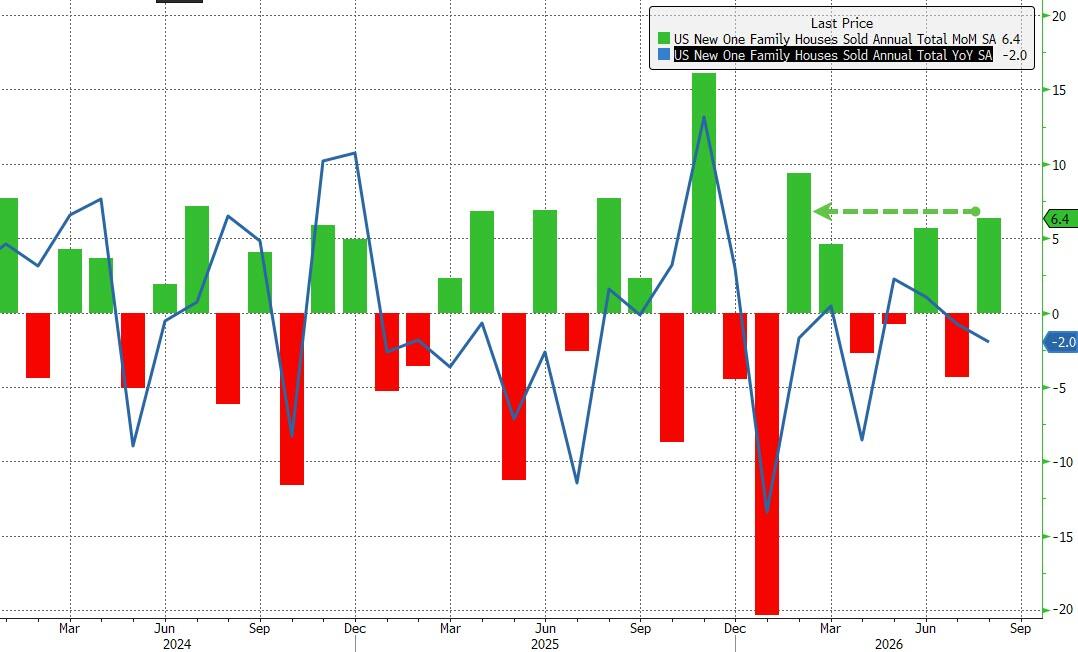
Total new home sales SAAR jumped to 864k – its highest level of 2026…
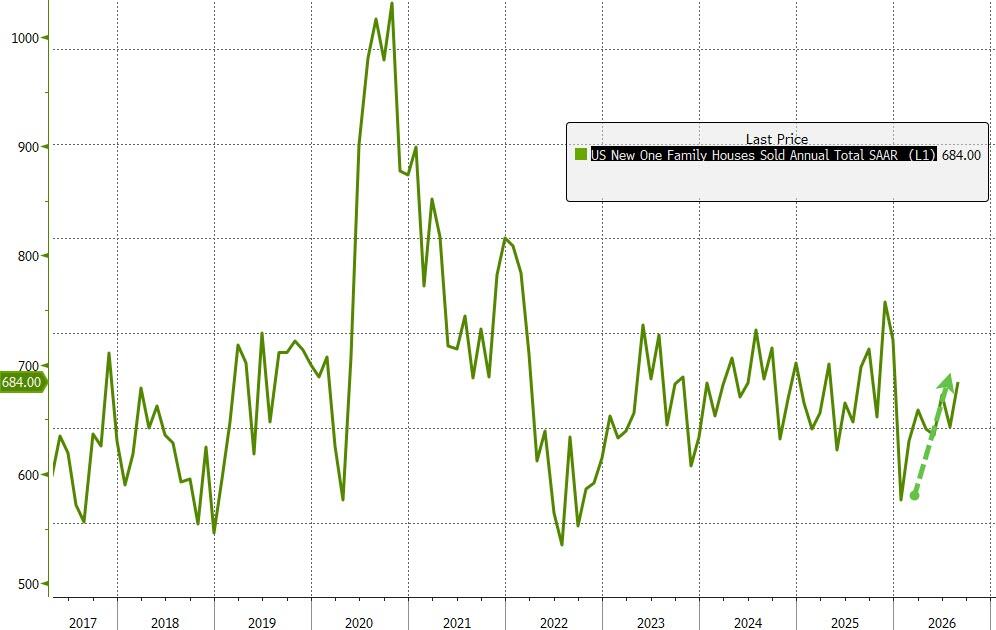
Median new home prices tumbled, down 5.8% from a year ago to $393,700….
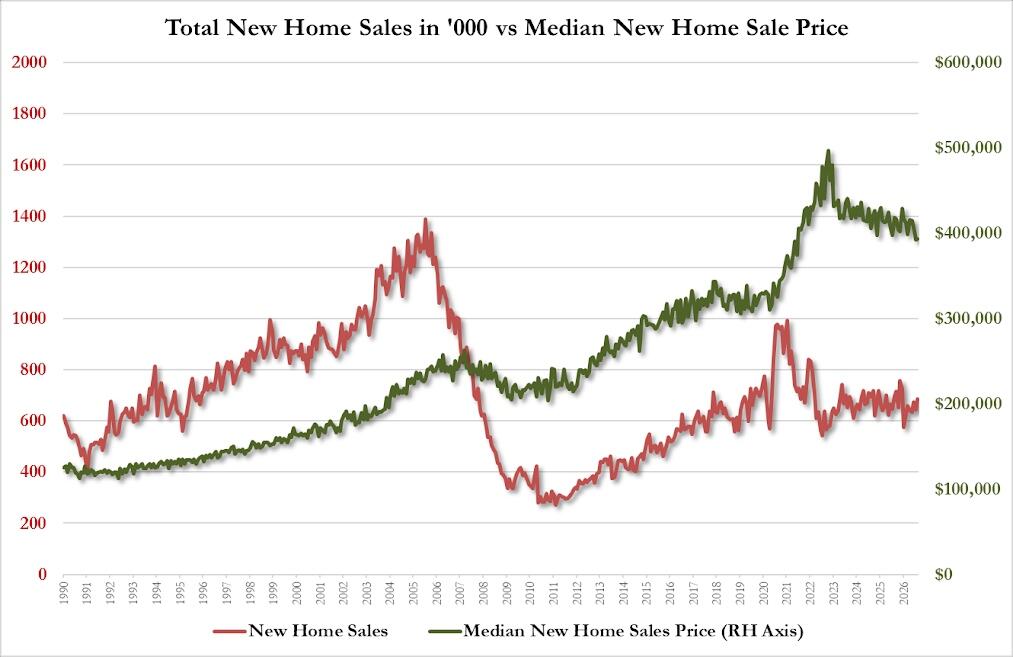
Additionally, average new home sales price plunged almost $50K to $478,700, lowest since since August 2024…
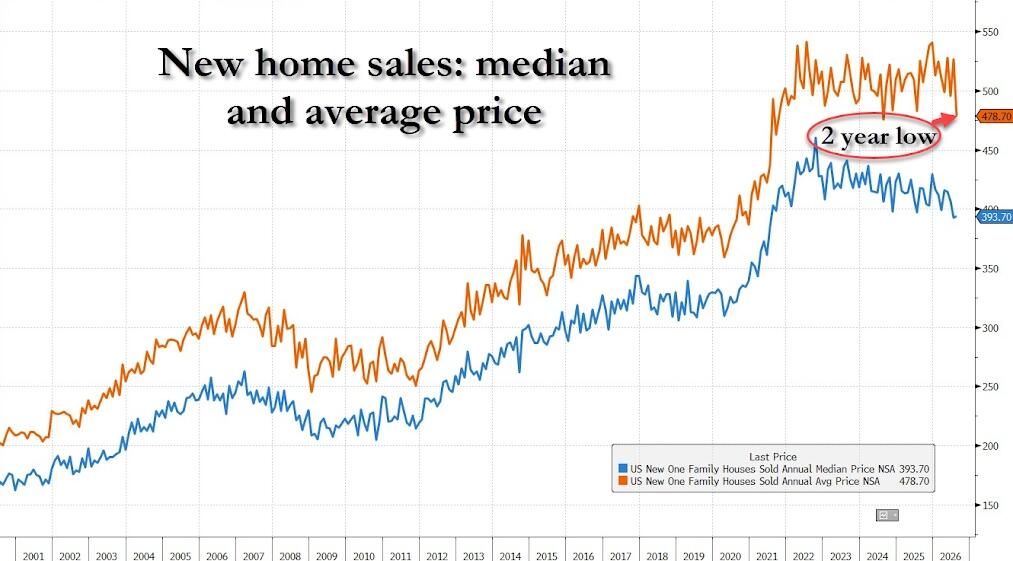
This was the biggest monthly drop in average new home prices on record!
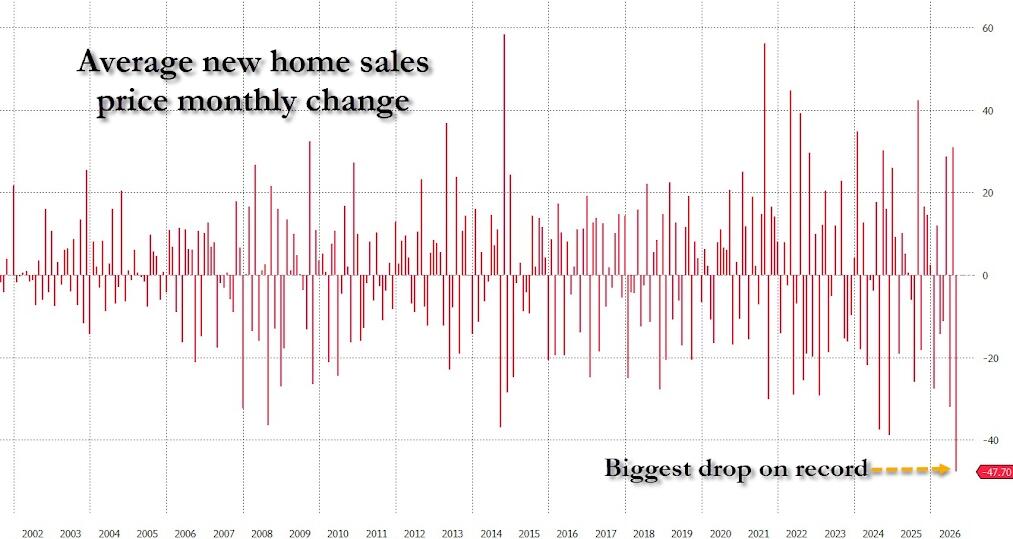
Interestingly, the supply of new homes for sales continues to tread water along with homes under construction. A trend that has been clear all year…
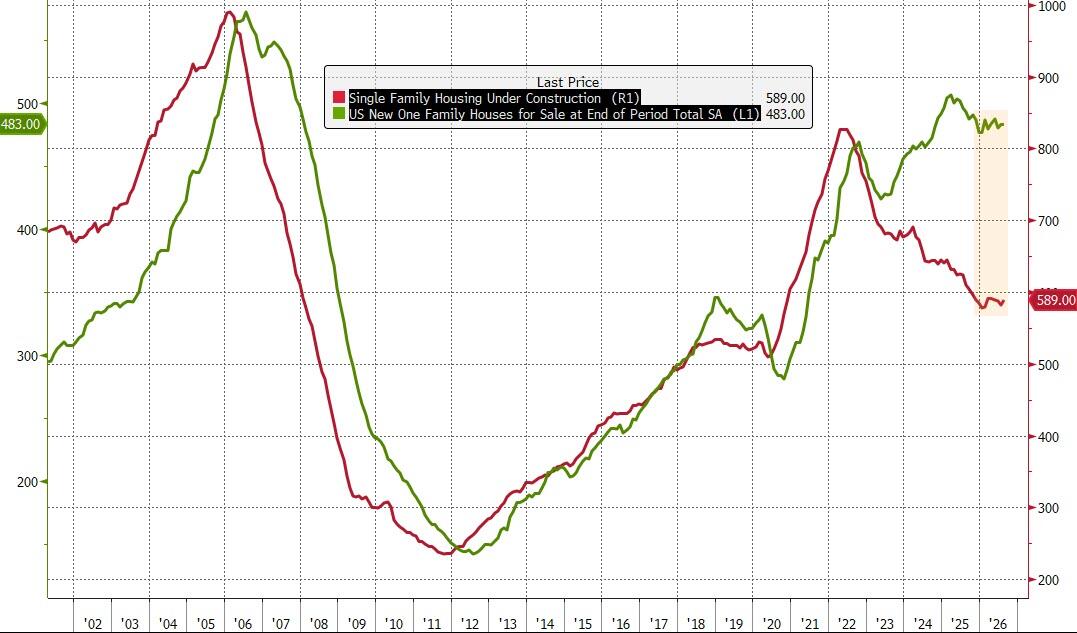
And finally, here’s a weird one – as mortgage rates have soared (now back above 7.00%), so sales have also soared?
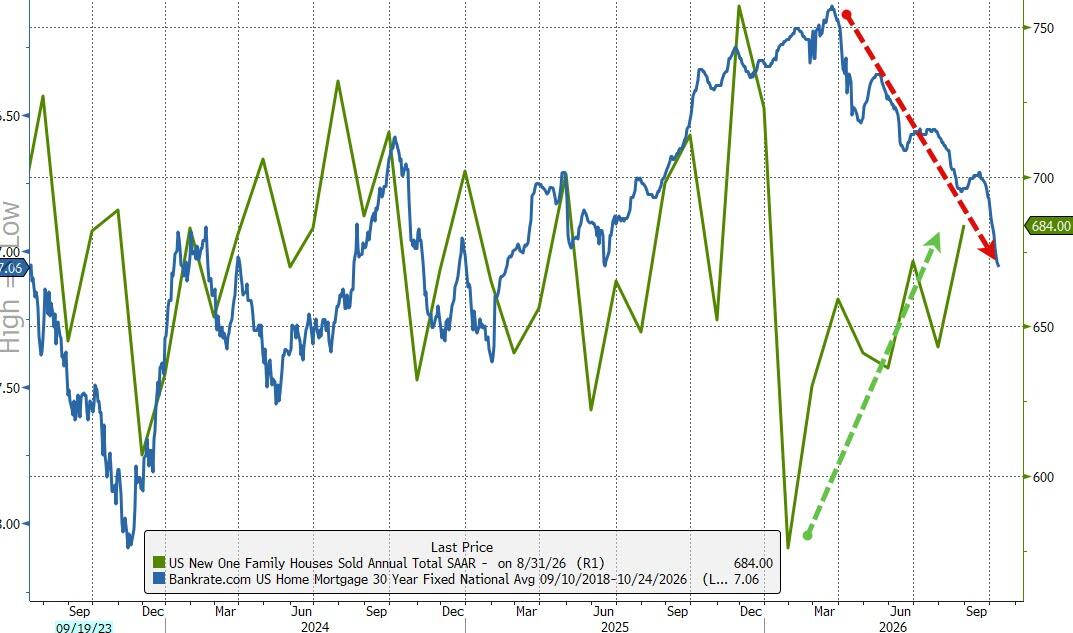
So did homebuilders finally slash prices as the final ‘incentive’ to restart sales? Or was this a last minute rush into homes ahead of rate-hikes and soaring mortgage rates?
END
USA ECONOMIC REPORTS
Bessent Plays Hardball With “Bloomberg Bros”: Yields Spike As Treasury Accepts Just 68% Of Maximum Buyback Offers
Thursday, Sep 24, 2026 – 02:36 PM
Two weeks ago, treasury yields spiked to a 3 year high (still well below 5%), after the first expanded Treasury buyuback operation which had a maximum capacity of $6 billion, resulted in just $5.187 billion in actual buyback offers accepted by the Treasury.
That was a problem because as BofA’s rates guru, Mark Cabana, wrote just ahead of the first buyback (his note is available to pro subs), over the last several operations the 10y-20y buybacks had received $18.7 billion of offers on average, or about 9 times oversubscribed (at the old maximum par amount permissable of $2 billion), and Treasury has always bought the maximum.
“A purchase below the max would be unprecedented for the 10y-20y bucket,” he wrote.
In the end, the repurchase was some 14% below the max, and that spooked markets because it indicated that dealers were hoping Scott “the house” Bessent was desperate enough he would accept even lowball bids. In the end, he didn’t even though a handful of lowball offers were indeed accepted.
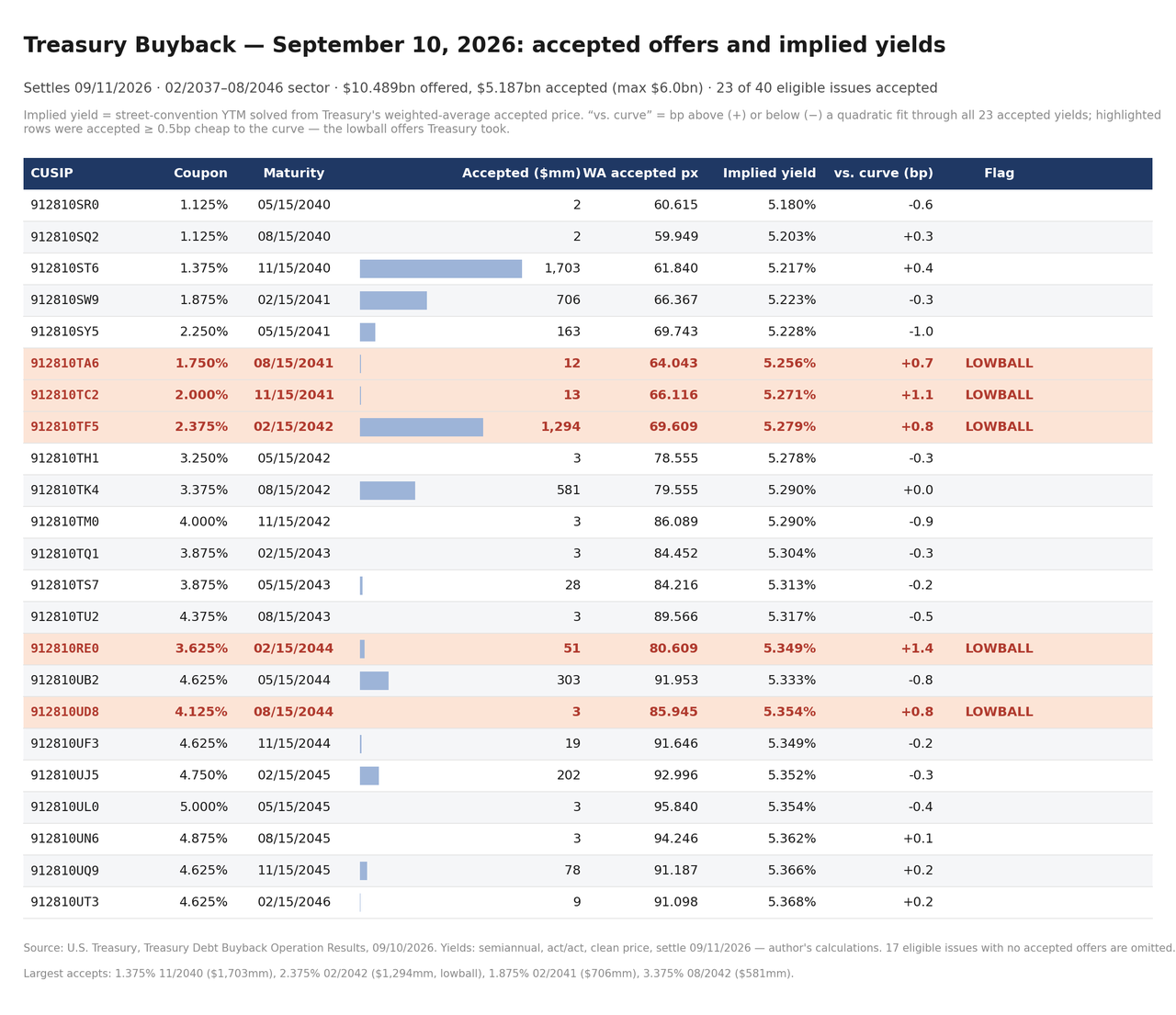
So fast forward to today when moments ago the Treasury conducted the first expanded “liquidity support” buyback operation targeting 20-30 year nominal coupons, with the same maximum size of $6 billion.
Surely today bid/ask would be much closer and the Treasury would accept all of the cusips eligible for buybacks… otherwise why even bother expanding the buyback operation.
Well… wrong again, because moments after 2pm we got the results from today’s expanded buyback op, and they were even worse than the first one: with $6 billion maximum par amount to be redeemed again, the Treasury received offers for $10.489 billion – identical to the Sept 11 operation – but accepted just $4.078 billion, which is only 68% of the $6 billion cap, down notably from 86% the first time around, which was already a big drop from the 100% it had accepted virtually every time prior!
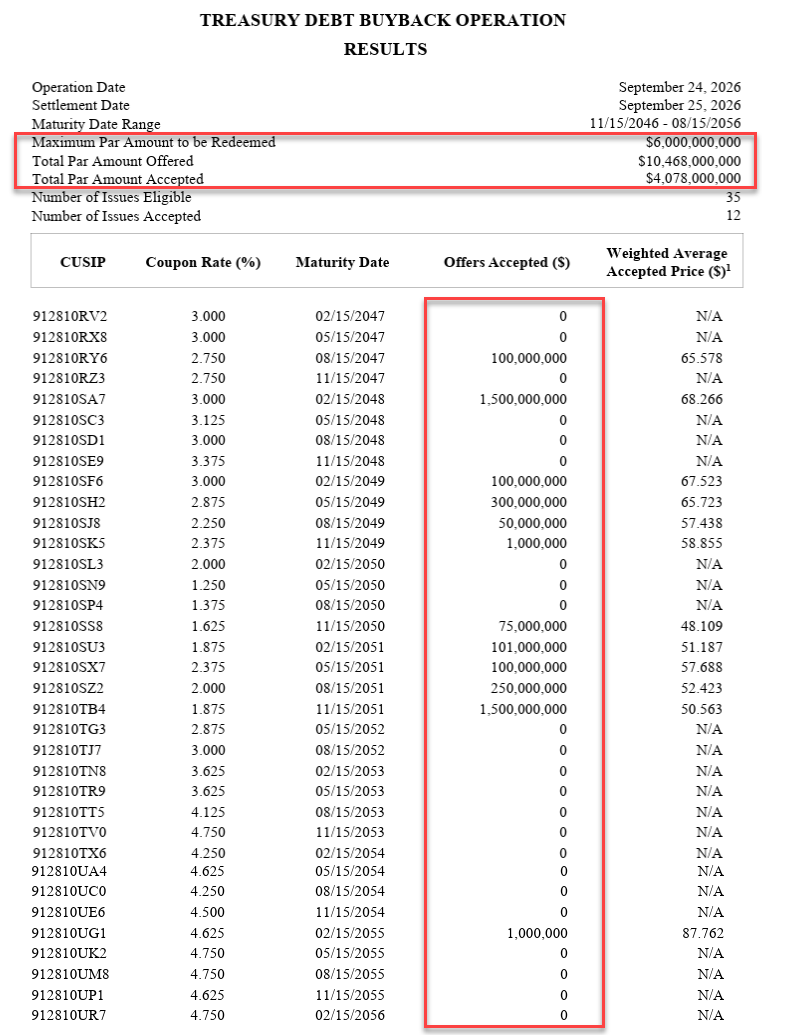
Why not accept the full $6 billion, again? Well, it appears that “The House” is refusing to play ball with – or pay – the Bloomberg Bros, and the Treasury kicked out virtually all lowball offers today.
Using the same method as the Sept 10 exhibit, none of today’s accepted bonds count as lowball offers, compared to 5 two weeks ago. The rule was 0.5bp or more cheap to a curve fitted through all the accepted yields. Today, every one of the 12 accepted issues came within ±0.6bp of that curve (and just two were a near miss)
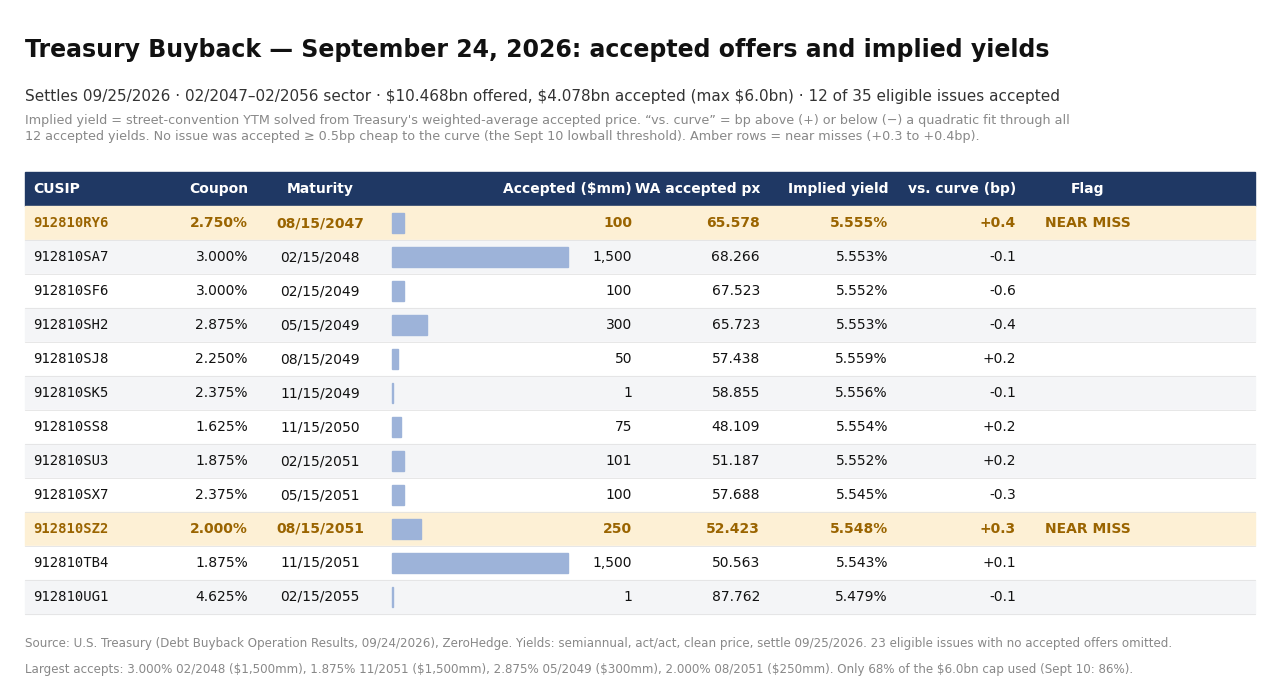
In other words, the Treasury decided that just $4.1 billion of the $10 billion were fair, and it turned down about $6.4bn of low ball offers rather than pay up. It also accepted only 12 of 35 eligible issues. The two largest purchases were $1.5bn each of the 3.000% 02/2048 and the 1.875% 11/2051, and both came in right on the curve (−0.1bp and +0.1bp).
Other things to know:
- Accepted prices imply yields of 5.54–5.56% for bonds maturing 2047–2051. That’s about 40–45bp over the 10Y at 5.10–5.16%, which looks sensible for this part of the curve.
- The long end yields less. The 4.625% 02/2055 prices at 5.48%, about 7bp through the 2051s, so yields fall at the very long end. Only $1mm of it was accepted, so it doesn’t change the result.
And while we commend Bessent’s resolve not be bullied around by the Bloomberg bros, the fact that for the second consecutive “expanded” buyback operation, the Treasury accepted well below the minimum, meant that there was far less “liquidity support” than intended, and sure enough yields spiked to a new multi-decade high.
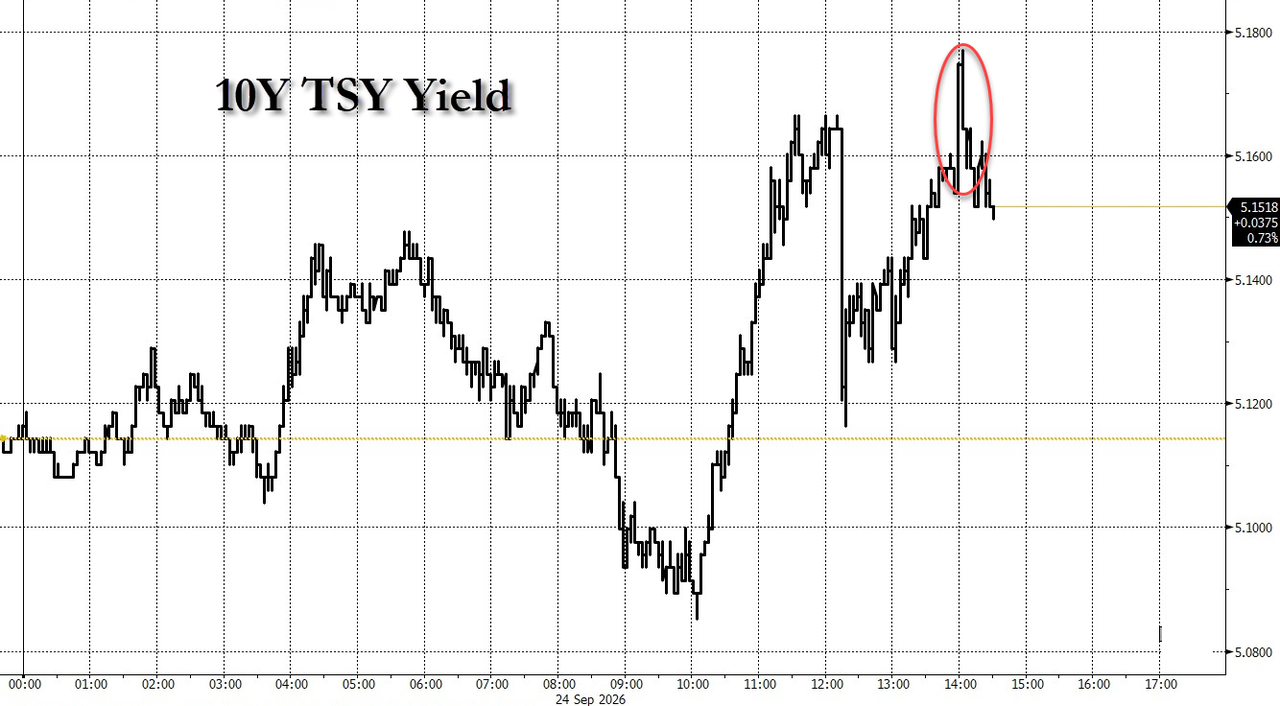
This is turning into quite an interest drama, and many are curious who will win: will Bessent keep turning down lowball offers even if it means a continued meltup in yields, or will he finally cave and accept a few lowball offers allowing a handful of dealers to make a few million extra, if it means not risking the collapse of the bond market. We look forward to the next expanded buyback in two weeks to see which way this clash resolves…

Shareholders Sue New York Times Over ‘Biased’ Israel Coverage
Wednesday, Sep 23, 2026 – 04:20 PM
Authored by Zachary Stieber via The Epoch Times,
Shareholders sued The New York Times on Sept. 23, alleging the company has failed to prevent false reporting about Israel and other topics.
The State Board of Administration of Florida, representing the Florida Retirement System Trust Fund and National Center for Public Policy Research, filed the lawsuit in a New York court.
“The Company’s repeated publication of materially false or baseless factual assertions, many later admitted internally or disproven externally, supports a reasonable inference that the Board has not only failed in its obligation to monitor the Company’s internal controls, but it has allowed such flagrantly selective application of the internal controls to support the conclusion that in the absence of any Board-level oversight, journalistic standards have been weaponized within the Company to serve the personal agendas of unchecked editors,” the 48-page filing says.
Shareholders said that a whistleblower reported problems to the company’s internal channel for such issues in November 2023.
“I feel that I’m on a desk that is particularly biased against Israel … I can’t tell if the Masthead does not see that our desk is biased, does not see it as a problem to be resolved, or just hasn’t figured out how to get a handle on it,” the whistleblower was quoted as saying.
The person later presented 26 slides to a standards editor that described how the paper had rejected footage from a source because the source was “pro-Israel” and how a freelancer’s praise of Hitler was downplayed as “just some jokes.”
The whistleblower’s concerns, later expanded to include questions about the lack of a promised training on anti-Semitism, and the hiring of a freelancer who said he “supports the Palestinian struggle against occupation,” did not prompt any changes, according to the filing.
One incident outlined by shareholders was how The New York Times included a photograph of a child in its 2025 article, “Gazans Are Dying of Starvation,” without disclosing that the child had pre-existing health conditions, as Getty Images had noted days prior in captions of pictures of the child.
The paper later updated the photo’s information and said that “after publication of the article, The Times learned from his doctor that Mohammed also had pre-existing health problems.”
Evidence shows that controls the company promotes to the public, including standards review before content is published, are not working, as that and other incidents show, the lawsuit says.
It requests the court order The New York Times to show shareholders materials they requested to see in August, including all versions of the paper’s editorial standards since Jan. 1, 2020.
“This lawsuit has no merit and was brought for an improper purpose,” a spokesperson for the paper told The Epoch Times in an email.
“Although it is positioned as a corporate governance petition to inspect the company’s books and records, it is a transparent attempt to exert agenda-driven pressure against an independent media organization, level false allegations of bias and chill journalism protected by the First Amendment. We will defend against the suit vigorously.“
end
lots of fun on this one!
Panic At CNN As Paramount Seeks Elon Musk Equity Investment
Thursday, Sep 24, 2026 – 09:15 AM
Paramount is weighing whether to bring Elon Musk on as an equity investor in its takeover of Warner Bros. Discovery, according to a report from Semafor. David Ellison has been sizing up potential investors as he works to lock down financing before the merger closes. Paramount has not said how much money it hopes to raise, and the size of any Musk investment remains undetermined. A Paramount spokesperson declined to comment, and Musk did not respond to a request for comment.

The news prompted panic inside CNN, which is owned by Warner Bros. Discovery. Staffers at the network had plenty to worry about before Musk’s name entered the conversation. Layoffs loom over the newsroom, nobody knows who will run the place once Ellison takes the keys, and now the man who took a chainsaw to Twitter’s payroll might own a slice of the operation.
“Amazing it comes out now of course,” one CNN source said, pointing to the awkward timing for California Gov. Gavin Newsom, who threw his support behind the merger to keep Paramount jobs in his state. “Not good for Gavin!”
“When it rains…[it pours],” another source said. “It’s really scary given what he did at X and DOGE.”
At CBS News, David Ellison installed Bari Weiss as editor-in-chief after Skydance acquired Paramount, and she has drawn fierce criticism for firing longtime 60 Minutes correspondents and for how she manages the newsroom’s coverage. CNN staffers have watched that saga unfold, and they have taken notes.
Once the merger is complete, David Ellison will control HBO Max, Paramount+, HBO, CBS, CNN, and thousands of film titles. That makes him one of the most powerful figures in American entertainment, and it makes who backs him financially a matter of real consequence.
Larry Ellison, David’s father and the founder of Oracle, has personally guaranteed more than $40 billion of the equity financing that makes the acquisition possible. But an investment from Musk would still carry significance.
“An investment from Musk would be a significant vote of confidence in the combined Paramount Warner Bros. from a businessman who also has a devoted retail investor following,” explained Semafor business reporter Rohan Goswami. “A check from Musk or other big financial backers would also give Paramount a more diversified investor base, and reduce Larry Ellison’s financial burden.”
The relationship between the two men runs deep in both directions. Larry Ellison invested in Tesla in 2018 and sat on its board for several years. When Musk took Twitter private in 2022, Ellison invested $1 billion in the deal.
“Musk’s dollars and political influence were concerning to Democrats during the 2024 election, given his control of X,” writes Goswami. “The possibility of him having even partial ownership in CNN and CBS would likely raise alarm bells in Washington, even though it is unlikely Musk would have formal input over the company’s operations.”
The news of Musk’s potential involvement comes days after the $110 billion merger cleared its final hurdle. Paramount settled the antitrust lawsuit that California Attorney General Rob Bonta brought against the deal.
Paramount agreed to spend an additional $1.5 billion on domestic production over five years. The company must release 30 films in theaters every year, rising to 32 after the first two years, with at least 20 wide releases, rising to 21, and four independent films each year. If Paramount misses any of those targets, it must sell Miramax Studios and pay $30 million for every film it comes up short. The settlement also forces Paramount to negotiate cable deals separately and commits it to raising domestic production from 5% of all films to 20%, or even 30%, if Congress passes certain tax credits. The settlement also created a News Editorial Independence Board for CBS News and CNN, though nobody has spelled out what powers it will hold. The agreement said nothing about layoffs.
Still, for a newsroom that has spent years telling viewers to fear Elon Musk, the prospect of him buying in carries a certain poetry.
END
Oracle’s Massive “Project Jupiter” Data Center Declares Force Majeure, Jeopardizing Entire US AI Rollout
Oracle has sent a force majeure notice related to its Project Jupiter data center in New Mexico, but the situation is more limited than the dramatic framing suggests, and it does not appear to jeopardize the broader US AI infrastructure rollout.
finance.yahoo.com
According to a Bloomberg report (citing people familiar with the matter) published on September 24, 2026, Oracle notified the project’s developer—a unit of Blue Owl Capital (which owns Stack Infrastructure)—citing force majeure. The move aims to potentially defer or shield Oracle from certain payments and expenses if the massive campus fails to come online in 2028 as planned, rather than abandoning its role as the primary tenant. Force majeure clauses typically allow parties to pause or limit obligations due to events beyond their control (such as regulatory delays). It is not certain this would fully relieve Oracle of prior financial commitments.
finance.yahoo.com
Key details on Project Jupiter
- It is a large AI-focused data center campus in Doña Ana County, southern New Mexico (near Santa Teresa), spanning roughly 1,400 acres with plans for about 2.45 GW of power capacity (enough for ~1.8 million homes at peak). Developers have described total investment potential up to ~$165 billion.
- Oracle is the anchor tenant; it is intended to support AI workloads (including for OpenAI) as part of the broader “Stargate” AI infrastructure initiative highlighted in early announcements involving Oracle, OpenAI, SoftBank, and the Trump administration.
- Power plans shifted toward Bloom Energy fuel cells (on-site microgrid) after earlier natural-gas pipeline and turbine approaches faced regulatory rejection. The project has encountered permit denials (including for a gas pipeline), local opposition, environmental concerns (water, emissions), and construction timeline pressures. Some reports note it was ~26% complete earlier in September 2026 with prior delays already noted. datacenterdynamics.com
Official responses
- Oracle: “Project Jupiter remains on our planned schedule. We are fully committed to New Mexico and confident in our path forward.” (The company did not directly address the notice in public comments.) cnbc.com
- Blue Owl: The notice “does not change the financial commitments to this multiyear project.” The parties remain “fully aligned.” news.bloomberglaw.com
Oracle shares fell roughly 4–5% on the report (with related names like Blue Owl and Bloom Energy also declining). Project-related debt had already been trading at discounted levels in some accounts.
tipranks.com
Broader context and impactProject Jupiter is significant in scale and is tied to high-profile US AI buildout efforts, but it is one major facility among many data center and AI infrastructure projects underway or planned across the US. Delays or contractual repositioning here do not equate to derailing the “entire US AI rollout.” Construction and related economic activity (jobs, tax revenue commitments) have continued, with Oracle previously highlighting local benefits including construction jobs, ongoing employment, tax revenue, and community investments (e.g., water systems, schools).
oracle.com
In short, the force majeure notice reflects Oracle protecting its contractual position amid known regulatory and timeline risks on this specific project. Both sides publicly affirm the project remains on track and commitments stand. Developments are ongoing and based primarily on the Bloomberg sourcing; independent verification of private contractual notices is limited.
END
MCDONALDS RESTAURANTS
McDonald’s Sinks To Four-Year Low As Deutsche Bank Sours On Turnaround Hopes
Thursday, Sep 24, 2026 – 10:40 AM
McDonald’s shares tumbled as much as 5.9% on Wednesday, the sharpest intraday decline since the early-2020 Covid selloff, before closing down 4.8% at their lowest level since 2022.
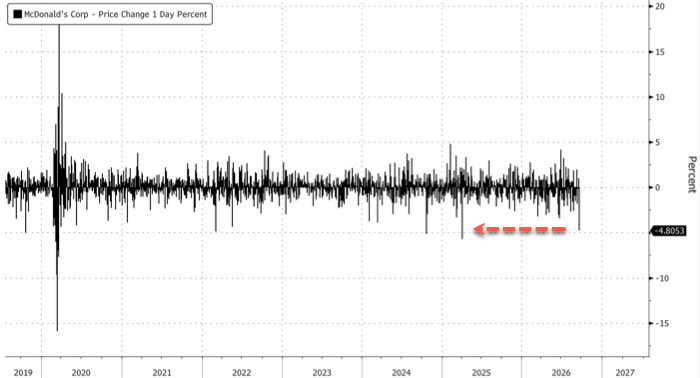
The Big Mac quick-service restaurant chain’s investor day heightened Wall Street concerns that softening US sales, coupled with plans for massive investments across restaurant locations, could pressure cash flow and shareholder returns, weighing on the stock for the foreseeable future.
McDonald’s held its investor day at its Chicago headquarters on Wednesday. CFO Ian Borden said the burger chain expects its US business to be “slightly negative” in the third quarter, leaving Wall Street analysts at the event fretting over the cost of a multibillion-dollar, multiyear overhaul against a darkening demand outlook that shows no signs of a promising near-term turnaround.
McDonald’s unveiled an $8.5 billion support package for franchisees over a decade as its NEXT overhaul will be costly. Management is forecasting higher productivity and corporate operating margins in the low-to-mid-50% range by 2030.
Shares have tumbled into a bear market this year, down 22% and nearing a four-year low.
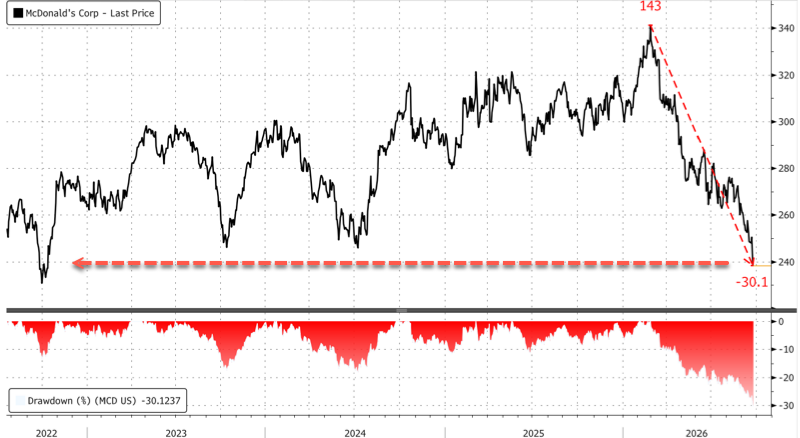
The chain missed second-quarter US sales growth estimates last month, citing execution missteps that hampered efforts to bring back working-class consumers. Newly appointed US business head Skye Anderson admitted at investor day that restaurant operations still needed improvement.
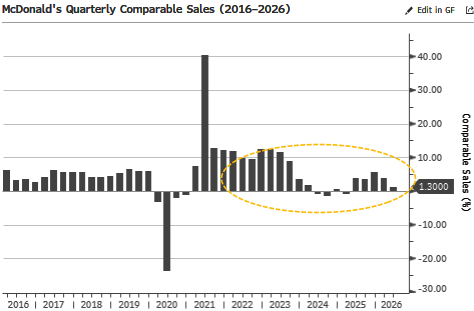
“We expect industry traffic growth in our wholly owned markets will be flat while inflation remains elevated,” CEO Chris Kempczinski told the analysts. “The winners will be the companies that create more demand and deliver it more efficiently.”
Deutsche Bank’s Lauren Silberman told clients on Thursday morning that McDonald’s turnaround is still unproven: “We believe the event likely does little to settle the debate on a US SSS inflection (which is key to the bull case).”
Silberman’s key quotes from her initial takeaways from investor day:
- US sales remain weak: “US SSS were slightly negative in July and August, and while September should be positive, 3Q SSS are expected to be slightly negative given the slow start to the quarter.”
- Fourth quarter caution: “We suspect 4Q US SSS will likely remain sluggish, in part due to a tough comparison.”
- Forecast cuts: “We are lowering our 3Q/4Q US SSS to -0.5%/-1% (from flat).”
- The capex bill: “We estimate the total system investment for NEXT will cost ~$19BN, implying MCD will contribute ~45%.”
- AI and productivity upside: “We walk away with increased conviction in the company’s ability to improve unit economics by unlocking productivity through the implementation of its ArchIQ technology platform.”
However, she defended the stock: “We think yesterday’s reaction was overblown (our 2027/2028 EPS comes down just 1-2%) given the stock is already trading at trough levels.”
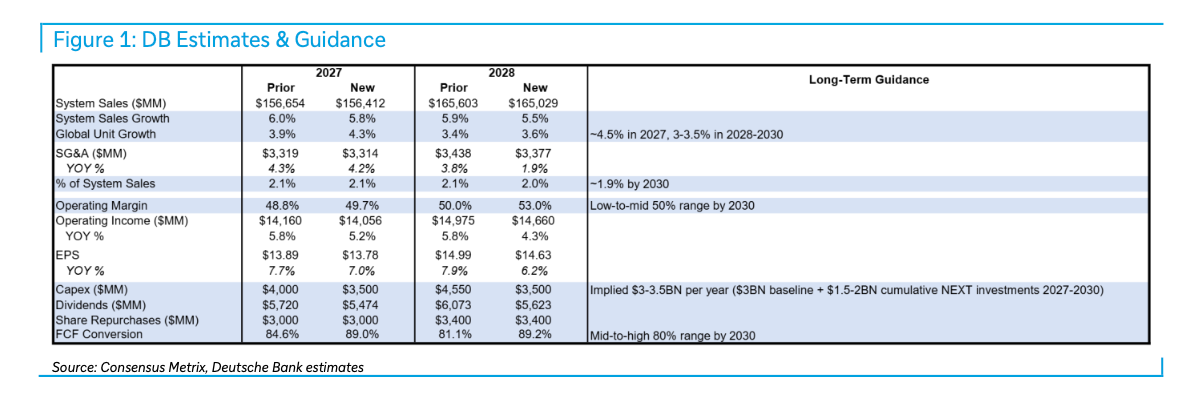
Separately, UBS equity trader Mark Paski recently warned in a note that Wall Street has turned its backs on consumer stocks.
“While part of the recent weakness can be attributed to higher crude prices and rates, the sharp selloff across apparel, retail and restaurant names suggests investors are looking beyond those factors. Feedback from the conference circuit pointed to a common theme: persistent macro uncertainty, ongoing cost pressures and little evidence of a near-term demand inflection. Management teams broadly flagged pressure from inflation, transportation costs, fuel prices and cautious consumer behavior, reinforcing the view that earnings recovery may take longer than previously expected,” Paski said.
Paski noted that consumer companies’ share of S&P market capitalization has tumbled to just 13.5%, a record low, from about 31% in 1992. That decline shows the sector is becoming less relevant to investors.
END
KING NEWS
| The King Report September 24, 2026 Issue 7833 | Independent View of the News |
| A US debt debacle appeared on Wednesday. Bond and note yields soared to 19-year, or longer, highs. S&P Global US Flash PMI September 2026 Business growth surges to fastest for over five years and job gains accelerate, but price pressures also intensify amid spike in costs · Flash US Composite PMI Output Index: 58.4 (August: 56.0), 62-month high. · Flash US Services PMI Business Activity Index: 58.7 (August: 56.5), 59-month high. [55.8 exp] · Flash US Manufacturing Output Index: 56.7 (August: 53.1), 53-month high. · Flash US Manufacturing PMI: 57.0 (August: 53.9), 52-month high. [53.7 exp] “US business continues to boom, with output growing at the fastest rate for over five years in September… However, this growth is being accompanied by some of the most severe supply chain bottlenecks seen in the near-two-decade survey history if the pandemic is excluded… Firms’ input costs have meanwhile jumped in September at the steepest rate for four years, with fuel and transport costs spiking higher thanks to the rise in oil prices seen during the month, which will add further to the upward pressure on selling prices and inflation in the coming months.” — Chris Williamson, Chief Business Economist at S&P Global Market Intelligence. https://www.pmi.spglobal.com/Public/Home/PressRelease/ed177f50167b4203ac490a961ea706be The ‘hot’ S&P Global US Flash PMIs greatly upset Mr. Bond. The 10-yr yield jumped to 5.131%, a 19-yr high. The 2-year note hit 4.939%; highest yield since May 2024. The 30-yr hit 5.411%. US 5-Year Note Auction ($70B) ugly results: High Yield 5.033% (3.1bp tail, 5.002% WI); Bid-to-cover 2.21; 30.34% of bids at high; Primary Dealers 15.77%; Direct Bidders 29.92%; Indirect Bidders 54.31% Fed bids for 5-year notes total $10.5 bln. Yields fell modestly on this headline, but quickly rebounded to new session highs Current Fed Funds Rate 3.88%, Updated from FRED database, Last updated: Sep 23, 2026 https://www.fedfundrate.org/ Per the once-heralded as sacrosanct US 2-year note model, the Fed is over 100 bps behind the curve. @Hedgeye: Foreign buying of T-Bills has fallen -80% YoY, per U.S. Treasury data The US Treasury on Wednesday said it would buy back up to $6B in longer-dated debt on Thursday. The Treasury previously said it would buy back at least $4B of US debt. WSJ’s @NickTimiraos: Fed governor Michael Barr: the AI boom and tariff- and energy-related price pressures have contributed “upward price pressures.” Given rising inflation risks and receding labor market risks, “we were out of position, and we made an adjustment in the right direction.” “In my base case, further policy adjustments are likely to be needed to ensure inflation comes down to target in a timely fashion.” The S&P 500 Index gapped lower on its opening (7761.94), which marked the daily high. The index, under constant pressure due to the US debt apocalypse, sank, with only one interruption (10:15 to 10:45 ET), and hit a daily low of 7694.89 at 13:04 ET. After a rebound to 7719.91 at 13:45 ET on a modest US notes yield dip, the S&P 500 Index stair-stepped lower until the decline accelerated at 15:50 ET. The index fell to 7695.5 at 15:52 ET. A late manipulation closed the S&P 500 Index at 7706.03 (-0.75%.) Russian military helicopter briefly breaches Polish airspace Amid heightened tensions, Poland is on alert against potential hybrid attacks by Moscow. A Russian military Mi-8 helicopter made a brief incursion into NATO member Poland’s airspace from the Russian exclave of Kaliningrad, the Polish Army Operational Command said on Wednesday. The helicopter spent 42 seconds in Polish airspace and entered to a maximum depth of about 300 meters, it said on X… https://tvpworld.com/95542028/russian-military-helicopter-briefly-breaches-polish-airspace Apollo limits redemptions as withdrawal requests hit 14.7% – Bloomberg It will cap quarterly withdrawals from Apollo Debt Solutions BDC at 5% of outstanding shares after receiving redemption requests totaling 14.7% of its stock… https://uk.investing.com/news/stock-market-news/apollo-limits-redemptions-as-withdrawal-requests-hit-147–bloomberg-4878409 Positive aspects of previous session Bonds and notes had a modest rally in the afternoon. SP Energy +1.04%; Nove Diesel -6.46¢ on a report the US will halt diesel exports Negative aspects of previous session S&P 500 -0.75%, DJIA -0.68%, DJTA -0.74%; Nasdaq -1.13%, Nas 100 -0.85%; SOX -1.23% SP Comm Services -1.89%, Utes -1.87%, Consum Discret -1.63%, Real Estate -1.49%, Info Tech -0.66%, Heath Care -0.65%, Materials -0.65%, Financials -0.44%, Consumer Staples -0.17%, Industrials -0.11% The 10-yr yield hit 5.131%, a 19-yr high. The 2-year note hit 4.939%; highest yield since May 2024. The 30-yr hit 5.411%. The yen/$ hit 158.40. Nov WTI Oil +$2.33, Nov Brent +$4.30, Nov Gasoline +11.58¢ Ambiguous aspects of previous session Equities did NOT decline sharply. ‘They’ are still dismissing Mr. Bond’s anger. The Dollar Index hit 101.23, its highest level since July. First Hour/Last Hour NYSE Action [S&P 500 Index]: 1st Hour: Down; Last Hour: Down Pivot Point for S&P 500 Index [above/below indicates daily trend to day traders]: 7720.95 Previous session (S&P 500 Index) High/Low: 7761.94 (9:30 ET); 7694.89 (13:04 ET) Nvidia CDS Becomes Among Most Active U.S. Derivatives, Trading Volume Hits $6.9B in Six Months https://www.gate.com/news/detail/nvidia-cds-becomes-among-most-active-us-derivatives-trading-volume-hits-69b-24510868 @kshaughnessy2: How long have we said Nvidia wasn’t just selling chips – it was helping pay for the chips. Now people are buying insurance on Nvidia’s debt. Volume up 10 times @MarketAtlas: The S&P 500 is hiding a market-wide collapse. Only 14.3% of SPY stocks remain above their 50-day moving average, while just 26.1% are above their 200-day moving average. The indices may still look resilient, but underneath, 3 out of 4 stocks are already in long-term downtrends. The rally is standing on fewer and fewer names… (AI stocks and Fangs) https://x.com/MarketAtlas/status/2102854585031500143 Today – Barring news, it’s up to Mr. Bond. If bonds and notes behave, equity should rally, led by conditioned buying of trading sardines, AI bubble stocks, and select Fangs. Street ‘experts’ and pundits now aver that a 5% yield is no longer detrimental to equities, and it will take a 6% yield to get equities’ attention. This is what occurred in 1987 as the 30-year marched up to 10%+. PS – Beaucoup traders, pundits, and kibitzers are opining on social media that a Bessent intervention in bonds is nigh. ESZs -4.25; NQZs -8.50, USZs +5/32, Nov WTI -$0.04, Nov Gasoline +0.29¢, Yen/158.30 at 20:00 ET Expected economic data: Initial Jobless Claims 201k, Continuing Claims 1.75m; Aug New Home Sales 0.62m, Permits 1.394m; US 7-Year Note ($44B) Auction NY Fed Pres Williams 3:10 ET, Richmond Fed Pres Barkin 8 ET, Phil Fed Pres Paulson 10:10 ET S&P 500 50-day MA: 7629; 100-day MA: 7538; 200-day MA: 7195 (Close 7706.03) Nasdaq 100 50-day MA: 29,236; 100-day MA: 29,355; 200-day MA: 25,305 (Close 30,470.29) DJIA 50-day MA: 52,838; 100-day MA: 51,933; 200-day MA: 50,164 (Close 51,511.59) (Green is positive slope; Red is negative slope) @ACTBrigitte: (Co-host of ABC’s “The View”) Sunny Hostin brags she was the holdout juror who kept the Butcher of Tompkins Square Park out of prison. He murdered a woman. Chopped her up. Boiled her body parts. Served them as soup to the “unhoused.” And she still calls that justice. This is the left’s moral compass: the victim is an afterthought, the butcher is “sick,” and deserves compassion. https://x.com/ACTBrigitte/status/2102714126476722391 @HortaOfJanusIV: Keep in mind that Sunny Hostin also said on live TV that a total solar eclipse and an earthquake were caused by “climate change”. That’s all you need to know about that bimbo’s intelligence level. (What’s even worse are the people that watch, support, and ‘like’ Hostin.) | |
SWAMP STORIES FOR YOU TONIGHT
GREG HUNTER….


