
EXCHANGE: COMEX
CONTRACT: SEPTEMBER 2026 COMEX 100 GOLD FUTURES
SETTLEMENT: 4,263.000000000 USD
INTENT DATE: 09/24/2026 DELIVERY DATE: 09/28/2026
FIRM ORG FIRM NAME ISSUED STOPPED
099 H DEUTSCHE BANK AG 43
323 C HSBC 106
690 C ABN AMRO CLR USA LLC 1
732 C RBC CAP MARKETS 61
737 C ADVANTAGE FUTURES 1
905 C ADM 2
TOTAL: 107 107
MONTH TO
GOLD: NUMBER OF NOTICES FILED FOR SEPT./2026: 107 CONTRACTs NOTICES FOR 10,700 OZ or 0.3328 TONNES
total notices so far: 4172 contracts FOR 417200 OZ OR 12.976 TONNES
SILVER NOTICES:107 NOTICE(S) FILED FOR 0.535 MILLION OZ /
total number of notices filed so far this month : 6658 CONTRACTS (NOTICES) for 33.290 million oz
GLD
SEPT: INITIAL STANDING: 24.172 MILLION OZ//FOLLOWED BY TODAY’S STRONG 15 CONTRACT OR 75,000 OZ QUEUE JUMP//STANDING ADVANCES TO 33.380 MILLION OZ//
SEPT: INITIAL STANDING 8.756 MILLION OZ//FOLLOWED BY TODAY’S 0.075 MILLION OZ QUEUE JUMP//STANDING ADVANCES TO 33.380 MILLION OZ
GOLD COMEX OUTLINE;
1.MAY SUMMARY FOR MAY TONNES WHICH STOOD FOR DELIVERY:
4. AUGUST: 60.547 TONNES OF INITIAL GOLD FIRST DAY NOTICE FOLLOWED BY THE NET MONTH’S QUEUE JUMP OF 47.2312 TONNES TO WHICH WE ADD THE FOLLOWING EXCHANGE FOR RISK ISSUANCE RECEIVED FOR THE MONTH: 5.4432 TONNES EX FOR RISK/AUG 7 , AUG 11: 2.413 TONNES EX FOR RISK AND AUG. 12 OF 2.
5.SEPT: INITIAL 8.093 TONNES OF GOLD PLUS TODAY’S QUEUE JUMP OF 0.4883 TONNES PLUS 2.2827 TONNES OF EXCHANGE FOR RISK TODAY//NEW TOTAL EX. FOR RISK/MONTH = 22.923//NEW TOTAL STANDING FOR GOLD SEPT ADVANCES TO = 48.801 TONNES!!
6.OCTOBER: 90.012 TONNES OF INITIAL GOLD STANDING WITH TODAY’S TINY 0.00311 TONNES QUEUE JUMP WHICH FOLLOWS ALL OTHER QUEUE JUMPS DURING OCT OF 76.1656 TONNES
THEN WE MUST ADD OUR 14.553 TONNES OF OUR ISSUANCE OF EXCHANGE FOR RISK/6 OCCASIONS//NEW TOTAL OF GOLD STANDING ADVANCES TO 197.5141 TONNES OF GOLD.
7.NOVEMBER BEGINS WITH 15.651 TONNES INITIALLY STANDING FOR DELIVERY FOLLOWED BY TODAY’S QUEUE JUMP OF 2.323 TONNES FOLLOWED BY ALL PREVIOUS QUEUE JUMPS IN OF OF 21.3775 TONNES TO WHICH WE ADD OUR TWO EXCHANGE FOR RISK ISSUANCE OF 4.5596 TONNES//NEW STANDING ADVANCES TO 43.9716 TONNES OF GOLD.
8. DECEMBER BEGINS WITH INITIAL STANDING OF 83.813 TONNES OF GOLD FOLLOWED BY TODAY’S 0.0TONNE QUEUE JUMP WHICH FOLLOWS ALL OTHER QUEUE JUMPS OF: 37.163 TONNES//NEW STANDING ADVANCES TO 115.390 TONNES TO WHICH WE ADD OUR 4 EXCHANGE FOR RISK FOR DECEMBER OF 6.587 TONNES/NEW STANDING ADVANCES TO 121.977 TONNES
9. JANUARY: INITITAL STANDING: 13.785 TONNES TO WHICH WE ADD OUR FIRST EXCHANGE FOR PHYSICAL TRANSFER OF 0.08709 TONNES WHICH FOLLOWS ALL OTHER QUEUE JUMPS OF 30.7117TONNES //NEW TOTAL QUEUE JUMPS 30.7117//NORMAL DELIVERY OF GOLD ADVANCES TO 36.8958 TONNES TO WHICH WE ADD OUR SIX EXCHANGE FOR RISK OF 22.315 TONNES//NEW STANDING ADVANCES TO 59.2108 TONNES.
FEB; INITIAL AMOUNT OF GOLD STANDING FOR DELIVERY: 93.567 TONNES OF GOLD TO WHICH WE ADD OUR NEXT 0.0248 TONNES 0.1555 TONNES QUEUE JUMP TO 41.2082 TONNES/ NEW NET QUEUE JUMP INCREASES TO 41.233 TONNES// AND THEN WE ADD OUR SIX EXCHANGE FOR RISK: 10,080 CONTRACTS OR 31.251 TONNES//NEW STANDING REDUCES TO 157.878 TONNES
MARCH:: INITIAL AMOUNT OF GOLD STANDING FOR DELIVERY: 8.099 TONNES TO WHICH WE ADD TODAY’S FAIR 4600 OZ QUEUE JUMP (0.2320 TONNES) AND THEN WE ADD OUR THREE EXCHANGE FOR RISK OF 22.3818 TONNES //NEW STANDING ADVANCES TO 67.6648 TONNES/
APRIL: INITIAL AMOUNT OF GOLD STANDING FOR DELIVERY: 52.600 TONNES FOLLOWED BY OUR 345 CONTRACT QUEUE JUMP FOR 34,500 OZ/ (1.073 TONNES)/NEW STANDING ADVANCES TO 70.286 TONNES TO WHICH WE ADD OUR 2ND EXCHANGE FOR RISK OF 1498 CONTRACTS FOR 149800 OZ OR 4.659 TONNES. THE NEW TOTAL EXCHANGE FOR RISK FOR THE MONTH OF APRIL IS 2239 CONTRACTS OR 223900 OZ OR 6.964 TONNES AND THIS WILL BE ADDED TO OUR NORMAL DELIVERY TOTALS (70.762 TONNES) TO GIVE US WHAT WILL STAND IN APRIL (77.726 TONNES)
MAY: INITIAL AMOUNT OF GOLD WILLING TO STAND: 12.24 TONNES OF GOLD TO WHICH WE ADD OUR NEXT QUEUE JUMP OF 345 CONTRACTS OR 34500 OZ (1.073 TONNES) TO WHICH WE ADD OUR FIVE EXCHANGE FOR RISK ISSUANCES FOR 24.635 TONNES/STANDING NOW ADVANCES TO 51.554 TONNES OF GOLD.
JUNE; INITIAL AMOUNT OF GOLD WILLING TO STAND; 64.496 TONNES.(CME CORRECTED) TO WHICH WE ADD OUR NEXT EXCHANGE FOR PHYSICAL TRANSFER OF 0.0186 TONNES/NEW STANDING REDUCES TO 127.03 TONNES
JULY: INITIAL AMOUNT OF GOLD WILLING TO STAND: 23.306 TONNES TO WHICH WE ADD OUR NEXT QUEUE JUMP OF 0.000 TONNES/ TO WHICH WE ADD OUR FIRST EXCHANGE FOR RISK 0F 0.0062 TONNES/NEW STANDING ADVANCES TO 40.824TONNES
AUGUST INITIAL STANDING 48.687 TONNES TO WHICH WE ADD OUR 5TH EXCHANGE FOR RISK OF 5 CONTRACTS FOR 500 OZ OR 0.0155 TONNESS TO OUR 4TH EXCHANGE FOR RISK OF 200 CONTRACTS OR 20,000 OZ OR 6.220 TONNES TO OUR 3RD EXCHANGE FOR RISK OF 1.7045 TONNES TO OUR 2ND EXCHANGE FOR RISK OF 1.552 TONNES TO OUR FIRST 0.0715 TONNES EXCHANGE FOR RISK//NEW TOTAL EXCHANGE FOR RISK: 3.9688 AND THEN ADD OUR NEXT QUEUE JUMP OF 39 CONTRACTS FOR 3,900 OZ OR 0.1213 TONNES//STANDING THUS ADVANCES TO 67.2441 TONNES
SEPT: INITIAL STANDING: 8.756 TONNES OF GOLD FOLLOWED BY TODAY’S 117 CONTRACTS OR 11700 OZ QUEUE JUMP (0.3639 TONNES) TO WHICH WE ADD OUR TWO, 2000 CONTRACT EXCHANGE FOR RISK FOR 200,000 OZ OR 6.2208 TONNES//// // NEW STANDING ADVANCES TO 19.1974 TONNES..
IN ESSENCE WE HAVE A SMALL GAIN IN TOTAL CONTRACTS IN GOLD ON THE TWO EXCHANGES OF 497 CONTRACTS WITH 354 CONTRACTS DECREASED AT THE COMEX// AND A SMALL SIZED 851 EXCHANGE FOR PHYSICAL OI CONTRACT ISSUANCE WHICH NAVIGATED OVER TO LONDON.
THUS TOTAL OI GAIN ON THE TWO EXCHANGES OF 497 CONTRACTS.. WE HAD THE FOLLOWING TAS CONTRACTS INITIATED (ISSUED): A SMALL SIZED AND CRIMINAL 708 CONTRACTS AND THESE ISSUANCES ARE GENERALLY USED TO INITIATE A RAID WHEN CALLED UPON LIKE TODAY .
GOLD PRICE FELL BY $18.70
STANDING FOR THE LAST 8 MONTHS JANUARY TO AUGUST:
FINAL STANDING FOR GOLD, JANUARY CONTRACT AT 59.08 TONNES OF GOLD
FEBRUARY: INITIAL STANDING FOR GOLD: 157.878 TONNES!! WHICH INCLUDES ALL QUEUE JUMPING, THREE EXCHANGE FOR PHYSICAL TRANSFERS TO LONDON AND OUR SIX ISSUANCES EXCHANGE FOR RISK!!
MARCH: INITIAL STANDING AT 8.099 TONNES TO WHICH WE ADD OUR FINAL DAY: 0.2320 TONNES QUEUE JUMP AND THEN ADD +22.3818 TONNES EXCHANGE FOR RISK//NEW STANDING ADVANCES TO 67.6648 TONNES
APRIL: INITIAL STANDING 52.600 TONNES PLUS 27,800 OZ QUEUE JUMP (0.8648TONNES): NEW STANDING ADVANCES TO 70.286 TONNES PLUS OUR TWO EXCHANGE FOR RISK FOR 223,900 OZ OR 6.964 TONNES/NEW FINAL STANDING: 77.726 TONNES
MAY: INITIAL AMOUNT OF GOLD WILLING TO STAND; 12.24 TONNES TO WHICH WE ADD OUR NEXT QUEUE JUMP FOR 345 CONTRACTS/34,500 OZ// 1.073 TONNES/ THEN WE MUST ADD OUR EXCHANGE FOR RISK ISSUANCE: TOTAL EXCHANGE FOR RISK MAY// 5 OCCASIONS: 24.635 TONNES///NEW FINAL STANDING NOW ADVANCES TO 51.554 TONNES
JUNE: INITIAL AMOUNT OF GOLD WILLING TO STAND: 64.496 TONNES TO WHICH WE ADD OUR NEXT EXCHANGE FOR PHYSICAL TRANSFER JUMP OF 0.0186 TONNES//NEW STANDING 127.03 TONNES//FINAL
JULY: INITIAL AMOUNT OF GOLD WILLING TO STAND: 23.306 TONNES OF GOLD TO WHICH WE ADD OUR NEXT QUEUE JUMP OF 0.0000 TONNES/ PLUS 0.0062 TONNES EX FOR RISK///NEW STANDING FOR GOLD REMAINS AT 40.824TONNES.
AUGUST INITIAL STANDING 48.687 TONNES TO WHICH WE ADD OUR FIRST 0.0715 TONNES EXCHANGE TO OUR 2ND EXCHANGE FOR RISK = 1.552 TONNES TO OUR 3RD EXCHANGE FOR RISK OF: 1.7045//TOTAL FOR EXCHANGE FOR RISK 3.3312 TONNES TO OUR 4TH EXCHANGE FOR RISK OF 200 CONTRACTS FOR 0.6220 TONNES/TO OUR 5TH EXCHANGE FOR RISK OF 0.0155 TONNES//TOTALL EXCHANGE FOR RISK: 3.9688 TONNES TO OUR NEXT QUEUE JUMP OF 0.1213 TONNES//STANDING ADVANCES TO 67.2441 TONNES
SEPT: INITIAL STANDING FOR GOLD: 8.756 TONNES FOLLOWED BY TODAY’S 11,700 OZ QUEUE JUMP (0.3639TONNES) TO WHICH WE ADD OUR SECOND 1000 CONTRACT EXCHANGE FOR RISK TO OUR FIRST: THUS// NEW EXCHANGE FOR RISK: 6.2208 TONNES// NEW STANDING ADVANCES TO 19,1974 TONNES.
JAN. 2025: 257.919 TONNES (ISSUANCE WILL BE PRETTY GOOD THIS MONTH BUT MUCH LOWER THAN LAST MONTH)
FEB: 207.21 TONNES//EX FOR PHYSICAL ISSUANCE (WILL BE A FAIR SIZED ISSUANCE THIS MONTH)
MARCH 130.84 TONNES//QUITE SMALL THIS MONTH.
APRIL; 208.57 TONNES. STRONG THIS MONTH
MAY: 113.499 TONNES OF GOLD EFP ISSUANCE//QUITE SMALL THIS MONTH
JUNE: 97.79 TONNES OF GOLD EFP ISSUANCE/EXTREMELY SMALL
JULY : 150.877 TONNES// QUITE SMALL
AUGUST: 175.86 TONNES A LOT LARGER THIS MONTH.
SEPT. 116.13 TONNES VERY SMALL
OCT. 252.72 TONNES//CERTAINLY MUCH LARGER THIS MONTH/VERY STRONG
NOV: 124.74 TONNES
DEC: 190.04 TONNES//GOOD SIZED THIS MONTH FINAL.
TOTAL EXCHANGE FOR PHYSICAL ISSUED FOR YEAR 2025: 2,026.20 TONNES (LOWER THAN LAST YR 2,569.00 TONNES
YEAR 2026:
JANUARY: 209.08 TONNES ( (WILL BE A STRONG MONTH FOR EXCHANGE FOR PHYSICAL)
FEB. 176.35 TONNES (WHICH IS A FAIR ISSUANCE)
MARCH: 214.67 TONNES//WILL BE STRONG ISSUANCE THIS MONTH
APRIL; 88.00 TONNES// WILL BE VERY SMALL THIS MONTH
MAY 118.430 TONNES
JUNE: 142.053 TONNES
JULY: 163.82 TONNES
AUGUST: 151.107 TONNES
SEPT: 83.667 TONNES
XXXXXXXXXXXXXXXXXXXXXXXXXX
SHANGHAI CLOSED HOLIDAY
HANG SENG CLOSED DOWN 253.13 PTS OR 1.02%
Nikkei CLOSED UP 952.01 PTS OR 1.45%
//Australia’s all ordinaries CLOSED DOWN 0.01%
//Chinese yuan (ONSHORE) CLOSED DOWN TO 6.7133
/ OFFSHORE CLOSED DOWN AT 6.7203 Oil UP TO 94.56 dollars per barrel for WTI and BRENT UP TO 106.25 Stocks in Europe OPENED ALL GREEN
ONSHORE USA/ YUAN// WITH YUAN TRADING DOWN (6.7133 OFFSHORE YUAN TRADING DOWN TO 6.7203 ONSHORE YUAN TRADING ABOVE LEVEL // OFF SHORE AND UP ON THE DOLLAR)// / AND THUS WEAKER/OFF SHORE YUAN TRADING UP AGAINST US DOLLAR/ AND THUS WEAKER
HERE IS A BRIEF SYNOPSIS OF HOW THE CROOKS FLEECE UNSUSPECTING LONGS
YOU WILL ALSO NOTICE THAT THE COMEX OPEN INTEREST STARTS TO RISE BUT SO IS THE OPEN INTEREST OF SPREADERS. THE OPEN INTEREST IN WILL CONTINUE TO RISE UNTIL ONE WEEK BEFORE FIRST DAY NOTICE OF AN UPCOMING ACTIVE DELIVERY MONTH (OCT), AND THAT IS WHEN THE CROOKS SELL THEIR SPREAD POSITIONS BUT NOT AT THE SAME TIME OF THE DAY. THEY WILL USE THE SELL SIDE OF THE EQUATION TO CREATE THE CASCADE (ALONG WITH THEIR COLLUSIVE FRIENDS) AND THEN COVER ON THE BUY SIDE OF THE SPREAD SITUATION AT THE END OF THE DAY. THEY DO THIS TO AVOID POSITION LIMITS
WHAT IS ALARMING TO ME, ACCORDING TO OUR LONDON EXPERT ANDREW MAGUIRE IS THAT THESE EFP’S ARE BEING TRANSFERRED TO WHAT ARE CALLED SERIAL FORWARD CONTRACT OBLIGATIONS AND THESE CONTRACTS ARE LESS THAN 14 DAYS. ANYTHING GREATER THAN 14 DAYS, THESE MUST BE RECORDED AND SENT TO THE COMPTROLLER, GREAT BRITAIN TO MONITOR RISK TO THE BANKING SYSTEM. IF THIS IS INDEED TRUE, THEN THIS IS A MASSIVE CONSPIRACY TO DEFRAUD AS WE NOW WITNESS A MONSTROUS TOTAL EFP’S ISSUANCE AS IT HEADS INTO THE STRATOSPHERE.
The crooks also use the spread in the TAS account (trade at settlement). They buy the spot TAS (e.g. June) and sell the future TAS two months out (e.g. August). Then they unload the front month (i.e. unload the buy side first so the price of gold/silver falls. This occurs in the middle of the front delivery month cycle. They unload the sell side of the equation, two months down the road. The crooks violate position limits as the OCC refuse to hear our complaints.
First, here is an outline of what will be discussed tonight:
SILVER:
1.TODAY WE HAD THE OPEN INTEREST AT THE COMEX IN SILVER FELL BY A FAIR 226 CONTRACTS TO AN OI OF 105,362
EFP ISSUANCE 260 CONTRACTS
OUR CUSTOMARY MIGRATION OF COMEX LONGS CONTINUE TO MORPH INTO LONDON FORWARDS AS OUR BANKERS USED THEIR EMERGENCY PROCEDURE TO ISSUE:
DEC 260 CONTRACTS and 0 ALL OTHER MONTHS: ZERO. TOTAL EFP ISSUANCE: 0 CONTRACTS. EFP’S GIVE OUR COMEX LONGS A FIAT BONUS PLUS A DELIVERABLE PRODUCT OVER IN LONDON. IF WE TAKE THE COMEX OI LOSS OF 226 CONTRACTSAND ADD TO THE 260 E.FP. ISSUED
WE OBTAIN A TINY GAIN OF 34 OI OPEN INTEREST CONTRACTS FROM OUR TWO EXCHANGES DESPITE OUR LOSS OF $0.96
THUS IN OUNCES, THE GAIN ON THE TWO EXCHANGES TOTAL 0.170 MILLION PAPER OZ
STANDING SEPT AT 33.380 MILLION OZ
SILVER PRICE LOSS OF $0.96
XXXXXXXXXXXXXXXXXXXXXXXXXXXXXXXXXXXXX
LET US BEGIN:
THE TOTAL COMEX GOLD OPEN INTEREST FELL BY A SMALL 354 CONTRACTS TO 411,578 STILL WELL ABOVE ITS NEW LOW OF 326,052 OI SET JUNE 3, CLOSE TO THE PREVIOUS ALL TIME LOW OF 345,705 SET (MAY 28) AND CLOSE TO THE PREVIOUS ALL TIME LOW IN OI OF 353,490 SET MAY 27.. PREVIOUS TO THAT THE ALL TIME LOW IN OI WAS 390,000 SET IN THE YEAR 2001 WHEN GOLD WAS TRADING $260.00. THE CME SHOULD BE PROUD OF THEMSELVES AS MANY HAVE ABANDONED THIS CROOKED ARENA!!THUS OUR NEW ALL TIME LOW OF COMEX OI HAS NOW BEEN SET AT 326,052 //JUNE 3 2026 WITH GOLD AT AN EXTREMELY HIGH $4,450.00 WHICH MAKES ABSOLUTELY NO SENSE!!!
WE HAD CONSIDERABLE T.A.S. LIQUIDATION DURING THURSDAY’S COMEX TRADING HOURS// . IT SEEMS THAT MANY OF THE SPECULATORS THAT HAVE NOW CONTINUED AGAIN TO BE ON THE SHORT SIDE WITH BANKERS ON THE LONG SIDE AND THESE GUYS WERE AGAIN OBLITERATED YESTERDAY WHEN THE LONGS TENDERED FOR DELIVERY:
CENTRAL BANKS TENDERED THEIR NEW LONG CONTRACTS AT THE END OF THE DAY FOR PHYSICAL GOLD. YOU CAN VISUALIZE THIS WITH THE STRONG AMOUNT OF GOLD STANDING AT THE COMEX FOR THIS JULY CONTRACT MONTH!!
WE HAD A SMALL SIZED GAIN ON OUR TWO EXCHANGES (497 CONTRACTS) OCCURRED DESPITE OUR LOSS IN PRICE IN GOLD (DOWN $58.00)
WE THUS HAD A SMALL GAIN IN OI ON BOTH OF OUR EXCHANGES (497 CONTRACTS), DESPITE OUR LOSS IN PRICE, AS WE WERE INFORMED OF A SMALL CONTRACT EXCHANGE FOR PHYSICAL ISSUANCE EQUATING TO 851 CONTRACTS.
THEN WE WERE NOTIFIED TODAY OF A 0 CONTRACT FOR RISK ISSUANCE IN GOLD CONTRACTS FOR 0 OZ OR 0 TONNES OF GOLD. TOTAL THUS SO FAR THIS MONTH: 2000 CONTRACTS//200,000 OZ OR 6.2208 TONNES (2 OCCASIONS)
MONTH OF MAY RECORD ISSUANCE OF EXCHANGE FOR RISK: THE HIGHEST EVER ISSUANCE!!
MAY 22 RECORDS THE HIGHEST EVER EXCHANGE FOR RISK AT 12.4416 TONNES. WE HAD OUR FIRST ISSUANCE FOR EXCHANGE FOR RISK IN THE MONTH OF MAY ON MAY 7, THEN OUR 2ND ISSUANCE FOR OUR MAY GOLD MONTH ON MAY 12. THE THIRD ON MAY 18 , THEN MAY 21 OUR 4TH ISSUANCE AND THEN FINALLY FRIDAY, OUR 5TH ISSUANCE. THIS GOLD WILL BE ADDED TO OUR NORMAL MAY DELIVERIES TO GIVE US OUR FINAL AMOUNT OF GOLD WILLING TO STAND AT THE COMEX..
HISTORY OF EXCHANGE FOR RISK ISSUANCE THIS YEAR: FEBRUARY THROUGH JULY AND AUGUST
FEBRUARY:
DURING THE MIDDLE OF THE FEBRUARY CONTRACT MONTH, WE HAD TWO IDENTICAL MONSTER 3,000 CONTRACT ISSUED FOR THE SAME 9.33 TONNES OF GOLD, AND THESE WERE THE HIGHEST EVER IN TONNAGE EVER ISSUED BY THE COMEX. ALTOGETHER THE TOTAL ISSUANCE FOR FEB TOTALLED SIX.(31.251 TONNES).
MARCH:
THURSDAY MARCH 17 WE RECEIVED ITS INITIAL 2000 CONTRACT EXCHANGE FOR RISK ISSUANCE FOR 6.22 TONNES. LAST FRIDAY: 0 ISSUANCE OF EXCHANGE FOR RISK. BUT ON MONDAY MARCH 23 WE RECEIVED NOTICE OF OUR SECOND EXCHANGE FOR RISK ISSUANCE FOR 2,200 CONTRACTS (220,000 OZ OR 6.843 TONNES) AND NOW FRIDAY WITH A MONSTER 2996 CONTRACTS FOR 9.3138 TONNES. THESE THREE ISSUANCES WILL NOW BE ADDED TO THE REGULAR AMOUNT OF GOLD STANDING, I.E. 22.3818 TONNES TO OUR NORMAL GOLD STANDING TO GIVE US WHAT WILL STAND FOR PHYSICAL GOLD FOR MARCH!
APRIL;: 2 EXCHANGE FOR RISK SO FAR, I.E. 2239 CONTRACTS FOR 223,900 OZ OR 6.964 TONNES AND THIS TOTAL TONNES WILL BE ADDED TO OUR NORMAL DELIVERY TO GIVE US WHAT WILL STAND IN APRIL
MAY: FIVE ISSUANCES SO FAR FOR 7920 CONTRACTS OR 792,000 OZ OR 24.635 TONNES.
JUNE: 0 IN GOLD. THUS FOR THE ENTIRE MONTH IN GOLD ZERO NOTICES WERE FILED.
JULY: 2 FOR 200 OZ OR 0.00622 TONNES
AUGUST: 1276 CONTRACTS FOR 127,600 OZ OR 3.9688 TONNES (5 OCCASIONS THIS MONTH)
SEPT: SO FAR: 2000 CONTRACTS FOR 200,000 OZ OR 6.2208 TONNESS (TWO OCCASIONS)
XXXXXXXXXXXXXXXXXXXXXXXXXXXXXXXXX
A LITTLE HISTORY OF EXCHANGE FOR RISK DECEMBER THROUGH TO SEPT:
IN DECEMBER WE HAVE RECORDED 5 ISSUANCES OF EXCHANGE FOR RISK/4 FOR DEC AND THE LAST ONE ON DEC 31 FOR JANUARY. WE NOW HAVE 3 CHOICES FOR THE RECIPIENT OF THIS ISSUANCE AND IT MUST BE A CENTRAL BANK. YOU WILL RECALL THAT THE BUYER ASSUMES THE RISK OF THAT DELIVERY. (THUS TOTAL EXCHANGE FOR RISK FOR THE MONTH OF DECEMBER IS 6.56 TONNES/4 OCCASIONS.
MONTH OF JANUARY/EXCHANGE FOR RISK
IN JANUARY THEY HAVE 6 TOTAL ISSUANCE : 3.446 TONNES EARLY, THEN JAN 9 ISSUANCE OF 9,331 TONNES AND THEN JAN 16: 0.1996 TONNES JAN 26: 1.499 TONNES, JAN 27: 3.160 AND FINALLY JAN 29: 4.659 TONNES TONNES//TOTAL EXCHANGE FOR RISK JANUARY 22.315 TONNES WHICH WAS ADDED TO OUR NORMAL DELVERIES.
AND FEBRUARY:
FEB EXCHANGE FOR RISK: NOW 6 ISSUANCES: 10,080 CONTRACTS FOR 1,008,000 OZ OR 31.251 TONNES!
HERE ARE THE CHOICES FOR THE RECIPIENT OF THOSE ISSUANCES:
1 THE CENTRAL BANK OF ENGLAND. BUT THEY RECEIVED CLEARANCE THAT THEIR GOLD IS BACK SO IT IS NOT LIKELY THAT THEY WOULD LIKE TO ADD TO THEIR RESERVES.
2. THE CENTRAL BANK OF THE USA: THE FED. LOGICAL CHOICE AS THEY CLAMOUR TRYING TO REDUCE THEIR 131+ TONNES OF SHORTAGE. HOWEVER THEY SEEM NOT TO BE IN A HURRY TO COVER THEIR HUGE SHORTFALL
3. THE CENTRAL BANK OF CHINA AS THEY BATTLE WITS WITH THE USA.
TOTAL EXCHANGE FOR RISK FOR DECEMBER IS 6.56 TONNES AND THIS WAS ADDED TO OUR NORMAL DELIVERY TOTALS..
THE JANUARY ISSUANCE OF 17.656 TONNES WAS ADDED TO OUR DAILY DELIVERY TOTALS!!
FEBRUARY ISSUANCES 6 FOR; 31.251 TONNES !! AND THIS WAS ADDED TO OUR DELIVERY TOTALS FOR THIS MONTH.
MARCH: CME ANNOUNCES ITS FIRST EXCHANGE FOR RISK FOR 2000 CONTRACTS FOR 200,000 OZ OR 6.22 TONNES OF GOLD DURING THE FIRST WEEK OF MARCH, AND THEN MONDAY, MARCH 22, WE RECEIVED ITS SECOND NOTICE ISSUANCE OF 2200 CONTRACTS OR 220000 OZ (6.843 TONNES). THEN FINALLY WE RECEIVED NOTICE OF OUR THIRD EXCHANGE FOR RISK OF 2996 CONTRACTS OR 9.3188 TONNES. TOGETHER ALL 3 ISSUANCES TOTAL 22.3818 TONNES WHICH WILL BE ADDED TO OUR NORMAL DELIVERY SCHEDULE.
APRIL: 2 EXCHANGE FOR RISK SO FAR FOR 223,900 OZ OR 6.964 TONNES. AND THIS TOTAL WILL BE ADDED TO OUR NORMAL DELIVERY TO GIVE US WHAT WILL STAND FOR APRIL!!
MAY: FIVE ISSUANCES SO FAR FOR 7920 CONTRACTS, 792,000 OZ OR 24.635 TONNES OF GOLD. THIS TOTAL WILL BE ADDED TO OUR NORMAL DELIVERIES IN MAY TO GIVE US WHAT WILL STAND IN MAY.
JUNE: ZERO
JULY 2 FOR 200 OZ OR 0.00622 TONNES. I DOUBT VERY MUCH THAT THIS IS A CENTRAL BANK
AUGUST: 1276 CONTRACTS FOR 127,600 OZ OR 3.9688 TONNES//5 OCCASIONS
SEPT: SO FAR: 2000 CONTRACTS FOR 200,000 OZ OR 6.2208 TONNES/TWO OCCASIONS
DETAILS ON OUR NEW SEPT COMEX CONTRACT MONTH//
IN TOTAL WE HAD A SMALL GAIN ON OUR TWO EXCHANGES OF 497 CONTRACTS DESPITE OUR LOSS IN PRICE (DOWN $18.70). HOWEVER, OUR FRIENDLY PHYSICAL LONDON BOYS HAD ANOTHER FIELD DAY AGAIN THROUGHOUT THIS WEEK AS THEY WERE READY FOR THE FRBNY.S CONTINUED ORCHESTRATED ATTACKS VERY EARLY IN THE COMEX SESSIONS AS THEY TRIED TO ABSORB EVERYTHING IN SIGHT FROM THEIR DAILY ATTACKS. LONDONERS EXERCISED THEIR BOUGHT CONTRACTS FOR PHYSICAL GOLD VIA THE EXCHANGE FOR PHYSICAL ROUTE AND THANKED THE FRBNY AND OUR SHORT SPECULATORS FOR THEIR THOUGHTFULNESS.
LONDON ANNOUNCED EARLY IN THE YEAR (AND SCARCITY CONTINUES TO THIS DAY) THAT THEY WERE OUT OF GOLD. WRONGLY IT WAS ATTRIBUTED TO THEIR SHIPPING PHYSICAL GOLD TO COMEX FOR STORAGE DUE TO TRUMP’S INITIATION OF TARIFFS. THE TRUTH OF THE MATTER IS THAT THIS GOLD LEFT LONDON TO OTHER CENTRAL BANKS, AND COMEX BANKS HAVE BEEN PAPERING THEIR LOSSES (DERIVATIVE) WITH KILOBAR ENTRIES. BOTH COMEX AND LBMA ARE WITNESSING MASSIVE AMOUNTS OF GOLD LEAVING THEIR VAULTS.
THE LIQUIDATION OF T.A.S. CONTRACTS THROUGHOUT THE MONTHS OF JUNE/JULY/AUG CONTINUES TO DISTORT OPEN INTEREST NUMBERS GREATLY ALTHOUGH THE T.A.S. ISSUANCES IN GOLD HAVE GENERALLY BEEN ON THE LOW SIDE COMPARED TO SILVER WHICH HAVE BEEN HUGE. TODAY’S NUMBER HOWEVER IS A SMALL SIZED T.A.S ISSUANCE CONTRACTS .THE CME NOTIFIES US THAT THEY HAVE ISSUED 708 T.A.S CONTRACTS. THESE ARE GENERALLY USED FOR RAID PURPOSES TO STOP GOLD’S RISE AND TO TEMPER HUGE LOSSES IN OTC DERIVATIVE BETS.
IT SURE LOOKS LIKE THE BIS HAS SOMEHOW LOOKED THE OTHER WAY WITH ITS GOLD SWAPS WITH THE FRBNY AS THIS ENTITY FOR THE FED REFUSES THE BIS MARCHING ORDERS TO COVER AND THAT MAY EXPLAIN THE STRONG NUMBER OF T.A.S. ISSUANCES IN DECEMBER , JANUARY AND THROUGHOUT FEBRUARY TO GO ALONG WITH OUR HUGE NUMBER OF EXCHANGE FOR RISK ISSUED DURING THESE MONTHS INCLUDING FEBRUARY’S 6 EXCHANGE FOR RISK WHICH ALSO INCLUDED TWO MONSTER 9.3312 TONNE ISSUANCE (FEB 10 AND FEB 12). TOTAL EXCHANGE FOR RISK/FEB EQUALS 31.251 TONNES!! AND MARCH’S THREE ISSUANCES FOR 22.3818 TONNES! OTHER CENTRAL BANKS ARE PAYING ATTENTION AS THEY TAKE DELIVERY OF HUGE AMOUNTS OF PHYSICAL GOLD. APRIL HAD 2 EXCHANGE FOR RISK ISSUANCES FOR 6.694 TONNES. AND MAY WITH ITS 5TH ISSUANCE FOR 12.4436 TONNES///TOTAL EXCHANGE FOR RISK FOR MAY: 24.635 TONNES ISSUED MAY 6 ,MAY 12, MAY 18 MAY 21 AND NOW MAY 22..
THEN IT SLOWS DOWN!
JUNE: ZERO FOR THE MONTH
JULY: 2 SO FAR FOR 200 IZ IR 0.00622 TONNES
AUGUST: 1276 CONTRACTS FOR 127,600 OZ OR 3.9688 TONNES
SEPT: 2000 CONTRACTS SO FAR FOR 200,000 OZ OR 6.2208 TONNES (TWO OCCASIONS)
WE MUST ALSO REMEMBER THAT THE FRBNY IS SHORT 141+ TONNES OF GOLD, THIS COMMENCED ON JAN 2 2023 AS THEY REFUSE TO COVER DESPITE THE BIS’S PLEA TO DO SO.
HERE IS A SUMMARY OF GOLD STANDING FOR DELIVERY ON OUR LAST 16 MONTHS:
1.APRIL AT 209 TONNES
2. AND THIS CONTINUED INTO MAY WITH FINAL STANDING AT 90.23 TONNES.
3. JUNE WHICH IS A HUGE DELIVERY MONTH , FINAL STANDING WAS RECORDED AT A STRONG 93.085 TONNES. //(TOTAL NET QUEUE JUMPING FOR THE JUNE MONTH: 31.027 TONNES.)
4. IN JULY WE HAD HUGE DELIVERY NOTICES ESPECIALLY FOR A NON ACTIVE DELIVERY MONTH WITH INITIAL STANDING AT 17.947 TONNES PLUS MANY QUEUE JUMPS + 3.75 TONNES EX FOR RISK = 41.106 TONNES OF GOLD // FINAL TOTAL TONNES STANDING JULY: 41.106 TONNES
5. FOR THE MONTH OF AUGUST 2025
INITIAL AMOUNT OF GOLD STANDING FOR AUGUST: 60.547 TONNES PLUS THE MONTHS HUGE QUEUE JUMPS OF 47.2312 TONNES +44.696 TONNES EX FOR RISK (7 ISSUANCES) //NEW STANDING 152.208 TONNES WHICH IS MONSTROUS!!!
6. FINAL AMOUNT OF GOLD STANDING FOR SEPT; INITIAL STANDING; 2,602 CONTRACTS OR 260,200 OZ FOR 8.093 TONNES OF GOLD FOLLOWED BY TODAY’S 0.4883 TONNES QUEUE JUMP TO GO ALONG WITH TODAY’S 1.244 TONNES OF EXCHANGE FOR RISK ISSUANCE TODAY AND // TOTAL EXCHANGE FOR RISK ISSUANCE SEPT: 22.923 TONNES//NEW TOTALS STANDING ADVANCES TO 48.801 TONNES OF GOLD!!!
7. OCTOBER:
OCTOBER: INITIAL STANDING FOR GOLD: 90.164 TONNES TO WHICH WE ADD OUR LATEST OCT 30 QUEUE JUMP OF 0.00311 TONNES WHICH FOLLOWS OCT 29 QUEUE JUMP OF .4096 WHICH FOLLOWS; OCT 28 QUEUE JUMP OF .5069 TONNES WHICH FOLLOWS OCT 27 OF 0.3048 TONNES WHICH FOLLOWS: OCT 24 OF 0.8615 TONNES, FOLLOWING OCT 23 QUEUE JUMP OF 1.695 TONNES OCT 22 JUMP OF 8.622 TONNES WHICH FOLLOWS OCT 21: 3.8600 TONNES TO OCT 20 QUEUE JUMP OF 7.695 TONNE
SUMMARY FOR OCTOBER STANDING:
NOVEMBER WHERE INITIAL AMOUNT OF GOLD STANDING IS REGISTERED AT 15.651 TONNES OF GOLD FOLLOWED BY TODAY’S QUEUE JUMP OF 2 TONNES AND FOLLOWED BY ALL OTHER NOV QUEUE JUMPS OF 21.3775 TONNES TO WHICH WE ADD OUR TWO EXCHANGE FOR RISK ISSUANCE FOR 4.5596 TONNES.
/STANDING ADVANCES TO 43.9716 TONNES OF GOLD.
DECEMBER: INITIAL AMOUNT OF GOLD STANDING FOR DELIVERY IN THIS ACTIVE MONTH IS 83.813 TONNES FOLLOWED BY TODAY’S 0.05 TONNES QUEUE JUMP. THIS FOLLOWS ALL OTHER QUEUE JUMPING: 37.163 TONNES//NEW STANDING ADVANCES TO 115.390 TONNES TO WHICH WE ADD OUR FOUR EXCHANGE FOR RISK ISSUANCE OF 6.559 TONNES//NEW STANDING THUS INCREASES TO 121.977 TONNES
JANUARY: INITITAL STANDING: 13.785 TONNES TO WHICH WE ADD OUR QUEUE JUMP OF 0.000 TONNES WHICH FOLLOWS ALL OTHER QUEUE JUMPS OF 30.7117TONNES //NEW TOTAL QUEUE JUMPS 30.7117//NORMAL DELIVERY OF GOLD ADVANCES TO 36.8958 TONNES TO WHICH WE ADD OUR SIX EXCHANGE FOR RISK OF 22.315 TONNES//NEW STANDING ADVANCES TO 59.2108 TONNES.
FEBRUARY: . FEBRUARY: INITIAL STANDING: 93.566 TONNES TO WHICH WE ADD OUR NEXT QUEUE JUMP OF 0.0248 TONNES WHICH MUST BE ADDED ALL OTHER QUEUE JUMPS OF 41.2087 TONNES QUEUE JUMP//TOTAL QUEUE JUMP FOR FEB::ADVANCES TO 41.233 TONNES///STANDING ADVANCES TO 126.628 TONNES TO WHICH WE ADD OUR SIX EXCHANGE FOR RISK OF 31.251 TONNES/NEW STANDING FINALIZES AT 157.879 TONNES, ITS HIGHEST STANDING RECORDED IN OVER 4 YEARS.
MARCH: INITIAL STANDING FOR GOLD: 8.099 TONNES TO WHICH WE ADD OUR NEXT QUEUE JUMP OF 0.2320 TONNES AND THEN WE ADD OUR THREE EXCHANGE FOR RISK OF 22.3818 TONNES////NEW STANDING FOR GOLD ADVANCES TO: 67.6648TONNES WHICH IS ABSOLUTELY HUGE FOR A NON ACTIVE DELIVERY MONTH!!
APRIL 2026: INITIAL STANDING FOR GOLD: 52.20 TONNES FOLLOWED BY TODAY’S SMALL 500 OZ QUEUE JUMP/ TO WHICH WE ADD OUR TWO EXCHANGE FOR RISK ISSUANCES TOTALLING 223,900 OZ OR 6.964 TONNES//STANDING ADVANCES TO 77.726 TONNES WHICH IS ABSOLUTELY HUGE
MAY: INITIAL AMOUNT OF GOLD WILLING TO STAND: 12.24 TONNES OF GOLD TO WHICH WE ADD OUR NEXT HUGE QUEUE JUMP OF 34,500 OZ (1.073 TONNES) TO WHICH WE ADD OUR FIVE EXCHANGE FOR RISK ISSUANCE FOR 792,000 OZ OR 24.635 TONNES////NEW TOTALS STANDING FOR GOLD ADVANCES TO 51.554 TONNESS
JUNE: INITIAL AMOUNT OF GOLD WILLING TO STAND: 64.496 TONNES TO WHICH WE SUBTRACT AN EXCHANGE FOR PHYSICAL TRANSFER TO LONDON OF 0.0186 TONNES//NEW STANDING REDUCES TO 127.03 TONNES// TOTAL QUEUE JUMPING FOR THE MONTH FINALIZES AT 62.4217 TONNES OR AVERAGING 3.285 TONNES PER DAY IN JUNE.
JULY: INITIAL AMOUNT OF GOLD WILLING TO STAND: 749,300 OZ OR 23.306 TONNES OF GOLD TO WHICH WE ADD OUR NEXT QUEUE JUMP OF 0.000TONNES//NEW STANDING REMAINS AT 40.818TONNES PLUS 0.00622 TONNES EXHANGE FOR RISK// NEW TOTAL 40.824 TONNES . TOTAL QUEUE JUMPING SO FAR: 17.5802 TONNES OR 0.8790 TONNES ON EACH TRADING DAY LEAVING COMEX FOR EASTERN SHORES.
AUGUST INITIAL; INITIAL AMOUNT OF GOLD WILLING TO STANDS: 48.687 TONNES TO WHICH WE ADD OUR 5TH EXCHANGE FOR RISK OF 5 CONTRACTS FOR 500 OZ OR 0.0155 TONNES TO OUR 4TH EXCHANGE FOR RISK OF 220 CONTRACTS FOR 20,000 OZ OR 0.6220 TONNES TO OUR 3RD EXCHANGE FOR RISK AT 1.7045 TONNES TO OUR 2ND EXCHANGE FOR RISK AT 1.552 TONNES TO OUR FIRST: 0.0715 NEW TOTAL EXCHANGE FOR RISK = 3.9688 TONNES AND THEN ADD OUR NEXT QUEUE JUMP OF 39 CONTRACTS OR 3900 OZ (0.1213 TONNES)//STANDING, IN TOTAL, THUS ADVANCES HUGELY TO 67.2441 TONNES.
SEPT/2026. INITIAL STANDING : 8.756 TONNES//FOLLOWED BY TODAYS QUEUE JUMP OF 11,700 OZ OR 0.3639 TONNES TO WHICH WE ADD THIS TO OUR TWO EXCHANGE FOR RISK OF 2,000 CONTRACTS/200,000 OZ OR 6.2208 TONNES: /NEW STANDING ADVANCES TO 19.1974 TONNES
HERE ARE THE AMOUNTS THAT STOOD FOR DELIVERY IN THE 4 YEARS 2021-2024
DEC 2021: 112.217 TONNES
NOV. 8.074 TONNES
OCT. 57.707 TONNES
SEPT: 11.9160 TONNES
AUGUST: 80.489 TONNES
JULY 7.2814 TONNES
JUNE: 72.289 TONNES
MAY 5.77 TONNES
APRIL 95.331 TONNES
MARCH 30.205 TONNES
FEB ’21. 113.424 TONNES
JAN ’21: 6.500 TONNES.
TOTAL YEAR 2021 (JAN- DEC): 601.213 TONNES
YEAR 2022: STANDING FOR GOLD/COMEX
JANUARY 2022 17.79 TONNES
FEB 2022: 59.023 TONNES
MARCH: 36.678 TONNES
APRIL: 85.340 TONNES FINAL.
MAY: 20.11 TONNES FINAL
JUNE: 74.933 TONNES FINAL
JULY 29.987 TONNES FINAL
AUGUST:104.979 TONNES//FINAL
SEPT. 38.1158 TONNES
OCT: 77.390 TONNES/ FINAL
NOV 27.110 TONNES/FINAL
Dec. 64.000 tonnes
(TOTAL YEAR 656.076 TONNES)
JAN/2023: 20.559 tonnes
FEB 2023: 47.744 tonnes
MAR: 19.0637 TONNES
APRIL: 75.676 tonnes
MAY: 19.094 TONNES + 1.244 tonnes of exchange for risk = 20.338
JUNE: 64.354 TONNES
JULY: 10.2861 TONNES
AUGUST: 38.855 TONNES(INCLUDING .6842 EXCHANGE FOR RISK)
SEPT: 15.281 TONNES FINAL
OCT. 35.869 TONNES + 1.665 EXCHANGE FOR RISK =37.0355 tonnes
NOV: 18.7122 TONNES + 16.2505 EX. FOR RISK = 34.9627 TONNES
DEC. 47.073 + 4.634 TONNES OF EXCHANGE FOR RISK = 51.707 TONNES
TOTAL 2023 YEAR : 436.546 TONNES
2024/STANDING FOR GOLD/COMEX
JAN ’24. 22.706 TONNES
FEB. ’24: 66.276 TONNES (INCLUDES 1.723 TONNES EX. FOR RISK)
MARCH: 18.8398 TONNES + 1.1695 EX FOR RISK = 20.093 TONNES
APRIL: 2024: 53.673TONNES FINAL
MAY/ 2024 8.5536 TONNES + 3.3716 TONNES EX FOR RISK/= 11.9325
JUNE; 95.578 TONNES. + 1.045 TONNES EXCHANGE FOR RISK =96.623 THIS IS THE HIGHEST RECORDED GOLD STANDING SINCE AUGUST 2022
JULY: 11.692 TONNES
AUGUST 69.602 TONNES//FINAL STANDING
SEPT. 13.164 TONNES.
OCT 39.474 TONNES + + 20.917 TONNES EXCHANGE FOR RISK =60.391 TONNES
NOV . 11.265 TONNES +4.665 TONNES EXCHANGE FOR RISK/TUESDAY + 3.11 TONNES OF EX. FOR RISK/PRIOR = 19.0425 TONNES
DEC: 80.4230 TONNES PLUS DEC MONTH EXCHANGE FOR RISK TOTAL 14.6836 TONNES EQUALS 95.1066 TONNES
total year 2024: 540.30 tonnes
COMEX GOLD TRADING BEGINNING SEPT CONTRACT;
THE SPECS/HFT WERE SUCCESSFUL IN LOWERING GOLD’S PRICE ( IT FELL BY $18.70).
WE HAD CONSIDERABLE T.A.S. SPREADER LIQUIDATION THURSDAY // COMEX SESSION// WITH OUR LOSS IN PRICE.
OTHER EASTERN CENTRAL BANKS TENDERED FOR PHYSICAL EVERY NIGHT WHICH ALSO EXPLAINS THE HUGE NUMBER OF TONNES OF GOLD THAT STOOD FOR GOLD DURING THESE PAST SEVERAL MONTHS
THE CROOKS COULD NOT STOP OTHER CENTRAL BANK LONGS, SEIZING THE MOMENT, THEY EXERCISED AGAIN FOR PHYSICAL IN A BIG WAY TENDERING FOR PHYSICAL THURSDAY EVENING //FRIDAY MORNING AND THUS OUR HUGE NUMBER OF GOLD CONTRACTS STANDING FOR DELIVERY AT THE COMEX. CENTRAL BANKERS WAIT PATIENTLY FOR THE GOLD
ALL OF THIS WAS ACCOMPLISHED WITH OUR LOSS IN PRICE AT COMEX OF $18.70
WE HAD A SMALL zero CONTRACTS REMOVED // PRELIMINARY NUMBERS TO FINAL COMEX NUMBERS.
NET GAIN ON THE TWO EXCHANGES: 497 CONTRACTS OR 49,700 OZ 1.545 TONNES
SEPT DELIVERY MONTH
SEPT 25
| Gold | Ounces |
| Withdrawals from Dealers Inventory in oz | nil |
| Withdrawals from Customer Inventory in oz | 0 ENTRIES |
| Deposit to the Dealer Inventory in oz | 0 ENTRIES |
| Deposits to the Customer Inventory, in oz | DEPOSITS/CUSTOMER//gold 0 ENTRIES xxxxxxxxxxxxxxxx |
| No of oz served (contracts) today | 107 CONTRACTS 10,700 OZ 0.3328 TONNES OF GOLD |
| No of oz to be served (notices) | 0 Contracts 0 OZ 0.000 TONNES |
| Total monthly oz gold served (contracts) so far this month | 4172 notices 417,200 OZ 12.9766 TONNES |
| Total accumulative withdrawals of gold from the Dealers inventory this month | NIL oz |
| Total accumulative withdrawal of gold from the Customer inventory this month |
dealer deposits: 0
xxxxxxxxxxxxxxxxxxx
ENTRIES: 0
xxxxxxxxxxxxxxxxxx
comex withdrawal
0 ENTRIES
adjustments: 2
a) JPMorgan 3,994.905 oz dealer to customer acct
b) Manfra: 10,709.207 oz customer to dealer
COMEX IS DRAINING GOLD
chaos inside the comex
THE FRONT MONTH OF SEPT OI STANDS AT 125 CONTRACTS HAVING A LOSS OF 225 CONTRACTS.
THURSDAY WE HAD NORMAL STANDING AT 405,500 OZ //TODAY: 417,200 OZ STAND. THUS A GAIN OF 11,700 OZ(0.3639 TONNES) OR 117 CONTRACTS UNDERWENT A QUEUE JUMP WHERE THEY WILL TAKE DELIVERY ON THIS SIDE OF THE POND.
OCT LOST 2200 CONTRACTS TO AN OI OF 29,232. THIS IS THE FRONT MONTH AND WE STILL HAVE TWO MORE READING DAYS BEFORE FIRST DAY NOTICE ON THE 30TH OF SEPT. EXPECT A LITTLE OVER 30 TONNES TO STAND FOR DELIVERY.
NOVEMBER LOST 14 CONTRACTS RISING TO 1247
.
We had 107 contracts filed for today representing 10,700 oz
Today, 0 notice(s) were issued from J.P.Morgan dealer and 0 notices issued from their client or customer account. The total of all issuance by all participants equate to 107 contract(s) of which 0 notices were stopped (received) by j.P. Morgan dealer and 0 notice(s) was (were) stopped (received) by J.P.Morgan//customer account
To calculate the INITIAL total number of gold ounces standing for SEPT /2026. contract month, we take the total number of notices filed so far for the month (4172) to which we add the difference between the open interest for the front month of SEPT (107 CONTRACTS) minus the number of notices served upon today 107 x 100 oz per contract) equals 417,200 OZ OR(12.9726 Tonnes of gold) to which we add our two exchange for risk, 2000 contracts or 200,000 oz (6.2208 tonnes)///// thus new standing thus ADVANCES to 19.1974 tonnes
THUS: INITIAL total number of gold ounces standing for SEPT. /2026. contract month,we take the total number of notices filed so far for the month (4172) to which we add the difference between the open interest for the front month of SEPT(107) contracts minus the number of notices served upon today 107 x 100 oz per contract) equals 405,500 OZ OR(12.6438 Tonnes of gold) to which we add our two exchange for risk of 6.2208 tonnes/new standing ADVANCES to 19.1974 tonnes
new total of gold standing in SEPT becomes 19.1974TONNES//
TOTAL COMEX GOLD STANDING FOR SEPT.: 19.1974 TONNES WHICH IS NOW VERY STRONG FOR THIS NON ACTIVE DELIVERY MONTH OF SEPT
confirmed volume THURSDAY confirmed 195,687/ fair//
COMEX GOLD INVENTORIES/CLASSIFICATION
NEW PLEDGED GOLD:
241,794.285 oz NOW PLEDGED /HSBC 5.94 TONNES
204,937.290 OZ PLEDGED MANFRA 3.08 TONNES
83,657.582 PLEDGED JPMorgan no 1 1.690 tonnes
265,999.054, oz JPM No 2
1,152,376.639 oz pledged Brinks/
Manfra: 33,758.550 oz
Delaware: 193.721 oz
International Delaware:: 11,188.542 oz
total pledged gold: 1,706,592.093 oz 53.082 tonnes pledged gold lowers
total inventories in gold declining rapidly
total pledged gold: 1,706,592.093 tonnes oz 53.082 tonnes
TOTAL OF ALL GOLD ELIGIBLE AND REGISTERED GOLD 23,356.326.071 oz//
TOTAL REGISTERED GOLD 15,156,338.144 tonnes (471.425 tonnes)
TOTAL OF ALL ELIGIBLE GOLD 8,199,989.927 oz.
REGISTERED GOLD THAT CAN BE SERVED UPON 13,449,746 oz ((REG GOLD- PLEDGED GOLD)=
418.343 Tonnes //
total inventories in gold declining rapidly
SILVER COMEX
SEPT DELIVERY MONTH
SEPT 25
| Silver | Ounces |
| Withdrawals from Dealers Inventory | NIL oz |
| Withdrawals from Customer Inventory | 1 entries i) Out of ASAHI: 120,368.26 oz total withdrawal 120,368.26 OZ |
| Deposits to the Dealer Inventory | 0 ENTRY |
| Deposits to the Customer Inventory | ENTRIES: 1 i) Into Asahi: 601,342.900 oz total deposit: 601,342.900 oz |
| No of oz served today (contracts) | 107 CONTRACT(S) ( 10,700 OZ) |
| No of oz to be served (notices) | 18 Contracts (0.090 MILLION oz) |
| Total monthly oz silver served (contracts) | 6658 contracts 33.290 MILLIONoz |
| Total accumulative withdrawal of silver from the Dealers inventory this month | NIL oz |
| Total accumulative withdrawal of silver from the Customer inventory this month |
DEPOSITS INTO DEALER ACCOUNTS
ENTRY:0
DEPOSIT ENTRIES/CUSTOMER ACCOUNT
1 ENTRIES:
i) Into Asahi: 601,342.900 oz
total deposit: 601,342.900 oz
xxxxxxxxxxxxxxxxxxxxxxxxx
withdrawals:
1 entries
i) Out of ASAHI: 120,368.26 oz
total withdrawal 120,368.26 OZ
adjustments : 1 dealer to customer
a) CNT 343,609.372 oz
xxxxxxxxxxxxxx
TOTAL REGISTERED SILVER: 96.282 MILLION OZ//.TOTAL REG + ELIGIBLE. 332.581 Million oz
registered silver dropping in numbers
CALCULATIONS FOR THE NEW STANDING FOR SILVER FOR SEPT
FRONT MONTH: SILVER OPEN INTEREST CONTRACTS: 125 FOR A LOSS OF 225 CONTRACTS.
YESTERDAY WE HAD 33.305 MILLION OZ STAND: TODAY 33.380 MILLION OZ FOR A GAIN OF 75,000 OZ ( OR A 15 CONTRACT QUEUE JUMP WHERE THEY WILL TAKE EXTRA DELIVERY ON THIS SIDE OF THE POND.
OCT GAINED 10 CONTRACTS TO AN OI OF 2982. THIS BECOMES THE FRONT MONTH AND WE HAVE TWO MORE READING DAYS BEFORE FIRST DAY NOTICE: EXPECT A STANDING OF AROUND 13 MILLION OZ
NOVEMBER GAINED 42 CONTRACTS UP TO AN OI OF 790
TOTAL NUMBER OF NOTICES FILED FOR TODAY: 107 or 0.635 MILLION oz
CONFIRMED volumeTHURSDAY;105,362 // huge/
AND NOW SEPT. DELIVERIES:
To calculate the number of silver ounces that will stand for delivery in SEPT. we take the total number of notices filed for the month so far at 6658 X5,000 oz = 33.290 MILLION oz.
Then we take the difference between the front month of September and the number of notices filed for today x 5000 to give us our standing
Thus the standings for silver for the Sept 2026 contract month: (6658 )Notices served so far) x 5000 oz + OI for the front month of SEPT (125) minus number of notices served upon today ( 107 x 5000 oz) equals silver standing for the SEPT .contract month equating to 33.380 MILLION OZ. ( a very strong delivery month)
We must also keep in mind that there is considerable silver standing in London coming from our longs
There are ONLY 96.282 million oz of registered silver
JPMorgan as a percentage of total silver: 132.672/332.581million: 40.00%
The record level of silver open interest is 234,787 contracts set on April 21./2017 with the price on that day at $18.42.
The previous record was 224,540 contracts with the price at that time of $20.44.
BOTH GLD AND SLV ARE MASSIVE FRAUD
XXXXXXXXXXXXXXXXXXXXXXXXXXXXXXXXXXXXXXXXXXX
SEPT 25//2026/WITH GOLD UP $23.30 /HUGE CHANGES IN GOLD AT THE GLD A WITHDRAWAL OF 2.28 TONNES OF GOLD OUT OF THE GLD://:/INVENTORY RESTS AT 1054.56 TONNES
SEPT 24//2026/WITH GOLD DOWN $18.70 /HUGE CHANGES IN GOLD AT THE GLD A DEPOSIT OF 1.43 TONNES OF GOLD INTO THE GLD://:/INVENTORY RESTS AT 1056.84 TONNES
SEPT 23//2026/WITH GOLD DOWN $58.00 /HUGE CHANGES IN GOLD AT THE GLD://:/INVENTORY RESTS AT 1055.41 TONNES
SEPT 22//2026/WITH GOLD DOWN $6.30 /HUGE CHANGES IN GOLD AT THE GLD://A DEPOSIT OF 0.31 TONNES OF GOLD INTO THE GLD/:/INVENTORY RESTS AT 1055.41 TONNES
SEPT 21//2026/WITH GOLD DOWN $41.20 /HUGE CHANGES IN GOLD AT THE GLD://A DEPOSIT OF 2.26 TONNES OF GOLD INTO THE GLD/:/INVENTORY RESTS AT 1055.10 TONNES
SEPT 18//2026/WITH GOLD UP $26.45 /HUGE CHANGES IN GOLD AT THE GLD://A DEPOSIT OF 0.85 TONNES OF GOLD INTO THE GLD/:/INVENTORY RESTS AT 1052.84 TONNES
SEPT 17//2026/WITH GOLD UP $14.05 /HUGE CHANGES IN GOLD AT THE GLD://A DEPOSIT OF 1.71 TONNES OF GOLD INOT THE GLD/:/INVENTORY RESTS AT 1051.99 TONNES
SEPT 16//2026/WITH GOLD UP $53.40 /HUGE CHANGES IN GOLD AT THE GLD://A DEPOSIT OF 2.86 TONNES OF GOLD INOT THE GLD/:/INVENTORY RESTS AT 1050.28 TONNES
SEPT 15//2026/WITH GOLD DOWN $19.45 /NO CHANGES IN GOLD AT THE GLD://A WITHDRAWAL OF 0.353 TONNES OF GOLD FROM THE GLD/:/INVENTORY RESTS AT 1047.420 TONNES
SEPT 14//2026/WITH GOLD DOWN $54.50 /SMALL CHANGES IN GOLD AT THE GLD://A WITHDRAWAL OF 0.353 TONNES OF GOLD FROM THE GLD/:/INVENTORY RESTS AT 1047.420 TONNES
SEPT 11//2026/WITH GOLD UP $1.05 /SMALL CHANGES IN GOLD AT THE GLD://A WITHDRAWAL OF 0.353 TONNES OF GOLD FROM THE GLD/:/INVENTORY RESTS AT 1050.277 TONNES
/SEPT 10//2026/WITH GOLD UP $50.60 /NO CHANGES IN GOLD AT THE GLD://:/INVENTORY RESTS AT 1050.63 TONNES
SEPT 9//2026/WITH GOLD UP $20.40 /HUGE CHANGES IN GOLD AT THE GLD:A WITHDRAWAL OF 1.43 TONNES OF GOLD OUT OF THE GLD/ ////:/INVENTORY RESTS AT 1050.63 TONNES
SEPT 8//2026/WITH GOLD DOWN $34.20 /HUGE CHANGES IN GOLD AT THE GLD:A WITHDRAWAL OF 1.42 TONNES OF GOLD OUT OF THE GLD/ ////:/INVENTORY RESTS AT 1052.06 TONNES
SEPT 4//2026/WITH GOLD DOWN $63.50 /HUGE CHANGES IN GOLD AT THE GLD:A WITHDRAWAL OF 3.14 TONNES OF GOLD OUT OF THE GLD/ ////:/INVENTORY RESTS AT 1053.48 TONNES
SEPT 3//2026/WITH GOLD UP $141.55 /HUGE CHANGES IN GOLD AT THE GLD:A DEPOSIT OF 9.98 TONNES OF GOLD INTO THE GLD/ ////:/INVENTORY RESTS AT 1056.62 TONNES
SEPT 2//2026/WITH GOLD UP $19.25 /HUGE CHANGES IN GOLD AT THE GLD:A DEPOSIT OF 4.28 TONNES OF GOLD INTO THE GLD/ ////:/INVENTORY RESTS AT 1046.64 TONNES
SEPT 1//2026/WITH GOLD DOWN $80.25 /NO CHANGES IN GOLD AT THE GLD:// ////:/INVENTORY RESTS AT 1042.36 TONNES
AUGUST 31//2026/WITH GOLD DOWN $48.20 /HUGE CHANGES IN GOLD AT THE GLD:A WITHDRAWAL OF 4.25 TONNES OF GOLD FROM THE GLD// ////:/INVENTORY RESTS AT 1042.36 TONNES
AUGUST 28//2026/WITH GOLD DOWN $119.00 /HUGE CHANGES IN GOLD AT THE GLD:A WITHDRAWAL OF 1.71 TONNES OF GOLD FROM THE GLD// ////:/INVENTORY RESTS AT 1046.64 TONNES
AUGUST 27//2026/WITH GOLD UP $11.35 /NO CHANGES IN GOLD AT THE GLD: ////:/INVENTORY RESTS AT 1048.950 TONNES
AUGUST 26//2026/WITH GOLD DOWN $75.35 /HUGE CHANGES IN GOLD AT THE GLD: // A STRONG WITHDRAWAL OF 1/138 TONNES OF GOLD OUT OF THE GLD//:/INVENTORY RESTS AT 1048.950 TONNES
AUGUST 25//2026/WITH GOLD FLAT /HUGE CHANGES IN GOLD AT THE GLD: // A STRONG DEPOSIT OF 2.279 TONNES OF GOLD INTO THE GLD//:/INVENTORY RESTS AT 1049.489 TONNES
AUGUST 24//2026/WITH GOLD UP $15.30 /HUGE CHANGES IN GOLD AT THE GLD: // A MASSIVE DEPOSIT OF 12.50 TONNES OF GOLD INTO THE GLD//:/INVENTORY RESTS AT 1047.21 TONNES
AUGUST 21//2026/WITH GOLD UP $103.98 /NO CHANGES IN GOLD AT THE GLD: //:/INVENTORY RESTS AT 1034.65 TONNES
AUGUST 20//2026/WITH GOLD UP $29.30 /HUGE CHANGES IN GOLD AT THE GLD: A MASSIVE DEPOSIT OF 9.41 TONNES OF GOLD INTO THE GLD: //:/INVENTORY RESTS AT 1034.65 TONNES
AUGUST 19//2026/WITH GOLD UP $123.70 /HUGE CHANGES IN GOLD AT THE GLD: A MASSIVE WITHDRAWAL OF 5.42 TONNES OF GOLD OUT OF THE GLD: //:/INVENTORY RESTS AT 1025.24 TONNES
AUGUST 18//2026/WITH GOLD DOWN $51.50 /HUGE CHANGES IN GOLD AT THE GLD: A MASSIVE DEPOSIT OF 7.13 TONNES OF GOLD INTO THE GLD: //:/INVENTORY RESTS AT 1030.66 TONNES
AUGUST 17//2026/WITH GOLD UP $36.70 /HUGE CHANGES IN GOLD AT THE GLD: A WITHDRAWAL OF 2.28 TONNES OF GOLD FORM THE GLD: //:/INVENTORY RESTS AT 1023.53 TONNES
AUGUST 14//2026/WITH GOLD UP $16.55 /NO CHANGES IN GOLD AT THE GLD: : //:/INVENTORY RESTS AT 1025.80 TONNES
AUGUST 13//2026/WITH GOLD DOWN $43.05 /HUGE CHANGES IN GOLD AT THE GLD: A DEPOSIT OF 3,139 TONNES OF GOLD INTO THE GLD. : //:/INVENTORY RESTS AT 1025,80TONNES
AUGUST 12//2026/WITH GOLD UP $24.55 /HUGE CHANGES IN GOLD AT THE GLD: A DEPOSIT OF 2.562 TONNES OF GOLD INTO THE GLD. : //:/INVENTORY RESTS AT 1022.672TONNES
AUGUST 11//2026/WITH GOLD UP $20.25 /HUGE CHANGES IN GOLD AT THE GLD: A DEPOSIT OF 2.52 TONNES OF GOLD INTO THE GLD. : //:/INVENTORY RESTS AT 1020.06TONNES
AUGUST 10//2026/WITH GOLD UP $22.00 /HUGE CHANGES IN GOLD AT THE GLD: A DEPOSIT OF 2.82 TONNES OF GOLD INTO THE GLD. : //:/INVENTORY RESTS AT 1017. 540TONNES
/AUGUST 7//2026/WITH GOLD UP $98.00 /HUGE CHANGES IN GOLD AT THE GLD: A DEPOSIT OF 0.57 TONNES OF GOLD INTO THE GLD. : //:/INVENTORY RESTS AT 1014.720TONNES
AUGUST 6//2026/WITH GOLD DOWN $2.45 /HUGE CHANGES IN GOLD AT THE GLD: A DEPOSIT OF 4.851 TONNES OF GOLD FROM THE GLD. : //:/INVENTORY RESTS AT 1014.143TONNES
GLD INVENTORY: 1054.56 TONNES, TONIGHTS TOTAL GOLD INVENTORY
SILVER
SEPT 25 WITH SILVER UP $0.80 : :SMALL CHANGES IN INVENTORY AT THE SLV: A DEPOSIT OF 0.361 MILLION OZ FROM THE SLV// :INVENTORY RESTS AT 493.894 MILLION OZ
SEPT 24 WITH SILVER DOWN $0.96 : :HUGE CHANGES IN INVENTORY AT THE SLV: A WITHDRAWAL OF 0.813 MILLION OZ FROM THE SLV// :INVENTORY RESTS AT 493.533 MILLION OZ
SEPT 23 WITH SILVER UP $1.58 : :HUGE CHANGES IN INVENTORY AT THE SLV: A WITHDRAWAL OF 1.716 MILLION OZ FROM THE SLV// :INVENTORY RESTS AT 494.346 MILLION OZ
SEPT 22 WITH SILVER UP $0.10 : :NO CHANGES IN INVENTORY AT THE SLV: :INVENTORY RESTS AT 496.062 MILLION OZ
SEPT 21 WITH SILVER UP $1.04 : :HUGE CHANGES IN INVENTORY AT THE SLV: :INVENTORY RESTS AT 489.558 MILLION OZ
SEPT 18 WITH SILVER UP $1.04 : :NO CHANGES IN INVENTORY AT THE SLV: :INVENTORY RESTS AT 489.558 MILLION OZ
SEPT 17 WITH SILVER UP $1.10 : :HUGE CHANGES IN INVENTORY AT THE SLV: A WITHDRAWAL OF 1.265 MILLION OZ FROM THE SLV/ :INVENTORY RESTS AT 489.558 MILLION OZ
SEPT 16 WITH SILVER UP $0.95 : :HUGE CHANGES IN INVENTORY AT THE SLV: A WITHDRAWAL OF 813,000 OZ FROM THE SLV/ :INVENTORY RESTS AT 490.823 MILLION OZ
SEPT 15 WITH SILVER DOWN $0.16 : :HUGE CHANGES IN INVENTORY AT THE SLV: A WITHDRAWAL OF 813,000 OZ FROM THE SLV/ :INVENTORY RESTS AT 491.636 MILLION OZ
SEPT 14 WITH SILVER DOWN $0.91 : :NO CHANGES IN INVENTORY AT THE SLV:/ :INVENTORY RESTS AT 492.449 MILLION OZ
SEPT 11 WITH SILVER DOWN $3.50 : :NO CHANGES IN INVENTORY AT THE SLV:/ :INVENTORY RESTS AT 492.449 MILLION OZ
SEPT 10 WITH SILVER DOWN $3.50 : :NO CHANGES IN INVENTORY AT THE SLV:// / :INVENTORY RESTS AT 493.171 MILLION OZ
SEPT 9 WITH SILVER UP $0.56 : :NO CHANGES IN INVENTORY AT THE SLV:// / :INVENTORY RESTS AT 493.171 MILLION OZ
SEPT 8 WITH SILVER UP $0.31 : :HUGE CHANGES IN INVENTORY AT THE SLV:/ A DEPOSIT OF 0.632 MILLION OZ INTO THE SLV// / :INVENTORY RESTS AT 493.171 MILLION OZ
SEPT 4 WITH SILVER UP $2.20 : :NO CHANGES IN INVENTORY AT THE SLV:/// / :INVENTORY RESTS AT 492.539 MILLION OZ
SEPT 3 WITH SILVER UP $2.20 : :HUGE CHANGES IN INVENTORY AT THE SLV:A WITHDRAWAL OF 1.293 MILLION OZ FROM THE SLV//// / :INVENTORY RESTS AT 492.539 MILLION OZ
SEPT2 WITH SILVER UP $0.15 : :NO CHANGES IN INVENTORY AT THE SLV:// / :INVENTORY RESTS AT 493.832 MILLION OZ
SEPT1 WITH SILVER DOWN $1.43 : :NO CHANGES IN INVENTORY AT THE SLV:// / :INVENTORY RESTS AT 493.832 MILLION OZ
AUGUST 31 WITH SILVER DOWN $0.97 : :SMALL CHANGES IN INVENTORY AT THE SLV:A DEPOSIT OF 0.452 MILLION OZ INTO THE SLV// / :INVENTORY RESTS AT 493.832 MILLION OZ
AUGUST 28 WITH SILVER DOWN $2.44 : :SMALL CHANGES IN INVENTORY AT THE SLV:A WITHDRAWAL OF 0.543,000 MILLION OZ FROM THE SLV// / :INVENTORY RESTS AT 493.380 MILLION OZ
AUGUST 27 WITH SILVER UP $1.33 : :NO CHANGES IN INVENTORY AT THE SLV: / :INVENTORY RESTS AT 493.923 MILLION OZ
AUGUST 26 WITH SILVER DOWN $0.60 : :HUGE CHANGES IN INVENTORY AT THE SLV: A WITHDRAWAL OF 1.174 MILLION OZ OUT OF THE SLV / :INVENTORY RESTS AT 493.923 MILLION OZ
AUGUST 25 WITH SILVER UP $0.43 : :HUGE CHANGES IN INVENTORY AT THE SLV: A DEPOSIT OF 3.9786 MILLION OZ INTO THE SLV / :INVENTORY RESTS AT 495.097 MILLION OZ
AUGUST 24 WITH SILVER DOWN $1.08 : :HUGE CHANGES IN INVENTORY AT THE SLV: A DEPOSIT OF 0.633 MILLION OZ INTO THE SLV / :INVENTORY RESTS AT 491.754 MILLION OZ
AUGUST 21 WITH SILVER UP $1.48 : :NO CHANGES IN INVENTORY AT THE SLV. / :INVENTORY RESTS AT 491.121 MILLION OZ
AUGUST 20 WITH SILVER UP $2.92 : :HUGE CHANGES IN INVENTORY AT THE SLV A WITHDRAWAL OF 2.169 MILLION OZ OZ OUT OF THE SLV. / :INVENTORY RESTS AT 491.121 MILLION OZ
AUGUST 19 WITH SILVER UP $1.72 : :HUGE CHANGES IN INVENTORY AT THE SLV A DEPOSIT OF 2.259 MILLION OZ OZ INTO THE SLV. / :INVENTORY RESTS AT 493.290 MILLION OZ
AUGUST 18 WITH SILVER DOWN $2.02 : :SMALL CHANGES IN INVENTORY AT THE SLV A WITHDRAWAL OF 768,000 OZ OUT OF THE SLV. / :INVENTORY RESTS AT 492.296 MILLION OZ
AUGUST 17 WITH SILVER UP $1.11 : :SMALL CHANGES IN INVENTORY AT THE SLV A WITHDRAWAL OF 768,000 OZ OUT OF THE SLV. / :INVENTORY RESTS AT 492.296 MILLION OZ
AUGUST 14 WITH SILVER UP $0.19 : :SMALL CHANGES IN INVENTORY AT THE SLV A DEPOSIT OF 720,000 OZ INTO THE SLV. / :INVENTORY RESTS AT 493.064 MILLION OZ
AUGUST 13 WITH SILVER DOWN $0.92 : :NO CHANGES IN INVENTORY AT THE SLV / :INVENTORY RESTS AT 492.341 MILLION OZ
AUGUST 12 WITH SILVER UP $0.75 : :HUGE CHANGES IN INVENTORY AT THE SLV;A DEPOSIT OF 3.434 MILLION OZ INTO THE SLV / :INVENTORY RESTS AT 492.341 MILLION OZ
AUGUST 11 WITH SILVER DOWN $0.39 : :HUGE CHANGES IN INVENTORY AT THE SLV;A DEPOSIT OF 1.085 MILLION OZ INTO THE SLV / :INVENTORY RESTS AT 488.907 MILLION OZ
AUGUST 10 WITH SILVER UP $1.83 : :NO CHANGES IN INVENTORY AT THE SLV; / :INVENTORY RESTS AT 487.822 MILLION OZ
AUGUST 7 WITH SILVER UP $2.00 : :HUGE CHANGES IN INVENTORY AT THE SLV; A DEPOSIT OF 1.355 MILLION OZ INTO THE SLV : / :INVENTORY RESTS AT 487.822 MILLION OZ
AUGUST 6 WITH SILVER DOWN $0.75 : :NO CHANGES IN INVENTORY AT THE SLV : / :INVENTORY RESTS AT 486.467 MILLION OZ
CLOSING INVENTORY 494.894 MILLION OZ OF SILVER
GOLD COMMENTARIES:
HUGE HENDRY
‘The Old Horror In A New Suit’: Hugh Hendry Warns The Long Bond Is The New Gold Window
Hugh Hendry (the “Acid Capitalist”) is warning that the long end of the US Treasury market—particularly the 30-year bond—has become a focal point of stress analogous to the 1971 closure of the gold window, framed as “the old horror in a new suit.”
zerohedge.com
ZeroHedge published an article with that exact title today (September 25, 2026), noting that US Treasury yields are rising sharply to multi-decade highs, with the 30-year near 5.50%. The piece is largely paywalled, so the full details of Hendry’s comments are restricted, but the headline and context point to his longstanding contrarian macro framing of duration risk, fiscal pressures, and the limits of the current monetary order.
zerohedge.com
Context on Hendry’s thinkingHendry has repeatedly discussed long Treasuries as one of the “cardinal points” of macro (alongside equities, the dollar, and alternatives such as gold/Bitcoin). He has noted the severe prior drawdown in long-duration Treasuries (often cited around 50% in real or price terms in recent cycles), mean-reversion potential, and their role as a “condition” rather than a simple trade—contrasting them with gold’s strong multi-year run. In past cycles (notably 2008), he favored long government bonds amid deflationary pressures while remaining skeptical of gold near-term. More recently he has treated long bonds as under-owned relative to gold’s market value and as a potential beneficiary (or stress point) depending on growth, inflation, and policy paths.
hughhendry.substack.com
The “gold window” reference evokes Nixon’s 1971 decision that ended dollar convertibility into gold at a fixed price—ending the Bretton Woods system and ushering in pure fiat. Hendry appears to be casting the long bond in a similar structural role: a once-taken-for-granted pillar of the system (reserve asset, collateral, duration benchmark) that is now revealing constraints, fiscal arithmetic, or policy limits under rising yields and supply pressure. “Old horror in a new suit” suggests the recurrence of an earlier monetary/fiscal breakdown dressed in contemporary form (high real rates, heavy issuance, political constraints on the Fed/Treasury, etc.).
Recent related comments from Hendry
On the same day, Hendry published a Substack note (“the gun that fires backwards”) observing that the 10-year and 30-year Treasuries were selling off as he wrote. He referenced his successful 2008 bond call, stressed “orthogonal investing” (re-examining the axis of the trade when price moves against you), and discussed a recent Fed rate hike (attributed in the piece to Kevin Warsh) as potentially buying room to cut later rather than pure hawkishness. The note is partly paywalled.
hughhendry.substack.com
Hendry’s broader recent output (podcasts, Patreon/Substack) often circles scarcity, real yields, gilt/Treasury dynamics, the limits of the dollar-centric system, and portfolio construction across equities, long duration, cash, and alternatives (gold, Bitcoin, etc.). He has described Treasuries as having properties once associated with gold as “base money”/reserve collateral in earlier eras.In short, the headline captures Hendry’s characteristic style: dramatic historical analogy applied to the bond market at a moment of rising long yields. The precise mechanism or trade implication (buy the dip in duration? treat it as a warning of deeper fiscal/monetary fracture? etc.) sits behind the ZeroHedge paywall and his own paid channels. Yields near multi-decade highs on the long end are the immediate market fact the warning is built around.
END
1.PETER SCHIFF//JOHN RUBINO//RAVEN
QUOTH THE RAVEN……..
The Multi-Trillion Dollar Black Hole In Markets
It’s eerily easy to get to $10 trillion in value that could easily be wiped off markets. Here’s my back of cocktail napkin analysis.
In keeping with my “Wrath of God” type thinking this week, I wanted to run a couple more thoughts past you about how deep in the thick shit I really think we are with markets.
Aside from the coming bond market induced stock implosion I predict, I was thinking about crypto this morning, and about how certain I am that most of it is worth $0. For example, as of this morning, Fartcoin, Dogecoin, Shiba Inu, Dogwifhat and Moo Deng alone are currently worth nearly $19 billion. Not only am I certain you haven’t heard of all of these, I’m even more certain you never have, and never will, need to use them for anything.
Think about that. It is $19,000,000,000 worth of digital nothingness that will go to $0.00 overnight, or close to instantly, during the next real market panic. It’s almost a certainty. Anyway, it doesn’t matter. People are barely certain they can trust Treasuries at this point, so I think it’s safe to say there will be no “flight to safety” in Fartcoin during the next market panic.
Here’s an actual image from an actual YouTube video I found this morning:
 |
I think it was Buffet who first said “Fartcoin. Let’s get rich!”. Maybe Peter Lynch.
I at least understand Bitcoin. Whether you think it should be worth $10,000 or $10 million, there is at least a somewhat coherent reason for it to exist: it is a scarce digital bearer asset that can be owned and transferred without a bank, company or government in the middle.
But after that, the case gets remarkably stupid remarkably quickly. Depending on exactly what you include, there is roughly $1.2 trillion of market value sitting in crypto outside Bitcoin, spread across thousands of meme coins, governance tokens and proprietary currencies.
And I keep coming back to the same question: why does any of this crap even exist?
The world already has money, stocks, bonds, commodities, banks, payment processors and exchanges. If you start a business and I give you money because I think it will become more valuable, we’ve already invented an instrument for that. It’s called equity. I give you money and receive an ownership interest and a claim on the economics of the business.
Crypto often takes the opposite approach: give somebody money, receive a token, and then create an ecosystem in which people need that token to participate. Demand for the ecosystem creates demand for the token, the token rises, and its rising price is then cited as evidence that the ecosystem is valuable.
Imagine I open a restaurant and refuse to accept dollars. Instead, you have to buy QTR Bucks, a currency I invented yesterday. There are only 100 million QTR Bucks and, conveniently, I own 30 million of them. People start trading them and the price triples. Have I revolutionized finance? No. I’ve made a Dave and Busters Power Card.
That’s how I view a shocking percentage of crypto. It doesn’t mean blockchain technology is useless. Blockchain could become enormously important for settlement and financial infrastructure. But blockchain being useful doesn’t mean thousands of cryptocurrencies need to exist, just as the internet changing civilization didn’t mean every dot-com stock deserved its valuation.
Stablecoins recreate the banking system’s oldest risk…more short-term money-like liabilities backed by assets that may not remain liquid when everyone wants their money at once. And they introduce a different question for me: is all the money actually there?
Tether, for example, had Tether International, the entity it identifies as the issuer of USDT, audited by KPMG U.S. in 2026. But neither the audited financial statements nor KPMG’s audit report was publicly released. And that entity was still a subsidiary of a larger, unaudited entity, to the best of my understanding.
And as obvious as concern should be here, crypto may simply be one piece of a multi-trillion-dollar black hole hiding underneath financial markets.
Nvidia, Broadcom, Micron and AMD now represent trillions of dollars of semiconductor market value due to the AI thesis. AMD itself recently crossed $1 trillion, while Nvidia is worth more than $5 trillion. Their valuations increasingly depend on overlapping assumptions about AI capex, compute demand, chip pricing and margins. A 20% to 25% repricing across the semiconductor and compute complex could erase well north of $1 trillion in a couple trading days without a single company going bankrupt.

Then you have Microsoft, Alphabet, Amazon and Meta, which collectively represent roughly $12 trillion or more of market value. Hundreds of billions are being poured into AI infrastructure, and Goldman Sachs estimates that AI investment has accounted for nearly half of S&P 500 earnings growth this year.
If investors simply decide those expenditures deserve a lower expected return, a 10% collective de-rating can erase another $1 trillion-plus.
Zoom out further and the Magnificent Seven alone are worth roughly $24.5 trillion. A completely ordinary 15% correction removes roughly $3.7 trillion of market value. A 25% bear-market repricing removes more than $6 trillion.
Underneath all of this is an enormous infrastructure boom. Estimates cited by T. Rowe Price put potential data-center capital expenditures from 2026 through 2030 at roughly $5.5 trillion. That buildout increasingly runs through corporate bonds, securitized products and private credit. Hyperscaler gross debt issuance alone is expected to reach roughly $420 billion in 2027, and investors are already demanding wider spreads from AI-related borrowers.
This matters because what looks like a collection of separate investments may actually be one enormous correlated trade. AI companies finance data centers, data centers buy chips, chip sales justify semiconductor earnings estimates, those earnings support equity valuations, and strong hyperscaler balance sheets support still more borrowing and construction. If the cost of money stays high and expected AI returns disappoint, financing gets more expensive, capex gets cut, chip orders slow, earnings estimates fall and multiples compress. The entire chain can reprice together.
Then add the parts of the market where price discovery is much less transparent.
Commercial and multifamily mortgage debt is now above $5 trillion, much of it tied to assets that don’t trade continuously. A building can carry yesterday’s valuation for years until refinancing or a sale forces somebody to discover what it’s actually worth at today’s interest rates.
Private credit has a similar problem. The Federal Reserve estimates the U.S. market at roughly $1.4 trillion, while acknowledging that visibility into the sector is much weaker than in public credit markets. Loans that don’t continuously trade can remain marked near par until somebody actually needs liquidity. Maybe those marks are right. Maybe they aren’t. We find out when somebody has to sell.
Put all of this together and you can see a case I’m worried about. Pretty easy to come up with about about $10 trillion dollars in value that just goes “poof” into thin air pretty quickly.
- $1.2 trillion — If crypto outside Bitcoin gets wiped out.
- $1+ trillion — If semiconductors and compute stocks reprice 20–25%.
- $1+ trillion — If AI infrastructure/capex names collectively de-rate just 10%.
- $3.7 trillion — If Magnificent Seven stocks correct 15%.
- $6+ trillion — If Magnificent Seven stocks fall 25%.
- $1.3 trillion — If commercial/multifamily real estate and private credit take a 20% valuation hit.
The black hole is the difference between today’s quoted or modeled valuations and the prices these assets could actually clear at under stress.
And the common denominator running through almost all of it is the bond market.

Higher long-term rates make AI infrastructure more expensive to finance, reduce the present value of technology earnings, make commercial real estate refinancing harder, pressure leveraged private-credit borrowers and make speculative assets less attractive relative to risk-free bonds. The same higher discount rate can pressure all of these markets simultaneously.
This doesn’t require some mysterious $5 trillion fraud hiding on one balance sheet. The losses can simply come from price discovery. A private loan marked at 98 can suddenly clear at 65. A $500 million office building can become a $300 million building when somebody actually needs to sell it. A technology stock can lose hundreds of billions because investors decide they won’t pay the same multiple anymore. A cryptocurrency can lose 80% because buyers disappear.
The money doesn’t have to go anywhere. The price simply changes. That’s the multi-trillion-dollar black hole I think markets aren’t pricing yet. Across crypto, AI, commercial real estate and private credit, we have enormous pools of wealth whose current values depend on liquidity, optimistic assumptions and, in some cases, the absence of hard price discovery.
My guess is that the gap between those values and eventual clearing prices could easily approach $5 trillion, and possibly much more. We just can’t see the hole yet.
But if things keep going this way, the bond market is going to show it to us…
END
Don’t Fall For It, Nothing Has Changed

by quoth the raven
Friday, Sep 25, 2026 – 9:17
Submitted by QTR’s Fringe Finance
Yesterday morning, for a brief moment, it looked like the market might break.
Oracle was down 5%. Bond yields were screaming higher. The 10 year had pushed above 5.1%, the 30 year was hitting levels not seen in more than two decades, and the Oracle “force majeure” headline landed on top of an AI trade that is already showing signs of serious strain.
On top of that we had a shitty 7Y auction with its biggest tail since March.
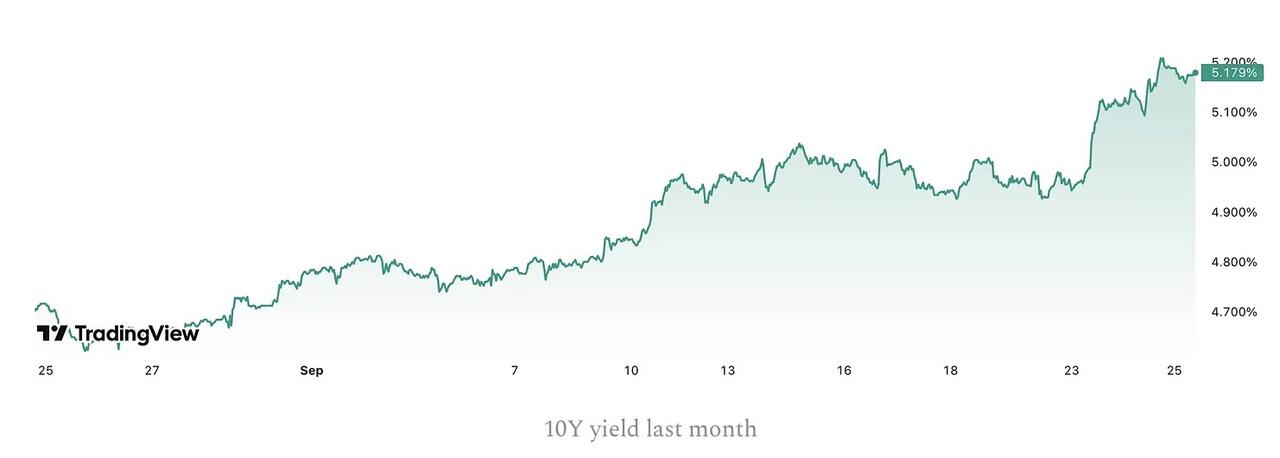
Investors understandably didn’t love seeing the words “force majeure” attached to one of the enormous data center projects underpinning the AI boom. For a while, the market looked like it didn’t love it either.
Then, almost on cue, an Iran headline showed up to save the day, when Reuters reported at around noon EST that U.S. and Iranian negotiators were discussing a potential phased agreement under which Iran would reopen the Strait of Hormuz while the United States lifted its economic blockade.
Stocks immediately ripped off their lows. The S&P 500 and Nasdaq erased much of their declines, with the Nasdaq briefly turning positive, before the S&P ultimately finished roughly flat.
If this sounds familiar, that’s because it is. By my count, we’ve now seen roughly 8-10 major rallies or reversals over the last six months where an ugly trading day has been rescued, or at least substantially improved, by some variation of a positive Iran or Hormuz headline.
And this doesn’t even count the dozens of smaller Iran and Hormuz headlines that have briefly juiced futures, knocked oil lower, or sparked smaller intraday rallies along the way.
The details change, but the trade is basically the same: peace talks, negotiations, a ceasefire, Hormuz reopening or blockade relief hits the tape, oil drops, stocks rip off their lows and everybody breathes a sigh of relief. So far, obviously, none of these headlines have led to any actual progress…only to saving the trading day momentarily.
The problem is that we still don’t have..
(READ THIS FULL COLUMN 100% FREE HERE).
END
2. ALASDAIR MACLEOD.
Bond yields and gold
This week saw bond yields catapulting higher. What does it mean for gold, silver and the entire commodity complex?
 |
“The fact of the matter is that the emerging crisis is unlike those which have come before. Since the Second World War, crises have always been in the private sector followed by governments riding to the rescue. This one is in governments themselves, and there is no one to rescue them.”

It is now clear that the US government has a funding problem. And it extends also to all the other G7 members, whose debt funding costs are all rising in unison. To put it into context, at current yields debt interest on US government bonds is the equivalent of half the USG’s current on-budget revenue. The only mitigations are that there is debt yet to mature with lower yields, and that about $8 trillion of the gross $40+ trillion is owed between government departments.
The US government is hostage to yet higher interest rates and bond yields, driven by a mixture of geopolitical factors and concerns over the inevitable slump in business activity together with soaring prices triggered by the crisis in the Middle East. The danger is that they are combining to set a debt trap for government finances, where higher rates beget yet higher rates. This is reflected in the long-term chart of the US long bond:

The yield is now in thermal runaway mode and can only be addressed by a Volcker-like policy of taking all the anticipation of higher bond yields out of financial and currency markets, with the Fed raising interest rates significantly above current levels. But that would collapse the economy, financial markets, and government finances, so it can be ruled out.
The fact of the matter is that the emerging crisis is unlike those which have come before. Since the Second World War, crises may have been caused by government policies, but they have always been in the private sector followed by governments riding to the rescue. This one is in governments themselves, and there is no one to rescue them.
It is against this background that we must consider the position for currencies led by the US dollar. This week’s events in the bond market show beyond any reasonable doubt that governments are trapped into policies that can only destroy the purchasing powers of their currencies. The US Treasury is already leading the way by resorting to shorter-term debt and monetising the longer-term. By this process, average maturities are shortening, and the yield curve flattening with 3-monthT-bills now yielding about 4.2%.
Unless something radical changes for the better, led by the dollar all G7 currencies are in a death spiral. Yet markets are frozen into inaction. The consequence for equities is likely to be catastrophic, bursting the credit-fuelled bubble. The consequences for the dollar/gold exchange rate should be equally clear, particularly since the Western capital markets’ establishment possesses close to no gold. Goldman Sachs recently estimated that at Q2 2025 gold ETFs represented only 0.17% of private US portfolios, though as they say estimates may vary.
Even speculators are broadly out of this market, with open interest on Comex well below the long-term average of 480,000 contracts, though that has begun to normalise:

In light of current developments, this underrepresentation is potentially explosive. The shift out of bonds and equities into gold will be a life-defining event for investors. It is against this background that we note gold currently treading water, seeking a sense of direction though it appears to be finding a base.

Gold represents safety from increasing risk in credit markets. It also represents the broader commodity complex, not the one replicated in paper markets but physical possession with no counterparty risk. There will be little or no warning when, led by government bonds, financial markets collapse and gold soars.
END
3. CHRIS POWELL AND HIS GATA DISPATCHES
4. ANDREW MAGUIRE//KINESIS LIVE FROM THE VAULT/291
END
5. COMMODITY REPORT: JET FUEL
Three Wars, One Bill: How Hormuz, Ukraine & Sanctions Are Squeezing The Express Giants
Friday, Sep 25, 2026 – 05:00 AM
Authored by Larry Johnson via Sonar21.com
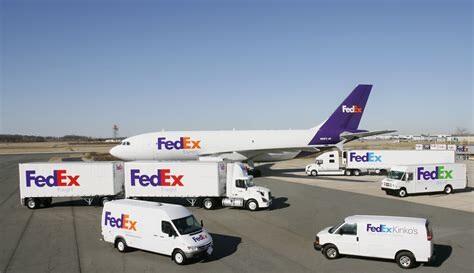
This article is the result of my conversation earlier today during my flight from Istanbul to London. I was sitting next to a FEDEX pilot who was on his way to Paris via London. I asked him about aviation fuel prices and the effect on FEDEX and I got more than I bargained for. The world’s express carriers like to present themselves as barometers of the global economy. In 2026 they are also measuring something else: what it costs to run a global air network when two of the three main east-west air corridors are effectively closed. The answer so far is that FedEx and UPS are surviving the shock largely by passing it on to their customers. That cost doesn’t disappear. It moves down the supply chain and into the inflation numbers central banks are now fighting.
The fuel shock
The trigger was the Iran war. The International Energy Agency has described the near-total closure of the Strait of Hormuz as the largest supply disruption in the history of the global oil market. Brent peaked near $118 in late March, fell to about $70 by July 1, rebounded above $100 in late July, and climbed back to $109 in early September after renewed attacks on shipping and energy infrastructure. It has since eased to around $99 on hopes from US-Iran talks, but it is still up roughly 60% for the year.
Jet fuel has moved further than crude because refining margins widened. IATA’s latest weekly reading put the global average at $194.90 a barrel, up 7.4% in a single week. U.S. Gulf Coast kerosene-type jet fuel averaged $4.341 a gallon in September. The ground networks are exposed too: the national diesel average has hit a record $6.31 a gallon.
For FedEx, the world’s largest cargo airline by fleet count, this lands directly on the cost line. In the quarter ended May 31, its fuel bill rose 66%, from $864 million to $1.43 billion.
The airspace squeeze: Russia plus the Gulf
The Ukraine war and Western sanctions had already closed Russian airspace to U.S. and European carriers after 2022. That added hours and fuel burn to Europe-Asia routes and handed a lasting advantage to carriers that still fly over Russia. Chinese, Turkish, Indian and Gulf carriers keep Russian access and can offer faster, cheaper Europe-Asia flights.
Then the Gulf closed as well. Eight Middle Eastern states closed or restricted their airspace in late February, leaving traffic squeezed through the Caucasus corridor between the Black and Caspian Seas, about 100 miles wide at its narrowest. Xeneta estimated that 16-18% of global air cargo capacity disappeared with almost no warning. Freightos data showed rates from South Asia to North America and Europe up about 50% early in the war.
By mid-July, Gulf carriers had restored 75-96% of schedules by routing south over Saudi Arabia and Egypt, adding 30-60 minutes to Europe-Asia services. Longer flights mean more fuel, lower payloads, more crew hours and less aircraft utilization. DHL Global Forwarding reported that rerouting around the Gulf hubs was reducing schedule reliability and raising operating costs. Air freight to and from the region itself also fell hard: Middle East and Africa exports were down 24% year on year.
How the integrators have held up
Here the story gets less straightforward than the headlines suggest. Surcharges have protected FedEx and UPS far better than airlines or asset-light truckers. FedEx’s chief customer officer said in March that the fuel surcharge was “doing its job” and would keep the company profitable.
The revenue numbers bear that out. In the March-May quarter, FedEx revenue rose 13% to $25 billion, with Iran-war fuel surcharges adding 5 percentage points of revenue. FedEx’s U.S. ground fuel surcharge stood at 26% in the week of August 17. UPS raised its full-year 2026 guidance to $91.2 billion in revenue and about $7.22 in adjusted EPS.
The pressure shows up in margins. FedEx beat estimates last quarter, but its operating income fell nearly 22% year over year. The mechanism is simple. The surcharge resets on a lag, and when fuel spikes, revenue and costs rise by similar dollar amounts, which dilutes the margin percentage. FedEx shares are down 6.6% over 30 days and 7.6% over 90 days, although still up 65.5% over one year.
The freight sector’s warning light went on this month. J.B. Hunt said Q3 earnings would fall 5-10% from the prior quarter, citing at least $10 million in extra fuel costs and $25 million in driver recruiting and bonus costs, which dragged down package-delivery stocks along with truckers.
Who pays: from shippers to consumers
On the evidence so far, shippers are bearing most of the cost. UPS’s CFO described the net profit impact of surcharges as “modest,” and FedEx said they were not a material driver of adjusted operating income. Critics have noted that neither company explained why surcharge percentages rose so sharply. For comparison, the U.S. Postal Service imposed its first surcharge on April 26, at 8% on most packages. One fact-check found no evidence of industry-wide gouging, but did find that some transport companies are collecting more in surcharges than they spend on fuel.
From shippers, the cost flows into prices. That is where the carriers’ problem becomes everyone’s problem.
The inflation picture
The OECD’s interim outlook, published today, projects G20 headline inflation rising to 4.1% in 2026 and easing to 3.6% in 2027, while advanced-economy core inflation moderates from 2.7% to 2.5%. That split matters. This is mainly an energy shock that pushes up headline inflation, not yet a broad wage-price spiral. The OECD credits government support, input substitution, non-Gulf supply and oil reserve drawdowns with limiting the damage.
In the U.S., August CPI was 3.4% year on year, while core was 2.4%, the lowest since March 2021. Gasoline alone accounted for more than a third of the monthly increase. The Fed still took no chances. It raised rates to 3.75-4.00% on September 16, its first hike since 2023, citing the Iran energy shock, and most officials expect at least one more hike this year.
How freight costs reach the checkout
The express surcharges are a real but secondary channel. Shipping is usually a small share of a finished good’s retail price, so parcel surcharges add friction at the margin rather than driving CPI. The same jet fuel shows up much more clearly in passenger airfares, up more than 23% since August 2025.
Food is the more important channel. Diesel, packaging and fertilizer matter more than parcel rates, and a lot of fertilizer moves through Hormuz, which threatens global food prices. One inflation analyst who normally dismisses food and energy as mean-reverting now says he’s less confident about food, because energy is feeding into trucking and packaging costs.
The spillover into core inflation is what central banks fear. Economists warn that renewed rises in oil, gasoline and diesel could spread to other prices and to inflation expectations. So far median CPI looks relatively tame, and part of the rise in services inflation is airfares, which is really energy.
The pain is not evenly spread. Energy- and food-importing emerging economies are far more exposed than the U.S. In the Philippines, diesel went above ₱140 a liter, about $10.75 a gallon. Weak currencies and heavier weights for food and fuel in consumer price indexes amplify the shock there.
Duration decides everything
The OECD’s June scenarios frame the stakes. If Gulf supply recovers from Q3 2026, the shock fades in 2027. If disruption lasts into late 2027, the result is much weaker growth and much higher inflation, adding about 0.4 points in 2026 and 1.3 points in 2027. The OECD’s baseline assumes energy prices fall in 2027, but it lists prolonged Middle East export disruptions and a very strong El Niño as key downside risks. With Brent near $99 and the Saudi East-West pipeline shut since September 11, that baseline looks optimistic.
A long disruption would also change the carriers’ position. Their pass-through model works only as long as customers accept it. The longer surcharges stay above 25%, the more small and mid-size shippers will downgrade from express to ground, from air to ocean, or simply ship less. FedEx’s own outlook assumed no further geopolitical disruptions and acknowledged that soaring fuel costs could weigh on results if customers pull back. The Russia-overflight disadvantage doesn’t go away when oil falls. And the gap between surcharge revenue and actual fuel cost could become a political and legal target.
The wars and sanctions have made running a global express network structurally more expensive: longer routes, fewer usable hubs, and fuel that stays high and swings unpredictably. So far FedEx and UPS have converted most of that cost into surcharge revenue, and their pain shows up as margin compression rather than losses. The cost has been passed downstream, where it adds to the energy-led inflation that has already pushed the Fed back into hiking.
For both the carriers and the inflation outlook, the deciding factor is how long the Hormuz disruption lasts. If jet fuel stays near $190 a barrel through peak season, the question stops being whether FedEx and UPS can pass costs on. It becomes whether their customers, and the consumers behind them, can keep absorbing them. The next markers are September CPI on October 14, and FedEx’s commentary on surcharge recovery and volumes in its fiscal Q1 2027 report.
END
COMMODITY TUNGSTEN:
Almonty is now in production and racing to increase its production for tungsten:
(zerohedge)
Jefferies, Goldman, Now Stifel: Wall Street Races To Cover Almonty As “Owning The Bottlenecks” Theme Gains Momentum
Friday, Sep 25, 2026 – 11:10 AM
A sense of urgency is building across Wall Street as notable desks push clients toward the critical materials theme we already laid out for readers, as the Trump administration accelerates efforts to rebuild conflict-free supply chains and reduce dependence on China. Resource nationalism and the looming rearmament supercycle are turning secure access to critical materials into both a national security priority and a multiyear investment theme.
For miners already producing conflict-free critical materials outside China, the opportunity lies in supplying Western buyers seeking alternatives to Beijing’s quasi-monopoly, which is expected to persist through 2030. The US government’s deals with junior miners have generated news headlines, but new projects can take years to reach commercial production. As Western supplies tighten, the immediate market advantage belongs to producers capable of delivering material today. Government funding can accelerate development, but it cannot eliminate the time required to permit, build and commission a mine.
Wall Street Piles Into Almonty Coverage As Tungsten Producing Miner Ramps Up To Challenge China’s Stranglehold
At the start of the month, Jefferies initiated coverage on Almonty Industries and assigned a “Buy” rating, highlighting the miner’s direct public-market exposure to Western tungsten supply, with a 12-month price target of $26.25.
By Thursday, Goldman Sachs launched coverage on Almonty, describing the miner as “at the center of the Western tungsten investment narrative.”
Now it’s Friday, and Stifel critical materials analyst Brock Cannon has initiated coverage of Almonty with a $25 price target, telling clients that the Nasdaq-listed miner is set to be a major beneficiary of Western efforts to reduce dependence on Chinese tungsten, which is critical to defense and advanced manufacturing.
China accounted for roughly 80% of global tungsten mine production in 2025 and about 85% of downstream ammonium paratungstate refining capacity, according to Cannon.
Almonty’s production ramp is timed just perfectly to help Western buyers break China’s stranglehold on tungsten supply: its Sangdong mine in South Korea is ramping up Phase I, while Phase II is expected to nearly double annual ore throughput to 1.2 million tonnes in 2027.
“Almonty is a global tungsten mine operator with assets across Western countries and the US. The company has recently started Phase I commercial production at its Sangdong, South Korea mine with plans to execute Phase II (~2x production) in 2027,” Cannon wrote in the note.
Alongside an expansion at its Panasqueira mine in Portugal, that should substantially increase output over the next two years. Cannon estimates Sangdong alone could account for roughly 40% of Western and allied tungsten supply once both phases are fully operational.
Cannon noted, “The company is also expanding production at its Panasqueira mine which (along with Sangdong) would result in the company leading Western Tungsten production by the end of 2028.”
Cannon added more color:
Financial Snapshot
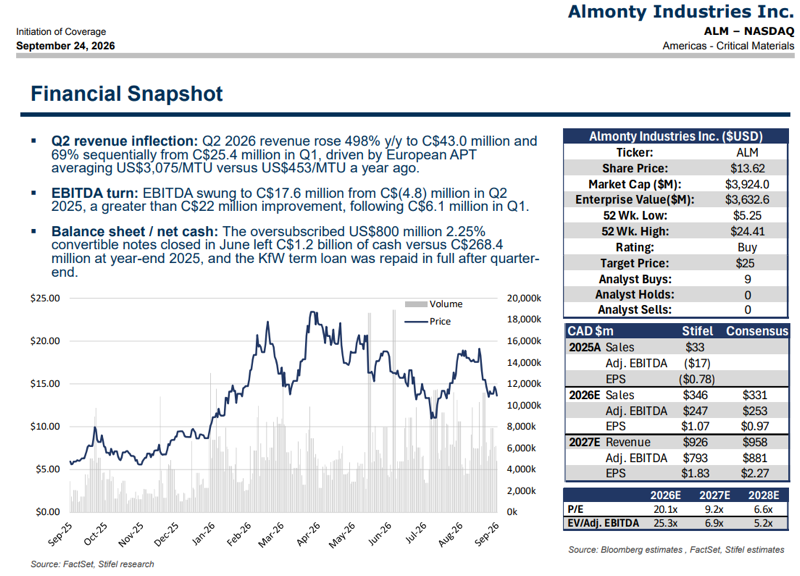
Investment Thesis
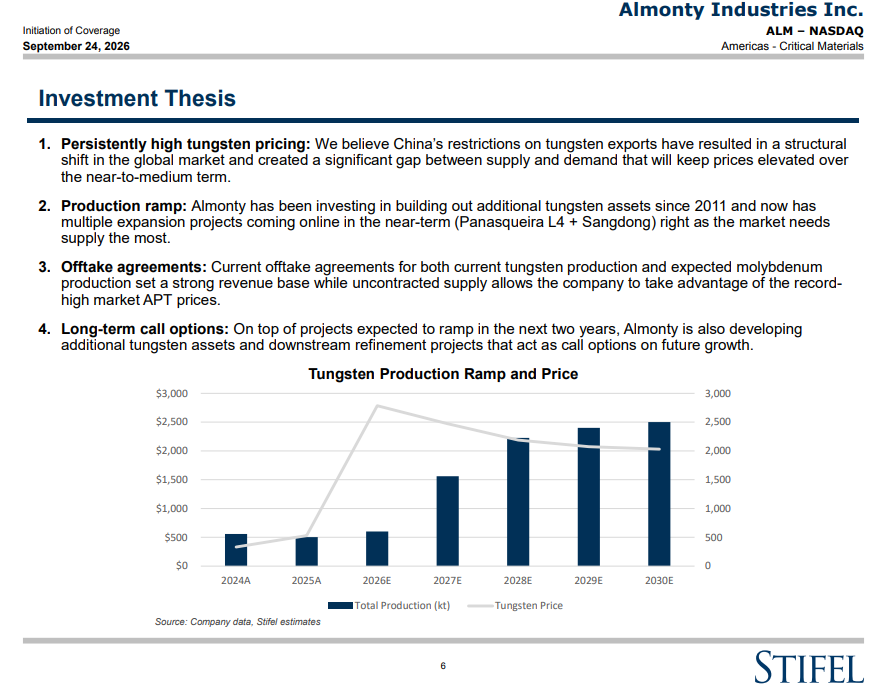
Key Investor Debates
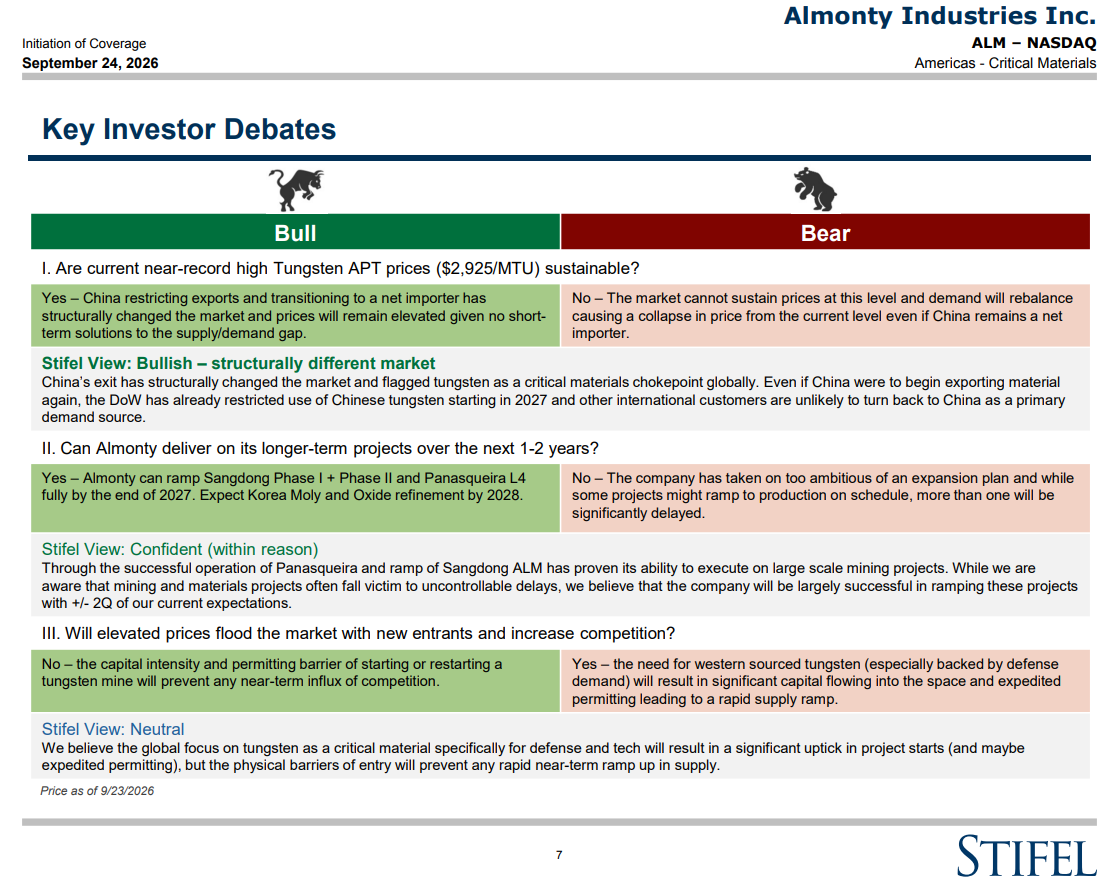
Global Supply
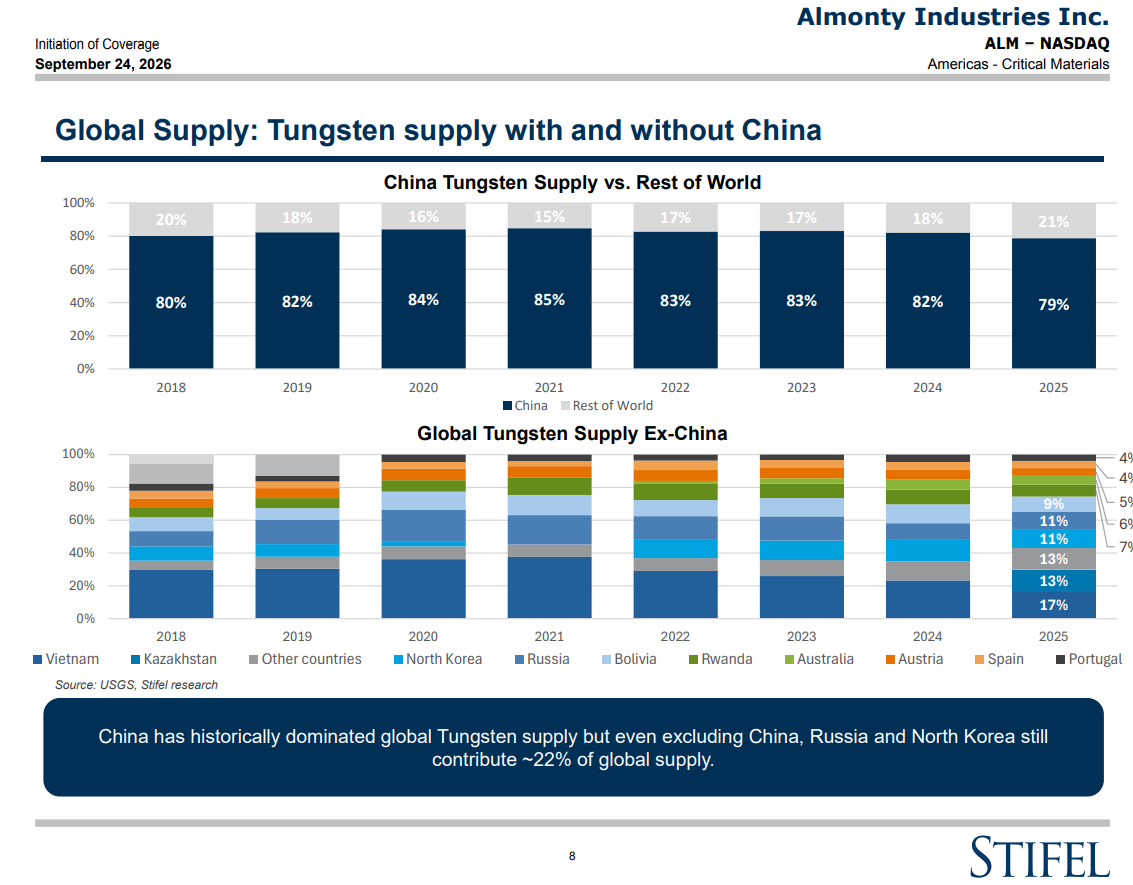
Tungsten Demand Market Segments
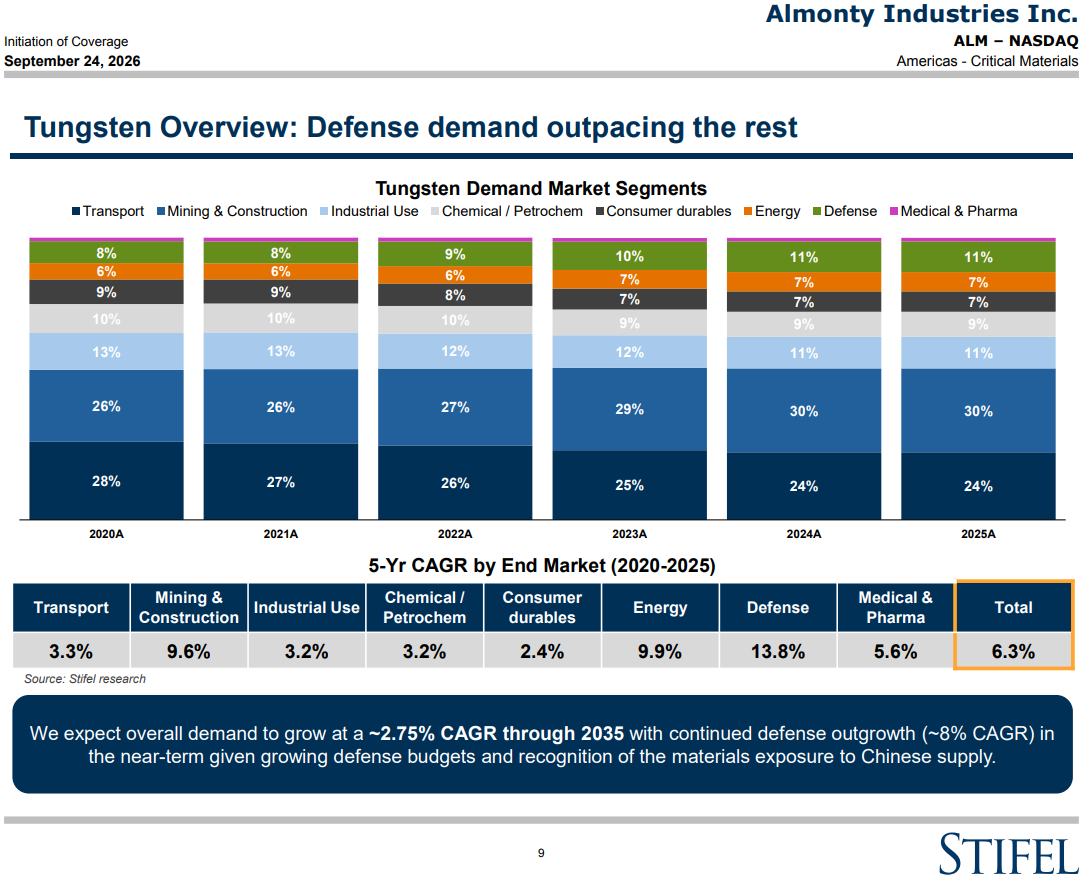
Tungsten in Defense
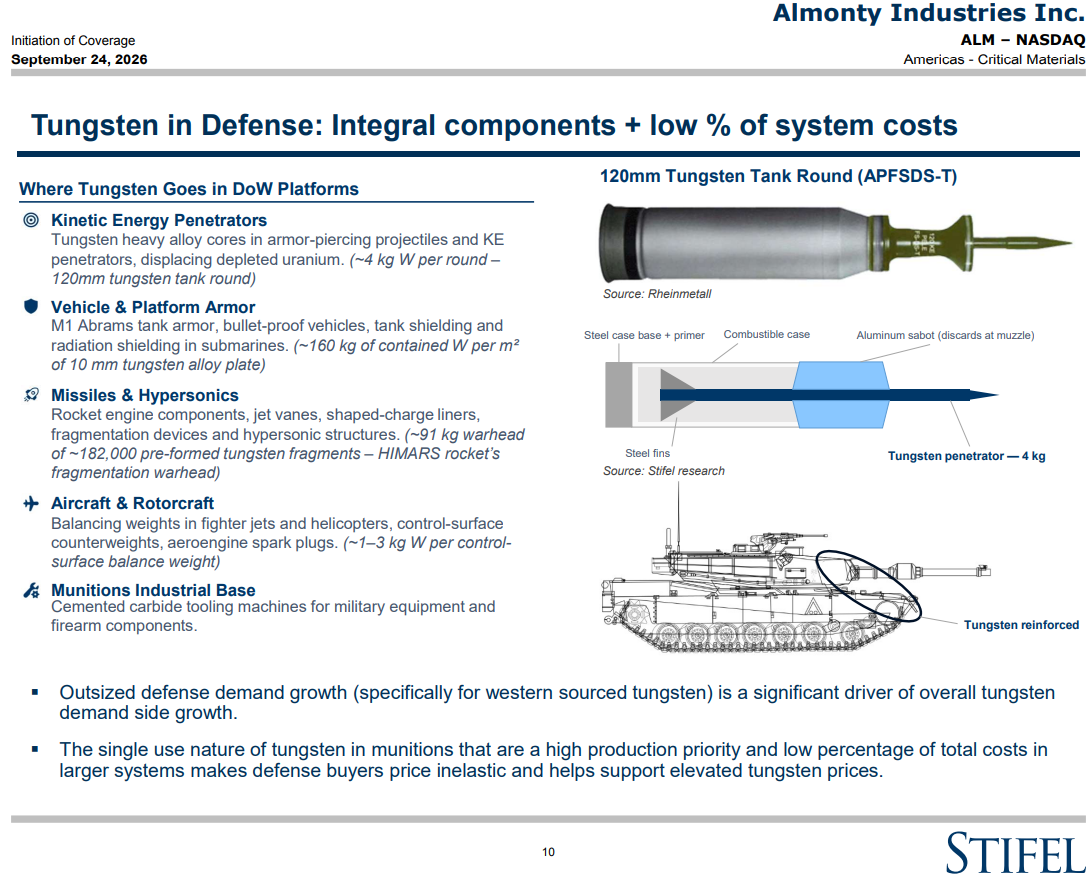
The Korean Trinity: Almonty’s Long-Term Buildout at Sangdong
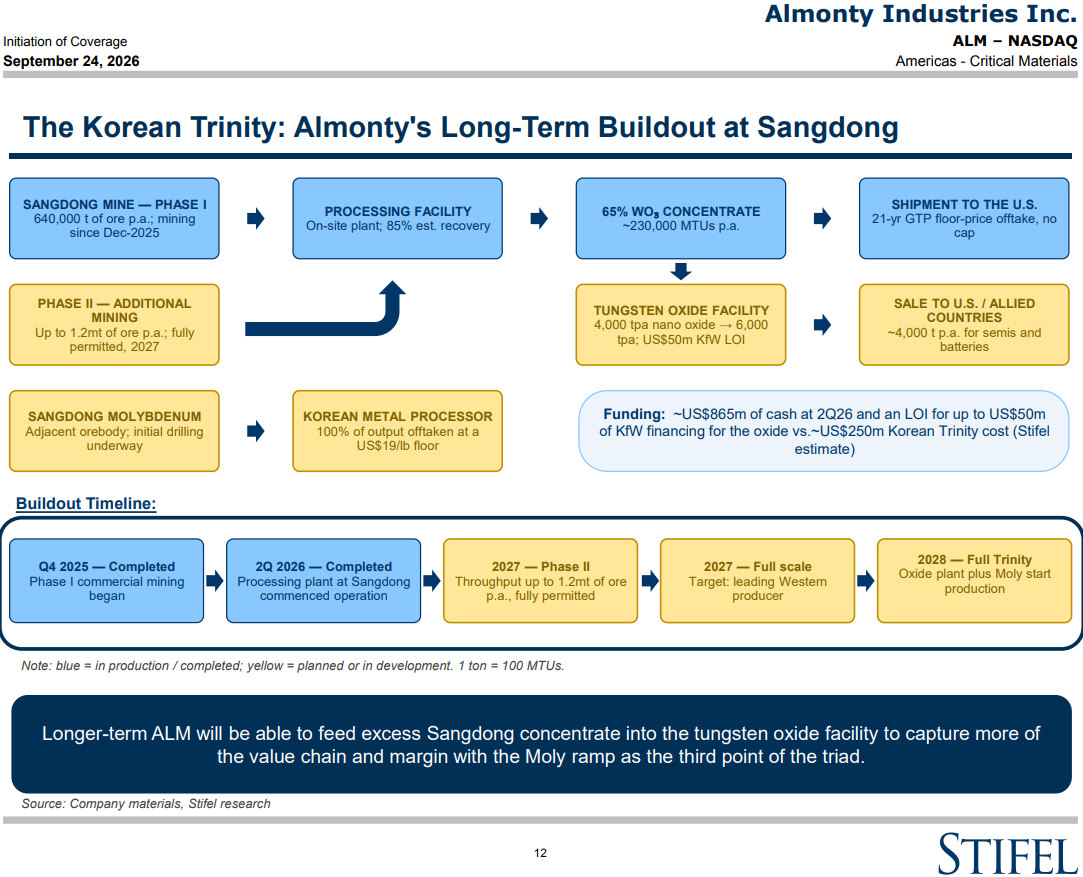
Tungsten Pricing: China Exit Creating New Market Dynamic
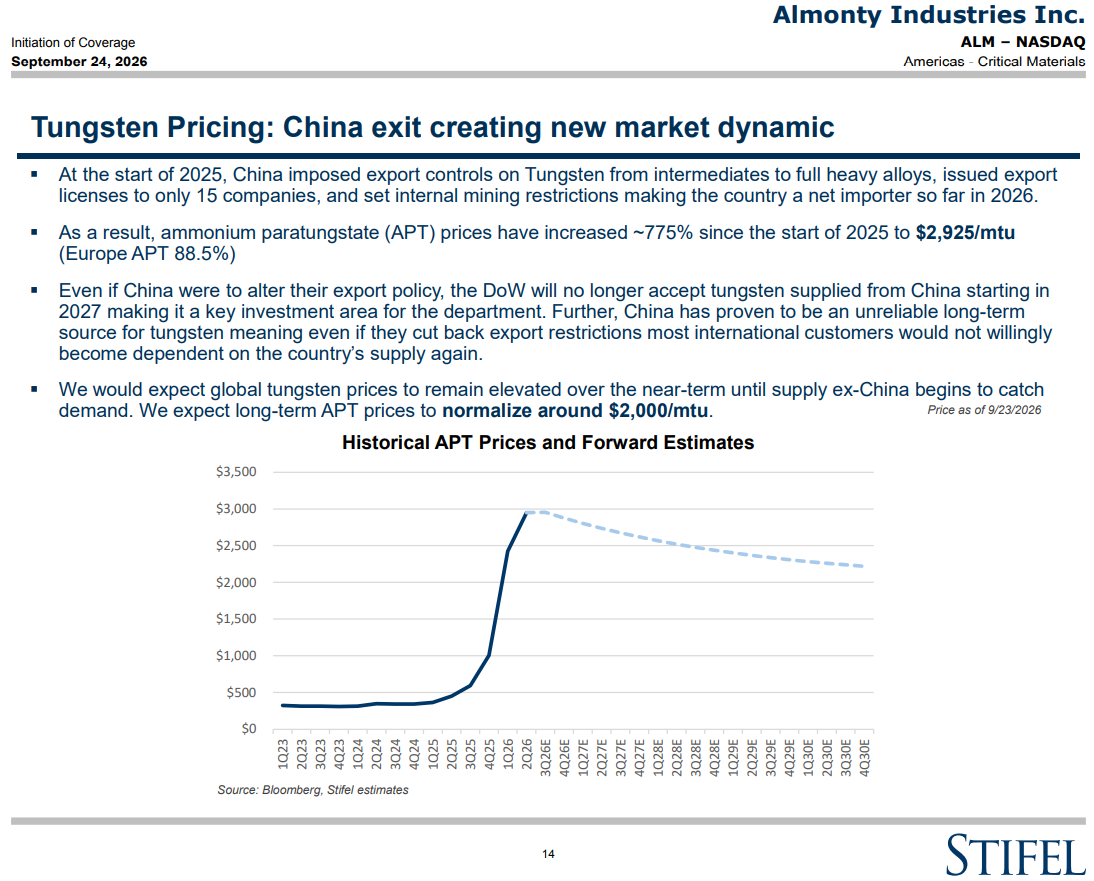
Almonty Tungsten Production Ramp: Ahead of the Game
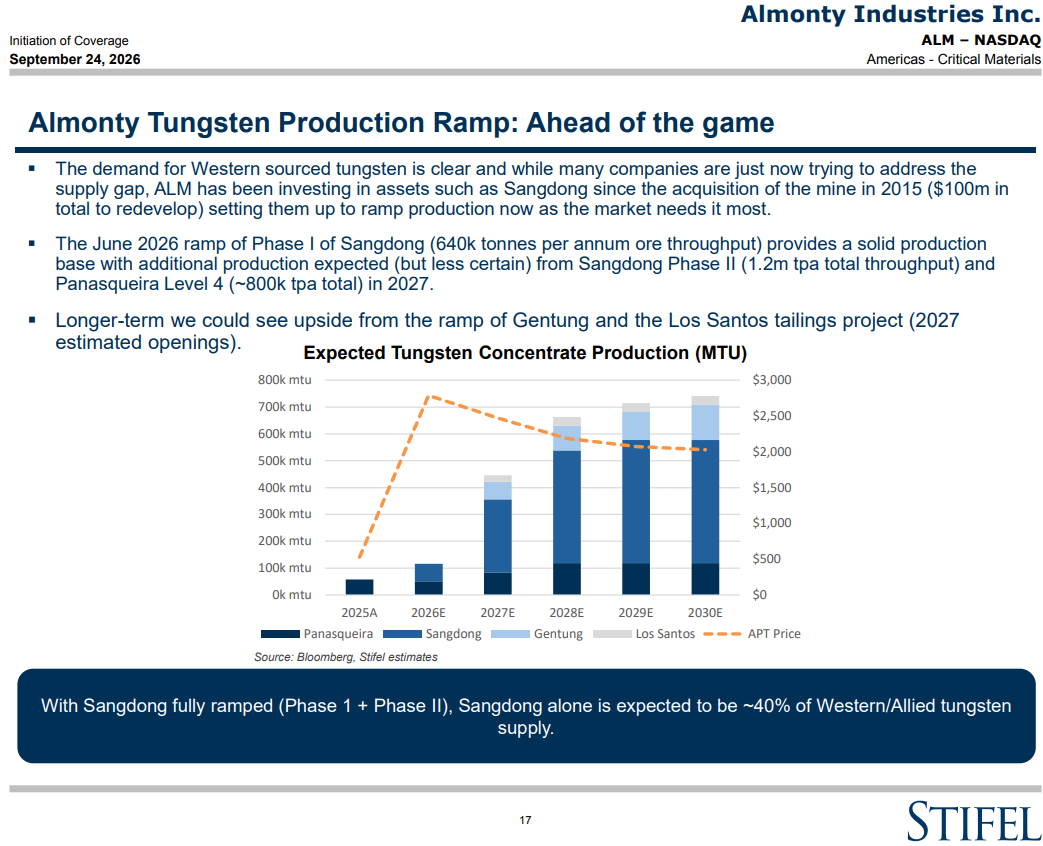
Almonty Leads Western Tungsten Project Pipeline
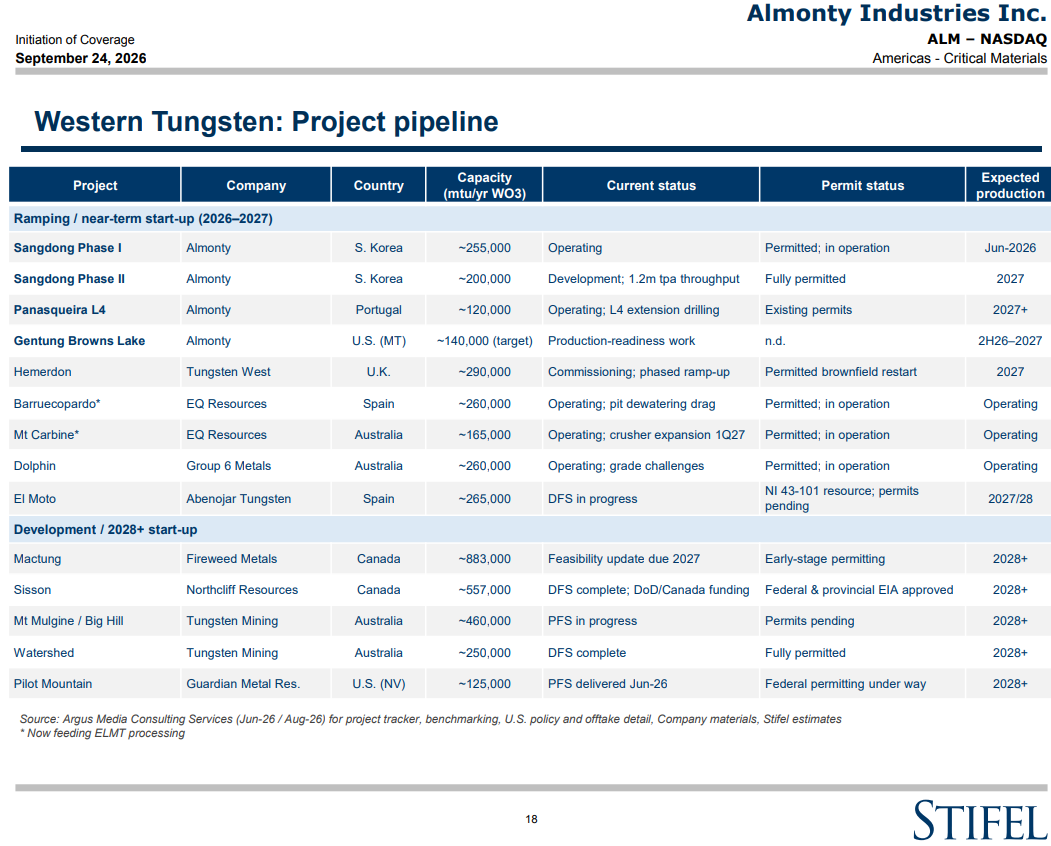
US Tungsten: No Operating Mine, Five Domestic Projects
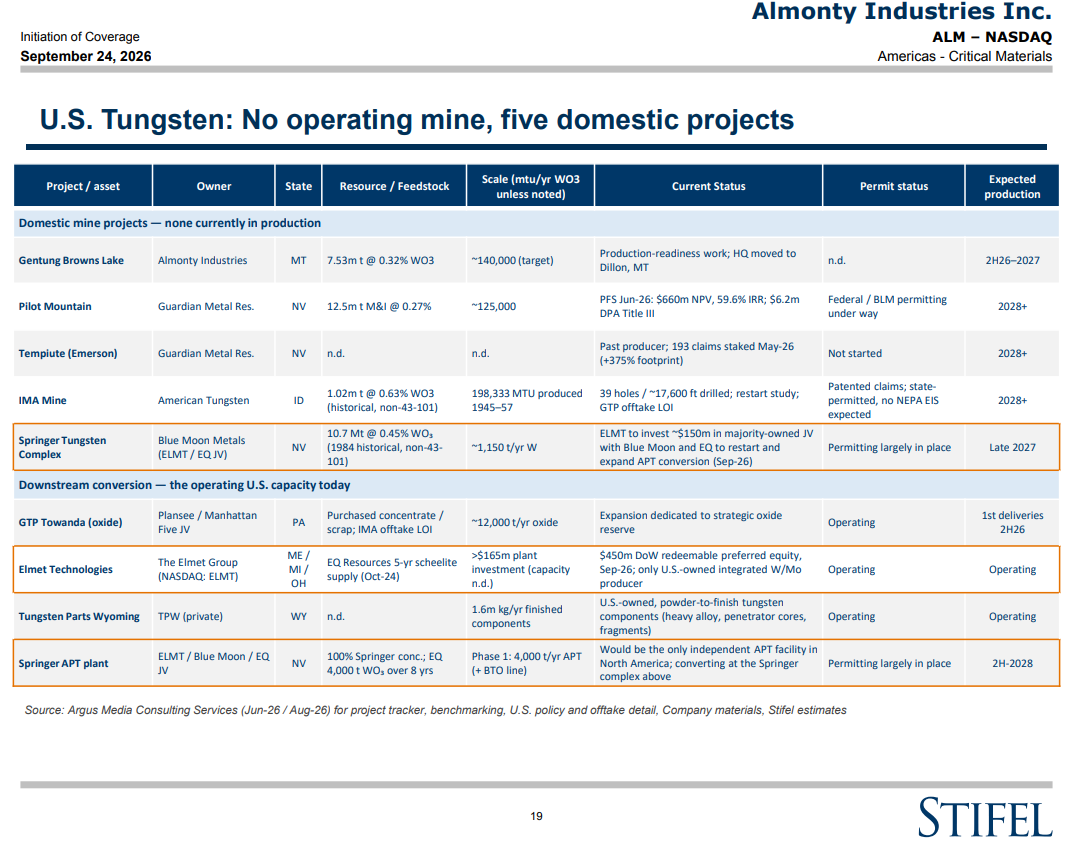
Long-Term Catalysts: Upside From Further Expansion Projects
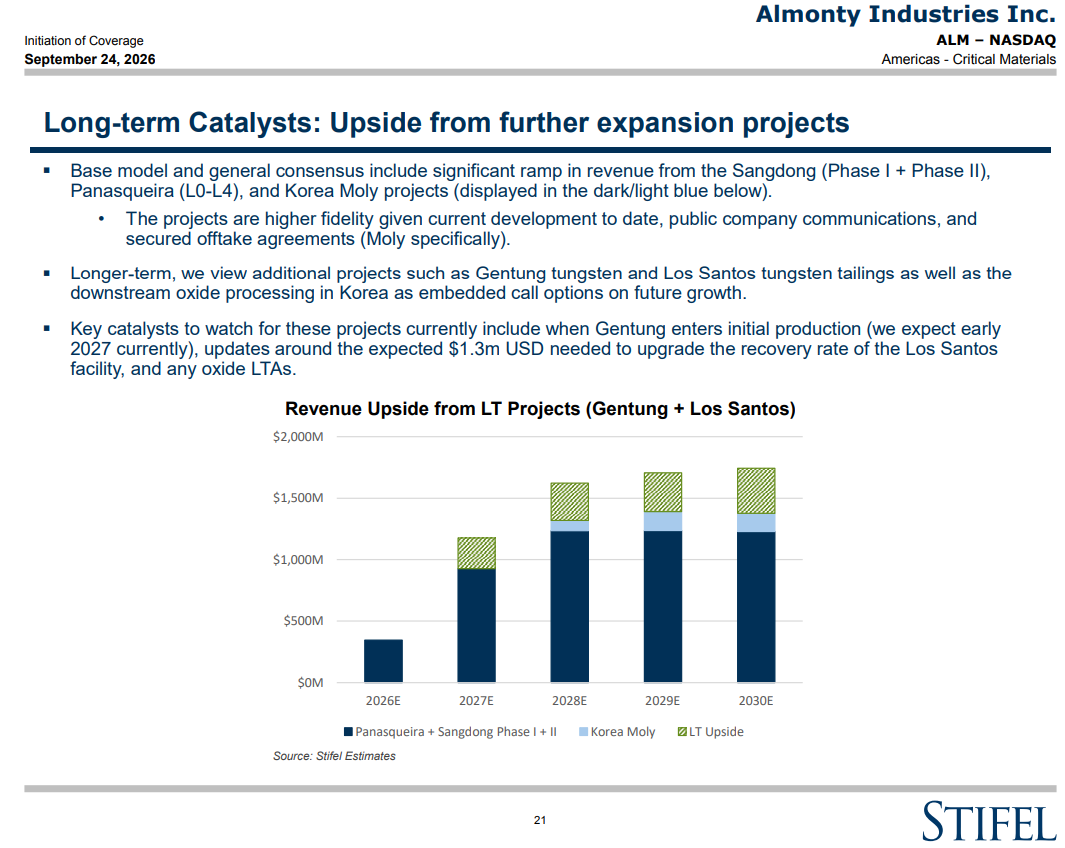
Cannon named Almonty the “first name in our new Critical Materials coverage,” which is outlined in a theme called “Owning the Bottlenecks.”
Why this theme should work:
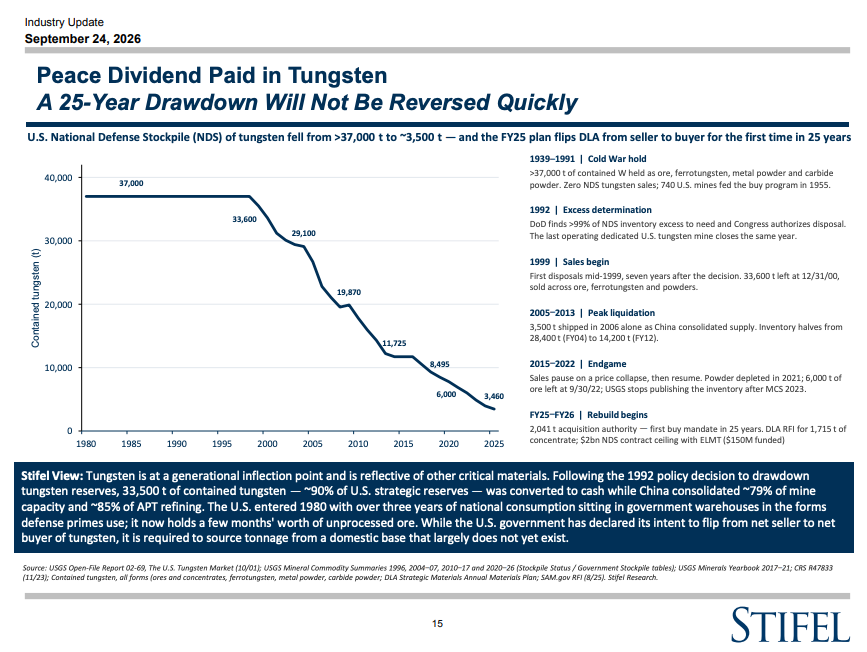
The race for conflict-free tungsten and other critical materials is a theme that Jefferies, Goldman, and now Stifel are backing, as Washington’s multiyear effort to rebuild critical supply chains will reward early movers, including producers like Almonty.
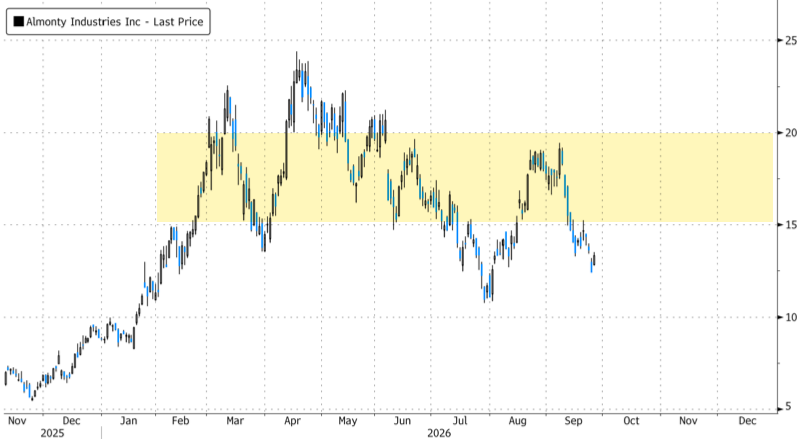
Professional subscribers can read the full ALM note here at our new Marketdesk.ai portal.
END
YOUR EARLY CURRENCY VALUES/GOLD AND SILVER PRICING/ASIAN AND EUROPEAN BOURSE MOVEMENTS/AND INTEREST RATE SETTINGS FRIDAY MORNING.7:30 AM
SHANGHAI CLOSED HOLIDAY
HANG SENG CLOSED DOWN 253.13 PTS OR 1.02%
Nikkei CLOSED UP 952.01 PTS OR 1.45%
//Australia’s all ordinaries CLOSED DOWN 0.01%
//Chinese yuan (ONSHORE) CLOSED DOWN TO 6.7133
/ OFFSHORE CLOSED DOWN AT 6.7203 Oil UP TO 94.56 dollars per barrel for WTI and BRENT UP TO 106.25 Stocks in Europe OPENED ALL GREEN
ONSHORE USA/ YUAN// WITH YUAN TRADING DOWN (6.7133 OFFSHORE YUAN TRADING DOWN TO 6.7203 ONSHORE YUAN TRADING ABOVE LEVEL // OFF SHORE AND UP ON THE DOLLAR)// / AND THUS WEAKER/OFF SHORE YUAN TRADING UP AGAINST US DOLLAR/ AND THUS WEAKER
XXXXXXXXXXXXXXXXXXXXXXXXXXXXXXXXXXXXX
ONSHORE YUAN: CLOSED DOWN AT 6.7133
OFFSHORE YUAN: DOWN TO 6.7203
1A.HANG SANG CLOSED DOWN 253.13 PTS OR 1.02%
1 B. SHANGHAI CLOSED HOLIDAY
2. Nikkei closed UP 952.01 PTS OR 1.45%
WEST TEXAS INTERMEDIATE OIL UP TO 93.56
BRENT; 106.25
3. Europe stocks SO FAR: ALL GREEN
USA dollar INDEX DOWN 18 BASIS PTS TO 100.84// EURO FALLS TO 1.1421 DOWN 27 BASIS PTS
3b Japan 10 YR bond yield:FALLS TO. +3.074 DOWN 1 FULL BASIS PTS/ VERY TROUBLESOME//Japan buying 100% of bond issuance)/Japanese YEN vs USA CROSS NOW AT 158.14… JAPANESE YEN NOW FALLING AS WE HAVE NOW REACHED THE ENDING OF THE YEN CARRY TRADE AGAIN AND THE REPATRIATION OF YEN DENOMINATED BONDS TRADING IN THE USA/EUROPE. JAPAN 30 YR BOND YIELD: 4.151 DOWN 2 FULL BASIS PTS
3c Nikkei now ABOVE 17,000
3d USA/Yen rate now well ABOVE the important 120 barrier this morning
3e Gold UP /JAPANESE Yen UP CHINESE ONSHORE YUAN: DOWN (6.7133) AND OFFSHORE: DOWN AT 6.7203
3f Japan is to buy INFINITE TRILLION YEN worth of BONDS. Japan’s GDP equals 5 trillion USA. CENTRAL BANK OF JAPAN WILL NO LONGER DO QE.
Japan to buy 100% of all new Japanese debt and NOW they will have OVER 50% of all Japanese debt. GOVERMENT ASKED JAPAN PENSION FUNDS AND INSURANCE FUNDS TO BUY MORE JAPANESE BONDS AND REPATRIATE ALL FOREIGN BONDS.
3g Oil UP for WTI and UP for Brent this morning
3h European bond buying continues to push yields HIGHER on all fronts in the EU German 10yr bund YIELD UP TO +3.5923/ Italian 10 Yr bond yield UP AT 4.5320/ SPAIN 10 YR BOND YIELD UP TO 4.077%
3i Greek 10 year bond yield UP TO 4.4112%
3j Gold at $4278.80 /Silver at: 63.80 1 am est) SILVER NEXT RESISTANCE LEVEL AT $100.00
3k USA vs Russian rouble;// Russian rouble UP 0 AND 41/ 100 roubles/84.58
3m oil (WTI) into the 93 dollar handle for WTI and 105 handle for Brent/
3n Higher foreign deposits moving out of China// huge risk of outflows and a currency depreciation. This can spell financial disaster for the rest of the world/
JAPAN ON JAN 29.2016 CONTINUES NIRP. THIS MORNING RAISES AMOUNT OF BONDS THAT THEY WILL PURCHASE UP TO .5% ON THE 10 YR BOND///YEN TRADES TO 158.14 // 10 YEAR YIELD AFTER FIRST BREAKING .54% LAST YEAR NOW EXCEEDS THAT LEVEL TO 3.074% DOWN 1 BASIS PTS STILL ON CENTRAL BANK (JAPAN) INTERVENTION//YEN CARRY TRADE NOW UNWINDING//YEN BOND TRADING OVERSEAS TO BE REPATRIATED.//JAPAN 30 YR: 4.151 DOWN 2 PTS..: USA/SF this 0.8298 as the Swiss Franc . Euro vs SF: 0.9440
USA 10 YR BOND YIELD: 5.171 UP 1 BASIS PTS…NOW BELOW 5.00%
USA 30 YR BOND YIELD: 5.465 UP 1 BASIS PTS/REFUSES TO GO DOWN WITH BESSENT’S QE TWIST
USA 2 YR BOND YIELD: 4.801 UP 1 BASIS PTS
USA DOLLAR VS TURKISH LIRA: 48.97 UP 11 BASIS PTS/LIRA GETTING KILLED//IDIOTS FOR SELLING GOLD AND USA DOLLAR RESERVES.
10 YR UK BOND YIELD: 5.3597 DOWN 3 PTS
30 YR UK BOND YIELD: 5.8538 DOWN 1 BASIS PTS
10 YR CANADA BOND YIELD: 3.998 UP 3 BASIS PTS
5 YR CANADA BOND YIELD: 3.722 UP 4 BASIS PTS.
1a New York Opening report
Futures Rise As Oil, Yields Drop On Iran Diplomacy Hopes
Friday, Sep 25, 2026 – 08:37 AM
US futures erased earlier losses and are trading at session highs led by tech, as bonds steadied (with the 10Y at multi-decade highs of 5.17%) after oil’s latest rally lost steam, helping US stocks to extend gains for the week. As of 8:00am ET, S&P futures are up 0.4% setting up the benchmark to post its first weekly advance in three; Nasdaq futures gain 0.7% with chipmakers and memory storage names bouncing and Mag 7 stocks mostly higher, led by NVDA (+0.7%) and TSLA (+0.8%). Overnight, focus remains on the improved US-Iran rhetoric since noon yesterday: Iran proposed a 7-day plan to end the war (NYT), and the president says Tehran wants a deal with the US before the midterm elections (NBS). However, the reactions from the oil market were fairly modest, suggesting the market is still pricing a meaningful geopolitical premium; WTI fell 1.8% to $92.98. Bond yields fell 2-3bp at the front end; precious metals are higher, and ags are lower. US economic data slate includes August durable goods orders (8:30 a.m.), and the September University of Michigan sentiment (10 a.m.).
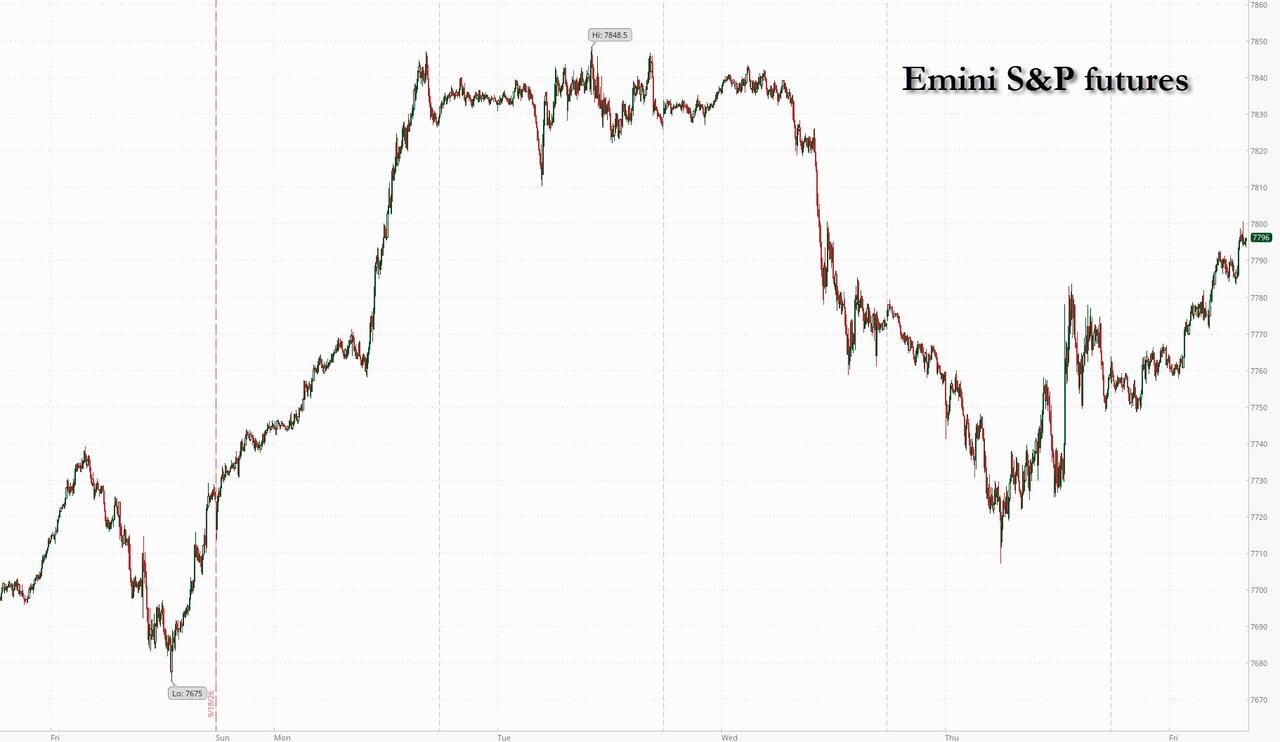
In premarket trading, Mag 7 stocks are mostly higher (Tesla (TSLA) +1.1%, Nvidia (NVDA) +0.7%, Amazon (AMZN) +0.6%, Alphabet (GOOGL) +0.4%, Apple (AAPL) +0.1%, Microsoft (MSFT) little changed, Meta Platforms (META) -0.5%).
- Akamai Technologies (AKAM) rallies 20% after the cloud provider inked a seven-year $11.6 billion deal to provide computing power to Anthropic.
- Atlas Energy (AESI) gains 6.9% after it announced a purchase agreement with Wyoming Machinery Company for $340.5 million of Balance of Plant equipment for a power generation project. The companies also separately agreed to a 328 megawatt power deal under an agreement with Caterpillar Inc.
- Comcast Corp. (CMCSA) is down 1.9% after KeyBanc Capital Markets cut its recommendation to underweight from sector weight on weakness in broadband.
- Nike Inc. (NKE) is down 2% after BofA cut its recommendation on the athletic footwear and apparel company to underperform from neutral, and pushes the expectation for a sales turnaround into F2028. Nike reports 1Q earnings on Oct. 1.
- People Inc. (PPLI) jumps 9.9% on a report that MGM Resorts is discussing making a bid to purchase the Barry Diller-owned media giant.
- Twilio Inc. (TWLO) is down 3.5% as HSBC downgrades the communications software company to reduce from hold, seeing “limited evidence that Twilio will capture higher-margin AI software” revenue.
- Zscaler (ZS) falls 3.4% after the security software company announced the appointment of Ross Tackett as chief revenue officer, effective Oct. 1.
In other corporate news Elon Musk said Colossus 2, an AI computing cluster built by his xAI business, may more than double its current Nvidia chip count by the end of the year. Shares of People Inc. rise 6.5% after the Wall Street Journal reports that MGM Resorts is discussing making a bid to purchase the Barry Diller-owned media giant. Temasek names BlackRock co-founder Susan Wagner to its board with effect from Oct. 1, according to a statement.
Fluctuations in oil prices are likely to remain a key driver for markets at a time when elevated energy costs are stoking inflationary pressures and underpinning the outlook for further monetary policy tightening. Swaps fully price three additional Federal Reserve quarter-point hikes over the next year, a prospect that could hold back risk appetite and keep bond yields high for some time.
“We are in a one-factor world over the coming days, with oil prices driving rates and rates driving all asset classes,” wrote Mohit Kumar at Jefferies. “Equity markets have behaved relatively well despite the rise in rates. Optimism over AI and demand for AI infrastructure has helped.”
Longer-dated bond yields continue to reflect fiscal concerns and the likelihood of strong government borrowing, said Francisco Simon at Santander Asset Management. While the prospect of restored crude flows from the Middle East will ease pressure on rates, a run of strong economic data suggests the global economy can withstand tighter financial conditions, he said.
“Market direction will likely be determined by whether easing geopolitical tensions can outweigh the ongoing message from the macro data,” Simon said. “Growth remains resilient, and that is keeping upward pressure on yields despite some relief on the energy front.”
Trump’s reception for China’s Xi has been heavy on pageantry and platitudes but light on substantive announcements, with the events shadowed by the US president’s preoccupation with construction projects and personal grievances. This is how Goldman wrapped up the pageantry:
- Trade truce extended for 2 months mentioned by Bessent. Xinhua news mentioned Xi said both sides agreed on a new joint arrangement on trade.
- Xinhua news mentioned Xi hope US to insist “oppose Taiwan independence” stance, and deal with Taiwan issue with prudence. (note current official US stance is “do not support Taiwan independence” instead of “oppose”)
- On AI, Xi mentioned US and China should not set up defences against each other, and should have dialogue, prevent AI being abused and ensure human control of AI.
- Chinese news mentioned Xi supports US and Iran to return to MOU and maintain talks.
- Both leaders support APEC (Nov in Shenzhen) and G20 (Dec in Miami) meetings, indicating Xi and Trump may meet two more times this year.
- One-Liner: So far nothing major market moving. We wait for official statement/readout. Still, the important area to watch is related to Iran (and any efforts from China to mediate talks
Elsewhere, AI is back in focus as the selloff in bond markets eases. A Goldman Sachs study (available to pro subscribers) estimates about $1 trillion in end user spending is needed to drive solid returns for hyperscalers — a hefty but “achievable” target. Goldman strategist Ryan Hammond notes that AI applications will need to generate more than $1 trillion in revenues based on a 30% Ebit margin and a 10%-20% return on invested capital for the hyperscalers. This compares with roughly $1.5 trillion in global software spending in 2026, Hammond writes.
Market performance reflects some of that optimism. Meta is on the cusp of joining an elite group of companies worth at least $2 trillion after shares surged 36% so far in September. The Nasdaq 100 is outperforming the equal-weighted S&P 500 and small-cap Russell 2000 by more than 7 percentage points this month. Meanwhile, rate-sensitive financials are being punished, with banks hitting a technical correction in Thursday’s cash trading. The durability of that bifurcation likely depends on where long-end yields next settle.
The final reading of a University of Michigan’s survey due later today is likely to show consumer sentiment deteriorated in September due to higher prices at the pump, according to Bloomberg Economics.
“The economic data calendar will be quite dull until the ISM on Thursday and the labor data on Friday next week,” said Roberto Scholtes, head of strategy at Singular Bank. “Everything will continue to revolve around energy prices, bond yields and AI-related news.”
Europe’s Stoxx 600 is up by 0.9%, headed for its biggest weekly gain since August, with semiconductor equipment maker ASML the biggest contributor to the gain. Here are the biggest movers Friday:
- UBS shares advance as much as 3.3% after a report said the Swiss lender is weighing options including potential deals with banks in other jurisdictions
- Glencore gains as much as 3.3% as UBS upgrades the miner to buy from neutral, with an improving risk/reward due to stronger outlook for thermal and metallurgical coal
- Outokumpu rises as much as 6.5% as BofA Global Research reinstates coverage with a recommendation of buy, saying European Union trade protection policies are offsetting weak demand in the steel sector. Peers Aperam and Acerinox also rise as BofA reinstates at neutral
- Alten shares rise as much as 8.8% after the French IT group reported first half-year operating which CIC CIB called ‘impressive,” saying the company is back on a “more positive trajectory”
- KPN gains as much as 2.9% after JPMorgan upgraded the company to overweight, saying shares offer an attractive entry point as revenue trends improve into 2027 and the “weak narrative” of 2026 fades
- HelloFresh shares fall as much as 15% to a record low after the German food delivery firm lowered its full-year sales growth and earnings targets
- Sinch declines as much as 5.3%, slipping from the highest close since January 2023, as DNB Carnegie downgrades the cloud communications group to hold as its required second-half acceleration is now partly priced in
Asian stocks are set to snap a two-day losing streak as oil slid on news that the US and Iran are exploring a phased deal that would see Tehran reopen the Strait of Hormuz, easing inflationary pressures. The MSCI Asia Pacific Index gained 0.7%, with Japanese stocks leading gains. Financials led Japan’s advance, supported by the prospect of higher interest rates. Meanwhile, Hong-Kong shares fell with a more pronounced drop in tech stocks, as traders were disappointed by a lack of progress in Trump-Xi talks. Alibaba and Tencent were among the biggest laggards. China, Taiwan and South Korea were shut today. Markets have had a relatively muted reaction to the Trump-Xi summit currently, after China’s president encouraged Trump to publicly oppose Taiwan independence.
In FX, the yen headed for its biggest daily gain in more than two weeks after Japanese Prime Minister Sanae Takaichi said she told President Trump that an undervalued yen is problematic. This follows Finance Minister Katayama revealing that Trump expressed concerns over the weakness of the currency. The Bloomberg Dollar Spot Index is down 0.2%.
In rates, treasury yields are falling across the curve, with 10-year yields down by four basis points. There are similar moves in Europe and the UK, with investors trimming their rate-hike bets for the Fed, the ECB and the BOE. Treasuries hold curve-steepening gains in early US session with front-end 3yields around 5bp lower on the day, supported by lower oil prices after report that US and Iranian negotiators explored a phased deal that would see Tehran reopen the Strait of Hormuz. Friday’s session includes durable goods orders data and at least two Fed speakers. With longer-term US yields only 1bp-3bp lower on the day 2s10s and 5s30s curves are steeper by about 1.5bp and about 3bp respectively; 10-year is about 4bp lower near 5.17% with UK counterpart keeping pace and Germany’s lagging by about 3bp. IG dollar issuance slate empty so far, after just one deal was priced on Thursday leaving the week around $5 billion short of dealers’ $40 billion average expectation.
In commodities, WTI crude oil futures under $93 are down 2.3% near session lows with Brent crude futures down 1.2% near $106 after rising more than 7% over the previous two days. Gold prices are fluctuating around $4,300/oz. Bitcoin is a touch stronger, nudging above $84,000.
US economic data slate includes August durable goods orders (8:30 a.m.), September University of Michigan sentiment (10 a.m.) and Kansas City Fed services activity (11 a.m.) Fed speaker slate includes Kansas City’s Schmid (9:20 a.m.) and Cleveland’s Hammack (2 p.m.)
Market Snapshot
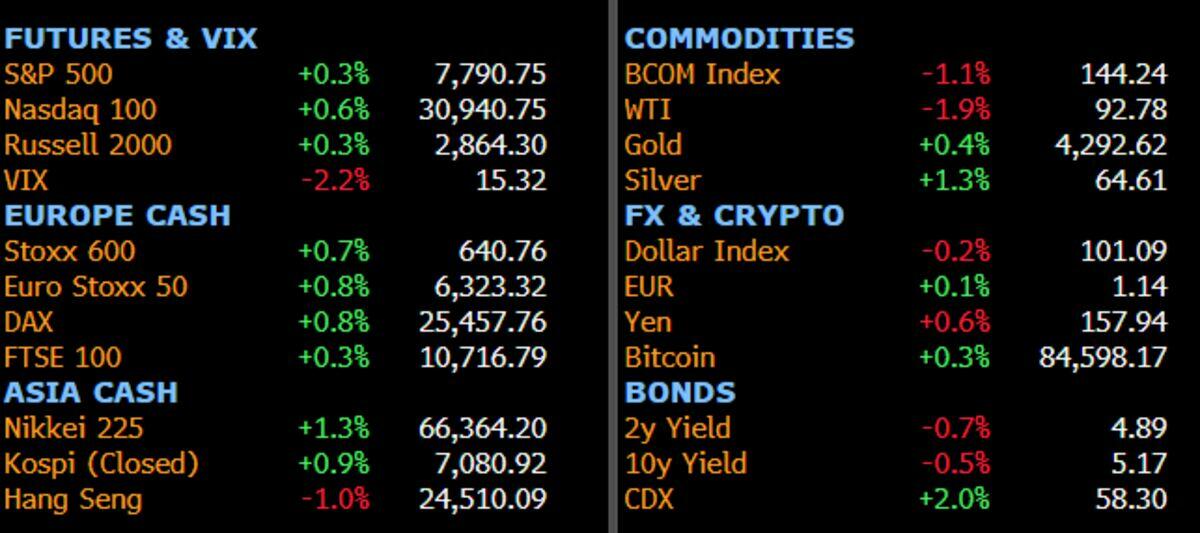
Top Overnight News
- Trump hosted Xi Jinping at a state dinner attended by Elon Musk, Jensen Huang and Tim Cook, but progress on tariffs and AI deals remains elusive. The leaders meet for tea this morning. BBG
- Iran’s foreign minister said Thursday that Tehran had proposed to Washington a seven-day plan to cease hostilities, reopen the Strait of Hormuz and then begin comprehensive talks on his country’s nuclear program. NYT
- Efforts to rekindle talks to end the war between the U.S. and Iran are running into resistance from major Persian Gulf oil producers that have swung against any accommodation of Tehran, people familiar with the matter said. WSJ
- Saudi, Turkish and Pakistani military chiefs are to meet to discuss how to support Saudi Arabia under a joint defence pact, after Saudi’s top religious authority told troops to be ready to lay down their lives to fight Yemen’s Iran-aligned Houthis. RTRS
- US Energy Secretary Chris Wright has contacted executives at several major American refiners in recent days to gauge support for a voluntary restriction on diesel exports as the Trump administration searches for an alternative to a short-term ban, according to three people familiar with the discussions. RTRS
- The Fed is working on a plan to raise the asset thresholds that trigger stricter oversight of big banks to account for inflation and economic growth. The changes may spur mid-size bank consolidation. BBG
- The yen hit a session high after Prime Minister Sanae Takaichi said an undervalued Japanese currency was “problematic.” The yen strengthened as much as 0.8% to 157.67 per dollar on Friday, heading for its biggest daily gain in more than two weeks. Officials have emphasized the speed and disorderliness of currency moves rather than any specific exchange-rate level, with market participants viewing the area around 160 as where intervention risk rises. BBG
- The BOJ gauge of underlying inflation accelerated to well above the target last month, supporting the case for continuing to raise the benchmark rate as authorities warn of the risk of inflation overshooting. BBG
- The State Department wants to give state and local officials, and possibly some nonprofit organizations, access to passport records to verify voters’ citizenship. BBG
- Anthropic strikes USD 12bln deal with Akami (AKAM) for AI computing.
Iran War
- Iran Foreign Minister Araghchi said Iran presented a proposal to US through mediators this week to reopen the Strait of Hormuz and restart negotiations towards a final deal, while it called for US to meet certain conditions within 7 days, according to CNN.
- Iranian President Pezeshkian said in Fox News interview that Iran does not want a nuclear bomb. They reached an agreement with the US President that was signed, and are still ready to move forward based on the same principles, adds it wasn’t Iran that closed the Strait of Hormuz and it was open. They didn’t seek war and that it was imposed on them, while they don’t seek war but will defend themselves. They didn’t start the war but will respond decisively.
- Iranian President Pezeshkian said Iran is ready for an agreement with the US and makes demands only within the framework of international law and could give up highly enriched uranium if it reaches an agreement with the US, according to TASS.
- Iran’s President Pezeshkian said Tehran wants to revive its ceasefire memorandum of understanding with the US before the November midterm elections, saying Iran does not want talks delayed until after the vote. said:. Iran is open to inspections of its nuclear facilities and denies that Tehran is seeking to assassinate President Trump or his family.
- Iran’s Foreign Minister Araghchi said the Strait of Hormuz can reopen if certain conditions are met by the US and that it would be better to implement before the Midterms, according to a Sky reporter.
- IRGC spokesperson warned in the event of another attack, Iran’s method of defence will change including geography of the confrontation, the type of equipment and weapons used, and targets in defensive operations in line with new conditions.
Iranian Brigadier General Sheikh said “we seek to expand our capabilities and reconsider our tactics and technologies”, via Al Mayadeen. - Sources say a return to the June 18 memorandum of understanding between Iran and the US is no longer sought by either side, with both seeking amendments to some clauses, further complicating negotiations, Al-Akhbar reported.
- Pakistan’s Defence Minister said intensive efforts are underway to establish a mechanism for ending the conflict as quickly as possible and reopening the Strait of Hormuz, according to Tasnim.
A more detailed look at global markets courtesy of Newsquawk
APAC stocks were ultimately mixed following the inconclusive handover from the US, where the major indices finished flat after the bond rout deepened, while conditions were thinned in the region owing to the holiday closures in South Korea, Taiwan and Mainland China. ASX 200 was led lower by underperformance in tech and with nearly all sectors in the red aside from financials and consumer staples, while price action was not helped by the lack of catalysts and data releases. Nikkei 225 extended on recent momentum and rose above 66,000, while the index was unfazed and Japanese banks were underpinned by a higher yield environment, which saw the 30yr yield at its highest since its debut in 1999. Hang Seng suffered despite the pleasantries at the Trump-Xi summit and state dinner, as the meeting of the leaders failed to result in any major breakthroughs, while there were losses in nearly all but a handful of the Hong Kong benchmark’s constituents and the Stock Connect was shut due to the closure in the mainland for the Mid-Autumn Festival.
Top Asian News
- Japanese Finance Minister Katayama said specific monetary policy tools are up to BoJ to decide and that the central bank will conduct appropriate monetary policy while coordinating with government, adds Trump voiced concerns about yen weakness at summit. said:. Won’t comment on specific FX levels or rate checks. Japan will closely coordinate with US on foreign exchange. PM Takaichi expressed concern about the yen’s weakness in general.
- Japanese Economic Minister Kiuchi said not in era to do monetary easing, adds phase of monetary easing and agile fiscal spending ended.
- Chinese VP Han said China willing to work with Serbia to lift bilateral ties to higher levels, according to Xinhua.
- Trump and Xi confirmed that they would support each other in hosting the APEC Economic Leaders’ meeting and the G20 summit in 2026, Xinhua reported; new trade arrangements between China and US is good news for the global economy.
European bourses (STOXX 600 +0.8%) are entirely in the green. The IBEX 35 (+1.2%) outperforms this morning, joined closely by the DAX 40 (+1%). The bullish bias seen this morning is facilitated by increased hopes of the reopening of the Strait of Hormuz. This comes after the Iranian President said that Iran presented a proposal to the US through mediators this week to reopen the Strait of Hormuz and restart negotiations towards a final deal. Whilst nothing is concrete at this stage, the path to diplomacy appears to be opening. European sectors hold a strong positive bias, with cyclical industries holding towards the top of the pile. Basic Resources tops the sectoral list, joined closely by Banks and Travel & Leisure. The latter benefits from lower oil prices and the general risk tone. Unsurprisingly, Energy resides at the foot of the pile. Food Beverage and Tobacco is the other sector in the red.
Key movers: UBS (+3%, reportedly considering a merger with a foreign company as it looks to move out of Switzerland), Airbus (-1.8%, identified a corrosion protection defect affecting more than 500 A321neos), Leonardo (U/C, reportedly involved in the Airbus defect).
Top European News
- European Loans to Households (Aug YY) 3.1% vs. Exp. 3.2% (Prev. 3.1%).
- European M3 Money Supply (Aug YY) 3.5% vs. Exp. 3.5% (Prev. 3.4%).
- European Loans to Companies (Aug YY) 4.2% (Prev. 4.4%).
- Spanish GDP Growth Rate Final (Q2 QQ) 0.7% vs. Exp. 0.7% (Prev. 0.6%).
- Spanish GDP Growth Rate Final (Q2 YY) 2.6% vs. Exp. 2.7% (Prev. 2.7%).
- French Non Farm Payrolls (Q2 QQ) -0.1% (Prev. 0%).
- French Private Non Farm Payrolls Final (Q2 QQ) -0.1% vs. Exp. -0.1% (Prev. -0.1%).
- German GfK Consumer Confidence (Oct) -30.6 vs. Exp. -27.4 (Prev. -26.8).
- UK GfK Consumer Confidence (Sep) -13 vs. Exp. -16 (Prev. -14).
FX
- DXY is modestly softer amid lower oil prices and after the Yen-led move weighed on the index (see below), although the Buck remains underpinned by this week’s rise US yields and expectations for further Fed tightening, with DXY posting four consecutive sessions of gains this week thus far. DXY currently resides in a 101.11-101.30 at the time of writing,
- JPY is the clear G10 outperformer, with USD/JPY sliding ~30-40 pips on several separate occasions overnight and this morning, price action that can also be seen across other JPY crosses. The move comes after comments from Japanese Finance Minister Katayama, who stated that US President Trump voiced concerns about yen weakness, while she reiterated Japan will closely coordinate with the US on foreign exchange.
- EUR/USD is modestly firmer, with much of the upside stemming from the JPY-induced pressure on DXY rather than any fresh bloc-specific catalyst. The pair remains tucked within yesterday’s 1.1359-1.1399 range, with today’s parameter between 1.1368-1.1390.
- GBP/USD is modestly firmer but remains well below 1.3300 following this week’s Sterling weakness. UK-specific catalysts are light, leaving broader USD dynamics to dictate price action. Cable currently resides in a 1.3209-1.3241 range.
- Antipodeans are modestly firmer intraday with fresh domestic catalysts are limited, with moves largely reflecting the broader easing in the Dollar, whilst mainland Chinese participants were away overnight. AUD/NZD is modestly firmer but off highs in a 1.2375-1.2409 range.
- Goldman Sachs lowers USD/JPY 3-month forecast to 158.00 from 162.00, 6-month forecast to 155.00 from 163.00 and 12-month forecast to 150.00 from 165.00.
Fixed Income
- A modestly bullish start to the final session of the week for fixed, led by downside in the energy space after the overnight Strait of Hormuz related commentary. Since then, updates have been relatively light and thus the rebound in benchmarks has been modest.
- As it stands, USTs are set to end the week with downside of nearly a full point, but some 10 ticks off the WTD 104-14+ low. In brief, the week was characterised by further yield upside given geopolitical and, pertinently, diesel updates. The 30yr hit a 5.50% peak, firmer by 20bps on the week at that point, while around 5bps off highs as it stands, the move remains significant and resilient.
- Further out, the general desk view is that the move has further to run given the US economic backdrop, continued Middle East uncertainty and associated supply disruption (and elevated shipping costs, added to by record low Rhine levels), potential US diesel measures, AI spend and a credibly hawkish Fed. Factors which are all indicative of further yield upside.
- Gilts are firmer by c. 30 ticks but just off best levels. Providing some relative respite to UK yields, but nonetheless the 10yr is 6bps firmer at 5.34% WTD and over 25bps MTD, despite the BoE holding the Bank Rate at 3.75% in September.
- Finally, EGBs follow suit to the above. Bunds are firmer by around 25 ticks, just off a 119.95 peak. Specifics for the space light. Focus remains on the above points, and also the wholesale changes set to impact the ECB over the next few months, as Schnabel leaves post-December, Lagarde potentially early-2027 and Lane in May 2027.
- Japan sold JPY 649bln in 10yr, 20yr and 30yr JGBs in enhanced liquidity auction; b/c 2.95 vs. Prev. 3.20. Highest accepted spread +0.032% vs. Prev. -0.011%. Allotment of bids at highest spread 80.1862% vs. Prev. 58.2741%.
- Australia sold AUD 1bln 2.5% May 2030 bonds; average yield 5.0368% and bid/cover 4.34×.
Commodities
- WTI Nov and Brent Dec futures are softer on the session, with the complex pressured by growing diplomatic hopes around US-Iran negotiations and Hormuz. The US and Iran reportedly discussed a phased deal to reopen the Strait and end the US blockade, while Iranian Foreign Minister Araghchi said Tehran submitted a proposal through mediators to reopen Hormuz and restart negotiations towards a final deal. However, Al-Akhbar subsequently reported that neither side is seeking a return to the June 18 MoU and both want amendments to some clauses, potentially adding delays. Focus also remains on US diesel policy after Energy Secretary Wright reportedly contacted major refiners to gauge support for voluntarily restricting diesel exports. WTI trades off worst levels and within a USD 92.14-94.75/bbl range, while Brent trades around USD 99.00/bbl within a USD 97.81-99.76/bbl range.
- Dutch TTF is softer alongside the broader pullback in the energy complex, with tentative progress on US-Iran diplomacy helping remove some of the geopolitical risk premium.
- Precious metals are mixed but ultimately contained, with the USD strength this week and the rise global yields continuing to act as headwinds. Spot gold has recovered off worst intraday levels and trades in a USD 4,255-4,296/oz range. Spot silver remains softer around USD 63.72/oz within a narrow USD 63.36-64.08/oz range. Base metals are subdued amid the absence of mainland Chinese participants overnight, with 3M LME copper within a USD 14,615.68-14,701.97/t range at the time of writing.
- EU Commission said that gas supply remains stable; to reconvene on October 8.
Trade/Tariffs
- EU urges the UK to increase tariffs on Chinese cars to avoid ‘made in Europe’ barriers, according to FT.
- Chinese President Xi said China and US made common understanding on many issues and that he had frank and in-depth exchange with US President Trump.
- US President Trump said in state dinner for Chinese President Xi that US and China have never gotten along better, adds can continue prosperous and secure future with China.
- US President Trump posted on Truth Social that the state dinner at the White House for Chinese President Xi Jinping will be spectacular.
Geopolitics:
- Ukraine President Zelenskiy said that the US proposed a “technical meeting” with Ukraine and Russia in UAE; waiting on the date.
- Russia’s defense ministry said it bombed a drone assembly site in the Kyiv region.
- Explosion heard near Ukraine’s capital of Kyiv after a Russian drone attack.
- US envoys Witkoff and Kushner met with Russia’s Dmitriev today, according to CNN.
- Chinese President Xi said North Korea, Middle East and Ukraine was discussed with US President Trump, while Xi and Trump agreed to build a stable China-US relationship.
- Russian and Iranian Foreign Ministers say there is no alternative to a diplomatic solution to the war in Iran, Al Arabiya reported.
- Yemeni Houthi official warns the coming period will be more painful for Saudi Arabia if its actions against Yemen continue, ISNA reported.
- Israel’s channel 12 noted that the army will enter a new phase of fighting in southern Lebanon in the coming days. said:. Army has completed operation to destroy Hezbollah’s infrastructure in the Yellow Line area.
- Israeli military will enter a new phase of fighting in southern Lebanon in the coming days, Israeli Channel 12 reported cited by Sky News Arabia. The army completed the process of destroying Hezbollah’s infrastructure in the Yellow Line area.
- Strait of Hormuz’s commodity vessel crossings dropped to single digits, according to preliminary ship tracking data.
- Saudi Foreign Ministry said Saudi Arabia, Turkey and Pakistan will hold urgent chiefs of staff meetings to discuss support for Riyadh under the joint defence pact.
- Saudi Arabia’s civil defence issues emergency warning for the Jazan province, but announces the danger has passed shortly after.
US Event Calendar
- 8:30 am: United States Aug P Durable Goods Orders, est. -0.3%, prior 1.1%
- 8:30 am: United States Aug P Durables Ex Transportation, est. 0.6%, prior 0.4%
- 10:00 am: United States Sep F U. of Mich. Sentiment, est. 47.5, prior 47.8
Central Banks
- 5:15 am: United States Fed’s Williams Participates in Policy Panel
- 9:20 am: United States Fed’s Schmid Participates In Fireside Chat
- 2:00 pm: United States Fed’s Hammack Participates In Policy Panel Discussion
DB’s Jim Reid concludes the overnight wrap
I’m pleased to announce that I’ve just played a very small part in what will become a new Guinness World Record, pending official verification. Yesterday, Deutsche Bank colleagues from around the world set out to walk or run the equivalent of the Earth’s circumference — roughly 56 million steps in just 24 hours. In the end, nearly 30,000 of us across 50 countries channelled our inner Forrest Gump and racked up 275 million steps, covering around 138,000 miles. So we got 60% of the way to the moon.
While we were all walking, markets have had another rough 24 hours, as a fresh jump in oil and gas seemed to send bond yields in another tailspin. Brent crude rose +3.41% to $106.60/bbl, even if it did pare back some of its gain after Reuters reported that the US and Iran were exploring a phased deal to reopen the Strait of Hormuz and end the blockade. But this was not sufficient to stem the ongoing rout in bond markets, with the sell-off extending late in the US session and leaving 10yr Treasury yields (+8.5bps) at a new post-2007 high of 5.20%. Meanwhile the S&P 500 recovered from around half a percent down before the headlines to -0.02% at the close.
One important theme at the moment is that Treasuries continue to sell-off with oil but that breakevens aren’t moving, with pretty much all the move being driven by real yields. This is something I discussed in my CoTD yesterday (link here), and yesterday the trend continued with 10yr US real yields rising +9.8bps to a post-2008 high of 2.87% but 10yr breakevens actually falling by -1.3bps. The former has now risen +97bps in 2026 and the latter only +9bps. So at face value there is no concern about longer-term inflation even though oil is up around 75% so far in 2026. In addition measures of term premium have been range bound for around 18 months so the sell-off isn’t really fiscal related. Overall it feels to me that breakevens are too low and that real yields might be getting too high.
By the close, the 10yr Treasury yield (+8.5bps) rose to a post-2007 high of 5.20%, whilst the 30yr yield (+7.7bps) jumped to its highest since 2004, at 5.48%. Coupled with Wednesday’s slump, this marked the biggest 2-day rise (+23.7bps) in the 10yr yield since the post-Liberation Day turmoil last spring. And with the 3yr yield (+3.5bps) closing at 5.01%, that left the 2yr (+2.8bp to 4.93%) as the only coupon-paying Treasury tenor still below the 5% yield level. Yields have pulled back a bit overnight though, with the 10yr trading -1.43bps lower.
Over in Europe, the rise in yields was slightly less pronounced but there was another set of multi-year highs as well, with the 10yr bund (+4.5bps) at a post-2009 high of 3.60%, whilst the 10yr OAT (+3.3bps) hit a post-2008 high of 4.69%. So lots of milestones being reached all round.
That rise in yields came as oil prices continued to march higher. The initial driver were escalatory comments from Iran, which played into investor concerns about an extended conflict. For instance, Iran’s Fars reported an adviser to the Supreme Leader, who said that the war may “widen further and extend to the Indian Ocean or elsewhere”. So that pushed back on the optimism from earlier in the week, when there had been speculation about some kind of diplomatic breakthrough around the UN General Assembly. Meanwhile, Saudi Arabia faced an attack from the Houthis again yesterday, with a Saudi-backed coalition intercepting six ballistic missiles.
After hitting an intra-day high of $108.16/bbl Brent crude did see a mostly temporary drop of around $4 just after Europe closed as Reuters reported that the US and Iran are exploring a phased deal to reopen the Strait of Hormuz. We’ve been here many times before but the article made the valid point that it’s not just the US that has an incentive to get a deal done before midterms. The consensus seems to feel that Iran is happy to make life uncomfortable for the US ahead of the vote. However after the midterms the incentive for Trump to provide concessions probably goes down so the coming weeks might represent Iran’s best chance of a stronger deal. But at this point this is still wishful thinking. Last night, we also heard the FT report that Iran offered the US a new “7-day” ceasefire proposal to reopen the Strait of Homruz and restart broader talks, but that this proposal was still built around the June MoU which the US has been reluctant to return to as it pushes for a more comprehensive agreement. All that left Brent closing at $106.60/bbl (+3.41%), before declining by -0.91% this morning so far.
As all that was going on, there was also a sharp rise in US natural gas futures yesterday, after TC Energy Corp’s Columbia Gas Transmission pipeline system said that there was a need for “an immediate pressure reduction” on a pipeline, due to “an unexpected mechanical issue”. So US natural gas futures jumped up +9.06% on the day, their biggest daily jump since January, which only served to exacerbate the inflationary concerns.
On top of the energy moves, another factor lifting bond yields yesterday was the ongoing resilience in the economic data. For instance, yesterday saw the US weekly initial jobless claims come in at just 197k in the week ending September 19 (vs. 200k expected). That’s one of the timeliest indicators we get on the state of the labour market, and it also pushed the 4-week moving average (which Fed Chair Warsh has previously cited) down to 202.25k. So that played into the current narrative that the US economy is growing strongly, which in turn would give the Fed the space to keep hiking rates. Meanwhile, the number of new home sales also hit an 8-month high in August, up to an annualised rate of 684k (vs. 616k expected). And this wasn’t confined to the US either, as the Ifo’s business climate indicator from Germany also surprised on the upside at 89.9 in September (vs. 89.0 expected). In fact, that was the highest since 2023, and the current assessment also hit its highest since 2023 as well, at 89.5.
This backdrop led to another round of pressure on risk assets. In the US, equities did recover most of their decline following the Reuters story, but the S&P 500 (-0.02%) did still just about retreat for a third consecutive session. And the breadth of the moves was clearly negative, with almost two thirds of the S&P 500 lower on the day, led by declines for utilities (-1.02%) and materials (-1.01%). However, an advance for the Mag-7 (+0.74%) limited the aggregate decline. Meanwhile Europe saw more consistent declines, as the STOXX 600 (-0.55%) fell back, alongside declines for the DAX (-0.57%) and the CAC 40 (-0.52%). And credit sold off on both sides of the Atlantic, with US IG (+1bps) and HY (+8bps) seeing a little less widening than European IG (+2bps) and HY (+10bps).
Asian equities are heavily affected by holiday-thinned trading, with markets in China and South Korea closed. Japan’s Nikkei is trading 1.24% higher, while Australia’s S&P/ASX 200 is down 0.53%. US equity futures are down less than a tenth but European equivalents are back up +0.63% as I type and responding to the late rally back in the US after their close.
Looking at the day ahead now, and US data releases include preliminary durable goods orders for August, and the University of Michigan’s final consumer sentiment index for September. Then in the Euro Area, we’ll get the M3 money supply data for August. Otherwise, central banks speakers include the Fed’s Williams, Schmid and Hammack, the ECB’s Vujcic, and BoE Governor Bailey.
1 b European opening report
Iran’s FM said that Iran presented a proposal to the US this week, weighing on the crude complex; central bank speak ahead – Newsquawk EU Market Open

Friday, Sep 25, 2026 – 01:58 AM
- Iranian Foreign Minister Araghchi said Iran presented a proposal to the US through mediators this week to reopen the Strait of Hormuz and restart negotiations towards a final deal.
- Chinese President Xi urged the US and Iran to return to resolving issues through negotiation as soon as possible, according to Xinhua.
- Chinese President Xi said China and the US reached a common understanding on many issues.
- Crude futures pulled back overnight after the prior day’s advances, with the reversal seen following reports that the US and Iran discussed a phased deal to reopen the Strait of Hormuz.
- APAC stocks were ultimately mixed following the inconclusive handover from the US; European equity futures indicate a positive cash market open.
- Looking ahead, highlights include German GfK Consumer Confidence (Oct), US Durable Goods Orders (Aug), Atlanta Fed GDP (Q3). Speakers include Fed’s Williams, Hammack & Schmid, ECB’s Vujcic, BoE Governor Bailey. Credit ratings, including Moody’s on the EU & Italy, and Scope Ratings on the EU.
SNAPSHOT

Newsquawk in 3 steps:
1. Subscribe to the free premarket movers reports
2. Listen to this report in the market open podcast (available on Apple and Spotify)
3. Trial Newsquawk’s premium real-time audio news squawk box for 7 days
IRAN CONFLICT
- US and Iran reportedly discussed a phased deal to reopen the Strait of Hormuz and end the US blockade, according to Reuters citing sources, while a senior Iranian official said the most plausible way to end the impasse would be a phased arrangement, with Iran allowing navigation through Hormuz in return for the US lifting its economic blockade and Tehran potentially gaining access to frozen assets. Furthermore, the report noted that President Trump remains open to dialogue with Iran but is not in urgent need of negotiations.
- Iranian Foreign Minister Araghchi said Iran presented a proposal to the US through mediators this week to reopen the Strait of Hormuz and restart negotiations towards a final deal, while the proposal called for the US to meet certain conditions within 7 days, according to CNN.
- Iranian Foreign Minister Araghchi held separate meetings with counterparts from Spain, Poland and Jordan in New York and said that Europe must confront US aggression and end Israeli impunity, according to Press TV.
- Iranian President Pezeshkian said Tehran wants to revive its ceasefire memorandum of understanding with the US before the November midterm elections, and does not want talks delayed until after the vote. Pezeshkian said Iran is open to inspections of its nuclear facilities and denies that Tehran is seeking to assassinate President Trump or his family. He also stated that Iran does not want a nuclear bomb and didn’t seek war, which was imposed on them, but they will defend themselves and respond decisively. Furthermore, he said they had reached an agreement with the US that was signed, and are still ready to move forward based on the same principles.
- IRGC spokesperson warned that in the event of another attack, Iran’s method of defence will change, including the geography of the confrontation, type of equipment and weapons used, and targets in defensive operations in line with new conditions.
- Iranian journalist Mohammad Ghaderi said the Reuters report is false and that its goal is to control the price of oil, while he claimed there are no negotiations underway and Iran’s position remains unchanged that the US must fulfil the stipulated conditions in a single step so that the Strait of Hormuz can be opened under Iranian control.
- US defence official said some 60 commercial vessels transited the Strait of Hormuz on Wednesday, carrying the highest daily volume of crude since early July, while it was separately reported that preliminary ship tracking data showed Strait of Hormuz’s commodity vessel crossings dropped to a single digit.
- US Senate rejected a resolution curbing Trump’s Iran war powers.
- Israeli senior official said the chance of an agreement between the US and Iran is ‘small’ but not impossible, while a US source said they are not sure that the IRGC would want to give Trump a “victory” before the midterm elections.
- Pakistan’s Defence Minister said intensive efforts are underway to establish a mechanism for ending the conflict as quickly as possible and reopening the Strait of Hormuz, according to Tasnim.
- Chinese President Xi urged the US and Iran to return to resolving issues through negotiation as soon as possible, according to Xinhua.
- French President Macron said France will send military means and soldiers to protect the Red Sea route.
- UK Foreign Secretary Miliband warned Iran’s Foreign Minister Araghchi that the UK will not tolerate hostile acts on British soil, according to Sky News.
- Saudi Foreign Ministry said Saudi Arabia, Turkey and Pakistan will hold urgent chiefs of staff meetings to discuss support for Riyadh under the joint defence pact.
- Jordan’s Deputy PM and Minister of Foreign Affairs said the region will not see peace without an independent Palestinian state and noted that Israel is defeating peace chances unless the international community acts.
US TRADE
EQUITIES
- US stocks ultimately finished the day relatively flat in choppy trade, in which the SPX, NDX and RUT were flat, while the DJI sold off and the RSP dropped. Sectors were predominantly lower, with Utilities, Materials and Staples lagging, while Communication Services, Health Care and Energy outperformed. The stock highlight was Oracle (ORCL), which tumbled after declaring force majeure at its New Mexico data centre, also weighing on Bloom Energy (BE) and Blue Owl (OWL), given both have exposure to the project. ORCL pared the majority of its losses but still closed lower by 3%.
- SPX -0.02% at 7,704, NDX +0.03% at 30,479, DJI -0.31% at 51,355, RUT -0.11% at 2,836.
- Click here for a detailed summary.
TARIFFS/TRADE
- US President Trump said in the state dinner for Chinese President Xi that the US and China have never gotten along better, while he added that they can continue a prosperous and secure future with China.
- Chinese President Xi said China and the US made a common understanding on many issues and that he had a frank and in-depth exchange with US President Trump.
- US Democratic Senator Slotkin said she would try to get approval for a Chinese car ban on Thursday and believed only one Senator opposes it.
- EU urges the UK to increase tariffs on Chinese cars to avoid ‘made in Europe’ barriers, according to FT.
- European Parliament President said Germany should seek a deal with the Trump administration to resolve their trade dispute around drug pricing, according to Politico.
NOTABLE HEADLINES
- US President Trump, House Speaker Johnson and tech CEOs are to meet regarding AI on September 29th, according to Axios.
- White House asked OpenAI and Anthropic not to share their new AI models with the UK testing agency until the models have gone through testing with the US government first, according to a Politico reporter.
- US Treasury Buyback (Liquidity support, 20-30-year nominal coupons, max USD 6bln): Accepted USD 4.08bln of USD 10.47bln offers and 12 of 35 eligible securities.
APAC TRADE
EQUITIES
- APAC stocks were ultimately mixed following the inconclusive handover from the US, where the major indices finished flat after the bond rout deepened, while conditions were thinned in the region owing to the holiday closures in South Korea, Taiwan and Mainland China.
- ASX 200 was led lower by underperformance in tech and with nearly all sectors in the red aside from financials and consumer staples, while price action was not helped by the lack of catalysts and data releases.
- Nikkei 225 extended on recent momentum and rose above 66,000, while the index was unfazed and Japanese banks were underpinned by a higher yield environment, which saw the 30yr yield at its highest since its debut in 1999.
- Hang Seng suffered despite the pleasantries at the Trump-Xi summit and state dinner, as the meeting of the leaders failed to result in any major breakthroughs, while there were losses in nearly all but a handful of the Hong Kong benchmark’s constituents and the Stock Connect was shut due to the closure in the mainland for the Mid-Autumn Festival.
- US equity futures were uneventful following the indecisive performance stateside.
- European equity futures indicate a positive cash market open with Euro Stoxx 50 futures up 0.6% after the cash market closed with losses of 0.4% on Thursday.
FX
- DXY took a breather after notching four consecutive days of gains alongside continued inflation concerns and following the recent advances in US yields and oil prices, with money markets now fully pricing in three rate hikes over the next year.
- EUR/USD traded relatively sideways after the prior day’s failed attempt to reclaim the 1.1400 handle, while the latest ECB headlines and rhetoric did little to influence price action.
- GBP/USD lingered firmly beneath the 1.3300 handle following this week’s slide, while the data calendar remains light for the UK, although BoE Governor Bailey is scheduled to speak later.
- USD/JPY mildly pulled back following comments from Japanese Finance Minister Katayama, who stated that US President Trump voiced concerns about yen weakness, while she reiterated Japan will closely coordinate with the US on foreign exchange.
- Antipodeans lacked direction amid the mixed risk appetite and absence of any pertinent data.
- Mexican Interest Rate Decision 6.50% vs. Exp. 6.50% (Prev. 6.50%), with the decision unanimous. Banxico stated the Governing Board will make its decisions considering the ongoing disinflation process and expected behaviour of its determinants, including exchange rate pass-through to consumer prices, slack conditions and inflation expectations. (prev. Governing Board estimates that it will be appropriate to maintain the reference rate at its current level).
FIXED INCOME
- 10yr UST futures remained lacklustre after retreating yesterday as the bond rout deepened with the US 10yr yield rising to its highest since 2007 at around the 5.20% level following the recent gains in oil, a weak auction, an underwhelming buyback operation, hawkish Fed speak and with money markets fully pricing in three Fed rate hikes over the next year.
- Bund futures attempted to nurse some of the losses seen from the global bond sell-off, with a pullback in oil helping ease some inflationary pressures, but with the rebound contained and participants look ahead to GfK Consumer Confidence.
- 10yr JGB futures followed suit to the recent declines in global counterparts, with Japan’s 30yr yield climbing to the highest level since its debut in 1999, with price action not helped by a quiet calendar and weaker demand at the enhanced-liquidity auction for long- to super-long JGBs.
COMMODITIES
- Crude futures pulled back overnight after the prior day’s advances, with the reversal seen following reports that the US and Iran discussed a phased deal to reopen the Strait of Hormuz and end the US blockade, while CNN also reported that Iran’s Foreign Minister Araghchi said Iran presented a proposal to the US through mediators this week to reopen the Strait of Hormuz and restart negotiations towards a final deal, while the proposal called for the US to meet certain conditions within 7 days.
- US Energy Secretary Wright contacted executives at several major US refiners to gauge support for voluntarily restricting diesel exports, according to Reuters citing three people familiar with the discussions.
- UK PM Burnham is under growing pressure to push the Trump administration to scrap plans to restrict diesel exports, while the PM did not raise the issue with Trump when they had their meeting on Tuesday in New York.
- Spot gold was indecisive after recent sideways trade and as the dollar held onto prior spoils.
- Copper futures were subdued amid the mixed risk appetite and absence of its largest buyer.
CRYPTO
- Bitcoin marginally declined but remained above the USD 84,000 level.
NOTABLE ASIA-PAC HEADLINES
- Chinese President Xi called on China and the US to keep AI technology under human control, while he said that they are major AI powers and can cooperate, according to Xinhua.
- Japanese Finance Minister Katayama said specific monetary policy tools are up to the BoJ to decide and that the central bank will conduct appropriate monetary policy while coordinating with the government. Katayama also stated that US President Trump voiced concerns about yen weakness at the summit and that PM Takaichi expressed concern about the yen’s weakness in general, while she reiterated that Japan will closely coordinate with the US on foreign exchange.
- Japanese Economic Minister Kiuchi said they are not in an era to do monetary easing, as well as stated that the phase of monetary easing and agile fiscal spending has ended.
- New Zealand’s Finance Minister named Rebecca Williams to the RBNZ MPC.
DATA RECAP
GEOPOLITICS
RUSSIA-UKRAINE
- US envoys Witkoff and Kushner met with Russia’s Dmitriev on Thursday, according to CNN.
- French President Macron said France could face attacks similar to the failed Leipzig attack, adding that Russia is multiplying hostile and criminal acts against European nations. All sensitive sites in France are subject to additional protection.
OTHER
- Chinese President Xi said North Korea, the Middle East and Ukraine were discussed with US President Trump, while they agreed to build a stable China-US relationship.
- US President Trump’s administration has been quietly holding talks with China about its rapidly expanding nuclear arsenal amid doubts over Beijing’s compliance with a 30-year test ban, according to US officials cited by WSJ.
EU/UK
NOTABLE HEADLINES
- Dutch PM said many countries in the region would find Klaas Knot to be an ideal candidate for ECB President.
DATA RECAP
- UK GfK Co
1 c) Asian opening report
Iran’s FM said that Iran presented a proposal to the US this week, weighing on the crude complex; central bank speak ahead – Newsquawk EU Market Open
Friday, Sep 25, 2026 – 01:58 AM
- Iranian Foreign Minister Araghchi said Iran presented a proposal to the US through mediators this week to reopen the Strait of Hormuz and restart negotiations towards a final deal.
- Chinese President Xi urged the US and Iran to return to resolving issues through negotiation as soon as possible, according to Xinhua.
- Chinese President Xi said China and the US reached a common understanding on many issues.
- Crude futures pulled back overnight after the prior day’s advances, with the reversal seen following reports that the US and Iran discussed a phased deal to reopen the Strait of Hormuz.
- APAC stocks were ultimately mixed following the inconclusive handover from the US; European equity futures indicate a positive cash market open.
- Looking ahead, highlights include German GfK Consumer Confidence (Oct), US Durable Goods Orders (Aug), Atlanta Fed GDP (Q3). Speakers include Fed’s Williams, Hammack & Schmid, ECB’s Vujcic, BoE Governor Bailey. Credit ratings, including Moody’s on the EU & Italy, and Scope Ratings on the EU.
SNAPSHOT
Newsquawk in 3 steps:
1. Subscribe to the free premarket movers reports
2. Listen to this report in the market open podcast (available on Apple and Spotify)
3. Trial Newsquawk’s premium real-time audio news squawk box for 7 days
IRAN CONFLICT
- US and Iran reportedly discussed a phased deal to reopen the Strait of Hormuz and end the US blockade, according to Reuters citing sources, while a senior Iranian official said the most plausible way to end the impasse would be a phased arrangement, with Iran allowing navigation through Hormuz in return for the US lifting its economic blockade and Tehran potentially gaining access to frozen assets. Furthermore, the report noted that President Trump remains open to dialogue with Iran but is not in urgent need of negotiations.
- Iranian Foreign Minister Araghchi said Iran presented a proposal to the US through mediators this week to reopen the Strait of Hormuz and restart negotiations towards a final deal, while the proposal called for the US to meet certain conditions within 7 days, according to CNN.
- Iranian Foreign Minister Araghchi held separate meetings with counterparts from Spain, Poland and Jordan in New York and said that Europe must confront US aggression and end Israeli impunity, according to Press TV.
- Iranian President Pezeshkian said Tehran wants to revive its ceasefire memorandum of understanding with the US before the November midterm elections, and does not want talks delayed until after the vote. Pezeshkian said Iran is open to inspections of its nuclear facilities and denies that Tehran is seeking to assassinate President Trump or his family. He also stated that Iran does not want a nuclear bomb and didn’t seek war, which was imposed on them, but they will defend themselves and respond decisively. Furthermore, he said they had reached an agreement with the US that was signed, and are still ready to move forward based on the same principles.
- IRGC spokesperson warned that in the event of another attack, Iran’s method of defence will change, including the geography of the confrontation, type of equipment and weapons used, and targets in defensive operations in line with new conditions.
- Iranian journalist Mohammad Ghaderi said the Reuters report is false and that its goal is to control the price of oil, while he claimed there are no negotiations underway and Iran’s position remains unchanged that the US must fulfil the stipulated conditions in a single step so that the Strait of Hormuz can be opened under Iranian control.
- US defence official said some 60 commercial vessels transited the Strait of Hormuz on Wednesday, carrying the highest daily volume of crude since early July, while it was separately reported that preliminary ship tracking data showed Strait of Hormuz’s commodity vessel crossings dropped to a single digit.
- US Senate rejected a resolution curbing Trump’s Iran war powers.
- Israeli senior official said the chance of an agreement between the US and Iran is ‘small’ but not impossible, while a US source said they are not sure that the IRGC would want to give Trump a “victory” before the midterm elections.
- Pakistan’s Defence Minister said intensive efforts are underway to establish a mechanism for ending the conflict as quickly as possible and reopening the Strait of Hormuz, according to Tasnim.
- Chinese President Xi urged the US and Iran to return to resolving issues through negotiation as soon as possible, according to Xinhua.
- French President Macron said France will send military means and soldiers to protect the Red Sea route.
- UK Foreign Secretary Miliband warned Iran’s Foreign Minister Araghchi that the UK will not tolerate hostile acts on British soil, according to Sky News.
- Saudi Foreign Ministry said Saudi Arabia, Turkey and Pakistan will hold urgent chiefs of staff meetings to discuss support for Riyadh under the joint defence pact.
- Jordan’s Deputy PM and Minister of Foreign Affairs said the region will not see peace without an independent Palestinian state and noted that Israel is defeating peace chances unless the international community acts.
US TRADE
EQUITIES
- US stocks ultimately finished the day relatively flat in choppy trade, in which the SPX, NDX and RUT were flat, while the DJI sold off and the RSP dropped. Sectors were predominantly lower, with Utilities, Materials and Staples lagging, while Communication Services, Health Care and Energy outperformed. The stock highlight was Oracle (ORCL), which tumbled after declaring force majeure at its New Mexico data centre, also weighing on Bloom Energy (BE) and Blue Owl (OWL), given both have exposure to the project. ORCL pared the majority of its losses but still closed lower by 3%.
- SPX -0.02% at 7,704, NDX +0.03% at 30,479, DJI -0.31% at 51,355, RUT -0.11% at 2,836.
- Click here for a detailed summary.
TARIFFS/TRADE
- US President Trump said in the state dinner for Chinese President Xi that the US and China have never gotten along better, while he added that they can continue a prosperous and secure future with China.
- Chinese President Xi said China and the US made a common understanding on many issues and that he had a frank and in-depth exchange with US President Trump.
- US Democratic Senator Slotkin said she would try to get approval for a Chinese car ban on Thursday and believed only one Senator opposes it.
- EU urges the UK to increase tariffs on Chinese cars to avoid ‘made in Europe’ barriers, according to FT.
- European Parliament President said Germany should seek a deal with the Trump administration to resolve their trade dispute around drug pricing, according to Politico.
NOTABLE HEADLINES
- US President Trump, House Speaker Johnson and tech CEOs are to meet regarding AI on September 29th, according to Axios.
- White House asked OpenAI and Anthropic not to share their new AI models with the UK testing agency until the models have gone through testing with the US government first, according to a Politico reporter.
- US Treasury Buyback (Liquidity support, 20-30-year nominal coupons, max USD 6bln): Accepted USD 4.08bln of USD 10.47bln offers and 12 of 35 eligible securities.
APAC TRADE
EQUITIES
- APAC stocks were ultimately mixed following the inconclusive handover from the US, where the major indices finished flat after the bond rout deepened, while conditions were thinned in the region owing to the holiday closures in South Korea, Taiwan and Mainland China.
- ASX 200 was led lower by underperformance in tech and with nearly all sectors in the red aside from financials and consumer staples, while price action was not helped by the lack of catalysts and data releases.
- Nikkei 225 extended on recent momentum and rose above 66,000, while the index was unfazed and Japanese banks were underpinned by a higher yield environment, which saw the 30yr yield at its highest since its debut in 1999.
- Hang Seng suffered despite the pleasantries at the Trump-Xi summit and state dinner, as the meeting of the leaders failed to result in any major breakthroughs, while there were losses in nearly all but a handful of the Hong Kong benchmark’s constituents and the Stock Connect was shut due to the closure in the mainland for the Mid-Autumn Festival.
- US equity futures were uneventful following the indecisive performance stateside.
- European equity futures indicate a positive cash market open with Euro Stoxx 50 futures up 0.6% after the cash market closed with losses of 0.4% on Thursday.
FX
- DXY took a breather after notching four consecutive days of gains alongside continued inflation concerns and following the recent advances in US yields and oil prices, with money markets now fully pricing in three rate hikes over the next year.
- EUR/USD traded relatively sideways after the prior day’s failed attempt to reclaim the 1.1400 handle, while the latest ECB headlines and rhetoric did little to influence price action.
- GBP/USD lingered firmly beneath the 1.3300 handle following this week’s slide, while the data calendar remains light for the UK, although BoE Governor Bailey is scheduled to speak later.
- USD/JPY mildly pulled back following comments from Japanese Finance Minister Katayama, who stated that US President Trump voiced concerns about yen weakness, while she reiterated Japan will closely coordinate with the US on foreign exchange.
- Antipodeans lacked direction amid the mixed risk appetite and absence of any pertinent data.
- Mexican Interest Rate Decision 6.50% vs. Exp. 6.50% (Prev. 6.50%), with the decision unanimous. Banxico stated the Governing Board will make its decisions considering the ongoing disinflation process and expected behaviour of its determinants, including exchange rate pass-through to consumer prices, slack conditions and inflation expectations. (prev. Governing Board estimates that it will be appropriate to maintain the reference rate at its current level).
FIXED INCOME
- 10yr UST futures remained lacklustre after retreating yesterday as the bond rout deepened with the US 10yr yield rising to its highest since 2007 at around the 5.20% level following the recent gains in oil, a weak auction, an underwhelming buyback operation, hawkish Fed speak and with money markets fully pricing in three Fed rate hikes over the next year.
- Bund futures attempted to nurse some of the losses seen from the global bond sell-off, with a pullback in oil helping ease some inflationary pressures, but with the rebound contained and participants look ahead to GfK Consumer Confidence.
- 10yr JGB futures followed suit to the recent declines in global counterparts, with Japan’s 30yr yield climbing to the highest level since its debut in 1999, with price action not helped by a quiet calendar and weaker demand at the enhanced-liquidity auction for long- to super-long JGBs.
COMMODITIES
- Crude futures pulled back overnight after the prior day’s advances, with the reversal seen following reports that the US and Iran discussed a phased deal to reopen the Strait of Hormuz and end the US blockade, while CNN also reported that Iran’s Foreign Minister Araghchi said Iran presented a proposal to the US through mediators this week to reopen the Strait of Hormuz and restart negotiations towards a final deal, while the proposal called for the US to meet certain conditions within 7 days.
- US Energy Secretary Wright contacted executives at several major US refiners to gauge support for voluntarily restricting diesel exports, according to Reuters citing three people familiar with the discussions.
- UK PM Burnham is under growing pressure to push the Trump administration to scrap plans to restrict diesel exports, while the PM did not raise the issue with Trump when they had their meeting on Tuesday in New York.
- Spot gold was indecisive after recent sideways trade and as the dollar held onto prior spoils.
- Copper futures were subdued amid the mixed risk appetite and absence of its largest buyer.
CRYPTO
- Bitcoin marginally declined but remained above the USD 84,000 level.
NOTABLE ASIA-PAC HEADLINES
- Chinese President Xi called on China and the US to keep AI technology under human control, while he said that they are major AI powers and can cooperate, according to Xinhua.
- Japanese Finance Minister Katayama said specific monetary policy tools are up to the BoJ to decide and that the central bank will conduct appropriate monetary policy while coordinating with the government. Katayama also stated that US President Trump voiced concerns about yen weakness at the summit and that PM Takaichi expressed concern about the yen’s weakness in general, while she reiterated that Japan will closely coordinate with the US on foreign exchange.
- Japanese Economic Minister Kiuchi said they are not in an era to do monetary easing, as well as stated that the phase of monetary easing and agile fiscal spending has ended.
- New Zealand’s Finance Minister named Rebecca Williams to the RBNZ MPC.
DATA RECAP
GEOPOLITICS
RUSSIA-UKRAINE
- US envoys Witkoff and Kushner met with Russia’s Dmitriev on Thursday, according to CNN.
- French President Macron said France could face attacks similar to the failed Leipzig attack, adding that Russia is multiplying hostile and criminal acts against European nations. All sensitive sites in France are subject to additional protection.
OTHER
- Chinese President Xi said North Korea, the Middle East and Ukraine were discussed with US President Trump, while they agreed to build a stable China-US relationship.
- US President Trump’s administration has been quietly holding talks with China about its rapidly expanding nuclear arsenal amid doubts over Beijing’s compliance with a 30-year test ban, according to US officials cited by WSJ.
EU/UK
NOTABLE HEADLINES
- Dutch PM said many countries in the region would find Klaas Knot to be an ideal candidate for ECB President.
DATA RECAP
- UK GfK Consumer Confidence (Sep) -13 vs. Exp. -16 (Prev. -14)
2.NORTH AND SOUTH KOREA/
SOUTH KOREA//NORTH KOREA
SOUTH KOREA/USA
Ford losing out to Hyundai:
Ford v. Hyundai: Henry Ford Must Be Turning In His Grave After New Report
Friday, Sep 25, 2026 – 07:45 AM
South Korea’s Hyundai Motor Group is on track to surpass 123-year-old Ford Motor in third-quarter US deliveries (a first ever) as consumers shift toward smaller, more fuel-efficient vehicles. The shift comes as Ford is plagued by the fallout from its costly EV strategy and production constraints affecting its light- or medium-duty truck unit.
Henry Ford must be turning in his grave.

Cox Automotive’s third-quarter sales forecast, released earlier this morning, expects Hyundai’s US deliveries to rise 4.4% quarter over quarter to 511,421 vehicles, while Ford’s fall 7.7% to 504,172. The estimates, detailed on slide 27, put Hyundai on track to outsell Ford in the US for the first time.
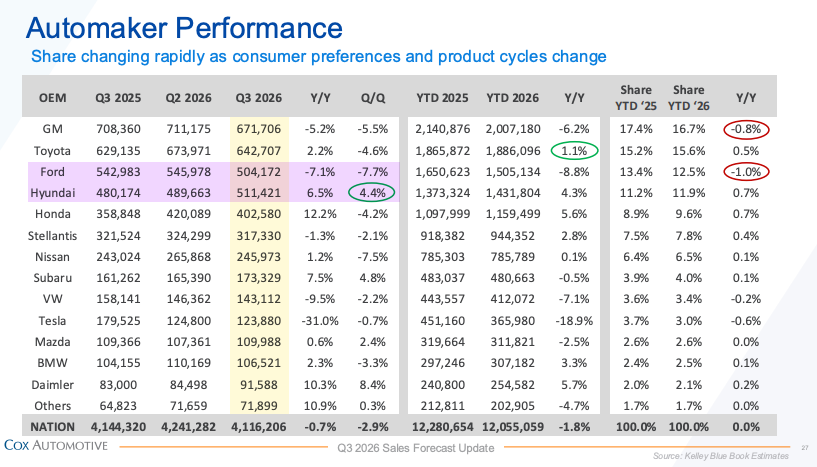
Toyota, Hyundai and Kia are benefiting from US consumers seeking competitively priced hybrid lineups. Toyota, Hyundai and Kia are benefiting from competitively priced hybrid lineups. A record one in six new vehicles sold in the US in the second quarter was a hybrid, according to the report.
“This is a moment where consumers are trying to find options that offer more fuel efficiency,” Stephanie Valdez Streaty, director of industry insights at Cox, told Bloomberg. “Hyundai and Kia are starting to have those options available and you can see they’re gaining share because of that.”
Bloomberg noted that Ford faced mounting headwinds. Fires at a key supplier plant last year constrained components to its top-selling F-Series trucks, while the phaseout of the Escape compact SUV has reduced volume.
The report showed the auto market is stable, with higher-income buyers supporting overall volumes, while cash-strapped households are rewarding automakers that offer hybrids.
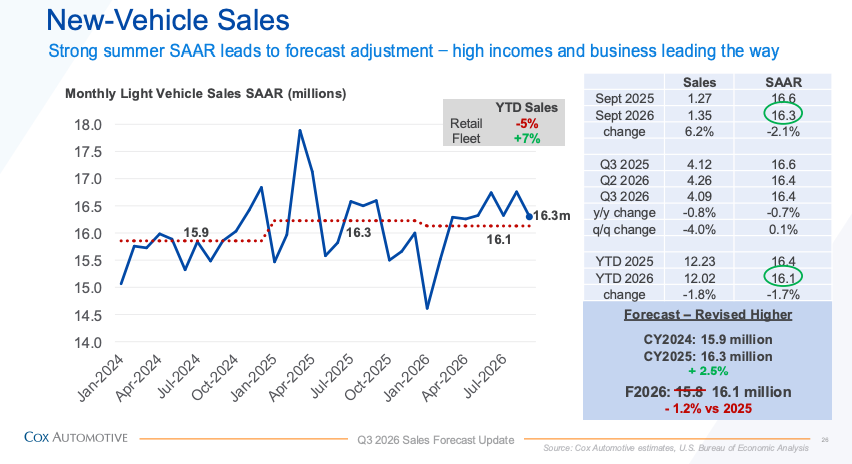
Cox Chief Economist Jeremy Robb highlighted the vehicle segments driving sales this year:
Vehicle supplies:
New-vehicle pricing at record highs:
With the national average price of regular gas at $4.48 per gallon and diesel at $6.51 late in the summer, and fuel prices elevated since early March, new EV sales have remained muted. However, used EV sales have trended higher.
Stock Performance: Ford v. Hyundai
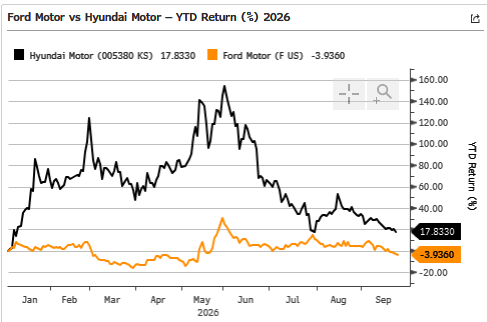
Ford should’ve focused on hybrids instead of making an idiotic mad dash into EVs. And just imagine what happens when China’s BYD floods North America with cheap EVs and hybrids…
END
JAPAN
JAPAN//USA
Yen Jumps As Japan PM Admits Weak Currency “Problematic”
Friday, Sep 25, 2026 – 09:12 AM
President Trump reportedly expressed concern over the weakness of the yen when he met Japan’s prime minister this week as the currency came under more pressure against the dollar.
The FT reports that Finance Minister Satsuki Katayama Satsuki Katayama told reporters in Tokyo that Trump and Sanae Takaichi discussed the yen in talks in New York on Tuesday.
The US president “expressed his concern” while Takaichi told Trump that she saw an undervalued yen as “problematic”, Katayama said.
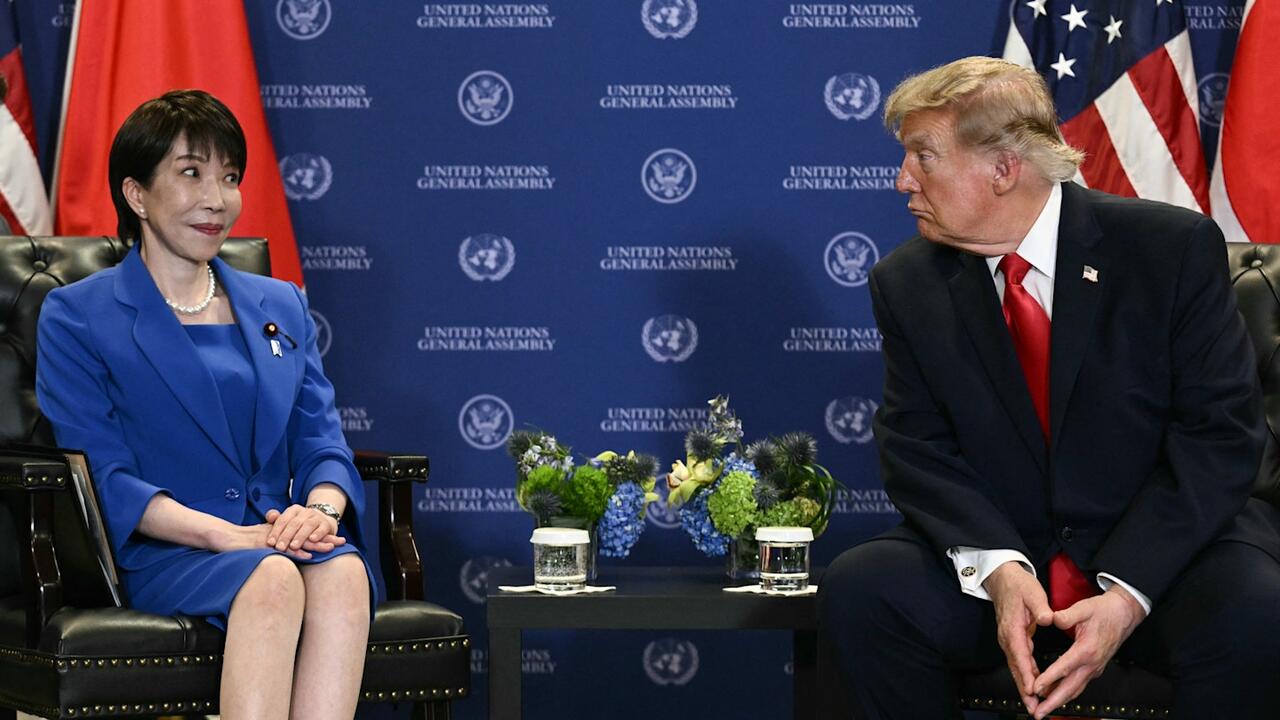
The yen jumped around 1% against the dollar following the remarks – its best day in two weeks…
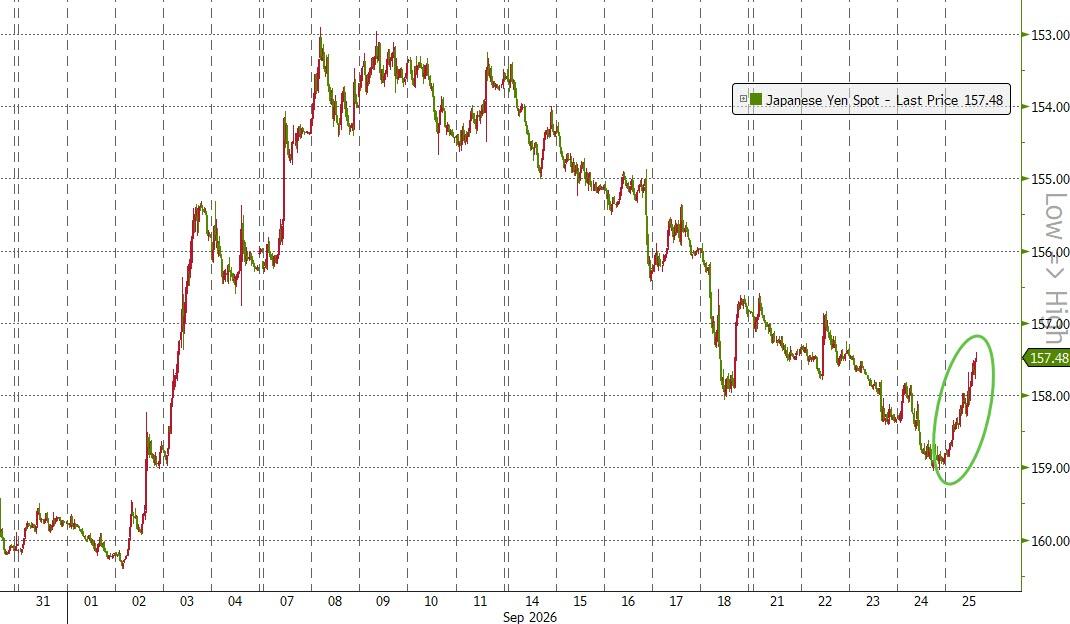
The finance minister also said she would continue to coordinate with her US counterpart Scott Bessent, reinforcing the signal that both governments are paying close attention to the currency’s depreciation.
“In light of [the Trump-Takaichi] meeting, Treasury secretary Bessent and I will continue to communicate closely on a range of matters, including foreign exchange,” Katayama added.
Last week, the BoJ raised rates to the highest level in 31 years, but the move did little to structurally strengthen the yen, even as the central bank’s governor Kazuo Ueda hinted strongly that there could be further tightening this year.
Options sentiment toward the yen turned more bullish lately, reflecting increased hedging demand against the risk of Japanese intervention.
“Intervention risk should put a ceiling on further yen weakness,” said Moh Siong Sim, a strategist at Oversea-Chinese Banking Corp.
“More importantly, the yen may be nearing a turning point as Trump’s concerns over its weakness point to deeper US-Japan coordination to support the currency.”
Japan and the US carried out their first coordinated yen-buying intervention since 1998 this summer after the currency weakened beyond 160. Japan spent a record ¥15.4 trillion ($97.4 billion) intervening in the month through Aug. 26, according to Finance Ministry data.
“This is largely another way of jawboning in my view,” said Charu Chanana, chief investment strategist at Saxo Markets.
“Unless it is followed by actual policy coordination, intervention or a clearer BOJ tightening path, I don’t think it changes the underlying yen story materially”
Bessent has also continued to signal support for a stronger yen, potentially giving Japanese warnings greater weight with traders than in previous episodes of currency weakness.
end
3. CHINA
CHINA/USA
A VERY IMPORTANT READ:
| Two Months. That Is All Xi Got. |
| By Graham Summers, MBA | Chief Market Strategist |
| The readout landed last night. Trump and Xi extended the trade truce by two months, to January 10. No tariff cuts. No firm commitments on rare earths. No chips deal. U.S. officials told reporters that Chinese rare earth deliveries are still falling short of what Beijing promised at Busan. Taiwan and Iran were discussed without resolution. Two more summits, in Shenzhen and Miami, are penciled in before year-end. Wednesday I told you a truce is a countdown. China set the timer at sixty days. |
 |
| Think about what that number means. A one-year extension would have told you Beijing was comfortable, that it believed the relationship was stable enough to put the weapon down for a while. Sixty days says the opposite. Xi wants Washington back at the table before the new Congress is seated, with the export licenses still throttled, the deliveries still short, and the deadline landing nine days into a new year. That is a man who knows his leverage is worth more when it is renewed often. And here is the part almost nobody in the coverage is saying. Washington has been playing the same game, on a bigger board, all year. Step back to January 3. U.S. forces captured Nicolás Maduro in Caracas, and within days Washington announced it would take control of Venezuelan oil sales and hold the revenue in U.S. Treasury accounts. China had been buying roughly 80% of Venezuela’s crude exports, about 400,000 barrels a day, most of it disguised as Brazilian or Malaysian cargo to get around sanctions. After January 3, those shipments stopped. Chinese cargoes were returned or diverted. Seven weeks later, the war with Iran began. Before the conflict, China was buying roughly 90% of Iran’s oil exports, which supplied about 13% of everything China imports. Between Iran and Venezuela, close to a fifth of China’s crude came from two countries that Washington has now effectively taken off the board. |
 |
| Put simply, in the same year Beijing has been using rare earths to squeeze Washington, Washington has been using oil to squeeze Beijing. Two of China’s three discounted-crude lifelines are gone. The small independent refiners that make up a quarter of China’s refining capacity were built on those discounts, and their pricing model is broken. Beijing can replace the volumes from Saudi Arabia, Iraq, and Russia. It cannot replace the price, and it cannot replace the political relationships that came with the barrels.And Washington now has a unit whose whole job is making sure this keeps happening. In April, Deputy Secretary of War Steve Feinberg, the co-founder of Cerberus Capital who left Wall Street to take the job, formally chartered the Economic Defense Unit inside the Department of War. Its mandate is to bring economic leverage into the department’s planning: identify the strategic assets and critical mineral supplies the U.S. cannot afford to source from China, and secure them, whether that means equity stakes, offtake agreements, price floors, or long-term financing. Its director reports to Feinberg as his principal advisor for economic competition. The Hill called it “the tip of the spear” of a “war cabinet for economic conflict.” Bloomberg’s August headline was blunter: “Trump Turns to Economic Warfare, With China in Crosshairs.” |
 |
| Put the EDU alongside the rest of the machinery and the year comes into focus. The Office of Strategic Capital writes 25-year loans to mines in allied countries. The Export-Import Bank finances the $10 billion Project Vault stockpile that Glencore joined this week. The Department of War takes equity in producers like MP Materials and sets price floors. Treasury holds Venezuelan oil revenue. By the Council on Foreign Relations’ count, the federal government put $10 billion into critical minerals between January 2025 and June of this year, before Vault, Greenland, or the scandium loan. Every one of those agencies is doing something it did not do five years ago, and every one of them is doing it to make sure that the next time Beijing throttles an export license, it does not matter. Venezuela and Iran fit the same picture from the other side. Neither operation was about minerals. Both removed a supplier China depended on and put the revenue or the shipping lane under American control. Whether that was the primary objective or a welcome side effect, the result is the same: Beijing lost a fifth of its discounted crude in a single quarter, and Washington gained leverage it did not have in January.This is what gray zone warfare looks like when both sides are fighting it. China does not need to fire a shot to hurt American factories; it needs an export license bureaucracy. Washington does not need to declare war on China to hurt Chinese refiners; it needs to change who runs Venezuela and who controls Hormuz. Neither side calls it a war. Both sides are fighting one, with supply chains, financing, and chokepoints as the weapons, and both now have dedicated offices running it. Now put the two-month truce in that frame. Beijing set a short clock because it wants to keep pressure on Washington. Washington accepted a short clock because it does not need a long one. Every week the truce holds is a week the U.S. keeps building: the Greenland deal, the scandium mine, the tungsten line, the stockpile, the refineries. Every week the Venezuelan and Iranian oil stays off China’s books is a week Beijing’s refiners pay more. Both sides are using the truce to reload. The difference is that Washington’s reloading is permanent. A mine, once built, does not un-build when the truce expires. An oil relationship, once severed, does not restore itself because a summit went well. So here is what I expect over the next sixty days. The pace of deals is going to pick up. Every incentive Washington has points the same way: a January 10 deadline that rewards positions taken now and punishes positions taken later, a midterm election in five weeks that rewards announcements, and a set of agencies, the Economic Defense Unit, the Office of Strategic Capital, the Export-Import Bank, that were built to move money quickly and now have a reason to. In the last ten days alone the government locked up Greenland, banned tungsten scrap exports, cleared Korean tungsten shipments, and brought the largest commodity trader on earth into a $10 billion stockpile. That is the pace with the truce expiring in November. With it expiring in January and an election in between, I expect it to accelerate: more equity stakes, more offtake agreements, more loans to mines in allied countries, more price floors, and at least one more security arrangement on the Greenland model. The companies on the receiving end of that spending are known. They are the ones with a loan, a permit, or a customer already in hand, because the government does not have time to build from scratch in sixty days. It funds what is ready. |
 |
| That is the reading that matters for your money. January 10 is now the next risk event for every stock in the critical minerals space. The speculative names that doubled last week on Greenland have a shorter runway before the next scare. The funded producers have two months of calm to pour concrete, a deadline that makes their supply more valuable the closer it gets, and a government I expect to be writing checks the entire time. The energy exporters inside safe borders have a China that needs replacement barrels and a Gulf that cannot reliably provide them. And the companies the Economic Defense Unit and its sister agencies are funding have a government that just told the world, by accepting a sixty-day truce without blinking, that it is not in a hurry to settle. Xi came to Washington holding the only card that matters. Washington let him keep it for sixty more days, because it is busy building a deck of its own. Which brings me to what I actually do. I am not a stock picker who reads the headlines and reacts. I am a macro and geopolitical strategist. I approach markets as a macro and geopolitical strategist. As a Macroeconomics Fellow at the Homeland Defense Institute, I spend a good part of my time engaging with policymakers in Washington on critical minerals and national security, and I have spent more than twenty years studying how governments behave when they decide a supply chain is a matter of national survival. That perspective shapes how I read developments like Greenland, Project Vault, and this week’s summit: as signals about where policy capital is headed next, and where investors should be paying attention. That is the difference. Most newsletters tell you what happened yesterday. Private Wealth Advisory tells you what Washington and Beijing are going to do next, and puts you in the trades before the market figures it out. A 75% win rate. Twice the return of the S&P 500 since 2020. Through a pandemic, a rate shock, an AI mania, and now a war in the Gulf and a chokehold in Beijing. You can see what my private clients see for $2.99.That gets you a 30-day trial of Private Wealth Advisory: four weeks of market updates, multiple investment recommendations, including the critical mineral producer the Department of War funded, up more than 26% since we added it a month ago, and a copy of my bestselling book The Everything Bubble. Sixty days on the clock. A government about to spend its way through them. My clients already own what it is buying. You have thirty days to catch up for a dollar a day. Today is the last day this offer is available to the public. |
END
CHINA/USA
“More Signaling, Less Substance”: Barclays Pours Cold Water On Trump-Xi Summit
Friday, Sep 25, 2026 – 06:55 AM
President Donald Trump hosted Chinese President Xi Jinping for a White House state dinner late Thursday, calling for closer ties while offering limited details on progress in addressing trade and geopolitical disputes. This was Xi’s first White House visit in over a decade.
On Friday morning, Trump issued a fresh Truth Social post related to the evening with Xi, but fixated on his term “Super Intelligence”. Apparently Trump wants this to be his legacy in connection with the early history of AI…
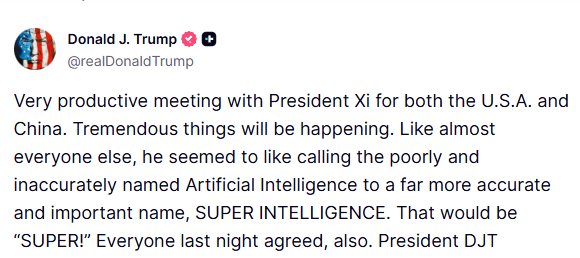
Trump last night praised Xi and his wife as “truly outstanding, amazing people” and said the two superpowers should “continue to build a relationship that promotes prosperity and security.”
Xi called for a relationship defined by “strategic stability” and urged both sides to “act as responsible major countries.”
Behind the scenes:
Earlier on Thursday, the two leaders held bilateral talks in the Oval Office. Trump described the discussions as a “great meeting” but did not elaborate on what was said. Xi told dinner guests that the two leaders had “reached common understanding on many issues,” without providing further details.
Barclays senior China economist Yingke Zhou provided clients with his first take on the Trump-Xi state visit and said it was “more signaling, less substance.”
“The Trump-Xi summit was primarily about stabilizing relations rather than resolving disputes. Beyond a short trade-truce extension, progress was limited. The absence of Chinese CEOs suggests China viewed the summit as a strategic dialogue, not a deal-making exercise,” Zhou said.
Zhou added more color:
What was the key message?
The Trump-Xi summit’s main achievement was symbolic rather than substantive. The two sides projected a constructive tone and a willingness to keep talking, but delivered little concrete progress on the core issues, including trade, AI and geopolitics. We think the summit was primarily about stabilizing the relationship, rather than resolving core disputes.
Speaking at the arrival ceremony at the White House, President Xi repeatedly emphasized building a “constructive China-US relationship of strategic stability.” Overall, we think President Xi’s speech was less about concessions and more about signaling predictability, stability, and openness to continued economic engagement, despite the competition in technology, trade, and geopolitics.
For comparison, President Trump repeatedly emphasized his personal relationship with Xi and the value of engagement. The summit’s key message, we think, is that both sides want to lower escalation risks and maintain dialogue, even as strategic competition remains firmly intact.
What was the most concrete deliverable?
The main deliverable was a two-month extension of the existing trade truce to 10 January 2027, removing an immediate source of policy uncertainty. However, the extension was shorter than the 3-6 month rollover many market participants had expected, and shorter than indications from Jamieson Greer ahead of the Trump-Xi meeting.
For context, China continues to face the highest effective US tariff rates among major trading partners, with an effective tariff rate of roughly 23%, compared with an average US effective tariff rate of around 7% for the rest of the world. The lack of progress on tariff reductions suggests that both sides are prioritizing stability and continued dialogue rather than pursuing a meaningful trade reset.
Board of Trade: Ahead of the summit, reports¹ suggested the US and China were considering reciprocal tariff cuts on around USD30bn of goods under the proposed Board of Trade framework. USTR said on 21 September that establishing a stable ‘Board of Trade’ is a key goal for the summit, with aims to secure a stable subset of goods, including agricultural and medical products, away from active trade disputes. So far, few concrete announcements have emerged. We await the details post the summit.
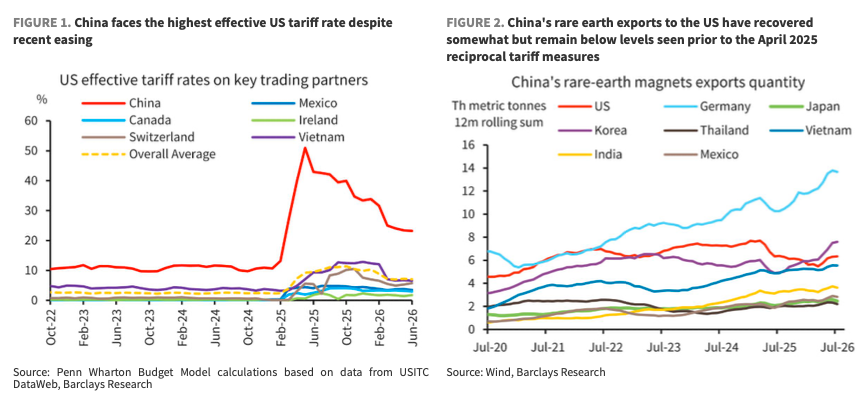
What the delegations tell us?
The summit delivered few concrete policy outcomes, but the composition of the delegations sent an important signal. The US side prominently featured leaders from AI and semiconductors (e.g. Nvidia, AMD, OpenAI, Google, Microsoft, Amazon, Meta), other technology (Apple, Tesla, and Dell), and finance (Citi, JPM, Blackstone, GS, and Mastercard), underscoring that technology, capital, and investment ties remain at the center of the US-China relationship.
In contrast, President Xi’s delegation consisted almost entirely of senior government officials and policymakers, including economic, trade, and foreign-affairs officials. No major Chinese entrepreneurs, technology leaders, or corporate executives were part of the official delegation. In our view, the absence of Chinese CEOs suggests China wanted to frame the summit primarily as a state-to-state diplomatic engagement, rather than a platform for commercial deal-making.
What are the key takeaways on geopolitics?
The summit built guardrails, not solutions. On geopolitics, the focus was on managing risks rather than resolving disputes.
On Taiwan, Chinese state media reported² that President Xi urged the US to “adhere to the correct position of opposing Taiwan independence,” underscoring that Taiwan remains Beijing’s foremost geopolitical red line and the most sensitive issue in US-China relations.
On Iran, President Xi expressed support for the US and Iran returning to the June memorandum of understanding aimed at ending the conflict and reopening the Strait of Hormuz³. More broadly, China appears relatively insulated from the energy shock. Kepler data suggest that China’s crude oil inventories have declined by less than 5% since the Middle East conflict began. At the current pace of drawdown, China has ample energy buffers and could sustain supply disruptions for at least 10 years.
The Trump-Xi meeting comes amid uncertainty over two conflicts raging across Eurasia, from Russia-Ukraine to the Gulf conflict, alongside intensifying resource nationalism and competition for technological leadership. The world is on an uncertain glide path into 2027 amid a global refining crisis.
end
CHINA/USA
Xi Presses Trump For Taiwan Policy Shift As $14 Billion Weapons Deal Hangs In Limbo
Friday, Sep 25, 2026 – 08:20 AM
Following our earlier coverage of Barclays senior China economist Yingke Zhou’s view that Chinese leader Xi Jinping’s state visit delivered “more signaling, less substance,” attention turns to Taiwan, where Xi pressed President Donald Trump to oppose Taiwan independence.
According to China’s official Xinhua News Agency, Xi urged Trump to “adhere to the correct position of opposing Taiwan independence.” The conversation took place at Thursday’s White House summit.
For years, Washington has held the stance that it “doesn’t support” the independence of Taiwan, the island Xi and his Communist Party claim as their own.
“While this may appear a semantic shift, the impact would be meaningful,” said Bloomberg Economics’ Jennifer Welch, who served as director for China and Taiwan on the National Security Council under the previous Biden and Trump administrations.
Welch pointed out that Beijing would use any switch in language from Trump to undermine Taiwan’s confidence in US support. She added, “Opposing Taiwan independence implies an active effort to contain what Beijing sees as pro-independence forces.”
This push by Xi to Trump comes as he heads toward an expected fourth term in office next year; he’s ramping up diplomatic pressure to isolate the island, home to the world’s most advanced semiconductor production, and block future weapons sales by the Trump administration.
For many months, Trump has delayed the $14 billion weapons package for Taiwan, which may come in the weeks or months ahead now that Xi’s state dinner at the White House is over. It appears that Taipei is seeing its defense needs becoming leverage in the US-China trade spat.
In a preview of what next year might hold, China deployed a record 244 coast guard, research, and other government vessels around Taiwan this summer in what could only be viewed as a dry run for a blockade.
Beijing has warned that mishandling the Taiwan issue could lead to “clashes” between the superpowers – certainly a flashpoint.
“The key acid test will be what Trump says on Taiwan,” said Ryan Hass, director of the China Center at the Brookings Institution, who Bloomberg quoted. “Not just what Xi urges Trump to endorse.”
Meanwhile, Reuters cited Taiwan’s foreign ministry as saying that Xi’s remarks represent “the consistent Chinese approach of distorting facts and unilaterally conveying its position and claims.”
“Taiwan’s sovereignty belongs to all the people of Taiwan. The Chinese Communist Party has no right to represent the Taiwanese people, and Taiwan’s future can only be determined by the Taiwanese people through democratic means,” the ministry added.
There were no immediate signals that the Trump administration would agree to Xi’s request, a shift in wording that could carry significant implications for Washington’s stance on Taiwan.
Jeremy Chan, senior analyst on China for the US-based political risk consultancy Eurasia Group, told Reuters, “It would erode a lot of the…strategic ambiguity of whether the US would come to Taiwan’s aid in that context.”
END
CHINA/USA
HUDSON INSTITUE:
LU/YU
Expert Urges US to Prepare for Sudden Collapse of Communist Regime in China
Readying for the CCP’s fall is an insurance against the ‘most consequential political contingency of the 21st century,’ China expert Miles Yu said.

Security stand at the entrance way before the closing session of the Chinese People’s Political Consultative Conference at the Great Hall of the People in Beijing on March 11, 2026 Kevin Frayer/Getty Images
9/20/2026|Updated: 9/23/2026
Policymakers in Washington have devoted enormous effort to confronting threats posed by China, but what if the communist regime were to suddenly collapse?
That’s a question raised by Miles Yu, director of the China Center at the Hudson Institute, in a recent op-ed in The Washington Times.
“The greatest strategic challenge posed by China may not be what happens if the Chinese Communist Party [CCP] succeeds, but what happens if it suddenly fails,” he wrote in the column published on Sept. 14.
Yu did not predict an imminent collapse or give any timeline for regime change. Instead, he highlighted that such scenario planning rarely appears in public discussion among Western policymakers.
“That is a dangerous failure of imagination,” Yu wrote.
Pointing to a series of collapsing regimes across Eastern Europe in 1989 and the fall of the Soviet Union two years later, Yu said dictatorships may appear to be “seemingly permanent” until the moment they disappear.
Related Stories

Jimmy Lai’s Son Pleads for Ailing Father’s Release Ahead of Xi’s US Visit

China Ousts 4 Senior Military Commanders in Widening Purges
“The CCP may survive for decades, or it may collapse with the breathtaking speed of the communist regimes of 1989,” wrote Yu, an adviser to then-U.S. Secretary of State Mike Pompeo during President Donald Trump’s first term. “We cannot know when, but history gives us no excuse for being surprised twice.”
The communist regime controls the world’s largest military by personnel, a vast security and intelligence apparatus, advanced biological labs, and nuclear weapons. Chinese state-owned enterprises are embedded in global supply chains. Decades of repressive rules, from religious persecution to forced labor, mean that numerous issues would need to be addressed if the CCP were to fall suddenly, according to Yu.
The sudden collapse of the CCP could trigger military, financial, humanitarian, political, and proliferation crises, he argued, urging Washington to establish an interagency mechanism to coordinate plans for a post-CCP contingency.
“Readying for China after communism is not a regime-change policy. It is insurance against the most consequential political contingency of the 21st century,” he wrote.
‘Endgame’
Analysts said the potential for a surprise collapse of the CCP is worth taking seriously.
“There are many reasons why people argue that the regime could collapse at any time. One is that it lacks legitimacy—it no longer has ordinary people’s faith or trust,” Feng Chongyi, an associate professor at the University of Technology Sydney, told The Epoch Times.
“The regime is in a precarious situation. You might say it’s already entered its ‘endgame,’ or as Chinese people call it, ‘garbage time.’”
The long-running property crisis, which has eroded millions of families’ lifelong savings, shows no sign of ending. Amid weak demand and fierce competition, the authorities’ grip has further squeezed small and medium-sized firms’ profits, leading to a wave of job cuts and bankruptcies. The latest official data show that nearly one in five young Chinese are unemployed.
“No one knows whether there will be an incident that triggers a large-scale, nationwide uprising,” Feng said.
“[If that happens,] the authorities might deploy the military to suppress it. If the military refuses to follow orders, that could cause a split within the ruling elite, which possibly leads to the overthrow of the regime.”

A man waits to cross a road during a high-pollution day in Beijing on Sept. 17, 2026. Greg Baker/AFP via Getty Images
In Beijing, the ongoing purges have swept through the top ranks of officials at a scale and speed unseen since Mao Zedong. Three top officials have effectively been expelled from the Politburo, the second-most powerful body of the CCP.
Within the military, dozens of generals have been disgraced over the past three years. In the Central Military Commission, the military’s top decision-making body, five of six members have been purged. Only two men remain on the body: Chinese leader Xi Jinping and a general who enforces the political cleansing.
“At the very least, the repeated purges illustrate that Xi Jinping doesn’t feel he can trust the people around him,” Feng said. “The power struggle and mutual suspicion within the leadership could also spiral into unexpected internal conflict, ultimately resulting in Xi being removed.
“All the dry tinder is already lying around. Nobody knows what will be the last straw that breaks the camel’s back.”
‘Power Vacuum’
Xi has centralized power over his 13-year rule. At 73, Xi shows little sign of stepping down. He already cleared the way for indefinite rule by scrapping the two-term limit on the state’s chairman from the constitution in 2018.
“Suppose that one day something happened to Xi—whether because his health failed or some other reason—and he could no longer issue orders, who would exactly be in charge of the Party?” said Sheng Xue, a Toronto-based writer and commentator who has observed China for more than two decades.

Military delegates arrive for the fourth plenary session of the National People’s Congress at the Great Hall of the People in Beijing on March 11, 2023. Greg Baker/POOL via Getty Images
Technically, the regime has certain procedures for such a scenario, but “Xi has essentially replaced those institutions with his own personal style of rule,” Sheng told The Epoch Times.
Even if the rules help identify who should assume responsibility, that does not mean that the officials have effective authority or influence within the Party, according to Sheng.
“At that point, the Party would have no central figure, while the military would also lack a clear supreme commander. That would amount to a dual power vacuum,” Sheng said.
Under Xi, the CCP has shifted toward an “extreme authoritarian and totalitarian model,” Sheng said.
“If the Party were to collapse suddenly, that could lead to a very chaotic situation. That’s why I believe the United States should have a roadmap for such a scenario,” Sheng said.
Nuclear Warheads
The “biggest risks” in the sudden dissolution of the CCP’s central authorities would be the loss of control over weapons of mass destruction, said Shen Ming-shih, a Chinese military expert at the Institute for National Defense and Security Research, a Taiwan-based think tank.
The People’s Liberation Army has more than 600 nuclear warheads as of mid-2024, a number expected to rise to 1,000 by 2030, according to the latest Pentagon assessment.
“Who would be responsible for these warheads if any unrest erupts during the transition into the post-CCP period?” Shen asked.

The new YJ 21 hypersonic anti-ship missile is seen on trucks during a military parade marking the 80th anniversary of victory over Japan and the end of World War II, in Tiananmen Square in Beijing on Sept. 3 Kevin Frayer/Getty Images
“If, at the time, the country descended into civil war and different military or political factions gain control of those nuclear weapons, there would be a greater risk that the internal power struggle escalates into a nuclear conflict.”
While China’s political future should be decided by its people, preparation is necessary for the international community, he cautioned.
“The United States and its allies, as well as China’s neighboring countries, need a contingency plan,” Shen said.
The primary objective is to prevent nuclear weapons and sensitive technology from ending up in the wrong hands, be it the global black market network or even extremist groups elsewhere, Shen told The Epoch Times.
Henry Gao, a law professor at Singapore Management University, called on the United States and its allies to develop a clear roadmap.
“Prepare to integrate a democratic, peaceful, and prosperous China, or risk facing another Russia—or worse, several Russias,” he wrote on X on Sept. 16.
Gordon Chang, China commentator and author of “Plan Red: China’s Project to Destroy America,” echoed the message on social media.
“China’s regime is fragile. Let’s not rescue Chinese communism—for a fourth time,” he said.
Luo Ya contributed to this report.
end
4. EUROPEAN AND SCANDINAVIAN COMMENTARIES PLUS NATO
EUROPE/
UK
GERMANY
Merz Govt May Use Radical ‘Federal Coercion’ If AfD Party Controls Germany’s Saxony-Anhalt Region
Friday, Sep 25, 2026 – 02:00 AM
The anti-immigration Alternative for Germany (AfD) won the Saxony-Anhalt state election by a wide margin but fell short of an absolute majority. Nevertheless, the party may still come to power if it can garner enough support from BSW or peel off a few MPs from rival parties.
This possibility has thrust an unused and radical clause of the German constitution, federal coercion or “Bundeszwang,” to the center of a fight over how far Berlin can go if the right-wing party takes power.
The AfD took 43.8 percent of the vote in the Sept. 6 election, but the AfD remains three seats short of an absolute majority. However, Ulrich Siegmund, the AfD’s 35-year-old lead candidate, could still become minister-president. The German government has plenty of tools for dealing with Siegmund if he steps out of line.
Germany’s establishment threatens to use “federal coercion” clause
Federal coercion is one of the most radical mechanisms in the German constitution. Article 37 allows the federal government or a representative it appoints to issue binding orders to the states and their agencies. The Federal Republic of Germany has never resorted to this clause before.
Anna-Bettina Kaiser, a law professor at Humboldt University in Berlin, told Deutsche Welle the bar is extremely high.
“The term ‘dramatic’ is most apt here. This is why federal coercion has never been introduced in the history of the Federal Republic – it is treated as a last resort,” she told Deutsche Welle, a state outlet that receives approximately €415 million a year in taxpayer money.
Until now, fights between Berlin and the states have been settled mainly in court.
“It is usually assumed that in the event of a specific legal dispute, the case will go to the Federal Constitutional Court and the given state will comply with the judgment issued by that body,” Kaiser said.
Deutsche Welle reported that an extreme use of Article 37 could include naming a federal representative with power to issue binding orders in specific areas.
“Article 37 actually provides for the appointment of such a representative who has the power to issue binding orders,” Kaiser said.
Any step would have to match the violation and meet constitutional tests. However, Article 37 lists no catalog of penalties. It speaks only of “necessary measures,” leaving the article vague and open to interpretation.
Bundesrat consent would be essential. Under the chamber’s rules, the affected state keeps its vote on Article 37 decisions.
Union parliamentary leader Thorsten Frei has since called Article 37 an option of last resort if an AfD state government acted against the constitution. Social Democratic floor manager Dirk Wiese said it was “good to know” the Basic Law allows constitutional conduct to be compelled by instruction if an “AfD-BSW Putin coalition” installed a far-right politician as premier. The Greens and the Left have not ruled the tool out.
Saxony-Anhalt’s Office for the Protection of the Constitution classifies the state AfD as “confirmed right-wing extremist.”
Cutting funding to an AfD government
On top of the constitutional power that Article 37 offers, the tried-and-tested method of cutting funding is also being discussed and it is not even clear yet if the AfD will be able to assume power in the state.
German officials have also discussed suspending some federal budget transfers to Saxony-Anhalt, which is still dependent on such transfers to prop up its economy. Tagesschau reported that structural funds could be frozen if an AfD government breached EU fundamental rights or rule-of-law conditions.
However, beyond these federal transfers, powerful German Green MEP Daniel Freund said after the vote that the European Commission should, if necessary, withhold money if an AfD-led state government acted against EU principles.
Freund was a notorious foe of Hungarian Prime Minister Viktor Orbán and a longtime advocate of the EU cutting funding to Hungary while his government remained in power. Freund not only succeeded in lobbying the EU to cut funding but this tool is generally seen as one of the primary contributing factors in toppling Orbán from power.
The reality is that this method of cutting or freezing funds has worked remarkably well for the EU, also in the case of Poland’s previous conservative government. When funding is cut, the population suffers, and when they suffer, they punish politicians at the voting booth. Orbán could point the finger all he wanted at Brussels. It did him no good in the end.
If the EU or the German federal government cuts funding, Saxony-Anhalt will suffer, and there is nothing an AfD government can do about it.
For now, it appears for the EU establishment has a virtually fool-proof method for dealing with any voter rebellions or unfavorable democratic results.
A CDU-led federal government also has every incentive to make an example out of a regional AfD-led government. Shortly after the Saxony-Anhalt election, Chancellor Friedrich Merz said Berlin would act if Saxony-Anhalt crossed lines set by the constitutional order.
“If boundaries are crossed there, I assure you that from the federal government’s point of view we will do everything to correct it. The Basic Law also applies in Saxony-Anhalt,” Merz said.
Merz pointed to migration and foreign policy. He also cited the unwritten duty of “federal loyalty.” A state must act loyally towards the standards of the federal state. That covers “the entire immigration and foreigners policy,” he said.
Fact-checkers later noted that Merz did not use the word “federal coercion,” or “Bundeszwang.” Nevertheless, the debate that followed is freely using the term and how it can be applied against the AfD.
The AfD casts itself as a “rule-of-law party”
However, simply winning an election would not, by itself, justify federal coercion. Article 37 of the Basic Law allows the tool only if a state fails to fulfill duties imposed by the constitution or other federal law. The federal government may then, with the consent of the Bundesrat, take the measures needed to compel those duties.
The AfD’s answer has been that it would govern inside the law, and that Berlin is trying to cancel a democratic result.
The morning after the vote, Siegmund again called the AfD a “rule-of-law party,” and said he would act lawfully. He later thanked the Berlin press sarcastically for portraying him as a threat to democracy and said he wanted to “extend a hand” to every actor in the legislature.
AfD co-leader Alice Weidel called the result a mandate to govern, said Merz was the most unpopular chancellor Germany has had and told him his time was up. In the Bundestag she argued that the CDU-SPD coalition had failed. Merz accused her of pushing Siegmund into “electoral fraud” by urging him to hunt for a majority after he had promised to take office only with an absolute majority.
The issue of mass immigration, in the end, always appears to be the real point of contention. According to the European and German establishment, it must continue at all costs. In a 2024 ARD summer interview, co-leader Tino Chrupalla said an AfD-led state would no longer apply the “Königstein key,” which apportions asylum seekers among the states.
“We would no longer go along with that,” he said at the time.
Siegmund has promised “deportations from minute one” and a remigration offensive.
However, a federal government that wants to prove the AfD weak and ineffective is unlikely to allow such a remigration offensive to move forward. There are plenty of tools at its disposal to stymie the AfD and even sabotage its government. Siegmund may be facing a wave of funding cuts, litigation, and ultimately the federal government stepping in and essentially seizing power if he manages to gain power in the state.
END
FRANCE
the bozo Macron;
France Sending Soldiers To Saudi, Stating “Not Getting Involved In Any Conflict”
Friday, Sep 25, 2026 – 03:30 AM
Authored by Mike Shedlock via MishTalk,
Check out this Orwellian statement by French President Emmanuel Macron.
France to Deploy Forces to Saudi Arabia Red
The Wall Street Journal reports France to Deploy Forces to Protect Saudi Red Sea Oil Port
“We are going to send military assets, that is, soldiers, radar systems, and defense systems to protect this site,” Macron said in a TV interview on Thursday. However, he stressed that France was “not getting involved in any conflict,” adding that the decision had been finalized with Saudi authorities.
We need to pause her for a second and reflect on how and why sending soldiers to Saudi is “not getting involved in any conflict.”
In the absence of sending troops one might have a poor claim. But this is insane.
What happens if someone is killed while not getting involved?
Asked whether France could deploy Rafale jet fighters to help protect the site, Macron said it would depend on how the situation evolves, adding that some planes were already in the region.
Stretching 750 miles across Saudi Arabia from the kingdom’s oil-producing heartland on the Persian Gulf to the Red Sea port of Yanbu, the East-West pipeline has become a vital wartime artery, allowing Saudi crude to reach global markets without passing through the Strait of Hormuz. It was built in the early 1980s, when the Iran-Iraq War threatened shipping in the Persian Gulf.
The pipeline can carry up to 7 million barrels a day – about 2 million for domestic Saudi refiners and the rest for export – but had never operated at full capacity for an extended period before the war.
Saudi Arabia said the pipeline was hit in multiple attacks in the Riyadh and Medina regions on Sept. 10, which caused injuries. It said the drones were fired from Iraq, where authorities have struggled to control Iran-backed militias that have repeatedly targeted Saudi infrastructure.
Two Things This Tells Us
- Macron is desperate
- France is woefully short of diesel
Average EU Diesel Price Hits Record 2.23 Euros a Litre
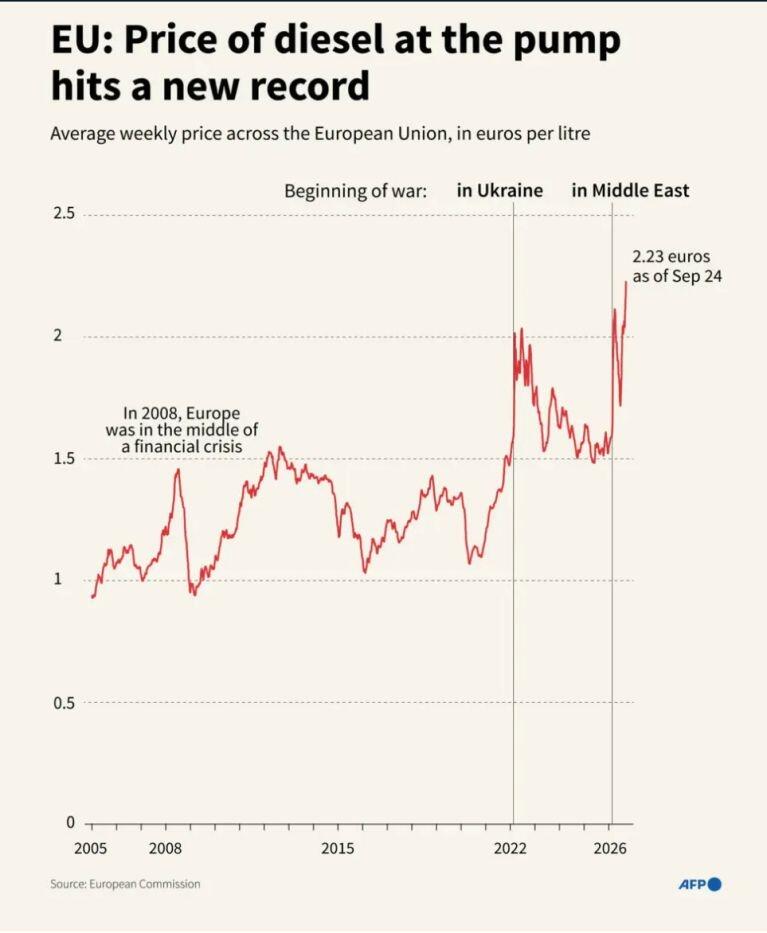
France24 reports Average EU Diesel Price Hits Record 2.23 Euros a Litre
Diesel prices at pumps across the European Union have hit a new high of 2.23 euros per litre, up from 2.16 euros the previous week, an AFP analysis of European Commission data published Thursday showed.
The fresh peak – equivalent to $9.63 per US gallon – comes as the wars in the Middle East and Ukraine have choked off crude supplies and damaged refineries, causing energy prices to surge worldwide.
Nineteen EU countries including Germany, France and Italy have registered record average prices, according to weekly data going back to 2005.
Among the countries setting new records, Denmark and Finland have reported the highest prices, at 2.56 euros per litre of diesel, followed by Germany at 2.46 euros.
Prices in Belgium and France are both close to 2.40 euros and are nearly 2.30 euros in Italy.
The Domestic Fallout in France
The severe price shock – supercharged by the ongoing wars disrupting global refining capacity and Middle East supplies – is creating immediate political and economic problems for Macron’s government:
- Subsidies and Empty Coffers: To head off potential street protests, the French government just doubled its targeted fuel relief package to €450 million, offering €100 payouts to low-income, high-mileage commuters. This brings total emergency energy relief spending to €1.4 billion, severely blowing out France’s budget deficit.
- Supply Shortages & Protests: Roughly 16% of French petrol stations are currently reporting shortages of at least one fuel type. Angry fishermen have already resorted to blocking oil depots and Mediterranean ports to protest the devastating impact of fuel costs on their livelihoods.
This domestic crisis is precisely why Macron is using the “infrastructure security detail” narrative to justify deployment to the Yanbu port.
Macron is attempting to spin a military deployment as a direct kitchen-table defense against the energy shock hitting French drivers.
Three Things Macron Did Not Do
- Blame Biden
- Blame Obama
- Blame Trump
Only one of those makes any sense. And that’s door #3 of course.
But that’s OK because nothing can possibly go wrong. Trump says peace talks with Iran are back on.
Seems like there is just one obstacle. So, how desperate is Trump?
END
RUSSIA AND ISRAEL AND MIDDLE EASTERN AFFIARS
ISRAEL/USA VS IRAN/FRIDAY
Iran Proposes 7-Day Roadmap To End War Which Mimics June MoU
Friday, Sep 25, 2026 – 08:35 AM
Iranian Foreign Minister Abbas Aragchi has newly proposed to the US side a seven-day roadmap aimed at ending the war, while the top Iranian delegation is still in New York City engaged in deep diplomacy on the sidelines of the UN General Assembly.
Aragchi is said to be planning to stay through the weekend while waiting on a US response to the plan. So far it seems Tehran hasn’t backed down from its core conditions, and its roadmap proposal is said to closely parallel the 14-point Memorandum of Understanding that was signed by President Trump back in June, but which has since completely collapsed. The plan is new but is still being largely seen as just repackaged.
“Araghchi stressed that Iran was ready to begin putting the plan into effect as soon as Washington agreed to it,” Al Jazeera reports.
Interestingly, also last night Iranian President Masoud Pezeshkian told journalists, “We don’t want it to get to the midterm elections.” He added: “We wish Americans to return to the MoU before the midterms.” Here’s where things stand in terms of Iran’s position being represented in New York:
- Iran’s Foreign Minister Araghchi said the Strait of Hormuz can reopen if certain conditions are met by the US and that it would be better to implement before the Midterms, according to a Sky reporter.
- IRGC spokesperson warned in the event of another attack, Iran’s method of defence will change including geography of the confrontation, the type of equipment and weapons used, and targets in defensive operations in line with new conditions.
This contradicted Trump’s words given to the UN General Assembly during his speech. He said “They’re waiting to see how I do in the midterm election.”
White House spokesperson Anna Kelly had in follow-up to Trump’s address said, “The President is courageously ensuring that such an evil country never possesses a nuclear weapon, which will make the entire world safer and more stable.”
Iran has said it will not be ‘bullied’ – but Pezeshkian appears to be offering something on the nuclear front alongside this seven-day roadmap overture, or at least according to a future timeline assuming a ceasefire is agreed to.
He explained in a Fox interview that in accord the framework of international law, Iran could give eventually up highly enriched uranium. But he was also fundamentally using the moment to highlight who is not a signatory to the Nuclear Nonproliferation Treaty – Israel.
Pezeshkian further said it was up to the United States to choose when the war would end. “It’s America that must choose whether it wants to end this or not,“ Pezeshkian said in response to a question by Fox’s Bret Baier.
Tehran has meanwhile said it is ready to escalate, and even spread the war beyond the Persian Gulf region, into the Indian Ocean for example (where the UK-US have the Diego Garcia base).
Further UNGA Highlights
Recap of some of the highlights from the UN this week, via Middle East Eye:
- The US-Israeli war on Iran and the Israel-Palestine conflict continued to occupy prime positions on the fourth day of the UN General Assembly. Somali President Mohamed Hassan Sheikh Mohamud said his country was “suffering” as a result of the US-Israeli war, which has driven up the price of energy and food. Meanwhile, European Union Council president said the EU supports efforts to “find a solution to the conflict”. He added that “freedom of navigation in the Strait of Hormuz must be preserved without conditions and without hindrance”.
- Crown Prince of Kuwait Sabah Al Khaled condemned the “illegal Iranian aggression” in his address to the UN Security Council on Thursday. Kuwait was one of the Gulf states hardest hit by Iran in retaliation for the US-Israeli war on the Islamic Republic. Kuwait is home to tens of thousands of US troops and military bases. US facilities in Kuwait were attacked along with civilian sites like Kuwait airport and energy infrastructure.
- Israeli Prime Minister Benjamin Netanyahu gave a pugnacious speech at the United Nations General Assembly, attacking everyone from New York City Mayor Zohran Mamdani to Turkish President Recep Tayyip Erdogan and the leaders of Western Europe, as he tried to counter Israel’s growing international isolation.
- Meanwhile, hundreds of protesters took up positions around the UN headquarters before Netanyahu’s arrival and continued protesting while he spoke inside. Support for Palestinian statehood and disappointment over the ongoing attacks on Gaza were repeatedly brought up during the event.
- Vice President of Yemen Abdullah Abdulkader al-Alimi-Bawzer condemned the Houthis in his address to the UN General Assembly and tried to rally the global community to help fight the group. He said the government of Yemen had supported a peace initiative backed by the governments of Saudi Arabia and Oman, while the Houthis rejected it and “instead escalated their actions in the Red Sea and Bab el-Mandeb to serve an Iranian agenda”.
Overnight Developments Recap
via Newsquawk
- Iran Foreign Minister Araghchi said Iran presented a proposal to US through mediators this week to reopen the Strait of Hormuz and restart negotiations towards a final deal, while it called for US to meet certain conditions within 7 days, according to CNN.
- Iranian President Pezeshkian said in Fox News interview that Iran does not want a nuclear bomb. They reached an agreement with the US President that was signed, and are still ready to move forward based on the same principles, adds it wasn’t Iran that closed the Strait of Hormuz and it was open. They didn’t seek war and that it was imposed on them, while they don’t seek war but will defend themselves. They didn’t start the war but will respond decisively.
- Iranian President Pezeshkian said Iran is ready for an agreement with the US and makes demands only within the framework of international law and could give up highly enriched uranium if it reaches an agreement with the US, according to TASS.
- Iran’s President Pezeshkian said Tehran wants to revive its ceasefire memorandum of understanding with the US before the November midterm elections, saying Iran does not want talks delayed until after the vote. said:. Iran is open to inspections of its nuclear facilities and denies that Tehran is seeking to assassinate President Trump or his family.
- Iran’s Foreign Minister Araghchi said the Strait of Hormuz can reopen if certain conditions are met by the US and that it would be better to implement before the Midterms, according to a Sky reporter.
- IRGC spokesperson warned in the event of another attack, Iran’s method of defence will change including geography of the confrontation, the type of equipment and weapons used, and targets in defensive operations in line with new conditions.
- Iranian Brigadier General Sheikh said “we seek to expand our capabilities and reconsider our tactics and technologies”, via Al Mayadeen.
- Sources say a return to the June 18 memorandum of understanding between Iran and the US is no longer sought by either side, with both seeking amendments to some clauses, further complicating negotiations, Al-Akhbar reported.
- Pakistan’s Defence Minister said intensive efforts are underway to establish a mechanism for ending the conflict as quickly as possible and reopening the Strait of Hormuz, according to Tasnim.
END
Iran State Media Denies Technical Talks With US Are Happening
Friday, Sep 25, 2026 – 02:40 PM
Summary
- Tehran denes reports of ‘technical talks’ after it proposed 7-day roadmap to end the war and (eventually) restart nuclear talks.
- Hormuz reopening discussed in exchange for US concessions in NY, including lifting the blockade.
- Tehran seeks sanctions relief, declares will hold to conditions, including restored oil exports and access to frozen funds.
- US-Iran talks reportedly show progress, with Qatar helping bridge differences.
- Escalation risk remains: Iran threatens a broader response – to ‘spread war to Indian Ocean’ if attacked again.
The Friday Afternoon Denial
Via state media Fars:
Axios and Al Jazeera’s claim about Iran-US talks denied, reports Fars; News regarding another round of talks is false, and claims technical experts from Iran were sent to NY to join the talks, is untrue
This was either the result of more premature or false Axios reporting, or else there’s a possible in strategy between IRGC vs. presidential delegation in New York.
‘Technical Talks’
Are we back to headline ping-pong pushing down oil prices?
Latest: Iran-US negotiations in New York have moved beyond initial diplomatic contacts into a more detailed technical phase, with sources in Tehran describing the atmosphere as increasingly positive, CBS reports, citing Al Jazeera.
And an official Iranian caution, or possibly even brush off, in reaction… Tehran signaling it intends to stick by its original conditions:
Senior Iranian official says Strait of Hormuz will remain closed, no nuclear talks with US until Iran’s conditions are met, Reuters reports, citing sources; Iran will make no concessions on its nuclear program
AJ: A US official told Al Jazeera says Washington is in a strong position and controls the Strait of Hormuz, therefore we are not in a hurry to reach an agreement with Iran
ISRAEL TBN
END
ISRAEL VS IRAN, HAMAS, HEZBOLLAH ETC
Netanyahu Brings Ominous Prop To UN Speech, Blasts ‘Moral Cowards’
Friday, Sep 25, 2026 – 11:00 AM
Israeli Prime Minister Benjamin Netanyahu on Thursday issued a fiery address to the UN General Assembly in New York, raging against his international critics and batting down genocide allegations.
He slammed widespread accusations that the Israeli army conducted a campaign of ethnic cleansing in Gaza as “the biggest lie of the century” while calling his decision to obliterate Hamas and wage war in the strip “one of the easiest decisions I’ve ever had to make.” He added: “if we hadn’t done it, we’d all be dead.“
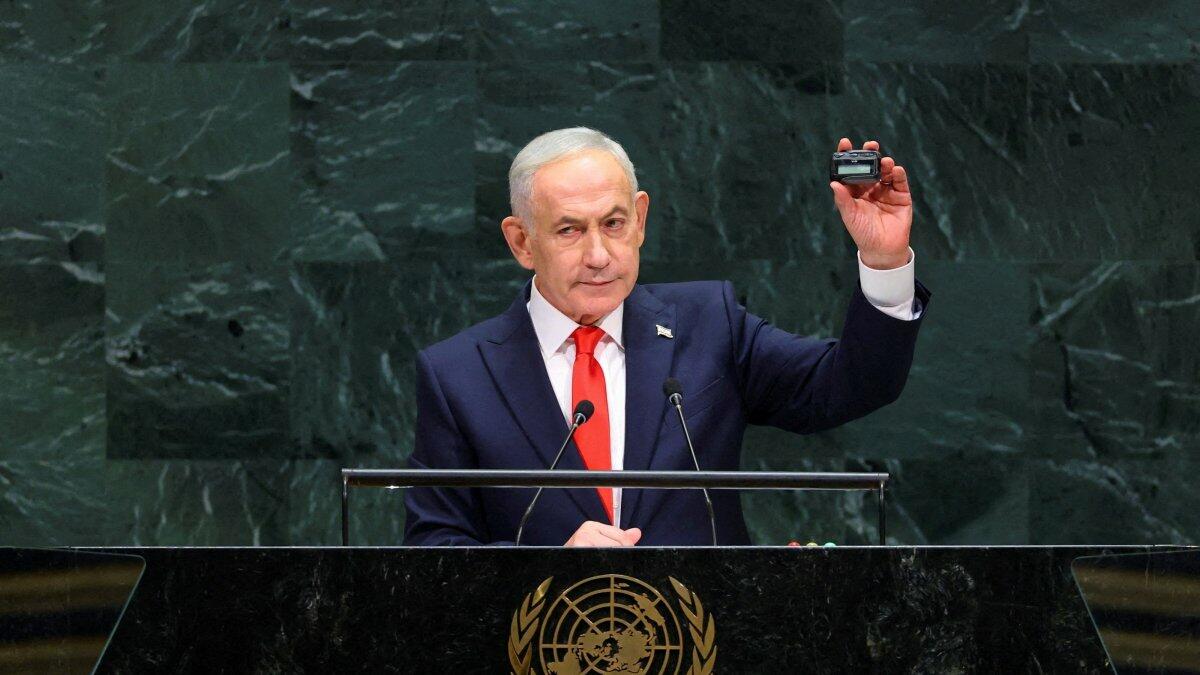
Dozens of UN delegates walked out during the speech, and at times jeers and boos were heard, after which Netanyahu berated them from the podium as “moral cowards”.
At one point he said that “in the last three years,” Israeli soldiers have “fought a war on seven fronts.”
“Do you know of any other country the size of New Jersey that can fight for three years on seven fronts?” he posed.
The big walkout…
Netanyahu with a slight grin: “If there are any other moral cowards who haven’t yet left this hall, please do so now, thank you very much.”
“They organized to erase us from the face of the Earth. Instead of collapsing, we delivered devastating blows to all of them with our great American friends and crushed the Iranian army and its nuclear facilities,” Netanyahu also said.
Given he was standing at the UN building in New York City, Netanyahu called out Mayor Zohran Mamdani. He chastised him as the “antisemitic mayor” – and added:
“Shame on you. Shame on you for distorting the facts. Shame on you for inverting the victim and aggressor. Shame on you for spitting in the face of truth.”
Netanyahu further asserted that “many Jews no longer feel safe in New York” since Mamdani got elected. The longtime member of the Democratic Socialists of America (DSA) and former NY state assembly member had previously called for Bibi’s arrest as a war criminal should he step foot on American soil.
“Mr. Mamdani, you tried to stop me from coming here. You tried to silence me. Well, you can’t silence me, and you can’t silence the truth,” Netanyahu said in his speech.
He also quite provocatively brandished a pager while reminding the UN audience Israel’s devastating September 2024 operation against Hezbollah leaders (and in some instances their families). He’s been on many occasions touting Israeli intelligence’s pager bombs – though this will likely been seen by many on the UNGA floor as a veiled threat to not oppose Israel.
Speaking of veiled threats…
Netanyahu has long been known for somewhat theatrical speeches on the UN floor, and almost every time be brings some kind of prop or visual. Iranian President Pesheshkian also brought some visuals to present before the delegates.
Clash of visuals: Iran President vs. PM Netanyahu
In this latest Thursday address, some critics have noted that the overall threatening tone of the speech (with us or against us type rhetoric) reveals some level of desperation on the part of the Israeli government as it finds itself more and more isolated on a global stage. Even the UK has of late announced sanctions on Jewish settler groups in the West Bank, which has been met with anger in Tel Aviv.
END
IRAN/USA/ISRAEL FRIDAY AFTERNOON
Crude Dips, Stocks Rip On Positive Report Of US-Iran Talks Entering ‘Technical Stage’
by Tyler Durden
Friday, Sep 25, 2026 – 12:20 PM
‘Technical Talks’
Are we back to headline ping-pong pushing down oil prices?
Latest: Iran-US negotiations in New York have moved beyond initial diplomatic contacts into a more detailed technical phase, with sources in Tehran describing the atmosphere as increasingly positive, CBS reports, citing Al Jazeera. For a rehash of what’s played out over the last 24 hours on the sidelines of the UN General Assembly meeting:
- Iran’s proposed seven-day plan to reopen the Strait of Hormuz if the US drops its blockade is being discussed as an accelerated version of a previously discussed 60-day process, and would include urgent measures to get both countries back into direct negotiations over Iran’s nuclear programme.
- The key Iranian demands under discussion include sanctions relief, the lifting of restrictions on oil exports and access to frozen Iranian funds.
- The two sides also continue to discuss arrangements for the Strait of Hormuz, including whether Iran and Oman could return to a form of joint management under an agreed framework involving regional countries and the United States, as well as arrangements governing the passage of US vessels.
- Despite the outstanding issues, sources in Tehran characterised the negotiations as making some progress, with talks continuing and Qatar working to bridge differences between the two sides.
Also, President Trump has just said he discussed the Iran conflict with China’s Xi.
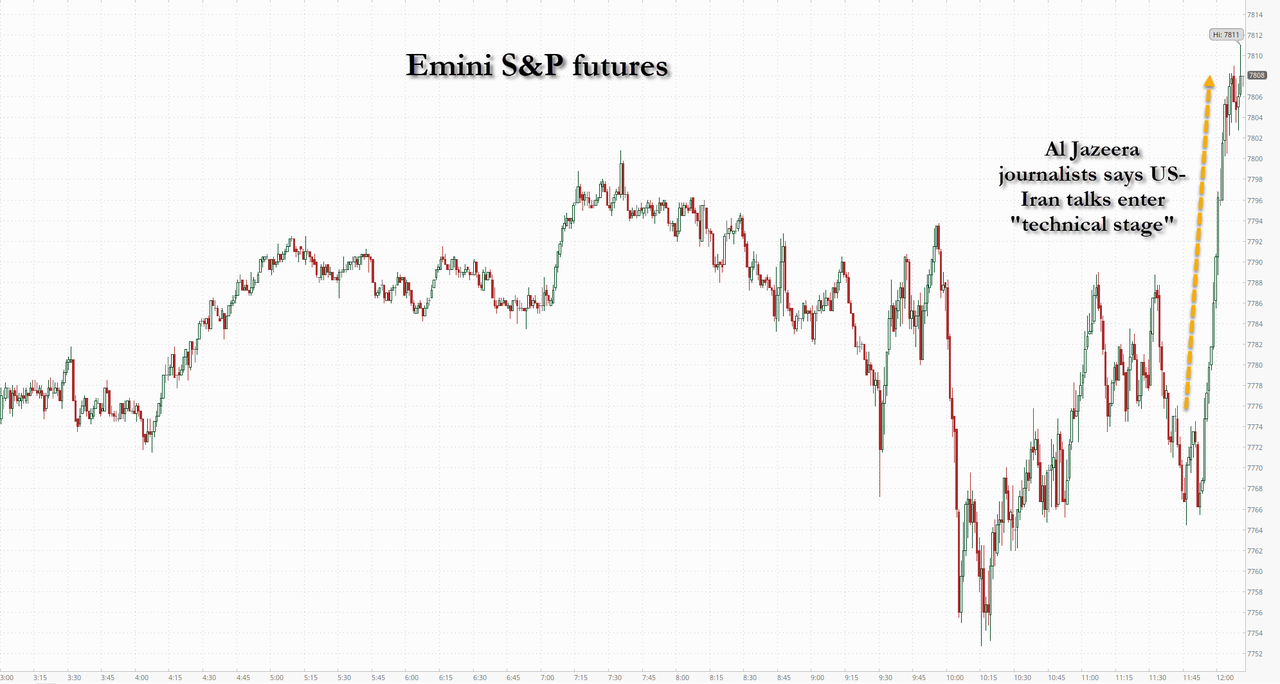
And crude trumbles…
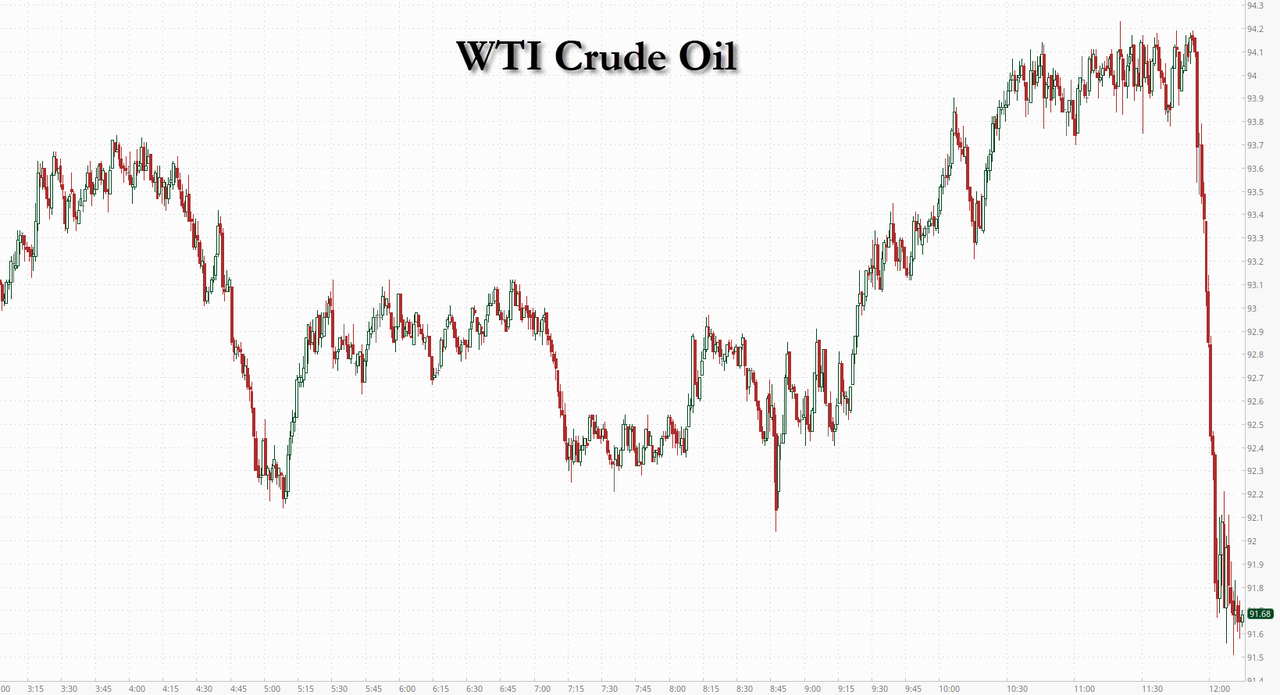
7-Day Roadmap Proposed
Iranian Foreign Minister Abbas Aragchi has newly proposed to the US side a seven-day roadmap aimed at ending the war, while the top Iranian delegation is still in New York City engaged in deep diplomacy on the sidelines of the UN General Assembly.
Aragchi is said to be planning to stay through the weekend while waiting on a US response to the plan. So far it seems Tehran hasn’t backed down from its core conditions, and its roadmap proposal is said to closely parallel the 14-point Memorandum of Understanding that was signed by President Trump back in June, but which has since completely collapsed. The plan is new but is still being largely seen as just repackaged.
“Araghchi stressed that Iran was ready to begin putting the plan into effect as soon as Washington agreed to it,” Al Jazeera reports.
Interestingly, also last night Iranian President Masoud Pezeshkian told journalists, “We don’t want it to get to the midterm elections.” He added: “We wish Americans to return to the MoU before the midterms.” Here’s where things stand in terms of Iran’s position being represented in New York:
- Iran’s Foreign Minister Araghchi said the Strait of Hormuz can reopen if certain conditions are met by the US and that it would be better to implement before the Midterms, according to a Sky reporter.
- IRGC spokesperson warned in the event of another attack, Iran’s method of defence will change including geography of the confrontation, the type of equipment and weapons used, and targets in defensive operations in line with new conditions.
This contradicted Trump’s words given to the UN General Assembly during his speech. He said “They’re waiting to see how I do in the midterm election.”
White House spokesperson Anna Kelly had in follow-up to Trump’s address said, “The President is courageously ensuring that such an evil country never possesses a nuclear weapon, which will make the entire world safer and more stable.”
Iran has said it will not be ‘bullied’ – but Pezeshkian appears to be offering something on the nuclear front alongside this seven-day roadmap overture, or at least according to a future timeline assuming a ceasefire is agreed to.
He explained in a Fox interview that in accord the framework of international law, Iran could give eventually up highly enriched uranium. But he was also fundamentally using the moment to highlight who is not a signatory to the Nuclear Nonproliferation Treaty – Israel.
Pezeshkian further said it was up to the United States to choose when the war would end. “It’s America that must choose whether it wants to end this or not,“ Pezeshkian said in response to a question by Fox’s Bret Baier.
Tehran has meanwhile said it is ready to escalate, and even spread the war beyond the Persian Gulf region, into the Indian Ocean for example (where the UK-US have the Diego Garcia base).
END
RUSSIA VS UKRAINE
another major hit
(oilprice .com)
Ukraine Drone Strike Knocks Out Russia’s Novoshakhtinsk Refinery
Friday, Sep 25, 2026 – 09:01 AM
Authored by Tsvetana Paraskova via OilPrice.ocm,
Another Russian refinery was taken offline on Friday following a Ukrainian drone attack, in a sign that Ukraine and Russia continue to trade strikes on energy infrastructure despite separate talks with U.S. officials in New York aimed at de-escalation.
The Novoshakhtinsk refinery in the southern Russian region of Rostov was hit by drones and had to be taken offline, regional governor Yury Slyusar said in a post on Telegram early on Friday.

As a result of the drone attacks, the Novoshakhtinsk refinery, which has the capacity to process 110,000 barrels of crude oil per day, was damaged and halted operations, the official said.
Ukraine continues its campaign to cripple Russian refining capacity, fuel supply, and export revenues. Due to the low refinery production, Russia has been forced to ban diesel exports for months and is likely to extend the ban beyond September 30. The ban was initially introduced in July as Ukraine has continuously taken Russian refineries offline.
Last week, Ukraine hit an oil refinery near Moscow, damaging a processing plant co-owned by Rosneft and Gazprom Neft.
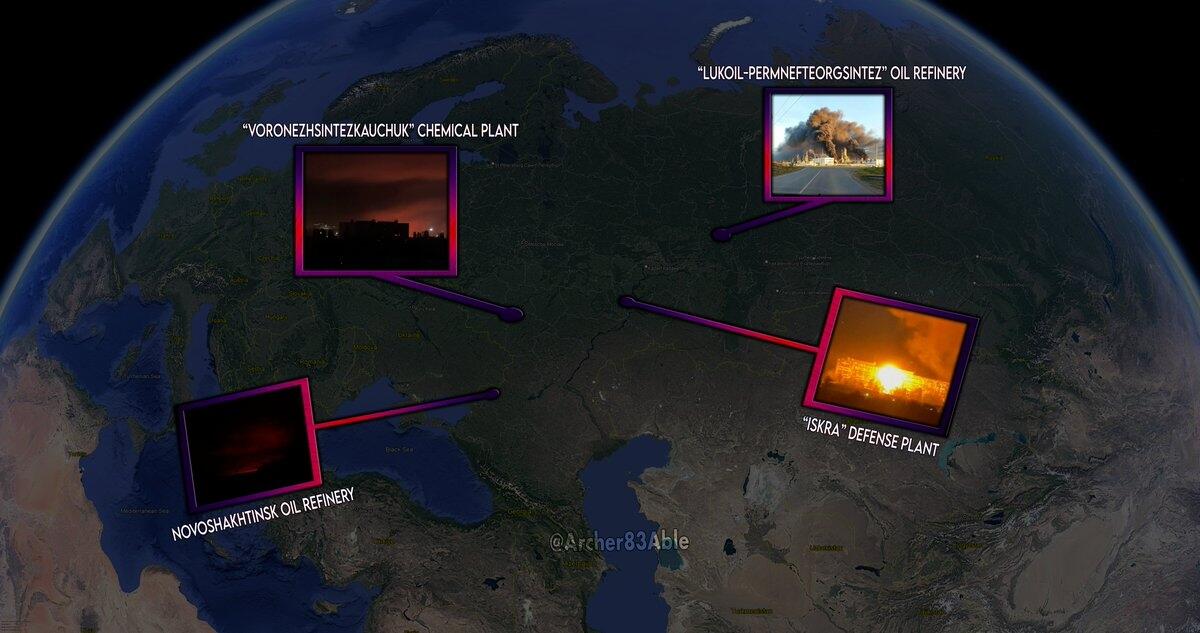
Recent attacks from both sides show that there isn’t any truce in attacking energy sites.
Ukraine’s forces hit the refinery in Yaroslavl with drones last week, while Russia attacked infrastructure in Kyiv.
Russian daily Vedomosti reported last week that the government would extend its ban on diesel exports for all fuel producers to October 31, due to delayed refinery maintenance and the need to rebuild fuel reserves before winter.
Russia has been suffering from a gasoline and diesel crunch since the spring, when Ukraine intensified its drone attacks at Russian refineries, aiming to cripple fuel supply to the front lines and to the domestic Russian market.
The Russian ban on diesel exports has added to the Middle East crisis to tighten global middle distillate markets.
END
6/.GLOBAL ISSUES, COVID ISSUES, VACCINE INJURIES/HEALTH ISSUES
GLOBAL ISSUES
COVID VACCINE INJURY REPORT: MARK CRISPIN MILLER
PAPA ROACH cancels show; Jimmy Eat World cancels shows; Nat Myers cancels shows; Taylor Townsend pulls out of tennis tournament; SF Giant’s broadcaster Duane Kuiper quits with throat cancerRutgers b-ball coach Steve Pikiell steps down with cancer; SL: Olympic swimmer Katja Fain quits with leukemia; JA: YOSHIKI cancels shows after collapse; SK: Chungha skips university festivalMark Crispin MillerSep 24     READ IN APP READ IN APP A survey of the likely global toll of COVID “vaccination,” based on the reports collected by our worldwide team of researchers this past week.To help support our work, consider subscribing or making a donation.CancelationsUNITED STATESPAPA ROACH Cancels LOUDER THAN LIFE Appearance Due To Bassist TOBIN ESPERANCE’s ‘Unexpected’ Health ‘Emergency’September 19, 2026 A survey of the likely global toll of COVID “vaccination,” based on the reports collected by our worldwide team of researchers this past week.To help support our work, consider subscribing or making a donation.CancelationsUNITED STATESPAPA ROACH Cancels LOUDER THAN LIFE Appearance Due To Bassist TOBIN ESPERANCE’s ‘Unexpected’ Health ‘Emergency’September 19, 2026 PAPA ROACH canceled its appearance at this weekend’s Louder Than Life festival after “an unexpected emergency” involving the band’s bassist Tobin Esperance [46]. PAPA ROACH was scheduled to perform at the annual Louisville, Kentucky, event on Saturday (September 19) on the Life Stage, starting at 8:25 p.m. On Friday (September 18), PAPA ROACH released the following statement via social media: “After careful consideration and advice from medical professionals, PAPA ROACH bassist Tobin Esperance will be unable to perform this weekend due to an unexpected emergency. Therefore, we will not be able to perform at this year’s Louder Than Life festival, and wish everyone the best. Right now, Tobin’s health is our immediate concern. We look forward to welcoming him back on stage in November and appreciate the continued support and respect for his privacy during this time.” Louder Than Life 2026 runs through September 20 at the Kentucky Exposition Center grounds.News from Underground by Mark Crispin Miller is a reader-supported publication. To receive new posts and support my work, consider becoming a free or paid subscriber.Upgrade to paidResearcher’s note – During past tours (such as their 2022 Kill The Noise Tour), venues and promoters like Live Nation required attendees to show proof of COVID-19 “vaccination” or a negative test to enter the concerts: https://bradymusiccenter.com/events/2022/03/papa-roach-kill-the-noise-tourhttps://wgrd.com/papa-roach-concert-glc-live-at-20-monroe-vaccine-requirement/Jimmy Eat World Cancels Three Major Shows After Lead Singer Undergoes Emergency SurgerySeptember 15, 2026 PAPA ROACH canceled its appearance at this weekend’s Louder Than Life festival after “an unexpected emergency” involving the band’s bassist Tobin Esperance [46]. PAPA ROACH was scheduled to perform at the annual Louisville, Kentucky, event on Saturday (September 19) on the Life Stage, starting at 8:25 p.m. On Friday (September 18), PAPA ROACH released the following statement via social media: “After careful consideration and advice from medical professionals, PAPA ROACH bassist Tobin Esperance will be unable to perform this weekend due to an unexpected emergency. Therefore, we will not be able to perform at this year’s Louder Than Life festival, and wish everyone the best. Right now, Tobin’s health is our immediate concern. We look forward to welcoming him back on stage in November and appreciate the continued support and respect for his privacy during this time.” Louder Than Life 2026 runs through September 20 at the Kentucky Exposition Center grounds.News from Underground by Mark Crispin Miller is a reader-supported publication. To receive new posts and support my work, consider becoming a free or paid subscriber.Upgrade to paidResearcher’s note – During past tours (such as their 2022 Kill The Noise Tour), venues and promoters like Live Nation required attendees to show proof of COVID-19 “vaccination” or a negative test to enter the concerts: https://bradymusiccenter.com/events/2022/03/papa-roach-kill-the-noise-tourhttps://wgrd.com/papa-roach-concert-glc-live-at-20-monroe-vaccine-requirement/Jimmy Eat World Cancels Three Major Shows After Lead Singer Undergoes Emergency SurgerySeptember 15, 2026 Jimmy Eat World is stepping away from the stage after frontman Jim Adkins [50] experienced a frightening medical emergency. Adkins revealed that the band was preparing to perform at the Vans Warped Tour in Mexico City on Sunday, September 13, when he noticed something wasn’t right with his eyesight. “Sunday, as we were preparing to play at Warped Tour in Mexico City I noticed a shadow cloud creeping in on my vision,” he wrote on Instagram two days later. “With some quick research, I knew I had to seek medical help immediately.” An examination revealed Adkins had a detached retina and needed surgery as soon as possible. Performing could have risked permanent damage, he explained, forcing the band to pull out of the festival. Thankfully, Adkins is now home and recovering after undergoing surgery.Researcher’s note – 20,000% Increase in Retinal Eye Damage Following COVID-19 Vaccination [sic]: https://www.sgtreport.com/2023/05/20000-increase-in-retinal-eye-damage-following-covid-19-vaccination/SPOKANE, Wash. – For the last two concerts at the Pavilion, attendees and staff will need to prove they are fully vaccinated [sic] or produce a negative COVID test within 72 hours. The policy goes into place on October 1, meaning it will only impact people attending Machine Gun Kelly on October 12 and Jimmy Eat World on October 15: LinkNAPA (CBS SF) – Organizers behind the pandemic delayed BottleRock Napa Valley music festival on Friday announced that attendees will have to show proof of either full COVID vaccination [sic] or a negative test taken in the past 72 hours. Others on the bill include Brandi Carlile, Cage the Elephant, Portugal, Maren Morris, Jimmy Eat World, G-Eazy and Mavis Staples: https://www.cbsnews.com/sanfrancisco/news/covid-bottlerock-announces-vaccine-test-proof-requirement-festival-entry/San Francisco – sfmasonic 256w Jimmy Eat World & Taking Back Sunday hit our stage TONIGHT with special guest The Beaches! Presented by ALT 105.3. Doors open 6PM, Show starts 7PM. To ensure you have a great experience at our venue make sure to read through the guidelines before heading down, so you can plan accordingly. Jimmy Eat World is stepping away from the stage after frontman Jim Adkins [50] experienced a frightening medical emergency. Adkins revealed that the band was preparing to perform at the Vans Warped Tour in Mexico City on Sunday, September 13, when he noticed something wasn’t right with his eyesight. “Sunday, as we were preparing to play at Warped Tour in Mexico City I noticed a shadow cloud creeping in on my vision,” he wrote on Instagram two days later. “With some quick research, I knew I had to seek medical help immediately.” An examination revealed Adkins had a detached retina and needed surgery as soon as possible. Performing could have risked permanent damage, he explained, forcing the band to pull out of the festival. Thankfully, Adkins is now home and recovering after undergoing surgery.Researcher’s note – 20,000% Increase in Retinal Eye Damage Following COVID-19 Vaccination [sic]: https://www.sgtreport.com/2023/05/20000-increase-in-retinal-eye-damage-following-covid-19-vaccination/SPOKANE, Wash. – For the last two concerts at the Pavilion, attendees and staff will need to prove they are fully vaccinated [sic] or produce a negative COVID test within 72 hours. The policy goes into place on October 1, meaning it will only impact people attending Machine Gun Kelly on October 12 and Jimmy Eat World on October 15: LinkNAPA (CBS SF) – Organizers behind the pandemic delayed BottleRock Napa Valley music festival on Friday announced that attendees will have to show proof of either full COVID vaccination [sic] or a negative test taken in the past 72 hours. Others on the bill include Brandi Carlile, Cage the Elephant, Portugal, Maren Morris, Jimmy Eat World, G-Eazy and Mavis Staples: https://www.cbsnews.com/sanfrancisco/news/covid-bottlerock-announces-vaccine-test-proof-requirement-festival-entry/San Francisco – sfmasonic 256w Jimmy Eat World & Taking Back Sunday hit our stage TONIGHT with special guest The Beaches! Presented by ALT 105.3. Doors open 6PM, Show starts 7PM. To ensure you have a great experience at our venue make sure to read through the guidelines before heading down, so you can plan accordingly.  Fans must be fully vaccinated [sic] against COVID-19 (at least two weeks after final dose) and provide proof of vaccination [sic] – either the original vaccination [sic] card or a printed copy of the vaccination [sic] card. Fans must be fully vaccinated [sic] against COVID-19 (at least two weeks after final dose) and provide proof of vaccination [sic] – either the original vaccination [sic] card or a printed copy of the vaccination [sic] card. InstagramView on InstagramCountry Singer Pulls Out of “Bucket List” Austin City Limits Show Amid Cancer BattleSeptember 17, 2026 InstagramView on InstagramCountry Singer Pulls Out of “Bucket List” Austin City Limits Show Amid Cancer BattleSeptember 17, 2026 Although Nat Myers [35] has spent over the last year battling cancer, the country singer was ready to make the most of 2026. Excited, Myers announced that he was set to perform a “bucket list” show at Austin City Limits in October. A dream come true for the singer, he even got the chance to hit the road with Charley Crockett. With his career on the rise, Myers shocked fans when he revealed he needed to cancel his upcoming performances. On Monday, Myers posted a picture of the moon on Instagram. The caption read that he was canceling all shows throughout September and October. The recent announcement came days after Myers revealed he couldn’t continue touring with Crockett. In another post, he wrote, “I have to drop out of the remaining dates I have with Charley Crockett & the blue drifters, including tonight in Orlando. I’m really sorry to do this, but after the results from yesterday I have some last minute appointments that have to happen, that make it impossible for me to be out where I want to be playing music for yall for this leg of the Age of the Ram tour.” While Myers was diagnosed with a rare form of cancer, he wasn’t letting it control his life. And even with the recent news, he insisted, “I’ll be back out when I can. For now I gotta focus on getting ahead of this thing, it’s snuck back up. I’m real lowdown about it, but gotta do what’s gotta be done.”Researcher’s note – In the text below this January 2021 video for his song “It Is What It Is,” Myers wrote, “Wear a mask, get a vaccine [sic] if you can, and keep safe”: Although Nat Myers [35] has spent over the last year battling cancer, the country singer was ready to make the most of 2026. Excited, Myers announced that he was set to perform a “bucket list” show at Austin City Limits in October. A dream come true for the singer, he even got the chance to hit the road with Charley Crockett. With his career on the rise, Myers shocked fans when he revealed he needed to cancel his upcoming performances. On Monday, Myers posted a picture of the moon on Instagram. The caption read that he was canceling all shows throughout September and October. The recent announcement came days after Myers revealed he couldn’t continue touring with Crockett. In another post, he wrote, “I have to drop out of the remaining dates I have with Charley Crockett & the blue drifters, including tonight in Orlando. I’m really sorry to do this, but after the results from yesterday I have some last minute appointments that have to happen, that make it impossible for me to be out where I want to be playing music for yall for this leg of the Age of the Ram tour.” While Myers was diagnosed with a rare form of cancer, he wasn’t letting it control his life. And even with the recent news, he insisted, “I’ll be back out when I can. For now I gotta focus on getting ahead of this thing, it’s snuck back up. I’m real lowdown about it, but gotta do what’s gotta be done.”Researcher’s note – In the text below this January 2021 video for his song “It Is What It Is,” Myers wrote, “Wear a mask, get a vaccine [sic] if you can, and keep safe”: Taylor Townsend pulls out of tennis tournament for ‘emergency surgery’ after winning US Open titleSeptember 17, 2026 Taylor Townsend pulls out of tennis tournament for ‘emergency surgery’ after winning US Open titleSeptember 17, 2026 Taylor Townsend has pulled out of the Guadalajara Open for emergency surgery following the biggest moment of her career. The beloved American tennis star shared the update through two Instagram Stories on Wednesday night, and no specific details around the surgery have been released. “Welp.. this s–t definitely wasn’t on my bingo card.. Taylor Townsend has pulled out of the Guadalajara Open for emergency surgery following the biggest moment of her career. The beloved American tennis star shared the update through two Instagram Stories on Wednesday night, and no specific details around the surgery have been released. “Welp.. this s–t definitely wasn’t on my bingo card.. ” she wrote. “Through trails and tribulations..still I rise ” she wrote. “Through trails and tribulations..still I rise  I’ll update yall soon I’ll update yall soon ” Townsend also posted Thursday morning a picture of her laying in a hospital bed. The 30-year-old, alongside her doubles partner Kateřina Siniaková, just completed a career Grand Slam as a team last week by defeating Ashlyn Krueger and Robin Montgomery in the U.S. Open women’s doubles final 5–7, 6–0, 6–2 at Arthur Ashe Stadium.Researcher’s note – While the WTA tour itself did not enforce a blanket “vaccination” mandate for competitors (noting potential legal and logistical challenges across various international jurisdictions), players were still subject to the entry, travel, and quarantine requirements mandated by sovereign countries, local governments, and specific events (such as national mandates enforced at Grand Slams or host cities): https://www.reuters.com/lifestyle/sports/legal-issues-with-wta-tour-vaccine-mandate-says-azarenka-2022-01-19/San Francisco Giants broadcaster Duane Kuiper diagnosed with throat cancerSeptember 20, 2026Longtime San Francisco Giants broadcaster Duane Kuiper announced Sunday, Sept. 20 that he was diagnosed with throat cancer. Kuiper [76] has been the voice of the Giants, calling their games for the past 37 seasons alongside longtime broadcast partner Mike Krukow, who announced his retirement at the end of the season. Kuiper told the team in a statement that he began treatment with doctors at Stanford Medicine last week and will miss some games as the season comes to a close. “This cancer is unrelated to the one I experienced five years ago, and I’m optimistic that it will be successfully treated,” Kuiper said in a statement. “I’ll miss the broadcasts tomorrow and Wednesday as I continue treatment, but I’m looking forward to returning Tuesday and this weekend to celebrate my partner, Mike Krukow, and his remarkable career as he calls his final game before retirement.” Kuiper reassured that his throat cancer is not linked to his scare in 2021. Kuiper stepped away from the broadcast booth in June 2021 to begin chemotherapy treatments for an undisclosed condition. He made his return to the booth later that year and resumed regularly calling games for the Giants in the 2022 season.Researcher’s note – Duane Kuiper’s late wife was Michelle Kuiper, who passed away unexpectedly on February 20, 2022, at the age of 64. https://www.cbsnews.com/sanfrancisco/news/sf-giants-broadcaster-duane-kuipers-wife-passes-away/During the COVID-19 pandemic, the San Francisco Giants followed local San Francisco Department of Public Health orders and MLB protocols for Oracle Park staff, requiring proof of “vaccination” or regular testing for venue and food service workers. https://www.mlb.com/giants/fans/safety/faq-mayMLB To Require COVID Vaccinations [sic] For Non-Player Team Personnel To Gain Access To Field In Postseason: LinkRutgers men’s basketball coach Steve Pikiell announces he has cancerSeptember 9, 2026 ” Townsend also posted Thursday morning a picture of her laying in a hospital bed. The 30-year-old, alongside her doubles partner Kateřina Siniaková, just completed a career Grand Slam as a team last week by defeating Ashlyn Krueger and Robin Montgomery in the U.S. Open women’s doubles final 5–7, 6–0, 6–2 at Arthur Ashe Stadium.Researcher’s note – While the WTA tour itself did not enforce a blanket “vaccination” mandate for competitors (noting potential legal and logistical challenges across various international jurisdictions), players were still subject to the entry, travel, and quarantine requirements mandated by sovereign countries, local governments, and specific events (such as national mandates enforced at Grand Slams or host cities): https://www.reuters.com/lifestyle/sports/legal-issues-with-wta-tour-vaccine-mandate-says-azarenka-2022-01-19/San Francisco Giants broadcaster Duane Kuiper diagnosed with throat cancerSeptember 20, 2026Longtime San Francisco Giants broadcaster Duane Kuiper announced Sunday, Sept. 20 that he was diagnosed with throat cancer. Kuiper [76] has been the voice of the Giants, calling their games for the past 37 seasons alongside longtime broadcast partner Mike Krukow, who announced his retirement at the end of the season. Kuiper told the team in a statement that he began treatment with doctors at Stanford Medicine last week and will miss some games as the season comes to a close. “This cancer is unrelated to the one I experienced five years ago, and I’m optimistic that it will be successfully treated,” Kuiper said in a statement. “I’ll miss the broadcasts tomorrow and Wednesday as I continue treatment, but I’m looking forward to returning Tuesday and this weekend to celebrate my partner, Mike Krukow, and his remarkable career as he calls his final game before retirement.” Kuiper reassured that his throat cancer is not linked to his scare in 2021. Kuiper stepped away from the broadcast booth in June 2021 to begin chemotherapy treatments for an undisclosed condition. He made his return to the booth later that year and resumed regularly calling games for the Giants in the 2022 season.Researcher’s note – Duane Kuiper’s late wife was Michelle Kuiper, who passed away unexpectedly on February 20, 2022, at the age of 64. https://www.cbsnews.com/sanfrancisco/news/sf-giants-broadcaster-duane-kuipers-wife-passes-away/During the COVID-19 pandemic, the San Francisco Giants followed local San Francisco Department of Public Health orders and MLB protocols for Oracle Park staff, requiring proof of “vaccination” or regular testing for venue and food service workers. https://www.mlb.com/giants/fans/safety/faq-mayMLB To Require COVID Vaccinations [sic] For Non-Player Team Personnel To Gain Access To Field In Postseason: LinkRutgers men’s basketball coach Steve Pikiell announces he has cancerSeptember 9, 2026 Rutgers [NJ] men’s basketball coach Steve Pikiell had successful surgery following a cancer diagnosis, but ongoing treatment will force him to take a leave from his full-time duties, he disclosed in a letter to Rutgers supporters Wednesday. After “not feeling 100 percent” a few months ago, Pikiell said that he visited a team of doctors for tests. The result was that an undisclosed form of cancer was discovered. Pikiell said he and his doctors “have a kick-ass game plan to finish treatment.” Pikiell, 58, enters his 11th season at Rutgers, and his 161 wins are third-most in program history.Researcher’s note – As of April 1, 2024, Rutgers University officially ended its COVID-19 “vaccination” requirement for all faculty, staff, students, and affiliates. https://www.rutgers.edu/covid19WWE Hall Of Famer Fred Ottman (Typhoon) HospitalizedSeptember 11, 2026 Rutgers [NJ] men’s basketball coach Steve Pikiell had successful surgery following a cancer diagnosis, but ongoing treatment will force him to take a leave from his full-time duties, he disclosed in a letter to Rutgers supporters Wednesday. After “not feeling 100 percent” a few months ago, Pikiell said that he visited a team of doctors for tests. The result was that an undisclosed form of cancer was discovered. Pikiell said he and his doctors “have a kick-ass game plan to finish treatment.” Pikiell, 58, enters his 11th season at Rutgers, and his 161 wins are third-most in program history.Researcher’s note – As of April 1, 2024, Rutgers University officially ended its COVID-19 “vaccination” requirement for all faculty, staff, students, and affiliates. https://www.rutgers.edu/covid19WWE Hall Of Famer Fred Ottman (Typhoon) HospitalizedSeptember 11, 2026 WWE Hall of Famer Fred Ottman [70] has been hospitalized after being rushed to the emergency room. According to a video he shared from his hospital bed, Ottman revealed that the situation was beyond his control and admitted that he will now have to miss the SWFL Super Card Show in Fort Myers, Florida, this weekend. “Unfortunately, everybody, due to things beyond my control, I was put into the hospital here, and this evening I got admitted after I was taken to the emergency room. But I will not be able to be there, guys.” This comes months after Ottman underwent gallbladder surgery in February following a lengthy hospital stay earlier this year.SLOVENIASlovenian Olympic Swimmer Katja Fain Diagnosed with Chronic Form of LeukemiaSeptember 12, 2026 WWE Hall of Famer Fred Ottman [70] has been hospitalized after being rushed to the emergency room. According to a video he shared from his hospital bed, Ottman revealed that the situation was beyond his control and admitted that he will now have to miss the SWFL Super Card Show in Fort Myers, Florida, this weekend. “Unfortunately, everybody, due to things beyond my control, I was put into the hospital here, and this evening I got admitted after I was taken to the emergency room. But I will not be able to be there, guys.” This comes months after Ottman underwent gallbladder surgery in February following a lengthy hospital stay earlier this year.SLOVENIASlovenian Olympic Swimmer Katja Fain Diagnosed with Chronic Form of LeukemiaSeptember 12, 2026 Slovenian Olympic swimmer Katja Fain, 25, has been diagnosed with leukemia, she revealed this week on social media. Fain received a diagnosis of chronic myeloid leukemia on June 30, 2026. She goes on to explain that this form of leukemia has no tumors and requires no chemotherapy or operations. Instead, it is managed entirely by targeted medication taken daily in pill form. “Because it is a chronic form of cancer you live with it your whole life,” she said of her course of treatment. “As of this moment, medicine is not yet technologically advanced enough for the doctors to eventually say you are cured from this form of blood condition. The pills do their job to keep everything under control. The goal of the prescribed therapy is that, if it keeps things stable for enough time (several years), I may eventually be able to stop taking the medication while the cancer remains “shut down”, but regular blood work is still required for the rest of my life. There is always a possibility the condition starts back up again, but right now I am very far away from even thinking about potentially living a medication-free life.” She said that she doesn’t know what it means for the future of her swimming, citing the side effects of the medicine. She says that there is “no known elite athlete with this condition in the world and no doctor can tell me that I can safely train intensely every day and nothing will happen.” She said current restrictions include no hard training sessions, all-out efforts, or hypoxic work. She is also prohibited from competing. Fain last competed in early June at a Slovenian Grand Prix meet. In 2021, she won a bronze medal in the 200 free at the European Short Course Swimming Championships, and in 2017 she won a bronze medal in the 400 free at the European Junior Championshi Slovenian Olympic swimmer Katja Fain, 25, has been diagnosed with leukemia, she revealed this week on social media. Fain received a diagnosis of chronic myeloid leukemia on June 30, 2026. She goes on to explain that this form of leukemia has no tumors and requires no chemotherapy or operations. Instead, it is managed entirely by targeted medication taken daily in pill form. “Because it is a chronic form of cancer you live with it your whole life,” she said of her course of treatment. “As of this moment, medicine is not yet technologically advanced enough for the doctors to eventually say you are cured from this form of blood condition. The pills do their job to keep everything under control. The goal of the prescribed therapy is that, if it keeps things stable for enough time (several years), I may eventually be able to stop taking the medication while the cancer remains “shut down”, but regular blood work is still required for the rest of my life. There is always a possibility the condition starts back up again, but right now I am very far away from even thinking about potentially living a medication-free life.” She said that she doesn’t know what it means for the future of her swimming, citing the side effects of the medicine. She says that there is “no known elite athlete with this condition in the world and no doctor can tell me that I can safely train intensely every day and nothing will happen.” She said current restrictions include no hard training sessions, all-out efforts, or hypoxic work. She is also prohibited from competing. Fain last competed in early June at a Slovenian Grand Prix meet. In 2021, she won a bronze medal in the 200 free at the European Short Course Swimming Championships, and in 2017 she won a bronze medal in the 400 free at the European Junior Championshi |
.
END
RABOBANK/MICHAEL EVERY/OR OR PICTON/GIFFIN OR RABOBANK EXECUTIVE/COMMENTARY ON WORLDLY AFFAIRS
Frenemies: “China May Be Exporting Two Pandas, But It Would Much Rather Export Millions Of Cars”
Friday, Sep 25, 2026 – 10:40 AM
By Molly Schwartz, cros-aset macro strategist at Rabobank
Frenemies
The US-China summit officially began after Xi arrived in Washington, DC, late on Wednesday. Topics including trade, the Strait of Hormuz, and the AI (AGI?) races are expected to arise, but little tangible progress is anticipated.
Instead, the goal is to “prevent something very bad from happening.” Frenemies, Xi and Trump, hailed “healthy competition,” rather than competition “in which one wins and one loses.” In a show of friendship (frenemyship?), China is sending two giant pandas, Ping Ping and Fu Shuang, to Zoo Atlanta. According to Politico, “one person close to the White House” said: “Trump likes to be like, ‘oh, we get along great,’ and it’s like, okay, well, at the same time, these guys are a massive threat to us. We’re in an AI race with them. They’re supplying Iranians with intelligence and weapons…He’s missing the message here. No one cares whether you’re friends with the guy or not… are you advancing [the US’] objectives or not?”
But a friendly veneer is unlikely to temper the tensions simmering below the surface. Although Trump and Xi may have a “personal rapport”, their respective objectives are diametrically opposed. China may be exporting two pandas, but it would much rather export tens of thousands of Chinese-made electric vehicles. For now, the US-China trade-war truce has been extended to January 10, 2027, but what follows remains unclear.
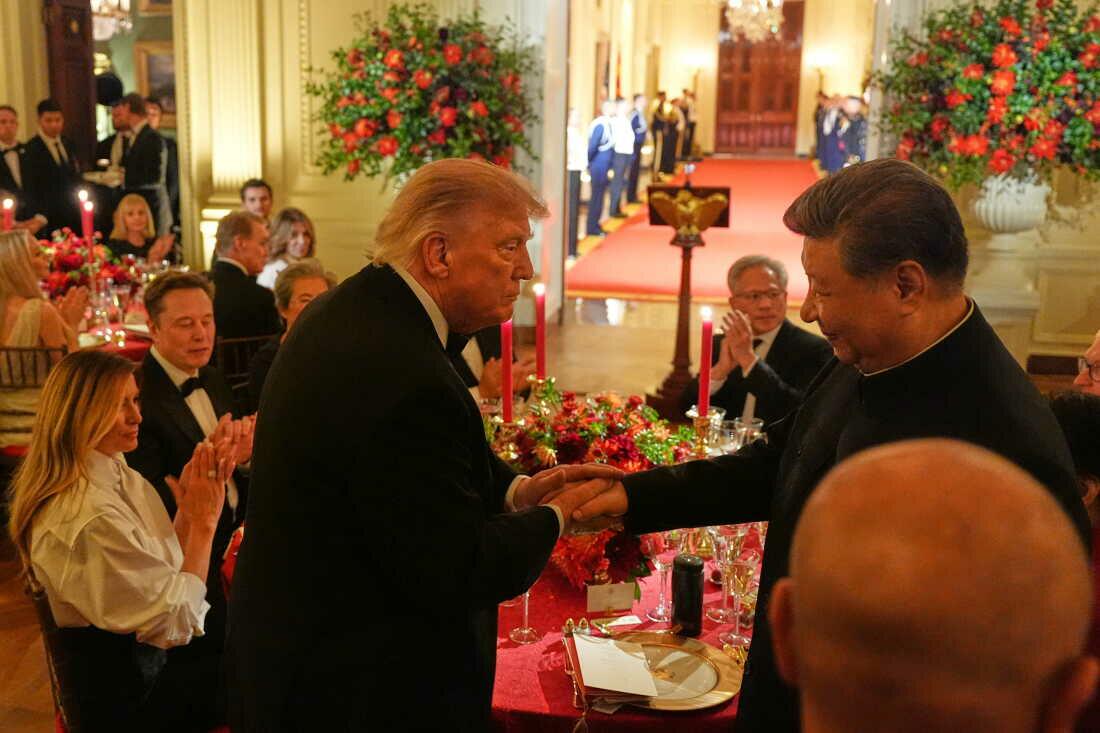
Moreover, the trade-war truce still accommodates a slew of US and Chinese trade barriers, including legacy Section 301 tariffs related to Chinese forced labour from 2018, new Section 301 tariffs, and broad-based Section 232 tariffs. Meanwhile, China continues to enforce its own 10% retaliatory tariff on US goods, alongside barriers affecting American agricultural products.
A similar pattern emerged in the AI discussion: both leaders again emphasized cooperation over confrontation, but few are convinced that either will slow the development of their respective AI capabilities.
The UN General Assembly is still under way in New York City. Some question the organization’s effectiveness in fulfilling its stated mission, which includes “saving succeeding generations from the scourge of war.” Scourge or not, brent has continued to surge, rising another $5 after gaining $5 the previous day, to close at $107/bbl.
After briefly diverging yesterday morning, with the 2-year yield edging lower and the 10-year yield creeping higher, both were again pulled into line with intraday moves in Brent crude. The 2-year yield has struggled to break above resistance at 4.90% but remains near Wednesday’s two-year high, while the 10-year yield continues to reach levels not seen since 2002, most recently at 5.16%. With Brent still climbing and little currently pushing back against inflation expectations, the OIS curve suggests investors are pricing a 68% probability of a hike at the October meeting and more than 93bp of tightening by October next year.
By extension, the USD is the best-performing G10 currency for a second consecutive day. The Brent crude à higher yields à stronger USD pipeline was in full swing, sending EUR/USD to 1.13—its lowest level since late July. The 14-day RSI suggests EUR/USD is somewhat oversold, and nearby support at 1.1325 indicates that a reversal may be imminent. Rabobank’s head of FX strategy, Jane Foley, recently revised her EUR/USD forecast and now expects the pair to trade sideways around 1.14 over a one-month horizon before retracing to 1.16–1.17. Read more here.
The Danish Defence Intelligence Service published a report yesterday stating that there is a “low but growing risk that Russia will launch a limited military attack against one or several NATO countries bordering Russia,” although it remains “highly unlikely that Russia will launch an invasion.” The report also highlights an intensification of Russian cyber and drone attacks, including “the foiled drone attack on Leipzig/Halle Airport, which…had been planned by Russia over a period of several months.” Meanwhile, reports indicate that an AI agent hacked into an Australian government health-data portal in June. As the AI race continues, the risk of hybrid warfare across both land and fibre-optic networks is growing rapidly.
Banxico held the overnight policy rate at 6.50% yesterday but adjusted its statement. Previously, the Bank had indicated that it was satisfied with the reference rate; however, the Fed’s decision to hike a few weeks ago has put Banxico in an uncomfortable position. Banxico has historically followed the Fed to some extent, and diverging policy paths could have significant consequences for USD/MXN, which is quickly approaching 17.8. The peso is particularly sensitive to interest-rate differentials because of its status as an attractive carry currency. Three-month USD/MXN implied volatility has risen from 9% to 10.3%, which is the highest level since April. Elevated volatility, combined with expectations of rapidly narrowing interest-rate differentials between Mexico and both the US and Japan, could point to USD/MXN moving above the 18-handle. However, Rabobank is currently maintaining its forecast of USD/MXN predominantly trading between 17 and 18. Read more here.
END
7. OIL AND NATURAL GAS/ENERGY COMMENTARIES
AI
Higher Oil & Rates (Finally) Hit Stocks As Hawks Circle, Hormuz Hope Fades, Hyperscalers Hiccup
Higher oil prices and rising rates have finally pressured stocks, as Fed hawks signal more tightening, Strait of Hormuz reopening hopes fade amid ongoing US-Iran tensions, and hyperscalers face hiccups (notably Oracle’s data-center issues).
lse.co.uk
Market Snapshot (as of Sept. 24, 2026 trading)
- Stocks: Wall Street dipped. S&P 500 roughly flat to slightly lower (around 7,700), Nasdaq underperformed (down ~0.2–1% in sessions), and the Dow lagged more. Tech and materials led declines; energy held up better on the oil spike. Markets had earlier shrugged off some Hormuz disruption due to AI strength, but the combination of sticky energy costs and higher-for-longer rates is biting valuations. lse.co.uk
- Oil: Brent surged (reports of ~$103–$107+ levels, up several percent in sessions), with WTI also climbing sharply. This followed Houthi attacks, defiant Iranian rhetoric at the UN, and fading near-term hopes for a clean Hormuz resolution. Earlier diplomatic noise had briefly eased prices, but skepticism returned quickly. afp.com
- Rates/Bonds: Treasury yields jumped. The 10-year hit multi-year highs (around/above 5.1%), and the 30-year reached levels not seen since ~2004. Stronger economic data + oil-driven inflation fears + hawkish Fed talk drove the move. Markets priced high odds (~70%+) of another Fed hike (likely October). ca.marketscreener.com
Key DriversHawks circling: New Fed Chair Kevin Warsh and the FOMC delivered a 25 bp hike last week (first since 2023), taking the funds rate to 3.75–4.00%. The vote was unanimous, and projections point to at least one more hike this year. New York Fed President John Williams reinforced this, calling another hike by year-end “reasonable” while emphasizing data dependence and ending explicit forward guidance. Sticky inflation (tied partly to energy and other pressures) keeps the door open for further tightening.
reuters.com
Hormuz hope fades: The multi-month US-Iran conflict has repeatedly disrupted the Strait (a key chokepoint for ~20% of global oil). Recent UN-related diplomacy and reports of phased-deal talks (Iran reopening the strait in exchange for easing the US blockade) provided brief optimism and price dips. However, defiant statements, attacks, and deep mistrust have eroded confidence. Physical flows remain impaired relative to pre-conflict norms, sustaining a risk premium and inflation worries.
reuters.com
Hyperscalers hiccup: AI infrastructure leaders faced pressure. Oracle shares dropped notably (several percent) after reports it issued a force majeure notice related to its large Project Jupiter data-center development in New Mexico (power/pipeline permitting delays with developer Blue Owl). Broader concerns include elevated capex, power/energy costs amplified by high oil, financing pressures in a higher-rate environment, and questions about the durability/ROI of the AI buildout. Other names (Microsoft, etc.) were mixed but the sector felt the dual hit from rates and energy.
fool.com
Bottom LineThe market is finally pricing the stagflationary overlap of elevated oil (geopolitical + structural supply risks) and a hawkish Fed determined to keep inflation in check. AI/hyperscaler momentum had buffered equities earlier, but higher discount rates, rising input costs for data centers, and project-specific snags are creating friction. Energy and rate-sensitive names are diverging from growth/tech. Near-term direction hinges on any concrete Hormuz progress (or lack thereof), incoming inflation/data prints, and whether the Fed delivers the next hike as priced.
END
8. EMERGING MARKETS//AUSTRALIA NEW ZEALAND ISSUES
AUSTRALIA
Coalition Unveils Plan To Dismantle Australia’s Net Zero Goals
Thursday, Sep 24, 2026 – 10:35 PM
Authored by Lucinda Garbutt-Young via The Epoch Times (AAP),
Almost every aspect of Australia’s climate and energy policy would be ditched under a Coalition plan leaning heavily on fossil fuels.
The eight-point plan, released Sept. 23, includes removing four offshore wind zones, repealing the Climate Change Act to scrap net zero targets, and lifting prohibitions on nuclear energy.
An existing carbon emissions policy for vehicles would be canned and developers would be encouraged to invest in all energy types, including coal, gas and nuclear, rather than focusing on renewables.
A renewable energy code of conduct to ensure companies earn social license would also be introduced, but details are yet to be announced.
The sweeping changes would all be made within 30 days of the Coalition being elected to government, Opposition energy spokesperson Dan Tehan said in a statement.
“The last four and a half years, energy policy has been driven by ideology, political targets, and government picking winners rather than the basic realities of keeping the lights on and Australian businesses competitive,” he said.
“Australia should have an energy system built around three non-negotiable principles: affordability, reliability and security.”
The plan contrasts with Labor’s existing push to power just over 80 percent of the national grid with renewables in the next four years.
The closure of several coal power plants will be needed to achieve that.
The Coalition has long argued over energy targets and abandoned its commitment to net zero emissions by 2050 last November after intense internal disagreement.
The net zero fight led to the ousting of former leader Sussan Ley, who was rolled by Angus Taylor in February.
Taylor and his colleague, Nationals Leader Matt Canavan, are against most investment in new renewables, arguing that Australia has ample fossil fuels that should be used to reduce power costs.
Independent MP Monique Ryan slammed the Coalition’s plan as “dumb, dangerous and desperate climate denial.”
“Australians have embraced clean energy because it works,” she said, saying the policy was an attempt to win over One Nation voters.
“We’ve spent years investing in rooftop solar, electric vehicles, household batteries, and home electrification because these technologies save money and reduce emissions.”
Australia will lead negotiations at COP31, the largest annual government climate conference, being held in Turkey later in 2026.
Tehan will address the Australian Energy Nation Forum in Sydney on the afternoon of Sept. 23, during which he is expected to outline more details of the plan.
END
U.S./GOLD AND SILVER PRICING/ASIAN CLOSING MARKETS AND EUROPEAN BOURSE OPENING AND CLOSING/ INTEREST RATE SETTINGS FRIDAY MORNING 6;30AM//OPENING AND CLOSING\
OPENING LEVELS OF CURRENCIES// AND CLOSING ASIAN STOCK MARKET AND OPENING EUROPEAN STOCKS:6 AM EST
EURO VS USA DOLLAR: 1.1391 UP 0.0017
USA/ YEN 158.14 DOWN 0.694 NOW TARGETS INTEREST RATE AT 1.75% AS IT WILL BUY UNLIMITED BONDS TO GETS TO THAT LEVEL…//YEN STILL FALLS//END OF YEN CARRY TRADE BEGINS AGAIN DEC 2024/Bank of Japan raises rates by .25% TO 1.75 ..TAKAICHI NEW PM AS YIELDS RISE//JAPAN DEEPLY IN TROUBLE WITH RISING RATES AND A FALLING YEN!! BANK OF JAPAN WILL NO LONGER DO QE. URGES PENSION AND INSUANCE FUNDS TO BUY JAPANESE BONDS//
YEN CARRY TRADERS MURDERED
GBP/USA1.3238 UP 0.0028 OR 28 BASIS PTS
USA/CAN DOLLAR: 1.4141 DOWN 0.0006 //CDN DOLLAR UP 6 BASIS PTS//
Last night Shanghai COMPOSITE CLOSED HOLIDAY
Hang Seng CLOSED DOWN 253.13 PTS OR 1,02%
AUSTRALIA CLOSED DOWN 0.01%
// EUROPEAN BOURSE: ALL GREEN
Trading from Europe and ASIA
I) EUROPEAN BOURSES: ALL GREEN
2/ CHINESE BOURSES / :Hang SENG CLOSED DOWN 253.13 PTS OR 1.02%
/SHANGHAI CLOSED HOLIDAY
AUSTRALIA BOURSE CLOSED DOWN 0.01%
(Nikkei (Japan) CLOSED UP 952.06 PTS OR 1.45%
INDIA’S SENSEX IN THE RED
Gold very early morning trading: $4278.00
silver:$63.80
USA DOLLAR VS TRY (TURKISH LIRA): 48.97 UP 11 BASIS PTS AND NOW WE SEE THEIR STUPIDITY OF SELLING SOME OF THEIR GOLD AND ALL OF THEIR USA DOLLAR RESERVES. THE COUNTRY IS IN BIG FINANCIAL TROUBLE
USA DOLLAR VS RUSSIAN ROUBLE: 84.58 ROUBLE// UP 0 ROUBLE AND 41 BASIS PTS.
UK 10 YR BOND YIELD: 5.3597 DOWN 3 BASIS PTS
UK 30 YR BOND YIELD: 5.8538 DOWN 1 BASIS PTS
CDN 10 YR BOND YIELD: 3.9980 UP 3 BASIS PTS
CDN 5 YR BOND YIELD; 3.722 UP 4 BASIS PTS
USA dollar index early FRIDAY MORNING: 100.50 UP 18 BASIS POINTS FROM THURSDAY’s CLOSE
FRIDAY MORNING NUMBERS ENDS
And now your closing FRIDAY NUMBERS 10.00 AM
Portuguese 10 year bond yield: 3.983% UP 2 in basis point(s) yield
JAPANESE BOND 10 yr YIELD: +3.078% UP 1 FULL POINTS BASIS POINTS /JAPAN losing control of its yield curve/
JAPAN 30 YR: 4.164 DOWN 1 BASIS PTS//
SPANISH 10 YR BOND YIELD: 4.091 UP 5 in basis points yield
ITALY 10 YR BOND: 4.542 DOWN 2 points in basis points yield ./
GERMAN 10 YR BOND YIELD: 3.6046 DOWN 1 BASIS PTS
IMPORTANT CURRENCY CLOSES : MID DAY FRIDAY
Closing currency crosses for day /USA DOLLAR INDEX/USA 10 YR BOND YIELD/10:00 AM
Euro/USA 1.1402 UP 0.0029 OR 29 basis points
USA/Japan: 157.03 DOWN 1.783 OR YEN IS UP 178 BASIS PTS// HIGHLY INFLATIONARY TO JAPAN
Great Britain 10 YR RATE 5.3718 UP 1 BASIS POINTS //
GREAT BRITAIN 30 YR BOND; 5.8609 UP 1 BASIS POINTS.
CANADIAN DOLLAR UP 9 BASIS PTS TO 1.4138
xxxxxxxxxxxxxxxxxxxxxxxxxxxxxxxxxxxxxxxxxxxxxxxxxxxxxxxxxxxxxxxxxxxxxxxxxxxxxxxx
The USA/Yuan CNY 6.7133 ON SHORE ..DOWN
THE USA/YUAN OFFSHORE// CNH DOWN TO 6.7247
TURKISH LIRA: 48.97 UP 11 EXTREMELY DANGEROUS LEVEL/DEATH WATCH/HYPERINFLATION TO BEGIN.//
Your closing 10 yr US bond yield UP 3 in basis points from THURSDAY at 5.189% //trading well ABOVE the resistance level of 2.27-2.32%)
USA 30 yr bond yield 5.493 UP 3 basis points /10:00 AM
USA 2 YR BOND YIELD: 4.889 DOWN 1 BASIS PTS.
GOLD AT 10;00 AM $4278.00
SILVER AT 10;00: $63.93
Your 11:00 AM bourses for Europe and the Dow along with the USA dollar index closing and interest ratesTHURSDAY
DAY CLOSING TIME/ 12:00 AM///
London: CLOSED UP 15.28 PTS OR 0.14%
GERMAN DAX: CLOSED UP 142.11 PTS OR 0.56%
FRANCE: DOWN 3.63 OR 0.04 PTS
Spain IBEX CLOSED UP 126.70 PTS OR 0.65%
Italian MIB: CLOSED UP 323.48 PTS OR 0.63%
WTI Oil price 93.23 10.00 EST/
Brent Oil: 105.32 10:00 EST
USA /RUSSIAN ROUBLE: 84.15/// ROUBLE UP 0 AND 95/ 100
CDN 10 YEAR RATE: 3.950 DOWN 5 BASIS PTS.
CDN 5 YEAR RATE: 3.604 DOWN 5 BASIS PTS
CLOSING NUMBERS: 4 PM//
Euro vs USA 1.1399 UP 0.0026 OR 26 BASIS POINTS//
British Pound: 1.3251 UP 0.0042 OR 42 basis pts/
BRITISH 10 YR GILT BOND YIELD: 5.3603 UP 2 FULL BASIS PTS//
BRITISH 30 YR BOND YIELD: 5.8530 DOWN 2 IN BASIS PTS.
JAPAN 10 YR YIELD: 3.075 DOWN 1 FULL BASIS PTS (DANGEROUS TO THEIR ECONOMY
JAPANESE 30 YR BOND: 4.151 DOWN 2 PTS AND STILL VERY DANGEROUS TO THEIR ECONOMY
USA dollar vs Japanese Yen: 157.16 DOWN 1.644 OR YEN UP 164 BASIS PTS//GETTING FURTHER AWAY FROM 160.00/ EXTREMELY DANGEROUS
USA dollar vs Canadian dollar: 1.4143 UP 0.0004 PTS// CDN DOLLAR DOWN 4 BASIS PTS
West Texas intermediate oil: 92.92
Brent OIL: 104.79
USA 10 yr bond yield UP 1 BASIS pts to 5.167
USA 30 yr bond yield: UP 3 PTS to 5.488%
USA 2 YR BOND 4.854 DOWN 6 PTS
CDN 10 YR RATE 3.933 DOWN 7 BASIS PTS
CDN 5 YEAR RATE: 3.642 DOWN 8 BASIS PTS
USA dollar index: 101.02 UP 21 BASIS POINTS
USA DOLLAR VS TURKISH LIRA: 48.97 UP 11 BASIS PTS GETTING QUITE CLOSE TO BLOWING UP/IDIOTS SOLD GOLD
USA DOLLAR VS RUSSIA//// ROUBLE: 84.04 UP 0 AND 95 /100 roubles //
GOLD $4,289.70 3:30 PM)
SILVER: 64.41 3;30 PM)
DOW JONES INDUSTRIAL AVERAGE: UP 478.61 POINTS OR 0.31%
NASDAQ 100 UP 129.28 PTS OR 0.42%
VOLATILITY INDEX 14.76 UP 0.91 PTS OR 5.81%
GLD: $ 393.36 UP 1.67 PTS OR 0.43%
SLV/ 58.13 PTS UP 0.51 OR 8.943%
TORONTO STOCK INDEX// TSX INDEX: CLOSED UP 96.60 PTS OR 0.27%
end
TRADING today ZEROHEDGE 4 PM: HEADLINE NEWS/TRADING
Shaken & Stirred’: Agents Beat Bonds In Week Of Punchy PMIs, Diplomatic Duds, & Energy Angst
WRAP UP
Stocks gain and oil slides on US/Iran diplomacy optimism – Newsquawk US Market Wrap
Friday, Sep 25, 2026 – 04:09 PM
- SNAPSHOT: Equities up, Treasuries steepen, Crude down, Dollar down, Gold up
- REAR VIEW: Iran-US negotiations in New York have moved into a more detailed technical phase; Senior Iranian official says Strait of Hormuz will remain closed, no nuclear talks with US until Iran’s conditions are met; Better-than-expected US Durable Goods in August; JPY supported by Japanese jawboning; Fed’s Schmid says US debt appears to be “extreme”; Hammack raises demand inflation concerns; COST earnings beat; Russian gas supplies have reportedly restarted to Armenia.
- COMING UP: Data: Chinese Industrial Profits. Events: BoJ Minutes. Speakers: ECB’s Elderson, Lagarde; BoE’s Ramsden; Fed’s Barkin. Supply: Australia, Europe.
- WEEK IN FOCUS: Highlights include Xi’s visit to the US, Global Flash PMIs, Aussie jobs and the SNB rate decision. Click here for the full report.
- WEEKLY US EARNINGS ESTIMATES: MU, ACN, NKE, and more to report next week. Click here for the full report.
More Newsquawk in 2 steps:
- 1. Subscribe to the free premarket movers reports
- 2. Trial Newsquawk’s premium real-time audio news squawk box for 7 days
MARKET WRAP
Stocks finished higher on Friday, with the Dow outperforming, while the Russell lagged. Most sectors closed higher, led by Technology, Industrials and Consumer Staples and Financials, while Energy was the clear laggard alongside lower crude, followed by Communication Services and Real Estate.
Macro focus centred on renewed US-Iran diplomatic optimism. Reports suggested negotiations have moved into a more detailed technical phase, while the Iranian President signalled readiness for an agreement with the US. Iranian sources subsequently pushed back on the prospect of imminent progress, but crude failed to recover and settled firmly lower, with WTI at USD 92.41/bbl and Brent at USD 97.44/bbl.
Treasuries steepened, with front-end yields falling while the long end rose. The front end tracked energy prices lower as diplomatic optimism reduced near-term inflation concerns, while long-end weakness potentially reflected reduced geopolitical risk and improved growth expectations. T-note futures ticked higher across the curve into settlement, perhaps reflecting some month-end positioning. US data was broadly solid, with Durable Goods beating the headline forecast and the final UoM report revised higher, while Fed officials continued to flag inflation concerns.
In FX, the Dollar weakened while the Yen was the clear outperformer, with USD/JPY falling back below 157.00 after Trump called Yen weakness problematic, while Japanese PM Takaichi said the currency is undervalued and Finance Minister Katayama said she expects excessive Yen selling to be corrected. GBP, AUD, EUR and NZD also gained against the Dollar, while CAD and CHF marginally underperformed.
Attention now turns to a key week for US data, including ISM Manufacturing, PCE and NFP, for further evidence on whether the strong growth, elevated inflation and solid labour market narrative remains intact.
DURABLE GOODS
US Durable Goods Orders were virtually unchanged in August (exp. -0.4%, prev. +1.1%), outperforming expectations but slowing from July, with Transportation Equipment (-0.6%) driving the weakness. Excluding transportation, orders rose 0.3% (exp. +0.6%), while orders excluding defence increased 0.1%. More encouragingly, the closely watched Nondefense Capital Goods Orders ex-Aircraft, a proxy for business equipment investment, jumped 1.6% M/M (exp. +0.5%, prev. +0.2%), pointing to continued strength in underlying business investment. Pantheon Macroeconomics notes that real core shipments increased a more muted 0.3% in August but remain on track to rise at an annualised pace of just over 10% in Q3. Pantheon expects business equipment investment excluding volatile computer and transportation components to increase at roughly the same pace, while overall equipment
investment is tracking around 15% growth, boosted by another surge in computer-equipment spending. Overall, the headline report was broadly flat, but the underlying capital-goods data point to continued robust business investment, particularly in equipment and computers.
FED
HAMMACK (2026 voter): Said the biggest risk with inflation is the formation of an inflationary mindset. The 2026 voter noted growth has held up well with the job market stable, though worries about demand-related pressure on inflation. Hammack believes capex will pressure inflation for a while, and underlying inflation is likely above target, albeit inflation expectations are ‘reasonably well’ anchored. She doesn’t see current Fed policy as restraining the economy except for housing. On bond yields, she says the rise is driven by several factors, including a good economic outlook, with AI investment demand competing for investors in the bond market.
FIXED INCOME
T-NOTE FUTURES (Z6) SETTLED UNCHANGED AT 104-27+
Yield curve steepens on US/Iran diplomatic optimism ahead of key week for US data. At settlement, 2-year -6.9bps at 4.862%, 3-year -6.6bps at 4.946%, 5-year -5.9bps at 5.007%, 7-year -3.9bps at 5.094%, 10-year -2.5bps at 5.183%, 20-year +0.6bps at 5.566%, 30-year +1.6bps at 5.505%.
THE DAY: The yield curve steepened on Friday, with front-end yields declining while long-end yields rose. The front end tracked energy prices lower, with crude settling in the red on further hopes for diplomacy between the US and Iran. CBS reported that talks have entered a technical phase, with Iran describing the atmosphere as increasingly positive. Meanwhile, Al Arabiya said a return to the MoU is possible, with positive indications from both sides and any arrangements likely to be phased in if an agreement is reached.
While the front end benefited from lower energy prices and associated inflation concerns, long-end yields moved higher, potentially reflecting reduced geopolitical risk and improved growth expectations as hopes build for some form of agreement between the US and Iran. However, into settlement, T-note futures ticked higher across the curve, perhaps reflecting some month-end positioning. Bloomberg estimates the US Treasury duration extension for Oct. 1 at 0.07yrs, in line with the 10-year October average and above last year’s 0.06yrs, albeit below the 12-month average of 0.08yrs.
Elsewhere, August Durable Goods beat expectations; although unchanged M/M, it was above the -0.4% forecast. Ex-transport missed expectations, while the ex-aircraft component saw a strong beat. Following the data, the Atlanta Fed’s Q3 GDPNow estimate was revised marginally lower to 5.0% from 5.1%, but continues to point to strong growth. The final September UoM report saw sentiment improve from the preliminary reading, although it remained below August levels, with both current conditions and expectations revised higher. Inflation expectations were unchanged from the preliminary release.
Fed speak saw Hammack, Schmid and Williams reiterate concerns around inflation. Williams acknowledged that tariffs generally do not produce sustained inflation, while Schmid said the inflation problem has not yet been solved. Hammack also highlighted concerns around demand-related inflation pressures.
Looking ahead, attention turns to next week’s ISM Manufacturing PMI, PCE and NFP reports for further evidence on whether the strong growth, elevated inflation and solid labour market narrative remains intact. However, Warsh has stressed his preference for looking at trends in the data rather than placing too much weight on any single month’s release.
Supply
Bills
- US to sell USD 82bln of 26-week bills and USD 95bln of 13-week bills on September 28th; to sell USD 85bln of 6-week bills and USD 54bln of 52-week bills on September 29th; all to settle on October 1st.
STIRS / OPERATIONS
- Fed Hike Pricing via CME FedWatch: Oct 16.6bps (prev. 17.7bps), Dec 36.5bps (prev. 38bps)
- EFFR at 3.88% (prev. 3.88%), volumes at USD 105bln (prev. USD 101bln) on September 24th
- SOFR at 3.88% (prev. 3.87%), volumes at USD 2.99tln (prev. USD 2.946tln) on September 24th
- NY Fed RRP op demand at 0.58bln (prev. 0.63bln) across 3 counterparties (prev. 3) on September 25th
CRUDE
WTI (X6) SETTLED USD 2.20 LOWER AT USD 92.41/BBL; BRENT (Z6) SETTLED USD 2.78 LOWER AT USD 97.44/BBL
Crude prices settled lower on reports of diplomatic progress following a US-Iran meeting at the UNGA this week. Downside was seen in response to US outlets reporting on remarks from Al Jazeera that US-Iran negotiations have moved beyond initial diplomatic contacts into a more detailed technical phase, with sources in Tehran describing the atmosphere as increasingly positive. Additionally, the Iranian President noted Iran is ready for an agreement with the US and could give up highly enriched uranium if it reaches an agreement with the US. Following the above, a Senior Iranian official speaking to Reuters affirmed the Strait of Hormuz will remain closed, and there will be no nuclear talks with the US until its conditions are met, and no nuclear concessions will be made. Also, Fars, citing a source, noted that Western reports of another round of US-Iran talks are false. Despite the rebuttals, crude prices remained lower post the CBS report.
Energy updates:
- White House eyes diesel fuel moves that fall short of an export ban, Politico reported.
- Russian gas supplies have restarted to Armenia, Ifx reports.
- Kremlin says it will tie a diesel solution to Black Sea shipping security; sanctions must be lifted to end Russia’s diesel export ban.
- EU Energy Chief signals delay to methane rules for imports.
- Russia’s Perm refinery halted processing after a drone attack on Friday, according to Reuters, citing sources.
- Saudi Arabia’s crude oil exports have surged this month despite a sharp escalation in fighting with Iran-backed militants, according to CNBC, citing data from Kpler.
EQUITIES
CLOSES: SPX +0.51% at 7,743, NDX +0.42% at 30,608, DJI +0.93% at 51,834, RUT +0.07% at 2,838
SECTORS: Energy -0.88%, Communication services -0.65%, Real estate -0.36%, Consumer discretionary flat, Materials +0.29%, Utilities +0.4%, Health +0.5%, Consumer staples +0.52%, Financials +0.53%, Industrials +0.94%, Technology +0.99%.
EUROPEAN CLOSES: European Closes: Euro Stoxx 50 +0.41% at 6,298, Dax 40 +0.51% at 25,396, FTSE 100 +0.14% at 10,695, CAC 40 -0.04% at 8,078, FTSE MIB +0.63% at 51,867, IBEX 35 +0.65% at 19,700, PSI +0.21% at 9,705, SMI +0.26% at 13,942, AEX +0.47% at 1,112
STOCK SPECIFICS:
- Costco Wholesale (COST): New member adds Y/Y growth slowed; quarterly results beat expectations
- Akamai Technologies (AKAM): Signed a seven-year USD 11.6bln cloud services deal with Anthropic
- People Inc. (PPLI): MGM Resorts is considering a bid for Barry Diller’s People Inc.
- Apple (AAPL): Bernstein sees downside risk to December-quarter earnings as sharply higher memory-chip costs pressure iPhone margins.
- Corecivic (CXW): Patrick Swindle resigns as President and CEO.
- Nike (NKE): Downgraded at BofA.
- Microsoft (MSFT): Co. revamps Copilot with code generation and agentic AI tools.
- Tesla’s (TSLA) Optimus humanoid robot is experiencing issues with manufacturing reliability, The Information reports, citing sources; production has increased around 10x in recent months.
- Plaid said Muse (META) partnership brings bank accounts, transactions, and investments into AI money management; SCHW and IBKR were weighed.
- Supermicro (SMCI) said it is moving full speed ahead with SpaceX (SPCX) AI on GW AI data centre buildout, powered by Nvidia (NVDA) GB300.
- White House eyes diesel fuel moves that fall short of export ban, reports Politico; refiners saw upside following the news.
FX
USD WTD strength saw gains trimmed on Friday as a pullback in short-end and belly yields added pressure. The moves came amid potentially investors stepping in after the monster sell-off this week, considering current levels attractive. Also, allowing for a bid in Treasuries was lower crude prices in response to reports that US-Iran negotiations moved into more technical stages. A senior Iranian official said no nuclear talks with the US until Iran’s conditions are met, and it will make no concessions on its nuclear programme. The latter runs contrary to remarks from the Iranian President.
US data showed August Durable Goods, and the ex-aircraft component top expectations, while ex-transport fell short of forecasts. Final UoM revisions saw upticks in Consumer Sentiment, albeit 1yr inflation expectations are elevated from the prior month. Following recent data, the Atlanta Fed GDPnow Q3 estimate was revised lower to 5.0% from 5.1%. US data had a muted reaction on price action, as did Fed speak, which saw Hammack reiterate her hawk stance.
The main driver for downside in DXY was JPY strength amid jawboning from Japanese officials. Koyodo reported that US President Trump raised concerns over a weak Yen with Japan PM Takaichi, who also called it undervalued. Furthermore, Japanese Finance Minister expects excessive Yen selling to be corrected. DXY now trades at 100.98 against earlier 101.35 highs. USD/JPY hit lows of 156.938.
In G10FX, CHF and CAD underperformed their peers, trading little changed vs the buck. GBP, AUD, and EUR benefited from lower energy prices. GBP is looking ahead to the Labour conference next week, for insight from PM Burnham and Chancellor Healey into the Autumn Budget.
USA DATA RELEASE
AI Spend Lifts Core US Durable Goods Orders Rise For 17th Straight Month In August
Friday, Sep 25, 2026 – 08:43 AM
With PMIs soaring to multi-year highs earlier in the week, US durable goods orders were expected to be mixed in preliminary August data.
And mixed it was (with plenty of revisions)… the headline print was unchanged MoM (better than the 0.3% MoM decline expected) with a small revision lower for July.
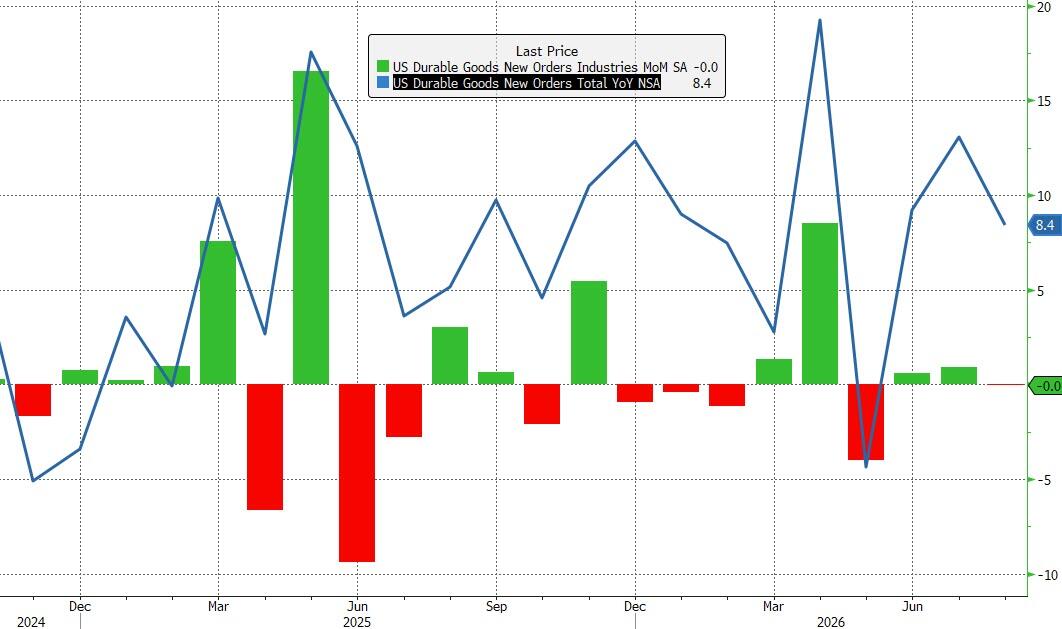
Boeing reported fewer orders in August compared with the prior month.
However, Ex-Transports disappointed, rising just 0.3% MoM (half the expected 0.6% MoM rise) with a revision higher for July. That leaves core orders up 11.1% YoY – the highest since Q2 2022.
But, that is still the 17th straight monthly rise in core durable goods orders…
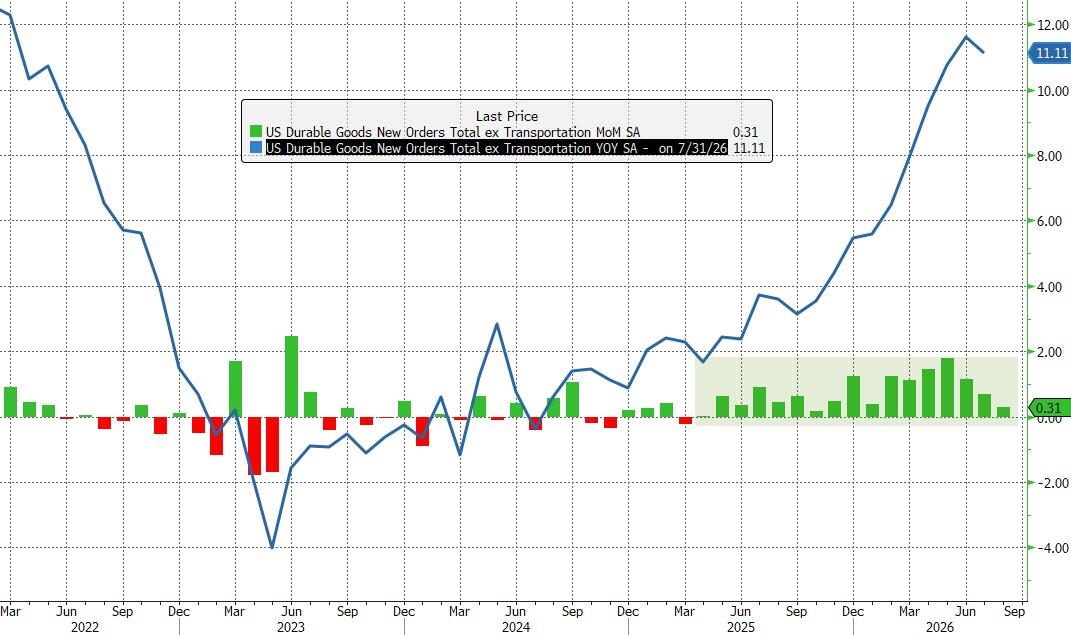
Additionally, Capital Goods Orders (non-defense, Ex-Air) soared 1.6% MoM (more than double the 0.56% MoM expected)
Under the hood, the big driver appears to be AI Spend (rather unsurprisingly)…
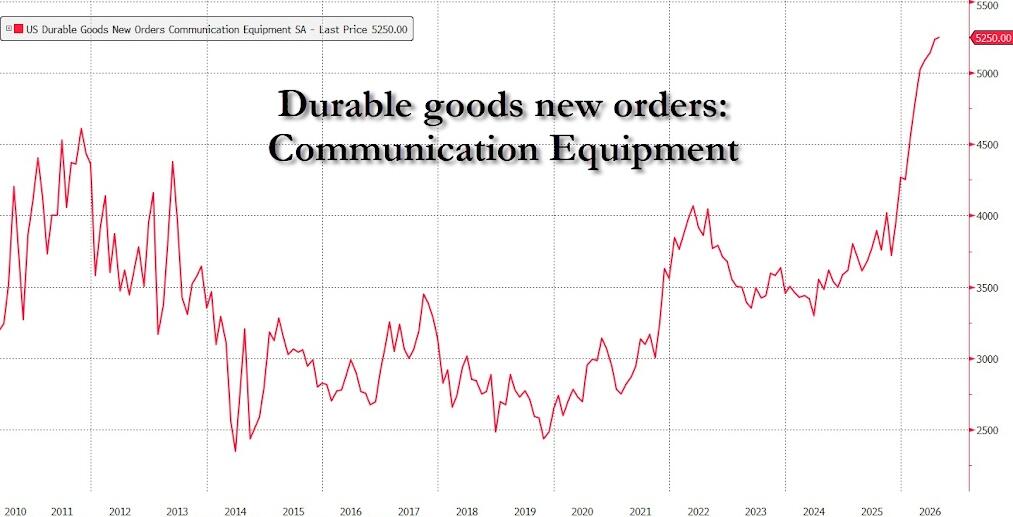
This segment includes:
- Telephone Apparatus: Wired and wireless telephones, private branch exchange (PBX) equipment, and VoIP equipment.
- Broadcast and Wireless Equipment: Radio and television broadcast antennas, cellular tower electronics, and two-way radios.
- Network Equipment: Routers, switches, local area network (LAN) and wide area network (WAN) equipment, and fiber-optic transmission gear
Is it any wonder that Trump doesn’t want a ‘pause’ on AI Spend.
Finally, shipments figures (which actually plug into GDP) were in line with expectations (with July revised up), suggesting resilience to Q3 forecasts.
END
UMich Consumer Confidence Slides In September As Republicans Lose Faith
Friday, Sep 25, 2026 – 10:10 AM
After July’s rebound to pre-war levels, a re-escalation in the MidEast (and soaring fuel costs) has sent confidence back towards YTD lows. Today’s final September data was expected to show UMich headline sentiment sliding further (and inflation expectations re-accelerating).
And while sentiment is lower overall (month to month), it did actually pick up modestly intra-month from preliminary levels.
Consumer sentiment ticked down less than four index points in September, reaching the lowest reading in four months and back down notably from January 2026.
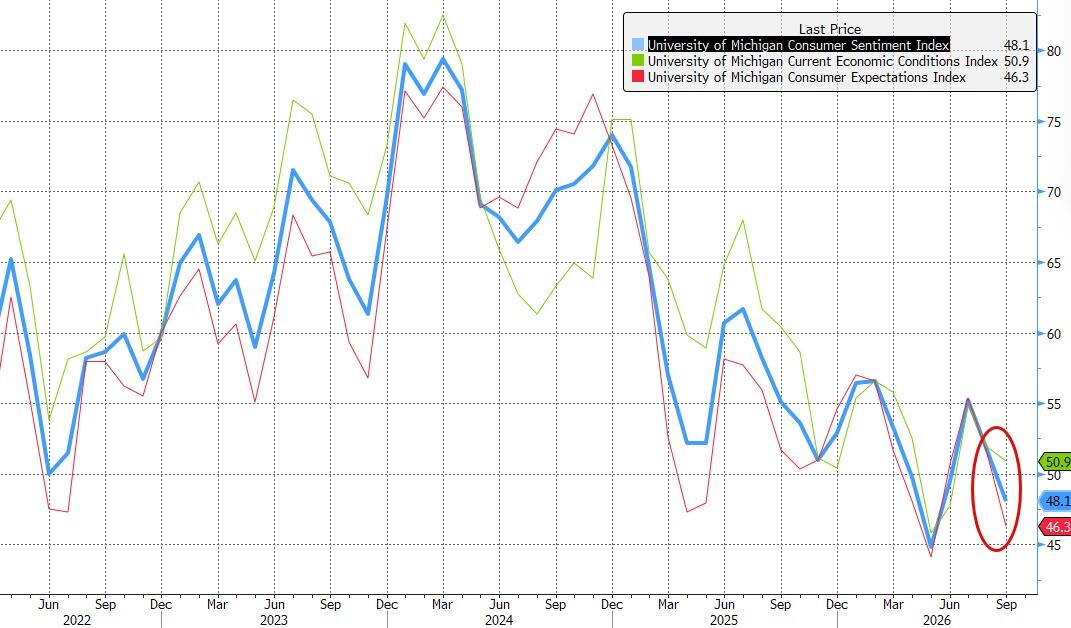
Views of current and year-ahead expected personal finances also both weakened notably this month, with concerns over high prices continuing to climb.
Year-ahead inflation expectations jumped from 4.0% last month to 4.6% this month, the highest reading since June. The current reading substantially exceeds the 3.4% seen in February before the Iran conflict began, along with all 2024 readings. Long-run inflation expectations ticked up to 3.4%, ending three consecutive months at 3.3%. These expectations remain higher than their 2024 range of 2.8% to 3.2%.
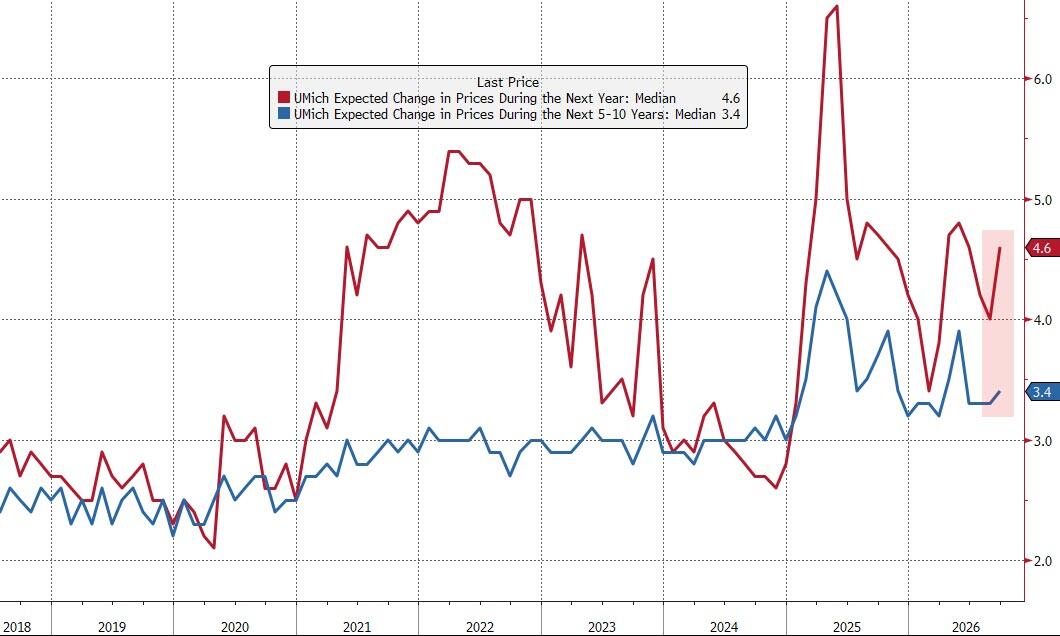
Democrats are the most fearful of inflation once again…
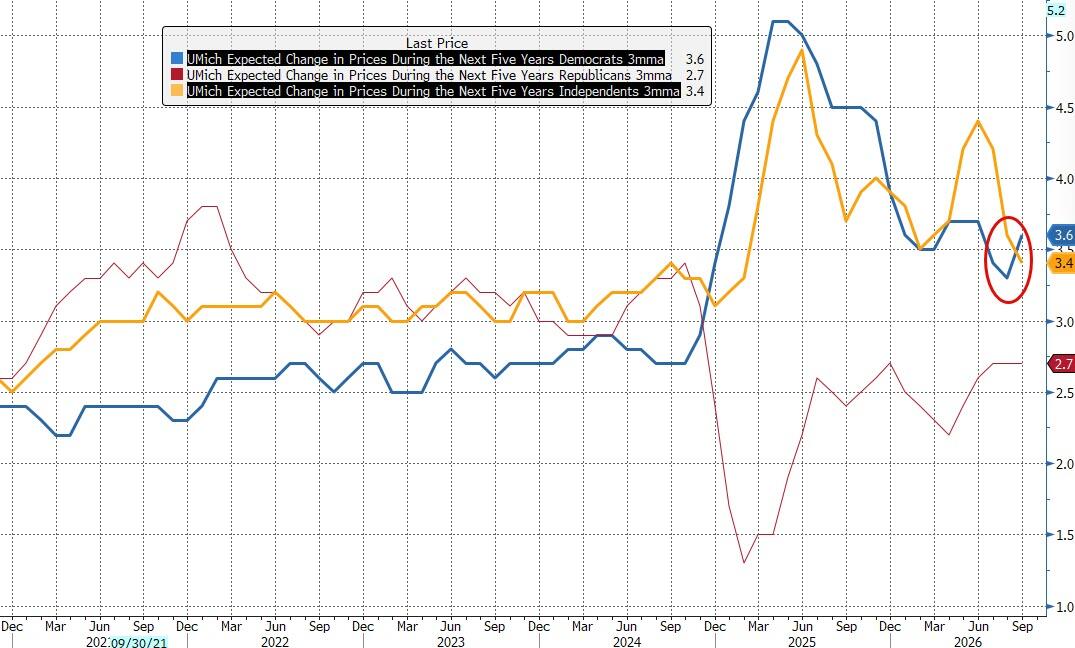
Since the start of the year, consumer sentiment has declined for all groups by age, education, geography, political party and income, according to the report.
A gauge of the outlook for the economy in the year ahead slumped in September to the lowest since 2022. Consumers’ expectations for their personal finances also deteriorated.
Buying conditions for durable goods improved slightly, but it was partly “due to a perception that completing such purchases now would help consumers avoid higher prices in the future,” Joanne Hsu, director of the survey, said in a statement.
Perhaps most ominously from the report is the finding that after particularly large declines in sentiment this month, Republican sentiment is now 20% lower than January 2026; Democrats are down 13% over the same period.
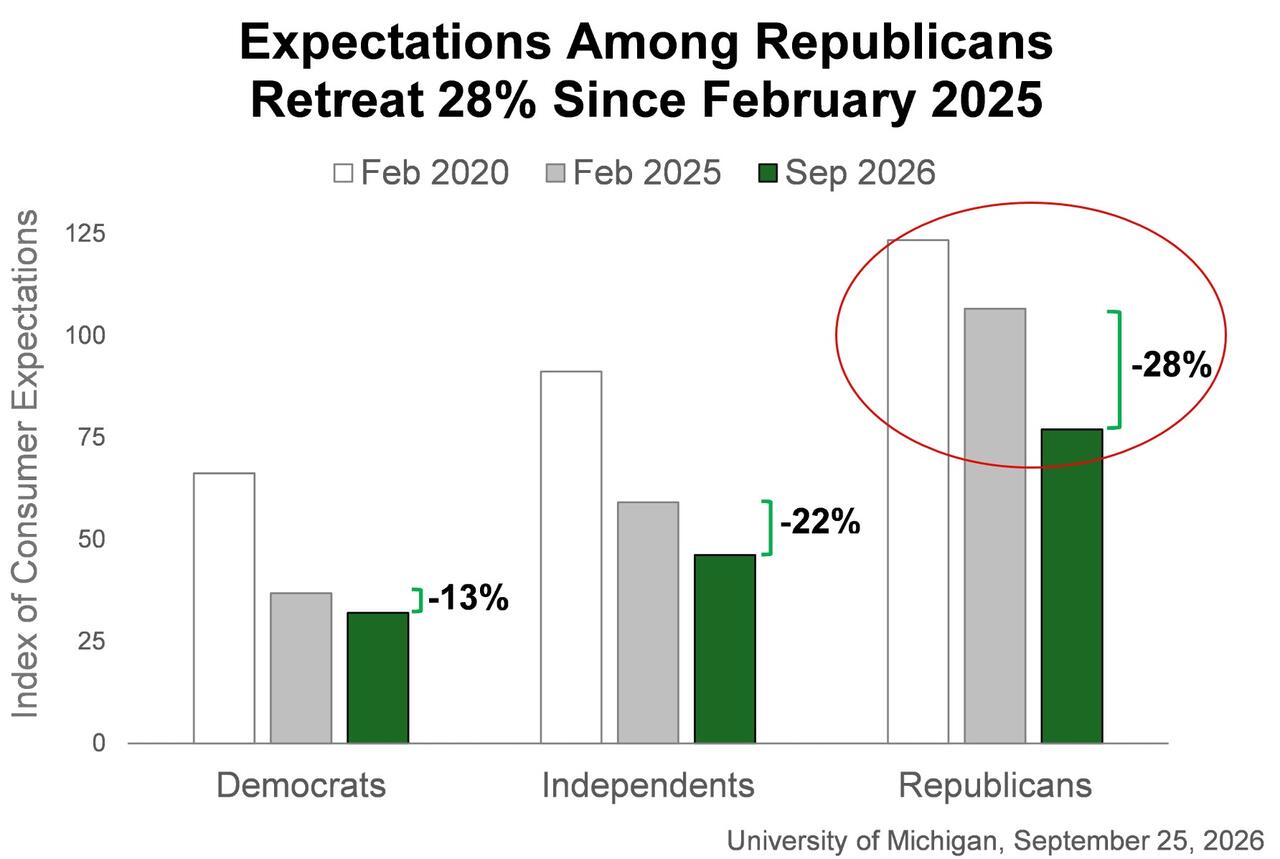
“Despite political differences, consumers unanimously believe that the outlook for the economy has diminished,’’ Hsu said.
END
USA ECONOMIC REPORTS
Oracle Still On The Hook To Pay Data Center Investors Despite Force Majeure Declaration
Oracle remains contractually obligated to make payments related to its massive Project Jupiter AI data center in New Mexico (despite issuing a force majeure notice over power/permitting delays), according to reports on the contractual fine print and statements from the parties involved.
zerohedge.com
On or around September 24, 2026, Oracle sent a force majeure notice to the project’s developer (a unit of Blue Owl Capital, specifically Stack Infrastructure). The notice cites unforeseen issues—primarily delays in securing natural gas pipeline permits and related power infrastructure needed for Bloom Energy fuel cells—that could prevent the facility from coming online as planned in 2028. Force majeure clauses typically excuse parties from obligations due to events beyond their control. Oracle is not seeking to exit as the main tenant; instead, it aims to potentially defer or put off certain payments if the campus is delayed or derailed.
bloomberg.com
Key project details:
- Scale: ~1,400-acre campus in southern New Mexico (Doña Ana County), targeting roughly 2.25–2.45 GW capacity. It is part of broader AI infrastructure efforts (linked in some reports to Stargate/OpenAI-related buildouts) and involves significant capital (reports cite tens of billions in overall investment potential, with ~$18 billion in bank project financing and ~$3 billion in Blue Owl equity). cryptobriefing.com
- Challenges: Multiple permit rejections (including for a key gas pipeline, delayed toward early 2027), environmental/legal challenges, local opposition over impacts (e.g., water, noise, emissions), and regulatory hurdles.
- Market reaction: Oracle shares fell roughly 3–5% on the news; the project debt has traded in “stressed” territory (around 89–91 cents on the dollar). fool.com
Why Oracle is still “on the hook”: Reports (including analysis tied to the ZeroHedge headline and CryptoBriefing) indicate that the force majeure notice does not fully relieve Oracle of its financial commitments under the agreements. Oracle cannot simply terminate the lease and must continue servicing related debt costs/holding payments (or residual-value-style guarantees common in data-center SPV structures for credit enhancement) whether or not the site powers up and generates revenue. One description notes that if early phases miss deadlines, Oracle may face holding-cost payments in lieu of rent for an extended period, with power-delivery risk effectively borne by Oracle rather than investors. Both Oracle and Blue Owl have stated publicly that the notice does not change underlying multi-year financial commitments or (in their view) the project’s planned schedule.
cryptobriefing.com
Oracle’s statements emphasize that “Project Jupiter remains on our planned schedule,” that it is “fully committed to New Mexico,” and that force-majeure notices are common in large developments to preserve contractual rights without necessarily signaling a delay. Blue Owl has similarly said the notice does not alter financial commitments.
reuters.com\
This episode has been framed as an early test of risk allocation in the rapid AI data-center buildout (where residual guarantees and tenant payment obligations are central to financing). It highlights how permitting, power, and local opposition can create friction even for well-capitalized tenants, with potential ripple effects on lenders and the broader AI infrastructure financing market. Details on exact contract terms remain private, and outcomes depend on whether the force majeure is accepted and how delays (if any) ultimately play out.
END
ROBERT LAMBOURNE ON THIS FORCE MAJEURE:
“This looks like the financing is at least part provided by private credit – possibly it’s been syndicated to other sources of funding. If so, agreeing an amendment to the terms is probably much trickier.
I’d share the scepticism of the author of this report that this is nothing to be concerned by.”
END
Force Majeure Is Not A City In France
Friday, Sep 25, 2026 – 09:20 AM
Submitted by QTR’s Fringe Finance
There are certain phrases you don’t want to hear when you’re involved in a massive infrastructure project, and “force majeure” is pretty high on the list.
Yet after Oracle shares started getting federally a** pounded today following reports that the company had issued a force majeure notice connected to its enormous Project Jupiter AI data center in New Mexico, the afternoon quickly turned into one of my favorite Wall Street traditions: corporations explaining why the alarming sounding thing everybody just read and understands crystal clearly is actually completely normal, totally misunderstood by everyone and nobody should worry about anything.
For those unfamiliar, force majeure is a contractual provision generally invoked when extraordinary circumstances outside a party’s control interfere with, or threaten to interfere with, its ability to perform under a contract. Oracle reportedly issued the notice to a unit of Blue Owl Capital developing Project Jupiter, citing potential delays in securing power and protecting Oracle financially if the facility doesn’t come online as scheduled.
Project Jupiter is a massive New Mexico AI campus tied to the Stargate buildout and Oracle’s relationship with OpenAI, requiring roughly 2.4 gigawatts of power and relying heavily on Bloom Energy fuel cells. The problem is that a natural gas pipeline needed to supply the site has reportedly been pushed back roughly six months following permitting problems, while a separate air quality permit for the fuel cell system remains pending. So when news of the force majeure notice hit, Oracle shares sold off sharply and Bloom Energy got dragged down with them.
Then came the idiotic damage control.
Oracle said on X that the project “remains on our planned schedule” and that force majeure notices are “commonplace in developments of this scale” and are often used simply to preserve contractual rights, adding that the notice does not itself establish a project delay or change delivery expectations.
Technically, that’s true. But companies also don’t issue force majeure notices because everything is going f**king fantastic.
Look. None of this means Project Jupiter is dead, and Oracle may ultimately deliver the project on schedule exactly as it says it will. But dismissing the notice as meaningless contractual housekeeping also misses the point. It also insults the intelligence of anyone with an IQ higher than that of Ilhan Omar. There is a reason it was issued, just as there is a reason a pipeline has been delayed and permits remain unresolved.
Investors have spent the last several years valuing the AI infrastructure boom as though converting hundreds of billions of dollars of announced spending into functioning data centers is basically a matter of ordering GPUs and plugging them into the wall. In reality, you need land, financing, transformers, transmission, gas, pipelines, permits, cooling and an almost incomprehensible amount of electricity. Every one of those things introduces another potential failure point. As bond yields keep rising, those failure points present themselves more and more.
Read: Bonds Are About To Crash The Stock Market
The financial chain is equally important. Oracle signs enormous AI contracts, which justify enormous data centers, which justify enormous financing packages, which create enormous orders for companies like Bloom and Nvidia, which create enormous backlogs that investors then capitalize into enormous valuations.
As long as everything moves according to plan, the machine works beautifully. But if data centers start getting delayed, equipment deliveries and revenue can get delayed with them. If revenue gets pushed out, financing assumptions can change. If financing becomes more difficult, suddenly some of those gigantic AI backlogs investors have treated almost like cash in the bank start looking considerably less certain.
One force majeure notice doesn’t break the AI boom. But this is exactly the kind of crack I’m watching for. If we start seeing more force majeure notices, delayed power projects, stressed data center debt, renegotiated contracts and suppliers rushing onto social media to assure everybody that their customers are definitely still committed, then we may be looking at something that could set off the crash.
Read: The Real AI Crash Will Start This Year
END
Oracle Bonds Plunge To Record Low As $30 Billion CapEx In Peril On Data Center Turmoil

“The hardware capex should also be delayed, $30bn; typically spent 2-3 months ahead of the asset going live”
Oracle’s bonds have sold off sharply (hitting multi-year or record lows/discounts in secondary trading, with long-dated paper like the 2056s yielding ~8% and trading wide of many high-yield averages), driven by data-center execution risks—especially around Project Jupiter in New Mexico—and the knock-on implications for its massive AI/cloud CapEx plans. tipranks.com +1Background and scaleOracle has bet heavily on AI infrastructure, particularly a large cloud contract with OpenAI (part of broader Stargate efforts). This has driven enormous capital spending: ~$55.7 billion in fiscal 2026 (ended May 2026), with guidance for fiscal 2027 in the $90–95 billion gross range (net cash CapEx guided around or below $70 billion after customer prepayments/reimbursements).
Total debt/borrowings have climbed above $125 billion, with large additional off-balance-sheet lease and data-center commitments. Free cash flow has been deeply negative amid the buildout. financefeeds.com +1S&P cut the rating to BBB- (one notch above junk) earlier, and further deterioration raises the risk of a “fallen angel” downgrade that could force selling of roughly $120 billion of bonds out of investment-grade indexes and raise borrowing costs further. CDS has hit record or multi-year wides. Bonds have traded at substantial discounts (company filings have shown fair value around the mid-80s cents on the dollar for the senior notes complex). financefeeds.com +1Project Jupiter / data-center turmoilThe immediate catalyst is trouble at Project Jupiter, a large (~2.2–2.45 GW) campus in Doña Ana County, New Mexico, developed with parties including STACK Infrastructure/Blue Owl and financed in part with ~$18 billion of construction loans. Those loans have been quoted in the high-80s to low-90s cents on the dollar amid stalled syndication and broader Oracle credit concerns. Local opposition, permitting hurdles (including for natural-gas pipeline/power supply), and related delays have complicated the timeline. archive.ph +1Oracle issued a force majeure notice related to power/permitting issues. This is aimed at protecting its position (e.g., deferring certain payments if the project misses targets, with first-phase or overall readiness previously eyed around 2027–2028), rather than exiting as tenant. Oracle has publicly stated the project remains on its planned schedule, that such notices are common for projects of this scale to preserve rights, and that it is committed to New Mexico. Contract terms reportedly still leave Oracle exposed to carry costs in some scenarios even if power is delayed. techcrunch.com +1Broader industry context includes widespread reports of data-center delays from power, labor, equipment, and local pushback (some estimates have put 30–50% of large 2026 projects at risk of delay or cancellation).The $30 billion hardware CapEx pointHardware (servers/GPUs etc.) is typically ordered and spent well ahead of a facility going live—often cited in the 2–3 month range ahead of operational readiness, though full lead times and installation can be longer. Delays to data-center readiness therefore risk pushing out or stranding related hardware CapEx (and the associated revenue ramp). Analyst and market commentary has linked the Jupiter and related turmoil to potential deferral of material hardware spending on the order of tens of billions (the specific “$30bn” figure appears in market discussion tied to the scale of affected or at-risk capacity). This adds uncertainty to near-term cash burn, revenue conversion from the large remaining performance obligations/backlog (hundreds of billions), and the path to positive free cash flow.
morningstar.com
Market reaction and bigger picture
Equity has been under pressure (Oracle has given back large prior gains tied to the AI/OpenAI announcements). Credit markets are pricing higher risk of delayed monetization, sustained high leverage, and potential further rating pressure. Oracle has used a mix of bonds, loans, equity raises, customer prepayments, and structured/lease arrangements to fund the buildout; access and cost of capital remain critical.This is part of a wider theme of AI infrastructure being financed with heavy debt and off-balance-sheet commitments across hyperscalers, with Oracle more leveraged and cash-flow constrained than some larger peers. Execution on power, construction, and customer ramps will determine whether the backlog converts into the expected cash flows without further balance-sheet strain.
end
KING NEWS
| The King Report September 25, 2026 Issue 7834 | Independent View of the News |
| Bessent said the US and China extended their trade truce through January. DJT met with Xi at the WH Thursday: Xi and I will discuss security, technology & artificial intelligence. · We’re working toward a more balanced trade relationship. · We’re making progress on new market access for US farmers. · We’re working toward a more balanced trade relationship. · If we focus on common interests, we can achieve a lot. Trump: President Xi and I have made tremendous strides on the issues facing our two countries. During my last visit last May, we created the Board of Trade. Through that, it’s a brand new mechanism, and with something that’s been unbelievably successful, our teams have been working to encourage a more balanced trading relationship. https://x.com/clashreport/status/2103129625278742802 Just as our people worked together to win WW2, President Xi and I will continue working together to forge a better future for both of our nations. President Xi, Madam Peng — thank you once again for making this historic visit and welcome to the U.S.A. https://x.com/clashreport/status/2103130692653928562 Of course, Trump trumpeted his “truly great friendship” with Xi. XI: I’M HERE TO PASS ON FRIENDSHIP, EXPAND COOPERATION – BBG XI: CHINA, US ARE BOTH GREAT COUNTRIES, GREAT PEOPLES – BBG XI: CHINA’S DOOR IS OPEN, WELCOMES U.S. FIRMS TO INVEST IN CHINA XI: WE NEED TO ENSURE THAT AI IS ALWAYS UNDER HUMAN CONTROL Xi on the US: Competition should be positive, with boundaries. Xi Jinping on AI: Both China and the United States are leading nations in artificial intelligence. We have both the capability and responsibility to develop and manage AI for good and ensure that the development of AI is always under human control and serves the well-being of the people. https://x.com/clashreport/status/2103133008265969912 XI: China and the United States are different in national conditions, but through dialogue, our two countries can understand each other better, seek common ground while shelving differences, and build up mutual trust. President Trump and I have respect for each other. We should cooperate with sincerity. The interests of China and the United States are deeply intertwined, and there is plenty of room for us to work together. China-U.S. cooperation may not solve every problem in the world, but without our cooperation, it would be hard to solve many of the world’s problems. https://x.com/clashreport/status/2103132608326455387 We should coexist in peace. As I have said many times, China and the United States, as two major countries, stand to gain from cooperation and will both lose in confrontation. We do not need to avoid mentioning competition, but our competition should be a healthy one and should be kept within bounds. It should be a race of catching up with one another, not a wrestle in which either wins or loses.. In a few days, two pandas — Ping Ping and Fuchuan — will come to their new home in Zoo Atlanta and meet with the American people… US bonds and notes declined sharply (higher yields) overnight but rally (intervention?) USZs hit a daily low of 105 9/32, -20/32, at 5:54 ET. They rallied to 106 3/32 at 10:07 ET. The US 30-year hit 5.497%, highest yield since 2004. The 10-year hit 5.221%; the 2-year 4.943%. Despite the bond rally from overnight lows, stocks declined modestly in early NYSE trading. Meta was a featured trading sardine, hitting 766.70, +3.05% (744.10 close on Wed.), by 10:20 ET. Yahya Rahim Safavi, an adviser to Iran’s Supreme Leader Mojtaba Khamenei: “Since the conflict has spread from the Persian Gulf and Strait of Hormuz to the Red Sea, it is possible that, in response to more war, the front will expand even further, reaching the Indian Ocean and perhaps beyond.” https://www.zerohedge.com/geopolitical/war-could-expand-indian-ocean-if-us-attacks-resume-iran-warns Nov WTI was +$2.32 and Brent was +$2.65 at 10:19 ET. Nov Diesel was +17.73¢; Nov Gas +1.54¢. @BloombergTV: Federal Reserve Bank of Cleveland President Beth Hammack said there is the risk that an inflationary mindset takes hold as the US economy faces a series of supply shocks https://bloom.bg/4AwTENW @BloombergTV: Federal Reserve Bank of Philadelphia President Anna Paulson says some modest further tightening may be warranted to ensure inflation returns to the central bank’s 2% goal during an event in Philadelphia https://bloom.bg/4AwTENW Oracle Cites ‘Force Majeure’ to Shield Itself on Controversial Data Center Oracle is moving to shield itself from racking up expenses on a massive data center being built in New Mexico, adding a fresh wrinkle to a project beset by opposition and regulatory setbacks. The technology giant sent the project’s developer, a unit of Blue Owl Capital Inc., a notice citing force majeure… The debt tied to the development is already trading at stressed levels, below 90 cents on the dollar… https://finance.yahoo.com/technology/ai/articles/oracle-cites-force-majeure-shield-122536420.html @Oracle: Project Jupiter remains on our planned schedule. We are fully committed to New Mexico and confident in our path forward… Zero Hedge: ORCL CDS just hit a new record wide, as its 2056 bonds (Baa2/BBB-) yield 8% for the first time ever, and wide of B2/B average (7.5%). When ORCL is junked, $120BN bonds will get kicked out of IG indexes. https://x.com/zerohedge/status/2103148793990389908 Due to Oracle, the S&P 500 Index gapped lower on the opening (7666.99, -39.04) and made a daily low of 7665.49 at 9:31 ET. Traders eagerly bought the dip; the index rallied to 7694.61 at 10:09 ET. Sellers surfaced, the index stair stepped down to 7674.83 at 11:24 ET. After an ABC bounce to 7671.15 at 11:17 ET, the S&P 500 Index fell to 7664.18 at 11:32 ET. After a modest rebound, the index went inert, possibly due to traders waiting for the results of the US $44B 7-year note Auction. The S&P 500 Index spiked to 7712.77 at 12:18 ET on this: US and Iran discuss phased deal to reopen Hormuz and end US blockade https://www.reuters.com/world/asia-pacific/us-iran-discuss-phased-deal-reopen-hormuz-end-us-blockade-sources-say-2026-09-24/ After algos and gullible traders manically bought ESZs, NQZs, and select stocks on the latest US-Iran deal is nigh hype, the S&P 500 Index fell to 8693.30 at 12:27 ET. US $44B 7-Year Note Auction results: High Yield 5.085% (0.7 bps Tail, 5.078 WI); Bid-to-cover 2.42; 91.11% of bids at high; Primary Dealers 12.5%; Direct Bidders 30.3%; Indirect Bidders 57.2% Bonds and notes rallied after the results of the soft 7-year note Auction. Seasoned traders and observers know dealers manipulate bonds and notes higher after the last major auction of the week to goad the public and others into buying their merchandise. But the secular trend for debt is clearly down. @BullTheoryio: Japan’s 2-year yield just hit a new 31-year high. The 5-year yield just hit a new 31-year high. The 10-year yield just hit a new 30-year high. For one of the most indebted economies in the world, this is very dangerous. https://x.com/BullTheoryio/status/2103024658421538901 With bonds rallying, the S&P 500 Index trotted up to 7719.01 at 12:57 ET. Alas, Iran denied that a deal to open Hormuz was nigh. @ghaderi62: The Reuters report is false, and its goal is to control the price of oil. No negotiations are underway. Iran’s position remains unchanged: the U.S. must fulfill the stipulated conditions in a single step so that the Strait of Hormuz can be opened under Iranian control. Period. 13:03 PM · Sep 24, 2026 The bond rally aborted, the S&P 500 Index fell to 7686.77 at 14:00 ET. The index rallied to 7712.97 at 14:30 ET. The S&P 500 then rolled over and went inert because debt yields rose to daily highs. The S&P 500 Index jumped 7 handles from 15:50 to 15:53 ET on the late manipulation. Alas, selling reappeared, the S&P 500 Index fell to 7703.00 at 15:59; the index closed at 7704.13. Positive aspects of previous session Major equity indices did NOT get crushed as they continue to insouciantly dismiss bond carnage. S&P 500 -0.02%, Nasdaq +0.01%, Nas 100 +0.03%; Nov Diesel and Gasoline down a tad at 16:20 ET. SP Comm Services +1.92%, Health Care +0.65%, Energy +0.43%, Financials +0.01% Negative aspects of previous session The US 30-year hit 5.497%, highest yield since 2004. The 10-year hit 5.221%; the 2-year hit 4.943%. DJIA -0.31%, DJTA -0.81%; SOX -0.33% SP Utes -1.02%, Materials -1.01%, Consumer Staples -0.97%, Industrials -0.71%, Real Estate -0.37%, Info Tech -0.32%, Consumer Discretionary -0.23% The yen/$ hit 159.035; Nov WTI Oil +$3.22, Nov Brent +$4.54 at 16:19 ET Ambiguous aspects of previous session Equities did NOT decline sharply. ‘They’ are still dismissing Mr. Bond’s anger. The Dollar Index hit 101.23, its highest level since July. First Hour/Last Hour NYSE Action [S&P 500 Index]: 1st Hour: Up; Last Hour: Up less than 1pt. Pivot Point for S&P 500 Index [above/below indicates daily trend to day traders]: 7695.24 Previous session (S&P 500 Index) High/Low: 7719.01 (12:57 ET); 7662.57 (9:31 ET) What has been, that will be; what has been done, that will be done. Nothing is new under the sun. Even the thing of which we say, “See, this is new!” has already existed in the ages that preceded us. Ecclesiastes 1:9-11 Fed Balance Sheet: +$1.114B, MBS-$3.234B, T-Bills +3.891B; Reserves: -$83.601B Today – The usual suspects want to play for the Friday Rally. However, bond and notes yields are making 20-year+ highs. If Mr. Bond behaves, stocks should rally, led by AI stocks and Fangs. ESZs and NQZs are lower on Thursday night because USZs are -11/32. ESZs -14.50; NQZs -61.50, USZs -11/32, Nov WTI -$0.76, Nov Gas -4.6¢, Yen/158.78 at 20:00 ET Expected economic data: August Durable Goods Orders -0.4% m/m, Ex- Transports 0.6%, Non-defense Ex-Air 0.5%; Sept UM Sentiment 47.6, Current Conditions 49.5, Expectations 50.5, 1-year Inflation 4.6%, 5-year Inflation 3.4 percent; Cleveland Fed President Hammack 13:00 ET S&P 500 50-day MA: 7632; 100-day MA: 7543; 200-day MA: 7199 (Close 7704.13) Nasdaq 100 50-day MA: 29,256; 100-day MA: 29,383; 200-day MA: 25,329 (Close 30,478.86) DJIA 50-day MA: 52,811; 100-day MA: 51,951; 200-day MA: 50,181 (Close 51,349.98) (Green is positive slope; Red is negative slope) Lindsay Clancy holdout juror Michael Desronvil claims fellow jurors used cell phones during deliberations: report https://trib.al/6XJu3cL Sunny Hostin’s shocking reveal on ‘The View’ that she was holdout juror in NYC killer cannibal case https://nypost.visitlink.me/hQH3z_ (Why does ABC keep her on the air?) Sunny Hostin’s claim that she was lone holdout in NYC cannibalism trial shot down by multiple sources from the time https://trib.al/TLjKdf6 @Kentuckygirl1: Surely Sunny Hostin wouldn’t lie about being the lone hold-out juror on the Rakowitz case, would she? According to an article in the Daily News published on February 23, 1991, the hold-out juror was identified as being an unemployed man. Juror Valerie Holmes is quoted as calling him determined and manipulative, saying he wanted to keep collecting his $15/day juror stipend. In the same article, juror Asuncion Cummings (Hostin) said, “Yes, we believe he did it. I believe he butchered the body and almost committed the perfect crime. He knew what he was doing.” Sure doesn’t sound like she was a hold-out juror. (Pic of story at link https://x.com/Kentuckygirl1/status/2103073972925395253/photo/1 To gain affirmation and ‘love’ from the wacky left as well as virtue signal for their causes, some people will lie and admit to disturbing deeds. @JonathanTurley: A new survey found that 59 % of Democrats would favor a military coup to remove President Donald Trump from office. All it took was four years out of power for these Democratic voters to embrace a coup d’état to negate the results of the last election… The survey also shows the same overwhelming support for socialism in the new Democratic Party. What is surprising is the support for public ownership of industries. That includes almost half (46%) supporting public ownership and operation of grocery stores. Almost 40 percent support public ownership and operation of restaurants. (39%). https://jonathanturley.org/2026/09/24/bring-on-the-generals-roughly-60-percent-of-polled-democrats-would-support-a-military-coup/ Whenever a civilization begins to die morally or spiritually, then there begin to appear vultures. And that is the nature of communism in the world. Communism is the scavenger of decaying civilizations. It makes its way into a county and a culture only when that culture begins to rot from the inside.” — Bishop Fulton Sheen https://x.com/RaymondArroyo/status/2102752656460845223 @Rothmus: The FBI tailed Fulton Sheen in 1943 for attacking Stalin while the Soviets were still America’s wartime ally. Today the Church is beatifying him in St. Louis in front of tens of thousands. Sheen used prime time TV and 30 million viewers to hammer that an anti-God regime is always an anti-human one. He received Bella Dodd, a Communist Party national committee member, into the Church on Christmas Eve 1950. Bishop Barron recently said the communism Sheen spent his life fighting is making a comeback here. Sheen died 12 years before the commie empire collapsed. But he never waited for the alliance to end. https://x.com/Rothmus/status/2103155833282465980 | |
SWAMP STORIES FOR YOU TONIGHT
GREG HUNTER….
SEE YOU ON MONDAY


