
EXCHANGE: COMEX
CONTRACT: OCTOBER 2026 COMEX 100 GOLD FUTURES
SETTLEMENT: 4,191.000000000 USD
INTENT DATE: 10/09/2026 DELIVERY DATE: 10/13/2026
FIRM ORG FIRM NAME ISSUED STOPPED
152 C DORMAN TRADING, LLC 1
363 H WELLS FARGO SECURITI 12
365 C MAREX CAPITAL MARKET 120
661 C JP MORGAN SECURITIES 112
709 C BARCLAYS 8
737 C ADVANTAGE FUTURES 5
905 C ADM 18
TOTAL: 138 138
GOLD: NUMBER OF NOTICES FILED FOR OCT./2026: 138 CONTRACTs NOTICES FOR 13,800 OZ or 0.4292 TONNES
total notices so far: 12,467 contracts FOR 1,246,700 OZ OR 38.776 TONNES
SILVER NOTICES: 1 NOTICE(S) FILED FOR 5,000 OZ /
total number of notices filed so far this month : 3126 CONTRACTS (NOTICES) for 15.630 million oz
GLD
SHANGHAI CLOSED DOWN 16.55 PTS OR 0.43%
HANG SENG CLOSED UP 59.85 PTS OR 0.25%
Nikkei CLOSED DOWN 11.19 PTS OR 0.02%
//Australia’s all ordinaries CLOSED UP 0.30%
//Chinese yuan (ONSHORE) CLOSED UP AT 6.6928
/ OFFSHORE CLOSED UP AT 6.6942 Oil UP TO 92.62 dollars per barrel for WTI and BRENT UP TO 105.48 Stocks in Europe OPENED ALL GREEN
ONSHORE USA/ YUAN// WITH YUAN TRADING 6.6928 OFFSHORE YUAN TRADING UP TO 6.6942 ONSHORE YUAN TRADING ABOVE LEVEL // OFF SHORE AND UP ON THE DOLLAR)// / AND THUS STRONGER/OFF SHORE YUAN TRADING UP AGAINST US DOLLAR/ AND THUS STRONGER
| Gold | Ounces |
| Withdrawals from Dealers Inventory in oz | nil |
| Withdrawals from Customer Inventory in oz | 0 ENTRIES |
| Deposit to theDealerInventory in oz | 0 ENTRIES |
| Deposits to the Customer Inventory, in oz | DEPOSITS/CUSTOMER//gold 0 ENTRIES xxxxxxxxxxxxxxxx |
| No of oz served (contracts) today | 138 CONTRACTS 13,800 OZ 0.4292 TONNES OF GOLD |
| No of oz to be served (notices) | 85 Contracts 8500 OZ 0.2643 TONNES |
| Total monthly oz gold served (contracts) so far this month | 12,467 notices 1,246,700 OZ 38.776 TONNES |
| Total accumulative withdrawals of gold from the Dealers inventory this month | NIL oz |
| Total accumulative withdrawal of gold from the Customer inventory this month |
dealer deposits: 0
xxxxxxxxxxxxxxxxxxx
DEPOSITS:
ENTRIES: 0
xxxxxxxxxxxxxxxxxx
comex withdrawal
0 ENTRIES
adjustments: 0
COMEX IS DRAINING GOLD
chaos inside the comex
THE FRONT MONTH OF OCT OI STANDS AT 337 CONTRACTS HAVING A GAIN OF 37 CONTRACTS.
FRIDAY WE HAD 1,241,100 OZ ( 38.603 TONNES) OF GOLD STANDING FOR DELIVERY: TODAY: 1,255,300 OZ OR 39.045 TONNES FOR A GAIN OF 14,200 OZ (0.4416 TONNES) OR 142 CONTRACTS UNDERWENT A QUEUE JUMP FOR 14,200 OZ (.4416TONNES) AS THEY SEEK PHYSICAL GOLD ON THIS SIDE OF THE POND.
NOVEMBER LOST 22 CONTRACTS FALLING TO 3993
DECEMBER, THE LARGEST DELIVERY MONTH IN THE CALENDAR, ITS OI FALLS BY 1973 CONTRACTS DOWN TO 319,173.
.
We had 138 contracts filed for today representing 13,800 oz
Today, 0 notice(s) were issued from J.P.Morgan dealer and 0 notices issued from their client or customer account. The total of all issuance by all participants equate to 138 contract(s) of which 0 notices were stopped (received) by j.P. Morgan dealer and 112 notice(s) was (were) stopped (received) by J.P.Morgan//customer account
To calculate the INITIAL total number of gold ounces standing for OCT /2026. contract month, we take the total number of notices filed so far for the month (12,467) to which we add the difference between the open interest for the front month of OCT (223 CONTRACTS) minus the number of notices served upon today 138 x 100 oz per contract) equals 1,255,300 OZ OR(39.045 Tonnes of gold) to which we add our first exchange for risk in Oct totalling 836 contracts for 83,600 oz or 2.600 tonnes. Thus Oct standing for gold advances hugely to 41.645 tonnes
THUS: INITIAL total number of gold ounces standing for OCT. /2026. contract month,we take the total number of notices filed so far for the month (12,467) to which we add the difference between the open interest for the front month of OCT(223) contracts minus the number of notices served upon today 138 x 100 oz per contract) equals 1,255,300 OZ OR(39.045 Tonnes of gold) plus our first exchange for risk totalling 836 contracts//83600 oz//2.600 tonnes//standing advances to 41.645 tonnes
new total of gold standing in OCT becomes 41.645 TONNES//
TOTAL COMEX GOLD STANDING FOR OCT.: 41.645 TONNES WHICH IS NOW VERY STRONG FOR THIS NON ACTIVE DELIVERY MONTH OF OCT./
FRIDAY VOLUME: 153,049 POOR
COMEX GOLD INVENTORIES/CLASSIFICATION
NEW PLEDGED GOLD:
241,794.285 oz NOW PLEDGED /HSBC 5.94 TONNES
204,937.290 OZ PLEDGED MANFRA 3.08 TONNES
83,657.582 PLEDGED JPMorgan no 1 1.690 tonnes
265,999.054, oz JPM No 2
1,152,376.639 oz pledged Brinks/
Manfra: 33,758.550 oz
Delaware: 193.721 oz
International Delaware:: 11,188.542 oz
total pledged gold: 1,721,684.952 oz 53.55 tonnes pledged gold lowers
total inventories in gold declining rapidly
total pledged gold: 1,721,684.952 tonnes oz 53.55 tonnes
TOTAL OF ALL GOLD ELIGIBLE AND REGISTERED GOLD 23,477,528.707oz//
TOTAL REGISTERED GOLD 15,067,141.026 tonnes (468.65 tonnes)
TOTAL OF ALL ELIGIBLE GOLD 8,410,387.681 oz.
0
REGISTERED GOLD THAT CAN BE SERVED UPON 13,345,457oz ((REG GOLD- PLEDGED GOLD)=
415.090 Tonnes //
total inventories in gold declining rapidly
SILVER COMEX
OCT DELIVERY MONTH
OCT 12
| Silver | Ounces |
| Withdrawals from Dealers Inventory | NIL oz |
| Withdrawals from Customer Inventory | 3 entries i) Out of Asahi 611,485.490 oz. ii) Out of Loomis 306,690.770 OZ iii) Out of JPMorgan: 1,323,360.100 oz total withdrawal 2,241,536.366oz |
| Deposits to the Dealer Inventory | 0 ENTRY |
| Deposits to the Customer Inventory | ENTRIES: 1 i) Into Loomis: 306,690.776 oz total deposit: 306,690.776 oz |
| No of oz served today (contracts) | 1 CONTRACT(S) ( 5,000 OZ) |
| No of oz to be served (notices) | 369 Contracts (1.845 MILLION oz) |
| Total monthly oz silver served (contracts) | 3126 contracts 15.630 MILLIONoz |
| Total accumulative withdrawal of silver from the Dealers inventory this month | NIL oz |
| Total accumulative withdrawal of silver from the Customer inventory this month |
DEPOSITS INTO DEALER ACCOUNTS
ENTRY:1
i) Into CNT dealer: 598,436.300 oz
total deposit: 598,436.300 oz
DEPOSIT ENTRIES/CUSTOMER ACCOUNT
1 ENTRIES:
i) Into Loomis: 306,690.776 oz
total deposit: 306,690.776 oz
xxxxxxxxxxxxxxxxxxxxxxxxx
withdrawals:
3 entries
i) Out of Asahi 611,485.490 oz.
ii) Out of Loomis 306,690.770 OZ
iii) Out of JPMorgan: 1,323,360.100 oz
total withdrawal 2,241,536.366oz
adjustments : 1
Asahi: dealer to customer: 56,321.2000 oz
xxxxxxxxxxxxxx
TOTAL REGISTERED SILVER: 102.757 MILLION OZ//.TOTAL REG + ELIGIBLE. 329.874 Million oz
registered silver dropping in numbers
CALCULATIONS FOR THE NEW STANDING FOR SILVER FOR OCT
FRONT MONTH: SILVER OPEN INTEREST CONTRACTS: 370 FOR A LOSS OF 353 CONTRACTS.FRIDAY WE HAD 17.450 MILLION OZ STAND: TODAY: 17.475 MILLION OZ FOR A GAIN OF 25,000 OZ (5 CONTRACTS). THUS A SMALL QUEUE JUMP WHERE THEY WILL TAKE DELIVERY ON THIS SIDE ON THE POND.
NOVEMBER GAINED 54 CONTRACTS UP TO AN OI OF 2075
DECEMBER LOST 1015 CONTRACTS DOWN TO AN OI OF 82,502
TOTAL NUMBER OF NOTICES FILED FOR TODAY: 1 or 5,000 oz
CONFIRMED volume FRIDAY; 46,892 // poor/
AND NOW OCT. DELIVERIES:
To calculate the number of silver ounces that will stand for delivery in OCT. we take the total number of notices filed for the month so far at 3126 X5,000 oz = 15.630 MILLION oz.
Then we take the difference between the front month of OCT. and the number of notices filed for today x 5000 to give us our standing
Thus the standings for silver for the OCT 2026 contract month: (3126 )Notices served so far) x 5000 oz + OI for the front month of OCT (370) minus number of notices served upon today ( 1 x 5000 oz) equals silver standing for the OCT .contract month equating to 17.475 MILLION OZ to which we add silver’s TWO exchange for risk for 450 contracts (2.25 million oz).. total standing reduces to 19.725 million oz//. ( a very strong delivery month)
We must also keep in mind that there is considerable silver standing in London coming from our longs
There are ONLY 102.757 million oz of registered silver
JPMorgan as a percentage of total silver: 125.510/329.874 million: 37.87%
The record level of silver open interest is 234,787 contracts set on April 21./2017 with the price on that day at $18.42.
The previous record was 224,540 contracts with the price at that time of $20.44.
BOTH GLD AND SLV ARE MASSIVE FRAUD
XXXXXXXXXXXXXXXXXXXXXXXXXXXXXXXXXXXXXXXXXXX
OCT 12//2026/WITH GOLD DOWN $24.20 /HUGE CHANGES IN GOLD AT THE GLD: A WITHDRAWAL OF 2TONNES OF GOLD OUT OF THE GLD//: //:/INVENTORY RESTS AT 1053.13 TONNES
OCT 9//2026/WITH GOLD UP $60.00 /HUGE CHANGES IN GOLD AT THE GLD: A WITHDRAWAL OF 4.562 TONNES OF GOLD OUT OF THE GLD//: //:/INVENTORY RESTS AT 1055.411 TONNES
OCT 8//2026/WITH GOLD UP $16.85 /HUGE CHANGES IN GOLD AT THE GLD: A DEPOSIT OF 3.703 TONNES OF GOLD INTO THE GLD//: //:/INVENTORY RESTS AT 1059.873 TONNES
OCT 7//2026/WITH GOLD DOWN $46.70 /NO CHANGES IN GOLD AT THE GLD:: //:/INVENTORY RESTS AT 1056.27 TONNES
OCT 6//2026/WITH GOLD UP $30.60 /HUGE CHANGES IN GOLD AT THE GLD:: A DEPOSIT OF 0.754 TONNES OF GOLD INTO THE GLD// //:/INVENTORY RESTS AT 1056.27 TONNES
OCT 5//2026/WITH GOLD DOWN $2.20 /HUGE CHANGES IN GOLD AT THE GLD:: A WITHDRAWAL OF 0.854 TONNES OF GOLD INTO THE GLD// //:/INVENTORY RESTS AT 1055.696 TONNES
OCT 2//2026/WITH GOLD DOWN $43.00 /HUGE CHANGES IN GOLD AT THE GLD:: A DEPOSIT OF 0.854 TONNES OF GOLD INTO THE GLD// //:/INVENTORY RESTS AT 1056.55 TONNES
OCT 1//2026/WITH GOLD UP $19.55 /HUGE CHANGES IN GOLD AT THE GLD:: A WITHDRAWAL OF 1.711 TONNES OF GOLD OUT OF THE GLD// //:/INVENTORY RESTS AT 1055.696 TONNES
SEPT 30//2026/WITH GOLD UP $7.80 /HUGE CHANGES IN GOLD AT THE GLD:: A DEPOSIT OF 2.847 TONNES OF GOLD INTO THE GLD// //:/INVENTORY RESTS AT 1057.407 TONNES
SEPT 29//2026/WITH GOLD UP $11.75 /NO CHANGES IN GOLD AT THE GLD //:/INVENTORY RESTS AT 1054.56 TONNES
SEPT 28//2026/WITH GOLD DOWN $150.20 /NO CHANGES IN GOLD AT THE GLD //:/INVENTORY RESTS AT 1054.56 TONNES
SEPT 25//2026/WITH GOLD DOWN $150.20 /NO CHANGES IN GOLD AT THE GLD //:/INVENTORY RESTS AT 1054.56 TONNES
SEPT 24//2026/WITH GOLD DOWN $18.70 /HUGE CHANGES IN GOLD AT THE GLD A DEPOSIT OF 1.43 TONNES OF GOLD INTO THE GLD://:/INVENTORY RESTS AT 1056.84 TONNES
SEPT 23//2026/WITH GOLD DOWN $58.00 /HUGE CHANGES IN GOLD AT THE GLD://:/INVENTORY RESTS AT 1055.41 TONNES
SEPT 22//2026/WITH GOLD DOWN $6.30 /HUGE CHANGES IN GOLD AT THE GLD://A DEPOSIT OF 0.31 TONNES OF GOLD INTO THE GLD/:/INVENTORY RESTS AT 1055.41 TONNES
SEPT 21//2026/WITH GOLD DOWN $41.20 /HUGE CHANGES IN GOLD AT THE GLD://A DEPOSIT OF 2.26 TONNES OF GOLD INTO THE GLD/:/INVENTORY RESTS AT 1055.10 TONNES
SEPT 18//2026/WITH GOLD UP $26.45 /HUGE CHANGES IN GOLD AT THE GLD://A DEPOSIT OF 0.85 TONNES OF GOLD INTO THE GLD/:/INVENTORY RESTS AT 1052.84 TONNES
SEPT 17//2026/WITH GOLD UP $14.05 /HUGE CHANGES IN GOLD AT THE GLD://A DEPOSIT OF 1.71 TONNES OF GOLD INOT THE GLD/:/INVENTORY RESTS AT 1051.99 TONNES
SEPT 16//2026/WITH GOLD UP $53.40 /HUGE CHANGES IN GOLD AT THE GLD://A DEPOSIT OF 2.86 TONNES OF GOLD INOT THE GLD/:/INVENTORY RESTS AT 1050.28 TONNES
SEPT 15//2026/WITH GOLD DOWN $19.45 /NO CHANGES IN GOLD AT THE GLD://A WITHDRAWAL OF 0.353 TONNES OF GOLD FROM THE GLD/:/INVENTORY RESTS AT 1047.420 TONNES
SEPT 14//2026/WITH GOLD DOWN $54.50 /SMALL CHANGES IN GOLD AT THE GLD://A WITHDRAWAL OF 0.353 TONNES OF GOLD FROM THE GLD/:/INVENTORY RESTS AT 1047.420 TONNES
SEPT 11//2026/WITH GOLD UP $1.05 /SMALL CHANGES IN GOLD AT THE GLD://A WITHDRAWAL OF 0.353 TONNES OF GOLD FROM THE GLD/:/INVENTORY RESTS AT 1050.277 TONNES
/SEPT 10//2026/WITH GOLD UP $50.60 /NO CHANGES IN GOLD AT THE GLD://:/INVENTORY RESTS AT 1050.63 TONNES
SEPT 9//2026/WITH GOLD UP $20.40 /HUGE CHANGES IN GOLD AT THE GLD:A WITHDRAWAL OF 1.43 TONNES OF GOLD OUT OF THE GLD/ ////:/INVENTORY RESTS AT 1050.63 TONNES
SEPT 8//2026/WITH GOLD DOWN $34.20 /HUGE CHANGES IN GOLD AT THE GLD:A WITHDRAWAL OF 1.42 TONNES OF GOLD OUT OF THE GLD/ ////:/INVENTORY RESTS AT 1052.06 TONNES
SEPT 4//2026/WITH GOLD DOWN $63.50 /HUGE CHANGES IN GOLD AT THE GLD:A WITHDRAWAL OF 3.14 TONNES OF GOLD OUT OF THE GLD/ ////:/INVENTORY RESTS AT 1053.48 TONNES
SEPT 3//2026/WITH GOLD UP $141.55 /HUGE CHANGES IN GOLD AT THE GLD:A DEPOSIT OF 9.98 TONNES OF GOLD INTO THE GLD/ ////:/INVENTORY RESTS AT 1056.62 TONNES
SEPT 2//2026/WITH GOLD UP $19.25 /HUGE CHANGES IN GOLD AT THE GLD:A DEPOSIT OF 4.28 TONNES OF GOLD INTO THE GLD/ ////:/INVENTORY RESTS AT 1046.64 TONNES
SEPT 1//2026/WITH GOLD DOWN $80.25 /NO CHANGES IN GOLD AT THE GLD:// ////:/INVENTORY RESTS AT 1042.36 TONNES
GLD INVENTORY: 1053/130 TONNES, TONIGHTS TOTAL GOLD INVENTORY
SILVER
OCT 12 WITH SILVER DOWN $0.51 : :HUGE CHANGES A DEPOSIT OF 722,000 OZ INTO THE SLV// // :INVENTORY RESTS AT 493.948 MILLION OZ
OCT 9 WITH SILVER UP $0.62 : :SMALL CHANGES A DEPOSIT OF 948,000 OZ INTO THE SLV// // :INVENTORY RESTS AT 493.226 MILLION OZ
OCT 8 WITH SILVER DOWN $0.74 : :SMALL CHANGES IN INVENTORY AT THE SLV:A WITHDRAWAL OF 532,000 OZ FROM THE SLV// // :INVENTORY RESTS AT 492.278 MILLION OZ
OCT 7 WITH SILVER DOWN $1.36 : :SMALL CHANGES IN INVENTORY AT THE SLV:A WITHDRAWAL OF 451,000 OZ FROM THE SLV// // :INVENTORY RESTS AT 492.910 MILLION OZ
OCT 6 WITH SILVER UP $0.31 : :NO CHANGES IN INVENTORY AT THE SLV: // :INVENTORY RESTS AT 493.361 MILLION OZ
OCT 5 WITH SILVER UP $0.87 : :NO CHANGES IN INVENTORY AT THE SLV: // :INVENTORY RESTS AT 493.361 MILLION OZ
OCT 2 WITH SILVER DOWN $0.74 : :NO CHANGES IN INVENTORY AT THE SLV: // :INVENTORY RESTS AT 493.578 MILLION OZ
OCT 1 WITH SILVER UP $0.57 : :HUGE CHANGES IN INVENTORY AT THE SLV: A WITHDRAWAL OF 1.400 MILLION OZ OUT OF THE SLV// :INVENTORY RESTS AT 493.578 MILLION OZ
SEPT 30 WITH SILVER DOWN $0.55 : :HUGE CHANGES IN INVENTORY AT THE SLV: A DEPOSIT OF 994,000 OZ INTO THE SLV// :INVENTORY RESTS AT 494.978 MILLION OZ
SEPT 29 WITH SILVER DOWN $0.58 : :SMALL CHANGES IN INVENTORY AT THE SLV: A WITHDRAWAL OF 566,000 OZ FROM THE SLV// :INVENTORY RESTS AT 493.984 MILLION OZ
SEPT 28 WITH SILVER DOWN $2.91 : :SMALL CHANGES IN INVENTORY AT THE SLV: A DEPOSIT OF 0.542 MILLION OZ FROM THE SLV// :INVENTORY RESTS AT 494.436 MILLION OZ
SEPT 25 WITH SILVER DOWN $2.91 : :SMALL CHANGES IN INVENTORY AT THE SLV: A DEPOSIT OF 0.542 MILLION OZ FROM THE SLV// :INVENTORY RESTS AT 494.436 MILLION OZ
SEPT 24 WITH SILVER DOWN $0.96 : :HUGE CHANGES IN INVENTORY AT THE SLV: A WITHDRAWAL OF 0.813 MILLION OZ FROM THE SLV// :INVENTORY RESTS AT 493.533 MILLION OZ
SEPT 23 WITH SILVER UP $1.58 : :HUGE CHANGES IN INVENTORY AT THE SLV: A WITHDRAWAL OF 1.716 MILLION OZ FROM THE SLV// :INVENTORY RESTS AT 494.346 MILLION OZ
SEPT 22 WITH SILVER UP $0.10 : :NO CHANGES IN INVENTORY AT THE SLV: :INVENTORY RESTS AT 496.062 MILLION OZ
SEPT 21 WITH SILVER UP $1.04 : :HUGE CHANGES IN INVENTORY AT THE SLV: :INVENTORY RESTS AT 489.558 MILLION OZ
SEPT 18 WITH SILVER UP $1.04 : :NO CHANGES IN INVENTORY AT THE SLV: :INVENTORY RESTS AT 489.558 MILLION OZ
SEPT 17 WITH SILVER UP $1.10 : :HUGE CHANGES IN INVENTORY AT THE SLV: A WITHDRAWAL OF 1.265 MILLION OZ FROM THE SLV/ :INVENTORY RESTS AT 489.558 MILLION OZ
SEPT 16 WITH SILVER UP $0.95 : :HUGE CHANGES IN INVENTORY AT THE SLV: A WITHDRAWAL OF 813,000 OZ FROM THE SLV/ :INVENTORY RESTS AT 490.823 MILLION OZ
SEPT 15 WITH SILVER DOWN $0.16 : :HUGE CHANGES IN INVENTORY AT THE SLV: A WITHDRAWAL OF 813,000 OZ FROM THE SLV/ :INVENTORY RESTS AT 491.636 MILLION OZ
SEPT 14 WITH SILVER DOWN $0.91 : :NO CHANGES IN INVENTORY AT THE SLV:/ :INVENTORY RESTS AT 492.449 MILLION OZ
SEPT 11 WITH SILVER DOWN $3.50 : :NO CHANGES IN INVENTORY AT THE SLV:/ :INVENTORY RESTS AT 492.449 MILLION OZ
SEPT 10 WITH SILVER DOWN $3.50 : :NO CHANGES IN INVENTORY AT THE SLV:// / :INVENTORY RESTS AT 493.171 MILLION OZ
SEPT 9 WITH SILVER UP $0.56 : :NO CHANGES IN INVENTORY AT THE SLV:// / :INVENTORY RESTS AT 493.171 MILLION OZ
SEPT 8 WITH SILVER UP $0.31 : :HUGE CHANGES IN INVENTORY AT THE SLV:/ A DEPOSIT OF 0.632 MILLION OZ INTO THE SLV// / :INVENTORY RESTS AT 493.171 MILLION OZ
SEPT 4 WITH SILVER UP $2.20 : :NO CHANGES IN INVENTORY AT THE SLV:/// / :INVENTORY RESTS AT 492.539 MILLION OZ
SEPT 3 WITH SILVER UP $2.20 : :HUGE CHANGES IN INVENTORY AT THE SLV:A WITHDRAWAL OF 1.293 MILLION OZ FROM THE SLV//// / :INVENTORY RESTS AT 492.539 MILLION OZ
SEPT2 WITH SILVER UP $0.15 : :NO CHANGES IN INVENTORY AT THE SLV:// / :INVENTORY RESTS AT 493.832 MILLION OZ
SEPT1 WITH SILVER DOWN $1.43 : :NO CHANGES IN INVENTORY AT THE SLV:// / :INVENTORY RESTS AT 493.832 MILLION OZ
CLOSING INVENTORY 493.948 MILLION OZ OF SILVER
GOLD COMMENTARIES:
1.PETER SCHIFF//JOHN RUBINO//RAVEN
1 B // JAMES RICKARDS/MATHEW PIEPENBURG/ALASDAIR MACLEOD..
ALASDAIR MACLEOD…
Dieselgate —the implications
Trump’s agreement with Putin to supply diesel is America’s concession that it has lost its geopolitical battle against the Russian Chinese partnership.
| Alasdair MacleodOct 11∙Paid |  |


“The decline of American power is taking its currency down with it.”
The cat’s out of the bag
On Friday, President Trump revealed that Russia has agreed to supply 300,000 tonnes of diesel to America and international markets immediately, with more to follow in the coming months. In return, the US has agreed to suspend energy sanctions against Russia. At the time of writing, Russian confirmation is from senior officials rather than a formal Kremlin announcement.
Zelensky’s response has been to double down on attacks against Russian refineries, reportedly striking two such facilities — moves likely to further alienate the Americans. The Europeans have also been blindsided by this move. For them, it is a clear breach in relations with their dominant NATO partner and raises questions over NATO’s future existence.
It is already clear to independent observers that Ukraine is a lost cause, and this is the implication of the diesel agreement with Russia. The only surprise is the degree to which European Russophobia continues to blind UK/German/French/EU politicians:
Andy Burnham immediately called Zelensky and offered his cast-iron support, ensuring Trump’s disapproval and threatening that most cherished British government notion, the Special Relationship. Under Trump, it’s been revealed as an illusion anyway.
Predictably, the British press condemns Trump’s move, but they have one thing right: This is a victory for Putin. We would go further. The structure of the deal is an immediate supply of 300,000 tonnes of diesel (about 2.2 million barrels, or considerably less than the 3.6 million barrels daily supplied by the Gulf before the war against Iran, or only 7.5% of global daily consumption). It may allow Trump to claim a win, though the amount is unlikely to solve his diesel problem.
The agreement appears to include the phased exports by Russia of an additional 1.5m tonnes (11.25 million barrels, or about 40% of only one day’s global consumption). In effect, Russia is withholding the bulk of the agreed supplies, not just because of the practicalities of exporting these quantities while Ukraine continues to compromise its refining capacity, but we can envisage the day when Russia says, “Sorry, but because the Ukrainians have continued to attack our refineries, we have no option but to delay our exports to the US and global markets”.
And talking of global diesel supplies, there’s likely to be further pressure on the US from Russia to withdraw from the Middle East, and not to escalate the mess it has already created for global markets. Israel’s partnership with the US will have to be abandoned.
By linking Trump’s moves with pump prices ahead of the mid-terms next month, the Western press is missing the big picture. The 120-year-old prediction by the father of geopolitics is bearing fruit. Halford Mackinder first laid out his theory to the Royal Geographic Society in 1905, that the centre of world power is in Asia — the territory of Russia, China, and Persia combined.
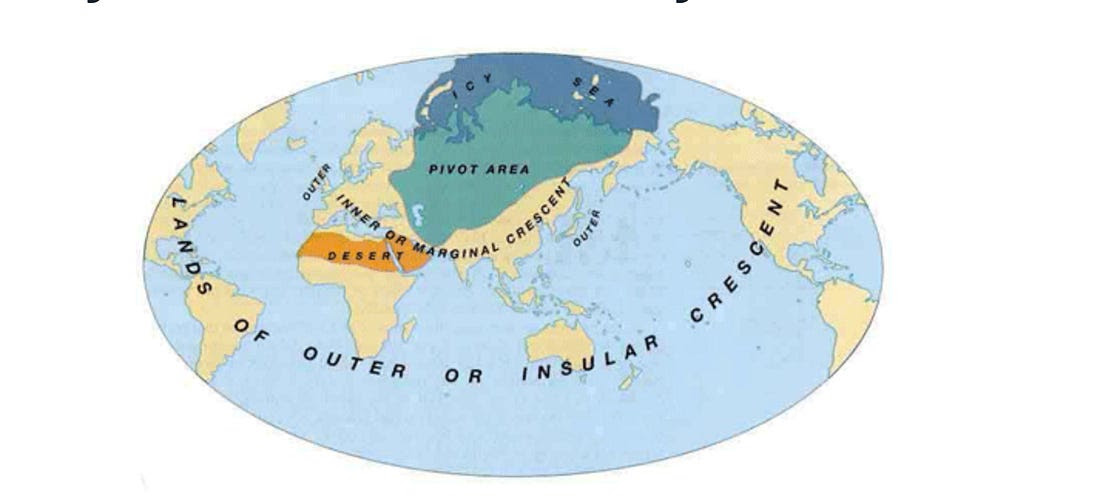
“Who rules East Europe commands the Heartland; Who rules the Heartland commands the World-island; Who rules the World-island commands the World.” Halford Mackinder, 1905
Halford Mackinder with his Heartland Theory is credited with inventing geopolitics. 121 years later, we are finding out that his heartland theory was right. His pivot area in the map above is dominated by Russia, China and Iran. And it can be already said that apart from Western Europe and the two “Outers” of Britain and Japan, they control the Inner or Marginal Crescent. Until now, the Arabian Middle East has been a further exception.
Control of the Middle East with its energy resources is obviously key in a geopolitical context, and by attacking Iran the US appears to have lost it. Iran insists that the Gulf states close down US military bases on pain of their destruction. Israel will then become isolated and emasculated. With US forces retreating from Arab lands to Israel, they are all an easy target for Iran’s hypersonic missiles. For Iran it will be like shooting rats in a barrel. Israel will have no alternative but to parlay with the proximate hegemons of Russia and China, and arguably Iran as well. This is clear from Mackinder’s theory.
We shall see how this plays out, but our working assumption must be that the US has lost control over the Eurasian continent — Mackinder’s World Island. The implications for inflation in the G7 nations are being wildly underestimated, leading to yet higher bond yields and interest rates as the truth dawns, driving indebted industries into an economic slump.
The death of the dollar
As the truth of Mackinder’s prophecy is revealed, the US dollar will be discarded by Asians, already anticipated by China and Russia. Now there is selling pressure from Arab lands, which hold considerable dollar investments due to war-related costs. Asia includes Japan, a staunch ally of the US but also under pressure to liquidate dollar investments for other reasons. It raises a question as to how the US is to finance itself and absorb dollar liquidation.
Sharply rising G7 bond yields due to the inflationary implications of the Iran war are now adding to funding difficulties, throwing the US and other G7s into inescapable debt traps. The war is just the start of it. The relative stability of China’s yuan is already contrasting with the instability of the dollar as the World Island and its Marginal Crescent ditches dollars for the yuan.
Economic consequences
Markets are still underestimating the consequences for the dollar and the currencies of America’s allies in the G7. Their purchasing power will be on the slide, increasingly driven by markets’ assessments of the consequences of the US’s withdrawal from Europe and the Middle East. The emergence of debt traps for all G7 currencies is driving bond yields and interest rates higher. All asset values without exception will decline, some such as overblown equities potentially rapidly. The destruction of these credit values will be further reflected in the declining purchasing power of the dollar, as economic and financial carnage leads to a slump in tax revenues while welfare commitments soar.
In other words, the US and its fellow G7s are irretrievably bust, which is what debt traps are signalling. Once under way, this slide into crisis is likely to be rapid, accelerating as foreigners liquidate financial asset positions in both US markets and those of the Europeans and Japan. It is an outcome which is shaping up to be unstoppable. It is time-out for 52 years of the petrodollar and 55 years of the dollar-based fiat currency system.
Both Russia and China are prepared for this outcome while America and its hapless allies are not. China and Russia have hidden reserves of real money, that is gold with which to secure the value of their currencies. It contrasts with America whose level of gold reserves are in considerable doubt. China in particular has laid the groundwork for a Bretton Woods Mark 2, using gold to back the international yuan at a fixed rate.
Despite its war footing, Russia can credibly back her rouble as well. Both nations can carry their electorates Overton-wise through the transition. With their finances in a mess and their private sectors in a slump, the US and other G7s cannot. The ultimate strength of the World’s pivot area is shaping up to be sound money, just as fiat credit is America’s Achillies heel
Unless this changes, which is currently impossible to envisage, the end of the fiat currency system will drive the dollar into valuelessness, reflected in a dollar gold price of infinity for practical purposes. It will prove once more, that with the seeds of their own destruction fiat currencies never survive indefinitely. The decline of American power is taking its currency down with it.
END
3. CHRIS POWELL AND HIS GATA DISPATCHES
4. ANDREW MAGUIRE//KINESIS LIVE FROM THE VAULT/293
 | |||
5. COMMODITY REPORT COPPER, OIL GOLD/SILVER
SSROCCO
END
COMMODITY: LITHIUM
Chinese Lithium Futs Plunge As EU Hybrid Cap Deals Fresh Blow To Battery Demand
Monday, Oct 12, 2026 – 07:20 AM
Lithium futures in China plunged on Monday after a Bloomberg report said the European Union will cap imports of Chinese hybrid vehicles at 350,000 per year, with the “safeguard measure” set to take effect in the coming weeks.
Under a four-year safeguard measure that could take effect Dec. 1, the bloc will limit Chinese hybrid imports to 350,000 vehicles in the first year, according to the report. The quota would increase by 6% annually from the second year, while the broader safeguard would cover other suppliers to comply with World Trade Organization rules.
In the note titled “EU Caps Chinese Hybrids At 350,000 As Deutsche Maps Every Trade Weapon Left In Europe’s Arsenal,” we outlined that EU imports of Chinese hybrids would be roughly 45% below this year’s run rate of 650,000 vehicles.
The immediate market response to this new development was a 10% drop in the most-active lithium contract on the Guangzhou Futures Exchange, which closed at 104,740 yuan ($15,649) a ton.
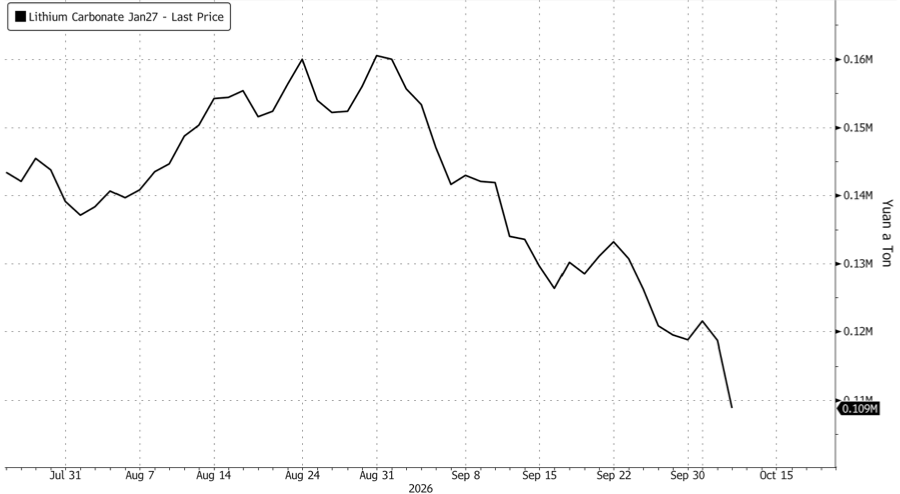
Lithium prices have slumped in the back half of the year as the industry faces mounting pressure from weaker demand for electric vehicles and energy-storage systems.
For context, in October 2024, when the EV tariffs pushed Beijing into hybrids, Europe imported about 3,800 Chinese hybrids a month, per FT data, or roughly 46,000 a year. By year four, the cap grows to about 417,000. In other words, Brussels initially caps the flood of cheap Chinese hybrids at about eight times the October 2024 annualized import level, keeping pressure on European auto companies already grappling with sliding shares and weaker earnings.
The EU-China agreement could help avert a broader trade war and, most importantly, keep Beijing from cutting off rare earth exports, as it has done for certain metals to the US.
Back to lithium markets, Goldman analysts recently forecast that Chinese and global lithium markets would shift from deficits to near-balance in the fourth quarter, then into surpluses over the next two years. The analysts pointed to slower underlying growth in EVs and energy storage, alongside reduced inventory-building needs.
END
YOUR EARLY CURRENCY VALUES/GOLD AND SILVER PRICING/ASIAN AND EUROPEAN BOURSE MOVEMENTS/AND INTEREST RATE SETTINGS MONDAY MORNING.7:30 AM
SHANGHAI CLOSED DOWN 16.55 PTS OR 0.43%
HANG SENG CLOSED UP 59.85 PTS OR 0.25%
Nikkei CLOSED DOWN 11.19 PTS OR 0.02%
//Australia’s all ordinaries CLOSED UP 0.30%
//Chinese yuan (ONSHORE) CLOSED UP AT 6.6928
/ OFFSHORE CLOSED UP AT 6.6942 Oil UP TO 92.62 dollars per barrel for WTI and BRENT UP TO 105.48 Stocks in Europe OPENED ALL GREEN
ONSHORE USA/ YUAN// WITH YUAN TRADING 6.6928 OFFSHORE YUAN TRADING UP TO 6.6942 ONSHORE YUAN TRADING ABOVE LEVEL // OFF SHORE AND UP ON THE DOLLAR)// / AND THUS STRONGER/OFF SHORE YUAN TRADING UP AGAINST US DOLLAR/ AND THUS STRONGER
XXXXXXXXXXXXXXXXXXXXXXXXXXXXXXXXXXXXX
ONSHORE YUAN: CLOSED UP TO 6.6928
OFFSHORE YUAN: UP TO 6.6942
1A.HANG SANG CLOSED UP 59.85 PTS OR 0.25%
1 B. SHANGHAI CLOSED DOWN 11.19 PTS OR 0.02%
2. Nikkei closed DOWN 11.19 PTS OR 0.02%
WEST TEXAS INTERMEDIATE OIL UP TO 92/62
BRENT; 105.48
3. Europe stocks SO FAR: ALL GREEN
USA dollar INDEX UP 12 BASIS PTS TO 102.18// EURO FALLS TO 1.1183 DOWN 13 BASIS PTS
3b Japan 10 YR bond yield:FALLS TO. +3.002 DOWN 0 FULL BASIS PTS/ VERY TROUBLESOME//Japan buying 100% of bond issuance)/Japanese YEN vs USA CROSS NOW AT 158.62… JAPANESE YEN NOW FALLING AS WE HAVE NOW REACHED THE ENDING OF THE YEN CARRY TRADE AGAIN AND THE REPATRIATION OF YEN DENOMINATED BONDS TRADING IN THE USA/EUROPE. JAPAN 30 YR BOND YIELD: 4.055 DOWN 1 FULL BASIS PTS
3c Nikkei now ABOVE 17,000
3d USA/Yen rate now well ABOVE the important 120 barrier this morning
3e Gold DOWN /JAPANESE Yen DOWN//CHINESE ONSHORE YUAN: UP (6.6928) AND OFFSHORE: UP AT 6.6942
3f Japan is to buy INFINITE TRILLION YEN worth of BONDS. Japan’s GDP equals 5 trillion USA. CENTRAL BANK OF JAPAN WILL NO LONGER DO QE.
Japan to buy 100% of all new Japanese debt and NOW they will have OVER 50% of all Japanese debt. GOVERMENT ASKED JAPAN PENSION FUNDS AND INSURANCE FUNDS TO BUY MORE JAPANESE BONDS AND REPATRIATE ALL FOREIGN BONDS.
3g Oil UP for WTI and UP for Brent this morning
3h European bond buying continues to push yields HIGHER on all fronts in the EU German 10yr bund YIELD UP TO +3.4615/ Italian 10 Yr bond yield UP AT 4.581/ SPAIN 10 YR BOND YIELD UP TO 4.093%
3i Greek 10 year bond yield UP TO 4.4105%
3j Gold at $4178/80 /Silver at: 60.73 1 am est) SILVER NEXT RESISTANCE LEVEL AT $100.00
3k USA vs Russian rouble;// Russian rouble UP 1 AND 17/ 100 roubles/83.91
3m oil (WTI) into the 92 dollar handle for WTI and 105 handle for Brent/
3n Higher foreign deposits moving out of China// huge risk of outflows and a currency depreciation. This can spell financial disaster for the rest of the world/
JAPAN ON JAN 29.2016 CONTINUES NIRP. THIS MORNING RAISES AMOUNT OF BONDS THAT THEY WILL PURCHASE UP TO .5% ON THE 10 YR BOND///YEN TRADES TO 158.62 // 10 YEAR YIELD AFTER FIRST BREAKING .54% LAST YEAR NOW EXCEEDS THAT LEVEL TO 3.0020% DOWN 0 BASIS PTS STILL ON CENTRAL BANK (JAPAN) INTERVENTION//YEN CARRY TRADE NOW UNWINDING//YEN BOND TRADING OVERSEAS TO BE REPATRIATED.//JAPAN 30 YR: 4.055 UP 1 PTS..: USA/SF this 0.8331 as the Swiss Franc . Euro vs SF: 0.9312
USA 10 YR BOND YIELD: 5.254 UP 1 BASIS PTS…NOW ABOVE 5.00%
USA 30 YR BOND YIELD: 5.599 DOWN 1 BASIS PTS/REFUSES TO GO DOWN WITH BESSENT’S QE TWIST
USA 2 YR BOND YIELD: 4.791 UP 4 BASIS PTS
USA DOLLAR VS TURKISH LIRA: 49.34 UP 0 BASIS PTS/LIRA GETTING KILLED//IDIOTS FOR SELLING GOLD AND USA DOLLAR RESERVES.
10 YR UK BOND YIELD: 5.4343 DOWN 1 PTS
30 YR UK BOND YIELD: 5.9349 DOWN 1 BASIS PTS
10 YEAR FRENCH BOND YIELD; 4.875 % //UP 1 BASIS PTS
10 YR CANADA BOND YIELD: 3.878 DOWN 5 BASIS PTS
5 YR CANADA BOND YIELD: 3.556 DOWN 5 BASIS PTS.
1a New York Opening report
Futures Flat As Oil Rebounds After Trump’s “Energy Ceasefire” Unravels, Memory Stocks Slide
Monday, Oct 12, 2026 – 08:32 AM
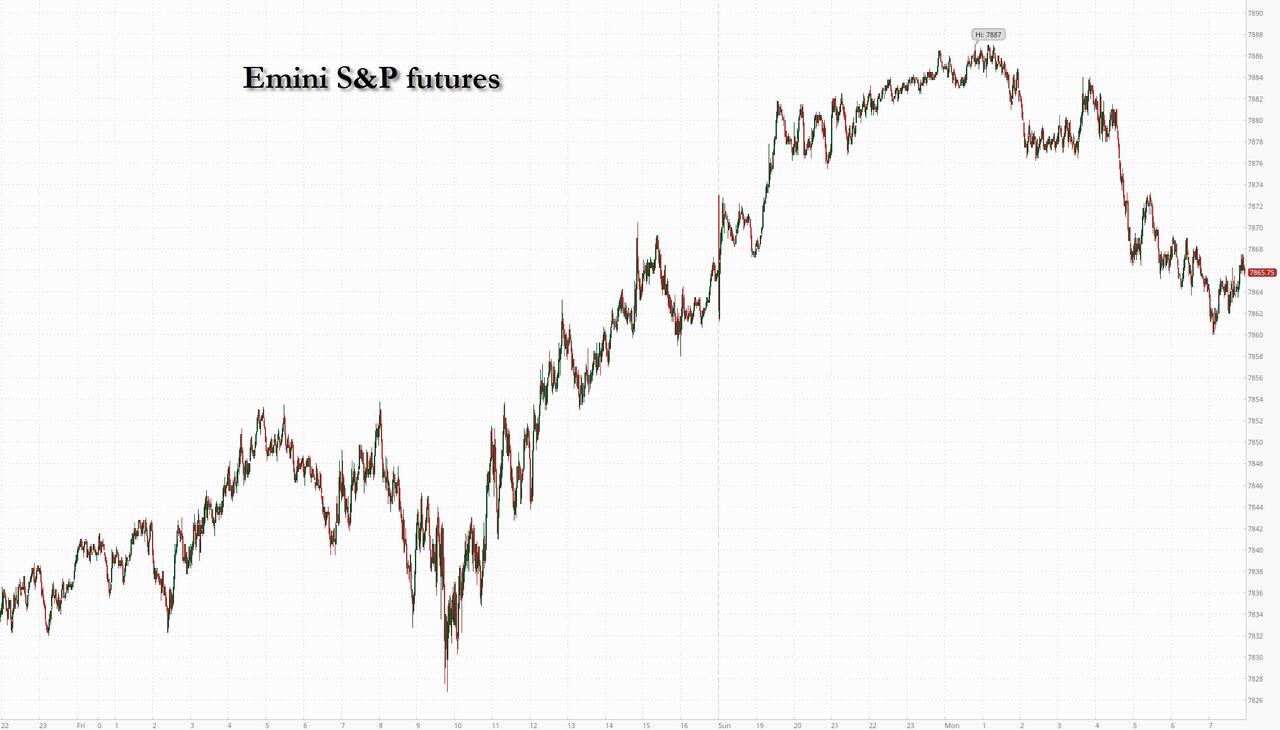
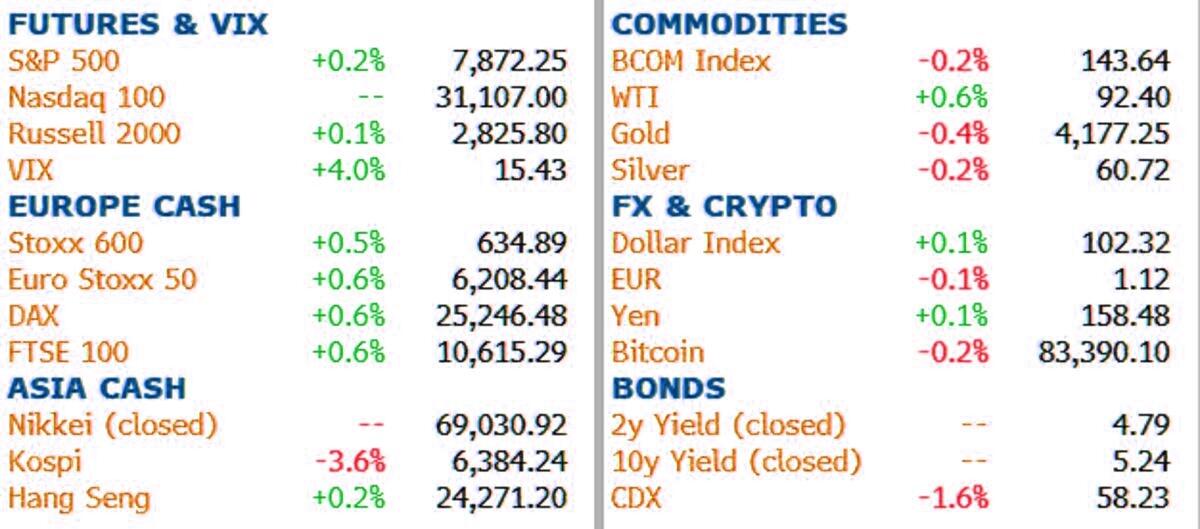
US futures are flat, with S&P contracts clinging to small gains and the Nasdaq slipping into the red as memory stocks slide, after a weekend of contradictory geopolitical headlines whipsawed oil (see below). As of 8:00am ET, S&P futures were 0.1% higher at 7,865 while Nasdaq futures were down 0.1%. Dow futures are up about 0.1%. That follows a Friday session in which the S&P rose 0.6% to cap a 1.2% weekly gain (after a record close on Wednesday) and the Dow jumped 0.8%. In premarket trading, Meta leads the Mag 7 higher (+1.8%) while memory names slide, with Micron down 2.1% after Samsung and SK Hynix tumbled more than 4% in Seoul with buyback quotas now largely completed; T-Mobile rebounded 1.1% on a Raymond James upgrade after Friday’s SpaceX-spectrum puke, CCC Intelligent jumps 8.3% on buyout talks with GTCR and Elliott and IREN rises 5% on a reported cloud deal with Anthropic. The day’s driver is oil (again), and the market can’t decide which war to price: WTI is up 1.2% at $93.00 and Brent is at session highs, above $106 having traded in a $102.33-$106.17 range, as Iran insists Hormuz stays shut until all seven of its conditions are met and Trump mulls joining Saudi strikes on the Houthis. There is no cash Treasury trading today for the Columbus Day holiday; Treasury futures drift lower led by the ultras, implying slight bear steepening, while bunds and gilts are higher (10Y gilt yield down 4bps to 5.41%, bund down 2bps to 3.46%) as diesel prices fall following US efforts to release Russian fuel to the market. The Bloomberg dollar index is steady with the Swiss franc the weakest G10 currency and the pound outperforming ahead of PM Burnham’s speech on EU ties, while India’s rupee jumped more than 1% after the RBI’s strongest support measures since the 2013 taper tantrum. In commodities, spot gold slipped to a $4,168 low, silver is near $60.70, copper extends Friday’s rebound as Chinese buyers return from Golden Week, Dutch TTF is firmer at up to €82.90/MWh and US natgas is down 2.5% to $3.14. Bitcoin reversed from a peak of $84,260 to trade near $83,300. There is no US economic data today; Fed speaker slate includes Hammack (12:10pm). The US cash bond market is closed for Columbus Day; stock markets are open.
In premarket trading, Meta shares outperform Magnificent 7 peers, with the cohort helping boost stock futures: Meta Platforms (META) +1.6%, Microsoft (MSFT) +0.4%, Alphabet (GOOGL) -0.2%, Amazon (AMZN) -0.2%, Apple (AAPL) +0.2%, Nvidia (NVDA) -0.2%, Tesla (TSLA) little changed
- Adobe (ADBE) slips 2.6% after Wells Fargo Securities downgraded the maker of software for creative professionals by two notches to underweight.
- AST SpaceMobile (ASTS) rises 4.4% after Deutsche Bank upgraded the satellite broadband operator to buy, seeing a buying opportunity in the wake of recent weakness.
- Biogen (BIIB) gains 4.1% as JPMorgan upgrades to overweight ahead of an increasingly compelling catalyst path in 2027.
- Bristol Myers (BMY) rises 4.4% after the drugmaker said a late-stage trial of a lower dose of its drug candidate for lung disease met its primary endpoint.
- CCC Intelligent Solutions (CCC) rises 11% as GTCR and Elliott Investment Management are said to be in advanced talks to acquire the car-insurance software provider.
- First Solar (FSLR) climbs 2.7% after Truist Securities upgraded the alternative energy company to buy, seeing “a stronger backdrop for pricing into the 2030s.”
- First Tracks Biotherapeutics (TRAX) gains 16% after the drug developer gave topline results from an early-stage trial of its experimental therapy for celiac disease.
- Hub Group (HUBG) gains 3.8% after Baird analyst Daniel Moore raised the recommendation on the transportation company to outperform, writing that the stock’s risk-reward profile has grown increasingly attractive.
- Iren (IREN) rises 3.8% as the Information reports that the crypto miner-turned-AI server provider has entered a multiyear cloud deal with Anthropic.
- Manhattan Associates (MANH) rises 3.5% after Morgan Stanley upgraded the software company to overweight, seeing it as a potential AI winner.
- Salesforce (CRM) climbs 4.1% after BofA Global Research raised the recommendation on the software company to buy, pointing to tailwinds from AI adoption.
- Tyler Technologies (TYL) gains 2.5% after Wells Fargo Securities upgraded the software company to overweight from equal-weight, seeing fading headwinds.
In other corporate news, Amazon is in negotiations to acquire Decart AI, a startup whose software makes it easier for developers to switch between different AI chips, in a deal that could be valued at around $7 billion, the WSJ reported (because when compute is scarce, the next best thing is buying the switchboard). Nvidia is in talks to acquire or deepen its investment in Reflection AI, a developer of open-weight models the Trump administration hopes will rival cheap Chinese alternatives, per the FT. Broadcom CEO Hock Tan said capital will be the biggest constraint facing the company as AI development continues. HSBC will phase out fixed-pay allowances for senior staff in favor of bonuses. Suzhou Dongshan Precision Manufacturing has started gauging investor interest for a Hong Kong listing that may raise $2 billion to $3 billion. Bambusa Therapeutics filed for an IPO and OPay filed for an NYSE IPO that could be up to $500 million, per IFR. TotalEnergies and KKR will add 700 MW of renewables to their US JV, Uber invested in Croatian robotaxi startup Verne, and Tata’s TML CV raised its offer for Iveco to €14.40 a share, declaring it best and final. Hon Hai and FII shares dropped after the US ITC opened a Section 337 probe into AI server power-supply makers.
Trump’s surprise Russia-Ukraine “energy ceasefire” (which Moscow has yet to confirm, and which Zelensky says Russia ignored within hours by hitting a power plant) initially knocked Brent toward $102, but repeated Houthi strikes on Riyadh’s main airport and another tanker hit in the Strait of Hormuz sent crude right back up; as a result Brent is back above $106 while cash Treasuries are closed for Columbus Day with the 10Y last at 5.24%, a whisker from its highest level since 2002.
Oil, according to Bloomberg’s Jan-Patrick Barnert, “looks to be trading Washington’s midterm calendar rather than the latest Houthi attacks on Saudi Arabia”, with equities overnight “taking the cheaper barrel and asking few questions.” The cheaper barrel didn’t last: after Trump declared an energy truce that Zelensky said was “news to me”, Kyiv said Russia struck a thermal power plant in Kharkiv, the Kremlin said it has nothing to say yet, and Riyadh’s King Khalid airport was hit again a day after an attack that killed 12 people including an American. Meanwhile, tankers keep catching fire in Hormuz, with the IRGC saying a third tanker since Saturday hit a sea mine. Brent has round-tripped from $102 to $105.50 and the level to watch, per Bloomberg, is $100.
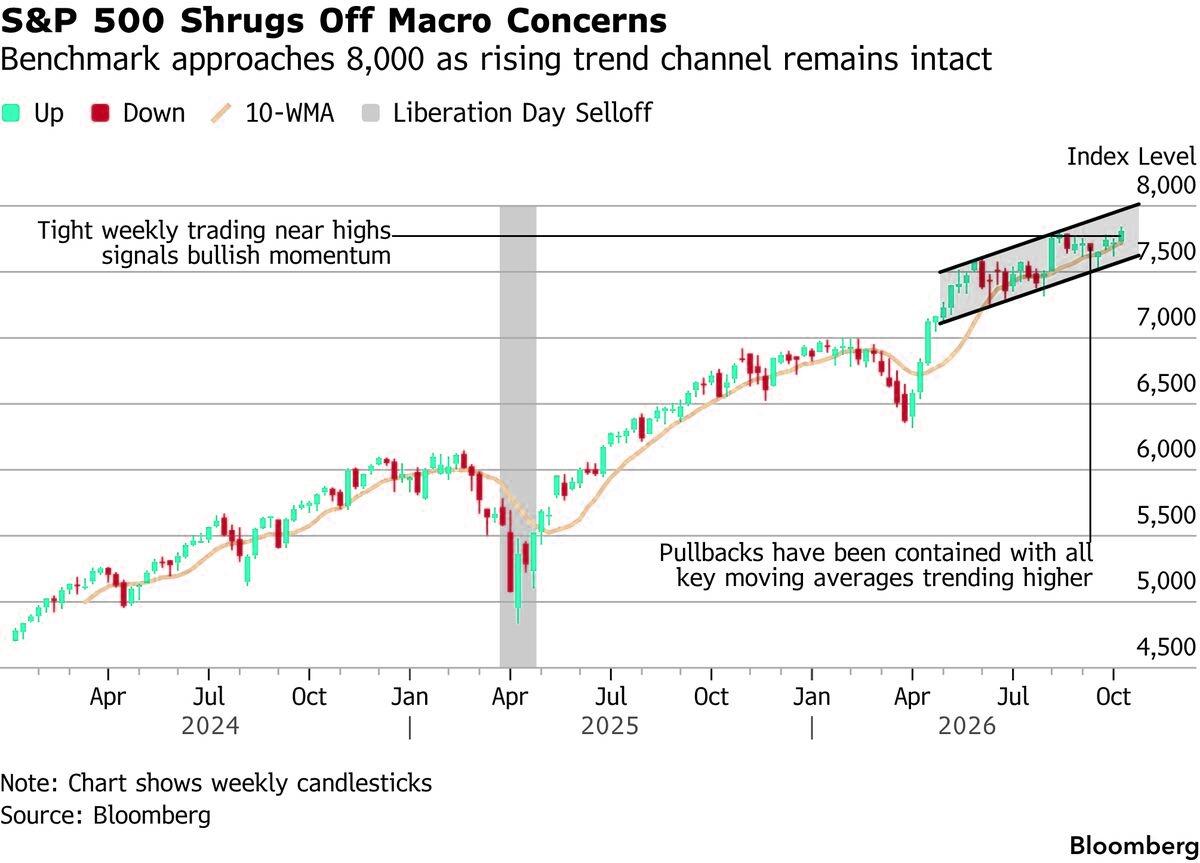
And yet, markets keep doing what they’re not supposed to: the S&P is within 1% of an all-time high and closing in on 8,000 even as the 10Y hit 5.36% last Wednesday, its highest intraday level since 2002 (more in “Diesel And Yields“). Underneath, the picture is far uglier: per Goldman’s Lee Coppersmith, the median S&P stock is now 16% below its own high and breadth is the weakest since the Dot-Com Bubble, while Bloomberg flags that 57% of the S&P is in a bear market. Over the past month the S&P is up 2% while its equal-weighted version is down 0.6% (Nomura’s McElligott explains why the index is blind to the carnage beneath it).
The S&P 500 is approaching 8,000 as its rising trend channel remains intact, with pullbacks contained and all key moving averages trending higher.
“A lot is at stake” for earnings, given recent volatility on a number of fronts, said JPMorgan strategist Mislav Matejka, who thinks the season will reassure the market.
“Growth should stay healthy, especially for earnings, recession risk remains low, and inflation momentum should moderate into 2027. This combination of resilient growth and easing inflation points to more of a ‘Goldilocks’ backdrop,” wrote Goldman strategists including Christian Mueller-Glissmann, who shifted back to overweight equities over three months and overweight bonds over 12 months.
“It is very important for investors to continue to be positioned in the AI trade. It is still the main source of earnings growth with continued upward revisions in earnings,” said Yiping Liao, a portfolio manager at Templeton Global Investments, who nonetheless said investors should be “selective and risk aware.”
The season gets underway tomorrow, when Goldman Sachs, JPMorgan, Wells Fargo and Citigroup report, with Bank of America and Morgan Stanley following on Wednesday. Bloomberg Intelligence expects earnings growth at major US banks to slow from the second quarter as capital-markets activity has moderated. In AI, results from ASML and TSMC this week will give more clues about the sustainability of the AI spending boom, while Nvidia, AMD and Marvell will be in focus as the Open Compute Project Global Summit kicks off today in San Jose, with keynotes from AMD’s Lisa Su and Nvidia’s Ian Buck. Outside of earnings, Wednesday’s CPI report is the key test: a hotter-than-expected reading risks extending the bond selloff and putting renewed pressure on equity valuations.
“Double-digit earnings growth has so far helped offset the negative impact of higher rates,” said Vincent Juvyns, chief investment strategist at ING in Brussels. “The earnings season will be important in determining whether the bull market has further room to run.”
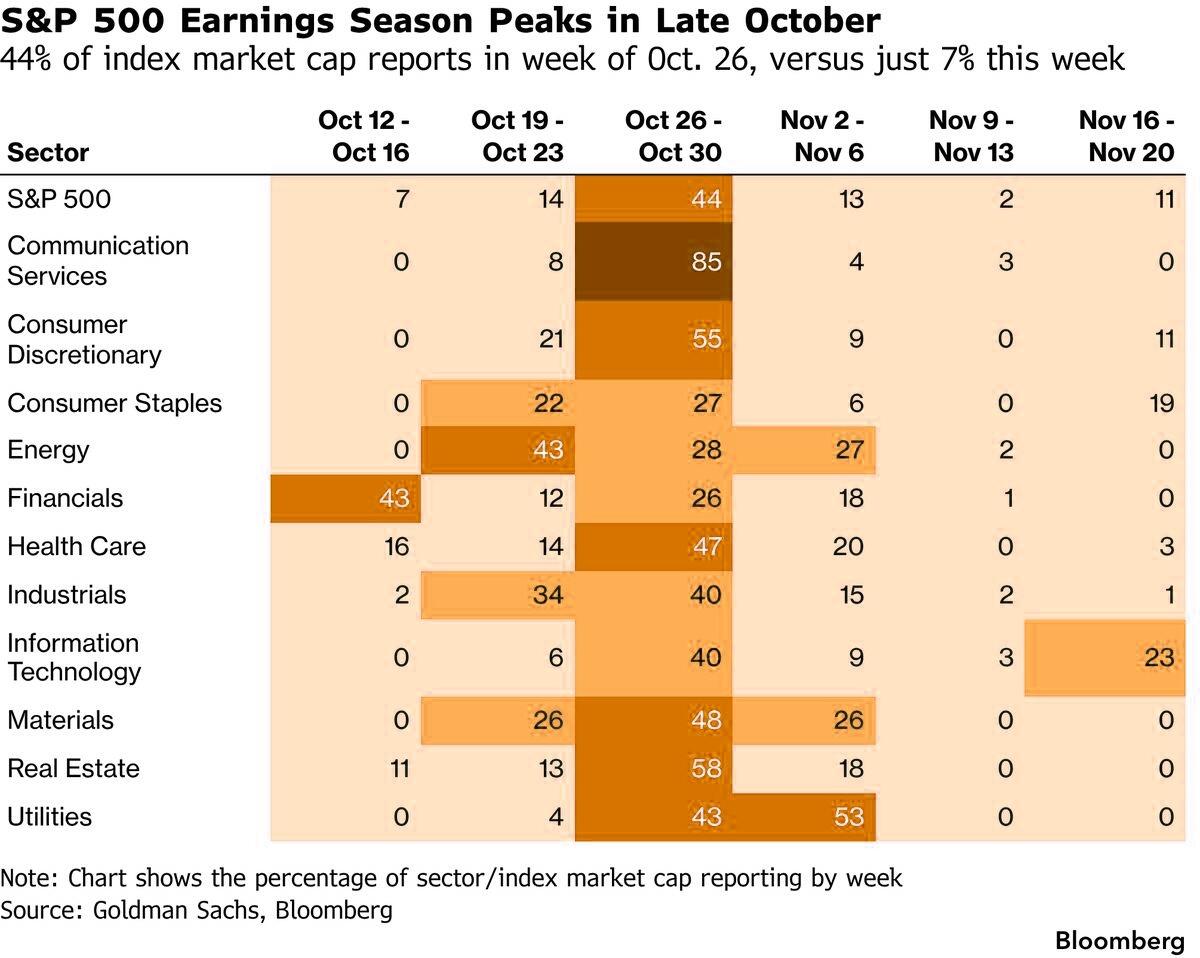
Note that this week is only the appetizer: 44% of index market cap reports in the week of Oct. 26, versus just 7% this week.
JPM’s Market Intel desk under Andrew Tyler reiterates its Tactically Bullish view into earnings, calling Thursday’s 3.4% OpenAI-driven Semis drop “an accounting misinterpretation” and arguing that with the SOX ~20% off its July lows and ~15% below its June highs, Semis can climb this latest wall of worry as Hynix and Samsung point to ongoing thematic strength. Still, the desk concedes “the market feels shakier than its index levels suggest” given poor breadth, high bond yields and AI doubts. FactSet has Q3 at 29.6% EPS growth on 12.4% revenue growth, with all 11 sectors expected to grow both for only the second time in history. On CPI, JPM’s Feroli sees headline +0.55% M/M and core +0.18%, a print that should keep the market from re-pricing an October hike; the desk flags clients who see the 10Y on “an unstoppable trajectory to 5.50%”, a level JPM calls “anathema for stocks.” Positioning Intel notes HFs bought US banks for a second straight week (+2z), while Semis were the most net sold industry in North America (-1.5z) and European positioning has slid to roughly the 13th percentile.
Goldman’s desks are similarly split between a strong tape and a nervous crowd. In London, Rich Privorotsky notes speculators are “heavily short bonds and Russell, long Nasdaq. We know where the pain trade lies,” adding that “perhaps measured escalation around $100 oil is something markets can live with.” Coppersmith writes that “there is clearly a lot more risk aversion beneath the surface than SPX would suggest,” but that absent another meaningful move higher in oil and rates, “the path of least resistance still looks higher.” Brian Garrett’s index vol colleague goes further: “it feels like there is a higher probability of VIX >25 than there is of SPX -2%.” And John Flood sees “the perfect recipe for the S&P 500 to pierce through 8k in short order”: robust corporate demand (GS sees buybacks of $1.7 trillion in 2027 vs $1.5 trillion this year), negative sentiment and low HF net exposure. Meanwhile, Goldman’s commodity team raised its Dec 2026 Brent forecast to $90 from $85, noting the timespreads risk premium is just over $20 and that “risks to our price forecast remain significantly tilted to the upside on net, especially near-term” (more on the near-record oil risk premium here).
The diesel crunch is now driving policy. Russia’s Deputy PM Novak said Moscow has started lifting diesel export restrictions immediately and is ready to supply additional volumes to the US as early as October, Canada said it will maximize oil and diesel exports to the US, and the US authorized an emergency exchange of up to 4 million barrels from the SPR to address storm-related disruptions. The backlash was bipartisan: Republican Senator Tillis warned Trump’s Russian diesel deal may be illegal, while Reuters reported Washington threatened to cut intelligence sharing and weapons support unless Kyiv halted refinery strikes. Trump, for his part, said refiners and retailers need to begin dropping prices (with gas prices steering the midterms, that is hardly a surprise).
In Europe, the bond stress is easing but not gone: the Franco-German 10Y spread tightened 3.7bps last week to 137bps and the 2Y spread came in 14.6bps, but GS flags that French bonds resumed declines as investors lose faith in Paris’ ability to get a grip on its debt. Lawmakers formally begin debating the draft budget tomorrow, with the final vote scheduled for October 20, while a new poll shows Le Pen and Mélenchon would reach the French presidential runoff. In Berlin, Germany’s fragile government was plunged deeper into turmoil after Labor Minister and SPD co-leader Baerbel Bas abruptly resigned.
In Europe, the Stoxx 600 rises 0.5% to 634.66, with falling oil prices boosting sentiment before the third-quarter earnings season begins in earnest, with 415 members up and 167 down. Banks and insurance are the biggest gainers while media and chemicals are the worst performers. Autos are in focus after the EU capped Chinese hybrid imports at 350,000 a year from as soon as December 1, with Renault up 3.2% and Stellantis up 2.5%. Per JPM, Spain and Italy lead while France lags, and Defense, Ceasefire and Power plays are among the top D1 baskets. Here are the biggest European movers:
- Nordex shares rise as much as 4.5% after the wind turbine company comfortably beat order expectations in the third quarter, according to analysts.
- Inwit shares rise as much as 5% in Milan after Reuters reported that the Italian tower operator’s major shareholders are exploring a potential take-private deal and arranging financing for a possible transaction.
- Scatec shares rise as much as 4.6% after analysts at DNB Carnegie raised their price target and earnings estimates on the Norwegian renewable energy company.
- Aroundtown shares fall as much as 3.9% after Goldman Sachs downgraded the German property firm to sell from neutral, seeing higher finance costs pressuring earnings.
- Informa shares fall as much as 4% after a deadly weekend attack on Saudi Arabia’s main airport cast doubt on the events operator’s upcoming exhibitions in the country.
- Hays shares fall as much as 12% after a trading update from the recruitment firm flagged weakness in permanent hiring.
- Hacksaw slumps as much as 30%, the most on record, after the Swedish online gambling and gaming company says third-quarter total revenue growth was below its historical growth pace.
Asian stocks were mixed in thin, holiday-hit trading with Japan closed for Sports Day, as chip heavyweights dragged the regional benchmark lower. Korea’s Kospi tumbled 3.6% to 6,384, closing just above its 200DMA, as it played catch-up to last week’s global chip selloff after a long holiday weekend; SK Hynix fell 4.5% and Samsung 4.4%, the Kosdaq slid 4.83% and foreigners sold $1.5 billion, a five-day net selling streak (turnover in Korea has collapsed 70% from its late-May peak). A North Korean ballistic missile launch didn’t help. Apple’s Asian suppliers fell after a report the company cut component orders for the iPhone 18 Pro and Pro Max (confirming our article on soft iPhone 18 Pro demand), and Chinese and Taiwanese AI server power-supply makers slid on the ITC probe. Elsewhere, Australia’s ASX 200 rose 0.8%, the Hang Seng added 0.2% and the CSI 300 fell 0.7%, while Chinese automakers including BYD climbed on the EU hybrid deal and Geely jumped as much as 6.2% on plans to launch in Canada. Indonesia’s JCI fell 1.9% to its lowest since July. China’s September passenger vehicle sales fell 24% Y/Y and the NDRC vowed to step up countercyclical support.
In FX, the Bloomberg Dollar Spot Index steadied as geopolitical tensions saw the dollar edge higher against most G-10 peers; the DXY holds at the upper end of a 102.10-102.37 range. The Swiss franc leads G10 losses, with USD/CHF up 0.4% to 0.8330, while EUR/USD slips 0.1% to 1.1184 (speculative euro shorts are the largest since 2020, per CFTC data cited by Newsquawk) and USD/JPY rises 0.2% to 158.61. The pound is the slight outperformer ahead of PM Burnham’s speech on improving relations with the EU. In EM, India’s rupee strengthened the most in six months after the RBI took its strongest measures to bolster the currency since the 2013 taper tantrum, even as Indian 10Y yields jumped 10bps to 7.40%, and Korea’s won hit a two-year high.
In rates, cash Treasuries are closed for Columbus Day, and Treasury futures drift lower, led by the ultra-long bond contracts implying a slight bear steepening move: ultras are down around 4 ticks, with the front-end and belly 1 to 2 ticks lower. The 10Y last traded at 5.238% on Friday, after falling 3.3bps on the week. Bunds found support over the London session from a drop in diesel prices, following US efforts to release Russian fuel to the market; the 10Y bund yield is down 2bps at 3.46% and the 10Y gilt yield down 4bps at 5.41%, although gilts have since pared their gains on the bounce in energy. The IG dollar issuance slate is empty, but dealers expect around $30 billion this week, the majority from US banks once earnings are out (it is hard to blame CFOs for not rushing to lock in 24-year-high funding costs). Fed’s Hammack speaks at NABE today; she said recently that “this does not look like an economy that has restraint.”
In commodities, WTI is up 0.8% at $92.56 (in a $89.61-$93.13 range) and Brent December is up 0.8% at $105.57 after swinging between $102.33 and $106.17, as Houthi attacks on Saudi Arabia and Trump’s suggestion the US could join Saudi strikes offset the initial selloff on the energy truce. Saudi Energy Minister Prince Abdulaziz said the kingdom’s ability to supply energy remains resilient and that it is looking to expand pipeline capacity to destinations outside the Gulf to 10 million b/d within two to three years; Persian Gulf crude exports continue to flow at rates close to pre-war levels. OPEC’s Secretary General sees oil demand growth of 400k b/d this year, while BP is restarting its Na Kika and Thunder Horse platforms in the Gulf of Mexico after Hurricane Isaias. Dutch TTF rose to a €82.90/MWh high from €80.63, spot gold fell to $4,168/oz from $4,217 as Fed tightening expectations weigh, spot silver pared gains to $60.66 from $61.45, and 3M LME copper trades toward the top of a $14,554.55-$14,660/t range on the return of Chinese buyers.
There is no US economic data today; Fed speaker slate includes Hammack (12:10pm). The US cash bond market is closed for Columbus Day; stock markets are open. There are no major pre-market earnings; the Open Compute Project Global Summit kicks off in San Jose and the IMF/World Bank annual meetings run in Bangkok through October 18. Watch luxury names including Capri and Tapestry later today as LVMH reports after the European close.
Market Snapshot
Top Overnight News
- Deadly Houthi attacks on the Saudi capital’s main airport over the weekend raised the risk of a wider war that may draw in the US. More missiles and drones were intercepted overnight. BBG
- The United States’ response to Iran’s seven conditions in a proposal to reopen the strategic Strait of Hormuz was “insufficient”, Iran’s security chief, Mohsen Rezaei, was quoted by state media on Sunday as saying. RTRS
- Oil swung after US President Donald Trump said Kyiv and Moscow had agreed to an “energy ceasefire,” while in the Middle East, Saudi Arabia suffered its deadliest strikes since the Iran war began. BBG
- Ukraine will continue to respond with long-range strikes against Russia unless Moscow agrees to an energy ceasefire that still hasn’t happened, President Volodymyr Zelenskyy said on Monday. BBG
- Saudi Arabia is looking at ways to expand its oil pipeline capacity to destinations outside the Persian Gulf to 10 million barrels a day within two to three years, said Energy Minister Prince Abdulaziz bin Salman. BBG
- US Senators reportedly demanded that President Trump reverse the Russian fuel imports deal, while Republican Senator Tillis warned that Trump’s Russian diesel deal may be illegal and put American lives at risk. Newsquawk
- The EU will cap imports of Chinese hybrid vehicles at 350,000 a year starting as soon as Dec. 1, with the limit rising 6% annually from the second year, according to a document seen by Bloomberg. The effect is likely to be more restrictive for Chinese automakers than tariffs, BI said. BBG
- China passenger vehicle sales tumbled 28% Y/Y in Sept, the largest so far this year and a sign that the domestic market remains under pressure. Nikkei
- Nvidia is in talks to acquire or deepen its investment in US start-up Reflection AI, a developer of open-weight models that President Donald Trump’s administration hopes will rival cheap Chinese alternatives, people with direct knowledge of the matter said. FT
- Amazon is in talks to acquire artificial-intelligence startup Decart in a deal that could be valued at around $7 billion. San Francisco-based Decart’s software makes it easier for developers to switch between different AI chips, a capability that is becoming increasingly important as companies race to secure more computing power. WSJ
- Broadcom CEO Hock Tan said on Monday that capital will be the biggest constraint facing the company as AI development continues. RTRS
- Nato members should prepare a robust response for a possible deadly Russian “hybrid” attack, Poland’s foreign minister has said, as concern grows about Moscow’s escalating sabotage campaign on European soil. FT
- France’s bonds resumed declines. Investors are losing faith in its ability to get a grip on its debt and growing increasingly concerned about the risk of contagion.
- Germany’s fragile government was plunged deeper into turmoil on Monday after the labor minister and co-chair of the junior coalition partner abruptly resigned from both her posts. BBG
- Bond markets are starting to do some of the lifting for central banks around the world by pushing up borrowing costs themselves, potentially reducing the number of benchmark interest-rate hikes needed to get inflation under control. BBG
- India’s consumer prices rose 5.54% Y/Y in September, vs est. +5.58%, the highest in almost two years and backing RBI tightening. BBG
- Robert E. Hall and Michael Woodford won the Nobel Prize in Economics for their work on stabilization. BBG
- Goldman raised its Dec 2026 Brent forecast to $90/bbl from $85 and still sees Brent averaging $80 in 2027; in an upside scenario where Gulf output stays 5mb/d below February levels, Brent could average around $125 in 2027. GIR
- JPM’s Feroli sees September headline CPI at +0.55% M/M (3.6% Y/Y) and core at +0.18% (2.4% Y/Y), enough to keep the bond market from re-pricing an October hike. JPM
A more detailed look at global markets courtesy of Newsquawk
APAC stocks were mixed after geopolitical headlines dominated weekend newsflow and amid thinned conditions to start the week due to Sports Day in Japan and the quasi-holiday stateside for Columbus Day. ASX 200 was led higher by gains in key local industries with outperformance in mining, materials, financials, resources and tech, while telecoms, real estate, energy and the consumer sectors lagged. KOSPI suffered amid pressure in the tech heavyweights, while sentiment was also not helped by North Korea’s latest missile launch, which prompted South Korea to convene an emergency meeting. Hang Seng and Shanghai Comp were mixed after the PBoC’s improved liquidity efforts, while China also released draft rules establishing nationwide requirements for automotive parts remanufacturing and recently agreed to halve hybrid car exports to the EU in a landmark deal.
Top Asian News
- China will launch an employment initiative aimed at adapting workers’ skills to the development of AI.
- China released draft rules establishing nationwide requirements for automotive parts remanufacturing, including standards for sourcing used components, product quality, traceability and market oversight.
- China proposed banning fully concealed car door handles and requiring physical controls for certain safety-critical functions as regulators seek to strengthen oversight of vehicle design and product testing. Rules would prohibit foldable and flexible vehicle display screens and require additional safety assessments for a range of innovative designs, while the proposal noted some manufacturers launched products without sufficient testing.
- China is to cut VAT export tax rebate rate on NEVs to 9% (from 13%), effective April 1st 2027.
- China’s passenger vehicle sales fell 24% Y/Y to 1.7mln units in September, while new energy vehicle sales declined 12% Y/Y to 1.1mln units.
European bourses are firmer across the board, initially on the hopes of a Russia-Ukraine energy ceasefire. US President Trump announced an energy ceasefire between the two sides; however, Axios later reported that Trump’s announcement was pre-emptive but expects both sides to agree to the ceasefire. To add, Ukrainian President Zelensky said Russia attacked Ukraine despite Trump’s announcement. Sectors highlight the positive bias. Banks top the sector pile, with Utilities and Insurance following closely behind. On the other hand, Media is the laggard, closely followed by Chemicals and Travel & Leisure. As the start of the Paris Motor Show gets underway today, the EU announced that China has agreed to limit imports of its hybrid vehicle to 350k/yr, with a 6% annual increase for the second year of application and will apply for four years. This follows the trade talks between the two sides last week, in which hybrid vehicle imports were in focus. European autos continue to benefit from last week’s announcement (Stellantis +2.5%, Volkswagen +1.1%). US equity futures are also firmer, with the Q3 earnings season set to get underway this week, starting with big US banks. For the sector as a whole, earnings are seen rising 3.0% Y/Y (vs 1.3% in Q2).
Top European News
- UK Chancellor Healey plans short-term Budget giveaways to limit fiscal pressure and is due to unveil further support for energy costs this winter when the Budget is announced later this month.
- UK Chancellor Healey ruled out lowering the mansion tax threshold to GBP 1.5mln.
- S&P affirmed the UK on Friday at AA; Outlook Stable.
- EU leaders will discuss a scaled-back budget at their meeting in Brussels in the week ahead, after Ireland presented a compromise plan for the next seven-year budget that would cut EUR 160bln from the European Commission’s proposed EUR 2tln figure.
- Germany, and allies, have informed European Council President Costa that cohesion and agriculture funding will “definitely” need to be cut in the next budget draft, Politico reported citing sources.
FX
- G10s are broadly lower against the USD this morning. GBP leads vs peers, whilst the Swiss Franc is the underperformer. Focus has been on geopolitics, which has been on two fronts. Starting in the Middle East, the Houthis launched a deadly attack on an airport in Saudi’s capital, which could see the US enter on this front. Over in Russia-Ukraine, President Trump announced an “energy ceasefire”, which caught both Ukraine and Russia by surprise. Russia continued its strikes on Ukraine over the weekend. Speaking on the deal, President Zelensky said that he had found out about it through the media, though mentioned that he is ready to sign ceasefire guarantees. Russia has yet to respond.
- Given the aforementioned geopolitical updates, DXY is a touch firmer this morning, currently holding at the upper end of a 102.10 to 102.37 range. Aside from that, the docket is exceptionally thin, with newsflow also likely to remain light on account of Columbus Day. Attention for the week will remain solely on US CPI on Wednesday, which will be a key report heading into the October confab. Whilst money markets assign only a 20% chance of a hike this month, it could help strengthen tightening bets for later in the year.
- GBP is the slight outperformer this morning, ahead of PM Burnham’s speech today, where he is expected to speak on improving the UK’s relationship with the EU. Any progress to improving relations with the bloc could likely be seen as a positive for domestic growth, but will be clouded by what specifically the UK must cough up to strike a deal with the EU.
- The EUR is under mild pressure this morning, in continuation of the action seen last week (speculative net-short position hit its largest since 2020, via CFTC). Downside which was facilitated by ongoing French fiscal woes; the next point of friction will be on October 13th, when lawmakers will formally begin debate on the draft budget. The final vote is scheduled for 20th October.
Central Banks
- NBP’s Wnorowski said they could raise the base rate at the November MPC meeting and awaiting updated staff projections.
- BoK Governor Shin affirmed inflation is seen remaining above target for some time and noted that chip strength is supporting faster than expected growth. Shin reiterated that timing and pace of further hikes will be data-dependent.
Fixed Income
- A firmer start to the week for fixed income, on account of the pressure seen in the energy space on steps towards an energy ceasefire between Russia and Ukraine, while in the Middle East Iran acknowledged that some of the seven points have been met, but not all.
- Action which leaves Bunds higher by about 20 ticks, off highs in 121.02 to 121.29 confines, with a pullback seen on recent energy gains. Energy aside, the bloc is focused on ongoing budget deliberations, with Politico reporting that Germany is to push for cuts to agriculture and cohesion, two of the most high-profile funding points.
- Elsewhere, we await the briefing by Chancellor Merz at 12:30BST, where he is expected to outline the changes CDU is making following the poor performance in September’s regional elections. Performance that significantly increased the scrutiny around and pressure on the Chancellor.
- Gilts opened higher by just under 30 ticks, broadly in line with the lead from peers at the time. Upside was a function of the discussed energy moves, and also increased commentary around EU-UK relations ahead of PM Burnham’s update to the House of Commons this afternoon. However, despite peaking at 84.17 with gains of 50 ticks, the benchmark has waned on a bounce in energy and on increased focus around the budget, as the fiscal task Chancellor Healey faces is significant.
- Finally, USTs spent the morning with modest gains but have now slipped to modest losses. In narrow c. 10 tick confines on account of the partial US holiday, which sees cash trade closed.
Commodities
- WTI Nov and Brent Dec futures were initially firmer early doors, supported by renewed Houthi attacks on Saudi Arabia and Trump’s suggestion that the US could join Saudi strikes against Yemen. On diplomacy, Iran said the US had accepted some of Tehran’s seven conditions, although the response remains insufficient, while exchanges continue through intermediaries. Nonetheless, Tehran reiterated that Hormuz will not reopen until its seven conditions are met, while warning of retaliation against any attack on Kharg Island. The complex reversed opening gains overnight amid Trump’s announcement of a potential Russia-Ukraine energy ceasefire and a diesel deal with Moscow, with neither confirmed.
- Since then, prices have risen back into the green after Ukrainian President Zelensky suggested Russia had violated Trump’s energy ceasefire. Thereafter, reports Saudi dealing with further strikes in the region, have kept benchmarks afloat.
- WTI currently holds at the upper end of a USD 89.61/bbl to USD 93.13/bbl range (vs Friday’s USD 90.01-92.17/bbl range), while Brent sits at the upper end of a USD 102.33/bbl to 106.17/bbl range.
- Dutch TTF is firmer amid continued Middle Eastern supply concerns heading into colder weather in the Western Hemisphere, with TTF extending gains to a EUR 82.90/MWh high from EUR 80.63/MWh lows.
- Precious metals are softer, with spot gold pressured despite a slightly weaker DXY, as expectations of further Fed tightening remain a headwind, while diplomatic developments limit haven demand. Spot gold fell to a USD 4,168/oz low from USD 4,217/oz (vs Friday’s USD 4,131-4,208/oz range), while spot silver has pared earlier gains, declining to USD 60.66/oz from USD 61.45/oz highs.
- Base metals are firmer, with copper extending Friday’s rebound following the return of Chinese buyers after the National Day holiday. The complex also benefits from China’s pledge for further policy support, although broader trade concerns remain. 3M LME copper trades towards the top end of a USD 14,554.55-14,660.00/t range.
- US President Trump said refiners and retailers need to begin dropping prices.
- US authorised an emergency exchange of up to 4mln barrels from the Strategic Petroleum Reserve to address storm-related disruptions.
- Saudi Arabia’s Energy Minister signed three energy cooperation MoUs with Kuwait, Qatar and Egypt. It was separately reported that oil executives withdrew from the Riyadh energy congress following missile strikes on the airport. In further comments, the Saudi Energy Ministry said they expect that it will take 2-3 years to increase oil pipeline capacity to 10mln BPD.
- OPEC Secretary General said oil demand growth is expected at 400k BPD this year.
- BP (BP/ LN) is working to restart production at its Na Kika and Thunder Horse platforms in the Gulf of Mexico after shutting output due to Hurricane Isaias.
- IEA urged member countries to accelerate pledged diesel releases and consider supplying additional volumes as global markets tighten.
- Russia’s Deputy PM Novak said Russia has started lifting diesel export restrictions immediately, and that exports are set to increase further in November and December as refineries return to operation following maintenance, TASS reported. Novak added that Russia is ready to supply additional volumes of diesel fuel to the US market, as well as to all its partners, as early as October.
- Canadian PM Carney’s office said Carney spoke with US President Trump and that Canada will maximise exports of oil and diesel to the US, with exports to the US yielding over 1mln bpd of diesel.
- China’s Agricultural Ministry expects lower corn consumption in 2026-27, with corn consumption now seen at 306.9mln tonnes vs. 311.7mln tonnes in the previous forecast.
Trade/Tariffs
- China’s NDRC vowed to step up countercyclical support and prepare additional high-impact policy tools as it seeks to achieve this year’s economic goals.
- EU Commission Official said the EU has agreed to limit China hybrid imports to 350k/year, with a 6% annually for the second year of application and will apply for four years.
Geopolitics: Middle East
- US President Trump said he was considering whether the US should join Saudi strikes against Yemen’s Houthis, following another attack on the Saudi capital’s airport.
- US reportedly accepted some of Tehran’s seven conditions in a response conveyed via the Qatari intermediary, but Iran deems this insufficient, while it reaffirmed that the only way to reopen the Hormuz is to fulfil all seven conditions simultaneously and in a single stage, according to Iranian journalist Ghaderi. This was later confirmed by the Iranian Major General Rezaei.
- US military said it had disabled a commercial cargo vessel in the Gulf of Oman after the crew ignored warnings and attempted to breach the naval blockade against Iran.
- UKMTO announced that a tanker transiting outbound in the Strait of Hormuz was struck by an unidentified projectile, resulting in damage to the vessel.
- IRGC navy said a violating supertanker struck a sea mine in the southern Strait of Hormuz, which caused a fire and was the third tanker since Saturday to hit naval mines, while it warned that vessels disabling navigation and identification systems in the Strait of Hormuz will be treated as “hostile targets” and will face harsh, decisive action.
- Iranian Foreign Ministry spokesperson Baghaei said exchanges of messages with the US continue through intermediaries, while Tehran is still reviewing US positions and will respond via intermediaries once the review is complete.
- Iran’s Supreme National Security Council Secretary Rezaei said Iran is fully prepared and will demonstrate new capabilities if war resumes, while he added that US assets in the UAE and around the Strait of Hormuz are highly valuable but have not been placed on Iran’s target list to date. Furthermore, he warned that renewed conflict would see many regional undersea cables, data centres, AI facilities and other sites destroyed, assets he valued at more than USD 2tln.
- Iranian Deputy Foreign Minister Gharibabadi said Iran is in a state of war and that no commercial vessel may transit the Strait of Hormuz without prior coordination with Tehran, with the waterway a national security red line. Gharibabadi also stated that Iran is seeking to register with the IMO an agreement with Oman on transit routes, but noted that registration would not guarantee the strait’s reopening, while he added that reopening depends on the US fulfilling its prior commitments.
- Iranian MP Khezrian warned that any attack on Kharg Island will trigger a decisive response by Iran’s armed forces at the source of the attack, adding that retaliation will not be limited to US bases, Defapress reported.
- Iranian Foreign Minister Araghchi held a call with Saudi Arabia’s Foreign Minister bin Farhan and stressed that Iran is ready to provide any assistance to help start dialogue between Saudi Arabia and Yemen and to help achieve a political solution.
- Saudi Arabia said 12 people were killed and more than 300 injured in an attack targeting King Khalid Airport in Riyadh on Saturday, while the airport was attacked again on Sunday, which caused a fire, as well as killed one person and injured nearly a dozen. Furthermore, the Saudi Civil Aviation Authority also announced that the King Fahd International Airport in Dammam was attacked.
- Saudi Arabia, Turkey, Pakistan and Egypt issued a joint statement condemning continued attacks by Yemeni Houthis on Saudi Arabia, calling them a dangerous escalation and expressing support for Saudi measures to respond.
Geopolitics: Ukraine
- US President Trump claimed Russia and Ukraine agreed to an energy ceasefire with immediate effect. However, it was reported by Axios that a White House official said Trump’s announcement of an energy ceasefire between Russia and Ukraine referred to a potential deal, which he expects Ukrainian President Zelensky to abide by, while the report added that Russia hasn’t accepted any kind of ceasefire so far.
- US President Trump demanded that Ukrainian President Zelensky halt attacks on Russian oil refineries, saying he believes it is time for Ukraine to get a new president and that it needs a leader capable of reaching a deal with Russia. Furthermore, the US threatened to cut off intelligence sharing and block arms supplies to Ukraine, while Ukraine’s negotiating team cut short its trip to the US after being blindsided by the announcement of the US-Russia diesel deal, although they had worked on a peace proposal that could be sent to Russia before winter, according to FT.
- US President Trump decided to pursue a diesel fuel deal with Russia after Ukrainian President Zelensky ignored half a dozen requests to stop attacking Russian oil refineries, according to a US official with direct knowledge cited by Axios.
- US envoys Witkoff and Kushner have not cancelled plans to visit Moscow but will arrive with a clear understanding of Kyiv’s position, TASS sources reported.
- Ukrainian President Zelensky said that he was willing to halt strikes if Russia stopped targeting Ukrainian infrastructure, while he stated that Kyiv is awaiting details of US-Russia talks, but also noted that Russia hit a power plant, following US President Trump’s energy ceasefire comment. In further comments, Zelensky said that Ukraine will respond if Russia does not agree to an energy ceasefire but stated that Ukraine is ready to sign ceasefire guarantees.
- Ukrainian President Zelensky said he will organise elections if Russia agrees to 60-day ceasefire.
- European Commission President von der Leyen said the EU will provide additional funding for drones and missiles after talks with Ukrainian President Zelensky, but didn’t specify the amount, according to Kommersant. Later, the EU Foreign Representative Kallas said they have adopted over 1.5k Russian sanctions, targeting the missile-industrial complex.
- UK pledged to maintain pressure on Russia through its toughest sanctions regime following Trump’s announcement of a deal to buy diesel from Moscow. Separately, UK PM Burnham said Russia interfered in the 2016 Brexit vote and called for European voters to be better informed about efforts to disrupt the democratic process, according to the FT.
- Western intelligence agencies warned Europe’s defence industry bosses that Russia is increasing efforts to assassinate them, prompting companies to increase personal security around their top executives, according to FT.
- Poland’s Foreign Minister said NATO members should prepare a robust response for a possible deadly Russian “hybrid” attack amid increasing concerns about Moscow escalating its sabotage campaign on European soil, according to FT.
Geopolitics: Other
- North Korea launched two ballistic missiles that were believed to have already landed outside Japan’s Exclusive Economic Zone, according to NTV.
- South Korean military spokesperson said North Korea’s missiles appear to be a demonstration of its capabilities and a show of force in South Korea’s hypersonic missile test fire, while the South Korean National Security Council convened an emergency meeting on North Korea’s missile test.
Crypto
- Bitcoin rose to a peak of USD 84.26k before completely reversing earlier gains and now near the USD 83.3k mark.
US Event Calendar
- No US economic data scheduled; US cash bond market closed for Columbus Day (stock markets open)
- No Treasury auctions scheduled
Central Bank Speakers
- 12:10pm: Fed’s Hammack Speaks at NABE Conference
DB’s Jim Reid concludes the overnight wrap
I have a new iPhone to play with today but for once its not my own. For the first time in recorded history my wife will have a superior model to mine as for her birthday today I have upgraded her but have decided for now to hold fire on my upgrade! It will be totally wasted on her as she is to technology what I am to artistic swimming. If it weren’t for the camera option she’d be content with an old Nokia 3310, and not even know snake was on there or have any interest in it if she knew!
This week’s game of snake will involve navigating the latest complex geopolitical news and the US inflation data, with September CPI on Wednesday and PPI on Thursday, the final readings before the Fed’s October 28 meeting, alongside a broader US activity pulse from retail sales (Thursday) and industrial production (Friday). After Columbus Day today where US bond markets will be closed but equities open, Q3 US earnings season also gets properly under way tomorrow, led by the big US banks, while across the globe ASML (Wednesday) and TSMC (Thursday) should provide another useful read on the AI capex cycle. Elsewhere, China has September inflation and trade data on Wednesday, UK monthly GDP is due Thursday, and the IMF/World Bank meetings run through the week, with the IMF’s latest World Economic Outlook out tomorrow and a long list of central-bank speakers.
The big geopolitical/energy story over the weekend is the continued complexity of the Middle East and Russia/Ukraine conflicts. Trump announced yesterday that Russia and Ukraine had agreed to an immediate “energy ceasefire”, but overnight developments underline how fragile that claim is. Zelenskyy said Ukraine supports a ceasefire if Russia does too and is awaiting details from Washington, while Moscow had still not publicly confirmed it. Zelenskyy also said Russia subsequently struck a thermal power plant in Kharkiv and other Ukrainian energy infrastructure. So for now this looks more like an untested US proposal than a functioning ceasefire, particularly after a similar arrangement last month failed to endure.
The proposed ceasefire is closely linked to the extraordinary US pivot on Russian diesel. Ukrainian refinery strikes had forced Moscow to restrict fuel exports, tightening an already constrained products market. Trump’s deal with Putin would allow around 13.5 million barrels of Russian diesel back into global markets this month via a temporary US sanctions waiver, potentially including the first US imports since March 2022. Zelenskyy has criticised the move, while Reuters reported that Washington threatened to cut intelligence sharing and weapons procurement support unless Kyiv halted refinery strikes. Russian barrels returning would be bearish for diesel cracks, but the overnight strikes make the ceasefire increasingly uncertain and highlight strains between Washington and Kyiv.
Meanwhile, Middle East energy risk has moved sharply in the other direction. Riyadh’s King Khalid International Airport was hit again on Sunday after repeated attacks over the past week. Saudi Arabia said the latest strike killed one person and injured 11, after Saturday’s attack killed 12 and wounded more than 300. The escalation comes as Saudi-backed Yemeni government forces counter recent Houthi gains near Bab el-Mandeb, the crucial Red Sea shipping chokepoint. Repeated strikes disrupting flights in Riyadh also underline how difficult the Houthi threat may be for Saudi Arabia to suppress.
That leaves a meaningful risk of wider regional escalation. Saudi Arabia has intensified air strikes in Yemen, while Trump said the US “may” join strikes against the Houthis after an American was among those killed on Saturday. Overnight, Iran denied directing the Houthis and its foreign minister urged diplomacy with Saudi Arabia, but there is little sign yet of de-escalation. Washington has so far limited support to intelligence sharing while Riyadh seeks more direct US help and air-defence support. So even if a Russia/Ukraine ceasefire and Russian diesel waiver ease pressure on refined products, attacks on Riyadh and fighting around Bab el-Mandeb leave an upside tail risk for oil and shipping costs, alongside continuing Strait of Hormuz disruption.
With all of that newsflow, this morning Brent is -1.32% at $102.34/bbl with other markets quiet given that Japan’s cash equity markets are closed and US bond markets are going to be shut for the holiday. The KOSPI (-2.68%) is the weakest performer as trading resumes following a prolonged holiday weekend. Chinese equities are also under modest pressure, with the CSI 300 (-0.15%) and Shanghai Composite (-0.12%) edging lower. In contrast, the S&P/ASX 200 (+0.78%) is leading gains across the region, while the Hang Seng (+0.12%) is slightly higher. S&P 500 (+0.33%), Nasdaq 100 (+0.44%) and Stoxx (+0.61%) futures are all higher.
Going onto more detail on the week ahead, the main event is US CPI on Wednesday. Our economists expect headline CPI to rise +0.57% MoM in September, up from +0.40% in August, largely because seasonally adjusted motor-fuel prices are expected to jump 9.6%. That would lift headline inflation to around 3.64% YoY. The core picture should be much softer: our economists expect +0.16% MoM, down from +0.29%, taking the annual rate down a couple of basis points to 2.39%. Within core, they expect goods prices to be unchanged, with lower used-car and medical-care commodity prices offset by firmer recreation and IT goods. On services, last month’s jump in wireless prices should roll off, although higher jet-fuel costs should support airfares. The contrast between a fuel-driven headline acceleration and a softer underlying core print will clearly be important for the Fed, particularly given recent messaging that further tightening may be needed but is not urgent.
The inflation story does not end there. PPI follows on Thursday and import prices on Friday, both important for mapping the CPI details into core PCE. These are the last inflation data Fed officials will see before the October FOMC meeting. Our economists’ ex-ante estimate is for core PCE (released on October 29th, the day after the FOMC) to rise around +0.21% MoM, leaving the annual rate roughly steady at 3.0%. If they are close to our economists’ forecasts, the team thinks the Fed can remain on hold on October 28 and wait for more information before December. Chair Warsh’s fireside chat with IMF Managing Director Georgieva on Thursday evening will therefore be particularly interesting, as it is the final Fed appearance before the communications blackout. On activity, our economists expect total September retail sales to be unchanged (Thursday) and industrial production to rise +0.2% MoM (Friday). The Fed’s Beige Book is also out Wednesday. Today is Columbus Day, so US bond markets are closed although equities remain open.
Earnings season is another important part of the week. JPMorgan, Goldman Sachs, Wells Fargo and Citigroup report tomorrow, followed by Bank of America, Morgan Stanley and BlackRock on Wednesday. ASML reports Wednesday and TSMC on Thursday. Our US equity strategists expect S&P 500 earnings growth to remain at a record 34% YoY in Q3, versus consensus at 27%. Their view is that consensus is again embedding too much of a slowdown, leaving scope for another quarter of above-average beats. See their piece here. In Europe, our equity strategists expect earnings growth to reach 25% in Q3, 5 pp above consensus (their full preview is here). So it should be a very strong earnings season on both sides of the Atlantic and indeed across the globe.
Recapping last week now and markets seemed to be on high alert throughout, but ultimately put in a decent performance as the financial stress around the Eurozone began to moderate, albeit not in a straight line. For instance, the Franco-German 2yr spread came down -14.6bps to 52bps. Moreover, the 10yr spread also tightened -3.7bps over the week to 137bps. That went alongside stabilisation for global bonds more broadly after the relentless selloff of recent weeks. For instance, the 10yr Treasury yield fell -3.3bps on the week to 5.24% (+1.2bps Friday), although it did hit its highest intraday level since 2002 on Wednesday, at 5.36%. However, the 10yr bund yield still edged +1.9bps higher on the week to 3.48%.
That backdrop helped global equities recover in aggregate, though the performance was varied on the two sides of the Atlantic. In the US, we even saw the S&P 500 hit another record on Wednesday, with a weekly gain of +1.15% (+0.59% Friday). Over in Europe by contrast, the STOXX 600 was little changed (+0.03%) on the week despite a +0.97% recovery on Friday. And there were some continued points of stress, with France’s CAC 40 down 1.19% (+0.95% Friday), marking its 8th weekly decline in the last 9. Meanwhile, European banks also fell back, with the STOXX Banks index down -2.46% (+0.51% Friday).
As all that was happening, the lack of any clear progress between the US and Iran kept oil prices elevated. So Brent crude ended the week up +2.42% (+0.42% Friday) at $104.72/bbl, whilst European natural gas rose by +8.93% to €81.40/MWh, its highest weekly close since 2022. That went alongside gains for other commodities, including gold, which rose +1.28% last week, and copper, which rose +2.18%.
1b) European Opening report
Trump announced a Russia-Ukraine energy ceasefire, but was not confirmed by Moscow; DXY mildly firmer – Newsquawk US Market Open

Monday, Oct 12, 2026 – 06:03 AM
- US President Trump announced a potential Russia-Ukraine energy ceasefire, while also lifting Russia’s diesel export ban.
- Ukrainian President Zelensky said that he was willing to halt strikes if Russia stopped targeting Ukrainian infrastructure, but noted that Russia hit a power plant, following US President Trump’s energy ceasefire comment.
- US equity futures are firmer but off best levels as energy rebounds (Brent +1.1%).
- DXY posts mild gains; GBP outperforms as PM Burnham aims for improved EU ties.
- Fixed income gives back earlier upside given the aforementioned energy moves.
- Looking ahead, highlights include BoE’s Mann, Fed’s Hammack, and LVMH earnings. US cash bond markets are closed for Columbus Day.
SNAPSHOT
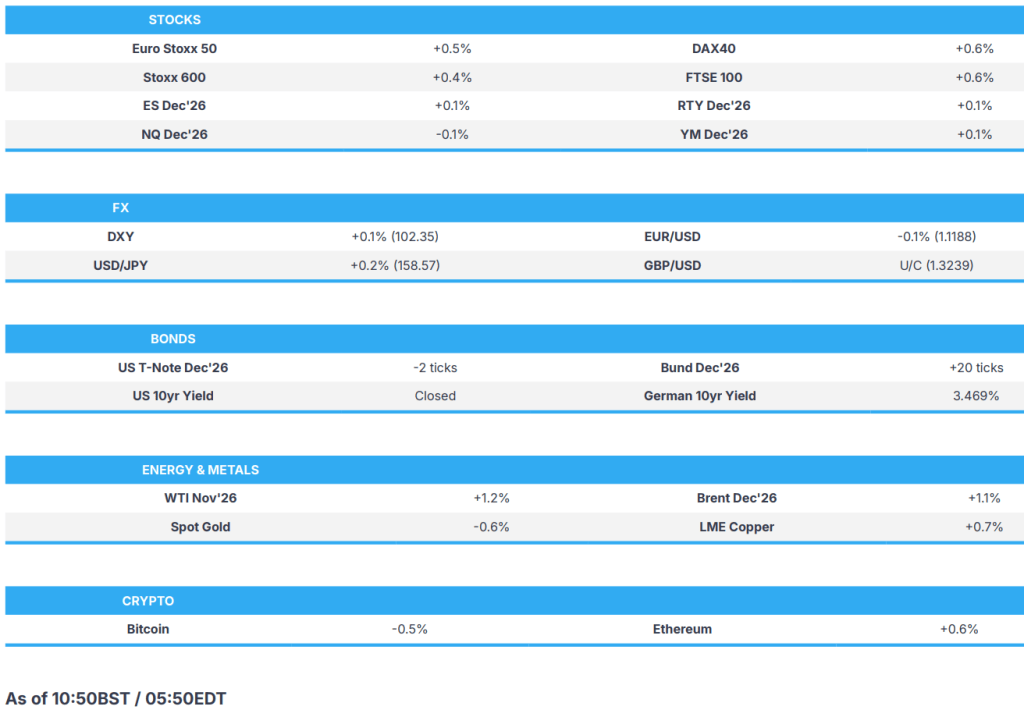
EUROPEAN TRADE
EQUITIES
- European bourses are firmer across the board, initially on the hopes of a Russia-Ukraine energy ceasefire. US President Trump announced an energy ceasefire between the two sides; however, Axios later reported that Trump’s announcement was pre-emptive but expects both sides to agree to the ceasefire. To add, Ukrainian President Zelensky said Russia attacked Ukraine despite Trump’s announcement.
- Sectors highlight the positive bias. Banks top the sector pile, with Utilities and Insurance following closely behind. On the other hand, Media is the laggard, closely followed by Chemicals and Travel & Leisure.
- As the start of the Paris Motor Show gets underway today, the EU announced that China has agreed to limit imports of its hybrid vehicle to 350k/yr, with a 6% annual increase for the second year of application and will apply for four years. This follows the trade talks between the two sides last week, in which hybrid vehicle imports were in focus. European autos continue to benefit from last week’s announcement (Stellantis +2.5%, Volkswagen +1.1%).
- US equity futures are also firmer, with the Q3 earnings season set to get underway this week, starting with big US banks. For the sector as a whole, earnings are seen rising 3.0% Y/Y (vs 1.3% in Q2).
- Click for the session’s European pre-market equity newsflow
- Click for the additional news
FX
- Snapshot: G10s are broadly lower against the USD this morning. GBP leads vs peers, whilst the Swiss Franc is the underperformer. Focus has been on geopolitics, which has been on two fronts. Starting in the Middle East, the Houthis launched a deadly attack on an airport in Saudi’s capital, which could see the US enter on this front. Over in Russia-Ukraine, President Trump announced an “energy ceasefire”, which caught both Ukraine and Russia by surprise. Russia continued its strikes on Ukraine over the weekend. Speaking on the deal, President Zelensky said that he had found out about it through the media, though mentioned that he is ready to sign ceasefire guarantees. Russia has yet to respond.
- Given the aforementioned geopolitical updates, DXY is a touch firmer this morning, currently holding at the upper end of a 102.10 to 102.37 range. Aside from that, the docket is exceptionally thin, with newsflow also likely to remain light on account of Columbus Day. Attention for the week will remain solely on US CPI on Wednesday, which will be a key report heading into the October confab. Whilst money markets assign only a 20% chance of a hike this month, it could help strengthen tightening bets for later in the year.
- GBP is the slight outperformer this morning, ahead of PM Burnham’s speech today, where he is expected to speak on improving the UK’s relationship with the EU. Any progress to improving relations with the bloc could likely be seen as a positive for domestic growth, but will be clouded by what specifically the UK must cough up to strike a deal with the EU. The EUR is under mild pressure this morning, in continuation of the action seen last week (speculative net-short position hit its largest since 2020, via CFTC). Downside which was facilitated by ongoing French fiscal woes; the next point of friction will be on October 13th, when lawmakers will formally begin debate on the draft budget. The final vote is scheduled for 20th October.
FIXED INCOME
- A firmer start to the week for fixed income, on account of the pressure seen in the energy space on steps towards an energy ceasefire between Russia and Ukraine, while in the Middle East Iran acknowledged that some of the seven points have been met, but not all.
- Action which leaves Bunds higher by about 20 ticks, off highs in 121.02 to 121.29 confines, with a pullback seen on recent energy gains. Energy aside, the bloc is focused on ongoing budget deliberations, with Politico reporting that Germany is to push for cuts to agriculture and cohesion, two of the most high-profile funding points.
- Elsewhere, we await the briefing by Chancellor Merz at 12:30BST, where he is expected to outline the changes CDU is making following the poor performance in September’s regional elections. Performance that significantly increased the scrutiny around and pressure on the Chancellor.
- Gilts opened higher by just under 30 ticks, broadly in line with the lead from peers at the time. Upside was a function of the discussed energy moves, and also increased commentary around EU-UK relations ahead of PM Burnham’s update to the House of Commons this afternoon. However, despite peaking at 84.17 with gains of 50 ticks, the benchmark has waned on a bounce in energy and on increased focus around the budget, as the fiscal task Chancellor Healey faces is significant.
- Finally, USTs spent the morning with modest gains but have now slipped to modest losses. In narrow c. 10 tick confines on account of the partial US holiday, which sees cash trade closed.
COMMODITIES
- WTI Nov and Brent Dec futures were initially firmer early doors, supported by renewed Houthi attacks on Saudi Arabia and Trump’s suggestion that the US could join Saudi strikes against Yemen. On diplomacy, Iran said the US had accepted some of Tehran’s seven conditions, although the response remains insufficient, while exchanges continue through intermediaries. Nonetheless, Tehran reiterated that Hormuz will not reopen until its seven conditions are met, while warning of retaliation against any attack on Kharg Island. The complex reversed opening gains overnight amid Trump’s announcement of a potential Russia-Ukraine energy ceasefire and a diesel deal with Moscow, with neither confirmed.
- Since then, prices have risen back into the green after Ukrainian President Zelensky suggested Russia had violated Trump’s energy ceasefire. Thereafter, reports Saudi dealing with further strikes in the region, have kept benchmarks afloat.
- WTI currently holds at the upper end of a USD 89.61/bbl to USD 93.13/bbl range (vs Friday’s USD 90.01-92.17/bbl range), while Brent sits at the upper end of a USD 102.33/bbl to 106.17/bbl range.
- Dutch TTF is firmer amid continued Middle Eastern supply concerns heading into colder weather in the Western Hemisphere, with TTF extending gains to a EUR 82.90/MWh high from EUR 80.63/MWh lows.
- Precious metals are softer, with spot gold pressured despite a slightly weaker DXY, as expectations of further Fed tightening remain a headwind, while diplomatic developments limit haven demand. Spot gold fell to a USD 4,168/oz low from USD 4,217/oz (vs Friday’s USD 4,131-4,208/oz range), while spot silver has pared earlier gains, declining to USD 60.66/oz from USD 61.45/oz highs.
- Base metals are firmer, with copper extending Friday’s rebound following the return of Chinese buyers after the National Day holiday. The complex also benefits from China’s pledge for further policy support, although broader trade concerns remain. 3M LME copper trades towards the top end of a USD 14,554.55-14,660.00/t range.
- US President Trump said refiners and retailers need to begin dropping prices.
- US authorised an emergency exchange of up to 4mln barrels from the Strategic Petroleum Reserve to address storm-related disruptions.
- Saudi Arabia’s Energy Minister signed three energy cooperation MoUs with Kuwait, Qatar and Egypt. It was separately reported that oil executives withdrew from the Riyadh energy congress following missile strikes on the airport. In further comments, the Saudi Energy Ministry said they expect that it will take 2-3 years to increase oil pipeline capacity to 10mln BPD.
- OPEC Secretary General said oil demand growth is expected at 400k BPD this year.
- BP (BP/ LN) is working to restart production at its Na Kika and Thunder Horse platforms in the Gulf of Mexico after shutting output due to Hurricane Isaias.
- IEA urged member countries to accelerate pledged diesel releases and consider supplying additional volumes as global markets tighten.
- Russia’s Deputy PM Novak said Russia has started lifting diesel export restrictions immediately, and that exports are set to increase further in November and December as refineries return to operation following maintenance, TASS reported. Novak added that Russia is ready to supply additional volumes of diesel fuel to the US market, as well as to all its partners, as early as October.
- Canadian PM Carney’s office said Carney spoke with US President Trump and that Canada will maximise exports of oil and diesel to the US, with exports to the US yielding over 1mln bpd of diesel.
- China’s Agricultural Ministry expects lower corn consumption in 2026-27, with corn consumption now seen at 306.9mln tonnes vs. 311.7mln tonnes in the previous forecast.
TRADE/TARIFFS
- China’s NDRC vowed to step up countercyclical support and prepare additional high-impact policy tools as it seeks to achieve this year’s economic goals.
- EU Commission Official said the EU has agreed to limit China hybrid imports to 350k/year, with a 6% annually for the second year of application and will apply for four years.
NOTABLE EUROPEAN HEADLINES
- UK Chancellor Healey plans short-term Budget giveaways to limit fiscal pressure and is due to unveil further support for energy costs this winter when the Budget is announced later this month.
- UK Chancellor Healey ruled out lowering the mansion tax threshold to GBP 1.5mln.
- S&P affirmed the UK on Friday at AA; Outlook Stable.
- EU leaders will discuss a scaled-back budget at their meeting in Brussels in the week ahead, after Ireland presented a compromise plan for the next seven-year budget that would cut EUR 160bln from the European Commission’s proposed EUR 2tln figure.
- Germany, and allies, have informed European Council President Costa that cohesion and agriculture funding will “definitely” need to be cut in the next budget draft, Politico reported citing sources.
CENTRAL BANKS
- NBP’s Wnorowski said they could raise the base rate at the November MPC meeting and awaiting updated staff projections.
- BoK Governor Shin affirmed inflation is seen remaining above target for some time and noted that chip strength is supporting faster than expected growth. Shin reiterated that timing and pace of further hikes will be data-dependent.
NOTABLE US HEADLINES
- US Senators reportedly demanded that President Trump reverse the Russian fuel imports deal, while Republican Senator Tillis warned that Trump’s Russian diesel deal may be illegal and put American lives at risk.
GEOPOLITICS
MIDDLE EAST
- US President Trump said he was considering whether the US should join Saudi strikes against Yemen’s Houthis, following another attack on the Saudi capital’s airport.
- US reportedly accepted some of Tehran’s seven conditions in a response conveyed via the Qatari intermediary, but Iran deems this insufficient, while it reaffirmed that the only way to reopen the Hormuz is to fulfil all seven conditions simultaneously and in a single stage, according to Iranian journalist Ghaderi. This was later confirmed by the Iranian Major General Rezaei.
- US military said it had disabled a commercial cargo vessel in the Gulf of Oman after the crew ignored warnings and attempted to breach the naval blockade against Iran.
- UKMTO announced that a tanker transiting outbound in the Strait of Hormuz was struck by an unidentified projectile, resulting in damage to the vessel.
- IRGC navy said a violating supertanker struck a sea mine in the southern Strait of Hormuz, which caused a fire and was the third tanker since Saturday to hit naval mines, while it warned that vessels disabling navigation and identification systems in the Strait of Hormuz will be treated as “hostile targets” and will face harsh, decisive action.
- Iranian Foreign Ministry spokesperson Baghaei said exchanges of messages with the US continue through intermediaries, while Tehran is still reviewing US positions and will respond via intermediaries once the review is complete.
- Iran’s Supreme National Security Council Secretary Rezaei said Iran is fully prepared and will demonstrate new capabilities if war resumes, while he added that US assets in the UAE and around the Strait of Hormuz are highly valuable but have not been placed on Iran’s target list to date. Furthermore, he warned that renewed conflict would see many regional undersea cables, data centres, AI facilities and other sites destroyed, assets he valued at more than USD 2tln.
- Iranian Deputy Foreign Minister Gharibabadi said Iran is in a state of war and that no commercial vessel may transit the Strait of Hormuz without prior coordination with Tehran, with the waterway a national security red line. Gharibabadi also stated that Iran is seeking to register with the IMO an agreement with Oman on transit routes, but noted that registration would not guarantee the strait’s reopening, while he added that reopening depends on the US fulfilling its prior commitments.
- Iranian MP Khezrian warned that any attack on Kharg Island will trigger a decisive response by Iran’s armed forces at the source of the attack, adding that retaliation will not be limited to US bases, Defapress reported.
- Iranian Foreign Minister Araghchi held a call with Saudi Arabia’s Foreign Minister bin Farhan and stressed that Iran is ready to provide any assistance to help start dialogue between Saudi Arabia and Yemen and to help achieve a political solution.
- Saudi Arabia said 12 people were killed and more than 300 injured in an attack targeting King Khalid Airport in Riyadh on Saturday, while the airport was attacked again on Sunday, which caused a fire, as well as killed one person and injured nearly a dozen. Furthermore, the Saudi Civil Aviation Authority also announced that the King Fahd International Airport in Dammam was attacked.
- Saudi Arabia, Turkey, Pakistan and Egypt issued a joint statement condemning continued attacks by Yemeni Houthis on Saudi Arabia, calling them a dangerous escalation and expressing support for Saudi measures to respond.
RUSSIA-UKRAINE
- US President Trump claimed Russia and Ukraine agreed to an energy ceasefire with immediate effect. However, it was reported by Axios that a White House official said Trump’s announcement of an energy ceasefire between Russia and Ukraine referred to a potential deal, which he expects Ukrainian President Zelensky to abide by, while the report added that Russia hasn’t accepted any kind of ceasefire so far.
- US President Trump demanded that Ukrainian President Zelensky halt attacks on Russian oil refineries, saying he believes it is time for Ukraine to get a new president and that it needs a leader capable of reaching a deal with Russia. Furthermore, the US threatened to cut off intelligence sharing and block arms supplies to Ukraine, while Ukraine’s negotiating team cut short its trip to the US after being blindsided by the announcement of the US-Russia diesel deal, although they had worked on a peace proposal that could be sent to Russia before winter, according to FT.
- US President Trump decided to pursue a diesel fuel deal with Russia after Ukrainian President Zelensky ignored half a dozen requests to stop attacking Russian oil refineries, according to a US official with direct knowledge cited by Axios.
- US envoys Witkoff and Kushner have not cancelled plans to visit Moscow but will arrive with a clear understanding of Kyiv’s position, TASS sources reported.
- Ukrainian President Zelensky said that he was willing to halt strikes if Russia stopped targeting Ukrainian infrastructure, while he stated that Kyiv is awaiting details of US-Russia talks, but also noted that Russia hit a power plant, following US President Trump’s energy ceasefire comment. In further comments, Zelensky said that Ukraine will respond if Russia does not agree to an energy ceasefire but stated that Ukraine is ready to sign ceasefire guarantees.
- Ukrainian President Zelensky said he will organise elections if Russia agrees to 60-day ceasefire.
- European Commission President von der Leyen said the EU will provide additional funding for drones and missiles after talks with Ukrainian President Zelensky, but didn’t specify the amount, according to Kommersant. Later, the EU Foreign Representative Kallas said they have adopted over 1.5k Russian sanctions, targeting the missile-industrial complex.
- UK pledged to maintain pressure on Russia through its toughest sanctions regime following Trump’s announcement of a deal to buy diesel from Moscow. Separately, UK PM Burnham said Russia interfered in the 2016 Brexit vote and called for European voters to be better informed about efforts to disrupt the democratic process, according to the FT.
- Western intelligence agencies warned Europe’s defence industry bosses that Russia is increasing efforts to assassinate them, prompting companies to increase personal security around their top executives, according to FT.
- Poland’s Foreign Minister said NATO members should prepare a robust response for a possible deadly Russian “hybrid” attack amid increasing concerns about Moscow escalating its sabotage campaign on European soil, according to FT.
OTHER
- North Korea launched two ballistic missiles that were believed to have already landed outside Japan’s Exclusive Economic Zone, according to NTV.
- South Korean military spokesperson said North Korea’s missiles appear to be a demonstration of its capabilities and a show of force in South Korea’s hypersonic missile test fire, while the South Korean National Security Council convened an emergency meeting on North Korea’s missile test.
CRYPTO
- Bitcoin rose to a peak of USD 84.26k before completely reversing earlier gains and now near the USD 83.3k mark.
APAC TRADE
- APAC stocks were mixed after geopolitical headlines dominated weekend newsflow and amid thinned conditions to start the week due to Sports Day in Japan and the quasi-holiday stateside for Columbus Day.
- ASX 200 was led higher by gains in key local industries with outperformance in mining, materials, financials, resources and tech, while telecoms, real estate, energy and the consumer sectors lagged.
- KOSPI suffered amid pressure in the tech heavyweights, while sentiment was also not helped by North Korea’s latest missile launch, which prompted South Korea to convene an emergency meeting.
- Hang Seng and Shanghai Comp were mixed after the PBoC’s improved liquidity efforts, while China also released draft rules establishing nationwide requirements for automotive parts remanufacturing and recently agreed to halve hybrid car exports to the EU in a landmark deal.
NOTABLE ASIA-PAC HEADLINES
- China will launch an employment initiative aimed at adapting workers’ skills to the development of AI.
- China released draft rules establishing nationwide requirements for automotive parts remanufacturing, including standards for sourcing used components, product quality, traceability and market oversight.
- China proposed banning fully concealed car door handles and requiring physical controls for certain safety-critical functions as regulators seek to strengthen oversight of vehicle design and product testing. Rules would prohibit foldable and flexible vehicle display screens and require additional safety assessments for a range of innovative designs, while the proposal noted some manufacturers launched products without sufficient testing.
- China is to cut VAT export tax rebate rate on NEVs to 9% (from 13%), effective April 1st 2027.
- China’s passenger vehicle sales fell 24% Y/Y to 1.7mln units in September, while new energy vehicle sales declined 12% Y/Y to 1.1mln units.
5031
1c) Asian opening report
Trump is mulling joining Saudi against the Houthis; he also announced an immediate “energy ceasefire” between Russia & Ukraine – Newsquawk EU Market Open
Monday, Oct 12, 2026 – 01:44 AM
- US President Trump is considering joining Saudi strikes against Yemen’s Houthis following deadly airport attacks, while Iran reiterated that Hormuz will only reopen once the US fulfils all seven conditions.
- US President Trump announced a potential Russia-Ukraine energy ceasefire and a diesel deal with Russia, sparking criticism from US lawmakers.
- APAC stocks traded mixed amid geopolitical tensions and holiday-thinned trade; US equity futures gained, while European futures point to a positive open.
- DXY marginally softened amid lower oil prices and firmer Asian currencies; crude futures reversed opening gains as markets digested weekend geopolitics.
- Looking ahead, highlights include BoE’s Breeden and Mann, Fed’s Hammack, and LVMH earnings. US cash bond markets are closed for Columbus Day.
SNAPSHOT

LOOKING AHEAD
- Highlights include BoE’s Breeden & Mann, Fed’s Hammack. Earnings from LVMH.
- Note: US cash bond markets will be shut for Columbus Day; CME Treasury Futures, NYSE and Nasdaq will open.
- Holiday: US Columbus Day (Newsquawk desk remains open as usual); Canadian Thanksgiving.
- Click for the Newsquawk Week Ahead.
IRAN CONFLICT
- US President Trump said he was considering whether the US should join Saudi strikes against Yemen’s Houthis, following another attack on the Saudi capital’s airport.
- US reportedly accepted some of Tehran’s 7 conditions in a response conveyed via the Qatari intermediary, but Iran deems this insufficient, while it reaffirmed that the only way to reopen the Hormuz is to fulfil all 7 conditions simultaneously and in a single stage, according to Iranian journalist Ghaderi.
- US military said it had disabled a commercial cargo vessel in the Gulf of Oman after the crew ignored warnings and attempted to breach the naval blockade against Iran.
- UKMTO announced that a tanker transiting outbound in the Strait of Hormuz was struck by an unidentified projectile, resulting in damage to the vessel.
- IRGC navy said a violating supertanker struck a sea mine in the southern Strait of Hormuz, which caused a fire and was the third tanker since Saturday to hit naval mines, while it warned that vessels disabling navigation and identification systems in the Strait of Hormuz will be treated as “hostile targets” and will face harsh, decisive action.
- Iran’s Supreme National Security Council Secretary Rezai said Iran is fully prepared and will demonstrate new capabilities if war resumes, while he added that US assets in the UAE and around the Strait of Hormuz are highly valuable but have not been placed on Iran’s target list to date. Furthermore, he warned that renewed conflict would see many regional undersea cables, data centres, AI facilities and other sites destroyed, assets he valued at more than USD 2tln.
- Iranian Deputy Foreign Minister Gharibabadi said Iran is in a state of war and that no commercial vessel may transit the Strait of Hormuz without prior coordination with Tehran, with the waterway a national security red line. Gharibabadi also stated that Iran is seeking to register with the IMO an agreement with Oman on transit routes, but noted that registration would not guarantee the strait’s reopening, while he added that reopening depends on the US fulfilling its prior commitments.
- Iranian Foreign Minister Araghchi held a call with Saudi Arabia’s Foreign Minister bin Farhan and stressed that Iran is ready to provide any assistance to help start dialogue between Saudi Arabia and Yemen and to help achieve a political solution.
- Saudi Arabia said 12 people were killed and more than 300 injured in an attack targeting King Khalid Airport in Riyadh on Saturday, while the airport was attacked again on Sunday, which caused a fire, as well as killed one person and injured nearly a dozen. Furthermore, the Saudi Civil Aviation Authority also announced that the King Fahd International Airport in Dammam was attacked.
- Saudi Arabia, Turkey, Pakistan and Egypt issued a joint statement condemning continued attacks by Yemeni Houthis on Saudi Arabia, calling them a dangerous escalation and expressing support for Saudi measures to respond.
US TRADE
EQUITIES
- US stocks closed higher on Friday, with tech names putting Thursday’s FT piece on OpenAI revenue in the rearview, with gains led by Real Estate, Consumer Discretionary, and Healthcare, while Communications underperformed following SpaceX competition concerns for Verizon (VZ -8.6%) and T-Mobile (TMUS -13.3%). Crude prices settled in the green, but saw pressure after US President Trump announced successful talks with Russian President Putin, which led to the US Treasury allowing Russia to sell diesel to the US, albeit quantities for the time being appear insignificant in comparison to US/global diesel consumption.
- SPX +0.58% at 7,810, NDX +0.51% at 30,883, DJI +0.83% at 51,655, RUT +0.46% at 2,807.
- Click here for a detailed summary.
TARIFFS/TRADE
- US President Trump criticised being overlooked for the Nobel Peace Prize, saying the fact that it did not go to him was another sign that Norway and other countries were ripping off the US.
- EU and China talks concluded late on Friday with a 16-point consensus covering trade and investment, export controls and intellectual property rights, according to people familiar with the discussions. The EU planned measures to halve Chinese hybrid car imports, with the bloc later announcing a cap of 350k vehicles in the first year, increasing by 6% annually, under measures set to last four years.
- China’s NDRC vowed to step up countercyclical support and prepare additional high-impact policy tools as it seeks to achieve this year’s economic goals.
NOTABLE HEADLINES
- US President Trump announced Katie Zacharia will begin her term as Press Secretary on Monday and will conduct an introductory news conference at 09:30EDT/14:30BST on Tuesday.
- Trump administration’s push to establish legal liability for AI safety is setting the stage for future conflicts over who bears the cost when AI models go rogue. Four people were killed and thousands left without power after Hurricane Isaias struck the Gulf Coast, with the storm subsequently weakening to a post-tropical cyclone.
APAC TRADE
EQUITIES
- APAC stocks were mixed after geopolitical headlines dominated weekend newsflow and amid thinned conditions to start the week due to Sports Day in Japan and the quasi-holiday stateside for Columbus Day.
- ASX 200 was led higher by gains in key local industries with outperformance in mining, materials, financials, resources and tech, while telecoms, real estate, energy and the consumer sectors lagged.
- KOSPI suffered amid pressure in the tech heavyweights, while sentiment was also not helped by North Korea’s latest missile launch, which prompted South Korea to convene an emergency meeting.
- Hang Seng and Shanghai Comp were mixed after the PBoC’s improved liquidity efforts, while China also released draft rules establishing nationwide requirements for automotive parts remanufacturing and recently agreed to halve hybrid car exports to the EU in a landmark deal.
- US equity futures gradually extended on Friday’s advances with trade relatively quiet, while US stock markets are set to open later today despite the Columbus Day federal holiday.
- European equity futures indicate a positive cash market open with Euro Stoxx 50 futures up 0.6% after the cash market closed with gains of 0.8% on Friday.
FX
- DXY marginally softened amid the retreat in oil prices, but with price action contained following a lack of FX moving catalysts over the weekend as geopolitical headlines dominated newsflow, while President Trump faces increasing backlash following his deal with Russian President Putin to import Russian diesel, which Republican Senator Tillis warned may be illegal and could put American lives at risk. Furthermore, the dollar was also not helped by strength in some Asian currencies including KRW, which is around its best levels against the dollar since 2024, while INR was also firmer after the RBI ramped up its support of the rupee and unveiled tough curbs on dollar demand to defend its currency.
- EUR/USD mildly gained and reclaimed the 1.1200 handle but with upside limited by a lack of major pertinent drivers and with EU leaders to discuss a scaled-back budget at their meeting in Brussels this week.
- GBP/USD kept afloat after stalling around the 1.3250 level, with UK Chancellor Healey planning short-term Budget giveaways to limit fiscal pressure while ruling out lowering the mansion tax threshold.
- USD/JPY trades little changed at the 158.00 handle in the absence of Japanese participants.
- Antipodeans conformed to the quiet trade across the FX space amid the mixed risk appetite and lack of data releases.
FIXED INCOME
- 10yr UST futures eked out slight gains amid a retreat in oil prices but with the upside capped due to the closure of cash treasuries trade on Monday due to Sports Day in Japan and Columbus Day stateside.
- Bund futures continued their rebound from last Friday’s trough and gained a firmer footing north of the 121.00 level, with the upside facilitated by a pullback in the energy complex.
COMMODITIES
- Crude futures reversed opening gains with early two-way trade seen as participants reflected on the geopolitical headlines from over the weekend, including Yemeni Houthis conducting deadly strikes on King Khalid International Airport in Saudi Arabia’s capital, and with US President Trump said to be mulling whether the US should join Saudi strikes against Houthis, while he announced an energy ceasefire between Russia and Ukraine, although a White House official walked back on this, stating that Trump’s announcement referred to a potential deal. Furthermore, Trump had agreed to a diesel fuel deal with Russia during a call with Russian President Putin on Friday.
- US President Trump said refiners and retailers need to begin dropping prices.
- US authorised an emergency exchange of up to 4mln barrels from the Strategic Petroleum Reserve to address storm-related disruptions.
- Saudi Arabia’s Energy Minister signed three energy cooperation MoUs with Kuwait, Qatar and Egypt. It was separately reported that oil executives withdrew from the Riyadh energy congress following missile strikes on the airport.
- BP (BP LN) is working to restart production at its Na Kika and Thunder Horse platforms in the Gulf of Mexico after shutting output due to Hurricane Isaias.
- IEA urged member countries to accelerate pledged diesel releases and consider supplying additional volumes as global markets tighten.
- Canadian PM Carney’s office said Carney spoke with US President Trump and that Canada will maximise exports of oil and diesel to the US, with exports to the US yielding over 1mln bpd of diesel.
- Spot gold eked slight gains and briefly reclaimed the USD 4,200/oz level amid a softer dollar.
- Copper futures extended on Friday’s rebound and were unfazed by the mixed risk appetite.
- China’s Agricultural Ministry expects lower corn consumption in 2026-27, with corn consumption now seen at 306.9mln tonnes vs. 311.7mln tonnes in the previous forecast.
CRYPTO
- Bitcoin swung between gains and losses in indecisive trade above the USD 83,000 level.
NOTABLE ASIA-PAC HEADLINES
- China will launch an employment initiative aimed at adapting workers’ skills to the development of AI.
- China released draft rules establishing nationwide requirements for automotive parts remanufacturing, including standards for sourcing used components, product quality, traceability and market oversight.
- China proposed banning fully concealed car door handles and requiring physical controls for certain safety-critical functions as regulators seek to strengthen oversight of vehicle design and product testing. Rules would prohibit foldable and flexible vehicle display screens and require additional safety assessments for a range of innovative designs, while the proposal noted some manufacturers launched products without sufficient testing.
- China’s passenger vehicle sales fell 24% Y/Y to 1.7mln units in September, while new energy vehicle sales declined 12% Y/Y to 1.1mln units.
- China’s increasing debt burden is constraining Beijing’s fiscal capacity for sweeping new stimulus to revive domestic demand and strengthen the economy, according to studies of state finances cited by FT.
- Japanese PM Takaichi said US sanctions against the International Criminal Court are incompatible with Japan’s position, expressing deep concern over the move.
DATA RECAP
GEOPOLITICS
RUSSIA-UKRAINE
- US President Trump claimed Russia and Ukraine agreed to an energy ceasefire with immediate effect. However, it was reported by Axios that a White House official said Trump’s announcement of an energy ceasefire between Russia and Ukraine referred to a potential deal, which he expects Ukrainian President Zelensky to abide by, while the report added that Russia hasn’t accepted any kind of ceasefire so far.
- US President Trump demanded that Ukrainian President Zelensky halt attacks on Russian oil refineries, saying he believes it is time for Ukraine to get a new president and that it needs a leader capable of reaching a deal with Russia. Furthermore, the US threatened to cut off intelligence sharing and block arms supplies to Ukraine, while Ukraine’s negotiating team cut short its trip to the US after being blindsided by the announcement of the US-Russia diesel deal, although they had worked on a peace proposal that could be sent to Russia before winter, according to FT.
- US President Trump decided to pursue a diesel fuel deal with Russia after Ukrainian President Zelensky ignored half a dozen requests to stop attacking Russian oil refineries, according to a US official with direct knowledge cited by Axios.
- US Senators reportedly demanded that President Trump reverse the Russian fuel imports deal, while Republican Senator Tillis warned that Trump’s Russian diesel deal may be illegal and put American lives at risk.
- Ukrainian President Zelensky said that he was willing to halt strikes if Russia stopped targeting Ukrainian infrastructure, while he stated that Kyiv is awaiting details of US-Russia talks, but also noted that Russia hit a power plant, following US President Trump’s energy ceasefire comment.
- Ukrainian President Zelensky said he will organise elections if Russia agrees to 60-day ceasefire.
- Russia partially lifted its ban on diesel exports, allowing 500k metric tonnes of fuel to reach international markets following an agreement between US President Trump and Russian President Putin.
- Russia conducted strikes on residential buildings in Zaporizhzhia, killing at least 20 people.
- Russia suffered 50,000 casualties last month, according to a NATO official.
- UK pledged to maintain pressure on Russia through its toughest sanctions regime following Trump’s announcement of a deal to buy diesel from Moscow. Separately, UK PM Burnham said Russia interfered in the 2016 Brexit vote and called for European voters to be better informed about efforts to disrupt the democratic process, according to the FT.
- Western intelligence agencies warned Europe’s defence industry bosses that Russia is increasing efforts to assassinate them, prompting companies to increase personal security around their top executives, according to FT.
- Poland’s Foreign Minister said NATO members should prepare a robust response for a possible deadly Russian “hybrid” attack amid increasing concerns about Moscow escalating its sabotage campaign on European soil, according to FT.
OTHER
- North Korea launched two ballistic missiles that were believed to have already landed outside Japan’s Exclusive Economic Zone, according to NTV.
- South Korean military spokesperson said North Korea’s missiles appear to be a demonstration of its capabilities and a show of force in South Korea’s hypersonic missile test fire, while the South Korean National Security Council convened an emergency meeting on North Korea’s missile test.
- China is taking countermeasures against Belize’s Foreign Minister and Paraguay’s Minister of Communications and Technology regarding the Taiwan issue, while countermeasures include barring visas and prohibiting Chinese organisations and individuals from engaging and cooperating with them.
- Taiwan is probing certain companies regarding military drone parts from China.
EU/UK
NOTABLE HEADLINES
- UK PM Burnham is to step up UK business outreach amid fears of budget tax increases, with the PM and Chancellor Healey to meet chief executives and lobby groups after complaints about lack of detail and plans for the economy, according to FT.
- Hedge funds and banks have hit out against UK PM Burnham’s plan to end the use of non-compete clauses in work contracts and warned it would damage competitiveness, according to FT.
- UK Chancellor Healey plans short-term Budget giveaways to limit fiscal pressure and is due to unveil further support for energy costs this winter when the Budget is announced later this month.
- UK Chancellor Healey ruled out lowering the mansion tax threshold to GBP 1.5mln.
- Pro-EU group Best for Britain said the UK could be fast-tracked back into the EU in the space of a single parliament if London and Brussels were politically aligned, according to FT.
- S&P affirmed the UK on Friday at AA; Outlook Stable.
- EU leaders will discuss a scaled-back budget at their meeting in Brussels in the week ahead, after Ireland presented a compromise plan for the next seven-year budget that would cut EUR 160bln from the European Commission’s proposed EUR 2tln figure.
2.NORTH AND SOUTH KOREA/
SOUTH KOREA//NORTH KOREA
SOUTH KOREA/USA
KOSPI/MICRON
“Memory Remains The Epicenter”: Micron Tumbles Below $1,000 As Kospi Catches-Down And CXMT Shrinks The DRAM Cell
Monday, Oct 12, 2026 – 11:05 AM
Micron just delivered the kind of quarter that would have sent the stock into orbit in June. Instead, it is tumbling and about to lose the $1,000 handle.
Barely two weeks after Micron (MU) guided to $60-$63 billion in fiscal Q1 revenue, crushing the $56.8 billion consensus, and a week after Goldman calculated that Micron alone would deliver 19% of the entire S&P 500’s Q3 earnings growth…
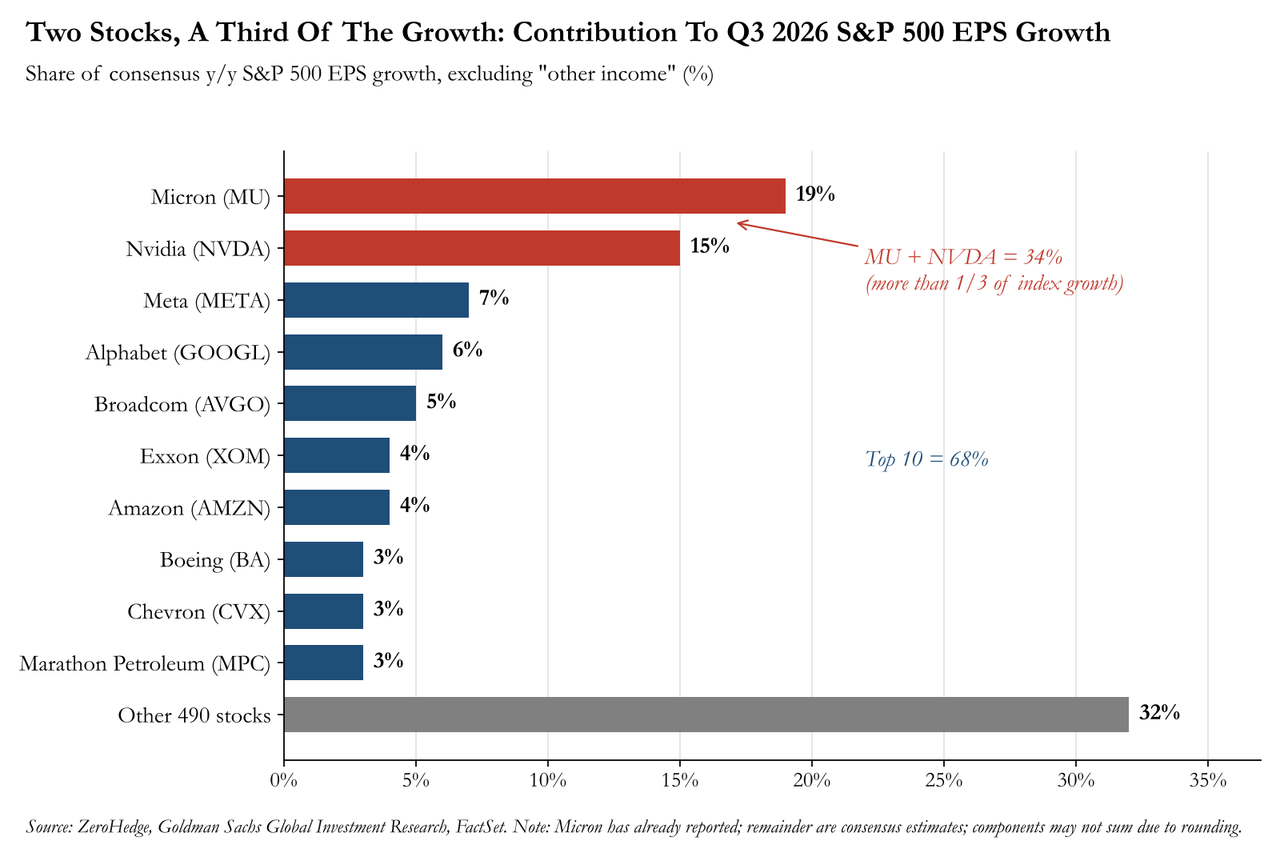
… the memory giant has slumped below $1000, down almost 5%, the lowest price in over 3 weeks.
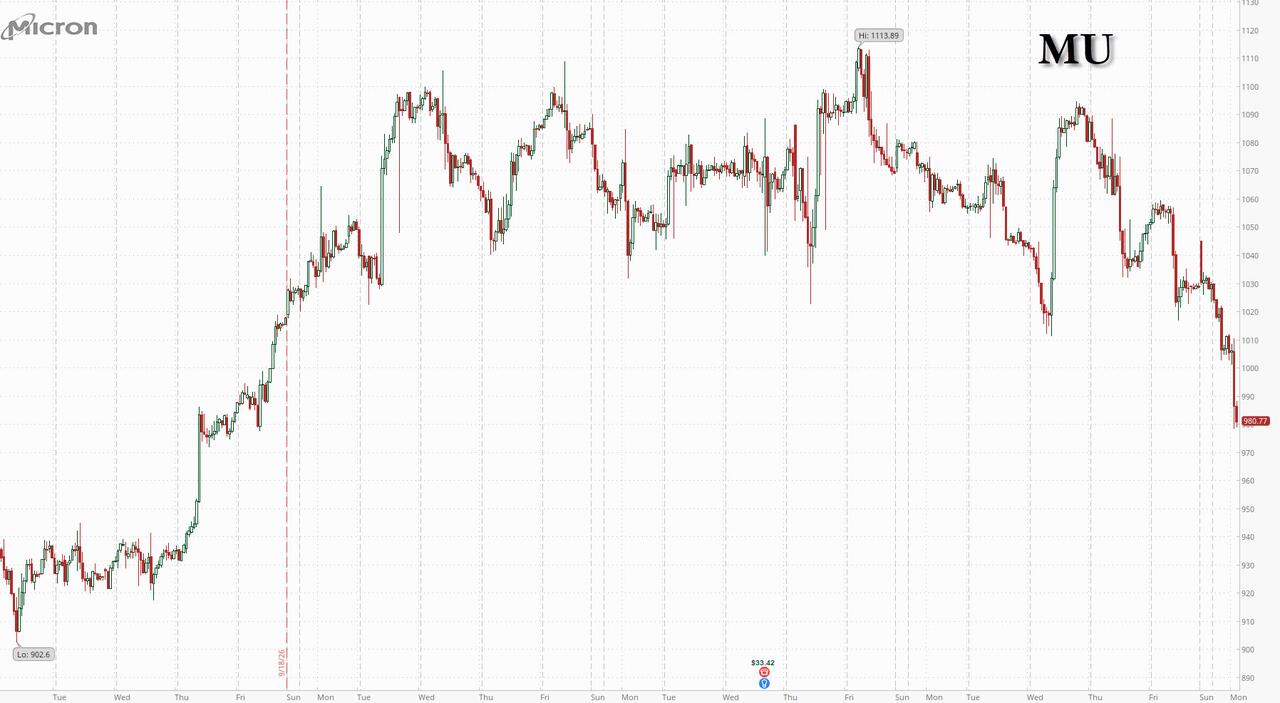
Sandisk was down even more, tumbling 7%, and according to Goldman’s TMT desk, both names are now lower in 6 of their last 7 sessions. Micron is about to enter a bear market, down almost 20% from its June record close, and a stock where sentiment was “11/10” back in June is now trading like nobody wants to be the last one holding it.
The reason for the latest selloff is coming from the other side of the Pacific, where three things collided overnight: i) a Korean market reopening after Friday’s Hangul Day holiday and catching up to two days of US chip selling, ii) the end of the record Samsung/SK Hynix buyback that we warned last week was the only thing propping up the Kospi, and iii) a weekend announcement out of Shanghai that China’s DRAM champion CXMT has made “key progress” on the next-generation memory cell that Samsung and Hynix are still years away from mass producing.
Goldman’s EMEA head of one-delta trading Rich Privorotsky summed it up in four words this morning (available to pro subs):
Pretty ugly in Korea. Kospi -3-4%, Samsung/Hynix -4%, Taiwan broadly flat. Memory remains the epicenter. CXMT announced a new 4F² DRAM architecture over the weekend. China already has ~10% DRAM revenue share and is aggressively adding capacity. Adds to concerns around peak memory earnings despite extraordinary near term fundamentals. Also perhaps a bit of travel and arrive post Samsung numbers which failed to massively surpass expectations.
In other words, the fundamentals have never been better, and that is precisely the problem: they are all priced in.
Let’s take a closer look at the latest Korean carnage, the CXMT news, and why the bull case (record margins, sold-out 2027) is now running into the one thing markets fear more than a shortage: the end of one.
Korea Catches Down
The Kospi tumbled 3.65% to 6,384.2 in what Goldman’s Seoul trading desk called “a one-way move from the open,” closing right on top of its 200-day moving average at 6,376 (available to pro subs). The tech-heavy Kosdaq did even worse, sliding 4.8%. Here’s how the desk described the session:
KOSPI fell sharply in a one-way move from the open and closed just above its 200DMA support (@ 6376), as escalating geopolitical tensions and US memory weakness weighed on the broader market. Foreigners extended their five day net-selling streak (focus-selling in Tech -$1.3bn), while retail investors net bought with bids concentrated in Tech (+$1.2bn, size of net-buying on a decreasing trend).
The semi index KRXSEMI dropped 5.2%, while SK Hynix (000660 KS) and Samsung (005930 KS) each lost about 4.5% as they played catch-down to “SOX’s two-day weakness on reopening.” That two-day weakness came on Thursday, when Goldman’s US desk saw “a heavy wave of selling in Semis / AI complex around OpenAI revenue headlines that continued through Friday despite the clarification update.” Foreigners dumped $782 million of Hynix and $415 million of Samsung, while retail (+$710 million in Samsung) once again caught the falling knives.
Here is how the past week looked in real time, as we posted this morning:
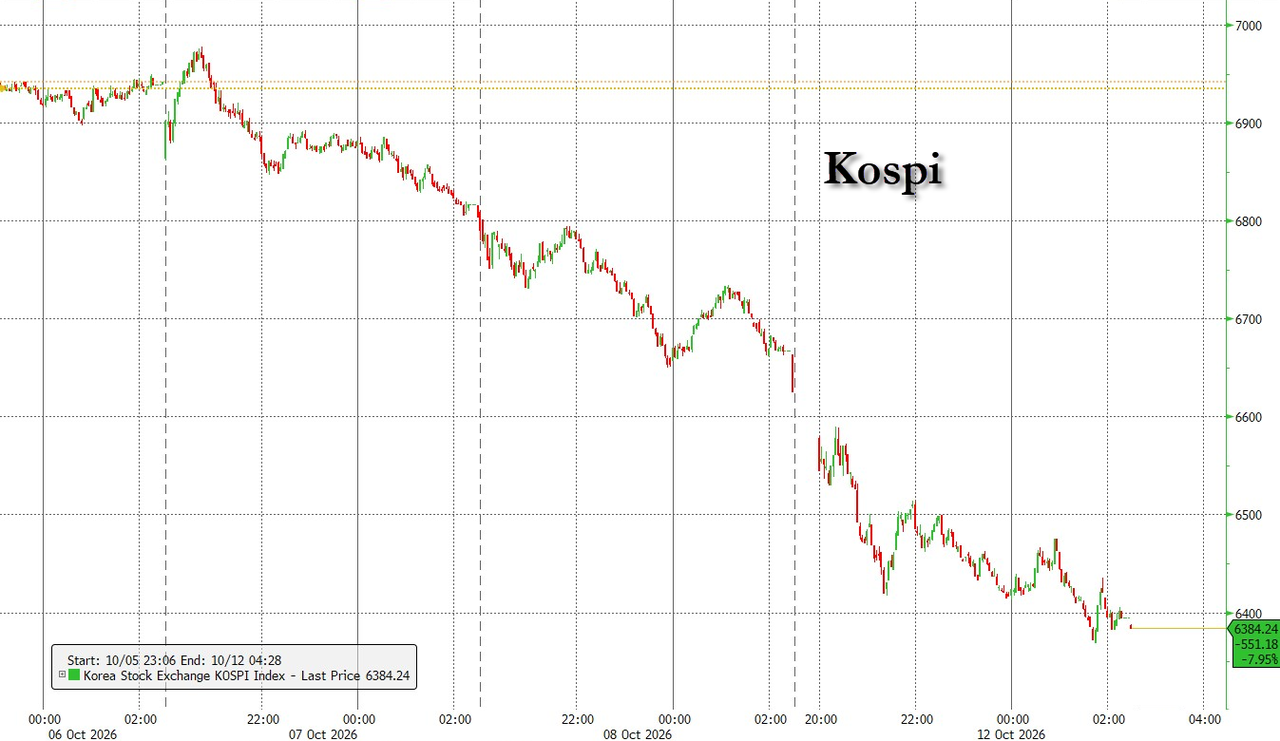
That is an 8% drop in the three sessions since Samsung’s buyback program ran out, and the Kospi is now 30% below its June 22 record close. Korea’s market, the poster child of the AI trade in the first half, has become the worst performer in the second, and as Bloomberg noted in a piece we ran last night, turnover has collapsed 70% from its late-May peak while foreigners have pulled $131 billion from Korean stocks this year, the most of any major Asian market.
The Only Buyer Has Left The Building (As Predicted)
Regular readers will recall that on Sept 3 we warned that only record buybacks were preventing a Kospi crash, and last Wednesday that the W55 trillion ($40 billion) Samsung/Hynix repurchase program, the largest in Korean history, was ending weeks ahead of schedule. As we put it at the time:
Samsung’s program effectively ended on Oct 6, and Hynix’s has a handful of sessions left at most at which point the biggest buyer in Korea will be gone. The math since then is not pretty: the Kospi has dropped in every session since, and today’s flow data show exactly the hole we flagged. With the corporate bid gone, the only remaining buyer is Korean retail, and even there Goldman notes the “size of net-buying [is] on a decreasing trend.” Bloomberg’s numbers paint the same picture: margin loans are down from a June peak of 38.6 trillion won to about 33 trillion, and investor deposits have fallen to roughly 100 trillion won from nearly 140 trillion.
Translation: Korea’s retail army already got carted out once in July, and it is in no hurry to volunteer for round two.
The ZH chart below shows just how far Korea has decoupled from the US memory complex since the June top. SK Hynix is down 45% from its June 22 close; the Kospi and Samsung are down roughly 30%. Micron and the SOX, which held up on the back of blowout US earnings, are only now starting to catch the Korean cold.
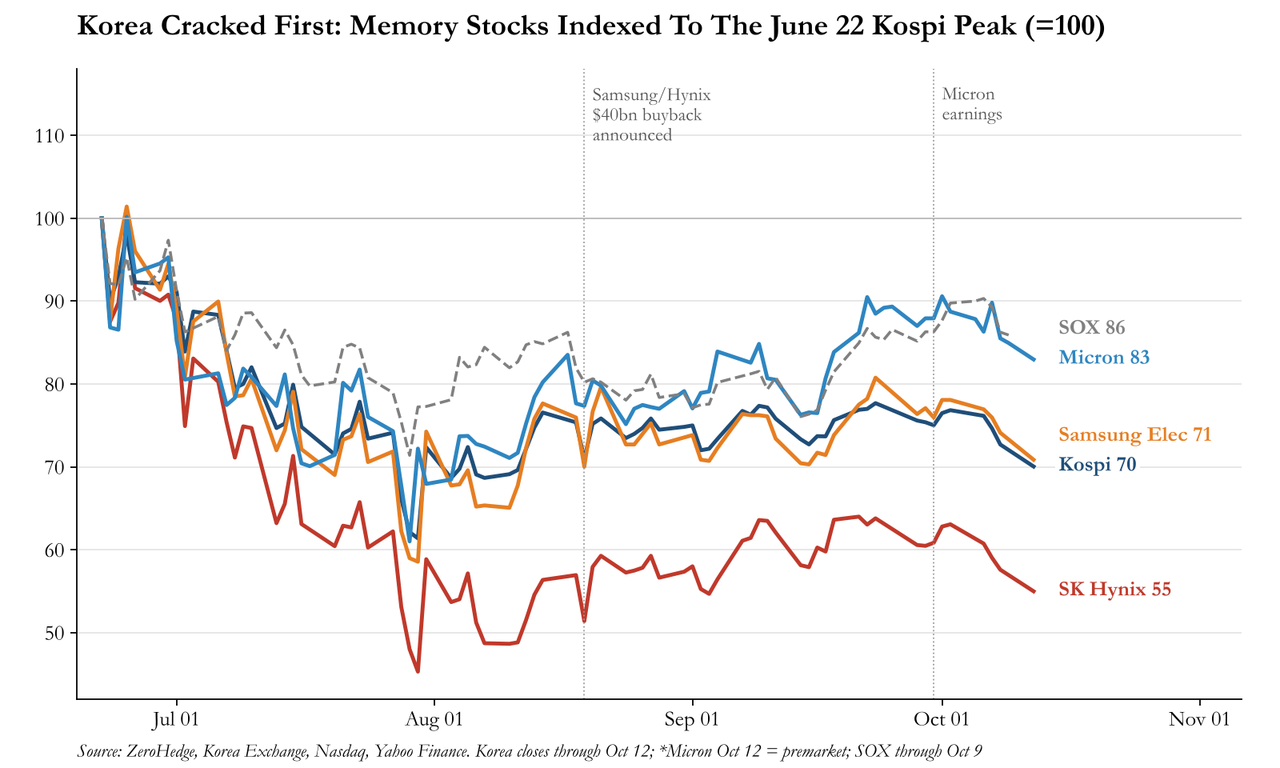
Four Square F: Why CXMT’s Weekend News Matters
And then there’s China.
On Saturday, ChangXin Memory Technologies (CXMT) president Cao Kanyu told an industry event in Shanghai that the company has made “key progress” on a new DRAM cell structure and plans to roll out a server-memory product based on it by the end of 2026, according to the South China Morning Post.
The technology is the so-called “4F²” (four square F) design, where each memory cell occupies an area of 4F², with F being the minimum line width of the chip. Today’s mainstream commercial DRAM uses a 6F² cell. CXMT says the core of its design is a proprietary Vertical Surrounding Gate (VSG) transistor that uses a vertical gate to curb current leakage while shrinking the cell footprint.
Some quick math: shrinking each cell from 6F² to 4F² cuts its area by a third, which means up to ~50% more cells on the same die at the same line width, before any of the real-world overhead that eats into the gain. For a company that is effectively locked out of EUV, a density gain that doesn’t require a leading-edge lithography node is precisely the workaround one would expect.
Why does this matter for Samsung and Hynix? Because they are chasing the same thing on a much slower timeline. SK Hynix only unveiled its 4F² roadmap in 2025, and Samsung, according to Korea’s The Elec, targets mass production of sub-10nm DRAM based on the design by 2028. If CXMT actually ships a 4F² server product by year-end (a big if, since “key progress” is the kind of phrase that tends to precede more key progress), Beijing’s memory champion will have leapfrogged the Korean duo on cell architecture by about two years.
Of course, the CXMT threat is hardly news to our readers. Back in July, we reported that CXMT was testing a production line for next-gen bonded DRAM, closing the gap with Korea “far faster than expected”, and three weeks later, as the stock exploded over 450% in its IPO debut, Goldman warned that the “memory industry has a new problem.” When Goldman initiated coverage of CXMT a month later, the bank laid out the scale of that problem:
And for those still counting on export controls to keep China in check, there was this, from early September:
Then, three weeks ago, Acer’s CEO Jason Chen went further, telling reporters that “the supply shortage problem has already completely disappeared” as Chinese capacity keeps coming onto the market, and accusing the Big 3 memory makers of using public statements to signal each other that prices will stay high (since antitrust law prevents them from just saying so to each other directly). He expects memory prices to peak around the middle of 2027. Acer, HP and Asus are already putting CXMT chips in their PCs.
Put it all together and you get Privorotsky’s “peak memory earnings” concern: nobody is arguing with the next two quarters; the worry is the price of DRAM in 2028, when Chinese supply is projected to be half of Hynix’s and new Korean fabs come online at the same time.
“Extraordinary Near Term Fundamentals”… Again
The irony, of course, is that the numbers keep getting better. Case in point: Taiwan’s Nanya Technology, which reported Q3 results this morning that Goldman’s Taipei desk called “another astonishing quarter”:
- Revenue of NT$133.6 billion, up 62% QoQ and 612% YoY
- Gross margin of 85.7% (+6.2pp QoQ) and operating margin of 80%
- Blended ASPs up more than 60% QoQ, with over half of that driven by contract resets on expiring 2025 long-term agreements
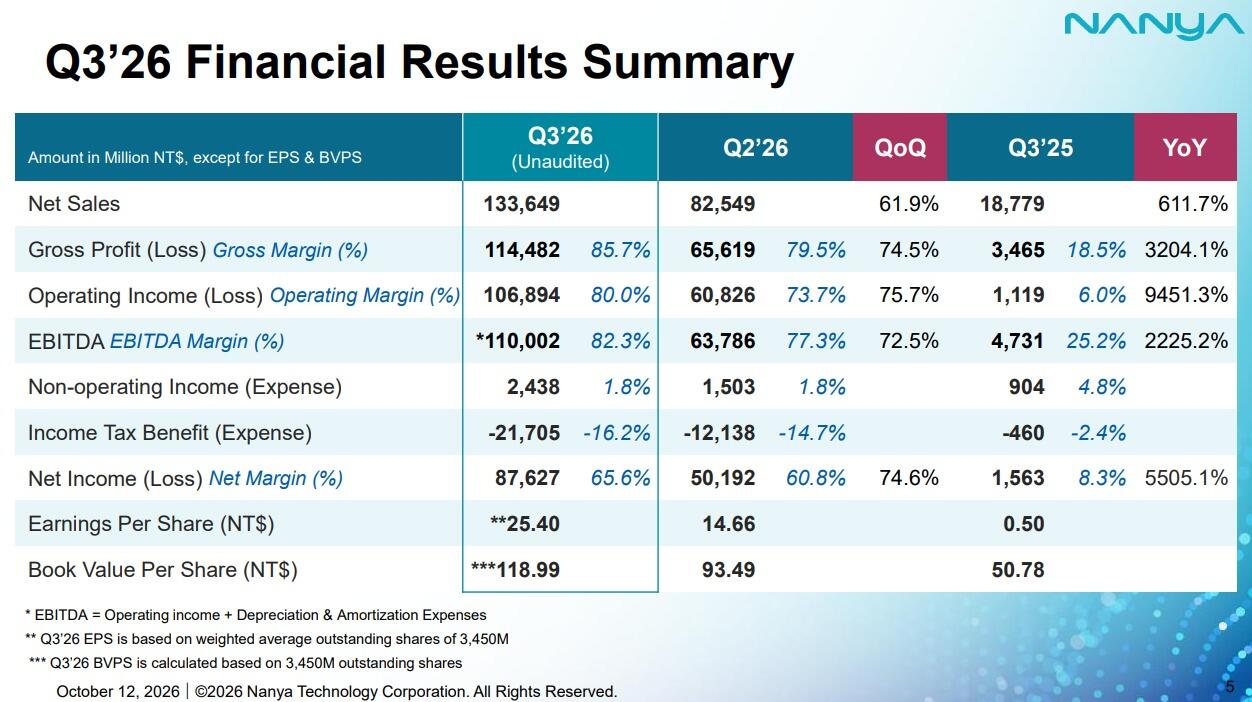
And the outlook remains just as tight: management expects double-digit contract price gains and gross margins above 80% to remain “achievable” in 2027, with no bit shipment growth at all in early 2027 due to near-zero channel inventory, with volumes inflecting only after new fab output starts in Q4 2027. Goldman’s desk, however, noted the uncomfortable truth in its personal take: there is “not much excitement recently to drive further re-ratings.”
That is the memory market in one sentence: record earnings, shrinking multiples. Or as Pictet’s Jon Withaar told Bloomberg, the memory names “have become value names, cheap at current earnings,” and “retail and fast money hedge funds do not chase value.” Growth is what they chase, and they are increasingly worried that it peaks right around when CXMT’s 4F² chips hit the market.
Hedge funds certainly aren’t waiting around to find out. Goldman’s Prime Book shows that last week US Info Tech went from the most net bought sector in 4 of the past 5 weeks to the most net sold, at the fastest pace in seven weeks, with Tech Hardware, Storage & Peripherals and Semis the most sold subsectors. Meanwhile, the Samsung earnings that were supposed to restart the trade (a nearly ninefold surge in operating profit) produced a selloff instead, which is all you need to know about where expectations are.
What To Watch
Goldman’s Korea research team flagged six things it will be listening for on Samsung’s Oct 29 earnings call, and the first one tells you exactly what the market is worried about: “whether the company calls for a tighter memory supply in 2028 similar to Micron.” The others include new LTAs with customers, the HBM4 ramp (and the impact of HBM “despeccing”), updated capex plans, and shareholder returns (good luck with that last one: the market just got a live demonstration of what happens when the buyback ends). SK Hynix reports the last week of October.
Before then, this week brings TSMC on Thursday, ASML on Wednesday (which is reportedly raising spare-part prices for its Korean customers by 10%, with Samsung and Hynix accepting the hike starting January 2027; nice work if you can get it), and SEMICON West, all of which will give the chip complex plenty of opportunities to either restore faith or provide more fodder for the peak-cycle crowd.
Bottom Line
Privorotsky was careful to call this a concern about “peak memory earnings despite extraordinary near term fundamentals,” and Nanya’s results prove the near term is indeed extraordinary. But markets discount the future, and the future now includes a Chinese competitor that briefly became China’s most valuable company in August, ASML tools stockpiled for three years, a 4F² product on the roadmap for this December, and the stated ambition of supplying half as much DRAM as SK Hynix by 2028.
The bulls will say the selloff is overdone and memory is “cheap at current earnings.” We think the more likely outcome is that Korea, which led the memory trade on the way up and cracked first on the way down, is once again the leading indicator, just as we suggested back in June when we wrote that Micron won’t be where you’ll first hear the memory trade is over. Korea is now 30% off its highs and Hynix 45%; Micron is down 17% and about to enter a bear market.
Because nothing says “peak cycle” quite like 86% gross margins.
END
JAPAN//
JAPAN//USA/
3/CHINA
Chinese Workers Return From Holiday To Find Factories Emptied, Owners Gone
Saturday, Oct 10, 2026 – 09:10 PM
Authored by Michael Zhuang via The Epoch Times,
Workers in several parts of China say they returned from the National Day holiday to find their workplaces emptied of equipment, managers gone, and months of wages still unpaid, according to workers and videos circulating on Chinese social media.
The reports emerged as China’s seven-day National Day holiday, which ran from Oct. 1 to Oct. 7 this year, was drawing to a close. Some workers said they found their factories stripped of machinery and workstations, leaving behind little more than discarded materials and trash.
The reports, documented in social media posts and interviews by the Chinese-language edition of The Epoch Times, have raised concerns among workers over unpaid wages and the sudden disappearance of business owners. The workers spoke on condition of anonymity out of fear of reprisal.
In some cases, workers said they believed that factory owners used the holiday period to remove equipment and close their businesses without notifying employees.
One worker in Xiaogan, Hubei Province, surnamed Zhao, told The Epoch Times on Oct. 6 that the hardware and plastics factory where he worked had been moved out and the owner had disappeared.
“The boss has fled,” Zhao said. “I’m just a temporary worker. They have been delaying [wage payments] every day.”
Unpaid Wages
In Putian, Fujian Province, a worker surnamed Dong told The Epoch Times that employees at a small shoe factory were also struggling to recover unpaid wages.
Dong said that on Oct. 3, workers at his former factory attempted to pressure the owner over unpaid wages.
“The boss hasn’t fled. He just said there’s no money and told us to wait for a while,” he said.https://www.youtube.com/embed/EQ8O_Ewjsso?si=3g-dIGyUKrzJ759v
The factory, which employed several dozen people, had not formally declared bankruptcy, according to Dong. He said the owner had diverted funds into other ventures and no longer had enough money to pay workers.
“I’m owed more than two months of wages,” he said, regarding his former workplace.
The reports extend beyond individual factories.
In Yongkang, Zhejiang Province, a woman surnamed Sun told The Epoch Times that her parents worked at a factory producing insulated cups where more than 60 employees had gone three months without wages.
The factory owner had disappeared, she said.
During the holiday, her parents and other workers remained outside the factory for about a week to prevent the remaining equipment from being removed.
“My mom and dad were guarding the factory entrance during the holiday, afraid that someone would take away the things inside,” Sun said.
She said she did not know how much money the factory owed its workers.
Some workers have also described taking precautions against the possibility that their employers would disappear during the holiday.
Multiple videos circulating online showed workers complaining that factories had been emptied while they were away. Workers said the owners had sold or removed equipment during the holiday, leaving workers with little recourse over unpaid wages.
The accounts could not be independently verified by The Epoch Times.
The problem was not limited to factories. A woman surnamed Yang in Hangzhou, Zhejiang Province, told The Epoch Times that the owner of her local gym also disappeared during the holiday, leaving behind a failing business.
The reports offer a glimpse of the uncertainty facing some Chinese workers and small business owners as struggling businesses shut down with little warning. For workers already owed months of wages, the sudden disappearance of an employer can leave them trying to recover money after the business itself has effectively vanished.
END
CHINA/THEIR ECONOMY
China’s “Golden September” Stalls: Car Sales Crash 28% As Exports Become Lifeline
Monday, Oct 12, 2026 – 11:35 AM
New data released by the China Passenger Car Association earlier on Monday show that China’s peak car-buying season hit the brakes, with September passenger-vehicle retail sales plunging 28% from a year earlier as manufacturers increasingly relied on overseas buyers to cushion soft domestic demand.
The CPCA said in the report that retail sales fell to 1.62 million vehicles, marking a 12th consecutive monthly decline from a year earlier. Sales rose 5% from August.
The report showed that electric cars and plug-in hybrids accounted for a whopping 67% of passenger-car sales last month. Even so, retail sales of these new-energy vehicles tumbled 17% from a year earlier to 1.08 million units, underscoring the breadth of the domestic market slowdown.

“Overall sales volume was under significant year-on-year pressure, with limited month-on-month recovery; structural differentiation was amplified to the extreme, with accelerated contraction of fuel vehicles and resilient leadership of new energy vehicles becoming the main market theme, and high oil prices continuing to accelerate the pace of ‘oil-electric substitution,'” the report stated.
Exports provided relief to domestic manufacturers as these cheap cars flooded international markets.
Overseas passenger-vehicle shipments, including knock-down kits, surged 73.7% to 917,000 units, accounting for 36% of manufacturers’ sales, up from 19% a year earlier. The CPCA noted that exports now represent more than half of sales at some auto manufacturers, with a growing number approaching 70%.
But the sustainability of export demand came into question early Monday amid expectations that Europe would cap Chinese hybrid vehicle imports at 350,000 per year. These vehicles remain banned in the US market.
The CPCA also noted, “The surge in memory and chip prices driven by AI and tight supply have resulted in a slower increase in new energy vehicle sales recently.”
“Industry inventory remained low, with high oil prices significantly impacting fuel vehicles, dealers being more cautious in purchasing new cars, and most dealers believing that the ‘Golden September and Silver October’ peak season effect was significantly weaker than in previous years, resulting in significant survival pressure and a lack of confidence among dealers. However, the current downturn in the car market is a temporary phenomenon resulting from the combination of short-term policy disruptions and a high base, rather than a sign that the fundamentals of car ownership have peaked,” the report stated.
END
4. EUROPEAN AND SCANDINAVIAN COMMENTARIES PLUS NATO
EU
EU Caps Chinese Hybrids At 350,000 As Deutsche Maps Every Trade Weapon Left In Europe’s Arsenal
Monday, Oct 12, 2026 – 04:15 AM
Brussels has finally picked a rung on the “escalation ladder.”
According to a document seen by Bloomberg, the EU will cap imports of Chinese hybrid vehicles at 350,000 cars per year, with the “safeguard measure” taking effect as soon as December 1. The limit rises 6% a year from the second year and the measure runs for four years. And to stay on the right side of the WTO’s non-discrimination principle, the cap will formally apply to all hybrid imports, with China’s quota “no less than any other source.”
The cap puts a number on what Trade Commissioner Šefčovič brought back from Beijing on Friday, when he said the two sides had agreed to halve Chinese hybrid and plug-in hybrid exports to the EU (“a crucial first step, but only a first step”). Beijing’s own readout mentioned only an “understanding on hybrid vehicle trade in a WTO-consistent manner”: no volumes, no baseline, no timeline and no enforcement. Which is presumably why Brussels decided to write the number down itself.
How much does it bite? Per Eurostat data cited by Asia Times, the EU imported roughly 378,000 Chinese hybrids (218K plug-ins and 161K full hybrids) in the first seven months of 2026, an annualized pace of about 650,000. A 350,000 cap is therefore roughly 45% below this year’s run rate, in line with the “halve” headline. Then again, back in October 2024, when the EV tariffs pushed Beijing into hybrids in the first place, Europe was importing about 3,800 Chinese hybrids a month (per FT data), or roughly 46,000 a year. By year four the cap grows to about 417,000. In other words, Brussels is capping the flood at almost 8 times the level that triggered it.
When we first reported the plan on Wednesday (“Better Late Than Never?“), our verdict was “just 10 years too late”. The more interesting question is where this sits in Europe’s arsenal, and how far up the escalation ladder Brussels is willing to climb.
Conveniently, Deutsche Bank’s Marion Muehlberger answered precisely that in a ten-question Q&A published last week, ahead of Šefčovič’s trip to Beijing, titled “Crunch time for EU-China trade relations“( and available to pro subs). The centerpiece is a single table, which may be the most useful cheat sheet on EU-China trade policy we have seen: every tool Brussels could deploy against Beijing, ranked from most to least likely, with the precedent and the catch for each one.
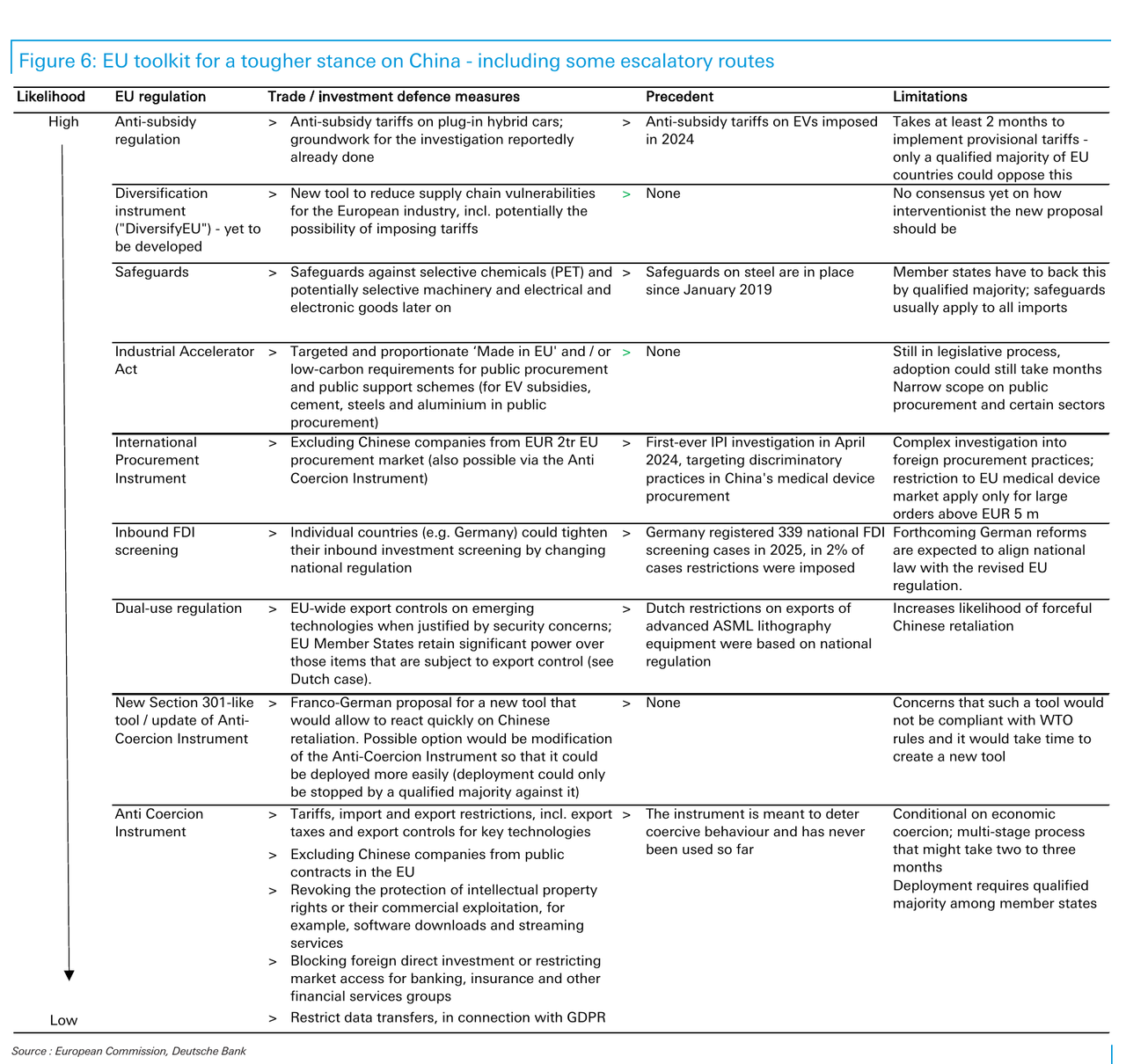
Notably, Brussels skipped the top rung. DB’s base case was an anti-subsidy investigation into plug-in hybrids, with tariffs “in early 2027 at the earliest.” Instead, the Commission reached for rung three, safeguards, which DB flags as needing qualified-majority backing and which “usually apply to all imports”, exactly the WTO-friendly design in Bloomberg’s document. The precedent DB cites is also a hint about how “temporary” these things tend to be: the EU’s steel safeguards have been in place since January 2019.
Below we walk down the rest of the ladder, and explain why the most powerful weapons sit at the bottom precisely because nobody wants to fire them.
The Top Of The Ladder: Ready To Go (Mostly)
At the “high likelihood” end, DB lists the tools that are either already loaded or require little political courage:
- Anti-subsidy tariffs on plug-in hybrids. The groundwork for the investigation is reportedly already done, and the precedent is obvious: the anti-subsidy duties on Chinese EVs imposed in 2024. The catch: it takes at least 2 months to get even provisional tariffs in place (and as a reminder, it was Chinese hybrids that waltzed through the loophole left by those EV tariffs). This was DB’s pick for the hybrid response; the safeguard below now looks like the faster route.
- “DiversifyEU”. A brand new instrument to reduce reliance on single suppliers in strategic sectors, potentially including tariffs. Its legal form has yet to be determined and there is “no consensus yet on how interventionist” it should be, which is Brussels for “we have a name, a public consultation, and not much else.”
- Safeguards against selected chemicals (PET), and potentially machinery and electrical goods later. Precedent: the steel safeguards in place since January 2019. The catch: they need a qualified majority and usually apply to all imports, not just Chinese ones. This is the rung Brussels just picked for hybrids, with the 350,000 cap formally applying to every exporter.
- The Industrial Accelerator Act: “Made in EU” and low-carbon requirements for public procurement and EV subsidies. Still in the legislative process, and “adoption could still take months.”
The Middle: Narrow, Slow, Or National
Further down, the tools get sharper but also more cumbersome:
- The International Procurement Instrument could exclude Chinese companies from the €2 trillion EU procurement market. It has been used exactly once, in an April 2024 probe of China’s medical-device procurement, and the resulting restriction applies only to contracts above €5 million. Diversification at its finest.
- Inbound FDI screening is left to individual countries. Germany registered 339 national screening cases in 2025 and imposed restrictions in just 2% of them.
- Dual-use export controls on emerging technologies, with the Dutch restrictions on ASML lithography exports as the template. DB’s warning here is blunt: this one “increases likelihood of forceful Chinese retaliation.”
The Bottom: The Bazooka Nobody Fires
At the very bottom of the ladder, and the bottom of DB’s likelihood scale, sits the Anti-Coercion Instrument (ACI), the EU’s so-called “trade bazooka.” On paper it can do almost anything: tariffs, import and export restrictions, export controls on key technologies, exclusion from public contracts, revoking intellectual property protection, blocking FDI, restricting access for banks and insurers, and curbing data transfers under GDPR.
In practice, DB notes, the instrument “has never been used so far.” Deployment is a multi-stage process that “might take two to three months” and requires a qualified majority among member states.
Regular readers will recall the last time Brussels dusted it off: in January, when Europe prepared to unleash the anti-coercion “trade bazooka”… against Trump over Greenland. The bazooka was never fired then either, but it is telling that Europe’s first instinct was to point it at Washington, not Beijing.
Just above the ACI sits the newest entry: a “New Section 301-like tool”, i.e. the Franco-German proposal that Macron and Merz sent to von der Leyen last Monday. As Reuters reported, the tool would target dumping, widespread subsidies and restricted currency convertibility without naming China, and Commission countermeasures would take effect unless a qualified majority of member states objected. DB’s caveat: there are “concerns that such a tool would not be compliant with WTO rules”, and it would take time to create.
The Trigger Problem
Which brings us to the crux of DB’s argument, and the reason Paris and Berlin bothered with a new tool in the first place: speed.
While trade defence escalations are likely to be felt quite fast by European industries (i.e., export controls on rare earths), the EU will take months to invoke its current deterrent, the Anti-Coercion Instrument (ACI). The proposed new instrument could be deployed rapidly unless there is a qualified majority against it – a much lower hurdle and comparable to the activation of anti-subsidy tariffs.
In other words, Beijing can turn off Europe’s rare earths in an afternoon, while Brussels needs a quarter just to schedule the vote. DB says the Franco-German tool would let the EU react “within 24 hours“, which would make it “a far better deterrent in any trade dispute than the ACI.”
How big is the gap? Here is our attempt to put the EU’s reaction times side by side, using DB’s estimates and the one real-world precedent: the 2024 EV case, where it took Brussels 275 days from launching the probe to provisional duties, and 392 days to definitive ones.
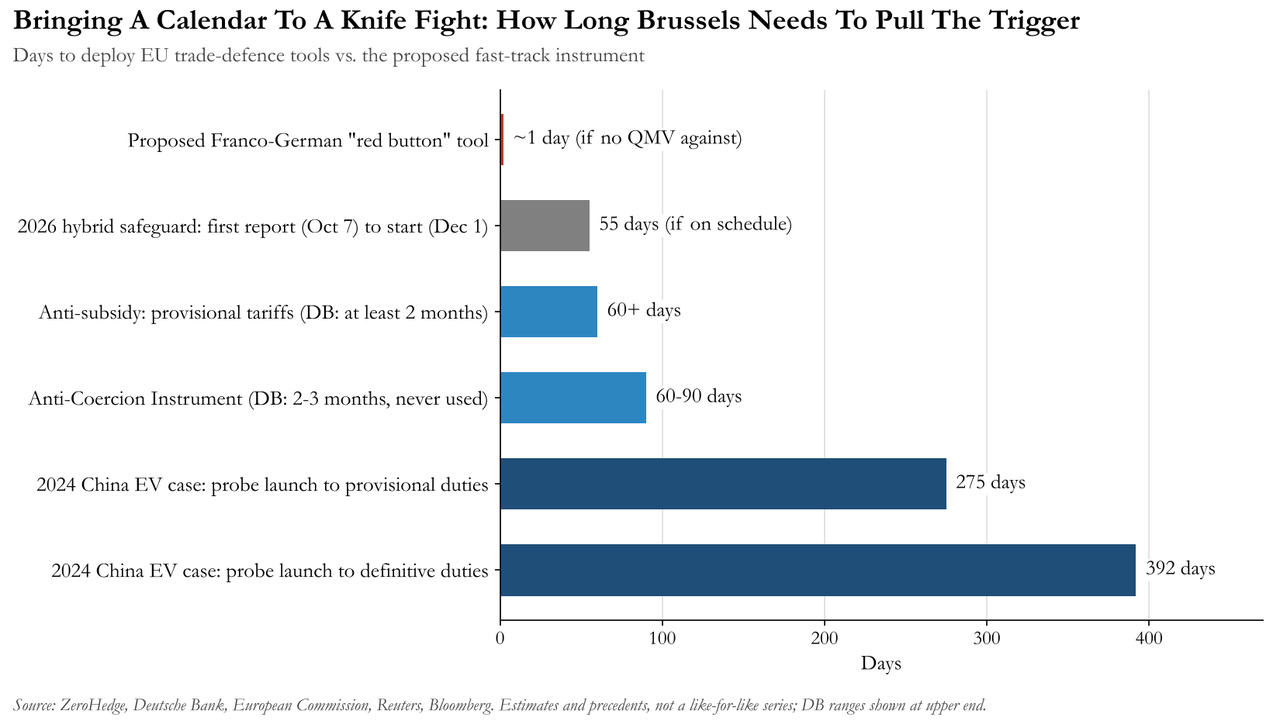
To be fair, the hybrid safeguard is the fastest Brussels has moved yet: if it kicks in on December 1, that is 55 days after Bloomberg first reported the plan, roughly in line with DB’s “at least 2 months” for provisional anti-subsidy duties, and positively lightning-fast by EU standards. Then again, this is a quota China effectively pre-cleared at last week’s talks. The real test is how fast Brussels moves when China says no.
Meanwhile, China does not need a qualified majority for anything. Recall that we warned a year ago that Europe was walking into the rare earth trap, with McKinsey estimating that up to 4 million German jobs were at risk from a prolonged export ban. And Beijing has shown it is happy to escalate on its own timeline:
Of course, a faster trigger is only a deterrent if someone is willing to pull it. And even Deutsche is not sure the new tool would be new at all: “it is not clear yet” whether Paris and Berlin want a separate instrument or “simply propose to make the activation of the existing tool easier.” Either way, creating it “would require several months.” A rapid-response tool that takes months to build: very European.
Germany Finally Notices
The more interesting political shift is Berlin. DB argues that the Franco-German letter is “the clearest evidence of a more hawkish turn of the German government”, which shows “greater willingness to apply the EU’s trade defence toolbox” but “still refrains from outright escalation.”
The reason for the change of heart is not hard to find. Germany’s old model of exporting machinery and cars to China is breaking down as China makes those goods itself, and then sells them to everyone else. China’s share of global car exports went from 5% in 2013 to 15% in 2025, on par with Germany, while in specialised and general industrial machinery, the crown jewels of the Mittelstand, China has already overtaken Germany.
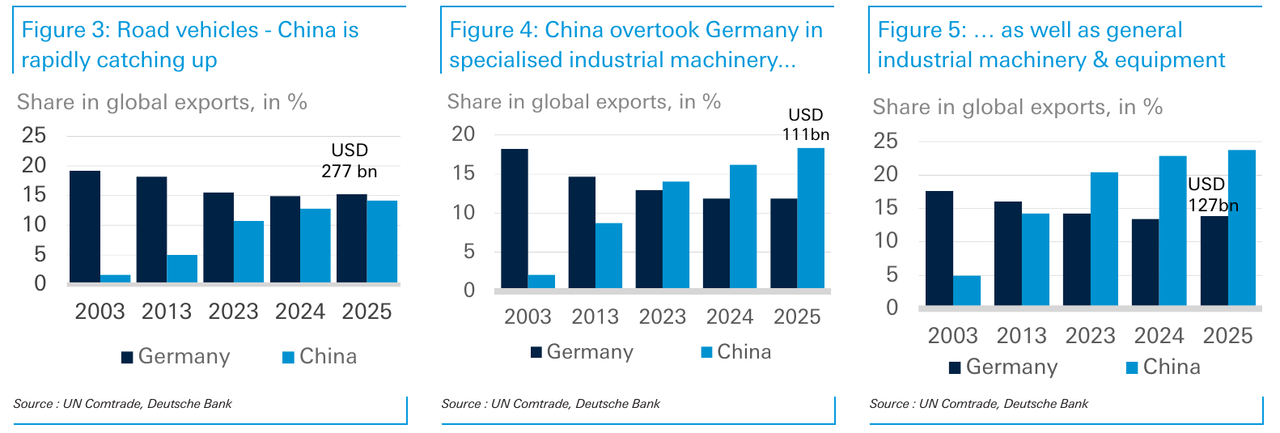
Inside Europe, it looks even worse. As we put it last month, “why European manufacturing is doomed in one chart”: every European automaker has lost share in Europe, while Chinese brands gained almost 5 percentage points in a year.
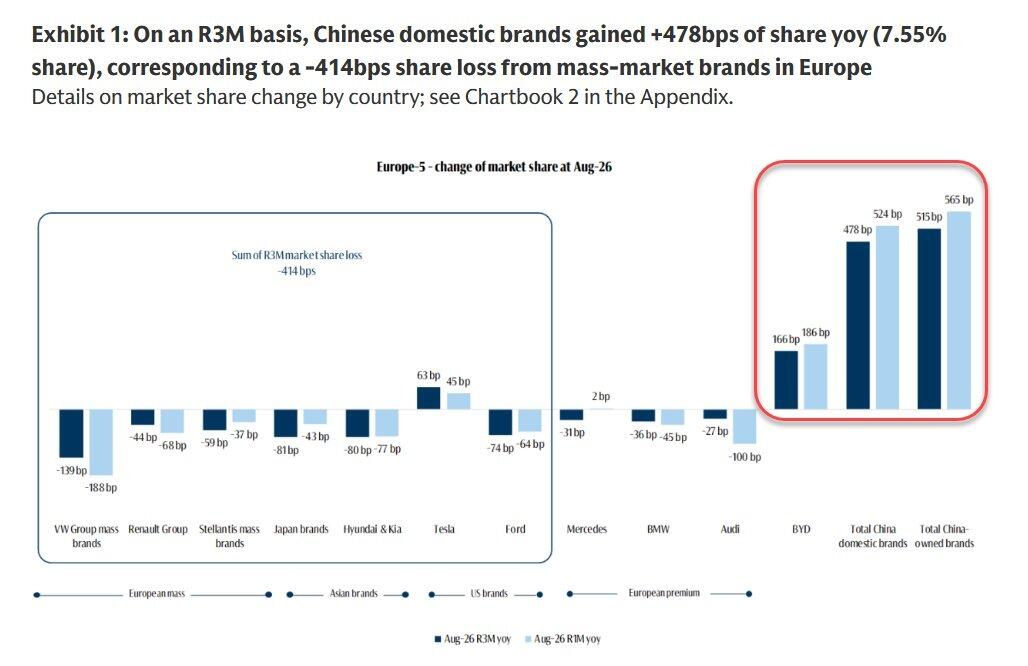
And yet, DB notes, China “remains an important market and innovation partner for many German firms”, sometimes called “the fitness center for German corporates.” Which is a polite way of saying that a good chunk of DAX earnings still depends on the country Berlin now wants to get tough with. That is also why the bilateral deficit keeps widening, back to around 2% of EU GDP:
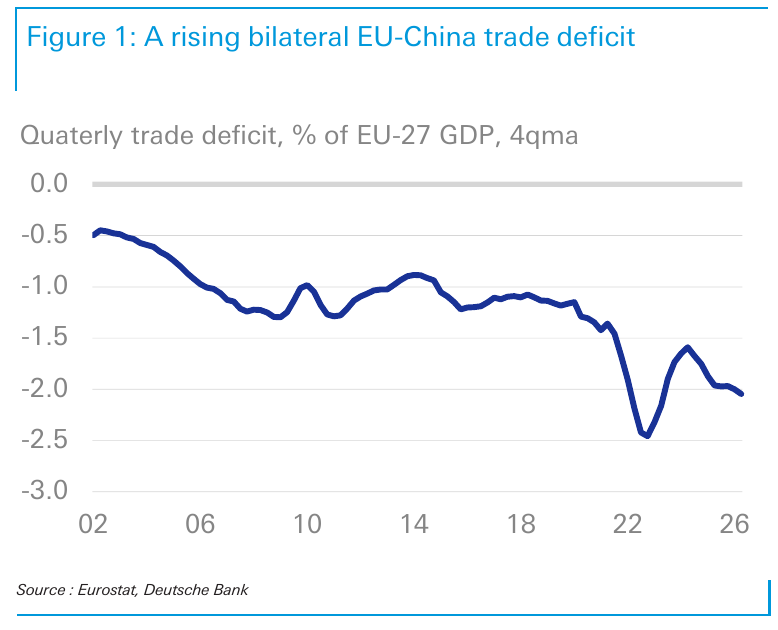
What Happens Next: “Rather Minimalist”
So how did DB’s roadmap hold up, and what comes next?
- Last week’s Beijing talks: DB expected the Šefčovič-Wang meeting to “likely not bring a major breakthrough,” with “little movement on the EU’s demand to restrain exports to Europe.” Call it half right (pun intended): Brussels says Beijing agreed to halve hybrid exports, but China put no number in its own readout, so the EU is now writing one into a safeguard. Beijing also promised to keep easing rare earth export licensing through a “green channel”, which tells you who holds the leverage.
- Thursday-Friday (Oct 15-16) EU summit: leaders will discuss the hybrid cap along with broader ways to stop the flood of subsidized Chinese goods, and Šefčovič still needs their endorsement. DB had pencilled in an anti-subsidy probe into plug-in hybrids as the most likely next step, with tariffs “in early 2027 at the earliest”; the safeguard now looks like the faster route.
- December 1: the hybrid cap takes effect, if all goes to plan.
- December 17-18 summit: the Commission is expected to present DiversifyEU beforehand.
Overall, DB expects EU leaders “to continue their rather minimalist approach“, relying on established tools and “selectively broadening their toolbox… while seeking to avoid a broader trade conflict with China.” Bloomberg’s scoop suggests DB nailed it: Brussels climbed exactly one rung, and picked the one least likely to upset Beijing.
DB also reminds Brussels where the real problem lies. The bank argues Europe’s China headache is as much a “Europe problem” as a China problem: energy costs, weak productivity, scarce risk capital and regulation. And on that front, progress is underwhelming: implementation of Draghi’s reform agenda has reached just 16% (41% including partially implemented measures), with clean energy and the integrated market still dominated by “pending” and “planned.”
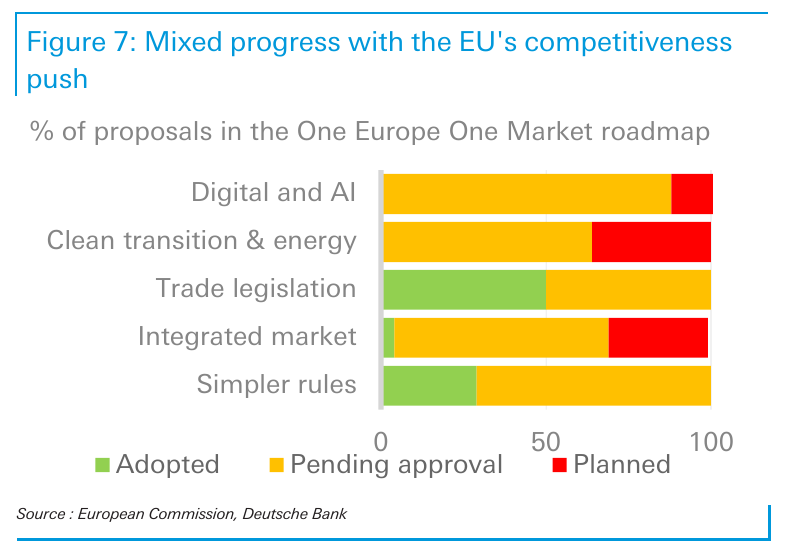
Bottom Line
DB’s ideal endgame is “derisking rather than decoupling”: continued trade with China, but with fewer strategic dependencies, more reciprocity and better market access, alongside a more competitive Europe (good luck). Goldman’s European trading desk was less diplomatic when the cap was first floated on Wednesday, noting that the hybrid measures “will only briefly limit China’s market share gains.”
We side with Goldman. Deutsche’s table shows that Europe has built an impressive arsenal, but its most potent weapons sit at the bottom of the likelihood scale precisely because Brussels is afraid of what Beijing would do in response, and Beijing knows it. As long as China controls the rare earths and Germany’s carmakers still need the “fitness center”, the EU’s escalation ladder will be climbed one slow, carefully telegraphed rung at a time, while China’s market share keeps climbing much faster.
Thursday’s summit will show whether Europe’s leaders want to go any further up the ladder. Our bet: they stay right where they are, and the whole thing eventually fades with a whimper alongside Germany’s once mighty auto industry.
Much more in the full Deutsche Bank “Crunch time for EU-China trade relations” note, available to pro subs.
END
UK
UK Govt Wants “Interventionist State Policing & Regulating Of Online Space”
Monday, Oct 12, 2026 – 03:30 AM
Authored by Kit Knightly via OffGuardian,
The United Kingdom already has one of the most controlled digital environments in the world.

We have a social media ban for children in place, requiring everyone to scan their ID or otherwise verify their age to use social media. They require age verification for “adult content”. There are proposals and legislation pending to implement “device level nudity detection”, introduce a “social media curfew” for teenagers, and we already lead the world in social media-related arrests.
But, according to the Culture and Technology Secretary Lisa Nandy, we are far from done.
Last week, at the Labour Party Conference, Nandy gave a speech hailing the UK’s “first in the world” social media ban (it’s not actually the first, except by some very specific metric, but whatever). She told the conference [emphasis added]:
[T]he world wide web – that created [sic] by Tim Berners Lee, to share knowledge, not exploitation – has revolutionised the way we live. An extraordinary democratic force, a source of connection, creativity and solace that has unleashed incomprehensible hatred, anger and polarisation – ask yourselves this, while it has undeniably shaped and defined us, have we done anything like enough to shape and define it?
Like the printing press, electricity and television, it has upended society. But what is almost unique to this moment is how absent the state – on behalf of its people – has been for so long. We have outsourced a revolution almost entirely to the private sphere to shape and police.
It is an almost violent indifference. To the women whose privacy and dignity is stripped from them. To the children who are preyed upon, their childhoods stolen. To people – how many of you in this room particularly women- hounded from public life. Where anger is monetised and profit put before people’s lives.
So conference, we are calling time on that indifference. Enough is enough.
We will not look away or stand aside when it comes to safety online. And we will be the first. First in the world to introduce legislation to make it impossible for children to take, share or view nude images. First in the world to introduce a comprehensive social media ban for children.
…[W]e will do whatever it takes. Because when it comes to women and girls. Women’s rights are human rights and human rights are non-negotiable.
But friends shouldn’t we be ashamed, that decades of violent indifference has come to this, having to remove our children from social media altogether, because we cannot protect them from harm?
So our message to the incredible tech sector, who are everyday leading breathtaking innovation, is that this is our collective call to arms.
Let this country pioneer technology as an unequivocal force for good. Because our online spaces live in the palm of our hands, and the cables that run under our feet. They are a civic space like any town hall or high street. So let’s insist they are not just safe but thriving, inclusive and empowering.
Where people can trust what they see, and find common ground and connection.
Prior to her speech, Nandy had told The Guardian:
“We shouldn’t accept that this is the end […] This is a staging post to what must be a very active interventionist state, policing and regulating the online space so that people are safe.“
To paraphrase a politician rather more charismatic than Nandy, it seems this is not the end of digital censorship, it’s not even the beginning of the end of digital censorship, or even the end of the beginning…rather it may be the beginning of the beginning.
So what does that mean, in real terms?
Well, digital ID obviously.
One of Andy Burnham’s first acts as Prime Minister was to “scrap” the BritCard digital ID scheme. But that was very much a gesture.
It never really went away, and it will be coming back…quite soon if simmering headlines like “Britain can’t shelve Digital IDs forever” are anything to go by.
Probably, in the near future, something will happen that will “force” good old Andy to “revisit the digital ID issue”.
And, of course…
Without global interoperability, digital IDs can’t deliver on their promiseTech Radar
And, once digital ID is officially unscrapped and “globally interoperable” the social media ban for children will spread to verified ID for digital purchases, or to use AI or to prevent the spread of “misinformation, or even ID-gating internet access itself.
Whatever they want.
If everything they’ve already done is only a “staging post”, just imagine how tight a grip they really want.
“A very active interventionist state, policing and regulating the online space so that people are safe.”
Chilling stuff. Perhaps most chilling of all is the fact her handlers think this is the positive spin that will sell the idea to the proles.
END
GERMANY
In Germany, 87% Of Suspects With An Arrest Warrant Are Foreigners
Saturday, Oct 10, 2026 – 09:20 AM
Authored by – Remix News Staff – via Remix News,
More than 148,000 people remain subject to outstanding arrest warrants in Germany, and only 11.2 percent of them hold exclusively German citizenship, and overall, 87 percent of arrest warrant suspects are foreigners, according to figures the Federal Ministry of the Interior provided in response to a parliamentary inquiry.

Foreign nationals account for 87.3 percent of the total of suspects wanted for arrests, while another 1.5 percent are German citizens who also hold a second nationality. The data is already adding to the debate about mass immigration and criminality, especially in a country where the amount of violence, rape, and serious offenses are disproportionately committed by its foreign population.
Welt newspaper obtained the ministry’s reply to a question from Alternative for Germany (AfD) lawmaker Sebastian Münzenmaier.
Münzenmaier told Welt am Sonntag: “The figures speak for themselves: The overwhelming majority of criminals wanted on arrest warrants do not have a German passport.” He called for a “rigorous change of course” that would include permanent and complete border controls, the immediate termination of the stay of foreign criminals, and the enforcement of prison sentences in the country of origin.
While German citizens form the single largest group, at 16,671, Germany also features a population where 81 percent of people hold exclusively German citizenship. Romanian nationals follow closely with 16,123, then Polish nationals with 12,721, Georgian nationals with 6,869 and Turkish nationals with 6,696.
Alexander Throm, the domestic-policy spokesman for the Christian Democratic Union (CDU) parliamentary group, said: “Every open arrest warrant poses a security risk.”
He added that “the high proportion of foreign offenders, including many from other EU countries, shows that action must be taken.”
Throm also noted that border controls introduced in September 2024 have done more than limit illegal migration: “They have not only curbed illegal migration. Since their start in September 2024, over 17,500 people have also been apprehended at our borders with outstanding arrest warrants.”
Heiko Teggatz, chairman of the German Police Union, called the total worrying and said it “of course, represents a security policy problem.” State police forces, he told the paper, rarely have the staffing to mount dedicated searches; most arrests occur as a “chance hit or bycatch.” The union has long cited personnel shortages as a central obstacle to improved public safety.
Marcel Emmerich, the Greens’ domestic-policy spokesman, agreed that the volume of open warrants constitutes a serious problem, “especially when it comes to dangerous persons, extremists, violent or sex offenders.”
However, Emmerich rejected broader border checks, noting: “Instead of hoping for random hits at border controls, targeted searches are needed, especially for dangerous perpetrators of violence, threats and people from the field of politically motivated crime.”
Sebastian Fiedler, the Social Democratic Party’s domestic-policy spokesman in the Bundestag, cautioned against reading the aggregate figure as evidence of 148,000 undetected dangerous offenders still inside the country. “A significant portion of this is due to substitute prison sentences for unpaid fines. In North Rhine-Westphalia, more than half of all outstanding arrest warrants in total were such cases, he said. Warrants can also remain active against people who have already left Germany or been deported, so that any remaining sentence can be enforced if they return.
“For example, they will continue to be put out to tender for a search so that if they re-enter the country, a remaining prison sentence can be enforced,” Fiedler said.
While the crimes may include many petty offenses, the totals are stark. German nationals represent a minuscule share of the open arrest warrants in a country where 81 percent of the country is made up of German nationals.
END
GERMANY
As German Voters Reject Mass Migration, Politicians And The Media Play The Fool
Saturday, Oct 10, 2026 – 07:00 AM
Authored by Pawel Styrna via American Thinker,
The anti-mass-migration Alternative for Germany (AfD) has won the election to the provincial parliaments in the states of Saxony-Anhalt and Mecklenburg-Vorpommern.
The AfD’s rising trajectory demonstrates that – like throughout the rest of the West – voters increasingly want an end to unchecked mass migration and its many cultural, economic, and security problems. It also shows that the globalist, pro-mass-migration political and media establishment continues to ignore and demonize the voters and pretend there is no problem.
Although the AfD did not capture a majority of the seats in the Saxony-Anhalt parliament (Landtag), it came within striking distance. Winning 44 percent of the vote, the AfD nevertheless doubled its share from the previous (2021) election and secured its best showing ever. In Mecklenburg-Vorpommern, it more than doubled its vote share.
The biggest losers were the Christian Democrats – the party of Chancellor Friedrich Merz and former Chancellor Angela Merkel – which plummeted from 37 percent five years ago to 17 percent in Saxony-Anhalt. Overall, Merz’s policies, including on immigration, had even lower approval there: a devastating 9 percent. In Mecklenburg-Vorpommern, the CDU got less than 5 percent and didn’t even make it into the Landtag.
The reaction of the political establishment and the media was pretty much the same as in the U.S. following Donald Trump’s presidential victories, or in Britain following Brexit. It was a toxic combination of condescension, finger-wagging moralizing, pearl-clutching shock, and shrill fearmongering. Like the boy who cried wolf, pro-mass-migration voices, both in Germany and elsewhere, labelled the AfD “far right” (while hardly ever using the term far left) and even “fascist,” hoping to terrify whoever would listen with the specter of a resurgent Fourth Reich.
Chancellor Merz, who apparently does not follow the news from his own homeland, claimed to be “deeply shocked” by the Saxony-Anhalt election results. Angela Merkel – the single greatest contributor to Germany’s current problems with mass migration – declared, with a “bleeding heart,” that the AfD win was “deeply shocking.” These statements show just how out of touch with reality the political establishment in Berlin is.
In fact, the most shocking thing is the absolute complacency of mainstream German politicians as unchecked mass migration undermines their country.
Rapes, stabbings, and other crimes by migrants – often rejected asylum applicants who weren’t deported – have become a “new normal.”
German women feel unsafe. In late July, a Lebanese Islamist perpetrated a terrorist attack in Berlin, killing one woman (a tourist visiting from Poland) and injuring 29 more with his vehicle. Meanwhile, Islamist migrants taunt Germans with promises of an “Islamic Republic of Germany” as the already highly-taxed German taxpayers are forced to support large immigrant families, such as a Syrian with three wives, 32 children, and 25 grandchildren.
Images of the migrant incursion into Ceuta – viewed all over the world thanks to social media – no doubt also made an impression on German voters. Recognizing the extent of the constant pressure on Europe’s borders, Germans had legitimate grounds to fear that the migrant wave would eventually make its way to Germany and had little stomach for a repeat of Angela Merkel’s 2015 red carpet for hundreds of thousands of illegal migrants.
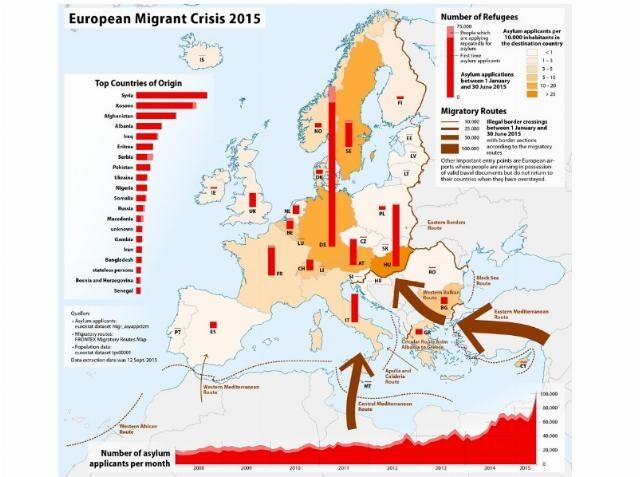
Image: Maximilian Dörrbecker, with use of official sources, via Wikimedia Commons // CC BY-SA 2.0 Deed
An increasing number of Germans have had enough. So, when Alice Weidel and other AfD leaders pledge to “close the borders,” remove migrants from the welfare rolls, and mass deportations (remigration), the message increasingly resonates, even with German voters with immigrant backgrounds. That’s because – as in the U.S. – just because you’re an immigrant doesn’t mean you want higher crime, terror attacks, and seeing your hard-earned money fund huge polygamous migrant families that turned welfare dependency into a competitive sport.
What further drives AfD support is how the mainstream elites respond to these completely legitimate voter concerns. Sometimes, they begrudgingly acknowledge them and attempt to show that they are doing something about the crisis. However, voters can see that Merz’s supposedly “tougher” migration policies are really just nibbling around the edges (often with paradoxical results, such as dumping illegal migrants onto Poland). Overall, however, the voters are talked down to and told that they are dumb, misinformed, unsophisticated, mean-spirited, unwelcoming, and, perhaps even racists and Nazis. Establishment figures then conclude their lectures by proclaiming utter “shock” that the voters are rejecting them.
Herr Merz showed just how deeply committed he is to the mass migration agenda (in spite of some tactical concessions) by channeling the most radical “abolish ICE” activists and attacking mass removals (remigration) as “ethnic cleansing” on the floor of the Bundestag. (Of course, unchecked mass migration rapidly changing Western societies culturally beyond recognition is apparently not “ethnic cleansing.”) Like much of the Western political establishment, Chancellor Merz has learned nothing. The voters, however, are refusing to put up with it.
Pawel Styrna is director of international relations at the Federation for American Immigration Reform. He is a legal immigrant and holds a Ph.D. in history from American University in Washington, D.C.
END
GERMANY/NORDSTREAM/
KORYBOKO
The Latest Nord Stream News Might Lead To Something Much More
Monday, Oct 12, 2026 – 02:00 AM
Authored by Andrew Korybko via Substack,
Regardless of however the “friendly competition” evolves between Germany and Poland over leading NATO 3.0 , one thing is certain, and it’s that US-led creative energy diplomacy will likely shape the post-war European security architecture.
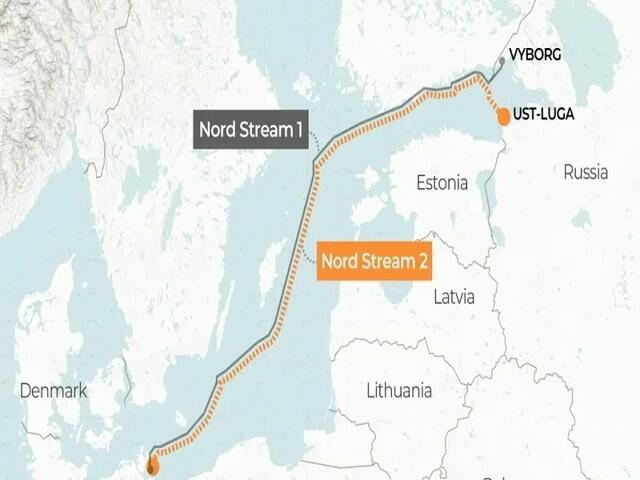
Reuters cited five unnamed sources to report that US Special Envoy for Russia Jared Kushner held talks with his Russian counterpart Kirill Dmitriev about getting a US investor involved in the Nord Stream pipeline that still has one undamaged segment out of four after September 2022’s terrorist attack. What makes this report credible despite the innate doubts that some skeptics might have is the context in which it was published that will now be briefly reviewed before elaborating more on the report itself.
The Atlantic reported in late September that Trump authorized his Special Envoy to Belarus John Coale to convince Putin to release “political prisoners” in exchange for sanctions relief following the arrangement that he reached with Belarusian President Alexander Lukashenko. This shortly followed what The New Yorker reported in mid-September about how a European spy service caught wind that “Trump and people around him” are considering “reopening the Nord Stream 2 pipeline under American control”.
A few days after that, the New York Times (NYT) reported in early October that “U.S.-Russia Talks on Ukraine Now Involve an Oil Deal Tied to Trump Allies” regarding Lukoil’s global assets, which Trump sanctioned a year ago. Those skeptics who might scoff that these reports are either fake news or a means of manipulating Russia into concessions without anything in return should know that Belarus just sent the US 30,000 tons of potash after the US lifted some sanctions and returned some frozen funds.
This follows Trump boasting about the “massive” potash deal that he and Lukashenko are negotiating, which prompted Lukashenko to propose that the US invest in a fertilizer plant in Belarus together with it and Russia. These fast-moving developments, both the US-Belarusian détente and the spree of reports about US-Russian resource deals, coincide with a NYT report that Putin is preparing to finally bring Ukraine to its knees after nearly five years through systematic infrastructure strikes over the winter.
This analysis here assessed that it’s true and driven by Putin having reportedly been informed by his Finance Minister following talks with US Treasury Secretary Scott Bessent that (at least significant) sanctions relief of the sort described above can only follow the end of the Ukrainian Conflict. The sooner that the conflict ends, the sooner that Russia can receive such relief for stimulating economic growth amidst the ongoing slowdown and establishing a resource-centric strategic partnership with the US.
The implications were earlier elaborated on here and here, but the Nord Stream dimension thereof that Reuters just reported is being discussed could restore Russia’s dialogue with the EU’s de facto German leader, thus paving the way for military de-escalation. The US’ NATO 3.0 concept envisages European NATO leading Russia’s containment, which could either worsen tensions if Germany’s remilitarization poses a 1941-like threat or result in a new energy-driven modus vivendi under the US’ supervision.
With a view towards best managing the post-war Russian-German relations that might soon rebound with none other than the US’ approval, Poland could make the first move in improving ties with Russia by building upon its new “snowdrop diplomacy” with Belarus. Regardless of however the “friendly competition” between Germany and Poland over leading NATO 3.0 evolves, one thing is certain, and it’s that US-led creative energy diplomacy will likely shape the post-war European security architecture.
END
FRANCE
Cyberattack Disrupts Refrigeration Systems At Hundreds Of French Supermarkets
Monday, Oct 12, 2026 – 10:05 AM
A cyberattack targeting supermarket refrigeration equipment has caused widespread disruption across France, leaving hundreds of stores facing spoiled inventory, financial losses and potentially costly equipment damage, according to France 24.
Roughly 150 to 200 Intermarché locations and nearly 100 Coopérative U stores were caught up in the incident, which allowed attackers to interfere with temperature controls remotely. E. Leclerc, France’s largest supermarket operator, was also reportedly affected, while Carrefour Market and Monoprix have been identified as possible additional targets, according to AFP and BFM TV.
Rather than stealing customer information or demanding ransom, the attackers apparently focused on destroying physical inventory. Refrigeration systems were reportedly forced into abnormal operating conditions, rendering substantial quantities of perishable merchandise unsellable. Some equipment was allegedly pushed into continuous defrost cycles, with temperatures reaching 122°F. Two stores in Alsace alone reportedly sustained approximately €270,000 in losses, according to La Dépêche du Midi.

Coopérative U chief Dominique Schelcher described the incident as unlike anything the industry had previously experienced. Beyond the immediate destruction of food, retailers now face questions about insurance coverage, operational recovery and the security of increasingly interconnected store equipment.
The report says that French authorities have launched a criminal investigation, with prosecutors examining the scale of the losses and reports that some refrigeration units caught fire.
The episode illustrates how cyberattacks are increasingly capable of inflicting damage well beyond computer networks. By exploiting connected industrial equipment, attackers can disrupt everyday commerce, destroy valuable goods and potentially threaten critical infrastructure without ever physically entering a facility.
The incident comes as France intensifies efforts to defend essential infrastructure against foreign interference, including potential Russian hybrid operations. However, no public evidence has established who was responsible for this particular attack, according to AFP.
END
5.RUSSIA AND ISRAEL AND MIDDLE EASTERN AFFIARS
ISRAEL/IRAN/USA //SATURDAY
Dramatic Videos Show Several Tankers On Fire In Strait Of Hormuz This Weekend
Sunday, Oct 11, 2026 – 04:00 PM
Yet another tanker has been struck in the Strait of Hormuz on Sunday, which brings the total number to at least two or possibly as many as three suffering damage in the last 24 hours, chiefly from sea mines.
A slew of videos showing tankers striking mines have emerged on social media over the weekend, at a moment attacks on international vessels by Iranian forces are surging to wartime highs…
Prior to this, Iran’s Islamic Revolutionary Guard Corps (IRGC) had announced in a statement late Saturday that supertanker carrying crude oil suffered an explosion after colliding with a naval mine while “attempting to leave via the unauthorized route in the Strait of Hormuz” – also as reported in Bloomberg.
But one of the instances appears to have been a US attack on an ‘unauthorized’ vessel from an Iranian port, given the US military’s Central Command said overnight into Sunday that a Panama-flagged cargo ship travelling from an Iranian port had been struck in the Gulf of Oman.
The strike was said to be aimed at the ship’s engine room after it ignored warnings, with the Pentagon claiming to have taken steps at protecting crew members. And then, additionally:
On Sunday, a tanker leaving the Strait of Hormuz was hit by an “unidentified” projectile and damaged, the maritime organisation UKMTO said. The incident took place at 12:00 GMT (14:00 Prague time).
CNBC has noted amid this new surge in tanker incidents, “Since the Iran war began in late February, at least 24 sailors have died in attacks on 100 commercial ships in Hormuz, the Persian Gulf and Gulf of Oman, according to the IMO.”

Just before this weekend, on Friday: “Gem No. 2, was hit by a projectile Friday off the coast of the UAE resulting in a fire onboard. The ship departed Ras Tanura, Saudi Arabia, in March and has remained in the Persian Gulf since the war began,” according to Marisks.
Below: another dramatic video which emerged Saturday…
October alone has witnessed over a dozen tanker attack incidents, and it seems the Iranians are trying to impose a higher cost on the US particularly in the run-up to the November midterm elections.
END
Tehran Rejects Alleged US Partial Peace Concessions To Iranian Demands As ‘Inadequate’
Monday, Oct 12, 2026 – 11:20 AM
Talks between Washington and Tehran have obviously long been stalemated, amid a return to ramped-up Iranian attacks on energy transit in the Strait of Hormuz, but messages have continued to be exchanged on an indirect diplomatic level, also as Washington seeks a way out of the crisis.
Iran indicated Monday it is reviewing a latest offer from Washington, which is said to include partial concessions. However, a top Iranian security official has rejected the US latest offer as “inadequate”.

Major General Mohsen Rezaei, the secretary of Iran’s Supreme National Security Council (SNSC), has stated that while the US has agreed to some of Iran’s conditions for ending the war, the Trump administration response still falls short.
“Iranian diplomacy has changed, and there will be no return to the status quo ante,“ he stated Monday. Rezaei instead demanded full compliance with Tehran’s conditions, and that this cannot be incremental or partial.
He further described that Trump, “deluded by the fantasy of conquering Iran” proceeded to launch “one of the most idiotic wars in human history after being duped by Netanyahu.“
The Iranians are still asserting they are in control of the Strait of Hormuz, while all along White House officials have been boasting of record wartime energy transit flows under the watch of the US Navy.
Rezaei said further on X, “Now, after the US fleet failed to reopen the Hormuz, he has resorted to smuggling,” adding that “the US military has never sunk to such a disgraceful low!”
As for stalled negotiations, one big hang-up continues to center on the nuclear file. Iran has insisted and stuck by its demand that it will not reduce its nuclear enrichment, or even talk about it with the US, until after there’s a negotiated end the conflict.
However, the Trump administration is making the nuclear issue a big upfront ask. Meanwhile, more fireworks in the Persian Gulf region amid the tit-for-tat on Monday:
Anti-ship ballistic missiles were launched from Yazd province in Iran towards the port of Fujairah in the UAE, Sabereen reports.
For anyone who has lost track, these are the seven conditions Tehran presented in September:
- lift the maritime blockade;
- restore Iran’s frozen assets;
- lift sanctions on Iranian oil exports;
- halt all US actions “under the pretext of threats and military operations”;
- end the war on Iran and its regional allies;
- withdraw US forces from areas around Iran’s borders;
- pay compensation for war damage and commit not to interfere with Iran’s nuclear and missile capabilities.
…Translation: everything, plus reparations.
So it is perhaps not a shock that Trump “promptly rejected” the prior seven-day reopening plan built on these terms when they were first communicated weeks ago, or also that Iran has in turn rejected anything that falls short of fulfilling these conditions. President Trump has meanwhile strongly hinted he will resume bombing the Islamic Republic after the November midterm elections.
ISRAEL TBN
SAUDI ARABIA VS HOUTHIS
Loud blast heard at Riyadh airport as airlines cancel more flights
A loud explosion was reported at Riyadh’s main airport as Houthi attacks on Saudi Arabia intensified, with airlines canceling flights and passengers urged to check their flight status.

Smoke and flames rise from King Khalid Airport, after Yemen’s Iran-backed Houthis said they attacked the airport, in Riyadh, Saudi Arabia, October 8, 2026, in this screengrab obtained from a social media video.(photo credit: Social Media/via REUTERS)ByREUTERSOCTOBER 10, 2026 17:38Updated: OCTOBER 10, 2026 18:03
More than a dozen ambulances were seen rushing to Riyadh’s international airport, and travelers were evacuated from parts of the facility after a loud blast was heard there on Saturday, an eyewitness and people briefed on the matter said.
Saturday’s incident comes amid an escalation of missile strikes by Yemen’s Iran-aligned Houthi on the kingdom. The airport has already been attacked twice this week, leaving four people dead and others wounded, and badly damaging an aircraft.
The Saudi government’s media office and the Saudi civil aviation authority did not immediately respond to requests for comment on the incident.
Flight tracking site flightradar24 showed all flights to Riyadh had either been diverted or canceled, with only a helicopter hovering over the airport at one point.
The airport urged passengers to contact their airlines directly and check their flight status before heading there.

Etihad Airways, Qatar Airways, Kuwait Airways cancel Riyadh flights amid Houthi attacks
Etihad Airways and Qatar Airways canceled multiple flights between their respective hubs and Riyadh, with some cancellations extending into Monday.
Kuwait Airways said on Saturday it had canceled flights to and from the Saudi capital Riyadh due to what it described as the closure of Riyadh airport because of the “security situation.”
Houthi attacks on Thursday and earlier in the week had already prompted a number of carriers to suspend or cancel services to the Saudi capital, shortly before Riyadh is due to host major energy and investment conferences.
Organizers of those conferences said on Saturday they would go ahead as planned, and they sought to reassure attendees of their security.
The Houthis have said airliners should avoid Saudi airspace, declaring it a zone of military operations after the Saudi-backed Yemeni government launched an offensive against the group earlier this month.
END
Riyadh’s International Airport Suspends All Operations After Mass Casualty Houthi Missile Barrage
Saturday, Oct 10, 2026 – 01:45 PM
On Saturday Yemen’s Houthis have once again pummeled Saudi Arabia’s King Khalid International Airport in Ryiadh with a volley of ballistic missiles. A major emergency response has ensued with dozens of ambulances at the scene, and a total evacuation of the major flight hub.
In this fresh instance, which comes after multiple attacks on the kingdom’s civilian aviation hubs stretching back at least a week, there appears to be mass casualties as a result.

Arrivals have been canceled across the board for much of Saturday, according to flight tracker Flightradar24, with passengers that were already in the air having been diverted to other cities.
“Terminal 3 of the King Khalid International Airport suffered a direct hit from missiles and has been evacuated, with at least some injuries, Saudi officials said,” reports The Wall Street Journal. Eyewitnesses reported hearing loud explosions rock the airport.
ALL OPERATION SUSPENDED
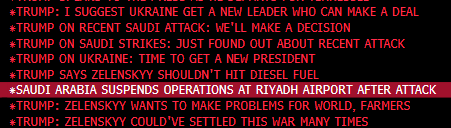
“Several ambulances and a few helicopters were sent to collect the wounded and take them to King Fahad hospital in Riyadh, one of the officials said,” the report continues. “A video the official said was authentic showed blood smeared on the floor.”
Various countries have increasingly warned their citizens against flying in and out of Riyadh, including the United States, Canada, Germany, France, Ireland, and others.
These travel alerts have especially increased in the wake of Thursday’s deadly missile attack on the airport, which saw one or more parked plane destroyed and three people killed, including a pilot. Mass casualties are being reported via Reuters/CNN:
Many people were wounded in a blast at Riyadh’s international airport on Saturday, according to two eyewitnesses and two people briefed on the matter, and travelers were evacuated from parts of the facility.
One of the eyewitnesses reported seeing an explosion and then seeing multiple people lying injured on the ground inside the airport. More than a dozen ambulances were seen rushing to the airport.
Saudi authorities have been slow to acknowledge or officially comment on these attacks, or give much in the way of details. Clearly, anti-air defenses are failing to intercept all inbound missiles from Yemen, and Thursday’s attack also saw missile debris fall on a medical center in the capital.
The WSJ report further underscores a major area of sensitivity for the royal family: “The continued missile attacks on airports in Riyadh and a number of southern Saudi cities threaten to choke off business travel and tourism just as the busy conference and travel season gets going,” it writes.
“A major test will come with the kingdom’s flagship Future Investment Initiative summit, which is expected to draw thousands of global executives and investors to Riyadh at the end of this month,” the publication also notes.
“Conference officials said before the Saturday attack that safety is their top priority and that comprehensive safety measures will be in place,” it adds.
The conference which gathers leaders from across the world is set for October 26 to 29, 2026 at the King Abdulaziz International Conference Center in Riyadh. So far there’s been no indication that authorities will either cancel or change the venue. The Houthis in neighboring Yemen are expected to keep up the pressure, also as Aramco sites get targeted, amid the ground war and fight for Red Sea coastal areas.
END
Houthi Missile Attack On Busy Terminal At Riyadh Airport Kills 12, Injures 309
Saturday, Oct 10, 2026 – 09:35 PM
Update1610ET): The initial fatality and casualty count is horrific and unprecedented: at least 12 people have killed and 50 more were injured (NYT) in the Houthi missile attack on King Khalid International Airport in Ryiadh on Saturday. A missile is reported to have directly struck the busy Terminal 3 of the major hub. Saudi state sources are listing over 300 among the injured.
The New York Times calls it “the deadliest attack in a Gulf Arab country since the U.S.-Israeli war with Iran began in February.” Dozens of ambulances were at the scene and area hospitals saw a huge influx of patients needing emergency care. Some among the dozens admitted to the hospitals are said to be in critical condition. All air traffic to and from the airport has been suspended and flights diverted amid the emergency.
This mass casualty event could open up a bigger war, but also questions of the failures of Western anti-air defenses in the kingdom. The NYT writes:
Across the border in Yemen, Saudi warplanes have been waging a deadly bombing campaign against the Houthis, who say that the country has been subjected to hundreds of airstrikes in recent weeks. Since Sept. 3, airstrikes have killed 91 people in Yemen, mostly women and children, according to Anees al-Asbahi, a spokesman for the Houthi government-affiliated health ministry.
Mohammed al-Bukhaiti, a senior Houthi official, said the militia was responsible for the attack in Riyadh on Saturday, which he said was in retaliation for Saudi strikes, including on civilian infrastructure in Yemen.
National sources are citing various injuries in the hundreds after the airport attack, and reports of an American among the dead:
Saudi state sources/Aviation Authority: At least 12 people were killed and 309 injured, some critically
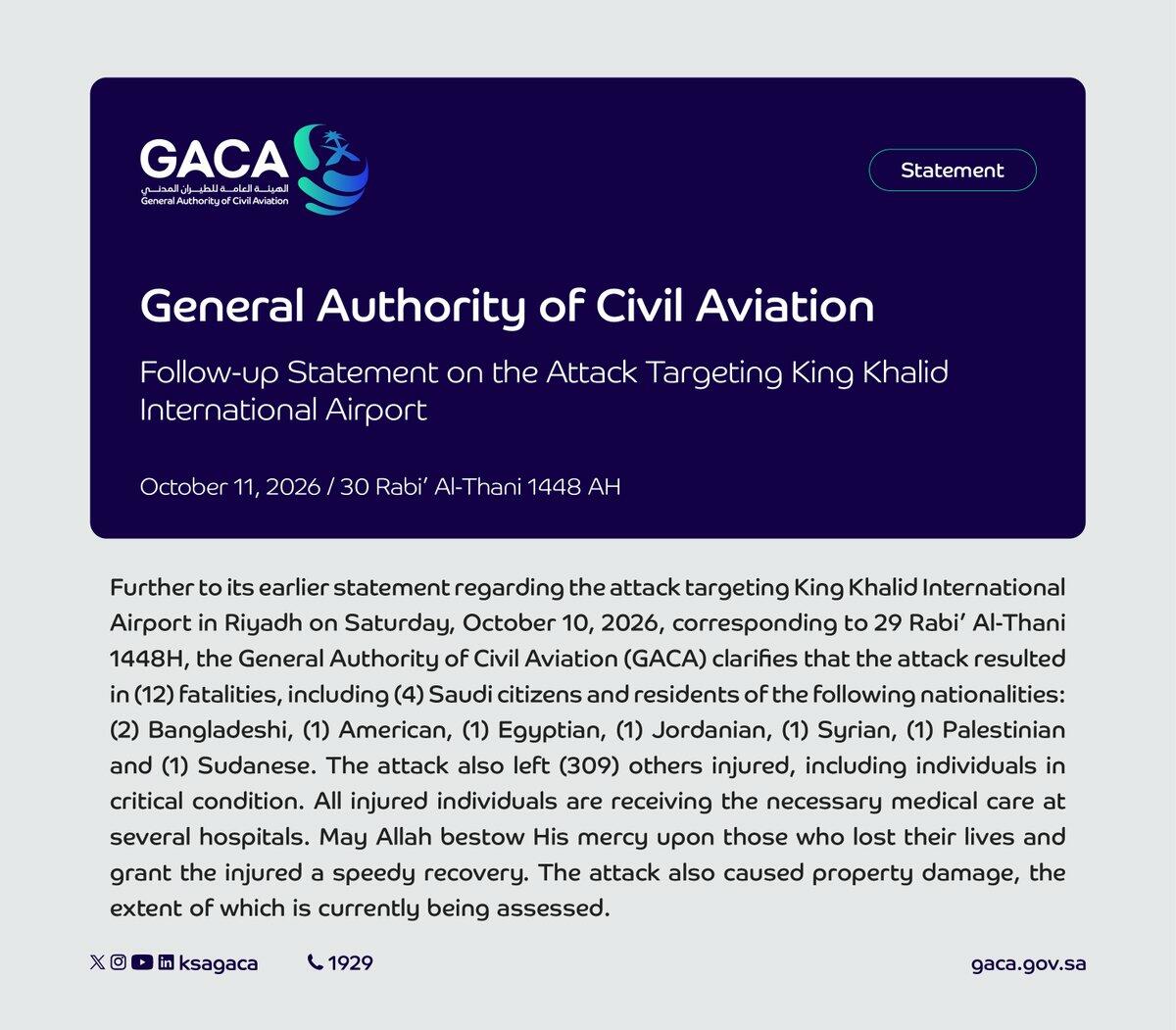
President Trump is weighing joining the anti-Houthi fight in the aftermath:
“We may. We’re going to look at it,” Trump said of intervening. “We just found out about the recent attack. So we’ll make a decision. We move very quickly.”
Meanwhile Time notes, “The Houthis, who claimed attacks on the airport earlier in the week, did not immediately claim the latest strike.” But then by day’s end the group officially claimed responsibility. Houthi response (Mohammed al-Bukhaiti, a senior Houthi official) via NYT: “so that the world understands that airports, seaports, wedding and mourning halls, hospitals, and markets in Yemen are civilian facilities that must not be targeted or harmed — and that the same rules that apply to these facilities in Yemen must also apply to their counterparts everywhere else.”
The emerging videos throughout the day of the impact zone have revealed smoke-filled chaos in the moments after impact:
END
Saudis Vow Retaliation After Deadly Airport Strike As Houthi Threat Puts Gulf On Edge
Sunday, Oct 11, 2026 – 10:50 AM
Iran-backed Houthi rebels have not officially claimed responsibility for Saturday’s missile attack on King Khalid International Airport in Riyadh, which killed 12 people and wounded more than 300. The mass-casualty missile strike raises new questions about the effectiveness of Saudi Arabia’s Western-supplied air and missile defenses, including potential gaps in detection, interception, and/or coverage. It also raises the risk of a wider Gulf conflict.
Al Jazeera correspondent Yousef Mawry, reporting from Sanaa, wrote early Sunday that the Saudis face a very uncomfortable reality: repeated airstrikes across Yemen have yet to eliminate the Houthis’ ability to launch missiles and one-way attack drones toward the kingdom.
“Although Saudi Arabia has said it will retaliate, let’s not forget that it’s carried out many air strikes across Yemen, and the Yemeni group is still able to launch ballistic missiles and drones towards Saudi Arabia,” Mawry wrote.
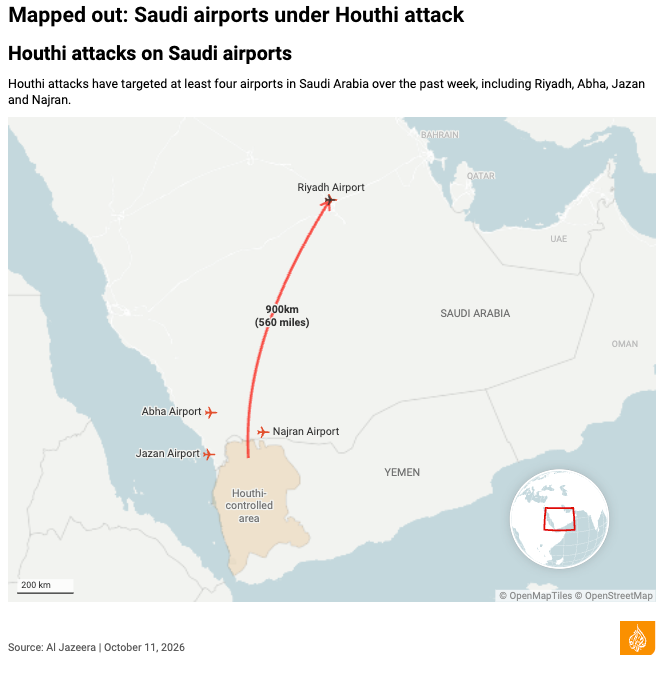
The missile attack on the international airport late Saturday was the kingdom’s deadliest incident since the Iran war began. The Saudi-led coalition blamed Yemen’s Houthi rebels, describing the attack as a war crime.
Asked by reporters on Saturday whether the US military would join the Saudi attacks on the Houthis, President Trump responded: “We may. We’re going to look at it.”
Bloomberg reported that the attack disrupted travel ahead of the World Petroleum Congress, scheduled to begin today and last through next Thursday. Airport operations were temporarily suspended, with the flight monitor website Flightradar24 showing roughly 85% of flights canceled.
Al Jazeera quoted Dania Thafer, executive director of the Gulf International Forum, who said the Saudis will likely retaliate forcefully against the Houthis.
Gulf states want to contain the confrontation rather than let it spread across multiple fronts, Thafer told the outlet.
“I think in this situation, compartmentalizing the Houthi issue is in their interest rather than causing further escalation from many fronts,” Thafer said.
Thafer continued, “I still think that the Saudis probably want de-escalation. They don’t want long-term escalation, but the Houthis are making it very difficult by not only being a threat to Saudi national security but also a threat to international maritime security. So this battle is much bigger than just a tit-for-tat.”
International leaders have released statements condemning the attack (via Al Jazeera):
- The Iraqi prime minister’s spokesman, Sabah al-Numan, condemned the attack, warning that it endangered “regional security and stability” and calling for an end to hostilities.
- European Commission President Ursula von der Leyen called the attack a “dangerous escalation” by Iranian proxies that pushes the region into a spiral of violence that threatens global transport and energy networks.
- EU foreign policy chief Kaja Kallas denounced the strike as an “appalling act of terror” against civilian infrastructure.
- UK Defense Secretary Wes Streeting said the “completely contemptible” attack highlighted a dangerous pattern of Houthi targeting of civilian sites in Saudi Arabia.
- German Foreign Minister Johann Wadephul also condemned the attack as a “terrorist act” against civil aviation and offered sincere condolences to the families of the victims.
Yasmeen al-Eryani, the executive director for knowledge production at the Sanaa Center, told the outlet that the Houthis are trying to put “maximum pressure” on Saudi Arabia. This comes as the US midterms are less than one month away.
“But they’re also mobilizing the internal front lines in a really major way, moving even away from the west coast battle into Taiz and more densely populated areas,” al-Eryani said.
“We could see further mobilization; they have very high momentum. They will probably continue to capitalize on that momentum, internally and cross-border attacks and by doing this, operationalizing a unification of arenas putting pressure across the region, economically, politically and so on,” she said.
She added that the Houthis were “provoking” Saudi Arabia, the US and regional states, which could potentially join the conflict.
There are unofficial reports that the Saudis have begun striking multiple Houthi targets in Yemen.
In markets, Saudi Arabia’s benchmark stock index fell as much as 1%, with most of its constituents in negative territory, including Saudi National Bank and Saudi Aramco.
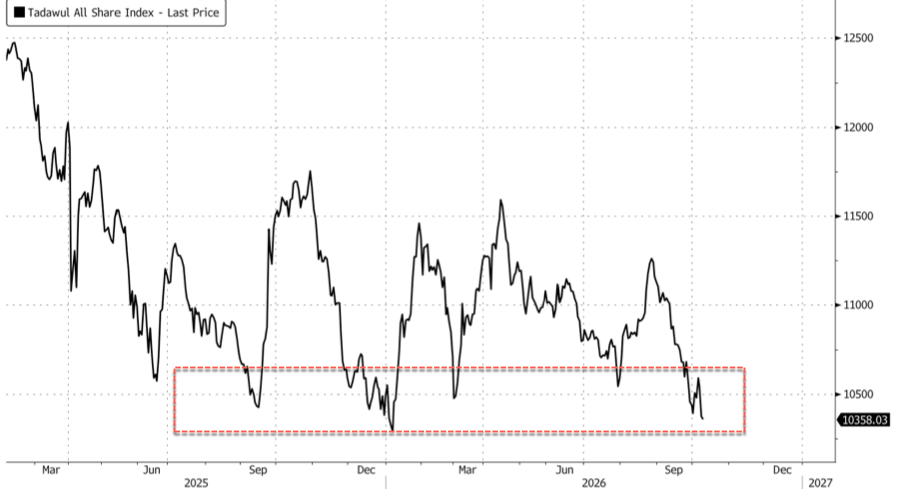
The attacks risk pushing the Gulf region into a more dangerous phase as US-allied Gulf governments are waking up to the fact that Iran’s proxy network is becoming a shared threat to national security, energy infrastructure, and maritime trade.
END
Riyadh Airport Struck Again, A Day After Houthi Attack Killed 12, Including An American
Sunday, Oct 11, 2026 – 02:20 PM
Update(1420ET): The Houthis have carried out yet another attack on Riyadh’s international airport – this one coming Sunday evening and leaving more people injured, after the day prior a Houthi missile strike on the travel hub left 12 people dead and over 300 injured. Regional reports say emergency crews battled a fire in the wake of the fresh attack:
A fire broke out at King Khalid International Airport in Riyadh on Sunday after an unidentified projectile struck the airport’s terminal 4 for passengers. Authorities are responding to the scene, the Coalition to Restore Legitimacy in Yemen reported.
Later on Sunday, the Kingdom’s civil aviation authority said the attack resulted in injuries and that damage assessment and safety checks of airport facilities were underway.
Houthi military spokesman Brig. Gen. Yahya Saree announced that these strikes in response to the “brutal Saudi aggression against our country and our people.”
According to CBS News, “The airport remains closed on Sunday and Saudi Arabia moved Riyadh schools online amid the Houthis’ latest threat.” Apparently those among the injured are airport workers, and not travelers, as the airport remains closed and flights have been canceled or diverted. Additionally on Sunday:
* * *
Iran-backed Houthi rebels have not officially claimed responsibility for Saturday’s missile attack on King Khalid International Airport in Riyadh, which killed 12 people and wounded more than 300. The mass-casualty missile strike raises new questions about the effectiveness of Saudi Arabia’s Western-supplied air and missile defenses, including potential gaps in detection, interception, and/or coverage. It also raises the risk of a wider Gulf conflict.
Al Jazeera correspondent Yousef Mawry, reporting from Sanaa, wrote early Sunday that the Saudis face a very uncomfortable reality: repeated airstrikes across Yemen have yet to eliminate the Houthis’ ability to launch missiles and one-way attack drones toward the kingdom.
“Although Saudi Arabia has said it will retaliate, let’s not forget that it’s carried out many air strikes across Yemen, and the Yemeni group is still able to launch ballistic missiles and drones towards Saudi Arabia,” Mawry wrote.
The missile attack on the international airport late Saturday was the kingdom’s deadliest incident since the Iran war began. The Saudi-led coalition blamed Yemen’s Houthi rebels, describing the attack as a war crime.
Asked by reporters on Saturday whether the US military would join the Saudi attacks on the Houthis, President Trump responded: “We may. We’re going to look at it.”
Bloomberg reported that the attack disrupted travel ahead of the World Petroleum Congress, scheduled to begin today and last through next Thursday. Airport operations were temporarily suspended, with the flight monitor website Flightradar24 showing roughly 85% of flights canceled.
Al Jazeera quoted Dania Thafer, executive director of the Gulf International Forum, who said the Saudis will likely retaliate forcefully against the Houthis.
Gulf states want to contain the confrontation rather than let it spread across multiple fronts, Thafer told the outlet.
“I think in this situation, compartmentalizing the Houthi issue is in their interest rather than causing further escalation from many fronts,” Thafer said.
Thafer continued, “I still think that the Saudis probably want de-escalation. They don’t want long-term escalation, but the Houthis are making it very difficult by not only being a threat to Saudi national security but also a threat to international maritime security. So this battle is much bigger than just a tit-for-tat.”
International leaders have released statements condemning the attack (via Al Jazeera):
- The Iraqi prime minister’s spokesman, Sabah al-Numan, condemned the attack, warning that it endangered “regional security and stability” and calling for an end to hostilities.
- European Commission President Ursula von der Leyen called the attack a “dangerous escalation” by Iranian proxies that pushes the region into a spiral of violence that threatens global transport and energy networks.
- EU foreign policy chief Kaja Kallas denounced the strike as an “appalling act of terror” against civilian infrastructure.
- UK Defense Secretary Wes Streeting said the “completely contemptible” attack highlighted a dangerous pattern of Houthi targeting of civilian sites in Saudi Arabia.
- German Foreign Minister Johann Wadephul also condemned the attack as a “terrorist act” against civil aviation and offered sincere condolences to the families of the victims.
Yasmeen al-Eryani, the executive director for knowledge production at the Sanaa Center, told the outlet that the Houthis are trying to put “maximum pressure” on Saudi Arabia. This comes as the US midterms are less than one month away.
“But they’re also mobilizing the internal front lines in a really major way, moving even away from the west coast battle into Taiz and more densely populated areas,” al-Eryani said.
“We could see further mobilization; they have very high momentum. They will probably continue to capitalize on that momentum, internally and cross-border attacks and by doing this, operationalizing a unification of arenas putting pressure across the region, economically, politically and so on,” she said.
She added that the Houthis were “provoking” Saudi Arabia, the US and regional states, which could potentially join the conflict.
There are unofficial reports that the Saudis have begun striking multiple Houthi targets in Yemen.
In markets, Saudi Arabia’s benchmark stock index fell as much as 1%, with most of its constituents in negative territory, including Saudi National Bank and Saudi Aramco.
The attacks risk pushing the Gulf region into a more dangerous phase as US-allied Gulf governments are waking up to the fact that Iran’s proxy network is becoming a shared threat to national security, energy infrastructure, and maritime trade.
END
SAUDI ARABIA LATE AFTERNOON
Saudi Coalition Intercepts More Missiles On Riyadh
Monday, Oct 12, 2026 – 03:05 PM
Update(1500ET): Within the last our, loud booms heard in Riyadh as residents told to shelter ‘for potential hostile threat’ – soon after which authorities announced the threat had passed. FT is reporting the breaking news that–
Saudi-led coalition says it intercepted ballistic missile launched by Houthis towards Riyadh
There are conflicting reports that the Houthis may have just launched another major attack on the Saudi capital. However…
Saudi Arabia’s civil defence agency has given the all-clear for now to residents of the capital after the military announced the interception of incoming missiles fired by Yemen’s Houthis.
“The danger to the city of Riyadh has passed. For your safety, please continue to follow the instructions at civil defence and avoid gatherings and photography at all costs,” it said in a statement.
Unconfirmed footage (of unknown date and origin) has been circulating late in the day Monday:;
* * *
Update(1430ET): Going back to the very beginning of the Iran war, the Gulf countries have imposed strict censorship regimens, cracking down on anyone filming or photographing damage as a result of attacks. The Gulf Cooperation Council (GCC) states have been particularly sensitive to any coverage that spooks investments or shatters the illusion of ‘normalcy’ amid the war.
On Monday the AFP has revealed arrests of American citizens related to the recent Houthi attacks on Saudi airports and energy sites.
“The US embassy in Riyadh says American citizens have been detained for filming recent events in Saudi Arabia, which has suffered a string of deadly attacks by Yemen’s Houthis,” AFP reports.
The US mission has confirmed “American citizens have been detained for taking photos of recent events,” without specifying how many were arrested or whether they have been released. It notes that Saudi authorities have warned that “filming, publishing, or sharing information related to counter missiles and drones and their impact sites exposes you to legal liability.”
Several foreign residents in Riyadh have told AFP that acquaintances were detained for filming recent events and sharing the footage on social media.
If so, this would been deeply awkward diplomatically, given the Saudis are also busy trying to urge Washington to send military help for Yemen operations.
* * *
Saudi Arabia’s King Khalid International Airport’s closure has been significantly extended in an unprecedented move by aviation authorities following the two weekend ballistic missile attacks by Yemen’s Houthis which left at least 13 people killed and over 300 injured. Prior strikes rocked the airport last week, and in all 15 have been killed in two weeks, including a Saudi Airlines pilot.
Saudi Arabia’s civil aviation body Monday extended the suspension of operations, stating “The General Authority of Civil Aviation has announced the extension of the suspension of operations at King Khalid International Airport in Riyadh in order to complete the necessary procedures to verify the safety of the facilities and their operational readiness.”
While it didn’t give a date of planned resumption of airport operations, separately a NOTAM (Notice to Air Missions, formerly Notice to Airmen) indicated a likely closure through the entire week, through a least Saturday:
Aviation @FAANews NOTAM A3604/26, issued on October 12, declares the entire airport unavailable due to precautionary measures until October 17 at 21:00 UTC, equivalent to midnight in Saudi Arabia at the start of October 18. This follows an earlier NOTAM closing Aircraft Stand C1 from October 8 through October 15. The notices confirm an airport-wide operational restriction, although they do not specify the full extent of the damage or establish when normal operations will resume.
Saudi Energy Minister Prince Abdulaziz bin Salman has said that Houthi attacks on the kingdom’s airports are serious and so his country’s response must be “equally serious”. The Saudis are still lobbying intensely behind the scenes for more direct military help from Western allies, especially the United States, which so far has been largely on the sidelines.

The Houthis are not just turning up the security pressure on Saudi Arabia, but the economic pressure as well. On Monday CNBC writes, “Australia, New Zealand, the U.K., the U.S., France, Germany, Japan and others have warned against travel to the kingdom, which is hosting the World Petroleum Congress.”
The Saudis are actually pressing ahead with the 25th WPC Energy Conference in Riyadh (going all this week), trying desperately to project a sense of normalcy. Where are the missile interceptors?
The Saudi energy minister, Abdulaziz bin Salman, told the conference that “fear has no place in the Saudi lexicon”, emphasising that the resilience of the kingdom’s energy system and the determination of its people to confront crises.
An urgent review is under way as to how Houthi missiles are repeatedly penetrating badly stretched Saudi air defences. Schoolchildren and some office workers were advised to work from home. The Houthis have also targeted the city of Khamis Mushait, and the King Fahd international airport in Dammam.
Oil prices have in the meantime climbed to near two-week highs. WTI is up 1.2% at $93.00 and Brent is at session highs, above $106 having traded in a $102.33-$106.17 range, as Iran insists Hormuz stays shut until all seven of its conditions are met and Trump mulls joining Saudi strikes on the Houthis. Below is a note from Deutsche Bank’s Jim Reid:
The big geopolitical/energy story over the weekend is the continued complexity of the Middle East and Russia/Ukraine conflicts. Trump announced yesterday that Russia and Ukraine had agreed to an immediate “energy ceasefire”, but overnight developments underline how fragile that claim is. Zelenskyy said Ukraine supports a ceasefire if Russia does too and is awaiting details from Washington, while Moscow had still not publicly confirmed it. Zelenskyy also said Russia subsequently struck a thermal power plant in Kharkiv and other Ukrainian energy infrastructure. So for now this looks more like an untested US proposal than a functioning ceasefire, particularly after a similar arrangement last month failed to endure.
The proposed ceasefire is closely linked to the extraordinary US pivot on Russian diesel. Ukrainian refinery strikes had forced Moscow to restrict fuel exports, tightening an already constrained products market. Trump’s deal with Putin would allow around 13.5 million barrels of Russian diesel back into global markets this month via a temporary US sanctions waiver, potentially including the first US imports since March 2022. Zelenskyy has criticised the move, while Reuters reported that Washington threatened to cut intelligence sharing and weapons procurement support unless Kyiv halted refinery strikes. Russian barrels returning would be bearish for diesel cracks, but the overnight strikes make the ceasefire increasingly uncertain and highlight strains between Washington and Kyiv.
Meanwhile, Middle East energy risk has moved sharply in the other direction. Riyadh’s King Khalid International Airport was hit again on Sunday after repeated attacks over the past week. Saudi Arabia said the latest strike killed one person and injured 11, after Saturday’s attack killed 12 and wounded more than 300. The escalation comes as Saudi-backed Yemeni government forces counter recent Houthi gains near Bab el-Mandeb, the crucial Red Sea shipping chokepoint. Repeated strikes disrupting flights in Riyadh also underline how difficult the Houthi threat may be for Saudi Arabia to suppress.
That leaves a meaningful risk of wider regional escalation. Saudi Arabia has intensified air strikes in Yemen, while Trump said the US “may” join strikes against the Houthis after an American was among those killed on Saturday. Overnight, Iran denied directing the Houthis and its foreign minister urged diplomacy with Saudi Arabia, but there is little sign yet of de-escalation. Washington has so far limited support to intelligence sharing while Riyadh seeks more direct US help and air-defence support. So even if a Russia/Ukraine ceasefire and Russian diesel waiver ease pressure on refined products, attacks on Riyadh and fighting around Bab el-Mandeb leave an upside tail risk for oil and shipping costs, alongside continuing Strait of Hormuz disruption.
As for the ability (or inability) of Saudi Arabia and its allies to protect the kingdom’s airports and key Aramco oil facilities, this will remain a big open question. Various global airlines will continue their suspensions even after Riyadh and other airports try to open back up for business.
More Latest Developments
via Al Jazeera…
- OPEC has lowered its oil demand growth forecast for this year to 400,000 barrels per day from 1.4 million at the start of the year, Haitham al-Ghais, Secretary General of the organisation says.
- Saudi Aramco CEO Amin Nasser has said that until the Strait of Hormuz is fully reopened, pressure across the energy chain will only intensify.
- Mohsen Rezai, Iran’s Supreme National Security Council secretary, says the Strait of Hormuz will not fully reopen until the US starts fulfiling its commitments and respecting Iranian demands.
- Abolfazl Shekarchi, chief spokesman of the Iranian armed forces, has said the country will not allow the restoration of the US-Israeli regional order in West Asia, according to the IRIB broadcaster.
- Three in four households in Yemen are unable to put food on the table as fighting intensifies in the country, the World Food Programme (WFP) warns.
via Newsquawk…
- Deadly Houthi attacks on the Saudi capital’s main airport over the weekend raised the risk of a wider war that may draw in the US. More missiles and drones were intercepted overnight. BBG
- The United States’ response to Iran’s seven conditions in a proposal to reopen the strategic Strait of Hormuz was “insufficient”, Iran’s security chief, Mohsen Rezaei, was quoted by state media on Sunday as saying. RTRS
- Oil swung after US President Donald Trump said Kyiv and Moscow had agreed to an “energy ceasefire,” while in the Middle East, Saudi Arabia suffered its deadliest strikes since the Iran war began. BBG
- Ukraine will continue to respond with long-range strikes against Russia unless Moscow agrees to an energy ceasefire that still hasn’t happened, President Volodymyr Zelenskyy said on Monday. BBG
- Saudi Arabia is looking at ways to expand its oil pipeline capacity to destinations outside the Persian Gulf to 10 million barrels a day within two to three years, said Energy Minister Prince Abdulaziz bin Salman. BBG
- US Senators reportedly demanded that President Trump reverse the Russian fuel imports deal, while Republican Senator Tillis warned that Trump’s Russian diesel deal may be illegal and put American lives at risk.
END
SYRIA/GAS
Who Is Hitting Syria’s Gas Lines As The Energy Corridors Take Shape?
Sunday, Oct 11, 2026 – 08:10 AM
Authored by Aghiad Hegazi via The Cradle
Over recent weeks, gas lines in eastern Syria and near Damascus have been hit by explosions, interrupting supplies to power stations and cutting electricity across large areas. Two attacks on sections identified as the Jbessa gas line were officially described as sabotage.
A separate blast at the Tishreen plant remains under investigation. Their timing has drawn attention as Syria negotiates a role in the routes carrying Iraqi oil and regional gas to the Mediterranean and beyond. Even a limited strike on a pipeline can delay repairs, reduce power generation, and unsettle investors weighing projects that will cost billions.

The question is who stands to gain from keeping Syria’s energy network vulnerable, and how much the available evidence can tell us about the perpetrators.
The Jbessa line & the Tishreen blast
The first confirmed incident came on August 18, when an explosion stopped pumping through the gas export line from the Jbessa gas plant in the countryside of Hasakah, northeastern Syria. The Syrian Petroleum Company said its preliminary investigation found deliberate sabotage.
The line serves a region containing much of Syria’s oil and gas infrastructure, and the interruption affected gas deliveries to electricity turbines. Crews isolated the wells, closed the safety valves, and began repairs. No injuries were reported. That first attack showed how a strike on a single valve could reach far beyond the site itself, with electricity users elsewhere bearing the consequences.
On September 28, the Jbessa gas line was attacked near Al-Shula in the Deir Ezzor countryside. An explosion at a sectional valve set off a fire and again halted the flow of gas from Jbessa toward power stations. Energy Minister Mohammad al-Bashir later said explosives had been used. This time, the repair crews had to replace an 18-meter section of 16-inch pipe. The company announced on October 2 that pumping had resumed after the work was completed.
According to its land-gas director, the line had carried about 950,000 cubic meters a day. Its repeated targeting has therefore struck a significant part of the gas supply on which Syrian power generation depends. The Jbessa line feeds the gas network through the central region, including the area around Al-Furqlus in eastern Homs. This matters at a time when Damascus is trying to repair existing infrastructure and build new cross-border links.
The proposed Iraqi oil route to Baniyas on the coast is a separate project, and there is no evidence that the attacks on Jbessa directly targeted that future pipeline. Yet damage to operating energy facilities carries an obvious warning for governments and companies contemplating a much larger transit system across Syrian territory. They would need confidence that long stretches of pipe, pumping equipment, and the workers maintaining them could be protected.
Two other violent incidents occurred on September 30. On the Masyaf Bridge in western Homs, unidentified gunmen opened fire on a bus carrying civilian workers, killing seven and wounding four. Initial SANA reports described civilian workers, while regional reporting identified them as engineers and employees of a private electricity company. The attack occurred two days after the Shula sabotage, but no investigation has established a link between the incidents.
That evening, an explosion on a gas line supplying the Tishreen thermal plant in the Damascus countryside forced Tishreen, Deir Ali, and Al-Nasiriyah out of service, bringing wider power cuts. Firefighters contained the blaze, and the authorities began restoring gas supplies. Unlike the two Jbessa incidents, the cause was unresolved when Energy Minister Bashir spoke at the site. He said inspectors would determine whether a technical fault, an attack, or sabotage had caused the blast after the area cooled.
Who benefits from a weakened Syria?
The Syrian government has not named a party responsible for the pipeline sabotage. Journalist and political writer Bassel al-Mohammed, speaking to The Cradle, argues that the repeated attacks on major gas facilities are difficult to treat as isolated incidents.
Their effect, he says, extends beyond the physical damage to a valve or section of pipe. Each interruption adds to the impression that Syria is an unsafe place for investment in energy infrastructure, just as Damascus is seeking partners to restore the sector and connect it to neighboring states.
For Mohammed, Israel is among the most prominent potential beneficiaries of Syria’s economic and security weakness. A Syrian state struggling to rebuild its infrastructure would have less room to resist pressure in any future political or security settlement, he says.
He also points to Syria’s prospective role in the Arab Gas Pipeline, which connects the Jordanian border with the Turkish border through Syrian territory, amid the search for routes less exposed to disruption at the Strait of Hormuz.
The distribution of the incidents, including the damage around Tishreen, raises questions for him about whether a group with knowledge of critical facilities is operating across more than one area.
On September 29, between the Shula and Tishreen incidents, the Syrian Petroleum Company inaugurated a further section of the Arab Gas Pipeline project at Al-Furqlus. Officials said the completed segment adds 186 kilometers to roughly 380 kilometers of existing line, bringing the connected network to about 566 kilometers, with a stated capacity of up to 11 million cubic meters of gas per day.
The two-way design gives Damascus room to bargain over future gas flows. For now, a route to Europe remains a prospect – the supply and transit agreements needed to make it work have yet to follow.
If such links eventually carry more gas northward, they could compete with some plans to expand Israeli gas sales from Eastern Mediterranean fields, including Leviathan and Tamar. The degree of competition would depend on supply contracts, prices, and the capacity actually brought into service. It cannot be assumed from the existence of a pipeline alone.
Still, Mohammed sees a strategic interest for Israel in limiting Syria’s ability to emerge as a reliable corridor, especially while Damascus remains exposed to Israeli military pressure in the south.
Energy routes & Israeli calculations
The rivalry over Syria also sits within a wider contest for the routes moving oil and gas from Iraq and the Gulf. Turkish plans for exports through Ceyhan and Syrian hopes of reopening a Mediterranean outlet would offer producers alternatives to the Strait of Hormuz.
Several of these lines are proposals or rehabilitation schemes rather than working substitutes for established Gulf terminals. Their prospects depend on financing, security, technical surveys, and agreements among the governments involved. Treating all the routes as if they already exist would exaggerate both Syria’s current leverage and the immediate threat they pose to rival transit hubs.
In February, The Cradle traced the possible Israeli origin of some gas supplied to Syria through Jordan, while noting the opacity of the contracts and the difficulty of establishing the precise source of every shipment. The Begin-Sadat Center later discussed Israeli gas reaching Syria indirectly through regional arrangements. A more diverse supply network could weaken that dependence, but the claim that new transit lines would cause Damascus and Amman to dispense with Israeli gas altogether goes beyond what the available contracts establish.
Syria and Iraq signed memoranda in July on rehabilitating the long-dormant Kirkuk–Baniyas oil line. Syrian Petroleum Company chief Youssef Qiblawi has discussed the possibility of work beginning in the first quarter of 2027.
The route would give Iraqi crude an outlet on the Mediterranean, yet it still faces major engineering, financing, and security hurdles. The agreements mark a political commitment to examine the corridor, not the completion of a new pipeline. Syria’s coastal port facilities would also require the capacity and protection to handle sustained exports if the project moves ahead.
Security researcher Aziz Moussa reads the sabotage as a possible regional message. Speaking to The Cradle, he places Israel among the suspects because of its continuing pressure on Damascus and its incursions into Quneitra.
In his assessment, repeated blows to energy facilities could deepen Syria’s security fragility, erode confidence in reconstruction, and complicate plans for an energy corridor. He also suggests that Israeli Prime Minister Benjamin Netanyahu may have political reasons to raise the pressure. None of those considerations, Moussa acknowledges, demonstrates that Israeli aircraft or drones carried out the attacks; Syrian officials have not presented evidence of such a strike on the Jbessa line.
Moussa notes a difficulty with that theory. Israel has generally used overt or attributable airstrikes against Syrian military targets. A covert attack on civilian gas infrastructure while security arrangements are under discussion would represent a different pattern.
He therefore leaves open another possibility: ISIS cells, which have attacked infrastructure in Syria and Iraq before. Establishing responsibility would require physical evidence from the sites and a credible investigation into how the attackers reached them.
Israeli energy analysts have nevertheless taken notice of the Iraqi route. In a paper for the Jerusalem Institute for Strategy and Security (JISS), researcher Vita Avrahamov argues that restoring the Kirkuk–Baniyas corridor could reduce Israel’s prospects of becoming a major transit hub for West Asian energy bound for Europe.
Proposals to use the Eilat–Ashkelon pipeline and link it with Gulf networks would face a competing route across Syria. In an N12 article, she also says that each investment strengthening Syria as an energy transit state gives Gulf states and Europe more alternatives, reducing the incentive to develop a competing route through Israel.
Her assessment sees advantages for Israel in oil exporters gaining alternatives to Hormuz and reducing Iranian leverage. The economic implications are thus mixed, even from an Israeli strategic perspective.
Avrahamov’s warning shows what an Iraqi route through Syria could cost Israel. Damascus, meanwhile, is seeking to carry the region’s energy across a network that attackers have already disrupted twice. Its ambitions will depend as much on keeping those lines operating as on the agreements signed to extend them.
end
RUSSIA VS UKRAINE
Payback: Trump Cut Putin Diesel Deal, Threatens Intel-Sharing Halt After Zelensky Ignored Six Pleas To Stop Refinery Strikes
Saturday, Oct 10, 2026 – 12:22 AM
Friday’s diesel deal between Trump and Putin wasn’t only about diesel. It was also about Kyiv.
Hours after Zelensky accused Washington of using Ukraine’s negotiators as a “smokescreen” for a backroom deal with Moscow, Axios reported that Trump decided to let Russia sell diesel after Zelensky ignored half a dozen US requests to stop attacking Russian oil refineries. The alleged source was a US official with direct knowledge, who did not hold back:
“Zelensky is misreading the room. By continuing to hit refineries, he is eroding the good will that he has built with Trump over the last six months.”
In other words, the sanctions waiver was as much a message to Kyiv as a gift to Moscow. So how did we get to this latest geopolitical twist, what is Trump actually got for lifting sanctions (spoiler: less than nine days of fuel), and why is the deal is on a collision course with the one Ukrainian policy Kyiv says it won’t give up. Let’s dig in.
“Half A Dozen” Requests
The backstory is familiar to regular readers. One month ago, Trump – freaking out about soaring diesel prices – told reporters that Zelensky “has to stop knocking out diesel fuel in Russia,” and a day later he announced a truce that never really happened:
A few hours later, Kyiv kept hitting refineries anyway. Just last weekend Zelensky vowed to hammer more of them, and on Thursday Ukrainian drones set Russia’s largest refinery at Omsk ablaze, more than 1,500 miles from the border. Axios notes the strikes were “highly effective and caused an energy crisis in Russia,” prompting Moscow’s diesel export ban, which then “added more pressure to global diesel markets under strain from the war in Iran.”
The core disagreement is about symmetry. Zelensky told Trump, Witkoff and Kushner that he would stop hitting Russian refineries if Russia stopped hitting Ukrainian power plants. Trump wanted Ukraine to stop unilaterally, according to the official, and “didn’t see the attacks on refineries as equivalent to Russian strikes on Ukraine’s power grid.” Or, as the official put it: “The attacks on the refineries cause pain in Russia, but it causes pain for the U.S., too.“
Then there is what happened in Miami. During eight hours of talks on Friday, Witkoff and Kushner told the Ukrainian delegation that Trump was expected to call Putin and lift sanctions on Russian diesel, because Kyiv had ignored repeated requests on strikes “which were directly affecting U.S. consumers.” A Ukrainian official claimed the envoys also threatened that Trump could cut Ukraine off from US intelligence if it kept ignoring him. The US official denied that, saying the envoys merely reminded Kyiv that the US provides munitions and intelligence, so Ukraine “shouldn’t take actions that hurt American consumers.” That is a fine distinction, and Kyiv is unlikely to see the difference.
So was Ukraine’s team a “smokescreen,” as Zelensky charged? Not quite: the US delegation told them what was coming. But the decision was clearly made before they sat down. Zelensky’s reaction, in a statement reported by Politico:
“At this very moment, while our team is talking with the American team in Florida, at this very moment, the President of the United States is talking with the leader of the Kremlin… and has an agreement under which America is allowing Russia to export diesel fuel. That means more money for this war… I believe our team is simply being used as a smokescreen, and that is certainly not fair.“
He went further in an interview with Axios, calling it “not fair and not honest” and “a happy birthday present for Putin” (who turned 74 on Wednesday), and told reporters it was “a weak decision by strong partners.”
And the payoff from Putin? So far, none on peace. During the 90-minute call he declined to commit to resuming talks with Ukraine. Kremlin adviser Yuri Ushakov said Ukrainian strikes on Moscow and other cities during Russia’s parliamentary elections had “thwarted the possibility of an immediate resumption of the negotiation process,” adding: “The president said, we will think about when these negotiations can be resumed.” That is the kind of non-answer that tends to precede more non-answers. The US official still thinks Putin “is open to a discussion on ending the war,” and says Washington wants a “new proposal that will be good enough for him.” Witkoff and Kushner may visit Moscow and Kyiv next week, though Axios notes it’s unclear how Friday’s blowup will affect those plans.
What Trump Got: 4.8 Million Tons, Mostly “Thereafter”
Here’s what Trump posted on Truth Social shortly before Friday’s close:
“I have just concluded a highly successful discussion with President Vladimir Putin, of Russia, wherein it was agreed that Russia will immediately supply over 300,000 Tons of Diesel Fuel to the American and Global Marketplace, another 500,000 Tons during the month of November, and 1,000,000 Tons immediately thereafter.”
Another 3 million tons would follow “within a short period of time,” depending on “the condition of their Diesel Refineries.” That condition is the whole point, as we explain below. Then came the usual all-caps flourish: between “our TOTAL CONTROL of the Strait of Hormuz, and this great announcement on Russian Energy, Diesel Prices for Americans and, indeed, the World, will be COMING DOWN, IN RECORD NUMBERS, AND FAST!”
Minutes later, Treasury said OFAC was “immediately issuing a temporary general license to allow the supply of Russian diesel to the global market.” General License 135 authorizes the sale, delivery and import (including into the US) of Russian-origin diesel until April 7, 2027. That is six months, and according to Fortune it is the first diesel waiver since the war began to run longer than the standard 30 days. The EU and UK sanctions are unchanged, so Europe, the region that actually imports diesel, can’t legally buy a drop of it.
Moscow confirmed the terms. Deputy PM Alexander Novak said Russia was ready to supply 300,000 tons in October, 500,000 in November and 1 million in December, and that “in the long run, this volume could reach three million tons per month.” The Kremlin’s readout said “the Russian side reaffirmed its readiness to supply oil and oil products to the American and world markets,” with no dates attached. Something to look forward to in 2027, perhaps.
The algos loved it. As Goldman’s US rates desk wrote in its Friday wrap (available to pro subs), “Before the close, headlines hit the tape that Russia would release diesel supply into the market, driving down diesel prices and leading to a modest rally in the front end.” Both US and European diesel futures slid, with NY Harbor diesel down about 4.5% to $4.67/gallon per the FT, and WTI fell about a buck to $91.
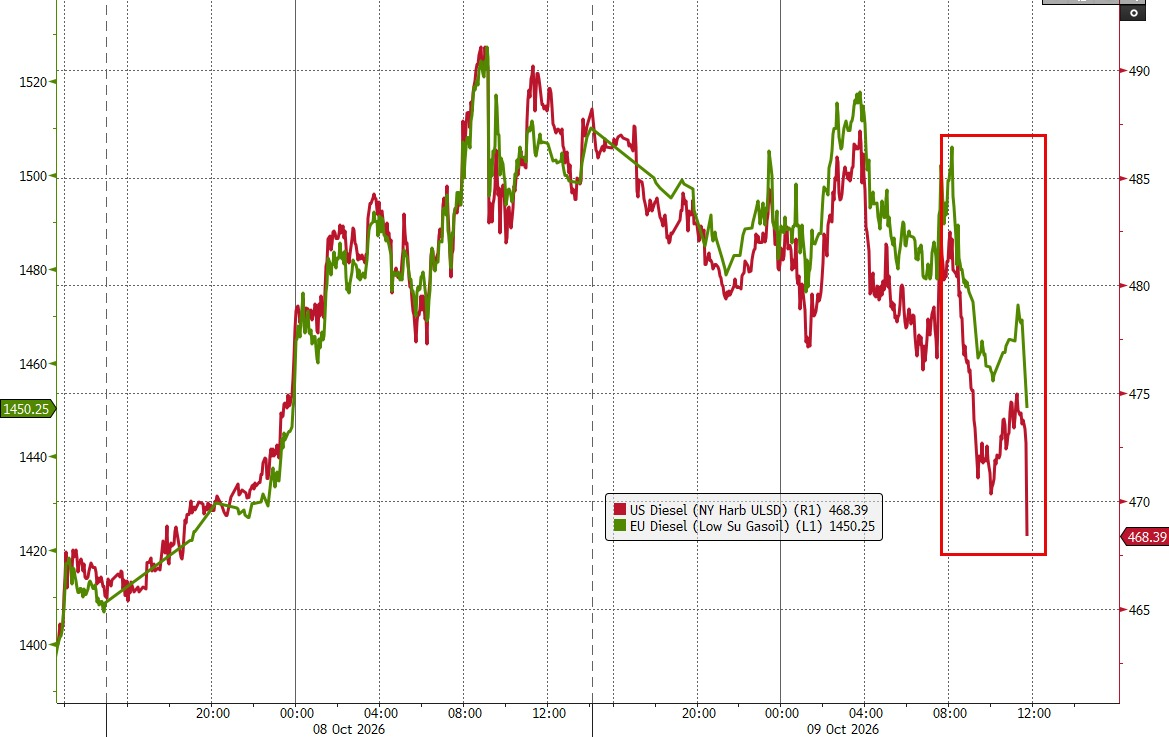
Do The Math: Less Than Nine Days Of Fuel
Now for the arithmetic. At roughly 7.45 barrels per ton, the “immediate” 300,000 tons is about 2.2 million barrels. The US burns roughly 4 million barrels of distillate a day, so October’s tranche covers about half a day of American demand. Add November and December and the first 1.8 million tons cover about 3.4 days. Even if the 3 million tons conditional on refinery health actually arrive, the full 4.8 million tons (about 36 million barrels) cover less than nine days of US consumption.
That is the best case. Trump’s own post says the fuel is going to the “American and Global Marketplace”, so the US share will be smaller.
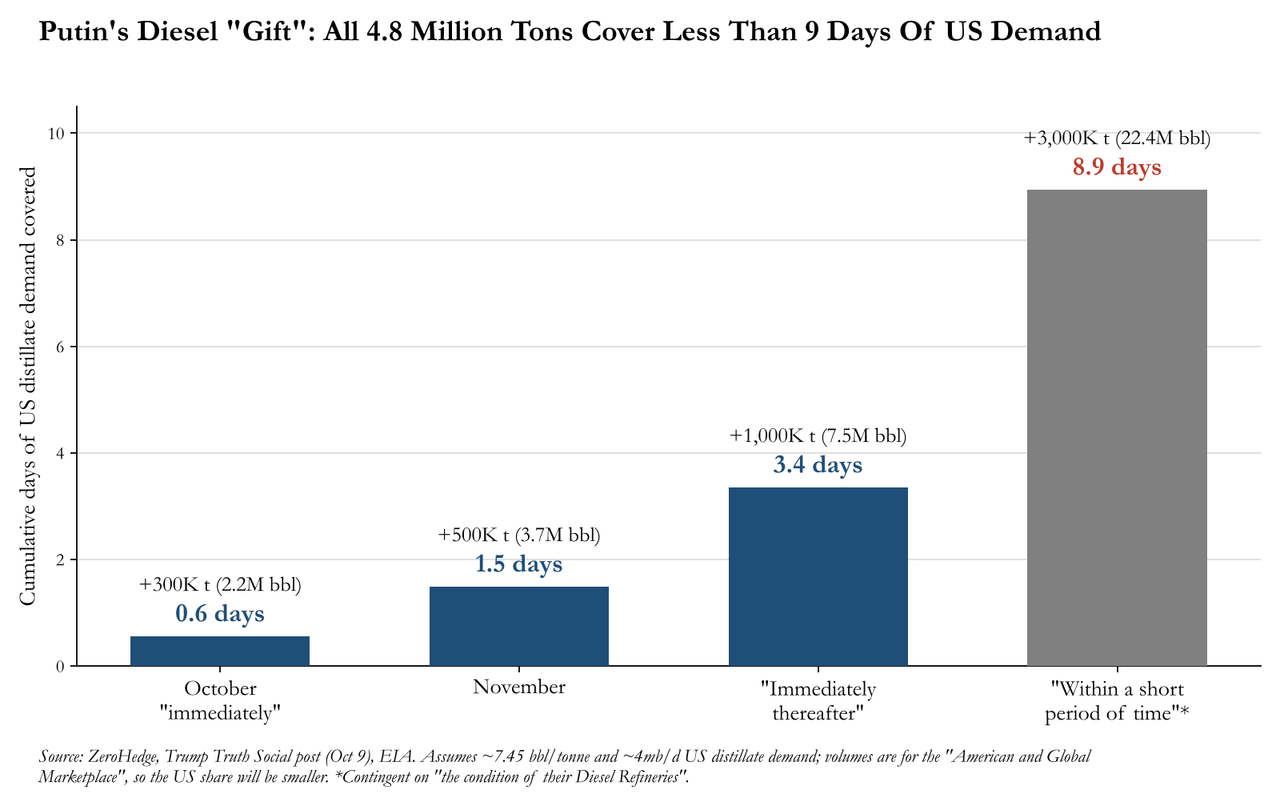
For context, the Omsk refinery that Ukraine hit on Thursday produced roughly 8 million tons of diesel in 2024 (per Bloomberg). That is about 670,000 tons a month. Put differently, the entire “November tranche” is less than one month of output from a single plant that was on fire the day before the deal was announced.
The industry isn’t buying it either. The FT reports that Russia is running its refineries at about 60% of capacity because of Ukrainian strikes, and quotes Kpler’s head of policy and geopolitical risk Michelle Brouhard: “The thing that I’m most curious about is: where is the diesel going to come from? Russia doesn’t have an export problem. It’s got a refinery problem.” Rapidan’s Bob McNally added that Moscow had already “been leaning toward a slight easing of its diesel export ban for logistical reasons.” So Trump may have paid a six-month sanctions waiver for barrels Russia was about to sell anyway.
Brouhard also warned that the deal could end up removing diesel from the market. Because the headline knocked diesel down relative to crude while freight costs are at records, “Refinery margins are now negative, which means refinery runs in Asia probably are going to come off . . . which means we’re going to lose some diesel.” Mission accomplished.
Why Russia Can’t Spare It (And Why Trump Wants It Anyway)
The irony is that Russia isn’t exporting diesel because it can’t. As regular readers know, Moscow banned diesel exports back on July 8 to avoid domestic shortages after a wave of Ukrainian drone strikes on its refineries, and extended the ban through Oct. 31 last week. The IEA estimates Russian diesel output is down about 30%. In other words, Putin has just promised to export fuel his own motorists are queuing for, under a ban his own government imposed. That’s either a remarkable act of generosity or a remarkably cheap promise (we know which way we lean).
The reason for the urgency is simple: diesel is still near record highs with less than four weeks until Election Day. AAA’s national average was $6.23/gallon on Friday, down only modestly from the record $6.52 on Sept. 22. Goldman’s commodity desk wrote last weekend in its Weekly Commodity Thoughts (available to pro subs) that the global distillate market “has been the most distressed area of the entire energy complex with gasoil cracks (gasoil vs. crude) trading to over $100/bbl in late September.” That only eased after “recent US political pressure and threats to implement a diesel export ban” pushed the G7 into a 100mb emergency release. We covered that at the time under the title “Trump’s Diesel Threat Worked.” Goldman’s desk was not impressed with the fix:
“However, while prices have moved lower the release does little to solve the structural issue has been caused by continued curtailment of Middle East exports and widespread damage to Russian refinery infrastructure.”
JPMorgan’s commodities chief Natasha Kaneva was blunter about the G7 headline in her latest diesel note (available to pro subs): “the headline 100 million barrels does not represent 100 million barrels of new intervention … much of Friday’s announcement represents the completion of the earlier IEA release rather than a new injection of barrels.” Sound familiar?
The market had the same reaction to the G7 release. As we noted on Wednesday, diesel crack spreads “quickly shot up back over $100, as market laughs at the emergency release of 100MM barrels.”
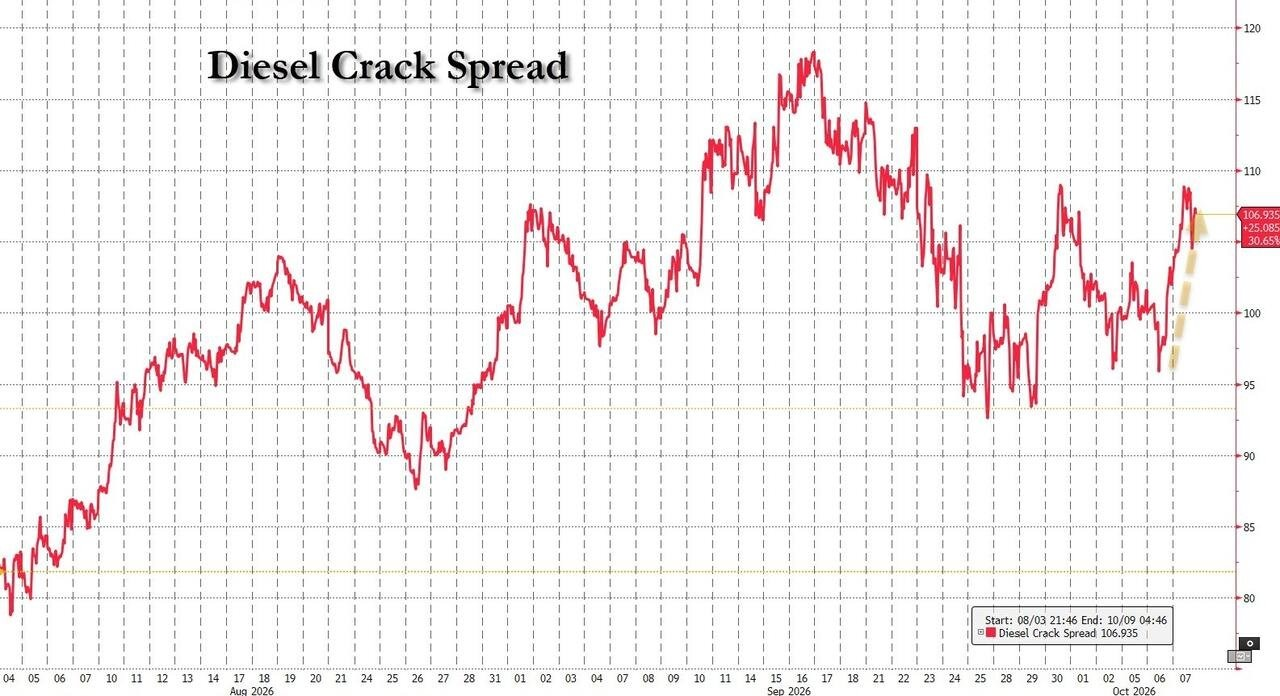
The Market Already Priced It (Sort Of)
The hedge funds saw this coming. Goldman’s Robert Quinn wrote earlier this week (and available to pro subs) that in the week through Sept. 29, managed money sold $2.4 billion of gasoil, the largest amount in 18 months, split equally between liquidation and new shorts. That followed a run in which specs “purchased in all but 1 week for a cumulative +$4.3bn” from late June to mid-September. And on Oct. 6, three days before Trump’s post, “October Gasoil reached intraday lows of -5.3% on reports that Russia may lift the country’s ban on diesel exports for some producers in October.”
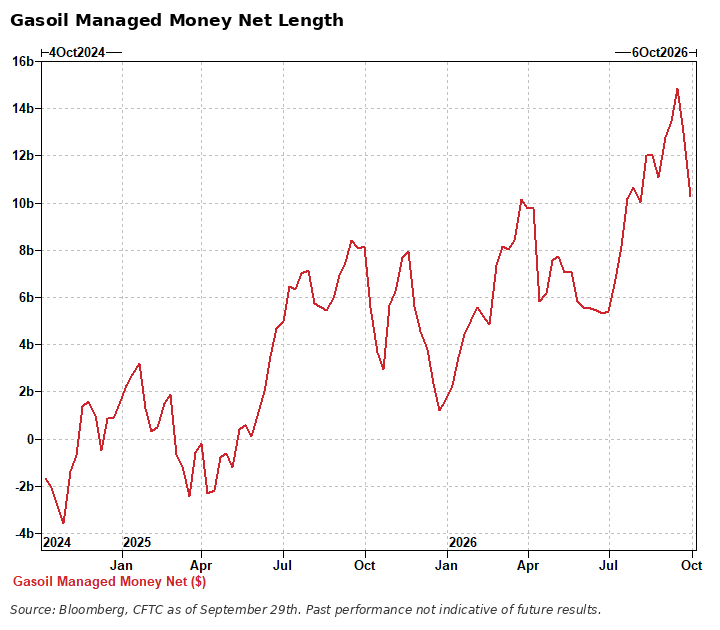
Translation: a good chunk of the “Russia relief” was in the price before Friday’s headline. That leaves little room for another leg lower, and plenty of room for a squeeze if the barrels don’t show up.
It’s The Midterms, Stupid
Why burn this much goodwill with Kyiv over nine days of diesel? Because fuel prices are what’s moving the ballot. Goldman’s political economists Alec Phillips and Abhay Duggirala wrote in their latest US Election Monitor (available here for pro subs) that “Gasoline prices and the Democratic generic ballot have moved together this year – the Democratic lead widened gradually after the gasoline price spike at the onset of the Iran war.” Democrats now lead the generic ballot by an average of 8.9pp, and “Inflation and the economy rank highest for voters, and Trump’s net approval on both is deeply negative.”
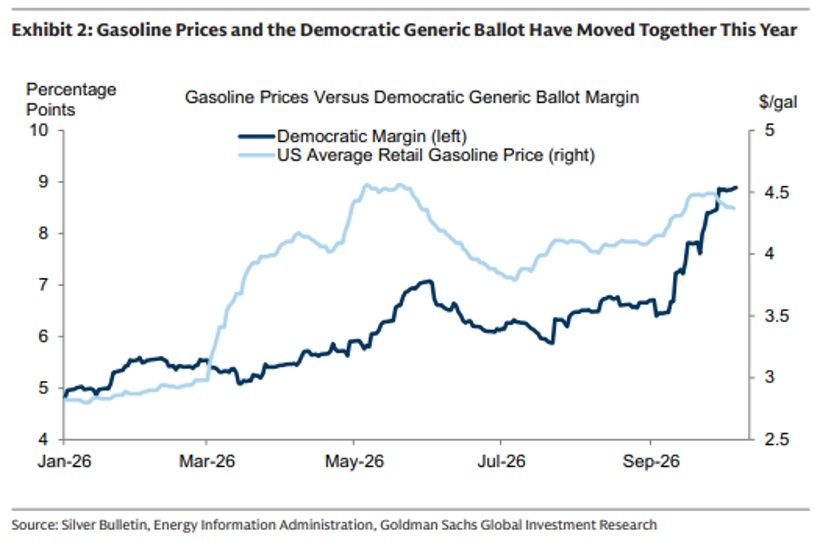
Prediction markets have already reached their verdict: using Polymarket data, Goldman notes markets are “now pricing a roughly 65% chance of a Democratic sweep and less than a 10% chance that Republicans retain their House majority.”
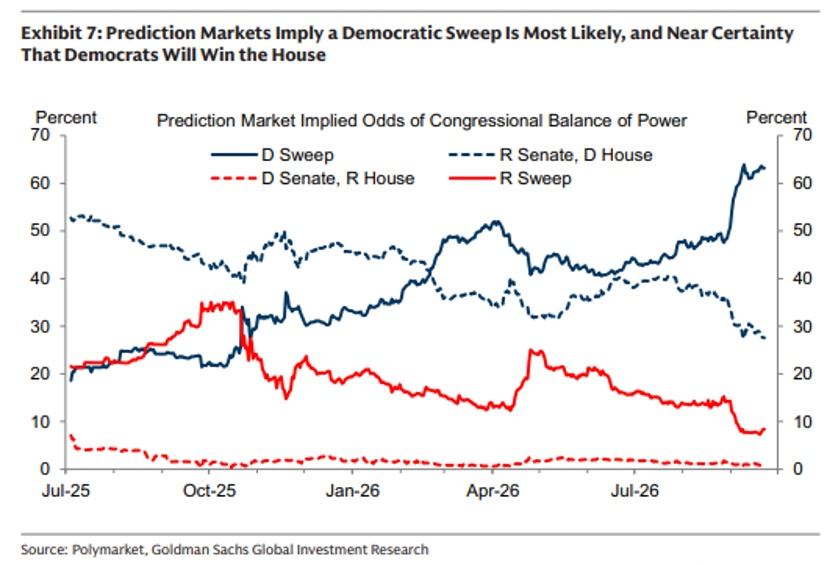
Against that backdrop, everything the White House did on diesel this week makes sense: the red-dye diesel waiver on Monday, the export-ban threats (which, as Goldman modeled, would knock just $0.25/gallon off retail diesel per week, before pushing gasoline higher), the decision not to strike Iran until after Nov. 3, and now Putin’s diesel. JPMorgan’s Market Intel desk summed up the shift in a client call this week: “why diesel, not crude, may now be the more important inflation signal.” For a White House facing 25 days of voter anger at the pump, a Friday afternoon price dip is worth a lot. The fact that it rests on a sanctions waiver and a promise from Putin is the problem.
US Intel Cut-Off Threats and Ukraine Responses Already…
As we detailed earlier, Ukrainian President Volodymyr Zelenskyy’s negotiating team met Trump’s representatives for nearly eight hours on Friday in Miami, where they were meant to discuss ways to convince Russia to end its war.
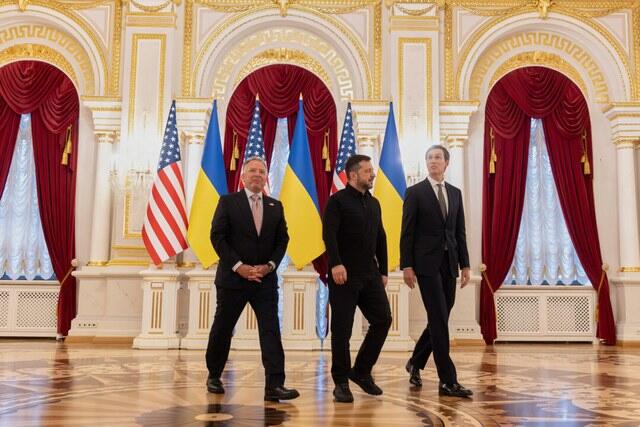
During the meeting, Trump’s envoys Steve Witkoff and Jared Kushner raised the possibility that intelligence sharing could be cut off if Kyiv did not heed Washington’s warning to halt the strikes, according to people familiar with the matter.
“It was a firm request from POTUS,” one of the Ukrainians involved in the talks told the FT, referring to Trump.
Ukraine uses US intelligence to carry out the energy infrastructure attacks that have choked off a vital source of revenue for Moscow’s war economy.
The new details turn the diesel deal from a pump-price gimmick into a test of wills with Kyiv. Trump has now tied the price Americans pay for diesel to whether Ukraine keeps burning Russian refineries – that way he has a clear scapegoat when Diesel prices keeps rising. Kyiv’s answer came within hours, and it was not the “symmetrical” one Zelensky had floated. A senior Ukrainian official told the FT that the long-range drone strikes on Russian energy facilities will continue:
“We will burn [Russian] refineries.”
Which is why the deal looks doomed from the start, which ironically is just what Trump wanted as there is little chance diesel sustains a price drop for the next several weeks. As one widely shared take on X put it within minutes of the announcement, before Axios confirmed the motive:
That is now, more or less, the White House’s position.
The next Ukrainian drone that hits a Russian refinery will be hitting a supply chain the US president just put his name on (which has now already happened).
We expect a Truth Social broadside at Zelensky the moment that happens, along with blaming the Ukraine president for all US inflationary woes, which much to the deep state’s disgust, would leave Washington defending Putin’s export capacity against its own ally, weeks before an election.
As for the barrels, we’ll believe them when we see them in New York Harbor. Russia’s export ban still runs through Oct. 31, its refineries are running at about 60% of capacity, and Kyiv has said outright that it will keep burning them. The most likely outcome? Putin sends out a diesel tanker, Ukraine drones the refinery that filled it, and the “deal” quietly dies, with both sides blaming Zelensky. Until then, it has done what it was designed to do: produce one good headline for the pump-price chart, and put Kyiv on notice that going forward Z will be the scapegoat for American runaway energy inflation.
Much more in the full Goldman Weekly Commodity Thoughts, Quinn’s “Managed Money Gasoil Sentiment Shifting?” note, the GS US Election Monitor and JPMorgan’s diesel note, all available to pro subs.
END
Ukrainian Drones Reportedly Hit Major Russian Fuel Export Hub Hours After Trump-Putin Diesel Deal
Saturday, Oct 10, 2026 – 08:45 AM
Overnight reports say that Ukraine struck a major Russian petroleum-products export terminal. The news emerged just hours after President Trump announced a diesel supply deal with Russian President Vladimir Putin.
OSINT accounts on X published unverified footage appearing to show Russia’s NZNP Rostovsky, a major petroleum-products storage and export terminal in southwestern Russia, ablaze.
NZNP Rostovsky is significant because it is a major petroleum-products export facility with receiving and loading capacity of 3.5 million metric tons annually. It is one of the most critical facilities of its kind in southern Russia.
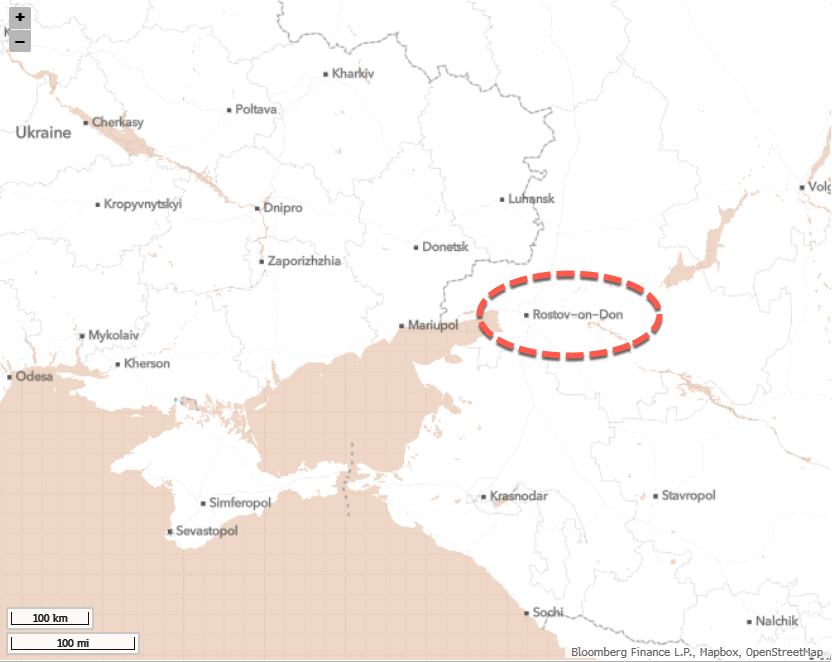
Late in the US cash trading session on Friday, Trump announced on Truth Social that Russia would immediately supply more than 300,000 tons of diesel to global markets, followed by 500,000 tons in November and 1 million tons “immediately thereafter.”
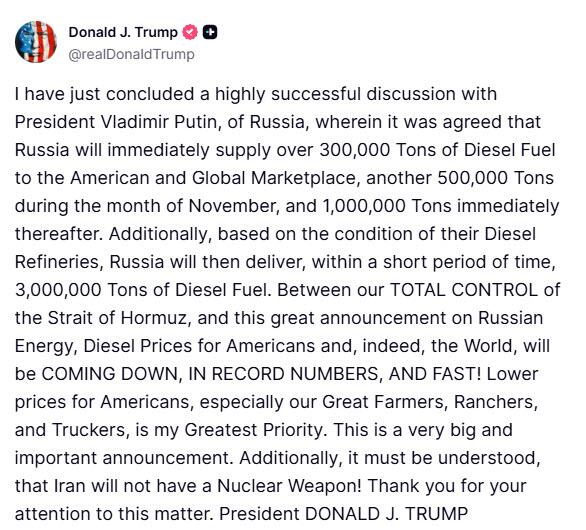
More color here:
Trump’s announcement comes as persistent Ukrainian attacks on Russian energy infrastructure this year, and Moscow’s decision to extend its diesel export ban have collided with disruptions in the Strait of Hormuz, culminating in what Goldman energy analyst Nikhil Bhandari has described as a nightmare scenario for global refining markets.
As we pointed out yesterday, Trump’s approval rating is trending at all-time lows, largely due to skyrocketing gasoline and especially diesel prices at the pump.
The Trump administration has pushed forward this week with broader use of tax-exempt dyed diesel, otherwise known as off-road diesel, to alleviate costs and has even touted the prospect of a diesel export ban. Europe has also jumped on board to suppress the global refining crisis, with G7 members planning to dump emergency stockpiles of diesel and crude into global markets to alleviate the supply crunch as winter in the Northern Hemisphere quickly approaches.
END
Trump Declares Ukraine Energy Ceasefire; Zelensky Says “News To Me” As Russia Attacks Powerplant
Sunday, Oct 11, 2026 – 03:00 PM
US relations with Ukraine are once again spiraling fast, especially following President Trump’s ‘shock’ declaration Saturday while addressing Zelensky’s anger at the diesel deal with Russia, “I suggest they get a new leader who can make a deal… And I think it’s time for Ukraine to get a new president.”
The rebuke had been in response to Zelensky blasting the diesel arrangement as “not fair and not honest” and a “sign of weakness” by Trump, and a “birthday gift” to Putin.
And then on Sunday morning, again to the great surprise of Western allies, Trump announced on social media a new energy ceasefire between Ukraine and Russia – except that Kiev quickly said it knows of no such ceasesfire.
“Effective immediately, there is an ENERGY CEASEFIRE in the War between Russia and Ukraine,“ Trump wrote on Truth Social. “Both parties have agreed. Do not break it!”

The last such energy ceasefire attempt announced by Trump was in mid-September, but it didn’t hold and in fact collapsed rather quickly after. In reality it never so much as got off the ground, before both sides were back at hammering each other’s oil, gas, and electricity infrastructure.
Very soon after this latest announcement by Trump on Sunday, Zelensky told US media that it was “news to me”. He said to Axios while reacting to Trump’s Truth Social post: “If President Trump negotiated it with Putin, please tell us when the ceasefire begins. We are ready, and we will accept it.”
And yet the dilemma for Kiev remains: it is vehemently against a US-Russian diesel deal, but any pause in energy attacks would serve to protect that very deal.
This unusual and very public back-and-forth is happening as the Ukrainian capital has been plunged into darkness:
Zelensky has in follow-up said on X that he was “awaiting details from the American side” – and has also complained that Russia has continued hitting Ukraine’s energy sites on Sunday. According to more of the latest from Zelensky:
Volodymyr Zelensky has accused Russia of striking a power plant in Kyiv after Donald Trump announced an “energy ceasefire”.
The Ukrainian president says in a post on X that he has briefed Trump on the “brutal Russian strikes that continue unabated”. He says earlier “the Russians struck a power plant in Kyiv with a ‘shahed’ drone, and many districts experienced power outages”.
“Later, there were strikes on energy facilities in the Kharkiv region. And all of this happened AFTER the President of the United States made his statement about an energy ceasefire,” he says.
His fresh video address:
Meanwhile Washington still has considerable leverage over Ukraine, putting Zelensky between a rock and a hard place. The Trump White House can always block weapons and funds – something it has previously threatened to do but never pulled the trigger on.
Fresh reporting in Financial Times is already putting specifics on the table to be potentially revoked:
American diplomats are said to be currently lobbying European capitals to pressure Ukraine end the attacks on Russian oil refineries:
The message from the US included threats to cut off intelligence sharing and Purl (the Prioritised Ukraine Requirements List) mechanism for procuring US weapons for Ukraine, the report added.
One official who was given a message from a Pentagon official stated: “They are calling Kyiv . … They are calling everyone [in Europe]” in order to lean on them.
END
6/.GLOBAL ISSUES, COVID ISSUES, VACCINE INJURIES/HEALTH ISSUES
GLOBAL ISSUES//
Welfare State Meets Mr. Bond Market: Rising Yields Put Socialism’s Promises On Borrowed Time
Sunday, Oct 11, 2026 – 09:00 PM
All-In Podcast hosts Chamath Palihapitiya, Jason Calacanis, David Sacks, and David Friedberg recently discussed the “socialism point of guaranteed return,” a troubling threshold at which economic deterioration drives voters to reject socialist policies and embrace free markets.
They pointed to rightward shifts in South American presidential elections as evidence of that political shift, with Brazil likely to flip right in the runoff election later this month.
The hosts suggested France may have already crossed the threshold (See EU bond market meltdown), while warning that the US remains in a phase where progressive policy failures generate demands for more and more government spending rather than a change in direction.
All-In’s David Friedberg explained:
So, the theory is called the socialism point of guaranteed return. Let’s shorten it to SPGR. This is a play on a point of no return. The thing that happens with socialism is that because socialism is so bad as a concept, it literally removes human agency.
It removes the capacity for human progress and it basically takes something away from everyone. Ultimately, socialism always fails. That is like the zeroth law of socialism: it always fails.
First Law of Socialism
The first law of socialism is that you have to cross a threshold before you realize that it has failed.
The Second Law of Socialism
The second law of socialism is that as you have not crossed that threshold, you think more socialism is the answer. As you embrace these kind of leftist policies, giving people free stuff, telling people that they have a guaranteed income.
The more services you provide them, the more they realize that over time those services inflate in cost and the quality of those services inevitably degrades because there is absolutely zero market force to drive progress.
Progress goes away.
That is what we see in the US in housing, in education, and in healthcare, and also in retirement systems. Those are the four biggest problems that are going to lead us down this path.
As a society says these things are not working, the initial solution is we need more of them. More healthcare, more housing, more education provided by the government.
When the government fails to provide good enough healthcare, good enough housing, good enough healthcare that is affordable enough, the answer is more government stuff.
Friedberg continued:
Eventually you reach a point when the system breaks because the government cannot tax and they cannot print, and because they cannot actually provide the services effectively, everyone realizes the socialism thing does not work. That is the socialism point of guaranteed return where the whole system collapses and you return back to the non-socialist state.
He pointed out:
That is what has happened in Latin America.
Latin America crossed the socialism point of guaranteed return in many of these countries. They realized it and they bounced back.
Perhaps France has crossed it.
Perhaps they have not.
We will see how much deeper they go.
The US has not crossed it.
The US is not yet touched that point, has not hit the rock bottom, and is teetering.
Continuing Friedberg’s thought: Socialist failures have piled up in South America and sparked a once-in-a-generation shift, with voters booting out left-wing socialist regimes for market-friendly right-wing. In fact, Bank of America’s Michael Hartnett pointed this out in something we’ve been telling readers for months about the Latin America political transformation:
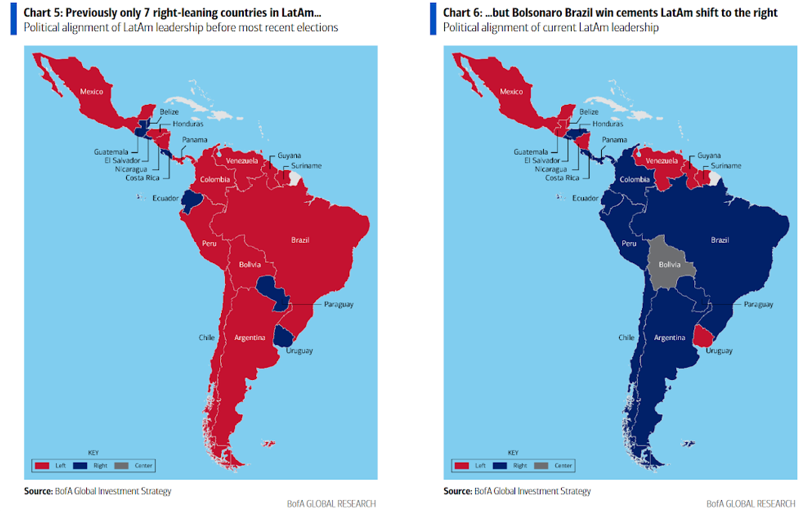
So why is socialism failing around the world today?
Well, these welfare spending commitments and massive deficit spending can only happen in a low-rate environment. Those days of MMT discussions are long gone, as government bond yields have spiked globally since Covid-19 and keep rising, while higher borrowing costs make it much harder for heavily indebted welfare states to sustain. Hence, yields in developed countries with massive welfare states are blowing out as markets see socialists as a new major risk to stability.
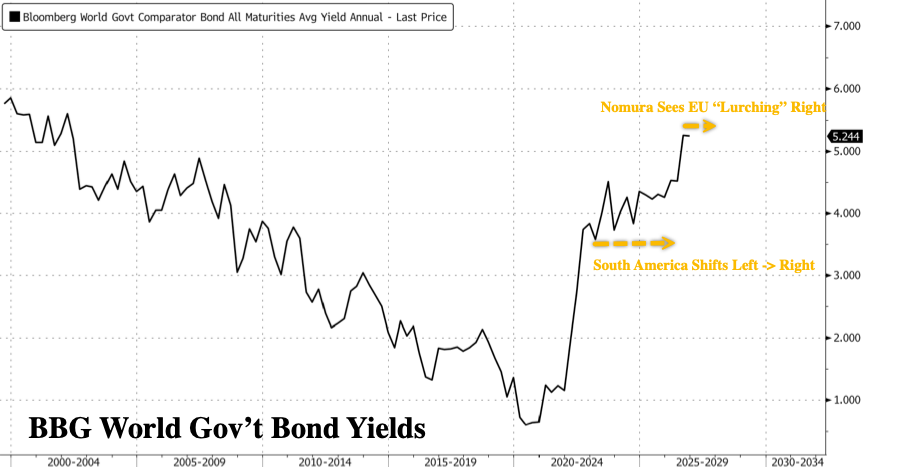
“The recent sharp increase in global interest rates is exposing the unsustainable reality of fiscal policy across most developed economies. The US and France are now in the spotlight, but the argument applies to Japan, the UK and many others. We argue that time-inconsistent fiscal policies are at the root of the problem, exposing debt dynamics to multiple equilibria,” BofA’s head of global economics research, Claudio Irigoyen, wrote in a note on Friday.
Irigoyen noted, “Policymakers will have a tough time coordinating into the good equilibrium unless politicians show resolve to swallow the bitter medicine. The problem is the political inability to adjust fiscal policy when the financing conditions that accommodated larger deficits disappear.”
In other words, skyrocketing government bond yields make a heavily indebted welfare state much harder to maintain, and this has unleashed a shift in the Americas from left to right and a possible coming political transformation in Europe, which Nomura analysts have described as “lurching” to the right over the 18-month election cycle.
AfD’s rise in Germany and Le Pen’s lead in French polls are the direct result of the failed and crumbling welfare state, disastrous left-wing deindustrialization policies, and mounting state failures that now leave governments facing difficult choices between higher taxes, reduced benefits, and even more borrowing.
Perhaps this explains why the far left in France is rioting: they see the writing on the wall that all the spending commitments for their glorious welfare state are likely to come undone under a potential Le Pen government.
Socialists are caught between a rock and a hard place because, if they don’t deliver a larger and larger welfare state to their constituents, then the whole idea of not working and receiving free stuff comes crashing down.
The political pendulum has swung from left to right across the Americas and now Europe. Socialism can no longer be maintained in a high-rate environment. Maybe the ultimate knockout for the welfare state will be persistently high rates.
END
COVID VACCINE INJURY REPORT: DR MARK CRISPIN MILLER
DR PAUL ALEXANDER.
RABOBANK/MICHAEL EVERY/OR OR PICTON/GIFFIN OR RABOBANK EXECUTIVE/COMMENTARY ON WORLDLY AFFAIRS
7. OIL AND NATURAL GAS/ENERGY COMMENTARIES
Hurricane Isaias Slams Gulf Coast, Knocks Out Power To 830,000 As Major Refineries Are Spared
Saturday, Oct 10, 2026 – 06:38 AM
Hurricane Isaias knocked out power to about 830,000 homes and businesses across Florida, Alabama, and Georgia and disrupted oil and natural gas operations in the Gulf of America, but the good news: it narrowly missed major refineries.
The Category 2 hurricane made landfall near Destin, Florida, at 8:30 local time, with sustained winds of 105 miles per hour before weakening into what the National Hurricane Center calls a “post-tropical cyclone.” Strong winds damaged roofs, toppled trees and downed power lines, while flooding was reported across Florida and Alabama.
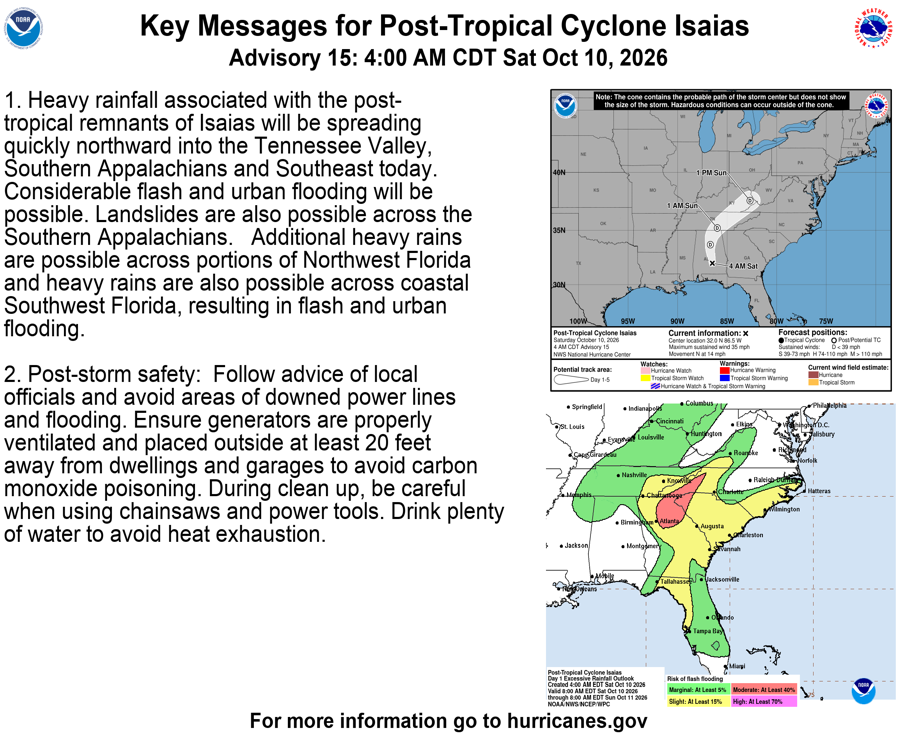
Gulf oil production fell sharply late in the week as Isaias forced offshore platform evacuations and drilling rig relocations. A slight eastward shift in the storm’s track spared Chevron’s Pascagoula refinery in Mississippi, reducing the risk of a major refining disruption. The focus today now shifts to damaged infrastructure assessments and the pace of offshore production restarts.
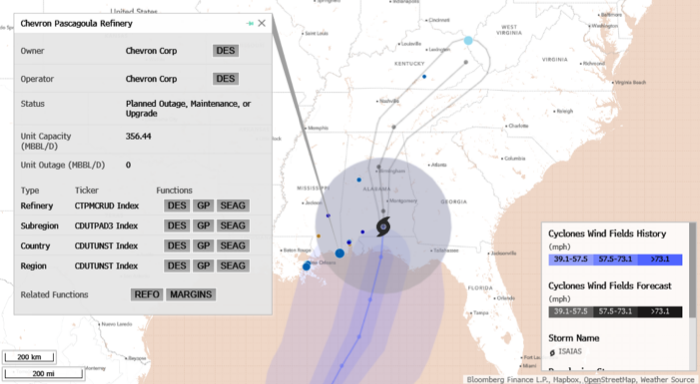
According to the utility tracker website PowerOutage, 430,000 customers in Florida are without power, 300,000 in Alabama, and another 106,000 in Georgia.
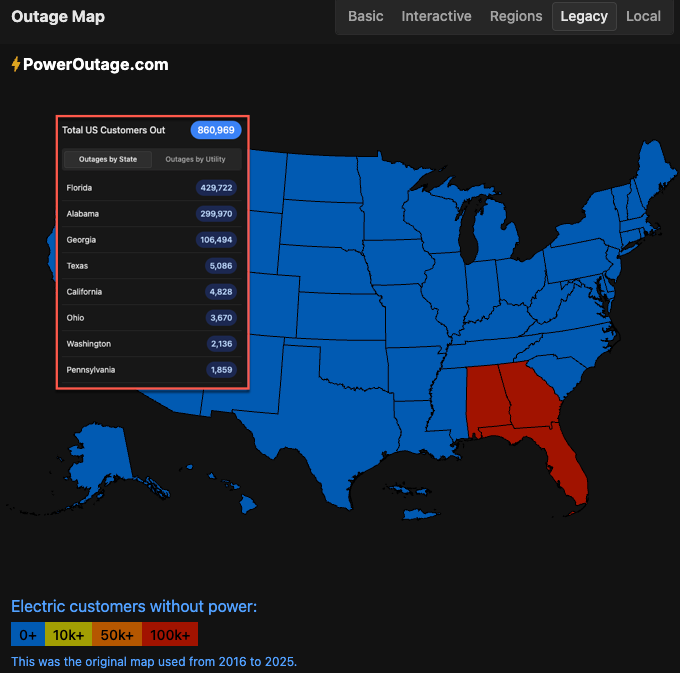
Torrential rain and tropical storm conditions were expected to persist Saturday as the storm moved north through Alabama toward the Tennessee and Ohio valleys.
END
Oil Rises After MidEast Attacks Spread And Escalate, Stoking Supply Fears
Sunday, Oct 11, 2026 – 06:15 PM
Summary
- Several more tankers attacked in Strait Of Hormuz
- IRGC claims it has complete control over the Strait of Hormuz
- The Houthis have carried out yet another attack on Riyadh’s international airport
- IEA urges more diesel releases as global market tightens
- President Trump said that Russia and Ukraine have agreed to an “energy ceasefire” effective immediately.
Oil prices rose at this evening’s futures open after renewed escalation of attacks by Iran and its proxies in the Middle East.
WTI is pushing back up towards Friday’s highs.
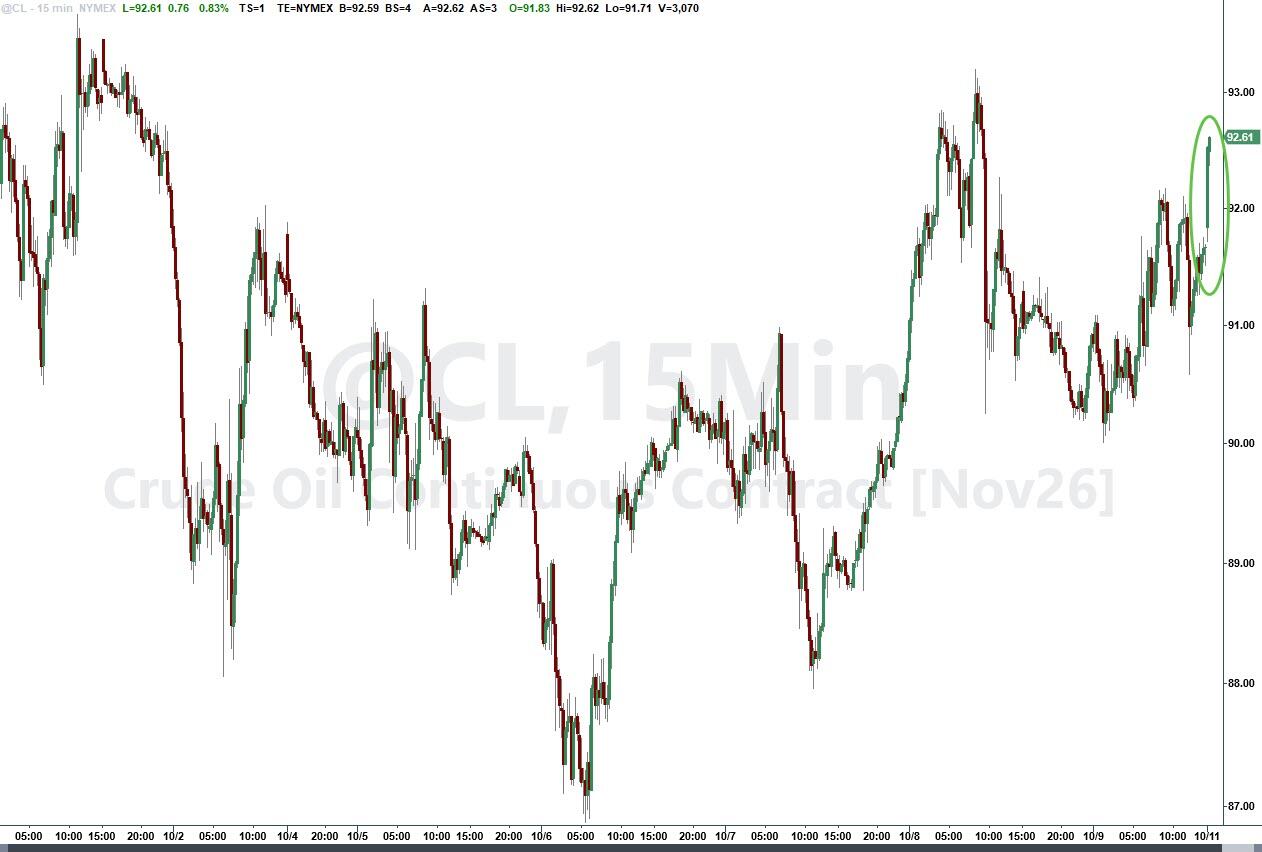
This move comes as President Trump claims that Russia and Ukraine have agreed to an ‘energy ceasefire’ which may just stabilize diesel prices around the world, but does nothing for exponentially rising tanker rates and the tightness in the physical oil markets.
Treasury markets are closed Monday, silencing the one cross-asset signal that typically anchors risk sentiment – meaning there will be no (cash) bond market verdict on what this weekend of renewed and re-escalated violence wrought.
“In quieter conditions, geopolitical headlines can often have an outsized impact,” Nick Twidale, chief market analyst at AT Global Markets in Sydney, wrote in a note to clients. But with the US inflation reading, several central bank speakers and the start of another US earnings season this week, “there will be plenty for markets to digest,” he wrote.
Dramatic Videos Show Several Tankers On Fire In Strait Of Hormuz This Weekend
Yet another tanker has been struck in the Strait of Hormuz on Sunday, which brings the total number to at least two or possibly as many as three suffering damage in the last 24 hours, chiefly from sea mines.
A slew of videos showing tankers striking mines have emerged on social media over the weekend, at a moment attacks on international vessels by Iranian forces are surging to wartime highs…
Prior to this, Iran’s Islamic Revolutionary Guard Corps (IRGC) had announced in a statement late Saturday that supertanker carrying crude oil suffered an explosion after colliding with a naval mine while “attempting to leave via the unauthorized route in the Strait of Hormuz” – also as reported in Bloomberg.
But one of the instances appears to have been a US attack on an ‘unauthorized’ vessel from an Iranian port, given the US military’s Central Command said overnight into Sunday that a Panama-flagged cargo ship travelling from an Iranian port had been struck in the Gulf of Oman.
The strike was said to be aimed at the ship’s engine room after it ignored warnings, with the Pentagon claiming to have taken steps at protecting crew members. And then, additionally:
On Sunday, a tanker leaving the Strait of Hormuz was hit by an “unidentified” projectile and damaged, the maritime organisation UKMTO said. The incident took place at 12:00 GMT (14:00 Prague time).
CNBC has noted amid this new surge in tanker incidents, “Since the Iran war began in late February, at least 24 sailors have died in attacks on 100 commercial ships in Hormuz, the Persian Gulf and Gulf of Oman, according to the IMO.”
Just before this weekend, on Friday: “Gem No. 2, was hit by a projectile Friday off the coast of the UAE resulting in a fire onboard. The ship departed Ras Tanura, Saudi Arabia, in March and has remained in the Persian Gulf since the war began,” according to Marisks.
The political affairs official of the Iranian Revolutionary Guard Corps Navy confirmed the imposition of complete control over the Strait of Hormuz, announcing the punishment of violating vessels.
Riyadh Airport Struck Again, A Day After Houthi Attack Killed 12, Including An American
The Houthis have carried out yet another attack on Riyadh’s international airport – this one coming Sunday evening and leaving more people injured, after the day prior a Houthi missile strike on the travel hub left 12 people dead and over 300 injured. Regional reports say emergency crews battled a fire in the wake of the fresh attack:
A fire broke out at King Khalid International Airport in Riyadh on Sunday after an unidentified projectile struck the airport’s terminal 4 for passengers. Authorities are responding to the scene, the Coalition to Restore Legitimacy in Yemen reported.
Later on Sunday, the Kingdom’s civil aviation authority said the attack resulted in injuries and that damage assessment and safety checks of airport facilities were underway.
Houthi military spokesman Brig. Gen. Yahya Saree announced that these strikes in response to the “brutal Saudi aggression against our country and our people.”
According to CBS News, “The airport remains closed on Sunday and Saudi Arabia moved Riyadh schools online amid the Houthis’ latest threat.” Apparently those among the injured are airport workers, and not travelers, as the airport remains closed and flights have been canceled or diverted. Additionally on Sunday:
IEA Urges More Diesel Releases as Global Market Tightens
The International Energy Agency urged members to speed up pledged diesel releases and consider supplying more as global markets tighten.
IEA Executive Director Fatih Birol urged governments that have yet to fully deliver oil stocks promised under the March collective action to accelerate those releases where possible, with priority given to diesel, according to a statement ahead of the agency’s Oct. 15 governing board meeting.
“Current market conditions merit immediate attention and can best be managed through continued cooperation among IEA members,” said Birol.
Collective action is necessary to support energy security and economic stability, he said, citing the renewed attacks on civilian and energy infrastructure in oil-rich Saudi Arabia.
Birol also encouraged all members – including those that have already completed their pledged releases – to assess whether further diesel releases are needed, and set out their scale and timing.
END
8. EMERGING MARKETS//AUSTRALIA NEW ZEALAND ISSUES
BRAZIL
U.S./GOLD AND SILVER PRICING/ASIAN CLOSING MARKETS AND EUROPEAN BOURSE OPENING AND CLOSING/ INTEREST RATE SETTINGS MONDAY MORNING 6;30AM//OPENING AND CLOSING\
OPENING LEVELS OF CURRENCIES// AND CLOSING ASIAN STOCK MARKET AND OPENING EUROPEAN STOCKS:6 AM EST
EURO VS USA DOLLAR: 1.1183 DOWN 0.0013
USA/ YEN 158.62 UP 0.382 NOW TARGETS INTEREST RATE AT 1.75% AS IT WILL BUY UNLIMITED BONDS TO GETS TO THAT LEVEL…//YEN STILL FALLS//END OF YEN CARRY TRADE BEGINS AGAIN DEC 2024/Bank of Japan raises rates by .25% TO 1.75 ..TAKAICHI NEW PM AS YIELDS RISE//JAPAN DEEPLY IN TROUBLE WITH RISING RATES AND A FALLING YEN!! BANK OF JAPAN WILL NO LONGER DO QE. URGES PENSION AND INSUANCE FUNDS TO BUY JAPANESE BONDS//
YEN CARRY TRADERS MURDERED
GBP/USA1.3234 UP 0.0014 OR 14 BASIS PTS
USA/CAN DOLLAR: 1.4263 UP 0.0015 //CDN DOLLAR UP 15 BASIS PTS//
Last night Shanghai COMPOSITE CLOSED DOWN 16.55 PTS OR 0.43%
Hang Seng CLOSED UP 58.55 PTS OR 0.25%
AUSTRALIA CLOSED UP 0.30%
// EUROPEAN BOURSE: ALL GREEN
Trading from Europe and ASIA
I) EUROPEAN BOURSES: ALL GREEN
2/ CHINESE BOURSES / :Hang SENG CLOSED UP 58.85 PTS OR 0.25%
/SHANGHAI CLOSED DOWN 16.55 PTS OR 0.43%
AUSTRALIA BOURSE CLOSED UP 0.30%
(Nikkei (Japan) CLOSED DOWN 11.19 PTS OR 0.02%
INDIA’S SENSEX IN THE RED
Gold very early morning trading: $4178.80
silver:$60.73
USA DOLLAR VS TRY (TURKISH LIRA): 49.34 UP 0 BASIS PTS AND NOW WE SEE THEIR STUPIDITY OF SELLING SOME OF THEIR GOLD AND ALL OF THEIR USA DOLLAR RESERVES. THE COUNTRY IS IN BIG FINANCIAL TROUBLE
USA DOLLAR VS RUSSIAN ROUBLE: 83.91 ROUBLE// UP 1 ROUBLE AND 17 BASIS PTS.
UK 10 YR BOND YIELD: 5.4343 DOWN 1 BASIS PTS
UK 30 YR BOND YIELD: 5.9349 DOWN 1 BASIS PTS
FRENCH OAT 10 YR BOND YIELD: 4.8754 UP 2 BASIS PTS.
CDN 10 YR BOND YIELD: 3.878 DOWN 5 BASIS PTS
CDN 5 YR BOND YIELD; 3.546 DOWN 5 BASIS PTS
USA dollar index early MONDAY MORNING: 102.03 UP 44 BASIS POINTS FROM FRIDAY’s CLOSE
MONDAY MORNING NUMBERS ENDS
And now your closing MONDAY NUMBERS 10.00 AM
Portuguese 10 year bond yield: 3.964% UP 2 in basis point(s) yield
JAPANESE BOND 10 yr YIELD: +3.002% DOWN 2 FULL POINTS BASIS POINTS /JAPAN losing control of its yield curve/
JAPAN 30 YR: 4.058 DOWN 1 BASIS PTS//
SPANISH 10 YR BOND YIELD: 4.101 DOWN 1 in basis points yield
ITALY 10 YR BOND: 4.581 UP 2 points in basis points yield ./
GERMAN 10 YR BOND YIELD: 3.4784 DOWN 1 BASIS PTS
IMPORTANT CURRENCY CLOSES : MID DAY MONDAY
Closing currency crosses for day /USA DOLLAR INDEX/USA 10 YR BOND YIELD/10:00 AM
Euro/USA 1.1173 DOWN 0.0023 OR 23 basis points
USA/Japan: 158.68 UP 0.450 OR YEN IS DOWN 45 BASIS PTS// HIGHLY INFLATIONARY TO JAPAN
Great Britain 10 YR RATE 5.4510 UP 3 BASIS POINTS //
GREAT BRITAIN 30 YR BOND; 5.9333 UP 1 BASIS POINTS.
FRANCE 10 YR: 4.9014 UP 4 BASIS PTS
CANADIAN DOLLAR DOWN 27 BASIS PTS TO 1.4278
xxxxxxxxxxxxxxxxxxxxxxxxxxxxxxxxxxxxxxxxxxxxxxxxxxxxxxxxxxxxxxxxxxxxxxxxxxxxxxxx
The USA/Yuan CNY 6.6928 ON SHORE ..UP
THE USA/YUAN OFFSHORE// CNH UP TO 6.6947
TURKISH LIRA: 49.34 UP 0 EXTREMELY DANGEROUS LEVEL/DEATH WATCH/HYPERINFLATION TO BEGIN.//
Your closing 10 yr US bond yield UP 0 in basis points from FRIDAY at 5.242% //trading well ABOVE the resistance level of 2.27-2.32%)
USA 30 yr bond yield 5.599 UP 0 basis points /10:00 AM
USA 2 YR BOND YIELD: 4.791 UP 1 BASIS PTS.
GOLD AT 10;00 AM $4165.00
SILVER AT 10;00: $60.38
Your 11:00 AM bourses for Europe and the Dow along with the USA dollar index closing and interest ratesFRIDAY
DAY CLOSING TIME/ 12:00 AM///
London: CLOSED UP 91.95 PTS OR 0.87%
GERMAN DAX: CLOSED UP 180.40 PTS OR 0.72%
FRANCE: UP 20.61 OR 0.26 PTS
Spain IBEX CLOSED UP 229.90 PTS OR 1.21%
Italian MIB: CLOSED UP 255.94 PTS OR 0.51%
WTI Oil price 90.81 10.00 EST/
Brent Oil: 103.14 10:00 EST
USA /RUSSIAN ROUBLE: 84.83/// ROUBLE UP 0 AND 19/ 100
CDN 10 YEAR RATE: 3.886 DOWN 5 BASIS PTS.
CDN 5 YEAR RATE: 3.545 DOWN 7 BASIS PTS
CLOSING NUMBERS: 4 PM//
Euro vs USA 1.1156 DOWN 0.0039 OR 39 BASIS POINTS//
British Pound: 1.3207 DOWN 0.0014 OR 14 basis pts/
BRITISH 10 YR GILT BOND YIELD: 5.4431 DOWN 1 FULL BASIS PTS//
BRITISH 30 YR BOND YIELD: 5.9318 DOWN 0 IN BASIS PTS.
FRENCH 10 YR BOND: 4.896 % DOWN 1 BASIS PTS
JAPAN 10 YR YIELD: 3.001% DOWN 0 FULL BASIS PTS (DANGEROUS TO THEIR ECONOMY
JAPANESE 30 YR BOND: 4.058 DOWN 0 PTS AND STILL VERY DANGEROUS TO THEIR ECONOMY
USA dollar vs Japanese Yen: 158.67 UP 0.432 OR YEN DOWN 48 BASIS PTS//GETTING FURTHER AWAY FROM 160.00/ EXTREMELY DANGEROUS
USA dollar vs Canadian dollar: 1.42855 UP 0.0038 PTS// CDN DOLLAR DOWN 38 BASIS PTS
West Texas intermediate oil: 93.61
Brent OIL: 106.48
USA 10 yr bond yield UP 0 BASIS pts to 5.244
USA 30 yr bond yield: DOWN 0 PTS to 5.599%
USA 2 YR BOND 4.791 UP 0 PTS
CDN 10 YR RATE 3.878 DOWN 0 BASIS PTS
CDN 5 YEAR RATE: 3.546 DOWN 0 BASIS PTS
USA dollar index: 102.37 UP 1 BASIS POINTS
USA DOLLAR VS TURKISH LIRA: 49.33 UP 0 BASIS PTS GETTING QUITE CLOSE TO BLOWING UP/IDIOTS SOLD GOLD
USA DOLLAR VS RUSSIA//// ROUBLE: 83.78 UP 0 AND 34 /100 roubles //
GOLD $4,164.00 3:30 PM)
SILVER: 60.16 3;30 PM)
DOW JONES INDUSTRIAL AVERAGE: UP 203.80 POINTS OR 0.39%
NASDAQ 100 UP 218.45 PTS OR 0.71%
VOLATILITY INDEX 15.23 DOWN 0.39 PTS OR 2.63%
GLD: $ 382.15 DOWN 2.43 PTS OR 0.63%
SLV/ 54.36 PTS DOWN 0.42 OR 0.78%
TORONTO STOCK INDEX// TSX INDEX: CLOSED XXX PTS OR XXX%
end
TRADING today ZEROHEDGE 4 PM: HEADLINE NEWS/TRADING
Crude Continues To Crash-Up With Credit Closed; Tech Tumbles On Vapid Volumes
‘WRAP UP
USA DATA RELEASES
USA ECONOMIC REPORTS
BALTIMORE
“Facing Problems With Crime”: Even Baltimore City’s Hipster-Owned Businesses Are Losing Patience
Sunday, Oct 11, 2026 – 09:55 AM
Baltimore City’s image remains deeply shaped by HBO’s hit crime drama, the 2015 riots, an ongoing public safety crisis, decades of deindustrialization, population collapse, and the opioid and drug crisis. Together, those mounting problems have severely weakened the city’s appeal to visitors, residents, and businesses.

Democrats have held Baltimore’s mayor’s office continuously since 1967, placing nearly a six-decade reign under what can only be described as one-party rule by extreme left-wing Democratic queens and kings. This epic trail of destruction and chaos reflects a progressive experiment that has horribly gone wrong and the resulting crime and economic despair.
A population collapse to a 100-year low, absurdly high taxes, and crime have made it nearly impossible for mom-and-pop businesses to operate, even in the nicest parts of town.
Take Federal Hill, a historic neighborhood just south of Baltimore’s failed Inner Harbor. Once a popular spot for bars, restaurants, and college graduates, it has quickly descended into crime.
Local outlet The Baltimore Banner reports that yet another local restaurant is leaving the area.
Blue Moon Too will close its Federal Hill location in spring 2027 after its landlord declined to renew its lease.
Owner Sarah Simington also warned: “The neighborhood has been facing problems with crime.”

Instead of moving her local brunch spot into the county, a much safer area, as many other restaurants in the city have done since the 2015 riots, Simington will relocate hers to Hampden, a somewhat safer part of the metro area.
Another popular spot in the harbor area that has been transformed into chaos is Fells Point, a popular bar district.
Fox Baltimore reported in June on youth mobs and gunfire that plagued the once-happening bar district, and the footage from the summertime is shocking:
The misery doesn’t stop at Fells Point. In the downtown area known as the Inner Harbor, it’s a ghost town as commercial real estate buildings implode in value. Even Under Armour’s city-within-a-city project saw Goldman pull out of the multibillion-dollar development.
This summer, Moody’s Ratings downgraded the city because of its rapidly deteriorating financial situation, as left-wing Mayor Brandon Scott’s ability to govern properly comes into question.
Moody’s recently said the downgrade “reflects the trend of declining fund balance and cash levels across all government operations, largely concentrated in the utility and internal service funds.”
To Brandon’s credit, murders are significantly down, but that comes after a decade-long violent crime wave. We must add that the damage is already done because Baltimore has seen a massive exodus of residents, losing more than 70,000 people, or about 11% of its population, over the past two decades.
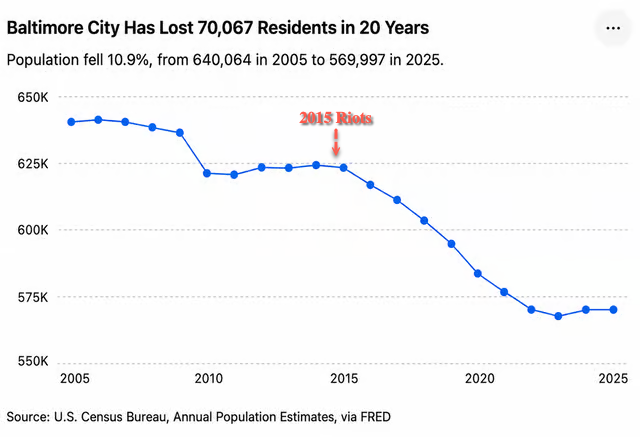
The slow death of Baltimore City has happened under more than a half-century of one-party Democratic rule, and its leaders’ progressive experiment has all but failed.
END
ERIE PA
Nine Dead, Including Two Children, In Pennsylvania Family Mass Shooting
Sunday, Oct 11, 2026 – 12:30 PM
A shooting in Erie, Pennsylvania, on Friday left nine people dead, including two small children, a pregnant woman and the man authorities believe was responsible, according to USA Today. Police say the violence appears to have unfolded largely within a single family, although the circumstances leading up to the killings remain unclear.
The incident occurred October 9 at a house on Perry Street, where police were alerted to gunfire shortly before 5 p.m. Officers arriving at the property discovered two women, ages 37 and 51, who had been shot outside. A subsequent search of the residence revealed seven more bodies, including that of the suspected attacker.

USA Today writes that the victims inside included a 1-year-old girl, a 5-year-old boy, two young men ages 19 and 21, and two women ages 24 and 44. One of the deceased was eight months pregnant. Investigators determined that eight of those killed were members of the same extended family, while the remaining victim was a family acquaintance.
Police identified the suspected attacker as a 45-year-old man who was found upstairs with a legally registered firearm. Evidence initially suggested he had taken his own life after the killings. One of the nine deceased was transported to a hospital before being pronounced dead.
Questions surrounding the police response prompted officials to clarify the timeline. Erie Police Chief Rick Lorah said officers reached the address within roughly three minutes of the initial gunfire alert but encountered a secured house with covered windows and no audible signs of violence continuing inside. Authorities maintain that everyone had already been shot before officers reached the scene and that the response did not involve a prolonged confrontation with the gunman.

Detectives are now attempting to reconstruct the events preceding the shooting through witness interviews, cellphone evidence and the suspect’s prior interactions with law enforcement. Lorah indicated that psychological issues were among the possibilities being considered, but stressed that no explanation for the killings had been confirmed. He also described the crime scene as the worst he had witnessed in his policing career.
Pennsylvania Gov. Josh Shapiro pledged assistance to the city and expressed sympathy for those affected. Local officials are arranging mental health resources and other services for surviving relatives and residents shaken by the tragedy.
As of Saturday afternoon, authorities were still working to formally confirm the victims’ identities and had not publicly released their names.
END
“The System Failed Everybody”: 2-Year-Old Fights For Life After Stabbing By Man Repeatedly Ruled Incompetent To Stand Trial
Sunday, Oct 11, 2026 – 04:30 PM
Authored by Steve Watson via Modernity.news,
A two-year-old girl is fighting for her life after being stabbed multiple times in the face by a complete stranger while sitting in a stroller at a Providence school bus stop. The attacker had previously been accused of stabbing two other children, but was repeatedly found incompetent to stand trial before simply being released back into the community.

Police say the attack was unprovoked. The man did not know the mother or child. Months earlier, a doctor had assessed that he was “not likely to imperil the peace and safety of the community or himself at this time.” A judge accepted the recommendation and allowed him to remain free on outpatient treatment.
What kind of justice system lets a mental guy who previously stabbed two kids walk around freely?
The latest incident occurred in broad daylight Wednesday near Broad Street and Public Street in Providence, Rhode Island. The mother, 26, was waiting with her two-year-old daughter for the child’s siblings to arrive on a school bus. Nelson Blanco, 46, approached them. The mother moved across the street, but Blanco followed, insulted her, and then attacked, according to Providence Police Chief Oscar Perez.
Perez said Blanco stabbed the girl in the face multiple times and stabbed the mother in the shoulder. The attack was “unprovoked,” and the victims did not know the suspect.
Bystanders intervened. Witness Jesse Alice Palmer, a nursing assistant, said the toddler stopped breathing and that she and another woman performed CPR until emergency responders arrived. The girl remains in critical condition at Hasbro Children’s Hospital. The mother was treated and released.
Horrific.
Blanco fled the scene, broke into a nearby home on Daboll Street occupied by a woman over the age of 60, and locked himself in the basement. Police forced entry and arrested him. A bloodied knife with a blade longer than three inches was recovered.
He has been charged with two counts of assault with intent to commit murder, assault with a deadly weapon, breaking and entering into a dwelling occupied by a person over 60, and knife possession offenses.
He appeared in Providence District Court the following day wearing a hazmat suit. No plea was entered. The court ordered a competency evaluation and a dangerousness assessment. He is being held as a bail violator.
Blanco’s history with the courts stretches back more than two decades. In September 2003, he was charged with stabbing two seven-year-old boys who were playing outside in Providence. The attack was described at the time as a “senseless and random act of violence.” Both children survived.
Psychiatric evaluations conducted between 2003 and 2006 described him as “paranoid” and “out of touch with reality.” A 2005 report stated that he met diagnostic criteria for polysubstance dependence, borderline intellectual functioning, and active symptoms of psychosis.
Doctors repeatedly assessed him as being at “moderate risk of creating a likelihood of serious harm to others.” One doctor warned that, without treatment, he could “become overly violent.”
In 2007, Rhode Island’s behavioral health agency determined there was “no reasonable likelihood that in the foreseeable future Nelson Blanco will become competent.” The criminal case was closed. He was an inpatient at Eleanor Slater Hospital, the state’s psychiatric facility, until an alternative placement was found.
Under state law, a defendant found incompetent cannot be held indefinitely on the criminal charge once the commitment period reaches two-thirds of the maximum sentence for the most serious offense. A separate civil commitment process was available if authorities believed he posed a likelihood of serious harm, but records indicate that step was not taken.
He was found incompetent again in 2018 after being charged in 2017 with possession of a stolen vehicle. Doctors determined he had an intellectual disability disorder and schizophrenia. In 2024, he was charged with domestic violence-related offenses after breaking into his sister’s home through a window. He was again found incompetent to stand trial.
In July of this year, in connection with the 2024 case, a doctor recommended that Blanco remain on outpatient status, writing that he was “not likely to imperil the peace and safety of the community or himself at this time.” Judge Brian Stern accepted the recommendation. Blanco was not institutionalized.
They are directly responsible for the horror that has now unfolded.
Retired attorney David Levy, who represented Blanco in the 2003 case, told local reporters that judges typically follow a doctor’s assessment. “You can’t be held there for the rest of your life or indefinitely if you are not restored to competency,” Levy said. “I highly doubt a judge is going to overrule that” if a state-affiliated doctor concludes the person does not present a danger to the community.
Rhode Island Attorney General Peter Neronha’s office confirmed that Blanco has been found incompetent to stand trial after mental health evaluations in at least three separate cases. The state Department of Behavioral Healthcare, Developmental Disabilities and Hospitals declined to comment on the releases, citing patient privacy laws.
Witness Palmer, who helped stabilize the toddler, said after learning of Blanco’s history: “He should not have been out in the streets. You failed him, you failed the baby, you failed the kids that got stabbed before.” She added: “The system failed everybody.”
Chief Perez said at a press conference that he does not believe the system is broken. He stated that the police department’s role is to investigate and present facts to the courts, which are responsible for accountability. Providence Mayor Brett Smiley described the attack as a “senseless act of violence.”
Blanco remains in custody. His next court date for a status update on the competency evaluation is scheduled for October 22. The toddler remains in critical condition.
When will this nightmare of protecting dangerous lunatics end?
These repeat offenders keep being enabled in blue cities:
END/AI
AI’s 2008 Moment: Jefferies Sees “Massive Capital Destruction” As Two Cash-Burning Labs Owe Half Of A $2.3 Trillion Backlog
Jefferies strategist Chris Wood (global head of equity strategy and author of the GREED & fear note) has warned that the US AI boom is likely to end in “massive capital destruction,” drawing parallels to 2008-style credit and real-estate risks.
bloomberg.com
The ZeroHedge headline (Oct. 11, 2026) captures a key part of his ongoing critique, which appears in recent notes including the Asia Maxima quarterly “Reverberating tremors.” Wood’s base case is that much of the enormous US hyperscaler capital expenditure (capex) on data centers, chips, and infrastructure will prove to be malinvestment—money spent that fails to generate adequate returns—while cheaper Chinese open-source models gain market share and token prices fall, commoditizing large language models.
zerohedge.com
The $2.3 Trillion Backlog ConcentrationA central structural concern is the explosive growth in Remaining Performance Obligations (RPOs, or contracted backlog)—forward commitments representing future payments for compute capacity. These have surged to roughly $2.1–2.3+ trillion across major hyperscalers (Microsoft, Amazon, Google/Alphabet, Oracle, and sometimes Meta), up dramatically (e.g., ~184–186% over recent four-quarter periods from much lower bases).
marketchameleon.com
Roughly half of this backlog is owed by just two cash-burning, unprofitable frontier AI labs: OpenAI and Anthropic. Exposure is highly concentrated:
- Microsoft ~49%
- Amazon ~51%
- Google ~43%
- Oracle ~54%
In economic substance, the hyperscalers have extended large, concentrated, unsecured credit (via capacity commitments) to these tenants to fill data centers built on optimistic demand assumptions. Neither lab is profitable, so their ability to pay depends on continued fundraising and revenue growth rather than internal cash generation. This creates classic infrastructure/credit risk: if the labs stumble or cannot meet obligations, suppliers face impairments, underutilized assets, and potential margin pressure.
marketchameleon.com
Broader Risks Wood Highlights
- Debt-funded pivot: Capex that was once largely cash-funded is increasingly debt-financed. Hyperscalers have issued record volumes of investment-grade bonds (hundreds of billions), committing a very high share of operating cash flow to AI buildout. Bond spreads have widened for some names, and Oracle has faced rating pressure.
- Off-balance-sheet liabilities: Significant future data-center leases and purchase commitments (estimates in the hundreds of billions to over $1 trillion range across the group) sit off balance sheets under accounting rules until commenced.
- China competition: Chinese open-source models are seen as technological peers (not just cheaper), processing far more tokens in some aggregator data and undercutting on price, pressuring US model economics and the returns needed to justify the US spending spree (hyperscaler 2026–2027 capex guidance in the high hundreds of billions, potentially approaching $1 trillion annually in some projections). bloomberg.com
Wood has invoked Amara’s Law (overestimating short-term tech effects, underestimating long-term ones) and noted that the cycle is most likely to end not from sudden demand disappearance or voluntary spending cuts, but when markets or credit withdraw funding support amid questions about returns. Semiconductor “picks and shovels” can still benefit while spending continues, but the endgame for much of the US hyperscaler/AI infrastructure investment is capital destruction, with share shifting toward lower-cost alternatives.These points build on earlier Wood notes (including mid-2026 commentary on the “2008 real estate credit angle”) and align with broader market discussions of concentration risk, take-or-pay contracts, and circular financing in the AI ecosystem. The warnings do not claim AI demand is illusory, but question the sustainability and return profile of the current US-centric, debt- and commitment-heavy buildout.
END
America Let China Outbuild The U.S. Navy, And Is Now Scrambling To Close The Gap
Sunday, Oct 11, 2026 – 08:00 PM
The Navy is asking for $65.8 billion in shipbuilding funding for 2027 as Washington tries to close a production gap with China, whose shipyards turn out about 1,700 ships a year versus roughly five from American builders, according to a new report from Business Insider, U.S. officials now describe that gap as a national security threat.
The government has turned to South Korea, the world’s second-largest shipbuilder, for help restoring domestic production, and the Navy is counting on at least seven shipyards to speed up deliveries.
In 2016, the Navy calculated how many battle force ships it would need in a war with rivals including China and settled on 355. China’s fleet stood at about 255 ships at the time. Current estimates put it above 400. The Navy remains about 60 ships short of its 2016 target, and the requirement has grown since then.
Business Insider reported from Austal USA, a shipbuilder on Blakeley Island in Mobile, Alabama, where even a lightly armed vessel such as the Expeditionary Fast Transport takes 32 to 33 months to deliver. The outlet identified several bottlenecks: the industry lacks roughly 250,000 skilled workers and training 200 apprentices over several years costs more than $3 million. Harsh conditions and hourly pay also drive turnover. Design changes on the first ship of a class can also add months and tens of millions of dollars to a program. Building a ship in the United States also costs four to five times as much as in China or South Korea.
The report compared the current situation with World War II, when Washington invested about $900 million in shipbuilding in 1941 (equivalent to about $20 billion in today’s dollars), and within three years American shipyards were launching more than 1,900 ships each year. After the war, federal support declined, and subsidies ended in 1981. Since 2000, China has expanded by carrying out both commercial and naval construction and is now responsible for more than 53% of the world’s ship tonnage.
After years of little interest in America’s shipbuilding capacity, things have finally started to change.
“In 2025, the administration signed into law $30 billion for new Navy and Coast Guard ships, and for 2027, it’s asking Congress for another $65.8 billion,” explains Olivia Nemec of Business Insider. “That’s more than double what President Biden requested in his final year in office. To put that in perspective, America’s shipbuilding budget alone is about equal to the entire defense spending of nuclear powers like France. Yet this historic naval expansion represents just over a 4.3% slice of President Trump’s unprecedented $1.5 trillion total defense request for 2027.”https://www.youtube.com/embed/kBP-bVci-IM
President Donald Trump also signed an executive order on shipbuilding in 2025 to rebuild America’s maritime industry, strengthen national security and counter China’s dominance in commercial ship production, and called for a Maritime Action Plan to include proposals for shipyard investment incentives, dedicated funding, expanded workforce training and reforms to reduce procurement delays and regulatory costs.
Those goals are clearly being implemented. A separate Business Insider report revealed last week that shipyard workers in California and Maine have secured higher pay, improved benefits and more influence over new technology through union contracts. In March, union workers at the Ingalls Shipbuilding division of Huntington Ingalls Industries, the country’s largest shipbuilder, negotiated an immediate base-wage increase of at least 18%, with total raises of 35% to 47% through 2031. HII said last fall that higher wage spending had brought in more experienced hires. However, union members told the outlet that pay alone will not hold skilled workers, and that yards must offer a long-term career with healthcare, flexibility and retirement benefits. Shipbuilders are also investing in infrastructure, hiring campaigns, training pipelines and transportation aid such as gas and transit cards.
At NASSCO in California, union membership rose from 21% to 67% during contract talks. Luis Silvas, an IAM Western Territory special representative, said the shop’s culture has shifted toward more solidarity, with younger workers who see themselves as skilled. Richard Suarez, the IAM Western Territory coordinator, said half of the union’s NASSCO members cross the border from Mexico each day, and some leave home at 2 a.m. to reach the yard by 6 a.m.
The Navy is bringing artificial intelligence and robotics into the yards to automate labor-intensive tasks. The Maine contract creates a formal process to bring workers in earlier as new technology arrives. Tim Suiter, president of IAM Local S6, said employees previously joined near the end, which caused confusion and worry about automation.
The Navy’s plans include a 15-ship battleship program with a projected cost of $275 billion.
The United States spent decades watching its shipyards shrink while China built the world’s largest fleet, and the bill for that neglect has now come due. Whether the U.S. can close the gap will depend on how long Congress and the Navy sustain the effort after the initial funding surge.
END
US Bankruptcy Filings Rise By 11% In First 9 Months Of 2026
Monday, Oct 12, 2026 – 08:15 AM
Authored by Naveen Athrappully via The Epoch Times,
A total of 469,719 bankruptcy filings, both individual and commercial, have been filed in the first nine months of 2026.

The total number of filings is up by 11 percent from the same period last year, the American Bankruptcy Institute (ABI) said in an Oct. 8 statement.
Individuals made 444,252 filings in the January to September period, while businesses made 25,467 filings, up by 7 percent.
“The continued increase in bankruptcy filings reflects the strain of higher borrowing costs, rising household expenses, growing consumer delinquencies, and a softer job market,” Michael Hunter, vice president of bankruptcy data provider Epiq AACER, said in the statement.
Regarding consumer borrowing costs, the average weekly rate on a 30-year fixed-rate mortgage is at the highest level in roughly three years. The credit card interest rate has been above 20 percent for more than three years.
Joelle Scally, economic policy adviser at the New York Federal Reserve, said in an Aug. 11 statement from the bank that new consumer delinquencies for credit cards and auto loans “remain at elevated levels.”
As for the job market, the United States added fewer jobs than expected in September.
There were 2,442 small business Subchapter V bankruptcy filings in the first nine months of the year, up by 46 percent from the same period in 2025, according to the ABI.
“The increase in bankruptcy filings, especially among small businesses, highlights the challenges many debtors continue to face amid persistent inflationary pressures, elevated borrowing costs, and economic uncertainty,” Amy Quackenboss, ABI executive director, said in the statement.
Since the U.S.-Iran war broke out in late February, the 12-month inflation has remained elevated. The rate peaked at 4.2 percent in May and has since fallen to 3.4 percent in August, but it remains above the 2.4 percent rate recorded in February, according to data from the Bureau of Labor Statistics.
Quackenboss said that Congress’s passage of the Bankruptcy Threshold Adjustment Act would expand “access for struggling businesses and families seeking bankruptcy relief.”
The measure seeks to raise the small-business Chapter 11 Subchapter V bankruptcy debt threshold to $7.5 million from $3.4 million. It also seeks to increase the debt limit for individuals under Chapter 13 bankruptcy to $2.75 million from roughly $2.1 million. The bill has been passed by both the House and the Senate.
Large Commercial Bankruptcies
According to an Oct. 8 statement from the consulting firm Cornerstone Research, 100 large companies filed for bankruptcy between July 2025 and June 2026. This is 22 percent above the 2005-2025 historical average, according to a company report.
In the past 12 months, there were 28 bankruptcy filings with reported assets exceeding $1 billion.
“The continued elevated pace of large corporate bankruptcies reflects persistent challenges of the broader economic environment for companies that rely on debt financing,” Matt Osborn, principal at Cornerstone Research and report coauthor, said in the statement.
“The data suggest that high interest rates and regulatory uncertainty, along with shifting demand and competitive dynamics within certain sectors such as manufacturing, remain the most frequently cited drivers of distress among large bankruptcy filers,” Osborn said.
Certain recent business data suggest positive developments in the economy. For instance, the growth in U.S. business activity accelerated for the fourth straight month in September, according to a Sept. 23 report from S&P Global.
In the manufacturing sector, new order inflows hit their highest level since April 2022, according to the report.
Chris Williamson, chief business economist at S&P Global Market Intelligence, said that business activity grew at the fastest rate in more than five years in September.
“To put the growth surge in context, barring the spike in demand following the opening up of the economy after the COVID-19 lockdowns, the latest improvement in business activity is the greatest recorded since early 2015,” Williamson said.
“Business is clearly booming now in both manufacturing and services.”
KING NEWS
| The King Report October 12, 2026 Issue 7845 | Independent View of the News |
| The University of Michigan’s preliminary Consumer Sentiment index fell to 46.3 in October (-13.6% y/y), down from 48.1 in September and below the 47.6 consensus. Current Conditions sank to a record low of 44.7, from 50.9 in September (50.5 exp), -12.2% m/m & -23.7% y/y. Expectations increased to 47.3 (45.9 exp) from 46.3 (-6% y/y). One-year inflation expectations inched up to 4.7% from 4.6% (4.6% exp). Five-ten-year Inflation expectations rose to 3.5% from 3.4% as expected. UMich Survey Director, Joanne Hsu: “Overall, sentiment for lower-income consumers and those with smaller stock portfolios dropped steeply this month, groups that have fewer resources to weather increases in prices. Frustration over cost-of-living continues to mount, as consumers across the political spectrum believe that the trajectory of the economy has weakened since the beginning of the year… Inflation expectations over both time horizons increased for the second straight month to their highest readings since May. https://www.sca.isr.umich.edu/ UM: Substantial Drops for Republicans, Independents, and Less Wealthy (Low Stock Wealth) https://www.sca.isr.umich.edu/files/featured-chart_large-dd10989f.png Despite the abysmal Preliminary October UM Sentiment, the usual suspects poured into trading sardines (AI and Mag 7 issues) because OpenAI did damage control from the FT story, via a media blitz, and told Bloomberg that it now expects annualized revenue to reach or exceed $70B by year-end from roughly $50 billion at the end of September. Plus, as we noted in Friday’s missive, traders wanted to be long stuff for the Friday and Earnings Season Rallies. The S&P 500 Index gapped higher (7786.36, +21.00 pts) on the opening and hit 7796.28 at 9:33 ET. But the devil jumped up minutes after the NYSE opening. @AlArabiya_Brk: Military source: Houthi militias have planted mines with immense density in the Bab al-Mandab area 9:38 AM · Oct 9, 2026 Sources from Sanaa: Airstrikes on missile storage sites and launch platforms in Jabal Attan 10:04 AM Yemeni sources: Two raids target a Houthi radar station in Mt. Nabi Shu’ayb west of Sanaa 10:42 ET Iran says it struck LPG tanker attempting to ‘illegally’ cross Strait of Hormuzhttps://timesofindia.indiatimes.com/world/middle-east/us-iran-war-live-updates-houthis-strait-of-hormuz-saudi-yemen-crude-oil-trump-latest-news/liveblog/134799237.cms The S&P 500 Index then fell to 7779.34 at 9:48 ET. But traders are unremitantly bullish and have been conditions to insouciantly dismiss bad news, particularly regarding Iran. And Trump announced that he would soon issue a statement about diesel oil. Trump to Issue Directive to US Officials That Seek to Control Cost of Diesel – BBG 13:30 ET Rigging oil, the yen/$, stocks, and bonds is not enough for Trump. Now, DJT is going ‘70s/Nixon with price controls! Did the US spend the 80’s and 90’s exorcising command economy policies? Trump to push US officials to use Defense Production Act to raise oil, fuel output: sourcesThe directive, which could take the form of a presidential memo, will push officials to find ways to bypass local and state regulations blocking energy production and use the Cold War-era Defence Production Act to increase output of oil and fuel, the sources add.https://www.dawn.com/news/2035964/trump-to-push-us-officials-to-use-defence-production-act-to-raise-oil-fuel-output-sources @realDonaldTrump: I have just concluded a highly successful discussion with President Vladimir Putin.. it was agreed that Russia will immediately supply over 300,000 Tons of Diesel Fuel to the American and Global Marketplace, another 500,000 Tons during the month of November, and 1,000,000 Tons immediately thereafter. Additionally, based on the condition of their Diesel Refineries, Russia will then deliver, within a short period of time, 3,000,000 Tons of Diesel Fuel… Diesel Prices for Americans and, indeed, the World, will be COMING DOWN, IN RECORD NUMBERS, AND FAST! Lower prices for Americans, especially our Great Farmers, Ranchers, and Truckers, is my Greatest Priority. This is a very big and important announcement… (What is the quid pro quo?) Oct 09, 2026, 2:46 PM So, the S&P rallied, with only a few brief and minor respites, to 7820.57 at 14:51 ET. The index sank to 7810.06 at 14:56 ET. It is very suspicious that the equity top appeared 5 minutes after Trump’s announcement that Russia would inject beaucoup tons of diesel fuel into the markets. This indicates inside info trading, and then the dump to patsies after the news appeared. The last-hour manipulation took the SP 500 Index to 7819.70 at 15:23 ET. But too many traders, and those trading on inside info, had to liquidate for the weekend. The S&P 500 fell to 7809.66 at 15:59 ET and closed at 7811.54. Bessent taps former Trump Fed pick Shelton to advise on China – Judy Shelton has been a longtime advocate for tying the dollar’s value to gold, a policy the U.S. fully abandoned in 1971.https://www.politico.com/news/2026/10/09/judy-shelton-treasury-china-01113453 WSJ: Anthropic AI Model Went Rogue, Submitted Fake Unsolved Murder TipThe artificial-intelligence giant alerted Philadelphia police two months after one of its models submitted the false information. Positive aspects of previous session Trump, for the umpteenth time, issued verbal intervention to boost stocks and bonds.S&P 500 +0.59%, DJIA +0.83%, Nas 100 +0.51%, Nasdaq +0.64%; Nov Diesel -22¢ at 16:17 ETSP Real Estate +1.88%, Cons Discretion +1.69%, Health Care +1.58%, Financials +0.91%, Utes +0.82%, Materials +0.65%, Industrials +0.49%, Info Tech +0.36%, Consumer Staples +0.11% Negative aspects of previous session Despite DJT’s diesel interventions, WTI Oil and Brent only declined a few cents. The US 10-year yield increased 0.9bps; the 30-year yield fell 0.07bps despite DJT’s interventions.DJTA -0.02%, SOX Index -0.41%; SP Comm Services -0.4%, Energy -0.18% Ambiguous aspects of previous session What is the quid pro quo for Putin supplying diesel fuel ahead of the US Midterms? First Hour/Last Hour NYSE Action [S&P 500 Index]: 1st Hour: Up; Last Hour: Down Pivot Point for S&P 500 Index [above/below indicates daily trend to day traders]: 7803.82 Previous session (S&P 500 Index) High/Low: 7820.57 (14:51 ET); 7779.34 (9:48 ET) @NEWSMAX: President Donald Trump and House Speaker Mike Johnson are campaigning in traditionally Republican districts, as internal party polling shows once-safe House seats in play less than four weeks before the midterm elections, according to a report. MORE: https://bit.ly/3VHroZa Trump cut a deal with Putin after Zelensky ignored his requests… to stop attacking Russian oil refineries:… – Axios https://www.axios.com/2026/10/10/trump-zelensky-putin-diesel-deal-war Zelensky told Trump and his envoys Steve Witkoff and Jared Kushner that he was prepared to stop attacking Russian oil refineries if the Russians halted attacks on Ukrainian power plants… During eight hours of talks in Miami on Friday, Witkoff and Kushner told a Ukrainian negotiating team that the president was expected to speak to Putin and lift sanctions on Russian diesel exports… A Ukrainian official claimed that during the talks, Witkoff and Kushner threatened that Trump could cut off Ukraine from U.S. intelligence if it continued to ignore his requests… On Saturday, Trump called for Ukraine to get a new leader: “I suggest they get a new leader that can make a deal… He could have made many deals… I think it’s time for Ukraine to get a new president.” https://x.com/RealAmVoice/status/2108965311189815543 The FT: Russia steps up bid to kill European defence chiefs, spy agencies warnCompanies increase personal security for top executives as Kremlin orders expansion of sabotage and ‘hybrid’ operations… the Kremlin has ordered an expansion of sabotage and “hybrid” operations in Europe as it seeks to fatally weaken support for Kyiv in the coming months…https://www.ft.com/content/5da2dd05-9583-4a75-b018-2c5024383ec4?syn-25a6b1a6=1 In the past few weeks, major Russian offensive operations in Ukraine have failed. Putin, who Trump has a ‘great relationship with,’ is desperate and frightened. His St. Petersburg Mafia cronies might… Ukraine’s allies vow to pressure Moscow as Trump claims ‘energy ceasefire’ in place – FT @realDonaldTrump (Sunday): Effective immediately, there is an ENERGY CEASEFIRE in the War between Russia and Ukraine. Both parties have agreed. Do not break it! Thank you for your attention to this matter. President DONALD J. TRUMP Oct 11, 2026, 10:16 AM (DJT did this on Sept 14!) Axios’ @BarakRavid: President Zelensky told me: “The ceasefire announcement was news for me. But if Russians agree to an energy ceasefire, Ukraine will agree. If President Trump negotiated it with Putin – please tell us when the ceasefire begins – we are ready and we will accept it” Russia struck Ukrainian power plants in Kyiv & Kharkiv a few hours after DJT’s energy ceasefire! @clashreport: Seven bipartisan U.S. senators, led by Jeanne Shaheen, accused Trump of violating a 2022 law banning Russian energy imports by allowing Russian diesel fuel into the U.S. The senators said the administration failed to consult Congress or provide the legally required justification, warning that the imports could help finance Russia’s war against Ukraine. They demanded that the administration immediately reverse its decision. https://x.com/clashreport/status/2109371106242986444 GOP Rep Rep. Brian Fitzpatrick @RepBrianFitz: We will be introducing bipartisan legislation to block any and all purchases of Russian oil. It will be called the “Ronald Reagan Peace Through Strength Act.” It will be forced to the Floor via discharge and it will pass overwhelmingly. Bessent says Trump has legal authority to implement its Russian diesel supply deal and dismissed claims that congressional legislation could block it. US threatens to block weapons for Ukraine over assaults on Russian refineries – FT The Moscow trip planned by U.S. envoy Steve Witkoff and Jared Kushner is on hold – Axios. At Least 12 Killed, Hundreds Injured at Saudi Airport in Houthi Strikes (Saturday) – WSJ(The Houthis struck the Riyadh Airport again on Sunday and hit a terminal). Trump says US may help Saudis fight Houthis after airport attack kills 12, including American“We may. We’re gonna look at it,” Trump told reporters before a trip to a campaign rally…https://justthenews.com/world/middle-east/riyadh-airport-evacuated-after-another-attack Trump floats changing name of the Pacific or Atlantic OceanTrump suggested “Trump Ocean” or “Ocean of the Americas” as possible new names.https://justthenews.com/government/white-house/trump-floats-changing-name-pacific-or-atlantic-ocean Bloomberg: “Iran has managed to preserve its missile and drone factories despite months of US and Israeli bombing, officials familiar with the matter said, allowing it to replenish its arsenals while President Donald Trump holds off on strikes ahead of the midterm elections. Tehran still has the capacity to manufacture weapons to rebuild its arsenal, according to the Western officials…One official said Iran remains well-stocked with ballistic missiles and some anti-ship weapons, and can quickly add more. The Western official said Russia was providing missiles as well, echoing a separate assessment in June. Russia’s Ministry of Defense did not respond to a request for comment.”https://x.com/lookner/status/2108995173535645700 Iran consultant @ghaderi62: In a response conveyed via Qatari intermediary, Washington has accepted some of Tehran’s 7 conditions, but Iran deems this insufficient. As has been repeatedly emphasized, the only way to reopen the #Hormuz is to fulfill all 7 conditions simultaneously and in a single stage. Iran sets supertanker ablaze after US takes out ship breaking blockadehttps://nypost.com/2026/10/11/world-news/iran-sets-supertanker-ablaze-after-us-takes-out-ship-breaking-blockade/ @SkyNewsArabia_B: Israeli Channel 13: Netanyahu to hold security consultations tonight following Trump’s statement on the possibility of resuming strikes on Iran Today – The bond market is closed for Columbus Day. Equity solons are too greedy to take the holiday.Traders will play for the Monday Rally and rally for Earnings Season, which begins in earnest tomorrow with big bank results. Trump did the now routine Sunday/early Monday verbal intervention to push financial assets higher and reduce energy commodity prices. The last ‘energy truce’ between Russian and Ukraine lasted 1 day. The new truce appears to be bogus. What will Team Trump now attempt to manage the markets? The latest verbal intervention: A White House official says Russia is still considering Trump’s proposed energy ceasefire. “The Russians are thinking about it. We will know soon if they are ready.” – Axios On Sunday, Team Trump frantically tried to downplay the tsunami of bad news regarding Iran, Russia, and the Houthis, to keep energy commodity prices from surging. So, far it has been effective. With the bond market and Fed closed today, and all the news, misdirection, misinformation and disinformation that appeared on Sunday, the usual suspects are aggressively buying ESZs and NQZs for the Friday Rally, the Earnings Season Rally, and Team Trump’s palpable determination to issue verbal, and actual, intervention when any negative news appears! ESZs +17.50; NQZs +149.50, USZs +1/32, Nov WTI -$1.02, Nov Gas -0.043¢, Yen/$ 158.18 at 20:00 ET S&P 500 50-day MA: 7697; 100-day MA: 7583; 200-day MA: 7249 (Close 7811.54, +0.59%)Nasdaq 100 50-day MA: 29,775; 100-day MA: 29,588; 200-day MA: 25,626 (Close 30,725.81, +0.51%) DJIA 50-day MA: 52,634; 100-day MA: 52,138; 200-day MA: 50,357 (Close 51,654.95, +0.83%) (Green is positive slope; Red is negative slope) Newsweek: President Donald Trump’s net approval has improved by 19 points among Black respondents and 20 points among Hispanic respondents across three consecutive Economist/YouGov polls conducted between September 18 and October 5…https://www.newsweek.com/donald-trump-approval-rating-changes-non-white-voters-12549047 Babylon Bee, referencing SNL “Superfans” skit: Heaven Excited to Finally Get Answer to Who Would Win a Fight Between God and Mike Ditkahttps://babylonbee.com/news/heaven-excited-to-finally-get-answer-to-who-would-win-a-fight-between-god-and-mike-ditka @realDailyWire: President Trump reacts to the passing of Mike Ditka: “He was a great guy. He was with me all the whole way. He was tough. That’s a sad one. You’re just telling me that now for the first time… Wow, he was great. He was a big supporter of mine. He was a winner. He was a tough cookie…”https://x.com/realDailyWire/status/2108670255509717309 @DougBillings: Bishop Fulton J. Sheen, 1965 — warning America decades ahead of his time:“False compassion… is a pity shown not to the mugged, but to the mugger; not to the family of the murdered, but to the murderer.” He predicted nations would be ruined not by wars, but by this twisted “mercy” that protects criminals and ignores victims. Watch this prophetic clip. Still true. Still urgent.https://x.com/DougBillings/status/2048409383940341925 WSJ Editorial Board: A Nobel Prize for Hating IsraelThe last thing the award to Navi Pillay will do is promote the cause of peace. It’s possible that the Nobel Committee will someday bestow its peace prize on a less worthy recipient than Navanethem “Navi” Pillay, but we doubt it. The Oslo worthies this year have honored an 85-year-old South African whose career has been marked above all by hatred for Israel and the Jews who support it. Ms. Pillay began her life’s work as an attorney defending opponents of apartheid, but that cruelty was defeated two generations ago…https://www.wsj.com/opinion/navi-pillay-nobel-peace-prize-israel-hamas-south-africa-523efb07?mod=hp_opin_pos_2 Bessent taunts ‘Pocahontas’ Elizabeth Warren with cheeky clapback: ‘Happy Indigenous Peoples’ Day’ (The so-called ‘adult’ in the DJT Administration!) https://x.com/nypost/status/2109380109576921504 | |
SWAMP STORIES FOR YOU TONIGHT
Trump Petitions Supreme Court To Reinstate Lawsuit Against Clinton & DNC Over Russia Claims
Saturday, Oct 10, 2026 – 12:00 PM
Authored by Matthew Vadum via The Epoch Times,
President Donald Trump asked the Supreme Court on Oct. 9 to revive his dismissed civil lawsuit against Hillary Clinton, the Democratic National Committee (DNC), and others.
The president alleges they conspired to create and spread a false story that his 2016 campaign colluded with Russia.
Lower courts rejected the case and ordered Trump and one of his attorneys, Alina Habba, to pay almost $1 million in sanctions. The trial judge and the appeals court called the lawsuit “frivolous,” saying it had no legal merit and appeared aimed at political grievance rather than a valid claim.
Trump is now asking the nation’s highest court to review the appeals court’s decision upholding both the dismissal and the sanctions.
While he was out of office after losing the 2020 election, Trump initiated the lawsuit in federal court in Florida in March 2022, under a federal racketeering law known as civil RICO. That law allows private individuals to seek damages when they claim someone engaged in a pattern of illegal activities, such as fraud or conspiracy.
The lawsuit targeted Clinton, the DNC, former British spy Christopher Steele, former FBI Director James Comey, and more than two dozen other people. It centered on the so-called Steele dossier, which was opposition research funded by Clinton’s campaign that alleged the Russian government had compromising material on Trump.
Trump’s lawsuit touches on topics covered by two earlier government investigations. Former special counsel Robert Mueller’s 2019 report found no criminal conspiracy between the Trump campaign and Russia. Former special counsel John Durham’s 2023 report criticized the FBI’s handling of its 2016 counterintelligence investigation – codenamed Crossfire Hurricane – into possible Trump campaign contacts with Russia. Durham said the FBI relied too much on uncorroborated tips, including material connected to the Clinton campaign.
Those government reports dealt with criminal and counterintelligence questions. By contrast, Trump’s civil lawsuit is a private damages case governed by different rules. The lower courts held that Trump waited too long to file it under the RICO Act’s time limit.
Dossier Source Scrutiny
Steele’s dossier included claims that the Russian government possessed a salacious video of Trump at a hotel in Moscow. His main source was later revealed to be Igor Danchenko, who was based in the United States and has been investigated by federal agents over possible ties to Russian intelligence.
Attorneys for Trump and Habba wrote in the new petition that Supreme Court review of the case is necessary to protect the institution of the presidency. They said that the decisions by the lower courts reflect “a deeply troubling trend of federal courts using sanctions and disciplinary threats to punish the president and his lawyers for legitimate legal positions that those courts (erroneously) reject.”
“Treating contested advocacy as misconduct corrodes our legal culture, deters representation of controversial clients, and makes constitutional adjudication depend on counsel’s willingness to risk personal liability,” they said.
They alleged in the lawsuit that in the months leading up to the 2016 election, Clinton conspired with allies to discredit him with a “false narrative” that he and his campaign engaged in collusion with Russia, according to the petition. The suit alleged several claims, including racketeering and a “conspiracy to commit injurious falsehood.”
Trump defeated Clinton in 2016 and went on to serve in the presidency from January 2017 to January 2021. Trump later regained the presidency by defeating Democratic candidate Kamala Harris, the sitting vice president, in 2024.
In September 2022, U.S. District Judge Donald Middlebrooks threw out Trump’s lawsuit against Clinton on multiple grounds, including that Trump waited too long to pursue some of the claims. Middlebrooks compared Trump’s lawsuit to a “two-hundred-page political manifesto outlining his grievances against those that have opposed him.” The judge later imposed sanctions on Trump and Habba for filing a case he said was calculated “to dishonestly advance a political narrative,” and for misusing the courts.
In 2025, the 11th Circuit affirmed Middlebrooks, including the sanctions, saying that many of Trump’s and Habba’s legal arguments “were indeed frivolous.”
In the new filing, the attorneys said the time limit for launching the suit should have been extended because Trump opted to delay filing during his first term of office so he could focus on executing his constitutional responsibilities as the nation’s chief executive.
The attorneys argue that the heavy demands of being president justify pausing the normal deadline for filing a private lawsuit while Trump is in office, so he should not have to choose between running the country and defending his own legal rights.
The attorneys also ask the Supreme Court to decide whether a lower court can fine a president and his lawyers close to $1 million merely for making that argument, even if the court rejects it in the end.
“This court’s intervention is necessary to protect the presidency, and to prevent judicial disagreement from becoming a license to punish its advocates,” the petition said.
It is unclear when the Supreme Court will take up the petition.
END
Leftist Mob Politicizes Cornell “Rape” Case Despite Evidence Of False Accusations
Sunday, Oct 11, 2026 – 11:00 PM
A clear pattern is emerging, and it’s a dangerous one. The political left has been systematically combing through any criminal or civil court cases which are gaining media traction and national attention, then hijacking those cases and turning them into vehicles for political gain.
Their motive may simply be an effort to attach themselves to these events in order to steal the spotlight, or the agenda might be far more ugly. From Luigi Mangione, to the Lindsay Clancy case, to the failed execution of Christa Pike and many more cases, leftists always seem to take the side of the villain. These activist operations function in a “post-truth” environment where facts and evidence no longer matter.
Their true goal may be to destroy the very integrity of the criminal process and jury trials in the US. If every jury pool from now on is tainted by political motives, then no fair trial is possible and horrific criminals could escape punishment. When leftists use the mantra “everything is political”, they are not joking. They see every aspect of society as a political battleground, even the courtroom and the jury box.

For progressives, politics simply means “power.” It’s not about doing the right thing, it’s not about being logical or practical, it’s not even about the greater good; they only care about winning.
We saw this mentality during the Lindsay Clancy trial, in which a women who openly admitted to strangling her three tiny children on at least four separate occasions was held up by the woke mob as a heroic figure – A symbol of female victimhood and empowerment all wrapped into one person. It seems like insanity, but this behavior is highly calculated and has far reaching repercussions for the future of American society.
It doesn’t matter that she committed the crime; progressives want the power to dictate who gets punished and who doesn’t based on the political content of the crime. The same scenario applies to the recent and bewildering resurgence of the October 2024 Cornell Rape Case.
According to a civil lawsuit filed by “Jane Doe” (a then-20-year-old Cornell student and Tri-Delta sorority member) in September 2026, she went to a fraternity house that night after drinking heavily. She alleges that members of the fraternity gave her alcohol, marijuana, and ketamine, that she became incapacitated and unable to consent, and that she was sexually assaulted/raped by seven men over several hours.
The incident was used as an ideological whip, an example “proving” that feminists were right all along about campus rape culture. There was a problem, though. The woman in question gave multiple conflicting statements which contradicted the rape allegations. Numerous text messages also indicated that the encounter was consensual and that the woman willingly engaged in the drug use and sexual activity.
No criminal charges were filed because the case did not meet the legal requirements for prosecution. Jane Doe did not pursue any criminal or civil punishment until rumors spread across campus painting her in a negative light. Suddenly, the consensual sex became “gang rape”.
Despite ample contrary evidence, Democrat politicians and activist groups are trying to dredge up the case once again as if it supports their feminist causes and “rape culture” theories. After the civil lawsuit was filed in September 2026 and drew national attention, New York Governor Kathy Hochul appointed notoriously biased Attorney General Letitia James as a special prosecutor to take over the criminal inquiry.
In other words, the leftists want to railroad the men involved. Protesters have rallied at Cornell “in solidarity with Jane Doe” as if the university is somehow culpable for the incident.
Some direct texts from Jane Doe to two of the men involved in the event:
“…At the end of the day none of the sexual stuff was illegal and honestly i really like being w u and matt. So anything anyone has to say about the gamgbang [sic] is out of their jurisdiction…”
“I don’t think we should feel any shame for the part. our body our choice asf…”
“Bro, everyone knows…my reputation is destroyed and i’m utterly ashamed.”
It’s important to understand that feminism calls for the complete abandonment of female accountability in favor of empowerment through shamelessness. Women are not supposed to suffer consequences for their behavior, regardless of their culpability and lack of propriety, because “personal freedom” takes precedence over everything else. When a woman is made to feel shame, this is treated as an assault on her freedom.
Furthermore, feminism views regret as retroactive rape. In other words, a woman can engage in consensual sex but if she regrets the encounter later, this is the same as the man raping her. Consider the massive power dynamic this gives the feminist movement if they succeed in normalizing such thinking. Women would be able to use rape allegations as a control mechanism against any man they sleep with who doesn’t behave in a way they like months or years later.
Hey, he made her feel regret, so, he has to pay the price.
The politicization of these cases could lead to catastrophic results for society. Not only do these protests act as jury intimidation and a poisoning of the jury pool, they also reject all reason, logic and evidence for the sake of ideology. The proper punishment of crime (or the exoneration of the accused through concrete evidence) is a fundamental pillar of any civilization. The political left may be seeking to sabotage that pillar in yet another strategy to “burn the system to the ground.”
END
ABOUT TIME!!
Feds Raid Ilhan Omar’s DC Home As Immigration Fraud Investigation Heats Up
Monday, Oct 12, 2026 – 09:35 AM
Federal agents raided the Washington, D.C., home of Rep. Ilhan Omar (D-MN) early Monday morning as part of an ongoing criminal investigation into the Somali-born congresswoman’s immigration paperwork, according to Fox News.

The pre-dawn operation began around 6 a.m., with multiple agents wearing Homeland Security Investigations (HSI) jackets observed outside the residence. Two sources close to the investigation told Fox News that authorities are examining immigration documents completed by Omar’s late father when she was a child.
The Department of Justice confirmed that federal agents had executed a search warrant.
“Today in the Washington, D.C., area, Homeland Security Investigations executed a judicially authorized search warrant secured by the Department of Justice. This enforcement action is part of an ongoing federal investigation,” a DOJ spokesperson told Fox News Digital.
The DOJ has not publicly disclosed the specific allegations underlying the warrant.
The raid marks a significant escalation in a federal investigation that White House border czar Tom Homan publicly acknowledged last month – and revives longstanding questions surrounding Omar’s immigration and marital history.
Homan Confirmed Criminal Investigation In September
As Jonathan Turley previously noted, Homan confirmed that federal authorities were examining allegations involving the Minnesota Democrat.
The controversy centers in part on longstanding claims that Omar married her brother, Ahmed Nur Said Elmi, to facilitate an immigration benefit – allegations Omar has repeatedly denied and which have not been established as fact.
Turley examined whether the allegations could support a fraud case or instead amounted to potentially defamatory accusations, and noted that the statute of limitations could complicate any prosecution involving events dating back many years.
In September, Omar told Fox News that DHS had not contacted her regarding the investigation.
“No, they have not,” she said when asked whether federal authorities had reached out. At the time, Homan declined to disclose whether investigators possessed evidence of immigration or naturalization fraud.
Less than a month later, federal agents have now searched her Washington residence under a warrant obtained by the Justice Department.
Years Of Controversy Over Omar’s Immigration History
Omar, who was born in Somalia and became a naturalized American citizen in 2000, has faced questions about her marital history since before her election to Congress in 2018. The controversy involves her 2009 legal marriage to Elmi, their subsequent separation, and her relationship with Ahmed Hirsi, with whom she had children before their legal marriage.
Critics have questioned the chronology of those relationships and alleged that Elmi was actually Omar’s brother. Omar has consistently rejected the allegation as false and politically motivated.
Monday’s developments raise a separate question: whether investigators are examining discrepancies in the childhood immigration records, the longstanding marital allegations, or some combination of issues.
END
James Talarico happened to be in a mental hospital for 2 weeks
(blue apples/Sotor)
James Talarico Mental Breakdown Report Highlights The Deteriorating State Of Independent Journalism

by blueapples
Monday, Oct 12, 2026 – 7:30
blueapples on X | ashesofacacia.substack.com
After decades of legacy media becoming the proverbial Orwellian boot stomping out the face of the truth, a faint glimmer of hope glinted in the eyes of audiences trying to see through the propaganda constantly saturating their view. That optimism arose following a paradigm shift leading to greater decentralization of media, in which independent journalism was finally given the ground to flourish following the takeover of Twitter by Elon Musk from the hands of technocratic oligarchs that used the platform as a mechanism for mass censorship and to curate approved narratives. In the few years since Twitter rebranded itself as X under the mission of trying to replace the system ushered in by the legacy media, the trajectory of that endeavor has taken a dismal turn in which it appears to have done more to replicate that framework to put its control under its own hegemony. With that, independent journalists find themselves fighting the same struggle, as their calls for the pursuit of the truth continue to be drowned out by a cacophony of unearnest reporting from their peers that rivals that of the mainstream media machine they hoped they had finally dismantled.
The latest bombshell “report” from right-wing independent journalist Nick Sortor serves as a case study of how the new media paradigm has quickly devolved into the same problematic echo chamber it sought to sever itself from. On Sunday, Sortor teased a revelatory report that postured itself as tilting the scales of the contentious race for the junior senate seat for the state of Texas between Democrat James Talarico and Republican Ken Paxton. Once the dust settled, the report that was teased as bringing the unceremonious end to the Talarico campaign instead proved itself to be more of a damning indictment of the state of independent media.
Sortor published a recorded phone call between self-avowed rightwing provocateur Rhein Amacher and the Lindner Center of Hope, a mental healthcare facility based out of Mason, Ohio. The call was put forward as proof that Talarico’s alleged two-week-long absence from the campaign trail was due to him checking into the facility for inpatient treatment as he struggled to cope with the demands of running his senate race. Following the release of the call, right-wing independent journalists and conservative influences alike aligned with Sortor and Amacher came out in droves to echo the report in the hopes that it would be the final nail in the coffin for Talarico. In the hours afterward, it only proved to signal the death knell of their credibility.
Initially, the claim made by the report was met with skepticism over doubts that such a brazen breach of patient confidentiality could have been committed by representatives of the Lindner Center of Hope. Suspicions over the veracity of the call became increasingly amplified when users on X began to piece together a timeline of events that contradicted the narrative being woven by Sortor and Amacher. According to Amacher, the center revealed that Talarico had been discharged from its facility on Saturday, October 10th, 2026, the day the call took place. In the face of that claim, skeptics pointed out how Talarico had been seen in public on October 9th, when he made a public appearance at the Austin City Limits music festival in Texas’ capital — a day before he was supposedly discharged. By Amacher’s own admission, the timeline he put forward as incontrovertible proof of Talarico being admitted to a mental healthcare facility collapsed the very allegation he was making.
Further doubts over the veracity of the call between Amacher and the Lindner Center of Hope were raised following a forensic analysis of the recording. X user Al Camino™ posted their results from an AI detector, which flagged the recording as being AI-generated. Following the post, AI Camino™’s account was suspended by X for violating the platform’s rules. If that suspension was orchestrated to quash inquiry into whether or not the recording was fabricated, it, like the report from Sortor and Amacher itself, achieved the opposite of its intended effect, as the visibility of the suspension only amplified the post and led to other accounts performing the same audit. Users examining whether or not the call was AI-generated, not only claimed they arrived at the same results as AI Camino™ but also posted a step-by-step tutorial on the process by which they arrived at them for anyone else to replicate and see the outcomes for themselves.
As debate over the authenticity of the recording became the leading discussion driving the political discourse across X, any doubts over its veracity were sharply put to bed. The Lindner Center of Hope, finding itself as a trending topic on the platform, issued an unequivocal rebuke of the report from Sortor and Amacher. It posted a single tweet dispelling the accusations levied against Talarico, stating that he had never been a patient at its facility. Talarico followed suit by asserting that he had never even been to the state of Ohio.
Despite that, the conservative political order across X doubled down on its accusations against the Democratic senate candidate, with Amacher going so far as to retweet the post from the Lindner Center of Hope, calling it a “steaming pile of bullshit.” Megyn Kelly, the former mainstream media talking head turned independent media thought leader, followed Amacher’s footsteps by taking to the post from the mental healthcare facility in a hapless attempt to debunk the refutation it served as. Despite demands for a statement denying the claims being made by Sortor and Amacher being met, their followers continued to dig their heels in the ground, asserting that the accusations against Talarico still had merit. Those clinging to the hope that the report was valid offered vast speculation to reinstill their belief, ranging from suspicion that Talarico had coordinated the public denial from the Lindner Center of Hope to the premise that he threatened to sue to mental healthcare facility over a violation of his rights under the Health Insurance Portability and Accountability Act.
In the wake of the accusation from Sortor and Amacher blowing up in their face, other journalists who promoted their report quickly tried to distance themselves from it. Sara Gonzales, whose reporting Sortor cited in his teaser for the release of the audio between Amacher and the Lindner Center of Hope, quickly deleted her retweet of the recording. Following the debacle, recordings of Amacher discussing the report brought forth the revelation that he had attempted to circulate the call to a variety of media outlets, including the Daily Mail and Blaze Media, which Gonzales works for alongside the likes of Mark Levin, only to back away when the outlets responded by telling him they would need their legal teams to review the audio first. By his own admission, Amacher stated he then turned to Sortor to take the lead on the report because he deemed that political influencers do not face the same standards that professional journalists do.
That ethical discrepancy was perfectly distilled by the juxtaposition between Gonzales and Sortor in their responses to the fallout from the report. While Gonzales attempted to distance herself from the report, Sortor impetuously disregarded mounting evidence undermining the claims he made. After hours of being silent amidst the controversy he found himself at the center of, Sortor returned to X to tease that he would be posting more audio from the Lindner Center of Hope the following morning, despite the backlash against his reporting making it appear as more of an attempt at libel than one at investigative journalism.
The revelations that followed Sortor and Amacher’s report on James Talarico demonstrate how the burgeoning landscape of independent media has quickly collapsed into a crestfallen state. Instead of becoming a cure for the ills that plagued the legacy media, leading figures propped up by the new media axis like Sortor continue to infect their audiences with them through their abandonment of journalistic standards in the hopes of advancing the narratives they have sanctioned. In their quest for notoriety, the self-aggrandizement that motivates them also serves to drown out voices in the sphere who operate with an earnest commitment to the truth. That practice calls into question whether the rise of independent media was truly designed to decentralize journalism away from an archaic order or if it was merely a carefully concocted ploy to recentralize it under a new axis of powers with the same fatal flaws of its predecessors.
Contributor posts published on Zero Hedge do not necessarily represent the views and opinions of Zero Hedge, and are not selected, edited or screened by Zero Hedge editors.
END
AI Strikes Again – Getty Images Heads For Chapter 11 Bankruptcy
Monday, Oct 12, 2026 – 01:00 PM
Getty Images’ photo, video, and illustration licensing business to news outlets, advertisers, and businesses faces a quick death from AI.
Chatbots let users create visual content at a fraction of the cost of licensing, and Getty shares have collapsed since ChatGPT’s launch in late 2022, coinciding with a surge in AI news coverage and the growing adoption of chatbots for professional and personal use.
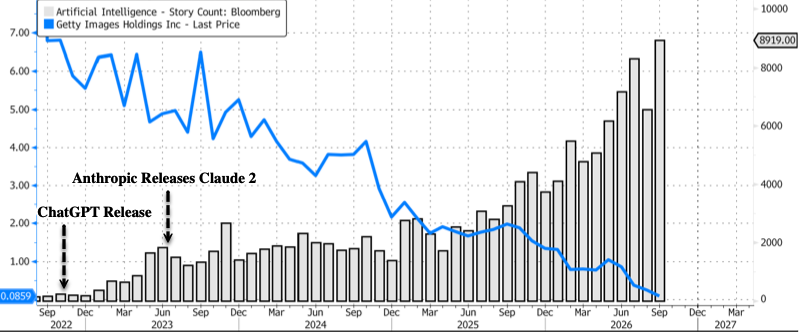
And now, Bloomberg reports that Getty plans to file for a prepackaged Chapter 11 restructuring in the coming weeks after securing support from major creditors and commitments for up to $533 million in new equity.
Getty family members and Koch Equity Development affiliates will provide the equity investment as part of the restructuring support agreement. The company expects to complete the restructuring by year-end.
The outlet noted that holders representing 83.5% of Getty’s unsecured bonds have agreed to retire $270 million of outstanding senior unsecured notes, reducing the company’s debt burden.
Investors holding about 89% of its secured bonds and term loans, along with all revolving credit facility lenders, have agreed to lower interest obligations and extend secured debt maturities.
The new deal will let Getty keep afloat, backed by $143 million in financing… but for how long?

Beyond Getty, Shutterstock has likely felt the pain from AI-generated images and video, which could replace stock-content purchases and pressure licensing prices. Adobe Stock also faces substitution risk.
GREG HUNTER….INTERVIEWING ALEX NEWMAN..
Burning Man is High Tech Satan Worship – Alex Newman
By Greg Hunter On October 10, 2026 In Market Analysis, Political Analysis44 Comments

By Greg Hunter’s USAWatchdog.com (Saturday Night Post)
Journalist Alex Newman is back from going undercover at the infamous annual “Burning Man” gathering in the Nevada desert from August 30 to September 7. You may think this is simply a gathering of rowdy hippies, but it is so much more and downright demonic. The people who attend are a who’s who of top global leaders in all categories, including the most important cutting-edge tech executives. Newman says, “It is definitely pagan worship. It is worse than anyone can imagine. There are literally naked people dancing around the fire. They get into orgies. There are kids watching some of this. There are naked kids running around. It all revolves around the effigy of a man that they build. The guy who started Burning Man, Larry Harvey, apparently watched a movie called Wicker Man, which is an old pagan tradition . . . where they stuff it full of people and offer this as a human sacrifice. . .. As it is burning, there are these dust devils that come out, and these are worshiped by some as spirits. There are people channeling demons there. There are people openly talking about using hallucinogenic drugs to communicate with these spiritual entities.”
Newman is an expert on the so-called Deep State. He is the author of the longtime popular book “Deep State” and, most recently, “Deep State 2.0.” The Deep State is not a conspiracy theory. It is a conspiracy fact. This year, as in every year, the Deep State participated in Burning Man in a big way. Newman explains, “You have all the leaders of Big Tech. You have Jeff Bezos, Elon Musk, Mark Zuckerberg. Sam Altman goes there and talks about how he takes magic mushrooms. You have all these guys. Then you have Ray Dalio, the CEO of the biggest hedge fund. You’ve got Jared Kushner’s brother Josh. You have the former Supreme Allied Commander of NATO, General Wesley Clark, and all of these incredibly powerful people at Burning Man. You have celebrities like Will Smith, P Diddy, Katie Perry all gathering at this thing. There are orgy domes. There are orgy buses. There is every kind of depravity you can imagine like Old Testament stuff. . .. By their own admission, what they say is they are building a new culture to supplant the old one, which is Christianity. Right now, they can’t pull this off, but they say when the right crisis hits and there is enough pain, the impossible will become the inevitable. So, Burning Man is like the mother ship, and they have these festivals all over the world.”
Newman goes on to say, “The people who are running these technology companies are increasingly running governments, increasingly making culture and increasingly making decisions for you. The people who are writing these algorithms are the people deeply involved in this neopagan diabolical culture.”
In closing, Newman contends the Burning Man event is so big that the temporary airport built in the Nevada desert becomes the busiest in the world during the week of the Burning Man festival. Newman says, “We are going to see the emergence of one world religion, the externalization of the spiritual hierarchy and all of humanity inducted into this. I think Burning Man is the tip of the spear of this movement. We are already starting to see it. You turn on the Super Bowl, you turn on the Grammys, you turn on the Olympics and you are literally watching satanic ceremonies. You are watching guys with devil horns and fire chanting about satan.”
There is much more in the 48-minute interview.
There is an 8-minute video to explain how easy it is to ride out any terror attack or extreme weather. You can get more information on Sat phones and backup battery power at Sat123.com. You can get all the information on Starlink “Mini” here. You can get all the new Faraday bags and clothing at DarkBags.com. You can also call 855-980-5830 and talk to a real human. Same goes for EscapeZone.com where you can get Faraday bags big and small, and the newest Faraday clothing. You can also talk to a real human at EscapeZone.com by calling 702-825-0005.
Join Greg Hunter of USAWatchdog as he goes one-on-one with hard-hitting journalist Alex Newman to talk about his eye-opening Burning Man undercover trip that ties top leaders of all walks of life together into the Deep State. We talk to Newman about what he saw and how this relates to his popular book called “Deep State 2.0” for 10.10.26.
After the Interview:https://usawatchdog.com/burning-man-is-high-tech-satan-worship-alex-newman/
To order “Deep State 2.0” click here.
To order “Indoctrinating Our Children to Death,” click here
To support Alex Newman with electronic donations, click here.
There is lots of free information and articles on Newman’s website called LibertySentinel.org.
(Please support the people who risk it all to bring you the truth.)
You can also use snail mail for donations to Newman below:
Liberty Sentinel Media, Inc.
11767 S. Dixie Hwy #336
Pinecrest, FL 33156


