
EXCHANGE: COMEX
CONTRACT: OCTOBER 2026 COMEX 100 GOLD FUTURES
SETTLEMENT: 4,165.800000000 USD
INTENT DATE: 10/12/2026 DELIVERY DATE: 10/14/2026
FIRM ORG FIRM NAME ISSUED STOPPED
152 C DORMAN TRADING, LLC 3
363 H WELLS FARGO SECURITI 41
661 C JP MORGAN SECURITIES 3
737 C ADVANTAGE FUTURES 41
TOTAL: 44 44
GOLD: NUMBER OF NOTICES FILED FOR OCT./2026: 44 CONTRACTs NOTICES FOR 4,400 OZ or 0.1368 TONNES
total notices so far: 12,511 contracts FOR 1,251,100 OZ OR 38.914 TONNES
SILVER NOTICES: 4 NOTICE(S) FILED FOR 20,000 OZ /
total number of notices filed so far this month : 3130 CONTRACTS (NOTICES) for 15.650 million oz
GLD
SHANGHAI CLOSED UP 3.62 PTS OR 0.10%
HANG SENG CLOSED UP 37.30 PTS OR 0.13%
Nikkei CLOSED DOWN 1160.92 PTS OR 1.68%
//Australia’s all ordinaries CLOSED UP 0.36%
//Chinese yuan (ONSHORE) CLOSED DOWN AT 6.6947
/ OFFSHORE CLOSED DOWN AT 6.6946 Oil UP TO 91.87 dollars per barrel for WTI and BRENT DOWN TO 105.10 Stocks in Europe OPENED ALL GREEN
ONSHORE USA/ YUAN// WITH YUAN TRADING 6.6947 OFFSHORE YUAN TRADING DOWN TO 6.6946 ONSHORE YUAN TRADING BELOW LEVEL // OFF SHORE AND DOWN ON THE DOLLAR)// / AND THUS WEAKER/OFF SHORE YUAN TRADING DOWN AGAINST US DOLLAR/ AND THUS WEAKER
| Gold | Ounces |
| Withdrawals from Dealers Inventory in oz | nil |
| Withdrawals from Customer Inventory in oz | 2 ENTRIES i) Into Brinks 128.604 oz (5 kilobars) ii) Into Manfra: 32.151 oz (one kilobar) total withdrawal: 160.755 oz |
| Deposit to theDealerInventory in oz | 0 ENTRIES |
| Deposits to the Customer Inventory, in oz | DEPOSITS/CUSTOMER//gold 0 ENTRIES xxxxxxxxxxxxxxxx |
| No of oz served (contracts) today | 44 CONTRACTS 4400 OZ 0.1368 TONNES OF GOLD |
| No of oz to be served (notices) | 86 Contracts 8600 OZ 0.2674 TONNES |
| Total monthly oz gold served (contracts) so far this month | 12,511 notices 1,251,100 OZ 38.914 TONNES |
| Total accumulative withdrawals of gold from the Dealers inventory this month | NIL oz |
| Total accumulative withdrawal of gold from the Customer inventory this month |
dealer deposits: 0
xxxxxxxxxxxxxxxxxxx
DEPOSITS:
ENTRIES: 0
xxxxxxxxxxxxxxxxxx
comex withdrawal
2 ENTRIES
2 ENTRIES
i) Into Brinks 128.604 oz
(5 kilobars)
ii) Into Manfra: 32.151 oz
(one kilobar)
total withdrawal: 160.755 oz
adjustments: 1
JPMorgan: dealer to customer:
16,493.463 ooz
COMEX IS DRAINING GOLD
chaos inside the comex
THE FRONT MONTH OF OCT OI STANDS AT 130 CONTRACTS HAVING A LOSS OF 93 CONTRACTS.
MONDAY WE HAD A NORMAL DELIVERY OF 1,255,300 OZ ( 39.045 TONNES) OF GOLD STANDING FOR DELIVERY: TODAY: 1,259,700 OZ OR 39.1819 TONNES FOR A GAIN OF 4400 OZ (0.1368 TONNES) OR 44 CONTRACTS UNDERWENT A QUEUE JUMP FOR 4400 OZ (.1368TONNES) AS THEY SEEK PHYSICAL GOLD ON THIS SIDE OF THE POND.
NOVEMBER LOST 103 CONTRACTS FALLING TO 3890
DECEMBER, THE LARGEST DELIVERY MONTH IN THE CALENDAR, ITS OI FALLS BY 793 CONTRACTS DOWN TO 318,390.
.
We had 44 contracts filed for today representing 4,400 oz
Today, 0 notice(s) were issued from J.P.Morgan dealer and 0 notices issued from their client or customer account. The total of all issuance by all participants equate to 44 contract(s) of which 0 notices were stopped (received) by j.P. Morgan dealer and 3 notice(s) was (were) stopped (received) by J.P.Morgan//customer account
To calculate the INITIAL total number of gold ounces standing for OCT /2026. contract month, we take the total number of notices filed so far for the month (12,511) to which we add the difference between the open interest for the front month of OCT (130 CONTRACTS) minus the number of notices served upon today 44 x 100 oz per contract) equals 1,259,700 OZ OR(39.1819 Tonnes of gold) to which we add our first exchange for risk in Oct totalling 836 contracts for 83,600 oz or 2.600 tonnes. Thus Oct standing for gold advances hugely to 41.7819 tonnes
THUS: INITIAL total number of gold ounces standing for OCT. /2026. contract month,we take the total number of notices filed so far for the month (12,511) to which we add the difference between the open interest for the front month of OCT(130) contracts minus the number of notices served upon today 44 x 100 oz per contract) equals 1,259,700 OZ OR(39.045 Tonnes of gold) plus our first exchange for risk totalling 836 contracts//83600 oz//2.600 tonnes//standing advances to 41.7819 tonnes
new total of gold standing in OCT becomes 41.7819 TONNES//
TOTAL COMEX GOLD STANDING FOR OCT.: 41.7819 TONNES WHICH IS NOW VERY STRONG FOR THIS NON ACTIVE DELIVERY MONTH OF OCT./
MONDAY VOLUME: 115,751 POOR
COMEX GOLD INVENTORIES/CLASSIFICATION
NEW PLEDGED GOLD:
241,794.285 oz NOW PLEDGED /HSBC 5.94 TONNES
204,937.290 OZ PLEDGED MANFRA 3.08 TONNES
83,657.582 PLEDGED JPMorgan no 1 1.690 tonnes
265,999.054, oz JPM No 2
1,152,376.639 oz pledged Brinks/
Manfra: 33,758.550 oz
Delaware: 193.721 oz
International Delaware:: 11,188.542 oz
total pledged gold: 1,721,684.952 oz 53.55 tonnes pledged gold lowers
total inventories in gold declining rapidly
total pledged gold: 1,721,684.952 tonnes oz 53.55 tonnes
TOTAL OF ALL GOLD ELIGIBLE AND REGISTERED GOLD 23,477,110.750oz//
TOTAL REGISTERED GOLD 15,050,647.563 tonnes (468.13 tonnes)
TOTAL OF ALL ELIGIBLE GOLD 8,426,423.187 oz.
REGISTERED GOLD THAT CAN BE SERVED UPON 13,328,963oz ((REG GOLD- PLEDGED GOLD)=
414.586 Tonnes //
total inventories in gold declining rapidly
SILVER COMEX
OCT DELIVERY MONTH
OCT 13
| Silver | Ounces |
| Withdrawals from Dealers Inventory | NIL oz |
| Withdrawals from Customer Inventory | 3 entries i) Out of Asahi 29,560.280 oz. ii) Out of CNT 32,366.560 OZ iii) Out of Delaware 8806.890 oz total withdrawal 793,733.390oz |
| Deposits to the Dealer Inventory | 1 ENTRY IntoAsahi dealer: 593,775.992 oz total deposit: 593,775.992 oz |
| Deposits to the Customer Inventory | ENTRIES: 2 i) Into Asahi: 409,482.400 oz ii) Into Loomis: 409,482.400 total deposit: 1,610,322.290 oz |
| No of oz served today (contracts) | 4 CONTRACT(S) ( 20,000 OZ) |
| No of oz to be served (notices) | 365 Contracts (1.825 MILLION oz) |
| Total monthly oz silver served (contracts) | 3130 contracts 15.650 MILLIONoz |
| Total accumulative withdrawal of silver from the Dealers inventory this month | NIL oz |
| Total accumulative withdrawal of silver from the Customer inventory this month |
DEPOSITS INTO DEALER ACCOUNTS
ENTRY:1
i) IntoAsahi dealer: 593,775.992 oz
total deposit: 593,775.992 oz
DEPOSIT ENTRIES/CUSTOMER ACCOUNT
2 ENTRIES:
i) Into Asahi: 409,482.400 oz
ii) Into Loomis: 409,482.400
total deposit: 1,610,322.290 oz
xxxxxxxxxxxxxxxxxxxxxxxxx
withdrawals:
3 entries
i) Out of Asahi 29,560.280 oz.
ii) Out of CNT 32,366.560 OZ
iii) Out of Delaware 8806.890 oz
total withdrawal 793,733.390oz
adjustments : 0
xxxxxxxxxxxxxx
TOTAL REGISTERED SILVER: 103.351 MILLION OZ//.TOTAL REG + ELIGIBLE. 332.007 Million oz
registered silver dropping in numbers
CALCULATIONS FOR THE NEW STANDING FOR SILVER FOR OCT
FRONT MONTH: SILVER OPEN INTEREST CONTRACTS: 369 FOR A LOSS OF 1 CONTRACT. MONDAY WE HAD 17.475 MILLION OZ STAND: TODAY: 17.475 MILLION OZ FOR A GAIN OF 0 OZ (0 CONTRACTS). THUS A ZERO QUEUE JUMP WHERE NOBODY WILL TAKE DELIVERY ON THIS SIDE ON THE POND.
NOVEMBER GAINED 8 CONTRACTS UP TO AN OI OF 2083
DECEMBER LOST 111 CONTRACTS DOWN TO AN OI OF 82,391
TOTAL NUMBER OF NOTICES FILED FOR TODAY: 4 or 20,000 oz
CONFIRMED volume MONDAY; 26,872 // poor/
AND NOW OCT. DELIVERIES:
To calculate the number of silver ounces that will stand for delivery in OCT. we take the total number of notices filed for the month so far at 3130 X5,000 oz = 15.650 MILLION oz.
Then we take the difference between the front month of OCT. and the number of notices filed for today x 5000 to give us our standing
Thus the standings for silver for the OCT 2026 contract month: (3130 )Notices served so far) x 5000 oz + OI for the front month of OCT (369) minus number of notices served upon today ( 4 x 5000 oz) equals silver standing for the OCT .contract month equating to 17.475 MILLION OZ to which we add silver’s TWO exchange for risk for 450 contracts (2.25 million oz).. total standing reduces to 19.725 million oz//. ( a very strong delivery month)
We must also keep in mind that there is considerable silver standing in London coming from our longs
There are ONLY 103.351 million oz of registered silver
JPMorgan as a percentage of total silver: 125.510/332.007 million: 37.65%
The record level of silver open interest is 234,787 contracts set on April 21./2017 with the price on that day at $18.42.
The previous record was 224,540 contracts with the price at that time of $20.44.
BOTH GLD AND SLV ARE MASSIVE FRAUD
XXXXXXXXXXXXXXXXXXXXXXXXXXXXXXXXXXXXXXXXXXX
OCT 13//2026/WITH GOLD DOWN $13.25 /HUGE CHANGES IN GOLD AT THE GLD: A DEPOSIT OF OF 2.281TONNES OF GOLD INTO THE THE GLD//: //:/INVENTORY RESTS AT 1055.411 TONNES
OCT 12//2026/WITH GOLD DOWN $24.20 /HUGE CHANGES IN GOLD AT THE GLD: A WITHDRAWAL OF 2TONNES OF GOLD OUT OF THE GLD//: //:/INVENTORY RESTS AT 1053.13 TONNES
OCT 9//2026/WITH GOLD UP $60.00 /HUGE CHANGES IN GOLD AT THE GLD: A WITHDRAWAL OF 4.562 TONNES OF GOLD OUT OF THE GLD//: //:/INVENTORY RESTS AT 1055.411 TONNES
OCT 8//2026/WITH GOLD UP $16.85 /HUGE CHANGES IN GOLD AT THE GLD: A DEPOSIT OF 3.703 TONNES OF GOLD INTO THE GLD//: //:/INVENTORY RESTS AT 1059.873 TONNES
OCT 7//2026/WITH GOLD DOWN $46.70 /NO CHANGES IN GOLD AT THE GLD:: //:/INVENTORY RESTS AT 1056.27 TONNES
OCT 6//2026/WITH GOLD UP $30.60 /HUGE CHANGES IN GOLD AT THE GLD:: A DEPOSIT OF 0.754 TONNES OF GOLD INTO THE GLD// //:/INVENTORY RESTS AT 1056.27 TONNES
OCT 5//2026/WITH GOLD DOWN $2.20 /HUGE CHANGES IN GOLD AT THE GLD:: A WITHDRAWAL OF 0.854 TONNES OF GOLD INTO THE GLD// //:/INVENTORY RESTS AT 1055.696 TONNES
OCT 2//2026/WITH GOLD DOWN $43.00 /HUGE CHANGES IN GOLD AT THE GLD:: A DEPOSIT OF 0.854 TONNES OF GOLD INTO THE GLD// //:/INVENTORY RESTS AT 1056.55 TONNES
OCT 1//2026/WITH GOLD UP $19.55 /HUGE CHANGES IN GOLD AT THE GLD:: A WITHDRAWAL OF 1.711 TONNES OF GOLD OUT OF THE GLD// //:/INVENTORY RESTS AT 1055.696 TONNES
SEPT 30//2026/WITH GOLD UP $7.80 /HUGE CHANGES IN GOLD AT THE GLD:: A DEPOSIT OF 2.847 TONNES OF GOLD INTO THE GLD// //:/INVENTORY RESTS AT 1057.407 TONNES
SEPT 29//2026/WITH GOLD UP $11.75 /NO CHANGES IN GOLD AT THE GLD //:/INVENTORY RESTS AT 1054.56 TONNES
SEPT 28//2026/WITH GOLD DOWN $150.20 /NO CHANGES IN GOLD AT THE GLD //:/INVENTORY RESTS AT 1054.56 TONNES
SEPT 25//2026/WITH GOLD DOWN $150.20 /NO CHANGES IN GOLD AT THE GLD //:/INVENTORY RESTS AT 1054.56 TONNES
SEPT 24//2026/WITH GOLD DOWN $18.70 /HUGE CHANGES IN GOLD AT THE GLD A DEPOSIT OF 1.43 TONNES OF GOLD INTO THE GLD://:/INVENTORY RESTS AT 1056.84 TONNES
SEPT 23//2026/WITH GOLD DOWN $58.00 /HUGE CHANGES IN GOLD AT THE GLD://:/INVENTORY RESTS AT 1055.41 TONNES
SEPT 22//2026/WITH GOLD DOWN $6.30 /HUGE CHANGES IN GOLD AT THE GLD://A DEPOSIT OF 0.31 TONNES OF GOLD INTO THE GLD/:/INVENTORY RESTS AT 1055.41 TONNES
SEPT 21//2026/WITH GOLD DOWN $41.20 /HUGE CHANGES IN GOLD AT THE GLD://A DEPOSIT OF 2.26 TONNES OF GOLD INTO THE GLD/:/INVENTORY RESTS AT 1055.10 TONNES
SEPT 18//2026/WITH GOLD UP $26.45 /HUGE CHANGES IN GOLD AT THE GLD://A DEPOSIT OF 0.85 TONNES OF GOLD INTO THE GLD/:/INVENTORY RESTS AT 1052.84 TONNES
SEPT 17//2026/WITH GOLD UP $14.05 /HUGE CHANGES IN GOLD AT THE GLD://A DEPOSIT OF 1.71 TONNES OF GOLD INOT THE GLD/:/INVENTORY RESTS AT 1051.99 TONNES
SEPT 16//2026/WITH GOLD UP $53.40 /HUGE CHANGES IN GOLD AT THE GLD://A DEPOSIT OF 2.86 TONNES OF GOLD INOT THE GLD/:/INVENTORY RESTS AT 1050.28 TONNES
SEPT 15//2026/WITH GOLD DOWN $19.45 /NO CHANGES IN GOLD AT THE GLD://A WITHDRAWAL OF 0.353 TONNES OF GOLD FROM THE GLD/:/INVENTORY RESTS AT 1047.420 TONNES
SEPT 14//2026/WITH GOLD DOWN $54.50 /SMALL CHANGES IN GOLD AT THE GLD://A WITHDRAWAL OF 0.353 TONNES OF GOLD FROM THE GLD/:/INVENTORY RESTS AT 1047.420 TONNES
SEPT 11//2026/WITH GOLD UP $1.05 /SMALL CHANGES IN GOLD AT THE GLD://A WITHDRAWAL OF 0.353 TONNES OF GOLD FROM THE GLD/:/INVENTORY RESTS AT 1050.277 TONNES
/SEPT 10//2026/WITH GOLD UP $50.60 /NO CHANGES IN GOLD AT THE GLD://:/INVENTORY RESTS AT 1050.63 TONNES
SEPT 9//2026/WITH GOLD UP $20.40 /HUGE CHANGES IN GOLD AT THE GLD:A WITHDRAWAL OF 1.43 TONNES OF GOLD OUT OF THE GLD/ ////:/INVENTORY RESTS AT 1050.63 TONNES
SEPT 8//2026/WITH GOLD DOWN $34.20 /HUGE CHANGES IN GOLD AT THE GLD:A WITHDRAWAL OF 1.42 TONNES OF GOLD OUT OF THE GLD/ ////:/INVENTORY RESTS AT 1052.06 TONNES
SEPT 4//2026/WITH GOLD DOWN $63.50 /HUGE CHANGES IN GOLD AT THE GLD:A WITHDRAWAL OF 3.14 TONNES OF GOLD OUT OF THE GLD/ ////:/INVENTORY RESTS AT 1053.48 TONNES
SEPT 3//2026/WITH GOLD UP $141.55 /HUGE CHANGES IN GOLD AT THE GLD:A DEPOSIT OF 9.98 TONNES OF GOLD INTO THE GLD/ ////:/INVENTORY RESTS AT 1056.62 TONNES
SEPT 2//2026/WITH GOLD UP $19.25 /HUGE CHANGES IN GOLD AT THE GLD:A DEPOSIT OF 4.28 TONNES OF GOLD INTO THE GLD/ ////:/INVENTORY RESTS AT 1046.64 TONNES
SEPT 1//2026/WITH GOLD DOWN $80.25 /NO CHANGES IN GOLD AT THE GLD:// ////:/INVENTORY RESTS AT 1042.36 TONNES
GLD INVENTORY: 1055.411 TONNES, TONIGHTS TOTAL GOLD INVENTORY
SILVER
OCT 13 WITH SILVER DOWN $0.97 : :HUGE CHANGES A DEPOSIT OF 722,000 OZ INTO THE SLV// // :INVENTORY RESTS AT 493.948 MILLION OZ
OCT 12 WITH SILVER DOWN $0.51 : :HUGE CHANGES A DEPOSIT OF 722,000 OZ INTO THE SLV// // :INVENTORY RESTS AT 493.948 MILLION OZ
OCT 9 WITH SILVER UP $0.62 : :SMALL CHANGES A DEPOSIT OF 948,000 OZ INTO THE SLV// // :INVENTORY RESTS AT 493.226 MILLION OZ
OCT 8 WITH SILVER DOWN $0.74 : :SMALL CHANGES IN INVENTORY AT THE SLV:A WITHDRAWAL OF 532,000 OZ FROM THE SLV// // :INVENTORY RESTS AT 492.278 MILLION OZ
OCT 7 WITH SILVER DOWN $1.36 : :SMALL CHANGES IN INVENTORY AT THE SLV:A WITHDRAWAL OF 451,000 OZ FROM THE SLV// // :INVENTORY RESTS AT 492.910 MILLION OZ
OCT 6 WITH SILVER UP $0.31 : :NO CHANGES IN INVENTORY AT THE SLV: // :INVENTORY RESTS AT 493.361 MILLION OZ
OCT 5 WITH SILVER UP $0.87 : :NO CHANGES IN INVENTORY AT THE SLV: // :INVENTORY RESTS AT 493.361 MILLION OZ
OCT 2 WITH SILVER DOWN $0.74 : :NO CHANGES IN INVENTORY AT THE SLV: // :INVENTORY RESTS AT 493.578 MILLION OZ
OCT 1 WITH SILVER UP $0.57 : :HUGE CHANGES IN INVENTORY AT THE SLV: A WITHDRAWAL OF 1.400 MILLION OZ OUT OF THE SLV// :INVENTORY RESTS AT 493.578 MILLION OZ
SEPT 30 WITH SILVER DOWN $0.55 : :HUGE CHANGES IN INVENTORY AT THE SLV: A DEPOSIT OF 994,000 OZ INTO THE SLV// :INVENTORY RESTS AT 494.978 MILLION OZ
SEPT 29 WITH SILVER DOWN $0.58 : :SMALL CHANGES IN INVENTORY AT THE SLV: A WITHDRAWAL OF 566,000 OZ FROM THE SLV// :INVENTORY RESTS AT 493.984 MILLION OZ
SEPT 28 WITH SILVER DOWN $2.91 : :SMALL CHANGES IN INVENTORY AT THE SLV: A DEPOSIT OF 0.542 MILLION OZ FROM THE SLV// :INVENTORY RESTS AT 494.436 MILLION OZ
SEPT 25 WITH SILVER DOWN $2.91 : :SMALL CHANGES IN INVENTORY AT THE SLV: A DEPOSIT OF 0.542 MILLION OZ FROM THE SLV// :INVENTORY RESTS AT 494.436 MILLION OZ
SEPT 24 WITH SILVER DOWN $0.96 : :HUGE CHANGES IN INVENTORY AT THE SLV: A WITHDRAWAL OF 0.813 MILLION OZ FROM THE SLV// :INVENTORY RESTS AT 493.533 MILLION OZ
SEPT 23 WITH SILVER UP $1.58 : :HUGE CHANGES IN INVENTORY AT THE SLV: A WITHDRAWAL OF 1.716 MILLION OZ FROM THE SLV// :INVENTORY RESTS AT 494.346 MILLION OZ
SEPT 22 WITH SILVER UP $0.10 : :NO CHANGES IN INVENTORY AT THE SLV: :INVENTORY RESTS AT 496.062 MILLION OZ
SEPT 21 WITH SILVER UP $1.04 : :HUGE CHANGES IN INVENTORY AT THE SLV: :INVENTORY RESTS AT 489.558 MILLION OZ
SEPT 18 WITH SILVER UP $1.04 : :NO CHANGES IN INVENTORY AT THE SLV: :INVENTORY RESTS AT 489.558 MILLION OZ
SEPT 17 WITH SILVER UP $1.10 : :HUGE CHANGES IN INVENTORY AT THE SLV: A WITHDRAWAL OF 1.265 MILLION OZ FROM THE SLV/ :INVENTORY RESTS AT 489.558 MILLION OZ
SEPT 16 WITH SILVER UP $0.95 : :HUGE CHANGES IN INVENTORY AT THE SLV: A WITHDRAWAL OF 813,000 OZ FROM THE SLV/ :INVENTORY RESTS AT 490.823 MILLION OZ
SEPT 15 WITH SILVER DOWN $0.16 : :HUGE CHANGES IN INVENTORY AT THE SLV: A WITHDRAWAL OF 813,000 OZ FROM THE SLV/ :INVENTORY RESTS AT 491.636 MILLION OZ
SEPT 14 WITH SILVER DOWN $0.91 : :NO CHANGES IN INVENTORY AT THE SLV:/ :INVENTORY RESTS AT 492.449 MILLION OZ
SEPT 11 WITH SILVER DOWN $3.50 : :NO CHANGES IN INVENTORY AT THE SLV:/ :INVENTORY RESTS AT 492.449 MILLION OZ
SEPT 10 WITH SILVER DOWN $3.50 : :NO CHANGES IN INVENTORY AT THE SLV:// / :INVENTORY RESTS AT 493.171 MILLION OZ
SEPT 9 WITH SILVER UP $0.56 : :NO CHANGES IN INVENTORY AT THE SLV:// / :INVENTORY RESTS AT 493.171 MILLION OZ
SEPT 8 WITH SILVER UP $0.31 : :HUGE CHANGES IN INVENTORY AT THE SLV:/ A DEPOSIT OF 0.632 MILLION OZ INTO THE SLV// / :INVENTORY RESTS AT 493.171 MILLION OZ
SEPT 4 WITH SILVER UP $2.20 : :NO CHANGES IN INVENTORY AT THE SLV:/// / :INVENTORY RESTS AT 492.539 MILLION OZ
SEPT 3 WITH SILVER UP $2.20 : :HUGE CHANGES IN INVENTORY AT THE SLV:A WITHDRAWAL OF 1.293 MILLION OZ FROM THE SLV//// / :INVENTORY RESTS AT 492.539 MILLION OZ
SEPT2 WITH SILVER UP $0.15 : :NO CHANGES IN INVENTORY AT THE SLV:// / :INVENTORY RESTS AT 493.832 MILLION OZ
SEPT1 WITH SILVER DOWN $1.43 : :NO CHANGES IN INVENTORY AT THE SLV:// / :INVENTORY RESTS AT 493.832 MILLION OZ
CLOSING INVENTORY 493.948 MILLION OZ OF SILVER
GOLD COMMENTARIES:
1.PETER SCHIFF//JOHN RUBINO//RAVEN
1 B // JAMES RICKARDS/MATHEW PIEPENBURG/ALASDAIR MACLEOD..
ALASDAIR MACLEOD…
3. CHRIS POWELL AND HIS GATA DISPATCHES
4. ANDREW MAGUIRE//KINESIS LIVE FROM THE VAULT/293
 | |||
5. COMMODITY REPORT //URANIUM
Russia Still Has a Chokehold on the World’s Biggest Uranium Supplier

by Asymmetric Research
Tuesday, Oct 13, 2026 – 5:43
Last week, Kazatomprom’s (KAP) shareholders did not approve the proposed contract to supply natural uranium as U₃O₈ to Russia’s Uranium One Group, part of state-owned nuclear firm Rosatom. Only 5% voted in favour and 88% abstained, meaning the proposal failed to secure the simple majority required. The abstentions have evidently come primarily from KAP’s majority shareholder, the Kazakh state (75%).
By contrast, shareholders approved a spot-term contract to buy and sell natural uranium concentrates with China’s State Nuclear Uranium Resource Development Company. In its August EGM notice, KAP stated that the volumes and delivery schedules for both contracts could not be disclosed for confidentiality reasons, at the insistence of the respective counterparties.
Historically, KAP has brought major contracts to a shareholder vote where their value exceeded 50% of book value. With book value at approximately US$5bn, this would suggest a transaction value of US$2.5bn or more, although we understand this could represent the aggregate value of both contracts rather than either contract individually. If we assume a ten-year duration, the implied volumes associated with the Russian contract could be in the region of 1-2Mlbs per year. This is our own rough estimate and remains speculative, given that the actual contract value, duration and volumes have not been disclosed.
Unless this situation is resolved in some form, it is difficult to see how Kazakhstan could secure or benefit from a waiver to Russia’s ban on sulphuric acid exports, which remains in place until year-end. Our previous view was that the ban was unlikely to affect KAP, precisely because a deal of this scale would presumably have required the necessary arrangements to be in place.
Recall that we estimated that, if the ban were to affect KAP, the company could face a production shortfall of approximately 3Mlbs in 2027: bullish.
KAP and Kazakh sulphuric acid requirements, and estimated Russian freeze impact

Source: Asymmetric Research, inbusiness.kz, Kursiv Media
Where the uranium equities now screen on valuation

[…]
We think this has real consequences for Kazakh supply, for the uranium equities and for the uranium price. The models, the valuation work and our positioning are available to subscribers. Full note on Asymmetric Research: asymmetricresearch.substack.com
END
YOUR EARLY CURRENCY VALUES/GOLD AND SILVER PRICING/ASIAN AND EUROPEAN BOURSE MOVEMENTS/AND INTEREST RATE SETTINGS TUESDAY MORNING.7:30 AM
SHANGHAI CLOSED UP 3.62 PTS OR 0.10%
HANG SENG CLOSED UP 37.30 PTS OR 0.13%
Nikkei CLOSED DOWN 1160.92 PTS OR 1.68%
//Australia’s all ordinaries CLOSED UP 0.36%
//Chinese yuan (ONSHORE) CLOSED DOWN AT 6.6947
/ OFFSHORE CLOSED DOWN AT 6.6946 Oil UP TO 91.87 dollars per barrel for WTI and BRENT DOWN TO 105.10 Stocks in Europe OPENED ALL GREEN
ONSHORE USA/ YUAN// WITH YUAN TRADING 6.6947 OFFSHORE YUAN TRADING DOWN TO 6.6946 ONSHORE YUAN TRADING BELOW LEVEL // OFF SHORE AND DOWN ON THE DOLLAR)// / AND THUS WEAKER/OFF SHORE YUAN TRADING DOWN AGAINST US DOLLAR/ AND THUS WEAKER
XXXXXXXXXXXXXXXXXXXXXXXXXXXXXXXXXXXXX
ONSHORE YUAN: CLOSED DOWN TO 6.6947
OFFSHORE YUAN: DOWN TO 6.6946
1A.HANG SANG CLOSED UP 37.20 PTS OR 0.13%
1 B. SHANGHAI CLOSED UP 3.62 PTS OR 0.10%
2. Nikkei closed DOWN 1190.92 PTS OR 1.68%
WEST TEXAS INTERMEDIATE OIL DOWN TO 91.87
BRENT; 105.10
3. Europe stocks SO FAR: ALL GREEN
USA dollar INDEX DOWN 26 BASIS PTS TO 102.12// EURO RISES TO 1.1181 UP 22 BASIS PTS
3b Japan 10 YR bond yield:RISES TO. +3.005 UP 1/5 FULL BASIS PTS/ VERY TROUBLESOME//Japan buying 100% of bond issuance)/Japanese YEN vs USA CROSS NOW AT 158.17… JAPANESE YEN NOW FALLING AS WE HAVE NOW REACHED THE ENDING OF THE YEN CARRY TRADE AGAIN AND THE REPATRIATION OF YEN DENOMINATED BONDS TRADING IN THE USA/EUROPE. JAPAN 30 YR BOND YIELD: 4.038 DOWN 2 FULL BASIS PTS
3c Nikkei now ABOVE 17,000
3d USA/Yen rate now well ABOVE the important 120 barrier this morning
3e Gold UP /JAPANESE Yen UP//CHINESE ONSHORE YUAN: DOWN (6.6947) AND OFFSHORE: DOWN AT 6.6946
3f Japan is to buy INFINITE TRILLION YEN worth of BONDS. Japan’s GDP equals 5 trillion USA. CENTRAL BANK OF JAPAN WILL NO LONGER DO QE.
Japan to buy 100% of all new Japanese debt and NOW they will have OVER 50% of all Japanese debt. GOVERMENT ASKED JAPAN PENSION FUNDS AND INSURANCE FUNDS TO BUY MORE JAPANESE BONDS AND REPATRIATE ALL FOREIGN BONDS.
3g Oil DOWN for WTI and DOWN for Brent this morning
3h European bond buying continues to push yields LOWER on all fronts in the EU German 10yr bund YIELD UP TO +3.4367/ Italian 10 Yr bond yield DOWN AT 4.537/ SPAIN 10 YR BOND YIELD DOWN TO 4.059%
3i Greek 10 year bond yield DOWN TO 4.3602%
3j Gold at $4188.80 /Silver at: 60.86 1 am est) SILVER NEXT RESISTANCE LEVEL AT $100.00
3k USA vs Russian rouble;// Russian rouble UP 0 AND 12/ 100 roubles/83.85
3m oil (WTI) into the 91 dollar handle for WTI and 105 handle for Brent/
3n Higher foreign deposits moving out of China// huge risk of outflows and a currency depreciation. This can spell financial disaster for the rest of the world/
JAPAN ON JAN 29.2016 CONTINUES NIRP. THIS MORNING RAISES AMOUNT OF BONDS THAT THEY WILL PURCHASE UP TO .5% ON THE 10 YR BOND///YEN TRADES TO 158.17 // 10 YEAR YIELD AFTER FIRST BREAKING .54% LAST YEAR NOW EXCEEDS THAT LEVEL TO 3.0050% DOWN 1/5 BASIS PTS STILL ON CENTRAL BANK (JAPAN) INTERVENTION//YEN CARRY TRADE NOW UNWINDING//YEN BOND TRADING OVERSEAS TO BE REPATRIATED.//JAPAN 30 YR: 4.038 DOWN 2 PTS..: USA/SF this 0.8331 as the Swiss Franc . Euro vs SF: 0.9316
USA 10 YR BOND YIELD: 5.193 DOWN 5 BASIS PTS…NOW ABOVE 5.00%
USA 30 YR BOND YIELD: 5.557 DOWN 4 BASIS PTS/REFUSES TO GO DOWN WITH BESSENT’S QE TWIST
USA 2 YR BOND YIELD: 4.766 DOWN 3 BASIS PTS
USA DOLLAR VS TURKISH LIRA: 49.37 UP 3 BASIS PTS/LIRA GETTING KILLED//IDIOTS FOR SELLING GOLD AND USA DOLLAR RESERVES.
10 YR UK BOND YIELD: 5.3984 DOWN 5 PTS
30 YR UK BOND YIELD: 5.8760 DOWN 5 BASIS PTS
10 YEAR FRENCH BOND YIELD; 4.833 % //UP 7 BASIS PTS
10 YR CANADA BOND YIELD: 3.878 DOWN 5 BASIS PTS
5 YR CANADA BOND YIELD: 3.546 DOWN 5 BASIS PTS.
1a New York Opening report
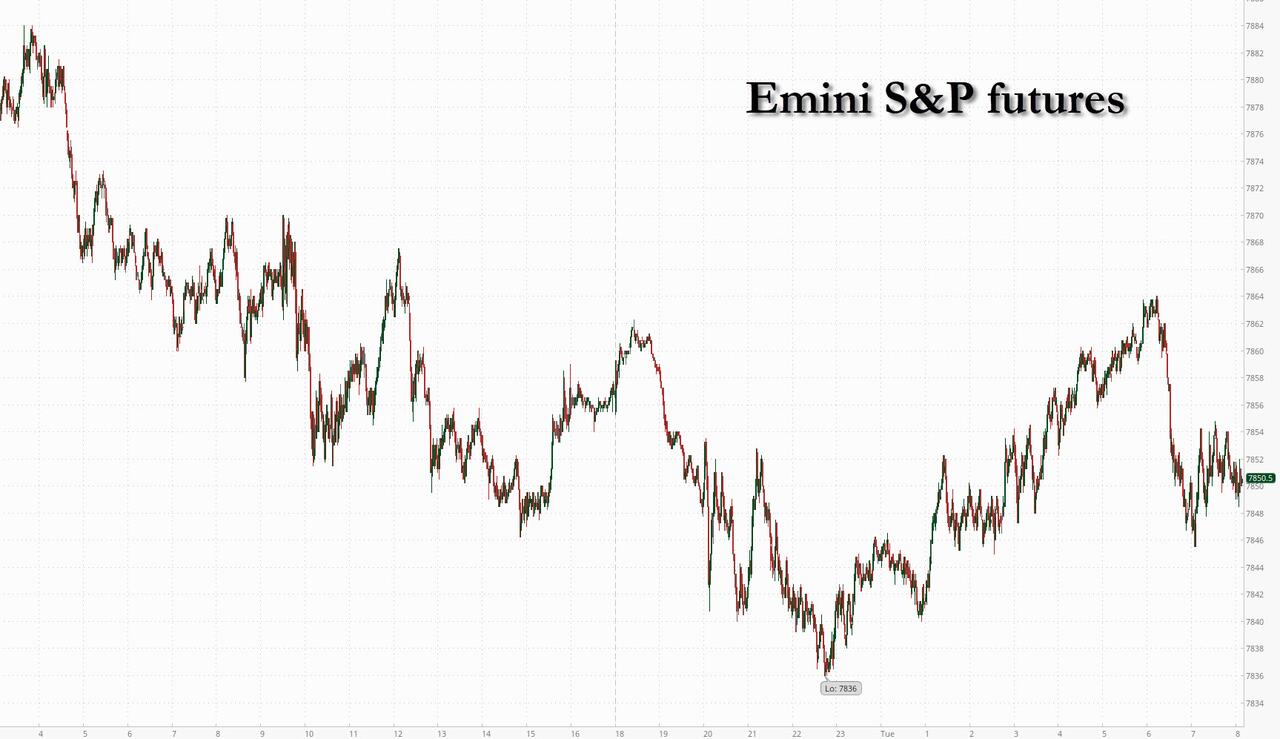
Nasdaq Futures Slide As AI “Casino” Hangover Crushes Kospi; S&P Flat After JPM FICC Miss
en
Tuesday, Oct 13, 2026 – 08:38 AM
US futures are mixed with the Nasdaq lagging as the AI rout that started on Wall Street on Monday ricocheted through Asia, where the Kospi crashed as much as 7% after Broadcom’s Hock Tan likened AI investing to a casino and China’s CXMT touted a denser memory chip design, while Q3 bank earnings kicked off with a FICC trading miss at JPMorgan; as a result, a flight to safety sent 10Y yields 5bps lower to 5.19% as cash Treasuries reopened after the holiday, while Brent slid back toward $105. As of 8:00am ET, S&P futures are down 0.1% around 7,850 while Nasdaq futures slide 0.7%, Dow futures are up 0.7% and Russell 2000 futures rise 0.3%. That follows a session in which the S&P dipped 0.1% and the Nasdaq 100 fell 0.7% on what was the lowest volume session in 23 years, with the SOX down 2.7% for its fourth straight decline even as two-thirds of S&P members rose. In premarket trading, memory names are getting hammered again (Western Digital -4.5%, Seagate -4.1%, Sandisk -3.7%, Micron -2.8%) and Nvidia is the worst of the Mag 7, down 0.9%, while JPMorgan is flat after FICC revenue of $5.37BN missed the $6BN estimate but the company guided NII higher; UnitedHealth rises 2.8% after raising its guidance. The day’s driver is AI angst (again): Hock Tan’s warning that financing the buildout, not chip supply, is the problem (as we discussed yesterday) was the spark, while CXMT’s progress on new DRAM architecture did the rest in Seoul, where Samsung and SK Hynix lost around 8% and 10%. Treasuries rallied, with yields down 2-5bps led by the 10Y, after Fed Governor Waller said the surge in long-term yields is doing some of the work of tighter policy, while bunds and gilts gained as lower energy prices eased inflation worries. The BBG dollar index is down 0.2%, snapping a four-session winning streak, and the yen leads G10 after a report that the BOJ is leaning against a back-to-back hike in October. In commodities, WTI is down about 1.5% near $92.3 and Brent is 1.7% lower to $104.6; gold rises 0.3% to around $4,190, silver is up 0.4% near $60.5 and copper is flat. Bitcoin regains $83,000. US economic data slate includes September NFIB small business optimism (already out: 97.9 vs est. 98.2), ADP weekly employment change (8:15am), September existing home sales (10am) and the September federal budget balance (2pm). Fed speaker slate includes Goolsbee (7am and 10am), Barkin (1pm) and Collins (4pm). The Treasury sells $95BN of 13-week and $82BN of 26-week bills at 11:30am and $95BN of 6-week bills at 1pm.
In premarket trading, Magnificent Seven stocks are mixed: Apple (AAPL) +0.7%, Microsoft (MSFT) +0.4%, Alphabet (GOOGL) +0.2%, Amazon (AMZN) -0.4%, Meta Platforms (META) -1.2%, Tesla (TSLA) -0.8%, Nvidia (NVDA) -0.7%
- Chemours Co. (CC) slips 1.6% after RBC Capital Markets cut its recommendation on the chemicals company to sector perform on lower demand.
- Domino’s Pizza (DPZ) drops 1.5% after the restaurant chain reported total domestic stores comp sales growth for the third quarter that missed the average analyst estimate.
- Enerflex’s US-listed shares (EFXT) rises 7% after the natural gas and petroleum producer said it received a contract award to design and assemble over one gigawatt of low emission behind-the-meter natural gas-fired power generation units for a large-scale North American data center.
- Johnson & Johnson (JNJ) slips 2% after the maker of pharmaceuticals and medical devices posted mixed sales for the third quarter. Revenue from the firm’s MedTech unit for the quarter fell short of the average analyst estimate.
- JPMorgan Chase (JPM) gains 1%, erasing an earlier loss, after the bank boosted its net interest income forecast for the full year. It also reported FICC sales & trading revenue that missed expectations.
- Syndax Pharmaceuticals (SNDX) plunges 10% after the biotech said a phase 2 trial of axatilimab failed to meet its primary endpoint of annualized rate of decline in forced vital capacity in a rare lung disease.
- UnitedHealth (UNH) rises 2% after the health insurer boosted its adjusted profit for the full year, following third-quarter results that were ahead of the average analyst estimate. Analysts view results as better than expected and are on watch for commentary on 2027 growth outlook during the earnings call.
- VF Corp. (VFC) is up 3% after Piper Sandler and Truist Securities upgrade the retailer to buy-equivalent ratings, noting the company’s Vans brand is at an inflection point.
- Viking Holdings (VIK) gains 3% as Barclays upgrades to overweight, noting that European river levels are back in recovery mode.
In other corporate news, JPMorgan kicked off bank earnings season with a miss where it hurts most in a volatile quarter: third-quarter FICC sales & trading revenue came in at $5.37 billion versus the $6 billion estimate, though the bank now sees full-year net interest income of about $106.2 billion, above the $105.28 billion estimate. JPMorgan and Goldman Sachs have taken a rare move to limit exposure on a $5 billion loan sale for AI startup Volta Infrastructure as investors demand higher yields for risky debt tied to the AI boom (good thing nobody is worried about AI financing). UnitedHealth raised its full-year adjusted EPS forecast to at least $20.50. Meta Platforms released its long-awaited Muse Wonder AI model, which its leadership says is on a par with OpenAI’s ChatGPT and Anthropic’s Claude on some functions. Microsoft is gearing up to install the latest version of its own chips in data centers, and Applied Materials expects to double revenue over the next few years without a commensurate rise in hiring. SentinelOne plans to offer $1.25 billion in convertible senior notes due 2031. Jio Platforms is said to have drawn more than $20 billion in bids for its IPO. In Europe, LVMH’s fashion and leather goods sales fell 5% organically, Crédit Agricole agreed to buy IKB Deutsche Industriebank from Lone Star, Nokia agreed to sell its Enterprise Campus Edge business to Aurelius, Monte Paschi rejected Intesa Sanpaolo’s improved takeover offer as not financially satisfactory, and UBS transferred £1.7 billion of UK pension assets to Legal & General.
The AI trade is unwinding again from the Nasdaq 100 to Seoul: a global slide in semiconductor stocks deepened overnight, sending the Kospi down more than 7% at one point as concerns about AI overheating and Chinese competition intensified. The trigger was Broadcom chief Hock Tan likening AI investing to a casino and warning that financing the buildout, not chip supply, is the problem, just days after Nvidia-backed Firmus’s offering collapsed; a report of progress at China’s CXMT on a new memory architecture did the rest. The AI trade is splitting into model makers and the capex chain: Meta rose after releasing Muse Wonder even as the Philly semi index fell for a fourth straight session. US futures are attempting to shrug it off — S&P contracts recovered to roughly flat by 5:45am — and the next inflection point comes via the busy slate of pre-market bank earnings, with the KBW bank index down around 12% from its August peak (we previewed the big bank prints here).
“Memory names are under pressure from a rise in Chinese competition and an increasing number of voices in the industry warning of a bubble,” said Bank J Safra Sarasin’s von Rotberg. “The volatility in the tech trade makes a confirmation of hyperscaler capex guidance ever more important.”
Still, markets keep doing what they’re not supposed to: the S&P sits within a whisker of its record high on the lowest volume in 23 years, while underneath the surface Goldman finds an extraordinary flight to quality not seen since Covid, and the median S&P stock trades 15% below its 52-week high. And while the AI financing angst grows (Oracle is now trucking natural gas to its data centers), JPMorgan and Goldman are capping their exposure on a $5 billion AI infrastructure loan.
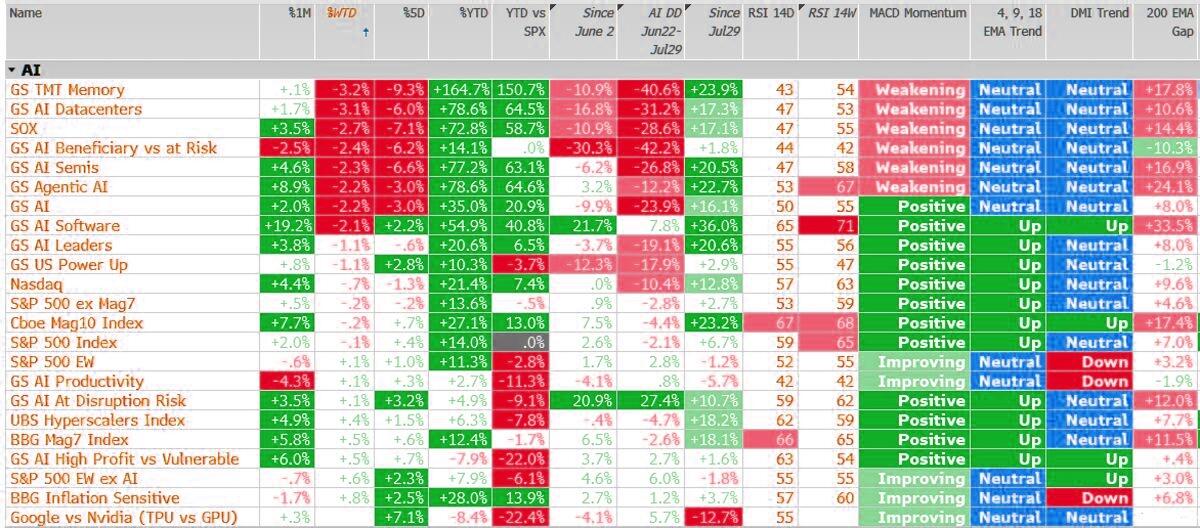
Goldman’s Bobby Molavi writes that the past two to three months have felt like “everyone has been sprinting to standstill.” Deals are being pulled, and with more than $500 billion of debt issued this year for the infrastructure buildout, “we are seeing a lot of future AI revenue being spent up front,” per Bloomberg.
The rotation remains the story for Goldman’s Rich Privorotsky, who argues “the market got itself incredibly long one corner and effectively short everything else,” listing four AI stories that hit at once: CXMT, Microsoft’s Maia 300 moving to TSMC 2nm, Hock Tan’s comments (“taken wildly out of context”) and Meta’s Muse Wonder. In Japan, he notes, five stocks effectively account for the entire Nikkei decline while the TOPIX is up. On energy: “So much for the Russia/Ukraine energy ceasefire… couldn’t survive a news cycle,” and “If energy takes out the highs with velocity, markets will struggle in a much more correlated fashion.” His silver lining: “Financials could reinforce the rotation, with the bar relatively low given de-rating ahead of numbers.”
Over on the GS TMT desk, Sean Johnstone sees “a lot of nervousness ahead of an Anthropic S1,” notes Meta’s Muse Wonder reportedly ranks behind only Claude Opus 5.5 on Artificial Analysis’ Intelligence Index, and concludes that “Capital (and the cost of capital) is becoming the bigger constraint.” Tony Pasquariello, meanwhile, points out that net exposure across GS’s global PB book sits in just the 10th percentile of the past year, with the US market net sold for three straight weeks: “I’m not sure that I can remember a time when a market that was on the highs was attracting so little chase.” Yesterday’s floor was a 2 on a 1-10 activity scale, per the GS US desk, which thinks S&P upside is cheap into month-end, with the next one-week implied move at ~96bps, one of the lowest in about six years.
JPM’s Market Intel desk stays Tactically Bullish heading into earnings, noting breadth was supportive yesterday with over 60% of S&P stocks higher and the rotation/broadening continuing premarket. Tech specialist Joshua Meyers says the most proximate trigger was Hock Tan’s DBS conference panel, where he warned financing could become a bigger bottleneck than component shortages and compared “many investors” to casino gamblers, while a weekend sell-side note re-ignited power concerns (powered-shell shortages of as much as 19GW next year), all of which hit on a low-liquidity holiday as investors sit on their hands ahead of an expected private frontier lab investor meeting on Wednesday. JPM’s Manish flags meaningful risk of a Quality reversal around the CPI release and the Fed meeting if the Fed turns dovish, noting semiconductor sentiment is above the 99th percentile. On earnings, FactSet consensus has Q3 at 29.6% EPS growth on 12.4% revenue growth, with all 11 sectors expected to post positive revenue and earnings growth for only the second time in history.
Big US bank stocks, meanwhile, are in correction territory as the latest earnings from Wall Street roll in. The KBW Bank Index has dropped around 12% from an August peak, exceeding the 10% threshold for a technical correction.
“Loan book quality, capital markets activity and trading will be very much in focus, as all three may have weakened,” said Wolf von Rotberg at Bank J Safra Sarasin. “They need to show that lending growth remains strong and net interest income continues to rise.”
On the geopolitical front, President Trump’s Russian diesel deal has opened a rift with Republican senators, European leaders and Ukraine, while running into a 2022 law barring most Russian energy purchases. Even if it goes ahead, it will deliver a first release of 2.25 million barrels in October, less than a single day of US consumption. Brent is still more than 50% higher than when the Iran war began, with Houthi strikes on Saudi Arabia’s main airport keeping the supply risk alive; Goldman estimates the Brent risk premium at $24/bbl.
In Europe, the Franco-German 10Y spread closed Monday at a post-2012 high of 142bps, per DB, albeit with less fanfare than when those levels were first breached ten days ago; Blackstone’s Jon Gray warned that fiscal strains in France, the UK and elsewhere in Europe pose a more pressing risk than in the US, and the IMF told UK Chancellor Healey to use cost-of-living support “sparingly” ahead of his Oct. 28 budget.
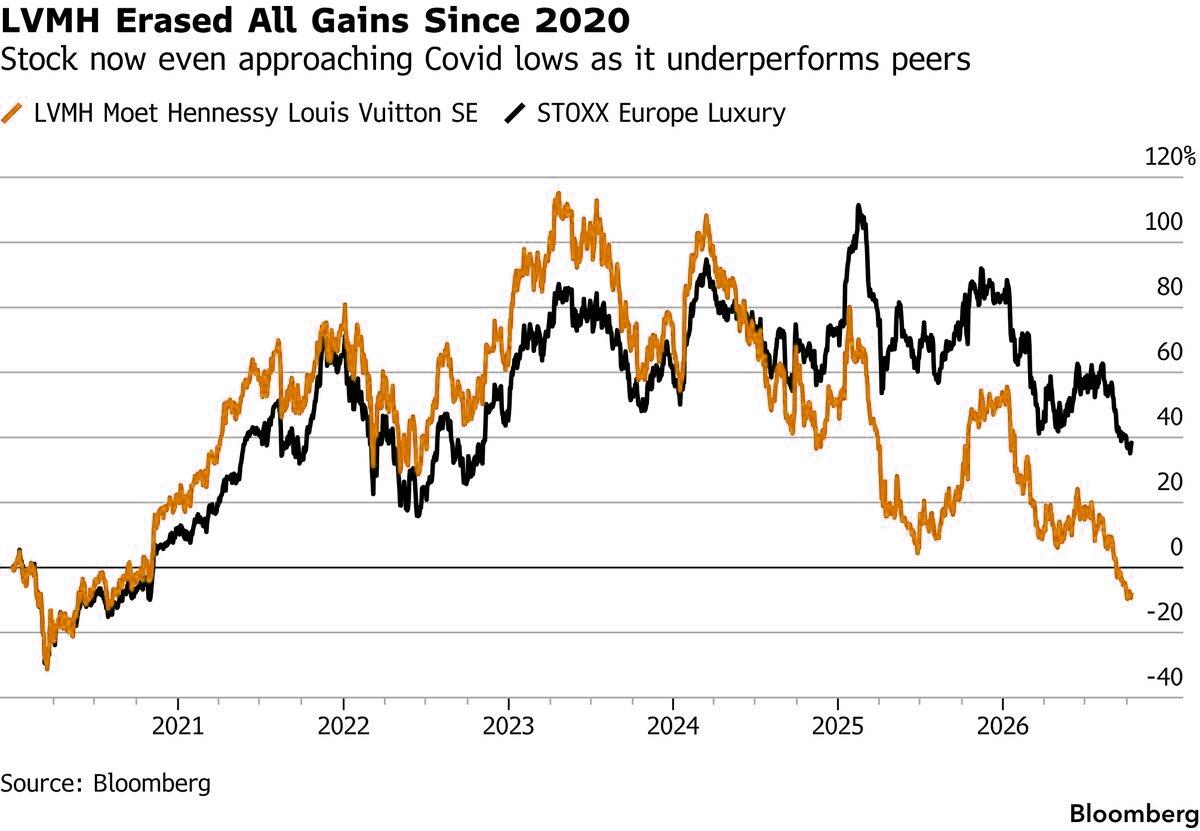
Turning to European stocks, the Stoxx 600 rises 0.6% to 639.73 with 471 members up, as positive earnings news counters renewed concerns about the AI trade, which prompted investors to rotate out of semiconductor and AI-linked names globally. Chemicals and healthcare are the best performers, with real estate helped by the pullback in Brent sending yields lower across European curves; tech, consumer products and basic resources lag. JPM’s desk notes defensives and rate-sensitive baskets are outperforming while semis and luxury lag, with LVMH a clear drag after its worse-than-expected numbers on weak Chinese demand — the stock is already down more than 40% this year. Here are the biggest European movers:
- BP shares gain as much as 1.6% after the British oil major’s 3Q trading statement guided for a fall in net debt to $13.5b-$14.5b, compared to $22.3b in the previous quarter.
- Whitbread shares gain as much as 3.6% after the hotel operator reported strong first-half results, including a beat on profit before tax.
- Givaudan shares rise as much as 8.1% after the maker of fragrances and flavors reported like-for-like growth that was well ahead of expectations in the third quarter.
- Greencore shares rise as much as 6.8% after the food manufacturer said annual adjusted operating profit will come in higher than previously expected, following a strong finish to the year.
- Ypsomed shares rise as much as 3.1% after Berenberg initiates coverage of the stock with a buy rating, citing the growing market for self-injection systems for drugs, resilient margins and a supportive valuation.
- Oxford Instruments gains as much as 4.9% as JPMorgan says the scientific instruments specialist’s first-half trading update was strong “on all fronts.”
- Sulzer rises as much as 5.4% after the Swiss pump maker positively surprises on orders in the third quarter.
- Bellway shares rise as much as 3.9% after analysts at Jefferies said the downbeat outlook for FY27 does not look as bad as feared, as the company warned of lower completions and tighter margins.
- LVMH shares fall as much as 2.3% after the French luxury-goods giant reported third-quarter organic revenue that missed estimates, with its biggest division — fashion and leather-goods — posting a slump in sales.
- European semiconductor stocks slide, tracking a selloff across Asia and US peers, after Broadcom CEO Hock Tan warned of overheating market sentiment.
- Schaeffler shares fall as much as 5.4% after the German car parts maker posted disappointing preliminary third-quarter results.
- Befesa shares slip as much as 4.9% after Jefferies reduced its full-year earnings estimates for the waste recycling services firm and trimmed its price target in anticipation of softer third-quarter results.
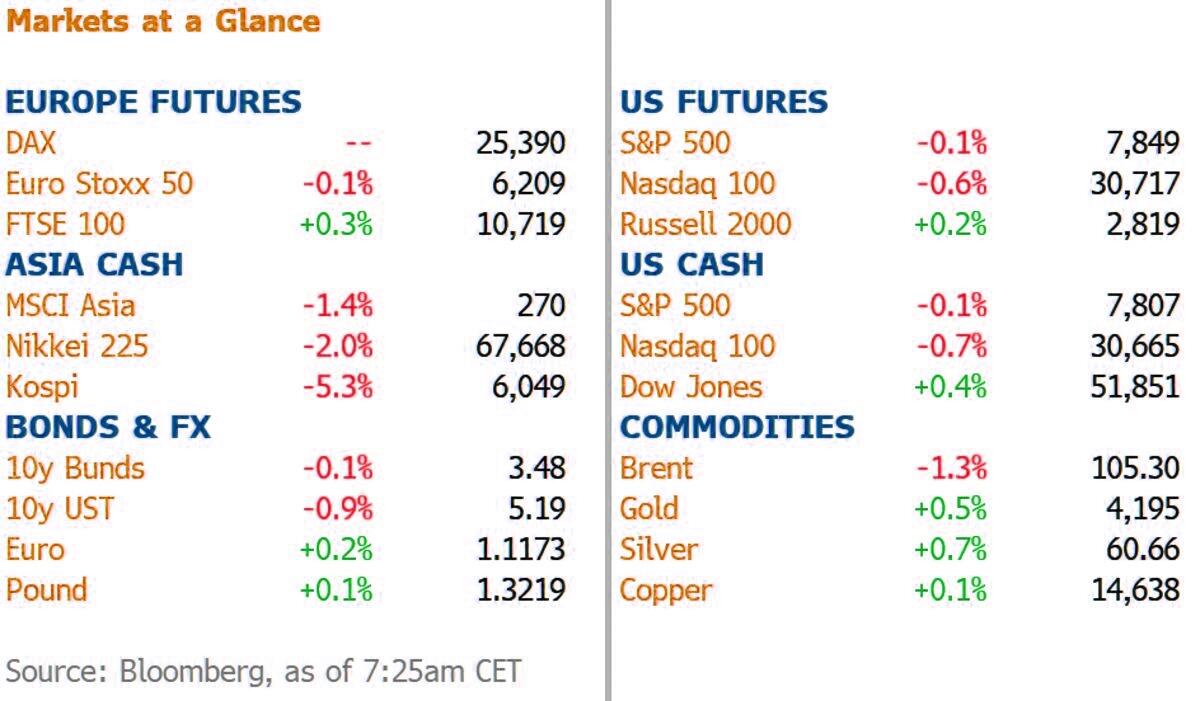
Asian stocks declined as the global AI trade came under renewed pressure, with the MSCI Asia Pacific Index falling as much as 2.1% to the lowest level since Aug. 4. The Kospi slumped 5.46% after breaking its 200-day moving average — at one point down 7.4% before finding support near 6,000 — and Seoul briefly halted program trading for the first time since August; foreigners sold a net $3.4 billion, $3.2 billion of it in tech, per Goldman, which also notes Samsung’s buyback has ended and SK Hynix’s is nearly complete. The Nikkei 225 fell 1.82% on its return from a long weekend, but the TOPIX rose 0.14%: TEL (-7.2%), SoftBank (-8.5%), Advantest (-2.9%), Kioxia (-13.3%) and Ibiden (-7.8%) accounted for all of the Nikkei’s losses, while Japanese banks rose 2.1% ahead of US bank earnings. Taiwan’s Taiex fell 1.95% and the Taiwan dollar posted its biggest drop since June 2025. The ASX 200 outperformed as energy, financials and defensives offset tech and miners. The Hang Seng (+0.31%) and CSI 300 (-0.29%) reversed early weakness, though Chinese automakers fell across the board after the Ministry of Finance cut the VAT export rebate on new-energy vehicles to 9% from 13%. India’s Nifty rose 0.76% on IT services. “Rotation into financials, defensives and software cushioned losses elsewhere,” Goldman’s Asia desk wrote.
In FX, the Bloomberg Dollar Spot Index is down 0.2% after rising 0.6% over the past four sessions, with the DXY in a 102.30-102.57 range as yields and energy ease. The yen outperforms, with USD/JPY down 0.3% around 158.1, after Bloomberg reported BOJ officials are leaning against a rare back-to-back hike this month while still eyeing December; EUR/USD rises 0.3% to 1.1189 and cable edges up to 1.3230. USD/KRW rose 0.5% to 1,341.60 as the Kospi tumbled, while the Taiwan dollar fell as much as 1% to 32.215.
In rates, Treasuries rallied as cash trading reopened after Monday’s holiday, with yields down 2-5bps led by the 10Y, which slipped 5bps to 5.19%; USTs are firmer by around 10 ticks, at the upper end of a 104-18 to 104-30+ range. Fed Governor Waller said higher long-term yields could help the Fed cool demand in rate-sensitive sectors such as housing and autos, doing some of the work of tighter policy (finally, a use for the bond rout). Bunds rose as much as 49 ticks and gilts gained more than 50 ticks as energy prices eased, with the UK 10Y opening 7bps lower at 5.37%; Germany’s 5-year auction drew a weak 1.1x bid-to-cover. Big investors are snapping up Treasuries to lock in the highest yields in decades, with almost $14 billion injected into US government bond funds since the start of October, per the FT. Positioning may add fuel: CFTC data show speculators have rebuilt sizeable net shorts in 10-year futures while sharply cutting 2-year shorts, leaving the 2s10s curve exposed to an initial bull flattening if Wednesday’s CPI is soft. Goldman’s Kaplan points out that “bond funds are underweight duration at an extreme that has historically skewed to lower yields over the next 1–2 quarters.” Goldman expects a 0.24% increase in September core CPI (vs. +0.2% consensus) and a 0.59% rise in headline CPI (vs. +0.6% consensus), reflecting higher energy prices; the GS US desk warns “A 10bp downside surprise on core would be meaningful for rates.”
As money markets price in at least one more US rate hike by December, Federal Reserve Governor Christopher Waller said the surge in long-term Treasury yields is helping curb demand in rate-sensitive sectors.
“When yields go up, is that going to impact interest-sensitive sectors like housing and autos and other things? Yeah, of course it is,” Waller said at Bloomberg’s New Economy Forum in New Delhi on Tuesday. While that isn’t the Fed’s intention, higher yields are “doing a little bit of the work,” he said.
In commodities, WTI Nov and Brent Dec futures are softer, extending their pullback from yesterday’s gains as Trump reiterated the Iran war will end “very soon”: WTI fell to a $91.81 low from a $93.49 peak and Brent to $104.71 from $106.14, though Houthi attacks on Saudi Arabia and US Gulf production shut-ins remain supportive. Goldman estimates the Brent risk premium at $24/bbl and notes its average global crude freight rate is now $30/bbl vs. $4 a year ago. Dutch TTF is firmer, climbing to €86.40/MWh on colder weather and Middle East supply concerns, after European gas hit a post-2022 high on Monday. Spot gold rose from a $4,151 low to $4,201 and silver trades in a $59.58-60.73 range. LME copper is little changed within a $14,549.68-14,667.00/t range.
US economic data slate includes September NFIB small business optimism (97.9 vs est. 98.2, prior 98.7), ADP weekly employment change (8:15am), September existing home sales (10am) and the September federal budget balance (2pm). Fed speaker slate includes Goolsbee (7am, 10am), Barkin (1pm) and Collins (4pm). Corporate events: SEMICON West runs through Thursday; Workday and BGC hold investor days.
Market Snapshot
Top Overnight News
- Iran is fortifying its defenses, rallying loyalists, and hinting that their forces could conduct land incursions into neighboring countries as it threatens a wider, harsher response against the U.S. and its Gulf allies as it prepares for potential American attacks after the midterms and seeks to deter them. WSJ
- Saudi Arabia intercepted ballistic missiles launched by Yemen’s Houthis, targeting Riyadh and Khamis Mushait. Donald Trump dismissed concerns that Russia and China might be helping Iran. Oil slipped after three days of gains. BBG
- A global slide in semiconductor stocks deepened, sending South Korea’s chip-heavy equity benchmark down more than 7% at one point, as concerns about AI overheating and Chinese competition intensified. Investor angst over the AI trade increased after Broadcom Inc.’s chief executive likened market sentiment to a casino and warned that financing the buildout will become a key problem. BBG
- JPMorgan and Goldman Sachs have taken a rare move to limit exposure on a $5 billion loan sale for AI startup Volta Infrastructure as investors demand higher yields for risky debt tied to the AI boom. BBG
- JPMorgan 3Q FICC sales & trading revenue $5.37B, est. $6B; sees FY net interest income about $106.2B, est. $105.28B. BBG
- Nvidia’s share of China’s market for data-center AI chips fell to 34% in the first half of 2026, as US export controls restricted supplies of its products and domestic rivals led by Huawei gained ground. RTRS
- Volumes in options tied to individual stocks have recently reached levels seen during the meme-stock mania of 2021, about $700 billion of notional volume a day. WSJ
- BoJ officials are leaning against a rare back-to-back interest rate increase this month while still eyeing the possibility of another move as soon as December, according to people familiar with the matter. BBG
- Federal Reserve Governor Christopher Waller said the surge in long-term US Treasury yields is helping to curb demand in interest-rate-sensitive sectors such as housing and automobiles, doing some of the work of tighter monetary policy. BBG
- Big investors are snapping up US Treasuries, seeking to lock in the highest yields in decades as they bet borrowing costs can only climb so much further before a months-long sell-off abates. Investors have injected almost $14bn into US government bond funds since the start of October, after net inflows in the third quarter reached a record $59.3bn. FT
- Russia will be able to return diesel exports to levels above those US President Donald Trump has outlined under a deal with Moscow which has been criticised by Ukraine and some US lawmakers, Deputy Prime Minister Alexander Novak said on Monday. RTRS
- Iran and the US remain divided over the sequencing of a diplomatic agreement: Al-Akhbar. Tehran is demanding an end to the war, removal of the naval blockade and oil sanctions, and release of frozen assets before reopening the Strait of Hormuz and discussing nuclear issues, while Washington is insisting on nuclear concessions first. Newsquawk
- IMF raised 2026 Global Real GDP growth forecast to 3.1% (prev. 3.0%), citing AI investment tempering energy price shock in key economies, while it maintains 2027 global growth view at 3.4%. Maintained US 2026 growth forecast at 2.3% and raises 2027 forecast to 2.3% (prev. 2.2%), lowered China 2026 GDP forecast to 4.5% (prev. 4.6%) and cut 2027 forecast to 4.0% (prev. 4.1%). Newsquawk
- Surging bond yields are the top risk to the financial system, the IMF says. BBG
- US Sept. NFIB small business optimism falls to 97.9, est. 98.2. BBG
- UK Chancellor Healey is reportedly rejecting calls to equalise capital gains tax and income tax rates: FT
- Black Sea strikes threaten Bulgarian refinery supply, the Bulgarian premier says; a merchant ship was sunk off Bulgaria’s Black Sea coast. BBG/Newsquawk
- JPM Market Intel stays Tactically Bullish into earnings but flags meaningful risk of a Quality factor reversal around CPI and the Oct. 28 Fed meeting. JPM
A more detailed look at global markets courtesy of Newsquawk
APAC stocks mostly declined amid a tech sell-off following the mixed handover from Wall Street, where the Nasdaq underperformed as chip and memory names were pressured by China competition concerns after CXMT announced technological progress on a denser memory chip design. ASX 200 outperformed its regional peers with price action range-bound as the downside in tech and miners was offset by strength in energy, financials and defensive sectors. Nikkei 225 suffered from the tech-related pressure as participants returned from the long weekend. KOSPI slumped alongside the tech sell-off, with a sidecar triggered early on due to heavy losses. Hang Seng and Shanghai Comp conformed to the tech-led declines across the region, with weakness in autonames after reports that China will cut the VAT export tax rebate rate on new energy vehicles to 9% from 13%.
Top Asian News
- China smartphone shipments fell 15.4% in Q3, according to IDC.
- India’s PM Modi said today’s technology and data and knowledge and innovation are powers, adding that tech should help new opportunities for millions.
European bourses (STOXX 600 +0.6%) have moved higher throughout the session. There was earlier underperformance in the tech–heavy AEX (+0.1%), but it has since climbed into the green. Initial pressure stemmed from the slump in tech behemoths in Asia and throughout the US trading session on Monday. The drivers seem to be two-fold: 1) increased competition after CXMT said they made progress on new memory architecture, as they plan to roll out a new server-memory product by year-end, according to SCMP, 2) Broadcom CEO likens market sentiment to a casino and highlights concerns about AI buildout financing. Tech continues to be in favour for fund managers, with a BofA survey showing that the proportion of managers overweight tech has risen to 37% (prev. 30%). Sectors highlight the positive bias. Chemicals top the sector pile, with Health Care and Real Estate following closely behind. The sector laggards include Tech, Consumer Products & Services and Basic Resources. LVMH (-1.5%) reported Q3 sales after the close on Monday. Headline revenue beat estimates; however, the widely watched Fashion & Leather Goods fell 5% (exp. -1.57%). As expected, struggles in China were highlighted as a major challenge, while the CFO added that short-term cost-cutting will not increase sales. US equity futures are mixed, with underperformance in the NQ. Outside of the tech story, focus will be on banking earnings, with JPM, GS and C set to report.
Top European News
- UK Chancellor Healey is reportedly rejecting calls to equalise capital gains tax and income tax rates, the FT reported citing sources. The report added that the Treasury could still decide to raise CGT by a small amount and also said the Treasury is working on CGT relief to encourage entrepreneurs who sell their business to reinvest back in the UK.
- Retail bosses are to warn UK Chancellor Healey that a tax raid on shops will push up prices and worsen the cost of living crisis, according to Telegraph.
- UK grocery price inflation accelerates to 2.5% in the four weeks to October 4th (vs 2.3% in the 4 weeks to Sep), according to Worldpanel.
- German Chancellor Merz said Germany needs to increase its long-term growth potential. Merz added that he wants a comprehensive pension reform and that there will be temporarily higher contributions paid by workers and employers into the pension system.
FX
- Snapshot: DXY is under pressure this morning, owing to easing yields and a pullback in energy benchmarks. The downside in oil does not have a specific catalyst, and it appears to be more of a pullback from yesterday’s advances. Overall, the geopolitical situation remains tense with Saudi striking Houthi targets overnight; elsewhere, a merchant ship was sunk off Bulgaria’s Black Sea coast. Given the USD pressure, G10s are stronger, albeit to varying degrees; the JPY outperforms, whilst the CAD posts only mild gains.
- DXY holds within a 102.30 to 102.57 range. As mentioned, pressure comes alongside easing yields/energy, with domestic newsflow focused on the Fed’s Waller. He mentioned that recent high yields are somewhat attributed to the AI buildout. Interestingly, he noted that recent yield levels are doing some of the Fed’s work on demand. No reaction was seen on the comments, but remarks are not too dissimilar from those seen in the ECB Minutes.
- JPY outperforms vs peers, following reports in Bloomberg, citing sources, which suggested that the BoJ is leaning back against back-to-back hikes in October. Instead, the Bank may change the language surrounding its 2% target to signal that it is “approximately” at the level, rather than “approaching” it. This essentially corroborates a Reuters source report from earlier in the month, but still managed to spur a hawkish reaction in the JPY. MUFG (following the Reuters piece) suggested that the language change will back its case for a December hike.
Central Banks
- Fed’s Waller (Voter, Dovish) said the US remains the dominant country in building AI models and that AI could contribute to widening GDP per capita. If AI investment falls off, it will put a check on prices and that hyperscalers are still planning on spending trillions of dollars over the next three years. On the bond market and yields, Waller said the AI build-out is definitely having an impact on yields and that real yields reflect the impact of real growth. Waller went on to say that higher yields could do some of the Fed’s work on demand and that inflation expectations are well anchored.
- Fed’s Hammack (2026 voter) reiterated that more restriction is needed, but she is keeping an open mind on pace of rate hikes and noted that policy restriction will need to hit demand, either through capital spending or consumption. Furthermore, she said inflation pressures are broadening out from AI, with other firms all doing well and ready to invest, while she doesn’t want to discourage growth but stated that they may need to ‘pull it back a little bit’.
- The BoJ is reportedly to lean back against back-to-back hikes in October, Bloomberg reported citing sources. The source added that the BoJ could adjust language on the 2% inflation target from “approaching 2%”, to “approximately 2%”, while also suggesting that December is still in play.
- BoJ Governor Ueda reiterated the BoJ’s stance that market determines long-term interest rates and will continue to closely monitor bond markets, adding that long-term interest rates are determined in the markets and reflecting various factors. Ueda said core inflation is gradually nearing 2% and that it is important to anchor inflation around 2% now.
- RBA Minutes from the September Meeting stated the Board was concerned excess demand in the economy was greater than previously assumed and it saw an increased risk of persistently elevated inflation, while it reiterated it will increase rates further if needed. All board members had agreed that a 25bps rate hike was necessary, and the Board briefly weighed the case for keeping rates unchanged, including a decline in house prices. Furthermore, it discussed upside inflation risks and factors that could sustain higher inflation, as well as noted that some upside inflation risks had already emerged or intensified since August, and the Board highlighted the need to adjust rates in a timely manner to keep inflation expectations anchored.
- BoE’s Greene (hawkish dissenter) said a bigger risk is not being proactive enough in tackling inflation than raising rates too soon, while she warned if they wait until second-round effects materialise, it will be too late. Greene noted concern about successive supply shocks and stated they must be proactive in leaning against second-round effects, as well as stated that UK monetary policy is not that restrictive.
- ECB’s Elderson said the heatwave in Europe may have imposed costs equivalent to the area’s projected 2026 economic output, underscoring a potentially material macroeconomic risk.
Fixed Income
- The bullish APAC performance remains, but has not extended, in the European morning thus far. Despite a number of potential catalysts occurring, nothing has fundamentally shifted the dial from a FTQ on the tech sell-off and energy downside, as the Middle East backdrop has not escalated.
- USTs firmer by around 10 ticks as things stand, but only a tick or two above the APAC peak. No move at the time to Fed’s Waller, but his comment that higher yields are doing some of their work is notable, though in-fitting with his dovish-bias. At the upper-end of 104-18 to 104-30+ parameters.
- Bunds followed suit overnight, and have extended by a few ticks to a 121.44 peak this morning, higher by 49 ticks at best. Specifics for the space light, no move to the unrevised German final inflation print and weak Bobl auction. Regional focus remains on familiar factors for the bloc and Germany specifically.
- Gilts gapped higher by just over 10 ticks, before climbing to an 84.47 peak in short order, and since then have held just off that but still with gains in excess of 50 ticks. Aside from the above points and the usual, relatively speaking, larger move seen on energy action, Gilts react to a few factors today. A UK court ruling which significantly increases the odds of the Treasury keeping c. GBP 4bln in seized crypto holdings; a windfall for Chancellor Healey. Additionally, a FT source report suggests that CGT will not be equalised to Income Tax, though it could still see an increase; a reported view taken by the, unsurprising, view that such an increase would increase capital outflows from the UK.
- Italy sells EUR 7bln vs Exp. EUR 5.5-7bln 3.00% 2029, 3.35% 2033 and 3.95% 2041 BTP.
- The UK sells GBP 500mln 4.00% 2063 Gilt via Tender: b/c 3.98x (prev. 3.51x), average yield 5.802% (prev. 5.722%).
- Australia sells AUD 300mln 3.00% March 2047 bonds: b/c 3.60x, avg. yield 5.6818%.
Commodities
- WTI Nov and Brent Dec futures are softer, extending their pullback from yesterday’s gains as Trump reiterated that the Iran war will end very soon, while talks between Washington and Tehran continue through intermediaries. Nonetheless, diplomatic progress remains limited, with reports this morning suggesting the two sides remain divided over the sequencing of an agreement, although Iranian FM Araghchi reiterated that Tehran is seriously pursuing diplomatic efforts. Meanwhile, Iran continues to insist on its conditions for reopening Hormuz, while Houthi attacks on Saudi Arabia and the US Gulf production shut-ins remain supportive for the complex. WTI has fallen to a USD 91.81/bbl low from a USD 93.49/bbl peak, while Brent has declined to USD 104.71/bbl from USD 106.14/bbl highs.
- Dutch TTF is firmer amid upcoming colder weather in the Western Hemisphere alongside continued Middle Eastern supply concerns. TTF has climbed from a EUR 83.90/MWh low to EUR 86.40/MWh highs.
- Precious metals are firmer, with spot gold benefiting from lower global yields and a softer DXY amid softer oil prices, although expectations of further Fed tightening keep upside capped. Spot gold has risen from a USD 4,151/oz low to USD 4,201/oz while spot silver has gained within a USD 59.58-60.73/oz range.
- Base metals are mixed, with copper flat amid the broader risk-off tone across the tech sector. 3M LME copper has risen within a USD 14,549.68-14,667.00/t range, while COMEX copper is firmer within a USD 6.7030-6.7725/lb range.
- Maersk (MAERSKB DC) and Hapag-Lloyd (HLAG GY) will re-launch the FM1 service on the route between Asia and the Middle East.
- Kuwait lowered November crude prices for November, according to the pricing document.
Trade/Tariffs
- Western auto executives warned the EU’s deal with Beijing to restrict hybrid vehicle imports into the bloc will offer only “temporary” protection, as Chinese rivals push ahead with their ambitions to expand sales across the continent, according to FT.
- China proposes civil aviation dual-use export rules to facilitate compliant exports for aviation enterprises.
Geopolitics: Middle East
- US President Trump said the Houthis are misbehaving very badly and that he spoke with Saudi Crown Prince MBS about attacks, while he also stated that oil will drop when the war with Iran ends very soon and that the Midterm elections will have no impact on his decisions regarding Iran.
- US President Trump said Iran will never get nuclear weapons and that this war will end very soon, with gas prices to go down as soon as the war ends, while Trump said he had to change the course a little bit on Iran because they couldn’t let Iran get a nuclear weapon.
- US President Trump posted, “I see so many comments from the Radical Left Morons and Lunatics that China and Russia are helping the “wonderful” Islamic Republic of Iran. If they are, it’s at a very low level, but I don’t believe they are at all. They have too much to lose, and we would know about it, and know about it very fast!”
- Iran’s Foreign Minister Araghchi said that the Foreign Ministry is seriously pursuing the use of diplomatic capabilities to secure national interests, IRIB reported.
- IRGC commander-in-chief said no extra-regional power has the right to threaten and maintain a hegemonic presence or interfere in the Strait of Hormuz and the Persian Gulf.
- Iran and the US remain divided over the sequencing of a diplomatic agreement, Al-Akhbar reported citing sources. The source said that Tehran is demanding an end to the war, removal of the naval blockade and oil sanctions, and release of frozen assets before reopening the Strait of Hormuz and discussing nuclear issues while Washington is insisting on nuclear concessions first.
- Iran is fortifying defences, rallying loyalists and threatening a wider, harsher response against the US and its Gulf allies as it prepares for a potential resumption of attacks after the Midterms and seeks to deter them, according to WSJ.
- Yemen’s Houthis said they targeted Riyadh Airport with ballistic missiles on Monday, while the group also carried out an operation targeting Khamis Mushait Air Base with a drone. Furthermore, it was reported that air traffic at King Fahd International Airport in Dammam was temporarily halted.
Geopolitics: Ukraine
- US President Trump said Ukrainian President Zelensky and Russian President Putin have to get together and end the war, while he added that they both don’t know how to make a deal, but he thinks they support the energy ceasefire. Furthermore, Trump said he thinks Putin wants to make a deal more than Zelensky, and that Zelensky has to focus on making a deal, not talk.
Geopolitics: Other
- North Korea confirmed it test-fired a tactical ballistic missile, while North Korean leader Kim said North Korean weaponry will be developed and completed more strenuously, according to KCNA.
- US President Trump said he may meet with North Korean leader Kim and it would be exciting, while he also said that he is considering firing the US ambassador to Greece.
- Belize’s Foreign Ministry rejected China’s sanctions and said measures against Belize’s Foreign Minister are unwarranted.
Crypto
- Bitcoin rebounds from Monday’s losses and has regained the USD 83k handle after falling to a trough of USD 80.93k.
US Event Calendar
- 6:00am: Sept. NFIB Small Business Optimism, est. 98.2, prior 98.7 (actual 97.9)
- 8:15am: Sept. 26 ADP Weekly Employment Change, prior 23.750k
- 10:00am: Sept. Existing Home Sales, est. 3.95m, prior 3.98m
- 10:00am: Sept. Existing Home Sales MoM, est. -0.8%, prior -2.0%
- 11:30am: US to sell $95BN 13-week bills and $82BN 26-week bills
- 1:00pm: US to sell $95BN 6-week bills
- 2:00pm: Sept. Federal Budget Balance, est. -$30.0b, prior $197.9b
Central Bank Speakers
- 7:00am: Fed’s Goolsbee Speaks in Semafor Podcast Interview
- 10:00am: Fed’s Goolsbee Speaks in Kyla’s Newsletter Podcast Interview
- 1:00pm: Fed’s Barkin Speaks in Moderated Discussion
- 4:00pm: Fed’s Collins Speaks at Banking Conference
DB’s Jim Reid concludes the overnight wrap
Superintelligence may yet wipe out the Reid family as in celebrating my wife’s birthday yesterday I discovered via the card he delivered that one of my 9-year-old twins spells mummy with one “m”. Meanwhile, despite being on the planet for 52 years, I still can’t wrap presents. Every present I give looks as if I don’t care at all about the recipient because of the chaotic state of the wrapping. There is nothing I can do about it. It might explain why it took until my late 30s to get married though.
After a quiet start to the week with US bond markets closed yesterday, this morning we’ve seen a major Asian tech sell-off and later today we’ll see the start of the US Q3 earnings season barrage. JPMorgan, Goldman Sachs, Wells Fargo and Citigroup all report today, followed by Bank of America, Morgan Stanley and BlackRock tomorrow. Financials are actually expected to be one of the sectors with the weakest YoY growth so be aware of that as you digest today’s results. Overall, our US equity strategists expect S&P 500 earnings growth to remain at a record 34% YoY in Q3, versus consensus at 27%. Their view is that consensus is again embedding too much of a slowdown, leaving scope for another quarter of above-average beats. See their piece here for more. In Europe, the season really kicks off next week and our equity strategists expect earnings growth to reach 25% in Q3, 5 pp above consensus (their full preview is here). So it should be a very strong earnings season on both sides of the Atlantic and indeed across the globe.
Ahead of the onslaught there has been a big sell-off in tech overnight, seemingly on concerns over Chinese AI competition. The sell-off, which began this time yesterday has continued to weigh on the KOSPI (-6.30%), leaving the tech-heavy index with its largest two-day drop (-9.79%) since July, back when a reassessment of the AI trade was the key theme in equities. The Nikkei 225 has also come back from a long weekend in Japan with a -2.21% loss.
The catalyst for the latest AI-driven sell-off came after the South China Morning Post reported yesterday morning that China’s CXMT memory chipmaker had made good progress on new DRAM architecture that would boost memory density. So that led to a fall in several memory makers, including the likes of Micron (-3.88%) yesterday, and South Korea’s Samsung (-7.98%) and SK Hynix (-8.72%) this morning. In fact, the Philly semiconductor index fell for a 4th consecutive session yesterday, which is the first time that’s happened since July. Nasdaq (-0.79%) futures are lower this morning with both the S&P and Stoxx equivalents down a more measured -0.19%. 10yr US yields are down -4.6bps after being closed yesterday.
Turning to the rest of yesterday’s developments now, it was a relatively different picture, with most equities advancing despite a rise in oil and gas prices. That came as markets digested the weekend news that the Houthi militants had bombed Riyadh’s airport, along with lingering uncertainties around some kind of energy ceasefire between Russia and Ukraine. Yet despite all that, the S&P 500 (-0.06%) ended the session only a little below flat, whilst the STOXX 600 (+0.65%) saw bigger gains. US equity gains were ultimately reversed by the continued selloff in chip stocks, with the Philly semiconductor index down -2.67%. That said, two-thirds of the index were higher with the Mag-7 closing up +0.47%.
In terms of that rise in oil prices, Brent crude (+1.84%) closed up to $106/bbl, whilst European natural gas futures (+3.58%) hit a post-2022 high of €84.24/MWh. The risk-off in Asia has helped Brent fall back -1.12% this morning.
While US bond markets were closed for a holiday, the latest rise in energy prices led to a repricing across European rates yesterday. Indeed, higher inflation expectations were clear, as the Euro 1yr inflation swaps rose +4.7bps to 3.52%, which pushed front-end yields higher across Europe, as it revived fears about more persistent inflation over the months ahead. Indeed, the sense was that things were still deteriorating, particularly with gas prices hitting a new high. All that came as doubt was cast on the energy ceasefire between Russia and Ukraine, with Ukrainian President Zelenskyy saying that Ukraine would respond if Russia didn’t agree to the ceasefire. So that added to energy supply concerns, particularly with investors already nervous about a wider Middle East escalation after the attacks on Saudi Arabia.
So that meant front-end yields moved up across Europe, with the Franco-German 10yr spread (+5.1bps) closing at a post-2012 high of 142bps, albeit with less fanfare and market stress than when 2012 levels were previously breached 10 days ago. The 2yr yield moved higher in Germany (+2.4bps), France (+1.5bps) and Italy (+2.3bps). So it was interesting that French bonds were not the worst performing at the front end, perhaps suggesting that much of the sizeable summer front end carry positions had now been squared.
Before the late US equity dip and the overnight Asia sell-off, all the major European indices ended higher on the day even with gas prices notably higher. That included the Stoxx 600 (+0.65%) and the DAX (+0.76%), whilst France’s CAC 40 (+0.38%) still saw a rise, even though it underperformed.
To the day ahead now, and as discussed near the top, earnings releases include JPMorgan, Wells Fargo, Goldman Sachs and Citigroup. Data releases from the US include the NFIB’s small business optimism index for September, along with existing home sales. Finally, the Fed’s Waller, Barkin and Collins will speak today.
1b European opening report
Trump reiterated that the war with Iran will end soon; JPY gains following a BoJ source report, whilst the DXY is pressured alongside yields and oil prices – Newsquawk US Market Open

Tuesday, Oct 13, 2026 – 06:15 AM
- US President Trump said the war with Iran will end very soon and that oil prices will fall once the conflict concludes, while Saudi Arabia conducted further strikes against Houthi targets in Yemen.
- The BoJ is reportedly leaning back against back-to-back hikes in October but could hawkishly adjust inflation language, according to Bloomberg.
- US equity futures mixed, with the NQ underperforming as chip names continue to slip.
- DXY pushed lower by higher yields; JPY outperforms following BoJ sources.
- Fixed income benchmarks gain on a flight to safety and lower energy prices (Brent -1.7%).
- Looking ahead, highlights include US ADP Employment Change Weekly, Existing Home Sales (Sep), OPEC MOMR. Speakers include ECB’s Lane, Fed’s Barkin & Collins. Earnings from UnitedHealth, JPMorgan, Goldman Sachs, Wells Fargo, Citi, Johnson & Johnson.
SNAPSHOT

EUROPEAN TRADE
EQUITIES
- European bourses (STOXX 600 +0.6%) have moved higher throughout the session. There was earlier underperformance in the tech–heavy AEX (+0.1%), but it has since climbed into the green. Initial pressure stemmed from the slump in tech behemoths in Asia and throughout the US trading session on Monday. The drivers seem to be two-fold: 1) increased competition after CXMT said they made progress on new memory architecture, as they plan to roll out a new server-memory product by year-end, according to SCMP, 2) Broadcom CEO likens market sentiment to a casino and highlights concerns about AI buildout financing. Tech continues to be in favour for fund managers, with a BofA survey showing that the proportion of managers overweight tech has risen to 37% (prev. 30%).
- Sectors highlight the positive bias. Chemicals top the sector pile, with Health Care and Real Estate following closely behind. The sector laggards include Tech, Consumer Products & Services and Basic Resources.
- LVMH (-1.5%) reported Q3 sales after the close on Monday. Headline revenue beat estimates; however, the widely watched Fashion & Leather Goods fell 5% (exp. -1.57%). As expected, struggles in China were highlighted as a major challenge, while the CFO added that short-term cost-cutting will not increase sales.
- US equity futures are mixed, with underperformance in the NQ. Outside of the tech story, focus will be on banking earnings, with JPM, GS and C set to report.
- Click for the sessions European pre-market equity newsflow
- Click for the additional news
FX
- Snapshot: DXY is under pressure this morning, owing to easing yields and a pullback in energy benchmarks. The downside in oil does not have a specific catalyst, and it appears to be more of a pullback from yesterday’s advances. Overall, the geopolitical situation remains tense with Saudi striking Houthi targets overnight; elsewhere, a merchant ship was sunk off Bulgaria’s Black Sea coast. Given the USD pressure, G10s are stronger, albeit to varying degrees; the JPY outperforms, whilst the CAD posts only mild gains.
- DXY holds within a 102.30 to 102.57 range. As mentioned, pressure comes alongside easing yields/energy, with domestic newsflow focused on the Fed’s Waller. He mentioned that recent high yields are somewhat attributed to the AI buildout. Interestingly, he noted that recent yield levels are doing some of the Fed’s work on demand. No reaction was seen on the comments, but remarks are not too dissimilar from those seen in the ECB Minutes.
- JPY outperforms vs peers, following reports in Bloomberg, citing sources, which suggested that the BoJ is leaning back against back-to-back hikes in October. Instead, the Bank may change the language surrounding its 2% target to signal that it is “approximately” at the level, rather than “approaching” it. This essentially corroborates a Reuters source report from earlier in the month, but still managed to spur a hawkish reaction in the JPY. MUFG (following the Reuters piece) suggested that the language change will back its case for a December hike.
FIXED INCOME
- The bullish APAC performance remains, but has not extended, in the European morning thus far. Despite a number of potential catalysts occurring, nothing has fundamentally shifted the dial from a FTQ on the tech sell-off and energy downside, as the Middle East backdrop has not escalated.
- USTs firmer by around 10 ticks as things stand, but only a tick or two above the APAC peak. No move at the time to Fed’s Waller, but his comment that higher yields are doing some of their work is notable, though in-fitting with his dovish-bias. At the upper-end of 104-18 to 104-30+ parameters.
- Bunds followed suit overnight, and have extended by a few ticks to a 121.44 peak this morning, higher by 49 ticks at best. Specifics for the space light, no move to the unrevised German final inflation print and weak Bobl auction. Regional focus remains on familiar factors for the bloc and Germany specifically.
- Gilts gapped higher by just over 10 ticks, before climbing to an 84.47 peak in short order, and since then have held just off that but still with gains in excess of 50 ticks. Aside from the above points and the usual, relatively speaking, larger move seen on energy action, Gilts react to a few factors today. A UK court ruling which significantly increases the odds of the Treasury keeping c. GBP 4bln in seized crypto holdings; a windfall for Chancellor Healey. Additionally, a FT source report suggests that CGT will not be equalised to Income Tax, though it could still see an increase; a reported view taken by the, unsurprising, view that such an increase would increase capital outflows from the UK.
- Italy sells EUR 7bln vs Exp. EUR 5.5-7bln 3.00% 2029, 3.35% 2033 and 3.95% 2041 BTP.
- The UK sells GBP 500mln 4.00% 2063 Gilt via Tender: b/c 3.98x (prev. 3.51x), average yield 5.802% (prev. 5.722%).
- Australia sells AUD 300mln 3.00% March 2047 bonds: b/c 3.60x, avg. yield 5.6818%.
COMMODITIES
- WTI Nov and Brent Dec futures are softer, extending their pullback from yesterday’s gains as Trump reiterated that the Iran war will end very soon, while talks between Washington and Tehran continue through intermediaries. Nonetheless, diplomatic progress remains limited, with reports this morning suggesting the two sides remain divided over the sequencing of an agreement, although Iranian FM Araghchi reiterated that Tehran is seriously pursuing diplomatic efforts. Meanwhile, Iran continues to insist on its conditions for reopening Hormuz, while Houthi attacks on Saudi Arabia and the US Gulf production shut-ins remain supportive for the complex. WTI has fallen to a USD 91.81/bbl low from a USD 93.49/bbl peak, while Brent has declined to USD 104.71/bbl from USD 106.14/bbl highs.
- Dutch TTF is firmer amid upcoming colder weather in the Western Hemisphere alongside continued Middle Eastern supply concerns. TTF has climbed from a EUR 83.90/MWh low to EUR 86.40/MWh highs.
- Precious metals are firmer, with spot gold benefiting from lower global yields and a softer DXY amid softer oil prices, although expectations of further Fed tightening keep upside capped. Spot gold has risen from a USD 4,151/oz low to USD 4,201/oz while spot silver has gained within a USD 59.58-60.73/oz range.
- Base metals are mixed, with copper flat amid the broader risk-off tone across the tech sector. 3M LME copper has risen within a USD 14,549.68-14,667.00/t range, while COMEX copper is firmer within a USD 6.7030-6.7725/lb range.
- Maersk (MAERSKB DC) and Hapag-Lloyd (HLAG GY) will re-launch the FM1 service on the route between Asia and the Middle East.
- Kuwait lowered November crude prices for November, according to the pricing document.
TRADE/TARIFFS
- Western auto executives warned the EU’s deal with Beijing to restrict hybrid vehicle imports into the bloc will offer only “temporary” protection, as Chinese rivals push ahead with their ambitions to expand sales across the continent, according to FT.
- China proposes civil aviation dual-use export rules to facilitate compliant exports for aviation enterprises.
NOTABLE EUROPEAN HEADLINES
- UK Chancellor Healey is reportedly rejecting calls to equalise capital gains tax and income tax rates, the FT reported citing sources. The report added that the Treasury could still decide to raise CGT by a small amount and also said the Treasury is working on CGT relief to encourage entrepreneurs who sell their business to reinvest back in the UK.
- Retail bosses are to warn UK Chancellor Healey that a tax raid on shops will push up prices and worsen the cost of living crisis, according to Telegraph.
- UK grocery price inflation accelerates to 2.5% in the four weeks to October 4th (vs 2.3% in the 4 weeks to Sep), according to Worldpanel.
- German Chancellor Merz said Germany needs to increase its long-term growth potential. Merz added that he wants a comprehensive pension reform and that there will be temporarily higher contributions paid by workers and employers into the pension system.
NOTABLE EUROPEAN DATA RECAP
- German HICP Final (Sep YY) 3.3% vs. Exp. 3.3% (Prev. 2.9%).
- German HICP Final (Sep MM) 0.6% vs. Exp. 0.6% (Prev. 0.2%).
- UK BRC Retail Sales Monitor (Sep YY) 1.0% vs. Exp. 0.7% (Prev. 0.5%).
- UK Barclays Consumer Spending YY (Sep) 2.0% (prev. 2.1%).
CENTRAL BANKS
- Fed’s Waller (Voter, Dovish) said the US remains the dominant country in building AI models and that AI could contribute to widening GDP per capita. If AI investment falls off, it will put a check on prices and that hyperscalers are still planning on spending trillions of dollars over the next three years. On the bond market and yields, Waller said the AI build-out is definitely having an impact on yields and that real yields reflect the impact of real growth. Waller went on to say that higher yields could do some of the Fed’s work on demand and that inflation expectations are well anchored.
- Fed’s Hammack (2026 voter) reiterated that more restriction is needed, but she is keeping an open mind on pace of rate hikes and noted that policy restriction will need to hit demand, either through capital spending or consumption. Furthermore, she said inflation pressures are broadening out from AI, with other firms all doing well and ready to invest, while she doesn’t want to discourage growth but stated that they may need to ‘pull it back a little bit’.
- The BoJ is reportedly to lean back against back-to-back hikes in October, Bloomberg reported citing sources. The source added that the BoJ could adjust language on the 2% inflation target from “approaching 2%”, to “approximately 2%”, while also suggesting that December is still in play.
- BoJ Governor Ueda reiterated the BoJ’s stance that market determines long-term interest rates and will continue to closely monitor bond markets, adding that long-term interest rates are determined in the markets and reflecting various factors. Ueda said core inflation is gradually nearing 2% and that it is important to anchor inflation around 2% now.
- RBA Minutes from the September Meeting stated the Board was concerned excess demand in the economy was greater than previously assumed and it saw an increased risk of persistently elevated inflation, while it reiterated it will increase rates further if needed. All board members had agreed that a 25bps rate hike was necessary, and the Board briefly weighed the case for keeping rates unchanged, including a decline in house prices. Furthermore, it discussed upside inflation risks and factors that could sustain higher inflation, as well as noted that some upside inflation risks had already emerged or intensified since August, and the Board highlighted the need to adjust rates in a timely manner to keep inflation expectations anchored.
- BoE’s Greene (hawkish dissenter) said a bigger risk is not being proactive enough in tackling inflation than raising rates too soon, while she warned if they wait until second-round effects materialise, it will be too late. Greene noted concern about successive supply shocks and stated they must be proactive in leaning against second-round effects, as well as stated that UK monetary policy is not that restrictive.
- ECB’s Elderson said the heatwave in Europe may have imposed costs equivalent to the area’s projected 2026 economic output, underscoring a potentially material macroeconomic risk.
NOTABLE US HEADLINES
- IMF raised 2026 Global Real GDP growth forecast to 3.1% (prev. 3.0%), citing AI investment tempering energy price shock in key economies, while it maintains 2027 global growth view at 3.4%. Maintained US 2026 growth forecast at 2.3% and raises 2027 forecast to 2.3% (prev. 2.2%), lowered China 2026 GDP forecast to 4.5% (prev. 4.6%) and cut 2027 forecast to 4.0% (prev. 4.1%), raised Euro Area 2026 GDP forecast to 1.1% (prev. 0.9%).
GEOPOLITICS
MIDDLE EAST
- US President Trump said the Houthis are misbehaving very badly and that he spoke with Saudi Crown Prince MBS about attacks, while he also stated that oil will drop when the war with Iran ends very soon and that the Midterm elections will have no impact on his decisions regarding Iran.
- US President Trump said Iran will never get nuclear weapons and that this war will end very soon, with gas prices to go down as soon as the war ends, while Trump said he had to change the course a little bit on Iran because they couldn’t let Iran get a nuclear weapon.
- US President Trump posted, “I see so many comments from the Radical Left Morons and Lunatics that China and Russia are helping the “wonderful” Islamic Republic of Iran. If they are, it’s at a very low level, but I don’t believe they are at all. They have too much to lose, and we would know about it, and know about it very fast!”
- Iran’s Foreign Minister Araghchi said that the Foreign Ministry is seriously pursuing the use of diplomatic capabilities to secure national interests, IRIB reported.
- IRGC commander-in-chief said no extra-regional power has the right to threaten and maintain a hegemonic presence or interfere in the Strait of Hormuz and the Persian Gulf.
- Iran and the US remain divided over the sequencing of a diplomatic agreement, Al-Akhbar reported citing sources. The source said that Tehran is demanding an end to the war, removal of the naval blockade and oil sanctions, and release of frozen assets before reopening the Strait of Hormuz and discussing nuclear issues while Washington is insisting on nuclear concessions first.
- Iran is fortifying defences, rallying loyalists and threatening a wider, harsher response against the US and its Gulf allies as it prepares for a potential resumption of attacks after the Midterms and seeks to deter them, according to WSJ.
- Yemen’s Houthis said they targeted Riyadh Airport with ballistic missiles on Monday, while the group also carried out an operation targeting Khamis Mushait Air Base with a drone. Furthermore, it was reported that air traffic at King Fahd International Airport in Dammam was temporarily halted.
RUSSIA-UKRAINE
- US President Trump said Ukrainian President Zelensky and Russian President Putin have to get together and end the war, while he added that they both don’t know how to make a deal, but he thinks they support the energy ceasefire. Furthermore, Trump said he thinks Putin wants to make a deal more than Zelensky, and that Zelensky has to focus on making a deal, not talk.
OTHER
- North Korea confirmed it test-fired a tactical ballistic missile, while North Korean leader Kim said North Korean weaponry will be developed and completed more strenuously, according to KCNA.
- US President Trump said he may meet with North Korean leader Kim and it would be exciting, while he also said that he is considering firing the US ambassador to Greece.
- Belize’s Foreign Ministry rejected China’s sanctions and said measures against Belize’s Foreign Minister are unwarranted.
CRYPTO
- Bitcoin rebounds from Monday’s losses and has regained the USD 83k handle after falling to a trough of USD 80.93k.
APAC TRADE
- APAC stocks mostly declined amid a tech sell-off following the mixed handover from Wall Street, where the Nasdaq underperformed as chip and memory names were pressured by China competition concerns after CXMT announced technological progress on a denser memory chip design.
- ASX 200 outperformed its regional peers with price action range-bound as the downside in tech and miners was offset by strength in energy, financials and defensive sectors.
- Nikkei 225 suffered from the tech-related pressure as participants returned from the long weekend.
- KOSPI slumped alongside the tech sell-off, with a sidecar triggered early on due to heavy losses.
- Hang Seng and Shanghai Comp conformed to the tech-led declines across the region, with weakness in autonames after reports that China will cut the VAT export tax rebate rate on new energy vehicles to 9% from 13%.
NOTABLE ASIA-PAC HEADLINES
- China smartphone shipments fell 15.4% in Q3, according to IDC.
- India’s PM Modi said today’s technology and data and knowledge and innovation are powers, adding that tech should help new opportunities for millions.
NOTABLE APAC DATA RECAP
- Japanese PPI (Sep YY) 6.8% vs. Exp. 7.6% (Prev. 7.6%).
- Japanese PPI (Sep MM) -0.3% vs. Exp. 0.5% (Prev. -0.2%).
- Australian NAB Business Confidence (Sep) -13 (Prev. -8).
1 c Asian opening report
Trump calls on Putin and Zelensky to get together and end the war; DXY is lower as yields ease and crude futures decline – Newsquawk EU Market Open
Tuesday, Oct 13, 2026 – 01:38 AM
- US President Trump said the war with Iran will end very soon and that oil prices will fall once the conflict concludes, while Saudi Arabia conducted further strikes against Houthi targets in Yemen.
- US President Trump said Zelensky and Putin have to get together and end the war, while he thinks they support the energy ceasefire.
- APAC stocks mostly declined amid a tech-led sell-off following weakness in US chip and memory stocks; US equity futures were pressured, while European futures point to a lower open.
- DXY softened amid lower yields and geopolitical developments; crude futures declined despite continued Middle East tensions and uncertainty over a Russia-Ukraine energy ceasefire.
- Looking ahead, highlights include German Final Inflation (Sep), US ADP Employment Change Weekly, Existing Home Sales (Sep), OPEC MOMR. Speakers include US President Trump, ECB’s Elderson & Lane, Fed’s Waller, Barkin & Collins. Supply from the Netherlands, Italy & Germany. Earnings from UnitedHealth, JPMorgan, Goldman Sachs, Wells Fargo, Citi, Johnson & Johnson.
SNAPSHOT

LOOKING AHEAD
- Highlights include German Final Inflation (Sep), US ADP Employment Change Weekly, Existing Home Sales (Sep), OPEC MOMR. Speakers include US President Trump, BoE’s Greene, ECB’s Elderson & Lane, Fed’s Waller, Barkin & Collins. Supply from the Netherlands, Italy & Germany. Earnings from UnitedHealth, JPMorgan, Goldman Sachs, Wells Fargo, Citi, Johnson & Johnson.
- Click for the Newsquawk Week Ahead.
IRAN CONFLICT
- US President Trump said the Houthis are misbehaving very badly and that he spoke with Saudi Crown Prince MBS about attacks, while he also stated that oil will drop when the war with Iran ends very soon and that the Midterm elections will have no impact on his decisions regarding Iran.
- US President Trump said Iran will never get nuclear weapons and that this war will end very soon, with gas prices to go down as soon as the war ends, while Trump said he had to change the course a little bit on Iran because they couldn’t let Iran get a nuclear weapon.
- US President Trump posted, “I see so many comments from the Radical Left Morons and Lunatics that China and Russia are helping the “wonderful” Islamic Republic of Iran. If they are, it’s at a very low level, but I don’t believe they are at all. They have too much to lose, and we would know about it, and know about it very fast!”
- IRGC commander-in-chief said no extra-regional power has the right to threaten and maintain a hegemonic presence or interfere in the Strait of Hormuz and the Persian Gulf.
- Iran’s ambassador rejected the UK’s claims regarding the Fairford base, according to IRNA.
- Iran is fortifying defences, rallying loyalists and threatening a wider, harsher response against the US and its Gulf allies as it prepares for a potential resumption of attacks after the Midterms and seeks to deter them, according to WSJ.
- Explosions were reported in Saudi Arabia following a missile and drone attack, according to Sabereen News.
- Houthi official warned the US of a “swift and painful response” if it enters the war in Yemen, while the official said the group would not deliberate over its response if the US became involved in the conflict amid reports that Saudi Arabia had requested US assistance against the Houthis. He also warned employees and workers at Saudi oil facilities and airports to stay away from the sites, describing them as legitimate targets, according to Sky News Arabia citing AFP.
- Yemen’s Houthis said they targeted Riyadh Airport with ballistic missiles on Monday, while the group also carried out an operation targeting Khamis Mushait Air Base with a drone. Furthermore, it was reported that air traffic at King Fahd International Airport in Dammam was temporarily halted.
- Saudi Arabia conducted airstrikes on Yemen’s Amran and Hodeidah provinces, while local sources reported intense airstrikes targeting Houthi military sites in Sanaa.
US TRADE
EQUITIES
- US stocks were mixed on Monday, with the Nasdaq underperforming while the Dow advanced and the S&P 500 was little changed. Most sectors finished in the green, led by Energy and Communication Services, while Technology and Consumer Discretionary lagged, weighing on the Nasdaq. Technology stocks were pressured by weakness in chip and memory names, particularly Micron (MU), after China’s CXMT announced technological progress on a denser memory chip design, raising concerns over increased competition in the sector. Nonetheless, it was a relatively quiet session amid the Columbus Day federal holiday, although much of the newsflow centred on geopolitical and energy developments over the weekend. Trump announced an agreement with Russian President Putin to lift sanctions on Russian diesel exports in an effort to lower diesel prices for Americans ahead of the midterms. Trump also touted a potential ceasefire agreement between Russia and Ukraine, although neither side confirmed a deal, while Russia struck a Ukrainian power plant, raising further doubts over the prospect of an imminent agreement.
- SPX -0.05% at 7,807, NDX -0.71% at 30,665, DJI +0.41% at 51,867, RUT -0.39% at 2,796.
- Click here for a detailed summary.
TARIFFS/TRADE
- China proposes civil aviation dual-use export rules to facilitate compliant exports for aviation enterprises.
- Taiwan is to impose anti-dumping duties on China’s polyamine films.
NOTABLE HEADLINES
- Fed’s Hammack (2026 voter) said further monetary policy tightening is needed, while she prefers smaller, more frequent rate moves and believes inflation is returning to target too slowly. Hammack stated that current policy is not restrictive enough, warned of the risk that high inflation becomes entrenched and noted that firms are passing higher input costs on to customers.
- Fed’s Hammack (2026 voter) reiterated that more restriction is needed, but she is keeping an open mind on pace of rate hikes and noted that policy restriction will need to hit demand, either through capital spending or consumption. Furthermore, she said inflation pressures are broadening out from AI, with other firms all doing well and ready to invest, while she doesn’t want to discourage growth but stated that they may need to ‘pull it back a little bit’.
APAC TRADE
EQUITIES
- APAC stocks mostly declined amid a tech sell-off following the mixed handover from Wall Street, where the Nasdaq underperformed as chip and memory names were pressured by China competition concerns after CXMT announced technological progress on a denser memory chip design.
- ASX 200 outperformed its regional peers with price action range-bound as the downside in tech and miners was offset by strength in energy, financials and defensive sectors.
- Nikkei 225 suffered from the tech-related pressure as participants returned from the long weekend.
- KOSPI slumped alongside the tech sell-off, with a sidecar triggered early on due to heavy losses.
- Hang Seng and Shanghai Comp conformed to the tech-led declines across the region, with weakness in autonames after reports that China will cut the VAT export tax rebate rate on new energy vehicles to 9% from 13%.
- US equity futures continued the mixed performance seen during Wall St trade, with the Emini Nasdaq 100 dragged lower by tech woes.
- European equity futures indicate a lower cash market open with Euro Stoxx 50 futures down 0.2% after the cash market closed with gains of 0.5% on Monday.
FX
- DXY softened and gave back some of the prior day’s gains amid a decline in yields and as newsflow remained relatively quiet, with geopolitical headlines and commentary remaining in focus, including further strikes between the Saudis and Houthis, while Trump continued to advocate a Russia/Ukraine deal and thinks that Putin wants to make a deal more than Zelensky, as well as called for Zelensky to focus on making a deal, not talk. Elsewhere, Fed’s Hammack reiterated her hawkish stance, arguing that further tightening is needed given the slow return of inflation towards target, although she noted that the question for the Fed is now how quickly to make policy more restrictive and expressed a preference for smaller rate adjustments delivered relatively quickly, while the attention this week largely centres on Wednesday’s US CPI report, ahead of Fed Chair Warsh’s speech at the IMF early Friday morning BST.
- EUR/USD rebounded from a 17-month low but remained in sub-1.1200 territory after underperforming yesterday and as French fiscal concerns linger, while participants also await today’s French parliamentary budget debate.
- GBP/USD eked slight gains after support held at the 1.3200 level and as UK PM Burnham seeks closer UK-EU ties.
- USD/JPY retreated amid a weaker dollar and the mostly risk-off mood, but with price action kept within the 158.00 handle, while the latest PPI data from Japan was softer-than-expected.
- Antipodeans were little changed with a muted reaction seen to the RBA Minutes, which noted that the Board was concerned excess demand in the economy was greater than previously assumed and saw an increased risk of persistently elevated inflation, as well as reiterated that it will increase rates further if needed.
FIXED INCOME
- 10yr UST futures climbed higher overnight as cash Treasuries reopened following the Columbus Day holiday, while bond yields fell across the curve in tandem with the tech-driven sell-off in stocks.
- Bund futures rallied amid a flight to quality and price action unfazed by upcoming German final CPI data for September and upcoming issuances, beginning with EUR 5bln in Bobls later today.
- 10yr JGB futures conformed to the upside in global peers and returned to above the 125.00 level, which also follows the softer-than-expected PPI data from Japan.
COMMODITIES
- Crude futures pulled back after gaining yesterday in two-way trade as geopolitics remained in focus with Russia striking Ukrainian energy sites despite Trump’s energy ceasefire claim, while Trump also commented that he thinks Putin wants to make a deal more than Zelensky, and reiterated that oil will drop when the war with Iran ends very soon.
- Energy and Oil ministers of countries participating in the Declaration of Cooperation held a meeting on the sidelines of the 17th IEF ministerial meeting and the 25th WPC Energy Congress in Riyadh.
- US Gulf shut in 604.5k BPD or 30% oil production, according to MMA.
- Russia’s Novak said regarding the diesel supply deal that there are talks between the governments of Russia and the US on supply and that they have the possibility to make additional supplies of diesel on global markets.
- Goldman Sachs said it doesn’t see significant impacts on global diesel prices from Russian diesel releases.
- Spot gold rebounded from an initial dip, with the recovery facilitated by softer yields and a weaker dollar.
- Copper futures marginally declined with headwinds from the broad risk-off mood across Asia.
CRYPTO
- Bitcoin steadily gained throughout the session and rose above the USD 83,000 level.
NOTABLE ASIA-PAC HEADLINES
- RBA Minutes from the September Meeting stated the Board was concerned excess demand in the economy was greater than previously assumed and it saw an increased risk of persistently elevated inflation, while it reiterated it will increase rates further if needed. All board members had agreed that a 25bps rate hike was necessary, and the Board briefly weighed the case for keeping rates unchanged, including a decline in house prices. Furthermore, it discussed upside inflation risks and factors that could sustain higher inflation, as well as noted that some upside inflation risks had already emerged or intensified since August, and the Board highlighted the need to adjust rates in a timely manner to keep inflation expectations anchored.
DATA RECAP
- Japanese PPI MM (Sep) -0.3% vs. Exp. 0.5% (Prev. -0.2%)
- Japanese PPI YY (Sep) 6.8% vs. Exp. 7.6% (Prev. 7.6%)
GEOPOLITICS
RUSSIA-UKRAINE
- US President Trump said Ukrainian President Zelensky and Russian President Putin have to get together and end the war, while he added that they both don’t know how to make a deal, but he thinks they support the energy ceasefire. Furthermore, Trump said he thinks Putin wants to make a deal more than Zelensky, and that Zelensky has to focus on making a deal, not talk.
- Ukraine’s Foreign Minister said now is the time for real European pressure on Moscow, calling for frozen assets, trade and transit embargoes, maritime bans, entry bans and other measures rather than half-measures.
- Ukrainian official said a Russian drone strike damaged a cargo facility in Mykolaiv, while a Russian governor reported damage to the Nevinnomyssk industrial area following a Ukrainian drone attack.
OTHER
- US President Trump said he may meet with North Korean leader Kim and it would be exciting, while he also said that he is considering firing the US ambassador to Greece.
- North Korea confirmed it test-fired a tactical ballistic missile, while North Korean leader Kim said North Korean weaponry will be developed and completed more strenuously, according to KCNA.
- Belize’s Foreign Ministry rejected China’s sanctions and said measures against Belize’s Foreign Minister are unwarranted.
EU/UK
NOTABLE HEADLINES
- BoE’s Greene (hawkish dissenter) said a bigger risk is not being proactive enough in tackling inflation than raising rates too soon, while she warned if they wait until second-round effects materialise, it will be too late. Greene noted concern about successive supply shocks and stated they must be proactive in leaning against second-round effects, as well as stated that UK monetary policy is not that restrictive.
- ECB’s Moulin said the French economy is holding up in the face of the energy shock, but the uncertainty gauge is at its highest since April, while he maintained his Q3 growth estimate at 0.1%.
DATA RECAP
- UK BRC Retail Sales Monitor (Sep YY) 1.0% vs. Exp. 0.7% (Prev. 0.5%)
- UK Barclays Consumer Spending YY (Sep) 2.0% (prev. 2.1%)
2.NORTH AND SOUTH KOREA/
SOUTH KOREA//NORTH KOREA
SOUTH KOREA/USA
JAPAN//
JAPAN//USA/
3/CHINA
China Is Studying Ukraine’s Drone War To Prepare Its Military For Future Conflicts
Tuesday, Oct 13, 2026 – 06:55 AM
China is using the war in Ukraine as an opportunity to study the future of military conflict, paying particular attention to how inexpensive drones are changing the economics and tactics of modern warfare, according to the South China Morning Post.
A new report from the Center for Strategic and International Studies (CSIS) suggests Beijing has developed an extensive system for monitoring battlefield innovations and incorporating them into its own military planning. Chinese defense researchers generally identify and assess new developments within several months, although implementing those findings across the People’s Liberation Army (PLA) often takes considerably longer.
SCMP writes that the October 7 study, authored by Lilly Min-Chen Lee and Kateryna Bondar, reviewed more than 90 Chinese military and defense-industry publications dating back to 2022. The findings suggest that Chinese officials increasingly view Ukraine as a testing ground for weapons and strategies that could become essential in a future conflict.

Of particular interest is the ability of relatively cheap unmanned aircraft and boats to threaten expensive military hardware and heavily defended installations. Chinese researchers have examined everything from manufacturing drones at industrial scale to defeating electronic jamming, coordinating large numbers of unmanned systems and reducing the time between locating a target and striking it.
Beijing appears especially concerned about protecting its own military infrastructure from similar attacks. Ukraine’s successful strikes against Russian naval facilities, aircraft and other high-value targets have prompted Chinese defense planners to reconsider vulnerabilities in their own forces.
Those concerns are beginning to influence military preparations. Chinese forces have incorporated drone threats into training exercises, while the country’s defense industry has demonstrated new interception systems, directed-energy weapons and other technologies designed to neutralize unmanned aircraft.
One example came after Ukraine’s June 2025 Operation Spiderweb, when drones secretly positioned inside Russia attacked strategic bomber installations. By October, Chinese military personnel were participating in exercises involving simulated assaults by more than 20 drone operators. Researchers believe the timing suggests that Beijing was responding to lessons from the Ukrainian operation, although Chinese state media did not explicitly make that connection.

China’s navy has also begun practicing against unmanned maritime threats. An August 2025 exercise introduced hostile drone boats into a naval training scenario, with more advanced live-fire exercises following in April 2026.
The PLA is simultaneously investing in the institutional infrastructure needed to prepare for this type of warfare. New military education programs are focusing on unmanned systems, including a specialized engineering college established in September 2026.
The broader conclusion is that China is treating Ukraine as a preview of what its own military could face in a future war. Beijing is gathering intelligence, evaluating the effectiveness of emerging technologies and gradually adapting its forces accordingly.
There is, however, an important distinction between observing combat and experiencing it. While China can study Russia’s and Ukraine’s successes and failures, its military still lacks the firsthand battlefield experience needed to determine which tactics and technologies will hold up under real wartime conditions.
end
4. EUROPEAN AND SCANDINAVIAN COMMENTARIES PLUS NATO
FRANCE
France Is World’s Most Dangerous Place For Bitcoiners: 90 Attacks In 7 Months
Tuesday, Oct 13, 2026 – 03:30 AM
Authored by Christina Comben via CoinTelegraph.com,
French authorities have recorded 90 cases involving kidnapping, abduction, extortion, threats, and violent theft related to cryptocurrencies in just over seven months.

The figures, provided to Cointelegraph by the French Interior Ministry, are from Jan. 1 to mid-August 2026. Authorities also recorded 223 arrests, and 126 people were imprisoned from January to July.
The figures equate to a new case every two and a half days, although there is no official year-on-year comparison to understand if the problem has become suddenly worse: “We do not have the statistics on these items for 2025, as the recording of events began on Jan. 1, 2026,” the ministry says.
What makes the new numbers even more striking is they are much higher than other public trackers of meatspace attacks.
Chainalysis counted 30 publicly known violent crypto incidents in France through mid-2026, but noted that the scale was “almost certainly larger.” Security firm Gart.io has tracked 73 attacks in France in the year to date, which puts France in the number one spot ahead of the USA on 66 real world attacks, and the UK on 27.
The rise in physical attacks – known as “wrench attacks” – on crypto holders in France points to something bigger than a rash of isolated incidents. Leaked personal data may be the culprit.
So, why France?
Wrench attacks are far from a new phenomenon. Bitcoin security advocate Jameson Lopp’s long-running directory of known physical attacks has documented 365 cases across 60 countries between 2014 and 2026, with France topping the leaderboard.
What seems to be new, however, is the speed at which violent crypto crimes are spreading throughout the country. Attacks have gone beyond Paris to places including Strasbourg, Marseille, Grenoble, Toulouse and Nantes, according to Chainalysis.
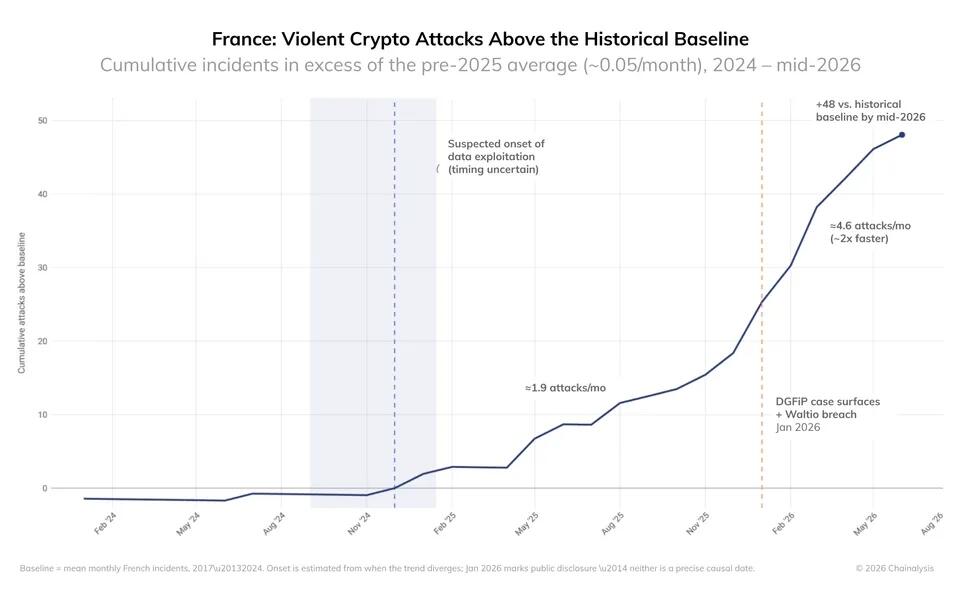
Violent attacks above the historical baseline. Source: Chainalysis.
Criminals aren’t targeting crypto rich tourists, and of the victims with known residency, 93% were French.
Chainalysis head researcher Eric Jardine tells Cointelegraph the surge is “very likely” due to a “significant data breach.”
“These sort of breaches expose more than financial information; they reveal who holds crypto, where they live, and how to find them.”
That makes physical attacks against crypto holders particularly insidious because they can begin long before a thug shows up with a wrench demanding your seed phrase or a crypto transfer. The assailants first need to know who has something worth stealing, where they live and how to reach them.
Jardine says the French tax authority compromise in 2024, where a tax official in the Paris area “leaked PII, financial and crypto holding information on French taxpayers,” may have been the accelerant. Chainalysis records show attacks surged from late November of the same year.
Chainalysis also points to a further incident in January 2026, with crypto tax reporting firm Waltio disclosing a breach affecting some 50,000 users, creating yet more useful data for attackers to mark their targets.
Francis Pouliot, founder of Canadian Bitcoin exchange Bull Bitcoin, has repeatedly challenged Europe’s DAC8 crypto reporting rules in France, which expand tax reporting and information-sharing requirements for crypto users across the European Union.
“DAC8 has transformed the concept of Know Your Customer into Kill Your Customer,” he said, along with describing France as the “crypto kidnapping capital of the world.”
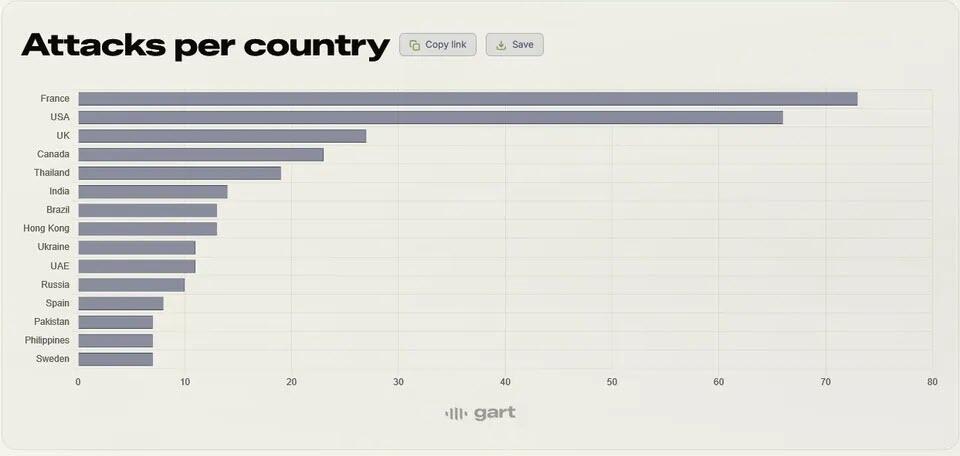
The world of physical attacks. Source: Gart.io
When the target isn’t the Bitcoiner
According to Chainalysis, one of the most revealing changes may be who is being attacked. Globally, relatives and acquaintances accounted for around 25% to 30% of violent crypto incidents by early 2026, and in France, the proportion was more than 40%.
In May 2026, six men allegedly tried to abduct the wife of The Sandbox co-founder Sébastien Borget from the couple’s home in Villenoy, France, with one attacker posing as a delivery driver to get her to open the gate.
In August, a couple in rural France reportedly endured three separate attempts to break into their home after buying a property previously occupied by crypto millionaires, after the previous owners’ tax information and address were leaked onto the dark web.
A similar tactic was used in 2025, when the father of a crypto entrepreneur was abducted in Paris and held for two days, with the kidnappers reportedly cutting off part of his finger and sending it to his son while demanding $5.6 million in cryptocurrency.
Jardine says the targeting of relatives and associates “suggests criminals are doing reconnaissance before they act,” whether by “monitoring social media, analyzing blockchain data, using leaked information, or receiving tips from insiders.”
That turns the usual idea of a crypto target on its head, since the person with the wallet may not be the person standing in front of the attacker.
French authorities are responding by treating the attacks as organized crime, coordinating investigations through JUNALCO, the country’s specialized organized crime jurisdiction.
The $5 wrench conundrum
Most crypto holders have learned how to protect their seed phrases, set up hardware wallets, test their environments and avoid clicking on phishing links.
While those things are still important, none of them will help if a bad actor already knows who they are, where they live and that they have something worth stealing in the first place.
Cryptography can protect a wallet, but it can’t stop an attacker with a $5 wrench.
END
FRANCE:
| France Looks to Be the First Country to Go Bust… But It Won’t Be the Last |
| By Graham Summers, MBA | Chief Market Strategist |
| Something happened in the bond market at the start of this month that we haven’t seen in over a decade, and it involves one of the most important countries in the world. France isn’t some peripheral player like Greece. It’s a founding member of the European Union and the second largest economy in the Eurozone after Germany, accounting for nearly a fifth of the Eurozone’s output. Since Brexit, it’s the EU’s only nuclear power and its only permanent member of the UN Security Council. Along with Germany, France is one of the two pillars the entire euro project rests on. It’s also the EU’s biggest debtor. At nearly €3.6 trillion, France owes more than any other country in the bloc, including Italy and Germany. When Greece nearly broke the Eurozone in 2010, its debt was roughly €330 billion. France’s is about ten times that. The Eurozone’s bailout fund, the European Stability Mechanism, can lend a maximum of €500 billion. The rescue machinery Europe built during the last crisis was never designed for a country this size. On October 2, the spread between French and German 10-year government bonds blew out to roughly 150 basis points. That’s the widest gap since the 2011 Eurozone debt crisis, when Greece, Italy and Spain were all on the brink. Today, France trades WIDER than Italy (about 90 basis points) and Greece (about 76 basis points). Put another way, the bond market now views the second largest economy in the Eurozone as a riskier borrower than Greece. |
 |
| It gets better. As of October 8, roughly €215 billion worth of French investment grade corporate bonds were yielding LESS than comparable French government bonds. Investors would rather lend to French companies than to the French state. The spread has eased a bit since then. It was about 132 basis points as of last Friday. But don’t let that fool you. France’s problems are structural, and as I’ll explain shortly, the country has no realistic way to fix them.Let’s start with the numbers. As of the end of the second quarter, France’s public debt stood at nearly €3.6 trillion, or 119% of GDP. That’s the highest level since 1946, when the country was rebuilding from World War II. The government’s own budget projects debt will hit 121.7% of GDP next year. France is running a budget deficit of 5.4% of GDP this year, one of the largest in the European Union. The last time France balanced its budget was 1973. Richard Nixon was President. |
 |
| Next year, France will borrow a record €340 billion, €28 billion more than this year, to fund its deficit and roll over its maturing debt. And the cost of carrying that debt is climbing fast. The French state’s interest bill is projected to rise from €64.8 billion this year to €74.2 billion in 2027. Interest on the debt is now the single largest spending item in the state budget, ahead of education. Here’s the part most analysts miss. The average maturity of French government debt is about eight and a half years. That means the debt France issued at near zero rates in the 2010s and early 2020s is only gradually being rolled over at today’s much higher rates. The interest burden has years of increases already baked in. So why can’t France fix this? First, France can’t print its own money. The Banque de France doesn’t set French monetary policy. The European Central Bank (ECB) does. When the U.S. or Japan runs into a debt jam, their central banks can buy government bonds to keep yields in check. France gave up that option when it adopted the euro. The ECB does have a tool for exactly this kind of situation. It’s called the Transmission Protection Instrument (TPI), and it allows the ECB to buy a member country’s bonds if spreads blow out for reasons that aren’t justified by fundamentals. But there’s a catch. A country is only eligible if it is following the EU’s fiscal rules. France has been under an EU excessive deficit procedure since July 2024, which means it fails one of the ECB’s key criteria for a rescue. The TPI has never been used, and no ECB policymaker has suggested using it for France. Second, France can’t cut its way out. Prime Minister Sébastien Lecornu runs a minority government. On October 1, it unveiled a 2027 budget with €43 billion in spending cuts and revenue measures, targeting a deficit of 5% of GDP. Lecornu himself has warned that without savings, the 2027 deficit would approach 6.5% of GDP. Getting that budget through parliament is another matter. Public sector workers have already gone on strike over a proposed pay freeze. Last year, the government agreed to suspend Macron’s signature pension reform just to survive, a move that helped push S&P to downgrade France to A+. Fitch had already cut France to A+ the month before. Then there’s politics. France holds a presidential election next year, and polls suggest the far right could win it. Few politicians are going to campaign on cutting pensions and healthcare in a country where public spending accounts for more than half of GDP. Third, France can’t tax its way out. France already has one of the heaviest tax burdens in the developed world, and this year’s budget leaned on exceptional taxes on very high earners, large companies and family holding companies. There is only so much more you can squeeze before capital and talent start to leave. Fourth, France can’t grow its way out. The Banque de France expects the economy to grow just 0.5% this year. With growth that weak and a deficit above 5% of GDP, the debt keeps growing faster than the economy that has to support it. And there’s a fifth problem: France doesn’t control who owns its debt. Close to 57% of French government debt is held by non-residents. Foreign investors have no political loyalty to Paris. If they decide the risk isn’t worth it, they sell. Every sale pushes yields higher, which makes the math worse, which triggers more selling. Put simply, France is stuck. It can’t print, it can’t cut, it can’t tax, and it can’t grow. That leaves the bond market to decide the outcome. |
 |
| Now, I’m not saying France is going to default next month. But France is the first major developed economy where the bond market has clearly started to price in the reality that its debt can’t be paid down on current terms. And it won’t be the last. France isn’t even running the biggest deficit in the Eurozone. Belgium posted a 5.2% deficit last year, versus France’s 5.1%. Across the developed world, governments spent the last 15 years running large deficits on the assumption that interest rates would stay near zero forever. Those days are over. As I explained last week, the Everything Bubble is now bursting in the bond markets of countries like France and Japan. So where does the money go when investors flee these markets? History gives us the answer. During the 2011 Eurozone crisis, capital fled European sovereign debt and poured into U.S. Treasuries. The flight was so large that the yield on the 10-year Treasury fell below 2% in the weeks after S&P stripped the U.S. of its AAA rating. The U.S. has its own debt issues. But it has the world’s reserve currency, the deepest bond market on the planet, and a central bank that can buy its own government’s bonds. France has none of those. When the next leg of the European debt crisis hits, the U.S. is likely where that flight capital lands. For investors, this is a major signal. When a country loses control of its bond market, the endgame tends to look the same: the central bank is eventually forced to step in and buy the debt, rules or no rules. The ECB did this once before in 2012, when Mario Draghi pledged to do “whatever it takes” to save the euro. Printing money to hold a currency union together is inflationary, and the assets that benefit are hard assets like gold, energy, and the companies that produce them. I coined the term “the Everything Bubble” back in 2014. Since then it has been picked up by the Wall Street Journal, the New York Times and the Economist, and Scott Bessent used it in the title of a 2023 essay.Now that bubble is bursting, starting in the bond markets of countries like France and Japan. And my subscribers are already positioned for major profits as it unfolds. For months, my Private Wealth Advisory newsletter has been building a portfolio for exactly this moment. It’s loaded with hard assets, energy, and the companies that stand to benefit as governments turn to printing money to deal with their debts. Private Wealth Advisory has been in publication since 2009. Since 2020, it has doubled the S&P 500’s return with a 75% win rate. Right now you can try it for 30 days for just $2.99. You’ll get four weeks of market updates and multiple trade ideas. You’ll also get a free copy of my book The Everything Bubble, which sells for $9.99 on Amazon. The Everything Bubble has started to burst. The time to get positioned is now, before the rest of the market catches on. This offer expires today at noon (12:00PM EST |
FRANCE: AI
France’s Debt Spiral Is Getting Worse… And The Euro Is Paying The Price
France’s public finances are under severe strain in late 2026, with debt near record highs, persistent large deficits, soaring borrowing costs, political gridlock ahead of the 2027 presidential election, and clear spillover pressure on the euro. This is widely described by markets and analysts as a worsening debt trajectory that risks a self-reinforcing spiral, though it is not (yet) a full-blown loss of market access.
cnbc.com
Key numbers (as of mid-to-late 2026)
- Public debt: Reached €3,595.5 billion at the end of Q2 2026, or 119% of GDP (INSEE data)—the highest ratio since 1946 and up from ~115.6–115.7% at end-2025. Official projections see it climbing further to ~119.3% by end-2026 and 121.7% in 2027 even with planned consolidation. Live estimates put the stock near €3.7 trillion. insee.fr
- Budget deficit: 5.1% of GDP in 2025; expected at 5.4% in 2026 (worse than earlier targets) due to weaker growth, higher interest costs, and spending pressures. Without new measures the 2027 deficit could hit ~6.5%; the government targets 5.0% via a €54 billion consolidation effort (€43 billion in new measures). deutsche-bank.it
- Interest burden: Rising sharply. Debt-servicing costs are projected to jump (e.g., toward €73–91 billion range in coming years) and become one of the largest budget items, potentially outpacing defense spending. The implicit rate on the debt stock has climbed, and new issuance faces market yields near multi-decade highs. cnbc.com
- Bond market reaction: French 10-year yields have approached or touched ~4.85–5%, the highest in ~24 years (since ~2002). The spread over German Bunds widened to levels last seen in the 2011–2012 eurozone crisis (peaking near 140–160 bp before some retracement). Some high-grade French corporate bonds have even traded through sovereign yields at times. politico.eu
France has not run a balanced budget in decades. Structural drivers include high social spending (pensions, healthcare), an aging population, weak growth (recent forecasts cut, e.g., 2026 growth revised lower to ~0.5%), pandemic-era debt maturities requiring heavy refinancing (record ~€340 billion issuance planned for 2027), and limited political room for austerity.
clb.org.hk
Political and market dynamicsPrime Minister Sébastien Lecornu’s minority government is trying to push the 2027 budget through a fragmented National Assembly (debate on revenues began around October 13, 2026). Proposals involve spending restraint (including on social areas) and some revenue measures totaling the €54 billion effort. Success is far from assured: previous governments fell over budget fights, protests (including student actions over public services) are ongoing, and the April 2027 presidential election looms, reducing appetite for painful cuts.
cnbc.com
Markets are pricing higher risk of fiscal slippage or political paralysis. Japanese investors and others have reduced holdings; contagion fears have appeared in Italian and other peripheral spreads at times. Bank of France officials have warned of the need to avoid a crisis that could “strangle” the country via rates. Some analysts note France is not yet in outright crisis (it retains market access, effective rates on the stock are still lower than marginal yields), but the combination of high debt, deficits above EU rules, and rising rates creates snowball risks if growth stays soft.
scmp.com
Impact on the euroFrench uncertainty has weighed directly on the single currency. The euro fell to a 17-month low against the dollar (around $1.116) in early October 2026 amid the bond sell-off and wider eurozone contagion worries, extending a multi-week decline. Spreads and fiscal stress in the bloc’s second-largest economy revive memories of the earlier sovereign debt crisis and raise questions about eventual ECB involvement or broader fragmentation. The euro’s weakness reflects both France-specific risk and a more general reassessment of eurozone fiscal credibility.
reuters.com
In short, the “debt spiral” label captures a real dynamic: high deficits + rising rates + weak growth + political constraints → higher debt ratios and interest costs → further market pressure. Stabilizing the path requires credible multi-year consolidation that current politics make difficult. Outcomes will hinge on the 2027 budget process, election results, growth, and whether markets remain patient or force more abrupt adjustment (or external support). This remains a live and evolving situation.
END
FRANCE
Two Teachers Shot In France; Far-Left Network Is Funding The Chaos
Tuesday, Oct 13, 2026 – 08:35 AM
Authored by Steve Watson via Modernity.news,
A 14-year-old pupil walked into a middle school near Marseille Monday morning with a hunting shotgun hidden inside a guitar case and opened fire, wounding the principal and a teacher.

Both suffered non-life-threatening injuries to the lower body. Staff overpowered the shooter before police arrived. Education Minister Édouard Geffray stated on social media: “Two staff members from the National Education system, a principal and a teacher, were victims this morning of gunshot wounds at Lakanal middle school in Aubagne. A student is said to be the perpetrator.”
He added that the act was “yet further evidence of the rise of unchecked violence in our society.”
Local officials and media have claimed there is no apparent link to the ongoing riots. The shooting nevertheless landed amid weeks of escalating unrest that began as complaints about teacher shortages, overcrowded classrooms, and dilapidated buildings – and quickly turned into arson, looting, and assaults on police and staff.
Meanwhile, a Fox News Digital investigation by senior editor Asra Nomani tracked 50 organisations active around the French protests. Only 15 are actual student or youth groups. The other 35 include a dozen labour unions, eight communist or socialist organisations, the French Communist Party, La France Insoumise, and a Palestinian advocacy group. Nomani and others describe it as a “red-green alliance” – communists and Islamists united against the Judeo-Christian, capitalist West.
Heritage Foundation senior fellow Mike Gonzalez put it plainly: “What we’re seeing here is the same Red-Green ecosystem that disrupts infrastructure chokeholds in our country such as the Brooklyn Bridge, college campuses and congressional hearings. And in the case of BreakThrough News, the same sugar daddy – Neville Roy Singham.”
Singham, the Shanghai-based tech tycoon who has poured tens of millions into U.S. far-left groups, funds the pro-communist outlet BreakThrough News. That outlet has amplified the French unrest with “BREAKING” alerts and collages of global youth riots, framing local education grievances as part of a worldwide uprising against austerity, policing, and the West.
On the ground in Paris, hammer-and-sickle flags have flown alongside Palestinian flags. Young Communists of France have marched under “Class War” banners demanding an end to “Imperialist Wars.”
This is the same playbook long familiar in American streets. The network is not spontaneous. Adult organisers, political parties, and media amplifiers have seized a student issue and turned it into street chaos.
Earlier incidents documented the scale. Rioters set fire to the exit of a Paris vocational high school, trapping roughly 100 students and staff inside while firefighters and police faced mortar fire.

Rioters Torch Paris School Exit And TRAP 100 Students Inside
Firefighters and police were met with mortar fire
A wild horde of attackers hunted down a plainclothes police commander, beat him unconscious, and stomped his head.

GRAPHIC: ‘Wild Horde’ Beats French Police Commander UNCONSCIOUS, Stomps His Head
Attempted murder probe opened after a plainclothes intelligence chief is hunted down
A feral mob chased a young female officer through the streets, knocked her down, and kicked her while voices screamed “Kill her!” Marine Le Pen called the footage “unbearable” and demanded exemplary sentences.

Kill Her!” — Feral Mob Hunts French Cop; Le Pen Calls It “Unbearable”
France’s interior minister said the perpetrators would be found and prosecuted
Footage circulating online shows the reality behind the media framing of “student protests over school conditions.” Schools have been burned. Teachers and supervisors have been assaulted. Fire engines and buses have been torched. Foreign flags have appeared among the crowds.
While grievances about missing teachers and crumbling buildings may have been the initial driver of protest, the organised escalation into nihilistic destruction, coordinated by far-left networks and amplified by transnational communist media, is something else entirely.
The violence has already crossed into Belgium. In Liège, student protests against education cuts descended into nights of broken glass, fires, and looting. Belgian Interior Minister Bernard Quintin said at a press conference that the movement was no longer spontaneous: “We know that there is a movement, of the Antifa type, active in Liège.” He continued: “Adults who manipulate children in order to put across violent political messages. That is totally unacceptable.”
Police recorded nearly 200 detentions in Liège alone since early October, the majority minors answering social-media calls. A 13-year-old was held after posting calls to set a school on fire. The unrest reached Brussels during a national anti-austerity demonstration, where masked groups clashed with police near the central station, set fires to bikes and buses, and threw projectiles.

European Utopia Burns: Far-left Riots Spread Like Cancer From France To Belgium
Europe’s major problem is the far-left radicalization of young people
Officers confiscated a samurai-style sword. A Palestinian flag was visible. French authorities have taken nearly 6,900 people into custody since the unrest began, 86 percent of them minors.
European governments spent decades expanding open-border policies and tolerating parallel societies while far-left parties courted the resulting demographic base. The result is visible on the streets of Paris, Marseille, Liège, and Brussels: children weaponised by adults, police beaten in packs, schools turned into battlegrounds, and a “red-green” alliance operating across borders with funding and propaganda links to China-based money.
The same forces operate in the United States. Singham-linked groups have driven anti-ICE agitation, campus encampments, and infrastructure blockades. The French and Belgian scenes are not distant foreign news. They are the predictable outcome when mass migration meets organised ideological subversion and political elites refuse to enforce basic order.
Nations that still value their own citizens, their schools, and the rule of law have a clear choice. Close the borders. Deport those who reject the host society. Prosecute or sanction the organisers who send children into the streets with fire and bricks. The alternative is already on display: teachers shot in school corridors, police stomped in the open, and entire cities burning while the networks that fund and film it declare victory over the West.
END
BELGIUM
“Our Message Is: Smash Everything”; Belgian Students Expose Ignorance Over Protest Purposes In Revealing Video
Tuesday, Oct 13, 2026 – 02:00 AM
Authored by – Remix News Staff – via Remix News,
A video clip of a Black male student at ongoing protests in Belgium showed him saying he does not know why he is protesting, and that his message is to “smash everything.”

The clip is being used as another piece of evidence that the protests are not really about reforms or improving education standards, but instead serve as a pretext for ethnic minorities to riot, destroy, and attack police.
After he calls for protesters to “smash everything,” the crowd of Black youths and other ethnic minorities, many heavily masked, began hooting and screaming in response. The video further shows burning shared bicycles and electric scooters, the same products many on the left promote as an alternative to CO2-producing cars and trucks.
In a post from Belgian political activist Dries Van Langenhove, he writes about the video: “European people can’t comprehend this because we’re simply not the same. They destroy. It’s what they do. It’s who they are. Politicians now come up with all sorts of fake ‘solutions’: more money for education, more youth detention centres, military conscription, … but it’s all nonsense. There is only one real solution: they have to go back.”
The footage has circulated amid student protests in French-speaking Belgium, particularly in Liège and Brussels. The media reports that the protests are fueled by rising education costs, overcrowded classrooms and reforms in the Wallonia-Brussels Federation. However, just as with the student protests in France, many of the participants cannot articulate any clear demand.
In France, many of the protests have devolved into large-scale riots, including attacks on teachers, police officers, and schools. Dozens of arsons have also partially destroyed schools across France, further raising questions about what the true demands and motives of the protesters are.
In Belgium, authorities have also reported property damage, arson and clashes with police. Local media and police cited more than 100 arrests in Liège in recent days alone, many involving minors, with overall detentions since early October approaching or exceeding 200 in some counts.
Shop windows were smashed, fires set and objects thrown at officers; one video game retailer reported about €30,000 in stolen goods.
Interior Minister Bernard Quintin has said an Antifa-type movement is manipulating children into violence. “Adults who manipulate children in order to put across violent political messages. That is totally unacceptable,” he said.
The student actions overlapped with a national strike Friday organized by Belgium’s major unions against government austerity measures aimed at reducing the deficit under Prime Minister Bart De Wever. Police estimated about 30,000 participants in the Brussels march, which was largely peaceful, though smaller groups of masked youths threw bottles, bricks, stones and fireworks, set fires and damaged property near the central station. Officers used water cannons and tear gas; authorities reported 21 detentions or arrests, including 13 minors.
De Wever has argued that painful budget measures are needed to avoid a debt spiral that would burden future generations.
END
GERMANY
German Coalition Turmoil Deepens As SPD Co-Leader Bas Quits, Blames CDU “Public Attacks”
Tuesday, Oct 13, 2026 – 02:45 AM
Just when Friedrich Merz gathered his party’s top brass to “regroup,” the government lost another load-bearing wall.
On Monday, labor minister Bärbel Bas, who was also co-chair of the junior coalition partner SPD, abruptly resigned from both posts. The 58-year-old said she needs time to grieve after the sudden death of her stepdaughter, but she also pointed a finger at “public attacks,” including from within the ranks of Merz’s own CDU/CSU bloc, which she said continued throughout her mourning period, and which according to Reuters had made her situation unbearable. She keeps her Bundestag seat.
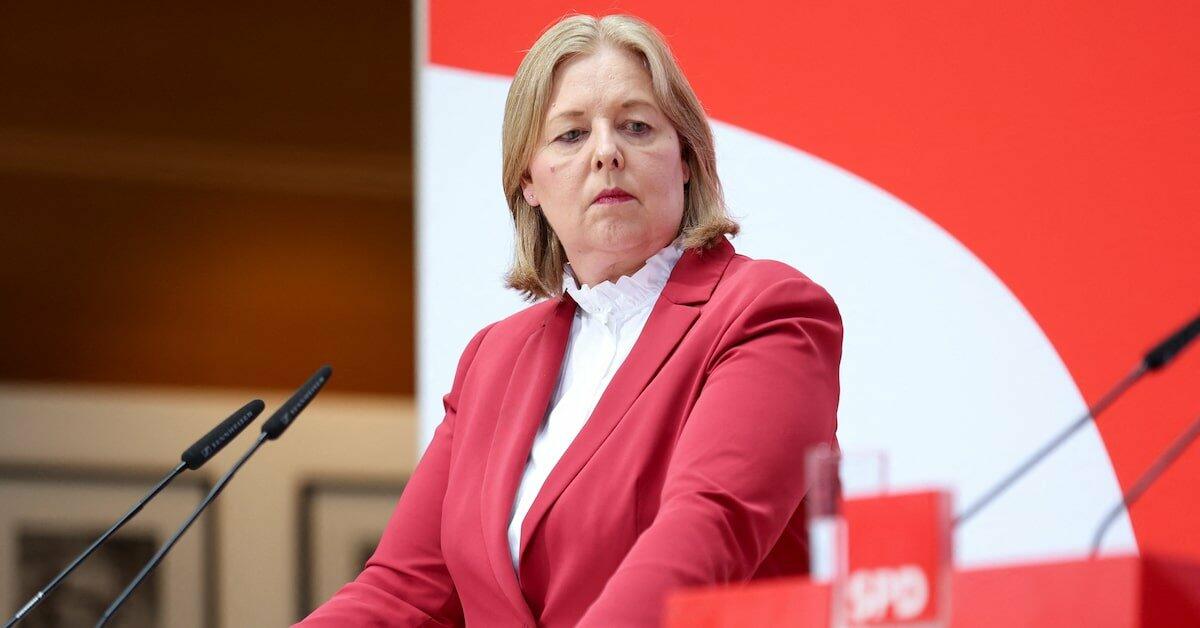
The resignation landed on the second day of a CDU retreat meant to steady the party after a September that went from bad to historically catastrophic. Regular readers will recall that the AfD took 43.8% in Saxony-Anhalt, where Merz’s CDU slumped to 17.2%, and two weeks later the chancellor admitted a “disaster” as the CDU scored just 4.9% in Mecklenburg-Western Pomerania and failed to enter a state parliament for the first time in its history.
Nationally, the picture is no prettier: the AfD hit 30% in the GMS poll, 10 points ahead of the CDU/CSU, enough to leave the “black-red” coalition without a majority, while an Insa survey found 78% of Germans say Merz is not the right chancellor. Meanwhile, the vaunted “firewall” is visibly crumbling: four CDU lawmakers in Saxony-Anhalt helped elect an AfD speaker last week and have reportedly agreed to back AfD’s Ulrich Siegmund for state premier in December.
Bas also leaves a hole in the middle of the reform agenda. Her ministry runs large parts of Germany’s welfare system and was handling the pension and working-time legislation at the center of the coalition’s reform push, with Berlin aiming to pass the broader pension overhaul by year-end. CDU politicians had accused her ministry of dragging its feet on measures coalition leaders agreed back on July 1, which is a polite way of describing the “attacks” she referenced on her way out.
Her replacement: Alexander Schweitzer, the former premier of Rhineland-Palatinate, nominated by Finance Minister and fellow SPD co-chair Lars Klingbeil. Readers may recall Schweitzer is “former” because the CDU beat the SPD in his state in March, so the SPD’s answer to an electoral crisis is to promote a politician who just lost an election. Business groups, for their part, welcomed the appointment as a chance for a “new start.”
Klingbeil also proposed an extraordinary SPD party congress in December or January to re-elect the entire leadership. People familiar told Bloomberg the next co-chair must be a woman from the party’s left wing, though not Manuela Schwesig, who is busy with coalition talks in Mecklenburg-Western Pomerania. Klingbeil, who scrapped a trip to India to deal with the vacuum (his attendance at this week’s IMF/World Bank and G20 meetings in Bangkok is now uncertain), called the attacks on Bas “indecent” and said they were “poisoning our political culture.”
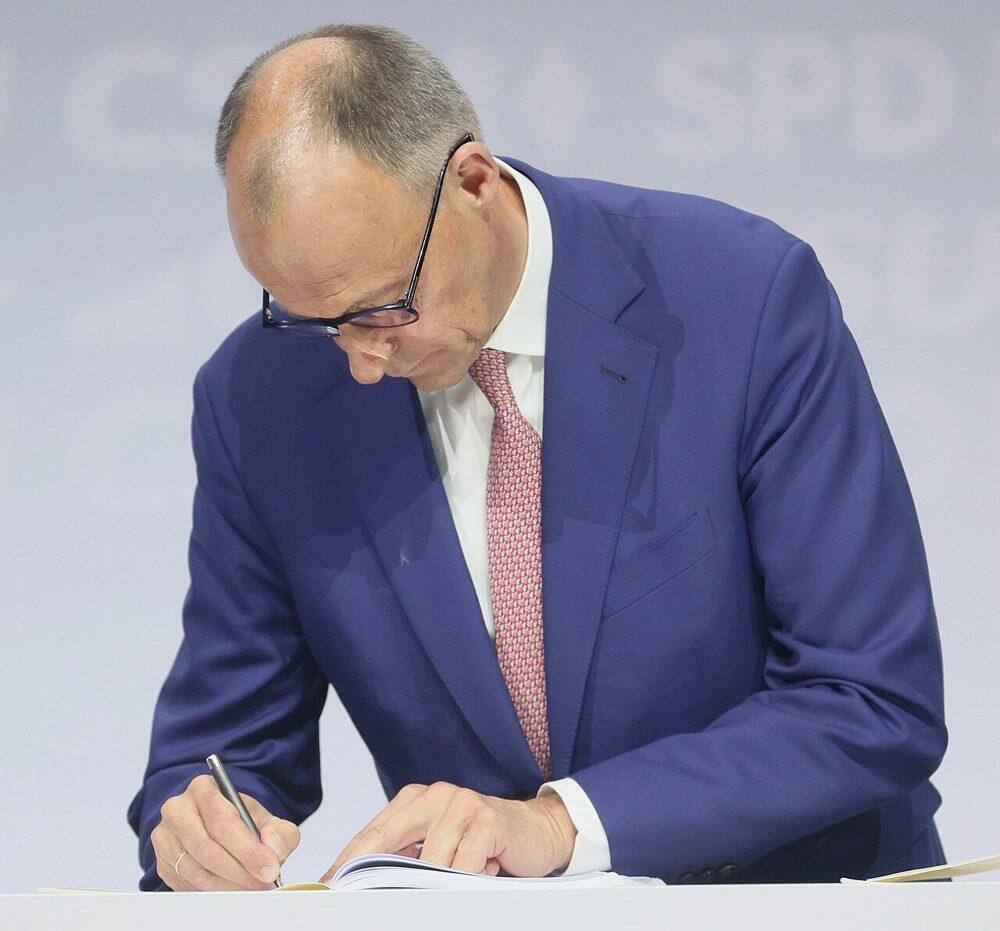
Merz said Bas’s decision demands “respect,” while his spokesman Stefan Kornelius denied a media report that the chancellor himself had grumbled off the record about her absence despite knowing her personal situation, the kind of denial that tends to precede further reports, or even more denials.
Reuters notes that the departure of one minister is not expected to bring down the government, and coalition leaders issued a statement last week vowing to carry on through the “historic test” facing German democracy. But the calendar is brutal: an SPD leadership contest, a possible first-ever AfD state premier in Saxony-Anhalt in December, a pension overhaul with a year-end deadline and five more regional elections next year that will shape Merz’s control of the Bundesrat.
As Nomura’s Andrzej Szczepaniak warned last month, Europe has entered an 18-month election cycle in which politics is lurching toward populism, and Germany is the main event. All of this while the economy the reforms are supposed to rescue keeps getting outcompeted:
And so, the German coalition limps on (for now), but the year-end pension deadline just became the first casualty. A government that can’t keep its own labor minister is unlikely to sell voters on working longer.
END
EUROPE/DR LACALLE
Europe’s Diesel Shortage Is A Problem Created By Political Design
Tuesday, Oct 13, 2026 – 07:20 AM
Authored by Daniel Lacalle via dlacalle.com,
The diesel agreement between Donald Trump and Vladimir Putin will not solve the diesel shortage, considering the magnitude of the problem created by years of misguided, wrongly called “environmental policies.” Complaining about diesel prices and the US-Russia deal while eliminating domestic refining capacity and bombing refineries is just another example of bureaucratic hypocrisy.
Renewables are important, but they cannot substitute diesel, just as they have been unable to offset the importance of natural gas. Diesel is essential for every segment of the economy, from transport, manufacturing, and farming to distribution. Now, European politicians complain. However, governments cannot negotiate away years of lost refining capacity. Europe’s vulnerability is structural. Yes, war has intensified it, but policy choices helped create an energy system increasingly dependent on imported fuels, expensive infrastructure, and high taxation. Furthermore, the risk is that – as happened in the past – oil and gasoline prices may fall, and the European businesses and families will still pay much higher energy and fuel prices.
According to European Commission figures and comparisons based on official European and US data, Europe suffers an enormous energy-cost disadvantage after two decades of massive subsidies and renewable rollout. Industrial electricity prices are more than twice those in the United States, while industrial natural gas prices reach four times US levels. At the pump, European consumers pay approximately 47% more for diesel and 70% more for gasoline. This is not simply an oil-price problem. It is an enormous competitiveness problem that permeates throughout the economy.
On October 9, Trump announced that Russia would release 300,000 tonnes of diesel immediately, followed by 500,000 tonnes in November, one million thereafter, and another three million, subject to refinery conditions. Washington temporarily authorized Russian diesel transactions until April 7, 2027. However, these are announced commitments, not confirmed deliveries. It may mitigate but not solve the diesel crisis.
The distinction is important. A sanctions exemption may permit trade, but it cannot repair damaged processing units. According to International Energy Agency estimates, Russian diesel production has suffered a temporary but significant blow, declining almost 30% following Ukrainian attacks.
The important element is a policy choice, not a consequence of war.
Europe’s refining contraction is the key factor behind the structural diesel problem. It has lost more than 20% of refining capacity since 2009. At the end of 2025, the EU, Britain, Norway, and Switzerland had 72 mainstream refineries and an annual primary processing capacity of 625.4 million tonnes, down 167.6 million tonnes. Industry association FuelsEurope counts 35 closures since 2009.
The deterioration did not stop with the 2022 Ukraine war and has continued recently. Europe lost almost 400,000 barrels per day of refining capacity between 2024 and 2025, with five refineries closing over two years. This trend is a continuing reduction in the infrastructure needed to turn crude into usable fuel.
Environmental policy is part of this story, but taxation and policy choices have aggravated the problem. Governments made it uneconomical to upgrade aging facilities or build new units. Furthermore, at least five closed European facilities abandoned crude processing through conversion into biorefineries. These conversions worsened conventional refining capacity and did not offer a reliable and sustainable alternative.
The policy mistake is obvious and reminds us of the same errors committed with nuclear plants and natural gas supply. Eliminating capacity is a policy mistake without a credible path to reduce diesel’s importance. This move was not a transition but a jump into the void. Europe now relies more heavily on refined products from the Middle East, the United States, and India. Importing products is not an environmental policy success. “Not in my backyard” led to dependency and loss of competitiveness. The EU was the fourth-largest buyer of Russian fossil fuels, accounting for 8% (EUR 1.2 bn) of Russia’s export revenues from the top five importers in August 2026, according to CREA.
Ukraine’s refinery attacks have reduced fuel availability, and Russia has restricted diesel exports. While damaged refineries can be repaired, it will take months.
War in the Middle East and disrupted Hormuz flows have compounded the shortage. The European Central Bank estimates reported in September put the refining-margin contribution to diesel prices at €0.41 per liter, approximately 19% of the pump price. That is why watching Brent alone misses the problem, as crude and diesel are different markets.
On September 21, EU diesel averaged €2.226 per liter, the highest reading in the European Commission’s series since 2005. Taxes accounted for €0.861, or 38.6% of the price. VAT applies on top of excise duties, effectively taxing the tax itself.
The EU minimum diesel excise is €0.33 per liter. America’s federal diesel tax is 24.4 cents per gallon, before state taxes and fees. European taxation adds a persistent cost wedge that cheaper crude cannot eliminate. This means that the average EU final diesel price is almost 50% higher than the US one. Thus, falling oil prices can provide relief without restoring competitiveness. Fixed duties remain, and scarce refining capacity may keep diesel expensive even when crude oil becomes cheaper.
Europe needs to abandon ideology in energy, provide solid investment conditions, eliminate regulation, and support an adequate refining system. Even though the European Commission’s newly announced “refinery dialogue” mentions these issues, it does not change the underlying ideological perspective or any of the existing regulations and misses the key measures to reduce the competitiveness gap, which come from lower taxes, more investment, and elimination of punitive regulations. Emergency Russian cargoes may help at the margin, even if European politicians complain about the US-Russia deal. However, none of this is going to repair Europe’s own policy-created vulnerabilities. The solution may take years, even if the changes are implemented today.
END
UK
“Britain Is Full”: Farage Vows To Shut Down Asylum System For Five Years, Deport 90,000 Pending Claimants
Tuesday, Oct 13, 2026 – 05:45 AM
Nigel Farage has a new answer to Britain’s asylum backlog: abolish the asylum system.

Standing in Hythe, Kent on Monday in front of a replica Channel “mega dinghy,” the Reform UK leader pledged that a Reform government would suspend the asylum system for a full parliamentary term: all new claims rejected, all pending applications voided, and every claimant marked for deportation, according to the BBC. No refugee status, no humanitarian protection, no tribunals and no resettlement schemes. Home affairs spokesman Zia Yusuf put it in three words: “Britain is full.”
“The country is currently facing a national security emergency and the first duty of government is to protect its citizens. We cannot accept more asylum seekers while we still have no idea how many people are in the country illegally and the threat they pose. A Reform government will always put British people first and protect our borders.” — Nigel Farage, to The Telegraph (emphasis ours)
Translation: rather than fix the queue, Reform proposes to delete it. Regular readers will recall that when Farage first sketched out his migration plan (ECHR exit, an asylum ban for illegal arrivals, migrants moved from hotels to disused RAF bases), we called Reform’s plan for dealing with UK illegal migrants a good start (Aug 27, 2025). Fourteen months later, the “start” has become a full stop.
Below we lay out what’s in the plan, the numbers behind it, the (predictable) reaction, and the awkward fact that it lands just as Reform’s poll lead has evaporated.
What’s In “Restoring Justice”
Per the BBC, PA and The Telegraph (via the Daily Sceptic), the plan, dubbed “Restoring Justice,” would:
- Void the applications of the ~90,000 people currently in the asylum and humanitarian protection appeals queue and deport the claimants to their home country or “a safe neighbouring country” (PA via AOL).
- Scrap all asylum tribunals, legal refugee routes and resettlement schemes, including immediately closing the resettlement scheme Home Secretary Shabana Mahmood reopened in September. Homes for Ukraine would be abolished for new arrivals, but Ukrainians already here could stay.
- Re-task every Home Office official now working on asylum cases to “reviewing and overturning previous refugee grants.” Any refugee granted asylum in the last five years would have their case reviewed (The Independent reports the review would cover grants since 2024, with those from “safe” countries losing their status).
- Pull Britain out of the ECHR, repeal the Human Rights Act 1998 and disapply the 1951 Refugee Convention to head off the inevitable legal challenges (BBC).
- Create a dedicated detention-and-deportation agency needing 24,000 to 28,000 detention spaces. The BBC notes it is “unclear how this would provide enough capacity.”
- Ban UK visas for Pakistan, Somalia, Eritrea, Syria, Afghanistan and Sudan if they refuse deportation flights, and hit countries with few nationals in the UK with tariffs, airline bans and asset freezes. As Farage put it: “People will accept their bad guys back” (The Independent).
It sits on top of Reform’s earlier pledge to deport up to one million people in its first term (Telegraph via Daily Sceptic), and the August “Operation Fortress” plan to have the Royal Navy intercept dinghies and return them “under escort” to France or Belgium (Guardian). Asked how many civil servants it would take, Farage declined to say, only that it was “going to save us a fortune.”
Tariffs as an immigration weapon: someone in Hythe has clearly been watching Washington.
The Numbers: Down 41%, Still 20,935
Farage opened by recalling the day in May 2020 he took a fishing boat out of Dover and called the crossings “the beginning of an invasion,” noting that “over 200,000 illegal immigrants have come” since (Reform UK). The Home Office’s own series backs him on that one: small-boat arrivals total 213,545 since 2018, including 41,472 last year, the second-highest year on record behind 2022’s 45,755.
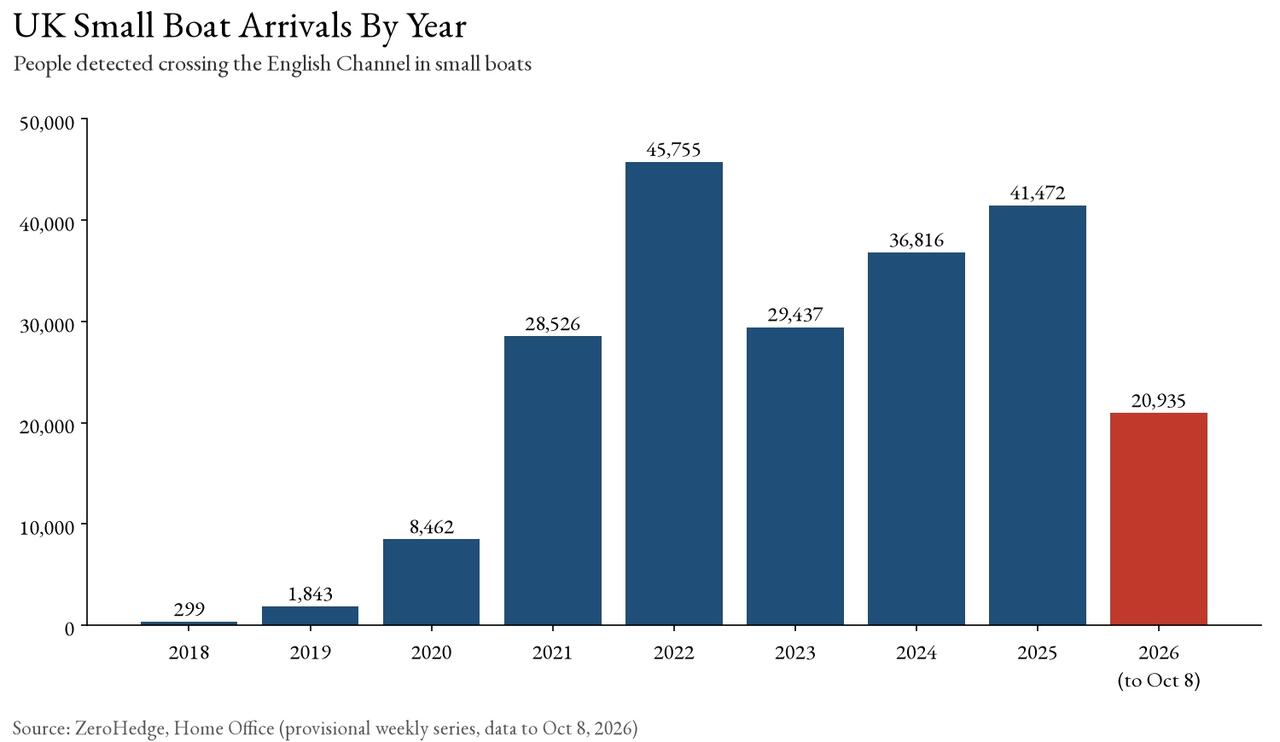
Which, as we noted last month, means that boat migrants who have entered Britain now outnumber its soldiers (Sep 28).
The awkward bit for Reform’s “emergency” framing: crossings are actually falling. Provisional Home Office data show 20,935 arrivals from Jan 1 to Oct 8, down 41% from 35,476 over the same period of 2025, on 305 boats averaging 68.6 people each. The boats, however, keep getting bigger: in August a single “mega-dinghy” brought a record 230 people across (The Independent), hence Farage’s line that this is no longer “a small boats crisis.” And the 2026 lull can turn fast: 1,648 people landed on 22 boats in the seven days to Oct 9 alone (Home Office).
The Reaction: “Desperation,” “Copycat,” “Chaos”
Everyone hated it, though for impressively different reasons.
Labour chair Bridget Phillipson called it “a clear sign of desperation and weakness,” adding that Farage “is casting around for more and more extreme policies as he tries to deal with scandals, police investigations and a growing challenge from Restore — this is a carbon copy of their policy” (The Independent).
The Tories, meanwhile, complained it wasn’t extreme enough to be original. Shadow home secretary Chris Philp said the proposals “largely copy” Conservative policy: “Banning asylum claims by illegal immigrants, abolishing the immigration tribunal and ending Labour’s resettlement routes are all existing Conservative policy. Our detailed BORDERS plan also sees us coming out of the ECHR… and closes the modern slavery claim and judicial review loopholes, both of which Reform seems to have missed.” The Tories have separately pledged to remove 750,000 illegal immigrants within five years (BBC). So Labour says Reform copied Restore, and the Tories say Reform copied the Tories.
The Refugee Council’s Jon Featonby called the plan “unworkable”: “Closing our asylum system would cause chaos. Desperate people would still arrive on our shores, but instead of entering an orderly system, they would be driven underground and vulnerable to exploitation and abuse.” The Lib Dems’ Max Wilkinson suggested the UK join the EU migration and asylum pact instead (BBC).
The legal hurdles are real. Repealing the HRA needs Parliament, and a unilateral ECHR exit by executive power would likely be challenged in court (The Independent). Readers will recall that even a council trying to shut a single asylum hotel in Epping lost: the Court of Appeal sided with the government to keep the migrant hotel open (Sep 1, 2025), after a summer of protests. Strasbourg’s critics aren’t confined to Clacton either: a top German judge warned that an overzealous ECHR “endangers the existence of Western democracies” (Sep 5, 2025).
The Politics: A Pledge In Search Of A Poll Lead
The timing tells its own story. Five months ago Reform was the party to beat: Farage’s Reform UK stormed to historic gains in the May “midterms” (May 8), and in August Farage crushed the Clacton by-election with 63% (Aug 14) after resigning his seat to force a “People vs. The Establishment” vote (Jul 7).
Since then, the summer of donation stories has taken its toll. In YouGov’s latest poll for The Times and Sky (Oct 4-5), Labour leads on 27%, with Reform down 3 points to 22% and the Conservatives on 20%; Restore Britain is on 3% (YouGov). That’s Labour’s best YouGov showing since January 2025 and the first statistically significant lead for any party in three months, after Andy Burnham’s conference speech.
Read the plan as the political move it is: with the Tories and Restore Britain competing for the same voters, Reform is staking out the hardest line on its strongest issue.
Bottom Line
As policy, the plan has obvious holes: no headcount, 24,000-28,000 detention spaces nobody has found, and a legal path that runs through the ECHR, the HRA, the Refugee Convention and every judicial review a well-funded NGO can file. As politics, it is shrewd. Britain has taken in 213,545 small-boat arrivals since 2018, and voters have watched one government after another promise to “stop the boats” while the dinghies got bigger. Farage doesn’t need the plan to be workable. He needs it to be the only one voters remember, and with Labour and the Tories busy accusing him of plagiarism, he’s halfway there. We side with Farage on the diagnosis. Whether the cure survives its first High Court hearing is another matter.
Next test: the Home Office’s next weekly small-boat release on Friday, Oct 16, and the next round of polls, which will show whether “Britain is full” can win back the 3 points Reform lost.
Much more in the full Reform UK speech here.
END
5.RUSSIA AND ISRAEL AND MIDDLE EASTERN AFFIARS
ISRAEL/IRAN/USA //MONDAY NIGHT
Saudi Energy Conference Loses Shell, Exxon, BP Execs – Who Bail After Houthi Strikes
Monday, Oct 12, 2026 – 06:50 PM
Several top energy executives were dropped from the schedule of Saudi Arabia’s ongoing WPC Energy Congress in Riyadh on Monday, as the kingdom insists on holding the conference despite the threat to the capital posed by the Ansarallah-led Yemeni Armed Forces (Houthis).
The event began on October 11 and is meant to run until 15 October. The head executives of ExxonMobil, TotalEnergies, Shell, Chevron, and BP were expected at the event.

On Monday, they were no longer listed on the agenda that the conference organizers put out.
“To everyone who traveled to Riyadh, thank you,” said Saudi Energy Minister Abdulaziz bin Salman while making the opening comments at the WPC Energy Congress.
“You know this country is safe and that we hold your protection at whole heart… Our gathering here does not mean the risk is gone,” he said.
He said that the YAF’s operations targeting the kingdom were “serious” and deserved an “equally serious” response. The event had been planned for April but was postponed when the illegal US-Israeli war on Iran was launched in February.
“Unfortunately, due to travel disruption, we are unable to be there in person. We greatly value our long-standing partnerships across the region,“ said a BP spokesperson cited by Reuters. The spokesperson added that the firm made “every effort to participate.”
Shell declined to comment, and TotalEnergies, ExxonMobil, and Chevron did not immediately respond.
The event is taking place 10 kilometers from Riyadh’s King Khalid Airport, which was bombarded by the YAF over the weekend, resulting in 12 deaths.
At the conference, Aramco CEO Amin Nasser said pressure across the energy world will only worsen until the Strait of Hormuz is fully reopened by Iran.
“Globally, the squeeze on crude oil is serious,” he said. The surge in refined fuel prices is making things worse, he added.
Offshore inventories are “well below” 6 million barrels, he went on to say, warning that it could take up to two years to refill while meeting demand. Meanwhile, crude oil prices climbed to their highest level in two weeks on Monday.
Brent crude rose 1.25 percent to $106 per barrel, while US WTI crude traded at $92 per barrel, marking their highest levels since 29 September.
Riyadh has suffered significantly as a result of its renewed war on Yemen and Sanaa’s retaliatory strikes, widening the country’s budget deficit and pushing the Saudi economy to the brink of “contraction,” the Wall Street Journal (WSJ) reported on Monday.
Over the weekend, Riyadh’s international airport came under heavy Yemeni bombardment. The halt to operations at King Khalid Airport was extended on Monday. Sanaa had repeatedly issued warnings over recent days, but Saudi authorities insisted on keeping airports running.
The kingdom’s Abha International Airport has also been under fire. Major Aramco sites across the country have been repeatedly struck, including refineries.
END
At Least 10 Supertankers Approaching Port Of Fujairah Reverse Course Amid Iran’s Attacks
Monday, Oct 12, 2026 – 10:45 PM
A growing number of empty supertankers have been turning away from the Persian Gulf as escalating Iranian attacks threaten a critical transfer hub for wartime oil shipments, Bloomberg reports.
At least 10 very large crude carriers and several Suezmax vessels approaching the port of Fujairah in the United Arab Emirates have stopped or reversed course in recent days, according to tanker-tracking data compiled by Bloomberg.
While other vessels are still continuing on their journeys into the region, the retreat of these tankers amid near-daily attacks around the Strait of Hormuz – some near Fujairah itself – raises fresh concerns over the sustainability of oil flows through the waterway.
Fujairah is commonly signaled as an interim destination by vessels ultimately sailing to the Gulf of Oman, where they can collect cargoes via ship-to-ship transfer, or onward into the Persian Gulf. That makes the number of ships heading toward the port a broader indicator of tanker operators’ appetite for approaching the waterway.
The shift threatens a key workaround that has helped Persian Gulf oil exports recover to near prewar levels. Large crude carriers can wait off Fujairah and in Omani waters outside Hormuz while shuttle tankers make the riskier transit through the strait, bringing out crude and transferring it for onward shipment to buyers.
The system depends on a steady supply of receiving tankers, so a significant retreat from the region by empty VLCCs could slow the flow of crude, tying up the shuttle vessels for longer when tanker availability is already tight.
The pullback is particularly striking given the financial rewards on offer. A global tanker shortage has pushed shipping costs to extraordinary levels.
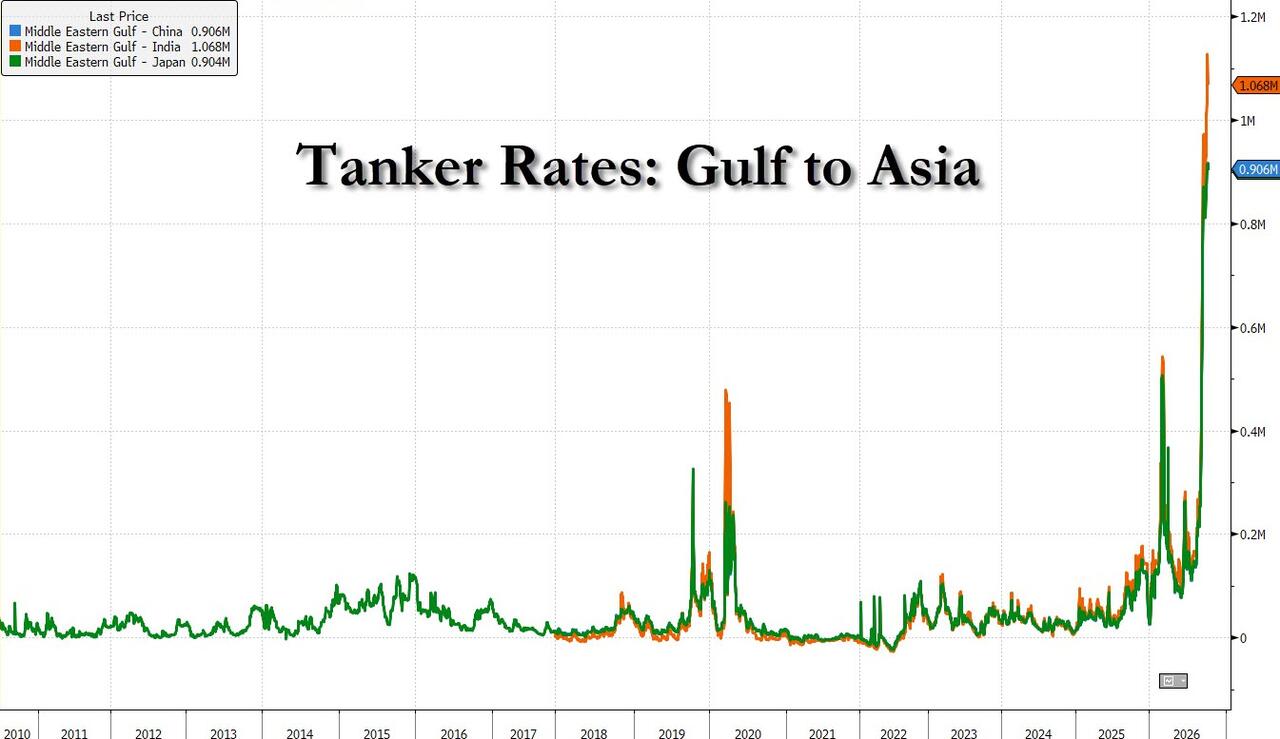
For example, hiring a vessel to haul oil from the US to China now costs more than launching a rocket into space.
ISRAEL/IRAN/USA //TUESDAY
ISRAEL TBN//
IRAN/UK
Terror Plot At UK Airbase ‘Almost Certainly’ Directed By Iran, British PM Says
Tuesday, Oct 13, 2026 – 09:05 AM
Authored by Jill McLaughlin via The Epoch Times,
Last month’s suspected terror plot at RAF Fairford, an airbase shared with the United States in England, was likely coordinated and directed by Iran’s ruling regime, British Prime Minister Andy Burnham said on Oct. 12.

“I can confirm our assessment that it is highly likely to have been coordinated in Iran – almost certainly directed by Iran’s Islamic Revolutionary Guard [IRGC],” Burnham told lawmakers.
Burnham said investigators were in close contact with the United States about protective security at shared military bases in the UK and were continuing to investigate the case.
Seven suspects, all in their 20s, were arrested on terror and explosives charges for their alleged involvement in the RAF Fairford incident on Sept. 27.
Police responded to local tips about suspicious activity near the facility in Gloucestershire, England. Officers stopped three vans heading toward the airbase used by American forces to launch strikes against Iran.
Police and military explosive disposal teams searched the vehicles and found gasoline inside but no explosives, investigators said.
The Pentagon has since removed its heavy bombers from the base. The men have been released from custody and have not been formally charged.
In another incident, two Latvian men were arrested on espionage charges on Oct. 7 after they allegedly broke into the RAF Molesworth airbase, used by U.S. and NATO intelligence teams, near London.
Burnham didn’t say whether the two airbase incidents were linked, but he vowed to investigate any future threats from Iran.
“We will not tolerate these threats on our soil,” Burnham said. “We will crack down on Iran’s use of criminal networks using our full range of powers to target them and their funding streams. And we will bring further sanctions to restrict the capacity of Iran and the IRGC to do us harm.”
The United States and the UK joined 27 other countries to “condemn in the strongest terms Iran’s use of violent attacks, including the acts of lethal plotting, arson, sabotage, cyber-attacks, and other hybrid activities” against the countries and their partners.
“We recognize the United Kingdom’s attribution of Iran’s involvement in the incident at RAF Fairford on 27 September,” the countries said in a joint statement after Burnham’s announcement. “The UK has also concluded this event demonstrates the IRGC’s continued willingness to project hostile activity beyond its borders through covert networks and proxy actors.”
The nations vowed to “investigate, disrupt, and prosecute” all attempts to “silence, intimidate, harass, harm, or coerce people through proxies or other means.”
“Iran should be in no doubt that we are united and remain committed to safeguarding our sovereignty and strengthening our international coordination, bolstering our national resilience, protecting our communities, and ensuring that those responsible are held to account,” the countries stated.
The alleged attempted terror attack comes after recent attacks across Europe targeting Jewish communities, Iranian journalists, and U.S. interests. The pro-Iranian Islamist group Harakat Ashab al-Yamin al-Islamiya (HAYI) claimed to have instigated the attacks, according to state officials.
The incidents included a March 9 attack using a homemade explosive at a synagogue in Liège, Belgium; attacks against Jewish institutions in the Netherlands targeting a synagogue on March 13, 14, and 15; and a foiled bomb plot against a Bank of America branch in Paris on March 28.
The United States and other countries called for the HAYI attacks to end earlier this month, saying the relationship between Iranian security services and international and local criminal groups was long-standing.
“Attempts to kill, kidnap, harass, intimidate, or otherwise attack people on our soil, [undermine] national sovereignty and international norms. These actions must stop immediately,” the countries stated on Oct. 6.
END
ISRAEL ET AL
Israel Imposes ‘Muslim Ban’ For Pilots & Crew In Wake Of FlyDubai Hijacking
Tuesday, Oct 13, 2026 – 03:40 PM
After the Sept.30th FlyDubai attempted terror hijacking, Israel is enforcing what’s effectively a ‘Muslim ban’ on all pilots and cabin crew flying passengers to Israel. While the order does not specifically invoke religion, it targets and forbids pilots and crew who have nationalities of countries that don’t have formal diplomatic relations with Israel.
Middle East Eye observes that “The directive targets nationality rather than explicitly naming religion, but effectively excludes Muslim pilots from those countries, alongside other affected crew members.”

“The restrictions cover 31 nationalities, including Algerian, Tunisian, Iranian and Pakistani citizens. They also affect French citizens who hold one of the listed nationalities,” the same report says.
This policy is already in effect, and some reports say that major carriers like Air France is complying – but at the same time it’s clear that some aren’t getting the memo:
Israel turned away an Ethiopian Airlines flight bound for Tel Aviv because of the nationality of one of its pilots.
In what appears to be a more rigorous enforcement of existing rules, a cargo jet was forced to turn around in mid-air on Monday, after being denied permission to land because one pilot was Indonesian.
One of the pilots was Indonesian and the cargo plane operator only submitted its personnel list to Israeli authorities after the plane took off, bound for Israel.
All of this comes after Israel’s Transport Ministry is under fire in the wake of the FlyDubai incident. It stands accused of lax enforcement of security procedures and laws on the books.
The FlyDubai attacker should have been flagged, given he had already been banned from flying by the country of Oman over his extremist Islamist views.
He’s currently being interrogated in Dubai, and it is believed that he intended to crash hijacked Flydubai flight into the main terminal building at Israel’s Ben Gurion airport, in an effort to cause as many casualties as he could.
END
SAUDI ARABIA/ISRAEL
Saudi Arabia Rejects Request From Netanyahu To Join Yemen Operations
Tuesday, Oct 13, 2026 – 01:25 PM
Israeli media is reporting that the Netanyahu government wants to join the fight against the Iran-aligned Houthis in Yemen, and is seeking the Saudi coalition’s permission to do so.
At the moment, Saudi jets are patrolling the skies and conducing hundreds of bombing raids against territory held by the Ansar Allah movement, in support of the Aden-based government under the Presidential Leadership Council.

Haaretz is one prominent news source which reported that the Israeli prime minister had through US mediation offered Crown Prince Mohammed bin Salman military help as a way to strengthen ties with the kingdom and face a joint enemy.
However, Haaretz has also underscored that MbS is rejecting the appeal, mainly on fears it could cause outrage and backlash among his domestic population.
Without doubt, the powerful clerical and Islamic courts establishment would also not be happy at a military partnership with Israel, or ‘the Jewish state’, related to Yemen.
There has likely long been hidden intelligence cooperation between the Saudis and Israelis, especially related to the last decade of covert war in Syria to oust Assad.
Broadly, Riyadh and Tel Aviv have loosely cooperated toward rolling back Iranian and Shia influence across the Middle East.
Israel has also alongside the kingdom long been at war with the Shia Houthi rebels, and at the height of the Gaza war conducted multiple major bombing campaigns against them. The Houthis during the Gaza fighting also launched ballistic missiles on southern Israeli on a semi-regular basis.
With things heating up against Saudi civilian transport and energy infrastructure, Netanyahu is getting more vocal.
“I condemn in the strongest possible terms the horrific terrorist attack on King Khalid International Airport in Riyadh, Saudi Arabia, which claimed the lives of 12 innocent people and injured hundreds more,” he wrote on X in the wake of the weekend attacks.
“On behalf of the people of Israel, I extend our deepest condolences to the families of those murdered and our wishes for a full recovery to the injured,” he added.
Some kind of tighter Saudi-Israeli military coalition would certainly be welcomed by the Trump administration, which has long tried to push the two into a formal Abraham Accords pact.
It could eventually be tempting for MbS, given his armed forces are not very powerful, despite having cutting edge American-supplied equipment.
END
HOUTHIS/SAUDI ARABIA
Houthi War Escalates: Riyadh Strikes Sanaa Oil, As Several Saudi Airports Shuttered
Tuesday, Oct 13, 2026 – 01:40 PM
The Saudi coalition, which is calling itself the Coalition to Restore Legitimacy in Yemen, on Tuesday issued a warning for civilians to evacuate a site in Sanaa ahead of a targeted operation. The city has been held by the Houthis going all the way back to 2014, and is the main base of the Iran-aligned government there.
Specifically, civilians are being urged evacuate the Yemen Petroleum Company’s Al-Sabahah central fuel station in Sanaa, and the publication went so far as to issue an illustrative map of the location. There are emerging reports of active bombings of the area.
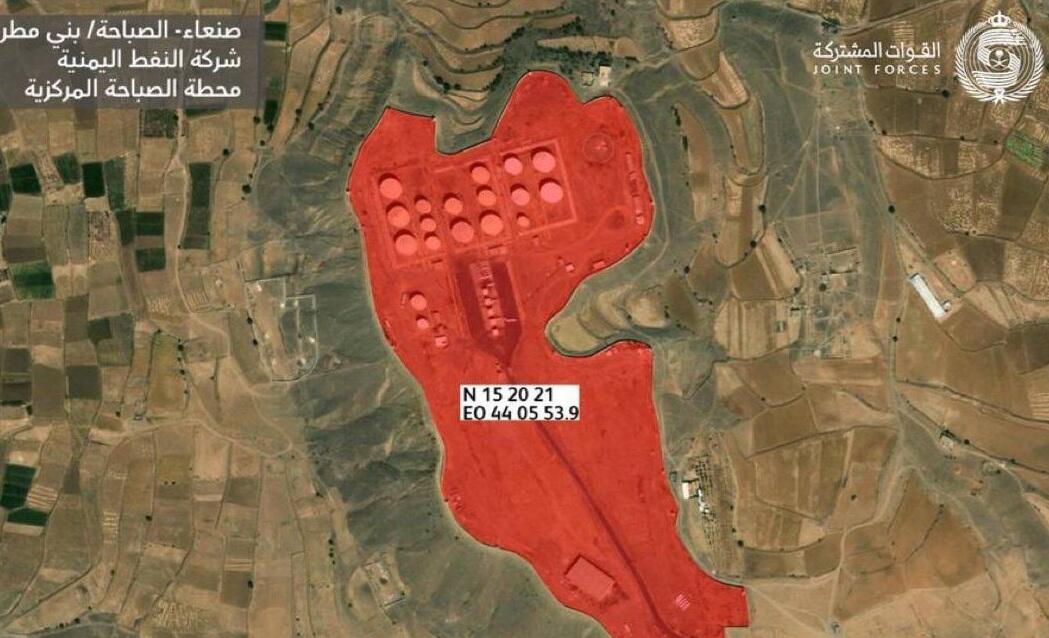
Additional to this was (on the flip side) a published warning by Ansar Allah on Tuesday for Saudi citizens to “evacuate” areas near Aramco’s headquarters in Dammam, King Khalid Airport in Riyadh, and Aramco’s Riyadh refinery – which comes amid ongoing reports of the Houthis targeting territory of the kingdom.
The Saudi capital’s international airport of Riyadh has been shuttered since deadly weekend attacks, and expectations are that it will remain closed through at least Saturday, according to a fresh NOTAM issued.
We “call on all citizens to evacuate immediately and stay away from the targets that our armed forces will strike if the Saudi enemy proceeds with its announced plan to target the following sites in the capital, Sanaa,” the Houthi statement said.
This comes simultaneous to the aforementioned Saudi order telling people to evacuate from near Yemen Oil Company site at Al-Sabaha Central Station in Sanaa.
And so tit-for-tat escalation is expected to continue. Saudi authorities have been warning that a “serious” response would come after at least 13 were killed in multiple strikes on Riyadh’s airport over Saturday and Sunday.
“The events of recent weeks are serious. Our response must be equally serious,” Prince Abdul Aziz bin Salman told the WPC Energy Congress in Riyadh – a long planned event which has proceeded despite the threat of Houthi missiles in the air.
The Houthis have indicated they will continue the fight amid the “brutal Saudi aggression” which at the moment is focused on retaking Western Yemen’s Red Sea coastline:
Rashad al-Alimi, chairman of the Presidential Leadership Council in Yemen, says the “Dawn of Yemen” operation is “proceeding toward its goal of ending the Houthi militias’ coup”.
“There is no turning back, no matter the sacrifices,” said al-Alimi.
So far the US has signaled it is staying on the sidelines of the renewed war, only providing the Saudi coalition with intelligence, and presumably targeting information.
END
RUSSIA VS UKRAINE
ZELENSKY CUT OFF INTELLIGENCE!!
Zelensky Indicates Intelligence From Partners Cut Off Amid Overnight Strikes
Tuesday, Oct 13, 2026 – 09:20 AM
Ukraine’s President Volodymyr Zelensky has not only alleged that Russia has hit six energy sites since President Trump announced Putin signed on to an energy ceasefire, but he’s also lashing out at Western allies, saying that for the first time in a long time no intelligence was shared by ‘partners’ warning of the latest overnight attack.
Zelensky said Tuesday in a post on X that an overnight Russian assault on the capital was “particularly vile” but that no intelligence was shared ahead of time, as has been typical previously.
“There was also a particularly vile ballistic strike on Kyiv—five missiles that hit civilian infrastructure. Regarding this strike, unfortunately, there was no warning from partners,” he wrote. “Intelligence data on the launch of Russian ballistic missiles helps save people’s lives, and this is one of the most critical issues.”
“This is precisely what helps prevent people from being killed — when there is an early warning about ballistic missiles,” he wrote, without specifically apportioning blame. But the veiled message blaming the White House comes through loud and clear.

Given the timing and context, the clear suggestion is that Washington cut Zelensky and his officials out of the usual intel-sharing, and this has also broadly impacted allied sharing.
President Trump has lately threatened to precisely cut off intelligence as Ukraine has not complied with the US request for its forces to stop hitting Russian refineries, amid a global diesel supply and price crisis.
Zelensky further on Tuesday claimed that Ukraine is for now adhering to a pledge to not strike Russian oil refineries. He says this pause has been on for two days since Trump proclaimed a deal, which however Zelensky said was “news” to hm.
Of the latest Russian attacks, “These are absolutely clear signals that they have no intention of refraining from strikes on Ukraine,” Zelensky said.
The Ukrainian leader has further lambasted the Trump deal with Putin for the release of Russian diesel. “We need American pressure on Russia, not sanctions relief, not concessions,” Zelensky said earlier.
Trump is meanwhile ultimately blaming Ukraine for rising energy prices, and not the Iran war and Hormuz crisis.
Here’s what Ukrainian media says is happening behind the scenes in the meantime:
Two Ukrainian officials said their U.S. counterparts had made clear that Washington would hold Kyiv responsible if Russian energy infrastructure were struck during the recently announced ceasefire.
“They called all the top military officials with threats,” one Ukrainian official told the Kyiv Independent. “They’re telling everyone that they’re going to turn off both the intelligence sharing and PURL.”
Zelensky has yet to specifically say that Washington itself has halted intelligence, but if the situation lingers the blame-game is probably coming.
The Prioritised Ukraine Requirements List (PURL) is the procurement mechanism and program European allies use to purchase weapons from the US for Ukraine. The US administration has outright said it is ready to halt the program if Zelensky doesn’t comply, and Trump has gone so far as to say that maybe Ukrainians should find a new leader.
END
6/.GLOBAL ISSUES, COVID ISSUES, VACCINE INJURIES/HEALTH ISSUES
GLOBAL ISSUES//
“More Pain To Come”: Global Smartphone Shipments Plunge As Memory Crisis Crushes Budget Models
Tuesday, Oct 13, 2026 – 12:10 PM
Global smartphone shipments tumbled 22% in the third quarter as soaring memory chip costs forced handset manufacturers to scrap lower-priced models and focus on premium models, delaying purchases for working-class consumers, according to a new note by Loop Capital Markets.
Loop Capital analyst John Donovan wrote early Tuesday that handset shipments totaled 251 million units in the quarter, down from 320 million a year earlier. The decline accelerated from 3% in the first quarter and 7% in the second.
Donovan added more color:
The smartphone market endured its most precipitous drop in unit shipments in CQ3 2026 by posting unit shipments worse than consensus estimates, but right in line with the morose outlook provided by Loop’s TMT Smartphone squad these past 2-3 quarters.
All indications point to further declines in the coming quarters, perhaps a mild reprieve in CQ4 2026, but 2027 is shaping up to be another challenging year for the Smartphone suppliers.
In what cannot be a surprise to anyone by this time, skyrocketing costs particularly (but not limited to) the memory has decimated the ability to supply low-end solutions, and frankly we see little evidence of any relief soon.
In anticipation of the mushrooming memory costs, suppliers front-end loaded/pulled ahead shipments which certainly propelled 1H 2026 results. Not only are memory prices rising, but supply chain issues as well as trade flow disruptions will hamstring future results.
Loop’s smartphone team breaks down the quarterly numbers:
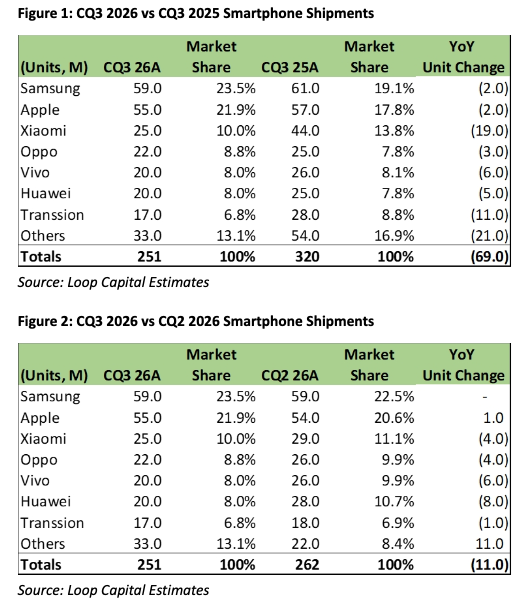
“Entry-level and even mid-tier options have precious little margin to begin with,” Donovan said, adding that manufacturers also have limited pricing power to absorb rising component costs.
The squeeze is most severe among Chinese brands competing on affordability: Xiaomi’s shipments plunged to 25 million in 3Q from 44 million in the same quarter one year ago, a staggering 43% decline. Soaring costs made many of its existing models uneconomic, prompting the company to halt production of lower-end models.
Chinese brand Oppo shipped 22 million phones, and Vivo shipped 20 million in the quarter. Oppo dialed back its OnePlus and realme offerings, while Vivo faced mounting pressure from rising costs and supply-chain challenges. Transsion, which focuses on lower-tier devices, shipped 17 million units in 3Q, down from 28 million a year earlier.
South Korea’s Samsung retained the top spot, shipping 59 million units in 3Q. Supply-chain management helped shield its midrange lineup, while premium devices, particularly its new foldable, sold well.
Apple’s preliminary shipments totaled about 55 million in 3Q, compared with 57 million a year earlier, allowing it to gain market share despite lower volumes. Donovan said the iPhone 18 Pro Max was outselling the Pro and pushed back against reports of order cuts (read here).
Donovan slashed his 2026 forecast for new smartphone shipments to 1.08 billion from a previously announced 1.091 billion, compared with 1.237 billion in 2025.
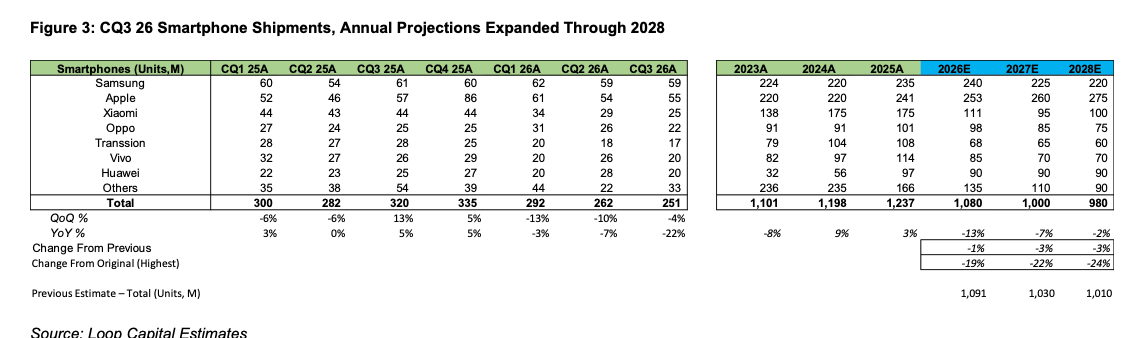
He expects shipments to slide even further to 1 billion in 2027 and 980 million in 2028.
END
COVID VACCINE INJURY REPORT; DR MARK CRISPIN MILLER
DR PAUL ALEXANDER
We really did this to our children? Did all our brains , the brains from inside the heads of our medical doctors and scientists and government officials suddenly fall out all of their asses?
During the fake fraud PCR manufactured over-cycled DNA amplification process non-pandemic (we never ever had a pandemic)? Did we do this? are we cu*ts? were we c*nts? how do you feel today?
7 hours ago

How do you feel playing into this madness? wearing a mask that not one person’s mask, not one mask, not one, in US, Canada, UK, nowhere, not one stopped any virus or anything…all failed….never worked and would never work! not one lockdown worked globally, not one! Trump talks nonsense, wrong, misguided each time he says lockdowns and mRNA vaccine saved lives…they saved not one life! I challenge including RFK Jr. to prove me wrong! seeing that you now back mRNA vaccine Bobby Jr., why not debate me on it!
Come on POTUS Trump, it is not too late…you can turn this!
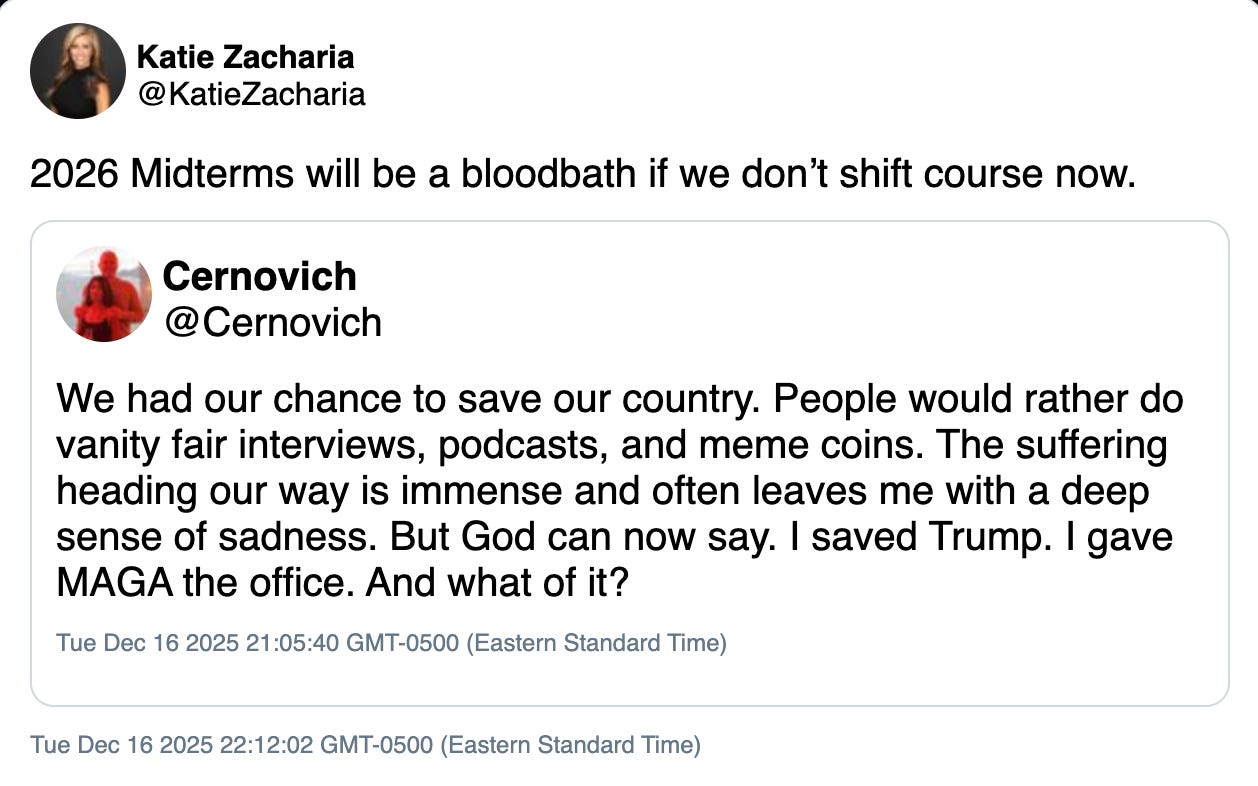
Alexander News Network (ANN): Trump’s War 2.0 for America is a reader-supported publication. To receive new posts and support my work, consider becoming a free or paid subscriber.
END
RABOBANK/MICHAEL EVERY/OR OR PICTON/GIFFIN OR RABOBANK EXECUTIVE/COMMENTARY ON WORLDLY AFFAIRS
7. OIL AND NATURAL GAS/ENERGY COMMENTARIES
Energy Department Orders PJM To Dispatch Units, Backup Power Through Mid-October
Tuesday, Oct 13, 2026 – 11:55 AM
Authored by Kimberly Hayek via The Epoch Times,
The U.S. Department of Energy on Oct. 12 issued an emergency order directing PJM Interconnection, the largest U.S. grid operator, to dispatch specified generating units and order their operation as needed to maintain reliability.
The emergency order, Order No. 202-26-50, also authorizes PJM to direct backup generation resources ahead of declaring an Energy Emergency Alert 3 or during one. PJM may call on its transmission owners and electric distribution companies to carry out the order. The grid operator serves more than 65 million people across 13 states and the District of Columbia.
PJM filed the application on Oct. 11, forecasting demand “at or around 111,500 MW (or higher)” for Oct. 13. The company said the system would sit within 900 MW of its reserve margin on Oct. 14.
Anticipated generation outages were put at 61,591 MW, with the most acute pressure predicted to be in the BGE, PEPCO, and Dominion zones, which primarily serve Maryland, Virginia, North Carolina, and the Washington, D.C. metropolitan area.
Secretary of Energy Chris Wright determined a statutory emergency existed, citing a sudden increase in demand, a shortage of electric energy, or the facilities needed for its generation or transmission. The order lasts from Oct. 13 through Oct. 16, when temperatures are expected to relent.
Similar emergency actions for the same region were issued during a summer heatwave. Wright issued two orders in June authorizing the dispatch of specific units and backup resources ahead of forecasted record demand.
“Maintaining affordable, reliable, and secure power in the PJM service territory is non-negotiable,” Wright said in a statement at the time. “The previous administration’s energy subtraction policies weakened the grid, leaving Americans more vulnerable during events like this. Thanks to President [Donald] Trump’s leadership, we are reversing those failures and using every available tool ensuring Americans in the Mid-Atlantic have continued access to affordable, reliable, and secure energy to power and cool their homes.”
Those directives were also in response to PJM applications.
Wright has repeatedly invoked section 202(c) to keep plants online. In May 2025, the department ordered PJM, in coordination with Constellation Energy, to continue operating two oil- and gas-fired units at the Eddystone Generating Station in Pennsylvania past their May 31 retirement date. The 820-megawatt plant’s units were kept available because of resource-adequacy concerns amid rising demand.
“Maintaining access to affordable, reliable, and secure power is always our top priority, particularly during the summer months when electricity demand reaches its peak,” Wright said. “Americans should never be left wondering whether they will be able to turn on their lights or air conditioning. This emergency order helps keep money in consumers’ pockets while keeping their homes and businesses fully powered. Energy shortfalls or unnecessary price increases are not options in this Administration.”
Wright said at a White House meeting that the Department of Energy under his leadership would prevent closure of plants before their retirement dates.
In September, a D.C. Circuit panel vacated one order that kept a Michigan coal plant from closing. The court found the department exceeded its authority, describing the statute as “essentially a narrow, last-resort backstop.”
END
How Long To Rebuild The Gulf? Paul Sankey And Arjun Murti Debate Oil’s Future Tonight At 7pm ET

Tonight at 7pm ET, ZeroHedge brings together two of Wall Street’s most accomplished energy analysts, Paul Sankey and Arjun Murti, to debate the future of oil markets, with MacroVoices founder Erik Townsend moderating.
The debate comes amid renewed attacks on shipping through the Strait of Hormuz, where 24 vessels were struck during the two weeks ending October 11, according to the Financial Times. And while crude exports from the Gulf have recovered considerably, the region’s refining industry remains severely impaired. According to Reuters, Gulf crude and condensate exports recovered to 91% of prewar levels in September, while refined fuel exports remained at just 60%.
Energy analytics firm Kpler estimates that regional refinery throughput fell from 9.9 million barrels per day before the war to roughly 7.3 million in August, with a full recovery unlikely before the second quarter of 2027.
Elsewhere, damage could prove considerably more enduring. QatarEnergy estimates that repairing two LNG production trains damaged by Iranian strikes will take three to five years. Its chief executive, Saad al-Kaabi, said in March that the strikes had set the region back 10 to 20 years.
Few analysts are better positioned to judge how long the rebuild will take.

Arjun Murti, a former Goldman Sachs partner and co-director of Americas Equity Research, famously predicted an oil “super-spike” in 2005, warning that crude could reach $105 per barrel when it was trading near $55. The prediction was vindicated in 2008, when oil surged to nearly $150.
Murti, now a partner at Veriten and author of the Super-Spiked newsletter, also serves on the boards of ConocoPhillips and Liberty Energy.
Paul Sankey, founder of Sankey Research and a former Deutsche Bank energy analyst, has spent more than three decades covering global oil markets, beginning at the International Energy Agency during the first Gulf War.
Sankey has been ranked the No. 1 energy analyst by Institutional Investor multiple times, and his independent firm earned a top ranking in the publication’s 2023 Independent Oil & Gas Research category. He also warned that oil prices could go negative a month before WTI crashed below zero in April 2020.
Erik Townsend is a longtime energy futures trader, former hedge fund manager and founder of the widely followed MacroVoices financial podcast.
The three will examine the damage to Middle Eastern refining capacity, the outlook for crude and refined products, the potential for further escalation in the Iran war, and whether today’s elevated energy prices represent a temporary geopolitical shock or the beginning of a much longer structural shortage.
Tune in tonight at 7pm ET here on the ZH homepage, X feed, and YouTube channel to see how to position in energy markets and what to expect at the pump in coming months.
END
8. EMERGING MARKETS//AUSTRALIA NEW ZEALAND ISSUES
U.S./GOLD AND SILVER PRICING/ASIAN CLOSING MARKETS AND EUROPEAN BOURSE OPENING AND CLOSING/ INTEREST RATE SETTINGS TUESDAY MORNING 6;30AM//OPENING AND CLOSING\
OPENING LEVELS OF CURRENCIES// AND CLOSING ASIAN STOCK MARKET AND OPENING EUROPEAN STOCKS:6 AM EST
EURO VS USA DOLLAR: 1.1181 UP 0.0022
USA/ YEN 158.17 DOWN 0.365 NOW TARGETS INTEREST RATE AT 1.75% AS IT WILL BUY UNLIMITED BONDS TO GETS TO THAT LEVEL…//YEN STILL FALLS//END OF YEN CARRY TRADE BEGINS AGAIN DEC 2024/Bank of Japan raises rates by .25% TO 1.75 ..TAKAICHI NEW PM AS YIELDS RISE//JAPAN DEEPLY IN TROUBLE WITH RISING RATES AND A FALLING YEN!! BANK OF JAPAN WILL NO LONGER DO QE. URGES PENSION AND INSUANCE FUNDS TO BUY JAPANESE BONDS//
YEN CARRY TRADERS MURDERED
GBP/USA1.3233 UP 0.0024 OR 24 BASIS PTS
USA/CAN DOLLAR: 1.4263 DOWN 0.0017 //CDN DOLLAR UP 17 BASIS PTS//
Last night Shanghai COMPOSITE CLOSED UP 3.62 PTS OR 0.10%
Hang Seng CLOSED UP 37.20 PTS OR 0.13%
AUSTRALIA CLOSED UP 0.36%
// EUROPEAN BOURSE: ALL GREEN
Trading from Europe and ASIA
I) EUROPEAN BOURSES: ALL GREEN
2/ CHINESE BOURSES / :Hang SENG CLOSED UP 37.20 PTS OR 0.13%
/SHANGHAI CLOSED UP 3.62 PTS OR 0.10%
AUSTRALIA BOURSE CLOSED UP 0.36%
(Nikkei (Japan) CLOSED DOWN 1160.92 PTS OR 1.68%
INDIA’S SENSEX IN THE GREEN
Gold very early morning trading: $4188.80
silver:$60.86
USA DOLLAR VS TRY (TURKISH LIRA): 49.37 UP 3 BASIS PTS AND NOW WE SEE THEIR STUPIDITY OF SELLING SOME OF THEIR GOLD AND ALL OF THEIR USA DOLLAR RESERVES. THE COUNTRY IS IN BIG FINANCIAL TROUBLE
USA DOLLAR VS RUSSIAN ROUBLE: 83.85 ROUBLE// UP 0 ROUBLE AND 12 BASIS PTS.
UK 10 YR BOND YIELD: 5.3984 DOWN 5 BASIS PTS
UK 30 YR BOND YIELD: 5.8760 DOWN 5 BASIS PTS
FRENCH OAT 10 YR BOND YIELD: 4.833 DOWN 7 BASIS PTS.
CDN 10 YR BOND YIELD: 3.878 DOWN 5 BASIS PTS
CDN 5 YR BOND YIELD; 3.546 DOWN 5 BASIS PTS
USA dollar index early TUESDAY MORNING: 102.12 DOWN 26 BASIS POINTS FROM MONDAY’s CLOSE
TUESDAY MORNING NUMBERS ENDS
And now your closing TUESDAY NUMBERS 10.00 AM
Portuguese 10 year bond yield: 3.930% DOWN 5 in basis point(s) yield
JAPANESE BOND 10 yr YIELD: +3.018% UP 2 FULL POINTS BASIS POINTS /JAPAN losing control of its yield curve/
JAPAN 30 YR: 4.039 DOWN 2 BASIS PTS//
SPANISH 10 YR BOND YIELD: 4.065 DOWN 4 in basis points yield
ITALY 10 YR BOND: 4.537 DOWN 4 points in basis points yield ./
GERMAN 10 YR BOND YIELD: 3.4455 DOWN 3 BASIS PTS
IMPORTANT CURRENCY CLOSES : MID DAY TUESDAY
Closing currency crosses for day /USA DOLLAR INDEX/USA 10 YR BOND YIELD/10:00 AM
Euro/USA 1.1196 UP 0.0037 OR 37 basis points
USA/Japan: 158.16 DOWN 372 OR YEN IS UP 37 BASIS PTS// HIGHLY INFLATIONARY TO JAPAN
Great Britain 10 YR RATE 5.4108 DOWN 4 BASIS POINTS //
GREAT BRITAIN 30 YR BOND; 5.8875 DOWN 4 BASIS POINTS.
FRANCE 10 YR: 4.835 DOWN 6 BASIS PTS
CANADIAN DOLLAR UP 38 BASIS PTS TO 1.4242
xxxxxxxxxxxxxxxxxxxxxxxxxxxxxxxxxxxxxxxxxxxxxxxxxxxxxxxxxxxxxxxxxxxxxxxxxxxxxxxx
The USA/Yuan CNY 6.6938 ON SHORE ..DOWN
THE USA/YUAN OFFSHORE// CNH UP TO 6.6919
TURKISH LIRA: 49.37 UP 3 EXTREMELY DANGEROUS LEVEL/DEATH WATCH/HYPERINFLATION TO BEGIN.//
Your closing 10 yr US bond yield DOWN 5 in basis points from MONDAY at 5.197% //trading well ABOVE the resistance level of 2.27-2.32%)
USA 30 yr bond yield 5.549 DOWN 5 basis points /10:00 AM
USA 2 YR BOND YIELD: 4.781 DOWN 1 BASIS PTS.
GOLD AT 10;00 AM $4179.55
SILVER AT 10;00: $60.08
Your 11:00 AM bourses for Europe and the Dow along with the USA dollar index closing and interest ratesTUESDAY
DAY CLOSING TIME/ 12:00 AM///
London: CLOSED DOWN 5.95 PTS OR 0.06%
GERMAN DAX: CLOSED DOWN 17.78 PTS OR 0.07%
FRANCE: DOWN 5.25 OR 0.07 PTS
Spain IBEX CLOSED DOWN 75.10 PTS OR 0.39%
Italian MIB: CLOSED UP 41.38 PTS OR 0.08%
WTI Oil price 92.58 10.00 EST/
Brent Oil: 104.89 10:00 EST
USA /RUSSIAN ROUBLE: 83.66/// ROUBLE UP 0 AND 31/ 100
CDN 10 YEAR RATE: 3.856 DOWN 2 BASIS PTS.
CDN 5 YEAR RATE: 3.535 DOWN 1 BASIS PTS
CLOSING NUMBERS: 4 PM//
Euro vs USA 1.1200 UP 0.0041 OR 41 BASIS POINTS//
British Pound: 1.3254 UP 0.0045 OR 45 basis pts/
BRITISH 10 YR GILT BOND YIELD: 5.4515 UP 1 FULL BASIS PTS//
BRITISH 30 YR BOND YIELD: 5.9147 DOWN 2 IN BASIS PTS.
FRENCH 10 YR BOND: 4.850 % DOWN 4 BASIS PTS
JAPAN 10 YR YIELD: 3.004% UP 1/3 FULL BASIS PTS (DANGEROUS TO THEIR ECONOMY
JAPANESE 30 YR BOND: 4.039 DOWN 2 PTS AND STILL VERY DANGEROUS TO THEIR ECONOMY
USA dollar vs Japanese Yen: 158.32 DOWN 0.217 OR YEN UP 22 BASIS PTS//GETTING FURTHER AWAY FROM 160.00/ EXTREMELY DANGEROUS
USA dollar vs Canadian dollar: 1.4216 DOWN 0.0065 PTS// CDN DOLLAR UP 65 BASIS PTS
West Texas intermediate oil: 94.36
Brent OIL: 105.98
USA 10 yr bond yield DOWN 4 BASIS pts to 5.212
USA 30 yr bond yield: DOWN 4 PTS to 5.563%
USA 2 YR BOND 4.789 DOWN 0 PTS
CDN 10 YR RATE 3.866 DOWN 1 BASIS PTS
CDN 5 YEAR RATE: 3.551 UP 1 BASIS PTS
USA dollar index: 101.99 UP 1 BASIS POINTS
USA DOLLAR VS TURKISH LIRA: 49.37 UP 3 BASIS PTS GETTING QUITE CLOSE TO BLOWING UP/IDIOTS SOLD GOLD
USA DOLLAR VS RUSSIA//// ROUBLE: 83.66 UP 0 AND 31 /100 roubles //
GOLD $4,163.75 3:30 PM)
SILVER: 59.29 3;30 PM)
DOW JONES INDUSTRIAL AVERAGE: DOWN 174.06 POINTS OR 0.34%
NASDAQ 100 DOWN 95.22 PTS OR 0.31%
VOLATILITY INDEX 15.33 UP 0.12 PTS OR 0.79%
GLD: $ 381.65 DOWN 0.50 PTS OR 0.13%
SLV/ 53.49 PTS DOWN 0.86 OR 1.58%
TORONTO STOCK INDEX// TSX INDEX: CLOSED UP 335.11 PTS OR 0.94%
end
TRADING today ZEROHEDGE 4 PM: HEADLINE NEWS/TRADING
Tech Wrecked Again As AI Credit Cracks Widen; Doves & Diesel Battle Over Bonds
‘WRAP UP
Memory weakness hits NDX as Fed’s Williams sparks dovish reaction – Newsquawk US Market Wrap
Tuesday, Oct 13, 2026 – 04:18 PM
- SNAPSHOT: Equities mixed, Treasuries flatten, Crude mixed, Dollar down, Gold down
- REAR VIEW: Fed’s Williams sees one more interest-rate hike as appropriate this year & no need for rate hike in 2027; US Existing Home Sales rise in September; Saudi Arabia told OPEC crude production rose 34% in September; BoJ is reportedly to lean back against back-to-back hikes in October; Mixed US bank earnings; Reports of Saudi Aramco HQ hit; Netanyahu & Trump spoke last week about renewing the war on Iran, before Trump said he wouldn’t hit Iran before the midterms.
- COMING UP: Data: Chinese Inflation (Sep),Trade Balance (Sep), German Wholesale Prices (Sep), Spanish Final Inflation (Sep), US Inflation (Sep). Events: IEA OMR. Speakers: US President Trump; Fed’s Bowman, Barkin; BoE’s Pill, Breeden; BoC’s Macklem; ECB’s Lagarde, Zigman, Elderson, Schnabel. Supply: Australia, Japan, UK, Germany. Earnings: ASML, Bank of America, BlackRock, Morgan Stanley, Progressive, State Street.
More Newsquawk in 3 steps:
1. Subscribe to the free premarket movers reports
2. Trial Newsquawk’s premium real-time live audio squawk for 7 days
3. Check out Newsquawk’s US Midterm Election dashboard.
MARKET WRAP
US indices were mixed, as the tech-heavy Nasdaq 100 lagged and was once again weighed on by losses in memory names, highlighted by the memory ETF DRAM closing with losses in excess of 3%. The move follows a sharp decline in the Kospi overnight, following Monday’s report that China’s CXMT unveiled key progress on chip structures. Overall, sectors were mixed as Health underperformed, and hit on poor JNJ results, while Energy sat atop of the pile. The crude complex was choppy, ahead of weekly private inventory figures after-hours, as Middle East headlines were plentiful and showed no signs of abating, as reports indicated that Saudi Aramco HQ was struck, albeit awaiting confirmation from the Saudi side.
Away from geopolitics, US Q3 earnings season got underway and has been a mixed bag so far. JPM and GS WFC, JNJ, and C all saw losses (more details below), with highlights on Wednesday including ASML, BAC, and MS. The Dollar Index was lower amid easing yields, to the benefit of global G10 FX peers. For the Yen, source reports earlier said the BoJ is reportedly leaning against back-to-back hikes in October but could hawkishly adjust inflation language. Precious metals were lower, with spot silver underperforming its counterpart.
Moreover, a dovish reaction was seen across markets after NY Fed President Williams said he sees no need for a rate hike in 2027 at this time, but added he sees one more interest-rate hike appropriate this year. Note an immediate dovish reaction, which swiftly pared, and was likely seen on the fact that he sees no hikes in 2027, which was run first, as participants may have read it as Williams sees no more hikes, before later adding that he sees 1 hike this year, which is in fitting with his recent commentary. In terms of money market pricing, 81bps of hikes are currently seen by October 2027, so it still remains on the dovish side of Fed expectations. Elsewhere from the Fed, Waller said higher yields could do some of the Fed’s work on demand.
FED
WILLIAMS (voter): Said sees no need for a rate hike in 2027 at this time, and one more interest-rate hike is appropriate this year, with the latter comment in fitting with what he has previously remarked. NY Fed President still believes disinflationary forces are at play, and it is not an economy that is overheating. The influential Governor remarked no sign the labour market is contributing to inflation, and not seeing broad price pressure outside AI and energy. Williams, in the interview to BBG, added that the rate path will be about maintaining a balanced economy.
WALLER (voter): Hyperscalers are still planning on spending trillions of dollars over the next three years, though if AI investment falls off, it will put a check on prices. Inflation expectations are well anchored. AI build-out is definitely having an impact on yields, and real yields reflect the impact of real growth. Higher yields could do some of the Fed’s work on demand.
GOOLSBEE (2027 voter): Inflation tied to the AI boom is “jumping out of its lane” and starting to push up prices in unrelated corners of the economy. Chicago Fed President added prices are going up in spaces that are not just components in data centres and the directly adjacent industries. Said he is getting increasingly nervous that that’s just straight, old-fashioned overheating demand. Said if inflation remains persistent, then think it’s clear what the Fed has to do”, in response to whether the central bank should raise interest rates again when it meets later this month. Need to start showing some progress if we’re going to get back on the kind of rate-cutting path that we were on. The job market still looks very stable to me. Growth has been solid, consumer spending solid.
DATA
EXISTING HOME SALES: Existing home sales rose 1.5% in September to 3.99mln from 3.93mln, above the expected 3.95mln. National median home price for existing homes rose 1.5% M/M to USD 417,500, and inventory of homes for sale was 1.6mln units, 4.8 months’ worth (prev. 4.9 months’ worth M/M). NAR Chief Economist Yun said, “Despite the small monthly gain on a seasonally adjusted basis, August and September marked the two slowest months for home sales this year,” and “further increases in mortgage rates in recent weeks mean fewer buyers can qualify to purchase a home.”
FIXED INCOME
T-NOTE FUTURES (Z6) SETTLED 5+TICKS HIGHER AT 104-23+
Yield curve flattens amid on dovish Fed williams ahead of US CPI. At settlement, 2-year -0.2bps at 4.789%, 3-year -0.7bps at 4.916%, 5-year -1.6bps at 5.005%, 7-year -2.4bps at 5.106%, 10-year -2.5bps at 5.217%, 20-year -4.1bps at 5.606%, 30-year -3.9bps at 5.561%.
THE DAY: The Treasury curve flattened on Tuesday, with front-end yields little changed while long-end yields declined, seemingly benefiting from haven demand amid a technology-led equity sell-off.
Oil prices were mixed but generally climbed throughout the US session, with Saudi-Houthi tensions remaining elevated as both sides threatened energy infrastructure. Meanwhile, US President Trump warned the Houthis that he would still be in office after the midterm elections and would not forget their actions against Saudi Arabia. Initial upside in short-end yields on higher energy prices faded in response to the release of a Bloomberg TV interview with Fed Vice Chair Waller, who sees no need for a rate hike in 2027 at this time. He added that he does see one more interest-rate hike as appropriate in 2026.
With the cash Treasury market closed on Monday, trading resumed against a backdrop of developments from the weekend and the previous session. US memory stocks remained under pressure amid concerns over increased competition from China, weighing on broader equity sentiment and potentially contributing to a flight-to-quality bid in Treasuries. Meanwhile, some of the weakness in technology stocks was also attributed to comments from Broadcom (AVGO) CEO, likening tech investing to a casino.
Elsewhere, other Fed commentary saw Governor Waller acknowledge that higher yields could do some of the Fed’s work in restraining demand, potentially strengthening the case for an October pause. Meanwhile, Chicago Fed President Goolsbee warned that inflation remains persistently elevated, while noting that the labour market is still stable. Asked whether the Fed should hike again in October, Goolsbee suggested that persistent inflation would warrant further tightening.
Attention now turns to Wednesday’s US CPI report, which will help shape expectations for the Fed’s next policy move, ahead of Thursday’s PPI release and Fed Chair Warsh’s remarks early Friday morning BST.
Supply
Bills
- US sold 6-wk bills at high-rate 3.980%, B/C 2.58x; Sold 3-month bills at a high rate of 4.085%, B/C 2.68x; Sold 6-month bills at a high rate of 4.200%, B/C 2.76x
- US to sell USD 110bln of 4-week bills and USD 105bln of 8-week bills on October 15th; to sell USD 75bln of 17-week bills on October 14th; all to settle October 20th
STIRS / OPERATIONS
- Fed Hike Pricing via CME FedWatch: Oct 5.4bps (prev. 5.3bps), Dec 27.6bps (prev. 27.1bps)
- EFFR at 3.88% (prev. 3.88%), volumes at USD 110bln (prev. USD 117bln) on October 9th
- SOFR at 3.87% (prev. 3.87%), volumes at USD 2.961tln (prev. USD 2.963tln) on October 9th
- NY Fed RRP op demand at 0.275bln (prev. 0.30) across counterparties 1 (prev. 1) on October 13th
CRUDE
WTI (X6) SETTLED USD 0.40 HIGHER AT 94.14/BBL; BRENT (Z6) SETTLED USD 0.96 LOWER AT 105.69/BBL
The crude complex was choppy on Tuesday, as Middle East headlines were plentiful, and show no signs of abating. Saudi-Houthi tensions remain high, with the Saudi-led coalition warning citizens to evacuate Sana’a, the location of a Yemen Petroleum Company facility. In response, the Houthis threatened to strike Aramco facilities, with in later trade sources saying loud booms were heard in Dhahran, in the vicinity of Saudi Aramco HQ. On this, Trump repeated that the Houthis are behaving very badly and will make a decision on Iran very soon. On the supply footing from Saudi, benchmarks saw some pressure following the OPEC MOMR for October, whereby Saudi Arabia produced 8.372mln bpd of crude in September, up from 6.238mln bpd in August.
Moving to Iran and the US, where tensions remain very high, as expected, upside was seen as reports circulated that Netanyahu spoke with Trump last week about renewing the war on Iran, and discussed a potential joint US-Israeli operation that would hit military and nuclear targets. Note, the call about the possible attack took place before Trump said he would not strike Iran ahead of the midterms. Moreover, Iran’s Nadaja stated that “a violating oil tanker caught fire in the eastern Strait of Hormuz”.
For the record, WTI traded between USD 91.70-94.70/bbl and Brent 101.23-103.49/bbl. In the weekly data, stocks of crude oil in the US SPR were unchanged at 283mln bbls last week, remaining at the lowest level since October 1982. Ahead, weekly private inventory metrics await after-hours.
EQUITIES
CLOSES: SPX -0.01% at 7,806, NDX -0.31% at 30,569, DJI -0.35% at 51,671, RUT -0.39% at 2,784
SECTORS: Health -1.32%, Financials -0.4%, Consumer staples -0.33%, Industrials -0.29%, Real estate -0.28%, Consumer discretionary flat, Technology flat, Materials +0.37%, Utilities +0.57%, Communication services +0.88%, Energy +1.76%.
EUROPEAN CLOSES: Euro Stoxx 50 -0.59% at 6,165, Dax 40 -0.10% at 25,251, FTSE 100 -0.06% at 10,650, CAC 40 -0.07% at 7,828, FTSE MIB +0.04% at 50,057, IBEX 35 -0.39% at 19,211, PSI +0.73% at 9,380, SMI +0.36% at 13,928, AEX -0.54% at 1,129
EARNINGS:
- JPMorgan (JPM): Choppy post-earnings; initially lower on EPS, rev., net income & FICC sales miss, but reversed after raising FY26 NII guidance.
- Goldman Sachs (GS): EPS, rev. & NII top Wall St. consensus.
- Wells Fargo (WFC): Rev. & NII light.
- Citi (C): Major metrics beat, as did FICC sales & trading rev., but equities & sales trading rev. fell short.
- Johnson & Johnson (JNJ): Top line short but did lift FY profit outlook.
- UnitedHealth (UNH): Q nos. impressed & MCR lower than exp alongside lifting FY profit outlook.
- Domino’s Pizza (DPZ): SSS fell short of exp.
STOCK SPECIFICS:
- Navitas (NVTS) collabs w/ NVDA on 800 V-to-12 V power delivery board for next-gen AI infrastructure.
- SentinelOne (S) to offer $1.25bln of convertible senior notes due 2031.
- SixFlags (FUN) had one person die & several injured following a roller coaster incident at a Six Flags amusement park.
- BioNTech (BNTX) AHEAD-MERIT Phase 2/3 clinical trial did not meet its first dual primary endpoint.
- Syndax Pharmaceuticals (SNDX) Phase 2 idiopathic pulmonary fibrosis study misses endpoint.
- Google (GOOGL) is rolling out Gemini 4 Argon to Google AI subscribers in Google Antigravity, Gemini App & AI Mode in Search.
- Qualcomm (QCOM) won jury verdict, and jury finds Arm (ARM) breached license agreement.
- Muddy Waters short Edison International (EIX).
FX
USD was weaker, weighed by lower US yields, with crude prices choppy, although diesel futures are back at YTD highs. The main update was via the NY Fed Chair Williams who sees one more rate hike as appropriate in 2026, as he previously said, and doesn’t see a need for a rate hike in 2027 at this time, citing an optimistic view on inflation returning to 2%, not seeing broad price pressure outside AI and energy. Near-term focus lies on the CPI report on Wednesday, Core M/M expected 0.2%, Core Y/Y 2.5%, and Headline M/M 0.6%.
Away from the Fed, newsflow was centered on geopolitics. The Saudi-Houthi conflict remains, as Houthis have reportedly struck near the ARAMCO HQ; meanwhile, Trump and Netanyahu reportedly spoke last week, discussing a potential joint operation that would hit Iranian military and nuclear targets.
JPY was modestly firmer, failing to match peers’ gains against the USD on a Bloomberg report that sent mixed signals for the JPY. JPY initially weakened as sources said the BoJ is to lean against back-to-back hikes in October, before strengthening on the prospect that the BoJ could adjust the 2% inflation target language to “approx. 2% from “approaching 2”. USD/JPY hit session lows of 157.83 before moving back towards ~158.33.
Scandis, NZD, and CAD outperformed in the G10 space. On EUR/GBP, ING cut its EUR/GBP forecast, forecasting EUR/GBP to trade in a 0.84-0.85 range for at least several more months, arguing that “Idiosyncratic risks surrounding the euro are unlikely to fade anytime soon, and the Bank of England has sent a clear enough signal that it is prepared to hike”.
USA DATA RELEASES
Existing Home Sales Hover Near Record Lows As Affordability Gap Widens
Tuesday, Oct 13, 2026 – 10:08 AM
With mortgage rates soaring, expectations were for a fourth straight month of declines in existing home sales. Instead sales rose 1.5% MoM (-0.8% exp) thanks in part to a downward revision for August (from -2.0% to -3.2% MoM)…
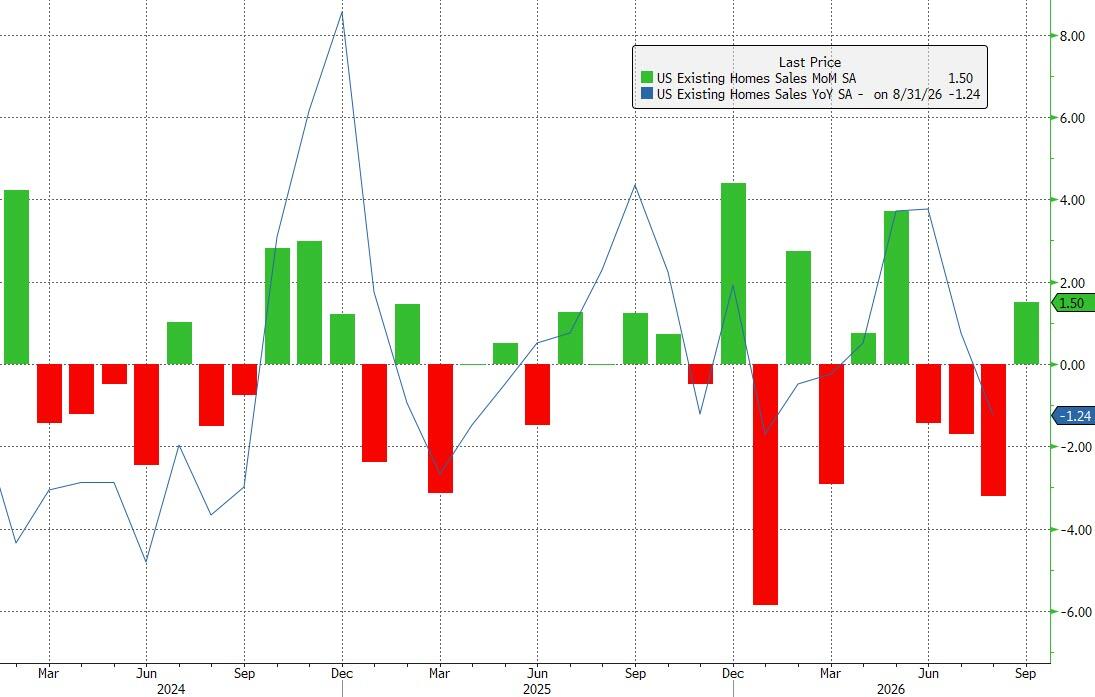
At least some of last month’s modest improvement predated the more than half-point climb in mortgage rates since early September to 7.49%. September’s gain also belies the formidable challenges facing the nation’s housing market.
The total existing home sales SAAR remains below the 4.00mm Maginot Line…
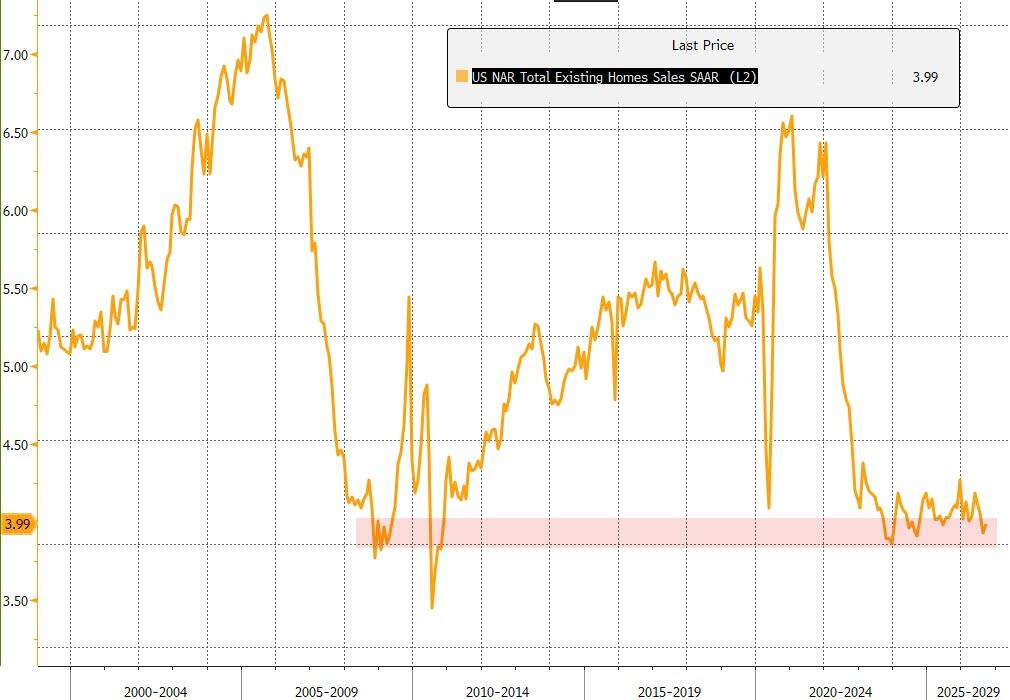
Despite the increase, “August and September marked the two slowest months for home sales this year,” NAR Chief Economist Lawrence Yun said in a statement.
“Further increases in mortgage rates in recent weeks mean fewer buyers can qualify to purchase a home.”
Earlier in the year, the country had been making some progress in reducing the so-called “lock-in” effect – the disincentive to move that homeowners face because of their low existing borrowing costs.
However, the recent surge in rates has halted that progress.
It also adds a “$19,000 shock” for would-be buyers with a $2,000 monthly budget, Realtor.com Chief Economist Danielle Hale said earlier this month in a blog post.
“The reset in rates over the last five weeks has shaved a little more than 6% off of the purchasing power of buyers across every budget, which is almost twice the typical price-savings advantage of buying in this less competitive season,” Hale said.
Meantime, the supply of previously owned homes for sale climbed 4.6% from a year ago to 1.6 million, NAR data show. That represents 4.8 months of supply at the current sales pace, staying at the more than decade high it reached in August.
Previously owned home sales in both the South and the West rose 2.8% in September. Sales in the Midwest were flat and activity in the Northeast fell.
“The fourth-quarter outlook for closing activity will clearly be down, maybe even measurably down,” Yun said Tuesday on a call with reporters.
“We are seeing more delays in the contracts with these rising interest rates.”
Finally, with the spread between current mortgage rates and the effective average mortgage rates that American homeowners have back near record wides…
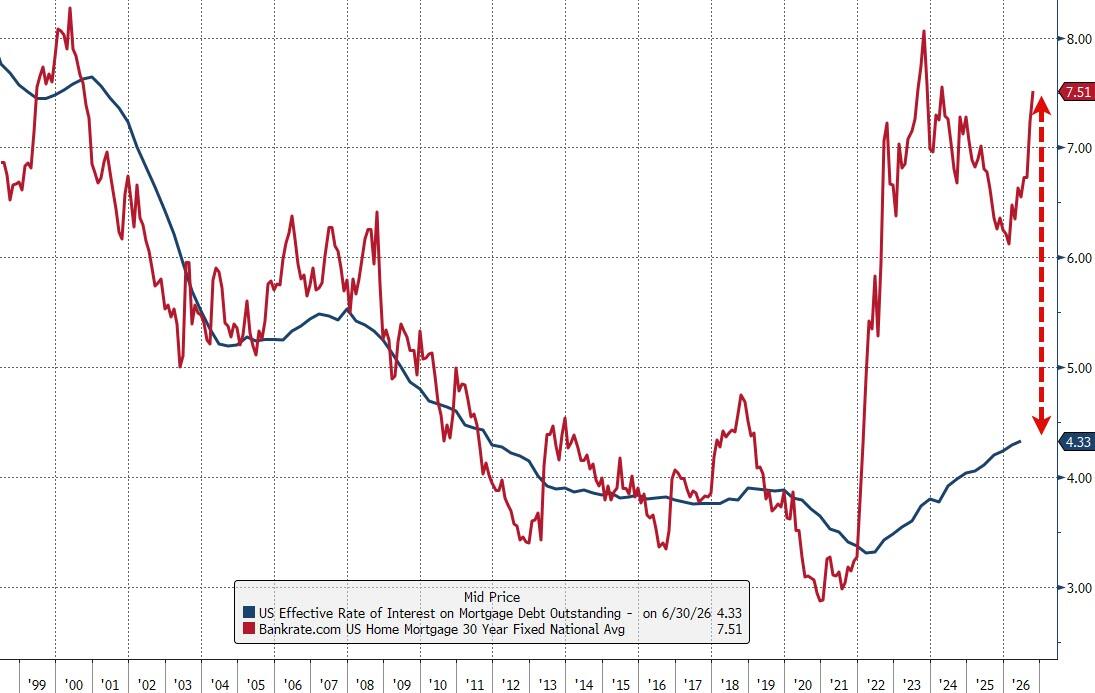
…we don’t see any signs of trapped sellers meeting buyers’ affordability levels any time soon!!
USA ECONOMIC REPORTS
BROADCOM//MR HOCK TAN/CEO
Hock Tan Warns AI Investors Are Gambling In A Casino… Whose Chips His Own Credit Is Paying For
Monday, Oct 12, 2026 – 11:31 PM
Usually it’s the chip CEOs who are the cheerleaders and the bond market that plays the skeptic. On Monday, the CEO of the second-most important AI chipmaker on the planet decided to play both roles.
Speaking on a panel at a DBS conference in Singapore, Broadcom boss Hock Tan said that many of the investors piling into AI behave more like gamblers than investors, setting extreme expectations only to discover they are effectively sitting at a casino table. In his own words, “a lot of investors have no clue what they are investing in.”
He didn’t stop there. Tan also questioned the long-term economics of the money-losing frontier labs, and, most importantly for markets, warned that insufficient capital could become the next constraint on the AI industry’s growth. As if to make his point for him, Intel’s Lip-Bu Tan, who shared the panel, said hardware will stay in short supply for another two to three years. Translation: the chips will be scarce, and so will the money to pay for them.
Semis did not take it well. The SOXX slumped 2.6% and JPMorgan’s AI memory basket tumbled 4.3% on a day when more than 60% of S&P members actually rose. Asked to explain the selling, JPMorgan tech specialist Joshua Meyers wrote in the bank’s afternoon Market Intel briefing (available to pro subs) that “the most proximate reason seems to be Hock Tan’s participation in a panel at a DBS conference in Singapore, where he warned financing could become a bigger bottleneck than component shortages (in addition to questioning frontier lab business models, and comparing ‘many investors’ to casino gamblers).”
Below we look at why Tan is right about the bottleneck, and why the people he called gamblers are the ones keeping his stock afloat while his own bondholders head for the exits.
The Bottleneck Is Money
Tan’s warning will come as no surprise to (even not so regular) readers: we have been warning since last October that the AI buildout runs on ever increasing amounts of debt, and last week Goldman’s Rich Privorotsky effectively conceded the point when he said the AI borrowing binge is now crowding out everyone else in the capital markets.
The evidence has been piling up. Last Thursday, Nvidia-backed Australian data center operator Firmus first slashed the price of its IPO by 25% and then pulled its $5.5 billion listing altogether, opting to raise money in private markets instead (good luck with finding someone dumb enough there). Our reaction at the time:
And Tan wasn’t the only one at the DBS event flagging it: just before he took the stage, DBS CEO Tan Su Shan said the market is now repricing the risks around AI financing after the heavy investment of the past two years. When the bank hosting the conference and the chipmaker on the panel agree that the money is the problem, it’s probably the money.
The Customer Is Losing Money… And Broadcom Is Lending It
Then there is the swipe at the frontier labs. Tan said OpenAI’s $50 billion annualized revenue as of September suggests there is a viable business, but that the company is still losing money because it spends so much on training and compute, so for now the number tells you little about long-term profitability.
Fair enough. Except that OpenAI is Broadcom’s customer, and on top of it, courtesy of SPV structures that would make Jeff Skilling blush, Broadcom is the one arranging the money for OpenAI to buy Broadcom’s chips (you may get a little nauseous after reading that).
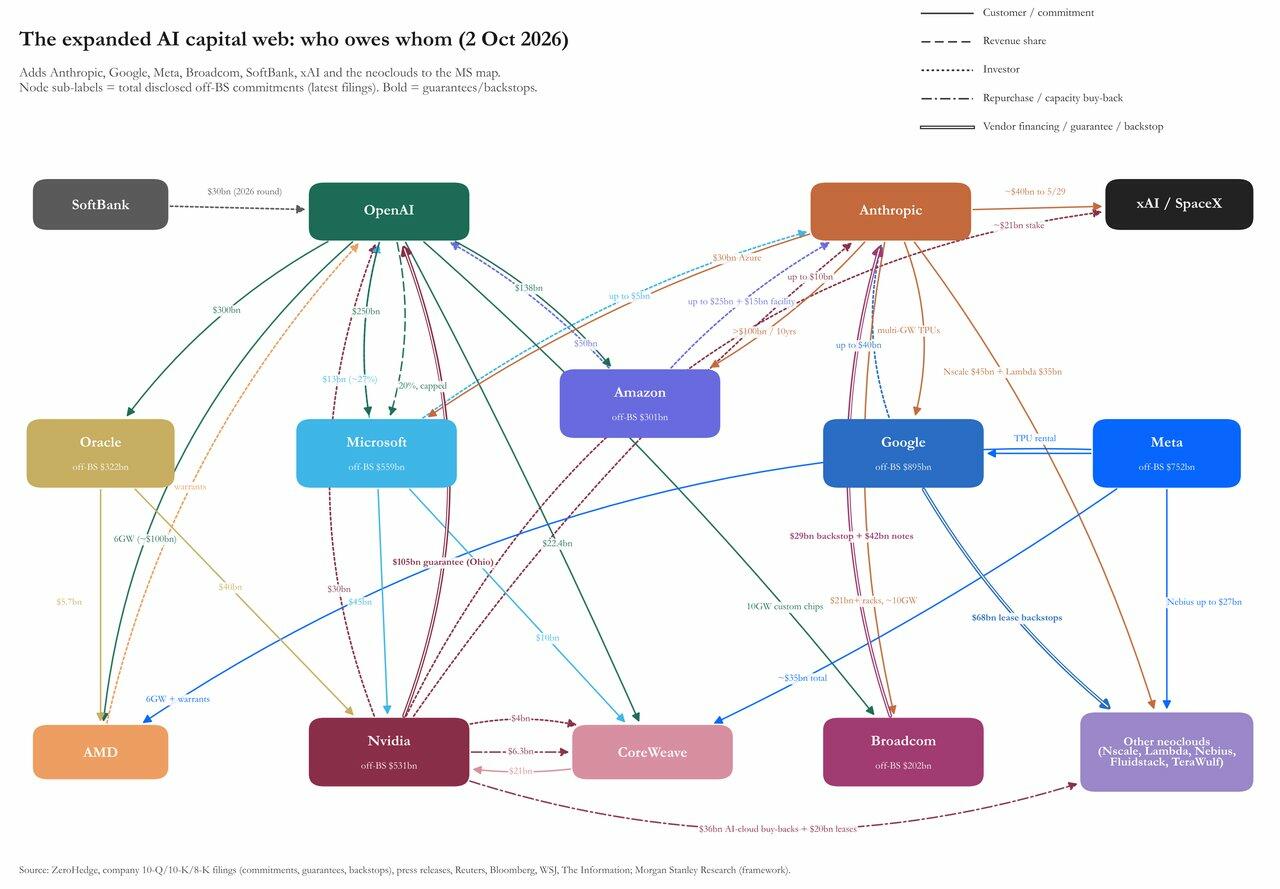
As we detailed last Thursday, Broadcom is in talks on a $50 billion+ chip financing for OpenAI (Bloomberg puts the next leg at closer to $30 billion), on top of the $60 billion it is syndicating for Anthropic and the $35 billion “Big Sky” platform it set up with Apollo and Blackstone in June. That’s roughly $145 billion of chip debt with Broadcom’s name on it, or as we put it when we tweeted this chart, “$300BN in chip-collateralized SPVs, so far”:
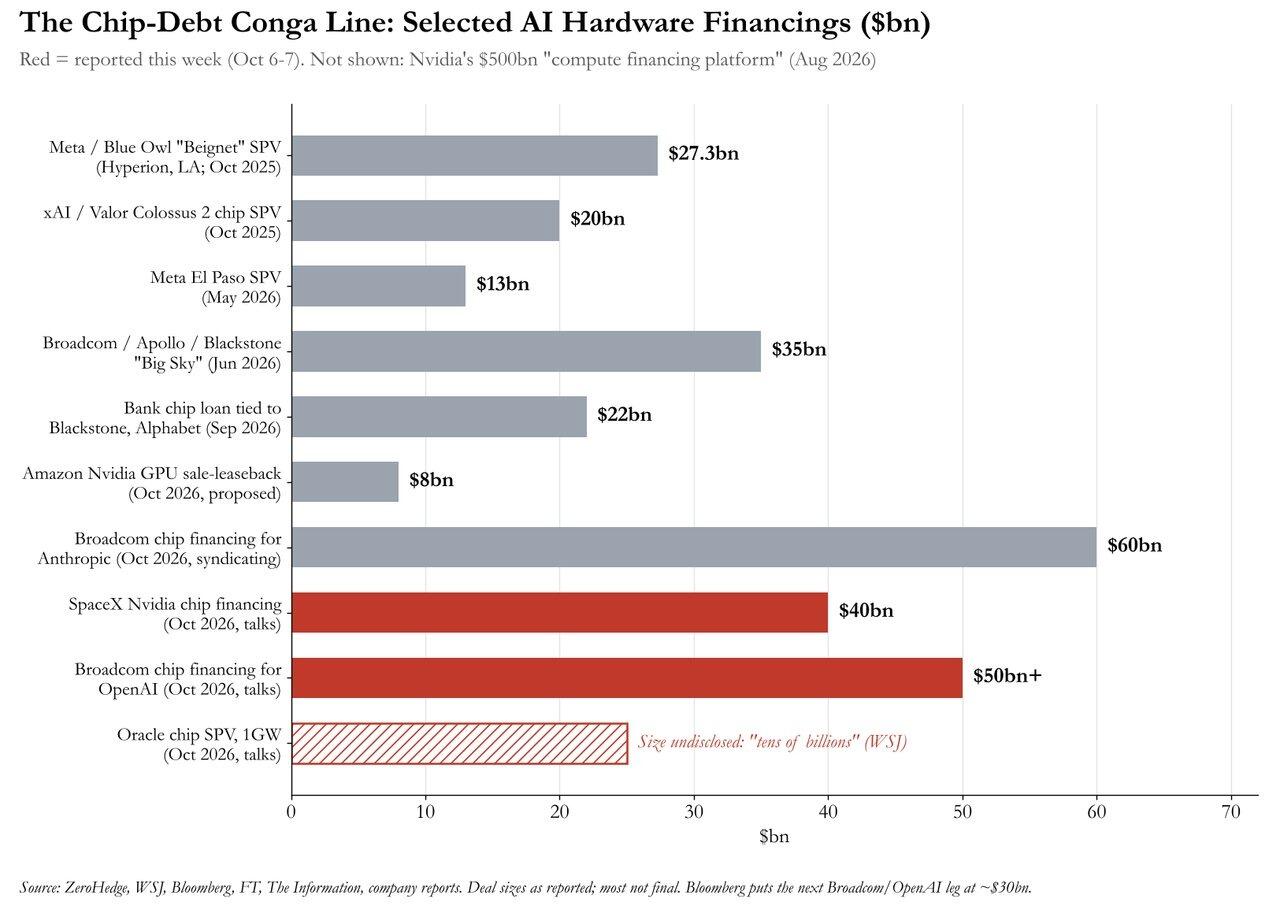
In other words, the CEO questioning the labs’ business models is also the biggest single lender to those business models! Over the weekend, Jefferies went even further, warning of “massive capital destruction” since just two cash-burning labs account for half of a $2.3 trillion backlog.
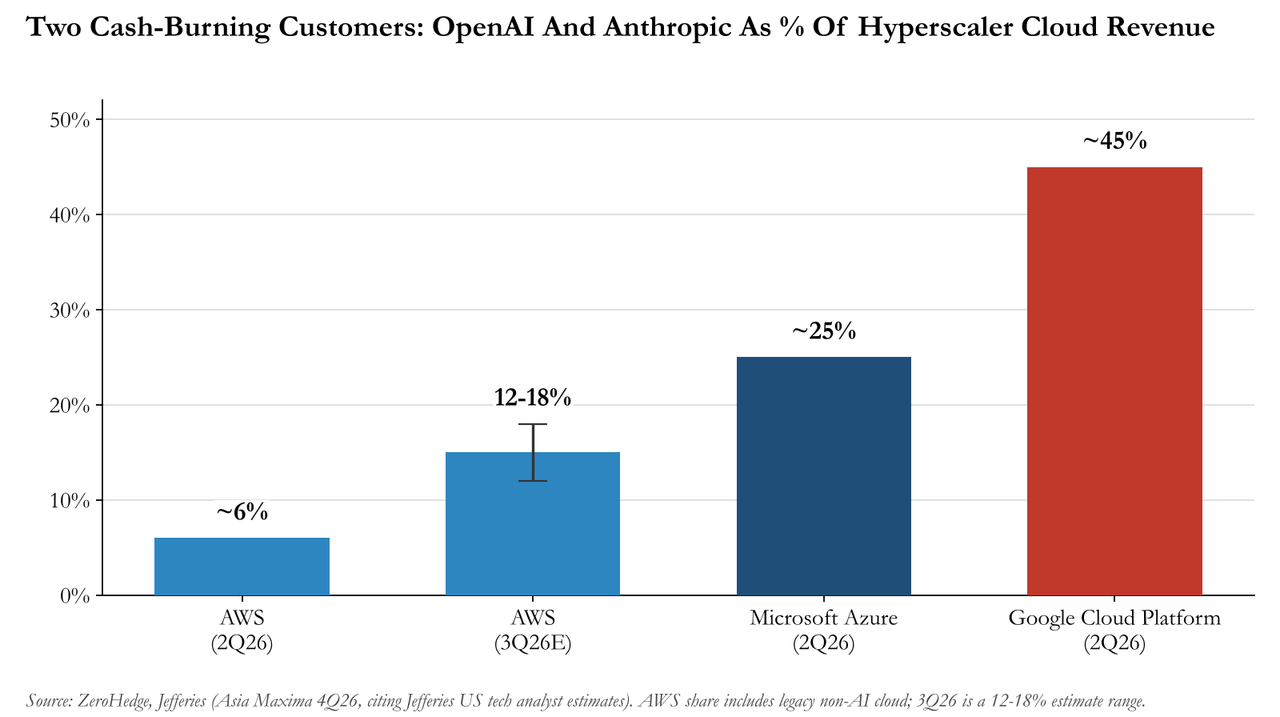
And last week’s FT report that OpenAI’s run-rate was ~$50 billion rather than the widely cited ~$70 billion, which Goldman‘s TMT desk chalked up to gross-vs-net accounting, showed just how much of a ~$1 trillion equity complex rests on largely made up and unaudited numbers from two private companies.
Gamblers Hold The Stock, Bondholders Hold The Bag
Which brings us to the irony. Tan may sneer at the “casino” crowd, but the casino is the only thing propping up AVGO. Per Goldman’s derivatives desk, Mag7 is now ~22% of total US prime exposure (the most since early 2022), semis exposure has doubled to ~12% from ~6% at the start of the year, and roughly $115 billion sits in levered semis ETFs. JPMorgan’s factor team adds that semiconductor sentiment is back above the 99th percentile. Those are the real gamblers.
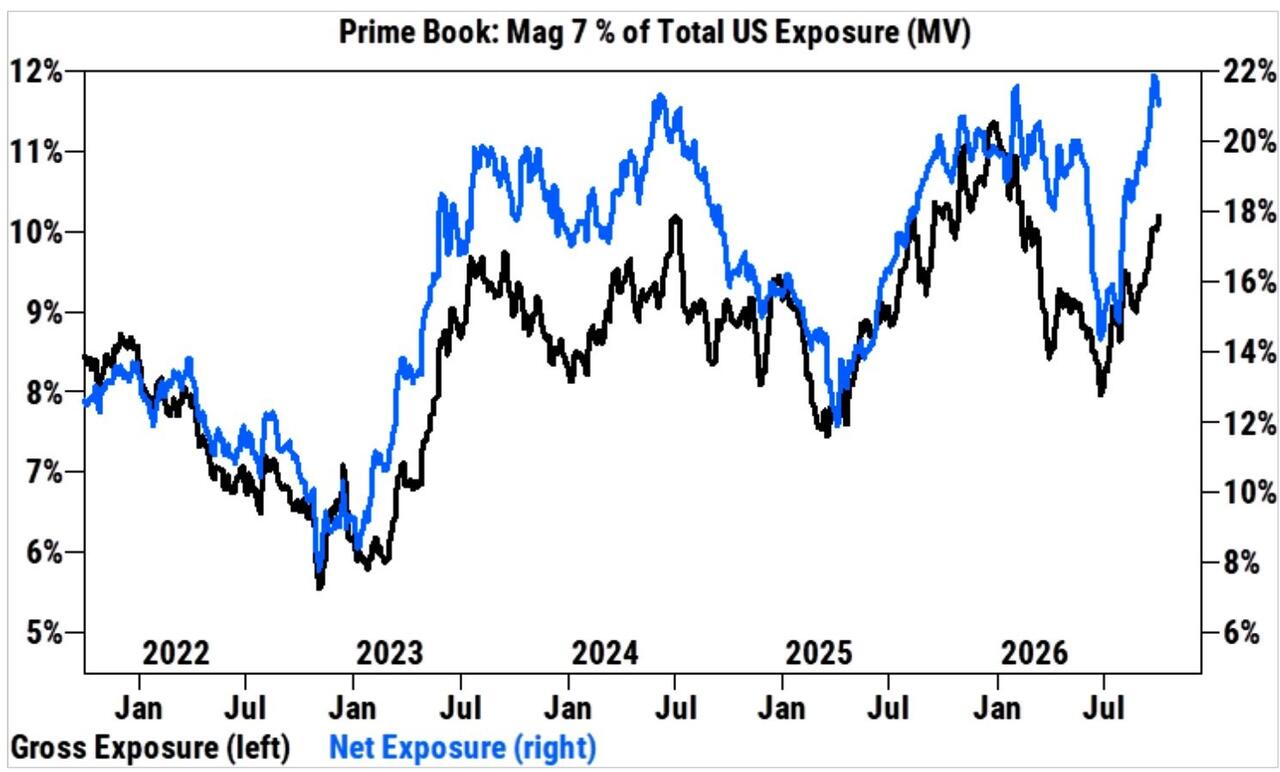
Broadcom’s creditors, meanwhile, are folding. The moment Broadcom’s Anthropic financing hit the tape, we said what would happen next:
It took about 12 hours for Broadcom bonds to hit all-time lows. And it has been one-way traffic since August, when Broadcom’s CDS exploded after it emerged that the company was seeking up to $100 billion in an off-balance sheet SPV.
Back then, 5Y CDS hit a record 122bp. After a brief September reprieve, the Anthropic and OpenAI financings sent it right back up: according to Goldman’s TMT specialist sales desk (available to pro subs), Broadcom’s 5Y CDS printed a record 136bp last Thursday, alongside Oracle at a record 261bp, as nearly $500 billion of 2026 AI borrowing gets repriced. Goldman flagged both spreads as key gauges of concern over debt-funded AI capex. At 133bp, Broadcom’s CDS is a few basis points from that record, and more than triple where it was in May, while Nvidia, its own $500 billion “compute financing platform” notwithstanding, sits at 86bp:
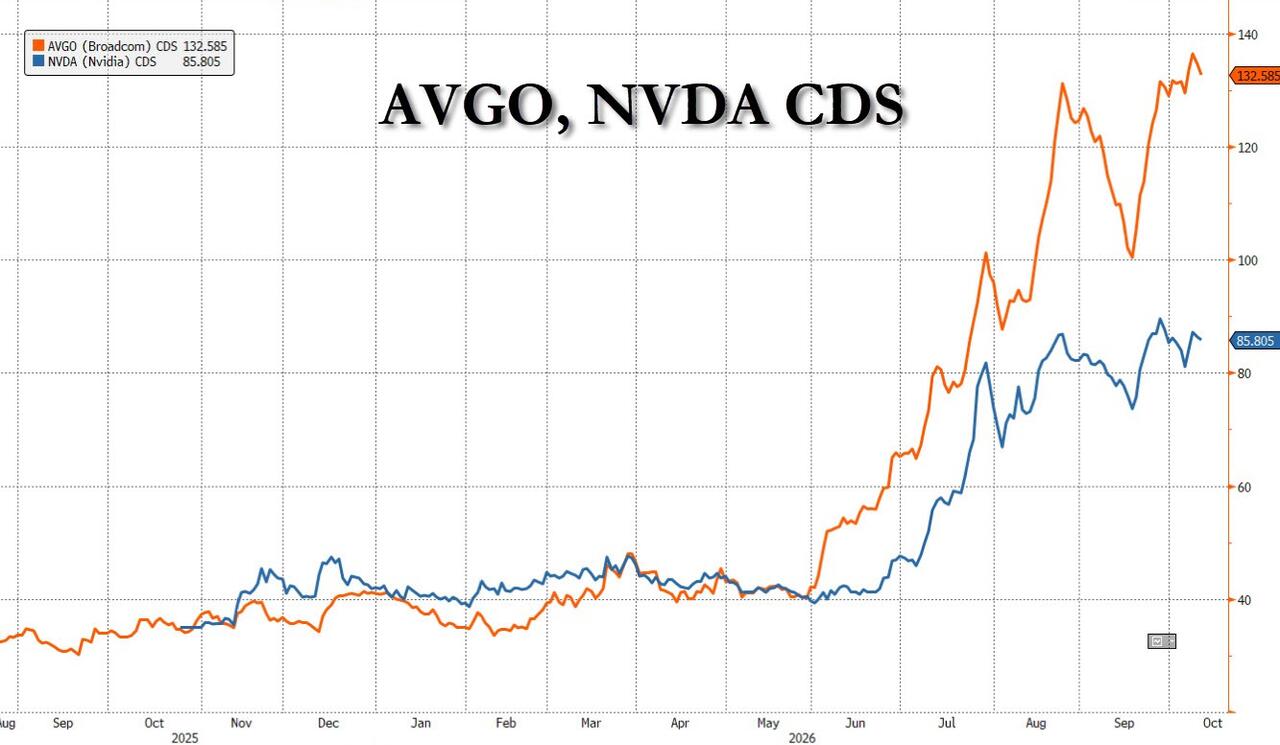
Put differently, the stock is held by the people Tan just called gamblers, and the bonds are priced by the people who agree with him.
Tan Had Some Help
To be fair, JPMorgan’s Meyers also pointed to a weekend sell-side note re-igniting power worries (a shortage of “powered shell” of as much as 19GW next year, and more in 2028), plus Middle East headlines and nervousness ahead of a private frontier lab investor meeting on Wednesday. Memory got an extra kick from China’s CXMT progress on next-gen DRAM, which we covered this morning in “Memory Remains The Epicenter”. And with bond markets shut for the holiday, Goldman’s cash desk said it was the lowest-volume session of the year, which tends to amplify every move.
Tellingly, Goldman’s derivatives desk saw clients reach for HYG downside, buying 50k Jan 77/73 put spreads, with the bond market closed. Even the gamblers, it seems, are hedging the credit.
Bottom Line
JPMorgan’s Market Intel team is sticking with its “Tactically Bullish” call into earnings, arguing semis can climb this latest wall of worry. Maybe. But when the CEO whose company is financing its own customers’ chip purchases says money, not silicon, is the next bottleneck, while his own CDS prints records, we’d side with the credit market.
After all, in a casino the house always wins. The question is who the house is when the house is also lending the chips.
More in the full JPM US Market Intelligence afternoon briefing and Goldman’s TMT specialist sales note, both available to pro subs.
END
BALTIMORE
$427,000 In Salaries, No Employees: FBI Raid Puts Baltimore City Nonprofit In Spotlight
Monday, Oct 12, 2026 – 08:55 PM
A Baltimore City nonprofit that received $1 million in federal pandemic funding reported more than $427,000 in salaries and wages while listing zero employees on its federal tax filing, according to Chris Papst, lead investigator for FOX45’s Project Baltimore.
Papst has tracked nonprofit KEYS Empowers since FBI agents raided the nonprofit linked to a Baltimore City school board member who abruptly resigned.
KEYS Empowers’ latest Form 990 filing, covering 2024, reported $2,001,754 in revenue, with $427,201 paid out in salaries and wages. But as Papst noted, the filing lists no employees.
Papst added more color to KEYS Empowers’ filing:
- $2,001,754 in revenue
- $427,201 in salaries and wages
- $79,701 in travel expenses
- $242,288 for conferences, conventions, and meetings
- Zero employees
At the center of KEYS Empowers is Mujahid Muhammad, who resigned as a member of the Baltimore City Board of School Commissioners after the FBI raided his nonprofit.

“I’m extremely concerned,” said Torrey Snow, a contributing member of the Baltimore Sun’s editorial board.
Snow continued, “Maryland taxpayers are heavily subsidizing the work in Baltimore City, and they need to know that officials that are in these areas are keeping an eye on where this money is going.”
In 2022, left-wing Mayor Brandon Scott’s office announced a $1 million award in American Rescue Plan Act funding to KEYS Empowers.
“If public money is going into these nonprofits, it is the official’s responsibility to ensure that these nonprofits are engaging in activities that are necessary and benefiting the public,” stated Snow.
Publicly available data show KEYS Empowers’ corporate structure and link Muhammad and Ashiah Parker, both appointed to the Baltimore City school board by Mayor Scott, to the nonprofit. This points to overlapping nonprofit leadership, school board appointments linked to Scott, and government funding for a highly questionable nonprofit.
The relationship map places Mujahid Muhammad between not just KEYS Empowers but also K.E.Y.S. Development T.A. LLC.
Reporting more than $427,000 in salaries and wages yet listing zero employees is a major red flag.
The questions remain: who received the taxpayers’ money, what services did they provide, and who approved the payments? Whether this is simply sloppy Form 990 reporting or something more serious, taxpayers deserve answers.
END
The Collective Is The Enemy Of Community
Monday, Oct 12, 2026 – 11:25 PM
Authored by Thaddeus G. McCotter via American Greatness,
The Democratic Socialists of America exploit young people’s longing for community, but socialism’s coercive collectivism destroys the voluntary relationships that sustain it.
Whether reflecting on the impersonal essence of “virtual reality” and the incessant stream of demands and anxieties it imposes upon our diurnal, increasingly alienated existence, or listening to the concerns of one’s fellow citizens, one hears a persistent leitmotif: the longing for true community, especially among the youth.

One aspect of this longing has been well bruited: people’s gnawing sense that the myth of “virtual community” is an alienating illusion that increasingly leaves them numb and pining for personal engagements – the flesh-and-blood amities, intimacies, and sundry other encounters of true community.
Exacerbating this sense of loss, especially among the young, people are very concerned about “affordability” – such as the inability to purchase a new home, rent an apartment, find an entry-level job, or keep the one they already have – due to the rise of artificial intelligence (AI) and inflation. But too often overlooked is how the diminishment of these opportunities has reduced people’s personal interaction and the sense of community it brings.
Indeed, when people, notably youth, talk about wanting to “shop locally,” support small businesses, or even reject “corporate” entities and their culture, it is not a complete rejection of capitalism. Indeed, one can clearly recognize young people’s embrace of free markets and small businesses. Yet, it is a practical complaint regarding its failures – one of which is its eclipse of community beneath an impersonal corporatism. (One can make the argument that today’s youth are essentially the political descendants of Jeffersonian Republicans, but I digress.)
Naturally, one group that has not overlooked young people’s yearning for a greater sense of community is the Democratic Socialists of America (DSA). They exacerbate youth’s disaffection with the economy by equating corporatism and capitalism and proffer socialism as a virtuous panacea for economic ailments. And, for alienated people yearning for community, the DSA conflates and substitutes the collective for community.
But the truth is the collective is the enemy of community.
As Robert Nisbet warned in his seminal work, The Quest for Community: A Study in the Ethics of Order and Freedom:
Marxism, like all other totalitarian movements in our century, must be seen as kind of secular pattern of redemption, designed to bring hope and fulfillment to those who have come to feel alienated, frustrated, and excluded from what they regard as their rightful place in a community. In its promise of unity and belonging lies much of the magic of totalitarian mystery, miracle, and authority.
It is a false promise.
Under socialism, the “warm embrace” of the collective is created by an omnipotent, centralized government. It relies upon coercion, not consent. In addition to crushing an individual’s agency and ability to dissent, it destroys the voluntary intermediate institutions that form a community and insulate and protect the individual from the domination of the centralized government.
As Nisbet explained, the destruction of these intermediate institutions is imperative for would-be authoritarians:
We may regard totalitarianism as a process of the annihilation of individuality, but, in more fundamental terms, it is the annihilation, first, of those social relationships within which individuality develops. It is not the extermination of individuals that is ultimately desired by totalitarian rulers, for individuals in the largest number are needed by the new order. What is desired is the extermination of those social relationships which, by their autonomous existence, must always constitute a barrier to the achievement of the absolute political community. The individual alone is powerless. Individual will and memory, apart from the reinforcement of associative tradition, are weak and ephemeral. How well the totalitarian rulers know it. (…) To destroy or diminish the reality of the smaller areas of society, to abolish or restrict the range of cultural alternatives offered individuals by economic endeavor, religion, and kinship, is to destroy in time the roots of the will to resist despotism in its large forms.
The antithesis and antidote to the collective is community.
Community requires individual consent, agency, voluntary associations, and governmental subsidiarity. This is decidedly different from the strawman argument proffered by socialists that the choice is between the collective and a calloused “rugged individualism.” While deceptive, such an argument makes a cynical sense, because subscribing to the DSA’s agenda would leave someone just a coerced cog in the collective, not a consensual member of a true community.
Once more, Nisbet writes in his book, The Sociological Tradition:
There must be in any stable culture, in any civilization that prizes its integrity, functionally significant and psychologically meaningful groups and associations lying intermediate to the individual and the larger values and purposes of his society. For these are the small areas of association within which alone such values and purposes can take on clear meaning in personal life and become the vital roots of the large culture.
And is it not the aim of all radicals, including the DSA, to destroy root and branch the foundations of an established civilization?
Is it not to fundamentally eradicate all individual agency and consensual, intermediate communal relationships to impose their radical ideological dictates to perfect humanity and create Utopia?
Is it not, as Nisbet avers, to make sure “man’s alienation from man must lead in time to man’s alienation from God,” and from community into the chill grip of the iron fist of the collective?
KING NEWS
Mookaite (also called mookaite jasper, mookite, or Australian jasper) is a colorful sedimentary rock/gemstone found exclusively in Western Australia.What it is geologicallyIt is a silicified radiolarite (or radiolarian chert)—a dense, opaque, silica-rich rock formed from the fossilized remains of microscopic marine organisms called radiolarians. These single-celled plankton had silica skeletons that accumulated on an ancient seafloor during the Cretaceous period (roughly 65–120 million years ago). Over time, the sediments compacted, silicified, and were colored by iron oxides and other minerals.
animamundicrystals.comAlthough it is commonly sold and referred to as a variety of jasper (because of its appearance, hardness, and polishability), it is not a true jasper in the strict geological sense—it is a biogenic chert/radiolarite.
stonemania.co.ukKey properties
- Composition: Mainly microcrystalline silica (SiO₂ / chalcedony/quartz) with iron oxides, clays, and sometimes other impurities.
- Hardness: 6–7 on the Mohs scale (durable enough for jewelry but somewhat brittle).
- Colors: Distinctive warm, multicolored patterns—mustard yellow, red, burgundy, cream/white, brown, purple/mauve—often swirling or transitioning in a single piece. Colors come from natural iron oxides (no dyeing needed).
- Appearance: Opaque, with a waxy to vitreous luster when polished; conchoidal fracture.
- Origin: Only from the Mooka Creek area / Mooka Station in the Kennedy Range, Western Australia (part of the Windalia Radiolarite formation). The name “Mookaite” comes from this location; “Mooka” relates to a local Aboriginal term associated with running water. animamundicrystals.com
UsesIt is popular for jewelry (cabochons, beads, pendants), tumbled stones, carvings, and decorative pieces. In crystal/metaphysical contexts, it is often associated with grounding, vitality, adaptability, and confidence, though these are traditional beliefs rather than scientifically verified properties.In short, mookaite is a uniquely Australian stone with ancient marine origins and striking natural color patterns.
SWAMP STORIES FOR YOU TONIGHT
“Too Combustible”: New York Times Calls For Canceling Sophie Cunningham
Monday, Oct 12, 2026 – 04:20 PM
Authored by Jonathan Turley via JonathanTurley.org,
The New York Times demonstrated again this week that it remains solidly part of the cancel campaign culture. The Athletic, owned by the Times, joined the mob in calling for the Indiana Fever to dump Sophie Cunningham for publicly opposing biological males playing in women’s sports – a position shared by the vast majority of citizens.

The column by Candace Buckner blames Cunningham for creating a “circus” and says that she is a distraction from the game due to her public stance. So, she is now “too combustible, her takes too “turbulent” to play basketball.
Of course, if she supported transplayers, she would presumably not be combustible but admirable.
Notably, the Times does not view those who have attacked Cunningham and her fans as too “combustible,” including coaches wearing opposing slogans and statements in favor of biological males in women’s sports. The New York Times itself reported that almost 80% of citizens hold the same position as Cunningham.
The Oct. 6 column called on Indiana not to renew Cunningham’s contract after two seasons when she becomes a free agent because she is “too combustible.”
However, the Times does not believe that those coaches and players speaking out in favor of such inclusion are “too combustible.”
There was no call for sacking figures like Storm co-owner Celeste Keaton, who reportedly yelled profanities at girls who were simply supporting women in sports and Cunningham.
Nor was there a call to sack Minnesota Lynx head coach Cheryl Reeve for wearing a T-shirt supporting trans players in a game against the Indiana Fever and Cunningham.
Liberal sentiments are never combustible for the Times. The newspaper ran a long line of columns supporting Colin Kaepernick in his kneeling protests during games. Conversely, columns attacked former player Enes Kanter Freedom for wearing a T-Shirt reading “WOMAN noun. adult human female.”
For most of us, the hatred for Cunningham is baffling. These athletes have a unique perspective on this controversy that can help inform the debate on both sides. We should welcome the insights of athletes for and against transgender players in this national discussion.
Instead, Cunningham has been subject to the same hateful, unhinged attacks that we have seen on other influential figures such as J.K. Rowling. There is no room for civil debate or any difference of opinion.
The purpose of these campaigns is obvious. Even with the vast majority of citizens supporting Cunningham’s position, press and pundits want to deter others from publicly taking such positions. It is designed to chill speech and deter dissent.
On Friday’s episode of “No Hesitation with Sophie Cunningham & Drew Hanlen,” Hanlen correctly called the piece an “absolute hate piece.” Cunningham responded even more succinctly to the Times with “suck it.”
I am not concerned for Cunningham, who has shown great courage and steadfastness in the face of these critics. Rather, it was the latest evidence that the Times has changed little in fueling the mob and canceling opposing voices.
The Times has thrilled the extreme left with its signature relativism in defending any abuse on the left, from looting to murder. It has continued to feature violent extremists as political attacks rise around the country.
The same newspaper that fired editors and denounced Sen. Tom Cotton for his NYT column quelling violent protests would go on to print individuals who have said that they are ok with killing conservatives or capitalists.
Just before the anniversary of the Cotton controversy, the New York Times published a column by University of Rhode Island professor Erik Loomis, who defended the murder of a conservative protester and said that he saw “nothing wrong” with such acts of violence.
After canceling Sen. Cotton, the Times had no problem with publishing the views of a Chinese figure called the enforcer of Beijing in the crushing of protests.
The New York Times is undeterred because its readers seem to value the very hypocrisy revealed in these controversies. They can rely on the Times to offer spins and deflections to relieve them of any self-examination after tragedies like the Kirk assassination.
While denouncing disinformation, the Times has embraced false narratives and continues to publish distorted historical claims.
As with its cancellation of Sen. Cotton, the Times shows that the left is ready to resume the prior campaign of cancel campaigns and censorship of opposing views. That includes an athlete who merely voiced a view in favor of female athletes that is shared by roughly 80 percent of the country. It is not shared by the Times or its viewers, so (once again) Cunningham must go.
Opposing viewpoints are intolerable to many on the left, and the editors of the Times are once again rationalizing the worst impulses of American politics.
END
my goodness!! what stupid can they be!!
(WATSON/MODERNITY)
Another Somali Shooter Walks Free Days After Murder Attempt
Tuesday, Oct 13, 2026 – 10:55 AM
Authored by Steve Watson via Modernity.news,
Days after federal agents stopped an 18-year-old of Somali descent from buying an AK-47 to kill dozens at the Mall of America in an ISIS-inspired plot, another 18-year-old Somali is free after police say he opened fire outside a high school homecoming game.

Investigators linked the Eden Prairie shooting to rival Somali gangs. The accused spent just two nights in jail before posting a $100,000 bond with $10,000 cash down. Hennepin County Attorney Mary Moriarty had said he would be held accountable.
On October 2, during Eden Prairie High School’s homecoming football game against Minnetonka, a fight involving about 10 people broke out in a parking lot after two vehicles arrived. Surveillance video showed a Hyundai Sonata, registered to the brother of Adam Abdihakeem Adam, 18, of St. Louis Park, enter the area.
Charging documents state Adam was the only occupant. He got out, fired a single shot, struck two teenagers, and fled. The victims were an 18-year-old and a 17-year-old, both Somali males from St. Paul known to law enforcement and not students at either school. One was shot through the leg; the other in the foot. Both injuries were non-life-threatening. The stadium was evacuated and the game postponed.
Investigators used phone location data that tracked Adam and the vehicle before, during, and after the shooting. He abandoned the phone and changed its number. A search of his home recovered clothing consistent with what the shooter wore on video.
Eden Prairie police arrested him without incident on October 8 in Minneapolis with help from partner agencies. Police Chief Matt Sackett said, “The arrest today is an important step in this investigation. I’m incredibly proud of our officers and investigators who have worked nonstop alongside our law enforcement partners to identify those responsible and hold them accountable.”
Hennepin County Attorney Mary Moriarty charged Adam with two counts of second-degree assault with a dangerous weapon and one count of second-degree riot while armed with a dangerous weapon. She stated: “This was an alarming and dangerous act that injured two people and frightened many more. Mr. Adam will be held accountable.” She added, “Violence in our communities is completely unacceptable and it requires a professional, coordinated response, which happened here.”
Bail was set at $100,000 and Adam posted bond and was released on October 10. Critics, including President Trump’s Rapid Response 47 account, highlighted the rapid release and the absence of conditions in a case police tied to Somali gang activity. This is one of several recent incidents in Eden Prairie, Edina, and Bloomington that local police have connected to gang activity among young Somalis.
The release arrived days after the FBI’s October 6 arrest of Sheikhdoon Abdullahi Mohamud, also 18, a U.S. citizen of Somali descent from Richfield. Agents took him into custody in a parking lot after he paid $600 to an undercover employee he believed was with ISIS for an AK-47-style rifle, four 30-round magazines, and roughly 200 rounds of ammunition. Court records show he planned a mass shooting at the Mall of America during a Hmong Arts Celebration, aiming to kill 30 to 60 people.
An investigation spanning nearly two years documented messages in which Mohamud pledged allegiance to ISIS in a video, sought martyrdom, and initially wanted to travel to Somalia to fight for groups including al-Shabaab.
When he concluded he lacked the money, he turned to a domestic attack. He told a confidential source the mall was targeted “because its owned by jewish” and wrote that he wanted to “harm the jew just like the brothers in australia bondi beach harmed the jews.” He messaged: “I can’t wait until I kill kuffar man. October 24 is the day insha Allah.” He also wrote, “I will do attack here,” and “I wanna get martyred inshallah.”
U.S. Attorney Daniel Rosen said: “This was a radicalized young man who needed to be watched.” Agents “were able to detect a threat, and disrupt it, before the defendant carried out his intention to kill, in his words, maybe 30 to 60 people.”
Rosen added that the charges demonstrate “the threat of terrorism in support of ISIS and other foreign terrorist organizations is active and continuing.”
FBI Minneapolis Special Agent in Charge Christopher Dotson called the messages “chilling,” saying they document “the idolization of ideologically motivated violence, a callous disregard to the sanctity of human life, a blind hatred of people of other faiths and a cold commitment to carrying out his vision of violence in our community.”
FBI Director Kash Patel stated: “This individual allegedly obtained a weapon he hoped to use in a mass casualty attack in support of ISIS, but this FBI arrested him and put a stop to his plans.” President Trump said “the FBI did a great job.”
Minnesota’s large Somali population in the Twin Cities has produced a documented pattern: a wave of young men recruited to al-Shabaab more than a decade ago, recurring gang shootings, and now an ISIS-inspired plot against one of the country’s busiest malls.
Local officials have repeatedly flagged the violence. Progressive prosecutors who prioritize rehabilitation and low barriers to release, as Moriarty has done, produce short stays even in cases involving gunfire at school events. The practical result is repeated policing, emergency response, hospital care, and court time for the same networks.
Segments of the community generate these costs while showing extremely limited assimilation and sustained parallel loyalties. The two 18-year-olds – one free after a homecoming shooting police tied to Somali gangs, one detained after planning an ISIS mass attack – illustrate the combined failure of unrestricted immigration and soft-on-crime charging practices.
Minnesota taxpayers and residents absorb the results in near-misses at major public venues.
Secure borders, serious vetting, removal of those who commit violent crimes or support terrorism, and prosecutors who treat public safety as the priority reverse the incentives. The alternative is more of the same: short jail stays, planned attacks, and officials who announce accountability while the accused walk out on modest bond.
GREG HUNTER….
SEE YOU TOMORROW
H


