
EXCHANGE: COMEX
CONTRACT: OCTOBER 2026 COMEX 100 GOLD FUTURES
SETTLEMENT: 4,152.900000000 USD
INTENT DATE: 10/13/2026 DELIVERY DATE: 10/15/2026
FIRM ORG FIRM NAME ISSUED STOPPED
661 C JP MORGAN SECURITIES 1
709 C BARCLAYS 1
TOTAL: 1 1
MON
GOLD: NUMBER OF NOTICES FILED FOR OCT./2026: 1 CONTRACTs NOTICES FOR 100 OZ or 0.00311 TONNES
total notices so far: 12,512 contracts FOR 1,251,200 OZ OR 38.914 TONNES
SILVER NOTICES: 120 NOTICE(S) FILED FOR 600,000 OZ /
total number of notices filed so far this month : 3250 CONTRACTS (NOTICES) for 16.250 million oz
GLD
SHANGHAI CLOSED DOWN 33.64 PTS OR 0.88%
HANG SENG CLOSED DOWN 31.05 PTS OR 0.13%
Nikkei CLOSED UP 70.48 PTS OR 0.10%
//Australia’s all ordinaries CLOSED DOWN 0.61%
//Chinese yuan (ONSHORE) CLOSED UP AT 6.6929
/ OFFSHORE CLOSED UP AT 6.6929 Oil UP TO 94.45 dollars per barrel for WTI and BRENT UP TO 105.70 Stocks in Europe OPENED ALL GREEN
ONSHORE USA/ YUAN// WITH YUAN TRADING 6.6929 OFFSHORE YUAN TRADING UP TO 6.6929 ONSHORE YUAN TRADING BELOW LEVEL // OFF SHORE AND UP ON THE DOLLAR)// / AND THUS STRONGER/OFF SHORE YUAN TRADING UP AGAINST US DOLLAR/ AND THUS STRONGER
| Gold | Ounces |
| Withdrawals from Dealers Inventory in oz | nil |
| Withdrawals from Customer Inventory in oz | 2 ENTRIES i) out of Brinks 693.710 oz ii) out of Manfra: 321.510 oz (10 kilobar) total withdrawal: 1015.220 oz |
| Deposit to theDealerInventory in oz | 0 ENTRIES |
| Deposits to the Customer Inventory, in oz | DEPOSITS/CUSTOMER//gold 0 ENTRIES xxxxxxxxxxxxxxxx |
| No of oz served (contracts) today | 1 CONTRACTS 100 OZ 0.1368 TONNES OF GOLD |
| No of oz to be served (notices) | 83 Contracts 8300 OZ 0.2581 TONNES |
| Total monthly oz gold served (contracts) so far this month | 12,512 notices 1,251,200 OZ 38.917 TONNES |
| Total accumulative withdrawals of gold from the Dealers inventory this month | NIL oz |
| Total accumulative withdrawal of gold from the Customer inventory this month |
dealer deposits: 0
xxxxxxxxxxxxxxxxxxx
DEPOSITS:
ENTRIES: 0
xxxxxxxxxxxxxxxxxx
comex withdra
2 ENTRIES
i) out of Brinks 693.710 oz
ii) out of Manfra: 321.510 oz
(10 kilobar)
total withdrawal: 1015.220 oz
adjustments: 3 dealer to customer acct
a) Asahi 27,558.994 oz
b) Brinks: 125,097.843 oz
c) Manfra; 21,073.992 oz
COMEX IS DRAINING GOLD
chaos inside the comex
THE FRONT MONTH OF OCT OI STANDS AT 84 CONTRACTS HAVING A LOSS OF 15 CONTRACTS.
TUESDAY WE HAD A NORMAL DELIVERY OF 1,259,700 OZ ( 39.1819 TONNES) OF GOLD STANDING FOR DELIVERY: TODAY: 1,259,500 OZ OR 39.175 TONNES FOR A LOSS OF 200 OZ (0.00622 TONNES) OR 2 CONTRACTS UNDERWENTAN EXCHANGE FOR PHYSICAL TRANSFER TO LONDON WHERE THEY WILL TAKE DELIVERY OF THAT OVER THERE.
NOVEMBER LOST 65 CONTRACTS FALLING TO 3825
DECEMBER, THE LARGEST DELIVERY MONTH IN THE CALENDAR, ITS OI RISES BY 2441 CONTRACTS UP TO 320,519.
.
We had 1 contracts filed for today representing 100 oz
Today, 0 notice(s) were issued from J.P.Morgan dealer and 0 notices issued from their client or customer account. The total of all issuance by all participants equate to 1 contract(s) of which 0 notices were stopped (received) by j.P. Morgan dealer and 1 notice(s) was (were) stopped (received) by J.P.Morgan//customer account
To calculate the INITIAL total number of gold ounces standing for OCT /2026. contract month, we take the total number of notices filed so far for the month (12,512) to which we add the difference between the open interest for the front month of OCT (84 CONTRACTS) minus the number of notices served upon today 1 x 100 oz per contract) equals 1,259,500 OZ OR(39.1750 Tonnes of gold) to which we add our first exchange for risk in Oct totalling 836 contracts for 83,600 oz or 2.600 tonnes. Thus Oct standing for gold reduces to 41.775 tonnes
THUS: INITIAL total number of gold ounces standing for OCT. /2026. contract month,we take the total number of notices filed so far for the month (12,512) to which we add the difference between the open interest for the front month of OCT(84) contracts minus the number of notices served upon today 1 x 100 oz per contract) equals 1,259,500 OZ OR(39.175 Tonnes of gold) plus our first exchange for risk totalling 836 contracts//83600 oz//2.600 tonnes//standing reduces to 41.775 tonnes
new total of gold standing in OCT becomes 41.775 TONNES//
TOTAL COMEX GOLD STANDING FOR OCT.: 41.775 TONNES WHICH IS NOW VERY STRONG FOR THIS NON ACTIVE DELIVERY MONTH OF OCT./
TUESDAY VOLUME: 142,428 POOR
COMEX GOLD INVENTORIES/CLASSIFICATION
NEW PLEDGED GOLD:
241,794.285 oz NOW PLEDGED /HSBC 5.94 TONNES
204,937.290 OZ PLEDGED MANFRA 3.08 TONNES
83,657.582 PLEDGED JPMorgan no 1 1.690 tonnes
265,999.054, oz JPM No 2
1,152,376.639 oz pledged Brinks/
Manfra: 33,758.550 oz
Delaware: 193.721 oz
International Delaware:: 11,188.542 oz
total pledged gold: 1,721,684.952 oz 53.55 tonnes pledged gold lowers
total inventories in gold declining rapidly
total pledged gold: 1,721,684.952 tonnes oz 53.55 tonnes
TOTAL OF ALL GOLD ELIGIBLE AND REGISTERED GOLD 23,476,095.530oz//
TOTAL REGISTERED GOLD 14,876,916.734 tonnes (462.73 tonnes)
TOTAL OF ALL ELIGIBLE GOLD 8,599,178.796 oz.
REGISTERED GOLD THAT CAN BE SERVED UPON 13,155,232oz ((REG GOLD- PLEDGED GOLD)=
409.182 Tonnes //
total inventories in gold declining rapidly
SILVER COMEX
OCT DELIVERY MONTH
OCT 14
| Silver | Ounces |
| Withdrawals from Dealers Inventory | NIL oz |
| Withdrawals from Customer Inventory | 0 entries |
| Deposits to the Dealer Inventory | 0 ENTRY |
| Deposits to the Customer Inventory | ENTRIES: 2 i) Into CNT: 592,145.710 oz ii) Into Loomis: 601,420.500 total deposit: 1,1193,566.210 oz |
| No of oz served today (contracts) | 120 CONTRACT(S) ( 600,000 OZ) |
| No of oz to be served (notices) | 254 Contracts (1.270 MILLION oz) |
| Total monthly oz silver served (contracts) | 3258 contracts 16.250 MILLIONoz |
| Total accumulative withdrawal of silver from the Dealers inventory this month | NIL oz |
| Total accumulative withdrawal of silver from the Customer inventory this month |
DEPOSITS INTO DEALER ACCOUNTS
ENTRY:0
DEPOSIT ENTRIES/CUSTOMER ACCOUNT
2 ENTRIES:
i) Into CNT: 592,145.710 oz
ii) Into Loomis: 601,420.500
total deposit: 1,1193,566.210 oz
xxxxxxxxxxxxxxxxxxxxxxxxx
withdrawals:
0 entries
adjustments : 2 dealer to customer
a) Brinks 200,779.675 oz
b) CNT 59,418.800 oz
xxxxxxxxxxxxxx
TOTAL REGISTERED SILVER: 103.091 MILLION OZ//.TOTAL REG + ELIGIBLE. 333.201 Million oz
registered silver dropping in numbers
CALCULATIONS FOR THE NEW STANDING FOR SILVER FOR OCT
FRONT MONTH: SILVER OPEN INTEREST CONTRACTS: 374 FOR A GAIN OF 5 CONTRACTS . TUESDAY WE HAD 17.475 MILLION OZ STAND: TODAY: 17.560 MILLION OZ FOR A GAIN OF 85,000 OZ (17 CONTRACTS). THUS A STRONG QUEUE JUMP OF 85,000 OZ WHERE THEY WILL TRY AND TAKE DELIVERY ON THIS SIDE OF THE POND.
.
NOVEMBER LOST 48 CONTRACTS UP TO AN OI OF 2035
DECEMBER GAINED 660 CONTRACTS DOWN TO AN OI OF 83,058
TOTAL NUMBER OF NOTICES FILED FOR TODAY: 120 or 600,000 oz
CONFIRMED volume TUESDAY; 40,936 // poor/
AND NOW OCT. DELIVERIES:
To calculate the number of silver ounces that will stand for delivery in OCT. we take the total number of notices filed for the month so far at 3258 X5,000 oz = 16.250 MILLION oz.
Then we take the difference between the front month of OCT. and the number of notices filed for today x 5000 to give us our standing
Thus the standings for silver for the OCT 2026 contract month: (3258 )Notices served so far) x 5000 oz + OI for the front month of OCT (374) minus number of notices served upon today ( 120 x 5000 oz) equals silver standing for the OCT .contract month equating to 17.560 MILLION OZ to which we add silver’s TWO exchange for risk for 450 contracts (2.25 million oz).. total standing reduces to 19.810 million oz//. ( a very strong delivery month)
We must also keep in mind that there is considerable silver standing in London coming from our longs
There are ONLY 103.091 million oz of registered silver
JPMorgan as a percentage of total silver: 125.510/333.201 million: 37.66%
The record level of silver open interest is 234,787 contracts set on April 21./2017 with the price on that day at $18.42.
The previous record was 224,540 contracts with the price at that time of $20.44.
BOTH GLD AND SLV ARE MASSIVE FRAUD
XXXXXXXXXXXXXXXXXXXXXXXXXXXXXXXXXXXXXXXXXXX
OCT 14//2026/WITH GOLD DOWN $66.25 /NO CHANGES IN GOLD AT THE GLD: //:/INVENTORY RESTS AT 1055.41 TONNES
OCT 13//2026/WITH GOLD DOWN $13.25 /HUGE CHANGES IN GOLD AT THE GLD: A DEPOSIT OF OF 2.281TONNES OF GOLD INTO THE THE GLD//: //:/INVENTORY RESTS AT 1055.411 TONNES
OCT 12//2026/WITH GOLD DOWN $24.20 /HUGE CHANGES IN GOLD AT THE GLD: A WITHDRAWAL OF 2TONNES OF GOLD OUT OF THE GLD//: //:/INVENTORY RESTS AT 1053.13 TONNES
OCT 9//2026/WITH GOLD UP $60.00 /HUGE CHANGES IN GOLD AT THE GLD: A WITHDRAWAL OF 4.562 TONNES OF GOLD OUT OF THE GLD//: //:/INVENTORY RESTS AT 1055.411 TONNES
OCT 8//2026/WITH GOLD UP $16.85 /HUGE CHANGES IN GOLD AT THE GLD: A DEPOSIT OF 3.703 TONNES OF GOLD INTO THE GLD//: //:/INVENTORY RESTS AT 1059.873 TONNES
OCT 7//2026/WITH GOLD DOWN $46.70 /NO CHANGES IN GOLD AT THE GLD:: //:/INVENTORY RESTS AT 1056.27 TONNES
OCT 6//2026/WITH GOLD UP $30.60 /HUGE CHANGES IN GOLD AT THE GLD:: A DEPOSIT OF 0.754 TONNES OF GOLD INTO THE GLD// //:/INVENTORY RESTS AT 1056.27 TONNES
OCT 5//2026/WITH GOLD DOWN $2.20 /HUGE CHANGES IN GOLD AT THE GLD:: A WITHDRAWAL OF 0.854 TONNES OF GOLD INTO THE GLD// //:/INVENTORY RESTS AT 1055.696 TONNES
OCT 2//2026/WITH GOLD DOWN $43.00 /HUGE CHANGES IN GOLD AT THE GLD:: A DEPOSIT OF 0.854 TONNES OF GOLD INTO THE GLD// //:/INVENTORY RESTS AT 1056.55 TONNES
OCT 1//2026/WITH GOLD UP $19.55 /HUGE CHANGES IN GOLD AT THE GLD:: A WITHDRAWAL OF 1.711 TONNES OF GOLD OUT OF THE GLD// //:/INVENTORY RESTS AT 1055.696 TONNES
SEPT 30//2026/WITH GOLD UP $7.80 /HUGE CHANGES IN GOLD AT THE GLD:: A DEPOSIT OF 2.847 TONNES OF GOLD INTO THE GLD// //:/INVENTORY RESTS AT 1057.407 TONNES
SEPT 29//2026/WITH GOLD UP $11.75 /NO CHANGES IN GOLD AT THE GLD //:/INVENTORY RESTS AT 1054.56 TONNES
SEPT 28//2026/WITH GOLD DOWN $150.20 /NO CHANGES IN GOLD AT THE GLD //:/INVENTORY RESTS AT 1054.56 TONNES
SEPT 25//2026/WITH GOLD DOWN $150.20 /NO CHANGES IN GOLD AT THE GLD //:/INVENTORY RESTS AT 1054.56 TONNES
SEPT 24//2026/WITH GOLD DOWN $18.70 /HUGE CHANGES IN GOLD AT THE GLD A DEPOSIT OF 1.43 TONNES OF GOLD INTO THE GLD://:/INVENTORY RESTS AT 1056.84 TONNES
SEPT 23//2026/WITH GOLD DOWN $58.00 /HUGE CHANGES IN GOLD AT THE GLD://:/INVENTORY RESTS AT 1055.41 TONNES
SEPT 22//2026/WITH GOLD DOWN $6.30 /HUGE CHANGES IN GOLD AT THE GLD://A DEPOSIT OF 0.31 TONNES OF GOLD INTO THE GLD/:/INVENTORY RESTS AT 1055.41 TONNES
SEPT 21//2026/WITH GOLD DOWN $41.20 /HUGE CHANGES IN GOLD AT THE GLD://A DEPOSIT OF 2.26 TONNES OF GOLD INTO THE GLD/:/INVENTORY RESTS AT 1055.10 TONNES
SEPT 18//2026/WITH GOLD UP $26.45 /HUGE CHANGES IN GOLD AT THE GLD://A DEPOSIT OF 0.85 TONNES OF GOLD INTO THE GLD/:/INVENTORY RESTS AT 1052.84 TONNES
SEPT 17//2026/WITH GOLD UP $14.05 /HUGE CHANGES IN GOLD AT THE GLD://A DEPOSIT OF 1.71 TONNES OF GOLD INOT THE GLD/:/INVENTORY RESTS AT 1051.99 TONNES
SEPT 16//2026/WITH GOLD UP $53.40 /HUGE CHANGES IN GOLD AT THE GLD://A DEPOSIT OF 2.86 TONNES OF GOLD INOT THE GLD/:/INVENTORY RESTS AT 1050.28 TONNES
SEPT 15//2026/WITH GOLD DOWN $19.45 /NO CHANGES IN GOLD AT THE GLD://A WITHDRAWAL OF 0.353 TONNES OF GOLD FROM THE GLD/:/INVENTORY RESTS AT 1047.420 TONNES
SEPT 14//2026/WITH GOLD DOWN $54.50 /SMALL CHANGES IN GOLD AT THE GLD://A WITHDRAWAL OF 0.353 TONNES OF GOLD FROM THE GLD/:/INVENTORY RESTS AT 1047.420 TONNES
SEPT 11//2026/WITH GOLD UP $1.05 /SMALL CHANGES IN GOLD AT THE GLD://A WITHDRAWAL OF 0.353 TONNES OF GOLD FROM THE GLD/:/INVENTORY RESTS AT 1050.277 TONNES
/SEPT 10//2026/WITH GOLD UP $50.60 /NO CHANGES IN GOLD AT THE GLD://:/INVENTORY RESTS AT 1050.63 TONNES
SEPT 9//2026/WITH GOLD UP $20.40 /HUGE CHANGES IN GOLD AT THE GLD:A WITHDRAWAL OF 1.43 TONNES OF GOLD OUT OF THE GLD/ ////:/INVENTORY RESTS AT 1050.63 TONNES
SEPT 8//2026/WITH GOLD DOWN $34.20 /HUGE CHANGES IN GOLD AT THE GLD:A WITHDRAWAL OF 1.42 TONNES OF GOLD OUT OF THE GLD/ ////:/INVENTORY RESTS AT 1052.06 TONNES
SEPT 4//2026/WITH GOLD DOWN $63.50 /HUGE CHANGES IN GOLD AT THE GLD:A WITHDRAWAL OF 3.14 TONNES OF GOLD OUT OF THE GLD/ ////:/INVENTORY RESTS AT 1053.48 TONNES
SEPT 3//2026/WITH GOLD UP $141.55 /HUGE CHANGES IN GOLD AT THE GLD:A DEPOSIT OF 9.98 TONNES OF GOLD INTO THE GLD/ ////:/INVENTORY RESTS AT 1056.62 TONNES
SEPT 2//2026/WITH GOLD UP $19.25 /HUGE CHANGES IN GOLD AT THE GLD:A DEPOSIT OF 4.28 TONNES OF GOLD INTO THE GLD/ ////:/INVENTORY RESTS AT 1046.64 TONNES
SEPT 1//2026/WITH GOLD DOWN $80.25 /NO CHANGES IN GOLD AT THE GLD:// ////:/INVENTORY RESTS AT 1042.36 TONNES
GLD INVENTORY: 1055.41 TONNES, TONIGHTS TOTAL GOLD INVENTORY
SILVER
OCT 14 WITH SILVER DOWN $3.25 : :SMALL CHANGES A WITHDRAWAL OF 135,000 OZ OUT OF THE SLV// // :INVENTORY RESTS AT 493.948 MILLION OZ
OCT 13 WITH SILVER DOWN $0.97 : :HUGE CHANGES A DEPOSIT OF 722,000 OZ INTO THE SLV// // :INVENTORY RESTS AT 493.813 MILLION OZ
OCT 12 WITH SILVER DOWN $0.51 : :HUGE CHANGES A DEPOSIT OF 722,000 OZ INTO THE SLV// // :INVENTORY RESTS AT 493.948 MILLION OZ
OCT 9 WITH SILVER UP $0.62 : :SMALL CHANGES A DEPOSIT OF 948,000 OZ INTO THE SLV// // :INVENTORY RESTS AT 493.226 MILLION OZ
OCT 8 WITH SILVER DOWN $0.74 : :SMALL CHANGES IN INVENTORY AT THE SLV:A WITHDRAWAL OF 532,000 OZ FROM THE SLV// // :INVENTORY RESTS AT 492.278 MILLION OZ
OCT 7 WITH SILVER DOWN $1.36 : :SMALL CHANGES IN INVENTORY AT THE SLV:A WITHDRAWAL OF 451,000 OZ FROM THE SLV// // :INVENTORY RESTS AT 492.910 MILLION OZ
OCT 6 WITH SILVER UP $0.31 : :NO CHANGES IN INVENTORY AT THE SLV: // :INVENTORY RESTS AT 493.361 MILLION OZ
OCT 5 WITH SILVER UP $0.87 : :NO CHANGES IN INVENTORY AT THE SLV: // :INVENTORY RESTS AT 493.361 MILLION OZ
OCT 2 WITH SILVER DOWN $0.74 : :NO CHANGES IN INVENTORY AT THE SLV: // :INVENTORY RESTS AT 493.578 MILLION OZ
OCT 1 WITH SILVER UP $0.57 : :HUGE CHANGES IN INVENTORY AT THE SLV: A WITHDRAWAL OF 1.400 MILLION OZ OUT OF THE SLV// :INVENTORY RESTS AT 493.578 MILLION OZ
SEPT 30 WITH SILVER DOWN $0.55 : :HUGE CHANGES IN INVENTORY AT THE SLV: A DEPOSIT OF 994,000 OZ INTO THE SLV// :INVENTORY RESTS AT 494.978 MILLION OZ
SEPT 29 WITH SILVER DOWN $0.58 : :SMALL CHANGES IN INVENTORY AT THE SLV: A WITHDRAWAL OF 566,000 OZ FROM THE SLV// :INVENTORY RESTS AT 493.984 MILLION OZ
SEPT 28 WITH SILVER DOWN $2.91 : :SMALL CHANGES IN INVENTORY AT THE SLV: A DEPOSIT OF 0.542 MILLION OZ FROM THE SLV// :INVENTORY RESTS AT 494.436 MILLION OZ
SEPT 25 WITH SILVER DOWN $2.91 : :SMALL CHANGES IN INVENTORY AT THE SLV: A DEPOSIT OF 0.542 MILLION OZ FROM THE SLV// :INVENTORY RESTS AT 494.436 MILLION OZ
SEPT 24 WITH SILVER DOWN $0.96 : :HUGE CHANGES IN INVENTORY AT THE SLV: A WITHDRAWAL OF 0.813 MILLION OZ FROM THE SLV// :INVENTORY RESTS AT 493.533 MILLION OZ
SEPT 23 WITH SILVER UP $1.58 : :HUGE CHANGES IN INVENTORY AT THE SLV: A WITHDRAWAL OF 1.716 MILLION OZ FROM THE SLV// :INVENTORY RESTS AT 494.346 MILLION OZ
SEPT 22 WITH SILVER UP $0.10 : :NO CHANGES IN INVENTORY AT THE SLV: :INVENTORY RESTS AT 496.062 MILLION OZ
SEPT 21 WITH SILVER UP $1.04 : :HUGE CHANGES IN INVENTORY AT THE SLV: :INVENTORY RESTS AT 489.558 MILLION OZ
SEPT 18 WITH SILVER UP $1.04 : :NO CHANGES IN INVENTORY AT THE SLV: :INVENTORY RESTS AT 489.558 MILLION OZ
SEPT 17 WITH SILVER UP $1.10 : :HUGE CHANGES IN INVENTORY AT THE SLV: A WITHDRAWAL OF 1.265 MILLION OZ FROM THE SLV/ :INVENTORY RESTS AT 489.558 MILLION OZ
SEPT 16 WITH SILVER UP $0.95 : :HUGE CHANGES IN INVENTORY AT THE SLV: A WITHDRAWAL OF 813,000 OZ FROM THE SLV/ :INVENTORY RESTS AT 490.823 MILLION OZ
SEPT 15 WITH SILVER DOWN $0.16 : :HUGE CHANGES IN INVENTORY AT THE SLV: A WITHDRAWAL OF 813,000 OZ FROM THE SLV/ :INVENTORY RESTS AT 491.636 MILLION OZ
SEPT 14 WITH SILVER DOWN $0.91 : :NO CHANGES IN INVENTORY AT THE SLV:/ :INVENTORY RESTS AT 492.449 MILLION OZ
SEPT 11 WITH SILVER DOWN $3.50 : :NO CHANGES IN INVENTORY AT THE SLV:/ :INVENTORY RESTS AT 492.449 MILLION OZ
SEPT 10 WITH SILVER DOWN $3.50 : :NO CHANGES IN INVENTORY AT THE SLV:// / :INVENTORY RESTS AT 493.171 MILLION OZ
SEPT 9 WITH SILVER UP $0.56 : :NO CHANGES IN INVENTORY AT THE SLV:// / :INVENTORY RESTS AT 493.171 MILLION OZ
SEPT 8 WITH SILVER UP $0.31 : :HUGE CHANGES IN INVENTORY AT THE SLV:/ A DEPOSIT OF 0.632 MILLION OZ INTO THE SLV// / :INVENTORY RESTS AT 493.171 MILLION OZ
SEPT 4 WITH SILVER UP $2.20 : :NO CHANGES IN INVENTORY AT THE SLV:/// / :INVENTORY RESTS AT 492.539 MILLION OZ
SEPT 3 WITH SILVER UP $2.20 : :HUGE CHANGES IN INVENTORY AT THE SLV:A WITHDRAWAL OF 1.293 MILLION OZ FROM THE SLV//// / :INVENTORY RESTS AT 492.539 MILLION OZ
SEPT2 WITH SILVER UP $0.15 : :NO CHANGES IN INVENTORY AT THE SLV:// / :INVENTORY RESTS AT 493.832 MILLION OZ
SEPT1 WITH SILVER DOWN $1.43 : :NO CHANGES IN INVENTORY AT THE SLV:// / :INVENTORY RESTS AT 493.832 MILLION OZ
CLOSING INVENTORY 493.813 MILLION OZ OF SILVER
GOLD COMMENTARIES:
1.PETER SCHIFF//JOHN RUBINO//RAVEN
1 B // JAMES RICKARDS/MATHEW PIEPENBURG/ALASDAIR MACLEOD..
ALASDAIR MACLEOD…
XXXXX
The IMF’s upbeat GDP estimates are both misleading and irrelevant
IMF GDP estimate nonsense
In its current World Economic Outlook, the IMF forecasts US growth to be 2.3% in 2027 and the UK’s growth to dip slightly to 1.2%. There are two things fundamentally wrong with these estimates.
The first is that they are recorded after inflation estimates, to give so-called real growth. But government estimates of price inflation severely understate the reality of prices on the ground. And the second is that GDP is a measure of credit deployed in the economy, not whether it is deployed productively or not. Furthermore, the government gooses the numbers by running deficits resulting in excess non-productive credit.
How else do you think that governments have statistically banished recessions?

The only significant wobbles in GDP’s upward trend were the Lehman crisis of 2008/09 and the covid shutdowns of 2000. And even those were not that statistically significant. As for the other “recessions” GDP’s growth merely paused.
We mistake GDP growth for progress, an error proving fatal giving power to politicians masquerading as successful economic managers. As a consequence,
economic progress has been shipped elsewhere, particularly to China who we are learning to hate for exposing our manufacturing stagnation.
Admittedly, the IMF has some qualifying statements about renewed inflation pressures but they make the economic sin of recommending that governments “should favour targeted support over price controls”.
There’s also a fundamental flaw in all economic projections as economists have discovered. Managing the quantity of credit and suppressing evidence of consequences for prices is the closest they can get to forecast outcomes, enabled by governments managing statistics. But it makes them blind to factors that matter. And this is why the IMF’s GDP projections are irrelevant even if they hit their heavily manipulated targets.
The most important factor in the economic outlook is interest rates and bond yields. They will be driven by global capital flows, influenced by two further factors. The first is the outlook for price inflation, which actually reflects currency debasement — always underestimated by government and quasi-government (e.g. IMF) economists and their propaganda machines.
There can be no doubt that with the northern hemisphere’s winter approaching, severe restrictions on Middle eastern oil supplies will continue. Experience tells us that prices will rise considerably more that economists currently predict.
The economic effects are entirely predictable. The unexpected and sudden surge in the cost of energy and oil derivatives essential for logistics and production will drive manufacturing into an output slump. At the same time, with prices of all consumer goods rising, over-indebted businesses will become insolvent descending into bankruptcy. The delusions resulting from credit expansion as a cure-all will enter a period of sudden and dramatic contraction.
The Keynesian playbook is to counteract commercial bank credit contraction with an expansion of government credit. But governments are already in hock with an average debt to GDP across G7 nations of about 120%. They cannot provide the extra credit to offset bank credit contraction without driving up their bond yields. The choice is stark: stand back and watch the carnage unfold or print credit to the extent of whatever it will take.
Either course will destroy the currency. If a government washes its hands of economic intervention, GDP collapses, raising the debt to GDP metric stratospherically, particularly when one allows for the collapse of tax revenue and the escalation of mandated welfare commitments. Alternatively, if a government does whatever it takes to stop GDP from collapsing, the rapid increase in debt will have the same effect.
Either way, debt traps are being sprung on currency-issuing nations. And as a final condemnation of the macroeconomists’ GDP mantras, the chart below shows US GDP adjusted by the gold price. Bear in mind that gold is real money and its rising price is a true reflection of the loss of purchasing power in the currency, in this case the US dollar:

In real terms, the US (and other G7 nations) have seen economic stagnation since the turn of the century on governments’ preferred measure, concealed by statistical method.
END
3. CHRIS POWELL AND HIS GATA DISPATCHES
4. ANDREW MAGUIRE//KINESIS LIVE FROM THE VAULT/293
 | |||
5. COMMODITY REPORT //
END
YOUR EARLY CURRENCY VALUES/GOLD AND SILVER PRICING/ASIAN AND EUROPEAN BOURSE MOVEMENTS/AND INTEREST RATE SETTINGS WEDNESDAY MORNING.7:30 AM
SHANGHAI CLOSED DOWN 33.64 PTS OR 0.88%
HANG SENG CLOSED DOWN 31.05 PTS OR 0.13%
Nikkei CLOSED UP 70.48 PTS OR 0.10%
//Australia’s all ordinaries CLOSED DOWN 0.61%
//Chinese yuan (ONSHORE) CLOSED UP AT 6.6929
/ OFFSHORE CLOSED UP AT 6.6929 Oil UP TO 94.45 dollars per barrel for WTI and BRENT UP TO 105.70 Stocks in Europe OPENED ALL GREEN
ONSHORE USA/ YUAN// WITH YUAN TRADING 6.6929 OFFSHORE YUAN TRADING UP TO 6.6929 ONSHORE YUAN TRADING BELOW LEVEL // OFF SHORE AND UP ON THE DOLLAR)// / AND THUS STRONGER/OFF SHORE YUAN TRADING UP AGAINST US DOLLAR/ AND THUS STRONGER
XXXXXXXXXXXXXXXXXXXXXXXXXXXXXXXXXXXXX
ONSHORE YUAN: CLOSED UP TO 6.6929
OFFSHORE YUAN: UP TO 6.6929
1A.HANG SANG CLOSED DOWN 31.05 PTS OR 0.13%
1 B. SHANGHAI CLOSED DOWN 33.64 PTS OR 0.88%
2. Nikkei closed UP 70.48 PTS OR 0.10%
WEST TEXAS INTERMEDIATE OIL UP TO 94.45
BRENT; 105.70
3. Europe stocks SO FAR: ALL GREEN
USA dollar INDEX UP 2 BASIS PTS TO 102.00// EURO FALLS TO 1.1195 DOWN 6 BASIS PTS
3b Japan 10 YR bond yield:FALLS TO. +2.998 DOWN 1 FULL BASIS PTS/ VERY TROUBLESOME//Japan buying 100% of bond issuance)/Japanese YEN vs USA CROSS NOW AT 158.45… JAPANESE YEN NOW FALLING AS WE HAVE NOW REACHED THE ENDING OF THE YEN CARRY TRADE AGAIN AND THE REPATRIATION OF YEN DENOMINATED BONDS TRADING IN THE USA/EUROPE. JAPAN 30 YR BOND YIELD: 4.051 UP 2 FULL BASIS PTS
3c Nikkei now ABOVE 17,000
3d USA/Yen rate now well ABOVE the important 120 barrier this morning
3e Gold DOWN /JAPANESE Yen DOWN//CHINESE ONSHORE YUAN: UP (6.6929) AND OFFSHORE: UP AT 6.6929
3f Japan is to buy INFINITE TRILLION YEN worth of BONDS. Japan’s GDP equals 5 trillion USA. CENTRAL BANK OF JAPAN WILL NO LONGER DO QE.
Japan to buy 100% of all new Japanese debt and NOW they will have OVER 50% of all Japanese debt. GOVERMENT ASKED JAPAN PENSION FUNDS AND INSURANCE FUNDS TO BUY MORE JAPANESE BONDS AND REPATRIATE ALL FOREIGN BONDS.
3g Oil UP for WTI and UP for Brent this morning
3h European bond buying continues to push yields LOWER on all fronts in the EU German 10yr bund YIELD UP TO +3.4038/ Italian 10 Yr bond yield DOWN AT 4.534/ SPAIN 10 YR BOND YIELD UP TO 4.068%
3i Greek 10 year bond yield UP TO 4.3670%
3j Gold at $4144/80 /Silver at: 58/54 1 am est) SILVER NEXT RESISTANCE LEVEL AT $100.00
3k USA vs Russian rouble;// Russian rouble DOWN 1 AND 26/ 100 roubles/84/90
3m oil (WTI) into the 94 dollar handle for WTI and 105 handle for Brent/
3n Higher foreign deposits moving out of China// huge risk of outflows and a currency depreciation. This can spell financial disaster for the rest of the world/
JAPAN ON JAN 29.2016 CONTINUES NIRP. THIS MORNING RAISES AMOUNT OF BONDS THAT THEY WILL PURCHASE UP TO .5% ON THE 10 YR BOND///YEN TRADES TO 158.45 // 10 YEAR YIELD AFTER FIRST BREAKING .54% LAST YEAR NOW EXCEEDS THAT LEVEL TO 2.995% DOWN 1 BASIS PTS STILL ON CENTRAL BANK (JAPAN) INTERVENTION//YEN CARRY TRADE NOW UNWINDING//YEN BOND TRADING OVERSEAS TO BE REPATRIATED.//JAPAN 30 YR: 4.051 UP 2 PTS..: USA/SF this 0.8335 as the Swiss Franc . Euro vs SF: 0.9331
USA 10 YR BOND YIELD: 5.199 DOWN 2 BASIS PTS…NOW ABOVE 5.00%
USA 30 YR BOND YIELD: 5.550 DOWN 1 BASIS PTS/REFUSES TO GO DOWN WITH BESSENT’S QE TWIST
USA 2 YR BOND YIELD: 4.778 DOWN 2 BASIS PTS
USA DOLLAR VS TURKISH LIRA: 49.39 UP 2 BASIS PTS/LIRA GETTING KILLED//IDIOTS FOR SELLING GOLD AND USA DOLLAR RESERVES.
10 YR UK BOND YIELD: 5.4039 UP 1 PTS
30 YR UK BOND YIELD: 5.888 UP 1 BASIS PTS
10 YEAR FRENCH BOND YIELD; 4.826 % //DOWN 1 BASIS PTS
10 YR CANADA BOND YIELD: 3.869 DOWN 1 BASIS PTS
5 YR CANADA BOND YIELD: 3.555 UP 1 BASIS PTS.
1a New York Opening report
Futures Rise Ahead Of Hot CPI As Houthis Torch Aramco HQ, ASML Beat Fails To Revive Chip Trade
Wednesday, Oct 14, 2026 – 08:29 AM
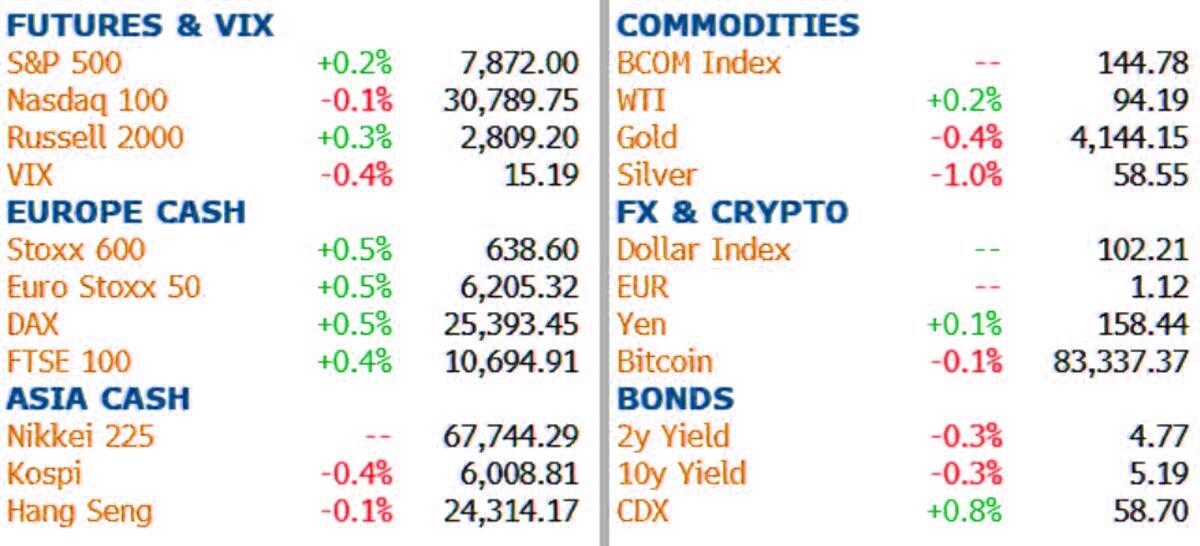
US futures are higher, with small caps leading and tech lagging, as traders brace for what is expected to be the hottest monthly CPI print since the spring, digest more escalation in the Gulf after Yemen’s Houthis hit Saudi Aramco’s Dhahran headquarters and vowed more strikes on Saudi airports and oil facilities, and count down to Anthropic’s pre-IPO investor day which one strategist warns “will move the entire market”; as a result oil is grinding higher while the bond rout takes another breather with the 10Y sliding to 5.20%. As of 8:15am ET, S&P futures are 0.2% higher at 7,872 while Nasdaq futures are down 0.1% and Dow futures are up 0.4%; Russell 2000 contracts are up 0.3%.On Tuesday the S&P closed fractionally lower (-0.02%) as the Philly semi index posted a fifth straight drop – its longest losing streak since July – and the KBW Banks index slid 1.4% with all 24 members lower on day one of bank earnings. In premarket trading, Mag 7 names are mostly higher led by Alphabet, BlackRock jumps after pulling in $205 billion in new money, while Bank of America slips after a $1.21 billion money-laundering fine (as we reported yesterday) and an equities trading miss; memory names are again under pressure (MU -1.4%, SNDK -2.3%), extending the memory meltdown, even as ASML’s beat-and-raise sparked a modest rally in Europe. The day’s driver is CPI: consensus expects headline to jump 0.6% M/M and 3.6% Y/Y – the biggest monthly advance in five months on the back of surging gasoline prices – with core seen at 0.2%, while swaps price roughly 24% odds of a quarter-point hike at the Oct. 28 FOMC, meaning that the print “mostly decides December”. Treasuries are slightly richer, with yields down about 1bp across the front-end and belly and the 10Y at 5.20%, dragged lower by a rally in gilts after BoE Chief Economist Huw Pill cast doubt on market pricing of four hikes by next summer and the FT reported Chancellor Healey will fund budget giveaways with taxes or spending cuts rather than more borrowing. The Bloomberg dollar index is little changed, while the Aussie is the best G-10 performer after blowout Chinese trade data. In commodities, WTI has swung between gains and losses and was last up around 1.6% as traders weigh the latest Middle East hostilities, after the IEA warned diesel supplies will remain constrained well into 2027 and OECD government oil stocks hit the lowest since 1989; gold slips 0.4% to $4,144 and silver drops over 1% to its lowest since August, while copper is firmer. Bitcoin is flat around $83,000. US economic data slate includes MBA mortgage applications (already out: -2.7%) and September CPI (8:30am); the Fed releases its Beige Book at 2pm. Fed speaker slate includes Barkin (1:30pm), Goolsbee (3pm) and Bowman (10:55pm). The Treasury sells $75 billion in 17-week bills at 11:30am.
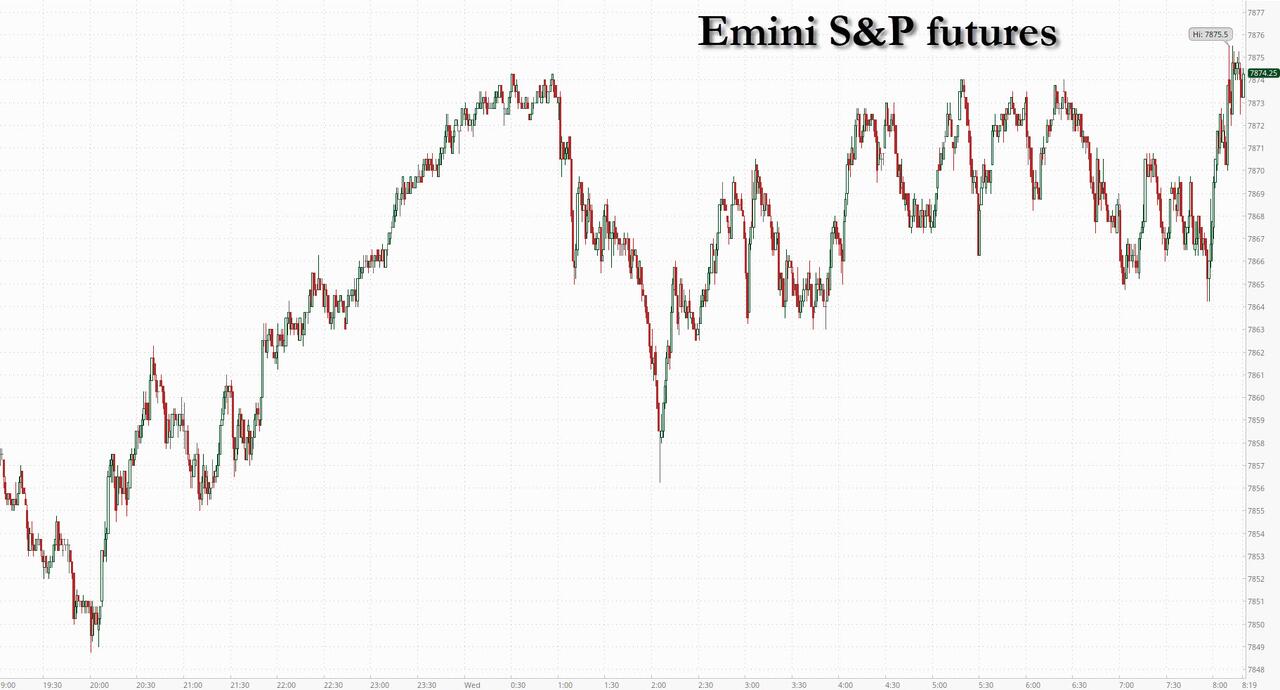
In premarket trading, Alphabet leads Magnificent 7 peers higher a day after Google’s Gemini 4 Argon was made available for developers and enterprises: Alphabet (GOOGL) +0.9%, Amazon (AMZN) +0.5%, Apple (AAPL) +0.4%, Meta Platforms (META) +0.2%, Microsoft (MSFT) +0.2%, Nvidia (NVDA) +0.2%, Tesla (TSLA) little changed.
- Albemarle (ALB) rises 3% after Mizuho raised its recommendation to buy on lithium demand.
Bank of America (BAC) falls 4% after its stock and fixed-income traders missed estimates as the bank’s results were also hurt by a charge tied to regulatory penalties over money laundering and sanctions violations. - BlackRock (BLK) jumps 4% after the asset manager pulled in $205 billion of new money in the third quarter and revenue surged.
- Brinker International (EAT) rises 2% after Jefferies upgraded the restaurant operator to buy, noting the firm’s transition from “turnaround into a durable, compounding story.”
- Enovix (ENVX) spikes 8% after the advanced lithium-ion battery manufacturer announced a purchase order from a multinational provider of dual-use drone systems.
- Hewlett Packard Enterprise (HPE -4%), Dell (DELL -2%) and NetApp (NTAP -3%) decline after Barclays downgraded all the names to equal-weight, citing the recent “significant” stock run and a more cautious approach on the stocks given the enterprise spending environment.
- Liquidia (LQDA) soars 40% after reaching a global settlement resolving all pending litigation with United Therapeutics.
In other corporate news, Bank of America was fined more than $1.21 billion for money laundering and sanctions violations by US regulators, who said the bank “effectively outsourced” a key part of its compliance efforts as it sought to protect revenue (it then reported 3Q equities trading revenue ex-DVA of $2.51 billion, short of the $2.63 billion estimate, so not the best morning in Charlotte); BofA is also no longer part of the potential roster of banks working on Moonshot AI’s IPO as the Chinese AI darling faces scrutiny in the US. Palliser Capital wants Samsung Electronics to list shares in the US and use the proceeds to buy back preferred stock. Galderma agreed to buy ZO Skin Health for an enterprise value of $1.5 billion in an all-cash deal. OpenAI is in early talks to buy security startup Trail of Bits, The Information reported – which comes a day after an OpenAI employee was arrested for planting a recording device in one of its offices. SentinelOne brought a $1.25 billion zero-coupon convertible to market, Sierra Space’s CFO has left after about six months in the role, Nvidia committed $250 million to UK agentic safety research over five years, and the EU is set to lift a sanction on a Chinese firm to save an ASML supplier.
Stock futures are edging higher as traders await inflation data, more bank earnings and an even bigger catalyst in the form of Anthropic’s pre-IPO investor day in San Francisco, where the company is set to disclose new revenue numbers to a select group of investors. Investors are already getting more selective on the AI trade: ASML had a subdued reaction to a solid headline print, while Applied Materials sank after its results lacked detailed guidance, pointing to high expectations for the picks and shovels part of the technology. Meanwhile, after another day in which tech was wrecked again as AI credit cracks widened, the median stock is 16% below its 52-week high – the weakest breadth since the Dotcom Bubble according to Goldman’s Prime desk – or as BTIG put it, the Mag 7 is all that’s left holding up the index.
“When word gets out about the revenue run rate, it will move the entire market,” said Jonestrading’s Mike O’Rourke. “The investment community wants to know whether Anthropic is going public from a position of strength or weakness.”
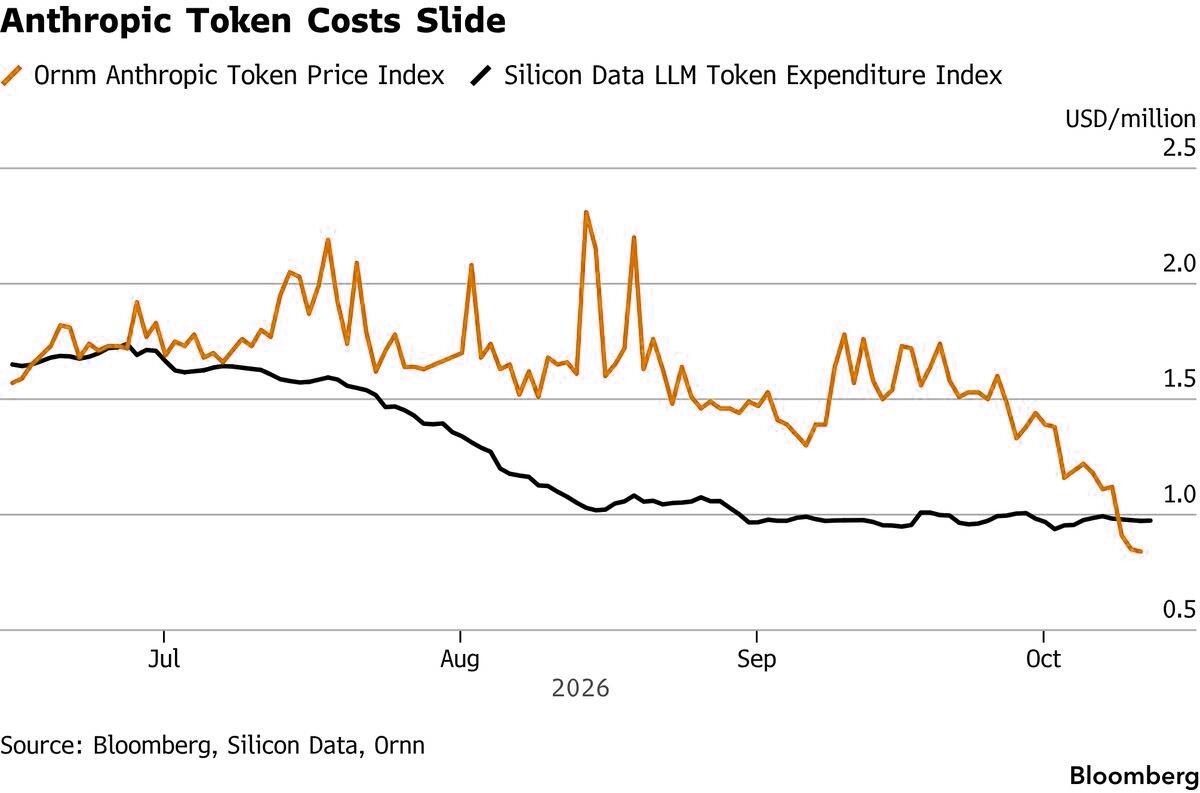
There’s also a distinction emerging between the cost of compute (expensive) and the cost of intelligence (falling fast). “If AI follows the path of previous general-purpose technologies, the price of the technology itself will trend towards marginal cost, while value migrates to whatever is built on top,” said Northern Trust’s Gary Paulin.
As for CPI, Bloomberg Economics expects September headline to accelerate to 3.7% as gasoline prices rise, with core edging up to 2.5%, but sees the pickup as “mostly a story of localized hot spots, not broad-based price pressures,” leaving the Fed room to stay patient; Goldman expects core at 0.24% (vs 0.2% consensus) and headline at 0.59%, while DB’s economists see core at just 0.16%. Whatever the number, the options market is barely paying attention: option event premium suggests CPI is likely a non-event, with the SPX implied swing around 0.5% – as Goldman’s Gail Hafif notes, the 52bp straddle is “one of the lowest CPI straddles we’ve seen this year.” Our full preview is here.
“Headline inflation remains elevated, but as long as we don’t get something like 1.0% month-on-month, markets should be able to absorb the print quite well,” said Bank of New York Mellon strategist Geoffrey Yu. “The challenge is if core inflation is elevated.”
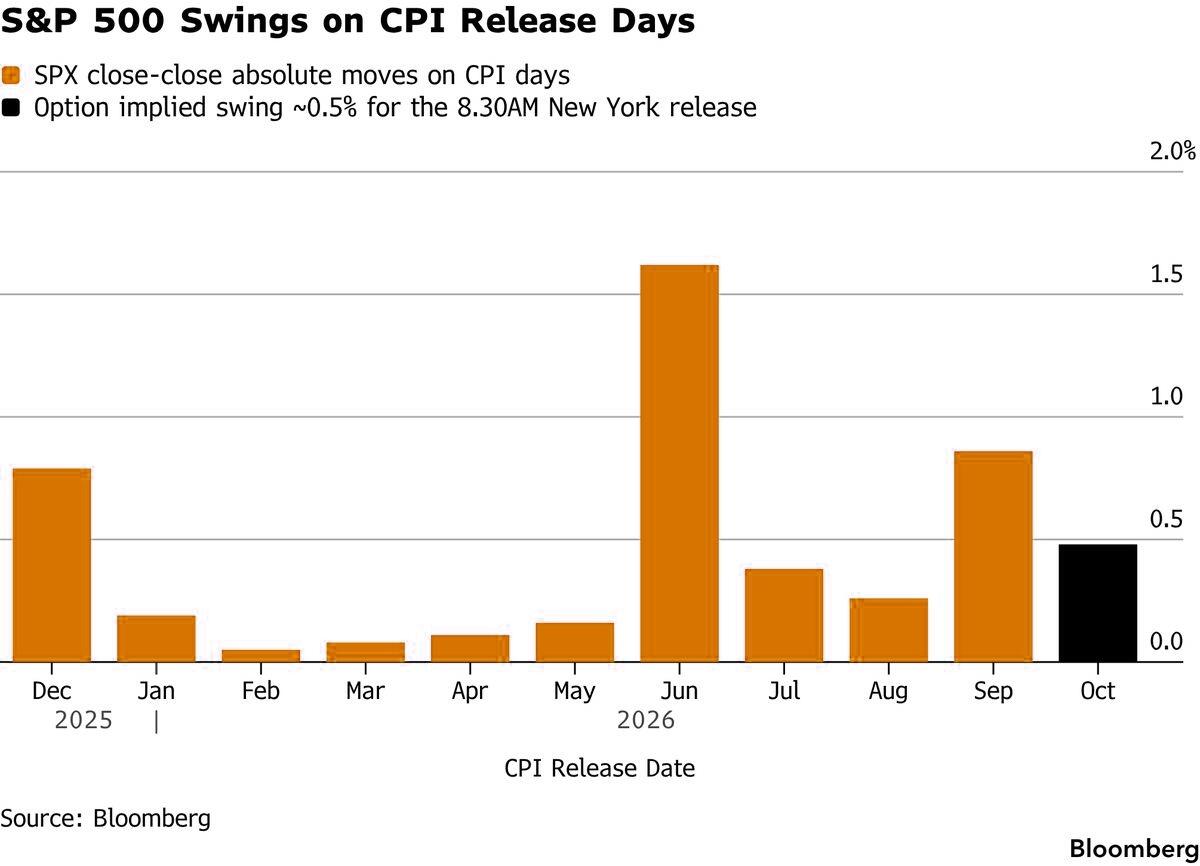
Option event premium suggests the event is likely a non-event for the market. The real stress, however, remains in bonds, not stocks: the MOVE index of Treasury volatility at 101 has climbed about 20 points over a month while the VIX at 15 sits in the calm band, and Fidelity’s chief investment strategist Salman Ahmed says the 10Y could still climb to 6% (more on that below). Meanwhile, day one of bank earnings was messier than the headline beats suggested: JPMorgan posted a surprise drop in fixed income trading revenue and Goldman missed in credit and rates, and per Goldman sector specialist Christian DeGrasse, bank shares are taking their cues from semiconductors and rates rather than anything lenders themselves have said, with CET1 ratios at JPM and Wells down 30bp on the quarter and JPM’s buyback slowing to about $1 billion from $6.7 billion. The S&P 500 banks index is down about 7.5% over the past month.
JPM’s Market Intel desk (Andrew Tyler’s team) remains Tactically Bullish and notes that after five straight down sessions in the SOX, ASML’s beat-and-raise drew a positive stock reaction “but didn’t restart the broader Semis / Memory trade”; with tech front and center, the desk says to watch for a possible squeeze post-CPI. JPM’s Feroli sees headline at 0.55% M/M (3.6% Y/Y) and core at 0.18% (2.4% Y/Y), a print that “should be enough to keep the bond market from re-pricing an October hike.” On banks, JPM’s financials specialist Rob O’Dwyer says the universal feedback on the sector’s weakness is “head scratching, which tends to suggest that price action is driven by quants and passive flow” – in his view a reason to fade the move and buy the group. The desk’s bank earnings read-through was unambiguously bullish on the consumer: card spending grew 10% Y/Y at JPM and 13% at Citi, while delinquencies and net credit losses are falling at C and WFC.
Over at Goldman, Rich Privorotsky says he “can’t remember a time when the frontier was quite so competitive” and is “increasingly conscious that the limiting factor may not be demand, but our willingness and ability to finance and deliver the supply.” Goldman’s London TMT desk called this morning “a test just how bearish the market has become on AI and semiconductors”, with sentiment “caught in a bearish feedback loop” – ASML’s own warning that capacity growth of “30% in 2027, 30% in 2028 will not allow us to meet our customer demand” is hardly the stuff of an AI bust. In New York, Peter Callahan notes that Mag 7 has outperformed the NDX for eight straight sessions while Semis lag the market by ~8 points over their five-day losing streak, adding: “As if we needed another reminder that the ‘index’ often doesn’t tell the whole story anymore.”
In France, the OAT-Bund spread is holding around 137bp after narrowing on Tuesday, as ECB President Lagarde said “the primary and first solution lies in French fiscal policy” when asked about French debt, while National Rally leader Le Pen told the FT she has the “will and conviction” to cut France’s contribution to the EU budget and wants the ECB to be able to finance borrowing for priorities such as defence and the energy transition (more on the Le Pen shadow budget here).
In Europe, the Stoxx 600 is up 0.5% at 638.60 as the earnings season gathers pace, with chip-equipment maker ASML buoying the tech sector after its sales outlook exceeded expectations. Real estate tops the sector pile, followed by tech and consumer products & services, while autos, insurance and banks lag; per JPM, homebuilders and luxury are among the best performing baskets. Here are the biggest European movers:
- ASML shares rise as much as 3.6% after the semiconductor equipment maker gave a strong demand outlook, saying customers are expressing interest in placing orders for 2029 and 2030.
- Aker BP shares rise 2.5% after the Norwegian oil company reported average production for the third quarter that missed the average analyst estimate.
- Technip Energies gains as much as 2.3% after UBS upgrades the engineering company to buy from neutral, arguing that a record backlog and margin recovery will likely turn around sentiment.
- Bossard shares rise as much as 5% after the Swiss logistics company’s third-quarter sales beat the average analyst estimate, supported by organic growth in Asia.
- Big Yellow rises as much as 6.3% after activist investor Ancora said it holds a more than 4% stake and released a presentation urging the UK-listed company’s board to launch a strategic review, including a full sale process.
- Lonza shares rise as much as 2.7% after the Swiss drug ingredients maker gave mid-term guidance at its capital markets day that included a new target for Ebitda margin in the high-30s.
- Ashmore shares rise as much as 3.4% after the emerging-market fund manager’s first-quarter update showed assets under management slightly ahead of estimates and gross redemptions at the lowest quarterly level in over 15 years.
- SEB shares fall as much as 5.7% after the lender said it expects the Swedish regulator’s ruling that its Internal Ratings-Based credit risk models are deficient to temporarily reduce capital buffers by about 120 basis points.
- Softcat shares fall as much as 8.5%. The software reseller reiterated its recently-upgraded guidance for Ebit growth through fiscal year 2027, though analysts note that it lags both consensus expectations and prior years’ performance.
- Orsted drops as much as 4.4% after the US Justice Department asked a federal court to remand the Interior Department’s approval of a construction and operations plan for the Danish firm’s Revolution Wind project.
Asian stocks ended mixed after an early tech-led rebound faded: the MSCI Asia Pacific Index climbed as much as 0.7% before erasing gains to trade 0.1% lower, as “ASML’s earnings and supply outlook comments weighed on regional semiconductor sentiment during afternoon trading” per Goldman’s Asia desk. The Kospi, which had been up more than 1% after Tuesday’s 5.5% crash, closed 0.4% lower, the Nikkei was flat (-0.05%) and the Topix fell 0.3%. Taiwan’s Taiex led with a 0.6% gain, while the Hang Seng slipped 0.1% even as the Hang Seng Tech index rose 0.9% after China’s September trade surplus hit a record $133.5 billion, with exports up 36.3% (vs 25.5% expected) and imports up 31%. Mainland China lagged, with the CSI 300 down 1.4% and turnover back near year-to-date lows, while Australia’s ASX 200 fell 0.6%. In Japan, Olympus tumbled 13.5% on an FDA warning.
In FX, the Bloomberg Dollar Spot Index is little changed and the DXY is stuck in a 102.07-102.23 range, initially pressured by Fed’s Williams’ dovish remarks before a bounce in oil and the Houthi threats brought it back to unchanged. The Australian dollar is the best performing G-10 currency, rising 0.4% against the greenback on the strong China trade data, while havens CHF and JPY are the slight underperformers given the risk tone; USD/JPY is at 158.2. EUR/USD is flat at 1.1206 and GBP/USD at 1.3264 as UK budget coverage ramps up ahead of the Oct. 28 Autumn Budget.
In rates, Treasuries are slightly richer across the curve, with front and belly leading marginal gains, supported by a wider rally across European bonds after dovish comments from BoE Chief Economist Huw Pill. US yields are richer by up to 1bp across the front-end and belly, with the 5s30s spread about 1bp steeper and the 10Y at 5.205%, as gilts outperform by about 3bp in the sector; UK 10-year yields fall 5bp to 5.40% after Pill cast doubt on market pricing of four hikes by next summer (at least someone at the BoE is pushing back on the market, rather than the other way around). Bunds are about 10 ticks firmer while the OAT-Bund spread holds at 137bp. Ahead of CPI, swaps price around 6bp of tightening for the Oct. 28 meeting, or roughly 24% odds of a quarter-point move, and around 80bp of hikes over the next year. The IG dollar issuance slate is empty so far after eight names priced almost $15 billion on Tuesday, paying about 5bp in new-issue concessions on deals that were 2.8x covered.
“Tactically speaking, we still see a scenario where this can go to 6%,” Fidelity’s Salman Ahmed said of the 10-year yield in a Bloomberg TV interview; at that level, “you have to take a pulse check.” Fidelity’s models are starting to see value around 5%, “but you do need higher yields to compensate for that positive equity/bond correlation, which was working in favor of bonds before.”
In commodities, oil has been volatile, with WTI swinging between gains and declines as traders weigh the latest Middle East hostilities and last up around 1.6%, after trading in a $93.97-95.41 range earlier; Brent hovers around $106 within a $105.21-107.15 range. Yemen’s Houthis said operations against Saudi airports and oil facilities will continue after hitting Aramco’s executive headquarters in Dhahran, while Iranian press reported that a vessel sank in the Strait of Hormuz after hitting a mine. The IEA’s monthly report warned that diesel supplies will remain constrained well into 2027, OECD government oil stockpiles fell to the lowest since at least December 1989, and 2026 global oil demand will fall by 2.6m b/d; it also cut its 2027 demand forecast to 104.4m b/d from 105.0m b/d. Dutch TTF gas is firmer but off a €87.44/MWh high. Spot gold is down 0.4% at about $4,144 in a $4,141-4,170 range, silver is down over 1% to its lowest since August, and copper is firmer on the strong Chinese data, though it eased after BHP’s Escondida mine reached a preliminary agreement with its union to avoid a strike.
US economic data slate includes MBA mortgage applications (already out: -2.7%) and September CPI (8:30am); the Fed releases its Beige Book at 2pm. Fed speaker slate includes Barkin (1:30pm), Goolsbee (3pm) and Bowman (10:55pm). On the earnings front, Bank of America, Morgan Stanley, BlackRock, Progressive, State Street and Fastenal report before the open, and Anthropic holds its pre-IPO investor day in San Francisco.
Market Snapshot
Top Overnight News
- Iran is deploying new tactics to target ships sailing through the Strait of Hormuz as it seeks to keep oil prices high and influence the US midterm elections, two senior Iranian officials told Reuters. RTRS
- Oil edged higher as attacks on Saudi Aramco’s headquarters added to a flare-up in the Middle East conflict, increasing uncertainty over a recovery in Persian Gulf energy flows. BBG
- Yemeni Army Spokesperson said operations towards Saudi airports and oil facilities will continue in the coming days and warned for global shipping companies, civilians and workers to evacuate such airports and firms, as they are legitimate targets. Newsquawk
- Diesel supplies will remain constrained well into 2027 as a result of conflicts in the Middle East and Russia, despite a weaker outlook for oil consumption, while OECD government oil stockpiles fell to the lowest since at least December 1989, the IEA said. BBG
- ASML boosted its outlook and said it’s searching for ways to produce more chip-making machines over the next two years to meet soaring AI demand. Shares rose. BBG
- Anthropic is to disclose new revenue numbers at pre-IPO investor day today: CNBC, citing sources
- It is not clear that the Bank of England will need to raise its key rate by a full percentage point in order to tame inflation, as investors expect, Chief Economist Huw Pill said Wednesday. WSJ
- China’s trade momentum gained pace in September – driven by strong global tech demand and a pre-holiday shipping rush ahead of the “golden week” break – logging a monthly high for its trade surplus in 2026 and putting the country on course for another record gap this year. SCMP
- China’s consumer and producer inflation both accelerated last month, with factory gate prices rising their fastest since 2022. SCMP
- Singapore’s central bank unexpectedly held off on further tightening as year-over-year economic growth slowed in the third quarter but beat forecasts. The Monetary Authority of Singapore said Wednesday that its existing policy settings would allow the Singapore dollar to keep strengthening, helping to counter an expected near-term rise in import prices and ease inflationary pressures in 2027. WSJ
- Japan’s largest banks and insurance companies have been buying domestic government bonds and selling foreign debt in recent months, in moves that investors say could be early signs of a wider repatriation of capital by the country’s institutions. FT
- Russia said it attacked Ukrainian electricity plants in a “massive strike” overnight, further undermining Donald Trump’s claim of an energy truce between the two countries. BBG
- Bank of America was fined more than $1.2 billion for money laundering and sanctions violations by US regulators. Equities divisions at five of the largest US banks are on track to deliver more than $66 billion of revenue in the first nine months of the year, roughly $3 billion higher than what’s expected from units handling bonds, currencies and commodities. BBG
- Fed Governor Cook’s lawyer denounced the Trump administration’s new investigation and said she will not be able to attend the hearing on November 5th: The New York Times
- The head of the IMF said US Treasury Secretary Scott Bessent’s plan to grow the economy out of its mounting debt and fiscal deficit problems won’t work fast enough. BBG
- US President Trump said Taiwan has agreed to buy 30% of gas coming off the Alaska pipeline and is to invest USD 4.4 billion in the project, on top of the USD 50bln South Korea committed to invest. Newsquawk
- As we wade into earnings season, we expect corporates to progressively exit blackout ~1-2 days post release. We estimate ~10% will be in open window by the end of the week and 48% by the end of the month. November is the 2nd highest month of corporate repurchases on our desk and will bring back a key source of demand to the marketplace. The full force of corporates won’t pick up until almost the end of this month, so the market still has a bit to go before this flow reaches its peak formidability. GIR
- Goldman estimates AI price pressures are boosting core PCE by about 45bp, peaking at around 50bp by end-2026 and falling to 10bp by end-2027, and says “the impact of AI demand on inflation is meaningful but moderate, still comes in large part from mismeasurement, and is likely near its peak.” GIR
A more detailed look at global markets courtesy of Newsquawk
APAC stocks were ultimately mixed as the region clawed back some of the recent tech-related losses, while participants also digested key releases from China, including inflation and trade figures. ASX 200 declined with the index dragged lower by underperformance in the top-weighted financials sector, while sentiment amongst miners was not helped by the indecision in Rio Tinto following its quarterly production update. Nikkei 225 reclaimed the 68,000 level as tech stocks got some reprieve from recent selling. KOSPI was among the biggest gainers as tech rebounded from the recent underperformance. Hang Seng and Shanghai Comp were flat as participants digested a slew of data, including stronger-than-expected trade figures and mixed inflation numbers in which CPI printed softer-than-expected, while PPI was hot and showed a faster-than-anticipated acceleration in factory gate prices.
Top Asian News
- China’s Customs Vice Minister said in the first three quarters, China’s foreign trade has effectively dealt with various external shocks and China’s foreign trade has kept good development momentum, while it has shown resilience despite rising international changes, risks and challenges. However, the official also stated that China’s trade development still faces many challenges, and for full-year trade, there are many uncertainties globally, including geopolitical conflicts.
European bourses (STOXX 600 +0.6%) are firmer across the board, with outperformance in the AEX (+0.9%), following positive ASML (+1.6%) earnings. The Co. reported Q3 top- and bottom-line beats, while also lifting its Q4 and FY guidance. In the prepared remarks, the CEO highlighted that the planned supply for 2027 and 2028 will not fully meet the demand and are looking at ways to increase capacity for 2028 beyond the 30% increase previously communicated. Sectors highlight the positive bias. Real Estate tops the sector pile, with Tech and Consumer Products & Services following closely behind. The sector laggards include Autos, Insurance and Banks. US equity futures are broadly firmer, with the NQ flat. More bank earnings to report, with BofA on deck. Outside of earnings, US CPI is expected to tick higher to 3.6% (prev. 3.4%). Pointing to UST positioning, traders are short with BofA FMS pointing to this being a crowded trade. A dovish surprise could see a large unwind of this positioning and can also support the equity space. ASML (ASML NA) Q3 2026 (EUR): Basic EPS 12.95 (exp. 10.68), Revenue 11.66bln (exp. 11.58bln). Q4 guidance: Net Sales 14.2-15.2bln (exp. 14bln). FY guidance: Total net sales 44-45bln (exp. 43.6bln, prev. guided 43-45bln).
Top European News
- UK Chancellor Healey is to target online marketplaces in a GBP 1bln tax crackdown, in which the UK plans to make them responsible for collecting tax owed by retailers selling on their platforms, according to The Times.
- UK Chancellor Healey is expected to pay for new giveaways in this month’s budget, with higher taxes or spending cuts rather than more borrowing, according to FT
- UK Chancellor Healey is reportedly making plans to cut the cost of hiring under-25-year-olds at the UK Budget, according to CityAM citing sources.
- The EU Commission proposed a one-year delay to the implementation of specific provisions of the EU Methane Regulation related to importers.
- French National Rally (RN) leader Le Pen sees the extraordinary political events of late-2026 and 2027 as ushering in significant European change, the FT reported. The report added that Le Pen thinks EU Commission President von der Leyen no longer has the confidence of many EU governments and describes the EU attempt to agree a seven-year budget before the French Presidential election as “deeply objectionable”. Furthermore, Le Pen has the “will and conviction” to cut France’s contribution to the EU budget, adding that the heavy European debt burden is more of a concern than any French-EU clash over fiscal contributions. To end, Le Pen added that she wants the ECB to be able to finance borrowing for priorities such as defence and the energy transition.
- Spanish PM Sanchez is expected to hold an “intense” debate at the European Council over migration, Politico reported citing sources, Sanchez expected to be combative with Italian PM Meloni on the issue.
- Italian PM Meloni said they see a deal with the EU being close on measures to cut the impact of gas costs on electricity prices.
FX
- DXY was initially under mild pressure following on from the dovish remarks from Fed’s Williams and as crude benchmarks moved lower in early morning trade. However, a bounce back in oil prices and hawkish commentary from the Houthis has allowed the index to sit around the unchanged mark, within a 102.07 to 102.23 range. To recap that announcement, the group warned that it will continue operations towards Saudi airports/oil facilities in the coming days; it also warned global shipping companies.
- G10s are mixed against the USD, vs initial gains across all majors early doors. The Antipodeans remain the outperformers, on the back of stronger-than-expected Chinese Export data, and with Chinese CPI Y/Y rising from the prior, albeit less than expected. The broader positive risk tone across markets is also facilitating the strength in Antipodeans today. Typical havens (CHF and JPY) are the slight underperformers this morning, given the broader risk tone.
- GBP and EUR are both essentially flat. For the former, UK press have been boosting their coverage ahead of the Autumn Budget (Oct 28th). The Times reported that UK Chancellor Healey is expected to pay for new giveaways in this month’s budget, with higher taxes or spending cuts rather than more borrowing. This will offer investors some confidence on the fiscal side of things. Elsewhere, UK Chancellor Healey is to target online marketplaces in a GBP 1bln tax crackdown, in which the UK plans to make them responsible for collecting tax owed by retailers selling on their platforms.
Central Banks
- Fed’s Collins (2028 voter) said tightening monetary policy will help return inflation to 2%, and she expects the Fed to raise interest rates ‘a bit further’ by the end of the year, while she expects inflation to stay above 2% due to high energy prices. Furthermore, she supported the Fed raising rates at the September meeting and stated the future path of monetary policy in the new year will depend on data.
- ECB’s Lagarde said inflation has been rising predominantly, but not exclusively as a result of energy prices, while she noted that they are not seeing any second-round effects yet and they cannot wait until they are in full view, but can anticipate and look for hints. Furthermore, she responded that the primary and first solution lies in French fiscal policy when asked about French debt, and stated that growth is not brilliant, but 1.1% growth in 2026 is not bad.
- ECB’s Wunsch said they are probably going to have to hike again, but he’s not making any bets because they have so much uncertainty on the energy front and maybe also in AI, according to Bloomberg.
- ECB’s Moulin said inflation is mainly due to conflict in the Middle East and energy-related, while he added that inflation expectations by corporates and households in the medium term are well anchored. Moulin also stated that a rise in yields may affect demand and prompt a more moderate response to an inflation shock.
- BoE Governor Bailey said UK companies are focusing intensely on containing costs amid surging energy prices caused by the Iran war, while he reiterated that broader UK inflation pressure from the energy shock has remained subdued so far.
- BoE Chief Economist Pill said he is somewhat more sceptical of market pricing for four rate hikes over the next year.
- Monetary Authority of Singapore kept its FX-based policy settings unchanged, with the rate of appreciation of the policy band maintained (exp. very slight tightening), while it made no changes to the width and level the band is centred. MAS said Singapore’s economy is expected to continue expanding steadily in the quarters ahead and core inflation should remain slightly elevated in the immediate quarters ahead, but is projected to ease discernibly from the middle of next year.
Fixed Income
- USTs are firmer, but only modestly so, in a bit of a holding pattern ahead of US CPI this afternoon, which will be scoured for insight into near-term Fed bets. A cool print could add to the dovish move seen after the September NFP report, and thus further push back on end-2026 tightening bets. Conversely, a hot series would likely see that NFP-driven move unwind. As it stands, that sees USTs three ticks firmer in 104-22 to 104-29+ confines, while yields are lower across the curve with the short-end leading the downside currently.
- EGBs are in fitting, with no real reaction to the energy developments thus far. Instead, the bloc is focused on the fiscal front, as France’s Le Pen speaks later and is expected to once again push back on the level of French contribution to the EU budget. Elsewhere, confrontation is expected between Spanish PM Sanchez and Italian PM Meloni, according to Politico, on the migration situation.
- Bunds similarly bid by about 10 ticks, in narrow confines. More generally, the OAT-Bund 10yr yield spread is holding at 137bps and is modestly narrower on the session vs a c. 140bps start. While the BTP-Bund equivalent is around 108bps, and slightly wider as it stands.
- Finally, Gilts see relative outperformance today, supported by the FT report that Chancellor Healey’s fiscal giveaways will be funded via taxation and/or spending cuts, rather than via more borrowing. Additionally, BoE Chief Economist Pill pushed back on the extent of market pricing for hikes by end-2027; however, his commentary was more pragmatic on the data-dependent and uncertainty points, rather than a complete dovish reassessment from the known hawk. Firmer by 50 ticks at best, hitting an 84.37 peak, but around 10 ticks shy of Tuesday’s best as things stand.
- Germany sells EUR 1.882bln vs Exp. EUR 2.5bln 3.40% 2047 and 2.90% 2056 Bund.
- The UK sells GBP 5bln 4.625% 2030 Gilt: b/c 3.41x (prev. 3.24x), average yield 4.945% (prev. 4.786%), tail 0.2bps (prev. 0.3bps).
- Japan sells JPY 1.9tln 5-year JGBs; b/c 3.56x (prev. 3.42x), average yield 2.379% (prev. 2.239%), Tail in price 0.02 (prev. 0.04).
Commodities
- WTI Nov and Brent Dec futures are currently flat/mildly firmer, in what has been a volatile session for the complex. Overnight strength was facilitated by ongoing uncertainty related to the Strait of Hormuz; thereafter, the complex came under mild pressure, but lacked a clear driver. Some modest upticks were then seen after the Houthis warned that further operations against Saudi airports/oil facilities could happen in the coming days. Iranian press then reported that a tanker was sunk in the Strait of Hormuz after hitting a mine; a report which failed to lift prices any further.
- As it stands, WTI and Brent are holding towards the bottom end of their respective USD 93.97-95.41/bbl and USD 105.21-107.15/bbl ranges.
- Dutch TTF is also firmer but off its best level amid the aforementioned Middle Eastern tensions, with winter conditions underpinning demand at a time supply remains uncertain. TTF has fallen from a EUR 87.44/MWh high to sub-EUR 86.00/MWh at the time of writing, but remains well above its USD 84/MWh low.
- Precious metals are subdued, with spot gold posting mild losses, given the broadly positive risk tone. The yellow metal will await US CPI for further direction; it currently trades within a USD 4,141-4,170/oz range.
- Base metals are firmer, with copper benefiting from renewed Chinese demand and stronger-than-expected trade data, alongside the broader recovery in Asian technology stocks. Chinese exports (USD) rose 36.3% Y/Y (exp. 25.5%), while imports increased 31% (exp. 24.5%), although factory-gate inflation accelerated to 5.0% Y/Y (exp. 4.5%). Some mild pressure was seen in Copper after BHP’s Escondida mine reached a prelim agreement with its union, to avoid a strike.
- US President Trump said they are going to announce two deals today and stated every permit needed has been granted regarding Alaska LNG, while Trump then stated that Taiwan has agreed to buy 30% of gas coming off Alaska pipeline and is to invest USD 4.4 billion in the project, on top of the USD 50bln South Korea committed to invest. Trump later posted that “Massive Oil, Gas, and Mineral Exploration is getting ready to begin in our new and beautiful Greenland!”
- IEA OMR (Oct): Sees world oil demand falling by 2.6mln BPD in 2026 on Iran war disruption and rising prices (prev. 2.5mln BPD drop).
- BHP’s (BHP AT) Escondida mine has reportedly reached a preliminary agreement with Supervisor’s Union and is to be ratified by members, with a strike being avoided, according to sources.
- Japan’s aluminium premium for Oct-Dec delivery set at USD 255/t, -35% Q/Q, according to sources.
Trade/Tariffs
- UK Business Secretary said the UK will not put tariffs on Chinese vehicles and he will not change trade rules due to EU pressure, according to The Guardian.
- Germany is reportedly set to push the EU to impose caps on additional Chinese imports, according to Bloomberg.
- China bought 8-10 cargoes of US soybeans for December shipment, according to traders.
Geopolitics: Middle East
- US President Trump said during a rally in Alaska that they’ve been taking more oil out of the Strait of Hormuz than before the war, while he reiterated that the war with Iran will end soon and that Iran will not possess a nuclear weapon. Trump also commented “Wait and see what we do to Iran. We’re going to hit them hard. Wait and see what we do to Iran, because we’ve had enough”.
- US Central Command rejected a claim by the IRGC Navy Commander that the Strait of Hormuz is under Iranian control and that any approaching US warships would be sunk, while it stated that “IRGC’s navy commander has no navy. American forces and regional partners clearly control the Strait of Hormuz. Just yesterday US forces assisted Gulf partners in shipping more than 19mln barrels of crude oil through the strait.”
- A source told the Tehran Times that the assessment is that the US President Trump, under pressure from Israeli President Netanyahu, is seeking a new confrontation in the region, but does not have the capacity to expand or sustain this.
- Iran is reportedly shifting tactics to step up attacks on shipping ahead of US midterms, according to two Iranian officials cited by Reuters.
- IRGC Navy said that a container ship carrying 2,500 containers sank south of the Strait of Hormuz, Sepah News reported.
- Iran and Oman Foreign Ministers held a call and discussed latest regional developments, including developments in Yemen, and examined ways to achieve peace and stability in the region.
- Pakistan’s Foreign Minister said they have discussed Bab el-Mandeb with Oman, further efforts need to be made to resolve the current situation.
- Oman Foreign Ministry said that discussions with Iran on Hormuz have concluded, adding that the finalisation depends on US-Iran talks.
- Yemeni Army Spokesperson said operations towards Saudi airports and oil facilities will continue in the coming days and warned for global shipping companies, civilians and workers to evacuate such airports and firms, as they are legitimate targets. The spokesperson confirmed that forces carried out a military operation targeting the Aramco company in Dhahran in the Eastern Province and King Khaled International Airport and the Aramco refinery in Riyadh with a large number of ballistic missiles.
- Houthi official warned that Saudi oil and vital installations will be visited overnight.
Geopolitics: Ukraine
- UK PM Burnham will host Ukrainian President Zelensky in Downing Street on Wednesday as Ukraine and its allies scramble to respond to Trump’s diesel deal with Putin, while Burnham will tell Zelensky that Britain’s support is rock solid with faster delivery of lightweight, multi-role missiles to help Ukraine defend itself, according to Bloomberg.
- A US official said the idea of cutting off intelligence-sharing with Ukraine is being discussed inside the White House, Semafor reported.
- Russian air attack hit energy facilities in Ukraine’s capital Kyiv, according to the mayor.
Crypto
- Bitcoin has lacked a clear bias and trades in a USD 83.1k-84.06k range, as it remains contained within Tuesday’s range.
US Event Calendar
- 7:00am: Oct 9 MBA Mortgage Applications, prior -4.2% (actual: -2.7%)
- 8:30am: Sep CPI MoM, est. 0.6%, prior 0.4%
- 8:30am: Sep Core CPI MoM, est. 0.2%, prior 0.3%
- 8:30am: Sep CPI YoY, est. 3.6%, prior 3.4%
- 8:30am: Sep Core CPI YoY, est. 2.5%, prior 2.4%
- 8:30am: Sep CPI Index NSA, est. 336.625, prior 334.980
- 8:30am: Sep Core CPI Index SA, est. 338.510, prior 337.765
- 8:30am: Sep Real Avg Weekly Earnings YoY, prior 0.3%, revised prior 0.4%
- 11:30am: US to sell $75 billion 17-week bills
- 2:00pm: Sep Federal Budget Balance, est. -$30.0b, prior $197.9b
Central Bank Speakers
- 1:30pm: Fed’s Barkin Speaks in Fireside Chat
- 2:00pm: Fed Releases Beige Book
- 3:00pm: Fed’s Goolsbee Speaks in Interview on Yahoo Finance
- 10:55pm: Fed’s Bowman Speaks at Bangkok Economic Festival
DB’s Jim Reid concludes the overnight wrap
Markets have put in a subdued performance over the last 24 hours, as investors are grappling with various crosscurrents. First, chip stocks sold off yesterday on the back of AI fears, with the Philly semiconductor index (-0.23%) posting a 5th consecutive decline even as the stocks saw an afternoon recovery off the lows. Second, US banks struggled as earnings season got underway. The KBW Banks index closed near the lows of the day down, having fallen -1.39%. And third, inflation fears were still prominent, as the 12-month Brent future (+1.12%) hit a new high for this year of $87.37/bbl. On the plus side French 10yr spreads tightened -4.9bps to bunds. All that before today’s US CPI print, which is expected to be a strong one.
Let’s start with US CPI , which occurs just two weeks out from the Fed’s next decision, and a bit of hawkishness has crept back into the market narrative. For instance, market pricing for an October rate hike was back up to 24% yesterday, the highest since October 1, before the underwhelming jobs report (and a day after the initial French stress) led to mounting questions as to whether they actually could deliver back-to-back hikes. But with oil prices still elevated, the speculation has persisted going into the CPI.
This report is likely to be a strong one given the run-up in energy prices over September, and our US economists expect that motor fuel prices were up +9.6% over the month. So they think that would see headline CPI come in at +0.57% on a monthly basis, which would be the strongest month since April, shortly after the Iran conflict began. And in turn, that would take the year-on-year rate back up to +3.6%, its highest since May. To be fair, they think core inflation will be relatively softer, at a monthly pace of just +0.16%, leaving the year-on-year rate at +2.4%. But even so, any surprises either way will help shape the narrative going into the next Fed meeting, as we don’t get the PCE inflation readings (which they officially target) until the day after the next decision.
Federal Reserve Bank of New York President Williams yesterday reiterated his support for another 25bp Fed hike this year, but added that “I don’t think at this time I have any reason to believe that we would need to do more.” This puts him in line with the median from the September meeting dot plot. Federal Reserve Bank of Richmond President Barkin also spoke yesterday about the need for the Fed to grow more restrictive as he said that “It seems clear to me at this point that these shocks are continuing, and that inflation is enduring, and that doing something about it makes some sense.” He also asserted that the Fed’s goal of 2% was “actually something” that you can hit.
With that backdrop in mind, front-end yields generally moved higher around the world. For instance, the US 2yr Treasury was up +2.1bps on the day to 4.78%, while the 2yr UK yield (+1.7bps) also rose even as 2yr Bunds were unchanged. However, this wasn’t echoed further out the curve, as the risk-off tone put downward pressure at the long end. So the 10yr Treasury yield fell -2.9bps to 5.21%, whilst the 10yr bund yield fell -0.8bps to 3.47%. The one piece of (relative) good news came from France, where the 10yr yield fell -5.8bps to 4.84%, but even that still left the Franco-German 10yr spread at 137bps, clearly above its levels before the stress began a couple of weeks ago.
As all that was going on, it wasn’t the best day for equities either, as AI concerns meant there was a fresh drag from chip stocks and data centers. While chips are just one sector, semiconductors and semiconductor equipment make up over a sixth of the S&P 500, so what happens there can easily drive the overall index. And that was clear once again yesterday, as the Philly semiconductor index (-0.23%) posted a 5th consecutive decline for the first time since July. So that exerted a drag on the overall S&P 500, which was just worse than unchanged (-0.02%) on the day, whilst Europe’s STOXX 600 also fell -0.10%. Data centers also lagged yesterday with CoreWeave’s stock down -3.05% alongside Applied Digital (-3.48%) and GDS Holding (-2.60%). CoreWeave, who has been a large issuer in the $HY market this year, saw their 5Y CDS contract close +79bps wider yesterday after having briefly traded above 1000bps intraday.
Otherwise, yesterday also brought the start of US bank earnings, with several names reporting. JPMorgan (-0.86%) reported an unexpected decline in fixed-income trading revenue, as the bank joined all other 24 members of the KBW Banks Index in closing lower on the day. Goldman Sachs (-0.23%) also missed on fixed-income revenue relative to estimates, but saw equity trading beat estimates. The worst performing bank in the index was Citi (-5.60%), who saw its fixed income revenue beat expectations, but its share price struggled despite that.
In the meantime, yesterday also brought a fresh rise in energy prices that led to renewed concerns on inflation. That was particularly clear in Europe, where the front-end natural gas contract (+3.40%) hit a post-2022 high of €87.22/MWh. Admittedly, Brent crude oil (-0.90%) came down slightly to $105.69/bbl, but concern about a longer period of high prices persisted, as the 12-month Brent future (+1.12%) hit a new high for the year of $87.37/bbl – also its highest level since August 2022. So near-term inflation expectations continued to rise, with the 1yr Euro inflation swap (+7.3bps) back up to 3.59%.
Asian equity markets are mostly trading higher this morning as semiconductor stocks rebound from the recent selloff, though rising oil prices are capping gains. Across the region, South Korea’s KOSPI (+1.13%) is leading advances, supported by a recovery in chipmakers. Japan’s Nikkei (+0.89%) is also posting solid gains, while Hong Kong’s Hang Seng (+0.16%) is modestly higher. In contrast, Australia’s S&P/ASX 200 (-0.66%) is under pressure, and China’s CSI 300 (-0.31%) is lagging regional peers. Meanwhile, the Shanghai Composite (+0.01%) is hovering around flat levels. S&P 500 (+0.22%), Nasdaq 100 (+0.24%) and Stoxx (+0.34%) futures are higher.
Earlier this morning, data showed that Chinese consumer inflation remained relatively subdued in September, as holiday-related spending provided only limited support to prices, while producer price inflation accelerated sharply to a more than four-year high. Consumer prices rose +0.9% y/y, coming in just below expectations of +1.0% and slightly above August’s +0.8% increase. In contrast, producer prices climbed +5.0% y/y, exceeding forecasts of +4.4% and accelerating from +3.8% in August. The stronger-than-expected increase in factory-gate prices reflected resilient business demand, rising input costs linked to AI-related investment, and supply disruptions associated with the Middle East conflict, pushing PPI to its highest level since June 2022.
Separately, China’s trade data surprised to the upside in September. Exports surged +36.3% y/y, marking their strongest growth since February, while imports rose +31.0%, the fastest pace since June and an acceleration from August’s +28.2% increase. Both figures comfortably exceeded market expectations of +25.7% for exports and +25.0% for imports.
Finally, there wasn’t much data yesterday, but we did get a couple of US releases. One was the NFIB’s small business optimism index, which fell a bit more than expected to 97.9 in September (vs. 98.2 expected). Conversely though, the existing home sales for September beat expectations, coming in at an annualised rate of 3.99m (vs. 3.95m expected).
Looking at the day ahead now, the main data highlight will be the US CPI print for September. Otherwise, central bank speakers include ECB President Lagarde, the ECB’s Elderson, Pereira, Escriva, Makhlouf and Schnabel, and the Fed’s Bowman and Barkin. Otherwise, we’ll get the Fed’s Beige Book. Finally, today’s earnings include Bank of America, Morgan Stanley, and BlackRock.
1 b European opening report
Houthis threaten Saudi oil facilities once again; DXY flat await US CPI – Newsquawk US Market Open

Wednesday, Oct 14, 2026 – 06:06 AM
- US President Trump said he will make a decision on Iran very soon; Israeli PM Netanyahu and Trump reportedly discussed launching a major new operation against Iran before the US and Israeli elections.
- Yemeni Army said operations towards Saudi airports and oil facilities will continue and urged civilians, workers and shipping companies to evacuate airports and firms.
- US equity futures mixed; ASML gains on an upbeat Q3 report and raised guidance.
- DXY flat; Antipodeans outperform following strong Chinese trade data.
- Fixed income benchmarks climb, led by Gilts on pre-budget reports.
- Looking ahead, highlights include US Inflation (Sep). Speakers include Fed’s Barkin, ECB’s Schnabel. Earnings from Bank of America, BlackRock, Morgan Stanley, Progressive & State Street.
SNAPSHOT

EUROPEAN TRADE
EQUITIES
- European bourses (STOXX 600 +0.6%) are firmer across the board, with outperformance in the AEX (+0.9%), following positive ASML (+1.6%) earnings. The Co. reported Q3 top- and bottom-line beats, while also lifting its Q4 and FY guidance. In the prepared remarks, the CEO highlighted that the planned supply for 2027 and 2028 will not fully meet the demand and are looking at ways to increase capacity for 2028 beyond the 30% increase previously communicated.
- Sectors highlight the positive bias. Real Estate tops the sector pile, with Tech and Consumer Products & Services following closely behind. The sector laggards include Autos, Insurance and Banks.
- US equity futures are broadly firmer, with the NQ flat. More bank earnings to report, with BofA on deck. Outside of earnings, US CPI is expected to tick higher to 3.6% (prev. 3.4%). Pointing to UST positioning, traders are short with BofA FMS pointing to this being a crowded trade. A dovish surprise could see a large unwind of this positioning and can also support the equity space.
- ASML (ASML NA) Q3 2026 (EUR): Basic EPS 12.95 (exp. 10.68), Revenue 11.66bln (exp. 11.58bln). Q4 guidance: Net Sales 14.2-15.2bln (exp. 14bln). FY guidance: Total net sales 44-45bln (exp. 43.6bln, prev. guided 43-45bln).
- Click for the sessions European pre-market equity newsflow
- Click for the additional news
FX
- DXY was initially under mild pressure following on from the dovish remarks from Fed’s Williams and as crude benchmarks moved lower in early morning trade. However, a bounce back in oil prices and hawkish commentary from the Houthis has allowed the index to sit around the unchanged mark, within a 102.07 to 102.23 range. To recap that announcement, the group warned that it will continue operations towards Saudi airports/oil facilities in the coming days; it also warned global shipping companies.
- G10s are mixed against the USD, vs initial gains across all majors early doors. The Antipodeans remain the outperformers, on the back of stronger-than-expected Chinese Export data, and with Chinese CPI Y/Y rising from the prior, albeit less than expected. The broader positive risk tone across markets is also facilitating the strength in Antipodeans today. Typical havens (CHF and JPY) are the slight underperformers this morning, given the broader risk tone.
- GBP and EUR are both essentially flat. For the former, UK press have been boosting their coverage ahead of the Autumn Budget (Oct 28th). The Times reported that UK Chancellor Healey is expected to pay for new giveaways in this month’s budget, with higher taxes or spending cuts rather than more borrowing. This will offer investors some confidence on the fiscal side of things. Elsewhere, UK Chancellor Healey is to target online marketplaces in a GBP 1bln tax crackdown, in which the UK plans to make them responsible for collecting tax owed by retailers selling on their platforms.
FIXED INCOME
- USTs are firmer, but only modestly so, in a bit of a holding pattern ahead of US CPI this afternoon, which will be scoured for insight into near-term Fed bets. A cool print could add to the dovish move seen after the September NFP report, and thus further push back on end-2026 tightening bets. Conversely, a hot series would likely see that NFP-driven move unwind. As it stands, that sees USTs three ticks firmer in 104-22 to 104-29+ confines, while yields are lower across the curve with the short-end leading the downside currently.
- EGBs are in fitting, with no real reaction to the energy developments thus far. Instead, the bloc is focused on the fiscal front, as France’s Le Pen speaks later and is expected to once again push back on the level of French contribution to the EU budget. Elsewhere, confrontation is expected between Spanish PM Sanchez and Italian PM Meloni, according to Politico, on the migration situation.
- Bunds similarly bid by about 10 ticks, in narrow confines. More generally, the OAT-Bund 10yr yield spread is holding at 137bps and is modestly narrower on the session vs a c. 140bps start. While the BTP-Bund equivalent is around 108bps, and slightly wider as it stands.
- Finally, Gilts see relative outperformance today, supported by the FT report that Chancellor Healey’s fiscal giveaways will be funded via taxation and/or spending cuts, rather than via more borrowing. Additionally, BoE Chief Economist Pill pushed back on the extent of market pricing for hikes by end-2027; however, his commentary was more pragmatic on the data-dependent and uncertainty points, rather than a complete dovish reassessment from the known hawk. Firmer by 50 ticks at best, hitting an 84.37 peak, but around 10 ticks shy of Tuesday’s best as things stand.
- Germany sells EUR 1.882bln vs Exp. EUR 2.5bln 3.40% 2047 and 2.90% 2056 Bund.
- The UK sells GBP 5bln 4.625% 2030 Gilt: b/c 3.41x (prev. 3.24x), average yield 4.945% (prev. 4.786%), tail 0.2bps (prev. 0.3bps).
- Japan sells JPY 1.9tln 5-year JGBs; b/c 3.56x (prev. 3.42x), average yield 2.379% (prev. 2.239%), Tail in price 0.02 (prev. 0.04).
COMMODITIES
- WTI Nov and Brent Dec futures are currently flat/mildly firmer, in what has been a volatile session for the complex. Overnight strength was facilitated by ongoing uncertainty related to the Strait of Hormuz; thereafter, the complex came under mild pressure, but lacked a clear driver. Some modest upticks were then seen after the Houthis warned that further operations against Saudi airports/oil facilities could happen in the coming days. Iranian press then reported that a tanker was sunk in the Strait of Hormuz after hitting a mine; a report which failed to lift prices any further.
- As it stands, WTI and Brent are holding towards the bottom end of their respective USD 93.97-95.41/bbl and USD 105.21-107.15/bbl ranges.
- Dutch TTF is also firmer but off its best level amid the aforementioned Middle Eastern tensions, with winter conditions underpinning demand at a time supply remains uncertain. TTF has fallen from a EUR 87.44/MWh high to sub-EUR 86.00/MWh at the time of writing, but remains well above its USD 84/MWh low.
- Precious metals are subdued, with spot gold posting mild losses, given the broadly positive risk tone. The yellow metal will await US CPI for further direction; it currently trades within a USD 4,141-4,170/oz range.
- Base metals are firmer, with copper benefiting from renewed Chinese demand and stronger-than-expected trade data, alongside the broader recovery in Asian technology stocks. Chinese exports (USD) rose 36.3% Y/Y (exp. 25.5%), while imports increased 31% (exp. 24.5%), although factory-gate inflation accelerated to 5.0% Y/Y (exp. 4.5%). Some mild pressure was seen in Copper after BHP’s Escondida mine reached a prelim agreement with its union, to avoid a strike.
- US President Trump said they are going to announce two deals today and stated every permit needed has been granted regarding Alaska LNG, while Trump then stated that Taiwan has agreed to buy 30% of gas coming off Alaska pipeline and is to invest USD 4.4 billion in the project, on top of the USD 50bln South Korea committed to invest. Trump later posted that “Massive Oil, Gas, and Mineral Exploration is getting ready to begin in our new and beautiful Greenland!”
- IEA OMR (Oct): Sees world oil demand falling by 2.6mln BPD in 2026 on Iran war disruption and rising prices (prev. 2.5mln BPD drop).
- BHP’s (BHP AT) Escondida mine has reportedly reached a preliminary agreement with Supervisor’s Union and is to be ratified by members, with a strike being avoided, according to sources.
- Japan’s aluminium premium for Oct-Dec delivery set at USD 255/t, -35% Q/Q, according to sources.
TRADE/TARIFFS
- UK Business Secretary said the UK will not put tariffs on Chinese vehicles and he will not change trade rules due to EU pressure, according to The Guardian.
- Germany is reportedly set to push the EU to impose caps on additional Chinese imports, according to Bloomberg.
- China bought 8-10 cargoes of US soybeans for December shipment, according to traders.
NOTABLE EUROPEAN HEADLINES
- UK Chancellor Healey is to target online marketplaces in a GBP 1bln tax crackdown, in which the UK plans to make them responsible for collecting tax owed by retailers selling on their platforms, according to The Times.
- UK Chancellor Healey is expected to pay for new giveaways in this month’s budget, with higher taxes or spending cuts rather than more borrowing, according to FT
- UK Chancellor Healey is reportedly making plans to cut the cost of hiring under-25-year-olds at the UK Budget, according to CityAM citing sources.
- The EU Commission proposed a one-year delay to the implementation of specific provisions of the EU Methane Regulation related to importers.
- French National Rally (RN) leader Le Pen sees the extraordinary political events of late-2026 and 2027 as ushering in significant European change, the FT reported. The report added that Le Pen thinks EU Commission President von der Leyen no longer has the confidence of many EU governments and describes the EU attempt to agree a seven-year budget before the French Presidential election as “deeply objectionable”. Furthermore, Le Pen has the “will and conviction” to cut France’s contribution to the EU budget, adding that the heavy European debt burden is more of a concern than any French-EU clash over fiscal contributions. To end, Le Pen added that she wants the ECB to be able to finance borrowing for priorities such as defence and the energy transition.
- Spanish PM Sanchez is expected to hold an “intense” debate at the European Council over migration, Politico reported citing sources, Sanchez expected to be combative with Italian PM Meloni on the issue.
- Italian PM Meloni said they see a deal with the EU being close on measures to cut the impact of gas costs on electricity prices.
NOTABLE EUROPEAN DATA RECAP
- German Wholesale Prices (Sep YY) 8.7% (Prev. 6.8%).
- German Wholesale Prices (Sep MM) 1.9% vs. Exp. 0.7% (Prev. 0.9%).
- Spanish HICP Final (Sep YY) 5.0% vs. Exp. 5% (Prev. 4.6%).
- Spanish HICP Final (Sep MM) 0.6% vs. Exp. 0.6% (Prev. 0.7%).
- Swedish CPIF Final (Sep YY) 1.5% vs. Exp. 1.5% (Prev. 0.7%).
- Swedish CPIF Final (Sep MM) 0.9% vs. Exp. 0.9% (Prev. -0.3%).
CENTRAL BANKS
- Fed’s Collins (2028 voter) said tightening monetary policy will help return inflation to 2%, and she expects the Fed to raise interest rates ‘a bit further’ by the end of the year, while she expects inflation to stay above 2% due to high energy prices. Furthermore, she supported the Fed raising rates at the September meeting and stated the future path of monetary policy in the new year will depend on data.
- ECB’s Lagarde said inflation has been rising predominantly, but not exclusively as a result of energy prices, while she noted that they are not seeing any second-round effects yet and they cannot wait until they are in full view, but can anticipate and look for hints. Furthermore, she responded that the primary and first solution lies in French fiscal policy when asked about French debt, and stated that growth is not brilliant, but 1.1% growth in 2026 is not bad.
- ECB’s Wunsch said they are probably going to have to hike again, but he’s not making any bets because they have so much uncertainty on the energy front and maybe also in AI, according to Bloomberg.
- ECB’s Moulin said inflation is mainly due to conflict in the Middle East and energy-related, while he added that inflation expectations by corporates and households in the medium term are well anchored. Moulin also stated that a rise in yields may affect demand and prompt a more moderate response to an inflation shock.
- BoE Governor Bailey said UK companies are focusing intensely on containing costs amid surging energy prices caused by the Iran war, while he reiterated that broader UK inflation pressure from the energy shock has remained subdued so far.
- BoE Chief Economist Pill said he is somewhat more sceptical of market pricing for four rate hikes over the next year.
- Monetary Authority of Singapore kept its FX-based policy settings unchanged, with the rate of appreciation of the policy band maintained (exp. very slight tightening), while it made no changes to the width and level the band is centred. MAS said Singapore’s economy is expected to continue expanding steadily in the quarters ahead and core inflation should remain slightly elevated in the immediate quarters ahead, but is projected to ease discernibly from the middle of next year.
NOTABLE US HEADLINES
- Fed Governor Cook’s lawyer denounced the Trump administration’s new investigation and said she will not be able to attend the hearing on November 5th, according to The New York Times.
- Anthropic is to disclose new revenue numbers at pre-IPO investor day today, CNBC reported citing sources.
GEOPOLITICS
MIDDLE EAST
- US President Trump said during a rally in Alaska that they’ve been taking more oil out of the Strait of Hormuz than before the war, while he reiterated that the war with Iran will end soon and that Iran will not possess a nuclear weapon. Trump also commented “Wait and see what we do to Iran. We’re going to hit them hard. Wait and see what we do to Iran, because we’ve had enough”.
- US Central Command rejected a claim by the IRGC Navy Commander that the Strait of Hormuz is under Iranian control and that any approaching US warships would be sunk, while it stated that “IRGC’s navy commander has no navy. American forces and regional partners clearly control the Strait of Hormuz. Just yesterday US forces assisted Gulf partners in shipping more than 19mln barrels of crude oil through the strait.”
- A source told the Tehran Times that the assessment is that the US President Trump, under pressure from Israeli President Netanyahu, is seeking a new confrontation in the region, but does not have the capacity to expand or sustain this.
- Iran is reportedly shifting tactics to step up attacks on shipping ahead of US midterms, according to two Iranian officials cited by Reuters.
- IRGC Navy said that a container ship carrying 2,500 containers sank south of the Strait of Hormuz, Sepah News reported.
- Iran and Oman Foreign Ministers held a call and discussed latest regional developments, including developments in Yemen, and examined ways to achieve peace and stability in the region.
- Pakistan’s Foreign Minister said they have discussed Bab el-Mandeb with Oman, further efforts need to be made to resolve the current situation.
- Oman Foreign Ministry said that discussions with Iran on Hormuz have concluded, adding that the finalisation depends on US-Iran talks.
- Yemeni Army Spokesperson said operations towards Saudi airports and oil facilities will continue in the coming days and warned for global shipping companies, civilians and workers to evacuate such airports and firms, as they are legitimate targets. The spokesperson confirmed that forces carried out a military operation targeting the Aramco company in Dhahran in the Eastern Province and King Khaled International Airport and the Aramco refinery in Riyadh with a large number of ballistic missiles.
- Houthi official warned that Saudi oil and vital installations will be visited overnight.
RUSSIA-UKRAINE
- UK PM Burnham will host Ukrainian President Zelensky in Downing Street on Wednesday as Ukraine and its allies scramble to respond to Trump’s diesel deal with Putin, while Burnham will tell Zelensky that Britain’s support is rock solid with faster delivery of lightweight, multi-role missiles to help Ukraine defend itself, according to Bloomberg.
- A US official said the idea of cutting off intelligence-sharing with Ukraine is being discussed inside the White House, Semafor reported.
- Russian air attack hit energy facilities in Ukraine’s capital Kyiv, according to the mayor.
CRYPTO
- Bitcoin has lacked a clear bias and trades in a USD 83.1k-84.06k range, as it remains contained within Tuesday’s range.
APAC TRADE
- APAC stocks were ultimately mixed as the region clawed back some of the recent tech-related losses, while participants also digested key releases from China, including inflation and trade figures.
- ASX 200 declined with the index dragged lower by underperformance in the top-weighted financials sector, while sentiment amongst miners was not helped by the indecision in Rio Tinto following its quarterly production update.
- Nikkei 225 reclaimed the 68,000 level as tech stocks got some reprieve from recent selling.
- KOSPI was among the biggest gainers as tech rebounded from the recent underperformance.
- Hang Seng and Shanghai Comp were flat as participants digested a slew of data, including stronger-than-expected trade figures and mixed inflation numbers in which CPI printed softer-than-expected, while PPI was hot and showed a faster-than-anticipated acceleration in factory gate prices.
NOTABLE ASIA-PAC HEADLINES
- China’s Customs Vice Minister said in the first three quarters, China’s foreign trade has effectively dealt with various external shocks and China’s foreign trade has kept good development momentum, while it has shown resilience despite rising international changes, risks and challenges. However, the official also stated that China’s trade development still faces many challenges, and for full-year trade, there are many uncertainties globally, including geopolitical conflicts.
NOTABLE APAC DATA RECAP
- Chinese Trade Balance (Sep) 133.53B vs. Exp. 118.1B (Prev. 119.09B).
- Chinese Exports (Sep YY) 36.3% vs. Exp. 25.5% (Prev. 25%).
- Chinese Imports (Sep YY) 31% vs. Exp. 24.5% (Prev. 28.2%).
- Chinese CPI (Sep YY) 0.9% vs. Exp. 1% (Prev. 0.8%).
- Chinese CPI (Sep MM) 0.2% vs. Exp. 0.3% (Prev. 0.4%).
- Chinese PPI (Sep YY) 5.0% vs. Exp. 4.5% (Prev. 3.8%).
- Chinese M2 Money Supply (Sept): 7.2% Y/Y (exp. 7.4%); YTD Aggregate Financing (CNY): 27.46tln (exp. 27.25tln); YTD New Yuan Loans (CNY): 11.52tln (exp. 11.47tln).
1c Asian opening report
Trump and Netanyahu reportedly discussed launching operations against Iran before elections; DXY softer, whilst crude benchmarks gain – Newsquawk EU Market Open
Wednesday, Oct 14, 2026 – 01:40 AM
- US President Trump said he will make a decision on Iran very soon; Israeli PM Netanyahu and Trump reportedly discussed launching a major new operation against Iran before the US and Israeli elections.
- Iran reportedly stepped up attacks on shipping ahead of the US midterms. Saudi Arabia and the Houthis continued exchanging strikes.
- APAC stocks were mixed as the region clawed back some recent tech-related losses; US equity futures mildly rebounded, European futures briefly dipped on ASML earnings.
- DXY remained softer following yesterday’s decline alongside lower US yields; crude futures climbed amid continued Middle East tensions, while spot gold lacked firm direction.
- Looking ahead, highlights include German Wholesale Prices (Sep), Spanish Final Inflation (Sep), US Inflation (Sep), IEA OMR. Speakers include US President Trump, Fed’s Bowman & Barkin, BoE’s Pill & Breeden, BoC’s Macklem, ECB’s Lagarde, Zigman, Elderson & Schnabel. Supply from the UK & Germany. Earnings from Bank of America, BlackRock, Morgan Stanley, Progressive & State Street.
SNAPSHOT
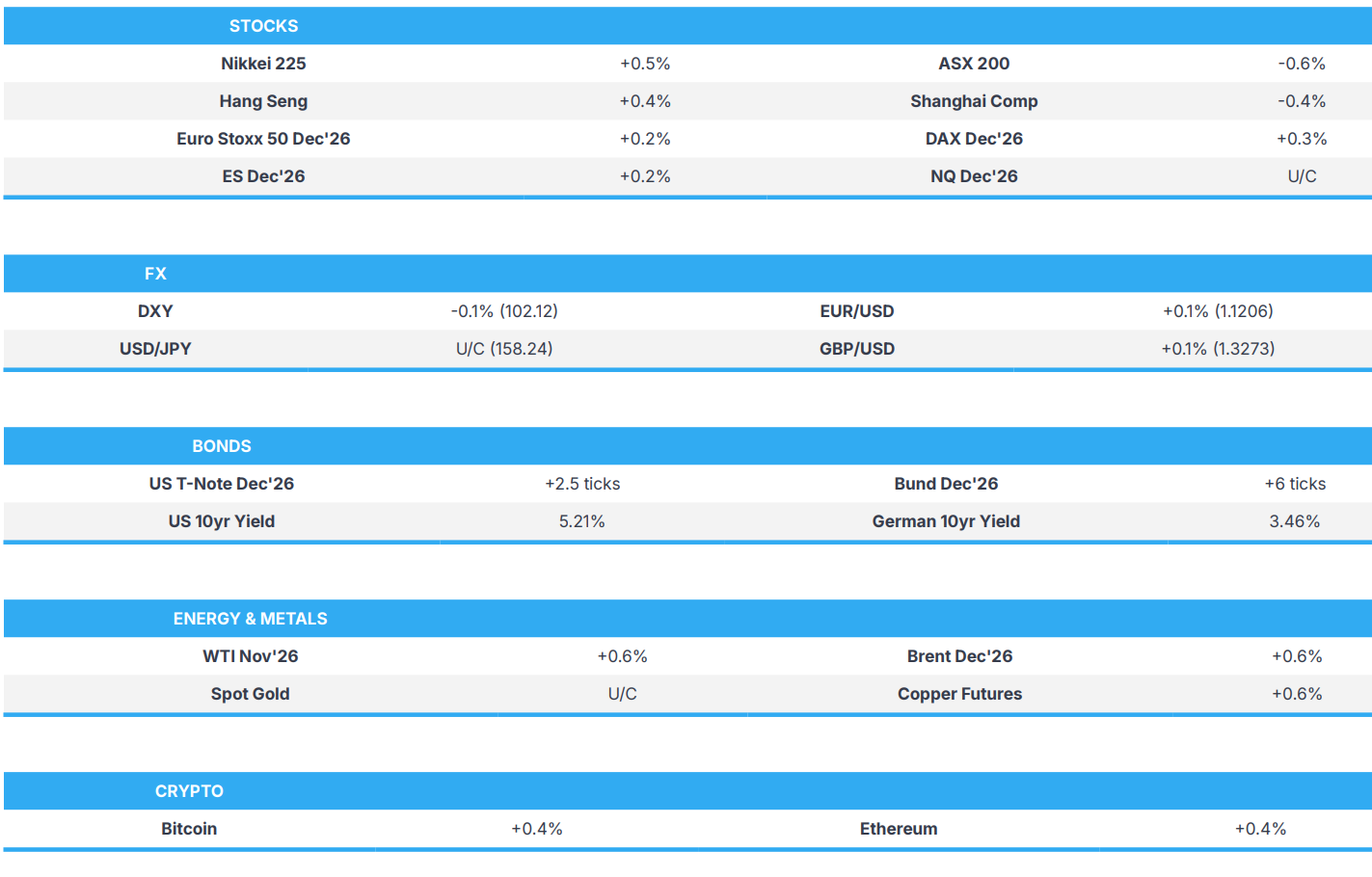
Newsquawk in 3 steps:
1. Subscribe to the free premarket movers reports
2. Listen to this report in the market open podcast (available on Apple and Spotify)
3. Trial Newsquawk’s premium real-time audio news squawk box for 7 days
IRAN CONFLICT
- US President Trump said he will make a decision on Iran very soon and that he spoke with the Saudi Crown Prince, while he responded “I might” when asked if he would ask Turkey to join the Yemen response. Furthermore, Trump stated that the Houthis are behaving very badly and that somebody should explain to them that he is not running in the elections and has already won, but will be there after the elections and will never forget.
- US President Trump said during a rally in Alaska that they’ve been taking more oil out of the Strait of Hormuz than before the war, while he reiterated that the war with Iran will end soon and that Iran will not possess a nuclear weapon. Trump also commented “Wait and see what we do to Iran. We’re going to hit them hard. Wait and see what we do to Iran, because we’ve had enough”.
- US Central Command rejected a claim by the IRGC Navy Commander that the Strait of Hormuz is under Iranian control and that any approaching US warships would be sunk, while it stated that “IRGC’s navy commander has no navy. American forces and regional partners clearly control the Strait of Hormuz. Just yesterday US forces assisted Gulf partners in shipping more than 19mln barrels of crude oil through the strait.”
- IRGC Navy Commander challenged the US claim that the Strait of Hormuz is open and under its control, stating “they should step into the field and see who is in control of it”. IRGC Navy Commander also said Iranian forces were waiting for American ships to approach the entrance to the Strait of Hormuz so they could sink them, adding that they were counting down the days until this happens, according to Tasnim.
- Israel’s N12 News reported that Iran conducted a series of ballistic missile firing tests in recent days, although there was no intelligence that justifies an Israeli-US move in the coming weeks, while Israel, the US and Gulf states are coordinating and preparing for a variety of scenarios.
- Iran is reportedly shifting tactics to step up attacks on shipping ahead of US midterms, according to two Iranian officials cited by Reuters.
- Iran and Oman Foreign Ministers held a call and discussed latest regional developments, including developments in Yemen, and examined ways to achieve peace and stability in the region.
- Israeli PM Netanyahu spoke with US President Trump last week about renewing the war on Iran, according to reports. US officials were reportedly impressed that Netanyahu wanted to attack before the elections. Netanyahu discussed renewing the war with Iran with Trump several times, while Trump reportedly told him, “Well, you know what, Bibi, go ahead and get ready.” However, Trump did not make a firm commitment, saying it could happen now, be too late or never happen.
- Israeli PM Netanyahu and US President Trump discussed last week the possibility of launching a major new operation against Iran before the Israeli and US elections, according to Axios citing officials. Netanyahu and Trump spoke about a potential joint US-Israeli operation that would hit military and nuclear targets, while Netanyahu was concerned about Israeli intelligence indicating Iran was taking troubling steps to reconstitute its nuclear program, although his call with Trump about the possible attack took place before Trump said he would not strike Iran ahead of the Midterms.
- Israeli Defence Minister warned anyone who attacks Israel “before or after the elections” will have their hand cut off and will pay the price, according to Al Hadath.
- UKMTO said it received a report of an incident within the Strait of Hormuz on October 13th in which a container ship was struck by an unknown projectile.
- Saudi-led coalition said it intercepted a missile in Al-Kharj and destroyed two drones and three missiles in Riyadh and the southern region, although the Saudi Energy Ministry announced that Saudi Aramco’s Dhahran headquarters was struck in a Houthi missile attack and a limited fire broke out at the facility, but there were no casualties recorded.
- Saudi-led coalition said it had attacked an oil facility in Sanaa used by the Houthis to support their attacks in Yemen.
- Houthi official warned that Saudi oil and vital installations will be visited overnight.
- Yemeni Deputy Defence Minister said the battle with the Houthis was “open” on all fronts, according to Al Hadath.
- France’s Foreign Ministry said France was participating in efforts to protect navigation in the Red Sea and the Bab al-Mandab Strait, according to Al Arabiya.
US TRADE
EQUITIES
- US stocks were mixed, with the Nasdaq 100 pressured again by weakness in memory names, highlighted by the memory ETF DRAM closing with losses in excess of 3%. The move follows a sharp decline in the Kospi overnight, following the recent concerns regarding competition from China. Overall, sectors were varied as Health underperformed and was hit on poor JNJ results, while Energy sat atop of the pile. Furthermore, US Q3 earnings season got underway and has been a mixed bag so far, in which JPM, GS, WFC, JNJ, and C all saw losses, while the highlights on Wednesday include ASML, BAC, and MS.
- SPX -0.01% at 7,806, NDX -0.31% at 30,569, DJI -0.35% at 51,671, RUT -0.39% at 2,784.
- Click here for a detailed summary.
TARIFFS/TRADE
- Vietnam’s Deputy PM said Vietnam and the US have basically almost completed negotiations for a trade deal and Vietnam sent the final text of a trade deal to the US.
- China’s Customs Vice Minister said in the first three quarters, China’s foreign trade has effectively dealt with various external shocks and China’s foreign trade has kept good development momentum, while it has shown resilience despite rising international changes, risks and challenges. However, the official also stated that China’s trade development still faces many challenges, and for full-year trade, there are many uncertainties globally, including geopolitical conflicts.
NOTABLE HEADLINES
- Fed’s Williams (voter) said there was no need for a rate hike in 2027 at this time and that disinflationary forces remained in play, while he added that the economy was not overheating and that one more interest-rate hike this year was appropriate. Furthermore, Williams saw no evidence that the labour market was contributing to inflation and noted that broad price pressures were not evident outside of AI and energy.
- Fed’s Barkin (2027 voter) said 2% inflation is not some unicorn, and is something they can hit.
- Fed’s Collins (2028 voter) said tightening monetary policy will help return inflation to 2%, and she expects the Fed to raise interest rates ‘a bit further’ by the end of the year, while she expects inflation to stay above 2% due to high energy prices. Furthermore, she supported the Fed raising rates at the September meeting and stated the future path of monetary policy in the new year will depend on data.
- Fed Governor Cook’s lawyer denounced the Trump administration’s new investigation and said she will not be able to attend the hearing on November 5th, according to The New York Times.
APAC TRADE
EQUITIES
- APAC stocks were ultimately mixed as the region clawed back some of the recent tech-related losses, while participants also digested key releases from China, including inflation and trade figures.
- ASX 200 declined with the index dragged lower by underperformance in the top-weighted financials sector, while sentiment amongst miners was not helped by the indecision in Rio Tinto following its quarterly production update.
- Nikkei 225 reclaimed the 68,000 level as tech stocks got some reprieve from recent selling.
- KOSPI was among the biggest gainers as tech rebounded from the recent underperformance.
- Hang Seng and Shanghai Comp were flat as participants digested a slew of data, including stronger-than-expected trade figures and mixed inflation numbers in which CPI printed softer-than-expected, while PPI was hot and showed a faster-than-anticipated acceleration in factory gate prices.
- US equity futures mildly rebounded alongside the mostly improved sentiment in Asia, although gains were capped with US inflation data on the horizon.
- European equity futures indicate a positive cash market open with Euro Stoxx 50 futures up 0.2% after the cash market closed with losses of 0.6% on Tuesday. Futures initially dipped following ASML earnings before paring most of the move.
FX
- DXY remained softer after weakening yesterday alongside lower US yields and choppy crude prices, while there were several Fed comments, with the highlight coming from NY Fed President Williams, who sees one more rate hike as appropriate in 2026 and doesn’t see a need for a rate hike in 2027 at this time, citing an optimistic view on inflation returning to 2% and is not seeing broad price pressure outside AI and energy, while the focus turns to the incoming US CPI report later today.
- EUR/USD benefited from the softer buck and reclaimed the 1.1200 level. There were some comments from ECB officials, including Lane, who stated that the increase in long-term interest rates constitutes a material tightening and is relevant for the ECB in setting policy stance, while Lagarde said inflation has been rising predominantly, but not exclusively, as a result of energy prices, but added they are not seeing any second-round effects yet.
- GBP/USD extended on the prior day’s rebound but with price action remaining at the 1.3200 handle, while the latest comments from BoE Governor Bailey provided very little incrementally.
- USD/JPY was contained in the absence of tier-1 data from Japan and following a previous source report that the BoJ is to lean against back-to-back hikes in October, but could adjust the language regarding the inflation target to “approx. 2%” from “approaching 2%”.
- Antipodeans edged higher amid an improvement in risk sentiment and after stronger-than-expected Chinese trade data.
- PBoC set USD/CNY mid-point at 6.7249 vs exp. 6.6922 (prev. 6.7298).
FIXED INCOME
- 10yr UST futures slightly gained in range-bound trade as participants await the US inflation report, while there were also recent comments from Fed officials, including Williams, who said one more interest-rate hike this year was appropriate and that there was no need for a rate hike in 2027 at this time.
- Bund futures eked mild gains after pulling back yesterday, although the rebound was limited with little reaction seen to several ECB comments and as German supply looms.
- 10yr JGB futures eventually climbed with support seen in the aftermath of the 5yr JGB auction, which showed moderately improved results compared with the previous auction.
COMMODITIES
- Crude futures climbed higher as geopolitical headlines remained abundant and continued to show no signs of abating, with further exchanges of strikes between Saudi and Houthis, including an attack on the Aramco HQ in Dhahran. Furthermore, both the US and Iran asserted their control over the Strait of Hormuz, while there were reports that Israeli PM Netanyahu and US President Trump had discussed the possibility of launching a major new operation against Iran before the Israeli and US elections, although the call occurred last week before Trump declared that he would not strike Iran ahead of the Midterms.
- US President Trump said they are going to announce two deals today and stated every permit needed has been granted regarding Alaska LNG, while Trump then stated that Taiwan has agreed to buy 30% of gas coming off Alaska pipeline and is to invest USD 4.4 billion in the project, on top of the USD 50bln South Korea committed to invest. Trump later posted that “Massive Oil, Gas, and Mineral Exploration is getting ready to begin in our new and beautiful Greenland!”
- Spot gold lacked firm direction following the prior day’s indecision and as US CPI data looms.
- Copper futures climbed higher as stock markets got some reprieve from the recent tech selling.
CRYPTO
- Bitcoin gained in a somewhat choppy manner with prices remaining beneath the USD 84,000 level.
NOTABLE ASIA-PAC HEADLINES
- Monetary Authority of Singapore kept its FX-based policy settings unchanged, with the rate of appreciation of the policy band maintained (exp. very slight tightening), while it made no changes to the width and level the band is centred. MAS said Singapore’s economy is expected to continue expanding steadily in the quarters ahead and core inflation should remain slightly elevated in the immediate quarters ahead, but is projected to ease discernibly from the middle of next year. MAS expects Singapore’s economy to continue to expand at a firm pace in the immediate quarters ahead, but stated there continues to be significant uncertainty surrounding the macroeconomic outlook and that for now, risks to inflation remain tilted to the upside.
DATA RECAP
- Chinese PPI YY (Sep) 5.0% vs. Exp. 4.5% (Prev. 3.8%)
- Chinese CPI YY (Sep) 0.9% vs. Exp. 1% (Prev. 0.8%)
- Chinese Trade Balance (USD)(Sep) 133.53B vs. Exp. 118.1B (Prev. 119.09B)
- Chinese Exports YY (USD)(Sep) 36.3% vs. Exp. 25.5% (Prev. 25%)
- Chinese Imports YY (USD)(Sep) 31% vs. Exp. 24.5% (Prev. 28.2%)
- Chinese Yuan-Denominated Trade Balance (Sep) 906.0B (Prev. 809.3B)
- Chinese Yuan-Denominated Exports YY (Sep) 29.6% (Prev. 18.6%)
- Chinese Yuan-Denominated Imports YY (Sep) 24.6% (Prev. 21.7%)
- Singapore GDP Growth Rate Adv (Q3 QQ) 1.1% vs. Exp. 1.2% (Prev. 1.4%)
- Singapore GDP Growth Rate Adv (Q3 YY) 5.4% vs. Exp. 5% (Prev. 5.9%)
GEOPOLITICS
RUSSIA-UKRAINE
- Russian air attack hit energy facilities in Ukraine’s capital Kyiv, according to the mayor.
- US President Trump said he was working with Russia and Ukraine to end the war and believes both Ukrainian President Zelensky and Russian President Putin want it to end. Trump said Russia was releasing diesel to the world and that both Russia and Ukraine were “a little bit off”, while he said he would provide an update later when asked whether Russia had broken the ceasefire.
- UK PM Burnham will host Ukrainian President Zelensky in Downing Street on Wednesday as Ukraine and its allies scramble to respond to Trump’s diesel deal with Putin, while Burnham will tell Zelensky that Britain’s support is rock solid with faster delivery of lightweight, multi-role missiles to help Ukraine defend itself, according to Bloomberg.
OTHER
- China’s PLA Navy organised the Liaoning aircraft carrier strike group to conduct training exercises in the waters of the Western Pacific, while it was stated that the routine exercise organised in accordance with the annual plan is aimed at enhancing troops’ combat readiness.
- Japan’s Foreign Minister said the Japanese embassy in Russia is requesting information from Russian authorities regarding a detained Japanese citizen and Japan is requesting fair treatment of the detained Japanese citizen from Russian authorities.
EU/UK
NOTABLE HEADLINES
- UK Chancellor Healey is expected to pay for new giveaways in this month’s budget, with higher taxes or spending cuts rather than more borrowing, according to FT
- UK Chancellor Healey is to target online marketplaces in a GBP 1bln tax crackdown, in which the UK plans to make them responsible for collecting tax owed by retailers selling on their platforms, according to The Times.
- BoE Governor Bailey said UK companies are focusing intensely on containing costs amid surging energy prices caused by the Iran war, while he reiterated that broader UK inflation pressure from the energy shock has remained subdued so far.
- ECB’s Lagarde said inflation has been rising predominantly, but not exclusively as a result of energy prices, while she noted that they are not seeing any second-round effects yet and they cannot wait until they are in full view, but can anticipate and look for hints. Furthermore, she responded that the primary and first solution lies in French fiscal policy when asked about French debt, and stated that growth is not brilliant, but 1.1% growth in 2026 is not bad.
- ECB’s Lane said the increase in long-term interest rates constitutes a material tightening and is relevant for the ECB in setting policy stance, while he said the potential for AI to replace some workers may weaken their bargaining power and moderate wage growth.
- ECB’s Moulin said inflation is mainly due to conflict in the Middle East and energy-related, while he added that inflation expectations by corporates and households in the medium term are well anchored. Moulin also stated that a rise in yields may affect demand and prompt a more moderate response to an inflation shock.
- ECB’s Wunsch said they are probably going to have to hike again, but he’s not making any bets because they have so much uncertainty on the energy front and maybe also in AI, according to Bloomberg.
NOTABLE EARNINGS
- ASML (ASML NA) – Q3 2026 (EUR): Basic EPS 12.95 (exp. 10.68), Revenue 11.66bln (exp. 11.58bln), New lithography systems sold 113 (prev. 86 Q/Q), Gross margin 57.5% (prev. 54% Q/Q), Net Income 4.96bln (prev. 2.92bln Q/Q).
2.NORTH AND SOUTH KOREA/
SOUTH KOREA//NORTH KOREA
SOUTH KOREA/USA
JAPAN//
JAPAN//USA/
3/CHINA
4. EUROPEAN AND SCANDINAVIAN COMMENTARIES PLUS NATO
FRANCE
France Is Imploding, Energy Is Surging… And Markets Aren’t Panicking. Yet.

This is a recent headline/analysis from The Market Ear (republished on ZeroHedge on October 14, 2026), highlighting dual stresses in Europe—fiscal/political pressure in France and rising energy costs—while noting that broader markets have not yet fully panicked.
zerohedge.com
The piece is largely paywalled, but available excerpts and concurrent reporting outline the core thesis: Europe’s problems are intensifying, yet equity and other markets remain relatively calm for now.Key elements of the situation
- French fiscal and rate pressure: French 10-year OAT yields have been elevated near multi-decade highs (around 4.8–4.9% recently), with the OAT-Bund spread widening to roughly 130–150+ basis points at peaks—levels last seen around the 2011–2012 eurozone debt crisis. This reflects investor concerns over high public debt (around 115–120% of GDP), persistent deficits (projected ~5%+ of GDP), political gridlock under a minority government, and uncertainty ahead of the 2027 presidential election. Budget debates and limited room for consolidation are adding to the stress. ideal-investisseur.fr
- Surging energy prices: European natural gas (TTF) prices have risen sharply, trading near multi-year highs (around €85–87/MWh recently, up significantly year-over-year and elevated versus recent norms). This is driven by constrained Middle East/LNG supplies (linked to regional geopolitical risks), below-average storage levels, Norwegian outages, and seasonal demand concerns heading into winter. French power prices have also jumped (year-ahead contracts exceeding €100/MWh at points), despite the country’s nuclear fleet, as gas prices feed through and nuclear availability has faced constraints. tradingeconomics.com
These factors combine into potential inflation and growth headwinds for Europe. France’s energy situation is somewhat buffered by nuclear power relative to more gas-dependent neighbors, but the broader price surge still hits costs, industry, and consumers.Why markets aren’t (fully) panicking—yetBroader risk assets have shown resilience despite the stresses. Bond markets are pricing in higher French risk premiums, but equities and other segments have not seen equivalent disorder. Analysts note positioning, global factors (including US yields and other macro drivers), and the view that France remains “too big to fail” in the eurozone context—raising questions about potential ECB involvement if spreads spiral further. However, political risks (including the outlook for 2027 and polarized candidates) and the energy shock create room for escalation if winter demand spikes or fiscal progress stalls.In short, the Market Ear framing captures a classic “cracks are showing but complacency persists” setup: French rates under pressure + energy inflation/growth risks, with the caveat that the market reaction could intensify. For the full charts, positioning notes, or proprietary analysis, the original Market Ear/ZeroHedge premium content would be needed.
END
UK
London Police Chief: DEI Is An “Operational Necessity”
Wednesday, Oct 14, 2026 – 08:55 AM
Authored by Steve Watson via Modernity.news,
Metropolitan Police Commissioner Sir Mark Rowley has accused critics of diversity, equity and inclusion policies of fuelling “toxicity” while launching a fresh recruitment drive focused on black and Asian applicants.

Writing in The Guardian, Rowley declared that the force “cannot police London effectively if we fail to recruit from all of London” and that “effective policing depends upon inclusivity.”
He insisted an inclusive workforce “is not a public relations exercise” but something that “makes us better at protecting victims, catching criminals and preventing crime.” The commissioner added that the Met has “no interest in the politics and ideologies of the culture wars” and that inclusion is “an operational necessity.”
Rowley rejected suggestions that boosting minority numbers means lowering standards. “Some will wrongly suggest that increasing representation means lowering standards. Nothing could be further from the truth,” he wrote. “Tackling those barriers is not favouritism. It is fairness.”
He pointed to 2025’s “most representative intake of recruits in our history,” with rises in women and ethnic-minority Londoners, and said the campaign aims “to close the gap with communities we have previously drawn least from.”
London Mayor Sadiq Khan backed the push, calling diversity the city’s “greatest strength” and saying London needs “a police service that represents all of London’s communities.”
Rowley declared that “The toxicity is horrible around the DEI debate,” adding “Lots of leaders, both in the public and private sector, are running away from the subject. I think leaders need to stand up and make a practical case. We need to do what works for policing London.” He vowed the force “will not be blown off course by the culture wars.”
Critics argue the latest drive continues a pattern of prioritising identity over competence that has already produced real-world failures.
Officers in Hampshire Constabulary have admitted that mandatory DEI training on “white privilege” and “unconscious bias” left them feeling “controlled and pressured.”
Former Home Secretary Suella Braverman reported that serving and former officers told her “we had it drummed into us about our white privilege and unconscious bias,” with one trainer described as “deeply hateful of white people and our culture.”
That training culture has been linked to the response around the death of white teenager Henry Nowak, who was stabbed and left dying while officers focused on his attacker’s false claim of racism.

Police Officers Admit DEI Training Pressured Them to Ignore Dying White Teen Henry Nowak
Anti-white indoctrination and two-tier priorities left an 18-year-old bleeding out while officers believed his attacker’s racism claim
Similar sessions have been rolled out elsewhere. Thames Valley Police mandated “equity training” covering white privilege, micro-aggressions and the shift from “non-racist” to “anti-racist.”
An independent review after white officers successfully challenged a promotion that bypassed them for an Asian sergeant found the training “can often be seen as demonising white people.”
White male officers reported feeling “disadvantaged” and unsupported, while some minority staff said the approach created a “hostile environment.”
Former government adviser Rory Geoghegan stated that officers “deserve far better from their leaders than to be crudely categorised by skin colour and subjected to reductive, divisive ideologies.”

UK Police Being Forced To Undergo Training To Accept Their ‘White Privilege’
There has been a “very strong, at times bordering on aggressive” response from white officers
West Yorkshire Police has operated a system under which BAME candidates can apply for constable roles year-round while white applicants from British, Irish or Eastern European backgrounds must wait for specific windows.
A whistleblower said the process “restricts progression opportunities for White British candidates, while individuals from other backgrounds are swiftly advanced.” The force said it uses “Positive Action” under the Equality Act because minority representation lags the local population.

Whites Need Not Apply — British Police Force Blocks Applications From White People
In favor of ‘diversity’ candidates
In a separate case, three long-serving white Thames Valley officers won a tribunal after being blocked from a Detective Inspector post that was filled without open competition by a lower-ranked Asian sergeant. The tribunal ruled the move “clearly constituted positive discrimination” and went “beyond mere encouragement,” disadvantaging officers who did not share the sergeant’s race.

White Police Officers WIN Discrimination Case; Were Not Considered For Promotion Due To Skin Colour
Superintendent was ordered to hire an “Asian”
Other forces have embedded ideological priorities in everyday operations. North Yorkshire officers attended a session in which a trainer equated Nigel Farage’s comments on British values and Muslim attitudes with a racial assault, asking attendees which had done “the most harm.” Home Secretary Robert Jenrick called it evidence that “the police have been infiltrated by bad-faith actors seeking to police speech, not actual crime.”

Police “Islamophobia” Training Equates Farage’s WORDS With HATE CRIME
Lottery-funded Islamophobia session put Reform’s leader next to a racial assault
West Midlands Police has invited non-Muslim staff to fast for a day during Ramadan “as an act of solidarity” with Muslim colleagues and to understand the observance’s significance for local communities.
Shadow Justice Secretary Nick Timothy responded that “expectations should be uniform, and non-Muslim police being encouraged to fast in Ramadan is wholly inappropriate.”

UK Police Force Invites Non-Muslim Staff To FAST During Ramadan As Act Of SOLIDARITY
DEI ideology continues to erode impartial British policing
South Wales Police has directed officers to log anti-Islam comments that exceed the force’s view of “legitimate” discussion, building on the government’s definition of “anti-Muslim hostility.”
The Free Speech Union warned that the policy “gives officers the power to decide what constitutes acceptable speech and risks having a chilling effect on free expression.” Lord Young noted that the government had included safeguards making clear the definition was not meant to inhibit criticism of Islam, yet the local guidance risked “penalising people for expressing misgivings about Islam.”

Police Orders Officers To Log ANTI-ISLAM Comments In Chilling Free Speech Crackdown
Force adds subjective wording to government’s contested definition, prompting Free Speech Union legal threat
Footage from recent protests has reinforced public perceptions of uneven enforcement. In one widely shared clip, an officer is heard directing colleagues that right-wingers cannot protest in the same way as others.
Separate video shows officers treating certain demonstrations with greater latitude while tightly controlling others.
Rowley’s insistence that more minority officers will restore trust collides with a record of DEI initiatives that have already produced tribunal findings of discrimination against white staff, officer testimony of ideological pressure, and public anger over cases in which race ideology appeared to override basic victim care.
The Met has spent years and substantial salaries on diversity officers and inclusion leads while clearance rates for serious crime remain under pressure and public confidence in impartial policing continues to erode.
The commissioner’s latest campaign treats demographic matching as an operational necessity. The accumulated evidence from multiple forces suggests the opposite: that prioritising skin colour over competence and equal application of the law has damaged both effectiveness and legitimacy.
Policing by consent requires officers who enforce the law without fear or favour, not managers who redefine criticism of identity policies as toxicity.
END
GERMANY
Guess Which European Country Is Tolerating Child Marriages?
Wednesday, Oct 14, 2026 – 03:30 AM
Authored by – Remix News Staff – via Remix News,
A parliamentary inquiry by Alternative for Germany (AfD) lawmakers in the German state of Baden-Württemberg has brought to light official data showing that authorities have recorded 358 so-called child marriages since April 2012, with courts formally annulling only eight of them between 2018 and 2024.

The figures, released in early October 2026 in response to questions from state parliament members Nikolaos Boutakoglou and Emely Knorr, have drawn sharp attention to the prevalence of underage marriages – overwhelmingly involving people from migrant backgrounds – and the limited number of legal interventions.
Among the annulled cases was the 2020 marriage of an 11-year-old Iraqi girl to a 17-year-old Iraqi boy. In 2018, authorities annulled the marriage of a 14-year-old Afghan girl to a 30-year-old Afghan man. Two further annulments occurred in 2024: one involving a 16-year-old German girl and a 25-year-old Pakistani man, and another between a 16-year-old Syrian girl and a 27-year-old Syrian man, according to Welt newspaper.
The other annulled marriages involved individuals from Afghanistan, Romania, Moldova, Croatia, Serbia, and elsewhere. The state Interior Ministry stated that no court proceedings for annulment were pending at the time of its reply.
The remaining approximately 350 cases, documented by the government of Tübingen were closed under the category of “other resolutions.” Possible reasons cited by the government include the death of a partner, a decision to forgo annulment, or a subsequent marriage abroad.
These files still include striking examples of very young brides. In 2020, a 12-year-old Afghan girl was recorded as married to an 18-year-old man. In 2022, a 12-year-old Syrian girl was married to a 28-year-old Syrian man, and in 2023 a 12-year-old Afghan girl to a 21-year-old Afghan man. Multiple cases involving 13- and 14-year-old girls also appear in the data, and some reports note nine marriages in which the girl was under the age of 14 at the time of the union.
The demographic pattern is pronounced. Men from Syria accounted for 132 of the recorded cases, nearly 40 percent, followed by nationals of Bulgaria, Turkey, Afghanistan, and Iraq.
Child marriages between two German citizens made up only about 0.3 percent of the total. It is also unclear if these German citizens have a migration background, but given the pattern seen among foreigners, it is very probable.
Most of the 358 cases date from 2015 onward when the migration crisis truly began to grow in Germany. Boutakoglou highlighted the figures on social media, stating: “Almost without exception, every child marriage in Baden-Württemberg since 2017 can be traced back to mass migration! Nearly 40% of the child marriages were contracted between Syrians, while child marriages between two Germans account for only 0.3%.”
Emely Knorr, co-author of the government inquiry, wrote: “Child marriages are incompatible with our values. Children have a right to safety, education, and a self-determined future. That is why we need effective protection, early intervention, and decisive action against forced marriages.”
Germany raised the minimum marriage age to 18 in 2017 and generally does not recognize foreign marriages involving minors under certain conditions. The Tübingen authority deals exclusively with marriages contracted abroad that come to the attention of German registry offices.
The AfD inquiry was prompted in part by a Terre des Femmes leaflet warning of the risk of forced marriage during school holidays, but the state government said it had no financial involvement in the leaflet.
As Remix News has reported in the past, the issue is not just child marriages. Mass migration has brought new backward cultural norms to Europe that are completely incompatible with European human rights. For example, already in 2020, the German government admitted that there were at least 68,000 female genital mutilation victims in the country, rising 44 percent since 2017.
According to then German Minister for Family Affairs Franziska Giffey, mainly migration is to blame for the massive increase as many migrants coming to Germany commonly practice FGM in their own home countries. The practice, which is a human rights violation, involves the ritual cutting off some or all of the external female genitalia.
Germany is far from the only country dealing with this trend. Remix News reported this year that a female genital mutilation crisis had hit Paris, with over 140,000 such cases seen across the country.
END
GERMANY
“NO TURKS – ALL OUT” – CDU Candidate With Turkish Background Allegedly Faked Hate Crime Attack
Wednesday, Oct 14, 2026 – 06:20 AM
Authored by Remix News Staff via Remix,
Prosecutors have opened an investigation into a local Christian Democratic Union (CDU) mayoral candidate of Turkish origin who is accused of staging a racially motivated attack on his own car days before an election he lost badly.

The Itzehoe public prosecutor’s office is examining allegations that Baris Karabacak faked the incident, according to the German newspaper Bild. Authorities obtained and executed a search warrant against the politician and seized at least one electronic device.
Karabacak, an entrepreneur who had previously served as chair of the Uetersen city council, was the CDU’s candidate in the Sept. 27 mayoral election in the town of roughly 18,000 people in the Pinneberg district of Schleswig-Holstein. He finished a distant third with 10.7 percent of the vote. Incumbent Mayor Dirk Woschei of the Social Democrats was reelected in the first round with 51.3 percent; independent candidate Marvin Schöpp received 38.1 percent.
A few days before the vote, local media including public broadcaster NDR reported that the windows of Karabacak’s car had been smashed overnight. A campaign flyer bearing an added message in all capital letters reading “NO TURKS – ALL OUT” was left behind. Police initially investigated the matter as possible incitement to hatred.
At the time, state CDU General Secretary Lukas Kilian publicly backed his party colleague and expressed pride in the CDU’s diversity. Woschei also offered solidarity, stating that political competition must be conducted with arguments and that “violence, hate and racist messages are an attack on the city’s democratic culture.”
Kilian’s tone has since shifted sharply. He told Bild he was “stunned” by the new allegations.
“Anyone who fakes a racist crime abuses the solidarity of many people and mocks the victims of real racism. There is no place for that in the CDU,” Kilian said. The state party has said that if the accusations are confirmed, Karabacak will be asked to resign his membership; failure to do so would trigger expulsion proceedings.
The case remains under investigation, and no charges have been filed. Karabacak has not publicly commented on the prosecutor’s probe.
The episode has drawn attention in a town where Karabacak had earlier faced internal party and council criticism over his leadership style before resigning as city council chair earlier in 2026 and then securing the CDU’s mayoral nomination.
Another hate crime hoax proven false in court
This is also notably not the first alleged hate crime hoax from a German politician. In 2023, Remix News reported on Manoj Subramaniam, a 33-year-old former local Green councilor in the German town of Erkelenz, who claimed he had been subjected to sustained acts of harassment by anonymous right-wing extremists. He showed police evidence of the abuse he had received, which included a threatening letter with a razor blade inserted and a swastika drawn onto his vehicle in red paint.
The case made national headlines last year with several prominent politicians offering their solidarity with Subramaniam for the alleged abuse he had received.
“Right-wing extremists are threatening political volunteers to silence them. Thank you, Manoj Subramaniam, for not being silent and raising your voice,” stated Lamya Kaddor, a member of the Bundestag.
Federal police took protective measures for the politician’s safety, and an intensive investigation was initiated by state security, all at considerable cost to the taxpayer. The only issue, however, was that Subramaniam had made it all up.
“The defendant actually wrote this note himself,” revealed Justus Wassenberg, the press spokesman for the public prosecutor’s office.
It transpired that Subramaniam had also drawn SS runes and a swastika onto the doorbell panel outside his house.
Subramaniam subsequently resigned from his position as a local councilor, and the Erkelenz District Court issued the disgraced politician a penalty order of €3,600 for faking criminal offenses, a fine he appealed.
He reportedly cried during his trial when his appeal failed.
2026 firebombing not an anti-Semitic attack after all
The investigation into the early 2026 firebombing of Brandenburg Antisemitism Commissioner Andreas Büttner’s home stunned the public.
While the case was initially treated as an Islamist or antisemitic hate crime, the German Public Prosecutor General’s Office now identifies two men from Büttner’s “own circle,” which belongs to the left, as the primary suspects.
One of the men is also linked to the threatening letter sent to Büttner. Meanwhile, Büttner said he was shocked and described it as the biggest betrayal of his life. He also stated that if the two were responsible, the act had nothing to do with antisemitism in his view. So far, the prosecutor’s office has continued to list Büttner as a witness or injured party, not a suspect. News outlets have highlighted that there was a €3,000 transfer from Büttner to one of the men shortly before the incident, which he called a loan, and other joint activities. These details prompted public questions and speculation in some outlets about possible staging or a “false-flag” element, but no official finding has supported the claim that Büttner ordered or knew of the act in advance. The case still reportedly remains under investigation.
END
5.RUSSIA AND ISRAEL AND MIDDLE EASTERN AFFIARS
ISRAEL/IRAN/USA //TUESDAY NIGHT
Saudi Aramco Headquarters In Dhahran Struck By Houthi Missile
Tuesday, Oct 13, 2026 – 04:29 PM
Update(1629ET): Saudi Aramco facilities are once again under Houthi attack, with reports saying the kingdom is busy trying to intercept inbound ballistic missiles. Tuesday night saw several eyewitnesses report loud booms near the headquarters of Saudi Arabia’s state-owned oil company in Dhahran. However, Aramco has not immediately given confirmation of impact or that its sites are being targeted.
Importantly, Reuters reports: “A source with direct knowledge of the matter told Reuters the Aramco headquarters had been struck, though it was unclear if the building had been hit directly or by falling debris.”
The City of Dhahran is in the Eastern Province of the country, and is the administrative center for the Saudi oil industry. “Interception and destruction of a ballistic missile launched by the terrorist Houthi militia towards the city of Dammam,” said Saudi-coalition spokesman Turki al-Maliki in a post on X.
Al Jazeera is separately reporting that “Shrapnel fragments from the interception fell in a residential area in Dhahran, where Saudi Aramco is headquartered.”
“A series of attacks across Saudi Arabia is currently underway, with the Saudi military saying it’s intercepting missiles over the country,” the report continues. “The eastern coastal cities of Dammam and Dhahran and Haradh, east of Riyadh, were among those targeted.”
Unverified footage shows the impact of a Houthi ballistic missiles at the Aramco Headquarters in Dhahran, Saudi Arabia:
Meanwhile, more talk about next moves against Iran:
Israeli Prime Minister Benjamin Netanyahu and President Trump last week discussed the possibility of launching a new operation against Iran before the Israeli and U.S. elections, according to two U.S. officials, one Israeli official and a fourth source with knowledge.
* * *
The Saudi coalition, which is calling itself the Coalition to Restore Legitimacy in Yemen, on Tuesday issued a warning for civilians to evacuate a site in Sanaa ahead of a targeted operation. The city has been held by the Houthis going all the way back to 2014, and is the main base of the Iran-aligned government there.
Specifically, civilians are being urged evacuate the Yemen Petroleum Company’s Al-Sabahah central fuel station in Sanaa, and the publication went so far as to issue an illustrative map of the location. There are emerging reports of active bombings of the area.
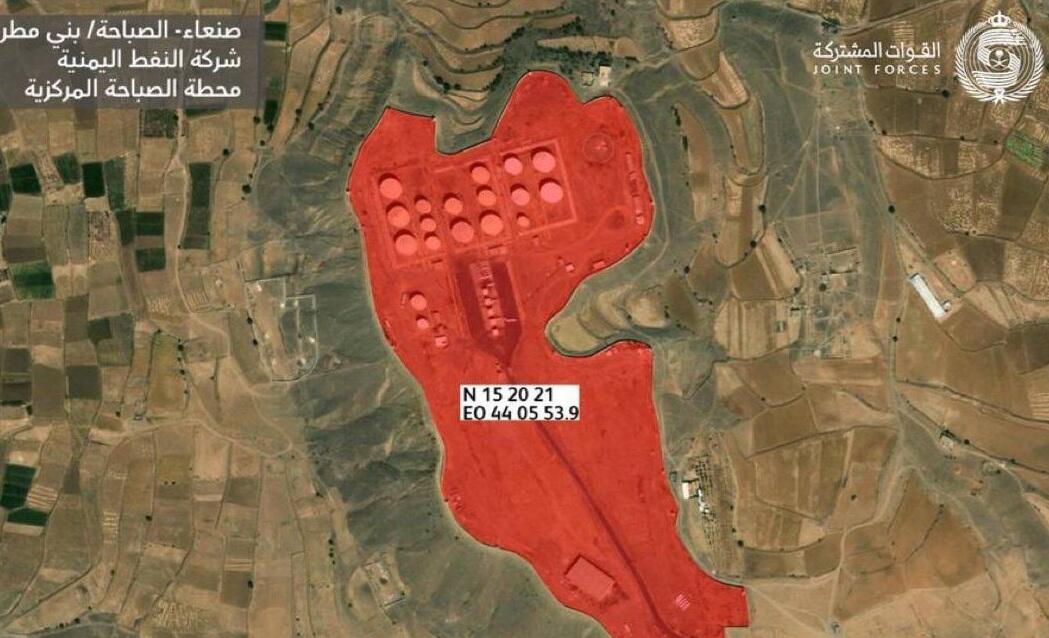
Additional to this was (on the flip side) a published warning by Ansar Allah on Tuesday for Saudi citizens to “evacuate” areas near Aramco’s headquarters in Dammam, King Khalid Airport in Riyadh, and Aramco’s Riyadh refinery – which comes amid ongoing reports of the Houthis targeting territory of the kingdom.
The Saudi capital’s international airport of Riyadh has been shuttered since deadly weekend attacks, and expectations are that it will remain closed through at least Saturday, according to a fresh NOTAM issued.
We “call on all citizens to evacuate immediately and stay away from the targets that our armed forces will strike if the Saudi enemy proceeds with its announced plan to target the following sites in the capital, Sanaa,” the Houthi statement said.
This comes simultaneous to the aforementioned Saudi order telling people to evacuate from near Yemen Oil Company site at Al-Sabaha Central Station in Sanaa.
And so tit-for-tat escalation is expected to continue. Saudi authorities have been warning that a “serious” response would come after at least 13 were killed in multiple strikes on Riyadh’s airport over Saturday and Sunday.
“The events of recent weeks are serious. Our response must be equally serious,” Prince Abdul Aziz bin Salman told the WPC Energy Congress in Riyadh – a long planned event which has proceeded despite the threat of Houthi missiles in the air.
The Houthis have indicated they will continue the fight amid the “brutal Saudi aggression” which at the moment is focused on retaking Western Yemen’s Red Sea coastline:
Rashad al-Alimi, chairman of the Presidential Leadership Council in Yemen, says the “Dawn of Yemen” operation is “proceeding toward its goal of ending the Houthi militias’ coup”.
“There is no turning back, no matter the sacrifices,” said al-Alimi.
So far the US has signaled it is staying on the sidelines of the renewed war, only providing the Saudi coalition with intelligence, and presumably targeting information
END
ISRAEL/IRAN/USA WEDNESDAY
Live Updates: Sirens sound in Riyadh amid rising Saudi-Houthi tensions, Houthis behaving ‘very badly,’ Trump says
NEWS FROM ISRAEL:
Hezbollah explosive smuggling, illegal finance network leads to calls for probe by Lebanese PMs • IDF chief vows to apply October 7 lessons, pledges to pursue Israel’s enemies at military ceremony

IDF soldiers operating in southern Lebanon.(photo credit: IDF SPOKESPERSON’S UNIT)
END
Burning Container Ship Sinks In Strait Of Hormuz, As IRGC Proclaims ‘5 Or 6’ Vessels Targeted Nightly
Wednesday, Oct 14, 2026 – 09:10 AM
Iran has quite obviously been surging its attacks on commercial shipping in the Strait of Hormuz in an attempt to wreak uncertainty and economic havoc for the Trump administration ahead of the November midterm elections, undermining a recent recovery in Persian Gulf oil shipments.
The attacks are now coming so frequently it is difficult to deep track. One source tallies of recent days, “Twelve vessels were attacked between October 5 and 11, including six on Sunday alone, and on Tuesday a tanker and a container ship were struck by unknown projectiles, according to UK Maritime Trade Operations (UKMTO), marking one of the most intense periods of attacks since the war began.”

Other outlets also confirmed the single day record of six attacks this past Sunday. It some time for confirmation of all these vessels’ status to emerge amid the fog of war in the contested strait.
The prominent and outspoken secretary of Iran’s supreme national security council, Mohsen Rezaei, has meanwhile affirmed that the IRGC was striking vessels nightly, and is likely to keep doing so.
“We target five or six of these every night,” he told state TV. “Hormuz is under the control of the Islamic Republic.“
While the US has been touting a successful naval escort mission to get unprecedented numbers (for wartime) of tankers through the strait, Rezaei described that the US is merely using small craft to smuggle Iranian oil on to larger tankers out at sea, and then doing ship-to-ship transfer.
Tehran has claimed further that American naval ships don’t dare come close to Iran’s shores, on fears of being hit.
On Wednesday, Iran’s military has announced yet another attack, this time on a container ship. Al Jazeera reports of the notification:
Iran’s Islamic Revolutionary Guard Corps says that a container ship “carrying contraband” and attempting to pass through “an unauthorized and dangerous route” in the Strait of Hormuz exploded and caught fire after striking a naval mine.
Overall for the month of October we’ve seen at least 24 foreign vessels targeted and hit by Iranian forces. If this keeps up, oil prices are likely to be soaring by month’s end.
“At least 18 ships were hit between Oct. 1 and Oct. 11, according to the UKMTO, with another six attacks recorded by other European security sources, the Financial Times reported,” the NY Post comments.
END
Two Emirati Ships Sink In Hormuz In Under 24 Hours As IRGC Claims 5-6 Vessels Targeted Nightly
Wednesday, Oct 14, 2026 – 12:40 PM
Update(1240ET): While dozens of ships have come under attack by Iran in the Hormuz Strait and nearby areas since the war began, resulting in damage and fires aboard vessels, it remains much more rare for a tanker to sink at a total loss.
However, the WSJ has confirmed Wednesday that two have completely sunk in the last 24 hours, the first of which we reported on below. Here are the further details via WSJ:
Two Emirati cargo ships have sunk in the past 24 hours after being struck in the Strait of Hormuz, an escalation with little precedent as Iran ramps up attacks to levels not seen since the war started.
The GFS Pride and the Cape Dao have both gone down, said Pakistan’s National Hydrographic Office, which monitors maritime activities in Middle Eastern waters. Maritime security companies confirmed the two losses Wednesday and said this was the first such incident in months.
The sinkings came as the U.S. military has been successfully shepherding more Gulf oil through the strait while bottling up Iranian oil exports with a naval blockade and sanctions.
One of the ships that sunk had been in distress and apparently abandoned since being first attacked on September 23, according to UN shipping agency data.
Despite many attacks, the WSJ notes that the last ship sinking in the waters occurred back in March. It details, “The vessel was hit by a projectile that sparked a fire in its engine room, forcing the crew to abandon the vessel. A tugboat sent to rescue the ship was also struck. Four seafarers died and three were severely injured, according to the International Maritime Organization.”
On Wednesday Iranian state media has been widely circulating fresh footage of one of the sinkings:
* * *
Iran has quite obviously been surging its attacks on commercial shipping in the Strait of Hormuz in an attempt to wreak uncertainty and economic havoc for the Trump administration ahead of the November midterm elections, undermining a recent recovery in Persian Gulf oil shipments.
The attacks are now coming so frequently it is difficult to deep track. One source tallies of recent days, “Twelve vessels were attacked between October 5 and 11, including six on Sunday alone, and on Tuesday a tanker and a container ship were struck by unknown projectiles, according to UK Maritime Trade Operations (UKMTO), marking one of the most intense periods of attacks since the war began.”
Other outlets also confirmed the single day record of six attacks this past Sunday. It some time for confirmation of all these vessels’ status to emerge amid the fog of war in the contested strait.
The prominent and outspoken secretary of Iran’s supreme national security council, Mohsen Rezaei, has meanwhile affirmed that the IRGC was striking vessels nightly, and is likely to keep doing so.
“We target five or six of these every night,” he told state TV. “Hormuz is under the control of the Islamic Republic.“
While the US has been touting a successful naval escort mission to get unprecedented numbers (for wartime) of tankers through the strait, Rezaei described that the US is merely using small craft to smuggle Iranian oil on to larger tankers out at sea, and then doing ship-to-ship transfer.
Tehran has claimed further that American naval ships don’t dare come close to Iran’s shores, on fears of being hit.
On Wednesday, Iran’s military has announced yet another attack, this time on a container ship. Al Jazeera reports of the notification:
Iran’s Islamic Revolutionary Guard Corps says that a container ship “carrying contraband” and attempting to pass through “an unauthorized and dangerous route” in the Strait of Hormuz exploded and caught fire after striking a naval mine.
Overall for the month of October we’ve seen at least 24 foreign vessels targeted and hit by Iranian forces. If this keeps up, oil prices are likely to be soaring by month’s end.
“At least 18 ships were hit between Oct. 1 and Oct. 11, according to the UKMTO, with another six attacks recorded by other European security sources, the Financial Times reported,” the NY Post comments.
END
ISRAEL TBN
IRAN
Iran Rebuilding Missile Stockpile For Possible Renewed Fighting, Israeli Officials Say
Tuesday, Oct 13, 2026 – 06:20 PM
Authored by Tom Ozimek via The Epoch Times,
Iran has rebuilt a significant portion of its ballistic missile stockpile and is working to expand it as it prepares for possible renewed fighting with the United States and Israel in the coming weeks, senior Israeli security officials told Epoch Magazine Israel.

Israeli officials assessed that the buildup reflects Tehran’s efforts to strengthen its deterrence capabilities and improve its position should diplomacy fail. They said Iran’s moves do not necessarily indicate that the leadership in Tehran has decided to go to war.
Israel has raised its alert level as it prepares for possible renewed fighting, security officials said, warning that mounting economic pressure could push Tehran toward an offensive against U.S. targets and Persian Gulf energy facilities, potentially also targeting strategic sites in Israel.
The assessments come as Iran’s security chief threatened to strike U.S.-linked technology infrastructure across the region if Washington resumes attacks.
U.S. President Donald Trump has ruled out new U.S. strikes before the Nov. 3 midterm elections, citing ongoing negotiations, while maintaining a naval blockade of Iranian ports and expanding sanctions on Tehran’s oil trade.
Israeli Officials Assess Risk of First Strike
The Israeli officials said Iran’s worsening economic crisis, declining state revenues, and continued U.S. naval blockade could deepen fears among Iranian leaders about domestic instability and the survival of the regime.
Under those circumstances, they said, Tehran could consider an offensive intended to break the blockade and increase pressure on the United States and its allies.
In one scenario, Iran could conclude that Trump intends to attack immediately after the elections and that negotiations offer no further prospect of an agreement. In that case, the officials said, Tehran could attempt to strike first with a large-scale attack on regional targets.
Such an offensive could bring a severe military response and deepen the crisis facing Iran’s leadership, they said.
A senior Israeli security official said Israel’s political leadership could order an offensive operation if intelligence detects imminent preparations for an attack on Israel.
Iran Threatens Technology Assets
Mohsen Rezaei, secretary of Iran’s Supreme National Security Council, told state-run Press TV that U.S.-linked technology infrastructure worth more than $2 trillion could be targeted if Washington attacks again.
“We have not yet included these assets among our targets. But if war breaks out, many of these cables, data centers, artificial intelligence facilities, and numerous other sites will be destroyed,” he said in the interview, conducted on Oct. 10 and reported on Oct. 12.
Rezaei said Iran had held back some military capabilities during earlier phases of the conflict and was ready to deploy additional capabilities.
“Today, we are fully prepared to introduce new capabilities if the war starts again,” Rezaei said, without specifying what those would include.
He also said Tehran remains determined to exert control over the Strait of Hormuz, the strategic oil shipping route where Iran has attacked tankers it says refuse to adhere to its traffic management scheme.
“We will not back down on this issue,” Rezaei said.
On diplomacy, Rezaei said Washington had accepted some of Iran’s seven proposed conditions for a settlement but left others unclear.
Blockade Remains as Talks Continue
Trump said on Oct. 8 that the two countries were having “productive conversations” and that the United States would not attack Iran before the midterm elections.
The U.S. naval blockade of Iranian ports and shipping would remain “in full force and effect” as talks continue, Trump said. He also said that he expects oil prices to drop after the election.
Crude oil prices have been elevated because of disruptions to tanker traffic in the Strait of Hormuz, despite U.S. military efforts to facilitate transit.
The U.S. Central Command, the military command responsible for Iran operations, said on Oct. 8 that 1.25 billion barrels of oil had passed through the strait in recent months, while Iran had shipped none because of the “ironclad blockade.”
Brent crude, the global benchmark, traded at more than $105.7 per barrel on Oct. 12, the highest price in more than two weeks, as ongoing Middle East tensions fueled concerns about further disruptions to energy supplies.
“In order to see a more meaningful move lower in refined product prices, we will need to see normalization in the Middle East,” ING analysts wrote in a note on Oct. 12, commenting on an earlier dip in crude prices after Trump announced an “energy ceasefire” between Russia and Ukraine.
END
IRAN
Iran Threatens Neighbors With Ground Invasions If US Bombs Again, Preps Citizen Insurgency
Tuesday, Oct 13, 2026 – 11:25 PM
America’s Gulf allies have raised the possibility of an Iranian military ground invasion of their territories in the event of a major renewed US bombing campaign, which President Trump has threated to restart against Iran after the November midterm elections.
It’s an oddly specific, and perhaps unlikely, threat being communicated by Gulf officials, and was reported on in the pages of The Wall Street Journal on Monday. Tehran is only too happy to signal it’s ready to inflict massive counter-pain on US and allied assets across the region.
The publication cites “informed sources” who say Islamic Republic officials have been warning that this is among current options being mulled to escalate and spread the war beyond, into the broader region.

IRGC operatives could penetrate neighboring countries as part of efforts to both deter a US and assault and ‘punish’ Washington and its frontline allies, the report indicates.
Such a scenario would take things a big step further, also as the potential for resumption of Iranian ballistic missile and drone attacks on Gulf energy sites remains on the table.
Kuwait has especially been under assault, with even its civilian airports targeted in the last few summer rounds of tit-for-tat between US and Iranian forces.
Amid a heightened state of Iranian alert, the WSJ writes that “Satellite images show Iran is strengthening sensitive locations, including nuclear sites and border areas, to make them more resilient to attacks.”
“The government is also preparing Iranians for renewed war, sending paramilitary forces to read war stories to kindergartners, advertising training in firing shoulder-mounted antiaircraft missiles and holding rallies,” the report continues.
This also comes amid a well-publicized push of the Islamic Republic to arm and train broader elements of the Iranian citizenry to join paramilitary efforts which work in tandem with the armed forces.
Read our: Iran’s Army Chief Offers $30K Reward For Kill Or Capture Of American Troops
“In an attempt to deter a potential attack, some Iranian officials have hinted that their forces could conduct land incursions into neighboring countries, according to people familiar with the warnings,” WSJ observes further. “Iran’s top national-security official, Mohsen Rezaei, said on Sunday that Tehran could target the United Arab Emirates, which has largely escaped being attacked since late spring, as well as data centers and internet cables across the region.”
State media sources have been circulating ‘warning messages’ like the following:
However, so far there’s been a pause of sorts since Trump backed off a decision to resume major bombing raids in July. Instead, Iran has steadily ramped up assaults on international vessels seeking to transit the Strait of Hormuz, with October being a record in terms of frequency of these attacks.
Each side is not only ‘waiting out’ the other, but seeking to impose as much pain on the other as possible, hoping for a defeat, or for the other to give in to serious concessions and make compromise.
Crude prices have reacted to the likelihood of more serious escalation vibes in the air and potentially around the corner…
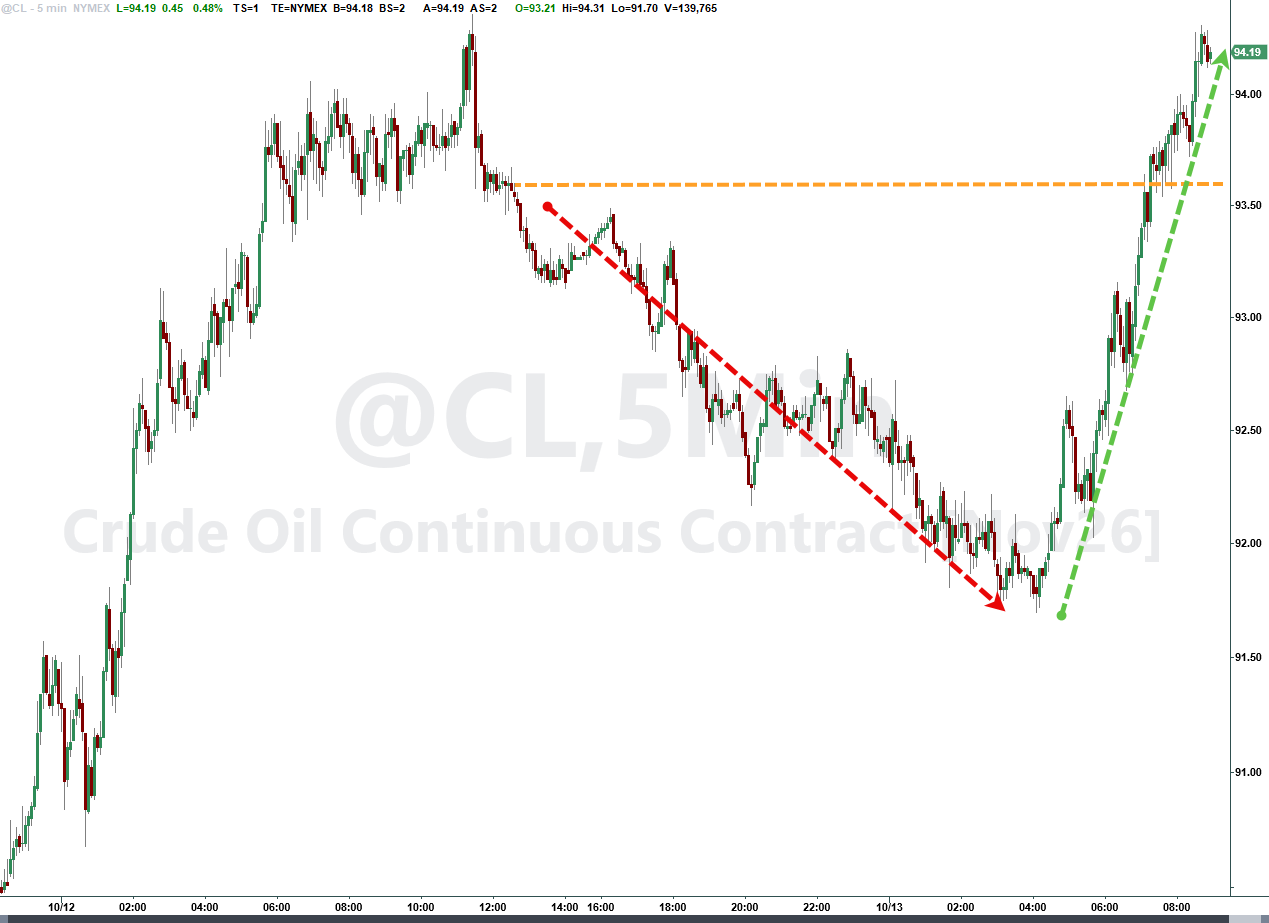
Who will blink first remains the big open-ended question, also as Washington is belatedly worried about getting bogged down in an other Mideast ‘forever war’.
END
SAUDI ARABIA VS HOUTHIS
Saudi Arabia Planning To Bypass Hormuz With Massive Expansion Of Oil Pipeline
Wednesday, Oct 14, 2026 – 08:05 AM
Saudi Arabia plans to lift the East-West pipeline’s capacity to 10 million barrels per day within two to three years, Energy Minister Prince Abdulaziz bin Salman said at the WPC Energy Congress in Riyadh, as the kingdom works to keep its crude moving around a closed Strait of Hormuz.

The line has become Riyadh’s main export route. Saudi Arabia has used it to reroute around 4 million barrels per day to the Red Sea port of Yanbu, Zawya reported. Drone attacks that Saudi Arabia blamed on Iraqi militias forced the kingdom to shut the pipeline on September 11.
Flows were back to 5.8 million bpd by October 6, the minister said, still 1.2 million short of the line’s current 7 million maximum. ZeroHedge earlier tracked the pipeline hitting a record 7 million bpd.
As OilPrice.com notes further, the 740-mile-long pipeline, also known as Petroline, has a maximum capacity of 7 million bpd at present.
Despite the ongoing conflict and disruptions, Saudi Arabia plans to add 3 million bpd to the East-West pipeline, which became a lifeline for Saudi oil exports after the closure of the Strait of Hormuz.
Thanks to the pipeline, Saudi Arabia managed to divert most of its crude oil exports away from the choked Strait of Hormuz and ships increasingly larger volumes via the Yanbu port on the Red Sea.
The route to bypass Hormuz is not without risks, either. The Iran-aligned Houthis in Yemen vowed in July to halt Saudi shipments through the Bab el-Mandeb Strait, which is the shortest route for Saudi oil supply from Yanbu to reach Asian markets.
Still, Prince Abdulaziz on Monday touted the energy resilience of the Kingdom, telling the WPC Energy Congress that energy resilience “must also be measured by the ability to maintain, repair, reroute, substitute and recover. Above all, it must be measured by the ability to continue delivering under pressure.”
Saudi Aramco’s chief executive officer, Amin Nasser, said at the same event that “In alignment with the Ministry of Energy, we are studying additional crude export routes, and working on expanding overseas storage.”
Aramco’s top executive added that the company is “also focused on mitigating risks and limiting damage, using frontier technologies to inspect facilities and accelerate restoration.”
END
RUSSIA VS UKRAINE
Ukraine Attacks Two More Refineries After Trump’s Proclaimed ‘Energy Ceasefire’: Kremlin
Wednesday, Oct 14, 2026 – 12:05 PM
The Kremlin on Wednesday indicated that work on the Trump-proposed energy truce with Ukraine is continuing, but in contradiction with recent Trump proclamations did not treat it as any kind of done deal currently in effect.
President Trump in a late in the day Monday exchange with reporters said that Ukrainian President Volodymyr Zelensky and Russian President Vladimir Putin must come together to end the war. He told the press at the White House that there had been violations of his proposed “energy ceasefire” by both Ukraine and Russia. Trump had previously stated that the warring sides agreed to an energy ceasefire, which Zelensky has balked at, saying specifics of when such a ceasefire is supposed begin must be shared with him.
That’s when Trump claimed: “Well, they agreed. You know why? Because I said: ‘you agree.’ That’s why. They agreed because I said they agreed.”
More evidence has emerged Wednesday that this supposed ‘agreement’ is still being violated almost on a daily basis. The Kremlin has announced two more oil refineries have just been attacked by Ukrainian drones:
Russia Deputy PM Novak says Ukraine attacked two refineries in Russia today; Ukraine are not showing any signs of moving towards an “energy truce”.
TASS has identified these as the Saratov and Ryazan refineries. These refineries have been targeted previously in the war, with Saratov in particular having suffered a full shutdown from damage in September 2025, during which time it was repaired. State media has been circulating the fresh reports:
Putin spokesman Dmitry Peskov has meanwhile issued a fresh press briefing wherein he said the government is committed to resolving the Ukraine conflict but that “The risk of sabotage by European countries does exist.” Ironically Europe is currently accusing Moscow of doing just this.
“The US, specifically its negotiators and President Trump, is making efforts to help steer the settlement of the Ukrainian crisis toward peace,” Peskov stated.
But then he lashed out at the EU and NATO, saying: “Europeans are taking a different approach: they are doing everything they can to ensure that this war continues.”
“There’s a lot of media hype around all of this right now, and much of it doesn’t correspond to reality; it’s pure fiction.” He was further quoted as saying:
Work on the possibility of an “energy ceasefire” is continuing.
But he also conceded: “There are no agreed-upon meetings on the agenda.” Peskov hinted at the usual backchannels, however: “This work is ongoing discreetly and it will continue discreetly,” he added.
As for Ukraine’s Zelensky, his first reaction to Trump earlier declaring an ‘energy ceasefire’ was to say it was “news to me” – strongly suggesting no such thing is in place. Both sides have continued to send wave after wave of devastating drone waves against the other, including against energy infrastructure.
END
6/.GLOBAL ISSUES, COVID ISSUES, VACCINE INJURIES/HEALTH ISSUES
GLOBAL ISSUES/
COVID VACCINE INJURY REPORT: DR MARK CRISPIN MILLER
DR PAUL ALEXANDER
In memory of those who “died suddenly” in the United States and worldwide, October 5-12, 2026
Actors Amber Siyavus (46), RJ Mitte (34); movie producer Linda Duncombe; singer Freddie Jackson; rapper Sam King; hoopster Heidi Horton (54, C); boxer Wilfredo Gómez; wrestler Jeff Cannonball; & more
| Mark Crispin MillerOct 14 |  |


A survey of the likely global toll of COVID “vaccination,” based on the reports collected by our worldwide team of researchers this past week.
Note: These reports are not arbitrarily included. For a list of the criteria we use, see this footnote.¹
To help support our work, consider subscribing or making a donation.
UNITED STATES (128)
Big Brother Star Amber Siyavus Dies at 46
10/12/2026

Big Brother alum Amber Siyavus died at age 46. Siyavus died on Friday, Oct. 9, according to documents obtained by PEOPLE. The cause and manner of death are listed as pending. The Big Brother star competed on season 8 of the hit CBS show, which aired in 2007. Her death comes eight years after her daughter, Lexi Tomcavage, died at age 18. In January 2018, Tomcavage was found dead in Ohio.
‘Breaking Bad’ actor RJ Mitte has died at the age of 34
10/12/2026

American actor RJ Mitte, best known for his role as Walter ‘Flynn’ White Jr. in the hit series ‘Breaking Bad’, has passed away. Mitte played the son of main character Walter White—portrayed by Bryan Cranston—in the successful crime series ‘Breaking Bad’. Like his character, Mitte had cerebral palsy, a condition affecting movement and muscle control. Off-screen, he also advocated for greater awareness and inclusion regarding people with disabilities.
No cause of death reported.
Linda Duncombe, Beloved Banking Executive and Movie Producer, Dies at 55
10/12/2026

Linda Duncombe, a longtime banking executive who spent the last two years as an independent film producer, died on Sunday of complications from a stroke. She was 55 years old. An infectiously friendly face at industry events, Duncombe – who was diagnosed with Stage 2 lung cancer days before she died – served for five years as chief marketing officer at City National Bank. She helped direct more than $12 million in investments tied to organizations such as Habitat for Humanity, Broadway Cares, SAG-AFTRA and the Grammy Museum. Duncombe’s last public appearance was at the Motion Picture & Television Fund’s The Evening Before the Primetime Emmy Awards on Sept. 13, where she reunited with friends and rubbed shoulders with some of Hollywood’s biggest stars. Duncombe’s friends remember her sunny spirit, boisterous and infectious laugh, unbridled optimism and passion for new experiences.
Researcher’s note – CNB’s covid “vaccination” policy during the “pandemic” (Brave AI): In an April 2021 interview, CNB’s Tim Quinlan, EVP of retail banking, stated that the bank was “not considering any type of vaccine [sic] mandate.” Instead, CNB:
- Offered paid time off for employees to get vaccinated [sic] starting in late January 2021
- Held an on-site vaccine [sic] clinic at its Cross Lanes operations center
- Described its approach as ongoing encouragement rather than a requirement
Update to last week’s report:
‘Days of Our Lives’ Robert Kelker-Kelly suffered cardiac arrest & was found on bed, harrowing 911 dispatch audio reveals
10/5/2026

Legendary soap opera actor Kelker-Kelly suffered cardiac arrest and was found in bed on the night of his shocking death, chilling 911 dispatch audio has revealed. Kelker-Kelly, who starred in nearly 600 episodes of Days of Our Lives, died on Saturday at home in Missouri from natural causes, a medical examiner’s office spokesperson told The U.S. Sun. He suffered “cardiac arrest” and was “not breathing,” the dispatcher relays to first responders in the audio. Minutes later, the dispatcher says the 911 caller was “unable to move [the] patient from bed,” and “CPR is in progress.” Kelker-Kelly was suffering from chest pains before his death around 8 pm, TMZ reported. No toxicology testing was ordered, because there was no suspicion that drugs or alcohol were involved, the medical examiner official told The U.S. Sun. TMZ reported police were called to the home to help an “unconscious man who was not breathing.” Sadly, first responders’ life-saving measures were unsuccessful.
Freddie Jackson, Grammy-Nominated R&B Singer, Dies at 69 After Revealing Kidney Disease
10/6/2026

Freddie Jackson, the Grammy-nominated R&B singer known for chart-topping hits like “Rock Me Tonight (For Old Times Sake)” and “You Are My Lady,” has died. He was 69. Jackson died on Monday, Oct. 5, just three days after his birthday, according to a statement shared to his Instagram account on Tuesday, Oct. 6. No cause of death was given. The singer announced in 2024 that he’d been diagnosed with kidney disease, and said in a video at the time that while his journey had “challenges,” he hoped to “face it with openness and resilience.” He also partnered with the National Kidney Foundation to raise awareness.
Sam King, Vocalist on Music by Dubstep Stars, Has Passed Away
10/6/2026

Sam King, the rapper featured on tracks from dubstep stars like Excision, Wooli, Space Laces and Kai Wachi, has died. The Las Vegas-born, Los Angeles-based artist died on Saturday, October 3. No further details about King’s death have been released at the time of writing.
No age reported.
Heidi Horton, Former WNBA Star Who Inspired Disney’s Double Teamed, Dead at 54
10/8/2026

WNBA star Heidi Burge Horton, who along with twin sister Heather Burge Quella inspired the 2002 Disney Channel Original Movie Double Teamed, died on Oct. 5 at the age of 54. Horton had been diagnosed with grade four glioblastoma, an aggressive and fast-growing brain tumor, in October 2025, according to her obituary. She underwent several cancer treatments, including radiation and chemotherapy, prompting her cancer to go into remission before returning in July 2026. Following her retirement from basketball, Horton moved to Houston [Texas] where she worked for the Houston Comets as a press and media broadcasting intern and was also a physical therapist, as well as a private basketball coach.
Wilfredo Gómez, considered Puerto Rico’s greatest boxer, has died at age 69
10/11/2026

SAN JUAN, PR – Wilfredo “Bazooka” Gómez, considered by many to be Puerto Rico’s greatest boxer and the holder of a world record for 17 consecutive knockout title defenses in any division, has passed away at age 69. According to his son, Wilfredo Gómez Jr., who spoke to the news network Telemundo on Sunday, his father—also known as “El Niño de Las Monjas” (The Kid from Las Monjas) due to the San Juan neighborhood where he grew up—died last night, Saturday. The former fighter, an International Boxing Hall of Fame inductee, had been hospitalized for the past two weeks due to respiratory complications. Born in San Juan on October 29, 1956, Gómez was a world champion in three weight classes (super bantamweight, featherweight, and super featherweight) and built one of the most distinguished careers in Puerto Rican boxing history.
Cynthia Miller, Wife of Detroit Lions Play-by-Play Voice Dan Miller, Dies
10/11/2026
Detroit Lions play-by-play voice Dan Miller has lost his beloved wife, Cynthia Miller [63], who passed away on October 10, 2026. Cindy was passionate about the Detroit Lions. She attended each and every home game, sitting in the fifth row right behind the Lions bench. Cynthia Miller battled Leptomeningeal disease. Leptomeningeal disease is cancer in your cerebrospinal fluid and leptomeninges, membranes that surround your brain and spinal cord.
Researcher’s note – During the 2021 COVID-19 season, the Detroit Lions coaching and football operations staff reached a 100% “vaccination” rate, complying with league-wide NFL directives: https://www.nbcsports.com/nfl/profootballtalk/rumor-mill/news/dan-campbell-all-lions-coaches-are-vaccinated
Music legend slams LA festival after woman’s body allegedly left in the crowd following her death
10/5/2026
Sheila E. slammed festival organizers following the death of a woman at the concert whose body was allegedly left in the crowd until after her performance. The legendary musician admitted she was heartbroken upon hearing how Shari Sanders died at the Carson Jazz Festival amid sweltering temperatures over the weekend in Southern California. On social media, Sheila told her followers about a “very important” situation where a concertgoer died either “during or before” her performance. “This has never happened to me in my entire career,” she said. “It was devastating. Her name was Shari Sanders.” The musician explained that it was “very hot that day” with temperatures soaring above 100 degrees in Southern California. She explained, “The lady, Shari Sanders, was saving seats – this is what we were told – was saving seats for her family and I guess someone saw her kind of slumped over a little bit, again this is what we were told.” Sheila said that the bystander asked her if she was “OK” and she was “not responsive.” “Then that lead to, you know, people coming and trying to find out what’s going on,” she said. “We then saw paramedics, but this was like 20 minutes later.” The drummer said she was told the woman had passed. “We were all heartbroken because that’s never happened, to have someone pass away before … and it was outside,” she noted. “It was at the park.”
No age or cause of death reported.
Jeff Guerriero, a.k.a. Jeff Cannonball, passes away after battle with ALS
10/8/2026

New Jersey – Independent wrestler Jeff Guerriero, a.k.a. Jeff Cannonball, passed away at 39 years old after his battle with ALS. Samantha Guerriero, a.k.a. Terra Calaway, announced her husband’s passing on social media. Jeff Guerriero made his pro wrestling debut in 2010 and was a renowned hardcore and deathmatch wrestler. He announced his ALS diagnosis in May 2025.
Legendary surfer Larry Bertlemann dies after heart attack
10/10/2026

HONOLULU, HI – Legendary surfer Larry Bertlemann died Saturday after complications from a heart attack. He was 71. Bertlemann’s family confirmed his death to Hawaii News Now. He was a pioneer of modern surfing and a skateboarding hall of famer.
END
RABOBANK/MICHAEL EVERY/OR OR PICTON/GIFFIN OR RABOBANK EXECUTIVE/COMMENTARY ON WORLDLY AFFAIRS
PHIL MAREY/RABOBANK..
Higher Ground
Rabobank’s senior US strategist Philip Marey, in a 13 October 2026 report titled “Higher Ground,” argues that the rise in the US 10-year Treasury yield involved two distinct phases: the Federal Reserve drove it up to 5%, after which concerns over US public debt pushed it higher and kept it elevated.
media.rabobank.com
The 10-year yield first sustained a move above 5% starting 23 September 2026 (peaking at 5.31% on 5 October). Marey uses two decompositions to separate the drivers:
- The New York Fed’s Adrian-Crump-Moench (ACM) model splits the yield into a risk-neutral yield (average expected federal funds rate path) and a term premium (extra compensation for holding longer-term bonds).
- TIPS-based data splits it into break-even inflation and the real yield.
Phase 1: Fed-driven move to 5% (through ~23 September)The sustained rise through most of 2026, and specifically the climb from roughly 4.80% to near 5% in early-to-mid September, was dominated by a higher risk-neutral yield (and a rising real yield). The term premium was volatile but mostly sideways or even declining in the weeks immediately before 23 September.
media.rabobank.com
This reflected the Fed shifting from contemplating rate cuts earlier in the year to actually hiking in September (with markets and the Fed’s own projections pricing further tightening). The catalyst was the US-Israeli conflict with Iran (beginning late February), which caused supply disruptions (notably around the Strait of Hormuz), higher oil/gasoline/diesel prices, and upside inflation risks. A resilient US economy—partly supported by the AI boom—made it easier for the FOMC to prioritize those inflation risks over employment concerns. Break-even inflation stayed relatively stable, indicating the Fed’s 2% target retained credibility.
media.rabobank.com
Phase 2: Debt-driven move above 5% (after 23 September)After 23 September the dynamics flipped. The term premium surged (from a low near 0.57% to around 0.98% by early October) while the risk-neutral yield was roughly flat to slightly lower. This coincided with a sharp spike in the MOVE index (Treasury options-implied volatility) starting 23 September, which Marey links primarily to a poorly received 5-year Treasury auction that day and broader concerns about US public debt/issuance.
media.rabobank.comOutlookRabobank expects the 10-year yield to move roughly sideways for the rest of 2026. There is some downward potential in 2027 if markets have overpriced the number of additional Fed hikes. However, downside is seen as limited while the economy stays resilient, geopolitics remain uncertain, the neutral rate drifts higher, and the AI boom continues to support growth. Public debt is expected to remain a recurring source of upward pressure on the term premium. Overall, longer-term yields are viewed as having reached “higher ground” and are unlikely to revisit the sub-4.30% levels seen in the months before the Iran-related conflict.
media.rabobank.com
The full report is available as a PDF from Rabobank; ZeroHedge summarized it under the same headline (paywalled beyond the key points). Context in late 2026 includes elevated oil prices from the Middle East conflict, Fed hiking after earlier cut expectations, AI-related economic resilience, and ongoing fiscal/debt concerns.
END
7. OIL AND NATURAL GAS/ENERGY COMMENTARIES
ZeroHedge Debate: Sankey Predicts 2028 Oil Futures Will Feel The Pain Soon
Wednesday, Oct 14, 2026 – 03:05 PM
The damage inflicted on global energy infrastructure during the Iran war could have consequences lasting well beyond the conflict itself, according to veteran energy analysts Paul Sankey and Arjun Murti, who joined Erik Townsend for last night’s ZeroHedge Debate.
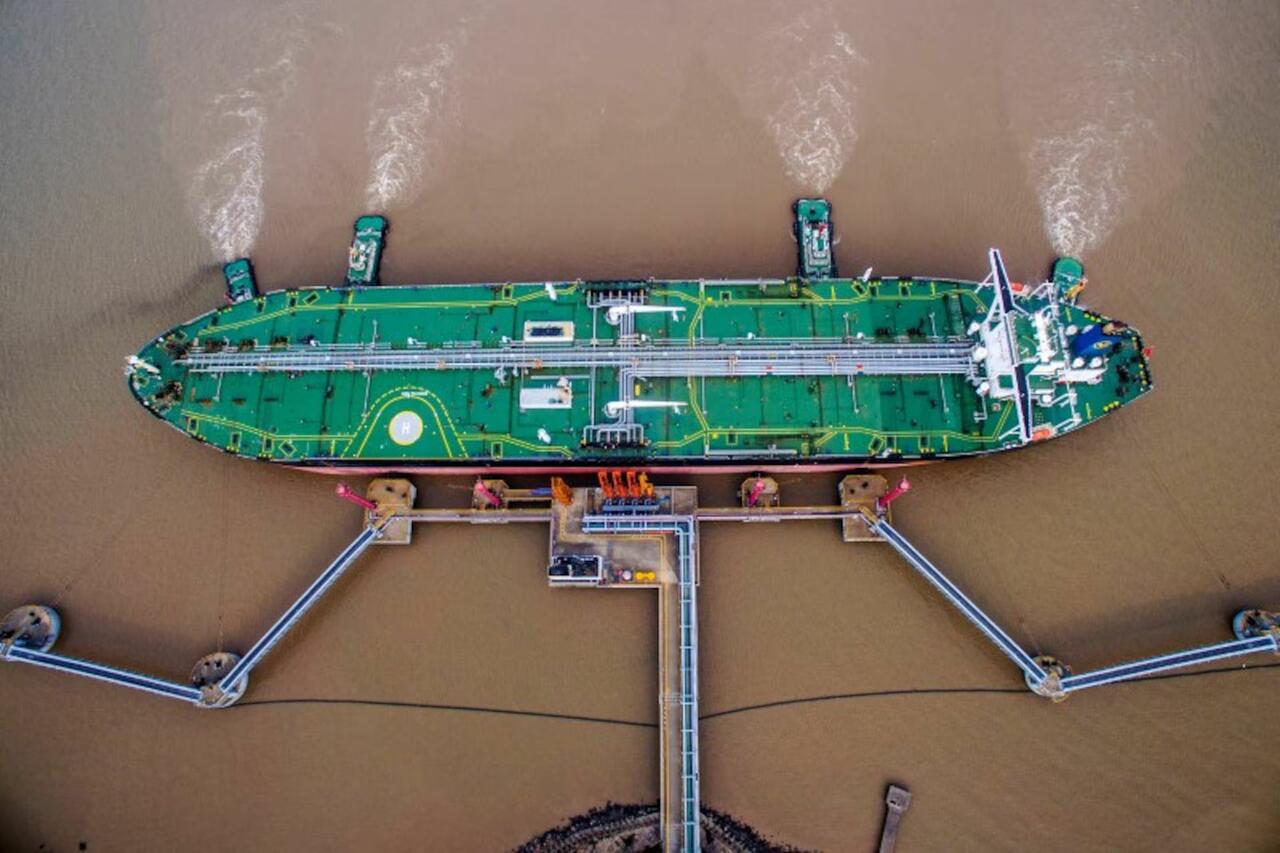
Sankey predicted that 2028 crude futures will see large moves upward as markets adapt to the reality that refinery capacity will not recover anytime soon.
Townsend fears that not only will 2028 prices rise… but that the globe may face a decades-long shortage of refined oil products, a risk he thinks people are not taking seriously. Murti meanwhile, in light of these realities, thinks “cash is king” for those weary of volatility.
Below were some highlights from the discussion though we highly recommend the full conversation for those who missed it live:
Could Refinery Damage Take A Decade To Repair?
“If you kept blowing refineries up around the world, you’d get to the point where we just don’t have enough refining capacity to run the planet, period.”
So what if the conflict drags on for years? Townsend asked:
“How far does this have to go before we get to the point where we look back on $60 crack spreads and say those are the good old days before we got to $200 crack spreads?” Crack spread being the difference in the price of crude and the consumable refined products.
“If the Iran conflict goes to five years and it’s punctuated by blowing up a lot of refineries, both in the Middle East and in Russia, how long do we go before the world has a problem that cannot be recovered for a full decade ’cause that’s how long it takes to build new refineries?”
Sankey said that we might already be there… “The short answer is it’s going to take an awful long time to recover from this, I’m afraid to say.“
“Back in Q1 results, Valero said that I think the line was […] for every day out, we need a week to recover.”
Playing Oil’s Volatility: ‘Cash Is King’
Murti argued companies and investors should resist becoming too greedy.
“Our call has been geopolitical super volatility is here to stay. And that means generally high but volatile prices. You gotta be prepared for the pullbacks that will happen.”
With oil around $100 per barrel and refining margins elevated, Murti expects companies to face pressure from investors demanding larger payouts.
“There’s a real strategic value to companies having cash on their balance sheet. We have generally stressed fortress balance sheets as a mindset in a deeply cyclical, volatile business.”
Murti pointed to the industry’s recurring downturns: 2015, the COVID collapse in 2020, and oil’s retreat from $120 in 2022 toward $50 in 2025.
“Every five years we’re having some notion of a pullback. We can’t predict the next one will be 2027 or 2030, but there’s a real strategic value to these publicly traded companies, especially in the oil value chain, to actually hoard some cash… Cash is king.”
Check out the full discussion below, on the ZeroHedge Youtube channel, or listen on Spotify.
END
Big Tech Pushes Back On Paying For A Grid That Was Crumbling Long Before AI
Tuesday, Oct 13, 2026 – 03:25 PM
When Big Tech signed President Trump’s Ratepayer Protection Pledge in March, promising to pay for all the new grid infrastructure upgrades required to service their data centers, we cautioned that “voluntary pledges from trillion-dollar tech giants have a habit of evolving.“
Seven months later, the hyperscalers are pushing back on how much of the grid’s bill is theirs to pay.
The past week brought a Democratic Senate report and a North Carolina utility settlement, and FERC is expected to rule on whether new data centers must bring their own power.
But before anyone grabs a pitchfork, ask the question none of them answers: how much of this bill is really AI’s, and how much is the cost of decades of grid neglect?
On Friday, Senators Elizabeth Warren, Chris Van Hollen and Richard Blumenthal released Power and Profits, the result of a nearly yearlong investigation into seven data center operators including Amazon, Google, Meta and Microsoft. The headline finding is as you would expect: the companies’ promises to cover their full costs apply to infrastructure serving only their own facilities, not the full cost of shared grid upgrades their arrival triggers.
The companies broadly opposed the “but-for” standard consumer advocates are pushing, under which a data center pays for any shared upgrade that “would not have been built but for the data center.” One hyperscaler told Senate staff that such upgrades often provide a “system benefit which should be shared among all ratepayers.”
They also balked at minimum bills, which advocates want set at 80% to 90% of contracted demand whether the power gets used or not. One Big Tech firm called a 90% floor “insanely high.” Another called 85% to 90% “unreasonably high,” since facilities often don’t use all of their projected demand.
Two days earlier, Duke Energy announced a settlement, signed by Amazon, Google, Meta, Microsoft and North Carolina’s utility consumer advocate, that it says ensures data centers “will pay upfront for all costs to connect to the grid.“
The settlement itself is more nuanced. Data centers prepay the full cost of equipment that serves only them, such as a dedicated substation. For shared transmission upgrades, they post a letter of credit covering the estimated cost, collateral that starts shrinking once the facility consistently draws 75% of its contracted demand.
Whether data centers get directly charged for any slice of those shared costs is punted to a Duke study due a year after approval, and would apply only to future contracts.
Bring Your Own Power… Or Else
Then there’s PJM, which wants new data centers of 50 MW or more, starting in June 2027, to bring their own new capacity or be first in line to be cut off when the grid is strained.
PJM asked FERC to sign off by October 12. The Data Center Coalition urged FERC to reject the plan, and Google, which just contracted for 890 MW of new nuclear uprates from Constellation, has warned it would “chill investment.”
With Goldman now expecting behind-the-meter power to supply a quarter of all data centers by 2030, more of them may decide that building their own plants beats arguing over the grid’s bill.
“But For” What, Exactly?
The but-for test only works if everyone agrees on what the grid would have needed anyway, and the senators’ own report suggests that is quite a lot. Tucked into its opening pages is an admission that roughly a third of US transmission and half of distribution infrastructure is operating “near or beyond its useful life.” Nowhere does it estimate how much of that needed replacing with or without AI.
No case makes the point better than Three Mile Island. As we reported in March, Constellation’s restart of Unit 1, a reactor that fed this same grid until 2019, ran into a “four-year-tall roadblock” when PJM said full deliverability could take until 2031.
Full output hinges on 765-kV and 500-kV transmission upgrades not expected until December 2030, and Constellation needed a FERC waiver to shift 760 MW of interconnection rights from its Eddystone plant just to try to work around them.
A reactor that can’t fully reconnect to a grid it was plugged into seven years ago is a grid problem, not a data center problem.
None of this means the hyperscalers deserve a free ride. They signed the pledge, and they should honor it. But “but for the data center” is doing a lot of heavy lifting for a grid that, by the senators’ own account, was already wearing out.
Then again, sending Big Tech the bill is a lot easier than explaining why the grid was falling apart before anyone had heard of ChatGPT.
END
USA
GREENLAND
Trump Announces “Massive” Greenland Oil Exploration Plans
Wednesday, Oct 14, 2026 – 07:45 AM
Authored by Tsvetana Paraskova via OilPrice.com,
“Massive” oil, gas, and minerals exploration will soon begin in Greenland, U.S. President Donald Trump said on Wednesday, claiming that the territory has enormous resources of readily available oil.

Last month, the United States, Denmark, and Greenland signed an agreement to strengthen defense and security in the Arctic and North Atlantic, easing months of tensions over President Trump’s frequent threats to seize the Danish territory. The agreement reaffirmed Danish sovereignty and the right to self-determination of Greenland residents.
“Massive Oil, Gas, and Mineral Exploration is getting ready to begin in our new and beautiful Greenland!,” President Trump wrote in a post on Truth Social on Wednesday.
“There are Experts that are saying that the amount of easily available Oil is far greater than that of almost any land, anywhere in the World and, even more importantly, from a Security Purpose in the Defense and Offense of both the United States of America, and Europe, is second to none.”
The U.S. President did not reveal any timelines of the start of oil, gas, and minerals exploration.
U.S. Greenland Energy Company has said it will fund 100% of the costs associated with up to two exploration wells in Greenland, designed to delineate the hydrocarbon potential of a project in the Jameson Land Basin.
The company this summer postponed its planned oil drilling campaign in East Greenland until winter 2027 after project equipment was brought ashore without prior approval by the government of Greenland.
Greenland has seen oil exploration since the 1970s involving major oil firms, including ExxonMobil, Shell, and Eni. None has resulted in a major discovery.
Greenland is estimated to hold oil and gas resources, as well as critical minerals and rare earth elements.
In practice, Greenland’s resources are extremely expensive and hard to extract. The lack of energy infrastructure or any processing capabilities puts in doubt the feasibility and economic rationale of trying to mine rare earths and critical minerals, for example, analysts say.
“Despite its hydrocarbon and critical mineral potential, Greenland is not Venezuela 2.0.,” Wood Mackenzie’s top analysts say, noting that the large island is remote, inhospitable, underexplored, difficult to explore, and very high cost.
END
Nation’s Largest Power Grid Declares Emergency As Hot Temps Collide With Maintenance Shutdowns
Wednesday, Oct 14, 2026 – 10:35 AM
A short-lived heat blast across the Midwest and Mid-Atlantic overlaps with scheduled power plant shutdowns for seasonal maintenance on PJM Interconnection’s grid, which serves 67 million people from the Mid-Atlantic to Chicago. PJM was forced to declare a low-level emergency for Tuesday and Wednesday as 60 gigawatts of capacity remained offline.
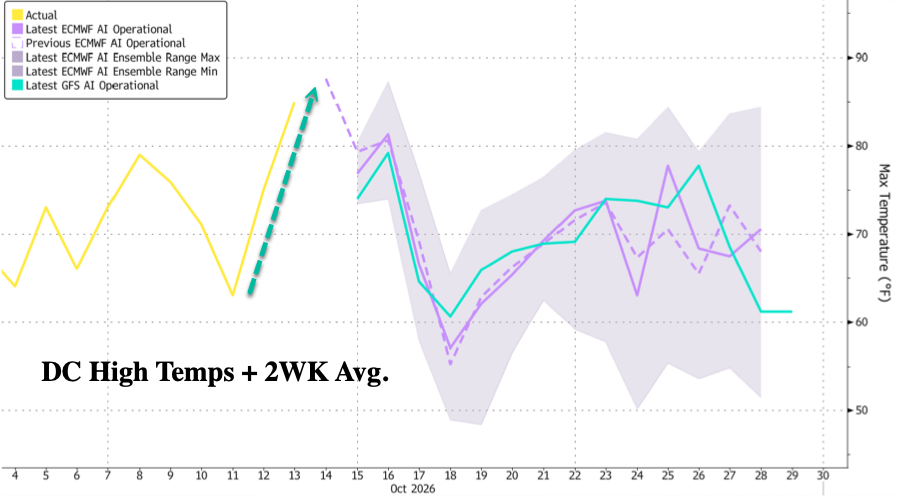
Bloomberg reports that the squeeze sent spot power prices skyrocketing across PJM’s Western hub to $1,021 per megawatt-hour Tuesday afternoon, more than double the day-ahead average for that hour. Day-ahead prices for Wednesday jumped 28% to $295.83 per megawatt-hour, the highest daily average since mid-July.
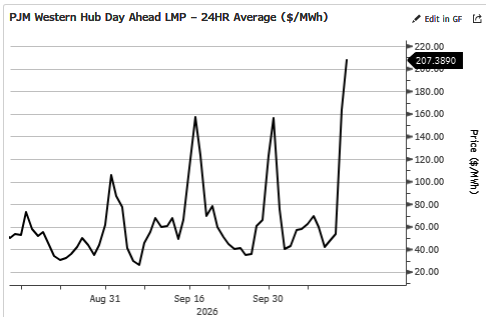
“Unpredictable weather patterns are providing fewer days to perform important maintenance or construction on the generation and transmission equipment serving our footprint,” PJM spokesman Jeffrey Shields told the outlet in an email.
Scheduled shutdowns of power plants or transmission equipment for inspections, repairs, and upgrades during seasonally low demand come as volatile weather tests the grid’s reliability.
Delaying repairs can leave aging power plants more vulnerable to breakdowns during peak demand hours, especially when heating demand soars in the middle of winter.
“Unseasonably warm temperatures combined with generation outages and lower-than-normal wind generation are creating challenging grid conditions,” Midcontinent Independent System Operator (MISO) spokeswoman McKenzie Barbknecht told the outlet. MISO’s service area covers parts of 15 US states across the Midwest and South, plus Manitoba, Canada.
Beyond PJM’s grid strain this week, lingering concerns about reliability persist and merely suggest the grid has less room for error this winter:
- A shrinking supply buffer: PJM’s outlook for winter 2025–26 projected a reserve margin of 7,500 megawatts after expected outages, exports and other adjustments, down from 8,700 megawatts the previous winter. PJM warned that electricity demand was growing faster than new generation.
- Power plants failing during extreme cold blasts: During January 2026’s Winter Storm Fern and its aftermath, generation outages averaged 18 to 19 gigawatts, exceeding PJM’s seasonal expectations. Equipment failures were the leading cause.
- Fuel availability and scheduling: Tight NatGas supplies and limited scheduling complicated operations during that cold blast. PJM maintained reliability, but preserving adequate supplies required additional measures and substantial costs.
At the start of the week, the US Department of Energy issued an emergency order directing PJM to dispatch specified generating units and operate them as needed to maintain reliability through mid-month.
END
Trump Touts Taiwan-Alaska LNG Deal Offering Decades Of Conflict-Free Supply Beyond Hormuz
Wednesday, Oct 14, 2026 – 02:05 PM
The Gulf area conflict is rewiring global energy supply chains, with Taiwan turning to Alaska for long-term, conflict-free liquefied natural gas supplies.
President Trump touted the latest development on Truth Social, saying Taiwan had agreed to purchase 30% of a planned Alaska LNG project’s output for two decades and invest an additional $4.4 billion. Taipei, however, said binding terms remain under negotiation.
“I was just in Alaska launching the largest Energy Infrastructure Project in Alaska History: The Alaska LNG Project. This 50 Billion Dollar Infrastructure Investment from The Republic of Korea is part of their Trade and Investment Deal with me,” Trump wrote on Truth Social around lunchtime in New York.
The president continued, “I am also announcing today that my Commerce Secretary, Howard Lutnick, has secured an Offtake Commitment from Taiwan of between 70 to 80 Billion Dollars for Alaska LNG. That is 30% of the Pipeline for the next 20 years.”
“On top of that, Taiwan has also agreed to invest 4.4 Billion Dollars in Equity into the Project, because this is now a U.S. Federal Government Project, with all necessary permits secured, and all necessary authorizations delivered, and ready to go,” he added.
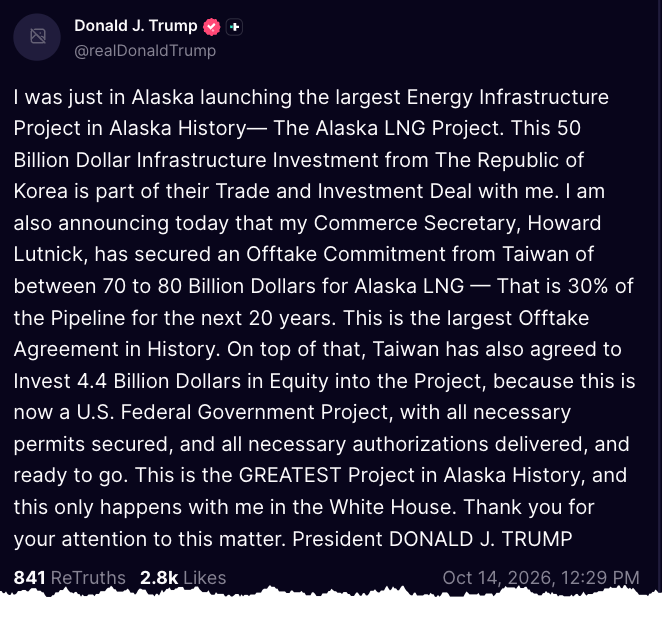
Bloomberg reported that Taiwan’s Ministry of Economic Affairs plans to buy 6 million tons of LNG annually and participate in the Alaska LNG project.
State-owned CPC Corp. previously signed a nonbinding letter of intent to consider investing. Deliveries could begin as early as 2032 if development proceeds on schedule, the ministry said.
Earlier this month, Trump announced a $54 billion South Korean investment in the project, but Seoul subsequently said participation would depend on commercial viability.
Alaska LNG is a proposed development that would transport natural gas from Alaska’s North Slope to the state’s southern coast, supplying Alaskan customers and exporting LNG to Asia.
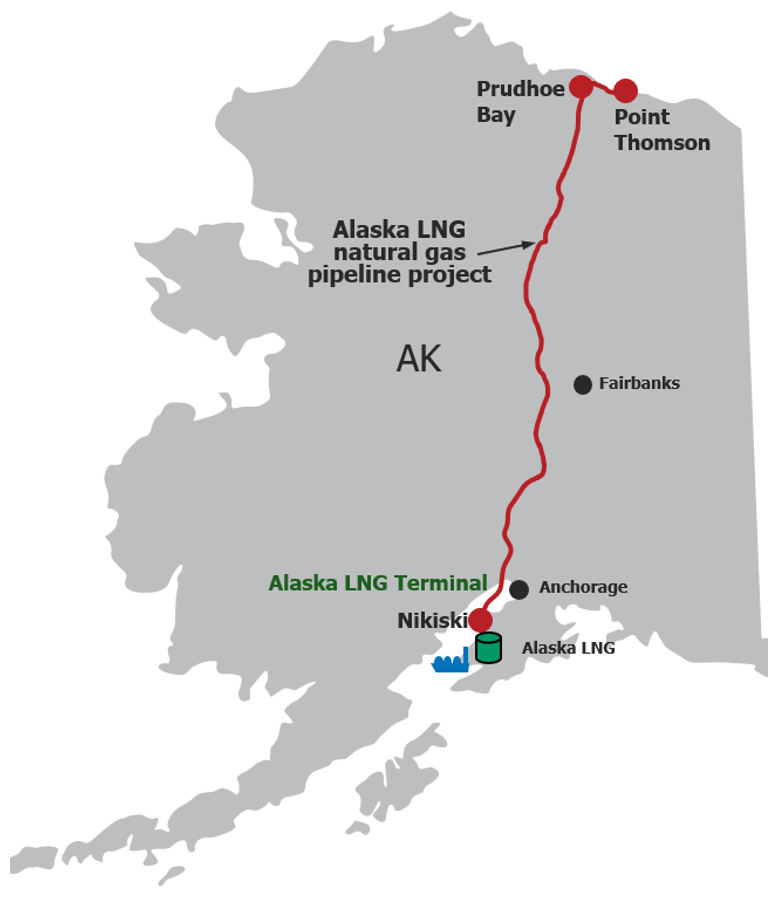
For both countries, LNG shipped from Alaska would cross the Pacific without passing through the disrupted Strait of Hormuz, helping them diversify supplies away from that maritime chokepoint.
END
ROBERT H…
Clash Report on X: “WATCH: Bali is hit by fuel crisis as queues stretch up to 2 km. Distribution delays and panic buying have caused widespread shortages across Denpasar, Kuta, Gianyar, Tabanan. Other areas with waits of 1–3+ hours and traffic jams around gas stations.”
Coming soon to many countries
8. EMERGING MARKETS//AUSTRALIA NEW ZEALAND ISSUES
MAURITIUS….
Tourist Hotspot Mauritius Rocked By Worst Riots Since 1999
Tuesday, Oct 13, 2026 – 05:20 PM
‘Tis the season to riot?
Mauritius, the island nation in the Indian Ocean east of Madagascar and off Africa’s southeastern coast, is experiencing what Bloomberg describes as the worst riots in three decades amid an affordability crisis.
“This time again, as in 1999, the police are the main target,” Jocelyn Chan Low, a political analyst, told the outlet. “The scale of the violence has multiplied, with police stations and vehicles set ablaze.”
The social unrest has forced education centers to close and prompted the country’s top business lobby to urge companies to let employees work from home amid the chaos.
Protesters have burned police stations and vehicles and blocked roads across the tiny island nation, which relies heavily on tourism and financial services.
Bloomberg pointed out, “Still, the war in the Middle East has driven up fuel prices and a crippling drought has emptied reservoirs, resulting in water-use restrictions in some areas.”
In other words, Gulf-related fuel disruptions appear to be colliding with El Niño weather effects, culminating in a perfect storm.
How did the riots start?
Bloomberg explains:
Street protests began on Oct. 7 in the central region of the main island, known as Mauritius, with roads blocked with broken furniture and mattresses. The shooting of the woman further fueled anger, with Indian surgeons who had been flown in to treat her operating on Monday to remove a bullet.
“The root cause for the unrest is almost similar to the riots three decades ago, said Chan Low. “n February 1999, a popular singer died in police custody, triggering riots.”
The Mauritius Police Force released a statement earlier today saying, “The situation is under control.”
The riots in Mauritius overlap with far-left and migrant riots in France that have spread to Belgium and may spread to other European countries.
As 2027 approaches, the convergence of elevated energy prices, El Niño-linked adverse weather, conflicts across Eurasia, and a strong dollar could raise the risk of social unrest in vulnerable emerging and developing economies.
Countries that depend on imported fuel and food, with limited fiscal capacity to cushion households, would be especially exposed. The key risk is that simultaneous shocks could turn economic frustration into broader political and social instability.
END
U.S./GOLD AND SILVER PRICING/ASIAN CLOSING MARKETS AND EUROPEAN BOURSE OPENING AND CLOSING/ INTEREST RATE SETTINGS WEDNESDAY MORNING 6;30AM//OPENING AND CLOSING\
OPENING LEVELS OF CURRENCIES// AND CLOSING ASIAN STOCK MARKET AND OPENING EUROPEAN STOCKS:6 AM EST
EURO VS USA DOLLAR: 1.1195 DOWN 0.0006
USA/ YEN 158.44 UP 0.130 NOW TARGETS INTEREST RATE AT 1.75% AS IT WILL BUY UNLIMITED BONDS TO GETS TO THAT LEVEL…//YEN STILL FALLS//END OF YEN CARRY TRADE BEGINS AGAIN DEC 2024/Bank of Japan raises rates by .25% TO 1.75 ..TAKAICHI NEW PM AS YIELDS RISE//JAPAN DEEPLY IN TROUBLE WITH RISING RATES AND A FALLING YEN!! BANK OF JAPAN WILL NO LONGER DO QE. URGES PENSION AND INSUANCE FUNDS TO BUY JAPANESE BONDS//
YEN CARRY TRADERS MURDERED
GBP/USA1.3260 UP 0.0003 OR 3 BASIS PTS
USA/CAN DOLLAR: 1.4214 DOWN 0.0003 //CDN DOLLAR UP 3 BASIS PTS//
Last night Shanghai COMPOSITE CLOSED DOWN 33.64 PTS OR 0.88%
Hang Seng CLOSED DOWN 31.05 PTS OR 0.13%
AUSTRALIA CLOSED DOWN 0.61%
// EUROPEAN BOURSE: ALL GREEN
Trading from Europe and ASIA
I) EUROPEAN BOURSES: ALL GREEN
2/ CHINESE BOURSES / :Hang SENG CLOSED DOWN 31.05 PTS OR 0.13%
/SHANGHAI CLOSED DOWN 33.64 PTS OR 0.88%
AUSTRALIA BOURSE CLOSED DOWN 0.61%
(Nikkei (Japan) CLOSED UP 70.48 PTS OR 0.10%
INDIA’S SENSEX IN THE RED
Gold very early morning trading: $4144.80
silver:$58.51
USA DOLLAR VS TRY (TURKISH LIRA): 49.39 UP 2 BASIS PTS AND NOW WE SEE THEIR STUPIDITY OF SELLING SOME OF THEIR GOLD AND ALL OF THEIR USA DOLLAR RESERVES. THE COUNTRY IS IN BIG FINANCIAL TROUBLE
USA DOLLAR VS RUSSIAN ROUBLE: 84.90 ROUBLE// DOWN 1 ROUBLE AND 26 BASIS PTS.
UK 10 YR BOND YIELD: 5.4039 UP 1 BASIS PTS
UK 30 YR BOND YIELD: 5.88880 UP 1 BASIS PTS
FRENCH OAT 10 YR BOND YIELD: 4.826 DOWN 1 BASIS PTS.
CDN 10 YR BOND YIELD: 3.869 DOWN 1 BASIS PTS
CDN 5 YR BOND YIELD; 3.555 UP 1 BASIS PTS
USA dollar index early WEDNESDAY MORNING: 102.00 UP 2 BASIS POINTS FROM TUESDAY’s CLOSE
WEDNESDAY MORNING NUMBERS ENDS
And now your closing WEDNESDAY NUMBERS 10.00 AM
Portuguese 10 year bond yield: 3.981% UP 4 in basis point(s) yield
JAPANESE BOND 10 yr YIELD: +3.043% UP 4 FULL POINTS BASIS POINTS /JAPAN losing control of its yield curve/
JAPAN 30 YR: 4.076 UP 4 BASIS PTS//
SPANISH 10 YR BOND YIELD: 4.127 UP 6 in basis points yield
ITALY 10 YR BOND: 4.600 UP 6 points in basis points yield ./
GERMAN 10 YR BOND YIELD: 3.4982 UP 4 BASIS PTS
IMPORTANT CURRENCY CLOSES : MID DAY WEDNESDAY
Closing currency crosses for day /USA DOLLAR INDEX/USA 10 YR BOND YIELD/10:00 AM
Euro/USA 1.1141 DOWN 0.0061 OR 61 basis points
USA/Japan: 158.73 UP 0.418 OR YEN IS DOWN 42 BASIS PTS// HIGHLY INFLATIONARY TO JAPAN
Great Britain 10 YR RATE 5.4619 UP 5 BASIS POINTS //
GREAT BRITAIN 30 YR BOND; 5.9327 UP 6 BASIS POINTS.
FRANCE 10 YR: 4.901 UP 6 BASIS PTS
CANADIAN DOLLAR DOWN 40 BASIS PTS TO 1.4256
xxxxxxxxxxxxxxxxxxxxxxxxxxxxxxxxxxxxxxxxxxxxxxxxxxxxxxxxxxxxxxxxxxxxxxxxxxxxxxxx
The USA/Yuan CNY 6.6928 ON SHORE ..DOWN
THE USA/YUAN OFFSHORE// CNH DOWN TO 6.6988
TURKISH LIRA: 49.39 UP 2 EXTREMELY DANGEROUS LEVEL/DEATH WATCH/HYPERINFLATION TO BEGIN.//
Your closing 10 yr US bond yield UP 10 in basis points from TUESDAY at 5.312% //trading well ABOVE the resistance level of 2.27-2.32%)
USA 30 yr bond yield 5.614 UP 5 basis points /10:00 AM
USA 2 YR BOND YIELD: 4.920 UP 13 BASIS PTS.
GOLD AT 10;00 AM $4104.00
SILVER AT 10;00: $57.65
Your 11:00 AM bourses for Europe and the Dow along with the USA dollar index closing and interest ratesWEDNESDAY
DAY CLOSING TIME/ 12:00 AM///
London: CLOSED UP 74.53 PTS OR 0.70%
GERMAN DAX: CLOSED UP 38.71 PTS OR 0.15%
FRANCE: UP 45.48 OR 0.58 PTS
Spain IBEX CLOSED UP 20.00 PTS OR 0.10%
Italian MIB: CLOSED DOWN 303.34 PTS OR 0.61%
WTI Oil price 95.69 10.00 EST/
Brent Oil: 105.76 10:00 EST
USA /RUSSIAN ROUBLE: 84.50/// ROUBLE DOWN 0 AND 86/ 100
CDN 10 YEAR RATE: 3.941 UP 7 BASIS PTS.
CDN 5 YEAR RATE: 3.639 UP 8 BASIS PTS
CLOSING NUMBERS: 4 PM//
Euro vs USA 1.1152 DOWN 0.0050 OR 50 BASIS POINTS//
British Pound: 1.3186 DOWN 0.0070 OR 70 basis pts/
BRITISH 10 YR GILT BOND YIELD: 5.4203 DOWN 3 FULL BASIS PTS//
BRITISH 30 YR BOND YIELD: 5.896 DOWN 2 IN BASIS PTS.
FRENCH 10 YR BOND: 4.8740 % UP 2 BASIS PTS
JAPAN 10 YR YIELD: 2.997% DOWN 1 FULL BASIS PTS (DANGEROUS TO THEIR ECONOMY
JAPANESE 30 YR BOND: 4.050 UP 1 PTS AND STILL VERY DANGEROUS TO THEIR ECONOMY
USA dollar vs Japanese Yen: 158.26 DOWN 0.057 OR YEN UP 6 BASIS PTS//GETTING FURTHER AWAY FROM 160.00/ EXTREMELY DANGEROUS
USA dollar vs Canadian dollar: 1.4246 UP 0.0029 PTS// CDN DOLLAR DOWN 29 BASIS PTS
West Texas intermediate oil: 95.07
Brent OIL: 106.06
USA 10 yr bond yield DOWN 3 BASIS pts to 5.191
USA 30 yr bond yield: DOWN 4 PTS to 5.520%
USA 2 YR BOND 4.806 UP 1 PTS
CDN 10 YR RATE 3.866 DOWN 0 BASIS PTS
CDN 5 YEAR RATE: 3.566 UP 1 BASIS PTS
USA dollar index: 102.35 UP 34 BASIS POINTS
USA DOLLAR VS TURKISH LIRA: 49.39 UP 2 BASIS PTS GETTING QUITE CLOSE TO BLOWING UP/IDIOTS SOLD GOLD
USA DOLLAR VS RUSSIA//// ROUBLE: 84.63 DOWN 0 AND 98 /100 roubles //
GOLD $4,103.75 3:30 PM)
SILVER: 55.70 3;30 PM)
DOW JONES INDUSTRIAL AVERAGE: DOWN 67.93 POINTS OR 0.13%
NASDAQ 100 DOWN 618.66 PTS OR 2.02%
VOLATILITY INDEX 16.90 UP 0.63 PTS OR 11.81%
GLD: $ 375.99 DOWN 5.68 PTS OR 1.49%
SLV/ 50.23 PTS DOWN 3.22 OR 6.10%
TORONTO STOCK INDEX// TSX INDEX: CLOSED DOWN 399.82 PTS OR 1.11%
end
TRADING today ZEROHEDGE 4 PM: HEADLINE NEWS/TRADING
Hawks Circle As Soaring CPI Lifts The Dollar, Hammers Everything Else… AI Credit Cracks Widen
‘WRAP UP
Stocks hit on AI concerns and hot CPI – Newsquawk US Market Wrap
Wednesday, Oct 14, 2026 – 04:14 PM
- SNAPSHOT: Equities down, Treasuries flatten, Crude up, Dollar up, Gold down
- REAR VIEW: October Fed rate hike back to a coin toss after hot US CPI; Houthi Spokesperson says operations towards Saudi airports and oil facilities will continue in the coming days; Better-than-expected Chinese trade data; US bank earnings disappoint; ASML earnings beat fails to impress; CRWV bond yield rises above 15%
- COMING UP: Data: Australian Jobs Report (Sep), UK GDP (Aug), French Final Inflation (Sep), US Jobless Claims (Oct/10), PPI (Sep), Retail Sales (Sep), Philly Fed Index (Oct), Atlanta Fed GDP (Q3). Speakers: US President Trump; BoJ’s Koeda; BoE’s Pill, Greene, Breeden; Fed’s Bowman, Hammack; BoC’s Rogers; ECB’s Cipollone. Supply: Spain, France. Earnings: TSMC, Ericsson, Charles Schwab, Alcoa.
More Newsquawk in 3 steps:
1. Subscribe to the free premarket movers reports.
2. Trial Newsquawk’s premium real-time live audio squawk for 7 days.
3. Check out Newsquawk’s US Midterm Election dashboard.
MARKET WRAP
Stocks were sold on Wednesday, with initial pressure following the hotter-than-expected US CPI report, particularly in the core metrics. Meanwhile, AI concerns continued to mount, with further weakness in memory stocks, while concerns over AI-related financing intensified after CoreWeave’s corporate bond yield rose above 15%, with Bloomberg noting that its bonds had reached levels typically associated with distress. AI-related stocks were sold aggressively throughout the session, raising broader concerns over credit risk and the sustainability of AI-related financing. Financials were lower again as Q3 earnings continue to display a mixed picture; BAC -4.8%, STT -4.1%, MS -2.8%
T-notes saw two-way trade, initially tumbling across the curve following the hot CPI report as markets ramped up expectations for further Fed tightening. However, as equity risk sentiment deteriorated, Treasuries gradually recovered throughout the remainder of the session, with only the front end settling lower in price while the longer end posted gains. Money market pricing saw a notable hawkish shift, with markets now assigning around a 50% probability of an October rate hike, up from 20% before the data.
The Dollar was initially supported by the hotter-than-expected inflation report, although DXY retreated from its post-CPI peaks as Treasury yields gave back their gains, in turn providing some support for the Yen.
Crude prices settled higher amid ongoing Saudi-Houthi strikes, while little progress was reported in US-Iran relations and further vessels were reportedly struck in and around the Strait of Hormuz. Meanwhile, Russia reportedly launched further strikes against Ukrainian energy facilities.
Gold and silver came under pressure following the CPI report and failed to stage a recovery despite the subsequent reversal in Treasury yields, while Bitcoin also weakened.
DATA
US CPI: Overall, the September CPI report was hotter than expected. Core CPI rose 0.335% M/M, above the expected 0.2% and prior 0.290%, while the annual rate accelerated to 2.6% Y/Y (exp. 2.5%, prev. 2.4%). Headline CPI rose 0.649% M/M, accelerating from the prior 0.396% and broadly in line with the 0.6% forecast. The headline increase was primarily driven by a 9.1% rise in gasoline prices, which accounted for over half of the monthly increase in the all-items index. Within the core components, increases were seen in recreation, used cars and trucks, education, airline fares, medical care and apparel, while communication was among the few major categories to decline.
The hotter-than-expected core print prompted markets to reassess expectations for the Fed’s October meeting, with the probability of a 25bps hike rising to around 50% from 20% before the release. Expectations for an October hike had previously diminished following softer-than-expected August PCE, weak September NFP data and recent commentary from Fed officials suggesting little urgency to tighten further. Attention now turns to Thursday’s PPI report for further insight into underlying inflation pressures, ahead of Fed Chair Warsh’s appearance at the IMF on Friday morning, where participants will look for his assessment of the data and any implications for the upcoming rate decision. Following the release, Pantheon Macroeconomics said the CPI report appears consistent with a 0.33% M/M increase in the core PCE deflator, which would lift the annual rate to 3.1% from 3.0% in August. However, Pantheon doubts the report is sufficiently strong to prompt an October hike given recent signalling from Fed officials, although its base case remains for a December hike amid the broad-based inflation momentum evident in the CPI data.
FED
GOOLSBEE (2027 voter): A hotter-than-expected reading on Sept inflation is “discouraging” but he wants to wait for more data before taking action to raise rates higher. He added that last month’s data was also discouraging, yet noted: “We need to get more data.” Further, he said if the underlying trend in inflation is 4% core inflation, that is “not acceptable”, and policy needs to address that – 4% refers to the annualised pace of September’s monthly core inflation reading. On services, Goolsbee reiterated concern, which is showing little sign of improvement and remains above 5%. On core goods inflation, he said it remains above 3% and should have declined as tariffs worked their way through, but it has not, suggesting more persistent inflation. That said, the 2027 voter continued to call himself one of the more “optimistic folks” at the Fed regarding how much progress can be made on inflation over the next year. Asked whether current interest rates are sufficiently restrictive to return inflation to 2%, or whether further hikes are needed, said he does not think we yet know the answer to that, but “if we get more months like this … that’s totally unacceptable”. The Chicago Fed President noted he is hearing widespread concerns about costs and prices across his Midwestern district, although, “there’s very little that we’re hearing that sounds like downturn, risks of recession, and things like that.” He added that the lack of recessionary signals makes him more concerned about demand-side overheating than a straightforward supply shock.
FIXED INCOME
T-NOTE FUTURES (Z6) SETTLED 4+ TICKS HIGHER AT 104-28
T-notes recover from post-CPI sell-off to settle higher amid equity weakness. At settlement, 2-year +0.9bps at 4.806%, 3-year -0.2bps at 4.915%, 5-year -1.6bps at 4.992%, 7-year -2.4bps at 5.089%, 10-year -3.0bps at 5.187%, 20-year -3.9bps at 5.574%, 30-year -3.9bps at 5.524%.
THE DAY: Treasuries saw two-way price action on Wednesday, with T-notes initially tumbling following the hotter-than-expected US CPI report. Core inflation exceeded forecasts on both a M/M and Y/Y basis, while headline CPI was hotter than expected Y/Y but broadly in line M/M. The upside surprise in core inflation prompted traders to bolster expectations for an October Fed rate hike, with the implied probability of a 25bps move rising to around 50% from approximately 20% before the data. Pricing further along the policy path also shifted more hawkishly, although to a lesser extent, with around 4bps of additional tightening priced across meetings beyond October through March.
The initial reaction saw Treasury yields surge, particularly at the front end, as participants reassessed the prospects for further Fed tightening. However, the move was gradually unwound throughout the session in a notable turnaround. By settlement, only the 2-year yield remained higher, albeit well off its earlier peak, while the long end had completely reversed its initial post-CPI sell-off.
There was no obvious catalyst for the gradual recovery, although the broader risk tone remained poor, with equities declining throughout the session amid continued pressure on AI-related names. Weakness in memory stocks persisted, while other AI names also came under significant selling pressure. Particular attention was on CoreWeave’s corporate bond yield rising above 15%, raising concerns over credit risk and the sustainability of AI-related financing. The equity weakness may have contributed to a flight-to-quality bid in Treasuries, helping offset the initial inflation-driven sell-off.
Elsewhere, Fed officials Goolsbee and Barkin spoke following the CPI release, although neither committed to a decision for the October meeting. Goolsbee expressed disappointment with the inflation report, while Barkin acknowledged that the reading was higher than he would have hoped.
Supply
Bills
- US sold 17-wk bills at a high rate of 4.195%, B/C 2.79x
- US to sell USD 110bln of 4-week bills and USD 105bln of 8-week bills on October 15th; all to settle October 20th
STIRS / OPERATIONS
- Fed Hike Pricing via CME FedWatch: Oct 12.3bps (prev. 5.4bps), Dec 29.8bps (prev. 27.6bps)
- EFFR at 3.88% (prev. 3.88%), volumes at USD 106bln (prev. USD 110bln) on October 13th
- SOFR at 3.89% (prev. 3.87%), volumes at USD 3tln (prev. USD 2.961tln) on October 13th
- NY Fed RRP op demand at 0.20bln (prev. 0.28bln) across 2 counterparties (prev. 1) on October 14th
- NY Fed T-Bill Purchases (1-4 month): Accepts USD 3.89bln of USD 53.98bln offered; Offer-to-cover 13.87x
- The US Treasury to buy back up to USD 6bln (prev. 6bln) in 10-20year nominal coupons in operation on Thursday.
CRUDE
WTI (X6) SETTLED USD 0.95 HIGHER AT 95.09/BBL; BRENT (Z6) SETTLED USD 0.37 HIGHER AT 106.06/BBL
The crude complex saw strength, as geopolitical tensions continue to simmer, with little sign of a breakthrough or de-escalation. Saudi/Houthi strikes remain a clear key risk, with a Yemeni Army Spokesperson today saying operations towards Saudi airports and oil facilities will continue in the coming days, and warned global shipping cos., civilians and workers to evacuate such airports/firms, as they are legitimate targets. In the Strait of Hormuz, IRGC Navy said that a container ship carrying 2,500 containers sank south of the Strait, with separate reports noting of container ships being struck. Prior to this, US President Trump gave his usual rhetoric that they’ve been taking more oil out of the Strait than before the war, reiterating that the war with Iran will end soon.
Away from geopolitics, the IEA OMR for October saw world oil demand falling by 2.6mln BPD in 2026 on Iran war disruption and rising prices (prev. 2.5mln BPD drop). OMR added oil supply is projected to post an average annual decline of 5.8mln BPD to 100.7mln BPD. Ahead, weekly private inventory metrics are due after-hours, delayed a day on account of US Columbus Day on Monday.
WTI traded between USD 93.97-96.06 and Brent traded between USD 105.21-107.15/bbl.
EQUITIES
CLOSES: SPX -1.05% at 7,724, NDX -2.02% at 29,951, DJI -0.09% at 51,622, RUT -1.90% at 2,730
SECTORS: Technology -2.62%, Communication services -1.73%, Consumer discretionary -1.1%, Industrials -0.96%, Real estate -0.82%, Financials -0.61%, Materials -0.44%, Utilities -0.31%, Energy +0.8%, Consumer staples +2.38%, Health +2.44%.
EUROPEAN CLOSES: Euro Stoxx 50 +0.33% at 6,188, Dax 40 +0.25% at 25,322, FTSE 100 +0.70% at 10,725, CAC 40 +0.58% at 7,873, FTSE MIB -0.61% at 49,754, IBEX 35 +0.10% at 19,231, PSI +0.38% at 9,416, SMI +1.45% at 14,130, AEX +0.69% at 1,137
EARNINGS:
- BlackRock (BLK): EPS & rev. topped w/ constructive comms.
- Bank of America (BAC): EPS, rev., FICC & equities rev. all missed on top of being fined $1.2b over money laundering failures
- Morgan Stanley (MS): Headline metrics impressed although internals were more mixed
- State Street (STT): Top line slightly short of Wall St exp.
STOCK SPECIFICS:
- Liquidia (LQDA) reached a global settlement agreement w/ UTHR to resolve all pending litigation between Cos.
- GameStop (GME) CEO Cohen raises stake to 9.1%.
- GlobalFoundries (GFS) received USD 21bln as part of the US-Japan deal for two new fabs.
- Dell (DELL) downgraded at Barclays.
- Berkshire Hathaway (BRK.B) invests a further USD 330mln in Bending Spoons (BSP).
- Netflix (NFLX) is cutting about 6% of its global workforce, or roughly 1,000 positions, in its largest layoffs since 2022, reports WSJ, citing sources.
- Meta (META) enabled WhatsApp call invites for users without WhatsApp accounts; Zoom (ZM) was weighed.
FX
USD strength extended on a hot US CPI report that has brought October Fed rate hike expectations back to a coin flip. The report was hotter than expected on core M/M and Y/Y, while headline CPI exceeded expectations Y/Y but was broadly in line M/M, with elevated energy prices driving the 0.6% M/M headline reading. Additionally, a broad-based sell-off in equities, led by Tech, with Financials also having a rocky start to Q3 earnings. The CPI report catalysed the move. However, yields reversed the rise on the report, trading lower on the belly and long-end at settlement, dragging USD’s performance down with it. DXY finished firmly at 102.55, though notably off the fresh YTD 102.945 highs.
JPY eked into marginal strength against the buck, supported by the turnaround in US yields. USD/JPY hit highs of 159.95 before completely paring back to around 158.17.
AUD was initially firmer on strong Chinese trade later, yet later succumbed to the broad risk-off trade. GBP and EUR were the worst G10 performers. On French fiscal policy risk, ECB’s Simkus doesn’t see a role for ECB intervention in France at present and attributes the rise in French yields to economic developments. Meanwhile, he doesn’t see evident second-round effects yet. EUR/USD made lows of 1.1113, later partially recovering to 1.1155; EUR/GBP made new YTD lows of 0.8427, before managing to pare losses and rise to 0.8458.
END
EARLY WEDNESDAY MORNING: AI
CPI: WHAT IS EXPECTED:
CPI Preview: Hot Headline, Tame Core, And An October Hike Nobody Wants
September 2026 US CPI is expected to show a hot headline (driven by gasoline) but a tame core, making an October Fed rate hike unlikely and unwanted by markets and most officials.
forex.com
Consensus forecasts (Bloomberg, Dow Jones/WSJ, Reuters, and major banks) center on:
- Headline CPI: +0.6% month-over-month (range ~0.5–0.6%) and +3.6% year-over-year (up from +3.4% in August). Some estimates edge toward 3.7%. finance.yahoo.com
- Core CPI (ex-food and energy): +0.2% m/m (down from +0.3% in August) and +2.4–2.5% y/y. investmentnews.com
Why the split?Gasoline prices jumped sharply in September (EIA data showed ~7% gains; some reports note near-record monthly rises), contributing roughly 0.3 percentage points to the monthly headline figure. Food prices are also expected to rise modestly (~0.2%). Energy remains the dominant driver of the acceleration.
reuters.com
Core is seen moderating due to factors such as normalization in wireless telephone services (after an outsized August contribution), softer lodging/hotel prices, and ongoing used-auto deflation offsetting some goods pressure from tariffs/imports. Shelter (rents and owners’ equivalent rent) is expected to show only mild acceleration.
mufgresearch.com
Implications for the Fed and marketsThis is the last major inflation print before the October 27–28 FOMC meeting (after the September hike). Fed officials have signaled a preference for patience, and recent softer jobs data already cut October hike odds. CME FedWatch probabilities for an October move have been in the low-to-mid 20s% (or lower in some updates), with higher odds for December.
investmentnews.com
- A consensus or softer core print supports the “patient” camp holding in October.
- A hot core (e.g., 0.3% m/m) could revive hike talk and pressure rates higher.
- Markets are focused on the composition (breadth of price increases) more than the headline, plus upcoming PPI data for PCE insights.
The report (due ~8:30 a.m. ET on October 14) will also feed into the Social Security COLA calculation. Overall setup matches the “hot headline, tame core, October hike nobody wants” framing: energy-driven noise that the Fed can look through if underlying pressures stay contained.
END
USA DATA RELEASES
CPI
US CPI (Consumer Price Index) for September 2026 (released October 14, 2026 by the Bureau of Labor Statistics):
bls.gov
- Headline CPI-U (All items): +0.6% month-over-month (seasonally adjusted), after +0.4% in August.
Year-over-year: +3.7% (not seasonally adjusted). bls.gov - Core CPI (All items less food and energy): +0.3% month-over-month (SA).
Year-over-year: +2.6% (NSA). bls.gov
Key details:
- The index for gasoline rose 9.1% in September and accounted for over half of the monthly all-items increase. The broader energy index rose 5.2% over the month (after +2.1% in August) and was up 20.4% over the year. bls.gov
- Shelter rose 0.4% for the month.
- Food was essentially flat (+0.0% MoM SA) and up 2.5% over the year. bls.gov
The CPI-U index level reached 336.940 (1982-84=100). The next release (for October 2026 data) is scheduled for November 10, 2026.
bls.govOfficial source:
Rate-Hike Odds, Bond Yields Explode Higher After Hotter-Than-Expected CPI
Wednesday, Oct 14, 2026 – 08:43 AM
Expectations were for a hot headline and cool core heading into this morning’s most-watched macro signal from CPI with the October FOMC decision on the line. FedSpeak has clearly pushed the market to back away from a hawkish view, today’s data may force a change.
Headline CPI did indeed come hot in September – but as expected – at +0.6% MoM, which pulls it up 3.7% YoY (hotter than the 3.6% YoY exp)…
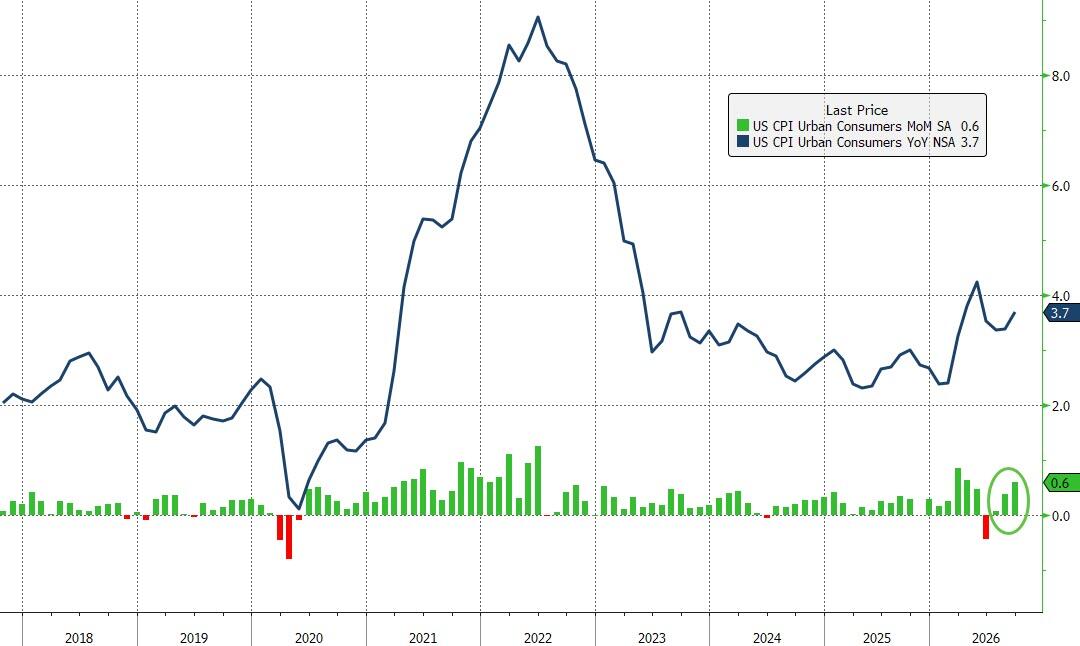
Core CPI also printed hotter than expected, up 0.3% MoM (+0.2% MoM exp). That has pulled Core CPI up 2.6% YoY (above the expected 2.5%)…
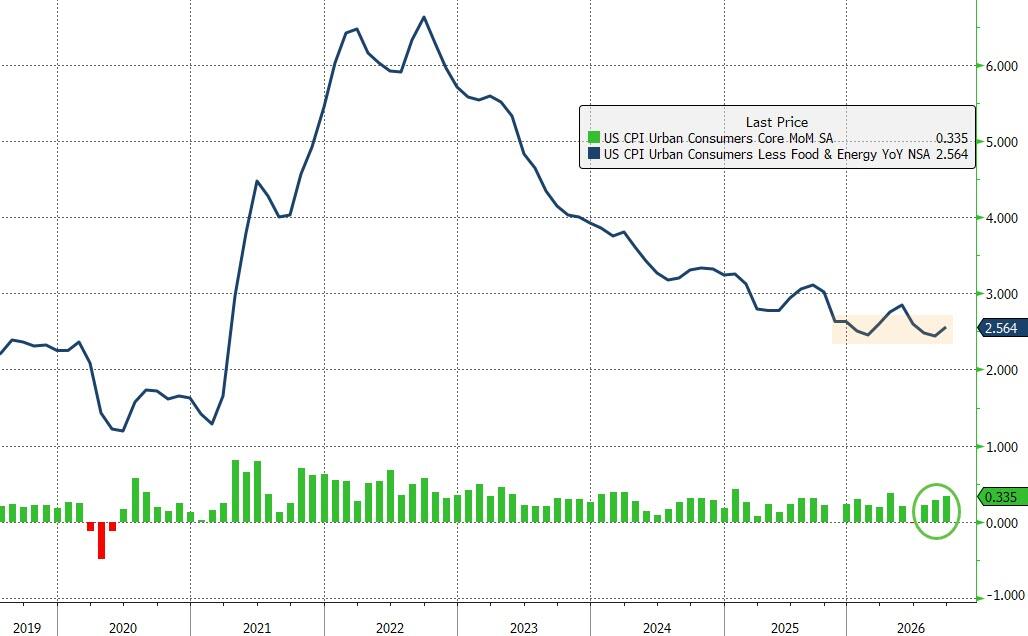
Services was the big driver of Core’s jump…
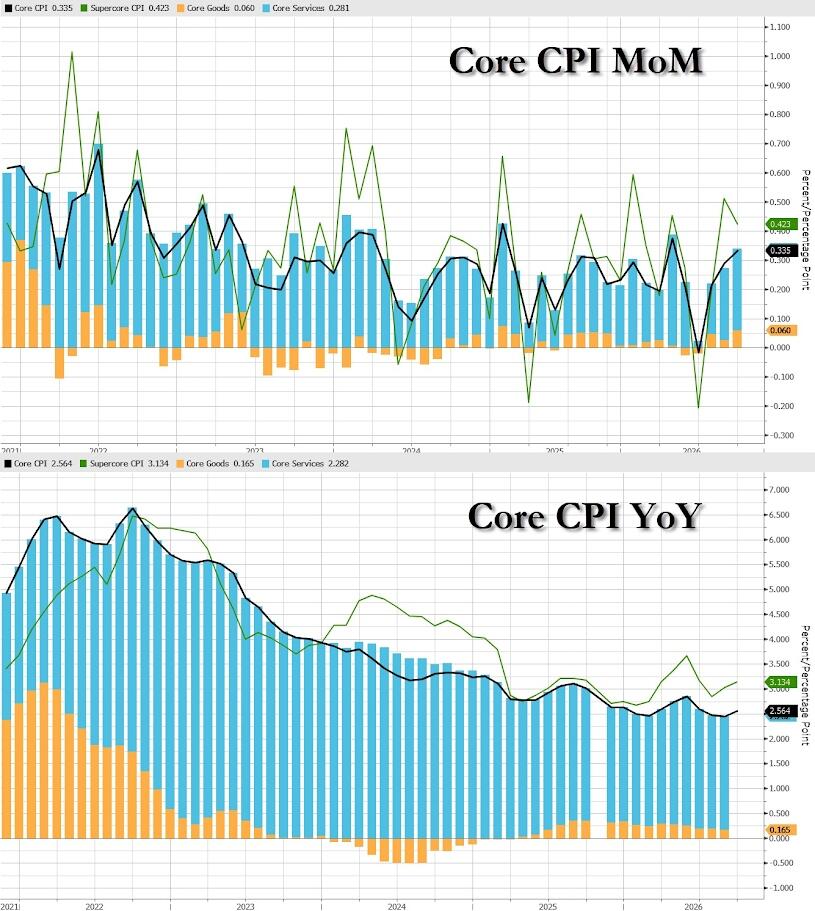
Both Goods and Services price gains accelerated in September…
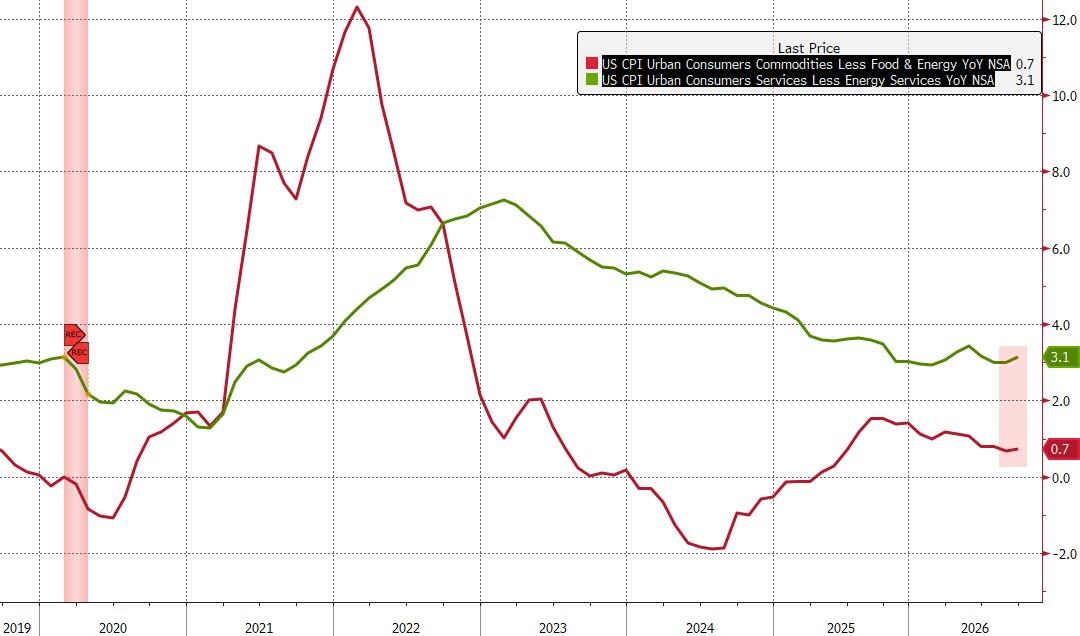
But it was Energy that was the biggest driver of the jump…
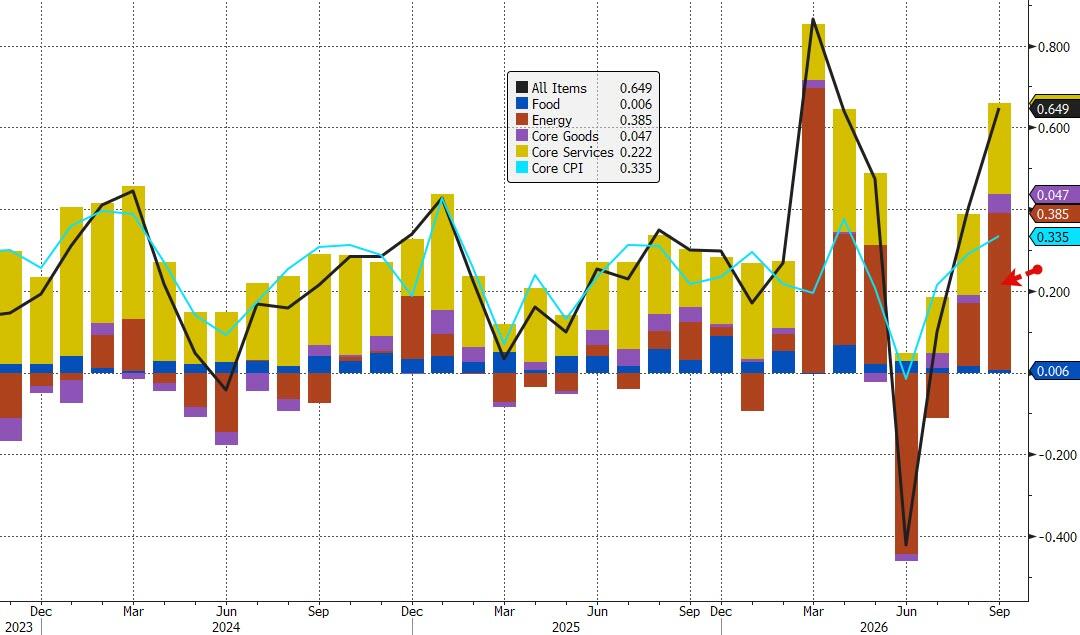
With Fuel Oil (Diesel) prices exploding higher…
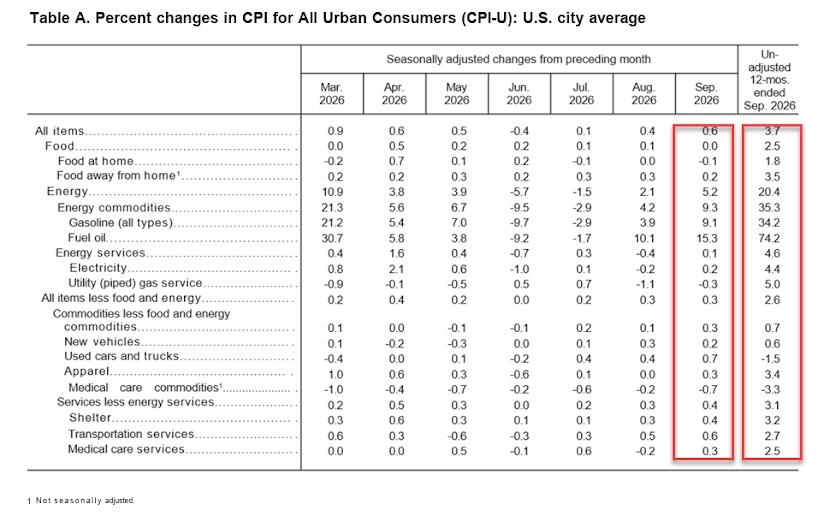
And that is only going to get worse!
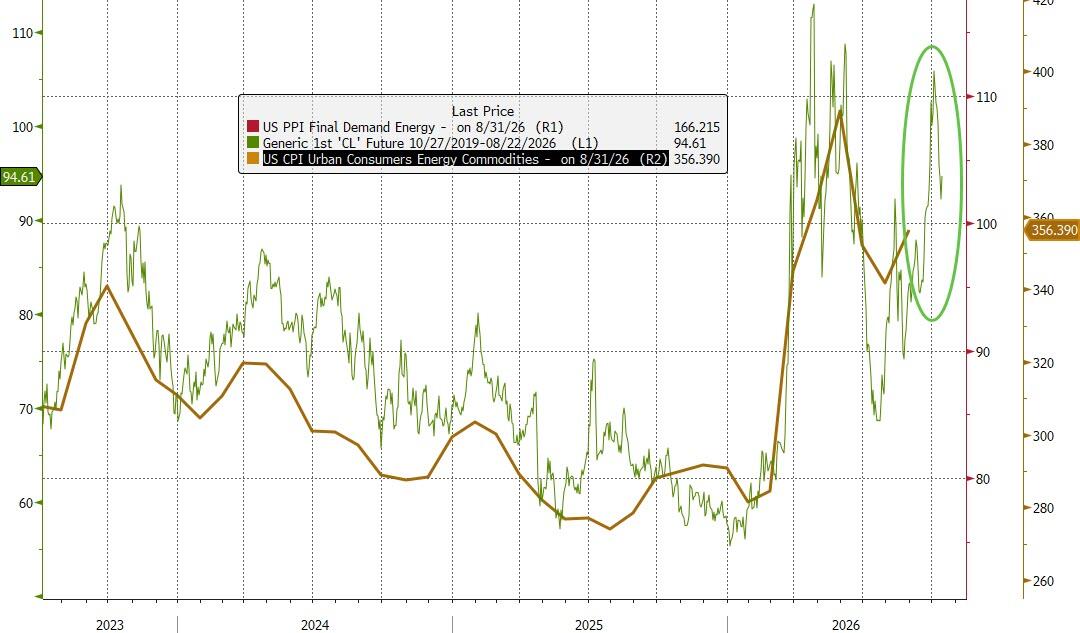
Finally, expectations were for some modest volatility today relative to the last few CPI days…
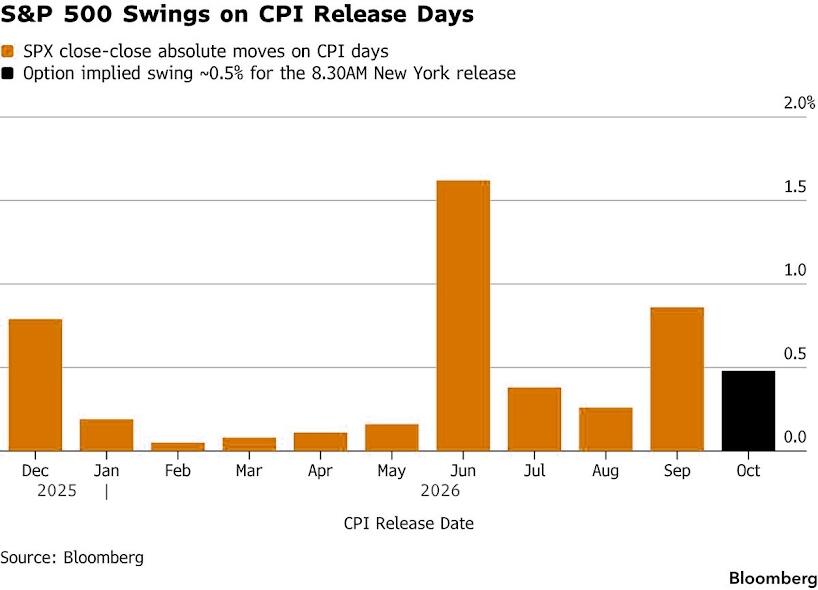
…but the dismally low volume/liquidity of the last couple of days may exaggerate any move.
Rate-hike odds have soared to 50% for October…
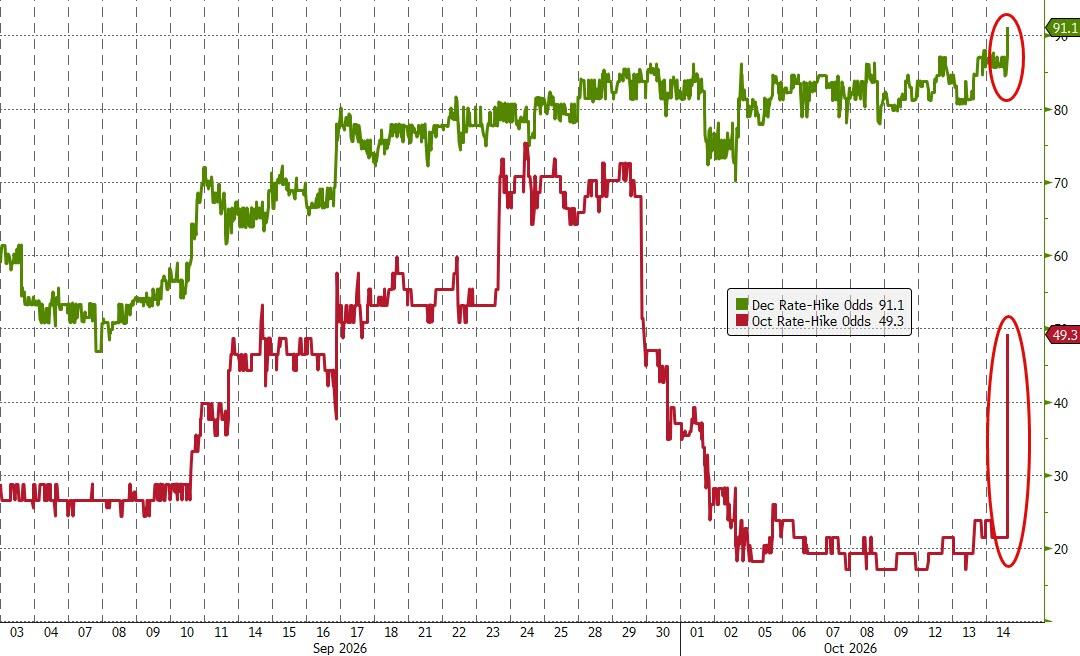
…and 2Y yields are spiking…
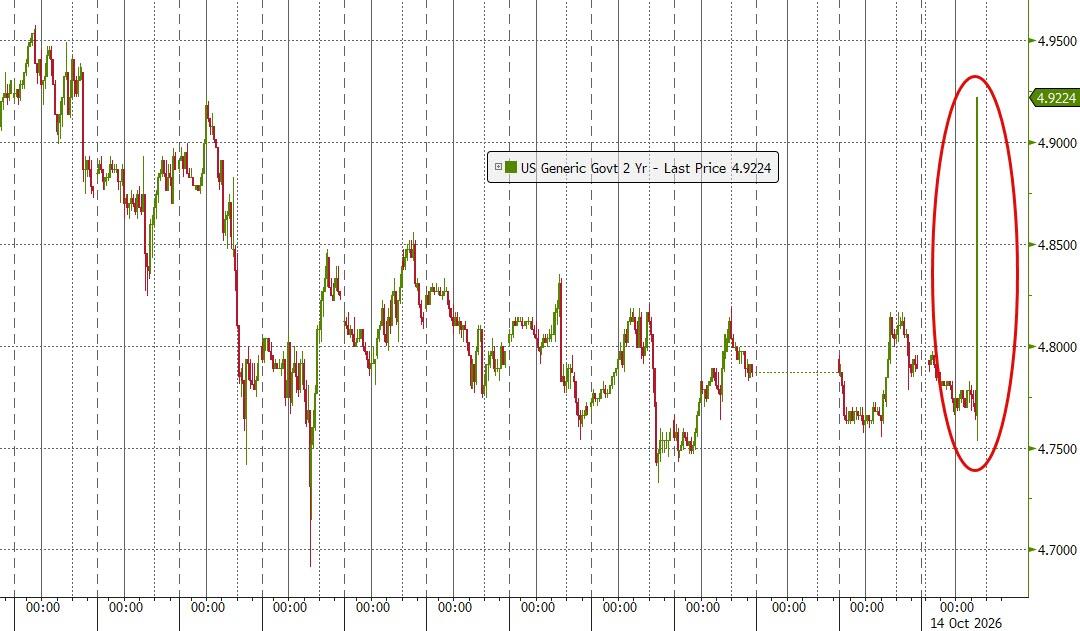
Christopher Hodge at Natixis confirms that these numbers put October in play:
“We had said that anything near consensus would not likely shift the narrative for the Fed for October, but this is far enough from consensus to make it a debate. We still think the Fed does not ultimately go – the arguments laid out by Williams and Jefferson suggests that there is no rush to tighten again right now, but today at least gives the hawks more ammo at the meeting.”
The bottom line is that this print signals reasonably broad-based price pressures too (not just energy). Prices for recreation, used cars and trucks, education, airline fares, medical care, and apparel all increased. Some of that may be tariffs and the energy story, but some of it also suggest sticky inflation.
And that is what Warsh and his pals fear most… you can’t “look through” that!
END
USA ECONOMIC REPORTS
The Everything Bubble Is Already Deflating…

by Phoenix Capital Research
Wednesday, Oct 14, 2026 – 8:41
Everyone is watching the wrong asset.
Stocks are at or near record highs. The S&P 500 is trading around 7,800. Every headline this week is about chips, oil, bank earnings, and whether the Fed hikes again. If you went by the financial media alone, you’d think the Everything Bubble was still inflating at full speed.
It isn’t. One of its largest components has already rolled over, and almost nobody is connecting the dots.
I’m talking about housing.
Last month, Redfin reported that home sellers outnumbered buyers by 57.9% in August. That is the widest gap in their records going back to 2013. There were roughly 1.53 million people trying to sell a home and fewer than 975,000 people trying to buy one. The number of sellers jumped 3.9% in a single month, the largest monthly increase Redfin has ever recorded. The number of buyers rose 0.1%. July had the fewest buyers in the history of the data.
Think about what that means. For every three people trying to buy a house in America, there are nearly five trying to sell one. Three out of five homes that sold in August went for less than the original asking price. Total inventory is at its highest level since 2020. Pending sales just hit their lowest level in nearly three years. Redfin has started calling 2026 “The Great Housing Reset.”
This is a buyer’s market in 36 of the 49 major metros Redfin tracks. In Nashville, there are 139% more sellers than buyers, the widest gap ever measured in any U.S. city. Miami is at 138%. Houston, Orlando, Las Vegas, and Dallas all set record gaps in August.

Now here is why this matters for the Everything Bubble thesis.
When I coined the term back in 2014, the core argument was simple. The Fed and other central banks had blown a bubble in the single most important asset class on the planet: sovereign bonds. Because every other asset is priced off of bond yields, the bubble in bonds spread to everything else. Stocks, real estate, private equity, collectibles, crypto, all of it.
Of all those assets, housing was the one most directly tied to the bond bubble. A home is the most leveraged purchase the average American ever makes, and the price they can pay is almost entirely a function of the mortgage rate. When the Fed drove mortgage rates below 3% in 2020 and 2021, it was pouring gasoline on the housing market. Prices went vertical.
Mortgage rates are now near 7%. The same house that was affordable at 3% requires roughly 50% more income to carry at 7%. That is the entire story of the buyer shortage. The demand for homes is still there. What vanished was the bond bubble that made those homes affordable at those prices, and housing is where that deflation shows up first.
Stocks got a lifeline that housing never did. The AI buildout, the wartime economy, trillions in capex, all of it has kept the S&P 500 propped up even as rates rose. Housing has no AI story. It has no Pentagon contracts. It is the purest expression of the bond bubble in the real economy, which is exactly why it is the first thing to crack.
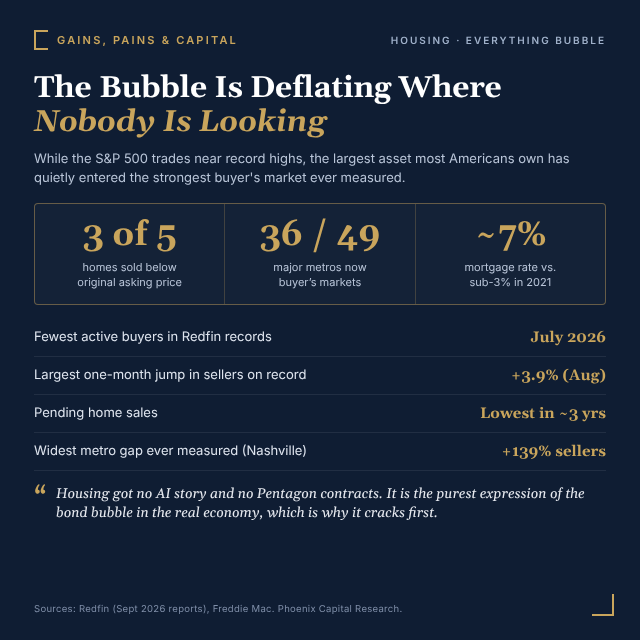
And here is the part that should get your attention. This is happening with the Fed still leaning hawkish. New York Fed President John Williams said this week that he still sees one more rate hike as appropriate this year. Oil is back near $95 with Brent approaching $108. The Fed cannot ride to housing’s rescue the way it did in 2008 or 2020, because cutting rates into an oil shock would light inflation on fire. Housing is going to have to clear on its own.
Historically, when sellers outnumber buyers by this kind of margin, home prices follow within a few quarters. We saw a much milder version of this in late 2018, when sellers briefly outnumbered buyers by less than 10%. Price growth fell to a six-year low within three months. The current gap is six times that size.
To be clear, I don’t expect a repeat of 2008. The banking system is in far better shape, the mortgages written since 2010 are mostly fixed-rate and well underwritten, and there is no subprime time bomb sitting in the system. My point is that the largest asset most Americans own has quietly entered a multi-year repricing, and the market is filing this under real estate news when it is really the first major leg of the Everything Bubble letting air out.
This has real consequences for how you invest.
First, the wealth effect is going to weaken. Housing equity is the primary source of perceived wealth for most households. When that stalls or declines, consumer spending follows with a lag. That is a headwind for the consumer discretionary names and anyone counting on the American shopper to keep carrying the economy.
Second, this is going to feed directly into the inflation debate. Shelter is roughly a third of CPI, and it lags the real housing market by 12 to 18 months. Falling home prices and rising inventory eventually show up as softer shelter inflation, which gives the Fed cover to ease later. But in the meantime, oil and diesel are pushing the other way. The Fed is going to be caught between a weakening housing market and an energy-driven inflation problem, and that tension is going to define 2027.
Third, and most important, the money that isn’t going into housing is going somewhere. Over the past year, gold has run to roughly $4,600 and silver to $75. Hard assets have been absorbing the capital that used to flow into real estate as the default inflation hedge for the middle class. That trend has a long way to go. A house at 7% mortgage rates is a losing inflation hedge. An ounce of gold is not.
So while everyone else is watching the chip stocks and the oil chart, keep an eye on the asset that is actually deflating. It is telling you something about where this cycle is going, and it is telling you well ahead of the stock market.
This is precisely why I put together a special report called Survive the Inflationary Storm. It outlines how inflation is going to play out over the next 12 months, which assets will come out ahead, and specific investments to own as the Everything Bubble continues to shift.
It normally sells for $499. I’m releasing 100 copies free to Gains, Pains & Capital readers today, and when they’re claimed the offer closes.
To pick up your copy, Click Here Now!
END
From EVs To Attack Drones: Battery Factory Conversion Echoes WWII Industrial Mobilization
Wednesday, Oct 14, 2026 – 04:15 AM
Amprius Technologies has secured a $75 million US Department of War grant to convert an EV battery production line into advanced batteries for Group 1, 2, and 3 military drones. The award marks another example of civilian manufacturing capacity being converted toward defense production as the US expands its drone industrial base.
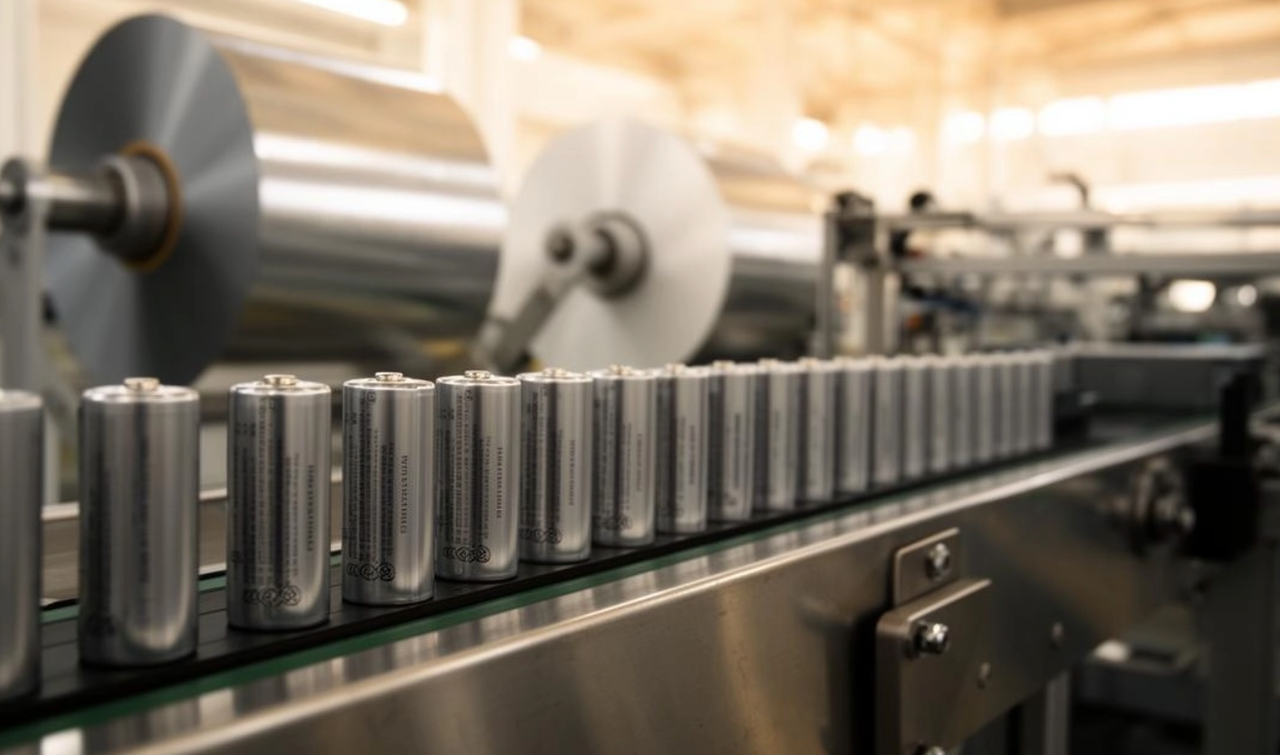
EV blog Electrek reports:
Amprius Technologies received a $15 million order for its innovative lithium-ion cells from an anonymous customer back in 2024, all the company would say was that the buyer was a, “leading Unmanned Aircraft System manufacturer.”
We still don’t know who that mysterious customer might have been, but we know this: there’s enough demand for Amprius’ energy-dense batteries that DoW is willing to spend $75 million to draft a civilian factory originally designed to build zero-emission electric cars into drone duty.
The conversion reflects a shift in capital toward defense demand. As EV demand softens, underused battery production lines offer a way to expand military drone output without building new factories from the ground up. For the DoW, repurposing existing facilities could shorten the path to ramp up drone production. This approach echoes World War II industrial mobilization: redirecting civilian manufacturing capacity to meet military needs.
Related:
- GM Delivers Patriot Missile Parts To Lockheed As Rearmament Supercycle Nears
- Volkswagen May Convert German Auto Plant Into Iron Dome War Factory
Here’s more from the EV blog:
The grant itself will see the conversion of an existing US-based electric vehicle battery production line operated by, “a major South Korean manufacturer” through a grant awarded through DoW’s Industrial Base Analysis and Sustainment Program (IBAS).
IBAS provides funds to shore up domestic manufacturing capabilities it deems critical to national security and defense, with the official copy explaining that, “the primary objective of this award is to establish high-volume, commercially viable US manufacturing for advanced battery systems that power unmanned aerial systems – Group 1, 2, and 3 drones.“
The announcement comes shortly after Defense Secretary Pete Hegseth revealed earlier this month the creation of Autonomous Warfare Command, dubbed “AutoWarCom,” to accelerate the DoW’s purchases across all categories of drones, robotics, and AI to prepare the military for warfare.
To do this, the US supply chain must scale up to produce millions of one-way attack drones, with components made domestically or in conflict-free areas. In other words, the US must source drone engines, blades, batteries, sensors, and other components outside China.
As Amprius CEO Tom Stepien explained, “This DoW grant is intended to establish a primary source of domestic, NDAA-compliant battery production.” He added, “Our technology, combined with the US manufacturing prowess of our South Korean manufacturing partner, positions us to accelerate adoption of standardized, high-performance pouch cells in a fast-growing market.”
END
Bank Of America Tumbles After Trading Miss Across The Board
Wednesday, Oct 14, 2026 – 08:11 AM
Last night we said Bank of America would use its brand new and “unexpected” $1.2 billion (non tax-deductible) money-laundering penalty as cover for an ugly quarter. This morning it tried to do just that.
Just hours after Treasury fined the bank more than $1.21 billion for willfully failing to report over $5 billion in suspicious transactions (and for having “prioritized its revenues” over compliance), BofA reported Q3 results that missed almost everywhere that matters: FICC missed, equities missed, total revenue missed, and adjusted EPS missed. As we put it last night, it was “perfect timing for tomorrow’s Adjusted EPS to miss net of ‘one time almost criminal items’” and, sure enough, the bank’s own release dutifully explains that “other net loss of $1.4 billion included a non-tax-deductible regulatory settlement charge of $1.2 billion.”
The problem for BofA is that the fine accounts for the gap between GAAP and adjusted EPS, and nothing more. GAAP EPS was $0.91; strip out the 17 cents from the penalty and you get adjusted EPS of $1.08, which still missed the $1.10 consensus. In other words, even the “clean” number was a miss.
With that in mind, here is the scorecard for Q3:
- Adjusted EPS $1.08, missing estimate of $1.10; GAAP EPS $0.91
- Revenue net of interest expense $29.96 billion, missing estimate of $30.76 billion
- Trading revenue excluding DVA $5.06 billion, missing estimate of $5.41 billion
- FICC trading revenue excluding DVA $2.55 billion, missing estimate of $2.86 billion
- Equities trading revenue excluding DVA $2.51 billion, missing estimate of $2.63 billion
- Net interest income $16.45 billion, beating estimate of $16.24 billion (NII FTE $16.61 billion)
- Net interest yield 2.16%, beating estimate of 2.11%
- Wealth & investment management total revenue $7.12 billion, beating estimate of $7.06 billion
- Investment banking revenue $1.80 billion, beating estimate of $1.77 billion
- Advisory fees $471 million, missing estimate of $483.3 million
- Debt underwriting revenue $958 million, beating estimate of $920 million
- Equity underwriting revenue $395 million, missing estimate of $422.5 million
- Provision for credit losses $1.27 billion, below estimate of $1.49 billion
- Net charge-offs $1.35 billion, below estimate of $1.44 billion
- Compensation expenses $10.97 billion, estimate $11.08 billion
- Non-interest expenses $19.72 billion; efficiency ratio 65.8%
Visually, the misses cluster precisely where the bank’s Wall Street peers made their money this week: trading and capital markets.
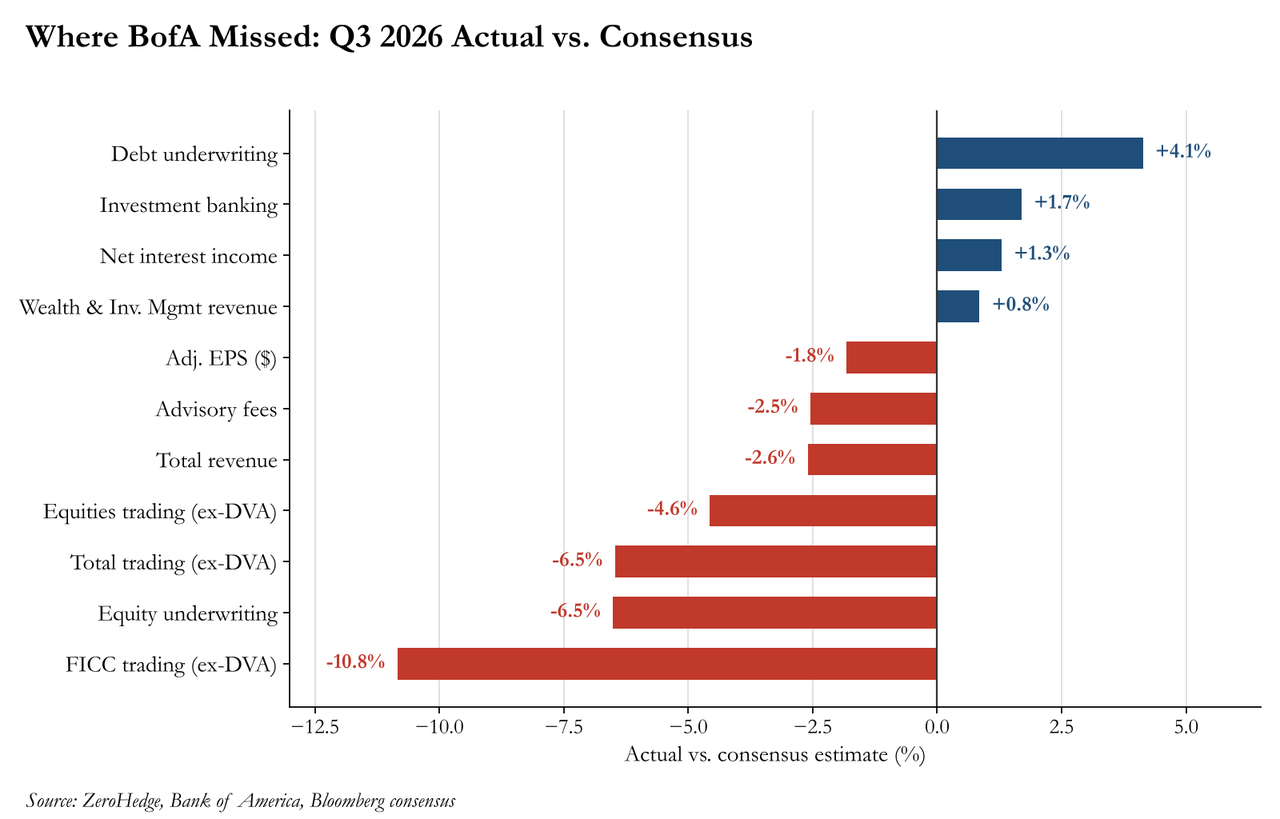
Balance sheet metrics were mixed, with capital the weak spot:
- Return on average equity 9.41%; return on average assets 0.79%
- Return on average tangible common equity 12.6% (14.9% adjusted, vs 16% in Q1)
- Basel III CET1 ratio, advanced approach, 12%, missing estimate of 12.4%
- Standardized CET1 ratio 10.9%, missing estimate of 11.2%
- Loans $1.25 trillion, beating estimate of $1.23 trillion
- Total deposits $2.04 trillion, in line with estimates
Here is how BofA itself presents the quarter, with the “charge impact” row helpfully doing the heavy lifting. Also it’s remarkable how quick Bank of America managed to flow through the “surprise” $1.2 billion charge not only through its financial statements but its presentations too just 12 hours later…
END
Pump-Pain Squeezes Convenience Store Spending: Citi Says “More Subdued” Mood Among Beverage Companies
Wednesday, Oct 14, 2026 – 05:45 AM
Our reporting this year has shown how skyrocketing gasoline and diesel prices at the pump are reshaping consumer spending habits at convenience stores and gas stations.
As fuel costs take up a larger share of household budgets, consumers trade down, cut back on discretionary purchases like energy drinks and snacks, or skip them altogether. Some also buy less fuel, putting pressure on both pump volumes and in-store sales.
Citi beverages analyst Filippo Falorni published a new report on Friday, reporting back to clients after attending the 2026 NACS Show in Las Vegas earlier this week. He warned that the overall mood among beverage companies was more subdued because of softer traffic and declining consumption, driven by higher fuel costs.
“Overall, the tone was more subdued than last year given softer traffic/consumption levels in the channel amid higher gas prices and lower-income consumer pressure,” Falorni wrote in the note.
He pointed out that Citi-tracked convenience-channel dollar sales fell 2.1% in the third quarter from the same quarter a year earlier.
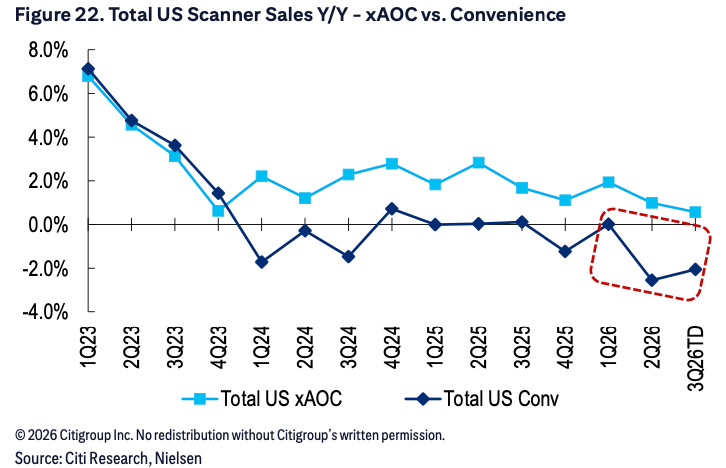
Volumes declined 5.1% in the quarter.
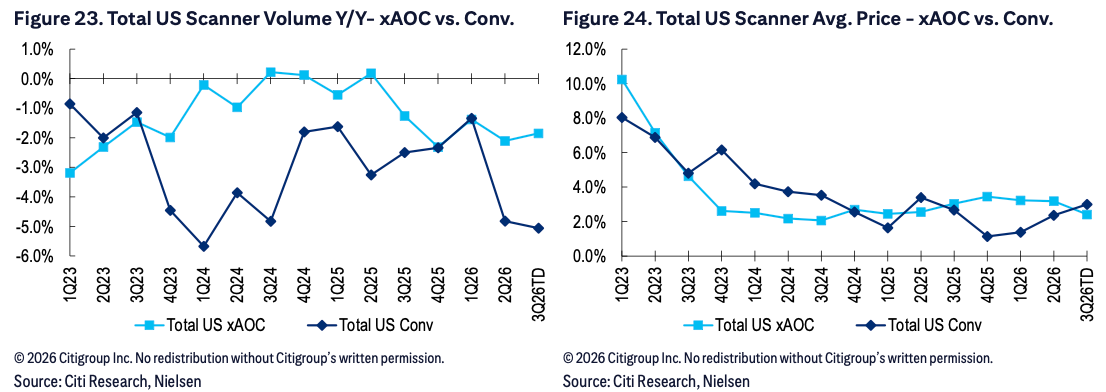
More indepth.
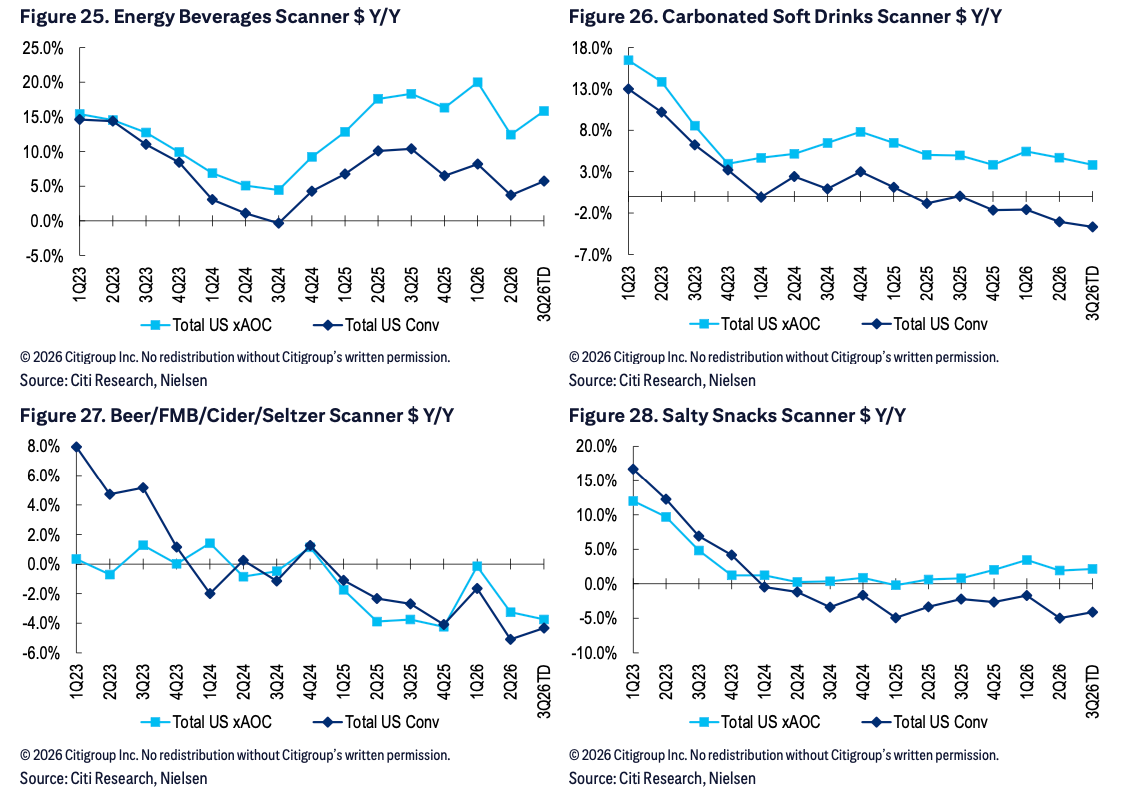
The convenience channel has materially underperformed the broader retail market since the Iran conflict began, Falorni said.
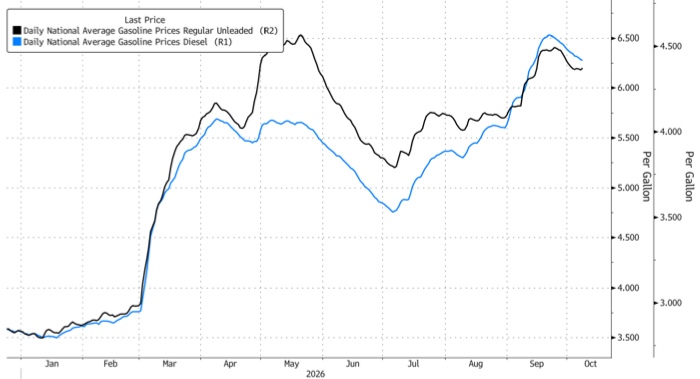
The slowdown increases exposure for energy-drink and beer producers that rely heavily on convenience stores. The channel accounted for roughly 63% of Monster Beverage’s measured retail sales and 45% of Celsius Holdings’ sales over the past year. For Constellation Brands, Boston Beer, and Molson Coors, the shares were about 66%, 60%, and 52%, respectively.
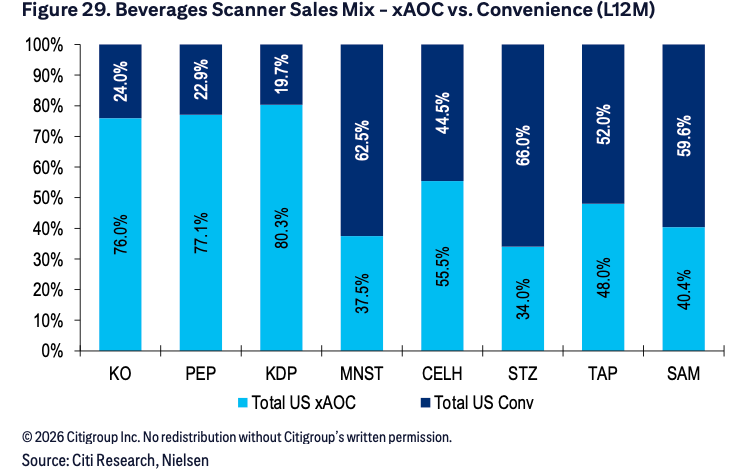
At the beverage-company level, the analyst said the convenience-store channel began underperforming in the second quarter, around the time we pointed out that consumer pullback was hitting gas stations and quick retailers (read here & here).
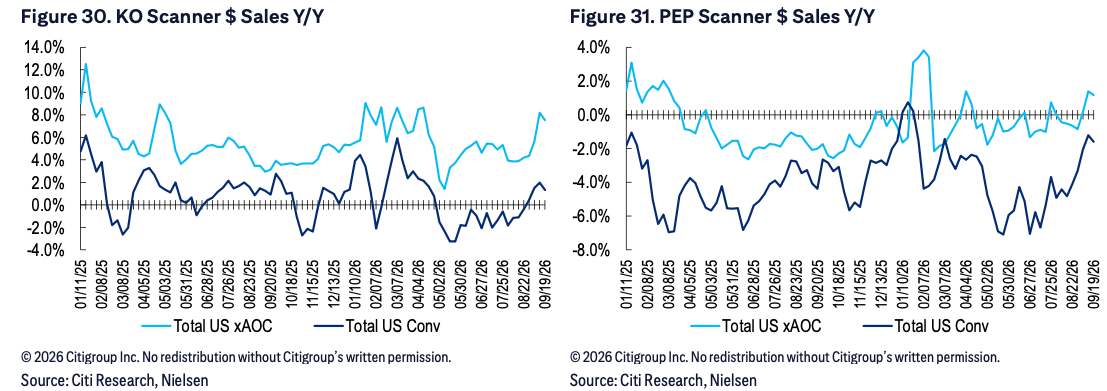
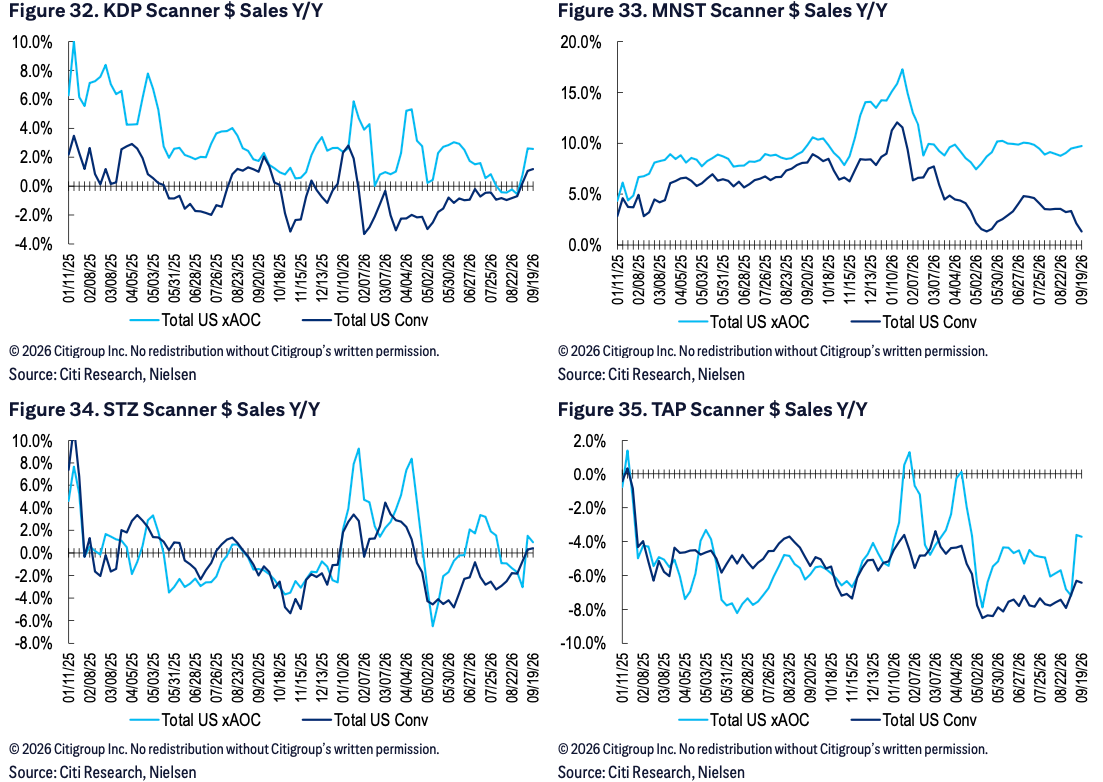
Despite those pressures, Citi remained optimistic about energy drinks, pointing to expected shelf-space gains, new customers, pricing contributions and a pipeline of products focused on protein and hydration.
Latest developments in the space, per the analyst:
Energy Drinks: MNST highlighted a solid innovation pipeline, which seems more focused on quality over quantity – incl. the Monster Protein Energy line, which will feature 30g of protein + 160mg caffeine in 12-oz cans (Vanilla & Chocolate flavors), planned for Mar-2027, plus flavor extensions across Ulta, Juice, Bang, FLRT. CELH showcased its Winter 2026 Spritz Vibe LTO – a sparkling Shirley Temple-inspired offering coming out this month. It also featured its new Celsius Energy + Hydration line (1Q’27 rollout) – 16-oz cans with 670mg electrolytes + 200mg caffeine, in 4 fizz-free flavors: Blue Freeze, Orange, Lemon Lime, Fruit Punch. Details & pictures inside.
Soft Drinks: KO plans to test-launch prebiotic sodas across its Coke Zero, Sprite Zero, & Fresca lines (each w/ 6g fiber) with regional testing planned for NY, NJ & PA in late Oct. It also featured new trademark Coca-Cola flavor launches expected in ’27, incl Cherry Lime (Feb’ 27) & Strawberry Float (summer’ 27) as well as a new Fairlife Core Power Banana flavor (Jan’ 27). PEP is introducing Pepsi Strawberry Shortcake, a new Pepsi flavor to launch in Feb ’27, Gatorade Gatorlyte Longer Lasting, a new high-electrolyte RTD beverage/powder line (Feb’ 27), and two new poppi lines, Lift & Chill, launching in ’27. KDP showcased Dr Pepper Ice Cream Float, a new permanent flavor launching nationwide in Feb ’27. For KDP’s partner brands, Bloom will roll out three new flavors: Strawberry Shortie (Oct’ 26) + Cotton Candy & Lemon Freezie (Jan ’27).
Beer: TAP is planning a 2027 national launch of its non-alc Coors 0.0 product following a soft launch across select Northeast US markets in May ’26. STZ featured its higher-ABV Modelo Chelada Suprema line with new 12- & 24-ct variety packs, with core Modelo Chelada adding a Pepino y Limón flavor next year. STZ also showcased smaller brands, incl. Right Hook (a new hard punch brand launching Mar. 27), Wildish Pop (a new vodka-based hard soda w/ 4.5% ABV & 100 calories), Austin Cocktails (brand refresh planned in 27/new flavors), Good Peels (new 12-ct variety packs and expansion into more states), & the recently acquired SpikedAde. SAM featured LYTT, a line of 15% ABV malt-based beverages launched in May.
How beverage companies have performed so far this year.
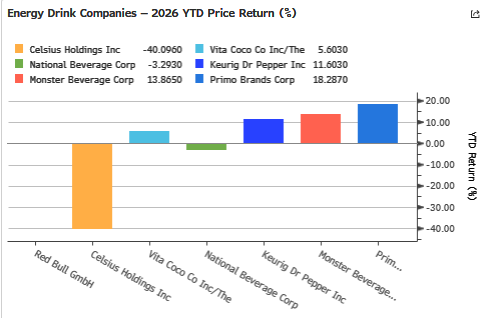
If consumers really don’t want to give up their energy drink habits, they can buy in bulk at Costco, where Kirkland Signature energy drinks cost about 70 cents per can.
END
NETFLIX
Netflix Makes Biggest Workforce Cut Since 2022
Wednesday, Oct 14, 2026 – 11:05 AM
Following our reporting earlier this week that Netflix was preparing its first major workforce reduction since 2022, The Wall Street Journal reported Wednesday morning, right before the US cash session, that the company is cutting 6% of its staff, or roughly 1,000 positions.
WSJ obtained an email that Co-CEOs Greg Peters and Ted Sarandos sent to employees earlier this morning, outlining plans to cut 6% of the workforce, or roughly 1,000 jobs. The cuts highlight mounting pressure from slowing growth and soft engagement growth after years of the streaming platform pushing unappealing, woke, toxic content.
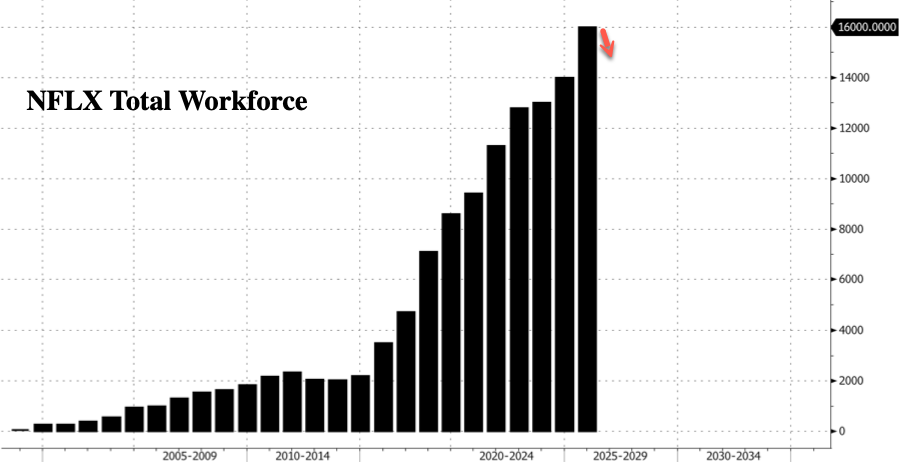
“Our mission, to entertain the world, is ambitious, and delivering on it requires us to be disciplined about where we prioritize our people and resources,” the executives wrote in the email.
The executives wrote that the company expects to meet its full-year earnings forecast and will continue investing aggressively in important areas while taking a cautious approach to staffing and spending decisions.
The workforce reduction follows a rough stretch for the stock. Shares are trading slightly higher at around $71.27 in premarket trading but down nearly 25% for the year as of Tuesday’s close.
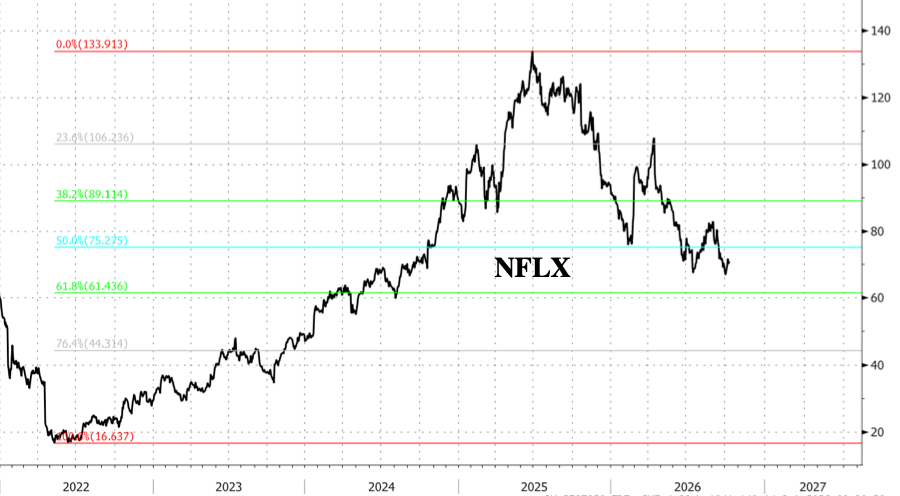
Last month, HSBC and Wells Fargo both downgraded Netflix over engagement concerns. HSBC’s Mohammed Khallouf moved the stock to Hold from Buy and cut his price target to $76 from $96, citing YouTube’s growing living-room presence and Netflix’s falling share of US TV time. Wells Fargo’s Steve Cahall cut his rating to Underweight from Equal Weight and his price target to $57 from $80, citing “worrying” engagement trends.
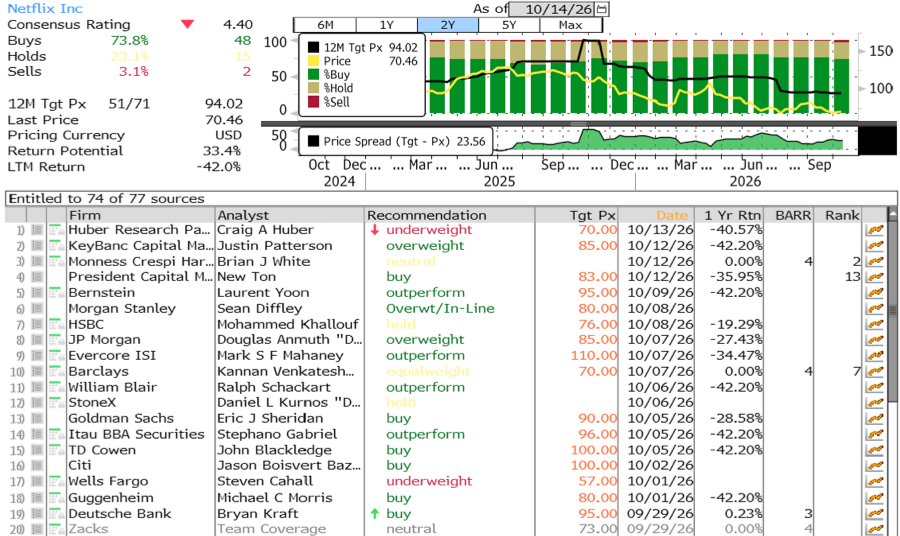
Nielsen’s July Gauge put Netflix at 7.8% of US TV viewing against YouTube’s 14.2%, TheWrap said. Reuters said the company is navigating a more competitive streaming market as media companies consolidate and YouTube takes a growing share of viewership and advertising spending.
Netflix’s Latest Failure…

Meanwhile, the based streaming platform Angel Studios has doubled its subscription base from a year ago, topping 3 million last month.
END
Another One Bites The Dust: Blackstone’s AirTrunk Pushes $1.5 Billion Data Center IPO To 2027 Days After Firmus Faceplant
The boom was underwritten at 2024 rates; it is being refinanced at 2007 rates… Someone eats that gap, and so far the public markets are making it clear it won’t be them…
Blackstone-backed AirTrunk has delayed its planned ~$1.5 billion Singapore REIT IPO, now targeting early 2027 (or the first half of next year), amid higher interest rates, market volatility, and a broader pullback in AI/data-center equity offerings.
reuters.com
AirTrunk (a major Asia-Pacific hyperscale data-center operator with sites in Australia, Singapore, Japan, Hong Kong, Malaysia, India, and elsewhere) had aimed to launch the REIT listing in September or October 2026. The vehicle was expected to raise about $1.5 billion and imply a valuation around $15 billion, potentially one of Southeast Asia’s larger listings. Blackstone and Canada Pension Plan Investment Board acquired AirTrunk in 2024 in a deal valued at more than A$24 billion (~$16–17 billion). The company has considered sweetening the deal by raising the target yield from ~5.5% to 6%.
datacenterdynamics.com
The postponement was first reported by the Wall Street Journal and confirmed via sources to Reuters, Bloomberg, and others on October 13, 2026. AirTrunk and Blackstone declined to comment. It comes as Asian equities fell (including a chipmaker-led rout that renewed scrutiny of the AI trade) and follows rising U.S. interest rates that have pressured REIT valuations and investor appetite for yield-sensitive deals.
reuters.com
This occurred just days after Nvidia-backed Australian “neocloud”/AI data-center firm Firmus (Firmus Grid) abandoned its much larger planned IPO. Firmus had targeted raising up to ~$5–5.5 billion (at times framed around a ~$30–44 billion valuation) on the ASX in what would have been one of Australia’s biggest floats in decades, but withdrew the application around October 8–9 citing market volatility and conditions. Investor concerns included high valuations, heavy debt needs for expansion, limited operational track record on AI facilities, and other deal terms. Firmus plans to pursue private capital and potentially a later U.S. listing.
bloomberg.com
Other related delays include a Philippine data-center REIT (linked to PLDT/Vitro) also pushed to 2027. The pattern highlights cooling public-market appetite for large AI-infrastructure and data-center offerings as investors reassess valuations, rising borrowing costs, and the sustainability of the AI demand boom.
bisnow.com
The ZeroHedge headline framing (“Another One Bites The Dust”) captures the sequential setbacks for these high-profile data-center deals in a short window.
KING NEWS
| The King Report October 14, 2026 Issue 7847 | Independent View of the News |
| i24’s @ariel_oseran: The Houthis warn employees and civilians in all Saudi Aramco oil facilities to evacuate, as the sites are “legitimate targets.” The warning comes in response to a Saudi evacuation notice issued for the Yemeni oil company’s central station in Houthi-controlled Sana’a. The Houthis warn that if the Saudis strike an oil facility in Sana’a as they have threatened, they will respond by attacking Aramco headquarters in Dammam, the Aramco refinery in Riyadh and King Khalid International Airport in Riyadh. @i24NEWS_EN: Saudi Arabia begins strikes on oil facilities controlled by Houthis near Yemen’s capital Sana’a – report @ariel_oseran: The Houthis issued immediate evacuation notices to three Saudi sites, following the kingdom’s strikes on Houthi oil facilities in Sana’a, Hodeidah, and Ras Issa. The threatened sites: * Aramco’s Headquarters in Dhahran * Aramco’s Riyadh Refinery * King Khalid Airport in Riyadh Zelensky Indicates Intelligence from Partners Cut Off Amid Overnight Strikes Zelensky said Tuesday in a post on X that an overnight Russian assault on the capital was “particularly vile” but that no intelligence was shared ahead of time, as has been typical previously. “There was also a particularly vile ballistic strike on Kyiv—five missiles that hit civilian infrastructure. Regarding this strike, unfortunately, there was no warning from partners… Intelligence data on the launch of Russian ballistic missiles helps save people’s lives, and this is one of the most critical issues.” “This is precisely what helps prevent people from being killed — when there is an early warning about ballistic missiles,” he wrote, without specifically apportioning blame. But the veiled message blaming the White House comes through loud and clear… (Near midday DJT said the US is still sharing intel.) Here’s what Ukrainian media says is happening behind the scenes in the meantime: Two Ukrainian officials said their U.S. counterparts had made clear that Washington would hold Kyiv responsible if Russian energy infrastructure were struck during the recently announced ceasefire. “They called all the top military officials with threats,” one Ukrainian official told the Kyiv Independent. “They’re telling everyone that they’re going to turn off both the intelligence sharing and PURL.”… https://www.zerohedge.com/geopolitical/zelensky-indicates-intelligence-partners-cut-amid-overnight-strikes The AI stock liquidation that began on Monday continued Tuesday. The South Korean Kospi tumbled as much as 7% after Broadcom CEO Hock Tan compared AI investing to a casino, and China’s CXMT announced a denser memory chip design. Broadcom CEO Likens Many AI Investors to Casino Gamblers “A lot of investors have no clue what they are investing in,” the head of the American chipmaker said at an event in Singapore. They “set very extreme expectations only to find out that it’s almost like they are in a casino.”… “For now, it’s still losing money because they’re spending a lot on training,” Tan said. “So frankly, it doesn’t tell anything at this point except that there is a lot of potential revenue growth out of providing frontier generative AI models.”… https://finance.yahoo.com/technology/ai/articles/broadcom-ceo-likens-many-ai-095852496.html Micron Falls 5% as China’s CXMT Targets Server Memory; SanDisk Drops 4% CXMT’s president announced a denser server memory chip launching by year-end at a Shanghai conference, threatening pricing across the entire high-end segment… https://finance.yahoo.com/markets/stocks/articles/micron-falls-5-china-cxmt-131219429.html Palantir CTO Says Some AI Researchers Are So Sure It Will Cure Cancer They’ve Started ‘Smoking’ — Warns Both AI Extremes Reflect ‘Social Delusion’ https://finance.yahoo.com/technology/ai/articles/palantir-cto-says-ai-researchers-223007219.html WSJ: ‘Phantom’ Data Centers Are Demanding More From the Power Grid Than They Need Utilities are imposing higher electricity rates and collateral requirements to identify legitimate data-center projects JPMorgan missed on Q3 EPS, the first time since Q2 of 2022. CEO Jamie Dimon warned that economic forces “shift under the surface.” – Yahoo Finance (Dimon said giving AI agents access to bank accounts carries serious security and liability risks.) Google AI overview on JP Morgan earnings miss • Earnings Per Share (EPS): $5.75 reported vs. $5.93 expected (a 3.0% or 18-cent miss). • Revenue: $50.17 billion reported vs. $51.23 billion expected (a 2.1% miss). • Net Profit: $15.305 billion, up 6% compared to the same period last year. • Return on Tangible Common Equity (ROTCE): Held strong at 20%. • Results included $658 million in net investment securities losses, which reduced EPS by $0.18. • Trading Activity: Equity markets revenue surged 49% year-over-year to $5.0 billion, while fixed income markets revenue declined 4% to $5.4 billion. • Market Reaction: JPM shares experienced initial pressure in premarket trading before stabilizing. Google AI Overview: Wells Fargo reported its Q3 2026 financial results, posting GAAP earnings per share (EPS) of $1.87—beating Wall Street consensus estimates of $1.85 to $1.87—while total revenue of $21.87 billion fell short of analyst expectations. • Total Revenue: $21.87 billion (up 1.7% year-over-year, but missing consensus estimates ranging from $22.31 billion to $22.61 billion). • Earnings Per Share (EPS): $1.87 GAAP profit per share, up 13% from $1.65 a year ago and slightly above consensus forecasts ($1.85–$1.87 depending on the tracking data). • Net Interest Income (NII): $12.52 billion (up 5% year-over-year, though missing the $12.63 billion estimate due to lower floating-rate asset yields and higher deposit costs). • Loans & Deposits: Average loans grew 11% year-over-year to $1.03 trillion, and average deposits increased 11% to $1.48 trillion. • Credit Losses: The provision for credit losses rose to $1.03 billion compared to $681 million (y/y)… September Existing home sales 3.99m, 3.95m expected; 3.93m August, revised from 3.98m Median price: $417,500, +1.3% y/y, a record for the month of September. @NAR_Research: Existing-home sales rose 1.5% from August but were down 2.2% from a year ago. More inventory is giving buyers greater negotiating power, while higher mortgage rates continue to limit affordability and slow sales activity. https://bit.ly/4ijxUOs Total housing inventory registered at the end of September was 1.60 million units, up 1.9% from August and up 4.6% from one year ago. “Higher inventory and lengthening days on market give buyers improved negotiating power. Home sellers need to be realistic about local market conditions, which could require price discounts and other incentives to attract buyers,” Yun said @DeItaone: U.S. DIESEL PRICES SURGE DESPITE TAX RELIEF AND RUSSIAN SUPPLY DEAL – U.S. diesel futures are up 2.1% to $4.8239 per gallon, despite tax relief measures and the lifting of sanctions on Russian diesel. Analysts warn that tax breaks on dyed diesel offer little benefit to trucking companies, while additional Russian supply is unlikely to ease prices significantly in the near term. Global diesel markets remain extremely tight, keeping upward pressure on fuel prices. Russia says it struck vessels carrying military cargo to Ukraine’s ports Russia carried out drone strikes on various targets in Ukraine on Monday, including on vessels carrying military cargo, Russia’s Defence Ministry said. The ministry said it had struck three cargo vessels which it said were being used to transport military cargo to Ukraine’s Black Sea ports – two bound for Odesa and one heading to Mykolaiv… https://www.reuters.com/world/europe/russia-says-it-struck-vessels-carrying-military-cargo-ukraines-ports-2026-10-12/ Traders bought longer-term Treasuries on Tuesday on the belief that the Fed will NOT hike rates in October next week due to the Midterm Elections on November 3; and today’s September CPI will be in line or better than expected, especially the Core CPI. Yes, Virginia, there was copious short covering. Cleveland Fed Inflation NowcastingInflation, month-over-month percent changeMonthCPICore CPIPCECore PCEUpdatedOctober 20260.270.200.280.2510/13September 20260.530.200.430.2510/13 Inflation, year-over-year percent changeMonthCPICore CPIPCECore PCEUpdatedOctober 20263.632.303.693.1010/13September 20263.602.393.563.0210/13https://www.clevelandfed.org/indicators-and-data/inflation-nowcasting For a second straight session, investors and traders sold AI stocks and bought ‘safe’ Fangs. Apple hit an all-time high. MSFT and Meta were close to all-time highs during the first hour of trading. The S&P 500 Index gapped lower on its opening (7795.27). Despite the above negative news, traders were determined to buy stuff for the Earning Season Rally and a Turnaround Tuesday to the upside. Besides, there is little risk with the Midterm Elections only 20 days away. So, the S&P jumped to the daily high of 7814.15 (+6.91 pts) at 9:39 ET. The index then declined to 7786.11 (daily low) at 11:38 ET. The post-European close (11:30) move conflated with a Noon Balloon and created an ABC rally that took the S&P 500 Index to 7807.73 at 14:14 ET. The S&P 500 gapped from 7798.55 at 14:05 ET to 7801.16 at 14:06 ET. The index hit 7807.73 at 14:14 ET and rolled over. Astute traders recognized that the S&P 500 Index stalled near the Monday high of 7807.15. The S&P fell to 7799.43 at 14:49 ET. Just like on Monday, a breach of 7800 induced buying to prevent momentum selling. The S&P rallied to 7812.61 at 15:34 ET. The index fell to 7803.65 at 15:57 ET. A modest manipulation closed the S&P 500 Index at 7805.45. @realDonaldTrump: The Houthis are behaving very badly. I thought they learned their lesson a year ago when we bombed the HELL out of them and, at their request, stopped. They’ve been silent for a long time, but now they’ve emerged again, probably at the behest of Iran, which is a Failing Nation, with No Navy, No Airforce, the World’s Worst Economy, and 301% Inflation, in a very nasty way, hitting Saudi Arabia, and purposefully trying to drive up Oil Prices, probably prior to the U.S. Elections — NOT NICE. Somebody should explain to them that I’m not running in the Elections, I’ve already won, IN A MASSIVE LANDSLIDE, but I’ll be there after the Elections, and I will never forget! President DONALD J. TRUMP Oct 13, 2026, 12:04 PM Nov Diesel futures jumped 4.5%, a two-week high, despite DJT’s insistence of an energy ceasefire. USZs hit a daily high of 104 7/32 (+1 2/32) at 7:12 ET. The December 30-year bond future contract then fell to 103 15/32 at 10:03 ET. Another reason for the early bond buying: The yen/$ sank from 158.358 at 4:45 ET to 157.836 at 4:56 ET. Then the yen/$ jumped to 158.193 at 6:32 ET; it then fell to 158.01 at 7:05 ET. After a run to 158.426 at 12:16 ET, Traders suspected an intervention or two occurred, but the market rejected the interventions. This is why USZs sank after the 7:12 ET high. NYSE Touches Down at TechCrunch Disrupt: NYSE Content Update (Oct 13 – 15 in SF) The NYSE is an official partner of TechCrunch Disrupt 2026. The three-day event will feature over 200 sessions and more than 10,000 attendees. NYSE’s Global Head of Technology Ecosystems Brian Baumann and Head of Partnership Development + Media Distribution Kevin Hawkins are among this year’s notable speakers. https://www.prnewswire.com/news-releases/nyse-touches-down-at-techcrunch-disrupt-nyse-content-update-302907066.html @DeItaone: Reminder: Anthropic is reportedly holding an institutional investor day on Wednesday, October 14, ahead of its potential IPO. Investors are expected to discuss the company’s financial performance, although no public financial disclosures have been confirmed. Positive aspects of previous session DJTA +0.26%; Energy +1.77%, Com Serv +0.9%, Utes +0.53%, Materials +0.36%, Info Tech +0.04% NVDA +2.2%, Meta +2.63%, MSFT +1.1%, Apple +0.09%, MSFT +0.43%, AMD +1.9%, INTC +1.44%, GOOGL +0.3%; USZs +22/32 and Dec Brent -$0.32 and Nov Gas -0.41¢ at 16:15 ET Negative aspects of previous session S&P 500 -0.02%, DJIA -0.35%, Nasdaq -0.15%, Nas 100 – 0.31%; SOX -0.23 SP Health Care -1.4%, Cons Staples -0.38%, Financials -0.35%, Industrials -0.33%, Real Estate -0.29%, Consumer Discretionary -0.01% MU-3.62%, SNDK -6.09%, AMD -2.34%, AMZN -1.47%, SPCX -4.21%, SNDK -0.34% Nov WTI +$1.04, Nov Diesel rallied as much as 4.5% Ambiguous aspects of previous session Will the decline in AI stocks continue Tuesday? First Hour/Last Hour NYSE Action [S&P 500 Index]: 1st Hour: Up; Last Hour: Down a tad Pivot Point for S&P 500 Index [above/below indicates daily trend to day traders]: 7801.86 Previous session (S&P 500 Index) High/Low: 7814.15 (9:39 ET); 7786.11 (11:38 ET ET) FBI arrests Saudi OpenAI engineer over covert recording device, DOJ says https://reut.rs/4ztLULn Today – Anthropic is reportedly holding an institutional investor day to tout their coming IPO. Their remarks could influence AI stocks, good or bad. The S&P 500 Index hit its daily high on Monday at 9:38 ET; on Tuesday, it hit its daily high at 9:39 ET. Traders have been conditioned to buy stuff before, on, and just after the NYSE opening for years. And now is the time for the Earnings Season Rally, which has not materialized despite the universal belief that Team Trump will NOT allow a meaningful decline in stocks for the next 20 days. If September CPI is in line or not frightening, a relief rally, at the least, should appear – and the Earnings Season Rally will blossom. WSJ’s @NickTimiraos: Forecasters anticipate a big rise in energy prices for the September CPI that will drive up headline but they see a tamer reading for core prices. (Analysts’ expectations at link) https://x.com/NickTimiraos/status/2110085028814205335 Expected economic data: Sept CPI 0.6% m/m & 3.6% y/y, Core CPI 0.25 m/m & 2.5% y/y (with the new BLS configuration that reduces inflation); Fed Beige Book 14:00 ET Expected earnings: ASML 12.13, BAC 1.10, MS 2.94, BLK 14.30, SST 3.67 ESZs -3.00; NQZs -17.50, USZs +1/32, Nov WTI -+0.56, Nov Gas +0.028¢, Yen/$ 158.376 at 20:11 ET S&P 500 50-day MA: 7708; 100-day MA: 7591; 200-day MA: 7258 (Close 7807.24, -0.02%) Nasdaq 100 50-day MA: 29,858; 100-day MA: 29,619; 200-day MA: 25,676 (Close 30,569.48, -0.31%) DJIA 50-day MA: 52,592; 100-day MA: 52,180; 200-day MA: 50,389 (Close 51,850.55, -0.35%) (Green is positive slope; Red is negative slope) WSJ: Ken Paxton Partied in Dubai with Fugitives Ahead of High-Stakes Texas Senate Race Trump backed the scandal-plagued Paxton in one of the riskiest bets of the midterms The WSJ, because it is Establishment, globalist, and elitist, is siding with the Texas GOPe/Bushies to punish Trump for supporting Paxton and torpedoing GOPe incumbent Senator Cronyn. Considering the Dem candidate for the Texas US Senate seat disappeared for about two weeks and rumors of mental illness treatment for Talarico and the WSJ is mum about this, it appears Paxton is correct in alleging that Cronyn told Texas GOPe types that Paxton must lose to punish the GOP for abandoning the GOPe. “The safety of the people shall be the highest law.” — Marcus Tullius Cicero (106–43 BC) | |
SWAMP STORIES FOR YOU TONIGHT
Ilhan Omar’s Staff Scrambled To Change Her Birth Year Days After Fraud Allegations Emerged
Tuesday, Oct 13, 2026 – 10:35 PM
One day after federal agents raided Ilhan Omar’s Washington home, we lear that her congressional staff got her birth year changed in Minnesota’s official legislative records in May 2019, moving it from 1981 to 1982 – months after she was sworn into Congress. Alpha News was first to the punchbowl on this one last December. In light of the federal raid on Omar’s DC home… well, check it out:

Omar has said she derived citizenship through her father, Nur Omar Mohamed, when he naturalized in 2000, and the law then required the child to be under 18 when the parent naturalized. Born in 1981, she’d have been an adult all of 2000 – the year she says she became a citizen at 17, the NY Post reports.
For her two years in the Minnesota House and more than four months into her congressional term, the state’s Legislative Reference Library listed her birthday as Oct. 4, 1981, the same date carried by Wikipedia, the BBC and Congress’s own Biographical Directory.
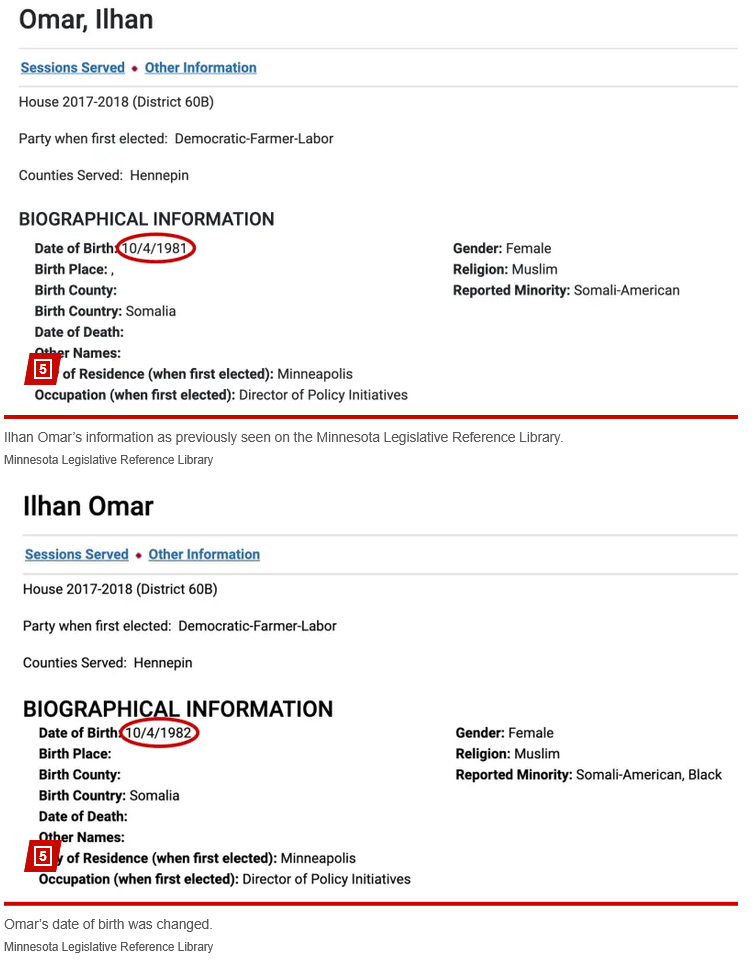
Two days after a video questioning her age went viral, Omar’s congressional staff called in a correction. On May 17, 2019, they told the library the year was wrong and, in its director’s words in a May 24 email, “requested that we change it to 1982.” The director added that her staff were working to get Wikipedia and the congressional directory changed too.
Nothing in the emails the Post quoted says what documentation, if any, Omar’s staff produced for 1982. The library’s legislator page now vouches for it: “Her birth year is correct. It is incorrectly reported as 1981 in other sources.”
As noted above, Alpha News reported the switch last December, citing former congressional candidate AJ Kern, whose video on Omar was shared by President Trump’s Truth Social account. According to the Post, people familiar with the multi-year federal criminal probe have suggested she’s being looked at for false statements on immigration forms.
Homeland Security Investigations agents executed a court-authorized search warrant at her DC home early Monday, part of what the Justice Department called an ongoing federal investigation. No charges have been announced.https://www.youtube.com/embed/itJJoM-v2To?si=WeaQRrOcO7nzKK7H
Whatever happened in 2000 is beyond prosecutors’ reach: citizenship, naturalization and passport offenses carry a 10-year statute of limitations. The live exposure is anything Omar has signed in the last decade that repeats a birth date – a passport renewal, say. That clock only covers prosecution; it can’t make someone a citizen who never derived citizenship in the first place. Could Trump just boot her out of the country?
Omar, who says she “will not be silenced,” has repeatedly denied any immigration fraud and called the raid the latest escalation in a decade of Trump attacks on her. Her office didn’t immediately respond to the Post.
GREG HUNTER///INTERVIEWING BILL HOLTER
Bessent, Shelton, China, Gold & Inflation – Bill Holter
By Greg Hunter On October 13, 2026 In Market Analysis, Political AnalysisNo Comments
By Greg Hunter’s USAWatchdog.com
Financial writer and precious metals expert Bill Holter (aka Mr. Gold) heard alarm bells ring when Judy Shelton, a top gold expert, was hired recently to be an advisor to Treasury Secretary Scott Bessent, who is a top currency expert. The national debt has exploded to $40 trillion with no sign of ever paying any of it back. Holter says, “President Trump said the quiet part out loud when he said earlier this month, ‘Certain levels of inflation will also pay off that debt very rapidly. Very rapidly.’ The whole idea is if you create inflation, you are cheapening the currency. If you create enough inflation, you can cheapen the currency to what I call ‘monkey money.’ You can turn the currency into monkey money, and it makes debt very easy to pay off. I think that’s what the strategy is. China just purchased more gold in September than any prior month. I think they are on 63 or 68 straight months of purchasing gold. They are liquidating Treasuries and using that capital to buy gold. They knew this before Trump said they could lower the debt through inflation. They understand because China has blown up more paper currencies that any other country on the planet going back a couple of thousand years or more.”
Mr. Gold goes on to say, “We could have paper currencies imploding in purchasing power. Anybody who says you can’t have all currencies imploding is wrong. If the US dollar collapses, what do you think is on the balance sheet of all central banks across the globe? Dollars. Balance sheets can get destroyed. That’s what people are not really understanding. Treasury bonds are the foundation to the entire financial system. Treasuries are a defaultable asset. Treasuries and dollars have been over-printed, and there is your inflation.”
So, how do you not let the US dollar and Treasuries default or inflation spiral out of control? That is where Judy Shelton comes in. She has to figure out a way, with Secretary Bessent, to do that by backing the dollar, at least in part, with gold. Total backing of US debt in gold would produce a huge jump in the gold price. Mr. Gold says, “If they wanted to revalue the gold to cover the $40 plus trillion in US debt, assuming the gold that has not been audited since 1956 is all still there, the number would approach $160,000 per ounce. . .. The number is just under $160,000 per ounce in order to cancel the debt out.”
There is much more in the 40-minute interview.
For The Wellness Company “Emergency Medical Kit,” click here. Don’t forget $45 off (15%) and free shipping with promo code USAWATCHDOG.
Join Greg Hunter of USAWatchdog as he goes one-on-one with financial writer and precious metals expert Bill Holter/Mr. Gold as he warns of the possibility of big jumps in the price of gold and silver for 10.13.26.
After the Interview:
Bill Holter’s website BillHolter.com keeps growing. There are lots of new free articles including “Grizzly’s Corner” that Holter says is about how to survive what is coming.
If you need to contact Bill Holter/Mr. Gold, his email is bholter@proton.me
This segment is sponsored (in part) by Discount Gold and Silver Trading. Ask for Melody Cedarstrom, the owner, at 1-800-375-4188.
SEE YOU TOMORROW…


