
EXCHANGE: COMEX
CONTRACT: OCTOBER 2026 COMEX 100 GOLD FUTURES
SETTLEMENT: 4,084.800000000 USD
INTENT DATE: 10/14/2026 DELIVERY DATE: 10/16/2026
FIRM ORG FIRM NAME ISSUED STOPPED
363 H WELLS FARGO SECURITI 6
726 C PLUS500US FINANCIAL 1
905 C ADM 2 5
991 H CME 2
TOTAL: 8 8
MONTH 12,500
GOLD: NUMBER OF NOTICES FILED FOR OCT./2026: 8 CONTRACTs NOTICES FOR 800 OZ or 0.0248 TONNES
total notices so far: 12,520 contracts FOR 1,252,000 OZ OR 38.942 TONNES
SILVER NOTICES: 12 NOTICE(S) FILED FOR 60,000 OZ /
total number of notices filed so far this month : 3262 CONTRACTS (NOTICES) for 16.310 million oz
GLD
SHANGHAI CLOSED DOWN 59.75 PTS OR 1.59%
HANG SENG CLOSED DOWN 258.17 PTS OR 1.46%
Nikkei CLOSED DOWN 3234.29 PTS OR 4.77%
//Australia’s all ordinaries CLOSED UP 0.76%
//Chinese yuan (ONSHORE) CLOSED UP AT 6.6918
/ OFFSHORE CLOSED UP AT 6.6918 Oil DOWN TO 94.03 dollars per barrel for WTI and BRENT DOWN TO 104.03 Stocks in Europe OPENED ALL MIXED
ONSHORE USA/ YUAN// WITH YUAN TRADING 6.6918 OFFSHORE YUAN TRADING UP TO 6.6918 ONSHORE YUAN TRADING BELOW LEVEL // OFF SHORE AND UP ON THE DOLLAR)// / AND THUS STRONGER/OFF SHORE YUAN TRADING UP AGAINST US DOLLAR/ AND THUS STRONGER
| Gold | Ounces |
| Withdrawals from Dealers Inventory in oz | nil |
| Withdrawals from Customer Inventory in oz | 2 ENTRIES i) out of Brinks 15,207.423 oz (473 KILOBARS) ii) out of Manfra: 1446.795oz (45 kilobar) total withdrawal: 16,654.216 oz |
| Deposit to theDealerInventory in oz | 0 ENTRIES |
| Deposits to the Customer Inventory, in oz | DEPOSITS/CUSTOMER//gold 0 ENTRIES xxxxxxxxxxxxxxxx |
| No of oz served (contracts) today | 8 CONTRACTS 800 OZ 0.0248 TONNES OF GOLD |
| No of oz to be served (notices) | 80 Contracts 8000 OZ 0.2488 TONNES |
| Total monthly oz gold served (contracts) so far this month | 12,520 notices 1,252,000 OZ 38.942 TONNES |
| Total accumulative withdrawals of gold from the Dealers inventory this month | NIL oz |
| Total accumulative withdrawal of gold from the Customer inventory this month |
dealer deposits: 0
xxxxxxxxxxxxxxxxxxx
DEPOSITS:
ENTRIES: 0
xxxxxxxxxxxxxxxxxx
comex withdrawals
2 ENTRIES
2 ENTRIES
i) out of Brinks 15,207.423 oz
(473 KILOBARS)
ii) out of Manfra: 1446.795oz
(45 kilobar)
total withdrawal: 16,654.216 oz
adjustments: 2 dealer to customer acct
a) Asahi 6,462.351 oz
b) Brinks: 53,503.916 oz
COMEX IS DRAINING GOLD
chaos inside the comex
THE FRONT MONTH OF OCT OI STANDS AT 88 CONTRACTS HAVING A GAIN OF 4 CONTRACTS.
TUESDAY WE HAD A NORMAL DELIVERY OF 1,259,500 OZ ( 39.175 TONNES) OF GOLD STANDING FOR DELIVERY: TODAY: 1,260,400 OZ OR 39.1912 TONNES FOR A GAIN OF 900 OZ (0.02799 TONNES) OR 9 CONTRACTS UNDERWENT A QUEUE JUMP WHERE THEY WILL TAKE DELIVERY OF THIS SIDE OF THE POND.
NOVEMBER LOST 114 CONTRACTS FALLING TO 3711
DECEMBER, THE LARGEST DELIVERY MONTH IN THE CALENDAR, ITS OI RISES BY 1169 CONTRACTS UP TO 321,658.
.
We had 8 contracts filed for today representing 900 oz
Today, 0 notice(s) were issued from J.P.Morgan dealer and 0 notices issued from their client or customer account. The total of all issuance by all participants equate to 0 contract(s) of which 0 notices were stopped (received) by j.P. Morgan dealer and 0 notice(s) was (were) stopped (received) by J.P.Morgan//customer account
To calculate the INITIAL total number of gold ounces standing for OCT /2026. contract month, we take the total number of notices filed so far for the month (12,520) to which we add the difference between the open interest for the front month of OCT (88 CONTRACTS) minus the number of notices served upon today 8 x 100 oz per contract) equals 1,260,400 OZ OR(39.1912 Tonnes of gold) to which we add our first exchange for risk in Oct totalling 836 contracts for 83,600 oz or 2.600 tonnes. Thus Oct standing for gold reduces to 41.7912 tonnes
THUS: INITIAL total number of gold ounces standing for OCT. /2026. contract month,we take the total number of notices filed so far for the month (12,520) to which we add the difference between the open interest for the front month of OCT(88) contracts minus the number of notices served upon today 8 x 100 oz per contract) equals 1,260,400 OZ OR(39.1912 Tonnes of gold) plus our first exchange for risk totalling 836 contracts//83600 oz//2.600 tonnes//standing reduces to 41.7912 tonnes
new total of gold standing in OCT becomes 41.7912 TONNES//
TOTAL COMEX GOLD STANDING FOR OCT.: 41.7912 TONNES WHICH IS NOW VERY STRONG FOR THIS NON ACTIVE DELIVERY MONTH OF OCT./
WEDNESDAY VOLUME: 210,959 FAIR
COMEX GOLD INVENTORIES/CLASSIFICATION
NEW PLEDGED GOLD:
241,794.285 oz NOW PLEDGED /HSBC 5.94 TONNES
204,937.290 OZ PLEDGED MANFRA 3.08 TONNES
83,657.582 PLEDGED JPMorgan no 1 1.690 tonnes
265,999.054, oz JPM No 2
1,152,376.639 oz pledged Brinks/
Manfra: 33,758.550 oz
Delaware: 193.721 oz
International Delaware:: 11,188.542 oz
total pledged gold: 1,721,684.952 oz 53.55 tonnes pledged gold lowers
total inventories in gold declining rapidly
total pledged gold: 1,721,684.952 tonnes oz 53.55 tonnes
TOTAL OF ALL GOLD ELIGIBLE AND REGISTERED GOLD 23,459,851 oz//
TOTAL REGISTERED GOLD 14,816,969.006 tonnes (460.86 tonnes)
TOTAL OF ALL ELIGIBLE GOLD 8,642,490.845 oz.
REGISTERED GOLD THAT CAN BE SERVED UPON 13,095,285 oz ((REG GOLD- PLEDGED GOLD)=
407.31 Tonnes //
total inventories in gold declining rapidly
SILVER COMEX
OCT DELIVERY MONTH
OCT 15
| Silver | Ounces |
| Withdrawals from Dealers Inventory | NIL oz |
| Withdrawals from Customer Inventory | 1 entries i) Out of Manfra: 593,992.584 oz total withdrawal: 593,992.584 oz |
| Deposits to the Dealer Inventory | 0 ENTRY |
| Deposits to the Customer Inventory | ENTRIES: 2 i) Into CNT: 599,413.519 oz ii) Into Asahi: 596,404.790 oz total deposit: 1,105,818.309 oz |
| No of oz served today (contracts) | 12 CONTRACT(S) ( 60,000 OZ) |
| No of oz to be served (notices) | 246 Contracts (1.230 MILLION oz) |
| Total monthly oz silver served (contracts) | 3262 contracts 16.310 MILLIONoz |
| Total accumulative withdrawal of silver from the Dealers inventory this month | NIL oz |
| Total accumulative withdrawal of silver from the Customer inventory this month |
DEPOSITS INTO DEALER ACCOUNTS
ENTRY:0
DEPOSIT ENTRIES/CUSTOMER ACCOUNT
2 ENTRIES:
i) Into CNT: 599,413.519 oz
ii) Into Asahi: 596,404.790 oz
total deposit: 1,105,818.309 oz
xxxxxxxxxxxxxxxxxxxxxxxxx
withdrawals:
1 entries
i) Out of Manfra: 593,992.584 oz
total withdrawal: 593,992.584 oz
adjustments : 1 customer to dealer
a) Manfra: 55,116 oz
xxxxxxxxxxxxxx
TOTAL REGISTERED SILVER: 103.146 MILLION OZ//.TOTAL REG + ELIGIBLE. 333.801 Million oz
registered silver dropping in numbers
CALCULATIONS FOR THE NEW STANDING FOR SILVER FOR OCT
FRONT MONTH: SILVER OPEN INTEREST CONTRACTS: 258 FOR A LOSS OF 116 CONTRACTS . WEDNESDAY WE HAD 17.560 MILLION OZ STAND: TODAY: 17.540 MILLION OZ FOR A LOSS OF 20,000 OZ (4 CONTRACTS). THUS A STRONG EXCHANGE FOR PHYSICAL TRANSFER OF 20,000 OZ WHERE THEY WILL TRY AND TAKE DELIVERY ON THE LONDON SIDE OF THE POND.
.
NOVEMBER LOST 63 CONTRACTS UP TO AN OI OF 1972
DECEMBER GAINED 3828 CONTRACTS UP TO AN OI OF 86,886
TOTAL NUMBER OF NOTICES FILED FOR TODAY: 12 or 60,000 oz
CONFIRMED volume WEDNESDAY; 40,936 // poor/
AND NOW OCT. DELIVERIES:
To calculate the number of silver ounces that will stand for delivery in OCT. we take the total number of notices filed for the month so far at 3262 X5,000 oz = 16.310 MILLION oz.
Then we take the difference between the front month of OCT. and the number of notices filed for today x 5000 to give us our standing
Thus the standings for silver for the OCT 2026 contract month: (3262 )Notices served so far) x 5000 oz + OI for the front month of OCT (258) minus number of notices served upon today ( 12 x 5000 oz) equals silver standing for the OCT .contract month equating to 17.540 MILLION OZ to which we add silver’s TWO exchange for risk for 450 contracts (2.25 million oz).. total standing reduces to 19.790 million oz//. ( a very strong delivery month)
We must also keep in mind that there is considerable silver standing in London coming from our longs
There are ONLY 103.146 million oz of registered silver
JPMorgan as a percentage of total silver: 125.510/333.801 million: 36.98%
The record level of silver open interest is 234,787 contracts set on April 21./2017 with the price on that day at $18.42.
The previous record was 224,540 contracts with the price at that time of $20.44.
BOTH GLD AND SLV ARE MASSIVE FRAUD
XXXXXXXXXXXXXXXXXXXXXXXXXXXXXXXXXXXXXXXXXXX
OCT 15//2026/WITH GOLD UP $60.50 /HUGE CHANGES IN GOLD AT THE GLD:A WITHDRAWAL OF 1.21 TONNES OF GOLD FROM THE GLD/. //:/INVENTORY RESTS AT 1054.20 TONNES
OCT 14//2026/WITH GOLD DOWN $66.25 /NO CHANGES IN GOLD AT THE GLD: //:/INVENTORY RESTS AT 1055.41 TONNES
OCT 13//2026/WITH GOLD DOWN $13.25 /HUGE CHANGES IN GOLD AT THE GLD: A DEPOSIT OF OF 2.281TONNES OF GOLD INTO THE THE GLD//: //:/INVENTORY RESTS AT 1055.411 TONNES
OCT 12//2026/WITH GOLD DOWN $24.20 /HUGE CHANGES IN GOLD AT THE GLD: A WITHDRAWAL OF 2TONNES OF GOLD OUT OF THE GLD//: //:/INVENTORY RESTS AT 1053.13 TONNES
OCT 9//2026/WITH GOLD UP $60.00 /HUGE CHANGES IN GOLD AT THE GLD: A WITHDRAWAL OF 4.562 TONNES OF GOLD OUT OF THE GLD//: //:/INVENTORY RESTS AT 1055.411 TONNES
OCT 8//2026/WITH GOLD UP $16.85 /HUGE CHANGES IN GOLD AT THE GLD: A DEPOSIT OF 3.703 TONNES OF GOLD INTO THE GLD//: //:/INVENTORY RESTS AT 1059.873 TONNES
OCT 7//2026/WITH GOLD DOWN $46.70 /NO CHANGES IN GOLD AT THE GLD:: //:/INVENTORY RESTS AT 1056.27 TONNES
OCT 6//2026/WITH GOLD UP $30.60 /HUGE CHANGES IN GOLD AT THE GLD:: A DEPOSIT OF 0.754 TONNES OF GOLD INTO THE GLD// //:/INVENTORY RESTS AT 1056.27 TONNES
OCT 5//2026/WITH GOLD DOWN $2.20 /HUGE CHANGES IN GOLD AT THE GLD:: A WITHDRAWAL OF 0.854 TONNES OF GOLD INTO THE GLD// //:/INVENTORY RESTS AT 1055.696 TONNES
OCT 2//2026/WITH GOLD DOWN $43.00 /HUGE CHANGES IN GOLD AT THE GLD:: A DEPOSIT OF 0.854 TONNES OF GOLD INTO THE GLD// //:/INVENTORY RESTS AT 1056.55 TONNES
OCT 1//2026/WITH GOLD UP $19.55 /HUGE CHANGES IN GOLD AT THE GLD:: A WITHDRAWAL OF 1.711 TONNES OF GOLD OUT OF THE GLD// //:/INVENTORY RESTS AT 1055.696 TONNES
SEPT 30//2026/WITH GOLD UP $7.80 /HUGE CHANGES IN GOLD AT THE GLD:: A DEPOSIT OF 2.847 TONNES OF GOLD INTO THE GLD// //:/INVENTORY RESTS AT 1057.407 TONNES
SEPT 29//2026/WITH GOLD UP $11.75 /NO CHANGES IN GOLD AT THE GLD //:/INVENTORY RESTS AT 1054.56 TONNES
SEPT 28//2026/WITH GOLD DOWN $150.20 /NO CHANGES IN GOLD AT THE GLD //:/INVENTORY RESTS AT 1054.56 TONNES
SEPT 25//2026/WITH GOLD DOWN $150.20 /NO CHANGES IN GOLD AT THE GLD //:/INVENTORY RESTS AT 1054.56 TONNES
SEPT 24//2026/WITH GOLD DOWN $18.70 /HUGE CHANGES IN GOLD AT THE GLD A DEPOSIT OF 1.43 TONNES OF GOLD INTO THE GLD://:/INVENTORY RESTS AT 1056.84 TONNES
SEPT 23//2026/WITH GOLD DOWN $58.00 /HUGE CHANGES IN GOLD AT THE GLD://:/INVENTORY RESTS AT 1055.41 TONNES
SEPT 22//2026/WITH GOLD DOWN $6.30 /HUGE CHANGES IN GOLD AT THE GLD://A DEPOSIT OF 0.31 TONNES OF GOLD INTO THE GLD/:/INVENTORY RESTS AT 1055.41 TONNES
SEPT 21//2026/WITH GOLD DOWN $41.20 /HUGE CHANGES IN GOLD AT THE GLD://A DEPOSIT OF 2.26 TONNES OF GOLD INTO THE GLD/:/INVENTORY RESTS AT 1055.10 TONNES
SEPT 18//2026/WITH GOLD UP $26.45 /HUGE CHANGES IN GOLD AT THE GLD://A DEPOSIT OF 0.85 TONNES OF GOLD INTO THE GLD/:/INVENTORY RESTS AT 1052.84 TONNES
SEPT 17//2026/WITH GOLD UP $14.05 /HUGE CHANGES IN GOLD AT THE GLD://A DEPOSIT OF 1.71 TONNES OF GOLD INOT THE GLD/:/INVENTORY RESTS AT 1051.99 TONNES
SEPT 16//2026/WITH GOLD UP $53.40 /HUGE CHANGES IN GOLD AT THE GLD://A DEPOSIT OF 2.86 TONNES OF GOLD INOT THE GLD/:/INVENTORY RESTS AT 1050.28 TONNES
SEPT 15//2026/WITH GOLD DOWN $19.45 /NO CHANGES IN GOLD AT THE GLD://A WITHDRAWAL OF 0.353 TONNES OF GOLD FROM THE GLD/:/INVENTORY RESTS AT 1047.420 TONNES
SEPT 14//2026/WITH GOLD DOWN $54.50 /SMALL CHANGES IN GOLD AT THE GLD://A WITHDRAWAL OF 0.353 TONNES OF GOLD FROM THE GLD/:/INVENTORY RESTS AT 1047.420 TONNES
SEPT 11//2026/WITH GOLD UP $1.05 /SMALL CHANGES IN GOLD AT THE GLD://A WITHDRAWAL OF 0.353 TONNES OF GOLD FROM THE GLD/:/INVENTORY RESTS AT 1050.277 TONNES
/SEPT 10//2026/WITH GOLD UP $50.60 /NO CHANGES IN GOLD AT THE GLD://:/INVENTORY RESTS AT 1050.63 TONNES
SEPT 9//2026/WITH GOLD UP $20.40 /HUGE CHANGES IN GOLD AT THE GLD:A WITHDRAWAL OF 1.43 TONNES OF GOLD OUT OF THE GLD/ ////:/INVENTORY RESTS AT 1050.63 TONNES
SEPT 8//2026/WITH GOLD DOWN $34.20 /HUGE CHANGES IN GOLD AT THE GLD:A WITHDRAWAL OF 1.42 TONNES OF GOLD OUT OF THE GLD/ ////:/INVENTORY RESTS AT 1052.06 TONNES
SEPT 4//2026/WITH GOLD DOWN $63.50 /HUGE CHANGES IN GOLD AT THE GLD:A WITHDRAWAL OF 3.14 TONNES OF GOLD OUT OF THE GLD/ ////:/INVENTORY RESTS AT 1053.48 TONNES
SEPT 3//2026/WITH GOLD UP $141.55 /HUGE CHANGES IN GOLD AT THE GLD:A DEPOSIT OF 9.98 TONNES OF GOLD INTO THE GLD/ ////:/INVENTORY RESTS AT 1056.62 TONNES
SEPT 2//2026/WITH GOLD UP $19.25 /HUGE CHANGES IN GOLD AT THE GLD:A DEPOSIT OF 4.28 TONNES OF GOLD INTO THE GLD/ ////:/INVENTORY RESTS AT 1046.64 TONNES
SEPT 1//2026/WITH GOLD DOWN $80.25 /NO CHANGES IN GOLD AT THE GLD:// ////:/INVENTORY RESTS AT 1042.36 TONNES
GLD INVENTORY: 1054.20 TONNES, TONIGHTS TOTAL GOLD INVENTORY
SILVER
OCT 15 WITH SILVER UP $1.19 : :SMALL CHANGES A DEPOSIT OF 406,000 OZ INTO THE SLV// // :INVENTORY RESTS AT 494.219 MILLION OZ
OCT 14 WITH SILVER DOWN $3.25 : :SMALL CHANGES A WITHDRAWAL OF 135,000 OZ OUT OF THE SLV// // :INVENTORY RESTS AT 493.948 MILLION OZ
OCT 13 WITH SILVER DOWN $0.97 : :HUGE CHANGES A DEPOSIT OF 722,000 OZ INTO THE SLV// // :INVENTORY RESTS AT 493.813 MILLION OZ
OCT 12 WITH SILVER DOWN $0.51 : :HUGE CHANGES A DEPOSIT OF 722,000 OZ INTO THE SLV// // :INVENTORY RESTS AT 493.948 MILLION OZ
OCT 9 WITH SILVER UP $0.62 : :SMALL CHANGES A DEPOSIT OF 948,000 OZ INTO THE SLV// // :INVENTORY RESTS AT 493.226 MILLION OZ
OCT 8 WITH SILVER DOWN $0.74 : :SMALL CHANGES IN INVENTORY AT THE SLV:A WITHDRAWAL OF 532,000 OZ FROM THE SLV// // :INVENTORY RESTS AT 492.278 MILLION OZ
OCT 7 WITH SILVER DOWN $1.36 : :SMALL CHANGES IN INVENTORY AT THE SLV:A WITHDRAWAL OF 451,000 OZ FROM THE SLV// // :INVENTORY RESTS AT 492.910 MILLION OZ
OCT 6 WITH SILVER UP $0.31 : :NO CHANGES IN INVENTORY AT THE SLV: // :INVENTORY RESTS AT 493.361 MILLION OZ
OCT 5 WITH SILVER UP $0.87 : :NO CHANGES IN INVENTORY AT THE SLV: // :INVENTORY RESTS AT 493.361 MILLION OZ
OCT 2 WITH SILVER DOWN $0.74 : :NO CHANGES IN INVENTORY AT THE SLV: // :INVENTORY RESTS AT 493.578 MILLION OZ
OCT 1 WITH SILVER UP $0.57 : :HUGE CHANGES IN INVENTORY AT THE SLV: A WITHDRAWAL OF 1.400 MILLION OZ OUT OF THE SLV// :INVENTORY RESTS AT 493.578 MILLION OZ
SEPT 30 WITH SILVER DOWN $0.55 : :HUGE CHANGES IN INVENTORY AT THE SLV: A DEPOSIT OF 994,000 OZ INTO THE SLV// :INVENTORY RESTS AT 494.978 MILLION OZ
SEPT 29 WITH SILVER DOWN $0.58 : :SMALL CHANGES IN INVENTORY AT THE SLV: A WITHDRAWAL OF 566,000 OZ FROM THE SLV// :INVENTORY RESTS AT 493.984 MILLION OZ
SEPT 28 WITH SILVER DOWN $2.91 : :SMALL CHANGES IN INVENTORY AT THE SLV: A DEPOSIT OF 0.542 MILLION OZ FROM THE SLV// :INVENTORY RESTS AT 494.436 MILLION OZ
SEPT 25 WITH SILVER DOWN $2.91 : :SMALL CHANGES IN INVENTORY AT THE SLV: A DEPOSIT OF 0.542 MILLION OZ FROM THE SLV// :INVENTORY RESTS AT 494.436 MILLION OZ
SEPT 24 WITH SILVER DOWN $0.96 : :HUGE CHANGES IN INVENTORY AT THE SLV: A WITHDRAWAL OF 0.813 MILLION OZ FROM THE SLV// :INVENTORY RESTS AT 493.533 MILLION OZ
SEPT 23 WITH SILVER UP $1.58 : :HUGE CHANGES IN INVENTORY AT THE SLV: A WITHDRAWAL OF 1.716 MILLION OZ FROM THE SLV// :INVENTORY RESTS AT 494.346 MILLION OZ
SEPT 22 WITH SILVER UP $0.10 : :NO CHANGES IN INVENTORY AT THE SLV: :INVENTORY RESTS AT 496.062 MILLION OZ
SEPT 21 WITH SILVER UP $1.04 : :HUGE CHANGES IN INVENTORY AT THE SLV: :INVENTORY RESTS AT 489.558 MILLION OZ
SEPT 18 WITH SILVER UP $1.04 : :NO CHANGES IN INVENTORY AT THE SLV: :INVENTORY RESTS AT 489.558 MILLION OZ
SEPT 17 WITH SILVER UP $1.10 : :HUGE CHANGES IN INVENTORY AT THE SLV: A WITHDRAWAL OF 1.265 MILLION OZ FROM THE SLV/ :INVENTORY RESTS AT 489.558 MILLION OZ
SEPT 16 WITH SILVER UP $0.95 : :HUGE CHANGES IN INVENTORY AT THE SLV: A WITHDRAWAL OF 813,000 OZ FROM THE SLV/ :INVENTORY RESTS AT 490.823 MILLION OZ
SEPT 15 WITH SILVER DOWN $0.16 : :HUGE CHANGES IN INVENTORY AT THE SLV: A WITHDRAWAL OF 813,000 OZ FROM THE SLV/ :INVENTORY RESTS AT 491.636 MILLION OZ
SEPT 14 WITH SILVER DOWN $0.91 : :NO CHANGES IN INVENTORY AT THE SLV:/ :INVENTORY RESTS AT 492.449 MILLION OZ
SEPT 11 WITH SILVER DOWN $3.50 : :NO CHANGES IN INVENTORY AT THE SLV:/ :INVENTORY RESTS AT 492.449 MILLION OZ
SEPT 10 WITH SILVER DOWN $3.50 : :NO CHANGES IN INVENTORY AT THE SLV:// / :INVENTORY RESTS AT 493.171 MILLION OZ
SEPT 9 WITH SILVER UP $0.56 : :NO CHANGES IN INVENTORY AT THE SLV:// / :INVENTORY RESTS AT 493.171 MILLION OZ
SEPT 8 WITH SILVER UP $0.31 : :HUGE CHANGES IN INVENTORY AT THE SLV:/ A DEPOSIT OF 0.632 MILLION OZ INTO THE SLV// / :INVENTORY RESTS AT 493.171 MILLION OZ
SEPT 4 WITH SILVER UP $2.20 : :NO CHANGES IN INVENTORY AT THE SLV:/// / :INVENTORY RESTS AT 492.539 MILLION OZ
SEPT 3 WITH SILVER UP $2.20 : :HUGE CHANGES IN INVENTORY AT THE SLV:A WITHDRAWAL OF 1.293 MILLION OZ FROM THE SLV//// / :INVENTORY RESTS AT 492.539 MILLION OZ
SEPT2 WITH SILVER UP $0.15 : :NO CHANGES IN INVENTORY AT THE SLV:// / :INVENTORY RESTS AT 493.832 MILLION OZ
SEPT1 WITH SILVER DOWN $1.43 : :NO CHANGES IN INVENTORY AT THE SLV:// / :INVENTORY RESTS AT 493.832 MILLION OZ
CLOSING INVENTORY 494.219 MILLION OZ OF SILVER
GOLD COMMENTARIES:
1.PETER SCHIFF//JOHN RUBINO//RAVEN
The Fed vs. The Bond Market
“If the bond market demands a higher price, someone has to pay it.”
3 hours ago
The economy is bound to eventually reach a point where it can no longer tolerate the interest rates required to keep inflation and debt under control, and some of the loudest warnings are coming from the bond market.
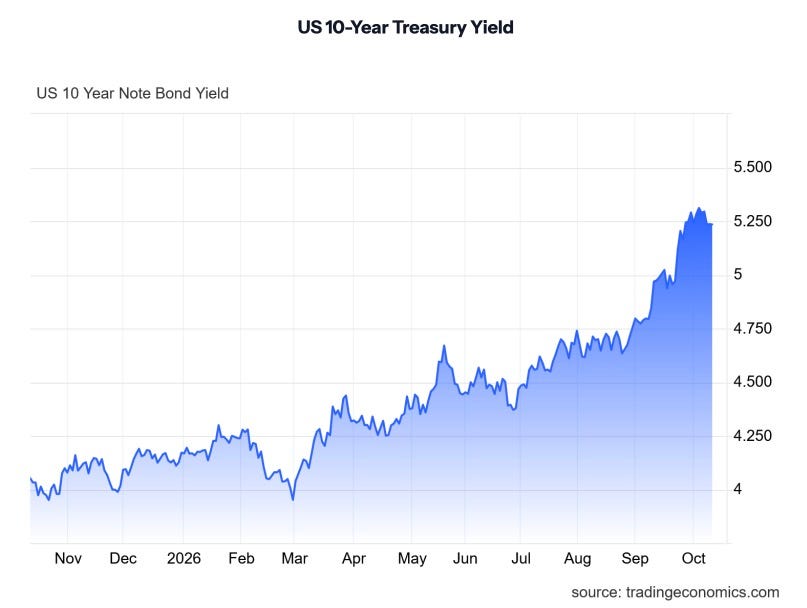
The benchmark 10-year Treasury yield recently climbed above 5.3%, reaching levels not seen since 2002. Even more striking, this surge occurred as evidence was building up of a weakening labor market, not because investors suddenly became convinced that the American economy was entering a new era of extraordinary real growth.
A rising 10-year yield is normally associated with a healthy economy. Strong growth can produce stronger demand for capital, while rising inflation expectations can lead investors to demand higher nominal returns. But when long-term yields continue rising while economic data deteriorate, the interpretation changes.
Instead of “America’s economy is getting stronger,” the bond market is saying, “America is becoming more expensive to finance.”
The Federal Reserve raised its benchmark interest-rate target by another quarter point in September, bringing the federal funds target to 3.75%-4%. The Fed acknowledged that economic activity remained solid, but it also said without ambiguity that inflation remained elevated; something that was already obvious to millions of Americans who see their dollars buying less seemingly every year.
Inflation hasn’t returned to the Federal Reserve’s 2% objective. The PCE price index was up 3.4% year-over-year in August.
The Fed is backed into a corner by a problem that can’t be solved with monetary policy. If it keeps rates high or raises them further, it puts additional pressure on households, businesses, housing and financial markets. If it cuts rates aggressively, it risks allowing inflation to become entrenched. And the 10-year Treasury is increasingly refusing to cooperate with the idea that the Fed can simply dictate the cost of long-term money.
The Federal Reserve controls the overnight policy rate, but can’t ultimately control the price at which the government can borrow for ten or thirty years. Those rates are determined in the enormous global bond market, and that bond market is demanding considerably more compensation.
The September employment report showed an increase in unemployment as previous estimates were revised downward. July’s payroll figure was revised from a gain of 21,000 to a loss of 10,000, while August was revised from 162,000 to 133,000. The combined revision reduced previously-reported employment by 60,000 jobs. That isn’t a healthy labor market, and revisions always show a clearer (and less rosy) picture after the economy has already digested the initial numbers. The first number makes the headlines, and the revision comes later.
Average monthly payroll growth over the previous twelve months was only 45,000 as of September. That isn’t the labor-market boom one would expect to see supporting a 5%-plus long-term Treasury yield.
Americans are spending because the economy is still functioning, but they’re also spending in an environment where prices remain much higher than they were before the inflation surge. They’re also taking on more debt for basic expenses. Household debt (excluding housing debt) has gone from $3.4 trillion in 2016 to about $5.2 trillion today.
The American consumer can maintain spending for quite a while by reducing savings, increasing borrowing, or drawing down accumulated wealth, but that isn’t the same thing as sustainably increasing purchasing power.
A 5%-plus Treasury yield filters through the financial system in the form of higher mortgage rates, more expensive corporate financing, pricier auto loans, and higher corporate refinancing costs, including in commercial real estate. The interest expense on the debt also increases, and that number surpassed one trillion last summer.
The economy is being squeezed from both directions because prices are elevated while the cost of money keeps rising. When debt levels were lower and interest rates were close to zero, the government could borrow more money without immediately feeling the full burden. However, at just a 1% interest rate, financing $40 trillion of debt implies roughly $400 billion in annual interest expense. At 5%, it implies roughly $2 trillion.

And unlike discretionary government spending, interest expense can’t be eliminated because politicians dislike it. Existing debt has to be serviced, and maturing debt has to be refinanced. This creates the possibility of a dangerous feedback loop. The obvious temptation if the government can’t tolerate 5%, 6%, or 7% long-term interest rates is for the Fed to step in and purchase Treasury securities, pushing yields back down.
But the Fed purchases assets by creating bank reserves. If the Fed’s intervention becomes sufficiently large, it can increase liquidity and ultimately undermine confidence in the purchasing power of the currency. In other words, the government faces an uncomfortable choice: Allow interest rates to rise and risk a debt-driven economic contraction, or suppress rates and increase inflation, which they’ve already admitted they’re struggling to control.
That’s why the 10-year Treasury is more important than the latest stock-market rally, the latest GDP headline, or even the latest jobs report. It’s the market’s continuously updated assessment of what investors require to lend the United States money for a decade. The economy can’t handle that required return rising too high, too fast, for too long.
The economy doesn’t really collapse because data is “too hot” in the sense that the economy is too strong. The core issue is that the financial system has become too dependent on cheap money. For years, ultra-low interest rates encouraged borrowing, speculation, high asset valuations and enormous government deficits. The endgame is a bond market crash and currency crisis unlike anything the U.S. has seen.
The 10-year Treasury is less like a thermometer measuring economic strength and more like a stress gauge measuring the cost of maintaining the existing economic structure. A 5.3% yield wouldn’t ordinarily be catastrophic, but 5.3% in an economy carrying enormous public and private debts, persistent inflation, slowing employment growth and massive ongoing Treasury borrowing is a very serious problem.
It’s less about the economy being strong, and more about the world discovering just how expensive it has become to maintain the appearance of strength. If the bond market demands a higher price, someone has to pay it.
END
JOHN RUBINO…
VERY IMPORTANT..
Crash Alert: Five Ominous Charts
South Korea’s Bubble Bursts
The tech-heavy KOSPI stock index soared as chip demand exploded — and is now tanking as AI hits a financial wall.

CoreWeave’s Debt Implodes
From leading AI “neocloud” to aggressive junk bond issuer to imminent default risk.

The Dollar Really Is Collapsing
U.S. Producer prices just came in hot — again. Which should be no surprise given the dollar’s brutal (ongoing) decline in this decade:

The Fed Stands Aside
So will the Fed tighten to limit inflation, or stand aside while financial market volatility does the tightening for it? The odds now favor the latter.

Bad Breath = Bad Times
Will tech turmoil spread to the broader economy? Market concentration says “probably”.

END
1 B // JAMES RICKARDS/MATHEW PIEPENBURG/ALASDAIR MACLEOD..
ALASDAIR MACLEOD…
3. CHRIS POWELL AND HIS GATA DISPATCHES
CHRIS POWELL…
CFTC staff were told to retract analysis of suspicious oil trades
Submitted by admin on Wed, 2026-10-14 09:48Section: Daily Dispatches
By Charles Gorrivan, Lydia Beyoud, and Nicola M. White
Bloomberg News
via The Japan Times, Tokyo
Wednesday, October 14, 2026
When U.S. President Donald Trump backed away from threats to strike Iranian power plants on March 23, it sparked a frenzy of buying and selling across oil, equities and other markets.
Traders had grown accustomed to prices lurching wildly on developments in the Middle East.
But this time, some bettors had timed it perfectly. Billions of dollars’ worth of contracts predicting oil would fall and the S&P 500 would rise were placed about 15 minutes before the president announced his U-turn in a post on Truth Social, fueling widespread speculation about whether someone had an unfair advantage.
Responsibility for looking into the incident fell to the U.S. Commodity Futures Trading Commission, the federal derivatives regulator whose remit — and profile — has soared with the advent of cryptocurrencies and prediction markets. There, a team of career forensic analysts embarked on their usual task of pulling together data on the day’s winners and losers.
Based on the timing of the trading they observed and who was behind it, the analysts, from the agency’s Division of Market Oversight, filed a referral to the Division of Enforcement, which would decide whether to launch a full-scale investigation into potential insider trading, according to people familiar with the matter who asked not to be identified discussing government deliberations. Representatives from the two divisions also met and talked through how best to collaborate, people familiar with the matter said.
What happened next, they said, was highly unusual: Mel Gunewardena, a senior adviser to the agency’s Trump-appointed chairman, Michael Selig, told a supervisor within the market oversight team to retract the referral. …
… For the remainder of the report:
END
Bank of America fined $1.2 billion for money laundering and sanctions violations
Submitted by admin on Tue, 2026-10-13 20:25Section: Daily Dispatches
By Samantha Delouya
CNN, New York
Tuesday, October 13, 2026
The U.S. Treasury Department today announced it was imposing a more than $1.2 billion fine on Bank of America, accusing the bank of violating anti-money laundering and sanctions laws.
The bank, the second-largest in the U.S., failed to mitigate and report “priority national security risks, including Chinese money laundering networks and illicit finance along the southwest border,” the Treasury Department said in its announcement.
“When a bank of this size fails to meet its anti-money laundering and sanctions obligations, the consequences extend far beyond its own walls, exposing the entire U.S. financial system to significant illicit finance risks,” said Treasury Secretary Scott Bessent in a statement.
“Today’s actions send a clear message that even the biggest financial institutions are not above the law,” Bessent added. …
… For the remainder of the report:
END
Even CNBC gets it now: How China’s gold-buying spree helps the yuan go global
Submitted by admin on Mon, 2026-10-12 19:48Section: Daily Dispatches
How a Gold-Buying Sppree Helps the Yuan Go Global
By Evelyn Cheng
CNBC, New York
Monday, October 12, 2026
China’s decades-long push for yuan internationalization is getting a lift from the buildout of Hong Kong as a gold trading center — denominated in the Chinese currency.
“As those trading volumes grow, there would be a growing volume of the physical gold trade that is denominated in RMB and not linked in USD,” said Charles Chang, managing director and Greater China country lead for corporate ratings at S&P Global Ratings.
The Chinese yuan, also known as the renminbi, accounts for a fraction of international transactions in a global financial system dominated by the U.S. dollar. Analysts I spoke with don’t expect major changes to that dynamic anytime soon, but Beijing’s gold purchases and Hong Kong trading platform are just the latest steps toward supporting greater use of the yuan globally.
“The challenge with internationalizing the RMB, it’s somewhat more challenging to find places where you can use the RMB,” Chang said. “In terms of gold particularly, if the RMB that the buyer receives can be converted to gold, then it gives more channels for the spending to be done.”
Hong Kong, home to one of the world’s largest stock exchanges, last month confirmed its efforts to develop a yuan-denominated gold market.
In a major move last year, the special administrative region of China linked its gold vault with one in Shanghai, allowing physical gold delivery to international institutions in Hong Kong denominated in yuan.
Over the next three years, Hong Kong plans to expand the capacity of its Shanghai-linked gold vault from 150 tonnes to over 2,000 tonnes, S&P’s Chang pointed out.
That’s nearly as large as all the gold reserves in China, he added. “If Hong Kong is able to complete this transaction, then it would become of the largest gold trading centers in the world.” …
… For the remainder of the report:
END
The game changer in Hong Kong’s gold ambition is to serve as Shenzhen’s jewelry hub
Submitted by admin on Mon, 2026-10-12 13:44Section: Daily Dispatches
By Chow Chung-yan
South China Morning Post, Hong Kong
Monday, October 12, 2026
Hong Kong’s ambition to become an international gold trading centre rests not only on serving the nation’s financial needs, but also on China’s booming consumer market for gold.
As the world’s largest gold producer and importer, China easily absorbs hundreds of tonnes of the precious metal each year or more, an estimated 80% of which is snapped up by consumers whose love of gold dates back millennia.
Hong Kong has long been the primary gold market for Chinese consumers. In the early 1970s, the city’s largest jeweler, Chow Tai Fook Enterprises, established the 999.9 purity standard (meaning 999.9 parts gold per 1,000), which quickly caught on. In 2008, the Legislative Council set the Chuk Kam purity standard at 99.9%, higher than the mainland’s 99% consumer standard.
As a tax-free port, Hong Kong levies no import duties on jewelers and no sales tax on customers, allowing it to become China’s undisputed consumer centre for gold. By 1998, the city had at least 1,300 gold and jewelry shops; today it is widely regarded as one of the world’s top gold retailing centres.
Yet the picture has also changed considerably. Hong Kong remains an important retail centre for gold, but its future depends largely on integration with Shenzhen across the border. Best known for its meteoric rise as China’s tech capital, Shenzhen is also an equally impressive centre for wholesale jewelry and fabrication.
Obscure 20 years ago, Shenzhen’s Shuibei market is now Asia’s largest jewelry wholesale hub by volume. Occupying an area only one third the size of New York’s Central Park, it houses more than 7,000 jewelry merchants and accounts for at least 50% of China’s gold trading, with an annual turnover of 100 billion yuan (US$14.91 billion).
The city first set out its ambition to turn Shuibei into a world-class gold wholesale and fabrication hub two decades ago, and this year it again mentioned gold and jewelry as a competitive industry in its 15th five-year plan.
This dovetails neatly with Hong Kong’s goal of becoming an international gold trading centre and expanding its physical gold storage tenfold, to 2,000 tonnes by 2028. As I explained in an earlier column, a major reason for building up our vaulting capacity is to support the internationalisation of the yuan and to serve central banks and institutions in Belt and Road Initiative countries.
But that alone is not enough. Bullion sitting in brand-new vaults will not generate much wealth unless gold is put to use and changes hands. Serving central banks and institutions is important, but adding a vibrant gold wholesale and manufacturing centre would be the real game changer.
A considerable portion of the gold used by Shuibei’s manufacturers already comes from Hong Kong. There is no official figure, but my calculation, based on various industry reports, puts it at around 20-30%. Hong Kong’s plans to expand its physical gold storage aggressively and to develop yuan-denominated gold financial products will be music to Shenzhen’s ears.
The reason lies in how jewelry manufacturing and gold fabrication work. Facing intense competition, foundries operate on thin margins, and it normally takes several days from order to delivery. Daily fluctuations in the gold price can shipwreck their business. The industry mitigates this risk through gold leasing and hedging.
Under a gold lease, a foundry does not hold stock but borrows gold from a bank only after receiving a confirmed order. After delivery, it repays the bank with a similar amount of gold, plus interest, at a favourable time. This greatly reduces the capital the foundry must put down, as well as its exposure to price swings.
Because Shuibei also supplies gold products overseas, particularly to Southeast Asian markets, its foundries can lease gold from Hong Kong, transport it to a bonded zone in Shenzhen for fabrication, and export the finished goods immediately. This closed-loop operation involves no customs duties and is extremely cost-effective.
Even for the domestic market, Hong Kong is attractive because of interest-rate differentials. The onshore gold leasing rate is consistently higher than the offshore rate, and the spread can sometimes be significant.
Modelled on the successful Stock Connect and Bond Connect schemes, Hong Kong launched Delivery Connect in July. It establishes a direct, regulated pipeline for moving and settling physical gold between Hong Kong and the Shanghai Gold Exchange, which keeps large physical vaults in Shenzhen.
This will make it increasingly easy for Shuibei merchants to lease gold from Hong Kong and take advantage of the onshore-offshore price premium. The same goes for hedging. As Hong Kong develops more gold-backed, yuan-denominated financial instruments, Shuibei jewelers will have more options to hedge against price fluctuations and manage risk.
All this gives Hong Kong ample opportunity to put its burgeoning gold vaults to work. Most importantly, it creates a unique gold trading ecosystem that combines high finance, wholesale, manufacturing, retail, and onshore and offshore markets across Hong Kong and Shenzhen. Nowhere else, not London, New York or Switzerland, can offer such a comprehensive value chain. This is Hong Kong’s ace up its sleeve.
END
4. ANDREW MAGUIRE//KINESIS LIVE FROM THE VAULT/293
 | |||
5. COMMODITY REPORT //DIESEL
No Quick Pump Relief: IEA Warns Diesel Squeeze Will Persist Into 2027
Wednesday, Oct 14, 2026 – 08:30 PM
Goldman energy analyst Nikhil Bhandari warned last month that a deepening refining crisis could prolong diesel and gasoline pain at the pump well into 2027. Now, the International Energy Agency is reinforcing that warning, cautioning that diesel supplies could remain tight into the second half of next year.
“The gasoil market balance will remain tight well into 2027 and is dependent on a recovery of product supply from the Middle East. Failing this, further demand reductions and the heavy economic costs these will entail may be needed to balance markets,” the IEA wrote in its Oil Market Report for October.
The report continued, “Global gasoil markets tightened counter-seasonally in 3Q26, as prolonged disruptions to Middle Eastern and Russian exports forced stock draws. Combined with much heavier-than-normal inventory declines in 2Q26, this has deprived global gasoil markets of crucial stock cover ahead of the peak winter demand season.”
In response, governments are slashing fuel taxes, subsidizing consumers, and draining strategic reserves as diesel prices hit records across the world. Those measures can cushion the immediate shock, but the IEA forecasts that “even with a rapid recovery expected in refinery throughputs into year-end, gasoil supply falls short of meeting demand in 4Q26, suggesting that the replenishment of lost inventories, outside of typical seasonal fluctuations, is unlikely before 2H27.”
The combination of Ukraine decimating Russian refineries with drone attacks and ongoing Strait of Hormuz disruptions has pushed the world into a refining crisis. If these pressures continue, they could keep the market from balancing in the first half of next year, sending prices even higher, and unleash a more brutal period of demand destruction. That means businesses and consumers cutting fuel use because prices are too high, with consequences for transport, agriculture, and industrial activity. Higher fuel prices could also feed into inflation, push government bond yields higher, and weigh on global equity markets.
With US diesel prices at the pump topping $6.50 a gallon (data via AAA) last month, the industrial fuel squeeze pushed President Trump last week toward an unlikely source of relief: Russia.
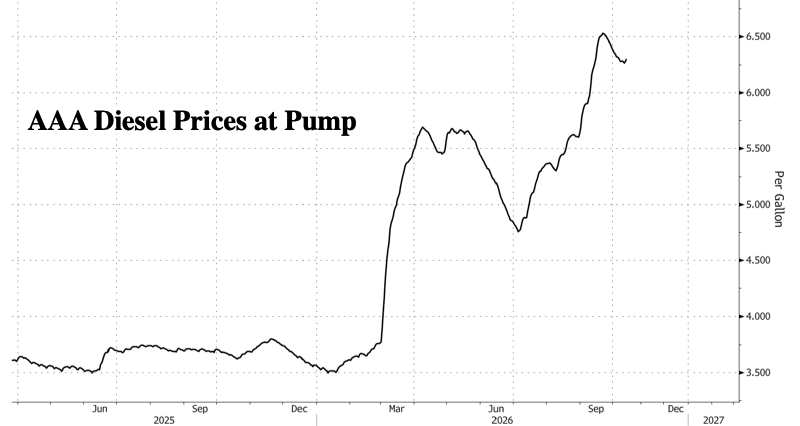
In recent days, Trump said he struck a deal with Moscow to immediately supply 300,000 metric tons of diesel to the global market, seeking to ease shortages ahead of the US midterm elections.
The Trump administration also pushed the Group of Seven wealthy democracies to release 100 million barrels of oil and fuel products in the coming weeks to cap prices ahead of the Northern Hemisphere winter.
On Tuesday, Vice President JD Vance announced that the administration would use wartime authority to increase fuel production at a refinery in Texas: “I am pleased to announce that the Trump administration, working with the refinery at Delek, has used the Defense Production Act and we’re going to expand the refinery right here in Tyler, Texas.”
“We want millions of gallons of commercial-grade and military-spec fuel to come out of this refinery, in addition to what it’s already producing,” Vance told the crowd.
Circling back to Goldman analyst Bhandari’s note on the diesel crisis, which could extend well into 2027, he gave clients three scenarios for where global product inventories could head next.
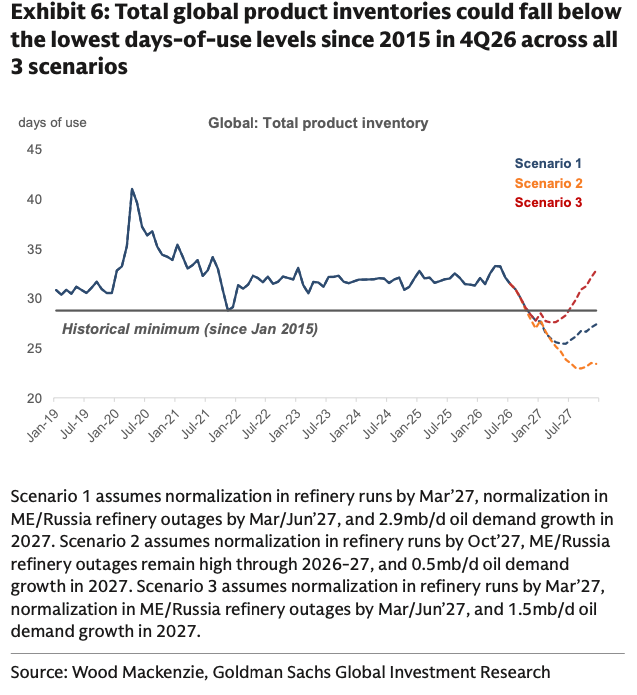
Read the report here. Also read: Goldman commodity experts Yulia Zhestkova Grigsby and Daan Struyven recently warned that the diesel crisis is setting up the next gasoline squeeze.
END
COMMODITY DIESEL: COMMENTARY/RAPIER/OIL PRICE.COM
Why Diesel Prices Are So Much Higher Than Gasoline
Thursday, Oct 15, 2026 – 06:30 AM
Authored by Robert Rapier via OilPrice.com,
- Diesel has generally cost more than gasoline since 2004 due to higher production costs, taxes, and global demand.
- Global refinery disruptions, export restrictions, and low inventories have widened the diesel price premium in 2026.
- Strong US crude production and refinery output cannot fully offset global diesel supply shortages.
There was a time when diesel fuel was usually cheaper than gasoline in the United States. That relationship began to change about 20 years ago, and since then diesel has generally traded at a premium. Today, that premium is not just persistent but unusually large, which raises an obvious question: how did we get from gasoline typically costing more than diesel to diesel costing substantially more than gasoline?

The answer has two parts.
The first is structural and goes back to the mid-2000s, when changes in fuel specifications, taxes, refining economics, and global demand fundamentally altered the relationship between gasoline and diesel prices.
The second is more immediate. In 2026, refinery disruptions, geopolitical conflicts, low inventories, and reduced exports from major suppliers have pushed the global diesel market into an unusually tight position. Understanding the difference between those long-term and short-term forces explains both why diesel usually costs more and why the gap is so large right now.
Diesel Was Once The Cheaper Fuel
Before the mid-2000s, diesel was often cheaper than regular gasoline in the United States. There were exceptions, particularly during cold winters when heating-oil demand strengthened, but the longer-term pattern generally favored diesel. That began to change around 2004, and according to the Energy Information Administration, on-highway diesel prices have been higher than regular gasoline prices almost continuously since September of that year.
That shift is clearly visible in the historical data I examined in my 2023 article on the subject. In the decade before 2005, gasoline generally traded at a small premium to diesel. After that, the relationship reversed, and diesel became the more expensive fuel in most years. The timing is important because it coincided with a major change in the way U.S. refiners had to produce highway diesel.
Ultra-Low-Sulfur Diesel Changed The Economics
Beginning in the mid-2000s, U.S. refiners had to dramatically reduce the sulfur content of highway diesel. That was an important environmental improvement because sulfur emissions contribute to air pollution and acid rain, but it also made diesel more expensive to produce. Refineries invested billions of dollars in new hydrotreating and sulfur-removal equipment, and those investments increased capital and operating costs and made compliant diesel more expensive to produce and distribute.
My earlier article focused heavily on this transition because the timing lines up closely with the point at which diesel’s historical discount disappeared. EIA now describes the persistent diesel premium as the result of several factors working together, including strong global demand for diesel and other distillates, the higher cost of producing low-sulfur diesel, and federal taxes that are six cents per gallon higher on diesel than on gasoline.
None of those factors explains every short-term price movement, but together they created a structural premium that had not existed to the same degree before 2004. Once diesel became more expensive to produce and more tightly linked to global distillate markets, the old relationship with gasoline never really returned.
Diesel Became A Global Commodity
Another important change has been the globalization of the diesel market. Gasoline is also traded internationally, but diesel and other middle distillates occupy an especially important role in the global economy because they power trucking, agriculture, construction, mining, shipping, industrial equipment, and heating systems. Strong demand in Europe, China, India, and the United States has kept pressure on global distillate balances for years.
That means U.S. diesel prices are increasingly influenced by events far beyond U.S. borders. Even when domestic production is strong, refiners can export diesel into higher-priced international markets, tying domestic prices more closely to global supply and demand. This is one reason it is misleading to look only at U.S. crude oil production and assume that abundant domestic oil should automatically translate into cheap diesel.
The United States can produce plenty of crude while still facing tight supplies of refined products. Crude oil has to be processed in the right refineries, into the right products, and then moved through the right transportation system. Those constraints matter just as much as the amount of oil coming out of the ground.
2022 Showed How Quickly The Premium Can Explode
The most dramatic recent example came in 2022, when Russia’s invasion of Ukraine disrupted global energy markets. Diesel was hit particularly hard. Russia was a major supplier of crude oil, refined products, and feedstocks to Europe and other markets, so sanctions and trade restrictions forced a rapid reshuffling of global flows. Gasoline prices rose sharply as well, but diesel supplies tightened even more, pushing the diesel premium to record levels.
In my earlier article, I noted that the gasoline-diesel spread reached a record in 2022. At the time, the disruption from Russia explained why a structural premium suddenly became an extreme one. The market eventually adjusted as trade routes shifted, refinery operations stabilized, and inventories recovered, but that normalization did not last.
Why The Gap Is So Large Again In 2026
The current situation resembles 2022 in one important respect: global diesel supply has again been disrupted more severely than gasoline supply. EIA recently reported that global distillate supplies are tight because of reduced refining activity in Russia, China, and the Middle East. At the same time, U.S. refiners have been running near maximum utilization, with domestic distillate production averaging about 5.1 million barrels per day through August, the highest level since 2019.
That point is worth emphasizing because it shows that the current problem is not simply a collapse in U.S. refinery output. American refiners are producing large volumes of diesel, but global demand for those barrels has increased at the same time that supplies elsewhere have fallen. As exports increased, U.S. inventories declined, and by mid-September distillate inventories were about 13% below the five-year seasonal average even though summer is normally a period when inventories build ahead of winter.
Since then, the global situation has become even tighter. Russia has restricted diesel exports as refinery infrastructure has been damaged, China has curtailed fuel exports to protect domestic supplies, and Middle Eastern refining and shipping have been disrupted by the conflict involving Iran. Tanker costs and insurance rates have also risen, making it more expensive to move refined products around the world.
The result is a global scramble for middle distillates. Both gasoline and diesel are affected by higher crude prices, but diesel is being squeezed more severely because the product itself is in shorter supply relative to demand. That is why the diesel-gasoline spread has widened so dramatically.
The Price Gap Is Now Extraordinary
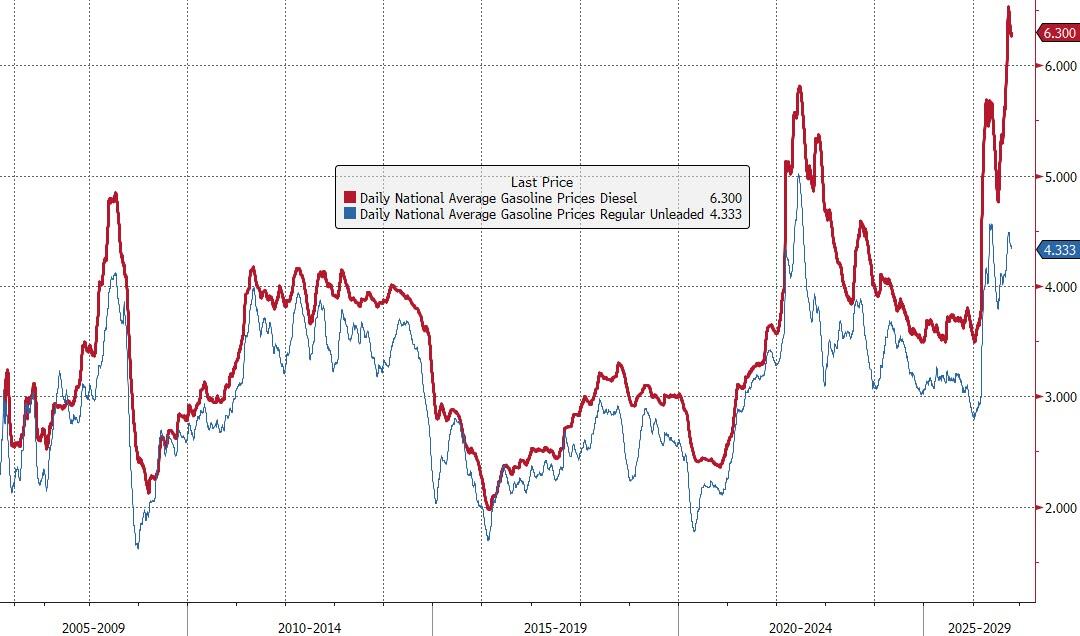
As of October 5, the national average price of on-highway diesel was $6.199 per gallon, compared with $4.354 for regular gasoline – a spread of about $1.85 per gallon. Diesel reached a nominal record of $6.29 per gallon in September, according to EIA, and remained above $6 nationally in early October.
That gap is not primarily the result of a sudden increase in diesel taxes or some new change in fuel specifications. Those structural factors help explain why diesel usually costs more than gasoline, but they do not explain why the premium is so large today. The current premium reflects a very tight global distillate market layered on top of the long-term changes that already made diesel the more expensive fuel.
That distinction is important because it separates the underlying reason diesel normally carries a premium from the temporary forces that can cause that premium to explode.
Refining Margins Are A Consequence, Not A Cause
Refining margins have risen sharply, and major refiners are benefiting from the tight market. But those high margins are a consequence of constrained diesel supply relative to demand rather than the original cause of the shortage.
When refinery capacity is disrupted, exports are curtailed, and inventories fall, the value of the remaining barrels rises. Refiners that can continue producing diesel benefit from that scarcity, but the scarcity comes first. This distinction is important because high margins are sometimes cited as evidence that refiners decided to raise prices, when in reality the margin expansion is largely the market’s response to a shortage of refined product.
Diesel Is A Different Market Than Gasoline
The broader lesson is that gasoline and diesel may come from the same barrel of crude oil, but they are not interchangeable products. They serve different markets, have different seasonal demand patterns, require different processing, and face different global supply pressures. A refinery cannot simply turn every barrel of crude into whichever product happens to be most expensive that day because refinery configuration, crude quality, product specifications, and physical operating limits all constrain what can be produced.
That is why abundant crude oil does not guarantee cheap diesel. The United States can produce record amounts of oil, run refineries near capacity, and still face expensive diesel if global product markets remain tight.
Twenty years ago, gasoline was often the more expensive fuel. Then diesel moved to a structural premium, and today that premium has widened dramatically because the global market for diesel and other middle distillates is again under severe strain. Until those supply constraints ease, diesel is likely to remain much more expensive than gasoline.
END
COMMODITY: COAL…
Asia Scrambles For Coal As Energy Crisis Sends Prices To Two-Year High Ahead Of Winter
Wednesday, Oct 14, 2026 – 10:10 PM
As the Northern Hemisphere winter quickly approaches, Asian thermal coal prices have climbed to two-year highs and could be on the cusp of a major breakout as utilities stockpile the dirty fuel amid disruptions to natural gas and crude product markets caused by the war in Ukraine and the Strait of Hormuz disruption.
Newcastle coal futures, an Asian benchmark, are up more than 40% on the year and could surge even higher if the $150-a-ton level is sustained.
Prices on Tuesday closed at their highest levels since August 2024.
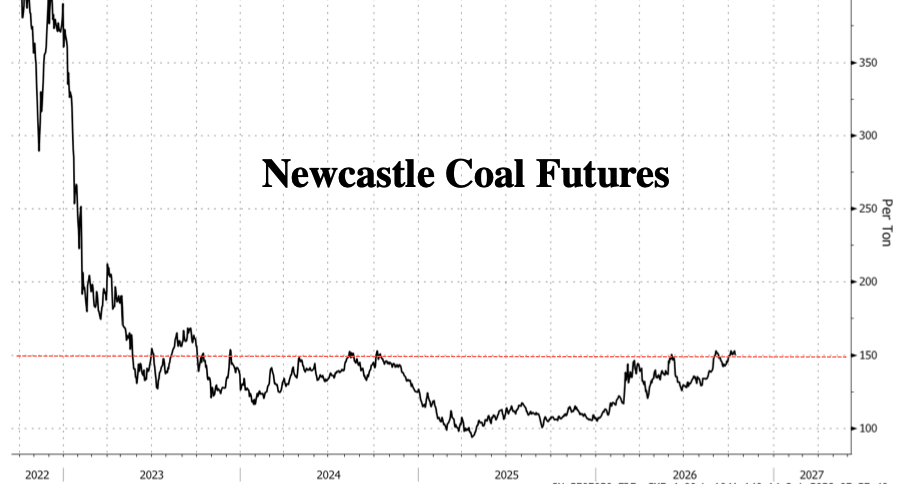
The combination of Ukraine decimating Russian refineries with drone attacks and the Strait of Hormuz disruptions to energy flows has sparked a global refining crisis that has encouraged utilities to switch from higher-priced natural gas and heating oil to cheaper alternative fuels such as coal.
Morgan Stanley analysts led by Amy Gower wrote in a note last week that the global refining crisis has made “the long-term outlook for thermal coal demand more resilient.” They raised their long-term outlook for Newcastle export prices by 4% to $125 a ton.
According to Bloomberg, China’s coal output has fallen more than 3% in the first eight months of the year after a deadly mining accident earlier this year triggered safety inspections and prolonged shutdowns.
Wood Mackenzie analyst Hangyu Li expects more Chinese mines to get the green light to restart, but any new production would come as a lag.
“We expect more mines to gradually win approval to restart after about four months of suspension, but a quick rebound on production in the near-term is unlikely,” Li wrote in the note.
Possible relief from a harsh winter could come from above-normal temperatures forecast across Asia because of a record-breaking El Niño, which would ease heating demand.
END
COMMODITY: CRITICAL MINERALS
| Wall Street Just Put $1.5 TRILLION Behind Critical Minerals |
| By Graham Summers, MBA | Chief Market Strategist |
| JPMorgan just created a job that did not exist two years ago. This week the largest bank in America named Andrew Frame as its chief for critical minerals. His mandate covers the entire chain, from extraction to refining to processing, with the job of finding investment opportunities and clearing the bottlenecks that threaten access to strategic resources. He sits inside JPMorgan’s Security and Resiliency Initiative, a 10-year, $1.5 trillion program to finance the industries the bank considers vital to economic and national security, with a separate $10 billion pool set aside for direct equity and venture stakes. Most of the coverage will treat this as a personnel story. It is much bigger than that. For the past two years, the critical minerals trade has been a Washington trade. The Pentagon took an equity stake in MP Materials. The Defense Production Act was used to fund mines and processing plants. Executive Order 14241 put the full weight of the federal government behind domestic production. The Department of War, the Export-Import Bank, and the Office of Strategic Capital all started writing checks. I have written about this at length because I have watched it happen up close. But a market built on government money alone is a narrow market. Agencies move slowly, their budgets are finite, and the number of companies that can navigate a federal funding process is small. What the sector needed was for private capital to look at what Washington was doing and decide to move alongside it. That is exactly what JPMorgan’s announcement means. Think about the machinery behind this. JPMorgan banks roughly 34,000 mid-sized companies and more than 90% of the Fortune 500. It has run the top investment bank in the world for over 15 years. It is standing up an external advisory council, hiring bankers and industry specialists, and feeding the whole effort with analysis from its new Center for Geopolitics. In April it extended the entire initiative to Europe, with the former head of Britain’s armed forces joining its advisory council. Now it has put a dedicated executive on critical minerals specifically. Jamie Dimon said it plainly when the program launched: the United States has allowed itself to become too reliant on unreliable sources of critical minerals. Coming from a banker, that carries a different weight than it does coming from a general or a senator. |
 |
| Here is why this matters for investors. When a theme lives only in Washington, the capital that flows into it is policy capital. It goes to the handful of projects that fit a government program. When the largest bank in the country builds a desk around the same theme, something changes. Thousands of corporate clients start hearing from their JPMorgan bankers about supply chain risk and where to source magnets, battery metals, and specialty alloys. Mid-sized manufacturers who never thought about where their tungsten came from start asking. Pension funds and family offices get a pitch deck. A junior explorer with a real deposit in a stable jurisdiction suddenly has a path to financing that runs through a bank rather than a grant application. In other words, a new market for critical minerals is being built. The metals themselves have always traded on exchanges. The missing piece was a capital market, where projects can be financed, offtake can be arranged, and assets can be bought and sold with institutional money behind them. Mining has spent a decade starved of institutional capital, and the critical minerals subsector has been the most starved of all, because the end markets were tied up in Chinese supply chains that nobody wanted to compete against. JPMorgan is signaling that the competition is now worth financing. I will add the obvious caveat. The $1.5 trillion is a financing ambition, not committed capital, and the bank itself notes that progress depends on companies getting through permitting, hiring qualified workers, and building operations that actually make money. A lot of that $1.5 trillion will go to defense, energy, and semiconductors rather than mines. But the direction is what counts. Private capital has decided this is a sector, and once that decision is made at the top of Wall Street, it filters down through every bank, every fund, and every corporate treasury that follows JPMorgan’s lead. This is the pattern I have watched play out in every major resource cycle of the past 20 years. First the policy shifts. Then a few early investors position. Then the big institutions arrive, and the re-rating happens fast, because the pool of buyers suddenly includes money that measures in the billions rather than the millions. We are at the third stage now. |
 |
| The way to invest around this is simple. You want exposure to the companies that will be on the receiving end of this capital: producers and developers of the metals the U.S. and its allies cannot source from China, in jurisdictions where a JPMorgan banker can actually get a deal done. Gold and silver have already re-rated on the fiscal side of this story. The industrial and strategic metals are next, and this week the biggest bank in the world told you so. This is the exact setup my Private Wealth Advisory subscribers have been positioned for. The portfolio already holds the copper, energy, and precious metals names that sit at the front of the line when institutional money starts flowing into strategic resources, and I spend a good part of every week in rooms with the people in Washington and the resource sector who are making this happen. When Wall Street’s biggest bank follows the same playbook I have been writing about, that is confirmation, and PWA readers are already in. Right now you can take a 30-day trial of Private Wealth Advisory for just $2.99. That gets you four weeks of market updates, multiple trade ideas including the hard-asset positions built for this exact rotation, and a copy of my book The Everything Bubble. The service has posted a 75% win rate since 2015 and roughly doubled the S&P 500’s return since 2020. This offer expires today at noon (12:00PM Eastern). |
END
SPECIAL THANKS TO CHRIS POWELL FOR BRINGING THIS TO OUR ATTENTION:
GOLD/LONDON’S FINANCIAL TIMES:
Opinion Gold
London’s gold market enjoys the Trump effect
The City’s dominance of physical trading in the metal is being reinforced by global instability

https://www.ft.com/content/bbb1d399-e91c-4600-9882-ea93e1f96ac9?
When the Dutch central bank announced last month that it had transferred more than 78 tonnes of gold from New York to London, it was unusually open about its motives. Not only would bullion stored in the Bank of England’s vaults be available in a crisis, but it would also join “the world’s most easily tradeable gold”.
London could hardly have asked for a better endorsement in its historic rivalry with New York, where most gold futures are traded. The Netherlands is not alone in appreciating the City: the stash of bullion held in London vaults has risen steadily over the past year, reaching nearly 10,000 tonnes of gold, worth $1.3tn, last month.
Central banks have been buying gold as they diversify away from US government bonds as a reserve asset. Gold has also returned to London after banks and hedge funds moved bullion to New York last year in response to rising prices and worries that the US would impose import tariffs on the metal. London’s gold market is now enjoying the Trump effect: the US president loves both gold and being unpredictable, but the latter is anathema to central banks. They are cautious when it comes to the safety of their bullion reserves. Many have been bringing gold bars closer to home since Russia’s sovereign assets were frozen following the 2022 full-scale invasion of Ukraine. Although Venezuela is nearing a deal to transfer its $4bn gold reserves from London to New York, the Dutch move is part of a trend for holding more gold outside the US.
The Bundesbank has about a third of its gold in New York and its president Joachim Nagel insists he has “no doubt” about its safety. But there have been calls in Germany to repatriate it. New York remains the leading financial centre for gold derivatives, thanks to futures trading on the Comex exchange and the 6,300 tonnes of the metal held at the Federal Reserve Bank of New York. But, while US stock markets have a magnetic pull, there is little sign that London’s grip on the physical trading of gold is weakening. The BoE’s record as a safe custodian, despite the UK having sold half of its own gold 25 years ago, makes London a natural destination. The City offers more than safekeeping. Gold can be traded or lent on its bullion market without having to leave the vaults, allowing central banks to earn a yield on their assets. This is the key to London’s global dominance in “over-the-counter” gold trading. Gold held at the BoE or in the UK vaults of the largest bullion banks, such as HSBC and JPMorgan, can either be simply stored or flow in and out of its trading market. Even some of the metal backing New York-listed exchange-traded gold funds is held in London. It is not easy to move.
Shifting gold reserves directly to New York requires London’s 12.5kg “good delivery” bars to be melted down in Zurich refineries and remoulded to US standards. “London’s dominance in physical trading looks absolutely solid,” says Adrian Ash, research director of BullionVault, an online bullion marketplace. Global competition is growing. The rise in bullion prices amid central bank buying and political instability has restored gold to its historical importance. Owning gold bars is no longer derided as the obsession of eccentrics and “gold bugs”. That makes other financial centres, particularly in Asia, keen to strengthen their position. Singapore is launching a bank clearing system for gold this year and is competing with Hong Kong to attract more trading, although it denies that it wants to displace the City.
London is making another attempt to compete in derivatives: the Intercontinental Exchange has launched a new gold futures contract. The rise of digital assets such as gold “tokens” is a longer-term uncertainty. These still need to be backed by gold held somewhere: the cryptocurrency exchange Tether has 22 tonnes of gold in Switzerland to back its gold token. But digital assets do not need the full banking facilities of London’s gold market for trading and clearing. The City also faces a legal challenge to its market. The London Bullion Market Association, which sets standards for refiners to deliver gold to City vaults, was accused in court last week of having caused the deaths of two miners in Tanzania. The LBMA denies liability and the case will decide how much responsibility it has for monitoring mines. But London remains the gold standard for physical trading. For now at least, its position is strengthening. The growing stacks of gold bars in City vaults are testament to that. john.gapper@ft.com
END
YOUR EARLY CURRENCY VALUES/GOLD AND SILVER PRICING/ASIAN AND EUROPEAN BOURSE MOVEMENTS/AND INTEREST RATE SETTINGS THURSDAY MORNING.7:30 AM
SHANGHAI CLOSED DOWN 59.75 PTS OR 1.59%
HANG SENG CLOSED DOWN 258.17 PTS OR 1.46%
Nikkei CLOSED DOWN 3234.29 PTS OR 4.77%
//Australia’s all ordinaries CLOSED UP 0.76%
//Chinese yuan (ONSHORE) CLOSED UP AT 6.6918
/ OFFSHORE CLOSED UP AT 6.6918 Oil DOWN TO 94.03 dollars per barrel for WTI and BRENT DOWN TO 104.03 Stocks in Europe OPENED ALL MIXED
ONSHORE USA/ YUAN// WITH YUAN TRADING 6.6918 OFFSHORE YUAN TRADING UP TO 6.6918 ONSHORE YUAN TRADING BELOW LEVEL // OFF SHORE AND UP ON THE DOLLAR)// / AND THUS STRONGER/OFF SHORE YUAN TRADING UP AGAINST US DOLLAR/ AND THUS STRONGER
XXXXXXXXXXXXXXXXXXXXXXXXXXXXXXXXXXXXX
ONSHORE YUAN: CLOSED UP TO 6.6918
OFFSHORE YUAN: UP TO 6.6918
1A.HANG SANG CLOSED DOWN 258.19 PTS OR 1.06%
1 B. SHANGHAI CLOSED DOWN 59.75 PTS OR 1.59%
2. Nikkei closed DOWN 3234.29 PTS OR 4.77%
WEST TEXAS INTERMEDIATE OIL DOWN TO 94.03
BRENT; 104.03
3. Europe stocks SO FAR: ALL MIXED
USA dollar INDEX DOWN 45 BASIS PTS TO 101.89// EURO RISES TO 1.1209 UP 15 BASIS PTS
3b Japan 10 YR bond yield:FALLS TO. +2.911 DOWN 9 FULL BASIS PTS/ VERY TROUBLESOME//Japan buying 100% of bond issuance)/Japanese YEN vs USA CROSS NOW AT 157.94… JAPANESE YEN NOW FALLING AS WE HAVE NOW REACHED THE ENDING OF THE YEN CARRY TRADE AGAIN AND THE REPATRIATION OF YEN DENOMINATED BONDS TRADING IN THE USA/EUROPE. JAPAN 30 YR BOND YIELD: 3.974 DOWN 9 FULL BASIS PTS
3c Nikkei now ABOVE 17,000
3d USA/Yen rate now well ABOVE the important 120 barrier this morning
3e Gold UP /JAPANESE Yen UP//CHINESE ONSHORE YUAN: UP (6.6918) AND OFFSHORE: UP AT 6.6918
3f Japan is to buy INFINITE TRILLION YEN worth of BONDS. Japan’s GDP equals 5 trillion USA. CENTRAL BANK OF JAPAN WILL NO LONGER DO QE.
Japan to buy 100% of all new Japanese debt and NOW they will have OVER 50% of all Japanese debt. GOVERMENT ASKED JAPAN PENSION FUNDS AND INSURANCE FUNDS TO BUY MORE JAPANESE BONDS AND REPATRIATE ALL FOREIGN BONDS.
3g Oil DOWN for WTI and DOWN for Brent this morning
3h European bond buying continues to push yields LOWER on all fronts in the EU German 10yr bund YIELD DOWN TO +3.3835/ Italian 10 Yr bond yield DOWN AT 4.467/ SPAIN 10 YR BOND YIELD DOWN TO 4.000%
3i Greek 10 year bond yield DOWN TO 4.2940%
3j Gold at $4145.80 /Silver at: 56.48 1 am est) SILVER NEXT RESISTANCE LEVEL AT $100.00
3k USA vs Russian rouble;// Russian rouble UP 0 AND 20/ 100 roubles/83.64
3m oil (WTI) into the 94 dollar handle for WTI and 104 handle for Brent/
3n Higher foreign deposits moving out of China// huge risk of outflows and a currency depreciation. This can spell financial disaster for the rest of the world/
JAPAN ON JAN 29.2016 CONTINUES NIRP. THIS MORNING RAISES AMOUNT OF BONDS THAT THEY WILL PURCHASE UP TO .5% ON THE 10 YR BOND///YEN TRADES TO 157.94 // 10 YEAR YIELD AFTER FIRST BREAKING .54% LAST YEAR NOW EXCEEDS THAT LEVEL TO 2.911% DOWN 9 BASIS PTS STILL ON CENTRAL BANK (JAPAN) INTERVENTION//YEN CARRY TRADE NOW UNWINDING//YEN BOND TRADING OVERSEAS TO BE REPATRIATED.//JAPAN 30 YR: 3.974 DOWN 9 PTS..: USA/SF this 0.8302 as the Swiss Franc . Euro vs SF: 0.9307
USA 10 YR BOND YIELD: 5.082 DOWN 11 BASIS PTS…NOW ABOVE 5.00%
USA 30 YR BOND YIELD: 5.434 DOWN 9 BASIS PTS/
USA 2 YR BOND YIELD: 4.730 DOWN 7 BASIS PTS
USA DOLLAR VS TURKISH LIRA: 49.42 UP 3 BASIS PTS/LIRA GETTING KILLED//IDIOTS FOR SELLING GOLD AND USA DOLLAR RESERVES.
10 YR UK BOND YIELD: 5.3373 DOWN 9 PTS
30 YR UK BOND YIELD: 5.8199 DOWN 9 BASIS PTS
10 YEAR FRENCH BOND YIELD; 4.7630 % //DOWN 12 BASIS PTS
10 YR CANADA BOND YIELD: 3.878 UP 1 BASIS PTS
5 YR CANADA BOND YIELD: 3.576 UP 2 BASIS PTS.
1a New York Opening report
Futures Slide As AI Unwind Goes Global: Kospi Crashes Into Bear Market, Treasuries Soar
Thursday, Oct 15, 2026 – 08:28 AM
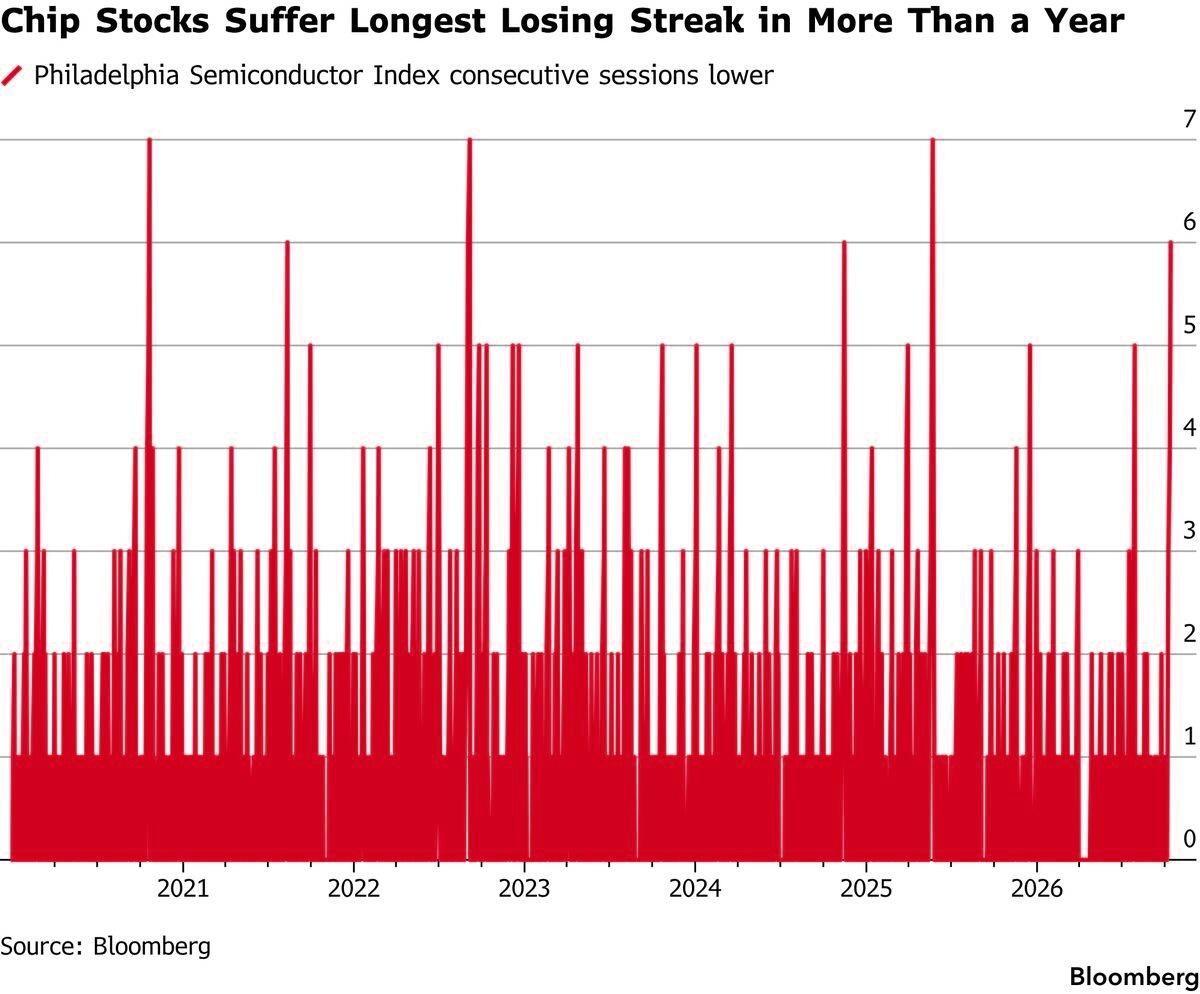
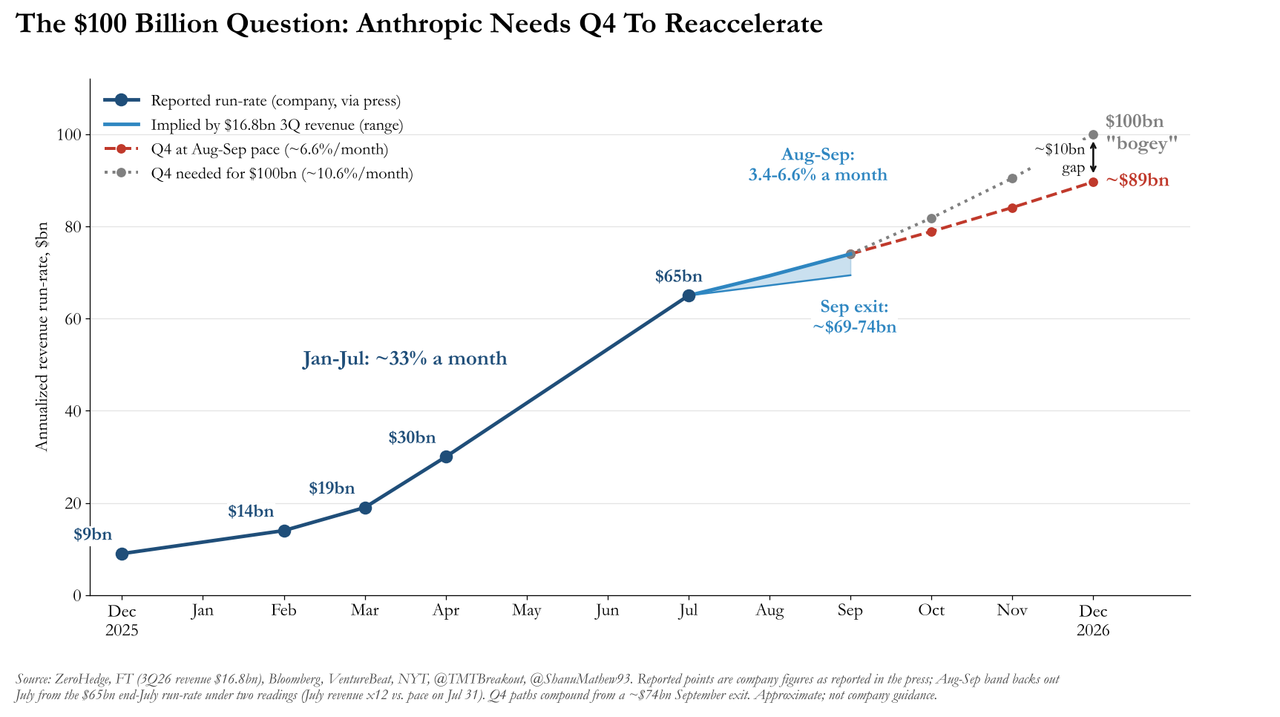
US futures are lower as the AI unwind goes global – Korea’s Kospi crashed into a bear market and tripped circuit breakers, CoreWeave bonds sank deeper into distress and Anthropic’s still-blistering but slowing growth failed to impress – while yesterday’s hot CPI scare has morphed into a growth scare; as a result Treasuries are ripping higher with 10Y yields tumbling 10bps to 5.08%, the lowest since Sept. 23. As of 6:20am ET, S&P futures are 0.3% lower at 7,749 while Nasdaq futures slide 1.1% to 29,857 and Dow futures are up 0.2%; small caps are the odd man out with Russell 2000 futures up 0.3%. Yesterday the S&P 500 fell 1.1% to its worst day since July, the Nasdaq 100 lost 2% and the SOX dropped for a sixth straight session. Premarket, Mag-7 and AI baskets are all lower with Apple the only Mag 7 name in the green; chipmakers, memory, neoclouds and AI infrastructure names are all sliding, with CoreWeave down another 6-7% after imploding 15% yesterday as its bonds traded at distressed levels. The day’s driver is AI financing (again): Anthropic’s $16.8 billion Q3 revenue implies slowing growth, and a Gartner report that $3,5 trillion of AI infrtastructure spending could be exposed to impairment by 2030 is making the rounds. Bonds rally across the curve in a bull flattener with yields down 7-11bps, as the AI selloff pushes investors into havens and odds of an October Fed hike slide back to around 30% from a post-CPI intraday peak of 58%; bunds and gilts also rally about 10bps, helped by the pullback in energy. The dollar is lower, with the Bloomberg Dollar Spot Index down 0.3%-0.4% and the Swiss franc leading G-10 gains while the Aussie slumps after a weak jobs report. In commodities, Brent drops almost 2% to $104 on the risk-off tone and talk of the US easing shadow fleet sanctions, gold jumps 1.3% to $4,158 and silver is up 2.1%, while copper slides. Bitcoin is down 0.6% near $81,200. US economic data slate includes September retail sales, PPI, October Empire manufacturing and Philly Fed, and weekly jobless claims (all 8:30am) and August business inventories (10am). Fed speaker slate includes Goolsbee (10am), Hammack (4:30pm) and Chair Warsh, who has a fireside chat with the IMF’s Georgieva in Bangkok at 11:30pm ET before the blackout. Treasury sells $110 billion of 4-week and $105 billion of 8-week bills at 11:30am.
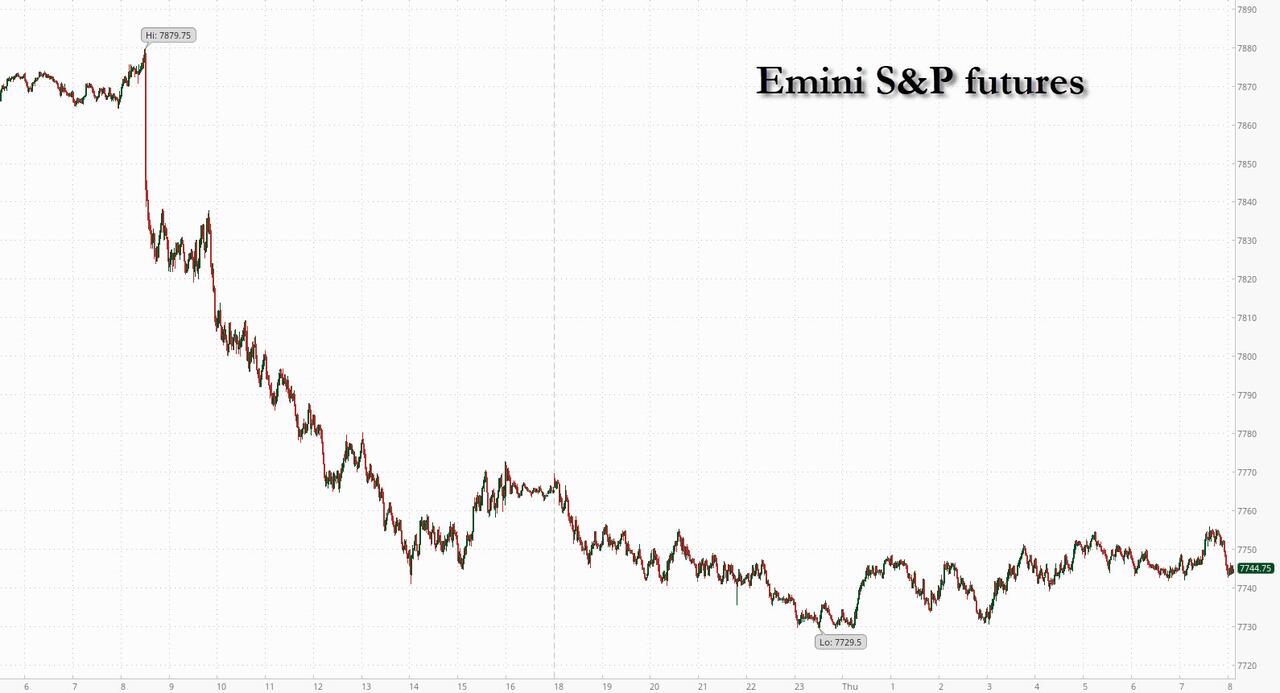
In premarket trading, Apple (AAPL) outperforms the group during the AI selloff (AAPL +0.8%, Microsoft -0.5%, Alphabet -0.8%, Meta Platforms -1%, Tesla -1.4%, Amazon -1.8%, Nvidia -1.6%)
- Chipmakers and other AI-related firms slide after Anthropic disclosed third-quarter revenue that likely slowed from the previous quarter. Among notable movers: CoreWeave (CRWV) -3%, Dell (DELL) -4%, Micron (MU) -4%, Intel (INTC) -3%, Marvell (MRVL) -4%, AMD (AMD) -3%, Broadcom (AVGO) -2%
- AngloGold Ashanti (AU) rises 3% after Goldman Sachs initiated coverage at buy, citing increased central-bank purchases that should support gold prices. Gold is also higher on Thursday morning.
- Cirrus Logic (CRUS) slips 2% after being downgraded to sector weight at KeyBanc, which sees a weak outlook for the Apple supplier.
- FMC Corp. (FMC) sinks 27% after the agricultural chemicals firm cut its third quarter outlook.
- Fortrea Holdings (FTRE) gains 3% after Deutsche Bank upgraded the health services firm to buy, citing potential for revenue growth and margin expansion.
- Kimberly-Clark (KMB) climbs 3% after the household products company reported preliminary net sales for the third quarter that met the average analyst estimate.
- Penske Automotive Group (PAG) climbs 8% after entering a deal to be taken private for $212 per share in cash by Penske Corp. and Mitsui.
- Quantinuum (QNT) rises 3% as Morgan Stanley upgrades to overweight, saying the stock offers the most attractive valuation among peers.
- Rocket Lab (RKLB) falls 11% after adjusting the target launch timing for its Neutron medium-lift rocket, with the vehicle’s inaugural launch now expected to occur in 2027.
- Walmart (WMT) gains 2.8% after Deutsche Bank upgraded the retailer to buy, citing a favorable setup into 2027.
In other corporate news, the US FTC has subpoenaed Anthropic and OpenAI seeking documentation in relation to safety incidents and privacy policies, Axios reports, just as the AI sector needed one more thing to worry about. IDC said the smartphone market suffered its worst decline on record in the September quarter, with rising memory costs pushing shipments down 22% and “the worst is yet to come.” Rocket Lab drops almost 10% after delaying the inaugural Neutron launch to 2027, while IonQ filed to offer about $2 billion in shares and warrants. Barclays analysts said a Tesla-SpaceX merger has become widely expected and an announcement could come before Tesla’s annual general meeting. Marsh will shoulder a larger share of the CS-Greensill settlement, the FT reports; EasyJet shareholders are being asked to support an Apollo takeover proposal; VW is pivoting to trucks and rugged SUVs in a quest for US profit; and Iambic Therapeutics raised $150 million in a US IPO priced at the midpoint. Schwab, Marsh McLennan, US Bancorp, PNC, BNY and Prologis report before the open, with Interactive Brokers, Alcoa and JB Hunt after the close.
The global AI unwind is gaining momentum: negative headlines are piling up, from signs of Anthropic’s slowing growth to CoreWeave bonds plunging into distress and Gartner’s warning that $3.5 trillion of AI infrastructure spending could be at risk of impairment by 2030. Even good results from TSMC – a Q4 revenue guide of $52.3-54.3 billion against a street at about $50 billion – failed to dispel the concerns, and a global selloff in semis dragged South Korea’s benchmark down nearly 8% into a bear market, while the SOX is down 12% over the past six sessions, as Goldman warned of a semi “air pocket” last week.
As discussed last night, Anthropic’s pre-IPO investor event failed to impress as the revenue growth shared was well below the double digit growth observed earlier in the year. “In any normal world, companies would kill for 45% q/q growth,” said Vital Knowledge founder Adam Crisafulli. “But in the land of AI, where investors are used to parabolic figures, a slowdown in growth undercuts sentiment.”
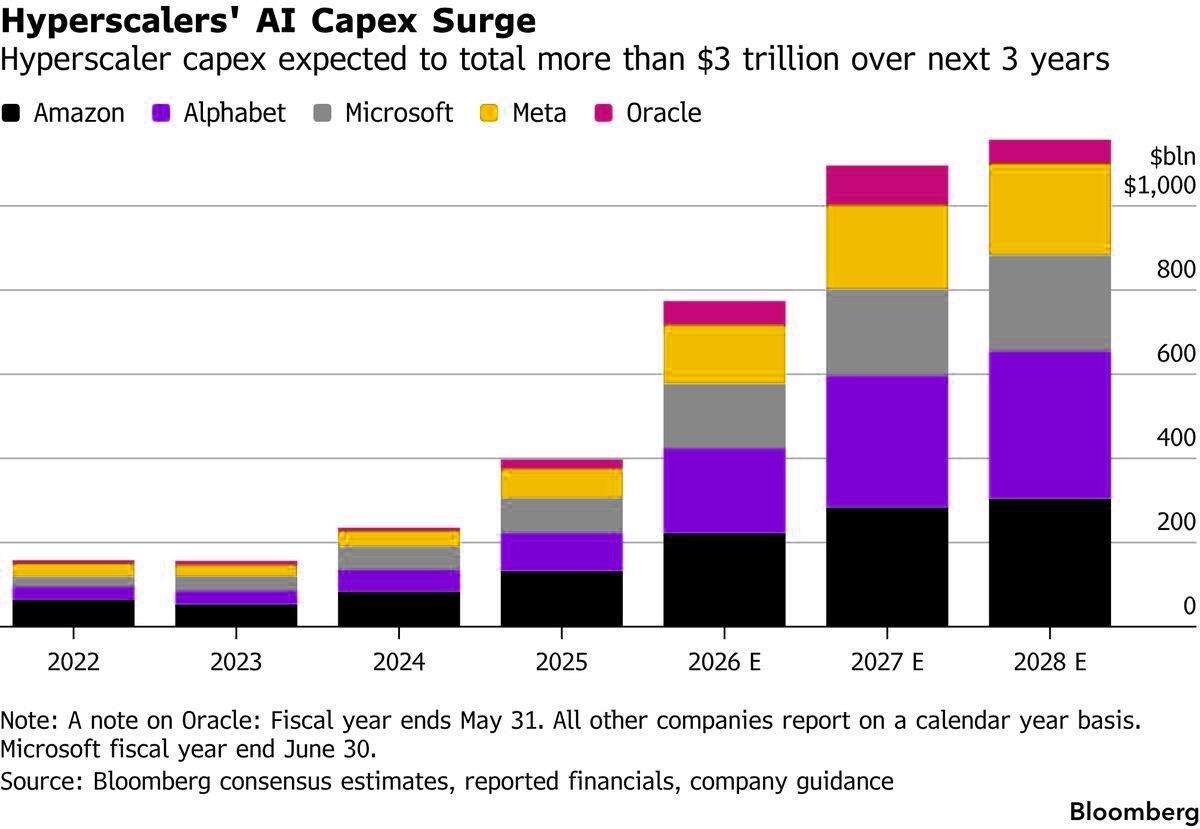
The market is especially worried about the financing model of neocloud companies, which are borrowing huge amounts at high rates to build data centers. CoreWeave’s 5Y CDS closed at 1,118bps yesterday, up a massive 136bps, and its debt due 2032 dropped below 78 cents on the dollar – paper investors bought at par just four months ago! CoreWeave, for its part, said it isn’t worried about the market’s reaction and wants access to “unlimited” pools of money (what could go wrong). Meanwhile, hyperscaler capex is expected to total more than $3 trillion over the next three years, which is a lot of money to finance with 10Y yields north of 5%.
“AI stocks in EM will be the first to go, given their outperformance this year,” said Vey-Sern Ling, a managing director at Union Bancaire Privee. “Higher rates and USD also hurt EM tech disproportionately.”
“The market is juggling a number of risks at the moment, notably geopolitical, which is fueling oil prices and in turn inflation and monetary policy,” said Roland Kaloyan at Societe Generale. Some investors “are looking to take profits and rotate out of the semiconductor trade. With yields where they are today, bonds are becoming increasingly attractive.”
That said, yesterday’s hot CPI hasn’t gone away: headline CPI rose 0.65% m/m and core 0.335% vs 0.2% expected, briefly lifting October hike odds above 50% before the AI rout unwound the entire move. Deutsche Bank’s Henry Allen thinks the market is too complacent.
“The 50 risk is live,” Henry Allen, macro strategist at Deutsche Bank Research, said in an interview with Bloomberg TV, warning that the more the Fed stays behind the curve, “the risk is they have to play catch up.” Markets are grappling with offsetting forces, “where AI is pushing down the one side, CPI is pushing up on the other, but the risks are definitely on the hawkish side.”
JPM’s Market Intel desk under Andrew Tyler stays Tactically Bullish, noting the two big questions yesterday were the reversal in bond yields and how much longer the tech selloff can run. On the former, the team blames a market that clearly overreacted when October hike odds jumped above 50%, a move into quality and safe assets, and “concern about a possible AI-related credit event.” On tech, the SOXX fell for a seventh straight day; with JPM’s TPM positioning at a neutral ~46th percentile vs ~19th near the late-July lows, the desk sees potential for further de-grossing into key tech catalysts, but says “we remain constructive on the sector and still see a possible opportunity to buy the dip.” JPM FX sales’ Steve Bruner put it more colorfully: “Have rates finally crossed the AI Rubicon? My instinct is Not Yet.”
Goldman’s desks spent the night counting casualties. In London, Rich Privorotsky writes that the GS global neocloud basket is down 20% in five sessions, “a roughly 1st pctl move over ten years”, adding that “in hindsight, the pain trade was long AI/ short bonds. Now we’re watching both sides unwind.” His conclusion: “the market is discovering that demand for compute can grow exponentially, but the capital available to finance it cannot.” Praneet Shah echoes that “the cost of financing the AI buildout is starting to collide with how much the market can comfortably absorb”, while Gen Sales’ Dioni Ellinikaki notes that in an increasingly debt-funded capex cycle, “access to credit is becoming the key constraint rather than AI adoption itself.” On the damage: GS Prime shows TMT-focused funds lost 2.7% on the day (a -2.6 standard deviation move), and the TMT desk’s info-tech sell skew was the highest in more than four weeks. In Asia, Rachel Hu notes the TAIEX saw a record ~$9.3 billion foreign outflow, yet market color “suggested limited capitulation versus the July selloff” — a polite way of saying there may be more to come.
In Europe, French bonds remain in focus: the OAT-bund spread widened 1bp to 142bps, just shy of Monday’s closing peak, as France sold €12 billion of bonds at the top of its target range. Former ECB chief Mario Draghi said the ECB is unlikely to step in any time soon with market intervention to help France, setting a high bar for the TPI.
In Europe, the Stoxx 600 is down 0.1% at 637.05, with 225 members down and 369 up, as investors turn to defensive sectors while the global tech selloff gathers pace; telecoms, food & beverage and insurance lead, while tech, basic resources and industrials lag. The FTSE 100 is up 0.5% thanks to its low tech exposure, while the Euro Stoxx 50 drops 0.6% and the DAX is down 0.3%. ASML falls 5.5%, ASM International 9.1% and BE Semi 6.1%; JPM notes Semis, AI Data Centers and Momentum Longs baskets are showing 1-3z moves, while AI Disruptions and Luxury outperform. Here are the biggest European movers:
- Ericsson shares surge as much as 11% after the 5G gear maker reported sales and profits ahead of expectations, driven by its core networks business and projects in Japan and India.
- Pernod Ricard shares gain as much as 4% after analysts broadly welcomed the beverage maker’s first-quarter results, noting improved momentum in the US and China and signs the quarter marked a low-point for the company.
- THG surges as much as 17% after the nutrition and beauty company upgraded its profit guidance, which Peel Hunt says is likely to trigger increases to consensus estimates.
- EQT rises as much as 4.7% after the alternative investment firm reported an increase in assets under management driven by Coller Capital, which the firm acquired earlier this year.
- Dunelm gains as much as 7.6% after analysts said the UK home-furnishings retailer’s first-quarter trading update was better than analysts had expected, driven by a recent sales improvement.
- TotalEnergies shares rise as much as 1.1% after the French energy company published its 3Q trading statement. Analysts tout strong refining margins while oil and gas production and LNG also performed above expectations.
- DocMorris shares rise as much as 9.4% after the online pharmacy delivered “long-awaited” positive adjusted Ebitda in the third quarter and raised its guidance for the full year.
- European semiconductor stocks sink on Thursday as Anthropic’s sales growth failed to impress investors that have grown more anxious about the sustainability of AI spending.
- Entain slides as much as 3.8% after posting softer online net gaming revenue growth due to unfavorable sports results in Italy and a provisional ban on online gambling in Brazil.
- Workspace shares fall as much as 9.8% after the UK flexible-office landlord said its target of an additional £100m+ of disposals is unlikely to be fully achieved by March 2027.
- Alfa Laval drops as much as 4.2% as Nordea downgrades its rating on the Swedish industrial equipment maker to hold from buy on a more balanced risk-reward following recent strength in the shares.
- Kinnevik slides as much as 11% as DNB Carnegie says the Swedish investment company’s third-quarter unlisted net asset value came in “clearly below” expectations.
- Mining stocks fall across Europe, driven by industrial metals amid a global selloff in the artificial-intelligence trade.
Asian stocks slumped as the semiconductor selloff deepened on concerns over AI financing, with the MSCI Asia Pacific Index falling as much as 3.3%, the most since July 28, and its tech subgauge sinking as much as 7.1%; Samsung Electronics, SK Hynix and TSMC were the biggest drags. South Korea’s Kospi plunged 7.6%, triggering Level 1 circuit breakers for the first time since July 29 and entering a bear market, as Samsung fell 9.5% and SK Hynix 11.1%, with foreigners net sellers for an 8th straight session. Japan’s Nikkei sank 4.9%, its worst day since March, while Taiwan’s Taiex fell 3.4% on a record ~$9.3 billion of foreign selling. China’s CSI 300 dropped 2% and the Hang Seng lost 1%, while Australia’s ASX 200 held up relatively well as financials and defensives offset weakness in tech and miners. India’s Nifty bucked the trend, rising 1.9% on rotation and lower crude. Asian central banks stepped in to support their currencies, with Taiwan’s state banks selling dollars and the RBI and Bank Indonesia intervening.
In FX, the Bloomberg Dollar Spot Index is down 0.3%-0.4%, giving back the post-CPI spike as US yields fall; the DXY trades in a 101.87-102.39 range after hitting its highest level since May 2025 on Wednesday. The Swiss franc leads G-10 gains, with USD/CHF down 0.6% to 0.8297, while EUR/USD rises 0.5% to 1.1212 and cable is up 0.4% at 1.325, shrugging off a better-than-expected UK August GDP print. The Aussie is the laggard, down 0.6% to 0.6930 after an unexpected contraction in September employment pushed the jobless rate up to 4.7%, prompting traders to scale back RBA hike bets. USD/JPY edges up 0.2% to 158.0.
In rates, Treasuries extend their advance across the curve in a bull flattener as investors seek havens amid the slump in technology stocks, with the 10-year yield down 10bps to 5.08%, the lowest since Sept. 23 – and a far cry from the 5.33% hit right after yesterday’s CPI print. The 2-year yield is down about 8bps at 4.72% after having spiked as much as 16-20bps intraday on Wednesday, while the 30-year falls 7bps to 5.45%. If the rally continues, the Sept. 23 session was the last time a sub-5% 10Y was seen (and for the record, we are still some way off the 5.365% early-October peak). Bunds rally, led by the belly, with the German 10Y falling 10bps to 3.37%, the lowest since Sept. 8, as money markets pare ECB hike bets and no longer fully price three increases by end-2027; gilts jump with the UK 10Y down 9bps to 5.33%, ignoring the GDP beat. Spain sold €5.4 billion and France €12 billion of bonds. In the US, Treasury sells $110 billion of 4-week and $105 billion of 8-week bills at 11:30am, with the focus on PPI and retail sales and then Chair Warsh’s final word before the blackout.
SMBC Nikko’s Makoto Noji thinks the 10-year yield may be topping out: Wednesday’s move was a rare return to the “textbook” pattern – stocks fell and the 10-year yield declined as the curve twist-flattened – which may signal long-term yields are close to peaking, as lower stock prices could prompt higher-income households to rein in spending. Not everyone is convinced; Bloomberg’s Vassilis Karamanis argues the move is less a haven trade than a rates trade, with Treasuries rallying “because the tightening already embedded in yields starts doing some of the Fed’s work.”
In commodities, WTI November is down 0.2% at $94.92 (in a $93.58-95.31 range) and Brent December slides 1.9% to $104.06 (in a $103.64-105.83 range), as the equity selloff pushes investors away from risky bets and the Trump administration considers easing sanctions on shadow fleet vessels to bring down record-high freight rates. That is overshadowing escalation risk: CNN reports the US military has drawn up new strike plans that include potentially using the “mother of all bombs” against Iranian energy and nuclear sites, Ukraine’s Zelenskyy has ordered strikes on Russian refineries to resume and a drone strike set the Ryazan refinery on fire overnight, while a cargo ship sank in the Strait of Hormuz after a strike. API data showed an 11.1 million barrel crude draw (vs. a 1.9 million build expected); the delayed EIA report is out at noon and WTI November options expire today. Dutch TTF slips toward €85/MWh. Spot gold rises 1.3% to $4,158 on haven demand and the softer dollar, silver gains 2.1% to $56.72, while LME copper trades near the bottom of a $14,320-14,480/t range.
US economic data slate includes September retail sales, PPI final demand, October Empire manufacturing and Philadelphia Fed business outlook, and initial jobless claims (all 8:30am), August business inventories (10am) and the September federal budget balance (2pm). Fed speaker slate includes Goolsbee (10am) and Hammack (4:30pm), with Chair Warsh in a fireside chat with the IMF’s Georgieva at 11:30pm ET.
The IMF-World Bank meetings continue in Bangkok, EU leaders meet for a summit in Brussels, and SEMICON West wraps up in San Francisco.
Market Snapshot
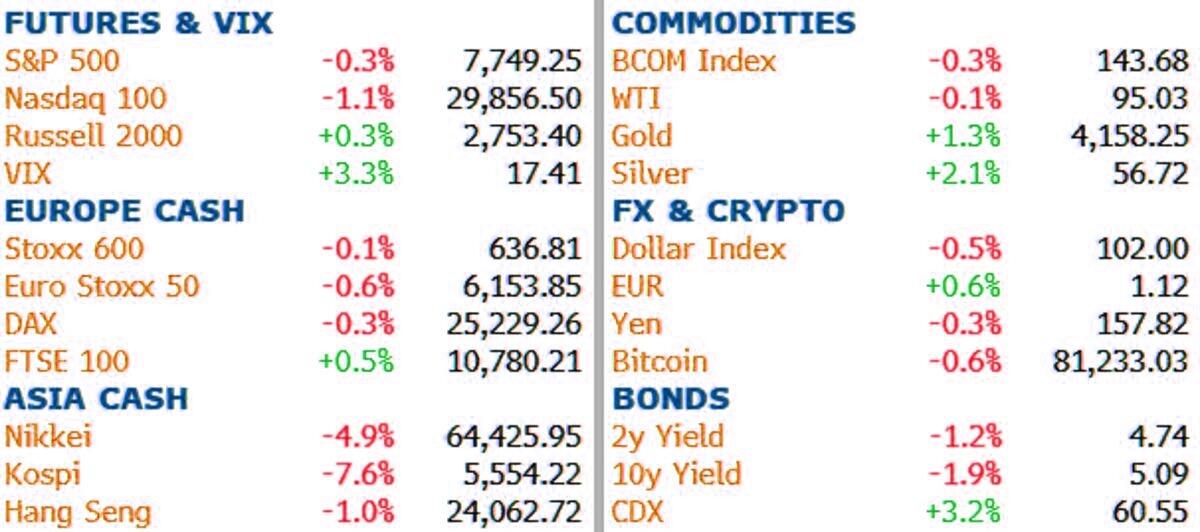
Top Overnight News
- Nasdaq futures fell as a plunge in chip stocks deepened the equity selloff and extended the AI trade pullback. South Korea’s Kospi sank almost 8%, entering a bear market. BBG
- TSMC bucked the gloom with an upbeat outlook, yet failed to dispel rising concerns about the sustainability of a global AI buildout. The chipmaker is considering expanding in Texas and confirmed talks with Elon Musk’s Terafab about capacity. BBG
- Anthropic PBC told prospective investors its third-quarter revenue hit $16.8 billion, according to people familiar with the matter, as the artificial intelligence company pushes ahead with plans to go public. BBG
- CoreWeave shares plunged as much as 17% on Wednesday, while its debt due in 2032 dropped to less than 78 cents on the dollar, after investors bought it at par four months ago. BBG
- US FTC has subpoenaed Anthropic and OpenAI, seeking documentation in relation to safety incidents and privacy policies; plans to compel executives to testify: Axios
- Asian central banks stepped in to support their currencies as stocks dropped. State-owned banks in Taiwan sold US dollars and the RBI supplied greenbacks in onshore and offshore markets, traders familiar said. Bank Indonesia intervened to steady the rupiah. BBG
- IDC said that the smartphone market suffered its worst decline on record in the September quarter. Rising memory costs pushed shipments down 22%, and “the worst is yet to come,” the research firm said. BBG
- The Fed’s Mary Daly told Reuters that further rate hikes are probably needed, but there’s no urgency. Her Chicago colleague Austan Goolsbee called Wednesday’s US inflation report “discouraging.” BBG
- Deutsche Bank sees a growing risk that the Federal Reserve will need to raise its benchmark rate by 50 basis points in a single move in coming months if it delays tightening policy while inflation remains elevated and economic growth holds up. BBG
- The US military has developed new strike plans that include potentially using the so-called “mother of all bombs” to target Iranian energy infrastructure and nuclear sites should President Donald Trump give the order to resume combat operations either before or after the midterm elections, according to multiple US officials familiar with the matter. CNN
- The Trump administration is considering easing sanctions on so-called shadow fleet vessels that have transported oil and petroleum products from countries including Russia, Iran and Venezuela, in an effort to reduce record-high global freight rates, a US official said on Wednesday. RTRS
- President Volodymyr Zelenskyy has said Ukraine will restart strikes on Russia’s oil refineries as he expressed anger over a “dangerous” withdrawal of US intelligence and simultaneous weakening of Starlink satellite internet service at a time of intense Russian attacks. FT
- The US has proposed that European countries unfreeze some Russian sovereign assets immobilized after Moscow’s invasion of Ukraine and transfer them to a vehicle overseen by Washington in an attempt to revive peace talks. FT
- The European Central Bank is unlikely to step in any time soon with market intervention to help France, according to its former chief, Mario Draghi. BBG
- Bank of England policymaker Megan Greene says the UK should raise interest rates to lean against the risk of significant second-round effects from high energy prices. BBG
- UBS is mapping out contingency plans to move its HQ from Switzerland if Swiss lawmakers proceed with tougher capital requirements under the country’s too-big-to-fail banking laws: WSJ
- White House Council of Economic Advisers Chair said referring to the inflation report that this is not a good month and that Bureau of Labor Statistics data is reliable.
- Trump administration’s investigation into Rep. Omar is aimed at building a case to strip her of her US citizenship and ultimately deport her, according to US officials and other people familiar with the probe: WSJ
- Goldman’s global neocloud basket is down 20% in five sessions, “a roughly 1st pctl move over ten years,” while hyperscaler IG spreads widened another 7.4bp last week. GS
- JPM’s Feroli sees September PPI at +0.5% m/m headline and +0.3% core, and retail sales +0.4% with the control group +0.2%, both on strength in Chase card data. JPM
A more detailed look at global markets courtesy of Newsquawk
APAC stocks were lower across the board as the sell-off rolled over into the region following the losses stateside owing to the tech rout and hot CPI data. ASX 200 was slightly lower but with the downside limited as underperformance in tech and miners was offset by resilience in financials, telecoms and defensive sectors, while disappointing jobs data further lessened the likelihood of the central bank hiking rates again next month. Nikkei 225 slumped by more than 3000 points, with double-digit losses seen in several tech stocks. KOSPI was the worst performer and triggered circuit breakers after dropping as much as 8% owing to its large tech exposure and the ongoing bloodbath in the sector. Hang Seng and Shanghai Comp conformed to the broad-based tech-driven weakness, with recent stronger-than-expected lending data doing little to spur risk sentiment.
Top Asian News
- Chinese Premier Li said regarding New Yalu River Bridge, which connects China and North Korea, said opening of the bridge will strongly promote economic and trade cooperation and further strengthen personnel exchanges.
- South Korea and Japan extend their currency swap agreement, Yonhap reported.
European bourses (STOXX 600 -0.2%) point to a mixed picture, with so-called defensives (FTSE 100 +0.3%, SMI +0.4%) outperforming while cyclical-heavy indices (DAX 40 -0.3%, AEX -0.9%) underperform, primarily driven by the continued selloff in chip and memory names. Sectors have a slight positive tilt. Telecoms lead, with Food, Beverages & Tobacco and Insurance rounding out the sector gainers. Unsurprisingly, Tech is the sector laggard, with Basic Resources and Industrials following behind. US equity futures are mixed, with the NQ and ES being weighed on by tech names. AI funding has returned as a worry for investors, with the Broadcom CEO recently highlighting concerns about AI buildout financing. Additionally, CoreWeave has been pressured, with shares plunging 15% in the prior session (-6% pre-market) as it has been heavily reliant on the high-yield debt markets to finance its build out. TSMC EARNINGS: TSMC earnings failed to result in a rebound in the tech space, despite a better-than-expected revenue outlook. In brief, Q3 net income topped estimates while gross margin printed a tick lower than consensus. The chipmaker projected Q4 sales as much as USD 54.3bln (exp. USD 48.8bln), which should result in a c. +44% rise in 2026 revenue in USD. Following the Q3 release, analysts at Saxo Markets see this as a much-needed vote of confidence in the AI demand story, amid a selloff triggered by growing signs of stress.
Top European News
- UK Chancellor Healey said he will follow IMF advice to stick to deficit reduction plans in October 28th Budget.
- UBS (UBSG SW) is mapping out contingency plans to move its HQ from Switzerland if Swiss lawmakers proceed with tougher capital requirements under the country’s too-big-to-fail banking laws, according to WSJ.
FX
- G10s are mostly firmer against the USD, which is under mild pressure this morning. The Aussie is the clear underperformer following a weak jobs report, whilst the CHF holds at the top of the pile, on narrowing yield differentials and the broader risk-off tone.
- DXY is currently trading with modest losses, giving back some of the strength seen in the prior session; as it stands the index holds within a 101.87 to 102.39 range. Pressure which appears to be a pull back from the prior day’s post-CPI gains, and as US yields falter, amidst the latest tech sell off. Overnight, the likes of SK Hynix and Samsung Electronics sank in excess of 11%, with investors worried about AI spending sustainability, and most recently, default concerns related to CoreWeave.
- The selling pressure also comes in the aftermath of a hot US CPI report, which only further exacerbates credit concerns and expectations of tighter conditions ahead. Money markets currently assign a 27% chance of a hike in October, and 90% by December 2026; a few sell-side banks have also brought forward their calls of a hike by year-end vs previously viewing a hold.
- Aussie (-0.6%) is the clear underperformer this morning, and currently holds at the lower end of a 0.6936 to 0.6980 range. This comes after a very poor regional jobs report, which showed an unexpected contraction in headline Employment Change, which was solely due to part-time work, while the Unemployment Rate rose, although it coincided with a fall in the Participation Rate. A report which saw money market pare back their bets of a hike in November (16%); c. 40% chance of a hike is assigned by year-end.
- CHF (+0.6%) is the outperformer this morning, joined closely by the EUR (+0.5%) and GBP (+0.5%), all benefiting from the broader USD pressure. The Swiss Franc cheers narrowing yield differentials, whilst the GBP counts down the days to the UK Budget (Oct 28th).
- On that note, recent source reports about Chancellor Healey’s plans have been taken in the market’s stride. Most pertinently, he 1) does not intend to equalise income tax and CGT, 2) will fund the package without fresh borrowing. Into the Budget, the August GDP M/M reading saw the UK grow 0.1%, topping expectations of -0.1%, but beneath the prior 0.4%. So whilst Healey will welcome the growth in August, the slight slowdown will no doubt lessen some of the breathing room he would have liked to have. Cable kneejerked higher on the series itself, but then pared back given it has little impact on monetary policy in the near-term. On this subject, a couple of BoE members have spoken today; Greene reiterated that she sees risks of second round effects as “pretty significant”, whilst Breeden questioned whether the energy shock is gone or just delayed. A stark contrast between the two MPC members. GBP/USD currently holds within a 1.3186 to 1.3259 range.
Central Banks
- Fed’s Daly (2027 voter) said we are more likely than not to need more rate hikes, but still deliberating on timing, adds not in a posture of urgency and better to be thoughtful and deliberate. Reassuring that after markets’ initial ‘robust’ reaction to CPI data, markets are calmer. Markets understand the Fed’s reaction. CPI showed gas prices are driving headline inflation, while core inflation remains sticky, as expected. Feels imprudent to react when there is time to make a good decision. Don’t know yet if inflation will come down as shocks abate or worsen if shocks persist. Risks to above-target inflation remain elevated; stable labour market means the Fed can focus on price stability. The Fed has a responsibility to communicate effectively and be accountable, transparent and clear.
- US President Trump said the Fed has interest rates artificially high.
- UBS expects the Fed to hike for a third time in March 2027 (prev. saw hiking cycle to end in December).
- BoJ Board Member Koeda said she believes that the bank should adjust the policy interest rate in a timely manner with an eye on the economic and price situation, while keeping in mind the estimated range of the neutral interest rate. The monetary environment has been accommodative; no pace of hikes in mind, sees neutral rate “significantly” above 1%.
- ECB’s Kazaks said that there is no immediate rush on interest rates, inflationary pressure remains strong in the near term.
- ECB’s Pereira said yields rise is more related to fiscal issues, adds good news is that inflation is not spreading and if inflation starts broadening, central banks will be forced to act. Growth is surprising on the upside and wouldn’t be surprised if it continued in the next few months.
- ECB’s Dolenc said don’t see second-round effects yet and the labour market isn’t so tight anymore, adds must be vigilant on inflation data. Approaching a restrictive policy stance. ECB may not have to do much if markets tighten and have tools including TPI which will be used if needed.
- BoE’s Breeden said are looking to whether the energy shock is gone or just delayed; the loosening of the labour market hopefully means that there will not be wage price pressure like in 2022.
- BoE’s Greene said the risks of second-round effects are quite significant.
- BoE’s chief economist Pill said should not give impression that hike now would be at the start of a series of increases.
- RBNZ Chief Economist Conway said New Zealand is feeling the effects of oil price shock, while he affirm’s direction of the OCR is most likely up and the next OCR decision is wide open.
- PBoC Governor Pan attends China-GCC Central Bank Governors’ Meeting, while the PBoC and Qatar Central Bank renew FX swap agreement.
- PBoC injected CNY 45bln via 7-day reverse repos with the rate at 1.40%.
- PBoC set USD/CNY mid-point at 6.7253 vs exp. 6.6977 (prev. 6.7249).
- SARB Governor sees upside risks to inflation to remain, adding that he expects CPI to return to the 3% target only in 2028; policy rates are moderately restrictive and consistent with the outlook.
Fixed Income
- In short, the post-CPI rebound continues as the tech/AI selloff extends and a FTQ ensues.
- USTs at a 105-18 peak, firmer by 22 ticks on the day already into PPI, retail sales and Fed speak. Taking USTs to the highest since the 23rd of September, when 106-08+ printed. Amidst this, yields are lower across the curve with the 10yr down by 10bps on the day, at a 5.08% low; if the move continues, it is worth reminding that the referenced 23rd September session was the last time a sub-5% US 10yr yield was seen. For context, we are some way off the 5.365% early-October peak.
- Bunds in-fitting with drivers much the same, and ECB speak and data prints having no real impact on the market thus far. Price action that has lifted Bunds to a 121.92 peak, firmer by 96 ticks at best; though, for what it is worth, the peak hit in APAC trade (in slight contrast to USTs) during the worst of the South Korea selloff.
- Gilts opened higher by just over 50 ticks before extending to gains of exactly a full point on the day, hitting 84.91 and the highest since October 2nd. A move driven by the above FTQ. No real followthrough to the UK’s GDP data, as while better than expected this was essentially due to favourable service revisions in the last two periods, and a stagnate service picture in August, as opposed to any surprise growth. While the better-than-expected print is welcome, it does not change the narrative for policymakers.
- Spain sells EUR 5.436bln vs Exp. 4.5-5.5bln 2.35% 2029, 2.60% 2031 and 3.55% 2033 Bono.
- France sells EUR 12bln vs Exp. EUR 10-12bln 2.70% 2031, 0.00% 2031, 3.25% 2032 and 3.50% 2033 OAT
Commodities
- WTI Nov and Brent Dec futures are softer amid the broader risk-off tone following the global tech sell-off and hotter-than-expected US CPI yesterday, with the complex also pressured by potential supply relief. Recent reports suggested the US is considering easing sanctions on shadow fleet vessels to boost oil flows, while Russian diesel could reach the US ahead of the November midterms. Nonetheless, geopolitics has subsided, with the US reportedly preparing fresh strike options against Iranian energy and nuclear facilities, while Houthi attacks on Saudi Arabia continue. Elsewhere, US private inventories yesterday showed a sizeable 11.1mln bbl draw in crude (exp. 1.9mln bbl build), although this provided little support amid the broader selling.
- WTI resides in a USD 93.58-95.31/bbl range, while Brent declined within a USD 103.64-105.83/bbl range, albeit both off worst levels. Dutch TTF is softer alongside the broader pullback in energy prices, although underlying fundamentals remain bullish ahead of winter. TTF fell to the bottom of a EUR 85.00-87.80/MWh range at the time of writing.
- Precious metals are firmer, with spot gold benefiting from haven demand amid the global tech sell-off, alongside a softer DXY and lower global yields despite yesterday’s hotter-than-expected US CPI. Spot gold is firmer within a USD 4,100-4,162/oz range, while spot silver also gains, within a USD 55.49-56.37/oz range.
- Base metals are softer amid the broader risk-off tone, with copper pressured by the sharp sell-off in global equities, particularly Asian tech stocks, with the KOSPI suffering the most, alongside concerns over further Fed tightening following the US CPI report. 3M LME copper trades close to the bottom of a USD 14,320-14,480/t range.
- Chinese State Planner said that domestic gasoline and diesel retail prices will not be adjusted on Oct 15, 2026.
- Chile’s state miner CODELCO called a shareholders meeting for November 5th to review production inconsistencies in 2024 and 2025.
- US Weekly Private Inventory Data (bbls): Crude -11.1mln (exp. +1.9mln), Gasoline +1.1mln (exp. -0.8mln), Distillate -1.5mln (exp. -2.0mln), Cushing +1.8mln.
- Russian Deputy PM Novak says that “a number of countries, not just the US, are interested in purchasing Russian diesel fuel”
Trade/Tariffs
- Japanese Trade Minister Akazawa said Japan and US agree on first chip project under USD 550bln investment plan, while he added that chip project has great significance in AI era and they remain strongly committed to last year’s trade deal. Latest chip project is to enhance Japan and US ties further. Collaborating on chip supply is key for economic security.
Geopolitics: Middle East
- US is considering using “mother of all bombs” against Iran, according to source cited by CNN.
- US President Trump reiterated that the war with Iran will end soon and fuel prices will drop shortly, adds Iran issue will be resolved quickly.
- US President Trump said we have complete control of the Strait of Hormuz and are extracting more oil from it than ever before, while he stated that Iran was two weeks away from acquiring a nuclear weapon before we struck their sites. This matter in Iran will end very soon, and when it ends, gasoline prices will drop to levels even lower than they were before the start of military operations.
- US is reportedly discussing lifting some sanctions on shadow fleet vessels in attempt to lower global freight rates and boost oil flows in the Middle East, according to an official.
- IRGC Spokesperson said attack on violating ships was a response to America’s third breach of promise.
- Saudi-led coalition says that a cruise missile has been intercepted in the Medina region, Al Hadath reports; Yemeni Army Spokesperson says Forces did not target Saudi’s Medina, and these claims is a great falsehood.
- Houthis are developing their own advanced ballistic missiles that could reach Saudi Arabia and Israel using Chinese delivered parts, according to New York Post.
- Houthi media official called on Taiz residents to stay inside their homes.
- Yemen’s air defences downed a Saudi Typhoon warplane in the skies over Saada in Yemen, according to Fars.
- Arab sources report hearing several explosions in Yemen’s capital, according to Tasnim.
- Saudi-led coalition said it intercepted and destroyed a drone in the kingdom’s eastern region.
Geopolitics: Ukraine
- Ukrainian President Zelensky’s top advisors spoke with White House counterparts on Wednesday and asked whether there’d be a decision to shut down Starlink services and what could be done to fix the situation, according to sources cited by Axios’s Ravid. “A senior U.S. official said the Trump administration had nothing to do with the alleged Starlink service constraints. But Ukrainian officials remain suspicious”.
- US proposed European countries unfreeze some Russian sovereign assets in an effort to revive peace talks during discussions in Miami last week between Trump’s peace negotiators and officials from Ukraine, France, Germany, UK, EU and NATO, according to FT. European delegates rebuffed the plan.
- Ukraine President Zelensky said Ukraine will resume strikes on Russian refineries and expresses anger at a dangerous withdrawal of US intelligence sharing and weakening of Starlink satellite internet service, according to FT.
- Dutch PM said that “we need to step up our game and make sure Ukraine wins the war”.
- Russia’s Ryazan refinery was reportedly attacked overnight by drone.
- Russia hits Ukraine’s Izmail port and cargo vessels.
- Japanese PM Takaichi said there is no such fact when asked whether Japan is conducting espionage in Russia.
- UK Chancellor Healey called on other nations to stay the path regarding Russia sanctions and said tighter ban on Russia-linked shipping services is needed.
Crypto
- Bitcoin (-3%) and Ethereum (-5%) slip alongside the broader risk tone.
US Event Calendar
- 8:30am: Sep Retail Sales Advance MoM, est. 0.3%, prior 1.2%, revised 1.13%
- 8:30am: Sep Retail Sales Ex Auto MoM, est. 0.5%, prior 1.4%, revised 1.28%
- 8:30am: Oct Empire Manufacturing, est. 12, prior 7.6
- 8:30am: Oct Philadelphia Fed Business Outlook, est. 28, prior 37.8
- 8:30am: Oct 10 Initial Jobless Claims, est. 200k, prior 197k
- 8:30am: Oct 3 Continuing Claims, est. 1709k, prior 1716k
- 8:30am: Sep PPI Final Demand MoM, est. 0.6%, prior 0.4%
- 8:30am: Sep PPI Ex Food and Energy MoM, est. 0.3%, prior 0.2%
- 8:30am: Sep PPI Final Demand YoY, est. 5.4%, prior 5.4%
- 8:30am: Sep PPI Ex Food and Energy YoY, est. 4.4%, prior 4.6%
- 10:00am: Aug Business Inventories
- 11:30am: US to sell $110 billion 4-week bills and $105 billion 8-week bills
- 2:00pm: Sep Federal Budget Balance, est. -$30.0b, prior $197.9b
Central Bank Speakers
- 10:00am: Fed’s Goolsbee Speaks in Kyla’s Newsletter Podcast Interview
- 4:30pm: Fed’s Hammack Participates in a Moderated Discussion
- 11:30pm: Fed’s Warsh in Fireside Chat with IMF’s Georgieva
DB’s Jim Reid concludes the overnight wrap
Markets have just had an incredibly tumultuous 24 hours, as a strong US CPI print was then followed up with mounting fears around the AI trade. Indeed, you can see the story of the day from the huge turnaround in bond yields, with the 10yr Treasury yield initially surging to 5.33% after the CPI print, before paring that all back to close at 5.19%, and this morning it’s now down another -8.4bps to 5.10%. Meanwhile for equities, the developments pushed the S&P 500 (-1.11%) to its worst performance since July, and futures on the index are down another -0.50% this morning. Moreover, there’s been a huge selloff in Asia overnight, with the KOSPI (-7.04%) and the Nikkei (-5.08%) both slumping, and the KOSPI even saw a circuit breaker triggered earlier given the scale of the declines.
In terms of the catalysts, several names most exposed to AI have already been under mounting pressure in recent days. For instance, we mentioned in yesterday’s edition how CoreWeave’s 5yr CDS contract went over 1000bps intraday on Tuesday, highlighting how nervous some credit investors were about the company’s leverage profile. But yesterday, their CDS was then up another +136bps, closing at 1118bps, and the company’s share price fell -15.46% on the day. Moreover, this pressure started to be noted more widely, particularly among those firms that have been heavily scrutinised by credit investors given their large capex needs. So this led to big losses elsewhere, with Oracle (-8.83%) posting its largest decline since June, whilst the Philly semiconductor index (-4.30%) posted a 6th consecutive decline for the first time in over a year. In fact, that now leaves the index down -11.6% over those 6 sessions.
Those trends have shown no sign of letting up overnight, with significant moves in Asia this morning. That’s been most obvious for the KOSPI (-7.04%) and the Nikkei (-5.08%), but we’ve also seen sharp losses for the CSI 300 (-2.00%), the Shanghai Comp (-1.98%) and the Hang Seng (-1.47%) as well. Some of the individual names have seen even bigger losses, including SK Hynix (-11.28%) and Samsung (-9.91%). And looking forward, there’s no sign of the moves stabilising in the US and Europe, with futures on the NASDAQ 100 down another -1.08% this morning.
All that was exacerbated by a strong US CPI print yesterday, which led to mounting expectations about Fed rate hikes, adding to the pressure on some of these names. To be fair, the print was already expected to be a strong one given the recent rise in energy prices. But when it came out, headline CPI was at +0.649% on the month (vs. +0.6% expected), meaning it was just a whisker away from rounding up to +0.7%, and it pushed the year-on-year number to +3.7% as well. Moreover, the details didn’t look promising either, as core CPI was at +0.335% on the month (vs. +0.2% expected), taking the year-on-year number to +2.6% (vs. +2.5% expected). So this wasn’t just an energy surge driving prices higher, as there were broad-based moves across the consumer basket.
For markets, the clearest impact was on Fed pricing, as it immediately drove fresh speculation about an October rate hike. Beforehand, that had been priced at only a 22% chance, partly because multiple Fed speakers had steered away from it in the last couple of weeks. But after the CPI print came out, that then surged to an intraday peak of 58%, and it spent around half an hour above the 50% mark. Nevertheless, the AI fears and the broader risk-off tone have seen that move almost entirely unwind since, with futures now pricing in just a 27% chance of an October hike this morning, not much higher than before the CPI print even came out. So it just shows how much AI is dominating market attention right now, as fears over a broader tightening in credit conditions led to growing doubts about whether the Fed would actually move, despite the strong print. Indeed, US HY spreads (+11bps) ended yesterday’s session at 324bps, their widest since March.
With all that happening, US Treasuries saw some huge moves in the aftermath, with very large intraday ranges. For instance, the 2yr yield was initially up +16.1bps on the day, before paring that back to close only +0.8bps higher at 4.80%, and this morning it’s seen a sharp -7.8bps decline to 4.72%. Similarly, the 10yr yield initially surged to 5.33% after the CPI print but ultimately fell -2.3bps on the day to 5.19%, and has since fallen another -8.4bps overnight to 5.10%. And for the 30yr yield, there was initially a move up to 5.63%, before ending the day down -3.4bps at 5.52%, and this morning it’s down -7.2bps at 5.45%. The impact cascaded across other asset classes too, as there was initially a sharp appreciation of the US Dollar, but that’s also unwound entirely since, with the Euro strengthening +0.53% against the US Dollar this morning to $1.1215. More broadly, US equities were under pressure from both the inflation and the AI stories, but the small-cap Russell 2000 (-1.93%) took a particular hit, with the index entering correction territory yesterday, having now shed over -10% from its August peak.
Otherwise yesterday, oil prices rose slightly, with Brent crude (+0.35%) up to $106.06/bbl by the close. That came amidst no signs of progress in the US-Iran conflict, and the moves added to the inflationary concerns that had already mounted after the CPI print. However, the risk-off tone has dominated overnight, with Brent crude since down -1.75% to $104.20/bbl. Moreover, that’s despite Ukrainian President Zelenskyy saying to the FT that Ukraine would resume its strikes on Russian refineries.
Earlier in Europe, the continent’s assets put in a relatively better performance yesterday, albeit with a strong divergence across the board. For equities, there was strength in aggregate, with the STOXX 600 (+0.43%) up to a two-week high. However, there were gains for some like the FTSE 100 (+0.70%) and the CAC 40 (+0.58%), whereas Italy’s FTSE MIB was down -0.61%. Then for bonds, 10yr bund yields (-0.3bps) fell back slightly to 3.47%. But sovereign bond spreads widened, with the 10yr Franco-German spread up +4.1bps by the close to 141.5bps, just shy of its recent closing peak on Monday, at 142.3bps. And looking forward, equity futures are also pointing lower today, with those on the DAX down -0.49%.
Looking at the day ahead now, US data releases include PPI inflation and retail sales for September, the Empire State manufacturing survey for October and the weekly initial jobless claims. In Europe, we’ll also get UK GDP and Euro Area industrial production for August. Central bank speakers include the Fed’s Goolsbee and Hammack, along with the BoE’s Greene and Breeden. Finally, EU leaders will meet for a summit in Brussels.
1b) European opening report
US reportedly mulling the use of the “mother of all bombs” to target Iran; AI woes fuel another round of tech selling – Newsquawk US Market Open

Thursday, Oct 15, 2026 – 05:59 AM
- The US military developed new strike plans that include potentially using the so-called “mother of all bombs” to target Iranian energy infrastructure and nuclear sites.
- APAC stocks slumped amid the global tech sell-off; European tech slumps, whilst NQ -1% underperforms.
- KOSPI was the worst performer and triggered circuit breakers after dropping as much as 8% owing to its large tech exposure.
- DXY pressured on lower yields & AI concerns; AUD underperforms post-jobs data.
- Crude pressured by global risk-off sentiment and potential supply relief; gold gains on haven demand.
- Looking ahead, highlights include US Jobless Claims (Oct/10), PPI (Sep), Retail Sales (Sep), Philly Fed Index (Oct), Atlanta Fed GDP (Q3). Speakers include Fed’s Bowman & Hammack, BoC’s Rogers, Earnings from Charles Schwab & Alcoa.
SNAPSHOT

As of 10:30BST / 05:30 EDT
LOOKING AHEAD
- Looking ahead, highlights include US Jobless Claims (Oct/10), PPI (Sep), Retail Sales (Sep), Philly Fed Index (Oct), Atlanta Fed GDP (Q3). Speakers include Fed’s Bowman & Hammack, BoC’s Rogers, Earnings from Charles Schwab & Alcoa.
- Click here for the Week Ahead preview
EUROPEAN TRADE
EQUITIES
- European bourses (STOXX 600 -0.2%) point to a mixed picture, with so-called defensives (FTSE 100 +0.3%, SMI +0.4%) outperforming while cyclical-heavy indices (DAX 40 -0.3%, AEX -0.9%) underperform, primarily driven by the continued selloff in chip and memory names.
- Sectors have a slight positive tilt. Telecoms lead, with Food, Beverages & Tobacco and Insurance rounding out the sector gainers. Unsurprisingly, Tech is the sector laggard, with Basic Resources and Industrials following behind.
- US equity futures are mixed, with the NQ and ES being weighed on by tech names. AI funding has returned as a worry for investors, with the Broadcom CEO recently highlighting concerns about AI buildout financing. Additionally, CoreWeave has been pressured, with shares plunging 15% in the prior session (-6% pre-market) as it has been heavily reliant on the high-yield debt markets to finance its build out.
- TSMC EARNINGS: TSMC earnings failed to result in a rebound in the tech space, despite a better-than-expected revenue outlook. In brief, Q3 net income topped estimates while gross margin printed a tick lower than consensus. The chipmaker projected Q4 sales as much as USD 54.3bln (exp. USD 48.8bln), which should result in a c. +44% rise in 2026 revenue in USD. Following the Q3 release, analysts at Saxo Markets see this as a much-needed vote of confidence in the AI demand story, amid a selloff triggered by growing signs of stress.
- US FTC has subpoenaed Anthropic and OpenAI, Axios reports citing sources; seeking documentation in relation to safety incidents and privacy policies. Plan to compel executives to testify.
FX
- Snapshot: G10s are mostly firmer against the USD, which is under mild pressure this morning. The Aussie is the clear underperformer following a weak jobs report, whilst the CHF holds at the top of the pile, on narrowing yield differentials and the broader risk-off tone.
- DXY is currently trading with modest losses, giving back some of the strength seen in the prior session; as it stands the index holds within a 101.87 to 102.39 range. Pressure which appears to be a pull back from the prior day’s post-CPI gains, and as US yields falter, amidst the latest tech sell off. Overnight, the likes of SK Hynix and Samsung Electronics sank in excess of 11%, with investors worried about AI spending sustainability, and most recently, default concerns related to CoreWeave.
- The selling pressure also comes in the aftermath of a hot US CPI report, which only further exacerbates credit concerns and expectations of tighter conditions ahead. Money markets currently assign a 27% chance of a hike in October, and 90% by December 2026; a few sell-side banks have also brought forward their calls of a hike by year-end vs previously viewing a hold.
- Aussie (-0.6%) is the clear underperformer this morning, and currently holds at the lower end of a 0.6936 to 0.6980 range. This comes after a very poor regional jobs report, which showed an unexpected contraction in headline Employment Change, which was solely due to part-time work, while the Unemployment Rate rose, although it coincided with a fall in the Participation Rate. A report which saw money market pare back their bets of a hike in November (16%); c. 40% chance of a hike is assigned by year-end.
- CHF (+0.6%) is the outperformer this morning, joined closely by the EUR (+0.5%) and GBP (+0.5%), all benefiting from the broader USD pressure. The Swiss Franc cheers narrowing yield differentials, whilst the GBP counts down the days to the UK Budget (Oct 28th).
- On that note, recent source reports about Chancellor Healey’s plans have been taken in the market’s stride. Most pertinently, he 1) does not intend to equalise income tax and CGT, 2) will fund the package without fresh borrowing. Into the Budget, the August GDP M/M reading saw the UK grow 0.1%, topping expectations of -0.1%, but beneath the prior 0.4%. So whilst Healey will welcome the growth in August, the slight slowdown will no doubt lessen some of the breathing room he would have liked to have. Cable kneejerked higher on the series itself, but then pared back given it has little impact on monetary policy in the near-term. On this subject, a couple of BoE members have spoken today; Greene reiterated that she sees risks of second round effects as “pretty significant”, whilst Breeden questioned whether the energy shock is gone or just delayed. A stark contrast between the two MPC members. GBP/USD currently holds within a 1.3186 to 1.3259 range.
- South Korea and Japan extend their currency swap agreement, Yonhap reported.
FIXED INCOME
- In short, the post-CPI rebound continues as the tech/AI selloff extends and a FTQ ensues.
- USTs at a 105-18 peak, firmer by 22 ticks on the day already into PPI, retail sales and Fed speak. Taking USTs to the highest since the 23rd of September, when 106-08+ printed. Amidst this, yields are lower across the curve with the 10yr down by 10bps on the day, at a 5.08% low; if the move continues, it is worth reminding that the referenced 23rd September session was the last time a sub-5% US 10yr yield was seen. For context, we are some way off the 5.365% early-October peak.
- Bunds in-fitting with drivers much the same, and ECB speak and data prints having no real impact on the market thus far. Price action that has lifted Bunds to a 121.92 peak, firmer by 96 ticks at best; though, for what it is worth, the peak hit in APAC trade (in slight contrast to USTs) during the worst of the South Korea selloff.
- Gilts opened higher by just over 50 ticks before extending to gains of exactly a full point on the day, hitting 84.91 and the highest since October 2nd. A move driven by the above FTQ. No real followthrough to the UK’s GDP data, as while better than expected this was essentially due to favourable service revisions in the last two periods, and a stagnate service picture in August, as opposed to any surprise growth. While the better-than-expected print is welcome, it does not change the narrative for policymakers.
- Spain sells EUR 5.436bln vs Exp. 4.5-5.5bln 2.35% 2029, 2.60% 2031 and 3.55% 2033 Bono.
- France sells EUR 12bln vs Exp. EUR 10-12bln 2.70% 2031, 0.00% 2031, 3.25% 2032 and 3.50% 2033 OAT
COMMODITIES
- WTI Nov and Brent Dec futures are softer amid the broader risk-off tone following the global tech sell-off and hotter-than-expected US CPI yesterday, with the complex also pressured by potential supply relief. Recent reports suggested the US is considering easing sanctions on shadow fleet vessels to boost oil flows, while Russian diesel could reach the US ahead of the November midterms. Nonetheless, geopolitics has subsided, with the US reportedly preparing fresh strike options against Iranian energy and nuclear facilities, while Houthi attacks on Saudi Arabia continue. Elsewhere, US private inventories yesterday showed a sizeable 11.1mln bbl draw in crude (exp. 1.9mln bbl build), although this provided little support amid the broader selling.
- WTI resides in a USD 93.58-95.31/bbl range, while Brent declined within a USD 103.64-105.83/bbl range, albeit both off worst levels. Dutch TTF is softer alongside the broader pullback in energy prices, although underlying fundamentals remain bullish ahead of winter. TTF fell to the bottom of a EUR 85.00-87.80/MWh range at the time of writing.
- Precious metals are firmer, with spot gold benefiting from haven demand amid the global tech sell-off, alongside a softer DXY and lower global yields despite yesterday’s hotter-than-expected US CPI. Spot gold is firmer within a USD 4,100-4,162/oz range, while spot silver also gains, within a USD 55.49-56.37/oz range.
- Base metals are softer amid the broader risk-off tone, with copper pressured by the sharp sell-off in global equities, particularly Asian tech stocks, with the KOSPI suffering the most, alongside concerns over further Fed tightening following the US CPI report. 3M LME copper trades close to the bottom of a USD 14,320-14,480/t range.
- Chinese State Planner said that domestic gasoline and diesel retail prices will not be adjusted on Oct 15, 2026.
- Chile’s state miner CODELCO called a shareholders meeting for November 5th to review production inconsistencies in 2024 and 2025.
- US Weekly Private Inventory Data (bbls): Crude -11.1mln (exp. +1.9mln), Gasoline +1.1mln (exp. -0.8mln), Distillate -1.5mln (exp. -2.0mln), Cushing +1.8mln.
- Russian Deputy PM Novak says that “a number of countries, not just the US, are interested in purchasing Russian diesel fuel”
TRADE/TARIFFS
- Japanese Trade Minister Akazawa said Japan and US agree on first chip project under USDD 550bln investment plan, while he added that chip project has great significance in AI era and they remain strongly committed to last year’s trade deal. said:. Latest chip project is to enhance Japan and US ties further. Collaborating on chip supply is key for economic security.
NOTABLE EUROPEAN HEADLINES
- UK Chancellor Healey said he will follow IMF advice to stick to deficit reduction plans in October 28th Budget.
NOTABLE EUROPEAN DATA RECAP
- UK GDP (Aug MM) 0.1% vs. Exp. -0.1% (Prev. 0.4%).
- UK GDP (Aug YY) 2.1% vs. Exp. 1.7% (Prev. 1.8%).
- UK GDP 3-Month Avg (Aug) 0.7% vs. Exp. 0.5% (Prev. 0.5%).
- UK Trade Balance (Aug) -0.920B (Prev. -3.450B).
- UK Goods Trade Balance Non-EU (Aug) -5.29B (Prev. -8.19B).
- UK Goods Trade Balance (Aug) -18.01B vs. Exp. -21.8B (Prev. -19.30B).
- UK Manufacturing Production (Aug YY) 3.0% vs. Exp. 2.3% (Prev. 2.2%).
- UK Manufacturing Production (Aug MM) 1.2% vs. Exp. -0.1% (Prev. 1.0%).
- UK Construction Output (Aug YY) -1.8% vs. Exp. -1.6% (Prev. -1.9%).
- UK Industrial Production (Aug YY) 1.6% vs. Exp. 0.7% (Prev. 0.8%).
- UK Industrial Production (Aug MM) 0.8% vs. Exp. -0.1% (Prev. 0.3%).
- French CPI Final (Sep YY) 3.1% vs. Exp. 3% (Prev. 2.4%).
- French CPI Final (Sep MM) -0.3% vs. Exp. -0.3% (Prev. 0.7%).
- French HICP Final (Sep YY) 3.4% vs. Exp. 3.4% (Prev. 2.6%).
- French HICP Final (Sep MM) -0.3% vs. Exp. -0.4% (Prev. 0.4%).
- European Industrial Production (Aug YY) -1.1% vs. Exp. -0.1% (Prev. -0.3%); Industrial Production (Aug MM) -0.5% vs. Exp. 0% (Prev. -0.3%)
NOTABLE EUROPEAN EQUITY HEADLINES
- UBS (UBSG SW) is mapping out contingency plans to move its HQ from Switzerland if Swiss lawmakers proceed with tougher capital requirements under the country’s too-big-to-fail banking laws, according to WSJ.
CENTRAL BANKS
- Fed’s Daly (2027 voter) said we are more likely than not to need more rate hikes, but still deliberating on timing, adds not in a posture of urgency and better to be thoughtful and deliberate. Reassuring that after markets’ initial ‘robust’ reaction to CPI data, markets are calmer. Markets understand the Fed’s reaction. CPI showed gas prices are driving headline inflation, while core inflation remains sticky, as expected. Feels imprudent to react when there is time to make a good decision. Don’t know yet if inflation will come down as shocks abate or worsen if shocks persist. Risks to above-target inflation remain elevated; stable labour market means the Fed can focus on price stability. The Fed has a responsibility to communicate effectively and be accountable, transparent and clear.
- US President Trump said the Fed has interest rates artificially high.
- UBS expects the Fed to hike for a third time in March 2027 (prev. saw hiking cycle to end in December).
- BoJ Board Member Koeda said she believes that the bank should adjust the policy interest rate in a timely manner with an eye on the economic and price situation, while keeping in mind the estimated range of the neutral interest rate. The monetary environment has been accommodative; no pace of hikes in mind, sees neutral rate “significantly” above 1%.
- ECB’s Kazaks said that there is no immediate rush on interest rates, inflationary pressure remains strong in the near term.
- ECB’s Pereira said yields rise is more related to fiscal issues, adds good news is that inflation is not spreading and if inflation starts broadening, central banks will be forced to act. said:. Growth is surprising on the upside and wouldn’t be surprised if it continued in the next few months.
- ECB’s Dolenc said don’t see second-round effects yet and the labour market isn’t so tight anymore, adds must be vigilant on inflation data. said:. Approaching a restrictive policy stance. ECB may not have to do much if markets tighten and have tools including TPI which will be used if needed.
- BoE’s Breeden said are looking to whether the energy shock is gone or just delayed; the loosening of the labour market hopefully means that there will not be wage price pressure like in 2022.
- BoE’s Greene said the risks of second-round effects are quite significant.
- BoE’s chief economist Pill said should not give impression that hike now would be at the start of a series of increases.
- RBNZ Chief Economist Conway said New Zealand is feeling the effects of oil price shock, while he affirm’s direction of the OCR is most likely up and the next OCR decision is wide open.
- PBoC Governor Pan attends China-GCC Central Bank Governors’ Meeting, while the PBoC and Qatar Central Bank renew FX swap agreement.
- PBoC injected CNY 45bln via 7-day reverse repos with the rate at 1.40%.
- PBoC set USD/CNY mid-point at 6.7253 vs exp. 6.6977 (prev. 6.7249).
- SARB Governor sees upside risks to inflation to remain, adding that he expects CPI to return to the 3% target only in 2028; policy rates are moderately restrictive and consistent with the outlook.
NOTABLE US HEADLINES
- US President Trump said regarding the inflation report that we’re doing well.
- White House Council of Economic Advisers Chair said referring to the inflation report that this is not a good month and that Bureau of Labor Statistics data is reliable.
- US President Trump posted “I’m heading to Montana for a “PACKED HOUSE” Speech. It’s broadcast LIVE on Right Side Broadcasting Network (RSBN) — What a great job they do. See you soon!”.
- Trump administration’s investigation into Rep. Omar is aimed at building a case to strip her of her US citizenship and ultimately deport her, according to US officials and other people familiar with the probe cited by WSJ.
- US Judge limited Justice Department’s access to Rep. Ilhan Omar’s records in sprawling immigration fraud probe, according to CNN’s Jake Tapper.
- Japanese Finance Minister Katayama said no change in the US-Japan message since intervention.
GEOPOLITICS
RUSSIA-UKRAINE
- Ukrainian President Zelensky’s top advisors spoke with White House counterparts on Wednesday and asked whether there’d be a decision to shut down Starlink services and what could be done to fix the situation, according to sources cited by Axios’s Ravid. “A senior U.S. official said the Trump administration had nothing to do with the alleged Starlink service constraints. But Ukrainian officials remain suspicious”.
- US proposed European countries unfreeze some Russian sovereign assets in an effort to revive peace talks during discussions in Miami last week between Trump’s peace negotiators and officials from Ukraine, France, Germany, UK, EU and NATO, according to FT. European delegates rebuffed the plan.
- Ukraine President Zelensky said Ukraine will resume strikes on Russian refineries and expresses anger at a dangerous withdrawal of US intelligence sharing and weakening of Starlink satellite internet service, according to FT.
- Dutch PM said that “we need to step up our game and make sure Ukraine wins the war”.
- Russia’s Ryazan refinery was reportedly attacked overnight by drone.
- Russia hits Ukraine’s Izmail port and cargo vessels.
- Japanese PM Takaichi said there is no such fact when asked whether Japan is conducting espionage in Russia.
- UK Chancellor Healey called on other nations to stay the path regarding Russia sanctions and said tighter ban on Russia-linked shipping services is needed.
MIDDLE EAST
US-IRAN
- US is considering using “mother of all bombs” against Iran, according to source cited by CNN.
- US President Trump reiterated that the war with Iran will end soon and fuel prices will drop shortly, adds Iran issue will be resolved quickly.
- US President Trump said we have complete control of the Strait of Hormuz and are extracting more oil from it than ever before, while he stated that Iran was two weeks away from acquiring a nuclear weapon before we struck their sites. This matter in Iran will end very soon, and when it ends, gasoline prices will drop to levels even lower than they were before the start of military operations.
- US is reportedly discussing lifting some sanctions on shadow fleet vessels in attempt to lower global freight rates and boost oil flows in the Middle East, according to an official.
- IRGC Spokesperson said attack on violating ships was a response to America’s third breach of promise.
HOUTHIS-SAUDI
- Saudi-led coalition says that a cruise missile has been intercepted in the Medina region, Al Hadath reports; Yemeni Army Spokesperson says Forces did not target Saudi’s Medina, and these claims is a great falsehood.
- Houthis are developing their own advanced ballistic missiles that could reach Saudi Arabia and Israel using Chinese delivered parts, according to New York Post.
- Houthi media official called on Taiz residents to stay inside their homes.
- Yemen’s air defences downed a Saudi Typhoon warplane in the skies over Saada in Yemen, according to Fars.
- Arab sources report hearing several explosions in Yemen’s capital, according to Tasnim.
- Saudi-led coalition said it intercepted and destroyed a drone in the kingdom’s eastern region.
CRYPTO
- Bitcoin (-3%) and Ethereum (-5%) slip alongside the broader risk tone.
APAC TRADE
- APAC stocks were lower across the board as the sell-off rolled over into the region following the losses stateside owing to the tech rout and hot CPI data.
- ASX 200 was slightly lower but with the downside limited as underperformance in tech and miners was offset by resilience in financials, telecoms and defensive sectors, while disappointing jobs data further lessened the likelihood of the central bank hiking rates again next month.
- Nikkei 225 slumped by more than 3000 points, with double-digit losses seen in several tech stocks.
- KOSPI was the worst performer and triggered circuit breakers after dropping as much as 8% owing to its large tech exposure and the ongoing bloodbath in the sector.
- Hang Seng and Shanghai Comp conformed to the broad-based tech-driven weakness, with recent stronger-than-expected lending data doing little to spur risk sentiment.
NOTABLE ASIA-PAC HEADLINES
- Chinese Premier Li said regarding New Yalu River Bridge, which connects China and North Korea, said opening of the bridge will strongly promote economic and trade cooperation and further strengthen personnel exchanges.
NOTABLE APAC DATA RECAP
- Japanese Capacity Utilization (Aug MM) -4.2% (Prev. 0.5%).
- Japanese Industrial Production Final (Aug YY) 2.7% (Prev. 3.9%).
- Japanese Industrial Production Final (Aug MM) -2.4% vs. Exp. -1.7% (Prev. -0.2%).
- Japanese Machinery Orders (Aug MM) 5.2% vs. Exp. 3% (Prev. -3.7%).
- Japanese Machinery Orders (Aug YY) 18.6% vs. Exp. 15.7% (Prev. 11.2%).
- Australian Part Time Employment Chg (Sep) -73.7K (Prev. 45.8K).
- Australian Full Time Employment Change (Sep) 34.4K (Prev. -6.3K).
- Australian Employment Change (Sep) -39.3K vs. Exp. 20K (Prev. 39.5K).
- Australian Unemployment Rate (Sep) 4.7% vs. Exp. 4.6% (Prev. 4.6%).
- Australian Participation Rate (Sep) 66.8% vs. Exp. 67% (Prev. 67.1%).
1c) Asian opening report
APAC stocks slumped amidst the global tech sell-off; the US military reportedly developed new strike plans against Iranian energy – Newsquawk EU Market Open
Thursday, Oct 15, 2026 – 01:39 AM
- US President Trump said the Iran conflict will end soon; the US military reportedly developed new strike plans targeting Iranian energy and nuclear sites.
- APAC stocks slumped amid the global tech sell-off and hotter-than-expected US CPI; US and European equity futures declined.
- KOSPI was the worst performer and triggered circuit breakers after dropping as much as 8% owing to its large tech exposure.
- DXY softened alongside lower US yields; crude futures retreated, while gold rallied on haven demand.
- Looking ahead, highlights include UK GDP (Aug), French Final Inflation (Sep), US Jobless Claims (Oct/10), PPI (Sep), Retail Sales (Sep), Philly Fed Index (Oct), Atlanta Fed GDP (Q3). Speakers include US President Trump, BoJ’s Koeda, BoE’s Pill, Greene & Breeden, Fed’s Bowman & Hammack, BoC’s Rogers, ECB’s Cipollone. Supply from Spain & France. Earnings from TSMC, Ericsson, Charles Schwab & Alcoa.
SNAPSHOT

IRAN CONFLICT
- US President Trump said they have complete control of the Strait of Hormuz and are extracting more oil from it than ever before, while he stated that Iran was two weeks away from acquiring a nuclear weapon before the US struck their sites. Trump also reiterated that the matter in Iran will end very soon, and when it ends, gasoline prices will drop to levels even lower than they were before the start of military operations.
- US military developed new strike plans that include potentially using the so-called “mother of all bombs” to target Iranian energy infrastructure and nuclear sites should President Trump give the order to resume combat operations either before or after the midterm elections, according to multiple US officials familiar with the matter cited by CNN.
- Iranian Parliament Speaker Ghalibaf said that when Tehran talks about both fighting and negotiating, it does not mean waging an endless war or engaging in constant negotiations. He added that Iran would continue fighting until the enemy was forced to meet the nation’s demands or accept defeat. Ghalibaf also said regarding the US proposal, that they must be punished and made to understand that they must accept the legitimate demands of the Iranian people.
- IRGC spokesperson said attack on violating ships was a response to US’s breach of promises.
- Houthis are reportedly developing their own advanced ballistic missiles that could reach Saudi Arabia and Israel using Chinese-delivered parts, according to New York Post.
- Houthi spokesperson said the group had attacked King Khalid International Airport in Riyadh, Saudi Arabia, with a ballistic missile, while the group’s armed forces targeted several Saudi troop concentrations in the Ras al-Ara and al-Mudharabah areas with three ballistic missiles.
- Explosions were reportedly heard in Jeddah as Houthis targeted Aramco’s Jeddah North distribution station in Saudi Arabia, according to Naya.
- Saudi-led coalition says it intercepted and destroyed a drone in the kingdom’s eastern region.
- Yemen’s air defences downed a Saudi Typhoon warplane in the skies over Saada in Yemen, according to Fars.
US TRADE
EQUITIES
- US stocks were sold on Wednesday, with initial pressure following the hotter-than-expected US CPI report, particularly in the core metrics. Meanwhile, AI concerns continued to mount, with further weakness in memory stocks, while concerns over AI-related financing intensified after CoreWeave’s corporate bond yield rose above 15%, with Bloomberg noting that its bonds had reached levels typically associated with distress. AI-related stocks were sold aggressively throughout the session, raising broader concerns over credit risk and the sustainability of AI-related financing, while Financials were lower again as Q3 earnings continue to display a mixed picture.
- SPX -1.05% at 7,724, NDX -2.02% at 29,951, DJI -0.09% at 51,622, RUT -1.90% at 2,730.
- Click here for a detailed summary.
TARIFFS/TRADE
- US and China race to shape AI agenda ahead of the Xi-Trump talks on the sidelines of the APEC summit in Shenzhen in November.
- Japanese Trade Minister Akazawa said Japan and the US agreed on the first chip project under the USD 550bln investment plan, while he added the chip project has great significance in the AI era and they remain strongly committed to last year’s trade deal. Akazawa also commented that the latest chip project is to enhance Japan and US ties further, and stated that collaborating on chip supply is key for economic security.
- SK Hynix (000660 KS) seeks US approval to export chip‑making equipment to China as a condition for its new US factory, according to sources.
NOTABLE HEADLINES
- Fed Beige Book stated that most districts described little or no net change in overall employment levels and that since the prior Beige Book, two of the twelve Federal Reserve districts reported moderate growth in economic activity. It stated three districts reported modest growth, while four reported slight growth, and three reported no significant change.
- Fed’s Daly (2027 voter) said they are more likely than not to need more rate hikes, but still deliberating on timing, while she added they are not in a posture of urgency and better to be thoughtful and deliberate. Daly stated it is reassuring that after the market’s initial ‘robust’ reaction to CPI data, markets are calmer, while she said it feels imprudent to react when there is time to make a good decision.
- Fed’s Goolsbee (2027 voter) said a hotter-than-expected reading on September inflation is “discouraging” but wants to wait for more data before taking action to raise rates higher, while he stated that if the underlying trend in inflation is 4% core inflation, it is “not acceptable” and not compatible with the Fed’s target, and that policy needs to address it.
- US President Trump says the Fed has interest rates artificially high.
- White House Council of Economic Advisers Chair said, referring to the inflation report, that this is not a good month and stated that Bureau of Labor Statistics data is reliable.
- US Judge limited Justice Department’s access to Rep. Ilhan Omar’s records in sprawling immigration fraud probe, according to CNN’s Jake Tapper. It was separately reported that the Trump administration’s investigation into Rep. Omar is aimed at building a case to strip her of her US citizenship and ultimately deport her, according to US officials and other people familiar with the probe cited by WSJ.
- NY Fed desk plans to conduct around USD 14.6bln (prev. USD 15.6bln) in reinvestment purchases between October 15th and November 13th.
- White House official said the first White House AI task force meeting is on Thursday.
- Anthropic revenue rose to USD 16.8bln in Q3 vs prev. USD 11.5bln in Q2, while it told investors it was profitable on an adjusted basis, according to FT.
APAC TRADE
EQUITIES
- APAC stocks were lower across the board as the sell-off rolled over into the region following the losses stateside owing to the tech rout and hot CPI data.
- ASX 200 was slightly lower but with the downside limited as underperformance in tech and miners was offset by resilience in financials, telecoms and defensive sectors, while disappointing jobs data further lessened the likelihood of the central bank hiking rates again next month.
- Nikkei 225 slumped by more than 3000 points, with double-digit losses seen in several tech stocks.
- KOSPI was the worst performer and triggered circuit breakers after dropping as much as 8% owing to its large tech exposure and the ongoing bloodbath in the sector.
- Hang Seng and Shanghai Comp conformed to the broad-based tech-driven weakness, with recent stronger-than-expected lending data doing little to spur risk sentiment.
- US equity futures extended on recent selling with Emini Nasdaq 100 beneath the 30,000 level.
- European equity futures indicate a negative cash market open with Euro Stoxx 50 futures down 0.7% after the cash market closed with gains of 0.4% on Wednesday.
FX
- DXY continued to weaken after wiping out the knee-jerk gains from the hotter-than-expected CPI report, with the reversal coinciding with a drop in yields as bonds rallied amid a flight to safety, while there were also recent Fed comments with Bowman stating there is no urgency to take further action on interest rates, while Goolsbee said a hotter-than-expected reading on September inflation is “discouraging” but wants to wait for more data before taking action to lift rates higher.
- EUR/USD clawed back recent losses as the dollar dwindled, while participants got to digest rhetoric from ECB officials, with Simkus stating that he doesn’t see a role for ECB intervention in France at present and doesn’t see evident second-round effects yet. Furthermore, Pereira said the good news is that inflation is not spreading and if inflation starts broadening, central banks will be forced to act.
- GBP/USD benefited from the broad dollar weakness and reclaimed the 1.3200 handle, with a report noting that UK Chancellor Healey said he will follow IMF advice to stick to deficit reduction plans in the October 28th Budget, while participants now look ahead to monthly GDP and production data.
- USD/JPY fell beneath the 158.00 handle owing to the softer buck, haven demand and stronger-than-expected Machinery Orders, while there were comments from BoJ board member Koeda that the central bank should not become overly cautious about raising the policy interest rate, and Japanese Finance Minister Katayama said there was no change in the US-Japan message since intervention.
- Antipodeans were mixed with AUD/USD underperforming following the latest jobs data, which showed an unexpected contraction in headline Employment Change, which was solely due to part-time work, while the Unemployment Rate rose, although it coincided with a fall in the Participation Rate.
FIXED INCOME
- 10yr UST futures extended their rebound from post-CPI lows as the tech sell-off triggered a flight to quality, while comments from Fed officials pointed to a lack of urgency for immediate rate increases.
- Bund futures remained underpinned amid the stock rout and a pullback in oil.
- 10yr JGB futures tracked the rebound in global peers as yields declined, with prices ignoring the stronger-than-expected Machinery Orders data.
COMMODITIES
- Crude futures retreated overnight amid the broad risk-off mood and gave back the prior day’s geopolitically fuelled gains amid little sign of a breakthrough or de-escalation of tensions.
- US Weekly Private Inventory Data (bbls): Crude -11.1mln (exp. +1.9mln), Gasoline +1.1mln (exp. -0.8mln), Distillate -1.5mln (exp. -2.0mln), Cushing +1.8mln.
- Russian diesel is expected to reach the US market before the November 3rd Midterm Election, according to sources cited by the New York Post.
- US is reportedly discussing lifting some sanctions on shadow fleet vessels in an attempt to lower global freight rates and boost oil flows in the Middle East, according to an official.
- Spot gold rallied amid a softer dollar and as the global tech sell-off spurred haven demand.
- Copper futures steadily declined alongside the broad negative risk sentiment.
CRYPTO
- Bitcoin declined with price action choppy on both sides of the USD 81,000 level.
NOTABLE ASIA-PAC HEADLINES
- BoJ Board Member Koeda said she believes that the bank should adjust the policy interest rate in a timely manner with an eye on the economic and price situation, while keeping in mind the estimated range of the neutral interest rate. Koeda said given that there have been considerable upside risks to prices in addition to continued accommodative and financial conditions, the bank should not become overly cautious about raising the policy interest rate. Koeda believes it will be necessary to pay attention to both AI-related exports and imports, and stated that recent interest rate increases are not necessarily expected to reduce overall consumption of the working generation.
- RBNZ Chief Economist Conway said New Zealand is feeling the effects of the oil price shock, while he affirmed the direction of the OCR is most likely up and the next OCR decision is wide open.
DATA RECAP
- Japanese Machinery Orders (Aug MM) 5.2% vs. Exp. 3% (Prev. -3.7%)
- Japanese Machinery Orders (Aug YY) 18.6% vs. Exp. 15.7% (Prev. 11.2%)
- Australian Employment Change (Sep) -39.3K vs. Exp. 20K (Prev. 39.5K)
- Australian Full Time Employment Change (Sep) 34.4K (Prev. -6.3K)
- Australian Part Time Employment Chg (Sep) -73.7K (Prev. 45.8K)
- Australian Unemployment Rate (Sep) 4.7% vs. Exp. 4.6% (Prev. 4.6%)
- Australian Participation Rate (Sep) 66.8% vs. Exp. 67% (Prev. 67.1%)
GEOPOLITICS
RUSSIA-UKRAINE
- US proposed that European countries unfreeze some Russian sovereign assets in an effort to revive peace talks during discussions in Miami last week between Trump’s peace negotiators and officials from Ukraine, France, Germany, the UK, the EU and NATO, while European delegates rebuffed the plan, according to FT.
- Ukrainian President Zelensky said Ukraine will resume strikes on Russian refineries, while expressing anger at the ‘dangerous’ withdrawal of US intelligence sharing and weakening of Starlink satellite internet service, according to an interview with FT.
- Ukrainian President Zelensky said ‘yes’ when asked if he felt betrayed by US President Trump’s diesel deal with Russia, but added that the situation was complicated, while a Zelensky adviser said Russian reports about refinery strikes were fake.
- Ukrainian President Zelensky’s top advisors spoke with White House counterparts on Wednesday and asked whether there’d be a decision to shut down Starlink services and what could be done to fix the situation, while a senior US official said the Trump administration had nothing to do with the alleged Starlink service constraints, but Ukrainian officials remained suspicious, according to sources cited by Axios’s Ravid.
- UK Chancellor Healey called on other nations to stay the path regarding Russia sanctions and said a tighter ban on Russia-linked shipping services is needed.
OTHER
- North Korea said it tested submarine-launched cruise missiles, according to KCNA.
EU/UK
NOTABLE HEADLINES
- UK Chancellor Healey said he will follow IMF advice to stick to deficit reduction plans in the October 28th Budget, while it was separately reported that Healey is preparing to take a hit on his fiscal headroom, according to sources cited by Sky News.
- BoE’s chief economist Pill said they should not give the impression that a hike now would be at the start of a series of increases.
- French RN leader Le Pen said she believes that France is not in a position to finance Ukraine.
- ECB’s Dolenc said he doesn’t see second-round effects yet and the labour market isn’t so tight anymore, while he said they must be vigilant on inflation data and are approaching a restrictive policy stance. Dolenc also stated that the ECB may not have to do much if markets tighten and has tools including TPI, which will be used if needed.
- ECB’s Pereira said the rise in yields is more related to fiscal issues and the good news is that inflation is not spreading, while he added if inflation starts broadening, central banks will be forced to act. Furthermore, he said growth is surprising on the upside and wouldn’t be surprised if it continued in the next few months.
- end
end
Asian Carnage: A Recap Of The Shocking Moves Across The Continent
Asian markets experienced a sharp selloff on October 15, 2026 (overnight from the US perspective), with heavy pressure especially on technology, semiconductors, and AI-related stocks.
zerohedge.comThis is the event referenced in the ZeroHedge piece “Asian Carnage: A Recap Of The Shocking Moves Across The Continent.” Public details (the full ZeroHedge note appears largely paywalled) and contemporaneous market reports describe the following:Key Market Moves
- South Korea’s KOSPI suffered the steepest losses: closed down about 7.57% at 5,554 (a six-month low), with an intraday drop as deep as ~9% that triggered a circuit breaker (trading halt). It was the seventh consecutive losing session. Samsung Electronics fell ~9.5% and SK Hynix ~11.1%. The KOSDAQ also dropped sharply (~7.6%). reuters.com
- Japan’s Nikkei 225 fell roughly 4–5% (reports cited around 4.4–4.8%), with SoftBank Group and other tech names notably weak (SoftBank down more than 9% in some accounts). reuters.com
- Broader Asia-Pacific: MSCI Asia-Pacific (ex-Japan) declined around 3–3.4%. Taiwan’s Taiex was lower (~2–3%), with TSMC down ~2%. China’s Shanghai Composite fell ~1.5–2.4%, Hong Kong’s Hang Seng ~1–1.5%, and Australia was relatively more resilient (one of the few markets with net buying interest on the Goldman desk per the ZeroHedge summary). nordfx.com
Trading volume was elevated. Goldman’s desk reportedly saw notional volume +58% versus its prior 20-day average, with a moderate sell skew overall (about 1.2x better to sell). It was net to sell in nearly every market except Australia (1.4x better to buy). Activity was heaviest in Information Technology (1.4x better to sell), Industrials, and Materials.
zerohedge.com
Main DriversThe selloff followed a hotter-than-expected US September CPI reading (3.7% year-over-year vs. expectations around 3.6%), which revived concerns about further Federal Reserve rate hikes and higher-for-longer interest rates. This hit crowded AI/data-center and semiconductor trades particularly hard, as higher capital costs and financing risks weighed on the sector. US markets had already sold off the prior session (Nasdaq down ~1.9%, S&P 500 ~1.1%), with the Philadelphia Semiconductor Index notably weak.
reuters.com
Analysts characterized the move more as a repricing of the cost of capital than a sudden collapse in AI demand fundamentals. Geopolitical/energy concerns (including reports of shipping issues near the Strait of Hormuz) added to the risk-off tone in some coverage.
mettisglobal.news
In short, it was a broad, tech-led risk-off session across Asia, most extreme in Korea’s chip-heavy market, triggered by US inflation data and rate fears that pressured high-valuation AI and semiconductor names. Markets remained volatile into the session.
2.NORTH AND SOUTH KOREA/
SOUTH KOREA//NORTH KOREA
SOUTH KOREA/USA
JAPAN//
JAPAN//USA/
3/CHINA
(GORRIE/EPOCH TIMES)
a good read//China does not have enough water for AI data centres
Does China Have Enough Water For Its Thirsty AI Data Centers?
Wednesday, Oct 14, 2026 – 11:25 PM
Authored by James Gorrie via The Epoch Times,
According to China’s Ministry of Water Resources, China has nearly one-fifth of the world’s population but only about 6 percent of global freshwater resources.

That presents planners in Beijing with a challenging problem: How to support 20 percent of humanity, more than 18 percent of global economic output, and an expanding digital economy, with a disproportionately small water resource?
Things become even more complicated because China’s most economically developed regions are not necessarily where water is most abundant.
Now, Beijing wants to build substantially more artificial intelligence (AI) computing capacity. That raises another fundamental question: Can China expand its AI infrastructure without worsening its existing water crisis?
China Is Betting Big on AI Infrastructure
Over the next five years, China is preparing to expand its nationwide AI data center infrastructure by roughly 2 trillion yuan, or $295 billion. The plan would create interconnected computing hubs and rely heavily on domestic technology suppliers.
Rystad Energy estimates China’s installed data-center capacity reached about 32 gigawatts at the end of 2025 and could rise above 60 gigawatts by 2030. Data-center electricity consumption could reach 289 terawatt-hours by 2030, more than twice 2025 levels. AI and high-performance computing are expected to drive much of that growth.
But electricity is only half the infrastructure equation. Since AI servers generate enormous amounts of heat, data centers must rely on cooling technologies that require substantial amounts of water.
What’s more, China’s existing data centers are already using a lot of it.
China’s Data Centers Already Have a Water Problem
A 2025 study published in Applied Energy provides perhaps the clearest warning.
Researchers estimated that China’s data centers consumed approximately 15.7 billion cubic meters of water in 2022, equivalent to about 2.7 percent of China’s total water consumption. Even more significant, the researchers found that 72 percent of China’s computing capacity was located in regions experiencing severe water scarcity.
The Chinese regime has been trying to move computing capacity away from the crowded eastern regions toward western provinces where electricity, particularly renewable electricity, is more readily available.
The strategy makes sense from an energy perspective, but not so much from a water supply perspective. The same study found that China’s “Eastern Data and Western Computing” strategy could increase water-footprint pressures in water-scarce western regions such as Gansu and Ningxia.
The imbalance between China’s water supply and rising cooling needs is obvious. Beijing is solving one bottleneck while creating another.
Moving Data West Doesn’t Move the Water
This is the central problem with China’s strategy. Western provinces have vast solar and wind resources and enormous areas available for data-center construction. But parts of the west are also among China’s driest regions.
That creates a fundamental trade-off because China cannot simply allocate more water to AI without hurting other key areas. Water used to cool an AI data center competes, directly or indirectly, with agricultural, industrial, municipal, and ecological needs.
Agriculture accounted for about 62 percent of China’s total water use in 2025, compared with 16 percent for industry and 15.8 percent for domestic consumption. Total national water use reached approximately 594.45 billion cubic meters. Agriculture’s dominance matters because food security is a strategic priority for Beijing.
On the flip side, China is improving efficiency. Water consumption per 10,000 yuan of GDP fell 4.5 percent in 2025, while water consumption per 10,000 yuan of industrial value-added declined 7.2 percent.
Those gains are significant, but efficiency cannot eliminate scarcity.
If AI computing grows rapidly enough, a data center can become more water-efficient even as the overall sector consumes more water.
That’s the danger.
China Is Trying to Make AI Greener
Beijing has set a goal to source 80 percent of its data-center electricity from green energy by 2030, up from 11 percent in 2023. But analysts say AI’s highly variable computing loads make it difficult to integrate data centers smoothly with renewable power systems.
The regime is also encouraging higher efficiency in data centers by improving power and water usage effectiveness. That technology can make a major difference.
The Applied Energy study found that simultaneous improvements in power efficiency, water efficiency, and electricity-grid decarbonization could reduce China’s national data-center water footprint by 51.5 percent to 58.3 percent by 2050, compared with a business-as-usual scenario.
The bad news is that these are scenarios, not guarantees.
The AI Boom Could Outrun the Efficiency Gains
China’s data-center industry is expanding as AI demand grows. The same technological advances that make AI more useful also increase demand for computing power.
Rystad Energy expects Chinese data-center electricity consumption to grow at roughly 19 percent annually between 2025 and 2030. But those efficiency improvements may not offset the water consequences of rapidly increasing computational capacity.
The result could be a familiar economic pattern of more efficient machines on the one hand, but more of those machines on the other.
This is where China’s water dilemma becomes more serious. It can reduce the amount of water required per unit of computing while still increasing total water consumption.
What Happens If Water Becomes the Bottleneck?
If water becomes scarce around major AI hubs, China could face pressure to restrict where new data centers are built. That could increase infrastructure costs and force companies to move computing capacity toward regions with better water availability.
It could also increase competition among agriculture, cities, and manufacturing and technology companies. That matters because China’s economy is already heavily dependent on water-intensive industries and food production.
China can build reservoirs, pipelines, water-transfer systems, recycling facilities, and increasingly efficient industrial infrastructure. It can force industries to meet state-directed efficiency targets. But it can’t manufacture freshwater at the scale necessary to meet the underlying demands of AI, industry, agriculture, and public use.
Water is ultimately constrained by geography and climate and could become one of the least visible but most important constraints on China’s AI expansion through the 2030s.
END
4. EUROPEAN AND SCANDINAVIAN COMMENTARIES PLUS NATO
FRANCE
FRANCE/USA
the state of France now:
“I Come From Your Future”: A Frenchman’s Warning To All Americans Voting Democrat
Wednesday, Oct 14, 2026 – 04:40 PM
France’s welfare-state promises are colliding with a bill that keeps getting bigger. Far-left radicals rioting, fiscal crisis, and political uncertainty are exposing the upper limits of a system built on handouts, heavy taxation, uncontrolled borrowing, and mass migration.

For American voters heading into the midterms in the next several weeks, the warning from France is worth considering as far-left Democratic Socialist of America gains power within the Democratic Party: Promises of more and more and more government handouts come with consequences, just as France is finding out the hard way today.
As President Emmanuel Macron ends his term in crisis, right-wing Marine Le Pen is positioning herself as the savior candidate as France’s finances rapidly deteriorate.
Her shadow budget proposes shrinking the deficit to 3.7% of economic output next year, well below the government’s 5% target, before bringing it to 2.2% by 2032. Savings would come largely from spending cuts, lower transfers to the EU and reduced migrant spending.
The proposals come as high uncertainty clouds the political landscape and deteriorating public finances drive up France’s borrowing costs. Le Pen has warned that maintaining the current spending trajectory risks a default crisis.
The size of the welfare state helps put things into proportion. Public spending has topped 57.3% of France’s economic output in 2025, the second-highest share in the European Union. Public debt is projected to reach 120% of GDP in 2027, behind only Greece and Italy among EU members.
Higher borrowing costs make funding the welfare increasingly impossible. Spending more on debt service leaves the government less flexibility to fund services, absorb economic shocks, or deliver the next round of handout promises as services continue to degrade.
Related:
The choices of what the government has proposed become increasingly uncomfortable: higher taxes, spending cuts, or still more borrowing
That is the backdrop to a warning described by French technology entrepreneur Brivael Le Pogam, co-founder of AI video startup Argil, aimed at Americans considering voting Democrat.
“I come from your future,” he wrote on X.
In the warning letter to America, he said France already embraced many of the policies American progressives promote, only to discover that more and more government handouts don’t translate into the socialist utopia politicians pitched; in fact, quite the opposite.
“The promise was protection. The result is stagnation,” Le Pogam wrote.
Le Pogam wrote:
I’m French. I want to talk to Americans who are about to vote Democrat. Not to insult you. To warn you.
I come from your future.
In France we did everything your progressive politicians promise. Free healthcare, free college, generous welfare, strong unions, heavy regulation, high taxes on the rich, a state that takes care of everything. Public spending close to 57% of GDP, one of the highest on the planet. On paper, it’s the dream.
Here’s what it looks like from the inside. France hasn’t passed a balanced budget since 1974. Our debt is above 3,300 billion euros. Interest on that debt is becoming one of the biggest items in the national budget. Our hospitals are collapsing despite record funding. Our schools rank lower every year. Young people with degrees can’t afford an apartment in the city they were born in. Our best engineers leave for London, Zurich and San Francisco. And the rich you wanted to tax? They left too, and took the jobs with them.
The promise was protection. The result is stagnation.
The worst part is that nobody in France voted for decline. Every single step sounded generous, compassionate, reasonable. One more program. One more regulation. One more tax to fund it. Each step alone makes sense. Fifty years of them, and you wake up in a country that can no longer build a nuclear plant on time or keep its streets safe.
I love America because it’s the one place on earth where people still believe they can build something from nothing. I came to Silicon Valley as a self-taught kid and it changed my life. That spirit is the most precious thing your country has.
Before you vote, ask yourself one question: is the program you’re voting for making America more like America, or more like France?
Trust me. You don’t want to be France.
Le Pogam wrote in a second warning:
My post about France went viral. Thousands of likes. Many Americans told me: “Democrats aren’t socialists. America will never be France.” I want to answer that seriously, step by step.
Start with a simple observation. Look at what has gotten cheaper in America over the last 25 years: TVs, phones, software, clothes, toys. Now look at what has exploded: college tuition, healthcare, childcare, housing.
What separates the two lists? The first lives in competitive markets. The second is exactly where government is most involved: subsidies, mandates, licensing, zoning, regulation.
College. Washington lends students almost unlimited money. Universities know the money will always come, so they raise tuition and hire more administrators. The student pays the bill for twenty years. More government money, higher prices.
Housing. Why can’t a nurse buy a home in the city where she works? Not because of capitalism. Because of zoning laws, permits, environmental reviews, years of procedure to build a single building. The most expensive places to live in America are the places where it’s hardest to build. When building is nearly illegal, prices explode.
Healthcare. The patient almost never sees the price. A third party pays, regulations limit who can compete, and costs climb year after year with no one able to say no.
So here is the trap. The problems you suffer from are not the failure of free markets. They are the places where the market has already been replaced by the state. And the solution you’re being offered is more of the same.
That’s the Trojan horse. It always works the same way. A real problem. A generous-sounding promise. A program that makes things worse. Then the failure of that program becomes the argument for the next one. People who lived under communism in Poland learned to recognize the lie and the mask the lie wears. The lie never presents itself as a lie. It presents itself as compassion.
In France we are at the end of that road. Debt we can never repay. Young people who can’t afford a home. Our best people leaving. And every few years our cities burn. Nobody voted for this. They voted for one more generous promise, fifty years in a row.
If you’re a Republican, share this with the Democrat in your life. Not to win an argument. To start a conversation.
If you’re a Democrat, I’m not asking you to switch teams. I’m asking you to look at the pattern. Wherever the state took over, life became unaffordable. Don’t fix the failures of government with more government.
Stay American. Ask for less state, not more.
The worst part is that no sound person voted for this Western decline.
END
FRANCE/BELGIUM ALBANIA
Europe Is Falling: Riots Spread From France And Belgium To Albania
Thursday, Oct 15, 2026 – 07:45 AM
Social unrest in France, Belgium, and now Albania raises the risk of riot contagion across Europe. Young rioters’ involvement gives far-left groups opportunities to exploit grievances and channel them into broader anti-government mobilization.
Local outlets are reporting that “thousands of students,” a common phrase MSM corporate media outlets have used to describe the rioters, took to the streets of Albania’s capital for a second day of anti-government riots on Wednesday. They set fire to part of the education ministry and attacked other government buildings, yet this suggests the unrest has little to do with classroom sizes and more to do with a coordinated far-left anti-government movement sweeping across Europe.
Riot police deployed tear gas and water cannons to disperse unruly crowds. Kids dressed in all black, usually a sign of far-left involvement, also targeted the prime minister’s office, the finance and interior ministries, and nearby businesses.
“The people are very angry at the system. They need to change everything. With this corruption all around, the crime and everything else is happening. And the people now are angry. They need to change the system,” demonstrator Enida Bimi told Reuters.
We must ask ourselves, in a rational world: Is the solution to a failing education system to burn it down? Well, in the far-left mindset, certaintly.
Deputy Prime Minister Albana Koçiu called for restraint yesterday, saying Albania “does not need to burn to change.” Education Minister Mirela Kumbaro said the right to protest did not justify violence against public buildings and property.
Albania’s state-run news agency said sixteen people were arrested “in connection with violent acts” during riots earlier this week.
The social unrest is less about education and demonstrates how Europe has a terrible disease of far-left extremism that has infected the youth. High-level State Department officials and their European counterparts discussed this concern last summer.
Europe is embarrassing itself on the world stage yet again. It’s not just that the unrest is getting out of hand and spreading; its entire progressive utopia (welfare state) is cracking and now breaking as the end game nears. This warns all Americans that welfare states like France are headed for a fiscal crisis.
Read: “I Come From Your Future”: A Frenchman’s Warning To All Americans Voting Democrat
END
UK/wokeness
‘Newspeak’: Oxford University Tells Staff To Avoid Everyday English Phrases
Thursday, Oct 15, 2026 – 05:00 AM
Authored by Steve Watson via Modernity.news,
Oxford University has advised its staff to avoid common English idioms such as “learn the ropes” and “find your feet,” on the grounds that they may confuse international students or that they perpetuate negative stereotypes.

The guidance appears in the university’s official style guide, which also recommends replacing gendered terms and softer language around socioeconomic status, prompting criticism from free speech groups that Oxford is prioritising sensitivity over cultural immersion.
The style guide tells writers to favour “plain English” and cautions: “Be mindful of idioms that may not be familiar to international readers or that may use stereotypes. Use common words, short sentences and familiar constructions.”
Specific alternatives are offered: “learn the ropes” becomes “learn how to do that,” “find your feet” becomes “getting used to their new environment,” and “blindspots” becomes “gaps in knowledge.”
Gendered words face similar treatment. “Spokesman,” “chairwoman,” and “mankind” are to be swapped for “spokesperson,” “chair,” and “humankind.”
Staff are also advised to use “they/them” rather than alternating “he” and “she,” to describe “deprived” students as “lower income” or as having experienced “socioeconomic disadvantage,” and to prefer “gay” over “homosexual” (except in legal or medical contexts) and “older people” over “the elderly.”
Around a third of Oxford’s students are international, including a fifth of undergraduates. The university has become increasingly dependent on higher fees from overseas students as domestic funding pressures grow.
An Oxford spokesman said: “Like many large organisations, including newspapers, Oxford University has a style guide to help staff write clearly and consistently. As a global university with staff and students from around the world, we write for a wide international audience. The guide provides practical advice for written University communications, from punctuation to choosing language that readers will readily understand. Its writing guidance is advisory and supports staff in exercising their own judgement about the language they use and the audience they are writing for.”
Lord Young of the Free Speech Union rejected the premise. “Surely, one of the reasons international students come to Oxford is so that they can immerse themselves in our culture and master colloquial English,” he said. “What’s next? Is Oxford going to insist all lectures have to be in Esperanto?”
The episode fits a wider pattern of language policing across British higher education and politics. Cambridge University has previously argued that free speech should be restricted in certain circumstances.

Cambridge University Declares Free Speech Should Be ‘Restricted’
Forces students into MANDATORY ‘inclusivity’ training
Other institutions have declared the term “ethnic minority” itself offensive.

Universities Declare The Term ‘Ethnic Minority’ Is Offensive
Approved replacements are ‘racialised minority’ and ‘global majority’
UK students have been ordered to undertake white privilege training.

Students In UK Ordered To Undertake WHITE PRIVILEGE Training
While state schools push mandatory HIJABS
The government has urged schools to report “anti-Muslim hostility.”

UK Govt Urges Schools To SNITCH On ‘Anti-Muslim Hostility’ In Orwellian Crackdown
Labour’s new Islamophobia definition risks chilling free speech on migration and extremism
The Green Party has called for the words “mother” and “father” to be erased in favour of more inclusive alternatives.

Far Left Green Party Wants The Words MOTHER And FATHER ERASED
Party guide swaps mum and dad for “parents and carers”, and treats getting it wrong as a path to harassment
These measures arrive as universities face financial strain and recruit more heavily from overseas. Critics argue the result is a slow dilution of the very cultural and linguistic distinctiveness that draws international students in the first place.
Learning everyday English, including its idioms, is part of mastering the language rather than an obstacle to be removed. Treating common British phrases as potentially confusing or stereotypical places the burden of adaptation on the host culture instead of on those who choose to study within it.
The style guide is presented as advisory. In practice, such documents shape institutional expectations and signal which forms of expression are considered acceptable. Free speech advocates note that once everyday language is flagged as risky, the scope of self-censorship expands.
Oxford’s response emphasises clarity for a global audience. Lord Young’s reply highlights the opposite priority: that international students benefit from encountering the language and culture as it is used.
British universities remain among the world’s leading institutions. Their reputation rests on rigorous standards and open inquiry, not on rewriting ordinary English and instituting Orwellian Newspeak to minimise every possible misunderstanding.
Treating common idioms as problems to be solved by avoidance rather than explanation reverses the traditional purpose of a world-class university. Students who arrive at Oxford should leave more fluent in the language and more familiar with the culture, not less exposed to either.
END
UK
my goodness!!
Suspected ISIS Bomber Lived In UK Taxpayer Hotel After Small Boat Arrival
Thursday, Oct 15, 2026 – 09:25 AM
Authored by Steve Watson via Modernity.news,
Reports have emerged of a suspected ISIS operative and alleged rapist being housed in a taxpayer-funded hotel following his illegal arrival in the UK.

“Britain is getting the dregs,” GB News presenter Patrick Christys urged, reacting to the case of an Iraqi man who crossed the Channel, gave a false name, and lived undetected for weeks before German authorities tipped off the UK National Crime Agency.
Layth Ibrahim Mohammed, 39, is accused of links to Islamic State in Iraq during the 2010s, including making booby-trapped bombs and teaching the children of ISIS fighters at a school run by the group.
He arrived by small boat from France in August 2025, claimed asylum, and was placed in a Home Office hotel in Oldham, Greater Manchester. NCA officers arrested him there in October 2025, but only after Germany flagged his background.
He is now fighting extradition to face terrorism-related charges and an allegation of raping a German woman. The allegations have not been established in court.
His lawyer, Joanna Curtis, told a Westminster hearing that extradition would be inhumane because “he has significant mental health issues, including severe anxiety, as well as depression.” She linked the trauma to a bomb attack in Iraq that killed his son and even laughably cited symptoms of “pins and needles.”
This is not an isolated failure. Earlier this year, another ISIS-linked man reached Britain the same way after social media reassured him the UK takes everyone.

ISIS TERRORIST Reaches Britain Via Small Boat After TikTok Assured Him UK ‘Accepts Everyone’
As migrants openly declare “this is the end of England” upon landing and rural villages brace for waves of unvetted men
Mohammed Yaseen, previously convicted in Germany for ISIS membership, attended beheadings and floggings in Iraq, then crossed after watching TikTok videos claiming Britain “accepts everyone and respects human rights.”
He gave false details, was processed, and only later identified by biometrics. Prosecutors described him as high risk.
The pattern is clear: people with documented extremist histories clear the Channel, destroy or withhold documents, and enter the asylum system before any meaningful check occurs.
The scale makes individual cases inevitable. Small-boat arrivals since Labour took office have already surpassed the strength of the British Army.

Boat Migrants Who Have Entered The Country Now OUTNUMBER British Soldiers
It’s an ARMY…
More than 83,000 crossed between July 2024 and September 2026, exceeding the Army’s roughly 83,000 regulars and outnumbering the Navy and RAF combined.
Total arrivals since 2018 top 200,000. The vast majority are military-aged men. Shadow Home Secretary Chris Philp called it “completely bonkers,” noting Labour had “let an entire army-sized population cross the Channel illegally.”
Reform leader Nigel Farage has repeatedly warned the crossings represent a national security emergency.
At this week’s Prime Minister’s Questions he pressed Andy Burnham directly: “Every week there are young, unidentified males from Iran coming into this country, some of whom pose a genuine security threat to our nation. Is it not time the Government recognises that what is going on in the English Channel is a national security emergency?“
Burnham replied that crossings were “coming down” and removals were up, while acknowledging more needed to be done. Farage has described the situation as an “out-of-control disaster.”
The numbers are not sustainable on any measure. Settlement grants alone have reached one every minute.
END
GERMANY/NordStream
Germany Puts Ukrainian Ex-Officer On Trial For Nord Stream “War Crime” As Defense Says Pipelines Were Fair Game
Thursday, Oct 15, 2026 – 12:06 AM
Four years after the largest act of infrastructure sabotage in postwar Europe, Germany finally has a defendant. Just one.
Serhii Kuznietsov, a 50-year-old former Ukrainian army officer, went on trial Wednesday at the Hanseatic Higher Regional Court in Hamburg, accused of leading the seven-person team that blew up three of the four Nord Stream lines on September 26, 2022. Prosecutors charge him as a co-perpetrator of a war crime, namely an attack on civilian objects, along with causing an explosion, destroying structures and disrupting public utilities. Around 30 hearing days are scheduled, running into February.

The prosecution’s version is about as cinematic as it gets: a crew of four professional divers, an explosives expert and a skipper set out from Rostock on the chartered yacht Andromeda, rented through intermediaries with forged identity papers, and planted devices packed with HMX and RDX at roughly 80 meters near the Danish island of Bornholm. Kuznietsov, a former SBU officer, allegedly ran the show from the deck. German investigators also say he incriminated himself by chatting about the operation with friends and relatives while in Italian custody, which in hindsight may not have been the best use of his phone privileges.
Most notable, however, is who Berlin says was behind it. The federal prosecutor’s indictment states plainly that Kuznietsov and fellow servicemen were acting on behalf of Ukrainian state authorities, with the aim of permanently halting gas flows and cutting off Russia’s revenue to fund the war. In other words, Germany is prosecuting an ally’s officer for an operation it says the ally’s state ordered, against German energy infrastructure, while continuing to bankroll that same ally. Kyiv, for its part, maintains it had nothing to do with it; Ukraine’s prosecutor general said in July it had found “no evidence” of state involvement. Awkwardly, Ukraine’s own human rights ombudsman had already confirmed to an Italian court that Kuznietsov was serving in the armed forces at the time.
On day one, the defense declined to let Kuznietsov speak and moved to dismiss all charges. His lawyers argued that war crimes prosecutions would be better aimed at Russian forces (citing Bucha and the deportation of Ukrainian children), that his fingerprints were never found on the yacht, and that no witness placed him aboard. His Ukrainian counsel go further, arguing the pipelines were a legitimate military target regardless of who hit them. The court has already rejected his claim to combatant immunity, ruling that it does not cover covert operations in which soldiers cannot be distinguished from civilians. The BBC reports the defense plans to submit written testimony from two of his former commanders, one of them reportedly the alleged mastermind of the entire operation, which should make for an interesting exhibit.
Then there is the matter of who wants a seat at the table. Gazprom-owned Nord Stream 2 AG has applied to join the case as a co-plaintiff, and Kuznietsov’s Ukrainian lawyers warn that a conviction could hand Moscow a legal basis to claim compensation, potentially from the roughly $300 billion in frozen Russian assets that Europe has been trying to earmark for Kyiv. A guilty verdict, then, could put Brussels in the unusual position of having established a Russian damages claim against money it already promised to Ukraine.
The diver who keeps getting away
Kuznietsov is the only person currently on trial because Germany’s second suspect keeps slipping through European courts. Volodymyr Zhuravliov, the alleged diver, was arrested in Poland in September 2025, only for a Warsaw court to refuse extradition a month later, ruling the act had been committed in the context of Russia’s war. Prime Minister Donald Tusk was blunter, saying handing him over would go against Poland’s interests and that those who built Nord Stream 2 “should be ashamed and remain silent.”
Germany, whose energy costs have exploded – no pun intended – after the pipeline sabotage, and refuses to be ashamed or silent now that its entire manufacturing sector is imploding as a result, tried again in August when Croatian police picked up Zhuravliov in Pula, where he was reportedly working on, of all things, a Hollywood dramatization of the Nord Stream attack. Berlin upgraded its warrant to include the war crime charge, and on September 18 a Pula court approved extradition. His lawyers are appealing to Croatia’s high criminal court and say they will go to international bodies if needed, so his arrival in Hamburg is anything but assured. According to ARD, investigators have identified seven suspects in total, one of whom has since been killed fighting Russia.
The question nobody in Hamburg will ask
The trial also formally enshrines the “six guys on a sailboat” thesis that first surfaced in March 2023 and was fleshed out by the WSJ in August 2024, when the Journal reported that Zelensky initially approved the plan before calling it off at the CIA’s request, only for then-commander Valery Zaluzhny to proceed anyway. Zaluzhny, now ambassador in London, called it a provocation. The court is unlikely to spend much time on Seymour Hersh’s February 2023 account, which pinned the operation on the US Navy, or on Joe Biden’s February 2022 promise that if Russia invaded, “we will bring an end to it.”
Meanwhile, the pipelines remain at the bottom of the Baltic, Nord Stream 1 having moved nearly 60 billion cubic meters in 2021, and Germany continues to pay up for LNG. The AfD has campaigned on restarting Russian gas flows, which means the verdict, due sometime next year, will land squarely in German domestic politics. Expect a long, carefully narrow trial in which a court determines whether one man captained a yacht, while the question of who sent the yacht remains politely unexamined.
END
BULGARIA/EU/RUSSIA/USA
Bulgarian PM Stuns EU With Full-Throated Backing Of Trump-Putin Diesel Deal
Thursday, Oct 15, 2026 – 08:20 AM
Bulgaria has just broken ranks amid widespread European criticism over the Trump-Putin diesel deal announced last week, with the NATO country’s Prime Minister Rumen Radev stunning Brussels in fresh remarks.
“You know what is our problem right now in Europe? High fuel prices,” Radev said in English as he attended a two-day summit of leaders.
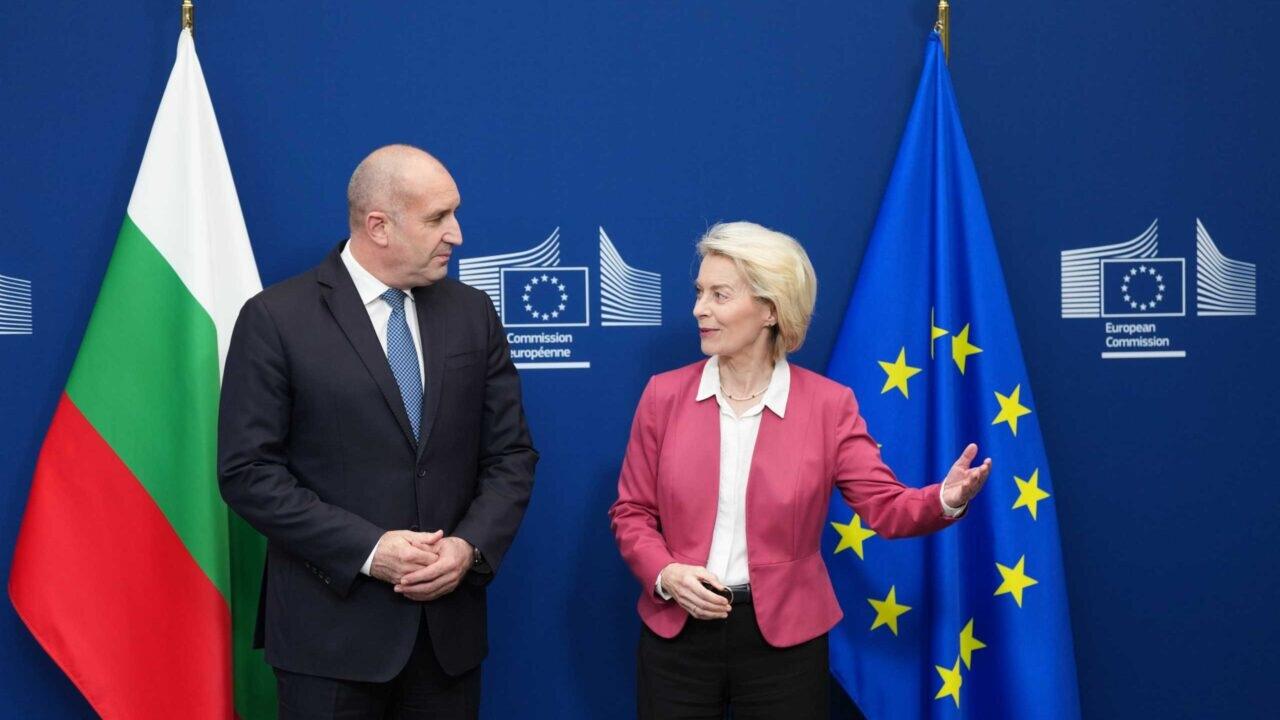
Reuters described of the top level meeting in Brussels, “the European Union began a packed summit on Thursday that quickly underscored wrangles over how to tame soaring energy prices, design a budget to keep the bloc competitive and curb surging exports from China that are blamed for job losses.”
Prime Minister Radev told the summit “Any step in reducing fuel prices and to guarantee our competitiveness, we appreciate” – in a clear reference to the US-Russia diesel agreement.
And even as most continue to vocally support Ukrainian President Zelensky in his ongoing standoff with Trump and defiance of US wishes, Radev criticized Ukraine’s strikes against Russia’s oil refineries, again siding with the White House.
“I don’t support strikes on any refineries,” Radev said, at a moment Trump is strongly warning that Kiev better halt this tactic.
“I don’t support strikes on any energy power plants, like Russian attacks on energy power plants in Ukraine, because this hits us back,” he added. “The prices in Europe are (skyrocketing).”
Fellow European leaders voiced wide disagreement, with EU foreign policy chief Kaja Kallas echoing Zelensky’s words that the diesel deal was a “gift” to Vladimir Putin.
“The question is: what has he (Putin) given in return? What we see is that he’s actually increasing the attacks on civilians and civilian infrastructure. The ceasefire that was also announced is not really working on the Russian side,” Kallas said.
The recently installed Radev, whose Progressive Bulgaria party won the April election, has been busy rolling back the NATO ‘eastern flank’ country’s prior policy on Ukraine, including related to arms shipments.
The new government has made clear it has a new peace agenda, and its position is that nothing will be resolved by just pouring more heavy arms into the conflict, now in its fifth year. It was given a new mandate.
This was also notable amid the AfD’s continued rise in Germany…
He has repeatedly criticized EU overreach on green-energy mandates, sanctions policies and what he describes as moral posturing in a “world without rules.“
While analysts have lately noted he is unlikely to ultimately jeopardize the flow of EU funds that sustain Bulgaria’s economy, the result installs a distinctly Russia-friendly government at the heart of the EU’s southeastern flank – a shift that has been drawing close scrutiny in Brussels, Washington and Kiev.
END
NATO/KORYBKO
NATO’s De Facto Expansion To The Caspian Sea Is Inevitable
Thursday, Oct 15, 2026 – 02:00 AM
Authored by Andrew Korybko via Substack,
Russia still has time to propose Ukrainian-like security guarantees for averting another special operation…
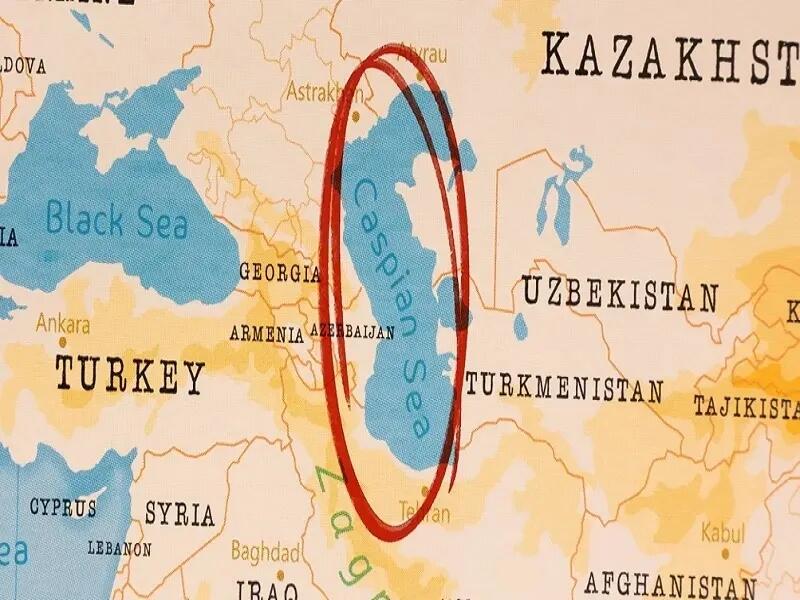
Politico recently published a piece about how “France and Turkey block NATO’s drive to deepen ties with Caucasus countries“, not because they’re opposed to it in principle, but due to Turkiye blocking the renewal of Armenia’s partnership plan after France declined to approve Azerbaijan’s. France and Azerbaijan have long been at odds over Paris’ support of Armenia, particularly in the context of the Karabakh Conflict, and recently over Azerbaijan’s detention of French citizens (who were later released).
Per Politico, “The delay has forced NATO to temporarily extend Armenia and Azerbaijan’s outdated partnerships despite negotiations on the new plans being near-finalized, three of the diplomats said. The new plans would allow their participation in joint military exercises, boost military-to-military training and intensify cultural cooperation all the way down to setting up local English-language lessons, they added.” Joint NATO drills might be held on the Caspian coast with Azerbaijan upon its plan’s approval.
None of this is surprising to astute observers. August 2025’s “Trump Route for International Peace and Prosperity” (TRIPP) has the unstated dual purpose of a NATO military logistics corridor to the Caspian Sea and thenceforth to Central Asia. TRIPP is therefore the means through which NATO aims to contain Russia along the southern flank of the new “cordon sanitaire” that Trump 2.0 assembled around it. Azerbaijan poses a Ukrainian-like challenge to Russia by functioning as TRIPP’s irreplaceable transit state.
If Azerbaijan cooperated with Russia to ensure that TRIPP wouldn’t be exploited for military purposes, then there wouldn’t be any problem, but Baku has no such interests and has instead thrown its weight behind the West. In point of fact, President Ilham Aliyev announced last November that his country’s armed forces have completed the conformation to NATO standards, and their naval drones could threaten Russia’s Caspian Fleet in crisis scenarios just like Ukraine’s currently threaten its Black Sea one.
Azerbaijan is also on pace to further integrate its economy with the EU’s. Not only is it helping the bloc replace Russian energy, but it’s also going to facilitate their trade with Central Asia, to which end European Commission President Ursula von der Leyen announced last month that “we will aim to crowd in up to €12 billion in public and private investment” in regional logistics along what’s known as the “Middle Corridor“. All of this tightens the containment noose around Russia’s southern flank.
Russian Foreign Minister Sergey Lavrov suggested last month that his people are sometimes optimistic to the point of implied naivete and also tend not to proactively address latent crises. With the deepest of respect for those of them who are responsible for formulating its policies, that arguably appears to be the case regarding the threat that TRIPP poses to Russia. That’s not to imply that Russia should wage a preventive war against Azerbaijan, just that it should urgently wise up to the threats coming from it.
Looking forward, just like NATO’s de facto expansion to the Caspian Sea is inevitable, so too is it inevitable that Russia’s threat perception towards Azerbaijan will intensify. The sooner, the better, since Russia still has time to propose Ukrainian-like security guarantees for averting another special operation. In this context, they could concern Azerbaijan agreeing to Russian inspections of TRIPP’s cargo and not allowing any joint NATO drills on its territory, but Aliyev might not assent unless Putin presses him a bit.
END
EU/CRITICAL MINERALS
“De-Risk As Fast As Possible”: EU Eyes Vietnam For Critical Materials To Cut Alarming China Dependence
Thursday, Oct 15, 2026 – 05:45 AM
Brussels appears increasingly aligned with the Trump administration’s view that securing reliable, conflict-free supplies of critical materials is important for the incoming rearmament supercycle. Continued reliance on China exposes Western defense manufacturers to export restrictions that have already disrupted supply chains and could delay deliveries.
Reuters cites internal EU documents dated June 2026 that identified Vietnam as a potential source of critical materials outside China.
“Considering Europe’s need to rearm and de-risk as fast as possible, the EU cannot afford ignoring Vietnam as a potential supplier of critical raw materials considering its abundant reserves in rare earth and tungsten in particular,” the document stated which was prepared by the EU delegation in Hanoi.
The push comes as Chinese export restrictions collide with the West’s rearmament supercycle next year, exposing alarming vulnerabilities in the supply chains needed to manufacture missiles, ammunition, armored vehicles, one-way attack drones, interceptors, sensors, and other military equipment.
The West is quickly learning that bigger and bigger defense budgets alone cannot solve the critical material shortage and there is high urgency in securing alternative supply chains.
Vietnam holds substantial deposits of tungsten, rare earths, and other critical minerals, but its exports to Europe have largely been limited to tungsten and antimony, both of which are used to manufacture weapons.
The document noted that China’s restrictions on critical material exports last year disrupted European supply chains, strengthening the case for exploring alternative sources.
It called for stronger relations with Vietnam to “add an alternative to China,” especially after Beijing’s export restrictions last year “disrupted European supply chains.”
“The European Commission is currently assessing the potential for concrete cooperation with Vietnam in the critical raw materials sector,” a spokesperson for the EU executive arm told the outlet.
Adrien Rabier, Bernstein’s equity analyst covering European aerospace and defense, outlined to clients last month that Europe’s rearmament supercycle will begin next year and extend through the end of the decade.
Our reporting has pointed out that the next phase of the critical materials trade will favor miners already producing and delivering these materials to Western markets.
This comes as resource nationalism intensifies across critical minerals, metals, energy, adding to uncertainty as the world heads into a potentially volatile winter.
The VanEck Rare Earth and Strategic Metals ETF (REMX), which tracks global companies that produce, refine, and recycle critical minerals, peaked in May and lost nearly half its value by early fall.
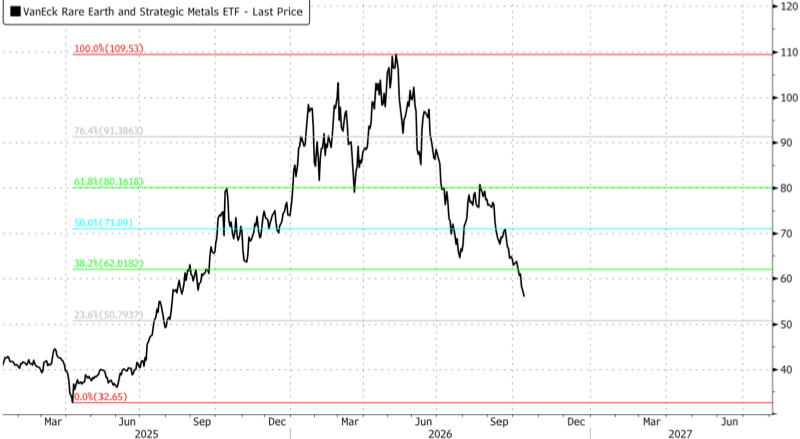
REMX’s decline appears to be a retracement of the rally in 2025 and early 2026 that followed China’s export restrictions. Once the space bottoms, traders will likely focus on miners that can reliably deliver conflict-free materials to the West. These materials are critical not only to the rearmament cycle but also to AI data centers, reindustrialization, electrification, and the broader modern economy.
end
5.RUSSIA AND ISRAEL AND MIDDLE EASTERN AFFIARS
ISRAEL/IRAN/USA //WEDNESDAY NIGHT
Iran Hormuz Attack Spree Starts Choking Oil Flows (Again), UBS Warns
Thursday, Oct 15, 2026 – 02:45 AM
A surge in Iranian drone attacks on commercial ships appears to be weighing on Middle Eastern energy exports through the Strait of Hormuz, with 24 attacks reported so far this month. The latest reports indicate that two Emirati container ships were struck and sank in the narrow waterway within the past 24 hours.
UBS energy expert Henri Patricot told clients on Wednseday morning that crude and petroleum-product flows exiting the Gulf of Oman dropped to 9.1 million barrels a day over the past couple of days. The weekly average slipped to 13.5 million, compared with an early-October peak of 17 million.
Patricot provided more color on deteriorating shipping conditions in the Strait of Hormuz:
More attacks around Hormuz and in Saudi Arabia
Attacks on tankers in the Strait of Hormuz and in the Gulf of Oman continue to be reported at the highest intensity since the start of the conflict (Figure 24).
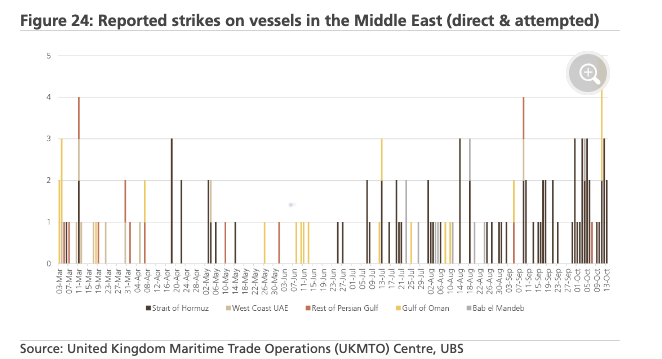
Iran is reportedly using a new strategy to target ships, including using spotters in small boats. The attacks appear to be having a clearer negative impact on traffic via Hormuz in recent days. Separately, attacks have also continued in Saudi Arabia, with reports that Aramco’s HQ which was targeted overnight.
Oil flows falling further; LNG holding up at much lower level
The latest data point to a more material drop in exports from the Middle East. UBS Evidence Lab data (> Access Dataset) indicate that crude and product flows out of the Gulf of Oman dropped to 9.1Mb/d in the past couple of days and have averaged 13.5Mb/d in the past week vs. a peak of 17Mb/d in early October (Figure 3).
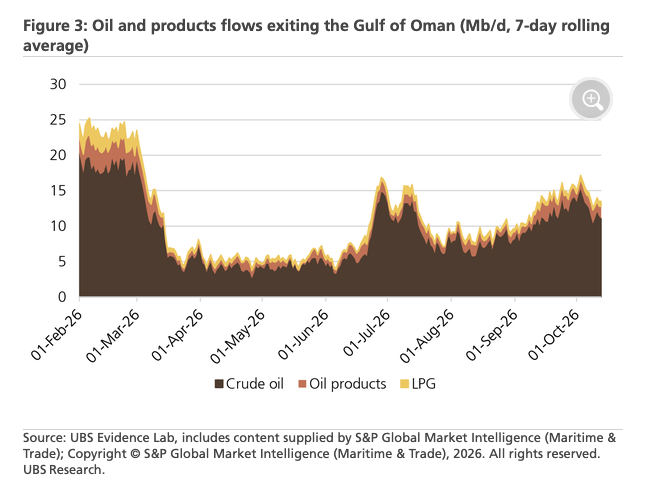
Our estimate of combined crude and product exports through Hormuz and bypass routes is down to 9.5Mb/d over the past week, well below the recent high of 16Mb/d and September average of 14Mb/d (Figure 2).
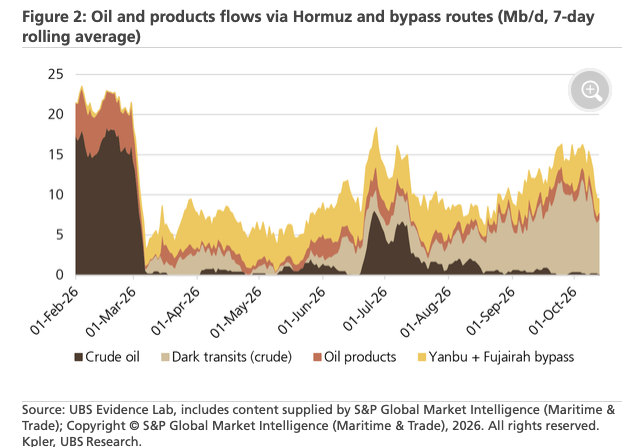
Flows are still likely to be revised higher but there now appears to be a clear trend of declining flows since early October now. We are adding a new chart showing LNG flows out of the Gulf of Oman (Figure 4).
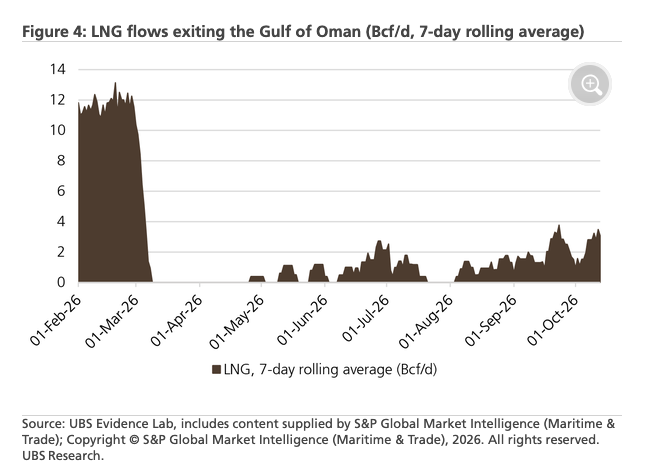
There has been an improvement in flows since mid-September and they are holding up for now, but only at ~25% of pre-conflict levels, vs. oil close close to 50% in the past week and 75% at recent peak.
Crude loadings rebound
On the positive side, Gulf crude loadings excluding Iran bounced back to >12Mb/d over the past couple of days. As loadings in previous days were revised higher too, October loadings are back up to 8.7Mb/d on average, in line the September average (Figure 12).
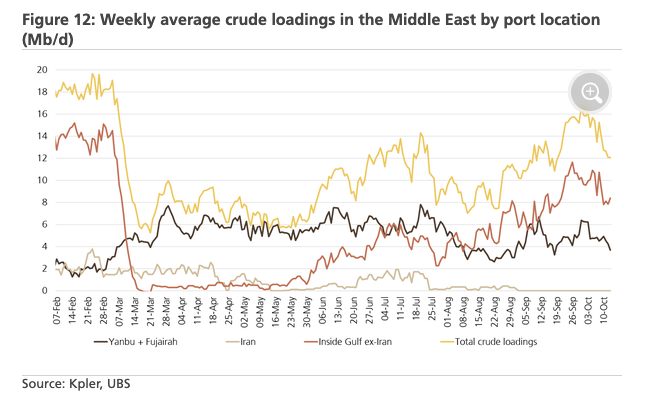
There is still no Iranian crude loading (Figure 13).
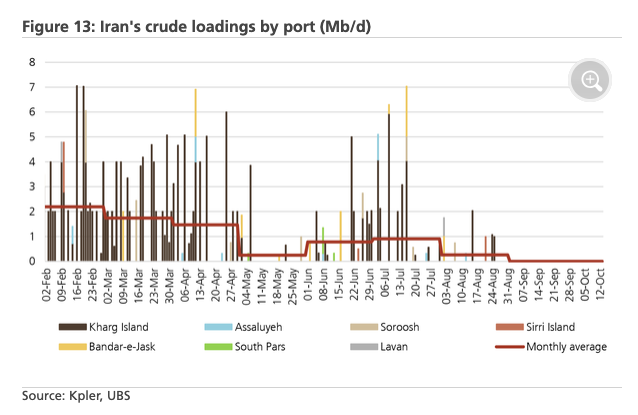
Outside Hormuz, preliminary data show no loadings from Yanbu in the past couple of days, taking the average to 1.6Mb/d so far in October, below the September average of 2.7Mb/d (Figure 16). Including Fujairah, bypass crude loadings averaged 2.1Mb/d over the past couple of days and 3.3Mb/d in October, vs. 5.4Mb/d in September. Gulf product loadings have ticked up just above 1Mb/d, still well below normal levels of >3Mb/d (Figure 17).
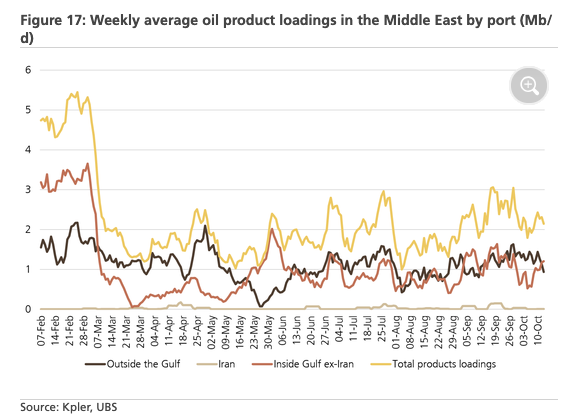
Commenting on market impacts, Dimitrios Laloudakis, a macro quantitative strategist at UBS, wrote earlier:
Brent Crude December 2028 Makes New Highs While front-end crude has been offered, longer-dated futures continue to reprice higher. The 21-day rolling correlation between front-month and 12th contract falls markedly (level last seen during peak uncertainty when front-month ripped higher). Markets now face the other side of the coin with front-contract remaining tepid, but oil expectations grinding higher for longer-dated futures.
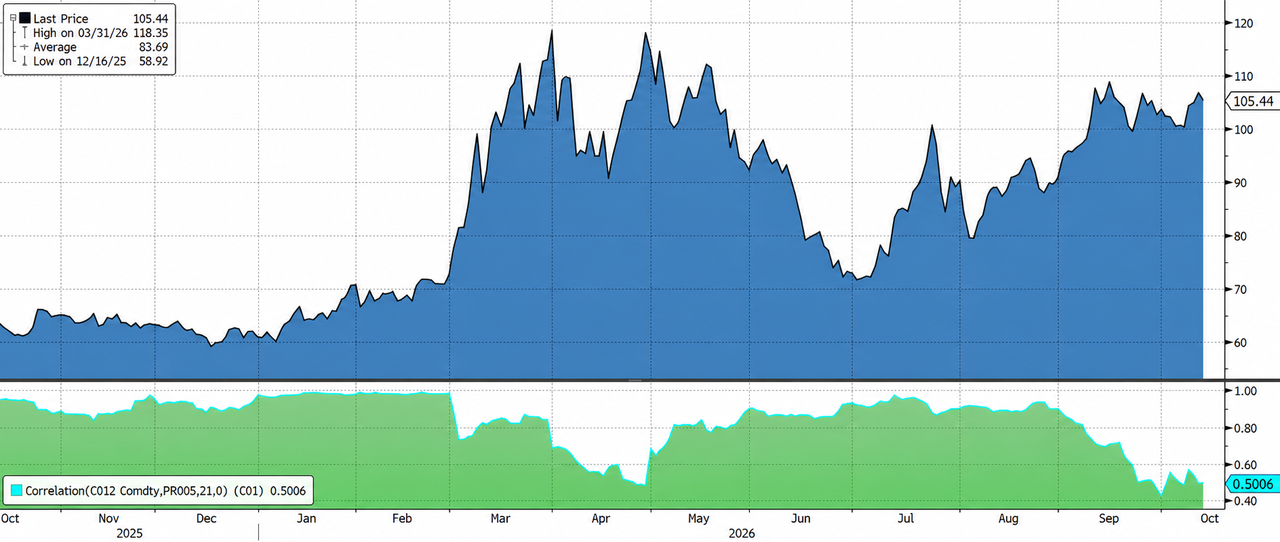
Despite the Trump-Russia diesel deal, US industrial fuel prices continue to inch toward highs.
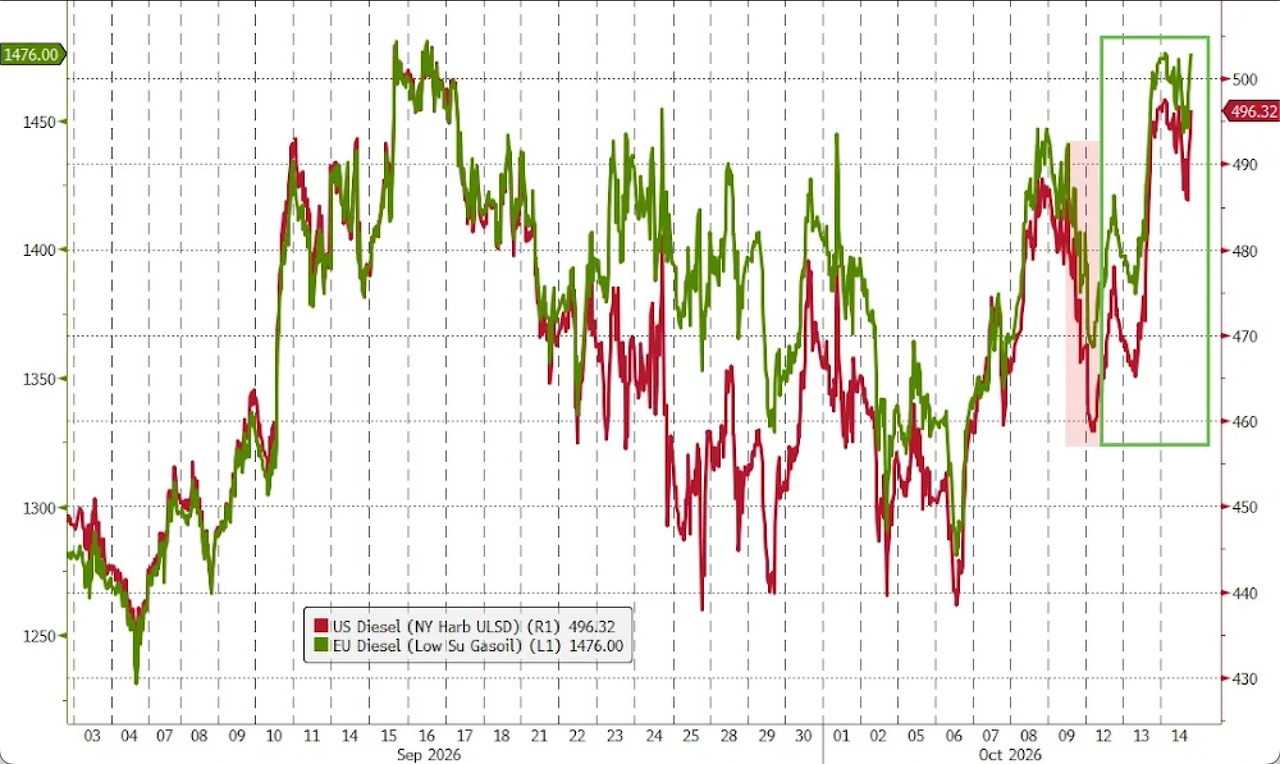
Earlier today, the International Energy Agency warned that the global diesel squeeze will likely persist well into the first half of 2027.
END
ISRAEL/IRAN/USA/THURSDAY
‘Mother of all bombs’: US potential Iran strike plans include largest non-nuclear weapon – report
According to CNN, multiple US officials said that the plans called for the MOAB to be used against Iranian energy infrastructure and nuclear sites, including Pickaxe Mountain.

This US Department of Defense (DoD) handout photo shows the Massive Ordinance Air Blast (MOAB) weapon March 11, 2003 at Eglin Air Force Base, Florida.(photo credit: DoD/Getty Images)ByTZVI JASPEROCTOBER 15, 2026 08:11Updated: OCTOBER 15, 2026 08:15
The United States military has developed strike plans against Iran that include using the GBU-43/B Massive Ordnance Air Blast Bomb (MOAB), colloquially known as the “mother of all bombs,” the largest non-nuclear weapon in the US arsenal, CNN reported on Thursday.
According to CNN, multiple US officials said that the plans called for the MOAB to be used against Iranian energy infrastructure and nuclear sites, including Pickaxe Mountain.
Another source said that the phrasing used in the plan was that the attack would come “prior to US retrograde in CENTCOM AOR (area of responsibility),” meaning that the US might strike Iran and then immediately pull its forces out of the region.
Advertisement
Several of US President Donald Trump’s advisors have also told CNN that, despite Trump’s claims that he would not take further action against Iran before the US midterms, it remains unclear whether he will change his mind before Election Day.
The potential deployment of the largest non-nuclear bomb in the US arsenal would mark a significant escalation in the conflict, although officials familiar with military planning discussions told CNN that questions remain over its effectiveness in achieving Washington’s strategic objectives.

MOAB unlikely to penetrate Iranian nuclear sites
According to several sources, the MOAB likely would be unable to penetrate deep below the ground, where Iranian nuclear facilities, such as Pickaxe Mountain, are believed to be.
“The MOAB is a massive information operation type weapon that is great for huge area clearance but not much else,” one source familiar with military planning discussions around Iran told CNN. “It is definitely not designed as a deep penetration warhead.”
The source said the MOAB’s main tactical advantage in this scenario would be its psychological effect on Iran.
“POTUS has unfortunately put himself in a situation where he is almost compelled to do something and, without the ammunition designed to penetrate that level… you have to look at psychological effects for which the MOAB is well-equipped,” the source said.
When asked about the plan, a White House official told CNN that “President Trump keeps all options on the table to ensure that Iran can never have a nuclear weapon,” adding that they do not comment on sensitive military plans.
A Pentagon official told CNN that it “plans for a wide range of operational scenarios to execute Presidential and Secretary‑level direction and to ensure mission success in any operational environment.”
Reuters contributed to this report.
END
ISRAEL TBN
IRAN/USA
Ghalibaf Says US ‘Must Be Punished’ Into Accepting Iran’s Demands
Thursday, Oct 15, 2026 – 10:40 AM
Authored by Dave DeCamp via AntiWar.com
Iranian Parliament Speaker Mohammed Bagher Ghalibaf said in a televised speech on Wednesday that the US must be “punished” in order for it to accept Iran’s demands to end the war.
Ghalibaf made the comments in the context of the latest response Iran received from the US in indirect negotiations, which Mohsen Rezaei, head of Iran’s Supreme National Security Council, has called “inadequate” because Washington didn’t agree to all of Tehran’s conditions.
“The United States must be punished, change its behavior, and be made to understand unequivocally that it must accept the legitimate demands of the Iranian nation,” Ghalibaf said, according to Iran’s PressTV.

Iran is essentially asking the US to fulfill its obligations under the Memorandum of Understanding that the two nations signed back in June, which would require the US to end its blockade of Iran, provide some sanctions relief, release frozen Iranian funds, and ensure an end to Israel’s war in Lebanon.
Ghalibaf, who was deeply involved in the MoU negotiations, said he ensured the MoU included two parts because he didn’t trust the US.
The parliament speaker also said that Iran must be prepared for both negotiations and fighting with the aim of establishing deterrence to prevent future attacks. “On the battlefield, before God, we must believe that we should fight courageously against our coercive enemy, while also engaging in negotiations to establish lasting deterrence,” he said.
He invoked the Iran-Iraq War, which lasted from 1980 to 1988, suggesting Tehran is preparing for the possibility of a very prolonged conflict with the US. During the Iran-Iraq War, the US backed Saddam Hussein by providing intelligence and other types of support while being aware that he was using chemical weapons against Iran.
Ghalibaf fought for Iran’s Islamic Revolutionary Guard Corps (IRGC) throughout the war and rose through the ranks to become a senior combat commander. In his remarks on Wednesday, Ghalibaf pointed to the conflict as an example of Iran establishing deterrence.
“In the eight years of sacred defense, we fought against Saddam’s Baathist regime. Of course, we paid a price, we suffered hardships, but in the end, for several decades, no one dared or had the desire to attack our beloved country, Iran,” he said.
END
IRAN WAR
Iran War Has Cost Nearly $2,000 Per US Household: Moody’s Top Economist
Thursday, Oct 15, 2026 – 03:35 PM
Moody’s Analytics chief economist Mark Zandi estimated Oct. 12 that the Iran war has cost the average U.S. household nearly $2,000 since it began, or about $265 billion nationwide. He put roughly $1,100 per household on higher energy and transportation costs, $540 on higher interest rates and $360 on military spending, and said the energy tab is still rising by about $50 per household each week at current fuel prices.

Zandi wrote on X: “Consider that the war’s costs taken together have absorbed about half the average American household’s income gain over the past eight months. No wonder the war is so unpopular.”
White House Principal Deputy Press Secretary Anna Kelly answered in a statement: “Mark Zandi is a Democrat donor who is frequently wrong – including predicting multiple recessions that never happened.” She added: “President Trump is rightfully ensuring that Iran, a country that for 47 years chanted ‘Death to America,’ can never have a nuclear weapon.” U.S. and Israeli strikes on Iran began Feb. 28.
Zandi’s number is a broad economic estimate, not a federal outlay. Brown University puts consumer costs at $133.3 billion, about $1,018 per household, and Defense Secretary Pete Hegseth has testified to about $37.5 billion in direct military costs, Newsweek reported. ZH has tracked estimates running well above the White House’s.
As the Epoch Times notes further, “Higher energy prices are contributing most to the costs,” Zandi said. “A gallon of regular goes for $4.37, up from just under $3 before the war. Diesel is above $6, and jet fuel has nearly doubled. As winter approaches, the much higher price of home heating fuel is also adding to the costs.”
Zandi said the war’s inflation contributed to the Fed’s decision last month to raise rates and signal that more rate increases are coming.
“Long-term rates are also up a lot – fixed mortgage rates have climbed from below 6 percent before the war to 7.5 percent. By our reckoning, the higher rates have cost the economy about $540 per household,” he said.
In September, the Congressional Budget Office estimated the war cost the U.S. military $38.1 billion through Aug. 1. With fighting expected to continue, the war was estimated to cost between $2 billion and $3 billion each month, depending on its intensity.
On Oct. 5, the Congressional Research Service published a report listing some of the major equipment losses during the war.
The report listed 81 fixed-wing or rotary-wing aircraft, including drones that were lost or damaged during the conflict.
The Congressional Budget Office estimated the cost of equipment losses as of Aug. 1 to be between $1.9 billion and $3.3 billion, depending on the Department of War’s plans for replacement.
Democrats have continually pointed to the cost of the war in their criticism of Trump.
In September, 46 Democratic or left-leaning Independent Senators sent a letter to Department of War Secretary Pete Hegseth demanding more information on the costs of the war.
END
HOUTHIS
Report Alleges Houthis Building Advanced Missiles With Help From China
Wednesday, Oct 14, 2026 – 07:15 PM
It should come as no surprise that Iran maintains powerful allies even while under threat of US bombs, and as Washington sanctions have sought its complete isolation. Most obvious among these remain Russia and China – nations which have not necessarily sought to ‘hide’ or conceal political and even military support to Tehran.
The last several weeks have seen a new Iran conflict-related front opened up in the Middle East. Saudi Arabia and the Ansar Allah movement of Yemen (the Houthis) are now in a state of open war.
Houthi ballistic missiles are raining down on Saudi airports and Aramco facilities on a daily basis, resulting in a full-blown crisis for the kingdom, which is urging allies to come to its defense.
A fresh report in The Wall Street Journal finds that Chinese parts are becoming a key element of some new Houthi missile systems – weapons which have been a surprise and shock to the kingdom and its Western allies, given the number of impacts on targets of late.
“Houthi militants are attempting to produce their own advanced medium-range ballistic missiles using Chinese-delivered parts, a new report shows, a technological advance that would raise the threat posed by the Iran-backed group,” WSJ writes.

The report relies heavily on the findings of an international weapons and conflict monitor:
The Houthis shipped in from a Chinese supplier a range of components needed to make a version of one of Iran’s most powerful weapons, the Kheibar Shekan Iranian precision-guided missile, said the report by Conflict Armament Research, a group that works in conflict zones and reports on the use of weapons and their supply chains. The Houthi missile would have a range up to about 1,200 miles, putting all of Saudi Arabia and Israel within reach.
Iran used the Kheibar Shekan—a cheap, mobile, precision weapon first displayed in Tehran in 2022—against American bases with some success during the war with the U.S. last spring, The Wall Street Journal has previously reported.
One caveat here might be to point out that Chinese components in complex electrical or even weapons systems are diffuse across the world – so it remains a big open question how ‘direct’ or not the supply chain might be in this case.
However, Conflict Armament Research has sought to answer this. “The local ambition of the Houthis for manufacturing is beyond what was previously assumed,” said Fabian Hinz, a senior analyst at the organization. “These types of parts are very specific, and producing them would have required design information related to the missile.”
As for China’s official stance on the ratcheting conflict, its foreign ministry on Monday condemned Houthi attacks on Saudi airports. “China condemns the attacks that caused heavy casualties and expresses serious concern over the intensification of the conflict,” foreign ministry spokeswoman Mao Ning said.
“We call on relevant parties to avoid taking actions that escalate regional tensions, to resolve differences and disputes through dialogue and negotiation, and to achieve peace and stability in the region at an early date,” Mao added. It would be an explosive and highly sensitive situation if Beijing were actually directly assisting a non-state actor like the Houthis in missile development. This is something China will likely vehemently deny.
END
RUSSIA VS UKRAINE
“It’s A Pity…”: Zelensky Feels ‘Betrayed’ By Trump & Elon Musk
Wednesday, Oct 14, 2026 – 11:00 PM
Ukrainian President Volodymyr Zelensky says he feels betrayed by President Trump in the wake of the US deal to buy Russian fuel from Moscow, which was announced last week.
Zelensky went on a newly aired episode of Piers Morgan’s show, and he was asked point blank by the British show host if he had been “betrayed” by the Trump administration, to which Zelensky answered, “Really, Yes.” Russian media was quick to seize on the increasingly open schism between Trump and Zelensky…
“It’s a pity that we are losing a strong partner,” the Ukrainian leader told Morgan on Wednesday.
“This is our country, our body, our home, our children… That’s why it’s painful when Trump chooses one side,” Zelensky at one point also stated.
“If you’re in the middle, you have to stay in the middle. Not on the wrong side,” said Zelensky. “This is not the right side of history.” Here, Zelensky seemed to suggest Trump is actually more on the Kremlin side of things at this point.
The interview also came amid reports that the US is throttling intelligence-sharing with Kiev. The White House has thus far neither confirmed nor denied the allegations.
But Zelensky has himself for the past two night of Russian airstrikes made a point to publicize that Western partners have not provided the typical early warning notices of inbound missiles that were available in prior such attacks.
There’s been another apparently ‘betrayal’ (in Zelensky’s assessment) by the White House of late: reports say that SpaceX has imposed a movement-speed restriction on certain Starlink terminals used in Ukraine.
This has deeply impacted Ukraine’s military, which is greatly reliant on Starlink for rapid battlefield communications and functions. Zelensky used the Piers Morgan appears to plead that it be ‘switched on’.
“People will die, of course, if attacks will continue and if Starlink will not work… it’s not helpful,” he continued.
The Ukrainian leader expressed home the limitation was merely a “mistake,” suggesting it could “maybe a huge technical problem” at SpaceX.
Overall, Zelensky’s message was that Ukraine is ‘losing’ American support and that he feels betrayed not only be Trump, but by Elon Musk too.
Musk has directly chimed in on the controversy, clarifying “Starshield systems are owned and controlled by the US government” – and so ultimately it’s the US government, not SpaceX, behind whatever cut happened that impacted Ukraine.
* * *
Full episode: President Zelensky ‘BETRAYED’ By Trump & Elon Musk
END
RUSSIA VS UKRAINE
“Russian Bots”, Burning Data-Centers, & Partitioning The Internet
Thursday, Oct 15, 2026 – 03:30 AM
Authored by Kit Knightly via OffGuardian,
The Ukrainian military used their surfeit of drones to destroy Yandex data centres in Russia, and as a result, “hostile” Russian bot activity dropped to almost zero.
That’s the story.

There’s no evidence it’s true, of course, but since when did that make any difference?
What were these alleged bots supposedly talking about?
Well, that depends who you are.
If you’re a Covid-era pro-vaccine nut job, they were talking about Fauci and ivermectin and vaccines harms.
If you’re a Zionist, they were supporting about “free Palestine”.
If you’re a Democrat, they were spouting MAGA talking points.
If you’re a leftist in general, they were promoting the AfD in Germany, Reform in the UK or just the “far right”.
It turns out the bots are everyone who disagrees with you and nobody who agrees with you.
Isn’t that nice?
No matter who you are, there’s a source-less graph out there with a line going down which shows you were right about everything.
It’s not like you can just make up a graph.
Zelensky summed the situation up thus:
“It suddenly became a little easier to breathe on many social platforms. There was less hate, less division and fewer provocations,“
We’ve been given taste of a Russia-less and/or bot-less and/or disinformation-less internet, isn’t it lovely?
To be clear, again, there is no evidence at all this is true. They just say things.
This comes hot on the heels of Andy Burnham just saying – sorry, “confirming” – that Russia tried to influence the Brexit referendum back in 2016 (a sure indication he plans to reverse that decision, but that’s another story for another time).
The point is we’re all being influenced by big bad Vlad and his big bad bots.
Maybe we should do something about it, right?
You know what would help filter out hostile state-driven AI bot activity?
Digital ID. Just sayin’.
Or, perhaps we should partition or the internet…
Nobody is saying that – yet – but this is kind of story is laying the groundwork. Just wait.
As I wrote about AI and data centre fear last month:
None of this will really be about avoiding any apocalypse.
It will be about compartmentalisation. Cutting lines of communication.
Running small business or personal websites in general will become more expensive as the “data centre tax” is added to hosting providers.
Much like the “sugar tax” on fizzy drinks and snacks in the UK, this tax will notionally be paid by the hosting providers, but will be passed onto the customers via increased prices.
Major corporations will be able to easily afford these increases, but smaller independent sites will feel the pinch.
It will be cheaper to pay corporate resellers to cohost, but then you’ll have to sign up to agreements about not publishing “misinformation” and, again, provide your proof of humanity.
If you run a website your data centre usage tax will be 0.04 per local visitor, but 0.10 per international visitor – since serving data further is more compute heavy.
You’ll be able to get reductions in hosting costs if you use a “local only” server, accessible only to those resident in your home country/region/bloc etc.
Automatic translation, we’ll be told, is very heavy on AI usage. So it will be increasingly cheaper to only publish in your native language too.
It won’t matter if any of this is true or not, they’ll just say it, as they do.
On social media, the more followers you have the more data you’re using, so after a certain point you will have to either pay to maintain your followers, or pay per post to make sure your followers can see it.
Of course these limitations won’t apply to legacy outlets like the BBC, CNN or their ilk of course. They will be exempt, because they are part of the “essential information distribution network”.
And all the time, the fear of “rogue AI” will be there, to be picked up as convenient. A digital pandemic that, like Covid, can be started and stopped on a dime by the digital version of “testing protocols”.
Kill switches and “digital firebreaks”, allegedly installed to quarantine “rogue” AI agents, will enable swift isolation of any anti-establishment opinions or information that breaks through to an audience of any size.
An independent news YouTube channel getting a lot of views? Oh no, it’s been reported to be AI and has been suspended pending investigation!
An alternate media website is getting a lot of views? Oh no, the server it’s stored on has been compromised by AI and needs to be temporarily isolated!
Again, obviously not one word of this needs to be true. They will just say it. Like they just say everything now.
And the real kicker is it won’t matter if global internet traffic does decrease or data centre use really declines. They probably won’t even check. The real numbers don’t matter.
“Russian bots” is perfect for this, mixing “AI bad” with “Russia bad” with “disinformation bad” in a neat little agenda cocktail.
Like Mary Poppins’ medicine, everyone gets the flavour they want.
It’s exactly the kind of ridiculous story that could be used to justify this process down the line.
We publish a variety of perspectives. Nothing written here is to be construed as representing the views of ZeroHedge.
END
RUSSIA VS UKRAINE
Defiant Zelenskyy Resumes Russian Refinery Drone Strikes
Thursday, Oct 15, 2026 – 07:20 AM
A defiant President Volodymyr Zelenskyy told the Financial Times on Thursday morning that Ukrainian forces will resume attacks on Russian refineries. The move certainly seems more political than anything else. Such attacks have been described as one of the drivers behind the global refining crisis, which has collided with Strait of Hormuz disruptions.
“The block [on attacking refineries] is out. We’re done,” Zelenskyy told the FT. He said Kiev had suspended energy strikes for three days at the Trump administration’s request.

Even before that, the Trump administration had requested many times that Kiev stop bombing Russian refineries, but Ukraine remained mostly defiant and ramped up those attacks leading up to the US midterm elections. One can only wonder whether the escalation was politically motivated, worsening the diesel crisis and translating into consumer pain at US pumps.
Zelenskyy’s new narrative is that the resumption of drone attacks on Russian refineries is a response to what he described as a “dangerous” cutoff of US intelligence sharing and the degradation of Starlink service.
Trump has denied cutting off intelligence sharing. Elon Musk said the US government controls Starshield’s speed and usage limits, the military satellite network built on Starlink technology. Zelenskyy’s office said Thursday that it had lifted the speed restrictions.
A growing rift is apparent between Zelenskyy and the Trump administration, as the Ukrainian president went on a media roadshow this week to push the narrative that he feels “betrayed” by Trump. Yet this should be seen as theatrics, a performative stunt by the former comedian who knows how to put on a good act before the US midterms.
Last week, Trump said it was “time to get a new leader” after Zelenskyy ignored pleas to stop strikes on Russian refineries, one of the reasons why US diesel prices recently topped a national average of $6.50 a gallon.
Musk has openly agreed, saying on X, “I agree, time for Ukraine to get a new leader.”
The breakdown in relations comes ahead of the Northern Hemisphere winter. The International Energy Agency warned yesterday that the “gasoil market balance will remain tight well into 2027.”
Diesel prices in the US are back at their highs despite Trump’s diesel deal with Moscow to add more barrels to the global market.
And now, the West heads into winter with a refined-products shock..
END
6/.GLOBAL ISSUES, COVID ISSUES, VACCINE INJURIES/HEALTH ISSUES
GLOBAL ISSUES/
“Worst Is Yet To Come”: Global Smartphone Shipments Crash 22% As Memory Crisis Squeezes Consumers
Thursday, Oct 15, 2026 – 01:05 PM
Technology research firm IDC’s latest report confirms our warning earlier this week of “more pain to come,” with global smartphone shipments plunging in the third quarter as rising memory chip costs squeeze margins, boost handset prices, and make these devices more expensive than ever.
Preliminary data from the advisory firm show worldwide smartphone shipments plunged 22% year over year to 255.3 million units in the third quarter, as the AI-related memory chip shortage sent component costs soaring, forcing manufacturers to raise prices beyond consumers’ comfort zones.
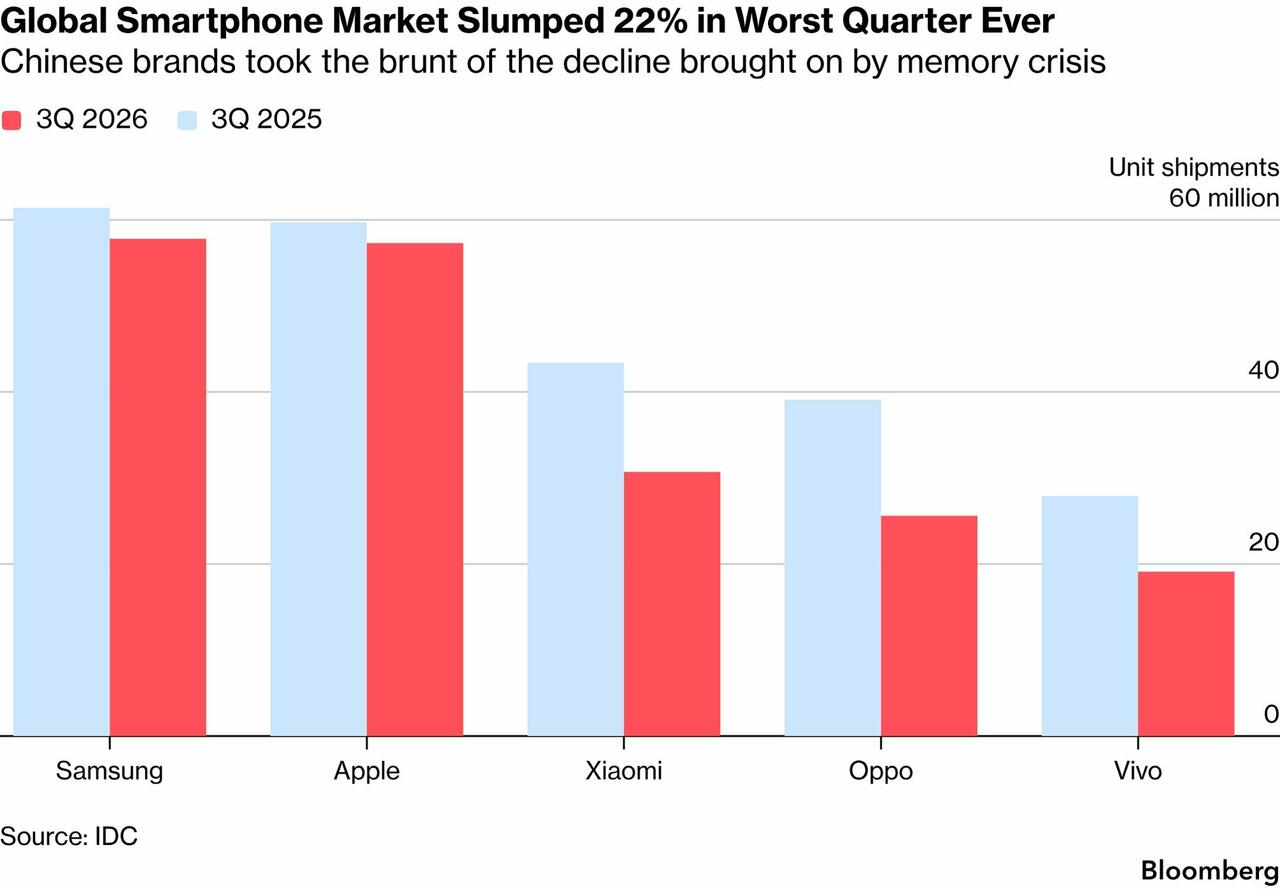
“The sharp downturn the industry has been bracing for finally materialized in the third quarter this year, with shipments declining a record 22% YoY. However, the worst is yet to come,” senior IDC research director Nabila Popal wrote in the report released earlier this morning.
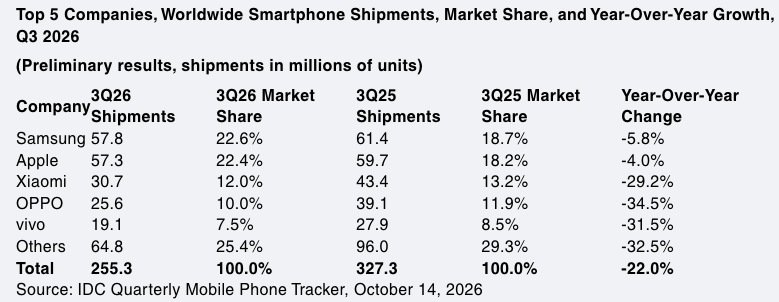
Popal said, “Memory costs have surged approximately 350% since last year and are still rising, creating substantial pressure on vendor margins and shipments. While memory inflation is beginning to slow down, with a low double-digit sequential increase in Q3 compared to roughly 50%-100% sequential growth in prior quarters, costs remain elevated across other critical components as well, compounding the crunch.”
IDC expects handset shipment growth to remain under pressure through 2027, with any recovery pushed to 2028 at the earliest. Manufacturers increasingly view the cost shock as a permanent change in the industry’s economics.
This cost shock has hit Chinese brands hardest, which are highly exposed to budget markets, as soaring chip costs have squeezed margins and price increases now risk driving customers away. Conversely, Apple and Samsung are gaining market share, as their premium handset portfolios and supply advantages help shield them from the downturn.
IDC vice president Francisco Jeronimo wrote in the report, “The third quarter shows the full impact and damage of the memory crisis,” adding, “The pressure is now moving from vendors to consumers. As higher prices reach the shelf, many buyers are keeping their current devices longer. Chinese brands face a particularly difficult moment, as their exposure to low-end smartphones forces them to choose between protecting margins and defending volume just as demand weakens. Volumes will stay under pressure in the coming quarters, while vendors with scale, secure supply and a premium mix keep gaining share in a smaller market.”
IDC’s report was in line with Loop Capital analyst John Donovan’s report earlier this week, which said global smartphone shipments tumbled 22% in the third quarter. Like IDC, Donovan warned that there is a lot “more pain to come.
END
NGO Says “Climate Change” To Blame For Increase In Child Marriages
Thursday, Oct 15, 2026 – 04:15 AM
The climate change industry (and yes, it is an industry) generates approximately $18 billion globally for NGOs, and a big part of that cash flow is the relatively new agenda of “Climate Justice”. This is the melding of the global warming fraud and the social justice fraud into one very big and very lucrative mega-fraud.
Climate Justice is simply another strategy for attacking western economies and free market enterprise, using the accusation that the west is “creating environmental crisis” which developing nations then suffer for. In other words, it is repeating the false claim that the wealth of the west is built on the suffering of the third world. If it weren’t for the US, Europe and other developed nations, the third world would be rich and prosperous and peaceful and a multicultural Utopia would flourish.
The end game of this narrative, of course, would be the eventual dismantling of western economies in the name redistributing the wealth, stopping global warming and “saving the world.” It’s all a fantasy, but we’ll get to that in a moment…
One NGO with extensive ties to the climate agenda is called Plan International, an organization focused on children’s rights, specifically the equality of girls and gender-based violence. Sure sounds like a righteous cause, but the veneer is deceiving.

According to a recent story by French news outlet Le Parisien, Plan International has released their shocking annual State of the World’s Girls 2026 report, and they assert that climate change is contributing to a sharp increase in child marriages in third world countries.
The report combines analysis of health and climate data across more than 50 countries over three decades with a survey of 5,000 girls and young women aged 15–24 in Bangladesh, Kenya, Peru, Senegal, and Zimbabwe, plus interviews and focus groups. At least 36% of respondents observed more child marriages or early unions in their communities after climate-related shocks; about 11% said they had personally experienced one.
Girls as young as 10 years old can be married off in these culture, even when national laws forbid the practice. Poverty supposedly compels these marriages, because families need to reduce the number of mouths to feed. Also, the younger the bride, the more in “Bride Price” (payment) the family might receive in some cultures.
The survey attempts to link “climate change to destructive weather events, the weather events to a rise in poverty, and poverty to rising child marriages. It’s quite a stretch, but it gets worse. The NGO also attempts to link climate change to sexual assault and increased violence against women.
And of course, the “Climate Justice” position implies that the women in these countries are facing such violence and exploitation because of the actions of first world economies.
In their COP policy briefs (COP26, COP27, COP28 and others), Plan International states that “early industrialization, colonization, and wealth inequality means that developed countries contribute to global emissions significantly more than others. They call on countries with “the greatest historical and current responsibility” to raise emissions-reduction ambition and increase climate finance (more money for the NGOs).
Plan International presents itself as a humanitarian org focused on protecting girls and women, but they have deep ties to the climate change industry through the UN and other NGOs. For example, they receive funding from the Rockefeller Foundation, one of the original globalist institutions behind the creation of the climate change narrative in the 1970s.
As we have shown many times int eh past, there is zero concrete evidence supporting global warming theory. In fact, the data shows no relationship between human industry and changes in temperatures and weather. For starters, groups like Plan International use climate data from the past few decades. The vast majority of climate science uses temp records from the 1880s onward. None of them acknowledge climate data from longer timelines.
The Earth’s weather history is vast, and temperatures have been much hotter than they are today. Modern temps are some of the coolest in the past 400 million years. There was no human related carbon emissions back then; the temps fluctuated dramatically anyway.

Furthermore, when matching the carbon content record to the temperature record over this time period, there is no match whatsoever. In other words, carbon emissions have nothing to do with rising or falling temperatures.
By extension, there is no indication that current weather patterns are affected by human industry either. In Bangladesh, for example, flooding is the primary weather related disaster, and there is no evidence of a significant change in the frequency of flooding in the region from 50 to 100 years ago. The weather changes according to the long cycles of the Earth. The economic successes of the west have no bearing at all on the suffering of the third world.
Maybe don’t build your village in a desert or a flood plain.
As for the child marriage problem, these cultures have been engaging in this behavior for thousands of years. If anything, the west has contributed to a steep decline in these kinds of barbaric practices. What was the scapegoat for third world nations prior to the fabrication of the climate change crisis?
The lesson here is to beware of NGOs and the causes they claim to champion. They have a tendency to hide their true intentions behind otherwise noble pursuits.
END
COVID VACCINE INJURY REPORT: DR MARK CRISPIN MILLER
DR PAUL ALEXANDER
Operation Northwoods! As to ‘viruses don’t exist’ debate, a very interesting scholarship by Leake worth the read, well written John! raises as many questions as answers & when it comes to the PCR
created fraud COVID, I am not sold on whatever it was being a ‘virus’, I think we may well find out it was toxin, poison, chemical of some sort provoking outcomes it did (respiratory, clotting etc.)
X

released by our own GOVN intentional or not. I think bad things were done to USA by our own military, government, health officials in January 2020. Trump had no clue what they were hitting him with. They were indeed playing with something. It was never novel. They were using a PCR amplification process to detect something they knew was out there for they released it. They knew it was benign too save for vulnerable people with already suppressed breathing etc. issues. They knew the medical management was pure grift and that they were killing people but these people did not and still does not care.
Our government officials, and our medical doctors, and scientists, and vaccine makers and decision makers conspired together to kill us with their madness, e.g. CDC, NIH, FDA, HHS etc., their inept incompetent academically sloppy intellectually lazy specious power-drunk money-making madness…and they still have not stopped, searching for ways…COVID has taught me believe nothing the government tells you, ZERO. why, because we even found ouh that that photo was staged, they were looking at a blank screen.
END
RABOBANK/MICHAEL EVERY/OR OR PICTON/GIFFIN OR RABOBANK EXECUTIVE/COMMENTARY ON WORLDLY AFFAIRS
7. OIL AND NATURAL GAS/ENERGY COMMENTARIES
OIL will continue rising as oil transversing Hormuz is now less:
(zerohedge)
Another ‘Violating’ Oil Tanker Caught Fire East Of Hormuz Strait: Iran Navy
Thursday, Oct 15, 2026 – 10:10 AM
Iran’s military has announced Thursday that it has disabled another ‘trespassing’ tanker in the Hormuz Strait area, which caught fire after possibly hitting a sea mine – or else coming under direct attack.
“A few hours ago, the Iranian Navy’s surveillance teams, while patrolling and controlling the eastern part of the Strait of Hormuz, identified a trespassing tanker that had caught fire in the restricted area,” semi-official Fars newly reports.

“This trespassing tanker was attempting to cross the restricted area in the Sea of Oman by turning off its tracking systems,” the reoport adds.
Iran’s Navy is again claiming, “The Islamic Republic of Iran’s Navy announced that the Strait of Hormuz is under the full control and supervision of the brave men of this force and the IRGC Navy”.
Social media images are circulating which to show the alleged ship in question on fire.
The month of October alone has seen something like 25 Iranian attacks on tankers and cargo ships in regional waters, including as a result of sea mine detonations.
Last summer, the Trump administration was touting that the US Navy’s mission there had successfully demined the Strait of Hormuz, but clearly Tehran is asserting and seeking to demonstrate this was not the case.
On Wednesday a Singapore-flagged container ship completely sunk when it was hit by an unknown projectile the day prior while in the Strait of Hormuz, video as and Singaporean authorities have confirmed.
All 21 crew members of GFS Pride were evacuated and with no injuries, with dramatic videos taken by the crew members going viral.
Iranian Rear Admiral Habibollah Sayyari, deputy coordinator of Iran’s army, has meanwhile issued yet another warning for ships seeking to transit Hormuz. He said that “without coordination [we] will see what happens to them.”
“We will confront enemy threats by relying on new equipment and the capabilities of our young people,” he said according to Mehr news agency.
“Iran can’t vote in the midterms, but it’s clearly trying to have a say.”
The Iranian Admiral added, “The Iranian army’s navy has a strong presence on the eastern side of the Strait of Hormuz and maintains full control and surveillance over the area.”
END
JEFF CURRIE: BEST OIL ANALYST
Currie Slams ‘Vibe’ Oil Contracts As Trump Admin Halts SPR Drains, IEA Urges Massive Reserve Release
Thursday, Oct 15, 2026 – 12:10 PM
Oil prices are extending gains again this morning as traders weigh a weaker global demand outlook and signs of recovering Middle East crude supplies against persistent shipping risks around the Strait of Hormuz and escalating/spreading violence between the Houthis and Saudis.
An overnight lull in prices (set with hopes for more reserve releases) was upset as Iran showed more clips of tankers/container ships under attack.
The International Energy Agency said Wednesday that Gulf crude shipments rose by 4.4 million barrels a day to 13.9 million barrels a day in September, reaching more than 75% of prewar levels. Global oil supply increased by 2.5 million barrels a day to 102.3 million barrels a day, driven by Gulf producers.
However, the recovery remains vulnerable to renewed attacks on energy infrastructure and shipping, the agency said.
Given the massive crude draw reported by API (likely impacted by shut-ins from the first Atlantic hurricane of the year in the US Gulf), all eyes are on the (Columbus Day-delayed) official data…
API
- Crude -11.1mm
- Cushing +1.8mm
- Gasoline +1.1mm
- Distillates -1.5mm
DOE
- Crude -8.56mm
- Cushing +1.86mm
- Gasoline +3.52mm
- Distillates -2.52mm
HUGE CAVEAT – the shut-ins in the Gulf make this very noisy: Confirming API’s reporting, the official data showed a large crude draw last week (and another sizable draw in distillates inventories) while stocks at Cushing and overall Gasoline inventories saw builds…
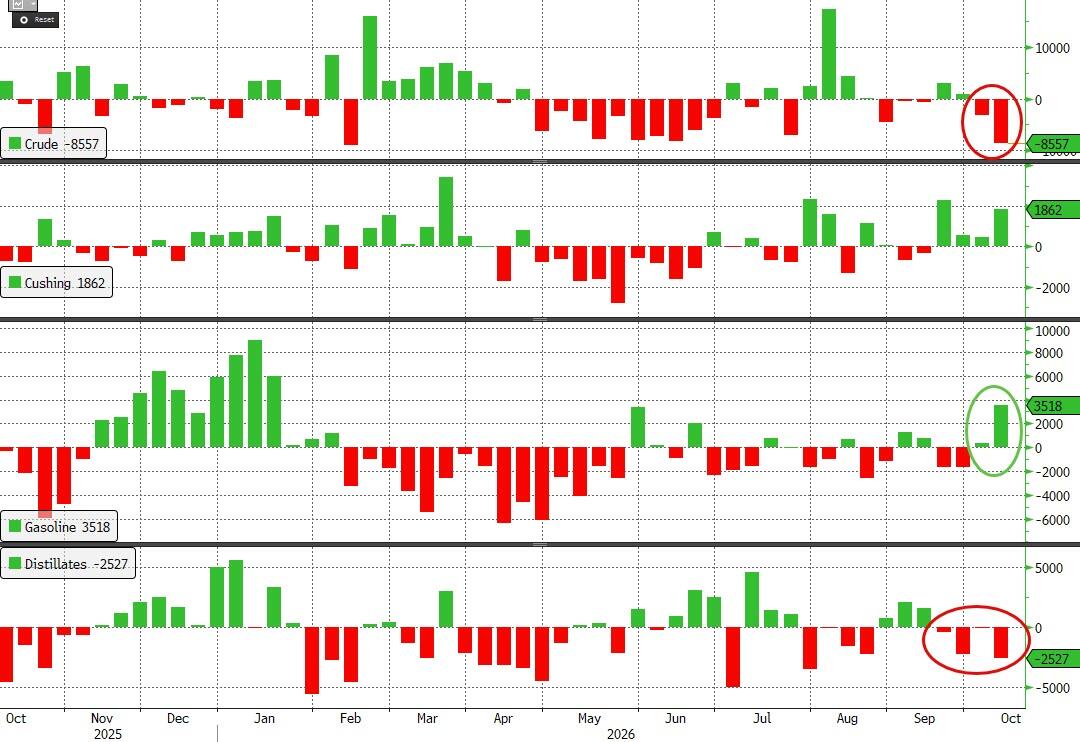
For the first time since the Iran war began, the Trump admin did not drain any reserves from the SPR…
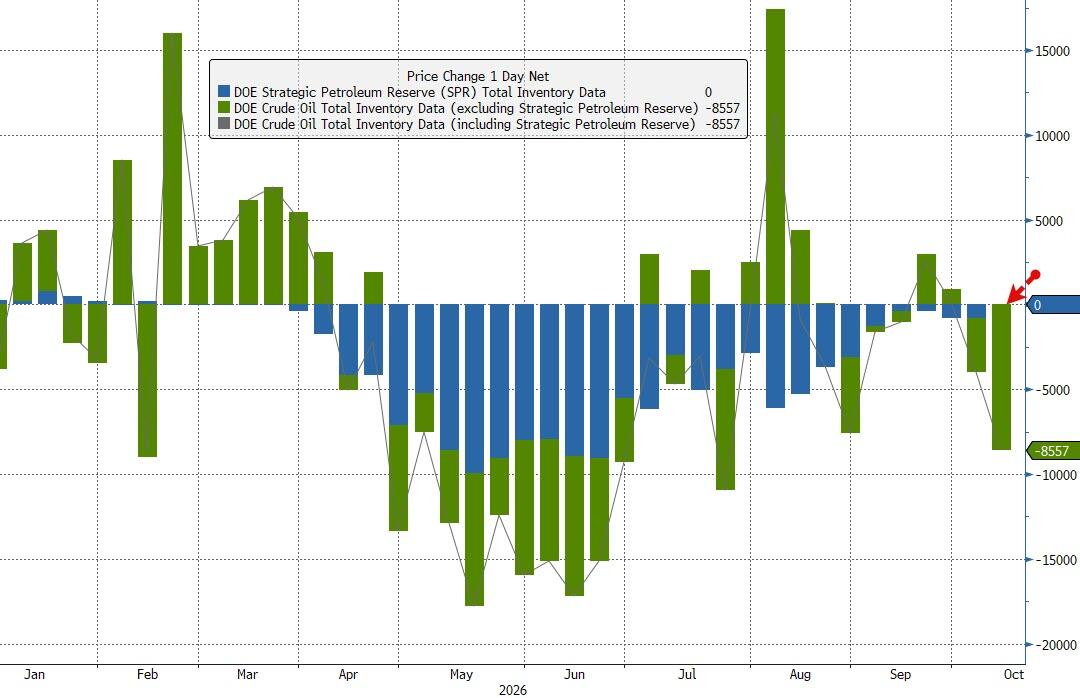
US Crude Production tumbled last week (shut-ins in the Gulf, so not comparable)…
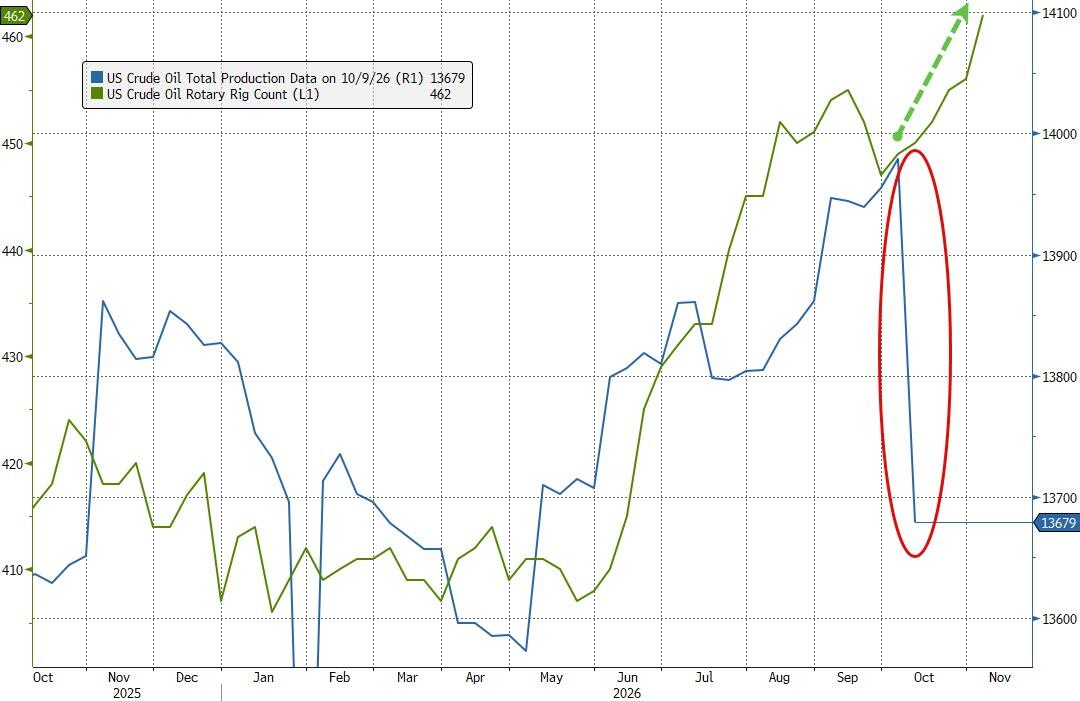
Total US Diesel stocks remain at seasonal record lows…
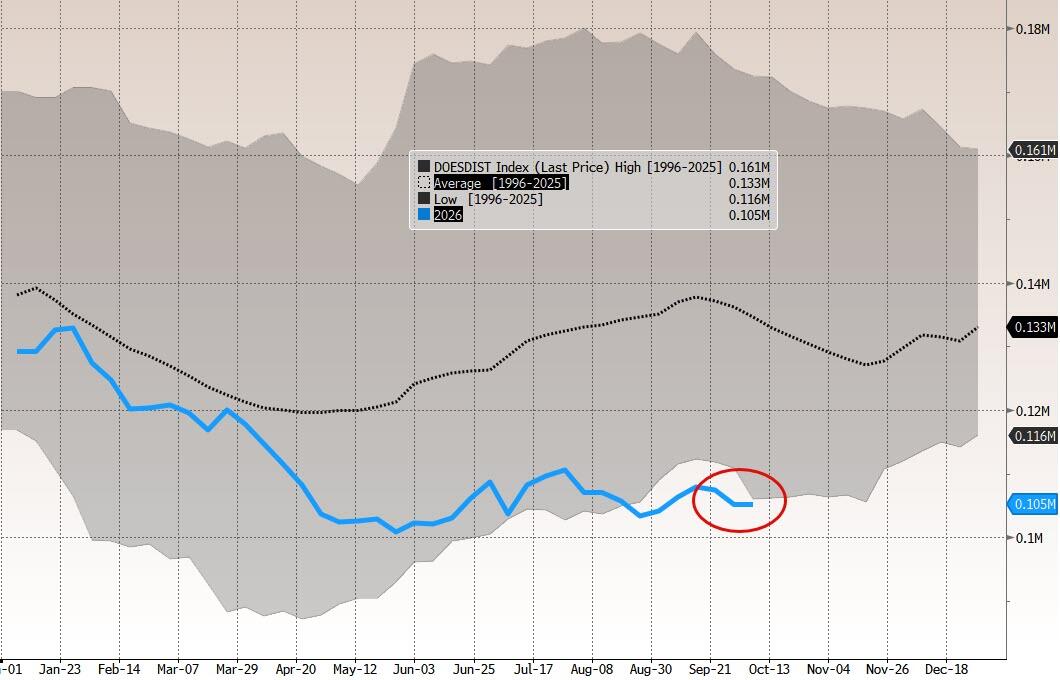
WTI has surged up to $97.50
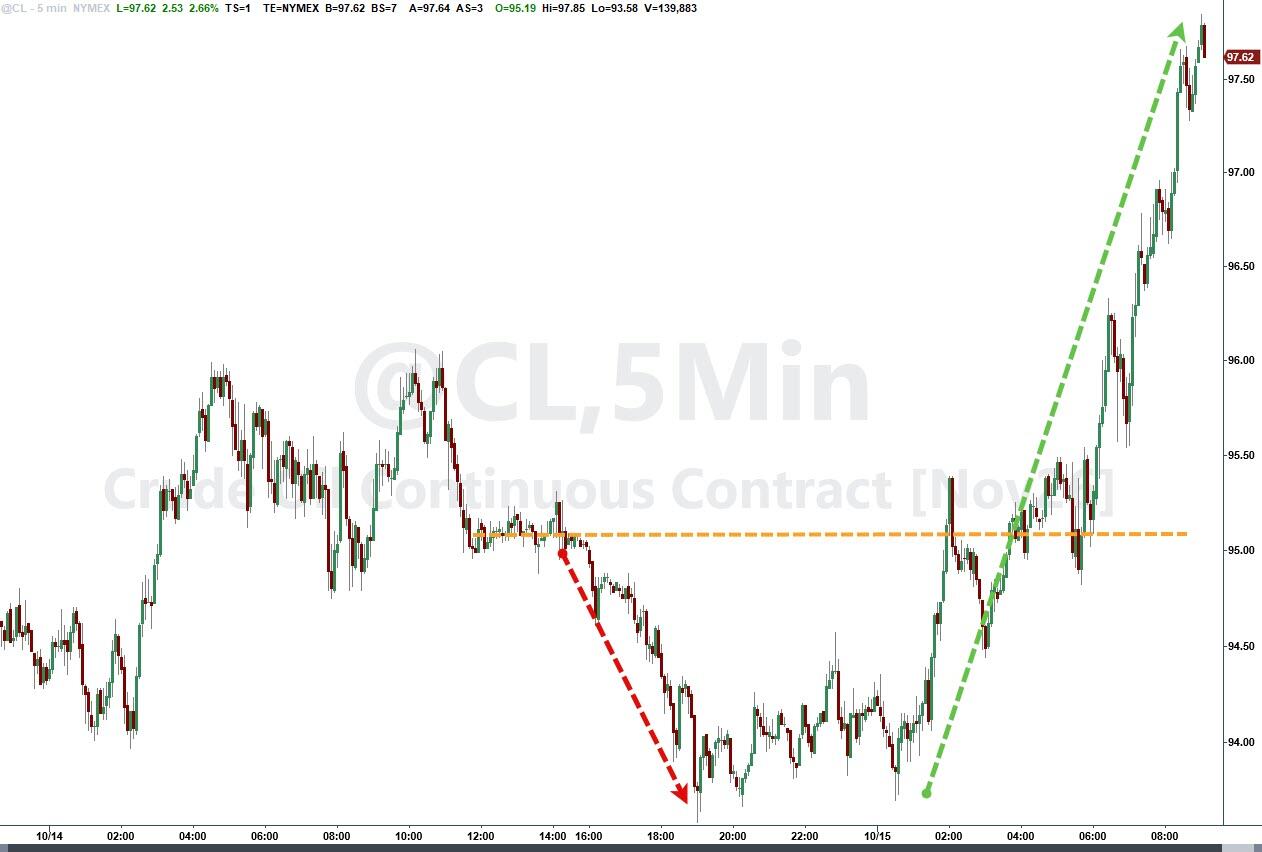
However, watching futures is misleading as Wall Street veteran Jeff Currie exclaimed this morning that the world’s most important oil benchmark has become little more than a “vibe contract”, blunting its usefulness as a tool to manage price volatility.
Brent’s disconnect from physical markets is creating “unpriceable risk,” deterring hedgers from using the contract to protect themselves, Currie said.
“Everything associated with energy is going up but Brent,” Currie said Thursday in an interview on Bloomberg Television.
“It is not connected to the real world anymore.”
A hit to Brent’s integrity undermines the market’s ability to anticipate supply shocks with “profound consequences for the market and the rest of the world,” Currie said.
The disconnect between paper and physical markets has frustrated traders since the Middle East conflict began, when crude struggled to top $100 despite historic supply shortages. In contrast, Dated Brent, the most important physical oil benchmark, has surged to near $130 a barrel. That dissonance has contributed to traders fleeing the market, with Brent open interest earlier this month hitting its lowest since March 2025 even as oil dominates headlines.
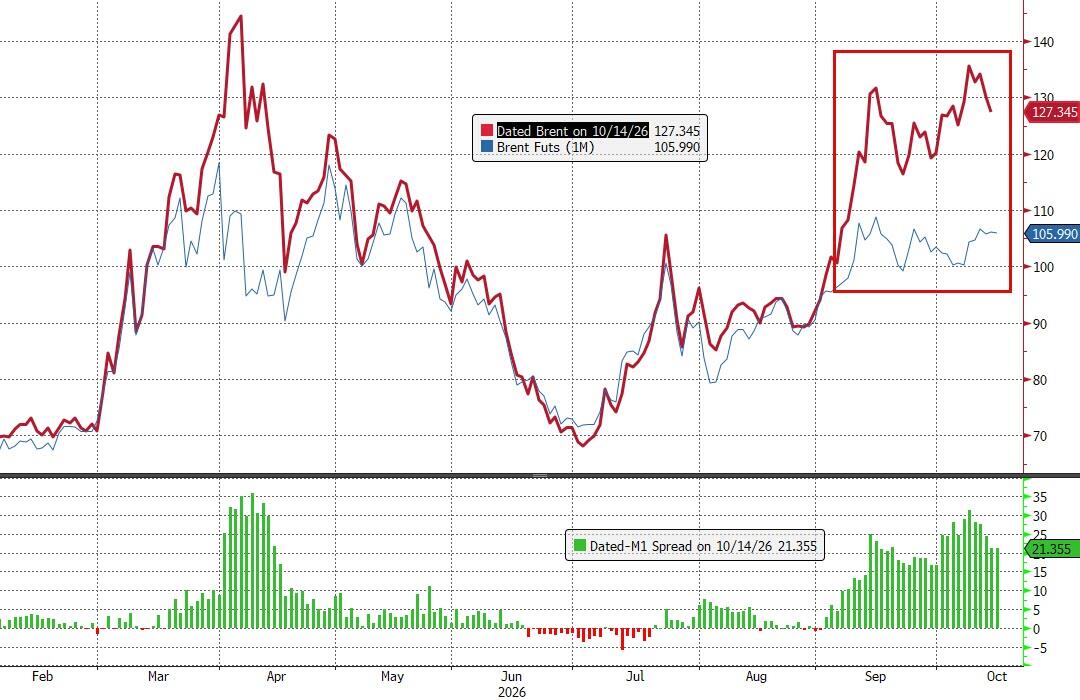
Diesel prices are lower this morning…
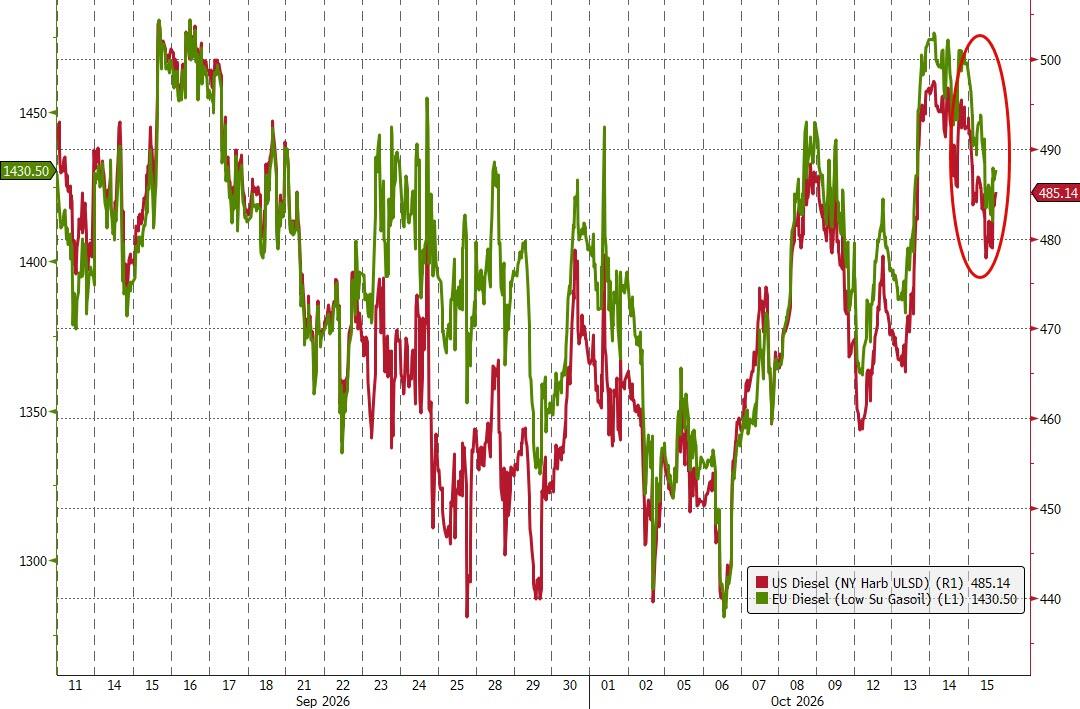
Finally, Bloomberg reports that US officials attending an International Energy Agency meeting in Paris earlier today informally lobbied allies to commit an additional 100 million barrels from emergency oil inventories to supply global markets.
“While US officials attending an IEA gathering in Paris on Thursday have yet to table a proposal about what should be done, they have been informally lobbying for an extra commitment of at least 100 million barrels, the people said, asking not to be identified because the matter is not public.” (BBG)

The report says US officials believe IEA members have not released enough oil from the coordinated 400 million-barrel oil and fuel release announced in March to cushion the impact of the Gulf conflict.
The Group of Seven nations agreed earlier this month to release up to 100 million barrels after President Trump threatened Europeans with a halt to exports of diesel and other petroleum products.
Today’s request follows Trump’s deal with Moscow to supply US and global markets with thousands of tons of diesel fuel.
On top of this, a defiant President Volodymyr Zelenskyy told the Financial Times earlier today that his armed forces will attack Russian refineries once again. This comes after the Trump administration requested that Ukraine stop hitting Russian refineries, as those attacks have been one of the drivers of the global refining crisis.
Last month, IEA head Fatih Birol said about one-third of the 400 million-barrel release announced in March had been delivered to global markets. Meanwhile, US SPR inventories have fallen to levels not seen since the early 1980s.
The Trump administration’s scramble comes as midterm elections are just three weeks away. The latest credit and debit card data from Bank of America show that US consumers are spending more on fuel at the pump, crowding out other purchases and weighing on consumer sentiment.
END
8. EMERGING MARKETS//AUSTRALIA NEW ZEALAND ISSUES
U.S./GOLD AND SILVER PRICING/ASIAN CLOSING MARKETS AND EUROPEAN BOURSE OPENING AND CLOSING/ INTEREST RATE SETTINGS THURSDAY MORNING 6;30AM//OPENING AND CLOSING\
OPENING LEVELS OF CURRENCIES// AND CLOSING ASIAN STOCK MARKET AND OPENING EUROPEAN STOCKS:6 AM EST
EURO VS USA DOLLAR: 1.1209 UP 0.0015
USA/ YEN 157.84 DOWN 0.050 NOW TARGETS INTEREST RATE AT 1.75% AS IT WILL BUY UNLIMITED BONDS TO GETS TO THAT LEVEL…//YEN STILL FALLS//END OF YEN CARRY TRADE BEGINS AGAIN DEC 2024/Bank of Japan raises rates by .25% TO 1.75 ..TAKAICHI NEW PM AS YIELDS RISE//JAPAN DEEPLY IN TROUBLE WITH RISING RATES AND A FALLING YEN!! BANK OF JAPAN WILL NO LONGER DO QE. URGES PENSION AND INSUANCE FUNDS TO BUY JAPANESE BONDS//
YEN CARRY TRADERS MURDERED
GBP/USA1.3242 UP 0.0013 OR 13 BASIS PTS
USA/CAN DOLLAR: 1.4212 DOWN 0.0001 //CDN DOLLAR UP 1 BASIS PTS//
Last night Shanghai COMPOSITE CLOSED DOWN 59.75 PTS OR 1.59%
Hang Seng CLOSED DOWN 258.17 PTS OR 1.06%
AUSTRALIA CLOSED UP 0.76%
// EUROPEAN BOURSE: ALL MIXED
Trading from Europe and ASIA
I) EUROPEAN BOURSES: ALL MIXED
2/ CHINESE BOURSES / :Hang SENG CLOSED DOWN 258.17 PTS OR 1.06%
/SHANGHAI CLOSED DOWN 258.17 PTS OR 1.06%
AUSTRALIA BOURSE CLOSED UP 0.76%
(Nikkei (Japan) CLOSED DOWN 3234.29 PTS OR 4.77%
INDIA’S SENSEX IN THE GREEN
Gold very early morning trading: $4145.20
silver:$56/48
USA DOLLAR VS TRY (TURKISH LIRA): 49.42 UP 3 BASIS PTS AND NOW WE SEE THEIR STUPIDITY OF SELLING SOME OF THEIR GOLD AND ALL OF THEIR USA DOLLAR RESERVES. THE COUNTRY IS IN BIG FINANCIAL TROUBLE
USA DOLLAR VS RUSSIAN ROUBLE: 83.64 ROUBLE// UP 0 ROUBLE AND 20 BASIS PTS.
UK 10 YR BOND YIELD: 5.3372 DOWN 9 BASIS PTS
UK 30 YR BOND YIELD: 5.8199 DOWN 9 BASIS PTS
FRENCH OAT 10 YR BOND YIELD: 4.7630 DOWN 12 BASIS PTS.
CDN 10 YR BOND YIELD: 3.878 UP 1 BASIS PTS
CDN 5 YR BOND YIELD; 3.576 UP 2 BASIS PTS
USA dollar index early THURSDAY MORNING: 101.89 DOWN 45 BASIS POINTS FROM WEDNESDAY’s CLOSE
THURSDAY MORNING NUMBERS ENDS
And now your closing THURSDAY NUMBERS 10.00 AM
Portuguese 10 year bond yield: 3.835% DOWN 12 in basis point(s) yield
JAPANESE BOND 10 yr YIELD: +2.904% DOWN 9 FULL POINTS BASIS POINTS /JAPAN losing control of its yield curve/
JAPAN 30 YR: 3.971 DOWN 12 BASIS PTS//
SPANISH 10 YR BOND YIELD: 3.9710 DOWN 12 in basis points yield
ITALY 10 YR BOND: 4.438 DOWN 13 points in basis points yield ./
GERMAN 10 YR BOND YIELD: 3.3611 DOWN 11 BASIS PTS
IMPORTANT CURRENCY CLOSES : MID DAY THURSDAY
Closing currency crosses for day /USA DOLLAR INDEX/USA 10 YR BOND YIELD/10:00 AM
Euro/USA 1.1209 DOWN 0.0016 OR 16 basis points
USA/Japan: 157.73 DOWN 0.245 OR YEN IS UP 25 BASIS PTS// HIGHLY INFLATIONARY TO JAPAN
Great Britain 10 YR RATE 5.3153 DOWN 12 BASIS POINTS //
GREAT BRITAIN 30 YR BOND; 5.7908 DOWN 14 BASIS POINTS.
FRANCE 10 YR: 4.737 DOWN 14 BASIS PTS
CANADIAN DOLLAR UP 4 BASIS PTS TO 1.4209
xxxxxxxxxxxxxxxxxxxxxxxxxxxxxxxxxxxxxxxxxxxxxxxxxxxxxxxxxxxxxxxxxxxxxxxxxxxxxxxx
The USA/Yuan CNY 6.6911 ON SHORE ..UP
THE USA/YUAN OFFSHORE// CNH UP TO 6.6904
TURKISH LIRA: 49.42 UP 3 EXTREMELY DANGEROUS LEVEL/DEATH WATCH/HYPERINFLATION TO BEGIN.//
Your closing 10 yr US bond yield DOWN 15 in basis points from WEDNESDAY at 5.053% //trading well ABOVE the resistance level of 2.27-2.32%)
USA 30 yr bond yield 5.391 DOWN 15 basis points /10:00 AM
USA 2 YR BOND YIELD: 4.721 DOWN 8 BASIS PTS.
GOLD AT 10;00 AM $4166.60
SILVER AT 10;00: $56.93
Your 11:00 AM bourses for Europe and the Dow along with the USA dollar index closing and interest ratesTHURSDAY
DAY CLOSING TIME/ 12:00 AM///
London: CLOSED UP 115.49 PTS OR 1.08%
GERMAN DAX: CLOSED UP 84.01 PTS OR 0.33%
FRANCE: UP 42.60 OR 0.73 PTS
Spain IBEX CLOSED DOWN 53.00 PTS OR 0.28%
Italian MIB: CLOSED DOWN 368.36 PTS OR 0.70%
WTI Oil price 95.68 10.00 EST/
Brent Oil: 104.90 10:00 EST
USA /RUSSIAN ROUBLE: 83.88/// ROUBLE UP 0 AND 86/ 100
CDN 10 YEAR RATE: 3.790 DOWN 15 BASIS PTS.
CDN 5 YEAR RATE: 3.492 DOWN 8 BASIS PTS
CLOSING NUMBERS: 4 PM//
Euro vs USA 1.1207 UP 0.0002 OR 2 BASIS POINTS//
British Pound: 1.3268 UP 0.0038 OR 38 basis pts/
BRITISH 10 YR GILT BOND YIELD: 5.3734 DOWN 7 FULL BASIS PTS//
BRITISH 30 YR BOND YIELD: 5.8441 DOWN 5 IN BASIS PTS.
FRENCH 10 YR BOND: 4.793 % DOWN 8 BASIS PTS
JAPAN 10 YR YIELD: 2.898% DOWN 10 FULL BASIS PTS (DANGEROUS TO THEIR ECONOMY
JAPANESE 30 YR BOND: 3.969 DOWN 8 PTS AND STILL VERY DANGEROUS TO THEIR ECONOMY
USA dollar vs Japanese Yen: 158.14 UP 0.157 OR YEN DOWN 16 BASIS PTS//GETTING FURTHER AWAY FROM 160.00/ EXTREMELY DANGEROUS
USA dollar vs Canadian dollar: 1.4193 DOWN 0.0021 PTS// CDN DOLLAR UP 21 BASIS PTS
West Texas intermediate oil: 97.70
Brent OIL: 105.20
USA 10 yr bond yield DOWN 10 BASIS pts to 5.096
USA 30 yr bond yield: DOWN 9 PTS to 5.432%
USA 2 YR BOND 4.757 DOWN 5 PTS
CDN 10 YR RATE 3.837 DOWN 4 BASIS PTS
CDN 5 YEAR RATE: 3.540 DOWN 4 BASIS PTS
USA dollar index: 101.88 UP 2 BASIS POINTS
USA DOLLAR VS TURKISH LIRA: 49.42 UP 3 BASIS PTS GETTING QUITE CLOSE TO BLOWING UP/IDIOTS SOLD GOLD
USA DOLLAR VS RUSSIA//// ROUBLE: 83.88 DOWN 0 AND 25 /100 roubles //
GOLD $4,160.25 3:30 PM)
SILVER: 57.16 3;30 PM)
DOW JONES INDUSTRIAL AVERAGE: UP 556.33 POINTS OR 1.08%
NASDAQ 100 DOWN 15.22 PTS OR 0.05%
VOLATILITY INDEX 16.41 DOWN 0.46 PTS OR 2.73%
GLD: $ 382.71 UP 6.72 PTS OR 1.79%
SLV/ 51.92 PTS UP 1.70 OR 3.38%
TORONTO STOCK INDEX// TSX INDEX: CLOSED UP 539.46 PTS OR 1.52%
end
TRADING today ZEROHEDGE 4 PM: HEADLINE NEWS/TRADING
‘AI Jesus’ Saves The World Again (But Tech Still Lagged); Bond Yields Tumble As Oil Spikes
‘WRAP UP
Stocks recover from recent weakness as AI concerns ease – Newsquawk US Market Wrap
Thursday, Oct 15, 2026 – 04:10 PM
- SNAPSHOT: Equities mixed, Treasuries down, Crude mixed, Dollar down, Gold up
- REAR VIEW: Hot US PPI report; Retail Sales above forecasts; Claims figures little changed W/W; US is reportedly considering using a MOAB against Iran; US has reportedly suggested that IEA nations supplement oil release with an extra 100mln barrels; Syrian gas export pipeline targeted in attack; “Anthropic’s Q3 sales reportedly missed bullish expectations; TSMC Q3 earnings beat; NVDA CEO says CoreWeave’s cost of capital is decreasing; Poor Australian jobs report.
- COMING UP: Data: EU Final Inflation (Sep), Italian Final Inflation (Sep), US Import/Export Prices (Sep), Industrial Production (Sep). Speakers: BoE’s Bailey; Fed Chair Warsh; BoC’s Macklem. Supply: Australia. Credit Ratings: Morningstar DBRS on Italy.
More Newsquawk in 3 steps:
1. Subscribe to the free premarket movers reports.
2. Trial Newsquawk’s premium real-time live audio squawk for 7 days.
3. Check out Newsquawk’s US Midterm Election dashboard.
MARKET WRAP
Stocks were mixed on Thursday, with the Nasdaq closing lower while the Dow and Russell rallied, the S&P 500 was little changed and the equal-weight S&P outperformed, indicating positive breadth. Nasdaq weakness was led by continued selling in AI, chip and memory stocks, with the index opening over 1% lower following a 7.5% drop in the KOSPI overnight. Late Wednesday, Anthropic’s Q3 revenue was reportedly short of bullish expectations set over in the summer. However, sentiment improved after the opening bell, with equities gradually recovering throughout the session as technology stocks rebounded. Most sectors closed in the green, led by Health Care, Materials and Financials, while Energy, Technology and Utilities finished lower.
The macro focus remained on US economic data and geopolitical developments. PPI came in hotter than expected, adding to inflation concerns following Wednesday’s CPI report, while Retail Sales were solid, Jobless Claims were in line with expectations and the NY Fed Manufacturing survey beat forecasts, although the Philly Fed survey disappointed. The initial market reaction was briefly hawkish following the PPI and Retail Sales releases, although the move was short-lived. On the geopolitical front, reports suggested US President Trump was considering using the “Mother of All Bombs” against Iranian energy infrastructure should he decide to resume combat operations.
T-notes ultimately settled higher, with haven demand from Wednesday seemingly extending into the overnight session amid the technology-led equity sell-off. However, T-notes subsequently pared gains as technology stocks recovered and equities pushed higher, potentially reducing demand for haven assets.
In FX, the Dollar weakened, although AUD underperformed following a disappointing Australian labour market report. Meanwhile, CHF outperformed alongside declining US Treasury yields, while GBP and EUR also posted gains. Gold and silver advanced, alongside Bitcoin.
Attention now turns to Fed Chair Warsh’s remarks at the IMF overnight, with participants looking for his assessment of the latest inflation reports and any indications of his appetite for an October rate hike, although he has expressed a preference against providing explicit forward guidance.
DATA
PPI: US producer prices rose sharply in September, with headline PPI increasing 1.3% M/M (exp. 0.5%, prev. 0.5%), marking the largest monthly increase since March 2022. The annual rate accelerated to 6.3% (exp. 5.3%, prev. 5.6%), its highest since December 2022. Core PPI rose 0.7% M/M (exp. 0.3%, prev. 0.2%), while the annual rate increased to 5.0% (exp. 4.4%, prev. 4.8%). Under the hood, goods prices surged 2.6%, the largest increase since the series began in 2009, driven predominantly by a 10.8% jump in energy prices, with gasoline prices rising 20.3% and accounting for half of the increase in goods prices. Food prices also rose 1.2%, while services prices increased 0.8%, driven partly by a 1.4% rise in trade services margins and a 3.4% increase in transportation and warehousing costs. Oxford Economics wrote that they expect PCE to print 0.5% M/M and 3.6% Y/Y, rising from 0.3% and 3.4%, respectively. OxEco continue to forecast Fed rate hikes in October and December.
RETAIL SALES: Retail Sales rose 0.8% M/M in September, above the expected 0.3%, though easing from the August 1.3% figure. Sales at gasoline stations largely contributed to the headline beat, rising 6.4% amid elevated energy prices. Ex-gas/autos rose 0.2%, notably easing from the 1.1% prior; meanwhile, the core component, Control Group, rose 0.1%, shy of the expected 0.3% (prev. 1.2%). Oxford Economics wrote that consumer spending is still on track for a 3.3% annualised gain in Q3, but “we expect spending to lose momentum heading into the key holiday shopping season as the drag from higher prices weighs more heavily on consumers”.
CLAIMS: US Initial claims (w/e October 10th) rose by just 1k to 199k (exp. 200k), leaving the 4-week average little changed at 198.5k. On an unadjusted basis, claims rose 19,456, +11.4% W/W. Largest gains: Ohio (+3,887), Tennessee (+3,484), California (+2,004). Largest drops: Nevada (-566), Maryland (-317), Georgia (-179). Seasonal factors had expected an increase of 18,799, +11.0% W/W. Continuing Claims fell to 1.710mln as expected from 1.714mln. Oxford Economics noted the headline readings point to a stable labour market with layoffs remaining subdued. The firm notes that trend job growth is consistent with their forecast of the break-even rate, suggesting unemployment will continue to move sideways.
NY FED: The NY Fed Empire State Manufacturing Index surged to 25.5 in October (exp. 10.3, prev. 7.6), marking its highest level since December 2021 and signalling a sharp acceleration in manufacturing activity. Under the hood, New Orders jumped to 23.2 (prev. 2.0), while Shipments rebounded to 13.1 (prev. -3.2) and Unfilled Orders increased to 14.0 (prev. 5.9). On the labour front, employment remained in expansionary territory at 10.3 (prev. 10.6), although the average workweek index eased to 9.1 (prev. 17.0). Meanwhile, price pressures remained elevated, with Prices Paid moderating to 59.5 (prev. 63.1), while Prices Received increased to 30.6 (prev. 28.1). Supply-chain pressures intensified, with delivery times lengthening and supply availability deteriorating to -15.1 (prev. -11.9), its lowest level since June 2022. Looking ahead, the six-month business conditions outlook declined to 21.0 (prev. 29.0), suggesting that firms remain optimistic about future activity, albeit less so than in September. However, forward-looking price expectations increased further, indicating that inflationary pressures could remain persistent.
PHILLY FED: The Philadelphia Fed Manufacturing Index fell to 20.9 in October (exp. 28.4, prev. 37.8), its second consecutive monthly decline, although it remained in expansionary territory, signalling continued growth in regional manufacturing activity. The internals saw New Orders fall sharply to 4.3 (prev. 29.2), while Shipments eased to 15.3 (prev. 27.7), pointing to a notable moderation in demand and output. Labour indicators also softened, with Employment declining to 9.1 (prev. 11.8) and the Average Workweek falling to 7.5 (prev. 18.0), its lowest since June. On inflation, Prices Paid eased to 43.2 (prev. 48.6), although Prices Received jumped to 40.1 (prev. 31.3), its highest since May 2025, suggesting firms continued to pass higher costs onto customers. Looking ahead, firms remained optimistic, although expectations moderated considerably, with Future Business Conditions falling to 33.0 (prev. 52.9), its lowest since January, while Future New Orders declined to 37.0 (prev. 62.3) and Future Employment to 30.1 (prev. 50.6). Future CAPEX also eased to 34.9 (prev. 37.1), while expected price pressures remained elevated despite moderating. Notably, the survey’s special questions showed that 52.2% of firms expect to increase total capital spending in 2027, compared with 36% in last year’s survey, while none expect to reduce spending. Overall, the report points to slowing but still-positive manufacturing growth, alongside persistent selling-price pressures and moderating optimism over the next six months.
FED
DALY (2027 voter): Said we are more likely than not to need more rate hikes, but still deliberating on timing, adds not in a posture of urgency and better to be thoughtful and deliberate. On CPI, said reassured by markets’ initial ‘robust’ reaction to CPI data and described markets as calmer. Further, she said CPI showed gas prices are driving headline inflation, while core inflation remains sticky, as expected. Daly doesn’t know yet if inflation will come down as shocks abate or worsen if shocks persist. The 2027 voter noted that risks to above-target inflation remain elevated while a stable labour market means the Fed can focus on price stability.
FIXED INCOME
T-NOTE FUTURES (Z6) SETTLED 21 TICKS HIGHER AT 105-17
Yields continue to decline despite more hot inflation prints. At settlement, 2-year -4.9bps at 4.757%, 3-year -6.9bps at 4.844%, 5-year -9.1bps at 4.903%, 7-year -10.2bps at 4.989%, 10-year -10.1bps at 5.093%, 20-year -9.4bps at 5.482%, 30-year -9.5bps at 5.430%.
THE DAY: The move lower in UST yields continued on Thursday as the tech/AI rout extended into the APAC session overnight, with the KOSPI closing 7.5% lower.
During the US session, attention turned to economic data, with PPI coming in hotter than expected, while Retail Sales and the NY Fed Manufacturing survey also beat forecasts. Meanwhile, Jobless Claims were in line with expectations, while the Philly Fed survey disappointed.
Markets initially focused on the hotter PPI and stronger Retail Sales data, resulting in a brief spike in Treasury yields. However, the dip in T-note futures was swiftly bought as technology stocks remained under pressure, particularly in the Nasdaq, potentially supporting haven demand and helping T-notes climb to fresh session highs. As the technology sector subsequently began to recover, T-notes came under renewed selling pressure, ultimately settling off their session highs.
Despite another hotter-than-expected inflation print, money market pricing for an October Fed rate hike eased from Wednesday’s levels, when markets assigned a roughly 50% probability of a 25bps increase. This has since fallen to around 30%, although Oxford Economics continues to expect hikes in both October and December following Thursday’s data. Attention now turns to Fed Chair Warsh’s remarks at the IMF overnight, with participants looking for his assessment of the latest inflation figures and any signals regarding upcoming policy decisions.
Supply
Notes
- US Treasury to sell USD 13bln of 20-year bonds on Oct 21st, to settle Oct 22nd; To sell USD 26bln of 5-year TIPS on Oct 22nd, to settle October 30th
Bills
- US sells 8-week bills at a high rate of 4.050%, B/C 2.26x; sells 4-week bills at a high rate of 4.000%, B/C 2.56x
- US to sell USD 95bln of 13-week bills and USD 82bln of 26-week bills on Oct 19th.
- US to sell USD 95bln of 6-week bills on Oct 20th
STIRS / OPERATIONS
- Fed Hike Pricing via CME FedWatch: Oct 7.3bps (prev. 12.3bps), Dec 28.7bps (prev. 29.8bps)
- EFFR at 3.88% (prev. 3.88%), volumes at USD 111bln (prev. USD 106bln) on October 14th
- SOFR at 3.88% (prev. 3.89%), volumes at USD 2.974tln (prev. USD 3tln) on October 14th
- NY Fed RRP op demand at USD 1.20bln (prev. 0.20bln) across 4 counterparties (prev. 2) on October 15th
- Treasury Buyback [Liquidity support, 20-30-year, max USD 6bln]: Accepts USD 6.0bln of USD 40.84bln offers; accepts 3 of 42 eligible securities
CRUDE
WTI (Z6) SETTLED USD 2.60 HIGHER AT USD 96.50/BBL; BRENT (X6) SETTLED USD 0.14 LOWER AT USD 105.92/BBL
WTI outperformed its Brent counterpart, rising over USD 2/bbl, while Brent was slightly lower. The move followed reports that the US is considering easing Russian shadow-fleet sanctions and the US suggesting a supplemental oil release to IEA nations with extra 100mln barrels all while the EIA weekly inventory confirmed a large crude stock draw. US commercial petroleum stocks declined 13.4mln barrels in the previous week, the largest draw since April, driven by draws in crude, diesel, and other products. Crude stocks themselves drew 8.557mln, much steeper than the expected -0.3mln, though less than the 11.2mln crude draw seen in Wednesday’s private inventory report; the SPR was unchanged at 283mln. Meanwhile, Saudi Aramco is offering more spot crude oil cargoes into the European market for late October to mid-November delivery, according to reports, citing sources. Separately, Syria’s Jabsa gas export pipeline was targeted by an attack resulting in a reported explosion and fire in one of the main gas transmission lines. WTI and Brent traded between USD 93.58-98.32/bbl and USD 103.37-106.40/bbl, respectively. EIA results W/W: Crude -8.557mln (exp. -0.3mln), Distillate -2.527mln (exp. -1.6mln), Gasoline 3.518mln (exp. -0.5mln), Production -300k bpd.
EQUITIES
CLOSES: SPX +0.34 at 7,745, NDX -0.05% at 29,936, DJI +1.08% at 51,178, RUT +1.37% at 2,767
SECTORS: Energy -1.55%, Technology -0.54%, Utilities -0.21%, Consumer staples +0.36%, Industrials +0.49%, Communication services +0.62%, Real estate +1%, Consumer discretionary +1.16%, Financials +1.39%, Materials +1.7%, Health +1.84%.
EUROPEAN CLOSES: Euro Stoxx 50 -0.31% at 6,171, Dax 40 +0.35% at 25,386, FTSE 100 +1.04% at 10,837, CAC 40 +0.78% at 7,935, FTSE MIB -0.68% at 49,418, IBEX 35 -0.22% at 19,189, PSI -0.44% at 9,374, SMI +1.49% at 14,341, AEX -0.40% at 1,133
STOCK SPECIFICS
- Magnificent Seven ETF (MAGS) / VanEck Semiconductor ETF (SMH) / Roundhill Memory ETF (DRAM): Under pressure after Anthropic’s Q3 revenue reportedly fell short of bullish expectations.
- Nvidia (NVDA) CEO Huang said CoreWeave’s (CRWV) cost of capital is actually decreasing. Cantor said “market is getting it wrong” on CoreWeave; buy the dip”‘; Evercore sticks with an Outperform rating on CRWV.
- Walmart (WMT): Upgraded at Deutsche Bank to ‘Buy’ from ‘Hold’.
- Charles Schwab (SCHW): EPS and revenue beat failed to impress.
- PNC Financial Services (PNC): Q3 NII missed expectations.
- Rocket Lab (RKLB): Neutron launch delayed to 2027.
- ManpowerGroup (MAN): Q4 guidance missed expectations; announced CEO transition.
- FMC Corporation (FMC): Disappointing preliminary Q3 guidance.
- Commercial Metals Company (CMC): Earnings beat expectations.
- Penske Automotive Group (PAG): To go private via Motown Acquisition Corp. at USD 212/shr in cash.
- Google (GOOGL) Quantum AI published a breakthrough in quantum computing.
- Meta (META) announced Muse Spark Open, most capable US open-weight model to date.
- KFC (YUM) is moving to ditch Pepsi (PEP) for Coca-Cola (KO) in thousands of restaurants, WSJ reports.
FX
USD weakness continued as AI concerns lingered, pressuring both tech stocks and US yields despite a hot PPI report prompting upward revisions to September PCE expectations. CHF, GBP and EUR all outperformed against the USD, while US tech-led equity weakness spread to Asian markets. The hotter-than-expected headline PPI reading was also driven by higher energy prices, while the core reading exceeded forecasts. Meanwhile, Retail Sales beat on the headline, albeit driven by sales at gasoline stations amid higher energy prices; claims were little changed W/W, and regional data was mixed (NY Fed beat, Philly missed). DXY now trades around 102.08, down from Wednesday’s YTD high of 102.945.
GBP was one of today’s better performers ahead of the October budget. The Guardian reported that the UK Chancellor is set to raise taxes on banks, potentially reversing previous cuts to the bank surcharge, which could raise more than GBP 2bln a year. UK GDP was better than expected in August, rising 0.1% (exp. -0.1%). At the BoE, Greene reiterated that she sees risks of second-round effects as “pretty significant”, whilst Breeden questioned whether the energy shock is gone or just delayed. The remarks highlighted a stark contrast between the two MPC members.
AUD sank after a weak jobs report, which saw employment unexpectedly fall by 39.3k (exp. +20k, prev. +39.5k). The headline was driven by a 73.7k decline in part-time employment, with the unemployment rate ticking higher to 4.7% from 4.6%, despite the participation rate falling to 66.8% from 67.1%. AUD/USD hit lows of 0.6894, a level last seen in July.
USA DATA RELEASES
PPI
Inflation Is ‘Broadening Out’ As Producer Prices Soar Most In 4 Years
Thursday, Oct 15, 2026 – 08:43 AM
After yesterday’s accelerating CPI scare, this morning analysts expected a concomitant surge in producer prices – the big question remains whether it’s all energy… or are price-hikes ‘broadening out’ making The Fed’s job harder.
Headline PPI exploded higher in September, rising 1.3% MoM (more than double the 0.6% expected and biggest monthly jump since March 2022), dragging producer prices up 6.3% YoY (+5.4% exp) – the highest since Dec 2022…
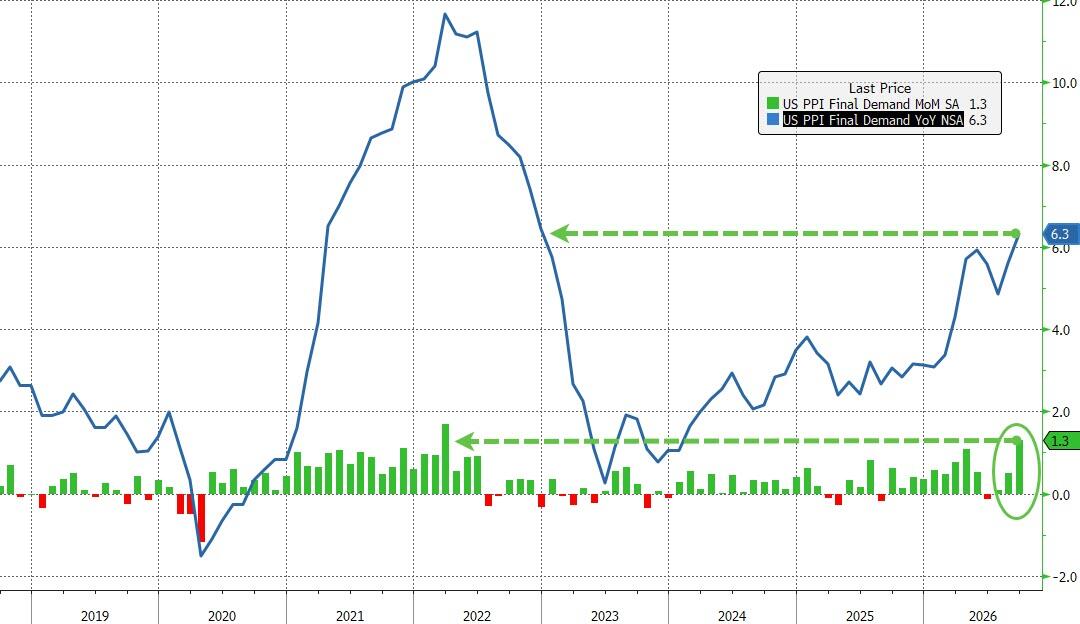
Energy dominated the surge in prices…
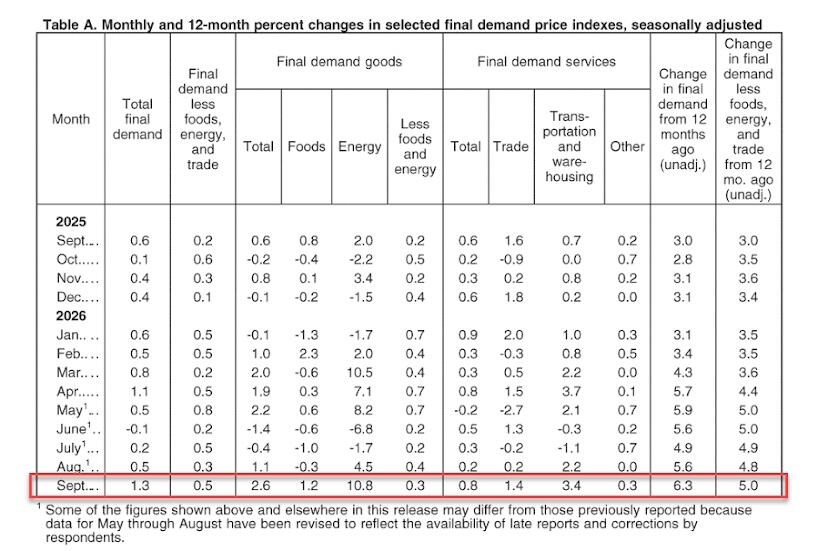
The Energy PPI component is now at a record high (clearly tracking diesel prices more than crude)…
Over 80 percent of the broad-based rise in September is attributable to the index for final demand energy, which jumped 10.8 percent
- Half of the September increase in the index for final demand goods can be traced to prices for gasoline, which jumped 20.3 percent.
- The indexes for diesel fuel, fresh and dry vegetables, jet fuel, residential electric power, and crude petroleum also rose.
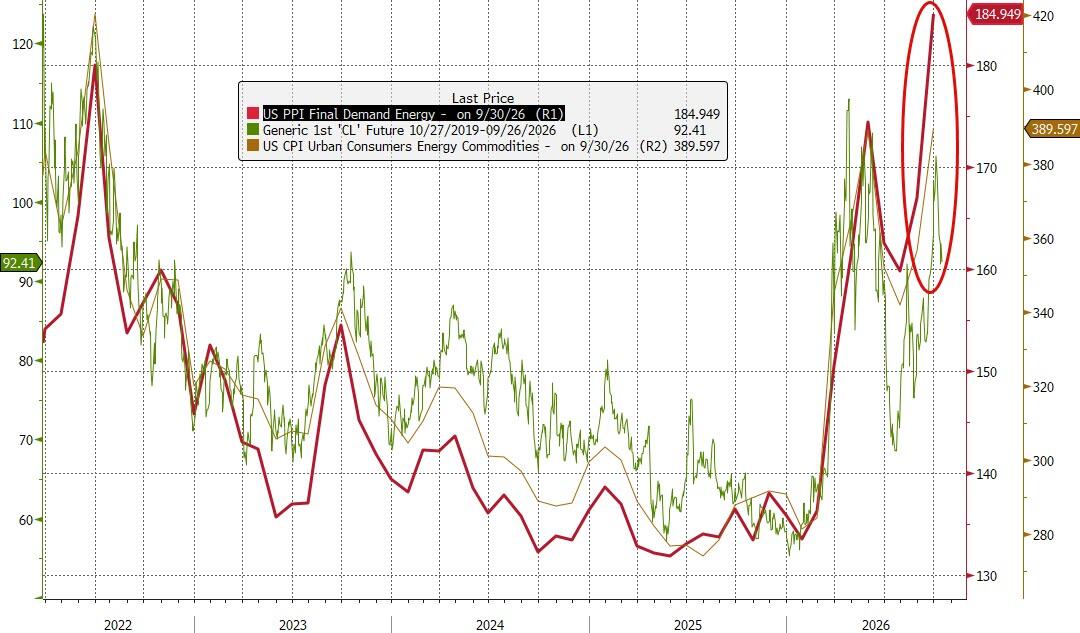
More problematically, Services costs are soaring too as energy costs spread across the economy…
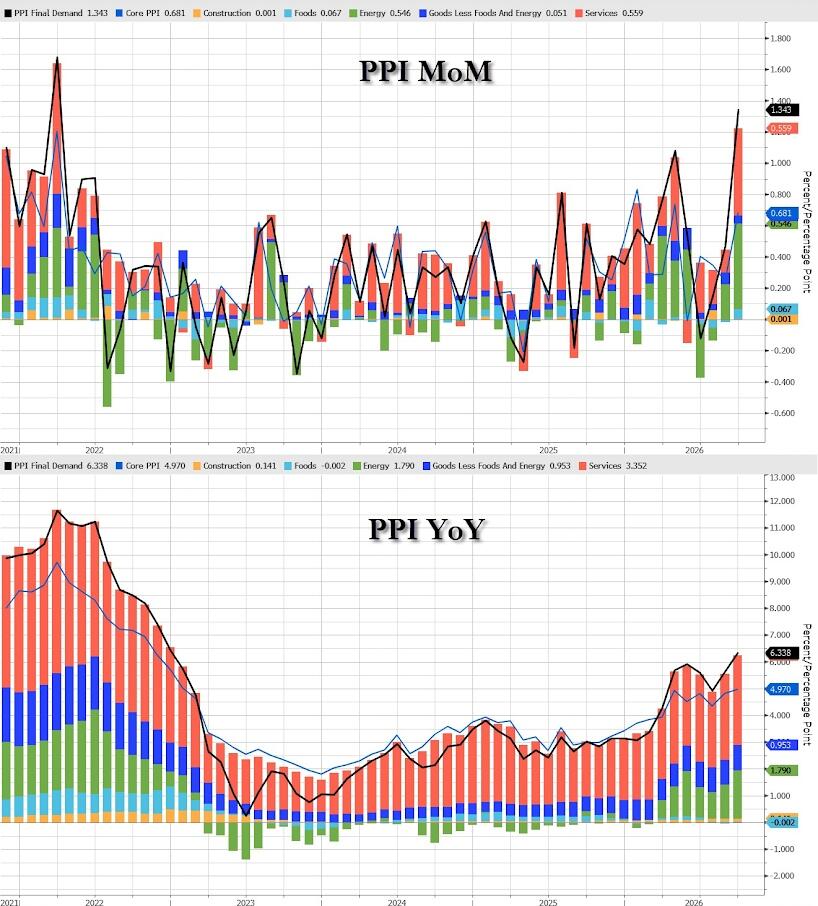
Portfolio management costs ticked up along with stocks yet again…
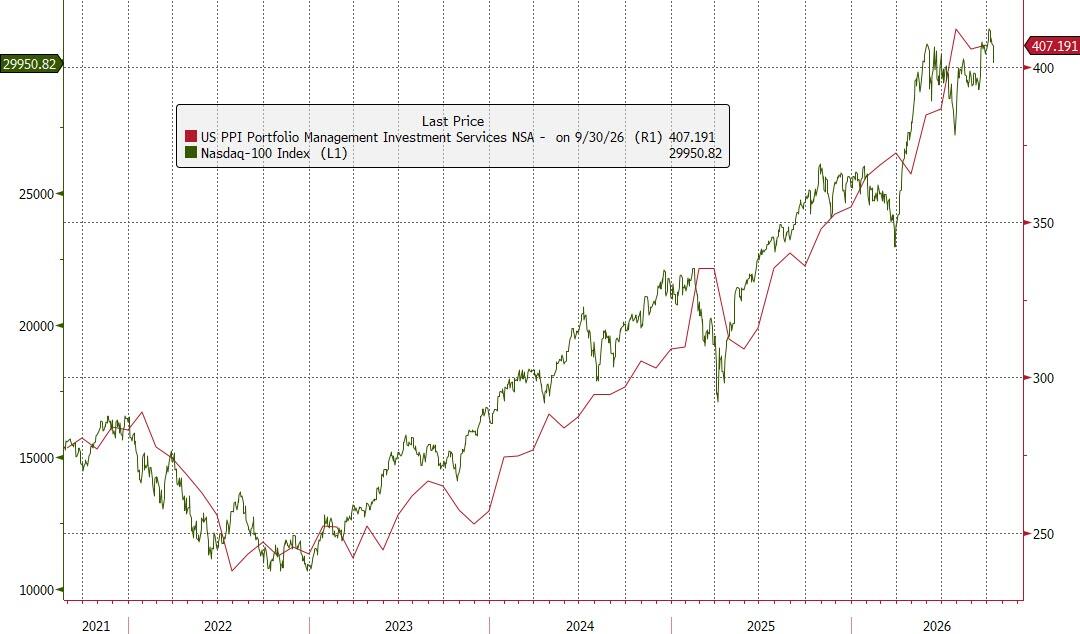
Core PPI was just as bad, rising 0.7% (more than double the 0.3% expected) and that pulled core Producer Prices up 5.0% YoY (the hottest since Dec 2022)…
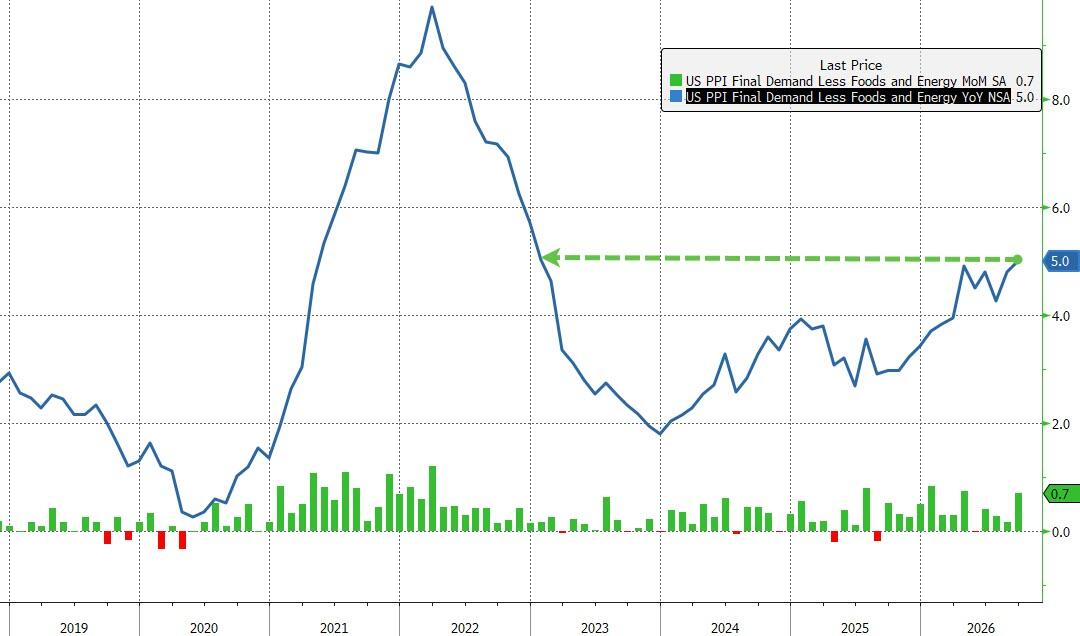
Prices for final demand goods advanced 2.6%, in September, the largest increase since data were first calculated in December 2009′ but Services costs are also jumping…
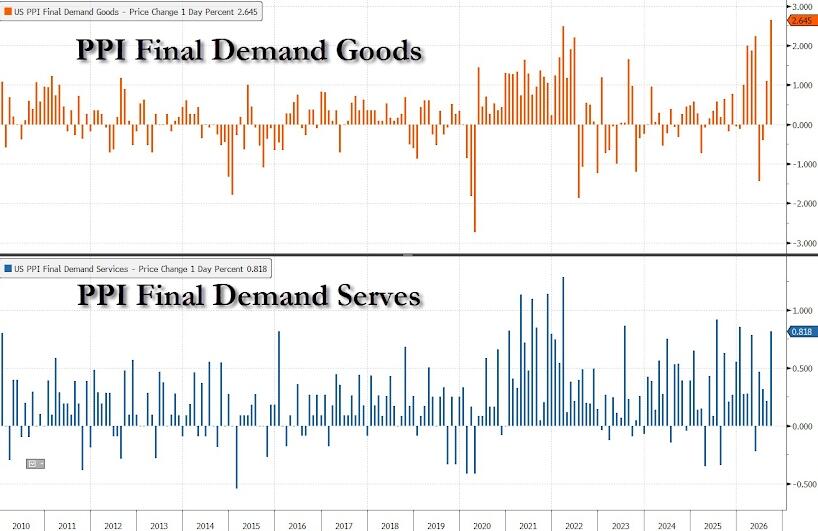
Worse still, the pipeline for future producer prices is ugly with intermediate demand prices surging…
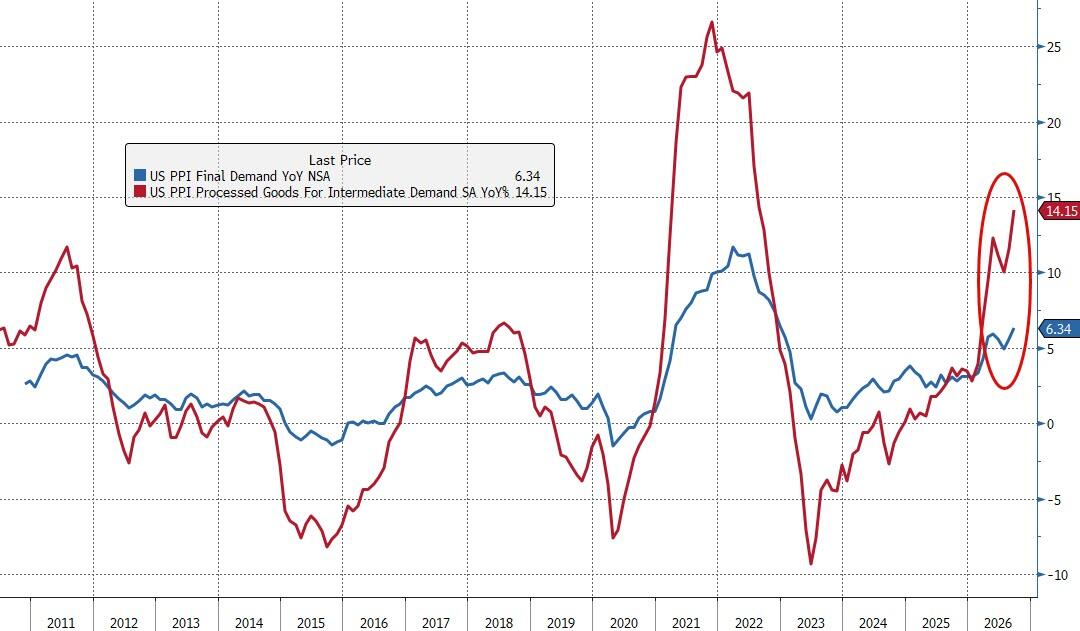
The CPI-PPI spread continues to (broadly speaking) signal increased pressure on corporate margins…
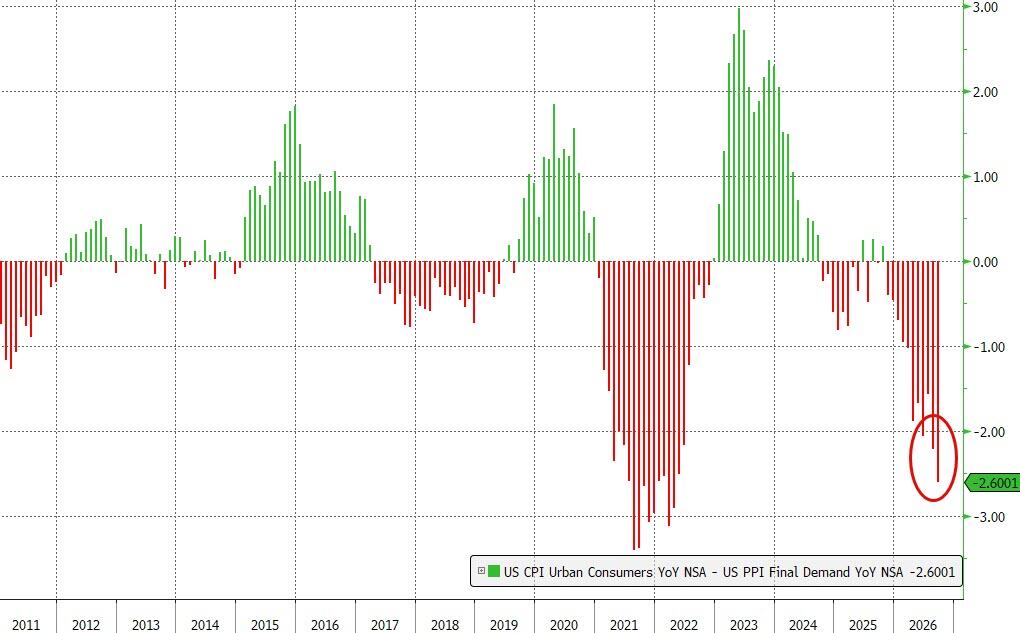
None of this provides any support for doves at The Fed and 2Y Yields and rate-hike odds are rising again, but not like they did post-CPI.
END
JOBLESS CLAIMS
Initial Jobless Claims Hover At 57-Year Lows
Thursday, Oct 15, 2026 – 09:15 AM
For the fifth straight week, the number of Americans filing for jobless benefits for the first time was less than 200k (199k)…
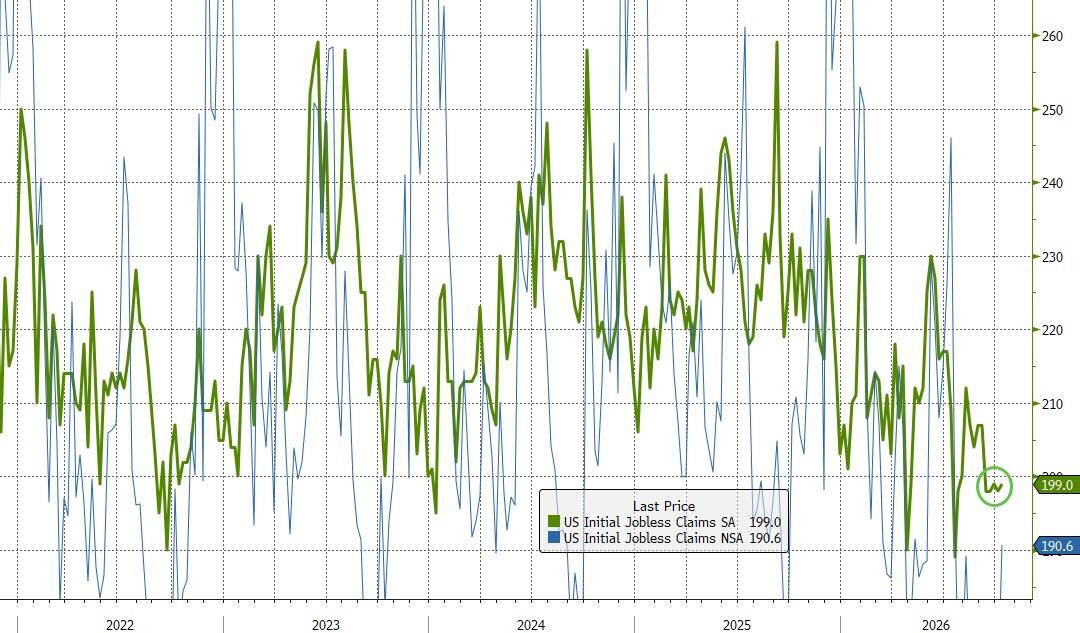
That is the longest streak below that level since 1969! (And remember, the labor force then was a fraction of what it is now).
Interestingly, Ohio, Tennessee, and California saw a rise in unadjusted claims last week…
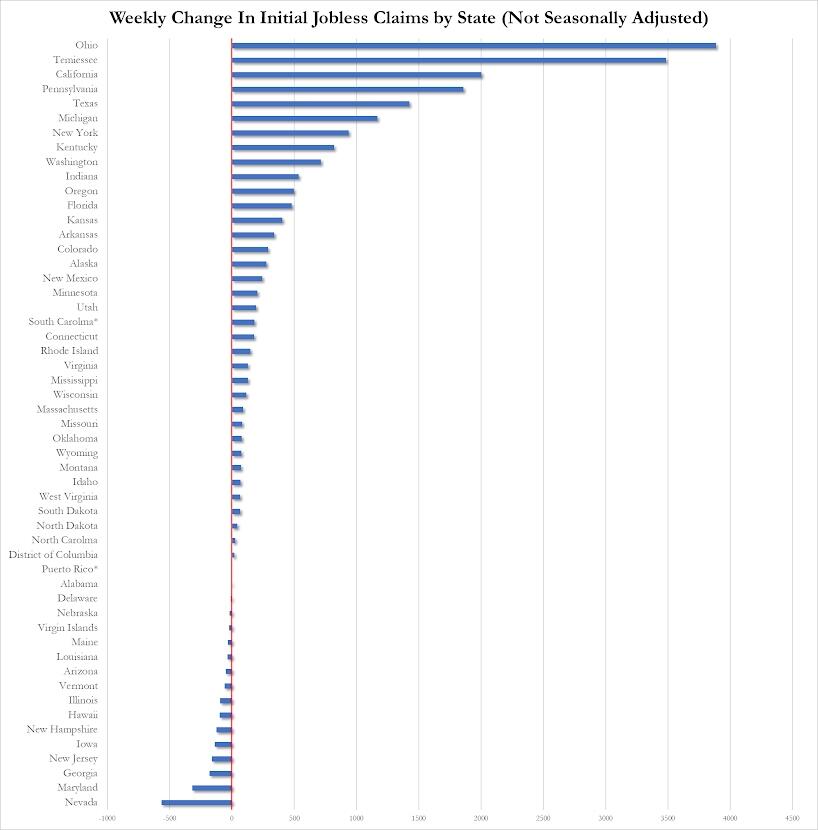
Continuing claims remains low too – holding around 1.7 million Americans – the lowest level since March 2023…
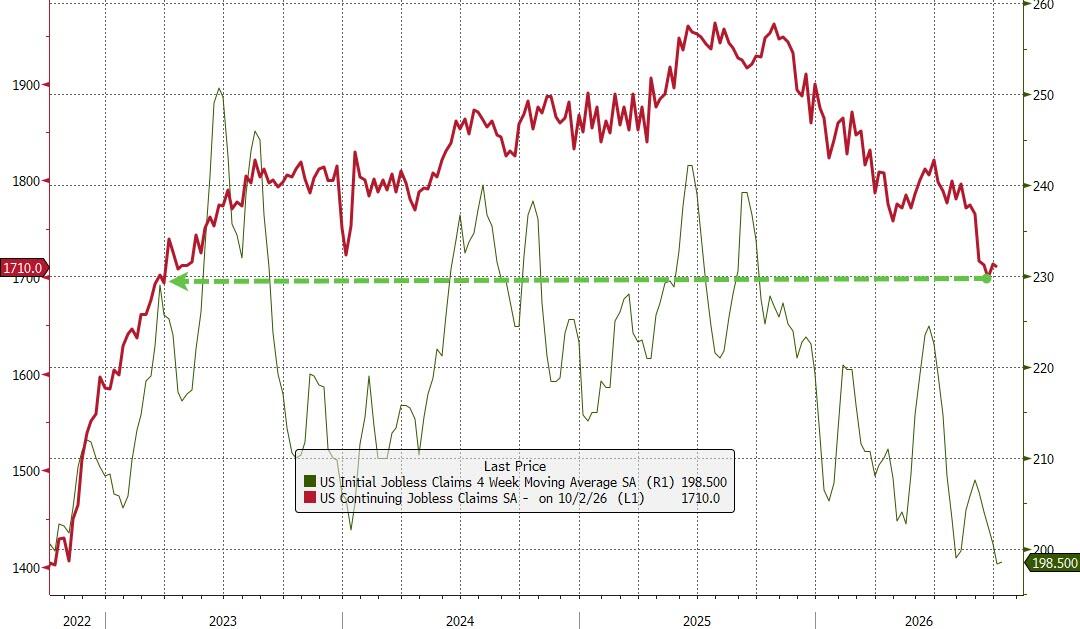
However, as we noted last week, payrolls tell the other half of the story. September nonfarm payrolls came in at just +29k (with prior months revised down), well below the already modest recent trend. Net employment change is simply hires minus separations. When separations are that low but the net number is mediocre, hiring itself must have slowed substantially.
So the market has cooled mainly through reduced hiring rather than rising firings. That keeps the unemployment rate relatively contained (4.2% in September) even as it becomes harder for job seekers, switchers, and new entrants to land roles.
Economists (including various Fed research notes) have been describing this as a stable-but-fragile equilibrium for a while: low layoffs prop things up, but the low hiring rate leaves little cushion if demand weakens further or a shock forces companies to start cutting.
It’s also consistent with slower labor-force growth from demographics and reduced immigration – fewer people needing to be absorbed means weaker payroll growth can still leave unemployment from rising sharply.
The bottom line is simple: the ‘low-hire, lowest-fire’ economy continues to roll along with no obvious signs of AI’s productivity surge (or replacement projections).
USA ECONOMIC REPORTS
ED DOWD:
HOW BUBBLES BLOW UP
a must read!!
Dowd: “Investment Bubbles Are A Feature Of Capitalism, Not A Bug”
Wednesday, Oct 14, 2026 – 03:20 PM
Authored by Ed Dowd via Ed Dowd’s Beyond The Narrative Substack,
On Friday October 9th Bloomberg published an article titled “Jeffries’ Chris Wood Sees ‘Massive Capital Destruction’ in AI.” His view is that the most likely long-term outcome of the AI boom is massive capital destruction in the US, with market share shifting to cheaper open-source Chinese models. Wood has mostly got it right in my opinion except for two differences. My first difference is that Chinese models are not the only open-source models available and that western open-source models are closing the gap. Secondly, while his view correctly flags the overbuild and the competitive pressure from lower-cost alternatives what it leaves out is the long history of innovative technology infrastructure bubbles and the reliable pattern that follows them which is:
excitement/mania → overinvestment → financial collapse → distressed assets → recapitalized cheap infrastructure fuels the next economic wave.
In regard to the AI bubble, I believe we are currently in the overinvestment phase with cracks emerging. Let us look at some historical examples to illustrate the pattern and see if we can glean what the future of this current bubble might look like.

The US Railroad Bubble
In the decades after the Civil War, railroads became the transformative technology of the era. Capital, much of it European, flooded in. Between the late 1860s and early 1870s, tens of thousands of miles of track were laid, often into sparsely settled or unprofitable territory. Speculative financing, land grants, and the expectation of endless growth created a classic mania. Early projects showed strong returns, which attracted more money into later, riskier lines built far ahead of demand. When financing dried up, highlighted by the failure of Jay Cooke’s bank in marketing Northern Pacific bonds, the Panic of 1873 followed. More than 100 railroads went bankrupt in the ensuing years, banks failed, and investors were wiped out. The depression lasted years. Yet the physical tracks remained. The surviving and reorganized network became the backbone of American industrial expansion, enabling efficient movement of goods, people, and capital that powered decades of growth. The overbuilt infrastructure, once distressed and recapitalized, proved far more valuable to the broader economy than the paper losses suggested.
The 1920s Utility Bubble
The 1920s electrification boom followed a similar script. Central-station utilities expanded rapidly, and holding companies consolidated regional systems into large, leveraged empires. Electricity generation and revenues grew dramatically as the technology moved from novelty to infrastructure. Utility stocks soared and became a major part of the market. Holding companies facilitated access to capital and technical expertise, but the structures were opaque, and capacity was built aggressively. The 1929 crash and subsequent Depression exposed the leverage and accounting. Samuel Insull’s empire collapsed in spectacular fashion, and the Dow Jones Utilities Average plunged. Reforms including the Public Utility Holding Company Act of 1935 broke up the largest structures and shifted the industry toward regulated regional monopolies. What remained was a vastly expanded electrical grid and generation capacity. Widespread electrification transformed industry, homes, and productivity for the rest of the century. The bust was painful for equity and debt holders; the long-term economic payoff from cheap, abundant power was enormous.
The Dotcom Bubble
The most recent and directly analogous example is the late 1990s telecom fiber buildout during the Dotcom era. Carriers and infrastructure firms poured hundreds of billions into fiber-optic networks, switches, and related equipment, largely financed with debt and encouraged by forecasts of internet traffic doubling every few months. Capacity vastly exceeded near-term demand. After the bubble burst, market values collapsed, many telecoms went bankrupt, and bandwidth prices fell sharply. A large portion of the newly laid fiber sat “dark” or unlit. Through bankruptcies and recapitalizations, that physical infrastructure was acquired at deep discounts, often pennies on the dollar. The resulting cheap broadband made business models viable that would have been prohibitively expensive otherwise. Google, YouTube, Facebook, Apple’s smartphone ecosystem, Netflix, software-as-a-service, and cloud services all scaled on that excess capacity. Without the overbuilding and subsequent distress, Web 2.0 as we know it does not happen at the same speed or cost. The capital destruction was real but the residual infrastructure seeded the next wave of growth.
AI Bubble (Yes it is a bubble!)
I believe we are now in the AI infrastructure equivalent of the overinvestment phase. Massive capital is flowing into data centers, chips, power, and related equipment. The sheer scale of spending is turning advanced AI models into a commodity faster than many equity and debt investors appear to appreciate. Chinese open-source models are already applying downward pricing pressure, consistent with the Jefferies view. Cracks are visible. In my Substack piece “Wall Street’s AI Capex Party…It’s 2 AM & The Bar Is About to Close!”, the signals included stalled private credit funding for the buildout, cracking enterprise demand as promised productivity gains fail to materialize at scale, looming power constraints that are becoming the binding limit rather than chip supply, and open-source pricing pressure that compresses margins.
Additional recent indicators from public commentary reinforce this: circular deals in which AI companies run negative free cash flow and rely on debt investors to keep purchasing chips at elevated prices; recent analyses showing major players cannot cover contracted compute commitments under realistic revenue assumptions; and narrative shifts such as space based data centers that paper over terrestrial grid and power bottlenecks. Growth rates implied by current valuations look vulnerable once the second derivative of funding and utilization slows. It is not a question of not if the bubble bursts but when it bursts.
Credit Markets Always End Infrastructure Buildouts
Debt and credit have been central to every one of these infrastructure buildouts. In the railroad boom, bonds financed the majority of the expansion, often more than three-quarters of the capital. When those markets stopped absorbing new bond issues (e.g. Jay Cooke & Co. could no longer place Northern Pacific bonds) the credit system seized up. Then bank runs followed, the New York Stock Exchange closed for ten days, and within two years roughly a third of outstanding railroad bonds had stopped paying interest. The equity markets lagged in this period…credit markets ended the railroad party abruptly.
The 1920s utility expansion followed the same pattern on a different scale. Samuel Insull’s holding company pyramid relied on layers of debt and bank loans secured by the securities of the operating companies themselves (financial engineering). Once revenues softened and the banks refused to roll the notes in 1932, the structure collapsed into receivership. In this period the equity markets led the credit markets first with the 1929 crash then credit followed later.
In the telecom fiber boom, carriers raised hundreds of billions in bonds and used vendor financing and circular deals to keep the buildout going. Credit markets ultimately marked the end of the buildout but equities peaked in March of 2000 before credit. Credit spreads later widened sharply in 2001 and 2002, defaults clustered in the sector for years, and bondholders recovered roughly twenty cents on the dollar in many cases. When lenders stopped funding incremental capacity, the overinvestment phase ended and the financial collapse began.
The same dynamic is now visible in the AI buildout, where private credit has stalled, circular debt structures are proliferating, off balance sheet financing is growing and early signs of stress are appearing in CCC junk credit markets. Whether equity markets lead or lag this cycle remains to be seen but the case could be made that given the tremendous amount of passive equity investing the discounting mechanism of equity could lag and credit leads this time.
Bottom Line
Innovative technology capex cycles repeat themselves because human nature has not changed. Mania and excitement give way to overinvestment, which produces financial collapse and distressed assets. Those assets then become the cheap foundation for the next economic wave. Those who believe in cycles and a constant human nature may want to protect themselves accordingly and reduce exposure in the AI complex where risk-reward no longer makes sense. Then when the bust does arrive watch for the opportunities that emerge from the ashes where durable longer-term value will be created.
Bubbles are a feature of capitalism, not a bug. They destroy capital in the short run and, through the process of overbuilding and recapitalization, often leave behind the physical and technical foundation for longer-term productivity gains. The pattern is consistent throughout history…though the timing and severity may vary. The long-term outcome for the economy is usually more favorable than the peak-to-trough equity charts imply and a net positive over time.
“What has been will be again, what has been done will be done again; there is nothing new under the sun.” Ecclesiastes 1:9
END
how bubbles will blow up: Anthropic!!
(zerohedge)
Anthropic Says Q3 Revenue Jumped To $16.8 Billion And Turned “Adjusted” Profitable… But Run-Rate Math Shows Growth Hitting The Brakes
Wednesday, Oct 14, 2026 – 07:40 PM
We got the number.
As we previewed this morning, the entire AI complex (if not the entire market) spent Wednesday waiting with bated breath for one data point out of Anthropic’s closed-door pre-IPO investor day in San Francisco. Shortly after the close, the FT delivered: Anthropic told investors its third-quarter revenue had jumped to $16.8 billion, “almost 50 per cent” above the $11.5 billion recorded in the second quarter, and that the company was “profitable on an adjusted basis” and cash flow positive in the quarter.
Executives spent the full day laying out how “a safety-focused philosophy, rapid growth and efficiency gains” would set up a successful IPO in November.
On the surface, that is close to the “position of strength” JonesTrading’s Mike O’Rourke said the market was looking for. And the timing could hardly be better for the bulls, because the AI trade spent the entire session before the headline getting taken to the woodshed.
A Brutal Session Before The Number
Goldman’s US trading desk titled its close “UGLY” (available to pro subs): the S&P fell 1.11% to 7,719 and the NDX slid 2.02% to 29,950, the “first -1% SPX / -2% NDX move since late July,” with “sentiment particularly within the AI complex taking a real step function lower” on:
1) heavy focus on what the credit markets are saying about the ability to continue to finance the AI trade and 2) acute focus on neoclouds (-12% today which is a top 5 move in past 5 years) / hyperscale bond yields onto a growing list of recent concerns (openAI revenue confusion, China Memory breakthroughs easing bottlenecks, datacenter sentiment into midterms, future power/shell constraints, further issuance etc) … all on the heels of hotter than anticipated CPI this AM.
The credit side was worse. Goldman’s cross-asset desk reported “macro credit spreads widening the most in a single session in months,” with Oracle CDS +31bps on the day, CoreWeave CDS exploding over 100 bps wider, hyperscaler cash bonds 4-5bps wider and datacenters 7bps wider. CoreWeave stock lost more than 15% (and almost 20% including the after hours dump), and as we noted in today’s market wrap, the CDS market now assigns a 63% chance it defaults within five years. Semis meanwhile closed down for a sixth straight session, a streak Goldman’s Matthew Kaplan flagged as uncommon:
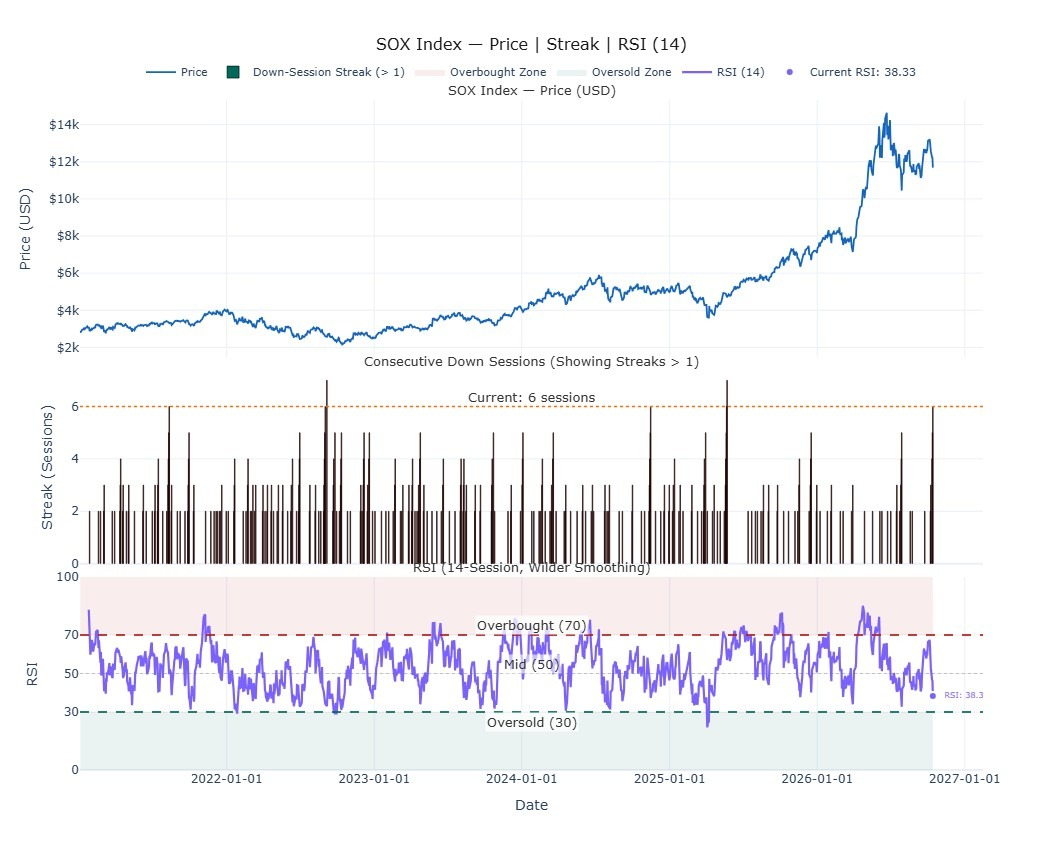
Meanwhile, as everything AI got dumped, Goldman’s S&P ex-AI basket rose 61bps, a 1.72-point spread over the index that ranks among the top five of the year:
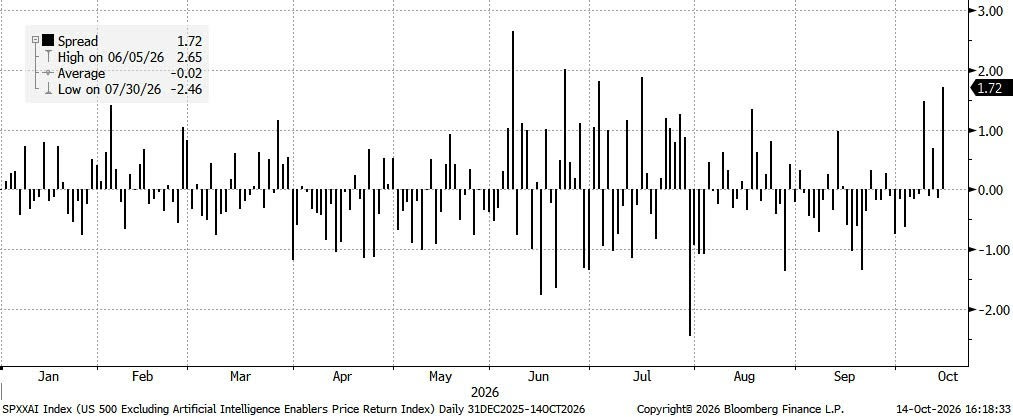
In other words, the market spent the day cutting the “right tail off of the AI trade”, in the words of Goldman’s derivatives desk, and then Anthropic’s number crossed after the close. The only question that matters now is whether the number reattaches that tail.
Back Out The Months
Start with the obvious. Annualize the quarter and you get about $67 billion, barely above the $65 billion run rate Anthropic told investors it had hit at the end of July. But Anthropic’s run rate annualizes the most recent month, so the real question is where the company exited September, and that takes a little arithmetic.
Anchor on July, a process which the company is known to do by annualizing its latest (and greatest) month. Read the $65 billion end-July mark as July revenue × 12 and July comes to about $5.4 billion. That leaves roughly $11.4 billion for August and September combined ($16.8 billion − $5.4 billion), which fits steady growth of just ~3.4% a month: about $5.6 billion in August and $5.8 billion in September, or a September run rate of ~$69-70 billion.
The more generous reading treats $65 billion as the pace on July 31 rather than July’s average. In that case July revenue was lower (closer to $5.2 billion, since it was still ramping), more of the quarter lands in August and September, and the implied growth rate rises to ~6.6% a month. September revenue × 12 still comes to only ~$71 billion, but the exit pace on Sep 30 works out to about $74 billion.
Either way, Anthropic exited the third quarter at somewhere between $69 billion and $74 billion, which is what TMT Breakout also calculated shortly after the FT headline. Now project it forward from the generous end of the range. At the same ~6.6% a month, the run rate reaches ~$89 billion by December. Hitting the $100 billion year-end bogey requires about 10.6% a month in Q4 from $74 billion, or 12.6% from $70 billion. That’s the same conclusion Shanu Mathew reached: growth has decelerated, and the $100 billion target now needs Q4 to reaccelerate.
Incidentally, that is what the latest token data from Ramp AI shows: while AI usage is rapidly rising (per Jevon’s Paradox), AI spend is actually flat at best, if not shrinking…
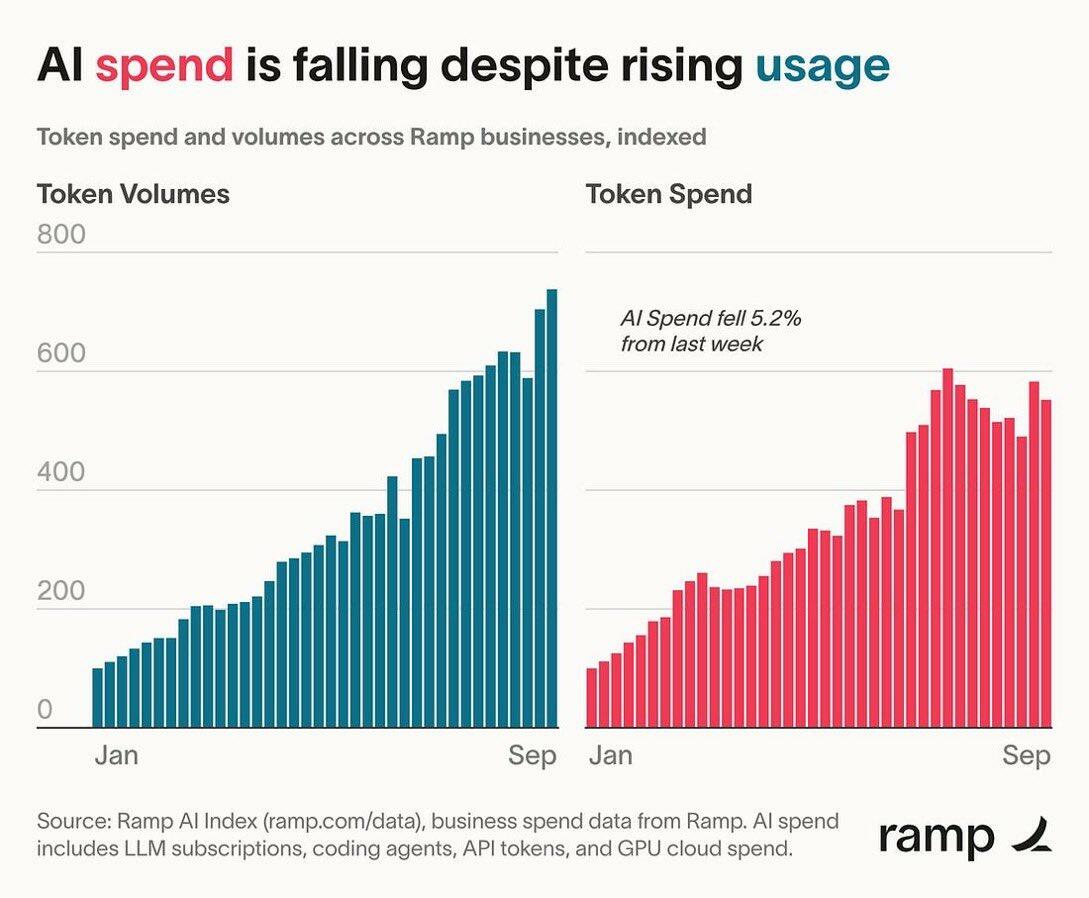
… as a result of tumbling token prices thanks to growing market share by open-source models; in fact as we showed earlier, token prices at Anthropic just hit an all time low suggesting that the price is dropping faster than the the company can convert higher volumes into revenue.
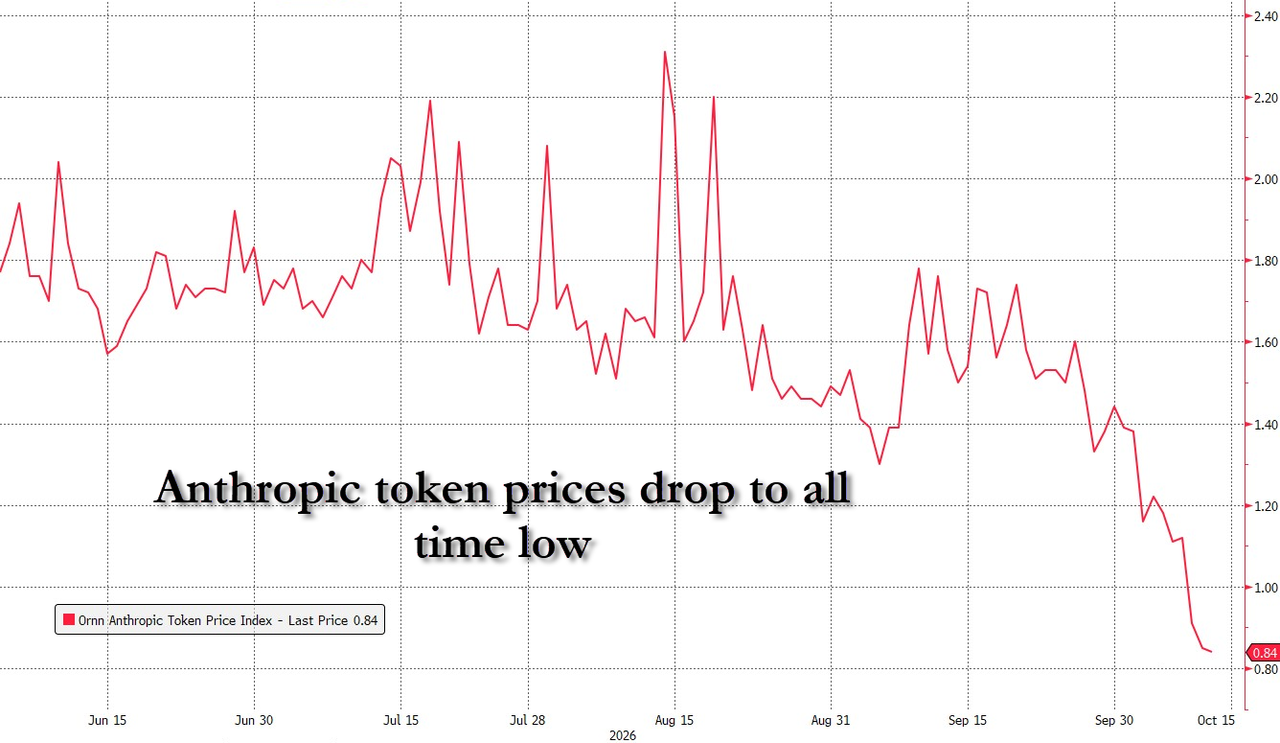
Put it all on one chart and the problem is plain to see: the line that went near-vertical through July on the initial burst of agentic euphoria and Tokenmaxxing has flattened, and the $100 billion IPO bogey sits about $10 billion above where the Aug-Sep pace gets you by December.
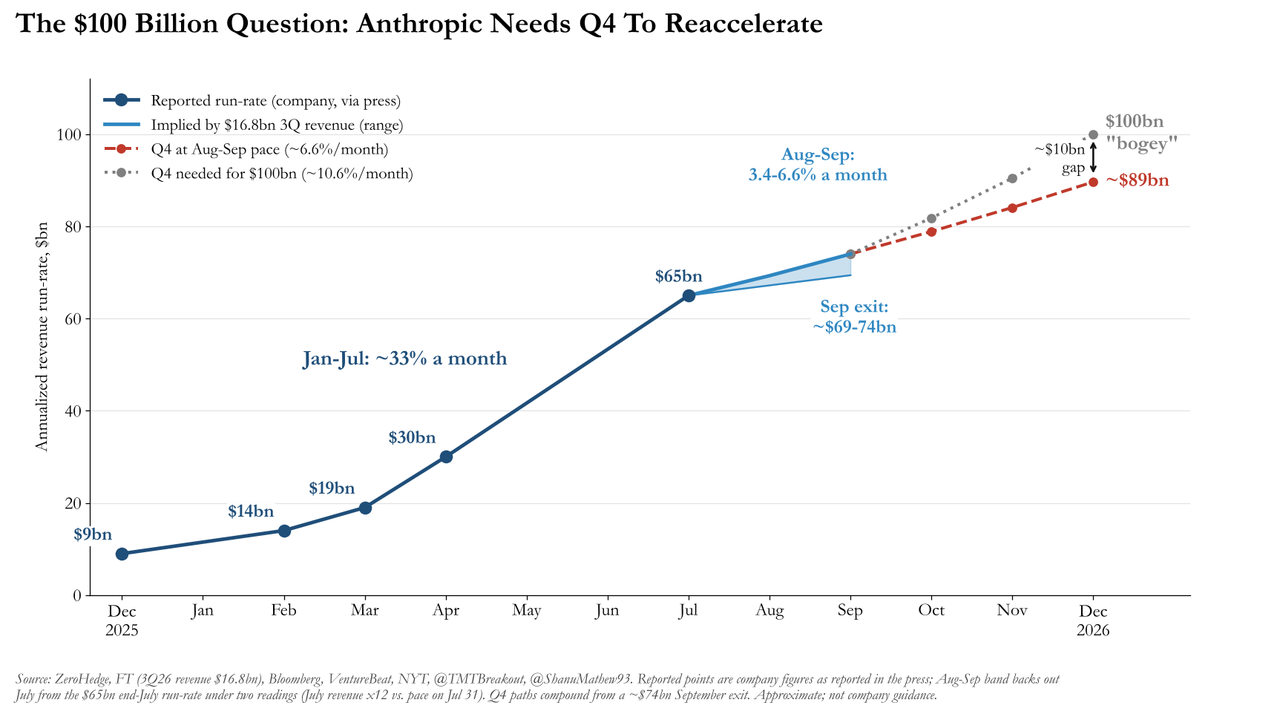
Here is the same deceleration in quarterly terms:
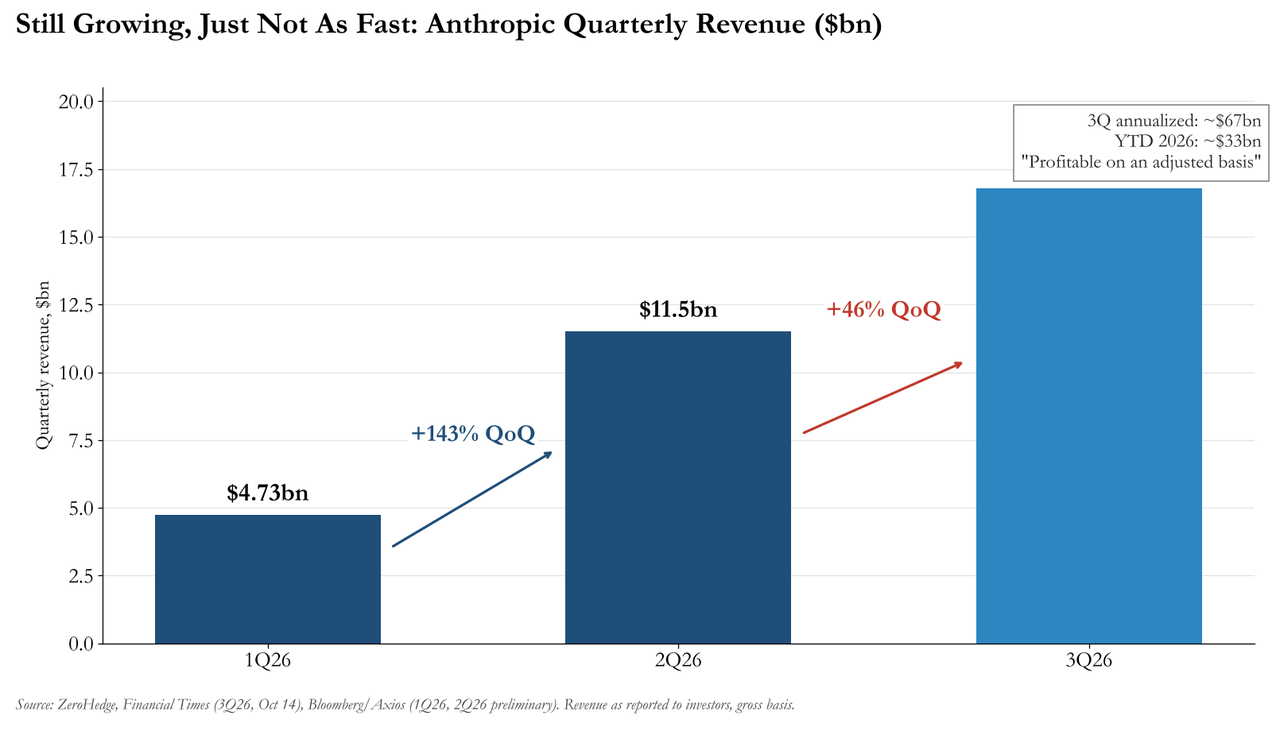
And here it is in monthly terms, which is where it really jumps out. Going from $9 billion at the end of 2025 to $65 billion at the end of July works out to roughly 33% compounded growth per month. Over August and September, the implied pace fell to 3.4%-6.6%. To reach the “more than $100 billion” year-end figure the NYT reported last month, Anthropic now needs ~10.6%-12.6% a month in Q4, depending on whether it exited at $74 billion or $70 billion:
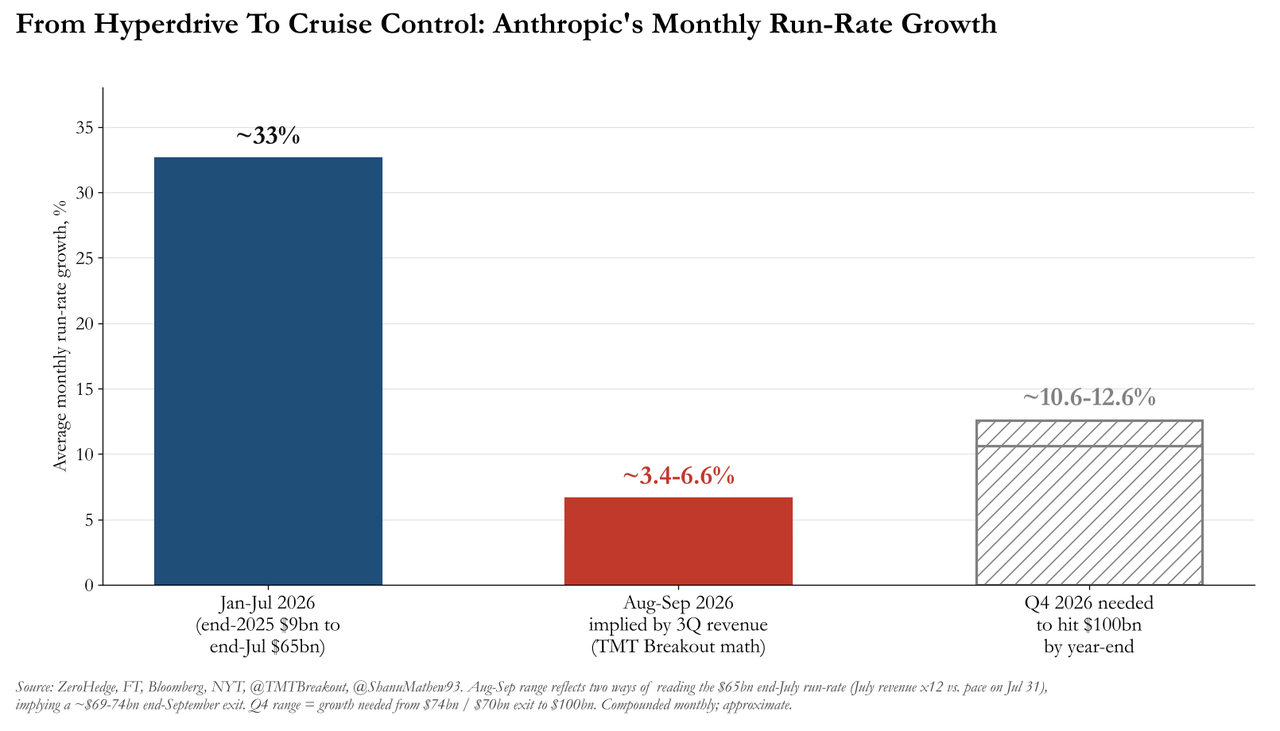
To be clear, 46% sequential growth on a $46 billion base (Q2 annualized) is extraordinary by the standards of any company that has ever existed. The issue is the bar, which Anthropic itself set: going into the meeting, much of the Street had the NYT’s “more than $100 billion” year-end figure penciled in. On the trend that the third quarter implies, they get closer to $89 billion.
Here, one can argue here that the only way the previous growth rate can be recovered, is if Anthropic’s token prices rebound strongly to pre-September levels. But for that to happen, the US government would need to “regulate” away Chinese open-source competition.
And now you know why both Anthropic and OpenAi are “passively” scaremongering each and every day in hopes of getting the Trump admin to block competition (because only China could be so irresponsible as to unleash an agent swarm hell bent on crushing everything in its path). Actually, make that “active“: as we reported earlier, OpenAI CFO Sarah Friar is done beating around the bush, and is now on a crusade to eliminate cheaper competitors, warning businesses on Wednesday that adopting low-cost Chinese artificial intelligence models carries material cybersecurity risks, and telling Bloomberg that firms should prioritize Western models “on the cyber front.”
Western models like… OpenAI course.
“Adjusted” Profitable
Then there is the profit claim, which will get most of the headlines and deserves the most asterisks. The FT doesn’t say what was “adjusted,” and the full S-1 with GAAP numbers isn’t due publicly until around Oct 25. What we do know comes from the confidential prospectus reported by Reuters: a $42 billion net loss in 2025 (about $34 billion of it an accounting charge tied to financing), an operating loss of more than $8 billion, and at least $518 billion of compute and infrastructure commitments over the next decade, about 80% of them non-cancelable.
Also recall also the gross-vs-net debate that blew up OpenAI’s numbers last week. As Goldman’s TMT desk explained, “Anthropic reports closer to gross revenue (full customer spend through cloud partners, partner cut booked as a cost).” That flatters the top line relative to OpenAI’s net reporting, and it makes any “adjusted” margin a function of what gets booked where. One quarter of positive adjusted profit and cash flow, ahead of a ~$2 trillion IPO and with the biggest compute bills still ahead (the Microsoft commitment doesn’t even start until November), is a data point (and one that does not take into account subscriber churn, which is certainly a key issue among frontier labs where a new and improved model is released between the 4-5 leaders every other week like hot potatoes). It is certainly a long way from a track record.
Pricing is the other moving part. Echoing what we said above, this morning we showed the Ornn Anthropic Token Price Index at a record low, and pointed out what that has meant historically:
If the Aug-Sep slowdown happened while prices were still relatively firm, a Q4 reacceleration has to come from a lot more volume at half the price. That is possible (Jevons and all), but it’s a different business model than the one that delivered 33% a month.
Enough To Save The AI Trade?
That depends on which yardstick you use. Brad Gerstner’s framework, which Goldman’s desk resurfaced last week, has the top three labs needing to go from a combined ~$100 billion run rate in July to $180-200 billion by year-end “to keep the AI trade intact.” One West Coast PM in yesterday’s Bear Traps chat set the bar even higher: “you need to see OAI + ANTH combined ARR going to $200 – $300bn by mid 2027 for AI trade to work,” adding that “Anthropic ARR number tomorrow better be huge—Everyone bracing for a bad number after the OpenAI debacle last week.”
Well, today’s number was good, but not huge. Take Anthropic at ~$74 billion and OpenAI at its own ~$50 billion end-September figure and you get roughly $124 billion combined, and that is mixing a gross number with a net one, which numerous hyperscalers will also want a piece of. On the Q3 trend (~$89 billion) plus OpenAI hitting its ≥$70 billion year-end target, the two labs end the year near $160 billion, short of Gerstner’s bar even before you add SpaceX/xAI’s contribution.
On valuation, the picture improves. At $2 trillion, Anthropic trades at about 27x its implied September exit rate and about 22x the ~$89 billion trend number for December, versus the ~47x trailing revenue multiple Breakingviews calculated two weeks ago. That is the bull pitch in one line, and it’s the one investors heard today. The question is whether that flatline in growth shown above persists, or even reverses. That would be bad, and would explain why Anthropic is rushing to go public now.
Bottom Line
This morning we asked whether Anthropic is going public from a position of strength or need. Tonight’s answer is both: a $16.8 billion quarter, adjusted profits and positive cash flow are strength by any normal standard, and good enough to keep the November IPO on track. But the growth rate implied by that quarter fell from about a third per month to mid-single digits, and the $100 billion year-end number the market has been underwriting now requires Q4 growth to roughly double from the Aug-Sep pace, during a quarter when token prices are falling and Meta, Google and the Chinese open-weight labs are all crowding the frontier with their own deeply discounted offerings.
Which is why we think the November window will be set less by today’s revenue print than by the credit market that is supposed to fund the next $518 billion. On a day when Oracle CDS blew out 31bps and CoreWeave’s bonds traded at deeply distressed yields, a strong quarter from the most important tenant in the AI ecosystem is necessary. It may not be sufficient. Futures will tell us tomorrow whether one number can reattach the AI trade’s right tail; the public S-1, due around Oct 25, will tell us what “adjusted” means.
Much more in today’s Goldman “US Equities Color” and “CAS Mark to Market” notes and Matthew Kaplan’s “A few observations from today,” all available to pro subs.
END
OPEN AI
The OpenAI “Tell”: BofA Says The AI Bubble Will Burst With Stocks AND Yields Tumbling… Here Is The Cheapest Hedge
BofA’s derivatives team views the Oct. 8, 2026 OpenAI revenue scare as a clean preview of an AI-bubble unwind: stocks (especially Nasdaq/semis) fall and yields fall together—not the “stocks down, yields up” regime of recent months.
archive.is Background
- On Oct. 8, the FT reported OpenAI told investors its annualized revenue was nearing ~$50 billion at end-September—roughly $20 billion below figures that had circulated (around $68–70 billion). The discrepancy largely reflected accounting differences (net vs. gross/partner revenue), not a sudden demand collapse. Nasdaq still sold off hard (~1.4%, with SOX –3.4% and memory names worse). zerohedge.com
- The dip was quickly bought, but AI-related stress reappeared with CoreWeave’s sharp decline and related “neocloud” weakness, again pressuring Nasdaq while yields ultimately failed to sustain higher levels despite hot CPI data.
BofA (Benjamin Bowler, Nitin Saksena, Arjun Goyal et al.) calls the OpenAI session the “tell.” Nasdaq underperformed the S&P in line with prior AI-specific risk-off days (e.g., DeepSeek in early 2025). Yields fell alongside equities—mirroring DeepSeek and the 2000 dot-com unwind (Nasdaq collapse + 10-year yields sliding from ~6.5% toward the mid-4s). The logic: an AI slowdown would hit both growth and inflation (lower capex, power/resource demand), reinforcing a flight-to-safety bid in bonds.
archive.is
The “Cheapest” Hedge BofA HighlightsStandard puts suffer from timing risk (market can keep rising and leave strikes behind). BofA’s preferred structure is a max lookback put on the Nasdaq-100 (NDX) made contingent on lower rates:
- Buy NDX Sep 2027 90% max lookback put (daily observations), contingent on 10y SOFR < at-the-money forward minus 25 bps.
- Indicative cost ~3.62% (a ~46% discount to a plain max lookback put and cheaper than a vanilla put).
- Reference levels in the note: NDX around 30,904 and 10y ~4.919%.
Why it is pitched as cheap/efficient: The rates contingency more than pays for the lookback feature (strike ratchets higher with any further rally). You keep protection in the “stocks and yields down” scenario that BofA sees as the most relevant AI-unwind path, while giving up the payout mainly in a 2022-style “equities down + yields up” inflation/Fed shock. Historical back-tests of similar structures showed a higher hit rate and larger average payout than vanilla or plain lookback puts, with the biggest edge in the dot-com bust.
archive.is
More aggressive variants include selling an 80% put against it (extra discount, turns it into something like an expanding put spread) or even selling a same-strike vanilla put for a net credit (at which point it becomes more of a directional view than pure insurance).Context on Froth and VolatilityBofA’s Bubble Risk Indicator shows concentrated rather than broad excess: only ~13 S&P 500 stocks above the 0.8 threshold (just 2.4% of index weight) versus 50–100 names and 20–40% of market cap at peak dot-com. Realized equity vol has been artificially low partly because of elevated dealer gamma (including 0DTE flows), which can reverse quickly once key levels break.
archive.is
Caveats: This is a specific structured-options idea from one bank’s derivatives desk, based on their reading of recent price action and history. It carries premium risk, basis/contingency risk, and will underperform if the next equity drop is driven by higher yields/inflation instead of an AI-specific growth scare. Markets can remain irrational longer than expected, and past patterns (including 2000) are not guarantees. Always consider liquidity, counterparty, and personal risk tolerance; this is not investment advice.The full ZeroHedge write-up (premium) and the underlying BofA “Global Equity Volatility Insights” note contain the charts, exact pricing references, and additional color.
END
THE REAL CPI
THE ‘CP-LIE’ ONION

by The Macro Butler
Wednesday, Oct 14, 2026 – 19:29
What’s behind the numbers?
The ninth CPI print of the year didn’t shuffle in — it kicked the door down. Headline rose +0.65% MoM, its hottest reading since March, and annual inflation crept up to 3.7% YoY. So much for the summer’s “peace-driven disinflation,” which lasted about as long as most peace-driven things. Energy, last seen posing as the well-behaved houseguest, has raided the fridge. It contributed 0.39 points of the 0.65 monthly rise, so a layer weighing barely 7% of the basket delivered roughly 60% of the damage. Energy is now up 20.4% YoY, while food (~2%) and core (~2.5%) look on like bystanders who haven’t yet realised they’re next. They are next.
Welcome to Act Two of Inflation Wave Two. The commentators who pronounced the concert over in July are quietly checking their programmes. The fertiliser shortage and the diesel shock have only just started to work through the supply chain, and food will follow fuel as surely as the invoice follows dinner. “Temporary,” the most durable adjective in the English language, may at last be heading for retirement. Not because inflation has gone, but because nobody can say it with a straight face anymore.
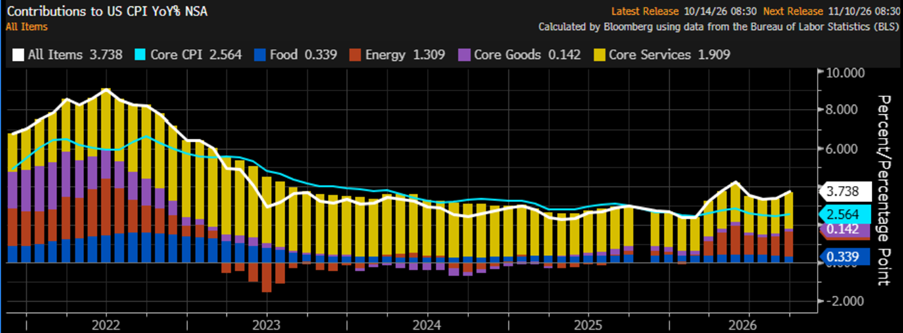
Peel back the energy layer and the core is no longer cooling. Core CPI rose +0.34% MoM, its hottest since April and the third acceleration in a row (0.22 → 0.29 → 0.34). That works out to roughly 4% annualised, about double the Fed’s target. Services did the heavy lifting with 0.28 points, but the tell is core goods. Their 0.06 contribution is the biggest in over a year, which is exactly what you’d expect when freight, fertiliser and fuel costs start showing up in shop prices.
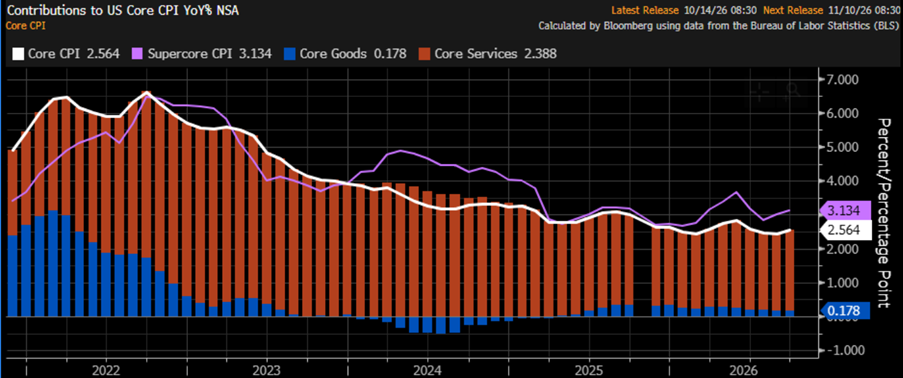
Then there’s the slow giant. Owners’ equivalent rent, the imputed rent homeowners supposedly pay themselves and about a quarter of the CPI basket, rose 3.3% YoY in September. It’s well off the 8.1% peak of April 2023, but the long glide down has stopped. OER has sat flat at around 3–3.3% for more than a year, stubbornly above its 3.1% average since 1996, and September’s bar ticked up again. The “shelter disinflation” that was meant to bring core back to 2% has turned out to be a plateau, not a slope. Rate hikes can’t help here. They freeze construction, keep owners locked into cheap mortgages and shrink the supply of homes, which keeps rents firm. With energy rising, core goods waking up and shelter refusing to fall, the Fed’s disinflation story has run out of chapters.
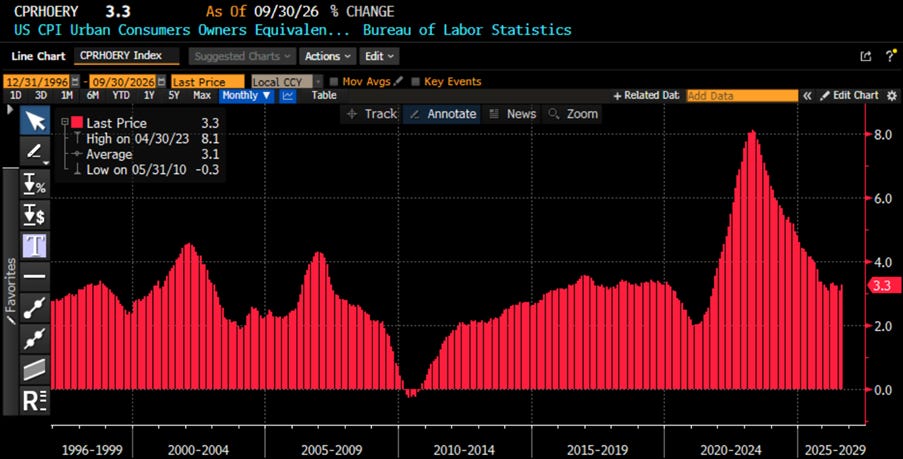
Strip out food, energy, goods and shelter and you reach supercore, the Fed’s favourite gauge of wage-driven services inflation. It rose to 3.13% YoY in September, its second consecutive monthly increase and back above its 2.91% average since 1996. It’s also well above the 2–2.5% range of the pre-pandemic decade the Fed still treats as normal. Far from the 6.48% peak of September 2022, yes, but supercore hasn’t converged on 2% so much as settled in at 3%. The spring spike to nearly 4% faded in summer, and that dip was hailed as victory. The bars are now climbing again. When even the layer furthest from the oil well won’t cool, the supply shock is no longer knocking at the door. It’s already in the living room.
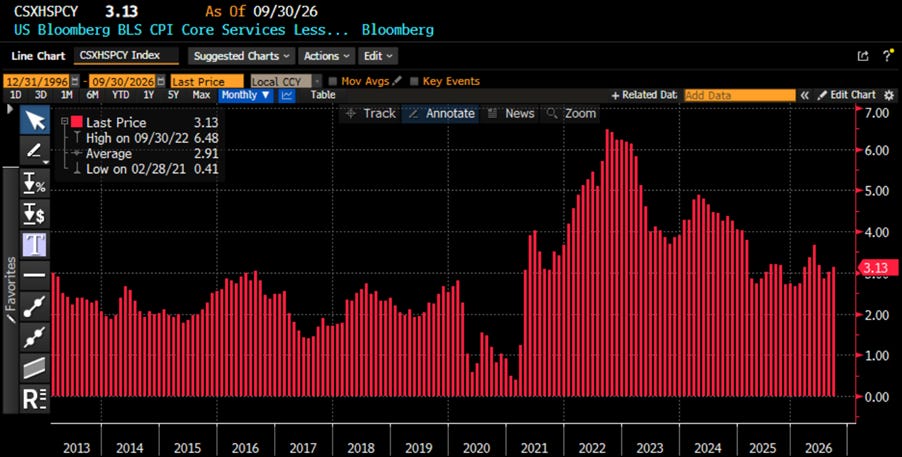
Thoughts.
For those who still hope it’s all just noise, there’s the underlying inflation gauge, the measure built specifically to ignore the noise. It has just hit 4.0%, roughly double the Fed’s target and well above its 2.74% average since 1996. The spring scare (about 4.2%) was dismissed as a blip. The summer dip (about 3.7%) was celebrated as a trend. September’s rebound is presumably a rounding error that turned up with luggage. Before 2020 this gauge spent a decade lounging between 1% and 3% like a pensioner on a deckchair. Since 2023 it has refused to go below 3%, which makes it less a guest overstaying its welcome and more a tenant who has changed the locks. Yes, it’s a long way from the 7.9% peak of March 2022. So is the Moon, but nobody calls that “back on Earth.” The trend is your friend, they say. This one has moved in, eaten your food, and is now asking about the Wi-Fi password.
US Umbrella inflation Index (Average of CPI; Core CPI; PPI; Core PPI; Core PCE, 1-year consumer inflation expectations)
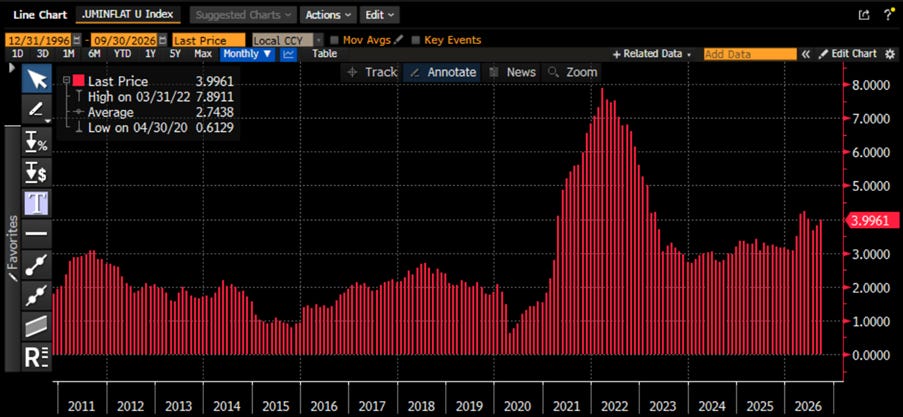
Now for the arithmetic, which unlike the Fed doesn’t do forward guidance. Headline CPI ended September at 3.74% YoY. To see where it goes, any primary school student with a pocket calculator can ran the maths for October to December. If prices don’t rise at all for three months, YoY inflation still finishes the year at 3.98%, because last autumn’s soft readings drop out of the comparison. At a modest +0.2% a month it reaches 4.60%. At +0.3%, the pace core has just managed without trying, it hits 4.92%. Repeat September’s energy party at +0.4% to +0.5% and it ends the year at 5.23% to 5.54%. The Fed funds rate, freshly nudged up to 4.00%, needs zero monthly inflation for the rest of the year just to stay level with it. That’s a policy of hoping the prices take a holiday, in a year when energy cancelled all leave. In real terms the Fed isn’t tightening. It’s standing still while inflation runs past it.
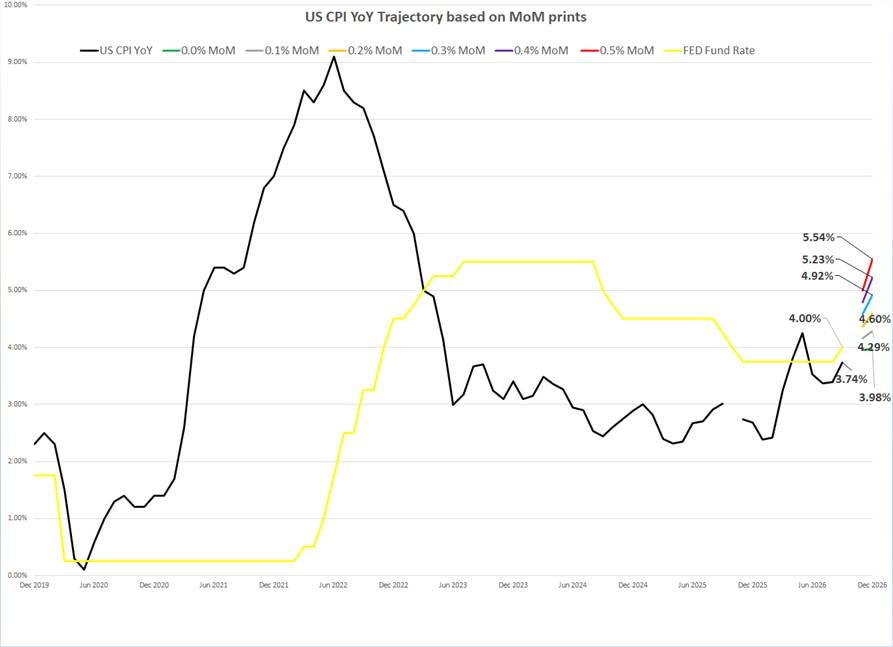
Every month, a statistical agency distils the chaos of 330 million wallets into a single, tidy figure, and every month the financial media treats that figure as a verdict on reality. Inflation is 3%. Inflation is 4%. Inflation is “coming down.” Anyone has yet to meet a single household that actually pays the Consumer Price Index. Families pay rent, groceries, fuel, insurance premiums and phone bills. The CPI is the weighted average of those, and like all averages it has the unfortunate habit of describing no one in particular.
A man with one foot in boiling water and the other in ice is, on average, comfortable. That is the CPI in a sentence — or, as regular readers know it, the CPLie. It is not a lie because the arithmetic is wrong. It is a lie because it pretends inflation is one force, moving at one speed, with one cause and one cure. In reality inflation is a stack of distinct layers, each with its own drivers, its own time lags, and its own immunity to monetary policy.
Six layers make up roughly three-quarters of the typical consumer basket: Energy, Food, Housing, Healthcare, Transportation and Communication. Peel them apart and the picture changes completely. The layers that matter most to survival are the ones least responsive to interest rates, and the ones most exposed to the thing the world currently has in abundance: war.
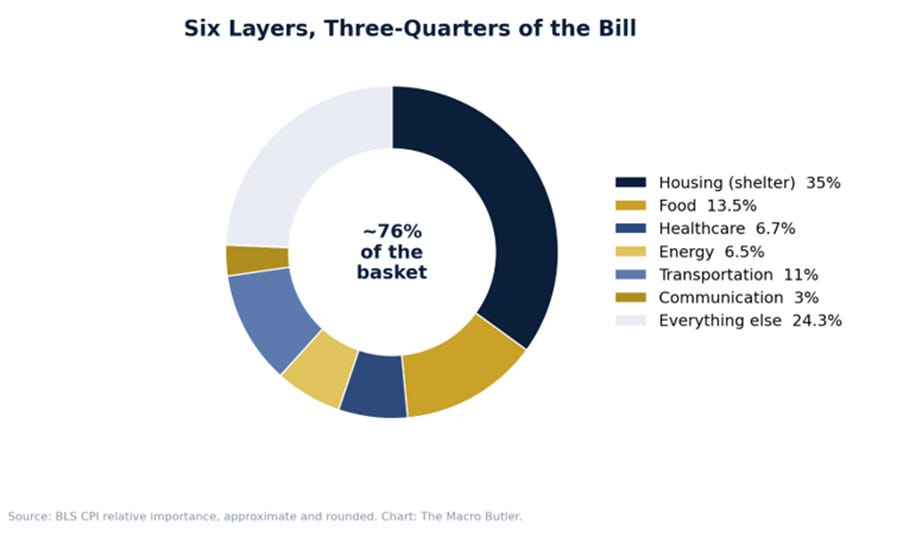
The retiree in Florida, the commuter in Ohio and the renter in New York each live inside a different inflation rate. The retiree’s basket is heavy in healthcare and insurance. The commuter’s is heavy in fuel and vehicle costs. The renter’s is dominated by shelter. The headline number is a compromise between three people, and like most compromises it satisfies none of them.
The 2022–23 inflation wave is the best recent laboratory. At the peak, headline CPI printed 9.1%. Energy, meanwhile, was up more than 40% year-on-year, food above 11%, transportation services near 15%, while communication barely moved. Same economy, same central bank, same currency — seven different inflation rates.
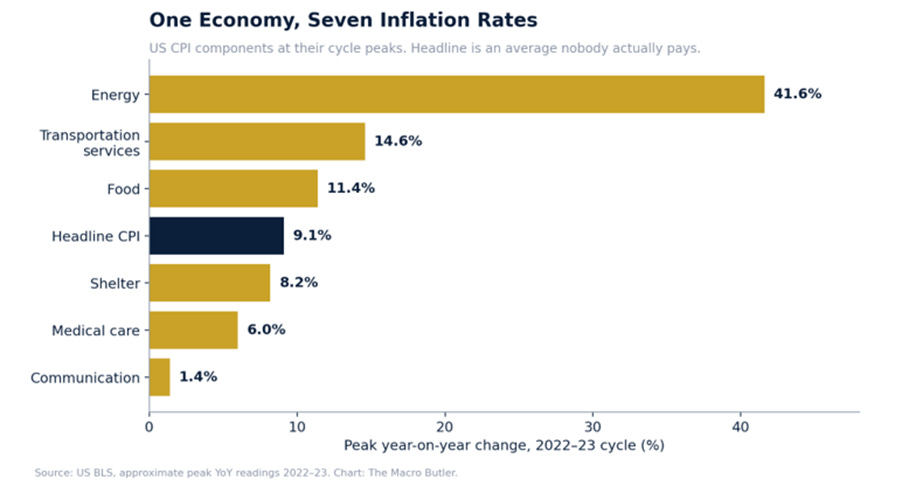
Layer 1 — Energy: The Mother of All Prices
Energy is the smallest-looking layer and the most powerful. Its direct weight in the basket is modest, but it is an input into every…
Read more and discover how to trade it here: https://themacrobutler.substack.com/p/the-cp-lie-onion
Visit The Macro Butler Website here: https://themacrobutler.com/
Join The Macro Butler on Telegram here : https://t.me/TheMacroButlerSubstack
If you want to be ready for what is coming visit The Macro Butler Website :
Join The Macro Butler on Telegram here : https://t.me/TheMacroButlerSubstack
Learn the principles behind:
📈 Investing & Portfolio Building
🌍 Economics & Market Cycles
💡 Smarter Financial Decision-Making
Whether you’re starting your investment journey or looking to sharpen your financial knowledge, The Macro Butler gives you the framework to think differently about money.
👉 Start Learning Now
You can contact The Macro Butler at info@themacrobutler.com
END
NEOCLOUDS!!/AI
“Over 80% Of Neoclouds Will Fold”: Gartner Predicts A Bloodbath As CoreWeave Credit Prices In Default
Gartner predicts that over 80% of “neocloud” providers (specialized AI-focused cloud infrastructure companies such as CoreWeave, Nebius, and similar GPU-as-a-service players) will cease independent operations by 2030, due to a massive mismatch between planned AI infrastructure spending and expected revenues. This forecast, combined with signs of distress in CoreWeave’s credit markets, triggered a sharp sell-off in related stocks on October 14, 2026.
heise.de
Key Elements of Gartner’s ForecastGartner analyst Will Sommer outlined the math in the report “Prepare for AI Market Consolidation: Capital Write-Downs Could Exceed $4 Trillion by 2032”:
- AI providers are expected to spend nearly $1 trillion on infrastructure in 2026 alone, plus another $6 trillion from 2027–2030 (total ~$7 trillion through 2030).
- To cover that capex, financing costs, and a 12% return on invested capital (a common hurdle rate), operators would need cumulative revenues of about $8.5 trillion by 2030.
- Forecast AI-related revenues attributable to data centers are only ~$3.6 trillion over the same period.
- Most AI-native providers run asset-light models, so less than half of that revenue is expected to flow to companies that actually own significant infrastructure. seekingalpha.com
The result: large write-downs (impairments) are likely. Gartner sees ~$3.5 trillion in asset value at risk of write-down by the end of 2030, rising toward $4 trillion by 2032. The 12% ROIC is not expected until late 2032 at the earliest under the continued high-spending trajectory.
heise.de
Neoclouds—purpose-built for AI/GPU workloads and often more specialized (and less diversified) than hyperscalers like Amazon, Microsoft, or Google—are viewed as especially vulnerable because of high cost pressure and relatively one-sided business models. “Cease independent operations” does not necessarily mean outright bankruptcy for all; it can include acquisitions, mergers, partnerships, or asset sales. Hyperscalers are better positioned due to their scale and diversified cash flows.
techtarget.com
Note that earlier in 2026 Gartner had been more bullish on neoclouds capturing meaningful AI cloud market share (e.g., 20% of a projected $267 billion market by 2030), highlighting how the latest analysis focuses more heavily on the economics of the buildout.
gartner.com
CoreWeave Credit Stress and Market ReactionCoreWeave (CRWV), a leading neocloud, saw its stock drop roughly 15–17% on October 14 (closing near $65.78), with peers such as Nebius (NBIS), IREN, DigitalOcean, Hut 8, Applied Digital, and Cipher also falling hard (often 8–14%). Volume was extremely elevated.
marketwatch.com
Credit markets had already been flashing warnings:
- CoreWeave’s 2032 unsecured bonds traded into distressed territory (below ~80 cents on the dollar), with yields climbing above 15%.
- Credit default swap (CDS) spreads widened sharply, with some reports indicating elevated multi-year default probabilities (market-implied figures in the 50%+ range over five years in recent stress periods).
- Comments from investors such as Chamath Palihapitiya (highlighting the bond yields) and a reaction from Elon Musk (“Yikes”) amplified attention. en.oninvest.com
CoreWeave has stated confidence in its backlog supporting debt obligations and in its funding position. The company has grown rapidly via GPU leasing contracts (often with major customers) but carries a heavy debt load typical of capital-intensive infrastructure buildouts.Broader ContextThis fits a pattern of scrutiny on whether the AI infrastructure boom can generate sufficient returns before hardware depreciates (newer GPU generations arrive quickly). Write-downs, consolidation, and higher borrowing costs for pure-play neoclouds are the key risks Gartner is flagging. Hyperscalers and better-capitalized or contracted players are seen as more resilient. Markets on October 14 appeared to be pricing in both the Gartner outlook and the credit-market signals simultaneously.
END
AI Unwinds: Hedge Funds Just Dumped AI Stocks At The 2nd Fastest Pace In A Year As Net Leverage Tumbles
AI Unwinds: Hedge Funds Just Dumped AI Stocks At The 2nd Fastest Pace In A Year As Net Leverage Tumbles appears to reference a recent market analysis (likely from Zero Hedge or similar financial commentary) on hedge-fund positioning in AI-related equities.I am looking up the latest details on the reported selling, net leverage changes, and broader context.Hedge funds rapidly sold AI-linked stocks at the second-fastest pace in a year, while net leverage fell sharply, according to Goldman Sachs prime brokerage data analyzed in a recent note by Vincent Lin (Prime Insights & Analytics).
zerohedge.com
This comes from Goldman’s “Prime Perspective: AI Unwinds” note, covered in a Zero Hedge article published October 15, 2026 (and summarized elsewhere). The selling followed a CPI-fueled market rout—the first session with the S&P 500 down ~1% and Nasdaq-100 down ~2% since late July. Zero Hedge framed it as hedge funds having spent nearly two years accumulating AI stocks, only to reverse much of that exposure in roughly five sessions.
zerohedge.com
Key details from the data
- Pace of selling: AI names saw the second-fastest net selling by hedge funds in the past year, concurrent with a drop in net leverage. cryptobriefing.com
- Broader context: This builds on earlier 2026 de-grossing. In the summer, hedge funds were net sellers of U.S. tech in six of eight weeks through mid-July; aggregate market-value exposure to the sector fell ~10% from early June—the largest such reduction in Goldman’s decade-plus of tracking. Selling hit hardware, storage/peripherals, IT services, semiconductors, and software. July marked hedge funds’ worst monthly underperformance versus the S&P 500 in over 20 years, tied to crowded AI positions. cryptobriefing.com
- Leverage and positioning: Net leverage and overall AI exposure declined from Q2 2026 peaks (and more recently hit historically low levels across strategies in some reports), though they remained above longer-term averages in earlier updates. By early/mid-October, Mag 7 exposure had rebounded to a record ~22% of hedge funds’ U.S. equity exposure (up from a mid-year low around 14%), even as broader tech and mid-tier AI positioning was trimmed—pointing to a flight toward perceived quality/mega-caps rather than a full exit from the theme. cryptobriefing.com +1
- Conviction view: Goldman has previously described earlier selling as more of a “healthy reset” of crowded trades amid volatility than a fundamental loss of belief in the AI cycle. Core conviction in select AI positions was still described as intact in recent commentary. cryptobriefing.com
The Zero Hedge piece is largely paywalled, so full charts/details from Lin’s note are restricted; available public summaries emphasize the rapid unwind in the AI complex alongside the leverage drop after the recent CPI-driven weakness. Similar positioning data from other prime brokers and reports in 2026 have shown repeated episodes of AI/tech de-risking interspersed with Mag 7 concentration and selective rebuilding.This reflects ongoing volatility in the crowded AI trade (semiconductors, infrastructure, related names), with hedge funds reducing risk overall while retaining (or rebuilding) exposure to the largest names. Markets and positioning can shift quickly—watch for whether selling accelerates further, leverage stabilizes, or rotation continues.
KING NEWS
| The King Report October 15, 2026 Issue 7848 | Independent View of the News |
| Sept CPI 0.6% m/m & 3.7% y/y, 0.6% m/m & 3.6% y/y expected; Core CPI 0.3% m/m & 2.6% y/y (with the new BLS configuration that reduces inflation) Core CPI 0.2% m/m & 2.5% y/y expected CPI Gasoline +9.1% m/m & +34.2% y/y; Energy +5.2% m/m & +20.4% y/y; Shelter +0.4% m/m. Food unchanged! Used cars & trucks index +0.7%; Prescription drugs -1.2%; Hospitals Services +0.7%. ‘Super Core’ CPI increased to 3.134% y/y from +2.96% y/y. Super Core PCE rose a tad to 3.455%.https://assets.zerohedge.com/s3fs-public/inline-images/get_attachment_url%20%2825%29_4.jpghttps://www.bls.gov/news.release/pdf/cpi.pdf@KevRGordon: The share of CPI components with a y/y growth rate between 2-4% moved up to 63.7% in September https://x.com/KevRGordon/status/2110435840694333793 Hormuz ships pummeled with worst attacks of the Iran War — as oil flows plummetShips around the Strait of Hormuz are suffering their worst attacks of the war so far, with 24 ships struck in the past two weeks — causing oil exports to plummet to less than half the pre-war flow…The strikes have caused oil flow out of the strait to drop significantly since reaching their highest level of the war last month at an average of 15.5 million barrels per day, according to maritime analyst Kpler… But during Sunday’s strikes, only 2.9 million barrels of oil transited the strait, with the average seven-day average flow falling to 43% below pre-war levels, according to Kpler…https://nypost.com/2026/10/13/world-news/hormuz-ships-pummeled-with-worst-attacks-of-the-iran-war-as-oil-flows-plummet/The odds of a rate hike in October rose to 51.5%. The 2-year yield hit 4.948% (8:55 ET) from 4.762%.FT: BofA profits drop 17% after $1.2bn money laundering fine@macropaperr: 5 OF THE LARGEST TEN BANKS IN THE US HAVE NOW ENTERED A BEAR MARKET TERRITORY. Bank of America: -23.5%; Wells Fargo: -20.1%; Goldman Sachs: -24%; Morgan Stanley: -24%; Capital One: -25%The KBW Nasdaq Bank Index has dropped 15.6% from its peak and has hit a 5-month low. Historically, bank stocks peak before the recession, and if this decline continues, it’ll be a sign that there’s a lot of trouble ahead for the US economy. https://x.com/macropaperr/status/2110392315789639775CoreWeave shares tumble as bond yields near 15% on concern about AI borrowing bingehttps://www.msn.com/en-us/money/markets/coreweave-shares-tumble-as-bond-yields-near-15-on-concern-about-ai-borrowing-binge/ar-AA2efaJFWSJ: Fed’s Bowman (DJT ally) Says Inflation Above Goal, But No Urgency to Act – Bowman also identified key problems with some of the regulations enacted after the financial crisis in 2008.Speaking at the IIF Annual Membership Summit in Bangkok, Bowman briefly touched on her macroeconomic outlook before delving into her approach to financial regulation…Bond and notes yields sank after Fed Gov Bowman’s dovish comment. The 2-year fell to 4.863%.The S&P 500 Index gapped 31.27 points lower (7774.18) and fell to 7772.27 seconds later. Conditioned traders bought the dip. The S&P 500 rallied to 7789.15 at 9:49 ET. It was ‘dumb money’ buying. The S&P 500 intractably fell to 7716.30 at 12:32 ET.A belated Noon Ballon boosted the S&P 500 Index to 7731.53 at 13:01 ET. The index then fell to a new daily low of 7700.57 at 13:52 ET. The technical & psychological support at 7700 halted the decline, for about 5 minutes. The S&P 500 Index hit a new daily of 6793.31 at 14:01 ET. Someone aggressively bought ESZs, the S&P 500 jumped back above 7700 one minute later.The S&P did an ABC rally to 7710.46 at 14:21 ET. The index then fell to 7696.60 at 15:06 ET. A late manipulation pushed the S&P 500 Index to 7222.12 at 15:35 ET. The S&P closed at 7718.94.Chicago Fed President Goolsbee: More Bad Months of Inflation Would Be UnacceptableFed Beige Book: Three Districts characterized overall price growth as robust, while eight noted that growth was moderate—and three of the eight noted that input price pressures were intensifying, if not already growing robustly… four Districts reported that the pace of price increases picked up since the prior period. Higher oil prices permeated all District reports. Firms reported elevated diesel prices and noted that fuel surcharges were passing on increased costs throughout the supply chain. Contacts in multiple Districts also noted continued price pressure from other commodities, tariffs, and insurance. Consumer-facing firms noted tighter profit margins as price-sensitive customers continue to resist price hikes. Contacts are managing their margins with selective price hikes, targeted incentives, and menu changes that reduce their costs. Firms in several Districts cited persistent uncertainty around energy and tariffs and expect that prices will increase further in the coming months, as existing contracts expire, and firms must renegotiate hedge contracts for their own inputs and/or delivery contracts to their customers… https://www.federalreserve.gov/monetarypolicy/files/BeigeBook_20261014.pdfMajor banks closed accounts of MAGA, pro-life and other conservative groups disfavored by Biden admin: bombshell report https://trib.al/Ttt6eY9@nic_carter: bombshell report from the OCC out today confirming what we all suspected: between 2020 and 2025, based on a review of 100,000 complaints, America’s largest banks systematically denied banking to lawful businesses based on political and reputational considerations rather than objective financial risk, effectively appointing themselves arbiters of which industries deserved access to the financial system. digital assets was specifically named as one of the six most affected industries…https://occ.gov/topics/charters-and-licensing/fair-banking/index-guaranteeing-fair-banking.htmlPositive aspects of previous session SP Health Care +2.44%, Consumer Staples +2.38%, Energy +0.8%; Apple +0.5%USZs +10/32; Bonds & note yields fell on Fed Gov Bowman’s dovish remarkDiesel turned negative after being +5.3¢, other energy commodities rescinded most of their gains.Negative aspects of previous session S&P 500 -1.11%, DJIA -0.09%, Nasdaq -1.88%, Nas 100 -2.02%; SOX -4.3%SP Info Tech -2.62%, Comm Services -1.73%, Consumer Discretionary -1.1%, Industrials -0.96%, Real Estate -0.82%, Financials -0.61%, Materials -0.44%, Utes -0.31%MU-4.08%, NVDA -3.16%, AMD -5.73%, Meta -3.27%, TSLA -2.15%, SNDK -5.33%, INTC -4.56%, MSFT -1.8% CRWD -4.56%, GOOGL -1.74%, AMN -1.74%, SPCX -2.8%, CoreWeave (CRWV) -16.1%Nov WTI +$0.94, Dec Brent +$0.41, Nov Gasoline +0.02¢The 2-yr yield hit 4.948%, and has broken out to the upside (Chart at link) https://x.com/MichaelMOTTCM/status/2110362027768312059/photo/1Ambiguous aspects of previous session Did defensive asset allocation, buy bonds/sell stocks, occur on Wednesday? First Hour/Last Hour NYSE Action [S&P 500 Index]: 1st Hour: Down; Last Hour: Up Pivot Point for S&P 500 Index [above/below indicates daily trend to day traders]: 7733.80 Previous session (S&P 500 Index) High/Low: 7789.15 (9:49 ET); 7693.31 (14:01 ET) CBS: U.S. may have withheld warnings to Ukraine of Russian strikes that killed 6, cut power to 600,000, sources say https://www.cbsnews.com/news/us-ukraine-intelligence-russia-war-missile-strikes-kyiv-power-outages/ WSJ’s Yaroslav Trofimov @yarotrof: Multiple reports from Ukrainian units that SpaceX has restricted Starlink use on drones, without any warning or explanation, thus disabling a critical element of Ukrainian defenses. Even though Zelensky stopped hitting Russian refineries and is *unilaterally* abiding by the energy ceasefire while Russia bombs Kyiv power stations, Ukraine’s military communications have been throttled by Musk/Trump, as per Zelensky’s drone advisor.Ukraine Starlink Access Restricted as Musk Says Zelensky ‘Has Gone Too Far’Ukraine’s access to Elon Musk’s Starlink internet service was restricted without advance warning overnight, disrupting battlefield operations against Russian troops, Ukrainian officials said on Wednesday. SpaceX, the company that operates Starlink, put a “speed limit” on Starlink terminals in Ukraine, Serhii Beskrestnov, an adviser to Ukraine’s presidential office, said in a post to the Telegram…https://www.newsweek.com/ukraine-starlink-access-restricted-as-musk-says-zelensky-has-gone-too-far-12565652Zelensky says Trump betrayed Ukraine with Russian diesel deal: ‘It’s painful’ https://trib.al/Hx1kLpfFT: Giorgia Meloni criticises Trump’s diesel deal with Putin – Italian prime minister warns US plan would grant Russia ‘legitimacy’ in its escalating campaign against Ukrainehttps://www.ft.com/content/178041cc-c9e7-4bd9-8c6e-7967931dcb33?syn-25a6b1a6=1Due to a severe backlash at Trump & Musk for cutting off Starlink and US intel for Ukraine, Starlink was restored to full service in Ukraine near 14:00 ET.Elon Musk: Starshield systems are owned and controlled by the US government. Any limits on speed or usage are decided by the US military and ultimately POTUS… (Post after US denied shutting it down)The Russell 2000 Index is testing the 2720 double bottom from April-May. The broad equity index is down from 3073 in August (-11.5%). https://x.com/Scutty/status/2110474278110150891/photo/1Character.AI files for bankruptcy, to sell some assets to Disney for $20 millionThe bankruptcy caps a sharp fall for Character.AI, a high-profile AI startup whose technology has attracted interest from Alphabet’s (GOOGL.O), opens new tab Google, Meta (META.O), opens new tab and Elon Musk’s xAI. The company has been burning through over $8 million a month, and could shut down in bankruptcy if no buyer emerges to carry on its operations…https://www.reuters.com/legal/litigation/characterai-files-bankruptcy-agrees-sell-some-assets-disney-20-million-2026-10-13/FT: Anthropic tells investors quarterly revenue up 50% to $16.8bn ahead of IPO – AI start-up gathered investors for presentations in San Francisco on Wednesday ahead of its expected public listinghttps://www.ft.com/content/11632d03-358c-454b-af95-d06d4072932b?syn-25a6b1a6=1Anthropic Says Q3 Revenue Jumped 7o $16.8 Billion and Turned “Adjusted” Profitable… But Run-Rate Math Shows Growth Hitting the Brakeshttps://www.zerohedge.com/markets/anthropic-says-q3-revenue-jumped-168-billion-and-turned-adjusted-profitable-run-rate-mathToday – It appears that there were two rotations on Wednesday: defensive (buy bonds/sell stocks) and sell AI and Fangs/buy ‘safe’ consumer (inelastic demand) stocks, notably Apple. The S&P 500 Index hit its daily high on Monday at 9:38 ET; on Tuesday, it hit its daily high at 9:39 ET; on Wednesday its high appeared at 9:49 ET. Traders have been conditioned to buy stuff before, on, and just after the NYSE opening for years. And now ‘they’ want to be long for the Earnings Season Rally.Equity futures are down smartly as we write because the Kospi is -4.5%. If Oct PPI is inline or softer, a relief rally should appear. Expected economic data: Sept PPI 0.5% m/m & 5.3% y/y, Core PPI 0.3% m/m & 4.4% y/y; Sept Retail Sales 0.3% m/m & 5.2% y/y, ex-Autos 0.5%, ex-Autos & Gas 0.2%; Oct Phil Fed Mfg 28.4, NY Fed Empire Mfg. 10.3; Initial Jobless Claims 200k, Continuing Claims 1.71m Expected earnings: TSM 4.42, BNY 2.26, USB 1.32, JBHT 1.83, AA 1.54, WHR 1.04, ESZs -28.50; NQZs -300.25, USZs +14/32, Nov WTI -0.33, Nov Gas -0.014¢, Yen/$ 158.02 at 19:55 ET S&P 500 50-day MA: 7707; 100-day MA: 7594; 200-day MA: 7262 (Close 7718.94, -1.11%)Nasdaq 100 50-day MA: 29,858; 100-day MA: 29,619; 200-day MA: 25,676 (Close 19,950.82, -2.02%) DJIA 50-day MA: 52,540; 100-day MA: 52,192; 200-day MA: 50,403 (Close 51,621.48, -0.09%) (Green is positive slope; Red is negative slope)Trump posts AI video of him taming tiger after ex-child star mauled to death at UK zooThe president initially posted gruesome video Tuesday afternoon of the beast fatally savaging 23-year-old William Chapman at Yorkshire Wildlife Park in Doncaster, England over the weekend, accompanied by his admonition. About eight hours later, Trump posted the artificial clip, which began with himself on the ground in Chapman’s place. The altered video then showed the president — in full blue suit and red tie — pursuing the big cat before playfully wrestling with it and grabbing it in a bear hug…https://trib.al/o1HSRYOWSJ Editorial Board: Jessica Tisch, Zohran Mamdani and the Socialist LeftNew York’s mayor is under socialist pressure to fire his highly effective police commissioner.The Democratic Socialists of America, to which Mr. Mamdani belongs, is demanding that he “fire” her for not helping “drive ICE [Immigration and Customs Enforcement] out of New York City.”…(NYC does NOT have that power; you know, The Supremacy Clause of the US Constitution)@scotus_wire: The Ninth Circuit ruled that California cannot require federal immigration agents and other federal officers to display identification during enforcement operations, finding the law violates the Constitution’s Supremacy Clause. https://x.com/scotus_wire/status/2110425500241846397@AnnCoulter: [The alleged gang rape at Cornell] been covered by ABC, NBC, CBS, all the cables and national newspapers, The Telegraph (UK), The Guardian (UK), The Jerusalem Post (you’d think they have more important things on their minds), Le Monde and Le Figaro, despite the French’s usual blasé attitude toward orgies. [And endlessly by The New York Times.] I interpret this to mean that sexual assault on college campuses is BIG news. So why do the media consistently bury stories about the rash of rapes committed by college football players?…Reverse Rapism – Cornell shows not all gang rapes are alike – Ann CoulterIn the 2010s, Baylor University wanted to become a football powerhouse, so it began recruiting the thugs that other football programs avoided… A few years after this genius plan was implemented, an investigation by the law firm Pepper Hamilton found that at least 19 football players had been involved in dozens of rapes, including a minimum of four gang rapes. The university had to settle with 15 women. The head football coach, the athletic director, and the president of the university were fired or forced to resign. The following year, Baylor settled a lawsuit alleging 52 acts of rape by 31 football players between 2011 and 2014. I’m not a national newspaper, but that sounds newsworthy to me…The reason we’re getting so much venom toward fraternities in the Cornell case is that the accused assailants, sadly, are not white. To the contrary, they’re strikingly diverse. Five of the seven Chi Phi defendants admit to engaging in sex acts with Doe: one Muslim, one African-American, one Asian and two Latinos. It’s a beautiful mosaic!… https://anncoulter.substack.com/p/reverse-rapism-END- | |
SWAMP STORIES FOR YOU TONIGHT
Trump Admin Looking To Strip Ilhan Omar’s Citizenship, Then Deport Her; Passport Seized In Raid
Wednesday, Oct 14, 2026 – 08:05 PM
The Trump administration wants to strip Rep. Ilhan Omar (D-MN) of her US citizenship and then deport her, according to US officials and others familiar with the case who spoke to the Wall Street Journal.
What’s more, DHS agents who searched Omar’s Washington home early Monday secured her passport, along with her cellphone, personal computers and notebooks while Omar and her husband stood around watching, the report continues. Over a dozen subpoenas have also gone out for testimony before a Minnesota grand jury, some of them to Omar’s relatives, and the family’s immigration paperwork is one of the things prosecutors are combing through.
Investigators want to know whether Omar or her father listed her as 17 rather than 18 on her citizenship paperwork, according to the paper’s sources. The one-year difference decides how she became a citizen: a child under 18 could pick up citizenship automatically through a parent’s naturalization, while an 18-year-old would have needed to go through the process on her own. Omar became a citizen in 2000.
Her father, Nur Omar Mohamed, brought the family to the US in 1995 from a Kenyan refugee camp. He drove a cab and worked for the Postal Service, and died in June 2020 at 67 of Covid-19 complications, according to Omar. The probe is looking at his conduct as well as hers.

Homeland Security Investigations examined a similar tip under Biden and dropped it for lack of evidence of fraud, according to people familiar with that review.
Omar told the Journal earlier this year that she never committed immigration fraud. “President Trump would love to eliminate one of the most effective progressive voices in Congress. There is no basis for this,” her office said in a statement Wednesday.
Trump, meanwhile, has called for Omar’s deportation for years. On Monday evening, hours after the search, an Ohio crowd he was addressing broke into chants of “deport” after he turned to Omar and Somalis. “They cheat on everything,” Trump said, according to the paper.
The denaturalization route matters because of the calendar. As we noted on Tuesday, federal prosecutors have ten years to bring criminal charges for naturalization and passport fraud, which puts anything filed in 2000 out of reach. Civil denaturalization cases have no statute of limitations, and relatives who derived citizenship through a parent can lose it too, according to the Congressional Research Service. The Justice Department still has to sue in federal court and prove, by “clear, unequivocal, and convincing” evidence, that citizenship was obtained through a material lie.
The administration has filed more than 200 denaturalization suits this term, which officials tout as the most sweeping such effort in DOJ history. Before Trump’s return, the government filed about 12 or fewer annually, according to Transactional Records Access Clearinghouse data cited by the paper. Most of the new cases are still undecided. Omar’s, if it is filed, would be the highest-profile yet.
As we reported Monday, HSI agents executed a court-authorized warrant at the house around 6 a.m., and the Justice Department called it part of an ongoing criminal investigation without saying more. The New York Times reported that the warrant cites false statements, immigration-paperwork fraud and conspiracy, according to Newsweek, and that the grand jury has subpoenaed Omar’s sister, Sahra Noor. Vice President JD Vance said he had no advance notice of the search, and Trump said it was “really up to the DOJ.”
The age question has a paper trail. On Tuesday we flagged emails showing Omar’s congressional staff asked Minnesota’s Legislative Reference Library in May 2019 to change her listed birth year from 1981 to 1982, days after a viral video questioned her age. The library’s legislator page now gives her birth date as Oct. 4, 1982. Under the 1981 date, Omar was 18 for all of 2000; under 1982, she was 17 until that October. The emails don’t say what documentation, if any, backed the change.
Separately, Jeanine Pirro, the US attorney in Washington, said Tuesday on Fox News that her office is investigating Omar’s financial disclosures, which put her husband Tim Mynett’s two businesses at as much as $30 million for 2024 before an April amendment cut the couple’s reported assets to $18,004-$95,000. Back in April we noted Omar’s sudden discovery that she is not a multimillionaire after all. In September, the Office of Congressional Conduct recommended that the House Ethics Committee dismiss the allegations. Pirro waved that off: “It doesn’t matter what the House does,” she said.
The immigration allegations have followed Omar since her 2016 run for the Minnesota House, often tied to her marriages. Last month, DHS Secretary Markwayne Mullin said on a conservative podcast that the investigation was ongoing and claimed Omar “married her brother” to get him into the country – something Trump has frequently claimed as well.
END
JACK SMITH…
People Who Bought MAGA Hats!? Jack Smith’s Arctic Frost Hoovered Up Data On At Least 639,000 Republican Voters, Donors
Wednesday, Oct 14, 2026 – 10:35 PM
Former special counsel Jack Smith’s office and the Biden Justice Department obtained spreadsheets on “over 639,000 individuals, at minimum” – Republican donors, supporters and voters – according to a new memo from Senate Judiciary Chairman Chuck Grassley, R-Iowa, first reported by Fox News Digital on Wednesday. Grassley’s account rests on whistleblower disclosures to his committee.
Of those, more than 148,000 rows are identified in the spreadsheets as donors, who generally gave small amounts. The data includes names, dates of birth, home addresses, emails, whether the person is a registered Republican, occupation and employer, credit card information, donor analysis data and donation amounts. Grassley said samples on the list included retirees, pool technicians, drivers and loggers.
The Daily Caller reports that the trove also covers the shipping addresses of people who bought MAGA hats, and that it reaches back to 2005. The Fox account of the memo does not mention hat buyers, so that detail rests on the Daily Caller’s reading.
“This update shows that Jack Smith and the Biden Justice Department collected incredibly invasive donor data – and voter data – beyond what could conceivably be necessary” for the special counsel’s mandate, Grassley said. He added that it “corroborates that Smith and his partisan team aimed to map out the entire Republican Party apparatus,” and again called on Senate Judiciary Democrats to join his oversight work.
Smith told the committee on Sept. 29 that his team “acquired financial information.” Pressed by Grassley for a yes or no on whether his office obtained donor data, Smith answered “Yes,” according to Fox’s account, and said he could not “recite to you every subpoena we issued.” He said the subpoenas served a criminal investigation and that he had “a duty to collect facts.” Smith’s newly launched law firm did not immediately respond to Fox’s request for comment, and no response from Smith or the Justice Department to the new memo had appeared in the coverage reviewed.
The memo follows an earlier Grassley release, also drawn from whistleblower records. On the day of the hearing, the committee’s Republicans said Smith’s team acquired at least 4,782 checks from donors to President Trump and Trump-aligned Republican entities, written between September 2019 and August 2023 in all 50 states, Washington, D.C., and Puerto Rico. The checks show home addresses, bank account and routing numbers and signatures, and were routed to former FBI Special Agent Walter Giardina, the release says. Grassley said some gave as little as $1, that 42 of the checks came from Iowans, and that “the Justice Department and FBI will forever possess thousands of people’s addresses.”
At the hearing, Smith defended secretly obtaining Republican lawmakers’ phone records. He could not say whether his subpoenas sought the lawmakers’ physical locations, and could not recall key details about his demands for conservative fundraising information, the Washington Examiner reported.
The donor material fits a pattern Grassley has been releasing for a year. In October 2025 he made public 197 subpoenas sent to 34 individuals and 163 businesses, seeking records tied to at least 430 named Republican individuals and entities, including statistical data and analysis on donors and fundraising. “This was clearly a fishing expedition,” he said then. In July, Grassley said records showed Smith’s team obtained and reviewed texts involving 44 current and former lawmakers, and House Judiciary Chairman Jim Jordan said Congress was weighing a criminal referral over Smith’s testimony about those records.
Smith is now fighting on several fronts. As we reported earlier this month, Sen. Marsha Blackburn, R-Tenn., sued him over the seizure of lawmakers’ phone records, seeking $1 in damages, and Sen. Bill Hagerty, R-Tenn., filed a bar complaint recommending disbarment.
END
about time
Time’s Up! DOJ To Seek ‘Emergency Relief’ Against California Over Suspected Non-Citizen Voters
Thursday, Oct 15, 2026 – 03:20 PM
Authored by Tom Gantert via The Epoch Times,
The U.S. Department of Justice on Oct. 13 sent letters to California election officials demanding a review within 48 hours of registered voters it suspects are noncitizens and asking officials to set aside their mail ballots until their citizenship status can be determined.
If the prescribed course of action wasn’t followed by Oct. 15 at noon ET, the letter stated the federal government would seek “emergency relief.”
“This should not be controversial, as the criminal statute is clear: Only American citizens may vote in federal elections. It is a federal crime for noncitizens to vote in U.S. elections, and the DOJ is asking California to ensure that is not occurring,” a DOJ spokesperson said in an email to The Epoch Times.
The DOJ claims there are thousands of potential foreign nationals not eligible to vote that have been identified as registered voters in California.
Dean Logan, registrar for Los Angeles County, posted a copy of the DOJ’s letter on the county clerk website.
In the letter to Los Angeles County, the DOJ stated that Department of Homeland Security Secretary Markwayne Mullin informed the California secretary of state that there are “likely numerous noncitizens” registered to vote in the federal election in California.
“Accompanying this letter is a password-protected thumb drive with a list of names of people the Federal Government believes are likely noncitizens who were sent a vote-by-mail ballot from California to participate in the November election,” the letter stated.
The letter requested that L.A. County review the list within 48 hours. For any individuals the county could not independently verify as citizens, the letter requested election officials be instructed to “segregate – not cancel” those vote-by-mail ballots until their citizenship status could be determined.
If the county didn’t comply with the DOJ request, the letter stated, “the United States will have no choice but to seek emergency relief.”
Logan said his office has not accessed the drive because doing so would conflict with “established data privacy and information security protocols.” He said his office does not consider the device a secure medium and said the letter does not specify the number of individuals involved or describe the information contained in the records.
“Maintaining accurate voter registration records is a fundamental responsibility of our office,” Logan said in a statement. “Federal and state laws are clear on how voter eligibility is established – and any action to remove a voter from eligibility must be based on verifiable information, not assertions of unconfirmed data matching.“
Logan said that with the 2026 general election underway, his department is focused on administering a safe, secure, accurate, and transparent election.
“We will continue following established legal requirements and verification procedures while protecting the rights of every eligible voter,” Logan stated.
Gov. Gavin Newsom’s press office posted Wednesday on X in response to the letter.
“With this letter, the Trump administration is demanding that California election officials voluntarily violate federal law enshrined by Congress. Completely unacceptable and inappropriate for the feds to do – especially with their track record,” the statement said, not specifying what federal law would be violated.
The California Secretary of State also criticized the DOJ’s letter in a response on X.
“The US DOJ’s relentless efforts to unlawfully gain access to states’ protected voter data and purge voter rolls serve only to cause chaos and fuel public distrust in our elections,” the statement said. “California has robust state law requirements that only U.S. citizens can register to vote and that any non-eligible registrants are removed from the State’s voter rolls.”
GREG HUNTER…


