
NIL
GOLD: NUMBER OF NOTICES FILED FOR OCT./2026: 0 CONTRACTs NOTICES FOR 0 OZ or 0.0000 TONNES
total notices so far: 12,520 contracts FOR 1,252,000 OZ OR 38.942 TONNES
SILVER NOTICES: 0 NOTICE(S) FILED FOR 0 OZ /
total number of notices filed so far this month : 3262 CONTRACTS (NOTICES) for 16.310 million oz
GLD
SHANGHAI CLOSED UP 8.81 PTS OR 0.24%
HANG SENG CLOSED UP 92.28 PTS OR 0.40%
Nikkei CLOSED UP 1,070.01 PTS OR 1.66%
//Australia’s all ordinaries CLOSED DOWN 0.37%
//Chinese yuan (ONSHORE) CLOSED UP AT 6.6874
/ OFFSHORE CLOSED UP AT 6.6871 Oil UP TO 97.25 dollars per barrel for WTI and BRENT UP TO 105.28 Stocks in Europe OPENED ALL MIXED
ONSHORE USA/ YUAN// WITH YUAN TRADING 6.6874 OFFSHORE YUAN TRADING UP TO 6.6871 ONSHORE YUAN TRADING BELOW LEVEL // OFF SHORE AND UP ON THE DOLLAR)// / AND THUS STRONGER/OFF SHORE YUAN TRADING UP AGAINST US DOLLAR/ AND THUS STRONGER
| Gold | Ounces |
| Withdrawals from Dealers Inventory in oz | nil |
| Withdrawals from Customer Inventory in oz | 2 ENTRIES i) out of Asahi: 32,011.272 oz ii) out of Manfra: 1125.285oz (35 kilobar) total withdrawal: 33,136.552 oz |
| Deposit to theDealerInventory in oz | 0 ENTRIES |
| Deposits to the Customer Inventory, in oz | DEPOSITS/CUSTOMER//gold 0 ENTRIES xxxxxxxxxxxxxxxx |
| No of oz served (contracts) today | 0 CONTRACTS 0 OZ 0.0000 TONNES OF GOLD |
| No of oz to be served (notices) | 80 Contracts 8000 OZ 0.2488 TONNES |
| Total monthly oz gold served (contracts) so far this month | 12,520 notices 1,252,000 OZ 38.942 TONNES |
| Total accumulative withdrawals of gold from the Dealers inventory this month | NIL oz |
| Total accumulative withdrawal of gold from the Customer inventory this month |
dealer deposits: 0
xxxxxxxxxxxxxxxxxxx
DEPOSITS:
ENTRIES: 0
xxxxxxxxxxxxxxxxxx
comex withdrawals
2 ENTRIES
i) out of Asahi: 32,011.272 oz
ii) out of Manfra: 1125.285oz
(35 kilobar)
total withdrawal: 33,136.552 oz
adjustments: 0
COMEX IS DRAINING GOLD
chaos inside the comex
THE FRONT MONTH OF OCT OI STANDS AT 80 CONTRACTS HAVING A LOSS OF 3 CONTRACTS.
WEDNESDAY WE HAD A NORMAL DELIVERY OF 1,260,400 OZ ( 39.2037 TONNES) OF GOLD STANDING FOR DELIVERY: TODAY: 1,260,000 OZ OR 39.1913 TONNES FOR A LOSS OF 400 OZ (0.01244 TONNES) OR 4 CONTRACTS UNDERWENT AN EXCHANGE FOR PHYSICAL JUMP TO LONDON WHERE THEY WILL TAKE DELIVERY OF THAT SIDE OF THE POND.
NOVEMBER LOST 60 CONTRACTS FALLING TO 3651
DECEMBER, THE LARGEST DELIVERY MONTH IN THE CALENDAR, ITS OI RISES BY 924 CONTRACTS UP TO 322,612.
.
We had 0 contracts filed for today representing 0 oz
Today, 0 notice(s) were issued from J.P.Morgan dealer and 0 notices issued from their client or customer account. The total of all issuance by all participants equate to 0 contract(s) of which 0 notices were stopped (received) by j.P. Morgan dealer and 0 notice(s) was (were) stopped (received) by J.P.Morgan//customer account
To calculate the INITIAL total number of gold ounces standing for OCT /2026. contract month, we take the total number of notices filed so far for the month (12,520) to which we add the difference between the open interest for the front month of OCT (80 CONTRACTS) minus the number of notices served upon today 0 x 100 oz per contract) equals 1,260,000 OZ OR(39.1913 Tonnes of gold) to which we add our first exchange for risk in Oct totalling 836 contracts for 83,600 oz or 2.600 tonnes. Thus Oct standing for gold reduces to 41.7913 tonnes
THUS: INITIAL total number of gold ounces standing for OCT. /2026. contract month,we take the total number of notices filed so far for the month (12,520) to which we add the difference between the open interest for the front month of OCT(80) contracts minus the number of notices served upon today 0 x 100 oz per contract) equals 1,260,000 OZ OR(39.1913 Tonnes of gold) plus our first exchange for risk totalling 836 contracts//83600 oz//2.600 tonnes//standing reduces to 41.7913 tonnes
new total of gold standing in OCT becomes 41.7913 TONNES//
TOTAL COMEX GOLD STANDING FOR OCT.: 41.7913 TONNES WHICH IS NOW VERY STRONG FOR THIS NON ACTIVE DELIVERY MONTH OF OCT./
THURSDAY VOLUME: 195,583 FAIR
COMEX GOLD INVENTORIES/CLASSIFICATION
NEW PLEDGED GOLD:
241,794.285 oz NOW PLEDGED /HSBC 5.94 TONNES
204,937.290 OZ PLEDGED MANFRA 3.08 TONNES
83,657.582 PLEDGED JPMorgan no 1 1.690 tonnes
265,999.054, oz JPM No 2
1,152,376.639 oz pledged Brinks/
Manfra: 33,758.550 oz
Delaware: 193.721 oz
International Delaware:: 11,188.542 oz
total pledged gold: 1,726,482.879 oz 53.70 tonnes pledged gold lowers
total inventories in gold declining rapidly
total pledged gold: 1,721,482.879 tonnes oz 53.70 tonnes
TOTAL OF ALL GOLD ELIGIBLE AND REGISTERED GOLD 23,426,323.294 oz//
TOTAL REGISTERED GOLD 14,816,969.006 tonnes (460.86 tonnes)
TOTAL OF ALL ELIGIBLE GOLD 8,609,354.288 oz.
REGISTERED GOLD THAT CAN BE SERVED UPON 13,090.482 oz ((REG GOLD- PLEDGED GOLD)=
407.16 Tonnes //
total inventories in gold declining rapidly
SILVER COMEX
OCT DELIVERY MONTH
OCT 15
| Silver | Ounces |
| Withdrawals from Dealers Inventory | NIL oz |
| Withdrawals from Customer Inventory | 2 entries i) Out of Asahi: 658,367.000 oz ii) Out of Delaware: 3963.782 oz total withdrawal: 662,330.792 oz |
| Deposits to the Dealer Inventory | 0 ENTRY |
| Deposits to the Customer Inventory | ENTRIES: 1 i) Into CNT: 611,495.890 oz total deposit: 611,495.890 oz |
| No of oz served today (contracts) | 0 CONTRACT(S) ( 0 OZ) |
| No of oz to be served (notices) | 246 Contracts (1.230 MILLION oz) |
| Total monthly oz silver served (contracts) | 3262 contracts 16.310 MILLIONoz |
| Total accumulative withdrawal of silver from the Dealers inventory this month | NIL oz |
| Total accumulative withdrawal of silver from the Customer inventory this month |
DEPOSITS INTO DEALER ACCOUNTS
ENTRY:0
DEPOSIT ENTRIES/CUSTOMER ACCOUNT
1 ENTRIES:
i) Into CNT: 611,495.890 oz
total deposit: 611,495.890 oz
xxxxxxxxxxxxxxxxxxxxxxxxx
withdrawals:
2 entries
adjustments : 1 dealer to customer
a) Manfra: 28,897.740 oz
xxxxxxxxxxxxxx
TOTAL REGISTERED SILVER: 103.146 MILLION OZ//.TOTAL REG + ELIGIBLE. 333.801 Million oz
registered silver dropping in numbers
CALCULATIONS FOR THE NEW STANDING FOR SILVER FOR OCT
FRONT MONTH: SILVER OPEN INTEREST CONTRACTS: 246 FOR A LOSS OF 12 CONTRACTS . THURSDAY WE HAD 17.540 MILLION OZ STAND: TODAY: 17.540 MILLION OZ FOR A LOSS OF 0 OZ (0 CONTRACTS). THUS A ZERO CONTRACT QUEUE JUMP.
.
NOVEMBER GAINED 2 CONTRACTS UP TO AN OI OF 1974
DECEMBER LOST 1066 CONTRACTS UP TO AN OI OF 85,829
TOTAL NUMBER OF NOTICES FILED FOR TODAY: 0 or 0 oz
CONFIRMED volume THURSDAY; 48,692 // poor/
AND NOW OCT. DELIVERIES:
To calculate the number of silver ounces that will stand for delivery in OCT. we take the total number of notices filed for the month so far at 3262 X5,000 oz = 16.310 MILLION oz.
Then we take the difference between the front month of OCT. and the number of notices filed for today x 5000 to give us our standing
Thus the standings for silver for the OCT 2026 contract month: (3262 )Notices served so far) x 5000 oz + OI for the front month of OCT (246) minus number of notices served upon today ( 0 x 5000 oz) equals silver standing for the OCT .contract month equating to 17.540 MILLION OZ to which we add silver’s TWO exchange for risk for 450 contracts (2.25 million oz).. total standing reduces to 19.790 million oz//. ( a very strong delivery month)
We must also keep in mind that there is considerable silver standing in London coming from our longs
There are ONLY 103.117 million oz of registered silver
JPMorgan as a percentage of total silver: 125.510/333.951 million: 36.98%
The record level of silver open interest is 234,787 contracts set on April 21./2017 with the price on that day at $18.42.
The previous record was 224,540 contracts with the price at that time of $20.44.
BOTH GLD AND SLV ARE MASSIVE FRAUD
XXXXXXXXXXXXXXXXXXXXXXXXXXXXXXXXXXXXXXXXXXX
OCT 16//2026/WITH GOLD UP $60.50 /HUGE CHANGES IN GOLD AT THE GLD:A WITHDRAWAL OF 0.29 TONNES OF GOLD FROM THE GLD/. //:/INVENTORY RESTS AT 1053.91 TONNES
OCT 15//2026/WITH GOLD UP $60.50 /HUGE CHANGES IN GOLD AT THE GLD:A WITHDRAWAL OF 1.21 TONNES OF GOLD FROM THE GLD/. //:/INVENTORY RESTS AT 1054.20 TONNES
OCT 14//2026/WITH GOLD DOWN $66.25 /NO CHANGES IN GOLD AT THE GLD: //:/INVENTORY RESTS AT 1055.41 TONNES
OCT 13//2026/WITH GOLD DOWN $13.25 /HUGE CHANGES IN GOLD AT THE GLD: A DEPOSIT OF OF 2.281TONNES OF GOLD INTO THE THE GLD//: //:/INVENTORY RESTS AT 1055.411 TONNES
OCT 12//2026/WITH GOLD DOWN $24.20 /HUGE CHANGES IN GOLD AT THE GLD: A WITHDRAWAL OF 2TONNES OF GOLD OUT OF THE GLD//: //:/INVENTORY RESTS AT 1053.13 TONNES
OCT 9//2026/WITH GOLD UP $60.00 /HUGE CHANGES IN GOLD AT THE GLD: A WITHDRAWAL OF 4.562 TONNES OF GOLD OUT OF THE GLD//: //:/INVENTORY RESTS AT 1055.411 TONNES
OCT 8//2026/WITH GOLD UP $16.85 /HUGE CHANGES IN GOLD AT THE GLD: A DEPOSIT OF 3.703 TONNES OF GOLD INTO THE GLD//: //:/INVENTORY RESTS AT 1059.873 TONNES
OCT 7//2026/WITH GOLD DOWN $46.70 /NO CHANGES IN GOLD AT THE GLD:: //:/INVENTORY RESTS AT 1056.27 TONNES
OCT 6//2026/WITH GOLD UP $30.60 /HUGE CHANGES IN GOLD AT THE GLD:: A DEPOSIT OF 0.754 TONNES OF GOLD INTO THE GLD// //:/INVENTORY RESTS AT 1056.27 TONNES
OCT 5//2026/WITH GOLD DOWN $2.20 /HUGE CHANGES IN GOLD AT THE GLD:: A WITHDRAWAL OF 0.854 TONNES OF GOLD INTO THE GLD// //:/INVENTORY RESTS AT 1055.696 TONNES
OCT 2//2026/WITH GOLD DOWN $43.00 /HUGE CHANGES IN GOLD AT THE GLD:: A DEPOSIT OF 0.854 TONNES OF GOLD INTO THE GLD// //:/INVENTORY RESTS AT 1056.55 TONNES
OCT 1//2026/WITH GOLD UP $19.55 /HUGE CHANGES IN GOLD AT THE GLD:: A WITHDRAWAL OF 1.711 TONNES OF GOLD OUT OF THE GLD// //:/INVENTORY RESTS AT 1055.696 TONNES
SEPT 30//2026/WITH GOLD UP $7.80 /HUGE CHANGES IN GOLD AT THE GLD:: A DEPOSIT OF 2.847 TONNES OF GOLD INTO THE GLD// //:/INVENTORY RESTS AT 1057.407 TONNES
SEPT 29//2026/WITH GOLD UP $11.75 /NO CHANGES IN GOLD AT THE GLD //:/INVENTORY RESTS AT 1054.56 TONNES
SEPT 28//2026/WITH GOLD DOWN $150.20 /NO CHANGES IN GOLD AT THE GLD //:/INVENTORY RESTS AT 1054.56 TONNES
SEPT 25//2026/WITH GOLD DOWN $150.20 /NO CHANGES IN GOLD AT THE GLD //:/INVENTORY RESTS AT 1054.56 TONNES
SEPT 24//2026/WITH GOLD DOWN $18.70 /HUGE CHANGES IN GOLD AT THE GLD A DEPOSIT OF 1.43 TONNES OF GOLD INTO THE GLD://:/INVENTORY RESTS AT 1056.84 TONNES
SEPT 23//2026/WITH GOLD DOWN $58.00 /HUGE CHANGES IN GOLD AT THE GLD://:/INVENTORY RESTS AT 1055.41 TONNES
SEPT 22//2026/WITH GOLD DOWN $6.30 /HUGE CHANGES IN GOLD AT THE GLD://A DEPOSIT OF 0.31 TONNES OF GOLD INTO THE GLD/:/INVENTORY RESTS AT 1055.41 TONNES
SEPT 21//2026/WITH GOLD DOWN $41.20 /HUGE CHANGES IN GOLD AT THE GLD://A DEPOSIT OF 2.26 TONNES OF GOLD INTO THE GLD/:/INVENTORY RESTS AT 1055.10 TONNES
SEPT 18//2026/WITH GOLD UP $26.45 /HUGE CHANGES IN GOLD AT THE GLD://A DEPOSIT OF 0.85 TONNES OF GOLD INTO THE GLD/:/INVENTORY RESTS AT 1052.84 TONNES
SEPT 17//2026/WITH GOLD UP $14.05 /HUGE CHANGES IN GOLD AT THE GLD://A DEPOSIT OF 1.71 TONNES OF GOLD INOT THE GLD/:/INVENTORY RESTS AT 1051.99 TONNES
SEPT 16//2026/WITH GOLD UP $53.40 /HUGE CHANGES IN GOLD AT THE GLD://A DEPOSIT OF 2.86 TONNES OF GOLD INOT THE GLD/:/INVENTORY RESTS AT 1050.28 TONNES
SEPT 15//2026/WITH GOLD DOWN $19.45 /NO CHANGES IN GOLD AT THE GLD://A WITHDRAWAL OF 0.353 TONNES OF GOLD FROM THE GLD/:/INVENTORY RESTS AT 1047.420 TONNES
SEPT 14//2026/WITH GOLD DOWN $54.50 /SMALL CHANGES IN GOLD AT THE GLD://A WITHDRAWAL OF 0.353 TONNES OF GOLD FROM THE GLD/:/INVENTORY RESTS AT 1047.420 TONNES
SEPT 11//2026/WITH GOLD UP $1.05 /SMALL CHANGES IN GOLD AT THE GLD://A WITHDRAWAL OF 0.353 TONNES OF GOLD FROM THE GLD/:/INVENTORY RESTS AT 1050.277 TONNES
/SEPT 10//2026/WITH GOLD UP $50.60 /NO CHANGES IN GOLD AT THE GLD://:/INVENTORY RESTS AT 1050.63 TONNES
SEPT 9//2026/WITH GOLD UP $20.40 /HUGE CHANGES IN GOLD AT THE GLD:A WITHDRAWAL OF 1.43 TONNES OF GOLD OUT OF THE GLD/ ////:/INVENTORY RESTS AT 1050.63 TONNES
SEPT 8//2026/WITH GOLD DOWN $34.20 /HUGE CHANGES IN GOLD AT THE GLD:A WITHDRAWAL OF 1.42 TONNES OF GOLD OUT OF THE GLD/ ////:/INVENTORY RESTS AT 1052.06 TONNES
SEPT 4//2026/WITH GOLD DOWN $63.50 /HUGE CHANGES IN GOLD AT THE GLD:A WITHDRAWAL OF 3.14 TONNES OF GOLD OUT OF THE GLD/ ////:/INVENTORY RESTS AT 1053.48 TONNES
SEPT 3//2026/WITH GOLD UP $141.55 /HUGE CHANGES IN GOLD AT THE GLD:A DEPOSIT OF 9.98 TONNES OF GOLD INTO THE GLD/ ////:/INVENTORY RESTS AT 1056.62 TONNES
SEPT 2//2026/WITH GOLD UP $19.25 /HUGE CHANGES IN GOLD AT THE GLD:A DEPOSIT OF 4.28 TONNES OF GOLD INTO THE GLD/ ////:/INVENTORY RESTS AT 1046.64 TONNES
SEPT 1//2026/WITH GOLD DOWN $80.25 /NO CHANGES IN GOLD AT THE GLD:// ////:/INVENTORY RESTS AT 1042.36 TONNES
GLD INVENTORY: 1053.91 TONNES, TONIGHTS TOTAL GOLD INVENTORY
SILVER
OCT 16 WITH SILVER UP $1.19 : :MEGA HUGE CHANGES A DEPOSIT OF 4.374 MILLION OZ INTO THE SLV// // :INVENTORY RESTS AT 498.593 MILLION OZ
OCT 15 WITH SILVER UP $1.19 : :SMALL CHANGES A DEPOSIT OF 406,000 OZ INTO THE SLV// // :INVENTORY RESTS AT 494.219 MILLION OZ
OCT 14 WITH SILVER DOWN $3.25 : :SMALL CHANGES A WITHDRAWAL OF 135,000 OZ OUT OF THE SLV// // :INVENTORY RESTS AT 493.948 MILLION OZ
OCT 13 WITH SILVER DOWN $0.97 : :HUGE CHANGES A DEPOSIT OF 722,000 OZ INTO THE SLV// // :INVENTORY RESTS AT 493.813 MILLION OZ
OCT 12 WITH SILVER DOWN $0.51 : :HUGE CHANGES A DEPOSIT OF 722,000 OZ INTO THE SLV// // :INVENTORY RESTS AT 493.948 MILLION OZ
OCT 9 WITH SILVER UP $0.62 : :SMALL CHANGES A DEPOSIT OF 948,000 OZ INTO THE SLV// // :INVENTORY RESTS AT 493.226 MILLION OZ
OCT 8 WITH SILVER DOWN $0.74 : :SMALL CHANGES IN INVENTORY AT THE SLV:A WITHDRAWAL OF 532,000 OZ FROM THE SLV// // :INVENTORY RESTS AT 492.278 MILLION OZ
OCT 7 WITH SILVER DOWN $1.36 : :SMALL CHANGES IN INVENTORY AT THE SLV:A WITHDRAWAL OF 451,000 OZ FROM THE SLV// // :INVENTORY RESTS AT 492.910 MILLION OZ
OCT 6 WITH SILVER UP $0.31 : :NO CHANGES IN INVENTORY AT THE SLV: // :INVENTORY RESTS AT 493.361 MILLION OZ
OCT 5 WITH SILVER UP $0.87 : :NO CHANGES IN INVENTORY AT THE SLV: // :INVENTORY RESTS AT 493.361 MILLION OZ
OCT 2 WITH SILVER DOWN $0.74 : :NO CHANGES IN INVENTORY AT THE SLV: // :INVENTORY RESTS AT 493.578 MILLION OZ
OCT 1 WITH SILVER UP $0.57 : :HUGE CHANGES IN INVENTORY AT THE SLV: A WITHDRAWAL OF 1.400 MILLION OZ OUT OF THE SLV// :INVENTORY RESTS AT 493.578 MILLION OZ
SEPT 30 WITH SILVER DOWN $0.55 : :HUGE CHANGES IN INVENTORY AT THE SLV: A DEPOSIT OF 994,000 OZ INTO THE SLV// :INVENTORY RESTS AT 494.978 MILLION OZ
SEPT 29 WITH SILVER DOWN $0.58 : :SMALL CHANGES IN INVENTORY AT THE SLV: A WITHDRAWAL OF 566,000 OZ FROM THE SLV// :INVENTORY RESTS AT 493.984 MILLION OZ
SEPT 28 WITH SILVER DOWN $2.91 : :SMALL CHANGES IN INVENTORY AT THE SLV: A DEPOSIT OF 0.542 MILLION OZ FROM THE SLV// :INVENTORY RESTS AT 494.436 MILLION OZ
SEPT 25 WITH SILVER DOWN $2.91 : :SMALL CHANGES IN INVENTORY AT THE SLV: A DEPOSIT OF 0.542 MILLION OZ FROM THE SLV// :INVENTORY RESTS AT 494.436 MILLION OZ
SEPT 24 WITH SILVER DOWN $0.96 : :HUGE CHANGES IN INVENTORY AT THE SLV: A WITHDRAWAL OF 0.813 MILLION OZ FROM THE SLV// :INVENTORY RESTS AT 493.533 MILLION OZ
SEPT 23 WITH SILVER UP $1.58 : :HUGE CHANGES IN INVENTORY AT THE SLV: A WITHDRAWAL OF 1.716 MILLION OZ FROM THE SLV// :INVENTORY RESTS AT 494.346 MILLION OZ
SEPT 22 WITH SILVER UP $0.10 : :NO CHANGES IN INVENTORY AT THE SLV: :INVENTORY RESTS AT 496.062 MILLION OZ
SEPT 21 WITH SILVER UP $1.04 : :HUGE CHANGES IN INVENTORY AT THE SLV: :INVENTORY RESTS AT 489.558 MILLION OZ
SEPT 18 WITH SILVER UP $1.04 : :NO CHANGES IN INVENTORY AT THE SLV: :INVENTORY RESTS AT 489.558 MILLION OZ
SEPT 17 WITH SILVER UP $1.10 : :HUGE CHANGES IN INVENTORY AT THE SLV: A WITHDRAWAL OF 1.265 MILLION OZ FROM THE SLV/ :INVENTORY RESTS AT 489.558 MILLION OZ
SEPT 16 WITH SILVER UP $0.95 : :HUGE CHANGES IN INVENTORY AT THE SLV: A WITHDRAWAL OF 813,000 OZ FROM THE SLV/ :INVENTORY RESTS AT 490.823 MILLION OZ
SEPT 15 WITH SILVER DOWN $0.16 : :HUGE CHANGES IN INVENTORY AT THE SLV: A WITHDRAWAL OF 813,000 OZ FROM THE SLV/ :INVENTORY RESTS AT 491.636 MILLION OZ
SEPT 14 WITH SILVER DOWN $0.91 : :NO CHANGES IN INVENTORY AT THE SLV:/ :INVENTORY RESTS AT 492.449 MILLION OZ
SEPT 11 WITH SILVER DOWN $3.50 : :NO CHANGES IN INVENTORY AT THE SLV:/ :INVENTORY RESTS AT 492.449 MILLION OZ
SEPT 10 WITH SILVER DOWN $3.50 : :NO CHANGES IN INVENTORY AT THE SLV:// / :INVENTORY RESTS AT 493.171 MILLION OZ
SEPT 9 WITH SILVER UP $0.56 : :NO CHANGES IN INVENTORY AT THE SLV:// / :INVENTORY RESTS AT 493.171 MILLION OZ
SEPT 8 WITH SILVER UP $0.31 : :HUGE CHANGES IN INVENTORY AT THE SLV:/ A DEPOSIT OF 0.632 MILLION OZ INTO THE SLV// / :INVENTORY RESTS AT 493.171 MILLION OZ
SEPT 4 WITH SILVER UP $2.20 : :NO CHANGES IN INVENTORY AT THE SLV:/// / :INVENTORY RESTS AT 492.539 MILLION OZ
SEPT 3 WITH SILVER UP $2.20 : :HUGE CHANGES IN INVENTORY AT THE SLV:A WITHDRAWAL OF 1.293 MILLION OZ FROM THE SLV//// / :INVENTORY RESTS AT 492.539 MILLION OZ
SEPT2 WITH SILVER UP $0.15 : :NO CHANGES IN INVENTORY AT THE SLV:// / :INVENTORY RESTS AT 493.832 MILLION OZ
SEPT1 WITH SILVER DOWN $1.43 : :NO CHANGES IN INVENTORY AT THE SLV:// / :INVENTORY RESTS AT 493.832 MILLION OZ
CLOSING INVENTORY 498.593 MILLION OZ OF SILVER
GOLD COMMENTARIES:
1.PETER SCHIFF//JOHN RUBINO//RAVEN
1 B // JAMES RICKARDS/MATHEW PIEPENBURG/ALASDAIR MACLEOD..
ALASDAIR MACLEOD…
Silver turns a corner
A sharp rise in silver’s open interest on Comex indicates the beginning of a new bullish phase.
Everyone looks at charts for clues of timing. But they are more helpful in identifying price trends after they have started than telling us when they are about to start. For that, we need to delve deeper into market actions.
The level of investor interest in precious metals has retreated to the point where it has almost ceased to exist. It has been like this for months, indicated by the level of open interest in silver on Comex, which is the black line illustrated below:

And no wonder: last May, open interest fell into deeply oversold territory, breaching levels last seen in September 2013. On Wednesday this week, there was a sudden increase in open interest of 4,589 contracts, which tells us that on the $3.50 markdown in the price, buyers emerged for 714 tonnes of paper silver.
Confirming the almost total absence of investor interest, the managed money category which is comprised of hedge funds and similarly regulated investment managers has long contract interest still at record lows for the last twenty years:

The way to read this development is that metaphorically the last silver bull left the building. Selling is over, and the odds favour market makers and bullion banks now face a developing bear squeeze as they return.
This is what Wednesday’s sharp rise in open interest is telling us. The situation is similar in gold, with its open interest deeply depressed:

That said, the positions of the speculator categories are more balanced on a net long basis than is the case with silver. This is why the early signs of a move higher are reflected in silver ahead of gold.
Geopolitics
The outlook from here undoubtedly will be driven by geopolitics. The US agreement with Russia to provide some diesel in the coming months to the US and global markets has taken immediate pressure off financial markets, notably bond yields. The next chart is of the US 10-year treasury note yield:

However, this is simply a normal consolidation in a rapidly rising trend which was just looking for an excuse to occur, suggesting it will be brief. When the yield resumes its underlying rising trend, it will take other G7 bond yields higher with it. Higher bond yields are simply a reflection of increasing risk in government finances, and those risks will escalate as the Middle East situation deteriorates, driving energy costs higher still.
Naturally, investors look at crude oil prices to gauge these risks, but in doing so they fail to recognise the real increase in the cost of a barrel of oil. The only buyers are refineries which extract oil’s derivatives. The value of these derivatives over the cost of a barrel is approximated in the 3-2-1 spread:

The spread has declined slightly from recent highs, but allowing for processing costs of about $15, this gives a value for a barrel of Brent at about $155, against a market price of $105 this morning. Since 3rd July when it traded at $72 (or $82 including processing margins), this represents an approximate doubling in the headline price, with further to go if the situation in the Middle East deteriorates further.
Markets appear to be underestimating the inflationary consequences. And far from improving or stabilising, the situation in the Middle East appears to be rapidly deteriorating. The Saudis have virtually ceased to sell any oil due to attacks on infrastructure by the Houthis and Iran’s selective Hormuz blockade. Not only is this economically catastrophic for the high-spending royal family, but its autocracy is now being challenged from within.
Additionally, all the evidence points to Iran preparing for a massive attack by the Americans, part of which will include widespread destruction of other Gulf producers’ energy infrastructure and also of Israel’s military establishments. These are dangers which are seemingly unavoidable, implying substantial risk to G7 government finances, their financial markets, and their currencies.
It is hardly surprising that in all this chaos ahead we can expect far higher gold and silver prices to materialise, starting from now.
END
3. CHRIS POWELL AND HIS GATA DISPATCHES
4. ANDREW MAGUIRE//KINESIS LIVE FROM THE VAULT/293
 | |||
5. COMMODITY REPORT //COCOA
Cocoa Grindings Crush Estimates, Chocolate Stocks Rise: Is Hershey A Buy?
Friday, Oct 16, 2026 – 12:55 PM
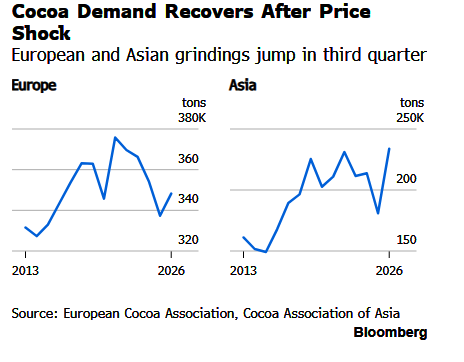
A new Bloomberg survey found that third-quarter cocoa processing in Asia and Europe exceeded estimates, signaling a potential demand recovery as lower bean costs improve processing margins. The rebound follows a period of record-high cocoa prices that sparked demand destruction among consumers.
Asian processing soared 29% in the third quarter to its highest quarterly level since 2011, according to the Cocoa Association of Asia. In Europe, grindings rose 3.2% from one year ago, marking the region’s first quarterly year-on-year increase since 2024, according to the European Cocoa Association.
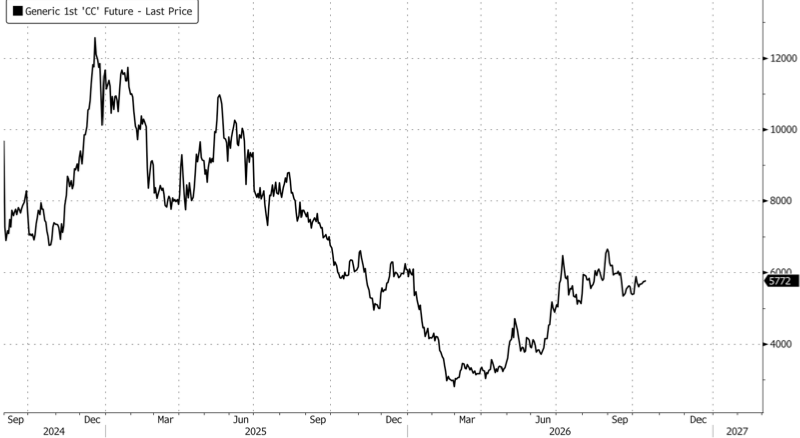
New York cocoa futures rose .5% on Thursday to about $5,762 a ton, roughly 157% above this year’s low of $2,243. Despite the rebound, prices remain more than 50% below the $12,000 levels reached at the height of the cocoa shortage in late 2024
“The market was already trending in a bullish direction and this will add to the sentiment,” said Daryl Kryst, senior vice president of OTC commodities at StoneX, adding that weather and supply risks in West Africa linger.
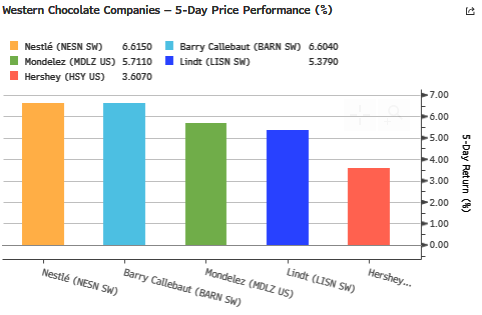
Chocolate stocks have also rallied over the past five days, led by Nestlé and Barry Callebaut, up 6.62% and 6.60%, respectively. Mondelez gained 5.71%, Lindt rose 5.38%, and Hershey added 3.61%.
“Some chocolate companies have been saying that they intend to rebuild volume sales and to focus on volume sales growth,” said Rabobank analyst Oran van Dort. “And if that’s the case, then this increase in European grindings could be an element of that in preparation.”
Lower bean prices this year have improved margins and encouraged activity after the 2024 price spike forced chocolate makers to change recipes and consumers revolted against expensive candy bars. Still, CoBank economist Billy Roberts pointed out that the rebound partly reflects weak comparisons following earlier declines.
Processing strength has yet to translate into a sustained recovery in chocolate demand. A key test will be the “October/Halloween” period, which Deutsche Bank consumer staples analyst Steve Powers highlighted as an important demand signal for Hershey.
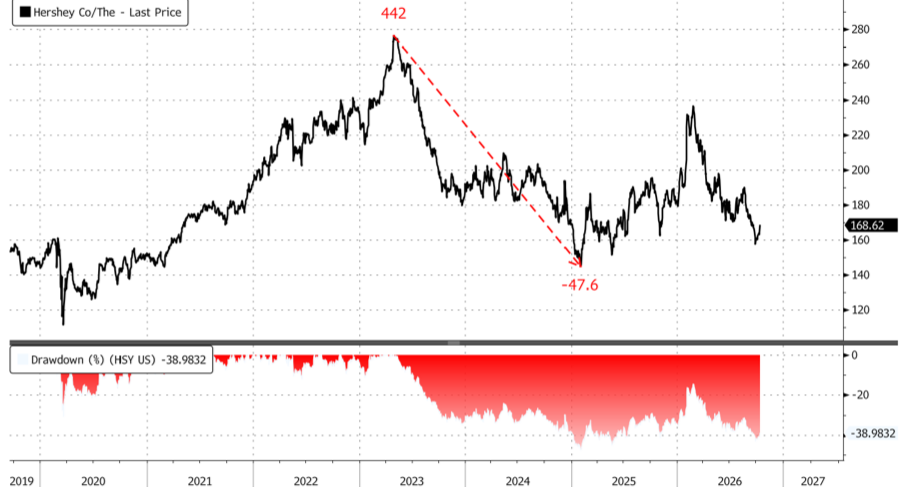
“September consumption and share trends were softer than expected, raising the importance of October/Halloween performance in assessing both near-term holiday prospects and the credibility of HSY’s expected volume/share improvement into FY27,” Powers wrote in a note on Wednesday.
END
YOUR EARLY CURRENCY VALUES/GOLD AND SILVER PRICING/ASIAN AND EUROPEAN BOURSE MOVEMENTS/AND INTEREST RATE SETTINGS FRIDAY MORNING.7:30 AM
SHANGHAI CLOSED UP 8.81 PTS OR 0.24%
HANG SENG CLOSED UP 92.28 PTS OR 0.40%
Nikkei CLOSED UP 1,070.01 PTS OR 1.66%
//Australia’s all ordinaries CLOSED DOWN 0.37%
//Chinese yuan (ONSHORE) CLOSED UP AT 6.6874
/ OFFSHORE CLOSED UP AT 6.6871 Oil UP TO 97.25 dollars per barrel for WTI and BRENT UP TO 105.28 Stocks in Europe OPENED ALL MIXED
ONSHORE USA/ YUAN// WITH YUAN TRADING 6.6874 OFFSHORE YUAN TRADING UP TO 6.6871 ONSHORE YUAN TRADING BELOW LEVEL // OFF SHORE AND UP ON THE DOLLAR)// / AND THUS STRONGER/OFF SHORE YUAN TRADING UP AGAINST US DOLLAR/ AND THUS STRONGER
XXXXXXXXXXXXXXXXXXXXXXXXXXXXXXXXXXXXX
ONSHORE YUAN: CLOSED UP TO 6.6874
OFFSHORE YUAN: UP TO 6.6871
1A.HANG SANG CLOSED UP 92.28 PTS OR 0.40%
1 B. SHANGHAI CLOSED UP 8.81 PTS OR 0.24%
2. Nikkei closed UP 1070.05 PTS OR 1.66%
WEST TEXAS INTERMEDIATE OIL UP TO 97.25
BRENT; 105.28
3. Europe stocks SO FAR: ALL MIXED
USA dollar INDEX DOWN 22 BASIS PTS TO 101.64// EURO RISES TO 1.1243 UP 31 BASIS PTS
3b Japan 10 YR bond yield:RISES TO. +2.932 UP 2 FULL BASIS PTS/ VERY TROUBLESOME//Japan buying 100% of bond issuance)/Japanese YEN vs USA CROSS NOW AT 157.95… JAPANESE YEN NOW FALLING AS WE HAVE NOW REACHED THE ENDING OF THE YEN CARRY TRADE AGAIN AND THE REPATRIATION OF YEN DENOMINATED BONDS TRADING IN THE USA/EUROPE. JAPAN 30 YR BOND YIELD: 4.003 UP 3 FULL BASIS PTS
3c Nikkei now ABOVE 17,000
3d USA/Yen rate now well ABOVE the important 120 barrier this morning
3e Gold UP /JAPANESE Yen UP//CHINESE ONSHORE YUAN: UP (6.6874) AND OFFSHORE: UP AT 6.6871
3f Japan is to buy INFINITE TRILLION YEN worth of BONDS. Japan’s GDP equals 5 trillion USA. CENTRAL BANK OF JAPAN WILL NO LONGER DO QE.
Japan to buy 100% of all new Japanese debt and NOW they will have OVER 50% of all Japanese debt. GOVERMENT ASKED JAPAN PENSION FUNDS AND INSURANCE FUNDS TO BUY MORE JAPANESE BONDS AND REPATRIATE ALL FOREIGN BONDS.
3g Oil UP for WTI and UP for Brent this morning
3h European bond buying continues to push yields HIGHER on all fronts in the EU German 10yr bund YIELD UP TO +3.4183/ Italian 10 Yr bond yield UP AT 4.507/ SPAIN 10 YR BOND YIELD UP TO 4.027%
3i Greek 10 year bond yield UP TO 4.317%
3j Gold at $4188.80 /Silver at: 57.74 1 am est) SILVER NEXT RESISTANCE LEVEL AT $100.00
3k USA vs Russian rouble;// Russian rouble UP 0 AND 6/ 100 roubles/83.81
3m oil (WTI) into the 97 dollar handle for WTI and 105 handle for Brent/
3n Higher foreign deposits moving out of China// huge risk of outflows and a currency depreciation. This can spell financial disaster for the rest of the world/
JAPAN ON JAN 29.2016 CONTINUES NIRP. THIS MORNING RAISES AMOUNT OF BONDS THAT THEY WILL PURCHASE UP TO .5% ON THE 10 YR BOND///YEN TRADES TO 157.95 // 10 YEAR YIELD AFTER FIRST BREAKING .54% LAST YEAR NOW EXCEEDS THAT LEVEL TO 2.932% UP 2 BASIS PTS STILL ON CENTRAL BANK (JAPAN) INTERVENTION//YEN CARRY TRADE NOW UNWINDING//YEN BOND TRADING OVERSEAS TO BE REPATRIATED.//JAPAN 30 YR: 4.003 UP 3 PTS..: USA/SF this 0.8248 as the Swiss Franc . Euro vs SF: 0.9273
USA 10 YR BOND YIELD: 5.084 UP 0 BASIS PTS…NOW ABOVE 5.00%
USA 30 YR BOND YIELD: 5.433 DOWN 0 BASIS PTS/
USA 2 YR BOND YIELD: 4.736 UP 1 BASIS PTS
USA DOLLAR VS TURKISH LIRA: 49.53 UP 11 BASIS PTS/LIRA GETTING KILLED//IDIOTS FOR SELLING GOLD AND USA DOLLAR RESERVES.
10 YR UK BOND YIELD: 5.3852 UP 2 PTS
30 YR UK BOND YIELD: 5.8527 UP 2 BASIS PTS
10 YEAR FRENCH BOND YIELD; 4.806 % //UP 2 BASIS PTS
10 YR CANADA BOND YIELD: 3.827 DOWN 5 BASIS PTS
5 YR CANADA BOND YIELD: 3.528 DOWN 5 BASIS PTS.
1a New York Opening report
Futures Rise As Warsh Stays Mum, Tesla “Flying Car” Interrupts AI Liquidation
Friday, Oct 16, 2026 – 08:28 AM
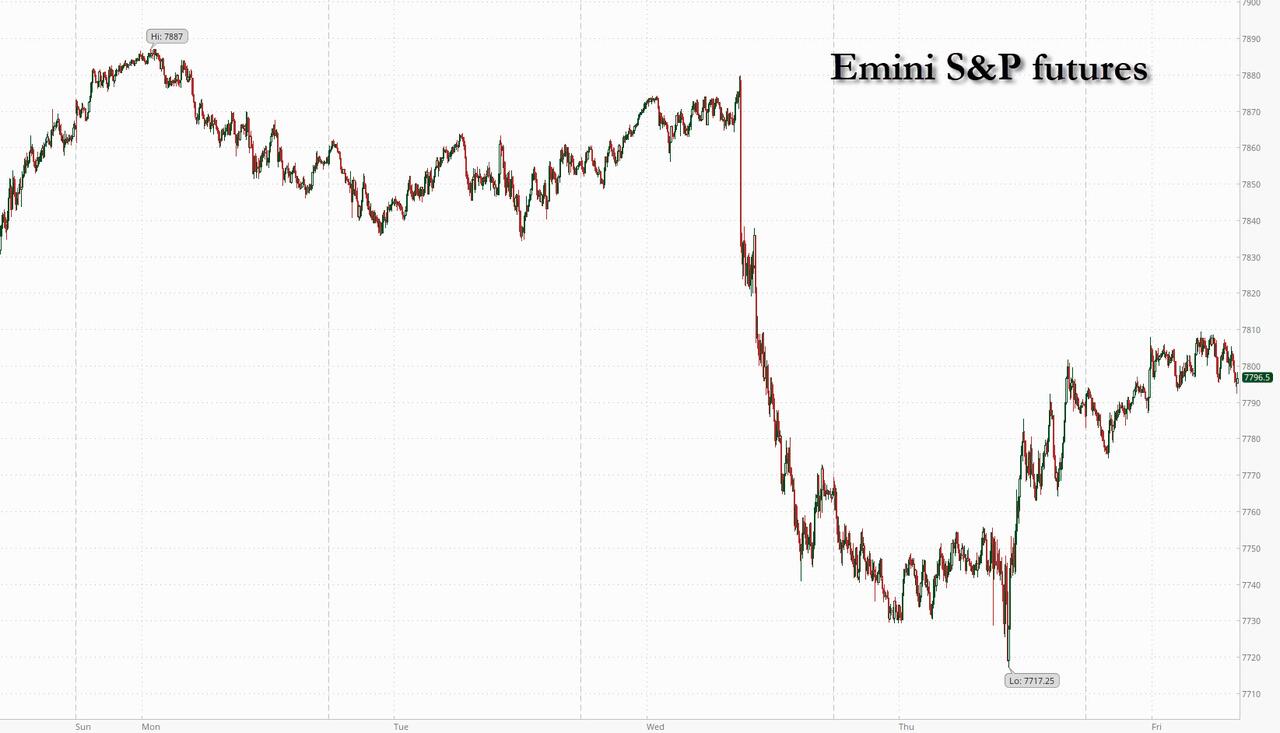
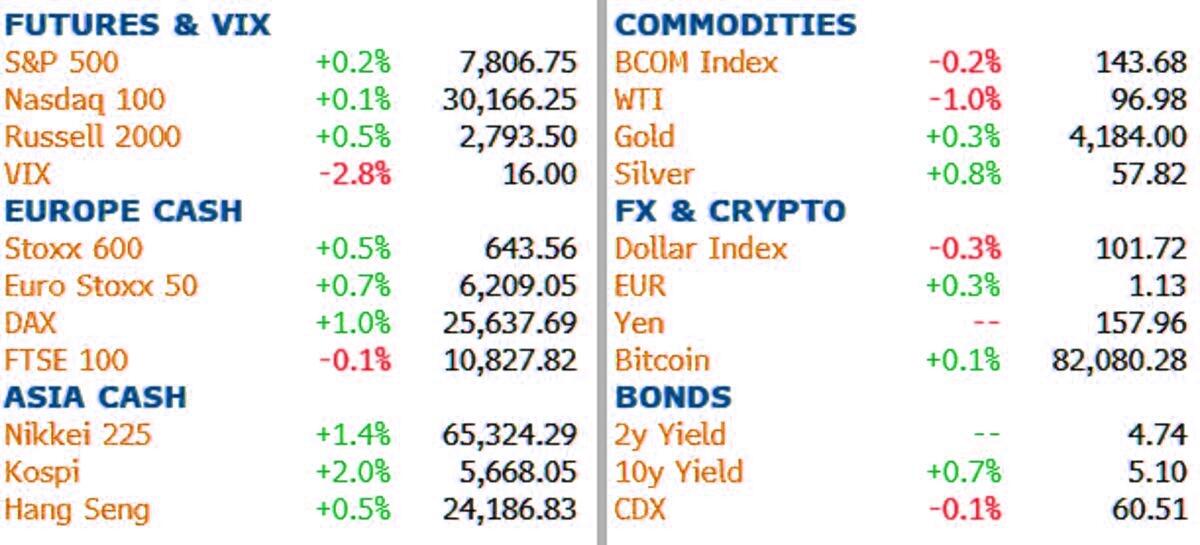
US futures are higher, and small caps are leading, as the crowded-trade unwind that hammered chips, momentum and AI baskets all week takes a breather: Fed Chair Kevin Warsh said nothing about rates at the IMF gathering in Bangkok overnight (traders took the silence as a dovish gift, cutting October hike odds to 14% from 26%), Tesla jumped 5% after Musk unveiled his “flying” Roadster, and oil slipped after Trump said Iran had asked for a halt to US attacks but then it rebounded when the market realized Trump is just lying; as a result haven demand faded and the global bond rally stalled, with 10Y yields rising 6bps to 5.12%. As of 8:00am ET, S&P futures are 0.1% higher at 7,800, Nasdaq futures are down -0.2% and Dow futures are -0.2%; Russell 2000 contracts are up 0.5%. Yesterday the S&P rose 0.3% and closed within 1% of its record high after Jensen Huang rode to CoreWeave’s rescue, even as the SOX fell for a 7th straight day and the Nasdaq barely eked out a gain. Premarket, all Mag 7 names except Amazon are higher led by Tesla, while CoreWeave (-3.9%), Strategy (-2.9%) and Netflix (-2.5%) lag and the AI baskets (semis and memory) remain in the red per JPM. The day’s driver is Warsh (or rather what he didn’t say): with the blackout starting Saturday, the Fed chair declined to push back on rate expectations and instead talked up a “massive investment surge” from AI. In rates, Treasuries slide with a mild bear steepening (2s flat, 10s +4bps, 30s +3bps per JPM) as the rebound in global stocks clips the haven bid; bunds and gilts are also lower by about 15 ticks with UK banks in focus after reports Chancellor Healey will raise their taxes. In FX, the Bloomberg Dollar Spot Index drops 0.4%, down a second day, with the kiwi and Aussie leading G10 and the euro set to end a five-week losing run. In commodities, WTI is down 1% near $97 and Brent trades around $105 but is still headed for a second weekly gain; gold is up 0.3% at $4,184, silver gains 0.8% and copper rises 1% in London. Crypto is mixed: Bitcoin is little changed around $82,000 while Ether bounces. US economic data slate includes September import/export prices (8:30am), industrial production and capacity utilization (9:15am), the federal budget balance (2pm) and August TIC flows (4pm); Fed speaker slate includes Goolsbee on Bloomberg TV at 6pm, the last word before the blackout. There are no coupon auctions, but Treasury’s primary dealer questionnaire (noon ET) ahead of the Nov. 4 refunding is worth watching.
In premarket trading, Magnificent Seven stocks are mostly higher: Tesla rises 3.6% after the EV maker unveiled its long-delayed Roadster sports car (Meta Platforms (META) +0.5%, Microsoft (MSFT) +0.5%, Alphabet (GOOGL) +0.3%, Amazon (AMZN) +0.3%, Apple (AAPL) +0.3%, Nvidia (NVDA) -0.1%)
- Fox Corp. (FOXA) gains 3.9% after BofA upgraded the media company by two notches, to buy from underperform, citing Fox’s deal to buy Roku.
- Mobileye Global (MBLY) climbs 4% as Citi starts coverage on the maker of software and hardware technology for automobiles with a buy rating, expecting the company to benefit from growth in autonomous driving technology.
- Semtech Corp. (SMTC) rises 4.4% after Northland Securities upgraded the company to outperform from market perform, a move that comes in the wake of its analyst day event, where it raised its third-quarter forecast.
- Omeros (OMER) is down 4.1% after the drug developer said an advisory committee of the European Medicines Agency issued a negative opinion on the company’s application for its narsoplimab therapy.
- Travelers (TRV) drops 4.6% after the insurance company reported net premiums written for the third quarter that met the average analyst estimate. Revenue declined modestly year on year, while catastrophe losses rose.
- Truist Financial (TFC) falls 2.1% after the financial services company reported third quarter taxable equivalent net interest income that came in just short of expectations.
- Wise (WSE) falls 2.3% after the payments firm reported cross-border volumes that missed analyst expectations.
Zeta Global (ZETA) is up 4.6% after Goldman Sachs upgraded the software company to buy from neutral, seeing potential for it to gain market share.
In other corporate news, Tesla unveiled its long-delayed new Roadster sports car (yes, the one that “flies”: Newsquawk reports it uses thrusters to land after a ramp jump, does 0-60mph in under a second and enters production in 2028), sending shares of its Chinese suppliers Ningbo Xusheng, Wencan Group and Ningbo Joyson Electronic up 10% each. Thoma Bravo-backed Proofpoint agreed to buy cybersecurity company Varonis Systems for about $6.3 billion, prompting six brokers to cut Varonis to hold-equivalent. Some Anthropic investors discussed a more tempered $1.5 trillion valuation on the back of slowing revenue growth, according to Reuters, confirming our article from yesterday. Netflix is replacing its chief creative officer with veteran TV and film executive Peter Rice, Meta made one of its new AI models available for developers to download and modify, Mercedes-Benz and Nvidia extended their automated driving partnership, and City Therapeutics raised $200 million in a US IPO priced at the mid-point of its range. Meanwhile, three CoreWeave co-founders have sold $3.3 billion in shares since last year’s IPO, which may explain why they look so relaxed.
After a brutal few sessions for crowded pockets of the market, including chips, momentum stocks and popular thematic baskets, futures point to a mild recovery in the final trading day of the week, Bloomberg’s Before the Bell notes. Europe is on track for its biggest weekly outperformance over the S&P 500 since March as investors rotate out of the AI trade, and Asian stocks rebounded as dip buyers returned to chipmakers after a four-day selloff. The relief comes after quants suffered their worst day since August and hedge funds dumped AI stocks at the second fastest pace in a year.
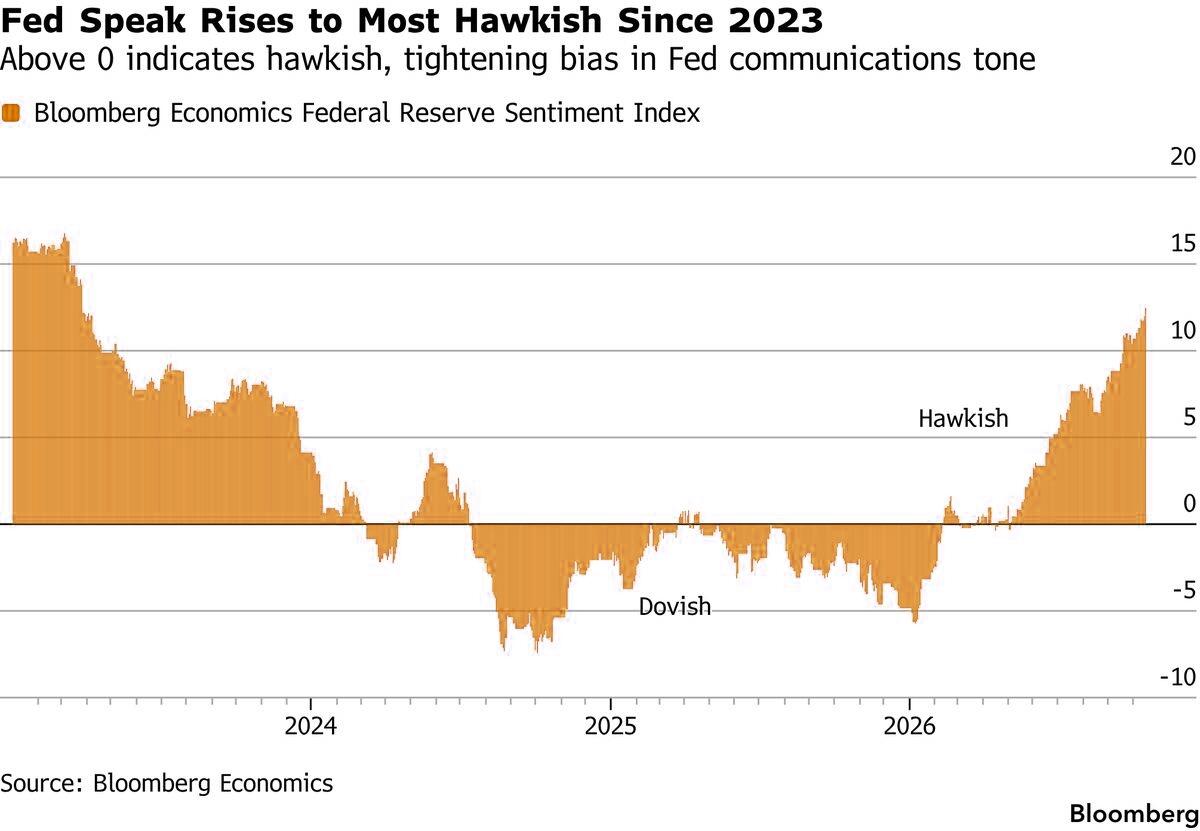
The overnight catalyst was Warsh, and the most important thing was what he didn’t say. With the Fed about to enter its blackout ahead of the Oct 27-28 FOMC, the Chair declined to push back on market pricing despite this week’s hot CPI and PPI, saying only that since September “the world has broadly conformed to our expectations.” Goldman’s economists read this as a signal that the FOMC is set to pause in October, while still expecting a second and final hike in December. That is the punchline even though Bloomberg Economics’ Fed Sentiment Index, which tracks the tone of Fed communications, continues to rise and is now at its most hawkish level since 2023 after Daly and Hammack warned about overlapping, long-lived supply shocks.
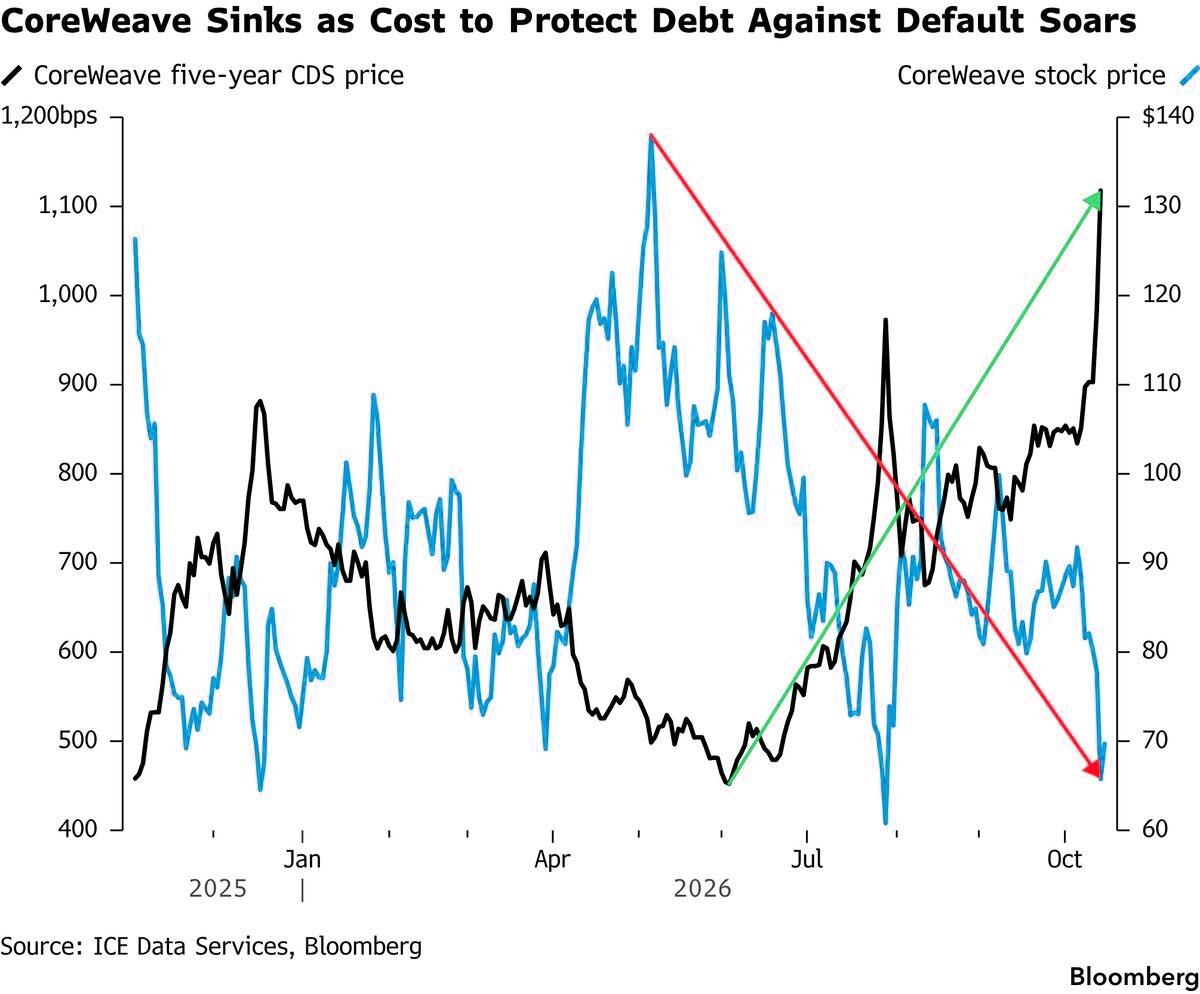
Then there is CoreWeave, which has become ground zero in a tug of war between investors who see rising bond yields as a potential rally killer for the AI trade and those who think compute demand will outweigh such concerns. As DB’s Jim Reid recaps, CoreWeave’s 5Y CDS initially widened another 76bps to 1194bps, its widest level yet, before ending 30bps tighter at 1086bps once Jensen Huang declared that “CoreWeave’s strength is improving every day” (we discussed the credit fallout here and here). The stock is down another 3.9% premarket.
“Today’s rebound is partly a relief rally,” said Billy Leung, an investment strategist at Global X Management. “I’d be cautious about extrapolating today into a straight-line recovery. The fundamental AI/semiconductor story in Asia remains strong, but oil and US yields remain important constraints, so the market probably stays volatile and increasingly earnings-driven.”
The flow data shows a variety of trends: cumulative flows into tech funds are tracking a record year, according to BofA citing EPFR data, and leveraged ETF AUM is off its highs but still elevated, while the long-dated Treasury ETF has seen consecutive $1 billion outflows for the first time ever. And for those worried about narrow leadership, Bloomberg’s historical analysis suggests thinner, leader-driven advances have often been followed by gains, particularly over the subsequent six to 12 months.
JPM’s Market Intel desk under Andrew Tyler stays Tactically Bullish and sees “stabilization in price action” with RTY leading. The team argues that this week’s price action looks more like rotation than broad-based deterioration, flagging the resilience of the equal-weight S&P, and expects the rotation to slow rather than end abruptly; it remains focused on selective dip-buying, likes Financials after generally positive large-cap bank earnings, and says all eyes are on next week’s META earnings and Nvidia’s GTC event. JPM’s ETF desk (Jonathan Rogerson) notes the retail dip-buying impulse is “in full force”: SOXL has taken in $3.2 billion over two sessions (16% of AUM created), while heavy supply in Ethereum ETFs carries “a strong scent of profit-taking.”
Over at Goldman, Delta One head Rich Privorotsky calls the Asian bounce “a little lackluster relative to the scale of the selloff” and warns that “the problem remains oil, which is stubbornly high.” He adds that “rates are finally beginning to reflect the same AI capex growth shock that equities have spent the week repricing.” Sean Vogel’s flows and positioning note puts it more bluntly: “In hindsight, the pain trade was long AI/ short bonds. Now we’re watching both sides unwind.” The data back that up: GS Prime’s AI long/short ratio has fallen to 3.27 from a 4.34 peak (7th percentile over the past year), and NDX forward P/E is down to about 21x, the lowest since the AI cycle began in 2023. Sam Dunn on the US desk sums it up: “The AI trade is still long but now a 6 out 10 in terms of length and much cleaner than it was in Jun/July.”
Elsewhere, China proposed adding advanced AI technologies to its export-control list, potentially restricting overseas transfers of AI models and chips, while Taiwan will curb AI chip exports to China as part of its US trade deal, and Beijing moved to prop up its own stock market by urging companies and state funds to buy shares while guiding some investors to curb selling. In the Gulf, CENTCOM confirmed that a container ship that sank in the Strait of Hormuz this week was struck by an Iranian projectile, Iran’s navy said a “violating” tanker caught fire in a restricted zone east of Hormuz, and Trump declined to rule out using the “Mother of all Bombs” on Iran after the midterms, even as he said Tehran had asked for a halt to US attacks.
In Europe, the Stoxx 600 rises 0.6% to 643.72 with 471 members up and 122 down, heading for a third day of gains; media and autos are the best performing sectors while health care is the only one in the red. The DAX leads with a 0.9% gain and cyclicals do the heavy lifting, while the FTSE 100 lags as UK banks slide after Bloomberg reported Chancellor Healey will raise taxes on banks (the Guardian says via a 3% increase to the bank surcharge): Lloyds is down 2.3% (also cut at RBC) and NatWest 2.1%, while HSBC and Barclays are little moved. JPM’s desk says Defense, Renewables, Software and Momentum Short are among the best performing baskets. Here are the biggest European movers:
- Nestle shares rise as much as 1.5% after JPMorgan upgrades the stock to overweight, saying FY27 could be a “vintage year” for the consumer goods company.
- Aixtron shares rise as much as 10% after the chip-equipment maker reported preliminary orders well above analyst expectations.
- Nordex shares rise as much as 15% after the wind turbine manufacturer posted third-quarter earnings that smashed expectations and raised its margin goal for the full year.
- Verbio shares rise as much as 11% as Jefferies upgrades the German biofuels manufacturer to buy from hold, saying the company is increasingly attractive now that its investment phase is largely behind it.
- Brunello Cucinelli shares rose as much as 6.2% after the Italian luxury firm reported third-quarter earnings that beat expectations and raised its growth guidance for the year.
- Man Group shares gain as much as 3.3% after the UK investment firm reported stronger-than-expected inflows for the third quarter, with growth across both alternative and long-only strategies.
- Avanza shares declined 5.3% after the lender reported operating income for the third quarter that missed the average analyst estimate.
- Wise shares drop as much as 2.7% after the payments firm reported cross-border volumes that missed analyst expectations.
- Lloyds Banking Group shares fall as much as 2.7% after RBC Capital Markets downgraded the UK lender to sector-perform from outperform, noting that competition in the regional deposit market threatens to erode the benefits of its structural hedge.
Asian stocks rebounded, led by chipmakers after a four-day selloff on concerns over the AI boom, with the MSCI Asia Pacific Index jumping as much as 1.8% (Samsung, SK Hynix, BHP and Alibaba the biggest contributors), though the gauge was still on track for its worst weekly loss in more than three months. Japan’s Topix and Nikkei both rose 1.9%, the Hang Seng gained 1.2% and the CSI 300 0.8% as state-backed buying returned with a record 18.8 billion yuan inflow into the E Fund CSI 300 ETF on Thursday, Taiwan’s Taiex added 0.7% and the ASX 200 1.1%. Korea’s Kospi, which tumbled nearly 8% on Thursday, climbed as much as ~4% and closed 2% higher at 5,668. TSMC slipped despite better-than-expected results and a strong outlook, a sign that tech sentiment remains fragile. The outlier was Indonesia, where the JCI plunged 11%, the most since January 1998, after MSCI proposed reclassifying the country from emerging-market to standalone-market status; Goldman’s GIR estimates outflows of $5.0 billion to $7.8 billion depending on the scenario, and IndoGBs sold off 30bps. Goldman’s Asia desk (Enna Hattori) dubbed it a “soft bounce”, with flows finishing only 1.2x better to sell, and cautioned that the market “will require some fundamental reassurance before being able to regain MTD losses.”
In FX, the Bloomberg Dollar Spot Index is down 0.4%, falling a second day, as traders pare bets on an October Fed hike after Warsh steered clear of any policy signals. Risk-sensitive currencies lead G10, with NZD/USD up 0.9% and AUD/USD up 0.6%; the euro rises 0.2% to around 1.1245 and is set to end a five-week losing run (ING’s Francesco Pesole sees it largely confined to a 1.10-1.15 range in the coming months), and the pound hit a three-week high of 1.3337 despite the bank tax story. The yen is flat around 157.9 per dollar. In EM, Bank Indonesia intervened to support the rupiah as the MSCI shock fuels bets on a rate hike, a few days after Asian central banks dumped dollars to defend their tech currencies.
In rates, Treasuries slide, led by the long end, as the rebound in global stocks reduces the appeal of haven assets and Warsh’s comments did little to alter the rate outlook; 10-year yields are up 5bps at 5.11%, with 2s little changed and the curve bear steepening, unwinding part of Thursday’s 12.7bp bull flattening rally which came in spite of a PPI print that was the hottest since March 2022 (because when AI capex gets wobbly, inflation apparently stops mattering). Money markets now price a 14% chance of an October hike, down from 26% earlier. European bonds are also weaker, with bunds and gilts down about 15 ticks; gilt traders are looking for clues on how Chancellor Healey will balance spending and revenue ahead of the Oct. 28 Budget, with a bank tax the latest idea. There are no coupon auctions today, but at noon ET Treasury releases its primary dealer questionnaire ahead of the Nov. 4 refunding, and some on the Street expect 20Y and 30Y auction sizes to be cut by $3 billion each (with speculation the 20Y could be cut altogether).
The short-lived nature of the Treasury rally suggests that the safe-haven status of US bonds is continuing to wane, said Steven Barrow, head of G10 strategy at Standard Bank.
In commodities, crude is on the back foot, with WTI Dec’26 down 1.2% near the bottom of a $95.29-96.39 range and Brent Dec’26 down 0.8% within $104.91-105.94, after Trump said Iran had asked for a halt to US attacks and that negotiations are ongoing; the IEA also said member countries agreed to complete the release of 100 million barrels still outstanding from the March intervention. Even so, oil is set for a second weekly advance as mounting Middle East supply risks outweigh the reserve release: Iran’s navy said a “violating” tanker caught fire east of Hormuz, Saudi Arabia and the Houthis continue to trade strikes, and Ukraine has resumed attacks on Russian refineries. Spot gold trades in a $4,147-4,189 range and eyes its 21-DMA near $4,200, silver is up 0.8% at $57.82, and LME copper gains 1% toward $14,500/t as sentiment improves.
US economic data slate includes September import/export prices (8:30am), industrial production and capacity utilization (9:15am), the federal budget balance (2pm) and August TIC flows (4pm). Fed speaker slate includes Goolsbee on Bloomberg TV (6pm) ahead of the communications blackout that begins Saturday. Travelers, Truist, M&T Bank, Citizens Financial and Regions report before the open.
Market Snapshot
Top Overnight News
- Federal Reserve chair Kevin Warsh has signaled that hotter-than-anticipated inflation has not swayed his views on the US economy, prompting traders to further scale back bets on a rate rise this month. FT
- Goldman economists say Warsh’s comments indicate the FOMC is set to pause in October; they continue to expect a second and final hike in December. GIR
- President Donald Trump said he would not use nuclear weapons against Iran, telling Newsmax that the U.S. “doesn’t have to.” Trump also said he did not foresee sending U.S. ground troops into Iran. CNBC
- Iran’s Navy identified a “violating” oil tanker “a few hours ago” that caught fire in a restricted zone east of the Strait of Hormuz, state-run IRIB News reports; the tanker had turned off its tracking systems. BBG
- US Central Command confirmed that a container ship that sank in the Strait of Hormuz this week was struck by an Iranian projectile; Trump declined to rule out using the “Mother of all Bombs” on Iran after the midterms. BBG
- The US is considering moves to ease restrictions on “shadow fleet” tankers linked to Russia and Iran as it struggles to bring down soaring diesel prices ahead of November’s midterm elections. FT
- The International Energy Agency said member countries agreed to complete the release of 100 million barrels of oil still outstanding from an intervention in March. BBG
- China moved to stabilize its equity market by urging companies and state funds to buy shares while guiding some investors to curb selling, people familiar with the matter said. Financial regulators held a meeting Thursday to discuss stabilization measures for the stock market. BBG
- Taiwan is preparing to tighten export controls on AI chips to further align with US restrictions, according to a senior official in Taipei, joining a Trump administration clampdown on the smuggling of cutting-edge semiconductors to China. BBG
- China proposed adding advanced AI technologies to its export-control list, potentially restricting overseas transfers of AI models and chips. BBG
- Indonesian stocks suffered their worst rout in nearly three decades after MSCI warned the country’s emerging-market status is at risk, stoking fears of removal from global indexes and foreign capital flight. BBG
- Ukraine’s resumption of strikes on Russian refineries is a ‘disgrace’ that keeps global energy prices elevated, US President Donald Trump said. Ukraine struck a Russian oil refinery after President Volodymyr Zelenskiy declared that Kyiv was abandoning a ceasefire covering energy sites that Trump had announced, and criticized his willingness to strike deals with Moscow. RTRS
- Progress toward a U.S.-Mexico tariff deal has stalled after opposition from Commerce Secretary Howard Lutnick, people familiar with the talks said, the second time that he has had a hand in upending advanced negotiations with a North American partner. WSJ
- PM Mark Carney urged Albertans to reject separatism in an Oct. 19 referendum, calling national unity critical. The province will vote on whether to remain in Canada or start a process that may lead to secession, subject to a second ballot. BBG
- UK Chancellor Healey will raise taxes on banks, likely by increasing the bank surcharge; UK lenders fell in early trading. BBG
- Three CoreWeave co-founders have sold $3.3 billion in company shares since last year’s IPO. BBG
- Some Anthropic investors discussed a more tempered $1.5 trillion valuation on the back of slowing revenue growth. RTRS via BBG
- JPM Econ (Abiel Reinhart) keeps its September core PCE forecast at 0.31% m/m (3.1% y/y) after PPI; GS raised its estimate to 0.34%. JPM/GIR
- US President Trump is to deliver remarks in Dalton, Georgia at 14:45 EDT/19:45BST on Friday.
- US President Trump said no real reason for him to go to Maine and thinks he will go to Minnesota, while he said he is not involved in that when asked regarding probe into Democrat Rep. Omar.
- Japan is to sidestep 3.5% defence spending target despite US pressure: Asahi
- US President Trump said he will be going to Iowa state on Thursday, October 22nd and Sunday, November 1st.
A more detailed look at global markets courtesy of Newsquawk
APAC stocks were mostly higher as global markets regained composure following the recent tech bloodbath. Elsewhere, Indonesian stocks are the outlier with double-digit percentage losses as the MSCI consults on a proposal to reclassify Indonesia from Emerging Market to a Standalone Market Status. ASX 200 gained with the upside led by tech and miners, while recent weak jobs data also supported the case for a pause from the RBA at the next meeting. Nikkei 225 recouped some of the losses from the prior day’s turmoil. KOSPI outperformed but still has far to go after falling by as much as 8% yesterday. Hang Seng and Shanghai Comp conformed to the broad recovery in risk assets, while PBoC Governor Pan also recently reiterated that China would maintain a moderately loose monetary policy.
Top Asian News
- South Korean Finance Minister and Central Bank Governor held a meeting with the Fed and US Treasury Department.
- China is reportedly moving to lift the stock market with selling curbs and buybacks, Bloomberg reported.
- Japan’s Finance Minister Katayama said can’t comment whether we would need extra budget or not, adds even if needed, the extra budget would be limited to urgent policy priorities.
European bourses (STOXX 600 +0.5%) have an upward bias to start the final trading session of the week, with cyclical-heavy indices outperforming as tech rebounds from this week’s losses. Sectors highlight the positive bias. Autos lead, with Media and Telecoms following closely behind. To the downside resides Health Care, as the only sector in the red. UK banks are under pressure this morning after Bloomberg reported that UK Chancellor Healey will raise taxes on banks. The report follows a Guardian source stating that the proposal includes a 3% increase to the bank surcharge. Lloyds (-2.3%) and NatWest (-2.1%) are under the most pressure, while Barclays (-0.2%) and HSBC (+0.5%) are little moved given its large international business. US equity futures follow their European peers. Tesla (+5%) is getting a boost pre-market as it unveils its flying car, while Strategy (-2.4%) falls after MSCI announces new screening methodology that targets companies holding digital assets. Tesla (TSLA) Roadster uses thrusters to land after ramp jump, while Roadster can accelerate 0-60Mph in less than 1 second, while it will enter production in 2028.
Top European News
- UK Ofcom proposes to cap Second Class stamp price for a further year, until March 2028.
- Chinese Finance Minister met with the EU Economy Commissioner Dombrovskis, ECB President Lagarde and Eurogroup President Pierrakakis. Chinese side is willing to give full play to the role of China-EU financial dialogue and other mechanisms with the EU side.
- Germany’s Finance Minister said he is not against China, China is an important partner, but is not playing by the rules and we should not be naive.
- Rio Tinto (RIO LN) CEO said that they are looking to build commodity trading capabilities.
FX
- Snapshot: G10s are firmer against the broadly lower USD this morning. Antipodeans lead, benefiting from the risk tone, whilst the JPY holds towards the bottom of the pile, but still remains flat.
- USD continues the prior day’s downside, which stemmed from AI-debt concerns and lower yields. Also fuelling the downside this morning is a speech from Fed Chair Warsh, where he ultimately provided no forward guidance ahead of the October meeting; as such, money markets pared back their bets of an October hike (now 14% vs 26% earlier). The docket for the remainder of the day remains exceptionally light aside from US Import/Export Prices and Industrial Production.
- GBP is a touch firmer this morning, benefiting from the softer USD a little more-so than peers. Focus remains on the looming UK Budget (Oct 28), where source reports have generally been welcomed by markets. The latest was via Bloomberg, which suggested that Chancellor Healey could raise taxes on banks. The source adds that the move will likely involve increasing the bank surcharge that it added on top of the standard corporation tax rate. It seems as if markets are taking the potential tax on banks as a reliable way to improve the fiscal situation, without having a significant impact on growth.
Central Banks
- Fed Chair Warsh said he may be over-scarred from the Global Financial Crisis, adds since September FOMC, world has broadly conformed to our expectations. Will be crystallising what is happening to output, employment and inflation. We will be meeting a couple more times this year, which will be the crystallising moment. Right now, we have structural growth and an investment surge. Obviously, the Fed’s policies spill over to the rest of the world, but their policies spill back to the US too. Will make judgements at the October and December meetings. At the Fed, we made clear that we would deliver price stability; I do not believe in prejudging meetings. Do not prejudge meetings. Do not believe in signalling what I might do at meetings for the rest of 2026. AI is going to hit the demand side of the economy before the supply shock. AI will help central banks have confidence in data and monetary policy. AI will change the real economy, but near-term impact on employment is uncertain. AI will make economy more productive, more wealth, but path to them will be a bumpy one.
- Fed’s Goolsbee (2027 voter) said it’s a discouraging month regarding inflation and still feel some optimism if drivers of inflation can go away in short order, if inflation is from overheating demand from AI, that’s more disturbing and have to address it.
- Fed’s Hammack (2026 voter) said hearing more from lower-income Americans struggling with inflation, adds anecdotal information provides important economic guidance. Businesses are seeing a lot of input cost price pressures. Worries about formation of inflation mentality. Formation of inflationary mindset might force more aggressive Fed policy action. Hard to know what a neutral rate is. Financial conditions do not appear restrictive right now.
- BoJ Governor Ueda said underlying inflation is approaching 2% and the BoJ will continue to raise policy rate in accordance with economic, price and financial developments. There is a risk of underlying inflation overshooting 2% price target.
- ECB’s Wunsch said further tightening would be reasonable given persistent inflation pressures and the resilient EZ economy. Inflation is running at almost 4%, domestic inflation stands at 3% and energy prices are likely to remain elevated for longer than previously expected. Not committing to anything due to the high degree of uncertainty. Market pricing of three rate hikes seems reasonable.
- ECB’s Nagel said Germany is getting fit for the challenges of the future and a fitness program of reforms is always important. Regarding bond market, Germany will remain the anchor of stability in Europe.
- ECB’s Rehn said growth outlook is better today than start of the year, adds not seeing second-round effects on inflation. Labour market not as tight, wage moderation ongoing. Must show vigilance on inflation outlook.
- BoE Governor Bailey said it’s too early to form strong views on strength of second round effects. So far signs of second round effects are subdued and businesses emphasizing cost cutting. UK economy is more resilient than we expected and not as strong as we need. News from Middle East is the biggest factor moving UK gilt yields. Second-round inflation pressures look subdued so far. More hopeful than a month ago that they will get more international alignment on AI testing.
- RBNZ Chief Economist Conway said there is reasonable confidence that inflation has not become broad-based and that rate hikes help contain spillovers from an energy shock.
- PBOC’s Pan said that the PBOC is to support offshore CNY markets development; to further expand liquidity management tools.
- PBoC injected CNY 60bln via 7-day reverse repos with rate kept at 1.40%.
- PBoC set USD/CNY mid-point at 6.7220 vs exp. 6.6947 (prev. 6.7253).
- Bank of Canada Governor Macklem said Canada hasn’t raised rates yet, but the longer it goes, the harder it is to look through increases in energy prices.
Fixed Income
- Fixed income benchmarks are a touch lower to start the final trading session of the week. USTs essentially flat, and look set to end with weekly gains despite a hotter CPI and PPI print this week, as Fed Chair Warsh fails to provide little guidance. As such, money markets pared back their bets of an October hike (now 14% vs 26% earlier).
- Focus will be on the US Treasury primary dealer questionnaire, expected at 17:00BST/12:00EDT, ahead of the QRA on November 4th. Some analysts expect the Treasury to cut both 20-year and 30-year auction sizes by USD 3bln each, and to be replaced by T-bills. To add, there has also been speculation that the 20-year could be cut altogether.
- Gilts and Bunds trade in tandem, posting losses of around 15 ticks.
- Focus for Gilts this morning, and heading into the Budget, is on any clues to how Chancellor Healey chooses to balance spending with income. The latest being focused on the banking sector, with Bloomberg reporting that UK Chancellor Healey will raise taxes on banks. The report follows a Guardian source stating that the proposal includes a 3% increase to the bank surcharge.
- Australia sold AUD 1bln in 3.25% April 2029 bonds, average yield is 4.8238%, bid to cover of 4.89.
Commodities
- Crude benchmarks are on the backfoot, with mild underperformance in the WTI Dec’26 (-1.2%) vs Brent Dec’26 (-0.8%). The former currently holds towards the bottom end of a USD 95.29-96.39/bbl range, whilst the latter sits within a USD 104.91-105.94/bbl range. The mild underperformance seen in WTI is likely a bit of an unwind following yesterday’s relative outperformance, on the back of large weekly US headline inventory and as the US Treasury extended a sanctions waiver allowing Lukoil petrol stations to operate within the US.
- The geopolitical environment remains tense on three major fronts: 1) The US-Iran situation remains unresolved, though President Trump did mention that Iran requested a halt to attacks and that negotiations are ongoing. A factor which is likely weighing on the complex this morning. 2) Saudi Arabia and the Houthis continue to strike each other, and 3) Russia and Ukraine have continued to strike energy facilities, despite Trump’s announcement of an energy ceasefire.
- Spot gold currently trades within a USD 4,147-4,189/oz range, continuing to build on the prior day’s gains; the yellow metal now eyes its 21-DMA at USD 4.2k/oz. Strength today is facilitated by a slightly softer USD, which comes after Fed Chair Warsh avoided any guidance surrounding the October confab, which saw a slight paring of tightening bets.
- Base metals are rebounding from recent losses as global sentiment improves. 3M LME Copper (+1%) currently trades at the upper end of a USD 14,296-14,482/t range, and now eyes USD 14.5k/t.
- South Korea is reportedly to extend oil fuel price cap for another four weeks.
- Russia and Iran is reportedly discussing gas pipeline route and pricing, TASS reported.
- Japanese Chief Cabinet Secretary Kihara said Japan expects October crude procurement to be at the same level as last year.
- China set 2027 corn import tariff quota at 7.2 mln tons and wheat import tariff quota at 9.64 mln tons.
Trade/Tariffs
- China’s MOFCOM is to revise the “Catalogue of Technologies Prohibited and Restricted from Export in China,” and temporary registration management will be implemented for the export of related technologies.
- Taiwan is to curb AI chip exports to China as part of the US trade deal, Bloomberg reported. Servers and high-end chips will be added to the controlled items list.
- France is said to have agreed to support UK inclusion in the bloc’s proposed “Made in Europe” legislation, although Britain would need to align with the EU’s approach to tariffs on Chinese EVs.
- Japan is to open anti-dumping probe on Chinese pigments and preparations made from Chinese rutile titanium dioxide.
- US Commerce Secretary Lutnick throws future of US-Mexico trade talks into further doubt as he has objected to significant reductions in tariffs on Mexican steel, aluminum and automobiles, according to WSJ.
Geopolitics: Iran
- US President Trump said wouldn’t use nuclear on Iran, while he is talking to Russia and China regarding denuclearisation, adds may have to go to Pickaxe Mountain and don’t see troops on the ground in Iran. Iran has asked for a halt to US attacks and negotiations are still ongoing.
- IRGC Brigadier General Akraminia said “we have introduced new equipment into our combat formations”, Al Mayadeen reported.
- IRGC Brigadier General Akraminia announces new operational plans to push back more American ships and flee ever further; reiterates that the Army Navy has complete operational control over the Sea of Oman, SNN reported.
- Iranian Army Commander Major General Amir Hatami said three ships entered the Sea of Oman and were fired upon by Iranian forces, severely restricting maritime traffic.
- Iranian Ambassador said that “The United States is not demonstrating serious political will to negotiate with Iran”, Tass reported. Iranian Ambassador to Moscow’s Kazem Jalali.
- US President Trump answered he doesn’t trust anyone when was asked if he trusts Israeli PM Netanyahu.
Geopolitics: Ukraine
- US President Trump said Ukrainian President Zelensky is not a good guy to deal with, adds Zelensky is more difficult than Putin to deal with. He is allowed to do a self-pardon. Plenty of other targets besides refineries to hit. Need an election in Ukraine.
- US President Trump said Ukraine’s resumption of strikes on Russian refineries is a disgrace.
- EU President of the European Commission Von Der Leyen said that they are working on the 22nd package of sanctions against Russia, adding that no sanctions will be lifted unless Russia stops its war.
- Russian forces struck a vessel sailing to Ukraine’s Odessa, according to IFX.
- Temporary restrictions introduced at Pulkovo Airport in St. Petersburg, Russia, according to TASS.
- Ukrainian drones are attacking Russia’s Moscow region and reportedly hitting industrial warehouse facilities.
- Massive fire breaks out in Ukraine’s Khmelnitsky region following a reported strike on a fuel depot.
- US senators are demanding an investigation into disruption of a satellite system supporting Ukraine, according to an Al Jazeera correspondent.
- Order to limit Ukraine’s access to Starshield system came from inside the White House, according to sources.
- Ukraine’s Air Force said jet drones spotted over Kirovohrad region heading west.
- Russian local governor said drones hit industrial facilities in Russia’s Rostov region.
- Russian President Putin said Ukraine failed to grasp consequences of returning to targeting refineries.
Geopolitics: Middle East
- Saudi army conducted missile attack on areas of Amran and Saada provinces in northern Yemen, according to IRNA.
- Yemen Houthi official said Saudi Arabia must answer for the massacre of civilians in Yemen and called for independent international probe into the Saudi war on Yemen.
- Saudi-led coalition noted there 20 Houthi attacks on Riyadh in October and that recent strikes included an attack on King Khalid International Airport that killed 12 on October 10th.
- Explosions reported in the city of Dammam, Saudi Arabia, SNN reported.
- Yemeni armed forces strike military positions in Aden, hitting military operation headquarters managed by Saudi officers which killed four.
- Saudi-led coalition said it intercepted and destroyed a drone launched towards Saudi Arabia’s Eastern Region.
Geopolitics: Other
- Chinese Foreign Minister told Israel’s President promoting peace and reconciliation in the region is the cornerstone of China’s Middle East policy, and China consistently held that the Palestinian question is greatest historical injustice of this century. Immediate priority is to fully open access to the Gaza Strip. Israel should stop and reverse its forced establishment of settlements in the West Bank.
- South Korea asks the US for a tax break for Alaska LNG project, according to Maeil.
- South Korea-US ties are said to be straining over intelligence sharing restrictions, trade disputes, and reduced military cooperation, raising concerns about Seoul’s ability to counter North Korea’s nuclear threat. South Korean President Lee Jae-myung is seeking to rebuild trust with Washington while improving ties with Beijing as trade tensions and potential Trump-Kim talks add uncertainty.
- US Secretary of State Rubio spoke with Israeli PM Netanyahu and spoke with Lebanon’s President Aoun regarding recent developments including the seizure of a truck carrying Hezbollah explosives. Rubio also urged direct military-to-military communication between Lebanese and Israeli forces for deconfliction.
Crypto
- Bitcoin (+1%) and Ethereum (+3%) attempts to rebound from recent losses as the risk tone improves.
US Event Calendar
- 8:30 am: Sep Import Price Index MoM, est. 1.0%, prior 0.7%
- 8:30 am: Sep Import Price Index YoY, est. 8.2%, prior 7.0%
- 8:30 am: Sep Export Price Index MoM, est. 0.9%, prior 0.6%
- 8:30 am: Oct NY Fed Services Business Activity
- 9:15 am: Sep Industrial Production MoM, est. 0.4%, prior 0%
- 9:15 am: Sep Capacity Utilization, est. 76.5%, prior 76.3%
- 12:00 pm: Treasury primary dealer questionnaire (ahead of Nov. 4 QRA)
- 2:00 pm: Sep Federal Budget Balance, est. -$30b, prior $197.94b
- 4:00 pm: Aug Total Net TIC Flows, prior $83.7b
- 4:00 pm: Aug Net Long-term TIC Flows, prior -$27.9b
Central Bank Speakers
- 6:00 pm: Fed’s Goolsbee Speaks on Bloomberg TV
DB’s Jim Reid concludes the overnight wrap
It’s been yet another fascinating 24 hours with CoreWeave 5yr CDS initially widening another 76bps intraday to 1194bps, its widest level yet, before turning around and ending -30bps tighter at 1086bps. This turn around was seemingly sparked by Nvidia CEO Jensen Huang coming to the AI computing company’s defense amid its sharp selloff in recent days. The comments likely contributed to a broad dip buying in Tech seen during the US trading session. The Philly Semi index was down over -4% in early trading before rebounding to closing down “just” -0.88% lower but still for its 7th consecutive loss. 10yr US Treasury yields were down -12.7bps due to the risk-off and yet 378 names in the S&P 500 were higher on the day and the index managed to end up with a +0.33% gain and stay within a percent of its record high. Even the NASDAQ itself pared back its losses, having hit an intraday low of -1.44% at the open, to scrape a slight +0.08% gain. The KOSPI is back up over 4% this morning as well.
Drilling deeper into the continued AI volatility, CoreWeave’s equity also recovered from being down -9.54% at the lows to close up +5.94% yesterday. In terms of other comments from Nvidia CEO Huang, which turned around the session, he noted that “CoreWeave’s strength is improving every day”, before adding “I’m optimistic. Their cost of capital is actually decreasing.” While that is true given when the company issued its current debt, the market is pointing to a higher cost of capital now and increased refinancing costs in the future, so it’s one to continue to watch. I explored some of these moves in more depth in my chart of the day yesterday (link here), which showed that for now at least, AI-linked financing costs aren’t excessive relative to the rest of the credit stack but there are outliers starting to emerge. Indeed, Oracle is the other main outlier and the stock was down -8.83% at the lows yesterday before recovering to close +2.02% higher.
Overnight, Kevin Warsh has just spoken at the IMF conference and perhaps the most important thing was what he didn’t say. With the Fed about to enter its blackout ahead of the October 27-28 meeting, Warsh declined to push back against rate expectations, saying he doesn’t “prejudge meetings”, despite this week’s hotter inflation numbers. Instead, he was strikingly upbeat about the US economy, talking about a “massive investment surge” and the potentially huge productivity benefits from AI. Markets took the lack of hawkishness as good news, with October hike pricing dropping to around 15% from roughly 30% as he spoke, while S&P and Nasdaq futures are both +0.15% higher having been negative for most of the session before he spoke. Stoxx futures are +0.68% higher.
A recovery in Asian equity markets had already been in full force before Warsh but has continued after. South Korea’s chip-heavy KOSPI (+4.28%) is leading gains after tumbling nearly 8% yesterday, a move that pushed the index to its lowest close since April. Elsewhere, the Nikkei (+1.83%) is also trading firmly higher, recovering a portion of Thursday’s steep losses as semiconductor stocks have regained ground. Chinese equities are likewise advancing, with the Hang Seng (+1.25%), CSI 300 (+0.75%) and the Shanghai Composite (+0.95%) all higher. In contrast, Indonesia’s Jakarta Composite is plunging nearly -11.0% in its steepest one-day decline since January 1998 after MSCI proposed reclassifying the country from emerging-market to standalone-market status.
Warsh’s comments overnight actually followed another hawkish round of Fed speakers ahead of the upcoming Fed blackout period. Federal Reserve Bank of San Francisco President Daly said that she had changed her view from earlier this year that the Fed should “look through” supply shocks, saying “Do the conventional pieces of wisdom — where our tool doesn’t really work for supply shocks and they dissipate on their own — does that really apply when the shocks are overlapping and they’re long-lived?” Federal Reserve Bank of Cleveland President Hammack joined her in these concerns, adding that “at some point businesses start building in an expectation that more of these are going to come, and that prices are just going to keep going up.”
However the theme of the day was a big global rate rally, as the prospect of slower AI growth pushed yields lower across the board. So, the 2yr yield (-5.9bps) fell to 4.74%, whilst the 10yr yield (-12.7bps) was down to 5.06%. And this was a global pattern as well, with yields on 10yr bunds (-5.3bps), OATs (-8.5bps) and BTPs (-6.7bps) all falling over the session.
But even as bonds were rallying, a striking feature was it took place despite another batch of hawkish US data. So in other words, AI growth concerns continued to outweigh the inflation impulse when it came to yields. Most notably, there was a huge upside surprise in PPI inflation, with headline inflation up +1.3% in September (vs. +0.6% expected). In fact, it was the strongest monthly jump in producer prices since March 2022, shortly after Russia’s invasion of Ukraine. Moreover, the core measures were also stronger than expected, with the measure excluding food, energy and trade services up +0.5% on the month (vs. +0.3% expected). So as with the CPI, the release helped to fuel concerns that inflation was broadening out beyond energy. Taking into account the PPI and CPI components, our US econ team is projecting a +0.37% monthly increase for PCE.
The hawkish data impulse was also clear in the labour market, as the weekly initial jobless claims also remained low in the week ending October 10, coming in at just 199k (vs. 200k expected). So that kept the 4-week moving average broadly steady at 198.5k, only up slightly from its 198.25k level the previous week. In addition, the retail sales number was also stronger than expected, rising +0.8% in September (vs. +0.3% expected). So with the latest data, that left the Atlanta Fed’s GDPNow estimate at an annualised pace of +3.6% for Q3.
Earlier in Europe, markets put in a relatively stronger performance, as they remained more insulated from the AI-related issues. So the STOXX 600 (+0.38%) actually put in a second consecutive gain, taking the index to a 3-week high. That included particularly strong gains for the FTSE 100 (+1.08%) and France’s CAC 40 (+0.78%), although Italy’s FTSE MIB (-0.72%) was a relative underperformer. In the meantime, gilts saw a relative underperformance, with the 10yr yield only down -5.0bps on the day which came as the UK GDP release for August was stronger than expected. That showed GDP up +0.1% (vs. -0.1% expected), which meant the rolling 3-month growth rate was at +0.7% compared to the previous three months (vs. +0.5% expected).
Looking at the day ahead, and it’s a quiet one ahead. However, we will get data on US industrial production and capacity utilization for September. In the Euro Area, there’s also the final CPI print for September.
1b European opening report
Trump said Iran had asked for a halt to US attacks and negotiations are still ongoing; TSLA +5% after Musk unveiled a “flying” car – Newsquawk US Market Open

Friday, Oct 16, 2026 – 06:11 AM
- US President Trump said Iran had asked for a halt to US attacks and negotiations are still ongoing. Trump mentioned that he would not use nuclear weapons, but warned that they may have to go to Pickaxe Mountain.
- European bourses traded mostly firmer in a rebound from recent selling pressure; TSLA +5% in pre-market trade after Musk unveiled a “flying” car.
- DXY is under pressure after Fed Chair Warsh avoided any rate guidance; Antipodeans lead given the risk tone.
- Crude benchmarks edge lower; Trump mentioned that Ukrainian President Zelensky is not a good guy to deal with.
- Looking ahead, Highlights include US Import/Export Prices (Sep), Industrial Production (Sep), Credit Ratings update from Morningstar DBRS on Italy.
SNAPSHOT

LOOKING AHEAD
- Highlights include US Import/Export Prices (Sep), Industrial Production (Sep), Credit Ratings update from Morningstar DBRS on Italy.
- Click for the Newsquawk Week Ahead.
EUROPEAN TRADE
EQUITIES
- European bourses (STOXX 600 +0.5%) have an upward bias to start the final trading session of the week, with cyclical-heavy indices outperforming as tech rebounds from this week’s losses.
- Sectors highlight the positive bias. Autos lead, with Media and Telecoms following closely behind. To the downside resides Health Care, as the only sector in the red.
- UK banks are under pressure this morning after Bloomberg reported that UK Chancellor Healey will raise taxes on banks. The report follows a Guardian source stating that the proposal includes a 3% increase to the bank surcharge. Lloyds (-2.3%) and NatWest (-2.1%) are under the most pressure, while Barclays (-0.2%) and HSBC (+0.5%) are little moved given its large international business.
- US equity futures follow their European peers. Tesla (+5%) is getting a boost pre-market as it unveils its flying car, while Strategy (-2.4%) falls after MSCI announces new screening methodology that targets companies holding digital assets.
- Tesla (TSLA) Roadster uses thrusters to land after ramp jump, while Roadster can accelerate 0-60Mph in less than 1 second, while it will enter production in 2028.
FX
- Snapshot: G10s are firmer against the broadly lower USD this morning. Antipodeans lead, benefiting from the risk tone, whilst the JPY holds towards the bottom of the pile, but still remains flat.
- USD continues the prior day’s downside, which stemmed from AI-debt concerns and lower yields. Also fuelling the downside this morning is a speech from Fed Chair Warsh, where he ultimately provided no forward guidance ahead of the October meeting; as such, money markets pared back their bets of an October hike (now 14% vs 26% earlier). The docket for the remainder of the day remains exceptionally light aside from US Import/Export Prices and Industrial Production.
- GBP is a touch firmer this morning, benefiting from the softer USD a little more-so than peers. Focus remains on the looming UK Budget (Oct 28), where source reports have generally been welcomed by markets. The latest was via Bloomberg, which suggested that Chancellor Healey could raise taxes on banks. The source adds that the move will likely involve increasing the bank surcharge that it added on top of the standard corporation tax rate. It seems as if markets are taking the potential tax on banks as a reliable way to improve the fiscal situation, without having a significant impact on growth.
FIXED INCOME
- Fixed income benchmarks are a touch lower to start the final trading session of the week. USTs essentially flat, and look set to end with weekly gains despite a hotter CPI and PPI print this week, as Fed Chair Warsh fails to provide little guidance. As such, money markets pared back their bets of an October hike (now 14% vs 26% earlier).
- Focus will be on the US Treasury primary dealer questionnaire, expected at 17:00BST/12:00EDT, ahead of the QRA on November 4th. Some analysts expect the Treasury to cut both 20-year and 30-year auction sizes by USD 3bln each, and to be replaced by T-bills. To add, there has also been speculation that the 20-year could be cut altogether.
- Gilts and Bunds trade in tandem, posting losses of around 15 ticks.
- Focus for Gilts this morning, and heading into the Budget, is on any clues to how Chancellor Healey chooses to balance spending with income. The latest being focused on the banking sector, with Bloomberg reporting that UK Chancellor Healey will raise taxes on banks. The report follows a Guardian source stating that the proposal includes a 3% increase to the bank surcharge.
- Australia sold AUD 1bln in 3.25% April 2029 bonds, average yield is 4.8238%, bid to cover of 4.89.
COMMODITIES
- Crude benchmarks are on the backfoot, with mild underperformance in the WTI Dec’26 (-1.2%) vs Brent Dec’26 (-0.8%). The former currently holds towards the bottom end of a USD 95.29-96.39/bbl range, whilst the latter sits within a USD 104.91-105.94/bbl range. The mild underperformance seen in WTI is likely a bit of an unwind following yesterday’s relative outperformance, on the back of large weekly US headline inventory and as the US Treasury extended a sanctions waiver allowing Lukoil petrol stations to operate within the US.
- The geopolitical environment remains tense on three major fronts: 1) The US-Iran situation remains unresolved, though President Trump did mention that Iran requested a halt to attacks and that negotiations are ongoing. A factor which is likely weighing on the complex this morning. 2) Saudi Arabia and the Houthis continue to strike each other, and 3) Russia and Ukraine have continued to strike energy facilities, despite Trump’s announcement of an energy ceasefire.
- Spot gold currently trades within a USD 4,147-4,189/oz range, continuing to build on the prior day’s gains; the yellow metal now eyes its 21-DMA at USD 4.2k/oz. Strength today is facilitated by a slightly softer USD, which comes after Fed Chair Warsh avoided any guidance surrounding the October confab, which saw a slight paring of tightening bets.
- Base metals are rebounding from recent losses as global sentiment improves. 3M LME Copper (+1%) currently trades at the upper end of a USD 14,296-14,482/t range, and now eyes USD 14.5k/t.
- South Korea is reportedly to extend oil fuel price cap for another four weeks.
- Russia and Iran is reportedly discussing gas pipeline route and pricing, TASS reported.
- Japanese Chief Cabinet Secretary Kihara said Japan expects October crude procurement to be at the same level as last year.
- China set 2027 corn import tariff quota at 7.2 mln tons and wheat import tariff quota at 9.64 mln tons.
TRADE/TARIFFS
- China’s MOFCOM is to revise the “Catalogue of Technologies Prohibited and Restricted from Export in China,” and temporary registration management will be implemented for the export of related technologies.
- Taiwan is to curb AI chip exports to China as part of the US trade deal, Bloomberg reported. Servers and high-end chips will be added to the controlled items list.
- France is said to have agreed to support UK inclusion in the bloc’s proposed “Made in Europe” legislation, although Britain would need to align with the EU’s approach to tariffs on Chinese EVs.
- Japan is to open anti-dumping probe on Chinese pigments and preparations made from Chinese rutile titanium dioxide.
- US Commerce Secretary Lutnick throws future of US-Mexico trade talks into further doubt as he has objected to significant reductions in tariffs on Mexican steel, aluminum and automobiles, according to WSJ.
NOTABLE EUROPEAN HEADLINES
- UK Ofcom proposes to cap Second Class stamp price for a further year, until March 2028.
- Chinese Finance Minister met with the EU Economy Commissioner Dombrovskis, ECB President Lagarde and Eurogroup President Pierrakakis. Chinese side is willing to give full play to the role of China-EU financial dialogue and other mechanisms with the EU side.
- Germany’s Finance Minister said he is not against China, China is an important partner, but is not playing by the rules and we should not be naive.
NOTABLE EUROPEAN DATA RECAP
- European HICP Final (Sep) 104.31 vs. Exp. 104.30 (Prev. 103.69).
- European HICP Final (Sep YY) 3.8% vs. Exp. 3.8% (Prev. 3.2%).
- European Core HICP Final (Sep YY) 2.5% vs. Exp. 2.5% (Prev. 2.4%).
- European HICP Final (Sep MM) 0.6% vs. Exp. 0.6% (Prev. 0.4%).
- European Trade Balance (Aug) -16.1B (Prev. 10.7B).
- Italian CPI Final (Sep YY) 4.2% vs. Exp. 4.2% (Prev. 3.3%).
- Italian CPI Final (Sep MM) 0.7% vs. Exp. 0.7% (Prev. 0.5%).
- Italian HICP Final (Sep YY) 4.2% vs. Exp. 4.1% (Prev. 3.2%).
- Italian HICP Final (Sep MM) 2.1% vs. Exp. 2% (Prev. 0.1%).
- Swedish Employed Persons (Sep) 5.292M (Prev. 5.423M).
- Swedish Unemployment Rate (Sep) 8.6% (Prev. 8.5%).
NOTABLE EUROPEAN EQUITY HEADLINES
- Rio Tinto (RIO LN) CEO said that they are looking to build commodity trading capabilities.
CENTRAL BANKS
- Fed Chair Warsh said he may be over-scarred from the Global Financial Crisis, adds since September FOMC, world has broadly conformed to our expectations. Will be crystallising what is happening to output, employment and inflation. We will be meeting a couple more times this year, which will be the crystallising moment. Right now, we have structural growth and an investment surge. Obviously, the Fed’s policies spill over to the rest of the world, but their policies spill back to the US too. Will make judgements at the October and December meetings. At the Fed, we made clear that we would deliver price stability; I do not believe in prejudging meetings. Do not prejudge meetings. Do not believe in signalling what I might do at meetings for the rest of 2026. AI is going to hit the demand side of the economy before the supply shock. AI will help central banks have confidence in data and monetary policy. AI will change the real economy, but near-term impact on employment is uncertain. AI will make economy more productive, more wealth, but path to them will be a bumpy one.
- Fed’s Goolsbee (2027 voter) said it’s a discouraging month regarding inflation and still feel some optimism if drivers of inflation can go away in short order, if inflation is from overheating demand from AI, that’s more disturbing and have to address it.
- Fed’s Hammack (2026 voter) said hearing more from lower-income Americans struggling with inflation, adds anecdotal information provides important economic guidance. Businesses are seeing a lot of input cost price pressures. Worries about formation of inflation mentality. Formation of inflationary mindset might force more aggressive Fed policy action. Hard to know what a neutral rate is. Financial conditions do not appear restrictive right now.
- BoJ Governor Ueda said underlying inflation is approaching 2% and the BoJ will continue to raise policy rate in accordance with economic, price and financial developments. There is a risk of underlying inflation overshooting 2% price target.
- ECB’s Wunsch said further tightening would be reasonable given persistent inflation pressures and the resilient EZ economy. Inflation is running at almost 4%, domestic inflation stands at 3% and energy prices are likely to remain elevated for longer than previously expected. Not committing to anything due to the high degree of uncertainty. Market pricing of three rate hikes seems reasonable.
- ECB’s Nagel said Germany is getting fit for the challenges of the future and a fitness program of reforms is always important. Regarding bond market, Germany will remain the anchor of stability in Europe.
- ECB’s Rehn said growth outlook is better today than start of the year, adds not seeing second-round effects on inflation. Labour market not as tight, wage moderation ongoing. Must show vigilance on inflation outlook.
- BoE Governor Bailey said it’s too early to form strong views on strength of second round effects. So far signs of second round effects are subdued and businesses emphasizing cost cutting. UK economy is more resilient than we expected and not as strong as we need. News from Middle East is the biggest factor moving UK gilt yields. Second-round inflation pressures look subdued so far. More hopeful than a month ago that they will get more international alignment on AI testing.
- RBNZ Chief Economist Conway said there is reasonable confidence that inflation has not become broad-based and that rate hikes help contain spillovers from an energy shock.
- PBOC’s Pan said that the PBOC is to support offshore CNY markets development; to further expand liquidity management tools.
- PBoC injected CNY 60bln via 7-day reverse repos with rate kept at 1.40%.
- PBoC set USD/CNY mid-point at 6.7220 vs exp. 6.6947 (prev. 6.7253).
- Bank of Canada Governor Macklem said Canada hasn’t raised rates yet, but the longer it goes, the harder it is to look through increases in energy prices.
NOTABLE US HEADLINES
- US President Trump is to deliver remarks in Dalton, Georgia at 14:45 EDT/19:45BST on Friday.
- US President Trump said no real reason for him to go to Maine and thinks he will go to Minnesota, while he said he is not involved in that when asked regarding probe into Democrat Rep. Omar.
- Japan is to sidestep 3.5% defence spending target despite US pressure, according to Asahi.
- US President Trump said he will be going to Iowa state on Thursday, October 22nd and Sunday, November 1st.
GEOPOLITICS
RUSSIA-UKRAINE
- US President Trump said Ukrainian President Zelensky is not a good guy to deal with, adds Zelensky is more difficult than Putin to deal with. He is allowed to do a self-pardon. Plenty of other targets besides refineries to hit. Need an election in Ukraine.
- US President Trump said Ukraine’s resumption of strikes on Russian refineries is a disgrace.
- EU President of the European Commission Von Der Leyen said that they are working on the 22nd package of sanctions against Russia, adding that no sanctions will be lifted unless Russia stops its war.
- Russian forces struck a vessel sailing to Ukraine’s Odessa, according to IFX.
- Temporary restrictions introduced at Pulkovo Airport in St. Petersburg, Russia, according to TASS.
- Ukrainian drones are attacking Russia’s Moscow region and reportedly hitting industrial warehouse facilities.
- Massive fire breaks out in Ukraine’s Khmelnitsky region following a reported strike on a fuel depot.
- US senators are demanding an investigation into disruption of a satellite system supporting Ukraine, according to an Al Jazeera correspondent.
- Order to limit Ukraine’s access to Starshield system came from inside the White House, according to sources.
- Ukraine’s Air Force said jet drones spotted over Kirovohrad region heading west.
- Russian local governor said drones hit industrial facilities in Russia’s Rostov region.
- Russian President Putin said Ukraine failed to grasp consequences of returning to targeting refineries.
US-IRAN
- US President Trump said wouldn’t use nuclear on Iran, while he is talking to Russia and China regarding denuclearisation, adds may have to go to Pickaxe Mountain and don’t see troops on the ground in Iran. Iran has asked for a halt to US attacks and negotiations are still ongoing.
- IRGC Brigadier General Akraminia said “we have introduced new equipment into our combat formations”, Al Mayadeen reported.
- IRGC Brigadier General Akraminia announces new operational plans to push back more American ships and flee ever further; reiterates that the Army Navy has complete operational control over the Sea of Oman, SNN reported.
- Iranian Army Commander Major General Amir Hatami said three ships entered the Sea of Oman and were fired upon by Iranian forces, severely restricting maritime traffic.
- Iranian Ambassador said that “The United States is not demonstrating serious political will to negotiate with Iran”, Tass reported. Iranian Ambassador to Moscow’s Kazem Jalali.
- US President Trump answered he doesn’t trust anyone when was asked if he trusts Israeli PM Netanyahu.
SAUDI-HOUTHIS
- Saudi army conducted missile attack on areas of Amran and Saada provinces in northern Yemen, according to IRNA.
- Yemen Houthi official said Saudi Arabia must answer for the massacre of civilians in Yemen and called for independent international probe into the Saudi war on Yemen.
- Saudi-led coalition noted there 20 Houthi attacks on Riyadh in October and that recent strikes included an attack on King Khalid International Airport that killed 12 on October 10th.
- Explosions reported in the city of Dammam, Saudi Arabia, SNN reported.
- Yemeni armed forces strike military positions in Aden, hitting military operation headquarters managed by Saudi officers which killed four.
- Saudi-led coalition said it intercepted and destroyed a drone launched towards Saudi Arabia’s Eastern Region.
OTHERS
- Chinese Foreign Minister told Israel’s President promoting peace and reconciliation in the region is the cornerstone of China’s Middle East policy, and China consistently held that the Palestinian question is greatest historical injustice of this century. Immediate priority is to fully open access to the Gaza Strip. Israel should stop and reverse its forced establishment of settlements in the West Bank.
- South Korea asks the US for a tax break for Alaska LNG project, according to Maeil.
- South Korea-US ties are said to be straining over intelligence sharing restrictions, trade disputes, and reduced military cooperation, raising concerns about Seoul’s ability to counter North Korea’s nuclear threat. South Korean President Lee Jae-myung is seeking to rebuild trust with Washington while improving ties with Beijing as trade tensions and potential Trump-Kim talks add uncertainty.
- US Secretary of State Rubio spoke with Israeli PM Netanyahu and spoke with Lebanon’s President Aoun regarding recent developments including the seizure of a truck carrying Hezbollah explosives. Rubio also urged direct military-to-military communication between Lebanese and Israeli forces for deconfliction.
CRYPTO
- Bitcoin (+1%) and Ethereum (+3%) attempts to rebound from recent losses as the risk tone improves.
APAC TRADE
- APAC stocks were mostly higher as global markets regained composure following the recent tech bloodbath. Elsewhere, Indonesian stocks are the outlier with double-digit percentage losses as the MSCI consults on a proposal to reclassify Indonesia from Emerging Market to a Standalone Market Status.
- ASX 200 gained with the upside led by tech and miners, while recent weak jobs data also supported the case for a pause from the RBA at the next meeting.
- Nikkei 225 recouped some of the losses from the prior day’s turmoil.
- KOSPI outperformed but still has far to go after falling by as much as 8% yesterday.
- Hang Seng and Shanghai Comp conformed to the broad recovery in risk assets, while PBoC Governor Pan also recently reiterated that China would maintain a moderately loose monetary policy.
NOTABLE ASIA-PAC HEADLINES
- South Korean Finance Minister and Central Bank Governor held a meeting with the Fed and US Treasury Department.
- China is reportedly moving to lift the stock market with selling curbs and buybacks, Bloomberg reported.
- Japan’s Finance Minister Katayama said can’t comment whether we would need extra budget or not, adds even if needed, the extra budget would be limited to urgent policy priorities.
NOTABLE APAC DATA RECAP
- Japanese Foreign Bond Investment (Oct/10) -339.7B (Prev. -345.7B).
- Japanese Stock Investment by Foreigners (Oct/10) 3521.5B (Prev. 2199.7B).
- New Zealand Food Inflation (Sep MM) 0.0% (Prev. 0.3%).
- New Zealand Electronic Retail Card Spending (Sep MM) -0.4% (Prev. -0.9%).
- New Zealand Electronic Retail Card Spending (Sep YY) 0.9% (Prev. 0.2%).
- New Zealand Business NZ PMI (Sep) 56.5 (Prev. 53.1).
1c) Asian opening report
US President Trump said Iran had asked for a halt to US attacks; European bourses set for a firmer open after the recent tech sell off – Newsquawk EU Market Open
Friday, Oct 16, 2026 – 01:42 AM
- US President Trump said Iran had asked for a halt to US attacks and negotiations are still ongoing. Trump mentioned that he would not use nuclear weapons, but warned that they may have to go to Pickaxe Mountain.
- APAC stocks traded mostly higher, attempting to rebound from the recent tech selloff; European equity futures are set for a positive cash market open.
- DXY is essentially flat, and was largely unreactive to Fed Chair Warsh who avoided any forward guidance; Antipodeans leads, whilst the CHF underperforms.
- Crude benchmarks are in the red as the Middle East situation remains tense; Trump mentioned that Ukrainian President Zelensky is not a good guy to deal with.
- Looking ahead, highlights include EU Final Inflation (Sep), Italian Final Inflation (Sep), US Import/Export Prices (Sep), Industrial Production (Sep), Credit Ratings update from Morningstar DBRS on Italy.
SNAPSHOT

LOOKING AHEAD
- Highlights include EU Final Inflation (Sep), Italian Final Inflation (Sep), US Import/Export Prices (Sep), Industrial Production (Sep), Credit Ratings update from Morningstar DBRS on Italy.
- Click for the Newsquawk Week Ahead.
IRAN CONFLICT/MIDDLE EAST
- US President Trump said he wouldn’t use nuclear weapons on Iran and stated they may have to go to Pickaxe Mountain, but does not see troops on the ground in Iran. Trump said Iran has asked for a halt to US attacks and negotiations are still ongoing. Furthermore, Trump said he is talking to Russia and China regarding denuclearisation and answered that he doesn’t trust anyone when was asked if he trusts Israeli PM Netanyahu
- US issued fresh Iran-related sanctions.
- US CENTCOM rejected the IRGC’s claim that it controls the Strait of Hormuz, saying the US and regional partners control the waterway and commercial vessels continue to transit despite what it described as unwarranted IRGC aggression. CENTCOM also denied the IRGC’s claim that a Singapore-flagged container ship struck a naval mine, saying the civilian vessel M/V GFS Pride was hit by an IRGC projectile and sank while being towed to shore. It also denied Iranian claims that hundreds of US service members had been killed in Jordan.
- Israeli PM Netanyahu spoke with US Secretary of State Rubio and security officials, saying that if Tehran does not come to its senses, military action is a realistic scenario.
- US Secretary of State Rubio spoke with Israeli PM Netanyahu and spoke with Lebanon’s President Aoun regarding recent developments, including the seizure of a truck carrying Hezbollah explosives. Rubio also urged direct military-to-military communication between Lebanese and Israeli forces for deconfliction.
- Iran’s Army Commander said the Strait of Hormuz would remain closed until the rights of the Iranian people are respected, warning that any threats to Iran’s infrastructure would trigger a response several times greater. He said Tehran had established an equation whereby threats to Iran’s infrastructure would result in multiple-fold damage to the infrastructure and interests of its adversaries, the “criminal Zionist regime” and anyone cooperating with it.
- Iranian senior diplomat said they are considering withdrawing from the NPT, while the Lebanese case is an integral part of any possible future agreement, according to Tasnim.
- Iran’s PGSA blacklisted multiple vessels, bringing the total number of blacklisted ships to 120.
- Chinese Foreign Minister told Israel’s President that promoting peace and reconciliation in the region is the cornerstone of China’s Middle East policy and China consistently held that the Palestinian question is greatest historical injustice of this century. Furthermore, he stated that the immediate priority is to fully open access to the Gaza Strip and that Israel should stop and reverse its forced establishment of settlements in the West Bank.
- Saudi-led coalition said it intercepted and destroyed a drone launched towards Saudi Arabia’s eastern region, while several explosions were heard in Jeddah.
- Saudi army conducted a missile attack on areas of Amran and Saada provinces in northern Yemen, while sources reported that an explosion was heard in Sanaa.
- Yemen Houthi official said Saudi Arabia must answer for the massacre of civilians in Yemen and called for an independent international probe into the Saudi war on Yemen.
- Yemeni armed forces targeted military positions in Aden, hitting a military operation headquarters managed by Saudi officers, which killed four.
US TRADE
EQUITIES
- US stocks saw mixed price action on Thursday, but ultimately rebounded, with the S&P 500 eking modest gains, the Nasdaq 100 was slightly lower, while the Dow and Russell 2000 outperformed. Nonetheless, the tech sector remained pressured on recent selling in AI, chip and memory stocks following a 7.5% drop in the KOSPI overnight, although sentiment steadily improved after the opening bell, with equities gradually recovering throughout the session as technology stocks pared losses and most sectors closed in the green, led by Health Care, Materials and Financials.
- SPX +0.34 at 7,745, NDX -0.05% at 29,936, DJI +1.08% at 51,178, RUT +1.37% at 2,767.
- Click here for a detailed summary.
TARIFFS/TRADE
- US Commerce Secretary Lutnick throws the future of US-Mexico trade talks into further doubt as he has objected to significant reductions in tariffs on Mexican steel, aluminium and automobiles, according to WSJ.
- EU is reportedly open to developing a new trade instrument featuring a potential “kill switch” that would allow the EU to quickly exclude Chinese companies from its market, according to discussions among EU leaders on Thursday.
- Germany’s Finance Minister said he is not against China and that China is an important partner, but stated it is not playing by the rules and that they should not be naive.
- UK Trade Minister Anas Sarwar indicated that the UK could be prepared to align with EU tariffs on Chinese electric vehicles, according to Politico. France and Germany were previously reported to be willing to include the UK in the EU’s “Made in Europe” policy if London aligns with the bloc’s China tariffs, according to the Financial Times, citing a draft.
- Japan is to open an anti-dumping probe on Chinese pigments, while rutile titanium dioxide was specifically mentioned.
NOTABLE HEADLINES
- Fed Chair Warsh said he may be over-scarred from the Global Financial Crisis and stated that since the September FOMC, the world has broadly conformed to our expectations. Warsh said they currently have structural growth and an investment surge, while they will make judgements at the October and December meetings, and noted the Fed made clear they would deliver price stability, but he does not believe in prejudging meetings and does not believe in signalling what he might do at meetings for the rest of 2026.
- Fed’s Hammack (2026 voter) said she is hearing more from lower-income Americans struggling with inflation and stated that anecdotal information provides important economic guidance. Hammack said businesses are seeing a lot of input cost price pressures and worries about formation of inflation mentality, and noted that the formation of inflationary mindset might force more aggressive Fed policy action. Furthermore, she said it is hard to know what a neutral rate is and that financial conditions do not appear restrictive right now. Fed’s Goolsbee (2027 voter) said it is a discouraging month regarding inflation and still feels some optimism if drivers of inflation can go away in short order, but if inflation is from overheating demand from AI, that’s more disturbing and have to address it.
- WSJ’s Timiraos noted September CPI and PPI translate into a core PCE projection of around 0.34%, which would be the highest monthly reading since January, while that would push the 12-month change to 3.1% (from 3% in August) and the 3-month annualised rate to 2.9% (from 2.0%).
- US Treasury’s liquidity-support buyback for 20–30-year securities accepted USD 6bln of USD 40.84bln in offers, accepting 3 of the 42 eligible securities.
- Some investors dialled back Anthropic valuation expectations amid disappointing results and market sell-off, while investors were said to discuss USD 1.5tln valuation vs prev. expected of around USD 2.0tln following the previous night’s meeting, according to sources.
- Taiwan Minister of Economic Affairs said Taiwan is to fund a USD 4bln US industrial park for Nvidia (NVDA) suppliers, while the Texas complex may be the first of several US sites for AI producers.
APAC TRADE
EQUITIES
- APAC stocks were mostly higher as global markets regained composure following the recent tech bloodbath. Elsewhere, Indonesian stocks are the outlier with double-digit percentage losses as the MSCI consults on a proposal to reclassify Indonesia from Emerging Market to a Standalone Market Status.
- ASX 200 gained with the upside led by tech and miners, while recent weak jobs data also supported the case for a pause from the RBA at the next meeting.
- Nikkei 225 recouped some of the losses from the prior day’s turmoil.
- KOSPI outperformed but still has far to go after falling by as much as 8% yesterday.
- Hang Seng and Shanghai Comp conformed to the broad recovery in risk assets, while PBoC Governor Pan also recently reiterated that China would maintain a moderately loose monetary policy.
- US equity futures were contained following yesterday’s recovery.
- European equity futures indicate a positive cash market open with Euro Stoxx 50 futures up 0.7% after the cash market closed with losses of 0.4% on Thursday.
FX
- DXY got some reprieve from the recent selling despite the bout of hot inflation metrics, while the latest rhetoric from Fed officials regarding price pressures did little to spur the dollar, and Fed Chair Warsh continued to refrain from giving any clues on future policy.
- EUR/USD paused overnight and held on to its recent gains after returning to the 1.1200 level.
- GBP/USD mildly extended on its gains after relatively outperforming yesterday, with reports noting that UK Chancellor Healey is set to raise taxes on banks, while there was also better-than-expected UK GDP data and previous comments from BoE officials, in which Greene reiterated that she sees risks of second-round effects as “pretty significant”.
- USD/JPY lacked direction in the absence of tier-1 data and after recent oscillations through 158.00.
- Antipodeans strengthened overnight with tailwinds amid the mostly improved global risk sentiment.
- PBoC sets USD/CNY mid-point at 6.7220 vs exp. 6.6947 (prev. 6.7253)
FIXED INCOME
- 10yr UST futures were little changed following the choppy reaction to a slew of US data, including another hot inflation metric, in which PPI showed the fastest pace of increase since early 2022, while the comments from Fed Chair Warsh provided very little to spur price action.
- Bund futures lacked direction despite the mild retreat in energy prices and rebound in stocks.
- 10yr JGB futures retreated as the relief rally in stocks dampened haven appeal.
COMMODITIES
- Crude futures retreated overnight after yesterday’s mixed price action, in which US crude outperformed its North Sea counterpart following the large weekly US headline inventory drawdown, while the US told IEA member countries it is unhappy with the planned emergency oil release and suggested supplementing it with a further 100mln barrels.
- US EIA crude oil stocks fell by 8.557mln barrels in the week ended October 9th, compared with an expected decline of 0.3mln barrels and a previous fall of 3.186mln barrels. Strategic Petroleum Reserve was unchanged at 283mln barrels.
- Spot gold was indecisive as the dollar took a breather from recent selling.
- Copper futures steadily climbed amid the mostly positive risk sentiment in Asia.
CRYPTO
- Bitcoin marginally declined in choppy, range-bound trade on both sides of the USD 82,000 level.
NOTABLE ASIA-PAC HEADLINES
- Japanese Finance Minister Katayama said she can’t comment on whether we would need an extra budget or not, but even if needed, the extra budget would be limited to urgent policy priorities.
- Japanese MoF official said G7 and G20 meetings did not specifically debate recent stock market moves, while they are always monitoring market moves carefully but will not comment on each stock, forex or bond market move.
- US Treasury Undersecretary said Japan no longer faces the deflationary environment that existed for more than a decade, and the level of its currency and monetary policy must change accordingly.
- MSCI consults on reclassifying Indonesia from Emerging Market to Standalone Market status.
GEOPOLITICS
RUSSIA-UKRAINE
- US President Trump said Ukrainian President Zelensky is not a good guy to deal with and is more difficult than Russian President Putin to deal with, while he said there are plenty of other targets besides refineries to hit and need an election in Ukraine. It was separately reported that Trump said Ukraine’s resumption of strikes on Russian refineries is a disgrace.
- US senators are demanding an investigation into the disruption of a satellite system supporting Ukraine, according to an Al Jazeera correspondent, while it was reported that the order to limit Ukraine’s access to the Starshield system came from inside the White House, according to sources
- Russian President Putin said no significant damage has been caused by recent Ukraine’s strikes on Russian refineries, while Russia will respond to Ukraine’s strikes on oil refineries, logistics and energy facilities. Furthermore, Putin said Ukraine failed to grasp the consequences of returning to targeting refineries.
- Russian local governor said drones hit industrial facilities in Russia’s Rostov region.
- Ukrainian drones attacked Russia’s Moscow region, hitting industrial warehouse facilities.
- Ukraine’s Air Force said jet drones were spotted over Kirovohrad region heading west.
- Massive fire broke out in Ukraine’s Khmelnytsky region following a reported strike on a fuel depot.
OTHER
- South Korea-US ties are said to be straining over intelligence sharing restrictions, trade disputes, and reduced military cooperation, raising concerns about Seoul’s ability to counter North Korea’s nuclear threat. Furthermore, South Korean President Lee is seeking to rebuild trust with Washington while improving ties with Beijing as trade tensions and potential Trump-Kim talks add uncertainty.
EU/UK
NOTABLE HEADLINES
- UK Chancellor Healey is poised to raise taxes on banks in the Budget, according to The Guardian.
- BoE Governor Bailey said it is too early to form strong views on the strength of second-round effects and that so far, the signs of second-round effects are subdued and businesses are emphasising cost-cutting. Bailey stated the UK economy is more resilient than we expected and not as strong as we need, as well as noted that news from the Middle East is the biggest factor moving UK gilt yields.
- ECB’s Rehn said the growth outlook is better today than at the start of the year and he is not seeing second-round effects on inflation, while he added that the labour market is not as tight and wage moderation is ongoing, as well as noted that they must show vigilance on the inflation outlook.
end
2.NORTH AND SOUTH KOREA/
NORTH KOREA
N.Korea Tests Submarine-Launched Cruise Missiles For First Time In Years
Thursday, Oct 15, 2026 – 09:55 PM
North Korea says it successfully test-fired two types of submarine-launched cruise missiles. The test marks the first reported launch of missiles from underwater by North Korea in three years.
“The Missile Administration of the Democratic People’s Republic of Korea test-fired two kinds of submarine-launched strategic cruise missiles in the East Sea of Korea on October 14,” North Korean state media reported on Thursday. “The test-fire aimed to examine the current mobilized posture of the underwater combat systems and contributed to getting the Navy skilled in performing its strategic missions and showcasing high reliability, trustworthiness and ability of the war deterrents of the DPRK.”

The missile test comes during a period of escalating tensions on the Korean Peninsula. Over the past several months, the US has participated in two major rounds of military exercises in the region, including bilateral drills with South Korea and trilateral exercises involving Japan.
Adding to tensions is a landmine explosion south of the border that injured three South Korean soldiers. Seoul says that North Korea planted the mine on the south side of the DMZ, but Pyongyang denies the allegation.
North Korea has also accused the US of upsetting regional stability by assisting South Korea and Japan in building nuclear-powered attack submarines. “The military moves of Japan’s present right-wing conservative regime, which put the successive Japanese regimes into the shade, have almost reached the dangerous level,” Pak Ju Won, an international security analyst wrote in an article published by North Korean state media.
“Against this backdrop, the possession of a nuclear-powered submarine is being openly debated in the archipelago, giving rise to a concern among the international community.”
He added, “It is the true intention of the Japanese neo-militarist force to formalize the possession of nuclear-powered submarines and secure a stepping-stone to the possession of nuclear weapons in the long-run.”
Amid rising tensions, President Donald Trump is suggesting a meeting with North Korean Supreme Leader Kim Jong Un. Pyongyang has maintained that Kim will not meet with an American leader until Washington drops its demand that North Korea give up its nuclear weapons.
Under Trump, the US has maintained that the Korean Peninsula must be a nuclear-free region. Last month, Secretary of State Marco Rubio issued a joint statement with South Korea and Japan calling for North Korea to give up its nuclear weapons.
Bringing Pyongyang closer to deploying nuclear-capable weapons underwater…
“Reaffirmed their resolute commitment to the complete denuclearization of the Democratic People’s Republic of Korea,” the statement said.
Kim maintains he is unwilling to give up his nuclear arsenal as the weapons serve as a deterrent to a US regime change operation. Kim has pointed to US attacks on countries without nuclear weapons as justification for maintaining its nuclear deterrent.
end
SOUTH KOREA/USA
JAPAN//
JAPAN//USA/
3/CHINA
Beijing Tightens Grip On Solar Exports: Will Trump Play America’s Quartz Card?
Friday, Oct 16, 2026 – 07:45 AM
Beijing’s new restrictions on advanced solar technologies and equipment suggest the Trump-Xi meeting in Washington did little to ease trade tensions. The new measures aim to preserve China’s technological advantage as the US and India expand domestic solar manufacturing. This reinforces ongoing concerns about critical materials, where Beijing has placed export controls on tungsten, germanium, gallium, and antimony.
Bloomberg cites a statement released by China’s Ministry of Commerce earlier this morning announcing that it would add 12 solar-related technologies and core equipment to its export-control list, citing national security concerns. The changes form part of a broader revision covering 40 technologies, including AI and biopharmaceuticals.

“In recent years, the application of solar technology in sensitive fields such as aerospace, national defense, unmanned equipment, and high-security-level infrastructure has been continuously expanding,” the ministry said in the statement.
The statement continued, “The national security risks that may be caused by the export of solar technology have been constantly rising. It is necessary to implement timely and appropriate supervision.”
The measures include a ban on exports of production technology for perovskite and solar modules, advanced technologies that offer higher efficiency and potential use in space-based solar power. Restrictions will also apply to certain technologies used to produce polysilicon, a key solar-panel material.
According to BloombergNEF analysts, the new controls could complicate efforts to diversify the global solar supply chain. Manufacturers in the US and India still depend on China for some critical materials, equipment, and technologies.
The question now is how the Trump administration will respond, if it can.

Trump administration trade officials could restrict exports of US high-purity quartz to China through export controls and licensing requirements.
China’s solar dominance remains vulnerable to restrictions on US-sourced high-purity quartz, giving Trump potential leverage.
END
4. EUROPEAN AND SCANDINAVIAN COMMENTARIES PLUS NATO
FRANCE
Nearly Half Of Muslims & Jews Consider Leaving France If Le Pen Wins; New Poll Finds
Friday, Oct 16, 2026 – 02:00 AM
Authored by – Remix News Staff – via Remix News,
Nearly half of Muslim and Jewish respondents in a major French poll say they would consider leaving the country if Marine Le Pen wins the 2027 presidential election, according to an exclusive Ifop survey for the magazine Marianne.

The poll found that 46 percent of respondents identifying as Muslim would contemplate “leaving France to settle in another country” under a Le Pen presidency. Of those, 20 percent said they would “certainly” take that step. By comparison, 21 percent of the overall population expressed a similar willingness to leave.
The figure is part of a broader set of findings on identity, secularism, and anticipated reactions to a National Rally (RN) victory. Eighty-one percent of Muslim respondents believed a Le Pen win would lead to a rise in discrimination against their community. Twenty-seven percent said they would consider concealing their religious identity in daily life, including 18 percent who would stop wearing the veil in public.
Similar sentiments appeared in other groups polled.
Forty percent of the youngest cohort of French voters, 43 percent of France Unbowed (LFI) voters, and 44 percent of Jewish respondents said they would consider leaving. The survey also recorded elevated support for civil disobedience in some cohorts. For instance, substantial shares indicated they would refuse to respect laws they viewed as unjust.
Notably, while Le Pen has been antagonistic towards Islam in France, she has often cast herself as a protector of Jewish life in the country.
In 2024, she said, “The best shield for French people of the Jewish faith is the National Rally. It is the only movement that has the will, the conviction and the means to fight Islamist fundamentalism, which is the major danger facing them.”
Yet, nearly as many Jews said they would leave the country as Muslims.
François Kraus, director of the Politics and Current Affairs division at Ifop, described the results: “The arrival in power of the candidate favored by the polls risks creating significant obstacles and generates high levels of fear and a sense of insecurity.”
The National Rally has long advocated tighter controls on immigration, greater priority for French nationals in housing and employment, and restrictions on Islamic veiling in public spaces. Le Pen has indicated she would not impose an immediate ban on the veil upon taking office but would put broader restrictions to a national referendum.
Previous Ifop work has documented rising religiosity and support for more rigorous interpretations of Islam among younger French Muslims, including significant shares prioritizing Islamic norms over French civil law on issues such as inheritance or ritual slaughter in certain scenarios. Remix News reported on this poll last year.
Figures on the right treated these results as evidence of failed integration and the dangers of demographic change.
Currently, Le Pen has frequently led first-round voting intention polls, making her the favorite to win the presidential election.
It is important to note that many groups claim they will leave a country if their preferred candidate does not win an election, but actually leaving is an entirely different story. The 46 percent figure for Muslims and 44 percent for Jews is only an expressed willingness or contemplation in a hypothetical scenario, not concrete plans to leave France.
The reality is that family ties, employment, and economic realities mean that leaving is far harder in practice.
END
FRANCE:
Greta At French School Riot: “Our Future Is Being Robbed From Us”
Friday, Oct 16, 2026 – 04:15 AM
Greta Thunberg joined high-school students outside the Paul Éluard lycée in Saint-Denis, north of Paris, on Tuesday, applauding hundreds of teenagers protesting run-down schools, the Associated Press reported. Staff and students at the school have long complained of dilapidated buildings and rat infestations, AP said.

The Interior Ministry put Tuesday’s turnout at 161,500 nationwide, 41,500 of them in Paris. AP also reported that a 15-year-old lost a hand during the unrest and that the interior minister has suspended one type of police stun grenade. The riots have spread to Belgium, as ZH has reported, and Spiked counts more than 6,800 arrests.
Thunberg told reporters outside the school: “Whether it’s not funding schools enough, or the climate crisis, or the social-injustice crises… Our future is being robbed from us.”
As Spiked‘s Hugo Timms notes further, Thunberg’s self-pity and vanity have been on show in the various prequels to Greta in Paris. Last October, she led the Global Salmud Flotilla from Europe to Palestine, in what she claimed to be an attempt to deliver aid to Gazans. Yet when her woke armada was intercepted by the Israeli navy, the authorities claimed there was no food or medical supplies on any of the ships. And when Thunberg and her fellow activists were detained and swiftly deported, they accused the Israelis of ‘kidnapping’ them. Speaking at a press conference in Athens, Greta told reporters, ‘I could talk for a very, very long time about our mistreatment and abuses, trust me’, although she refused to elaborate on any specifics. It was hard to discern whose alleged suffering she was most perturbed by – that of the Gazans or her own.
Indeed, a sense of her personal suffering has been front and centre of the Thunberg cult from the very beginning. When Greta began skipping school to protest against climate change (remember that?) in late 2018, her own feelings were front and centre: ‘I want to feel safe. How can I feel safe when I know we are in the greatest crisis in human history?’ Then came the apocalyptic deluge she dumped on the UN in 2019: ‘You have stolen my dreams and my childhood… How dare you!’ She didn’t quite stamp her feet, although the then 16-year-old did let the audience know that she was ‘sad and angry’ with them. ‘I shouldn’t be up here. I should be back in school, on the other side of the ocean.’
And yet here Greta is, all grown up, from skipping school over wildfires to fanning the flames of a protest movement that’s burning schools to the ground. The omnicause has truly come full circle.
Hugo Timms is a staff writer at spiked.
END
BULGARIA
Starlink Antennas Set Ablaze By Masked Intruders Near Bulgarian Capital
Friday, Oct 16, 2026 – 02:45 AM
SpaceX operations in Eastern Europe have been in the news a lot lately, especially after Ukraine’s President Zelensky very publicly accused Elon Musk’s company of throttling access in Ukraine, which impacted the military’s front line operations.
But something else happened simultaneous to the controversy over Ukraine this week in Bulgaria which has gone largely under-reported. Unknown masked intruders broke into a communications facility near the capital Sofia and destroyed 11 of its 17 antennas used to communicate with Starlink satellite.

The sabotage incident was revealed by Bulgarian National Television. Bulgarian lawmaker Ivaylo Mirchev has also highlighted the incident, posting video of the fire at the communications site.
“Clearly, these antennas were deliberately targeted, since they provide the main connection to the satellites,” Mirchev said, while also pointing the finger at Russian intelligence, though without providing evidence.
Amid the emerging reports, it remains unknown or unconfirmed whether the damaged antennas were actually part of any network of communications connected to Ukraine’s military.
Something similar was reported as happening in nearby Poland earlier this week:
Following a fire at a strategic facility in Poland crucial for maintaining internet connections in neighboring Ukraine, German police detained four people. Authorities in Warsaw suspect it was an act of sabotage orchestrated by Russia. Following a fire at a Starlink station in central Poland, German law enforcement officers detained several suspects.
Two Turkish citizens were apprehended and are being charged with setting fire to the building.
At this point, tensions between NATO and Moscow are so high that pretty much any fire at a sensitive facility in Europe – especially in Eastern Europe or the Baltic region – gets treated as a suspected Russian sabotage attack.
Some reports are assuming the sabotage is likely related to the Starlink systems outage suffered in Ukraine this week…
At the same time, drone incursions have also become a monthly thing, and NATO leadership is broadly alleging that the Kremlin is conducting a well-coordinated hybrid campaign.
END
UK
(daily spectic/Betz)
Britain Is Accelerating Towards Crisis
Friday, Oct 16, 2026 – 07:20 AM
Authored by David Betz and Michael Rainsborough via The Daily Sceptic,
Something is going badly wrong across Western societies, and the sense of political dislocation is no longer a fringe concern. Trust in institutions has fallen, established political parties are losing support and arguments over immigration and national identity have become sharp dividing lines.

In Germany, the President now warns openly of a return to the political divisions of the Weimar era. In France, a protest movement that began in schools has spread across the country, bringing arson, mass arrests and violent clashes with riot police to cities from Strasbourg to Marseille. Across Europe, insurgent parties of Left and Right prosper on dissatisfaction with political systems that seem increasingly unable to correct themselves. Britain exhibits the same symptoms. The question is why governments confronted by such conditions so often appear to aggravate the problems rather than address their causes.
Aggravating the conditions driving the crisis follows the logic of accelerationism. Most closely associated with the British philosopher Nick Land, accelerationism holds that an existing order contains forces which, once unleashed, drive change forward and ultimately overwhelm attempts to restrain them. Rather than arrest the process, accelerationist thought embraces its intensification, although versions of the idea on Left and Right differ markedly over where it might lead. The essential rationale remains: if the existing order contains forces capable of destroying or transforming it, remove the restraints and let them run their course.
Judged by that standard, Britain’s ruling classes are accelerationists par excellence. They oversee economic stagnation, mounting national debt, growing welfare dependency, the decay of town centres and public services, and deepening social divisions, compounded by rapid demographic change and repeated failures to deliver effective immigration controls. Their own reports document segregation, declining trust and failures of integration, yet governments refuse to change the policies contributing to those problems. As opposition becomes more organised and disruptive, the state responds with surveillance and speech restrictions, as well as two-tier policing and justice. Grievance produces resistance, resistance produces stronger enforcement, and stronger enforcement fuels the grievance.
We first raised the likelihood of Britain moving towards violent social breakdown in a short article ‘The British Road to Dirty War‘ in January 2019. At that time the prognosis was seen as controversial, not least within our own university. We were ‘cancelled’ and removed from our positions of authority in the Department of War Studies for daring to raise this heretical possibility.
Now, the prospect is no longer confined to supposedly dissenting academics. In June 2026, Conservative leader Kemi Badenoch warned that communal divisions risked taking Britain towards civil war. What was once been dismissed as an alarmist prediction was now being voiced by the leader of the opposition. Recognising the danger is one thing, though; reconsidering the policies contributing to the problem is quite another.
Governments are not spectators to the forces at work, which raises the most fundamental – and still largely unanswered – question in the civil war debate: why, despite endless warnings about growing social fracture and the prospect of civil strife, do Britain’s ruling classes continue pursuing policies that exacerbate these tensions? Why persist on a course that threatens to unleash forces capable of sweeping away the very political order upon which their own survival depends?
Is it simply incompetence?
The current debate over immigration illustrates this paradox most clearly. So, let’s begin from the obvious explanation: that it is all a case of ineptitude.
There is plenty of evidence of incompetence, but as an explanation for the failure to tackle the wider problems generated by unconstrained immigration, legal and illegal alike, it doesn’t quite wash. For example, consecutive administrations have promised to reduce immigration but then consciously moved in the opposite direction. Brexit should have removed one familiar explanation for the inability to control national borders. Instead, the system introduced in 2021 widened access to overseas labour by lowering skills and salary thresholds, removing the cap on skilled workers and abolishing the resident labour market test. Net migration subsequently reached 944,000 in the year ending March 2023. The rules were later tightened, and the figures fell but remain historically high.
Nor can governments claim that the negative social consequences are a surprise. As far back as 2001, the Cantle Report after the riots in Bradford and Oldham described communities living “parallel lives”. As Home Secretary, Theresa May warned in 2010 that poorly managed immigration placed pressure on public services and damaged community relations. David Cameron declared state multiculturalism a failure in 2011. The Casey Review reiterated many of these findings in 2016. In November 2024, the Government stated that its intent was to restore order to a “broken” immigration system. In 2025 Keir Starmer warned of Britain becoming an “island of strangers”, while the Government’s 2026 social cohesion plan acknowledges similar problems.
The recurrence of such warnings points towards more than poor judgement. Other forces are clearly at work. For example, large employers, notably in the health and social care sectors, have come to depend heavily upon international recruitment, giving them a powerful interest in maintaining existing arrangements, while the detrimental social impacts are borne by the population at large, including fiscal costs, pressure upon housing, infrastructure, health and welfare services, wage suppression and rising crime, especially in sexual offending.
These social costs did not have to be distributed in this way. Employers could have been encouraged to invest more heavily in domestic recruitment, training and retention. Such choices would have imposed burdens of their own, but political decisions necessarily involve trade-offs. Governments instead accommodated business demands for access to overseas labour while leaving the wider population, especially those on lower incomes and in already deprived areas, to bear the burden.
Over time, the logic acquired a momentum of its own. Dependence upon overseas labour was increasingly cited as a reason why immigration could not substantially be reduced. Policy created dependency; dependency became the argument for continuing the policy. Cue the inevitable smug Question Time audience member who bewails that without migrants, who will staff the NHS, and more importantly, who will serve us in Pret?
Incompetence alone cannot explain why governments pursue policies that heighten the danger of civil strife. Governments have certainly miscalculated, but they have also made deliberate choices, sustaining existing arrangements long after the resulting social tensions had been officially admitted.
Another failure, another report
Faced with declining social cohesion, governments have proved far readier to devise new administrative remedies than to reconsider the policies contributing to the problem. The latest example is Protecting What Matters, the Government’s 2026 social cohesion plan. It acknowledges that large-scale migration makes community bonds harder to maintain, points to continuing segregation and records falling trust and worsening tensions.
Having diagnosed the problems, Whitehall proposes national integration standards, local cohesion plans, new mechanisms for detecting communal friction and a Social Cohesion Measurement Framework. After 25 years of reports documenting deepening societal divisions, the answer is apparently another programme for managing the consequences, while leaving the policies contributing to those divisions untouched. One set of policies creates the problems that justify another.
To illustrate the contradictory thinking at work, in March 2026 Home Secretary Shabana Mahmood accepted that people seeing illegal small-boat arrivals and the pace of immigration more generally had good reason to feel that matters were “out of control”. Yet having conceded the failure of control, she turned to what she regarded as the more grievous threat: the growth of ethno-nationalism. Government policies, in other words, had provoked precisely the political reaction she now proposed to combat.
Combating the rise of the ‘far-Right’ gives government a new set of tasks. Anger over immigration is treated as a threat to social cohesion; hostility towards immigration becomes a potential source of extremism; communal tensions require monitoring and intervention. The policies generating much of the discontent stay in place, while government expands its efforts to contain the political reaction.
The accelerationist dynamic can therefore be summarised as a feedback loop. Policies that generate discontent are maintained; government seeks to contain the reaction they have caused; containment further exacerbates the grievance against the state. By treating the political expression of that grievance as a problem to be suppressed, the authorities intensify the very forces they are trying to control.
When political correction fails
Democratic politics depends upon the possibility of correction. Governments can be removed, policies reversed and lost arguments fought again at the next election. People can profoundly dislike a policy while accepting the political system, provided they retain confidence that democratic institutions offer a peaceful means of changing the direction of policy.
The scale and pace of recent immigration have tested that bargain. Governments of both major parties have promised greater control, yet policy has either barely changed or failed to deliver the promised results. The lesson is corrosive: when elections fail to translate public demands into political change, the appeal of seeking redress through other means inevitably grows.
Loss of faith in the capacity of elections to bring about meaningful change also extends to the institutions responsible for implementing government policy. The civil service, courts and police cease to appear as neutral instruments of democratic governance and come to be seen as obstacles to popular will, seemingly unresponsive to demands expressed through the ballot box.
Mismanaged immigration also accelerates the communalisation of politics. Competition over housing, schools and public resources, alongside disputes over cultural norms and practices, becomes organised increasingly around ethnic or religious identities. Government reinforces these divisions when it consults faith and community organisations, directs programmes towards particular groups and seeks representatives to speak on their behalf. A state that encourages minorities to consolidate politically along communal lines should hardly be surprised when the majority begins to do the same, and nativist demands follow.
If elections fail to change policy, while institutions meant to arbitrate political disputes are themselves seen as favouring competing communal interests, confidence that the system offers a peaceful route to political change begins to collapse. Opposition then moves beyond electoral politics. Protest becomes more confrontational, direct action more attractive and resistance easier to justify.
When containment becomes escalation
As opposition moves from protest to direct obstruction, the full weight of the state is brought to bear against those who resist. At Eastney Marina in Portsmouth, the authorities facilitated the landing and onward transport of migrants brought across the Channel by criminal smuggling networks, despite fierce local opposition. The determination to secure their passage stood in stark contrast to the refusal to reconsider the policies that had provoked the confrontation.
Such confrontations become tests of government authority: whether the state can enforce its decisions in the face of organised resistance. For those resisting, the same confrontation raises a question of legitimacy: whether governments that have consistently ignored demands for political change can still claim the obedience of their citizens.
Once resistance challenges the state’s authority, changing course becomes politically more difficult than an earlier correction would have been. A policy reversal secured through ordinary politics can be defended on its merits; one made under pressure from direct action risks demonstrating that disruption works. The policy becomes a test of the government’s resolve, giving ministers another reason to hold their ground.
For those resisting, the lesson is precisely the opposite, providing another reason to question the state’s legitimacy. Elections, manifesto promises and official reviews have failed to deliver the promised reductions in immigration. Yet a government perceived as unwilling to secure the national borders proves ready to deploy its coercive powers against those challenging its decisions. The contrast reinforces the belief that open defiance is the only language the state appears to understand.
The two responses feed upon each other. Resistance gives government stronger reasons to assert its authority; the resulting enforcement deepens the grievances driving resistance. A classic escalatory dynamic develops, with each side supplying the other with reasons for its next move.
The confrontation over illegal Channel crossings thus develops into a more fundamental struggle over political power: whether change can still be secured through ordinary politics, or whether the outcome will increasingly be settled by force.
The self-preservation trap
As things deteriorate, the state is much better equipped to suppress a protest than to address its underlying causes. No comparable machinery springs into action when a policy fails for 20 years. Revising immigration policy requires ministers to confront organised interests, institutional dependencies and assumptions embedded across government. Arresting someone who blocks a port is considerably easier than reconsidering the policies that brought them there in the first place.
The grievances behind such protests have accumulated through years of political choices whose costs have been deferred, dispersed or transferred elsewhere. Some difficulties have arisen from governmental inaction; others are the direct result of policies deliberately pursued. Yet governments that have shown little inclination to address these problems become remarkably decisive when the resulting tensions threaten their authority. The authoritarian impulse asserts itself as those in power seek to defend the political order over which they preside.
Accidental accelerationists?
Accelerationism ordinarily implies intention. There is little reason to presume that Britain’s ruling classes consciously seek the social upheaval or political destruction that accelerationist ideas envisage. Governments, however, are hardly innocent bystanders to the forces they help set in motion. They decide which interests to accommodate, determine which costs they are prepared to impose and follow the same course long after the dangers are plain to see. Absence of intention does not imply absence of responsibility.
Mass immigration and multiculturalism provide the clearest illustration. Neither simply happened to Britain. Both reflected political choices and, in some quarters, ideological convictions about diversity, national identity and the kind of society Britain ought to become. No democratic mandate was ever sought for so profound a transformation of British society.
The political and institutional interests sustaining mass immigration and multiculturalism also evolve over time. One government liberalises immigration for economic reasons; another preserves the system because public services have become dependent upon overseas recruitment; institutions built around multicultural policies acquire constituencies, practices and assumptions of their own. Later governments inherit both the policies and the costs of dismantling them. Choice becomes interest, interest hardens into dependency, and dependency is then presented as necessity.
Britain’s present difficulties are therefore no mere accident. The policies contributing to them were consciously chosen, defended and sustained despite successive official warnings about their effects.
So, are they accelerationists?
Why, then, do Britain’s ruling classes continue along a course that increases the danger of civil conflict? The answer lies in how the different forces we have examined combine to reinforce one another. Six propositions bring the argument together.
1. Incompetence explains part of the failure but cannot explain the refusal to change course. Governments make bad decisions, misjudge consequences and fail to deliver what they publicly promise. But such failings cannot adequately explain why, when the dangers have long been recognised, governments of both major parties nevertheless pursue much the same policies.
2. Powerful interests have a stake in maintaining the status quo. Employers and public services have become heavily dependent on overseas recruitment. Their interests are organised and well represented in government. Governments face stronger incentives to accommodate these organised interests than to address the consequences borne by the population at large.
3. Ideology shapes what governments are prepared to recognise and reconsider. Immigration and multiculturalism reflect convictions about diversity, national identity and the desirability of social transformation. Such beliefs influence which outcomes governments welcome, which difficulties they tolerate and which objections they regard as legitimate. Political commitments can survive mounting evidence that the resulting changes are generating serious divisions.
4. Political choices create institutional dependencies that make reversal progressively harder. Employers and public services organise staffing around overseas recruitment, while government builds institutions around the society its policies have helped create. Over time, decisions acquire powerful defenders and become embedded in administrative practice. Reversing these policies then requires governments to confront interests, assumptions and dependencies that their predecessors helped establish.
5. The failure of democratic correction encourages opposition beyond ordinary politics. Voters are promised greater control over national borders, but governments fail to deliver. Reports identify problems without resolving them; elections change governments without changing the direction of policy. As confidence in democratic redress weakens, resistance becomes more organised and disruptive. The failure to address grievances through established political channels creates the conditions in which more confrontational methods acquire greater appeal.
6. The defence of political authority can become a source of further escalation. Once resistance challenges the state’s ability to enforce its decisions, changing course risks appearing to reward direct action and weaken formal authority. Governments therefore become more inclined to suppress opposition, even as the causes of discontent go unaddressed. Stronger enforcement, in turn, reinforces the conviction among opponents that the democratic process offers no effective remedy. The effort to preserve authority risks intensifying the confrontation that threatens its legitimacy.
So, are Britain’s ruling classes the ultimate accelerationists? Not in the literal sense, of course. Accelerationism consciously embraces forces within an existing order whose intensification drives towards its destruction or transformation. Britain’s ruling classes, one assumes, do not subscribe to any such doctrine. Yet their policies have set in motion a recognisably accelerationist dynamic. As elections repeatedly fail to produce the promised changes in policy, governments become more determined to assert their authority over those who resist. Governments unable to address the causes of political conflict prove considerably more capable of policing dissent. Suppressing resistance is easier, at least in the short term, than correcting the conditions that generate resistance.
Britain’s ruling classes need not seek the destruction of the existing order. They need only defend it until self-preservation becomes self-destruction.
David Betz is Professor of War in the Modern World, King’s College London. Michael Rainsborough is Professor of Strategic Theory and Director of the Centre for Future Defence and National Security, Canberra.
GERMANY
“Perfectly-Integrated” African Migrant On Trial For Strangling, Dismembering His Wife
Friday, Oct 16, 2026 – 06:30 AM
An African man, who was described as “perfectly integrated,“ is on trial in Bonn on charges connected to the strangling murder of his wife, whom he then dismembered. The woman’s remains were later found in several locations across Germany, according to court proceedings.

Asmerom G., 42, an Eritrean national, faces the charges in Bonn Regional Court in North Rhine-Westphalia. The case stems from events in mid-November 2025 involving his wife, Weghata A., 32. The couple had married in Ethiopia in 2019, and she arrived in Germany in 2024 through family reunification.
The defendant allegedly met his wife, 32-year-old Weghata A., inside his car, where they began arguing on their way back from a church visit. According to Bonner Generalanzeiger newspaper, Asmerom G. later told police that his wife told him their 3-month-old girl was not his biological child. He reportedly could not remember what happened next.
According to prosecutors, Asmerom G. then strangled his wife in the back seat of the car in a parking lot in Bonn, directly in front of the baby who was sitting in a child seat.
After the crime, the defendant is said to have driven with the body and the baby in the car to the Monastery of Saint Anthony, 160 kilometers away, where he abandoned the little girl in the stroller when it was only 2 degrees Celsius (35 degrees Fahrenheit).
Fortunately for the girl, monks found the child just 40 minutes after she was dropped off.
Asmerom G. then went to work dismembering Weghata’s body, including packing her hands and head in plastic bags.
He left the torso behind, which was found at the end of November 2025. Asmerom G. left the body parts on the side of the autobahn, on the A45. The head of the woman was discovered by garbage collectors in April 2026.
Asmerom G. was arrested in Ethiopia and extradited to Germany. He has a prior conviction for aggravated assault. On the first day of the trial, he declined to comment on the allegations. Defense attorney Martin Kretschmer has said the case rests largely on DNA evidence and mobile-phone data.
Kretschmer told Bild newspaper, “Until his arrest, he was considered perfectly integrated.”
German media was even singing his praises in 2016. The man from Eritrea had landed a job as an electrical assistant at a firm in Rheinbach, in North Rhine-Westphalia, and gave interviews about leaving his homeland three years earlier to escape political persecution.
He wanted German citizenship, he said. His boss at the time was quick to describe Asmerom G. as talented, reliable, and “capable of anything,” according to Bild newspaper.
However, then trouble began. Within a year, Asmerom G. was in trouble with the law. A brawl led to a conviction for grievous bodily harm at Siegburg District Court, earning him a six-month suspended sentence.
He moved on from Rheinbach and took up work behind the wheel of a freight truck. Somewhere along the way, he made a trip back to his home country – for reasons that remain unclear – and returned to Germany with a woman named Weghata A., who was 31 at the time, his wife under Eritrean law. On July 26, 2025, she delivered their daughter.
The child is now in the care of authorities. Lawyer Gesine Ickert, representing the daughter and the deceased’s father, has stated that the child is well looked after under the circumstances.
The trial continues.
END
5.RUSSIA AND ISRAEL AND MIDDLE EASTERN AFFIARS
ISRAEL/IRAN/USA //THURSDAY NIGHT
ISRAEL/IRAN/.USA/FRIDAY
ISRAEL TBN
YEMEN/HOUTHIS
Yemen Prime Minister, Cabinet Survives Houthi Attack On Presidential Palace
Thursday, Oct 15, 2026 – 04:20 PM
The Houthis are apparently trying to take the fight straight to the heart of the Saudi-backed government in Yemen.
The Shia group allied to Iran targeted Aden’s presidential palace with one or more ballistic missiles on Thursday, killing two security personnel in a strike that hit the complex.

Top government leaders were unharmed in the attack on Maashiq Palace, but the deceased security personnel were part of Prime Minister Shaya Al-Zandani’s security detail. Of total casualties…
Five people were killed, and 16 were injured in the Houthi attack that targeted the al-Maashiq Presidential Palace in Yemen’s Aden, according to the Yemeni health minister.
“Images posted on social media showed thick smoke billowing from the presidential palace, while residents reported hearing explosions around the city,” regional sources detail. “It was the second Houthi attack on Aden since Oct. 5, when the Yemeni government announced a nationwide military operation to regain areas under the militia’s control.”
According to a statement cited in Al Jazeera:
Chairman of the Yemeni Presidential Leadership Council Rashad al-Alimi says the suspected Houthi attack on the al-Maashiq presidential palace in Aden is “an extension” of attacks against airports and oil facilities in Yemen and Saudi Arabia.
Al-Alimi said in a statement that he directed government forces to “take the necessary measures to protect state institutions, counter terrorist threats, and respond appropriately to sources of danger”.
Aden airport has also been targeted in recent weeks, but most of the current fighting is centered in the Taiz region, the southwestern highland area of the country.
The city of Taiz, which is Yemen’s largest, is bracing for a potential Houthi breakthrough:
Al Jazeera’s correspondent in Yemen, Hadeel al-Yamani, has reported that the tightening siege by the Houthis on the city of Taiz has led to transport being cut off, resulting in a severe shortage of fuel and worsening the humanitarian crisis.
Al-Yamani reports that rubbish has accumulated, causing dire hygienic conditions due to the lack of access to landfills amid ongoing clashes between the Houthis and Yemeni government forces.
Ballistic missile attacks also targeted Marib on Thursday. “The terrorist Houthi militias, backed by the Iranian regime, are intensifying their targeting of residential neighborhoods in the city of Marib with a number of ballistic missiles,” the Yemeni Information Ministry announced on X.
As for the Saudi coalition, it said that its forces carried out 1,250 attacks in the past 24 hours against the Houthis. They are calling it the “Dawn of Yemen” campaign.
But this hasn’t stopped Houthi assaults on neighboring Saudi Arabia, which has brought parts of the country to a standstill, particularly operations at airports.
The Saudi-led coalition has announced that a total of 20 Houthi attacks on Riyadh’s international airport have occurred in October, resulting in 17 fatalities. Hundreds have been injured.
END
RUSSIA VS UKRAINE
6/.GLOBAL ISSUES, COVID ISSUES, VACCINE INJURIES/HEALTH ISSUES
GLOBAL ISSUES/
COVID VACCINE INJURY REPORT; DR MARK CRISPIN MILLER
DR PAUL ALEXANDER
RABOBANK/MICHAEL EVERY/OR OR PICTON/GIFFIN OR RABOBANK EXECUTIVE/COMMENTARY ON WORLDLY AFFAIRS
7. OIL AND NATURAL GAS/ENERGY COMMENTARIES
Record Tanker Rates Leave Heavy Crude Stranded In The Americas
Friday, Oct 16, 2026 – 05:00 AM
Authored by Irina Slav via OilPrice.com,
- Record tanker rates are creating a heavy crude glut in the Americas, pushing Canadian, Colombian, and Ecuadorian crude prices down roughly $10 per barrel.
- Shipping costs have surged to $40 per barrel, making American heavy crude increasingly uneconomical for Asian and European refiners.
- The global diesel crunch is set to persist, as tanker shortages prevent heavy crude from reaching markets where demand remains strong.
The Middle East crisis has driven tanker rates to all-time highs and created a shortage of vessels. This oil logistics problem is now causing a ripple effect, tipping the heavy crude market in North and South America into oversupply – while Asia and Europe grapple with a shortage of heavy grades.

Canada is producing over 5 million barrels of crude daily, most of it heavy crude. Some 4 million barrels daily of that goes south to U.S. refineries. Venezuelan production has also moved higher after the U.S. disposed of the country’s government and took control of the oil industry. According to Reuters, a lot of this heavy crude is stuck at home because of the record freight costs that have dampened appetite, pressuring prices in Canada, Colombia, and Ecuador. Venezuelan crude goes mostly to the U.S. Gulf Coast, so it is not as vulnerable to freight rate developments.
Prices for Canadian, Colombia, and Ecuadorian heavy crude have all shed some $10 per barrel in recent weeks, the report said, citing Argus data. All the flagship grades are now trading at the lowest in six weeks, with Western Canadian Select reaching $74 per barrel last week, before rebounding to $79.50 at the time of writing.
Ecuador’s flagship heavy crude grade, Oriente, has also recovered, after dropping to $76 per barrel last week, now trading at over 84 per barrel. Colombia’s Vasconia was the most expensive of the three last week, trading at $84 per barrel, and it has also probably gone up this week, as all oil gains on the flurry of tanker attacks in the Strait of Hormuz.
These prices cited above seem quite enticing on a market where Russian Urals fetches close to $120 per barrel, and Iran Light sells for $104 per barrel, despite the U.S. Navy blockade. However, these prices exclude freight costs and insurance, and these have reached up to $40 per barrel of crude, at a time when heavy crude is in especially strong demand because of the global diesel crunch. Heavy crude yields more diesel than lighter grades, which is quite a hot topic right now.
“You need a ship and the price of ships are going up, and the availability ships are going down,” TP ICAP analyst Scott Shelton told Reuters. Global tanker rates have soared this year due to Middle Eastern producers taking to ship-to-ship transfers outside the Strait of Hormuz. For this, they use shuttle tankers, including smaller carriers, to sneak the oil through Hormuz and then load it on supertankers in the Gulf of Oman. As a result, supertanker rates from the Gulf to Asia hit $1.4 million daily earlier this month.
Shipping costs on the route from the U.S. Gulf Coast to Europe, meanwhile, have surged to $46 million in total, equal to $24.50 per barrel of crude. That compares to $6.5 million, or some $4 per barrel, before the war. The price is even higher on the route from the Americas to Asia, at over $80 million or $40 per barrel. It is little wonder why refiners in Europe and Asia are balking at the price and staying away from purchases.
This combination of factors suggests that the diesel crunch is not about to go away anytime soon. With heavy crude barrels stuck in the Americas because of freight costs, and few alternative suppliers of the same scale as Canada, for example, the market imbalance appears set to stay for a while. As long as there are so many vessels tied up in ship-to-ship transfers, freight costs are unlikely to move down meaningfully enough to stimulate cross-Atlantic demand for more heavy crude.
END
8. EMERGING MARKETS//AUSTRALIA NEW ZEALAND ISSUES
U.S./GOLD AND SILVER PRICING/ASIAN CLOSING MARKETS AND EUROPEAN BOURSE OPENING AND CLOSING/ INTEREST RATE SETTINGS FRIDAY MORNING 6;30AM//OPENING AND CLOSING\
OPENING LEVELS OF CURRENCIES// AND CLOSING ASIAN STOCK MARKET AND OPENING EUROPEAN STOCKS:6 AM EST
EURO VS USA DOLLAR: 1.1209 UP 0.0015
USA/ YEN 157.84 DOWN 0.050 NOW TARGETS INTEREST RATE AT 1.75% AS IT WILL BUY UNLIMITED BONDS TO GETS TO THAT LEVEL…//YEN STILL FALLS//END OF YEN CARRY TRADE BEGINS AGAIN DEC 2024/Bank of Japan raises rates by .25% TO 1.75 ..TAKAICHI NEW PM AS YIELDS RISE//JAPAN DEEPLY IN TROUBLE WITH RISING RATES AND A FALLING YEN!! BANK OF JAPAN WILL NO LONGER DO QE. URGES PENSION AND INSUANCE FUNDS TO BUY JAPANESE BONDS//
YEN CARRY TRADERS MURDERED
GBP/USA1.3242 UP 0.0013 OR 13 BASIS PTS
USA/CAN DOLLAR: 1.4212 DOWN 0.0001 //CDN DOLLAR UP 1 BASIS PTS//
Last night Shanghai COMPOSITE CLOSED DOWN 59.75 PTS OR 1.59%
Hang Seng CLOSED DOWN 258.17 PTS OR 1.06%
AUSTRALIA CLOSED UP 0.76%
// EUROPEAN BOURSE: ALL MIXED
Trading from Europe and ASIA
I) EUROPEAN BOURSES: ALL MIXED
2/ CHINESE BOURSES / :Hang SENG CLOSED DOWN 258.17 PTS OR 1.06%
/SHANGHAI CLOSED DOWN 258.17 PTS OR 1.06%
AUSTRALIA BOURSE CLOSED UP 0.76%
(Nikkei (Japan) CLOSED DOWN 3234.29 PTS OR 4.77%
INDIA’S SENSEX IN THE GREEN
Gold very early morning trading: $4145.20
silver:$56/48
USA DOLLAR VS TRY (TURKISH LIRA): 49.42 UP 3 BASIS PTS AND NOW WE SEE THEIR STUPIDITY OF SELLING SOME OF THEIR GOLD AND ALL OF THEIR USA DOLLAR RESERVES. THE COUNTRY IS IN BIG FINANCIAL TROUBLE
USA DOLLAR VS RUSSIAN ROUBLE: 83.64 ROUBLE// UP 0 ROUBLE AND 20 BASIS PTS.
UK 10 YR BOND YIELD: 5.3372 DOWN 9 BASIS PTS
UK 30 YR BOND YIELD: 5.8199 DOWN 9 BASIS PTS
FRENCH OAT 10 YR BOND YIELD: 4.7630 DOWN 12 BASIS PTS.
CDN 10 YR BOND YIELD: 3.878 UP 1 BASIS PTS
CDN 5 YR BOND YIELD; 3.576 UP 2 BASIS PTS
USA dollar index early FRIDAY MORNING: 101.89 DOWN 45 BASIS POINTS FROM THURSDAY’s CLOSE
FRIDAY MORNING NUMBERS ENDS
And now your closing FRIDAY NUMBERS 10.00 AM
Portuguese 10 year bond yield: 3.8936% UP 6 in basis point(s) yield
JAPANESE BOND 10 yr YIELD: +2.936% UP 3 FULL POINTS BASIS POINTS /JAPAN losing control of its yield curve/
JAPAN 30 YR: 4.010 UP 3 BASIS PTS//
SPANISH 10 YR BOND YIELD: 4.032 UP 4 in basis points yield
ITALY 10 YR BOND: 4.502 UP 7 points in basis points yield ./
GERMAN 10 YR BOND YIELD: 3.4312 UP 7 BASIS PTS
IMPORTANT CURRENCY CLOSES : MID DAY THURSDAY
Closing currency crosses for day /USA DOLLAR INDEX/USA 10 YR BOND YIELD/10:00 AM
Euro/USA 1.1246 UP 0.0034 OR 34 basis points
USA/Japan: 158.03 DOWN 0.105 OR YEN IS UP 10 BASIS PTS// HIGHLY INFLATIONARY TO JAPAN
Great Britain 10 YR RATE 5.3874 UP 7 BASIS POINTS //
GREAT BRITAIN 30 YR BOND; 5.8586 UP 6 BASIS POINTS.
FRANCE 10 YR: 4.810 UP 6 BASIS PTS
CANADIAN DOLLAR UP 29 BASIS PTS TO 1.4165
xxxxxxxxxxxxxxxxxxxxxxxxxxxxxxxxxxxxxxxxxxxxxxxxxxxxxxxxxxxxxxxxxxxxxxxxxxxxxxxx
The USA/Yuan CNY 6.6863 ON SHORE ..UP
THE USA/YUAN OFFSHORE// CNH UP TO 6.6857
TURKISH LIRA: 49.53 UP 13 EXTREMELY DANGEROUS LEVEL/DEATH WATCH/HYPERINFLATION TO BEGIN.//
Your closing 10 yr US bond yield UP 3 in basis points from THURSDAY at 5.119% //trading well ABOVE the resistance level of 2.27-2.32%)
USA 30 yr bond yield 5.443 UP 2 basis points /10:00 AM
USA 2 YR BOND YIELD: 4.766 UP 2 BASIS PTS.
GOLD AT 10;00 AM $4168.00
SILVER AT 10;00: $57,62
Your 11:00 AM bourses for Europe and the Dow along with the USA dollar index closing and interest ratesFRIDAY
DAY CLOSING TIME/ 12:00 AM///
London: CLOSED UP 41.21 PTS OR 0.38%
GERMAN DAX: CLOSED UP 266.65 PTS OR 1.05%
FRANCE: UP 25.15 OR 0.33 PTS
Spain IBEX CLOSED UP 173.10 PTS OR 0.90%
Italian MIB: CLOSED UP 480.26 PTS OR 0.97%
WTI Oil price 97.55 10.00 EST/
Brent Oil: 106.12 10:00 EST
USA /RUSSIAN ROUBLE: 83.92/// ROUBLE DOWN 0 AND 5/ 100
CDN 10 YEAR RATE: 3.844 UP 3 BASIS PTS.
CDN 5 YEAR RATE: 3.543 UP 3 BASIS PTS
CLOSING NUMBERS: 4 PM//
Euro vs USA 1.1237 UP 0.0024 OR 24 BASIS POINTS//
British Pound: 1.3364 UP 0.0056 OR 56 basis pts/
BRITISH 10 YR GILT BOND YIELD: 5.4040 UP 3 FULL BASIS PTS//
BRITISH 30 YR BOND YIELD: 5.8592 UP 1 IN BASIS PTS.
FRENCH 10 YR BOND: 4.785 % DOWN 1 BASIS PTS
JAPAN 10 YR YIELD: 2.937% UP 4 FULL BASIS PTS (DANGEROUS TO THEIR ECONOMY
JAPANESE 30 YR BOND: 4.010 UP 4 PTS AND STILL VERY DANGEROUS TO THEIR ECONOMY
USA dollar vs Japanese Yen: 157.97 DOWN 0.169 OR YEN UP 17 BASIS PTS//GETTING FURTHER AWAY FROM 160.00/ EXTREMELY DANGEROUS
USA dollar vs Canadian dollar: 1.4144 DOWN 0.0050 PTS// CDN DOLLAR UP 50 BASIS PTS
West Texas intermediate oil: 101.18
Brent OIL: 109.62
USA 10 yr bond yield DOWN 1 BASIS pts to 5.084
USA 30 yr bond yield: DOWN 0 PTS to 5.429%
USA 2 YR BOND 4.719 DOWN 4 PTS
CDN 10 YR RATE 3.837 DOWN 0 BASIS PTS
CDN 5 YEAR RATE: 3.525 DOWN 2 BASIS PTS
USA dollar index: 101.63 DOWN 4 BASIS POINTS
USA DOLLAR VS TURKISH LIRA: 49.53 UP 13 BASIS PTS GETTING QUITE CLOSE TO BLOWING UP/IDIOTS SOLD GOLD
USA DOLLAR VS RUSSIA//// ROUBLE: 83.07 UP 0 AND 80 /100 roubles //
GOLD $4,168.25 3:30 PM)
SILVER: 57.00 3;30 PM)
DOW JONES INDUSTRIAL AVERAGE: DOWN 175.99 POINTS OR 0.34%
NASDAQ 100 DOWN 728.04 PTS OR 2.88%
VOLATILITY INDEX 20.26 UP 3.80 PTS OR 23.94%
GLD: $ 382.01 DOWN 0.70 PTS OR 0.19%
SLV/ 51.51 PTS DOWN 0.41 OR 0.79%
TORONTO STOCK INDEX// TSX INDEX: CLOSED UP 39.45 PTS OR 0.11%
end
TRADING today ZEROHEDGE 4 PM: HEADLINE NEWS/TRADING
“The Pain Trade Was Long AI, Short Bonds”: How A NeoCloud Burst Turned The Hottest Inflation Week Of The Year Into A Fed Pause
‘WRAP UP
Stocks hit as AI growth concerns weigh on sentiment – Newsquawk US Market Wrap
Friday, Oct 16, 2026 – 04:15 PM
- SNAPSHOT: Equities down, Treasuries steepen, Crude up, Dollar down, Gold flat
- REAR VIEW: Yemeni missile reportedly hits Saudi’s Yanbu port, speculation emerges it may have damaged infrastructure or the East-West pipeline; US lawmakers introduce bill to block US President Trump’s Russia diesel deal; Fed Chair Warsh refrains from giving forward guidance, affirms price stability mandate; US President Trump says may have to strike Pickaxe Mountain; Investors reportedly dial back Anthropic valuation expectations.
- COMING UP: Data: Chinese Activity Data (Sep/Q3), Canadian CPI (Sep). Speakers: ECB’s Lane, Elderson. Earnings: Cleveland-Cliffs.
- WEEK IN FOCUS: Highlights include UK, Japan and Canada inflation, China Activity Data and Global Flash PMIs. Click here for the full report.
- WEEKLY US EARNINGS ESTIMATES: Earnings pick up with META, TSLA, SPCX, LRCX, and NFLX the highlights. Click here for the full report.
More Newsquawk in 3 steps:
1. Subscribe to the free premarket movers reports.
2. Trial Newsquawk’s premium real-time live audio squawk for 7 days.
3. Check out Newsquawk’s US Midterm Election dashboard.
MARKET WRAP
Equities were sold across the board on Friday, with the Nasdaq underperforming as the rout in technology, AI, chip and memory stocks continued. Reports that Anthropic’s valuation expectations had been lowered to USD 1.5tln from USD 2tln added to concerns over elevated valuations across the AI sector.
Elsewhere, geopolitical tensions remained elevated amid ongoing strikes between Saudi Arabia and the Houthis, with Saudi Arabia’s East-West pipeline reportedly targeted. Meanwhile, US lawmakers introduced legislation to block President Trump’s agreement on Russian diesel exports, while Russia’s Ryazan oil refinery reportedly halted operations at one of its primary units following the October 15th drone attack. The developments helped keep crude prices supported, with WTI (Nov) settling above USD 100/bbl, while Brent (Dec) briefly reaching USD 110/bbl, its highest level since May.
Fixed income saw choppy trade amid competing influences from higher oil prices and the technology-led equity sell-off. Meanwhile, Fed Chair Warsh’s overnight remarks helped reinforce expectations for an October pause, with some analysts interpreting his usual reluctance to provide forward guidance as an indication that he was comfortable with current market pricing despite the recent hotter-than-expected inflation reports. As a reminder, Warsh’s August Jackson Hole speech had helped prepare markets for the Fed’s September rate hike.
The Dollar weakened despite the rise in longer-dated Treasury yields, as traders pared expectations for an October Fed rate hike to around 17% from 29% before Warsh’s remarks. Despite the broader risk-off tone, the antipodean currencies and GBP outperformed, while JPY lagged, potentially reflecting concerns over the implications of the AI sell-off for US growth expectations.
Gold was little changed on Friday, while silver saw modest weakness and Bitcoin declined.
Elsewhere, US economic data delivered another set of elevated inflation readings, with Import and Export Prices accelerating, while Industrial Production exceeded expectations and outpaced Manufacturing Production.
US
US IP: Industrial Production rose 0.7% M/M in September, above the expected 0.4% and accelerating from the prior 0.1%, while the Y/Y rate increased to 2.2% from 1.4%. Manufacturing Production rose 0.3% M/M, in line with expectations and rebounding from the prior 0.2% decline, while annual growth accelerated to 1.1% from 0.9%. Meanwhile, Capacity Utilisation increased to 76.9% (exp. 76.5%, prev. 76.4%), although it remained below its long-run average. Overall, the report pointed to a strengthening in industrial activity in September, with headline production growth outpacing manufacturing. All major market groups posted gains except business equipment, which was unchanged. Consumer goods output rose 0.7%, as an increase in nondurable goods more than offset a decline in durable goods, while defence and space equipment output rose 0.4%. Elsewhere, construction supplies increased 1.0%, business supplies rose 0.9% and materials output advanced 0.7%, supported by both energy and non-energy components. ING noted that US manufacturing continues to perform strongly, led by advanced technology, pharmaceuticals, chemicals and energy, although more commoditised production remains under pressure given the difficulty of justifying a premium for US-made goods.
US IMPORT/EXPORT PRICES (SEPT): US Import Prices rose 1.1% M/M in September (exp. +0.8%, prev. +0.5%), with the annual rate accelerating to 8.1% from 6.7%, marking the largest Y/Y increase since July 2022. The monthly rise was driven by both fuel and nonfuel imports, with fuel prices increasing 4.8%, supported by higher petroleum (+4.6%) and natural gas (+1.6%) prices. Nonfuel import prices rose 0.7%, driven by capital goods (+0.9%), nonfuel industrial supplies and materials (+1.4%) and consumer goods excluding automobiles (+0.4%). Meanwhile, Export Prices surged 2.2% M/M (exp. +1.0%, prev. +1.2%), with the annual rate accelerating to 11.6% from 8.6%, also marking the largest increase since July 2022. The monthly rise was driven by higher agricultural export prices (+2.6%), particularly soybeans, corn and wheat, alongside a 2.1% increase in nonagricultural export prices, supported by industrial supplies and materials (+4.0%). Overall, the report added to this week’s inflation concerns following the hotter-than-expected CPI and PPI releases, potentially posing further upside risks to the September PCE report due October 29th. However, with Fed Chair Warsh maintaining his preference against explicit forward guidance in his overnight remarks, markets continue to price an October hold despite the recent inflation surprises.
FIXED INCOME
T-NOTE FUTURES (Z6) SETTLED 2+ TICKS LOWER AT 105-14+
T-notes steepen as Warsh avoids forward guidance, while AI weakness and higher oil prices drive choppy trade. At settlement, 2-year -1.1bps at 4.746%, 3-year -0.2bps at 4.839%, 5-year +1.3bps at 4.908%, 7-year +2.2bps at 5.001%, 10-year +2.3bps at 5.102%, 20-year +2.3bps at 5.492%, 30-year +2.1bps at 5.441%.
THE DAY: The Treasury yield curve steepened on Friday, with front-end yields edging lower while longer-dated yields rose amid a choppy session driven by several competing factors. The steepening was potentially supported by Fed Chair Warsh’s overnight remarks, in which he maintained his preference against providing explicit forward guidance, prompting a dovish response in money market pricing. The implied probability of an October rate hike fell to around 17%, compared with approximately 50% immediately following Wednesday’s CPI report. Markets appeared to interpret Warsh’s lack of pushback against current pricing and recent Fed commentary as reinforcing expectations for an October pause, although he offered no explicit signal regarding the upcoming decision.
Offsetting the dovish shift in rate expectations was a rally in crude prices, with Brent briefly reaching USD 110/bbl amid ongoing geopolitical tensions. Reports that Saudi Arabia’s East-West pipeline had once again been targeted raised further concerns over global oil supply.
T-notes found some support during the late US morning following the equity opening bell, seemingly benefiting from haven demand as the technology and AI stock rout continued. However, as crude prices rallied, T-note futures retreated from their session highs, ultimately settling towards the lower end of the day’s range.
Elsewhere, US Import and Export Prices were hotter than expected, adding to a series of elevated inflation readings this week. Industrial Production also exceeded forecasts, with headline output growth outpacing Manufacturing Production. Meanwhile, the Treasury’s Primary Dealer Survey asked, “What future changes to auction sizes should Treasury consider, given expected borrowing needs and investor demand?” and “What, if any, additional changes should Treasury consider to enhance the effectiveness of the buyback program?” There had been some speculation that Treasury could seek feedback on eliminating the 20-year bond altogether, although the survey did not explicitly address the future of the 20-year tenor or potential changes to long-end issuance, beyond its broader questions on auction sizes and buybacks.
Supply
Notes
- US Treasury to sell USD 13bln of 20-year bonds on Oct 21st, to settle Oct 23rd; To sell USD 26bln of 5-year TIPS on Oct 22nd, to settle October 30th
Bills
- US to sell USD 95bln of 13-week bills and USD 82bln of 26-week bills on Oct 19th.
- US to sell USD 95bln of 6-week bills on Oct 20th
STIRS / OPERATIONS
- Fed Hike Pricing via CME FedWatch: Oct 4.3bps (prev. 7.3bps), Dec 26bps (prev. 28.7bps)
- EFFR at 3.88% (prev. 3.88%), volumes at USD 118bln (prev. USD 111bln) on October 15th
- SOFR at 3.89% (prev. 3.88%), volumes at USD 3.025tln (prev. USD 2.974tln) on October 15th
- NY Fed RRP op demand at 1.20bln (prev. 0.20bln) across 4 counterparties (prev. 2) on October 15th
CRUDE
WTI (X6) SETTLED USD 3.44 HIGHER AT USD 101.41/BBL; BRENT (Z6) SETTLED USD 3.94 HIGHER AT USD 109.86/BBL
Crude prices were sent higher as speculation grew over potential strikes on Saudi Arabia’s East-West pipeline. Iranian media reported that the East-West oil pipeline of Saudi Arabia had been targeted, noting detection of a new thermal anomaly in the Yanbu area, near the oil pipeline, though no other confirmation was seen. Additionally, US lawmakers introduced a bill to block US President Trump’s Russia diesel deal, describing the deal as illegal, and urged Trump to use the sanctions in the Lindsey O. Graham Sanctioning Russia and Iran Act against Russia and China instead. Separately, Russia’s Ryazan oil refinery halted operations of one of its primary units since the October 15th drone attack, according to Reuters, citing sources. WTI and Brent hit highs of USD 101.75/bbl and USD 110.00/bbl, (highest since May 20th), respectively. Short-lived downside in the US afternoon was in response to an Iranian Foreign Ministry Spokesperson saying Iran is ready to help peacefully resolve issues between Saudi Arabia and Yemen; has always been ready to use its best efforts to help resolve the conflict. Later, the Iranian Deputy Foreign Ministry said Saudi Arabia is yet to respond to Iran’s mediation efforts on Yemen.
Weekly Baker Hughes Rig Count: Total unch at 603, Oil -3 at 459, Nat gas +1 at 133.
EQUITIES
CLOSES: SPX -1.10% at 7,659, NDX -2.50% at 29,188, DJI -0.34% at 52,002, RUT -1.63% at 2,722
SECTORS: Technology -2.54%, Communication services -2.45%, Consumer discretionary -1.17%, Health -0.26%, Industrials flat, Real estate +0.38%, Financials +0.49%, Materials +0.68%, Consumer staples +1.31%, Utilities +1.4%, Energy +2.47%.
EUROPEAN CLOSES: Euro Stoxx 50 +0.57% at 6,204, Dax 40 +0.94% at 25,622, FTSE 100 +0.38% at 10,882, CAC 40 +0.28% at 7,957, FTSE MIB +0.93% at 49,857, IBEX 35 +0.82% at 19,336, PSI +1.01% at 9,468, SMI +0.34% at 14,399, AEX +0.91% at 1,143
STOCK SPECIFICS
- Tesla (TSLA): Revealed its Roadster can accelerate from 0-60mph in under one second and use thrusters to land after a ramp jump, with production set for 2028.
- Netflix (NFLX): Chief content officer to leave.
- Varonis Systems (VRNS): To be acquired by Proofpoint for USD 49.75/shr.
- Alcoa (AA): Earnings beat expectations.
- Travelers Companies (TRV): Earnings beat expectations, although Personal Insurance declined, with net premiums written above expectations.
- Strategy (MSTR): MSCI’s new rules could reportedly see Strategy removed from its indexes.
- Workday (WDAY): Downgraded at KeyBanc to ‘Sector Weight’ from ‘Overweight’.
- EchoStar (ECHO): Upgraded at JPMorgan to ‘Overweight’ from ‘Underweight’.
- US FAA is set to approve certification for the Boeing (BA) 737 MAX 10, sources report; potentially as soon as next week.
FX
The dollar was weaker against peers as AI concerns continued to dominate FX price action. Concerns over AI debt and associated rising yields persisted with relief short-lived as SPX equity expected volatility hit levels last seen in June. Despite the rise in oil prices on speculation over the Saudi East-West pipeline being targeted again, US 2yr yields traded lower, offering the buck no relief on a short-term rate differential basis, weighed by Fed Chair Warsh’s lack of forward guidance or mention of market pricing heading into the October meeting. Meanwhile, US yields on the longer end were firmer as the flight-to-quality rally ran out of steam. US data had a muted impact on price action, though hotter-than-expected import and export prices in September highlighted the challenging inflationary environment the Fed faces. DXY hit lows of 101.576, later bouncing to 101.80.
JPY lagged in the mixed US yield environment and as Japanese stocks were dragged lower alongside US underperformance. Slight JPY strength was seen on remarks from BoJ Governor Ueda that he has been watching the weak JPY and the Middle East in terms of inflation and that the BoJ will continue to adjust accommodation.
NZD, GBP, and AUD were the best performers on Friday with international equities largely outperforming the US given their lesser exposure to AI concerns.
USA DATA RELEASES
US Industrial Production Is Growing At The Fastest Pace In 4 Years As Manufacturing Rebounds
Friday, Oct 16, 2026 – 09:34 AM
Amid hot inflation (CPI, PPI, Import/Export prices) and AI-infected growth scares, US Industrial Production data this morning added another twist, printing far better than expected as capacity utilization picked up further in September.
Headline Industrial Production rose 0.7% MoM in September (almost double the 0.5% MoM expected) with August’s unchanged revised up to +0.1% MoM. That is the sixth straight month of gains for industrial production…
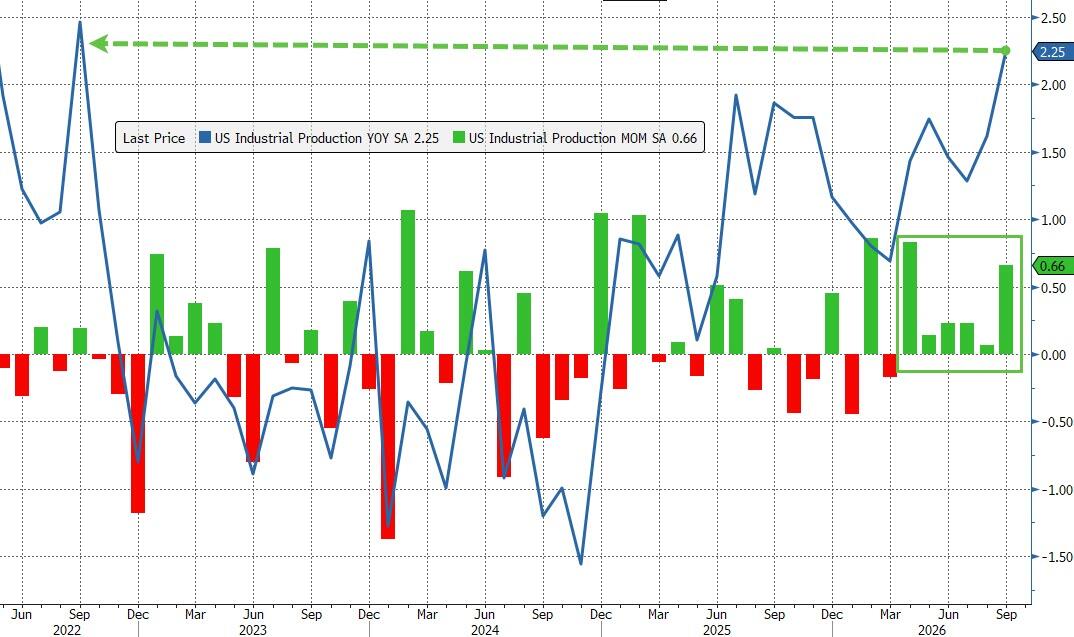
…lifting the annual increase in US industrial production to +2.25% – the highest since Sept 2022.
Utilities were the main driver: +3.5% in September (and a strong +14.8% annual rate in Q3) and Mining picked up.
US Manufacturing rebounded from August’s dip (better than expected)…
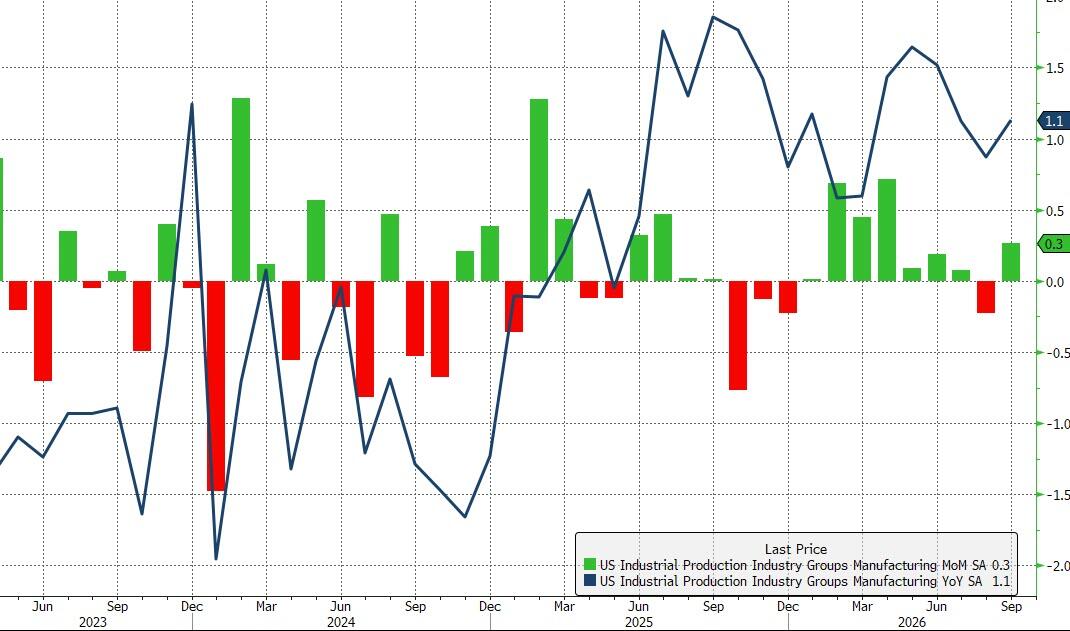
Durable manufacturing was up only slightly as motor vehicles & parts fell 3.0%. Nondurables rose 0.4%, though semiconductors and related components were very strong.
Capacity Utilization also surprised to the upside (76.9% vs 76.5% exp).
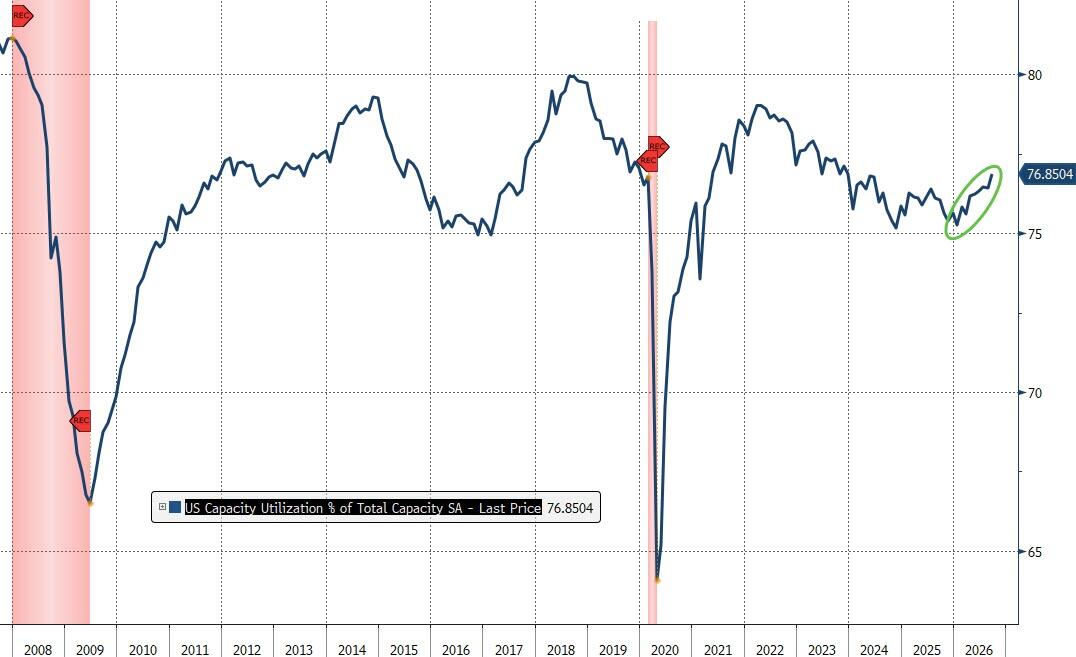
That is the highest since Dec 2023 (but still 2.5 percentage points below its long-run (1972–2025) average).
Nevertheless, it was a clear beat on the side of growth (albeit uneven as autos lagged), driven largely by utilities, with manufacturing showing a modest rebound after prior softness.
END
US Closes Fiscal 2026 With $2 Trillion Budget Deficit, Pays Record $1.4 Trillion In Interest
Friday, Oct 16, 2026 – 03:30 PM
With DOGE disbanded more than a year ago, and tariffs struck down by the Supreme Court, the US is no longer even pretending that there is any hope to normalize spending, or any kind of happy ending to the US debt trajectory.
At 2pm today the US Treasury published the latest, September, monthly budget deficit data, which was also the last month of fiscal 2026, and it will again come as no surprise to anyone that things are looking ever worse.
Total US receipts for the month were $558 billion, a modest 2.6% improvement from the $544 billion a year ago, with individual income taxes accounting for $298 billion, or more than half of the total, and the bulk of the balance coming from Social Insurance and Retirement receipts of $149 billion.
On the spending side, things were ugly: total outlays were $585 billion, a 70% deterioration from the $345.7 billion spent a year ago, although like last month, much of that had to do with the calendar impact of tariffs.
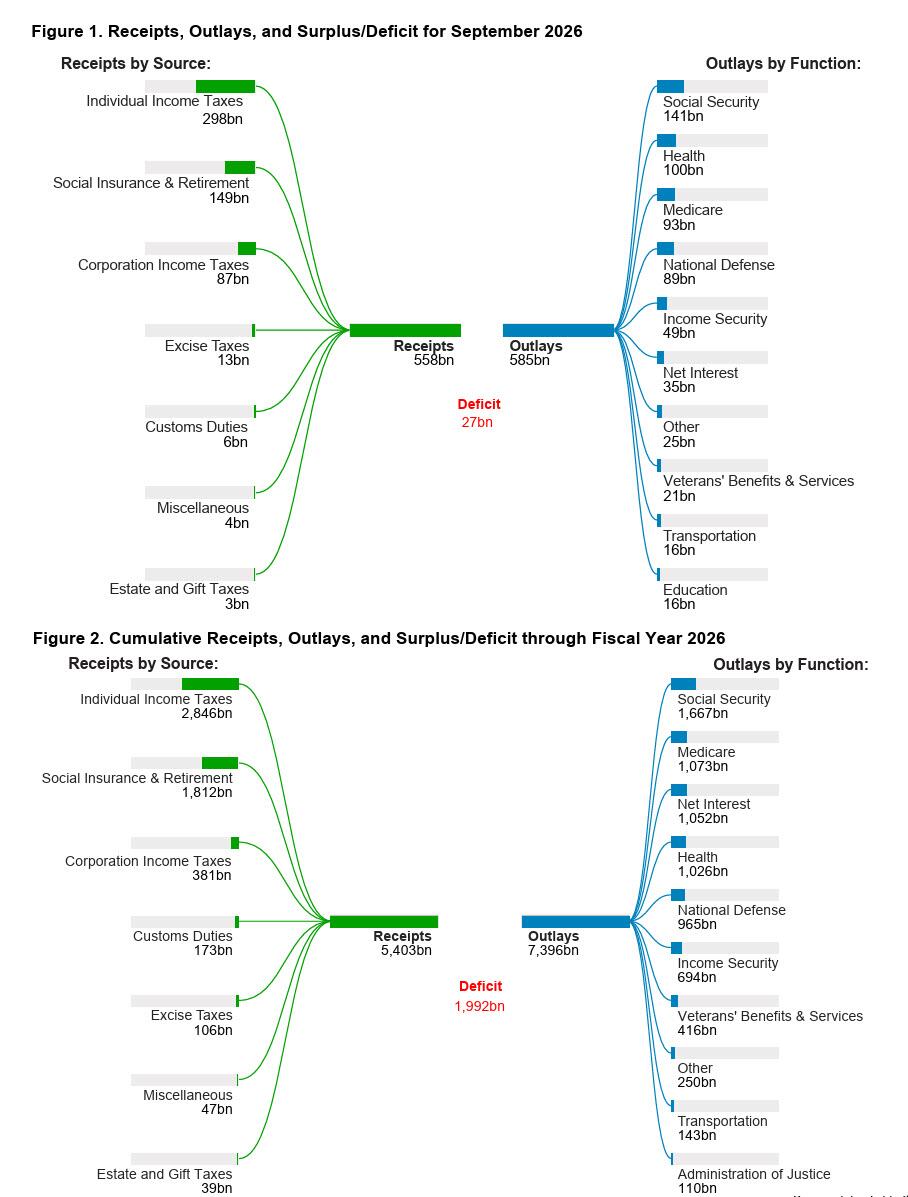
Putting receipts and spending in context, a chart of the trailing 6 months of government revenue and spending shows that the two trendlines continue to diverge with spending on pace to surpass the covid all time high, even as government revenue remains stuck in a much more narrow range.
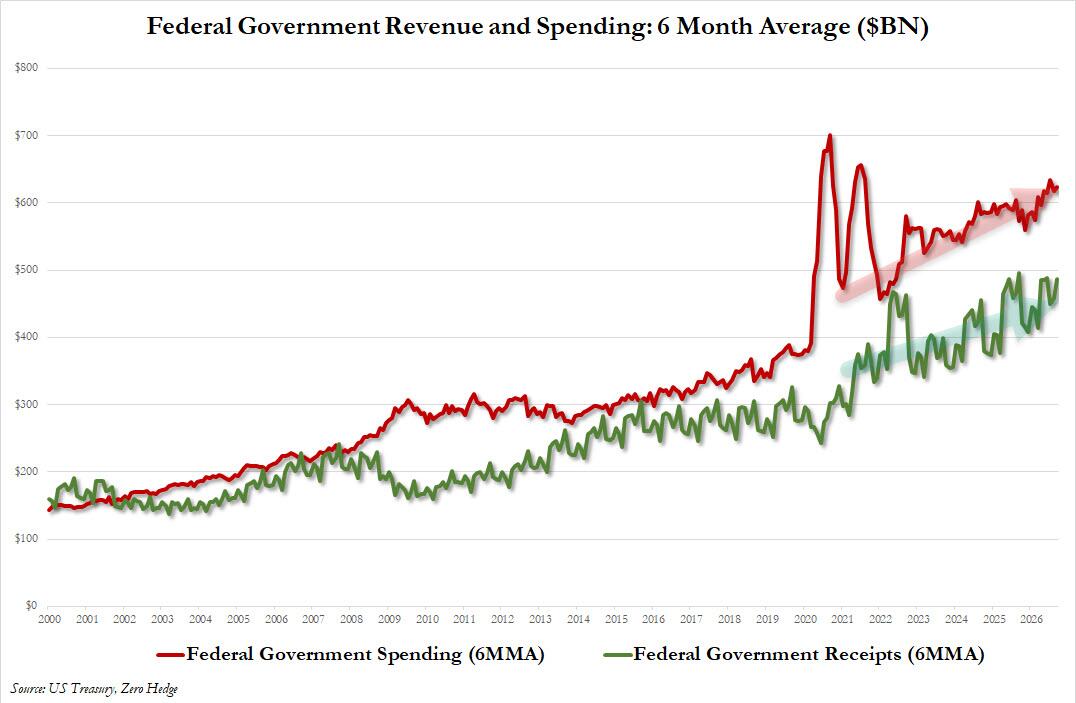
The difference between the two, is of course, the US budget deficit, which in September was $27 billion, an improvement from August’s 167 billion deficit, which however was the result of some calendar discrepancies between the two months.
It’s worth noting that after several months of EPS-boosting tariff refunds (courtesy of the Supreme Court), in September the US was once again collecting net tariff revenues, if at the normal rate from before Trump’s latest trade war.
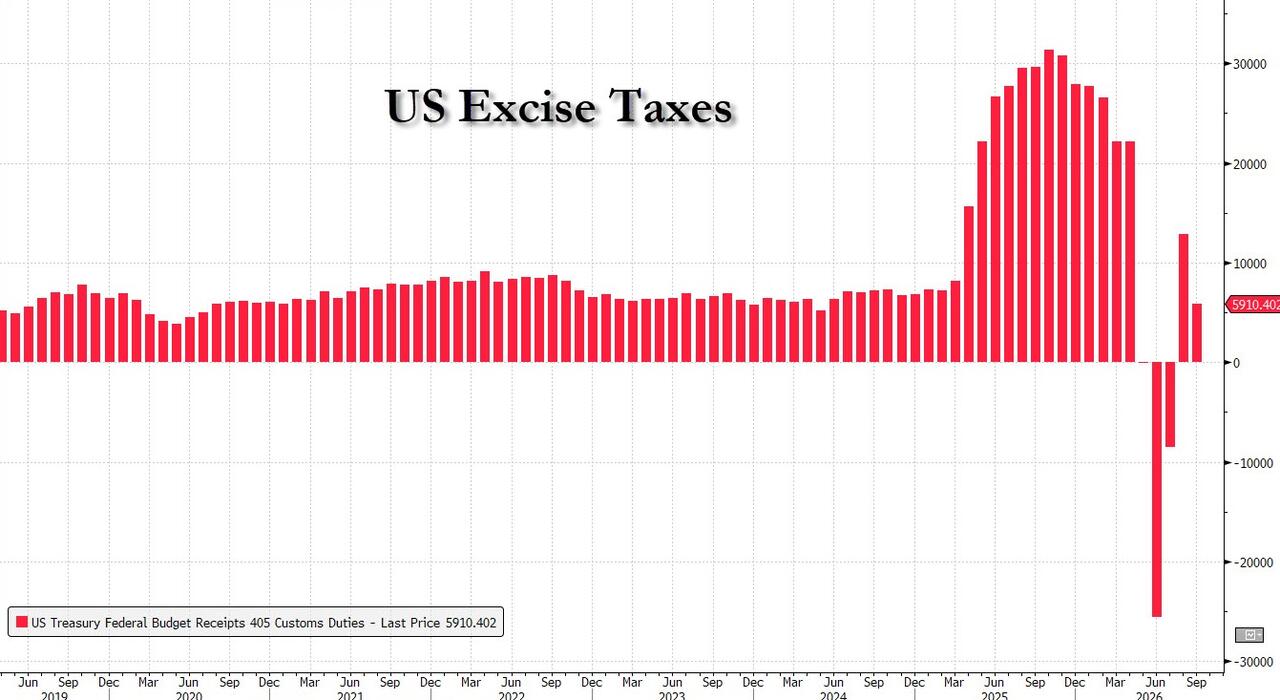
What matters more is that for the full fiscal 2026, total US deficit is closed the year at $2 trillion (technically $1.992 trillion), over $200 billion worse than last year. The silver lining is that contrary to what we said a month ago, when we predicted that “2026 will be about $200bn worse than the previous year when all is said and done, and be the 3rd worst year for the US deficit on record, with just the crisis years of 2020 and 2021 worse”, 2026 was actually just fractionally better than 2023 and its $2.014 trillion deficit.
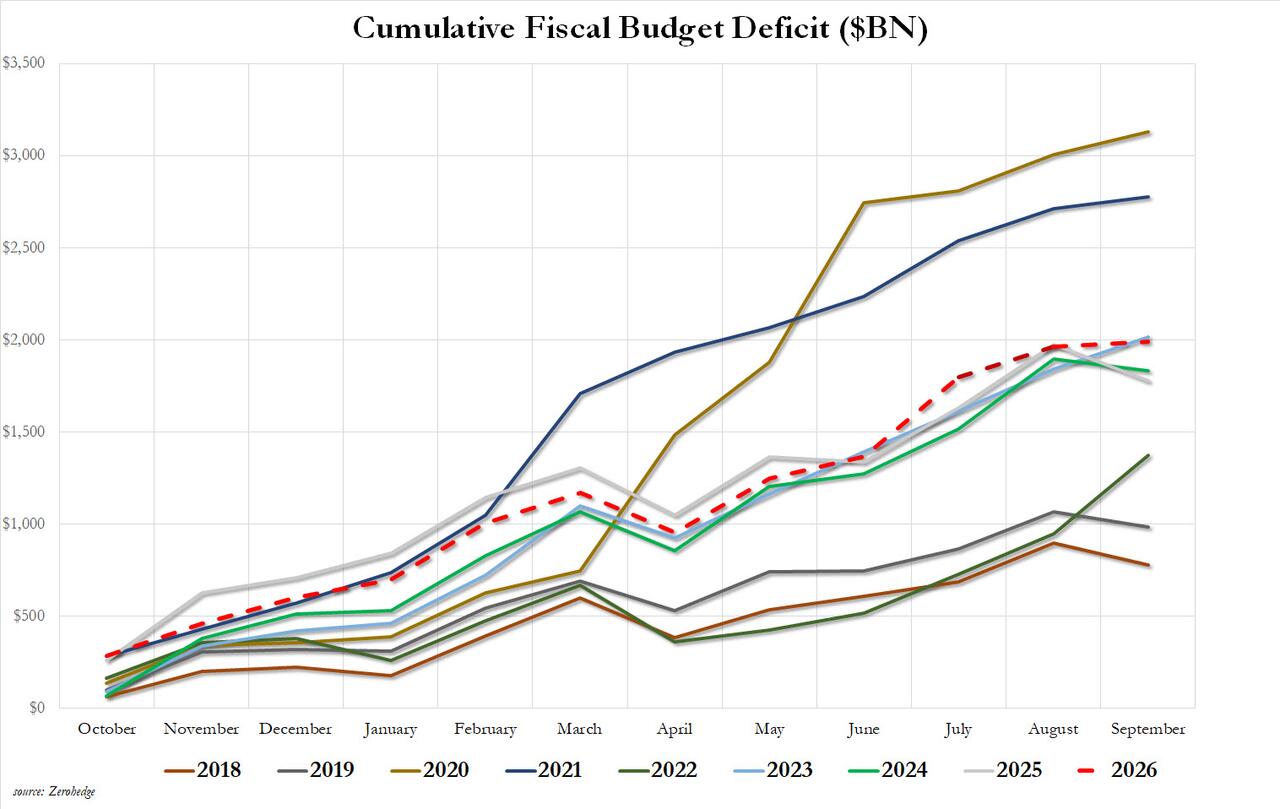
Finally, turning to the elephant in the room, namely interest expense, in September the US spent $92 billion on gross interest expense, which means for all of fiscal 2026, total US interest spending has risen to a record $1.360 trillion, up 12% from a year ago, and the highest on record (as for the net vs gross nazis, in September the US for the first time ever paid net interest of more than a trillion dollars, or $1.05TN to be precise)
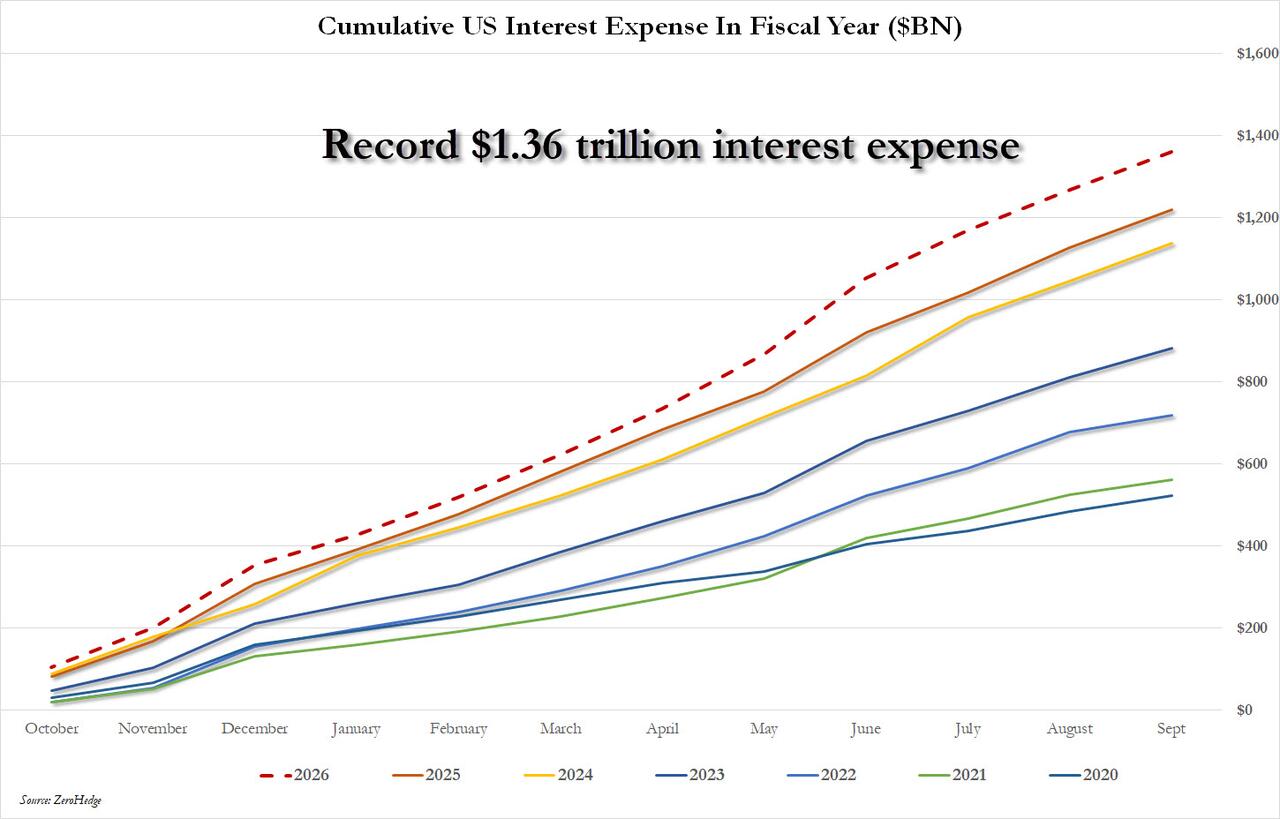
Extrapolating the current trend (and with the recent Fed rate hike our estimate may prove conservative), on an LTM basis, total US interest of $1.4 trillion is set to surpass Social Security (which was $1.67 trillion LTM but growing much slower), by the end of 2028.
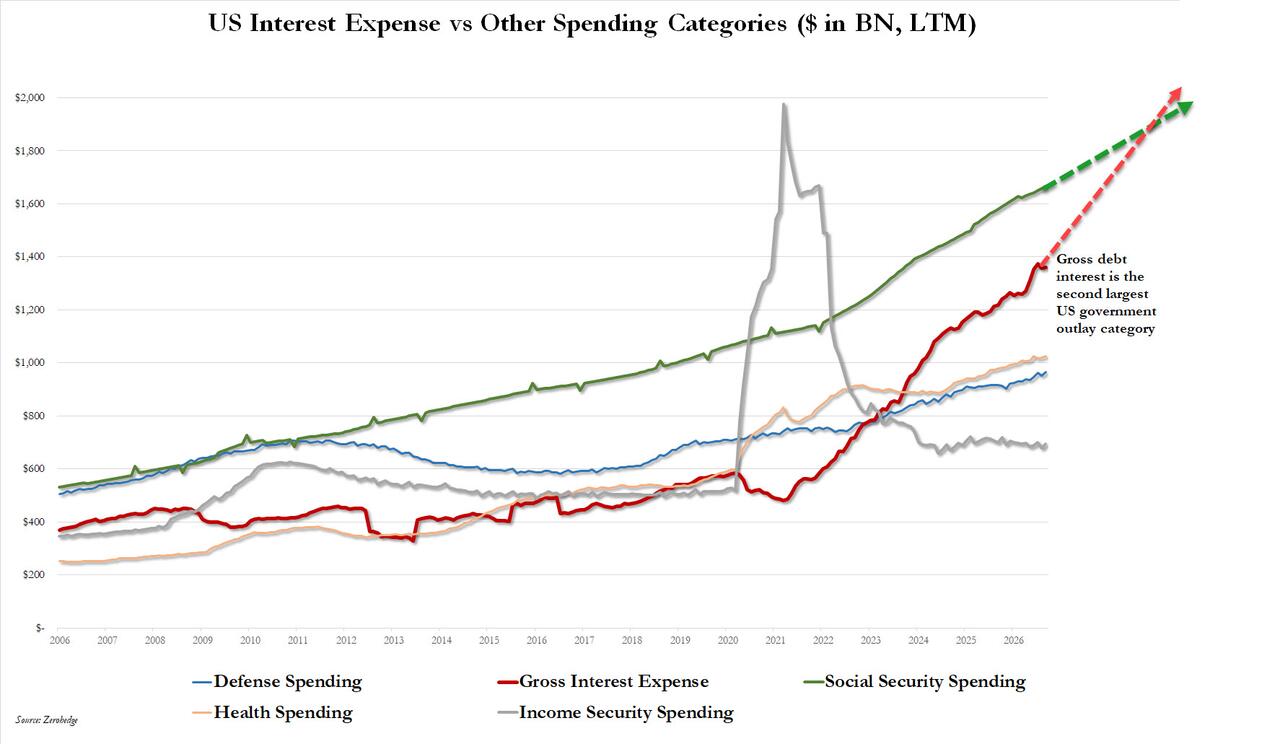
And since 23% of marketable US debt is now T-Bills, which will see an immediate impact from the recent (and coming) Fed hikes, US interest expense is going to rise even more sharply, signaling that while the debt endgame for the US is guaranteed, the only question is whether Warsh will bring it on even faster.
END
USA ECONOMIC REPORTS
they cannnot raise rates: at 4 to 4.25% huge interest costs blow out budgets
(zerohedge)
Rate Hike Odds Tumble After Warsh Does Not Address October FOMC Meeting
Friday, Oct 16, 2026 – 09:26 AM
In our morning wrap we said that market sentiment was boosted overnight following Kevin Warsh’s speech at the IMF meeting in Bangkok, specifically “The day’s driver is Warsh (or rather what he didn’t say): with the blackout starting Saturday, the Fed chair declined to push back on rate expectations and instead talked up a “massive investment surge” from AI.”
Goldman set the context, with its chief economist Jan Hatzius writing in a note overnight that in comments at the IMF’s annual meetings, Fed Chairman Kevin Warsh did not specifically address the FOMC’s upcoming October meeting but said that “in the intermeeting period, the world has broadly conformed to our expectations [at the September meeting].” Hatzius adds that “alongside other recent comments from FOMC participants, Warsh’s comments indicate that the FOMC is set to pause in October. We continue to expect a second and final hike in December.“
Below we excerpt the highlights from Goldman’s note:
- In comments at the IMF’s annual meetings, Fed Chairman Kevin Warsh did not specifically address the FOMC’s upcoming October meeting but said that “in the intermeeting period, the world has broadly conformed to our expectations [at the September meeting].”
- In other recent comments from FOMC participants, Fed Vice Chair for Supervision Bowman said, “I don’t feel any urgency for taking further action at this point.” San Francisco Fed President Daly, speaking after the firmer than expected September CPI report, likewise said that she did not see an urgent need “to decide with a limited set of information.”
- Taken together, these comments indicate that the FOMC is set to pause in October. We continue to expect a second and final hike in December.
- In other comments during his fireside chat, Warsh highlighted that the US is experiencing “a massive investment surge” related to the AI buildout. He also noted that there has been a “synchronous tightening in monetary policy around the world” recently.
Warsh’s comments, or rather lack thereof, coupled with the market’s interpretation that his lack of priming an October hike (which is hardly surprising for a Fed chair who has repeatedly refused to offer forward guidance) means one isn’t coming, was enough to send October rate hike odds sharply lower, or 13%, less than half where they were before Warsh…

… even as odds of a December rate hike rose to new contract highs.
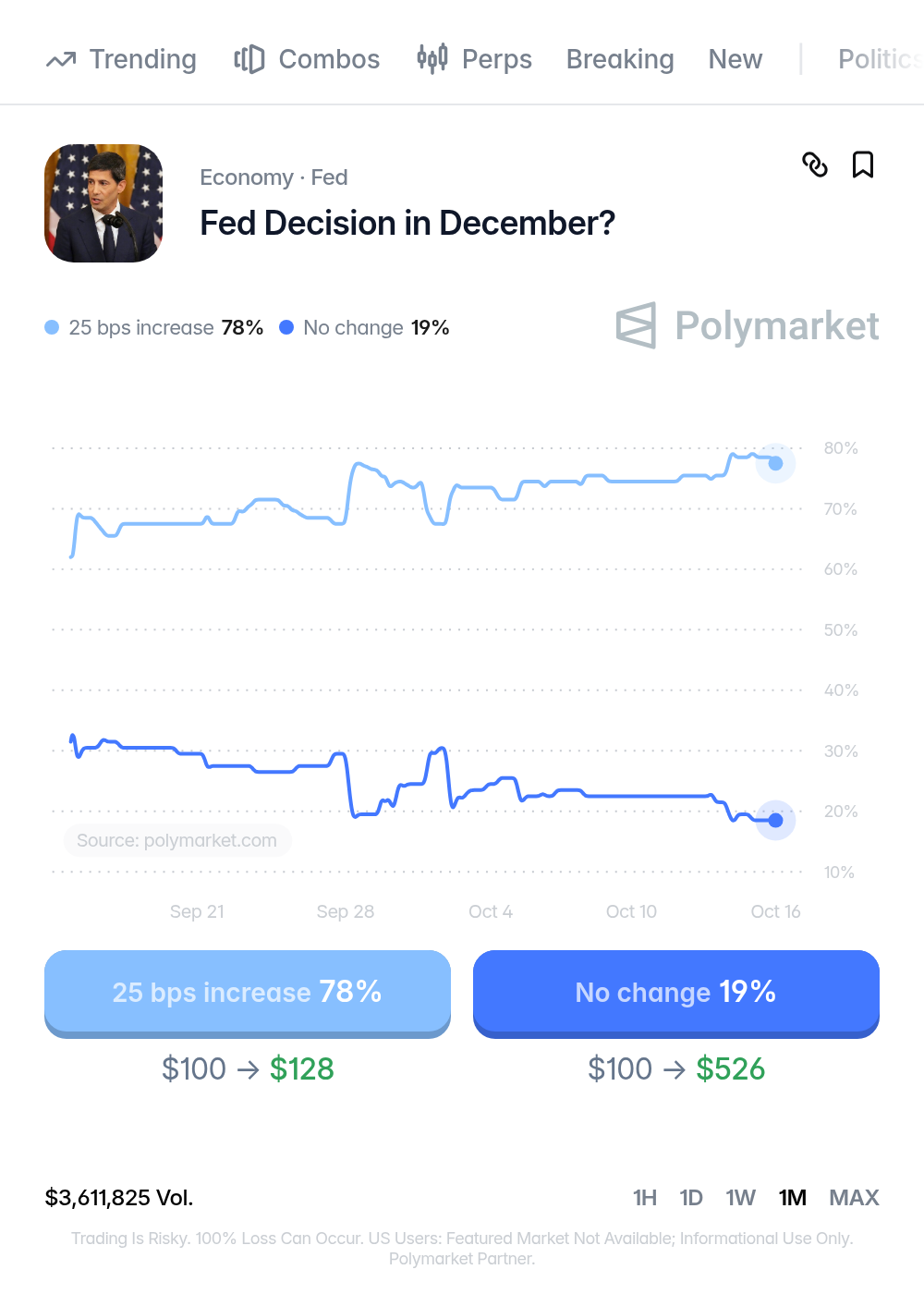
One possible reason for the market’s near certainty that a rate hike is coming in the year’s final FOMC meeting: the Bloomberg Economics Federal Reserve Sentiment Index continues to rise, now at its highest level since 2023
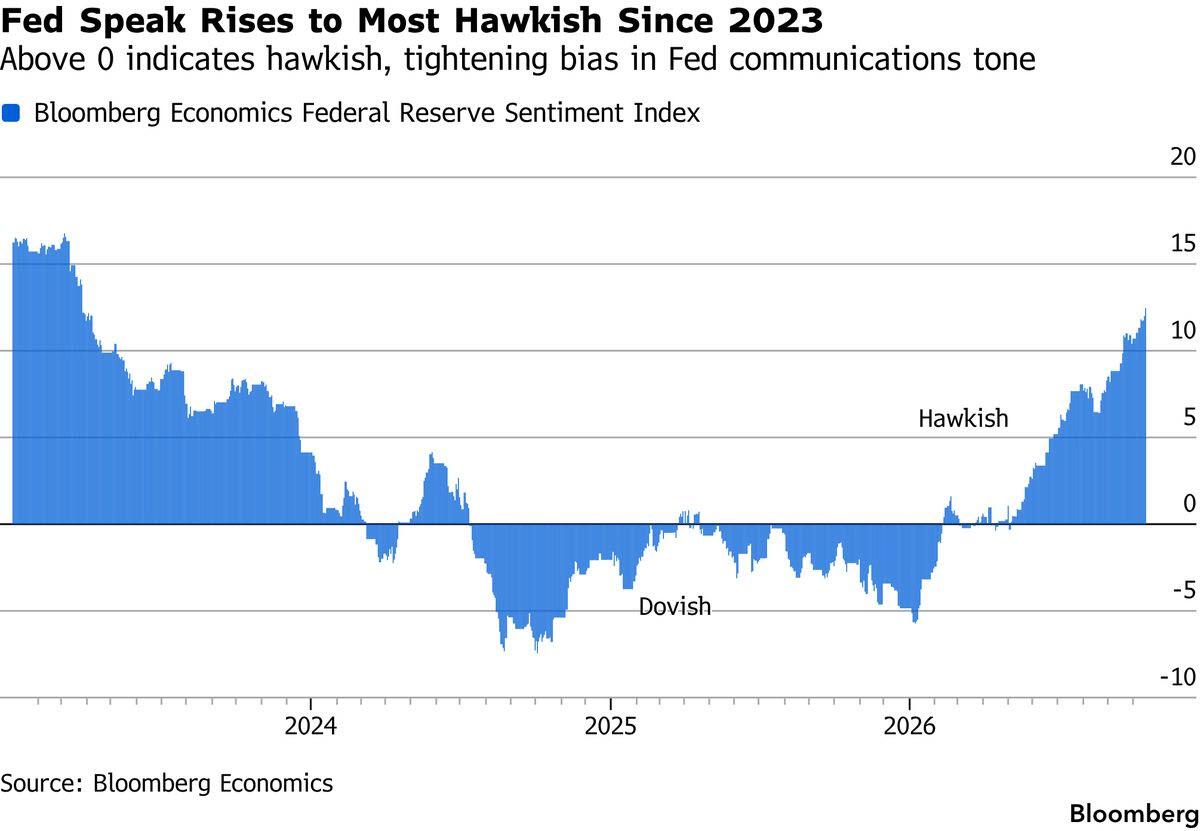
More in the full Goldman note available to pro subs.
MICHIGAN
Whitmer Declares Energy Emergency, Eases Diesel Rules For Farmers
Thursday, Oct 15, 2026 – 06:40 PM
Authored by Kimberly Hayek via The Epoch Times,
Michigan Gov. Gretchen Whitmer declared a state of energy emergency on Oct. 12, citing disruptions to global oil markets from the war in Iran and what she said was the nation’s largest year-over-year rise in average gasoline prices in Michigan.

The order allows certain farm and logging vehicles to use dyed diesel on public roads.
In her emergency order, Whitmer said that Michigan’s farmers and loggers are facing record-high diesel prices, slim margins, and sharp market swings, with some costs passed on to consumers.
“These industries already purchase and maintain substantial supplies of dyed diesel for off-road equipment. Therefore, granting eligible highway-licensed vehicles temporary access to this fuel would provide immediate relief,” she wrote.
Her order suspends specific provisions of the Motor Fuel Tax Act that normally bar such use of dyed diesel.
Global Supply Shrinks
Armed conflicts have tightened crude oil supply, driving up prices for both diesel and regular gasoline.
The hostilities with Iran, which began at the end of February, have slowed shipping through the Strait of Hormuz, the point through which about 25 percent of the seaborne oil trade used to flow, according to the International Energy Agency (IEA). Shortly after the conflict started in March, diesel prices saw their biggest one-week jump on record.
Global diesel markets could remain tight well into next year, with resulting high prices driving inflation and hurting economic growth, as conflicts curb output from the Middle East and Russia, the agency said on Oct. 14.
Combined diesel export losses from the Middle East and Russia totaled 1.3 million barrels per day in September, the agency said.
Pump Prices Bite
The average pump price for a gallon of regular gasoline in the United States was $4.33 per gallon as of Oct. 14, according to the American Automobile Association. Diesel is much higher, at about $6.30 per gallon, reaching a record high of $6.52 at the end of last month.

The emergency order ends when the governor determines the shortage no longer exists, but no later than Dec. 31. Willful interference with the order is a misdemeanor.
Whitmer noted she had issued an earlier order in April that suspended Reid vapor-pressure requirements in gasoline and temporarily lowered consumer prices. She wrote that the federal government created the problem and can fix it.
Whitmer, a Democrat, is term-limited. Michigan Secretary of State Jocelyn Benson, a Democrat, and Rep. John James (R-Mich.) clashed over tariffs on Canada, the war in Iran, and Medicaid in the first debate of the race for Michigan governor on Oct. 6.
Benson blamed the war in Iran for rising fuel prices and said James had voted six times to support the war. Both candidates said they would support suspending Michigan’s gas tax.
Michigan has faced prior fuel-supply disruptions. In 2022, Whitmer declared an energy emergency after a refinery fire in Indiana, temporarily easing certain transport and fuel rules.
END
JUNK BOND SCARE/CORE WEAVE
Who’s Next? Meet The Junk Bonds That Are One CoreWeave Away From Distress

Seven of the 20 junk-rated AI data center bonds depend on one tenant to pay the rent. That tenant’s own bonds now yield 15%…
CoreWeave’s own bonds have entered distressed territory (trading near or below ~80 cents on the dollar with yields around 14–16%), raising questions about the broader set of junk-rated project-finance bonds for AI data centers that rely heavily on CoreWeave as the sole or primary tenant.
zerohedge.com
According to analysis circulating around the ZeroHedge piece (published ~October 15–16, 2026) and related market commentary:
- There are roughly 20 project-finance data center bonds in the high-yield (junk) market totaling about $45.6 billion. These back just over 4 GW of capacity and involve only eight tenants. @zerohedge
- CoreWeave is the tenant on seven of those 20 bonds. Many of these already yield in the low-to-mid teens, reflecting elevated risk from single-tenant concentration, construction/completion risk, and the tenant’s credit quality. @zerohedge
Context on CoreWeave
CoreWeave (Nvidia-backed “neocloud” AI infrastructure provider) carries a large debt load (~$50 billion including leases/obligations in recent reports). Its unsecured notes (e.g., the 9.625% due 2032 and April-issued 2031s) have sold off sharply, with yields hitting levels that credit markets typically associate with distress. Five-year CDS has implied elevated default probabilities (around 60%+ in some recent readings). The company points to a large contracted revenue backlog, and Nvidia has provided certain capacity backstops, but markets are focused on the high leverage relative to cash flows and the scale of ongoing AI buildout financing.
reuters.com
Why the “one CoreWeave away from distress” framing
These are often special-purpose or project-level bonds financing data center construction (or expansion), secured by the underlying assets and long-term leases. When a single speculative-grade tenant like CoreWeave accounts for essentially all the rent, the bonds’ credit profile is tightly linked to that tenant’s ability (and willingness) to pay. Examples of CoreWeave-tied deals mentioned in recent coverage include Blue Owl-sponsored projects (e.g., a ~$1.1 billion five-year junk offering priced around 9.25% in September 2026 for a Virginia campus) and Applied Digital facilities in North Dakota.
bloomberg.com
Other data-center project bonds leased to stronger (often investment-grade or hyperscaler) tenants have generally held up better, though some broader AI infrastructure credits have also seen price pressure amid the recent selloff. Market observers note that yields on the CoreWeave-dependent names already embed significant risk premiums for tenant credit + construction/execution risk.In short, the article highlights concentrated single-tenant exposure in a sizable slice of the junk AI data-center bond market. If CoreWeave’s credit continues to weaken, those seven bonds (and potentially related credits) are the most directly exposed. The full ZeroHedge article is behind a paywall, but the core statistics and framing match the contemporaneous discussion on X and in financial media.
END
THEN: THIS SPELLS TROUBLE!!
CoreWeave Founders Cashed Out $3.3 Billion Before The Meltdown
Friday, Oct 16, 2026 – 08:20 AM
Before CoreWeave imploded, its three co-founders had been busy dumping stock, a lot of it, totaling $3.3 billion since the company’s March 2025 IPO. The AI cloud provider rents access to Nvidia-powered data centers that fuel the AI circular financing scheme. Its unsecured bonds due in 2032 have crossed into distressed territory, and its five-year CDS spreads have blown out as debt levels at hyperscalers and neocloud providers come into question.
Michael Intrator, Brian Venturo and Brannin McBee sold $2.4 billion this year alone, according to Bloomberg’s new report on corporate filings.
Intrator has sold more than $907 million in shares this year. McBee’s sales since the IPO total $1.06 billion, equivalent to 40.4% of his undiluted stake at the listing. Venturo has sold more than $1.2 billion, representing over 35% of his original holding.
As musician Kenny Rogers once sang, “You got to know when to hold ’em, know when to fold ’em, know when to walk away, and know when to run…”
CoreWeave shares have plunged more than 50% from their May peak, erasing $15 billion of the founders’ paper wealth.
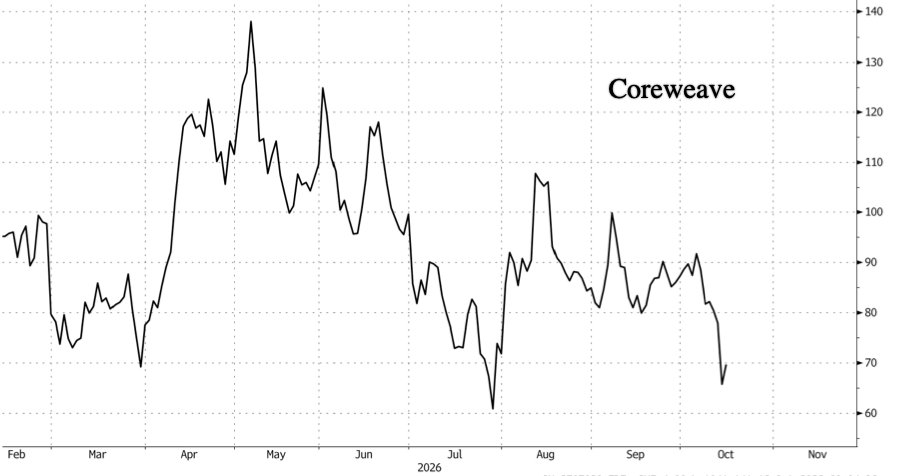
By late in the week, CoreWeave’s 2032 bonds traded at deeply distressed levels. The 9.625% notes due in 2032 tumbled to nearly 76 cents on the dollar, a level that typically signals distress.
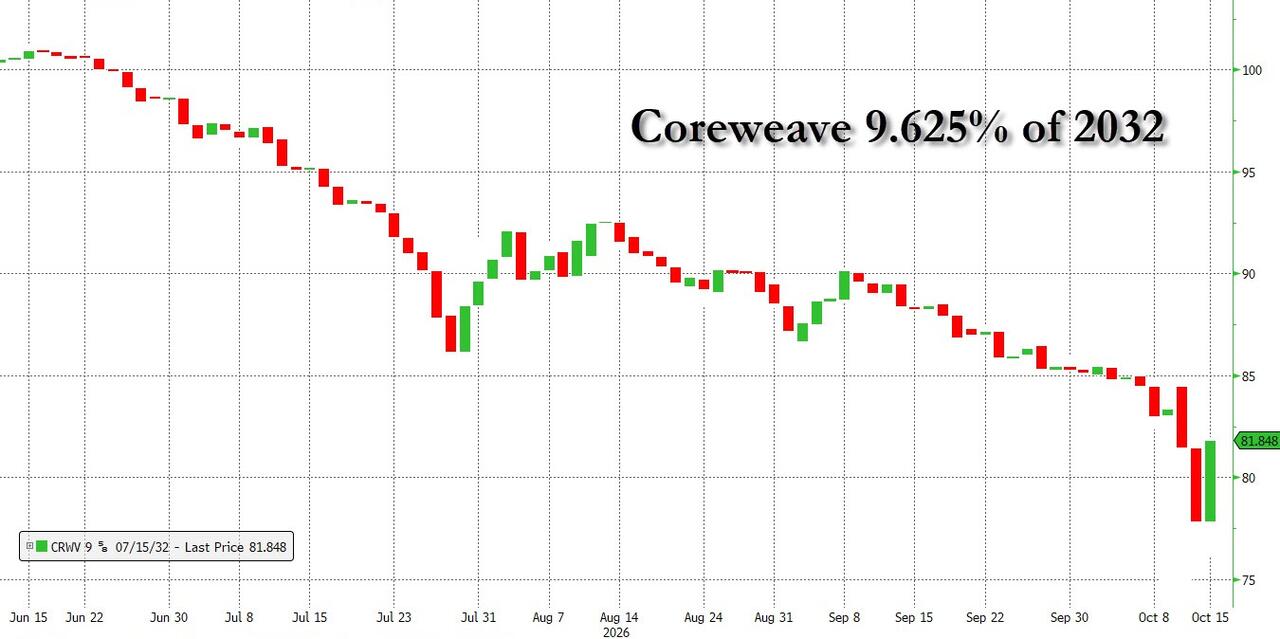
CoreWeave’s CDS spread had also reached a record of 1,117 bps by the end of the week, implying 63% odds of a default within five years.
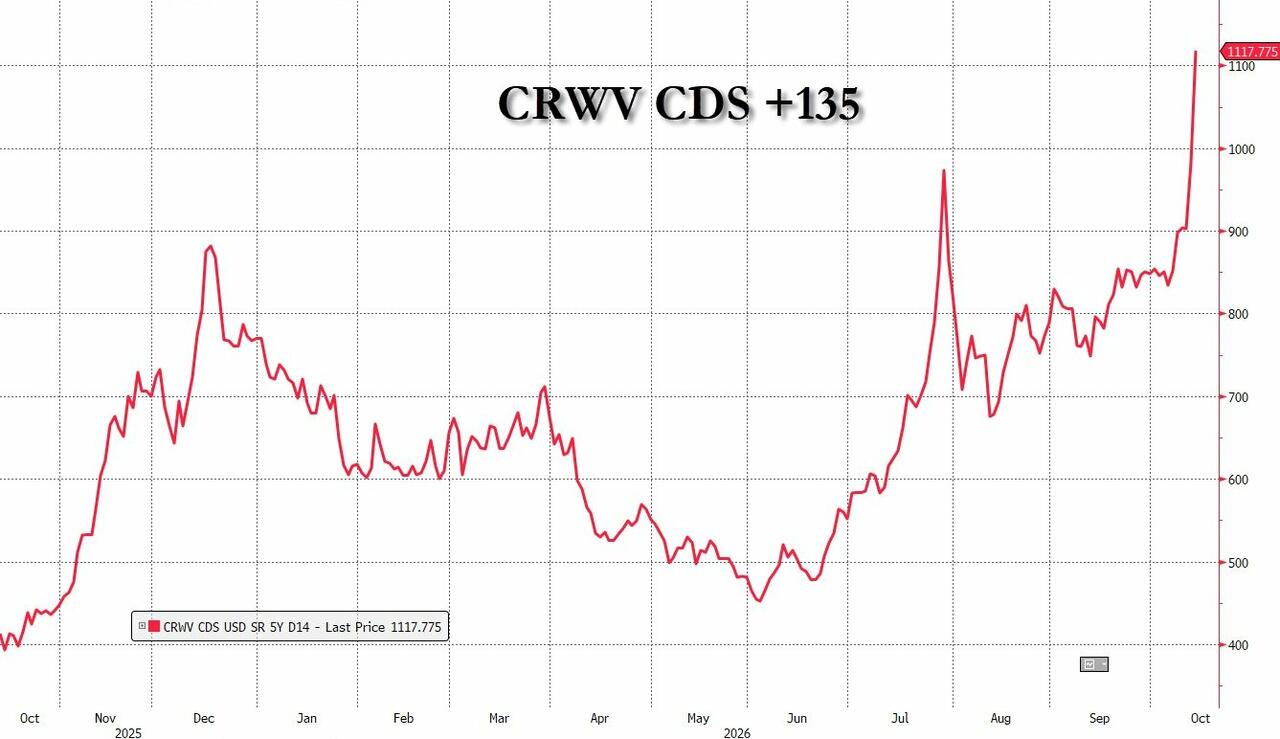
On Thursday, we laid out why Gartner expects over 80% of neoclouds to fold, and we hinted at the big problem: CoreWeave is the borrower on its own unsecured bonds, and it is also the tenant that is supposed to pay the rent on a big chunk of the junk-rated data center bonds issued by other companies. If CoreWeave’s cost of capital is “decreasing” at 16%, what does that make the cost of capital for the companies whose bonds are backed by CoreWeave’s lease payments?
Related:
Deutsche Bank chimed in:
Charting CoreWeave’s top executives dumping stock:
Michael Intrator
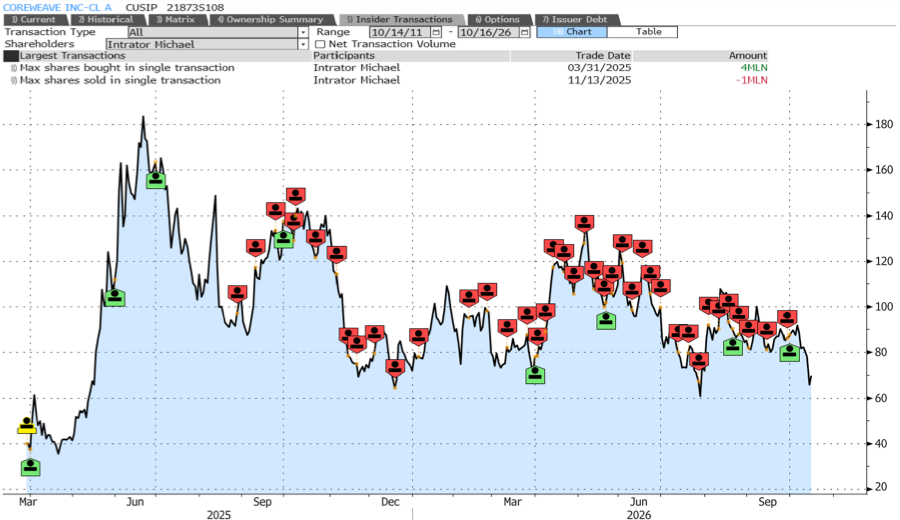
Brian Venturo
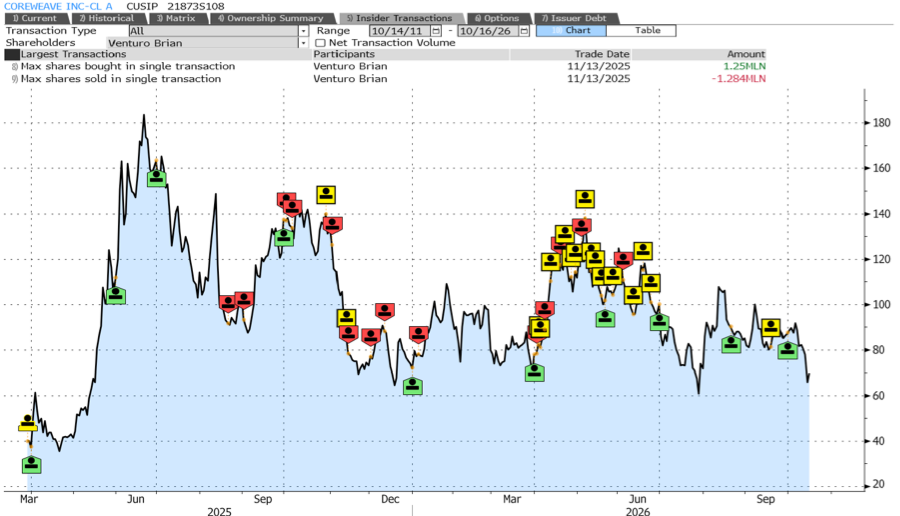
Brannin McBee
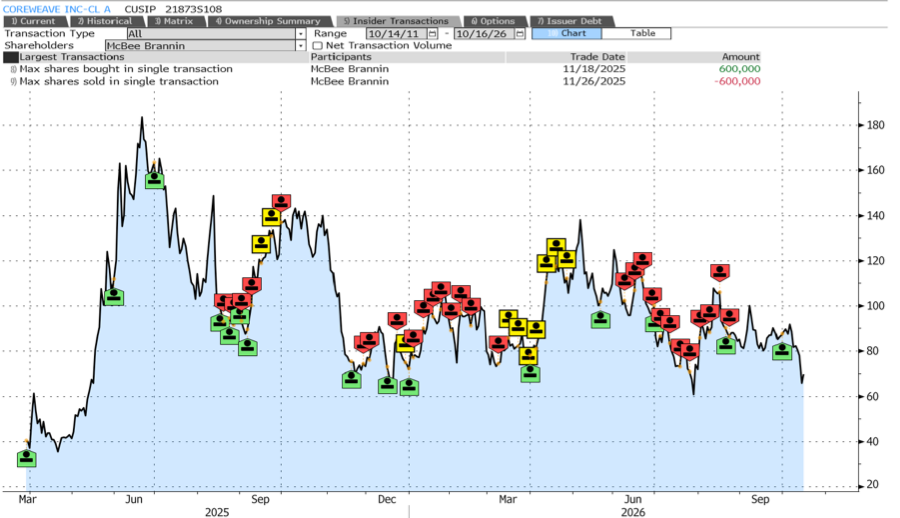
Kenny Rogers said it best: “You got to know when to hold ’em, know when to fold ’em, know when to walk away, and know when to run…”
END
Who’s Left Holding The ‘CoreWeave’ Collapse Bag? Investment Advisors Quintupled AI Datacenter Bond Holdings This Year
Investment advisors (and broader fixed-income investors in bond funds, ETFs, private credit, and insurers) who aggressively bought into AI datacenter debt—including CoreWeave’s high-yield bonds—during 2026’s boom are the ones most exposed as the bonds have turned distressed.
businessinsider.com
CoreWeave (CRWV), the Nvidia-backed “neocloud” that rents GPU compute for AI workloads, has become the clearest stress point in the AI infrastructure credit market this week (mid-October 2026). Its unsecured bonds (e.g., the 9.625% notes due 2032 issued in June at par, and 9.75% notes due 2031) have fallen into distressed territory—trading around 75–80 cents on the dollar with yields surging to ~15–16%. Credit default swaps imply roughly a 60%+ chance of default within five years. The stock has also plunged (as much as ~15–17% in a day, with weekly losses exceeding 15%), though it partially rebounded after Nvidia CEO Jensen Huang voiced support.
reuters.comContext on the debt load and sell-offCoreWeave has roughly $50–52 billion in debt (up sharply from ~$15 billion a year earlier), funded via chip-backed loans, high-yield bonds, convertibles, and other facilities. It remains loss-making, with rising interest expense (e.g., $640 million in Q2) and heavy ongoing capital spending needs to build capacity. The company cites a large contracted backlog ($104+ billion as of mid-year, plus additional commitments) that it says covers obligations, and Nvidia has a capacity backstop through 2032. Critics note the business model relies on borrowing at high rates to earn thinner spreads on rented compute, creating vulnerability if AI demand slows, refinancing costs stay elevated, or rates rise further.
reuters.com
The pain is not isolated. Broader data-center project bonds (SPVs tied to leases with Meta, Microsoft, Nvidia, Oracle, etc.—such as Hyperion/Beignet, Hut 8 projects, QTS Project Excalibur) have also sold off below par (often to the low- to mid-90s or lower), reflecting investor reassessment of execution risk, power/permitting delays, overbuild concerns, and whether AI revenues will fully support the debt. Analysts have called CoreWeave a “canary in the coal mine” or the AI trade’s stress case.
news.futunn.com
Who holds the exposure?
- Private credit and large institutions: Early and major lenders/buyers include Blackstone, Magnetar, Pimco, Carlyle, BlackRock, Coatue, DigitalBridge, and others via GPU/contract-backed loans and project financings. Pimco has been a notable large buyer of certain hyperscaler/data-center paper. reuters.com
- Bond funds, insurers, and the broader market: High-yield and investment-grade funds, plus life insurers seeking longer-duration assets, absorbed much of the surge in AI-related issuance (hyperscalers alone issued well over $100–170+ billion in 2026; total AI-related debt estimates run into the hundreds of billions). Some of this paper enters indexes and thus passive portfolios.
- Investment advisors / RIAs and retail channels: The ZeroHedge framing highlights that advisors quintupled holdings of AI datacenter bonds this year while the trade was hot (“the trade nobody could afford to miss”). This reflects the flood of supply into public and private markets that then reached advisory platforms, mutual funds, and client portfolios. Specific named holders of CoreWeave paper in public data include vehicles like Fidelity Convertible Securities Fund and Nomura High Income Fund (smaller positions disclosed). reuters.com
Exact current ownership of every bond tranche is not fully public in real time (many deals are 144A private placements limited to qualified institutional buyers), but the rapid increase in advisor/fund exposure during the 2026 issuance boom means those channels are left holding positions marked down sharply as yields blew out and liquidity thinned. Equity holders (including institutions like Magnetar, Nvidia, Vanguard, BlackRock, Jane Street, etc.) face parallel pressure, but the “collapse bag” framing centers on the credit side where prices have entered classic distress territory.
businessinsider.com
In short, the buyers who chased the high yields and AI narrative in 2026—especially advisors who scaled up client exposure—are the ones marking losses or facing illiquid, higher-risk positions now that credit markets have repriced the leverage and execution risks in the buildout. Company executives and supporters argue the backlog and demand justify the debt; markets are currently pricing in substantial doubt.
END
Aftershock: Anthropic IPO Investors Mark Valuation Down To $1.5 Trillion As Growth Slowdown Sinks In
Investors are discussing a lower ~$1.5 trillion valuation for Anthropic’s planned November 2026 IPO (down from prior expectations around $2 trillion), after Q3 sequential revenue growth slowed to 45% and amid broader worries about AI financing costs.
reuters.com
This follows Anthropic’s investor day on Wednesday in San Francisco. According to Reuters (citing four people familiar with the matter), some current and prospective investors reacted to the latest disclosures by tempering expectations. Three of those sources said attendees discussed a valuation of about $1.5 trillion.
reuters.com
Key financial details shared
- Q3 revenue reached $16.8 billion, up 45% from the prior quarter.
- The company was profitable on an adjusted basis in the quarter.
- Earlier in 2026, revenue more than doubled from Q1 (~$4.7 billion) to Q2 ($11.6 billion).
- 2025 revenue had surged roughly twelvefold to nearly $4.6 billion, though the company posted large operating losses that year (over $8 billion on an operating basis, excluding certain writedowns). reuters.com
The absolute numbers remain extremely strong by historical standards for a company of Anthropic’s age, and the adjusted profitability helped ease some concerns about the massive costs of developing frontier AI models. However, the deceleration in sequential growth disappointed some investors who had seen hyper-growth earlier in the year. Broader market concerns about the ballooning capital intensity of AI (including Anthropic’s large multi-year cloud/compute/infrastructure commitments, previously reported in the hundreds of billions) also factored in.
zerohedge.com
ZeroHedge framed the development as an “aftershock” that arrived quickly after analysis of the run-rate numbers suggested growth was hitting the brakes. Other coverage notes potential ripple effects on the wider AI sector and on expectations for rival OpenAI’s anticipated listing.
zerohedge.comAnthropic’s last major private valuation was in the high hundreds of billions (around $965 billion after a large Series H round earlier in 2026). A $1.5 trillion IPO mark would still represent a substantial step-up, though meaningfully below the peak $2 trillion talk that had circulated. The IPO timing remains tied to a November window after U.S. midterms, with major banks involved as underwriters. Valuation discussions can shift further based on final roadshow feedback, full public filings, and market conditions.
END
CALIFORNIA/STEEL MILL
California Erects First Steel Mill In Half-Century
Thursday, Oct 15, 2026 – 10:20 PM
Pacific Steel Group is building California’s first new steel mill in more than 50 years, a Kern County rebar plant whose cost has grown by about $160 million since the project was announced.

The company broke ground on the Mojave Micro Mill in March 2025. The governor’s office says Pacific Steel won a $30 million California Competes tax credit in 2024 in exchange for committing to more than $540 million in capital investment and nearly 450 new jobs in the mill’s first five years of operation.
The same release puts total expected job creation at nearly 700, the figure American Greatness uses below.
As American Greatness notes further, local officials are sweetening the deal with a lucrative $3 million tax incentive that could reward the company with approximately $7,500 for every new job created.
Democrat Gov. Gavin Newsom’s office released a statement saying, “This project will bring steel manufacturing back to the Golden State and localize the supply chain – supporting a transition to clean, in-state manufacturing of materials essential for public infrastructure like roads, bridges and hospitals.”
The construction of the new mill is surprising to many, considering the state’s Democratic lawmakers and residents lean more toward green energy over that produced by fossil fuel.
Mark Olson, Pacific Steel’s vice president of mill operations, told the SF Gate that the project will deliver “the only steel plant in California that both melts and rolls steel products.”
Olson added, “Our state-of-the-art facility will demonstrate that large-scale industrial manufacturing can thrive in California while leveraging the state’s commitment to renewable energy and a more sustainable industrial future.”
Pacific Steel officials confirmed this week that although the project is running on time, the cost has ballooned from $540 million to about $700 million.
The manufacturing powerhouse is expected to employ welders, electricians, millwrights, computer systems engineers and specialists in automation and robotics.
end
OREGON//ANOTHER SHOOTING SPREE/SUSPECT DEAD
Another Mass Shooter Stopped By Armed Citizen In Oregon
Friday, Oct 16, 2026 – 09:40 AM
Three children and one adult are dead following an active shooter situation at Silver Rail Elementary in Bend, Oregon on Thursday afternoon. The suspected active shooter is also dead after an armed civilian chased the shooter into the school and killed him.
The shooter was reportedly a 16-year-old boy, though no details on identity or motive have been releases yet. He was armed with a long gun; an anonymous law enforcement source told the Associated Press it was a pump-action shotgun purchased legally by his mother.
Police responded to the school at about 12:59 p.m. after receiving a report that an unknown man had shot into a car. Deschutes County 911 dispatchers received multiple calls reporting that someone had entered the school and started shooting. By the time they arrived, the assailant was already dead.
Unfortunately, three children (ages 5, 8, and 11) and one teacher were killed before the shooter was stopped. A 7-year-old child and a 54-year-old teacher were also critically injured. Both were transported to St. Charles Medical Center in Bend.
Victim names have not been officially released.
While the identity of the shooter is still under wraps, commenters are already suggesting that the attack might be yet another case of a transgender lunatic on a rampage. It should be noted that the state of Oregon has one of the highest rates of teens and children undergoing transgender treatments in the US.
If this is the case, then the incident may be buried by the establishment media. It might also be sent down the memory hole because of the successful intervention of an armed citizen. The narrative for decades within the media was that armed civilians rarely if ever stop violent crimes.
The Crime Prevention Research Center (CPRC) has repeatedly examined the definitions used by the FBI to categorize civilian interventions in violent crimes, and they found significantly higher numbers of such cases than the FBI had reported. In other words, the FBI was suppressing the actual data on civilians saving the day, often with their own firearms.

One recent CPRC count identified 615 active shooter incidents from 2014–2025 and concluded armed citizens stopped 225 of them (about 36.6%). When limited to locations where civilians are legally allowed to carry (i.e., excluding gun-free zones), the rate rises to roughly 52–53% (and higher in some recent single-year examples).
CPRC attributes the gap to the FBI missing or overlooking numerous incidents and occasionally misclassifying civilian interventions (for example, listing private armed citizens or volunteer church security as professional security guards). They argue their expanded list still uses the FBI’s core definition and that media coverage tends to under-emphasize successful civilian interventions.
While gun control advocates often cite mass shootings as a reason for banning of weapons (or outright confiscation), these incidents account for only 2% of all gun deaths in the US on average. The majority (around 60%) are suicides, and 35% are homicides.
Around 20% of US counties account for 90% of all homicides in the country. Of these counties, the vast majority are controlled by Democrats. Among the worst 1% of US counties (about 31 counties, holding ~20% of the population and ~41% of murders in recent data), the CPRC lists political leanings as 21 Democratic strongholds, 6 leaning Democratic, and 4 swing or Republican-leaning.
In other words, the counties with the most aggressive gun control advocates and laws in the US are also the places with the most gun violence. Perhaps it’s because law abiding citizens in these places are far less likely to carry, which emboldens criminals to commit more violence.
KING NEWS
| The King Report October 16, 2026 Issue 7849 | Independent View of the News |
| September PPI is shocking; +1.3% m/m & 6.3% y/y; 0.5% m/m & 5.3% y/y, were consensus. Core PPI 0.5% m/m & 5.0% y/y; 0.3% m/m & 4.4% y/y were expected. This is the highest m/m PPI inflation since March 2022. https://www.bls.gov/news.release/pdf/ppi.pdf Retail Sales jumped 0.8% m/m and 6.3% y/y in September. 0.3% m/m & 5.2% y/y were expected.Ex-Autos 0.9% m/m & 7.2% y/y; 0.5% m/m expected. Ex-Autos & Gas 0.2% & 5% y/y as expected.Yes Virginia, soaring gasoline prices produced the larger than expected retail sales. Gasoline Stations +6.4% m/m & +28.1% y/y. https://www.census.gov/retail/sales.html Initial Jobless Claims 199k, 200k expected; Continuing Claims 1.71mThe geopolitical situations regarding Russia, Ukraine, and Iran worsened considering. Zelensky accused Trump of betraying Ukraine, the FT alleges that Trump is pressuring European nations to unfreeze Russian funds, DJT foes & friends are blasting him. And Iran is mobilizing, including missiles.US considering using ‘mother of all bombs’ against Iran, sources sayA second source told CNN that military plans for striking Iranian nuclear sites, including Pickaxe Mountain, also explicitly call for using the MOAB…https://www.cnn.com/2026/10/15/politics/us-considering-mother-of-all-bombs-iran?Date=20261015&Profile=CNN@FoxNews: The U.S. is building up military firepower in the Middle East as Iran prepares for the possibility of another major round of fighting. President Trump says the conflict will end quickly, “one way or the other,” claiming much of Iran’s leadership has already been eliminated.But with Tehran declaring itself ready for war and Washington continuing to move forces and ammunition into the region, the possibility of renewed combat remains a serious concern…@Reuters: Ukraine has resumed its attacks on Russian refineries with a strike at an installation in the Ryazan region, the regional governor said, after Ukrainian President Volodymyr Zelenskiy voiced his anger at a ‘dangerous’ withdrawal of US intelligencehttps://www.reuters.com/world/zelenskiy-says-ukraine-will-resume-strikes-russian-refineries-ft-reports-2026-10-15/Zelensky said the reason for the resumption of refinery attacks is Trump lied to him by deliberately blocking Starlink but alleging it was a ‘technical glitch,’ and telling Ukraine that the missed ballistic missile warnings earlier this week was due to ‘bad weather.’ Six Ukrainians died in the attack.CNN reports Ukraine has run out of Patriot missiles.FT: US floats unfreezing some Russian assets to restart Ukraine peace talksNewsMax: The plan, pitched by U.S. special envoy Steve Witkoff and Jared Kushner, President Donald Trump’s son-in-law, would involve transferring some of the assets into a special-purpose financial vehicle overseen by Washington, according to the FT, which cited four people briefed on the matter.One person briefed on the talks told the newspaper that European officials made clear the proposal would not be accepted… (A slush fund controlled by Team Trump!)https://www.yahoo.com/news/politics/articles/us-floats-unfreezing-russian-assets-232316092.htmlReuters: Merz says frozen Russian assets must stay in Europe amid reported US proposalThe WSJ reports Republican Congressman Brian Fitzpatrick has threatened to cut funding to US federal agencies involved in restricting Ukraine’s military access to Starlink.‘Kissing Putin’s A**’: GOP Congressman Unloads on Trump’s Latest Russia MovesBacon and other pro-Ukraine Republicans have found the timing of the diesel deal especially difficult to stomach. It came less than a month after Congress passed a law that allowed the president to sanction countries that import diesel from Russia — a move meant to help Ukraine’s war effort…https://www.nationalreview.com/news/kissing-putins-ass-gop-congressman-unloads-on-trumps-latest-russia-moves/@OlenaRohoza:: Journalist: “Regarding Russia: According to Ukraine, Russia struck six energy facilities yesterday. What information do you have?” Trump: “Well, Ukraine struck many facilities the day before. But Ukraine attacked… Russia did not violate the ceasefire.”https://x.com/OlenaRohoza/status/2110296416656449741@nexta_tv: Lavrov: “There will be no ceasefire just so Zelensky can be supplied with weapons again”The Kremlin continues to mock US peace initiatives while blaming Ukraine for derailing the negotiationshttps://x.com/nexta_tv/status/2110731167200669908Russia targets Ukraine with ‘massive’ aerial attack, including hundreds of drones, Zelenskyy saysMoscow has chosen to “deliberately” escalate it’s attacks, Kyiv said. https://abcnews.com/International/russia-targets-ukraine-massive-aerial-attack-including-850/story?id=137279786&cid=social_twitter_abcnThe defensive asset allocation that appeared on Wednesday continued Thursday. Bonds soared; stocks fell. AI stocks sank as the South Korean Kospi tumbled again. ‘Safe’ Fangs were bought.Near 11:00 ET: MU -0.62%, NVDA -2.11%, SNDK -3.41%, SPCX -3.26%, AMD -4.41%, INTC -5%, TSM -2.69%, APPL +0.45%, MSFT +0.66%; S&P 500 -0.02%; DJIA +0.76%, DJTA +0.4%, Nas 100 -0.85%, Nasda1 -0.53%, SOX Index -2.51%; USZs +1 28/32But Nvidia CEO Huang used his mighty shilling skills to boost CoreWeave and stocks in general.Nvidia’s Huang Signals CoreWeave Financials Improving, With Decreasing Cost of CapitalSpeaking at an event in Stockholm,… “CoreWeave’s strength is improving every day,” Huang said. “I’m optimistic. Their cost of capital is actually decreasing.”…The company’s stock plunged 15% on Wednesday and dropped as much as 9.5% on Thursday before paring back some losses following the CEO’s remarks. (CoreWeave closed +5.94%!)https://finance.yahoo.com/markets/stocks/articles/nvidias-huang-signals-coreweave-financials-172500723.htmlThe S&P 500 Index gapped lower on the opening (7687.31, -31.63 pts) and quickly fell to a daily low of 7669.66 at 9:57 ET. The relief rally then commenced. As part of a 5-wave rally, the S&P 500 rallied to 7738.21 at 11:15 ET. The 3 wave went to 7745.15 (daily high) at 13:30 ET; and the 5 wave took the S&P to 7754.15 at 15:03 ET. An ABC decline closed the S&P 500 Index at 7744.06, +0.33%. Positive aspects of previous session S&P 500 +0.33%, DJIA +1.08%, DJTA +1.4%, Nasdaq +0.08%; USZs +1 10/32AI and tech stocks rebounded sharply from their lows on Huang’s CoreWeave toutSP Health Care +1.84%, Materials +1/71%, Financials +1.38%, Consumer Discretionary +1.16%, Real Estate +1.0%, Comm Services +0.62%, Industrials +0.49%, Consumer Staples +0.37%Dec Brent -$0.23, Nov Diesel -11.54c, and Nov Gasoline -9.54c at 16:28 ET Negative aspects of previous session Nas 100 -0.05%; SOX -0.88%; USZs rescinded about half of their rally. Nov WTI +$2.47SP Energy -1.55%, Info Tech -0.54%, Utes -0.21% Ambiguous aspects of previous session Did defensive asset allocation, buy bonds/sell stocks, occur on Wednesday? First Hour/Last Hour NYSE Action [S&P 500 Index]: 1st Hour: Up; Last Hour: Down Pivot Point for S&P 500 Index [above/below indicates daily trend to day traders]: 7729.29 Previous session (S&P 500 Index) High/Low: 7774.15 (15:03 ET); 7669.66 (9:57 ET) Greenland contradicts Trump’s claim that ‘massive’ oil and gas drilling is about to begin therehttps://www.cnn.com/2026/10/14/politics/trump-greenland-oil-gas-minerals-intl-hnkSome pundits believe that bonds have rallied sharply since the CPI Report, and even more robustly after the PPI Report, because the inflation reports will force the Fed to hike rates, which is what bonds desire.Fed Balance Sheet: +$8.079B on +$3.891B of T-Bills; Reserves -$7.519Bhttps://www.federalreserve.gov/releases/h41/20261015/Today – The defensive asset allocation and the rotation out of AI stocks that appeared on Wednesday continued Thursday. Given the sharp decline in NQZ as we write, it appears AI stocks will be under pressure when the NYSE opens.But traders have been buying the opening weakness – and today is an Expiration Friday. So, the usual suspects will play for the Friday Rally and a manipulation to squeeze expiring October calls. Expected economic data: Sept Import Prices 0.8% m/m, Export Prices 1.0% m/m; Sept Industrial Production 0.4% m/m, Mfg. Production 0.3% m/m, Capacity Utilization 76.5%; Sept Budget -$29B;ESZs -13.25; NQZs 142.00, USZs +7/32, Nov WTI -$0.48, Nov Gas -3.81¢, ¥/$ 158.15 at 20:00 ET S&P 500 50-day MA: 7708; 100-day MA: 7597; 200-day MA: 7266 (Close 7744.06, +0.33%)Nasdaq 100 50-day MA: 29,872; 100-day MA: 29,630; 200-day MA: 27,720 (Close 19,935.59, -0.05%) DJIA 50-day MA: 52,498; 100-day MA: 52,209; 200-day MA: 50,422 (Close 52,177.69, +1.08%) (Green is positive slope; Red is negative slope) @foxnewspolitics: Battleground Republicans are breaking from Trump with increasing frequency just three weeks before midterms… At least two House Republicans, Reps. Jen Kiggans and Mike Lawler, are actively touting conflict with the president in campaign ads… Rep. Tom Kean of New Jersey doesn’t mention the president on his campaign website at all…Vulnerable Republicans have broken from Trump on data centers, the Iran war, and his plan to import foreign beef. The White House insists Trump remains “the unequivocal leader” of the party…https://www.foxnews.com/politics/battleground-republicans-break-trump-key-issues-final-midterm-sprint Trump changes tone on midterms as GOP fears election rout“I’m here whether we win this or not,” he told reporters in Arizona and Montana…https://www.msn.com/en-us/news/other/trump-changes-tone-on-midterms-as-gop-fears-election-rout/ar-AA2ejewz?ctsrc=dgst&ocid=winp2fptaskbarent&cvid=e1933ec04f6e4e7a9b42c54a9cdd3df8&ei=6What might save the GOP: The Dem field includes some repulsive socialists, communists, and US-haters. @realDonaldTrump: Sadly, and very stupidly, John Cornyn, and his Liddle’ Buddy, Super RINO, Karl Rove, are doing everything possible to make it hard for Ken Paxton, the Greatest Attorney General in the History of Texas, and one of the Best in the United States, to win the upcoming Midterm Election against a Radical Left Lunatic, James TalaFREAKO, who is the ANTITHESIS of Texas Values. John Cornyn who, after my Endorsement, lost the Primary to Ken by a very wide margin, and Karl Rove, who shouldn’t be allowed to spew his jealousy on FoxNews, should be ashamed of themselves. They are hurting Texas and, more importantly, hurting the United States of America! If Ken Paxton loses, it will be because of WEAK and INEFFECTIVE Political Hacks like John Cornyn and Karl Rove, who have ineffectively opposed me for my entire political career. As your ALL TIME WINNER in the History of Texas, “Trump won 96% of the Counties in Texas, 242 of 254. Harris won only 12 counties (FoxNews),” and by MILLIONS of Popular Votes, the Highest in the History of Texas, your favorite President (ME!) is asking all of those who supported Senator John Cornyn to UNITE, and immediately switch your support to Ken Paxton. He will be a Great Senator, just like he is a Great Attorney General. We cannot take a chance on having a FREAKO, sometimes referred to as James TalaFREAKO, as our man in Washington, D.C., representing the magnificent people of the Great State of Texas… Voters in Fox News poll list government corruption as top concern, beating inflation, healthcareNearly 90 percent of 1,202 respondents to the Fox News poll said they were either extremely or very concerned about government corruption… (Inflation 85%) A clear majority of respondents also were either extremely or very concerned about gas prices, at 83 percent, and healthcare, at 80 percent…https://thehill.com/homenews/administration/6151433-fox-news-corruption-concerns-poll-midterms/https://x.com/clashreport/status/2110797244177764472/photo/1 @CBSNews: President Trump said he “probably went a little too far” by taking out Iranian leaders during the war and Iran made him promise “not to take out any more.” “I might’ve gone too far,” he told rallygoers in Arizona on Wednesday. “I don’t know who the hell to deal with.”https://x.com/CBSNews/status/2110516204267827536 White House probes claims of missing Kennedy Center money in “MAGA blood feud”Former Trump attorney Alina Habba told the president that another one of his top advisers — former Kennedy Center leader Ric Grenell — failed to deposit a multimillion-dollar donation that her billionaire husband made to the center a year ago, according to four senior administration officials and three insiders briefed on the controversy… https://www.axios.com/2026/10/14/trump-kennedy-center-donation-maga-feudIconic Plaza Hotel shutting down for four years (restorations), and condo sellers are in for ‘a little bit of pain’ https://trib.al/tVnRjzA(Not a parody) Trans neo-Nazi teen accused of Hindu temple mass shooting plot will get hormone treatments in jail: judge (Chicago media struggled to avoid the trans stuff) https://trib.al/eDQ8N7P-END- | |
SWAMP STORIES FOR YOU TONIGHT
Federal Judge Tosses Ex-CIA Chief Brennan’s ‘Speculative’ Lawsuit Against Trump Admin
Friday, Oct 16, 2026 – 08:35 AM
Authored by Debra Heine via American Greatness,
A federal judge on Thursday threw out former CIA Director John Brennan’s lawsuit, which sought to compel the Trump administration to preserve records for his defense against potential criminal charges, ruling that he lacked standing.
The Department of Justice is investigating claims that Brennan and other national security officials conspired to undermine President Donald Trump.
The suit, filed in July 2026, sought to compel the Justice Department to retain investigative records so Brennan could prove any indictment against him was the result of vindictive or selective prosecution by the Trump administration.
Judge Jia Cobb, a Clinton-appointed judge, described Brennan’s allegations of political targeting as “deeply concerning,” but determined the claimed injury was “speculative” and not yet imminent, as no indictment has been filed.
Brennan was President Barack Obama’s CIA director from March 2013 to January 2017, and before that, Obama’s counterterrorism adviser.
He is facing indictment in at least two investigations: the broader “grand conspiracy” probe into the 2016 election interference inquiry and a separate case regarding alleged false statements made to Congress in 2023.
Prosecutors in the Southern District of Florida are examining allegations that Obama and Biden-era intelligence and law enforcement officials conspired to deprive President Trump of his civil rights through various investigations, from the 2016 Russia probe and the intelligence community assessment to the Mar-a-Lago classified documents case and related matters.
According to the Republican-led House Judiciary Committee, Brennan “made numerous willfully and intentionally false statements of material fact” during his testimony in 2023, including:
- Falsely denying that the CIA relied on the discredited Steele dossier in drafting the post-2016 election Intelligence Community Assessment; and
- Falsely testifying when he told the Committee that the CIA opposed including the Steele dossier in the Intelligence Community Assessment (ICA).
- These statements were contradicted by the record established by the House Permanent Select Committee on Intelligence (HPSCI) and the CIA, the committee stated in a press release in October 2025.
Newly declassified documents show:
- A CIA officer drafted the annex containing a summary of the dossier;
- Brennan made the ultimate decision, along with then-FBI Director James Comey, to include information from the dossier in the ICA; and
- Brennan overruled senior CIA officers who objected to the inclusion of the dossier material.
The former CIA director argued in his lawsuit that because he planned to contest any prosecution that arises from the DOJ’s probes as vindictive and selective, internal records and communications would be needed to establish that in court.
Brennan alleged that President Trump had singled him out in retaliation for his role in the Russian collusion hoax.
Cobb appeared to that aspect of Brennan’s case seriously, saying that “if he was eventually able to prove those allegations true, that would certainly suggest that his potential prosecution is vindictive.“
But at this point, the judge said it remains to be seen that Brennan is facing enough harm to bring the lawsuit.
“Even taking all of Brennan’s allegations to be truthful at this stage,” the judge wrote, “the injury he alleges is simply too attenuated from the actions he seeks to enjoin to warrant a finding of standing here.”
END
MAMDAMI/NEW YORK
Mamdani Moves To Ban Horse Carriages From NYC, Drivers React
Friday, Oct 16, 2026 – 10:10 AM
Authored by Nicholas Zifcak via The Epoch Times,
Mayor Zohran Mamdani has confirmed that he and the City Council speaker have agreed to phase out carriage horse rides in Central Park, a win for animal rights activists who have long opposed the rides.

The mayor said he would make sure workers and owners are protected as the rides wind down, with an end date of June 1, 2028.
“I think that we have a civic responsibility to ensure that we are not leaving anybody out to dry,” Mamdani said at an unrelated press conference Oct. 14. The City Council announced it will vote on the bill ending carriage rides on Oct. 22.
The Transport Workers Union, which represents the carriage drivers, denounced the text of the bill as noncommittal, with “no meaningful economic relief for workers.” The bill does not require the city to compensate the 68 owners for their city-issued license or medallion.
Mamdani said the city’s plan will become more explicit and options are still being discussed. The mayor said he would make sure owners and workers won’t be made to pay “for the sunsetting of an industry.”
However, drivers say they feel they have been treated poorly, and that the City Council has no solid justification for the ban.
In a statement, the union denounced City Council Speaker Julie Menin for what it described as using “the tragic death of a tourist to contrive a public safety crisis.”
On June 17, Romanch Mahajan, 18, a tourist visiting from India, was thrown from a carriage after the horse spooked and bolted during a ride with his family. Mahajan hit his head and died. After his death, Menin announced her support for the ban in a video on X.
Carriage horse drivers argue the issue is not public safety. Mahajan’s death is the first in more than 160 years of horse-drawn carriages operating under the union in Central Park, compared to as many as 28 deaths related to bikes, e-bikes, and scooters on New York streets in 2026 alone. Menin and Mamdani have yet to set new safety measures on e-bikes and scooters.
Animal rights groups have long sought to end the carriage horses in Central Park, launching social media campaigns whenever there is a horse-related incident, such as the death of a carriage horse named Deniz on June 9 after he ate Japanese yew growing in the park.
Animal rights group New Yorkers for Clean, Livable, and Safe Streets (NYCLASS) reacted on X to the ban.
“For decades, NYCLASS fought to end cruel and dangerous horse carriages,” it wrote. “It took the extraordinary courage, compassion, and unwavering leadership of Speaker Menin.”
Drivers say that the horses are well-treated and that extensive city rules govern their feeding schedule, what time of day they can work, as well as the temperature range during which horses are not allowed to work (18 degrees or colder, 90 degrees or warmer). The city also mandates an eight-hour workday and five weeks of vacation time for the horses every year.
‘No Way!’
Carriage license owner Ahmet Bilici, who trained as a veterinarian in Turkey before coming to the United States in 2001, became a carriage driver to support himself as he was learning English. The job stuck, and he’s been a driver for 23 years. He said that if the City Council wanted to work with carriage drivers, drivers would be amenable, but that City Council just wants a ban.
“When you take this carriage from me, I am going to lose my quarter century! No way!” he said. “I trusted the city because the city licensed the medallion, and now you are shutting down? No way!”
Bilici said the ban will hurt 300 families if you count support staff, which includes stable workers, blacksmiths producing horseshoes, and craftsmen making saddles.
“This is my small business, my investment. It’s like my house. You’re burning my house!”
Bilici said that if the city shuts down the carriage rides, it must compensate drivers.
“There’s no way we can accept this,” he said.
Another driver, Danielle Slot, also said she was extremely disappointed. She thinks there is no solid justification for the ban.
“Our City Council is supposed to look out for people and represent people, and they’re supposed to see through these things,” said Slot, referring to the long-term campaign of NYCLASS head Steven Nislick to ban carriage horses, which dates to 2008.
Slot previously worked with horse-drawn carriages on Michigan’s Mackinac Island, a 4-square-mile island in Lake Huron that never welcomed automobiles and still relies on horse-drawn carriages.
“I’ve just completely lost faith in the government here, which is very sad,” said Slot. “It feels like they’re capitalizing on sensationalism.”
Slot said she voted for Mamdani.
She said City Council members are unaware of the realities of the equine industry, thinking as if a new home can easily be found for horses where they won’t need to work. The proposed ban requires owners to make sure horses are not sold off to other carriage drivers out of state.
“It’s a really nice thought that there would be some magical sanctuary. But it’s just not realistic,” said Slot, who added that caring for horses costs thousands of dollars a year. She said those on the City Council supporting the bill either don’t know, or they don’t care.
Slot moved to New York to work as an actor and is still pursuing her career in the performing arts. She said she came to New York in part “because this is a place where I feel like people are protected, people can be who they want to be,” but she said her experience with the ban on horse-drawn carriages makes her feel the political system is compromised.
END
TD And BMO Among 9 Banks Accused Of Discriminating Against Conservative Customers, US Regulator Says
Friday, Oct 16, 2026 – 02:15 PM
Authored by Jennifer Cowan via The Epoch Times,
A U.S. banking regulator’s report has flagged the Bank of Montreal and TD Bank alongside seven other financial institutions accused of restricting financial services to certain American customers because of their conservative political or religious beliefs.

The U.S. Office of the Comptroller of the Currency (OCC) has published a report based on its findings during a supervisory review of debanking practices across nine major banks under its jurisdiction, based on 100,000 complaints at institutions it regulates. Debanking is when a bank or financial institution suddenly closes a customer’s bank accounts or refuses to provide financial services.
Joining the two largest Canadian banks on the OCC’s list were JPMorgan Chase & Co. – the world’s largest banking institution – plus Bank of America Corp., Citigroup Inc., Wells Fargo & Co., U.S. Bancorp, Capital One Financial Corp., and PNC Financial Services Group Inc.
The OCC says its review stemmed from a presidential directive issued by Donald Trump last August which mandated that U.S. citizens cannot be excluded from accessing financial services based on their religious convictions or political viewpoints.
Comptroller of the Currency Jonathan Gould says the banks named in the report “denied, debanked, and discriminated against customers and lawful businesses” between 2020 and 2025.
“Americans should have access to financial services regardless of their beliefs, affiliations, or political views,” Gould said in a press release. “Fair access to financial services is not a mantra – it is a mandate. The Trump Administration is committed to ending the weaponization of finance against hardworking Americans, once and for all.”
TD did not immediately respond to a request for comment on the report, while BMO directed The Epoch Times to a previously issued statement from the Bank Policy Institute.
“We support efforts to establish clear and consistent standards that promote access while maintaining sound risk management, including the administration’s recent efforts to prioritize supervisory attention on material financial risk and rather than reputational risk,” the statement said.
“We look forward to continued engagement with the administration and Congress as they consider additional proposals that ensure that political or religious beliefs do not unfairly affect customers’ access to banking services.”
The regulator’s report presents examples from the financial institutions of practices it deemed to be an issue. Here’s a look at some of the complaints.
TD
TD was listed in the report several times, notably for its management of accounts belonging to an organization dedicated to advancing pro-life advocacy and a faith-based health care sharing ministry.
The OCC reported that the bank instituted a policy requiring that loan requests from the pro-life non-profit organization be flagged for review by TD’s reputational risk committee.
The organization’s national director was also identified by the bank as having a “high political and media profile,” the report found.
TD’s line of credit to the faith-based health ministry was determined by the bank to carry a “reputation risk,” if the relationship became public knowledge through media coverage or advocacy groups critical of the group’s operations.
The bank determined that the group’s “moral and religious requirements” to access services conflicted with “TD’s values of diversity and inclusion.”
BMO
The report highlighted BMO’s approach to firearms-related businesses, noting that in 2022 the bank assessed the “reputational risks” of lending to a longstanding customer that manufactured empty firearm magazines and other tactical products.
“The customer was part of a family of companies that had a ‘strong relationship’ with the bank dating back several decades,” the report said.
BMO’s environmental and social risk policy directed account managers to understand their customers’ businesses and work with those whose practices did not meet the bank’s firearms and ammunition guidelines to bring them into compliance before the next credit decision. If existing customers refused to meet the requirements, managers were expected to work toward ending the banking relationship.
A senior risk officer ultimately approved maintaining the relationship but required ongoing monitoring. The bank also established a quarterly threshold requiring tactical products to account for less than 30 percent of the customer’s total sales.
Other Findings
The report listed several examples of payment processor WePay, which is owned by JPMorgan, closing customer accounts because of their political or religious views.
One of these instances occurred in February 2021, when WePay closed the account of a merchant that sold merchandise promoting Trump’s Make America Great Again (MAGA) brand.
It also closed accounts later that year of a merchant that sold “conservative/ republican” t-shirts and hats, as well as that of a customer that it deemed to be a “religious conservative non profit with strong anti LGBTQ rhetoric.”
Another merchant saw its account shut down after handling transactions for an upcoming event, prompted by social media commentary from the event’s organizer that described then-President Joe Biden and Dr. Anthony Fauci as enemies and characterized Black Lives Matter activists as Marxists.
JPMorgan Chase said in a statement that it has since “improved the way we do business” and prohibits discrimination against customers based on political or religious views.
The OCC did not announce any bank penalties in its report, but it signalled that it is currently reviewing additional regulatory and supervisory measures to avert similar occurrences in the future.
The U.S. Consumer Financial Protection Bureau responded to the report in a press release this week by promising to address any “harm” caused by the debanking.
It said it would “fully investigate whether the institutions featured in OCC’s report and others have complied with federal consumer financial laws and take appropriate action.”
GREG HUNTER…


