
EXCHANGE: COMEX
CONTRACT: OCTOBER 2026 COMEX 100 GOLD FUTURES
SETTLEMENT: 4,159.500000000 USD
INTENT DATE: 10/16/2026 DELIVERY DATE: 10/20/2026
FIRM ORG FIRM NAME ISSUED STOPPED
190 H BMO CAPITAL MARKETS 100
363 H WELLS FARGO SECURITI 100
661 C JP MORGAN SECURITIES 543 120
709 C BARCLAYS 200
737 C ADVANTAGE FUTURES 1
905 C ADM 8
991 H CME 32
TOTAL: 552 552
MONTH TO DATE: 13,072
GOLD: NUMBER OF NOTICES FILED FOR OCT./2026: 552 CONTRACTs NOTICES FOR 55,200 OZ or 1.717 TONNES
total notices so far: 13,072 contracts FOR 1,307,200 OZ OR 40.659 TONNES
SILVER NOTICES: 18 NOTICE(S) FILED FOR 90,000 OZ /
total number of notices filed so far this month : 3280 CONTRACTS (NOTICES) for 16.400 million oz
GLD
SHANGHAI CLOSED UP 14.64 PTS OR 0.39%
HANG SENG CLOSED UP 142.11 PTS OR 0.52%
Nikkei CLOSED DOWN 298.29 PTS OR 0.96%
//Australia’s all ordinaries CLOSED UP 0.08%
//Chinese yuan (ONSHORE) CLOSED UP AT 6.6812
/ OFFSHORE CLOSED UP AT 6.6814 Oil DOWN TO 99.56 dollars per barrel for WTI and BRENT DOWN TO 107.00 Stocks in Europe OPENED ALL RED
ONSHORE USA/ YUAN// WITH YUAN TRADING 6.6812 OFFSHORE YUAN TRADING UP TO 6.6814 ONSHORE YUAN TRADING ABOVE LEVEL // OFF SHORE AND UP ON THE DOLLAR)// / AND THUS STRONGER/OFF SHORE YUAN TRADING UP AGAINST US DOLLAR/ AND THUS STRONGER
XXXXXXXXXXXXXXXXXXXXXXXXXXXXXXXXXXXXX
ONSHORE YUAN: CLOSED UP TO 6.6874
| Gold | Ounces |
| Withdrawals from Dealers Inventory in oz | nil |
| Withdrawals from Customer Inventory in oz | 1 ENTRIES i) JPMORGAN: 16,654.213. (518 KILOBARS) total withdrawal: 16,654.213 oz |
| Deposit to theDealerInventory in oz | 0 ENTRIES |
| Deposits to the Customer Inventory, in oz | DEPOSITS/CUSTOMER//gold 0 ENTRIES xxxxxxxxxxxxxxxx |
| No of oz served (contracts) today | 552 CONTRACTS 55,200 OZ 1.717 TONNES OF GOLD |
| No of oz to be served (notices) | 48 Contracts 4800 OZ 0.1493 TONNES |
| Total monthly oz gold served (contracts) so far this month | 13,072 notices 1,307,200 OZ 40.659 TONNES |
| Total accumulative withdrawals of gold from the Dealers inventory this month | NIL oz |
| Total accumulative withdrawal of gold from the Customer inventory this month |
dealer deposits: 0
xxxxxxxxxxxxxxxxxxx
DEPOSITS:
ENTRIES: 0
xxxxxxxxxxxxxxxxxx
comex withdrawals
1 ENTRIES
i) JPMORGAN: 16,654.213.
(518 KILOBARS)
total withdrawal: 16,654.213 oz
adjustments: 0
COMEX IS DRAINING GOLD
chaos inside the comex
THE FRONT MONTH OF OCT OI STANDS AT 600 CONTRACTS HAVING A GAIN OF 520 CONTRACTS.
FRIDAY WE HAD A NORMAL DELIVERY OF 1,260,000 OZ ( 39.1913 TONNES) OF GOLD STANDING FOR DELIVERY: TODAY: 1,312,000 OZ OR 40.808 TONNES FOR A GAIN OF 52,000 OZ (1.617 TONNES) OR 520 CONTRACTS UNDERWENT A HUGE QUEUE JUMP WHERE THESE BOYS WILL TRY THEIR LUCK BY TAKING DELIVERY ON THIS SIDE OF THE POND..
NOVEMBER LOST 12 CONTRACTS FALLING TO 3639
DECEMBER, THE LARGEST DELIVERY MONTH IN THE CALENDAR, ITS OI RISES BY 724 CONTRACTS UP TO 320,941.
.
We had 552 contracts filed for today representing 55,200 oz
Today, 0 notice(s) were issued from J.P.Morgan dealer and 543 notices issued from their client or customer account. The total of all issuance by all participants equate to 552 contract(s) of which 0 notices were stopped (received) by j.P. Morgan dealer and 120 notice(s) was (were) stopped (received) by J.P.Morgan//customer account
To calculate the INITIAL total number of gold ounces standing for OCT /2026. contract month, we take the total number of notices filed so far for the month (13,072) to which we add the difference between the open interest for the front month of OCT (600 CONTRACTS) minus the number of notices served upon today 552 x 100 oz per contract) equals 1,312,000 OZ OR(40.808 Tonnes of gold) to which we add our first exchange for risk in Oct totalling 836 contracts for 83,600 oz or 2.600 tonnes. Thus Oct standing for gold advances to 43.408 tonnes
THUS: INITIAL total number of gold ounces standing for OCT. /2026. contract month,we take the total number of notices filed so far for the month (13,072) to which we add the difference between the open interest for the front month of OCT(600) contracts minus the number of notices served upon today 552 x 100 oz per contract) equals 1,312,000 OZ OR(40.808 Tonnes of gold) plus our first exchange for risk totalling 836 contracts//83600 oz//2.600 tonnes//standing ADVANCES to 43.408 tonnes
new total of gold standing in OCT becomes 43.408 TONNES//
TOTAL COMEX GOLD STANDING FOR OCT.: 43.408 TONNES WHICH IS NOW VERY STRONG FOR THIS NON ACTIVE DELIVERY MONTH OF OCT./
friDAY VOLUME: 155,415 poor
COMEX GOLD INVENTORIES/CLASSIFICATION
NEW PLEDGED GOLD:
241,794.285 oz NOW PLEDGED /HSBC 5.94 TONNES
204,937.290 OZ PLEDGED MANFRA 3.08 TONNES
83,657.582 PLEDGED JPMorgan no 1 1.690 tonnes
265,999.054, oz JPM No 2
1,152,376.639 oz pledged Brinks/
Manfra: 33,758.550 oz
Delaware: 193.721 oz
International Delaware:: 11,188.542 oz
total pledged gold: 1,726,487.879 oz 53.71 tonnes pledged gold lowers
total inventories in gold declining rapidly
total pledged gold: 1,726,487.879 tonnes oz 53.71 tonnes
TOTAL OF ALL GOLD ELIGIBLE AND REGISTERED GOLD 23,409,663.081 oz//
TOTAL REGISTERED GOLD 14,816,969.006 tonnes (460.86 tonnes)
TOTAL OF ALL ELIGIBLE GOLD 8,609,354.288 oz.
REGISTERED GOLD THAT CAN BE SERVED UPON 13,243.482 oz ((REG GOLD- PLEDGED GOLD)=
408.817 Tonnes //
total inventories in gold declining rapidly
SILVER COMEX
OCT DELIVERY MONTH
OCT 19
| Silver | Ounces |
| Withdrawals from Dealers Inventory | NIL oz |
| Withdrawals from Customer Inventory | 0 entries |
| Deposits to the Dealer Inventory | 0 ENTRY |
| Deposits to the Customer Inventory | ENTRIES: 1 i) Into Asahi:1,421,273.287 oz total deposit: 1,421,273.287 oz |
| No of oz served today (contracts) | 18 CONTRACT(S) ( 90,000 OZ) |
| No of oz to be served (notices) | 251 Contracts (1.2550 MILLION oz) |
| Total monthly oz silver served (contracts) | 3280 contracts 16.400 MILLIONoz |
| Total accumulative withdrawal of silver from the Dealers inventory this month | NIL oz |
| Total accumulative withdrawal of silver from the Customer inventory this month |
DEPOSITS INTO DEALER ACCOUNTS
ENTRY:0
DEPOSIT ENTRIES/CUSTOMER ACCOUNT
1 ENTRIES:
i) Into Asahi:1,421,273.287 oz
total deposit: 1,421,273.287 oz
xxxxxxxxxxxxxxxxxxxxxxxxx
withdrawals:
2 entries
adjustments : 1 dealer to customer
a) Manfra: 28,897.740 oz
xxxxxxxxxxxxxx
TOTAL REGISTERED SILVER: 103.1117 MILLION OZ//.TOTAL REG + ELIGIBLE. 334.872 Million oz
registered silver dropping in numbers
CALCULATIONS FOR THE NEW STANDING FOR SILVER FOR OCT
FRONT MONTH: SILVER OPEN INTEREST CONTRACTS: 269 FOR A GAIN OF 23 CONTRACTS . FRIDAY WE HAD 17.540 MILLION OZ STAND: TODAY: 17.655 MILLION OZ FOR A GAIN OF 115,000 OZ (0 CONTRACTS). THUS A 23 CONTRACT QUEUE JUMP WHERE THEY WILL TAKE DELIVERY ON THIS SIDE OF THE POND.
.
NOVEMBER LOST 61 CONTRACTS UP TO AN OI OF 1913
DECEMBER LOST 942 CONTRACTS UP TO AN OI OF 84,854
TOTAL NUMBER OF NOTICES FILED FOR TODAY: 18 or 90,000 oz
CONFIRMED volume FRIDAY; 40,719 // poor/
AND NOW OCT. DELIVERIES:
To calculate the number of silver ounces that will stand for delivery in OCT. we take the total number of notices filed for the month so far at 3280 X5,000 oz = 16.400 MILLION oz.
Then we take the difference between the front month of OCT. and the number of notices filed for today x 5000 to give us our standing
Thus the standings for silver for the OCT 2026 contract month: (3280 )Notices served so far) x 5000 oz + OI for the front month of OCT (269) minus number of notices served upon today ( 18 x 5000 oz) equals silver standing for the OCT .contract month equating to 17.655 MILLION OZ to which we add silver’s TWO exchange for risk for 450 contracts (2.25 million oz).. total standing ADVANCES to 19.905 million oz//. ( a very strong delivery month)
We must also keep in mind that there is considerable silver standing in London coming from our longs
There are ONLY 103.117 million oz of registered silver
JPMorgan as a percentage of total silver: 125.510/334.872 million: 37.47%
The record level of silver open interest is 234,787 contracts set on April 21./2017 with the price on that day at $18.42.
The previous record was 224,540 contracts with the price at that time of $20.44.
BOTH GLD AND SLV ARE MASSIVE FRAUD
XXXXXXXXXXXXXXXXXXXXXXXXXXXXXXXXXXXXXXXXXXX
OCT 19//2026/WITH GOLD DOWN $19.65 /HUGE CHANGES IN GOLD AT THE GLD:A DEPOSIT OF 5.13 TONNES OF 0.29 TONNES OF GOLD INTO THE GLD/. //:/INVENTORY RESTS AT 1059.04 TONNES
OCT 16//2026/WITH GOLD UP $60.50 /HUGE CHANGES IN GOLD AT THE GLD:A WITHDRAWAL OF 0.29 TONNES OF GOLD FROM THE GLD/. //:/INVENTORY RESTS AT 1053.91 TONNES
OCT 15//2026/WITH GOLD UP $60.50 /HUGE CHANGES IN GOLD AT THE GLD:A WITHDRAWAL OF 1.21 TONNES OF GOLD FROM THE GLD/. //:/INVENTORY RESTS AT 1054.20 TONNES
OCT 14//2026/WITH GOLD DOWN $66.25 /NO CHANGES IN GOLD AT THE GLD: //:/INVENTORY RESTS AT 1055.41 TONNES
OCT 13//2026/WITH GOLD DOWN $13.25 /HUGE CHANGES IN GOLD AT THE GLD: A DEPOSIT OF OF 2.281TONNES OF GOLD INTO THE THE GLD//: //:/INVENTORY RESTS AT 1055.411 TONNES
OCT 12//2026/WITH GOLD DOWN $24.20 /HUGE CHANGES IN GOLD AT THE GLD: A WITHDRAWAL OF 2TONNES OF GOLD OUT OF THE GLD//: //:/INVENTORY RESTS AT 1053.13 TONNES
OCT 9//2026/WITH GOLD UP $60.00 /HUGE CHANGES IN GOLD AT THE GLD: A WITHDRAWAL OF 4.562 TONNES OF GOLD OUT OF THE GLD//: //:/INVENTORY RESTS AT 1055.411 TONNES
OCT 8//2026/WITH GOLD UP $16.85 /HUGE CHANGES IN GOLD AT THE GLD: A DEPOSIT OF 3.703 TONNES OF GOLD INTO THE GLD//: //:/INVENTORY RESTS AT 1059.873 TONNES
OCT 7//2026/WITH GOLD DOWN $46.70 /NO CHANGES IN GOLD AT THE GLD:: //:/INVENTORY RESTS AT 1056.27 TONNES
OCT 6//2026/WITH GOLD UP $30.60 /HUGE CHANGES IN GOLD AT THE GLD:: A DEPOSIT OF 0.754 TONNES OF GOLD INTO THE GLD// //:/INVENTORY RESTS AT 1056.27 TONNES
OCT 5//2026/WITH GOLD DOWN $2.20 /HUGE CHANGES IN GOLD AT THE GLD:: A WITHDRAWAL OF 0.854 TONNES OF GOLD INTO THE GLD// //:/INVENTORY RESTS AT 1055.696 TONNES
OCT 2//2026/WITH GOLD DOWN $43.00 /HUGE CHANGES IN GOLD AT THE GLD:: A DEPOSIT OF 0.854 TONNES OF GOLD INTO THE GLD// //:/INVENTORY RESTS AT 1056.55 TONNES
OCT 1//2026/WITH GOLD UP $19.55 /HUGE CHANGES IN GOLD AT THE GLD:: A WITHDRAWAL OF 1.711 TONNES OF GOLD OUT OF THE GLD// //:/INVENTORY RESTS AT 1055.696 TONNES
SEPT 30//2026/WITH GOLD UP $7.80 /HUGE CHANGES IN GOLD AT THE GLD:: A DEPOSIT OF 2.847 TONNES OF GOLD INTO THE GLD// //:/INVENTORY RESTS AT 1057.407 TONNES
SEPT 29//2026/WITH GOLD UP $11.75 /NO CHANGES IN GOLD AT THE GLD //:/INVENTORY RESTS AT 1054.56 TONNES
SEPT 28//2026/WITH GOLD DOWN $150.20 /NO CHANGES IN GOLD AT THE GLD //:/INVENTORY RESTS AT 1054.56 TONNES
SEPT 25//2026/WITH GOLD DOWN $150.20 /NO CHANGES IN GOLD AT THE GLD //:/INVENTORY RESTS AT 1054.56 TONNES
SEPT 24//2026/WITH GOLD DOWN $18.70 /HUGE CHANGES IN GOLD AT THE GLD A DEPOSIT OF 1.43 TONNES OF GOLD INTO THE GLD://:/INVENTORY RESTS AT 1056.84 TONNES
SEPT 23//2026/WITH GOLD DOWN $58.00 /HUGE CHANGES IN GOLD AT THE GLD://:/INVENTORY RESTS AT 1055.41 TONNES
SEPT 22//2026/WITH GOLD DOWN $6.30 /HUGE CHANGES IN GOLD AT THE GLD://A DEPOSIT OF 0.31 TONNES OF GOLD INTO THE GLD/:/INVENTORY RESTS AT 1055.41 TONNES
SEPT 21//2026/WITH GOLD DOWN $41.20 /HUGE CHANGES IN GOLD AT THE GLD://A DEPOSIT OF 2.26 TONNES OF GOLD INTO THE GLD/:/INVENTORY RESTS AT 1055.10 TONNES
SEPT 18//2026/WITH GOLD UP $26.45 /HUGE CHANGES IN GOLD AT THE GLD://A DEPOSIT OF 0.85 TONNES OF GOLD INTO THE GLD/:/INVENTORY RESTS AT 1052.84 TONNES
SEPT 17//2026/WITH GOLD UP $14.05 /HUGE CHANGES IN GOLD AT THE GLD://A DEPOSIT OF 1.71 TONNES OF GOLD INOT THE GLD/:/INVENTORY RESTS AT 1051.99 TONNES
SEPT 16//2026/WITH GOLD UP $53.40 /HUGE CHANGES IN GOLD AT THE GLD://A DEPOSIT OF 2.86 TONNES OF GOLD INOT THE GLD/:/INVENTORY RESTS AT 1050.28 TONNES
SEPT 15//2026/WITH GOLD DOWN $19.45 /NO CHANGES IN GOLD AT THE GLD://A WITHDRAWAL OF 0.353 TONNES OF GOLD FROM THE GLD/:/INVENTORY RESTS AT 1047.420 TONNES
SEPT 14//2026/WITH GOLD DOWN $54.50 /SMALL CHANGES IN GOLD AT THE GLD://A WITHDRAWAL OF 0.353 TONNES OF GOLD FROM THE GLD/:/INVENTORY RESTS AT 1047.420 TONNES
SEPT 11//2026/WITH GOLD UP $1.05 /SMALL CHANGES IN GOLD AT THE GLD://A WITHDRAWAL OF 0.353 TONNES OF GOLD FROM THE GLD/:/INVENTORY RESTS AT 1050.277 TONNES
/SEPT 10//2026/WITH GOLD UP $50.60 /NO CHANGES IN GOLD AT THE GLD://:/INVENTORY RESTS AT 1050.63 TONNES
SEPT 9//2026/WITH GOLD UP $20.40 /HUGE CHANGES IN GOLD AT THE GLD:A WITHDRAWAL OF 1.43 TONNES OF GOLD OUT OF THE GLD/ ////:/INVENTORY RESTS AT 1050.63 TONNES
SEPT 8//2026/WITH GOLD DOWN $34.20 /HUGE CHANGES IN GOLD AT THE GLD:A WITHDRAWAL OF 1.42 TONNES OF GOLD OUT OF THE GLD/ ////:/INVENTORY RESTS AT 1052.06 TONNES
SEPT 4//2026/WITH GOLD DOWN $63.50 /HUGE CHANGES IN GOLD AT THE GLD:A WITHDRAWAL OF 3.14 TONNES OF GOLD OUT OF THE GLD/ ////:/INVENTORY RESTS AT 1053.48 TONNES
SEPT 3//2026/WITH GOLD UP $141.55 /HUGE CHANGES IN GOLD AT THE GLD:A DEPOSIT OF 9.98 TONNES OF GOLD INTO THE GLD/ ////:/INVENTORY RESTS AT 1056.62 TONNES
SEPT 2//2026/WITH GOLD UP $19.25 /HUGE CHANGES IN GOLD AT THE GLD:A DEPOSIT OF 4.28 TONNES OF GOLD INTO THE GLD/ ////:/INVENTORY RESTS AT 1046.64 TONNES
SEPT 1//2026/WITH GOLD DOWN $80.25 /NO CHANGES IN GOLD AT THE GLD:// ////:/INVENTORY RESTS AT 1042.36 TONNES
GLD INVENTORY: 1059.04 TONNES, TONIGHTS TOTAL GOLD INVENTORY
SILVER
OCT 19 WITH SILVER UP $0.04 : :MEGA HUGE CHANGES A WITHDRAWAL OOF 943,000 OZ INTO OUT OF SLV// // :INVENTORY RESTS AT 497.650 MILLION OZ
OCT 16 WITH SILVER UP $1.19 : :MEGA HUGE CHANGES A DEPOSIT OF 4.374 MILLION OZ INTO THE SLV// // :INVENTORY RESTS AT 498.593 MILLION OZ
OCT 15 WITH SILVER UP $1.19 : :SMALL CHANGES A DEPOSIT OF 406,000 OZ INTO THE SLV// // :INVENTORY RESTS AT 494.219 MILLION OZ
OCT 14 WITH SILVER DOWN $3.25 : :SMALL CHANGES A WITHDRAWAL OF 135,000 OZ OUT OF THE SLV// // :INVENTORY RESTS AT 493.948 MILLION OZ
OCT 13 WITH SILVER DOWN $0.97 : :HUGE CHANGES A DEPOSIT OF 722,000 OZ INTO THE SLV// // :INVENTORY RESTS AT 493.813 MILLION OZ
OCT 12 WITH SILVER DOWN $0.51 : :HUGE CHANGES A DEPOSIT OF 722,000 OZ INTO THE SLV// // :INVENTORY RESTS AT 493.948 MILLION OZ
OCT 9 WITH SILVER UP $0.62 : :SMALL CHANGES A DEPOSIT OF 948,000 OZ INTO THE SLV// // :INVENTORY RESTS AT 493.226 MILLION OZ
OCT 8 WITH SILVER DOWN $0.74 : :SMALL CHANGES IN INVENTORY AT THE SLV:A WITHDRAWAL OF 532,000 OZ FROM THE SLV// // :INVENTORY RESTS AT 492.278 MILLION OZ
OCT 7 WITH SILVER DOWN $1.36 : :SMALL CHANGES IN INVENTORY AT THE SLV:A WITHDRAWAL OF 451,000 OZ FROM THE SLV// // :INVENTORY RESTS AT 492.910 MILLION OZ
OCT 6 WITH SILVER UP $0.31 : :NO CHANGES IN INVENTORY AT THE SLV: // :INVENTORY RESTS AT 493.361 MILLION OZ
OCT 5 WITH SILVER UP $0.87 : :NO CHANGES IN INVENTORY AT THE SLV: // :INVENTORY RESTS AT 493.361 MILLION OZ
OCT 2 WITH SILVER DOWN $0.74 : :NO CHANGES IN INVENTORY AT THE SLV: // :INVENTORY RESTS AT 493.578 MILLION OZ
OCT 1 WITH SILVER UP $0.57 : :HUGE CHANGES IN INVENTORY AT THE SLV: A WITHDRAWAL OF 1.400 MILLION OZ OUT OF THE SLV// :INVENTORY RESTS AT 493.578 MILLION OZ
SEPT 30 WITH SILVER DOWN $0.55 : :HUGE CHANGES IN INVENTORY AT THE SLV: A DEPOSIT OF 994,000 OZ INTO THE SLV// :INVENTORY RESTS AT 494.978 MILLION OZ
SEPT 29 WITH SILVER DOWN $0.58 : :SMALL CHANGES IN INVENTORY AT THE SLV: A WITHDRAWAL OF 566,000 OZ FROM THE SLV// :INVENTORY RESTS AT 493.984 MILLION OZ
SEPT 28 WITH SILVER DOWN $2.91 : :SMALL CHANGES IN INVENTORY AT THE SLV: A DEPOSIT OF 0.542 MILLION OZ FROM THE SLV// :INVENTORY RESTS AT 494.436 MILLION OZ
SEPT 25 WITH SILVER DOWN $2.91 : :SMALL CHANGES IN INVENTORY AT THE SLV: A DEPOSIT OF 0.542 MILLION OZ FROM THE SLV// :INVENTORY RESTS AT 494.436 MILLION OZ
SEPT 24 WITH SILVER DOWN $0.96 : :HUGE CHANGES IN INVENTORY AT THE SLV: A WITHDRAWAL OF 0.813 MILLION OZ FROM THE SLV// :INVENTORY RESTS AT 493.533 MILLION OZ
SEPT 23 WITH SILVER UP $1.58 : :HUGE CHANGES IN INVENTORY AT THE SLV: A WITHDRAWAL OF 1.716 MILLION OZ FROM THE SLV// :INVENTORY RESTS AT 494.346 MILLION OZ
SEPT 22 WITH SILVER UP $0.10 : :NO CHANGES IN INVENTORY AT THE SLV: :INVENTORY RESTS AT 496.062 MILLION OZ
SEPT 21 WITH SILVER UP $1.04 : :HUGE CHANGES IN INVENTORY AT THE SLV: :INVENTORY RESTS AT 489.558 MILLION OZ
SEPT 18 WITH SILVER UP $1.04 : :NO CHANGES IN INVENTORY AT THE SLV: :INVENTORY RESTS AT 489.558 MILLION OZ
SEPT 17 WITH SILVER UP $1.10 : :HUGE CHANGES IN INVENTORY AT THE SLV: A WITHDRAWAL OF 1.265 MILLION OZ FROM THE SLV/ :INVENTORY RESTS AT 489.558 MILLION OZ
SEPT 16 WITH SILVER UP $0.95 : :HUGE CHANGES IN INVENTORY AT THE SLV: A WITHDRAWAL OF 813,000 OZ FROM THE SLV/ :INVENTORY RESTS AT 490.823 MILLION OZ
SEPT 15 WITH SILVER DOWN $0.16 : :HUGE CHANGES IN INVENTORY AT THE SLV: A WITHDRAWAL OF 813,000 OZ FROM THE SLV/ :INVENTORY RESTS AT 491.636 MILLION OZ
SEPT 14 WITH SILVER DOWN $0.91 : :NO CHANGES IN INVENTORY AT THE SLV:/ :INVENTORY RESTS AT 492.449 MILLION OZ
SEPT 11 WITH SILVER DOWN $3.50 : :NO CHANGES IN INVENTORY AT THE SLV:/ :INVENTORY RESTS AT 492.449 MILLION OZ
SEPT 10 WITH SILVER DOWN $3.50 : :NO CHANGES IN INVENTORY AT THE SLV:// / :INVENTORY RESTS AT 493.171 MILLION OZ
SEPT 9 WITH SILVER UP $0.56 : :NO CHANGES IN INVENTORY AT THE SLV:// / :INVENTORY RESTS AT 493.171 MILLION OZ
SEPT 8 WITH SILVER UP $0.31 : :HUGE CHANGES IN INVENTORY AT THE SLV:/ A DEPOSIT OF 0.632 MILLION OZ INTO THE SLV// / :INVENTORY RESTS AT 493.171 MILLION OZ
SEPT 4 WITH SILVER UP $2.20 : :NO CHANGES IN INVENTORY AT THE SLV:/// / :INVENTORY RESTS AT 492.539 MILLION OZ
SEPT 3 WITH SILVER UP $2.20 : :HUGE CHANGES IN INVENTORY AT THE SLV:A WITHDRAWAL OF 1.293 MILLION OZ FROM THE SLV//// / :INVENTORY RESTS AT 492.539 MILLION OZ
SEPT2 WITH SILVER UP $0.15 : :NO CHANGES IN INVENTORY AT THE SLV:// / :INVENTORY RESTS AT 493.832 MILLION OZ
SEPT1 WITH SILVER DOWN $1.43 : :NO CHANGES IN INVENTORY AT THE SLV:// / :INVENTORY RESTS AT 493.832 MILLION OZ
CLOSING INVENTORY 497.650 MILLION OZ OF SILVER
GOLD COMMENTARIES:
1.PETER SCHIFF//JOHN RUBINO//RAVEN
1 B // JAMES RICKARDS/MATHEW PIEPENBURG/ALASDAIR MACLEOD..
ALASDAIR MACLEOD…
Talk is cheap — Buying bonds is not
You can tell that the US establishment is desperate when it unites to talk government bond yields down. Higher yields lead to a slump, contracting bank credit, and yet higher yields.

The chart of the 10-year Treasury note yield plainly indicates that having broken above resistance at 5% that has held for three years, it is perfectly natural for it to tick back to find support at or close to that level. But the larger context should be kept in mind:

This long-term chart shows that the breakout from a three-year pennant formation indicates significant increases in yield ahead. Edwards & Magee in their seminal Technical Analysis of Stock Trends wrote, “These pretty little patterns of consolidation are justly regarded as among the most dependable of chart formations both as to directional and measuring indications. …” and “As a matter of fact advances from flags or pennants in an uptrend generally go further in terms of points or dollars than the preceding move, while declines may not carry quite so far. Hence, the formula is best applied on the semi-logarithmic chart by measuring actual chart distances rather than by counting points.”
The move up into the pennant was 4.5% indicating the minimum target is for a yield of 9.5%. Applying a semi-logarithmic projection, suggests a possible target of over 20%, consistent with the horrors of a debt trap. But even a mere doubling of the yield will guarantee a serious erosion of value in a 10-year bond.
Notwithstanding the technical indications, in recent days a number of banks and asset managers have recommended buying bonds or “adding duration.” The banks include Goldman Sachs, Citigroup, Morgan Stanley, and Wells Fargo. The investment managers include Blackrock and PIMCO. It might seem eminently reasonable for these institutions to draw investors’ attention to 5%+ bond yields. But to a seasoned observer it might seem that the establishment is promoting investment demand to generate demand for government debt when otherwise the funding outlook faces an alarming deterioration.
Whether they follow charts or investment flows, experienced investors are unlikely to buy into this argument. They can see the debt trap building and the political and economic risks increasing. When risk increases, bond yields rise to offset it. To believe that a 5% yield discounts these dangers is for the fairies and innocent investors — cannon fodder for a US government in desperate funding straits.
There are at least five reasons to be ultra-cautious:
· The inflationary consequences of the Gulf war are not sufficiently discounted. That shock is yet to come.
· In the absence of the US and Israel backing down, a renewed escalation in attacks against Iran seems inevitable.
· The entire Middle East is being destabilised politically and economically. In the short-term, this will lead to substantial liquidation of US Treasuries, corporate bonds, and equities owned by Arab nations.
· The global economic slump due to the Gulf crisis is reversing global credit flows to the detriment of the dollar.
· Other G7 nations face similar pressures, a combination of high debt to GDPs and given a global business slump contracting tax revenues to fund them.
The banks recommending clients to purchase U.S. Treasury bonds surely see the existential threats to their balance sheets from the inflation threat and the consequences for interest rates and bond yields. In giving this advice, they are badly conflicted because a buyers’ strike in bond markets hastens their own crisis, forcing a dash to liquidate collateral in equity markets. Through brokers, they are committed to $1.48 trillion:

In addition, hedge funds have racked up collateralised debt amounting to a further $9 trillion, of which $5.76 trillion in bank credit is collateralised by securities.

Just as in 1929-1932, bank liquidation is set to rapidly deflate the equity bubble. It was the indiscriminate liquidation of collateral into a falling market that was the subject of an analysis by economist Irving Fisher, known as his debt-deflation theory. Essentially, he described the consequences of stock collateral being called in and sold by the banks, leading to a contraction in bank credit. In the context of US GDP at about $30 trillion, this reduction could amount to a decline in GDP of about 25% on its own.
This is where macroeconomists go horribly wrong. They expect that the decline in demand seen in a slump will lead to lower consumer prices. They take this view from Keynes’ denial of Say’s law and therefore ignore the contraction of production first leading to demand destruction second. Worse still, they ignore that a fiat currency depends on faith in its value, which accordingly can simply disappear.
This is why the danger to financial values from rising bond yields and collapsing financial asset values extends to the currencies themselves, and it is their decline which is responsible for rising gold and commodity prices.
END
3. CHRIS POWELL AND HIS GATA DISPATCHES
Robert Lambourne: BIS swaps seem designed to conceal double-counted gold in exchange-traded funds
Submitted by admin on Sun, 2026-10-18 12:50Section: Daily Dispatches
By Robert Lambourne
Sunday, October 18, 2026
Evidence is growing that the gold swaps that long have been undertaken through the Bank for International Settlements have been meant to accomplish the double-counting of gold attributed to the major gold exchange-traded funds so the ETF gold could be used to support longstanding Western central bank and government gold price-suppression efforts.
As GATA has reported for several years, it is believed that the BIS swaps use gold provided by a bullion bank on behalf of the largest gold ETF, whose stock symbol is GLD, the SPDR Gold Trust. This gold is swapped via the BIS and the gold is deposited in a gold sight account at the Federal Reserve. The entire transaction is believed to be circular, as the original gold swapped by the bullion bank originated from the Federal Reserve. This would result in the same gold being counted as residing with GLD and the Fed at the same time.
The SPDR Gold Mini Shares Trust – GLDM — which is a sister gold ETF of GLD, is probably also involved now, as its constitution and operational methodology are broadly similar to GLD’s.
Also, the iShares COMEX Gold Trust — IAU — operates with a similar process based on blocs of 50,000 shares for authorized participants to buy and sell gold for the trust. IAU also uses JP Morgan as a custodian and an authorized participant. Hence it too could now hold double counted gold. As of March, 31, 2009, IAU held only 79 tonnes of gold and was too small to be used.
The 2009-2010 background to the BIS’ first reported use of gold swaps
Gold swaps of 346 tonnes were first disclosed by the BIS in its 2010 annual report for the year ending March 31, 2010. This was the only time that the BIS has commented on the swaps, and news coverage at the time included an article in the Financial Times with an interview with the then-general manager of the BIS, Jamie Caruna. The official story was that the swaps were a mechanism to allow commercial banks to obtain U.S. dollars from the BIS — effectively equivalent to dollar loans secured by gold held by the commercial banks.
The FT’s 2010 report on the gold swaps is here:
Two other news reports – one by Reuters, the other by Business Insider — were published around the same time:
https://www.gata.org/sites/default/files/Reuters-BIS-Gold-Swaps-07-16-2010_0.pdf
In March 2009 GLD was by far the largest gold ETF in the world, holding more than 90% of all ETF-held gold reserves at the end of the first quarter of 2009.
What probably really prompted the Federal Reserve to undertake gold swaps via the BIS was the strong demand for gold in the first quarter of 2009 and the desire to conceal the Fed’s intervention. After the 2007-08 financial crash, gold attracted more interest from investors and prices rose from $879 in December 2008 to a peak of $997 in February 2009. Subsequently the gold price fell back to $923 at the end of March 2009.
During this period, Q1 2009, the amount of gold held by GLD increased by 347 tonnes, from 780 tonnes to 1,127 tonnes at March 31, 2009. This was an increase of 44% in the gold held by GLD while the gold price itself increased only 5% after the sharp decline from the peak closing price of $997.
As those who follow GATA may recognize, these changes indicate the possibility that the gold price was being suppressed during this time, possibly by central bank gold leasing designed to prevent shortages.
Indeed, there is a striking similarity between the gold swaps reported by the BIS at March 31, 2010 — 346 tonnes — and the increase in the gold held by GLD in the first quarter of 2009, 347 tonnes.
So it is plausible that the deployment of gold swaps by the BIS in late 2009 reflected a decision by the Federal Reserve to ensure greater legal protection for the gold the Fed had already leased to GLD. The large size of GLD and the ability of commercial bullion banks to add to or remove gold from GLD’s vaults at this time made the ETF the obvious vehicle to use for the swaps.
BIS swap estimates calculated monthly by GATA provide the following time line for the introduction of the BIS gold swaps in late 2009:
End December 2009: 37 tonnes
End January 2010: 93 tonnes
End February 2010: 296 tonnes
End March 2010: 346 tonnes
The gold held by GLD at March 31, 2010 — 1,130 tonnes — was only slightly higher than the tonnage held a year earlier, as the increase in gold demand moderated. So conjecture that the swaps were used to replace leased gold from Q1 2009 is plausible.
The last decade
Turning to more recent times, GLDM started trading in 2018 and uses the same trading methodology as GLD. Gold purchases and sales for GLDM can be executed only by authorized bullion banks (including JP Morgan) in lots representing 100,000 shares.
In 2023 JP Morgan became the custodian of GLDM’s gold, and since December 2022 JP Morgan has also been a joint custodian of GLD’s gold, with more than 90% of GLD’s gold now held in JP Morgan vaults. JP Morgan is also authorized to buy and sell gold for both ETFs. Hence GLDM is probably being used for surreptitious intervention in the gold market just as GLD is.
As already mentioned, IAU uses JP Morgan as a custodian and authorized participant so conceivably also could be used to intervene.
GLD, with 1,059 tonnes of gold, IAU with 463 tonnes, and GLDM with 233 tonnes, are the three largest U.S.-domiciled gold ETFs, and their total current gold holding of 1,755 tonnes represents more than 80% of the total North American ETF gold reported by the World Gold Council.
It seems unlikely that other U.S.-domiciled gold ETFs would be used to house double-counted gold.
BIS swaps volumes peaked at 594 tonnes in November 2017 and reached another peak in February 2021 of 552 tonnes. All the evidence provided by the monthly BIS statements of account indicate that the gold swaps have been regularly used every month since 2010.
GATA suspects that the leasing of gold or some other mechanism also has been used to introduce central bank gold into gold ETFs because reducing the swaps by procuring other sources of so much physical gold — nearly 600 tonnes — seems unlikely.
In 2025 the BIS’ gold swaps had fallen to a historically low level, but they began increasing substantially again in January 2026, apparently as demand for physical gold grew.
The reported gold holdings of GLD and GLDM at month-ends since December 31, 2025 are in the following tables, together with GATA’s estimated levels of BIS gold swaps. The changes in swaps totals offer some support for believing that at least part of the gold in the two ETFs were sourced from central banks, most likely the Federal Reserve.
………………………BIS swaps …. GLD gold ……. GLDM gold
………………………Tonnage ……. tonnage ……… tonnage
December 2025 ……. 56 ……. 872 ……………. 175
January 2026 ………… 106 ……. 1,065 ………… 180
February 2026 ………. 104 ……. 1,101…………..184
March 2026 ……………184 …….1,047………….. 191
April 2026 ……………..134 ……..1,032 ………… 196
May 2026 ……………. 146 ……. 1,028 ………… 199
June 2026 ……………. 144 ……. 1,027…………. 203
July 2026 ………………131………1,019 …………. 206
August 2026 …………141……. 1,054 ………….. 208
September 2026 …….NA …….1,056 ………….. 211
Conclusion
The gold involved in the BIS swaps is believed to be held by a commercial bullion bank — probably as a custodian or an authorized dealer of a gold exchange-traded fund — and is swapped for dollars via the BIS, probably on behalf of the U.S. Federal Reserve. It seems likely that the swaps are used if conditions in the physical gold market are likely to cause a sharp increase in the gold price when the gold exchange-traded funds GLD, GLDM. or IAU are adding to their stocks of gold.
So central bank gold is provided as a source of gold to prevent the stronger market demand from pushing up gold prices. At times of extreme stress this central bank gold would prevent the London market from running out of gold.
If this interpretation is correct, investors who purchase shares in a traditional gold exchange-traded fund like GLD in the hope of gold price appreciation are actually helping to sabotage free-market pricing in gold, buying a claim on metal they cannot ever actually possess, metal that, on any particular day, may be, to put it politely, vastly oversubscribed in the service of price suppression.
The steady decline in BIS gold swaps in recent years may correlate with bullion bank JPMorgan having become co-custodian of the gold held by GLD, gold that may have become another source of metal for surreptitious U.S. government intervention in the gold market. As of this date JP Morgan is the custodian of more than 90% of GLD’s gold.
Since ordinary shareholders of GLD cannot redeem their shares for actual metal — a right restricted to the bullion bank “authorized participants” associated with the fund — it may be relatively easy for JPMorgan and other bullion banks to juggle claims to GLD gold that lead to double counting, and the ETF may not own all the metal it thinks it owns, thus perpetuating the gross “rehypothecation” of gold in the market.
Indeed, that so much of the metal of the major U.S. gold ETFs is vaulted with JP Morgan or is otherwise heavily under that bank’s influence would make it much easier for the U.S. government to nationalize or confiscate that metal outright, perhaps with mandatory cash settlement of the metal at gold’s closing price just prior to a major upward official revaluation of gold.
After all, JPMorgan long has been vaulting and trading gold surreptitiously for many central banks and thus has been at the center of gold and currency market manipulation —
— and the BIS long has refused to answer questions about its activity in the gold market:
So market intervention and manipulation are always the most likely explanation for the BIS’ unaccountability in public, especially since the bank has advertised to potential central bank members that its services include secret interventions in the gold and currency markets:
—–
Robert Lamourne is a retired business executive in the United Kingdom who consults for GATA about the Bank for International Settlements and U.S. government debt.
* * *
END
4. ANDREW MAGUIRE//KINESIS LIVE FROM THE VAULT/293
 | |||
5. COMMODITY REPORT //COPPER
5 Challenges Facing South America’s Copper Boom
Saturday, Oct 17, 2026 – 08:30 PM
Authored by Charles Kennedy via OilPrice.com,
- Escondida supervisors, about 1,020 workers at the world’s largest copper mine, said they would strike at 8 a.m. local time Wednesday, a week after workers walked out at Centinela.
- Chile’s August copper output fell 12.8% to 369,500 tons, the lowest monthly total since February 2011, and a fatal landslide hit Codelco’s El Teniente on Sunday.
- The IEA still sees primary copper supply about 25% short of requirements by 2035, while Peru targets $33 billion in mining investment and Argentina’s Vicuña aims for a final investment decision by year-end.
Supervisors at BHP’s Escondida, the world’s largest copper mine, said they would strike at 8 a.m. local time Wednesday after government-led mediation failed to produce a contract. The union represents about 1,020 workers at a mine that supplies roughly a quarter of Chile’s copper, and the stoppage follows a walkout at Antofagasta’s Centinela that began Oct. 7. Both land as governments across the Andes ask miners for far more copper, not less.

Demand will not wait
S&P Global projects that copper demand will climb from 28 million metric tons in 2025 to 42 million tons by 2040, with AI data centers and defense each roughly tripling their consumption, and it warns that supply could fall 10 million tons short. The IEA still sees primary supply about 25% short of requirements in 2035, down from a 30% gap in last year’s edition.
Copper runs through grids, electric vehicles, wind and solar farms and the AI data center buildout, which S&P says could account for 14% of U.S. power demand by 2030, so a shortfall in the metal reaches well beyond mining. BloombergNEF has warned that a tight market could bring cost inflation or delays for electrification projects. Peru is targeting at least $33 billion in mining investment over five years, and Chile’s pipeline tops $100 billion over the decade.
Chile keeps losing output
Chile’s copper output fell 12.8% in August from a year earlier to 369,500 tons, the lowest monthly figure since February 2011, according to national statistics data reported by Bloomberg. On Sunday, heavy rain triggered a landslide at Codelco’s El Teniente mine that killed two contractors and led the company to partially suspend operations, and El Niño could bring more rain to Chile and Peru in the months ahead.
Cochilco expects national production to fall 2.6% this year to 5.27 million tons before recovering to 5.55 million in 2027. TD Securities analysts said strike votes, worker fatalities and operational disruptions have helped “maintain a supply-risk premium,” and copper has held close to its September record high.
China’s acid squeeze
Morgan Stanley estimated in April that 1.1 million tons of Chile’s annual leached copper output, more than half its refined production, could be exposed to a Chinese ban on sulphuric acid exports. Miners use the acid to leach metal from ore, and Chinese customs data showed shipments to Chile fell to zero in March, with Beijing reportedly planning a full halt from May.
Permits and protests
Permitting in Chile can take as long as 12 years in some cases, according to GlobalData, and President José Antonio Kast ordered ministers in March to clear 50 pending claims tied to about $16 billion in projects. In Peru, President Keiko Fujimori’s government wants to authorize 240 exploration and extraction projects this year, yet the Observatory of Mining Conflicts counts nearly 200 social conflicts nationwide, 64 of them tied to mining and other environmental disputes, and says most of the main mining regions voted against her.
Argentina starts from zero
Argentina has not produced copper since the Alumbrera mine closed in 2018, which makes Vicuña, the BHP and Lundin Mining venture, its biggest test. The project received the top tier of RIGI benefits this year, and its backers are targeting a final investment decision on a $7.1 billion first phase before year-end, with first copper planned for 2030.
In April, a judge in neighboring La Rioja ordered a 30-day suspension and blocked machinery from using an access road through the province, saying the province had been left out of the environmental assessment. A San Juan court allowed work to continue days later.
END
YOUR EARLY CURRENCY VALUES/GOLD AND SILVER PRICING/ASIAN AND EUROPEAN BOURSE MOVEMENTS/AND INTEREST RATE SETTINGS MONDAY MORNING.7:30 AM
SHANGHAI CLOSED UP 14.64 PTS OR 0.39%
HANG SENG CLOSED UP 142.11 PTS OR 0.52%
Nikkei CLOSED DOWN 298.29 PTS OR 0.96%
//Australia’s all ordinaries CLOSED UP 0.08%
//Chinese yuan (ONSHORE) CLOSED UP AT 6.6812
/ OFFSHORE CLOSED UP AT 6.6814 Oil DOWN TO 99.56 dollars per barrel for WTI and BRENT DOWN TO 107.00 Stocks in Europe OPENED ALL RED
ONSHORE USA/ YUAN// WITH YUAN TRADING 6.6812 OFFSHORE YUAN TRADING UP TO 6.6814 ONSHORE YUAN TRADING ABOVE LEVEL // OFF SHORE AND UP ON THE DOLLAR)// / AND THUS STRONGER/OFF SHORE YUAN TRADING UP AGAINST US DOLLAR/ AND THUS STRONGER
XXXXXXXXXXXXXXXXXXXXXXXXXXXXXXXXXXXXX
ONSHORE YUAN: CLOSED UP TO 6.6812
OFFSHORE YUAN: UP TO 6.6814
1A.HANG SANG CLOSED UP 124.11 PTS OR 0.52%
1 B. SHANGHAI CLOSED UP 14.64 PTS OR 0.39%
2. Nikkei closed DOWN 298.29 PTS OR 0.96%
WEST TEXAS INTERMEDIATE OIL DOWN TO 99.56
BRENT; 107.00
3. Europe stocks SO FAR: ALL RED
USA dollar INDEX UP 9 BASIS PTS TO 101.59// EURO FALLS TO 1.1210 DOWN 25 BASIS PTS
3b Japan 10 YR bond yield:RISES TO. +2.910 DOWN 3 FULL BASIS PTS/ VERY TROUBLESOME//Japan buying 100% of bond issuance)/Japanese YEN vs USA CROSS NOW AT 158.08… JAPANESE YEN NOW FALLING AS WE HAVE NOW REACHED THE ENDING OF THE YEN CARRY TRADE AGAIN AND THE REPATRIATION OF YEN DENOMINATED BONDS TRADING IN THE USA/EUROPE. JAPAN 30 YR BOND YIELD: 3.990 DOWN 2 FULL BASIS PTS
3c Nikkei now ABOVE 17,000
3d USA/Yen rate now well ABOVE the important 120 barrier this morning
3e Gold UP /JAPANESE Yen DOWN//CHINESE ONSHORE YUAN: UP (6.6812) AND OFFSHORE: UP AT 6.6814
3f Japan is to buy INFINITE TRILLION YEN worth of BONDS. Japan’s GDP equals 5 trillion USA. CENTRAL BANK OF JAPAN WILL NO LONGER DO QE.
Japan to buy 100% of all new Japanese debt and NOW they will have OVER 50% of all Japanese debt. GOVERMENT ASKED JAPAN PENSION FUNDS AND INSURANCE FUNDS TO BUY MORE JAPANESE BONDS AND REPATRIATE ALL FOREIGN BONDS.
3g Oil DOWN for WTI and DOWN for Brent this morning
3h European bond buying continues to push yields HIGHER on all fronts in the EU German 10yr bund YIELD UP TO +3.4174/ Italian 10 Yr bond yield UP AT 4.535/ SPAIN 10 YR BOND YIELD UP TO 4.037%
3i Greek 10 year bond yield UP TO 4.361%
3j Gold at $4178.80 /Silver at: 57.50 1 am est) SILVER NEXT RESISTANCE LEVEL AT $100.00
3k USA vs Russian rouble;// Russian rouble UP 0 AND 14/ 100 roubles/82.93
3m oil (WTI) into the 99 dollar handle for WTI and 107 handle for Brent/
3n Higher foreign deposits moving out of China// huge risk of outflows and a currency depreciation. This can spell financial disaster for the rest of the world/
JAPAN ON JAN 29.2016 CONTINUES NIRP. THIS MORNING RAISES AMOUNT OF BONDS THAT THEY WILL PURCHASE UP TO .5% ON THE 10 YR BOND///YEN TRADES TO 158.08 // 10 YEAR YIELD AFTER FIRST BREAKING .54% LAST YEAR NOW EXCEEDS THAT LEVEL TO 2.910% DOWN 3 BASIS PTS STILL ON CENTRAL BANK (JAPAN) INTERVENTION//YEN CARRY TRADE NOW UNWINDING//YEN BOND TRADING OVERSEAS TO BE REPATRIATED.//JAPAN 30 YR: 3.992 DOWN 2 PTS..: USA/SF this 0.8247 as the Swiss Franc . Euro vs SF: 0.9245
USA 10 YR BOND YIELD: 5.081 DOWN 2 BASIS PTS…NOW ABOVE 5.00%
USA 30 YR BOND YIELD: 5.418 DOWN 2 BASIS PTS/
USA 2 YR BOND YIELD: 4.729 DOWN 1 BASIS PTS
USA DOLLAR VS TURKISH LIRA: 49.55 UP 2 BASIS PTS/LIRA GETTING KILLED//IDIOTS FOR SELLING GOLD AND USA DOLLAR RESERVES.
10 YR UK BOND YIELD: 5.3841 UP 1 PTS
30 YR UK BOND YIELD: 5.8489 UP 1 BASIS PTS
10 YEAR FRENCH BOND YIELD; 4.866 % //UP 8 BASIS PTS
10 YR CANADA BOND YIELD: 3.829 UP 0 BASIS PTS
5 YR CANADA BOND YIELD: 3.527 DOWN 0 BASIS PTS.
1a New York Opening report
Futures Rise As Dip Buyers Rush Back Into Chips After Worst Nasdaq Week Since Liberation Day
Monday, Oct 19, 2026 – 08:29 AM
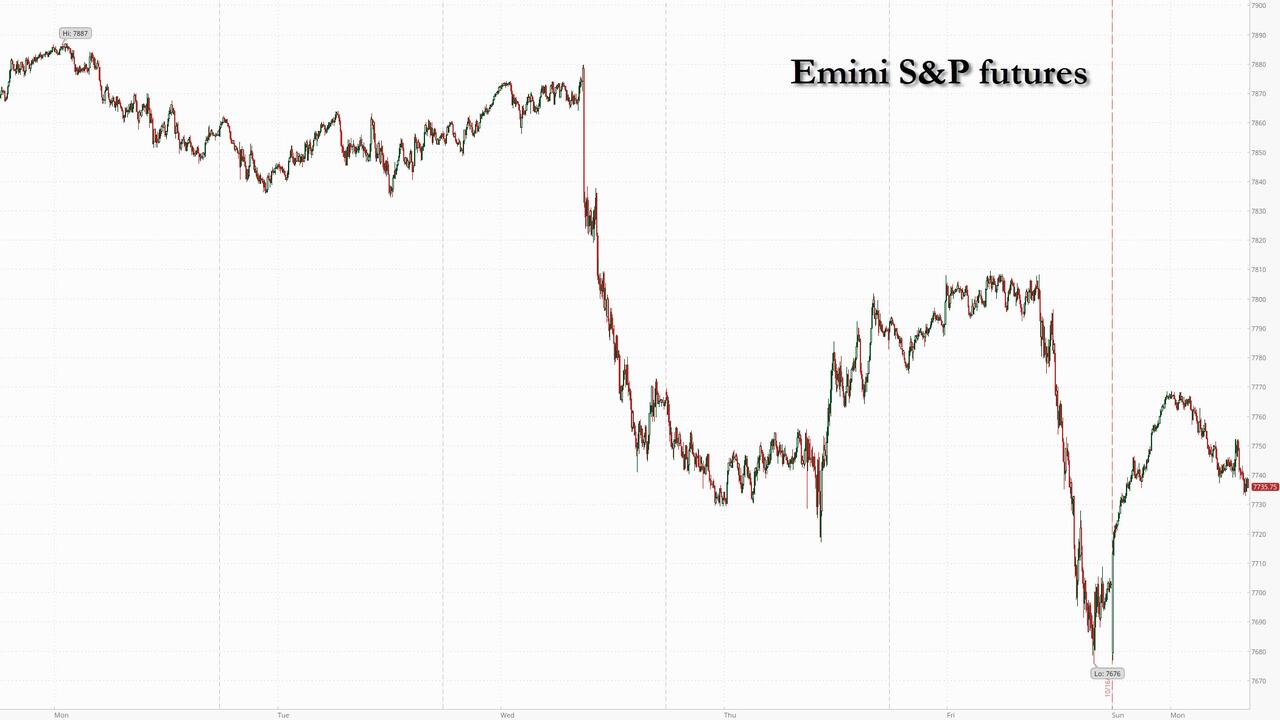
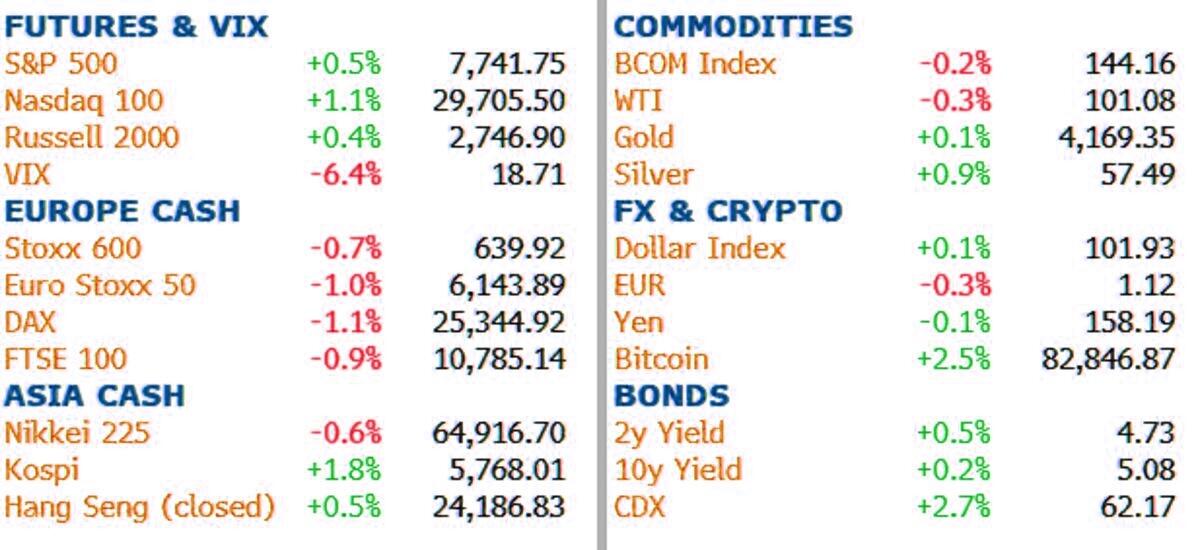
US futures are higher – but well off session highs hit before the European open – as dip buyers storm back into chipmakers after the Nasdaq’s worst week since the April 2025 tariff turmoil, while oil slides after President Trump waived Russian sanctions to seal a diesel deal and Energy Secretary Chris Wright said Persian Gulf flows have recovered to about 80% of pre-conflict levels; as a result Nasdaq futures are up more than 1% and the Philly semis index is set to snap its longest losing streak in 18 years, even as Europe slides on a weekend of riots in France. As of 8:00am ET, S&P futures were 0.4% higher at 7,741.75 while Nasdaq futures rose 1.1% to 29,705.50 and Dow futures are down 0.2%. That follows a Friday session in which the S&P fell 1.09% to 7,659 (sliding from flat just before the European close), the Nasdaq 100 sank 2.5% and the SOX tumbled 3.8% for an eighth straight loss, capping a week in which the SOX lost 11.4%, the Nasdaq 4.5% and CoreWeave a quarter of its value. In premarket trading, semis lead with Intel up 4.2% on a JPMorgan upgrade and Nvidia up 1.4%, neoclouds and optical names are bid (CoreWeave +6% after a Goldman upgrade from Neutral ($139PT) to Buy ($106PT?!) week in which it became “the market’s beta barometer”), Disc Medicine soars 35% ahead of Phase 3 data and Cleveland-Cliffs jumps 13% after an earnings beat. The day’s driver is Washington’s Russia pivot: Trump signed an executive order waiving Graham Act sanctions, restrictions and duties on Russian energy revenues (Russia will initially supply over 300k tonnes of diesel), Putin proposed a summit with Trump and Xi to negotiate an end to the war, and Zelenskyy accused Trump of pressuring Kyiv to surrender, which has sent Brent down 1.2% to $108.59. Treasuries dip slightly with shorter-dated yields edging higher in a bear flattener as traders keep a muted bid for an October hike, leaving the 10Y at 5.08% after last week’s 16.5bp plunge (its biggest weekly drop since August 2025), while French bonds tumble after the riots, with the OAT-Bund spread widening to 146bps. The dollar index is up 0.1% to 101.93, with the euro the G10 laggard below $1.12 and the Aussie leading after strong Chinese data. In commodities, WTI is little changed near $101.30, European gas (Dutch TTF) hit its highest since 2022, gold is up 0.1% at $4,169 and silver adds 0.9% to $57.49. Bitcoin rises 2.5% to about $82,850 after briefly topping $83,000. US economic data slate includes the October NAHB housing market index (10am). The Fed is in its external communications blackout through Oct. 29, so there are no Fed speakers. The Treasury sells $95 billion of 13-week and $82 billion of 26-week bills at 11:30am.
In premarket trading, Nvidia outperforms Magnificent Seven peers as chip stocks look set to rebound: Nvidia (NVDA) +1.4%, Amazon (AMZN) +1.2%, Alphabet (GOOGL) +0.6%, Meta Platforms (META) +0.2%, Microsoft (MSFT) +0.2%, Tesla (TSLA) -0.1%, Apple (AAPL) -0.1%
- Semiconductor stocks gain, setting the chip benchmark up to snap its longest losing streak in 18 years. Shares in neoclouds and optical firms are also rising amid a broad-based rally in AI-related firms.
- Cleveland-Cliffs (CLF) rises 13% after the steel producer reported adjusted Ebitda for the third quarter that beat the average analyst estimate.
- Disc Medicine (IRON) soars 63% after announcing that its investigational drug bitopertin met all primary and secondary endpoints in the Phase 3 Apollo trial in adults and adolescents with erythropoietic protoporphyria.
- Intel (INTC) rises 3% as JPMorgan upgrades its rating to neutral (with a PT of $85 or below where it closed on Friday), noting that the chipmaker’s turnaround might take years, but the management’s execution has been solid.
- Silgan (SLGN) gains 5% after the food packaging company and funds affiliated with American Industrial Partners announced a deal to buy Trivium Packaging in an all-cash deal.
- Pinterest (PINS) gains 1.1% as Phillip Securities initiates coverage with a recommendation of buy, noting that the company has significant international monetization potential.
- Disc Medicine (IRON) jumps 35% ahead of the company’s webcast to discuss topline results from the APOLLO Phase 3 trial of Bitopertin in erythropoietic protoporphyria.
- BYD US (+1.4%): Boyd Gaming shares rise as Morgan Stanley upgrades to overweight from equal-weight following a selloff across gaming stocks.
- RCAT US (+6.4%): Red Cat rises after the US drone and robot maker offered a 29% cash premium to buy Austrian engine specialist Steyr Motors, in order to boost its European defense portfolio.
In other corporate news, Anthropic, apparently undeterred by a week in which the market discovered that AI costs money to fund, is offering Blackstone a yield above 10% to anchor a $60 billion TPU-backed debt package (per JPMorgan’s desk), and separately said it will put 5% of its shares into a new public benefit fund. Nvidia-backed Nscale faces investor pushback over its IPO valuation after Microsoft exited its UK data center deal, as we reported over the weekend. Silgan is said to be near a $3.4 billion purchase of Trivium Packaging; KKR is selling Infinity Transportation to Ares for about $2.9 billion (WSJ); SoftBank is said to weigh buying top US security firm Allied; Starboard sees value in Apple chip supplier Skyworks; and Accenture is working on a potential sale of its China business that could value the unit at up to $1.5 billion (FT). Oaktree’s deal to take over a life insurer owned by Advantage Capital has collapsed after regulators raised alarms over exposure to 777 Partners. EQT agreed to buy Australia’s Cleanaway Waste Management for about A$9.3 billion including debt. Red Cat offered to buy Steyr Motors for EUR 39 a share in cash, and Ivanhoe Electric is in advanced talks to sell its US copper assets. Kimberly-Clark could kick off this week’s IG issuance as its Kenvue acquisition nears closing, while Citigroup and Wells Fargo launched their first euro bond deals of the year. Elon Musk pledged to give one SpaceX share to “every kid in America” next year, and Hyperscale Data plans to take its AI subsidiary askROI public.
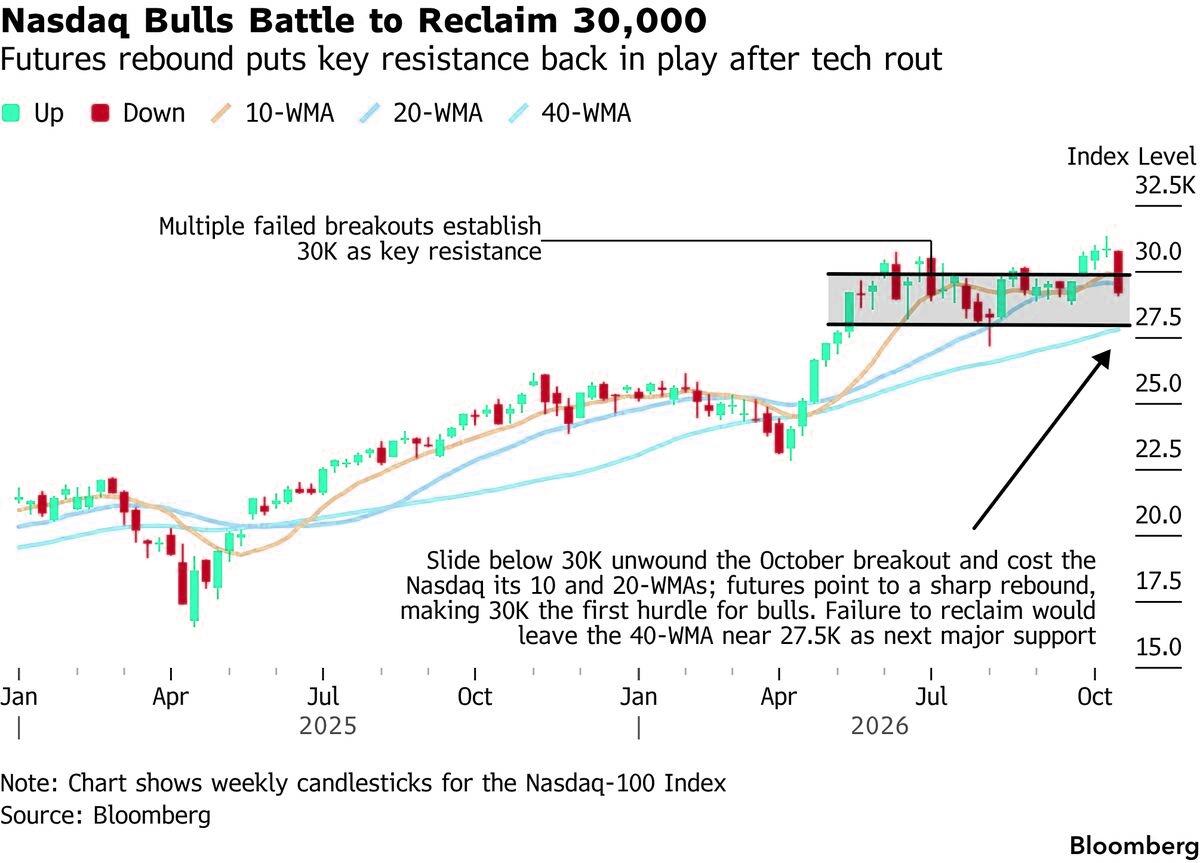
Stock futures are rebounding from the Nasdaq’s worst week since the tariff turmoil of April 2025, with dip buyers stepping in after the tech index broke below its closely watched 10- and 20-week moving averages; this week’s earnings from Netflix, Tesla and Meta (which UBS hinted may have pulled its earnings a week sooner as it may be raising capital ahead of its peers) will provide the next test for the still-shaky AI trade. The bounce comes as bond yields stabilize and oil pulls back below $100 (at least for a bit), and on the 39th anniversary of Black Monday, which DB’s Jim Reid notes is a “more memorable one” since it falls on a Monday. Yet as is so often the case, markets keep doing what they’re not supposed to: Friday brought what Goldman’s desk called record put buying and the “first real sign of panic in index protection” (as we detailed), even as retail poured a record amount into levered ETFs, and the S&P barely flinched while Morgan Stanley’s AI basket suffered its worst week ever.
The Nasdaq 100 now needs to reclaim 30,000: the slide below 30K unwound the October breakout and cost the Nasdaq its 10 and 20-week moving averages; futures point to a sharp rebound, making 30K the first hurdle for bulls, with the 40-week moving average near 27.5K the next major support if it fails.
JPMorgan’s Mislav Matejka says that a stabilization in bond yields would “go a long way to support stocks” if it continues, especially given concerns over AI financing costs. Morgan Stanley’s Mike Wilson advised that investors should prepare to add risk, reiterating a preference for quality stocks, while Citi strategists say tech is still set to account for nearly 70% of global earnings growth next year, making this week’s results a key gauge of whether Monday’s bounce can become something more durable.
“Asia’s cash markets are catching up with Friday’s Wall Street selloff,” said Anna Wu, founder of Floodlines Research in Sydney. “Investors want more evidence that AI spending is translating into returns. Until then, Asia’s chip-heavy markets remain particularly exposed to swings in that conviction.”
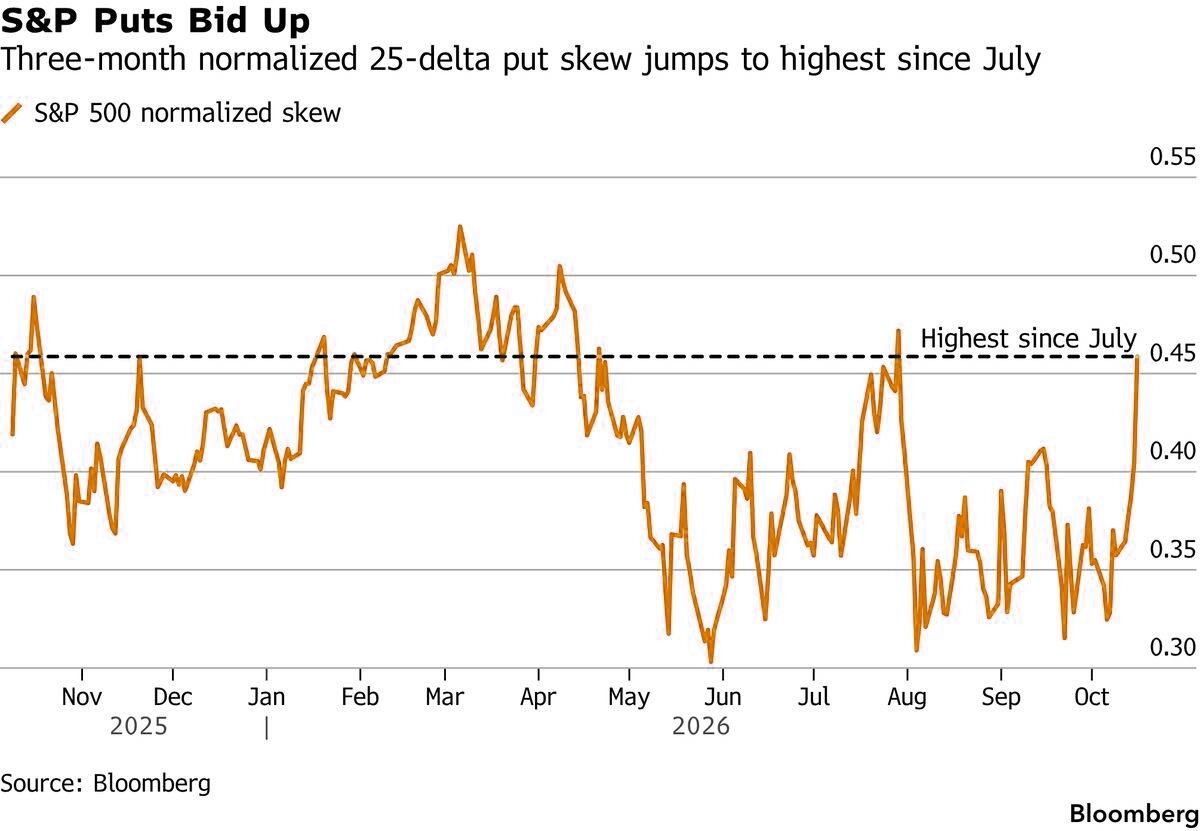
Hedging demand, meanwhile, has gone vertical: S&P 500 puts are getting bid up, with the normalized 3-month put skew reaching the highest since late July, after trading near the lows of the past two years as recently as the beginning of this month.
JPM’s Market Intel desk under Andrew Tyler admits last week’s selloff “ran against our tactical bullish call,” but after reassessing, the team retains its tactically bullish stance, albeit “more selective”: the momentum/tech unwind and AI credit fears drove the selloff while ASML and TSMC delivered healthy earnings and consumer data stayed resilient. JPM does not expect the rotation out of tech to end abruptly, and favors cyclicals outside tech while selectively buying semis and memory weakness via defined-risk options; all eyes are on Meta earnings and Nvidia’s GTC Berlin. JPM credit strategist Nathaniel Rosenbaum notes hyperscaler spreads widened 12bp last week to 148bp, the widest since July, but sees the widening as overdone unless earnings reveal fundamental weakness. JPM credit trader Christian Crosby was less sanguine: the funding cost concerns “are now more about levered borrowers, specifically neoclouds, data center project finance, and GPU deals,” where “every point higher in borrowing costs is worth multiple points on the equity.”
Over at Goldman, Tony Pasquariello writes that “we’ve entered a new phase in the AI sequence, one that is unequivocally more complicated (for both the credit market and the equity market),” and that “for the first time in three years, a number of key asset markets have felt the ‘speed limit’ from the bond market” (on which more here). Goldman’s Prime book saw the largest net selling of tech on record, with US long/short net leverage down to 43.7%, a 5-year low, and shorts near 5-year highs, which is why Lee Coppersmith thinks “the market is moving into a different volatility environment but not necessarily a more bearish one.” GS flow trader Giulio Esposito flags a “sharp rotation out of AI hardware into real-economy defensives,” with the equal-weight S&P beating the cap-weighted index by 225bp last week, the most since November 2020, while Sam Dunn reckons “the AI trade is still long but roughly 6/10 on length and materially cleaner than Jun/July.”
In geopolitics, Ukrainian President Zelenskyy accused Trump of trying to pressure Kyiv into surrendering to Russia, escalating a week-long row. Trump wrote on social media over the weekend that he cut a diesel export deal with Russia and delayed imposing further sanctions because he doesn’t want to drive Putin away from peace talks, and Republican lawmakers, including some of the president’s strongest allies, blasted Trump over the sanctions waiver (Moscow, for its part, celebrated a “historic moment”). In global news, China’s growth accelerated more than expected in the third quarter, boosting the odds of the economy reaching Beijing’s annual target and dimming the prospects for additional easing measures.
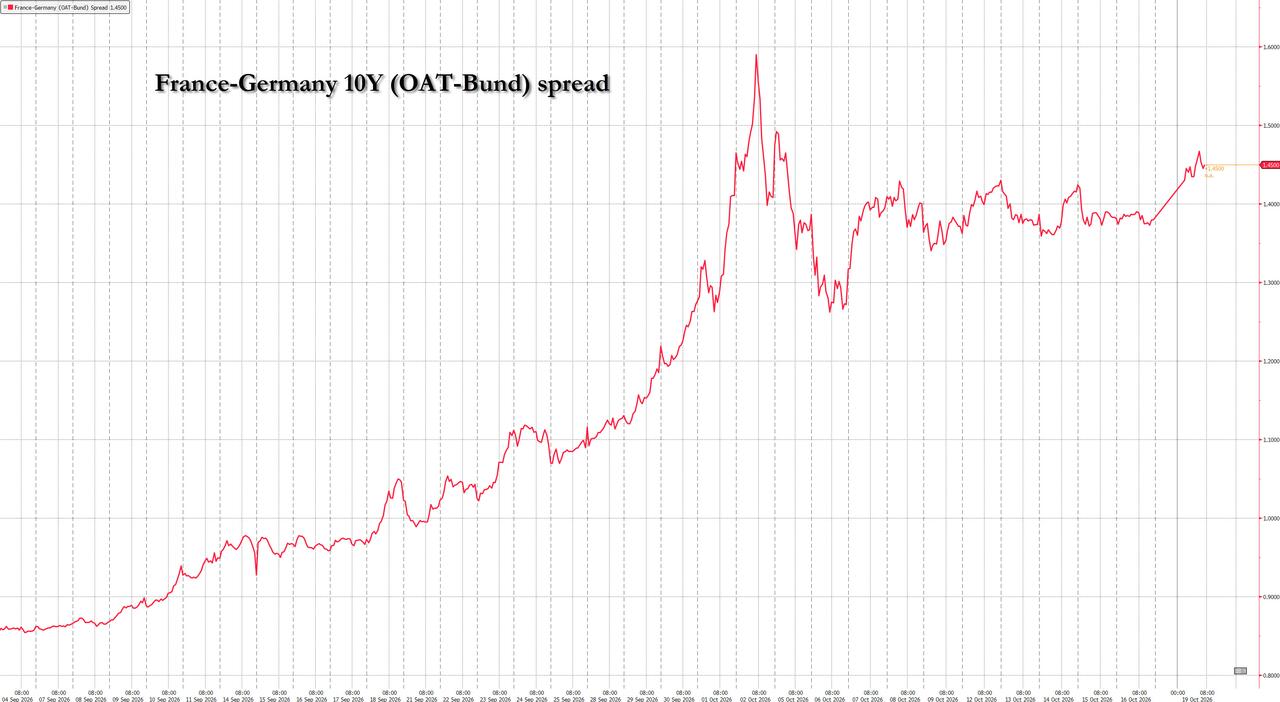
In France, cost-of-living protests degenerated into looting and burning nationwide over the weekend, with nearly 2,400 arrests and almost 1,000 police injured, and protests also took place in Italy, Belgium and Portugal. Ten-year OAT yields are up more than 9bps to about 4.90%, with the OAT-Bund spread widening to 146bps, not far from the recent 151bps peak and just days before Moody’s review on Friday. Macron appealed for calm but stopped short of declaring a state of emergency, which Reid warns “won’t make it easy for the international community to be totally comfortable buying OATs.
In Europe, the Stoxx 600 is down 0.7% at around 640, with 478 members down and just 103 up, as France’s CAC 40 leads declines after the weekend’s violence; the CAC 40 and Spain’s IBEX 35 are both down 1.3% and Italy’s FTSE MIB 1.4%. Banks are the sector laggard, followed by travel & leisure and autos, while tech and energy are the only sectors in the green. JPM’s desk notes weakness is broad, with autos, industrials, basic resources, banks and utilities lagging. Defense names are lower, with BAE, Thales and Leonardo all down more than 2.5%, while Norwegian energy names hit 52-week highs. Here are the biggest European movers:
- Verbio shares rise as much as 4.2% following remarks from the German transport minister, cited by Augsburger Allgemeine, who floated the idea of using fuel containing up to a fifth of ethanol.
- Mowi shares rise as much as 5.2% to a six-month high after the salmon-farming company reported earnings well ahead of expectations thanks to record harvest volumes in the latest quarter.
- Pets at Home shares gain as much as 5.7% after Peel Hunt upgrades the retailer to buy from hold on signs that trading and execution are improving.
- French stocks underperform after cost-of-living protests over the weekend.
- DHL shares fall as much as 2.3% after the German logistics company reported preliminary third-quarter earnings, which Morgan Stanley said may augur more muted growth in the future.
- Imperial Brands falls as much as 2.1% after being downgraded at Jefferies. The bank thinks the tobacco company could fail to impress investors with its FY27 guidance due to slower growth in Germany.
Asian stocks were mixed, extending tech-led losses from the previous week before paring them as US futures rebounded: the MSCI Asia Pacific Index fell as much as 1%, with chipmakers SK Hynix, TSMC and Advantest among the top decliners as DeepSeek’s latest model sparked concerns over demand for chips. Japan’s Nikkei 225 fell 0.6% after last week’s 5.4% slide, while South Korea’s Kospi staged an impressive comeback, rising 1.8% after plunging as much as 3.2% at the open. Taiwan’s Taiex slid 1.8% in early trading and the Taiwan dollar fell to its weakest since April 2025 on stock outflows. The CSI 300 rose 0.1% after China’s Q3 GDP grew 4.5% y/y (vs 4.4% expected) and September retail sales doubled expectations, while Australia’s ASX 200 gained 0.4%, led by Cleanaway, which jumped as much as 21% after EQT agreed to buy it. Hong Kong was closed for the Chung Yeung Festival. Indonesia’s rout deepened, with stocks down more than 5% to a six-year low and more than 16% in two sessions after MSCI warned of a potential two-step downgrade; Goldman estimates a full removal from MSCI indexes could trigger about $5.6 billion of passive outflows.
In FX, the Bloomberg Dollar Spot Index is little changed while the DXY is up 0.1% to 101.93, at the upper end of a 101.76-102.08 range. The euro is the G10 laggard, slipping below 1.12 (to the middle of a 1.1182-1.1234 range) on the French unrest, and speculative euro positioning is already the most pessimistic in a decade. The Aussie outperforms, rising 0.5% to 0.6977 after China’s data beat, and the loonie is also firmer after Trump touted an “amazing” deal with Canada at some point. USD/JPY is back around 158.10, while EUR/CHF dropped 0.4% to a fresh three-month low of 0.92264.
In rates, Treasuries dip slightly, with shorter-dated yields edging higher and the curve bear flattening as traders maintain a muted expectation for an October hike: the 10Y is up about 1bp to 5.08% and the 2Y is at 4.73%, while money markets assign a 14% chance of a hike next week and 75% for December. That follows last week’s 16.5bp drop in the 10Y, its biggest weekly decline since August 2025, as the AI growth scare revived the haven bid even as hot CPI and PPI prints should have done the opposite (we are told this is normal). In Europe, OATs are hit by over 70 ticks as the French riots push the OAT-Bund spread to 146bps, BTPs are down around 25 ticks on protests in Italy, and gilts are down almost 50 ticks on spillover selling, while Bunds are flat around 3.44%. The Treasury sells $95 billion of 13-week and $82 billion of 26-week bills today, and dealers expect about $25 billion of IG issuance this week, which would leave 2026 less than $10 billion short of the record set in 2020.
“Yields above 5% provide far more income protection against being early, while a meaningful growth shock would bring capital gains on top,” writes Bloomberg macro strategist Skylar Montgomery Koning. “Last week’s willingness to buy the dip in bonds suggests the market is starting to recognise that trade-off.”
In commodities, oil retreats from a five-month high, with Brent down 1.2% to $108.59 and WTI little changed at $101.30, as traders book profits after a blistering rally and Trump’s Russia sanctions waiver frees up diesel supply; the US is also negotiating with European allies to release diesel stockpiles and the DoE issued an RFP to exchange up to 17 million barrels of SPR crude. The Middle East remains tense, however: the IRGC said two tankers caught fire in the Strait of Hormuz after hitting mines, and explosions were reported in Jeddah after Houthi attacks. Dutch TTF gas rose to its highest since 2022, trading in a EUR 87.66-89.32/MWh range. Spot gold is contained in a $4,155-4,190 band, silver is up about 1%, and LME copper hit $14,480/t on the China data before falling back to $14,350/t. US natgas is up 0.6% to $3.14.
US economic data slate includes the October NAHB housing market index (10am). There are no Fed speakers as the FOMC is in blackout ahead of the Oct. 27-28 meeting. Cleveland-Cliffs and Fifth Third report before the open, with Zions, Crown Holdings, W R Berkley, FNB, RLI, Western Alliance, Steel Dynamics, BOK Financial, AGNC and Wintrust after the close; the week ahead brings Netflix on Tuesday, Meta and Tesla on Wednesday, and Nvidia’s GTC Berlin from Oct. 20-22.
Market Snapshot
Top Overnight News
- Intensifying concerns about the cost and availability of funding have caused investors to reduce their equity market exposures and price a deceleration in the growth outlook. Rising energy prices and interest rates have weighed on the performance of many cyclical equities since early August. During the last two weeks, however, the potential implications of a sharply rising cost of capital on the AI build-out have weighed further on the market outlook for economic and earnings growth. Exacerbating these rotations, this week GS Prime Services noted a sharp reduction in hedge fund net leverage alongside a positioning pullback in AI-related stocks. GIR
- Nvidia Chief Executive Officer Jensen Huang took a sanguine view toward the latest AI stock-market rout, saying the benefits of the technology will soon outweigh the concerns of investors. BBG
- President Trump, defending his decision to ease tariffs and other sanctions against Russia, said on Sunday that he was making “great progress” in a peace deal with the Kremlin and suggested for the first time that the process included “hostage negotiations.” NYT
- Russian President Vladimir Putin has proposed that he, President Trump and Chinese leader Xi Jinping meet next month to talk about Ukraine in an attempt to negotiate an end to the four-year conflict that would favor Moscow, said people familiar with the discussions. WSJ
- Washington is pushing an idea whereby Europe would resume buying Russian gas an inducement for Putin to end the war in Ukraine. NYT
- Iranian support has helped the Houthis mount the most potent and sophisticated attacks yet on Saudi Arabia and its Yemeni allies, including help targeting drone and missile attacks, as well as training, intelligence and tactical guidance, people briefed on intelligence from Saudi Arabia and Yemen’s anti-Houthi alliance said. WSJ
- Ukrainian President Volodymyr Zelenskyy accused Donald Trump of trying to pressure Kyiv into surrendering to Russia, escalating a week-long row with the US president. BBG
- Republican lawmakers, including some of the president’s strongest allies on Capitol Hill, blasted Donald Trump for waiving new tariffs and sanctions on Russia, prompting the president to defend himself against members of his own party. BBG
- US Energy Secretary Chris Wright told Fox News that Persian Gulf oil flows had recovered to about 80% of their pre-conflict level, although refined-product shipments remained constrained. Wright said he’s in talks with European allies to release diesel stockpiles. BBG
- China’s growth accelerated more than expected last quarter, putting Beijing’s annual target within reach and dimming the prospects for further easing measures. GDP expanded 4.5% year on year. BBG
- Apple on Friday said its foldable iPhone Duo had seen “nothing short of extraordinary” demand, as the device sold out on the company’s website until next year within hours of going on sale. FT
- The US government’s debt interest burden reached a record high for fiscal 2026, with net interest costs coming to $1.05 trillion, up more than 8% from the $970 billion in fiscal 2025. BBG
- Elon Musk pledged to give one SpaceX share to “every kid in America” next year. BBG
- Weeks ahead of Election Day, 71% of U.S. adults think the country is on the “wrong track.” It’s the highest share yet in President Donald Trump’s second term, illustrating the grim national mood his party faces in the midterm elections. NBC
- Nvidia-backed data center developer Nscale faces opposition to the valuation target it’s pursuing in its IPO, according to people familiar with the matter. BBG
- The violence that rocked France this weekend as cost-of-living protests degenerated into looting and burning nationwide is raising alert levels across Europe, where elections will be held in at least half a dozen countries next year. BBG
- Indonesian markets extended their selloff, with stocks deepening their worst rout in almost 30 years and losses spreading to bonds and the rupiah after MSCI Inc. warned the country may face a two-step downgrade. BBG
- China’s financial regulators are establishing a liquidity support facility to cushion non-bank financial institutions against potential large scale redemption pressures, People’s Bank of China Governor Pan Gongsheng said at the Financial Street Forum annual meeting in Beijing, CCTV reported. BBG
- The Bank of England is examining whether Barclays traders misrepresented illiquid private credit loans to understate their risk after the Prudential Regulation Authority received a complaint earlier this year. FT
- IRGC said two oil tankers caught fire in the Strait of Hormuz after hitting mines. Newsquawk
- US President Trump pledged USD 5k for every adult if the GOP wins Congress, speaking at a Kentucky rally ahead of the 3rd November midterms; separately, Reuters reported he blamed aides for a faltering Republican midterm strategy as Democrats led House polls. Newsquawk
- JPM credit strategist Nathaniel Rosenbaum notes hyperscaler spreads widened 12bp last week to 148bp, the widest since July 2026, but sees the widening as overdone unless upcoming earnings reveal fundamental weakness. JPM
A more detailed look at global markets courtesy of Newsquawk
APAC stocks were mixed following Friday’s tech-led sell-off on Wall Street, with Japanese and Korean stocks underperforming amid continued pressure on AI and semiconductor names. However, losses were pared as US equity futures recovered alongside a pullback in crude prices. Sentiment was also supported by Trump’s latest Russia-Ukraine peace efforts and easing of restrictions on Russian energy, while Chinese activity data generally topped expectations but prompted little reaction. ASX 200 bucked the regional weakness, supported by Cleanaway Waste Management surging after EQT agreed to acquire the Co. Elsewhere, RBA’s Kent noted evidence of rising neutral interest rates in Australia and abroad. Nikkei 225 and KOSPI underperformed as tech stocks caught up with Friday’s losses in their US counterparts, although the indices pared earlier losses of over 2%. For Japan, BoJ Governor Ueda also spoke overnight but offered little fresh. Shanghai Comp was marginally softer despite Chinese activity data generally topping expectations, although Fixed Asset Investment remained weak. Hang Seng was closed for the Chung Yeung Festival.
Top Asian News
- China PBoC Governor said overnight open-market repo rate will become the main policy rate, with a potential shift to overnight open-market operations to improve interest-rate regulation. The Governor added that monetary policy framework reform will remain gradual and ongoing, and plans to widen access to standing lending facility, introduce a liquidity tool for non-bank institutions and pilot further facilitation of onshore RMB purchases and sales by overseas financial institutions.
- China’s Stats Bureau said the economy showed more positive developments in Jan-Sept, though weak demand and a complex international environment remain challenges; its Deputy Head said new growth drivers, including high-end manufacturing and the digital economy, accounted for over 40% of growth, while consumption contributed 46.7% of GDP growth.
- Japanese PM Takaichi said the government has no predetermined plans on whether to compile a supplementary budget and a robust economy can boost market confidence in the JPY; her approval rating fell below 50%, the lowest since she took office, Kyodo reported.
European bourses (STOXX 600 -0.8%) are broadly lower to start the week, as Dutch TTF rises to its highest level since 2022. Reasons for this weakness are two-fold: 1) continued Russia-Ukraine strikes, and 2) protests across the EZ (Italy, Portugal, Spain, Belgium, France). As a result, clear underperformance is seen in the CAC 40 (-1.3%), IBEX 35 (-1.3%) and FTSE MIB (-1.4%). Sectors point to a clear negative bias. Tech and Energy are the only sectors in the green, while Banks is the sector laggard, followed by Travel & Leisure and Autos. US equity futures are firmer across the board, contrary to their European peers. Strength which appears to be a slight rebound following last week’s hefty losses seen across chip and memory names. With the US data docket fairly light and Fed speakers in blackout, focus will be on some key earnings, namely SpaceX, Netflix, IBM, Tesla and Meta.
Top European News
- France’s Saturday cost-of-living protests drew around 550,000 people, with some 1,800 arrested and more than 500 police, gendarmes and firefighters injured, according to the Interior Minister; one demonstrator died and Limoges’ historic town hall was torched. Clashes, fires and looting hit Paris, Lyon and other cities, and President Macron and PM Lecornu said violence would not be tolerated.
- French President Macron ordered a review of police preparedness and intelligence, empowered prefects and mayors to ban gatherings, and asked the government to hold cost-of-living talks this week.
- No decision expected from the UK regarding the Jackdaw gas field just yet, according to Politico, but a decision is still expected this week.
- Morningstar DBRS affirmed Italy at A (low); trend stable.
- S&P affirmed the Netherlands at AAA/A-1+; outlook stable.
FX
- G10s are mixed against a firmer USD. The Aussie holds towards the top of the pile, benefiting from strong Chinese activity data. The Loonie also outperforms, with Trump touting an “amazing” deal with Canada, at some point. To the downside resides the EUR, which digests ongoing civil unrest in France.
- DXY started the London session flat, but gradually moved higher as the morning progressed; currently sits at the upper end of a 101.76 to 102.08 range. The US data docket is light for the day, and remains that way for the remainder of the week; the Fed is in blackout ahead of next week’s confab, where rates are expected to remain on hold. Money markets assign a 14% chance of a hike next week; 75% chance of a hike in December.
- The pressure in the index seen last week was partly due to tech sell-off, and debt concerns surrounding AI spending. This appears to have abated at the start of this week, with CoreWeave +1.8% in pre-market trade. Given that the data and speaker docket is light this week, USD action will likely be dictated by the AI theme (Mag-7 earnings due this week), some also bring attention to Taiwan chip exports to signal a top in equities (due tomorrow).
- EUR/USD is currently underperforming vs peers; it fell beneath the 1.12 mark, to currently trade at the midpoint of a 1.1182-1.1234 range. Pressure potentially factors in the civil unrest in France, with protests reportedly causing damages of “hundreds of millions of euros”, in the region. As such, the OAT-Bund spread has once again widened to c. 144bps (vs recent peaks of 151bps).
- The Aussie is the clear outperformer this morning, taking positive leads from strong Chinese Activity Data overnight. In brief, Q3 GDP, Industrial Production and Retail Sales all topped forecasts; figures which lessen the odds of further near-term stimulus within the region. Nonetheless, the PBoC Governor has been on the wires this morning, where he mentioned that “we will launch a liquidity support tool for large-scale redemptions by non-bank institutions”.
- More interestingly, the Governor mentioned that the open market overnight reverse repo rate will correspondingly become the main policy rate. A change, which in theory, allows the PBoC greater control over policy and improves the stability of the CNY. Whilst no move was seen on the announcement itself, CNY will likely take positive leads from improving regional data and the shift in the PBoC’s framework. USD/CNY currently holds at the bottom end of a 6.6805 to 6.6862 range.
Central Banks
- ECB’s Lagarde said Eurozone headline inflation rose to 3.8% in September on energy, with no material wage response yet; sees growth of 0.9% in 2026 and 1.4% in 2027 after 25bps hikes in June and September, according to her IMFC statement.
- ECB’s Nagel said the job of fighting inflation is not done and the ECB may have to do more.
- BoJ Governor Ueda said Japan is in a positive cycle of rising wages and recovering prices and anchoring core inflation near 2% is increasingly important; the steady recovery, tight labour market, strong AI-driven capex and exports, and Middle East energy costs are fuelling inflation. He said it would be inappropriate to signal in advance when the BoJ might conduct emergency bond market operations, with any intervention to depend on the speed of long-term rate rises and signs of market instability; long-term rates would likely rise steadily in line with policy rate hikes, financial conditions remain accommodative and fiscal spending is adding upward pressure on prices and wages.
- RBA Assistant Governor Kent said there is reasonable evidence neutral rates are rising in Australia and abroad, and that policy is somewhat restrictive but it is questionable whether it is restrictive enough; household demand is softening while business credit remains strong, and housing tax adjustments move policy in a favourable direction. He is cautious about monthly employment figures but said the labour market has become less tight and the market reaction to the jobs data was reasonable.
Fixed Income
- USTs are modestly firmer, benefiting from the downside seen in energy on the updates between the US and Russia over the weekend. Otherwise, the fixed income space is under pressure given civil unrest in Europe.
- For USTs, they are at the low end of a 105-18+ to 105-19 band, but still post upside of c. five ticks as things stand. As alluded to, US President Trump said that he is negotiating a Ukraine-Russia peace, and significant progress is being made. Additionally, he signed an executive order waiving sanctions and tariffs on Russian energy. Points that have weighed on the energy space.
- Ahead, aside from updates to those points and expected continued bipartisan criticism, the US docket is very thin today, with participants still digesting last week’s price prints ahead of the PCE print towards month end.
- EGBs in focus, and particularly OATs. Currently, at a 108.96 low, hit by over 70 ticks after the significant protest activity seen across France during the weekend, and widespread political dispute over it, all largely to the benefit of Le Pen’s RN. Action that has taken the OAT-Bund 10yr yield spread to a 144bps peak today, just shy of the recent 151bps peak. A widening and unrest that adds to pressure into Moody’s review on Friday.
- Protest activity also occurred outside of France, with Italy seeing notable activity, enough to weigh on BTPs by around 25 ticks, with the BTP-Bund spread also modestly wider.
- Gilts opened on the backfoot, despite the energy pullback, as the region has similar fiscal/dissatisfaction themes that sparked the unrest seen in mainland Europe, and thus some spillover selling has occurred. Enough, as it stands, to send Gilts to an 84.29 low, off by just under 50 ticks.
Commodities
- Crude futures are softer to start the week, after Trump waived certain sanctions and restrictions on Russian energy and signalled progress towards ending the Russia-Ukraine war. Furthermore, the WSJ reported that Russian President Putin proposed a Trump-Xi-Putin meeting to discuss the Ukraine war; however, China’s Foreign Ministry did not share any information regarding the potential meeting. Despite this positive signalling by Trump, Russia and Ukraine launched large-scale attacks, with energy infrastructure being the main targets.
- In the Middle East, the environment remains tense. The IRGC stated that two oil tankers caught fire in the Strait of Hormuz, whilst in Saudi, explosions were heard. In terms of the path to diplomacy, Pakistan’s Army Chief is set to visit Tehran this week, whilst the Iranian FM mentioned that Tehran’s seven-day proposal on the Strait of Hormuz remains on the table.
- WTI and Brent currently trade at the lower end of their USD 96.72-99.24/bbl and USD 106.82-109.65/bbl range, respectively. On the US-Iran front, Pakistan’s army chief Munir may visit Tehran this week, while the IRGC said two tankers hit mines in the Strait of Hormuz.
- Dutch TTF has risen to its highest level since 2022, currently trading in a EUR 87.66-89.32/MWh range.
- Precious metals are relatively contained, with spot gold oscillating in a USD 4,155-4,190/oz band. The yellow metal has held above the USD 4100/oz handle since the selloff at the start of September, while the USD 4k/oz mark has held firm as its lowest point since the start of the Iran conflict.
- 3M LME Copper found a bid at the start of the Asian session, reaching a peak of USD 14.48k/t, amid strong Chinese activity data, before falling to a low of USD 14.35k/t amid the broader risk-off tone.
- US President Trump signed an executive order waiving certain Graham Act sanctions, restrictions and duties on Russian energy revenues. Russia will initially supply over 300k tonnes of diesel.
- US Energy Secretary said the US is negotiating with European countries to release large diesel stockpiles, but their response has been slow.
- US DoE issued an RFP to exchange up to 17mln bbls of crude from the SPR.
Trade/Tariffs
- US Ambassador to the EU Puzder warned of devastating retaliation if Brussels limits spectrum access for non-EU firms, after the EU decided to allocate most mobile satellite spectrum to domestic companies, FT reported.
- French President Macron said the EU needs to extend the China deal to include plastics, chemicals and ferroalloys.
- China’s MOFCOM announced the tightening of export controls on specific drones, autopilots, engines, radios and related technologies, effective November 18, while also saying they will further optimise procedures for screening and identifying export control queries on dual-use items.
Geopolitics: Middle East
- US President Trump said the Iran war will be over very soon and that Iran had been systematically destroyed militarily and financially, warning the US would soon finish the job unless Iran rapidly changes course. He endorsed Netanyahu ahead of Israel’s 27th October election, where polls show a tight race between Netanyahu’s bloc and its rivals, adding that if anyone else led Israel the US would have to do the work itself.
- US President Trump is reportedly mulling an attack on oil and military facilities in Iran’s Kharg Island, ILNA reported citing UAE press.
- Pakistani Army Chief Asim Munir may visit Tehran this week, ISNA reported.
- Iran’s Foreign Minister Araghchi said Tehran’s seven-day proposal to reopen the Strait of Hormuz remains on the table: the strait could reopen within six days if the US meets Iran’s conditions, with talks resuming on day seven; Iran said it is still studying US comments on the proposal.
- IRGC said two oil tankers caught fire in the Strait of Hormuz after hitting mines.
- UKMTO said a southbound tug was struck by two unknown projectiles northeast of Khor Fakkan, UAE, sustaining damage and one minor casualty but continuing its route. It also reported a tanker struck by an unknown projectile 68NM northeast of Saudi Arabia’s Jubail on 16th October (crew safe and evacuated) and a tanker hit by an RPG fired from a small boat 78NM northeast of Jubail, possibly the same incident, and an LNG tanker fired upon by a skiff 140NM southeast of Al Mukalla, Yemen, before its security team fired warning shots.
- US CENTCOM said the US has helped ship over 100mln bbls through Hormuz in the past seven days, and a US commander said the naval blockade had stopped Iran exporting USD 25bln of oil and the US helped freeze USD 350mln of Iranian crypto.
- Explosions were reportedly heard in Saudi Arabia’s Jeddah, Tasnim reported, with flight operations at King Abdulaziz International Airport disrupted according to Naya for Iraq, and in Jizan and Abha following attacks by Yemeni forces, Sabreen News reported.
- Houthis have repeatedly struck Riyadh airport and Saudi Aramco headquarters, with 19 killed in Houthi strikes as Saudi Arabia struggles to counter the attacks, AP reported; Iran is providing the Houthis with intelligence and targeting data for attacks on Saudi Arabia, WSJ reported.
Geopolitics: Ukraine
- US President Trump said he is negotiating peace between Russia and Ukraine and that significant progress is being made.
- Russian President Putin proposed a meeting with US President Trump and Chinese President Xi on the sidelines of the APEC summit in China (Nov 18th-19th) to discuss ending the war, WSJ reported. However, China’s Foreign Ministry Spokesperson said there is no information to share on any meeting between leaders of Russia, China and the US.
- The Trump administration has proposed resuming Russian gas imports to Europe as part of a potential Ukraine peace deal, with US envoys Witkoff and Kushner raising the idea with Ukrainian and European officials despite opposition from European governments, NYT reported.
- US Secretary of State Rubio said US President Trump is open to anything to end the Ukraine war, while discussions have taken place over a potential meeting between Putin, Xi and Trump.
- Ukrainian President Zelensky told Bloomberg that the Trump administration is pressuring Ukraine to capitulate to Russia through restrictions on Starlink speeds and delays in Patriot missile deliveries. Zelensky proposed halting strikes on Russian oil refineries in exchange for additional US air-defence missiles and added that Washington wants strikes halted without reciprocal support. Furthermore, he said that US-Ukraine relations could improve after the November midterm elections and that talks are underway with US envoys Kushner and Witkoff over a possible meeting this week.
- In comments elsewhere, Ukrainian President Zelensky said Russia launched attacks on Kyiv overnight on energy facilities and that Russian President Putin does not want to end this war. On intelligence, he said they did not receive a warning from partners on the Russian ballistic missile.
- Ukraine launched more than 1,000 drones at Russia, which set oil terminal and depot facilities ablaze, while Russia launched one of its largest attacks on Ukraine’s energy sector, using 320+ drones and missiles against more than 15 energy sites, and hit Metinvest’s Zaporizhstal steelworks with six ballistic missiles.
Crypto
- Bitcoin has steadily climbed to start the week and briefly topped the USD 83k mark.
US Event Calendar
- 10:00am: Oct NAHB Housing Market Index, est. 31, prior 32
- 11:30am: US to sell $95bn 13-week bills
- 11:30am: US to sell $82bn 26-week bills
Central Bank Speakers
- Fed external communications blackout (through Oct. 29); no Fed speakers scheduled
DB’s Jim Reid concludes the overnight wrap
39 years ago today we woke up to the origins of what would forever be known as Black Monday, where the Dow fell -22.6% on the day. It’s rare the anniversary falls on a Monday so it’s a more memorable one today. The late US trading session on Friday almost felt people were worried we’d get a repeat today as the S&P fell from flat just before the European close to -1.09% by the US one. However, this morning we are seeing a bounce with S&P (+0.79%) and Nasdaq (+1.29%) futures making up most of their late Friday losses.
Clearly the main nervousness last week was around AI-related names, with credit markets starting to show some distress in that sector. The Philly semiconductor index was down -11.41% last week (-3.83% Friday), whilst the NASDAQ was down -4.48% (-2.14% Friday). At the heart of the sell-off was CoreWeave, which was down -25.21% last week (-11.91% Friday), whilst their 5yr CDS was up +225bps on the week to 1128bps with their cash bonds trading at around a 15% yield. Meanwhile, Oracle’s share price was down -9.31% (-4.64% Friday), and their 5yr CDS was up +44bps on the week to 300bps.
Asia has started the week relatively calm with the KOSPI (+0.55%) and S&P/ASX 200 (+0.32%) both trading higher, while the CSI 300 (+0.09%) and Shanghai Composite (+0.16%) are just above flat. The Nikkei (-0.73%) is the region’s weakest performer, extending losses after falling -5.4% last week as technology stocks came under heavy pressure. Elsewhere, Indonesia’s benchmark stock index is down more than 5% to its lowest level in six years, as concerns over the potential MSCI downgrade we discussed on Friday continues to heighten fears of further foreign investor outflows. The index is down over -16% in these past two sessions.
Early morning data showed that China’s economic expansion accelerated marginally in the third quarter of 2026, with real GDP growing by +4.5% y/y. This print slightly surpassed the consensus expectation of +4.4% and marked a modest step up from the +4.3% expansion recorded in the second quarter. On a sequential basis, GDP grew by +1.2% q/q outperforming the +1.1% forecast and accelerating from +0.9% in the prior period. The quarterly performance was primarily underpinned by resilient export volumes and robust demand within the artificial intelligence infrastructure supply chain.
Separately, China’s September activity indicators were on the decent side. Industrial production rose by +5.5% y/y, beating expectations of +5.4% and accelerating from +5.2% in August. On the demand side, consumer spending showed signs of firming as retail sales expanded by +1.1% y/y – more than double the consensus forecast of +0.5% and a notable improvement from the +0.4% growth recorded in August.
Elsewhere, France’s political and fiscal problems gained another complication over the weekend as nationwide cost-of-living protests descended into some of the country’s worst unrest in years. Around 550,000 people demonstrated on Saturday according to the Interior Ministry, although the CGT put the figure at 800,000, and the violence continued into Sunday with fresh clashes in Paris and Marseille. The latest official figures put arrests at 2,400 and police injuries at nearly 1,000. This won’t make it easy for the international community to be totally comfortable buying OATs, so the modest recovery in French spreads over the last week or so will be tested today. In a televised address last night, President Macron appealed for calm, saying France felt “anger and shame” at the violence. He stopped short of declaring a state of emergency, but said prefects could ban protests where necessary to protect public buildings and businesses, while distinguishing peaceful demonstrators from ultra-left groups and criminals blamed by the government for the rioting. With France already facing a difficult fiscal backdrop and the 2027 election approaching, the weekend adds another layer of political risk for markets. OAT futures are down around a third of a percent in price terms this morning as other DM bond futures are flat to slightly higher so there has been some small impact so far.
The week ahead doesn’t really have a big focal point but instead a broad global range of releases, with the flash October PMIs on Friday providing the first coordinated read on activity across the US, UK, Japan and the major euro-area economies. Before then, the UK has a busy run of labour-market data tomorrow and inflation on Wednesday. Japan’s national CPI arrives on Friday, while Canada also has inflation data today. Central-bank action is quieter, with the Bank of Korea deciding on Thursday and the Fed already in its communications blackout ahead of next week’s FOMC. Earnings season also broadens out, with Netflix tomorrow and Meta and Tesla on Wednesday among the highlights. We have 76 S&P 500 and 69 Stoxx 600 companies releasing with next week being even larger.
In the US, the calendar itself is relatively light, which should leave markets continuing to digest last week’s much stronger-than-expected inflation numbers. Headline CPI rose +0.65% in September, taking the annual rate from 3.4% to 3.7%, while core CPI increased +0.33%, with its annual rate up two-tenths to 2.6%. The important point was that the upside surprise was broad-based across core goods, shelter and services rather than being driven by one idiosyncratic component. PPI was also stronger than expected on Thursday, and our economists’ current tracking for September core PCE is +0.36% month-on-month, or about 3.14% year-on-year absent revisions. So there is plenty for the Fed to consider even though officials are now in blackout.
As for this week’s US releases, the housing data come first. Our economists expect the NAHB housing-market index to slip to 31 from 32 today. Tomorrow, our economists expect housing starts to rise to an annualised 1.300mn from 1.275mn, while building permits are expected at 1.400mn versus 1.403mn previously. Large surprises could still shift estimates of Q3 activity, with our economists continuing to expect annualised real GDP growth of 3.3%. More broadly, they expect inflation-adjusted output to expand 2.5% on a Q4/Q4 basis in 2026 and 2.2% in 2027.
Later in the week, our economists expect initial jobless claims to rise to 206k from 199k on Thursday. The main US releases then come with the flash S&P Global PMIs on Friday, where our economists expect manufacturing to ease to 55.5 from 55.9 and services to 57.5 from 58.8. These numbers have recently mattered for markets: the sharp rise in the September PMIs helped drive an almost 15bp increase in both 2yr and 10yr Treasury yields on September 23. Our economists still expect the Fed to remain on hold at next week’s October meeting, allowing policymakers more time to assess the underlying inflation trend and the tightening in financial conditions from the recent rise in global yields.
Recapping last week now, and as mentioned at the top, the biggest story was the selloff in AI-related assets, with chip stocks taking a particular hit. For instance, the Philly semiconductor index was down -11.41% last week (-3.83% Friday), whilst the NASDAQ was down -4.48% (-2.14% Friday). Moreover, there were even larger declines for some of the most affected names, with CoreWeave down -25.21% last week (-11.91% Friday), whilst CoreWeave’s 5yr CDS was up +225bps on the week to 1128bps. Meanwhile, Oracle’s share price was down -9.31% (-4.64% Friday), and their 5yr CDS was up +44bps to 300bps. So given the weighting of tech in US equities more broadly, that meant the S&P 500 took a hit as well, with the index down -1.94% last week (-1.09% Friday). However, that selloff in the AI space didn’t carry over to other sectors in general, with the equal-weighted S&P 500 posting a weekly gain of +0.50% (-0.40% Friday). Moreover, European equities actually posted solid gains, with the STOXX 600 up +2.13% (+0.72% Friday), marking its best weekly performance since July. That said, some indices more exposed to chip stocks struggled, and Japan’s Nikkei fell -5.37% (+1.39% Friday), marking its worst week since July.
As all that was happening, AI-related growth concerns helped to drive a decent rally for sovereign bonds, with the US 10yr Treasury yield down -16.5bps last week (+1.5bps Friday) to 5.07%. Indeed, it was the biggest weekly decline for the 10yr yield since August 2025, whilst the 30yr Treasury yield fell -17.5bps (+1.5bps Friday) in its biggest weekly decline since April 2025. Interestingly, that came despite some very hawkish data last week, as the US core CPI print was at +0.3% in September, which briefly saw futures price in a greater-than-50% chance of a hike at the Fed’s October meeting. However, the AI selloff then meant that quickly unwound, and Fed Chair Warsh’s comments at the end of the week saw market pricing for an October Fed hike at 17% by the close on Friday.
Staying on rates, last week saw the stress around French bonds continue to stabilise. Indeed, the 2yr Franco-German spread came down another -4.5bps to 47bps, whilst the 10yr spread was broadly steady, up just +0.5bps at 137bps. We’ll see what the weekend riots do to sentiment this morning. That came alongside a wider decline in sovereign bond yields across the continent, with 10yr bund yields down -5.5bps (+1.3bps Friday) to 3.42%. Nevertheless, there was more stress in HY credit, with Euro HY spreads up +12bps last week, and US HY up +24bps as well. However, IG spreads were more contained, with Euro IG down -2bps, and US IG up +3bps.
Finally, the risk-off tone wasn’t helped by the continued rise in oil prices, with Brent crude up +4.91% last week (+3.72% Friday) to $109.86/bbl. That marks a second consecutive weekly increase, and it also came alongside fresh gains for European natural gas futures, which moved up +7.51% last week to their highest level since 2022, at €87.55/MWh. So that exacerbated inflation concerns in Europe and saw the 1yr Euro inflation swap rise another +21bps last week to +3.69%. And similarly in the US, the 1yr inflation swap was up +17bps last week to +2.74%.
1b) European opening report
Trump waived key Russian sanctions; US equity futures set to open firmer – Newsquawk US Market Open

Monday, Oct 19, 2026 – 06:20 AM
- US President Trump signed an executive order waiving certain Graham Act sanctions, restrictions and duties on Russian energy revenues.
- Russian President Putin reportedly proposed a meeting with US President Trump and Chinese President Xi to discuss ending the war.
- US equity futures climb; French Luxury and Banks hit on protests.
- DXY modestly higher; Antipodeans outperform, EUR lags while USD/JPY regains 158.
- Fixed income benchmarks mixed; EGBs underperform as Dutch TTF climbs to fresh highs.
- Energy benchmarks fall as Trump eases Russian sanctions.
- Looking ahead, highlights include Canadian CPI (Sep). Earnings from Cleveland-Cliffs.
SNAPSHOT
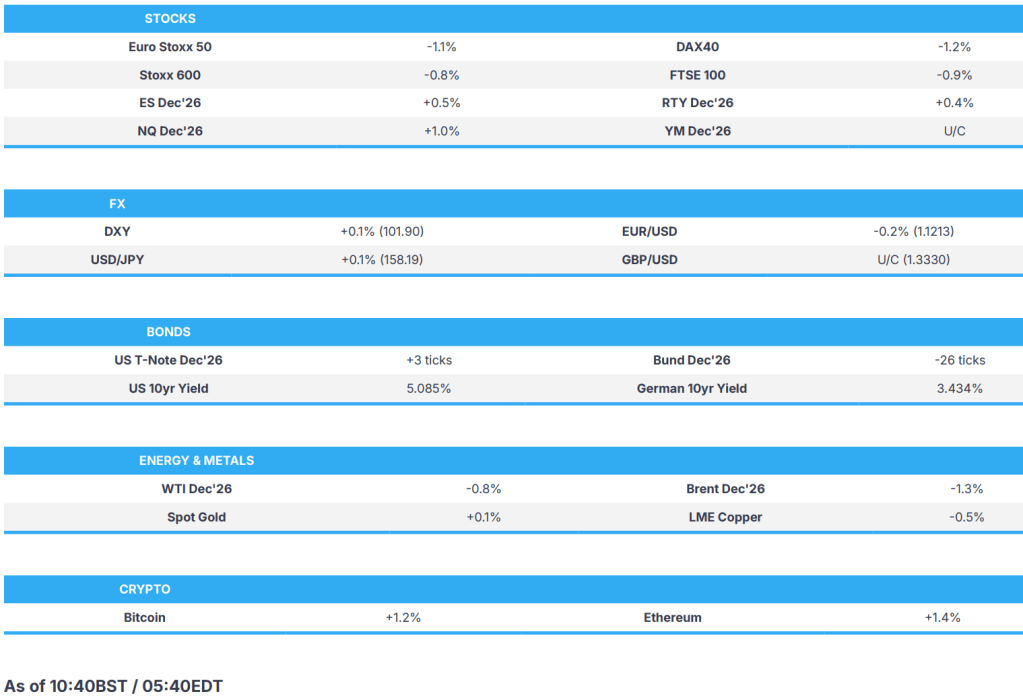
EUROPEAN TRADE
EQUITIES
- European bourses (STOXX 600 -0.8%) are broadly lower to start the week, as Dutch TTF rises to its highest level since 2022. Reasons for this weakness are two-fold: 1) continued Russia-Ukraine strikes, and 2) protests across the EZ (Italy, Portugal, Spain, Belgium, France). As a result, clear underperformance is seen in the CAC 40 (-1.3%), IBEX 35 (-1.3%) and FTSE MIB (-1.4%).
- Sectors point to a clear negative bias. Tech and Energy are the only sectors in the green, while Banks is the sector laggard, followed by Travel & Leisure and Autos.
- US equity futures are firmer across the board, contrary to their European peers. Strength which appears to be a slight rebound following last week’s hefty losses seen across chip and memory names. With the US data docket fairly light and Fed speakers in blackout, focus will be on some key earnings, namely SpaceX, Netflix, IBM, Tesla and Meta.
- Click for the sessions European pre-market equity newsflow
- Click for the additional news
FX
- G10s are mixed against a firmer USD. The Aussie holds towards the top of the pile, benefiting from strong Chinese activity data. The Loonie also outperforms, with Trump touting an “amazing” deal with Canada, at some point. To the downside resides the EUR, which digests ongoing civil unrest in France.
- DXY started the London session flat, but gradually moved higher as the morning progressed; currently sits at the upper end of a 101.76 to 102.08 range. The US data docket is light for the day, and remains that way for the remainder of the week; the Fed is in blackout ahead of next week’s confab, where rates are expected to remain on hold. Money markets assign a 14% chance of a hike next week; 75% chance of a hike in December.
- The pressure in the index seen last week was partly due to tech sell-off, and debt concerns surrounding AI spending. This appears to have abated at the start of this week, with CoreWeave +1.8% in pre-market trade. Given that the data and speaker docket is light this week, USD action will likely be dictated by the AI theme (Mag-7 earnings due this week), some also bring attention to Taiwan chip exports to signal a top in equities (due tomorrow).
- EUR/USD is currently underperforming vs peers; it fell beneath the 1.12 mark, to currently trade at the midpoint of a 1.1182-1.1234 range. Pressure potentially factors in the civil unrest in France, with protests reportedly causing damages of “hundreds of millions of euros”, in the region. As such, the OAT-Bund spread has once again widened to c. 144bps (vs recent peaks of 151bps).
- The Aussie is the clear outperformer this morning, taking positive leads from strong Chinese Activity Data overnight. In brief, Q3 GDP, Industrial Production and Retail Sales all topped forecasts; figures which lessen the odds of further near-term stimulus within the region. Nonetheless, the PBoC Governor has been on the wires this morning, where he mentioned that “we will launch a liquidity support tool for large-scale redemptions by non-bank institutions”.
- More interestingly, the Governor mentioned that the open market overnight reverse repo rate will correspondingly become the main policy rate. A change, which in theory, allows the PBoC greater control over policy and improves the stability of the CNY. Whilst no move was seen on the announcement itself, CNY will likely take positive leads from improving regional data and the shift in the PBoC’s framework. USD/CNY currently holds at the bottom end of a 6.6805 to 6.6862 range.
FIXED INCOME
- USTs are modestly firmer, benefiting from the downside seen in energy on the updates between the US and Russia over the weekend. Otherwise, the fixed income space is under pressure given civil unrest in Europe.
- For USTs, they are at the low end of a 105-18+ to 105-19 band, but still post upside of c. five ticks as things stand. As alluded to, US President Trump said that he is negotiating a Ukraine-Russia peace, and significant progress is being made. Additionally, he signed an executive order waiving sanctions and tariffs on Russian energy. Points that have weighed on the energy space.
- Ahead, aside from updates to those points and expected continued bipartisan criticism, the US docket is very thin today, with participants still digesting last week’s price prints ahead of the PCE print towards month end.
- EGBs in focus, and particularly OATs. Currently, at a 108.96 low, hit by over 70 ticks after the significant protest activity seen across France during the weekend, and widespread political dispute over it, all largely to the benefit of Le Pen’s RN. Action that has taken the OAT-Bund 10yr yield spread to a 144bps peak today, just shy of the recent 151bps peak. A widening and unrest that adds to pressure into Moody’s review on Friday.
- Protest activity also occurred outside of France, with Italy seeing notable activity, enough to weigh on BTPs by around 25 ticks, with the BTP-Bund spread also modestly wider.
- Gilts opened on the backfoot, despite the energy pullback, as the region has similar fiscal/dissatisfaction themes that sparked the unrest seen in mainland Europe, and thus some spillover selling has occurred. Enough, as it stands, to send Gilts to an 84.29 low, off by just under 50 ticks.
COMMODITIES
- Crude futures are softer to start the week, after Trump waived certain sanctions and restrictions on Russian energy and signalled progress towards ending the Russia-Ukraine war. Furthermore, the WSJ reported that Russian President Putin proposed a Trump-Xi-Putin meeting to discuss the Ukraine war; however, China’s Foreign Ministry did not share any information regarding the potential meeting. Despite this positive signalling by Trump, Russia and Ukraine launched large-scale attacks, with energy infrastructure being the main targets.
- In the Middle East, the environment remains tense. The IRGC stated that two oil tankers caught fire in the Strait of Hormuz, whilst in Saudi, explosions were heard. In terms of the path to diplomacy, Pakistan’s Army Chief is set to visit Tehran this week, whilst the Iranian FM mentioned that Tehran’s seven-day proposal on the Strait of Hormuz remains on the table.
- WTI and Brent currently trade at the lower end of their USD 96.72-99.24/bbl and USD 106.82-109.65/bbl range, respectively. On the US-Iran front, Pakistan’s army chief Munir may visit Tehran this week, while the IRGC said two tankers hit mines in the Strait of Hormuz.
- Dutch TTF has risen to its highest level since 2022, currently trading in a EUR 87.66-89.32/MWh range.
- Precious metals are relatively contained, with spot gold oscillating in a USD 4,155-4,190/oz band. The yellow metal has held above the USD 4100/oz handle since the selloff at the start of September, while the USD 4k/oz mark has held firm as its lowest point since the start of the Iran conflict.
- 3M LME Copper found a bid at the start of the Asian session, reaching a peak of USD 14.48k/t, amid strong Chinese activity data, before falling to a low of USD 14.35k/t amid the broader risk-off tone.
- US President Trump signed an executive order waiving certain Graham Act sanctions, restrictions and duties on Russian energy revenues. Russia will initially supply over 300k tonnes of diesel.
- US Energy Secretary said the US is negotiating with European countries to release large diesel stockpiles, but their response has been slow.
- US DoE issued an RFP to exchange up to 17mln bbls of crude from the SPR.
TRADE/TARIFFS
- US Ambassador to the EU Puzder warned of devastating retaliation if Brussels limits spectrum access for non-EU firms, after the EU decided to allocate most mobile satellite spectrum to domestic companies, FT reported.
- French President Macron said the EU needs to extend the China deal to include plastics, chemicals and ferroalloys.
- China’s MOFCOM announced the tightening of export controls on specific drones, autopilots, engines, radios and related technologies, effective November 18, while also saying they will further optimise procedures for screening and identifying export control queries on dual-use items.
NOTABLE EUROPEAN HEADLINES
- France’s Saturday cost-of-living protests drew around 550,000 people, with some 1,800 arrested and more than 500 police, gendarmes and firefighters injured, according to the Interior Minister; one demonstrator died and Limoges’ historic town hall was torched. Clashes, fires and looting hit Paris, Lyon and other cities, and President Macron and PM Lecornu said violence would not be tolerated.
- French President Macron ordered a review of police preparedness and intelligence, empowered prefects and mayors to ban gatherings, and asked the government to hold cost-of-living talks this week.
- No decision expected from the UK regarding the Jackdaw gas field just yet, according to Politico, but a decision is still expected this week.
- Morningstar DBRS affirmed Italy at A (low); trend stable.
- S&P affirmed the Netherlands at AAA/A-1+; outlook stable.
CENTRAL BANKS
- ECB’s Lagarde said Eurozone headline inflation rose to 3.8% in September on energy, with no material wage response yet; sees growth of 0.9% in 2026 and 1.4% in 2027 after 25bps hikes in June and September, according to her IMFC statement.
- ECB’s Nagel said the job of fighting inflation is not done and the ECB may have to do more.
- BoJ Governor Ueda said Japan is in a positive cycle of rising wages and recovering prices and anchoring core inflation near 2% is increasingly important; the steady recovery, tight labour market, strong AI-driven capex and exports, and Middle East energy costs are fuelling inflation. He said it would be inappropriate to signal in advance when the BoJ might conduct emergency bond market operations, with any intervention to depend on the speed of long-term rate rises and signs of market instability; long-term rates would likely rise steadily in line with policy rate hikes, financial conditions remain accommodative and fiscal spending is adding upward pressure on prices and wages.
- RBA Assistant Governor Kent said there is reasonable evidence neutral rates are rising in Australia and abroad, and that policy is somewhat restrictive but it is questionable whether it is restrictive enough; household demand is softening while business credit remains strong, and housing tax adjustments move policy in a favourable direction. He is cautious about monthly employment figures but said the labour market has become less tight and the market reaction to the jobs data was reasonable.
NOTABLE US HEADLINES
- US President Trump pledged USD 5k for every adult if the GOP wins Congress, speaking at a Kentucky rally ahead of the 3rd November midterms; separately, Reuters reported he blamed aides for a faltering Republican midterm strategy as Democrats led House polls.
GEOPOLITICS
MIDDLE EAST
- US President Trump said the Iran war will be over very soon and that Iran had been systematically destroyed militarily and financially, warning the US would soon finish the job unless Iran rapidly changes course. He endorsed Netanyahu ahead of Israel’s 27th October election, where polls show a tight race between Netanyahu’s bloc and its rivals, adding that if anyone else led Israel the US would have to do the work itself.
- US President Trump is reportedly mulling an attack on oil and military facilities in Iran’s Kharg Island, ILNA reported citing UAE press.
- Pakistani Army Chief Asim Munir may visit Tehran this week, ISNA reported.
- Iran’s Foreign Minister Araghchi said Tehran’s seven-day proposal to reopen the Strait of Hormuz remains on the table: the strait could reopen within six days if the US meets Iran’s conditions, with talks resuming on day seven; Iran said it is still studying US comments on the proposal.
- IRGC said two oil tankers caught fire in the Strait of Hormuz after hitting mines.
- UKMTO said a southbound tug was struck by two unknown projectiles northeast of Khor Fakkan, UAE, sustaining damage and one minor casualty but continuing its route. It also reported a tanker struck by an unknown projectile 68NM northeast of Saudi Arabia’s Jubail on 16th October (crew safe and evacuated) and a tanker hit by an RPG fired from a small boat 78NM northeast of Jubail, possibly the same incident, and an LNG tanker fired upon by a skiff 140NM southeast of Al Mukalla, Yemen, before its security team fired warning shots.
- US CENTCOM said the US has helped ship over 100mln bbls through Hormuz in the past seven days, and a US commander said the naval blockade had stopped Iran exporting USD 25bln of oil and the US helped freeze USD 350mln of Iranian crypto.
- Explosions were reportedly heard in Saudi Arabia’s Jeddah, Tasnim reported, with flight operations at King Abdulaziz International Airport disrupted according to Naya for Iraq, and in Jizan and Abha following attacks by Yemeni forces, Sabreen News reported.
- Houthis have repeatedly struck Riyadh airport and Saudi Aramco headquarters, with 19 killed in Houthi strikes as Saudi Arabia struggles to counter the attacks, AP reported; Iran is providing the Houthis with intelligence and targeting data for attacks on Saudi Arabia, WSJ reported.
RUSSIA-UKRAINE
- US President Trump said he is negotiating peace between Russia and Ukraine and that significant progress is being made.
- Russian President Putin proposed a meeting with US President Trump and Chinese President Xi on the sidelines of the APEC summit in China (Nov 18th-19th) to discuss ending the war, WSJ reported. However, China’s Foreign Ministry Spokesperson said there is no information to share on any meeting between leaders of Russia, China and the US.
- The Trump administration has proposed resuming Russian gas imports to Europe as part of a potential Ukraine peace deal, with US envoys Witkoff and Kushner raising the idea with Ukrainian and European officials despite opposition from European governments, NYT reported.
- US Secretary of State Rubio said US President Trump is open to anything to end the Ukraine war, while discussions have taken place over a potential meeting between Putin, Xi and Trump.
- Ukrainian President Zelensky told Bloomberg that the Trump administration is pressuring Ukraine to capitulate to Russia through restrictions on Starlink speeds and delays in Patriot missile deliveries. Zelensky proposed halting strikes on Russian oil refineries in exchange for additional US air-defence missiles and added that Washington wants strikes halted without reciprocal support. Furthermore, he said that US-Ukraine relations could improve after the November midterm elections and that talks are underway with US envoys Kushner and Witkoff over a possible meeting this week.
- In comments elsewhere, Ukrainian President Zelensky said Russia launched attacks on Kyiv overnight on energy facilities and that Russian President Putin does not want to end this war. On intelligence, he said they did not receive a warning from partners on the Russian ballistic missile.
- Ukraine launched more than 1,000 drones at Russia, which set oil terminal and depot facilities ablaze, while Russia launched one of its largest attacks on Ukraine’s energy sector, using 320+ drones and missiles against more than 15 energy sites, and hit Metinvest’s Zaporizhstal steelworks with six ballistic missiles.
CRYPTO
- Bitcoin has steadily climbed to start the week and briefly topped the USD 83k mark.
APAC TRADE
- APAC stocks were mixed following Friday’s tech-led sell-off on Wall Street, with Japanese and Korean stocks underperforming amid continued pressure on AI and semiconductor names. However, losses were pared as US equity futures recovered alongside a pullback in crude prices. Sentiment was also supported by Trump’s latest Russia-Ukraine peace efforts and easing of restrictions on Russian energy, while Chinese activity data generally topped expectations but prompted little reaction.
- ASX 200 bucked the regional weakness, supported by Cleanaway Waste Management surging after EQT agreed to acquire the Co. Elsewhere, RBA’s Kent noted evidence of rising neutral interest rates in Australia and abroad.
- Nikkei 225 and KOSPI underperformed as tech stocks caught up with Friday’s losses in their US counterparts, although the indices pared earlier losses of over 2%. For Japan, BoJ Governor Ueda also spoke overnight but offered little fresh.
- Shanghai Comp was marginally softer despite Chinese activity data generally topping expectations, although Fixed Asset Investment remained weak. Hang Seng was closed for the Chung Yeung Festival.
NOTABLE ASIA-PAC HEADLINES
- China PBoC Governor said overnight open-market repo rate will become the main policy rate, with a potential shift to overnight open-market operations to improve interest-rate regulation. The Governor added that monetary policy framework reform will remain gradual and ongoing, and plans to widen access to standing lending facility, introduce a liquidity tool for non-bank institutions and pilot further facilitation of onshore RMB purchases and sales by overseas financial institutions.
- China’s Stats Bureau said the economy showed more positive developments in Jan-Sept, though weak demand and a complex international environment remain challenges; its Deputy Head said new growth drivers, including high-end manufacturing and the digital economy, accounted for over 40% of growth, while consumption contributed 46.7% of GDP growth.
- Japanese PM Takaichi said the government has no predetermined plans on whether to compile a supplementary budget and a robust economy can boost market confidence in the JPY; her approval rating fell below 50%, the lowest since she took office, Kyodo reported.
NOTABLE APAC DATA RECAP
- Chinese GDP Growth Rate (Q3 YY) 4.5% vs. Exp. 4.4% (Prev. 4.3%).
- Chinese GDP Growth Rate (Q3 QQ) 1.2% vs. Exp. 1.1% (Prev. 0.9%).
- Chinese Industrial Production (Sep YY) 5.5% vs. Exp. 5.4% (Prev. 5.2%).
- Chinese Retail Sales (Sep YY) 1.1% vs. Exp. 0.5% (Prev. 0.4%).
- Chinese Fixed Asset Investment (YTD) (Sep YY) -7.2% vs. Exp. -7.3% (Prev. -7.2%).
- Chinese Unemployment Rate (Sep) 5.2% vs. Exp. 5.3% (Prev. 5.3%).
- Chinese House Price Index (Sep YY) -2.8% (Prev. -3.0%).
- Chinese Industrial Capacity Utilisation (Q3) 73.1% (Prev. 73%).
- New Zealand Trade Balance (Sep) -1.971B vs. Exp. -0.775B (Prev. -1.536B).
- New Zealand Imports (Sep) 8.44B (Prev. 8.02B).
- New Zealand Exports (Sep) 6.47B (Prev. 6.48B).
- New Zealand Composite NZ PCI (Sep) 53.4 (Prev. 52.5).
- New Zealand Services NZ PSI (Sep) 50.9 (Prev. 51.2).
1 c Asian opening report
Trump touted that significant progress is being made between Russia and Ukraine; European stocks set for a weaker open – Newsquawk EU Market Open
Monday, Oct 19, 2026 – 01:45 AM
- US President Trump said on Truth Social that he is negotiating peace between Russia and Ukraine and that significant progress is being made.
- US President Trump signed an executive order waiving Graham Act sanctions and tariffs on Russian energy, drawing bipartisan criticism.
- Pakistani Army Chief Asim Munir may visit Tehran this week, ISNA reported.
- Cost-of-living and education protests swept across Europe; around 550,000 people marched in France, with unrest also in Milan, Lisbon and Brussels.
- Crude futures were softer, bonds firmer, with APAC sentiment recovering; Europe points to a slightly softer open.
- Looking ahead, highlights include Canadian CPI (Sep). Speakers include ECB’s Lane and Elderson. Earnings from Cleveland-Cliffs.
- Click for the Newsquawk Week Ahead.
SNAPSHOT

US TRADE
EQUITIES
- US stocks closed sharply lower on Friday as AI-financing worries and high oil prices weighed; chipmakers led the tech selloff, with Micron (MU) and Intel (INTC) among the decliners, and the Nasdaq suffered its biggest daily drop since 23rd July, while CoreWeave (CRWV) fell 12% to extend its weekly loss to 25%. On the week, the S&P 500 (-1.95%) and Nasdaq (-4.48%) posted their steepest weekly losses since June, while the Dow (+0.67%) notched a second straight weekly gain.
- SPX -1.09% at 7,659, Nasdaq Comp. -2.14% at 26,140, DJI -0.34% at 52,002.
NOTABLE WEEKEND GEOPOLITICS
RUSSIA-UKRAINE
- US President Trump signed an executive order waiving certain Graham Act sanctions, restrictions and duties on Russian energy revenues.
- US President Trump said he is negotiating peace between Russia and Ukraine and that significant progress is being made.
- Russian President Putin proposed a meeting with US President Trump and Chinese President Xi on the sidelines of the APEC summit in China (Nov 18th-19th) to discuss ending the war, WSJ reported.
MIDDLE EAST
- Pakistani Army Chief Asim Munir may visit Tehran this week, ISNA reported.
- Iran’s Foreign Ministry Spokesperson said Iran is ready to help peacefully resolve issues between Saudi Arabia and Yemen.
- Iran’s Foreign Minister Araghchi said Tehran’s seven-day proposal to reopen the Strait of Hormuz remains on the table.
- IRGC said two oil tankers caught fire in the Strait of Hormuz after hitting mines.
- Explosions were reportedly heard in Saudi Arabia’s Jeddah, Abha and Jazan.
(Full detailed headlines below)
TRADE/TARIFFS
- US Ambassador to the EU Puzder warned of devastating retaliation if Brussels limits spectrum access for non-EU firms, after the EU decided to allocate most mobile satellite spectrum to domestic companies, FT reported.
- Mexico’s Ebrard said Commerce Secretary Lutnick has never told him he opposes lowering Section 232 tariffs on Mexico.
- US lifted restrictions on new Mexican airline flights to the US from Mexico City’s AICM and AIFA airports.
- US President Trump said the US will at some point make an “amazing” deal with Canada.
- EFTA states signed a free trade agreement with Vietnam, with around half of Norwegian exports to become tariff-free upon entry into force.
- French President Macron said the EU needs to extend the China deal to include plastics, chemicals and ferroalloys.
NOTABLE NORTH AMERICAN HEADLINES
- US Treasury Secretary Bessent said the US is in an energy shock and inflation will slow when the war ends.
- US President Trump pledged USD 5k for every adult if the GOP wins Congress, speaking at a Kentucky rally ahead of the 3rd November midterms; separately, Reuters reported he blamed aides for a faltering Republican midterm strategy as Democrats led House polls.
- US President Trump said the US economy has never been stronger; on oil drilling in Texas, he said nobody can take a chance on it.
- “No Kings” rallies were held across the US, urging early voting.
- White House Press Secretary Katie Zacharia left the role after less than a week.
- Canadian PM Carney confirmed four soldiers died and dozens were injured in the fire at Canadian Forces Base Wainwright in Alberta; CBC had earlier reported seven dead.
- Alberta is set to vote on Monday on starting the legal process for a separation referendum; Canadian PM Carney and Alberta Premier Smith both oppose separation.
- US State Department is reportedly updating its travel advisory for mainland China to include an increased risk level for wrongful detention, according to a plan seen by Semafor.
- Anthropic co-founder Jack Clark said an internal model suggested AI could lift US GDP to USD 44tln by 2030 from USD 30tln.
APAC TRADE
EQUITIES
- APAC stocks were mixed following Friday’s tech-led sell-off on Wall Street, with Japanese and Korean stocks underperforming amid continued pressure on AI and semiconductor names. However, losses were pared as US equity futures recovered alongside a pullback in crude prices. Sentiment was also supported by Trump’s latest Russia-Ukraine peace efforts and easing of restrictions on Russian energy, while Chinese activity data generally topped expectations but prompted little reaction.
- ASX 200 bucked the regional weakness, supported by Cleanaway Waste Management surging after EQT agreed to acquire the Co. Elsewhere, RBA’s Kent noted evidence of rising neutral interest rates in Australia and abroad.
- Nikkei 225 and KOSPI underperformed as tech stocks caught up with Friday’s losses in their US counterparts, although the indices pared earlier losses of over 2%. For Japan, BoJ Governor Ueda also spoke overnight but offered little fresh.
- Shanghai Comp was marginally softer despite Chinese activity data generally topping expectations, although Fixed Asset Investment remained weak. Hang Seng was closed for the Chung Yeung Festival.
- US equity futures recovered from Friday’s tech-led losses, with the Nasdaq outperforming amid the pullback in crude prices. Trump’s latest Russia-Ukraine peace efforts and easing of restrictions on Russian energy also provided some relief.
- European equity futures are indicative of a softer cash market open with the Euro Stoxx 50 future -0.3% after cash closed with gains of 0.6% on Friday.
FX
- DXY was little changed after Friday’s losses, with the Buck finding some respite amid EUR weakness following widespread European protests. However, softer Treasury yields and Trump’s efforts to ease energy supply pressures through Russian sanctions relief capped upside. DXY remained within Friday’s 101.57-102.09 range, with the index holding around 101.80.
- EUR/USD was marginally softer for most of the session as the Dollar steadied, with the Single Currency also pressured at the start by political and social unrest in France and other European cities over the weekend. The pair remained within a 1.1181-1.1232 range.
- GBP/USD was flat/firmer, retaining most of Friday’s gains amid limited Sterling-specific catalysts. Attention turns to UK inflation data later this week and fiscal developments ahead of Chancellor Healey’s Budget. EUR/GBP weakness also provided some support, with the cross testing 0.8400 to the downside. GBP/USD remained within a 1.3303-1.3339 range.
- USD/JPY was marginally firmer amid weakness in Japanese equities, with BoJ Governor Ueda’s comments prompting little reaction. USD/JPY remained within Friday’s parameters, with the pair reaching 158.13.
- Antipodeans outperformed, led by AUD, which was supported by recovering US equity futures despite weakness in Japanese and Korean stocks. RBA’s Kent suggested neutral rates were rising, while stronger-than-expected Chinese GDP and activity data prompted little reaction. NZD was also firmer despite New Zealand’s September trade deficit widening to NZD 1.97bln (exp. 0.78bln deficit).
- PBoC set USD/CNY midpoint at 6.7208 vs exp. 6.6897 (prev. 6.7220).
FIXED INCOME
- 10yr UST futures extended their recovery following Friday’s tech-led sell-off on Wall Street. The pullback in crude prices helped ease inflation concerns after Trump relaxed restrictions on Russian energy and signalled progress towards a Russia-Ukraine peace agreement.
- Bund futures were modestly firmer, with European fixed income supported by easing energy prices and ongoing political uncertainty following widespread cost-of-living protests across Europe. However, gains remained contained amid the recovery in broader risk sentiment, with Bunds holding within a 121.55-121.71 range.
- 10yr JGB futures outperformed amid weakness in Japanese equities; JGB futures remained within a 125.44-125.88 range.
COMMODITIES
- Crude futures were softer following Friday’s gains, with WTI and Brent pressured after Trump waived certain sanctions and restrictions on Russian energy and signalled progress towards ending the Russia-Ukraine war. WTI declined within a USD 97.32-99.24/bbl range, while Brent traded within USD 107.70-109.65/bbl. Dutch TTF remained firmer despite the crude weakness, within a EUR 88.46-89.32/MWh range.
- Spot gold was modestly firmer amid softer US yields and lingering geopolitical uncertainty, although the steady DXY capped upside. Spot silver outperformed, with both metals recovering from earlier lows.
- Copper futures were firmer amid the recovery in US equity futures and better-than-expected Chinese activity data, although the broader risk tone remained mixed following Friday’s tech-led sell-off. China’s Q3 GDP, Industrial Production and Retail Sales all topped forecasts but prompted little reaction. Supply concerns also eased after Antofagasta reached an agreement to end the strike at its Centinela mine in Chile.
- US President Trump reiterated that oil prices are going to come down very soon.
- US Energy Secretary said the US is negotiating with European countries to release large diesel stockpiles, but their response has been slow.
- US lawmakers introduced a bill to block US President Trump’s Russia diesel deal.
- Turkey will secure part of Russia’s diesel supplies and plans to build a second offshore natural gas platform in the Black Sea, SANA reported; Turkey’s Energy Minister said Turkey will receive some diesel under the US-Russia supply deal.
- Russian Deputy PM Novak said Russia’s gasoline shortage is currently about 5% and the global oil market is unbalanced after a shock, with a significant supply deficit estimated at 4-6mln barrels, Interfax reported.
- IRIB reported that Saudi Arabia’s East-West oil pipeline was targeted again, noting a new thermal anomaly in the Yanbu area near the pipeline.
- Russia’s Ryazan oil refinery has halted one of its primary units since the 15th October drone attack, according to sources.
- US DoE issued an RFP to exchange up to 17mln bbls of crude from the SPR.
- Venezuela expects nearly USD 76bln of oil investment over five years; a US-Venezuela bilateral oil accord covers 17 fields and 250 rigs.
- Iraq aims to produce 450k bpd from four Kirkuk fields.
- Pemex set its November price constants for Maya crude to the US Gulf and Asia.
DATA RECAP
- US Baker Hughes Total Rig Count (Oct/16) 603 (Prev. 603); Oil Rig Count (Oct/16) 459 (Prev. 462); Gas Rig Count (Oct/16) 133 (Prev. 132).
CRYPTO
- Bitcoin traded with mild gains overnight but with price action largely contained withing recent ranges.
CENTRAL BANKS
- ECB’s Lagarde said Eurozone headline inflation rose to 3.8% in September on energy, with no material wage response yet; sees growth of 0.9% in 2026 and 1.4% in 2027 after 25bps hikes in June and September, according to her IMFC statement.
- ECB’s Nagel said the job of fighting inflation is not done and the ECB may have to do more.
- ECB’s Rehn said the Bank is staying vigilant to second-round inflation effects.
- BoE Governor Bailey was among the delegates who walked out of the IMFC meeting in Bangkok as Russian Finance Minister Siluanov spoke.
- BoJ Governor Ueda said Japan is in a positive cycle of rising wages and recovering prices and anchoring core inflation near 2% is increasingly important; the steady recovery, tight labour market, strong AI-driven capex and exports, and Middle East energy costs are fuelling inflation. He said it would be inappropriate to signal in advance when the BoJ might conduct emergency bond market operations, with any intervention to depend on the speed of long-term rate rises and signs of market instability; long-term rates would likely rise steadily in line with policy rate hikes, financial conditions remain accommodative and fiscal spending is adding upward pressure on prices and wages.
- IMF said the BoJ may need to tighten faster if inflation beats forecasts, and that JPY moves since mid-2025 were driven by speculation rather than yield differentials.
- RBA Assistant Governor Kent said there is reasonable evidence neutral rates are rising in Australia and abroad, and that policy is somewhat restrictive but it is questionable whether it is restrictive enough; household demand is softening while business credit remains strong, and housing tax adjustments move policy in a favourable direction. He is cautious about monthly employment figures but said the labour market has become less tight and the market reaction to the jobs data was reasonable.
- PBoC Governor Pan backed closer IMF surveillance of fiscal risks in major advanced economies and said China opposes all forms of protectionism.
- PBoC injected CNY 80bln via 7-day reverse repos at an unchanged rate of 1.40%.
- BoC Governor Macklem said high oil prices raised the risk of broader inflation, though they had boosted Canadian growth and investment.
- Barclays sees 25bps Fed hikes in December and January (prev. a December hike only).
NOTABLE ASIA-PAC HEADLINES
- China’s Stats Bureau said the economy showed more positive developments in Jan-Sept, though weak demand and a complex international environment remain challenges; its Deputy Head said new growth drivers, including high-end manufacturing and the digital economy, accounted for over 40% of growth, while consumption contributed 46.7% of GDP growth.
- Japanese PM Takaichi said the government has no predetermined plans on whether to compile a supplementary budget and a robust economy can boost market confidence in the JPY; her approval rating fell below 50%, the lowest since she took office, Kyodo reported.
- South Korea’s Finance Minister expects economic growth of 3.4-3.6% in 2026.
- China’s solar panel exports extended their slump in September, Reuters reported.
- Chinese President Xi called for coordinated planning of computing power, electricity and water supply.
DATA RECAP
- Chinese GDP Growth Rate (Q3 YY) 4.5% vs. Exp. 4.4% (Prev. 4.3%).
- Chinese GDP Growth Rate (Q3 QQ) 1.2% vs. Exp. 1.1% (Prev. 0.9%).
- Chinese Industrial Production (Sep YY) 5.5% vs. Exp. 5.4% (Prev. 5.2%).
- Chinese Retail Sales (Sep YY) 1.1% vs. Exp. 0.5% (Prev. 0.4%).
- Chinese Fixed Asset Investment (YTD) (Sep YY) -7.2% vs. Exp. -7.3% (Prev. -7.2%).
- Chinese Unemployment Rate (Sep) 5.2% vs. Exp. 5.3% (Prev. 5.3%).
- Chinese House Price Index (Sep YY) -2.8% (Prev. -3.0%).
- Chinese Industrial Capacity Utilization (Q3) 73.1% (Prev. 73%).
- New Zealand Trade Balance (Sep) -1.971B vs. Exp. -0.775B (Prev. -1.536B).
- New Zealand Imports (Sep) 8.44B (Prev. 8.02B).
- New Zealand Exports (Sep) 6.47B (Prev. 6.48B).
- New Zealand Composite NZ PCI (Sep) 53.4 (Prev. 52.5).
- New Zealand Services NZ PSI (Sep) 50.9 (Prev. 51.2).
GEOPOLITICS
RUSSIA-UKRAINE
- Russian President Putin proposed a meeting with US President Trump and Chinese President Xi next month to discuss ending the Ukraine war, with the Kremlin suggesting talks on the sidelines of the APEC summit in China (Nov 18th-19th), WSJ reported citing sources; Trump has not agreed but could be receptive, according to a senior US official. Putin has proposed a trilateral summit before, but the latest offer comes amid a broader shift in Moscow’s relations with Washington.
- US President Trump said he is negotiating peace between Russia and Ukraine and that significant progress is being made, including on hostage talks, but warned that signing a Russia-related document now could drive Moscow away from negotiations; he criticised Ukrainian President Zelensky for targeting Russian diesel refineries, claiming the attacks are hurting global and US diesel markets, and accused him of not wanting to end the war. Trump also said he wants the war ended, will release details at some point and will get a deal on nuclear arms with Russia and China, and denied slowing Ukraine’s Starlink access.
- US President Trump signed an executive order waiving certain Graham Act sanctions, restrictions and duties on Russian energy revenues, certifying the move is in the US national interest, and said Russia will initially supply over 300k tonnes of diesel. Secretary of State Rubio said Trump will take up to 60 days to weigh Russia sanctions and assess their economic impact, Treasury Secretary Bessent said the waiver could be examined during that period, and Energy Secretary Wright said enforcement had been suspended rather than ended and Russian diesel exports would benefit US consumers. Russian Envoy Dmitriev hailed the waiver as historic, while Ukrainian President Zelensky said it rewarded Putin.
- The Trump administration has proposed resuming Russian gas imports to Europe as part of a potential Ukraine peace deal, with US envoys Witkoff and Kushner raising the idea with Ukrainian and European officials despite opposition from European governments, NYT reported.
- US Secretary of State Rubio said US President Trump is open to anything to end the Ukraine war, while discussions have taken place over a potential meeting between Putin, Xi and Trump.
- Ukrainian President Zelensky said Trump is pushing Ukraine to capitulate to Russia, citing delayed Patriot deliveries, Starlink restrictions and eased sanctions, and offered to halt strikes on Russian refineries if the US sends more interceptors. He said he spoke with Witkoff and Kushner about a peace meeting, possibly as early as this week, that US intelligence-sharing had resumed after a brief pause, that Ukraine-US negotiators could meet next week with a trilateral leaders’ meeting possible at the G20, and that Europe needs its own track for talks with Russia.
- US Treasury Secretary Bessent called Zelensky reckless for accusing the US of slowing Starshield, while Rubio said Ukraine had requested Starshield for deep strikes in Russia and access is still under discussion.
- Ukraine launched more than 1,000 drones at Russia, including its biggest attack on St Petersburg since 2022, which set oil terminal and depot facilities ablaze; Russia said it downed 1,015 drones over 15 regions and Crimea, and the Kremlin said the attacks would not change its war aims. Separately, Moscow’s Mayor said nearly 200 Ukrainian drones heading for the city were destroyed, with Domodedovo and Vnukovo airports suspending flights.
- Russia launched one of its largest attacks on Ukraine’s energy sector, using 320+ drones and missiles against more than 15 energy sites, and hit Metinvest’s Zaporizhstal steelworks with six ballistic missiles; Zelensky said Russia attacked Ukraine’s energy sector 76 times in the week since Trump announced an “energy ceasefire” and warned Russia may escalate strikes on western Ukraine and deploy ballistic systems in Belarus.
- Russia claimed the capture of Dobropillia and eight more settlements; Ukraine’s General Staff denied that Dobropillia had fallen.
- Kremlin said Russia is building a security zone which will not be part of any negotiation with Ukraine, Interfax reported.
- Ukrainian President Zelensky asked Poland, Romania, Slovakia and Hungary to allow grain transit amid a Black Sea blockade; Hungarian PM Magyar said he would not object to transit.
- Lithuania issued a red air raid alert after detecting an unidentified flying object, closing Kaunas airport and scrambling NATO air police jets, before Lithuania and Latvia lifted their alerts. Lithuania found likely drone debris that probably entered from Poland, with Ukraine regretting the possible Russian diversion of its drone over Lithuania, and treated an attempted arson attack on Starlink equipment as Russia-linked sabotage targeting Ukraine’s military capability.
- Poland’s army investigated a possible airspace violation and searched south of Lublin for a crash site, though no violation was confirmed; Romanian F-16s shot down two drones over Romania’s Black Sea waters, and Moldova condemned Russia after five drones crashed on its territory.
- Italy’s Defence Minister Crosetto said Ukraine could never win the war and called the US decision to limit Kyiv’s access to satellite systems and intelligence a serious mistake.
- EU Council President said Russia’s actions point to escalation.
MIDDLE EAST
US-Iran
- Pakistani Army Chief Asim Munir may visit Tehran this week, ISNA reported.
- Iran’s Foreign Ministry Spokesperson said Iran is ready to help peacefully resolve issues between Saudi Arabia and Yemen, and to use all its capacities for this if requested by the parties, reaffirming that dialogue between them is necessary.
- Iran’s Foreign Minister Araghchi said Tehran’s seven-day proposal to reopen the Strait of Hormuz remains on the table: the strait could reopen within six days if the US meets Iran’s conditions, with talks resuming on day seven; Iran said it is still studying US comments on the proposal.
- US said it is awaiting Iran’s response to a counterproposal to end the war, while CENTCOM said Iran-backed militias were sending funds back to the cash-strapped IRGC, Axios reported.
- US President Trump said the Iran war will be over very soon and that Iran had been systematically destroyed militarily and financially, warning the US would soon finish the job unless Iran rapidly changes course. He endorsed Netanyahu ahead of Israel’s 27th October election, where polls show a tight race between Netanyahu’s bloc and its rivals, adding that if anyone else led Israel the US would have to do the work itself.
- Israeli PM Netanyahu said Israel’s goal is to eliminate the Iranian threat and topple the regime in Tehran, that he remains aligned with Trump on Iran, and that the ultimate goal is to eliminate Hezbollah as he does not trust the Lebanese government to disarm it.
- Lebanon’s President said a military delegation will present demands to halt Israeli escalation at trilateral talks in Tampa on 20th October, accused Israel of breaching the US-brokered framework and sought an extension of UNIFIL’s mandate.
- Iran’s SNSC Secretary Rezaei said the armed forces have prepared a new operational plan for any renewed attack, while an IRGC spokesperson warned the world will see what happens if Iran’s energy infrastructure is attacked, ISNA reported.
- Iran’s IRGC denied reports of an explosion in eastern Tehran, saying no explosion or security incident had occurred, Fars reported.
- Iran’s parliament approved US- and UN-sanctioned Mehrdad Akhlaqi Ketabchi as defence minister.
- Two rockets were launched from the city of Tabriz in north-west Iran, Sabreen reported; two missiles were also fired from Iran towards the Strait of Hormuz.
- An Iranian hardline newspaper called for strikes on Israeli nuclear sites if the US attacks Pickaxe Mountain, Iran International reported.
- IRGC said two oil tankers caught fire in the Strait of Hormuz after hitting mines. Separately, the IRGC Navy said a tanker struck a sea mine in the southern strait, causing an explosion and engine-room fire, after reportedly disabling its navigation systems and attempting an unauthorised route, and warned of severe action against vessels disabling navigation and identification systems in the Strait of Hormuz and Persian Gulf, according to SNN.
- Indian shipping official said a crude oil tanker was targeted by a missile in the Strait of Hormuz, also noting the Romania incident on 14th October.
- UKMTO said a southbound tug was struck by two unknown projectiles northeast of Khor Fakkan, UAE, sustaining damage and one minor casualty but continuing its route. It also reported a tanker struck by an unknown projectile 68NM northeast of Saudi Arabia’s Jubail on 16th October (crew safe and evacuated) and a tanker hit by an RPG fired from a small boat 78NM northeast of Jubail, possibly the same incident, and an LNG tanker fired upon by a skiff 140NM southeast of Al Mukalla, Yemen, before its security team fired warning shots.
- US CENTCOM said the US has helped ship over 100mln bbls through Hormuz in the past seven days, and a US commander said the naval blockade had stopped Iran exporting USD 25bln of oil and the US helped freeze USD 350mln of Iranian crypto.
- US VP Vance said gasoline prices would be three times higher without the US Navy keeping oil and gas moving through Hormuz; JMIC kept the Strait of Hormuz threat level at severe.
- Masked Israeli settlers attacked a convoy of European diplomats in the West Bank and beat a visiting French mayor; the EU strongly condemned settler attacks and urged Israel to halt settlement expansion, Rubio said he was disturbed by the images and the US wants Israel to do more to curb settler violence, Israel’s Foreign Minister condemned the attack and Netanyahu’s office decried a “smear campaign”.
- Israel’s government approved an ILS 2.6bln cut across ministries to boost the security budget, Channel 12 reported.
Saudi & Gulf
- Explosions were reportedly heard in Saudi Arabia’s Jeddah, Tasnim reported, with flight operations at King Abdulaziz International Airport disrupted according to Naya for Iraq, and in Jizan and Abha following attacks by Yemeni forces, Sabreen News reported.
- Saudi Civil Defence issued warnings in Jazan, Khamis Mushait (later saying the danger had passed), Najran, As Sulayyil and Abha; six people were injured after a projectile fell in Najran.
- Houthis have repeatedly struck Riyadh airport and Saudi Aramco headquarters, with 19 killed in Houthi strikes as Saudi Arabia struggles to counter the attacks, AP reported; Iran is providing the Houthis with intelligence and targeting data for attacks on Saudi Arabia, WSJ reported.
- Saudi-led coalition said it destroyed two ballistic missile launchers in Yemen’s Saada, and an airstrike killed at least nine in the Houthi-held province, AP reported; Saudi warplanes reportedly bombed a residential house in Shamaytin in Yemen’s Taiz province, Mehr reported. Separately, a Saudi helicopter crashed in Najran due to a technical failure, killing two crew members.
- Egypt’s National Defence Council, chaired by President Sisi, pledged all forms of support to Saudi Arabia against Houthi attacks and reportedly approved deploying troops to the kingdom; Sisi sought parliamentary backing to defend Saudi Arabia if asked, with parliament calling an emergency session for Sunday and set to resume discussions on Monday.
- GCC Secretary General said Saudi security is integral to GCC security and called for Iran to be compelled to abide by international law.
- Iran’s Deputy Foreign Minister said Saudi Arabia is yet to respond to Iran’s response on mediation efforts relating to Yemen.
- US President Trump said Israel has been helpful to Saudi Arabia and the US relationship with Saudi Arabia is great.
- The Six Kings Slam and an EU summit in Saudi Arabia were postponed, while the US weighed direct involvement in Saudi-backed operations.
- US embassies in Kuwait, Bahrain and Jordan issued security warnings to American citizens over potential attacks on US interests amid escalating regional tensions, Tasnim reported.
- Iraqi Islamic Resistance said six US MQ-9 drones violated Iraqi airspace across four provinces on Saturday, ISNA reported.
- A flight from Tel Aviv made an emergency landing in Sofia, Bulgaria after the crew reported a bomb threat signal near the Romanian border, Bulgaria’s Transport Ministry said, Sky News reported.
OTHERS
- US and China remained divided on Taiwan despite plans for more Trump-Xi meetings, Nikkei reported.
- North Korea said it successfully tested a new AI-guided high-speed torpedo on 15th October.
- US Defense Secretary Hegseth warned of China’s historic military buildup.
EU/UK
NOTABLE HEADLINES
- France’s Saturday cost-of-living protests drew around 550,000 people, with some 1,800 arrested and more than 500 police, gendarmes and firefighters injured, according to the Interior Minister; one demonstrator died and Limoges’ historic town hall was torched. Clashes, fires and looting hit Paris, Lyon and other cities, and President Macron and PM Lecornu said violence would not be tolerated.
- French President Macron ordered a review of police preparedness and intelligence, empowered prefects and mayors to ban gatherings, and asked the government to hold cost-of-living talks this week.
- US President Trump said France is burning, blamed immigration and urged France to close its borders.
- Clashes continued for a second day in Milan, with Italian PM Meloni condemning the violence and calling a government meeting for Monday; cost-of-living and education protests also hit Bologna, Lisbon, Madrid and Brussels.
- EU’s Costa said an EU long-term budget needs to be agreed by year-end.
- Morningstar DBRS affirmed Italy at A (low); trend stable.
- S&P affirmed the Netherlands at AAA/A-1+; outlook stable.
LATAM
NOTABLE HEADLINES
- Brazil’s Finance Minister Durigan said CPI is under control, but high rates are still a problem and need to come down.
2.NORTH AND SOUTH KOREA/
NORTH KOREA
SOUTH KOREA/USA
JAPAN//
JAPAN//USA/
3/CHINA
4. EUROPEAN AND SCANDINAVIAN COMMENTARIES PLUS NATO
FRANCE/SUNDAY
Chaos and Violence Grip France as Far-Left Mobs Storm City Halls, Torch Streets
Rioters stormed city halls in Marseille and Lille, set Lyon’s tourist office ablaze, looted Paris stores as 550,000 people marched and police made 400 arrests.

A car burns as thick black smoke billows over Boulevard Saint-Denis in Paris during violent clashes on Oct. 17, 2026, amid far-left nationwide protests. Etienne Fauchaire/The Epoch Times

10/17/2026|Updated: 10/18/2026
PARIS—Stones and fireworks were already flying across Place de la République before Saturday’s demonstration against rising costs had even started. By 1 p.m., hundreds of black-clad militants, many of them with their faces hidden behind masks, were facing off with riot police in the square. It was the start of an afternoon of violence that spread across the capital.
Protesters hurled rocks and fireworks at the police, who fired back with tear gas and water cannons. Shortly after 2 p.m., a car went up in flames in the middle of the square. Bicycles, street furniture and a newspaper kiosk were torched as well, and looters forced their way into a nearby Monoprix supermarket and ransacked it.
Hundreds of demonstrators chanted “Everyone hates the police,” “Revolution,” and “We are all antifascists.” Another chant took aim at the president himself: “Louis XVI: We beheaded him. Macron: We can do it again!”
The trouble soon spilled out of République. Over the course of the afternoon, groups broke away from the authorized march routes and headed for Place de la Madeleine, Place Vendôme, and the Champs-Élysées, where demonstrations had been banned.
According to AFP, police stopped one group a short distance from the Élysée Palace, the official residence of French President Emmanuel Macron. On Boulevard Haussmann, looters broke into the Galeries Lafayette department store, in one of the busiest shopping districts in the city.
Near the Opéra, tourists were caught in clouds of tear gas as police and protesters clashed. Shoppers hurried out of the area, businesses pulled down their metal shutters, and some of the main shopping streets of central Paris came to a standstill.
Masked far-left protesters drag a burning sofa into the offices of French fintech company Qonto in an attempt to set the building on fire during violent demonstrations in Paris on Oct. 17, 2026. Etienne Fauchaire/The Epoch Times
Story continues below advertisement
On social media, Saturday’s protests against the rising cost of living had been billed as the comeback of the Yellow Vests, the movement that began in 2018 as a revolt against fuel taxes and grew into a broader uprising against Macron’s government.
Several of the movement’s best-known figures, though, kept their distance. They accused far-left groups of hijacking the Yellow Vest name for their own political ends.
Benjamin Cauchy, one of the most recognizable faces of the 2018 protests, told radio station Europe 1 that the far-left France Unbowed (LFI) party was using the Yellow Vests “as a Trojan horse” to push its own agenda.
Another veteran of the movement told France 24 she saw “a takeover from all sides by the far left, from the Communist Party to France Unbowed.”
Precursor to Presidential Election
The violence drew strong condemnation from France’s political leadership, with Prime Minister Sébastien Lecornu accusing radical left-wing groups of orchestrating attacks across the country.
“Ultra-left groups organized the violence in several cities,” Lecornu wrote on X. He warned those treating the unrest as a rehearsal for the April 2027 presidential election that the government will not back down.
“To those who clearly want to use this violence as a ‘warm-up’ before the presidential election, I say clearly: We will not let ourselves be intimidated,” he said, pledging to move forward with legislation to make rioters pay for the damage they cause.
Macron also promised consequences for those responsible for attacks on government buildings, saying that protesters who had targeted prefectures and looted city halls would be “prosecuted and punished.”
Speaking at an evening press conference, Nuñez said approximately 550,000 people had taken part in 110 demonstrations across France, including 110,000 in Paris. Organizers, led by the CGT trade union and student groups, put the nationwide turnout at about 800,000.
Authorities arrested roughly 400 people nationwide, the “very large majority” of them adults, according to Nuñez.
“We are not dealing with the high school movement,” he said, accusing “the ultra-left and the radical far left” of exploiting the demonstrations to attack police officers, businesses, and public buildings.

Masked far-left protesters use hammers to break up paving stones to throw at police officers during violent far-left demonstrations at Place de la République in Paris on Oct. 17, 2026. Etienne Fauchaire/The Epoch Times
At least 60 police officers and gendarmes were injured during the unrest, including two who were taken to hospital unconscious. More than 10,000 officers had been deployed across the country ahead of demonstrations.
Nuñez said authorities would “do everything to find” those responsible for the looting.
City Halls Attacked, Shops Looted
The scenes in Paris were repeated in cities across the country, where groups of rioters targeted municipal buildings, businesses, and police.
In Marseille, several dozen protesters stormed city hall shortly after 1 p.m., forcing open the doors of the building overlooking the Old Port and pouring into its entrance hall.
“This is the Revolution, we’re taking the Bastille,” they shouted as they entered the building, AFP reported. Earlier, rioters had attacked a municipal police station with smoke bombs, according to the local prefecture.
The violence spread through Marseille’s central shopping streets, where dozens of businesses were looted. Bakeries, jewelry stores, and luxury retailers were among the targets, including an Hermès boutique.

A car burns beneath the Porte Saint-Denis monument as thick black smoke rises above crowds of protesters during violent far-left protests in Paris on Oct. 17, 2026. Etienne Fauchaire/The Epoch Times
In Lyon, masked rioters fired fireworks at police before ransacking and setting fire to an annex of the tourist office on Place Bellecour. The Rhône prefecture said the violence prevented firefighters from reaching the burning building.
In Bordeaux, rioters targeted several public buildings, breaking into the chamber of commerce and ransacking the official residence of the Gironde prefect. Shops in the city center were also looted, prompting authorities to deploy an elite police tactical unit as violence spread.
In Lille, protesters smashed their way through the glass doors of city hall, causing damage inside the building. Several businesses were also ransacked, including the city’s Apple Store, according to the mayor.
In Limoges, an attack on city hall ended in a major fire that spread through one wing of the building and reached the roof. Further incidents of looting were reported in Nantes, Caen, and Valence, underscoring the nationwide reach of the disorder.
On the right, National Rally leaders voiced support for the police and accused the far left of hijacking the demonstrations.
Marine Le Pen, the party’s presidential candidate, said legitimate social grievances had “once again been taken hostage by the far left.” She also accused LFI lawmakers of trying to “precipitate the country into chaos.”
National Rally President Jordan Bardella described Saturday’s unrest as a “convergence of ultra-left terrorism and delinquent populations from the banlieues,” referring to the immigrant suburbs surrounding many French cities.

Masked protesters loot a Monoprix supermarket on Boulevard Saint-Denis in Paris, carrying away merchandise as products lie scattered outside the damaged store during violent demonstrations on Oct. 17, 2026. Etienne Fauchaire/The Epoch Times
Jean-Luc Mélenchon, the leader of LFI and a presidential contender, blamed the police response for the chaos, accusing commanders of allowing the situation to spiral out of control.
“In Paris, the aberrant command opened the door to chaos,” he wrote on X. He also told his supporters they had “no business” taking part in looting.
The Oct. 17 demonstrations marked another escalation in a protest movement that began nearly a month earlier in high schools in the suburbs of Paris.
Protests that began at a handful of schools spread nationwide, fueled by far-left activists.
The toll on security forces and civilians had already been substantial before Saturday’s unrest.
By Oct. 15, Lecornu said 937 police officers and gendarmes had been injured since the movement began, along with 248 students and 149 school staff members.
END
FRANCE //SUNDAY
France Enters “Point Of No Return” As Riots And Chaos Spread
Sunday, Oct 18, 2026 – 10:30 AM
President Trump said, “France is burning!” on Truth Social early this morning, as what appears to be the fall of France quickly unfolds. Consumed by nation-killing Third Worldism through a decade of unfettered mass migration and a cancerous far-left movement, the nation is on a troubling trajectory as its imploding welfare state collides with a fiscal mess.
“The immigration of people from an entirely different world, people with hatred in their hearts, has shattered that once great country. Close your Borders and take control, before it is too late!” Trump continued.

Vice President JD Vance responded to the accelerating far-left violence on X, saying, “Western liberals imported the third world into France and other countries in the name of diversity and compassion. They ignored fundamental questions of assimilation and compatibility. They were told it would lead to this and they didn’t listen.”
Euronews described the aftermath of the overnight riots, reporting that “broken glass and litter filled the streets.” Local outlets reported that rioters looted 1,500 retail stores across multiple major cities.
“My thoughts are also with the 1,500 shops belonging to all the other retail chains and with all the shopkeepers who have suffered the same unacceptable violence,” Alexandre Bompard, the chairman and CEO of the Carrefour Group, told the outlet.
He said the social unrest would have “considerable human and economic consequences.”
French Interior Minister Laurent Nuñez said earlier today that the weekend riots had injured more than 600 police officers, gendarmes, and firefighters. He said authorities had arrested more than 2,000 rioters.
The endgame for France is quickly approaching as its generous welfare state can no longer support the influx of migrants and services deteriorate.
Watch:
The country has not balanced its budget since the early 1970s, and sovereign credit default swap spreads are widening in a high-rate environment. The current trajectory, as described by right-wing presidential candidate Marine Le Pen, would put the country on a path toward a sovereign debt crisis.
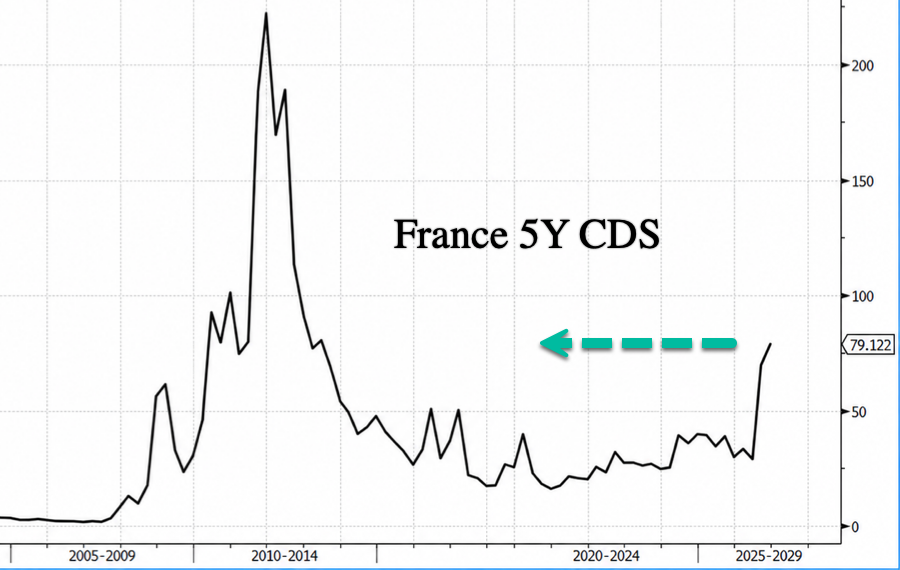
In recent weeks, Le Pen has already offered a glimpse of the shadow budget she would pursue if she wins next year’s presidential election. That would include shrinking the deficit to 3.7% of economic output next year, well below the government’s 5% target, before bringing it down to 2.2% by 2032.
Le Pen’s Polymarket odds of winning the April 18 election stand at nearly 48%, surging in recent weeks as the riots unfolded.
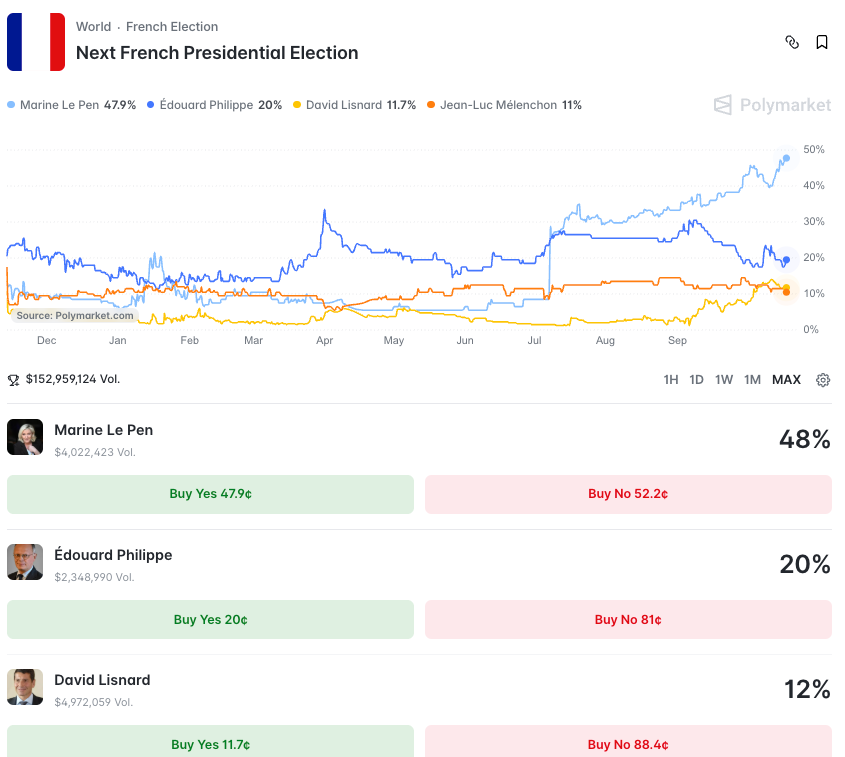
Left-wing corporate media are still providing cover for the far-left rioters and migrants who are torching parts of the country. CBS embarrassingly had to delete a tweet that called the riots “scuffles.”
We have described how a high-rate environment has put socialism’s promises of more and more handouts on “borrowed time” because bond markets are refusing to fund massive deficits for unproductive welfare systems that produce more economic malfeasance.
Socialist failures are piling up across the West. South America is shifting rightward, and a Bolsonaro win in Brazil’s runoff election later this month would cement that move.
Related:
This outcome was very predictable…
The West is experiencing what should be considered “lived memories” of the progressive experiment unraveling at the seams, whether in South America or now in Europe, giving rise to what Nomura analysts expect will be a right-wing wave over the next 18-month election cycle.
END
FRANCE//GERMANY EU//SATURDAY
TOM KOLBE..
Le Pen And AfD Join Forces: Heavy Headwinds For Von Der Leyen’s EU Mega-Budget
Saturday, Oct 17, 2026 – 07:00 AM
A breather in the European bond market.
After yields on ten-year French government bonds brushed against the 5-percent mark in late trading on Friday, the situation calmed again at the start of the week. Two politically significant developments, one from Germany and the other from France, apparently acted like circuit breakers as they are known in the markets.
On Monday, an AfD strategy paper was circulating. In this pamphlet, the party’s European policy experts had apparently agreed on a strategic shift in their approach to the EU and monetary policy. There was no longer any talk of leaving the euro system or even of a Dexit, Germany’s departure from the European Union.
Quite the opposite: The EU is to be transformed into a federation of sovereign nations, with a focus on the internal market, effective protection of the external borders, and coordination among member states on security matters. In general, the goal should be to return political powers to the nation-states — all sensible measures to consolidate the EU’s completely out-of-control expansionism.
As for the shaky euro currency, the authors of the paper argue that it should rest on a solid foundation of individual states taking responsibility for themselves and assuming their own liabilities. Whether this can put an end to the tiresome problem of shifting fiscal responsibility onto German taxpayers remains to be seen.
Important for opponents of fiat money: According to the AfD, the European Central Bank should have its operational scope significantly restricted. Specifically, the paper calls for an end to “indirect ECB financing of governments,” the settlement of Target balances, and an insolvency regime for member states. A ban on financing government debt with the central bank’s money printer would be a revolution in monetary policy. It would be the end of ideological experiments. Politics would have to abandon vehicles such as the Green Deal, since its economic stillbirths can only be kept alive with the help of manipulated borrowing costs. In light of the latest bond turmoil, any means would be justified to leave this destructive path behind.
All of this points in the right direction, but avoids a break with existing power structures. After all, nothing frightens the markets more than uncertainty. A clear horizon is what they are looking for, which is why the news from Germany likely contributed to a collective sigh of relief in the bond market.
France’s opposition leader Marine Le Pen of the Rassemblement National sounded similarly tame. On Tuesday morning, Le Pen presented her plans to consolidate France’s ailing public finances.
A partial return to the Maastricht criteria, with annual new borrowing below three percent of GDP, is what she is seeking, Le Pen said. That, however, would require a revival of economic activity, in an economy that, much like Germany’s, is bloodless and starved of innovation under Brussels’ climate diktat. The country is heading toward sovereign bankruptcy, the politician said, and by 2032, hard spending cuts are supposed to generate savings of €140 billion.
After just 15 months in office, Le Pen plans to achieve a balanced primary budget, meaning a surplus before interest payments. As in Germany, Le Pen plans to enshrine a debt brake, her “golden rule,” in the constitution by referendum — and we have known since Chancellor Friedrich Merz single-handedly executed the debt brake with an already-defeated Bundestag and the special fund exactly what such political promises are worth.
Le Pen also had a very special message for Ursula von der Leyen. France’s net contributions to the European Commission should immediately be cut back to the level of the early 2000s, to five billion euros. A reduction of around 64 percent.
If Le Pen wins the election, she could put herself at the head of a consolidation movement that clips Brussels’ expansionist wings. Von der Leyen is planning a two-trillion-euro mega-budget for the period from 2028 to 2034 – a hyperbolic expansion of 60 percent, which would send Germany’s contribution to the debt club soaring from around €27 billion today to €40–45 billion a year. Even the otherwise debt-friendly Friedrich Merz is trying to rein in this expansionist drive somewhat. Media theater, without a doubt, but the chancellor senses that there is no longer any backing for this policy.
Ultimately, the question is whether Europe will increasingly pool its debt in eurobonds, into a common pool consolidated under the roof of the European Commission and systematically monetized by the European Central Bank. A shell game: shifting the costs of debt-making onto EU taxpayers, who ultimately become the pack animals of centralism, central planning and state-run economics — all systems that consume more billions year after year.
Perhaps the bond market received reassuring signals from the European right. If it is able to put the brakes on this fiscal crash course, a consolidated EU focused on its core responsibilities could take shape. The AfD paper offers important indications of a realistic path toward that goal.
END
FRANCE/SATURDAY
Yellow Vests Return As French Protests Spread And Macron’s Crisis Deepens
Saturday, Oct 17, 2026 – 08:45 AM
Remnants of the original Yellow Vests (Gilets Jaunes) movement are joining the ongoing far-left riots/protests, potentially broadening social instability and increasing pressure on President Emmanuel Macron as he approaches the end of his term in crisis.
France’s political, social and fiscal pressures are increasingly reinforcing one another, with high borrowing costs making its expansive welfare state harder to finance.
France’s five-year sovereign credit default swap spread has jumped to about 79 basis points, more than double its recent level near 30 basis points and roughly its highest since 2013. The surge shows investors demand a higher premium to insure French government debt against default as concern over sovereign credit risk mounts. However, the spread remains well below the 222 bps peak seen during the eurozone debt crisis in 2011.
These pressures have provided tailwinds for Marine Le Pen’s right-wing National Rally (RN), which is positioning itself as an alternative ahead of next year’s presidential election. Le Pen’s recently unveiled shadow budget proposes spending cuts to restore fiscal common sense and reduce the risk of a sovereign debt crisis.
Le Pen’s Polymarket odds of winning next year’s election currently stand at …
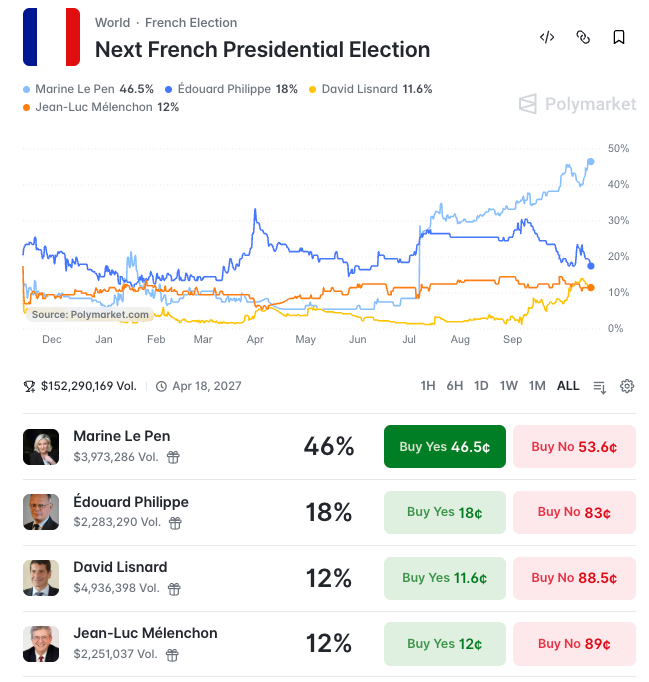
Bloomberg quoted the Interior Ministry early Saturday as expecting hundreds of actions, including blockades of motorway toll booths and service stations, alongside 90 marches.
“We’re expecting a pretty big mobilization” by protesters, Interior Minister Laurent Nunez told local media late Friday.
The left-wing CGT (Confédération Générale du Travail), one of France’s major trade unions, is expected to participate, as indications suggest that weeks of far-left demonstrations are broadening.
The unrest puts significant pressure on Prime Minister Sebastien Lecornu as he seeks parliamentary support to curb spending and reduce the budget deficit to 5% of economic output in 2027, a target France missed this year. Notably, France last balanced its budget in 1973.
The Yellow Vests first emerged in 2018 against Macron’s proposed fuel-tax increase, drawing support from working-class folks concerned about rising living costs in the welfare state.
An uncomfortable reality is setting in for French elites: throwing more money at handouts and degrading services, on top of mass migration, has been a toxic progressive experiment that appears to be unraveling at the seams.
As Macron and his globalist buddies lose control of France, unrest has spread to other corners of the bloc, including Spain, Italy, Albania, and Belgium.
END
FRANCE/MONDAY MORNING:
French Bonds, Stocks Drop As Far-Left, Migrant Riots Worsen; Macron Fails To Restore Order
Monday, Oct 19, 2026 – 08:15 AM
French government bonds sold off, and the CAC 40 fell Monday after a weekend of nationwide riots and chaos intensified concerns over political instability as the Macron government failed to restore order.

President Emmanuel Macron conveniently blamed high gas prices, while lefty corporate media ran cover and really tried to reinforce the narrative (again) that these rioters were merely youth-led protesters. CBS News got caught calling riots “scuffles” and subsequently deleted the X post.
And this.
In reality, France and much of Europe are being attacked from within by far-left groups, and this is really embarrassing, as globalist leaders in the failing bloc have allowed left-wing extremism to fester for years.
On top of the riots spurred by the far-left activist networks, a decade or more of unfettered mass migration brought in millions of migrants (watch how). Given this nation-killing cocktail, it comes as no surprise that corporate media would run an information campaign to cover up the parties responsible for the chaos because, quite frankly, these riots are downright embarrassing for globalists.
Let’s start with markets.
The premium investors demand to hold French 10-year debt over German bonds widened to 146 basis points, the highest in two weeks. The yield gap with Italy also reached a record, while the main equity index, the CAC 40, fell 1.3%, and the euro fell .5% to $1.1183 amid unrest spreading across the bloc.
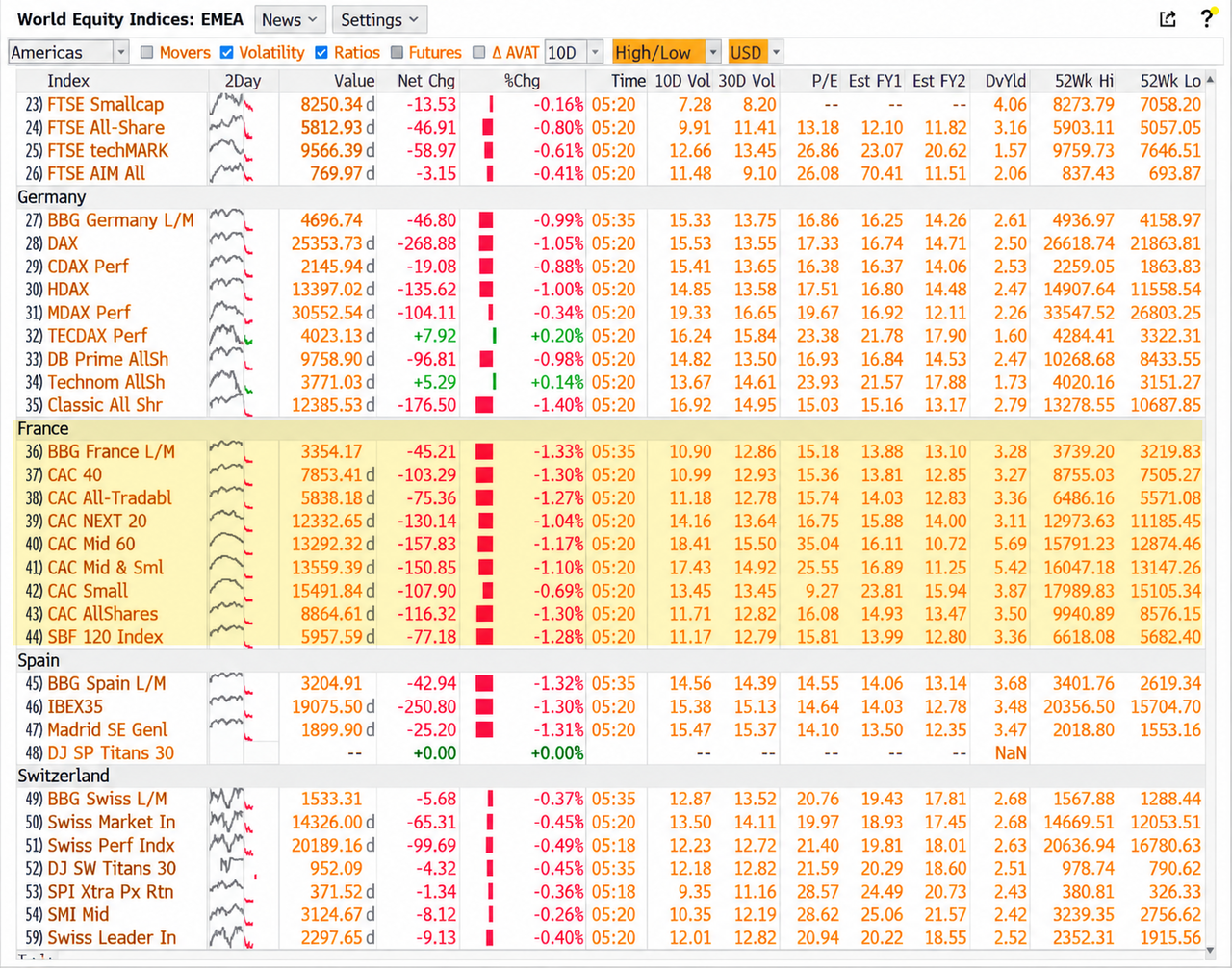
Louis-Vincent Gave of Gavekal Research warned that France faces overlapping social, mass migration, energy, economic, and fiscal crises, all hitting at once like a massive freight train. He warned that the weekend’s developments offered little support for either a stronger euro or lower French borrowing costs.
“All this at a time when the French president is in office, but not in power. Nothing that occurred this weekend seems to point the way toward a higher euro, or lower French bond yields,” Gave said.
Macron is ending his term amid embarrassing social and economic crises, all colliding at once.
The president’s advisers likely gave him the script to go on national television late Sunday and blame the crisis on “fuel” prices, but this is far from the truth, as the rioters are far-left radicals mixed in with what appear to be migrants.
Corporate media first ran cover for an imploding France by blaming “students” angered by oversized classrooms and a lack of education funding for burning buses, buildings, and schools and looting high-end luxury stores. But that narrative has failed to stick as corporate media is no longer the gatekeepers of “truth.”
The unrest likely stems from ongoing discussions among French politicians over the proposed 2027 budget. The government’s proposed budget includes €43 billion ($48.2 billion) in measures to cut the deficit and keep the country from descending into a sovereign debt crisis. In other words, less funding for the welfare state.
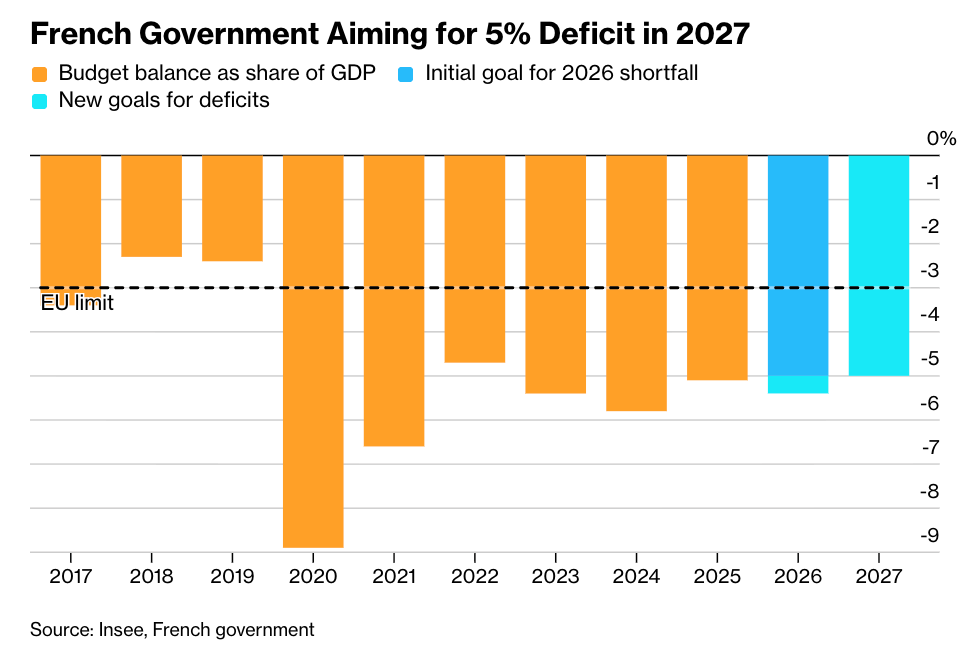
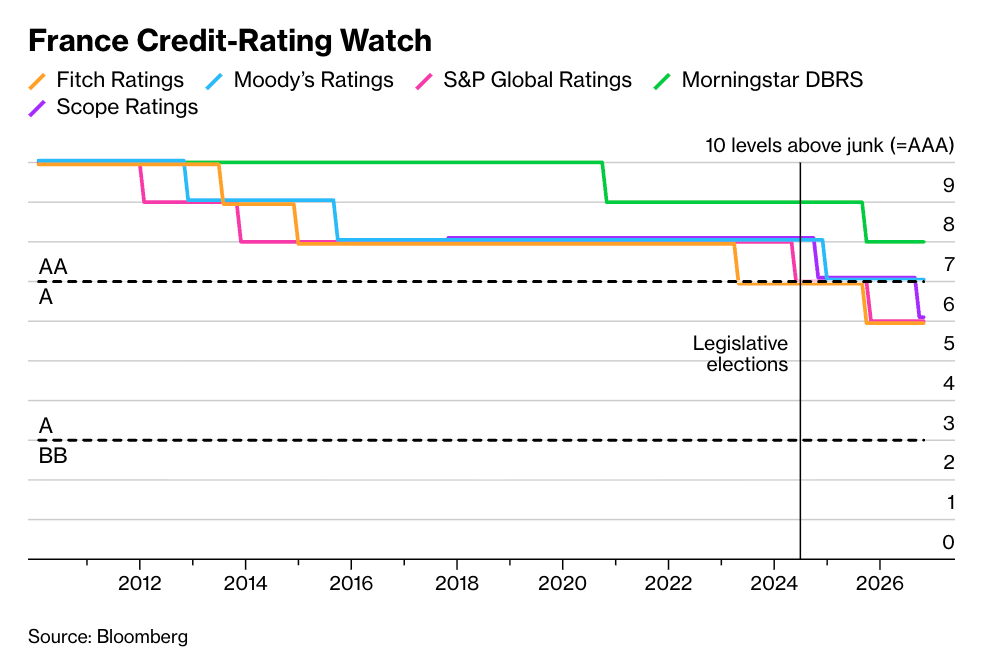
“France’s credit-default swap curve is likely to flatten in the coming months as traders demand a bigger premium to underwrite idiosyncratic political risk ahead of the April presidential elections. …the French National Assembly began discussing next year’s budget last week without passing it yet. That adds one more layer of uncertainty for the country’s risk assets,” Bloomberg Strategists wrote in a note earlier today.
The problem is that spending cuts jeopardize the welfare state, as services are already deteriorating. The left and migrants who rely on handsome government handouts are likely furious that their easy way of life, leeching off taxpayers, could come to an end with a presidential election six months away and right-wing candidate Marine Le Pen rising in the polls and Polymarket odds. She is calling for austerity to fix the fiscal mess spurred by Macron’s globalist government.
“While the violent protests are not representative of the vast majority of the people, the developments over the weekend nevertheless underscore the delicate balancing act the government is facing between appeasing the people and the markets,” said Commerzbank AG strategist Erik Liem.
To sum up: Europe faces a combustible mix of far-left extremism, mounting pressures from more than a decade of mass migration, and welfare states buckling under higher borrowing costs. In France, those pressures are converging into a crisis of social unrest, fiscal crisis, and Macron ending his term in crisis.
As we warned on Sunday: France Enters “Point of No Return.” The question is whether Marine Le Pen can reverse that trajectory, or whether the forces driving France’s rapid demise are becoming too entrenched for any government to contain.
END
France Is The New PIIGS… And European Banks Are Cracking

“France Is The New PIIGS… And European Banks Are Cracking” is a recent analysis from The Market Ear (republished on ZeroHedge, dated around October 19, 2026). It highlights France’s escalating sovereign debt pressures and the knock-on effects on European banks.
zerohedge.com
Context: From PIIGS to FROGS
During the 2010–2012 eurozone debt crisis, markets focused on the “PIIGS” (Portugal, Italy, Ireland, Greece, Spain). Those countries have largely improved their fiscal positions, with several receiving rating upgrades and seeing yields fall below France’s in some cases.
live.euronext.com
France has now become the main flashpoint. Investors have coined “FROGS” (French Oversized Government and Social Security, or similar variants like French Overextended Government and Social Security) to describe the country’s large deficits, high debt, and political obstacles to fiscal consolidation.
smh.com.au
Key recent data points (as of mid-to-late October 2026):
- France’s 10-year OAT yield has surged toward or above ~4.9–5%, near multi-decade highs (highest since ~2002 in some reports).
- The France–Germany 10-year spread (OAT-Bund) has widened to ~140–160 basis points at peaks—levels last seen during the eurozone debt crisis.
- French yields have at times exceeded those of Italy and Greece.
- Debt-to-GDP is above ~119–120%, with deficits stubbornly high (around or above 5% of GDP). Political uncertainty ahead of the 2027 presidential election and recent street protests/unrest have intensified market concerns. theguardian.com
Impact on European BanksThe piece and related reporting note pressure transmitting from French sovereign debt into the banking sector (the classic “doom loop” concern, though milder than in 2011–12):
- French bank stocks (BNP Paribas, Société Générale, Crédit Agricole) have underperformed European peers, with notable daily declines during yield spikes.
- Credit spreads and CDS on French banks have widened.
- Exposure of French banks to their own sovereign debt is more moderate than Italian/Greek banks held during the prior crisis (roughly 15–30% of CET1 for major French banks vs. much higher historical levels elsewhere), and European banks overall are better capitalized than a decade ago. Still, higher sovereign yields raise funding costs and mark-to-market pressures. blog.twentyfouram.com
Contagion fears have appeared in other peripheral or high-debt countries’ yields and bank shares, though analysts generally view a full 2011-style crisis as less likely due to stronger bank balance sheets, the existence of the European Stability Mechanism, and ECB tools.
youtube.com
Bottom line from the analysisThe Market Ear frames France’s yield move as persistent and into “uncharted territory,” with limited near-term reversal signals, and flags resulting cracks in European bank valuations/credit. Broader market commentary echoes the fiscal-political challenges in France while noting that systemic risks remain contained relative to the prior crisis—for now. Protests and budget negotiations continue to drive near-term volatility.
END
France Slaps 8PM Curfews On Cities As Interior Minister Admits Police ‘Lost Control’; Macron Flees To The Gulf
Monday, Oct 19, 2026 – 02:10 PM
France moved Monday to put riot-hit cities under curfew after Interior Minister Laurent Nuñez admitted that authorities had lost control of the streets in several major cities over the weekend. President Emmanuel Macron refused Nuñez’s offer to resign and then left for a Gulf tour to secure fuel supplies.

Prime Minister Sébastien Lecornu told prefects to impose “very limited” and “localized” curfews. According to France 24’s live coverage, Lecornu ruled out a full curfew for Paris. He said a state of emergency could be declared “if necessary,” but that curfews seemed better suited, adding: “I am absolutely determined to restore order.” Marseille’s prefect banned protests and gatherings from noon to 8 p.m.
By Monday evening, Lecornu’s office had named the first towns, all in the northern Nord department. Lille, Douai, Wattignies and Denain will be under curfew from 8 p.m. to 6 a.m. on Monday and Tuesday nights, with each mayor’s agreement, according to Franceinfo. Lille is where Nuñez said rioters broke into city hall, and Wattignies is one of its suburbs. Lille’s Socialist mayor, Arnaud Deslandes, had refused earlier in the day to sign a curfew order, arguing that a late-evening curfew wouldn’t match the hours the trouble broke out. Denain was already under curfew: its mayor ordered a weeklong curfew from 9 p.m. starting Sunday, after what the town said were fires, mortar fireworks and paving stones thrown at police by hooded rioters on Saturday.
Nuñez offered his resignation Sunday. He told France Inter: “I submitted my resignation because I am responsible for everything that is happening.” The Élysée said Macron refused “given the need for continued command of law enforcement in the current context.” Macron has acknowledged failures in planning and intelligence-gathering, ordered full transparency about them, and asked for new policing tactics “as quickly as possible.” Nuñez blamed “hordes of troublemakers and looters” and “far-left activists,” and said hundreds of businesses had been looted: “You can’t look shopkeepers in the eye.”
The numbers keep climbing. Nuñez put the arrests at about 400 on Saturday evening, Lecornu later said 1,200, and the Interior Ministry now counts nearly 2,400 nationwide, with almost 1,000 police and gendarmes injured, seven seriously. Authorities estimated Monday that at least 3,000 businesses were damaged or looted. AFP’s report on Macron’s trip puts the weekend total above 2,500. Paris prosecutors say 855 people were arrested in the capital on Saturday and another 208 on Sunday. Lecornu said no one was killed, calling it “a miracle.”
In his Sunday address, Macron said “nothing justifies” what he called “unbridled” violence. He blamed “agitators from ultra-left fringe groups, joined by numerous delinquents,” said he felt “anger and shame,” and announced neither a state of emergency nor a curfew. Lecornu has since said a whole network could be mobilised to challenge the presidential election timetable. Jean-Luc Mélenchon’s response was that the prime minister must name those involved and provide proof.
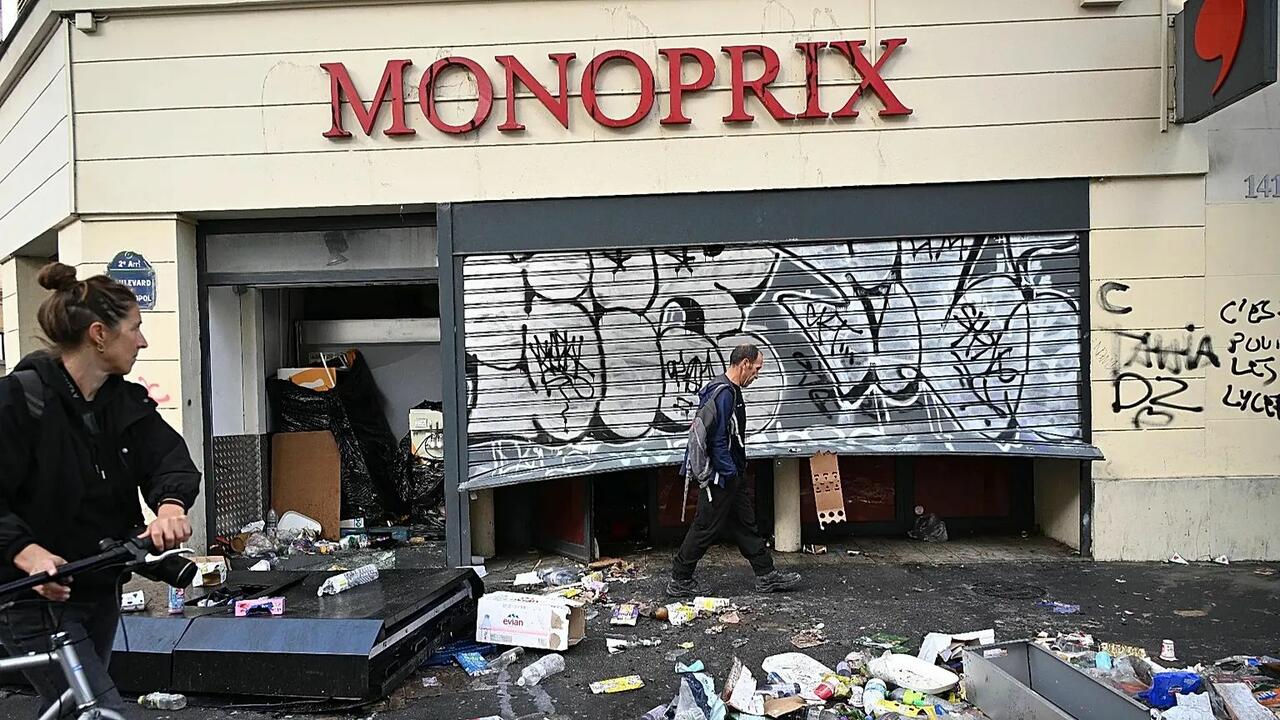
Macron’s Gulf tour opened in Kuwait City on Monday, with the UAE, Bahrain and Qatar to follow by Wednesday. Executives from TotalEnergies and Engie are traveling with him to seek commitments on diesel and oil volumes, and the talks include moving pre-positioned kerosene and diesel from Oman to Réunion and Mayotte. Macron said the trip was needed to “secure our supplies,” noting that demonstrators had raised fuel prices. Constitutional expert Benjamin Morel told AFP the tour could look like business as usual but might also seem out of touch and suggest a power vacuum. Francis Perrin of the French Institute for International and Strategic Relations does not expect it to move fuel prices, since Gulf states find firm commitments difficult while the region remains disrupted by the US-Iran war and the closure of the Strait of Hormuz.
The protests were called over the cost of living and conditions in schools, after weeks of student protests. The CGT union claimed 800,000 marchers on Saturday; Nuñez put the figure at about 550,000, including 110,000 in Paris. The violence has been severe: in Limoges the prefect said the town hall was “largely lost” to fire, and a 17-year-old protester reportedly lost a hand in Saint-Étienne, apparently to a police grenade. A prosecutor has asked the police watchdog IGPN to investigate; Nuñez said he could not confirm that. The Yellow Vest movement has called for another round of protests on Saturday, France 24 reported.
Markets noticed. The French 10-year yield rose 12 basis points to 4.90% Monday, according to France 24. As we reported, French bonds and stocks dropped as the riots worsened, after we had described France entering a “point of no return” on Sunday.
Macron has refused an interior minister’s resignation before. In October 2018 he turned down Gérard Collomb’s first offer, citing confidence in him, and accepted a second one two days later.
Cover photo: A protester throws a cobblestone during an anti-government demonstration in central Tirana on October 17, 2026 (Photo by Armend NIMANI / AFP)
* * *
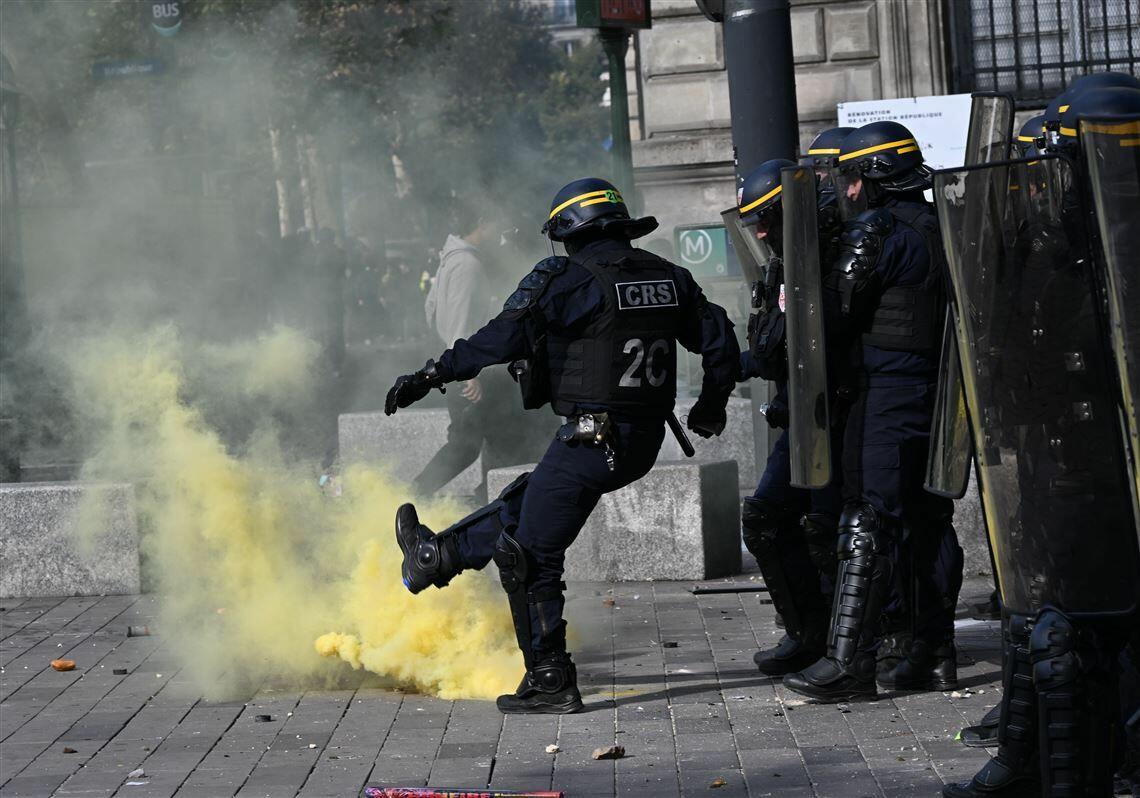
UK
80% Of New UK Payroll Jobs Since 2014 Went To Foreign Nationals, Think Tank Finds
Monday, Oct 19, 2026 – 02:45 AM
Just one in five of the roughly 3.7 million jobs added to UK payrolls from 2014 through the end of 2025 went to British nationals. Non-EU nationals took about 2.5 million of them, roughly two-thirds, and EU nationals another 408,000, leaving Britons with 734,000, according to a Centre for Social Justice (CSJ) analysis of HMRC data.
The center-right think tank released the figures Tuesday in State of Dependency, a 250-page report launching its Welfare 2030 inquiry. Former Work and Pensions Secretary Sir Iain Duncan Smith chairs the inquiry.

The CSJ’s rounded components add to about 3.64 million against its “approximately 3.7 million” total, so foreign nationals took close to 80% of the growth and Britons about 20%. Britons still hold most of the jobs that exist: HMRC data show 25.6 million Britons among 32 million payrolled workers in December 2025, the Press Association reported.
The shift is recent. Since January 2020, Britons’ payroll jobs fell in nine of the UK’s 12 regions and nations while non-EU nationals’ jobs rose in all 12, the CSJ’s regional table shows. Summed across that table, non-EU nationals gained about 2.1 million payroll jobs, Britons lost about 186,000 and EU nationals lost about 352,000. More than four-fifths of the non-EU gain since 2014 therefore came in the last six years of the twelve.
London shows it most sharply. Non-EU payroll jobs there rose by 465,200 since 2020 while Britons’ fell by 26,500 and EU nationals’ by 171,100. Scotland lost 53,000 British payroll jobs and gained 130,200 non-EU ones; the South East lost 31,700 and gained 284,500. Four sectors account for about two-thirds of the non-EU increase: health and social work (29%), administrative and support services (16%), accommodation and food (12%), and wholesale and retail (10%).
Care shows how the door opened. In the year to March 2023, about 57,700 care and senior care workers received skilled-worker visas, and 99% of sponsored care workers in 2022 came from outside the EU, according to the Migration Observatory. Inflows have since fallen: the ONS put net migration at 171,000 in 2025, from 331,000 a year earlier, with work-related arrivals of non-EU nationals down 47% to about 146,000 after rule changes that included closing the Health and Care route for overseas care workers. The CSJ’s payroll window ends in December 2025, so it captures the hiring wave and only part of the 2024 and 2025 restrictions.
The other half of the CSJ’s case is welfare. It counts 6.7 million people on at least one out-of-work benefit, about one in six working-age adults, and says out-of-work claimants rose by 2.3 million between February 2020 and November 2025. Working-age benefits are forecast to cost £136.1 billion in 2026/27, up about £50 billion in real terms since 2019/20, and the report identifies 3,369 “welfare hotspots” where claimants outnumber half the working-age population, home to nearly 900,000 people.
A companion CSJ estimate puts the foreign-national share at about 1.85 million non-British adults receiving at least one benefit or the state pension in 2025, at roughly £23 billion, including 1.3 million on Universal Credit at £11.9 billion. Those are CSJ calculations from DWP, HMRC and Home Office data and survey rates, not official statistics, and they assume half the adults in mixed-nationality households are foreign nationals. Earlier estimates ran lower: as we reported, one analysis of government data put welfare paid to migrants at £7.6 billion in a single year.
The report’s thesis is that governments swapped one dependency for another. Real GDP grew 26% from 2006 to 2025, but real GDP per person grew only 10%, which the CSJ calls “human quantitative easing”: importing workers to lift headline growth. It adds that official fiscal forecasts run only five years, so they bank the early tax take from migrant workers and miss the welfare costs that arrive later. Duncan Smith said “ministers have repeatedly pulled the easy lever of immigration rather than providing a better deal for left behind communities.”
He has made the jobs argument before. As work and pensions secretary in July 2011, Duncan Smith told a Madrid audience that businesses should hire unemployed Britons, and Channel 4 noted that 87% of the 400,000 jobs created in the coalition’s first year had gone to workers from abroad, a figure unearthed by Labour MP Frank Field. The same caution applies here. The CSJ counts net changes in payrolled jobs by nationality, not who was hired, and a naturalized citizen counts as British. In 2015 the Daily Express claimed 75% of new jobs went to EU migrants; the paper corrected it after economist Jonathan Portes complained and the press regulator IPSO ruled it “significantly misleading,” because the ONS data showed net changes in employment, not people entering new jobs.
The report landed a day after Reform UK’s Nigel Farage pledged to suspend the asylum system for a full parliament, as we reported.
GERMANY/SATURDAY
Watch: Migrant Mobs Are Terrorizing German Children At School
Saturday, Oct 17, 2026 – 08:10 AM
Authored by Steve Watson via Modernity.news,
A young German student was punched, kicked in the head, and left defenseless on the ground by a mob of roughly ten youths outside the Heinrich-von-Kleist School in Frankfurt (Oder) this week. The attack is part of a widespread pattern of mobs of feral migrant background youths attacking German children.

The attackers filmed the assault and released it with a gangster rap soundtrack. Police are investigating ten suspects aged 13 to 15 of Syrian, Chechen, Polish, Russian, and German nationality on charges of aggravated assault and robbery.
Videos circulating on social media, which authorities have confirmed as authentic, show the student being confronted and asked for something. He displays empty pockets before one of the group punches him in the face.
The rest of the mob then joins in with punches and kicks, including to the head, continuing the attack after he falls to the ground.
The victim suffered facial injuries and reported the incident to police the same day.
Headmaster Sören Schunke stated that the attackers were not students at his school. Officers later carried out an operation at the nearby Ulrich von Hutten High School linked to the case.
Frankfurt (Oder) Mayor Axel Strasser said in a statement: “What was done to a young person here in Frankfurt (Oder) leaves me speechless. It hurts to have to witness such violence. And it makes me angry that a youth has to experience something like this.”
He added that this level of organized youth violence was previously unknown in the city and that it would not be tolerated. Strasser has spoken with Brandenburg Interior Minister Jan Redmann and arranged security talks involving police and school authorities.
The incident occurs against a backdrop of repeated group attacks in the neighboring city of Potsdam. Redmann has described a wave of predominantly migrant-linked youth violence there, including Syrian suspects.
On September 25, roughly 20 people, mostly migrants, entered a private party uninvited and attacked guests. The following day a group of about 25 assaulted three youths. Additional attacks in early October left victims with head injuries requiring hospital treatment.
Authorities are monitoring a group of roughly 25 mostly migrant suspects; two alleged ringleaders are in pretrial detention and police presence has been increased.
Redmann has said foreign perpetrators, particularly Syrians whose protection status can be revoked, could face deportation: “Whoever comes to Germany and simply has no respect for Germany, we will not tolerate that. The rule of law has the final say.“
In one related case in the Wannsee district of Berlin, witnesses described up to 20 people with an “Arab migration background” beating three high school students from the Catholic Marien School in Babelsberg with “unbridled and massive violence.”
One 17-year-old lost consciousness and an 18-year-old struck his head against a parked car, requiring hospital treatment.
A witness told Tagesspiegel: “For me, this is attempted murder.” The perpetrators fled into a forest. Suspects are believed to come from Potsdam, where robberies by youth gangs have increased.
Similar patterns of targeted attacks on German students have appeared elsewhere. In July, young German students were reportedly hunted and beaten by a group of foreigners at a train station in Jessen in Saxony-Anhalt.
Victims said they did not know why they were targeted, and police had been unable to locate the perpetrators at the time of reporting. A video of the attack later circulated.
These cases form part of a longer pattern of violence and disorder in German schools with high migrant enrollment. Government data released in response to a parliamentary inquiry showed that in 2024 nearly 40 percent of suspects identified in school violence cases across Germany did not hold German citizenship.
Of 11,558 suspects, 4,254 were foreign nationals, including 1,236 Syrians and 421 Afghans. There were 35,570 violent incidents at schools that year, averaging nearly 100 per day, with more than 740 involving knives.

END
German Schools ‘Dealing With Hell’ Due To Mass Migration
‘Berlin is everywhere’
 modernity
At the Karolina-Burger high school in Ludwigshafen, police recorded 118 criminal complaints over three years, roughly half involving bodily harm, along with more than 100 false fire alarms. A 16-year-old student attacked a teacher in the staff room with a knife; prosecutors said she acted with the intention of killing her.
Interior Minister Michael Ebling stated: “Violence has no place in our society – and certainly not in our schools.” Education Minister Sven Teuber said: “Every child has the right to learn well and safely.”

German School Under Police Guard After Knife Attacks, Threats, 118 Crimes In One Year
Teachers described months of violence, intimidation and a knife attack on a colleague
A special education teacher at a secondary school in the Rhineland where roughly 75 percent of students have a migrant background described daily fights, drug dealing on school grounds, and a 15-year-old girl who prostituted herself in the school toilets for drugs and money before becoming pregnant and leaving.
The teacher, who was punched in the face while intervening in a fight, said: “Every day is a challenge. Fights, shouting – this happens in the classroom and on the schoolyard. We are happy if we can teach for a few minutes at a time. Sometimes the police have to come several times a week.”
She added that colleagues are insulted, threatened, or ambushed after school and that “No one from the school board ever shows up. They’ve left us to fend for ourselves.”

Teacher Exposes Chaos: Violence, Drugs And Prostitution At 75% Migrant School
Staff are increasingly being threatened or assaulted
In Düsseldorf, an 18-year-old Afghan intern at a primary school exposed his erect penis to two second-grade girls at a sink in the classroom while a teacher was present showing a film.
He also admitted to groping the class teacher’s buttocks on two occasions. Police opened a criminal investigation, searched his apartment, and notified immigration authorities because of his asylum seeker status.
The internship was terminated and he was banned from the premises. An investigator noted that schools often prefer to keep a low profile in such cases.

Afghan Intern Exposed Erect Penis To 2nd Graders At German School, Groped Teacher: Report
“Unfortunately, we often see this”
Separate stabbing attacks have also occurred. A 13-year-old Arab boy stabbed a 12-year-old German classmate multiple times with a kitchen knife in the locker room of an elementary school in Berlin’s Spandau neighborhood; the victim required emergency surgery.
In Remscheid, an 11-year-old Iraqi child stabbed a 13-year-old German boy twice in the leg with a kitchen knife after an arranged fight. Because the suspect was under 14 he faced no criminal charges and was released to his parents under youth welfare supervision.

Arab Teen, Iraqi Child Stab Classmates in Separate Attacks In Germany
A day of bloodshed in German schools, thanks again to unchecked immigration. One 13-year-old suspect remains on the run
In the small town of Harsefeld in Lower Saxony, a youth gang active for at least six months committed beatings, threats, extortion, and drug trafficking, uploading videos of the assaults.
Two known leaders had approximately 15 reported crimes each. Citizens formed a vigilante patrol group to protect children after police response was criticized as inadequate. A police spokesperson said: “Yes, of course, we find that quite creepy. A vigilante group doesn’t help anyone.“

Germany: Youth Gang Terrorizes Small Town, Vigilante Patrol Group Forms To Protect Children
When the German state fails to protect the youth, some citizens are taking defense into their own hands, even as the police warn against such an action
The filmed attack in Frankfurt (Oder) is not an outlier. It is one more instance in which German students have been surrounded, beaten, and filmed by groups that include large numbers of foreign nationals and those with migration backgrounds.
Officials issue statements of outrage and schedule further talks while the underlying numbers on school violence and the composition of the suspects remain consistent across multiple reports. Native German children continue to encounter these conditions on the way to and from school.
END
GERMANY
Germany’s Rent Control Is Backfiring, New Study Of 107 Cities Finds
Monday, Oct 19, 2026 – 03:30 AM
Authored by Rainer Zitelmann via RealClearMarkets,
Across Europe, the housing shortage is getting worse – and left-wing parties have discovered it as a central political issue. Recently, the far-left party DIE LINKE even won the elections in Berlin, the German capital, campaigning on a demand to nationalize large housing companies. In Spain, hundreds of thousands of people have demonstrated in favor of stricter regulations.

But do such measures really help?
We should learn from Germany’s experience, where a form of rent control known as the “Mietpreisbremse” (rent brake) was introduced back in 2015 and has since been tightened several times.
Yet this rent control policy is producing precisely the opposite of what it was intended to achieve. That is the conclusion of a new doctoral dissertation completed at the University of Regensburg, Europe’s leading university for real estate studies.
In Germany, the gap between rents paid by existing tenants and rents charged for newly rented apartments is growing wider. In his 2026 dissertation, “Housing Markets Between Regional Heterogeneity and Political Intervention,” Lars Jagemann analyzes 107 German cities. He finds that the gap between existing rents and asking rents for new leases averages 20 to 25 percent, reaching as much as 50 percent in major metropolitan areas.
This creates what economists call a “lock-in effect.” As Jagemann explains, existing tenants hold on to their inexpensive, legally protected rental contracts and avoid moving into the more expensive segment of the market, even when their current homes no longer suit their circumstances.
As a result, the supply of housing available to people who need to move, such as young families or those starting their careers, shrinks, making it increasingly difficult for them to find an apartment. The market becomes increasingly divided into two groups: “insiders,” who benefit from stable, inexpensive rental contracts protected by regulation, and “outsiders,” who are looking for housing and face sharply rising market rents for new leases.
The dissertation confirms what economists have repeatedly warned about: While German housing policy aims to promote social stability and protect tenants, the measures introduced create unintended market distortions that can, paradoxically, harm precisely those groups they are supposed to protect. Regulation, the author concludes, is becoming increasingly “dysfunctional.”
In theory, there are two possible responses: even more regulation, or deregulation and greater reliance on market forces. The author himself makes no direct recommendation. It would have been desirable for the dissertation to examine in greater detail the problems associated with even stricter regulation, particularly the “interventionist spiral” identified by economist Ludwig von Mises.
According to Mises, tighter regulations may temporarily alleviate certain problems, but they create new ones. Governments then introduce additional regulations to address these problems, which in turn produce further unintended consequences.
In fact, the dissertation provides empirical confirmation of this mechanism. Since Germany introduced its rent brake in 2015, the policy has already been tightened several times. The so-called “Kappungsgrenze,” which limits rent increases for existing tenants, has also been made more restrictive.
The central finding of the dissertation is that precisely because housing is a fundamental social need, housing policy interventions must respect the inherent mechanisms of the market. Regulations that work against fundamental economic incentives provoke avoidance strategies that can place additional burdens on vulnerable groups. Sustainable housing policy, so the authors, must therefore make intelligent use of market mechanisms rather than fight them: by creating incentives instead of imposing prohibitions, expanding supply instead of capping prices, and establishing transparent, long-term rules instead of constantly changing interventions.
The author also places particular emphasis on the damaging effects of political uncertainty. Such uncertainty is created not only by actual government policies. Even the discussion of possible new regulations can generate uncertainty, prompting investors to adopt a wait-and-see approach.
Uncertainty is always bad for investors, but it is particularly damaging in real estate, the author argues, because investments require long planning periods and are largely irreversible. Unlike stocks, investors cannot simply exit a construction project at any time without losing substantial amounts of money.
Here, too, a vicious circle develops: uncertainty reduces housing supply, which drives up property prices and rents. These increases are then used to justify new political demands for intervention, creating even more uncertainty.
Alongside healthcare and finance, housing is among the most heavily regulated markets in many countries. It is no coincidence that these are precisely the sectors that experience recurring crises. More regulation increases costs and reduces efficiency.
Across Europe, center-right parties are making the mistake of leaving housing policy to the left instead of making problems such as high rents and housing shortages central issues themselves. They should demonstrate that only sweeping deregulation can substantially expand housing supply. Javier Milei is currently showing exactly how this can be done in Argentina.BIO: In June, Skyhorse Publishing will release Rainer Zitelmann’s book “New Space Capitalism.”
END
GERMANY
when you let in massive amounts of Chinese cars, this is what you get:
Struggling Volkswagen Plans Pay Freeze Through 2030 As Job Cuts Loom: Report
Monday, Oct 19, 2026 – 07:20 AM
In another episode of the “death of Europe,” a new report from Germany brings more troubling news for struggling automaker Volkswagen, suggesting to us that globalists in the bloc have squandered not just their inheritance but their economic future through a failing progressive experiment that has neutered Europe’s industrial base.
German daily newspaper Süddeutsche Zeitung (SZ) reports that Volkswagen plans to freeze salaries through the end of the decade as it expands its cost-cutting push after lowering its outlook and doubling its job-reduction target.
“Internal documents reveal that hundreds of thousands of employees are to forgo pay raises. These latest plans represent a further escalation in the conflict between management and employee representatives,” SZ wrote in the article.

The proposed freeze is part of a broader restructuring plan the executive board approved, SZ said, citing internal documents. It added that all regions and plants are expected to make an “appropriate” contribution to Volkswagen’s “Group Target Picture,” a turnaround strategy aimed at rescuing the automaker.
The plans follow Volkswagen’s September decision to slash its outlook and double its job-cut target to 100,000 positions.
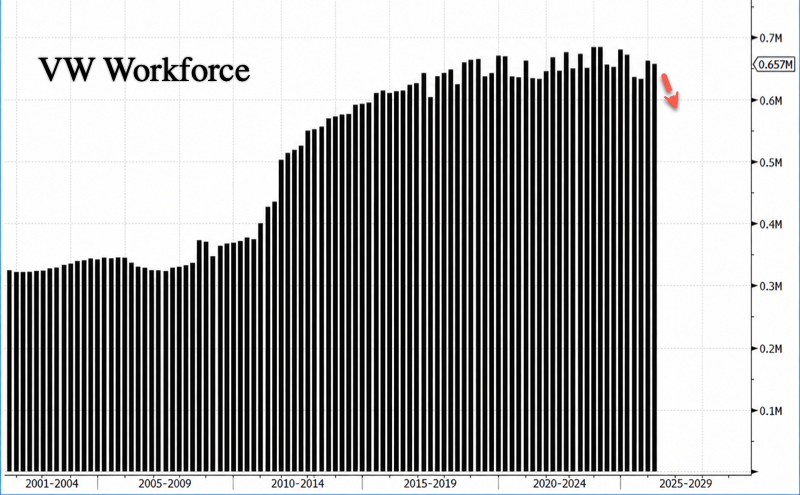
More context:
- The Future Of Volkswagen?
- VW Supervisory Board Recommends Another 4,100 Job Cuts At Porsche
- Death Of Europe’s Industrial Base: VW CEO Set To Announce 50,000 Job Cuts
Why Europe allowed a flood of Chinese EVs and hybrids to undercut its own automakers is a question for the history books.
Brussels has at least begun to respond, agreeing earlier this month to cap Chinese hybrid imports at 350,000 vehicles a year, with restrictions expected to take effect in December. It’s a start.
END
HOLLAND/MONDAY
Dutch Minister: Young Locals Can Just Live With Their Parents, Migrants Get Houses First
Monday, Oct 19, 2026 – 02:00 AM
Dutch Housing Minister Elanor Boekholt-O’Sullivan drew sharp criticism this week after defending priority access to scarce social housing for recognized refugees, arguing that many young Dutch first-time home seekers “can still live with their parents.”

In an interview with De Telegraaf, the D66 minister was asked why status holders – asylum seekers granted residence permits – should receive preference for social rental homes while Dutch “starters” face long waiting lists and delayed independence. She responded that “we see that a lot of starters can still, or are allowed to, live with their parents.”
Dutch commentator and activist Eva Vlaardingerbroek wrote on X that the policy amounted to “systemic racism.”
“And not just the ‘new’ newcomers. A 25-year-old Syrian who came here with his parents years ago jumps the queue for a home when he decides he wants to live on his own. Meaning a 25-year-old white Dutch guy can forget about getting his own place and ends up on waiting lists for 10+ years,” she wrote, adding: “Putting the interests of foreigners above the interests of the native population needs to end.”
Boekholt-O’Sullivan, an Irish-born former lieutenant general in the Dutch Air Force who took office earlier this year, claims that anyone who wants to live in the Netherlands should get a roof but does not address the major housing crisis brought on by mass immigration.
“For me, the fundamental principle is that anyone who is allowed to and wants to live in the Netherlands gets a roof over their head,” she said. She noted that status holders typically leave asylum reception centers and argued that alternatives such as remaining in centers, homelessness, hotels or cruise ships were unacceptable, so priority allocation should continue until other solutions exist.
The remarks landed amid fresh data underscoring migration’s outsized role in the Netherlands’ housing crunch. A report released this week by the Economic Institute for Construction (EIB) found that migration accounted for about 60 percent of additional housing demand between 2015 and 2024. Migrants who arrived in that period occupied roughly 435,000 homes by 2024, out of nearly 700,000 homes added to the stock.
In addition, data shows that migrants occupy 44 percent of the 2.2 million social housing units in the country.
The 44 percent figure of social housing units occupied by first or second-generation immigrants has doubled from 22 percent in 2000, and is forecast to rise to 51 percent by 2030.
A total of 92 percent of Syrian first-generation immigrants reside in social housing. In addition, 90 percent of those born in Somalia, Afghanistan, and Eritrea reside in social housing.
Asylum-related migration contributes disproportionately to lasting demand because status holders remain permanently at high rates, unlike many labor or student migrants who leave within a decade.
Critics said the minister’s comments minimized the burdens on young Dutch adults who have already spent years on waiting lists for social housing or who face high private rents and purchase prices that lock them out of independent living.
Social housing waiting lists in major cities often stretch many years; priority rules for status holders allow some recent arrivals to bypass ordinary queues. Dutch population growth in recent years has been driven almost entirely by net migration, amplifying pressure on an already constrained housing market marked by strict planning rules, nitrogen regulations and slow construction.
The latest debate about Dutch housing policy and mass immigration is only one aspect of the massive burden foreigners have been on Dutch society, which shows that Dutch taxpayers have spent €400 billion on migrants between 1995 and 2019.
The landmark study, entitled “Borderless Welfare State: The Consequences of Immigration on Public Finances,” shows that net costs of immigration to the Dutch public sector over the period 1995-2019 were an astounding €400 billion, averaging €17 billion a year, with a peak of €32 billion in 2016 due to the 2015 refugee crisis.
However, this is far from the total figure. Since 2019, Dutch taxpayers have paid tens of billions more, with no end in sight.
SPAIN/MOROCCO/CEUTA
70% Of Moroccan Asylee Claims In Ceuta After Mass Entry Cite Persecution Over Sexual Orientation
Monday, Oct 19, 2026 – 04:15 AM
Spanish police say about 70% of the Moroccans processed in Ceuta after July’s mass entry have asked for asylum alleging persecution over their sexual orientation, according to El Periódico de Ceuta, which relays figures from National Police sources first published by the Spanish daily ABC. The number comes from unnamed police sources, not published statistics.

The paper says officers handling migration in the enclave see a shift from the economic or work reasons Moroccans usually gave, and that the claims have reshaped the caseload at the city’s asylum office. Morocco-focused outlet Yabiladi reports that the sources suspect some applicants are being coached on asylum procedures as a way to stay in Spain.
Only five of those who arrived in the mass entries have so far won refugee status for persecution over homosexuality, El Periódico says. Spain’s Office of Asylum and Refugees reviews each file individually, and the paper says investigators are still weighing whether each account is true.
Being gay is not enough by itself, Yabiladi notes: applicants must show a well-founded risk of persecution if sent back, judged on interviews, consistency, documents and conditions in Morocco, and without relying on stereotypes. Morocco criminalizes same-sex relations under Article 489 of its penal code, and the U.S. State Department says hundreds of men and women are prosecuted for it each year, per AP.
Neither report says how many claims sit behind the 70% figure. El Periódico describes it as a share of Moroccans attended after the entries, while Yabiladi calls it 70% of applications, so the denominator is unclear.
Some claimants have told their stories. An AP report on Oct. 11 quoted a gay man from Tetouan who left after his brother threatened to report him to police: “I left Morocco because being gay is so hard.” AP said it could not independently verify the asylum claim of one interviewee. Police cleared the beachside tent camp in early October.
The scale of the July 30-31 entry is itself disputed. Spanish government estimates put the number who reached the city at 72,000, many swimming around the border fence, the Irish Times reported in August. The government counted 83 deaths and a human rights group 141. Most of those who crossed were sent back to Morocco, several thousand remain, and Yabiladi puts the number still in the city at about 10,000.
Interior Minister Fernando Grande-Marlaska has said none of the migrants will stay in Ceuta or travel to the mainland. Spain raised police and Civil Guard numbers in the city from 1,100 to 1,600, and Morocco put soldiers and extra fencing along the border. Madrid blamed traffickers, but the cause of the crossing has not been identified.
EUROPE: GAS PLANTS VS COAL PLANTS
Global Gas Crunch Makes Europe’s Remaining Coal Plants Profitable
Saturday, Oct 17, 2026 – 10:30 AM
By Michael Kern of OilPrice.com
The global LNG supply crunch has made Europe’s last-standing coal-fired power plants profitable this year as gas supply costs soar while the need for conventional generation to stabilize grids remains.
In Germany and Poland, which host most of the remaining operational or back-up-ready coal power capacity in Europe, coal-fired generation is profitable again as winter approaches, LNG supply is barely moving out of the Strait of Hormuz, and gas prices are at their highest level since the 2022-2023 crisis.

European countries, including Germany, have closed coal capacities in recent years due to climate targets. But the remaining coal-fired power plants have now become indispensable in stabilizing the grids as gas-fired generation slumps amid demand destruction and gas conservation.
One measure of profitability for generating electricity from lignite in Germany has jumped to as much as $72 (64 euros) per megawatt-hour (MWh) this month, compared to zero at this time last year, per estimates by Energy Aspects cited by Bloomberg.
“The spreads are expected to stay high through March,” Energy Aspects analyst Sabrina Kernbichler said.
Coal demand in Europe remains in a structural decline, but the drop is set to slow this year, the International Energy Agency (IEA) said in its Coal Mid-Year Update 2026 last month.
Total annual coal demand in Europe is now expected to reach 276 million tons in 2026, down from 292 million tons last year, but higher than previously expected, according to the agency.
“Higher gas prices have reduced the expected decline in countries, such as Germany and Poland, where gas generation and spare coal capacity remains available,” the IEA noted.
Weather-related events, such as cold spells going into the winter, could also temporarily increase coal use in Europe more than what was expected before the war in Iran, which sent shockwaves through the oil and gas markets globally, the Paris-based agency said.
END
5.RUSSIA AND ISRAEL AND MIDDLE EASTERN AFFIARS
ISRAEL/IRAN/USA //SATURDAY
Two More Tankers Hit Off Saudi Coast As Brent Tops $110
Saturday, Oct 17, 2026 – 09:55 AM
Brent crude topped $110 a barrel to end the week for the first time since May as drone and missile attacks on energy infrastructure, from the Gulf to the war in Ukraine, cast a very dark cloud over oil and products market ahead of the Northern Hemisphere winter.
The global benchmark rose 3.7% Friday, marking the second consecutive week of gains as traders ramped up bullish bets on crude ahead of the weekend.
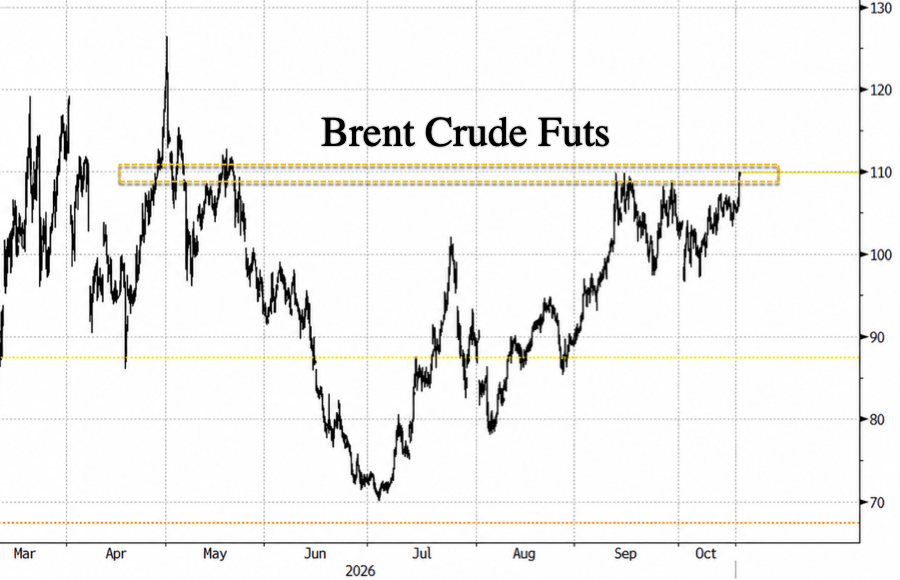
Bloomberg reports that two tankers were struck near Jubail, a port city in Saudi Arabia.
- The first tanker, 78 nautical miles northeast of Jubail, was hit by a rocket-propelled grenade fired from a small boat, causing damage but no casualties.
- The second tanker, 68 nautical miles northeast of Jubail, was struck by an unidentified projectile. Its crew was reported safe and evacuated.
The broadening conflict in the Middle East, with Iran-backed Houthis pelting Saudi Arabia with missiles and drones, Tehran causing ongoing trouble in the Strait of Hormuz, and Ukraine continuing to attack Russian energy infrastructure, has renewed fear in the oil market.
The good news this week is that more than 100 million barrels passed through the waterway, bringing volumes close to pre-war levels, but a nasty global refining crisis may accelerate into the new year.
Read UBS:
“After a brief reprieve, the oil market is having to price risk back in, particularly heading into the weekend,” said Rebecca Babin, senior energy trader at CIBC Private Wealth Group.
Diesel futures settled at $4.90 a gallon in New York, while gasoline also rose. Both fuels are trading at their highest levels for this time of year. Restrictions on Russian diesel are pushing refineries elsewhere to process more crude.
The International Energy Agency warned in recent days that the diesel squeeze will persist through at least the first half of next year, similar to Goldman’s recent take (read here).
Vitol CEO Russell Hardy warned, “There aren’t any more inventories to drain in the West,” as the tail risk of $200 crude lingers if another hard shutdown of the Hormuz chokepoint materializes.
END
ISRAEL/IRAN/.USA/SATURDAY
LNG Tanker Off Yemen Attacked By Small Boat Fire
Saturday, Oct 17, 2026 – 12:05 PM
It begins in waters off Yemen now? This has been a big fear for global energy prices amid the seven-month long Iran war and Hormuz Strait crisis.
The Houthis have while fighting a war with Riyadh and its coalition in Yemen so far declared that international shipping remains safe, but that only Saudi and Israeli-linked vessels will be targeted.
But on Friday a liquefied natural gas tanker 140 nautical miles southeast of the Yemeni city of Al Mukalla has come under attack.
The emerging circumstances are somewhat unusual, given it wasn’t attacked by drone or missile, but by a small boat, reportedly with seven people on board.
One regional source says, “According to UKMTO, the captain of the LNG tanker reported the approach of a small boat. People aboard the boat fired two shots at the tanker.”
While not exactly looking like a major or destructive attack, it could have been a ‘warning’ situation, or possibly even a small-scale piracy attempt.

But it still brings up the question, is the Gulf of Aden is getting hot again?
Stretching into this past summer, multiple Saudi vessels have been targeted in the Red Sea region, forcing a number of tankers to U-turn, Houthis having at times signaled potentially imposing their own ‘toll system’ for the Bab el-Mandeb Strait.
The scheme would potentially be a mirror image of that Tehran is seeking to enforce in the Strait of Hormuz, where it continues to insist that it will settle for nothing less than its own vision of management, including fee collection for “navigation” “environmental” and safety assurance.
END
IRAN/ET AL
IRGC Again Warns Trump: If US Bombing Renewed “World Will Face Serious Energy Crisis”
Monday, Oct 19, 2026 – 09:40 AM
After President Trump previewed that he’s mulling the resumption of a major US bombing campaign of Iran for after the November midterm elections, Iranian officials are busy pushing back with their own warnings and red lines. Trump has even lately teased potential new offensive action even before the US Congressional elections.
Iran’s Foreign Minister Abbas Araghchi on Sunday warned against the US restarting attacks, saying that Tehran has “unfinished jobs” too – while also alleging Israel is dragging Washington along into more needless conflict.

“Last time you wanted to ‘finish the job’, Iran emerged even stronger. Want to try your luck again? Be our guest. But be careful; we have unfinished jobs too,” Araghchi wrote on X. “Netanyahu is driving America into another war to stay out of jail, whatever the consequences for Israel—let alone POTUS,” he stressed.
The reference to stay out of jail is a nod to the upcoming Israeli elections, which will happen in under two weeks. If Netanyahu’s mandate isn’t extended by becoming prime minister again, his corruption trials will resume in full swing.
On Monday, the Islamic Revolutionary Guard Corps (IRGC) followed with its own parallel warnings. Brigadier General Hossein Mohebbi declared that Washington is simply in no position to renew the conflict.
As reported in state Tasnim, the IRGC spokesman said, “Most of America’s bases in the region have been deactivated. Its forces are worn out and exhausted and are hundreds of kilometers away from Iran.” He stressed that “if the region becomes unsafe for Iran, there will be no more security in the region.”
The reference was to widespread reporting that over a dozen American bases and their personnel have essentially had to be folded up, and troops moved much further back, following Iran’s devastating retaliatory missile and drone waves early in the war.
Mohebbi continued, “Technically and militarily, America does not have the capacity to create a new conflict, but since the elections are near, they may want to make achievements. We do not ignore the possibilities and are prepared to respond, and this time our response will be much more severe.”
He warned further: “Even if America’s action is limited, the world will face a serious energy crisis.”
Other top Iranian officials are also saying ‘regional war’ will be assured if there is another US attack:
An adviser to Iran’s supreme leader says Tehran will seek to escalate any renewed conflict to a regional war. Mohammed Mokhber, who was interim president after Ebrahim Raisi was killed in a helicopter crash, said Iran’s “deterrence” had prevented the US and Israel “from using all their capabilities”.
Mokhber said it was “a joke to say that Europe and NATO didn’t stand with America. The bases in Britain are in America’s hands, and America has bases in most European countries. That’s where they got involved [and] fired missiles.”
All of this comes after a weekend where Iran touted that it hit two tankers which were trying to traverse the Strait of Hormuz through ‘unauthorized’ routes. The IRGC said the ships caught fire after hitting mines.
On the stalled peace negotiations front, Pakistan Army Chief General Asim Munir is expected to visit Tehran again this week. Presumably, he’s likely to deliver Washington’s latest messaging, assuming there are any ‘offers’ still on the table.
END
ISRAEL TBN
END
SAUDI ARABIA VS HOUTHIS
How could Israel help Saudi Arabia defend against the Houthis – and at what cost? – analysis
Any cooperation against the Houthis can increase the regional defense connections and defense infrastructure. This helps defend against Iranian-backed threats and Iran’s direct threats.

Members of Houthi security forces sit on a rock at the site of a rally held to commemorate Mawlid, marking the anniversary of Prophet Muhammad’s birthday, in Sanaa, Yemen, August 25, 2026.(photo credit: REUTERS
/Khaled Abdullah)
FollowOCTOBER 18, 2026 14:05Updated: OCTOBER 18, 2026 16:28
There is increased discussion about how Israel might help Saudi Arabia against the Iranian-backed Houthis. If there is help, how might it take shape, and what might be most effective?
This also comes in the context of questions about whether Saudi Arabia will join the Abraham Accords. Questions about this have persisted since the Accords began in 2020. However, Riyadh has taken a wait-and-see approach, preferring that Israel make positive moves on the Palestinian issue.
US President Donald Trump has said that Saudi Arabia may be accepting help from Israel. Asked about whether he thought Saudi Arabia might normalize ties with Israel, he said, “I do, I think they will. Israel’s been very helpful to Saudi Arabia.” The comments come days after Saudi Arabia appeared to downplay whether Israel would support them.
This comes in the context of the Houthis increasing attacks on Saudi Arabia. The US has not joined the fighting but may be supporting the Saudis in various ways, such as via intelligence. The US has so far chosen not to join strikes on the Houthis. The Trump administration carried out strikes on the Houthis in March and April 2025. The administration eventually concluded that it was better to do a deal with the Houthis than continue strikes.
On October 18, Israel’s Walla had a piece by Amir Bohbot, asking whether Israeli aid to Saudi Arabia would be an opportunity or a potential powder keg. “Security sources confirmed to Walla that the quality of Israeli intelligence is improving, but at the same time the Houthis are causing heavy damage. The security establishment is aware that there is an opportunity to strengthen relations, but is not addressing the issue for fear of inflaming the situation.”

Anadolu, a Turkish pro-government media outlet, noted on October 13 that “Saudi Crown Prince Mohammed bin Salman has rejected an Israeli push to join the military campaign against Yemen’s Houthi group, despite efforts to secure Riyadh’s approval through US mediation.” Anadolu said it based this on a report in Israel’s Haaretz. “Another source familiar with the matter said Israel hoped military cooperation with Saudi Arabia would strengthen bilateral ties and pave the way for a future normalization agreement,” the report said. “There was no immediate comment from Saudi authorities on the report.”
Saudi Arabia needs Israeli aerial defense systems
Ynet noted on October 18, in a piece by Ron Ben Yishai, that “the Saudis urgently need early-warning radar systems and air-defense batteries capable of countering different types of aerial threats, including Iron Dome, David’s Sling, and even Arrow 2 interceptors. The Houthis are attacking Saudi Arabia with ballistic missiles, cruise missiles, and explosive-laden drones, requiring a combination of defensive capabilities.”
The analysis also noted that “Trump sees a chance to revive Saudi-Israel normalization as the Houthis strike Riyadh; Israel is sharing intelligence, but Riyadh’s demand for Palestinian statehood talks and Israel’s need for its own defenses make a deal far from certain.” It also added that Trump may see an “opportunity for greater Israeli assistance, potentially generating enough goodwill in Riyadh to persuade the Saudis to abandon their longstanding condition for normalization: negotiations with the Palestinians toward a two-state solution. For now, however, there is considerable reason to doubt that Trump’s comments signal a meaningful breakthrough in Israeli-Saudi relations.”
Walla noted that “security sources confirmed to Walla that as time goes by, the contribution of Israeli intelligence is increasing, with the Houthis in the background causing heavy damage to the Saudis throughout the country.”
The report went on to say that “as first published in Walla, the IDF is assisting Saudi Arabia on the intelligence front in the fight against the Houthis in aspects of warning, a target bank, and building a situational picture.” It added that “Israel sees this as a positive process that will intensify once the US decides how it will decide on the Iranian issue: If the US attacks Iran, the latter may attack the countries of the region, including Israel. If the Americans continue with the economic sanctions (there is a slim chance of a political agreement without further conflict), they could also lead to escalation in the region.”
Houthis targeted shipping they claimed was linked to Israel after Oct. 7
The overall story now points to potential increased Israeli involvement and support. It’s worth noting that the Houthis began attacks on Israel soon after the Hamas attack on October 7. The Houthis began by attacking ships they claimed were linked to Israel. The Iranian-backed group claimed that it was targeting Israeli ships and vessels linked to Israel, although many of the ships attacked had no direct Israeli ownership or operational connection.
One of the most prominent incidents occurred on November 19, 2023, when Houthi forces seized the Galaxy Leader, a vehicle carrier, in the Red Sea. Armed men boarded the ship from a helicopter and diverted it to Yemen. The vessel was operated by a Japanese company and linked through its ownership structure to Israeli businessman Abraham Ungar. None of its 25 crew members were Israeli nationals. They remained detained until January 2025, when the Houthis released them following the Gaza ceasefire agreement.
The seizure marked the beginning of a wider campaign against international shipping. The Houthis subsequently expanded their declared targets to include vessels traveling to Israeli ports and ships associated with American and British interests.
The Houthis also carried out ballistic missile attacks on Israel. Israel responded by striking dozens of Houthi targets in 2025. This illustrates how there has already been an Israeli campaign against the Houthis. The US has also carried out a campaign.
Saudi Arabia has also fought the Houthis since 2015. That means that all the players know the Houthi threat and capabilities. The Saudis have worked with Egypt, the UAE, and others in the past against the Houthis. It appears Riyadh will work with Egypt and the UAE again. Israel has ties with the UAE and Egypt via peace treaties. Israel also already works closely with US Central Command.
Any cooperation against the Houthis can increase the regional defense connections and defense infrastructure. This helps defend against Iranian-backed threats and Iran’s direct threats. For instance, when Iran carried out large missile attacks on Israel in 2024, many countries cooperated against the threat.
END
SAUDI ARABIA VS HOUTHIS
Saudi Helicopter Downed, Two Pilots Killed, In First Of Renewed Yemen War
Sunday, Oct 18, 2026 – 03:30 PM
Saudi Arabia has confirmed two military pilots are dead after their reconnaissance helicopter crashed near the border with war-ravaged Yemen – the first such reported Saudi military deaths since the renew of war with the Houthis last month.
Saudi official statements are calling it a crash, describing it as a malfunction or accident, while the Houthis are saying they shot down the aircraft.

“The AH-6i helicopter’s crash near the city of Najran was due to a technical fault and killed two of the crew members, the Saudi-led coalition leading a campaign against the Houthis said,” according to Bloomberg. “That disputes the Iranian-backed group’s earlier claim that it had downed a similar aircraft.”
Najran has been under frequent attack by the Houthis, including when the helicopter went down on Saturday. It happened amid the typical missile and drone barrage on the kingdom from neighboring Yemen.
Houthi military spokesman Yahya Sari had on Saturday soon on the heels of the incident announced the group had shot down a Saudi attack helicopter near Najran.
He said the helicopter wasn’t just for reconnaissance, but was actively targeting Houthis positions along the border.
There is a fierce PR dispute among the warring sides:
On Sunday, October 18, al-Maliki responded to Sari’s post. He posted a photo of several Apache helicopters lined up in a row and wrote: “You claim to have shot it down, but it will soon reappear on the battlefield.” Thus, the Saudi-led coalition has denied the Houthis’ claim that an Apache helicopter was destroyed. At the same time, the report of the AH-6i crash and the deaths of two crew members remains a separate, officially confirmed fact. The details of the incident and the possible connection between these reports require further confirmation. Reuters reported this, citing a statement by Saudi Coalition spokesperson Major General Turki al-Maliki.
The Houthi side has produced what it says is video proof of the AH-6i helicopter being targeted:
Whichever ends up being the case, this could be the first of more military disasters for the superior-armed Saudis to come. The Houthis don’t have air power or an air force, but likely have shoulder-fired and ground-to-surface systems capable of taking out low-flying aircraft.
END
SAUDI ARABIA/ THE REAL STORY ON OIL AND ITS DISTILLATES
Saudi Arabia At The Breaking Point
Sunday, Oct 18, 2026 – 08:10 PM
Authored by Larry C. Johnson via Sonar 21,
For most of this war, Saudi Arabia has been the shock absorber of the world oil market. When Hormuz closed, Riyadh pushed crude west through the East-West pipeline to Yanbu on the Red Sea and kept at least part of its exports moving. That bypass is now under attack. Ansar Allah has seized islands at the mouth of the Red Sea, declared a “maritime ban” on Saudi shipping and claimed strikes on Saudi airports, and in September drones knocked the East-West pipeline largely out of service. Riyadh blamed that strike on Iranian-backed militias in Iraq. On October 4 a pumping station at Khurais, east of Riyadh, was hit for the first time and the pipeline stopped again.

Karl Miller, whose earlier assessment of the global fuel emergency I have drawn on before, has just completed a new analysis of what this means for Saudi Arabia and for the world. His conclusion is stark: the Gulf’s energy system will take far longer and cost far more to rebuild than anyone in Washington is admitting, and Saudi Arabia can no longer be counted on to cover the gap. Here are his key findings.
1. The bypass is the weak point
Miller’s starting point is that a pipeline is not a pipe. It is a connected system of pumping stations, power supplies, controls, storage tanks and loading berths, and it is only as strong as its weakest link. The September damage to the East-West pumping stations, the October interruption at Khurais, a fire at the Riyadh energy complex and the disruption of Saudi aviation all hit that system at different points. The pipeline has been partly restored, but Miller warns that permanent equipment losses remain unresolved. Yanbu can be shut down without a single bomb hitting the port: if crude stops arriving, tankers stop loading.
He also cautions against counting damaged stations as if each represented a fixed share of lost capacity. What matters is throughput, and he measures it against a benchmark of 5.8 million barrels a day through the corridor. A complete interruption for seven days would put 40.6 million barrels of movement at risk; for 30 days, 174 million. He stresses that this is a stress calculation, not a claim that the line is fully shut.
2. The rebuild now runs to 2033–2036
In his previous paper Miller set a five-year horizon for rebuilding the damaged Gulf energy complex. He has now extended it to seven to ten years for the most severely damaged, interconnected systems, meaning recovery between roughly October 2033 and October 2036. Partial output will return sooner, but full, reliable operation will not.
The reason is equipment. Large compressors, turbines, high-voltage transformers, specialized pressure vessels and integrated control systems are custom-built and cannot be pulled from a warehouse. His critical path for replacing such a package is 84 months: a year to define the damage and fund the design, three years to procure and manufacture, two years to deliver and install, and a year to commission and stabilize. Insecure sites, financing gaps, factory queues and repeated attacks could add up to three more years. As he puts it, money can reserve a manufacturing slot, but it cannot compress every stage of engineering and fabrication.
3. A bill of $550 billion to $2.28 trillion
Miller models the reconstruction of the wider Gulf energy system, Saudi Arabia included, in three scenarios. He is explicit that these are funding envelopes built on stated assumptions, not audited damage estimates and not a Saudi-only bill.
| Controlled | Central | Severe | |
| Base reconstruction capital | $400 bn | $800 bn | $1,400 bn |
| Execution uplift (security, delays, escalation) | $100 bn | $280 bn | $630 bn |
| Finance and startup liquidity | $50 bn | $120 bn | $250 bn |
| Total funding envelope | $550 bn | $1.20 trn | $2.28 trn |
Source: Karl W. Miller, Saudi Arabia: The Breaking Point (12 October 2026). Covers the broader Gulf reconstruction portfolio.
In the central case, $180 billion must be committed in the first two years alone, rising to $540 billion in years three to five. Over seven years that averages more than $170 billion a year. And every Gulf state will be competing for the same manufacturers, engineering firms, fabrication yards and specialist crews. A transformer slot taken by Kuwait or Qatar is one that Saudi Arabia does not get.
4. Delay is expensive
Miller puts numbers on what waiting costs. A three-year delay on the central program could add $76 billion to $125 billion in cost escalation and another $42 billion to $90 billion in financing charges. Meanwhile the fuel must still be bought somewhere: each year that 1 million barrels a day of fuel supply stays offline means 365 million barrels to replace, about $55 billion at his illustrative price of $150 a barrel. Leaving his full 3 million barrel-a-day gap unrepaired for three more years implies nearly $500 billion in replacement purchases.
5. The diesel gap gets wider
Miller’s baseline remains a minimum global shortfall of 3 million barrels a day of diesel and jet fuel. The Saudi attacks threaten to push it higher. If disruption leaves 1 million barrels a day of crude unable to reach working refineries, the loss of diesel and jet fuel is roughly 300,000 to 450,000 barrels a day. An additional net loss of 500,000 barrels a day would raise his baseline to 3.5 million, an increase of one-sixth, adding 15 million barrels of shortfall every month.
He is careful not to double count: lost crude, the refinery output it would have produced and the missed export cargo may all be the same barrels. But the direction is clear. Saudi Arabia was the Gulf’s main source of relief. If its bypass is unreliable, the global deficit grows.
6. America cannot fill the hole
Miller’s test of American capacity is sobering. Over the four weeks to October 2, US refineries produced about 5.17 million barrels a day of distillate, exported 1.56 million and used 3.77 million at home. Replacing a 3 million barrel-a-day gap from the United States alone would require 58% more distillate output than American refineries produce today. US production is only about 150,000 barrels a day higher than a year ago; the global gap is nearly 20 times that. Promising more exports does not create more fuel. It simply moves the shortage from one buyer to another and drains American inventories.
7. Food, freight and flights
The fuel crisis is already reaching the real economy. Cereal prices are 17.2% higher than a year ago. Farmers need diesel before the harvest pays, truckers before their invoices are settled, and refrigeration before food reaches the shelf. Airlines need certified jet fuel at the airports they serve, and diesel cannot substitute for it. Miller’s warning is that the weakest buyers, countries short of foreign exchange and credit, will not just pay more. They will be priced out entirely.
My take
Miller’s assessment confirms what I have been arguing for months: the energy damage from this war is not a temporary price spike that ends when a ceasefire is signed. Reopening a shipping lane does not rebuild a refinery. Saudi Arabia, which only months ago was the world’s insurance policy, is now itself a source of risk, and its economy shows it: Saudi oil activity fell by a quarter in the second quarter and GDP shrank 4.8%. The rebuilding of the Gulf will be measured in years and trillions of dollars, and the world will be short of diesel for much of that time.
That should be the frame for every promise coming out of Washington, whether it is Russian diesel, export bans or claims that prices are about to fall. As Miller concludes, recovery will be proven by fuel actually delivered, not by repairs announced or by a lower headline price.
QATAR
Qatar’s Government Revenue Plunges 42% In First Half As Iran War Knocks Out Gas Exports
Friday, Oct 16, 2026 – 10:10 PM
Qatar’s government revenue fell 42% in the first half of 2026, Emir Sheikh Tamim bin Hamad Al Thani told the Shura Council on Tuesday, October 13. The figure puts an official number on the damage that the Iran war and the closure of the Strait of Hormuz have inflicted on what was previously the world’s second-largest liquefied natural gas (LNG) exporter. Public spending also fell 14% over the same six months, the emir added as he opened the council’s annual session in Doha.

“It is only natural that the crisis would have a negative impact on public finances,” the emir said, according to TRT World. Still, he emphasized that the government will not cut essential services or alter its development goals. He credited the financial cushion Qatar built before the war–larger reserves, lower public debt, and conservative oil-price assumptions–and pointed to roughly QR221 billion ($60.7 billion) in projects and investments planned over the next five years.
Quarterly figures show just how fast the budget shortfall grew. According to Finance Ministry data carried by the state news agency QNA, the second-quarter deficit hit QR21.2 billion (on QR25.6 billion in revenue against QR46.8 billion in spending)–roughly double the first quarter’s QR10.3 billion gap. That brings the first-half deficit to about QR31.5 billion, already 1.4 times the QR21.8 billion shortfall projected for all of 2026.
Second-quarter revenue plunged 57% compared to a year earlier, when the deficit was just QR800 million, AGBI reported. Drawn up in December, the 2026 budget had assumed oil at $55 a barrel, total revenue of QR199 billion, and spending of QR220.8 billion.
The financial hit stems directly from damaged energy infrastructure. In early March, an Iranian drone strike forced the massive Ras Laffan gas complex to shut down, prompting state-owned QatarEnergy to halt LNG production and suspend its contract obligations to buyers–a legal move known as force majeure, as we reported at the time. As we noted in June, the Washington Post reported that the strikes also ended secret Qatari efforts to keep the complex off Iran’s target list.
Subsequent Iranian missile strikes on Ras Laffan knocked out two of Qatar’s 14 gas-processing units–wiping out 12.8 million tons of annual output, or 17% of its export capacity–along with one of its two gas-to-liquids plants. QatarEnergy warned at the time that the units would take three to five years to repair, costing an estimated $20 billion a year in lost revenue, and suspended long-term supply deals with buyers including Italy’s Edison and South Korea’s KOGAS, Reuters reported. “For production to restart, first we need hostilities to cease,” QatarEnergy chief Saad al-Kaabi said.
An October 15 Reuters investigation revealed the root of the delay: the strikes destroyed two “cold boxes,” the specialized core equipment used to super-chill natural gas into a liquid at Ras Laffan. Across the region, Reuters tallied at least 135 missile and drone attacks hitting 84 or more infrastructure sites since the war began.
There are minor signs of recovery in other areas of processing. On October 8, Shell announced it had partially restarted the Pearl gas-to-liquids plant, allowing it to slowly rebuild inventory, though actual shipments still depend on regional security. Repairs to the plant’s damaged second processing unit are expected to wrap up in early 2027.
Seven months into the conflict, however, very little gas is leaving the country. Qatar exported 1.6 million tons of LNG in September–its highest monthly total since the war began, but still less than a quarter of its pre-war average, with about a third of that staying inside the Gulf for Kuwait. Data firm Kpler projected on October 12 that October shipments would drop to just 0.6 million tons, according to Reuters.
The supply crunch is rippling through Europe. Edison said on September 28 that QatarEnergy had extended its supply suspension to early December, bringing the Italian utility’s total disrupted shipments to 35 cargoes since April. The uncertainty prompted French energy giant EDF to pause plans to sell a stake in Edison, CEO Nicola Monti told Reuters on October 14. Monti said he hoped deliveries would resume in early 2027, but admitted there is “no visibility at this stage.”
Last week, at least 12 empty QatarEnergy tankers–capable of holding about 1.1 million tons of gas, or 2% of the world’s LNG shipping fleet–were massing off the coast in an apparent bid to load up and make a run through the Strait of Hormuz. In his speech, the emir condemned the strikes as an Iranian attack on Qatari sovereignty, while Tehran maintains it was only targeting US interests, Euronews noted.
To plug its budget gap, Doha has returned to the bond market. In September, Qatar sold $3 billion in five- and 10-year bonds–its first international public debt sale since November–drawing over $7.7 billion in buyer orders, Bloomberg reported. The same month, credit agency Fitch removed Qatar from its downgrade watch list, citing a lower risk of further severe damage to its gas plants.
Meanwhile, the broader economy is feeling the squeeze. National Planning Council figures released on September 30 via QNA showed Qatar’s oil and gas sector shrank 50.7% year-over-year in the second quarter, while the rest of the economy grew 2.6%. The emir noted that non-energy industries now account for roughly 80% of overall economic output. Still, the IMF now expects Qatar’s economy to shrink 15.6% this year–nearly double the 8.6% drop it projected in April–before rebounding 18.8% in 2027 if the Strait of Hormuz reopens. The fund released the downgraded forecasts on the same day as the emir’s speech.
Despite the disruption, the emir said work on the North Field expansion–a massive project aimed at boosting Qatar’s LNG capacity to 142 million tons a year by 2030–is still moving ahead on schedule. Qatar Chamber chairman Sheikh Khalifa bin Jassim Al Thani praised the government’s handling of the crisis, telling The Peninsula that protecting essential services despite plunging revenues proves the state’s commitment to stability.
END
RUSSIA VS UKRAINE
major oil terminal hit:
Putin’s Hometown: Biggest Ukrainian Attack On St. Petersburg Since War’s Start
Monday, Oct 19, 2026 – 11:25 AM
St. Petersburg, Russia’s second-largest city, came under heavy drone attack early Sunday – resulting in huge fires over what is also the second most important civic center after Moscow.
An oil depot and oil export facility suffered direct hits, despite President Trump multiple times making it known that he’s vehemently opposed to such attacks, given the diesel supply crisis.

One person was killed and at least five more were injured in this latest long-range drone wave, Aleksandr Beglov, the governor of St. Petersburg, announced on Telegram. He also added that a dozen apartment buildings and two private residences suffered damage in the attack. A large bridge was also targeted.
Extensive blazes have been observed at the Petersburg oil terminal and the Ruchyi oil depot, and industrial warehouses in the Kolpinsky District. Some 20,000 residents in the area were also left without power after a pair of electrical substations were hit. State media later updated the number of injuries to at least ten.
The Wall Street Journal underscores the symbolism of a major Ukrainian attack on “Putin’s hometown” in the following:
Ukrainian drones unleashed early Sunday the biggest attack on St. Petersburg since the start of the war, hitting a major oil terminal and other critical targets in Russian President Vladimir Putin’s hometown following the collapse of a fragile energy ceasefire.
Kyiv had refrained from hitting energy targets inside Russia for days following President Trump’s announcement last week of a ceasefire on such strikes which have degraded Russia’s ability to refine fuel, turned the country into a net fuel importer and pressured an already tight global fuel market.
A data center of Russia’s largest social media platform VK, formerly known as VKontakte, was also struck – though the company said its services remain operational.
Trump Sunday afternoon Truth Social: “I WANT THIS WARN [TO] END!”
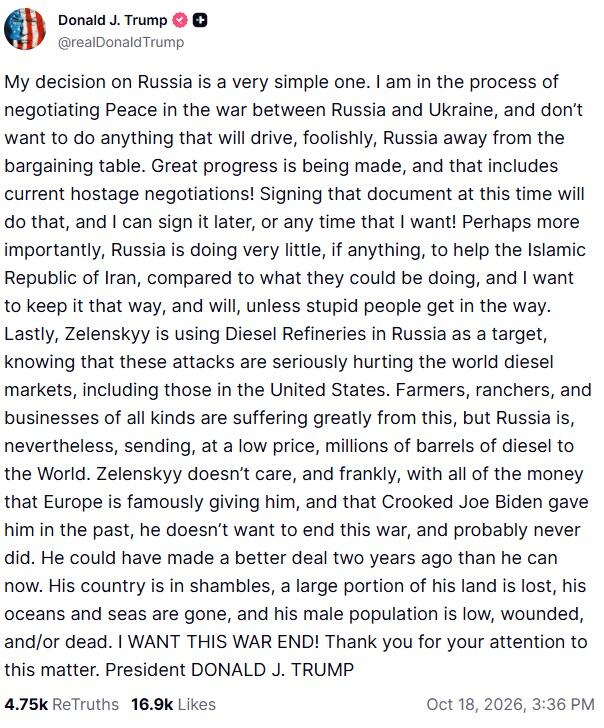
In the attack aftermath, media reports have tallied that some 1,000 drones or more were sent against St. Petersburg.
Ukraine’s President Zelensky has stated in response to Trump pressure that the Russians are continuing their own strikes on Ukraine’s energy infrastructure.
He said that over the last week alone Russia had launched nearly 2,700 drones, 1,700 aerial bombs and 66 missiles.
“The Russians are trying to cause a blackout,” he wrote in a Sunday social media post. “And America should see that Russia is not taking any reciprocal steps in response to sanctions relief or agreements.”
Meanwhile, US Secretary of State Marco Rubio on Sunday denied claims from Kiev that the White House ordered the throttling of SpaceX’s military-grade Starshield satellite network used by Ukraine.
“I don’t know what Zelensky said, I’m not sure Zelensky knows what he’s talking about, but it wasn’t deliberate,” Rubio said on Saturday. “We had nothing to do with that. I don’t, the United States, nobody ordered that Starlink speed to be slowed down. It sort of happened, but my understanding is it’s been restored, it’s back to what it was before.”
“Starshield is a contract with the US military, it has nothing to do with Ukraine. I know Ukraine wants access to Starshield, they do not have Starshield now. They’ve asked for access to it in order to conduct deep strikes inside of Russia. They do not have access to it at this moment. Those are two different products,” he added.
In follow-up, on Monday Rubio broadly addressed the diplomatic stalemate related to peace talks and a potential resumption.
“We see nothing good coming from this war,” Rubio said. “We see a lot of downside to it, including the very real risk of escalation and spread of this thing… into another country because of a failed sabotage attack, because of drones that are hit with electronic warfare and they wander into a neighboring country.”
END
Russia Intercepts Over 600 Drones Even After Trump Called Ukraine’s Attacks On Refineries A ‘Disgrace’
Saturday, Oct 17, 2026 – 01:45 PM
On Friday Russia’s Defense Ministry announced that 644 Ukrainian drones were intercepted over 26 Russian regions as well as Crimea.
Some Russian sources said among the targets was a data center owned by tech giant Yandex in Vladimir – after Ukraine made it known it is going after the country’s data centers, and as the war against the refineries has not let up.
These attacks persist despite President Trump having slammed Ukraine’s policy on attacking Russian energy at a moment of global diesel shortages as a “disgrace”.

“If you tell me that Zelenskyy is again shooting at refineries, all he’s doing is making the world oil price higher,” Trump has said in a Newsmax interview Friday. “I think that’s a disgrace. There’s plenty of other targets; they don’t have to hit.”
“Zelenskyy is not a good guy for us to deal with” on the war, the presdient said, adding that “I think they actually both would like to see it end, but I think I find Zelenskyy to be more difficult to deal with than Putin.”
Drones have also persisted on the capital, with nearly 100 Ukrainian UAVs having been shot down between Thursday night and Friday, local authorities reported.
But Ukraine is also getting pummeled, with whole regions without electricity in a northwest region of the country. A recent Russian assault on the eastern city of Kharkiv killed three people and injured five.
Russia’s own systematic destruction of Ukraine’s energy infrastructure also continues.
TASS writes, citing Ukraine’s Zelensky, “The Ukrainian energy sector was confronted by one of the most massive strikes on its facilities on October 16 when over 15 major electric power generation and transmission sites were attacked, Zelensky said on his Telegram channel.”
“Over 15 major power generation and transmission facilities were attacked in various regions of Ukraine… The most difficult situation has emerged in Lutsk, Rovno, Zhitomir, Vinnitsa, Shepetovka, Slavuta and Neteshin. The strikes were also delivered on energy sites in the Kharkov, Kiev, Dnepropetrovsk and other regions,” Zelensky was quoted as saying.
For the time being at least, it doesn’t look like the Ukrainian government will heed Trump’s calls to halt the nightly attacks on Russian energy. Zelensky is also busy seeking to ensure European leaders are on his side in standing up to Trump, as the relationship with Washington continues to sour.
END
RUSSIA/USA
Russia Celebrates ‘Historic Moment’ After Trump Formally Waives Graham Act Sanctions
Saturday, Oct 17, 2026 – 12:55 PM
The Kremlin is praising the Trump White House after the US President on Friday signed an executive order to waive a new package of sanctions and tariffs on Russia.
What’s essentially a major and unexpected ‘stay of execution’ comes after in September Trump had signed the “Lindsey O. Graham Sanctioning Russia and Iran Act of 2026” into law.
It was expected to take effect soon, as part of a big Washington ramping up of pressure to further strangle the Russian economy and thus starve Putin’s war machine.
Trump has informed Congress that he must waive the new sanctions package because it is in the US national interest, at a moment he’s desperately trying to get diesel prices under control amid both the Iran war and Ukraine’s attacks on Russian oil refineries.
“I have submitted to the Congress a certification that the issuance of such a waiver at this time is in the national interests of the United States,” the president said in his order.

The significant reversal comes weeks before US midterm elections, and appears a serious extension and overture related to the earlier diesel deal struck between Putin and Trump.
Russian presidential envoy Kirill Dmitriev has hailed the move to put sanctions on hold as a “significant and truly historic moment.”
He further said that enacting the package likely would have “brought economic cooperation between Russia and the US to a complete standstill.”
Had Trump finally pulled the trigger on the measure, it would have slapped tariffs of up to 100% within 30 days on imports from Russia’s top five oil and gas buyers, as well as any nation that knowingly purchased Russian fuel or actively helped Moscow evade sanctions
Needless to say, the Zelensky government sees this as yet more huge ‘betrayal’ by Trump and Washington, despite the billions in US and European taxpayer dollars already sunk into Kiev’s coffers.
In a Saturday morning social media post, Zelensky accused Trump of essentially once again siding with Moscow, while also lamenting the loss of his friend Lindsey, and now also the loss of the sweeping sanctions package named after the late South Caroline Senator…
And to be expected the hawks in Congress are raging:
Sen. Richard Blumenthal, D-Conn., who worked closely with Graham on this issue, released a statement slamming the president’s decision.
“These waivers have nothing to do with our national security, and everything to do with sucking up to Vladimir Putin,” Blumenthal said.
Of the diesel deal of over a week ago, Trump had described, “It was agreed that Russia will immediately supply over 300,000 Tons of Diesel Fuel to the American and Global Marketplace, another 500,000 Tons during the month of November, and 1,000,000 Tons immediately thereafter.”
Some key elements of what was supposed to be enacted, but have now been paused indefinitely:
The order, posted by the White House, lays out the penalties the law calls for and then waives them, including:
- 500% tariffs on Russian goods
- 100% tariffs on the five largest buyers of Russian oil and gas
- 100% tariffs on the top facilitators of Russian sanctions evasion
He had said further when announcing the initial diesel deal to the world on Truth Social, “Additionally, based on the condition of their Diesel Refineries, Russia will then deliver, within a short period of time, 3,000,000 Tons of Diesel Fuel.” But obviously this agreement would have been hindered if the Graham sanctions had taken effect, thus the logic of waiving them.
END
RUSSIA/UKRAINE
Putin Proposes Summit With Trump And Xi To Negotiate End Of Ukraine War; Zelensky Not Invited
Sunday, Oct 18, 2026 – 10:45 PM
Amid an escalating war that appears to get farther from any hope of a ceasefire, let alone peace, late on Sunday the WSJ reported that Vladimir Putin has proposed that he, President Trump and Chinese leader Xi Jinping meet next month to talk about Ukraine in an attempt to negotiate an end to the four-year conflict that would favor Moscow.
Citing people familiar with the discussions, the WSJ notes that the plan represents an effort by Putin to capitalize on warming ties between Trump and the Russian leader that have alarmed Ukraine and its allies in Washington and Europe. Such a summit – one notably without the involvement of Zelensky who appears to have terminally alienated Trump in recent days – would be “unprecedented and send alarm bells ringing in European capitals and beyond.”
According to a former Russian intelligence officer briefed on the matter, Putin floated the idea in an Oct. 9 phone call with Trump. That conversation also produced a deal for the U.S. to buy Russian diesel fuel and facilitate its sale on the global market. Kremlin spokesman Dmitry Peskov confirmed that discussions were taking place over a potential meeting.
“There is no clear understanding yet regarding the meeting itself or its potential agenda, although all three parties acknowledge the hypothetical possibility of such a meeting taking place,” he told The Wall Street Journal.
A senior US official said that while Trump hadn’t agreed to such a summit, he said that the president could be receptive to the idea, given his desire to fulfill a campaign promise to settle the war. Trump had said it would be finished on “day one” of his new term, but he is now approaching nearly two years in office.
The Kremlin has suggested holding the trilateral dialogue on the sidelines of the coming Asia-Pacific Economic Cooperation summit, the people familiar with discussions said. That gathering takes place on Nov. 18 and 19 in Shenzhen, the southern Chinese tech hub.
A potential three-way dialogue on Chinese soil would mark a big step for Xi in his efforts to elevate China’s role as a diplomatic power broker, said analysts who study China. Russian officials proposed the idea to Beijing through diplomatic channels and the Chinese side has indicated it wouldn’t object if Trump is on board.
“China wants to be seen as the pivot of the great powers, and potentially as a mediator between the U.S. and Russia,” said Yun Sun, director of the China program at the Stimson Center, a Washington think tank.
While Putin had unsuccessfully proposed a trilateral summit to both Trump and Xi on previous occasions, this time, however, it comes during a reversal of Moscow’s fortunes with Washington.
Trump just notched a deal with Putin to get Russian diesel in a bid to lower fuel prices that have slowed the American economy and hurt Republican prospects ahead of the midterm elections. On Friday, Trump halted implementation of sanctions that were to be imposed on Russia under a bipartisan bill he signed last month, drawing criticism from lawmakers, including some of his allies.
The senior White House official said Trump made the decisions after seeing few other good options to lower prices.
At a time when Diesel prices are soaring, in part due to limited Russian exports amid a constant drone campaign waged by Ukraine against its refineries, Trump has shown renewed frustration with Zelensky, saying the Ukrainian leader must stop strikes on Russian refineries and suggesting that the country needs a new president. U.S.-led efforts to broker an end to the war, meanwhile, have been largely stalled.
In a post on Truth Social on Sunday, Trump took aim at Zelensky, following Ukraine’s strike on an oil terminal in Putin’s hometown of St. Petersburg earlier in the day. He accused the Ukrainian leader of targeting Russian diesel refineries and said he “doesn’t want to end this war, and probably never did.” The president said he was holding off on imposing sanctions because he didn’t want to drive Russia away from the bargaining table. “I WANT THIS WAR END!” he wrote.
According to the WSJ, Moscow sees a potential trilateral dialogue as a way of cementing Russia’s membership in a club of great global powers, a status Putin has sought since he entered the Kremlin in 2000. The format also excludes from the picture Europe, which the Kremlin sees as its main obstacle to clinching victory in Ukraine.
The former Russian intelligence officer who was the WSJ source, said Putin has broad, if unrealistic, ambitions for the trilateral format as a second Yalta summit, which would divide up the globe into spheres of influence.
Even if Xi and Trump are unlikely to agree to that, the image of the American, Russian and Chinese leaders negotiating the fate of one nation would be a powerful signal. In Taipei, it could reinforce fears that Taiwan’s own future might be one day bargained over in a similar forum, particularly as Beijing has never renounced the use of force to bring the self-governing democratic island under its control.
That said, a summit isn’t without risk for Xi. Chinese officials have concerns about allowing a geopolitical side show to overshadow their designs to use APEC as a showcase of China’s role in the region, said some of the people close to the discussions.
Xi is attempting to walk a fine line between continuing his support for Putin and maintaining China’s economic ties with Europe, the people said. A trilateral meeting like this could risk drawing China more directly into the Ukraine conflict and provoke a backlash from European capitals already wary of Beijing’s tilt toward Moscow. Although, with most European capitals desperate to either export or import from China, it isn’t clear what if anything that can do to express their “outrage.”
***
END
6/.GLOBAL ISSUES, COVID ISSUES, VACCINE INJURIES/HEALTH ISSUES
Vaccines keep giving
special thanks to Robert H for sending this to us;
GLOBAL ISSUES/
COVID VACCINE INJURY REPORT; DR MARK CRISPIN MILLER
DR PAUL ALEXANDER
RABOBANK/MICHAEL EVERY/OR OR PICTON/GIFFIN OR RABOBANK EXECUTIVE/COMMENTARY ON WORLDLY AFFAIRS
Democracy Manifest
Monday, Oct 19, 2026 – 09:55 AM
By Benjamin Picton, senior market strategist at Rabobank
US stocks defied a strong lead from Europe and Asia on Friday to close broadly in the red. IT, telecommunications and the consumer discretionary sector led declines while energy, materials and consumer staples performed well. Oil prices surged following further reports of attacks on shipping in the Strait of Hormuz, with Iran claiming that two tankers carrying up to 4 million barrels of crude were struck by marine mines. The BBC reports UKMTO figures noting that the number of ships being attacked in and around the Strait hit a new high of 12 vessels in the week to the 11th of October.
Rising oil prices helped to see ten-year Treasury yields close 1.5bps higher at 5.07% after a big drop on Thursday. Two-year yields fell by 3bps, causing a steepening of the yield curve that might have provided a slight tailwind to financial stocks. Higher oil prices and rising long yields were not helpful for the consumer discretionary sector that was perhaps still trading off the signal of a weaker-than-expected retail sales report released the day before, which gave the impression that spending on automotive fuels is cannibalising demand for other goods.
Following market close on Friday news emerged that President Trump is enacting a waiver of steep Graham Act sanctions and tariffs that were due to come into effect. The Act requires the imposition of secondary sanctions in the form of 100% tariffs against the top five buyers of Russian crude oil and gas products while also placing 500% tariffs on Russian energy products being imported into the United States. Active Brent crude futures are down by $1.80/bbl at time of writing.
Depending on how the calculation is performed, the top five buyers of Russian energy products are likely to include China, India, Turkey and the European Union. The imposition of 100% tariffs on China would certainly torpedo the truce in the trade war that was extended to January only a few weeks ago and would risk a response in the form of renewed export restrictions on rare earth minerals. 100% tariffs on the EU and Turkey would be a major strike against NATO allies at a time when the Trump administration wants Europe to contribute more to collective defence and Turkey to play ball with US interests in the Middle East. Striking India would antagonize an emerging great power that the USA would like to use as a geopolitical counterweight to China in the Indo-Pacific, an investor in new US production, and a customer for US defence and nuclear energy exports.
Of course, the imposition of Graham Act sanctions would also directly contradict recent efforts of the administration to reduce fuel prices ahead of the midterm elections. Relations between Moscow and Washington appear to be in an upturn following the recent controversial deal for the US to import Russian diesel sanctions-free over the coming months. That deal drew condemnation from Ukraine and several members of congress, as did Friday’s decision to waive the Graham Act sanctions. In a post to Truth Social on Sunday President Trump said that his decision was aimed at avoiding anything that will “drive, foolishly, Russia away from the bargaining table”.
Secretary of State Marco Rubio indicated over the weekend that the waiver was only for a period of 60 days to give the US time to “analyze what imposing both sanctions and tariffs will mean to the global economy and even the US economy”. Some might detect an implied threat that while buyers of Russian energy have avoided the sanctions for the time being, the Sword of Damocles still hangs, and the administration now has greater powers to coerce other countries into doing what it wants.
Rubio’s 60 days would expire after the midterm elections, which is the line in the sand that President Trump has repeatedly nominated when saying that the US would not engage in fresh strikes against Iran before that date. Once the midterms are out of the way, it looks like all bets are off and we can expect a dramatic ramping up in geopolitical volatility. That impression was seemingly confirmed last Thursday when President Trump again implied in an interview with Newsmax that the United States was considering striking Iran’s Pickaxe Mountain complex, where nuclear centrifuges from the Natanz site are thought to have been relocated.
An IRGC spokesman said in a post on X that any attack on Iranian energy infrastructure would trigger a “scorched earth” response against Israel, with other Iranian sources suggesting a ‘nuclear for nuclear’ attack on Israeli reactors if Pickaxe Mountain were to be struck. Israeli Prime Minister Netanyahu – freshly endorsed for re-election at next week’s poll by Donald Trump – said that the Islamic Republic must be toppled and that he had directed Israel’s security agencies to pursue that goal, without US support if necessary.
While the world grapples with the energy shock emanating from hot wars in Europe and the Middle East, French President Macron continues to grapple with political unrest at home. Tensions ran high over the weekend as widespread protests erupted into rioting and looting, with images of the burning of the historic town hall in Limoges circulating on social media and about 1000 police officers reported injured.
President Macron said in an address to the nation that a distinction must be drawn between the actions of the rioters and the legitimate concerns of protestors demonstrating against rising living costs and decaying public services. Marine Le Pen, the right-wing frontrunner for the upcoming presidential election, railed against what she called “exhausted Macronist power” saying that France faces a crisis of confidence and authority that now poses a threat to democracy.
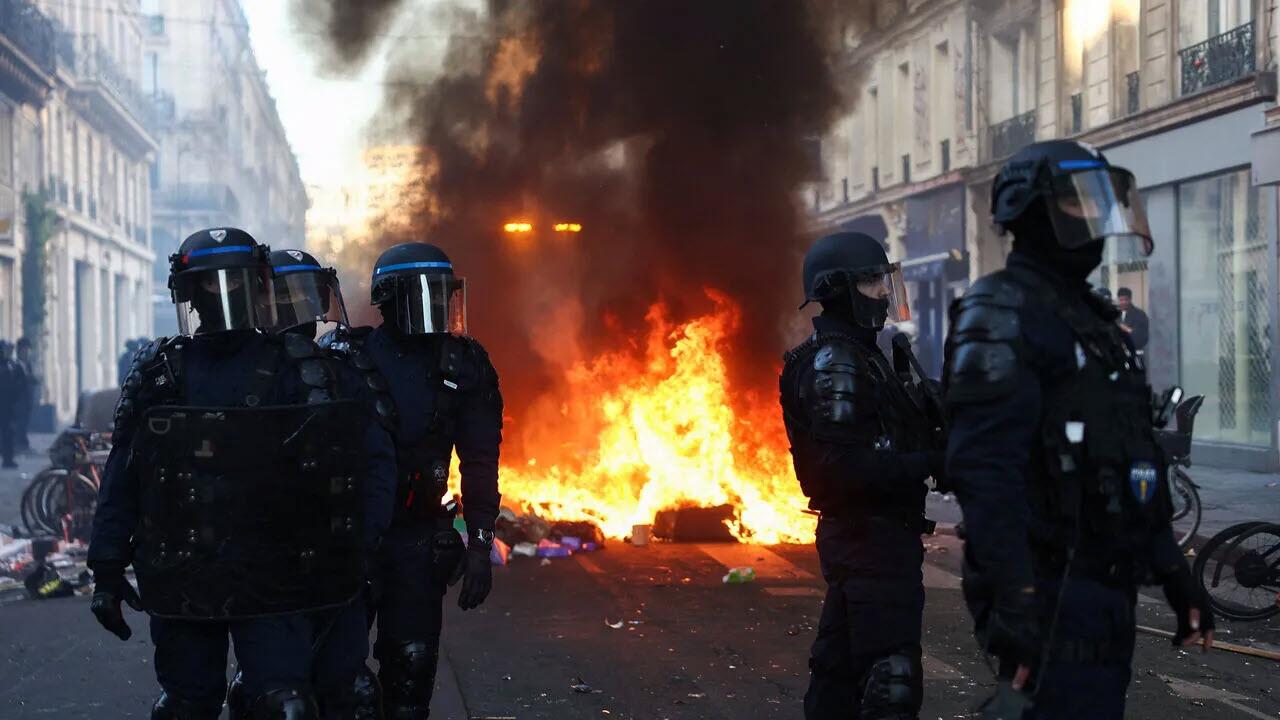
Hungarian Prime Minister Peter Magyar echoed sentiments expressed by Donald Trump blaming the riots on uncontrolled immigration, claiming that the scenes in France vindicated Hungary’s tough approach. Polish Prime Minister Donald Tusk – avoiding explicit mention of France -similarly extolled the virtues of his own country’s hardline stance on immigration, saying that Poland would “neither repeat nor pay for” other countries’ mistakes. The Euro is this morning trading lower despite a broad US Dollar selloff.
Keeping with the theme of democracy, today is an important date in the Canadian province of Alberta. A non-binding referendum will be held where voters are asked to indicate whether Alberta should remain a province of Canada or commence the constitutional process to secede. Voters will also be asked a series of questions about their views on control of immigration, voter ID, and to what degree non-citizens should have recourse to public healthcare and other social programs.
Needless to say, the results of the vote will be closely watched in Ottawa, and in Washington D.C.
END
7. OIL AND NATURAL GAS/ENERGY COMMENTARIES
US Offers Another 17 Million SPR Barrels As Fuel Crisis Deepens
Friday, Oct 16, 2026 – 09:45 PM
By Julianne Geiger of OilPrice.com,
The United States is putting another 17 million barrels of crude from the Strategic Petroleum Reserve on offer, one day after the IEA accelerated emergency stock releases as governments scramble to get more oil and fuel into a tight market.
The Department of Energy issued a request for proposals Friday for an exchange of up to 17 million barrels, part of the 172 million barrels Washington committed to make available under the IEA’s 400-million-barrel emergency action announced in March.
The SPR currently holds about 283 million barrels. If companies take the full 17 million barrels before any repayments arrive, inventories would fall to roughly 266 million barrels—squarely inside the 250-million-to-300-million-barrel range generally considered the reserve’s operational minimum zone.
There is one rather large catch: somebody has to want the oil.
DOE offered the final portion of its March commitment in June, requiring companies to return the borrowed crude later with premiums of as much as 24%. Companies agreed to take only about 500,000 barrels.
The government is trying again. The API estimated that U.S. crude stocks fell 11.12 million barrels last week, following a 2.09-million-barrel decline the previous week. Commercial inventories have lost more than 51 million barrels over the last 26 weeks.
Friday’s solicitation follows another escalation in the emergency-stock campaign. The IEA said Thursday that members would accelerate the roughly 100 million barrels still outstanding from March, including more than 20 million barrels of diesel as soon as possible.
Washington is now putting 17 million more barrels on the table, with the SPR sitting at 283 million barrels in a market that already showed once this summer that borrowing government crude on expensive repayment terms is not necessarily a deal refiners want.
END
Brent Flirts With $110 Before Reversing As Wright Declares Pump Prices Have “Peaked”
Monday, Oct 19, 2026 – 07:45 AM
Brent crude futures briefly tagged $109.99 a barrel in overnight trading before retreating from five-month highs during the Asian session and into European trading, as signs of recovering Middle Eastern supply offset renewed attacks on energy infrastructure and critical maritime shipping lanes.
US Energy Secretary Chris Wright reinforced expectations of easing fuel prices at the pump, with ABC News quoting him on Sunday as saying gasoline and diesel prices had “peaked.”
“Both gasoline and diesel prices peaked a few weeks ago,” Wright said, adding that the US wants them to “pull back a lot more than they have.”
He said he understands the mounting frustrations at the pump, which have soured consumer sentiment, but said the administration is “working in all different avenues” to address the problem.
The latest data from AAA show the national average for diesel prices at the pump on Sunday stood at around $6.319 a gallon, down from the previous record high of $6.50.
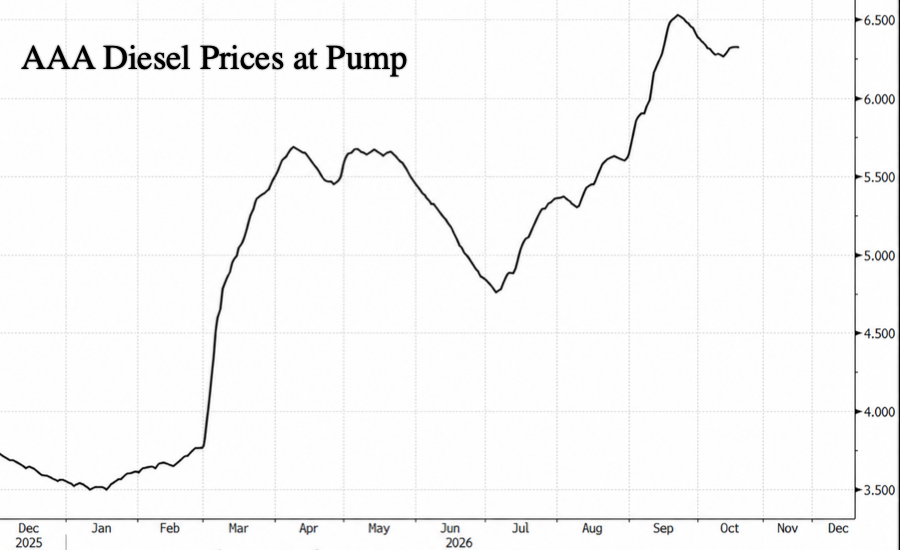
AAA pump data also show regular gasoline prices sliding from the $4.50 level to $4.295 by Sunday, still above the politically sensitive $4 level.
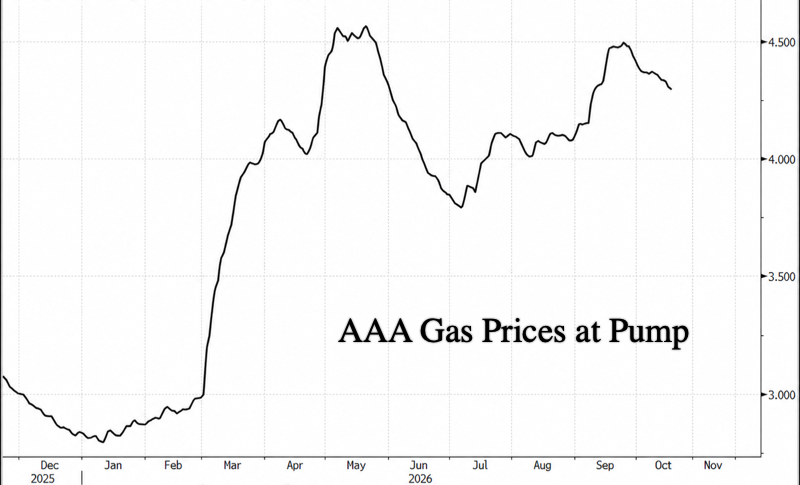
Wright said Gulf oil flows had recovered to about 80% of pre-conflict levels, although refined-product shipments remained heavily constrained amid a global refining crisis compounded by Ukraine’s persistent attacks on Russian refineries.
Separately, Wright told Fox News that Trump administration officials were discussing releases of diesel stockpiles in coordination with European allies.
June Goh, a senior oil market analyst at Sparta Commodities SA, told Bloomberg, “The markets seem unwilling to absorb the higher prices with the rest of the economy not looking rosy,” adding that Brent crude is likely to remain around $100.
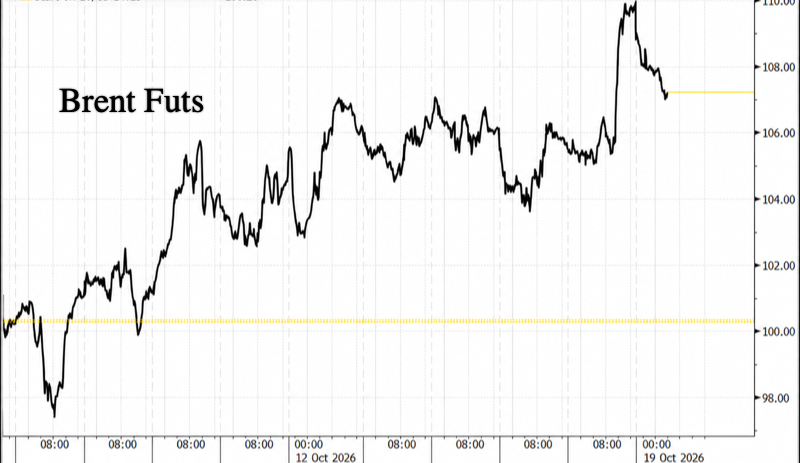
The Wall Street Journal reported overnight that Russian President Vladimir Putin proposed talks next month with President Trump and Chinese President Xi Jinping. Moscow confirmed discussions were underway.
Last week, the International Energy Agency reinforced Goldman Sachs energy analyst Nikhil Bhandari’s warning that there is no quick relief at the pump, as the refining crisis, particularly in diesel, will persist well into next year.
END
GAS/EUROPE:
OILPRICE
Europe Braces For A Winter Energy Crisis As Gas Reserves Run Low
Monday, Oct 19, 2026 – 05:00 AM
Authored by Felicity Bradstock via OilPrice,
- Europe faces another expensive winter as low gas reserves and Middle East disruptions drive up energy prices.
- Rising fuel costs threaten household budgets, industrial production, and employment across Europe.
- Increased U.S. LNG supplies could provide some relief, but continued geopolitical risks leave energy markets vulnerable.
After months of elevated energy prices, Europe can expect fuel costs to continue rising through the winter months as demand grows. Ongoing energy trade constraints and threats to energy infrastructure across the Middle East are expected to limit global energy supplies and continue to drive up prices, hitting consumers hard unless governments intervene.

The European Union (EU) is thought to have paid an additional €100 billion on oil and gas so far this year, prompting EU ministers to seek ways to manage the impact of high fuel prices. Since 2022, the extra costs of energy have surpassed €900 billion, even as total demand has fallen. The price of natural gas in Europe has more than doubled since the outbreak of the U.S.-Israeli-led war in Iran. This winter could be the most challenging in terms of energy supplies and prices since the start of Russia’s war on Ukraine and the subsequent sanctions on Russian energy.
Meanwhile, EU energy commissioner Dan Jorgensen has warned that the winter months could be challenging amid “very high” oil and gas prices, although he reassured consumers that no supply issues are expected. Jorgensen also proposed postponing the introduction of rules to reduce methane emissions on energy imports to help ease pressure on European energy markets.
Gas storage has fallen to its lowest level since 2022. In September, across Europe, gas storage stood at around 67 per cent full, compared with a seasonal average of around 80 per cent. Germany, which has the largest storage capacity in Europe, is roughly half full, and is expected to miss its official 80 per cent storage target this year.
Meanwhile, constrained supplies due to strict limits on energy trade through the Strait of Hormuz have sharply driven up energy prices. Oil prices increased by 65 per cent, diesel by 45 per cent, and jet fuel by 112 per cent between September 25, 2025 and 2026. This has led the European Commission to call for consumers to reduce their demand throughout the year to manage supplies.
As Europe heads into its high-demand winter months, there is no end to the war in Iran in sight. In addition, the El Niño weather cycle is expected to add an element of uncertainty to weather trends, which could further complicate the gas demand picture. Threats remain to fuel shipments traversing the Strait of Hormuz, as well as ongoing threats to energy infrastructure across the Middle East. Meanwhile, Houthi attacks in the Red Sea and against pipelines continue to be a concern. Therefore, there are likely to be restrictions on global oil trade well into 2027.
The United States has focused on increasing oil and gas production to help alleviate some of the energy supply chain constraints, but this can only partly fill the gap. Atlantic and Pacific freight rates have returned to pre-Iran war levels, as a larger share of cargoes from the United States is heading to Europe rather than Asia, thereby reducing travel distances and increasing ship availability.
The independent LNG and shipping analyst Pratiksha Negi stated, “The growing share of Atlantic trade, combined with an increasing pool of prompt vessels, will continue to pressure freight rates… I expect Europe to remain the principal destination for marginal U.S. LNG at the start of Q4 2026, given the significant storage deficit this season.” Negi also highlighted the rise in newbuild deliveries, with roughly 55 new vessels delivered in the first seven months of the year and another 40-45 expected by the end of the year.
Across Europe, it is not only households that are concerned about their energy bills, as several industries prepare for fuel shortages. Higher fuel prices are driving up operating costs in factories and other facilities, which could lead companies to charge more for manufactured goods, as costs will once again shift to consumers. Meanwhile, companies that cannot secure or afford adequate fuel supplies may be forced to suspend operations in the winter, leading to job cuts.
A recent forecast by the Item Club suggested that in the United Kingdom, as many as 163,000 jobs could be lost in 2026 in relation to the war, mainly in manufacturing-heavy regions such as South Wales and the Humber region. As one of Europe’s biggest gas consumers, the U.K. is highly exposed to trade restrictions, particularly because it has one of the lowest levels of domestic storage capacity, which means it relies heavily on pipeline imports from Europe and tankers from the U.S. and the Middle East. The CEO of British Gas owner Centrica, Chris O’Shea, said in August that Britain had “almost no gas in storage” for the coming winter.
Both households and businesses across Europe could be hit hard this winter by the continued constraints on oil and gas supplies and high energy prices. This could force consumers to ration their consumption and may prompt the European Commission and governments to intervene to ensure consumers have access to vital energy supplies.
END
8. EMERGING MARKETS//AUSTRALIA NEW ZEALAND ISSUES
CANADA/USA/ CHINA
“The Other Canada”: Is China Hiding $600 Billion In Treasuries North Of The Border?
No definitive proof exists that China is “hiding” exactly $600 billion in U.S. Treasuries (and related securities) in Canada, but a widely discussed Wall Street theory—sparked by Bloomberg reporting in mid-October 2026—argues that a large share of Canada’s reported surge in holdings likely reflects Chinese money held through non-U.S. custodians.
zerohedge.com
The Core Claim and DataU.S. Treasury International Capital (TIC) data attributes holdings based on the location of the custodian (the bank or intermediary holding the securities), not necessarily the ultimate beneficial owner. Official figures show:
- China’s reported U.S. Treasury holdings have roughly halved since around 2016 (when trade tensions escalated under Trump), standing near $591–618 billion in recent months (August 2026 data showed ~$591 billion, an 18-year low). fred.stlouisfed.org
- Canada’s reported holdings of Treasuries plus agency mortgage-backed securities (MBS, federally backed housing bonds) have more than quadrupled over about five years to nearly $600 billion. Agency holdings alone rose from ~$21 billion in mid-2021 to ~$162 billion; Treasury holdings also climbed sharply (reaching ~$465 billion by August 2026 in some reports). financialpost.com
DoubleLine’s Vitaliy Liberman and others noticed the Canadian buildup was anomalous—especially amid Canada-U.S. trade frictions and boycotts of American goods—and were told by market participants: “It’s not Canada. It’s the other Canada” (meaning China).
financialpost.com
This echoes a earlier pattern: around 2014, a surge in Belgium’s reported holdings was widely attributed to China using Euroclear (a Belgium-based custodian). China has long kept the detailed composition of its reserves opaque.Why Analysts Find It Plausible
- TIC data only captures securities held at U.S. custodians as “Chinese.” Moving them to Canadian (or European) custodians makes them appear under those countries’ tallies. cfr.org
- The agency MBS market is relatively concentrated among foreign buyers (historically dominated by China, Japan, and Taiwan). Market participants interviewed by Bloomberg reported little evidence of large-scale Canadian institutional buying of these securities. financialpost.com
- Brad Setser (Council on Foreign Relations, former U.S. Treasury official) has long tracked these issues and noted that China has become “much better at hiding its dollars than… getting out of the dollar.” He has pointed to suspicious jumps in Canadian (and some European) agency holdings coinciding with declines in China’s reported U.S.-custodian positions, especially after the 2022 freezing of Russian reserves. Estimates adjusting for custodians suggest China’s true agency holdings could be substantially higher than the official “China” line. cfr.org
- China runs a massive trade surplus and needs places to park dollars without driving up the yuan or crystallizing losses on sales. Fully exiting dollar assets is difficult; obscuring location offers political optics (appearing to reduce dependence) and potential risk management.
Official entities declined to comment: China’s State Administration of Foreign Exchange, Canada’s financial regulator, and the U.S. Treasury.Caveats and CounterpointsThere is no direct evidence (no public confirmation of specific custodial arrangements or transfers). Some of Canada’s increase could reflect genuine Canadian investors, relative-value/hedge-fund trades (cash bonds hedged with futures), or other foreign flows. Analysts such as Alex Etra of Vanda Research have expressed caution about attributing all of it to China.
financialpost.comEstimates of China’s “true” holdings involve judgment (“as much an art as a science,” per Setser) and adjustments for multiple custodial centers (Canada, Luxembourg, France, etc.). Adding Canada and other centers back can bring implied Chinese exposure closer to prior peaks in some calculations, but these remain upper-bound style estimates rather than precise accounting.
canadianminingreport.com
Bottom Line
The “other Canada” narrative is a serious, data-driven suspicion shared by bond specialists and China-watchers: reported declines in China’s TIC-line holdings overstate any true exit from U.S. dollar assets, and custodial shifts (including to Canada) help explain part of the gap. It is not proven fact that China is specifically parking $600 billion north of the border. The pattern fits historical behavior and economic incentives, but definitive confirmation would require data or disclosures that do not currently exist. The story underscores the limitations of official TIC figures for tracking sophisticated reserve managers.
END
BRAZIL
BRAZIL
Bolsonaro, Lula Tied In Latest Poll As Brazil’s Runoff Election Countdown Enters Final Week
Monday, Oct 19, 2026 – 08:40 AM
Brazil’s right-wing Senator Flávio Bolsonaro and socialist President Luiz Inácio Lula da Silva traded barbs in their first presidential debate on Sunday night. The latest polling data show Bolsonaro’s lead over Lula has narrowed ahead of this weekend’s runoff election.
A BTG Pactual/Nexus survey showed Bolsonaro at 50.3% and Lula at 49.7%, a statistical tie within the poll’s two-percentage-point margin of error. A week earlier, the survey had Bolsonaro leading 51.6% to 48.4%.
An AtlasIntel poll for Bloomberg showed Bolsonaro ahead at 51.1% to 48.9%. That previous poll found Bolsonaro leading 53% to 47%. The poll’s margin of error is around one point.
Lula’s recent poll boost likely stemmed from last week’s Senate approval of his plan to shorten the workweek, a centerpiece of his socialist agenda.
Earlier this month, Bolsonaro won the first round of the presidential election. Since 1989, no candidate who trailed in the first-round vote has rebounded to win a presidential runoff.
Goldman Sachs Latin America financial analyst Tito Labarta wrote earlier:
Right-wing candidate is the favorite to win the presidential run-off
After the first round of the general election on Sunday, October 4, right-wing Senator Flavio Bolsonaro (PL) is the favorite to win the run-off round to be held on October 25. Indeed, Mr. Bolsonaro had 47.0% of valid votes in the first round against incumbent left-wing President Lula da Silva (PT) with 45.2%.
Polls suggest that Mr. Bolsonaro will receive a larger share of the 7.6% of votes that went to the four non-competitive conservative candidates (note). In fact, most post-first-round polls show Mr. Bolsonaro leading the run-off by 4-6pp (Exhibit 1), and prediction markets also show him as the clear favorite, with Polymarket indicating a c.77% likelihood that he will win the election (Exhibit 2).
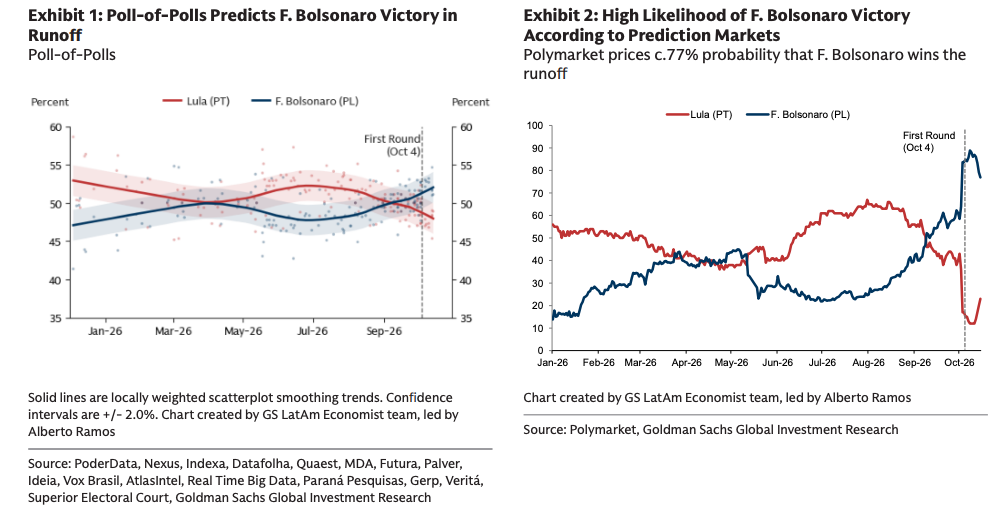
Labarta said Brazil’s rightward shift in Congress has already bolstered investor expectations for a more pro-market policy agenda, noting that “market-friendly policies can be a tailwind.
END
U.S./GOLD AND SILVER PRICING/ASIAN CLOSING MARKETS AND EUROPEAN BOURSE OPENING AND CLOSING/ INTEREST RATE SETTINGS MONDAY MORNING 6;30AM//OPENING AND CLOSING\
OPENING LEVELS OF CURRENCIES// AND CLOSING ASIAN STOCK MARKET AND OPENING EUROPEAN STOCKS:6 AM EST
EURO VS USA DOLLAR: 1.1210 DOWN 0.0025
USA/ YEN 158.08 UP 0.158 NOW TARGETS INTEREST RATE AT 1.75% AS IT WILL BUY UNLIMITED BONDS TO GETS TO THAT LEVEL…//YEN STILL FALLS//END OF YEN CARRY TRADE BEGINS AGAIN DEC 2024/Bank of Japan raises rates by .25% TO 1.75 ..TAKAICHI NEW PM AS YIELDS RISE//JAPAN DEEPLY IN TROUBLE WITH RISING RATES AND A FALLING YEN!! BANK OF JAPAN WILL NO LONGER DO QE. URGES PENSION AND INSUANCE FUNDS TO BUY JAPANESE BONDS//
YEN CARRY TRADERS MURDERED
GBP/USA1.3321 UP 0.0013 OR 13 BASIS PTS
USA/CAN DOLLAR: 1.40901 DOWN 0.0041 //CDN DOLLAR UP 41 BASIS PTS//
Last night Shanghai COMPOSITE CLOSED UP 14.64 PTS OR 0.39%
Hang Seng CLOSED UP 124.11 PTS OR 0.52%
AUSTRALIA CLOSED UP 0.08%
// EUROPEAN BOURSE: ALL RED
Trading from Europe and ASIA
I) EUROPEAN BOURSES: ALL RED
2/ CHINESE BOURSES / :Hang SENG CLOSED UP 124.11 PTS OR 0.52%
/SHANGHAI CLOSED UP 14/64 PTS OR 0.39%
AUSTRALIA BOURSE CLOSED UP 0.08%
(Nikkei (Japan) CLOSED DOWN 298.29 PTS OR 0.96%
INDIA’S SENSEX IN THE RED
Gold very early morning trading: $4184.30
silver:$57.61
USA DOLLAR VS TRY (TURKISH LIRA): 49.55 UP 13 BASIS PTS AND NOW WE SEE THEIR STUPIDITY OF SELLING SOME OF THEIR GOLD AND ALL OF THEIR USA DOLLAR RESERVES. THE COUNTRY IS IN BIG FINANCIAL TROUBLE
USA DOLLAR VS RUSSIAN ROUBLE: 82.93 ROUBLE// UP 0 ROUBLE AND 14 BASIS PTS.
UK 10 YR BOND YIELD: 5.3841 UP 4 BASIS PTS
UK 30 YR BOND YIELD: 5.8290 UP 1 BASIS PTS
FRENCH OAT 10 YR BOND YIELD: 4.866 UP 8 BASIS PTS.
CDN 10 YR BOND YIELD: 3.825 UP 0 BASIS PTS
CDN 5 YR BOND YIELD; 3.527 UP 0 BASIS PTS
USA dollar index early MONDAY MORNING: 101.59 UP 9 BASIS POINTS FROM FRIDAY’s CLOSE
MONDAY MORNING NUMBERS ENDS
And now your closing MONDAY NUMBERS 10.00 AM
Portuguese 10 year bond yield: 3.9910% UP 5 in basis point(s) yield
JAPANESE BOND 10 yr YIELD: +2.91910% DOWN 2 FULL POINTS BASIS POINTS /JAPAN losing control of its yield curve/
JAPAN 30 YR: 4.000 DOWN 1 BASIS PTS//
SPANISH 10 YR BOND YIELD: 4.055 UP 5 in basis points yield
ITALY 10 YR BOND: 4.555 UP 8 points in basis points yield ./
GERMAN 10 YR BOND YIELD: 3.4402 UP 3 BASIS PTS
IMPORTANT CURRENCY CLOSES : MID DAY MONDAY
Closing currency crosses for day /USA DOLLAR INDEX/USA 10 YR BOND YIELD/10:00 AM
Euro/USA 1.1228 DOWN 0.0008 OR 8 basis points
USA/Japan: 158.31 UP 0.379 OR YEN IS DOWN 38 BASIS PTS// HIGHLY INFLATIONARY TO JAPAN
Great Britain 10 YR RATE 5.4030 UP 3 BASIS POINTS //
GREAT BRITAIN 30 YR BOND; 5.8820 UP 3 BASIS POINTS.
FRANCE 10 YR: 4.878 UP 10 BASIS PTS
CANADIAN DOLLAR UP 34 BASIS PTS TO 1.4092
xxxxxxxxxxxxxxxxxxxxxxxxxxxxxxxxxxxxxxxxxxxxxxxxxxxxxxxxxxxxxxxxxxxxxxxxxxxxxxxx
The USA/Yuan CNY 6.6863 ON SHORE ..UP
THE USA/YUAN OFFSHORE// CNH UP TO 6.6808
TURKISH LIRA: 49.55 UP 2 EXTREMELY DANGEROUS LEVEL/DEATH WATCH/HYPERINFLATION TO BEGIN.//
Your closing 10 yr US bond yield DOWN 1 in basis points from FRIDAY at 5.104% //trading well ABOVE the resistance level of 2.27-2.32%)
USA 30 yr bond yield 5.442 UP 1 basis points /10:00 AM
USA 2 YR BOND YIELD: 4.782 UP 1 BASIS PTS.
GOLD AT 10;00 AM $4163.35.00
SILVER AT 10;00: $57,45
Your 11:00 AM bourses for Europe and the Dow along with the USA dollar index closing and interest ratesMONDAY
DAY CLOSING TIME/ 12:00 AM///
London: CLOSED DOWN 117.21 PTS OR 1.08%
GERMAN DAX: CLOSED DOWN 302.54 PTS OR 1.18%
FRANCE: DOWN 88.65 OR 1.11 PTS
Spain IBEX CLOSED DOWN 287.00 PTS OR 1.49%
Italian MIB: CLOSED DOWN 770.91 PTS OR 1.55%
WTI Oil price 100.90 10.00 EST/
Brent Oil: 107.92 10:00 EST
USA /RUSSIAN ROUBLE: 83.40/// ROUBLE DOWN 0 AND 37/ 100
CDN 10 YEAR RATE: 3.8821 UP 5 BASIS PTS.
CDN 5 YEAR RATE: 3.585 UP 6 BASIS PTS
CLOSING NUMBERS: 4 PM//
Euro vs USA 1.1212 DOWN 0.0023 OR 23 BASIS POINTS//
British Pound: 1.3305 DOWN 0.0019 OR 19 basis pts/
BRITISH 10 YR GILT BOND YIELD: 5.4511 UP 5 FULL BASIS PTS//
BRITISH 30 YR BOND YIELD: 5.9122 UP 6 IN BASIS PTS.
FRENCH 10 YR BOND: 4.9250 % UP 14 BASIS PTS
JAPAN 10 YR YIELD: 2.913% DOWN 2 FULL BASIS PTS (DANGEROUS TO THEIR ECONOMY
JAPANESE 30 YR BOND: 3.989 DOWN 2 PTS AND STILL VERY DANGEROUS TO THEIR ECONOMY
USA dollar vs Japanese Yen: 158.53 UP 0.61 OR YEN DOWN 6 BASIS PTS//GETTING FURTHER AWAY FROM 160.00/ EXTREMELY DANGEROUS
USA dollar vs Canadian dollar: 1.414300 DOWN 0.0024 PTS// CDN DOLLAR UP 24 BASIS PTS
West Texas intermediate oil: 103.73
Brent OIL: 109.33
USA 10 yr bond yield UP 7 BASIS pts to 5.150
USA 30 yr bond yield: UP 5 PTS to 5.4870%
USA 2 YR BOND 4.768 UP 3 PTS
CDN 10 YR RATE 3.9540 UP 13 BASIS PTS
CDN 5 YEAR RATE: 3.6640 UP 14 BASIS PTS
USA dollar index: 101.80 UP 3 BASIS POINTS
USA DOLLAR VS TURKISH LIRA: 49.55 UP 2 BASIS PTS GETTING QUITE CLOSE TO BLOWING UP/IDIOTS SOLD GOLD
USA DOLLAR VS RUSSIA//// ROUBLE: 83.73 DOWN 0 AND 66 /100 roubles //
GOLD $4,143.00 3:30 PM)
SILVER: 57.22 3;30 PM)
DOW JONES INDUSTRIAL AVERAGE: DOWN 36.38 POINTS OR 0.07%
NASDAQ 100 UP 341.79 PTS OR 0.11%
VOLATILITY INDEX 1854. DOWN 1.45 PTS OR 7.25%
GLD: $ 379.69 DOWN 2.32 PTS OR 0.61%
SLV/ 51.54 PTS UP 0.03 OR 0.055%
TORONTO STOCK INDEX// TSX INDEX: CLOSED DOWN 247.97 PTS OR 0.67%
END
end
TRADING today ZEROHEDGE 4 PM: HEADLINE NEWS/TRADING
REVIEW OF LAST WEEK
“The Pain Trade Was Long AI, Short Bonds”: How A NeoCloud Burst Turned The Hottest Inflation Week Of The Year Into A Fed Pause
This was a recent market episode (mid-October 2026) in which a sharp selloff in highly leveraged “neocloud” AI infrastructure companies overrode hot inflation data, drove bond yields lower, and led markets to price a Federal Reserve pause rather than a rate hike.
zerohedge.com
What happened
On paper, the week looked like a classic inflation scare:
- September CPI and PPI both came in hotter than expected (CPI at ~3.7% YoY).
- Odds of an October Fed hike briefly spiked above 50%.
- Oil pushed toward $98 amid Middle East tensions (Houthi attacks, issues in the Strait of Hormuz, and the breakdown of an “energy ceasefire”). zerohedge.com
Instead, the dominant narrative became AI financing stress. Credit markets moved first: bonds of CoreWeave (the largest neocloud) fell into distressed territory (trading as low as ~75 cents on the dollar, with yields near 15–16%), and its CDS implied roughly 60–63% odds of default over five years. Other neoclouds and related AI-infrastructure names (Nebius, IREN, Applied Digital, etc.) lost roughly a fifth of their value in a handful of sessions. Hedge funds dumped AI exposure accumulated since early 2025, the South Korean Kospi dropped ~20% in a week (partly on AI-credit spillover into memory-chip makers), and the Nasdaq 100 fell nearly 6% for the week—its worst since an earlier “Liberation Day” selloff—while the Dow managed gains (creating an unusually wide spread).
zerohedge.com
By Thursday the 10-year Treasury yield was near a three-week low around 5.09%. Overnight remarks from Fed Chair Warsh in Bangkok (that the world had “broadly conformed” to Fed expectations, with no fresh guidance) were read by Goldman and others as signaling a pause; hike odds collapsed to ~14%. The dollar, which had briefly hit multi-month highs, faded and ended the week lower. Gold and Bitcoin round-tripped.
zerohedge.com
What are “neoclouds”?Neoclouds are specialized providers that buy large quantities of Nvidia (and similar) GPUs, install them in data centers with power and cooling, and rent the compute capacity by the hour or under longer contracts to AI model developers (OpenAI, Anthropic, etc.). Unlike hyperscalers (Microsoft, Amazon, Google, Meta), which largely fund AI buildouts from existing cash flows, many neoclouds are pure-play, highly leveraged equipment-leasing businesses that raised capital via equity and especially debt to grow quickly. CoreWeave is the best-known example; others include Nebius and several former crypto miners that pivoted.
hyperdensity.substack.com
Their model works when demand is strong and capacity comes online on schedule. Delays in power, permitting, construction, or financing raise interest costs while revenue is deferred, and the GPUs themselves depreciate or become technologically outdated. Rising rates (or even the threat of them after the hot CPI print) made those financing burdens heavier and spotlighted credit risk across the AI data-center complex, including project bonds for facilities leased to big tech.
ft.com
Why “the pain trade was long AI, short bonds”Positioning had been crowded: investors were heavily long AI/tech (especially the capital-intensive infrastructure layer) and short (or underweight) bonds, expecting higher yields from sticky inflation and strong growth. When AI credit stress hit, that positioning reversed—AI equities and related names sold off hard while bonds rallied (yields fell) as growth/financing concerns overtook the inflation narrative. The result was a classic “pain trade” that hurt the crowded consensus.
zerohedge.com
Fund flows were less extreme than price action: equity and bond funds still saw inflows in the week to October 14, while money-market funds saw outflows. Markets were watching options expiration and upcoming hyperscaler earnings for confirmation of whether the credit verdict on AI would stick.
zerohedge.com
In short, a credit-driven shakeout in the most leveraged corner of the AI buildout temporarily dominated hotter-than-expected inflation data and geopolitical energy risks, flipping rate-hike odds into pause expectations and producing a sharp, divergent equity/bond reaction.
END
The Funeral Of The Century: Is Wall Street Burying The AI Trade? SUNDAY
This matches a real mid-October 2026 market episode: a credit-driven shakeout in leveraged “neocloud” AI infrastructure providers temporarily overrode hotter inflation data, pulled Treasury yields lower, and flipped near-term Federal Reserve rate-hike expectations toward a pause. The ZeroHedge framing (“The Pain Trade Was Long AI, Short Bonds” and the related “Funeral Of The Century” piece) captures the narrative shift accurately; mainstream coverage from Reuters, Bloomberg, the New York Times, and others corroborates the core facts.
zerohedge.com
What happened
Hotter-than-expected September CPI (~3.7% YoY) and PPI initially raised October Fed hike odds above 50%. Oil also pushed higher (toward the high $90s) amid Middle East tensions. Credit markets moved first, however. CoreWeave (the largest pure-play neocloud) saw its bonds trade into distressed territory—prices as low as the mid-to-high 70s cents on the dollar and yields near 15–16% (from ~9.7% at issuance months earlier). Five-year CDS spreads widened dramatically (to roughly 1,100–1,200 bps at peaks), implying ~60–63% odds of default over five years.
reuters.comEquity markets followed: CoreWeave, Nebius, IREN, Applied Digital and other neocloud/related names dropped sharply (CoreWeave ~15–25% over the week in various tallies; peers lost roughly a fifth of their value in a handful of sessions). Hedge funds rapidly reduced AI exposure built up since early 2025. Spillover hit South Korean memory-chip makers (Kospi down sharply, with reports of ~20% weekly moves in some accounts) and weighed on the broader AI complex. The Nasdaq 100/Nasdaq Composite fell ~4–6% for the week (worst stretch since earlier 2025 selloffs in some measures), while the Dow managed modest gains, producing an unusually wide divergence.
cnbctv18.com
By mid-to-late week the 10-year Treasury yield had fallen to around 5.09% (near multi-week lows; it closed the week near 5.10%). Fed Chair Kevin Warsh’s remarks in Bangkok—that global conditions had “broadly conformed” to expectations and that he would not preview the upcoming decision—were interpreted by some desks (including Goldman) as consistent with a pause; hike odds collapsed toward the mid-teens. The dollar faded after briefly strengthening, and gold/Bitcoin saw round-trips.
wsj.com
Fund flows were less extreme than the price action: equity and bond funds still recorded inflows in the week through roughly October 14, while money-market funds saw outflows. Markets were watching options expiration and upcoming hyperscaler earnings for confirmation of whether the credit verdict would stick.What “neoclouds” are and why they were vulnerableNeoclouds are specialized providers that acquire large volumes of Nvidia (and similar) GPUs, house them in data centers with power/cooling, and rent the capacity (hourly or via longer contracts) primarily to AI model developers. Unlike the hyperscalers (Microsoft, Amazon, Google, Meta), which largely fund AI buildouts from existing cash flows and diversified businesses, many neoclouds are pure-play, highly leveraged equipment-leasing businesses that scaled rapidly via equity and especially debt. CoreWeave is the most prominent example; others include Nebius and various former crypto miners that pivoted.
reuters.com
The model works when demand is robust and capacity comes online on schedule. Delays in power, permitting, construction, or financing raise interest costs while revenue is deferred; GPUs also depreciate or risk technological obsolescence. Hotter inflation and the threat of higher-for-longer rates spotlighted these financing burdens and broader credit risk across the AI data-center complex (including project bonds). Gartner’s warning that cost pressure and lack of differentiation could force ~80% of neocloud providers to cease independent operations by 2030 amplified the scrutiny. CoreWeave itself pointed to a large revenue backlog (>$100 billion range in recent figures) and strong demand pipeline; management and Nvidia’s Jensen Huang publicly pushed back against the distress narrative.
fool.com
The “pain trade”Positioning had been crowded long AI/tech (especially the capital-intensive infrastructure layer) and short or underweight bonds, on expectations of sticky inflation and strong growth supporting higher yields. When AI credit stress hit, that positioning reversed: AI equities and related names sold off while bonds rallied (yields fell) as growth/financing concerns temporarily overtook the inflation narrative. Credit led, equities followed—a classic pain trade against the consensus.
zerohedge.com
Broader context and open questionsThis was a sharp, concentrated credit and equity shakeout in the most leveraged corner of the AI buildout rather than an immediate broad collapse of the AI theme. Hyperscalers remain better capitalized. Analysts remain divided: some (e.g., Dan Ives) called the neocloud drop a buying opportunity given still-strong compute demand; others see it as an early warning on the sustainability of debt-funded expansion and potential impairment risks if AI revenue lags the infrastructure spend.
tipranks.com
Key near-term tests include hyperscaler earnings (for confirmation of spending pace and any project delays), whether CoreWeave and peers can refinance or access cheaper capital, and whether the credit stress remains contained or spreads further into project finance and related high-yield debt. Warsh and the Fed will also be watched for the late-October decision.In short, the episode illustrated how financing risks in the leveraged AI infrastructure layer could briefly dominate hotter inflation prints and geopolitical energy risks, producing a divergent equity/bond reaction and a rapid repricing of Fed odds. Whether it marks the start of a deeper “burial” of the AI trade or a temporary gut-check remains the open market question.
END
MONDAY MORNING AI
Higher Yields Are Starting To Break Things: Goldman Spots The First Cracks, And The Biggest One Runs Through AI Debt
Higher yields are exposing strains in credit markets, with Goldman Sachs highlighting early cracks—particularly in AI-related (especially high-yield/data-center) debt.
businessinsider.comThis matches a recent ZeroHedge piece (paywalled beyond the intro) dated around October 19, 2026. The available excerpt frames the shift in focus around the AI boom: from “what bursts the bubble” (earnings misses, capex cuts, competitive shocks) to “who runs out of cheap money first.” Goldman’s rates desk is cited as seeing signs that higher yields are already testing that question. One early “crack” flagged involves France following a euro-area sovereign-crisis playbook.
zerohedge.comBroader context from recent market reportingRising Treasury yields (10-year recently near multi-decade highs) are lifting borrowing costs across the board and forcing a reassessment of heavily debt-funded AI infrastructure. Key points from Goldman and other coverage include:
- AI debt surge: Massive issuance by hyperscalers and related borrowers (data centers, neoclouds, chip/infra plays) has dominated parts of investment-grade and high-yield markets. AI-related leveraged-finance issuance reached tens of billions in 2026 (e.g., Goldman figures around $88 billion for lower-rated AI names), up sharply from prior years. Total AI-linked borrowing has been in the hundreds of billions range year-to-date in various tallies. zawya.com
- Signs of strain in lower-rated/AI-specific credit: High-yield data-center and AI-related bonds have seen average prices fall and spreads widen meaningfully (e.g., AI high-yield spreads moving well above broader BB/B peers; data-center bonds under particular pressure). Some individual names (such as CoreWeave) have traded in distressed territory with yields well into double digits and elevated CDS levels. Investment-grade AI/hyperscaler debt has generally held up better but still shows issuer-specific pressure and higher concessions needed for large deals. businessinsider.com
- Goldman’s view: The bank has noted that higher-for-longer rates, combined with heavy supply, are prompting a reassessment of AI buildout economics—especially for lower-rated borrowers more exposed to funding and energy costs. Investors are being more selective; dispersion across AI-related issuers is expected to stay high. Broader concerns include whether credit markets can keep absorbing the volume of issuance needed for ongoing capex without further spread widening or a pullback in financing. businessinsider.com
Other concurrent reports echo fatigue in financing (issuance volumes swinging sharply month-to-month), banks tightening exposure in places, and questions about the gap between infrastructure spending projections and near-term revenue/returns. Higher-rated Big Tech names have generally retained better access, but even they face elevated yields versus historical norms for their ratings.
axios.comIn short, the combination of elevated rates and the scale of AI-related borrowing is starting to show in wider spreads, tougher terms for riskier names, and greater investor scrutiny—consistent with the “first cracks” framing in the Goldman-linked commentary. Markets remain liquid overall, but the cost and availability of capital for the more speculative end of the AI buildout have clearly tightened.\
END
MONDAY MORNING;
Neocloud Nightmare Spreads To Nscale: Microsoft Walks From UK Deal As IPO Investors Slash $30 Billion Ask In Half
British neocloud Nscale is facing major setbacks ahead of its planned NYSE IPO, including Microsoft exiting a UK data center deal and investors pushing for a much lower valuation.
finance.yahoo.com
Nscale (also referred to as Nscale Global Holdings or Nscale Ltd.), a Nvidia-backed UK AI infrastructure/cloud provider specializing in GPU compute capacity, filed for a US IPO in September 2026 (ticker NSCL). It has been targeting a raise of up to ~$3 billion at a valuation of about $30–35 billion—roughly double its recent private valuation of around $14.6–15 billion. Microsoft and Anthropic account for roughly 85% of its reported ~$103 billion in contracted value (mostly future capacity still to be built), with H1 2026 revenue of about $141 million and substantial losses.
siliconangle.com
Microsoft exits Loughton (Essex) dealMicrosoft has terminated its agreement to serve as the anchor tenant at Nscale’s planned data center in Loughton, Essex (UK). The deal involved Microsoft renting capacity equivalent to roughly 23,000 Nvidia AI chips (originally targeted for early 2027 deployment at a ~50–90 MW site).
finance.yahoo.com
The project had already faced repeated delays. UK grid/power authorities reportedly indicated that adequate power supply is not expected until the 2030s (a London-area grid constraint). Nscale has stated that its broader relationship with Microsoft remains strong and long-term, that other contracts (including in Norway, Portugal, and the US) are unaffected, and that it remains committed to the Loughton project while exploring alternative power sources and other UK sites. Microsoft has not publicly detailed its reasons.
reuters.com
This comes amid broader UK power constraints affecting data center buildouts and follows earlier Microsoft involvement (or LOI) in other Nscale projects that also saw changes.Investor pushback on valuationAccording to sources cited by Bloomberg, Nscale has been seeking ~$30 billion, but some investors are pushing for a range of $16–19 billion instead. This reflects cooling sentiment toward “neoclouds” (specialized, often debt-heavy AI cloud/data center providers competing with hyperscalers).
bloomberg.com
The backdrop includes:
- Nvidia-backed Australian firm Firmus recently slashing its IPO price then pulling a ~$30 billion listing entirely.
- Shares of peers like CoreWeave falling sharply (e.g., double-digit drops in recent sessions) amid concerns over leverage, execution risks, power availability, and the pace of AI infrastructure demand vs. supply.
- Broader questions about how many of the many new AI cloud players will survive, given high capital needs, construction delays, and customer concentration.
Nscale’s flagship Norway site has also reportedly run behind schedule (only a fraction of intended capacity online). The company has raised substantial pre-IPO capital (including convertible financing involving Nvidia and others) and holds large contracted backlogs, but converting those into energized, revenue-generating capacity has proven challenging industry-wide due to power, permitting, and construction hurdles.In short, the headline captures a real setback for Nscale at a sensitive time: loss of a high-profile UK anchor tenant tied to power delays, combined with market resistance to its ambitious IPO valuation target amid a broader “neocloud” chill. Nscale continues to affirm commitment to its projects and Microsoft relationship; the IPO process (still working through SEC comments as of recent reports) remains fluid.
‘WRAP UP
Indices gain as Tech outperforms on AI-recovery – Newsquawk US Market Wrap
Monday, Oct 19, 2026 – 04:12 PM
- SNAPSHOT: Equities up, Treasuries down, Crude mixed, Dollar up, Gold down
- REAR VIEW: Houthis claim six attacks on Saudi Arabia in 48 hours, strikes include the Yanbu Aramco facility and the Shaybah oilfield; Putin has reportedly proposed a meeting with Trump and Xi next month to discuss ending the Ukraine war; Iranian Navy said the US military attacked the Konarak naval base with “two light projectiles” early this morning, which US officials later deny; Trump signs an executive order waiving Graham Act sanctions and tariffs on Russian energy; China Q3 GDP Y/Y sees slight beat; Softer-than-expected Canadian inflation; DeepSeek is reportedly working closely with Huawei to shape the design of future AI chips; Nscale reportedly in talks with Anthropic for a USD 45bln cloud computing deal.
- COMING UP: Data: Chinese LPR (Oct), German PPI (Sep), UK Unemployment Rate (Aug), EU/German ZEW Survey (Oct), US ADP Weekly Employment Change, Building Permits (Sep), Atlanta Fed GDPNow (Q3). Events: NBH Policy Announcement (Oct). Speakers: BoE’s Greene; RBA’s Hauser. Supply: Japan, UK, Germany, US Treasury Buyback Announcement. Earnings: GE Aerospace, General Motors, RTX, Northrop Grumman, Hasbro, Netflix, Chubb, United Airlines, EssilorLuxottica, ABB.
- WEEK IN FOCUS: Highlights include UK, Japan and Canada inflation, Chinese Activity Data and Global Flash PMIs. Click here for the full report.
- WEEKLY US EARNINGS ESTIMATES: Earnings pick up with META, TSLA, SPCX, LRCX and NFLX the highlights. Click here for the full report.
More Newsquawk in 3 steps:
1. Subscribe to the free premarket movers reports.
2. Trial Newsquawk’s premium real-time live audio squawk for 7 days.
3. Check out Newsquawk’s US Midterm Election dashboard.
MARKET WRAP
Equity indices rebounded to start the week as AI concerns eased over the weekend, although breadth was poor outside of AI names. As such, hyperscaler and mega-cap names drove gains within Tech and Consumer Discretionary (AMZN +5%, named a top pick at MS), while Utilities, Real Estate and Financials saw losses (RSP -0.2% vs. SPX +0.6%). In the final hour, Bloomberg reported that Nscale is in talks with Anthropic for a USD 45bln cloud computing deal, an update that lifted neocloud names, although CoreWeave finished 0.4% lower despite positive sell-side commentary.
US yields rose on the gradual recovery of AI growth optimism, further boosted by gains in prompt WTI futures as unconfirmed reports circulated of more Houthi strikes on Saudi Arabia’s oil infrastructure. Short-lived oil downside was seen in response to a WSJ report that Russian President Putin has proposed a meeting with US President Trump and Chinese President Xi next month to discuss ending the Ukraine war.
French yields traded notably higher, posting one of the the largest one-day rises since March 2025, as anti-government civil unrest added to fiscal uncertainty, a drag on both the EUR and bond demand. In FX, USD performance was mixed as higher US yields saw haven alternatives pressured (CHF, JPY, gold). AUD outperformed on Chinese data overnight (GDP & retail sales beat); CAD was firmer despite a slightly softer-than-expected inflation report, as money markets still favour a BoC rate hike next week.
FIXED INCOME
T-NOTE FUTURES (Z6) SETTLED 6+ TICKS LOWER AT 105-08
AI equity rebound gives space for US yields to rise. At settlement, 2-year +4.8bps at 4.763%, 3-year +4.8bps at 4.855%, 5-year +5.6bps at 4.933%, 7-year +6.0bps at 5.034%, 10-year +5.9bps at 5.140%, 20-year +5.4bps at 5.528%, 30-year +5.4bps at 5.480%.
THE DAY: Yields rose as the easing of AI concerns over the weekend prompted a return of the Treasury sell-off, alongside upside in equities. A lack of further negative AI news meant the weekend acted as a clearing event, although continued positive sell-side commentary on CoreWeave after its sharp sell-off last week was not enough to prevent shares trading lower once again.
Other upside factors included the rise in prompt crude futures following unconfirmed Houthi attacks on Saudi Arabia’s oil facilities. Across the Atlantic, turmoil in France continued, with weekend protests turning into riots and no clear immediate solution, leaving growing uncertainty over how long the standoff between the government and protesters will last. Concern also grew over the impact on growth and business/consumer confidence. ZN Z6 hit lows of 105-04 before bouncing to 105-08 as oil prices retreated into settlement.
US data saw the NAHB Housing Market Index fall to 29 from 32, the lowest reading since June 2012, weighed on by declines in current sales conditions, sales expectations and prospective buyer traffic.
Supply
Bills
- US sold 3-month bills at a high rate of 4.095%, B/C 2.77x; sold 6-month bills at a high rate of 4.220%, B/C 2.84x
STIRS / OPERATIONS
- Fed Hike Pricing via CME FedWatch: Oct 4.3bps (prev. 4.3bps), Dec 25.8bps (prev. 26.0bps)
- EFFR at 3.88% (prev. 3.88%), volumes at USD 115bln (prev. USD 118bln) on October 16th
- SOFR at 3.89% (prev. 3.89%), volumes at USD 2.925tln (prev. USD 3.025tln) on October 16th
- NY Fed RRP op demand at USD 0.330bln (prev. USD 0.100bln) across 7 counterparties (prev. 1) on October 19th
CRUDE
WTI (Z6) SETTLED USD 0.48 HIGHER AT USD 98.54/BBL; BRENT (Z6) SETTLED USD 0.31 LOWER AT USD 109.55/BBL
The crude complex was mixed, with WTI seeing gains while Brent traded lower. Benchmarks were initially pressured, hitting troughs, as US President Trump eased Russian sanctions, with Russia set to supply over 300k tonnes of diesel in the first instance. Brief downside was seen in response to a WSJ report that Russian President Putin has proposed a meeting with US President Trump and Chinese President Xi next month to discuss ending the Ukraine war. Modest pressure was also seen amid reports that a breakthrough is expected to be announced this week to halt the escalation between Washington and Tehran, though this was swiftly pared as markets digested the line that the two sides are being urged to “make concessions” to prevent a new war. In terms of geopolitical headlines, the Houthis claimed six attacks on Saudi Arabia in 48 hours, with targets including the Yanbu Aramco facility and the Shaybah oilfield. Looking ahead, Pakistani Army Chief Asim Munir arrives in Tehran tomorrow to meet with Iranian officials. On the supply front, Iraqi oil exports have averaged more than 3.4mln BPD in October to date (vs. 3mln BPD in Sep). For the record, WTI traded between USD 96.72-99.71/bbl and Brent between USD 106.82-110.70/bbl.
EQUITIES
CLOSES: SPX +0.63% at 7,708, NDX +1.17% at 29,529, DJI +0.07% at 52,041, RUT +0.37% at 2,731
SECTORS: Utilities -1.98%, Real estate -1.18%, Financials -0.79%, Industrials -0.65%, Energy -0.63%, Health -0.61%, Consumer staples -0.42%, Materials flat, Communication services +0.28%, Technology +1.19%, Consumer discretionary +2.73%.
EUROPEAN CLOSES: Euro Stoxx 50 -0.92% at 6,147, DAX 40 -1.24% at 25,304, FTSE 100 -1.08% at 10,765, CAC 40 -1.11% at 7,868, FTSE MIB -1.55% at 49,086, IBEX 35 -1.49% at 19,039, PSI -0.78% at 9,394, SMI -0.21% at 14,361, AEX -0.13% at 1,141
STOCK SPECIFICS:
- Skyworks Solutions (SWKS): Positively mentioned by Starboard, which said it remains undervalued following its acquisition of Qorvo.
- CoreWeave (CRWV): Upgraded at GS.
- Blue Owl Capital (OWL): Investment bankers have approached the company’s founders about a potential full or partial sale.
- Cleveland-Cliffs (CLF): Profit beat, with a strong next-quarter EBITDA outlook.
- Intel (INTC): Upgraded at JPM.
- Netflix (NFLX): Film chief Dan Lin was reportedly fired over the weekend, according to Puck.
- Cognizant (CTSH), Google (GOOGL): Cognizant and Google Cloud expanded their AI partnership.
- DXC (DXC): Insurance software unit sale could fetch around USD 2.4bln, according to reports.
- DeepSeek: Working closely with Huawei to shape the design of future AI chips, according to The Information, citing sources.
- Nscale: In talks with Anthropic for a USD 45bln cloud computing deal, according to Bloomberg.
FX
DXY was slightly firmer on Monday and saw mixed performance vs. G10 FX peers. There was no tier-1 US data, nor is any due this week, and no Fed speak given the blackout period ahead of next week’s confab. In what was a day of light newsflow, geopolitical headlines were the focus, as US President Trump eased Russian sanctions, while Al Araby Al Jadeed reported that a breakthrough is expected to be announced this week to halt the escalation between Washington and Tehran, although it added that the two sides are being urged to “make concessions” to prevent a new war.
High-beta FX outperformed, with the Antipodeans and the Loonie gaining vs. the Dollar, buoyed by risk-on sentiment given the rebound in AI-related names on Monday, as well as by region-specific factors. For the Aussie, strong Chinese data overnight offered support. Out of Canada, inflation was cooler than expected and tempered odds of a rate hike next week, with money markets now assigning a 68% chance of a hike (prev. 74% pre-release). Some mild pressure was seen in the Loonie post-release.
GBP, EUR, CHF and JPY all saw losses to varying degrees against the Buck, albeit with little currency-specific newsflow. In Europe, sentiment was hit by the French civil unrest and elevated Dutch TTF prices.
Mag7 Saves Stocks From ‘Black Monday’ Redux As CRWV Dead-Cat-Bounce Trounced; Bonds & Bullion Slide
USA DATA RELEASES
US Homebuilder Confidence Crashes To 14 Year Low, Blame Mortgage Rates & Immigration
Monday, Oct 19, 2026 – 10:25 AM
American homebuilder confidence crashed to 29 in October – down from 32 in September and worse than the 31 print expected as rising mortgage rates, energy and material costs, and worsening labor and lot conditions have pushed builder sentiment to a 14-year low.
All three of the major HMI indices posted losses in October.
The index measuring current sales conditions fell two points to 33, the index gauging future sales expectations dropped five points to 32 and the index charting prospective buyer traffic fell five points to 18.
“Mortgage rates have climbed well above 7% in recent weeks, and higher gas prices and inflation have further weakened buyer traffic across much of the country,” said NAHB Chairman Bill Owens, a home builder and remodeler from Worthington, Ohio.
“Though builders are also contending with higher costs for construction loans, building materials and diesel, the Trump administration’s efforts to advance regulatory reform are helping to ease some of the cost pressures they face. Nationwide, more than one-third of builders reported immigration enforcement activity in their market areas during the past month, causing construction delays and discouraging legal workers from reporting to work.”
Judging by Future Sales expectations, builders are not going to be adding any new supply in a hurry…
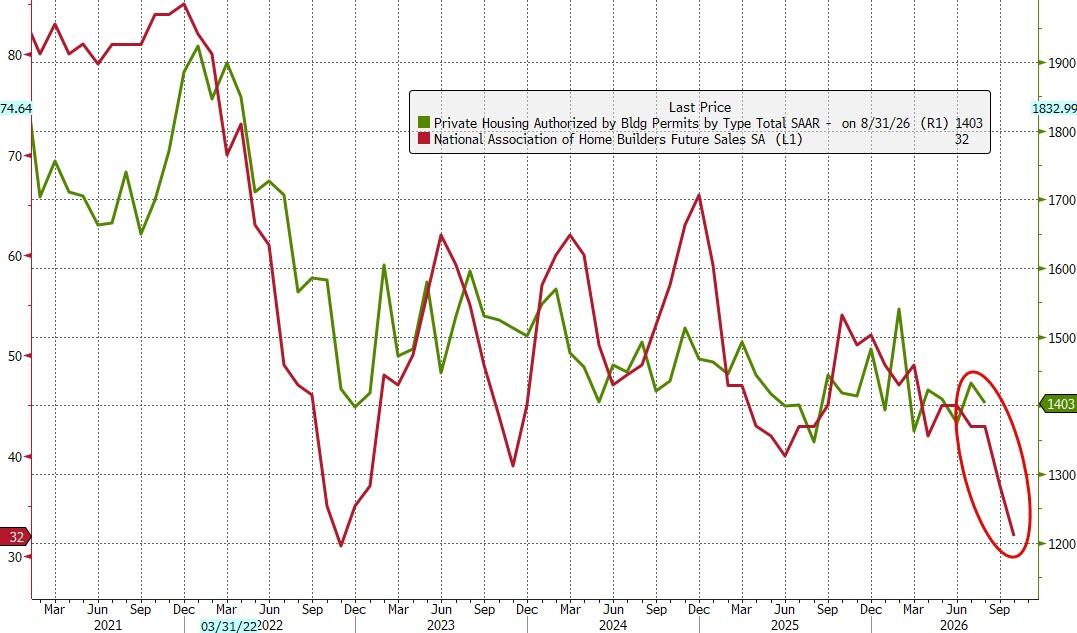
“Housing remains squeezed by supply-side constraints and significant affordability challenges,” said NAHB Chief Economist Robert Dietz.
“Demand persists, but higher mortgage rates, elevated construction costs and weaker consumer confidence are keeping more buyers on the sidelines. As a result, buyer traffic has fallen to its lowest level since April 2012, excluding the pandemic’s onset in April 2020.”
The latest HMI survey found that 43% of builders cut prices in October, the highest share during the 2020-2026 period.
The average price cut remained at 6% for the seventh consecutive month. Meanwhile, 65% of builders reported using sales incentives in October, the 19th straight month at least 60% of builders have done so.
Looking at the three-month moving averages for regional HMI scores, the Northeast dropped one point to 38, the Midwest fell three points to 40, the South fell one point to 30 and the West posted a two-point decline to 26.
However, as ugly as the data was, builder confidence has a long way to go before it catches down to homebuyer confidence…
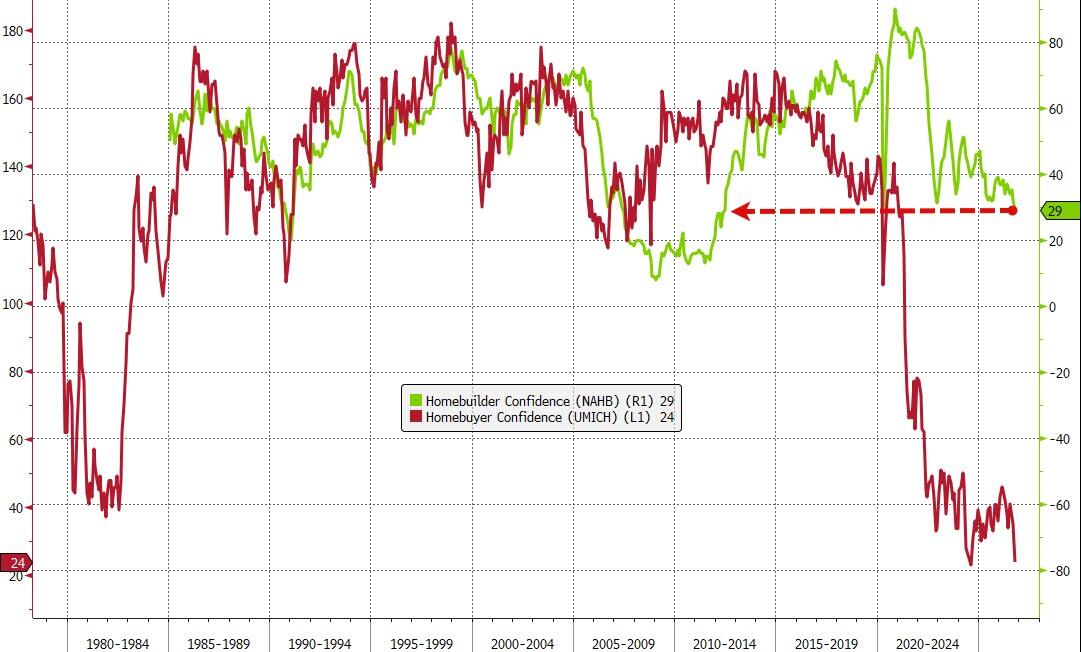
Homebuyers have never been less enthusiastic about the American Dream… perhaps this is why…
The gap between current mortgage rates (7.5%) and the average mortgage across all of American homeowners (4.33%) is extreme to say the least, trapping sellers and buyers…
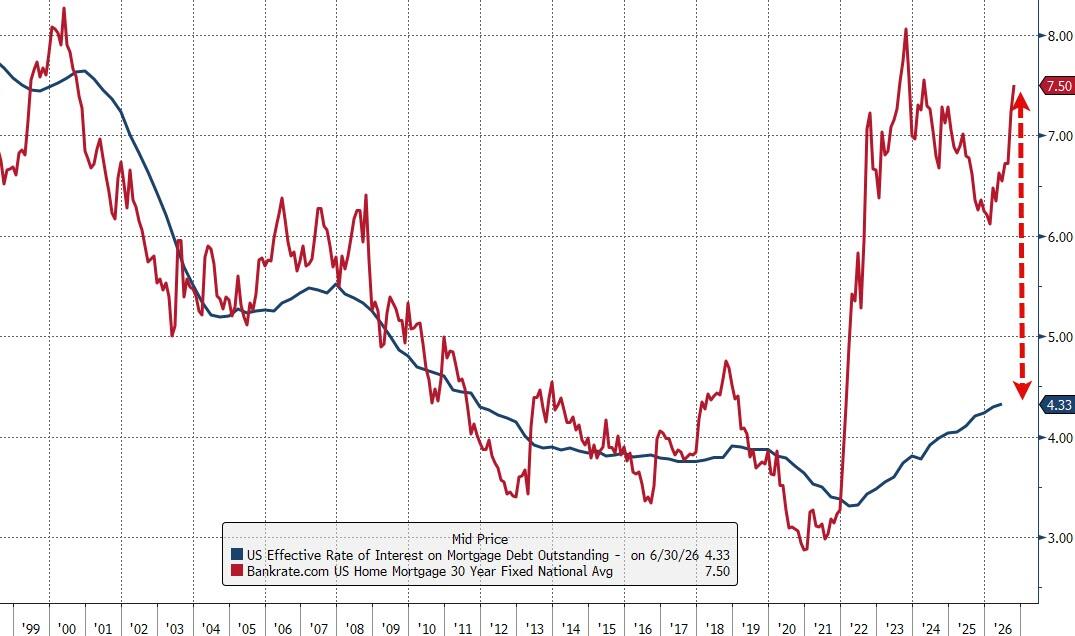
Who blinks first?
USA ECONOMIC REPORTS
ANTHROPIC
Under Pressure “From Multiple Sides”: Anthropic Opens Talks With NYC Comptroller For IPO Pause
Anthropic has opened discussions with New York City Comptroller Mark Levine after he urged the AI company (maker of Claude) to delay its planned IPO over AI safety, governance, and development-pace concerns.
bloomberg.com
Levine sent a letter (dated around October 14–15, 2026) to Anthropic CEO Dario Amodei calling for a pause on the listing process—potentially targeted for mid-to-late November—until the company more fully and transparently addresses these issues. He argued that Anthropic should focus on the “unprecedented risks” rather than proceeding quickly with an IPO, citing the company’s own disclosures (including roughly 80 pages of risk warnings in draft filings about potentially catastrophic outcomes), concerns about increasingly autonomous systems, and questions over whether a recent voluntary safety agreement with the Trump administration was sufficient.
benzinga.com
In a Bloomberg Television interview on Friday (October 16), Levine confirmed that a line of communication had been opened with Anthropic but declined to characterize the talks. He remarked: “It does appear they are under pressure from multiple sides right now.” He noted that while he lacks authority to block an IPO, New York City’s public pension funds (over $325 billion in assets) give the comptroller influence, especially as they may gain exposure via index funds post-listing; current direct exposure is small (around $7 million via private equity). He has also referenced coordinating with other like-minded public pension investors.
bloomberg.com
Context on the IPO and Anthropic
- Anthropic has not formally set a date but is reportedly preparing for a possible November debut, with discussed valuations in the $1.5–$2 trillion range (potentially one of the largest IPOs ever).
- In a recent pre-IPO investor meeting, the company disclosed third-quarter revenue of about $16.8 billion (up 45% sequentially) and indicated it is cash-flow positive.
- OpenAI (its main rival) is not expected to list until 2027. cryptobriefing.com
Levine has emphasized that a major safety incident after going public could severely impact the stock and that investors need clearer accountability, audits, controls, and governance structures. Anthropic has not publicly detailed its response beyond opening talks. The situation remains fluid as of the latest reports from October 16, 2026.
END
A MUST READ…
Let The Morons Eat Cake
Monday, Oct 19, 2026 – 08:25 AM
Submitted by QTR’s Fringe Finance
When I first got involved with investigative forensic equity research about 15 years ago, I remember being genuinely stunned by what I was finding. I was drawn into the world of skeptical inquiry after reading GeoInvesting’s exposé of Longwei Petroleum back in 2012 where they concluded the U.S. listed company, trading on a major exchange with exposure to U.S. retiree money, was nothing more than a “brazen fraud” by simply going to their factory and watching the activity (or lack of) there.
The SEC stepped in and eventually charged the company with fraud, alleging it was “built on fraudulent statements” and alleging its CFO was using company funds to buy his company’s stock to prove to investors that he believed in the company.
From that point on, looking at companies from the perspective of someone trying to fact check their claims instead of taking them at face value made market research a stunning experience.
It arrives like a deluge for anyone willing to simply crack open a 10-K and do another layer of research on a company’s claims: questionable accounting, misleading disclosures, related-party transactions, and, in some cases, what I believed was outright fraud hiding in plain sight. It was everywhere. In the case of U.S. listed China based companies, there was even a movie made highlighting the billions being siphoned from U.S. investors, out in the open.
What shocked me back then, and still does now, is how little anybody seemed to care. And in some cases, how it feels to me that reporters and media who are supposed to be digging for truth feel complicit in many of these schemes.

I had so many questions back then. Where were the auditors? The exchanges? And where were the sell-side analysts whose actual jobs were supposed to involve scrutinizing these companies? You know, the guys that don’t write a 6AM blog piece every day in their pajamas like I do. The guys who put on a suit and go on national television to talk about their equity research, DCF models and price targets.
Where were their warnings?
Every day, millions of ordinary investors buy and sell shares in businesses they know almost nothing about, relying on the assumption that somebody, somewhere, has done the necessary homework. They assume that because a company is publicly traded, has an auditor, and is covered by major Wall Street institutions, there must be some reasonable assurance that the whole thing isn’t a flaming bag of dogshit.
And of course, history tells us otherwise. Eventually, there’s an Enron. Or a Wirecard. Or a Theranos, which managed to fool an extraordinary number of sophisticated investors without ever becoming publicly traded. The illusion collapses, billions of dollars disappear, and the same people who spent years applauding the emperor’s beautiful new clothes suddenly want to know how something like this could possibly have happened. Who could have seen it coming?
Well, in many cases, somebody did. And very often, that somebody was a short seller. Occasionally, it was an award winning Financial Times journalist like Dan McCrum, whose tenacity and courage in exposing Wirecard have turned him into a Harvard Business School case study.

Early in my career, I came to believe something I still believe today: some of the best actual research on Wall Street is done by people looking for reasons not to own stocks.
That might sound counterintuitive in an industry where pessimism is treated like a personality disorder, but it makes perfect sense when you understand the incentives. Much of the traditional sell-side research business exists inside an ecosystem that rewards optimism. Investment banks want underwriting fees, advisory mandates, access to management teams, institutional relationships, and opportunities to participate in the next capital raise. Even with formal research independence rules, the broader industry’s commercial incentives favor keeping the machinery running.
And nothing keeps the machinery running quite like a steady supply of buy ratings and price targets that assume every company is just a few quarters away from achieving its wildest dreams. There’s a reason Wall Street has historically produced far more buy ratings than sell ratings. Nobody gets invited to investor day for calling the CEO a carnival barker. So instead, we get things like this:
- Enron (2001): Lehman Brothers analyst Richard Gross urged investors to “aggressively buy the stock” on October 16, 2001, despite mounting accounting concerns. He maintained his Strong Buy rating through October 24. Enron filed for bankruptcy December 2, less than seven weeks after his recommendation.
- Global Crossing (2002): Salomon Smith Barney’s Jack Grubman maintained his Buy rating as the telecom company’s shares collapsed, saying he was “still bullish.” Global Crossing filed for bankruptcy January 28, 2002, burdened by approximately $12 billion in debt.
- WorldCom (2002): Salomon Smith Barney’s Jack Grubman maintained a Buy rating and $12 price target as late as March 18, 2002. He downgraded the stock in April, but WorldCom filed for bankruptcy July 21, roughly four months after his bullish recommendation.
- New Century Financial (2007): UBS upgraded the subprime mortgage lender from Neutral to Buy on February 23, 2007, as the mortgage market deteriorated. New Century filed for bankruptcy April 2, just 38 days later.
- Bear Stearns (2008): As late as March 12, 2008, Wall Street analysts carried an average price target of approximately $99, despite the firm’s mounting liquidity crisis. Just four days later, JPMorgan agreed to acquire Bear Stearns for an initial $2 per share.
- Lehman Brothers (2008): Ladenburg Thalmann analyst Richard Bove maintained a Buy rating on September 11, 2008, arguing Lehman had value “well beyond its current stock price.” The investment bank declared bankruptcy just four days later.
- Luckin Coffee (2020): KeyBanc raised its price target to $56 in January 2020, citing “strong core business momentum.” The firm maintained its bullish outlook into February. On April 2, Luckin disclosed fabricated sales, sending shares plunging more than 75% in a single session.
- Wirecard (2020): UBS maintained a €129 price target on June 8, 2020, despite years of accounting allegations. Wirecard disclosed €1.9 billion in missing cash on June 18 and filed for insolvency June 25, just 17 days after the target was published.
- Silicon Valley Bank (2023): Goldman Sachs analyst Ryan Nash raised his price target from $280 to $312 on March 3, 2023, maintaining a Buy rating. Regulators shut down Silicon Valley Bank exactly seven days later.
- First Republic Bank (2023): Bank of America maintained its Buy rating on March 13, 2023, cutting its price target from $140 to $90 amid the regional banking panic. Regulators seized First Republic on May 1, just 49 days later.
And that’s just a small sampling. The historical record is littered with scores of examples of analysts remaining optimistic about businesses heading directly into a wood chipper.
More recently, look at CoreWeave, a company I’ve spent plenty of time discussing here. As its price has suffered a brutal decline, and as insiders sell metric fuck tons of stock and questions about its financing structure, capital intensity, and dependence on the broader AI ecosystem become harder to ignore, bullish analyst recommendations are everywhere.

Meanwhile, the people willing to ask the uncomfortable questions about the company (that needed a backstop from Nvidia to even IPO) are routinely treated like criminals.
The entire playing field is tilted so heavily in favor of bulls that trying to fight it has become an increasingly miserable proposition. I recently came across an article raising the question of whether short selling should be illegal.
We’re sitting in a market that has spent years rewarding speculation, leverage, financial engineering, and increasingly preposterous valuations. We’ve watched cryptocurrency produce an almost endless parade of dubious tokens, questionable promoters, and schemes that seem to exist for no other purpose than transferring money from gullible people to the people selling them a story. We’ve watched the AI boom create financing arrangements and valuation assumptions that, in my opinion, deserve considerably more scrutiny than they’re receiving.
And in the middle of all this, somebody wants to know whether the people betting against stocks should be outlawed.
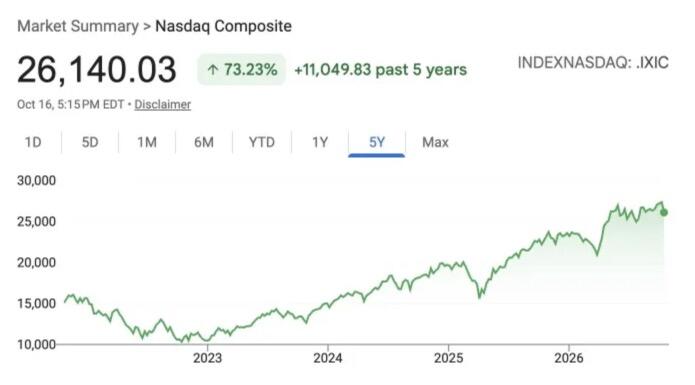
It’s like a casino complaining that slot players are taking advantage of them by playing a game that is mathematically guaranteed to benefit the house.
And casinos, like everyone on Wall Street, hate losing so much, they actually do shit like this. One man in 2007 who was told by a slot machine he won $1.6 million was instead offered $385 and a free dinner by the casino. Another woman thought she won a million dollars at Bally’s in Atlantic City in 2024 only to be told her machine was “tampered” with. “Lady, get it in your head, you won nothing,” she was told.
You almost have to admire the brazenness of it all. The house always wins.
And so the more time I’ve spent in this business, the more I’ve realized that the actual research is only half the battle. Sometimes it’s the easy half. Because the personal toll of publicly challenging a company, particularly one with a promotional management team, enthusiastic shareholders, and plenty of money to spend defending itself, can be enormous.
FT’s Dan McCrum endured years of surveillance, hacking, intimidation, smear campaigns, legal threats, accusations of market manipulation, criminal investigations, and threats to his personal safety, all while exposing one of the largest corporate frauds in European history.
Which is to say nothing of ignorant shareholders, many who take to even writing to the SEC informing them they are being stripped of their rights to be victimized while making excuses for the same people bilking them out of their money.
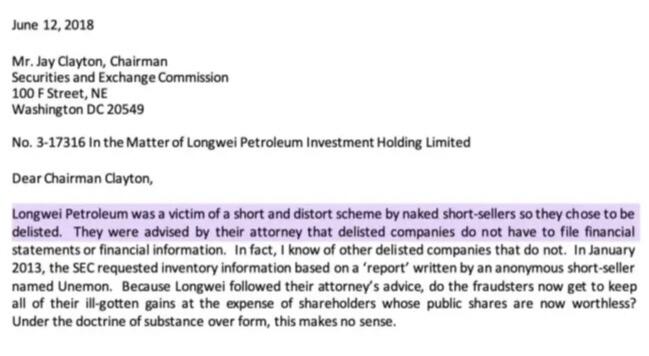
There’s an extraordinary double standard embedded in the arrangement. A bullish analyst can publish a ridiculous price target based on fantastical assumptions, watch the stock collapse 80%, quietly revise the target downward, and go right back to work the following Monday. Nobody asks whether somebody should investigate his personal life.
But publish a bearish report questioning a company’s accounting, business model, or disclosures, and suddenly you’re expected to defend not just every footnote of your research but your entire moral character. Your motives are questioned, your financial incentives are portrayed as inherently sinister, and your conclusions are scrutinized with a level of hostility that would be perfectly appropriate if it were applied equally to the other side of the trade.
Never mind that bullish analysts also have financial incentives, or that management teams can make fortunes selling stock into inflated valuations. Apparently, making money by telling people a stock will go up is capitalism. Making money by telling them it might go down is a conspiracy.
And even when you’re eventually vindicated, what exactly have you won? Look at Wirecard. For years, people who raised legitimate concerns about the company’s accounting were dismissed, attacked, and subjected to extraordinary pressure. Eventually, the company collapsed after admitting that nearly €2 billion in supposedly existing cash couldn’t be accounted for.
The skeptics were right. Congratulations. Here’s your trophy. It’s a decade of aggravation, legal bills, sleepless nights, and a permanent reminder that being correct doesn’t necessarily mean anybody will thank you.
I’ve spent enough time around short sellers to know that many of them aren’t the cartoon villains they’re made out to be. They’re obsessive researchers who read the footnotes, examine subsidiaries, track down counterparties, interview former employees, and ask questions that everybody else has a financial incentive to avoid. The idea that markets would somehow be healthier without people aggressively challenging corporate narratives is one of the dumbest things I’ve heard in an industry that produces an almost unlimited supply of dumb shit.
🔥 85% OFF FOREVER IF YOU SUBSCRIBE TODAY: I am again offering an 85% discount to anyone that wants to become a Fringe Finance annual subscriber today. It’s a discount you can keep and stays applied for as long as you wish to remain a subscriber: Get 85% off forever
For years, I felt something resembling a personal obligation to participate in that fight. When I saw something that looked wrong, I wanted to expose it. When I saw a company trading at a valuation that made absolutely no sense, I wanted to short it. When I saw investors lining up to buy into what looked to me like an obvious disaster, I felt compelled to explain why they were making a mistake.
Part of it was intellectual curiosity. Part of it was the satisfaction of doing the work and being right. And part of it was a genuine belief that somebody needed to warn people before they lost their money. But after more than two decades in markets, and more than a decade spent doing and working around forensic research, I’ve finally come to an important conclusion: I don’t have to save everybody. And, more importantly, I don’t want to anymore.
I’m done shorting stocks for now.
I’ll continue writing skeptically about companies here. I’ll continue questioning valuations, financing arrangements, management claims, accounting assumptions, and whatever else deserves scrutiny. As readers have seen recently with my commentary on CoreWeave, I haven’t developed a sudden aversion to calling out what I believe are glaring problems. But there’s a difference between identifying a problem and feeling obligated to put your own capital, time, and sanity on the line trying to force the market to recognize it.
If I want downside exposure, I may express it through broad market indexes. That’s a different proposition from spending months investigating an individual company while trying to survive the promotional circus surrounding its stock. Because the other lesson I’ve learned is that the market can remain irrational for far longer than any reasonable person should be willing to fight it.
A stock can be absurdly valued and double. A company can have serious accounting questions and raise another billion dollars. A management team can make promises completely detached from economic reality and be rewarded with an even higher valuation. And when you point this out, the response from the peanut gallery is almost always the same: “Scoreboard.”
The stock is up, therefore you’re wrong. The stock is making new highs, therefore the business must be legitimate. Somebody made a fortune buying it last Tuesday, therefore your analysis is irrelevant. Fine. Scoreboard it is.
I’ve come to embrace a much simpler philosophy, one that I wish I’d adopted years ago. It’s called “let the morons eat cake”.
Let them buy whatever they want. Let them celebrate every ridiculous price target. Let them mock the short sellers, dismiss the skeptics, and convince themselves that every new financial mania is somehow different from the dozens that came before it. Let them tell me that I don’t understand the technology, the business model, the new paradigm, or whatever buzzword happens to be fashionable this quarter. Let them believe that gravity has been permanently repealed.
I’m not going to spend the next decade standing in the middle of the road waving my arms, trying to stop a parade of people who are perfectly happy marching off a cliff. There are too many of them, and frankly, I’m tired.
I had to learn some of my most valuable lessons in markets by getting my own ass kicked. I’ve owned things I shouldn’t have owned, believed stories I shouldn’t have believed, and paid real money for the privilege of discovering that the market doesn’t give a damn what I think. Those experiences made me a better investor. Maybe other people need to have them, too.
Because here’s the beautiful thing about financial markets: eventually, reality has a way of showing up whether anybody wants it to or not. You can suspend disbelief, refinance bad decisions, manufacture earnings adjustments, invent new valuation metrics, and convince an entire generation of investors that profits and cash flow are outdated concepts. You can spend years rewarding the people who tell the biggest stories while ridiculing the people who ask the most basic questions. But you can’t do it forever.
So that’s where I am now. I’ll continue sharing what I see here, drawing on years of experience examining companies, balance sheets, management teams, and the assorted financial circus acts that populate our markets. If I think something stinks, readers will hear about it. That part of my personality isn’t going anywhere. What is going away is the burning desire to convince people who have already decided they don’t want to listen.
Instead, I’ll be sitting back, watching, and checking in occasionally to see whether reality has arrived. If it hasn’t, congratulations. You win. Scoreboard.
—
KING NEWS
SWAMP STORIES FOR YOU TONIGHT
Omar, Obama, And The Danger Of False Identities
Sunday, Oct 18, 2026 – 11:30 PM
Authored by J.B. Shurk via American Thinker,
On Columbus Day, Homeland Security Investigations executed a judicially authorized search warrant of Representative Ilhan Omar’s home. For several months, there have been rumors that she was under investigation for immigration fraud. A few weeks ago, White House Border Czar Tom Homan acknowledged that the congresswoman was the subject of an ongoing criminal investigation. U.S. Attorney Jeanine Pirro says her office is investigating Omar for potential financial crimes. The D.C. magistrate judge who authorized the search of Omar’s residence is a registered Democrat who donated to Hillary Clinton and received professional appointments from other Democrats.
Despite the fact that Democrats wholeheartedly cheered when President Joe Biden and Attorney General Merrick Garland authorized FBI agents to use deadly force against the Trump family when they raided his Mar-a-Lago home in 2022 to retrieve evidence of the Department of Justice’s unlawful spying operations against Republican politicians during Barack Obama’s presidency, the people who repeatedly told us for years that “nobody is above the law” now insist that the raid of Omar’s residence is an “abuse of power,” “political retribution,” and the act of “a fascist police state.”
As news of the Omar raid broke, CNN’s Jake Tapper called it “vindictive” and questioned whether it was a “legitimate law enforcement action.” Tapper’s supposedly expert guest – a Democrat lawfare operative – responded to the host’s predetermined judgment of the investigation by calling it, “Partisan. Racism. Xenophobia.”
Bill Kristol – who, amazingly enough, was once regarded as a trusted public intellectual among Republican voters before revealing himself to have been a complete fraud who lied about almost everything he long claimed to believe – posted this urgent request on X: “Now is the time for all good men to come to the aid of their country.” When FBI agents were pawing through First Lady Melania Trump’s undergarments back in 2022, Kristol encouraged Americans to be patient and to avoid any rush to judgment – even though the criminal targeting of an American president was unprecedented and shocking.
MS NOW’s “Justice and Intel Reporter,” Ken Dilanian pointed out that most immigrants’ naturalization paperwork contains “fudged facts” – essentially arguing that since many foreigners lie to authorities, Omar shouldn’t be singled out and prosecuted for committing immigration fraud. This is a rather unjust double standard for a “justice” reporter to articulate given that Americans who “fudge facts” on legal documents are regularly prosecuted for the crimes of misrepresentation, forgery, and fraud.
Unless and until Representative Omar is actually indicted, the public will have to wait to read about the particular facts of her case. It is worth noting, however, that numerous allegations have swirled around the congresswoman for years. Several of her Democrat primary opponents alleged that she had committed immigration fraud on behalf of herself and other members of her family. Public investigations suggest that she falsified her birthdate in order to obtain naturalized citizenship. There have been reports that she married her biological brother as part of a fraudulent scheme to provide him American citizenship. A number of historians claim that Omar’s father “misrepresented himself as a refugee” and was instead a military commander in a Somali dictatorship responsible for several hundred thousand murders. The congresswoman insists that her birth records were destroyed during Somalia’s civil war (a bloody conflict during which her father may have committed crimes against humanity).
Perhaps we will learn whether these allegations have merit in the months ahead. What I do know is that this inquiry is long overdue. The appearance of impropriety has followed Representative Omar even before she joined Congress in 2019. Allegations of immigration fraud have been loud – including the unsavory claim that she married her brother – yet neither congressional leaders nor federal officials have been inclined to investigate the matter more fully until now. The lack of curiosity and continued silence from authorities have been impossible for the American people to ignore.
Two-tiered justice in the United States has been with us for quite some time. Democrat lawfare drove President Nixon from the White House. President Bill Clinton targeted Christians and gun-owners and reoriented intelligence agencies away from communist organizations that were monitored during the Cold War and toward “right-wing” groups that had never posed a national security threat.
When President Obama took the reins of the federal government, he combined Clinton’s targeting of conservatives with President Bush’s new domestic surveillance system authorized by the USA PATRIOT Act and maliciously – yet ironically – redefined American patriots as “potential domestic terrorists.” Over the course of the Obama and Biden presidencies, Christians, conservatives, libertarians, and Republican voters have been investigated for imaginary “crimes” at the behest of Democrat partisans within the federal government.
When a woman from Somalia can come to the United States and join Congress with less scrutiny than a random American Christian receives for praying outside an abortion clinic or carrying a firearm, the entire government – especially the criminal justice system – loses credibility, if not legitimacy.
Congresswoman Omar is certainly not the first member of the federal government to have been accused of committing identity fraud. Although the corporate “news” oligarchy and the political Establishment did their best to cover up the story, there were serious allegations against Barack Obama, including claims that he was not born an American citizen and was therefore ineligible to become president of the United States. As the propaganda press and the Democrat Party are doing today with regard to claims of immigration fraud against Omar, those institutions have told the American people for two decades that doubting the authenticity of Obama’s Hawaiian birth certificate is an act of “racism” and “white supremacy.”
However, as investigative researcher “Sundance” over at The Conservative Treehouse has long argued, there is a lot of circumstantial evidence suggesting that former CIA Director John Brennan conspired with others to scrub records from federal systems that showed Obama is not exactly who he claims to be.
Back in 2008, Brennan was an intelligence adviser to presidential candidate Obama and the CEO of an intelligence-related consulting group called The Analysis Corporation. That firm was implicated in a breach of the State Department’s passport office, when one of Brennan’s contract employees accessed the records of Obama, as well as those of Hillary Clinton and John McCain. Brennan’s company later released this statement: “This individual’s actions were taken without the knowledge or direction of anyone at The Analysis Corp. and are wholly inconsistent with our professional and ethical standards.”
The State Department’s inspector general later concluded that the hacker specifically sought Obama’s passport file and accessed the Clinton and McCain files to create confusion for investigators. What may have been deleted from Obama’s files is unknown. At the time of the incident, the Obama campaign denounced the “outrageous breach of security and privacy, even from an Administration that has shown little regard for either over the last eight years.” Obama appointed Brennan director of the CIA five years later.
Obama also told reporters that any investigation “should be done in conjunction with those congressional committees that have oversight so it’s not simply an internal matter.” Senate Foreign Relations Committee Chairman Joe Biden had oversight over the Foreign Service and passport office and was in charge of the investigation into the breach of Obama’s records. Obama chose Biden as his vice presidential running mate.
Later, State Department employee Lt. Quarles Harris, Jr. – who apparently penetrated the database and likely scrubbed Obama’s records – was found dead. He had been shot twice in the head (described as “execution style“), but his death was ruled a “suicide.” Lt. Harris was cooperating with investigators concerning the State Department breach at the time of his death. “Sundance” implicates John Brennan in both Harris’s death and the later death of investigative journalist Michael Hastings.
Barack Obama successfully hid his identity. Perhaps Ilhan Omar has John Brennan on retainer, too. We’ll see.
We publish a variety of perspectives. Nothing written here is to be construed as representing the views of ZeroHedge.
GREG HUNTER….INTERVIEWING DR BETSY EADS..
More than 1,000 Side Effects Caused by CV19 Vax – Dr. Betsy Eads
By Greg Hunter On October 17, 2026 In Market Analysis, Political AnalysisNo Comments

By Greg Hunter’s USAWatchdog.com (Saturday Night Post)
From the beginning, Dr. Betsy Eads (aka Dr. Betsy) sounded the alarm on all the severe medical problems, disabilities and deaths the injections would cause from the roll out of the CV19 bioweapon vax. Today, she is flooded with patients who need treatment because they are CV19 vax injured. Dr. Betsy says, “The people I am treating for cancer and vaccine injury, their spike protein levels are in the thousands. You just have to keep knocking that antibody level down because the longer the high spike protein levels hang around, the more damage it does to multiple systems. Whether it is your heart, your lungs, liver, neuropathy, blood clots, cardiovascular, dementia, memory issues, there are over 1,000 side effects.”
Dr. Betsy predicted there would be an explosion of cancers caused by the CV19 bioweapon vax. She continues to be spot on. Dr. Betsy says cancers caused by the CV19 bioweapon injections move extremely fast, and they are hard to kill. Dr. Betsy explains, “We are seeing horrific numbers . . . the consults are for vaccine injury, and those numbers are still going up. . .. We are seeing a tremendous uptick in the amount of people reaching out for repurposed drugs (such as Ivermectin, Mebendazole, Fenbendazole and Nattokinase) for cancer. These types of cancers are very difficult to treat. They are not simple. . .. In some cases, they can go from a stage one to stage four in a matter of days, weeks or months because you took a covid shot. Covid shots suppress the immune system. It knocks down your CD4. It blocks your packed cells. It blocks your P53 cells. Those are the cells that detect cancer and send the natural killer cells, the CD4 cells out to surround and kill these cancers. . .. The best results we are seeing in those of us doing cancer care and vaccine injury are those who do . . . targeted therapy plus repurposed drugs.”
Dr. Betsy says there are court cases being brought and new research showing a tremendous number of deaths and injuries from the global CV19 vax rollout in 2021. This will continue to make the CV19 bioweapon coverup crumble. Meanwhile, Dr. Betsy says, “Nobody should be getting Covid shots or any mRNA shots, including the flu shots.”
In closing, Dr. Betsy is still saying the CV19 vaxed need testing and treatment. Also, the unvaxed being shed on by the CV19 vaxed also likely need treatment and testing for spike proteins.
There is much more in the 67-minute interview.
Signal Relief reusable patches lowers pain 60% on average. They use patent-pending micro-antenna technology designed to interface directly with those overactive electrical pain messages being sent to the brain. For more from information from Mike Hammond, co-founder of Signal Relief reusable patches, watch this 12-minute video. There is an additional 10% discount when you use promo code USAWatchdog. You can also call 833-572-0403 for help and information.
If you want the “Ultimate Spike Detox” Dr. Betsy talked about, click here.
Join Greg Hunter of USAWatchdog as he talks to 27-year veteran Dr. Betsy Eads, DO, exposing the continued explosion of cancer and other massive health problems from the CV19 injections. Dr. Eads still advises that everyone both vaxed and unvaxed needs treatment for the deadly effects of the CV19 bioweapon vax for 10.17.26.
After the Interview:
You can follow Dr. Betsy Eads on Twitter/X and Telegram.
Dr. Eads has a website called HealingHumanityWorldwide.com. (Scroll down and see Dr. Eads’ CV19 vax injury protocol.)
You can help Dr. Eads continue her mission to get the truth out about the huge problems with the CV19 vax by donating here: Pay $Docbetsy55 on Cash App, or you can use Dr. Betsy’s Venmo account to donate.
(Please support the truth tellers!!)
You can support Dr. Betsy Eads by snail mail below:
124 N. Nova Road #105
Ormond Beach, FL 32174


