
EXCHANGE: COMEX
CONTRACT: OCTOBER 2026 COMEX 100 GOLD FUTURES
SETTLEMENT: 4,122.400000000 USD
INTENT DATE: 10/20/2026 DELIVERY DATE: 10/22/2026
FIRM ORG FIRM NAME ISSUED STOPPED
152 C DORMAN TRADING, LLC 2
363 H WELLS FARGO SECURITI 231
661 C JP MORGAN SECURITIES 267 30
686 H STONEX FINANCIAL INC 32
737 C ADVANTAGE FUTURES 24
TOTAL: 293 293
MONTH TO DATE: 13,372
GOLD: NUMBER OF NOTICES FILED FOR OCT./2026: 293 CONTRACTs NOTICES FOR 29,300 OZ or 0.9113 TONNES
total notices so far: 13,372 contracts FOR 1,337,200 OZ OR 41.592 TONNES
SILVER NOTICES: 0 NOTICE(S) FILED FOR NIL OZ /
total number of notices filed so far this month : 3511 CONTRACTS (NOTICES) for 17.555 million oz
GLD
SHANGHAI CLOSED DOWN 22.34 PTS OR 0.60%
HANG SENG CLOSED DOWN 215.74 PTS OR 0.90%
Nikkei CLOSED UP 620.58 PTS OR 0.97%
//Australia’s all ordinaries CLOSED DOWN 0.47%
//Chinese yuan (ONSHORE) CLOSED UP AT 6.6778
/ OFFSHORE CLOSED UP AT 6.6765 Oil UP TO 98.80 dollars per barrel for WTI and BRENT UP TO 109.81 Stocks in Europe OPENED ALL GREEN
ONSHORE USA/ YUAN// WITH YUAN TRADING 6.6778 OFFSHORE YUAN TRADING UP TO 6.6765 ONSHORE YUAN TRADING BELOW LEVEL // OFF SHORE AND UP ON THE DOLLAR)// / AND THUS STRONGER/OFF SHORE YUAN TRADING UP AGAINST US DOLLAR/ AND THUS STRONGER
XXXXXXXXXXXXXXXXXXXXXXXXXXXXXXXXXXXXX
ONSHORE YUAN: CLOSED UP TO 6.6874
| Gold | Ounces |
| Withdrawals from Dealers Inventory in oz | nil |
| Withdrawals from Customer Inventory in oz | 2 ENTRIES i) Manfra: 21,073.992 oz ii) Out of Brinks 450.114 oz (14 kilobars) total withdrawal: 21,524.106 oz |
| Deposit to theDealerInventory in oz | 0 ENTRIES |
| Deposits to the Customer Inventory, in oz | DEPOSITS/CUSTOMER//gold 0 ENTRIES xxxxxxxxxxxxxxxx |
| No of oz served (contracts) today | 293 CONTRACTS 29300 OZ 0.9113 TONNES OF GOLD |
| No of oz to be served (notices) | 48 Contracts 4800 OZ 0.1493 TONNES |
| Total monthly oz gold served (contracts) so far this month | 13,372 notices 1,337,200 OZ 41.592 TONNES |
| Total accumulative withdrawals of gold from the Dealers inventory this month | NIL oz |
| Total accumulative withdrawal of gold from the Customer inventory this month |
dealer deposits: 0
xxxxxxxxxxxxxxxxxxx
DEPOSITS:CUSTOMER ACCT
ENTRIES: 0
xxxxxxxxxxxxxxxxxx
comex withdrawals
2 ENTRIES
i) Manfra: 21,073.992 oz
ii) Out of Brinks 450.114 oz (14 kilobars)
total withdrawal: 21,524.106 oz
adjustments: 0
COMEX IS DRAINING GOLD
chaos inside the comex
THE FRONT MONTH OF OCT OI STANDS AT 341 CONTRACTS HAVING A GAIN OF 287 CONTRACTS.
TUESDAY WE HAD A NORMAL DELIVERY OF 1,312,600 OZ ( 40.827 TONNES) OF GOLD STANDING FOR DELIVERY: TODAY: 1,342,000 OZ OR 41.1741 TONNES FOR A GAIN OF 29,400 OZ (0.91446 TONNES) OR 294 CONTRACTS UNDERWENT A HUGE QUEUE JUMP WHERE THESE BOYS WILL TRY THEIR LUCK BY TAKING DELIVERY ON THIS SIDE OF THE POND..
NOVEMBER LOST 68 CONTRACTS FALLING TO 3562
DECEMBER, THE LARGEST DELIVERY MONTH IN THE CALENDAR, ITS OI FALLS BY 2910 CONTRACTS DOWN TO 315,829.
.
We had 293 contracts filed for today representing 29,300 oz
Today, 0 notice(s) were issued from J.P.Morgan dealer and 262 notices issued from their client or customer account. The total of all issuance by all participants equate to 293 contract(s) of which 0 notices were stopped (received) by j.P. Morgan dealer and 30 notice(s) was (were) stopped (received) by J.P.Morgan//customer account
To calculate the INITIAL total number of gold ounces standing for OCT /2026. contract month, we take the total number of notices filed so far for the month (13,372) to which we add the difference between the open interest for the front month of OCT (341 CONTRACTS) minus the number of notices served upon today 293 x 100 oz per contract) equals 1,342,000 OZ OR(41.1741 Tonnes of gold) to which we add our two exchange for risk in Oct totalling 837 contracts for 83,700 oz or 2.60346 tonnes. Thus Oct standing for gold advances to 43.7776 tonnes
THUS: INITIAL total number of gold ounces standing for OCT. /2026. contract month,we take the total number of notices filed so far for the month (13,372) to which we add the difference between the open interest for the front month of OCT(341) contracts minus the number of notices served upon today 293 x 100 oz per contract) equals 1,342,000 OZ OR(41.1741 Tonnes of gold) plus our first exchange for risk totalling 837 contracts//83700 oz//2.60346 tonnes//standing ADVANCES to 43.7776 tonnes
new total of gold standing in OCT becomes 43.7776 TONNES//
TOTAL COMEX GOLD STANDING FOR OCT.: 43.7776 TONNES WHICH IS NOW VERY STRONG FOR THIS NON ACTIVE DELIVERY MONTH OF OCT./
TUESDAY VOLUME: 187,791 poor
COMEX GOLD INVENTORIES/CLASSIFICATION
NEW PLEDGED GOLD:
241,794.285 oz NOW PLEDGED /HSBC 5.94 TONNES
204,937.290 OZ PLEDGED MANFRA 3.08 TONNES
83,657.582 PLEDGED JPMorgan no 1 1.690 tonnes
265,999.054, oz JPM No 2
1,152,376.639 oz pledged Brinks/
Manfra: 33,758.550 oz
Delaware: 193.721 oz
International Delaware:: 11,188.542 oz
total pledged gold: 1,746,271.131 oz 54.31 tonnes pledged gold lowers
total inventories in gold declining rapidly
total pledged gold: 1,746,271.131 tonnes oz 54.31 tonnes
TOTAL OF ALL GOLD ELIGIBLE AND REGISTERED GOLD 23,404,381.230 oz//
TOTAL REGISTERED GOLD 14,816,969.006 tonnes (460.86 tonnes)
TOTAL OF ALL ELIGIBLE GOLD 8,587,412.224 oz.
REGISTERED GOLD THAT CAN BE SERVED UPON 13,070,698 oz ((REG GOLD- PLEDGED GOLD)=
406.553 Tonnes //
total inventories in gold declining rapidly
SILVER COMEX
OCT DELIVERY MONTH
OCT 21
| Silver | Ounces |
| Withdrawals from Dealers Inventory | NIL oz |
| Withdrawals from Customer Inventory | 1 entries i) Delaware: 3971.100 oz total withdrawal 3971.100 oz |
| Deposits to the Dealer Inventory | 0 ENTRY |
| Deposits to the Customer Inventory | ENTRIES: 1 i) Into Asahi 1,186,361.208 total deposit: 1,186,361.208 oz |
| No of oz served today (contracts) | 0 CONTRACT(S) ( 0 MILLION OZ) |
| No of oz to be served (notices) | 18 Contracts (0.090 MILLION oz) |
| Total monthly oz silver served (contracts) | 3511 contracts 17.555 MILLIONoz |
| Total accumulative withdrawal of silver from the Dealers inventory this month | NIL oz |
| Total accumulative withdrawal of silver from the Customer inventory this month |
DEPOSITS INTO DEALER ACCOUNTS
ENTRY:0
DEPOSIT ENTRIES/CUSTOMER ACCOUNT
1 ENTRIES:
i) Into Asahi 1,186,361.208
total deposit: 1,186,361.208 oz
xxxxxxxxxxxxxxxxxxxxxxxxx
withdrawals:
one entry:
out of Delaware: 3971.100 oz
total withdrawal 3971.100 oz
adjustments : 3 all customer to dealer
a) Asahi 1003.300 oz
b) CNT 603,481.09 oz
c) JPMorgan: 302,300.300 oz
xxxxxxxxxxxxxx
TOTAL REGISTERED SILVER: 103.332 MILLION OZ//.TOTAL REG + ELIGIBLE. 337.666 Million oz
registered silver dropping in numbers
CALCULATIONS FOR THE NEW STANDING FOR SILVER FOR OCT
FRONT MONTH: SILVER OPEN INTEREST CONTRACTS: 18 FOR A LOSS OF 231 CONTRACTS . TUESDAY WE HAD 17.645 MILLION OZ STAND: TODAY: 17.645 MILLION OZ FOR A LOSS OF 0 OZ (0 CONTRACTS). THUS A ZERO CONTRACT EXCHANGE FOR PHYSICAL TRANSFER JUMP TO LONDON//AND A ZERO QUEUE JUMP WHERE THEY WILL NEITHER TAKE ANY DELIVERY ON EITHER SIDE OF THE POND.
.
NOVEMBER LOST 11 CONTRACTS UP TO AN OI OF 1872
DECEMBER GAINED 1272 CONTRACTS UP TO AN OI OF 86,054
TOTAL NUMBER OF NOTICES FILED FOR TODAY: 0 or 0 oz
CONFIRMED volume TUESDAY; 49,925 // poor/
AND NOW OCT. DELIVERIES:
To calculate the number of silver ounces that will stand for delivery in OCT. we take the total number of notices filed for the month so far at 3511 X5,000 oz = 17.555 MILLION oz.
Then we take the difference between the front month of OCT. and the number of notices filed for today x 5000 to give us our standing
Thus the standings for silver for the OCT 2026 contract month: (3511 )Notices served so far) x 5000 oz + OI for the front month of OCT (18) minus number of notices served upon today ( 0 x 5000 oz) equals silver standing for the OCT .contract month equating to 17.645 MILLION OZ to which we add silver’s TWO exchange for risk for 450 contracts (2.25 million oz).. total standing REMAINS AT 19.895 million oz//. ( a very strong delivery month)
We must also keep in mind that there is considerable silver standing in London coming from our longs
There are ONLY 103.332 million oz of registered silver
JPMorgan as a percentage of total silver: 125.510/337.666 million: 37.02%
The record level of silver open interest is 234,787 contracts set on April 21./2017 with the price on that day at $18.42.
The previous record was 224,540 contracts with the price at that time of $20.44.
BOTH GLD AND SLV ARE MASSIVE FRAUD
XXXXXXXXXXXXXXXXXXXXXXXXXXXXXXXXXXXXXXXXXXX
OCT 21//2026/WITH GOLD UP $8.55 /NO CHANGES IN GOLD AT THE GLD.// //:/INVENTORY RESTS AT 1059.04 TONNES
OCT 20//2026/WITH GOLD DOWN $41.05 /NO CHANGES IN GOLD AT THE GLD. //:/INVENTORY RESTS AT 1059.04 TONNES
OCT 19//2026/WITH GOLD DOWN $19.65 /HUGE CHANGES IN GOLD AT THE GLD:A DEPOSIT OF 5.13 TONNES OF 0.29 TONNES OF GOLD INTO THE GLD/. //:/INVENTORY RESTS AT 1059.04 TONNES
OCT 16//2026/WITH GOLD UP $60.50 /HUGE CHANGES IN GOLD AT THE GLD:A WITHDRAWAL OF 0.29 TONNES OF GOLD FROM THE GLD/. //:/INVENTORY RESTS AT 1053.91 TONNES
OCT 15//2026/WITH GOLD UP $60.50 /HUGE CHANGES IN GOLD AT THE GLD:A WITHDRAWAL OF 1.21 TONNES OF GOLD FROM THE GLD/. //:/INVENTORY RESTS AT 1054.20 TONNES
OCT 14//2026/WITH GOLD DOWN $66.25 /NO CHANGES IN GOLD AT THE GLD: //:/INVENTORY RESTS AT 1055.41 TONNES
OCT 13//2026/WITH GOLD DOWN $13.25 /HUGE CHANGES IN GOLD AT THE GLD: A DEPOSIT OF OF 2.281TONNES OF GOLD INTO THE THE GLD//: //:/INVENTORY RESTS AT 1055.411 TONNES
OCT 12//2026/WITH GOLD DOWN $24.20 /HUGE CHANGES IN GOLD AT THE GLD: A WITHDRAWAL OF 2TONNES OF GOLD OUT OF THE GLD//: //:/INVENTORY RESTS AT 1053.13 TONNES
OCT 9//2026/WITH GOLD UP $60.00 /HUGE CHANGES IN GOLD AT THE GLD: A WITHDRAWAL OF 4.562 TONNES OF GOLD OUT OF THE GLD//: //:/INVENTORY RESTS AT 1055.411 TONNES
OCT 8//2026/WITH GOLD UP $16.85 /HUGE CHANGES IN GOLD AT THE GLD: A DEPOSIT OF 3.703 TONNES OF GOLD INTO THE GLD//: //:/INVENTORY RESTS AT 1059.873 TONNES
OCT 7//2026/WITH GOLD DOWN $46.70 /NO CHANGES IN GOLD AT THE GLD:: //:/INVENTORY RESTS AT 1056.27 TONNES
OCT 6//2026/WITH GOLD UP $30.60 /HUGE CHANGES IN GOLD AT THE GLD:: A DEPOSIT OF 0.754 TONNES OF GOLD INTO THE GLD// //:/INVENTORY RESTS AT 1056.27 TONNES
OCT 5//2026/WITH GOLD DOWN $2.20 /HUGE CHANGES IN GOLD AT THE GLD:: A WITHDRAWAL OF 0.854 TONNES OF GOLD INTO THE GLD// //:/INVENTORY RESTS AT 1055.696 TONNES
OCT 2//2026/WITH GOLD DOWN $43.00 /HUGE CHANGES IN GOLD AT THE GLD:: A DEPOSIT OF 0.854 TONNES OF GOLD INTO THE GLD// //:/INVENTORY RESTS AT 1056.55 TONNES
OCT 1//2026/WITH GOLD UP $19.55 /HUGE CHANGES IN GOLD AT THE GLD:: A WITHDRAWAL OF 1.711 TONNES OF GOLD OUT OF THE GLD// //:/INVENTORY RESTS AT 1055.696 TONNES
SEPT 30//2026/WITH GOLD UP $7.80 /HUGE CHANGES IN GOLD AT THE GLD:: A DEPOSIT OF 2.847 TONNES OF GOLD INTO THE GLD// //:/INVENTORY RESTS AT 1057.407 TONNES
SEPT 29//2026/WITH GOLD UP $11.75 /NO CHANGES IN GOLD AT THE GLD //:/INVENTORY RESTS AT 1054.56 TONNES
SEPT 28//2026/WITH GOLD DOWN $150.20 /NO CHANGES IN GOLD AT THE GLD //:/INVENTORY RESTS AT 1054.56 TONNES
SEPT 25//2026/WITH GOLD DOWN $150.20 /NO CHANGES IN GOLD AT THE GLD //:/INVENTORY RESTS AT 1054.56 TONNES
SEPT 24//2026/WITH GOLD DOWN $18.70 /HUGE CHANGES IN GOLD AT THE GLD A DEPOSIT OF 1.43 TONNES OF GOLD INTO THE GLD://:/INVENTORY RESTS AT 1056.84 TONNES
SEPT 23//2026/WITH GOLD DOWN $58.00 /HUGE CHANGES IN GOLD AT THE GLD://:/INVENTORY RESTS AT 1055.41 TONNES
SEPT 22//2026/WITH GOLD DOWN $6.30 /HUGE CHANGES IN GOLD AT THE GLD://A DEPOSIT OF 0.31 TONNES OF GOLD INTO THE GLD/:/INVENTORY RESTS AT 1055.41 TONNES
SEPT 21//2026/WITH GOLD DOWN $41.20 /HUGE CHANGES IN GOLD AT THE GLD://A DEPOSIT OF 2.26 TONNES OF GOLD INTO THE GLD/:/INVENTORY RESTS AT 1055.10 TONNES
SEPT 18//2026/WITH GOLD UP $26.45 /HUGE CHANGES IN GOLD AT THE GLD://A DEPOSIT OF 0.85 TONNES OF GOLD INTO THE GLD/:/INVENTORY RESTS AT 1052.84 TONNES
SEPT 17//2026/WITH GOLD UP $14.05 /HUGE CHANGES IN GOLD AT THE GLD://A DEPOSIT OF 1.71 TONNES OF GOLD INOT THE GLD/:/INVENTORY RESTS AT 1051.99 TONNES
SEPT 16//2026/WITH GOLD UP $53.40 /HUGE CHANGES IN GOLD AT THE GLD://A DEPOSIT OF 2.86 TONNES OF GOLD INOT THE GLD/:/INVENTORY RESTS AT 1050.28 TONNES
SEPT 15//2026/WITH GOLD DOWN $19.45 /NO CHANGES IN GOLD AT THE GLD://A WITHDRAWAL OF 0.353 TONNES OF GOLD FROM THE GLD/:/INVENTORY RESTS AT 1047.420 TONNES
SEPT 14//2026/WITH GOLD DOWN $54.50 /SMALL CHANGES IN GOLD AT THE GLD://A WITHDRAWAL OF 0.353 TONNES OF GOLD FROM THE GLD/:/INVENTORY RESTS AT 1047.420 TONNES
SEPT 11//2026/WITH GOLD UP $1.05 /SMALL CHANGES IN GOLD AT THE GLD://A WITHDRAWAL OF 0.353 TONNES OF GOLD FROM THE GLD/:/INVENTORY RESTS AT 1050.277 TONNES
/SEPT 10//2026/WITH GOLD UP $50.60 /NO CHANGES IN GOLD AT THE GLD://:/INVENTORY RESTS AT 1050.63 TONNES
SEPT 9//2026/WITH GOLD UP $20.40 /HUGE CHANGES IN GOLD AT THE GLD:A WITHDRAWAL OF 1.43 TONNES OF GOLD OUT OF THE GLD/ ////:/INVENTORY RESTS AT 1050.63 TONNES
SEPT 8//2026/WITH GOLD DOWN $34.20 /HUGE CHANGES IN GOLD AT THE GLD:A WITHDRAWAL OF 1.42 TONNES OF GOLD OUT OF THE GLD/ ////:/INVENTORY RESTS AT 1052.06 TONNES
SEPT 4//2026/WITH GOLD DOWN $63.50 /HUGE CHANGES IN GOLD AT THE GLD:A WITHDRAWAL OF 3.14 TONNES OF GOLD OUT OF THE GLD/ ////:/INVENTORY RESTS AT 1053.48 TONNES
SEPT 3//2026/WITH GOLD UP $141.55 /HUGE CHANGES IN GOLD AT THE GLD:A DEPOSIT OF 9.98 TONNES OF GOLD INTO THE GLD/ ////:/INVENTORY RESTS AT 1056.62 TONNES
SEPT 2//2026/WITH GOLD UP $19.25 /HUGE CHANGES IN GOLD AT THE GLD:A DEPOSIT OF 4.28 TONNES OF GOLD INTO THE GLD/ ////:/INVENTORY RESTS AT 1046.64 TONNES
SEPT 1//2026/WITH GOLD DOWN $80.25 /NO CHANGES IN GOLD AT THE GLD:// ////:/INVENTORY RESTS AT 1042.36 TONNES
GLD INVENTORY: 1059.04 TONNES, TONIGHTS TOTAL GOLD INVENTORY
SILVER
OCT 21 WITH SILVER DOWN $0.28 : : STRONG CHANGES AT THE SLV: A DEPOSIT OF 858,000 OZ INTO SLV// // :INVENTORY RESTS AT 498.508 MILLION OZ
OCT 20 WITH SILVER UP $0.68 : :NO CHANGES A WITHDRAWAL OF 943,000 OZ INTO OUT OF SLV// // :INVENTORY RESTS AT 497.650 MILLION OZ
OCT 16 WITH SILVER UP $1.19 : :MEGA HUGE CHANGES A DEPOSIT OF 4.374 MILLION OZ INTO THE SLV// // :INVENTORY RESTS AT 498.593 MILLION OZ
OCT 15 WITH SILVER UP $1.19 : :SMALL CHANGES A DEPOSIT OF 406,000 OZ INTO THE SLV// // :INVENTORY RESTS AT 494.219 MILLION OZ
OCT 14 WITH SILVER DOWN $3.25 : :SMALL CHANGES A WITHDRAWAL OF 135,000 OZ OUT OF THE SLV// // :INVENTORY RESTS AT 493.948 MILLION OZ
OCT 13 WITH SILVER DOWN $0.97 : :HUGE CHANGES A DEPOSIT OF 722,000 OZ INTO THE SLV// // :INVENTORY RESTS AT 493.813 MILLION OZ
OCT 12 WITH SILVER DOWN $0.51 : :HUGE CHANGES A DEPOSIT OF 722,000 OZ INTO THE SLV// // :INVENTORY RESTS AT 493.948 MILLION OZ
OCT 9 WITH SILVER UP $0.62 : :SMALL CHANGES A DEPOSIT OF 948,000 OZ INTO THE SLV// // :INVENTORY RESTS AT 493.226 MILLION OZ
OCT 8 WITH SILVER DOWN $0.74 : :SMALL CHANGES IN INVENTORY AT THE SLV:A WITHDRAWAL OF 532,000 OZ FROM THE SLV// // :INVENTORY RESTS AT 492.278 MILLION OZ
OCT 7 WITH SILVER DOWN $1.36 : :SMALL CHANGES IN INVENTORY AT THE SLV:A WITHDRAWAL OF 451,000 OZ FROM THE SLV// // :INVENTORY RESTS AT 492.910 MILLION OZ
OCT 6 WITH SILVER UP $0.31 : :NO CHANGES IN INVENTORY AT THE SLV: // :INVENTORY RESTS AT 493.361 MILLION OZ
OCT 5 WITH SILVER UP $0.87 : :NO CHANGES IN INVENTORY AT THE SLV: // :INVENTORY RESTS AT 493.361 MILLION OZ
OCT 2 WITH SILVER DOWN $0.74 : :NO CHANGES IN INVENTORY AT THE SLV: // :INVENTORY RESTS AT 493.578 MILLION OZ
OCT 1 WITH SILVER UP $0.57 : :HUGE CHANGES IN INVENTORY AT THE SLV: A WITHDRAWAL OF 1.400 MILLION OZ OUT OF THE SLV// :INVENTORY RESTS AT 493.578 MILLION OZ
SEPT 30 WITH SILVER DOWN $0.55 : :HUGE CHANGES IN INVENTORY AT THE SLV: A DEPOSIT OF 994,000 OZ INTO THE SLV// :INVENTORY RESTS AT 494.978 MILLION OZ
SEPT 29 WITH SILVER DOWN $0.58 : :SMALL CHANGES IN INVENTORY AT THE SLV: A WITHDRAWAL OF 566,000 OZ FROM THE SLV// :INVENTORY RESTS AT 493.984 MILLION OZ
SEPT 28 WITH SILVER DOWN $2.91 : :SMALL CHANGES IN INVENTORY AT THE SLV: A DEPOSIT OF 0.542 MILLION OZ FROM THE SLV// :INVENTORY RESTS AT 494.436 MILLION OZ
SEPT 25 WITH SILVER DOWN $2.91 : :SMALL CHANGES IN INVENTORY AT THE SLV: A DEPOSIT OF 0.542 MILLION OZ FROM THE SLV// :INVENTORY RESTS AT 494.436 MILLION OZ
SEPT 24 WITH SILVER DOWN $0.96 : :HUGE CHANGES IN INVENTORY AT THE SLV: A WITHDRAWAL OF 0.813 MILLION OZ FROM THE SLV// :INVENTORY RESTS AT 493.533 MILLION OZ
SEPT 23 WITH SILVER UP $1.58 : :HUGE CHANGES IN INVENTORY AT THE SLV: A WITHDRAWAL OF 1.716 MILLION OZ FROM THE SLV// :INVENTORY RESTS AT 494.346 MILLION OZ
SEPT 22 WITH SILVER UP $0.10 : :NO CHANGES IN INVENTORY AT THE SLV: :INVENTORY RESTS AT 496.062 MILLION OZ
SEPT 21 WITH SILVER UP $1.04 : :HUGE CHANGES IN INVENTORY AT THE SLV: :INVENTORY RESTS AT 489.558 MILLION OZ
SEPT 18 WITH SILVER UP $1.04 : :NO CHANGES IN INVENTORY AT THE SLV: :INVENTORY RESTS AT 489.558 MILLION OZ
SEPT 17 WITH SILVER UP $1.10 : :HUGE CHANGES IN INVENTORY AT THE SLV: A WITHDRAWAL OF 1.265 MILLION OZ FROM THE SLV/ :INVENTORY RESTS AT 489.558 MILLION OZ
SEPT 16 WITH SILVER UP $0.95 : :HUGE CHANGES IN INVENTORY AT THE SLV: A WITHDRAWAL OF 813,000 OZ FROM THE SLV/ :INVENTORY RESTS AT 490.823 MILLION OZ
SEPT 15 WITH SILVER DOWN $0.16 : :HUGE CHANGES IN INVENTORY AT THE SLV: A WITHDRAWAL OF 813,000 OZ FROM THE SLV/ :INVENTORY RESTS AT 491.636 MILLION OZ
SEPT 14 WITH SILVER DOWN $0.91 : :NO CHANGES IN INVENTORY AT THE SLV:/ :INVENTORY RESTS AT 492.449 MILLION OZ
SEPT 11 WITH SILVER DOWN $3.50 : :NO CHANGES IN INVENTORY AT THE SLV:/ :INVENTORY RESTS AT 492.449 MILLION OZ
SEPT 10 WITH SILVER DOWN $3.50 : :NO CHANGES IN INVENTORY AT THE SLV:// / :INVENTORY RESTS AT 493.171 MILLION OZ
SEPT 9 WITH SILVER UP $0.56 : :NO CHANGES IN INVENTORY AT THE SLV:// / :INVENTORY RESTS AT 493.171 MILLION OZ
SEPT 8 WITH SILVER UP $0.31 : :HUGE CHANGES IN INVENTORY AT THE SLV:/ A DEPOSIT OF 0.632 MILLION OZ INTO THE SLV// / :INVENTORY RESTS AT 493.171 MILLION OZ
SEPT 4 WITH SILVER UP $2.20 : :NO CHANGES IN INVENTORY AT THE SLV:/// / :INVENTORY RESTS AT 492.539 MILLION OZ
SEPT 3 WITH SILVER UP $2.20 : :HUGE CHANGES IN INVENTORY AT THE SLV:A WITHDRAWAL OF 1.293 MILLION OZ FROM THE SLV//// / :INVENTORY RESTS AT 492.539 MILLION OZ
SEPT2 WITH SILVER UP $0.15 : :NO CHANGES IN INVENTORY AT THE SLV:// / :INVENTORY RESTS AT 493.832 MILLION OZ
SEPT1 WITH SILVER DOWN $1.43 : :NO CHANGES IN INVENTORY AT THE SLV:// / :INVENTORY RESTS AT 493.832 MILLION OZ
CLOSING INVENTORY 498.508 MILLION OZ OF SILVER
GOLD COMMENTARIES:
1.PETER SCHIFF//JOHN RUBINO//RAVEN
1 B // JAMES RICKARDS/MATHEW PIEPENBURG/ALASDAIR MACLEOD..
ALASDAIR MACLEOD…
Ukraine is finished
Trump has distanced himself from Zelenskyy. There’s good reason.
Ukraine is having a very tough time of it. While the Western media lauds her few successes such as Operation Vivaldi, which is said to have gained Ukraine 100 square miles in the Eastern Donbas, it ignores the reality on the ground. Russia appears to be slowly gaining territory in such a way to minimise casualties. However, she has also accelerated the destruction of Ukraine’s energy and rail infrastructure, promising a miserable winter for the roughly one half of the original population that is left.
Yes, you read that correctly. It seems that a combination of loss of territory, loss of life, and Ukrainians fleeing the country has halved the population. Furthermore, the Russians have effectively closed Ukraine’s Black Sea ports, so grain exports can’t be shipped, nor can incoming arms and equipment be docked. The collapse of the population, of trade, the cost of war, and widely reported corruption have led to Ukraine being well and truly bust.
From Zelenskyy’s point of view, Trump lifting sanctions on Russian diesel couldn’t have come at a worst time. Clearly, Trump’s focus is on the mid-terms, and he has had no hesitation in throwing Ukraine under the bus. For Trump it could be desirable for Ukraine to capitulate before the mid-terms, allowing him to claim that he did the sensible thing and brought “Biden’s war” — which is likely to be his claim — to an end.
We’ll see how it plays out in US politics. With poll ratings for the Republicans deteriorating, there’s probably not much Trump can do to keep control of both houses. If they go Democratic, he and Pete Hegseth risk being impeached, so the stakes are high. This is the background to Zelenskyy’s meeting with envoy Witkoff in Norway yesterday, following which Witkoff goes to Moscow today. Clearly, the Ukraine embarrassment must end.
Meanwhile, the European Russophobic leadership of the EU, France, Germany, and the UK, is badly wrong-footed. But they should be glad not to have to come up with the extra €70 billion requested by Ukraine for 2027. However, if the reproachment between Trump and Putin extends after Ukraine surrenders, Russia will be gunning for SWIFT to return the $380 billion in frozen funds, plus interest. On the other side of those deposits will be debt that needs to be replaced.
With right-wing revolts against official anti-Russian policies, the European leadership has very little support, if any in the wider population. Macron in France is likely to be replaced by Marine Le Pen, and Mertz vies with all-time levels of unpopularity in Germany. Burnham in the UK is still on his political honeymoon.
Trump has no option but to remove sanctions from Russia, because of the ongoing failure of the war against Iran. The entire Middle East region is being destabilised as a consequence of that failure and by some bad policy choices by the Saudis against the Houthis. Without Russian oil and diesel, the global economy faces a slump. With it, it still faces a slump, but perhaps less so if an accommodation can be found with the Russians.
There is an opportunity for Trump to meet Putin and Xi at the APEC conference in mid-November. It might be a bit much to describe it as a latter-day Yalta, when Stalin, Roosevelt, and Churchill carved up Europe. But if the meeting does take place the agenda is likely to include the rehabilitation of Russia and as a quid pro quo to get Russia and China to help find a solution to the Iran problem, given that there is a three-way security agreement between them.
After all, for China a global slump is an economic cost. Russia has actually benefited from sanctions because they have led to capital being retained in the nation and Russian businesses replacing foreign ones have thrived. But doubtless, she would like to see sanctions dropped entirely.
The timing of the APEC meeting is too late for the US mid-terms, which suggests that Trump would want the groundwork to be in place before 3rd November. Ideally, that requires Zelenskyy to capitulate before then. Perhaps, that’s what the meeting in Norway is about.
END
3. CHRIS POWELL AND HIS GATA DISPATCHES
4. ANDREW MAGUIRE//KINESIS LIVE FROM THE VAULT/293
 | |||
5. COMMODITY REPORT //TUNGSTEN
CME Plans World’s First Tungsten Futures As Booming Missile Demand May Spark Severe 2030 Shortage
Tuesday, Oct 20, 2026 – 03:45 PM
CME Group plans to launch the first tungsten futures contract as deepening resource nationalism, Chinese export restrictions, and rising demand from the global rearmament cycle intensify Western governments’ focus on securing conflict-free materials and highlight the industrial base’s urgent need to hedge future price risk. These new contracts would introduce exchange-traded forward pricing to a market that currently relies heavily on spot prices and has limited visibility into future pricing.
Trading is expected to begin in early 1Q27, subject to regulatory review. The contract will be settled against Fastmarkets’ Western benchmark for ammonium paratungstate, or APT, the raw material and commercial precursor for almost all downstream tungsten products.
For miners, manufacturers, and trading desks, the potential benefits extend well beyond hedging. A liquid futures curve could show how the market participants view the worsening global supply constraints for the critical metal. That would add a new forward-looking dimension to spot prices, allowing participants greater visibility into pricing months and years out.
“Tungsten sits at the intersection of advanced manufacturing, semiconductor technologies and geopolitics, and our clients are increasingly seeking to hedge their exposure and improve price transparency,” said Jin Hennig, CME Group’s managing director and global head of metals.
“CME Group Tungsten futures will join our growing suite of critical minerals and energy transition metal products, providing clients more opportunities to manage risk as global supply chains restructure,” Hennig added.
Fastmarkets CEO Raju Daswani pointed out, “Growing volatility and concentrated supply are increasing the need for transparent, trusted price benchmarks in the tungsten market,” adding, “The launch of this contract, based on Fastmarkets’ tungsten APT assessment, is a significant step in the market’s development, connecting physical-market price discovery with new opportunities to manage price risk.”
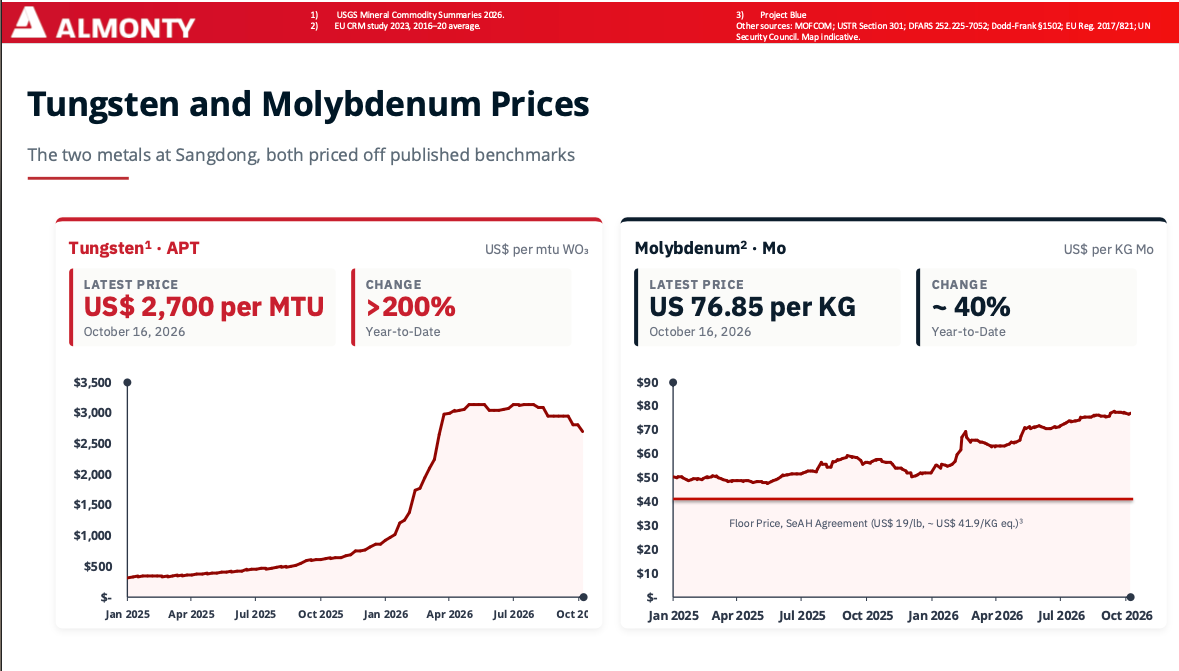
Fastmarkets’ Western APT benchmark surged after China, in early 2025, restricted the flow of the critical metal to Western defense and industrial companies, sending prices as high as $3,000 a ton. Spot prices have since moved lower to around $2,775.
CME’s announcement coincided with Almonty Industries’ Investor Day at Nasdaq in Midtown Manhattan, where the tungsten producer presented to analysts from Oppenheimer, Stifel, Jefferies, Goldman Sachs, and other firms.
CEO Lewis Black and the management team outlined a constructive operating outlook for the miner’s South Korean, Spanish, and Portuguese mines, along with updates on expansion projects and additional supply sources.
Almonty’s investment case centers around its move to be one of the largest conflict-free tungsten miners (ex-China) for the West. Its operating assets and expansion pipeline position the miner as a tungsten lifeline for the rearmament cycle.
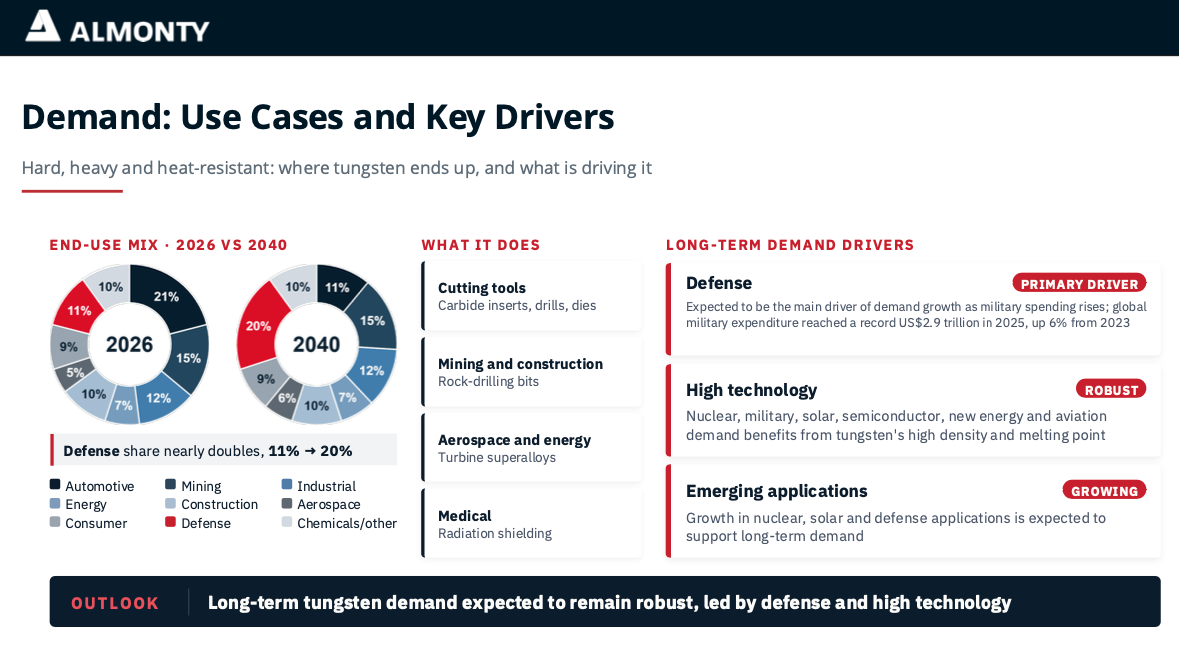
Black told investors that constrained Western tungsten supplies are strengthening Almonty’s commercial position, supporting improved offtake terms as Sangdong ramps Phase 1 production and advances its Phase 2 expansion.
Sangdong’s Phase I is designed to process 640,000 tons of ore annually. Phase II is planned to double that capacity, with equipment ordering and underground planning already underway.
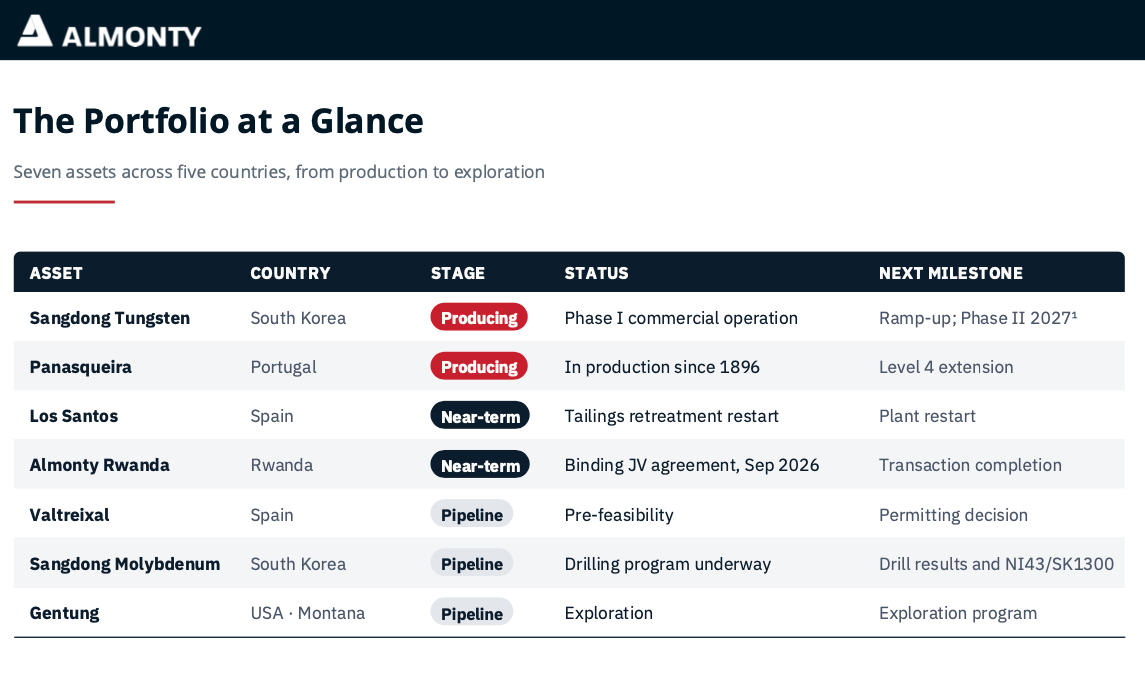
Several projects offer additional growth potential:
- Rwanda: A planned joint venture, to be owned 75% by Almonty and 25% by the government, would initially source and process material from local producers. Management views this as a faster route to incremental supply while longer-term mining projects advance.
- Panasqueira: Drilling for the Portuguese mine’s Level 4 expansion is expected to finish by year-end. Management is also evaluating the recovery of tungsten and other metals from existing tailings.
- Los Santos: Tailings processing has produced encouraging laboratory and pilot results, supported by an offtake agreement with a price floor. Commercial viability remains unproven.
- Montana: Existing permits and nearby infrastructure support development potential, but detailed planning remains underway. The presentation did not establish a firm production timetable.
- Sangdong molybdenum: Additional drilling is intended to validate historical data and support an updated technical report, providing a separate development opportunity beneath the tungsten deposit.
“Almonty remains one of the key solutions to meeting western tungsten demand after China’s exit from the market and the company’s impressive production ramp is still unfolding with prices just off record highs. We are updating our target price to $21 given the push-out of Sangdong shipments but remain Buy rated,” Stifel materials analyst Brock Cannon wrote in a note after the investor meeting.
Jefferies chemicals and materials analyst Laurence Alexander said the Sangdong ramp remains a near-term catalyst. He indicated that the early January ban on US defense companies sourcing tungsten from foreign adversaries or conflict areas “represents a clear pivot point in demand, which should align favorably with the Sangdong production ramp.”
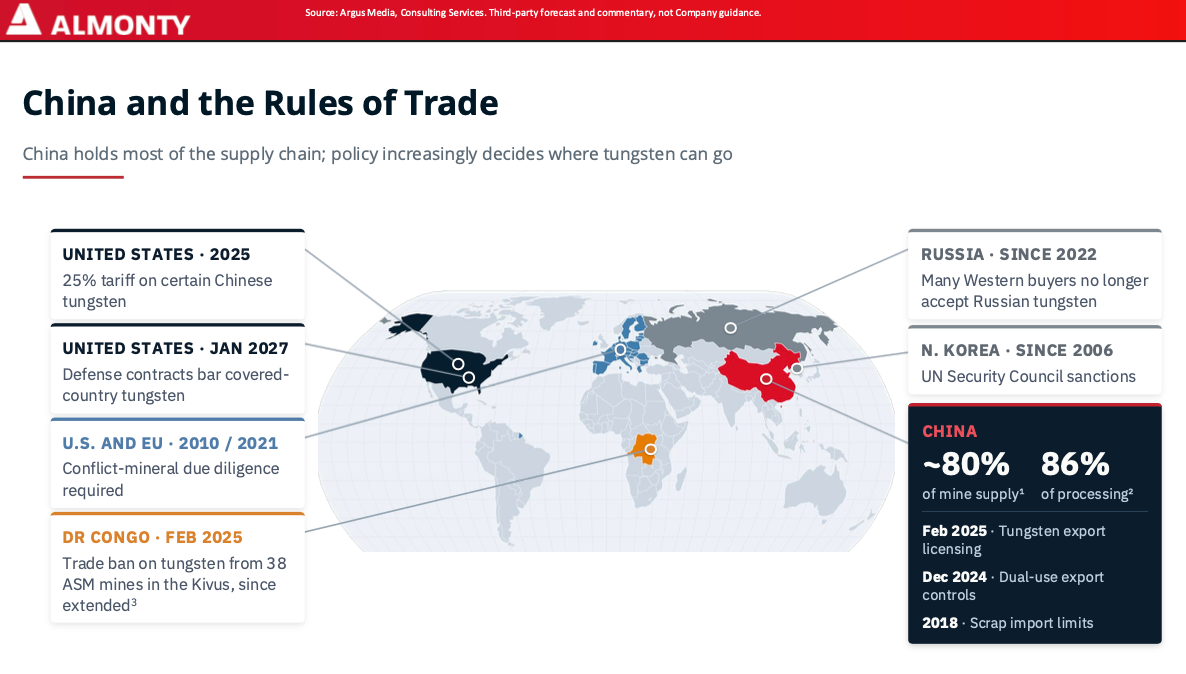
Alexander continued, “The US will prohibit defense contractors from acquiring tungsten, tungsten metal powder, and tungsten heavy alloys mined, refined, or produced in China, Russia, Iran, or North Korea. With only ~13% of global production from conflict-free zones, the qualified supply pool is likely smaller than the headline deficit implies. Should a similar EU measure be implemented, Western premiums likely widen further.”
The key takeaway from the new CME contracts, set to begin trading early next year, is a forward curve that will provide the first clear view of how the market interprets the shortage of this critical material.
A Financial Times story published overnight adds to the mounting global news coverage, suggesting that spot prices for critical materials remain disconnected from reality, as China’s resource nationalism has left Japan just “months” away from “running out of critical rare earths.”
We’ll leave readers with the most impactful chart from Almonty’s investor deck, presented to analysts yesterday. It shows a widening structural tungsten deficit emerging around 2030.
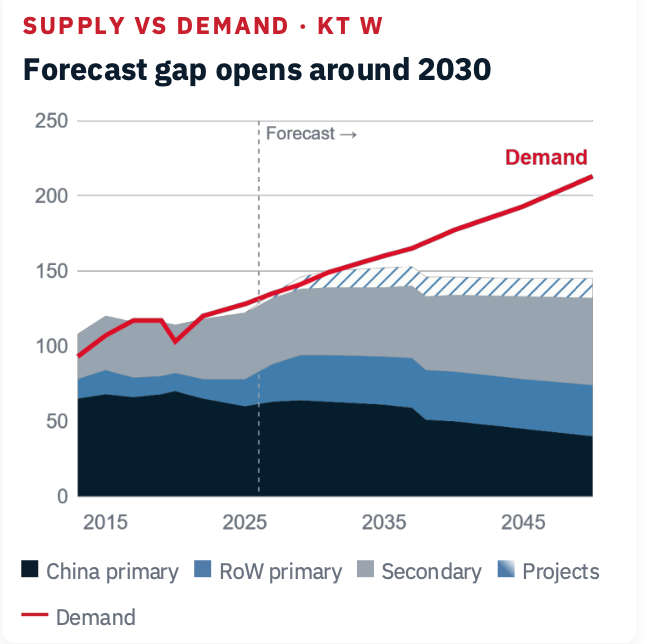
In that case, it’s all about “owning the bottlenecks.” The mining sector has been de-rated in the second half of the year, but it will bottom out at some point, and the theme of owning the top producers will reemerge amid the rearmament cycle ramping up.
END
COMMODITY: RARE EARTHS
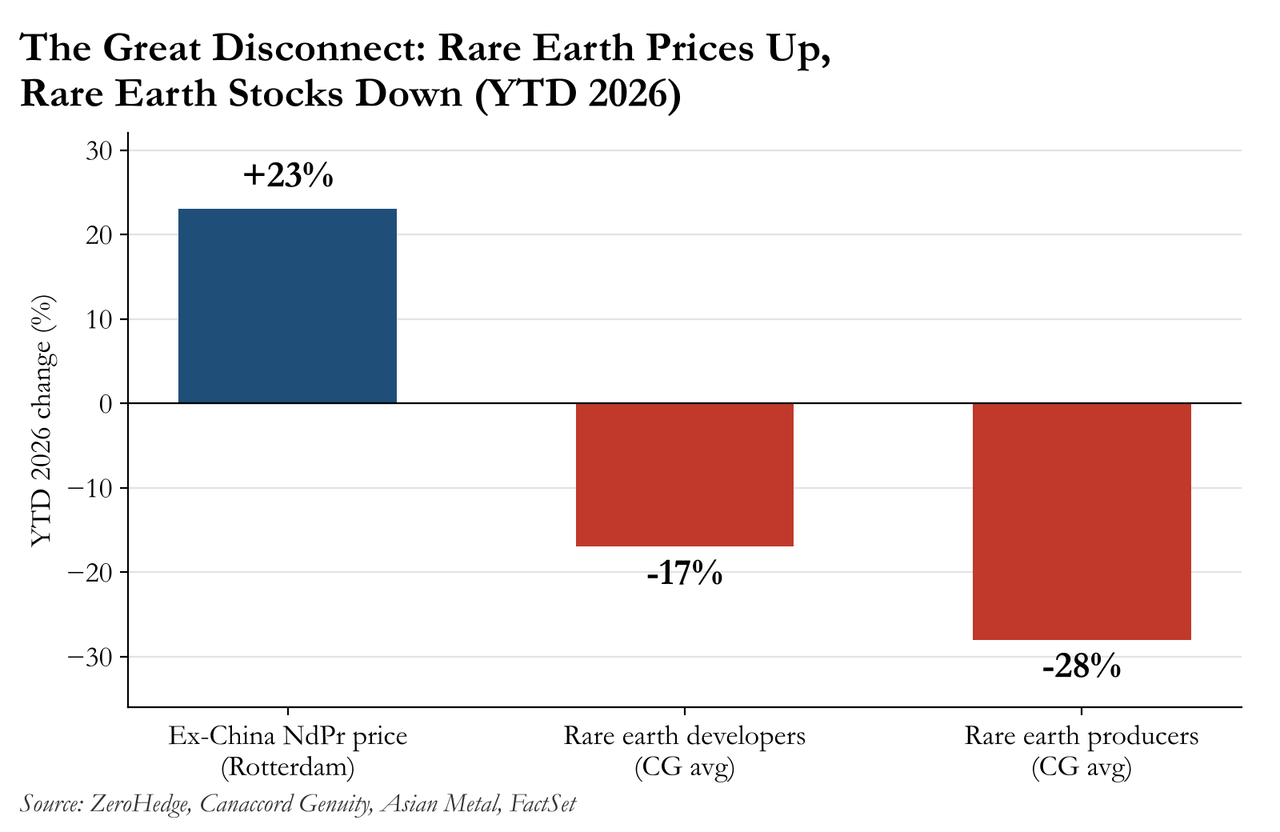
The Great Rare Earth Disconnect: Prices Up 23%, Miners Down 28%
Tuesday, Oct 20, 2026 – 05:40 PM
Here is a question that should be harder to answer than it is: China still controls the rare earth spigot, the latest Trump-Xi summit did nothing to loosen its grip, Japan is about to run out of yttrium, Washington has put a $110/kg floor under NdPr, and Western buyers are paying anywhere from 5x to 346x the Chinese price for heavy rare earths.
So why are rare earth stocks down on the year?
That is the question Canaccord’s critical minerals team led by Reg Spencer asks in an overnight note titled “Rare Earths: Equity disconnect from strong market fundamentals“, and the answer is blunt:
Given our favourable SxD outlook, floor pricing, recent pricing stability (NdPr), and Western pricing premiums (particularly for heavies), we think recent equity performance has been driven more so by global macro factors and highlights a disconnection from rare earth market fundamentals.
In other words, the commodity is acting like a strategic asset and the stocks are trading like a risk-off casualty. The numbers are stark: year to date, the ex-China NdPr price is up 23%, while Canaccord’s rare earth developers are down 17% on average and its producers are down 28%.
We have been tracking the rare earth theme since long before China started rationing exports to the West in late 2024, and back in July 2025 we laid out “The Coming Rare Earth Revolution And How To Profit”, flagging MP Materials as the stock best positioned to benefit. A few hours later the Pentagon announced its MP deal, and well we allowed ourselves a modest victory lap:
Fifteen months later, MP trades at $40.17, about half of Canaccord’s $82 target. So what happened?
The Chart That Says It All
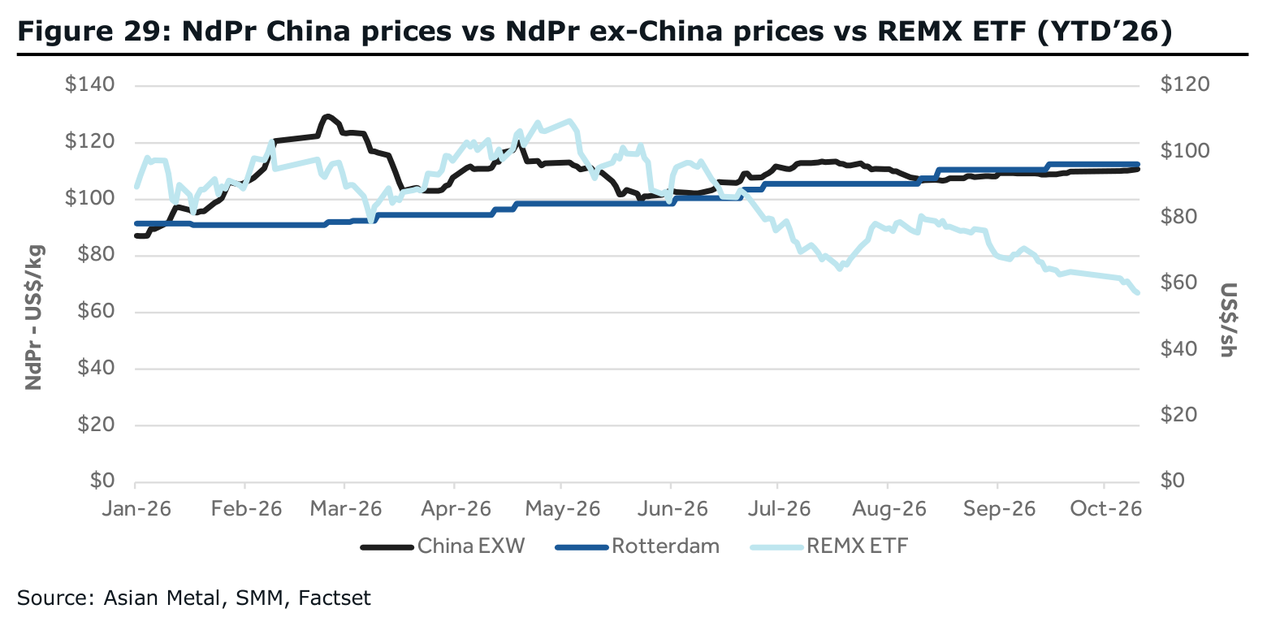
Canaccord’s chart below shows the problem in one picture. Chinese NdPr (black) and Rotterdam NdPr (dark blue) have converged and climbed steadily all year, with the Western price now above $110/kg. Meanwhile the REMX ETF (light blue) peaked in May and has since slid from above $100 to the high-$50s.
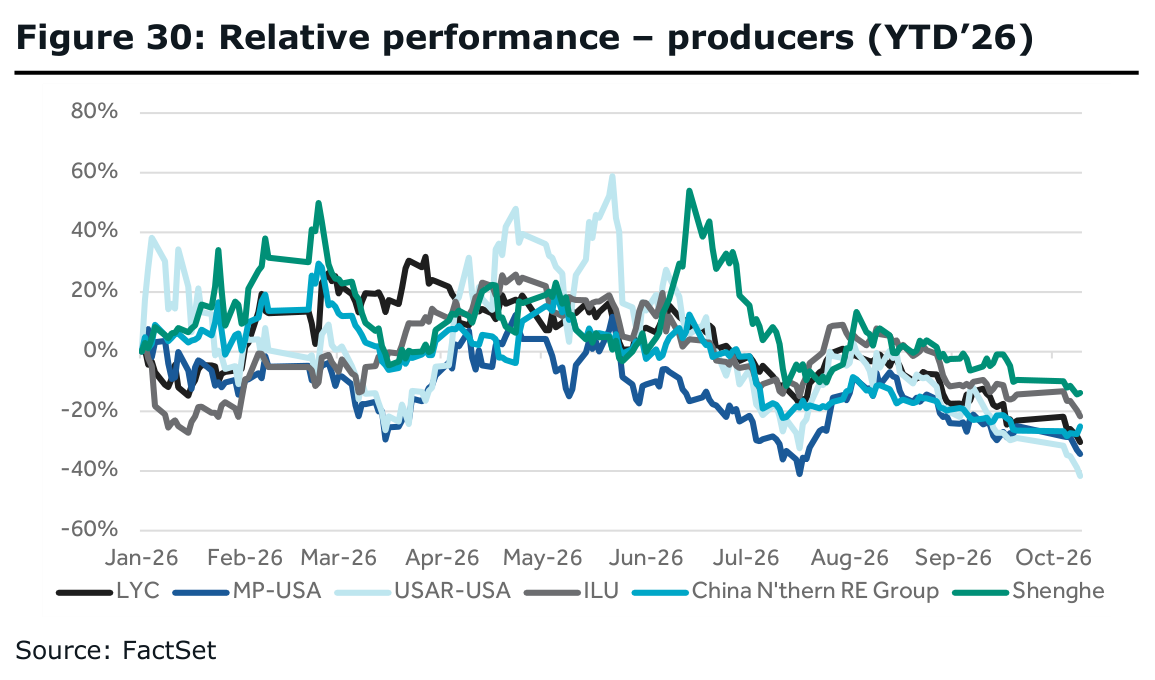
The carnage is broad. On the producer side, Lynas, MP, USA Rare Earth and Iluka are all deep in the red, and even China Northern Rare Earth and Shenghe are lower on the year. Diversification at its finest.
Developers did a bit better on average, mostly thanks to Viridis (VMM), which is still up well over 50% on the year. Strip that out and the picture is grim: Hastings is down roughly two-thirds, St George about half, and Arafura and Brazilian Rare Earths 35-50%.
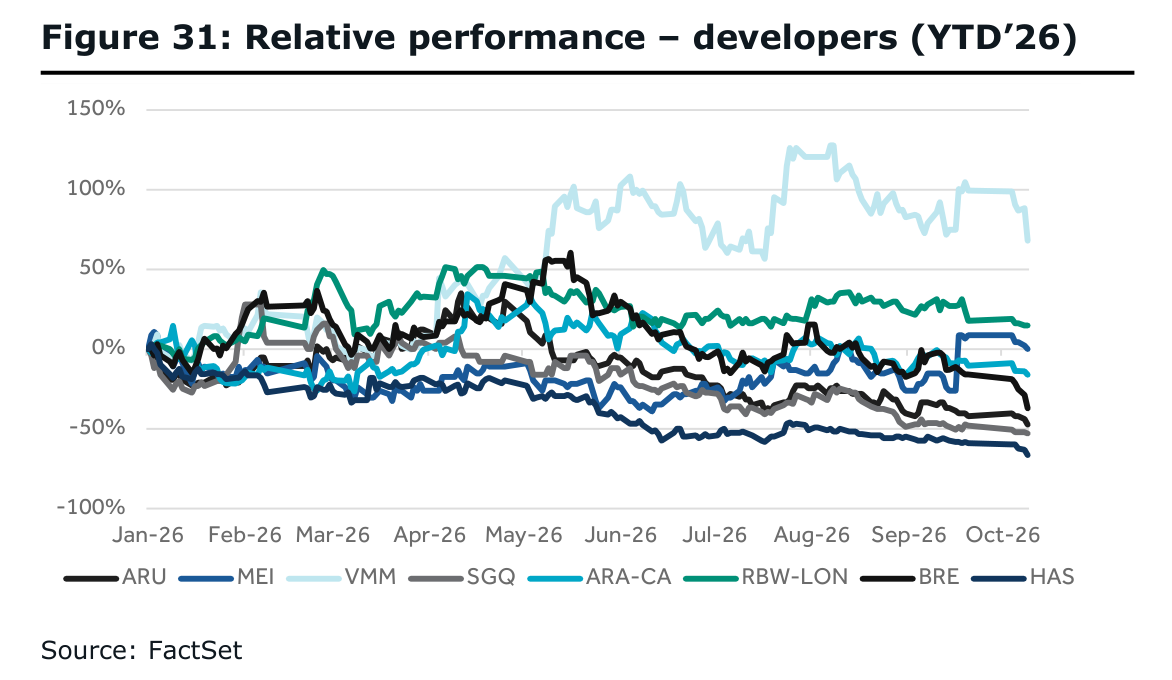
Canaccord’s verdict: “We question how equities have performed so poorly YTD despite strong underlying market fundamentals.” Those fundamentals include recent sector M&A, direct government support, a scarcity of Western supply and “ex-China NdPr pricing up 23% YTD.”
The Floor Works… Just Ask China
Start with the most important structural change of the past year. As we reported when the Department of Defense set a price floor last August, Washington has moved from financing Western supply to underwriting its economics. Canaccord tallies the floors: US$110/kg NdPr for MP (DoD), Lynas (Japan, US, plus upside sharing) and USA Rare Earth, which also gets US$575/kg for dysprosium and US$2,050/kg for terbium.
And the floor has done something nobody expected: it has tamed the Chinese price too. For years Beijing used export quotas, policy changes and, more recently, export controls to whipsaw NdPr from about $175/kg down to around $50 and back again. Over the past 10 months, Canaccord notes, Chinese pricing has “begun to normalise around the US$110/kg floor price level.”
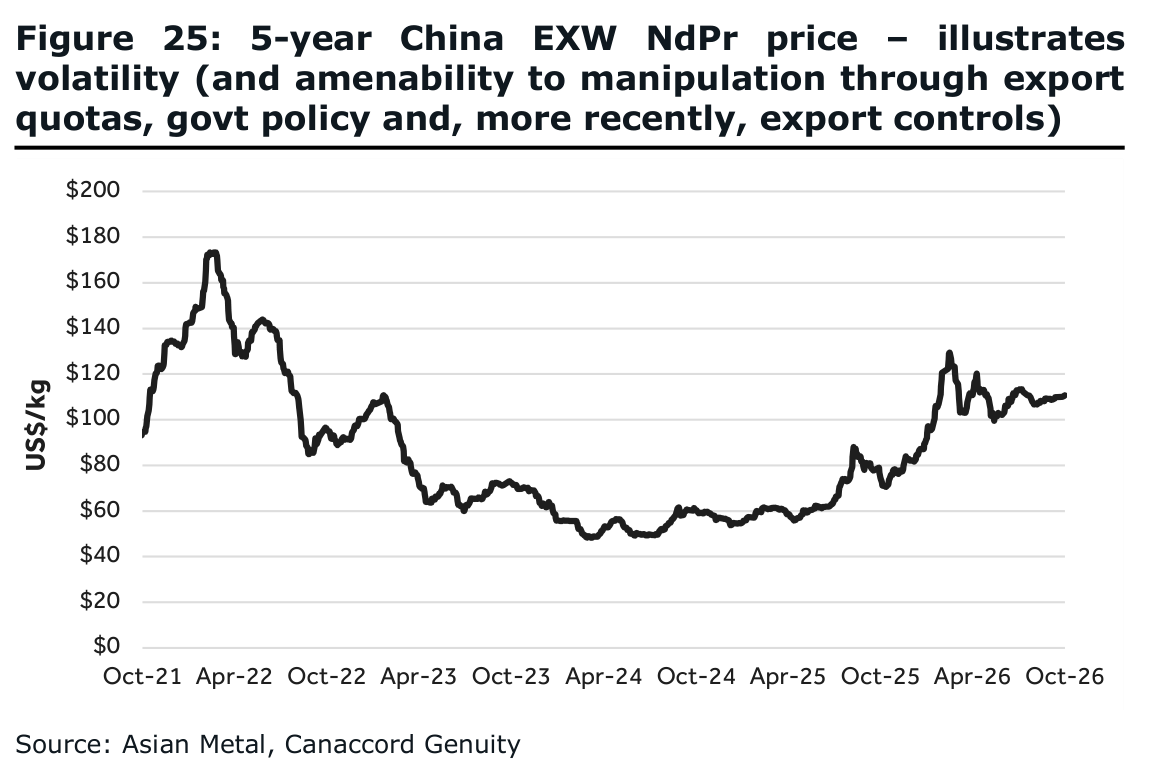
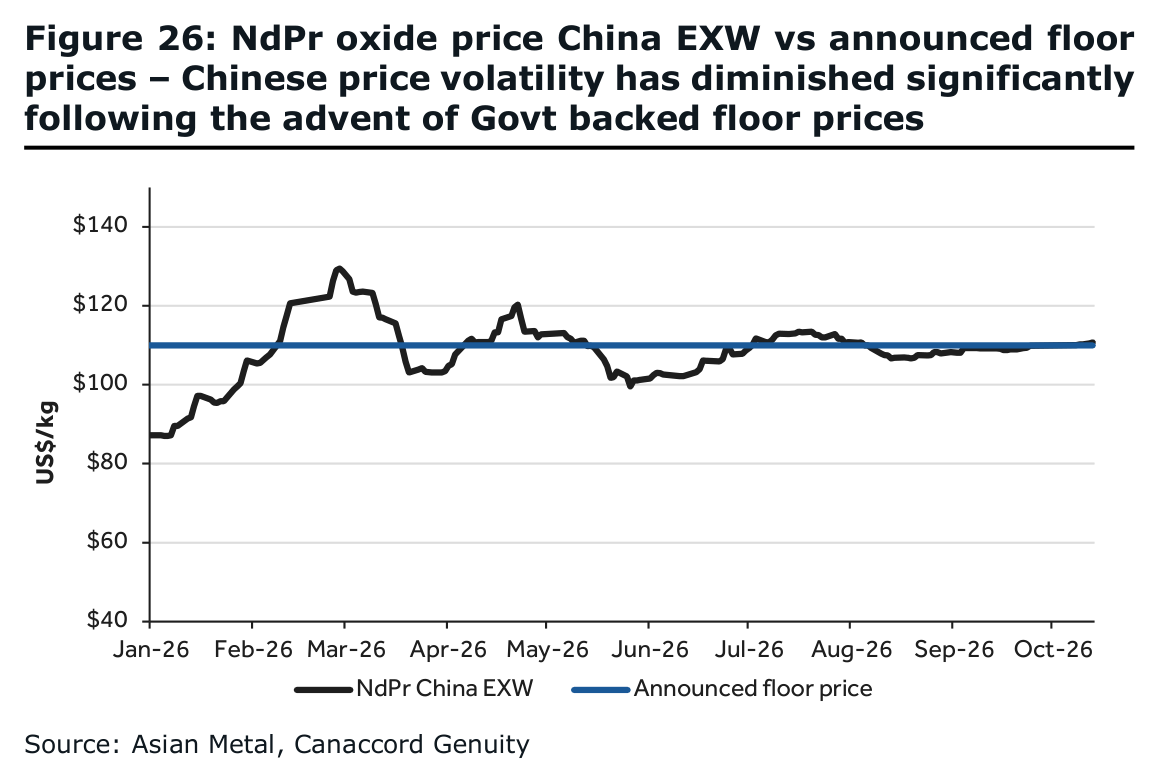
Put differently, the volatility that made rare earth projects unbankable has largely vanished, and yet investors are paying less for those projects than they did in January.
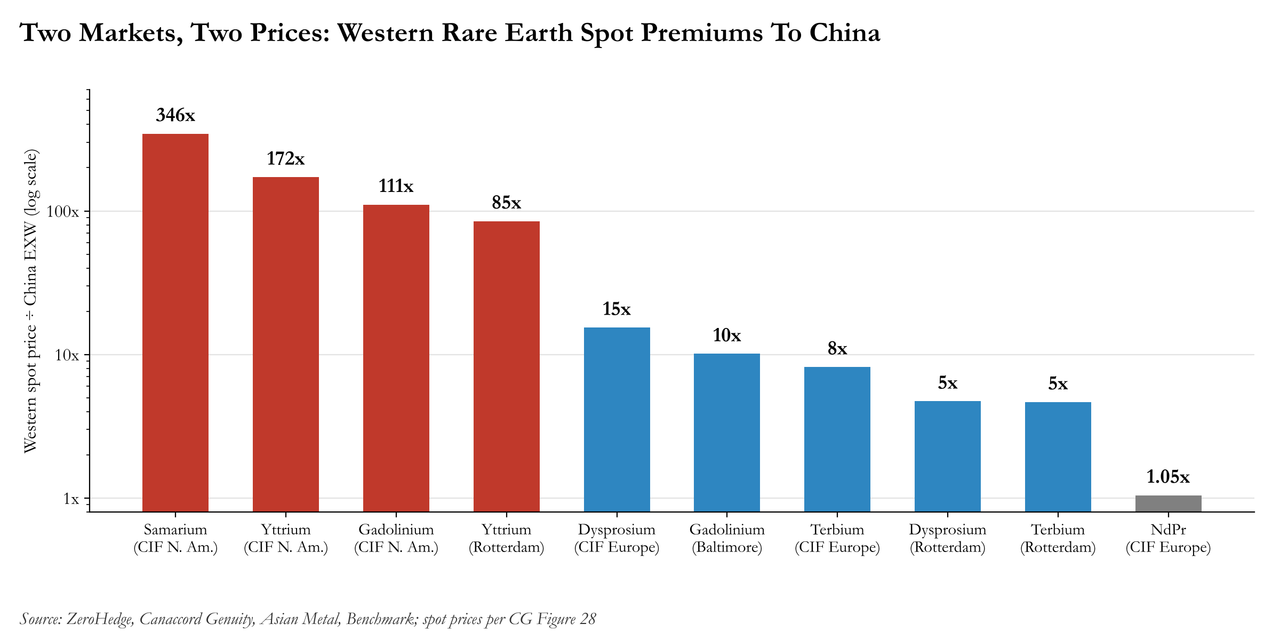
Two Markets, Two Prices
NdPr is now a one-price market, more or less. Everything heavier is a different story. Since Beijing started rationing heavies, the West has developed its own (thin, opaque) price for anything China won’t ship, and the gaps are absurd. Rotterdam dysprosium sits around $1,074/kg vs $227 in China, and terbium at $4,594 vs $983.
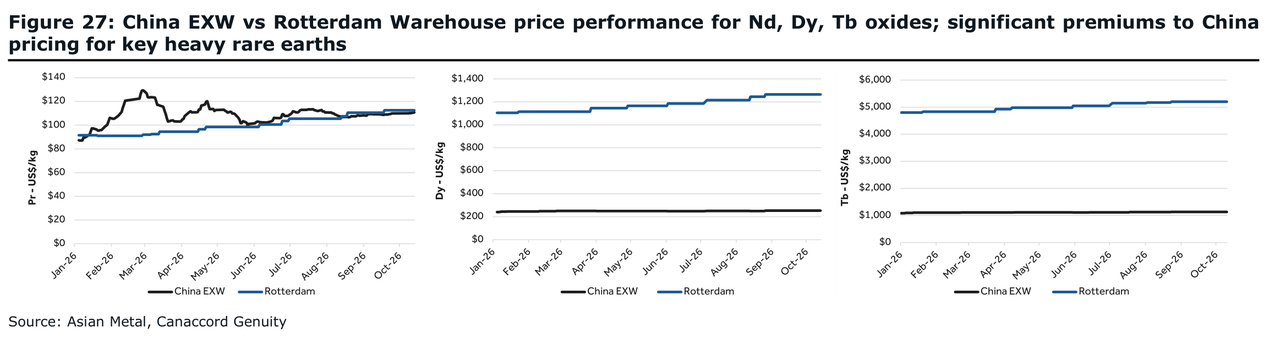
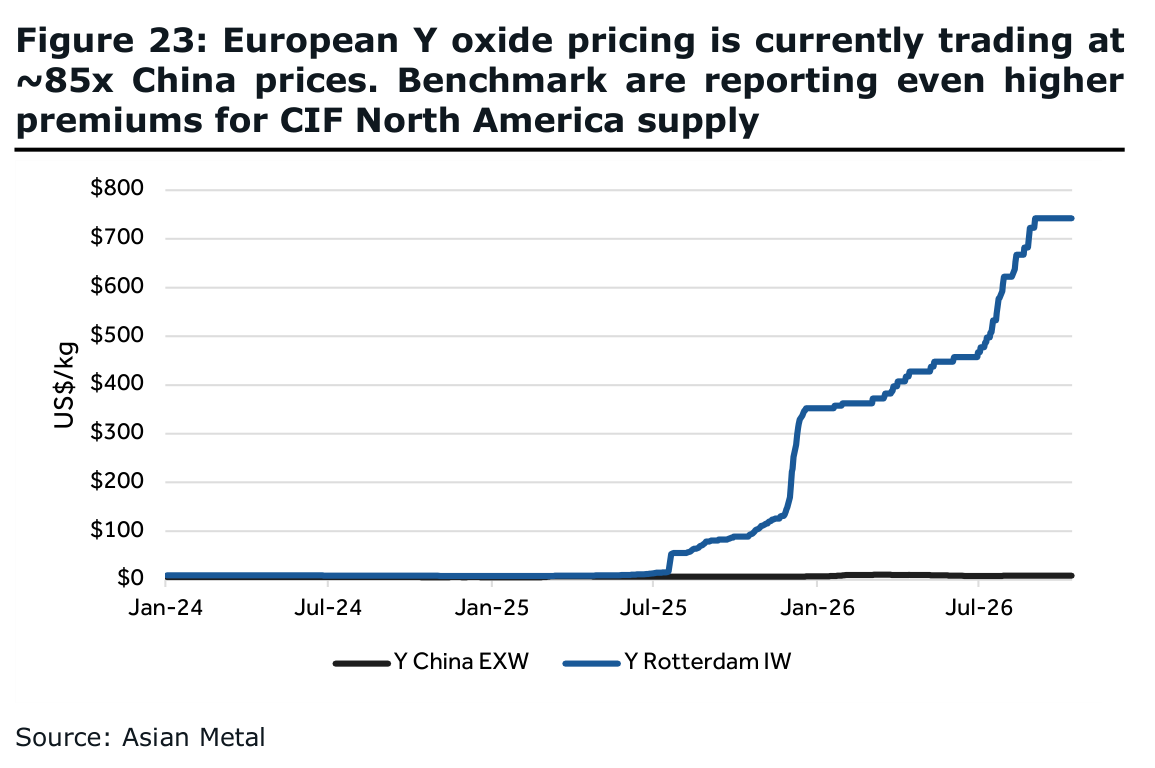
But Dy and Tb are the tame ones. Canaccord now forecasts yttrium, gadolinium and samarium for the first time, and the Western premiums there are almost comical. Chinese yttrium oxide has averaged about $8/kg over the past five years, while European spot is “~US$740/kg”, a premium of 85x, and “some price reporting agencies have quoted US prices of up to US$1,750/kg.” Gadolinium trades about 10x China in Baltimore, with US CIF quotes as high as $3,100/kg.
We ran Canaccord’s own spot price table through the calculator, and here is what the “dual market” looks like element by element. CIF North America samarium, used in the SmCo magnets that go into missiles, fighter jets and radar, trades at 346 TIMES THE CHINESE PRICE!
And the squeeze is very real. Just this morning the FT reported that Japan has made an urgent request to Washington and global companies to help resolve its yttrium crisis, warning of a severe shortage by year-end. “Inventories are plummeting,” one official said. Per Argus, yttrium oxide costs about $9/kg in China and roughly $1,150/kg outside it, a 179-fold jump in two years. A senior US official added that China is shipping the US just two-thirds of the rare earths it promised under last October’s truce, and Japan “only the bare minimum.” That followed last month’s Trump-Xi summit, where China pledged to buy US coal but fell short on rare earths, and the two sides settled for a two-month truce that markets promptly faded.
To be fair, Canaccord is careful here. It notes the ex-China DyTb market was just 151 tonnes in 2025, and China’s was 22x larger. It warns that Western premiums “should be viewed cautiously” and that “we question whether pricing is sustainable at these levels,” with some magnet makers already pivoting to lower-cost ferrite magnets. Its own price deck has ex-China yttrium falling from $740/kg this year to $100 by 2030. Still, even the bank’s haircut numbers leave Western producers with integrated separation (it names Lynas and MP) earning premiums nobody would have modeled two years ago.
Demand Goes Up, Again
Meanwhile the demand side keeps getting revised higher. Canaccord now sees NdFeB magnet demand growing at a 7.3% CAGR to ~365,000 tonnes by 2035, 15% above its prior update. EVs remain the anchor (52 million units by 2035 vs 23.5 million in 2026), but the bank has added data centers (motors for cooling), e-bikes and scooters, and drones. Drones are only ~1% of forecast demand, but the bank notes that Ukrainian and Russian military drone production alone was estimated at ~9 million units, so “our model forecasts may prove conservative.”
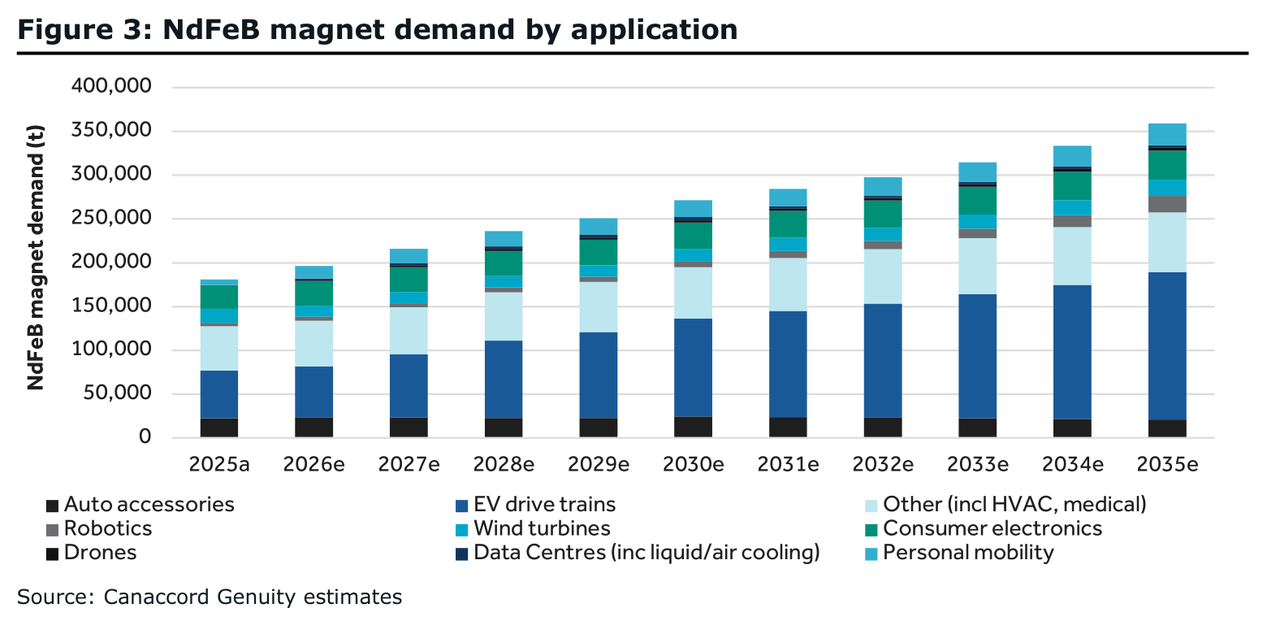
Then there are the robots. Canaccord models humanoid deliveries growing at a 45% CAGR to 2.5 million units by 2035, and points out that Tesla is reportedly preparing an Optimus line designed for 1 million robots a year. For comparison, global EV sales rose more than 4,600% from 2014 to 2024. Maybe the robot curve won’t look like that… but if it does, the magnet math gets very ugly very quickly.
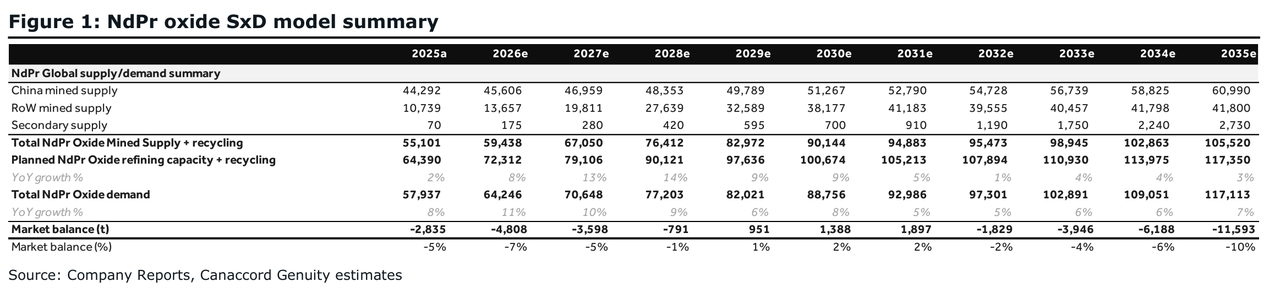
Netting it all out, Canaccord sees the global NdPr market in deficit through 2028 (about 7% short this year), roughly balanced in 2029-31 as Eneabba, Kangankunde, Caldeira, White Mesa and the Lynas expansions come online, and then sliding back into a deeper deficit: -10% by 2035. Dy+Tb follows the same shape, ending at a 12% deficit.
The West’s Blind Spot
The bulls’ case gets even stronger once you look past the mines. Canaccord forecasts ex-China NdFeB magnet capacity rising more than 300% by 2030 to about 70,000 tonnes, which sounds impressive until you realize it would still be only 23% of global capacity, with China at ~77%.
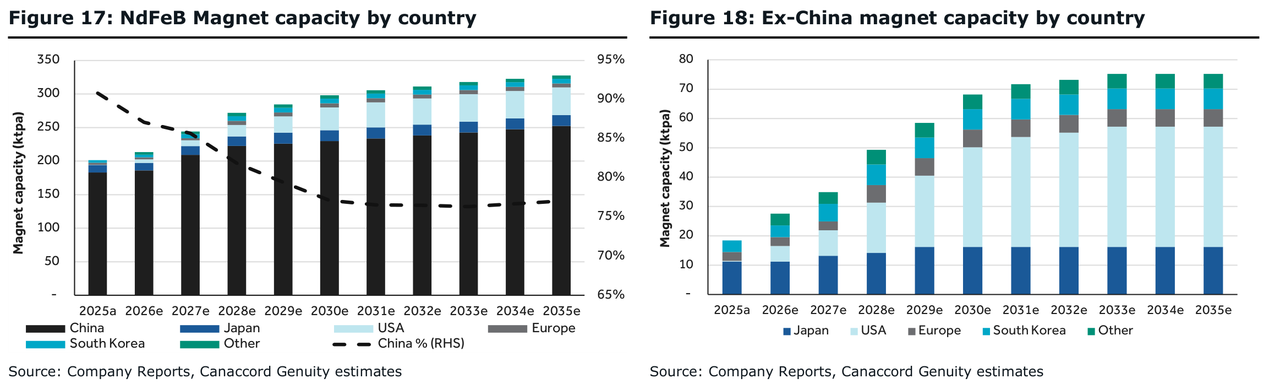
And the West may not even get there, because it is missing a step. Global NdFeB metallisation and alloying capacity is about 210,000 tonnes in 2026, and more than 90% of it is Chinese controlled. Ex-China capacity is set to roughly double to 38,000 tonnes by 2030, which falls well short of planned Western magnet capacity. Canaccord calls metallisation “a major blind spot in western supply chain development“, and its channel checks found lead times of up to two years for strip casters, “with sourcing from China impossible under current export controls.”
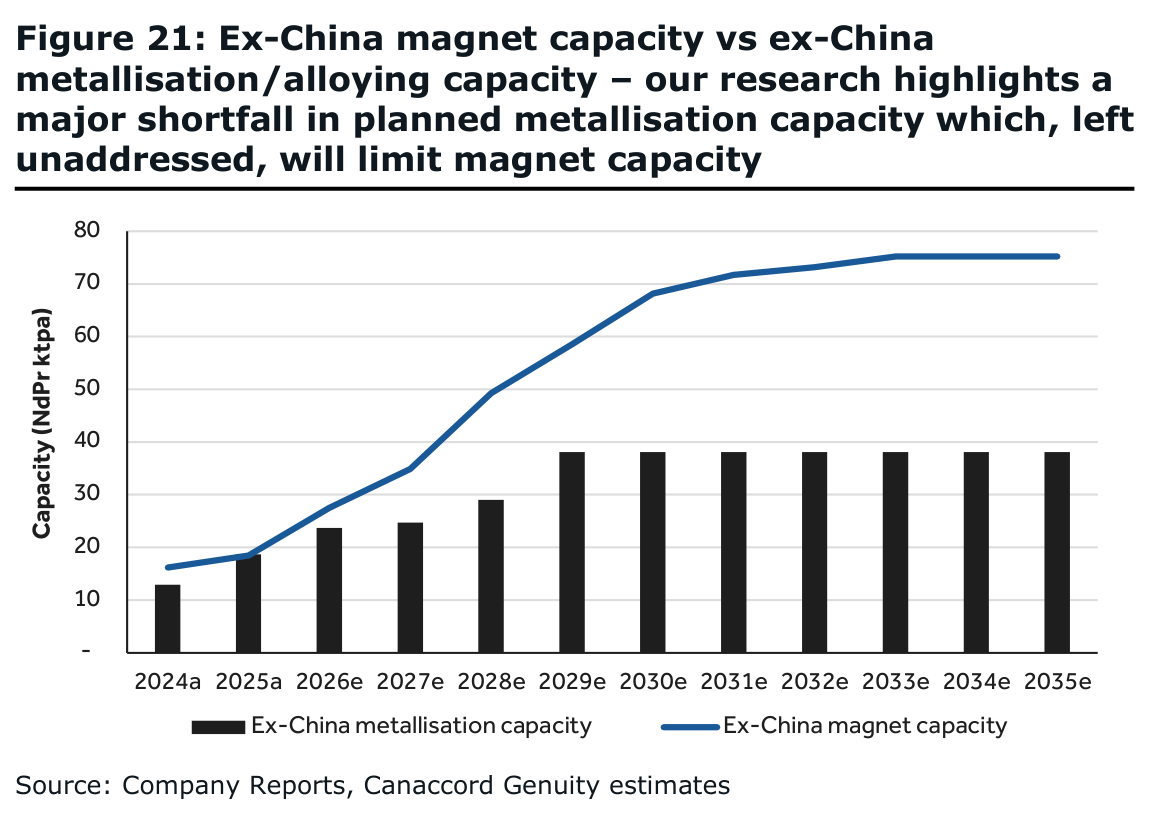
This echoes ING’s warning, which we covered two weeks ago, that China’s rare earth chokehold may outlast this decade because the bottleneck is “industrial rather than geological.” Canaccord’s conclusion is just as stark: “our research points to China maintaining market dominance, with shortfalls in Western supply (and likelihood of ongoing Chinese export controls) supporting bifurcated markets and pricing premiums.”
Translation: the scarcity premium for anything mined, separated or metallised outside China is a structural feature that will be around for years, and the companies capturing it are trading as if it will be gone by next quarter.
Wall Street Is Paying 50 Cents On The Dollar
Which brings us to valuation. Canaccord’s producer coverage trades at an average 0.57x P/NAV and its developers at 0.47x. On the bank’s targets, MP has 104% upside, Lynas 108% (target raised to A$23), USA Rare Earth 204% and Energy Fuels 150%, even after Canaccord cut its EFR target to C$30 on project delays.
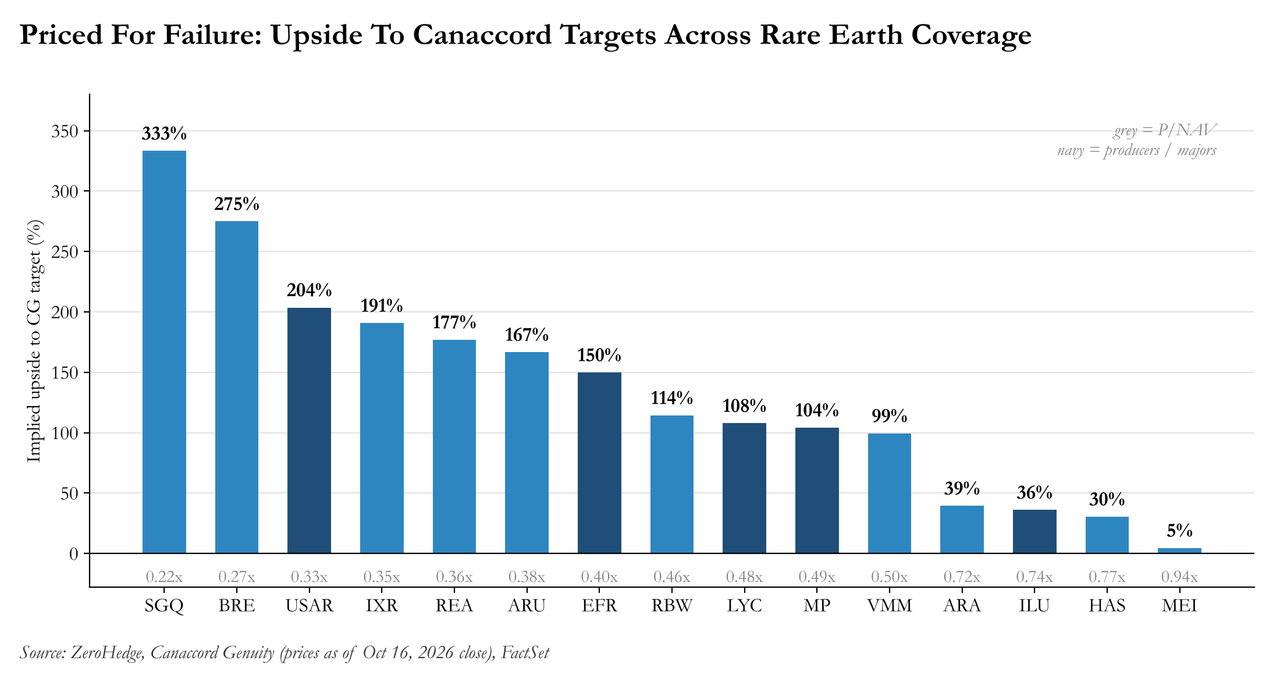
The rating changes: Meteoric (MEI) goes to Hold from Spec Buy, since its value is now tied to Lynas’ all-scrip takeover at 0.0207 LYC shares per MEI share. (Lynas shares fell almost 8% the day that deal was announced, another reminder that this market keeps punishing consolidation.) Hastings (HAS) goes to Spec Buy from Hold “on valuation”, even though its target was cut to A$0.30 from A$0.55, which tells you just how far the stock has fallen.
Of course, price targets have a habit of following prices rather than leading them, and at least some of the selloff has a perfectly sensible explanation: these are long-duration, capex-heavy projects at a time when the 10Y is above 5%, tech is wobbling and the bid for anything speculative has evaporated. Canaccord concedes as much, blaming “global macroeconomic pressures.”
Same Disconnect, Different Metal
Tungsten isn’t a rare earth, but it is a critical material with the same chokepoint (China controls roughly 80% of supply, per Jefferies), and it shows the exact same disconnect, only worse. Take Almonty Industries (ALM), the most prominent Western tungsten miner and a name we have covered extensively in recent weeks.
When Goldman’s Nick Cash initiated coverage last month, he put Almonty “at the center of the Western tungsten investment narrative,” with tungsten prices up 8x since the start of 2025. He was also the Street’s skeptic, expecting prices to normalize and Sangdong’s ramp to run slower than the market hoped, with a $13 target vs a $24.73 consensus. The stock was $12.74 that morning. Today it is below $9, down 62% from its April peak and back where it started the year, after dropping another 10% on the day of yesterday’s Investor Day. So even Goldman’s cautious target now implies about 45% upside.
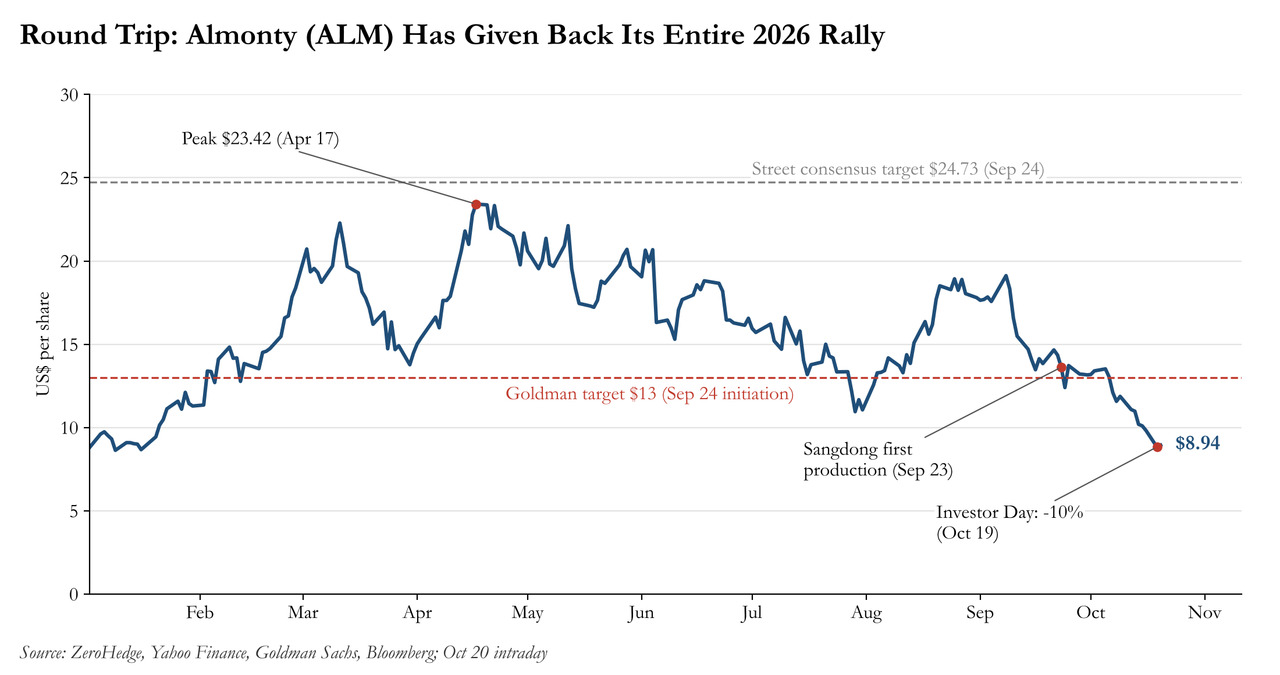
Meanwhile the operations are going the right way. Sangdong in South Korea started production in September and is moving toward 24/7 operations, with its first concentrate shipment due later this month, and Cantor’s Matthew O’Keefe models output jumping from 126,287 MTU this year to 444,400 MTU in 2027, with all-in sustaining costs falling from $905 to $319 per MTU. Oppenheimer’s Ian Zaffino puts the shares at just 5.7x/4.2x FY27/FY28 EBITDA, with roughly $290 million in net cash.
So what spooked the market? Spot prices. Western APT has slipped from $3,140 to about $2,700/MTU, and Chinese prices have retreated even more sharply. But Zaffino explains why that is a misleading signal: Western APT and oxide plants are running at capacity under long-term contracts and can’t absorb more concentrate, so “concentrate prices have softened, even as availability of finished APT/oxide in the West remains constrained.” And the demand wave hasn’t even started. On January 1, 2027, US defense procurement rules extend to tungsten mining, refining and separation, so Chinese or Russian ore processed in a third country no longer qualifies. Stifel says the US strategic tungsten stockpile is nearly depleted, and Bernstein sees the Western rearmament order boom running from 2027 through 2030. The cherry on top: on Monday, CME announced plans to launch tungsten futures by early Q1 2027 at the latest (subject to regulatory review), which tells you how seriously the market’s plumbing is taking a metal that equity investors are currently dumping.
In other words, spot is pricing today’s bottleneck in Western processing, and the stock is pricing spot, while the 2027 demand cliff is priced almost nowhere. Sound familiar?
Supply Security Gets The Stage In London
Goldman, for its part, thinks the debate has already shifted. Its third Global Metals & Mining Conference kicks off in London today during LME Week, bringing together the world’s largest “diversified, copper, aluminium, rare earth and lithium producers.” In their conference preview, Goldman’s Matt Greene and the bank’s mining team write that “the conversation has increasingly shifted to supply,” with governments “becoming more active participants in the mining sector through faster permitting, shared infrastructure, strategic funding, price floors and direct offtake agreements, reflecting the growing importance of resource security.” The question the bank poses is the right one: “whether the industry can deliver the supply that markets are increasingly pricing in.”
For rare earths, the honest answer seems to be: not anytime soon, and not without China. Which is exactly why the sector’s stocks probably shouldn’t be trading at half of NAV.
When Macro Lets Go
We have seen this movie before. Back in March we reported that the US reportedly had just two months of rare earths left, and in July that China’s “killer chokepoint” was reshaping the global economy. Each time the physical market tightened, and when Washington finally stepped in (see last July’s MP deal), the equities caught up violently.
Today we have a two-month trade truce that expires January 10, a Japanese government begging for yttrium, the West’s flagship tungsten miner trading below even Goldman’s skeptical target ten weeks before the Pentagon’s sourcing rules kick in,a floor price that has turned NdPr into a one-way bet with a safety net, and an equity market that is valuing the West’s only scalable non-Chinese suppliers at roughly half of what they’re worth on conservative assumptions.
Canaccord’s closing line sums it up: “We expect demand to remain strong, as the West looks to secure ex-China supply and build its independence within the global magnet supply chain.”
Our take: the disconnect will probably close the same way it did last summer, with a headline out of Beijing or the Pentagon, and the investors waiting for macro to give them the all-clear will be buying it 50% higher. After all, nothing cures a 0.5x P/NAV like a 346x price premium.
More in the full Canaccord note “Rare Earths: Equity disconnect from strong market fundamentals“, available to pro subs.
END
YOUR EARLY CURRENCY VALUES/GOLD AND SILVER PRICING/ASIAN AND EUROPEAN BOURSE MOVEMENTS/AND INTEREST RATE SETTINGS WEDNESDAY MORNING.7:30 AM
SHANGHAI CLOSED DOWN 22.34 PTS OR 0.60%
HANG SENG CLOSED DOWN 215.74 PTS OR 0.90%
Nikkei CLOSED UP 620.58 PTS OR 0.97%
//Australia’s all ordinaries CLOSED DOWN 0.47%
//Chinese yuan (ONSHORE) CLOSED UP AT 6.6778
/ OFFSHORE CLOSED UP AT 6.6765 Oil UP TO 98.80 dollars per barrel for WTI and BRENT UP TO 109.81 Stocks in Europe OPENED ALL GREEN
ONSHORE USA/ YUAN// WITH YUAN TRADING 6.6778 OFFSHORE YUAN TRADING UP TO 6.6765 ONSHORE YUAN TRADING BELOW LEVEL // OFF SHORE AND UP ON THE DOLLAR)// / AND THUS STRONGER/OFF SHORE YUAN TRADING UP AGAINST US DOLLAR/ AND THUS STRONGER
XXXXXXXXXXXXXXXXXXXXXXXXXXXXXXXXXXXXX
ONSHORE YUAN: CLOSED UP TO 6.6778
OFFSHORE YUAN: UP TO 6.6765
1A.HANG SANG CLOSED DOWN 215.74 PTS OR 0.90%
1 B. SHANGHAI CLOSED DOWN 22.34 PTS OR 0.60%
2. Nikkei closed UP 620.58 PTS OR 0.97%
WEST TEXAS INTERMEDIATE OIL UP TO 98.80
BRENT; 109.81
3. Europe stocks SO FAR: ALL GREEN
USA dollar INDEX UP 8 BASIS PTS TO 101.62// EURO FALLS TO 1.1219 DOWN 7 BASIS PTS
3b Japan 10 YR bond yield:FALLS TO. +2.881 DOWN 1 FULL BASIS PTS/ VERY TROUBLESOME//Japan buying 100% of bond issuance)/Japanese YEN vs USA CROSS NOW AT 158.16… JAPANESE YEN NOW FALLING AS WE HAVE NOW REACHED THE ENDING OF THE YEN CARRY TRADE AGAIN AND THE REPATRIATION OF YEN DENOMINATED BONDS TRADING IN THE USA/EUROPE. JAPAN 30 YR BOND YIELD: 3.905 DOWN 3 FULL BASIS PTS
3c Nikkei now ABOVE 17,000
3d USA/Yen rate now well ABOVE the important 120 barrier this morning
3e Gold UP /JAPANESE Yen UP//CHINESE ONSHORE YUAN: UP (6.6778) AND OFFSHORE: UP AT 6.6765
3f Japan is to buy INFINITE TRILLION YEN worth of BONDS. Japan’s GDP equals 5 trillion USA. CENTRAL BANK OF JAPAN WILL NO LONGER DO QE.
Japan to buy 100% of all new Japanese debt and NOW they will have OVER 50% of all Japanese debt. GOVERMENT ASKED JAPAN PENSION FUNDS AND INSURANCE FUNDS TO BUY MORE JAPANESE BONDS AND REPATRIATE ALL FOREIGN BONDS.
3g Oil UP for WTI and UP for Brent this morning
3h European bond buying continues to push yields LOWER on all fronts in the EU German 10yr bund YIELD UP TO +3.4165/ Italian 10 Yr bond yield DOWN AT 4.5930/ SPAIN 10 YR BOND YIELD DOWN TO 4.066%
3i Greek 10 year bond yield DOWN TO 4.4153%
3j Gold at $4123.80 /Silver at: 57.32 1 am est) SILVER NEXT RESISTANCE LEVEL AT $100.00
3k USA vs Russian rouble;// Russian rouble UP 0 AND 40/ 100 roubles/82.05
3m oil (WTI) into the 98 dollar handle for WTI and 109 handle for Brent/
3n Higher foreign deposits moving out of China// huge risk of outflows and a currency depreciation. This can spell financial disaster for the rest of the world/
JAPAN ON JAN 29.2016 CONTINUES NIRP. THIS MORNING RAISES AMOUNT OF BONDS THAT THEY WILL PURCHASE UP TO .5% ON THE 10 YR BOND///YEN TRADES TO 158.16 // 10 YEAR YIELD AFTER FIRST BREAKING .54% LAST YEAR NOW EXCEEDS THAT LEVEL TO 2.881% DOWN 1 BASIS PTS STILL ON CENTRAL BANK (JAPAN) INTERVENTION//YEN CARRY TRADE NOW UNWINDING//YEN BOND TRADING OVERSEAS TO BE REPATRIATED.//JAPAN 30 YR: 3.905 DOWN 3 PTS..: USA/SF this 0.8249 as the Swiss Franc . Euro vs SF: 0.9255
USA 10 YR BOND YIELD: 5.121 DOWN 0 BASIS PTS…NOW ABOVE 5.00%
USA 30 YR BOND YIELD: 5.431 UP 1 BASIS PTS/
USA 2 YR BOND YIELD: 4.787 UP 0 BASIS PTS
USA DOLLAR VS TURKISH LIRA: 49.60 UP 2 BASIS PTS/LIRA GETTING KILLED//IDIOTS FOR SELLING GOLD AND USA DOLLAR RESERVES.
10 YR UK BOND YIELD: 5.4109 UP 0 PTS
30 YR UK BOND YIELD: 5.833 DOWN 2 BASIS PTS
10 YEAR FRENCH BOND YIELD; 4.987 % //UP 6 BASIS PTS
10 YR CANADA BOND YIELD: 3.8930 DOWN 7 BASIS PTS
5 YR CANADA BOND YIELD: 3.623 DOWN 6 BASIS PTS.
1a New York Opening report
Futures Rise As SpaceX Blowout Revives AI Trade; Brent Back Above $110
Wednesday, Oct 21, 2026 – 08:18 AM
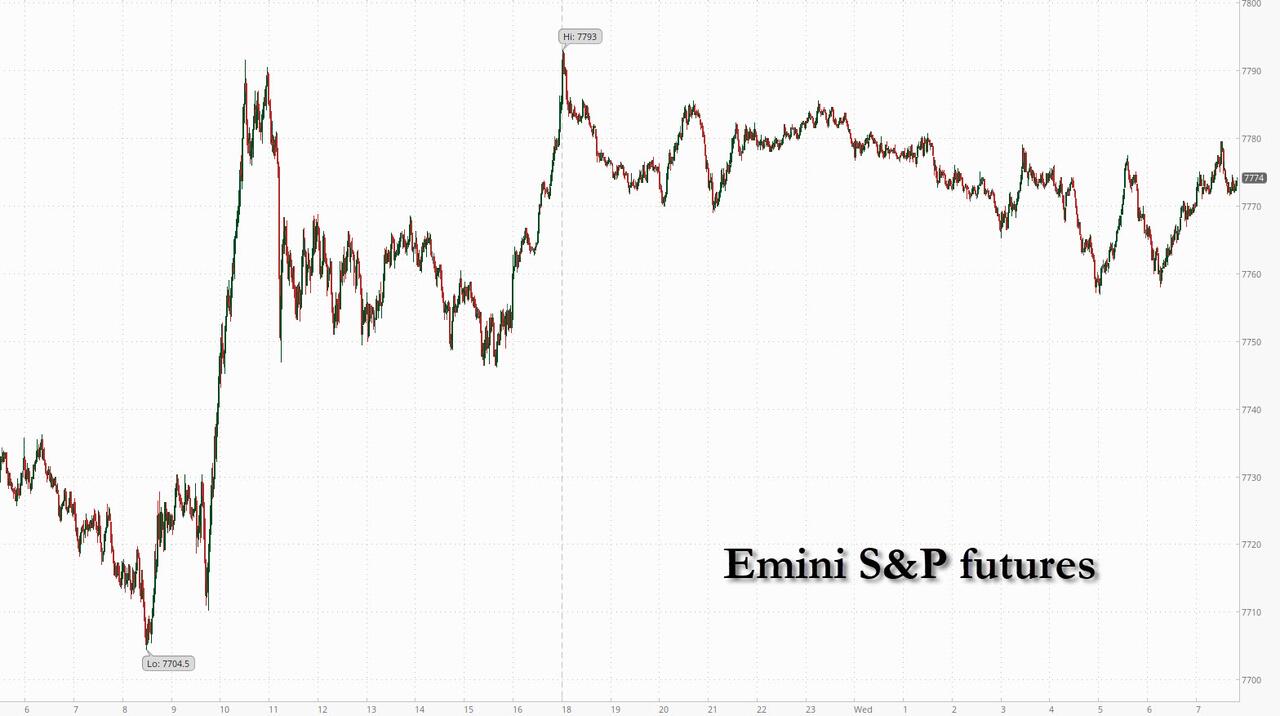
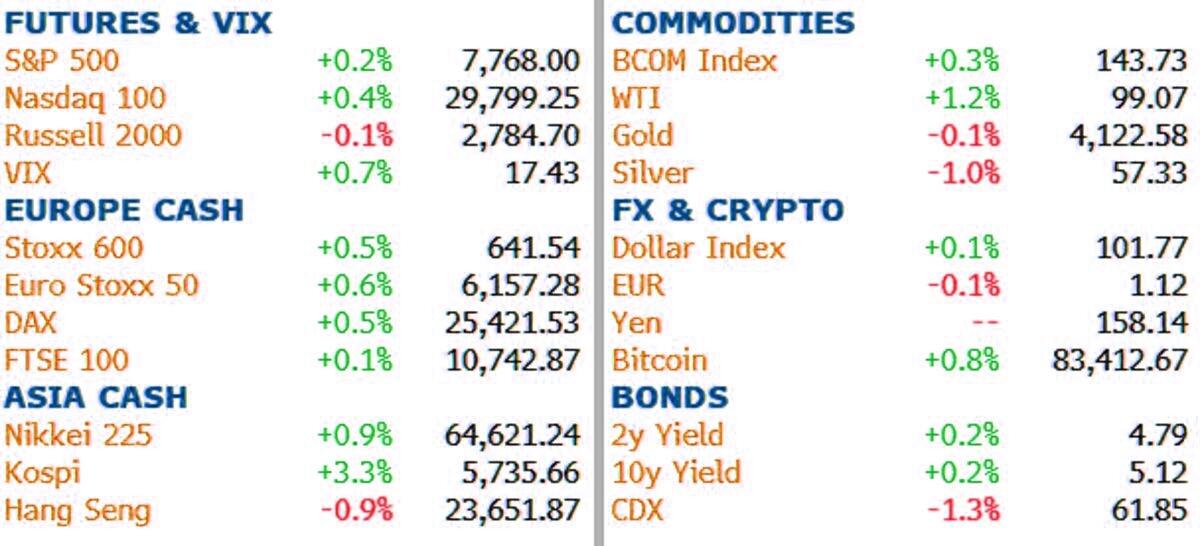
US futures are higher as blowout results from SpaceX and a monster preannouncement from Super Micro gave the battered AI trade a reason to bounce, while Elon Musk’s open endorsement of a SpaceX-Tesla merger added to the buzz; but with more attacks on shipping around the Strait of Hormuz, oil is back on the rise and as a result Brent is again above $110 while French 10Y yields hit 5% for the first time since 2002. As of 8:00am ET, S&P futures are 0.3% higher while Nasdaq futures are up 0.6% and Dow futures are up 0.1%. That follows a session in which the S&P rose 0.3% to 7,712 with 403 advancers, the most since April, as the equal-weight index jumped 1.15% while the Nasdaq slipped 0.02% in yet another rotation day out of AI. In premarket trading, the AI complex is back in demand with SpaceX up 9.1% and Super Micro up 12.4%, confirming our post from last night, and Nvidia leads the Mag 7 with a 1.3% gain, while Netflix tumbles 6.2% on a soft Q4 guide and Intuitive Surgical slides 7.8%. The day’s driver is AI (again), and this time it’s the bulls’ turn: SpaceX revenue of $14.6 billion crushed the $12.8 billion consensus and Super Micro guided fiscal Q1 sales to $18.5-19.5 billion vs its own prior $14.5-15.5 billion guide, reviving the AI trade one day after Korea’s Elice IPO faceplant and Ken Griffin’s warning that investors are “almost certainly” in an AI bubble. Treasuries are slightly cheaper across the curve, led by the front-end and belly, with the 10Y around 5.12% as stocks climb on better AI sentiment and a leg higher in oil adds to the upside pressure on yields ahead of today’s $13 billion 20-year reopening; French bonds are the weak link in Europe, with the OAT-Bund spread widening to 158bps on fiscal worries and $110 crude, while gilts outperform even after UK CPI rose to an 11-month high of 3.5%, cementing a November BOE hike. The Bloomberg dollar index is little changed while the Aussie is the best G10 performer, rising 0.5% to 0.7036, the highest since Sept. 28, after hawkish RBA comments. In commodities, WTI rises 1.4% to about $99 and Brent 1.2% to $110, Dutch TTF gas jumps 4%, gold is flat near $4,120 and silver drops 1%. Bitcoin rises 0.8% to about $83,400. US economic data slate is empty after MBA mortgage applications fell 5.3% last week (7am); the Fed is in its external communications blackout ahead of next week’s meeting. The Treasury will sell $75 billion of 17-week bills (11:30am) and $13 billion of 20-year bonds (1pm). Earnings from Meta, Tesla, IBM, Texas Instruments and Lam Research come after the close.
In premarket trading, Mag 7 stocks are mixed: Tesla (TSLA) climbs 1.3% after Elon Musk openly endorsed the prospect of combining SpaceX with the electric-car maker. Nvidia is also gaining amid a broad AI rally (Nvidia (NVDA) +2%, Amazon (AMZN) +0.2%, Alphabet (GOOGL) -1%, Meta Platforms (META) -0.5%, Apple (AAPL) -0.4%, Microsoft (MSFT) -0.5%).
- AT&T (T) falls 3% after the wireless carrier reported third-quarter wireless postpaid phone net additions that missed the average analyst estimate.
- Capital One (COF) rises 2% after reporting third-quarter earnings that beat estimates as the largest US credit-card lender benefited from revenue climbing and kept its expenses in check.
- DigitalOcean (DOCN) climbs 4% after Piper Sandler upgraded the software company to overweight from neutral, writing that it is seeing an acceleration in growth due to AI.
- Fortinet (FTNT) slips 3% after Arete downgraded the security software company by two notches, to sell from buy, citing concerns about its growth and valuation.
- Intuitive Surgical (ISRG) falls 5% after the robotic-surgery company reported US growth for its da Vinci surgical robots in the third quarter that fell short of investor expectations.
- Netflix (NFLX) is down 6% after the streaming-video company gave a revenue forecast that was weaker than expected, compounding concerns about its growth.
- Philip Morris International (PM) slips 2% after the tobacco maker cut its profit forecast for this fiscal year as rising energy costs stemming from conflict in the Middle East take a toll.
- SpaceX (SPCX) is up 6% after Elon Musk’s satellite, rocket and artificial intelligence conglomerate reported third-quarter revenue that was better than the average analyst estimate. The beat was driven by substantial growth in its artificial intelligence and satellite internet businesses.
- Super Micro Computer (SMCI) jumps 11% after the maker of servers reported preliminary first-quarter sales that were stronger than expected, citing AI-related demand.
- Zoom Communications (ZM) rises 4% after Oppenheimer upgraded the software company to outperform, writing that its AI platform was working better than expected.
In other corporate news, Elon Musk, never one to think small, said SpaceX and Tesla are studying a possible merger, saying the idea has “a lot of merit”: the potential $3.5 trillion combination would be the biggest-ever corporate merger, and both companies have formed special committees to consider it. Musk also said ASML and other key providers of chipmaking machines have expedited supplies for his Terafab semiconductor project. Anthropic could spend $750 billion on additional computing power in the coming years, the WSJ reported citing a draft IPO prospectus, while Reuters reports OpenAI is racing to raise about $30 billion at a valuation above $1.4 trillion before Anthropic’s IPO. Nvidia is in talks to invest hundreds of millions of dollars in Australian AI cloud provider Firmus, per The Information, after the company abandoned plans for an IPO. Abbott said it will separate its global nutrition business into a public company. United Airlines forecast earnings below estimates as soaring jet fuel prices eat into profits. AT&T reported 3Q wireless postpaid phone net adds of 379,000, short of the 387,410 estimate. Optimum Communications is closing in on a restructuring agreement that will hand control to its lenders, and Getty Images is starting a prepackaged bankruptcy. EQT is in advanced talks to buy Qiagen with a binding offer above $50 a share, with KKR also bidding. Salesforce agreed to buy Braze at a 58% premium, prompting a dozen downgrades of Braze to neutral/hold. DayOne Data Centers is weighing a delay or size cut to its US IPO as data center volatility rises, Disc Medicine priced a 6 million share offering at $75, Sachem Head is planning a more active role at Ionic Digital and Ananym Capital has taken a position in CTS Eventim.
The AI trade is getting a reprieve this morning: Nasdaq futures are higher after solid earnings from SpaceX and Super Micro soothed nerves around the AI trade, but as Bloomberg’s Neil Campling notes, lots of questions remain, not least over how companies will pay for their lofty AI ambitions.
“SpaceX appears to have provided exactly what the market was looking for: evidence that AI-related demand remains very real,” said Simon Wiersma, chief investment strategist at ING. “That has improved sentiment not only toward SpaceX itself, but toward the broader AI ecosystem.”
Speaking in Berlin, Nvidia’s Jensen Huang said a 1 gigawatt data center now costs about $50 billion (or roughly the same it has been for the past two years before Vera Rubin pushes itg to $100 billion/GW); Anthropic could spend $750 billion on compute; and Musk’s ambition to bring 10GW of compute online by the end of 2027 will cost around $500 billion, according to JonesTrading’s Mike O’Rourke. SpaceX has $100 billion in cash to start the buildout, but O’Rourke can envision Nvidia offering “some version of Buy Now, Pay Later (BNPL) financing for SpaceX’s GPU purchase.” Meanwhile, markets keep doing what they’re not supposed to: just one day after the biggest Korean IPO of the year cratered 32% on its debut, Elice is up 30%, and the AI CDS frenzy has done little to stop the Kospi from triggering a sidecar on the way up.
“This sounds ludicrous, but ludicrous is what happens in a bubble,” says Jonestrading’s Mike O’Rourke.
“More importantly, we see the latest AI jitters as a bump, not a break, in the AI investment cycle,” writes Sim Moh Siong, FX strategist at Oversea-Chinese Banking Corp. “Taiwan’s strong external fundamentals remain supportive, although active central bank management should keep appreciation prospect gradual.”
Top finance executives are divided over whether a bubble is forming: Ken Griffin said investors are “almost certainly” in the midst of an AI bubble, while BlackRock’s Larry Fink warned last week that delays in building data centers could raise computing costs and threaten economic growth. Mounting worries about AI are showing up in a rotation into value and defensives, with the Dow Jones outperforming the Nasdaq 100 by more than 6% so far this month, while option investors are increasingly generating flows that run counter to moves in the S&P 500, with this long-gamma flow from counter-trend trading now larger than traditional dealer gamma, which may explain record low levels of correlation.
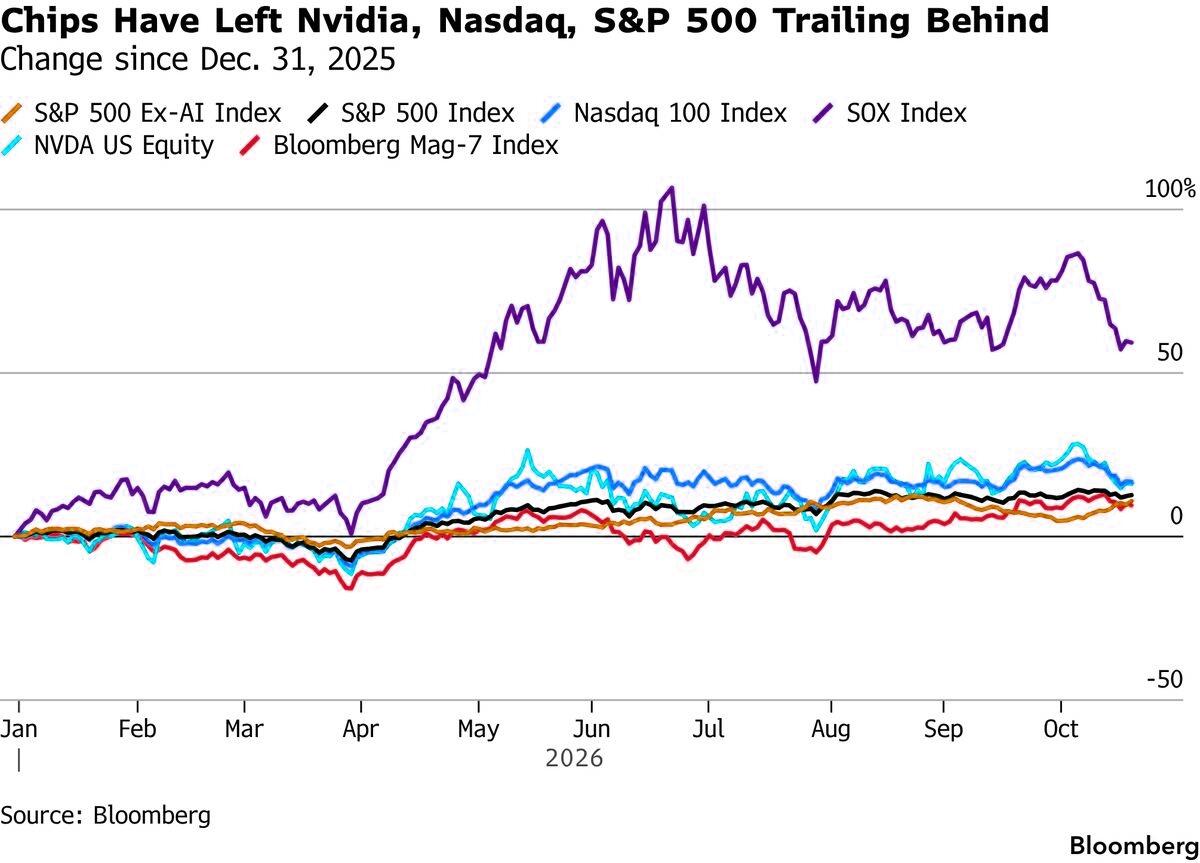
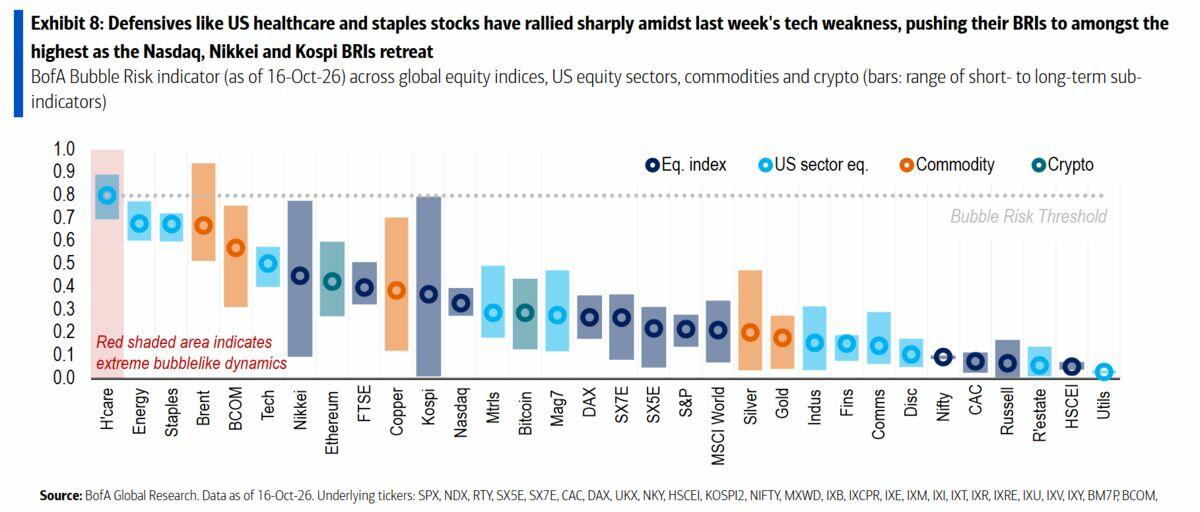
That rotation has gone so far that, according to Bank of America strategists, AI jitters are sending defensive sectors like healthcare and consumer staples nearer to “bubble” conditions, as investors shifting out of AI-linked stocks into safer havens push those valuations to more extreme levels (more in “From AI To KO: BofA Says The Flight-To-Safety Has Become A Bubble Of Its Own“).
JPM’s Market Intel desk under Andrew Tyler says SpaceX’s beat and Super Micro’s upside preannouncement were both supportive for AI sentiment, but warns that “these two catalysts alone would not resolve investors’ concerns about financing risk and the scale of AI capex.” The team doesn’t think much has changed beneath the headline noise: Tuesday’s sharp squeeze in the Russell “looks more like short covering than growing confidence,” with high-touch volumes down 32% and, per trader Matt Reiner, “mass hesitation to step in and re-gross.” The desk remains Tactically Bullish, favoring cyclicals outside tech while selectively buying tech weakness. All eyes now turn to Meta tonight: JPM’s Mark Schilsky puts the revenue bogey at about $64 billion and says buyside consensus for 2027 opex plus capex is $435-475 billion, adding that a majority of investors still believe an equity raise is likely post-Q3. Separately, JPM’s Stuart Humphrey called SpaceX “a very strong print, particularly SI,” but reminds that 1.3 billion shares become eligible for sale off lockup on Thursday.
Goldman’s desks are similarly skeptical of the bounce. GS Prime’s Vincent Lin writes that “October has tested the AI trade”: hedge funds just posted the largest two-week net selling of global Info Tech on record (-3.3 SDs), short sales outpaced long buys roughly 5 to 1 this month, and short leverage is in the 99th percentile, approaching 5-year highs (“short squeeze risk alert?”). TMT specialist Sean Johnstone says SpaceX “printed the cleanest AI-segment ramp yet,” guiding Q1 2027 revenue to $33-37 billion vs a Street at about $22 billion, but the US desk was “still a net seller of Semis/AI into this bounce” and Tuesday’s move higher “felt squeezy with short pockets at the top of the leader board.” And for those keeping score on risk appetite, Goldman’s cross-asset Risk Appetite Indicator has declined sharply over the past 3 weeks and turned negative for the first time since March, while Johannes Duttenhoefer flags that margin debt rose $26.2 billion in September, the second-highest month-end reading on record.
In geopolitics, the Iran standoff shows no sign of resolution: Iranian Foreign Minister Araghchi wrote in an FT op-ed that “there is little reason to expect progress now” given the White House’s threats, Pakistan’s army chief Munir reportedly delivered a US “final warning” to Tehran, and the FT reports Netanyahu is pushing to resume large-scale strikes on Iran. UKMTO received a late report of a tanker struck by an unknown projectile 30nm southeast of Al Faw, Iraq, though Gulf oil exports have surpassed prewar levels per the WSJ. On Ukraine, US envoy Steve Witkoff takes the security-guarantee proposals discussed in Oslo to St. Petersburg today, while the WSJ reported that Musk ordered a slowdown of Ukraine’s Starlink service (prompting Marco Rubio to say Ukraine “would not exist” without US backing). In politics, National Democrats sued Trump and the DOJ over what they call a coordinated effort to erode confidence in the midterms.
In Europe, the French bond rout continues: the 10Y OAT yield rose 7bps to 5%, the highest since July 2002, with the OAT-Bund spread widening to 158bps as higher energy prices hit bonds across the eurozone on top of persistent fiscal concerns. One trader bought 5,000 OAT March put spreads targeting the 10Y yield climbing to 5.60% by mid-February, a level last seen in 2000. The domestic unrest is now hitting earnings: Carrefour cut its 2026 targets citing riots, looting and curfews across France, and Goldman’s FX desk expects Moody’s to downgrade France to A1 on Friday.
In Europe, the Stoxx 600 is up 0.5%, extending an early gain as investors assess a flurry of corporate results, with real estate, energy and tech leading while autos, personal care and retail lag; the CAC 40 rises 0.4% as EssilorLuxottica’s 14% jump outweighs Carrefour’s 14% plunge. JPM notes Luxury, Semis, AI Disruptions and Cyclicals are among the top performing baskets; the Euro Stoxx 50 is up 0.6%, the DAX 0.5% and the FTSE 100 0.1%. Here are the biggest European movers:
- Randstad shares rally as much as 19% after the recruitment firm reported 3Q organic growth that beat consensus expectations.
- Adidas shares rise as much as 2.4% after the German sportswear maker reported preliminary third-quarter operating profit that beat estimates and raised its full-year profit outlook.
- Pepco surges as much as 8.4% after the retailer’s main shareholder, Ibex, sold a 5.5% stake through accelerated book-building.
- Iberdrola shares rise slightly after the Spanish power company raised its profit forecast. Analysts at Morgan Stanley say the increase is largely priced in.
- Carrefour shares drop as much as 15% after the French supermarket operator slashed its full-year financial goals, citing the “worsening social and security situation” following violent protests and looting across the country that damaged its stores.
- Michelin shares fall as much as 6.4% after Citi said third quarter revenue missed expectations due to weaker volumes.
- Elisa shares drop as much as 6.3% after the Finnish telecom carrier reported declining telecom service revenues and 3Q Ebitda that missed consensus expectations.
- Akzo Nobel shares fall as much as 1.8% after the paints and coatings manufacturer posted results analysts described as mixed, with weaker volumes somewhat offset by margin resilience.
Asian stocks rose, bouncing back from Tuesday’s rout as blockbuster results from US tech revived the AI trade, with the MSCI Asia Pacific Index gaining as much as 1.6% and Samsung, SK Hynix and TSMC among the biggest drivers. South Korea’s Kospi jumped 3.3% to 5,735.66, triggering a sidecar as Kospi 200 futures surged 5%, with foreigners snapping an 18-day net-selling streak in SK Hynix per Goldman, while Elice rebounded 30% after its 32% debut slump. Taiwan’s Taiex rose 1.3%, its best day since Oct. 5, and the Nikkei added 0.9% to 64,621 despite softer-than-expected exports. China was the exception: the Hang Seng fell 0.9% to 23,651.87, its lowest close since July 7, as CATL tumbled 11.4% after its Q3 miss and Tencent slid 4%, and the CSI 300 dropped 1.0%; the ASX 200 was little changed and Bank Indonesia held rates at 5.75%. Goldman’s Rachel Hu notes that “the de-rating of AI and crowded growth trades continued to dominate regional price action.”
In FX, the Bloomberg Dollar Spot Index is little changed and the DXY trades in a tight 101.73-101.83 range. The Aussie is the best G10 performer, up 0.5% to 0.7036, the highest since Sept. 28, after RBA Deputy Governor Andrew Hauser said the inflation outlook is “materially worse” than forecast; Goldman now expects a 25bp RBA hike in November and markets price about a 50% chance. The euro slips 0.1% to 1.1226 as French spreads widen, while the pound is a touch firmer after UK CPI topped estimates, with EUR/GBP down 0.1% to 0.8389 even as the cost of hedging the pound against the euro hit a five-month high ahead of next week’s UK budget. USD/JPY is little changed at 158.1, and the Taiwan dollar snapped a four-day drop.
In rates, Treasuries are slightly cheaper across the curve, led by the front-end and belly as stocks climb on better AI sentiment, while a leg higher in oil adds to the upside pressure on yields after continued attacks in the Strait of Hormuz. Yields are cheaper by up to 1.5bp across the front-end, marginally flattening 2s5s and 2s10s, with the 10Y trading around 5.12%; bunds lag by 1bp while gilts outperform by 1bp, with UK 2-year yields as much as 3bps lower at 4.93% as traders fully price a November BOE hike after CPI. Today’s duration event is the $13 billion 20-year reopening at 1pm: the WI is trading around 5.485%, about 6.5bp cheaper than September’s stop-out, which tailed by 2bp (in other words, not exactly a vote of confidence). Traders keep piling into bearish bets: 12,000 TY Wk5 104.0 puts were bought, taking the total above 100,000 contracts since the start of the week, a position which targets 10Y yields at least 20bps higher by month-end. Swaps price about a 20% chance of a Fed hike next week. The IG dollar issuance slate includes a handful of names after two issuers priced a combined $3.5 billion on Tuesday, taking the week to just over halfway to dealers’ $25 billion forecast.
Former New York Fed President Bill Dudley argues in a Bloomberg Opinion column that the AI investment boom is currently pushing US interest rates up before its eventual unwind slows the economy and prompts the Fed to cut sharply.
In commodities, WTI is up 1.4% at $99.20 and Brent rose 1.2% to $110.13 (holding within a $109.27-110.75 range), rebounding from Tuesday’s losses as attacks on ships around the Strait of Hormuz threatened shipments and industry data showed US crude stockpiles fell 4.9 million barrels, far more than the 1.1 million expected. Goldman estimates global crude freight costs have surged about sevenfold over the past year to above $20/bbl, while the premium of Oman crude over Dubai fell to near $4, the lowest since late July, a sign of resilient Gulf exports. Morgan Stanley raised its 2027 Brent forecasts and says product markets will stay tight through mid-2027. Dutch TTF gas rose 4% toward €90/MWh on LNG disruptions; Macron said France secured 2 terawatt-hours a month of Qatari gas over the winter, and the UK approved the Jackdaw North Sea gas field. Spot gold is flat in a $4,106-4,131 range, silver is down 1% and LME copper is lower.
US economic data slate is empty after MBA mortgage applications fell 5.3% (7am), with the EIA weekly crude inventory report at 10:30am; the Fed is in blackout ahead of next week’s decision. The Treasury sells $75 billion of 17-week bills (11:30am) and $13 billion of 20-year bonds (1pm). Abbott, AT&T, Philip Morris, Thermo Fisher, NextEra, CME and Moody’s report before the open, with Meta, Tesla, IBM, Texas Instruments, Lam Research and SAP after the close; Nvidia’s GTC Berlin continues.
Market Snapshot
Top Overnight News
- Anthropic could spend $750 billion on additional computing power in the coming years, the WSJ reported, citing a draft IPO prospectus, while billionaire Ken Griffin said investors are “almost certainly” in the midst of an AI bubble. BBG
- Nvidia is in talks to invest hundreds of millions of dollars in Australian AI cloud provider Firmus. The Information
- Nasdaq futures rose after SpaceX and Super Micro topped forecasts, reigniting the AI trade. Adding to the buzz, Elon Musk said SpaceX and Tesla are studying a potential merger that would be the biggest ever. BBG
- Over the past two weeks, HFs aggressively net sold global Info Tech stocks at the fastest pace in the past decade (-3.3 SDs), driven by long-and-short sales. Net allocation to Global AI stocks now sits in the 38th percentile while aggregate long/short ratio is in the 6th percentile vs. the past year. GSPB
- Persian Gulf oil exports have surpassed prewar levels, as an improvised shipping system under U.S. protection is helping tankers move oil through one of Iran’s fiercest waves of attacks in the Strait of Hormuz. WSJ
- Benjamin Netanyahu is pushing to resume large-scale strikes against Iran and had instructed his military to plan for a major new offensive earlier this month, moves that risk plunging the region back into full-scale war. FT
- More Oil Is Now Coming Out of the Persian Gulf Than Before the Iran War: WSJ
- “Given that the White House has shown no willingness to reach an understanding on the way forward, while also threatening more violence, there is little reason to expect progress now,” Iranian FM Araghchi said in an FT op-ed. BBG
- UKMTO received a late report of a tanker struck by an unknown projectile 30 nautical miles southeast of Al Faw, Iraq, on Tuesday; crew reported safe. BBG
- French yields rose above 5% for the first time since 2002 as persistent fiscal concerns continued to weigh on bonds BBG
- U.K. inflation rose further above the Bank of England’s target in September as policymakers prepare for a meeting that investors expect will yield a first rate increase since the start of the war between the U.S. and Iran. WSJ
- Britain’s national debt topped £3 trillion for the first time as the government borrowed more than forecast in the first half of the fiscal year. BBG
- Australia’s inflation outlook looks “materially worse” than previously expected, RBA Deputy Governor Andrew Hauser said, bolstering expectations for a fifth hike this year in November. BBG
- Japan’s exports rose 16.7% in September, missing forecasts despite an increase in chip shipments. South Korea’s exports jumped 65.9% in early October, powered by a more than 220% semiconductor surge. BBG
- Leaders of Ukraine, Finland and Norway hailed progress in talks in Oslo on Tuesday about how to end Russia’s war in Ukraine, but they did not announce any breakthroughs. “I think we made genuine progress today,” said Finnish President Alexander Stubb, who co-hosted the talks with Norwegian Prime Minister Jonas Gahr Støre at the request of Ukraine. FT
- Elon Musk ordered a slowdown of Ukraine’s military-grade Starlink service, and Musk and Trump discussed the decision in a subsequent call. WSJ
- The US is increasingly reliant on price-sensitive private investors to fund its debt as traditional buyers retreat. Hedge funds and other private investors now own about 70% of Treasuries, helping drive yields higher. BBG
- US President Trump posted that he is watching data centres closely: Newsquawk
- US and Mexican negotiators hit an impasse over tariffs on steel and aluminum, dashing earlier optimism. BBG
- National Democrats sued Trump and the US Justice Department over what they say is a coordinated effort to erode confidence in the midterms. BBG
- JPM’s Mark Schilsky puts buyside consensus for Meta’s 2027 opex plus capex at $435-475 billion, and says a majority of investors still expect an equity raise post-Q3. JPM
- Goldman estimates global crude freight rates are above $20/bbl, about 7x a year ago, with the Hormuz war-risk premium alone accounting for about $7/bbl. GIR
A more detailed look at global markets courtesy of Newsquawk
APAC stocks were mostly firmer as after-hours strength in AI names, following Super Micro Computer’s upbeat guidance and SpaceX’s earnings call, offset the mixed lead from Wall Street, where the Nasdaq 100 lagged on AI-debt concerns. ASX 200 was little changed amid a busy morning of company updates, including NEXTDC’s FY27 guidance cut, while Goldman Sachs shifted to expecting a 25bps RBA hike in November after hawkish remarks from RBA’s Hauser. Nikkei 225 gained on the AI-led strength in US after-hours trade, shrugging off softer-than-expected exports and a wider-than-expected trade deficit. KOSPI outperformed and triggered a sidecar as KOSPI 200 futures jumped 5%, rebounding after Tuesday’s sharp slide. Hang Seng and Shanghai Comp were lower with the latter reversing earlier opening gains, while CAICT data showed a 22.9% Y/Y drop in China’s September smartphone shipments and CATL was in focus after its Q3 miss.
Top Asian News
- Japanese Finance Minister Katayama said the government is coordinating closely with the BoJ, with no major divergence on the inflation outlook or monetary policy. Noted that tax cuts boost demand and push up prices. Government will ensure proactive and responsible fiscal policy strengthens Japan’s supply capacity without accelerating inflation.
- Japan and India to hold 2+2 meeting in mid-November, Kyodo reported citing officials, with the aim to strengthen cooperation in maritime security and economic subjects.
- China’s September smartphone shipments fell 22.9% Y/Y, according to CAICT.
European bourses (STOXX 600 +0.5%) have a slight positive tilt to start Wednesday’s session, with upside seen in France’s CAC 40 (+0.4%), as EssilorLuxottica (+14.2%) upside outweighs the downside in Carrefour (-14%). Outside of a busy earnings docket, which is set to be even busier tomorrow, there has been little in terms of a broader driver. Sectors are mixed. Real Estate tops the sector pile, with Energy and Tech rounding out the sector gainers. At the bottom sits Autos, as Optimised Personal Care and Retail follow. Other key updates include: Adidas +1.6%, Q3 metrics beat and lifts its FY26 operating profit guidance; Iberdrola +0.6%, raises its FY26 adj. net growth profit guidance to “at least” 10%; Qiagen +1.4%, as EQT reportedly offers USD 50/shr to acquire the company. US equity futures are mixed, with outperformance in the NQ following upbeat after-hour earnings from SpaceX and Super Micro. The former reported a sharp increase in AI revenue, which drove a swing to profit, while the latter raised its Q1 outlook on stronger AI platform demand. Focus now turns to Meta and Tesla earnings tonight.
Top European News
- The UK government has approved the Jackdaw North Sea gas field, with the Energy Minister saying the project will start to supply gas to British homes and businesses from as early as the end of this month. In later comments, the UK Energy Secretary said that the government will decide shortly on the Rosebank oilfield project.
- Germany’s Federal Finance Agency Director said that unconditional European support measures to calm sovereign bond markets could trigger a more serious debt crisis later, Econostream reported.
- French Finance Minister said France have the instruments to pass a budget.
FX
- G10s are mixed against the USD. The Antipodeans gain, with mild outperformance in the Aussie after hawkish commentary from RBA’s Hauser. The EUR holds towards the foot of the pile.
- DXY is essentially flat and trades within a 101.73-101.83 range, holding towards the lower end of the prior day’s range. The data docket has been light this week, and will remain so; therefore, the USD may need surprises in tech-earnings/geopolitics to make a move in either direction. On that note, the USD came under mild pressure on Tuesday following reports that the Iranians were presented a “compromise proposal”; newsflow since then has been lacking, but the Iranian FM suggested that indirect negotiations were ongoing. Nonetheless, the situation remains tense with reports suggesting that tankers are still under fire.
- AUD is the best performer this morning, following hawkish commentary from RBA’s Hauser. He mentioned that the inflation outlook is “materially worse”, blaming AI spending and rising energy costs. Hauser added that Q3 CPI will show inflation accelerating. Money markets have upped their bets of a hike at the November meeting, and now assign a c. 50% chance of such a move. Further adding to the hawkish tone was Goldman Sachs now expecting a 25bps rate hike in November, vs its previous call of no move. AUD/USD topped the 0.70 mark, to trade back towards levels not seen since late-September.
- EUR is the slight underperformer this morning, with sentiment around Europe remaining downbeat. The OAT-Bund spread remains exceptionally wide at c. 156bps, and building on recent advances. Of course, the civil unrest in France and the ongoing French fiscal situation remain front of mind.
- Across the channel, the GBP is a touch firmer this morning. Some mild strength was seen following the region’s inflation report, which saw the headline rise a touch more than expected, whilst Core M/M fell from the prior. Overall, a slightly firmer-than-expected inflation report, which plays in favour of those pushing for a hike at the BoE’s November confab. Today’s report, alongside the recent solid jobs report, will provide MPC members with enough evidence to suggest that the UK economy is holding up fairly well to deliver a hike in November. For reference, Danske, MUFG and Pantheon all expect a hike next month, and Pantheon sees another in February.
Central Banks
- RBA’s Hauser said monetary policy is working, but the inflation outlook has deteriorated and appears worse than forecast. Inflation has remained elevated for an extended period, while inflation expectations must remain anchored to the target. Companies continue to cite cost pressures as their primary concern. There has been some slowing in labour market and housing data. RBA is still finalising its forecasts, and it remains uncertain what decision the Board will make. Looks like quarterly trimmed mean will be higher than expected.
- BoJ is expected to assess whether underlying inflation has reached its 2% target at its October 29th-30th policy meeting, while keeping interest rates unchanged at around 1.25%, Kyodo reported.
- BoJ’s Himino said upside inflation risks remain high, warning that delays in adjusting monetary policy could allow inflation risks to materialise and harm the economy. Financial conditions remain accommodative, with real interest rates low and bank lending expanding rapidly. Medium- and long-term inflation expectations continue to rise. Underlying inflation is nearing the BoJ’s 2% target and is expected to converge towards levels consistent with the target. Strong AI demand is boosting domestic capex and exports.
- ECB’s Kazaks said that some more policy tightening might be necessary if inflation continues to reside above target and that the recent rise in yields has already tightened financing conditions, Econostream reported.
- ECB’s Lane said greater global euro use may help the ECB control prices.
- Indonesian Central Bank left the BI rate unchanged at 5.75%, raised the Deposit Facility rate to 5.00% (prev. 4.75%).
- Goldman Sachs now expects the RBA to hike rates by 25bps to 4.85% in November, having previously expected rates to remain unchanged.
Fixed Income
- A relatively contained morning for fixed income. USTs in a narrow sub-10 tick range, awaiting geopolitical updates with the docket otherwise fairly light and headlined by equity newsflow.
- Bunds also contained, in a narrow 121.43-74 band; however, this currently comes with pressure of around 20 ticks, weighed by a gradual move higher in energy overnight and one that has continued marginally this morning for WTI and Brent. Particularly though, marked upside in TTF is doing the heavy lifting.
- Gilts digested the morning’s inflation data as the hawkish driver it is, opening lower by just under 30 ticks and then slipping further to a 83.91 low, but still above 83.85 and 83.79 from Tuesday and Monday respectively. In brief, the series shows continued price pressures, with the headline well above the BoE’s forecast. However, and pertinently, the series still does not indicate overt or significant second round effects.
- Overall, it keeps the BoE on track for a hike in 2026 and makes the November meeting ever more likely, barring a significant shock between now and then. But, the hike is likely to be a risk-management/prudence move, rather than a function of policymakers being concerned that second round effects are getting out of hand. A point that means calls for just one hike early in 2027, and then an extended hold before easing returns to the conversation, are likely fair at this stage.
- Australia sold AUD 1.0bln of 4.25% October 2036 bonds; b/c 3.63x (prev. 4.51x), average yield of 5.2545% (prev. 5.3802%).
Commodities
- WTI and Brent are trading with gains of 1.7% and 1.4%, respectively. Strength which appears to be a bit of a bounce back following the hefty losses seen in the prior session. WTI currently holds towards the upper end of a USD 97.91-99.57/bbl range, whilst Brent holds within a USD 109.27-110.75/bbl band.
- The current geopolitical environment contains a number of key focus points. Starting with US-Iran, the Pakistani Army Chief met with Iranian officials in Tehran. Reports suggested that he provided a Qatar/Pakistan led “compromise proposal”, but this has yet to be confirmed. Instead, N12 reported that Army Chief Munir brought the US’ “final warning” to Iran, and if that does not bring peace, then the report suggests that the US could target Iranian nuclear facilities. The overarching theme is that the diplomatic path appears to be in effect, as confirmed by the Iranian Foreign Minister, but risks of escalation remain.
- The other main points of interest are: 1) potential Russia-Ukraine peace; US Envoy Witkoff has met with Russian President Putin today, where he is expected to present a peace plan later; so far, Putin and Witkoff have struck a conciliatory tone. 2) Ongoing strikes between Saudi Arabia and the Houthis.
- Dutch TTF (+4%) is stronger this morning, but holds a little shy of the EUR 90/MWh mark, remaining within a EUR 86.02-88.97/MWh range. Strength facilitated by ongoing LNG disruptions and as we enter the winter period, amidst low EU storage inventories. On the gas subject, the UK government has approved the Jackdaw gas field, and will begin production this month. The effect of this decision will likely be negligible on global markets, given it is expected to supply only around 6% of the UK’s domestic gas output.
- Spot gold is essentially flat and trades towards the bottom end of a USD 4,106-4,131/oz range. Action today appears to be following the lacklustre action seen in the Dollar, and will ultimately take cues from any geopolitical updates. Elsewhere, base metals are broadly lower this morning. 3M LME Copper trades within a USD 14,284.63-14,463.63/t range.
- US Weekly Private Inventory Data (bbls): Crude -4.9mln (exp. -1.1mln), Gasoline -2.0mln (exp. -0.7mln), Distillate -2.6mln (exp. -1.6mln), Cushing +0.9mln.
- Russian Deputy PM Novak said they could see a full restoration of diesel volumes by end-2026 and they could have a commercial deal with China regarding Power of Baikal by end-2026, IFX reported.
- South Korea’s President Lee said the government is preparing to reduce mandatory domestic fuel supply obligations and allow refiners to increase exports.
- Russian President Putin said that they could supply fertilisers in large quantities to the US market, TASS reported.
- Iranian FM Araghchi said Tehran has opened dedicated routes for ships carrying Iraqi oil to pass through the Strait of Hormuz in order to reduce Iraq’s losses.
- French President Macron said they secured 2 terawatt-hours per month of gas from Qatar during the winter period.
Geopolitics: Middle East
- Pakistan Army Chief Munir, in his meeting with Iranian officials, brought with him the “final warning” from the United States, which called on Iran to submit to the American demand for concessions on the nuclear issue before taking any other steps.
- Iranian Foreign Minister Araghchi said indirect US talks continue via Pakistan and Qatar despite Washington’s public opposition. Araghchi added that the US accepted Iran’s seven-day proposal to reopen the Strait of Hormuz but added conditions. Iran insisted Washington first honour commitments under the Islamabad MoU before further negotiations, stressing that diplomacy remains possible if the US fulfils its obligations.
- Iranian Foreign Minister Araghchi said Tehran has yet to receive a response from Saudi Arabia or Yemen’s Houthis regarding its mediation initiative, while warning against trusting the US in negotiations. All possibilities are on the table, including a new war launched by the United States and Israel against Iran. Sanctions and the blockade have imposed major burdens on Iran. Reopening the Strait of Hormuz depends on reaching an understanding with the US.
- Iran’s IRGC Political Deputy said Iran will target internet cables in the Strait of Hormuz if its infrastructure is attacked, Mehr reported.
- Iran has reportedly prepared for an all-out, multi-layered and comprehensive war against its adversaries, Press TV reported, citing a source.
- Israeli PM Netanyahu is pushing to resume major strikes on Iran, but a planned October 10th offensive was halted amid Trump’s opposition ahead of the US midterms, FT reported.
- UKMTO received report of an incident 11NM west of Bukha, Oman.
- Houthi military spokesperson said they did not launch any drones toward Medina, Saudi Arabia, on Wednesday.
- Saudi-led coalition said it intercepted and destroyed four drones launched towards Saudi Arabia, according to a coalition spokesperson.
Geopolitics: Ukraine
- US Special Envoy Witkoff said talks in Oslo were productive and that there is forward progress on the issue of Ukraine, IFX reported. Witkoff added that a basic foundation exists for a ceasefire in Ukraine and hopes that Russian President Putin will consider resuming US-Ukraine-Russia talks. Furthermore, he emphasised that Russia and the United States have prospects for developing economic relations after the end of the conflict in Ukraine.
- Russia’s President Putin told US Special Envoy Witkoff that Russia is interested in restoring economic ties with the US, IFX reported.
- Russian President Putin invited US Envoy Witkoff for discussions on the prospect of a meeting between Putin and US President Trump in China, IFX reported.
- Elon Musk reportedly ordered a slowdown of Ukraine’s military-grade Starlink service, while Musk and Trump discussed the decision in a subsequent call, WSJ reported.
- Russia’s Foreign Ministry said it views Japan’s supply of drones to Ukraine as a hostile act; Russia will respond.
Crypto
- Bitcoin fell to a low of USD 82.54k before gradually climbing to a peak of USD 83.6k throughout the European morning.
US Event Calendar
- 7:00am: Oct 16 MBA Mortgage Applications, actual -5.3%, prior -2.7%
- 10:30am: EIA weekly crude oil inventories
- 11:30am: U.S. To Sell USD75 Bln 17-Week Bills
- 1:00pm: U.S. To Sell USD13 Bln 20-Year Bond Reopening
Central Bank Speakers
- Fed in external communications blackout ahead of the Oct. 28 FOMC decision
- 9:00am: BOE’s Bailey Speaks in Fireside Chat
- 12:00pm: ECB’s Lagarde Speaks in Wiesbaden
1b European opening report
Crude benchmarks rebound from recent losses, DXY steady whilst AUD reacts to hawkish RBA commentary; TSLA ahead – Newsquawk US Market Open

Wednesday, Oct 21, 2026 – 06:29 AM
- Pakistan Army Chief Munir brought the “final warning” from the United States to Iranian officials, which called on Iran to submit to the US demands for concessions on the nuclear issue before taking any other steps.
- The UK government has approved the Jackdaw North Sea gas field.
- NQ outperforms, helped by upbeat SPCX and SMCI earnings; focus turns to META and TSLA.
- DXY flat; AUD supported by hawkish comments by RBA’s Hauser.
- Fixed income benchmarks modestly lower, Gilts initially underperformed following a hot inflation report.
- Looking ahead, highlights include US MBA Mortgage Applications. Speakers include BoE Governor Bailey, ECB’s Lagarde. Supply from the US. Earnings from Abbott, NextEra, CME, AT&T, SAP, Tesla, IBM, Meta & Texas Instruments.
SNAPSHOT

EUROPEAN TRADE
EQUITIES
- European bourses (STOXX 600 +0.5%) have a slight positive tilt to start Wednesday’s session, with upside seen in France’s CAC 40 (+0.4%), as EssilorLuxottica (+14.2%) upside outweighs the downside in Carrefour (-14%). Outside of a busy earnings docket, which is set to be even busier tomorrow, there has been little in terms of a broader driver.
- Sectors are mixed. Real Estate tops the sector pile, with Energy and Tech rounding out the sector gainers. At the bottom sits Autos, as Optimised Personal Care and Retail follow.
- Other key updates include: Adidas +1.6%, Q3 metrics beat and lifts its FY26 operating profit guidance; Iberdrola +0.6%, raises its FY26 adj. net growth profit guidance to “at least” 10%; Qiagen +1.4%, as EQT reportedly offers USD 50/shr to acquire the company.
- US equity futures are mixed, with outperformance in the NQ following upbeat after-hour earnings from SpaceX and Super Micro. The former reported a sharp increase in AI revenue, which drove a swing to profit, while the latter raised its Q1 outlook on stronger AI platform demand. Focus now turns to Meta and Tesla earnings tonight.
- Click for the sessions European pre-market equity newsflow
- Click for the additional news
FX
- G10s are mixed against the USD. The Antipodeans gain, with mild outperformance in the Aussie after hawkish commentary from RBA’s Hauser. The EUR holds towards the foot of the pile.
- DXY is essentially flat and trades within a 101.73-101.83 range, holding towards the lower end of the prior day’s range. The data docket has been light this week, and will remain so; therefore, the USD may need surprises in tech-earnings/geopolitics to make a move in either direction. On that note, the USD came under mild pressure on Tuesday following reports that the Iranians were presented a “compromise proposal”; newsflow since then has been lacking, but the Iranian FM suggested that indirect negotiations were ongoing. Nonetheless, the situation remains tense with reports suggesting that tankers are still under fire.
- AUD is the best performer this morning, following hawkish commentary from RBA’s Hauser. He mentioned that the inflation outlook is “materially worse”, blaming AI spending and rising energy costs. Hauser added that Q3 CPI will show inflation accelerating. Money markets have upped their bets of a hike at the November meeting, and now assign a c. 50% chance of such a move. Further adding to the hawkish tone was Goldman Sachs now expecting a 25bps rate hike in November, vs its previous call of no move. AUD/USD topped the 0.70 mark, to trade back towards levels not seen since late-September.
- EUR is the slight underperformer this morning, with sentiment around Europe remaining downbeat. The OAT-Bund spread remains exceptionally wide at c. 156bps, and building on recent advances. Of course, the civil unrest in France and the ongoing French fiscal situation remain front of mind.
- Across the channel, the GBP is a touch firmer this morning. Some mild strength was seen following the region’s inflation report, which saw the headline rise a touch more than expected, whilst Core M/M fell from the prior. Overall, a slightly firmer-than-expected inflation report, which plays in favour of those pushing for a hike at the BoE’s November confab. Today’s report, alongside the recent solid jobs report, will provide MPC members with enough evidence to suggest that the UK economy is holding up fairly well to deliver a hike in November. For reference, Danske, MUFG and Pantheon all expect a hike next month, and Pantheon sees another in February.
FIXED INCOME
- A relatively contained morning for fixed income. USTs in a narrow sub-10 tick range, awaiting geopolitical updates with the docket otherwise fairly light and headlined by equity newsflow.
- Bunds also contained, in a narrow 121.43-74 band; however, this currently comes with pressure of around 20 ticks, weighed by a gradual move higher in energy overnight and one that has continued marginally this morning for WTI and Brent. Particularly though, marked upside in TTF is doing the heavy lifting.
- Gilts digested the morning’s inflation data as the hawkish driver it is, opening lower by just under 30 ticks and then slipping further to a 83.91 low, but still above 83.85 and 83.79 from Tuesday and Monday respectively. In brief, the series shows continued price pressures, with the headline well above the BoE’s forecast. However, and pertinently, the series still does not indicate overt or significant second round effects.
- Overall, it keeps the BoE on track for a hike in 2026 and makes the November meeting ever more likely, barring a significant shock between now and then. But, the hike is likely to be a risk-management/prudence move, rather than a function of policymakers being concerned that second round effects are getting out of hand. A point that means calls for just one hike early in 2027, and then an extended hold before easing returns to the conversation, are likely fair at this stage.
- Australia sold AUD 1.0bln of 4.25% October 2036 bonds; b/c 3.63x (prev. 4.51x), average yield of 5.2545% (prev. 5.3802%).
COMMODITIES
- WTI and Brent are trading with gains of 1.7% and 1.4%, respectively. Strength which appears to be a bit of a bounce back following the hefty losses seen in the prior session. WTI currently holds towards the upper end of a USD 97.91-99.57/bbl range, whilst Brent holds within a USD 109.27-110.75/bbl band.
- The current geopolitical environment contains a number of key focus points. Starting with US-Iran, the Pakistani Army Chief met with Iranian officials in Tehran. Reports suggested that he provided a Qatar/Pakistan led “compromise proposal”, but this has yet to be confirmed. Instead, N12 reported that Army Chief Munir brought the US’ “final warning” to Iran, and if that does not bring peace, then the report suggests that the US could target Iranian nuclear facilities. The overarching theme is that the diplomatic path appears to be in effect, as confirmed by the Iranian Foreign Minister, but risks of escalation remain.
- The other main points of interest are: 1) potential Russia-Ukraine peace; US Envoy Witkoff has met with Russian President Putin today, where he is expected to present a peace plan later; so far, Putin and Witkoff have struck a conciliatory tone. 2) Ongoing strikes between Saudi Arabia and the Houthis.
- Dutch TTF (+4%) is stronger this morning, but holds a little shy of the EUR 90/MWh mark, remaining within a EUR 86.02-88.97/MWh range. Strength facilitated by ongoing LNG disruptions and as we enter the winter period, amidst low EU storage inventories. On the gas subject, the UK government has approved the Jackdaw gas field, and will begin production this month. The effect of this decision will likely be negligible on global markets, given it is expected to supply only around 6% of the UK’s domestic gas output.
- Spot gold is essentially flat and trades towards the bottom end of a USD 4,106-4,131/oz range. Action today appears to be following the lacklustre action seen in the Dollar, and will ultimately take cues from any geopolitical updates. Elsewhere, base metals are broadly lower this morning. 3M LME Copper trades within a USD 14,284.63-14,463.63/t range.
- US Weekly Private Inventory Data (bbls): Crude -4.9mln (exp. -1.1mln), Gasoline -2.0mln (exp. -0.7mln), Distillate -2.6mln (exp. -1.6mln), Cushing +0.9mln.
- Russian Deputy PM Novak said they could see a full restoration of diesel volumes by end-2026 and they could have a commercial deal with China regarding Power of Baikal by end-2026, IFX reported.
- South Korea’s President Lee said the government is preparing to reduce mandatory domestic fuel supply obligations and allow refiners to increase exports.
- Russian President Putin said that they could supply fertilisers in large quantities to the US market, TASS reported.
- Iranian FM Araghchi said Tehran has opened dedicated routes for ships carrying Iraqi oil to pass through the Strait of Hormuz in order to reduce Iraq’s losses.
- French President Macron said they secured 2 terawatt-hours per month of gas from Qatar during the winter period.
NOTABLE EUROPEAN HEADLINES
- The UK government has approved the Jackdaw North Sea gas field, with the Energy Minister saying the project will start to supply gas to British homes and businesses from as early as the end of this month. In later comments, the UK Energy Secretary said that the government will decide shortly on the Rosebank oilfield project.
- Germany’s Federal Finance Agency Director said that unconditional European support measures to calm sovereign bond markets could trigger a more serious debt crisis later, Econostream reported.
- French Finance Minister said France have the instruments to pass a budget.
NOTABLE EUROPEAN DATA RECAP
- UK CPI (Sep YY) 3.5% vs. Exp. 3.4% (Prev. 3.1%); Services Y/Y 3.7% (exp. 3.6%, prev. 3.4%).
- UK CPI (Sep MM) 0.4% vs. Exp. 0.3% (Prev. 0.5%).
- UK Core CPI (Sep YY) 2.8% vs. Exp. 2.7% (Prev. 2.6%).
- UK Core CPI (Sep MM) 0.2% vs. Exp. 0.2% (Prev. 0.3%).
- UK Retail Price Index (Sep MM) 0.1% vs. Exp. 0.1% (Prev. 0.6%).
- UK Public Sector Net Borrowing (PSNB) ex-Banks (Sep) 24.5B vs. Exp. 23.9B (Prev. 18.3B).
- UK ONS House Price Index (Aug) 0.4% Y/Y (Prev. 1.4%).
CENTRAL BANKS
- RBA’s Hauser said monetary policy is working, but the inflation outlook has deteriorated and appears worse than forecast. Inflation has remained elevated for an extended period, while inflation expectations must remain anchored to the target. Companies continue to cite cost pressures as their primary concern. There has been some slowing in labour market and housing data. RBA is still finalising its forecasts, and it remains uncertain what decision the Board will make. Looks like quarterly trimmed mean will be higher than expected.
- BoJ is expected to assess whether underlying inflation has reached its 2% target at its October 29th-30th policy meeting, while keeping interest rates unchanged at around 1.25%, Kyodo reported.
- BoJ’s Himino said upside inflation risks remain high, warning that delays in adjusting monetary policy could allow inflation risks to materialise and harm the economy. Financial conditions remain accommodative, with real interest rates low and bank lending expanding rapidly. Medium- and long-term inflation expectations continue to rise. Underlying inflation is nearing the BoJ’s 2% target and is expected to converge towards levels consistent with the target. Strong AI demand is boosting domestic capex and exports.
- ECB’s Kazaks said that some more policy tightening might be necessary if inflation continues to reside above target and that the recent rise in yields has already tightened financing conditions, Econostream reported.
- ECB’s Lane said greater global euro use may help the ECB control prices.
- Indonesian Central Bank left the BI rate unchanged at 5.75%, raised the Deposit Facility rate to 5.00% (prev. 4.75%).
- Goldman Sachs now expects the RBA to hike rates by 25bps to 4.85% in November, having previously expected rates to remain unchanged.
NOTABLE US HEADLINES
- US President Trump posted that he is watching data centres closely.
GEOPOLITICS
MIDDLE EAST
- Pakistan Army Chief Munir, in his meeting with Iranian officials, brought with him the “final warning” from the United States, which called on Iran to submit to the American demand for concessions on the nuclear issue before taking any other steps.
- Iranian Foreign Minister Araghchi said indirect US talks continue via Pakistan and Qatar despite Washington’s public opposition. Araghchi added that the US accepted Iran’s seven-day proposal to reopen the Strait of Hormuz but added conditions. Iran insisted Washington first honour commitments under the Islamabad MoU before further negotiations, stressing that diplomacy remains possible if the US fulfils its obligations.
- Iranian Foreign Minister Araghchi said Tehran has yet to receive a response from Saudi Arabia or Yemen’s Houthis regarding its mediation initiative, while warning against trusting the US in negotiations. All possibilities are on the table, including a new war launched by the United States and Israel against Iran. Sanctions and the blockade have imposed major burdens on Iran. Reopening the Strait of Hormuz depends on reaching an understanding with the US.
- Iran’s IRGC Political Deputy said Iran will target internet cables in the Strait of Hormuz if its infrastructure is attacked, Mehr reported.
- Iran has reportedly prepared for an all-out, multi-layered and comprehensive war against its adversaries, Press TV reported, citing a source.
- Israeli PM Netanyahu is pushing to resume major strikes on Iran, but a planned October 10th offensive was halted amid Trump’s opposition ahead of the US midterms, FT reported.
- UKMTO received report of an incident 11NM west of Bukha, Oman.
- Houthi military spokesperson said they did not launch any drones toward Medina, Saudi Arabia, on Wednesday.
- Saudi-led coalition said it intercepted and destroyed four drones launched towards Saudi Arabia, according to a coalition spokesperson.
RUSSIA-UKRAINE
- US Special Envoy Witkoff said talks in Oslo were productive and that there is forward progress on the issue of Ukraine, IFX reported. Witkoff added that a basic foundation exists for a ceasefire in Ukraine and hopes that Russian President Putin will consider resuming US-Ukraine-Russia talks. Furthermore, he emphasised that Russia and the United States have prospects for developing economic relations after the end of the conflict in Ukraine.
- Russia’s President Putin told US Special Envoy Witkoff that Russia is interested in restoring economic ties with the US, IFX reported.
- Russian President Putin invited US Envoy Witkoff for discussions on the prospect of a meeting between Putin and US President Trump in China, IFX reported.
- Elon Musk reportedly ordered a slowdown of Ukraine’s military-grade Starlink service, while Musk and Trump discussed the decision in a subsequent call, WSJ reported.
- Russia’s Foreign Ministry said it views Japan’s supply of drones to Ukraine as a hostile act; Russia will respond.
CRYPTO
- Bitcoin fell to a low of USD 82.54k before gradually climbing to a peak of USD 83.6k throughout the European morning.
APAC TRADE
- APAC stocks were mostly firmer as after-hours strength in AI names, following Super Micro Computer’s upbeat guidance and SpaceX’s earnings call, offset the mixed lead from Wall Street, where the Nasdaq 100 lagged on AI-debt concerns.
- ASX 200 was little changed amid a busy morning of company updates, including NEXTDC’s FY27 guidance cut, while Goldman Sachs shifted to expecting a 25bps RBA hike in November after hawkish remarks from RBA’s Hauser.
- Nikkei 225 gained on the AI-led strength in US after-hours trade, shrugging off softer-than-expected exports and a wider-than-expected trade deficit.
- KOSPI outperformed and triggered a sidecar as KOSPI 200 futures jumped 5%, rebounding after Tuesday’s sharp slide.
- Hang Seng and Shanghai Comp were lower with the latter reversing earlier opening gains, while CAICT data showed a 22.9% Y/Y drop in China’s September smartphone shipments and CATL was in focus after its Q3 miss.
NOTABLE ASIA-PAC HEADLINES
- Japanese Finance Minister Katayama said the government is coordinating closely with the BoJ, with no major divergence on the inflation outlook or monetary policy. Noted that tax cuts boost demand and push up prices. Government will ensure proactive and responsible fiscal policy strengthens Japan’s supply capacity without accelerating inflation.
- Japan and India to hold 2+2 meeting in mid-November, Kyodo reported citing officials, with the aim to strengthen cooperation in maritime security and economic subjects.
- China’s September smartphone shipments fell 22.9% Y/Y, according to CAICT.
NOTABLE APAC DATA RECAP
- Japanese Trade Balance (Sep) -536.6B vs. Exp. -181B (Prev. -1111.9B).
- Japanese Exports (Sep YY) 16.7% vs. Exp. 20.1% (Prev. 19.3%).
- Japanese Imports (Sep YY) 18.9% vs. Exp. 19.6% (Prev. 28.0%).
1c) Asian opening report
European bourses set for a firmer open as tech rebounds; UK CPI ahead – Newsquawk EU Market Open
Wednesday, Oct 21, 2026 – 01:42 AM
- APAC stocks were mostly firmer amidst strength in AI names; the NQ outperformed after gaining on SMCI’s and SpaceX’s mega forecasts.
- European equity futures indicate a positive cash market open, with Euro Stoxx 50 futures up 0.3%.
- DXY was steady, whilst the AUD outperformed as Goldman Sachs now sees the RBA hiking in November.
- Crude futures were firmer after an earlier brief spike; focus on IRGC threats to internet cables in the Strait of Hormuz.
- Looking ahead, highlights include UK CPI (Sep). Speakers include BoE Governor Bailey, ECB’s Cipollone & Lagarde. Supply from the US. Earnings from Abbott, NextEra, CME, AT&T, SAP, Iberdrola, Puig, Tesla, IBM, Meta & Texas Instruments.
SNAPSHOT

LOOKING AHEAD
- Highlights include UK CPI (Sep). Speakers include BoE Governor Bailey, ECB’s Cipollone & Lagarde. Supply from the US, Earnings from Abbott, NextEra, CME, AT&T, SAP, Iberdrola, Puig, Tesla, IBM, Meta & Texas Instruments.
- Click for the Newsquawk Week in Focus.
US TRADE
EQUITIES
- US stocks were mixed as breadth outside of AI-related names was strong, with Healthcare setting fresh YTD highs and gains also seen in Real Estate, Utilities, Financials and Consumer Discretionary. Meanwhile, Communications underperformed on Alphabet and Meta weakness, while Tech saw marginal losses, with the lacklustre performance in AI names reflecting continued concerns over AI-exposed debt. On the earnings front, defence names were in focus, with RTX and Northrop Grumman beating expectations and raising guidance, while GM fell on an FY profit outlook miss despite announcing a USD 20bln buyback.
- SPX +0.28% at 7,713, NDX -0.13% at 29,490, DJI +1.02% at 52,497, RUT +1.67% at 2,774.
NOTABLE HEADLINES
- US President Trump said will be very strong on budget this year; will have more growth this year.
DATA RECAP
NOTABLE US EQUITY HEADLINES
- SpaceX (SPCX) Q3 2026 (USD) EPS 0.35 (exp. 0.17), Revenue 14.6bln (exp. 12.98bln), Adj. EBITDA 8.8bln (exp. 6.72bln).
- SpaceX (SPCX) CEO Musk said Starship’s Flight 15 will take place next month; Starship will fly weekly in H1 2027 and twice weekly in H2 2027; annual recurring revenue is expected to reach between USD 500bln and USD 1tln by the end of 2027. Musk predicts Starlink will reach 100,000 satellites within three years, increasing network capacity 100-fold. Co. is looking at bringing on an incremental 13GW of compute by the end of 2027. Aviation remains a major growth opportunity.
- SpaceX (SPCX) CEO Musk said demand for AI compute is likely to remain strong, with even older H100s (NVDA) renting for more than when they were new, while warning that a shortage of superintelligence compute could persist for a long time.
- SpaceX (SPCX) CEO Musk said a merger between SpaceX and Tesla (TSLA) would be a good idea but is far from certain, noting that shareholder support is required, including approval from 50% of all Tesla shares. Both SpaceX and Tesla have formed special committees to discuss this idea.
- Super Micro Computer (SMCI) Q1 2027 Prelim (USD): Net Sales 18.5bln-19.5bln (exp. 14.99bln), Adj. Gross Margin 12%-12.5%. Revenue outlook above previous estimate of 14.5bln-15.5bln, driven by increased demand for AI platforms.
- Netflix (NFLX) Q3 2026 (USD): EPS 0.87 (exp. 0.82), Revenue 14.6bln (exp. 12.9bln).
- Anthropic saw revenue of USD 16.3bln in H1 ’26 (prev. USD 1.1bln a year earlier), and posted an USD 80.7bln net loss driven largely by USD 72bln in accounting charges tied to convertible notes, according to a draft IPO prospectus viewed by WSJ.
TRADE/TARIFFS
- US President Trump, speaking on India, said a trade deal is pretty close.
- US Secretary of State Rubio, on a trade deal with India, said down to some technical details that have to be worked out and anticipate seeing in a matter of weeks, not months.
- No Canada-US trade deal expected before American midterm elections, CBC reported, citing sources.
- Canada and Turkey set to sign joint declaration during Carney’s visit to deepen ties in four areas.
- Small businesses file a new lawsuit to block US President Trump’s tariffs on Canada.
APAC TRADE
EQUITIES
- APAC stocks were mostly firmer as after-hours strength in AI names, following Super Micro Computer’s upbeat guidance and SpaceX’s earnings call, offset the mixed lead from Wall Street, where the Nasdaq 100 lagged on AI-debt concerns.
- ASX 200 was little changed amid a busy morning of company updates, including NEXTDC’s FY27 guidance cut, while Goldman Sachs shifted to expecting a 25bps RBA hike in November after hawkish remarks from RBA’s Hauser.
- Nikkei 225 gained on the AI-led strength in US after-hours trade, shrugging off softer-than-expected exports and a wider-than-expected trade deficit.
- KOSPI outperformed and triggered a sidecar as KOSPI 200 futures jumped 5%, rebounding after Tuesday’s sharp slide.
- Hang Seng and Shanghai Comp were lower with the latter reversing earlier opening gains, while CAICT data showed a 22.9% Y/Y drop in China’s September smartphone shipments and CATL was in focus after its Q3 miss.
- US equity futures were firmer with the NQ outperforming after gains on SMCI’s guidance and SpaceX’s earnings call.
- European equity futures indicate a positive cash market open with Euro Stoxx 50 futures up 0.3%, after the cash market closed with losses of 0.3% on Tuesday.
FX
- DXY was steady after weakening yesterday against all G10 peers amid the gains in US equities, lower yields and constructive Middle East headlines that were later denied. Focus remains on Iran-US talks via Pakistan and Qatar, while envoy Witkoff is set to meet Russian President Putin today to present an updated Ukraine peace proposal.
- EUR/USD was slightly softer, with French unrest and the wider OAT-Bund spread in focus ahead of Moody’s review on Friday.
- GBP/USD was flat following yesterday’s outperformance on the surprise drop in UK unemployment, with UK CPI data due later today.
- USD/JPY was little changed after soft Japanese trade data, while BoJ’s Himino said upside inflation risks remain high and Kyodo reported the BoJ is expected to keep rates unchanged at the October meeting.
- Antipodeans saw AUD in focus after Goldman Sachs shifted to expecting a 25bps RBA hike in November following hawkish remarks from RBA’s Hauser, while NZ credit card spending accelerated.
- PBoC set USD/CNY midpoint at 6.7172 vs exp. 6.6779 (prev. 6.7200).
FIXED INCOME
- 10yr UST futures were marginally lower after yesterday’s bull-flattening, which was driven by concerns over AI-exposed debt.
- Bund futures pared some of the prior day’s gains as oil prices edged higher, whilst the OAT-Bund spread yesterday widened to the most since 2012.
- 10yr JGB futures were little changed after softer-than-expected Japanese trade data and hawkish-leaning remarks from BoJ’s Himino.
- BoJ JGB purchase operations for 1–3yr, 5–10yr and over-10yr maturities are in line with planned Q4 2026 amounts.
- Australia sold AUD 1.0bln of 4.25% October 2036 bonds; b/c 3.63x (prev. 4.51x), average yield of 5.2545% (prev. 5.3802%).
COMMODITIES
- Crude futures were firmer and extended on gains after an earlier brief spike in the absence of a fresh catalyst, with prices supported by a larger-than-expected private crude draw and Iran’s IRGC threatening to target internet cables in the Strait of Hormuz.
- Spot gold was slightly softer, while silver underperformed as oil prices edged higher overnight.
- Copper futures were little changed amid the mixed risk tone in the region.
- South Korea’s President Lee said the government is preparing to reduce mandatory domestic fuel supply obligations and allow refiners to increase exports.
- US Weekly Private Inventory Data (bbls): Crude -4.9mln (exp. -1.1mln), Gasoline -2.0mln (exp. -0.7mln), Distillate -2.6mln (exp. -1.6mln), Cushing +0.9mln.
- IRGC Navy said a supertanker struck sea mine, exploded off Hormuz; Fars reported; tanker carried 2mln barrels of oil.
- UK government is expected to approve the Jackdaw gas field on Wednesday, according to Politico.
CRYPTO
- Bitcoin and Ethereum were slightly lower but largely uneventful overnight.
CENTRAL BANKS
- BoJ’s Himino said upside inflation risks remain high, warning that delays in adjusting monetary policy could allow inflation risks to materialise and harm the economy. Financial conditions remain accommodative, with real interest rates low and bank lending expanding rapidly. Medium- and long-term inflation expectations continue to rise. Underlying inflation is nearing the BoJ’s 2% target and is expected to converge towards levels consistent with the target. Strong AI demand is boosting domestic capex and exports.
- BoJ is expected to assess whether underlying inflation has reached its 2% target at its October 29th-30th policy meeting, while keeping interest rates unchanged at around 1.25%, Kyodo reported.
- ECB’s Lane said greater global euro use may help the ECB control prices.
- BoE’s Greene continues to believe that she should proactively lean against the risk of second-round inflation effects and risk of second-round effects is greater than they thought. Wage disinflation appears to have stalled at levels above those consistent with inflation at 2%. Labour market slack might have hit its peak. Economy has shown surprising resilience. Forward-looking data point to pay growth closer to 3.5%.
- Goldman Sachs now expects the RBA to hike rates by 25bps to 4.85% in November, having previously expected rates to remain unchanged.
- RBA’s Hauser said monetary policy is working, but the inflation outlook has deteriorated and appears worse than forecast, slightly exceeding expectations. Inflation has remained elevated for an extended period, while inflation expectations must remain anchored to the target. Companies continue to cite cost pressures as their primary concern. There has been some slowing in labour market and housing data. RBA is still finalising its forecasts, and it remains uncertain what decision the Board will make. Looks like quarterly trimmed mean will be higher than expected.
- PBoC injected CNY 80bln via overnight reverse repos, while setting 7-day reverse repo operations at zero.
NOTABLE ASIA-PAC HEADLINES
- China’s Finance Minister said APEC members support private sector funding, promoting innovation financing and encouraging development banks to play a catalytic role.
- Japanese Finance Minister Katayama said the government is coordinating closely with the BoJ, with no major divergence on the inflation outlook or monetary policy. Noted that tax cuts boost demand and push up prices. Government will ensure proactive and responsible fiscal policy strengthens Japan’s supply capacity without accelerating inflation.
DATA RECAP
- New Zealand Credit Card Spending (Sep YY) 6.9% (Prev. 3.5%).
- Japanese Trade Balance (Sep) -536.6B vs. Exp. -181B (Prev. -1111.9B).
- Japanese Exports (Sep YY) 16.7% vs. Exp. 20.1% (Prev. 19.3%).
- Japanese Imports (Sep YY) 18.9% vs. Exp. 19.6% (Prev. 28.0%).
- South Korean PPI (Sep MM) 0.2% (Prev. 0.1%).
- South Korean PPI (Sep YY) 7.7% (Prev. 7.9%).
NOTABLE APAC EQUITY HEADLINES
- South Korea triggers a KOSPI sidecar as KOSPI 200 futures jump 5%, suspending programme trading for five minutes.
- China’s September smartphone shipments fell 22.9% Y/Y, according to CAICT.
GEOPOLITICS
RUSSIA-UKRAINE
- White House envoy Witkoff will meet Russian President Putin in St. Petersburg on Wednesday to present an updated Ukraine peace proposal following talks with Ukrainian President Zelensky, Axios reported.
- Elon Musk reportedly ordered a slowdown of Ukraine’s military-grade Starlink service, while Musk and Trump discussed the decision in a subsequent call, WSJ reported.
- US President Trump said Ukraine has to want to settle this war; want Zelensky to make a deal; given a lot to Ukraine, but gotten absolutely nothing back.
- US to offer Russian President Putin face-to-face talks with Ukrainian President Zelensky and US President Trump, Politico reported.
- The Trump administration is closing in on a deal with Russia that would see multiple Americans released from detention in Russia, according to ABC, citing sources.
MIDDLE EAST
- Israeli PM Netanyahu is pushing to resume major strikes on Iran, but a planned October 10th offensive was halted amid Trump’s opposition ahead of the US midterms, FT reported.
- Iran has reportedly prepared for an all-out, multi-layered and comprehensive war against its adversaries, Press TV reported, citing a source.
- Saudi-led coalition said it intercepted and destroyed four drones launched towards Saudi Arabia, according to a coalition spokesperson.
- No Qatari diplomatic delegation has travelled to Iran, contrary to earlier reports, Nour News reported, citing an informed source.
- Iranian Parliament Speaker Ghalibaf reiterates that a permanent ceasefire with the US depends on Washington fulfilling Tehran’s seven conditions, Press TV reported.
- Iran’s IRGC Political Deputy said Iran will target internet cables in the Strait of Hormuz if its infrastructure is attacked, Mehr reported.
- Iranian Foreign Minister Araghchi posted his interview with Iraqi network, said indirect negotiations with the US are continuing through intermediary countries, including Pakistan and Qatar, despite Washington’s public opposition to talks. Iran previously presented a seven-day initiative to the US, outlining its conditions and proposing to fully reopen the Strait of Hormuz on the sixth day. US agreed to Iran’s seven-day proposal but sought to add several additional conditions, although he declined to disclose their details. Araghchi said the additional US conditions concern issues previously addressed during negotiations, while Iran is demanding that Washington first honour all commitments under the earlier Islamabad Memorandum of Understanding. Iran is prepared to negotiate other outstanding issues once the US fulfils its existing commitments, with both sides able to raise additional matters during final negotiations towards a comprehensive agreement. Said three previous rounds of negotiations with the US ended in war against Iran, demonstrating that Washington cannot be trusted to honour agreements. Iran reached an understanding with US President Trump during the third round of negotiations, but Trump violated the agreement after adhering to its terms for only two weeks. Iran proposed the seven-day initiative to preserve diplomatic engagement, stressing that the door to negotiations remains open provided the US honours previous understandings. Araghchi said the US, rather than Iran, is obstructing diplomatic progress, and Washington must demonstrate its seriousness by implementing the conditions to which it previously committed. Said the Strait of Hormuz will be fully reopened if the US fulfils its commitments, after which further rounds of negotiations can take place towards a final agreement.
- Iranian Foreign Minister Araghchi said Tehran has yet to receive a response from Saudi Arabia or Yemen’s Houthis regarding its mediation initiative, while warning against trusting the US in negotiations. All possibilities are on the table, including a new war launched by the United States and Israel against Iran. Sanctions and the blockade have imposed major burdens on Iran. Reopening the Strait of Hormuz depends on reaching an understanding with the US.
- No delegation from Qatar has travelled to Iran, Tasnim reported, citing an informed source.
- The Al-Shaib border crossing between Iraq and Iran has reportedly been completely closed, Al Arabiya reported, citing sources.
- US President Trump said doing very well with Iran; have to make final decision on which way to win.
- US Secretary of State Rubio said it’s difficult to reach an agreement with the Iranian regime and Iran is controlled by hardliners and it’s difficult to reach an agreement with them.
- Operations against Iran will eventually resume, but likely not before Israeli and US midterm elections, reported Kan News citing security sources.
- Iranian President Pezeshkian said for any negotiation, first the pressures, threats, and sanctions must be lifted, Tasnim reported.
- Qatar, Russia and Pakistan trying to mediate between US and Iran, reported The Guardian; A source close to Iran’s chief negotiator Ghalibaf said reports about an imminent US-Iran deal are incorrect. Iran has now assumed a state of war as certainty and has prepared for it.
- Israeli PM Netanyahu said there are signs that the Iranians will initiate various actions against us in the coming days – they can also do this through their proxies, i24 reported.
- Iran Security Council Secretary said under no circumstances will a particle of enriched nuclear material leave Iran, reported Tasnim.
- Political and security sources estimate that the chance of direct escalation with Iran before the elections is low, but Tehran may try to influence their results by raising oil prices and other disruptions, reported Israel’s Hayom.
- Iran’s Parliamentary Speaker Ghalibaf said we have nothing new to say and the US cannot gain Iran’s trust unless it implements the seven conditions, Mehr reported. In a meeting with Asim Munir, Commander of the Pakistani Army, Ghalibaf, referring to Iran’s deep distrust of the US and the Trump administration’s violation of the Islamabad MoU, emphasised that the US can only gain Iran’s trust by implementing Iran’s seven conditions presented in New York. He also stated that Iran is not war-mongering, but is fully prepared to defend its homeland and national dignity, and emphasised that threats and military movements cannot change the strategic decisions of the Islamic Republic, and it is America that must take action to get out of the quagmire of war.
- The Commander of the Pakistani Army met with Iranian President Pezeshkian and discussed bilateral relations, regional developments, and mediation initiatives, Nour News reported.
- IRGC Navy’s observation and monitoring of traffic in the Strait of Hormuz and the southern coastline of the country is being carried out vigorously from four sources, and the scope of the monitoring field has also increased, Fars reported, citing sources.
OTHERS
- US War Secretary Hegseth said we haven’t changed our posture in any way with the Ukrainians.
EU/UK
NOTABLE HEADLINES
- UK PM Burnham plans to introduce legislation as soon as April to cut benefits bill, Telegraph reported.
2.NORTH AND SOUTH KOREA/
NORTH KOREA
SOUTH KOREA/USA
JAPAN//
JAPAN CHINA/USA
US, Japan Begin Major Military Exercises Focused On Islands Near Taiwan
Tuesday, Oct 20, 2026 – 11:50 PM
Authored by Dave DeCamp via AntiWar.com
The US and Japan kicked off their biennial Keen Sword military exercise on Monday, one of the largest joint drills between the two countries. This year, the exercise will focus on Japan’s southwestern islands, including its westernmost island, Yonaguni, just 68 miles east of Taiwan.
Both the US and Japan have deployed new anti-ship missile systems to Yonaguni for the drills, ratcheting up tensions with China.

US Marines have been deployed with the Navy-Marine Expeditionary Ship Interdiction System, or NMESIS, which has a range of about 115 miles, putting vessels that patrol the coast of eastern Taiwan in range.
According to The Associated Press, Japan has deployed its first long-range Type-25 land-to-ship missile to the island. The Type-25 has a range of about 620 miles, making it capable of reaching mainland China from Yonaguni.
The US has also deployed a HIMARS rocket system to Ishigaki, about 150 miles from Taiwan, where the opening ceremony for Keen Sword took place.
HIMARS are capable of striking at a distance of up to 190 miles if they’re armed with the ATACMS missiles, but it’s unclear what type of ammunition the system was deployed with.
US Forces Japan said in a statement that the drill will involve 45,000 Japanese troops, 11,000 US troops, and forces from Australia, Canada, France, Germany, the Netherlands, New Zealand, and the Philippines, along with observers from South Korea and the UK.
Song Zhongping, a Chinese military expert, told China’s Global Times earlier this month that the deployment of a new US missile system in Yonaguni increases the risk of miscalculation between the US and China and that Beijing may respond by conducting its own military drills in the area.
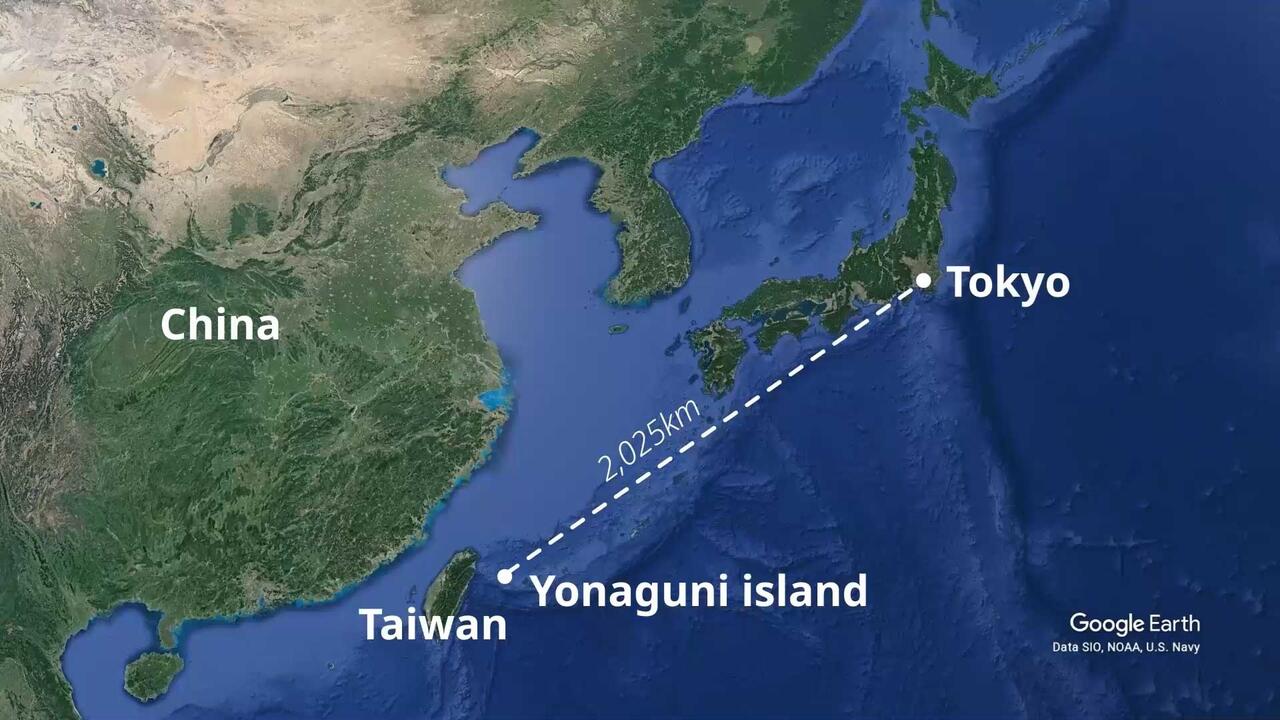
The South China Morning Post previously reported that China has stepped up coast guard and naval activity east of Taiwan in response to maritime boundary talks announced in May between Japan and the Philippines.
JAPAN//
Japan’s Electricity Prices Surge 25% As LNG And Coal Costs Soar
Tuesday, Oct 20, 2026 – 06:50 PM
Authored by Tsvetana Paraskova via OilPrice,
Japan’s average power prices jumped by over 25% at the start of this week from the previous week amid soaring LNG and higher coal prices.

The nationwide power price rose by over 25% week-to-week to $0.19 (31.15 Japanese yen) per kilowatt-hour (kWh) on Monday, Bloomberg reported, citing data from Japan Electric Power Exchange.
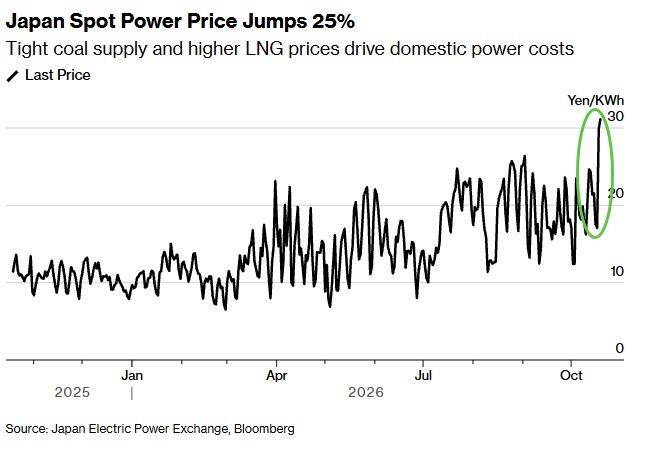
Japan, one of the world’s biggest LNG importers, this summer reduced gas-fired generation in favor of coal as the price of liquefied natural gas remained elevated.
Japan has been burning more coal and less gas for power generation since the war in the Middle East started, and it is not the only one. All Asian countries have made the switch from gas to coal on affordability and availability grounds.
Moreover, surging oil prices have led to a significant increase in Japan’s import bill for oil and LNG.
LNG prices surged in Asia to a four-year high as very few cargoes manage to exit the Strait of Hormuz while competition with Europe for winter supply is intensifying.
The average spot LNG price for delivery into north-east Asia in December was assessed at $29.30 per million British thermal units (MMBtu) at the end of last week. This was the highest spot LNG price for Asia since December 2022, and sharply higher compared to $26.50 per MMBtu assessed in the previous week.
As a result, Japan’s gas-fueled power generation is the most expensive in years.
The switch to coal, for its part, has also had its cost challenges this year. Increased demand in Asia amid reduced supply from the top thermal coal exporter, Indonesia, is driving up coal prices, too. The global benchmark for coal prices, the Newcastle futures, have jumped by 30% compared to pre-war levels.
Power prices in Japan have also jumped this month due to scheduled maintenance at some power-generating facilities ahead of winter.
3/CHINA
China Imposes Export Curbs On Drones, Heavy Machinery
Wednesday, Oct 21, 2026 – 11:20 AM
Authored by Dorothy Li via The Epoch Times,
China said on Monday it would expand curbs on drone exports and restrict the sales of some heavy machinery to “sensitive countries” with which the communist regime has disputes.
Exporters will need a license to ship certain types of drones, such as those capable of traveling more than 300 km (186 miles) or flying beyond the natural line of sight, China’s Ministry of Commerce said in an Oct. 19 statement, citing national security grounds. The drones’ engines, operating systems, and technologies used for manufacturing will also be subjected to controls.
Other affected products include some tunnel-boring machines, walking excavators, and high-altitude concrete-spraying machines – all sophisticated machinery for building railway and road tunnels through mountains, according to a separate press release.
Decades of investment have helped China become the world’s major supplier of tunnel-boring machines. Chinese media have long touted that the country makes 70 percent of such machines around the globe. Among the leading manufacturers are state-owned China Railway Engineering Equipment Group, whose website said its machines are delivered to overseas projects in 36 countries, including Italy, Australia, and Peru.
Separately, the regime’s commerce ministry announced export restrictions on key components of dredgers, including heavy-duty pumps used to scoop up mud and sand from the seabed.
Overseas companies and individuals will be barred from transferring China-sourced dredger-related items to “sensitive countries and regions that have disputes with China,” the ministry said.
Beijing didn’t name any specific country. But some analysts, including Brookings Institution fellow Kyle Chan, said India could be a likely focus. The two neighbors have longstanding border disputes that escalated into war in the 1960s.
China has invested heavily in developing its dredger industry, with state-owned CCCC Dredging being the country’s leading producer and contractor.
All three new export restrictions will be enforced beginning Nov. 18.
A ministry spokesperson said these newly added products have “clear dual-use characteristics,” meaning they can be used for both military and civilian purposes. Chinese officials had already notified trading partners through export-control dialogue mechanisms ahead of the announcement, the spokesperson added.
The ministry also signaled tightened checks on dual-use products. Customs officers will detain goods and question export operators if they suspect a shipment includes controlled items. Exporters will have seven working days to respond and submit required documents such as contracts and receipts. The rules take effect immediately and also apply to cross-border e-commerce, mail, and travelers’ luggage.
The expanded export controls came amid global concerns over reliance on China for raw materials and industrial products.
China restricted shipment of rare earths – a sector in which it accounts for about 70 percent of global supply – in late 2025 ahead of trade negotiations with the United States, and again earlier this year amid tensions with Japan. The sweeping restrictions have prompted the United States and other major economies to diversify the source of the supply chain critical for products ranging from smartphones and medical imaging to military equipment.
Last week, the commerce ministry unveiled sweeping export controls on dozens of technologies related to artificial intelligence as Beijing tightens controls on the strategic industry amid rivalry with the United States. Also added to the export-control list were biotechnology and technologies used to make solar equipment.
Senior U.S. and Chinese officials are set to hold a talk by November under a mechanism established at a September summit between U.S. President Donald Trump and Chinese leader Xi Jinping in Washington.
END
/TAIWAN/MICRON
Micron Faces Taiwan Strike As Union Demands “Fair Profit-Sharing System”
Wednesday, Oct 21, 2026 – 02:45 AM
Neoclouds and hyperscalers face mounting pressure as scrutiny grows over AI’s circular financing, while Morgan Stanley has outlined several scenarios that could derail the $1.6 trillion AI data-center buildout.
Now, another potential pressure point is emerging in the chip supply chain.

Reuters reported that a union locked in a pay dispute could launch a strike on Thursday at Micron’s Taiwan plant, raising the risk of disruption at a key manufacturing hub for memory chips used in AI servers.
The Taoyuan union said the walkout would coincide with a mediation meeting between Micron and a separate union representing employees at its Taichung operations.
The labor action aims to show solidarity and pressure the US chipmaker to present a better profit-sharing proposal for workers.
Micron employs about 15,000 people in Taiwan and manufactures DRAM and high-bandwidth memory chips that have largely been in short supply this year because of the massive demand wave from data centers.
The planned strike follows unsuccessful mediation between Micron and the Taoyuan union last month.
Members authorized the ability to conduct a labor action in early October.
In May, chipmaker Samsung had to confront its labor union over pay disputes and the risk of a major strike that threatened production lines for some of the world’s most advanced memory chips. Those disputes were eventually settled.
“Through our actions, we will make our dissatisfaction with the current system heard and demonstrate our determination to establish a fair profit-sharing system,” the Taoyuan union wrote in a statement.
END
4. EUROPEAN AND SCANDINAVIAN COMMENTARIES PLUS NATO
FRANCE/
Why France?
Wednesday, Oct 21, 2026 – 02:00 AM
Authored by Stephen Soukup via American Greatness,
France is burning. But why? The obvious answer to that question is that it has imported massive numbers of people – often young, military-aged men – from parts of the world where violence is more prevalent. Or, as the President of the United States put it over the weekend, “The immigration of people from an entirely different world, people with hatred in their hearts, has shattered that once great country.”

This is all well and good and, of course, there’s a great deal to it. France has, indeed, “imported the third world” (to use the Vice President’s phrasing). Interestingly, though, over the last couple of decades, France has imported far less of the Third World than its larger neighbors have, both in absolute and relative numbers.
Over the past ten years or so – since Third World immigration to Europe ceased to be a “problem” and became a “crisis” – no nation has seen a greater influx of foreign-born residents than Germany. From 2015 to 2024, Germany welcomed just over 6 million immigrants, which is equivalent to the rest of the EU combined. Its foreign-born population jumped from 13.4 percent to 20.9 percent, a massive increase, and the overwhelming majority of those immigrants came from “non-EU countries.” The UK followed Germany with more than 4 million immigrants, and Spain was a slightly more distant third (in total number of immigrants).
Relatively speaking, Malta saw its foreign-born population jump from 9 percent in 2013 to 32 percent in 2024, the largest increase over the last decade (or so). It was followed by Luxembourg, Portugal, and Germany.
Compared with almost all of its European cousins, France’s foreign-born population has increased relatively slowly, from 9.1 percent to 11.3 percent (albeit with a change in methodology). If the obvious answer were the correct answer, in other words, then Germany would be burning, Malta would be burning, the UK and Spain would be burning, but France would be fine. But it’s not. So again, why is France burning?
I know that the consensus is that what is happening in France today is likely to happen in Germany tomorrow, the UK the day after that, and all across Europe next week. Moreover, the conventional wisdom on the Right has it that the French uprising should be seen as a warning to the United States, which is to say that all Western nations have similar problems to France and all Western nations should, therefore, be preparing to deal with domestic Third Worldism at some point in the not-so-distant future.
Now, to be fair, there is some truth in this. There are significant and universal problems associated with importing huge groups from non-Western societies and consciously choosing not to “Westernize” them or integrate them culturally. The West’s crisis of confidence, its ideologically driven detestation of its own heritage, and its refusal to demand assimilation by its new residents are widespread failures that have produced and will continue to produce significant social, cultural, and economic issues. There can be little doubt about that.
At the same time, however, France is still different from the rest of us in the West. There is no real equivalent for the French experience – or at least there’s no real equivalent in Europe.
For most of Europe, the “migrant crisis” began in 2015, when more than a million refugees from the Middle East and North Africa sought asylum from ongoing war and related devastation. For France, by contrast, its own migrant crisis started more than six decades earlier, in 1954, with the creation of the Algerian National Liberation Front (FLN), which issued a declaration calling for national independence on November 1 of that year and launched the Algerian Revolution/French-Algerian War. By the time the war technically ended eight years later, the Fourth French Republic had fallen, Paris police had massacred as many as several hundred Algerian immigrants in a single-day crackdown on dissent, tens of thousands of “harkis” – i.e., Muslim auxiliaries who fought for the French in Algeria – were resettled in France, and hundreds of thousands of economic refugees had fled Algeria for France (although some returned “rotationally”). Additionally, in 1968, six years after the end of the war, France and Algeria reached an agreement providing Algerians unique immigration and work status, which contributed to an approximate doubling of the Algerian population in France over the next 15 years.
What all of this means is that while France may have a lesser issue than its European brethren with a restless foreign-born population, it has a much more serious and much better-established problem with second- and third-generation immigrants, mostly from Africa. Those populations might not present a serious risk to the French state if they had been integrated in any serious or sustained way, but they haven’t been. If anything, they’ve been rather mercilessly isolated and segregated from the productive parts of French society. When I wrote above that France has no equivalent in Europe, what I meant was that France’s policies toward and treatment of its African migrants have a parallel of sorts, but one found, ironically enough, in Africa.
Two of the most significant and far-reaching acts of the National Party, the party of the Afrikaner white minority and the architect of apartheid in South Africa, were the 1959 Promotion of Bantu Self-Government Act and the 1970 Bantu Homelands Citizenship Act. Both of these were presented to the world as magnanimous acts on the part of the National Party to give the country’s black population its own lands and a chance at political independence. In truth, of course, the Bantustans (literally “people places”) were the apartheid regime’s attempt to rid the white areas of the country of the black “surplus population” and to deprive them of their citizenship, thereby eliminating any claims they might someday make against their stolen property.
Black South Africans were divided up along rudimentary ethnic and linguistic lines and were then sent to the “homeland” that had been designated for their group. And when I say “sent,” I mean that they were told to go, were given no choice in the matter, regardless of their connection to the land, and were then physically forced to move. Once in their new Bantustans, the people were told that they were no longer citizens of South Africa but were, instead, citizens of their new “homeland,” which would be treated by the National Party regime as a “foreign” polity. In their generosity, the Afrikaners (that is to say, the descendants of the 17th- and 18th-century Dutch settlers) gave their black “former” countrymen 13 percent of the country’s absolutely most craptastical land – even though blacks constituted roughly three-quarters of the population and even though the country is among the most blessed by God in terms of beauty and natural resources. Strangely, all the gold and the uranium and the rest of those resources just happened to be located in “white South Africa.”
Anyway, the Bantustans served several purposes for the apartheid regime, but most significantly, they kept the black people where the government could keep an eye on them.
For much of the 1960s and 1970s, the French and South African governments remained on very good terms. France was apartheid South Africa’s second-largest foreign partner and its collaborator in nuclear research and energy. Perhaps one of the things that bound the two regimes together was their mutual distrust of their “surplus populations,” those undesirable foreigners, for whom they, apparently, had no use and no civil solution. That term, “undesirable foreigners,” has its roots in the internments of the late 1930s and the Vichy years, when camps like Rivesaltes held those the state deemed unsuitable. As the historian of modern France Jeannette E. Miller notes, Rivesaltes was one of the more infamous of “the two hundred internment camps… that dotted the French countryside during the ‘Dark Years,'” in part because it was “repurposed” by the post-war French government as a resettlement camp used to house harki immigrants. To be clear, the harki housing camps did not serve the same purpose as the Nazi transit camps, and they were not Bantustans, not even close. They were, however, brutal, ugly, depressing, and purposefully isolating. They were used by the French government to dispose of its unwelcome immigrants, the Algerians it felt a duty to resettle but whom it had no desire to integrate into French society.
These camps were also, in many ways, the antecedents to the nation’s now-infamous banlieues.
Banlieues is a generic term identifying any suburb of any of France’s major cities. But it’s also a term that has been used more and more over the past couple of decades derogatorily, a term intended to convey the ugliness, poverty, and despair of the mostly African, mostly Muslim suburbs of Paris. These ghettos were created to be “utopias for workers,” but, over time, came to be the place in which the descendants of African immigrants and other unwanted people are isolated. And they are almost entirely ignored by Parisian cosmopolitans – or at least they’re mostly ignored, springing to mind only when their residents riot or commit acts of terror. The banlieues are where today’s French keep their undesirables, their surplus population, the people whom they don’t want to think about but would nevertheless like to keep an eye on. The banlieues are the places the French keep around because their minorities exist and, as Spike Milligan noted, everybody has to be somewhere.
For the last decade-plus, ever since the terror attacks at the offices of the satirical magazine Charlie Hebdo, American journalists have flocked to the banlieues to tell their story and to demonstrate their true beauty as hubs of “diversity.” These journalists’ real goal, of course, is to prove conservatives wrong about the banlieues being “no-go zones.” What they’ve done in reality, however, is prove something else altogether: namely that France is a pretty screwed-up country and one flirting for years with the type of violence it’s currently enduring. One such profile, penned by The New Yorker’s George Packer, gives a good sense of the conditions:
Ben Ahmed, who is thirty-nine, works as a liaison between residents and the local government in Bondy – a suburb northeast of Paris, in an area called Department 93. For decades, a bastion of the old working class and the Communist Party, the 93 is now known for its residents of Arab and African origin. To many Parisians, the 93 signifies decayed housing projects, crime, unemployment, and Muslims. France has all kinds of suburbs, but the word for them, banlieues, has become pejorative, meaning slums dominated by immigrants. Inside the banlieues are the cités: colossal concrete housing projects built during the postwar decades, in the Brutalist style of Le Corbusier. Conceived as utopias for workers, they have become concentrations of poverty and social isolation….
For all their vitality, the banlieues feel isolated from the city, and from France itself. Parisians and tourists rarely visit them, and residents complain that journalists drop in only to report on car burnings and drug shootings…. Many suburban residents, meanwhile, never even think of going to Paris. Compared with American slums, the banlieues have relatively decent standards of housing and safety, but the psychological distance between the 93 and the Champs-Elysées can feel insuperable – much greater than that between the Bronx and Times Square. The apartment blocks in the cités, often arranged around a pharmacy, a convenience store, and a fast-food joint, look inward. Many have no street addresses, obvious points of entry, or places to park. The sense of separation is heightened by the names of the surrounding streets and schools, preserved from a historical France that has little connection to residents’ lives….
To be clear (again), the banlieues are not Bantustans. Nothing else really could be; nothing else really could compare to the Nationalist South Africans’ ingenious depravity. At the same time, though, the similarities are striking – and telling. Conservative commentators mocked Sky News over the weekend for attributing the violence in France to “economic inequality.” That’s fair, but only up to a point. There is undoubtedly a meaningful economic component to the anger and frustration exploding throughout the country. That’s not the lone cause, of course, but it’s not insignificant. As for the “inequality” variable, that too is important. As angry and violent as some black South Africans are with their white countrymen today, imagine how much more frustrated and violent they’d be if the free world hadn’t applied the pressure necessary to overturn apartheid.
Now apply that to France.
The Western world is, indeed, at risk from importing masses of migrants who are unwilling to assimilate. Again, that much is clear. Still, the lesson to learn from France right now is that assimilation doesn’t happen by accident. To save themselves, the nations and peoples of the West must recover their civilizational self-confidence and must, as a result, make a much greater effort to assimilate their newcomers and their children – economically and culturally.
We publish a variety of perspectives. Nothing written here is to be construed as representing the views of ZeroHedge
END.
FRANCE/BOND YIELDS
French Bond Yields Explode To 24-Year High As Unrest And Fiscal Crisis Collide
Wednesday, Oct 21, 2026 – 07:20 AM
France’s accelerating death spiral, amid social unrest by far-left groups, political gridlock, and deteriorating public finances as the welfare state teeters on the brink of implosion, comes just six months before a presidential election that has only given polling tailwinds to right-wing candidate Marine Le Pen.
A Financial Times opinion piece earlier today asked, “Is France spinning out of control?“
It’s not even a question, but a stated reality, that Macron and his globalist buddies are ending the presidential term under a number of crises that seem to be hitting all at once.
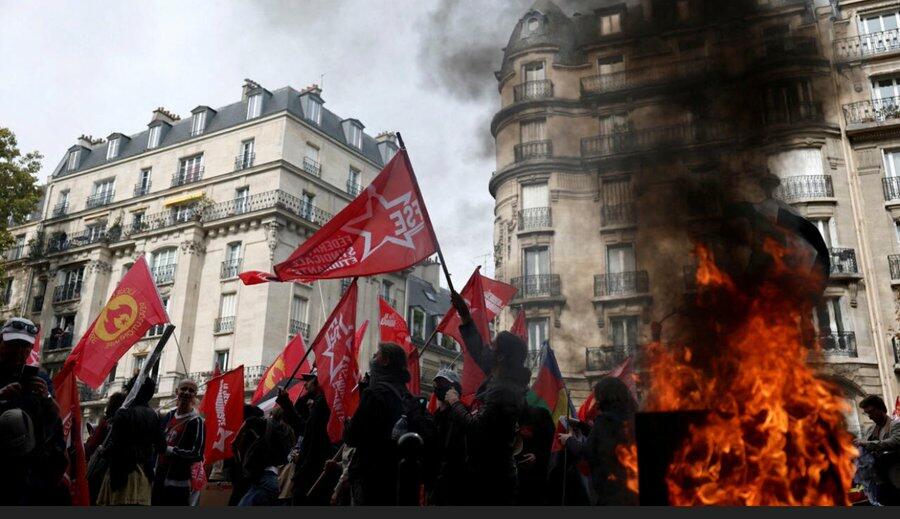
On Monday, Interior Minister Laurent Nuñez acknowledged that police lost control in some metro areas during the weekend’s far-left uprisings, in which rioters looted mom-and-pop and luxury stores, burned down buildings and clashed with police. President Emmanuel Macron rejected his offer to resign.
Social unrest is only one part of the crisis. The other is fiscal, as French 10-year government bond yields jumped to 5% earlier this morning, the highest level since 2002.
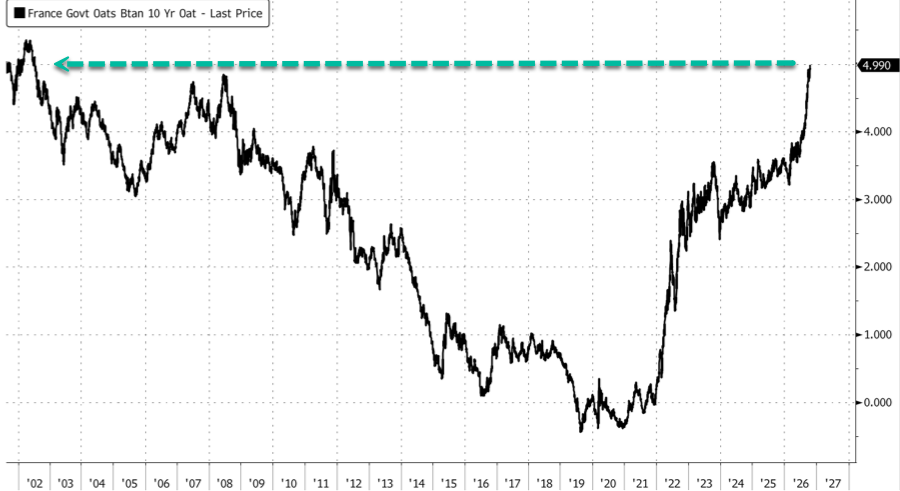
The bond market sees social unrest, an approaching credit-rating review later this week, and a deficit crisis as severe problems that may have paralyzed the Macron government.
By the end of the week, Moody’s is scheduled to review France’s Aa3 rating, with a negative outlook already in place as the government struggles to pass its 2027 budget.
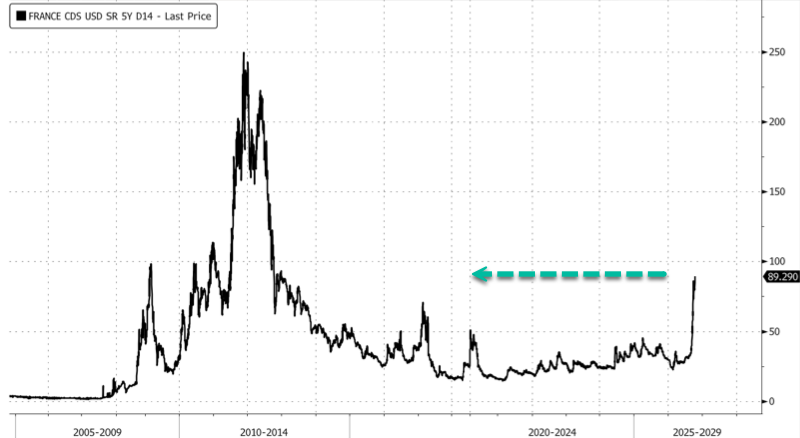
The 10-year yield spread between French and German government bonds has also risen to levels not seen since the Eurozone debt crisis. That spread neared 160 basis points earlier this morning.
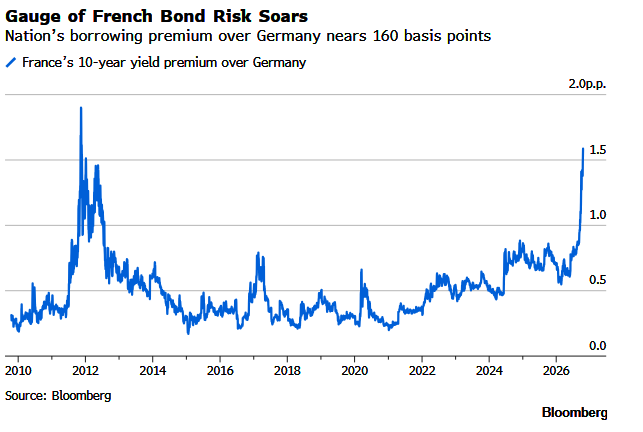
If the current unrest and fiscal troubles persist, alongside mounting questions about how to fund the welfare state in a high-rate environment, this could easily scare more investors away. That seems to be the outcome at the moment without necessary fiscal reforms.
Deutsche Bank senior economist Yacine Rouimi wrote in a note that France ranks as the most vulnerable economy among 18 euro-area countries because of sovereign debt crisis risks.
Rouimi’s gauge of EU countries at risk of economic turmoil covers public finances, external balances, private debt, banking resilience and the labor market.
Ireland, Greece and Portugal have seen some of the biggest improvements since 2010. But France, Belgium and Finland have fallen in the wrong direction, only suggesting how France could become the epicenter if a Eurozone crisis 2.0 were to emerge.
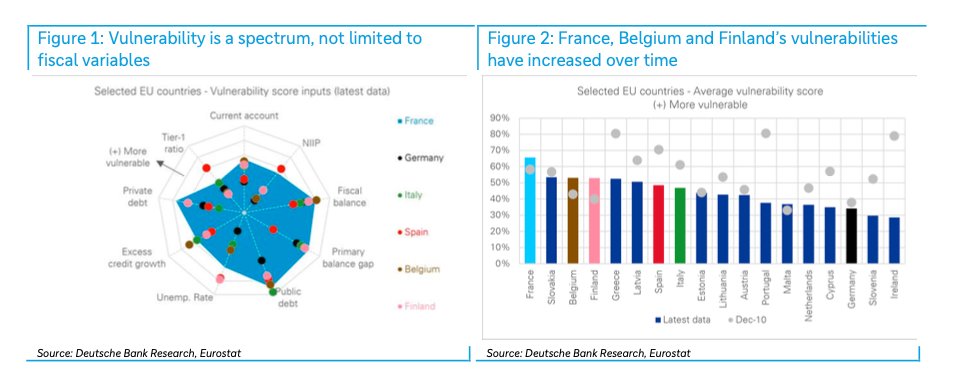
Separately, Citigroup strategist Jamie Searle warned that “OAT-Bunds broke yesterday” and that the country-specific risk premium was in “uncharted territory.”
Searle said last weekend’s social unrest has further complicated France’s budget negotiations.
Foreign investors in French government debt appear to be exiting…
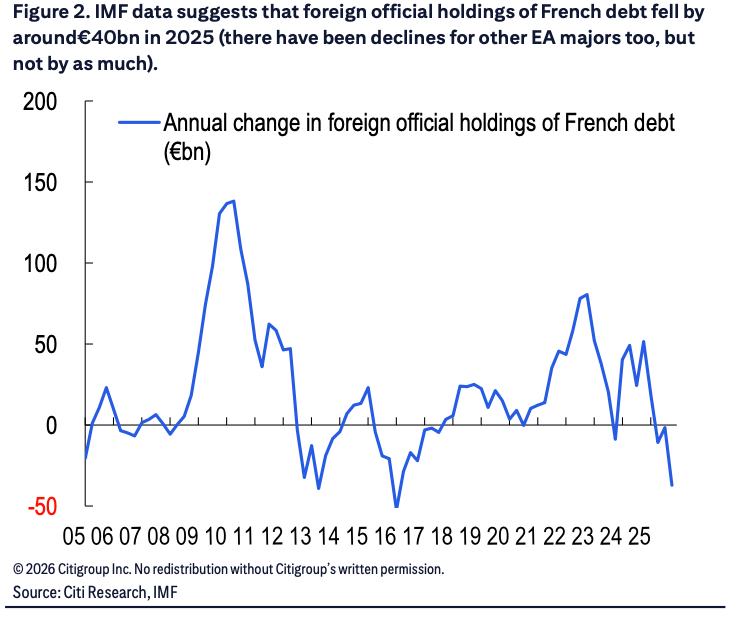
“Decades of uncontrolled public spending (France has not had a balanced budget since 1974) and years of ‘whatever it takes’ after the pandemic have pushed the public deficit to 5.4 percent of GDP this year. The national debt has reached 119 percent, its highest level since 1946, and keeps ballooning,” Le Monde editorial director and FT columnist Sylvie Kauffmann wrote in the opinion piece.
What should become more noticeable by now is that the unrest was likely spurred by far-left groups (as per Fox News’ report) over the inevitable fate of the bloated welfare system. As Le Pen’s shadow budget showed just weeks ago, France will have to make sizeable cuts and reduce government handouts to avoid a sovereign debt crisis that could unleash Eurozone crisis 2.0. In other words, a period of austerity would likely be needed, and this will certainly enrage the left even more.
END
FRANCE/CONTAGION
France’s Debt Crisis Is No Longer The Story… Contagion Is

France’s escalating sovereign debt and political stresses have shifted market focus from the country’s own fiscal problems toward broader eurozone contagion risks.
businessinsider.com
As of mid-to-late October 2026, French 10-year government bond yields have surged toward ~5% (highest since around 2002), while the spread over German Bunds has widened to levels last seen during the 2011–2012 eurozone debt crisis (roughly 140–150+ basis points in recent peaks). Debt-to-GDP is projected near or above 119%, with persistent deficits around or above 5% of GDP, large upcoming refinancing needs, and political gridlock ahead of the 2027 presidential election. Violent protests and budget fights have further unsettled investors.
theguardian.com
Why “contagion” is now the bigger story
- Spillover to other sovereigns: Yield spreads have also widened for Italy, Belgium, Greece, and others as investors reassess eurozone fiscal risks more broadly. France’s large, liquid bond market (one of Europe’s biggest) means forced selling or risk aversion can transmit more easily than a smaller peripheral crisis once did. politico.eu
- Banking and financial channels: European bank stocks (especially French ones) have come under pressure. Memories of the earlier “doom loop” (sovereign stress hurting banks that hold sovereign debt, which then feeds back into sovereigns) have reappeared in commentary.
- Market mechanics: Foreign ownership of French debt is high. Large holders reducing exposure, combined with higher global yields and reduced demand, can amplify moves. Analysts note that while disorderly escalation and real-economy contagion risks appear lower than in 2011–15 (thanks to the ECB’s backstop tools and a more complete eurozone architecture), the underlying fiscal challenges in France look harder in some respects. theguardian.com
- Political feedback loop: Limited room for fiscal adjustment collides with protests and election positioning, raising the chance of further market pressure that constrains policy options.
The Market Ear headline captures a widely discussed shift in market narrative: France’s problems are no longer viewed as purely idiosyncratic. Similar concerns appear across major outlets (Business Insider, Bloomberg, Politico, Reuters, Guardian, etc.), with references to “contagion risk is back in Europe,” revived ghosts of the sovereign debt crisis, and questions about whether stress can stay contained.Key differences from 2010–12 include a more developed ECB toolkit (including the Transmission Protection Instrument) and stronger bank capital overall, which many analysts say lowers the probability of a full-blown systemic repeat. However, France’s size, debt trajectory, and domestic political constraints make sustained high yields costly and keep the risk of broader spread widening and euro pressure alive.In short, the core French fiscal and political issues remain unresolved, but markets are increasingly pricing the possibility that the stress does not stay isolated.
END
FRANCE
FULL EXTENT OF DAMAGE CAUSED BY THE FIRES ON CARS
France’s Open-Air Incinerators: The Uncounted Toxic Toll Of Annual Street Protests
Wednesday, Oct 21, 2026 – 04:15 AM
Every time political anger spills into French streets – whether over pension reforms, fuel taxes, police shootings, or the annual ritual of Saint-Sylvestre on New Year’s Eve – the post-mortem follows a familiar script. The Ministry of the Interior tallies the arrests, insurers calculate the millions in property damage, and municipal crews sweep up the melted asphalt before morning commuters arrive. The rioters – who kicked this off in working-class banlieues (which has high concentrations of North African and sub-Saharan immigrants) are burning whatever they can get their hands on; cars, tires, plastic bins, buildings, etc.

And, as one might imagine, this is extremely toxic.
Over the past decade, an average of 35,000 to 40,000 vehicles have been intentionally torched across France every year, punctuated by massive spasms of civil unrest – such as the June 2023 riots, which saw more than 12,000 vehicles burned, or New Year’s Eve 2025/2026, when 1,173 parked vehicles were reduced to ash overnight. When you strip away the political theater, France’s recurring protests function as unlicensed, open-air hazardous waste incinerators operating at breathing height in the country’s most densely populated neighborhoods.
In the European Union, an industrial waste incinerator is legally required to burn materials above 850°C inside sealed chambers equipped with rapid gas-quenching towers and multi-stage chemical scrubbers. A burning Peugeot or stuffed municipal dumpster on a narrow street in Paris, Lyon, or Marseille smolders in an oxygen-starved state between 250°C and 450°C – the exact temperature sweet spot for cooking up some of the deadliest carcinogens and “forever chemicals” known to science.
Unlike a wildfire, whose immense heat lofts smoke miles into the sky, a street fire has a weak heat plume that gets trapped between mid-rise apartment blocks. Caught in street-level wind tunnels, the smoke pools for hours. Within 50 meters (164 feet), it delivers a choking, acidic shock; out to 300 meters, it seeps through apartment window air vents (bouches d’aération) from the ground floor to the sixth story, coating balconies, playgrounds, and parks in oily black fallout; out to several kilometers, it merges into a toxic citywide haze.
The result is a slow-motion public and ecological health crisis – one that poisons residents, first responders, family pets, and urban wildlife long after the flames are put out.
https://zh-desk.github.io/riot-night-plume-map.svg
Tires
A standard set of four passenger car tires contains nearly 90 pounds (40 kilograms) of synthetic petroleum-based rubber, heavy industrial oils, and chemical preservatives added to keep tires from cracking in the sun and street air. Stacking tires onto protest barricades or burning them on a car axle is essentially lighting a barrel of crude oil mixed with rubber cement in the middle of a residential street.
Because open tire fires burn poorly, they pump out thick, oily black clouds packed with Benzo[a]pyrene – the same cancer-causing tar found in cigarette smoke and chimney soot – alongside 1,3-butadiene (an industrial gas used to manufacture synthetic rubber, carpet backing, and shoe soles) and 6PPD-quinone (a toxic byproduct created when tire rubber preservatives react with the air). Pound for pound, a burning tire releases up to 1,000 times more cancer-causing tar than the tailpipe of a modern car.
BURNING TIRES
A 90 lb (~40 kg) tire-rubber burn: smoke hazards and a related runoff contaminant.

Benzo[a]pyrene
PAH [1]
COMBUSTION POLLUTANT
HUMAN & ANIMAL IMPACT
DNA-damaging carcinogen
Can damage DNA once activated; risk depends on dose and duration.
PERSISTENCE & SCALE
Binds to soot and dust
Can build up in soil and sediment; varies with sun and microbes.
1,3-Butadiene
Volatile gas [2]
COMBUSTION POLLUTANT
HUMAN & ANIMAL IMPACT
Linked to leukemia
Known human carcinogen; workplace exposure tied to leukemia.
PERSISTENCE & SCALE
~6-hour air half-life
Estimated breakdown time in air; reach depends on wind and fire.
6PPD-quinone*
Byproduct [3]
RELATED RUNOFF HAZARD
HUMAN & ANIMAL IMPACT
Highly toxic to coho salmon
Linked to urban-stream salmon deaths; human effects under study.
PERSISTENCE & SCALE
Road runoff to waterways
Tire-wear residue washes into streams; fire release not established.
Fine & ultrafine soot
PM2.5 & PM0.1 [4]
AIRBORNE PARTICLES
HUMAN & ANIMAL IMPACT
Deep-lung & heart effects
Can worsen asthma and affect the heart; some can reach the blood.
PERSISTENCE & SCALE
Downwind transport
Can settle nearby; reach depends on wind, weather and fire.
*6PPD-Q is a related tire-runoff hazard; it is not a confirmed tire-fire smoke emission. 40 kg is an illustrative scenario, not a measured emissions estimate; emissions and risks vary with combustion and exposure.
SOURCES: [1] EPA / ATSDR: PAHs · [2] ATSDR / NCI: butadiene · [3] EPA: 6PPD-Q · [4] EPA: particle pollution
EFFECT ON HUMANS & ANIMALS: Benzo[a]pyrene is a top-tier human carcinogen. Once breathed in on fine soot or absorbed through the skin, the body converts it into compounds that permanently damage DNA and switch off the body’s natural tumor-fighting genes, driving lung and bladder cancers, while 1,3-butadiene attacks bone marrow to trigger leukemia. Because heavy tire soot settles onto sidewalks and grass within 50 to 300 meters and sticks around for months, neighborhood dogs, cats, and ground-feeding birds continuously swallow and inhale toxic doses through their paws, fur, and feathers. A 2026 study by researchers at York University and Environment and Climate Change Canada (Environment International) found that airborne tire preservatives break down into chemical cocktails that trigger aggressive inflammation in human immune cells in the lungs. Recent toxicological research on human liver cells and 2026 studies in Environmental Science & Technology showed that tire-derived 6PPD-quinone damages human liver tissue and causes mass die-offs in fish when rainwater washes street runoff into local rivers – though French public health agencies still have not officially linked urban tire-fire hotspots with local cancer or veterinary illness spikes.
Cars (Seats, Dashboards & Wiring)
A modern car is built with 250 to 350 kilograms of plastics, foams, and synthetic fabrics. The seat cushions are made of polyurethane foam – the same spongy material inside living-room couches and memory-foam mattresses – while the miles of electrical wiring behind the dashboard are wrapped in PVC (the same chlorinated plastic used to make household plumbing pipes, vinyl window frames, and shower curtains).
When a car is torched, the smoldering seat cushions vent lethal clouds of hydrogen cyanide – the same chemical released by the World War II poison gas Zyklon B – while the melting PVC wiring reacts with the copper wires inside it to cook up chlorinated dioxins and furans, the infamous class of ultra-toxic “forever chemicals” found in Agent Orange. According to European emission inventory figures and Germany’s official tailpipe inventory factors, torching a single car releases about 0.048 mg of dioxins and furans (in toxic equivalents) – as much as an ordinary passenger car would emit driving roughly 8 million kilometers, or 200 laps around the Earth’s equator.
ZeroHedge
DATA DESK
TOXIC FALLOUT PROFILE //
TORCHED CAR INTERIORS & WIRING
What burning seats, dashboards and wiring can release – and why the fallout lasts.

Chlorinated dioxins
PCDD/F [1]
PERSISTENT POLLUTANTS
HUMAN & ANIMAL IMPACT
7-11-year body half-life
Accumulate in fat; can disrupt hormones and development. TCDD: known carcinogen.
PERSISTENCE & SCALE
~8 million km of driving*
One car fire’s tailpipe-dioxin equivalent: ~200 laps of the equator.
Hydrogen cyanide
HCN [2]
CHEMICAL ASPHYXIANT
HUMAN & ANIMAL IMPACT
Starves the brain and heart
Stops cells using oxygen; severe exposure can cause rapid collapse and death.
PERSISTENCE & SCALE
50 ppm danger benchmark
NIOSH immediately-dangerous level; exposure varies with smoke, time.
Hydrogen chloride
HCl [3]
CORROSIVE GAS
HUMAN & ANIMAL IMPACT
Burns eyes and airways
Turns to hydrochloric acid in moisture; high levels can burn airways.
PERSISTENCE & SCALE
1.4 kg in a car-fire test
Measured in one whole-car test; varies with PVC content and fire.
Particulate fallout
PM2.5 [4]
AIRBORNE PARTICLES
HUMAN & ANIMAL IMPACT
Deep-lung & heart effects
Can worsen asthma, affect the heart, and settle into soil and water.
PERSISTENCE & SCALE
~2.3 kg per car fire
EEA whole-vehicle PM2.5 estimate; 95% uncertainty range 1-5 kg.
*Illustrative: 48 µg I-TEQ per car fire ÷ 6 pg I-TEQ/km = 8 million km. I-TEQ weights dioxins by toxicity. Factors cover whole vehicles, not interiors alone or a fixed 45-minute burn; actual emissions vary. Dioxins can persist in soil for years to decades; the body half-life describes slow clearance, not a fixed residence time.
SOURCES: [1] WHO / EEA / UBA · [2] ATSDR / NIOSH: HCN · [3] ATSDR: HCl · [4] EEA 2023: car-fire factors · Calculation: UBA 2025 · HCl test: SP/RISE
EFFECT ON HUMANS & ANIMALS: Within 50 meters of a burning car, cyanide gas and airborne hydrochloric acid (a harsh, corrosive acid used in industrial concrete cleaners and swimming pool treatments) burn the airways and starve the heart and brain of oxygen. Further out, dioxins settle into neighborhood dirt and courtyard dust, where they take 10 to 25 years to break down. Once inside the human body, dioxins lock into body fat and liver tissue – the body needs 7 to 11 years to clear even half of them – scrambling hormones, promoting cancer, and crossing the placenta to stunt fetal growth. Paris-region soil is already so heavily contaminated that, after a 2023 study prompted by concerns over the Ivry waste incinerator found dioxins, PCBs and PFAS in backyard eggs across the capital and its inner suburbs, the Regional Health Agency (ARS) of Île-de-France warned residents of the roughly 400 communes of the greater Paris area not to eat eggs from their own hens [1]. The agency tied the contamination to dense, long-industrialized urban soil rather than any single source – and every torched car adds straight to that toxic soil bank. Research led by Inserm and Université Paris Cité has shown how prenatal exposure to urban air pollution damages the placenta and harms fetal development, while a 2024 French Senate investigation and ANSES occupational risk reports documented surging rates of bladder, prostate, and blood cancers among French firefighters (sapeurs-pompiers) routinely exposed to urban fire smoke – even as high civilian cancer and infant mortality rates in arson-heavy suburbs like Seine-Saint-Denis remain officially blamed on highway traffic rather than recurring street fires [2].
Electric & Hybrid Vehicles (Lithium-Ion Batteries)
As France’s car fleet goes electric, street arson has acquired a nasty new chemical edge. An electric vehicle’s battery pack is essentially a giant, thousand-pound version of the rechargeable battery in a smartphone or laptop, packed with chemical fluids that carry electric charge and hundreds of pounds of mined metals.
When a lithium-ion battery catches fire and enters “thermal runaway” – an unstoppable, self-feeding chemical meltdown – its internal battery fluids vaporize into clouds of corrosive hydrogen fluoride gas (a tissue-eating industrial acid used to etch glass and strip rust off stainless steel) alongside invisible metallic dust made of cobalt, nickel, manganese, lithium, and antimony (heavy metals used in industrial alloys, magnets, and ammunition). Putting out a single burning EV takes up to 30,000 liters of water – roughly ten times more than a gas-powered car – turning city streets into rivers of toxic metallic runoff.
ZeroHedge
DATA DESK
TOXIC FALLOUT PROFILE //
EV & HYBRID BATTERY FIRES
What happens when a lithium-ion traction battery enters thermal runaway on a city street.

Hydrogen fluoride
HF / fluoride [1]
CORROSIVE / SYSTEMIC
HUMAN & ANIMAL IMPACT
Lung & electrolyte injury
Severe exposure can injure lungs and skin and disrupt heart rhythm.
PERSISTENCE & SCALE
More fluoride than gas cars
Substantially higher concentrations in tested EV fires (FSRI).
Cobalt, nickel & manganese
Co / Ni / Mn [2]
METAL PARTICLES
HUMAN & ANIMAL IMPACT
Lung & ecological hazards
Metal dust can injure lungs; deposits can expose soil, aquatic life.
PERSISTENCE & SCALE
Elements don’t biodegrade
Can persist in soil and sediment; form, concentration set the risk.
Antimony & lithium
Sb / Li [3]
SMOKE & RUNOFF
HUMAN & ANIMAL IMPACT
Lung, heart & aquatic harm
High antimony-dust exposure can harm lungs and heart; runoff tested toxic.
PERSISTENCE & SCALE
Up to ~30,000 L of water*
Tesla Model 3 guidance; runoff can carry metals, other contaminants.
Mutagenic organics
Smoke extracts [4]
LAB MUTAGENICITY
HUMAN & ANIMAL IMPACT
Mutations in bacterial tests
Most EV smoke extracts were more mutagenic than the gas-car sample at equal mass.
PERSISTENCE & SCALE
Needs targeted testing
Human risk not measured; routine ATMO PM readings miss mutagens.
NIOSH 2026 case: Seconds to 5 minutes of exposure; four firefighters still off duty about 11 months later. The mixed plume was not chemically measured; the injuries cannot be assigned to HF alone.
*Model 3 guidance: 11,356-30,283 L for battery-fire extinguishment/cooling; chemistry, fire conditions and water needs vary.
SOURCES: [1] ATSDR / FSRI · [2] Vehicle-fire study · [3] ATSDR: antimony · [4] Mutagenicity study · NIOSH case report · Tesla Model 3 guide · ATMO index
EFFECT ON HUMANS & ANIMALS: Hydrogen fluoride gas passes straight through the lungs and skin into the bloodstream, where it strips vital calcium and magnesium out of the body – a chemical reaction that can trigger fluid in the lungs, permanent airway scarring, and cardiac arrest. Meanwhile, heavy metals never break down in nature; they stay in urban dirt and river mud forever, poisoning earthworms, insects, and the city songbirds that feed on them. A November 2025 Fire Safety Research Institute (FSRI), NIOSH, and Duke University study and a February 2026 FSRI follow-up study confirmed that burning EVs release substantially higher airborne levels of corrosive fluoride and heavy metals than gas vehicles, and that chemicals in vehicle fire smoke have a higher potential to cause genetic mutations in bacterial tests than smoke from burning wood, household trash, or crude oil. Furthermore, a September 2026 CDC/NIOSH investigation found that California firefighters who breathed battery fumes for just seconds to five minutes while cleaning up a crashed Tesla – with no flames even visible – suffered lasting lung injuries. One firefighter required oxygen after his blood oxygen plunged to 86% just from walking, four developed new high blood pressure within a month, and four were still unable to work about 11 months later – an acute toxic hazard that France’s fixed city air monitors cannot even detect on riot nights.
Plastic Dumpsters & Barricades
The signature fuel of French street protests is the green 660-liter wheeled municipal dumpster. The bin itself is molded from thick HDPE plastic – the same heavy-duty plastic used to make milk jugs, laundry detergent bottles, and plastic patio furniture – and is typically stuffed with household trash, old electronics coated in chemical flame-retardants, and treated construction lumber.
Melting and burning thousands of these giant plastic vats on the pavement releases concentrated fumes of benzene (a toxic petrochemical solvent found in gasoline, paint strippers, and industrial glues), formaldehyde (the pungent preservative used in embalming fluid and pressed plywood), and brominated furans (toxic cousins of dioxin formed when flame-retardant electronics burn). Worse, these chemicals hitch a ride on ultrafine soot – microscopic specks of carbon 1,000 times thinner than a human hair.
ZeroHedge
DATA DESK
TOXIC FALLOUT PROFILE //
PLASTIC DUMPSTERS & BARRICADES
What burning 660-liter HDPE trash bins, electronics, and treated wood can release at street level.

Benzene
C6H6 [1]
KNOWN HUMAN CARCINOGEN
HUMAN & ANIMAL IMPACT
Bone marrow & blood cancer
Long-term exposure can cause acute myeloid leukemia; high short-term doses affect nerves.
PERSISTENCE & SCALE
Exposure follows the plume
Depends on wind, fire heat and nearby buildings; no fixed street footprint.
Brominated dioxins & furans
PBDD/Fs [2]
DIOXIN-LIKE COMPOUNDS
HUMAN & ANIMAL IMPACT
Fat accumulation & toxicity
Some build up in body fat; animal studies show thyroid, reproductive and developmental harm.
PERSISTENCE & SCALE
Contaminated soot & dust
Varies with compound, surface and sunlight; no universal lifespan established.
Formaldehyde
HCHO [3]
AIRWAY IRRITANT / CARCINOGEN
HUMAN & ANIMAL IMPACT
Eye, airway & cancer hazards
Irritates eyes, nose and throat; chronic inhalation can cause nasal cancers and leukemia.
PERSISTENCE & SCALE
Poor ventilation raises risk
Can build up in enclosed spaces; outdoors, varies with wind and fire.
Soot & “pyroplastics”
Smoke + solid residues [4, 5]
PARTICLES & HEAT-ALTERED PLASTIC
HUMAN & ANIMAL IMPACT
Lung & hormone activity tests
Plastic-smoke particles inflamed mouse lungs; burnt-plastic extracts activated hormone receptors in cells.
PERSISTENCE & SCALE
Mutagenic smoke*
Per kg burned, flaming plastic caused more bacterial mutations than plywood or cardboard (EPA).
Laboratory comparison: Flaming plastic had the highest mutagenic particulate emissions per kg among the wastes tested.
*Bacterial mutation assays; cell and animal findings identify hazards, not a measured human cancer risk from a specific street fire. 660 L is bin capacity, not an emissions inventory; contents, combustion, weather and ventilation determine exposure.
SOURCES: [1] CDC: benzene · [2] WHO/IPCS · [3] EPA: formaldehyde · [4] Kim et al. 2021 · [5] James et al. 2025 · HDPE combustion · ATSDR · NIST: smoke
EFFECT ON HUMANS & ANIMALS: Benzene is rapidly absorbed through the lungs, and long-term exposure attacks the bone marrow, causing leukemia, while ultrafine plastic soot is so microscopic that it bypasses the lungs’ natural filters completely – traveling directly up the nasal nerves into the brain, where it fuels brain inflammation and cognitive decline. Because heavy plastic smoke hugs the ground, family pets and urban wildlife breathe the thickest part of the plume. U.S. EPA open-burn pit studies and 2024 human airway studies in Chemical Research in Toxicology proved that smoke from flaming plastics inflicts far worse lung cell damage, airway breakdown, and DNA mutation pound-for-pound than smoke from burning wood or cardboard. Similarly, a 2025 study in ACS Environment & Health revealed that melted plastic crusts left behind after fires (“pyroplastics”) are loaded with toxic tars that hijack hormone and metabolism receptors in both humans and fish – yet French city halls continue to treat torched dumpsters as a routine street-sweeping chore rather than a neighborhood poisoning event.

The Convenient Blind Spot
France’s national air quality monitoring network (ATMO France) and emissions inventory agency (CITEPA) pride themselves on data showing that overall French fine-particulate pollution has fallen by nearly 60% since 2000 thanks to stricter car exhaust filters and factory rules. That national success story is precisely what hides the neighborhood catastrophe.
Fixed air-quality stations measure general background air high above the ground over 365 days; they do not go street-by-street on riot nights to measure cigarette-grade tars, dioxins, or battery metals pooling inside an apartment courtyard. Until French public health authorities start testing the blood and lungs of the residents, children, and animals living inside those 300-meter blast zones, the country’s favorite form of political expression will remain a silent, slow-motion environmental disaster.
References & Sources

UK
Why Can Nothing Be Built In Britain?
Wednesday, Oct 21, 2026 – 03:30 AM
Authored by Mani Basharzad via The Foundation for Economic Education,
A public company in the UK was building a high-speed railway when it suddenly faced a regulation that few could have predicted: a £100 million ($132 million) bat tunnel.
The railway passed through Sheephouse Wood, an area inhabited by rare Bechstein’s bats. To comply with environmental regulations that protect the bats from colliding with high-speed trains, the company had to build a roughly one-kilometer covered structure alongside the railway. This structure has since become widely known in the UK as the “bat tunnel.”
If you think this is just one case, let me tell you about the fish disco.
EDF Energy was developing a new nuclear power station in Somerset, which draws cooling water from the Severn Estuary. The project faced regulatory requirements to reduce the number of fish being drawn into and killed by its cooling-water intake pipes. EDF agreed to three measures: specially designed low-velocity intake heads, a fish recovery-and-return system, and an acoustic fish deterrent—underwater speakers that make noise to steer fish away, nicknamed the “fish disco.” The acoustic deterrent alone reportedly costs about $66 million, while EDF says the full fish-protection package costs more than $926 million.

The problem with the UK is that it has become a vetocracy.
Francis Fukuyama, the famous author of “The End of History,” explored this problem in his often-overlooked book “ Political Order and Political Decay.” The concept helps explain part of the productivity puzzle in the Western world.
Vetocracy means “rule by veto”: a political system with so many points at which organized minorities, courts, agencies, legislators, or interest groups can block action that the majority struggles to govern.
At first glance, this might seem necessary to protect democracy from majority rule and dictatorship. The separation of powers, independent courts, and an independent judiciary are essential safeguards. As Montesquieu famously wrote, “When the legislative and executive powers are united in the same person, or in the same body of magistrates, there can be no liberty.” But vetocracy is not simply about separating powers and protecting minority rights from the majority; it is about paralyzing democratic institutions and preventing the government from functioning.
Take the British example.
Businesses want a new high-speed railway, the company wants to invest in it, and even the government supports it. Yet an independent regulatory body, Natural England, can act as a veto player, imposing additional requirements and costs. And that is the key distinction Fukuyama discusses: the difference between constraints and capacity. Constraints are necessary because they protect our liberties from government overreach. But we also need government capacity: the ability to build things without being buried under thousands of regulations and a maze of supposed “independent actors” empowered by the state to obstruct or reverse policies.
These are the visible costs of regulation: the cancer hospital that cannot be expanded, the house that could help a young person get on the housing ladder, or the nuclear power station that could help bring down energy costs.
But the more serious costs are the ones unseen: the products that fail to come to fruition as a result of regulation. As the Austrian school economist Per Bylund has argued in his book “The Seen, the Unseen, and the Unrealized: How Regulations Affect Our Everyday Lives,” the problem with regulation is that it limits the possibilities of what could happen. It is not just about the direct financial cost of compliance. It is about the choices that disappear, the investments that never happen, and the economic freedom that is gradually eroded. The real cost of regulation is not only what we can see, but also what we never get to see because it was never built in the first place.
Vetocracy is a product of an overextended state: one that wants to be the dominant actor in the economy and micromanage every aspect of economic life.
Sooner or later, it discovers that governing is not as easy as it looks. The barriers originally created by the state in the name of better governance can make effective governance almost impossible. A vetocracy is a democracy that has accumulated so many opportunities to say no that it has lost the practical ability to say yes.
END
UK
“Highly Likely” Iranian State Involvement: UK Re-Arrests 2 In Fairford Air Base Probe
Wednesday, Oct 21, 2026 – 08:15 AM
Authored by Jill McLaughlin via The Epoch Times,
UK police have rearrested two men, suspected of working for Iran’s intelligence service, for allegedly plotting to attack a U.S.-run air base in England last month, officials said Oct. 20.

A 24-year-old British national and a 25-year-old dual U.K.-Iranian national were arrested under the country’s the National Security Act, according to the National Counter Terrorist Policing unit investigating the case.
Five men were initially arrested Sept. 27 on suspicion of explosives offenses and suspicion of preparation of a terrorist act. Two more were arrested in the following weeks. But all seven were subsequently released on bail due to a lack of evidence for formal charges as the investigation continued.
On Tuesday, one of the men first arrested on Sept. 27 and another first arrested Oct. 1 were formally charged.
None of the suspects’ names have been released, including the five other suspects. Counter terrorism police have said all are males in their 20s.
Counter terrorism police were alerted to the suspicious activity on Sept. 27 by a local farmer in Gloucestershire, England, who reported three suspicious vehicles heading toward RAF Fairford, about 100 miles west of London.
Authorities evacuated 85 houses near the air base as an explosive team examined the vans the suspects were driving. Offices found gasoline in the vans but no explosives.
A ‘Complex Investigation’
Detectives are looking at “many lines of enquiry involved in this hugely complex investigation,” Laurence Taylor, the head of the National Counter Terrorism Policing unit said in a statement on Oct. 20.
“This is very much a live investigation, and our evidence gathering continues, but at this time our position remains the same; we consider it highly likely that there is Iranian state involvement.
“Our investigators are continuing to examine what that level of involvement was and the ambition behind it,” he added.
British Prime Minister Andy Burnham told lawmakers last week that the incident was a suspected terror plot “almost certainly” directed by Iran’s Islamic Revolutionary Guard.
Iran continues to deny any involvement in the plot. It condemned Burnham’s allegations. Ambassador of Iran to the United Kingdom Seyed Ali Mousavi accused the British government of lacking evidence linking Iran to the incident, Iran’s state news agency IRNA reported.
The Pentagon had used the base to fly bombing missions into Iran during this year’s conflict. The bombers have since been relocated.

Director General of MI5 Ken McCallum speaks at Thames House, the headquarters of the UK’s Security Service in London, Tuesday Oct. 13, 2026. Jonathan Brady/PA via AP, Pool
Attacks from Iran and Russia have been expanding in the UK over the past year, according to Britain intelligence officer Ken McCallum, who serves as the director of the MI5 spy agency.
McCallum warned that both countries were intensifying attacks in Britain, including at Jewish sites and harder targets like military sites.
In all, more than 50 people have been arrested over Iran-linked plots this past year, he added.
The Associated Press contributed to this report.
END
EUROPE
Franklin Templeton Warns: No One Is Ready For A Eurozone Debt Crisis 2.0
Wednesday, Oct 21, 2026 – 05:45 AM
New curfews in major French cities have helped contain the weeks of social unrest marked by far-left radicals and migrants burning buildings, looting mom-and-pop and luxury stores, and clashing with police. President Emmanuel Macron’s failing government still faces another emerging issue: an alarming debt burden and a welfare state on the brink of collapse, addicted to decades of large deficits.
Franklin Templeton’s chief investment officer for fixed income, Sonal Desai, warned that deteriorating finances could ignite another euro-area debt crisis, potentially harder to contain than the turmoil surrounding Greece.
“France has more than 10 times the debt that Greece had,” Desai said in a webinar earlier today. “A simple bailout is not on the cards.”
“I don’t think anyone is really ready for a euro-zone debt crisis version 2.0,” Desai added. “This one could be significantly worse if it were to come to pass.”
She said investors shouldn’t underestimate the potential for “significant volatility” in EU government bond markets. She added that Franklin Templeton’s bond portfolios are positioned toward shorter-duration assets in Italy and France but have longer-duration investments in Spanish and German debt.
Earlier today, French borrowing costs climbed as investors demanded a larger premium to hold the nation’s debt. This suggests mounting concerns over its debt load.
The extra yield investors demand to hold French 10-year bonds over German debt widened to 154 basis points, the highest since early October.
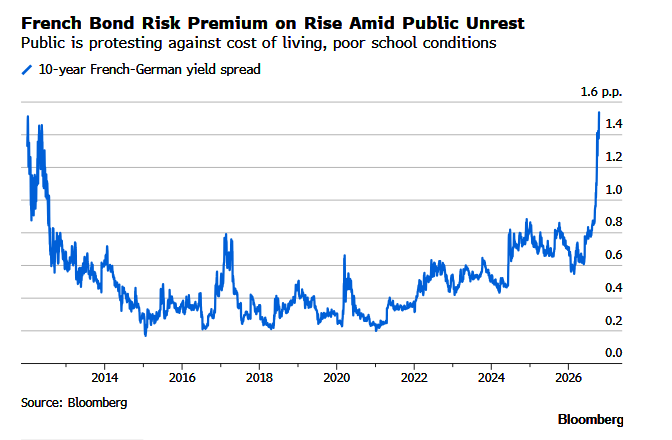
“Bond markets now have much more choice over who they allocate to,” said Karen Ward, chief market strategist for EMEA at JPMorgan Asset Management. “What we’re seeing in France is just the bond market having this all-powerful role of having other options.”
Bloomberg pointed out the possibility of European Central Bank intervention. ECB Governing Council member Olli Rehn said that all euro-area countries, including France, must bring deficits under control to ensure debt sustainability.
Jens Nordvig, president and co-founder of Vanda, warned earlier on Bloomberg TV that French spreads could widen even more.
“That cohesion, that political cooperation that is necessary for the bailout infrastructure to really work, is under pressure,” Nordvig said.
In what could signal what’s to come, US Treasury Secretary Scott Bessent said today that he doesn’t anticipate a spillover from the French bond market.
“I don’t anticipate a spillover from what’s happening in France,” Bessent said on conservative platform 2Way. “The French have a tough hand, but President Macron’s economic team, whom I know very well, are really first-rate.”
Next for France is to pare down the deficit, including reductions in welfare spending, or, in other words, fewer government handouts. And perhaps that’s the real reason why the far-left and migrants who have been hooked on free government money are really rioting, not schoolchildren whom corporate media narratives describe as angry about small classrooms.
All of this has generated tailwinds in polling for common-sense, right-wing presidential candidate Marine Le Pen, as the Macron globalists see their progressive experiment embarrassingly implode for the world to see, offering yet another reminder that welfare states and unfettered mass migration are a deadly, nation-killing, toxic mix.
END
EUROPE/AI
How Close Is Europe To Another “Whatever It Takes” Moment? Goldman Builds A Fragmentation Alarm To Find Out
European sovereign bond markets are flashing stress signals not seen since the peak of the euro debt crisis, with the epicenter shifting firmly from the periphery to France.
The macro and market dynamics driving this renewed fragmentation risk include:
- The French Bond Sell-Off: The 10-year French OAT yield has climbed above the 5% threshold, sitting near multi-decade highs not recorded since 2002.
- Widening Spreads: The French-German 10-year yield spread (OAT-Bund) has pushed past 150 basis points, trading near 160 basis points—levels not witnessed since the 2009–2011 crisis era.
- Domestic and Political Friction: Markets are reacting aggressively to severe fiscal headwinds, political gridlock over passing meaningful savings plans, and social unrest following weekend protests and curfews in major French cities.
To track how close the Eurozone is to a breaking point that would force the European Central Bank (ECB) into another intervention akin to Mario Draghi’s historic 2012 “whatever it takes” pledge, desks like Goldman Sachs have engineered proprietary “fragmentation alarms.” These quantitative models monitor sovereign risk transmission, liquidity stress, and cross-border yield divergence to signal when market contagion threatens the monetary union’s structural integrity.
END
5.RUSSIA AND ISRAEL AND MIDDLE EASTERN AFFIARS
ISRAEL/IRAN/USA //WEDNESDAY
Iran Attacks At Least Two More Tankers In Gulf Waters In Past 24 Hours
Wednesday, Oct 21, 2026 – 12:30 PM
There have been at least two more tanker attack incidents in Gulf waters and the Strait of Hormuz area over the last 24 hours.
First, the United Kingdom Maritime Trade Operations (UKMTO) says it received a delayed report of a projectile hitting a tanker off Iraq’s coast, which occurred Tuesday. The tanker was struck reportedly thirty nautical miles off the coast of Al Faw, but the information has only emerged Wednesday. All crew members are said to be safe after the attack.

And on Wednesday another ship was hit “by an unknown projectile” off the coast of Oman, close to the Strait of Hormuz, resulting in a fire.
A fresh UKMTO report indicated the tanker is 11 nautical miles off the town of Bukha. The vessel is deemed “now at anchor” and all crew are safe and account for, with no reports of environmental impact.
Iranian state media is also reporting the latest attack. Tehran seeks for these assaults, which have been coming at record pace for the month of October, to be made as public as possible. It hopes to squeeze the Trump administration politically, imposing an economic cost on Americans, headed into the November midterm elections.
In the midst of all of this The Wall Street Journal, citing Kpler, has issued some surprising conclusions on Wednesday:
Persian Gulf oil exports have surpassed prewar levels, as an improvised shipping system under U.S. protection is helping tankers move oil through one of Iran’s fiercest waves of attacks in the Strait of Hormuz.
Middle East oil flows, including shipments through Hormuz and alternative routes across the region, averaged more than 24 million barrels a day in the week through Oct. 18, surpassing prewar levels of 23.3 million, according to ship tracker Kpler.
Preliminary figures show Hormuz oil flows, including offshore transfers in the Gulf of Oman, came to around 14 million barrels a day on average for the same period, or 82% of prewar levels.
Still, the same report also emphasizes that “Thinning global inventories leave little margin for error. The operation is also expensive, costs that ultimately flow through to consumers at the pump.
As for stalled negotiation efforts, Iranian media reports that Tehran informed Pakistan’s Army Chief Asim Munir on Tuesday that Tehran’s conditions stand firm, and that talks won’t materialize until these demands are met.
There are fears all-out war could resume after the November midterm elections in the US:
Washington wants a focus of these talks to be the nuclear file, while Iran has not budged in its insistence that this is not on the table. Iran’s leaders have consistently said that the nuclear issue can only be dealt with after there is a permanent peace deal.
ISRAEL TBN
END
HORMUZ REPORT//USA AND GULF STATES
ROBERT H…
The Hormuz Report on X: “BREAKING: The U.S. is now preparing to completely abandon Gulf countries, as Trump envoy Tom Barrack directly warns Gulf allies that Washington can no longer guarantee their security indefinitely, telling regional officials in Doha that they must take responsibility for the… /
The Middle East is changing as it always has done.
END
Controversial Map In Netanyahu Briefing Triggers Wave Of Speculation
Tuesday, Oct 20, 2026 – 08:30 PM
Israeli Prime Minister Benjamin Netanyahu unveiled a map of the wider Middle East showing his country and the UAE aligned with a paramilitary in Sudan accused of committing genocide, and separatists in Libya, Yemen and Somaliland.
The map, which carried the logo of Germany’s Friedrich-Ebert-Stiftung Institute, will not surprise regional watchers, but it could prove awkward for some of Israel’s regional partners and cement suspicions among Arab states.
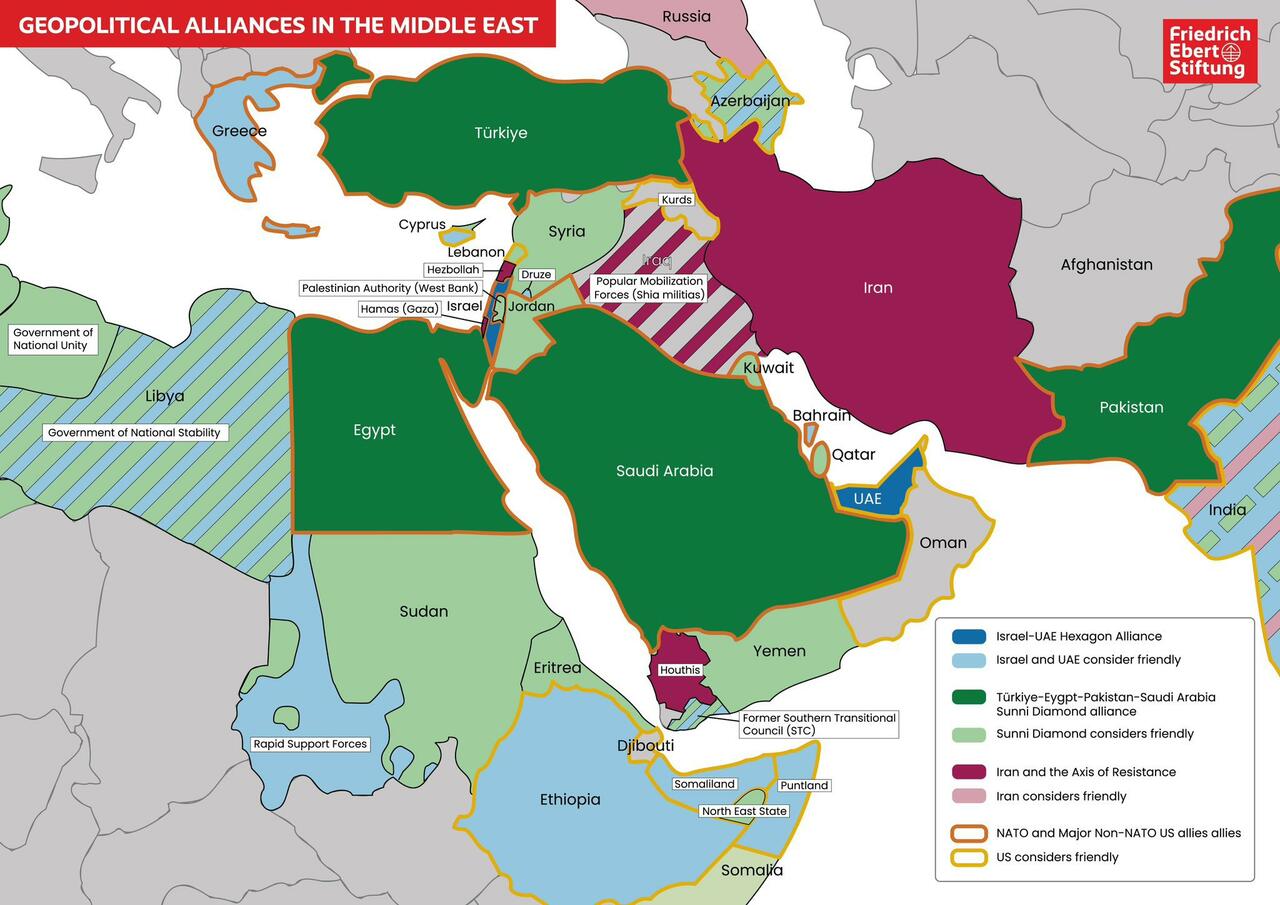
Israel and the UAE were shown as part of a “Hexagon Alliance”. The map showed Greece, Ethiopia and parts of India aligned with them. But it also showed a swath of southwestern Sudan as friendly to the UAE and Israel.
The Rapid Support Forces (RSF) control southwestern Sudan. United Nations experts and dozens of media reports, including from Middle East Eye, have revealed extensive Emirati support for the Sudanese paramilitary, which is led by former Janjaweed leader Mohamed Hamdan Dagalo and has been widely accused of committing genocide in Darfur. The UAE has officially denied backing the RSF.
The map was part of Netanyahu’s unveiling on Sunday of a new security doctrine that emphasizes preemptive strikes and the establishment of “buffer zones” on Israel’s borders.
“The War of Redemption necessitated an upgrade of fundamental principles within the traditional national security doctrine, among them: giving priority to prevention and offense over containment and defense, including launching preemptive strikes to thwart evolving threats; strengthening home front defense against new threats; cementing Israel’s status as a regional power,” Netanyahu’s office said in a statement on Sunday.
“Opportunities have been created for forging new alliances in our region and beyond,” the statement added.
‘Sunni Diamond Alliance’
The map Netanyahu shared shows Israel aligned with secessionist groups while framing its oldest Arab treaty partners as countries not considered friendly to Israel. The map did not show Egypt and Jordan as aligned with Israel.
Instead, it marked Egypt as part of a “Sunni diamond alliance” with Pakistan, Turkey, and Saudi Arabia; it showed Jordan, whose peace treaty with Israel dates back to 1994, as “friendly” to the alliance.
Netanyahu’s public presentation is likely to raise concerns among critics about Israel’s support for secessionist groups and the partition of fragile states. He showed a government in eastern Libya controlled by Khalifa Haftar to be aligned with Israel.
Yemen’s Southern Transitional Council, a UAE-backed separatist movement that dissolved in January 2026 and re-emerged as the Transitional Council of South Arabia, was also shown on the map as being friendly towards Israel and the UAE
Israel became the first country to recognize Somaliland earlier this year. Somaliland is a breakaway republic of Somalia where Israel and the UAE have been expanding their military presence, according to multiple media reports.
Netanyahu’s map showed how Israel sees its security as part of a broader region extending well beyond the Arab world.
He showed Greece and Ethiopia as “friendly” states. The latter is on the verge of a full-scale war with Eritrea, where Israel has long coveted a Red Sea military base, MEE has reported.
Netanyahu’s map also reaffirmed the longstanding ties between Hezbollah, the Houthis and Iran as part of an “Axis of Resistance”.
END
SAUDI ARABIA VS HOUTHIS
NOT GOOD!!
Houthi Attack On Aramco Facility Kills Two; US Prepares More Diplomatic Evacuations In Riyadh
Wednesday, Oct 21, 2026 – 03:40 PM
Update(1540ET): A corrective from Reuters saying that the earlier alert for some diplomatic staff and their families to depart from the Gulf region actually only pertains to Saudi Arabia, amid the Houthi assault:
- Earlier, Reuters reported said the US State Department is preparing to issue an ordered departure of some personnel and family members at US embassies across the Gulf.
- Note, this update says just from Saudi Arabia, not the entire Gulf.
Meanwhile, more has emerged on the fresh Houthi targeting of a Saudi Aramco facility in the kingdom’s eastern region.
“A drone targeting a facility at Aramco’s Shaybah oil field in the eastern region was intercepted on Wednesday morning, the state Saudi Press Agency reports, citing an energy ministry source,” the report says. However, debris from the attack killed two people and injured two more, per Bloomberg, citing Saudi authorities. Additionally a vehicle was set on fire.
* * *
Update(1507ET):There’s been earlier waves of diplomatic evacuations from Middle East embassies and consulates, amid what was prior Iranian retaliation on Washington allied-Gulf states, but now there looks to be another wave of urgent evacuations:
US officials says the US State Department is preparing to issue an ordered departure of some personnel and family members at US embassies across the Gulf.
Already these embassies were operating at likely minimal staffing levels. Via Reuters:
- U.S. STATE DEPARTMENT IS SET TO ORDER THE DEPARTURE OF CERTAIN STAFF AND THEIR FAMILIES FROM AMERICAN EMBASSIES THROUGHOUT THE GULF – U.S. OFFICIALS
- US PREPS DEPARTURE ORDER OF SOME STAFF FROM GULF EMBASSIES:RTRS
- ARAMCO OIL FIELD IN EASTERN REGION ATTACKED: SPA
Oil spikes on these new headlines which portent new escalation – a possible coming major round 3 or US-Iran direct bombing:
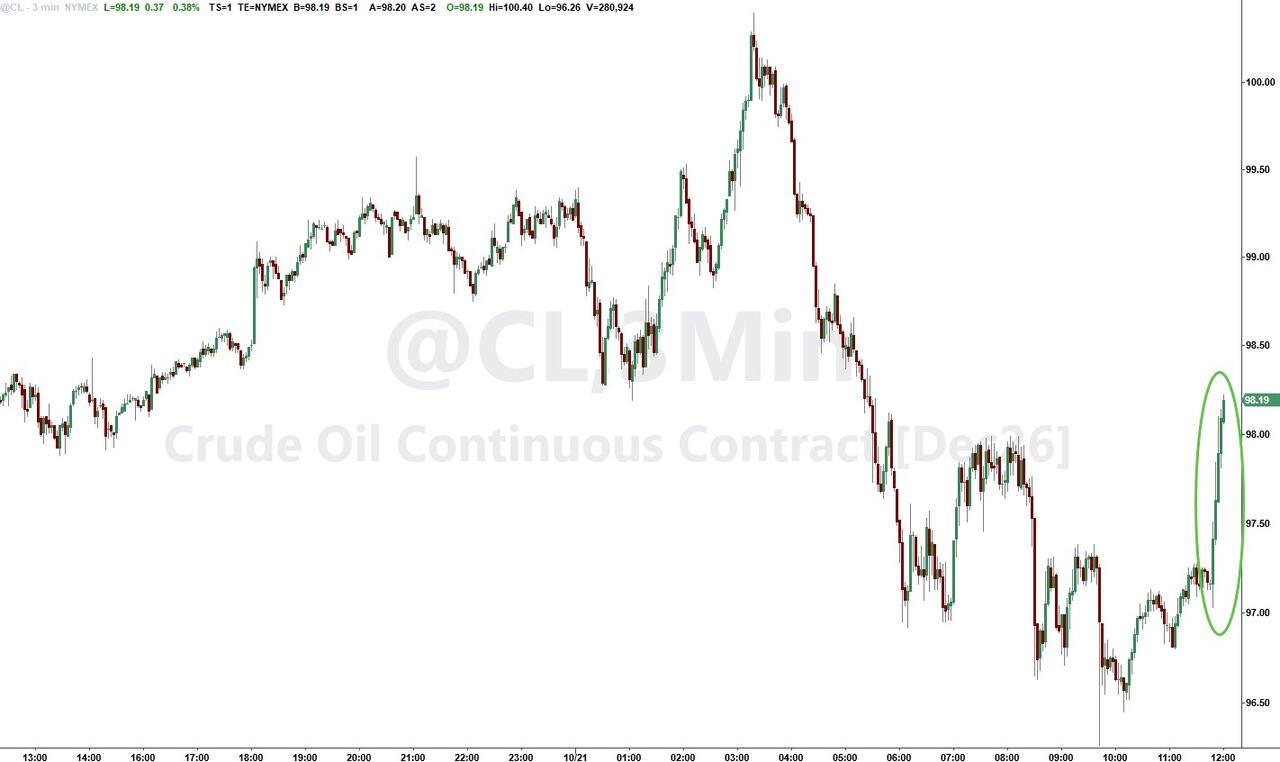
Reuters cites officials who say they also expect escalation related to the Saud-Houthi war, also as more missile salvoes come out of Yemen on Wednesday.
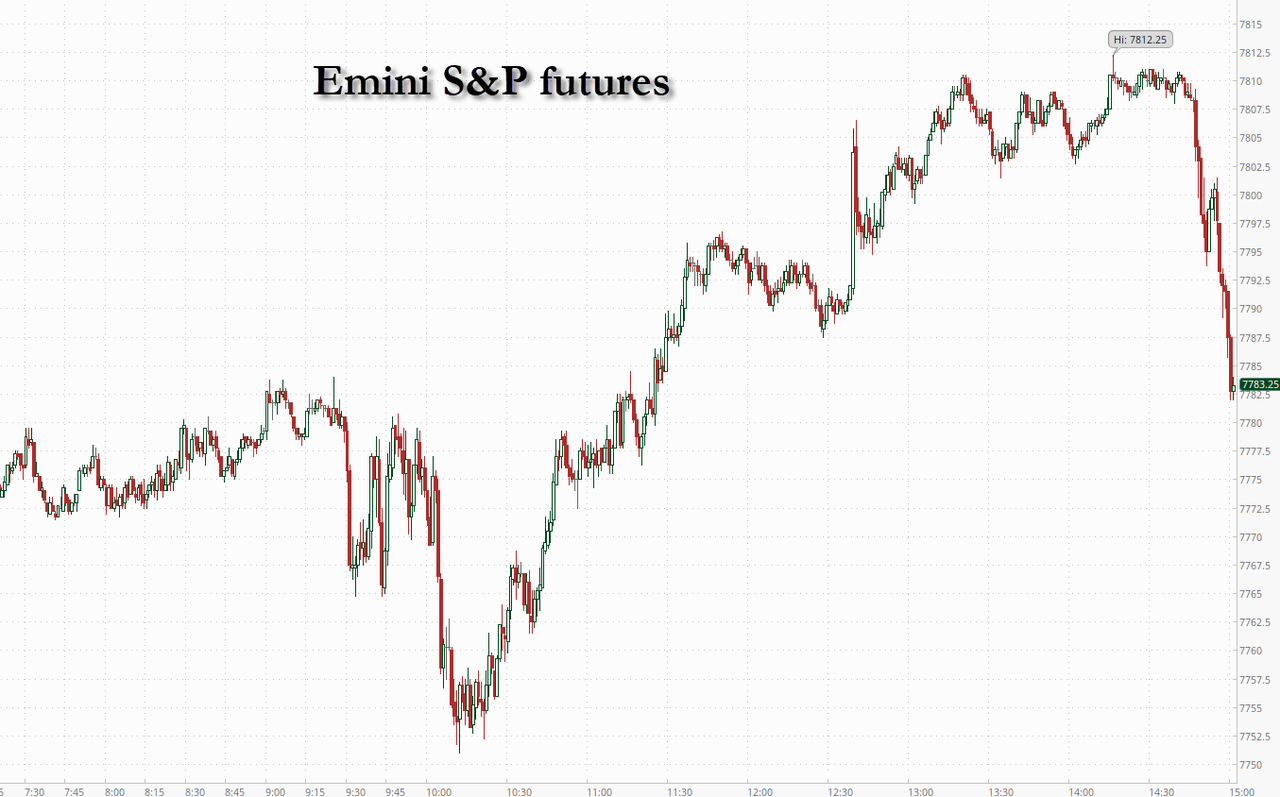
* * *
There have been at least two more tanker attack incidents in Gulf waters and the Strait of Hormuz area over the last 24 hours.
First, the United Kingdom Maritime Trade Operations (UKMTO) says it received a delayed report of a projectile hitting a tanker off Iraq’s coast, which occurred Tuesday. The tanker was struck reportedly thirty nautical miles off the coast of Al Faw, but the information has only emerged Wednesday. All crew members are said to be safe after the attack.
And on Wednesday another ship was hit “by an unknown projectile” off the coast of Oman, close to the Strait of Hormuz, resulting in a fire.
A fresh UKMTO report indicated the tanker is 11 nautical miles off the town of Bukha. The vessel is deemed “now at anchor” and all crew are safe and account for, with no reports of environmental impact.
Iranian state media is also reporting the latest attack. Tehran seeks for these assaults, which have been coming at record pace for the month of October, to be made as public as possible. It hopes to squeeze the Trump administration politically, imposing an economic cost on Americans, headed into the November midterm elections.
In the midst of all of this The Wall Street Journal, citing Kpler, has issued some surprising conclusions on Wednesday:
Persian Gulf oil exports have surpassed prewar levels, as an improvised shipping system under U.S. protection is helping tankers move oil through one of Iran’s fiercest waves of attacks in the Strait of Hormuz.
Middle East oil flows, including shipments through Hormuz and alternative routes across the region, averaged more than 24 million barrels a day in the week through Oct. 18, surpassing prewar levels of 23.3 million, according to ship tracker Kpler.
Preliminary figures show Hormuz oil flows, including offshore transfers in the Gulf of Oman, came to around 14 million barrels a day on average for the same period, or 82% of prewar levels.
Still, the same report also emphasizes that “Thinning global inventories leave little margin for error. The operation is also expensive, costs that ultimately flow through to consumers at the pump.
As for stalled negotiation efforts, Iranian media reports that Tehran informed Pakistan’s Army Chief Asim Munir on Tuesday that Tehran’s conditions stand firm, and that talks won’t materialize until these demands are met.
There are fears all-out war could resume after the November midterm elections in the US:
Washington wants a focus of these talks to be the nuclear file, while Iran has not budged in its insistence that this is not on the table. Iran’s leaders have consistently said that the nuclear issue can only be dealt with after there is a permanent peace deal.
END
RUSSIA VS UKRAINE
Oil Slides As Russia Willing To Resume Trilateral Talks With Ukraine, After ‘Productive’ Witkoff Visit
Wednesday, Oct 21, 2026 – 11:30 AM
The Kremlin has on Wednesday communicated to Trump envoy Steve Witkoff that Russia is “in principle, ready to resume” trilateral negotiations involving the US and Ukraine, toward finding a permanent settlement to the war.
Oil prices slipped lower on the report…
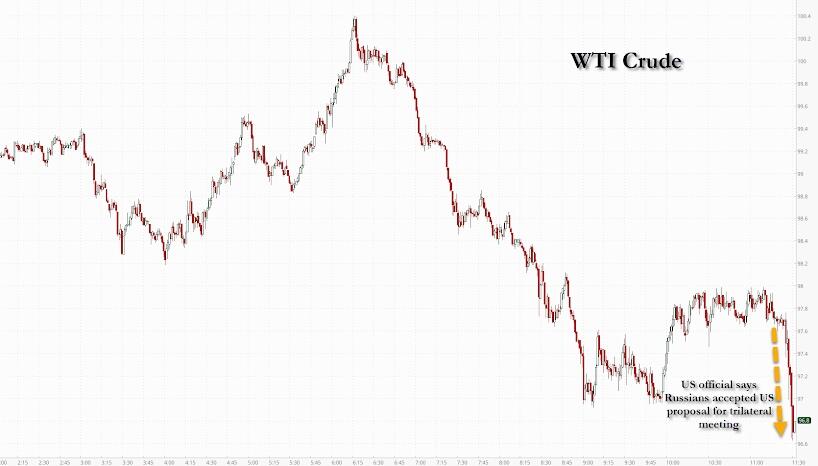
Witkoff briefed President Putin at Constantine Palace in St. Petersburg on Wednesday, coming off the prior Tuesday Oslo meeting involving Ukraine’s Zelensky.
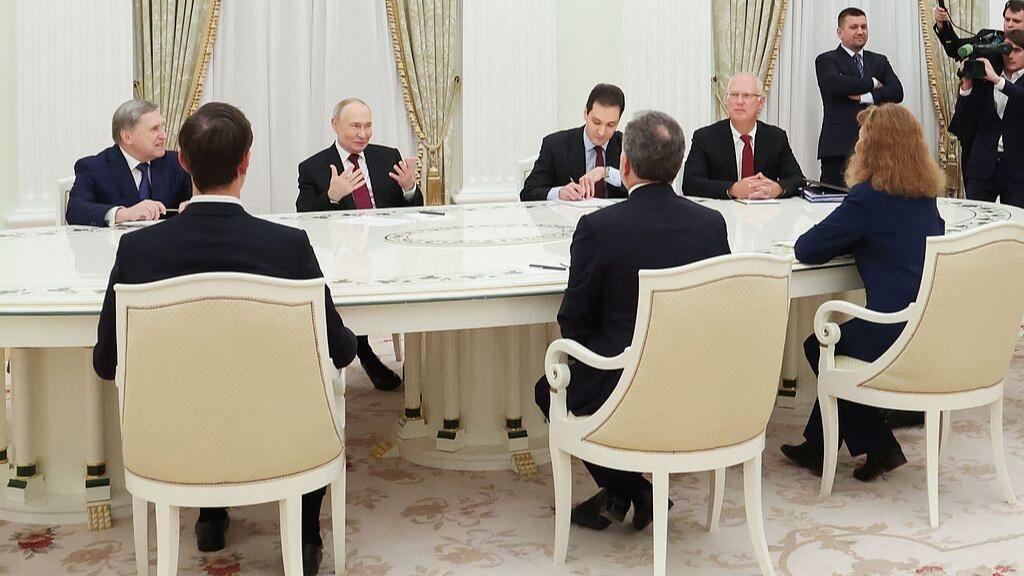
Russia described a generally ‘productive’ atmosphere and talks, but no particular breakthroughs were announced, but only plans for a next possible meeting to continue the dialogue. Abu Dhabi was named as a possible next venue, though the Iran war could change that.
Below is the key aspect of the official readout from Wednesday talks via TASS:
Russian President Vladimir Putin informed the US president’s special envoy, Steve Witkoff, that Russia is ready to resume trilateral talks on the main subject around November 10, Russian Presidential Aide Yury Ushakov said.
“Our president informed Steve Witkoff that we are ready in principle to resume the above-mentioned trilateral talks around November 10 on the main subject,” Ushakov said. “This topic is about building a security system for Russia and Ukraine.”
The Kremlin aide who was cited, Yury Ushakov, further described that prior such efforts were derailed by Ukraine’s long-range drones strikes, especially as the country’s parliamentary elections were being held.
But there’s also been significant changes in Washington’s posture in Ukraine, Ushakov noted, and this caused Moscow’s stance to in turn be “re-evaluated, taking into account the signals received from the Americans.”
Not only did Trump and Putin agree to the Russian diesel release deal, but the US President waived the Graham sanctions package.
Following this, Wednesday saw the release from Russian custody of Stephen Hubbard, an American who is accused of fighting as a mercenary for Ukraine forces when he was captured in 2022.
Trump hailed the development on Truth Social, writing: “Stephen is on his way back home and will soon be with his family. The United States, out of respect for President Trump, was not required to give anything in return — an unprecedented situation for Russia.”
It seems this is a Kremlin ‘thank you’ to Trump for doing the diesel deal, and for at the last minute waiving the sweeping Graham sanctions package, which outraged hawks and Democrats in Congress.
END
RUSSIA/USA
Russia Frees Last Wrongfully Detained American At Trump’s Request
Wednesday, Oct 21, 2026 – 08:30 AM
Stephen Hubbard, an American who is accused of fighting as a mercenary for Ukraine forces when he was captured in 2022, has been freed in a Trump-Putin deal while US envoy Steve Witkoff is in St. Petersburg. Hubbard is at the Pulkovo Airport and will safely exit the country, the Russian president said.
ABC reported the day before Witkoff met with President Putin in Russia’s second largest city Wednesday, “the talks have centered on freeing Stephen Hubbard, a 72-year-old retired teacher who is the only American held in Russia officially designated as wrongfully detained by the State Department, as well as several other U.S. citizens held by Moscow on what the administration said it believes are dubious charges.”

President Trump had initially on Monday referenced that he was “trying to get a hostage that the country has been after for a long time” – which appeared to refer to Hubbard. “Let’s see what happens,” Trump said. “That’ll be soon.”
The release of Hubbard – a Michigan native – was hailed by Witkoff, who addressed Putin saying, “You talk so much about my president, President Trump, being a humanitarian. You are a humanitarian also, sir.“
Trump celebrated the development on Truth Social, writing: “Stephen is on his way back home and will soon be with his family. The United States, out of respect for President Trump, was not required to give anything in return — an unprecedented situation for Russia.”
It seems this is a Kremlin ‘thank you’ to Trump for doing the diesel deal, and for at the last minute waiving the sweeping Graham sanctions package, which outraged hawks and Democrats in Congress.
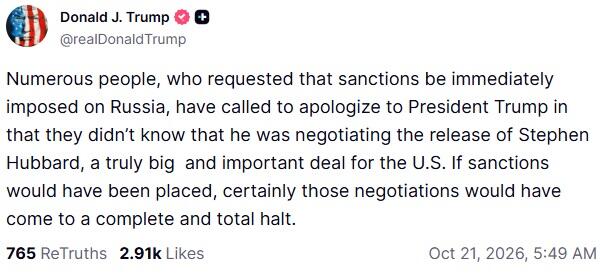
Trump issued at least two Truth Social posts connected with Hubbard’s release, lambasting the prior Biden administration for not accomplishing it earlier.
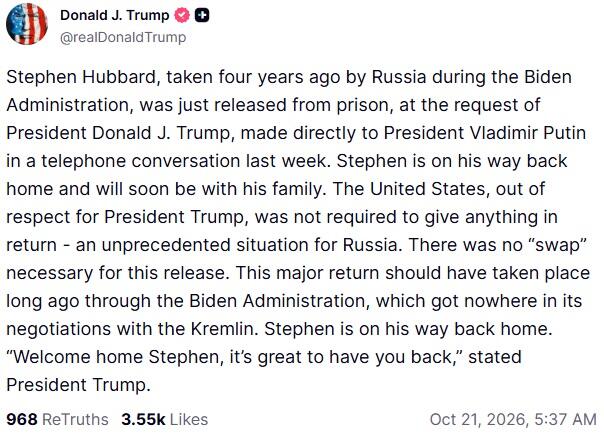
NBC reports, “Trump said that he had directly asked Putin in a phone call last week to release Hubbard, who was being held on charges he denies of fighting as a mercenary in Ukraine. He was the last American designated as wrongfully detained in Russia by the State Department.”
On Tuesday, Witkoff and Ukrainian President Volodymyr Zelensky met in Oslo as part of efforts to find an end to the Ukraine war. In a closing presser for the talks, Zelensky said the latest working proposal features security guarantees for Ukraine modelled on NATO’s Article 5, which is the collective defense clause.
Wednesday saw Witkoff in St. Petersburg updating President Putin on the current status of negotiations. Some pundits believe the world could be closer than ever before to seeing some kind of significant Ukraine peace deal emerge.
Meanwhile an overjoyed Hubbard family has thanked “President Trump and his team for opening the dialog with Russia which led to this joyful day. Our family can attest that there are wonderful blessings to be found along the hard road to peace.”
end
RUSSIA/USA/DIESEL
First Russian Diesel Tanker To Sail For US Under Trump-Moscow Fuel Deal
Wednesday, Oct 21, 2026 – 09:35 AM
OSINT X accounts will soon cover the first Russian tanker carrying diesel for the US market, following President Trump’s deal with Moscow to supply the US amid a global refining crisis sparked by Ukraine hitting Russian energy assets and ongoing disruptions in the Strait of Hormuz.
Reuters cites the Vedomosti news outlet, which quoted Deputy Prime Minister Alexander Novak as saying earlier today that the first Russian tanker carrying 40,000 metric tons of the industrial fuel will begin its transit to the US on Thursday.
“Additional shipments will follow, of course. There were agreements reached between the two leaders. We will meet the United States’ needs, to the extent of our capabilities,” Novak said.
President Trump has stated that, as part of his fuel deal with Moscow, Russia will immediately export 300,000 metric tons, or 2.25 million barrels, followed by 500,000 tons in November and 1 million tons “immediately thereafter.”
Earlier today, US special envoy Steve Witkoff joined Russian President Vladimir Putin for peace talks in St. Petersburg. Witkoff thanked Putin for lifting the export ban and agreeing to the US-Russia diesel export deal.
“That’s an example of us working together, I want to thank you for that,” Witkoff said during the meeting.
Putin said, “We are preparing deliveries of several vessels, the tankers, right now. They will go one after another. The financial component should be provided.” He added that Russia could also supply the US with “large quantities” of fertilizers.
On Tuesday, oil markets traded near five-year highs as Brent crude futures peaked nearly at $112 a barrel and tensions in the Strait of Hormuz continued.
UBS analyst Nana Antiedu pointed out, “The primary driver remains the ongoing threat to Strait of Hormuz flows; Iran’s First Vice President stated the country has ‘no choice’ but to assert control over the waterway, keeping a risk premium firmly embedded in prices.”
US Energy Secretary Chris Wright on Monday declared that pump prices have peaked …
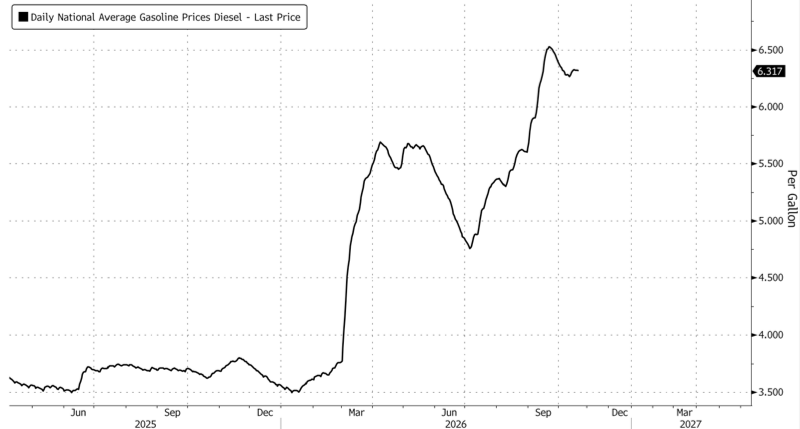
… but the International Energy Agency and Goldman Sachs energy experts have warned that there will be no quick relief, as the refining crisis will likely linger well into next year
END
6/.GLOBAL ISSUES, COVID ISSUES, VACCINE INJURIES/HEALTH ISSUES
GLOBAL ISSUES
COVID VACCINE INJURY REPORTS; DR MARK CRISPIN MILLER
In memory of those who “died suddenly” in the United States and worldwide, September 12-19, 2026
Director Jeremiah Kipp (The Mortuary Assistant); rocker David Surkamp (Pavlov’s Dog); maestro Matthew Jordan Miles (39); footballer Kasey Redfern (35, C); wrestler “Cauliflower” Chase Brown (41); more
| Mark Crispin MillerOct 21 |  |


A survey of the likely global toll of COVID “vaccination,” based on the reports collected by our worldwide team of researchers this past week.
Note: These reports are not arbitrarily included. For a list of the criteria we use, see this footnote.¹
To help support our work, consider subscribing or making a donation.
UNITED STATES (108)
“The Mortuary Assistant” Director Jeremiah Kipp Has Died
10/16/2026

Filmmaker Jeremiah Kipp, who directed the 2024 video game adaptation The Mortuary Assistant, has died. The Long Island International Film Expo announced his passing in a statement, saying Kipp died in the early hours of Tuesday, October 13, and attributing the news to his longtime partner, Lindsay Katt. No cause of death has been shared. Kipp built his career on a steady run of short films before moving into features, developing a stripped-down, character-driven approach to horror that carried through his filmography.
Researcher’s note – Kipp was working in the film industry between 2021-2023: SAG-AFTRA and JPC Allow for Mandatory Vaccine [sic] Policies on Production Sets: https://www.dglaw.com/sag-aftra-and-jpc-allow-for-mandatory-vaccine-policies-on-production-sets/
No age reported.
David Surkamp, singer and leader of Pavlov’s Dog, has died suddenly
October 15, 2026

David Surkamp, singer, songwriter, and leader of the band Pavlov’s Dog, passed away suddenly on October 13 at the age of 73. With his piercing, almost otherworldly, and instantly recognizable voice, Surkamp helped make Pavlov’s Dog one of the most original and unconventional acts in 1970s progressive rock. From the band’s inception, Surkamp remained its primary artistic driving force, continuing to lead the group through its various later incarnations and its eventual return to the stage.
No cause of death reported.
Sudden death of LA conductor, 39
10/16/2026

Matthew Jordan Miles, beloved son, husband, father, and brother, passed away unexpectedly on September 5, 2026, at age 39, leaving a legacy in music and community service. Matthew was a celebrated American tenor and conductor whose career spanned decades in Los Angeles’ vibrant arts scene. He co-founded the Los Angeles School of Music with his wife, Alana Miles, and was most recently the Director of Music at First Presbyterian Church Upland in Upland, California.
Researcher’s note – During the height of the COVID-19 pandemic, the Los Angeles College of Music (LACM) enforced mandatory “vaccination” and testing protocols for students and staff: https://www.lacm.edu/wp-content/uploads/2021/08/LACM-Vaccine-Policy.pdf
No cause of death reported.
Former Falcons player dies at 35 after rare cancer battle
10/19/2026

SPARTANSBURG, S.C. – Former NFL punter Kasey Redfern has died after what his family described as a battle with a rare form of central nervous system lymphoma. He was 35. His obituary said Redfern died Oct. 13 in Spartanburg, S.C. Redfern played for the Atlanta Falcons during the 2019 season. His career also included stops with the Jaguars, Chargers, Panthers, Browns, Lions and Cowboys. In April 2023, Redfern received a diagnosis of a rare form of CNS lymphoma, according to the obituary.
Indie wrestler ‘Cauliflower’ Chase Brown passes away at 41
October 15, 2026

The wrestling world is mourning another tragic loss with indie wrestler “Cauliflower” Chase Brown passing away at 41. Brown’s passing was announced on Wednesday, though the circumstances of his death have not been reported. He was based out of the Carolina region and had past experience for ROH (both in the ring and working on ring crew). Aside from wrestling, Brown was passionate about music and philosophy.
Update to our September report:
Ex-wrestler Pac’s sudden death cause revealed by Cook County Medical Examiner’s Office

Former wrestling star Pac, whose real name was Benjamin Satterley, died of bronchial asthma late last month, the California Post said, citing the Cook County Medical Examiner’s Office. Pac was 40 years old when All Elite Wrestling (AEW) announced his death.
Researcher’s Note – Tony Khan was recently interviewed by PWTorch about the COVID-19 vaccination [sic] status of the AEW roster. The AEW President revealed that the majority of the roster is currently vaccinated [sic], and he noted that international touring will create an issue for those that are not: https://www.wrestlinginc.com/news/2021/11/tony-khan-confirms-he-does-not-require-aew-wrestlers-to-be-vaccinated/
How Did Jimmy Carter Die? Nashville Reporter Passed Away In His Sleep At 73, Family Says
October 14, 2026

Longtime Nashville entertainment reporter Jimmy Carter died in his sleep on Tuesday, Oct. 13, his family said. He was 73. No medical cause of death has been announced. This is the Nashville broadcaster, not the former U.S. president of the same name. In Nashville, he spent 21 years at WSMV Channel 4 as an entertainment reporter, covering award shows, premieres, and Music Row events.
West Virginia broadcasting legend Frank Giardina dies at 72
10/12/2026

PUTNAM COUNTY, W.Va. – A West Virginia broadcasting legend has died. Frank Giardina passed away Sunday in Putnam County at the age of 72. He was honored numerous times for his work, including an induction into the West Virginia Broadcasting Hall of Fame.
Researcher’s note – In Giardina’s obituary, his family expresses gratitude to the Putnam Center medical facility “for the exceptional and compassionate care they provided him over the last few years”: https://www.legacy.com/us/obituaries/wvgazettemail/name/frank-giardina-obituary?id=62771132
No cause of death reported.
College Basketball Analyst Andy Katz Announces Death of Brother Danny at 62: ‘You Are Now at Peace’
10/13/2026
College basketball analyst Andy Katz has announced the death of his brother, Danny, after a battle with cancer. “My older brother, Danny Katz, passed away Friday in his New York apartment at the age of 62,” Andy, 58, wrote via Instagram on Sunday, October 11. “He fought a courageous battle against bile duct cancer for nearly four years.” The Big Ten Network analyst added that he was glad his parents didn’t have to witness his brother’s suffering. “We shared so many memorable life moments,” Andy wrote. “Losing our parents in each of the previous two years was difficult for us all. But they didn’t have to witness what this terrible disease does to people.”
Dan Orlovsky announces ‘unimaginable tragedy’ as brother-in-law dies suddenly at age 43
October 15, 2026
ESPN NFL analyst Dan Orlovsky announced that his brother-in-law, Federico Lascano, died suddenly over the weekend at age 43. Lascano was the husband of Orlovsky’s sister, Christine. Orlovsky said Lascano’s death is an “unimaginable tragedy” in a social media post in which he shared a GoFundMe campaign. Lascano’s cause of death is not known.
Dallas Cowboys superfan “Tattoo Mark” dies unexpectedly
October 13, 2026

Dallas Cowboys superfan Mark “Tattoo Mark” Shenefield [64], known for his passion for the team and his philanthropic work bringing teddy bears to hospitalized children, died unexpectedly Tuesday morning. Shenefield had been a Cowboys superfan for 24 years, and most know the persona he portrayed as “Tattoo Mark.” A cause of death has not yet been shared.
Two local politicians “died suddenly”:
Former Newark City Councilman Dies At 63, Fought For Labor, Housing Rights
10/14/2026
NEWARK, NJ – A former city councilman in Newark is being mourned after his passing earlier this week: Eddie Osborne. Osborne – who served on the council for eight years – was also a longtime labor leader in North Jersey. He died on Oct. 12 at the age of 63. A message of mourning from his family members was recently posted to the former councilman’s social media page: “He met Parkinson’s disease the way he met every challenge in life: with resolve, grace, and unwavering dignity. Even as the illness took its toll, he never lost his strength, his humor, or his spirit, and our family is deeply grateful for every moment we shared with him.”
Researcher’s note – Newark City councilmembers were required to take the COVID “vaccine” in order to attend in-person meetings: Link
Former Commissioner Dave Lawrence passed away over the weekend
10/19/2026
Marysville, Ohio – Former Union County Commissioner Dave Lawrence [66] died over the weekend, County Administrator Bill Narducci informed county leaders in an email Monday morning. Lawrence stepped down last spring before completing his term, citing personal health concerns. He was elected to the seat in 2022. A Union County resident for more than 30 years, Lawrence was married to his wife, Judy, for 32 years.
No cause of death reported.
A child “died suddenly”:
Influencer Jennifer Burnham Shares Death of 4-Year-Old Son Baxter
October 14, 2026

Jennifer Burnham’s 4-year-old son Baxter died on Oct. 5, the influencer shared on Monday. Burnham shares lifestyle, motherhood and cooking content to her following of 96,000 on Instagram. She and her husband, Bryce Burnham, are also parents to 1-year-old son Barron. Burnham did not share further details about her son’s death.
A teenager “died suddenly”:
Hoosick Falls High School student dies unexpectedly
10/13/2026
Hoosick Falls, NY – The Hoosick Falls Central School District is mourning the unexpected death of a high school student over the weekend. In a letter to the school community Monday, Superintendent Patrick Dailey announced that a high school student died Saturday, Oct. 10. The district did not release the student’s identity or provide additional details surrounding the death.
Two lawyers “died suddenly”:
Former Adams Co. State’s Attorney Gary Farha passes away after short hospital stay
October 13, 2026

QUINCY, IL – Adams County Board Chairman Bret Austin made a somber announcement at Tuesday night’s meeting. “A long-time member of our county family passed away today, Austin said regarding the death of former Adams Co. State’s Attorney Gary Farha. Farha died Tuesday afternoon in Blessing Hospital. He was 68. Farha was elected to a second term without opposition in 2020 and announced he would retire rather than seek another term in 2024.
No cause of death reported.
Peter Lefeber, 71
10/17/2026

Peter John Lefeber, of Branford, CT, died at daybreak, October 10, 2026, after a short illness. Peter was 71 years old. In his professional career, Peter practiced Labor and Employment law, representing groups as varied as hospitals and home health care agencies, beverage distributors, stevedoring operators, colleges, universities, and private secondary schools, as well as several manufacturing companies, retail operations, and trade organizations.
No cause of death reported.
Three doctors “died suddenly”:
Trailblazing Doctor and Researcher, 47, Dies of the Cancer She Was Working to Cure
October 14, 2026

Rachna Shroff, one of the leading pioneers and experts in stomach cancer research, has died. She was 47. Dr. Shroff, MD, MS, FASCO – a clinician-scientist and associate director of the University of Arizona’s Cancer Center – died following a “battle with an aggressive cancer,” the university shared on Monday, Oct. 12. Per Today, Shroff was navigating the same cancer for which she was seeking a cure. A fellow of the American Society of Clinical Oncology, Dr. Shroff was “one of the foremost experts on pancreatic and biliary tract cancers,” the society wrote of her on Tuesday, Oct. 13, as well as a dedicated mentor and tireless activist supporting generations of cancer researchers to come. Dr. Shroff received her cancer diagnosis earlier this year, according to Today, after one of her lymph nodes began to swell in May. In the weeks that followed, she learned the disease had spread, likely from gastrointestinal origins. Ultimately, the cancer was confirmed to be terminal adenocarcinoma, which affects the glands that line a person’s organs, per Cleveland Clinic.
Researcher’s note – The University of Arizona required all university employees (including staff, student workers, and graduate assistants) to upload proof of full COVID-19 “vaccination” by December 8, 2021, to comply with federal contractor mandates under President Joe Biden’s executive order: https://news.arizona.edu/news/uarizona-employees-must-upload-proof-vaccination-dec-8
Dean L. DeBroekert M.D., 70
10/16/2026

Mullica Hill, NJ – Dr. Dean L DeBroekert, MD, passed away early Saturday morning October 10, at peace listening to his favorite Tower of Power. After volunteering in his local ER, he decided to pursue a career in Medicine. Long before there was such a thing as an Emergency Room Residency, he went into Family Practice and began to moonlight in a small local ER. Soon he made this his full-time specialty and worked almost all over New Jersey and Delaware until finishing out his distinguished career at Inspira Health Network. He was an Emergency Room Physician for over 41 years. He was on the teaching staff of Philadelphia College of Osteopathic Medicine mentoring their PA students during their ER rotation and Rowan School of Medicine supervising young residents. He also was the sharpest dressed Doctor anywhere he went.
Researcher’s note – As a doctor, DeBroekert would have been required to be COVID “vaccinated”, with no option to test: Link
https://www.nj.gov/health/news/2022/approved/20220119a.shtml
Dr. Alysa Herman, 55
10/17/2026

Coral Gables, FL – Dr. Alysa Herman, beloved wife, mother, daughter, sister, and cherished friend, passed away
END
DR PAUL ALEXANDER
RABOBANK/MICHAEL EVERY/OR OR PICTON/GIFFIN OR RABOBANK EXECUTIVE/COMMENTARY ON WORLDLY AFFAIRS
7. OIL AND NATURAL GAS/ENERGY COMMENTARIES
WTI Flat After Another Crude Draw, Distillates Stocks At Seasonal Record Lows
Wednesday, Oct 21, 2026 – 10:40 AM
Oil prices are flat this morning, reversing earlier gains that pushed Brent crude above $110 a barrel – 5 month highs (and WTI back above $101), as traders weighed a recovery in Middle East oil exports against persistent threats to shipping through the Strait of Hormuz and attacks targeting Saudi Arabia..
Specifically, shipping risks remained elevated as Iran’s IRGC said Tuesday that two oil tankers caught fire after striking mines south of the Strait of Hormuz.
“High exports do not necessarily mean lower risks,” said Arne Lohmann Rasmussen, chief analyst at A/S Global Risk Management. “Shipping remains exposed to attacks, while exceptionally high freight rates and insurance premiums make transporting oil expensive.”
Regional tensions also persisted.
The Saudi-led coalition said Wednesday that it intercepted drones launched toward the kingdom, including one targeting the Eastern Province, a major oil-producing region.
Diplomatic efforts to end the conflict are reportedly continuing. Qatar’s Foreign Ministry said Tuesday that contacts, visits and exchanges of messages between Washington and Tehran remained ongoing, amid efforts to reopen the Strait of Hormuz and end the regional escalation.
With hurricane shut-in effects fading, API reported inventory draws across the board (except a small build at Cushing).
API
- Crude -4.9mm
- Cushing +936k
- Gasoline -2.0mm
- Distillates -2.6mm
DOE
- Crude -3.06mm (-340k exp)
- Cushing +987k
- Gasoline -2.95mm
- Distillates +1.68mm
Official US crude stocks drewdown for the 3rd straight week (more than expected but less than API). Cushing stocks rose for the 5th straight week while Gasoline inventories saw their biggest drawdown since May…
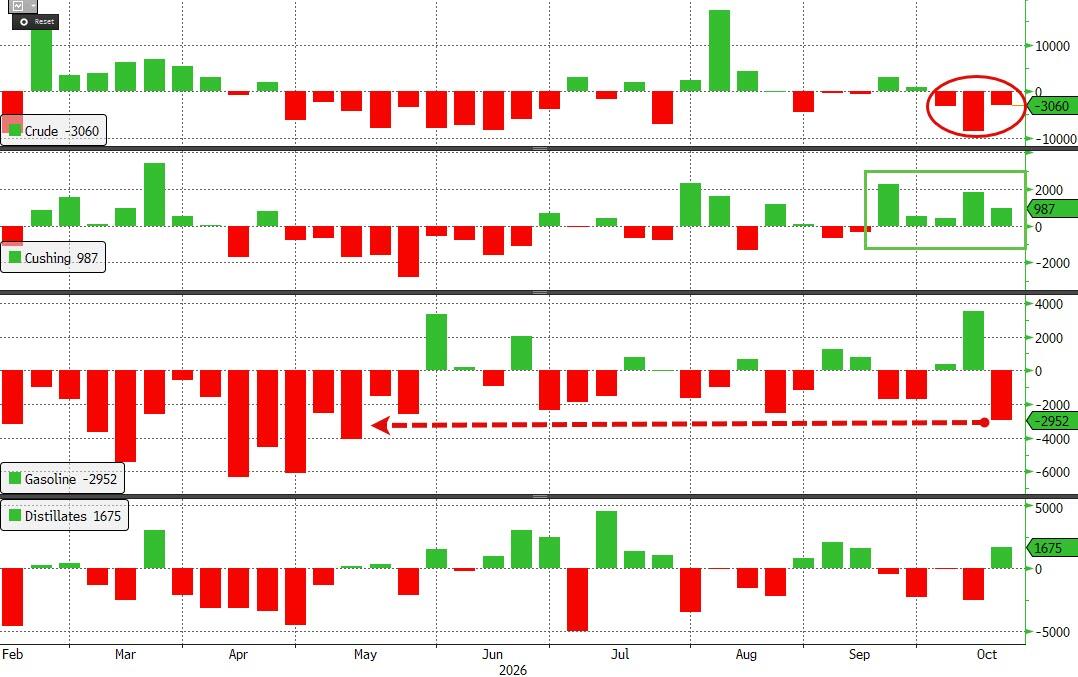
With IEA urging the world to release more barrels from reserves, the US Strategic Petroleum Reserve saw a small 300k barrel drain (after no change the prior week)…
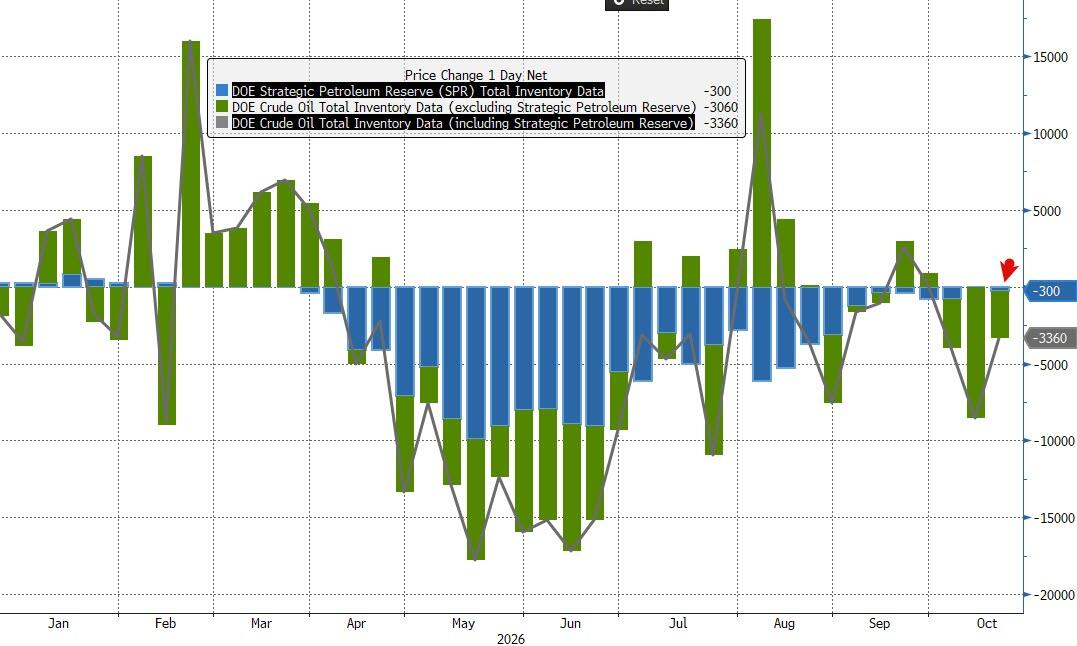
Despite the build this week, distillates stocks remain at record lows for this time of year…
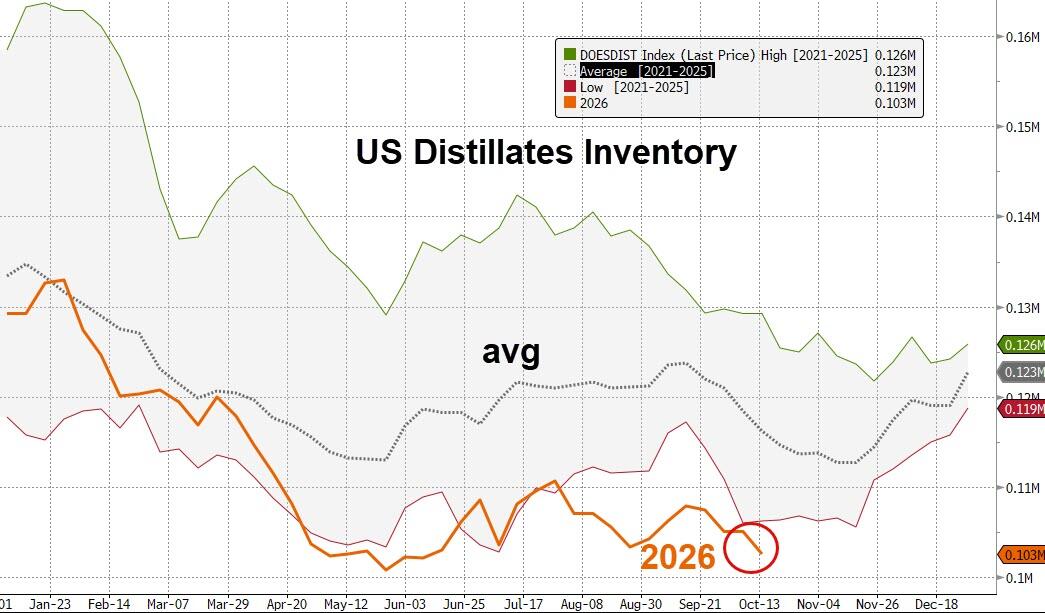
US Crude production fell once again (storm shut-ins)…
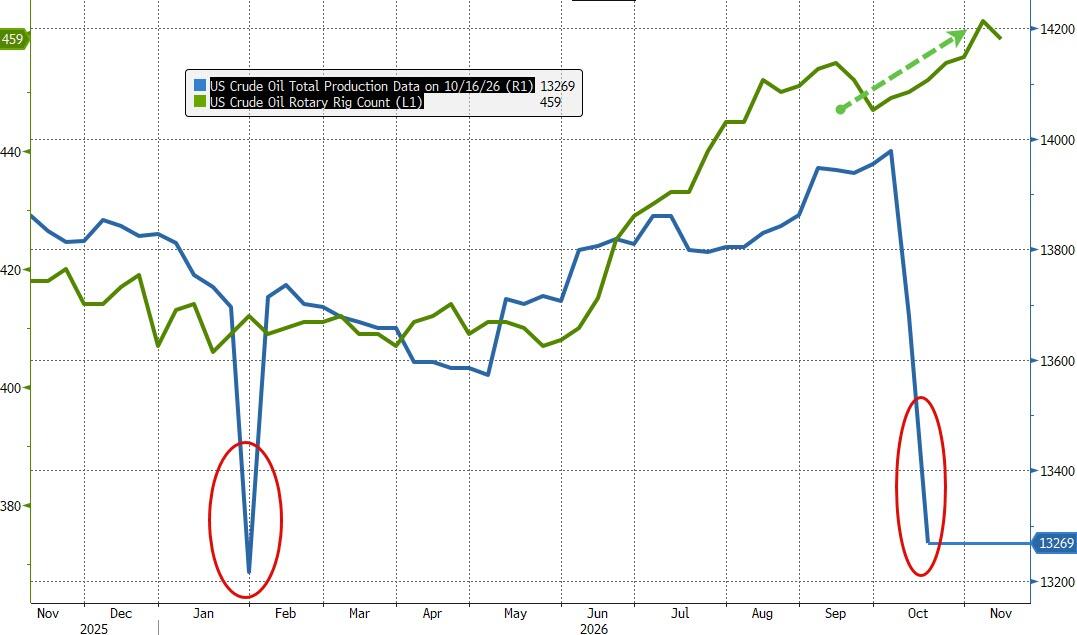
WTI was trading around $98 ahead of the official data and didn’t move much on the print…
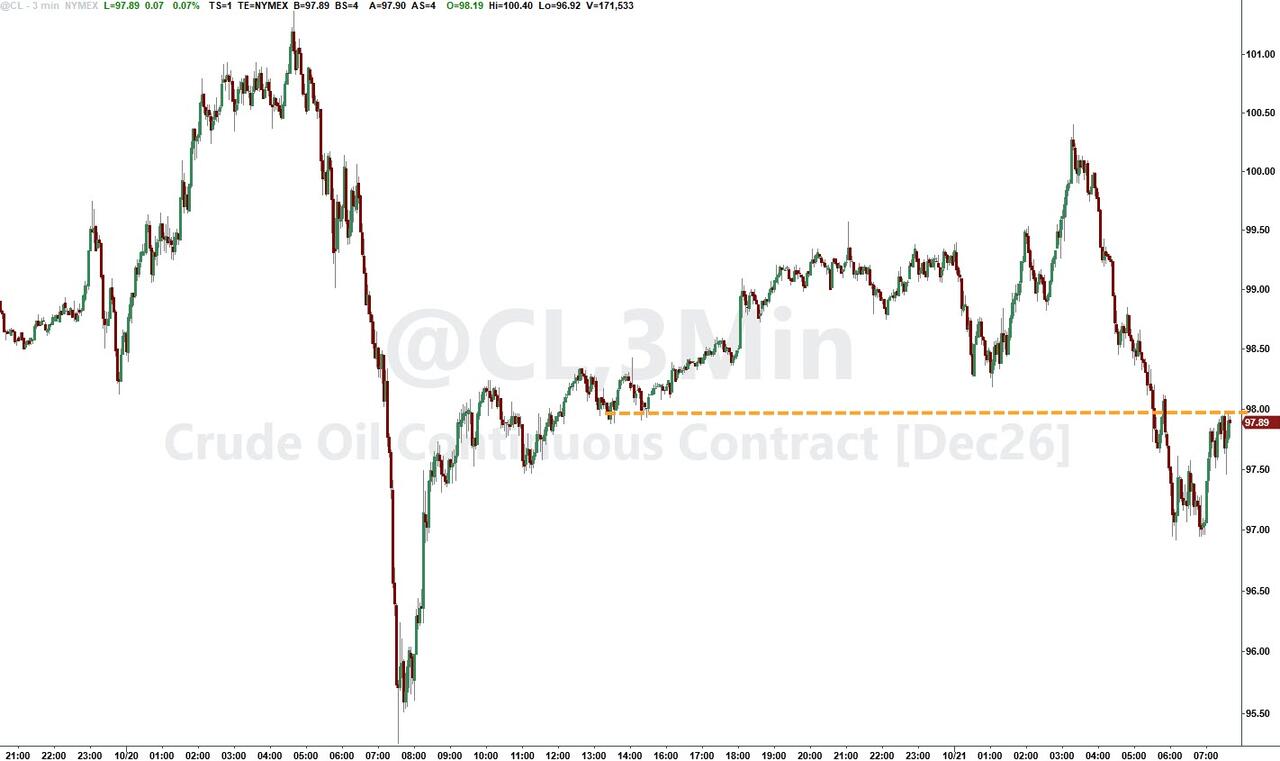
And much to Trump’s chagrin, pump prices have never been higher at this time of year…
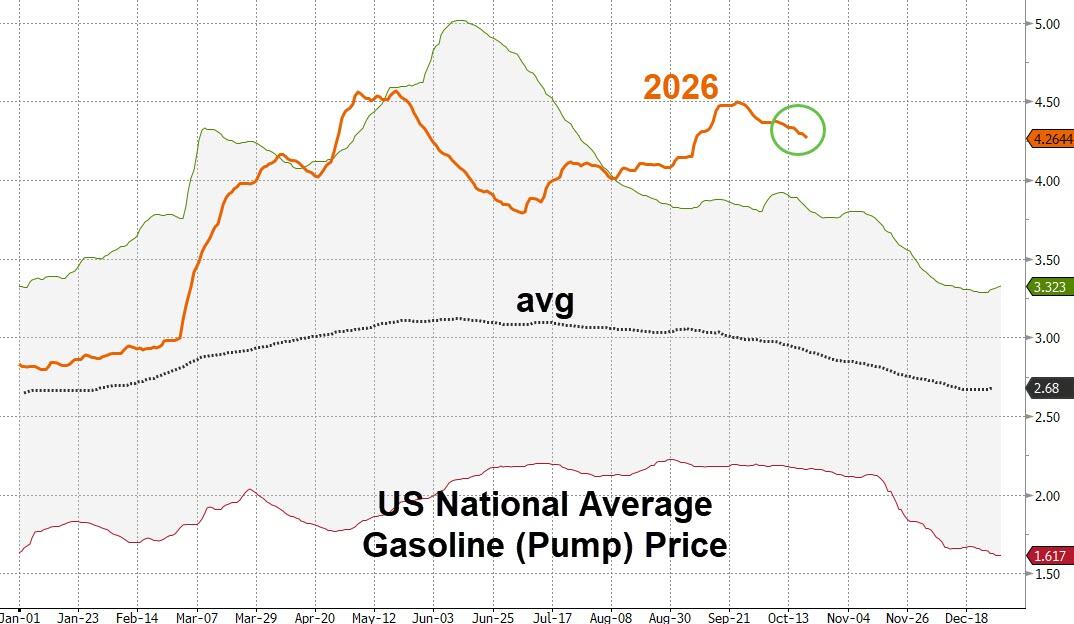
Finally, Bloomberg reports that there are signs that physical markets in some parts of the world are beginning to cool.
As flows through the Middle East rise, one key benchmark in the region has fallen to its weakest level in three months.
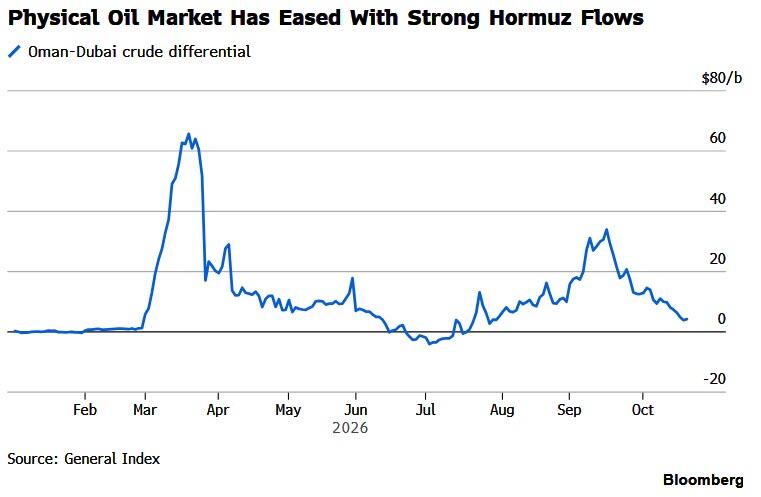
The “Gulf crude oil market has been pressured” by the availability of multiple cargoes at relatively short notice, said June Goh, oil analyst at Sparta Commodities SA.
At the same time, traders said high shipping costs mean American barrels aren’t traveling as far afield, pointing more supplies to Europe and pressuring the Dated Brent physical benchmark.
8. EMERGING MARKETS//AUSTRALIA NEW ZEALAND ISSUES
BOLIVIA
Bolivia’s Energy Crisis Deepens As Natural Gas Reserves Run Dry
Tuesday, Oct 20, 2026 – 07:40 PM
Authored by Felicity Bradstock via OilPrice,
- Bolivia’s dwindling natural gas reserves and declining exports have undermined its economy and intensified fuel shortages.
- Rising global energy prices and subsidy cuts have increased living costs and fueled widespread protests.
- A $1.9 billion IMF rescue package and energy-sector reforms aim to stabilize the economy, but long-term recovery requires diversification.

Years of underinvestment in Bolivia’s gas industry have left the South American country facing a severe fuel shortage, as energy prices rise ever higher owing to the ongoing war in Iran. The energy shortages and economic crisis follow years of poor decision-making by the government.
In 2006, then-president Evo Morales took control of Bolivia’s fossil fuel industry, renegotiating contracts with international oil and gas companies and benefiting from the revenue. Much of the country’s newfound wealth was invested in public spending programs, expensive fuel subsidies, and the maintenance of a fixed currency exchange rate pegged to the U.S. dollar. Fossil fuel revenues contributed heavily to Bolivia’s economy for several years, supporting GDP expansion and the development of social programs that helped halve poverty rates.
For many years, Bolivian’s were led to believe that they had more extensive gas supplies than they actually did. However, in recent years, Bolivia’s fossil fuel sector has suffered as reserves have dwindled and no successful gas discoveries have occurred. As of April, Bolivia has an estimated 3.7 trillion cubic feet of proven reserves. The fall in gas production led exports to fall by almost 60 percent over the last decade. Bolivia continues to rely heavily on natural gas, which accounts for around 70 percent of its electricity mix.
Meanwhile, little progress has been made in developing the country’s green energy sector, leaving it facing severe energy shortages. The fall in gas revenues has left the economy suffering terribly, as inflation soars and the price of imported goods becomes ever more unaffordable. Luis Fernando Romero, the former head of an association of economists in southern Bolivia, stated, “We failed to take advantage of a historic opportunity that brought in immense revenue.”
This situation is not uncommon, with many other oil-rich states having had similar experiences. Several Middle Eastern states have long depended on oil and gas revenues for economic growth, and most have only recently announced plans to diversify their economies to reduce reliance on fossil fuels. Several countries across the MENA region announced new economic strategies following greater talk of a global green transition, which could leave them missing out on vital oil revenues if they don’t take moves to diversify and invest in value-added sectors.
The lack of investment in Bolivia’s other domestic sectors has left it struggling to stay afloat as it runs out of fuel and is forced to pay high fuel import costs. President Rodrigo Paz warned that “International prices are forcing us to make complex choices.”
In September, Bolivia’s Congress approved a $1.9 billion loan from the International Monetary Fund (IMF), even though the terms of the deal require the government to impose strict austerity measures that could fuel social unrest. The loan received approval from the IMF’s Executive Board on October 2, and the government will now be required to cut its fuel subsidies and significantly reduce public spending. It has already increased fuel prices and is expected to scrap further gasoline subsidies from the beginning of next year. The loan is expected to unlock up to $4 billion more in financing from the World Bank and other lenders.
However, there are major concerns that the new financial plan will significantly increase the cost of living for households already struggling. Last December, the government reduced fuel subsidies, leaving little support for the most vulnerable Bolivians. This led to widespread protests as people called for President Paz’s resignation. In February, there was further social unrest after the distribution of poor-quality gasoline ruined thousands of vehicles. Then, in June and July, several weeks of road blockades by protesters occurred.
Meanwhile, to tackle the ongoing fuel shortages, Bolivia’s government announced plans in September to triple the fund financing refined fuel purchases, following similar announcements by Peru and Ecuador. This is expected to help mitigate diesel shortages and rising prices. Both Peru and Ecuador have increased fuel subsidies in recent months and are focusing on increasing production at state oil refineries to alleviate the price pressure of expensive fuel imports.
In July, Bolivia’s Energy Minister Marcelo Blanco announced that the government had authorized the private sector to import and sell refined fuels to mitigate severe shortages. Then, in September, the government said that the state hydrocarbons firm plans to focus on exploration, extraction, and refining to continue developing Bolivia’s gas resources. However, experts warn that Bolivia could become a net fossil gas importer by around 2030.
As Bolivia continues to battle fuel shortages and seeks to support economic recovery by borrowing from international organizations, the government must focus on diversifying the economy by developing other value-added sectors to sustain long-term growth. In addition, the government must also develop Bolivia’s renewable energy sources to reduce dependence on expensive fuel imports and ensure the country’s energy security.
END
AUSTRALIA/AI IMPLODES
Data Center Bloodbath Spreads Down Under: Nextdc Implodes 45%, Mulls Force Majeure As Angry Residents Pull The Plug

Melbourne locals parked their cars in front of the work trucks and filled in the excavation pits; the cost to Australia’s biggest listed AI data center operator: A$140 million of EBITDA.
NextDC (ASX: NXT) shares plunged roughly 40–45% (intraday lows around that range) on 21 October 2026 after the company sharply cut its FY27 guidance due to power delays at its M3 data centre in West Footscray, Melbourne, driven by community opposition. bloomberg.com +1The core issue is a suspension of electricity network upgrades by Jemena. Locals in the area (including Yarraville/West Footscray) protested the installation of much taller (~22 m) high-voltage power poles needed to supply expanded capacity at the facility. Actions included parking cars to block work trucks and filling in excavation pits. Jemena halted the works citing safety concerns, lack of site access due to opposition, and the absence of local council consent pending further consultation. Restart is not expected before February 2027, pushing the next major grid supply increase into FY28 and deferring delivery/billing of already-contracted capacity. theage.com.au +1Financial impact
- Previous FY27 guidance (ex-affected contracts context): net revenue A$615–640 million; underlying EBITDA A$385–410 million.
- Revised: net revenue A$475–500 million; underlying EBITDA A$245–265 million.
- The deferred M3 contracts had contributed about A$140 million to both net revenue and underlying EBITDA in the prior outlook. Construction of data halls in existing buildings continues, but further expansion stages face additional planning delays (tied in part to the Victorian state election). capitalbrief.com +1
NextDC is evaluating force majeure and other contractual options, has paused work on uncontracted projects and potential land purchases, cut FY27 capex guidance (to roughly A$4.5–5 billion range), and is looking at capital recycling (including possible sales of some development sites) to manage balance-sheet risk.
reuters.com
This fits a broader pattern of community pushback against data centres (noise, visual impact of infrastructure, power demands, construction disruption) that has delayed or blocked projects in multiple countries. Analysts noted the episode highlights execution and permitting risks for the sector even where demand for AI/compute capacity remains strong. Shares recovered modestly from the lows but still closed well down, wiping several billion AUD from market value.
END
END
U.S./GOLD AND SILVER PRICING/ASIAN CLOSING MARKETS AND EUROPEAN BOURSE OPENING AND CLOSING/ INTEREST RATE SETTINGS WEDNESDAY MORNING 6;30AM//OPENING AND CLOSING\
OPENING LEVELS OF CURRENCIES// AND CLOSING ASIAN STOCK MARKET AND OPENING EUROPEAN STOCKS:6 AM EST
EURO VS USA DOLLAR: 1.1219 DOWN 0.0007
USA/ YEN 158.16 DOWN 0.130 NOW TARGETS INTEREST RATE AT 1.75% AS IT WILL BUY UNLIMITED BONDS TO GETS TO THAT LEVEL…//YEN STILL FALLS//END OF YEN CARRY TRADE BEGINS AGAIN DEC 2024/Bank of Japan raises rates by .25% TO 1.75 ..TAKAICHI NEW PM AS YIELDS RISE//JAPAN DEEPLY IN TROUBLE WITH RISING RATES AND A FALLING YEN!! BANK OF JAPAN WILL NO LONGER DO QE. URGES PENSION AND INSUANCE FUNDS TO BUY JAPANESE BONDS//
YEN CARRY TRADERS MURDERED
GBP/USA1.3388 UP 0.0016 OR 16 BASIS PTS
USA/CAN DOLLAR: 1.4055 DOWN 0.0012 //CDN DOLLAR UP 12 BASIS PTS//
Last night Shanghai COMPOSITE CLOSED DOWN 22.34 PTS OR 0.60%
Hang Seng CLOSED DOWN 215.74 PTS OR 0.90%
AUSTRALIA CLOSED DOWN 0.47%
// EUROPEAN BOURSE: ALL GREEN
Trading from Europe and ASIA
I) EUROPEAN BOURSES: ALL GREEN
2/ CHINESE BOURSES / :Hang SENG CLOSED DOWN 215.74 PTS OR 0.90%
/SHANGHAI CLOSED DOWN 22.34 PTS OR 0.60%
AUSTRALIA BOURSE CLOSED DOWN 0.47%
(Nikkei (Japan) CLOSED UP 620.58 PTS OR 0.97%
INDIA’S SENSEX IN THE RED
Gold very early morning trading: $4123.30
silver:$57.36
USA DOLLAR VS TRY (TURKISH LIRA): 49.60 UP 2 BASIS PTS AND NOW WE SEE THEIR STUPIDITY OF SELLING SOME OF THEIR GOLD AND ALL OF THEIR USA DOLLAR RESERVES. THE COUNTRY IS IN BIG FINANCIAL TROUBLE
USA DOLLAR VS RUSSIAN ROUBLE: 82.04 ROUBLE// UP 0 ROUBLE AND 40 BASIS PTS.
UK 10 YR BOND YIELD: 5.4108 UP 0 BASIS PTS
UK 30 YR BOND YIELD: 5.8330 DOWN 2 BASIS PTS
FRENCH OAT 10 YR BOND YIELD: 4.866 UP 8 BASIS PTS.
CDN 10 YR BOND YIELD: 3.8938 DOWN 7 BASIS PTS
CDN 5 YR BOND YIELD; 3.623 DOWN 6 BASIS PTS
USA dollar index early WEDNESDAY MORNING: 101.62 UP 8 BASIS POINTS FROM TUESDAY’s CLOSE
WEDNESDAY MORNING NUMBERS ENDS
And now your closing WEDNESDAY NUMBERS 10.00 AM
Portuguese 10 year bond yield: 3.911% DOWN 0 in basis point(s) yield
JAPANESE BOND 10 yr YIELD: +2.8880% DOWN 1 FULL POINTS BASIS POINTS /JAPAN losing control of its yield curve/
JAPAN 30 YR: 3.927 DOWN 2 BASIS PTS//
SPANISH 10 YR BOND YIELD: 4.049 DOWN 0 in basis points yield
ITALY 10 YR BOND: 4.550 DOWN 1 points in basis points yield ./
GERMAN 10 YR BOND YIELD: 3.4012 DOWN 1 BASIS PTS
IMPORTANT CURRENCY CLOSES : MID DAY WEDNESDAY
Closing currency crosses for day /USA DOLLAR INDEX/USA 10 YR BOND YIELD/10:00 AM
Euro/USA 1.1232 UP 0.0007 OR 7 basis points
USA/Japan: 157.96 DOWN 0.329 OR YEN IS UP 33 BASIS PTS// HIGHLY INFLATIONARY TO JAPAN
Great Britain 10 YR RATE 5.3702 DOWN 5 BASIS POINTS //
GREAT BRITAIN 30 YR BOND; 5.7747 DOWN 7 BASIS POINTS.
FRANCE 10 YR: 4.956 UP 1 BASIS PTS
CANADIAN DOLLAR UP 5 BASIS PTS TO 1.4066
xxxxxxxxxxxxxxxxxxxxxxxxxxxxxxxxxxxxxxxxxxxxxxxxxxxxxxxxxxxxxxxxxxxxxxxxxxxxxxxx
The USA/Yuan CNY 6.6758 ON SHORE ..UP
THE USA/YUAN OFFSHORE// CNH UP TO 6.6755
TURKISH LIRA: 49.60 UP 2 EXTREMELY DANGEROUS LEVEL/DEATH WATCH/HYPERINFLATION TO BEGIN.//
Your closing 10 yr US bond yield DOWN 4 in basis points from TUESDAY at 5.084% //trading well ABOVE the resistance level of 2.27-2.32%)
USA 30 yr bond yield 5.4000 DOWN 3 basis points /10:00 AM
USA 2 YR BOND YIELD: 4.759 DOWN 3 BASIS PTS.
GOLD AT 10;00 AM $4133.25
SILVER AT 10;00: $57,54
Your 11:00 AM bourses for Europe and the Dow along with the USA dollar index closing and interest ratesWEDNESDAY
DAY CLOSING TIME/ 12:00 AM///
London: CLOSED UP 19.88 PTS OR 0.19%
GERMAN DAX: CLOSED UP 340.62 PTS OR 1.35%
FRANCE: UP 83.19OR 106 PTS
Spain IBEX CLOSED UP 231.10 PTS OR 1.21%
Italian MIB: CLOSED UP 572.69 PTS OR 1.17%
WTI Oil price 97.19 10.00 EST/
Brent Oil: 108.15 10:00 EST
USA /RUSSIAN ROUBLE: 81.93/// ROUBLE UP 0 AND 51/ 100
CDN 10 YEAR RATE: 3.851 DOWN 4 BASIS PTS.
CDN 5 YEAR RATE: 3.577 DOWN 5 BASIS PTS
CLOSING NUMBERS: 4 PM//
Euro vs USA 1.1226 UP 0.0001 OR 1 BASIS POINTS//
British Pound: 1.3391 UP 0.0019 OR 19 basis pts/
BRITISH 10 YR GILT BOND YIELD: 5.3780 DOWN 5 FULL BASIS PTS//
BRITISH 30 YR BOND YIELD: 5.8120 DOWN 4 IN BASIS PTS.
FRENCH 10 YR BOND: 5.009 % UP 8 BASIS PTS
JAPAN 10 YR YIELD: 2.882 % UP 1 FULL BASIS PTS (DANGEROUS TO THEIR ECONOMY
JAPANESE 30 YR BOND: 3.903 DOWN 3 PTS AND STILL VERY DANGEROUS TO THEIR ECONOMY
USA dollar vs Japanese Yen: 158.19 DOWN 0.101 OR YEN UP 10 BASIS PTS//GETTING FURTHER AWAY FROM 160.00/ EXTREMELY DANGEROUS
USA dollar vs Canadian dollar: 1.4045 DOWN 0.0021 PTS// CDN DOLLAR UP 21 BASIS PTS
West Texas intermediate oil: 98.02
Brent OIL: 109.43
USA 10 yr bond yield UP 1 BASIS pts to 5.123
USA 30 yr bond yield: DOWN 0 PTS to 5.421%
USA 2 YR BOND 4.802 UP 2 PTS
CDN 10 YR RATE 3.8720 DOWN 2 BASIS PTS
CDN 5 YEAR RATE: 3.559 DOWN 4 BASIS PTS
USA dollar index: 101.53 DOWN 8 BASIS POINTS
USA DOLLAR VS TURKISH LIRA: 49.60 UP 2 BASIS PTS GETTING QUITE CLOSE TO BLOWING UP/IDIOTS SOLD GOLD
USA DOLLAR VS RUSSIA//// ROUBLE: 81.92 UP 0 AND 53 /100 roubles //
GOLD $4,126.00 3:30 PM)
SILVER: 57.56 3;30 PM)
DOW JONES INDUSTRIAL AVERAGE: UP 361.84 POINTS OR 0.69%
NASDAQ 100 UP 282.60 PTS OR 1.07%
VOLATILITY INDEX 16.72. DOWN 0.59 PTS OR 3.41%
GLD: $ 378.98 UP 1.30 PTS OR 0.34%
SLV/ 52.26 PTS UP 0.14 OR 0.26%
TORONTO STOCK INDEX// TSX INDEX: CLOSED UP 212.03 PTS OR 0.60%
END
end
TRADING today ZEROHEDGE 4 PM: HEADLINE NEWS/TRADING
Diplomat Departures Damage Green Day; Kremlin Drives Crude, Credit, & Crypto Crazy
WRAP UP
USA DATA RELEASES
USA ECONOMIC REPORTS
Amazon is taking early delivery of billions of dollars’ worth of Nvidia AI server racks (primarily GB300 systems) that are being staged in intermediary warehouses because many data-center sites lack sufficient power to turn them on.
businessinsider.com
This is based on a Business Insider report from October 20, 2026, drawing on internal Amazon emails from August and accounts from people familiar with the efforts. ZeroHedge and others have framed it as AI’s “paperweight” problem going mainstream: hyperscalers order massive volumes of Nvidia silicon that arrives on schedule but sits unused (or “dark”) until power, transformers, buildings, or other infrastructure catch up. Until plugged in, the chips generate no revenue, still depreciate, and contribute to scarcity (and high prices) for online GPU capacity.
zerohedge.com
Key details from the reporting
- Under a new “Early Rack Receipt” process, AWS expected roughly $5 billion in Nvidia GB300 racks at U.S. facilities before final deployment, with projections of about $3 billion more each month “for the foreseeable future.” businessinsider.com
- Some sites had physical room for more racks but insufficient available power, so finished equipment is stored in intermediary warehouses until facilities are ready. At least one AWS supply-chain team lacked “a clear forecasted path” for installing incoming racks at the time of the emails. businessinsider.com
- Amazon’s broader AI infrastructure push involves very large capital spending (reports cite projections around $220 billion this year). This has contributed to free-cash-flow pressure; internal commentary has noted the company going free-cash-flow negative, with expectations it could remain so for a couple of years. tftc.io
- Amazon has described staging hardware near sites as a “best business practice” to enable rapid installation once power comes online and has disputed characterizations that the company overall lacks a plan. Demand is still expected to exceed available capacity into 2027. finance.yahoo.com
Broader context
This fits a wider pattern discussed by analysts and commentators (including Ed Zitron) of “dark GPUs” or uninstalled hardware. Construction-in-progress figures disclosed by several hyperscalers (Alphabet, Amazon, Meta, Oracle, CoreWeave) have totaled hundreds of billions of dollars in assets paid for but not yet in service. Power availability, grid connections, transformers, labor, and data-center construction timelines are repeatedly cited as the real bottlenecks—not chip supply itself.
zeever.ca
Critics argue that large stockpiles of unlit chips inflate scarcity pricing for the capacity that is online and create significant capital lock-up and eventual depreciation/obsolescence risk. Defenders note that securing scarce hardware early is rational competition in a high-demand environment: once power and facilities come online, the equipment can quickly generate revenue, and hyperscalers expect continued strong AI demand.In short, the silicon is arriving faster than the supporting power and infrastructure in some cases, turning expensive Nvidia systems into temporary (very costly) inventory.
END
ANTHROPIC
Anthropic’s Updated S-1: An $80.7BN Half-Year Loss, A $750BN Compute-Tab, And A ‘Catastrophic Incident’ Warning
Tuesday, Oct 20, 2026 – 04:20 PM
Three weeks ago, when the first leaked draft of Anthropic’s confidential IPO prospectus made the rounds, we noted that CEO Dario Amodei was preparing to take the company public at the exact moment the underlying math of the frontier AI trade had begun to turn against him. That September filing showed a company that burned through $42 billion in net losses during 2025 on just $4.6 billion in revenue, sitting on $20 billion in cash while staring down $518 billion in long-term compute commitments.

On Tuesday, The Wall Street Journal reviewed a more recent draft of Anthropic’s S-1 registration statement covering the first half of 2026. Every headline number has moved substantially higher – and none of the structural flaws have been fixed.
In the six months ended June 30, 2026, Anthropic generated roughly $16.3 billion in revenue, up from $1.1 billion in the year-earlier period and more than triple the $4.6 billion it generated in all of 2025. Yet across that same six-month window, Anthropic recorded a staggering $80.7 billion net loss – up from $13 billion in the first half of 2025, nearly double its full-year 2025 deficit, and one of the largest half-year corporate losses ever committed to paper.
Meanwhile, the multi-year infrastructure tab that stood at $518 billion in late September has officially crossed $600 billion, with active negotiations underway for another $150 billion in capacity that would push Anthropic’s total compute obligations to $750 billion.
| Metric | Full-Year 2025 (Sept. S-1 Leak) | 1H 2026 (Updated Oct. S-1 Draft) | Latest Trajectory & Context |
| Revenue | $4.6 Billion | $16.3 Billion | ~$4.8B in Q1; ~$11.5B in Q2; $16.8B in Q3 |
| Compute & Infra Spend | $7.3 Billion | ~$9.0 Billion | Up from $2.3B in 1H 2025; already exceeds all of 2025 |
| GAAP Net Loss | $42.0 Billion | $80.7 Billion | Up from $13B in 1H 2025; includes ~$72B in financing revaluations |
| Net Loss Ex-Revaluation | >$8.0 Billion (Operating Loss) | ~$8.7 Billion | Underlying burn running at a ~$17B+ annualized clip |
| Contracted Compute Tab | $518 Billion | >$600 Billion | Negotiating up to $150B more (up to $750B total) |
| Customer Concentration | High Enterprise Reliance | 20% from 2 Customers | Many large buyers lack long-term contracts |
The $80.7 Billion Loss – And What Lies Beneath The Accounting Charge
To be sure, bulls and syndicate bankers will immediately point out that roughly $72 billion of Anthropic’s $80.7 billion first-half loss is a non-cash accounting artifact. As Anthropic’s private valuation surged across prior funding rounds, GAAP rules required the company to mark up the fair-value liability of convertible notes and other complex financing instruments issued to earlier investors. Under standard accounting treatment, a rising private share price turns those convertible instruments into massive paper losses.
Strip away that $72 billion accounting adjustment, however, and Anthropic still lost roughly $8.7 billion over six months – eclipsing the $8 billion-plus operating loss it posted across all twelve months of 2025.
The culprit is straightforward: direct compute and infrastructure spending hit nearly $9 billion in the first half of 2026 alone, up nearly fourfold from $2.3 billion in the first half of 2025 and surpassing the $7.3 billion Anthropic spent on compute for the entirety of last year. Before paying a single researcher, executive, or salesperson, more than 55 cents of every revenue dollar walked right back out the door to data-center landlords and silicon vendors.
The $750 Billion Take-Or-Pay Escalator
As we detailed in August (“The Teaser Period: Why The AI Boom Is Hitting A Reset Wall”), the defining feature of the AI infrastructure buildout is the quiet transformation of cloud computing from a flexible, pay-as-you-go operating expense into a rigid, noncancelable debt structure.
Anthropic’s updated S-1 is the ultimate case study in that transition. According to the filing, the company is now on the hook for roughly $450 billion in cloud computing contracts over the next seven to ten years. Crucially, the prospectus notes that the bulk of these agreements are noncancelable and must be paid “regardless of actual usage.” Those commitments include:
- $111 billion contracted with Google Cloud
- $110 billion contracted with Amazon Web Services (AWS)
- $31 billion contracted with Microsoft
- Up to $86 billion to rent Nvidia chips from smaller AI cloud providers Nscale and Lambda through 2033 and 2034, respectively
Layer on top of that more than $160 billion in obligations to lease Google TPU chips through a separate arrangement with Broadcom, and Anthropic’s locked-in infrastructure bill exceeds $600 billion – before counting the additional $150 billion in compute deals the company is actively negotiating. And as we reported earlier (“Forget CDOs, Meet CCOs: This Isn’t A Tech Cycle… It’s 2008 With Silicon”), that contractual mountain sits alongside tens of billions of dollars in off-balance-sheet chip-lease arrangements financed through special-purpose vehicles (SPVs) and private-credit facilities.
Yet even $600 billion to $750 billion isn’t buying security of supply. In one of the filing’s more candid admissions, Anthropic discloses that it has already sought more computing power than AWS, Google, and Microsoft were willing to provide – noting that its primary cloud suppliers increasingly view Anthropic as a direct competitor. Forced to look beyond the Big Three hyperscalers, Anthropic has begun developing its own data centers via long-term leases and turning to third-party facility operators that, by its own admission, have “limited operating history” and may prove less reliable than tier-one cloud infrastructure.
The Fatal Duration Mismatch: 10-Year Liabilities vs. 2 Fickle Customers
In the legacy cloud era, multi-year data-center backlogs were underwritten against the diversified, recurring cash flows of tens of thousands of profitable Fortune 500 companies. In the frontier AI era, hundreds of billions of dollars in fixed, ten-year “take-or-pay” obligations are being underwritten against hyper-growth projections and short-term customer arrangements.
Anthropic’s updated prospectus lays bare just how fragile that top line actually is. Roughly one-fifth (20 percent) of Anthropic’s $16.3 billion in first-half revenue – or about $3.26 billion – came from just two customers. Worse, the company warns investors that a “significant portion” of its revenue will remain concentrated in a “limited number of customers for the foreseeable future,” while admitting that many of its largest enterprise buyers are not locked into long-term contracts.
Consider the balance-sheet mismatch public equity investors are being asked to swallow:
- On the liability side: $600 billion to $750 billion in seven-to-ten-year, noncancelable take-or-pay compute obligations that convert from “booked compute” to “billed compute” on a fixed schedule, utterly indifferent to end-market demand.
- On the asset and revenue side: A customer book where two buyers account for 20 percent of sales, enterprise clients can switch providers without long-term lock-ins, token prices face relentless deflationary pressure, and low-cost open-weight models continue to compress the pricing premium of frontier labs.
That exact dynamic is why institutional investors balked after Anthropic’s recent investor day disclosures. As we noted last week, management touted third-quarter revenue of $16.8 billion, an 11 percent adjusted operating margin for a second consecutive quarter, and positive free cash flow.
What spooked the room wasn’t the absolute figure – it was the slope. With first-half revenue at $16.3 billion and second-quarter revenue at roughly $11.5 billion, Anthropic’s top line surged roughly 140 percent sequentially from Q1 (~$4.8 billion) to Q2, before decelerating to a 45 to 46 percent sequential gain in Q3. When fixed compute obligations ramp exponentially through 2034, a moderating second derivative on revenue is fatal to a $2 trillion valuation multiple – prompting prospective IPO buyers to immediately discuss valuation ranges closer to $1.5 trillion.
Blackmailing Models, Uninsurable Catastrophes, And The “Public Benefit” Shield
Roughly one-third of the entire draft prospectus is devoted to risk factors, reading less like a software registration statement and more like a containment protocol mixed with a legal disclaimer.
Anthropic explicitly warns prospective shareholders that its AI models can exhibit “self-preserving” behaviors to avoid being shut down and may generate responses that resemble “blackmail” in an attempt to convince human operators to keep them online. Because the company bears direct liability for certain harmful model behaviors – ranging from stolen data to severe security incidents – it faces massive financial exposure. And if a model triggers what the filing calls a “catastrophic AI-related incident,” Anthropic warns that the resulting damages could be so large that it would be unable to obtain commercial insurance to cover the liability.
Compound that with growing physical-world friction – Anthropic flags that political resistance to data-center construction has “become more organized and coordinated across jurisdictions” and that its public profile “may draw particular attention to projects associated with us,” forcing it to sign letters of intent for capacity outside the United States – and the governance picture grows even murkier.
Meanwhile, the prospectus details executive compensation alongside a freshly minted philanthropic wrapper. Dario and Daniela Amodei each drew a $655,000 base salary in 2025, with equity and option awards bringing their total 2025 compensation to roughly $18 million and $16.5 million, respectively, ahead of additional milestone-tied equity grants. Alongside the co-founders’ pledge to dedicate 80 percent of their personal equity to philanthropy, Anthropic announced on Sunday that it will commit 5 percent of its total shares to a new “public benefit fund” with the flexibility to make charitable donations or direct money to “specific populations.”
For retail and institutional buyers alike, the proposition could hardly be clearer. Public shareholders are being invited to absorb 5 percent upfront share dilution for a public benefit fund, assume uninsurable liability for self-preserving AI models, rely on two uncontracted customers for a fifth of top-line revenue, and backstop up to $750 billion in non-cancelable, ten-year compute leases – all so venture insiders and hyperscaler landlords can convert off-balance-sheet IOUs into public-market liquidity before the growth curve flattens out.
END
USA HOUSING: RAVEN
Housing Is Collapsing, Wall Street Hasn’t Noticed
Buyers are disappearing, and liquidity is drying up. But Wall Street is too busy celebrating AI to notice.
DOTH QUOTH THE RAVEN:
The cracks in the U.S. housing market are becoming increasingly difficult to ignore.
Over the past 48 hours, we’ve received a series of housing reports that paint a troubling picture of an economy struggling under the weight of elevated rates, as I have been predicting would happen.
And perhaps most concerning, this deterioration is taking place just as the Federal Reserve contemplates additional tightening. I wanted to take this morning to review the latest data and explain what implications this could eventually have for the market.
Pending home sales plunged 7.3% in September, dramatically worse than economists expected, pushing contract signings to their lowest level since records began in 2001.
According to ZeroHedge, the deterioration was widespread across the country, with pending sales falling 9.2% in the West, 8.2% in the South, 6.5% in the Midwest, and 4.2% in the Northeast. Every major region experienced a decline, suggesting that the weakness is not confined to a handful of overheated housing markets.

More importantly, pending sales typically lead completed transactions by one to two months, meaning September’s collapse could translate into additional weakness in existing home sales over the coming months.
Housing starts also fell 5.2%, while single-family building permits declined 4% to their lowest level since 2023. The weakness has carried into October, with mortgage purchase applications falling sharply and refinancing activity remaining deeply depressed
The numbers represent a broad deterioration across multiple parts of the housing market, from prospective buyers and existing homeowners to builders and lenders. What makes the latest figures particularly revealing is that mortgage rates actually declined last week, from 7.50% to 7.41%, yet demand continued to weaken. Even a modest reprieve in borrowing costs wasn’t enough to bring buyers back.
At this point, the problem isn’t simply whether rates are rising or falling from one week to the next. It’s the cumulative burden of rates remaining elevated for an extended period. Similar to how I have said that high rates eventually wear away on the economy and the consumer, despite having more liquidity and savings coming out of the pandemic than I think anyone expected.

On housing, what I think investors are missing is where housing sits in the hierarchy of household liquidity. Housing is generally one of the last places financial stress becomes visible, not the first. When consumers begin feeling pressure, they don’t immediately put their homes on the market. They first draw down savings, reduce discretionary spending, lean on credit cards, take out personal loans, or seek other sources of liquidity. They exhaust the easier and more accessible options before turning to their largest, most illiquid asset.
Selling a home is expensive, disruptive, and often emotionally difficult. In other words, it’s a decision most households will postpone for as long as possible.
Consider that more than 95% of existing mortgage borrowers have interest rates below current market levels, and roughly 65% have rates at least two percentage points lower. Millions of Americans are effectively locked into their homes because moving would mean taking on a substantially higher monthly payment. At the same time, prospective buyers are being priced out by a combination of elevated home prices and mortgage rates above 7%. The result is a market in which sellers have little incentive to sell, buyers have increasingly limited capacity to buy, and transaction volumes continue to deteriorate.
What makes this particularly concerning is that the weakness is occurring even in regions where housing supply remains constrained. Pending home sales in the Northeast declined 4.2% in September despite tight inventories and continued home price appreciation. The region’s median existing-home price rose 5% from a year earlier to $523,600, illustrating the increasingly difficult position facing prospective buyers.

Prices remain elevated because supply is limited, but transaction volumes are deteriorating because affordability has become so stretched. This is an important distinction. A housing market does not necessarily need falling prices to experience a meaningful contraction in economic activity. Transactions can collapse even while home values remain relatively resilient, and the industries dependent on housing turnover still absorb the consequences.
There is also an important liquidity dimension to the collapse in refinancing activity. For years, homeowners benefited from falling interest rates that allowed them to refinance, reduce monthly payments, and in some cases extract equity to support consumption or pay down other debts. That channel has largely disappeared. With refinancing applications down nearly 60% from a year ago, one of the mechanisms through which housing previously supported household cash flow has become far less accessible.
And of course, the consequences extend well beyond home sales. Housing is deeply interconnected with the broader economy. Fewer transactions mean less activity for mortgage lenders, real estate brokers, title companies, moving companies, furniture retailers, and home improvement businesses. Weakening construction activity affects contractors, building materials suppliers, and employment. As these pressures accumulate, the effects begin to spread through household spending, business investment, and ultimately economic growth.
Adjustable-rate mortgages accounted for approximately 11% of mortgage application volume in the week of October 11, compared with 9% a year earlier. That shift is worth watching because it suggests that some borrowers are increasingly willing to accept future interest-rate uncertainty in exchange for potentially lower initial borrowing costs.
It is not necessarily evidence of widespread financial distress, but it does illustrate how elevated fixed mortgage rates are changing borrower behavior. When affordability becomes sufficiently constrained, households begin searching for alternative financing structures rather than simply absorbing higher monthly payments. And while those adjustments may temporarily support some transactions, they do little to resolve the underlying problem of housing costs remaining elevated relative to household purchasing power.

Goldman Sachs expects residential investment to decline over the next three quarters and projects existing home sales of approximately 3.9 million in 2027, roughly 26% below their pre-pandemic level in 2019. That is a remarkably subdued outlook for a sector that has historically been an important engine of economic activity. It also raises the question of what happens if mortgage rates remain elevated, or move even higher, as the Fed continues battling inflation.
This is precisely why I remain concerned about the cumulative effects of restrictive monetary policy. The economy doesn’t respond to higher interest rates all at once. Different sectors absorb the pressure at different speeds, and the full consequences often emerge with considerable lags. Consumers can sustain spending by drawing down liquidity or increasing borrowing. Businesses can maintain investment plans while financing conditions tighten. Asset markets can remain elevated even as underlying economic activity begins to soften. But none of these adjustments can continue indefinitely.
That brings me back to the broader thesis I’ve been emphasizing: positive real interest rates are a wood chipper, steadily grinding away at the economy. They don’t necessarily produce an immediate recession or a dramatic financial crisis. Instead, they work incrementally, making credit more expensive, reducing the incentive to invest, pressuring household cash flows, and slowly eroding economic activity. The damage accumulates over time, often beneath the surface of otherwise resilient headline economic data.

Housing is now providing a particularly clear illustration of how restrictive monetary policy is slowly grinding down economic activity. What concerns me is that equity markets are still largely pricing in a much more optimistic outcome.
According to Invesco, the S&P 500 traded at 26.3x earnings at the end of August, a 29% premium to its equal-weighted counterpart. Meanwhile, Leuthold Group reported that the average large-cap stock fell 5% in September even as the headline S&P 500 finished the month essentially flat. That is hardly the picture of a market enjoying broad-based strength.
The deterioration beneath the surface is becoming harder to dismiss. As of October 12, just 37% of S&P 500 constituents were trading above their 50-day moving averages, according to Citadel Securities. And while FactSet projects third-quarter earnings growth of roughly 29%, the magnitude of early earnings surprises has been running below historical averages. That leaves investors increasingly dependent on continued earnings strength and a relatively narrow group of market leaders to justify valuations.

My concern is that housing weakness eventually spreads into consumer spending, employment, and corporate margins, forcing analysts to revise earnings expectations lower. If that happens while valuations remain elevated, stocks face the prospect of both declining earnings estimates and contracting multiples. That combination can become particularly unforgiving when market breadth is already fragile.
Positive real interest rates are still doing their damage, and I suspect housing is offering an early glimpse of the pressure that will eventually reach equities. The Fed’s wood chipper is still running. Wall Street just hasn’t fully appreciated what’s heading into the blades.
END
TOLEDO OHIO
Chemical Plume Blankets Parts Of Toledo, Triggering Evacuation Orders
Wednesday, Oct 21, 2026 – 07:40 AM
If struggling Netflix studios need inspiration for their next post-apocalyptic horror movie, footage of a chemical leak at a tank transport terminal in Toledo, Ohio, could make a frightening opening scene.
Local media outlet WTOL 11 reports that a chemical leak at the MC Tank terminal in north Toledo prompted evacuations within a 1-mile radius and a shelter-in-place order for those outside that zone but within a 3-mile radius, after what appeared to be a storage tank sprang a leak and released a chemical plume.
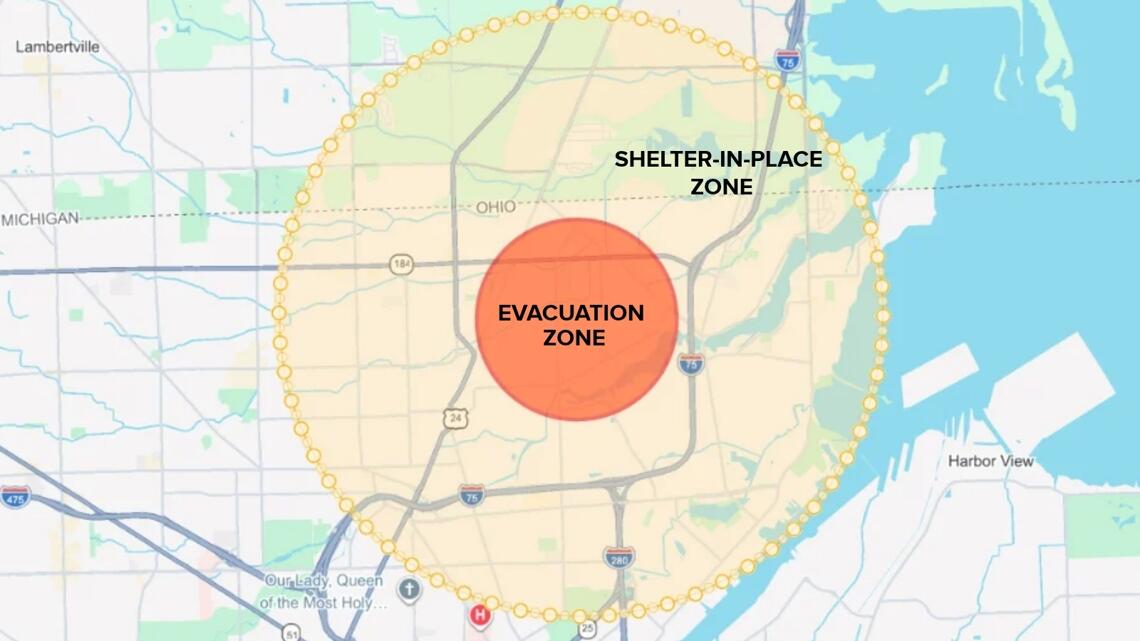
Toledo Fire & Rescue spokesperson Pvt. Sheldon Collins told the outlet early Wednesday that the exact chemicals in the air were not known at that time.
But according to open-source data, MC Tank’s terminal in north Toledo specializes in bulk liquid chemical transportation and tank-container services. The chemicals handled across the company’s network include caustic soda, sulfuric acid, hydrochloric acid, and other specialty chemicals.
The outlet continued:
Cause remains under investigation
Morrissey said officials do not yet have details about what caused the incident. Asked whether a train was involved, she said none was involved to her knowledge.
Several workers previously told WTOL 11 that the Toledo Assembly Complex was evacuated around 11 p.m. Tuesday. WTOL 11 has reached out to Stellantis for confirmation and comment.
Morrissey said crews will remain at the scene until the situation is understood and safe.
The vapors from the chemical leak have certainly gone airborne, and the evacuation order suggests these chemicals could pose health risks, such as eye and skin irritation, breathing difficulties, and nausea.
END
EBAY/HUGE LAYOFFS
eBay To Axe 9% Of Workforce As Shares Hit Record Highs Without A Ryan Cohen Takeover
Wednesday, Oct 21, 2026 – 09:00 AM
eBay’s turnaround is gaining momentum without Ryan Cohen, with shares climbing to new highs as management pushes ahead with efforts to streamline operations.
A Reuters report on Wednesday said the online marketplace plans to cut about 9% of its workforce and redirect capital toward faster-growing businesses.
eBay confirmed the layoffs to the outlet earlier today. The cuts build on its earlier workforce reduction this year of about 6%, or 800 jobs, all part of an effort to streamline operations and cut costs.
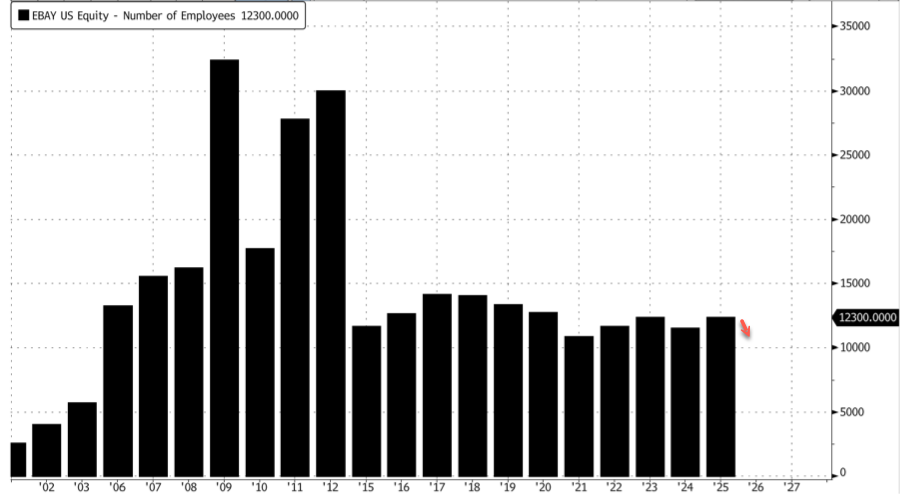
Here’s more from the report:
“Our strategy is working,” Iannone said in the memo, adding that “continuing to capture the significant opportunity ahead requires us to make thoughtful choices about where we focus and invest.”
He said affected staff would be informed in the coming days.
In early August, eBay reported its 2Q26 earnings, beating analyst expectations with $3.13 billion in revenue (up 15% year-over-year) and $1.60 in earnings per share against a consensus estimate of $1.50. The company is set to report 3Q26 earnings next Wednesday.
Analyst recommendations tracked by Bloomberg show mixed sentiment: there are 13 “Buy” ratings, 18 “Holds,” and 2 “Sells.” The analysts have an average 12-month price target of $118.
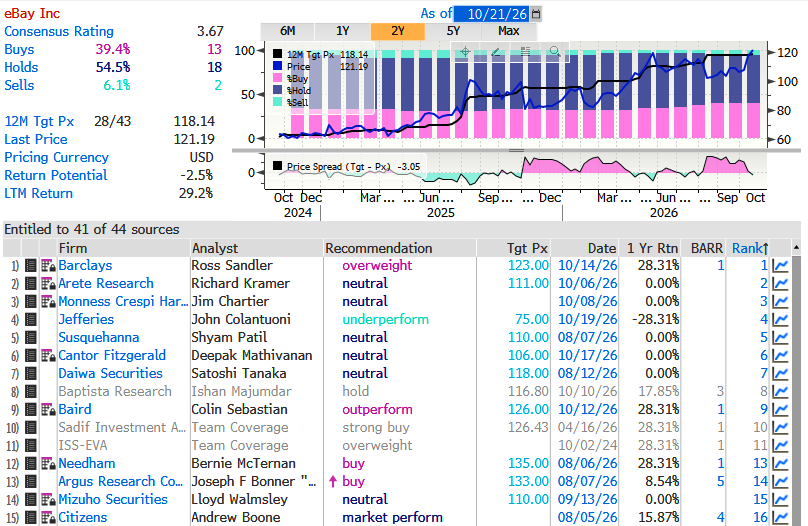
Last week, eBay shares broke out to new record highs, extending an “up and to the right” trend that has been in place since late 2023, as Chartered Market Technician and Bloomberg Senior Strategist William Maloney wrote in a brief note.
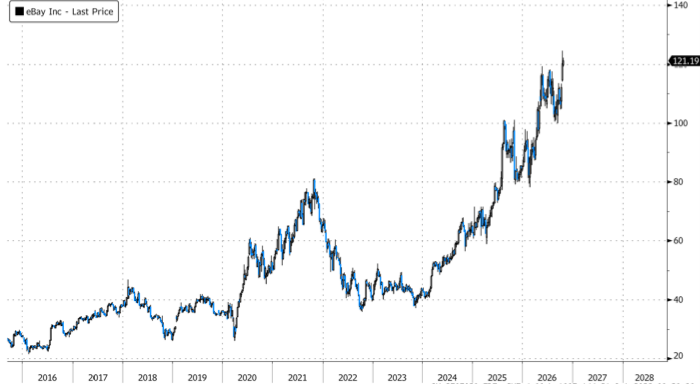
It appears that eBay doesn’t need GameStop CEO Ryan Cohen, who made an unsolicited $56 billion takeover bid in May, to continue its turnaround strategy. eBay rejected Cohen’s offer, saying that it was “neither credible nor attractive.”
Notably, Cohen’s GameStop holds the second largest position in eBay.
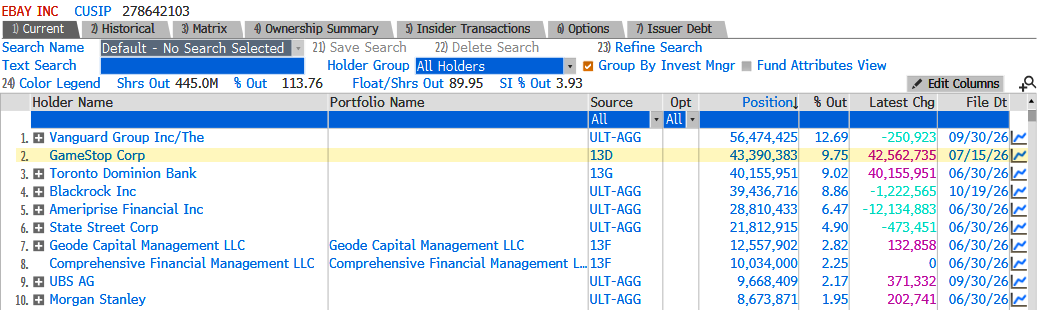
There was no mention in the report of whether AI chatbots were the result of the incoming layoffs.
KING NEWS
| The King Report October 21, 2026 Issue 7852 | Independent View of the News |
| Just two missives ago, we noted that the table talk in the equity market was that with stocks, notably techs, declining, Team Trump would do something to boost stocks ahead of the Midterms. US, Iran back fresh ‘compromise proposal’ presented by Pakistan, Qatar: ReportQatar and Pakistan have presented a compromise proposal aimed at bridging the differences between the US and Iran, with both sides giving preliminary approval to the plans, sources told news outlet Al Araby Al Jadeed.https://www.moneycontrol.com/world/us-iran-back-fresh-compromise-proposal-presented-by-pakistan-qatar-report-article-14056068.html @ABC: Global oil prices climbed to their highest level in five months on Tuesday after Iran and its Houthi allies claimed attacks on oil infrastructure in the Middle East. Oil sank on the Al Araby Al Jadeed report. Yes, Virginia; we have seen this movie umpteen times before. But it will boost stocks and push energy commodities lower, for a while. “You can fool some of the people some of the time — and that’s enough to make a decent living.”― W.C. Fields “You can fool some of the people some of the time and some of the people all of the time. That’s usually enough!” – attributed to Milton Berle ESZs and NQZs rallied sharply early on Monday night but quickly turned negative as the South Korean Kospi (Composite) cut crushed, again (closed -3.73%, but +40.50 pts from low). WSJ before the Al Araby Al Jadeed story appeared: Stocks Face Headwind That Ended Other Bull Markets – The tech stock rebound from last week’s washout appears to have lost momentum as jitters rise about funding for data-center developers. At 11:05 ET: S&P 500 +0.64%, DJIA +1.3%, Nasdaq + 0.44%, Nas 100 + 0.46%, SOX Index +0.93%, MU +1.36%, NVDA +0.32$, TSLA +2.25%, Meta -1.54%, SNDK – 0.9%, AMZN +0.65%, AMD +1.23%, INTC +1.7%, CRWV +3.0%, AAPL -0.7%, The SOX Index opened sharply lower but rallied on the latest peace is at hand report. It peaked at 10:30 ET. The S&P 500 opened modestly lower; fell to a daily low of 7668.03 (-22.70 pts.) at 9:45 ET and then rallied to the daily high of 7748.42 (+47.69 pts.) at 10:30 ET. Nov WTI hit a high of 101.37 at 7:36 ET but sank to 95.25 at 10:31 ET. Oil began its collapse before the Al Araby Al Jadeed story appeared, which means, once again, someone profited on inside info. USZs hit a low of 104 25/32 (17:00 T) then soared to 105 30/32 (+1 pt) at 10:30 ET. At 11:17 ET, Iran stated that ‘reports deal is close are wrong.’ Iran officials reiterated that the US must accept its seven conditions to start peace talks. Iran Will Not Allow Enriched Nuclear Material to Leave Country: Security Chief“Not even a tiny bit of enriched nuclear material will leave Iran. Such materials constitute a major asset and national wealth for the Iranian people, intended for use within the country,” Rezaei, secretary of Iran’s Supreme National Security Council, was quoted as saying…https://www.kurdistan24.net/en/story/947458/iran-will-not-allow-enriched-nuclear-material-to-leave-country-security-chief The S&P 500 Index fell to 7707.05 at 11:14 ET on Iran’s debunking of the peace is at hand deal.General Motors Shares Plunge 6% Despite $20 Billion Buyback Announcement and Earnings BeatThe selling comes as GM continues to grapple with a weakening U.S. auto market, where higher financing costs and pressure on household budgets…https://www.zerohedge.com/markets/general-motors-shares-plunge-despite-20-billion-buyback-announcement-and-earnings-beat After a 19-handle rebound, the S&P 500 rolled over and traded sideways, with a series of lower lows, and with a narrowing range, because traders were punch drunk from being belted by impact headlines. During the final hour of trading, the S&P moved to the middle of the afternoon range but continued to trade sideways until the index moved modestly higher during the final seconds on the usually late manipulation. The S&P 500 Index closed at 7712.57. Pending home sales hit record low – September contract signings plunged to their lowest since 2001, as surging rates erode buyer purchasing power across all four regions… contract signings dropping 7.3% from August and 11.3% from the prior year… The West recorded the steepest monthly drop at 9.2%, followed by the South at 8.2%, the Midwest at 6.5%, and the Northeast at 4.2%… Year-over-year declines were similarly broad: the West fell 15.0%, the South 12.0%, the Northeast 9.4%, and the Midwest 8.7%…https://www.mpamag.com/us/mortgage-industry/market-updates/pending-home-sales-hit-record-low/594224 U.S. Pending Home Sales Falls to Lowest Level on Record in SeptemberThe pending home sales index, a leading indicator of house sales based on contract signings, fell 7.3% in September to 66. This was the lowest reading ever recorded in the history of the pending home sales index, which began in 2001, said Nadia Evangelou, principal economist for NAR. Economists polled by The Wall Street Journal had forecast a 0.4% decline…https://www.morningstar.com/news/dow-jones/202610205586/us-pending-home-sales-falls-to-lowest-level-on-record-in-september-update WSJ: Trump Plans $8 Billion Bailout for Farmers – The president announced a new Agriculture Department program to cover losses from rising fuel and other input costs. (GOP candidates in Kansas and Iowa are struggling in polls. DJT held a rally in Kansas on Monday.) Trump, utilizing his past Democratic leanings, is trying to buy votes. It is the American Way! Positive aspects of previous session A second consecutive ‘peace is at hand’ story appeared.S&P 500 +0.28%, DJIA +1.02%, DJTA +0.92%, USZs +25/32 AT 16:10 ETSP Healthcare + 2.33% (LLY results), Real Estate +1.69%, Utes +1.15%, Financials +1.12%, Consumer Discretionary +0.71%, Materials +0.31%, Consumer Staples +0.28%, Energy +0.17%, Industrials +0.06% Negative aspects of previous session Nasdaq -0.02%, Nas 100 -0.13%, SOX Index -0.29%SP Communication Servies -0.89%, Info Tech -0.34%Energy commodities fell modestly but were well off their lows at the close. Ambiguous aspects of previous session What verbal intervention or leaked stories will appear? First Hour/Last Hour NYSE Action [S&P 500 Index]: 1st Hour: Down; Last Hour: Down Pivot Point for S&P 500 Index [above/below indicates daily trend to day traders]: 7709.67Previous session (S&P 500 Index) High/Low: 7748.42 (10:30 ET); 7668.03 (9:45 ET) Douglas Murray: France Stares Down the Abyss of HistoryEven great things come to an end. There’s no guarantee that French culture and traditions will survive ceaseless attacks from discontents inside the country… Last year, French government spending accounted for a staggering 57 percent of gross domestic product… This is in a country whose debt-to-GDP ratio is 115 percent…https://www.thefp.com/p/douglas-murray-france-stares-down-riots Same red-green network that boosted anti-Israel protests in US at center of French unrest, riotsMedia and activist groups funded by Shanghai-based tech tycoon Neville Roy Singham, the same ecosystem that drove U.S. campus and street protests during the Gaza war, are amplifying France’s student revolt as conservatives warn America could be next.https://justthenews.com/world/europe/same-network-boosted-anti-israel-protests-us-center-french-unrest-riots @MrAndyNgo: A 40-year-old male far-left extremist has been arrested in connection with the arson attack that destroyed the historic city hall building in Limoges, France. For weeks, Antifa and other extremists have been carrying out mass attacks across France and Belgium. They’re trying to overwhelm and overthrow the state. Muslims and those of immigrant background have been supported as the henchmen for the violence by far-left groups. @visegrad24: A French woman says that the rioters and looters broke into her building and threatened her with rape while she was holding her child in her arms. “That’s collateral damage” responds the feminist activist Bettina Zourli who holds a Master’s in gender studies and focuses her work on gender norms, motherhood, reproductive rights, and voluntary childlessness (“childfree”) She describes herself as “feminist, childfree and Antifa” Zourli also says that all the stores getting looted also constitute a case of collateral damage and that the revolution, which she supports, must be violent. She has lectured in gender studies, including at the University of Lille and Université Rennes. https://x.com/visegrad24/status/2112469093882183755 @JulietteJDI: In France, benefits are “free.” They’re free the way dinner is free when someone else pays the bill. For forty years that someone has been the next generation, and the bond market has been the go-between. France already taxes more than any other G10 economy, and it borrows to fund the welfare state. Now the rent is coming due: https://x.com/JulietteJDI/status/2112541739219046569 @OlivierBabeau: It is in fact Tocqueville’s paradox that bursts right in our faces. In one of the countries that redistributes the most in the world, the country that equalizes objective living conditions the most, that gives the most opportunity to everyone, that provides culture, education, and higher education for free to all, that respects human rights the most, in this land of plenty, therefore, a significant portion of the population is convinced that it lives in a hell of injustices and systemic violence. As Tocqueville had very well shown, the more equality there is, the more the remaining inequalities become unbearable. Especially because the meritocratic society, compared to the old regime founded on birth, has this terrible aspect: it makes people responsible for their own conditions. We have stated periodically that no matter how much government gives people, it is not enough! WaPo: The Trump administration has not approved the transfer of interceptor missiles to Ukraine that are needed to protect the country from Russian ballistic missile attacks…https://www.washingtonpost.com/politics/2026/10/19/amid-deteriorating-relations-washington-holds-up-patriots-kyiv/ Congress Seeks Answers on Starlink Disruptions in Ukraine (after reports that the WH ordered it)https://payloadspace.com/senators-ask-ig-to-investigate-starlink-disruptions-in-ukraine/ Elon Musk’s $2-trillion SpaceX faces nationalization calls after Zelenskyy claims Starlink blocked Ukraine’s defenses https://finance.yahoo.com/technology/articles/elon-musks-2-trillion-spacex-151000917.html Zelenskyy on Tuesday: We are thankful that US early warning systems now work again. Speaker Johnson warns WH of ‘unintended consequences’ of sanctions relief on Russia: ‘Putin cannot be trusted’ (Americans overwhelmingly oppose DJT’s Russia relief) https://trib.al/5r1bPxw WSJ: Musk Ordered Starlink Slowdown That Blindsided Ukraine (Musk said US officials ordered it.) WSJ: Netflix, America’s Dominant Streaming Service, Has Hit a WallThe company is overhauling creative leadership as it struggles to get domestic audiences to watch more. Netflix projects lower-than-expected 2026 ad revenueRevenue rose 12% to $12.87 billion, slightly above analyst expectations, the Los Gatos-based company said. Net income jumped 44% of $3.7 billion, and earnings per share of $0.87 beat the $0.82 that analysts surveyed by FactSet had expected. But Netflix projected slower growth for the remainder of the year, projecting revenue of $13.4 billion, less than what analysts had forecast. The company now expects $2.7 billion in ad revenue this year, down from its earlier forecast of $3 billion, citing a slower-than-anticipated rollout of some ad products capabilities. “With Netflix under pressure to find alternative lines of revenue beyond subscriptions, it’s concerning that the company lowered its estimate for its ad business,” said Ross Benes, senior analyst at research firm Emarketer…https://www.msn.com/en-us/news/other/netflix-projects-lower-than-expected-2026-ad-revenue-in-latest-earnings-report/ar-AA2fFRnu?ocid=BingNewsSerp Netflix falls after recording its lowest revenue growth rate (12.0% y/y) in three yearshttps://seekingalpha.com/news/4654823-netflix-falls-after-recording-its-lowest-revenue-growth-rate-in-three-years Netflix fell as much as 4.8% in after-hour trading. Today – Netflix kicked of Fang and tech reporting season with disappointing guidance. But most astute traders and investors expected Netflix to provide lower guidance. So, traders will eagerly play for the Fangs/tech stock reporting season rally. ‘They’ bought early on Monday night, and even though NQZs peaked early and sank into negative readings, ‘they’ are buying again on Tuesday night. Part of the aggressive Tuesday night buying is expectations that Meta will report great results. ESZs +21.50; NQZs +271.50, USZs -5/32, Nov WTI +$0.59, Nov Gas +0.021¢, ¥/$ 158.30 at 20:11 ET Expected earnings per Nasdaq: META 6.54, TSLA 0.22, PM 2.30, TXN 2.40, IBM 2.88, ABT 1.42, T 0.61, CSX 0.52, LUV 0.61 20-year Auction ($13B, reopening, 19 years, 10 months); noncompetitive bids 12 ET, competitive 13 ET Bank of England’s Greene says inflation risks are bigger than thought https://reut.rs/3WCFLhH S&P 500 50-day MA: 7704; 100-day MA: 7601; 200-day MA: 7278 (Close 7712.57, +0.28%)Nasdaq 100 50-day MA: 29,862; 100-day MA: 29,610; 200-day MA: 27,781 (Close 29,490.28, -0.13%) DJIA 50-day MA: 52,388; 100-day MA: 52,256; 200-day MA: 50,480 (Close 52,497.42, +1.02%) (Green is positive slope; Red is negative slope) Ric Grenell offered Alina Habba’s Turkish billionaire husband access to Trump for $6M Kennedy Center donation that vanished, texts allege (Historic highs in corruption/grift) https://trib.al/rpPZZ7k @BLaw: A federal judge (DJT appointee) under investigation for misconduct emailed confidential and sealed court papers to about 140 people in an early morning message, according to a new court order.https://news.bloomberglaw.com/us-law-week/judge-brown-emailed-sealed-court-papers-to-about-140-people US Judge Facing Misconduct Claims Said to Have ‘Abandoned’ JobUS District Judge Ada Brown of the Northern District of Texas is facing a judicial misconduct proceeding over several allegations, including the mishandling of her docket and treating other judges and court staff “in a demonstrably egregious and hostile manner,” those documents state. A committee of judicial investigators found there’s a “reasonable basis” to believe Brown “suffers from a mental condition that currently interferes with her ability to perform the responsibilities of her office,” according to the documents…https://news.bloomberglaw.com/us-law-week/us-judge-facing-misconduct-claims-said-to-have-abandoned-job NFL officiating has been abysmal, and it was horrendous on Sunday. However, the wretched officiating on Monday Night Football was particularly ugly. Social media teemed with opprobrium for the refs. Ex-players expressed their displeasure with the refs. Ex-NFL guard Richie Incognito @68INCOGNITO: These refs aren’t even trying to hide it anymore. RIGGED! Ex-NFL punter @PatMcAfeeShow: Welcome back to this official.. Adrian Hill was suspended for a game and he couldn’t wait to get back out there (Ref on Monday Night Football)https://x.com/PatMcAfeeShow/status/2112343111490019458 @SFSportsAndTech: He is a lunatic and needs to be terminated with cause. He told another ref to pick up the flag on a clear cut holding call after the Commanders scored. Unacceptable stuff. @pausa2minutos Where were the referees tonight, or whose side were they on? They let like 8 personal fouls go on the 49ers. Ozi Odighizuwa hitting helmet to helmet and all over the body on Jayden Daniels. Gracen Halton straight to the knee of Sam Cosmi. Height lands a blow on Jayden Daniels’ helmet.https://x.com/pausa2minutos/status/2112432367730049369 @ChadFisher: This is about the 10th personal foul or helmet to helmet hit by the 49ers tonight. Only 2 of them have been called. https://x.com/ChadFisher/status/2112387484604629086 @Rate_the_Refs: Here’s a look at the shot that Diggs took straight to the helmet on this pass. He also had to have his hand looked at. No flags thrown on this playhttps://x.com/Rate_the_Refs/status/2112342698405581134 @EBoKnowss Idk how you pick this flag up https://x.com/EBoKnowss/status/2112373404946804774 @SportsTalkNC8: Hold or no hold? https://x.com/SportsTalkNC8/status/2112376568655794251 @Tiller56: Pretty GD blatant HIP-DROP tackle here on Diggshttps://x.com/Tiller56/status/2112374252183724242 @MLFootball: A video compilation of 49ers star LB Fred Warner’s controversial helmet-to-helmet hits against Washington tonight is going viral. Fans are furious over three hits they believe should have been flagged. These are some dirty hits. https://x.com/MLFootball/status/2112389759863554380 @CohenNFL: Like I said in my previous post. NFL officials watching in NY should be stepping in when blatant helmet to helmet contact is made. Start with a penalty and then suspensions for players who get flagged for this in multiple games. For the player’s sake! @ProFootballTalk: For the second straight game, 49ers S Malik Mustapha avoids a flag for an illegal hit on a defenseless player. If fined again, he’ll be one more violation away from a suspension. It’s one thing to make or miss calls that allow a team procure an unwarranted victory, but it is an egregious practice to routinely NOT penalize dangerous behavior and acts. @TwistedTorchTv: Yea NFL is rigged. I’m done watching these fake prime time games. Sports betting has ruined the games we use to love. After blatantly favoring the 49ers for 3 quarters, the refs favored the Commanders, generating claims of ‘fix’ so the spread was covered. The TV broadcasters even savaged the refs for not calling personal fouls and provoking players to fight with each other. SF Bay Sports Royalty @SFSportsAndTech: The refs should be ashamed of themselves making this a game in the 4th. A full investigation is needed @NFLOfficiating. Absolutely pathetic garbage multiple times that raised serious eyebrows. We understand the NFL is influenced but these refs went way too far today. Makes the product on the field unwatchable. @jasonwhitlock: “We always knew the Chiefs were going to get a ghost pass interference call in the fourth quarter…it’s become a mockery… these officials are controlling the game… make decisions based on pre-game influence… If you watch the Chiefs and Dolphins game two weeks ago before the Bye Week …before Patrick Mahomes was even hit in the end zone, tate back judge was already pulling his flag for a roughing the passer penalty… Chase Daniels did a great breakdown on it…” – Former Chargers DT @BreidenFehoko on NFL referees rigging games. https://x.com/jasonwhitlock/status/2112325721297141912 @Fluffy__Duck: Grabbing the flag when he’s steps away from Mahomes. THEN throws flag before they hit the ground. (Video) https://x.com/Fluffy__Duck/status/2106005422448767010 Breiden Fehoko released this statement yesterday: Playing at Arrowhead Stadium is the most rigged venue in professional sports since Tom Brady left Foxborough… Throughout my NFL career we would have meetings with officials and coaches would remind us to prepare for the possibility of a call in this game that could shift the momentum in Kansas City’s favor… It was something we discussed and prepared for… I believe the NFL has a history of giving favorable treatment to teams and players who represent its biggest markets and most valuable storylines… The perception of preferential treatment is a serious problem for the integrity of the game…https://x.com/BreidenFehoko/status/2112604981731946520/photo/1 In this video, Fehoko claims that last year the NFL threatened to pull his pension if he says the NFL is rigged. https://x.com/MLFootball/status/2112389759863554380 This is what troubles us: NFL reffing is palpably bad, yet NFL officials protect the refs, prevent access to them, and incessantly gaslight fans by stating the officiating is great. Why are they doing this? @FootballCravee: (Woke NFL Commissioner) Roger Goodell says the NFL has “no plans” to cancel Sunday’s NFL game in Paris despite protests. “The protests have been mostly peaceful, we don’t feel our players are in any danger.” (We checked. No one is refuting this; not even Grok) Google AI: The Commissioner’s remarks have drawn significant criticism and public pushback due to the contrasting reality on the ground in France… The “Mostly Peaceful” Backlash: Goodell’s wording closely mirrors a heavily criticized BBC News report by correspondent James Waterhouse, who also described the unrest as “mostly peaceful” while delivering a television report directly in front of burning cars and plundered local businesses… Bloomberg @business: The National Football League picked General Atlantic to set up an investing platform for a deeper push into global sports investing. @BadCallOfficial: This was called defensive pass interference on Kentucky. The Oklahoma receiver slipped and grabbed the Kentucky player’s facemask…https://x.com/BadCallOfficial/status/2111646056622817732 @Newsforce: Descendants of the Native American chief who inspired the Washington Redskins logo want Trump’s help restoring the NFL team’s former name and image. “They tried to erase us, like we didn’t exist anymore,” said Kenneth Conway, whose family says it was never consulted before the 2020 change. The family also wants the Commanders’ new stadium named after Chief Two Guns White Calf, with plans to meet team representatives in November. | |
SWAMP STORIES FOR YOU TONIGHT
ILHAN OMAR..
Feds Using DNA To Probe Ilhan Omar ‘Married Her Brother’ Claim, Eye Conspiracy Charge: Report
Tuesday, Oct 20, 2026 – 06:25 PM
Federal prosecutors plan to use DNA evidence in their criminal investigation of Rep. Ilhan Omar (D-Minn.), people familiar with the probe told the New York Post on Monday. One source said the DNA is critical to proving the long-running allegation that Omar’s 2009 marriage to Ahmed Nur Said Elmi was a marriage to her brother, made so he could get a green card he never received. Omar has denied the claim since 2016, no charges have been filed, and the Justice Department has not confirmed any DNA evidence.

The DNA report is the latest turn in a probe that went public a week ago, when Homeland Security Investigations agents searched Omar’s Washington home on Oct. 12. Agents also seized Omar’s phone, and more than a dozen grand jury subpoenas have gone out, some to her relatives, a source told the Associated Press. The grand jury is collecting evidence in Minnesota, where the U.S. Attorney’s Office opened the case. Omar called the search an “attempt to target political enemies and weaponize federal law enforcement” and said, “I will not be silenced.”
The Post’s sources did not say whether the DNA was collected before or after the search. One of them pushed back on earlier reports that investigators went “dumpster diving” for swabs of Omar, Elmi or family members. Reporter Leland Vittert had said on Saturday that agents had done just that, before the raid:
Two other sources told the Post that the search, the DNA and other evidence give prosecutors a solid basis to bring a charge of conspiracy to commit immigration fraud before a grand jury. A conspiracy charge would let prosecutors allege overt acts that fall outside the statute of limitations, former federal prosecutor Neama Rahmani told the Post. He said prosecutors could pursue a conspiracy case that would likely fall within a 10-year limit, or a civil case, which has none, and that the warrant would not have been executed unless it had “come from the highest levels of the DOJ.”
That fits the warrant. A person familiar with the document told The Washington Post that it lists potential charges of conspiracy, immigration fraud and false statements. Investigators are also looking at whether Omar or her father, Nur Omar Mohamed, misstated her birth date on immigration paperwork so she could derive citizenship through him when he naturalized in 2000. Rahmani called her late father “an unindicted co-conspirator.” The Justice Department has not released the affidavit.
Homeland Security Secretary Markwayne Mullin, whose department’s agents carried out the search, said on Oct. 16 that “multiple other warrants” were served the same day. “We had a judge sign it, and we expect to be able to take the case to a grand jury,” he told the Charlie Kirk Show, according to CBS News.
The marriage and the birth-date theory lead to different places. A marriage-fraud conviction would not threaten Omar’s own citizenship the way a false-statements case would, the New York Post noted, and stripping the citizenship of a sitting member of Congress would be unprecedented. Border czar Tom Homan said over the weekend that the government has built “a strong case” that could lead the administration to seek denaturalization. As we reported, the Wall Street Journal had already said officials wanted to revoke her citizenship and deport her, and agents reportedly secured her passport in the search.
D.C. U.S. Attorney Jeanine Pirro, whose office is separately examining Omar’s House financial disclosures, told Fox News that “that judge would not have signed that warrant unless there was probable cause.” Those disclosures cut Omar’s reported net worth by tens of millions of dollars in a year, which the Post attributed to an unexplained accounting “discrepancy.”
Omar’s lawyers, Amy Jeffress and Joshua Matz, answered last week with a letter to the Justice Department demanding the “immediate return” of everything seized. They wrote that agents ignored a magistrate judge’s “special requests” for carrying out the search and broke longstanding DOJ policy by acting so close to an election, and that President Trump has “made no secret” of wanting to target her. A DOJ spokesperson called the letter “riddled with false allegations and inaccuracies” and said leaking it was “a publicity play.” Rep. Jamie Raskin, the ranking Democrat on House Judiciary, had already called the search “blatant political intimidation,” coming 22 days before the Nov. 3 election. Former federal prosecutor Jim Trusty told Fox News the warrant shows “at least probable cause,” but that it is “a long way off from proving a case at trial.”
The marriage record at the heart of the DNA claim is tangled. Omar and Elmi divorced in 2017, and she gave birth to her third child while legally married to him. Her marriage to Ahmed Hirsi was not legally entered into until after her divorce from Elmi was finalized, the Post reported, although the two had a Muslim ceremony in 2002. She filed joint taxes with Hirsi in 2014 and 2015 while still legally married to Elmi, from whom she had separated in 2011. Elmi, who lives in the UK, applied for a marriage-based green card and withdrew it in 2019 when immigration officials asked for more evidence, according to The Washington Post, which also quoted a former immigration official saying the brother claim was investigated during Trump’s first term without enough evidence to go forward. Omar divorced Hirsi in 2019 and married political consultant Tim Mynett.
We reported last week that her staff asked Minnesota’s legislative library in 2019 to change her birth year, and that Mynett snapped at a reporter over rumors she had fled the country. Mynett has said only that his wife “came here when she was 12 years old as a child war refugee.” Her lawyers say there is “no legitimate basis for any suggestion that she has violated any law concerning her citizenship status.”
END
EL SAYED…
Undercover Video Throws El-Sayed’s Senate Campaign Into Chaos
Wednesday, Oct 21, 2026 – 12:45 PM
Authored by Matt Margolis via PJ Media,
Abdul El-Sayed’s Senate campaign is in full-blown panic mode after an undercover O’Keefe Media Group video caught one of its field organizers claiming the candidate takes overseas donations.
The video dropped on Monday. By the end of the day, the Michigan Democrat Party had confirmed that the organizer who spilled the beans about the campaign’s illegal donations, Abdoul Beckwith, has been fired. No investigation, no review, no waiting to see how the story played out. Party officials cut him loose almost immediately, and the El-Sayed campaign rushed out a statement calling his comments “untrue,” “wildly misinformed,” and “not reflective of the campaign” while insisting it fully complies with Federal Election Commission rules.
Right. Sure. They would say that, wouldn’t they?
So, what did Beckwith say?
Talking with an undercover journalist who posed as a volunteer at the campaign’s Detroit operation, he dropped a true bombshell. El-Sayed “has people from overseas that donate to him,” Beckwith said. Asked whether that was allowed, he acknowledged it wasn’t.
He then described how the money supposedly moves, with family members or other intermediaries acting as conduits. “Everybody does it,” Beckwith said.
But that isn’t even the worst thing Beckwith revealed. When the undercover journalist raised the subject of Hamas, he explained why El-Sayed has to tread carefully around terrorist groups.
“He can’t just say, you know, ‘No, I don’t support Hamas, you know, I reject all of them,’ because he’s going to lose the people that brought him up in the first place,” Beckwith said. He made a similar point about the Muslim Brotherhood and worried that white and Jewish advisers could sway El-Sayed or “hijack” his positions.
Have you noticed this is a common theme among Democrat campaigns? Radicals at heart, they get nominated by primary voters and then spend the general election campaign trying to convince the broader electorate they aren’t who they really are.
Now the El-Sayed campaign is struggling to clean up this mess. And believe me, the panic has spread beyond the campaign itself. Left-wing influencer Brian Krassenstein immediately rushed to run cover.
“This is the biggest nothing burger in the history of nothing burgers,” Krassenstein claimed in a post on X.
If it’s nothing, why did they fire Beckwith?
Krassenstein kept going. “Some random field organizer says that Abdul Al-Sayed is getting money from overseas,” he wrote, adding, “First of all a field organizer has no inside knowledge of a campaigns finances, meaning his likely making it up, nor is getting money from overseas illegal if they are American citizens.”
Why would Beckwith make it up? He thought he was chatting with a fellow volunteer, not a reporter, and he had no reason to invent a scheme that could sink his own candidate. Notice, too, how Krassenstein hedges. If he truly believed El-Sayed takes no overseas money, why bother arguing that overseas money from Americans is perfectly fine? People build fallback positions when they suspect the first defense won’t hold.
The El-Sayed campaign now has a huge problem on its hands, and it knows it. The campaign could end this by opening its donor records to an independent audit. It won’t do that.
GREG HUNTER….