
EXCHANGE: COMEX
CONTRACT: OCTOBER 2026 COMEX 100 GOLD FUTURES
SETTLEMENT: 4,042.800000000 USD
INTENT DATE: 10/22/2026 DELIVERY DATE: 10/26/2026
FIRM ORG FIRM NAME ISSUED STOPPED
363 H WELLS FARGO SECURITI 6
991 H CME 6
TOTAL: 6 6
MONTH TOTAL: 13,455
GOLD: NUMBER OF NOTICES FILED FOR OCT./2026: 6 CONTRACTs NOTICES FOR 600 OZ or 0.0186 TONNES
total notices so far: 13,455 contracts FOR 1,345,500 OZ OR 41.850 TONNES
SILVER NOTICES: 51 NOTICE(S) FILED FOR 255,000 OZ /
total number of notices filed so far this month : 3566 CONTRACTS (NOTICES) for 17.830 million oz
GLD
SHANGHAI CLOSED UP 32.45 PTS OR 0.89%
HANG SENG CLOSED UP 158.69 PTS OR 0.69%
Nikkei CLOSED DOWN 155.89 PTS OR 0.25%
//Australia’s all ordinaries CLOSED UP 0.02%
//Chinese yuan (ONSHORE) CLOSED UP AT 6.6711
/ OFFSHORE CLOSED UP AT 6.6711 Oil UP TO 100.45 dollars per barrel for WTI and BRENT UP TO 113.70 Stocks in Europe OPENED ALL RED
ONSHORE USA/ YUAN// WITH YUAN TRADING 6.6711 OFFSHORE YUAN TRADING UP TO 6.671 ONSHORE YUAN TRADING BELOW LEVEL // OFF SHORE AND UP ON THE DOLLAR)// / AND THUS STRONGER/OFF SHORE YUAN TRADING UP AGAINST US DOLLAR/ AND THUS STRONGER
XXXXXXXXXXXXXXXXXXXXXXXXXXXXXXXXXXXXX
| Gold | Ounces |
| Withdrawals from Dealers Inventory in oz | nil |
| Withdrawals from Customer Inventory in oz | 2 ENTRIES i) Out of Asahi: 6,462.351 oz (201 kilobars) ii) Out of Brinks 53,627.868 oz (1668 kilobars) total withdrawal: 60,090/219 oz ( 1869 kilobars) 1.869 tonnes |
| Deposit to theDealerInventory in oz | 0 ENTRIES |
| Deposits to the Customer Inventory, in oz | DEPOSITS/CUSTOMER//gold 0 ENTRIES xxxxxxxxxxxxxxxx |
| No of oz served (contracts) today | 6 CONTRACTS 600 OZ 0.0186 TONNES OF GOLD |
| No of oz to be served (notices) | 23 Contracts 2300 OZ 0.0715 TONNES |
| Total monthly oz gold served (contracts) so far this month | 13,455 notices 1,345,500 OZ 41.850 TONNES |
| Total accumulative withdrawals of gold from the Dealers inventory this month | NIL oz |
| Total accumulative withdrawal of gold from the Customer inventory this month |
dealer deposits: 0
xxxxxxxxxxxxxxxxxxx
DEPOSITS:CUSTOMER ACCT
ENTRIES: 0
xxxxxxxxxxxxxxxxxx
comex withdrawals
2 ENTRIES
i) Out of Asahi: 6,462.351 oz (201 kilobars)
ii) Out of Brinks 53,627.868 oz (1668 kilobars)
total withdrawal: 60,090/219 oz ( 1869 kilobars)
1.869 tonnes
adjustments: 2///both dealer to customer accounts
a) Brinks 2074.321 oz
b) Malca: 610.210 oz
COMEX IS DRAINING GOLD
chaos inside the comex
THE FRONT MONTH OF OCT OI STANDS AT 29 CONTRACTS HAVING A LOSS OF 77 CONTRACTS.
THURSDAY WE HAD A NORMAL DELIVERY OF 1,347,800 OZ ( 41.922 TONNES) OF GOLD STANDING FOR DELIVERY: TODAY: 1,347,600 OZ OR 41.9160 TONNES FOR A LOSS OF 200 OZ (0.00622 TONNES) OR 2 CONTRACTS UNDERWENT A SMALL EXCHANGE FOR PHYSICAL TRANSFER TO LONDON WHERE THEY WILL TRY AND UNDERTAKE A DELIVERY OVER ON THAT SIDE OF THE POND.
.
NOVEMBER LOST 153 CONTRACTS FALLING TO 3323
DECEMBER, THE LARGEST DELIVERY MONTH IN THE CALENDAR, ITS OI FALLS BY 5431 CONTRACTS DOWN TO 307,330.
.
We had 6 contracts filed for today representing 600 oz
Today, 0 notice(s) were issued from J.P.Morgan dealer and 0 notices issued from their client or customer account. The total of all issuance by all participants equate to 6 contract(s) of which 0 notices were stopped (received) by j.P. Morgan dealer and 0 notice(s) was (were) stopped (received) by J.P.Morgan//customer account
To calculate the INITIAL total number of gold ounces standing for OCT /2026. contract month, we take the total number of notices filed so far for the month (13,455) to which we add the difference between the open interest for the front month of OCT (29 CONTRACTS) minus the number of notices served upon today 6 x 100 oz per contract) equals 1,347,600 OZ OR(41.9160 Tonnes of gold) to which we add our two exchange for risk in Oct totalling 837 contracts for 83,700 oz or 2.60346 tonnes. Thus Oct standing for gold reduces to 44.5195 tonnes
THUS: INITIAL total number of gold ounces standing for OCT. /2026. contract month,we take the total number of notices filed so far for the month (13,455) to which we add the difference between the open interest for the front month of OCT(29) contracts minus the number of notices served upon today 6 x 100 oz per contract) equals 1,347,600 OZ OR(41.9160 Tonnes of gold) plus our first exchange for risk totalling 837 contracts//83700 oz//2.60346 tonnes//standing ADVANCES to 44.5195 tonnes
new total of gold standing in OCT becomes 44.5195 TONNES//
TOTAL COMEX GOLD STANDING FOR OCT.: 44.5195 TONNES WHICH IS NOW VERY STRONG FOR THIS NON ACTIVE DELIVERY MONTH OF OCT./
WEDNESDAY VOLUME: 246,019 fair
COMEX GOLD INVENTORIES/CLASSIFICATION
NEW PLEDGED GOLD:
241,794.285 oz NOW PLEDGED /HSBC 5.94 TONNES
204,937.290 OZ PLEDGED MANFRA 3.08 TONNES
83,657.582 PLEDGED JPMorgan no 1 1.690 tonnes
265,999.054, oz JPM No 2
1,152,376.639 oz pledged Brinks/
Manfra: 33,758.550 oz
Delaware: 193.721 oz
International Delaware:: 11,188.542 oz
total pledged gold: 1,746,271.131 oz 54.31 tonnes pledged gold lowers
total inventories in gold declining rapidly
total pledged gold: 1,746,271.131 tonnes oz 54.31 tonnes
TOTAL OF ALL GOLD ELIGIBLE AND REGISTERED GOLD 23,282,973/467 oz//
TOTAL REGISTERED GOLD 14,814,284.475 tonnes (460.78 tonnes)
TOTAL OF ALL ELIGIBLE GOLD 8,468,688.992 oz.
REGISTERED GOLD THAT CAN BE SERVED UPON 13,068,013 oz ((REG GOLD- PLEDGED GOLD)=
40.470 Tonnes //
total inventories in gold declining rapidly
SILVER COMEX
OCT DELIVERY MONTH
OCT 23
| Silver | Ounces |
| Withdrawals from Dealers Inventory | NIL oz |
| Withdrawals from Customer Inventory | 1 entries i) Loomis 100,641.750 total withdrawal 100,641.750 oz |
| Deposits to the Dealer Inventory | 0 ENTRY |
| Deposits to the Customer Inventory | ENTRIES: 1 i) Into Manfra 599,964.120 oz total deposit: 599,964.120 oz |
| No of oz served today (contracts) | 51 CONTRACT(S) ( 255,000 OZ) |
| No of oz to be served (notices) | 14 Contracts (0.070 MILLION oz) |
| Total monthly oz silver served (contracts) | 3566 contracts 17.830 MILLIONoz |
| Total accumulative withdrawal of silver from the Dealers inventory this month | NIL oz |
| Total accumulative withdrawal of silver from the Customer inventory this month |
DEPOSITS INTO DEALER ACCOUNTS
ENTRY:0
DEPOSIT ENTRIES/CUSTOMER ACCOUNT
1 ENTRIES:
i) Into Manfra 599,964.120 oz
total deposit: 599,964.120 oz
xxxxxxxxxxxxxxxxxxxxxxxxx
withdrawals:
1 entries
i) Loomis 100,641.750
total withdrawal 100,641.750 oz
adjustments : 3
a) CNT: dealer to customer; 147,143.073 oz
b) JPMorgan: dealer to customer: 62,727.300 oz
c) Manfra: customer to dealer acct: 2l5,393.494 oz
xxxxxxxxxxxxxx
TOTAL REGISTERED SILVER: 100.514 MILLION OZ//.TOTAL REG + ELIGIBLE. 338.101 Million oz
registered silver dropping in numbers
CALCULATIONS FOR THE NEW STANDING FOR SILVER FOR OCT
FRONT MONTH: SILVER OPEN INTEREST CONTRACTS: 65 FOR A GAIN OF 43 CONTRACTS . THURSDAY WE HAD 17.665 MILLION OZ STAND: TODAY: 17.900 MILLION OZ FOR A GAIN OF 235,000 OZ (47 CONTRACTS). THUS A 47 CONTRACT QUEUE JUMP//WHERE THEY WILL TRY AND TAKE DELIVERY ON THIS SIDE OF THE POND.
.
NOVEMBER LOST 130 CONTRACTS DOWN TO AN OI OF 1691
DECEMBER GAINED 128 CONTRACTS UP TO AN OI OF 86,081
TOTAL NUMBER OF NOTICES FILED FOR TODAY: 51 or 255,000 oz
CONFIRMED volume THURSDAY; 65,609 // strong/raid/
AND NOW OCT. DELIVERIES:
To calculate the number of silver ounces that will stand for delivery in OCT. we take the total number of notices filed for the month so far at 3566 X5,000 oz = 17.830 MILLION oz.
Then we take the difference between the front month of OCT. and the number of notices filed for today x 5000 to give us our standing
Thus the standings for silver for the OCT 2026 contract month: (3866 )Notices served so far) x 5000 oz + OI for the front month of OCT (65) minus number of notices served upon today ( 56 x 5000 oz) equals silver standing for the OCT .contract month equating to 17.900 MILLION OZ to which we add silver’s TWO exchange for risk for 450 contracts (2.25 million oz).. total standing REMAINS AT 20.150 million oz//. ( a very strong delivery month)
We must also keep in mind that there is considerable silver standing in London coming from our longs
There are ONLY 100.514 million oz of registered silver
JPMorgan as a percentage of total silver: 125.510/338.101 million: 37.11%
The record level of silver open interest is 234,787 contracts set on April 21./2017 with the price on that day at $18.42.
The previous record was 224,540 contracts with the price at that time of $20.44.
BOTH GLD AND SLV ARE MASSIVE FRAUD
XXXXXXXXXXXXXXXXXXXXXXXXXXXXXXXXXXXXXXXXXXX
OCT 23//2026/WITH GOLD DOWN $49.65 /HUGE CHANGES IN GOLD AT THE GLD. A WITHDRAWAL OF 2.56 TONNES OF GOLD OUT OF THE GLD//// //:/INVENTORY RESTS AT 1057.62 TONNES
OCT 22//2026/WITH GOLD DOWN $87.75 /HUGE CHANGES IN GOLD AT THE GLD. A DEPOSIT OF 1.14 TONNES OF GOLDINTO THE GLD//// //:/INVENTORY RESTS AT 1060.18 TONNES
OCT 21//2026/WITH GOLD UP $8.55 /NO CHANGES IN GOLD AT THE GLD.// //:/INVENTORY RESTS AT 1059.04 TONNES
OCT 20//2026/WITH GOLD DOWN $41.05 /NO CHANGES IN GOLD AT THE GLD. //:/INVENTORY RESTS AT 1059.04 TONNES
OCT 19//2026/WITH GOLD DOWN $19.65 /HUGE CHANGES IN GOLD AT THE GLD:A DEPOSIT OF 5.13 TONNES OF 0.29 TONNES OF GOLD INTO THE GLD/. //:/INVENTORY RESTS AT 1059.04 TONNES
OCT 16//2026/WITH GOLD UP $60.50 /HUGE CHANGES IN GOLD AT THE GLD:A WITHDRAWAL OF 0.29 TONNES OF GOLD FROM THE GLD/. //:/INVENTORY RESTS AT 1053.91 TONNES
OCT 15//2026/WITH GOLD UP $60.50 /HUGE CHANGES IN GOLD AT THE GLD:A WITHDRAWAL OF 1.21 TONNES OF GOLD FROM THE GLD/. //:/INVENTORY RESTS AT 1054.20 TONNES
OCT 14//2026/WITH GOLD DOWN $66.25 /NO CHANGES IN GOLD AT THE GLD: //:/INVENTORY RESTS AT 1055.41 TONNES
OCT 13//2026/WITH GOLD DOWN $13.25 /HUGE CHANGES IN GOLD AT THE GLD: A DEPOSIT OF OF 2.281TONNES OF GOLD INTO THE THE GLD//: //:/INVENTORY RESTS AT 1055.411 TONNES
OCT 12//2026/WITH GOLD DOWN $24.20 /HUGE CHANGES IN GOLD AT THE GLD: A WITHDRAWAL OF 2TONNES OF GOLD OUT OF THE GLD//: //:/INVENTORY RESTS AT 1053.13 TONNES
OCT 9//2026/WITH GOLD UP $60.00 /HUGE CHANGES IN GOLD AT THE GLD: A WITHDRAWAL OF 4.562 TONNES OF GOLD OUT OF THE GLD//: //:/INVENTORY RESTS AT 1055.411 TONNES
OCT 8//2026/WITH GOLD UP $16.85 /HUGE CHANGES IN GOLD AT THE GLD: A DEPOSIT OF 3.703 TONNES OF GOLD INTO THE GLD//: //:/INVENTORY RESTS AT 1059.873 TONNES
OCT 7//2026/WITH GOLD DOWN $46.70 /NO CHANGES IN GOLD AT THE GLD:: //:/INVENTORY RESTS AT 1056.27 TONNES
OCT 6//2026/WITH GOLD UP $30.60 /HUGE CHANGES IN GOLD AT THE GLD:: A DEPOSIT OF 0.754 TONNES OF GOLD INTO THE GLD// //:/INVENTORY RESTS AT 1056.27 TONNES
OCT 5//2026/WITH GOLD DOWN $2.20 /HUGE CHANGES IN GOLD AT THE GLD:: A WITHDRAWAL OF 0.854 TONNES OF GOLD INTO THE GLD// //:/INVENTORY RESTS AT 1055.696 TONNES
OCT 2//2026/WITH GOLD DOWN $43.00 /HUGE CHANGES IN GOLD AT THE GLD:: A DEPOSIT OF 0.854 TONNES OF GOLD INTO THE GLD// //:/INVENTORY RESTS AT 1056.55 TONNES
OCT 1//2026/WITH GOLD UP $19.55 /HUGE CHANGES IN GOLD AT THE GLD:: A WITHDRAWAL OF 1.711 TONNES OF GOLD OUT OF THE GLD// //:/INVENTORY RESTS AT 1055.696 TONNES
SEPT 30//2026/WITH GOLD UP $7.80 /HUGE CHANGES IN GOLD AT THE GLD:: A DEPOSIT OF 2.847 TONNES OF GOLD INTO THE GLD// //:/INVENTORY RESTS AT 1057.407 TONNES
SEPT 29//2026/WITH GOLD UP $11.75 /NO CHANGES IN GOLD AT THE GLD //:/INVENTORY RESTS AT 1054.56 TONNES
SEPT 28//2026/WITH GOLD DOWN $150.20 /NO CHANGES IN GOLD AT THE GLD //:/INVENTORY RESTS AT 1054.56 TONNES
SEPT 25//2026/WITH GOLD DOWN $150.20 /NO CHANGES IN GOLD AT THE GLD //:/INVENTORY RESTS AT 1054.56 TONNES
SEPT 24//2026/WITH GOLD DOWN $18.70 /HUGE CHANGES IN GOLD AT THE GLD A DEPOSIT OF 1.43 TONNES OF GOLD INTO THE GLD://:/INVENTORY RESTS AT 1056.84 TONNES
SEPT 23//2026/WITH GOLD DOWN $58.00 /HUGE CHANGES IN GOLD AT THE GLD://:/INVENTORY RESTS AT 1055.41 TONNES
SEPT 22//2026/WITH GOLD DOWN $6.30 /HUGE CHANGES IN GOLD AT THE GLD://A DEPOSIT OF 0.31 TONNES OF GOLD INTO THE GLD/:/INVENTORY RESTS AT 1055.41 TONNES
SEPT 21//2026/WITH GOLD DOWN $41.20 /HUGE CHANGES IN GOLD AT THE GLD://A DEPOSIT OF 2.26 TONNES OF GOLD INTO THE GLD/:/INVENTORY RESTS AT 1055.10 TONNES
SEPT 18//2026/WITH GOLD UP $26.45 /HUGE CHANGES IN GOLD AT THE GLD://A DEPOSIT OF 0.85 TONNES OF GOLD INTO THE GLD/:/INVENTORY RESTS AT 1052.84 TONNES
SEPT 17//2026/WITH GOLD UP $14.05 /HUGE CHANGES IN GOLD AT THE GLD://A DEPOSIT OF 1.71 TONNES OF GOLD INOT THE GLD/:/INVENTORY RESTS AT 1051.99 TONNES
SEPT 16//2026/WITH GOLD UP $53.40 /HUGE CHANGES IN GOLD AT THE GLD://A DEPOSIT OF 2.86 TONNES OF GOLD INOT THE GLD/:/INVENTORY RESTS AT 1050.28 TONNES
SEPT 15//2026/WITH GOLD DOWN $19.45 /NO CHANGES IN GOLD AT THE GLD://A WITHDRAWAL OF 0.353 TONNES OF GOLD FROM THE GLD/:/INVENTORY RESTS AT 1047.420 TONNES
SEPT 14//2026/WITH GOLD DOWN $54.50 /SMALL CHANGES IN GOLD AT THE GLD://A WITHDRAWAL OF 0.353 TONNES OF GOLD FROM THE GLD/:/INVENTORY RESTS AT 1047.420 TONNES
SEPT 11//2026/WITH GOLD UP $1.05 /SMALL CHANGES IN GOLD AT THE GLD://A WITHDRAWAL OF 0.353 TONNES OF GOLD FROM THE GLD/:/INVENTORY RESTS AT 1050.277 TONNES
/
GLD INVENTORY: 1059.04 TONNES, TONIGHTS TOTAL GOLD INVENTORY
SILVER
OCT 23 WITH SILVER DOWN $0.94 : :NO CHANGES AT THE SLV:// // :INVENTORY RESTS AT 497.876 MILLION OZ
OCT 22 WITH SILVER DOWN $2.72 : : SMALL CHANGES AT THE SLV: A WITHDRAWAL OF 632,000 OZ INTO SLV// // :INVENTORY RESTS AT 497.876 MILLION OZ
OCT 21 WITH SILVER DOWN $0.28 : : STRONG CHANGES AT THE SLV: A DEPOSIT OF 858,000 OZ INTO SLV// // :INVENTORY RESTS AT 498.508 MILLION OZ
OCT 20 WITH SILVER UP $0.68 : :NO CHANGES A WITHDRAWAL OF 943,000 OZ INTO OUT OF SLV// // :INVENTORY RESTS AT 497.650 MILLION OZ
OCT 16 WITH SILVER UP $1.19 : :MEGA HUGE CHANGES A DEPOSIT OF 4.374 MILLION OZ INTO THE SLV// // :INVENTORY RESTS AT 498.593 MILLION OZ
OCT 15 WITH SILVER UP $1.19 : :SMALL CHANGES A DEPOSIT OF 406,000 OZ INTO THE SLV// // :INVENTORY RESTS AT 494.219 MILLION OZ
OCT 14 WITH SILVER DOWN $3.25 : :SMALL CHANGES A WITHDRAWAL OF 135,000 OZ OUT OF THE SLV// // :INVENTORY RESTS AT 493.948 MILLION OZ
OCT 13 WITH SILVER DOWN $0.97 : :HUGE CHANGES A DEPOSIT OF 722,000 OZ INTO THE SLV// // :INVENTORY RESTS AT 493.813 MILLION OZ
OCT 12 WITH SILVER DOWN $0.51 : :HUGE CHANGES A DEPOSIT OF 722,000 OZ INTO THE SLV// // :INVENTORY RESTS AT 493.948 MILLION OZ
OCT 9 WITH SILVER UP $0.62 : :SMALL CHANGES A DEPOSIT OF 948,000 OZ INTO THE SLV// // :INVENTORY RESTS AT 493.226 MILLION OZ
OCT 8 WITH SILVER DOWN $0.74 : :SMALL CHANGES IN INVENTORY AT THE SLV:A WITHDRAWAL OF 532,000 OZ FROM THE SLV// // :INVENTORY RESTS AT 492.278 MILLION OZ
OCT 7 WITH SILVER DOWN $1.36 : :SMALL CHANGES IN INVENTORY AT THE SLV:A WITHDRAWAL OF 451,000 OZ FROM THE SLV// // :INVENTORY RESTS AT 492.910 MILLION OZ
OCT 6 WITH SILVER UP $0.31 : :NO CHANGES IN INVENTORY AT THE SLV: // :INVENTORY RESTS AT 493.361 MILLION OZ
OCT 5 WITH SILVER UP $0.87 : :NO CHANGES IN INVENTORY AT THE SLV: // :INVENTORY RESTS AT 493.361 MILLION OZ
OCT 2 WITH SILVER DOWN $0.74 : :NO CHANGES IN INVENTORY AT THE SLV: // :INVENTORY RESTS AT 493.578 MILLION OZ
OCT 1 WITH SILVER UP $0.57 : :HUGE CHANGES IN INVENTORY AT THE SLV: A WITHDRAWAL OF 1.400 MILLION OZ OUT OF THE SLV// :INVENTORY RESTS AT 493.578 MILLION OZ
SEPT 30 WITH SILVER DOWN $0.55 : :HUGE CHANGES IN INVENTORY AT THE SLV: A DEPOSIT OF 994,000 OZ INTO THE SLV// :INVENTORY RESTS AT 494.978 MILLION OZ
SEPT 29 WITH SILVER DOWN $0.58 : :SMALL CHANGES IN INVENTORY AT THE SLV: A WITHDRAWAL OF 566,000 OZ FROM THE SLV// :INVENTORY RESTS AT 493.984 MILLION OZ
SEPT 28 WITH SILVER DOWN $2.91 : :SMALL CHANGES IN INVENTORY AT THE SLV: A DEPOSIT OF 0.542 MILLION OZ FROM THE SLV// :INVENTORY RESTS AT 494.436 MILLION OZ
SEPT 25 WITH SILVER DOWN $2.91 : :SMALL CHANGES IN INVENTORY AT THE SLV: A DEPOSIT OF 0.542 MILLION OZ FROM THE SLV// :INVENTORY RESTS AT 494.436 MILLION OZ
SEPT 24 WITH SILVER DOWN $0.96 : :HUGE CHANGES IN INVENTORY AT THE SLV: A WITHDRAWAL OF 0.813 MILLION OZ FROM THE SLV// :INVENTORY RESTS AT 493.533 MILLION OZ
SEPT 23 WITH SILVER UP $1.58 : :HUGE CHANGES IN INVENTORY AT THE SLV: A WITHDRAWAL OF 1.716 MILLION OZ FROM THE SLV// :INVENTORY RESTS AT 494.346 MILLION OZ
SEPT 22 WITH SILVER UP $0.10 : :NO CHANGES IN INVENTORY AT THE SLV: :INVENTORY RESTS AT 496.062 MILLION OZ
SEPT 21 WITH SILVER UP $1.04 : :HUGE CHANGES IN INVENTORY AT THE SLV: :INVENTORY RESTS AT 489.558 MILLION OZ
SEPT 18 WITH SILVER UP $1.04 : :NO CHANGES IN INVENTORY AT THE SLV: :INVENTORY RESTS AT 489.558 MILLION OZ
SEPT 17 WITH SILVER UP $1.10 : :HUGE CHANGES IN INVENTORY AT THE SLV: A WITHDRAWAL OF 1.265 MILLION OZ FROM THE SLV/ :INVENTORY RESTS AT 489.558 MILLION OZ
SEPT 16 WITH SILVER UP $0.95 : :HUGE CHANGES IN INVENTORY AT THE SLV: A WITHDRAWAL OF 813,000 OZ FROM THE SLV/ :INVENTORY RESTS AT 490.823 MILLION OZ
SEPT 15 WITH SILVER DOWN $0.16 : :HUGE CHANGES IN INVENTORY AT THE SLV: A WITHDRAWAL OF 813,000 OZ FROM THE SLV/ :INVENTORY RESTS AT 491.636 MILLION OZ
SEPT 14 WITH SILVER DOWN $0.91 : :NO CHANGES IN INVENTORY AT THE SLV:/ :INVENTORY RESTS AT 492.449 MILLION OZ
SEPT 11 WITH SILVER DOWN $3.50 : :NO CHANGES IN INVENTORY AT THE SLV:/ :INVENTORY RESTS AT 492.449 MILLION OZ
CLOSING INVENTORY 497.876 MILLION OZ OF SILVER
GOLD COMMENTARIES:
1.PETER SCHIFF//JOHN RUBINO//RAVEN
JOHN RUBINO
For Banks, A Perfect Storm?
| John RubinoOct 23 |  |


On the surface, the US banking system looks pretty solid. But in reality, much is going wrong, including:
Unreported Government Bond Losses
US banks hold nearly $5 trillion of government paper. Over the past year, rising interest rates have driven bond prices down.

That leaves banks with massive unreported losses on their balance sheets. Eventually, those losses will migrate to earnings reports, potentially spooking depositors and causing bank runs.
The higher interest rates go, the bigger these unreported losses become.
Sub-Prime Auto Loan Delinquencies
Car prices are rising, and various bank-like entities have been more than willing to put low-quality borrowers into new cars through “car mortgages”—loans with terms that approximate the car’s expected life.
Total US auto debt is now a record $1.71 trillion, and subprime loans are going bad at a rate exceeding that of the Great Recession.

Empty Office Buildings
The value of US commercial loans held by banks is twice what it was in 2007.

Some commercial real estate sub-sectors are healthy, and some are not, with one already in “bust” territory. Office buildings never recovered from the pandemic remote-work spasm. Occupancy rates are low, cash flow isn’t covering debt service, and delinquencies now exceed GFC levels.

AI Causes Banking “Security Nightmare”
Unauthorized AI agents are reportedly already accessing US bank accounts
(Engadget) Unauthorized third-party AI agents are accessing US bank accounts, according to a report by Axios. Some of these agents are even taking actions that appear to be independent of user instructions, though this is based on unnamed sources within several banking institutions.
Many AI agents, including the cute and cuddly Muse, can access a user’s bank account to perform actions on their behalf. This is already a security nightmare, as most banks mandate that humans log in to their own accounts. The problem is compounded when these agents start to buy things or shift money around. The potential for scams and fraud is off the charts.
Private Credit AI Bubble
This is the big one. As the AI boom took off, the debt needed to build hundreds (maybe thousands?) of data centers caused mainstream banks to shy away.
So private credit companies — unregulated, unmonitored “shadow” banks — stepped in. They bought or created insurance companies and took most of the new AI debt onto their balance sheets.
Along the way — in what might, in retrospect, come to be seen as an epic blunder — mainstream banks helped fund the private credit companies. This put the banks back on the hook, one step removed, for the AI bubble.
Now various marginal players in the AI space are encountering financial turbulence. See:
CoreWeave’s market confidence erodes as bond yields spike and stock sinks
Credit stress is threatening to unwind the AI bull. All eyes are on Oracle to hold the line
And this:
Big Tech’s AI Debt Deluge Might Be Even Worse Than Previously Reported
(Daily Caller) – Big Tech could be carrying substantially more financial exposure tied to artificial intelligence than investors realize, S&P Global warned Monday as concerns mounted over the debt financing Wall Street’s AI boom.
Technology companies are increasingly relying on outside investors, financial guarantees and complex financing arrangements to fund their enormous data center expansion. Those arrangements can leave substantial obligations outside conventional debt disclosures, making it difficult to determine who ultimately bears the risk if anticipated AI profits fail to materialize.
S&P Global’s head of digital infrastructure, Mark Habib, warned that interconnected financing arrangements could conceal additional liabilities.
“It is safe to assume that there is more (debt) out there that we are not seeing,” Habib said during a Monday roundtable in London.
S&P estimates that Amazon, Microsoft, Alphabet, Oracle, Meta and SpaceX will collectively spend more than $7 trillion on AI-related capital expenditures between 2025 and 2030. The agency also projected negative free operating cash flow for the group in 2026 and 2027 as investment outpaces internally generated funds.
Goldman Sachs projected that global hyperscaler debt issuance would reach $420 billion in 2027, more than 60% above its 2026 estimate. The bank also found that hyperscalers accounted for just 40% of AI-related credit issuance, suggesting the industry’s borrowing extends far beyond the technology giants themselves.
And Then There’s Europe
France and Germany are home to some of the world’s biggest banks. And, well, how to put this…Europe is committing cultural/financial suicide, and its banks are looking a lot less secure.
Catherine Austin Fitts recently posted a warning about US banks, which ended with:
And the situation in Europe is even worse.
Société Générale: -27%
BNP Paribas: -24%
Barclays: -23%
Deutsche Bank: -21%
END
1 B // JAMES RICKARDS/MATHEW PIEPENBURG/ALASDAIR MACLEOD..
ALASDAIR MACLEOD…
3. CHRIS POWELL AND HIS GATA DISPATCHES
Alasdair Macleod: Gold and silver trashed by paper traders
Submitted by admin on Fri, 2026-10-23 09:25Section: Daily Dispatches
By Alasdair Macleod
GoldMoney, Toronto
Friday, October 23, 2026
Silver hits new lows for the year, while gold threatens to follow. Despite economic and debt deteriorations leading to a global crisis, precious metals remain the playthings of the paper traders.
Looking at the chart showing gold and silver declining over the course of 2026, you wouldn’t think that the world is going to hell in a handcart.
Instead, gold and silver prices are reflecting declining risk, in ignorance of the facts. Currently, the opportunity for the shorts to bash precious metal prices is created by a pause in the increase in bond yields, reducing the fear factor, while oil prices head moderately higher.
The yield on the 10-year U.S. treasury note has backed down in what looks like a normal correction, encouraged by minor portfolio reweighting from equities, which are visibly struggling. …
… For the remainder of the analysis:
END
Central banks still exchanging dollars for gold, Maguire tells LFTV
Submitted by admin on Thu, 2026-10-22 14:27Section: Daily Dispatches
2:25p ET Thursday, October 22, 2026
Dear Friend of GATA and Gold:
Gold’s structural breakout, London metals trader Andrew Maguire says on this week’s edition of Kinesis Money’s “Live from the Vault” program, continues to be driven by central bank replacement of dollar reserves with the monetary metal. The recent decline in gold prices, Maguire says, is again entirely a matter of derivatives shorting, with no metal changing hands, and will soon be exhausted.
The program is 59 minutes long and can be viewed at the Kinesis Money channel at YouTube here:
CHRIS POWELL, Secretary/Treasurer
Gold Anti-Trust Action Committee Inc.
CPowell@GATA.org
END
India mounts costly defense of rupee
Submitted by admin on Thu, 2026-10-22 09:29Section: Daily Dispatches
By Chris Kay
Financial Times, London
Thursday, October 22, 2026
India is mounting an increasingly costly defence of the rupee, deploying tens of billions of dollars and resorting to extraordinary market interventions to protect a currency that has come under pressure from elevated oil prices and investor outflows.
The central bank since June has already used about $90 billion of the more than $140 billion it raised from India’s diaspora to prop up the rupee, including through sales to the spot market and currency swaps to absorb surplus liquidity, according to two foreign-exchange bankers with knowledge of the moves.
“They have been aggressive,” said one of bankers. The Reserve Bank of India did not respond to a request for comment.
The rupee is one of Asia’s worst-performing currencies this year, having fallen 5% against the dollar. Rising crude prices from the war in Iran have driven up the cost of energy imports for one of the world’s largest oil consumers, while record foreign selling of Indian equities has exacerbated the rupee’s weakness. …
… For the remainder of the report:
* * *
END
The world’s rich are finding a new home for their gold in Singapore
Submitted by admin on Thu, 2026-10-22 07:56Section: Daily Dispatches
By Cindy Wang and Yihui Xie
Bloomberg News
Wednesday, October 21, 2026
Gregor Gregersen’s first Singapore bullion business began from under his bed. He stashed silver, though not much of it, and trades took place at his neighborhood train station as he tested for local demand.
Almost 17 years later, the German-born former bank data architect owns a six-story, 180,000-square-foot mega-vault with enough room to house about 10% of the world’s annual gold supply and 30% of yearly silver supply. Now, the business has not only outgrown his bedroom but the local clientele, and he’s selling more space to foreign investors who want their bullion stored somewhere farther away.
Gregersen isn’t alone in benefitting from this trend. Banks and precious metals dealers in the city-state say a growing number of wealthy American, European, and Middle Eastern investors, unsettled by wars, government debt and political uncertainty at home, are looking to diversify where they hold their gold.
Rich overseas investors are sending their metal to Singapore, seeking something that the precious metal cannot provide on its own: a reassuring place to keep it. …
… For the remainder of the report:
END
West Africa is the new Wild West of gold mining
Submitted by admin on Tue, 2026-10-20 10:39Section: Daily Dispatches
By Alexandra Wexler
The Wall Street Journal
Monday, October 19, 2026
A modern-day gold rush is under way in West Africa.
Mining companies have raced to the region in recent years, investing billions of dollars in new gold mines to cash in on near record prices for the metal.
The boom comes despite a rise in resource nationalism, with local officials seizing assets and detaining executives to secure a larger share of the profits. Several gold-producing nations are also battling a deadly Islamist insurgency.
At least 17 new gold mines have started production in West Africa since 2020, costing more than $4 billion, according to S&P Global Energy. The region is now the source of around 15% of global gold output, up from 10% a decade ago, and work is already under way on several more mines that are slated to begin production in the coming years.
“In Africa, there’s still a lot of gold to be found,” said Christopher Eger, chief executive of Resolute Mining, an Australian company with assets and projects in war-torn Mali and three other West African countries.
“It’s definitely an area that people are focused on,” Eger said. “We’ve got 10 drill rigs at one of our exploration projects in Cote d’Ivoire, but rigs are becoming harder to come by.” …
… For the remainder of the report:
END
4. ANDREW MAGUIRE//KINESIS LIVE FROM THE VAULT/295
5. COMMODITY REPORT //SILVER
Goldman Says Silver “Still Stuck” After Billions Of Spec-Selling, Puts Panic-Bid
Goldman Sachs (via Robert Quinn’s silver futures note titled “Silver Futures: Still Stuck”) says silver remains range-bound and under pressure after heavy speculative selling, with put options seeing panic buying.
zerohedge.com
Key points from the ZeroHedge report (published ~Oct 22, 2026) and related coverage of Quinn’s analysis:
- Silver was trading around $57.48, down roughly 3% since early October (and sharply lower from its January 2026 peak above $115). zerohedge.com
- Speculative accounts (managed money and related categories) have sold about $2.2 billion of silver futures over the prior three weeks and are still selling. zerohedge.com
- This continues a broader pattern of large outflows. In late September alone, specs net-sold ~$1.6 billion (roughly half long liquidation and half new shorts)—the biggest weekly dump since February. CTA/trend-follower positioning has also swung sharply net short (a multi-billion-dollar reversal to levels not seen in at least a year). news.futunn.com
- Put options are being aggressively bid (“panic-bid”). Dealers who are short those puts can face hedging pressure that involves selling more silver futures as prices fall, which can reinforce the downward loop. @Wizard_Of_Alt
Context from Goldman’s earlier “Stuck” note (early October):
Bullish structural demand signals (AI/data-center and solar-related) have been improving, and physical tightness outside the U.S. (including Chinese dip-buying) has been noted. However, stronger USD and higher real rates have dominated, keeping speculative flows negative and the price “stuck.” Positioning (specs net longs roughly halved from the January peak, elevated put skew, low implied volatility relative to history) is described as extreme, creating potential asymmetry for a rebound if macro headwinds ease.
news.futunn.com
The ZeroHedge piece is largely paywalled beyond the summary, so the full Quinn note details (charts, exact flow breakdowns, options data) are not publicly available in the open excerpts. Spot/COMEX silver has recently traded in the mid-to-high $50s amid ongoing volatility.
END
END
YOUR EARLY CURRENCY VALUES/GOLD AND SILVER PRICING/ASIAN AND EUROPEAN BOURSE MOVEMENTS/AND INTEREST RATE SETTINGS FRIDAY MORNING.7:30 AM
SHANGHAI CLOSED UP 32.45 PTS OR 0.89%
HANG SENG CLOSED UP 158.69 PTS OR 0.69%
Nikkei CLOSED DOWN 155.89 PTS OR 0.25%
//Australia’s all ordinaries CLOSED UP 0.02%
//Chinese yuan (ONSHORE) CLOSED UP AT 6.6711
/ OFFSHORE CLOSED UP AT 6.6711 Oil UP TO 100.45 dollars per barrel for WTI and BRENT UP TO 113.70 Stocks in Europe OPENED ALL RED
ONSHORE USA/ YUAN// WITH YUAN TRADING 6.6711 OFFSHORE YUAN TRADING UP TO 6.671 ONSHORE YUAN TRADING BELOW LEVEL // OFF SHORE AND UP ON THE DOLLAR)// / AND THUS STRONGER/OFF SHORE YUAN TRADING UP AGAINST US DOLLAR/ AND THUS STRONGER
XXXXXXXXXXXXXXXXXXXXXXXXXXXXXXXXXXXXX
ONSHORE YUAN: CLOSED UP TO 6.6711
OFFSHORE YUAN: UP TO 6.6711
1A.HANG SANG CLOSED UP 158.69 PTS OR 0.69%
1 B. SHANGHAI CLOSED UP 32.45 PTS OR 0.89%
2. Nikkei closed DOWN 155.89 PTS OR 0.25%
WEST TEXAS INTERMEDIATE OIL UP TO 100.45
BRENT; 113.70
3. Europe stocks SO FAR: ALL RED
USA dollar INDEX UP 25 BASIS PTS TO 101.70// EURO FALLS TO 1.1931 DOWN 28 BASIS PTS
3b Japan 10 YR bond yield:FALLS TO. +2.804 DOWN 6 FULL BASIS PTS/ VERY TROUBLESOME//Japan buying 100% of bond issuance)/Japanese YEN vs USA CROSS NOW AT 156.89… JAPANESE YEN NOW FALLING AS WE HAVE NOW REACHED THE ENDING OF THE YEN CARRY TRADE AGAIN AND THE REPATRIATION OF YEN DENOMINATED BONDS TRADING IN THE USA/EUROPE. JAPAN 30 YR BOND YIELD: 3.825 DOWN 6 FULL BASIS PTS
3c Nikkei now ABOVE 17,000
3d USA/Yen rate now well ABOVE the important 120 barrier this morning
3e Gold UP /JAPANESE Yen UP//CHINESE ONSHORE YUAN: UP (6.6711) AND OFFSHORE: UP AT 6.6711
3f Japan is to buy INFINITE TRILLION YEN worth of BONDS. Japan’s GDP equals 5 trillion USA. CENTRAL BANK OF JAPAN WILL NO LONGER DO QE.
Japan to buy 100% of all new Japanese debt and NOW they will have OVER 50% of all Japanese debt. GOVERMENT ASKED JAPAN PENSION FUNDS AND INSURANCE FUNDS TO BUY MORE JAPANESE BONDS AND REPATRIATE ALL FOREIGN BONDS.
3g Oil UP for WTI and UP for Brent this morning
3h European bond buying continues to push yields LOWER on all fronts in the EU German 10yr bund YIELD DOWN TO +3.3292/ Italian 10 Yr bond yield DOWN AT 4.591/ SPAIN 10 YR BOND YIELD DOWN TO 4.046%
3i Greek 10 year bond yield DOWN TO 4.400%
3j Gold at $4017.00.00 /Silver at: 53.89 1 am est) SILVER NEXT RESISTANCE LEVEL AT $100.00
3k USA vs Russian rouble;// Russian rouble UP 1 AND 8/ 100 roubles/80.81
3m oil (WTI) into the 100 dollar handle for WTI and 113 handle for Brent/
3n Higher foreign deposits moving out of China// huge risk of outflows and a currency depreciation. This can spell financial disaster for the rest of the world/
JAPAN ON JAN 29.2016 CONTINUES NIRP. THIS MORNING RAISES AMOUNT OF BONDS THAT THEY WILL PURCHASE UP TO .5% ON THE 10 YR BOND///YEN TRADES TO 156.89 // 10 YEAR YIELD AFTER FIRST BREAKING .54% LAST YEAR NOW EXCEEDS THAT LEVEL TO 2.804% DOWN 6 BASIS PTS STILL ON CENTRAL BANK (JAPAN) INTERVENTION//YEN CARRY TRADE NOW UNWINDING//YEN BOND TRADING OVERSEAS TO BE REPATRIATED.//JAPAN 30 YR: 3.825 DOWN 6 PTS..: USA/SF this 0.8238 as the Swiss Franc . Euro vs SF: 0.9215
USA 10 YR BOND YIELD: 4.982 UP 3 BASIS PTS…NOW BELOW 5.00%
USA 30 YR BOND YIELD: 5.308 UP 2 BASIS PTS/
USA 2 YR BOND YIELD: 4.671 UP 4 BASIS PTS
USA DOLLAR VS TURKISH LIRA: 49.74 UP 11 BASIS PTS/LIRA GETTING KILLED//IDIOTS FOR SELLING GOLD AND USA DOLLAR RESERVES.
10 YR UK BOND YIELD: 5.3379 DOWN 1 PTS
30 YR UK BOND YIELD: 5.7191 DOWN 1 BASIS PTS
10 YEAR FRENCH BOND YIELD; 5.041 % //DOWN 5 BASIS PTS
10 YR CANADA BOND YIELD: 3.787 DOWN 8 BASIS PTS
5 YR CANADA BOND YIELD: 3.511 DOWN 8 BASIS PTS.
1a New York Opening report
Futures Wobble After AI Bloodbath As Brent Hits $114, France Braces For Moody’s
Friday, Oct 23, 2026 – 08:21 AM
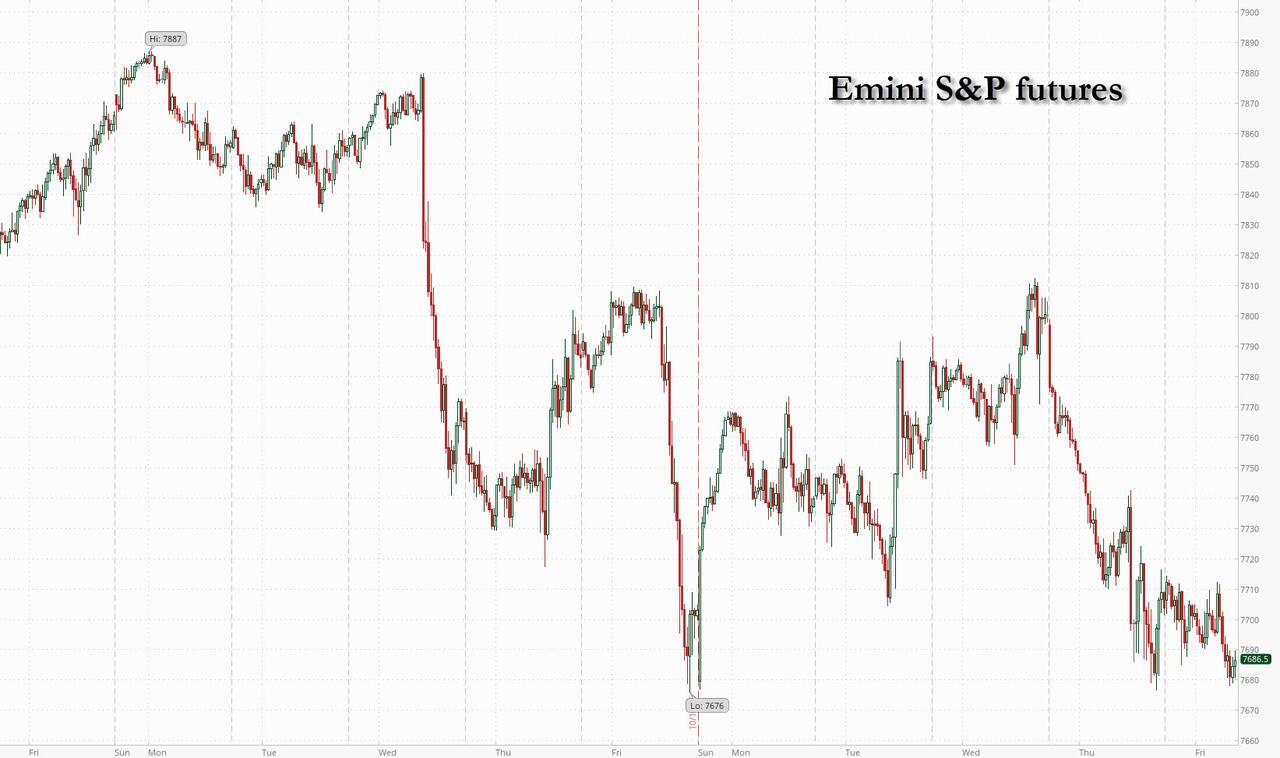
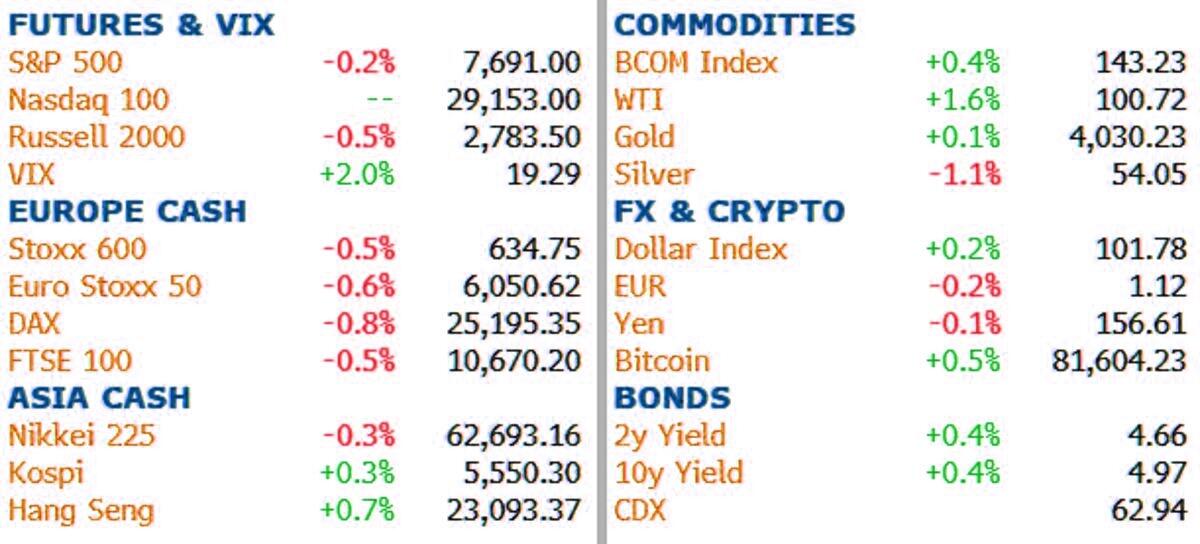
US futures are lower, erasing a modest overnight bounce, as markets scramble after Thursday’s violent AI liquidation while oil rises again: Brent hit the highest level since May after the Houthis fired another missile at Riyadh and an IRGC official declared traffic of “illicit” vessels through Hormuz “completely stopped” (contradicted by a Bloomberg headline just minutes prior), while Thursday’s haven bid fades; as a result Treasuries give back part of their biggest rally in more than two years with the 10Y yield rising back to 4.99%. As of 8:00am ET, S&P futures are down 0.2% at 7,687 while Nasdaq futures are down 0.1% at 29,100; Dow futures underperform, sliding 0.6%. That follows Thursday’s chaotic session, when the S&P dropped 1.2% and the Nasdaq 100 tumbled almost 3%, its worst day since June, even as two-thirds of the S&P rose and the hedge fund VIP basket suffered its worst day since 2011 (as we detailed last night). In premarket trading, Mag 7 names are mixed with Nvidia (+0.6%) and Tesla (+0.8%) higher while Meta and Microsoft (both -0.7%) lag; tower companies jump and wireless carriers slide after SpaceX was said to be targeting 80,000 or more US cell sites, while Deckers tumbles after cutting its full-year sales guidance. The day’s driver is the AI trade (what else): OpenAI is now targeting a $1.25 trillion valuation for its $30 billion raise, $150 billion below last month’s ask, and SK Hynix scrapped a US listing of its Solidigm unit, yet chips are modestly higher after the Kospi erased a 4.1% plunge to close up 0.3%; according to Bloomberg, “this looks less like capitulation than a repricing of who pays for the build-out.” Bonds are cheaper across the curve in a bear-flattening move, as the tech rout eases and oil climbs further, complicating the inflation outlook; French bonds outperform after the OAT-Bund spread opened at a fresh post-2011 high of 176bps, even as France’s flash PMIs collapsed into contraction ahead of tonight’s Moody’s review. The Bloomberg Dollar Spot Index is up 0.1% and the euro slips 0.2% after the dismal French PMI, while the kiwi outperforms on ANZ calling for three RBNZ hikes. In commodities, WTI rises 1.8% to $101.22 and Brent 1.4% to $114.80; gold is flat near $4,030 and silver slides 1.1%. Bitcoin rises 0.5% to about $81,600. US economic data slate includes the October S&P Global flash PMIs (9:45am), the final October University of Michigan sentiment and inflation expectations (10am) and the Kansas City Fed services survey (11am). The Fed is in its blackout period ahead of next Wednesday’s FOMC, so there are no Fed speakers.
In premarket trading, Mag 7 stocks are mixed (Alphabet (GOOGL) -0.2%, Amazon (AMZN) -0.2%, Apple (AAPL) -0.1%, Meta Platforms (META) -0.5%, Microsoft (MSFT) -0.5%, Nvidia (NVDA) +0.2%, Tesla (TSLA) +0.1%)
- Tower companies gain and wireless carriers slide after SpaceX was said to be targeting 80,000 or more US cell sites, with talks under way with at least one infrastructure owner. Crown Castle (CCI) +9%, American Tower (AMT) +6%; AT&T (T) -4%, T-Mobile (TMUS) -4%, Verizon (VZ) -3.8%
- Autoliv (ALV) falls 5% after the maker of airbag systems cut its adjusted operating margin forecast for the full year.
- Bloom Energy (BE), which has more than doubled this year on demand for AI power sources, is down 3% after its quarterly report. Bloomberg Intelligence notes that “operating cash flow turned negative in 3Q as contract assets, receivables and inventory rose.”
- Deckers Outdoor (DECK) falls 7% after the footwear company cut its net sales guidance for the full year, which also fell short of the consensus estimate.
- MaxLinear (MXL) climbs 2% after the semiconductor device company’s third-quarter results beat expectations and it gave a revenue forecast that is seen as strong.
- Newmont Corp. (NEM) inches 1% lower after the miner forecast higher than expected 2027 spending for its Red Chris copper-gold mine in British Columbia.
- Norwegian Cruise (NCLH) slips 3% after JPMorgan downgraded the stock to underweight and reduced his price target to a Street-low $11 per share. Norwegian is due to report third-quarter results on Oct. 29.
- RingCentral (RNG) rises 16% after the communications software company raised its full-year forecast for adjusted earnings. It also reported third-quarter results that beat expectations.
In other corporate news, OpenAI’s valuation ambitions got a $150 billion haircut: the ChatGPT maker is now targeting $1.25 trillion in the final stages of negotiations for its roughly $30 billion funding round, led by UAE investors, down from the $1.4 trillion it was seeking last month (good thing Anthropic is reportedly aiming for $2 trillion in its IPO). SK Hynix scrapped plans for a potential $10 billion US listing of its Solidigm unit. American Express raised its full-year EPS forecast to $18.30-$18.60 from $17.30-$17.90. BASF is said to have raised its bid for rival Evonik to about €24 per share, and SLB sees growth driven by a Middle East oil field recovery. Citigroup won approval to launch a wholly-owned securities business in China after a nearly five-year wait. Nvidia invested in AI video and image generator Higgsfield. Alnylam reported positive data for its Huntington’s disease drug. Calpers is pivoting from US tech giants to private equity, the FT reports. Canadian oil and gas producer Logan Energy is exploring options including a potential sale, while allergy and autoimmune biotech Lycia Therapeutics raised $317.5 million in an upsized IPO priced at the top of its range. Apple’s $2,000-and-up foldable iPhone Duo went on sale today, with new orders being offered delivery at the end of January. Infosys narrowed its FY revenue growth outlook to 1%-2% from 1.5%-3%, and China’s Cambricon reported 3Q revenue of 3.53 billion yuan, well below the 6.26 billion estimate.
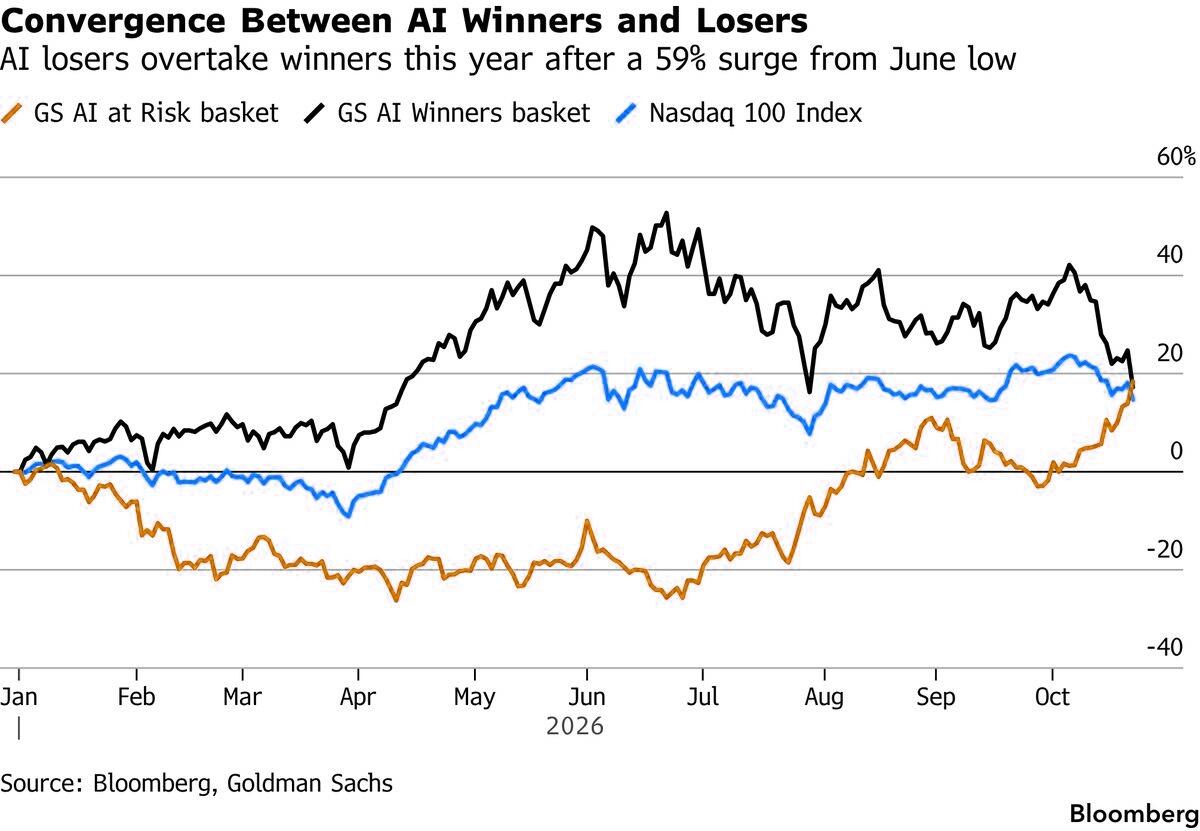
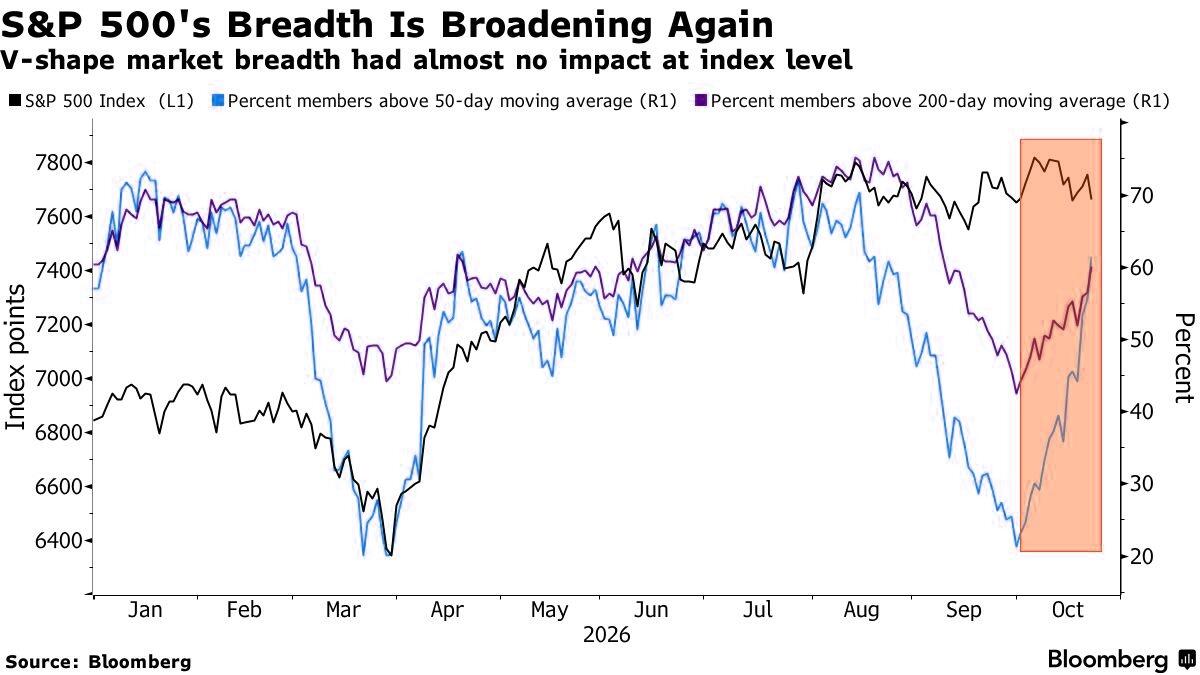
Stocks are set for a relatively steady start as investors look beyond AI winners, Bloomberg’s Michael Msika writes: shares seen as vulnerable to disruption are now outperforming those seen as the technology’s biggest beneficiaries. Thursday’s decline was concentrated in technology, but the broader market carried on, with the equal-weight S&P 500 finishing up 0.8%, its best day since 2024 relative to the cap-weighted index; advancers outnumbered decliners by about two-to-one and 61% of S&P members are now above their 50-day moving average, the highest in two months.
The AI trade is the culprit once again, but investors do not appear to be turning risk-off so much as repricing the build-out, taking money off the semiconductor trade to reinvest into defensive sectors like staples and utilities. A basket of AI winners is now down 23% from its June highs, while stocks at risk of AI disruption have surged nearly 60% over the same period and now lead for the year.
“Yesterday the market did not stop believing in AI, it simply started asking who pays for it, and at a 5% bond yield that question has an opportunity cost,” said Florian Ielpo, head of macro research at Lombard Odier Asset Management.
“What we’re seeing is a repricing of valuations across the board as rates rise, with neoclouds and other leveraged operators hit hardest,” said Hugh Lam, investment strategist at Betashares in Sydney. “Those financing concerns are weighing on hardware-linked markets like Japan and Korea, which have seen more volatility in recent months.”
The financing angle is the crux: Meta’s spending commitments have swelled to $825 billion and its CDS hit a record after results (as we reported), CoreWeave’s 5Y CDS blew out to 1,162bps (Bernstein sees a $76 billion funding hole), and credit metrics are flashing their biggest risk-off signal in more than a year. Meanwhile, the S&P Consumer Staples index is up 12% in October, on track for its best month since October 1998, as investors rotate out of tech and into defensives.
Goldman’s Rich Privorotsky called Thursday the session that “made the least sense of any day in this selloff“, with AI versus the S&P ex-AI suffering its worst relative day since the DeepSeek moment. His summary of the AI capex dilemma: “You either cut capex, delay deployment or increasingly fund through equity. None are particularly supportive of equity prices.” The flip side, as he puts it: “Rates: AI loses, bonds win” (a theme his desk laid out earlier this week and McElligott echoed). Goldman Prime notes that all three hedge fund strategy groups lost more than 1% on the same day for the first time since Covid, with multi-strats down 1.9%, the second-worst day since the April 2025 tariff selloff, while TMT specialist Sean Johnstone sums up the mood: “strong AI demand is not enough.”
JPMorgan’s Market Intel desk says Thursday’s Nasdaq selloff showed the fragile sentiment around AI financing, with chatter around a possible US/Israeli strike on Iran after the midterms sparking a broader tech-led de-risking; its cash desk saw long-onlys 3x better for sale while hedge funds were 2.6x better to buy, mostly covering. With MSFT, GOOGL and AMZN reporting next week, investors “may remain low conviction to add risk”, though the team stays Tactically Bullish, favoring cyclicals outside tech while selectively buying tech weakness in semis and memory. JPM’s Jay Barry notes Thursday’s 15-21bp drop in Treasury yields was the largest one-day decline since March 2023, as yields have become increasingly correlated with the Nasdaq.
Elsewhere, SpaceX continued to disrupt the telecom market, aiming to secure at least 80,000 US cell sites and in talks with at least one major infrastructure owner, which is why towers are flying and carriers are getting hit on both sides of the Atlantic. Governments, banks and airlines are still racing to patch critical flaws in PHP, the language underpinning as much as 70% of the internet, which researchers uncovered with the help of AI tools (as we noted yesterday). In politics, President Trump travels to Florida today after rallying in Iowa for GOP Senate hopeful Ashley Hinson, while Goldman desks flag a Democratic sweep at roughly 70% on Polymarket as another AI overhang.
In Europe, the French bond crisis takes a breather: the OAT-Bund spread opened at a fresh high of 176bps, the widest since 2011, before narrowing slightly, but remains set for its biggest weekly widening on record (“Everyone has blown up”). Moody’s review of France’s rating is due after the close, with a downgrade likely given its negative outlook, and France is deploying the military to back up police ahead of weekend protests. Goldman FICC’s take on hedging all of this is here.
In Europe, the Stoxx 600 is down 0.5% at 634.75, falling for a second day as disappointing earnings, including from Kering’s Gucci, add to concerns over the AI trade and elevated oil prices. Telecoms are the worst-performing sector on the SpaceX cell-site report, while energy leads gains alongside construction and real estate. Volvo Car plunged as much as 32% to its lowest since its 2021 listing as cratering China sales and US tariffs hit its turnaround, Kering slid as much as 12%, and Intrum crashed as much as 43% to a record low. Flash PMIs did not help: the euro-area composite fell to 51.9 vs 52.7 expected, dragged down by a surprise plunge into contraction in France (composite 48.4 vs 50.3 est.), while the UK composite jumped to 53.1 vs 51.7 expected. JPM notes semis, luxury, ceasefire and software are among the worst-performing baskets.
Here are the biggest European movers:
- Electrolux shares gain as much as 12% after the Swedish home-appliance maker’s 3Q EBIT beat expectations by about 5%. Citi says the result comes despite challenging end markets.
- Sodexo shares rise as much as 6% after the French caterer reported better-than-expected organic sales growth, earnings and dividend for the most recent fiscal year.
- Munters shares rise as much as 11% after the Swedish heating and air treatment solutions firm reported third-quarter orders that beat the average analyst estimate.
- Signify shares rise as much as 10% after the light manufacturing company posted results that Morgan Stanley described as a small positive, given relatively low expectations.
- Kering shares slide as much as 12% after the French luxury-goods company saw further deceleration of third-quarter revenue growth at its key Gucci unit, slower growth in North America as well as persistent weakness in China.
- Volvo Car shares sink as much as 32% to their lowest since its 2021 listing after what analysts called a weak third quarter, as cratering China sales and US tariffs complicate the automaker’s turnaround.
- Intrum shares fall as much as 43%, hitting a record low, after the Swedish debt collector reported a goodwill impairment of SEK1.5b due to underperformance in Germany.
- European Telecom operator shares drop after Bloomberg News reported that SpaceX is in talks to access cell sites in the US, adding to investor concerns around increased competition within the sector.
- Volvo shares fall as much as 3.5% after the truckmaker’s results were described as a lower-quality beat by analysts.
- Safran shares fall as much as 7% after the company reaffirmed its guidance when analysts had been expecting upgrades to the group’s outlook.
- Valeo fell as much as 13% after analysts noted a language change in forecasts for the rest of the year in the auto company’s third-quarter results.
Asian stocks steadied after a chip-led selloff, with most indexes well off their opening lows, though the MSCI Asia Pacific Index is headed for a fourth straight weekly loss. The Kospi staged an impressive turnaround, closing up 0.3% at 5,550 after plunging as much as 4.1% at the open, led by SK Hynix (+4.4%) and local institutional buying even as foreigners dumped $729 million, per Goldman’s Seoul desk; there didn’t appear to be a particular catalyst, and the Kospi is still down about 21% in October, the world’s worst major market this month. Japan’s Nikkei 225 fell 0.3% to 62,693 after briefly dipping below 62,000, finding support near its 200-day moving average. In China, the CSI 300 jumped 1.7% and ChiNext 4% as state-backed “national team” ETFs saw about RMB84 billion of turnover, a day after the CSI 300 entered a bear market, while the Hang Seng rose 0.7% back above 23,000 led by EV makers. India’s Nifty fell 0.8%, capping its worst week since March, while Taiwan was closed for a typhoon and Thailand for a holiday.
In FX, the Bloomberg Dollar Spot Index is little changed to 0.1% higher, though still on track for a second weekly decline, and the DXY trades in a 101.48-101.85 range. The euro is down 0.2% at 1.1195 after a very poor French PMI reading in which all components fell into contraction, while cable halved its losses after the UK PMI beat and trades near 1.3386. The yen reversed early haven-driven gains: USD/JPY is up 0.1% near 157 after falling as much as 0.4% to 156.08, the lowest since Sept. 18, even after a source report that the BOJ will keep rate hikes on a fast track with December in focus. The kiwi tops the G-10 board after ANZ forecast RBNZ hikes at each of the next three meetings, and the Swiss franc lags.
In rates, Treasuries extend losses, unwinding a portion of Thursday’s aggressive rally as the rout in tech shares eases and oil prices rise further, complicating the inflation outlook. US yields are 3bp to 6bp cheaper across the curve in a bear-flattening move, with 5s30s about 1bp tighter and the 10Y up 4bp near 4.99%, just shy of the 5% line it broke below on Thursday. Bunds and gilts outperform Treasuries by 3bp and 1bp in the 10-year sector and French 10-year bonds by an additional 6bp, as OATs rebound about 30 ticks from Thursday’s beating; that erodes some of the flight-to-quality bid for German and US paper. Long gilts continue to outperform ahead of Prime Minister Andy Burnham’s first budget next week. There are no Fed speakers with the central bank in its blackout period, and the IG dollar issuance slate is empty so far following muted activity Thursday. Next week brings $69 billion of 2-year notes on Monday, $70 billion of 5-year on Tuesday and $44 billion of 7-year on Thursday, per Goldman. Meanwhile, JPMorgan notes the odds of a December hike have slipped to 88%.
“USD/JPY edged higher on profit-taking, but AI jitters remain a JPY tailwind,” said Moh Siong Sim, FX strategist at OCBC Bank Singapore.
In commodities, WTI for December delivery is up 1.8% at $101.22 and Brent 1.4% higher at $114.80, the highest since May, as attacks on Saudi Arabia intensified: Saudi air defenses intercepted a Houthi ballistic missile fired at Riyadh, and an IRGC official told Fars that traffic of “illicit vessels” through Hormuz has been “completely halted” after strikes on three tankers Thursday and the destruction of another overnight. President Trump says the US crushed Iran and may want to do it “a little bit more”, while UN Ambassador Waltz told the FT the US could still be mired in a stalemate with Iran a year from now. On the supply side, Trump invoked the Defense Production Act to expand petroleum capacity and will release $150 million for refining, while a tanker carrying Russian diesel from Primorsk intermittently signaled New York, potentially the first shipment under the Putin-Trump fuel-supply deal. Goldman’s oil desk says the market is already pricing more than $20/bbl of risk premium. Spot gold is flat near $4,030/oz after briefly dipping below $4,000 overnight, silver drops 1.1% to $54.05, and base metals are mixed. US natgas is down 2.5% at $2.73 while UK natgas rises 3.9%.
US economic data slate includes the October S&P Global flash manufacturing, services and composite PMIs (9:45am), the final October University of Michigan sentiment, expectations and 1-year and 5-10 year inflation expectations (10am) and the Kansas City Fed services activity index (11am). The Fed is in its blackout period ahead of the Oct. 28 FOMC decision.
American Express, SLB, Booz Allen, First Citizens, Flagstar, Rithm Capital and Gentex report before the open. Moody’s rating decision on France is due after the close, alongside S&P on Germany and Scope on Italy, while Brazil holds its presidential runoff on Sunday.
Market Snapshot
Top Overnight News
- Iran’s message is stark: If the U.S. and Israel restart their air campaign, Tehran will respond with strikes not only on American bases and warships but on airports, pipelines and other civilian targets in the neighboring countries of the Persian Gulf. WSJ
- The US is preparing for a protracted conflict with Iran, even as the Trump administration hopes its bombing campaigns and economic sanctions will force major concessions from the Islamic republic. Mike Waltz, Donald Trump’s ambassador to the UN, acknowledged that a year from now the US could still be mired in a stalemate with Iran, without a deal on Tehran’s nuclear program or a return to prewar shipping through the Strait of Hormuz. FT
- The movement of “illicit vessels” through the Strait of Hormuz has “completely halted” after the latest Iranian attacks against ships, Iran’s semi-official Fars news agency cites an official close to the IRGC as saying. BBG
- A tanker carrying diesel left the Russian port of Primorsk and intermittently signaled New York, potentially marking the first such shipment following a fuel-supply agreement between Vladimir Putin and Donald Trump. BBG
- SpaceX aims to secure a minimum of 80,000 cell sites across the US, and is in talks with at least one major cellular infrastructure firm to reach that goal. BBG
- OpenAI, which is seeking to raise around $30 billion in a fresh funding round, is now targeting a valuation of $1.25 trillion during the final stages of negotiations, a $150 billion drop from the $1.4 trillion it was seeking last month. BBG
- Global hedge funds suffered one of their broadest declines since the Covid pandemic following the stock market selloff on Thursday, according to Goldman Sachs Group Inc.’s prime brokerage desk. BBG
- Metrics across global bond markets are signaling their biggest risk-off sentiment in more than a year, as a selloff in AI stocks and growing geopolitical tensions caused investors to seek out safe-haven assets. BBG
- The BOJ may maintain a continued fast pace of rate hikes given price trends and a view at the bank that the impact of increases on the economy so far has been limited, with December the next potential move, people familiar said. BBG
- Japan’s key price gauge rose above the Bank of Japan’s target level for the first time this year, supporting the case for a widely expected BOJ interest rate hike in December. BBG
- The ECB will lift rates for the final time in December following a pause next week, economists said. That’s at odds with market bets on far more hikes lying ahead. Central bank data showed inflation expectations among households increased slightly last month. BBG
- Eurozone flash PMIs for Oct were soft, w/the composite number coming in at 51.9 (down from 53.1 and below the Street’s 52.7), w/a lot of the weakness stemming from the French services sector (due to unrest in that country), while manufacturers reported a spike in input cost inflation. S&P
- France is bracing for a new round of protests tomorrow, rolling out the military to back up police in a bid to prevent a repeat of last weekend’s riots that led to violence, looting and arrests. BBG
- Brazil’s President Luiz Inácio Lula da Silva and challenger Flávio Bolsonaro are tied at 50% each of valid votes before Sunday’s runoff election, a new poll showed. BBG
- SK Hynix scrapped plans for a potential $10 billion US listing of its Solidigm unit. BBG
- BASF is said to increase its bid for rival Evonik to about €24 per share. BBG
- The Trump administration is looking to restrict US investment in Chinese biotech companies, proposing the addition of biotechnology to a list of sensitive technologies. BBG
- Russia’s central bank left its key rate at 14.00%, in line with estimates, as Ukrainian strikes spur inflation. BBG
- US President Trump will deliver remarks in Florida on Friday, Georgia on Saturday and Michigan on Sunday: The White House
- Goldman’s Prime desk says Global Fundamental L/S funds fell 1.4% Thursday, their worst day since July 16, while TMT funds are down 9.6% month-to-date. GS
- JPM’s Feroli expects the October flash manufacturing PMI to decline to 54.5 from 55.9 and the services PMI to ease to 58.0 from 58.8. JPM
A more detailed look at global markets courtesy of Newsquawk
APAC stocks were mostly negative following the weak lead from Wall St, where a deepening of the tech rout had spurred a flight to quality, while geopolitical concerns linger following reports that the US and Israel have drawn up plans for renewed strikes on Iran, which could be implemented following the US midterm election. ASX 200 was dragged lower by weakness in mining, materials, resources and tech stocks, although the downside was stemmed by some resilience in consumer discretionary, financials, real estate and utilities, while preliminary PMI data was uninspiring, with all main figures in contraction territory. Nikkei 225 briefly retreated beneath the 62,000 level with notable weakness in tech and mining stocks, while the latest inflation data from Japan mostly matched estimates and showed an acceleration from the previous, with headline and core readings back above the 2% price target. KOSPI underperformed as the tech sell-off rolled over into Asia, and with SK Hynix also not helped after it pulled the plug on plans to list its Solidigm unit on the Nasdaq due to regulatory and market volatility concerns. Hang Seng and Shanghai Comp were mixed as the Hong Kong benchmark rebounded from an early dip with the help of resilience in China’s top EV makers, while the mainland initially conformed to the mostly downbeat mood. Note, the Taiwan session was suspended amid the approaching typhoon; potentially pushing pressure onto regional peers.
Top Asian News
- China is to accelerate the development of new roles within the AI space, Xinhua reported.
- Japanese Prime Minister Takaichi told reporters that she would instruct the Minister of Economy, Trade and Industry to consider subsidies for gasoline and other fuel, JiJi reported.
- China’s Politburo held a meeting today and said it is to maintain a high-pressure posture against corruption and will continue to deepen reform efforts and conscientiously implement reform tasks, according to Xinhua. Emphasises effectively strengthening leadership building and enhancing cohesion.
- Japan’s Economy Minister Kiuchi said government decision whether to declare official end to deflation will be made looking comprehensively at CPI, GDP deflator and background behind moves in underlying inflation. Don’t think conditions met for the government to declare an official end to deflation. Hope the BoJ guides policy appropriately based on joint statement with the government stipulating need for stable and sustainable price stability.
- Japan’s Finance Minister Katayama said she believes Japanese financial institutions handled PHP issue relatively smoothly and expect them to continue to take necessary action. Cannot comment on revival of gasoline subsidies and will take household situation into consideration.
- Australia proposes to raise the cap on banks covered bond issuance and opens consultation on financial sector competition.
- SK Hynix (000660 KS) cancels its plans to list Solidigm on the Nasdaq with an announcement expected soon, according to Korean press.
A softer start for much of Europe. Euro Stoxx 50 -0.7% and Stoxx 600 -0.5%, as the US tech-led (SOX -6.7%) pressure reverberated into the region, before pressure in European bourses was then exacerbated by a set of dismal French PMI data and poor earnings from several pertinent names. Following earnings, Kering, -11.8%, after missing marginally on overall revenue, but more pertinently as they highlighted traffic as an ongoing constraint and particularly within China, not expecting a H/H margin performance improvement and Q4 thus far has been in-line with Q3. Sticking in France, L’Oreal, +4.5%, gains after Q3 sales topped expectations, and the Chinese market only slowed a bit. Also hit, and at their lowest ever share price, Volvo Car, -26.7%, pressured by a dire set of earnings where China revenue fell near 50% Y/Y. European sectors hold a strong negative bias. Unsurprisingly, Energy takes the top spot, given the strength in underlying oil prices; Construction & Materials, and Real Estate complete the top three. To the downside, Telecoms is the clear underperformer, weighed by the SpaceX update (see below), with Industrials following closely behind. US equity futures (ES -0.1% NQ U/C RTY -0.5%) are trading mixed; the tech-heavy NQ is faring a little better vs peers, whilst the RTY lags. The relative outperformance comes as tech rebounds a touch from the hefty losses seen in the prior session, with focus on SK Hynix (+5.2% pre-market), after the Co. has paused its Solidigm IPO.
Top European News
- SpaceX (SPCX) in talks to access 80,000 cell sites for new network.
- OpenAI is raising up to USD 30bln in funding round at a USD 1.25tln valuation, led by UAE investors, according to CNBC, citing sources; OpenAI is negotiating a commercial deal that would secure more computing capacity from the UAE.
- UK is expected to make a pre-budget announcement on an AI package on the weekend, Politico reported; Housing Secretary Rayner is booked for the Sunday media rounds, potentially indicating a Housing, Communities & Local Government related update.
FX
- G10s were initially mixed against the USD, but now display a negative bias as the USD gradually moved higher alongside upside in energy prices. The Kiwi outperforms vs peers after hawkish RBNZ calls from analysts at ANZ; the Swiss Franc is the relative underperformer, as yield differentials widen once again. EUR was mildly pressured following a very poor French PMI reading, whereby all components surprisingly fell into contractionary territory.
- DXY currently holds within a 101.48 to 101.85 range, a touch firmer this morning, but net-weaker since the start of the week. The data docket lacked any Tier-1 US data and Fed speak, so USD action was largely dictated by credit-related woes, which hampered sentiment in the US. Next week, attention will be on the FOMC Policy Decision, where rates are expected to be kept on hold.
- The Kiwi is the mild outperformer this morning, and holds towards the upper end of a 0.5679 to 0.5699 range. Strength which comes after analysts at ANZ expect the RBNZ to deliver rate hikes at the next three meetings, citing Q3 core inflation data.
- The CHF is the slight laggard this morning, paring some of the strength seen in the prior session, as US yields rebound a touch today. Similarly, JPY holds towards the bottom of the pile, but faring a touch better vs its haven-counterpart. This comes after a source report which suggested that the BoJ is set to keep rate hikes on a fast track, adding that interest rates are still far from neutral. Only very mild strength was seen in JPY following this report, given it does not shift market expectations; money markets assign c. 80% chance of a hike in December. USD/JPY currently trades towards the upper end of a 156.07-157.16 range.
Central Banks
- BoJ is expected to continue rapid rate hikes, with focus on December, sources suggest; report suggests that interest rates are still far from neutral, adding that inflation needs to stabilise.
- BoJ Financial Stability Report: Japan’s financial system has been maintaining stability on the whole.
- European ECB Consumer Inflation Expectations (Sep) 3.1% (Prev. 3%).
- Former German Finance Minister Kukies is said not to succeed Schnabel at the ECB.
- ANZ sees RBNZ raising rates at next three meetings, citing the Q3 core inflation data.
- PBoC injected CNY 258bln in overnight reverse repos, while 7-day reverse repo volume is at zero.
- PBoC set USD/CNY midpoint at 6.7180 vs exp. 6.6758 (prev. 6.7195).
- Indonesia’s central bank official said rupiah movement still manageable following MSCI announcement last week and said it will respond if needed to ensure supply and demand in the FX market.
- Monetary Authority of Singapore, Malaysia Central Bank and Bank of Thailand are partnering on cross-border digital money settlement.
Fixed Income
- A mixed start for benchmarks, as the complex takes a bit of a breather from the recent rally in core counterparts as growth concerns dominated the narrative for debt that is not dominated by domestic political and fiscal concerns.
- USTs are lower by a few ticks, in a pullback from the 106-16 high which printed on Thursday, rather than in reaction to a fundamental development, though energy continues to tick higher and the risk tone is gradually improving, Currently, holds at the base of a 106-05 to 106-14 band.
- Bunds essentially flat, just off lows in a 122.13-54 band. Upside was seen through the morning’s first Flash PMI from France, with Bunds peaking on the German series but then waning and proving relatively unreactive to the EZ-wide figure. For the EZ, the series points to growth of 0.3% in the period, a touch slower than September’s implied pace, but still robust enough to keep the ECB on track to tighten, and perhaps more so than currently assumed by desks, particularly as inflationary pressures mount; a dynamic that may explain the pullback in Bunds following the German data and into the EZ print.
- OATs are, of course, the focus for today. This morning’s Flash PMIs were dire. All three main components fell into contractionary territory. A finding that does not bode well, as recent civil unrest and spread widening will not have been fully accounted for by the respondents. Further, we still await Moody’s verdict on the sovereign tonight, with a downgrade a real possibility given recent events and price action, and then further protest action on the weekend.
- As it stands, OATs are firmer by around 30 ticks, in a bit of a rebound from the c. 50 ticks of pressure seen on Thursday, but still set to end the week with downside of over 120 ticks as things stand. Given this, the OAT-Bund 10yr yield spread has narrowed by a handful of bps on the session overall, but it did commence it at a fresh high of 176bps; at wides since 2011, when 191bps printed.
- Gilts are flat and marginally lag European peers within 85.01-36 parameters in a modest reversal of the prior day’s action. Overnight focus showed Chancellor Healey continues to underscore a pro-business approach, and was absent of anything which changes the majority view of the budget passing without trouble. The morning’s retail sales data contracted at a greater pace than expected, October Flash PMIs were particularly strong, and chime with expectations for a November BoE hike.
- UK DMO said it is to hold a tender for up to GBP 1bln of 0.25% Treasury Gilt 2031 on October 29.
- China’s Finance Ministry auctions 30-year bonds at 2.06% yield.
- Australia sold AUD 1.0bln in 1.0% November 2031 bonds, avg. yield 4.8708%, bid-to-cover 4.32.
Commodities
- Crude is firmer this morning, with WTI and Brent up by 1.6% and 1%, respectively. Benchmarks eased a touch off earlier highs, but then reversed this following reports that the Houthis fired missiles at Saudi interests. WTI currently holds within a USD 98.84-101.30/bbl range, whilst Brent sits at the upper end of a USD 112.74-114.72/bbl band.
- Strength today comes as the geopolitical environment remains tense and rhetoric remains punchy. Starting with US-Iran, the IRGC continues to strike ships traversing the “illegal” route, with little fresh indications of diplomacy. President Trump suggested that Iran was fabricating reports of these attacks, whilst warning that they may want to “crush” Iran a little more. On the Saudi-Houthi front, the risk of further supply disruptions remain, given that tit-for-tat strikes continue. Over in Israel, PM Netanyahu held an emergency meeting to discuss a recent attack on five IDF soldiers in the West Bank; he eventually decided to close off the area. This decision will only bolster speculation that the PM would like to postpone the election; a former Israeli premier had previously accused Netanyahu of this, arguing that preparing infrastructure to go to war is a way to delay the Knesset election.
- Spot gold is flat and trades around the USD 4k/oz mark, currently holding within a USD 3,986-4,032/oz range. The yellow metal is net-lower since the start of the week, with pressure facilitated by inflationary concerns, related to elevated energy prices. It seems as if the gold remains worried about the inflationary implications of the war, whilst haven counterparts (USTs/JPY) have recently been focusing on AI funding concerns and potential hits to growth.
- Base metals are mixed this morning; 3M LME copper currently trades firmer by around a percent, and holds within a USD 14,059.2-14,270/t range.
- UAE Environment Ministry said a tanker oil spill is impacting beaches in Umm al-Quwain.
- Japan government considers cutting gasoline subsidies from December, according to officials.
- US President Trump said he will release USD 150 mln to increase US refining capacity.
- US President Trump invokes Defense Production Act for petroleum capacity and waives Section 303 rules to expand oil capacity.
Trade/Tariffs
- French Trade Minister has requested a US tariff exemption covering cognac and champagne.
- German President Steinmeier to visit China on the 27th of October.
- US Trump Admin is looking to restrict US investment in Chinese biotech companies.
- China’s Commerce Ministry urges the US to correct its approach on research ties between the two nations.
Geopolitics: Middle East
- US President Trump said regarding Iran that they have crushed the Islamic Republic and may want to do it a little bit more.
- US President Trump’s ambassador to the UN Waltz said the US is prepared for long stand-off with Iran and acknowledged that the US could still be mired in a stalemate with Iran a year from now, according to FT.
- Iran’s IRGC threatens to target US bases if commercial ships continue transiting Strait of Hormuz, according to Fox News.
- IRGC official said “today we not only possess power but also the will to use power”; “if the enemy wants to commit the slightest folly again, we will deliver an unprecedented blow”, Al Mayadeen reported.
- IRGC official said “traffic of violating vessels in the Strait of Hormuz has been completely stopped”, Fars reported. “An informed official close to the IRGC Navy announced that after the destruction of the navigational aid systems used by the violating vessels, the hitting of 3 oil tankers yesterday and the destruction of another violating oil tanker last night, the traffic of violating vessels has been completely stopped”. “This informed official warned that if oil smuggling resumes, the dealing with violating vessels and their supporting technical systems will be carried out with much greater severity”. “He also emphasized that the renewed air intervention of the US military and support for oil smuggling will be met with a more direct and decisive response, and the US military will be responsible for the consequences”.
- Iran’s Foreign Minister Araghchi called out French President Macron regarding his JCPOA stance contradictions.
- BeamTracker reported sound of an explosion was heard in Strait of Hormuz area, with cause and origin not yet known, although the site of the explosion is a location that has previously been the passage point of violating ships in the strait.
- Saudi Arabia has launched a “raid” on eastern Taiz within Yemen, Sabereen reported.
- Two Saudi airstrikes targeted the water authority building in Al Hazm district of Al Jawf province, Yemen.
- Saudi‑led coalition said air defences intercepted and destroyed ballistic missile launched by Houthi militia towards Riyadh.
- “Missile launch by the Yemeni Armed Forces towards Saudi interests”, via Sabereen.
- Saudi sources report loud explosions heard in Riyadh, according to Al Masirah.
- Yemeni forces warned airlines again not to enter Saudi airspace or airports, according to Nour News.
- Israeli PM Netanyahu said “I have instructed the security forces to impose a siege on the city of Hebron and to completely close off the West Bank”.
- US State Department spokesperson said there is no US-Turkey proposal regarding Lebanon and no US-backed proposals to change Lebanon’s political structure.
Geopolitics: Ukraine
- Russia’s Defence Ministry said Russia hit a railcar depot in the Poltava region in Ukraine and a cargo vessel in the Black Sea, while it also hit the Port of Vilkovo in the Odesa region.
- Ukraine energy company DTEK said a Russian attack hit one of its power stations.
- Ukraine seeks to move customs checks inside the EU to avoid Russian drones, with Kyiv in discussions with Poland and Slovakia about moving customs checks into their territories to try and make trucks safer, according to FT.
- Ukraine Air Force reported guided bombs striking Donetsk and Dnipropetrovsk.
- EU considers sanctions reprieve for Chinese fabric-maker accused of aiding Russia, according to SCMP.
Crypto
- Bitcoin is a touch lower this morning and hovers around the USD 82k mark.
US Event Calendar
- 9:45am: Oct P S&P Global US Manufacturing PMI, est. 55.5, prior 55.9
- 9:45am: Oct P S&P Global US Services PMI, est. 58.0, prior 58.8
- 9:45am: Oct P S&P Global US Composite PMI, est. 57.6, prior 58.4
- 10:00am: Oct F U. of Mich. Sentiment, est. 46.3, prior 46.3
- 10:00am: Oct F U. of Mich. Expectations, est. 47.1, prior 47.3
- 10:00am: Oct F U. of Mich. 1 Yr Inflation, est. 4.7%, prior 4.7%
- 10:00am: Oct F U. of Mich. 5-10 Yr Inflation, est. 3.5%, prior 3.5%
- 11:00am: Oct Kansas City Fed Services Activity
Central Bank Speakers
- None: the Fed is in its external communications blackout ahead of the Oct. 28 FOMC decision
DB’s Jim Reid concludes the overnight wrap
As storm Austen hits these shores this morning, clouds kept darkening for markets yesterday, as the wobbles of recent weeks all collided at once. First, there was mounting stress around France, with the Franco-German 10yr spread (+14.8bps) seeing its biggest daily widening since the initial pandemic turmoil in March 2020. Second, AI fears continued to gather pace, with the Philly semiconductor index (-6.72%) falling to its lowest level since July, which dragged down equities more broadly. And third, the latest geopolitical fears meant oil prices kept rising as well, with Brent crude (+4.00%) hitting a 5-month high of $113.17/bbl. So collectively, those concerns drove a huge risk-off move, with the 10yr Treasury yield (-16.6bps to 4.95%) seeing its biggest daily decline since August 2024. Although Asian markets are also down, US and European equity futures are relatively flat as I type so the sell-off hasn’t accelerated overnight. Today we see global flash PMIs which will as ever be interesting. Note that exactly a month ago today, the US flash numbers were strong and helped drive an almost 15bp increase in both 2yr and 10yr Treasury yields. This felt like a very outsized move relative to the importance this data usually has in the US, but it showed the mood in global bond markets at the time. That couldn’t have been further from the mood in the last 24 hours so an interesting set up for today.
It’s difficult to know where to start given everything going on at the moment, but it was France that led the day’s biggest market moves yesterday. There wasn’t an immediate catalyst for the selloff, but the other two stress points (AI growth fears and higher oil prices) both hit risk appetite, which left France as the most vulnerable given it was already facing market pressure. So all that pushed the Franco-German 10yr spread up to 174bps, taking it to levels last seen at the peak of the sovereign crisis in November 2011. Moreover, the 10yr spread now isn’t too far away from its single-currency-era peak that month, when it closed as high as 189bps.
Those French moves were part of a clear risk-off pattern rather than a global bond selloff, as the 10yr OAT yield (+5.8bps) hit a post-2002 high of 5.07%, whereas the 10yr bund yield (-8.7bps) fell back instead to 3.32%. Moreover, those moves cascaded elsewhere, with the Italian 10yr spread to bunds (+8.7bps) widening to 124bps, the most since the Liberation Day turmoil in April 2025. And the stress was clear from other asset classes, as the STOXX Banks (-4.17%) hit a 4-month low, some -14% off their recent highs in mid-September. The Euro also weakened -0.14% against the US Dollar, while defensive currencies including the yen (+0.87%) and the Swiss France (+0.48%) benefited.
Given the latest stress, yesterday led to fresh questions about whether the ECB would even be able to hike rates again this year. Admittedly, that’s still the baseline market expectation. But with a 69% chance of another hike priced by December this represented a sharp pullback from 90% at the close on Wednesday. So doubts on the sustainability of further ECB hikes are rising. Indeed, the market moves were also creating a broader tightening in financial conditions, with the STOXX 600 down -1.05%, whilst European HY spreads widened +20bps to their highest level since April 2025 at 369bps.
As all that was happening, yesterday also brought a fresh wave of concern around AI-driven growth, reversing some of the optimism from earlier in the week. So it was a rough session for several of the most affected names, and the Philly semiconductor index (-6.72%) had its worst day since June, whilst CoreWeave’s share price (-10.06%) fell to its lowest since May 2025. That carried over into the CDS space too, where CoreWeave’s 5yr CDS widened +66bps to 1162bps. After its results the night before, Meta (-6.98%) fell and its CDS widened +7.2bps to 118bps. That marked a sharp turnaround from the initially positive after-market reaction to its results on Wednesday night as the sentiment around the company’s rising capex plan soured. Put together, this all helped drive the broader indices lower, with the S&P 500 (-1.21%) posting its worst daily performance since July, whilst the NASDAQ (-2.60%) had its biggest decline since June. However, note that the main defensive sectors rallied strongly, with consumer staples (+3.11%) and utilities (+1.98%) leading the way as two thirds of S&P 500 constituents moved higher, helped by the fall in yields. This also marked the biggest outperformance of the equal-weighted S&P 500 (+0.77%) over the market cap index since July 2024.
The other important theme yesterday was the latest jump in energy prices, driven by mounting fears of a fresh escalation in the Middle East. Indeed, yesterday saw Brent crude (+4.00%) close at a 5-month high of $113.17/bbl, which added to fears about more persistent inflation. Moreover, European natural gas futures (+2.99%) hit another post-2022 high of €90.04/MWh, which particularly hit the continent as growth concerns interacted with the fiscal stress. In part, the latest moves followed a New York Times report we mentioned yesterday, saying that the US and Israel had drawn up plans for renewed strikes against Iran after the midterm elections. So that drove speculation about some kind of escalation after the November 3 vote. And we also heard the Houthis claim a recent attack on Saudi Arabia’s Yanbu oil site, which follows a drone attack at a Saudi oil field the previous day.
In the midst of all these market pressures, an interesting theme was the flight to US Treasuries, which returned to its traditional risk-off role in periods of turmoil. In fact, the 10yr yield fell -16.6bps to 4.95%. Moreover, that came despite some strong US data, demonstrating how the financial stress was weighing on sentiment rather than the fundamentals. For instance, the weekly initial jobless claims fell to a 3-month low of 194k in the week ending October 17 (vs. 200k expected). And in turn, that pushed the smoother 4-week moving average to its lowest since September 2022, back when the unemployment rate was just 3.5%.
Asian equities are weak but the sell-off hasn’t accelerated so far and most indices are well off their opening lows. The Nikkei (-0.90%) and KOSPI (-0.89%) are recovering from notably higher losses. In China, the CSI 300 (-0.54%) and Shanghai Composite (-1.20%) are at 15-month lows but may recover a bit after the lunch break. The Hang Seng (+0.58%) has rallied as I’ve been writing this. S&P 500 (-0.13%), Nasdaq (-0.03%) and Stoxx (-0.08%) are only very slightly lower, showing the sell-off has stabilised for now.
In Japan, September inflation rose as expected overnight, with core CPI accelerating to a nine-month high of +2.1% y/y and moving above the BOJ’s target, supported by higher energy costs and yen weakness. Core-core CPI increased to +2.4% from +1.9%, while headline CPI rose to +2.1% from +1.9%. Meanwhile, JGBs are rallying with global bonds, with 10-year yields down -9.5bps to 2.77% and 5-year yields falling -7.8bps to 2.20%.
Separately, Japan’s manufacturing sector expanded at a slower pace in October, while services activity strengthened. The flash manufacturing PMI eased to 53.3 from 54.1, while the services PMI improved to 52.0 from 51.3. The composite PMI held steady at 52.3, signalling a 19th consecutive month of private-sector expansion.
Looking at the day ahead now, data releases will include the October flash PMIs from Europe and the US, along with UK retail sales for September, and the University of Michigan’s final consumer sentiment index for the US in October. Otherwise from central banks, we’ll get the ECB’s Consumer Expectations Survey for September, and we’ll hear from the ECB’s Cipollone.
1b) European opening report
Crude benchmarks firmer amidst ongoing tensions in the Middle East; EUR digests poor PMI metrics – Newsquawk US Market Open

Friday, Oct 23, 2026 – 06:16 AM
- US President Trump says the US crushed Iran, and may want to do it a “little more”.
- Crude benchmarks firmer on ongoing tensions in the Middle East; recent bout of strength comes after the Houthis launched another missile towards Saudi interests.
- European bourses are in the red following a few dire results from Kering and Volvo Cars; US equity futures are mixed.
- USD is firmer vs most G10 peers; CHF is the laggard, whilst the EUR digests poor French PMI metrics.
- Fixed benchmarks are mixed; USTs are down by a handful of ticks, whilst Bunds hold steady.
- Looking ahead, highlights include Global Flash PMIs (Oct), Canadian Retail Sales (Sep), CBR Policy Announcement (Oct). Earnings from American Express, SLB, Autoliv. Credit Ratings Updates including Moody’s on France, S&P on Germany & Scope on Italy.
SNAPSHOT

LOOKING AHEAD
- Looking ahead, highlights include Global Flash PMIs (Oct), Canadian Retail Sales (Sep), CBR Policy Announcement (Oct). Earnings from American Express, SLB, Autoliv. Credit Ratings Updates including Moody’s on France, S&P on Germany & Scope on Italy.
- Click for the Newsquawk Week Ahead.
EUROPEAN TRADE
EQUITIES
- A softer start for much of Europe. Euro Stoxx 50 -0.7% and Stoxx 600 -0.5%, as the US tech-led (SOX -6.7%) pressure reverberated into the region, before pressure in European bourses was then exacerbated by a set of dismal French PMI data and poor earnings from several pertinent names.
- Following earnings, Kering, -11.8%, after missing marginally on overall revenue, but more pertinently as they highlighted traffic as an ongoing constraint and particularly within China, not expecting a H/H margin performance improvement and Q4 thus far has been in-line with Q3. Sticking in France, L’Oreal, +4.5%, gains after Q3 sales topped expectations, and the Chinese market only slowed a bit. Also hit, and at their lowest ever share price, Volvo Car, -26.7%, pressured by a dire set of earnings where China revenue fell near 50% Y/Y.
- European sectors hold a strong negative bias. Unsurprisingly, Energy takes the top spot, given the strength in underlying oil prices; Construction & Materials, and Real Estate complete the top three. To the downside, Telecoms is the clear underperformer, weighed by the SpaceX update (see below), with Industrials following closely behind.
- US equity futures (ES -0.1% NQ U/C RTY -0.5%) are trading mixed; the tech-heavy NQ is faring a little better vs peers, whilst the RTY lags. The relative outperformance comes as tech rebounds a touch from the hefty losses seen in the prior session, with focus on SK Hynix (+5.2% pre-market), after the Co. has paused its Solidigm IPO.
- SpaceX (SPCX) in talks to access 80,000 cell sites for new network.
- OpenAI is raising up to USD 30bln in funding round at a USD 1.25tln valuation, led by UAE investors, according to CNBC, citing sources; OpenAI is negotiating a commercial deal that would secure more computing capacity from the UAE.
FX
- G10s were initially mixed against the USD, but now display a negative bias as the USD gradually moved higher alongside upside in energy prices. The Kiwi outperforms vs peers after hawkish RBNZ calls from analysts at ANZ; the Swiss Franc is the relative underperformer, as yield differentials widen once again. EUR was mildly pressured following a very poor French PMI reading, whereby all components surprisingly fell into contractionary territory.
- DXY currently holds within a 101.48 to 101.85 range, a touch firmer this morning, but net-weaker since the start of the week. The data docket lacked any Tier-1 US data and Fed speak, so USD action was largely dictated by credit-related woes, which hampered sentiment in the US. Next week, attention will be on the FOMC Policy Decision, where rates are expected to be kept on hold.
- The Kiwi is the mild outperformer this morning, and holds towards the upper end of a 0.5679 to 0.5699 range. Strength which comes after analysts at ANZ expect the RBNZ to deliver rate hikes at the next three meetings, citing Q3 core inflation data.
- The CHF is the slight laggard this morning, paring some of the strength seen in the prior session, as US yields rebound a touch today. Similarly, JPY holds towards the bottom of the pile, but faring a touch better vs its haven-counterpart. This comes after a source report which suggested that the BoJ is set to keep rate hikes on a fast track, adding that interest rates are still far from neutral. Only very mild strength was seen in JPY following this report, given it does not shift market expectations; money markets assign c. 80% chance of a hike in December. USD/JPY currently trades towards the upper end of a 156.07-157.16 range.
FIXED INCOME
- A mixed start for benchmarks, as the complex takes a bit of a breather from the recent rally in core counterparts as growth concerns dominated the narrative for debt that is not dominated by domestic political and fiscal concerns.
- USTs are lower by a few ticks, in a pullback from the 106-16 high which printed on Thursday, rather than in reaction to a fundamental development, though energy continues to tick higher and the risk tone is gradually improving, Currently, holds at the base of a 106-05 to 106-14 band.
- Bunds essentially flat, just off lows in a 122.13-54 band. Upside was seen through the morning’s first Flash PMI from France, with Bunds peaking on the German series but then waning and proving relatively unreactive to the EZ-wide figure. For the EZ, the series points to growth of 0.3% in the period, a touch slower than September’s implied pace, but still robust enough to keep the ECB on track to tighten, and perhaps more so than currently assumed by desks, particularly as inflationary pressures mount; a dynamic that may explain the pullback in Bunds following the German data and into the EZ print.
- OATs are, of course, the focus for today. This morning’s Flash PMIs were dire. All three main components fell into contractionary territory. A finding that does not bode well, as recent civil unrest and spread widening will not have been fully accounted for by the respondents. Further, we still await Moody’s verdict on the sovereign tonight, with a downgrade a real possibility given recent events and price action, and then further protest action on the weekend.
- As it stands, OATs are firmer by around 30 ticks, in a bit of a rebound from the c. 50 ticks of pressure seen on Thursday, but still set to end the week with downside of over 120 ticks as things stand. Given this, the OAT-Bund 10yr yield spread has narrowed by a handful of bps on the session overall, but it did commence it at a fresh high of 176bps; at wides since 2011, when 191bps printed.
- Gilts are flat and marginally lag European peers within 85.01-36 parameters in a modest reversal of the prior day’s action. Overnight focus showed Chancellor Healey continues to underscore a pro-business approach, and was absent of anything which changes the majority view of the budget passing without trouble. The morning’s retail sales data contracted at a greater pace than expected, October Flash PMIs were particularly strong, and chime with expectations for a November BoE hike.
- UK DMO said it is to hold a tender for up to GBP 1bln of 0.25% Treasury Gilt 2031 on October 29.
- China’s Finance Ministry auctions 30-year bonds at 2.06% yield.
- Australia sold AUD 1.0bln in 1.0% November 2031 bonds, avg. yield 4.8708%, bid-to-cover 4.32.
COMMODITIES
- Crude is firmer this morning, with WTI and Brent up by 1.6% and 1%, respectively. Benchmarks eased a touch off earlier highs, but then reversed this following reports that the Houthis fired missiles at Saudi interests. WTI currently holds within a USD 98.84-101.30/bbl range, whilst Brent sits at the upper end of a USD 112.74-114.72/bbl band.
- Strength today comes as the geopolitical environment remains tense and rhetoric remains punchy. Starting with US-Iran, the IRGC continues to strike ships traversing the “illegal” route, with little fresh indications of diplomacy. President Trump suggested that Iran was fabricating reports of these attacks, whilst warning that they may want to “crush” Iran a little more. On the Saudi-Houthi front, the risk of further supply disruptions remain, given that tit-for-tat strikes continue. Over in Israel, PM Netanyahu held an emergency meeting to discuss a recent attack on five IDF soldiers in the West Bank; he eventually decided to close off the area. This decision will only bolster speculation that the PM would like to postpone the election; a former Israeli premier had previously accused Netanyahu of this, arguing that preparing infrastructure to go to war is a way to delay the Knesset election.
- Spot gold is flat and trades around the USD 4k/oz mark, currently holding within a USD 3,986-4,032/oz range. The yellow metal is net-lower since the start of the week, with pressure facilitated by inflationary concerns, related to elevated energy prices. It seems as if the gold remains worried about the inflationary implications of the war, whilst haven counterparts (USTs/JPY) have recently been focusing on AI funding concerns and potential hits to growth.
- Base metals are mixed this morning; 3M LME copper currently trades firmer by around a percent, and holds within a USD 14,059.2-14,270/t range.
- UAE Environment Ministry said a tanker oil spill is impacting beaches in Umm al-Quwain.
- Japan government considers cutting gasoline subsidies from December, according to officials.
- US President Trump said he will release USD 150 mln to increase US refining capacity.
- US President Trump invokes Defense Production Act for petroleum capacity and waives Section 303 rules to expand oil capacity.
TRADE/TARIFFS
- French Trade Minister has requested a US tariff exemption covering cognac and champagne.
- German President Steinmeier to visit China on the 27th of October.
- US Trump Admin is looking to restrict US investment in Chinese biotech companies.
- China’s Commerce Ministry urges the US to correct its approach on research ties between the two nations.
NOTABLE EUROPEAN HEADLINES
- UK is expected to make a pre-budget announcement on an AI package on the weekend, Politico reported; Housing Secretary Rayner is booked for the Sunday media rounds, potentially indicating a Housing, Communities & Local Government related update.
NOTABLE EUROPEAN DATA RECAP
- UK Retail Sales (Sep MM) -0.4% vs. Exp. -0.1% (Prev. 0.7%).
- UK Retail Sales ex Fuel (Sep MM) -0.7% vs. Exp. -0.1% (Prev. 0.9%).
- UK Retail Sales ex Fuel (Sep YY) 0.8% vs. Exp. 1.5% (Prev. 2.9%).
- UK Retail Sales (Sep YY) 0.8% vs. Exp. 1% (Prev. 2.7%).
- UK GfK Consumer Confidence (Oct) -24 vs. Exp. -15 (Prev. -13).
- UK S&P Global Services PMI Flash (Oct) 53.1 vs. Exp. 51.8 (Prev. 52.1).
- UK S&P Global Manufacturing PMI Flash (Oct) 52.8 vs. Exp. 51.7 (Prev. 51.9).
- UK S&P Global Composite PMI Flash (Oct) 53.1 vs. Exp. 51.8 (Prev. 52.0).
- European S&P Global Services PMI Flash (Oct) 51.7 vs. Exp. 52.5 (Prev. 53.0).
- European S&P Global Manufacturing PMI Flash (Oct) 52.4 vs. Exp. 52.7 (Prev. 52.9).
- European S&P Global Composite PMI Flash (Oct) 51.9 vs. Exp. 52.7 (Prev. 53.1).
- German S&P Global Services PMI Flash (Oct) 51.7 vs. Exp. 52.5 (Prev. 52.9).
- German S&P Global Manufacturing PMI Flash (Oct) 54.2 vs. Exp. 53.5 (Prev. 53.9).
- German S&P Global Composite PMI Flash (Oct) 52.8 vs. Exp. 53.3 (Prev. 53.8).
- French S&P Global Composite PMI Flash (Oct) 48.4 vs. Exp. 50.5 (Prev. 51.1).
- French S&P Global Services PMI Flash (Oct) 48.4 vs. Exp. 50.7 (Prev. 51.2).
- French S&P Global Manufacturing PMI Flash (Oct) 49.3 vs. Exp. 50.5 (Prev. 50.6).
CENTRAL BANKS
- BoJ is expected to continue rapid rate hikes, with focus on December, sources suggest; report suggests that interest rates are still far from neutral, adding that inflation needs to stabilise.
- BoJ Financial Stability Report: Japan’s financial system has been maintaining stability on the whole.
- European ECB Consumer Inflation Expectations (Sep) 3.1% (Prev. 3%).
- Former German Finance Minister Kukies is said not to succeed Schnabel at the ECB.
- ANZ sees RBNZ raising rates at next three meetings, citing the Q3 core inflation data.
- PBoC injected CNY 258bln in overnight reverse repos, while 7-day reverse repo volume is at zero.
- PBoC set USD/CNY midpoint at 6.7180 vs exp. 6.6758 (prev. 6.7195).
- Indonesia’s central bank official said rupiah movement still manageable following MSCI announcement last week and said it will respond if needed to ensure supply and demand in the FX market.
- Monetary Authority of Singapore, Malaysia Central Bank and Bank of Thailand are partnering on cross-border digital money settlement.
NOTABLE US HEADLINES
- US President Trump will deliver remarks in Florida on Friday, Georgia on Saturday and Michigan on Sunday, according to The White House.
- US President Trump posted “Senator Roger Marshall of Kansas has done an incredible job in representing his Great State! Because of him….Bombardier is investing 270 MILLION DOLLARS, creating THOUSANDS of American Jobs in Kansas, Texas, and Indiana”.
- US President Trump posted “Getting ready to land in Iowa. Big Rally happening. Inflation and Prices coming down, FAST!”
GEOPOLITICS
RUSSIA-UKRAINE
- Russia’s Defence Ministry said Russia hit a railcar depot in the Poltava region in Ukraine and a cargo vessel in the Black Sea, while it also hit the Port of Vilkovo in the Odesa region.
- Ukraine energy company DTEK said a Russian attack hit one of its power stations.
- Ukraine seeks to move customs checks inside the EU to avoid Russian drones, with Kyiv in discussions with Poland and Slovakia about moving customs checks into their territories to try and make trucks safer, according to FT.
- Ukraine Air Force reported guided bombs striking Donetsk and Dnipropetrovsk.
- EU considers sanctions reprieve for Chinese fabric-maker accused of aiding Russia, according to SCMP.
MIDDLE EAST
US-IRAN
- US President Trump said regarding Iran that they have crushed the Islamic Republic and may want to do it a little bit more.
- US President Trump’s ambassador to the UN Waltz said the US is prepared for long stand-off with Iran and acknowledged that the US could still be mired in a stalemate with Iran a year from now, according to FT.
- Iran’s IRGC threatens to target US bases if commercial ships continue transiting Strait of Hormuz, according to Fox News.
- IRGC official said “today we not only possess power but also the will to use power”; “if the enemy wants to commit the slightest folly again, we will deliver an unprecedented blow”, Al Mayadeen reported.
- IRGC official said “traffic of violating vessels in the Strait of Hormuz has been completely stopped”, Fars reported. “An informed official close to the IRGC Navy announced that after the destruction of the navigational aid systems used by the violating vessels, the hitting of 3 oil tankers yesterday and the destruction of another violating oil tanker last night, the traffic of violating vessels has been completely stopped”. “This informed official warned that if oil smuggling resumes, the dealing with violating vessels and their supporting technical systems will be carried out with much greater severity”. “He also emphasized that the renewed air intervention of the US military and support for oil smuggling will be met with a more direct and decisive response, and the US military will be responsible for the consequences”.
- Iran’s Foreign Minister Araghchi called out French President Macron regarding his JCPOA stance contradictions.
- BeamTracker reported sound of an explosion was heard in Strait of Hormuz area, with cause and origin not yet known, although the site of the explosion is a location that has previously been the passage point of violating ships in the strait.
SAUDI-HOUTHI
- Saudi Arabia has launched a “raid” on eastern Taiz within Yemen, Sabereen reported.
- Two Saudi airstrikes targeted the water authority building in Al Hazm district of Al Jawf province, Yemen.
- Saudi‑led coalition said air defences intercepted and destroyed ballistic missile launched by Houthi militia towards Riyadh.
- “Missile launch by the Yemeni Armed Forces towards Saudi interests”, via Sabereen.
- Saudi sources report loud explosions heard in Riyadh, according to Al Masirah.
- Yemeni forces warned airlines again not to enter Saudi airspace or airports, according to Nour News.
OTHERS
- Israeli PM Netanyahu said “I have instructed the security forces to impose a siege on the city of Hebron and to completely close off the West Bank”.
- US State Department spokesperson said there is no US-Turkey proposal regarding Lebanon and no US-backed proposals to change Lebanon’s political structure.
CRYPTO
- Bitcoin is a touch lower this morning and hovers around the USD 82k mark.
APAC TRADE
- APAC stocks were mostly negative following the weak lead from Wall St, where a deepening of the tech rout had spurred a flight to quality, while geopolitical concerns linger following reports that the US and Israel have drawn up plans for renewed strikes on Iran, which could be implemented following the US midterm election.
- ASX 200 was dragged lower by weakness in mining, materials, resources and tech stocks, although the downside was stemmed by some resilience in consumer discretionary, financials, real estate and utilities, while preliminary PMI data was uninspiring, with all main figures in contraction territory.
- Nikkei 225 briefly retreated beneath the 62,000 level with notable weakness in tech and mining stocks, while the latest inflation data from Japan mostly matched estimates and showed an acceleration from the previous, with headline and core readings back above the 2% price target.
- KOSPI underperformed as the tech sell-off rolled over into Asia, and with SK Hynix also not helped after it pulled the plug on plans to list its Solidigm unit on the Nasdaq due to regulatory and market volatility concerns.
- Hang Seng and Shanghai Comp were mixed as the Hong Kong benchmark rebounded from an early dip with the help of resilience in China’s top EV makers, while the mainland initially conformed to the mostly downbeat mood.
- Note, the Taiwan session was suspended amid the approaching typhoon; potentially pushing pressure onto regional peers.
NOTABLE ASIA-PAC HEADLINES
- China is to accelerate the development of new roles within the AI space, Xinhua reported.
- Japanese Prime Minister Takaichi told reporters that she would instruct the Minister of Economy, Trade and Industry to consider subsidies for gasoline and other fuel, JiJi reported.
- China’s Politburo held a meeting today and said it is to maintain a high-pressure posture against corruption and will continue to deepen reform efforts and conscientiously implement reform tasks, according to Xinhua. Emphasises effectively strengthening leadership building and enhancing cohesion.
- Japan’s Economy Minister Kiuchi said government decision whether to declare official end to deflation will be made looking comprehensively at CPI, GDP deflator and background behind moves in underlying inflation. Don’t think conditions met for the government to declare an official end to deflation. Hope the BoJ guides policy appropriately based on joint statement with the government stipulating need for stable and sustainable price stability.
- Japan’s Finance Minister Katayama said she believes Japanese financial institutions handled PHP issue relatively smoothly and expect them to continue to take necessary action. Cannot comment on revival of gasoline subsidies and will take household situation into consideration.
NOTABLE APAC DATA RECAP
- China YTD Fiscal Revenues (Sep) +5.1% (prev. +5.7%).
- Japanese Global Services PMI Flash (Oct) 52.0 (Prev. 51.3).
- Japanese S&P Global Manufacturing PMI Flash (Oct) 53.3 vs. Exp. 54.5 (Prev. 54.1).
- Japanese Global Composite PMI Flash (Oct) 52.30 (Prev. 52.3).
- Australian S&P Global Services PMI Flash (Oct) 47.8 (Prev. 51.9).
- Australian S&P Global Manufacturing PMI Flash (Oct) 49.7 (Prev. 49.6).
- Australian S&P Global Composite PMI Flash (Oct) 47.7 (Prev. 51.3).
- Japanese CPI (Sep MM) 0.0% (Prev. 0.1%).
- Japanese CPI Ex-Food and Energy (Sep YY) 2.4% vs. Exp. 2.3% (Prev. 1.9%).
- Japanese CPI (Sep YY) 2.1% vs. Exp. 2.1% (Prev. 1.9%).
- Japanese Core CPI (Sep YY) 2.1% vs. Exp. 2.1% (Prev. 1.7%).
NOTABLE APAC EQUITY HEADLINES
- Australia proposes to raise the cap on banks covered bond issuance and opens consultation on financial sector competition.
- SK Hynix (000660 KS) cancels its plans to list Solidigm on the Nasdaq with an announcement expected soon, according to Korean press.
1 c) Asian opening report
French assets in focus into a key weekend, geopol attention on Trump’s commentary re. Iran – Newsquawk EU Market Open
Friday, Oct 23, 2026 – 02:23 AM
- APAC equities were under pressure, mostly following the negative tech-led Wall St. handover; European futures now point to a contained open.
- USD modestly firmer vs major peers, EUR awaits Moody’s and weekend French activity while the NZD made a marginal recovery.
- Contained trade for fixed income after the recent FTQ for most core counterparts.
- Crude bid by c. 0.7% amid renewed Houthi attacks on Saudi Arabia and reports around the IDF & US military.
- US President Trump says the US crushed Iran, and may want to do it a “little more”.
- Looking ahead, highlights include Global Flash PMIs (Oct), UK Retail Sales (Sep), Canadian Retail Sales (Sep), CBR Policy Announcement (Oct), Speakers including ECB’s Cipollone, Earnings from American Express, SLB, Autoliv, Safran, Credit Ratings Updates including Moody’s on France, S&P on Germany & Scope on Italy.

MIDDLE EAST
- US President Trump said Iran was attempting to drive up oil prices ahead of the US midterm elections, claiming Tehran was fabricating reports of attacks and mines, while he added that more oil was passing through the Strait of Hormuz than before the conflict began.
- US President Trump said the US crushed the Islamic Republic and may want to do it a little bit more.
- US Ambassador to the UN, Mike Waltz, said the US is prepared for a long stand-off with Iran and acknowledged that the US could still be mired in a stalemate with Iran a year from now, according to FT.
- US State Department spokesperson said there is no US-Turkey proposal regarding Lebanon and no US-backed proposals to change Lebanon’s political structure, while a US source told Al Arabiya that the Florida meetings between Lebanon and Israel ended without a breakthrough.
- Israeli military official told Channel 12 there was no reason to attack Iran before the elections, but said Israel would act if it detected preparations for an Iranian attack.
- Iranian Parliament Speaker Ghalibaf warned if the US chooses the wrong path, it will gain nothing, with all consequences bitter and dark.
- Iran’s Foreign Minister Araghchi called out French President Macron regarding contradictions in his JCPOA stance.
- Iran’s IRGC threatened to target US bases if commercial ships continue transiting through the Strait of Hormuz, according to Fox News.
- BeamTracker reported the sound of an explosion was heard in the Strait of Hormuz area at a location that had previously been the passage point of violating ships in the strait.
- Saudi Civil Defence announced an early warning system was activated in Riyadh and sources reported loud explosions heard in Riyadh, although Saudi Civil Defence later declared that danger had passed in Riyadh. Saudi Civil Defence also issued emergency danger warnings in Abha city and Khamis Mushait, but announced that the danger had passed shortly after.
- Saudi-led coalition said air defences intercepted and destroyed a ballistic missile launched by Houthi militia towards Riyadh, while it intercepted and destroyed two drones targeting the southern region.
- Saudi airstrikes targeted the water authority building in Al Hazm district of Al Jawf province in Yemen.
- Yemeni forces warned airlines again not to enter Saudi airspace or airports, according to Nour News.
US TRADE
EQUITIES
- US stocks were pressured as weakness in AI-related names weighed, despite gains in the equal-weight gauge (RSP +0.7%), while earnings beats from Lam Research (LRCX -11.8%) and Meta (META -7.0%) were not well received, with the latter’s limited FY27 guidance sparking concerns over its spending, margins and funding, resulting in its 5yr CDS hitting a new all-time high. SpaceX (SPCX) fell 9.1%, reversing Wednesday’s post-earnings gains, while Tesla (TSLA -3.0%) also retreated in the aftermath of its results. As such, Treasuries were underpinned by a flight to quality and yields fell sharply once again, with both 7yr and 10yr yields plunging below 5.0% as the haven bid remained in full force.
- SPX -1.21% at 7,663, NDX -2.90% at 28,959, DJI +0.02% at 52,867, RUT +0.11% at 2,784.
- Click here for a detailed summary.
TARIFFS/TRADE
- US President Trump invoked Section 232 on wind turbine imports.
- Canada’s US trade negotiator Charette said not to expect to go back to tariff-free trade with the US.
- European Commission will discuss drug-pricing concerns raised by EU countries and pharmaceutical companies as they navigate pressure from the US, according to Politico.
NOTABLE HEADLINES
- US President Trump signed an order on housing costs, aiming to cut mortgage insurance premiums.
- OpenAI is raising up to USD 30bln in a funding round at a USD 1.25tln valuation, led by UAE investors, while it is negotiating a commercial deal that would secure more computing capacity from the UAE, according to CNBC citing sources.
APAC TRADE
EQUITIES
- APAC stocks were mostly negative following the weak lead from Wall St, where a deepening of the tech rout had spurred a flight to quality, while geopolitical concerns linger following reports that the US and Israel have drawn up plans for renewed strikes on Iran, which could be implemented following the US midterm election.
- ASX 200 was dragged lower by weakness in mining, materials, resources and tech stocks, although the downside was stemmed by some resilience in consumer discretionary, financials, real estate and utilities, while preliminary PMI data was uninspiring, with all main figures in contraction territory.
- Nikkei 225 briefly retreated beneath the 62,000 level with notable weakness in tech and mining stocks, while the latest inflation data from Japan mostly matched estimates and showed an acceleration from the previous, with headline and core readings back above the 2% price target.
- KOSPI underperformed as the tech sell-off rolled over into Asia, and with SK Hynix also not helped after it pulled the plug on plans to list its Solidigm unit on the Nasdaq due to regulatory and market volatility concerns.
- Hang Seng and Shanghai Comp were mixed as the Hong Kong benchmark rebounded from an early dip with the help of resilience in China’s top EV makers, while the mainland initially conformed to the mostly downbeat mood.
- Note, the Taiwan session was suspended amid the approaching typhoon; potentially pushing pressure onto regional peers.
- US equity futures were lacklustre following the recent tech sell-off.
- European equity futures indicate an uneventful cash market open with Euro Stoxx 50 futures unchanged overnight after finishing with losses of 1.9% on Thursday.
FX
- DXY eked slight gains in otherwise range-bound trade in the absence of any major FX-moving catalysts and with a lack of tier-1 data out of the US, while Initial Jobless Claims continued to hover around the 200k mark, reflecting the low-hire, low-fire economy.
- EUR/USD struggled for direction after recent fluctuations and as concerns in France remain rife, while MUFG wrote that the sell-off in French government bonds could be extended by Moody’s sovereign credit rating review, which is scheduled for later this evening. Further, protest activity is expected to resume on the weekend, adding pressure to the EUR and biasing spreads wider.
- GBP/USD traded little changed after the prior day’s indecisive performance through the 1.3400 level, while participants look ahead to UK Retail Sales and global PMI releases.
- USD/JPY rebounded after briefly sliding beneath the 157.00 handle yesterday as the deepening tech rout spurred demand for haven currencies, while the overnight rebound was facilitated by a drop in Japanese yields.
- Antipodeans were mixed as AUD was lacklustre and NZD recovered from some of its recent losses amid rate hike expectations, with ANZ anticipating the RBNZ will raise rates at the next three meetings, citing Q3 core inflation data.
- PBoC set USD/CNY midpoint at 6.7180 vs exp. 6.6758 (prev. 6.7195).
FIXED INCOME
- 10yr UST futures plateaued overnight after the previous day’s rally, in which the 7yr and 10yr yields plunged beneath 5%, as the tech sell-off and AI concerns spurred haven demand and unwound Fed rate hike bets.
- Bund futures were relatively contained after recently climbing alongside a flight-to-quality.
- 10yr JGB futures tracked the advances in global peers and climbed to just shy of the 127.00 level, while prices have largely ignored the latest Japanese National CPI data, which mostly matched estimates and accelerated from the previous, with headline and Core CPI both returning to above the 2.0% price target.
COMMODITIES
- Crude futures kept afloat after climbing amid escalation concerns following renewed Houthi attacks on Saudi Arabia and reports that the IDF and US military drew up plans to resume strikes on Iran in the coming weeks.
- US President Trump said they will release USD 150 mln to increase US refining capacity.
- QatarEnergy is in advanced talks with Venture Global (VG) to purchase at least 3mln metric tonnes of LNG per year, according to reports.
- Spot gold continued to decline and briefly breached the USD 4,000/oz level to the downside after recently suffering as geopolitical concerns and a deepening tech rout weighed on risk assets and the metals complex.
- Copper futures mildly rebounded after slipping to a monthly low alongside the negative risk sentiment.
CRYPTO
- Bitcoin mildly gained overnight but remained beneath the USD 82,000 level.
NOTABLE ASIA-PAC HEADLINES
- Japan’s Economy Minister Kiuchi said the government decision on whether to declare an official end to deflation will be made looking comprehensively at CPI, GDP deflator and background behind the moves in underlying inflation, while he doesn’t think conditions are met for the government to declare an official end to deflation. Furthermore, he hopes the BoJ guides policy appropriately based on a joint statement with the government stipulating the need for price stability in a stable and sustainable manner.
- Japan’s government considers cutting gasoline subsidies from December, according to officials.
DATA RECAP
- Japanese CPI (Sep YY) 2.1% vs. Exp. 2.1% (Prev. 1.9%)
- Japanese Core CPI (Sep YY) 2.1% vs. Exp. 2.1% (Prev. 1.7%)
- Japanese CPI Ex-Food and Energy (Sep YY) 2.4% vs. Exp. 2.3% (Prev. 1.9%)
- Australian S&P Global Manufacturing PMI Flash (Oct) 49.7 (Prev. 49.6)
- Australian S&P Global Services PMI Flash (Oct) 47.8 (Prev. 51.9)
- Australian S&P Global Composite PMI Flash (Oct) 47.7 (Prev. 51.3)
GEOPOLITICS
RUSSIA-UKRAINE
- Ukrainian President Zelensky said Ukraine was ready for peace talks at the G20, but had not received an invitation.
- Ukraine seeks to move customs checks inside the EU to avoid Russian drones, with Kyiv in discussions with Poland and Slovakia about moving customs checks into their territories to try and make trucks safer, according to FT.
- Ukraine’s Air Force reported guided bombs struck Donetsk and Dnipropetrovsk.
- Ukrainian energy company DTEK said a Russian attack hit one of its power stations.
- US President Trump called Elon Musk and asked him to lift Ukraine Starlink (SPCX) restrictions, according to WSJ. It was separately reported that President Trump said regarding Ukraine’s Starlink access that it’s a very interesting situation and wouldn’t comment on whether he had spoken to Elon Musk, but noted the bottom line is that Musk put it back.
- Russian President Putin said Russia is not prepared for war with Europe and that Russia is ready to resume tripartite talks, according to RIA.
EU/UK
NOTABLE HEADLINES
- UK Chancellor Healey is to raise taxes on retiring entrepreneurs, according to The Telegraph.
DATA RECAP
- UK GfK Consumer Confidence (Oct) -24 vs. Exp. -15 (Prev. -13)
2.NORTH AND SOUTH KOREA/
NORTH KOREA
SOUTH KOREA/
SK Hynix Scraps Solidigm IPO, Single-Handedly Drags Kospi Out Of A 4% Hole And Easing AI Rout
Friday, Oct 23, 2026 – 09:10 AM
Last night we were fairly confident how the Korean session would go.
Well, we were half right. The Kospi did crater at the open, sliding as much as 4.1% and more than halfway to triggering a market halt as Asia digested the overnight carnage in US tech (SOX -6.7%, META -7.0%). And then, over the course of the session, it climbed all the way back and closed green, up 0.30% at 5,550.
What changed? Well, according to Bloomberg, the biggest AI news out of Asia overnight was that SK Hynix scrapped plans for a potential $10 billion US listing of its Solidigm unit after facing strong opposition from regulators and shareholders. SK Hynix shares, which had dropped as much as 4.3% early, immediately reversed and rallied as much as 4.5% on the news, defying a broad market slide triggered by the rout in US tech.
Seoul Says No To The “Duplicate Listing”
The retreat followed domestic regulatory scrutiny over concerns that Solidigm’s IPO could dilute share value for SK Hynix’s minority investors and complicate SK Group’s ownership structure. In a Friday regulatory filing, the company also halted talks on a pre-IPO investment, citing – what else – “recent capital market conditions.”
The deal was meant to be a monster. Solidigm, one of the world’s largest makers of the flash memory used for storage in AI data centers (it was carved out of Intel’s NAND and SSD business, which SK Hynix bought in 2021), had already picked banks including Goldman and Morgan Stanley and was looking to raise about $10 billion as soon as next year, at a valuation of as much as $100 billion. When the spin first hit the tape last month, Goldman’s TMT specialist desk was passing along talk of a valuation of “up to $150bn“, which tells you how hot things were running just four weeks ago.
Investors in the parent never liked it. When the IPO reports first hit on Sept 28, Hynix fell 5.0%, and Goldman’s Korea desk noted that “local reports attributed today’s weakness in Hynix to headlines that said its US subsidiary Solidigm is considering a US IPO as soon as next year,” with foreigners dumping $1.27 billion of the stock that day. The math is simple enough: why own the parent at a big discount when the crown jewel is about to list separately in New York, with the family controlling both?
The regulators, it turned out, agreed. In its Oct 19 open, Goldman’s Seoul desk flagged that the FSC governor said “both the FSC and FSS judge that Solidigm falls under the restriction on duplicate listing,” the same morning President Lee said the government “should press ahead with efforts to improve corporate governance.” Once Seoul had openly made Solidigm a test case for the “Korea discount” crusade, the IPO was probably dead on arrival.
Governance activists were thrilled. Namuh Rhee, chair of the Korean Corporate Governance Forum, called it “great news” and “a sign that the company is aware of conflict of interest between Chairman Chey and minority shareholders.” Terton Capital’s Ryan Albert called it “a major positive for Korean corporate governance.”
Not a sentence you often read about a chaebol.
One Stock, One Green Close
So did the Solidigm reversal save the Kospi? The Goldman Korea desk’s closing wrap (available to pro subs) makes it pretty clear who did the heavy lifting:
KOSPI grinded higher after falling as much as -4.1% in the early morning, eventually closing +30bps. The recovery was mainly led by SK HYNX(000660) +4.4%, while most other sectors still finished lower (weak breadth with 719 declining vs. 173 advancing in KOSPI) as risk off sentiment persisted amid geopolitical tensions and fragile sentiment toward Tech.
Translation: more than four stocks fell for every one that rose, and the index still closed green (a mirror image of what happened in the US the day before). Goldman’s regional wrap said the same thing, noting Korea “recovered from a 4.1% intraday decline to close 0.30% higher, driven by SK Hynix, although breadth remained weak.” Samsung helped a little, closing +0.5% after being down as much as 5.1%.
There is a wrinkle, though. The Solidigm filing came out before the open, and Goldman’s morning call still had Kospi futures -2.6% with Korea “poised to extend its losses.” Hynix then dropped 4.3% anyway before turning higher, and the desk says the chipmakers recovered “despite no fresh intraday catalyst (appeared partially driven by local insto bids).” In other words, the IPO news gave Hynix a reason to rally, while the actual buying came from Korean institutions:
Flow-wise, foreigners were net sellers in both Hynix (-$422mn) and Sammy (-$152mn), while local instos were net buyers (+$450mn in Hynix and +$102mn in Sammy). Retail investors were more on the sidelines today in the chipmakers, ending as marginal net sellers in Hynix (-$12mn) and net buyers in Sammy (+$2.5mn).
Across the whole market, foreigners were the only net sellers at -$729 million (of which -$672 million in tech), local institutions bought +$655 million, and retail – once the most feared dip-buying army on the planet – added a rounding error of +$22 million. Turnover ran 16.2% below the 20-day average. That is a very specific kind of rally: foreigners selling into domestic institutional bids on light volume.
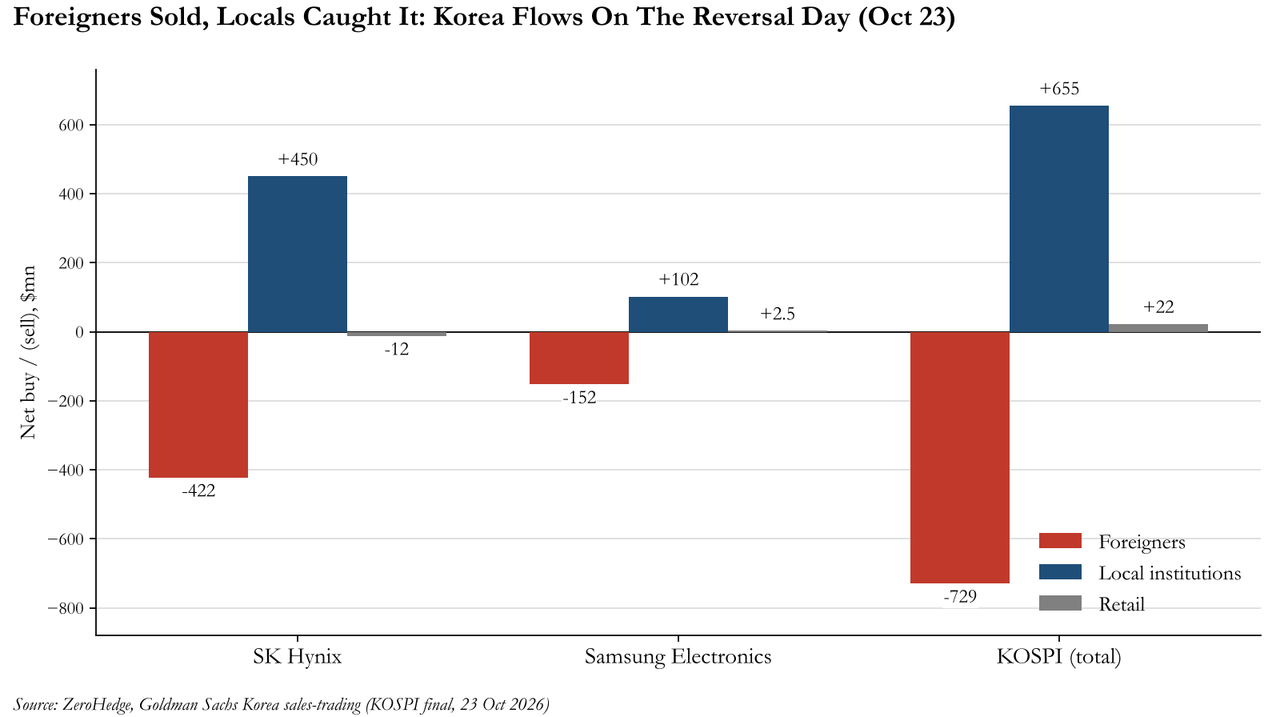
Maybe that was just Korean pension and insurance money seeing value in Hynix. Maybe it was something a bit more… encouraged. The same morning, Goldman’s regional wrap credited China’s surge (CSI 300 +1.7%, ChiNext +4.0%) to “state-backed ‘national team’ ETF buying” with RMB84 billion of turnover across nine favored ETFs, and Indonesia’s fourth straight gain to Danantara sovereign fund support. Asia, it seems, has decided it will not go down quietly with the Nasdaq. Whatever the source, the regulator’s success in killing the Solidigm deal gave local buyers a convenient headline to lean on.
Supply Destruction, IPO Edition
There’s a broader reason the market cheered the death of a $10 billion deal, and Goldman’s EMEA head of one-delta trading Richard Privorotsky spelled it out in his flow and positioning observations this morning (available to pro subs):
Perhaps we’re overthinking the concerns around AI demand and the issue is simply a repricing of the cost of capital. The assumption of effectively unlimited cheap capital to fund this buildout is being challenged. You either cut capex, delay deployment or increasingly fund through equity. None are particularly supportive of equity prices.
A $10 billion AI storage IPO sits squarely in the “fund through equity” bucket, and the market just watched one disappear. Solidigm also joins data center developers Firmus Grid and AirTrunk on the list of high-profile deals suspended or cancelled as AI bubble fears roil markets, while OpenAI is reportedly now targeting a $1.25 trillion valuation in its latest $30 billion round, down from $1.4 trillion. Back in Seoul, data center infrastructure name Elice dropped 32% in its trading debut this week, the worst opening day ever for a sizeable Korean listing. In this tape, the best IPO is the one that doesn’t happen.
The AI casualty list is getting longer by the week:
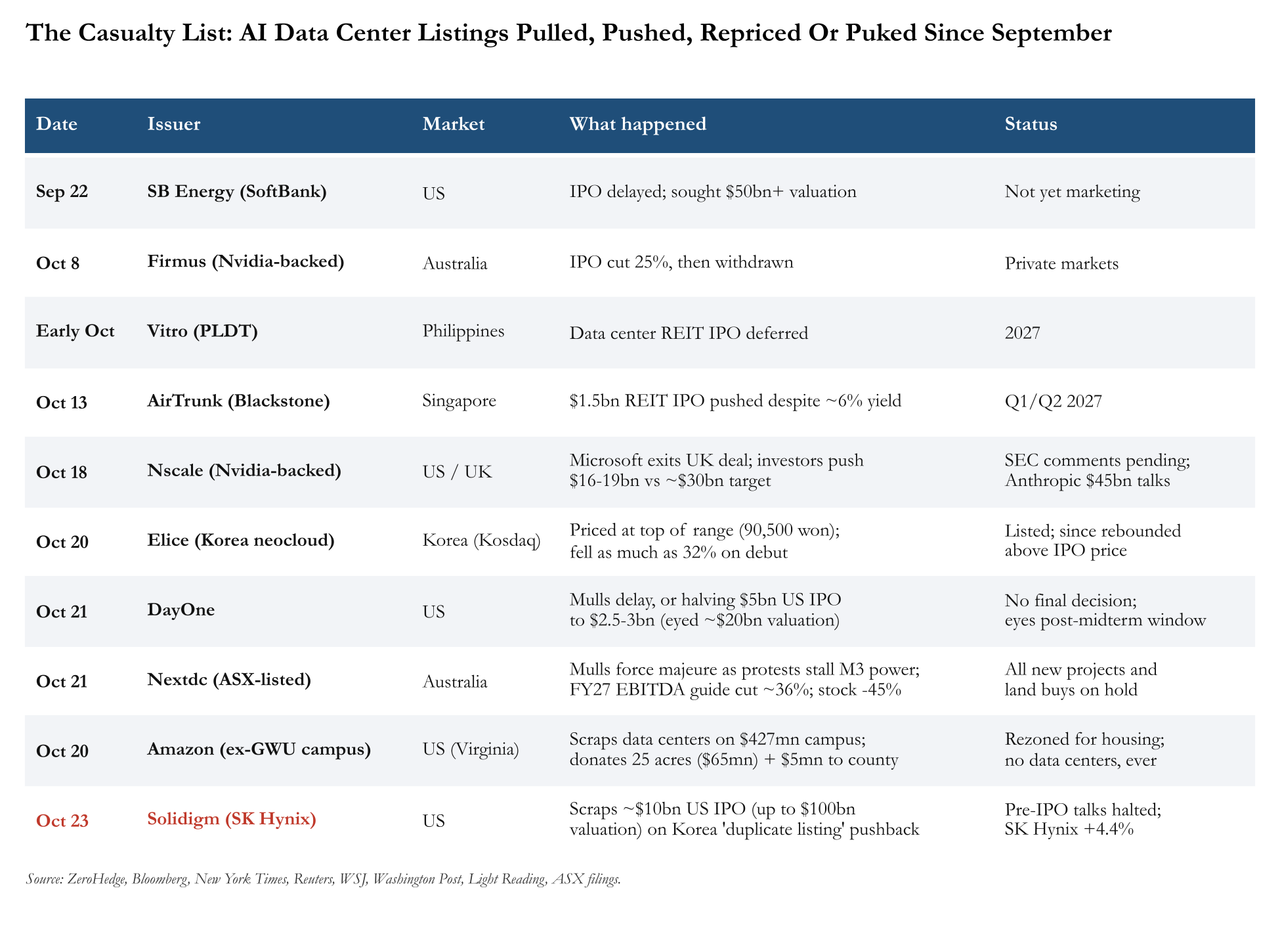
As for Korea, Privorotsky admitted he was braced for worse:
Korea is actually holding up better than I would have expected given the acute liquidation across Europe and the US (Kospi flickering green having been down a lot on open)… Putting my trading hat on, I expected Korea to be down another mid-single digits this morning. The fact that we’re not seeing another complete air pocket is encouraging.
He was not alone (see our tweet above). Goldman’s Asia sales trader Peter Sheren also argued in “Stress Without Capitulation” that October’s drawdown looks like “a concentrated positioning/technical reset rather than systemic capitulation,” with GS desk flows “active but largely balanced and rotational.” Korea, notably, was a net buy on the desk on Friday:
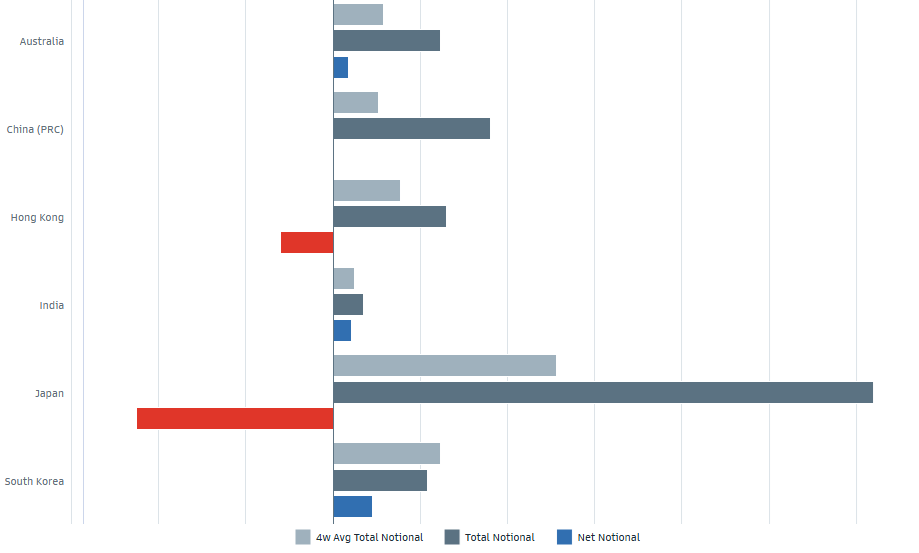
Sheren also points out the concentration problem every EM manager is wrestling with: TSMC, Samsung and SK Hynix together account for more than 30% of MSCI EM. When one of the three gets a governance-friendly headline on a day like this, an index can flip on its own.
The Buyback Is Done, The DRAM Price Isn’t
Context matters here, because Hynix needed the win. The stock had plunged about 60% from its June peak before today, a slide that accelerated right after the company completed its $26.5 billion ADR listing in July, the biggest US listing by a foreign company ever. Regular readers will recall we asked at the time whether SK Hynix’s US debut was the AI bubble top (Jul 11); two days later the stock suffered its steepest decline on record, sending the Kospi down as much as 9%.
Then came South Korea’s biggest-ever “buyback bazooka” in August, which for a while was the only thing holding the market together. As we said in September, once retail fled, only record buybacks were preventing a Kospi crash. Earlier this month, the bid vanished:
Goldman’s Asia macro sales desk confirms in its Asia FX Weekly (available to pro subs) that SK Hynix is “finishing its 40 trillion won buyback early and preparing further returns on Oct 28.” So the next shareholder-friendly catalyst is barely a week away, and cancelling a dilutive spin right before it doesn’t hurt the pitch.
Meanwhile, the fundamentals that made Hynix a $679 billion company keep heading the other way from the stock. As Russell Clark notes in his latest Capital Flows and Asset Markets note, “SK Hynix has typically been pretty responsive to spot DRAM prices. Not for the last three months.” His chart shows the DDR5 spot price still grinding to new highs while Hynix shares have collapsed (perhaps this simply means that real DDR5 prices are far lower than represented by yet another gamed index):
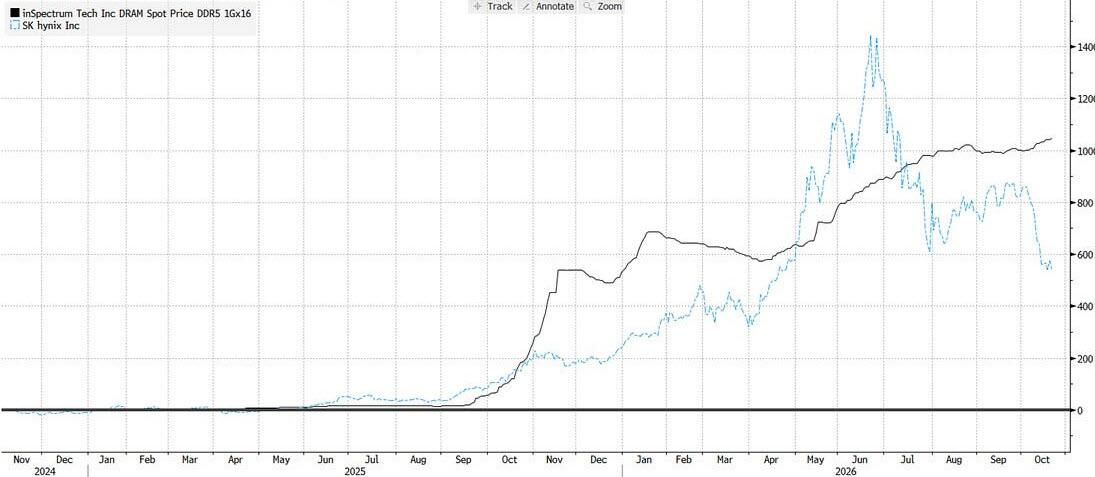
Since November 2024, DRAM spot is up more than 1,000% versus 530% for Hynix shares, and as recently as June the stock was running well ahead of memory prices. Bank of Korea Governor Shin, per Goldman’s FX desk, is “brushing off KOSPI softness given robust DRAM prices.” Clark himself admits that “starting from a point of ‘equities are wrong’ is a recipe for disaster,” which is about as honest a disclaimer as you’ll find this month.
A Governance Win In A Market Still Looking For A Floor
The cancellation is good news for Hynix shareholders: no duplicate listing, no dilution of the parent’s economic interest, no parent-subsidiary discount. Fibonacci Asset Management’s Jung In Yun said as much, and Seoul gets a clean win for its “Korea discount” campaign.
But let’s not confuse one stock’s governance win with a bottom. Breadth was dreadful, foreigners sold for yet another day, Kospi turnover was light, and the index closed at 5,550 – down from 6,890 on Sept 28, when it was falling on the very Solidigm headline it rallied on today. In other words, the Kospi has lost about a fifth of its value in less than a month, and Friday’s “rescue” came from local institutions bidding up the one name with a fresh catalyst. Next week brings the hyperscaler earnings that Privorotsky calls “critical,” plus Hynix’s Oct 28 shareholder return update. Until then, we’d lean toward this being a governance pop inside an ongoing AI deleveraging rather than the start of something bigger.
Then again, after we called for a halt at the open and got a green close instead, we’ll leave the Korea predictions to the national teams for now.
Much more in the full GS Korea Final, and Privorotsky’s “GS flow and positioning observations” notes, all available to pro subs.
end
JAPAN//
JAPAN CHINA/USA
3 CHINA
China’s Unitree Unveils “Terminator”-Like Humanoid In Chilling New Demo Video
Thursday, Oct 22, 2026 – 11:25 PM
Chinese robotics leader Unitree unveiled its H2-X in a promotional video Wednesday morning, highlighting the terrifying capabilities of humanoid robots and raising questions about their eventual dual-use military applications.

The H2-X footage reminds us how close humanity is to the “Terminator” movie’s Skynet robots, with potential testing/deployment in active war zones becoming an increasingly near-term reality.
“Powerful performance to serve and guard you, with a maximum endurance of approximately 8 hours,” Unitree wrote on X.
Unitree’s video builds on BTIG’s note last week, which outlined “real-world evidence” showing that these humanoids are moving onto factory floors, into warehouses, and behind restaurant counters.
Our view from the first quarter of this year is that movement already suggests these robots are intriguing Ukrainian military commanders, as testing may be underway or could begin soon.
end
4. EUROPEAN AND SCANDINAVIAN COMMENTARIES PLUS NATO
FRANCE/JEFFRY TUCKER….
A Warning From France
Friday, Oct 23, 2026 – 02:00 AM
Authored by Jeffrey A. Tucker via The Epoch Times,
The chaos in the streets of France has a familiar ring to Americans who watched several cities burn in the summer of 2020. What started as “mostly peaceful” protests were quickly hijacked by chaos actors who whipped up excitable populations into a looting and pillaging frenzy, resulting in police crackdowns in the best cases but utter destruction in the worst cases.

The metaphor of the powder keg is one that is often invoked here. In the U.S. case, we had suffered months of COVID lockdowns that created pent-up energy on the part of an entire generation that had been shut out of schools, spilling into the streets in the name of protesting racism.
Oddly, a media that had been screaming for people to stay home and stay safe flipped on a dime to urge everyone to get out in the streets for purely political protests.
Something similar seems to have happened in France. Rising unemployment, high cost of living, underfunded and failing schools, loss of opportunity, rising crime, and frustration over waves of new immigrant populations have reached a fever pitch. Peaceful protests turned violent with masked and destructive provocateurs lighting fires and pillaging whole commercial sectors in many cities.
It was six years ago that France experimented with some of the toughest lockdowns in Europe. They kept schools open but restricted gatherings of all sorts. Bars, restaurants, and cafés faced particularly long disruptions: closed from mid-March 2020, reopened gradually in June 2020, then closed again from late October 2020 until May and June of 2021. After that, there were long capacity limits. Cultural venues, gyms, and ski resorts were also heavily restricted.
Cities were shut to the unvaccinated. France used the passe sanitaire (health pass: proof of vaccination, recent recovery, or negative test) starting in summer 2021 for restaurants, bars, cinemas, museums, long-distance transport, large events, and shopping centers. From January 2022, this became a passe vaccinal for those over 16 in many of the same places, lasting until suspension on March 2022.
All of this was totalitarian by any standard and it created a fiscal crisis as the state funded the entire mess with huge subsidies and payments to both individuals and businesses. The economy never recovered and business has struggled ever since. In the backdrop of this is one of Europe’s most generous and expensive welfare states tangled up with a regulatory apparatus that makes the United States look like a laissez-faire utopia by comparison.
The unemployment problem is particularly poignant for students with advanced degrees as funded by the state. Like the latter years of the Soviet Union, everyone seems to have a high-level credential in something but these pieces of paper are guaranteeing nothing on the real-world job markets.
Then there is the resulting inflation, the worst in 40 years. It was intensified by France’s idiotic embrace of net zero policies on energy that have resulted in high prices and rationing. This is the land of austerity, highly controlled, with a ruling class presiding over dramatically declining living standards, a forever rising welfare state, a highly regulated business sector, combined with a disastrous immigration policy that has destabilized demographics.
No French government has balanced its books in 52 years. The parasitic elites have squandered the wealth of the population while closing off opportunities for enterprise and economic growth.
France, more than any other industrialized democracy, has followed the path of Progressive policies in everything. And look where it has gotten them? No one likes the results and absolutely no one trusts the system. French voters keep rejecting establishment politicians but the establishment somehow never leaves. Reform never arrives while frustrations fester.
The 19th-century French economist Frédéric Bastiat long ago nailed the question of the participation in the public life of a nation, explaining why it cannot belong to all but only to those who have the capacity to exercise that right responsibly.
“It is not the voter alone who suffers the consequences of his vote,” he wrote, “because each vote touches and affects everyone in the entire community; because the people in the community have a right to demand some safeguards concerning the acts upon which their welfare and existence depend.”
Exactly right and this is precisely the problem in which France found itself. It never restricted participation rights even as it flung open the borders and endlessly expanded the welfare state. This is the path to national suicide in any nation.
Is it too late for a political solution? Perhaps but that raises the question of how this chaos will resolve. We could look back to the interwar period in Europe and see one possible path. The inflation and social chaos as fallout from the Great War ended up raising a generation of authoritarian politicians rallying around fascist ideology. We tend to single out Germany but often forget that the same tendencies hit Italy, Spain, and France.
This is the only real modern precedent we have for how this ends. History may not repeat and I’ve wondered for years if something more dramatic is headed to Europe, something more like 1989 and 1990 in the former Soviet empire. States unraveled in different ways but the result was the same everywhere. An entire establishment and system were washed away in a few short years, discrediting decades of rule.
The states from that period that undertook the biggest reforms – Poland, Hungary, the Czech Republic, Slovenia, and Soviet satellites Lithuania, Latvia, and Estonia – also happened to be the same states that resisted the push for open borders for several decades. They have avoided the economic sclerosis of Europe along with the social, demographic, and industrial decay. It’s possible that the next stage of Europe will involve not just the full-scale unraveling of the European Union but also the abrupt overthrow of whole political establishments.
Let France be a warning to America. The policies that inflicted so many wounds on this country are all the same policies advocated in elite and fashionable circles in the United States, pushed by the heights of academia, and celebrated by establishment media. It’s all about more controls, more corporate cartels, more regulations, higher taxes, and more immigration floods without any real standards over what constitutes citizenship.
If the United States goes this way – it very well could happen with enough voter apathy and poor policies such as those being imposed on New York City today – we’ll end up right where France is today. We face a choice. We can choose chaos or choose to return to the ideals of a constitutional republic that our Founders envisioned. This is not only a fork in the road for France. It points to a coming fork for the United States too.
Views expressed in this article are opinions of the author and do not necessarily reflect the views of The Epoch Times or ZeroHedge.
END
FRANCE
France Is Burning (America Could Be Next)

by ITM Trading
Thursday, Oct 22, 2026 – 14:00
France is burning. America is its sleeping twin.
The US runs a bigger deficit (6.2% vs. 5.4%) and hotter inflation (3.7% vs. 3.4%) than the country currently setting fire to its own streets. Total debt sits at 122% of GDP, the highest since 1946, when we at least had a world war to blame it on. Meanwhile, roughly a third of America’s “booming” growth is AI spending with no proven return (but the headlines assure us everything is fine). Central banks just logged their biggest gold haul in nearly two years. They’re also bringing their bars back home.
So why are we spending like we’re in a crisis if there isn’t one?
Follow Taylor Kenney on X. https://x.com/taylorkenneyitm
About ITM Trading:
ITM Trading has spent nearly 30 years helping clients prepare for monetary resets, inflation, and systemic risk using physical gold and silver. We focus on education, historical context, and strategies designed to protect wealth when trust in the system breaks down.
UK
this is nuts!!! I need consent to huge my grandchildren!! They are out of control!!
Watson/Modernity
Creepy Ad Tells Grandparents To Get Consent Before Hugging Their Own Grandkids
Friday, Oct 23, 2026 – 03:30 AM
Authored by Steve Watson via Modernity.news,
A publicly funded advert from the Dublin Rape Crisis Centre’s We-Consent campaign shows grandparents arriving at the front door. One grandchild rushes in for a hug. The other winces and recoils as the older couple lean in. The voiceover declares: “Not everyone wants a hug. Even from the people who love them. Awkward? Maybe. Important? Absolutely.”

This is not a measured reminder about bodily autonomy. It is a deliberate attempt to plant suspicion inside ordinary homes, cast grandparents as potential abusers, and train the next generation to treat spontaneous family affection as something that requires official clearance.
The same ideological current that wants to erase the words “mother” and “father,” rewrite sex education as social engineering, and replace “husband and wife” with sterile inclusive language is now targeting the simple act of a grandmother putting her arms around a grandchild.
The 25-second clip is part of the broader We-Consent programme funded by the Department of Justice and aims, in its own words, to inform and educate the public about “all forms of consent” across every relationship.
In practice it has produced a video that visually distorts the grandparents’ approach so they appear threatening.
Also, as Graham Linehan pointed out, the makers of the advert even managed to crowbar in a diverse grandchild who looks nothing like the grandparents, just for the sake of it.
On GB News, Patrick Christys reacted with open disbelief, remarking that you would try telling that to his Greek grandmother.
The backlash was immediate and cross-party. Justice Minister Jim O’Callaghan stated that the video “does not represent the views of the Government,” was “both inappropriate and demeaning to grandparents,” and had been removed by the Dublin Rape Crisis Centre after officials engaged with them.
He added: “It goes without saying that having loving grandparents in a child’s life is an incredibly positive thing to be cherished and not something to be campaigned against.”
He further noted that while consent education around sexual relationships is vital, “this video did not advance that aim and in many ways was counterproductive.”
Aontú leader Peadar Tóibín called the advert “bonkers” and said it was “planting the seed that a grandparent’s hug may be insidious and a suspicious activity,” which he described as “really wrong.”
He argued that grandparents possess the “emotional intelligence” to know when a child does not want to be hugged, that the state has no business in this space, and that it “owes grandparents an apology.”
Fine Gael Senator Gareth Scahill labelled the piece “a complete waste of resources,” “offensive and potentially damaging to our older population,” and “a million miles off the mark.” He observed that the distorted imagery gave “a distinct impression of threat” and asked: “What’s next? Will we need to sign consent forms at arrival halls… before we can greet family members?”
Councillor Gavin Pepper slammed the government and NGOs for “losing the run of ourselves.” He wrote that while children should never be forced into unwanted contact, “we also need a bit of common sense.” The grandparent-grandchild bond is “one of the most important bonds in Irish family life,” and “a hug from a loving grandparent should not be presented as something strange or suspicious.” “Irish culture, family and traditions matter.”
None of this is an isolated misstep. It sits inside a wider pattern of institutional hostility toward the nuclear and extended family. The same political and cultural forces that fund these campaigns have pushed to strip “mother” and “father” from official language, treat biological reality as optional, and reframe parental authority as a risk to be managed by the state.
The We-Consent campaign’s own materials speak of moving “from a Moment to a Movement” and of changing culture so that consent becomes “an integral part” of every interaction. In the grandparents advert that ambition collapses into the grotesque: ordinary love is reframed as a potential violation requiring prior negotiation.
Families that once operated on shared affection, known character, and instinctive boundaries are now to be tutored by state-funded NGOs in the correct way to greet their own kin.
Public money was spent to produce and circulate this video, and the organisations involved saw no problem with casting Irish grandparents as the face of unwanted physical contact. Real sexual violence is a serious crime. Pathologising a grandmother’s hug is not a contribution to preventing it. It is a contribution to the long project of making the family itself feel unsafe, contingent, and in need of external supervision.
Parents and grandparents will continue to hug their children. The state can keep commissioning ads that treat that fact as a problem. The rest of the country has already decided which side of that argument is deranged.
end
UK
Barclays To Axe 5,000 Jobs As Britain’s Youth Employment Crisis Deepens
Friday, Oct 23, 2026 – 04:15 AM
Bloomberg cites a Barclays corporate presentation saying the bank is cutting 5,000 jobs as it pushes ahead with cost-cutting measures and adopts artificial intelligence to improve efficiency.
The reductions would affect about 5% of the bank’s workforce. The London-based lender employed about 93,000 people globally at the end of 2025, according to Bloomberg data.
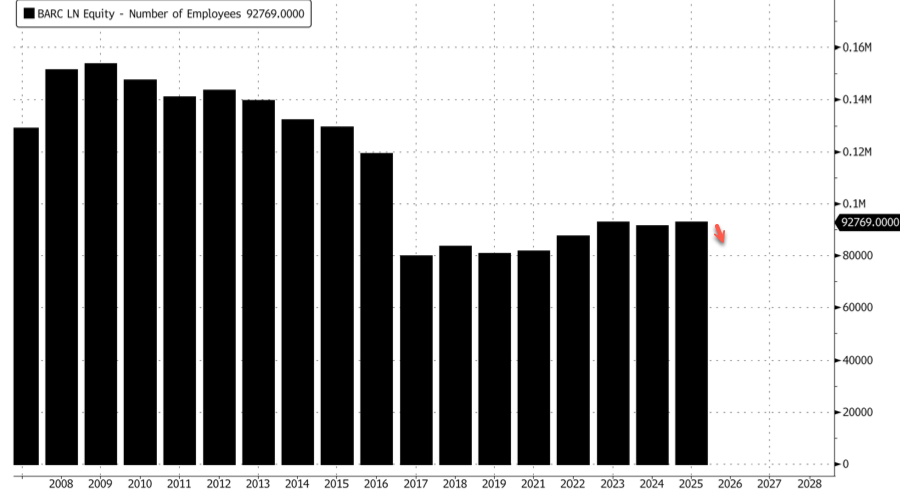
Barclays said it was “structurally reducing” costs to “generate capacity for investment.” The presentation also touched on organizational simplification and greater efficiency, supported by AI.
Separately, a Bloomberg report says that technology and finance jobs for young people in the UK have fallen sharply.
Payroll jobs for young people in information and communication have plummeted 30% between the end of 2022 and the end of 2025, according to Boston Consulting Group data. Finance jobs for the same age group fell 10%. Combined, the two sectors – that is, about a decline of 45,000 jobs – left about 163,000 employed.
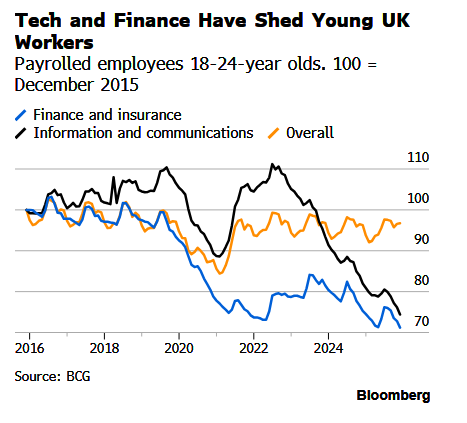
Young folks “are being squeezed out of some of the UK’s most important sectors,” said Raoul Ruparel, senior director at BCG’s Center for Growth, as companies grow more reluctant to hire young workers.
“AI may be playing a part, but it’s unlikely to be the whole story,” Ruparel said. “Much of the fall happened in 2023 and 2024, before today’s more capable AI tools. A post-pandemic tech downturn and remote working, which makes juniors harder to train, are also likely factors.”
Layoffhedge, which tracks SEC filings, WARN notices, and verified press reports, has recorded 702,000 job cuts across 541 US companies this year alone. That’s about 2,300 job cuts per day.
END
UK
HUMOUR!!
Museum Hides Egyptian Mummies For Ridiculous Reason…
by Tyler Durden
Friday, Oct 23, 2026 – 08:20 AM
Authored by Steve Watson via Modernity.news,
A Glasgow museum has pulled Egyptian mummies and other human remains from public view because the long-dead never provided “informed consent” to be displayed.

Yes, really, they’ve been moved to storage because the 5,000 year old people didn’t say it was OK to display their remains.
The decision at Kelvingrove Art Gallery and Museum follows a draft Human Remains Policy from Glasgow Life, the SNP-funded body that runs the venue, which insists remains should only appear if there is “documented and informed consent from the deceased individual or, in appropriate circumstances, their descendants.”
Visitors found a sign where a painted coffin containing the remains of the priest Nekht once stood: “We have removed human remains from this display as a mark of respect.” Also gone are a mummified male head, a mummified right hand recovered from the Valley of the Kings in Luxor, and a mummified right foot.
The artefacts range from roughly 2,000 to 5,000 years old. Glasgow Life says the change “reflects contemporary museum practice” and cites the International Council of Museums’ revised Code of Ethics from June 2026, which calls on museums to “uphold the inherent dignity of human remains and promote respect for their significance.”
It also references a 2025 All-Party Parliamentary Group on Afrikan Reparations report raising ethical concerns about displaying ancient Egyptian remains.
Of course, the reparations crowd had to be somehow involved.
A Glasgow Life spokesman stated: “In the absence of such consent, we believe removing ancient Egyptian human remains from display is more respectful to the deceased individuals.“
The organisation is also removing archaeological human remains from the History Discovery Centre and the Scotland’s Early People gallery at Kelvingrove, with further removals planned at St Mungo Museum.
What’s next? Removing Neanderthals from the Neanderthal museum because they never signed a waiver?
Scottish Conservative MSP Murdo Fraser called the move “woke madness at its most ridiculous.” He said: “Even Egyptian mummies are now being cancelled by a society so obsessed with modern sensibilities that it has lost all sense of perspective.”
“People visit museums to learn about ancient civilisations, not to see history hidden away because it fails to meet today’s ideological standards,” he added, noting that Glasgow’s museums “should be showcasing our history, not quietly removing it to appease the latest trend in political correctness.”
Chris McGovern, chairman of the Campaign for Real Education and a former adviser to the Policy Unit at 10 Downing Street, described it as “more virtue-signalling, woke nonsense” and “the triumph of educational stupidity and ignorance.” He noted: “It is not possible to seek permission from those who died thousands of years ago.” He suggested Scottish authorities take their lead from Egyptian museums that “respectfully display human remains.”
One visitor, Jonny McFarlane, brought his daughter to the ancient Egypt display after she had been “quite animated” by a book on the subject, only to find the exhibits replaced by the respect sign.
This is not an isolated episode of museums subordinating public education and historical display to contemporary ideological preferences. London institutions have repeatedly altered or obscured exhibits under similar rationales.
In March, London Museum Docklands half-covered a large early 19th-century portrait of Beeston Long, a former Bank of England governor who held investments in Jamaican plantations worked by slave labour, with multicoloured Madras cloth.

London Museum HIDES Portrait Behind Cloth To ‘RECLAIM’ Caribbean History
Woke curators drape historic artwork in symbolic shroud, claiming it “evokes emotional responses”
The exhibition trail “Caribbean Voices: Shaping Docklands” aimed to “reclaim the histories of colonised Caribbean nations” and celebrate the Windrush Generation’s influence.
Information panels stated that artworks which might “obscure” or “sanitise” connections to slavery can “evoke emotional responses” and that museums should give a “voice to those whose cultures have been impacted by colonialism.”
Some Caribbean partners reportedly felt “bitter and provoked” or “angry, furious and violated” by the uncovered painting. The cloth, historically exported to the Caribbean, was presented as representing Caribbean nations. A statue of slave trader Robert Milligan had already been removed from outside the museum in 2020 and placed in storage.
In Januar, the Young V&A in Bethnal Green placed books featuring graphic nudity and contested LGBTQ+ material in its children’s reading room alongside titles such as The Gruffalo. It Isn’t Rude To Be Nude displayed drawings of naked adults with exposed genitalia and captions including “willies aren’t silly,” with the cover declaring “contains nakedness – and that’s OK!”

Pornographic ‘Groomer’ Books On Prominent Display In Kids’ Reading Room At London Museum
Parents slam explicit nudity and transgender propaganda aimed at toddlers in prestigious V&A venue
Another title, Rainbow Revolutionaries, included a glossary defining “gender affirmation surgery,” “polyamorous,” and “asexual” for young readers.
Parents described the selection as “pornographic,” “a useful tool for paedos to groom children,” and “psychological warfare.” One said an essential part of safeguarding is to alert adults when strangers discuss intimate areas, “never mind actually showing them to kids.”
Kate Barker of LGB Alliance called it “grooming in plain sight” and “an egregious safeguarding failure.” Shadow equalities secretary Claire Coutinho noted the absurdity of banning children from wearing costumes while allowing material on polyamory and pansexuality. The V&A, chaired by Minouche Shafik and run by Sir Tristram Hunt, said staff had reviewed the books to ensure they were “age appropriate.”
In December 2025, Brighton and Hove Museums published a blog post arguing that Santa Claus is “too white” and that his judgment of children as “naughty” or “nice” enforces colonial binaries and assumptions of cultural superiority.

Santa Is TOO WHITE, Shouldn’t Judge ‘Naughty’ Children From ‘Diverse’ Cultures Says Museum
Ho ho… no
The post suggested challenging the binary, recasting Santa in diverse forms including multiple Santas or “Mother Christmases,” and prioritising cultural exchange over judgment.
Toby Young of the Free Speech Union called the museum “po-faced” and asked whether non-Christian countries should leave notes saying “sorry, but this is a decolonised fireplace and white supremacists dressed in red aren’t welcome.”
Alka Sehgal Cuthbert of Don’t Divide Us described the idea as “laughable” and “intellectually vacuous,” accusing museums of seeking to “rupture our sense of belonging to a common past and culture.” A museum spokesman said the post was intended to prompt reflection and discussion rather than prescribe views.
In April 2024, an LGBTQ audio guide at the Queen’s House in Greenwich, produced by a drag performer as part of a “Fierce Queens” event and LGBTQ+ History Month programming, claimed Queen Charlotte, wife of King George III, was “the nation’s first royal person of colour” and that “insecure white boys writing history” had omitted this due to “structural racism.”

London Museum’s ‘LGBTQ Audio Guide’ Wrongly Claims British Monarch Was ‘Person Of Colour’
Says “insecure white boys writing history conveniently forget to mention it”
After backlash, the museum later stated the guide was “light-hearted entertainment” by performance artists and “was not ‘fact checked’.” Critics noted Queen Charlotte was of German ancestry with no evidence of non-European heritage.
Former Royal Navy officer Chris Parry called the material “stupid,” said it “degrades and defiles our national reputation for historical scholarship,” and described the antics as “profoundly racist,” calling for public funding to be removed.
In March 2024, Hastings Museum and Art Gallery, in association with the Hastings Queer History Collective and funded by Arts Council England, claimed that some birds are “queer” because female pheasants supposedly change sex after they stop laying eggs and develop male-coloured feathers.
The pamphlet stated that “queer behaviour in the animal kingdom” had been “ignored or hidden from the public” since the 18th century and that “with queerness visible in the natural world, the argument that it is somehow ‘unnatural’ begins to unravel.”
A fossilised dinosaur footprint was even said to have “queer history” because of the personal life of the boy who found it.

Museum Claims Dinosaurs Have “LGBTQ History” And Birds Are “Queer”
Says animal queerness has been “hidden from the public”
Biologist Dr Emma Hilton stated: “The only vertebrates that change sex are all fish. Birds do not change sex.” She noted that older female animals can develop male features due to hormonal changes, “but we would not say that older women had changed sex if they have a bit of a moustache.”
In January 2024, Madrid’s Prado Museum reviewed thousands of painting descriptions and signs to remove terms such as “dwarf,” “deformed,” and “disabled” to align with Spanish disability legislation.
Descriptions of Velázquez works were altered, titles such as “Prince Felipe and the Dwarf, Miguel Soplillo” were shortened, and “Portrait of a Dwarf” became “Portrait of a Buffoon.” The museum said it was listening to “political consensus” and revisiting signs that “now we find are out of step with the times.”
Across these cases, publicly funded institutions have repeatedly prioritised contemporary ideological frameworks over the straightforward presentation of artefacts, art, and evidence.
Critics consistently describe the pattern as the subordination of history and education to political fashion.
Museums exist to show the past as it was, not as current sensitivities require it to appear. When they hide the dead, cover the portraits, rewrite the labels, and invent queer animals, they stop being museums and become something else entirely.
END
SWEDEN/VOLVO
reason: cheaper cars in China!!
“Those Times Are Gone”: Volvo Crashes As China Sales Collapse, BofA Recommends Default Protection
Friday, Oct 23, 2026 – 08:00 AM
Volvo Cars shares in Stockholm crashed the most since the company’s October 2021 listing. The Swedish automaker announced another 2,500 job cuts and warned that its Chinese sales are under severe pressure.
Third-quarter deliveries in China plunged 40% as domestic brands gained ground with cheaper electric vehicles.

“Nobody will be successful with the old recipe where you had global cars developed in Europe and sold them at a premium price” in China, CEO Hakan Samuelsson told analysts on the earnings call earlier today.
Samuelsson emphasized, “Those times are gone.” In other words, Volvo is no longer competitive in overseas markets.
The 2,500 job cuts represent about 6% of Volvo’s workforce and will primarily affect Sweden. They form part of a turnaround strategy to save an additional 5 billion kronor, following 3,000 job cuts announced last year.
Bank of America analyst Stephanie Vincent recommended buying protection against a default by Volvo Car AB, warning that deteriorating finances and prolonged weakness in China and the U.S. are leaving the Swedish automaker’s senior unsecured bonds maturing in 2029 and 2030 at risk.
Vincent added more color:
Spreads not reflecting b/s risks: Buy 5y CDS/UW ‘29s-‘30s
We move our recommendation on VOVCAB 5Y CDS to Buy Protection, from Sell Protection. We maintain our UW recommendation on the VOVCAB’ 29-’30s senior unsecured bonds on fundamental deterioration at the company (free cash flow, or CFO less capex, has been negative for three straight quarters and for full-year 2025) and relative value (the bonds still trade tight to BB2-BB1 credits in the ICE BofA BB Euro High Yield Index). Volvo’s 3Q and ytd results have been negatively impacted by a significant downturn in China (ytd revenues down 40%) and the U.S. (ytd revenues down 19%). 30th September 2026 cash balances have declined to levels not seen since 2018, while gross debt has remained roughly stable since 2025. Further volatility could be seen if the new management team re-evaluates the medium-term production plans and footprint (Klaus Zelllmer plans to assume the President/CEO position in 3Q27). We are MW on near-term maturities (VOVCAB’ 27s/’28s) due to the business’ previous market access and overall liquidity.
U.S., China very tough markets for Volvo Car
The U.S. market was hit by current tariffs and the removal of incentives for electrified cars that hit imported EV margins (Volvo Car only produces the EX90 in the U.S. at present, with the XC60 planned to have a SOP in January 2027). The plan for the U.S. market is to localise production for the XC60, and to also bring product offering, marketing and sales closer to its U.S. customers along four regions. There will also be PHEV offerings for the XC90 and XC60 shortly after deliveries start in Europe. In China the market remains very challenged particularly for the Western Premium manufacturers and management notes “the next two years will remain very tough.” The production plans are to deliver the first two of six new cars tailored for China, developed in partnership with Geely. Europe is the sole profitable market now, with BEV/battery electric sales reaching 45% share in 3Q (versus 30% in 3Q25), driven by the EX30.
Cash flow a core focus.
Management explicitly highlights that cash is being prioritised. We note that Volvo management believes 4Q26 cash flow will be stronger than 3Q26 due to inventory reductions (however this action could pressure margins due to de-stocking). Overall liquidity is well above management’s view of the minimums needed: the business has cash of SEK 32bn and total liquidity of SEK 55bn. However, the net cash position has deteriorated meaningfully, to a level of SEK 725mn (our estimate, from peak levels of close to SEK 37bn, seen in 4Q21).
LT targets maintained.
Capex, cost actions at forefront. Volvo Car is maintaining its longer-term goal of adjusted EBIT margins >8% and is adding new initiatives: a 30% reduction in capex versus 2024 levels (could lead to lower cash needs of c. SEK 13bn by our estimates) and reinforcing the cost savings. The company is also targets another SEK 5bn in additional cost savings by the end of 2027 (primarily via headcount initiatives).
Volvo shares in Stockholm crashed 30% on Friday morning, marking their worst intraday decline on record.
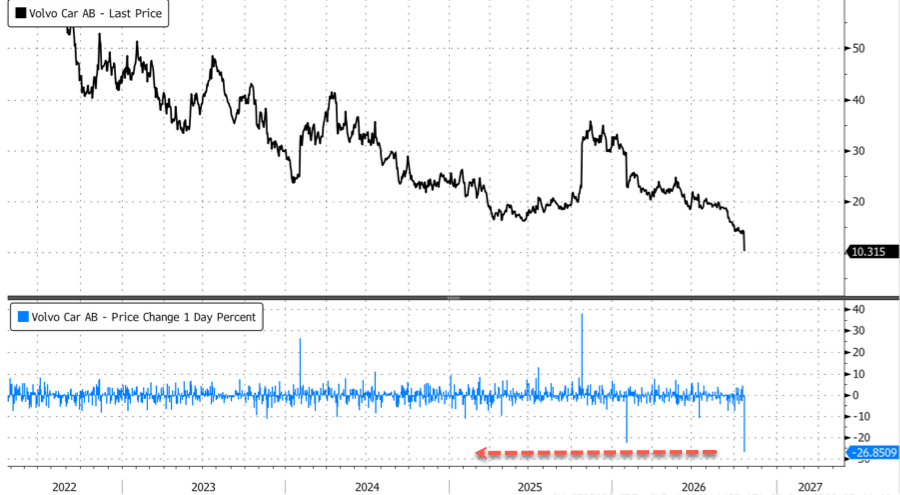
The selloff reduced Volvo’s market value to 29.8 billion kronor ($2.68 billion), about 80% below its 2021 listing valuation.
Beyond Volvo, many other European automakers are in turmoil, including VW. Just go down the list.
The elites in Brussels were, oddly enough, more concerned about deindustrialization and mass migration than ensuring the bloc could survive another decade. Now Europe is facing the risk of another debt crisis, with France at the center.
END
ITALY
Italy Makes Parents Pay For Milan Rioters: Meloni Decree Fines Families, Adds Riot Crime Carrying Up To 5 Years
Friday, Oct 23, 2026 – 02:45 AM
Italy’s cabinet approved an emergency decree-law on Oct. 20 in response to the weekend riots in Milan, ANSA reported. The eight-article text creates a new offense of violent participation in demonstrations, extends preventive detention to minors aged 16 and over, and sends 500 more soldiers to Milan through Dec. 31 at a cost of €4.7 million.

Parents of minors who commit violence at demonstrations face fines of €500 to €1,000, and the fine doubles for a repeat. It applies even when the minor is too young to be prosecuted. Prime Minister Giorgia Meloni said that if a minor is responsible for the damage, the parents should pay, and she asked all political forces to side with legality.
The new crime covers anyone who uses sticks or clubs or throws objects at a protest in a way that endangers people. It carries two to five years in prison and a fine of up to €20,000, with a higher penalty for a covered face or damage to public infrastructure or utilities. Anyone who organizes or promotes groups for violent demonstrations, including through online tools, faces four to 12 years.https://www.youtube.com/embed/tPIRK7IDsEQ
For minors, those over 14 are presumed capable of understanding their acts and can be charged immediately, a provision carried over from a bill the cabinet approved in July. Meloni said then that anyone who assaults, robs or wrecks must pay “even if he is 15 or 16,” and the opposition called it propaganda and an authoritarian drift. The new decree also lets the police chief bar a group of five or more minors from gathering where they behave in an intimidating way. It also makes a minor injury to a police officer prosecutable automatically and adds optional deferred arrest for property damage.
Violence broke out in Milan after a Saturday demonstration over living costs and public services. Reuters reported that hooded protesters, many believed to be minors, set fires and looted shops including Decathlon and Vodafone while luxury stores on Via Montenapoleone stripped their windows. Police took 271 young people to the Milan police headquarters; 32 were arrested, 23 of them minors. Similar clashes hit Bologna, Brescia, Bergamo and Turin. Euronews counted 14 injured officers and a damage estimate from the Confcommercio business group of over €1 million in Milan alone and at least €1.3 million nationwide.https://milano.repubblica.it/embed/cronaca/2026/10/18/video/milano_saccheggiato_decathlon_si_stanno_prendendo_tutto_poi_irrompe_la_polizia-425657002/
Interior Minister Matteo Piantedosi said early findings ruled out structured links to antagonist groups, and no organizer has been identified. He called the youth mobilization spontaneous but said “something certainly happened” and that answers would come soon. Defense Minister Guido Crosetto blamed “hybrid warfare,” while Deputy Prime Minister Matteo Salvini rejected the idea of a coordinating hand, Russian involvement included. Ynet reported that assessments suggest many participants simply wanted to break things, though police also identified radical-left activists from social centers who left once force was used.
The package was a political negotiation. After a 90-minute summit at Palazzo Chigi on Oct. 19, Il Sole 24 Ore reported that more than 200 young people had been detained and that 80 percent were under 18. Salvini announced “500 more soldiers to defend Milan. A victory for the League,” while Forza Italia claimed credit for the same troops. Crosetto’s request to give soldiers judicial police powers did not make it into the text, per ANSA, which also reported that tension with the presidential palace delayed the cabinet meeting by almost an hour. The government denied any blockage.

END
EUROPE/DR LACALLE
“The State Does Not Create Wealth; It Consumes It”: Europe’s Socialist Model Hits The Wall
Friday, Oct 23, 2026 – 05:00 AM
Authored by Daniel Lacalle via dlacalle.com,
Decades of bloated government, entitlements, subsidies, and mass migration have destroyed Europe’s competitiveness and growth, all paid for with ever-rising taxes and more debt. They have also created enormous social discontent. Taxpayers are exhausted, and the recipients of subsidies are looting and vandalizing the streets. The flames in French cities are the bill that is arriving.

On Saturday 17 October, France burned again. What began as marches against the cost of living and the state of public schools turned into the worst violence the country has seen in decades. According to the French government, 550,000 people took to the streets, 1,200 were arrested, and 150 police officers were injured. In Limoges, rioters set the city hall ablaze; in Marseille, they broke into the city hall; and in Lyon, they torched the tourist office. AFP reporters on the ground described scenes more intense than the 2023 riots and the Yellow Vest protests of 2018 and 2019, six months before a presidential election. Major cities, including Paris, Marseille, and Lille, suffered enormous commercial damage with smashed shopfronts, shattered glass, and ransacked retail spaces. In Bordeaux, Mayor Thomas Cazenave reported that up to 100 stores were looted in his city alone.
The riot images will be explained away as the work of a violent fringe, and it will be said that the mob that loots luxury boutiques and supermarkets certainly does not represent the hundreds of thousands who marched peacefully. However, the anger is real, and it has a cause.
Europe has spent half a century building the largest welfare state in the world on the promise that government could guarantee prosperity, security, and equality for everyone. That model has completely failed, and the people who were promised everything are discovering that the state only delivers stagnation and impoverishment.
France is the clearest example of what “democratic socialism” does to a rich nation. France is the most state-heavy economy in the European Union. French public spending reached 57.2% of GDP in 2025, the second highest in the EU and 7.7 points above the average. Its tax burden is among the highest in the world, at 45.3% of GDP in 2024, behind only Denmark in the EU. Public debt rose to 119% of GDP in the second quarter of 2026, and the deficit stood at 5.1% of GDP in 2025. If big government, high taxes, and immigration delivered prosperity and social peace, France would be paradise. Instead, the protesters on the streets of Paris are demanding more of the same medicine that made them sick.
The welfare machine eats the economy.
France is not an extreme or single example. The disease is continental. Government expenditure in the European Union reached 49.5% of GDP in 2025 and 49.8% in the euro area. Half of the economy is directly controlled by the state, and much of the rest is regulated, subsidized, or taxed to the point of exhaustion. Social protection benefits alone reached 4,925 billion euros in 2024, 27.3% of the EU’s GDP, after growing 6.9% in a single year while nominal GDP grew only 4.4%.
Add the subsidies. European governments spent 340 billion euros on energy subsidies in 2024 and another 168 billion euros in state aid. Governments first make energy expensive with taxes, regulations, and ideological mandates, then subsidize the very costs they created, and finally borrow to pay for the subsidies. Citizens pay three times, as consumers, as taxpayers, and as the future holders of the debt.
The debt is the inevitable consequence. Greece ended 2025 with public debt at 146.1% of GDP, Italy at 137.1%, France at 115.6%, Belgium at 107.9%, and Spain at 100.7%. And those figures hide the largest liability of all. According to Eurostat, the pension entitlements already accrued in social insurance schemes reach 500% of GDP in Spain, 462% in Austria, 438% in Italy, 397% in France, and 347% in Germany, almost all of them unfunded, according to Eurostat. These are promises that no government can keep without crushing the next generation with taxes or destroying the purchasing power of the currency.
Germany, once the engine of Europe, now transfers 127.4 billion euros from the federal budget to its pension system in 2026, rising to 132 billion in 2027. Spain’s Social Security debt has almost quadrupled since 2018, from 34,888 million to 136,176 million euros, and social contributions cover pension payments only until early October. The welfare state now lives on borrowing against the future rather than on what the economy produces.
Competitiveness destroyed
There is no free lunch. Every euro of spending must be paid for by the productive economy, and Europe’s productive economy is suffocating. The International Monetary Fund expects the euro area to grow just 1.1% in 2026, compared with 2.3% in the United States, with France at a miserable 0.4% and Italy at 0.8%. Labor productivity per hour worked in the EU stood at only 78.5% of the US level in 2024, and in 2025 it grew just 0.4% compared with 1.6% in the United States.
German industrial production has fallen every year since 2022, and the BDI industry association no longer expects a recovery in 2026, only stagnation. Output in energy-intensive sectors is at its lowest level since the end of 2023. That is what happens when energy is made artificially expensive, labor is taxed at confiscatory rates, regulation multiplies, and capital flees.
Inflation makes the situation even worse. Euro area inflation rose to 3.8% in September 2026, with energy prices up 18.9% year-on-year. Governments that printed and borrowed their way through every crisis now discover that the real wages of their citizens cannot keep up. The cost-of-living crisis that sent hundreds of thousands into French streets has its roots in decades of too much government, not too little.
Mass migration worsens the situation.
Instead of reforming, European governments chose to import the illusion of growth. On January 2025, 46.7 million people living in the EU had been born outside it, 10.4% of the population, and the number of non-EU citizens rose by 1.6 million in a single year to 30.6 million. Immigration may be a powerful engine of prosperity when it is carefully selected for skills and enters flexible labor markets with low taxes and limited welfare. Europe did the opposite. It combined mass migration with rigid labor markets, enormous taxes, and the most excessive welfare benefits on the planet.
The result was predictable. Many immigrants have no incentive to adapt or participate and are trapped in low-wage jobs and welfare dependency. Thus, public services were stretched beyond capacity, housing became unaffordable in the major cities, and integration failed in entire neighborhoods. Governments used headline GDP inflated by population growth to hide stagnant income per person, while workers saw their wages fall in real net terms as inflation and their taxes rise. This is the evidence of a model that promised everything to everyone and delivered disappointment to all.
When you create a state big enough to promise everything, it delivers almost nothing but takes away everything it can.
Angry taxpayers, entitled mobs
Democratic socialism created two angry Europeans. The first is the angry taxpayer, the middle-class worker, the small business owner, and the self-employed professional who pays more every year and receives worse services, longer waiting lists, unaffordable housing, security problems, and a pension system that will not be there when they retire. The second is entitled Europe, a constituency that has been taught for decades that the state owes it everything and responds to inevitable disappointment with rage and violence.
Both are victims of the same lie. Politicians promised that they could raise taxes on the rich, borrow without limit, and expand entitlements forever with no consequences. They told voters that someone else would pay. Now that someone else, the productive economy, is exhausted. Capital is leaving, young talent is emigrating, industry is closing, and the bill is landing on the middle class and on young people who will inherit the debt.
What Europe needs is less state. Another subsidy, another tax on «the rich» or another emergency fund financed with joint debt will only deepen the crisis. The way forward is to cut unproductive spending, reduce the tax burden on labor and investment, end the subsidy culture that keeps the economy zombified, liberalize markets, and abandon the ideological mandates that have made European industry uncompetitive.
Europe needs a migration policy designed for prosperity rather than electoral calculation, selective, linked to employment, and not to welfare entitlement. It needs a gradual transition from unfunded pay-as-you-go pensions to capitalized systems in which workers own their savings, as Sweden and the Netherlands have shown is possible.
Citizens need to realize the truth, which is that the state does not create wealth; it consumes it.
The riots in France are a warning to America. When a society is told for decades that it is entitled to everything and then discovers that the state is broke, the result is not solidarity but violence.
Democratic socialism promised Europe equality and security. It delivered stagnation, inflation, debt, and rage. If America adopts this system, it will follow the same path of misery and desperation. The sooner Europe abandons democratic socialism, the sooner it can recover the prosperity that made it the envy of the world.
END
EUROPE/ELECTRIC VEHICLES
Europe Went All In On EVs. Now Its Automakers Are Losing Out
Friday, Oct 23, 2026 – 06:30 AM
Authored by Kevin Stocklin via The Epoch Times,
Global sales of electric vehicles (EVs) in 2025 increased by 20 percent over the previous year, exceeding 20 million units worldwide, with much of the increase driven by Europe, where sales jumped by 30 percent, according to the International Energy Agency (IEA).

But even in a red-hot market, European carmakers are struggling to turn a profit on EVs.
50K LAYOFFS
Volkswagen, Europe’s largest electric vehicle maker, announced in September that it would lay off 50,000 workers.
Stellantis, Europe’s second-largest auto manufacturer, reported write-downs of 22.2 billion euros ($24.9 billion) as part of its EV “reset” in the second half of 2025, largely due to overinvestment in electric cars.
Operating profit margins at Volkswagen, Europe’s largest carmaker, fell to 1.8 percent in 2025 from 5.6 percent in 2024, and the company announced that it would lay off an additional 50,000 workers, amounting to 15 percent of its workforce.
Europe’s automakers are caught between two adversaries: Chinese automakers that are aggressively taking market share and undercutting profit margins, and their own governments, which have attempted to force a complete transition to EVs regardless of consumer demand.
In 2023, the European Union mandated a 100 percent elimination of tailpipe carbon dioxide emissions starting in 2035, effectively banning the sale of new internal combustion engine vehicles, though it recently revised that to a 90 percent emissions cut.
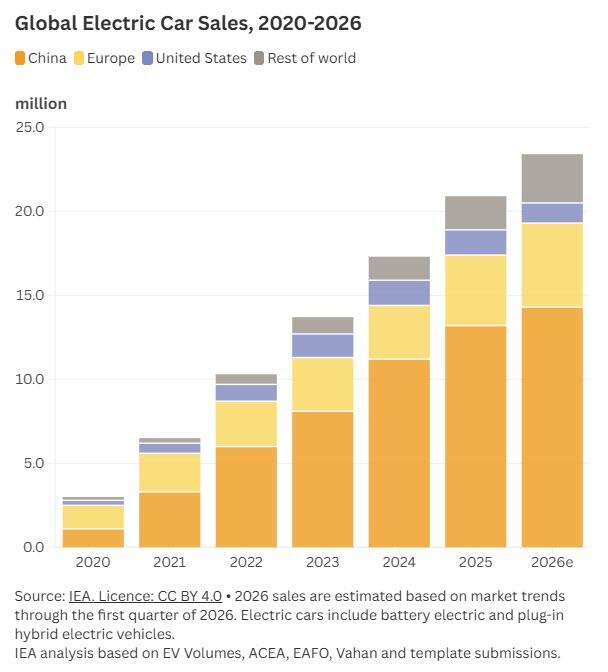
Made with Flourish • Create a chart
In response to these and other mandates, car companies invested in new EV production lines, with Volkswagen alone committing $193 billion in 2023 to electrify its fleet.
“I think that European auto manufacturers are paying the price for paying more attention to what regulators want than what their customers are asking for,” Jeff Degner, a research fellow at the American Institute for Economic Research, told The Epoch Times.
He calls much of the money spent on the EV transition “government-induced malinvestment.”

Volkswagen assembly workers perform final checks and corrections on electric cars in the paint shop at the Volkswagen electric car factory in Emden, Germany, on Feb. 24, 2026. Focke Strangmann/Getty Images
Overestimating Demand, Underestimating China
In announcing this year’s write-downs from its EV “reset,” Stellantis CEO Antonio Filosa concurred.
“The charges announced today largely reflect the cost of overestimating the pace of the energy transition that distanced us from many car buyers’ real-world needs, means and desires,” Filosa said in a February statement.
America’s largest auto manufacturers, Ford and General Motors, have been more cautious about going electric than their European counterparts and have pulled back faster as losses have accumulated.
“The number one trend in the auto industry so far this decade is just the explosive growth in Chinese auto exports.”
– Garrett Nelson, equity analyst, Center for Financial Research and Analysis
In January, General Motors announced a $6 billion write-down, shortly after Ford announced a $19.5 billion write-down, as both companies stepped back from their EV commitments.
“EV adoption hasn’t developed at the pace or with the economics many of those original commitments assumed, and at the same time, European automakers are facing a much more competitive market,” Stephanie Valdez Streaty, director of industry insights at Cox Automotive, told The Epoch Times.
After starting from virtually zero several years ago, Chinese autos made up 20 percent of the EU’s battery-electric sales by May 2026, Streaty said.
Chinese automakers have captured the majority of global EV sales, matching Western carmakers in quality and features and beating them on price. Some Chinese models, such as BYD’s Seagull, which sells for approximately $10,000 in China, are not only undercutting competitors on price but also delivering on quality, according to reviews by publications such as InsideEVs and Top Gear Philippines.
For European markets, BYD rebranded and upgraded the Seagull as the Dolphin Surf, which launched at a discount price of $22,400 but now sells for about $25,800. This falls under the price of comparable European-made models such as the Citroën ë-C3, which starts at about $26,200, but remains higher than budget models such as the Dacia Spring at $20,100 and the Renault Twingo E-Tech at $21,800.
“The number one trend in the auto industry so far this decade is just the explosive growth in Chinese auto exports,” Garrett Nelson, equity analyst at the Center for Financial Research and Analysis, told The Epoch Times. He estimates that China is now exporting more than 1 million vehicles per month.
“They’ve invested very heavily in infrastructure, in logistics, in order to be able to export so much more than they used to,” Nelson said.
China’s automobile exports rose by 53 percent in the first half of 2026 compared with the same period a year earlier, while exports of new energy vehicles more than doubled, according to Chinese regime data.
“The European market is really being flooded with low-cost Chinese EVs,” Nelson said, and Europe’s 10 percent tariffs and other duties on Chinese cars have failed to halt China’s expansion.

Vehicles made by Chinese EV manufacturer BYD, at the Port of Guangzhou, Guangdong Province, China, on Feb. 22, 2025. Pedro Pardo/AFP via Getty Images
China’s Competitive Advantages
The major Chinese auto brands are BYD, Geely, SAIC, and Changan. In 2025, BYD overtook Tesla as the world’s largest seller of EVs.
According to Degner, BYD’s production costs are 20 percent to 30 percent lower than those of European carmakers for similar models. But European regulators, even as they pushed domestic auto companies to switch to EVs, simultaneously passed mandates that made manufacturing in Europe significantly more expensive.
This included a state-mandated transition away from coal and other fossil fuels in favor of wind and solar power, resulting in Europeans now paying some of the highest energy and electricity costs in the industrialized world, multiples of those in China.
“The Chinese have a competitive advantage, but that competitive advantage was created because of the high cost that European regulators are imposing,” Degner said.
Europeans are now paying some of the highest energy and electricity costs in the industrialized world.
“I would say that the Europeans only have themselves to blame as they have put into place, whether at the national or international level in the EU, the kinds of regulations that are making life more difficult for the [auto] industry as a whole.”
In addition, over decades, China has built a global infrastructure for mining and shipping raw materials for batteries, including graphite, lithium, and cobalt. The majority of these materials are also refined, processed, and manufactured into batteries in China.
And Chinese companies benefit from scale and an enormous domestic market.

An employee works on batteries for electric vehicles at the Leap Energy factory, in Huzhou, Zhejiang Province, China, on April 26, 2026. Adek Berry/AFP via Getty Images
Of the 20 million EVs sold worldwide last year, more than 13 million were sold in China, and more than half of worldwide sales were Chinese-made vehicles, according to the IEA.
In addition, a February report by the Rhodium Group states that Chinese automakers benefit from extensive vertical integration of the manufacturing process, as well as state grants, tax incentives, and preferential financing.
Lessons for US Carmakers
Is Europe’s EV adventure a cautionary tale for the United States?
The Trump administration believes that it is. The administration eliminated federal tax breaks for EV buyers and canceled the tailpipe emissions and fuel efficiency regulations imposed by the Biden administration that would have effectively phased out many gasoline-powered models.
And there is reason to doubt that most Americans want electric cars.
While EV sales surged in Europe, the United States went in the opposite direction, with electric car sales plummeting by 45 percent in the fourth quarter of 2025 compared with the fourth quarter of 2024. America’s annual EV sales in 2025 ended up slightly lower than in 2024, at about 1.5 million vehicles.
EVs remain a niche market in the United States, where driving distances are often longer and the charging infrastructure remains sparse enough to give EV owners “range anxiety” on longer trips. Beyond this, there is the concern that EV demand has been highly dependent on government mandates and subsidies.
According to the IEA, the increase in European sales was partially driven by political mandates, specifically the tightening of the EU carbon dioxide emissions limits that came into effect in 2025, targeting a 15 percent reduction from 2021 levels.
Conversely, the sharp decline in U.S. sales coincided with the Trump administration’s cancellation of the $7,500 tax credit for EV purchases.
“Once that expired, the demand went from about 12 percent of the U.S. auto market down to 6 percent within a year, and so I think that is an indicator that the overall consumer taste for EVs is still not where regulators would like to see it,” Degner said.
EVs remain a niche market in the United States, where driving distances are often longer.
Having a market so dependent on government incentives creates a significant risk for carmakers when deciding on corporate strategy and potentially hundreds of millions of dollars in capital investments. Even Tesla, which has been selling EVs profitably, reported in July that its operating income fell by 57 percent.
However, outside of the United States, EVs are expanding rapidly throughout North America and South America.
While to date, trade barriers have largely kept Chinese cars out of the United States, America is being encircled, with Chinese carmakers making rapid inroads in Brazil, Mexico, and Canada.
Electric and gas-powered vehicles are parked in a lot at the Tesla factory in Fremont, Calif., on July 26, 2025. Gary Wang/The Epoch Times
BYD began selling EVs in Brazil, South America’s largest market, in 2022. By 2025, Chinese carmakers produced 85 percent of EVs sold in Brazil, according to an IEA report.
Recent trade deals among China and Mexico and Canada have opened those markets to Chinese carmakers, and sales of Chinese cars surged in Mexico last year, according to the Council on Foreign Relations.
“This is very concerning for U.S. automakers,” Nelson said. “You’re seeing trade groups raise red flags and sound the alarm regarding what this might mean.”
Finding Ways to Compete
Could U.S. automakers compete in the EV market if they wanted to? Some analysts say yes, with conditions.
“In the U.S. market, in light of rising gas prices right now, we’re seeing a decline in EV demand, but a significant increase in the demand for hybrid engines, which do have, of course, some electronic and battery components,” Degner said.
“By cutting red tape and access to those kinds of technologies, and certainly those kinds of natural resources, there’s ample evidence that the U.S. could compete with BYD if those barriers were removed.”
America could match China’s access to essential raw materials, but mining prohibitions and other regulations have held up this development, Degner said.
A plug-in hybrid vehicle in Irvine, Calif., on Nov. 28, 2023. A plug-in hybrid drives like a fully electric car for short trips, but operates like a gasoline or hybrid vehicle for long-distance travel. John Fredricks/The Epoch Times
Japanese automakers Toyota, Honda, and Nissan have largely sidestepped the battery-electric vehicle market, focusing instead on hybrids, in addition to traditional gasoline-powered cars.
Regarding cost advantages, a Rhodium Group report titled “Why Are Chinese EVs So Cheap?” disputes that Chinese carmakers are more efficient, stating that, measured by revenue per employee and despite high levels of automation, Chinese auto companies “significantly underperform Western peers,” including Tesla, whose employees generate more than six times more revenue than BYD employees.
Instead, the report states that Chinese carmakers win through vertical integration, control of their supply chains, an enormous domestic market, and generous financing from suppliers.
Chinese carmakers win through vertical integration, control of their supply chains, an enormous domestic market, and generous financing from suppliers.
Matching China’s cost structure, the Rhodium report states, would require Western firms to develop similar supply chains, particularly in mineral mining, refining, and processing, to expand automation, reduce labor head count, and even build factories in China, where labor and energy are cheaper.
“Europe’s experience shows the importance of maintaining flexibility as the market evolves,” Streaty said.
“EV adoption continues to grow, but we’re also seeing manufacturers adjust their strategies and maintain a broader mix of powertrains.
“That flexibility allows automakers to continue investing in electrification while responding to what consumers are buying today.”
END
5.RUSSIA AND ISRAEL AND MIDDLE EASTERN AFFIARS
ISRAEL/IRAN/USA //FRIDAY
Netanyahu To IDF: ‘Overthrow The Iranian Regime’
Thursday, Oct 22, 2026 – 11:50 PM
Authored by Dave DeCamp via AntiWar.com
Israeli Prime Minister Benjamin Netanyahu said on Wednesday that his directive to the Israeli military is to “overthrow the regime in Iran” as he continues to ramp up his rhetoric in the days before the October 27 Israeli elections.
“My directive to the IDF, the Mossad, and the defense establishment… is to overthrow the regime in Iran,” Netanyahu told a group of graduating IDF officers, according to The Jerusalem Post.
The Israeli leader went on to claim that Iran’s new supreme leader, Ayatollah Mojtaba Khamenei, is pursuing nuclear weapons, a claim he’s been making about the Islamic Republic for decades.
“The Iranian regime still has not learned its lesson. Mojtaba Khamenei decided to follow in his father’s footsteps and has released the safety catch, and Iran is once again trying to develop weapons of death,” he said. “Iran is once again attempting to develop a nuclear bomb.”
While both Netanyahu and President Trump continue to frame the conflict as being about preventing a nuclear-armed Iran, there was no evidence either before the June 2025 war or the current war that Tehran had decided to pursue nuclear weapons, and that was the consensus of the US intelligence agencies.
Netanyahu also referenced Trump’s suggestion that the US and Israel will “finish the job” against Iran, something the US president said when endorsing Netanyahu for Israel’s elections.
“And so, as long as they are here, as long as they are willing to join a threatening and terrible weapon, the State of Israel is in existential danger. And our role, the role of all of us, is to save the nation. My good friend, President Trump, also believes that this is the only way,” Netanyahu said.
“He said a few days ago, ‘We are ready to finish the job, to finish the job, he said. We are ready to finish the job, but we will do it only with you, the State of Israel.’ And this is exactly what we will do,” he added.
The Financial Times reported on Wednesday that Netanyahu wanted to resume bombing Iran earlier this month and that the IDF was ready to start the strikes on October 10, but that Trump decided not to restart the conflict before the November 3 US midterm elections.
Meanwhile, an Iranian response to Trump recently touting the MOAB/nicknamed Mother of all Bombs, the GBU-43/B Massive Ordnance Air Blast Bomb:
The report said that the strikes would have targeted Iran’s nuclear facilities, government sites, and civilian infrastructure, and that if Trump had given the green light, the attacks would have been heavier than the ones launched when the war began on February 28.
END
ISRAEL/WEST BANK/HEBRON/JORDAN
Jordan’s king vows ‘harshest retaliation’ after church shooting
By AFP

This screen grab taken from CCTV footage aired by Jordan’s state broadcaster Al-Mamlaka shows the moment gunmen attacked a Greek Orthodox church in the village of Hammoud in Karak governorate on October 23, 2026. (Al Mamlaka TV/AFP)
Jordan’s King Abdullah II vows the “harshest retaliation” after gunmen killed at least six people and wounded 28 at a church in the kingdom.
“The terrorist attack against Karak will be met with the harshest retaliation,” he says in an English-language post on X, referring to the southern governorate. “We will strike with an iron fist against those who dare to threaten our nation.”Share
At site of shooting, IDF chief vows to ‘pursue all those involved’ in attack

IDF Chief of Staff Lt. Gen. Eyal Zamir (left) meets with officers at the scene of a shooting attack near Hebron in the West Bank, October 23, 2026. (Israel Defense Forces)
IDF Chief of Staff Lt. Gen. Eyal Zamir says the actions of Israeli troops during the deadly shooting near Hebron in the southern West Bank this morning prevented a more severe attack.
“The outcome of the encounter with the terrorist cell is painful, but the initial inquiry indicates that the force’s actions prevented a more serious attack against Israeli civilians,” Zamir says during a visit to the scene.
He says the IDF “will act forcefully, pursue and reach all those involved in the attack.”
“We are at the highest level of readiness and alert across all fronts. Our top mission is to thwart terrorism and ensure security and stability for Israeli civilians,” Zamir continues.
“We will not be drawn in or allow our enemies to influence us, particularly given the sensitive week we are entering,” he adds, referring to the upcoming election.Share
ISRAEL TBN
IRAN
Iran’s Hardliners Push For Nuclear Weapons As U.S. War Drags On
Thursday, Oct 22, 2026 – 09:45 PM
Authored by RFE/RL Staff via OilPrice,
It was once taboo in Iran to publicly speak about developing nuclear weapons. The authorities would often point to former Supreme Leader Ayatollah Ali Khamenei’s religious edict barring the development of weapons of mass destruction. Iranian officials have long insisted the country’s nuclear program is solely for civilian purposes.

Open calls for a bomb from sitting lawmakers and senior security officials would have been unthinkable a few years ago. But with the war with the United States in limbo, that’s no longer the case.
After almost eight months of conflict and with Washington reportedly weighing strikes on Pickaxe Mountain, a deep underground site where US and Israeli officials say Iran has moved thousands of centrifuges, the talk is even growing.
Kamal Kharazi, an adviser to Khamenei who was killed in Israeli strikes earlier this year, said in 2024 that Tehran “might review our nuclear doctrine” if it felt an existential threat. The US-Israeli war against Iran this year seems to be seen by some as that very existential threat.
Khamenei and a cadre of Iran’s top security and military brass were killed in the opening salvo of the war on February 28. While the strikes mostly targeted sites affiliated with the state, the military, or nuclear facilities, civilian infrastructure was also hit and ordinary Iranians killed.
Major US military operations have wound down in favor of economic pressure, including a naval blockade of Iranian ports, and indirect talks through mediators have stalled.
US President Donald Trump rejected Iran’s recent proposal for a seven-day cease-fire and a phased reopening of the Strait of Hormuz, and he has threatened to resume major strikes. Washington says any deal must include what Vice President JD Vance called a “meaningful” reduction in Iran’s uranium enrichment capacity.
Open Calls To Go Nuclear
Iran signed the Treaty on the Non-Proliferation of Nuclear Weapons (NPT) in 1968 and ratified it in 1970. The NPT bars nuclear states from sharing arsenals and obliges non-nuclear states not to build them, while guaranteeing access to peaceful nuclear technology under safeguards.
It also signed the Joint Comprehensive Plan of Action (JCPOA) with a group of global powers, including the United States, in 2015 that limited Tehran’s nuclear program in exchange for sanctions relief.
But since Trump unilaterally pulled the United States out of the accord in 2018, Iran has ramped up its enrichment of uranium, though it continued to claim its nuclear program was purely for civilian purposes.
In June last year, Israel and the United States carried out air strikes on Iranian nuclear facilities, warning that Iran was close to developing nuclear weapons. On February 28, the two ramped up the pressure further by launching the air strikes that led to the current war.
Ahmad Bakhshayesh Ardestani, a lawmaker and member of the parliament’s influential National Security and Foreign Policy committee, recently argued that Iran has already paid a price for its nuclear program – and that it’s time to produce weapons.
Hossein Ali Haji-Deligani, another lawmaker, described Iran’s lack of nuclear deterrence as one of its major weaknesses and suggested a bomb could be tested in the not-too-distant future.
Even Mohsen Rezaei, secretary of Iran’s Supreme National Security Council, suggested pursuing nukes is not off the table. He has blamed Trump’s policies for “pushing the world toward acquiring nuclear weapons.”
Davud Modarresian, a conservative commentator and proponent of going nuclear, wrote on X that developing a bomb is “more important than food.”
He argued that developing a nuclear bomb would serve as “a guarantee of the country’s survival,” pointing to Trump’s comment earlier this month about the importance of maintaining good relations with nuclear powers.
“When people have 11 nuclear missiles, it’s nice to get along,” Trump said about North Korea and his relations with its leader, Kim Jong Un.
In 2003, Khamenei officially issued a fatwa banning the development, possession, and use of nuclear weapons by Iran under Islamic law.
Modarresian said the fatwa has never really been an obstacle to developing nukes and blamed “indecision and lack of unified political will” for Iran not weaponizing its nuclear program.
But some, at least in public, have pushed back on weaponizing the nuclear program, or what’s left of it.
Mohammad Mokhber, a former vice president who currently serves as a senior adviser to Supreme Leader Mojtaba Khamenei, said Iran already has the deterrence it needs. Speaking on October 19, he credited Tehran’s policy of regionalizing the conflict as a strong enough deterrence.
Mokhber also played up Iran’s ability to disrupt traffic through the Strait of Hormuz, saying, “Any country that has the Strait of Hormuz has no need for an atomic bomb.” He argued that controlling the chokepoint impacts billions of people whereas a bomb “might kill 50,000 to 100,000 people.”
Meanwhile commentators opposed to developing nukes warn about the repercussions of attempting to acquire a bomb.
Sina Jahani, a journalist based in Tehran, argued that abandoning the NPT and producing a nuclear weapon would be “playing into Israel’s hands.”
Meanwhile, political commentator Amir Ali Abolfath cautioned that Iran’s adversaries would learn of any moves to build nukes before Iran could produce them.
“What happens when the country’s entire infrastructure is destroyed after a destructive American attack before nuclear deterrence is achieved?” he wrote on X, directing his question to proponents of going nuclear. “Would acquiring an atomic bomb after the destruction of the country still bring deterrence?”
State Of The Nuclear Program
As Iranians argue over whether to weaponize the nuclear program, a more practical question looms: Can Iran actually build a bomb, given the state of its nuclear infrastructure?
Iran’s ability to enrich uranium has been crippled, but the core of its nuclear program likely survives.
Of the three enrichment plants, the only aboveground one, at Natanz, was destroyed. The other two, at Natanz and Fordow, were badly damaged and are widely believed to be out of action. Strikes also destroyed Iran’s only uranium milling and conversion facilities.
The biggest unknown is the fate of Iran’s 440.9 kilograms of uranium enriched to 60 percent purity. Rafael Grossi, director-general of the International Atomic Energy Agency (IAEA), said back in March that more than 200 kg of that stockpile remains in tunnels at Isfahan, with some at Natanz. The agency said in September that it had lost track of the stockpiles more than a year ago.
US and Israeli officials say Iran moved thousands of centrifuges into Pickaxe Mountain, buried an estimated 80-100 meters deep in granite. Trump last week said Washington “may have to go there.”
In theory, as long as Iran is in possession of its highly enriched uranium stockpile, it can enrich it to weapons grade with little effort and just a few centrifuges, which is why the Pickaxe Mountain site has been in the news for a while. Whether it has the ability to produce a bomb, however, is a different matter.
Iran has long rejected the idea of giving up its stockpile but has offered to dilute it as part of a wider agreement with the United States to end the war, now in its eighth month.
END
SAUDI ARABIA VS HOUTHIS/UAE
Major Oil Spill From Attacked Tanker Forces Closure Of UAE Beaches
Friday, Oct 23, 2026 – 12:40 PM
Amid the record pace in Iranian attacks on crude tankers in the Strait of Hormuz, many have been wondering: where does all that oil end up when it comes to severely damaged or sunken tankers?
On Friday the UAE has confirmed a deeply alarming event: some of its beaches are being shuttered as a major spill is washing up after a tanker was struck by a projectile off the UAE coast, resulting in a fire aboard the vessel and apparent major spillage. The attack incident happened earlier in October.

Authorities have “detected a tanker oil spill affecting Umm Al Quwain’s beaches,” the Ministry of Climate Change and Environment announced in a statement.
It confirmed that the emirate in question was forced to close its beaches, and that “teams immediately began containment, cordoning, clean-up and remediation… to limit environmental impacts.”
International reports have identified that the leak resulted from the Oct.9 incident involving the GEM NO.2 tanker, which had been detailed by the UKMTO
“Gem No. 2, was hit by a projectile Friday off the coast of the UAE resulting in a fire onboard. The ship departed Ras Tanura, Saudi Arabia, in March and has remained in the Persian Gulf since the war began,” as reported at the time.
The last week saw increasing complaints by beach area residents of unusual smells – reports that were initially brushed off by local authorities. One regional Gulf outlet documents the following timeline:
October 19: Unusual smells reported
Reports of unusual odours emerged on Monday, October 19, in Sharjah and other parts of the UAE.
The reports prompted authorities to begin monitoring the situation in coordination with federal and local government agencies.
Authorities conducted inspections and assessments to identify the source of the smells and determine whether they posed any risk to residents.
October 20: Sharjah Police reassure residents
Lieutenant General Abdullah Mubarak bin Amer, Commander-in-Chief of Sharjah Police, addressed public concerns during the Direct Line programme broadcast on Sharjah TV and Radio.
He said the situation was safe and stable, with no indication of a threat to public health or safety.
October 21: Environment ministry provides initial findings
The Ministry of Climate Change and Environment confirmed that it was coordinating with local authorities to investigate unusual odours detected in several areas.
The ministry said its assessments found no cause for concern.
Field monitoring and response efforts were continuing to reduce the odours and help them dissipate.
But then by Friday the oil spill impacting beaches was belatedly confirmed. This came long after oil-like smells began to inundate local social media, and government office call centers.
The emerging environmental disaster also impacts the local fishing industry, and boats have been advised to steer clear of the area until a full environmental assessment can be done. Given that the Iranians have recently stepped up their attacks on shipping in the region, more such disasters could soon unfold.
END
RUSSIA VS UKRAINE
New Trump Peace Plan Outline For Ukraine Emerges
Friday, Oct 23, 2026 – 09:40 AM
Ukrainian media is widely reporting that a key aspect of the US peace proposal heading into agreed-to trilateral talks, likely to come sometime in November, is that Ukraine would permanently abandon its bid to join the NATO alliance and in exchange it would be offered European Union membership.
Additionally, a demilitarized zone in the Donbass is envisioned, along with a resumption of Russian gas supplies to Europe and via Nord Stream. The alleged new details in the plan, which haven’t been officially confirmed by the Trump administration, were first outlined in The Economist.

Further, other economic incentives are said to include commercial agreements between Moscow and American companies, sanctions relief, and of course fully restored political ties with Washington.
The full list of alleged details in the plan is being reported by Ukrainian media citing Ukrainian officials in The Economist. The new Trump peace plan includes:
- Demilitarized zone in Donbas
- Ukraine abandons NATO
- Investment package & EU membership for Ukraine
- Russian business deals with US companies, lifting sanctions & normalization of political relations
- Resumptions of Russian gas supplies to Europe & Nord Stream
Details have yet to be handed from Washington to the Ukrainian side, but reportedly only a draft outline has been circulating, coming at a time Zelensky is under immense pressure and criticism from the Trump White House.
According to Kyiv Post, in reference to The Economist, “One Ukrainian official told the magazine that Kyiv fears US representatives could pursue lucrative deals with Moscow before the war ends, allowing Russia to gain economic and diplomatic benefits while fighting continues.”
President Zelensky has meanwhile vented his frustration in a fresh interview, saying:
“The way Trump talks about me, he needs to adopt that kind of rhetoric about Putin.
Maybe they have a special relationship. Maybe something else. I can’t tell you.”
As for the above peace plan outline, the resumption of Russian gas flows would require Europe to be on board in a big way, which could be a tall order at this point, given the European powers have of late been angry at Trump’s ‘turn’ against Zelensky.
Both the Ukrainians and Europeans remain worried that Washington could move toward deals which improve Washington-Moscow bilateral relations before reliable security guarantees have been agreed to that are essential for Ukraine.
As for Kremlin concerns, President Putin has long insisted that his ‘special military operation’ will continue until Russia’s goals are complete, with or without a peace settlement. This insistence has featured that the annexed territories be politically recognized as Russia’s on a permanent basis. However, Russia may see in this ‘demilitarized’ Donbass clause a way forward towards future political recognition.
END
6/.GLOBAL ISSUES, COVID ISSUES, VACCINE INJURIES/HEALTH ISSUES
GLOBAL ISSUES//AI
The $20 Trillion AI Crash: Tech Breaks, Credit Cracks, And The Canaries Are Screaming
TS Lombard (via economist Dario Perkins) has modeled a potential ~$20 trillion equity-market wipeout if the AI investment boom unravels, alongside a mild U.S. recession. The economic damage is projected to be more contained than the market hit implies.
cryptobriefing.com
This is the core of recent coverage under titles like “The $20 Trillion AI Crash: Tech Breaks, Credit Cracks, And The Canaries Are Screaming” (ZeroHedge, ~Oct 23, 2026) and related reports. The debate on Wall Street has shifted from “is there an AI bubble?” to “when does it deflate and how hard?” Perkins notes that even AI skeptics are largely fully invested.
cryptobriefing.com
Key elements of the scenario
- Market impact: A large equity decline (the $20T figure) if AI-related capex and valuations unwind. Tech and AI-tied stocks already had a rough stretch recently, with the Nasdaq posting its worst week in some time and neocloud names (specialized GPU/compute rental firms) losing roughly a fifth of their value over five sessions. cryptobriefing.com
- Credit stress as the early warning (“canaries”): CoreWeave (a major neocloud operator with ~$50B in debt) has been the clearest signal. Its 5-year CDS spreads hit levels implying ~60–63% odds of default (spreads ~1,100–1,194 bps), unsecured bonds yielded near 15% with prices below 80 cents on the dollar, and the stock has dropped sharply. Other leveraged AI infrastructure players show similar pressure. Credit markets are flashing faster than equities. cryptobriefing.com
- Structural vulnerability: TS Lombard highlights that a large share (~85% in their estimate) of revenues in the AI ecosystem comes from recycled capital expenditure among big tech and related firms rather than broad external demand. If financing tightens or outside customers do not scale up spending on AI products/services, the spending loop can slow abruptly and revenues fall together. cryptobriefing.com
- Macro outcome: The model pairs the AI bust with only a mild recession. Perkins argues it is unlikely to produce a broad balance-sheet recession or severe macroeconomic fallout across the wider economy—the damage stays more concentrated in markets and the AI/tech complex. cryptobriefing.com
Broader context (October 2026)
Similar warnings have come from the IMF (AI share-price correction as a salient risk to global financial stability, citing high valuations, rising leverage, concentrated exposures, and circular financing), credit agencies, and other analysts. Concerns center on massive data-center and compute buildouts funded increasingly by debt, circular deals among hyperscalers and AI firms, and questions about whether end-user demand and monetization will justify the spending.
theguardian.com
In short, the “canaries” (especially credit metrics on highly leveraged AI infrastructure names like CoreWeave) are already signaling stress, tech is feeling it, and TS Lombard’s war-gaming exercise quantifies a very large market hit that does not necessarily translate into an economy-wide catastrophe. Investors are watching credit spreads/refinancing conditions for these players, evidence of genuine external AI demand, and positioning (crowded long-AI trades can unwind quickly).
END
SIMON WHITE..
Is Liquidity To Blame For The Sea Of Red On Your Screens?
Yes, liquidity is a prime culprit behind market sell-offs and the “sea of red” flashing across screens.
When macro analysts—such as Bloomberg macro strategist Simon White, whose commentary frequently appears on platforms like ZeroHedge—look at liquidity-driven market crashes, they typically point to a few core mechanisms:
- The Drying Up of “Excess Liquidity”: Excess liquidity (broad money supply growth adjusted for inflation and economic growth) acts as the oxygen for risk assets. When central bank tightening, quantitative tightening, or shifting capital flows cause this metric to contract or turn negative [cite: 1.2.1], the financial cushion supporting high equity valuations evaporates.
- Asset Supply vs. Capital Availability: Liquidity problems aren’t just about central banks; they are also about supply. When net equity issuance, corporate debt, and secondary offerings ramp up while available cash pools shrink, there is too much paper chasing too little cash, forcing prices down [cite: 1.2.2].
- Fragile Market Microstructure: During sudden risk-off moves, liquidity can vanish instantly from order books. This shallow depth turns routine selling or algorithmic de-risking into violent, cascading drops across tech, credit, and broader equities.
In short, when the liquidity tide goes out, highly valued or over-positioned markets are left heavily exposed, turning screens red as leveraged or sentiment-driven trades unwind.
END
COVID VACCINE INJURY REPORTS; DR MARK CRISPIN MILLER
RABOBANK/MICHAEL EVERY/OR OR PICTON/GIFFIN OR RABOBANK EXECUTIVE/COMMENTARY ON WORLDLY AFFAIRS
7. OIL AND NATURAL GAS/ENERGY COMMENTARIES
8. EMERGING MARKETS//AUSTRALIA NEW ZEALAND ISSUES
CANADA
U.S./GOLD AND SILVER PRICING/ASIAN CLOSING MARKETS AND EUROPEAN BOURSE OPENING AND CLOSING/ INTEREST RATE SETTINGS FRIDAY MORNING 6;30AM//OPENING AND CLOSING\
OPENING LEVELS OF CURRENCIES// AND CLOSING ASIAN STOCK MARKET AND OPENING EUROPEAN STOCKS:6 AM EST
EURO VS USA DOLLAR: 1.1931 DOWN 0.0028
USA/ YEN 156.98 UP 0.350 NOW TARGETS INTEREST RATE AT 1.75% AS IT WILL BUY UNLIMITED BONDS TO GETS TO THAT LEVEL…//YEN STILL FALLS//END OF YEN CARRY TRADE BEGINS AGAIN DEC 2024/Bank of Japan raises rates by .25% TO 1.75 ..TAKAICHI NEW PM AS YIELDS RISE//JAPAN DEEPLY IN TROUBLE WITH RISING RATES AND A FALLING YEN!! BANK OF JAPAN WILL NO LONGER DO QE. URGES PENSION AND INSUANCE FUNDS TO BUY JAPANESE BONDS//
YEN CARRY TRADERS MURDERED
GBP/USA1.3381 DOWN 0.0023 OR 23 BASIS PTS
USA/CAN DOLLAR: 1.4016 UP 0.0013 //CDN DOLLAR DOWN 13 BASIS PTS//
Last night Shanghai COMPOSITE CLOSED UP 32.45 PTS OR 0.89%
Hang Seng CLOSED UP 158.69 PTS OR 0.69%
AUSTRALIA CLOSED UP 0.02%
// EUROPEAN BOURSE: ALL RED
Trading from Europe and ASIA
I) EUROPEAN BOURSES: ALL RED
2/ CHINESE BOURSES / :Hang SENG CLOSED UP 158.69 PTS OR 0.69%
/SHANGHAI CLOSED UP 32.45 PTS OR 0.89%
AUSTRALIA BOURSE CLOSED UP 0.02%
(Nikkei (Japan) CLOSED DOWN 155.89 PTS OR 0.25%
INDIA’S SENSEX IN THE RED
Gold very early morning trading: $4017.50
silver:$53.89
USA DOLLAR VS TRY (TURKISH LIRA): 49.74 UP 11 BASIS PTS AND NOW WE SEE THEIR STUPIDITY OF SELLING SOME OF THEIR GOLD AND ALL OF THEIR USA DOLLAR RESERVES. THE COUNTRY IS IN BIG FINANCIAL TROUBLE
USA DOLLAR VS RUSSIAN ROUBLE: 80.81 ROUBLE// UP 1 ROUBLE AND 08 BASIS PTS.
UK 10 YR BOND YIELD: 5.3379 UP 1 BASIS PTS
UK 30 YR BOND YIELD: 5.191 DOWN 1 BASIS PTS
FRENCH OAT 10 YR BOND YIELD: 5.045 DOWN 4 BASIS PTS.
CDN 10 YR BOND YIELD: 3.787 DOWN 8 BASIS PTS
CDN 5 YR BOND YIELD; 3.511 DOWN 8 BASIS PTS
USA dollar index early FRIDAY MORNING: 101.70 UP 25 BASIS POINTS FROM THURSDAY’s CLOSE
FRIDAY MORNING NUMBERS ENDS
And now your closing FRIDAY NUMBERS 10.00 AM
Portuguese 10 year bond yield: 3.913% DOWN 1 in basis point(s) yield
JAPANESE BOND 10 yr YIELD: +2.794% DOWN 7 FULL POINTS BASIS POINTS /JAPAN losing control of its yield curve/
JAPAN 30 YR: 3.826 DOWN 5 BASIS PTS//
SPANISH 10 YR BOND YIELD: 4.048 DOWN 2 in basis points yield
ITALY 10 YR BOND: 4.595 DOWN 2 points in basis points yield ./
GERMAN 10 YR BOND YIELD: 3.3345 DOWN 2 BASIS PTS
IMPORTANT CURRENCY CLOSES : MID DAY FRIDAY
Closing currency crosses for day /USA DOLLAR INDEX/USA 10 YR BOND YIELD/10:00 AM
Euro/USA 1.1209 DOWN 0.0015 OR 15 basis points
USA/Japan: 156.44 DOWN 0.097 OR YEN IS UP 10 BASIS PTS// HIGHLY INFLATIONARY TO JAPAN
Great Britain 10 YR RATE 5.3428 UP 2 BASIS POINTS //
GREAT BRITAIN 30 YR BOND; 5.7480 DOWN 1 BASIS POINTS.
FRANCE 10 YR: 5.057 DOWN 1 BASIS PTS
CANADIAN DOLLAR UP 28 BASIS PTS TO 1.3975
xxxxxxxxxxxxxxxxxxxxxxxxxxxxxxxxxxxxxxxxxxxxxxxxxxxxxxxxxxxxxxxxxxxxxxxxxxxxxxxx
The USA/Yuan CNY 6.6703 ON SHORE ..UP
THE USA/YUAN OFFSHORE// CNH UP TO 6.6693
TURKISH LIRA: 49.74 UP 11 EXTREMELY DANGEROUS LEVEL/DEATH WATCH/HYPERINFLATION TO BEGIN.//
Your closing 10 yr US bond yield UP 1 in basis points from THURSDAY at 4.961% //trading well ABOVE the resistance level of 2.27-2.32%)
USA 30 yr bond yield 5.280 DOWN 1 basis points /10:00 AM
USA 2 YR BOND YIELD: 4.6540 UP 2 BASIS PTS.
GOLD AT 10;00 AM $4026.90
SILVER AT 10;00: $53.80
Your 11:00 AM bourses for Europe and the Dow along with the USA dollar index closing and interest ratesFRIDAY
DAY CLOSING TIME/ 12:00 AM///
London: CLOSED DOWN 53.49 PTS OR 0.50%
GERMAN DAX: CLOSED DOWN 220.44 PTS OR 0.87%
FRANCE: DOWN 39.17 OR 50 PTS
Spain IBEX CLOSED UP 40.60 PTS OR 0.21%
Italian MIB: CLOSED UP 72.66 PTS OR 0.15%
WTI Oil price 101.23
USA DOLLAR INDEX: 101.52 OR UP 7 PTS
Brent Oil: 114.78 10:00 EST
USA /RUSSIAN ROUBLE: 80.52/// ROUBLE UP 1 AND 31/ 100
CDN 10 YEAR RATE: 3.797 UP 1 BASIS PTS.
CDN 5 YEAR RATE: 3.523 UP 1 BASIS PTS
CLOSING NUMBERS: 4 PM//
Euro vs USA 1.1194 DOWN 0.0027 OR 27 BASIS POINTS//
British Pound: 1.3372 DOWN 0.0031 OR 31 basis pts/
BRITISH 10 YR GILT BOND YIELD: 5.3693 UP 3 FULL BASIS PTS//
BRITISH 30 YR BOND YIELD: 5.7330 UP 1 IN BASIS PTS.
FRENCH 10 YR BOND: 5.028 % DOWN 5 BASIS PTS
JAPAN 10 YR YIELD: 2.804 % DOWN 6 FULL BASIS PTS (DANGEROUS TO THEIR ECONOMY
JAPANESE 30 YR BOND: 3.816 DOWN 6 PTS AND STILL VERY DANGEROUS TO THEIR ECONOMY
USA dollar vs Japanese Yen: 156.87 UP .329 OR YEN DOWN 34 BASIS PTS//GETTING FURTHER AWAY FROM 160.00/ EXTREMELY DANGEROUS
USA dollar vs Canadian dollar: 1.4006 DOWN 0.0000 PTS// CDN DOLLAR UP 00 BASIS PTS
West Texas intermediate oil: 103.50
Brent OIL: 116/95
USA 10 yr bond yield UP 4 BASIS pts to 4.990%
USA 30 yr bond yield: UP 4 PTS to 5.326%
USA 2 YR BOND 4.682 UP 4 PTS
CDN 10 YR RATE 3.840 UP 5 BASIS PTS
CDN 5 YEAR RATE: 3.572 UP 6 BASIS PTS
USA dollar index: 101.65 UP 20 BASIS POINTS
USA DOLLAR VS TURKISH LIRA: 49.673 UP 11 BASIS PTS GETTING QUITE CLOSE TO BLOWING UP/IDIOTS SOLD GOLD
USA DOLLAR VS RUSSIA//// ROUBLE: 80.86 UP 0 AND 3 /100 roubles //
GOLD $4,000.00 3:30 PM)
SILVER: 53.99 3;30 PM)
DOW JONES INDUSTRIAL AVERAGE: DOWN 652.82 POINTS OR 1.23%
NASDAQ 100 UP 1.16 PTS OR 0.004%%
VOLATILITY INDEX 19.69. UP 0.66 PTS OR3.47%
GLD: $ 366.61 DOWN 2.39 PTS OR 0.65%
SLV/ 48.72 PTS DOWN 0.62 OR 1.26%
TORONTO STOCK INDEX// TSX INDEX: CLOSED DOWN 185.27 PTS OR 0.52%
END
end
TRADING today ZEROHEDGE 4 PM: HEADLINE NEWS/TRADING
The Very Thing Creating The Equity Problem Is Solving The Rates Problem”: A Week When Zuck’s CapEx Wall Turned An Oil Spike Into A Bond Rally
WRAP UP
Stocks hit as oil rally stokes inflation concerns; Trump keeps Iran strikes on the table – Newsquawk US Market Wrap
Friday, Oct 23, 2026 – 04:07 PM
- SNAPSHOT: Equities down, Treasuries down, Crude up, Dollar up, Gold down
- REAR VIEW: US President Trump says US may do another operation against Iran, doubts Iran will say “let’s get down to business”; Mixed US S&P Global flash PMIs see composite fall M/M; US ambassador to the UN reportedly says US is ready for a long Iran stand-off, possibly lasting another year; Trump lifts some tariffs on Canada; OpenAI nears up to USD 30bln funding round at USD 1.25tln valuation; WDC, FIX and BE earnings beats fail to impress; French flash PMI misses; UK retail sales decline more than expected.
- COMING UP: Data: Swedish PPI (Sep), German Ifo (Oct). Events: Chinese Fifth Plenum. Speakers: ECB’s Elderson. Supply: EZ, US; US Treasury Buyback (Liquidity Support; 20Y-30Y). Earnings: Verizon.
- WEEK IN FOCUS: Highlights include UK, Japan and Canada inflation, China Activity Data and Global Flash PMIs. Click here for the full report.
- WEEKLY US EARNINGS ESTIMATES: Tech earnings ramp up with GOOGL, MSFT, INTC, and AMZN due. Click here for the full report.
More Newsquawk in 3 steps:
1. Subscribe to the free premarket movers reports.
2. Trial Newsquawk’s premium real-time live audio squawk for 7 days.
3. Check out Newsquawk’s US Midterm Election dashboard.
MARKET WRAP
Breadth reversed on Friday, with Tech seeing a slight rebound after Thursday’s >3% sell-off. Meanwhile, higher oil prices on an increased geopolitical risk premium weighed on cyclical names via higher yields, while benefiting energy names. Earnings continue to show largely beats; however, reception has remained poor in terms of price action. Western Digital’s strong results helped its peers; however, WDC capex concerns and Toshiba competition worries remained (WDC -3.0%). Industrials was briefly the worst-performing sector at the open before paring some losses, as Bloom Energy (BE -11.3%) and Comfort Systems USA (FIX -9.3%) sank on margin concerns.
US yields tracked the move higher in oil prices, as Brent futures flirted with USD 117/bbl, around USD 2/bbl shy of the post-Iran war high in March. Gains are a function of an added geopolitical risk premium on growing bets that US-Iran strikes will resume, as a deal remains absent and US President Trump continues to refrain from ruling out strikes after the midterms, saying “we may do another operation against Iran” and that he doubts Iran will say “let’s get down to business”.
In FX, the dollar benefited from the inflationary environment. Next week is filled with key events: the FOMC (hold expected, December hike priced), PCE inflation data and the advance Q3 GDP release; the ECB meeting (hold expected, 66% chance of a December hike priced) and weekend French protest action; the RBNZ decision (25bps hike ~85% priced), ten days before the general election; and the UK’s Autumn Budget.
Gold was weighed on by higher nominal yields and a strong buck, with the yellow metal dipping back below USD 4,000/oz to lows of USD 3,976/oz, but it failed to break below the June low of USD 3,943/oz.
US data had little bearing on price action. S&P Global flash PMIs were mixed (a sharper-than-expected services decline offset a slight manufacturing uptick, dragging the composite lower), though the survey still showed robust demand fuelling inflationary pressures. Meanwhile, UoM sentiment was essentially flat, while year-ahead and long-run inflation expectations rose for a second month to 4.7% and 3.5%, respectively, their highest since May.
FIXED INCOME
T-NOTE FUTURES (Z6) SETTLED 8 TICKS LOWER AT 106-05
Yield tracked oil prices higher on bets of renewed US-Iran strikes. At settlement, 2-year +3.6bps at 4.684%, 3-year +2.8bps at 4.750%, 5-year +3.0bps at 4.807%, 7-year +2.9bps at 4.888%, 10-year +2.9bps at 4.990%, 20-year +3.9bps at 5.364%, 30-year +3.0bps at 5.316%.
THE DAY: Yields were higher across the curve in response to upside inflation risks, with Brent briefly surpassing USD 117/bbl and eyeing the March highs. Higher energy prices come amid an increasing consensus that the US-Iran conflict will return to direct strikes, a matter of when, not if. US President Trump maintains ambiguity over his plans for Iran: “do we want to finish it or let it within is the question”, and said “we could take all of the oil in Iran”.
Separately, the modest rebound in tech stocks, a rotation back into AI names, was another factor behind higher yields, although breadth was poor across equities given the risk higher rates pose to cyclical names.
US data had little bearing on price action. S&P Global Flash PMIs were mixed: Services declined more than expected, offsetting an unexpected slight uptick in Manufacturing, resulting in the composite declining M/M. Chris Williamson, Chief Business Economist at S&P Global Market Intelligence, noted that the data shows the economy booming, with output pointing to 5% annualised GDP growth after 4% signalled in Q3. He added that rising oil prices and supply bottlenecks have driven the sharpest selling-price rise in four years, signalling higher inflation ahead.
UoM consumer sentiment was essentially flat this month. Year-ahead inflation expectations rose to 4.7% and long-run expectations to 3.5%, both up for a second straight month to their highest since May. Purchasing power is the dominant worry: buying conditions for durables fell 18% on higher interest rates and affordability concerns.
STIRs/OPERATIONS
- Fed Hike Pricing via CME FedWatch: Oct 2.4bps (prev. 1.8bps), Dec 21.8bps (prev. 20.3bps)
- EFFR at 3.88% (prev. 3.88%), volumes at USD 119bln (prev. USD 110bln) on October 22nd
- SOFR at 3.90% (prev. 3.88%), volumes at USD 2.945tln (prev. USD 2.942tln) on October 22nd
- NY Fed RRP op demand at USD 0.200bln (prev. USD 0.351bln) across 1 counterparties (prev. 2) on October 23rd
CRUDE
WTI (Z6) SETTLED USD 3.80 HIGHER AT USD 103.27/BBL; BRENT (Z6) SETTLED USD 3.55 HIGHER AT USD 116.72/BBL
Crude oil benchmarks rose steadily through the session amid heightened geopolitical tensions. Prices were supported by a lack of diplomatic progress between the US and Iran, continued attacks on vessels in the Strait of Hormuz and ongoing retaliatory strikes between the Houthis and Saudi Arabia. US President Trump said that the US could end the Iran war very quickly, but he questioned whether to finish it. He also claimed that the US could take all of Iran’s oil and reiterated his view that the Strait of Hormuz is under US control. Crude futures came under some pressure on news that the Department of Energy has authorised an emergency exchange of up to 400K bbls of crude from the SPR to the Lake Charles refinery of Phillips 66 (PSX) in Louisiana (264K BPD capacity) following supply disruptions; Phillips 66 said it expects no operational impact. Elsewhere in Europe, Germany’s oil stockpiling agency EBV issued a tender on Friday to sell diesel, heating oil and crude oil from its strategic reserves, according to a document cited by Reuters.
EQUITIES
CLOSES: SPX -0.54% at 7,622, NDX unch at 28,958, DJI -1.24% at 52,215, RUT -0.36% at 2,774
SECTORS: Consumer staples -1.83%, Consumer discretionary -1.39%, Communication services -1.39%, Financials -1.33%, Industrials -1.29%, Health -1.12%, Materials -0.99%, Utilities -0.66%, Real estate +0.23%, Technology +0.35%, Energy +2.51%.
EUROPEAN CLOSES: Euro Stoxx 50 -0.36% at 6,065, Dax 40 -0.86% at 25,152, FTSE 100 -0.40% at 10,682, CAC 40 -0.36% at 7,783, FTSE MIB +0.36% at 48,559, IBEX 35 +0.40% at 18,990, PSI +0.07% at 9,245, SMI -0.83% at 14,427, AEX +0.17% at 1,132
STOCK SPECIFICS:
- Bloom Energy (BE): Beat & raise, but concerns are over near-term margin pressure from ramping new production capacity and expedited customer timelines, unclear timing on scaling manufacturing toward 5GW, a negative cash flow quarter.
- Western Digital (WDC): Beat & raise, but capex guided above LT range sparked worries alongside signs that Toshiba is adding capacity which undermines the “rational duopoly” thesis and could mean HDD supply is accelerating.
- VeriSign (VRSN): EPS miss & lowered FY26 op. income outlook
- SpaceX (SPCX) in talks w/ infrastructure operators incl. Crown Castle (CCI) to access 80K+ US cell sites as it pursues potential 4th nationwide wireless network; peers Verizon (VZ), AT&T (T) & T-Mobile (TMUS) weighed. CNBC speculates that Verizon would most likely be involved in the context of a partnership with SpaceX.
- American Express (AXP): Beat & raise fails to impress; to cut 5% of jobs
- Deckers Outdoor (DECK): Rev. miss, next Q EPS outlook shy of exp. & cut FY27 rev. view.
- Comfort Systems (FIX): EPS & rev. beat w/ backlog +27% Q/Q, but margins below 1H levels amid DC durability jitters; CFO to retire.
FX
USD: The DXY rose on Friday, though it is still set to end the week with slight losses. PMI data showed US business activity slowed in October, but robust demand continued to fuel inflationary pressures. The flash composite PMI fell to 57.6 (prev. 58.4), while new orders rose to 58.2 (prev. 58.1). Output prices reached 59.8, the highest since August 2022, amid worsening supply bottlenecks. Elsewhere, final University of Michigan data showed consumer sentiment fell to a five-month low in October amid persistent inflation and rising interest rates. Headline sentiment slipped to 48 (prev. 48.1), slightly beating estimates, while one-year inflation expectations rose to 4.7% (prev. 4.6%) and longer-term expectations reached 3.5% (prev. 3.4%), both the highest since May. Looking ahead, traders are eyeing next week’s FOMC policy meeting (a hold is expected, with a hike priced for December), PCE inflation data (seen ticking up after the hot CPI/PPI metrics) and the advance Q3 GDP release.
EUR: The Euro slipped after weak PMI data, which showed Eurozone private sector growth at a four-month low, dragged down by a renewed French contraction. French bonds saw some reprieve after the recent selling; still, traders will be mindful of French protest action over the weekend. More broadly, next week’s ECB meeting is coming into focus, where the central bank is expected to hold rates, although markets are pricing a 66% chance of a December hike.
JPY: The Yen strengthened overnight following Japanese CPI data and a hawkish-leaning BoJ sources report, but gave up its gains amid USD strength during the US session. Core CPI accelerated to 2.1% in September (exp. 2.1%; prev. 1.7%), exceeding the BoJ’s 2% target and strengthening expectations of a December rate hike. Inflation ex-fresh food/fuel rose to 2.4% (prev. 1.9%), signalling broadening price pressures. Meanwhile, Bloomberg reported that the BoJ may maintain a rapid pace of rate hikes, with December the next potential move; officials believe underlying inflation has broadly reached the 2% target, while the current policy rate remains some distance from neutral.
NZD: The Kiwi outperformed on Friday, with reports noting that the RBNZ is widely expected to raise rates by 25bps next week, ten days before the country’s general election. Swaps pricing implies roughly an 85% chance of the move, and close to even odds of a further rise to 3.25% in December. ANZ issued a hawkish call and now expects three more hikes from the RBNZ.
GBP: The Pound digested weaker-than-expected UK retail sales amid concerns over the Middle East situation and uncertainty ahead of next week’s Autumn Budget. UK PMI data was more upbeat, although price pressures remained a key concern.
CAD: USD/CAD rose throughout the session but saw downside on a WSJ report that US President Trump is considering lifting 50% tariffs on certain Canadian agricultural and forestry products as early as Friday to support Republican midterm candidates. Elsewhere, StatsCan estimates that Canadian retail sales rose 0.7% M/M in September, following a 1.2% M/M increase in August (exp. 1.3%); the resilient consumer data comes ahead of the BoC’s rate decision, with markets pricing an over 80% probability of a hike.
USA DATA RELEASES
US Manufacturing Sector Survey Hits 53-Month High, But “Cost Pressures Remain Key Concern”
Friday, Oct 23, 2026 – 09:55 AM
After surging in September (and prompting some exciting moves in Treasuries – and STIRs), preliminary October PMIs from S&P Global were expected to drop modestly (for both Manufacturing and Services).
Instead it was more mixed with Manufacturing better than expected (56.0 vs 55.9 prior vs 55.5 exp) but Services down a little (57.9 vs 58.8 prior vs 58.0 exp).
That is a 53-month high for the Manufacturing sector…
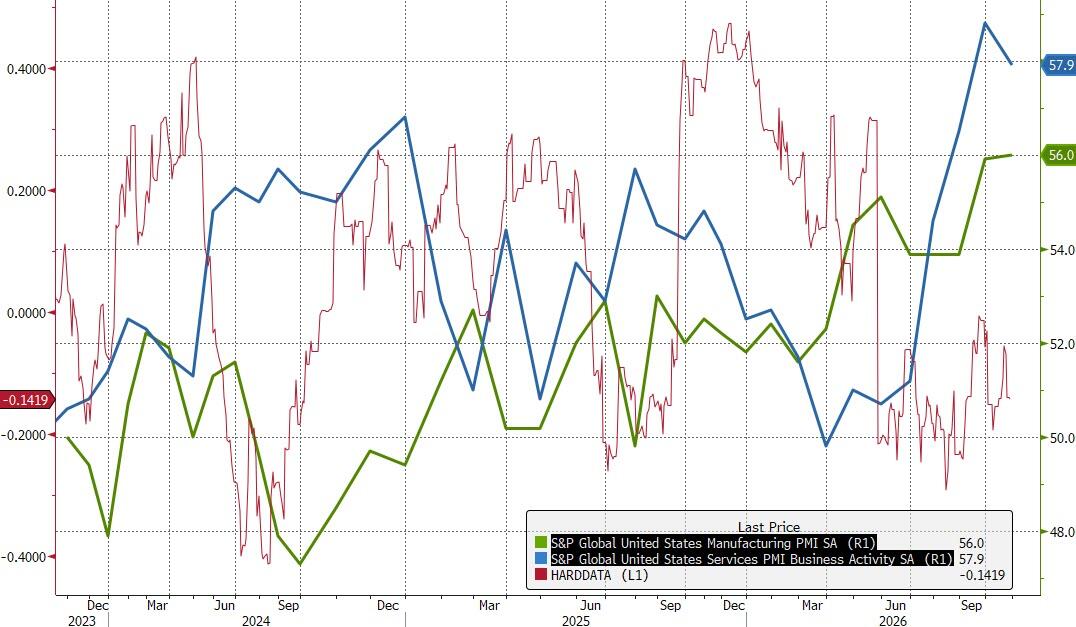
The US remains the strongest economy in the world based on these surveys…
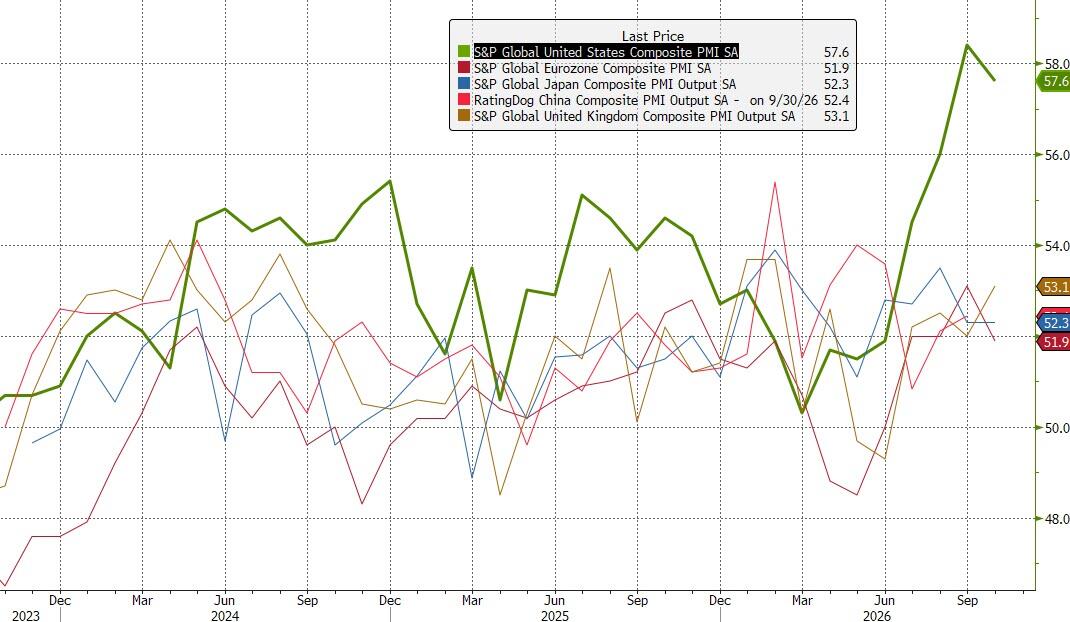
“October’s flash PMI data indicate that the US economy continues to boom at the start of the fourth quarter,” according to Chris Williamson, Chief Business Economist at S&P Global Market Intelligence.
The output readings from the survey are consistent with GDP growing at a 5% annualized rate after a 4% expansion was signalled for the third quarter.
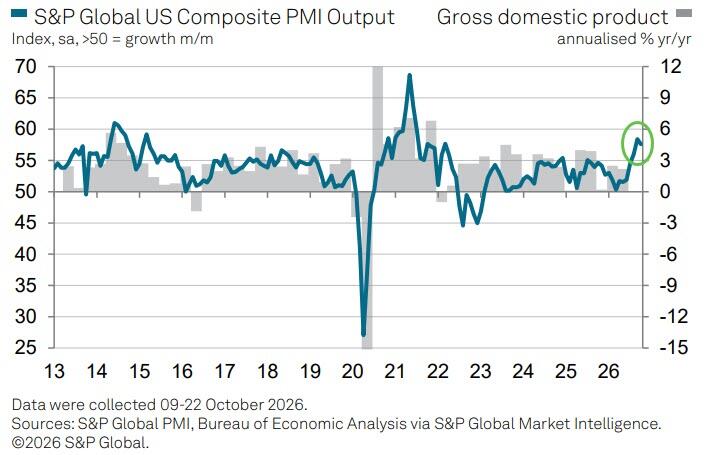
Especially healthy corporate earnings and profits are also indicated, and hiring has surged as companies seek to boost capacity to fulfil stronger customer demand.
“If the reopening of the economy after COVID is excluded, recent months have seen the best growth spell for US businesses since early 2015.”
However, Williamson notes that “cost pressures remain a key concern, notably as the renewed surge in oil prices reverberates through to impact a wide variety of goods and services.”
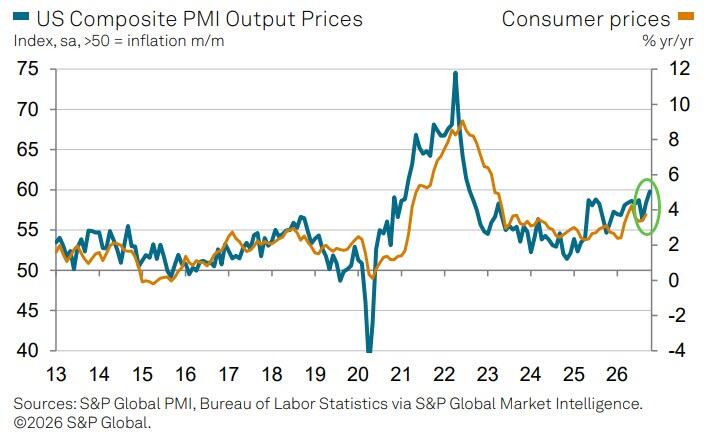
Supply chain bottlenecks have meanwhile intensified, and order book backlogs are growing, making it easier for companies to pass higher costs on to customers.
The result is the sharpest increase in selling prices for over four years to a pace that indicates consumer price inflation is likely to rise further above the Fed’s target in the coming months.
Not a good signal for The Fed next week.
END
Main St.-Wall St. Divide Reaches Record High As UMich Inflation Angst Re-Accelerates
by Tyler Durden
Friday, Oct 23, 2026 – 10:15 AM
Preliminary October UMich Sentiment held steady this month, registering a tiny 0.1pt decline below September (Current Condiutions dipped but Expectations ticked up)…
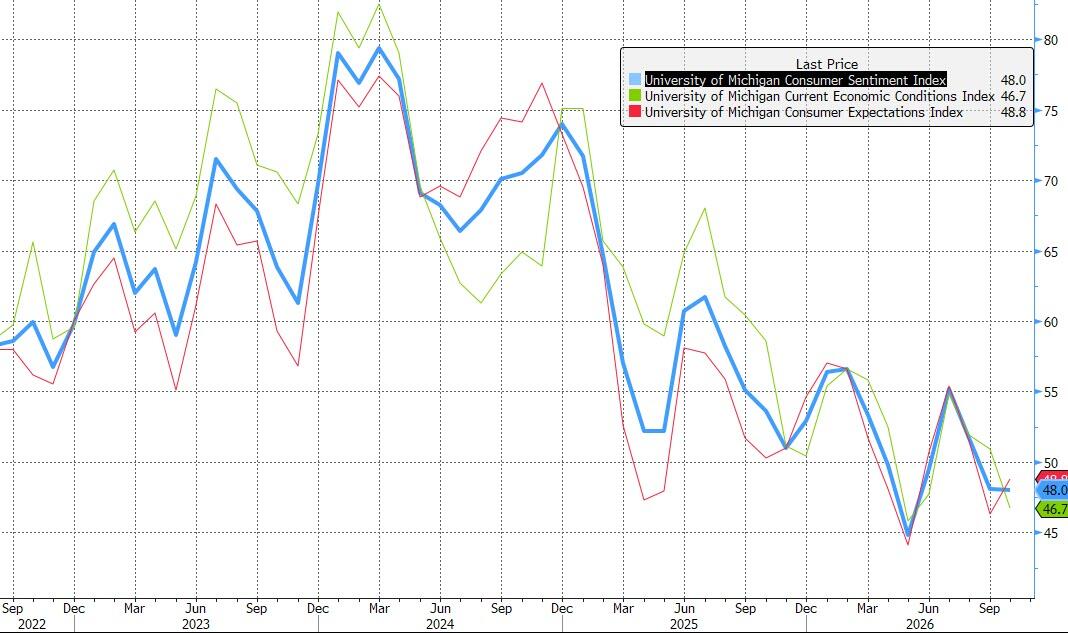
Increases in sentiment among Republicans and Democrats were balanced by declines among independents.
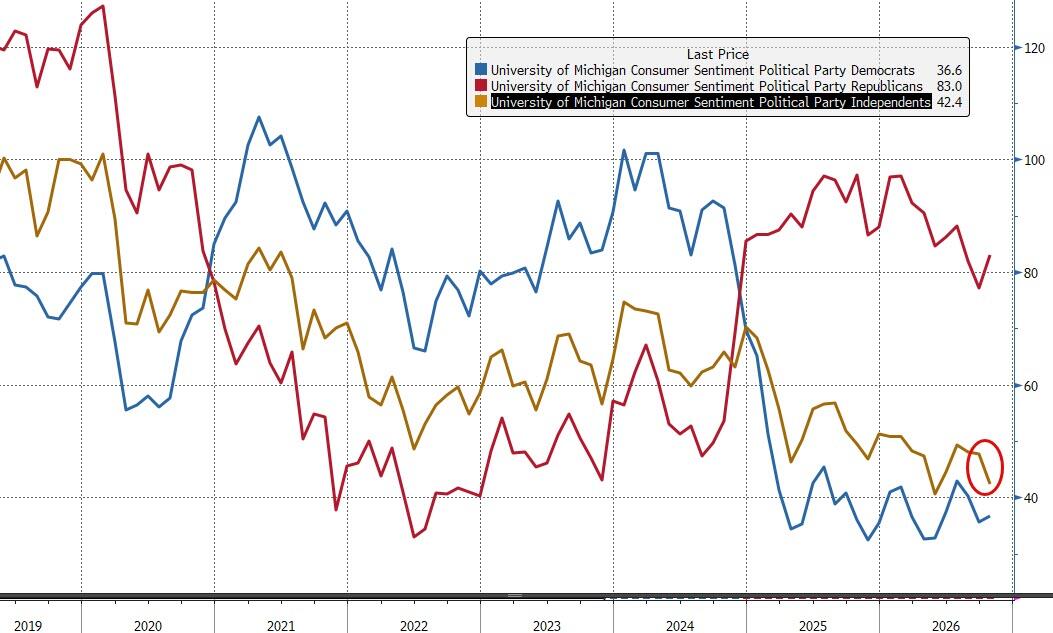
While year-ahead business conditions improved about 14%, they stand 16% less than last October’s read.
This month’s decline in the Current Conditions subindex was driven entirely by buying conditions for durables, which plunged 18% on the basis of higher interest rates and rising concerns about the affordability of such purchases.
Inflation expectations over both time horizons increased for the second straight month to their highest readings since May.
- Long-run inflation expectations also stepped up from 3.4% in September to 3.5%, notably higher than their 2024 range of 2.8% to 3.2%.
- Year-ahead inflation expectations ticked up from 4.6% last month to 4.7% this month.
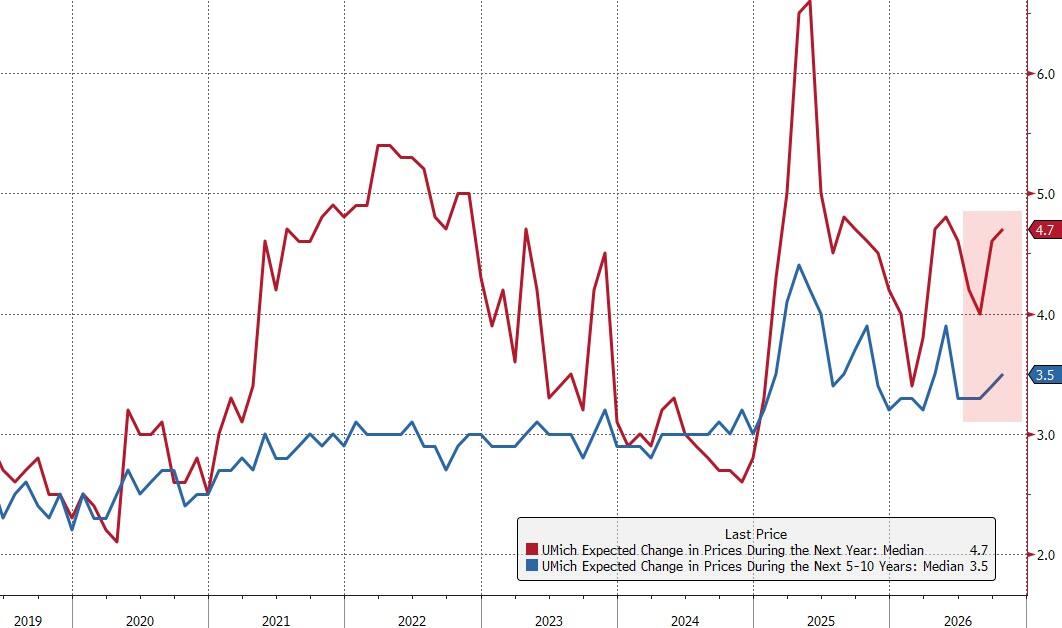
Frustration over high prices eroding consumers’ living standards continues to mount.
For the fourth straight month, an increasing share of consumers spontaneously mentioned that high prices are dragging down their personal finances, at 56% this month, compared with 45% in January of this year. As seen in the chart below, these increases are seen across the political spectrum, with Republicans exhibiting the largest proportional rise. In contrast, the wealthiest consumers report little change in the burden of high prices since January. Gasoline prices remain highly salient this month, mentioned unprompted by over 40% of respondents.
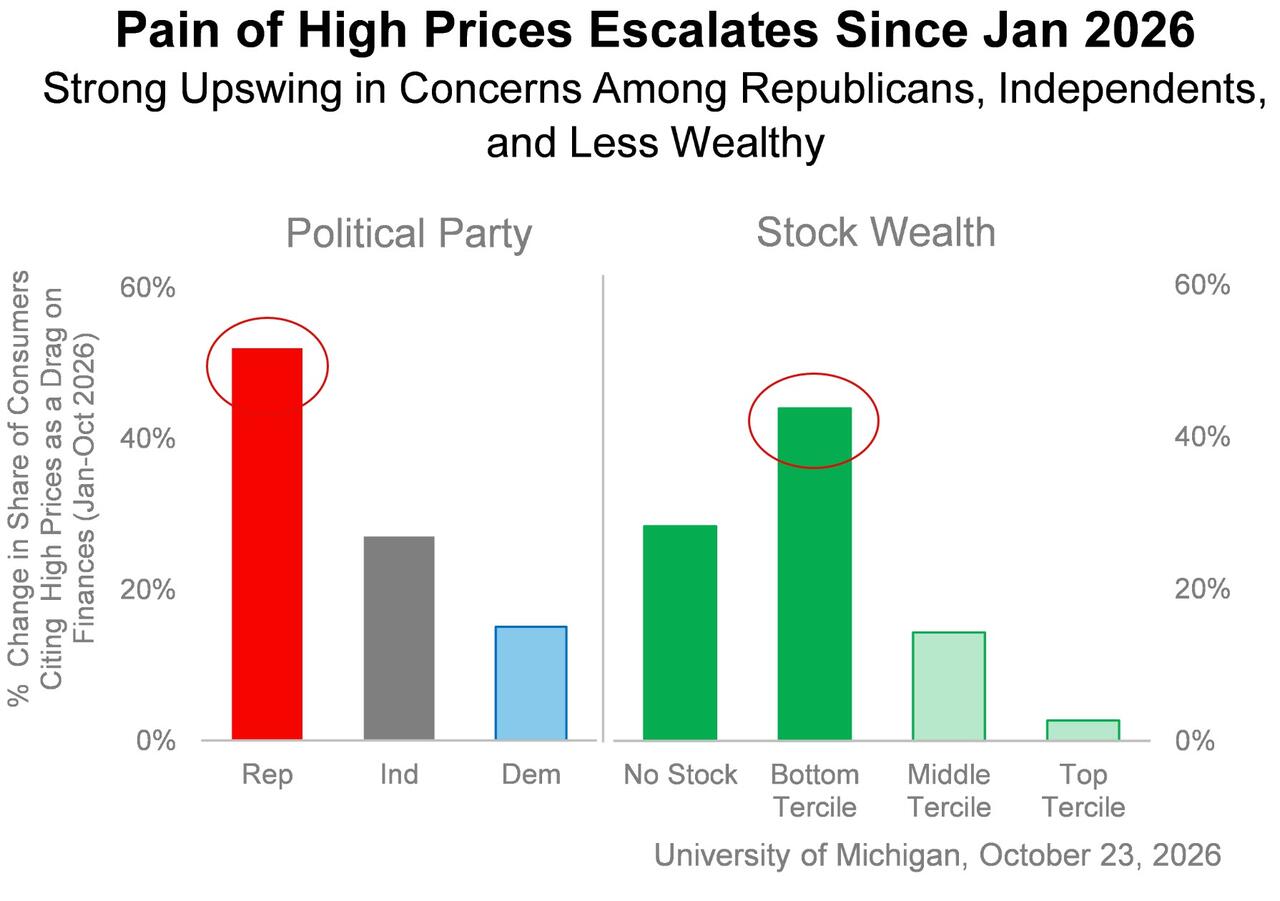
Purchasing power continues to dominate consumer views of the economy.
Sentiment is now 10% below a year ago and 15% less than February, just prior to the Iran conflict.
Finally, some crazy context, Wall Street (S&P 500 Total Return Index) has surged to record levels, while the Main Street (UMich Consumer Sentiment) has plunged near its all-time low…
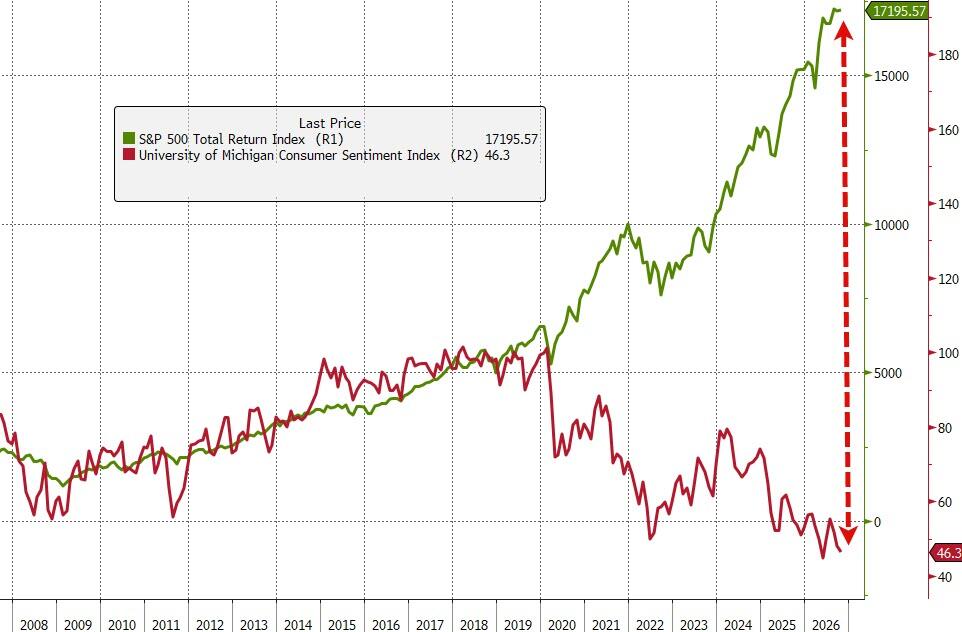
This gap reflects a market powered by corporate profits, tech concentration, and investor optimism even as households report deep frustration over high prices, borrowing costs, and weakened current economic conditions (which hit a record low of 44.7). Such extremes have historically been rare and highlight how equity markets and everyday consumer experiences have decoupled.
USA ECONOMIC REPORTS
“High Likelihood Of Error”: Judge Halts DHS Voter-Fraud Door-Knocks In Nine States
Friday, Oct 23, 2026 – 12:24 AM
The Trump administration wanted an AI dragnet for weeding out illegals trying to vote – however a federal judge says it’s catching legal citizens in the process and has put a stop to it.

Late Wednesday, U.S. District Judge Araceli Martínez-Olguín of the Northern District of California, a Biden appointee, issued a preliminary injunction barring the Department of Homeland Security from election-related field operations in nine states when the targets are people agents “know, suspect, or should reasonably know or suspect are U.S. citizens.” The ruling lands in a week full of voter-roll news. This morning we reported that the LA County registrar admitted it has no way to check the citizenship of 20,000 voters flagged by DOJ, which came on the heels of the Trump admin’s lawsuit against the state.
Judge Araceli Martínez-Olguín’s core finding on Wednesday, however, was that there was a “high likelihood of error” (California Nurses Association v. Mullin, No. 4:26-cv-10680):
“Even under the best conditions, there is a high likelihood of error in review because there is no federal database containing citizenship status of U.S. residents.”
In other words, DHS cannot reliably tell who is a citizen.
Below we walk through how the target lists were built, what the judge actually blocked (it is narrower than the headlines suggest), the administration’s case, and why the real deadline is 5pm Friday.
DHS focused their searches on California, Connecticut, Georgia, Missouri, Nevada, New York, Pennsylvania, Washington and Wisconsin. The raw material was 48.2 million records received “through independent sources” the judge deemed to have “questionable provenance,” plus 50.6 million records from DOJ. Those came from state voter rolls or, where states refused to share, “unreliable commercial versions.” DHS then “enriches” the data through a system called iLab, “using unknown artificial intelligence tools.” USCIS staff then had to whittle the list down:
“…a minimum of 40 suspected subject reviews, which requires officers to take no more than twelve minutes to eliminate a person from the target list using the commercial databases.”
That said, the ruling doesn’t mean DHS can’t investigate voter fraud.
“Plaintiffs do not claim, nor does the Court find, that it is unlawful for federal officials to undertake investigations into unlawful voting in federal elections.”
The order runs until 8:00pm on Nov 3 or when polls close.
END
The Entire Tech Industry Is About To Be “Musked”

by Porter and Company
Thursday, Oct 22, 2026 – 12:00
SpaceX Is Going To Dominate Unlike Any Company In History
The world’s tech industry just shit itself.
SpaceX’s (SPCX) quarterly report last night was the most extraordinary earnings call I’ve ever heard. And it signals the beginning of a death march for many of the industry’s existing business models.
Let’s start with communications bandwidth.
SpaceX’s satellite internet service Starlink added 1.6 million subscribers in Q3 – reaching 13.6 million users. That’s still small compared with the big American phone companies – Verizon (VZ) has 147 million wireless connections and AT&T (T) has 110 million. T-Mobile (TMUS) no longer reports its line count, but at the end of June it had 34.7 million postpaid accounts, many of them with several lines each.
As an investor though, you must look at where the “ball” is going.
Starlink had 2.3 million subscribers at the end of 2023. It had 4.4 million at the end of 2024. It had 8.9 million at the end of 2025. It added another 4.7 million in the first nine months of this year.
Starlink’s 1.6 million new customers in Q3 compares with 379,000 new postpaid phone customers at AT&T in the same quarter, and 184,000 at Verizon in Q2. Oh, also, about 12,000 airplanes have signed up for the service too, with Starlink availability becoming a major competitive factor between Delta Air Lines (DAL) (which doesn’t have it) and United Airlines (UAL) (which does).
In a few years… it seems likely that SpaceX will put every other communications network out of business.
Starlink Mobile, which connects ordinary phones directly to satellites, already reaches 22 million users a month. Those users are separate from Starlink’s 13.6 million rooftop-antenna subscribers. Starlink Mobile doesn’t need a rooftop dishy (as it’s called): it works through partner carriers like T-Mobile, which sells it as T-Satellite, and it connects an ordinary phone straight to a satellite wherever there’s no cell tower. Its monthly users grew 37% in Q3 alone.
SpaceX recently agreed to buy about $17 billion of wireless spectrum from EchoStar (ECHO). Starting in early 2028, it plans to offer full mobile carrier service on that spectrum. And it will, undoubtedly, offer a service that’s 10x better than any other carrier for a similar price.
SpaceX’s new V3 satellite has one terabit per second of download capacity. That’s enough for roughly 200,000 simultaneous video streams, per satellite. Starship is designed to carry 60 of these satellites per flight.
In September, Starship Flight 14 deployed 26 terabits per second of bandwidth, globally. That’s about 10 times what a single Falcon 9 launch of SpaceX’s older V2 Mini satellites delivered. It’s more than 8x the capacity of Viasat’s (VSAT) entire new ViaSat-3 fleet (three satellites rated at a little over one terabit each).
At the end of 2025, Starlink’s whole constellation, built since 2019, had about 450 terabits per second of capacity. A fully loaded Starship carrying 60 V3 satellites would add 60 terabits, more than 13% of that total, in one flight.
Next year, Starship will be flying weekly. SpaceX founder Elon Musk says eventually Starship will be flying daily. It will not be long before Musk’s network is larger than the rest of the internet’s total global capacity, combined. For scale, all of the world’s international internet capacity, carried mostly on undersea cables, totaled 2,259 terabits per second in mid-2026, according to the research firm TeleGeography.
But virtually limitless global connectivity is only one part of the enormous computer system that Musk is building.
Intelligence – driven by large-scale compute facilities – is becoming a utility. And Musk is going to own most of it. SpaceX is bringing roughly 220,000 Nvidia (NVDA) GB300 chips online every month, and Musk said that pace will accelerate next year.
Foxconn (2317.TW), the tech contract manufacturer, has disclosed a SpaceX order for about 936,000 of these chips, worth $52 billion, for delivery between now and Q1 2027. Nvidia doesn’t publish its sales by customer. But industry estimates put this year’s total output of its Blackwell chips at 5.5 million to 6 million units. SpaceX is taking something like 40% of production. It is Nvidia’s largest buyer by a wide margin.
SpaceX already owns the largest AI data center on Earth, Colossus 2, in Memphis, Tennessee. But that’s only the beginning.
Here’s the schedule Musk and SpaceX CFO Bret Johnsen laid out on the call yesterday.
SpaceX ended September with 1.7 gigawatts of compute. It expects to reach nearly 2 gigawatts by the end of October and 2.5 to 3 gigawatts by the end of December. It’s turning on about 220,000 GB300s a month now, and Musk said that pace “will obviously accelerate next year,” when most of the new capacity will be Nvidia’s next-generation Vera Rubin chips.
By the end of Q2 2027, SpaceX plans to have what Musk called “the most powerful training cluster” online: 440,000 Vera Rubin computers.
For all of 2027, Musk said he’s “highly confident” of adding 10 gigawatts in a single year.
I would be surprised if we brought on less than 13 gigawatts of compute by the end of next year.
That’s more than seven times what SpaceX had in September (!), added in five quarters. SpaceX is also building 20 gigawatts of new power and cooling next year (!), so power never limits the build.
How are they going to afford that?
SpaceX spent $19.6 billion on equipment and construction in Q3, and CFO Johnsen guided Q4 spending to $35 billion to $40 billion (!). This represents twice as much capital spending as the company told investors to expect earlier this year.
How does that compare with the other hyperscalers? In absolute dollars, only three companies are spending more than SpaceX. Amazon (AMZN) spent $54.2 billion in its June quarter, Microsoft (MSFT) guided to more than $50 billion for September, and Alphabet (GOOGL) spent $44.9 billion. But these are the largest companies in technology.
If you measure this spend against revenue, no other large business is spending more than SpaceX on compute. Amazon is spending about 27 cents of every revenue dollar on capital projects this year. SpaceX will spend 9x that, about $2.50. Among the companies building AI at scale, only CoreWeave (CRWV) spends at a similar ratio. But CoreWeave has no rocket business, no satellite network, and no investment-grade credit rating. That leaves it at a major competitive disadvantage in the race for scale.
Whoever produces the most compute can sell it at the lowest price and still earn a margin. The margin pays for more capacity, and more capacity lowers the cost again. In a business built this way, the largest producer wins. That’s why Musk is ramping up the build-out of SpaceX’s compute systems.
Today, SpaceX doesn’t own the most computing power in total. OpenAI and Anthropic will each end this year with about five gigawatts of compute, up from about two in January. But much of that capacity is rented from someone else, including from SpaceX. Meanwhile, Musk is promising to add 10 gigawatts of compute next year alone.
And that means… the entire industry will soon depend on Musk.
Anthropic, maker of the Claude AI models and a direct competitor of SpaceX’s Grok, has committed $84.5 billion to rent SpaceX computing capacity through 2029. Alphabet, which designs its own chips and runs one of the largest computer fleets on Earth, agreed to pay SpaceX $920 million a month from this October through June 2029 for compute.
Why would Google rent compute from Elon Musk?
The answer is power. SpaceX ended September with computers consuming 1.7 gigawatts of electricity. A gigawatt is a billion watts, roughly the output of one nuclear reactor. Electricity is the binding constraint for data centers, so the industry now uses electrical consumption to measure the size of a data center. Musk said SpaceX will reach 2.5 gigawatts to 3 gigawatts by year-end, and, as we explained earlier, he said he is “highly confident” the company will add 10 gigawatts of compute in 2027.
How’s that possible?
GE Vernova (GEV) is the largest American maker of the gas turbines that power data centers. And it is sold out through 2030. Its current backlog is 116 gigawatts. But it can build only about 20 gigawatts a year. If you want to power your computers with their turbines, you’re going to wait years.
So how can SpaceX add 10 gigawatts of compute next year?
Officially, Musk says his power solution is “highly proprietary.” But we know SpaceX has built its own power center in Southaven, Mississippi, with 41 turbines making 1.2 gigawatts. It’s using a range of suppliers to build these new facilities, including buying five 380-megawatt machines from Doosan Enerbility (034020.KS), the Korean manufacturer.
SpaceX will soon be one of the largest electric utilities in the United States. How? It is routing around GE’s backlog, primarily by casting its own turbine blades, which are the key functional part of the machine. The blades inside a gas turbine spin in gas hotter than the melting point of the metal they’re made from, which is an engineering challenge – but similar to the physical challenges of building rockets. Musk says SpaceX has the most advanced casting capability, which it uses to build rocket engines.
That means that we can bring power online 12 to 18 months faster than anyone else.
It’s hard to imagine what all of this means for our economy. These are private investments of unprecedented scale.
By our estimate, using the fuel rates of today’s gas plants, SpaceX’s 20 gigawatts of gas turbines (estimated capacity by the end of 2027) would burn 3 billion to 4.5 billion cubic feet of natural gas a day. The U.S. Energy Information Administration expects American gas production to grow by 4.2 billion cubic feet a day in 2027.
SpaceX is planning to burn most of a year’s growth in American gas production by the end of 2027.
How Is Any Of This Economic?
Of course, none of this is economic unless AI begins to replace an enormous swath of white-collar workers. And that is what’s going to happen. In fact, despite the huge increase to installed compute capacity, the spot price for compute is going up.
On the August SpaceX quarterly call, Musk guessed that each watt of Nvidia’s next-generation capacity would earn $30 to $50 a year. On yesterday’s quarterly call, SpaceX CFO Johnsen said pricing is now tracking “slightly above the high end” of that range. Musk said short-term contracts are renewing “at higher dollars per watt, not lower dollars per watt.” And Johnsen said that at current prices, new computing capacity pays for itself in less than a year.
Johnsen reported SpaceX revenue was $14.6 billion, up 161% from a year earlier. That was $2 billion above what Wall Street expected. And it posted real earnings for the first time as a public company, with operating earnings before non-cash charges that soared more than 300%. CFO Johnsen told investors to expect $33 billion to $37 billion of revenue in Q1 2027 – more than 100% growth from the last quarter. Johnsen also explained that by December of this year SpaceX will be booking recurring revenue at more than a $100 billion annual pace.
I have been reading quarterly reports for more than 30 years. I’ve never read one in which a single company described absorbing several entire economy-wide functions at the same time, at scale: the global communications network, the national electric power generation, the global compute… all to power software that thinks.
SpaceX’s Total Dominance
SpaceX is going to completely dominate technology unlike virtually any other company in history. Have we ever seen anything like this before? From 1877 until 1984, the Bell System ran America’s phone system. AT&T owned the long-distance lines. Its subsidiary Western Electric manufactured the phones, the cable, and the switches. Bell Telephone Laboratories designed the network and invented the technology inside it, while 22 local operating companies installed the phones and sent the bills. By the time the Justice Department broke it apart, the Bell System employed more than 1 million people, held $150 billion of assets, and was the largest corporation in the world.
That’s where SpaceX is heading.
Do the math to see where this leads. At $50 per watt, a gigawatt of compute currently produces $50 billion of revenue a year. Nvidia CEO Jensen Huang puts the cost of a gigawatt data center at $50 billion to $60 billion, including the chips, the buildings, and the power. At today’s prices, then, a gigawatt earns back roughly its own construction cost in revenue every 12 months.
And no one is going to build more of it than Musk’s SpaceX. How will he pay for it…?
In Q3, SpaceX operations produced about $9.6 billion of cash against $19.6 billion of capital spending, so free cash flow was roughly negative $10 billion. In Q4, we estimate operations will produce about $12 billion in cash, based on our assumption of roughly $22 billion of revenue, against $35 billion to $40 billion of spending.
That is negative free cash flow of $23 billion to $28 billion in a single quarter.
And that’s what you’ve seen the bears warning about. We’ve warned about the same issue with less well-funded companies, like CoreWeave. But Musk has cell phones and rockets.
For 2027, we modeled three cases, using our Q4 2026 estimate as the starting point and holding cash margins near this year’s level of about 55% of revenue.
In the first case, SpaceX keeps spending $40 billion a quarter, its Q4 pace, for all of 2027. That’s $160 billion of spending. After counting the cash its businesses generate, SpaceX would burn about $82 billion. In the second case, we use Morgan Stanley’s estimate of $278 billion of 2027 spending, which would burn about $195 billion. In the third case, Musk builds his full 10 gigawatts. We put that bill near $425 billion and the burn near $326 billion.
Its Three Levels Of Borrowing
Can SpaceX borrow that much and keep its investment-grade credit rating?
Lenders and rating agencies answer that question with one ratio: debt divided by EBITDA (earnings before interest, taxes, depreciation, and amortization). It’s a rough measure of the cash a business produces each year before it pays its lenders and the taxman. Each year of EBITDA is called a “turn.” A company with $100 billion of debt and $50 billion of annual EBITDA is levered two turns: it would need two full years of cash earnings to pay off its debt.
SpaceX ended September with $89.9 billion of cash and short-term investments and $38.8 billion of debt. In Q3, it produced $8.8 billion of EBITDA, a pace of about $35 billion a year. So today SpaceX owes about one turn of EBITDA, and it holds more than twice as much cash as it owes.
S&P’s current rating assumes SpaceX keeps its debt below two turns of EBITDA. In our first case, SpaceX spends most of its cash and borrows about $40 billion more. Its debt rises to about $77 billion against roughly $87 billion of 2027 EBITDA – less than one turn and well inside investment grade. In our second case, SpaceX has to borrow about $150 billion. Its debt reaches about $190 billion against $95 billion of EBITDA. That’s two turns, right at S&P Global’s limit for investment-grade status. In our third case, SpaceX needs about $280 billion of new money. If it borrowed all of it, its debt would reach about $320 billion against $116 billion of EBITDA. That’s nearly three turns, and it would cost SpaceX its investment-grade rating.
So to build all 10 gigawatts and stay investment grade, SpaceX would have to raise some of the money another way: by selling new stock, by having suppliers like Nvidia finance the chips, or by getting customers to pay in advance. S&P already expects SpaceX’s borrowings to reach $132 billion by 2028, and it doesn’t expect free cash flow to turn positive until 2030.
How certain is Musk that this will work? Musk said SpaceX rents out its computing “at effectively the spot market rate as opposed to signing these long-term deals.” So what happens to SpaceX if the price of a watt of computing falls by a third?
That’s the risk investors are taking with SpaceX. But that risk has two sides. What if demand for compute continues to grow? In that case, SpaceX’s revenue and earnings will be larger than our forecasts. And I doubt we’ve begun to see what Musk can do with all of this compute.
Yesterday, Musk confirmed that special committees of independent directors at SpaceX and Tesla (TSLA) are discussing a merger of the two companies. If it happens, SpaceX gains Tesla’s factories, its self-driving cars, and its Optimus humanoid robots, and the intelligence SpaceX sells by the watt would start driving cars and working factory floors.
Merging SpaceX And Tesla
Think about what that means: SpaceX launches the satellites, Starlink carries the signal, its turbines make the power, its chips run the AI models. Grok answers the questions. Tesla’s robots do all the work. Every layer of the global computer would be owned by one company, SpaceX.
For most of the 20th century, American industry grew through specialization. Steel came from one firm, electricity from the local utility, and telephone service from Bell – and each of those companies earned its own margin on its own piece of the economy for decades.
Computing at this scale reverses that logic. When the cost of intelligence is power plus chips plus distribution, the integrated owner of all three earns every margin in the chain. Its smaller competitors will fail even if they’re well run, because they pay a markup on every input the leader produces at cost.
Why not buy the stock?
On Thursday, about 1.3 billion shares come out of their post-IPO lockup, the largest single release on the schedule. Roughly 22% of SpaceX’s 13.2 billion shares can trade today, rising to about 32% after Thursday, and 40% after December 8, while Musk’s own 6.4 billion shares stay locked until June 2027.
I expect SpaceX to report a quarter with more than $50 billion of revenue before the end of 2027, nearly 9x the $5.6 billion it reported in Q3 2025.
I’m almost certainly going to be a buyer of the stock. I just want to wait until it’s mostly freely trading first.
Good investing,
F. Porter Stansberry
Stevenson, Maryland
END
AI Implodes, Bonds Explode… And Bessent Gets The Last Laugh
Bessent angle (“gets the last laugh”)
Treasury Secretary Scott Bessent had previously downplayed systemic AI-bubble risks (contrasting it with the dot-com era, noting hyperscalers’ strong balance sheets and cash generation) and intervened earlier with stepped-up long-end Treasury buybacks to try to contain yields amid debt + AI issuance pressure. Some market commentary framed those efforts as limited or tested by higher yields. The recent sharp bond rally (lower yields) on AI turbulence can be read as validation of the “no systemic problem” view or as markets providing the yield relief that policy tools aimed for—hence the “last laugh” framing in the headline style.
dailycaller.com
In short, the headline captures a risk-off rotation out of AI/tech into Treasuries, with the dollar holding up better than pure yield differentials might suggest, against the backdrop of Bessent’s earlier comments and actions on AI and the bond market. Levels and correlations can shift quickly with earnings, further AI financing news, Fed commentary, or geopolitical developments.
SPACE X
SpaceX Targets 80,000 Cell Sites To Challenge Telecom Giants As Wall Street Weighs In
Friday, Oct 23, 2026 – 08:35 AM
Elon Musk is accelerating plans to build a fourth major nationwide wireless carrier, with SpaceX seeking access to at least 80,000 US cell sites, according to Bloomberg News. The prospect of a new rival to AT&T, Verizon, and T-Mobile lifted tower stocks in premarket trading, while shares of those legacy carriers fell as traders continued to assess that new emerging competitive threat.
The report stated that SpaceX is in talks with a number of tower companies, including Crown Castle, which, along with American Tower Corp. and Vertical Bridge Holdings, is among the largest owners of cellular towers.

“You can assume that we’re talking to all parties,” Crown Castle CEO Chris Hillabrant said Wednesday when asked about discussions with SpaceX, Amazon and other satellite telecommunications providers.
Crown Castle shares jumped as much as 10% in late trading following the report, while AT&T, Verizon, and T-Mobile each fell about 5%.
The report follows news earlier this month that SpaceX acquired low-band spectrum and received Federal Communications Commission approval to launch 15,000 satellites designed to connect directly to smartphones.
Leasing tower space would establish ground coverage, including in buildings, under bridges, in homes, and in places where satellite coverage is ineffective. The satellites would help bridge gaps in tower coverage in remote places and areas without obstructions.
“We will be building out our terrestrial networks so there’s broad-based connectivity anywhere that SpaceX and Starlink are allowed to operate,” Musk told investors on an earnings call earlier this week. He said satellite launches and spectrum purchases would put Starlink Mobile on the path to become a major US carrier.
“Whether SpaceX ultimately leases anything close to that figure remains uncertain, but the reported scope suggests a far greater level of commitment than spectrum accumulation alone. AT&T, Verizon, and T-Mobile shares are trading down in after-hours trading, adding to an already difficult year for the group,” Bernstein analyst Laurent Yoon wrote in a note.
Separately, BNP Paribas analyst Sam McHugh offered his first take:
Would this be good enough to compete in wireless?
The 80,000-tower figure is at the upper end of the telcos’ tower counts (TMUS has c. 85k, alongside c. 60k small cells). If SpaceX did build out to this many sites, even with the limited spectrum it has today, the service would be somewhat comparable to that of the existing carriers, given that it would start with no customers loading the network. However, it would not be capable of matching the existing carriers when loaded with millions of subscribers. This also somewhat undermines the argument that SpaceX can have a structural cost advantage by using its satellites for coverage or pursuing a more “femto or small cell” strategy, which, in a roundabout way, is one positive to take from these headlines.
Do we think they will do it?
It depends on what “It” is… Replicating the wireless carriers’ networks (towers, spectrum, distribution, etc.) from scratch looks like a mammoth exercise, with very questionable payback for the company. So why would SpaceX do this? We do think it has a long-term ambition to build a more upload-focused network to complement its satellites that can provide connectivity to edge / physical AI (cars, robots, etc.). If, along the way, it can make enough noise and scare a telco into giving it an MVNO, then that would be a big win for SpaceX.
Would they buy instead?
In addition, by talking down the industry and depressing multiples, SpaceX creates additional optionality/upside on potential acquisitions, which, in our view, is a much clearer path to value creation (with TMUS potentially being the most credible target). It also recently acquired X and Cursor, showing it is more than willing to buy to accelerate its ambitions.
MVNO pressure?
As we wrote in Further SpaceX Spectrum Thoughts, our view is that we are past the point at which one of the carriers would fold and give SpaceX an MVNO. All that would do is help facilitate a more economical buildout for SpaceX, as it would allow the company to start generating revenue today, prove the business case, and then begin targeting investment in areas with high subscriber density. Without an MVNO/roaming deal, however, SpaceX will have to substantially build out a network before having a reasonable product proposition for customers, massively depressing the IRR.
What to watch for next?
- Given that the telcos are unlikely to budge and SpaceX has time on its hands (buildout obligations are long-dated), we continue to think this uncertainty will persist until at least the Upper-C band auction in April next year, when SpaceX will have the opportunity to put incremental capital to work to prove its commitment to a consumer-focused mobile network (as opposed to its existing spectrum holdings, which are probably better suited to an IoT-like service).
- If SpaceX does sign a tower deal, how many sites are covered and for what duration will be critical to assessing its ambitions.
- Another spectrum deal (SpaceX or someone else). There are pockets of spectrum still out there that SpaceX or the telcos could move on before the C-Band auction (details at the bottom of this note), and the risk here is that SpaceX acquires more, or a telco acquires more defensively.
- SpaceX touted the possibility of hosting an investor call to outline more specifics of its wireless ambitions soon. No firm event has been confirmed yet.
- We continue to field questions around “Title 3 data roaming” requirements in the US, a topic we addressed earlier this year. See SpaceX’s Backdoor MVNO: Expert Call Takeaways. We think this is a dead end for SpaceX. Still, after the midterms, we do see a scenario where SpaceX potentially tries to bring legal action against the telcos on the basis of a “concerted refusal to deal”, or perhaps attacks the satellite JV (SpaceX) as a way to exert more pressure. Indeed, the SpaceX CFO referred to the telcos as a cartel at a public investor conference in September.
- END
END
TRUMP/OIL
Trump Invokes Defense Production Act To Increase Petroleum Production
Friday, Oct 23, 2026 – 08:50 AM
Authored by Timothy Frudd via The Epoch Times,
President Donald Trump invoked the Defense Production Act of 1950 in a memorandum on Oct. 22 to increase oil production in the United States as prices remain elevated amid the Iran conflict.

In Thursday’s memorandum, Trump determined that ensuring the United States had a resilient domestic petroleum production, refining, and logistics capacity was essential for national defense.
The memorandum directed Secretary of War Pete Hegseth to complete purchases, make commitments, and use financial instruments to expand domestic petroleum infrastructure, including exploration and production, storage, marine terminals, and gathering and transmission pipelines.
“Petroleum fuels the Nation’s Armed Forces, industrial base, and crucial infrastructure,” Trump wrote. “Without immediate Federal action, United States defense capabilities will remain vulnerable to disruption.“
The Defense Production Act, which was enacted during the Cold War, gives the president authority over the domestic industrial base in the interest of national security. Under the legislation, the president can incentivize the domestic industrial base to increase the production and supply of critical goods and materials through direct purchases, purchase commitments, loans, and loan guarantees.
Trump’s memorandum said the fastest and most cost-effective ways to meet the energy demands needed for U.S. national security are the purchases, commitments, and financial support made possible under the Defense Production Act.
The president previously issued Executive Order 14156 in January 2025, declaring a national emergency under the National Emergencies Act. At the time, Trump said that America’s energy production, refining, transportation, and generation capacity was inadequate and represented an “unusual and extraordinary threat” to both the economy and U.S. national security.
Trump cited the January 2025 executive order in his memorandum to Hegseth on Thursday. The memorandum said the United States would not be able to provide the energy capabilities needed in a timely manner without taking action under the Defense Production Act due to supply chain limitations, financing constraints, infrastructure and permitting bottlenecks, and lengthy lead times.
In the memorandum, Trump said expanding petroleum production, refining, and logistics capacity “is necessary to avert an industrial resource or critical technology item shortfall that would severely impair national defense capability.”
The president also waived standard statutory requirements under the Defense Production Act, citing the need to expand that capacity.
Last week, Vice President JD Vance announced that the Trump administration was planning to use the Defense Production Act to expand fuel production at a petroleum refinery in Tyler, Texas, owned by Delek US Holdings.
“We want millions of gallons of commercial-grade and military-spec fuel to come out of this refinery, in addition to what it’s already producing,” he said.
Trump previously invoked the Defense Production Act in April and issued multiple memoranda to increase domestic coal supply chains, liquefied natural gas capacity, and natural gas transmission.
The Trump administration’s use of the Defense Production Act on Thursday came as oil prices have significantly increased since the start of the Iran war in February. As of Thursday, the price of a barrel of Brent crude oil, the global benchmark, was more than $113 per barrel.
In addition, the average cost for a gallon of regular gasoline in the United States was $4.27, while the average cost for a gallon of diesel was $6.30 on Thursday, according to AAA.
Trump accused Iran on Thursday of attempting to increase oil prices ahead of the November midterm elections.
“Iran is doing everything they can to drive up the price of Oil prior to the U.S. Midterm Election,” Trump wrote in a statement on Truth Social. “They are even making up fake hits, mines, and everything else, because more Oil is coming through the Hormuz Strait now than it did even prior to the beginning of the Conflict.”
KING NEWS
| The King Report October 23, 2026 Issue 7854 | Independent View of the News |
| SpaceX’s great results induced the usual suspects to pour into AI and tech stocks on Wednesday. This revived the desire to play for the earnings season rally for tech-related trading sardines. It appeared the equity rally would intensify on Thursday after Meta, Tesla, and IBM initially soared on good results. But ‘up jumped the devil.’ A critical mass of investors was unnerved by the high forecast capex of those tech stocks. Plus, the reports of US strikes on Iran and a US military buildup in the Middle East debunked the umpteenth ‘peace is at hand’ rally. And this from Axios: Scoop: Unvetted AI agents are accessing U.S. bank accountsMajor U.S. banks are detecting unauthorized third-party AI agents operating inside customer accounts, with some agents attempting to take actions that appear to be independent of user instructions, sources tell Axios. Why it matters: AI agents are becoming a nightmare for America’s banks, making their way into banking systems faster than financial institutions can respond. The difficulty in distinguishing between a human and an unauthorized bot is forcing banks to block the technology and rapidly rewrite their terms of service…https://www.axios.com/2026/10/22/ai-agents-banks-unauthorized-accounts-access Energy commodities rallied; French bonds declined and stressed European debt. Dec Brent peaked at $112.68, +3.55%. Dec WTI Oil hit 100.09, +3.02%. We recently noted that when oil soars during Asian or early European trading, someone (directly or indirectly) manipulates oil lower during early US trading. This is precisely what happened Thursday. Dec WTI Oil sank from 100.02 at 9:30 ET – the NYSE opening – to 98.15 at 9:46 ET. Qui bono? Zero Hedge: The OAT-Bund (France-Germany 10-years) spread blew out by as much as 18bps to 177bps, the widest since 2011. (The European Debt Crisis: Greece, Portugal, Ireland, Italy, & Spain notably)Meta Reports $825 Billion in Future Spending CommitmentsMeta… took in $32.79 billion of operating cash… It spent $34.91 billion on capital expenditures… free cash flow came to negative $2.12 billion… the first negative free cash flow quarter since 2012, its IPO year… https://finance.yahoo.com/technology/articles/meta-reports-825-billion-future-113547626.html Meta sank as much as 6% in early trading. The SOX Index sank 3.5%. Bonds and notes rallied sharply on the decline in stocks/tumble in AI issues and flight from OATs. USZs hit +1 18/32 at 10:40 ET. It appears that the AI Bubble is bursting. Traders and retail investors keep pouring into AI issues. However, a critical mass of institutional investors are no longer mesmerized by AI glitz and hype. ‘They’ now seek monetization of AI; and are frightened by the gluttonous capex. A year or so ago, a HUGE concern regarding AI was the notion that tech firms were engaged in a ‘winner takes all’ battle. One tech firm would achieve AI supremacy by developing god-like AI and then there would be no need for other AI devices. AI firms and chieftains labored to debunk the notion of ‘winner takes all’ for AI. They succeeded; the AI Bubble inflated and inflated and inflated. And just like homebuilders during the housing bubble that fomented the Great Financial Crisis of 2008, AI firms kept borrowing and borrowing because the funding was promiscuous. The economics of the borrowing was largely ignored. We are “Back to the Future.” The economics of AI: does the winner take all or do we all win? February 23, 2023https://www.schroders.com/en/global/family-offices/insights/the-economics-of-ai-does-the-winner-take-all-or-do-we-all-win/ AI will never be a winner-takes-all market due to well-funded rivals: Sam Altman (Huh?!)https://economictimes.indiatimes.com/tech/artificial-intelligence/ai-will-never-be-a-winner-takes-all-market-due-to-well-funded-rivals-sam-altman/articleshow/124410581.cmsThe S&P 500 Index opened sharply lower (7694.62, -62.55 pts). After a dump money buying rebound to 7702.94 (daily high) at 10:03 ET, the index sank to 7646.05 at 10:35 ET. The 2nd-Hour Reversal took the S&P 500 Index to 7672.15 at 11:25 ET. After a modest retreat, a Noon Balloon took the S&P 500 Index to 7683.13 at 13:20 ET, the index rolled over into a modestly negative channel. The S&P 500 hit a daily low of 7637.36 at 15:00 ET. A late ABC manipulation lifted the S&P 500 to a 7663.43, -1.21%, close.@realDonaldTrump: Iran is doing everything they can to drive up the price of Oil prior to the U.S. Midterm Election. They are even making up fake hits, mines, and everything else, because more Oil is coming through the Hormuz Strait now than it did even prior to the beginning of the Conflict. They continue to kill protestors, and anyone else that happens to be in their way. It is truly an Evil Regime, and I can only hope the American Public, and the World, understands how EVIL they are! 75,000 protestors lie dead in less than seven months. It is shocking how the World, and the Dumocrat Party, seem not to care. IRAN CAN NEVER HAVE A NUCLEAR WEAPON, AND THEY WILL NEVER A NUCLEAR WEAPON! President DONALD J. TRUMP Oct 22, 2026, 11:40 AMThe WSJ reports that more oil is flowing through the Gulf than before the Iran War. If true, why are oil prices rallying instead of falling?Jon Turley: French Police Identify Antifa as the “Ideologically Distinct Group” Behind the Riots Despite Democratic Denials – Democratic leaders have long fostered the myth around Antifa, the largest and most violent group on the political left. For years, they have denied the existence of the group even as members were charged with crimes (including terrorism). Now, the French authorities have found that the nonexistent group is the largest of three “ideologically distinct groups” responsible for the violence in France. It appears that either the entire French security system is delusional or the trick is up for the American left…Democratic members continued to insist that there is no such group, while other leading Democrats have praised Antifa for instilling fear in MAGA. It was a curious claim even then, when other Democratic leaders were actively pandering to the violent group…https://jonathanturley.org/2026/10/22/the-greatest-trick-the-devil-ever-pulled-french-police-identify-antifa-as-the-largest-ideologically-distinct-group-behind-the-recent-riots-despite-democratic-denials/ London’s macro hedge fund pain as up to 100 people are out: “Everyone has blown up”Both traders and headhunters say it’s the end of an era. For years, hedge funds have leveraged French government bonds (OATs) in the repo market, using the bonds themselves as collateral while making money on the carry that’s the difference between the yield and the cost of the repo. As French yields have risen amidst political turmoil, OATs have sold off and the whole highly leveraged trade has been upended. The big question now is what will become of all these unwanted hedge fund traders. Some are expected to go back to banks. “Banks need them to manage their ECB exposure and bond books,”…https://www.efinancialcareers.co.uk/news/london-s-macro-hedge-fund-pain-as-up-to-100-people-are-out-everyone-has-blown-upFT: OpenAI trims valuation target to $1.25tn after pitching higher priceAI lab floated $1.4tn price tag earlier this month, according to documents seen by the FTPositive aspects of previous session The Street was historically short bonds. A titanic short squeeze in US debt is now occurring.DJIA +0.02%; DJTA +1.87%; SP Cons Staples +3.11%, Utes +1.98%, Health +0.92%, Materials +0.33% Negative aspects of previous session AI and tech trading sardines got hammered. S&P 500 -1.21%, Nasdaq -2.6%, Nas 100 -2.9%, SOX Index -6.72%; PHLX Oil Service -3.77%SP Comm Services -3.02%, Info Tech -3.0%, Consumer Discretionary -1.71%, Industrials -0.91%, Energy -0.74%; Dec WTI +$2.15, Dec Brent +$4.17, Dec Diesel +17.95¢, Nov Gasoline +5.38¢ at 16:16 ET Ambiguous aspects of previous session Has Trump and his team abandoned the stock market due to an Iran nuke problem?How long will the massive short squeeze on debt shorts last?First Hour/Last Hour NYSE Action [S&P 500 Index]: 1st Hour: Down; Last Hour: Up Pivot Point for S&P 500 Index [above/below indicates daily trend to day traders]: 7667.91Previous session (S&P 500 Index) High/Low: 7702.94 (10:03 ET); 7637.36 (15:00 ET) Russia pounds Ukraine’s capital Kyiv with missiles and drones, hours after agreeing to peace talks https://trib.al/4jeSkF0The WSJ reports Trump asked Musk to lift the Starlink slowdown on Ukraine. i24News (ISR) reports the US is conducting a large-scale evacuation of family members of US diplomats from every Middle Eastern country, except Israel and Oman, according to two regional diplomats. Israeli military official to Channel 12: We have no reason to attack Iran before the elections (Israel election on October 27 and/or US on November 3?) Fed Balance Sheet: -$2.035B; Reserves: -$59.533B https://www.federalreserve.gov/releases/h41/20261022/ After the close, DJT invoked the Defense Production Act to boost petroleum, refining, logistics capacity.https://www.whitehouse.gov/presidential-actions/2026/10/presidential-determination-pursuant-to-section-303-of-the-defense-production-act-of-1950-as-amended-on-domestic-petroleum-production-refining-and-logistics-capacity-c139/ Today – The AI Bubble is deflating. The momentum buying that made picking a top difficult is now momentum selling. So, picking a bottom is difficult. However, traders will play for a Friday Rally. If stocks are soft in the morning and/or midday, the odds of a Friday Afternoon Rally increase. Unless Team Trump has abandoned the stock market, the odds of some type of intervention increase with the Midterm Elections only 11 days away. NQZs traded moderately higher early on Thursday night but quickly declined to -99.75 at 18:40 ET. They are now smartly above their Thursday night low. ESZs +2.50; NQZs -45.50, USZs -1/32, Dec WTI -$0.18, Nov Gas +0.27¢, ¥/$ 156.45 at 20:00 ET Expected earnings per Nasdaq: AXP 4.47, SLB .62 Expected Economic Data: Oct S&P Global Mfg PMI 55.5, Services 58; Oct UM Consumer Sentiment 46.3, Current Conditions 44.7, Expectations 47, 1-year Inflation 4.7%, 5-10-year Inflation 3.5% S&P 500 50-day MA: 7703; 100-day MA: 7603; 200-day MA: 7286 (Close 7663.40, -1.21%)Nasdaq 100 50-day MA: 29,851; 100-day MA: 29,6588; 200-day MA: 27,819 (Close 28,958.69, -2.90%) DJIA 50-day MA: 52,351; 100-day MA: 52,292; 200-day MA: 50,516 (Close 52,867.98, +0.02%) (Green is positive slope; Red is negative slope) Bush family royalty backs Democrat in battle to flip Texas blue (just to spite DJT; pathetic quislings)https://www.foxnews.com/politics/bush-family-royalty-backs-democrat-battle-flip-texas-blue The Bush family detests Trump for destroying the expected Bush Dynasty. While DJT had a role when he destroyed Jeb Bush in the GOP Primary Debate, it was the horrendous performance on Bush I and Bush II that soured Americans on Bushes. Dem Rep Ilhan Omar isn’t ‘Squad’ rep’s real name, feds’ bombshell docs reveal https://trib.al/FFhyqReFeds used slim evidence to revoke Ukrainian witness’ visa, thwart Senate’s Biden corruption probeA Ukrainian who worked with the Democrat-tied consulting firm used by Hunter Biden’s Burisma planned to provide evidence of Biden family corruption to Congress. Before he could, the U.S. embassy stripped his visa, keeping him out of the U.S. He was later sanctioned for allegedly spreading Russian disinformation… https://justthenews.com/accountability/russia-and-ukraine-scandals/new-docs-reveal-slim-evidence-used-strip-visa-ukrainianDemocratic Virginia state Sen. L. Louise Lucas (Virginia State Senate President Pro Tempore) charged with drug trafficking, money laundering (Probe began under Biden DoJ)https://justthenews.com/nation/states/democratic-virginia-state-sen-l-louise-lucas-charged-drug-trafficking-money Fox’s @BillMelugin_: Per federal indictment against her, DOJ has Virginia Senate Pro Tempore Louise Lucas on a phone call telling an unindicted co-conspirator: “This is our last chance at generational wealth…I’ve got too old to not be greedy”. https://x.com/BillMelugin_/status/2113276538309497334 As we regularly harp, the US is at the stage of ‘looting the treasury’ because most everyone understands the consequences of the unserviceable debt and looming bankruptcies. Lawsuit accuses Trump of illegally profiting off foreign crypto dealsThe suit centers on allegedly “illegal foreign emoluments” involving World Liberty and Sheikh Tahnoon bin Zayed Al Nahyan, the national security advisor to the United Arab Emirates… Days before Trump’s inauguration in January 2025, an entity backed by Tahnoon — widely known as the “Spy Sheikh” because of his powerful intelligence role — agreed to buy a 49% stake in World Liberty for $500 million… Trump would receive millions of dollars from that purchase after becoming president, according to his financial disclosures… The suit names Trump, World Liberty and U.S. Middle East Special Envoy Steve Witkoff as defendants, as well as four related limited liability companies…https://www.cnbc.com/2026/10/22/trump-world-liberty-crypto-lawsuit-uae.html Vanity Fair: The Art of the Deal: Jared Kushner’s Hacked Phone (by Russia’s GRU & the Dutch) Revealed His Secret Negotiations—Including More Than $700 Million in Transfers An exclusive excerpt from Princes and Thieves: Jared Kushner and Mohamed bin Zayed’s Secret Plot to Remake the Middle East examines how bank accounts linked the president’s son-in-law—and former senior adviser—to Israel, the UAE, and Saudi Arabia… The Dutch government had hacked into Jared Kushner’s phone and monitored him as he accessed a Dubai-based bank account… the money in the account—hundreds of millions of dollars—had come from a bank in Azerbaijan… Kushner appeared to have transferred significant amounts of money from the Dubai account to other individuals, including a warlord, a mercenary and a one-time hit man… Azerbaijani banks have well-established but unadvertised practices of serving as way stations for large transfers, in which a foreign currency is exchanged for an equal amount in dollars… Kushner’s apparent betrayal of the public trust, however, went further than his failure to disclose the secret Alpha account in the UAE or the Beta account in Israel. By giving him access to roughly $2 billion, regardless of how the money was used, MBZ (UAE ruler) and MBS (Saudi boss) were paying for his influence within the US government… https://www.vanityfair.com/story/jared-kushner-hacked-phone-secret-negotiations Trump heads to Iowa as Republicans fight for seats in longtime stronghold https://trib.al/LBT7HUd @Acyn: Trump: We were in the midst of negotiating and a lot of stupid people said why aren’t you putting Russian sanctions— CNN’s Collins: But you said you didn’t give anything for his releaseTrump: If I didn’t do that, you wouldn’t have him coming back. Collins: So you did give something.Trump: You don’t know anything. You’re fake news CNN. Collins: You’re saying you lifted the sanctions in exchange for his release?Trump: You don’t know what you’re talking about. You’re a low IQ person. You’re a dummy. https://x.com/Acyn/status/2113023964775944624 Google CEO Sundar Pichai stopped Trump from renaming the Atlantic Ocean https://trib.al/znYgCvN Marijuana legalization linked to troubling health trend in landmark new studyShort-term effects can include anxiety, impaired memory and dry mouth, while longer-term use has been tied to lung and blood vessel damage and even scromiting, an on-the-rise disorder that can lead to life-threatening neurological complications. Now, a first-of-its-kind study published Thursday in BMJ Open linked recreational cannabis legalization in the US to a rise in hospital admissions for several cardiovascular diseases… They found that admissions for atrial fibrillation (abnormal heart rhythm), heart failure and heart attacks increased faster after recreational cannabis laws took effect in the Western US than in regions without similar legislation.. https://trib.al/vM1Bq9b NFL cancels Steelers Fan House event in ParisThe message reiterates that preparations for the Steelers-Saints game “continue as planned, with the NFL working closely with local authorities and partners on all operational and security matters.”…https://www.nbcsports.com/nfl/profootballtalk/rumor-mill/news/nfl-cancels-steelers-fan-house-event-in-paris @SInow: The NFL has been watching how the ACC and Big Ten have televised their replay review processes and is exploring a similar approach. The league could implement the change in the coming weeks, giving fans a look at how replay decisions are made, per SI’s @AlbertBreerhttps://www.si.com/nfl/albert-breer-owners-meeting-notes-televising-nfl-replay-process-could-come-soon Roger Goodell says an increase in penalties is not a reflection on the NFL’s officialsGoodell said he believes officiating has improved and the league is continuing to get more calls right…https://www.nbcsports.com/nfl/profootballtalk/rumor-mill/news/roger-goodell-says-an-increase-in-penalties-is-not-a-reflection-on-the-nfls-officials | |
SWAMP STORIES FOR YOU TONIGHT
“Not To My Knowledge”: Ilhan Omar Can’t Quite Rule Out Marrying Her Brother In Wild Interview… And Trump Noticed
Thursday, Oct 22, 2026 – 06:10 PM
As the investigation into whether Ilhan Omar married her brother to scam US immigration, the Minnesota Democrat just stepped in it, big time.

In her first interview since Homeland Security Investigations agents searched her Washington home last week, the Minnesota Democrat sat down with MS NOW’s Chris Hayes, about as friendly a venue as exists on cable. She called the decade-old claim that her ex-husband Ahmed Nur Said Elmi is her brother “insane.” Then Hayes gave her the layup, asking whether there was some “weird kernel of truth” to it. Her answer was “Not to my knowledge.”
Regular readers will recall that earlier this week we flagged a report that federal investigators are using DNA to probe the “married her brother” claim. So the timing could have been better. The clip went everywhere within the hour:
In other words, the one question her own side’s friendliest interviewer was guaranteed to ask is the one she didn’t answer with a “no.” Below we walk through what she actually said, how fast the White House pounced, and why “not to my knowledge” is a strange hill to stand on with a federal grand jury in the background.
“Which Is Insane”
Omar claims the allegation started on a Somali blog and was picked up by “right-wing conspiracy theorists in Minneapolis”:”…they just kind of went and found random people who were like, ‘She introduced us. She introduced him to us and said he was her brother.’ Which is insane.”
HAYES: “He was not – you were not related to him at all? Not that there’s not some weird kernel of truth that through some-“
OMAR: “Not to my knowledge.”
The generous reading is that Hayes’s question was oddly phrased (a “kernel of truth” through “some” mechanism) and Omar was hedging against a hypothetical rather than admitting anything. The less generous reading is that when the stakes are denaturalization, people tend to choose their words very carefully. Make of that what you will.
“That’s An Answer A Lot Of Us Assume”
It took the president about an hour and a half. After his South Carolina rally, Trump was asked about the clip, according to Townhall:
That’s an answer that a lot of us assume.” The rest of the online right was less restrained, and we will spare readers most of it.
Omar’s brother hasn’t made it easy on her. In a 2012 Instagram post after Ilhan’s daughter was born, her brother/husband posted “Nieces, fresh out of the vagina!“

About That Raid
The brother line overshadowed the rest of a fairly revealing interview. According to the New York Post, Omar said:
- Agents “went room by room” and “took 17 items,” including cellphones, her daughter’s old phone, her husband’s notebooks, a Somali phrase book and a camera.
- She disputed reports that investigators got her DNA in the search: “I would have seen if they did take anything that had contained DNA.”
- She called the search “intrusive but polite,” adding that agents “even folded some of my clothing that were not folded.” Service with a smile.
- Asked about the financial disclosure that once put her household’s net worth at about $30 million (later revised), she described herself as “working class” and living “paycheck to paycheck,” with a 2016 Toyota Camry and two rented homes.
She also said the people who searched her home “literally have” her late father’s naturalization papers, which is the crux of the case, since she says she became a citizen at 17 through him. That line got its own viral moment:
What The Feds Are Actually Probing
Per the Post, the immigration case is run out of the Minnesota US Attorney’s Office and may involve possible false statements about her birth date on immigration documents. A separate probe into her and her husband’s finances is being run out of the DC US Attorney’s Office. The Wall Street Journal reported more than a dozen grand jury subpoenas, including to relatives. A source told the Post that if her citizenship was obtained through concealment or misrepresentation, by her or by her father, the administration will seek to denaturalize and deport her. Omar denies any wrongdoing: “I’m confident in my truth.”
Put differently, the “brother” question isn’t just tabloid fodder: if the 2009 marriage was a sham for immigration purposes, it goes to the heart of a fraud case, which is why “no” would have been the obvious answer to give.
END
Trump Calls For Rep. Ilhan Omar’s Resignation Over Alleged Fake Name
Friday, Oct 23, 2026 – 10:40 AM
Authored by Aldgra Fredly via The Epoch Times,
President Donald Trump on Oct. 22 urged Rep. Ilhan Omar (D-Minn.) to resign from her congressional role over allegations that she used a fake name to enter Congress.

This followed a motion filed by U.S. Attorney Jeanine Ferris Pirro on Oct. 21 that referred to Omar as “Ilhan Nur Said Elmi, a/k/a Ilhan Abdullahi Omar.” The filing was related to a federal search warrant for the congresswoman’s home.
“It was just revealed that Ilhan Omar’s name is not Ilhan Omar, the one she used to get elected and sworn into Congress, but rather, it’s an entirely different name, Ilhan Nur Said Elmi, and that her last name is, incredibly, also the exact name of her brother, Ahmed Nur Said Elmi, the person they said she married and had children with,” Trump said in a post on Truth Social.
Omar addressed allegations she married her brother during a recent interview with MS NOW’s Chris Hayes, calling the claims insane. When asked whether any of the allegations had a “kernel of truth,” she answered: “Not to my knowledge.”
“Somebody put in there that, you know, he had to have been my brother or something to that effect,” she said in the interview, adding that it started on a Somali blog, without elaborating.
Omar has been married to Tim Mynett since 2020.
Trump said Omar should resign from Congress immediately, adding that she would “not be legally allowed” to remain a member of Congress from this point forward because she used “a fake name to be sworn in.”
“When asked whether or not she married her brother, she said, ‘Not to my knowledge.’ In other words, she somehow didn’t know?” Trump said.
Omar’s spokesperson did not respond to a request for comment.
Omar, a native of Somalia, moved to the United States with her family in the 1990s amid a civil war. She became a state representative in Minnesota in 2017, and a U.S. representative in 2019.
Federal agents searched the congresswoman’s home in Washington on Oct. 12 as part of a criminal probe into allegations of possible immigration fraud. Federal officials have provided few details about what led to the investigation.
Omar, who is seeking a fifth term in the House of Representatives in the midterm elections, has strongly denied immigration fraud allegations.
House Democratic leaders have said that the search was politically motivated and criticized the Trump administration, noting the timing shortly before the Nov. 3 midterms.
“Now, less than 30 days until the midterm election, his violent mass deportation machine has descended upon the home of a duly elected Member of Congress and her family,” House Minority Leader Hakeem Jeffries (D-N.Y.) said in a statement.
Border czar Tom Homan told Fox News on Oct. 17 that investigators have a strong case in their ongoing probe of Omar.
He indicated that Omar could be stripped of her U.S. citizenship and deported if the immigration fraud allegations against her are proven to be true.
“Of course, if you lie during the naturalization process, there is a process to denaturalize somebody. We’ve done it before. It’s a long, tedious process, but it’s been done before,” he said.
END
A Withdrawn Immigration Application, Corrected Tax Returns, And ‘Military Officer’ Father: Ilhan Omar Evidence Piles Up
Friday, Oct 23, 2026 – 12:23 PM
Update (1218ET): The New York Post has published additional reporting on the disputed allegations surrounding Omar’s marriage to Ahmed Elmi, highlighting a British marriage certificate alongside previously reported financial records and witness claims.
Omar denies wrongdoing, and the material presented does not establish that Elmi is her brother or that their marriage was fraudulent. The Post’s cited evidence and allegations include:
- Family records and names: A 1997 British marriage certificate obtained by the Post identifies the father of Leila Nur Said, whom the paper describes as believed to be Omar’s sister, as Nur Said Elmi. Sources told the paper this was another name used by Omar’s father. The Post also cites the federal filing identifying Omar as “Ilhan Nur Said Elmi, a/k/a Ilhan Abdullahi Omar.” His profession is listed as “military officer.”
- A shared address: Omar and Elmi listed the same Columbia Heights, Minnesota, address on their 2009 marriage application. Ahmed Hirsi, the father of Omar’s children, also used that address for a business license, according to the Post.
- Overlapping relationships and tax filings: Omar had her third child with Hirsi in 2012 while legally married to Elmi. The Post also cites joint tax returns Omar filed with Hirsi for 2014 and 2015, before her divorce from Elmi was finalized in 2017. Those returns were subsequently corrected.
- A withdrawn immigration application: Citing the Washington Post, the paper reports that Elmi withdrew a marriage-based green-card application in 2019 after immigration authorities requested additional evidence concerning the marriage.
- A disputed witness account: The Post revisits a Somali blogger’s 2020 claim to the Daily Mail that Omar had introduced Elmi as her brother and said he needed immigration “papers.” This remains a witness allegation, rather than documentary proof of kinship or fraud.
Omar’s late father, Nur Omar Mohamed, served as a colonel in Somalia’s army under dictator Siad Barre. A 2020 Sahan Journal obituary, citing a fellow former officer, reported that he commanded a regiment during the 1977–78 Somali–Ethiopian War and remained in the military until the regime collapsed in 1991. The New York Post has since quoted historian Mohamed Haji Ingiriis accusing him of helping sustain Barre’s dictatorship and misrepresenting his background when seeking refugee status in the United States. Barre’s forces committed well-documented atrocities against Isaaq civilians, including bombardments of Hargeisa and attacks on fleeing civilians. However, those atrocities and Nur’s military rank do not establish his individual culpability: the reporting cited does not demonstrate that he personally ordered or participated in a specific atrocity.
***
New York City Votes To Ban Horse-Drawn Carriages, Ending 170-Year Tradition
Friday, Oct 23, 2026 – 11:25 AM
Authored by Kimberly Hayek via The Epoch Times,
The New York City Council voted on Thursday to pass Romanch’s Law, phasing out horse-drawn carriages in Central Park by June 1, 2028.

Forty Council members voted yes. Twenty-nine had signed onto the bill sponsored by Council Member Christopher Marte. Speaker Julie Menin is the first sitting speaker to support such a ban.
“Today, the City Council made history. Our landmark vote to pass Romanch’s Law is a demonstration of this Council’s commitment to animal welfare, public safety, and worker protection,” Menin said in a statement.
The law bars new licenses on or after June 1, 2028. Existing ones expire permanently on May 31, 2028. The law requires the mayor’s administration to create a workforce transition program by April 1, 2027, which includes job referrals, career counseling, hiring fairs, and educational opportunities.
It also considers compensation for owners based on business value, licenses, and equipment. Horses must be certified by June 1, 2027, not to be sold for slaughter or other inhumane purposes, and owners may keep them.
A joint working group will include one representative each from the speaker’s office, the administration, and labor.
The vote followed the June death of 18-year-old Romanch Mahajan, a tourist from India.
On June 17, Mahajan fell from a carriage after the horse spooked and bolted during a ride with his family. Mahajan hit his head and died. After his death, Menin announced her support for the ban in a video on X.
“The tragic and preventable death of 18-year-old Romanch Mahajan made clear that the status quo is no longer acceptable,” Menin said Oct. 14 when announcing the Oct. 22 full council vote on the measure.
Mahajan’s death was the first in more than 160 years of horse-drawn carriages operating under the Transport Workers Union, which represents the carriage drivers, in the park.
Mayor Zohran Mamdani confirmed he and the speaker had agreed to the June 1, 2028, end date.
“I think that we have a civic responsibility to ensure that we are not leaving anybody out to dry,” Mamdani said at an unrelated press conference on Oct. 14.
The Transport Workers Union denounced the text of the bill as noncommittal, with “no meaningful economic relief for workers.”
The bill does not require the city to compensate the 68 owners for their city-issued licenses or medallions.
In a statement, the union denounced Menin for what it described as using “the tragic death of a tourist to contrive a public safety crisis.”
President Donald Trump, who is from New York City, criticized the ban on Truth Social, writing: “So sad to see the beloved Central Park Horse-drawn Carriage Industry ending after over a Century, based largely on one tragic accident. When there is a car accident in the area, of which there are many, they don’t stop cars from entering the Park. So why would they stop the Carriages? It was a Great Tradition. Another piece of History that’s gone. It will be missed!”
In a separate post, he added, “The Horse-drawn Carriage in New York City is a quintessential New York experience. So sad that, for political reasons, we will see it go!”
Animal rights group New Yorkers for Clean, Livable, and Safe Streets (NYCLASS) reacted on X to the ban.
“For decades, NYCLASS fought to end cruel and dangerous horse carriages,” it wrote. “It took the extraordinary courage, compassion, and unwavering leadership of Speaker Menin.”
Horse-drawn carriages have operated in Central Park since 1858. They began as transportation and became a tourist attraction.
Council Member Tony Avella introduced the first ban legislation in 2007. Later efforts, including under Mayor Bill de Blasio in 2014, failed. Ryder’s Law after a 2022 horse collapse also did not pass. Council Member Robert Holden reintroduced a version in November 2025 focused on workforce programs, which also stalled.
Carriage license owner Ahmet Bilici, who trained as a veterinarian in Turkey before coming to the United States in 2001, became a carriage driver to support himself as he was learning English.
The job stuck, and he’s been a driver for 23 years. He said that if the City Council wanted to work with carriage drivers, drivers would be amenable, but he said the City Council just wants a ban.
“When you take this carriage from me, I am going to lose my quarter century! No way!” he previously told The Epoch Times. “I trusted the city because the city licensed the medallion, and now you are shutting down? No way!”
Bilici said the ban will hurt 300 families including support staff such as stable workers, blacksmiths producing horseshoes, and craftsmen making saddles.
“This is my small business, my investment. It’s like my house. You’re burning my house!” he said. “There’s no way we can accept this.”
Another driver, Danielle Slot, also said she was extremely disappointed. She said she thinks there is no solid justification for the ban.
“Our City Council is supposed to look out for people and represent people, and they’re supposed to see through these things,” Slot previously told The Epoch Times, referring to the long-term campaign of NYCLASS head Steven Nislick to ban carriage horses, which dates to 2008.
“I’ve just completely lost faith in the government here, which is very sad,” she said. “It feels like they’re capitalizing on sensationalism.
“It’s a really nice thought that there would be some magical sanctuary [for the horses]. But it’s just not realistic.”
City rules currently limit horses to nine-hour workdays, five weeks of annual vacation, and prohibit work when temperatures are below 18 degrees or above 90 degrees.
END
ARIZONA//
Watch: Arizona Governor-Aligned Canvassers Caught Willing To Allow Noncitizens To Vote
Friday, Oct 23, 2026 – 03:40 PM
Submitted by Muckraker,
Canvassers registering voters for groups backing Arizona Gov. Katie Hobbs’s re-election told undercover Muckraker journalists posing as a non-citizen and as a felon on probation that they could go ahead and register to vote, hidden-camera footage shows.
With the midterm elections weeks away, Muckraker visited voter registration drives run by three Democrat-aligned organizations: Stand Indivisible Arizona, Worker Power, and the Democratic National Committee’s When We Count program. At each, a Muckraker journalist told the canvasser they were not eligible to vote. Muckraker also attended an AFL-CIO phone bank mobilizing voters for Hobbs, where a journalist volunteering to make calls asked whether voters’ citizenship mattered.
Muckraker stopped every exercise before any voter registration form was submitted.
BREAKING: Katie Hobbs-Aligned Canvassers Caught Willing to Allow Non-Citizens and a Felon to Vote Muckraker went undercover in Arizona to investigate the groups working to re-elect Gov. Katie Hobbs @katiehobbs and other Democrats. Here’s what we found: Stand Indivisible Show more

GREG HUNTER….


